Origin.—But little traditionary can be stated by these Indians as
authentic of their origin which would be entitled to record in history,
though many singular and fabulous tales are told concerning it. As
a portion of people, however, once inhabiting another district and
being incorporated with another nation, their history presents a connected
and credible chain of circumstances. The Assiniboin were
once a part of the great Sioux or Dacotah Nation, residing on the
tributary streams of the Mississippi; say, the head of the Des Moines,
St. Peters, and other rivers. This is evident, as their language with
but little variation is the same, and also but a few years back there
lived a very old chief, known to all of us as Le Gros François, though
his Indian name was Wah-he´ Muzza or the “Iron Arrow-point,”
who recollected perfectly the time of their separation from the Sioux,
which, according to his data, must have been about the year 1760.3
He stated that when Lewis and Clark came up the Missouri in 1805
his band of about 60 lodges (called Les Gens des Roches) had after a
severe war made peace with the Sioux, who at that time resided on
the Missouri, and that he saw the expedition referred to near White
Earth River, these being the first body of whites ever seen by them,
although they were accustomed to be dealt with by the fur traders
of the Mississippi. After their first separation from the Sioux they
moved northward, making a peace with the Cree and Chippewa,
took possession of an uninhabited country on or near the Saskatchewan
and Assiniboin Rivers, in which district some 250 or 300 lodges
still reside. Some time after the expedition of Lewis and Clark, or
at least after the year 1777, the rest of the Assiniboin, at that time
about 1,200 lodges, migrated toward the Missouri, and as soon as
they found superior advantages regarding game and trade, made
the latter country their home. One principal incident in their history
which they have every reason to remember and by which many
of the foregoing data are ascertained is a visitation of the smallpox
in 1780 (see Mackenzie’s travels), when they occupied the British
territory. Even yet there are two or three Indians living who are
marked by the disease of that period and which greatly thinned their
population, though owing to their being separated through an immense
district, some bands entirely escaped. Upon the whole it does
not appear to have been as destructive as the same disease on the
Missouri in 1838, which I will have occasion to mention in its proper
place in these pages and which reduced them from 1,200 lodges to
about 400 lodges.
Name and Geographical Position.—The name of the Assiniboin
among themselves is Da-co-tah, same as the Sioux, which means “our
people.” By the Sioux they are called Ho´-hai or “Fish-eaters,”
perhaps from the fact that they lived principally on fish while on
the British grounds, as most of those Indians do. By the Cree
and Chippewa they are called As-see-nee-poi-tuc or Stone Indians;
hence the English name of Assiniboin arises. As has been stated,
at the earliest date known they roved about the head of St. Peters,
Des Moines, Lac du Diable, and Lac qui Parle; and they were then
joined with the Sioux Indians, who inhabited and claimed all the
lands between the Mississippi and the Missouri as low down as Big
Sioux River and as high up as the head of Rivier à Jacques, thence
northward toward Lac du Diable, other bands of Sioux (Teton)
residing west of the Missouri. The number of Assiniboin when they
separated must have been at least 1,500 lodges, averaging six souls
to a lodge [or about 9,000 persons]. Their migration has been
referred to and the extent of land they occupied in the British territory
on the Saskatchewan, etc., was very large, but at present their
habitat is entirely different, and it may be as well to state it here.
The northern Assiniboin, 250 or 300 lodges, rove the country from
the west banks of the Saskatchewan, Assiniboin, and Red Rivers
in a westward direction to the Woody Mountains north and west
among small spurs of the Rocky Mountains east of the Missouri, and
among chains of small lakes through this immense region. Occasionally
making peace with some of the northern bands of Blackfeet
enables them to come a little farther west and deal with those Indians,
but, these “peaces” being of short duration, they are for the most
part limited to the prairies east and north of the Blackfeet range.
The rest of the Assiniboin, say 500 to 520 lodges [who may be called
the Southern Assiniboin], occupy the following district, viz., commencing
at the mouth of the White Earth River on the east, extending
up that river to its head, thence northwest along the Couteau
de Prairie, or Divide, as far as the Cyprus Mountains on the North
Fork of the Milk River, thence down Milk River to its junction with
the Missouri River, thence down the Missouri River to the mouth
of White Earth River, or the starting point. Formerly they inhabited
a portion of country on the south side of the Missouri River
along the Yellowstone River, but of late years, having met with
great losses by Blackfeet, Sioux, and Crow war parties, they have
been obliged to abandon this region and now they never go there.
As before remarked, the Assiniboin still numbered 1,000 to 1,200
lodges, trading on the Missouri until the year 1838, when the smallpox
reduced their numbers to less than 400 lodges. Also, being
surrounded by large and hostile tribes, war has had its share in
their destruction, though now they are increasing slowly.
Ancient and Modern Habitat.—Before proceeding further it
would be well to state and bear in mind that of all the Indians now
residing on the Missouri River the Assiniboin appear to have made
the least progress toward acquiring civilized ideas or knowledge of
any kind. Superstitious, lazy, and indisposed to thought, they make
no attempt to improve themselves in any way. Neither are they
anxious that others should teach them; consequently they are far
behind the other tribes even as regards their own savage manner of
life. This will receive further explanation. They do not think the
Great Spirit created them on or for a particular portion of country,
but that he made the whole prairie for the sole use of the Indian,
and the Indian to suit the prairie, giving among other reasons the
fact that the buffalo is so well adapted to their wants as to meat
and clothing, even for their lodges and bowstrings. To the Indian is
allotted legs to run, eyes to see far, bravery, instinct, watchfulness,
and other capacities not developed in the same degree in the whites.
The Indian, therefore, occupies any section of prairie where game is
plentiful and he can protect himself from enemies. With regard to
any other kind of right than that of possession and ability to defend,
besides the general right granted by the Great Spirit, they
have not the most distant idea. The Assiniboin conquered nothing
to come into possession of their habitat, they had their difficulties
with surrounding tribes and still have, as others have, and continue
as they commenced, fighting and hunting alternately. Their first
interview with Europeans (now spoken of) was when the traders
of the Mississippi pushed their traffic as far as their camps, and
from whom they obtained firearms, woolen clothing, utensils, etc.
Afterwards these supplies were had from the Hudson Bay Co. and,
latterly, from the Americans on the Missouri River. There is every
reason to believe that the introduction of ardent spirits among them
was coeval, if not antecedent, to that of any other article of trade.
Before the trade was opened with them by the whites they say they
used knives made of the hump rib of the buffalo, hatchets made of
flint stone, mallets of the same, cooking utensils of clay and wood,
bones for awls, and sinew for thread, all of which articles can yet be
found among them. They made with these rude tools their bows and
arrows, pointing the latter with stone, and, as game was abundant,
hunted them on foot or threw them into pens built for the purpose,
which method they continue to use to this day. In this way they
had no difficulty in supporting themselves, and so contend that they
have gained nothing by intimacy with the whites but diseases which
kill them off in numbers and wants which they are unable at all
times to gratify. They have never sold lands by treaty, and the only
treaty (with the exception of that at Laramie, 1851) was made by
them through an Indian agent of the United States named Wilson,
at the Mandan village in 1825. But this was merely an amicable
alliance for the protection of American traders and an inducement
held out to the Indians to leave off trading at the Hudson Bay Co.‘s
posts and establish themselves on the Missouri, without, however,
any remuneration on the part of the United States.
Vestiges of Early Tradition.—They have no creditable tradition
of the Mosaic account of the creation or deluge, neither of their
ancestors having lived in other lands nor knowledge of foreign
quadrupeds nor any idea of whites or other races occupying the
country before the Indians. It is easy to perceive in converse with
them that whites have from time to time endeavored to explain the
Mosaic account of the creation and deluge, together with other
scriptural records, but instead of comprehending the same they have
mixed with their own superstitions and childish notions in so many
various and nonsensical forms that none is worthy of record.
They have no name for America, neither do they know of its
extent, for the most part believing that the lands occupied by themselves
and the surrounding tribes compose the greatest part of the
world, and certainly contain the greatest reputed number of people.
It vexes and grieves them to be told of large tracts of land elsewhere,
and they do not or will not believe the whites to be as human as
they are.
There is nothing in this subject any Assiniboin could either comprehend
or answer, except that there is a mound about 50 miles
above the mouth of the Yellowstone on the west side and near the
Missouri consisting of an immense pile of elk horns, covering an
area of about an acre of ground, and in height about 30 feet. We
have frequently inquired of these and the surrounding nations as
to its origin, but it was raised previous to the knowledge or even
tradition of any tribe now living in these parts. From the state of
decay the horns are in it must be very ancient.
Names and Events in History.—There is no great event in the
history of the Assiniboin that gives them cause to rejoice. True,
they have occasionally gained a battle, but at other times have lost
greatly by wars. Upon the whole they have had the worst of it; at
least they, being a smaller nation than the Blackfeet and Sioux (their
enemies) have felt the loss more severely. The principal calamity
that first overtook them, and by which they suffered greatly, was the
smallpox in 1780. (See Mackenzie’s travels and other authors.)
On this occasion they lost about 300 lodges of their people, and it is
to this day mentioned by them as their greatest first misfortune. In
the spring of 1838 this disease was again communicated to them, being
brought up the Missouri by a steamboat, and although every
precaution had been used, the boat cleansed, and no appearance of
disease for a long time aboard, yet it in some way broke out among
the Indians, beginning with the Sioux tribes and ending with the
Blackfeet. Being an eyewitness to this, we can with certainty give
an account of its ravages. When the disease first appeared in Fort
Union we did everything in our power to prevent the Indians from
coming to it, trading with them a considerable distance out in the
prairie and representing to them the danger of going near the infection.
All efforts of the kind, however, proved unavailing, for they
would not listen, and 250 lodges contracted the disease at one time,
who in the course of the summer and fall were reduced to 65 men,
young and old, or about 30 lodges in all. Other bands coming from
time to time caught the infection and remained at the fort, where
the dead were daily thrown into the river by cartloads. The disease
was very virulent, most of the Indians dying through delirium and
hemorrhage from the mouth and ears before any spots appeared.
Some killed themselves.
On one occasion an Indian near the fort after losing his favorite
child deliberately killed his wife, his two remaining children, his
horses and dogs, and then blew his own brains out. In all this the
Indians behaved extremely well toward the whites, although aware
they brought the disease among them, yet nothing in the way of
revenge took place, either at the time or afterwards. Being obliged
to be all the time with them, helping as much as possible to save a
few, they had plenty of opportunities should they have wished to
do damage. Every kind of treatment appeared to be of no avail,
and they continued dying until near the ensuing spring, when the
disease, having spent itself, ceased. The result was that out of
1,000 lodges and upward of the Assiniboin then in existence but
400 lodges or less remained, and even these but thinly peopled.
Relationship by blood or adoption was nearly annihilated, all property
lost or sacrificed, and a few very young and very old left to
mourn the loss. Most of the principal men having died, it took years
to recover from the shock. Young men had to grow up, new leaders
to be developed, remnants of bands to be gathered together, property
to be had—in fact, under all these adverse circumstances, so slow
has been the increase that during the interim of 17 years but 100
lodges have accumulated. In times like this no leader can be effective.
All counsel was rejected; their chiefs and divining men
shared the fate of the others. With the Mandan the disease was even
more destructive. Before it they numbered 600 warriors and inhabited
two large villages where the Arikara are now stationed,
and when the disease ceased about 30 men remained, from which
remnant have since sprung about 25 lodges. All this time an Assiniboin
chief named The Gauche, or by the Indians “He who holds
the knife,” was the principal man in the band which bore his name,
consisting of 250 lodges.
These died in greater proportion than the others and after the
disease had disappeared the old chief found himself at the head of
about 60 fighting men. The Gauche was a very old man and had
had the smallpox in the north; he was also famed in their annals
as a leader and divining man. He had been very successful in his
expeditions against the Blackfeet, and by the use of poisons administered
occasionally to his people, while predicting their death, he
had inspired in all the fear of a sorcerer. His life contains a history
which our limits do not admit of describing, although well known,
singular, interesting, and authentic. On this occasion he understood
that the Mandan were rendered totally helpless by the effects
of the smallpox, and conceived the idea of taking their village and in
a measure retrieving his losses by the horses and other property of
these Indians. Gathering together the remnant of his band, about 50
men, he proceeded thither. The writer saw him pass with the pipe
of peace to lull suspicion, in order to enter their village in a friendly
way, and then at a given signal each one with knife in hand to rush
upon and destroy the unsuspecting friends. The whole was well
planned, managed, and kept secret, and it would have succeeded but
for an occurrence of which the Assiniboin was not then aware. The
Arikara, a tolerably numerous people, having left the Missouri, had
been for years residing on the Platte River, and having previously
had the smallpox did not contract the disease to any extent. About
the same time The Gauche was on his way to the Mandan, they returned
suddenly from the Platte and took possession of their village
a short distance from the Mandan. Now the Arikara numbered
about 500 men, all deadly enemies to the Assiniboin, so that when the
latter presented their pipe of peace the ceremonies were interrupted
by an attack of the Arikara. The Assiniboin were routed, and
about 20 of them killed.
The old chief, as usual, escaped, though his day of power was over.
Shortly afterwards he predicted the day and hour of his own death
at the fort—days beforehand, without any appearance of disease
or approaching dissolution, and the writer with other gentlemen at
the fort saw the same fulfilled to the letter. The conclusion was that
he took poison, which he was long supposed to have received from
the whites in the north and kept a dose for the fullness of time.
This man had more renown than any other leader spoken of, although
several have done gallant actions. His success may be attributed
to great cunning and the large force he always headed, together
with the power his fetishes gave him over his fellows, who blindly
followed his instructions and fought desperately under his prophecies,
though his life shows the anomaly of a great leader being entirely
destitute of every particle of personal intrepidity. Many other
events have happened which form data in their history; indeed it is
composed of reference to certain remarkable occurrences, such as the
year of the smallpox, year of the deep snow, year of massacre of 30
lodges of Blackfeet, year of great rise of waters, and other natural
phenomena.
Present Rulers and Condition.—Their present ruling chief is
Man-to-was-ko, or the Crazy Bear, made chief by Colonel Mitchell,
Commissioner of the United States, at the Laramie treaty in 1851.
The choice could not have been better. The Crazy Bear has always
been a respectable and brave man, greatly elevated above all the rest
in intelligence but not ranking with some in military exploits, having
never been a great warrior, though on some small occasions he has
shown an utter contempt of death before his enemies. He is a mild,
politic man, looking after his people’s interest, and viewing with a
jealous eye anything inconsistent with them. Even when a very
young man his opinions were always honored with a hearing in
council, and he now bears his honors with great credit to himself
and service to his people, endeavoring to carry out to the letter the
stipulations of the treaty to which he is a party.
Among the principal soldiers and war captains may be mentioned
To-ka´-ke-a-na, or the “First Who Flies.” This man is a son of the
old chief, Wah-he´ Muzza, or “Iron Arrowpoint,” mentioned before.
The whole of that old man’s numerous family have been, and those
living still are, desperate men, proud and overbearing with their
people, though good to the whites. From the eldest, named “The
Sight,” who visited Washington City by General Jackson’s orders, to
the one now mentioned, five in number have been killed by their own
people in personal quarrels.
The one now spoken of has frequently led parties to battle and
showed such a recklessness of danger that his name stands high as a
warrior; has also killed two of his own people who were concerned
in the murder of his brothers; was at the Laramie treaty and since
behaves himself with great moderation; is one of the Crazy Bear’s
principal soldiers and supports; and should the Bear die would
undoubtedly take his place as chief of the tribe.
Wa-ke´-un-to, or the Blue Thunder, is another warrior and
partisan in a band of 200 lodges, is not over 25 years of age, but has
raised himself to distinction by going to war alone on the Sioux and
bringing home scalps and horses; he has also headed several war
excursions with great success and is generally liked by his own
people.
Wo´-a-see´-chah, or Bad Animal, known to traders by the name of
Le Serpent, is a war leader and chief of Les Gens des Canots Band,
the same 200 lodges of which Blue Thunder is one of the warriors
and camp soldiers. I believe he has never killed many enemies but
has murdered in quarrels two of his own people, is considered a sensible
man, very friendly to the whites, judicious in his government of
his band, and also is a person whom it is not desirable to aggravate
too much. Me-nah (The Knife), A-wah-min-ne-o-min-ne (The
Whirlwind), Ish-ta-o-ghe-nah (Gray Eyes), He-boom-an-doo (La
Poudrière), and others are soldiers and warriors whose histories are
known to us and would present the usual features of savage life
and warfare.
The Assiniboin speak but one dialect, being radically the same as
the Sioux; no other is incorporated in it, though some few can in
addition speak Cree and others of the northern bands of Blackfeet,
but no more than one interpreter is required in transacting any business
with each or all of them. A person who can speak the Sioux
language well could interpret for the Assiniboin, or vice versa.
There are many elderly persons capable of stating their traditions
and willing to impart any information they are in possession of
regarding their history; but what is heard from them in this respect
is so mingled with fable and superstition as seldom to admit of its
serving as a basis for truth or knowledge or for a correct representation
of their past condition. They do not exhibit any chain of
connected facts; and though these oral tales have been preserved
entire, transmitted in their original form through successive generations,
and may possibly have been the belief of their ancestors, yet
at the present day are regarded more as a source of amusement than
a medium of instruction or means of perpetuating their history. Too
much error has been the result of depending for knowledge on these
traditions by people who only understand them in their literal sense
or have been badly interpreted. All facts among the nations with
whom we profess an intimate acquaintance and minute knowledge
farther than a century back are involved in obscurity, mingled with
fable, or embodied in their superstitions.
The time when the tribe reached its present location was from 1804
to 1825, when the most of them might be considered as established
on the waters of the Missouri, the boundaries of which have been
pointed out, though in 1839, 60 lodges of Assiniboin came over from
the British northern possessions and joined those of the Missouri,
since which time they have resided together.
Intertribal Rank and Relations.—As to the question, what rank
and relationship does the tribe bear to other tribes, we are not aware
of any political scale of superiority or inferiority existing among any
of the tribes along the Missouri; neither do their traditions point out
or assign any such particular position to each other. Being well
acquainted with the manners and customs of the Sioux, the Arikara,
the Mandan, the Gros Ventres, the Crow, the Assiniboin, the Cree, and
the Blackfeet tribes we can safely say that no such distinction exists
that would receive the sanction of all parties. There is, however,
this: Each nation has vanity enough to think itself superior to its
neighbors, but all think the same, and the more ignorant they are the
more obstinately they adhere to their own opinions. All tribes are
pretty much independent of one another in their thoughts and
actions, and, indeed with the exception of the Gros Ventres, the
Mandan and the Arikara, who are stationary and live in a manner
together, neighboring tribes usually are completely in the dark regarding
one another’s government, not even knowing the names of
the principal chiefs and warriors unless told them or recognizing
them when pointed out. In all the above-mentioned tribes there is
no such thing as pretensions to original rank. Rank is the growth of
the present, as often acquired as lost. The greatest chief any of these
tribes ever produced would become a mere toy, a butt, a ridicule, in a
few days after he lost his eyes or sense of sight.
Neither has affinity of blood in this sense anything to do with rank
as to succession. If the son for want of bravery or other qualifications
can not equal or follow the steps of his father chief, he is nothing
more than an ordinary Indian. There are consequently no discordant
pretensions to original rank, though it may be a matter of
dispute which of two or three chiefs ranks at present the highest,
and in this case it would be immediately decided in council by the
principal men. In fact the rank or standing of each Indian, be he
chief or warrior, is so well known, and his character so well judged
by the vox populi that he takes his place spontaneously. A higher
step than his acts and past conduct confer, imprudently taken, would
have the effect of injuring him in their eyes as a leader. Every chief,
warrior, or brave carves his own way to fame, and if recognized as
one by the general voice becomes popular and is supported; if not, he
mixes with hundreds of others who are in the same situation, waiting
an opportunity to rise. There is no relative rank among tribes bearing
the name of uncle, grandfather, etc. The names of the different
bands among themselves or the surrounding tribes have no such signification.
There are, of course, affinities of blood and relationship
among the Indians as well as among whites. People have their
fathers, uncles, grandfathers, brothers-in-law, etc., but this personal
or family relationship has nothing to do with the clanship, nor has
it any bearing on other tribes. As to the relations above alluded to
we will have occasion to refer to them under the head of tribal
organization and government. Among eastern or southern tribes
such distinctions may exist, but we can vouch they have no name nor
interest in all the tribes mentioned in the beginning of this answer.
To prevent misunderstanding, it should be observed that when we
speak of a tribe we mean the whole group who speak that language.
Different tribes are different groups. Portions of these groups or
tribes are called gentes, and portions or societies of these gentes are
designated as subgentes, and the next or most minute subdivision of
gentes would be into families.
“Peaces” are made between wild tribes by the ceremony of smoking
and exchanging presents of horses and other property; sometimes
women. The advantages and disadvantages are well calculated on
both sides before overtures for peace are made. It is a question of
loss and gain and often takes years to accomplish. The Crows, a rich
nation, five years ago, through the writer as the medium made peace
with the Assiniboin after half a century of bloody warfare. Why?
The Crows being a rich nation and the Assiniboin poor, how could
the former gain? The points the Crows gained were these: First,
liberty to hunt in the Assiniboin country unmolested and secure from
the Blackfeet; second, two enemies less to contend with and from
whom they need not guard their numerous herds of horses; third,
the privilege of passing through the Assiniboin country to the Gros
Ventres village in quest of corn. Now for the other party. The Crows
having large herds of horses and the Assiniboin but few, the former
give them a good many every year to preserve the peace. The Crows
winter with the Assiniboin, run buffalo with their own horses, and
give the latter plenty of meat and skins without the trouble of killing
it. The Crows are superior warriors and the others have enough to
contend with the Blackfeet. Again, one enemy less, and jointly the
numerical force is so augmented as to make them formidable to all
surrounding tribes, while separately they would prey upon each
other. It is in this case evident the peace must last, there being sufficient
inducements on both sides to keep it, although upon the whole
any of their “peaces” are liable to sudden and violent interruptions
and are not to be depended upon.
Magnitude and Resources of Territory a Cause of the Multiplication
of Tribes.—There can be no doubt that magnitude and resources
of territory are the principal causes of an increase of population.
All roving tribes live by hunting, and scarcity of animals
produces distress, famine, disease, and danger by forcing them to
hunt in countries occupied by their enemies, when game is not found
in their own. Such a state of things happened in this district in
1841, when during a total disappearance of buffalo and other game
some of the Assiniboin and Cree were under the necessity of eating
their own children, of leaving others to perish, and many men and
women died from fatigue and exhaustion. Although the above position
is evident, yet we do not see how it could multiply tribes, much
less dialects. A large territory with much game might induce portions
of other tribes not having these advantages to migrate, make
peace with the residing nation, and perhaps increase in a greater
ratio than they otherwise would have done, but the language would
remain the same, neither would it produce a separate tribe, but only
a portion of the tribe who migrated.
The Gros Ventres of the Prairie were once Arapaho and lived on
the Arkansas. They have for a century past resided with the Blackfeet,
yet have preserved their own language. True, by these means
they learn to speak each other’s language, but they do not commingle
and make a separate dialect of the two. The Assiniboin from the
Sioux, the Cree from the Chippewa, the Crows from the Gros Ventres
are three other cases of separation, and in each the language is so
well preserved that they understand without any difficulty the people
whence they emanated. The causes of these separations, whether
feuds, family discords, or in quest of better hunting grounds, does
not now appear. Most probably it was dissatisfaction of some sort.
From all appearances we may reasonably expect to see ere long a
portion of the Sioux occupying the large disputed territory south
of the Missouri and along the Yellowstone, as game is becoming
scarce in their district since white emigration through it and Indians
are thronging there from St. Peters and elsewhere.
The Sioux regard the Mississippi as once their home, and it is very
certain that nation came from thence, also the Cree and Assiniboin,
and perhaps others. It does not appear that the track of migration
pursued any direct course. From certain facts, similitude of language
and customs, it would seem some nations traveled from south
to north or northwest, such as the Gros Ventres of the Prairie who
were once Arapaho. The Arikara speak the same as the Pawnee
and must have migrated westward. The Blackfeet moved from north
to southwest, and the Crows, Cree, and Assiniboin west and north. It
is reasonable to believe they spread out over these immense plains
from all points and at different times as circumstances favored or
forced them. The habits of the prairie Indian differ essentially
from the Indian of the forest, and those of stationary and cultivating
habits from both. It is impossible for us now to state with any
degree of certainty the time of their first location on these plains,
or to point out any one general course of emigration pursued by
them.
Figure of the Globe.—It can not be expected that these Indians
who are in a complete savage and unenlightened state should have
any knowledge of the configuration of the globe or of its natural
divisions. They know what a small lake or small island is and have
names for the same as they are to be met with through their country.
They think the earth to be a great plain bounded by the Rocky
Mountains on one side and the sea on the other, but have no idea
of its extent nor of any other lands except those they are acquainted
with. Although told frequently, they can not realize extent of lands
in any great measure, and without troubling themselves to think or
inquire are content with believing there are few lands better or
larger than their own. It is not in their nature to acknowledge inferiority,
which would follow were they convinced of the extent of
the territory and power of the whites. Of the sea they have a vague
idea from information offered them by the traders, and would not
believe there is such a body of water had not the same received a
sort of sanction through the Cree and Chippewa, some of whom,
having seen Lake Superior, represent it as the ocean.
Local Features of the Habitat.—The chief rivers running
through the Assiniboin country are, first, the Missouri, which is so
well known as to need no description here. The next is Milk River,
on the northwest boundary, a very long and narrow stream; heads in
some of the spurs of the Rocky Mountains east of the Missouri and
lakes on the plains, runs a southwest course, and empties into the
Missouri about 100 miles above the Yellowstone. Its bed is about
200 yards wide at the mouth, though the waters seldom occupy more
than one-third of that space, except during the spring thaw, when,
for a week or two, it fills the whole bed; is fordable on horseback all
the year except at the time above alluded to and when swollen by
continuous rains.
Rivière aux Tremble, or Quaking Aspen River, empties into the
Missouri about 50 miles below Milk River, is about half the length
and breadth of the others, and heads in the range of hills constituting
the divide, called “Les Montaignes des Bois.” It is fordable at all
times except during spring freshets and when swollen by rain.
Neither of these streams is navigable by any craft larger than a
wooden canoe except at the high stages of water above referred to,
and then navigation would be difficult and dangerous owing to floating
ice and driftwood. There are no rapids or falls in either of
them.
Several creeks fall into the Missouri below the point on the east
side called Big Muddy, Little Muddy, Knife River, etc., all of which
contain but little water and are of no consequence.
White Earth River, the last, is about 100 miles in length and at
the mouth a little more than 100 yards wide, contains but little
water, always fordable, and not navigable by anything, empties into
the Missouri near the commencement of the Great Bend. None of
these rivers being navigable except the Missouri, goods are only
landed at the following points along that river, viz: Fort Pierre
(Sioux), mouth of the Teton River; Fort Clarke (Arikara) at their
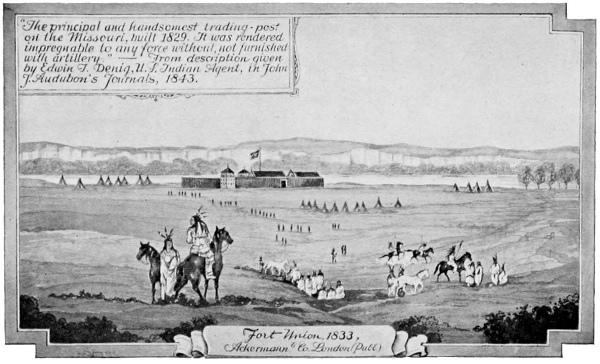
village; Fort Berthold (Gros Ventres village); Fort Union (Assiniboin),
mouth of Yellowstone. Steamboats have gone up the Missouri
as high as the mouth of Milk River, but heretofore goods for
Fort Benton (Blackfeet), near the mouth of Maria River, have been
transported by keel boats from Fort Union.
We know of no large navigable lakes in this district, though along
the northern boundary there are many small ones, or rather large
ponds of water, without any river running through them or visible
outlet, being fed by snows, rain, and springs, and diminished by
evaporation and saturation. Lakes of this kind are to be met with
in many places on the plains and differ in size from 100 yards to 2
or 3 miles or even more in circumference, are not wooded, and contain
tolerably good water. Small springs are also common, most of
them having a mineral taste, though none are large enough to afford
water power.
Surface of the Country.—The whole country occupied by the
Assiniboin is one great plain, hills and timber only occurring where
rivers run, in the valleys of which good land for cultivation is found,
but the general feature appears to be sterile as regards arable land,
producing, however, grasses of different kinds, some of which are
very nutritious, and particularly adapted to raising horses, cattle,
and sheep. The prairies may be said to be interminable and destitute
of the least particle of timber except along the banks of the few
streams before mentioned, and even these but thinly wooded. Water,
however, can always be found in the small lakes and rivers spoken
of. The Assiniboin do not cultivate the soil in any way, though the
Gros Ventres and Arikara raise corn and pumpkins to some extent on
the Missouri bottoms. By experiments made at or near Fort Union,
we find that oats, potatoes, corn, and all garden vegetables grow
well if the season be favorable. The soil, being light and sandy,
requires frequent rains to produce good crops, which happens about
one year in three; the others fail from drought and destruction by
grasshoppers, bugs, and other insects. The natural productions of
the country are few and such as no one but an Indian could relish.
A wild turnip called by them teep-see-na, and by the French pomme
blanche, when boiled is eatable, is found in quantity everywhere on
the plains, will sustain life alone for a great length of time either
cooked or in its raw state, can be dried and preserved for years, or
pulverized and made into passable bread.
Wild rhubarb is found and eaten either raw or cooked. It has
rather a pleasant sweetish taste. Artichokes grow in quantities near
marshes. Chokecherries, bullberries, service berries, buds of the
wild rose, red plums, and sour grapes are the principal fruits and
are greatly sought after by the Indians, preserved, dried, cooked, and
eaten in various ways, and considered by them great luxuries. Wild
hops are in abundance which possess all the properties of the cultivated
hop. These are all of any note the country produces.
Facilities for Grazing.—These Indians raise no stock of any
kind, though judging from that raised at Fort Union it is one of the
best grazing countries in the world. The supply of grasses of spontaneous
growth is inexhaustible and very nutritious. The only difficulty
is the severe cold winter and depth of snow, though if animals
were provided for and housed during the severe cold we know that
a hardier and better stock can be raised than in the States. As yet,
however, no market being open for surplus stock and but few raised
for the use of the fort, our attention has not been much directed to
that business, but have no hesitation in advancing the opinion that
horses, horned cattle, and sheep would thrive and increase well with
proper care. We are not able to say whether water could at all
times be had by digging on the high prairie and in the absence of
springs or creeks, never having tried the experiment, though the
country abounds in small lakes, cool springs, and creeks where good
localities for grazing purposes could always be chosen. In the
winter animals appear to want very little water and generally eat
snow in its place.
Effects of Firing the Prairies.—We presume there must be
some mistake that any of the tribes residing on the plains set them
on fire to facilitate the purposes of hunting. It has the contrary
effect, driving the game out of their own country into that of their
neighbors. Buffalo may pass through a burnt country covered with
snow, but can not remain, and travel until they meet with suitable
grazing. Consequently the greatest precautions are used by both
Indians and whites to prevent their taking fire in the fall, when the
grass is dry (the only time it will burn), and the most severe penalties
short of death are imposed on any person, either white or red,
who even by accident sets the prairie on fire. A good thrashing with
bows and sometimes tomahawking is in store for the poor traveler
who has been so forgetful as not to put out his camp fires and they
extend to the plains. These fires are made mostly by returning war
parties, either with the view of driving the buffalo out of their
enemy’s country or as signals to their own people of success in their
expedition, though sometimes they originate in accident or petty
malice of individuals. With regard to its injuring the soil it has no
such effects; on the contrary, the next crop of grass is more beautiful
than the other, as the undergrowth and briars are by that means
destroyed. The same, unfortunately, is not the case with the timber.
There are no forests on the plains to burn, though where the fire
passes through the bottoms of the Missouri it consumes and kills
great quantities of timber, which dries and decays and is only replaced
in time by younger saplings. Fruit bushes are also destroyed,
though they recover its effects in three or four years.
Waste Lands.—In this section there are no deserts or barren land
of any extent; though there are some marshes, pools, and swamps
which, however, are not so close together or extensive as to form
any formidable obstruction to roads. Even if they could not be
drained or otherwise disposed of, they could be left on either side
of the way. Neither do these appear to affect the health of any of
the Indians more than being the cause of producing hosts of mosquitoes,
which are very annoying to man and beast.
Effects of Volcanic Action.—We are not aware of any remarkable
appearances of this kind,4 neither are there to be found extensive
sand plains or other tracts entirely destitute of herbage. The
cactus is found everywhere, but not in such quantity as to destroy
herbage or be a hindrance to animals traveling. A mile or two
may occasionally be found where herbage is comparatively scarce.
Still, even in these places there is sufficient for animals for a short
time.
Saline Productions.—We do not feel ourselves competent to state
the properties of the mineral springs so common throughout all
this country. Some of them no doubt contain Glauber salt, as they
operate as a violent cathartic; others have the taste of copper, sulphur,
etc. What the country would produce in the way of gypsum,
saltpeter, etc., we can not say, never having witnessed any geological
or mineral researches and being personally completely uninformed
regarding this branch of science.
Coal and Mineral Products.—Dr. J. Evans, who lately traveled
through this country, can enlighten you on this subject. As for us,
we must plead unadulterated ignorance.
The climate is pure and dry and perhaps the healthiest in the
world. In the months of May and June, when east winds prevail,
much rain falls, but during the rest of summer and fall the season
is generally dry and moderately warm, except a short time in July
and August, when intensely hot. There are occasionally severe thunderstorms
accompanied by rain or hail; not more, however, than three
or four in a summer, and these in a few hours swell the smallest
streams so as to overflow their banks, but with the ceasing of the rain
they fall as suddenly as they rise, and do no damage, as there are
neither crops nor fences to injure. Tornadoes we have never seen
here, although they do happen on the Missouri far below this place.
Severe gales are occasionally met with, lasting but a few minutes.
With regard to temperature and other natural phenomena I refer
you to the accompanying tables.
The most numerous and useful animal in this country is unquestionably
the buffalo, both as regards the sustenance of all the Indians
and gain of the traders. Any important decrease of this animal
would have the effect of leaving the Indians without traders, no returns
of smaller skins being sufficient to pay the enormous expense
of bringing supplies so far and employing such a number of people.
Buffalo are very numerous, and we do not, after 20 years’ experience,
find that they decrease in this quarter, although upward of 150,000
are killed annually throughout the extent of our trade, without taking
into consideration those swamped, drowned, calves frozen to death,
destroyed by wolves, or in embryo, etc. It yet would appear that
their increase is still greater than their destruction, as during last
winter (1852-53) there were more found in this quarter, and indeed
in the whole extent of our trade, than had been seen for many years
before.
The buffalo is the Indian’s whole dependence. It serves him for
all his purposes—meat, clothing and lodging, powder horns, bowstrings,
thread and hair to make saddles. In the winter season the
hides are dressed, made into robes and traded to whites, by which
means they are able to buy all their necessaries and even some luxuries.
Robes are worth about $3 each, and although the number
sent to market is great, yet the high price paid for them to Indians
and the danger of transportation is such that fortunes are more
easily and often lost than made at the business. Beaver were formerly
numerous and valuable, therefore much hunted by whites and
Indians, but of late years the price of that fur being greatly reduced,
and the danger of hunting considerable, does not induce either whites
or Indians to hunt them. This animal has been trapped and killed
to such an extent as to threaten their entire extinction, though for
the last 10 or 12 years, since beaver trapping by large bodies of men
has been abandoned, they have greatly increased, and are now to be
found tolerably plentiful in all the small streams and in the Missouri
and Yellowstone. These Indians do not and never did trap them
much; though the Crow and the Cree still make good beaver hunts,
they do not rely much on this either as a source of profit or food.
Elk, deer, bighorn, and antelope are numerous and afford a means
of living and profit to the Indians although they are not hunted to
any extent except in a great scarcity of buffalo. From this circumstance
they do not diminish and are found now in much the same
numbers as 20 years back.
Wolves are very plentiful and of three kinds, the large white wolf,
the large grayback wolf, and the small prairie wolf, all a good deal
hunted and many killed, though they continue to increase. They follow
the buffalo in large bands, waiting an opportunity to pounce upon
one that has been wounded or mired. They also destroy a great many
small calves in the month of May when they are brought forth. The
skins of the larger kind are worth 70 cents to $1 each; the smaller
about 50 cents each.
Red and gray foxes, hares, badgers, skunks, wild cats, otters, ermines,
and muskrats are found and killed when opportunity offers.
Of all these the red fox appears to be the only one that has diminished
in numbers. We are not aware that any animals have disappeared
altogether, nor of any perceptible decrease of any except the beaver
and red fox. The Indians kill only as many buffalo as are wanted
for meat and hides. Taking only as many hides as their women can
dress, they do not destroy them wantonly to any extent; consequently
the destruction is limited, and that not being equivalent to the increase,
but little diminution, if any, is perceptible, and the trade as
long as this is the case can not have the effect of exterminating them.
It is different as regards the beaver and fox. Their skins require no
labor except drying, and being slower to increase must of course be
the first to disappear if hunted. Grizzly bears are tolerably numerous
on the Missouri and Yellowstone and are not hunted often, although
killed occasionally. The animal being ferocious is not much
sought after by the Indians.
Ancient Bones and Traditions of the Monster Era.—The Indians
know from bones found that such animals existed and were of
immense size, but their traditions never make mention of the living
animal. To these bones, etc., they assign the general name of Wan-wan-kah,
which is a creature of their own imagination, half spirit,
half animal. Any whirlwind or great tempest would be attributed
to the movements of the Wan-wan-kah, also any other natural phenomenon.
Many stories are told of its actions, but all are fabulous,
although they profess to believe in the existence of its powers, some
even stating they have seen it crossing the Missouri in the form of a
large fish covering half the breadth of that river.5
Animals Used as Armorial Marks.—These armorial marks or
symbols, such as the eagle, owl, bear, serpent, etc., do not represent
any tribal organization but kinship occasionally. Neither do they
refer to any traditions of any early date, but are insignia adopted
by themselves as their medicine or charm. Most Indians have a
charm of this kind, either in consequence of some dream or of an idea
that the figure has some effect in carrying out his views regarding
war, the chase, or the health of his family. These are assumed for
his own purposes, whether real or imaginary, to operate on his
own actions or to influence those of other Indians. To these tangible
objects, after Wakoñda, who is a spirit, they address their
prayers and invocations. Neither do these symbols affect them regarding
the killing of the same animals on all occasions, though after
he has killed it he will smoke and propitiate [the spirit of] the
dead carcass, and even offer the head small sacrifices of tobacco
and provisions.
Era of the Importation of the Horse.—When the horse was first
introduced among them does not appear by any of the traditions of
these ignorant people. The name of the horse in Assiniboin is
shunga (dog) tunga (large), i. e., large dog. Among the Sioux it
is named shunka (dog) wakan (divining), i. e., divining dog, which
would only prove that the dog was anterior to the horse, inasmuch
as they were obliged to make a name for the strange animal
resembling some known object with which it could be afterwards
compared.
Charts on Bark.—Their drawings of maps and sections of country
are in execution miserable to us but explanatory among themselves.
Most Indians can carve on a tree, or paint, who they are,
where going, whence come, how many men, horses, and guns the
party is composed of, whether they have killed enemies, or lost
friends, and, if so, how many, etc., and all Indians passing by, either
friends or foes, will have no difficulty in reading the same, though
such representations would be quite unintelligible to whites unless
instructed. (Pl. 64.) Some Indians have good ideas of proportion
and can immediately arrive at the meaning of a picture, pointing
out the objects in the background, though others can not distinguish
the figure of a man from that of a horse, and as to their executions
of any drawing they are rude in the extreme. Where the
natural talent exists, however, there is no doubt they could be
instructed.
From the Sioux to the Blackfeet, inclusive, there is not in all
that country any mounds, teocalli, or appearances of former works
of defense bearing the character of forts or any other antique structure.
Not a vestige or relic of anything that would form data, or be
an inducement to believe their grounds have ever been occupied by
any other than roving tribes of wild Indians; nor in the shape of
tools, ornaments, or missiles that would lead to any such inference.
We have not been more fortunate in searching their traditions in the
hope of finding some clue relative to these things. They do not believe
that any persons ever occupied their country except their own
people (Indians), and we can not say we have ever seen or heard
anything to justify any other conclusion regarding the extent of
territory mentioned.
The elk-horn mound, mentioned elsewhere, is evidently of remote
date and the work of Indians, but proves nothing sought by
these researches. It might be stated that although no antique vessels
of clay are found, yet the Arikara now, and as long as the whites
have known them, have manufactured tolerably good and well-shaped
clay vessels for cooking, wrought by hand without the aid of
any machinery, and baked in the fire. They are not glazed, are of a
gray color, and will answer for pots, pans, etc., equally as well as those
made by the whites, standing well the action of fire and being as
strong as ordinary potter’s ware. They also have the art of melting
beads of different colors and casting them in molds of clay for ear
and other ornaments of various shapes, some of which are very
ingeniously done. We have seen some in shape and size as drawn
in Plate 65, the groundwork blue, the figure white, the whole about
one-eighth inch thick, and presenting a uniform glazed surface.
No antique pipes are found, but many and various are now made
by all Indians.
The Arikara and Gros Ventres, who raise corn, have other vessels
as alluded to, but not the roving tribes, except the utensils furnished
by whites. None of these things denote anything more than a people
in the rudest state of nature, whose only boiling pot was once a
hollow stone, or the paunch of a buffalo in which meat can be boiled
and still is on occasions, by filling the paunch with water and casting
therein red-hot stones until the water attains a boiling point, after
which the stones are taken out, and one added occasionally to continue
the heat, or the paunch suspended above a blaze at such a distance
that the fire, though heating, does not touch it. Their spoons
are yet made of the horns of the bighorn and buffalo, wrought into
a good shape, some of which will hold half a gallon with ease.
These are dippers. Others for eating are made smaller of horn and
wood, yet large enough to suit their capacious mouths. (Pl. 65.)
In all this and in everything they do, but one idea presents itself—that
of crude, untutored children of nature, who have never been
anything else.
The only ancient stone implements we have ever seen are the
hatchet, stone war club, arrow point, buffalo shoulder-blade ax, hump-rib
knife, and elk-horn bow, the shapes of which we have endeavored
to draw in Plate 66, and all of which, except the knife, can yet
occasionally be seen among them.
There is a total absence of anything antique, any shell, metal,
wampum, or other thing formerly possessed by inhabitants supposed
to have occupied this country. Neither are there any hieroglyphics
or traditions to denote anything of the kind.
Earth and Its Motions.—Their knowledge on this subject is very
limited. They believe the earth to be a great plain containing perhaps
double the extent of country with which they are acquainted,
and that it is void of motion. They do not believe the stars are
inhabited by other people, but admit they may be abiding places of
ghosts or spirits of the departed. They are not fond of talking
about these things, neither do their opinions agree, each man’s story
differing materially from the other and all showing extreme ignorance
and superstition.
They believe that Wakoñda created all things and this one idea
appears original and universal, further than which, however, they
are at a loss.
If they can not be made to comprehend the extent of the earth and
its laws of motion, etc., there is much less likelihood that they can
have any reasonable idea of the field of space or other creations
therein further than superstitious notions according to the fancy of
the individual.
BUREAU OF AMERICAN ETHNOLOGY
FORTY-SIXTH ANNUAL REPORT PLATE 64
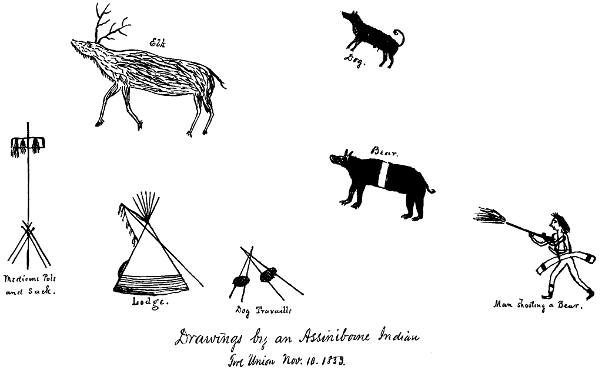
Drawings by an Assiniboine Indian
Fort Union Nov. 10. 1853.
BUREAU OF AMERICAN ETHNOLOGY
FORTY-SIXTH ANNUAL REPORT PLATE 65
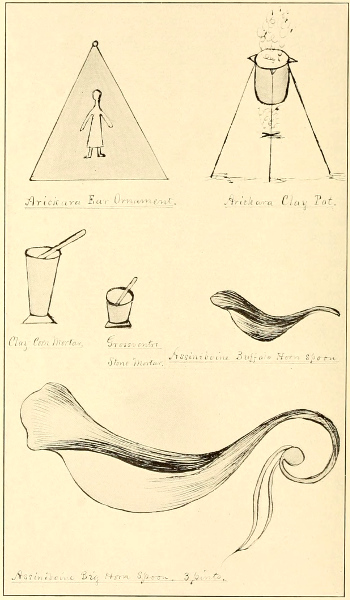
Culinary Utensils
BUREAU OF AMERICAN ETHNOLOGY
FORTY-SIXTH ANNUAL REPORT PLATE 66
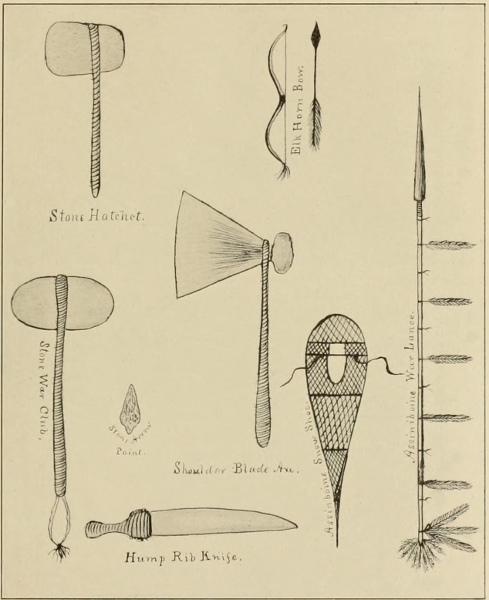
Characteristic Implements of the Assiniboine
BUREAU OF AMERICAN ETHNOLOGY
FORTY-SIXTH ANNUAL REPORT PLATE 67
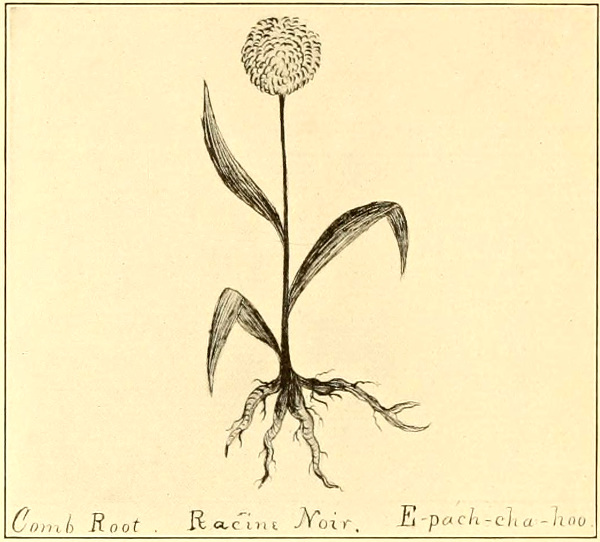
a, Comb root.
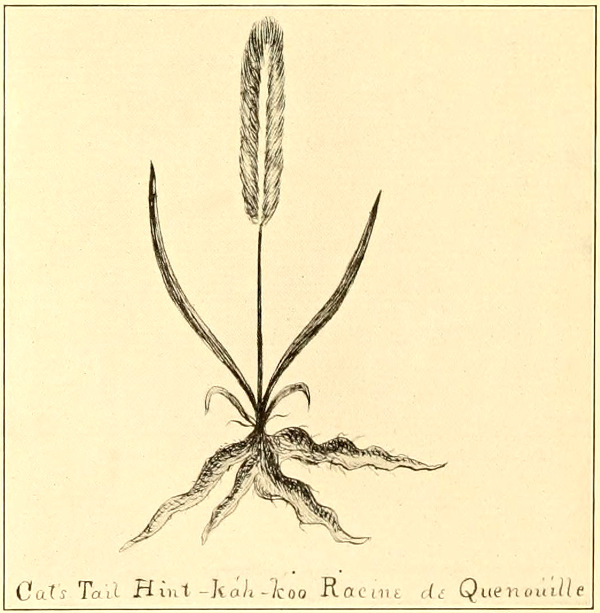
b, Cat-tail.
The Sun.—They take the sun to be a large body of fire, making its
daily journey across the plains for the purpose of giving light and
heat to all, and admit it may be the residence of Wakoñda;
consequently it is worshiped, venerated, smoked, and invocated on
all solemn occasions. We have often endeavored to explain the diurnal
revolution of the earth, representing the sun as stationary, but
always failed. They must first be brought to understand the attractions
of cohesion and gravitation, for, as a sensible Indian stated on
one of these occasions, “If at midnight we are all on the under side,
what is to hinder the Missouri from spilling out, and us from falling
off the earth? Flies, spiders, birds, etc., have small claws by which
they adhere to the ceiling and other places, though man and water
have no such support.”
The Sky.—Those who take the trouble to explain state the sky to
be a material mass of a blue color, the composition of which they do
not pretend to say, and think it has an oval or convex form, as
apparent to the eye, resting for its basis on the extreme boundaries
of the great plain, the earth. Hence their drawing, which is almost
the only form in which they could represent it. Stars are small suns
set therein, though they think they may be large bodies appearing
small by seeing through space. Space is the intervening distance
between earthly and heavenly bodies.
The Indians can not rationally account for an eclipse, supposing
it to be a cloud, hand, or some other thing shadowing the moon,
caused by Wakoñda to intimate some great pending calamity.
Many are the prophecies on these occasions of war, pestilence, or
famine, and their predictions are often verified. Predicting an
eclipse does not appear to excite their wonder as much as would be
supposed. The writer predicted the eclipse of the moon on December
25, 1852, months before, but received no further credit than that
of having knowledge enough from books to find out it was to take
place.
Their year is composed of four man-ko´-cha or seasons, viz., wai-too
(spring), min-do-ka´-too (summer), pe-ti-e-too (autumn), wah-nee-e-too
(winter). These are only seasons and do not each contain a
certain number of days, but times—a growing time, a hot time, a
leaf-falling time, and a snow time. These four seasons make a year
which again becomes man-ko´-cha or the same as a season. This
is difficult to explain. They count by the moon itself and its different
phases, not computing so many days to make a moon, nor so many
moons to a year.
They give each moon its name, beginning, say, with the March
moon whenever it appears either in February or March, when it
would be wee-che´-ish-ta-aza, sore eye moon; next would follow
Ta-pa´-ghe-na-ho-to, frog moon; next pe-tai-chin-cha´-ton, buffalo
calf moon; next wee-mush-tu, hot moon; next wah-pa´-ze-ze, yellow-leaf
moon; next wah-pa-ich-pa´-ah, leaf-falling moon; next yo-ka´-wah-how-wee,
first snow moon; next we-cho-kun, middle moon; next
om-hos-ka-sun-ka-koo, lengthening days moon’s brother; and next
om-has-ka, lengthening of days moon. Their year has no beginning
nor end. They count and name the moons as they come, and these
names are also varied. Any annual remarkably known fact respecting
the season can be applied to the name of the same moon. Thus
the sore-eyed moon can be called the snow-melting moon, and the
falling-leaf moon be termed the moon when the buffaloes become fat.
These moons suffer no divisions of time except their phases, viz.,
new moon, increasing moon (first quarter), round moon (full moon),
eaten moon (second quarter), half moon, dead moon (invisible).
Among themselves they have no division of time equal to a week,
although they are aware that we count by weeks, or divining days
(Sundays), and will often ask how many divining days (or Sundays)
there are to a given period.
An Indian in counting any period less than a year will say 3
moons and a full (3½ moons), 4 moons and an eaten one
(4¾ moons), 6 moons and an increasing one (6½ moons), etc.
These serve all his purposes and when wishing to be more minute
and exact he must notch each day on a stick. For a year or four
seasons they say a winter. A man may say “I am 40 winters old
and one summer.” Yet sometimes the same man will say, “I am
40 seasons old.” This is still right. He will also say that he is 80
seasons old, or 160 seasons old. All of these are correct and understood
immediately, as in the one case you mentally take the half, and
in the other the quarter. This is often done among themselves, but
with whites they generally name the winter only to designate the
year, yet man-ko´-cha (season) is the right name for a year and
would be received as such by all the Assiniboin. The day is divided
into the following parts: hi-ak-kane (daylight), umpa (morning),
wee-he-num-pa (sunrise), wee-wa-kan-too (forenoon), wi-cho-kun
(midday), we-coo-cha-nu (afternoon), we-coh-pa-ya (sunset), hhtie-too
(twilight), eoch-puz-za (dark), and haw-ha-pip-cho-kun (midnight).
Any intermediate space of time would be indicated by pointing
the finger to the place the sun is supposed to have been at that
time. They know nothing of the division of hours and minutes,
yet some of the squaws living a long time in the fort can tell the
hour and minute by the clock.
They know that the minute hand makes the revolution of the dial
plate before it strikes and know the figures from 1 to 12; also that
each figure is five minutes apart, and will say it wants so many fives
to strike 9, or it has struck 10 and is 5 fives past. This they pick up
nearly of their own accord, which proves that some are susceptible
of intelligence and education. They know nothing of the solstices
nor have any period such as a cycle or century, neither do they believe
the world will come to an end or that their priests or any others have
the power to destroy or rebuild it.
They know and name the North Star the same as we do—wa-se-a-ure-chah-pe
(north star)—and also know the Ursa Major, sometimes
calling it the “seven stars” and “the wagon.” They are aware that
it makes its revolution around the polar star, pointing toward it, and
this is the secret of their traveling by night when there is no moon.
They call no other stars by name. The Milky Way is said to be
moch-pe-achan-ka-hoo (the backbone of the sky). It is known by
them to be composed of clusters of small stars, but they suppose it to
bear the same relative position to the arch of the heavens, and to be
as necessary to its support as the backbone of any animal to its body.
Meteors are falling stars which become extinguished as they fall.
They attract but little attention as their effects are never perceived.
Aurora borealis is believed to be clouds of fire or something the
same as electricity. Being very common and brilliant it creates
neither wonder nor inquiry.
The moon is not believed to influence men or vegetables nor to
have any other properties than to give light by night.6 They suppose
it to be made of some body wasting away during a given period.
Some say it is eaten up by a number of small animals (moles) and
Wakoñda makes a new one on the destruction of the old. They
know very well that all this is error and that the whites have
a better philosophy, but will not take the trouble or can not comprehend
our views of the motions of heavenly bodies. Having nothing
else better explained to them, they adhere to their own ideas, which
are of the simplest and most primitive kind, and do not appear to
wish them superseded by others which they can not understand.
The same remark would apply to all their astronomical and geographical
opinions. They have a correct knowledge of the cardinal
points, and honor the east as the first from the fact that the sun rises
there. The pipe is first presented to the east, then to the south, supposed
to be the power of the spirits of their departed friends, then
west, then north, and lastly to the earth as the great grandfather
of all. The amount of facts or real information they can give are
mentioned and as for further explanations, as observed before, they
do not delight to talk about these matters but appear to think them
sacred or forbidden fields through which their thoughts ought not
to roam. The subject affords no scope for research unless a writer
is disposed to collect a number of fables, which would serve no purpose
unless it be to develop their ignorance and superstition.
Indian Paradise.—The Paradise of these Indians is in the south
in warm regions (not necessarily in the heavens, yet in some imaginary
country not belonging to earth), where perpetual summer,
abundance of game, handsome women, and, in short, every comfort
awaits them; also the satisfaction of seeing their friends and
relatives. No quarrels, wars, disturbances, or bodily pain are allowed
to exist, but all live in perfect harmony. Departed spirits
have the power to revisit their native lands, manifest themselves to
their friends in dreams, and if they have been neglectful in crying
for or feasting them can trouble them with whistling sounds and
startling apparitions, many of which are said to be seen and heard
and are most religiously believed in by all. Consequently, the dead
are feasted (a long ceremony), smoked, sacrificed to, and invoked,
besides being cried for years after they are gone, perhaps as long
as any of the relatives are living. The heavenly bodies they think
may also be residences for spirits, but we think this idea is derived
from the whites. The other is the most ancient and original tradition,
if not the only one, and is universally believed. This subject
will meet with further notice in the course of these pages.
Numeration.—All these prairie tribes count by decimals and in no other way.
The names of the digits are:
One—washe´nah.
Two—noom´pah.
Three—yam´ine.
Four—topah.
Five—ta´ptah.
Six—sha´kpah.
Seven—shakkowee.
Eight—sha´kkando´gha.
Nine—noo´mpchewo´oukkah.
Ten—wixchemenah.
After ten the word akkai, dropping the name of the ten, serves
until twenty, thus:
Eleven—akka´i washe.
Twelve—akkai noompah.
Thirteen—akkai yammene.
Fourteen—akkai topah.
Fifteen—akkai zaptah.
Sixteen—akkai sha´kpah.
Seventeen—akkai shakko´.
Eighteen—akkai sha´kando´gha.
Nineteen—akkai noompchewoukkah.
Twenty—wixche´mmene noompa; i.e. for twenty, literally two tens.
From twenty to thirty the word “sum” or “more” (plus) is
added, thus:
21—wixchemmena noompa sum washena (two tens plus one).
22—wixchemmena noompa sum noompa (two tens plus two).
23—wixchemmena noompa sum yammene (two tens plus three), and so on up to thirty, which is three tens or wixchemmene yam´mene.
31—wixchemmene yammene sum washena (three tens plus one).
32—wixchemmene yammene sum noompa (three tens plus two); the same as after twenty, and the same after each succeeding ten as far as one hundred, thus—
40—wixchemmene to´pah (four tens).
41—wixchemmene topah sum washena (four tens plus one).
50—wixchemmene zaptah (five tens).
51—wixchemmene zaptah sum washena.
52—wixchemmene zaptah sum noo´mpa.
60—wixchemmene shakpa (six tens).
61—wixchemmene shakpa sum washena.
62—wixchemmene shakpa sum noompa.
70—wixchemmene shakko (seven tens).
71—wixchemmene shakko sum washena (seven tens plus one).
72—wixchemmene shakko sum noompa.
73—wixchemmene shakko sum yammene.
74—wixchemmene shakko sum topah, etc.
80—wixchemmene shakandogha (eight tens).
90—wixchemmene noomchewouka (nine tens).
100—o-pah-wa-ghe.
101—o-pah-wa-ghe sum washea.
110—opahwaghe sum wixche´mmene.
160—opahwaghe sum wixche´mmene shakpa.
161—opahwaghe sum wixche´mmene shakpa sum washena.
170—opahwaghe sum wixche´mmene shakko.
180—opahwaghe sum wixche´mmene shakandogha.
190—opahwaghe sum wixche´mmene noomchewouka.
200—opahwaghe noompa.
300—opahwaghe yammene.
400—opahwaghe topah.
500—opahwaghe zaptah.
600—opahwaghe shakpah.
700—opahwaghe shakko.
800—opahwaghe shakandogha.
900—opahwaghe noomchewouka.
1,000—koke-to-pah-wa-ghe.
1,853—koketopahwaghe sum opahwaghe shakandoga sum wixche´mmene zaptah sum yammene.
2,000—koketopahwaghe noompah.
3,000—koketopahwaghe yammene.
4,000—koketopahwaghe topah.
10,000—koketopahwaghe wixchemmene.
20,000—koketopahwaghe wixchemmene noompa.
50,000—koketopahwaghe wixchemmene zaptah.
100,000—opahwaghe koketopahwaghe.
500,000—opahwaghe zaptah koketopahwaghe.
600,000—opahwaghe shakpah koketopahwaghe.
10,000,000—opahwaghe wixehemmene koketopahwaghe.
Although the computation could thus be carried on to a million
yet the Indian would not appreciate the number. We think that
after 5,000, or at the utmost 10,000, their ideas fail them; that is,
they can not realize in thought more than that amount, yet are able
mechanically to count it. This is evident, as they have no distinct
name for a million, but are obliged to call it ten hundred thousand,
and were they requested to go further would proceed eleven, twelve,
thirteen hundred thousand, etc., but not comprehending the great
number as a body. They can not multiply or subtract uneven sums
without the aid of small sticks or some other mark. Thus to add 40
to 60 would be done by the fingers, shutting down one for each succeeding
ten, naming 70, 80, 90, 100. But to add 37 to 94 would require
some time; most Indians would count 37 small sticks and
beginning with 94, lay one down for each succeeding number, naming
the same until all were counted. Now tell them to add 76 to 47
and subtract 28. In addition to the first process, and counting the
whole number of sticks, he would withdraw 28 and recount the
remainder. They are easily confused when counting and consider
the knowledge of figures one of the most astonishing things the
whites do.
In counting with the hand, an Indian invariably begins with the
little finger of the left, shutting it down forcibly with the thumb
of the right; when the five fingers are thus shut he commences on the
thumb of the right, shutting it with the left fist. When wishing to
telegraph by signs a certain number less than 10 he holds up that number
of fingers, beginning with the little finger of the left hand and
keeping the others shut. Should the number be 7, then all the
fingers of the left and thumb and finger of the right would be extended,
holding up his hands, the rest of the fingers closed. Tens are
counted by shutting and opening both hands; thus, 100 would be
indicated by shutting and opening both hands 10 times in succession.
The number 7 has two names, shakkowee and enshand (the
odd number). They count fast enough in continuation from 1 to 100
but must not be interrupted.
Coin.—There is not now nor have we any reason to suppose there
ever has been among them any coin, shells, wampum, or any other
thing constituting a standard of exchange, neither are they acquainted
with American money. Were a guinea and a button presented
there is no question but the Indian would take the latter.
They barter their furs for goods which have fixed prices, and are
well acquainted with these prices, as also of the value of their robes
and furs as a means of purchasing merchandise.
Keeping Accounts.—The Indians themselves keep no accounts.
The manner in which accounts are kept by whites with them is as
follows. We are not exactly acquainted with the minor operations
in accounts kept by the Hudson’s Bay Co. with the Cree and the
Chippewa, but from authentic information the following appears to
be their system. A plue is equal to 1 pound beaver skin or 3 shillings
sterling (say 67 cents); that is, 1 pound of the fur is worth at their
forts 67 cents in merchandise at their fixed prices. Therefore a large
beaver skin (2 pounds) is 2 plues; 6 muskrats, which are worth from
10 to 12½ cents each, is a plue; 1 wolf skin is counted a plue, being
equal in value to the standard 67 cents; an otter skin is 2 plues, a red-fox
1, and so forth.
All skins and other articles of trade acquired by Indians are reckoned
into plues by the trader and the Indians and the prices of
merchandise are computed in the same manner. On the Missouri the
plan is somewhat different, to explain which we annex the following
accounts copied from our books. It will be necessary to observe that
everything is brought to the standard of buffalo robes which have
an imaginary value of $3 each in the country.
The Crazy Bear, Assiniboin Chief
| 1851 |
|
Dr. |
1852 |
|
Cr. |
| Dec. 3 |
To 1-3 pt. white blanket |
3 robes. |
Jan. 8 |
By 6 robes |
6 robes. |
|
To 2 yards blue cloth |
2 robes. |
|
By 2 dressed cow skins |
1 robe. |
|
To ¾ yard scarlet cloth |
1 robe. |
|
By 30 pounds dried meat |
1 robe. |
|
To 2½ pounds tobacco |
1 robe. |
|
By 2 red fox skins |
1 robe. |
| 1852 |
|
|
|
By 2 raw cowhides |
1 robe. |
| Jan. 16 |
To 1 horse |
10 robes. |
|
By 1 large elk skin, raw |
1 robe. |
|
To 3 knives |
1 robe. |
Feb. 10 |
By 4 robes |
4 robes. |
|
To 1 kettle, 2 gallon |
2 robes. |
|
By 12 wolf skins |
4 robes. |
|
To 100 loads ammunition |
1 robe. |
|
Balance forward |
2 robes. |
|
|
21 robes. |
|
|
21 robes. |
| 1853 |
|
|
|
|
|
| Feb. 10 |
To balance on settlement |
2 robes. |
|
|
|
Pictorial or other signs are not used in accounts, either by them or the
white people.
Elements of Figures.—A single stroke answers for 1 and each
additional stroke marks the additional number as far as 100. When
a stroke is made apart, the score is rubbed out and begun again.
There are no written nor marked records kept, either on graves or
otherwise, of ages or of events, scalps taken, or war expeditions.7
Their transactions, or coups, as they are called in this country, are
pictured on their robes, lodges, and shields, but these wearing out are
seldom renewed, particularly when the man becomes old. Also these
coups are recounted publicly by the performer on occasions appointed
for the purpose, which we shall notice hereafter, and moreover, are
talked of often enough around their firesides. Ages are numbered
by particular events that took place at the time they could first recollect,
and afterwards by certain remarkable years from time to time.
Though no Indian can be sure as to his exact age, yet he will not vary
more than a year or two as to the time. The cross (X) is not used in
counting or for any other purpose, neither does the dot or full comma
signify a moon or anything else.
General Practice.—They are careful of their sick relatives and
particularly so in regard to their children or men in the prime of
life. Very aged persons do not, however, meet with such kindness
even from their own children, having become useless as a help in
camp. Besides being a burden in traveling and a bore and expense,
they are anxious to get rid of them and leave them on the plains to
die. It must, by no means, be inferred from this that the Indian
has no paternal feelings or affection; from several instances of the
kind that have come under my observation I am assured it is their inability
to carry about and along with them aged people. These
Indians are poor, have but few horses and are constantly on the
move, in all weather, sometimes requiring flight; therefore everything
that might encumber in the way of baggage is thrown aside,
and among other rubbish is classed the aged of both sexes. I am
also told that it is often the desire of the aged to be left to die. To
keep up appearances with his people, the Indian will generally pay
a small doctor’s bill for the relief of his aged relatives, but nothing
like the amount the same man would pay for his wife or child. To
explain their mode of practicing medicine, surgery, etc., we must
be somewhat prolix.
In every camp there are several doctors, both men and women,
called by them divining men, who have the double reputation of
physicians and sorcerers. This is generally some old wretch who
is very ugly, of great experience, and who has art enough to induce
others to believe in his knowledge, and can drum, sing, and act his
part well.
The present great doctor and soothsayer is named “Bull’s Dry
Bones,” a very old man who is now with me. This man was once
sick and died while the camp was traveling. His friends packed and
tied him up in several envelopes of raw hides, blankets, etc., and,
after duly crying over him, placed the body in the fork of a tree
as is their custom. By some means, however, the man came to life
and after great difficulty worked himself out of his bonds, traveled
and overtook the camp some days after they had left him. He stated
to them that during his decease he had been in other worlds, seen
much, knew everything, past, present, and future, and from this
circumstance he has ever after been considered a great divining man
and prophet. We will now state how they proceed in case of sickness.
A child falls sick. The father or some other near relative
immediately sends a gun or a horse to the divining man to secure
his services. Sometimes smaller articles are sent, and the doctor,
thinking them beneath his notice, will not pay a visit until enough
is offered, which amount varies in proportion as the patient’s relatives
are rich or poor. He then enters the lodge of the sick person
in his medical capacity. His instruments are a drum, a chi-chi-quoin,
or gourd rattle, and, perhaps, a horn cupping apparatus. He must
have (although not perceptible) some things concealed in his mouth
or about his person, as will presently appear, although they go
usually through their operations entirely naked (except the breechcloth)
and not in a hideous costume as has been represented. The
doctor is accompanied by five or six others as old and ugly as himself,
bearing drums, bells, rattles, and other noisy instruments.
All sing to the extent of their voices and make a terrible noise with
the instruments spoken of. The doctor slowly approaches the
patient, applying his mouth to his naked breast or belly, draws or
appears to draw therefrom by suction a worm, sometimes a bug, a
wolf hair, or even a small snake, making at the same time horrible
gestures, grunts, and grimaces. This object he displays to the
lookers-on, stating he has extracted the cause of the disease. This
operation is repeated several times with like results, and after he and
the accompanying band of music partake largely of a dog or other
feast provided for them they leave for the time. The whole performance,
with the music, incantations, preparations, and feast included,
would occupy perhaps from two to three hours and often the
whole night, if the performers are paid high. Frequently their
diseases are colic from eating unripe fruits and berries or overloading
the stomach, which, of course, get well in a short time and
the credit is given to the doctor, each recovery aiding to raise his
reputation and enlarge his practice. But if the case is serious and
the patient gets worse, the doctor is then paid again and another visit
takes place. The forms are always somewhat similar, but on this
occasion, in addition to the full band of music and cupping with the
horn, besides the usual grimaces, noises, etc., the patient is made to
drink decoctions of roots or powders made by the doctors of
pulverized roots, rattles of the rattlesnake, calcined bones, etc., the
properties of which he is entirely ignorant, and probably the smallness
of the dose preventing them from doing any harm. This, with
the noise of the instruments and feast, concludes the second visit.
Sometimes the doctor performs alone and keeps up the drumming,
etc., all night. In this way by a repetition of visits, if the case is
of long duration, the whole of the property of the relatives of the
sick person falls to the doctor and his assistants, who are also slightly
paid for the music. And this is the cause of great individual distress
and poverty, though the property given does not go out of the
nation, but only changes hands and is liable in like manner to revert
to others should the divining man fall sick. In case, after all, the
patient dies, it is then the doctor who is in danger, and runs great
risk of losing his life, by the parents or relatives of the deceased.
Indeed, being aware of this they generally abscond to other camps
when death approaches, and whatever property they leave behind
is taken from them. No later than last winter the writer paid an
Indian to prevent his killing the “Bull’s Dry Bones” (doctor) who
the man said had poisoned his two children six years ago. But the
old doctor, although a humbug, is an innocent man and would harm
no one.
They have various forms of doctoring, in all of which the drum
forms a principal figure, and songs and incantations, all of which
are most religiously believed in by the Indians. Old women are
as often practitioners as old men and of as great celebrity. There
is also another reason why these Indians give away so much of their
property to the divining man. Independent of these payments
securing the doctor’s services, they are considered as sacrifices; that
is, the man makes himself poor with a view of propitiating the Great
Spirit.
Also it is considered and spoken of as a great honor to give away
large articles to the divining man, such as horses, guns, etc., and
goes to prove the affection with which they regard their sick relatives.
For a long time afterwards the giver will boast of his liberality
in these respects and is also looked upon as a man with a “large
heart.” We must, at the risk of not being believed, state that on
two particular occasions, and before witnesses, we have examined
the divining man’s mouth, hands, and all his person, which was
entirely naked, with the view of discovering where these worms,
snakes, etc., were hidden, and that these examinations were made
without any previous intimations to him who, never having been
subject to examinations of the kind by Indians, was completely unprepared
for the trial, yet he acquiesced cheerfully, afterwards continued
his performance, and repeated it in our presence, drawing and
spitting out large worms, clots of blood, tufts of hair, skin, etc., too
large to be easily secreted, and leaving no visible mark on the
patient’s body. The trick was well done and not yet known to any
of us.
Their knowledge of anatomy consists in being acquainted with the
larger bones and joints. They can set a broken arm or simple fracture
tolerably well, and even replace a dislocated shoulder, which
they do by pulling and outward pressure from the armpit, but this
knowledge is not confined to the divining man nor is it his business
more than any other who happens to be present. Most men of
middle age have witnessed so many accidents of the kind that they
can do this.
They are, however, unacquainted with the circulation of the blood
and with any judicious treatment of internal diseases, for all of
which they resort to incantations and drumming. They do, however,
indiscriminately use the vapor bath or sweat house for various
complaints. This construction is a small lodge thrown over a basketwork
of willows stuck in the ground and bent in an oval or round
form, the skins well pinned down and every aperture well closed.
The doctor after heating some large stones red hot and putting them
into the lodge enters with the patient, both entirely naked and taking
along a kettle of water and, as usual, his drum. The lodge is then
shut tight by the people on the outside. A brisk singing and drumming
is kept up in the lodge by the doctor, who at intervals throws
water on the stones and steam is raised. A violent heat and perspiration
takes place, which they endure as long as they can; as soon as
the patient is taken out he is immersed in cold water, which in nine
cases out of ten results in his death. In this way the Crow Indians
lost nearly 200 persons three years since during a prevailing
influenza. The Mandan and Gros Ventres, however, being accustomed
to cold bathing from their youth, are said seldom to suffer any inconvenience
but often receive benefit from the vapor bath and immediate
cold immersion. They have no names for fevers, consumptions,
obstructions of the liver, etc., and can not explain further than by
pointing out that part of their body which is in a state of pain.
Indeed, in this climate, except consumption, rheumatism and
quinsy, diseases are extremely rare; and no febrile symptoms seen
except in cases of wounds and parturition when puerperal fever often
occurs, and assuming a typhoid form is generally fatal. They are
also exempt from paralysis, toothache and almost all the thousand
nervous complaints to which the whites are subject, among which
might be mentioned baldness or failure of eyesight from age. Their
materia medica is consequently in a very primitive state. They
have no medicine except some roots, some of which are known to
be good for the bite of the rattlesnake, frozen parts, and inflammatory
wounds. The principal of these is the black root, called by
them the comb root (pl. 67, a), from the pod on the top being composed
of a stiff surface that can be used as a comb. It is called by the
French racine noir, and grows everywhere in the prairie throughout
the Indian country. It is chewed and applied in a raw state with a
bandage to the part affected. We can bear witness to the efficacy
of this root in the cure of the bite of the rattlesnake or in alleviating
the pain and reducing the tension and inflammation of frozen
parts, gunshot wounds, etc. It has a slightly pungent taste resembling
black pepper, and produces a great deal of saliva while
chewing it. Its virtues are known to all the tribes with which we
are acquainted, and it is often used with success. A decoction of the
root of cat-tail (pl. 67, b) is also used to reduce inflammation, and
given internally to produce perspiration, but mostly as an external
application for wounds, sprains, and pains of all kinds, as also the inner
bark of the red willow; both of which are said to be beneficial,
and are much used by the Indians and French voyageurs in all the
Indian country.
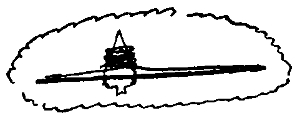
Figure 30.—Lancet
At the risk of a smile and perhaps something more from the enlightened
civilized medical fraternity we will now state how they
absolutely can and do cure hydrophobia, in hopes of furnishing
them with a hint that may be improved upon. We have never
actually seen this operation, but are as certain of its being done as
we can be of anything not seen but in all
other respects well authenticated. Although
Indians are often bitten by mad
wolves, yet they never die from the disease
if operated upon. After it is known that
the patient has hydrophobia, the symptoms
of which they are well acquainted with, and has had a fit or two, he is
sewed up in a fresh rawhide of a buffalo. With two cords attached to
the head and foot of the bale the man is swung backward and forward
through a hot fire until the skin is burnt to cinders and the patient is
burned and suffocated [sic]. He is brought to the brink of the grave
by the operation; taken out in a state of profuse perspiration and
plunged into cold water; and if he survives the treatment the disease
disappears. The remedy is terrible. Now, if the poison of the rattlesnake
is expelled by perspiration by administering ammonia and
other remedies, might not the poison communicated by the rabid
animal undergo a like process by the violent treatment mentioned,
or intense heat produce the desired constitutional revolution and
effect a cure.
Depletion by Bleeding.—They bleed often, both when the pulse is
full from sickness and at any time they think it beneficial.
The instrument is a sharpened arrow point or any other small piece
of pointed iron. (Fig. 30.) They wrap the whole of this with sinew
except as much as they wish to enter the vein. It is then tied into a
split stick and secured firmly with sinew and being laid on the vein is
knocked in suddenly with the thumb and middle finger. They also
open the veins of their legs and arms while crying over dead relatives,
making large transverse cuts with knives, arrow points, or flints.
When they bleed they generally let the blood flow as long as it will
without bandage. Cupping is done with a part of the upper end of
a buffalo horn, about 2½ inches long, and a vacuum is produced by
suction with the mouth which, with their powerful muscles and exertions,
is, of course, double force. It is said to be useful in drawing
out the poison of snake bites and is also used for pains and cramps
in the stomach, besides for extracting worms, bugs, snakes, etc., as
mentioned in the general practice. We believe it may have something
of the effect of dry cupping with glasses; they do not, however,
scarify before cupping except in cases of snake bites.
Stoppage of Blood and Healing Art.—For stopping of blood they
use cobwebs, dried pulpy fungus, or very fine inner bark of trees.
When these are not to be had finely pulverized rotten wood is used.
These answer tolerably well when the divided artery is small. They
have no good plasters or healing salves.
Bandages are mostly tied on too tight, with the view of stopping
the bleeding and are left too long before being removed, which frequently
results in gangrene. They are not skillful nor clean in these
things, seldom washing a wound. From actual observation, which
has been pretty extensive with regard to cuts and wounds of all
kinds, we are disposed to believe that their cure does not depend upon
any skill in treatment nor care taken of them, but upon their vigorous
constitutions, extremely healthy climate, and strictly temperate mode
of life, with perhaps a disposition to heal naturally in the absence of
scientific knowledge vouchsafed to the ignorant Indian by an all-wise
Creator.
Amputation.—They never amputate a limb, though fingers and
toes often undergo that operation.8 The Assiniboin run a sharp knife
around the joint of the finger and snap it off. The Crows do the
same, but on other occasions take them off by placing a sharp tomahawk
on the finger, it being laid on a block and the tomahawk being
struck with a mallet. Whenever a Crow Indian dies his near relatives,
male and female, sacrifice each a finger and sometimes two, and
the loss of these people by sickness and enemies the last few years
having been great, there is scarcely such a thing as a whole hand to be
found in the Crow Nation. The men reserve the thumb and middle
finger on the left and the thumb and two forefingers of the right hand
to use the bow and gun, but all the rest are sacrificed.
They mostly take them off at the first and second joints, though
occasionally lower down. These small amputations are seldom attended
with any serious effect, but from their awkward operations the
bone frequently projects and requires a long time to heal. They use
splints and bark in fractures and lacerated bones, but are not skillful
in applying them, nor attentive in removing them, and in a short
time the wound smells bad. Their wounded are carried from the
field in a blanket, robe, or skin, by four men each holding a corner,
who are relieved by others when fatigued, in which way they transport
them for days and sometimes weeks together. When very badly
wounded in an enemy’s country and supposed to be mortally wounded
they are left in some point of timber to die. A small stock of provisions
and ammunition is left with them. They sometimes recover
almost by miracle. Instances of this kind are not uncommon and
serve to show the suffering an Indian will undergo and the different
means he will use to preserve life.
Theory of Diseases and their Remedy.—They understand
nothing of the properties of mineral medicines except a few simple
ones given them by whites of later years, neither are they acquainted
with the theory of diseases, being for the most part unable to describe
their complaint so that any person could prescribe. They are as
ignorant of any true knowledge of diseases or medicines as they are
of astronomy or any other science.
It is hardly conceivable how the smallpox among Indians could be
cured by any physician. All remedies fail. The disease kills a
greater part of them before any eruption appears. We have personally
tried experiments on nearly 200 cases according to Thomas’s
Domestic Medicine, varying the treatment in every possible form,
but have always failed, or in the few instances of success the disease
had assumed such a mild form that medicines were unnecessary. It
generally takes the confluent turn of the most malignant kind (when
the patient does not die before the eruption), which in 95 cases out
of 100 is fatal. It appears to be the natural curse of the red men,
and here we leave it, perfectly willing others should do more. We
have from year to year tried to introduce general vaccination with
kinepock among them, and have even paid them to vaccinate their
own children, but they will not have it done to any extent, and the few
who will do it more to please us than to benefit themselves. Moreover,
should any accident happen to the child or even should the
Indian miss his hunt, or any casualty befall him or his family, the
vaccination would be blamed for it and the good-hearted operator
would find himself in a position of danger and expense. There is
also great risk in giving them medicines, for should the patient die
the whites would be blamed for poisoning him, and should he live
the Indian drummer or doctor will get both the credit and the pay.
Therefore, as their customs at present stand but little can be done
for them, however willing people are to attempt it.
Parturition.—Men never interpose their services in cases of
parturition.
When there is danger a midwife is called, and the deobstruents
administered are castoreum and pulverized rattles of the rattlesnake,
either of which have the effect of the ergot. Shampooing
is also resorted to with the view of detaching the fetus or expelling
the envelope. Nevertheless strangulation and consequently death of
both mother and child often happens, not so much in the natural
course as when destroyed expressly in utero, as is done by the Crow
women and sometimes by the Assiniboin, though not to such an extent
by the latter. This is accomplished by violent pressure on the
abdomen, by leaning on a stick planted in the ground, and, swinging
the whole weight of their body, they run backward and forward, or
by violent blows administered by some other person called for the
purpose, in all which operations, if the time be not well calculated
for expelling the fetus, death is the consequence.
Their vapor baths have been alluded to and might prove efficacious
in some cases of chronic rheumatism, catarrh, etc., if proper care
was taken, but are very pernicious owing to their negligence afterwards,
or cold immersion during perspiration. In conclusion we
would remark that with regard to any judicious treatment of any
disease whatever (that is, any such treatment as would meet medical
approbation) they are entirely in the dark. The most of their dependence
is on the drumming, singing, and incantations which perhaps
sometimes have some little effect on the mind of youthful
patients, though in these cases the probability is they are more
frightened than sick.
In a large camp the drum can be heard at all hours of the day
and night, as there is always some one who is sick, or thinks he is.
What appears singular is that the doctor, knowing his art to be
deception, should he fall sick calls for another divining man and
pays for the drumming the same as his patients have paid him.
This would seem to prove they actually have faith in their own incantations,
etc. They can not distinguish between an artery and a
vein. They call both by the same name, though they say the arteries
are large veins. Arteries are compressed, not taken up when cut,
and if a large one is cut, the consequence is either mortification from
the ligature or, if loosely tied, death by bleeding, which invariably
happens when the large artery of the thigh is separated.
Indians will receive extensive wounds, apparently mortal, and yet
recover. Some years ago an Assiniboin was surrounded by three
Blackfeet a few miles from this place. He had fired at a prairie hen,
and the moment his gun was discharged the three enemies fired on
him. The three balls took effect. One broke his thigh, another the
shin bone of the other leg, and the third entered his abdomen and
came out near the kidney and backbone. They then ran in upon and
endeavored to scalp him, running a knife around the cranium and
partially withdrawing the scalp. Finding that he struggled they
stabbed him with a long lance downward under the collar bone,
the lance running along the inside and against the right ribs about
12 inches. They also gave him several more stabs in the body with
their knives.
In the struggle the man got out the lance and plunging it at them
alternately they retired a few paces. The camp in the meantime
having heard the firing and suspecting the cause, turned out. The
enemies seeing this, decamped, and the Assiniboin carried the
wounded man to his lodge. In a few days afterwards the camp
passed by the fort and the writer saw this man in so helpless a state
that, expecting him to die, nothing was done. The weather was very
hot, the wounds had a purple color, smelt bad, and had every appearance
of gangrene. The camp moved off and the man in time
recovered. The scalp was replaced and grew on again. Here was
no judicious treatment, not even ordinary care, for in traveling that
is impossible, and very unfavorable weather. This man is yet living
and is said by the Indians to bear a charmed life, is respected as a
warrior and brave, called “He who was many times wounded,” and
can be seen any time in the Band des Canots of the Assiniboin.
Tribal Organization and Government.—The tribe of Indians
called Assiniboin is separated into the following distinct bands, viz.,
Wah-to´-pah-han-da´-tok, or “Those who propel boats,” by the whites
Gens du Gauche, from the circumstance of the old Gauche (chief)
spoken of before who for a half century governed this band. It now
numbers 100 lodges. The second band, Wah-ze-ab-we-chas-ta, or
Gens du Nord, thus named because they came from that direction in
1839 as already represented, though their original appellation was
Gens du Lac. These count 60 lodges. Third band, Wah-to-pan-ah,
or Canoe Indians, Gens des Canots, who may be recorded at 220 lodges
that trade on the Missouri, and 30 lodges more who deal with American
and British traders near the mouth of Pembina and Red Rivers,
occasionally visiting the Missouri. Fourth band, We-che-ap-pe-nah,
or Gens des Filles, literally the “Girls Band”; these can be put down
at 60 lodges. Fifth, E-an-to-ah or Gens des Roches, literally “Stone
Indians,” comprising 50 lodges. The original name for the whole
nation given them by the Chippewa (As-see-ni-pai-tuck) has the
same9 signification. Within the last 10 years another division has
again arisen, called Hoo-tai-sha-pah or “Lower End Red,” alias
“Red Root.” These are a branch, from the Gens des Canots and
odds and ends of other bands and consist of 30 lodges.
Recapitulation
| Indian name |
French name |
Lodges |
Chiefs of bands |
Head chief |
| Wah-to-pah-han-da-toh |
Gens du Gauche |
100 |
La Main que tremble |
L’ours Fou or
Crazy Bear. |
| Wah-ze-ab-we-chas-tah |
Gens du Nord |
60 |
Le Robe de vent |
| Wah-to-pan-ah |
Gens des Canot |
220 |
Le Serpent |
| We-che-ap-pe-nah |
Gens des Filles |
60 |
Les Yeux Gris |
| E-an-to-ah |
Gens des Roches |
50 |
Premier qui volle |
| Hoo-tai-sha-pah |
Le Bas Rouge |
30 |
Le Garçon bleu |
|
|
520 |
|
Average, four and one half persons per lodge. Total, 2,340 souls.
These 520 lodges form the nation, with the exception of those
residing in the north, whom they never visit. The bands named
are distinct and usually encamped in different sections of country,
though they mingle for a short time when circumstances require it,
such as scarcity of buffalo in some part of their lands or on an
approach of a numerous enemy. When these causes for combination
cease they separate and occupy their customary grounds severally,
within three or four days’ travel of each other. The chief of
the whole nation is Crazy Bear, made so by the commissioner of the
United States at the Laramie treaty in 1851, not having as yet,
however, that popular rule which will follow in due time if the
treaty stipulations on both sides are complied with.
Chiefs.—In each and all the bands mentioned there are several
men bearing the character, rank, and name of chiefs. But he only
is considered as chief of the band who heads and leads it. Yet this
power does not give him a right to tyrannize over any of the other
chiefs, or dictate to them any course they would not willingly follow;
neither does it detract from their dignity and standing to acknowledge
him as the head. Some one must be the nominal leader, and
as this place involves some trouble and action and is not repaid with
any extra honors or gifts it is not in general much envied. Moreover,
this leader is mostly, if not always, supported by numerous
connections who second his views and hence his authority. In fact,
these bands are nothing more than large families, the chiefs resembling
the old patriarchs, being intermarried and connected in such
a way as to preclude the probability of clashing of interests or
separation. These are the elements of the bands. The chief is little
more than the nominal father of all and addresses them as his
children in a body.
Now, although some of these children may be as brave as he, and
have accomplished greater feats in war and the chase, yet they do not
feel disposed to dispute his acknowledged authority, neither would
such insubordinate conduct be submitted to by the mass of the people,
without some great mismanagement on the part of the chief, rendering
such a course necessary and inevitable.
The process of arriving at the chieftaincy—an instance of which
was exemplified in the formation of the Red Root Band and of which
we were an eyewitness—has always been the same and is as follows:
Some ambitious brave young man with extensive relations separate
from another band with 8 or 10 lodges of his connections and rove
and hunt in a portion of the country by themselves, acknowledging
this man as their head on account of his known bravery and successful
management of large war expeditions. From time to time additions
are made to this band from other bands of persons with their
families who from different causes of dissatisfaction choose to leave
their leaders and submit to the government of the new chief. This
chief, wishing to rise, does all in his power to benefit his small band
by protecting them, choosing good hunting grounds, giving to them
all horses and other property taken by him from his enemies, and, if
necessary, fearlessly risking his life to strike or kill one of his own
people to preserve order or their sense of justice. In the course of
some years around this nucleus is assembled a body which assumes
the form and name of a band and the leader, rising in power and
support, increases in respect, and the standing and name of chief
rewards his perseverance. It will be thus seen that the title and position
of chief is neither hereditary nor elective, but being assumed by
the right and upon the principles above explained, is voluntarily
granted him by his followers.
And this is the correct representation of the origin of Assiniboin
chieftainship and different bands being the same in all the roving
tribes of which we attempt to treat in these pages. This high officer
does not, however, at all times wear his honors securely. It is a
known impossibility for any man in high station to please everybody,
and although surrounded by numerous and strong friends yet he must
have some enemies, and it does happen, though rarely, that he is
assassinated. But this is more the consequence of some personal
quarrel than ambitious designs, for although by assassination the
chief is destroyed yet it does not follow that the assassin would take
his place. Generally the reverse is the case and he is obliged to fly
or the relatives of the deceased chief would kill him. In the event
of the decease of a leader or chief, most likely some one of his relatives
would succeed him, but whether brother, cousin, or uncle would
not matter. The successor must absolutely possess the requisite governing
powers, viz., known and acknowledged bravery and wisdom,
moderation, and justice. If the relative be thus constituted, he would
become the chief, not because he is a relative, or that he is the only
brave man in camp—there are many such—but simply by being such
and having a stronger family connection than any other he would
consequently be acknowledged by the greater part of the band.
Should there be two candidates for the chieftainship equally capable
and related, the question would be decided the first day the camp
moved.
Each would follow the leader he liked best, and the smaller portion
would soon revert to the larger, or if they were equally divided and
both parties intractable, a new band would be formed subject to
increase under their new leader or to dissolve and mix up with other
bands. Viewing things in this light, it is easily comprehended how
some personal defect, such as loss of sight or constitutional debility,
would depose a chief, but that these unfortunate circumstances
should render him a laughingstock and butt for others who before
feared and respected him is a trait in their character not to be admired.
We have said enough to give a general idea of the origin,
progress, and tenure of chieftainship. It is only elective so far as
general consent has accorded his right to rule, and is only hereditary,
or appears so, because the relatives of the chief are mostly the most
numerous, and from their ranks arises a successor. Though we have
witnessed the chieftainship pass into other hands when the claims
of two powerful families were equal and the abilities or popularity
of one of the candidates defective in some principal part.
Women are never acknowledged as chiefs, or have anything to
say in councils. We know of but one anomalous instance of the kind
on the whole upper Missouri which, being very remarkable, merits
notice. She is a Blackfoot by birth, but having been taken prisoner
when young by the Crows, was raised by and has since resided with
that nation, being identified with them.
We have known this woman for 10 years, and during that time
have seen her head large war parties of men against the Blackfeet,
bringing away great numbers of horses, and killing several of the
enemy with her own hand. She is likewise a good huntress, both on
foot with the gun and on horseback with the bow and arrow, ranks
as a warrior and brave and is entitled to a seat in councils of the
Crow Nation. She ranked as fifth from the Crow chief in a council
held by the writer with the Crows and the Cree at Fort Union on the
occasion of making a peace between these two nations. She keeps
up all the style of a man and chief, has her guns, bows, lances, war
horses, and even two or three young women as wives, but in reality
servants. In appearance she is tolerably good-looking, has been
handsome, is now about 40 years of age, and still goes to war. Her
name is “Woman Chief,” and although dressed as a woman the
devices on her robe represent some of her brave acts. She is fearless
in everything, has often attacked and killed full-grown grizzly
bears alone, and on one occasion rode after a war party of Blackfeet,
killed and scalped one alone (within sight of our fort on the
Yellowstone), and returned unharmed amid a shower of bullets and
arrows. This extraordinary woman is well known to all whites and
Indians. She resided at Fort Union last winter, and appears in private
disposition to be modest and sensible; but she is an only instance
in all the roving tribes of the Missouri. Her success induced an imitation
a few years since by an Assiniboin woman, but she was killed
by the enemy on her first war excursion, since which no rivals have
sprung up.
Having disposed of the chieftainship for the time and separated
the nation into bands, we will now proceed to describe other divisions
which we shall call clans. These are clubs or societies formed
by the young men of different bands or of the same band. There
are not many among the Assiniboin, they being a small nation, but
are numerous among the Sioux and the Blackfeet, bearing the
names of Foxes, Foolish Dogs, Strong Hearts, Bulls, Pheasants, etc.
Among the Assiniboin are first the braves, Na-pa´-shee-nee, Ceux qui
sauvent, who are a picked body of young men, said to be bound by
the most solemn promises and oath never to run from an enemy or
leave one of their clan in danger. They are chosen from all the
bands on account of some previous brave act, and are only known as
a body at feasts of their own and on war expeditions. They wear no
badges but dance completely naked in public and have different
songs, different from those of other dances. The Bulls, Tah-tun-gah,
are another of the same kind of clans in the band, Gens des Canots.
Their badge is a bull’s head and horns painted on their drums,
shields, and robes, also in the Bull Dance they imitate the motions
of that animal, his bellowing, and shoot at each other’s feet with
powder. When dancing they wear the head and horns of a bull,
skinned to the neck, the bones taken out, and the skin dried. Into
this the head of the man is thrust, giving him the appearance of
half man and half animal.
The Sndoo-kah, “Circumcised.”—This is a large clan of the band,
Gens des Canots, consisting of at least 100 persons, young and old.
They have not actually had circumcision performed, but these are
called so, and belong to that class who are naturally minus the
prepuce. These assemble once or twice a year and their ceremonies
are kept somewhat secret. They are, however, obliged to display
the part alluded to, to prevent imposition. When wishing to be
known in that capacity on private occasions they paint the tip of
their nose red. The end of a feather painted red or the pod of the
plant sketched as the comb root stuck in their hair is equally
significant.
The Fox and Wolf clans are small and only appear to differ in the
manner of their dances and songs. There does not seem to be much
importance attached to these clans, neither do they appear to be of
much use, and most likely are got up for the purpose of display,
dancing, and other ceremonies, but as soon as these are over mix up
with the bands they belong to, and are very little talked of. There
are no minor subdivisions except into families. These remarks answer
nearly all search for origins of bands in badges and names of bands.
Now, as far as the roving tribes are concerned, this is error. The
names of the Assiniboin bands we have mentioned and those of the
Sioux now follow, some of which consist of two, three, and four
hundred lodges, and none of them have the least reference to Bear,
Wolf, Eagle, Fox, or Father, Grandfather, Uncle, etc., or anything
of the kind.
The names of the different bands of the Missouri and the Platte
Sioux are Lower Yanctons, Sechong-hoo (Burnt Thighs), Oglala,
Sawone,10 Minneconzshu, Etasepecho (Sans Arcs), Honcpapa, Seah-sappah
(Blackfeet Band), Wohainoompa (Two Kettle Band), Mide-wahconto,
Esantees, Teezaptah, Zahbaxah (Tête Coupées), Waze-cootai
(Tireur dans les Pines).
As before remarked, not one of these names bears the most distant
resemblance to any living animal, bird, and so forth, neither have any
of them any general badge representing these things as symbolical of
their band.11 The clans before referred to are of no importance in
their government and with the Sioux and with the Assiniboin are
only recognized as separate bodies during their dances and other
ceremonies.
Is each band entitled to one or more chiefs? There is, as observed
before, but one nominal chief to each band, and it is he who leads it.
Yet this position does not destroy nor militate against the will of
several others in the same band whose voices are as much entitled to
a hearing and sometimes more so than his. No man’s rule over them
is absolute; their government is pure democracy. Their consent to be
governed or led by any man is voluntarily given and likewise withdrawn
at the discretion of the person. But their existence as a
people depends on forming themselves into bodies capable of defense.
These bodies must have leaders and these leaders must be brave, respected,
followed, and supported. In case of a treaty either with
whites or with Indians of other nations, the leading chief’s voice
would have no additional weight because he is in that position. He
would be allowed to state his opinions with others of the same standing
as men in the same band, but nothing more. As a good deal that
is to follow will depend upon receiving a correct idea of these chiefs
or leaders we do not like to leave any portion of these matters obscure
or unanswered. There are no bands more honorable than
others; some are more powerful, more rascally, or more tractable, but
no aristocratic or honorable distinctions exist.
Soldiers.—Having mentioned and explained the divisions of bands
and clans with the chiefs thereof, the next important body in their
government is the ah-kitch-e-tah,12 or soldiers or guard. These
soldiers are picked from the band on account of their proved bravery
and disposition to see things well conducted. They are men of
family from 25 to 45 years old, steady, resolute, and respectable,
and in them is vested the whole active power of governing the camp
or rather of carrying out the decrees and decisions of councils. In
a camp of 200 lodges they would number 50 to 60 men, and in a
camp of 60 lodges 10 to 15 men. The soldiers’ lodge is pitched in
the center of the camp and occupied by some of them all the time,
although the whole body are only called when the chief wishes a
public meeting or when their hunting regulations are to be decided
upon. This is their statehouse; all business relative to the camp and
other nations is transacted there, and all strangers or visitors, white
or red, are lodged therein.
Neither women, children, nor even young men are allowed to enter
in business hours and seldom are seen there at any time. All tongues
of animals killed in hunting belong to this lodge if they wish them,
and the choicest parts of meat are furnished them by the young
hunters all the time. A tax is also laid on the camp for the tobacco
smoked here, which is no small quantity, and the women are each
obliged to furnish some wood and water daily.
What are the general powers of chiefs in council? To explain
this, it will be necessary to describe a council as witnessed by me a
few years since. The camp when I was a visitor consisted of about
110 lodges and in the neighborhood, say, 10 or 15 miles off were two
other camps, respectively 50 and 60 lodges, all being of the band
Gens des Canots. The council was held in the soldiers’ lodge,
where, being a stranger, I had a right to be, though having nothing
to say regarding the question. This question was, Will we make
peace with the Crow Nation? A few days previous the leading chief
had received an intimation through me that overtures for a peace
were made to them by the Crow Nation, and that the Crow tobacco
sent for that purpose was in my possession at any time the council
assembled; also that a deputation of Crow Indians was at the Fort,
who had commissioned me to bear the tobacco with their request
and to await a reply prior to their visiting the camp in person.
To decide this runners were sent immediately to the two camps
mentioned with a message from the chief requesting the attendance
of all chiefs, counsellors, soldiers, and warriors who felt an interest
in the affair in question, who in due time arrived and took up their
residence in the different lodges around about until the hour for business
arrived. When it was ascertained that all or a sufficient number
had come the haranguer or public crier of the camp made the circle
of the village, speaking at the extent of his voice the object of the
meeting and inviting all soldiers, chiefs, and braves or warriors to
attend and hear what their chief would bring before them for their
consideration. This was repeated over and over again in different
parts of the camp, and shortly afterwards they began to assemble in
the soldiers’ lodge. Three skin lodges had been formed into one,
making an area 24 feet in diameter, which could with ease accommodate
60 to 80 persons. On this occasion about 46 people presented
themselves and when the whole had entered the interior exhibited
the form shown in Figure 31.
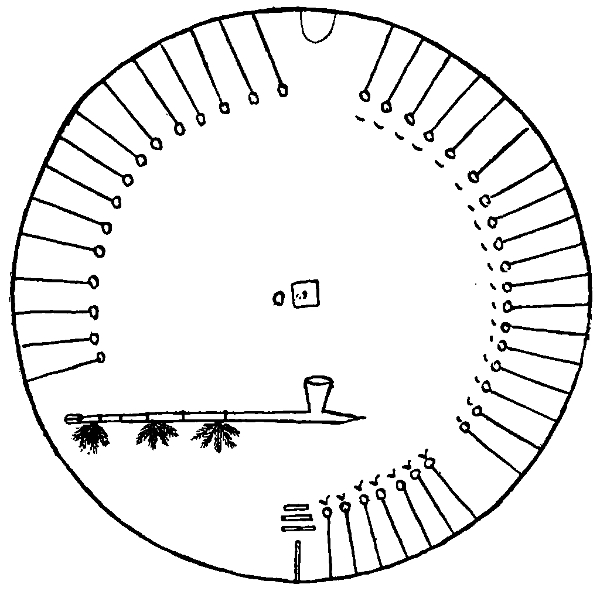
Figure 31.—Diagram of a council lodge, representing the interior
of a council lodge in which Mr. Denig met the Assiniboin leaders
to discuss peace overtures made by the Crow Indians to the
Assiniboin at the instigation of Mr. Denig. At a point directly
opposite the doorway Mr. Denig is seated with the proffered
tobacco of the Crow Indians lying in front of him, denoted by
3 parallel marks; at Mr. Denig’s right sits the leading Assiniboin
chief; to his right sit 6 other chiefs and councillors; next are
seated 18 so-called “soldiers,” i.e., official guards of the camp;
the next 15 figures are 15 principal young warriors. The
small square figure with a central dot is a small fire; and the
small circlet beside the fire is a flagstaff running up through the
lodge top, flying a United States flag. The calumet pipe lies in
front of the leading chief.
It was nearly sunset when they had assembled and no feast had
been prepared in this lodge, though after the council was over they
were feasted elsewhere. We have here the represented authority of
220 lodges, for the chiefs are largely connected, having from 10 to
20 or more lodges of their immediate relatives each. The soldiers
are the most respectable heads of families in camp, and the warriors
are the sons and relations of these and others of the camp. If this
body decides on carrying a point who are to object? Those about
are also related to those present and these being the principal leave
only young rabble, very old men, women, and children not represented,
all of whom combined could do nothing against the decision
of this body. We will now proceed with the ceremony. For nearly
a half hour the pipe was passed around in silence, it being filled with
their own tobacco and handed from mouth to mouth, making its
circuit on the right-hand, after which it was laid down by the leading
chief and he opened the meeting by thus stating its object, the
words of whom and others were taken down by us at the time and
preserved. It will be necessary to state here that the Crow Indians
had massacred about 30 lodges of this same band two years previous
on the banks of the Yellowstone, yet had succeeded in making a peace
with some of the upper bands of Assiniboin who had not suffered by
them.
The leading chief spoke thus from where he sat:
“My children, I am a mild man. For upward of 20 years I have
herded you together like a band of horses. If it had not been for
me, you would long ago have been scattered like wolves over the
prairies. Good men and wise men are scarce; and, being so, they
should be listened to, loved, and obeyed. My tongue has been worn
thin and my teeth loosened in giving you advice and instruction. I
am aware I speak to men as wise as myself, many braver, but none
older or of more experience. I have called you together to state
that our enemies (the Crows) have sent tobacco, through the medium
of the whites at the big fort, to me and my children, to see
if they could smoke it with pleasure, or if it tasted badly. For my
part I am willing to smoke. We are but a handful of men surrounded
by large and powerful nations, all our enemies. Let us
therefore by making a peace reduce this number of foes and increase
our number of friends. I am aware that many here have lost relatives
by these people, so have we by the Gros Ventres, and yet we
have peace with them. If it be to our interest to make peace all
old enmities must be laid aside and forgotten. I am getting old,
and have not many more winters to see, and am tired seeing my
children gradually decrease by incessant war. We are poor in
horses—from the herds the Crows own we will replenish. They
will pay high and give many horses for peace. The Crows are good
warriors, and the whites say good people and will keep their word.
Whatever is decided upon let it be manly. We are men; others can
speak. I listen—I have said.”
This speech was received by a slight response by some of Hoo-o-o-o
and by the majority in silence. After a few minutes’ interval he
was replied to by another chief, the third or fourth from where
he sat. This was a savage, warlike, one-eyed Indian, and his speech
was characteristic. He said: “He differed from all the old chief
had said regarding their enemies. Individually as a man and as
their leader he liked his father, the chief, but he must be growing
old and childish to advise them to take to smoke the tobacco of
their enemies, the Crows. Tell the whites to take it back to them.
It stinks, and if smoked would taste of the blood of our nearest
relations. He thought (he said) his old father (the chief) should
make a journey to the banks of the Yellowstone, and speak to the
grinning skulls of 30 lodges of his children, and hear their answer.
Would they laugh? Would they dance? Would they beg for
Crow tobacco or cry for Crow horses? If horses were wanted in
camp, let the young men go to war and steal and take them as he had
done—as he intended to do as long as a Crow Indian had a horse.
What if in the attempt they left their bones to bleach on the prairie?
It would be but dying like men! For his part it always pleased
him to see a young man’s skull; the teeth were sound and beautiful,
appearing to smile and say, ‘I have died when I should and not
waited at home until my teeth were worn to the gums by eating
dried meat.’ The young men (he said) will make war—must have
war—and, as far as his influence went, should have war. I have
spoken.”
This speech was received with a loud and prolonged grunt of
approbation by more than two-thirds of the assembly.
Other speeches followed on both sides of the question, some long,
some short, until the council became somewhat heated and turbulent;
not, however, interrupting one another, but mixing a good deal of
private invective and satire with the question in their speeches. At
a point of violent debate and personal abuse, two soldiers advanced
to the middle of the lodge and laid two swords crosswise on the
ground, which signal immediately restored order and quiet. The
debate was carried on with spirit for about two hours but it was
easily to be perceived long before it terminated, by their responses
and gestures, that the war faction greatly predominated. The chief,
after asking if all had spoken and receiving an affirmative answer,
remarked they could go and eat the feast that had been prepared for
them. The warriors gave a loud yell and when out commenced
singing their war song. We asked the old chief what was the decision.
He said, “It is plain enough; listen to that war cry.” He then
desired me to send the Crow tobacco back without delay and tell
them to leave the fort immediately and go home. A few days after
a large war party started to the Crow village. The morning after
the council’s decision was made known by the haranguer or public
crier, at the break of day, walking through the village and crying it
out at the top of his voice. From the foregoing it will be seen that
the chief only expressed his opinion as the others, yet the large majority
or rather the feeling evinced for war by the leaders of the war
parties, warriors, heads of families, soldiers, and all who could make
war, left none to contend with.
Had the same general exhibition for peace prevailed, the same
powers could make it, or rather force would be unnecessary when a
unanimity of such a body prevailed. Had the parties or feeling been
equally manifest the question would have been laid aside for another
time, perhaps years, and each went to war or remained at home as
he pleased.
Most councils have this feature and termination, that is, if the
measure is not at once visibly popular, it is abandoned. This precludes
the necessity of vote and none is taken. Besides, except for
camp regulations, hunting, etc., they are not obliged to decide. Time
is not valuable to them. There is no constituent power in the rest of
the band, whose voices are not asked, nor required, to force a decision,
nor actual power to operate against any measures, that may
be decided upon by their parents, and soldiers of the camp. Wherever
force is necessary, however, to carry out these decisions, as in
hunting regulations, the soldiers are pledged to act in a body to
effect it, even at the risk of their lives. But should the decision be
for a peace and afterwards a war party be raised to go against the
nation with which peace has been made, the soldiers would not use
force to prevent it. They have too much good sense to strike or kill
any of their own people to benefit their enemies, and in this case the
peace party being the most numerous, and consequently the richer,
would pay the partisan, or leader of the party, to remain at home
and a collection of horses, guns, and other property made among
them for that purpose, which being handed the partisan and by
him divided among his warriors, stops the expedition.
This is done often among them, particularly at this time when
“peaces” have become tolerably general through the Laramie treaty.
There are cases, however, where force is necessary, and the soldiers
are brought to act, which we will shortly mention. To present any
idea of their government so that it can be understood, we must first
proceed to describe the component parts of a large camp, after which
it will be easy to perceive their principles of government. The regulations
kept up in the following description is only in large camps:
Smaller ones, from 10 to 20 lodges, hunt, every man when he pleases,
and, as there are but few persons to feed, they can always have
meat in this way; but where the camp is composed of from 50 to 100
or 200 lodges this is not the case, as will presently appear.
Component Parts of a Large Camp
| 1. |
The leading chief. |
| 2. |
The other chiefs. |
| 3. |
Chief of the soldiers. |
| 4. |
Cook of the soldiers’ lodge. |
| 5. |
The soldiers. |
| 6. |
The elderly men. |
| 7. |
The haranguer. |
| 8. |
The master of the Park. |
| 9. |
Warriors and hunters. |
| 10. |
Partisans.13 |
| 11. |
Doctors and conjurors. |
| 12. |
Very old men. |
| 13. |
Young women. |
| 14. |
Old women. |
| 15. |
Middle-aged women. |
| 16. |
Boys and girls. |
| 17. |
Very small children. |
The ordinary occupations of these several divisions of the camp
will now be taken up in order.
1. The leading Chief, Hoon-gah, being the head, is expected to
devote his time to studying the welfare of his people. It is for
him to determine where the camp shall be placed and when it should
move; if war parties are advisable, and with whom, how many, and
at what time; where soldiers’ camps and the soldiers’ lodge should be
established; when traders are wanted in camp, or when they shall go
to the fort to trade; to call councils on these and all other affairs of
general interest.
2. The other Chiefs, Hoo-gap-pe. These are sometimes counselled
privately in their lodges by their leader and their advice followed if
correct and according to his views. They sit in council when called,
and rank equally with the leader as men, warriors, counsellors, etc.,
except they do not publicly attempt to lead or act without his knowledge
and consent.
3. Chief of the soldiers, Ah-kitche-tah Hoon-gah. This is the
head man in the soldiers’ lodge; sees to their property therein,
whether there is wood, water, tobacco, and meat enough; opens councils;
sometimes sends invitations for the others to assemble when the
Chief requests, and on small occasions of his own accord; makes
feasts; lights the pipe in large assemblies, and is the nominal head
of this active body; is a highly respected and useful officer in camp.
He has much influence with the young warriors and is selected from
among the bravest of them.
4. Cook of the soldiers’ lodge. First, Wo-ha-nah; second, Wah-yu-tena.
This functionary is also a soldier and a highly respectable
officer, ranking next to the Chief of the soldiers.
Eating being one of the Indian’s most important occupations, the
care of the meat, choice of the parts, and separation of the whole
depending upon him, the station becomes at once of consequence and
requires a determined man. On feasting, which in that lodge is going
on every night, if not every day, he dishes out the meat into wooden
bowls and gives to each the parts he chooses. Of a dog, the head,
paws, and grease—bouillon—are the most honorable parts. There
is great etiquette shown in this respect, and it is too long a story to
record when there is so much yet to be written.
5. The soldiers, Ah-kitche-tah. These are the bravest and most
orderly men of from 25 to 35 years of age. They have been and are
still warriors and leaders of parties to war, are chosen expressly to
carry out the decrees of the council, even at the risk of their lives,
to punish people for raising the buffalo, setting the prairie on fire,
govern the camp, protect whites and strangers of other nations in
camp, entertain and feast the same, arrange preliminaries of peace,
trade, and generally to aid their chief in carrying out his views and
decisions of council.
6. Elderly men, We-chap-pe. These may be called the body of the
camp, being men of family, about 40 years old, have been warriors
and soldiers when younger, but have abandoned these occupations,
devote their time to hunting, are still good hunters, try to amass
horses and other property by making robes, endeavor to get their
daughters married well, send their sons to hunt or to war.
They are respectable, quiet, peaceable men, among their own people,
content to follow their leader and obey the council, rank as councillors
when they wish, are always invited though but few attend
except on interesting occasions.
7. The Public Crier. First name, Ponkewichakeah; second, Hoon-kee-yah.
This is some elderly or middle-aged man who has a strong
voice and a talent for haranguing. He answers the purpose of the
daily newspaper of the whites. A little before daybreak he walks
around and through the camp different times every morning, calling
upon the young men to get up and look after their horses and arms, to
go on the hills and look for buffaloes, watch if there be any signs of
enemies about—to the women to get up to bring wood and water, cook,
dress hides, etc. If any news has been received in camp the day before
or any councils held, he now states the results. Whenever the camp
is to be moved or hunts made, or enemies seen, or councils to be held,
this man publishes it in this way. He is in fact their publisher and
a useful man, doing more to preserve order and induce unanimity of
action than any other, is entitled to eat and smoke in any lodge he
happens to enter without invitation, receives many small presents,
and is a general favorite for the trouble he gives himself.
8. Master of the Park, Wo-wee-nah. A park or pen to catch
buffalo is not at all times made, though almost every winter there is
one or two among the Assiniboin. We will have occasion to refer
to this original method of hunting in another place; at present it
suffices to say that the person who superintends that employment is
some old conjuror or medicine man who is said to make the buffalo
appear and to bring them toward the pen. He makes sacrifices to
the Wind, the Sun, and to Wakoñda, etc., of tobacco, scarlet
cloth, and other things; he is a necromancer and is supposed to be
possessed of supernatural powers and knowledge; he has from four
to six runners under his command whose business it is to discover
the buffalo within 20 or 30 miles around, and to report to him.
9. Young men, Ko-ash-kah-pe. These are a numerous body, some
warriors, some hunters, some neither. Those who have killed or
struck enemies or stolen many horses from their foes are entitled to
sit in the council and are always invited, principally to hear and
give their assent or dissent in responses, gestures, etc. They, no
doubt, would be allowed to speak but they never do, because those
who are older speak, and they are generally the fathers and relations
of these young men. In this modesty of deportment they are
much to be admired. They always conform to the decisions of the
soldiers and the chiefs. The partisans or leaders of war parties are
chosen sometimes from these young men, when by their acts they have
proved a capacity to lead, though mostly it is one of the soldiers who
raises and leads the war expedition.
The Partisan is in command during the entire expedition, directs
their movements, possesses the power of a military captain among
the whites, and receives the honors or bears the disgrace of success
or failure, his authority in that capacity ceasing on his return to
camp from the war.
10. Doctors, alias conjurors, alias priests, alias soothsayers, alias
prophets, Wah-con-we-chasta. These have been alluded to under the
head of “General Practice” in their medical capacity. They are not
numerous, form no distinct body, and unite the above talents in the
same person. They do many tricks well, also foretell events, interpret
dreams, utter incantations, medicine speeches and prayers,
and cry for the dead, etc. They are believed sincerely by all to
possess supernatural powers. The males of this class are sometimes
in councils but they have little influence there. Councils are matters
of fact and do not admit of their noise and flummery, without which
they are ciphers. They are tolerated because somewhat feared, are
paid for their services, and by no means rank as very respectable
and efficient councillors, warriors, or men.
11. Very old men, We-chah-chape. These are few. Indians are
not long-lived. These are countenanced in private feasts and ordinary
conversation, principally on account of their talent in reciting
fables and creating mirth for the rest. They also sing for the doctors
and cry for the dead when paid, are poor, not respected, and
manage to rub through the rest of their days the best way they can.
They never sit in council when very old, are neglected, and serve for
a butt and ridicule for the young. They stay at home, make pipes,
smoke, and eat constantly and are ready at all times to offer their
services when something is to be gained.
12. Young women, We-kosh-kap-pi, do little work before they are
married and have their first child, after which time they commence a
laborious life. Before this they go for wood and water, garnish
with beads and porcupine quills, and other light work. They gather
berries, assist in dances, paint, and show themselves.
13. Middle-aged Women, Wé-yah-pe. These are the wives of the
soldiers or middle-aged men, and their time is employed in dressing
skins, cooking, drying meat, taking care of their children, making
cloth for their family. They are always busy, but can not be
said to lead a too laborious or miserable life.
14. Very Old Women, We-noh-chah (Sioux), Wa-kun-kun-ah (Assiniboin).
On these fall all drudging and scullionry, some of their
occupations being too disgusting to relate. They also pound meat
and berries, make pemmican, carry burdens, and are used pretty
much as one of their dogs. They are thrown into the fort or left
on the prairie to die by their own relatives.
15. Boys and Girls, Och-she-pe wechin chap-pe. The boys hunt
rabbits, set traps for foxes, play, but they seldom quarrel; they are
great pests and nuisances, both in camp and in the fort; they are
spoiled by their parents—forward, officious, tormenting, and impudent.
The girls are modest, timid, and exceedingly well behaved.
Very Small Children, Yaque-ske-pe-nah, are carried about on the
backs of their mothers, or packed on dogs; they stand severe cold
well, do not cry much, and are suckled for two or three years. The
children are as well taken care of as they can be in the roving mode
of life of their parents, but being subject to exposure in all weather
and accidents. About two out of five are raised.
The ahkitchetah regulate the hunt. The buffalo are not hunted by
a large camp as each individual chooses, but surrounded by the whole
camp at one time, which we will describe in that part of the report
which refers to hunting and to game laws. The dogs for these hunts
are determined by the chief and soldiers in the soldiers’ lodge, and
the people are individually forbidden to hunt or in any manner to
raise the buffalo before that time. The reason is that by going in a
body and hemming in or surrounding them, some hundreds of the
animals are slain in a short time, whereas by one man’s individual
hunting the whole herd would be frightened and run away and the
camp thereby be always in a starving condition, instead of having
abundance of meat as is the case when the laws respecting the surround
are enforced. Should any person or persons violate these
laws, after the decree of the soldiers’ lodge has been published, they
(the soldiers) meet him on his return home, take his meat, kill his
dogs, or horses, cut his hides up, cut his lodge to pieces, break his
gun and bow, etc. If the individual resists or attempts to revenge
any of these things he is shot down on the spot by the soldiers, or
struck down by a tomahawk and pounded to death. Occasionally
they are also thrashed with bows, in addition to the breaking of the
gun, etc. The writer has seen two killed and many severely thrashed
for these misdemeanors. The consequences of destroying the hunts
are serious to the whole camp, hence the violent penalty and examples
are made occasionally which serve to increase the respect and fear
of the soldiers as a body, and enables that business to proceed with
order.
In all this the soldiers are supported by the whole camp, and it is
in them as a body that decisions are invested with a binding force,
if force be necessary. We may state that the power is tacitly committed
to the chief as a common and general function of the office,
to be held as long as he governs with general satisfaction, subject,
however, to the advice and consent of the soldiers and other bodies
in camp, as has been explained. They are at all times open to
popular opinion and are only the exponents of it, and although
distinguished deeds were the cause or some of the causes of their
exaltation to this high office, and that they have since been and
generally are discontinued, when the chief becomes of middle age,
yet so long as the capacity and ability of the incumbent exists and
coincides with the popular will, he is retained in office. Old age,
debility, or other natural defect, and incapacity to act, advise, and
command, induces the necessity of change in his position, and though
not formally deposed, he voluntarily retires and resigns in favor
of some growing and popular soldier and warrior. The disapproval
of the mass of the body of soldiers, warriors, etc., as represented in
the council of war, would also be an effectual barrier to the existence
of his power or functions in every respect and at any and all times.
It should be remembered that all the remarks in these pages, although
written primarily for the tribe called the Assiniboin, apply
equally well to all the roving tribes of the Missouri River from and
including the Sioux to the Blackfeet, our limits not admitting separate
descriptions for each tribe. Where there is any important difference,
however, we will not fail to mention it.
Is the democratic element strongly implanted? Very. The whole
is a pure democracy, as has by this been developed. There are also
consultations in private lodges previous to meeting in councils, but
these do not appear to influence the opinions of any, further than
thereby getting a thorough acquaintance of the subject, and preparing
their minds for a speech, and not much idea can be formed in
this way of the popularity of the question until it meets public discussion
in the council. Neither are these private councils held with
that view but are merely conversations regarding the importance of
the subject and something to talk about, which is always desirable in
an Indian camp. They are obstinate in adhering to a formed opinion
and not easily moved by oratory or extraneous remarks, are
shrewd and pursue the subject with intensity and perseverance until
decided or abandoned. They are liable also to be carried away by
the excitement of debate and lose sight of the subject in personal
abuse and recrimination until called to order by some more cool.
There is no vote taken, though the prevailing feeling is manifest and
those who do not exhibit any of this feeling are quietly asked their
opinion, which they as quietly give. All this has met with sufficient
explanation. The leading chief does nothing in advance of public
opinion. His business is rather to think of their welfare and interests,
bringing those subjects under discussion which appear to
him of sufficient importance and which he sees merit consideration
by the excitement they occasion in private lodges, or if smaller matters
they are left to the decision of the soldiers. In councils held
in the soldiers’ lodge for hunting the chief does not always appear.
When the camp is placed for the winter he assists in forming the
body of soldiers and in giving general instructions which they carry
out. Afterwards he seldom goes for these purposes. The business
of these soldiers will meet with further notice in these pages and
it is worth while considering their powers, as they are the active
force of all large camps.
Councils.—Councils are opened in a very sedate and orderly form.
The pipe is the principal of all ceremonies, and its motions vary
with the occasions. Councils between two nations for a peace, deputations
of both being present, are very solemn and take a long time.
It is likely these ceremonies are very ancient, being nearly the same
among all the roving tribes. The real calumet used on this occasion
with its accompaniments presents the form as sketched and explained
in Plate 68. This instrument is always kept packed up in many
envelopes of cloth, skin, etc., the whole making a roll as thick as
a man’s thigh, sometimes as large as a piece of common stovepipe, 5
or 6 feet long, is laid in the middle of the soldiers’ lodge on a piece
of scarlet cloth in that way before the deputation has arrived, or
immediately on its arrival, is not opened, however, until a full council
has been assembled. The chief (who owns the pipe) then commences
the ceremony of unrolling it, and at the taking off of each
envelope says a few words equivalent to “Peace we wish,” “Look
over us, Wakoñda,” “This to the Sun,” “This to the Earth,” etc.,
giving, as it were, some distinction or value to each envelope. After
a long time and the untying of many knots, the pipe and stem appear,
with a tobacco sack, a bunch of sweet-smelling grass, a probe
for the pipe, and a small sack containing a charm or amulet. The
pipe is on this occasion filled from the tobacco (or mixture) sack
by the chief of the soldiers, though not lit, and in this way handed
to his own chief. He (the chief) now stands up, the different deputations
of nations sitting opposite each other on either side of the
lodge. He first presents the pipe to the East, singing a gentle and
harmonious song for about a minute, then presents it South, West,
North, to the Sky and lastly to the Earth, repeating the song at each
presentation.
BUREAU OF AMERICAN ETHNOLOGY
FORTY-SIXTH ANNUAL REPORT PLATE 68
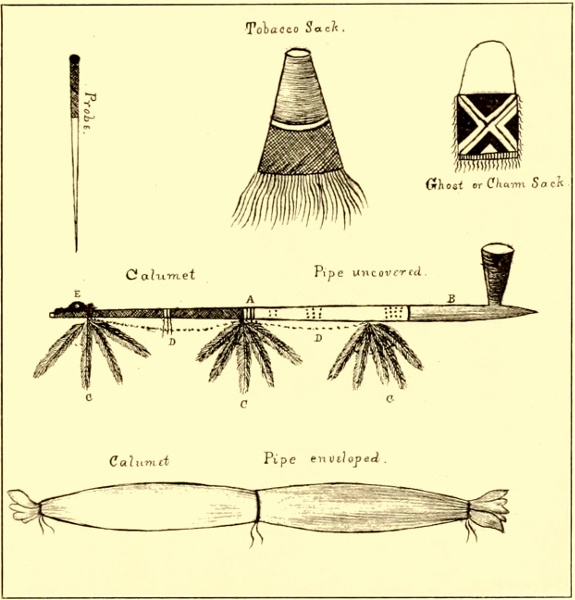
The Calumet and Its Accompaniments
A, The pipestem of ash wood, garnished about half its length with porcupine quills of various colors;
B, a large red-stone pipe; C, C, C, three tails of the war eagle, feathers connected with sinew and
beads or shells between. The stem or stalk of the feathers is garnished with colored porcupine
quills; D, D, two festoons of beads or shells with a small strip of otter skin on which the beads are
tied; E, the head of a mallard duck (male) without the under bill. Sometimes this is the head of
a red-headed woodpecker.
In conclusion he turns it slowly three times round, and lays it down,
all responding hoo-o-oo as the pipe is placed on the ground. The
chief now sits down in his place, and the Chief of the soldiers rises.
He lights the pipe with a piece of the sweet-smelling grass—if the
strangers are of the Crow nation a piece of dried buffalo dung is used
to light it—stands up and presents it precisely to the same points as
the chief had done without singing, giving three puffs or whiffs of the
pipe to every presentation, finishing in the same way the chief had
done, and, receiving a loud prolonged universal hoo-o-oo or grunt of
approbation, he then resumes his seat. The chief now rises the second
time and having had the pipe relighted, holding the stem in his
hand advances and presents it, or rather places it in the mouth of the
head man of the strange deputation, allowing him to take a few
whiffs, passes to the next and the next, they sitting and he moving
round from one to another until all the strangers have been smoked,
then he hands the pipe to the chief of the soldiers and sits down.
This officer now presents the pipe in the same way to his own chief
and going round the other side smokes all his people, and hands the
pipe to another soldier, who goes the whole round again, and this is
repeated over in silence for at least two hours, when the pipe is laid
down by the chief, and speeches or signs begin by which they arrange
the preliminaries of a peace. After all is settled the pipe undergoes
the ceremony of rolling up, which is fully as long, though not in
silence, conversation becoming general and ordinary pipes being
introduced. The termination on this occasion is a grand feast in the
soldiers’ lodge to the strangers, and invitations to 50 or more other
feasts in camp, to all of which they must go, and when all is finished
the strangers are accommodated with temporary wives during their
short residence.
There is generally order observed in the breaking up of councils,
the chief saying “We are done,” when all retire. Occasionally,
however, it breaks up turbulently, and they separate in passion, but
the subject is reconciled and settled in order the next time. Different
councils have different ceremonies. Some open and some close
with feasts of dog meat. The pipe is never omitted, though the real
calumet is never opened except in dealings with strangers. In all
other councils soldiers’ pipes are used. The duties of the public
crier we have already mentioned. Questions are well debated, and
generally decided on the spot or abandoned as already explained
on the principle of large majorities, or rather general approbation,
though absolute unanimity is not required. The few who oppose
say nothing against the affairs when once decided, and although they
do not relinquish their opinions, yet can not or will not go contrary
to the wishes of the many. But the voice of the leading chief is in
no instance taken as the expression of the will of even a single band,
much less a whole tribe.
Scope of Civil Jurisdiction.—A decision by the body of the council
is carried into effect by the soldiers, by force if necessary, as in
the case of hunting by the surround, removing neighboring lodges
of their own people who are so placed as to bar the passage of the
buffalo toward the camp. Lodges thus situated are invariably forced
to come and join the camp or to remove so far as to be no obstruction
to the passage and advance of the buffalo, and to move them against
their will is often a serious and always a dangerous undertaking.
They do it, however; that is, the soldiers turn out in a body, kill their
dogs, and keep doing damage until they leave. The power of taking
life is not invested in any body of Indians, neither has the council
any right to take cognizance of or legislate on the subject. If a
soldier is killed in doing his duty the body of soldiers would immediately
fall upon the murderer or on any of his relatives, should he
have absconded. Crimes of this kind are privately redressed and
revenged by the relatives of the deceased, and as the murderer always
flies, it is often years before they can get an opportunity to kill him,
yet vengeance only slumbers. All these things will be fully explained
under the head of “Crime.” It might, however, be as well to state
here that there is no public body among them whose duty it is to
punish crime of any kind, nor any authority equivalent to or resembling
a court of justice. Consequently, there are no public or stated
executions, neither is there any person who exercises the functions of
public executioner. All this will be fully explained, as also the
restoration of property, in the place where rights of property are
considered.
Chiefship.—How are rank and succession in office regulated?
The circumstances of the decease of the leading chief and the succession
has already been referred to. If not yet sufficiently explicit,
we may in addition state that it would be a subject of earnest debate
in council, not so much with the view of choosing the successor, as
this individual had long before been tacitly acknowledged, being the
next most popular leader of the right kind, and of the most numerous
connections, but to install that person into office, intimating their
desire that he should lead and govern the camp. This might be
called election, although no vote is taken, yet if a general feeling in
his favor prevails he becomes their leader; if not, those who dissent
have the privilege of leaving that band and joining another, or if
numerous enough for the general purposes of hunting and defense
can form a band of their own and choose a leader from among
themselves. In all this we hope to have been sufficiently explicit as
not to present any idea of a distinct line of hereditary succession.
A chief would be deposed from his office by being guilty of any
conduct that would bring upon him general disgust and dissatisfaction.
Though crimes in the abstract could not have this tendency,
yet if he murdered a man without cause whose relations were numerous,
a skirmish between the two families and immediate separation
would be the consequence. If the murdered man was friendless
nothing would be done and the rest would fear him the more. The
offenses that would most likely lead to his overthrow would be remarkable
meanness, parsimony, or incest. A chief must give away
all to preserve his popularity and is always the poorest in the band,
yet he takes good care to distribute his gifts among his own relatives
or the rich, upon whom he can draw at any time should he be
in need.
We take the custom of wearing medals to be a modern one, at
least they say so, introduced by the whites. The ancient mark of
distinction was, and still is, the feathers of the eagle’s tail, wrought
into headdresses of various forms, which to this day is the badge
denoting the chief and great warrior, and are not allowed the ordinary
class to wear. Tattooing also is a mark of dignity.
We have already named the principal chiefs of bands, though there
are others, but by no means a numerous body. But few Indians
go through war enough to arrive at that position, more especially
as the same individual must be possessed of other natural talents
and wisdom. The number is not limited but is from 3 to 6
or 8 in bands respectively of 50, 100, and 200 lodges. It makes
no difference in their government whether they be few or many;
if many, so much the better, as they are wise, brave, and responsible
men.
Power of the War Chief.—No chiefs are war chiefs in contradistinction
to their being civil chiefs. If it is desirable to go to war
and so decided, any chief, soldier, or brave warrior has a right to
raise and lead a war party, provided he can get followers. He then
comes under the head of partisan or captain of the expedition, his
powers in this capacity only lasting during the excursion and terminating
on his return to camp and resuming his civil place and duties.
The powers of war and civil chief are united in the same, also those
of warrior and hunter, soldier and hunter, soldier and partisan, chief
and partisan. The leading chief could also and often does guide the
whole band to war; in fact in the event of any general turnout, he
must be the head. Any man, however, in whom the young men
have confidence to follow, may raise and lead a war party, if war
is going on and the time suits the chiefs and soldiers in council
assembled. But as the chiefs and soldiers are the most experienced
in this occupation, and are better acquainted with their enemies’
country, they are generally chosen as leaders in these expeditions.
Yet from among the warrior class, occasionally a young partisan
arises who is neither chief nor soldier, but whose character for bravery,
caution, and all the necessary talents is established. There is
no specified age when a young man may rightfully express his opinion.
This depends on his success in war, his general good behavior,
activity in hunting, etc. When he becomes remarkable for these
things he is noticed by the soldiers, invited to feasts, to councils,
where being of sufficient consequence his opinion is asked and is
given. We have known men not over 22 to 24 years of age being
called upon to speak in council, and others to arrive at extreme old
age without ever opening their lips there. An Indian soon sees and
feels his standing with the others, and acts accordingly; to do otherwise,
or force his presence and opinions prematurely, would only
incur ridicule, contempt, and disgrace.
Power of the Priests in Council.—The power of priests is conjoined
with that of doctors, sorcerers, and prophets, to which is occasionally
added that of councillors, as they are sometimes shrewd
old men and somewhat feared on account of their supposed supernatural
powers; but they do not influence councils in any great degree,
seldom attending at all. Whatever influence they have on
public questions must be exercised in council, and not as a separate
body. They do not constitute a body and only rank as councillors
when their former exploits have been of a nature to entitle them to
that position, and their age is not too far advanced. Being generally
very old, their opinions in council are not much regarded. Their
forte is at the bed of the sick or in other operations where something
is to be gained. In making war or peace they would have little to
say, in a cession of lands still less, and in conducting war parties nothing
at all. The old Gauché mentioned before, although a divining
man, was a warrior, not old at that time, and feared because he had
the power over their lives by the use of poisons which he made no
scruple to administer; besides he was no doctor nor sorcerer on other
occasions, and was one of the greatest chiefs the Assiniboin ever had.
He was uniformly successful in his young and middle time of life,
although he failed in age and died as recorded. This extraordinary
man does not present a correct sample of a priest or sorcerer as now
considered, and is an anomalous case.
Matrons in Council.—Neither matrons nor any other women
whatever sit in council with the men of any of the Missouri tribes,
nor have they privately any influence over men in their public affairs,
and take but little interest in them. Their domestic duties occupy
most of their time and their social position is inferior to that of
men in every respect. We have heard of only one instance where a
woman was admitted in council, during a period of 21 years’ constant
residence with all these tribes.
General Councils.—The roving tribes call no general councils
with other nations. Even those with whom they have for a long
time been at peace they look upon suspiciously and seldom act together
in a large body. We have known, however, a combination
of Cree, Chippewa, and Assiniboin, consisting of 1,100 men, who,
having met in council, went to war upon the Blackfeet. The council
was formed by the Cree and Chippewa sending tobacco to the
Assiniboin during the winter, to meet them at a certain place the
ensuing spring, where, after deliberating the matter at home, they
went and formed the above-named expedition. It is the misfortune
of all large bodies of Indians formed of different nations to meet
with failure. They can not act in a body. Jealousies arise between
the soldiers of the different nations, often quarrels, and always separations
and defeat of the object. The evil appears to be the want
of a commander in chief whom all are content to follow and obey;
also their ignorance and unwillingness to submit to discipline,
restraint, or subordination. Opinions clash, rank is interfered with,
rebellion, dissatisfaction, and consequent separation follows; or
should any considerable body keep on, their march is conducted in
such a disorderly manner that their enemies have time and notice
to enable them to hide or prepare for them. These tribes are not
yet far enough advanced in civil organization to enable them to
unite for any great purpose, excepting their mutual and general
interest require it. The only way they could and do accomplish
anything of importance at war by combination is by each nation,
being headed and commanded by their own leaders and going to
war upon the general enemy at different times and entirely independent
of each other. This increases the number of war expeditions
and annoys the enemy from different quarters, but does not
give them the advantage of bringing large armies into the field.
Private Right to Take Life.—Every Indian believes he has a
right to his own life and consequently to defend it. There being no
persons or body whose duty it is to punish crime, trespass, or insult,
each individual is taught when a boy, and by experience when a
man, to rely entirely on himself for redress or protecting his person,
family, and property. Every one is thus constituted his own judge,
jury, and executioner. Whether the person wronged is right in his
means of redress does not matter. He thinks he is right and risks the
consequences of retaliation. Every Indian being armed induces the
necessity of each using arms; therefore when an Indian strikes, stabs,
shoots, or attempts to do these things it is always with an intent to
kill, knowing if he misses his aim or only wounds, the other revenges
either on the spot or after, as occasion requires or opportunity offers.
Therefore he can not act otherwise. This being the state of things,
quarrels are not so common as might be supposed. When it is universally
known that a blow or a trespass would entail death as its
consequence they are avoided, or if unavoidable each endeavors to
gain an advantage over the other by acting treacherously or waiting
a favorable time when he least expects it to kill or strike him, stating
for his reason that if he had not killed him the other only waited
the same opportunity against himself. A fair chance to kill or strike
does not always present itself. The relations may be too numerous
on one side, and the object of contention (be it a horse or a woman)
is given up for the time by the weaker party, apparently willingly,
yet he only waits until their situations are reversed to seek redress.
When a man has killed another, if the relatives of the deceased are
more numerous than his own, he flies to a distant part of the country,
joins another band and seeks protection there, where he is not sought
by the next of kin at the time, but will be killed whenever they
meet. In the meantime the relatives of the offender pay much to
stop the quarrel.
If the killed and the killer are both of the same band and equally
strong in relationship perhaps nothing would be done at the time as
the rest of camp would endeavor to stop a skirmish, and a good many
guns, horses, and other property would be raised and presented the
relatives of the deceased to stop further bloodshed. This generally
concludes an amnesty or respite for the time, but the revenge must
be accomplished at some time by the next of kin, otherwise it would
be a great disgrace to him or them. An opportunity to kill the
offender with comparative safety is then sought, perhaps for years,
or as long as any of that generation lives. Time and absence may
have the effect of giving the murderer a chance to die in some other
way or of diminishing the force of the revenge so that he does not
find himself in a position to act with any degree of safety when an
occasion offers. Yet, if of standing in camp, and a brother, father,
or brother-in-law to the deceased, he is bound to revenge at some
time, though they make no scruple to receive presents of horses, etc.,
to refrain in the meantime. Thus the death of a man is never paid
for by that generation, though by that means the revenge may be
delayed for some years, which is all they can do except surrendering
up their relative to the incensed party, which would not for a moment
be thought of. We have known three or four horses to be
given on the instant by the friends of the offender to those of the
deceased and the same to be repeated yearly for two to six years
and more, yet still revenge was consummated. On one occasion I
asked the man why he killed the other after so long a time and taking
property as payment from his relatives and friends. He answered
that the pay was well enough as long as the culprit kept out of his
sight; that remuneration only destroyed the disposition to seek him
out and kill him, although it did not affect the right to revenge if he
was fool enough, to thrust himself in his way.
When he saw him his blood boiled, his heart rose up, and he could
not help it. Besides (he observed) he was obliged to kill him, as the
other, being afraid of him, would do the same to him to save his own
life. Thus the killing of one induces the necessity of killing another,
and there is no end to the affair. The other party are obliged to retaliate
and so on through several generations. In this way a good
many of the family of the chief, Wah-he´ Muzza, have been killed,
and the smallpox settled the affair by taking off the offenders on the
other side. It will be inferred from this that vengeance is not appeased
by payment, absence, or the lapse of time, and in the instances
where retaliation has not followed after payment we believe they
may be ascribed to a decrease in the relationship of the deceased or
other domestic changes or reverses which render vengeance out of
their power, or too dangerous to accomplish, in which case the relatives
get over it by saying they have been paid or forgotten it, yet
at the same time would revenge, could they act with safety, or even a
chance of comparative safety. Sometimes, however, large offers of
recompense are rejected by the father or brothers of the deceased,
and the tender is then made to relatives not so closely connected,
who generally accept. Herein the cunning of the Indian is manifest.
This is a point gained. A negotiation is opened in the family of
the deceased and a difference of feeling established with regard to
the offender, slight to be sure, but it is there, and is worked by
these distant relatives to his advantage and their own, and opens a
way through which presents and overtures of compromise may be
offered the brothers, etc. But there is no dependence to be placed
on anything a wild Indian does.
Neither do they depend on one another. They are suspicious in
everything, and more particularly so when life is at stake. In these
compromises no one is deceived—either he who takes or he who receives—the
minds of both are perfectly known to each other, the
object of the one party being to gain time, and of the other to lull
suspicion and make the offender and his relatives poor by accepting
their property.
We think we have presented their customs in this respect in their
true light, viz., that although the compromise be effected and
vengeance for the time suspended, yet the feeling is not changed
or the right to punish relinquished; but time may make such a
change on either part as to render revenge impracticable. There is
no recognized principle or means of escape for the murderer unless
it be to flee and join another nation with whom they are at peace,
marry and remain there.
It will now be necessary to state that the Crow Indians are better
regulated in this respect than any of the prairie tribes. Private
murders are nearly unknown among them. Our knowledge of this
nation from certain sources extends through a period of 40 years
and in all that time but one Indian was killed by his own people.
The offender absconded and remained with the Snake Nation for
12 years, when he returned, but was obliged again to leave, and since
has not been heard of. Stealing women or otherwise seducing
others’ wives is revenged by the party offended taking every horse
and all private property the offender owns, and in this he meets with
no contention. It is considered a point of honor to let everything
be taken but keep the woman. Now this nation has from 40 to
80 and sometimes 100 horses to a lodge, and a large haul is made by
the husband of the woman, in company with his relatives. If the
transgressor has no property that of his nearest relatives is taken,
and is suffered to be taken away unmolested. After the excitement
is somewhat over, these horses are bought back by the relatives of
the offender, each giving two, three, or more as the case happens,
which they hand over to him, who in the course of time gets the most
of his property returned.
All smaller quarrels or misdemeanors are paid in the same way,
though not so high, but they never strike or kill each other, yet are
addicted to using personal abuse and invective freely. Our gentleman
in charge of that nation states that he has seen the two principal
bands of Crow Indians, over 200 lodges, abusing and throwing stones
at each other all day, the Yellowstone River being between them.
No damage could happen, as the missiles could not be thrown a
fourth of the distance, yet not a shot was fired, although balls would
reach, and this force was headed by the two principal chiefs of that
nation. In all the regulations of these Indians (the Crows) we can
discern great natural goodness of heart, and absence of any useless
barbarity and bloodshed except with regard to their enemies, the
males of whom they kill and cut to pieces, but never kill women and
children, whereas the Assiniboin, Sioux, and Blackfeet kill everything.
Very few feuds from polygamy result in death, but should it
so happen the other would be punished. If the favorite wife had been
killed, the least the other wife expected would be a tomahawking,
or an arrow shot into her, perfectly regardless as to whether death
would be the consequence or not. Women among Indians are bought,
paid for, and are the property of the purchaser the same as his
horses. Their lives are of course more valuable than those of
animals, and every Indian regrets the loss of his woman. Yet when
he has bought them he expects them to do their duty, not quarrel nor
render his lodge disagreeable, or if so they must expect to be severely
punished.
Their lives are not, however, considered as valuable as men, nor
are they ever so much mourned for. When not bought, or unmarried,
the killing of a woman never happens and would be a great disgrace
to any man, though after marriage they are subject to the penalty of
death from different causes in which the man thinks he is justified.
Private debts are never settled by the chief, nor private disputes
by council. Advice may be given and taken, frequently is, though
the usual mode of settling trivial quarrels is by payment, and an
invitation to a feast. Everything except loss of life or personal
chastisement can be paid for among these Indians.
Game Laws, or Rights of the Chase.—The roving tribes subsist
by hunting buffalo, and these animals being constantly on the move,
they are obliged to move after them. Therefore no particular section
of country is appointed to each as a hunting district.14 There are,
however, certain regulations with regard to the hunting of these animals
which may as well be recorded here. A lodge or a few lodges
have no right to establish and hunt within 6, 8, or 10 miles from
a large camp, as by this the buffalo would be continually kept out
of the range of the latter, and a few people be the cause of distress
and starvation to the many. Therefore these obstructions are removed
by the soldiers. When hunting by surround has been agreed
upon, individual hunting is stopped for the same reason, and has met
with explanation. This is also the duty of the soldiers. Hunting
deer, elk, beaver, etc., being of little consequence to these Indians,
each one exercises his pleasure in regard to these occupations. No
right to any section of country is claimed by any person to the exclusion
of others. Should an Indian wound a deer and not follow,
and another pursue and kill it, the former would have no right to
either skin or meat, having relinquished that right by abandoning
the wounded animal. But should he be following and arrive where
the other has killed it, the hide and half the meat would be his share.
As a general rule he who draws the first blood of the animal is entitled
to the hide. This is often difficult to settle when large buffalo
surrounds are made on horseback with the bow and arrow.
Several hundreds of animals are slain in the course of an hour or
so, and some have the arrows of different Indians in them. Each
Indian, by his own mark, knows his arrow, but the matter of dispute
is whose arrow struck first? Therefore who is entitled to the
hide?
All that prevents this from being often the cause of serious quarrels
is that in large hunts a sufficient number or more is generally
killed than they can or do skin, and in smaller hunts the same confusion
does not occur. A wounded animal is also mostly pursued
until killed, and others usually pass by those that are stopped or
have arrows sticking into them. With regard to the meat all Indians
are liberal. In a large camp at least one-third of the men
have no horses that they can catch. There are also a good many
old, infirm widows, etc., all of whom must be fed. Every one who
can, men and women, turn out and follow the horsemen to the hunt;
and, even while the hunt is going on at a distance, commence cutting
up the first buffalo they come to. The hide is taken off, and
laid aside with the arrow found in it. The tongue and four of the
choicest pieces are laid on the hide. This is the portion of him who
killed it; and the rest, which is the greater part of the animal, is
divided among those who skin it. This operation is going on with
numbers of buffalo at the same time, and by this division of labor
the hunters and all are ready to pack home their hides and meat
nearly as soon as the hunt is finished. In this way the hunters get
as many hides and as much meat as they can pack, and those who
have not killed, as much meat as they want. Whatever hides are remaining
are given away to those who have no horses to hunt with,
and other poor people, and all are satisfied and provided for. The
soldiers’ lodge and others in camp who have remained to guard the
property in the absence of the greater body of people are each supplied
with meat by those who have been at the hunt. Feasting is
then commenced, and kept up day and night until meat has become
scarce, when another hunt follows. This method of hunting is continued
until they have hides and meat enough.
There is no doubt that the Indian trade has promoted the general
cause of civilization. Even within our recollection, tribes of Indians,
from being bloodthirsty robbers, have changed to orderly and civil
people. A foundation has been laid, and the road paved toward the
civilization of the prairie tribes, but nothing more. Stationary Indians
have been still further advanced. The few ideas of justice
that are beginning to be developed and the very first dawn of the
light of knowledge perceptible are in consequence of their traffic and
communication with the white trader. The introduction of firearms,
articles of clothing, utensils, and other articles manufactured by
the whites must tend to enlarge their ideas, set them to thinking, to
show them their uncultivated state, and to implant a desire to improve.
Nevertheless their progress is slow, more so with the Assiniboin
than with any other nations. They adhere with tenacity to old
customs and superstitions, which is vexatious and discouraging; but
the Sioux, Mandan, Gros Ventres, Cree, and Chippewa are undoubtedly
much improved. The firm of Pierre Chouteau, Jr., & Co., formerly
the American Fur Co., has for many years conducted the trade
with all the Indians of the Missouri and its tributaries, from Council
Bluffs to the headwaters of the Missouri and Yellowstone Rivers.
The supplies for the trade are brought up each spring and summer
from St. Louis by steamboat and distributed at the different forts
along the Missouri River as far as Fort Union, mouth of the Yellowstone;
from which point they are transported with keel boats to
Fort Benton, near the mouth of Maria River, in the Blackfoot country.
From these forts or depots the merchandise is carried into the
interior in different ways, to wherever the Indians request trading
houses to be established.
The traders generally bear the character of trustworthy men and
the nature of the barter for robes and other skins is such that the
Indian receives what he considers an equivalent for his labor or he
would not hunt. There is no way in the nature of the business by
which an Indian can be made to hunt, nor any means of getting his
skins without paying a fair price. Should the merchandise be placed
too high to be easily purchased by them they would and can dispense
with nearly all the articles of trade. On the contrary should
the price be too low the business could not be continued; the prospects
of gain not being equivalent to the risk of the adventure or
capital employed it would be abandoned. Consequently a medium
is and must be established whereby are secured the advantage and
comfort of the Indian and a tolerably fair prospect of gain for the
trader. The trade, when carried on without competition, is in many
respects a highly respectable and important occupation. Therefore
the Hudson’s Bay Co. have received the title of honorable from the
way in which they conduct it; but it is only because they are alone
that they are able to conduct it in this orderly manner.15 The Indian
trade does not admit of competition. The effects of strong rival
companies have been more injurious and demoralizing to the Indians
than any other circumstance that has come within our knowledge,
not even excepting the sale of ardent spirits among them. This we
could easily prove, but as no monopoly can be allowed by the nature
of our government it is useless. When the American Fur Co. were
alone in the country a trader’s word or promise to the Indians was
sacred, the Indians loved and respected their traders, and still do
some of the old stock, but since corruption has been carried on we
look in vain for that reliance on and good feeling toward traders
which was once the pride of both Indian and white.
The manner in which the trade is conducted in its operations is
this:
A party of Indians, many or few, leave their camp for the trading
post, packing on dogs and horses all their buffalo robes and other
skins. When within a mile or two of the houses, they stop and send
a few persons to the trader with an account of how many persons
their party is composed of, how many skins, etc., they have, and all
general news. These are furnished with tobacco and sent back with
an invitation for the party to come to the house or fort. If a leading
chief is then with a large party, the American flag is raised in the
fort and cannon fired when he arrives. On arrival they are received
at the fort gate by the interpreter, who conducts them to a large
reception room. The dogs, horses, etc., are unpacked and each
Indian takes charge of his own skins in the same room. They
are then smoked (with the pipe), feasted on coffee, bread, corn,
etc., after which the principal men and chiefs are called into the
public office, when they are counciled with by the gentleman in
charge. Speeches on both sides are made, and if the Indians have
any complaints to make they now state them. The general situation
of the camp and trade is adverted to, prospects mentioned, and prices
of goods stated, with all other matters relating to their affairs. When
this is finished the store is opened and the trade commenced. Several
Indians can trade at the same time with different traders, handing
their robes and skins over the counter, and receiving immediate payment
in such articles as they wish. When all are done, a small present
of ammunition and tobacco is given them and in a day or two
they leave for their camp.
The place of outfit being in St. Louis, all returns of buffalo robes
and other furs are taken there also every spring and summer in
Mackinaw boats made at each fort for the purpose, and manned by
the voyageurs who came up on the steamboat the year previous. The
risks are numerous, both in bringing up the supplies in steamers and
in taking down the returns in Mackinaws. In the spring of 1819 this
company lost two steamboats in bringing up the supplies, one burned
with the cargo at St. Louis and the other snagged and sunk. Also
the Mackinaws down are often snagged and sunk, swamped, or the
robes wetted by rain and leakage. The loss of an ordinary boatload
of robes would be $10,000, and every year losses more or less are incurred
in some way. From experience we know that the chance of
loss is equal to that of gain in a given period of 10 years, yet should
everything prove fortunate for a length of time money would be
made.
All men of family who turn their attention to hunting and collecting
skins and robes are shrewd and sensible enough in the trading
of them, sometimes too much so for some of the traders. Knowing
the value of merchandise and of what kind they stand in need, they
make their calculations of purchases before they leave their homes
and any additional article they can beg or otherwise get is so much
additional gain. They do not purchase useless articles. Goods of
all kinds having stated prices enables them to deal to a fraction,
nevertheless they will quibble and beat down the price if possible,
even in the least thing, and are generally successful in getting something
out of the trader in this way.
As for their debts, they will not pay. An Indian does not contract
a debt actually with the intention of deceiving; but before he
has the means to pay, new wants arise, his family wants clothing,
he, ammunition, etc.; in short, he is always in need, consequently
never in a situation to pay. Therefore they use every argument to
get clear of the debt, many of which are very ingenious, and if none
will answer, say they will not pay and that the trader has no business
to trust them. This being the case, but few credits are made. Whenever
their wants are too great, or means too small to enable them to
hunt, the articles are given them, though not credited. In the few
instances where credits are made the Indians keep no accounts whatever
of them, their object being to forget them as soon as possible;
until they have their memory refreshed of the disagreeable fact by
a reference of the clerk to his blotter. Our books are full of unpaid
debts of 20 years’ standing, which would make a handsome fortune
if the value could be realized. There is no worse pay in the world,
and a credit is considered lost as soon as given, or if afterwards the
trader receives half pay he considers himself very fortunate. This
being the case, no runners are employed to collect, as in the Mississippi
trade. As they (the Indians) are not honest, neither are they
sober, nor moral, but have discretion for their own advantage.
The tariff of exchanges is made with the double view of securing
the profit of the trader and encouraging the Indians to hunt. Were
a gun, an ax, or a kettle, for instance, rated at too high a price, then
one of these articles would be made to serve the purposes of several
lodges by turns, or should ammunition be sold too dear only as many
animals would be killed as would be sufficient to feed their families,
and no more skins traded than sufficient to meet their most pressing
necessities. Such proceedings would lead to the abandonment of the
trade as not profitable. The expenses of this business are enormous,
the risk great, the capital invested half a million dollars, and more
than 300 people employed; and yet a good northwest gun is sold for
six robes or $18, the cost of which is $9.67. As a general rule, all
goods are sold at an average profit of 200 per cent on original cost.
The cost of buffalo robes in merchandise is about $1.35 in cash and
we estimate the expenses in men, forts, animals, and other disbursements
at $1.20 more each robe, which would bring them to $2.55.
Now the best sale made of a large quantity is $3 each. Therefore,
a loss of one or two boats loaded with robes must show a loss on the
outfit.
Traders are very much subject to calls on their charity, both by
persons who really are in want and almost everyone else. All the
roving tribes are great beggars, even if they do not actually stand in
need. But viewing the question only in the light of an act of
charity they are numerous indeed. Unskillful in the treatment of
diseases, the different demands for medicines and attendance are
great, which at all times it is not safe nor expedient to comply with.
The forts are the depositions of all the old, lame, sick, poor, and
feeble; in fact, every one who can not follow the camp, or is of
no use there, is thrown on the hands of the traders, and his house
has often more the appearance of a hospital than a trading establishment.
For all this there is no pay, not even thanks nor kind words,
but frequently reproach and revenge if they are told to move off after
recovery. It would appear that the feeling of gratitude is unknown
to the Indian. We believe this to be the case among these.
It does not appear from our actual observation of 21 years, and
pretty correct information of as many more of still an earlier date,
that the principal animals have suffered diminution in the district
of which we treat, viz., from the Sioux country to the Blackfoot, inclusive.
How numerous they were in former years we do not know, but
understand from old Indians that more buffalo have been seen in
late years than were noticed 50 or 60 years since. It may be that the
range of these animals is becoming more limited from the pressure of
emigration westward. Yet this range is very extensive, reaching
from the Platte to the Saskatchewan and from Red River to the
Rocky Mountains, through all which immense district buffalo are
found in great numbers. Out of this question appears to us to
arise another, viz., Is not the decrease of the Indians from diseases
communicated to them through white immigration and commerce,
thereby reducing the number of hunters, equivalent to increasing the
number of buffalo? And does not the remnant of the Indians at
this time require fewer animals to feed, clothe, and provide all their
necessaries, than the multitudes before commerce was established
with them? We think this view merits consideration.
If the buffaloes diminish, so do the Indians, and the diminution is
not felt. The manner in which they hunted before firearms were
introduced (by driving the buffaloes into pens) was infinitely more
destructive than at present. Hundreds, perhaps thousands, were
necessarily killed when a camp of a few Indians was stationed and
when a small number would have sufficed. That commerce stimulates
them to hunt is true, and a great many buffaloes are annually
destroyed expressly for the hides. Yet even this destruction is limited.
An Indian’s family can only dress a certain number of hides
during the hunting season. The hides in their raw state are of no
value, and not traded, and can not be packed and carried when they
move, which they are obliged to do in the spring; therefore no more
are killed than the Indians can handle. Besides, there are but four
or five months when the hair or fur of any animal is seasonable or
merchantable and the rest of the year only enough are killed for
meat, clothing, and lodges for their families. As far as we can be
allowed to express an opinion, would say that the Indians by diseases
brought about by commerce, and of late years by white immigration,
will diminish and perhaps be destroyed as formidable bodies long
before their game. The loss of Indians from smallpox, cholera,
measles, scarlet fever, venereal fluxes, etc., within our own recollection
can not be estimated at less than 15,000 to 20,000, without
taking into consideration the consequent loss of propagation.
Were the destruction less we think it would have the effect of
increasing these animals so that many must die for want of proper
grazing or be forced to seek other lands for food. This would reinstate
us in our first position, that it is more probable the small number
of Indians now in existence will disappear before their game,
or at least will be so reduced as not to retard their increase. Immigration
in settling the country would banish the buffalo from that
part of it where these movements were going on, and force them to
the alternative of scattering through the settlements and thus be destroyed;
or, being confined and limited in their grazing, they would
die for want of sufficient nourishment. They are a shy animal and
will not remain where they are much troubled. Indian hunting has
not this effect. The Indians do not occupy the proportionate space
of a town of 100 houses to a county, and in some places not more to a
State of the United States. Moreover, they herd with order, and in
the winter, not being able to remain on the plains where there is no
fuel, and very deep snow, are obliged to place their camps on the
banks of streams and hunt merely the outskirts of these immense
herds.
The increases of buffaloes must be very great. Each cow has a calf
yearly and the fourth year these also have calves. Now, supposing
a band of 4,000 cows to increase for eight years without accident.
The computation would be as follows:
|
Say increase
one-half cows |
One-half
* bulls |
|
4×4=16÷2=8 |
8 |
|
= |
= |
| One-half increase |
8 |
|
| Old stock |
4 |
|
|
12×4=48 |
| Old stock |
|
12 |
| One-half bulls |
|
8 |
| Total in 8 years |
|
68,000 |
Now supposing the whole number of buffalo cows in existence to
be 3,000,000, which is certainly not an overestimate, then—
|
One-half
cows |
One-half
bulls |
|
3×4=12÷2=6 |
6 |
|
= |
= |
| One-half increase in 4 years |
6 |
|
| Old stock |
3 |
|
|
|
|
|
9×4=36 |
|
| Stock |
|
9 |
| Bulls |
|
9 |
| Total in 8 years |
|
51,000,000 |
Making every calculation for their reduction in the many ways
they are killed, or die by accident, and the consequent loss by propagation,
yet being so numerous their ratio of increase is too great to
diminish the whole number much by any of these means.
The conclusion is that, in our opinion, both Indians and buffaloes,
with all other game, would disappear in consequence of white
immigration and occupation, though the Indians, being the smaller
number, would be the first to vanish. Also that commerce, by stimulating
the exertions of the hunters, can not increase their labor
beyond what they now perform, and that, being limited, is too small
to hasten the destruction or even diminution of any game as plentiful
as the buffalo. The same argument does not apply to beaver, foxes,
or even elk and deer. Should all the Indians be obliged to live on
elk and deer only, and have no resources but the furs of the beaver
and fox to get their supplies, a diminution of these animals would
soon be perceived and destruction follow, because their increase is
not so great, neither were they ever so numerous. They are smaller,
and as more would be required they would therefore soon disappear
before the united hunts of all the Indians. But as they are not as
yet driven to hunt them they do not diminish, except the beaver,
which has been, in this district, destroyed by large bodies of white
trappers. Red foxes are not, we think, so numerous as formerly,
though it may be they are not so much hunted. The trading posts
or houses do not have the effect of diminishing or frightening away
the buffalo any more than the Indian camps.
Their locations are few and hundreds of miles apart, and their
operations confined to within a few miles of their houses. Even
while we are writing thousands of buffalo can be seen by looking out
of the fort gates, which are quietly grazing on the opposite bluffs
of the Missouri, and yet this post (Fort Union) has been established
27 years. The only good hunting grounds for elk and deer are on
the Yellowstone from 4 to 30 miles from the fort, beyond which
though there are but few Indians they are not nearly so numerous.
Beaver and foxes are caught every few days within one-half mile
to 6 miles of the fort, not in numbers, certainly, neither are they
very plentiful anywhere in this district. A trading post in a new
country may have but few buffalo the first and second years and innumerable
herds the third, or vice versa. There is no rule for this.
The buffalo migrate and return. The other animals are scattered
over an immense region of country, are difficult to kill, must be
hunted separately, which is dangerous on account of enemies, consequently
not followed, therefore they are not diminished. Thus no
person can say to a certainty which are the first to disappear.
Perhaps the entire destruction of game would lead to the Indians
devoting their time to agricultural pursuits. It would force them
to do that or starve, but judging from their present indisposition to
work, and tribal organization, great distress would follow the sudden
disappearance of their game and starvation thin their ranks
before they would apply themselves to hard labor. The Indians who
raise corn, etc. (Mandan, Gros Ventres, and Arikara), do not do so
from any scarcity of game or apprehensions on that score, but have
done so beyond the recollection of any trader, or even of themselves.
It appears to be a desire to possess something else to eat besides meat,
and a custom handed down to them by their forefathers. Their corn
is entirely different from any raised in the States, and is the real
original maize discovered with the continent, the seed still kept in
its original purity. The labor attendant on planting and raising
these crops is performed by the women, while the men hunt like the
surrounding tribes, work of this description as their present ideas
exist being a disgrace to the males. Several of the other wild
tribes have for years entertained a desire to cultivate, not because
they apprehend any failure of game, but having become fond of corn,
potatoes, etc., wish to have them, but can not exert themselves enough
for the purpose.
Commerce not as yet having reached the tribes of whom we write
except in the form of trade for their furs and skins, the question as
to its ultimate effects, as a cause of civilization, can not by us be
determined, but the effects produced by traffic have had a decided
tendency toward their improvement and advancement by stimulating
their exertions and increasing their knowledge. It must be obvious
to every one who is acquainted with the character and history of
Indians that they have an antipathy to work, that as long as they
can support themselves by hunting they will do so; for through these
means they are enabled to avail themselves of the labor and arts of
Europeans in procuring articles necessary for their subsistence, in
exchange for their furs and skins. This method being more consonant
with their fixed habits, is less toilsome though more dangerous
than civilized occupations. Having clothing, utensils, arms, ammunition
and all kinds of provisions furnished them by the traders
certainly increases their desire to obtain these things, stimulates
them to greater exertions in hunting, but does not lead to a sufficient
energy of mind to endeavor to produce these things by a slower
though more certain employment. In the event of a sudden disappearance
of game they would be driven to extreme want and thousands
would perhaps perish before they would of their own accord
apply themselves to agricultural pursuits.
If no human exertions be made by those in power to instruct them
in the superior advantages of such labors over their present precarious
life, they must by a sudden pressure of emigration, and a consequent
annihilation of game, become the drudges of the whites, destroyed
and degraded by their great banes, whiskey and smallpox.
It is impossible to conceal the rapid strides made by emigration or
its immoral tendency on the Indians, and it would be very unreasonable
to conclude that its destroying effects would so revolutionize the
habits of an uneducated Indian as to meet the emergency. The change
from savage to civilized life and occupations must be gradual, accompanied
by instruction, education, and practical experiment illustrative
of its utility.
The introduction of woolen goods has been of some advantage to
the Indians. It has added to their comfort, cleanliness, and pride,
and has had other good effects; but these alone can not be said to have
much increased their means of subsistence, though other things have.
As long as an Indian is a hunter, his dress must answer that purpose.
There is no fabric of European manufacture clothed in which he
could crawl after game over the plains covered with cactus in summer
or that would protect his body from freezing in winter. Blankets
can not supply the place of buffalo robes, cloth the place of skin,
boots that of moccasins, in these high latitudes and terrible snowstorms.
These things are bought for summer and fall wear in their homes
or when traveling, are preferred because they are not damaged by
wet, are gay, soft, and handsome, will make tolerably good undercoats
in winter, will serve for traveling horseback in summer and fall. But
the real hunter of the plains must have his buffalo robe coats, moccasins,
mittens, and cap, skin leggings, his extra buffalo robe on his back
and his snowshoes on his feet, or the cold and wind would prove
more destructive to his person than he to the game. The articles introduced
by commerce that have increased their means of subsistence
are firearms, horses, knives, kettles, awls, fire, steel, and metallic instruments
for dressing hides. Besides, the conversation and instruction
received from the traders has increased their knowledge, elevated
their desires, and stimulated their industry. These are some of the
effects of commerce, and this subject will meet with further discussion
through these pages.
We are not aware of any great moral evils consequent on the
trade with Indians in this section. The variations from truth and
deceptions practiced by rival companies are, however, the greatest.
The introduction of ardent spirits has been demoralizing and debasing,
but has in no great degree tended to the depopulation of the
tribes of whom we write. From a long period of actual observation
and experience we can safely say that the whole number of deaths arising
from the consequences of intoxicating drink does not amount to
100 during the past 20 years, from and including the Sioux to the
Blackfeet. That it is morally wrong no one will doubt, but this
has been much exaggerated, and can not be reckoned among the
causes of their depopulation. If that cause is sought for it is very
plain in the history of the smallpox, which even while we write is
sweeping off the Crow and Snake Indians, upward of 1,200 of whom
have died from that disease contracted on the Platte emigrant trail
last summer. The destruction of Indians from cholera, measles, and
smallpox since that road has been opened has been incredible and
there is no probability of its decreasing. These are the causes of
their depopulation and will be of their entire extinction. The introduction
of firearms has been beneficial to the trade, and in some
respects to the Indians. Deer, elk, and smaller game can be killed
when buffalo are not found, and in default of horses to run them the
Indians can support themselves with the gun.
The gun is a useful though not an indispensable implement. The
loss of an Indian horse is easier replaced than that of his gun, as
he could at any time steal the former from his enemies, and to get
the latter would require means to purchase, which have been destroyed
by its loss. Also the accident might happen when skins
were of no value or unseasonable. Another advantage in having
a gun is that the means of making a fire are thereby possessed,
which on the plains is a matter of great consequence, and a gun
often saves the lives of several travelers. In short, an Indian with
a gun has double the chances of support that one without has.
Should his horse be stolen he can use his gun, and if that is broken
he can use his horse. By firearms a great many smaller animals
are killed, and skins traded which would not otherwise be the case,
though in hunting in bodies or large camps the gun is not much
used, except when there are but few horses that they can catch.
The possession of firearms has unquestionably promoted war. Many
arrows may be shot, perhaps all the Indian has, without doing any
damage unless at very close quarters, whereas at a distance or in
the night guns are effective. It also facilitates waylaying and killing
their enemies, a manner of which they are remarkably fond, and
could not well be accomplished with arrows, lances, etc., without
nearly equal danger to both parties. Guns and ammunition are
considered the soul of warfare, more so than of the chase, and a
few Indians thus armed are more efficient than a crowd with bows,
lances, and war clubs. So much is this the case that the want of
a sufficient number of guns often delays, and sometimes entirely
stops, a war party.
There is only one way we know of by which the trade could be
placed on a better basis, and that being inconsistent with the principles
of our Government, is scarcely worth considering. It is
that it should be a monopoly. A charter granted to a body of efficient
people who could give bond to a large amount for their lawful
prosecution of the trade, and their operations subject to the
revision and examination of a competent board of directors.
There are no serious or valid objections on the part of any Indians
with whom we are acquainted to the introduction of schools, agriculture,
the mechanical arts, or Christianity. We have examined
the subject in all its bearings for upward of 20 years; counseled
with Indians about it; and it appears to us very singular that as
yet the Department or some charitable persons have done nothing
in this respect for the Indians. It is the only way they can be
really benefited, saved, recompensed for territory bought, or rendered
useful. It is the only way by which they could eventually be
brought to have some certain source or means of subsistence. They
have often pressed upon us their desire that we should use our exertions
to get some mission or school opened among them to instruct
their children in agriculture and the mechanical arts. With this
view we have for years corresponded with the Rev. G. I. De Smet of
the St. Louis University (Jesuit), who intended and perhaps still
intend to commence operations of the kind among them. Not being
of the Catholic persuasion, it is not on that account that the Jesuits
were thought by us the most competent for such a purpose, but that
they have more zeal, knowledge, perseverance, and tact to manage
Indians than any others we know of. Their religion is peculiarly
adapted to that purpose.
The imposing rites and ceremonies of the Catholic Church would at
once attract their attention and excite their interest; afterwards they
could be made to comprehend. However, it is not with the grown
Indians the commencement must be made. The first step to be taken
is to stop, as much as possible, their internal wars, and this is rapidly
being accomplished by the treaty made at Laramie in 1851, which
has had the effect of making a general peace between all nations
except the Blackfeet. This peace may suffer interruptions occasionally,
by a few being killed, or horses stolen, but these things will
be settled among themselves, and the peace continue, especially if the
Indian agents are particular in enforcing the treaty stipulations.
With the Blackfeet a peace must be made in some way and that at
Laramie having proved successful, why not in the same way? They
are very numerous and hostile, and nothing but a large appropriation
judiciously distributed in merchandise could gain the point. Afterwards
it might be kept up for a series of years by smaller annuities,
and when the general end is gained these could be discontinued. The
only way to work upon the wild Indian is through his cupidity and
necessities; force is not to be thought of.
This point being gained, establishments should be formed among
each tribe, at the same time receiving a number of their children and
giving them a common English education and as soon as practicable
bringing up these children in agricultural and pastoral pursuits.
Habits of industry should be inculcated as they grow up, and the
field of their operations enlarged when they are grown, by portioning
out lands and providing a market for their surplus stock and produce.
Some of the useful mechanical arts could also be introduced, but only
those that are useful in their present condition and growing state.
A century or two may elapse before watchmakers, glass blowers, or
even tailors and shoemakers would be necessary, though a few gunsmiths,
blacksmiths, carpenters, and weavers would find immediate
employment. The principles of the Christian religion would of
course at the same time be taught, but the principal feature of these
establishments, as soon as the boys and girls were able to work, should
be industry, principally in agricultural and pastoral pursuits. The
great errors into which missionaries have fallen are that they make
the observance of religious duties the sole object and neglect the
others.16 Also their zeal in this induces them to interfere with the
present government, domestic arrangements, and superstitions of the
grown Indians, thereby incurring their enmity, disgust, or revenge.
The present grown-up generation should be left entirely alone, not
interfered with, no attempt made to convert them, or even induce
them to work. It is useless, inexpedient, and subverts the general
ends. The first thing a missionary does is to abuse the Indian for
having a plurality of wives.
Would the good missionary be so charitable as to clothe, feed,
and shelter the supernumerary woman; should all the Indians follow
his advice and have but one wife? Will the Indian consent to separate
his children from their mothers, or to turn both adrift to please
the whim of any man? This advice is uncharitable, unjust, and can
only be excused on the plea of ignorance of their customs and feeling.
The next difference that arises is that the priests take away
all their charms, medicines, and idols, and present them their cross
instead. Now as far as any of these old Indian reprobates can
conceive the idea of the cross, it is nothing more than a different
kind of idol in exchange for theirs. What in the name of common
sense could induce old priests, in every other respect sane and well
informed, to think that by administering baptism and giving an
Indian the symbol of the cross they have thus converted them, we
can not imagine. If the Indians believe anything thereby, it is that
the image or medal possesses some intrinsic supernatural power to prevent
them from personal harm or give them success in war, known
to be efficacious by the whites, and is to them in fact nothing more
than a different kind of medicine bird or medicine ball. Can they
(the priests) suppose that an Indian, only a grade above the level
of the brute in intelligence, could without education form a correct
idea of the ordinance of Baptism, the Incarnation, the Trinity, the
Crucifixion and Atonement and other abstruse points in which even
whites, with all their education, can not agree?
These grown Indians are too ignorant and obstinate to think, too
lazy to work, too proud to be instructed, and their formed habits
too savage and firmly rooted to give way before the meek truths of
the gospel. All such attempts must prove abortive; it is anticipating
by an age what should be their present course among the children.
We would say let all the grown generation die as they have lived,
though before that event took place many of them would have the
satisfaction of seeing their children in comparatively happy and improved
conditions. This is the only right beginning. Bring them
up in the proper way, impressing moral truths and industrious
habits when young and fostering the same in maturity. The Government
can do this, should do it, and would be extending a charity
to a part of the human race but few sympathize with, and opening a
way for the remnant of aborigines to become a useful and intelligent
people. We repeat it, there are no objections to this among the
Indians. Proffers of the kind would be readily acceded to by any
tribe, even the Blackfeet, and all sensible traders would assist. It
would not benefit them, might perhaps hurt their business some, and
would in the end lead to its discontinuance. But this is of minor
consideration. We are confident that establishments on the principles
we have suggested would succeed and answer great ends. But
they must begin with the children as their foundation, not merely for
the observances of religious duties, without combining active agricultural
and pastoral pursuits, with a judicious choice of mechanical
arts.
It does not follow that the Indians should abandon their hunting
altogether to accomplish these ends. Those who wished to hunt
could still do so, as they now do at Red River, and when hunting
failed, as it eventually must when white emigration settles the
country, the Indians would find themselves in a position to live fully
if not more comfortably than before. Some of the money of the
United States could not be applied to a better purpose. One-half of
the amount Congress expends on the repairs of some old bridge would
be sufficient to rear and educate several hundred children. Indeed,
after the boys and girls had attained the age of 12 to 15 years they
could more than support themselves by their labor. Abstruse studies
or extensive mental acquirements should not be striven for except
with the view of providing teachers or physicians of their own nation,
but generally the rudiments of English education, such as is
taught the peasantry of England, would answer better. Too much
education would produce an unwillingness if not an inability to work.
Physicians of their own people would tend more to banish their
superstitions and encourage these institutions than all the preaching
in the world. Correct medical knowledge would be apparent in its
effects, and be the greatest acquirement in the eyes of the Indian.
With its introduction would disappear the host of jugglers, conjurers,
medicine men, and humbugs that now impoverish and kill
most of their patients. A distinct idea of crime and the necessity of
law would follow. The democratic principles of government already
implanted would assume an effective form and civilization and
Christianity would be the result. To accomplish this present payments
of annuities should not be curtailed, as it would hazard the
ill feelings of the grown Indians who, seeing no immediate benefit
arising, would become dissatisfied with the appropriation of their
funds. Separate appropriations or funds could be raised for the
purpose.
The usual cause of war among the prairie tribes is the stealing of
horses. Indians must have horses, can not well live without them,
and will risk everything to obtain them. Moreover, horses are looked
upon in a measure as public property; that is, those nations who have
few think they have a right to take them from those who have many.
Whether it is a right or not they do it, and in these expeditions frequently
men are killed on both sides. This produces an obligation on
the part of the relatives of the deceased to revenge their deaths, and
war continues with various successes on both sides. The occupation
of war is also the most honorable an Indian can follow. The young
men are not noticed, neither can they aspire to the hand of a respectable
young woman, without having distinguished themselves in
war excursions. They are taught this when young, and as things
now stand, it is difficult to change. Nevertheless it can be done. Not
immediately, but in the course of a few years. There is always an
opening to the heart of the Indian through his love of gain. Most
chiefs, soldiers, and heads of families are open to bribes. The object
of war in the first place is gain, and the dangers attending it make
it honorable.
This object (gain) must be superseded by an equivalent and the
idea of honor transferred to other sources. Take, for instance, the
Blackfeet, who are the most numerous and bloodthirsty nation on
the upper Missouri. Assemble them in treaty and make a distribution
of $25,000 or $30,000 in merchandise among them and
the deputations of other nations with whom a peace is to be concluded.
How would this operate? The soldiers of the camp who would be
appointed to distribute this merchandise are the most powerful
party, have generally the raising and leading of war parties, and
would take a liberal share of the presents for themselves. The chiefs
and heads of families would also receive a large amount and the
rest be divided among the young men, warriors, women, etc. The
peace would be made, all would be satisfied for the present; but
unless these payments were continued for a number of years, or until
the benefits of peace were realized and acknowledged, nothing would
be gained. An Indian does not reflect upon what he has received
but what is yet in store for him. The prospects of an annual repetition
of these presents would induce them to keep the treaty stipulations.
Why and how? The soldiers, chiefs, and heads of families,
whose voices only could make war, are held in check by the prospects
of gain, and should any parties be raised would be paid to
stop, or if they continued and stole horses, or killed a few of the
nation with whom peace had been made, the affair would be paid
for and hushed up on both sides, on account of the coming presents.
The reason why persons killed in time of peace between two nations
can be paid for, and privately not, is that in the former case
the voices of all, except the immediate relations of the slain, are
against revenge, inasmuch as it would affect their interests with regard
to the presents granted by the treaty. This operation going on
in both nations at the same time leaves the relatives too few to effect
a revenge, and the dishonor is evaded by the compulsion. In the
course of a few years all old causes for revenge would be forgotten.
By visiting each other and exchanging property, horses (the usual
cause of war) would become more equally divided, by being bought
by those who wish them, instead of stolen. Acquaintance with each
other’s language, intermarriages, and other ties would follow, and the
advantage of receiving a large supply of merchandise without the
labor of hunting skins for it, together with the honor and increase of
power of the soldiers, by having the distribution of this merchandise,
must effectually throw the popular voice against war. The
voices of the women, though not consulted, would be felt. They are
vain, fond of dress, and would, of course, be in favor of the treaty
which enables them to gratify this passion in a greater degree by
furnishing them with clothing gratis. Therefore war would be discontinued
by them, and the hand of a peaceable man preferred to one
whose conduct militated against their own interests and those of their
parents. For we apprehend that the favor warriors find in the eyes
of the women and their parents is the result of their success, not the
glory in their bravery.
It is the horses stolen from their enemies that gives them wealth
to purchase any woman they please, and the father-in-law is anxious
to have a son-in-law who can at any time replace his loss in horses.
Indians are poor; that is, they are always in need of articles they
can not purchase, and getting a supply gratis is of great advantage
to them. The power of these annuities is great, and could be wielded
with sufficient force to bring different bands to war upon their own
people, and compel them to preserve the treaty stipulations.
We do not think that the display of military force on treaty
grounds is either necessary or politic. If to inspire a feeling of fear
be the object, it would require the presence of three or four thousand
men to effect it with the Blackfeet, and even then, there would be
great danger of collision with the troops who would endeavor to
enforce military regulations when they can not be understood and
are not required. Neither would Indians be induced to assemble
when such a body of armed men are brought without their consent,
or if they did, it would be with hostile feelings, and they
could give no assistance to the commissioners. A lesser force, or
one inadequate to present the idea of coercion, would incur their
contempt, as they would necessarily conclude that the Government
had sent all the men they could raise, and the few present would be
imposed upon.
Indians do not like to be forced into measures, the utility of which
has yet to be made apparent. Besides, the spirit of treaty is compromise,
not force, as would be implied by these proceedings. It
must be a voluntary act on the part of the Indians, for and in consideration
of a certain sum, to obtain the stipulations. Again it is
entirely on the present state of the Indian and their government
to carry out this treaty we depend after the military force be withdrawn.
Their organization as pointed out in these pages shows them
capable of preserving order among themselves on these occasions,
and a few good, patient commissioners and sensible traders and interpreters
would secure what is necessary when force or appearance
of it would fail. If anything more was added it might be a few
military officers in full uniform and a good band of music. After
satisfaction the treaty would operate in detail as has been mentioned,
and the next best thing would be to take deputations of the principal
men of each nation to Washington, where they could council with
their Great Father (the President), and at this time the power and
disposition of the Government could be exhibited without giving
offense, which in their return among their people would be made public
and the proper feeling instilled. But Indians should never be
treated with at the seat of Government for many reasons.
The principal is that no deputation of prairie tribes could be
taken as the general voice, and even then would not think themselves
treated with on fair grounds—would agree to any and everything
and afterwards say they were forced to do it. Large bodies of
whites in the interior and on treaty grounds would necessarily be
very expensive, and are inexpedient, as pointed out, though the support
of a great many Indians would be very little. They bring their
supplies along, hunt their way back, and but a few groceries would
be sufficient to feed them during the short stay the business required.
Another thing not to be overlooked is that the assembling of different
nations in a body at a certain point is a great affair to them.
It forms an epoch, a date, an event, to be talked of for years. Each
nation on these occasions feel themselves bound to be polite, liberal,
and attentive to strangers. Hostilities for the time are laid aside or
forgotten, and the whole active force of the nations on whose ground
the treaty is held is put in motion to keep order. If the question of
buying their lands is not introduced, all goes on well, but on this
subject they are jealous and suspicious to a great degree.
In no instance should the principal of an Indian fund be placed
in the hands of any member of these prairie tribes to be distributed
by him to his people. They can not appreciate the use and expenditure
of money; neither could they with safety be placed in charge of
any large amount of goods for distribution.
If handed to the chief, they would be given by him to a few of his
immediate relations and friends, and the rest of the camp would get
nothing. The present way of distributing annuities is the best, if not
the only one that could give general satisfaction, and is thus conducted.
The whole amount of merchandise is separated into as
many portions as there are bands in the nation, according to the number
of lodges in each band. One of the bands is then visited by the
Indian agent, who, with the advice and consent of the chief of the
nation, chooses therefrom four to six soldiers and dresses them. The
whole band, men, women, and children, are formed into a semicircle
with these soldiers in front, and that portion of the annuities intended
for the band is laid in front of the soldiers, who separate it
equally among all, retaining, however, a reasonable share for themselves.
This appears to give general satisfaction. We can suggest
no change in the existing laws that might benefit the Indians, unless
it be that Indian agents should be people who have a correct knowledge
of Indian character. If it be really the object of the Government
to benefit this race of people their agents should be chosen from
experienced traders or others who have and still reside with them and
are well acquainted with their manners and customs.
How can a stranger who perhaps never saw an Indian, merely
by counseling with a few during his short annual visit, know their
wants, study their welfare, or make satisfactory reports to headquarters?
Besides, so much being dependent on these agents, their
term of office should not be limited to a change in the administration,
as at present. It is unlike other offices and requires many
years’ close application and constant residence among Indians to
be of any real benefit to learn in what manner they can be better
regulated or to carry out any series of measures the Government
may wish to introduce. The pay of these agents is also inadequate,
and there are too few to be of much service. The Sioux Nation
alone is numerous and widely extended enough to admit of an
agency; the Mandan, Gros Ventres, and Arikara another; the Assiniboin
and Crows a third, and the Blackfeet a fourth. As it at
present stands, one man is appointed for all this, and the consequence
is some of them are neglected, if not the greater number. It can
not be otherwise. The nations are situated hundreds of miles apart
and each scattered over an immense district. Even one nation can
not be collected, consulted with, annuities distributed, and all business
settled in a less time than six months and often more. Should
the present officer do nothing but travel he could not make the round
of the whole in a year.
The personal property of these tribes consists chiefly of horses.
A man’s wealth is estimated by the number of these animals he owns.
Besides which they have their lodges, guns, clothing, and cooking
utensils. Possession of an article of small value is a right seldom
disputed, if the article has been honestly obtained, as their laws of
retaliation are too severe to admit of constant quarrels. But horses
being their principal aim, possessing them is nothing without force
to defend. To explain this fully it will be necessary to give a few
examples of the different kinds of rights and their tenure. Rights
to property are of the following description: Articles found, articles
made by themselves, stolen from enemies, given them, and bought.
Two Indians traveling together, one discovers a lost horse and points
it out to the other, who pursues and succeeds in catching it. Now
the one who made the discovery claims a portion of the horse on the
ground that had he not seen it or not shown it to the other most likely
it would not be in his possession. The other, therefore, to extinguish
this claim, would be obliged to pay some article equivalent to half the
value of the horse, which in case he refused to do would end in the
horse being killed on the spot, and the dispute terminated. The same
rule would apply to finding a gun, but smaller articles would not
attract attention enough to produce a quarrel. An article is considered
lost when the owner has abandoned the search.
All clothing, skins, arms, etc., made by themselves are the sole
property of those who made them, and this is the only general right
among them that admits of no dispute. To take away such things
by force would be reckoned a mean action; would be discountenanced
individually by all; and the perpetrator would fall into general disgrace,
among both men and women. When horses are stolen from
enemies the case is different. Suppose seven Indians conjointly steal
45 horses in the night from their enemies. They would drive them
off in a body until beyond reach of pursuit and then each would lay
claim, catch, and keep as many as he could manage and defend.
No equal division or anything like it would take place. Men of
desperate character would take the greater part and leave milder
or less strongly supported Indians with one or two and some would
get none. To do this sometimes two to four will combine against
the others and take the largest share, but one or two men seldom
carry this so far as to incur the resentment of the rest of the party.
It generally depends upon the number of relatives each has with
him, or his force in camp, before either of which those not so strongly
supported must give way. Quarrels often occur about these divisions,
and horses in dispute are killed or stolen in the night by those
who have few from those who have many before their return home.
An Indian never gives away anything without some expectation of
a return or some other interested motive. If one observes another in
possession of a fine horse he would like to have he will take the occasion
of some feast or dance and publicly present him with a gun or
something of value, flattering his bravery, praising his liberality, and
throwing out general hints as to his object, though not directly mentioning
it. He will let the matter rest thus for some days, and if the
other does not present him with the horse will demand his gift returned,
which is done.
One will sometimes give a horse to another for some purpose or
equivalent and allow him to keep it; but should the receiver give the
horse to a third person the original owner will often claim him and
take him back, giving for his reason that he did not bestow him on
that person, and although he had presented him to the first, he should
have kept him and not given him away to another. Smaller gifts
are regarded in the light of loans and generally paid for in some
way. They may be considered as exchanges of necessities which they
take this way to effect.
One would think that an article bought by them or of them should
be the property of the purchaser, but this is not always the case. If
an Indian buys a horse from another and it is stolen the first night or
two afterwards, or lamed the first race, part, and sometimes the
whole, of the payment must be returned to pacify the loser.
If a gun is bought and it bursts or is broken shortly afterwards,
in like manner a refund of a portion of the purchase money would
be required. And worse still if the gun in the act of bursting had
crippled the man’s hands, which is often the case, the accident would
also be paid for by him who sold the gun. These things are so well
known and anticipated among them that the vendor immediately
after the accident or loss invites the loser to a feast and by the payment
of something settles the matter. This has the effect of their
having but few bargains or dealings with each other, so much so
that a horse bought and paid for by us from them can not be resold
to one of their own people if they know it, because the original
owner will take it if he sees it in the hands of one of his own people
and that person is in a situation to be thus imposed upon. Most of
their horses having had several owners, they are always a precarious
gift or purchase. Property obtained by gambling is also held by a
very slight tenure, so much so that the loser has many chances in
his favor and these operations are much fairer among them than
among whites.
Robberies of each other on any large scale are seldom attempted.
They would attract the notice and induce the interference of the
camp soldiers and relations of the robbed, and bloodshed would be
the consequence. Infractions of smaller rights are left to individual
settlement and are paid for. What prevents impositions in smaller
matters is the disgrace and disgust that would fall upon any man
guilty of petty infringements of personal rights.
With regard to the Indian of the British dominions applying to
an agent of the United States for the payment of a private debt
contracted by a north Briton, a resident of Hudson Bay, the probable
operation of his mind was as follows: “All whites are very particular
in endeavoring to collect their debts from Indians, and the
richer are less generous. White traders are interlopers. The country,
game, and all else in the territory belong to the Indians. The whites
have no claims upon our generosity; are entitled to nothing without
paying for it. Now a white man owes me, and from him I can
get nothing. Indian agents are sent expressly to see justice done
the Indians, are responsible and sensible, besides being rich and
powerful. He will perhaps allow me my claim, or interpose his
authority with the Hudson Bay people to make them pay. It is
at least worthy of a trial, for if I gain nothing I lose nothing.”
Most Indians of the British possessions in America, at least the
Cree and Chippewa, are a great deal farther advanced in knowledge
of every kind than those of whom we write. They have tolerably
correct ideas of right and wrong and are famed for the shrewdness
they exhibit in all kinds of dealings, to their own advantage. It is
not even likely that if this Indian claim was not settled by the agent
spoken to, he therefore abandoned it, but it is more probable that he
dunned every one of the Hudson Bay traders for years until he got
some remuneration. We have known an Indian at Fort Union to
claim payment for carrying out three bundles belonging to one of our
people when the fort was on fire. This demand was made 12 years
after the circumstance happened. They never forget a claim on
whites, but never recollect one upon themselves.
How right to territory originally accrued can perhaps be learned
by the way in which it is here discussed. None of these prairie tribes
claim a special right to any circumscribed or limited territory. Their
arguments are these, and have been before mentioned. All the
prairie or territory in the West (known to them) and now occupied
by all the Indians was created by Wakoñda for their sole use
and habitation. To maintain this they state the entire fitness of
the Indian for the life of a hunter; his good legs, eyes, and other
qualifications which they do not allow to any other persons. The
suitableness of the prairie for the support of great numbers of
buffalo, and the wooded streams for smaller game, together with the
adaptness of the game to their wants in meat, clothing, lodges, etc.
All this is to prove their general right to the whole of the hunting
grounds, where buffalo are to be found and Indians stationed. Now
each nation finds themselves in possession of a portion of these lands,
necessary for their preservation. They are therefore determined to
keep them from aggression by every means in their power. Should
the game fail, they have a right to hunt it in any of their enemies’
country, in which they are able to protect themselves.
It is not land or territory they seek in this but the means of
subsistence, which every Indian deems himself entitled to, even
should he be compelled to destroy his enemies or risk his own life
to obtain it. Moreover, they are well aware that the surrounding
nations would do the same and sweep them off entirely if they could
with impunity, and each claims the same right. Possession is nothing
without power to retain, and force to repel, and to defend with
success they must limit themselves to a certain extent of territory,
for by separating their force too widely they would be cut off in
detail. By these different necessary locations the country has been
parceled out, each holding what they can with safety occupy, and
making any encroachments they are able. They claim the land as
theirs because that portion affords the means of subsistence with
more security than by moving elsewhere they could procure. To
sell their lands, they say, would be the same as to sell their means
of living, for by moving elsewhere large bodies of enemies would
require to be displaced, which could not be effected without great
loss and perhaps failure. Indians who cultivate, such as the Mandan,
Gros Ventres, and Arikara, only claim as their own the small patches
that they till, and their right even to these (individually) only exists
as long as they are occupied by the crops of the cultivator.
Should he fence it in and work it every year no one would dispute
his right to do so, but if the land be left idle some other would plant
upon it. It is in fact merely loaned from the general district for the
purpose of him who wishes to cultivate. There being no scarcity of
land, however, no difficulties occur on this point. From this view it
would appear that their right to territory is nothing more than
defending that portion on which they are located as necessary for
their support. Invasion of a neighboring tribe’s country would only
be the consequence of famine or scarcity of game in their own and
would be looked upon by them in the light of extending their hunting
after the buffalo (which is the property of all Indians) into another
part of the great plains intended by Wakoñda for their support,
being aware at the same time that they risk their lives by so
doing. The foregoing are the outlines of the arguments they use.
It is because they are at war that their lands appear to be distinct
portions assigned to each nation, although between each there are
several hundred miles of neutral ground, the nature of their forces
not admitting of closer approximation. Were all at peace it would
present the feature of one great estate on which each would rove and
hunt when and where he pleased, and what is now neutral would become
hunting grounds. But as long as hunting was their sole occupation
no claims would be set up by any man to a certain portion of
land.
They must become stationary, acquire property, real estate, before
land becomes of any value in their estimation, further than the space
it affords to game of all kinds to live and increase for their benefit.
There is no general or fixed law of primogeniture. The eldest
son is, however, mostly a favorite, and although the custom is not
universal we have known instances of legacies left. If the parent
be a chief he will, if time permits, present his eldest son with his
medal when he anticipates death, if his son is of sufficient age to
wear it. They are anxious to be succeeded in their office by some
of their children, and the eldest would soonest be of sufficient age
to take upon himself the responsibility. But unfortunately for the
wishes of the parent the office or station of chief does not depend
upon the law of primogeniture, or any other, but upon the will of
the greater part to be ruled by him who is thus designated, and the
capacities and standing of the applicant. The chief whose speech
is recorded on page 598 presented his medal to his eldest son when
on his death bed in the presence of 20 or 30 persons of his band,
intimating his desire that his son should take his place and “follow
in the footsteps of his father.” The son not being the popular choice,
another was appointed and the medal was left in our possession,
where it yet remains, though his son was of age at his father’s (la-Chef-qui-parle)
death six years ago, and is living yet, and has progressed
no further than becoming a camp soldier.
Most of these Indians die violent deaths, either by war, accidents
of the chase, or rapid diseases, and thus have no opportunity to
dispose of their property, yet even when they have time do not often
do it, owing to the difficulty of having these requests fulfilled after
their demise. The dying request of a chief or warrior, if he makes
any, is that his favorite horse, or sometimes two or three horses,
shall be killed at his grave. Other horses, his gun, etc., are sometimes
given to his relatives as bequests, and this gift contains an
intimation to go to war after his death. The death of a warrior
entails revenge, from, whatever cause his death arises—sickness
or accident. The horses, therefore, there bequeathed are put in
mourning by having their mane, tail, and ears cut off and their body
smeared over with white clay. These, with the guns and other
weapons bequeathed, are taken on the first war expedition by the
persons who received them. We have been appointed executor of
the will of an Indian who died at Fort Union some years since
from a wound through the bowels. A short time before his death
(about three hours) he called us to his bedside and made a distribution
of some horses and other property to be kept for his children’s
use, and desired his best running horse to be shot on the spot where
he was to be buried, while he was yet living, which with the other
requests were attended to.
There can be no doubt that if they were certain their dying requests
would be fulfilled the custom of bequeathing their property
when the circumstances of their death admitted it would be more
general; but they know that the customs are such that after death
all property must pass into the hands of strangers, as will be stated
under the head of Death and Its Consequences. Even when dying
bequests are made they are not always carried out. The horses and
other property thus given to their families are given to others who
cut their legs and bodies and cry a great deal at the interment, or
rather on the occasion of their placing the body in a tree, as they
usually do. When the great chief of the Crows, Long Hair, died
no less than four hands were held out by four different Crow Indians,
each offering to cut off two fingers to obtain the chief’s war horse
that he ordered to be killed upon his grave, but their offers were
rejected and the horse was killed.
Crime of any and all kinds among them is considered an offense
to the individual and as such liable to punishment by the person
offended. But no idea of a moral offense toward the Great Spirit
is exhibited or consequent future punishment feared. All our endeavors
to extract from them even an acknowledgment of the greatest
crimes being morally wrong have been unavailing. They can not
see that any act of theirs should meet with punishment after death
because they think they have just cause for these acts, and also they
do not believe in future punishments at all. To illustrate the first
position, we will present their arguments on the greatest of crimes,
murder. An Indian never commits what in his mind would be equal
to murder in our estimation. There is no inducement in any case for
them to murder a man for his horses, wife, or any other property
they possess, for this step, instead of securing these advantages,
would operate in quite an opposite direction, making it necessary
for the murderer to relinquish his own property and that of his nearest
relatives to pay the damage; also forfeiting his own life and
becoming an outcast. And this is the reason why their disputes so
seldom terminate in bloodshed, as the prospect of loss is far greater
than that of gain. When they do kill among themselves it is in
consequence of some quarrel about property, or about something,
and this they are then in a manner obliged to do, to save their own
life. It then becomes self-defense or a necessary action induced by
the principle of fear and their constant habit of carrying and raising
arms. In no instance does an Indian take life, except that of his
enemies, without provocation.
A horse, a woman, a gun, or any other article may be the cause
of a quarrel, and threats and menaces pass which place each under
the necessity of destroying the other to save himself. They say
they can not do otherwise, and often regret the necessity. To kill
an enemy, instead of being reckoned an act ungrateful to Wakoñda,
is thought by them to be highly pleasing, therefore his aid
to accomplish this and even private revenge is sought in prayers,
fasts, sacrifices, etc. All mankind have, they think, an equal right
to live, and an equal right to preserve that right, and it is the sense
of this self-preservation that compels them to remove any danger
in their way, such as wild beasts, enemies, or any of their own
people whom they are aware are only waiting an opportunity
against themselves; and it is also this right to life and fear of being
assassinated that compels them to take every advantage to accomplish
the destruction of the danger pending. We have questioned
several Indians on this subject who have killed their own people
and all have led to the same subject, viz., the necessity imposed upon
them by quarrels to kill or be killed. To act otherwise when all
peaceful means have failed would be considered as the height of
foolishness and cowardice. An Indian does not take life from mere
thirst for blood, nor, as has been stated, to acquire property, as in
either case no advantage would be gained. When they waylay and
murder whites they believe they are doing right; that whites have
no business in their country, and are therefore looked upon in the
light of enemies.
They do not kill the white traders among each nation, or in the
few instances they have done so it was from some motive of revenge,
right in their estimation and in conformity to their law of retaliation.
When the Blackfeet kill the whites at the Crow Fort it is from no
enmity to the whites as a people, for they could if they wished kill
plenty in their own country; it is that they do not wish the Crows,
their enemies, to have traders who supply them with the means of
killing them, by trading guns, ammunition, etc. The same reasoning
on their own side is the cause of their friendship toward their own
traders. Revenge, the great principle of destroying life, is strongly
contended for by the Indians as necessary to their existence, both
individually and as a body. The fear of the consequences of dispute
prevents it, or generally is settled amicably by payment. There being
no competent judiciary to try and punish crime renders it necessary
for each one to retaliate, or they would be liable to constant imposition.
That revenge among them supplies the want of courts of
justice, prisons, and public executions. If the revenge is disproportionate
to the offense, it can not be helped; their habits, customs, and
organization all have that tendency. In all this they see no offense
to Wakoñda nor any idea of moral wrong, even if they did
believe in future punishment, which they do not, yet they know it
is an offense to the individual and all his relatives, incurring their
retaliation, which is the only punishment they expect.
Inasmuch as the warrior believes that by prayers, fasts, personal
inflictions of pain and sacrifices they can secure the aid of Wakoñda
to effect the death of their enemies or for the gratification of private
revenge, by the same train of reasoning it must be manifest that the
soul of a warrior must occupy a high degree of happiness in Indian
paradise for accomplishing these acts through his instrumentality.
The death of a man who killed another would suffice if it were
possible to stop there, but we have said enough on this subject to
show they have no power to stop. The taking of the second
life produces an obligation on the part of the kindred of the deceased
to revenge, and retaliation is continued. The original cause
of quarrel is lost in the greater necessity of defending life on either
side. Therefore in their yet deplorable state of ignorance the crime
of murder as an act of the same nature in our ideas can have no
existence among them, neither can anything be morally wrong in
which the aid of Wakoñda is invoked and if successful obtained.
Robbery or theft is also an individual offense though not
by them considered as such to Wakoñda. An Indian gives
for his reason for stealing an article that his necessities required it
and he could not get it any other way. He will not steal an article
he does not want or can not use and run useless risk of detection,
but a horse, gun, knife, of other things will sometimes be taken and
the act excused on the plea of his necessities.
The risk attending the extraction of large articles or the disgrace
incurred by pilfering is, they grant, all the punishment necessary,
and these seldom are attended with any serious consequences. All
must live some way and the right to property not being well defined—besides
each being accustomed to frequent reverses—stealing is looked
upon more as a means of subsistence necessitated by the state of
their peculiar wants, and does not present the idea of theft to them
as an immoral act or one tending to aggravate Wakoñda.
Robberies to the extent of depriving another of his means of living
are seldom if ever attempted, though retaliation would of course be
severe in proportion, and in the progress of this retaliation the
property thus acquired, be it horses or women, would be destroyed,
besides the risk attending the robber personally.
Fornication and adultery are not considered offenses to Wakoñda.
If the consent of the woman has been obtained, punishment
is seldom inflicted on the man unless caught in the act. The woman,
however, is punished in various ways, sometimes, though not usually,
by death. The property of the offender is taken or destroyed for
his trespass on the property of the offended. The chastity of any
woman not the property of another man may be violated without
any moral sense of wrong presenting itself, though the seducer would
be liable to be made to pay or in default of doing so his horses
would be killed by the relatives of the woman. Moreover, they
look upon women as intended for this purpose, and only take into
consideration the different claims upon them as an article of property.
Rapes on virgins are nearly unknown. Were such a crime accomplished
the law would be death to the perpetrator, not because it is
morally wrong, but because it depreciates the price of the woman
and lessens her chance of marriage. It is also considered as an insult
to her relatives, intimating a contempt of their feelings and power
of protection.
The evils arising from falsehood or lying are with them of small
importance. Any lies an Indian could invent would not be productive
of any great evil, and owing to their associations the falsehood
would soon appear. This being the case it is not regarded as a great
offense even to the individual, much less Wakoñda. They all
lie occasionally, and the custom is so common as scarcely to attract
any further notice than their ridicule. Therefore there is no punishment
attending on it further than the person famed for lying would
be neglected and despised by the others. To call an Indian a liar
would be insult certainly, but not in the same degree as the same
epithet among whites. It would not be aggravation enough alone
to merit a blow or any revenge. There is no such thing as profane
swearing among any of these prairie tribes, nor is there a word in
their language equivalent to even the smallest profane oaths in such
general use among whites. The name of Wakoñda is never
mentioned without manifestations of awe and reverence. In this
respect at least they are far superior to their Christian brethren.
In conclusion of this answer we come again to the starting point.
What in their estimation is crime, is wrong, is an offense to
Wakoñda? Crime and wrong can be nothing more than offenses
to persons subject to their law of retaliation, the punishment being
greater or less according to the object which entails it. Although
they do not believe in future punishments, yet they think that
Wakoñda can be offended and does punish in this life; not for
crimes, as they have no existence, but for neglect of proper fasts,
sacrifices, and personal privations and inflictions necessary to propitiate
his anger. They believe that they are under obligations to
worship Wakoñda, not from the fact of their creation or even
as to the author of all good, but through fear of his power. In almost
every emergency an Indian can be placed, the cause of which
is not visible or the result doubtful, that is, where his own powers
fail, he applies to Wakoñda. These applications are made by
presenting to the Sun, Thunder, and other supernatural agencies
offerings of considerable value, by fasting, by lacerating their bodies,
prayers, and incantations, with the view of avoiding sickness in
their families, personal harm of every description, attacks of
enemies, to obtain success in war, to collect the buffalo near their
camp, to avoid the attacks of bears, strokes of lightning, or even the
appearance of ghosts. Where success has not followed these rites
and ceremonies they believe it is caused by the offerings not being
of sufficient value, or not of long duration, or their having been too
seldom performed. Therefore the neglect or incompetency of these
sacrifices constitutes the crime and the punishment is visible in the
misfortune that occurs. This part of the subject will meet with
further consideration under the head of religion.
Prayer of a Warrior.17—“O Wakoñda, you see me a poor man;
have pity upon me. I go to war to revenge the death of my brother;
have pity upon me. I smoke this tobacco taken from my medicine
sack, where it has been enveloped with the remains of my dead
brother.18 I smoke it to my Tutelary, to you; aid me in revenge. On
my path preserve me from mad wolves. Let no enemies surprise
me. I have sacrificed, I have smoked, my heart is low, have pity
upon me. Give me the bows and arrows of my enemies. Give me
their guns. Give me their horses. Give me their bodies. Let me
have my face blackened on my return. Let good weather come that
I can see. Good dreams give that I can judge where they are. I
have suffered. I wish to live. I wish to be revenged. I am poor. I
want horses. I will sacrifice. I will smoke. I will remember; have
pity upon me.”
Prayer to Ghosts.—“Spirits of our dead relatives, I make this
feast for you to call you all around me. I smoke this tobacco which
has been inclosed with your hair; be near us and hear. My friends
are around me, and you are called to the feast. Call on all the
spirits of our dead friends to aid in giving us what we ask. Make
the buffalo come near and the clouds and wind fair to approach
them, that we may always have meat in camp to feed us and you.
Help us in every way; let our children live. Let us live. Call on all
these spirits and ask them to assist you in helping us.
“If we hunt, be with us. If we go to war, be with us. Enable
us to revenge some of your deaths upon our enemies. They have
killed you; they have brought our hearts low. Bring their hearts low
also. Let us blacken our faces. Keep us from harm, rest quiet, we
will not cease to cry for and remember you. You are remembered
in this feast, eat some of it [here small bits are scattered around].
This to you, my father. This for you, my grandfather, my uncle,
my brother, the relations of all present eat, rest in quiet, do not let
disease trouble us. We eat for you, we cry for you, we cut ourselves
for you.”
In conclusion, if the spirit addressed be recently dead they will
all cry, and some of the immediate relatives cut their legs and arms,
but if it is a feast to the memory of those long since dead some of
the concluding words are left out. There is a good deal of repetition
and often a long prayer is said, but the above is in amount what they
ask. For the previous ceremony before the prayer is said, see the
article where feasts to the dead are described.
They say the moon is a hot body and derives its light from its own
nature, not as a reflection of the sun’s rays; that it is eaten up monthly
or during a given period by a great number of moles, which they call
we-as-poo-gah (moon nibblers). These moles are numerous all over
the prairies, have pointed noses, no teeth, and burrow in the ground.
They (the Indians) believe that in eating up the moon their noses
are burned off, their teeth worn out, and for their damage have been
cast down from above, where they are doomed to burrow in the
earth and get nothing to eat. The same operation is going on all
the time by other moles, who in their turn will be thrown down.
They think Wakoñda causes a new moon to grow when the
old one has been destroyed. The moon is not supposed to be an
abiding place for beings, but is worshipped and sacrificed to on
account of its affording light by which to travel at night. They take
the dark part of the face of the moon to be a large light Man holding
kettle in each hand. Stars are other bodies of fire far off, which
they admit may be the residences of spirits or beings, though no great
stress is laid on the idea. They are not regarded as parts of a system.
Except the Polar Star and the Ursa Major, but few of the planets, if
any, are known.
The Indians show great veneration for their parents and affection
among brothers and sisters; more, perhaps, to their parents than
the others; but this only continues as long as they are vigorous
enough to hunt, travel, and follow the camp. When old age and
helplessness come on they are neglected. In proportion as age advances,
veneration diminishes, and when parents become a burden
they are left in some encampment with a small supply of provisions,
which being exhausted, they perish. Age is under no circumstances
the object of veneration; the fate of very old brothers and sisters is
the same. They excuse themselves from this unnatural act by saying
they are unable to transport them and that they are of no more use;
also that it is the request of the old persons. This may be true, and
it is likely that the life they lead in camp or in traveling, exposed
to all weather and hardship, renders death desirable. There are
very few very old Indians. They are not a long-lived people, and
this is the reason these acts are not of more frequent occurrence. We
do not know that the striking of a parent would be deemed a crime;
at least no punishment would follow from others, but it is not customary
and would be considered disgraceful. Eight years since this
period we were present when an Indian shot his father dead for
striking his mother, but this is the only instance of the kind we ever
saw or heard of, and the person is despised by all, besides being
since that afflicted by an incurable disease resembling scrofula. Indian
priests, doctors, or conjurors are not more venerated on account of
their supposed supernatural powers, but are somewhat feared, and
sometimes persecuted or killed for supposed inflictions of diseases
by sorcery. This fear is general but secret, and these men are neither
venerated nor associated with as much as ordinary persons. If
their services be required they are paid, and afterwards let alone, at
least not trifled with nor loved. We can not by close inquiry find
that any of these Indians ever killed by stoning a person, though
enemies are tortured in almost every other way, if taken alive.
All these Indians believe in a Great Power, the First Cause of Creation,
though they do not attempt to embody this idea, and call it by
name Wah-con-tun´-ga or Great Medicine.19 The word “medicine”
in this case has no reference to the use of drugs, but the sense of it is
all that is incomprehensible, supernatural, all-powerful, etc. Everything
that can not be explained, accounted for by ordinary means, or
all that is above the comprehension and power of man (Indians) is
called Wah-con or medicine. Thus their own priests or jugglers
are named Wah-con. A steamboat, clock, machine, or even toys, of
the movements of which or the principle of motion they could not
account for, would likewise be termed Wah-con. Now, Wa-coñda
refers to something greater than is within the power of
man to accomplish, and its effects are manifested in the elements,
natural phenomena, sickness, death, great distress, or loss from enemies,
famine, lightning, and any other thing to them unaccountable
by any visible means. They think Wakoñda pervades all air,
earth, and sky; that it is in fact omnipresent and omnipotent,
though subject to be changed and enlisted on their part in any undertaking
if the proper ceremonies, sacrifices, and fasts are resorted to.
They consider its power to be made applicable to either good or evil
according to their observance of these ceremonies. They admit the
existence of its good in years of great abundance of game, seasons
of general health, triumphs over enemies, etc.; and its evil or danger
is felt in every loss, infectious disease, or distress, the cause of which
they are ignorant. These are the attributes of Wakoñda, and his
residence is supposed by some to be in the sun, but his power
everywhere.
They do not acknowledge any separate existing evil spirit or
influence, though they have a name for this in their language, but
the idea has been implanted by whites in later years, and can not
by them be realized. All unaccountable evil is a dispensation of
the anger of Wakoñda, which it is in their power to avoid by the
proper fasts, sacrifices, etc., and which they all do.
Now this Supernatural Unknown Cause or Mystery created all
things in the beginning. After the earth a few men and women of
different colors were made, from whom descended all people. Different
races were created for different pursuits. They say that to
the whites was allotted education, knowledge of the mechanical arts,
of machinery, etc., and therefore the whites in many things are
Wah-con. They were also made rich and clothed, or have the means
of getting clothing, and everything they want without hardship or
exposure. The Indians, they say, were made naked and with such
qualifications as to suit a hunter, knowledge enough to make his arms
and use them at war or in the chase, a constitution to stand severe
cold, long fasting, excessive fatigue, and watchfulness, and this was
their portion. The position and pursuits of people were not defined
by any laws, oral or otherwise delivered, but each with the powers
granted him was enabled to live. The hunter soon found out that
he could make traps and weapons, and felt his superiority over the
animal creation.
They believe all animals are made for the use of man and more
especially for the Indians, their meat being for food and their skin
for clothing, “for” say they, “if not for that use for what other
purpose?” Indians must have meat, and they eat all animals and
birds, even to the crow and rattlesnake.20 The prairie (the earth)
was made for grazing the buffalo, and rivers to produce fuel, etc.
The whites from their superior knowledge soon found out their
destiny—to make everything, subdue everything, and make even
the Indians work for their benefit. People were left in this state
and each pursued their different occupations.
We can not trace in any of their conversations or religion any
appearance of a moral code nor any offenses they can be guilty of
toward Wakoñda except the omission of worship. If they had an
idea of the kind they would undoubtedly do penance and offer
sacrifices for these acts, but this is not the case. There is no
repentance for past deeds; all ceremonies and worship is to avoid
present or future evil. What we term crime can not be an offense
to Wakoñda, as its aid is invoked to commit the greatest of them.
Their idea of Wakoñda or Great Unknown Power is, we believe,
nothing more than the fear of evil befalling them, the averting
of which is beyond the power of man. Therefore they make sacrifices,
fasts, prayers, etc., to this Unknown Power which they know
from actual phenomena has an existence, and think His aid can
thus be secured.
But they can go no further. They have no idea of a Being whose
attributes are mercy, forgiveness, benevolence, truth, justice, etc.,
nor will they have until these words have a signification and appreciation
among themselves. This view is the correct and general one
among all the prairie tribes, though it is often clothed in superstitious
narrative of fable not necessary to be inserted here. War and
peace would not be recognized as His special acts, as they know these
things depend upon themselves, but success or defeat would be, as
that is beyond their power or knowledge when they start to war.
Consequently, a successful warrior or leader is always said to be
Wah-con or divine—that is, one who has by some means secured
the aid of Wakoñda. Natural phenomena unattended by either
good or evil results would pass by unnoticed, but destructive tornadoes,
deaths by lightning, by diseases such as apoplexy or unaccountable
accidents would be regarded as His special acts. Eclipses,
thunder, and lightning are warnings, and to these sacrifices are made
with the view of averting the danger intimated, yet unknown. From
this dread of unaccountable evil arises their repugnance to talk on
the subject. To do so would lay open their secrets of apprehensions,
of sacrifices, and might, they think, by levity produce the evil they
wish to avoid or a counterpoise of sacrifice on the part of some one
else render theirs unavailing.
For the further explanation of this subject it will be proper to state
some of thier sacrifices and ceremonies so that a minute survey of
the operations of their minds can be realized. The greatest public
or national ceremony of the Assiniboin is the Sacred Lodge. The
time for this is appointed by some divining man of known repute
and invitations are sent to the different camps to attend. Lodges
are placed in the form of a long tent by posts planted a few yards
apart and others transversely, over which are stretched many lodge
skins to form one building about 100 yards long and 5 or 6 yards
wide. To these transverse poles are tied all offerings to Wakoñda,
though principally to the Sun and Thunder. These offerings
consist of skins of value, different kinds of cloth, beads, kettles,
and any new articles the donator can afford and is willing to sacrifice,
in proportionate value as their wishes to effect some object or
to avoid some danger they apprehend exists. A mast about 40 feet
high is raised in front of the building and the raising of this requires
the presence of all the men and women, who all the time sing
a kind of hymn or tune, though no words are used in it. This,
mast is painted and decked out very gaily. All are dressed in their
very best raiment and the whole presents a lively and interesting
appearance. The divining man who called the meeting on the first
day goes through many prayers and ceremonies with the pipe, the
tenor of which are invocations for general health and success both
in war and the chase, and for the avoiding of any and all unknown
evil or accidents.
The second day is devoted to dancing and feasting on the very best
they can produce, and this is the only dance among them except the
scalp dance where men and women dance together. On the third
day is exhibited feats of sleight of hand and tricks, some of which
are very well done and serve to increase their belief in the supernatural
powers of the divining men who perform them. On the
fourth day these sacrifices are taken down, destroyed in such manner
as to be of no use to anyone who finds them, and hung on different
trees or bushes in the neighborhood. The divining man who called
the meeting receives presents from a good many who attend, of
horses and other property, and it generally proves a good speculation
on his part. This is done but once a year and is their only form of
national worship.
The common way in which sacrifices are made by individuals is
thus: The Indian takes some article of value alone into the hills
or woods, lights the pipe, and invokes the aid of Wakoñda in
whatever he desires to succeed, promising a repetition on a certain
time.21 This article is then damaged or destroyed and left there.
After this he returns to his lodge, kills a dog, makes a feast, and
invites his neighbors, by whom the flesh is eaten and small portions
thrown on the ground as a respect to Wakoñda. It does not
appear, however, that the killing and eating of the animal is considered
as part of the sacrifice further than to add to the importance
of the ceremony.
A feast of corn, flour, or berries is as often used on these occasions
as animal flesh. The article sacrificed must be something of value,
must have caused the Indian some trouble or expense to procure;
otherwise it is of no avail. On one occasion an Indian bought at this
place the following three articles at the price of six buffalo robes,
viz., two kettle covers, a ball that had been shot out of a gun, and
a chew of tobacco that had been thrown away. Now, although he
could have procured any of these articles for nothing in his own
camp, yet according to his promise to Wakoñda he was obliged to
pay a high price and to travel a long distance to procure them.
Every warrior or man of family among them makes these sacrifices
whenever he feels disposed, or their promises to Wakoñda become
due, and if they do not fulfill these promises or neglect these
ceremonies they are punished, or at least any accident, loss, or failure
would be attributed to this cause, that could not be accounted for
by any other. Another mode resorted to of propitiating the anger
of Wakoñda or securing his aid is fasting and cutting their
bodies. This is not much practiced by the Assiniboin except for
success in war.
Several principal warriors will lie out in the cold, rain, or snow
for three or four days and nights, without eating, drinking,
smoking, or speaking, making internal prayers to Wakoñda to aid
them in accomplishing their objects and the dreams that present
themselves under these circumstances are received as favorable or
unfavorable omens according to the nature of the visions presented.
This is done by those who are desirous of leading a war party or
becoming capable to lead by some great exploit, and the leader chosen
is he whose dream appears to present the greatest appearance of success.
These fasts are sometimes accompanied by cutting the breast
with a knife horizontally or the arms transversely above the elbow,
making incisions about 3 or 4 inches long and half an inch deep,
which are not bound up. Among the Mandan and Gros Ventres
these ceremonies are still more severe. Incisions are made on each
side of the shoulder blade on the back and a stout stick is thrust
through. A cord is then attached to the stick and they are drawn up
off their feet to a post planted for the purpose. By an impetus given
with their feet they throw themselves out from the post and swing
themselves around violently until the cord winds and unwinds successively,
for one or two days, when the hold breaks and they fall
to the ground.
If not already too much weakened, new incisions are made and
cords 10 or 12 feet long are tied therein. To the ends of these cords
are attached three or four buffalo bulls’ heads and horns, each
weighing from 15 to 20 pounds, and they drag this weight over
the ground, the horns plowing it up until the holds break, or fainting
from exhaustion they are carried away by their relatives. Nothing
is eaten or drunk during all this time.22
These and other ceremonies are what they think appeases the
anger, averts the evil, or secures the aid of Wakoñda or Great
Mystery. They are not made with the view of any atonement
whatever for bad deeds, neither with the object of purifying
their minds for communion with him or it, but as a payment. The
idea is that he who undergoes so much voluntary punishment or pain,
or destroys so much property to him valuable, entitles him to the
protection of that unknown power and that it can and will favor
those who thus remember and worship him.
They have no idea of national and individual atonement, nor
that any person was to or has come on earth to answer for them.
To make this idea reasonable to them they would first have to be
taught that they are guilty of crime and a correct knowledge of
the attributes of the Great Mystery, together with a moral sense of
justice. To do this the entire regeneration of the grown Indian must
be brought about, which it would be little less than a miracle to
accomplish.
They would, to please any missionary, give a tacit consent to his
creed, whatever it was. Knowing him to be an educated and superior
man, not striving after personal gain, they would be induced to give
it a trial, but would continue their own ceremonies at the same time
in secret, and any failure of their expectations would be blamed on
the missionary. They might actually appear to him converted by
outward show, but their minds would undergo no change, unless it
was to become more confused and skeptical. This is the reason why
all attempts at reformation should be made with their children.
Abstract truth will not admit of general application, without taking
into consideration the existing state of things. The necessity of law
must be felt before it would avail; their ignorance made manifest
before truth could be introduced; a moral sense of justice and of their
depravity implanted before moral rectitude can be expected.
Horses sacrificed on an Indian’s grave are an offering to the Great
Mystery to conduct the soul of the departed immediately to the
south, where the Indian Paradise is said to be situated, and also includes
a desire that the Great Mystery should supply the place of
the deceased parent, as a father and protector. Dogs and other
animals that are killed in sacrifice, are eaten by those invited, and
only appear to be part of the ceremony, not of the sacrifice. The
entrails of the animal thus killed are neither eaten nor burned,
but thrown away as on any other occasion.
In eating these feasts small bits are thrown on the ground with
these words: “This to Wakoñda to keep us from, harm,” “This
to the Sun,” “This to the Thunder,” or to some of their dead
relatives, and these ejaculations are uttered in a very low voice,
not always audible. They offer no human sacrifices to Wakoñda,
neither do their traditions mention their forefathers to have done so.
Though enemies are tortured to death in many ways, yet it is only
to satisfy their revenge and thirst for savage glory. Within the last
year several of these acts have been committed a short distance from
this place, which to convey an idea of we may mention here. Five
Blackfeet were caught stealing horses from the Crow village in the
spring of 1853, then at the mouth of the Yellowstone River, and
the enemies were pursued a mile or so, when they took refuge in a
cluster of bushes. The Crows surrounded them and by constant
firing killed all except one, who was shot through the leg. This man
they took out alive, scalped, and cut his hands off, gathered their
boys around who fired into his body with powder, striking him in
the face with his own scalp, and knocking on his head with stones
and tomahawks until he died. Afterwards the five bodies were
carried to camp, the heads, hands, feet, and privates cut off, paraded
on poles, and thrown around the camp, some of which found their
way to the fort, and were presented by the Crows to the Cree
Indians then here.
A few weeks before the period at which we write some Blackfeet
stole horses from the Cree camp, were pursued and 11 out of the 12
of which the party consisted were killed. The remaining one was
taken alive, scalped, his right hand cut off, and thus started back to
his own nation to tell the news. Now as this man was leaving the
Cree camp he met a Cree23 boy whom he managed to kill with his
remaining hand, was pursued and taken the second time, and was
tortured to death by slow mutilation.
The trunks are generally burned, but all the members and the head
are carried about the camp, if near, and insulted by the old women
and boys in every possible manner. The Sioux, Assiniboin, and
Cree will on occasions tear out the heart of an enemy, place it on a
stick and roast it before the fire, dance around, sing, and each bite off
and swallow a small piece. There are no religious associations attending
these acts, and they are not made with the view of appeasing
the anger or of sacrifices to the Great Mystery; neither do their
words and actions on these occasions imply any such idea; all is insult
to the dead enemy, and savage glory and revenge to themselves.
The moral character of their priests or doctors does not differ
in any respect from that of ordinary Indians, which have by this
time been seen to possess no such qualities as sobriety, truth, etc.
Whether they actually believe in their own powers we can not say,
but rather think they do. Perhaps some strokes of fortune or remarkable
coincidences have produced this belief, or they may think
that the pains and exertions they use may induce the Wakoñda
to aid them. We have already noticed this class of priests in their
medical capacity, and will now state their other qualifications. They
wear no badge of office, are either of the male or female sex, are not
hereditary, nor is their number limited. As many as are believed
to be Wa-con, or Divine, and are willing to run the risk attending
the profession, do so. They are all called by the same general name
of Wa-con, independent of their individual or real name. They
affect to cure diseases, reveal future events, direct where lost articles
are to be found, interpret dreams, etc. The ceremony attending
any of these things (except sickness) is conducted by the medicine
man, first being paid for his services. Afterwards he enters a small
lodge built for the purpose, like the vapor bath and drums,
rattles and sings alone the greater part of the night, returning his
answer to those concerned in the morning. These answers partake
of the nature of those of the ancient oracles, are ambiguous, with
the view of evading decided failure. They do not claim the power
of witchcraft, as this is a dangerous profession, but this power is
ascribed to them by the other Indians.
The majority of these people believe, or say they believe, that
some of these old conjurors can “shoot them with bad spells”
(as they express it) at the distance of 100 miles off, and it is on the
assumption that they are the cause of some of their deaths, that the
lives of these professors are sometimes forfeited. We believe their
confidence in the powers of these priests and medicine men is pretty
general, though some of them (the priests) are more divine or
Wa-con than others. When an Indian is sick they endeavor to cure
him, as has been stated, and if unsuccessful and death ensues they
usually keep out of sight until the first bursts of grief are over.
Others of the same profession who have not been called to administer
to the patient attend the funeral, their object being to secure whatever
property they can by loud crying, cutting their hair and bodies,
and other display of profound grief. Nothing resembling a prayer
is said over the dead at the burial nor anything spoken. Indeed,
on account of their loud lamentations it would be impossible to hear
it if it were. Some weeks afterwards, however, other ceremonies
take place regarding the dead which will be described in another
place. The body is placed in the fork of a tree, on a scaffold, or
occasionally interred on the top of a high hill. No device, inscription,
or hieroglyphics are made at or near the place of interment
by any of these nations.
As far as we have proceeded with their religion, belief is the general
one, though it may be clothed in different language by different
Indians, sometimes superstitious and fabulous, but our object has
been to arrive at the philosophy of their religion by rejecting fables,
etc., which do not bear upon the inquiry.
From this point all other religion diverges into different minor
beliefs and superstitions according to the fancy of each individual.
Many believe in certain evil spells and troubles brought on them by
lesser spirits or ghosts and even of the spirits of monsters which have
no existence nor ever had except in their dreams and morbid imagination.
It appears that these ghosts are the cause of all petty
malice, vexations, or bad luck, not being of sufficient consequence to
attract the attention or induce the influence of Wakoñda. To relate
the different kinds of belief in these powers as each would explain it
would require the labor of years, and it is somewhat difficult to generalize,
owing to the prevailing differences. Under some of the answers
that will follow regarding charms, amulets, ghosts, etc., will be detailed
enough in conjunction with what has already been stated to
form a tolerably connected idea of this feature of their faith.
Sorcery or witchcraft has already been noticed, but we may in
addition state that the witchcraft imputed to some of their doctors
is their power to do evil at a great distance from the object, to produce
death or disease, though they do not believe these persons can
transform themselves into other shapes; think they can exercise the
same power to do good if they choose, and do exercise it in curing
the sick. It is in consequence of this belief that the doctor or divining
man is punished in case of failure and death, as they think it is
his unwillingness, not his inability, to cure which produces the
result. They do not burn them, but the writer has seen several shot
at different times by the relatives of the deceased, on the supposition
they caused their death. This custom is in as great force now as it
ever was.
The divining man has a chance to become rich in horses and other
property in a short time, as his fees depend on himself; but these
advantages are more than counterbalanced by the risk attending the
profession. The doctor, priest, conjuror, wizard, prophet, and divining
man are all united in the same person; that is, to a divining man
(Wa-con), or divining woman (Wa-can), these powers, or some
of them, are ascribed, and they are believed to possess them in proportion
as their success has been developed. Some are simply doctors
of medicine, others in addition are conjurors and do tricks. Some
go further, interpret dreams, reveal the future, find lost articles, etc.
The whole united forms the entire divining man. The persons who
profess and perform some of these things are tolerably numerous;
but the effective diviner of established reputation, large practice,
and possessing the whole of the foregoing powers are very
few, perhaps not more than six or eight in the whole Assiniboin
Nation. As has been observed, they form no distinct body and
have but little influence in council unless they can add that of warrior
to their many distinguished titles and degrees.
The whole of these Indians most sincerely believe in the theory
of ghosts, that departed spirits have the power to make themselves
visible and heard, that they can assume any shape they wish, of
animals or men, and many will affirm that they have actually seen
these apparitions and heard their whistlings and moanings. They
are much afraid of these appearances, and under no consideration
will go alone near a burial place after dark. They believe these
apparitions have the power of striking the beholder with some
disease, and many complaints are attributed to this cause. They
therefore make feasts and prayers to them to remain quiet. Smaller
evils and misfortunes are caused by their power, and a great many
stories are nightly recounted in their lodges of the different shapes
in which they appear.
Dreams are revelations of Great Mystery and have considerable
influence over them, either in war expeditions or the chase.
A bad dream on the part of the leader of a war party would be
sufficient cause for their return, even if they were within a short distance
of their enemies. It would also prevent an Indian from his
customary hunting and have other effects of the like nature for a
short time. Good dreams are therefore always desired and courted,
particularly on the eve of war excursions. Faith in amulets and
charms is general among the whole of these tribes. The material of
these charms is of every possible variety, as also the different degrees
of influence they exercise over different minds. The idea
though thoroughly realized by ourselves is difficult to explain, but
may be thus stated: Although the Great Spirit is all powerful, yet
His will is uncertain; He is invisible and only manifests His power
in extraordinary circumstances. The want of a tangible medium
is felt, therefore, through which they can offer their prayers to all
ghosts, lesser influences of evil, which overrule their ordinary occupations.
Each Indian selects some object for this purpose and calls
it his medicine, which is invested with a sacred character by the care
with which it is guarded and the prayers, invocations, etc., made
through it as a medium.
This charm or fetish is chosen in consequence of some dream or
incident or idea presented on some important occasion, and consists
of the skin of a weasel, otter, or beaver; heads and bodies of different
kinds of birds, stuffed; images of wood, stone, and beads wrought
upon skin; drawings of bulls, bears, wolves, owls, serpents, monsters,
who have never existed; even a bullet worn round the neck; in fact
anything resembling animate, inanimate, or imaginative creation,
is selected according to the superstitious fancy of the individual.
This charm, whatever it is, is inclosed in several envelopes of skin,
and placed in a rawhide sack which is painted and fringed in various
ways. This sack is never opened in the presence of anyone unless the
Indian falls sick, when he has it taken out and placed at his head.
Ordinarily this object is taken out in secret, and prayers and invocations
made through it as a medium to the spirits he wishes to propitiate.
They are aware that the object has no intrinsic power, but its
virtue lies in their faith of their ceremonies, as exhibited through
this charm as a visible medium to the supernatural. It is in fact the
same operation of mind (though differently exhibited) as is displayed
in the charms believed in by most of the lower order of whites.
Although many ignorant white persons have faith in the charms,
spells, etc., of quack doctors and old women, yet this does not destroy
their belief in the Supreme Being, neither does it that of the
Indian. As long as he has success in his different ordinary undertakings
and is not troubled with the evils he fears, he will continue
to say his medicine is good, but should he be disappointed
and the case reversed, he will throw the charm away and substitute
some other.
Thus the writing, paintings, and pictures done by whites are considered
great charms by some Indians, particularly the Crows, and
are eagerly sought after as such. In the same light is regarded the
medal of the crucifixion given them, by Catholic priests.
What is the actual character of their worship when closely analyzed?
It is hoped that the preceding remarks have rendered this character
plain. All their prayers, sacrifices, feasts and personal inflictions
tend only to advance their temporal welfare and interest.
Several tunes are sung on some of these occasions when presenting
the pipe to the Sun, etc., that are of a sacred character, partaking of
the nature of thanksgiving for any signal success in war or otherwise.
A few words are used, but the chant is solemnly performed without
their usual gesticulations or levity.
The custom of holding as sacred the cult of the tobacco plant is
general. No ceremony of importance takes place among them in
which the pipe is not used. There are, however, several solemn
occasions in which the manufactured tobacco will not answer, when
they use that grown by themselves. These customs occur among the
Mandan, Gros Ventres, Arikara, and Crows, the only nations who
cultivate the tobacco plant. Sacrifices of small quantities of tobacco
are also made on many occasions, and always a small piece is found
wrapped with the medicine pipe or inclosed in the medicine sack.
Why it is considered sacred they can not explain, and the idea
appears one of the most ancient and original among them.
These tribes do not worship fire in any form. The Sun is thought
to be a body of fire and is worshipped next to the Great Mystery by
all of them, not, however, because it is fire (though being luminous
no doubt originated the idea) but because it is believed by most of
them to be the residence, and by some the eye, of the Great Mystery.
It is worshipped as the greatest visible symbol of the Great Mystery.
No other ceremonies are in existence among them by which we would
judge that fire is regarded with more reverence than water. On some
occasions councils are opened with fire struck from flint, such as
peace-making between two nations, ceremonies in the medicine lodge,
and feasts to the dead, but in all ordinary councils among themselves
this distinction is not made. In the cases where it is obtained from
the flint it seems to be merely an adherence to ancient custom. No
extra benefits are expected on that account, neither when questioned
do they attach much importance to the fact. Fire would be nothing
without the tobacco. In all these ceremonies with which we are well
acquainted, we can safely say that the tobacco is the sacred material
(not the fire). The rest depends on their invocations, etc., to the
Great Mystery or his symbols to render the whole of an effective
character in their estimation. We can not by inquiry find that there
has ever been among them or their ancestors an idea of a holy or
eternal fire.
Omens have great influence on them on all occasions and are of
every possible variety. Storms, severe thunder, croaking of ravens,
and unusual sounds in the night, or even the fall of their medicine
sack or medicine pipe, would be sufficient to turn back a war party
if any of these omens were considered by their leaders as unfortunate
in their predictions, which they generally do. Councils would not
proceed during severe thunder, an eclipse, or any unusual phenomena,
though smaller omens would not be regarded. The flight of birds
is seldom if ever considered ominous unless their passage be accompanied
with some unusual appearances. Howlings of wolves and
foxes in a peculiar manner, whistling and meanings of ghosts, and
bad or bloody dreams would prevent the individual from war or
the chase for a short time.
From all that has been written concerning their religion we would
rather others would decide whether the Indians are in reality
idolaters. That they render a species of worship to idols of almost
every description is true, yet this worship only refers through these
toys or charms to the great source of all power, or to supernatural
interference. They do not believe in the virtue of the material of
which they are made, nor do they ascribe to them an immaterial
spirit, but the mind by viewing them has a resting point, a something
to address in form, not for great protection and aid, but for daily
favors, and averting of smaller evils.
Uneducated as they are, obliged mentally to grasp at protection
from supernatural evil, in every way, from the great luminary the
sun, as the most powerful, to the smallest atom that may possibly
be of some aid, they, through these images or objects, endeavor to
excite the interest of the Great Mystery, an Unknown Power, to
whose approach no one certain way presents itself. If this be
idolatry, be it so.
What else could be expected? That the Indians should be in advance
of Christians, who have their charms, their chance, their
fortune, and other ideas fully as repugnant to the belief in an all-wise
disposer of events, as the customs of the Indians present? The very
fact of the general practice of this species of idolatry appears to
us to be the greatest evidence of their being true worshipers. It
is in fact acknowledging a supernatural agency in everything; a
belief in a ruling providence over this life in every situation. If
their minds pursue wrong directions, and their prayers are for temporal,
not spiritual welfare, it is not their fault. Why should they
desire what they do not want? If no moral sense of right and wrong
is found among them, no sins acknowledged, nor future punishments
feared, it must follow that temporal welfare and personal advantage
are all that remains worth praying or fasting for. If they pray
and sacrifice to the sun and thunder it is nothing more than acknowledging
the existence and power of God in these, His works.
If they depend on fetishes and amulets to aid them in ordinary
life it is what many Christians do in a different way, yet these are
not accused of idolatry. If the right ideas were instilled into the
mind of the Indian he would be no more the savage, but the Christian,
and would worship the same being in a different sense and
form than he now does in any way his distorted imagination thinks
may prove effective. Great evil or great good is evaded or invoked
from the Great Spirit through great apparent mediums, as the Sun
and Thunder.
Smaller evils and smaller benefits are averted or sought through
the medium of charms which though not intrinsically of any virtue,
yet benefits are the consequences attending on their prayers through
them, their character being rendered sacred by constant care, and
the importance of their position as mediums of worship. The
identity of the Great Spirit as a being appears to be lost in their
worship of the portions of creation capable of inspiring them with
fear. His existence as a cause is admitted, but we do not observe
He is often addressed except through some visible medium, which is
as it were a separation of his power among these objects or animals.
The medicine sack contains the fetish or charm referred to, which
with a lock of some dead relative’s hair and a small piece of tobacco
is inclosed in several envelopes of skins of different kinds, on which
pictures of imaginary or real animals are rudely drawn.
This sack is made of raw buffalo hide (dried), the hair scraped
off and painted and fringed in various ways. It is well
tied up, not pried into by anyone, and mostly suspended to a pole
outside the lodge in camp or carried on the back of some woman
when traveling. When the owner dies it is buried with him. This
is the arcanum of the medicine sack, and it possesses none of the
features of an ark, either inside or out.
That the soul lives after death is the general assent, and that this
is a final state, but by pursuing the inquiry we do not arrive at any
certain idea of their occupation there, as they will always say they
do not know. This much, however, some acknowledged, that when
they die their soul is taken to the south to a warm country, though
this place does not appear to be either on the earth or in the heavens.
Here is a state of pleasure and happiness, free from all disease,
trouble, want, war, or accident. Some are more comfortably situated
than others, particularly those who have been great warriors and
those who have been attentive to their sacrifices and other ceremonies.
No punishment for offenses is apprehended, though rewards
are granted. If still questioned they will describe a counterpart
or nearly so of the Mohammedan paradise, or a shadowy image
of this life, abstracting the evil. There is no resurrection of the
body, though they are presumed to have other bodies furnished them
in the future state, that present the same features as in this life, yet
are not subject to its vicissitudes.
Animals of all kinds are found there, though it does not appear
that they are the souls of those which lived in this world. Reasoning
powers and immortality are not ascribed to the brute creation.
Everything referring to a future state is not made the subject
of their conversations, and each man’s opinions differ. Some deny
any such a state and think death final to soul and body. Others
that the soul never leaves the neighborhood of its burial place. All
information regarding their belief in futurity is with difficulty
extracted, and not much importance is placed on the fact of their
being immortal beings; at their death also the greatest anxiety
appears to be about their family and relations left behind. They
admit its uncertainty, and fear nothing on the score of future
punishment. Upon the whole there is nothing in their belief of
a future state which affects much their general conduct through
life and as little on the approach of death. From this fact we may
conclude very reasonably that the foregoing system of their religion
is the correct one, as they do not feel guilty of moral offenses
toward the Great Spirit entailing future punishment, but expect to
be rewarded for their devotedness in their manner of worship.
These Indians will also smoke, invoke, and give small pieces of
tobacco to the head of a bear after they have killed it. But this
does not imply they are to meet the animal in a future state. It
is a kind of thanksgiving, through the bear’s head, to the powers
that have enabled them to accomplish the feat of killing it without
accident.
The killing of a grizzly bear by a single man is no trifling matter
and deservedly ranks next to killing an enemy. A coup is counted
for that action in their ceremonies where they publicly recount their
brave exploits. Moreover, every year persons are torn to pieces
by these animals when wounded or surprised in thickets where the
person can not escape. Therefore all ceremonies to the dead animal
would have the nature of invocations for aid and protection from
the supernatural powers whose business it is to interfere, and indeed
such their words imply on these occasions. It may have been some
such ceremony the Indian on the shores of Lake Superior made
which was mistaken for begging the animal’s pardon.
This subject would not present any useful information and only
tire the reader with endless fable without arriving at any important
conclusions. We could fill volumes with their stories of giants,
demons, transformations of men into animals and other shapes, but
do not think any fact thus elicited would avail any useful purpose.
There are a great many traditions that would seem to prove that the
doctrine of metempsychosis has formerly been the general belief, but
they do not appear to put much confidence in their reality at the present
day, and these stories are told more for amusement every evening
than anything else. Neither does it please absolutely to contradict
or deny that such things have been. In this way beaver are said to
have been once white men from the sagacity they show in building
their lodges, evading traps, etc. Thunder is said to be the flapping
of the wings of the large medicine bird. Piles of rocks are supposed
to have been heaped up by large white giants. The rainbow is called
the sun’s wheel; though they are aware that the colors are formed by
the sun shining through rain. All these and hundreds of others have
legends of their formation which are very long and one or two generally
occupy an evening to relate. Most of them, however, contain a
kind of moral or double meaning and are occasionally interesting and
imaginative, sometimes obscure.
To present an example we will record one recited by the “Thunder
Stomach,” an Assiniboin warrior at the time we write and interpreted
by myself, preserving as nearly as possible all the words and
actually all the ideas of the Indian.
In the beginning a few Indians were made far in the northern
regions. No sun nor moon had yet been formed, and all was utter
darkness except the light of the snow. A lodge of Indians was situated
on the bleak plains inhabited by eight persons who were seven
brothers and one sister. The brothers all went out hunting and left
the woman at home working at raiment. In their absence a stranger
came outside the lodge and called to the woman to come out, using
flattering words with a sweet mouth, but she moved not, nor looked
upon his face. When her brothers returned she related the circumstance,
and the eldest said, “You did right, my sister—had you
listened to this man’s sweet words and looked upon his face, you
would have been obliged to follow him wherever he went, without
the power to stop or turn back.” She said nothing but continued
her labors and they again left to hunt.
Being anxious to ascertain the truth concerning the stranger and
expecting his visit, she put on four complete suits of raiment and
four pairs of moccasins, one on top of the other; also tied on a pair
of snowshoes. He came and used the same flattering words, when
she stepped outside and looked upon his face. He immediately departed
at a swift pace and she was obliged to follow in his tracks.
Onward they traveled far over the plains in a northerly direction
and over immense piles of snow. A long time passed without diminishing
their speed, until at length they came to a lodge full of
men (beings). Her conductor entered and disappeared, she followed
and not seeing him took her seat near the door. “Move to the
next,” said the man at her side, “I am not he whom you seek,” and
she moved where he directed. “Farther on,” said her neighbor, and
she again changed her place. “Next,” said the other, and she moved
in this way from one to the other, until by making the circuit of the
lodge she at last found herself at the entrance without seeing the
one whom she had followed hither. She was about to leave the lodge
when the eldest Indian, apparently the master, said, “Remain, I will
tell you a story.” She stopped. “There was once a woman,” he
continued, “who ran off with a young man, and came to a lodge full
of strangers to seek her lover. She had on four entire dresses, and
not finding the man, would have left, but one of her dresses fell off.”24
On saying this, an entire dress and pair of moccasins disappeared.
He repeated the words four times and at the end of each repetition
a dress was missing, which left her naked. They then took her up
and cast her out into the cold snow to freeze to death.
The brothers on their return from hunting missed their sister and
suspecting the cause of her departure followed the tracks and arrived
outside the lodge where they found their sister nearly frozen to
death. After wrapping her in a robe, and she had somewhat recovered,
the eldest brother said, “Go back into the lodge and tell them a
story in return.” She entered and said, “I come to tell a tale. There
was once a woman coaxed off and forced to follow a strange man.
She came to a lodge of strangers, who instead of protecting her,
robbed her of all her clothing and threw her out in the snow to die.
Such men have no hearts.” On concluding, the hearts of all the
Indians inside flew out of their mouths and stuck to the lodge poles
outside, where they were cut to pieces by the brothers. She left with
her brothers for their home, but got separated from them in a snow
storm and wandered every way, she know not whither. In the end,
after a long time she came to a large house of iron with flames of
fire coming out of the chimney. She feared to enter. “Come in,”
said the master of the house. “If I enter, how shall I be treated?
What relation shall I bear to you?” “I will be your brother,” he
said. “No,” was the answer. “I will be your father.” “No,” was
again the answer. “Your uncle,” “your friend,” still “no” was her
answer. “I will be your husband.” This time she replied “Yes,”
the large iron doors flew open and she entered, they closing violently
behind her.
The inhabitant was a large, ugly man, and the interior of the
building was strewn with human carcasses half devoured in their
raw state. He was the first cannibal! The woman would have
fled but could not, and was compelled to become his wife according
to her promise. He treated her badly and although not forcing her
to eat human flesh was continually devouring it himself. They lived
as man and wife for a length of time, during which she had a male
child by him. The brothers had never given up the search for their
lost sister, and in the course of their travels for that purpose came
to the house of the cannibal during his absence. The woman let
them in and recognized them. The child was beginning to speak a
few words, and among the first he pronounced were: “Mother, what
fine, fat men; kill one of them that I may eat some good meat.” The
brothers stared—the child was a cannibal! “You little fool,” said
the mother, “would you eat your own uncle?” The brothers held
a council with their sister as to the way the cannibal being could
be killed and she undertook his destruction. It appears this being
had the power of coming into his house any way he chose, through
the floor, through the walls, or any other manner, and the only vulnerable
part of him was a cavity in the top of his head, not protected
by the bone of the skull. She heated a stone red hot, and when the
cannibal as usual was coming up through the floor, head foremost,
she threw the stone into the hole in his head and burned up his
brains, causing instant death.
She then fled to a place of rendezvous appointed by her brothers,
taking her child along. They returned to their home with their
sister, and when they arrived held a council and condemned the
child to death, to prevent the propagation of the race of cannibals.
It was killed by the mother, and on killing it she was changed into
a body of fire, caught up into the heavens and placed as the first
star in the north, which was the polar star. The seven brothers
were also changed into stars and form the constellation known as
the Great Bear and are appointed to walk around and keep guard
over their sister forever.
After the narrator had concluded I inquired if it had any other
meaning than a story told to excite interest. He said it had, and
that it showed the woman was revenged on all her persecutors, and
for her resolution and good in cutting off the first cannibal and her
own son, thereby destroying the species, was rewarded by being
placed as a star; likewise her brothers who had protected her
through life were stars also and guard her from harm. That if she
had not acted thus a great part of the Indians would be cannibals.
This he said was the commencement of stars, and their traditions
named many other instances of like manner in which stars were
created.
Constitution of the Assiniboin Family; Kinship.—There are
terms for each degree of relationship and the collateral branches.
These affinities are traced as far back as the great-grandfather, and
the line of descent is distinguished by their referring to the names
of the grandfather, father, or parents through some of their descendants
living. The names for collateral relatives are the same by the
father’s as by the mother’s side. All stepchildren become the children
of all the wives the Indian has. The terms aunt and uncle are
the same on both sides. The elder brother is called Ma-chin´-ah and
the rest of the brothers Mis-soon-kah; the youngest is named the last.
The eldest sister is called Me-tun´k-ah and the rest of the sisters
Me-choon-ah. Their names are the same on either part. The name
of a dead person is seldom mentioned, or if so, in a very low voice.
Usually they name some living relative, and add his or her dead
father. Where confusion exists as to a distant collateral relative
they are all classed under the general head of cousins, though they
are generally correct. They always address one of their nation as
kindred if there is reason to believe the least possible degree of relationship
is acknowledged, and never use their proper names if they
are of kin. The name of the mother-in-law or father-in-law is never
pronounced by the son-in-law. She never speaks to him nor he to
her, neither do they ever look at the face nor go into the same lodge.
Should the father-in-law happen to go into a lodge where his son-in-law
is seated, the latter would cover his face with his robe and
not speak while the former remained. Usually they stop the one
entering by crying out, “He of whom you are ashamed is here,”
when the other goes away and postpones his visit. All communications
on business to these people by their son-in-law is transacted
through his wife or strangers. To speak to or name the father or
mother of an Indian’s wife would excite the ridicule and laughter
of the whole camp. They refer to them in speaking by mentioning
my father- or mother-in-law, as the case may be, or sometimes say
“my wife’s father,” or “her mother.” A woman does not mention
the individual name of her husband nor he hers, but always say
“my husband” or “my wife.” Most of the bands being made up of
relatives, the terms denoting kindred are in constant use in
conversation.
The hunter state with all these prairie tribes is precarious and uncertain.
They are often weeks and months without enough meat and
not infrequently reduced to absolute famine. Whenever the buffalo
are plenty they have no difficulty in procuring more meat than they
can use and then do dry some, but they are very improvident and
their small supplies are soon exhausted.
Indians who have numbers of horses, like the Crows and Sioux,
follow the buffalo at all seasons, with their camp, but those who have
but few horses, like the Assiniboin, can not follow them through the
deep snow. When they are far from their lodges the men go over the
snow on snowshoes and pack the hides to camp on dogs. From observation
and experience they know that the buffalo approach the timber
when the snow is deep on the plains to eat twigs and wild rosebuds.
They therefore place their camps along some stream in the commencement
of the winter and await their approach. None of these
nations except the Cree are good elk and deer hunters, consequently
their whole dependence is on the buffalo, which, as we have stated,
is precarious. Their raiment made of skins is durable, one suit being
sufficient for a year, and game is always found in sufficient number
to furnish them with garments before they actually need them.
There is no distress on this score. Their habits and pursuits, as will
be seen through these pages, do not admit of their wearing any other
material than that made of skins; except in warm weather and for
show on occasions, none other is worn.
Inasmuch as women are of great advantage to the Indians by their
labor, a plurality of wives is required by a good hunter. The domestic
peace of a family does not suffer much on that account. There
are, to be sure, quarrels among the women occasionally, but these generally
end in personal abuse and recrimination, or are quelled by the
master, if present.
Upon the whole the domestic arrangement is benefited by having
the labor divided, which would be too much for one woman. The
Indians, mostly, treat their wives well, but these women require
a hard ruler and sometimes they are obliged to strike severely. Jealousies
among the women of the same lodge are nothing and do not
affect the actions of the man further than to stop the disturbance.
But jealousy on the part of the man toward some one of his women
supposed to be unfaithful are accompanied by terrible punishments,
not infrequently by death. Among the Blackfeet the noses of the
women are cut off for this offense; others stab, strike, or kill as it
happens. Women are not interfered with by the men in their management
of household affairs. Such interference would excite too
much ridicule for their pride.
Are the labors of husband and wife equally divided? The occupations
of the man are as follows: Setting aside that of war which
he occasionally follows after having a family, though not often,
he is obliged to keep the family in meat and skins, and this occupies
about one-third of his time. He makes his own bows and arrows,
snowshoes, powder horns, and all implements of war and the chase,
not purchased. He furnishes horses, either by war, bargains, or
other means; collects, waters, and guards his horses; makes traps
for wolves and foxes and kills and skins them; attends councils,
feasts, and ceremonies; protects his family from insult and injury,
and risks his life for them in hunting in different ways; all of which
should be taken into consideration as forming a portion of his time
and labor.
Sometimes his women will accompany him to the hunt and aid
in skinning and butchering the animal, but this is only when the
buffalo are near the camp. She never participates in his labors on
other occasions. The usual occupations of the women are, to prepare
the skins and dress them, which is a tedious and laborious operation;
to cut up the meat in thin slices and dry it; to make all the clothing
for the family, make lodges, cook, take care of their children and
dogs, bring wood and water, pack and unpack animals, erect the
tents, strike them, arrange the interior, carry burdens in traveling,
render grease, pound meat, work at garnishing with beads and
porcupine quills, make dogs travailles, saddle and unsaddle the master’s
horse, etc. In nations where canoes are used, the men make the
frame and the women sew and stitch over it the bark or skin. Men
make the paddles, pans, bowls, cradles, and pipes. This is among
the Cree and Chippewa. With those who plant, the labor of hoeing,
planting, gathering, drying, and shelling the corn is all done by the
women and children; but with these less hunting is done.
Owing to the length of time required to scrape, stretch, dry, dress,
and smoke even one skin it will be seen that the labor of the woman
is much greater than that of the man, and she must have help or
she could not attend to the domestic affairs of a large family.
A surplus of dressed skins is also necessary to buy the supplies they
can not and do not make and to replace stolen or crippled horses.
Thus an Indian with but one wife can not amass property, as the
whole of her time would be employed in the absolute requisite domestic
labors without being able to collect any skins for trade.
The first woman an Indian marries and the last are generally his
favorites, the first because he has become accustomed to her ways,
has children by her, and who manages the lodge in all its domestic
arrangements, and the last because she is youngest and often handsomest.
The actual labor performed by either of these is not near
as great as by the other women. Indeed, all the others are looked
upon in the light of laborers. To support several women, of course,
requires greater exertions on the part of the man in hunting, but this
is more than compensated for by their labor in dressing skins, which
enable him to purchase horses, guns, and other means to hunt with
greater facility. When buffalo are plenty, anyone can kill. The
raw hide of the animal has no value. It is the labor of putting it
in the form of a robe or skin fit for sale or use that makes its worth.
Women therefore are the greatest wealth an Indian possesses next to
his horses. Often they are of primary consideration, as after war
by their labor is the only way he could acquire horses, the only
standard of their wealth.
There is never any difficulty regarding raiment. Skins are durable
and during the summer (when they make it) every Indian will kill
enough animals for that purpose. He must do so or die, as but a
small portion of the skins of the animals requisite for food will furnish
the clothing. As it stands in the winter season, the women are
never idle, the men also have pretty constant employment, but from
spring till fall they both have a comparatively easy life. Domestic
discords are not very common in their lodges.
They do, however, happen, and jealousy on the part of the master
is the principal cause. All Indians have great forbearance with
their families. When not excited or disappointed in some other way
they will put up with almost everything their women say or do, and
endeavor to laugh it off. The women study their humor, choose their
time for this, and never press it so far as to enrage their husbands.
If an Indian has returned from an unsuccessful hunt, lost his horses,
or any other circumstance has taken place, to sour his temper, all his
family immediately perceive it, and the greatest attentions are paid
to him or his wants as long as this humor lasts. Some men will on
these occasions tease and find fault with everything in the lodges, but
they are not contradicted nor quarreled with. It is now their time
to forbear, and well they know that punishment of no trifling kind
hangs on a slender thread.
Discords of a nature to bring on contention and blows are uncommon
except those arising from the jealousy of the man toward
some one of his women. Even a look or a word in secret to a strange
man is often sufficient to produce a blow or a stab. Upon the whole,
however, they live in tolerable harmony, much more so than would be
supposed to exist among savages. The loss of youth and youthful
attractions is not a cause of neglect, particularly if the woman has
children by her husband. An Indian seldom exhibits any ill feeling
toward his first wife, but on the contrary depends upon her to employ
and manage the others. In this and all the domestic labors she
is the principal and is addressed as such and possesses more influence
over the man at middle age than ever or than any of the others.
No doubt the youngest is a more attractive but not so useful an
inmate, and gain is the principal object of the master. Wives are
even more valuable in extreme age than parents, though but few
live a great length of time. Their labors are too severe. Men of
family are not very amorous; they study their interest. Children
give the wife great additional power over the husband, so much so
that even if afterwards they prove unfaithful or very obstinate they
are punished but retained, whereas without offspring they would
be cast off for the same offenses. The first wife, though not necessarily,
nor always, the eldest, retains the preference, as has been
stated; she is the domestic councillor.
The jealousies arising among the women are only occasional bickerings
in the absence of the master, who if he perceives anything of
the kind going on or anything else to mar his peace soon settles it
by the argument of the tomahawk. Men of family are dignified, use
great forbearance toward those under their charge, and consider it as
disgraceful to be engaged in quarrels and squabbles with women,
seldom interfere or abuse them, never strike their children, but evince
a determination to see their home rendered pleasant and agreeable.
Young women are vain, fond of dress, yet this is no source of discord.
Fine dress is not sought eagerly by women of middle age. More
frequently they take a pride in dressing the youngest wife, or their
children, if any, even at their own expense, which greatly pleases the
master and induces him to flatter them otherwise for this mark of
respect.
There is order enough preserved in every Indian lodge to suit their
mode of life and with a delicacy toward guests that would merit
imitation elsewhere. If a child cries during conversation it is taken
out. Boys and young men keep their mouths shut when the masters
speak. They do not contradict, abuse, or interrupt. All have their
places for sitting and sleeping, at the head of which, if men, are
placed their arms and accouterments; if women, their sewing, garnishing,
etc. These places are arranged by the eldest wife or by the
grandmother as soon as the lodge is erected by spreading skins on the
ground, and are uniformly the same in the same family. They can
be and are changed whenever the necessities of the men require it,
though the individual’s local privileges are not thereby disturbed.
Places are reserved for strangers or visitors, and baggage, water,
cooking utensils, and provisions have each their space allotted. This
is not perceived immediately by casual observers, but would be realized
by a short residence. To present a more lucid idea of these locations
in the interior, we submit the drawings (pls. 74 and 75), with the additional
remark that the skin door is locked on the inside on going to
bed by the mistress of the lodge to prevent the entrance of dogs and
other intruders. The fastening is made by a paddle of wood twisted
in a cord attached to each end of the transverse stick that forms the
support of the skin door; the ends of the paddle are then thrust
through the poles of the lodge and secured by loops of cord for the
purpose. The whole is so constructed that any person acquainted
with it would have some trouble to shut or open the door, even in
the daytime. The form as represented in general, though, of course,
differs when the family circle is great or small, but the same correct
appointments of places are visible in all, be the inhabitants few or
many. Sometimes different families, yet some way related, in default
of lodging are compelled to occupy the same lodge; in this case,
although they may be somewhat crowded, yet there is always a
delicacy of arrangement made to prevent the promiscuous location
of the different sexes.
In an Indian camp after one has become acquainted the very opposite
of taciturnity presents itself. The evenings are devoted to
jests and amusing stories, and the days to gambling. When not able
to raise amusement among themselves they will invite some old man
to relate fables and stories of the olden time. The soldiers’ lodge
when not in session is the very theater of amusement and gaming
by the chiefs and soldiers, all sorts of jokes are passed, and obscene
stories told. Scarcely a woman in camp escapes their ribaldry, and
they, consequently, never go near there. Yet, when business is to
be attended to the reverse is the case, and one would not think
it was then occupied by the same set of people. Ordinarily during
the day in private families there is an evenness of temper, and great
cordiality exhibited, with much affection shown to their children.
These traits and amusements are not more observable when situated
in remote parts of the plains alone, than in a large camp, perhaps
not so much so for want of sufficient sources of amusement. The
Indian of the plains or real savage is not the stoic ordinarily represented.
Dancing, feasting, gaming, singing, stories, jests, and merriment
occupy their leisure hours, and then all is fun and humor;
but when in pursuit of game, sitting in council, traveling, trading,
or war they are cautious, serious, quiet, and suspicious.
The number of meals they have in each 24 hours depends altogether
on the supply of meat on hand. If plenty, each lodge cooks regularly
three times per day—at daybreak, midday, and dark. But in
addition to this pieces are kept roasting by the fire by the women
and children nearly all the time.
Feasting is also common. In all those ways in times of plenty most
of the men eat six, eight, ten, and as high as twenty times during a
day and night. In times of comparative scarcity but two meals are
had, morning and night. When meat is very nearly exhausted one
meal must suffice, and for the rest the women and children are sent
to dig roots or gather berries as the season and place afford. Feasts
would then be desirable, but there is no one to make them, all being
in want. Some who have nothing at all to eat in their lodge will send
their children to watch when cooking is going on in another lodge,
who report to their parents, and the man happens to drop in at the
right time. No Indian eats before guests without offering them a
share, even if it is the last portion, they possess.
When no meat can be found they eat up their reserve of dried
berries, pomme blanche and other roots, then boil the scrapings of
rawhide with the buds of the wild rose, collect old bones on the
prairie, pound them and extract the grease by boiling. A still
greater want produces the necessity of killing their dogs and horses
for food, but this is the last resort and approach of actual famine,
for by this they are destroying their means of traveling and hunting.
One thing is remarkable, be they ever so much in want of food, the
grown persons never murmur nor complain, though the children
sometimes cry.
Their appetites are capricious. It would seem that they are always
hungry. The quantity of meat an Indian can eat is incredible, and
after eating at six or eight feasts in succession his appetite appears
fully as good for the tenth or even the twentieth as at the first.
Their power in this respect as actually witnessed by us on many
occasions would not be credited if related. It is useless to endeavor
to impress upon the minds of persons not accustomed to this even an
approach to the truth. It can not be realized. A lean, lank Indian
will eat from 3 to 10 hours nearly all the time and grow gradually
larger from his breast downward until in the end he presents somewhat
the appearance of the letter “S,” and all this without any
apparent inconvenience. At other times they are from eight to fifteen
days without eating anything, and often one or two months with
barely enough to support life. After being deprived of food for a
great length of time, and arriving suddenly on an abundance of
game, they will feast again as observed and no evil effects follow.
They make no address nor grace to Wakoñda or any other
supernatural power at ordinary meals, or common feasts. This is
done on stated occasions which will be mentioned hereafter.
The way courtships are conducted is that the suitor in the first
place always endeavors to induce the girl to run away with him. He
has two objects in this. First, it shows her great regard for him and
flatters his vanity that she leaves her parents and departs to another
band, with and under his protection. Next, having the girl in his
possession obviates the possibility of a refusal, and also he can
afterwards pay his own price for her instead of that demanded by
her relatives. To accomplish this they paint, dress, and adorn themselves
extravagantly, and are always on the watch to catch the woman
outside or away from the view of her parents. He dogs her steps
so closely that opportunities must present themselves when he can
recite to her his tale of love. Of course this consists of the usual
promises and flatteries used by all men for like purposes which often
prove successful. Should he obtain her consent to depart with him
they will agree upon a place of rendezvous and signal, which he
repeats to her in the night with his flute from outside the lodge at
the appointed time to meet him, and they leave, traveling night and
day until they arrive at another camp. Here they stay with some
distant relative or friend three or four weeks and return as man and
wife, when he looks around for some means to satisfy the parents.
Or it sometimes happens that having become tired of her in the
meantime he throws her on their hands and proceeds to seduce
another. The young Indians are great profligates and boast of their
success in this way.
If, however, by all their efforts they can not succeed in this they
then marry. When this is decided upon no courtship is necessary.
The suitor sends a horse by the hands of some respectable old man
who ties the animal to the door of the lodge where her parents reside
and, entering, presents a pan of cooked meat to the girl who is desired
as a wife. Consent is asked and obtained or refused through
the medium of this man. The nearest of kin are always asked
(the girl’s father and mother); if she have neither then the eldest
brother, or uncle, etc. If the parents refuse, both the victuals and
horse are sent back and negotiation ends. But if the suitor be determined
to have her he will try again, sending two or three horses,
guns, kettles, and all he can raise, until objection on that score is
overruled and she becomes his property by going to his lodge at
dark and remaining there. When the right price is paid the offer
is seldom rejected, though refusals are given on other grounds, such
as old family feuds, or inability on the part of the applicant as a
hunter or warrior. There is no tradition of the institution of marriage.
It is a bargain and looked upon in this light by both parties,
not merely a contract of sale, but one of amity, friendship, and
mutual support of all related and concerned. Courtships and presents
are only resorted to when the possession of the girl is aimed at
without the consent of the parents. Otherwise the consent of the
girl is not necessary, she being obliged to obey the wishes of her
parents.
Neither the priests nor doctors nor any one else is consulted on
these occasions, except the nearest relatives, and the negotiator is
some man of standing or relation of the applicant. There is no
parade or ceremony on the occasion nor are any gifts made by the
mother-in-law to her daughter. On the contrary the son-in-law is
regarded as their property. All he has and does is for years to the
advantage of his wife’s parents. The most of the meat and skins
killed by him are carried to her parents by her until she has a child
and her husband commences working for himself. The foregoing
is the marriage of a young man with a young woman. The son-in-law,
as has been stated, never enters the lodge of his wife’s parents.
Even in a casual passing when they meet elsewhere he is obliged to
hide his face by drawing his robe over it, being as they say “abashed
by them” or abashed to name or speak to them.
The men usually marry between the ages of 20 and 25 years and
the women are given away from the age of 12 years upward. We
are acquainted with but two instances of men of middle age among
them who have never been married. The young of both sexes are
extravagantly addicted to dress, particularly the beaus, who dress,
paint, feather, and adorn themselves in every way imaginable,
especially about the head, and are the most consummately vain fops
in existence.
Widowers and widows remarry, the former in about one year after
the loss of their wife and the latter from one to two and three years
after the death of their husbands, in proportion as they are grieved
for their loss. After a woman has had children her chances for a
young husband are few, but middle-aged men do not consider this
any objection if she in other respects is able to work and has a reputation
for industry. The most advantageous time for a man to purchase
a wife is on his return from a successful war excursion with
the horses of his enemies in his possession. The manner in which his
means to purchase have been procured gives him additional favor
both with the girl as a brave man and with the girl’s parents as
one who can at any time repair their losses in horses if it be necessary.
After marriage the brothers-in-law on both sides become
friendly, associate, make feasts, and exchange gifts, aiding each other
on all occasions. No quarrels take place among them, nor indeed
among any near relations. The whole forms a posse, a body, a support
in times of trial, need and danger.
The right of divorce lies altogether with the husband. If a man
has children by his wife he seldom puts her away even for adultery,
the greatest offense. He will punish, but retain her on that account.
Should they separate, all the larger children—that is, those who
required no nurse and were able to take care of themselves—would
remain with the man and the smaller ones depart with the woman.
When the women have no children they are turned off without any
scruple for much less offenses, or from jealousy by young husbands.
Elder Indians require the labor of their women; therefore seldom
willingly discharge them. Should he choose to do so, however, no
one has a right to object, nor is any other consent asked; they are
his property and he can do as he pleases with them. Occasionally
they part from them a year or so and take them back afterwards.
No property is given to the woman in the event of a separation.
Their music on the flute referred to herein merits some notice.
The instrument is made of wood, about the length and size of an
octave flute, and the mouth on the principle of a whistle. There
are four finger holes above and one underneath for the thumb. No
tune or anything approaching it can be produced from this instrument,
yet they can sound different calls in a shrill tone. It is played
in several of their dances as an accompaniment to singing, not, however,
producing any sound accordant with the voice. The principal
purpose for which it is made and used is love making. By the
various notes the following intelligence can be conveyed by the man
outside to the woman inside the lodge, without any of the inmates
except her knowing for whom they are intended, as the whistle can
be distinctly heard at the distance of 100 yards or more: “I am here
waiting for you,” “I am watched,” “Remain,” “I will come again,”
“Meet me to-morrow,” and several other communications of a like
nature. The meanings of these different sounds are agreed upon
and understood by the parties beforehand. As the instrument admits
of considerable variation in its tone and note all their calls are
different, and no other person would understand them rightly.
They might suspect some assignation to be going forward, but would
not know with or between whom. Songs and this whistle are used
in their serenades and dances.
The changes, exposures, and deprivations attending on the life of
the roving tribes are without doubt great causes of the slow increase
of Indian population. We think from actual observation that not
more than two out of five children live until youth is passed. Even
a few days after their birth, and sometimes but a few hours after,
they are packed on the backs of their mothers in all weather, exposed
to cold, snow, and wet. They must be iron to stand this. Should
they be so fortunate as to reach the age of 4 to 6 years they follow
the camp on foot through spring thaws, exposed to rain and cold,
for weeks together, and a great many thus die from cold, pleurisy,
and rheumatism. No question but the uncertainty of their food also
contributes to their mortality, not that they often absolutely starve
to death, but are rendered weak and unable to stand the hardship the
life requires. In maturity war takes off another portion of the remainder,
and diseases contracted by the exposures of their youth,
together with their continued exertions as required by their precarious
life, places it beyond probability of many arriving at extreme
age. It is evident that the hard labor the women perform after marriage
ruins their constitutions. A woman is old on the plains at the
age of 35 years, and seldom healthy. They have from 2 to 5 children,
more are occasionally seen, but 7 or 8 is a rare occurrence.
There are but few very old women. The usual diseases by which
they are carried off are pains in the head, heart, and side, consumption,
hemorrhages from the nose and other ducts, puerperal
fever, peritoneal inflammations, deliveries, and rheumatism.
Some of these complaints are certainly produced by their continued
stooping when in the act of scraping skins, others from exposure, and
all aggravated by their injudicious medical treatment.
A woman ceases to bear at 40 years, often earlier. Children have
been produced by women at the age of 15, though this is uncommon;
from 18 to 35 is the usual period. Twins are often seen; that is as
frequently as this happens among the same number of white women.
It is remarkable that women who bear twins are liable to a repetition
of twin bearing, and two or three pairs follow. Two instances have
happened under our observation where women had three children
at a delivery. Barrenness is met with, but is by no means common.
Entertaining visitors forms one of the Indian’s chief employments.
Some of these meetings partake of the nature of dinner and supper
parties. They are then called feasts. But as these will meet with
consideration elsewhere we will allude in this place only to the custom
of private entertainment, generally ascribed to hospitality. Independent
of feasts, visiting and invitations to visit, as stated, occupy
a great part of their time. Most of their private business, bargains,
settling disputes, hearing news, asking advice, required loans, and
indeed all their transactions with individuals are carried on when
visiting, or invitations are sent with that view. They also invite
to preserve good feeling and friendly relationship, but usually there
is some point to be gained, or advantage to result from these pains.
After cooking and preparing ready whatever is to be offered and
having the lodge swept and put in order, a boy is sent to the lodge
or lodges of their guests, or he hunts them up through the camp,
saying to each “You are invited” or “called,” directs him to the
lodge of his parents, and proceeds to pick up the others. Being
acquainted with the situation of all the lodges, they are at no loss
to find the way, or if they are, inquire of any one in the neighborhood.
If strangers are invited, or whites, the boy precedes as guide
and they follow. When the guests arrive they enter one after the
other, saying on entering, “I have come.” They are shown to a
seat in the back part of the lodge, nearly opposite the entrance,
where clean skins have been spread on the ground for their reception.
If several are expected, the first who come talk and smoke with
the master until all have arrived or been heard from. The pipe
being laid aside, the woman of the lodge dishes out the meal in
wooden bowls, handing one to each. When all are served the master
says “Eat ye.” They fall to, but neither he nor any of his family
partake of it while their visitors remain. The guests, however, are
expected to do justice to the repast, and the more heartily they
partake the better pleased the host appears. When the meal is over
and the dishes laid aside the pipe is again introduced, and during
the conversation of an hour or so that follows the object of the
invitation is disclosed, and whatever business it is most likely settled
or whatever favor desired granted. Such a thing as disinterested
hospitality may possibly be met with, at least we have been present
on some of these occasions where the object of the call was not
visible, but it is entirely incompatible with a correct view of the
Indian character to infer thereby that he had no object. On stated
feasts, a feather, the lower end painted red, is sent as an invitation
card, but on all ordinary occasions the message is by some one of the
inmates of the lodge.
Casual visits without invitations are also common, sometimes only
with the view of getting a meal, but mostly to accomplish some end
or acquire some information. Guests, whether invited or not, are
always awarded precedence. Any insult or imposition on a guest,
once in an Indian lodge and under his protection, would be resented
with greater severity than the same toward themselves.
We can not perceive in all this seeming friendliness toward guests
any feeling of pure hospitality. An Indian never willingly, or without
a motive, makes an enemy. The uncertainty of their lives and of
everything they possess is such that mutual reliance on each other
is required. It is more than probable that these attentions have for
their object the forming of a name for liberality and securing the
good will of as many neighbors as possible with the view of obtaining
their assistance in times of need, or which is more evident, for
present favors in small matters which are nearly always made
known at the close of the visit. In the instances where the real
object does not appear we are obliged to conclude that it lies deeper,
requires a course of entertainments to accomplish, but nevertheless
exists. When whites are invited and are merely travelers through
their country, nothing at the time can perhaps be gained, but the
rule holds good, for the Indians will always claim the same attentions
when they are in turn the visitors, besides additional demands
as a compensation for their hospitality. A casual observer would
believe them to be the most hospitable people in the world, but a
more minute acquaintance shows an undercurrent of pure selfishness
in all they do. The sharing of the meat with each other in times of
scarcity is no mark of liberality, or done from any other principle
than the foregoing remarks present. It is a loan, or obligation, laid
upon the person, to be repaid when their situations become reversed,
or whenever the claimant thinks proper to remind him of it, which
sooner or later he is sure to do in some way.
Indians of different nations are not only feasted by all the principal
men in camp but loaded with presents to carry home. A short
time after the donators pay a visit to the homes of their guests and
receive as much or more in return.
Protecting a guest from insult and injury is done partly through
the fear of the ridicule that would follow were he suffered to be
badly treated in his lodge; it is a contempt of their power to support,
and resented as such. Very often also it lays the stranger
under obligations which are expected to be paid for, and usually
are. Were we not limited in our remarks we could cite hundreds
of instances that would prove true hospitality to have no existence
among the savages of the plains. Everything they do and all their
study is for the interest of self, visible or invisible to others, according
to the nature of their views. We are not aware, however, that
this course of hospitality is pursued with the view of covering
stratagems, evil intentions, or to lull suspicion for the purpose of
committing bad acts; it appears only to operate as a furtherance to
all their ordinary wishes and bring about a favorable opportunity
to make requests and transact other business.
Nearly all the old women and most of those of middle age exercise
the office of midwives. When a woman perceives the pains of labor
approaching, the lodge is cleared of all the men and children except
the small ones, and the mother of the woman with some other
experienced female acquaintances are invited. The doctor is also
notified to have his medicine in readiness in case of it being wanted.
The woman is placed on her knees and sticks set up in this form
 placed before her. She presses the abdomen on the cross stick,
rubbing gently along it. The pains of labor are said to be very
severe. If danger is apprehended, the doctor is sent for and administers
a draft of pulverized rattles of the rattlesnake or decoction
of roots. If the doctor be a man, he then retires; but if a female
she remains. Cases of solitary confinement happen occasionally
from lonely situations. No nurse is provided; the mother takes
care of her children from their birth. The rite of circumcision is
not performed, but they evince a great desire that their children
should be naturally thus formed and attach an unaccountable importance
to that incident.
placed before her. She presses the abdomen on the cross stick,
rubbing gently along it. The pains of labor are said to be very
severe. If danger is apprehended, the doctor is sent for and administers
a draft of pulverized rattles of the rattlesnake or decoction
of roots. If the doctor be a man, he then retires; but if a female
she remains. Cases of solitary confinement happen occasionally
from lonely situations. No nurse is provided; the mother takes
care of her children from their birth. The rite of circumcision is
not performed, but they evince a great desire that their children
should be naturally thus formed and attach an unaccountable importance
to that incident.
On the birth of a child a horse is given with other property to
those in attendance. After three weeks or a month has elapsed
the ceremony of giving it a name takes place. There is no regular
period of time for this, and sometimes five or six months pass before
it is done. The probability is in this case that it is the want of
means to pay for the ceremonial, as in these instances they give for a
reason, “the parents are too poor.”
Usually, however, it is done about the time first mentioned and
this ceremony is the same whether the child be male or female. Some
medicine man generally makes the name, and sends word to the
parents that on a certain day he will bestow it on the child. When
the time has come a dog is killed and cooked or some other good
dish is provided, and invitations are sent to some 20 or 30 of their
friends and relatives to attend. When they are assembled the priest
makes known to them the object of the meeting in a suitable speech
to the supernatural powers, but principally to the tutelaries of departed
grandfathers and grandmothers, invoking them to take the
child under their protection, concluding with the name of the child
distinctly spoken in a loud voice so that all can hear it. The feast is
then divided, small portions thrown away for the dead and the rest
eaten. A horse in the meantime is tied outside as a present to the
medicine man for his services. He leads the horse around the camp,
singing in a loud voice the child’s name and those of its parents.
If the child be a male this name is borne until he kills or strikes
his first enemy on their own (the enemy’s) land. On his return
after accomplishing this, he blackens his face and that of his relatives
as a token of his triumph. Some one of the medicine men who
are always on the lookout for advantage blackens himself and gives a
new name to the warrior by crying it out loudly through the camp,
stating the change of name has been given in consequence of his
great bravery in killing his enemies.
A horse is again given the priest and the second name is attached.
This name lasts until by repeated successes at war he becomes entitled
to the name of his father, if the parent be dead; if living,
that of his grandfather is bestowed, during a ceremony of the same
kind as has been related. But this name is never given without sufficient
merit on the part of the warrior. It is the highest honor that
could be bestowed, is never afterwards changed, and he ranks immediately
as a councillor and brave. The foregoing will account for
both the plurality of names among them and the manner in which
the original family name and line of descent is preserved.
The names of females are not often changed, though some have two,
one affixed at the first ceremony and the other originating in some
marked feature, or personal appearance unusual among them, such
as fair hair, gray eyes, etc., and sometimes from any deformity, as
lameness, loss of an eye, teeth, etc. Generally, however, they have
but one. The names given to children are not taken from the incidents
of dreams or deemed sacred, but are the manufacture of the
priest according to his fancy. He endeavors to make one to please
the parents in order to secure the gift of the horse. This name is
told them secretly by him and if acceptable is adopted; if not, they
suggest another in its place to him.
The children and boys call each other familiarly by these names
as in civilized life, and when grown continue to do so, unless of
kin, when the degree of relationship is mentioned instead of the
name.
Herewith is a list of names, male and female. Of the warriors several
have two, but only one, the leader of the party here at the time,
had three. Their names were taken down for insertion in this place.
Those of the women I had of a warrior present, and those of the
chiefs and soldiers I have known for years, some of whom having
two or three names.
Partisan, “The Back of Thunder,” Ya-pa-ta Wak-keum
| Names of 27 Assiniboin Warriors at Fort Union, December, 1853 |
| Interpreted name. |
Indian name. |
| The Black Horn |
Hai-sap Sap-pah. |
| He Who Comes Laden |
Kee-hee-nah. |
| The War Club of Thunder |
Ya-chunk-pe Wah-ke-un. |
| Boiling |
Pe-gah. |
| The Backbone of Wolf |
Shunk-chan-ca-hoo. |
| The Four War Eagles |
Wah-min-de To-pah. |
| The Winner |
O-he-an-ah. |
| The Standing Bear |
Wah-bo-san-dah. |
| The Crow |
Conghai. |
| The Little Rocky Mountains |
Ean-hhai-nah. |
| The White Crow |
Conghai-ska. |
| He Who Sounds the Ground |
Muk-kah-na-boo-boo. |
| The Bear’s Child |
Wah-ghan-seecha Och-she. |
| The Iron Boy |
Muzza Och-she. |
| The Sound of Thunder |
Hhom-bo-oah Wah-ke-un. |
| The Grey Bull |
Ya-tunga-hho-tah. |
| He Who Deceives Calves |
Chin-chah-nah Ke-ni-ah. |
| The Dry Sinews |
Kun-sha-chah. |
| The Calf with Handsome Hair |
Chin-chah-nah He-wash-tai. |
| The Bull’s Face |
Etai-tah Tun-gah. |
| The Wolverine |
Me-nazh-zhah. |
| The Two-horned Antelope |
Yah-to-kah-hhai noom-pah. |
| The Large Owl |
He-hun Tungah. |
| The Large War Eagle |
Wam-min-de Tun-gah. |
| The Child of Two Bears |
Wah-ghan-see-cha noompa och-she. |
| Le Pene Rouge |
Chai-shah. |
| Names of 12 Camp Soldiers |
| He Who Wishes to Bring Them |
Ekando He chin-ah. |
| The Red Bull |
Tah-tungah Du-tah. |
| The Bad Bull |
Tah-tungah Shee-chah. |
| The Red Snow |
Wah Du-tah. |
| The Blue Thunder |
Wah-ke Un-to. |
| The Emptying Horn |
O-canah-hhai. |
| The Standing Water |
Minne Naz-zhe. |
| The Rose Bud Eater |
We-ze-zeet-ka Utah. |
| The Boy of Smoke |
Sho-to-zshu Och-she. |
| The Spotted Horn |
Hai-kan-dai Kan-dai-ghah. |
| Shot in the Face |
Etai-o-ke Nun-ei-a. |
| Bear’s Face |
Etai Wah-ghan. |
| Names of Some Chiefs, Occasional Leaders of Bands |
| The White Head |
Pah ska-nah. |
| The Grey Eyes |
Esh-tai-o Ghe-nah. |
| The Pouderie |
Hee-boom An-doo. |
| The Tourbillon |
Ah-wah minne o minne. |
| The Little Thunder |
Wah-kee-e-nah. |
| The Knife |
Menah. |
| Hair Tied Up in Front |
Pai-pach Kich-tah. |
| He Who Wounds Dogs |
Shunga Ou-nah. |
| The Claws |
Shak-kai-nah. |
| The Great Traveler |
Ca-wai-ghai Man-ne. |
| He Who is Above the Others |
Wa-caun-too. |
| The Marksman |
Coo-tai-nah. |
| Names of 20 Young Assiniboin Women |
| The Spotted Woman |
Kan-dai-ghah We-yah. |
| The One Leg |
Hoo wash e nah. |
| The Big Horn Woman |
Hai-kees-kah We-yah. |
| The Glittering Lodge |
Te Owah Ho-wat-tah. |
| The Four Thunders |
Wah-ke-un Topa. |
| The Four Women |
Topa Weyah. |
| The Season Maker |
Man-ka-cha Ca-ghah. |
| The Lodge on Fire Woman |
Te-ien da weyah. |
| She Who Makes the Clouds |
Moh pe ah caghah. |
| The Door Scratcher |
Te opah u-cai-ghah. |
| The Wing Bone |
Hoo pah hoo. |
| The Crow’s Cawing |
Coughai a-hho-ton. |
| The Head Made White |
Pah-kah shah-nah. |
| The Curled Hair |
Pah-hah e-u-me-ne. |
| The Hawk Woman |
Chai-tun We-yah. |
| The Red Chief |
Hoon yuh shah. |
| The Mane of the Flying Eagle |
Ap-pai Wam-min-de E-i-ah. |
| The Yellow Bear |
Wah-ghan She-chah-ze. |
| The Iron Body |
Chu-we Muz-zah. |
| The Fair-skinned Woman |
We-yah Skah. |
Fig 32.—Cradle
Board
Cradles are not much used by the tribes of whom we write. A few
are seen among them which they procure from the Cree and Chippewa.
The back is a flat board with a bow bent
across the front where the head of the child is
placed. (Fig. 32.) A rim runs along the inside
the size of the child, cloths are attached inside this
rim to the boards or back, and the whole ornamented
in various ways. The child is then bundled
up, inclosed in the rim, and the cloth covers strapped
over it. This is carried on their back, and at any
time should the cradle fall the child is protected
by the bow across from touching the ground. These
Indians make a kind of sack with eyed holes in
front of scarlet or blue cloth ornamented with beads, and the child
being well wrapped, all except the head, it is placed in the sack
and strapped up. There is no doubt but this is the cause of their
feet being straight, although they are not intoed, as one would judge
by their manner of walking. We can offer no objection to this mode
of caring for children. Their natural growth is not affected thereby.
At least it is the only method they could adopt to answer in extremes
of cold, heat, and rain, with infants on their backs; besides their
lodging affords little room for the conveniences used by civilized
persons for rearing children.
They are as careful of their offspring as their manner of life will
allow. Children are never weaned under 2 or 3 years old, giving for
their reason that it retards their growth, but most likely having
nothing but meat that a child can eat, they are obliged to do so. They
call their mother enaw (mother) and their father at-tai (father).
They address their children ma-chunk-she (my daughter) and ma-chink-she
(my son). No abbreviations are used. They call them
also by their given or proper names when there are several. There
are no terms of endearment further than humming songs and meaningless
words, such as white nurses use to very small children.
The domestic government is exercised by both father and mother.
As long as the child is small the mother has the sole charge of it,
but when it begins to speak the father aids in forming its manners.
If a girl, he makes toy tools for scraping skins and the mother
directs her how to use them. She also shows her how to make small
moccasins, etc. Their first attempts in this way are preserved as
memorials of their infancy. When a little larger, the scale of
operations is increased and sewing, cooking, dressing small skins,
and garnishing with beads and quills are taught, together with
everything suitable for a woman’s employment. If the child be a
boy the father will make it a toy bow and arrow, wooden gun, etc.
When a little larger he will give him still stronger bows and
bring unfledged birds into the lodge for his son to kill. Larger
still and he runs about with a suitable bow after birds and rabbits,
killing and skinning them. Another stage brings him to learn the
use of the gun, to ride, approach game, skin it, etc., all of which is
taught him by his parent. The rest he acquires from the time and
facility their manner of life affords for practicing these pursuits,
and at the age of 17 or 18 makes his first excursion in quest of his
enemies’ horses.
The father never strikes nor corrects his children from their birth
to their grave, though the mother will sometimes give them a slap,
yet it must be done in his absence or she would meet with immediate
punishment. Notwithstanding this they are not nearly as vicious
as white children, cry but little, quarrel less, and seldom if ever fight.
The boys are somewhat annoying when about 12 years old, but
seldom do any serious mischief. The behavior of the girls is shy and
modest.
The traditions related to the young in their lodges are usually
extravagant fables and exploits of former warriors, exaggerated,
of course, to make them interesting. Many local data and memoirs
of events are thus preserved but so mingled with superstition by
the different narrators as not to present any reliable truth. Most
of the old men and many of middle age tell these stories in the lodges
when they are invited for the purpose.
The grandmothers are also well versed in this and night after night
the children learn a great deal, as soon as they are able to understand.
The lives and actions of former warriors and other events of real
life form a portion of the instruction thus conveyed.
These Indians living remote from civilization have no opportunity
to steal white children, and we have never heard of one among them
possessed by these means.
There are several half-breed children in all these nations, who,
being raised with the Indians, are the same in all respects.
Cases of infanticide are very common among the Sioux, Crows, and
Assiniboin, perhaps most so among the Crow women. It is not far
from the correct number if we state that one-eighth of the children
are destroyed in utero or after birth by the Crow women. The same
also often is done by the Assiniboin, particularly if the father of the
child has abandoned the woman before its birth. A quarrel with
the husband or even unwillingness to be at the trouble of raising
them are the causes for these actions. We think and have strong
reason to believe that in some instances, they are destroyed at the
instigation of their husbands, although they will not acknowledge
this to be the case.
At all events no punishment is inflicted on the woman for the crime
but frequently the means and time they use to produce abortions are
the cause of the death of the mother. To produce its death in
the womb they use violent pressure and blows upon the abdomen.
Frequently they retire to the woods, bring forth the child alone,
strangle it and throw it into the water, snow, or bushes. The whole
of these measures are publicly talked of among them, and no great
degree of repugnance is attached either to the act or to the woman,
but the circumstance is laughed at as something ludicrous.
Male children are always desired by the husband. When small
we see no difference made in their treatment or any preference shown,
but when grown or nearly so the young man always takes precedence
and is considered of far greater value than the girl. The feeling
increases in his favor as he becomes of use at war or in the chase.
Daughters, when matured, are married and sold, and here the greater
interest in them ends; but sons are a source of profit and support
for a good portion of their lives.
Widows do not burn themselves on the funeral pile on the decease
of their husbands, but frequently hang themselves for that loss, revenge,
or for the loss of their children. Three suicides of this kind
have been committed within the last few months in this neighborhood
among the Assiniboin, one for revenge, the other two for the loss
of their children. The first was the favorite wife of a camp soldier,
who being scolded and accused of crime by the eldest wife, after
telling her purpose, left the lodge, in the absence of her husband,
and disappeared. Although search was made, yet a week elapsed
before she was discovered hanging to the limb of a tree. She had
climbed the tree, tied the cord to the limb, and descending, hooked
on the noose standing on the ground, suspending her body by drawing
up her legs. She hung so low that her knees nearly touched
the ground and she could have risen to her feet at any time during
the operation.
Another woman had her son (a young man) killed by the Blackfeet,
and immediately afterwards another of her children died from
disease. Several persons were appointed to watch the mother, suspecting
her intentions; but they all fell asleep and she hung herself
at the door of the lodge, between two dog travailles set on end. She
was a tall woman and could only produce strangulation by swinging
herself off the ground from her feet. She did it, however, and the
body was brought to the fort for interment.
The third was a still more unfortunate case. The child of this
woman had been sick some time and was expected to die. On the
night in question it fell into a swoon and was to all appearance dead.
No person being present the mother in the derangement of the moment
went out and hung herself. The child recovered, but the
mother was dead.
Every year in this way the women hang themselves, sometimes for
the loss of their husbands, but more frequently on account of the
death of their children, or for revenge. Suicides are also common
among the men. They generally use the gun to produce death.
The Mandan and Gros Ventres, as has been stated, suspend themselves
on sticks or skewers passed through incisions made in the
back, and the motive for so doing has already been adverted to.
Spots are worn on the forehead and the under lip by some of
either sex. Those on the women are for ornament. The bodies of
some of the men are covered with tattooing to denote the warrior
and brave. It is an operation requiring high payment, and is a mark
also of the liberality and riches of the person who undergoes it, but
no religious sects or opinions are thereby intimated. No rivers are
deemed sacred or coveted in death by any of them.
These tribes are not degraded in the scale of being in their ordinary
intercourse, connection or apparent actions. They frequently
exhibit a delicacy in all these, but some of them, particularly the
Crows, are addicted to customs, revolting to humanity, too much so
for a lengthened description, among which may be mentioned sodomy,
bestiality, etc. They all on occasions eat small portions of human
flesh, not as a relish but to evince a savage fierceness toward the
dead enemy. The Arikara are said to have devoured several entire
bodies of their enemies in late years. We have witnessed a few cases
of cannibalism among the Assiniboin, but they happened in time
of actual famine, one of which, we will describe. About eight or ten
years since a great famine prevailed among the Cree and Assiniboin.
They separated and scattered everywhere over the plains in quest of
game. It happened early in the spring when the ground was yet
covered with snow and no roots could be found. A Cree Indian
with his wife and three children were stationed near the head of Milk
River alone and had been without food for a great length of time.
The father took the occasion of his wife being out to kill and cook
one of his children, a portion of which he forced her to eat on her
return. When this was eaten, after an interval of some days he
killed a second and this was likewise devoured. Still no indication
of game presented itself. He desired her to go out that he might
kill the remaining child, which she absolutely refused to do, offering
herself in its stead.
It happened that some Assiniboin in traveling came upon his
lodge, and seeing them coming he had barely time to smear himself
and his wife over with white clay, the symbol of mourning,
before they entered. To account for the disappearance of his children
he appeared very much grieved and said they had died from
want. The strangers, however, suspected all was not right, and
when he had stepped out they inquired of the woman, who told them
the truth. The visitors left after directing him to their camp,
where some game had lately been found, and he proceeded thither
with his lodge. When in the vicinity of the camp, he killed and
scalped his wife, throwing her body in the bushes, proceeded to
camp, displayed the scalp, stating he had killed a Blackfoot; that
they had attacked him and killed his wife. The camp turned out
to search for enemies and discovered the body of the woman and
no trace of Blackfeet. The Indian in the meantime suspecting he
would be discovered absconded, leaving the small child and baggage
in camp. Being of another nation with whom they were at
peace, he was not pursued and yet lives, but is despised by all.
At the period of the catamenia they sleep alone and are deemed
taboo for ten days. The word in their language expressing that
flux literally interpreted would mean “she who lives in a lodge alone,”
and their traditions state that it was formerly the custom to pitch a
tent outside for the woman to remain in during this period. After
childbirth a woman is deemed taboo for 45 days.
During a battle or whenever an enemy is slain they use no ceremony
in taking the scalp except despatch. They are in great haste
to get off or out of danger, and have no time for useless delay. A
knife is run round the cranium, the foot placed on the dead man’s
neck and a sudden jerk takes it off. The cultivation of the scalplock
among the Sioux is a very ancient custom but we know of no
mode of tracing its antiquity. The rest of these tribes wear their
hair in any form that suits their fancy.
The Indians have several kinds of oaths. They will say “Wakoñda
hears me,” or they will swear by the skin of a rattlesnake,
or the claws of a bear, wishing the snake to bite or the bear to tear
them if they fail to fulfill their oath. They generally keep their
oaths. The name Wakoñda in this is uttered in an audible voice
with great solemnity and presenting the pipe to the Sun.
When Indians meet on the plains they halt within a few paces
of each other, and if recognized as kin will name the relationship
existing in a smiling tone. If strangers, one will inquire, “Where
did you come from?” “Where going?” etc., during which they sit
down and proceed to light the pipe. While smoking they will
exchange news of their different places, make inquiries respecting
their friends, about game, and anything of general interest, and
when the pipe is finished they separate. No shaking of hands or
touching of persons takes place, but if meeting with whites they
will extend the hand to be shaken.
This is so ancient a custom that even their traditions do not mention
a time when their forefathers or ancestors did not smoke. There
are tales among them whence came the tobacco seed and plant,
particularly among the Mandan, Crows and Arikara, and perhaps
among the Assiniboin, though we are not prepared at this time to
relate them.
The principal avenue of fame is the pursuit of war. Other things
tend to aid the individual and to render him respectable, as expertness
in hunting, powers of prophecy, necromancy, and a name for
wisdom, that is, the knowledge of governing, advising, making wise
speeches, etc., but all these rather follow than precede the elevation
of the man. Success in war is the first step; the others increase the
importance of this. Acquiring a good many horses and women, by
any means whatever, brings an individual into notice and makes him
of importance, as thereby he can distribute many favors that a
poorer yet braver man can not. Wealth in this finds him friends
as it does on other occasions everywhere. But when rank is boasted,
or chieftainship aimed at, bravery and success in war with capacity
to lead are the principal requisites, without which all the other qualifications
would be of no avail. We are acquainted with no Indian
who has arisen to distinction without success in war being the
principal cause of his advancement.
The stoicism exhibited by all these nations appears to be partly
a natural disposition and partly a bias of their minds produced by
thier peculiar mode of life. This display of feeling is only seen
when the circumstance requires it. It is considered a mark of manliness
to treat important subjects, transactions, and conversations with
deliberation and decorum. Lighter matters are discoursed upon
with appropriate levity. Their constant wants, shifts, and precarious
positions induce a thoughtful manner. The knowledge of each
other’s duplicity and the many ways used to circumvent and deceive
to gain each his own ends produces caution. The uncertainty of
their lives, liability to be revenged upon, and treacherous conduct
generates suspicion. Being subject to severe reverses, extremes of
want and danger, etc., a recklessness of life follows. Besides being
the victims of superstitious dread, a morbidness of mind is acquired.
But even all these would not without some natural peculiar disposition
of mind account for their want of excitement and taciturnity and
cover a hidden deep and dark design. Even when most expected, no
trace of passion would be perceived by a stranger, but among themselves,
or those who are well acquainted with their ways, their eye,
countenance, smile, and every movement are as true an index to the
workings of their mind as are observable among civilized persons in
the most violent bursts of passion.
Silence is not considered a mark of wisdom. A very silent man
is not generally liked and somewhat feared, more so than a talkative
one. Their wisdom consists in making apparent their good sense
in speeches, advice, and in all their actions. Taciturnity may in some
degree arise from their want of sufficient topics of conversation, as
when obscene subjects are introduced this faculty is laid aside. All
their ceremonies partake of the nature of solemnities, but when these
are over and subjects or actions of a lighter nature employ their
time they are as jovial and noisy as can be. In general, however, in
common conversation Indians are not loquacious. Each sentence
appears to be studied and no useless or superfluous words are introduced.
They seldom speak twice or argue the point, even in debate
in council. Each one states his opinion freely without interruption,
and obstinately adheres to it. They never speak earnestly on a subject
they do not thoroughly understand. They have a singular faculty
of determination in everything they say or do. Even when
surprised in extremes of danger their decision to act is made on the
instant as if by instinct. No nervousness nor hesitation is evinced.
When escape from death becomes impossible they are stolid, stubborn,
and die like men.
Their public speaking is only remarkable for applying their whole
mind and soul to the business in hand. They state their opinions in
a few words to the purpose, using only such metaphor as has a visible
bearing on its elucidation. A great deal of the effects of their oratory
is due to posture, gesture, and accent. The importance of the subject
to them and their undivided attention bestowed upon it at the
time is the cause of their forcible remarks. Some of these speeches
are excellent in their way, but only so as they illustrate in a condensed
form the opinions they wish to express. They are in fact the
real children of nature. The prevailing circumstance governs the
mind for the time and produces corresponding words and actions.
The young and rising no doubt imitate the elders in some of the
forms of set speeches but no pains are taken to learn them.
When they travel at night and have no moon to afford light they
take their direction by the north star with which they are all
acquainted, but when stars also are invisible they observe at dark the
point from which the wind blows, and shape their course accordingly.
By these means they will be able to pursue a right direction
until they come to some hill or river with which they are acquainted,
and regulate their travel from that point until the sun makes its
appearance, and then they are at no loss. Traveling on the plains is
much more difficult than in forests. In the terrible snowstorms that
sweep over these prairies, darkening the atmosphere and rendering
the sun, moon, and stars invisible, or indeed any object a short distance
ahead, they are as much at fault to proceed as any other person,
and at these times lie down, let the snow drift over and cover
them, and remain thus until the storm passes, which is frequently
two or three days and nights.
There are many ways of determining within a few hours of the
time when an encampment has been deserted and the number of
persons composing the party. The camp fires will show how many
persons have slept there, the dung of the horses or dogs denotes the
time, if the fires have become cool. The tracks of the men and
animals and the remains of the meal are also means of judging. If
scraps of meat or bone seen around are untouched by wolves or
ravens they must conclude that the party has recently left.
In the summer the bending of the grass under their feet, tracks
in crossing a stream or any marshy place, and in winter, tracks in
the snow, will show to a tolerable certainty how many persons and
what time they have passed. A slight rain would determine whether
the tracks were before or since it fell. Snow would prove the same;
the dew of the morning in summer or fall would reveal the time to
within 24 hours. The grass nibbled by the horses by its appearance
would denote whether the party had passed within a few days and
the hardness of the dung of the animals brings the time to a still
greater degree of certainty. A correct judgment is not, however,
formed by any one of the above criterions, but by a comparison of
the whole, and by following the trail, and observing also the carcasses
of the animals killed by the party, their number, state of
decay, etc. These with other smaller indications, particularly if an
arrow or moccasin be lost or thrown away, will determine the number
and nation that have passed and the time. The passage of war parties
is distinguished from hunting parties of their own people by
the absence of boys’ tracks or traces of dog travailles in the former,
and by the precautions they take in their encampment.
There is an extreme acuteness in their sense of sight—that is, to
see at a glance, over a wide extent of country, sometimes dotted by
bushes, ravines, or hills, and distinguish the living objects when at
rest from others. There is a great difference in the faculty of seeing
far and what is called “picking up an object”—that is, distinguishing
it from the inanimate bodies intervening. The Indians possess
this power in so remarkable a degree as to appear a kind of instinct.
At a distance of 12 or 15 miles they will distinguish animals from
timber, even supposing they are not in motion. If moving they will
discern between horses and buffalo, elk and horses, antelope and men,
a bear and a bull, or a wolf and a deer, etc. But the greatest mystery
is how they make out anything living to be there at such a distance,
on the instant, when they themselves are in motion and the animal at
rest. This they do when it is surrounded by a hundred other objects
as like to living creatures as it is. Once pointed out, the movements
are watched and its character thus determined. Their powers in this
respect are truly astonishing and must be acquired. They also judge
very correctly of the relative distances of objects, either by the eye
or to each other. Smoke can be seen rising on the plains at a distance
of 60 miles, and they will tell from that or any lesser distance within
a few miles of the place where it rises. Their ideas of location are
fully as remarkable.
An Indian will shoot 20 or 30 arrows in different directions, and
to a distance of 100 yards or more among the tall grass, or in the
snow, where no trace of them remains, yet he will pick up the whole
without any difficulty; whereas a white man would have some trouble
to find any one of the arrows. If they lose a whip, knife, or anything
in traveling they can by returning generally find it, though no road
marks their steps. Even the boys do all these things admirably.
Finding lost horses or a camp from a given direction are also everyday
occurrences, even if they have never been in the neighborhood
of the place, yet they will find their way.
These people are prone to be deceived in every way. Tricks by
jugglers, stories, natural phenomena, or anything, to them unaccountable
or uncommon is looked upon with fear. All are so, the
priests as well as the others. The former have the address to
turn to account their supposed knowledge of these causes—not
that they are really any wiser than the others, but impress them with
the belief that they are, which is enough for their purposes. The
minds of most Indians are disturbed by many useless alarms, such
as dreams, omens, and predictions of the priests. Writing or calculations
in figures made by whites are among the wonders to which
great superstition is attached, and they can be made to believe almost
any story, however absurd, if read in appearance from a book.
Paintings also, even the nondescript monsters drawn by themselves,
inspire them with fear when looked upon. All this has met with
sufficient explanation elsewhere.
Their powers in lifting weights, handling an ox or rowing a boat
can not compare to Europeans, yet they equal them in carrying
burdens and surpass them in running. It would seem that they have
but little strength in their arms, but considerable in the back and
limbs. This may be owing to the manner in which they have exercised
in their youth. An ordinary Indian can not lift more than
125 to 150 pounds at most, though there are a few very strong men
who might be able to raise double that weight, yet most of them will
carry a large deer on their backs, traveling at a swift pace for miles
without stopping, and this is equal to 170 to 185 pounds weight. The
manner in which they put it on their back is by tying the legs
together, lying down with their back on the deer, slipping the legs
across the forehead, and rising up with the load. The Assiniboin
have frequently in this neighborhood and once in our company tired
down in a day or two running on foot the best horses we could produce.25
In running they never “lose their breath” as it is called,
do not pant or respire very quickly.
They can not understand why “whites lose their wind in running”
and have no name for the idea in their language. They say their legs
sometimes fail them in several days running, but their wind never.
They are not fast, but constant runners, keeping always at the same
pace over hills or on a level, in a kind of short trot about 12 or 15
miles without stopping. They will then rest a few minutes, smoke
a pipe, and make as much more at the same rate, and so on, for three
or four days and nights in succession if necessary, their speed on these
occasions being about 5½ miles an hour. In an emergency, sending
an Indian express to the fort to carry a letter for myself, he went 95
miles and returned, being 190 miles, in two nights and one day.
They can not walk as well as strong white men, and never do walk
when in haste to get forward. The muscles of their arms do not
appear to be formed for very hard work, but it may be that the nature
of their labors does not develop them. Upon the whole the
European would stand much more hard work in every way, but the
Indian would be his superior in active exercise, abstemiousness, and
loss of sleep. The greatest burden we have known an Indian to
carry any distance, say 3 or 4 miles, was two entire antelope, about
225 pounds.
No spirituous liquors have been distributed among these nations for
many years past, but should it be given them in quantity it would
be productive of great poverty and distress. They all drink whenever
they can get it—men, women, and children—except the Crow
Indians, who will not taste it. The usual consequence of drinking
spirits is poverty, as they will sell or give away everything they
possess and prostitute their women and children to obtain liquor when
once intoxicated. These Indians have never had a constant supply
of spirits—that is, enough to produce diseases or nervous debility.
Their frolics were made at intervals of months apart and never lasted
more than 24 hours at a time. They are not quarrelsome in their
families when inebriated, generally sing or cry for their dead relations;
but among those who are not of kin quarrels often occur
which occasionally result in the death of one of them. It is morally
wrong and productive of great evil, in our opinion, to sell or give
ardent spirits to any Indian.
Buffalo are the principal dependence of all the prairie tribes, both
for food and clothing, and are hunted at all seasons; in the summer
when the hair is light and short for clothing, lodges, etc., and in the
winter, when it is long and heavy, for robes. There are three ways
of hunting this animal: by surrounding, by approaching, and by the
parks, each of which we will describe. It may as well be stated that
the buffalo migrate, or take different ranges, and travel all in the
same direction in a given season. Thus in the spring they mostly
move north and northwest, in the fall east and south, in the winter
east, returning west and north toward spring. They keep together
in herds of from 100 or 200 to 5,000 or 6,000, and sometimes the
whole country for five or six days travel is covered with one moving
mass of these animals. News of the buffalo approaching an Indian
camp is received several days before the animals appear, as they
only move forward when the grazing is not sufficient. Where a large
camp is stationed they usually hunt by “surround,” which is as
follows:
The soldiers hold a council with the chief in the soldiers’ lodge
and prohibit any individual hunting ahead of the buffalo, also send
runners daily on discovery, to observe what progress they are making
toward the camp, their numbers, etc., and when they report them
to be near enough a meeting is held in the soldiers’ lodge, the time
for the hunt appointed, and notice given to the camp by the haranguing
of the public crier. At daybreak all the horses are caught and
saddled, and each of the horsemen is provided with a bow and a
quiver of arrows. A number who have no horses arm themselves
with guns, and at a signal from one of the soldiers the party moves
off in single file or line. Those who have the fastest horses go in
front, after them the other horsemen. Then the foot hunters, and
lastly the women with their dogs and travailles. The soldiers ride
along each side the line (which is sometimes a mile and more in
length) and observe whether the line of march is preserved, and
that no one leaves singly. Were a dog to run out of the line it would
be shot with an arrow immediately.
Their march is conducted in silence, with the wind in their faces,
consequently blowing the scent away from the buffalo while they
are coming near them. The animal is not quick sighted but very
keen scented, and a man can, in passing across the wind blowing
toward them, raise a herd at the distance of 2 or 3 miles, without
their seeing him.
The party proceeds in this order, taking every advantage of concealment
the country affords in hills, coulees, bushes, long grass,
etc., endeavoring to get around them. As soon, however, as they
are close and see a movement among the buffalo intimating flight,
they push their horses at full speed, and riding entirely round
commence shooting the buffalo, which run in the direction of the
footmen, these in their turn shoot, and the animals are driven
back toward the horses. In this way they are kept running nearly
in a circle until very tired, and the greater part are killed. Those
on horseback shoot arrows into all they can at the distance of from
2 to 6 paces, and the footmen load and fire as often as the animals
come near them.
A “surround” party of 80 to 100 persons will in this way kill
from 100 to 500 buffalo in the course of an hour. As soon as possible
the women get to work skinning and cutting up the animals. The
tongue, hide, and four best pieces are the property of the one who
killed it, and the rest belongs to those who skin it. When the men
have stopped killing and turned their horses loose to graze they
commence with their women, and the work being divided among
so many is soon gotten through with. If any disputes occur as to
the right to the hides or meat, they are settled on the spot by the
soldiers; but these disputes do not often occur, as they generally
all have as many hides and as much meat as they can pack home.
The meat is cut in long, thick slices, merely detaching it from the
bones, and leaving the carcass on the plains. It is packed home on
their horses and dogs. Before leaving, however, they all make a
hearty meal of raw liver, raw kidneys, raw stomach, and cow’s nose,
with other parts in the same state, and the blood being thus smeared
over all their faces presents a savage appearance.
On arrival in camp if the soldiers wish the tongues, each one
throws his down at the soldiers’ lodge in passing, or sends it to them.
Each also furnishes a piece of meat for that lodge, and all the old
and feeble are supplied by their relatives who have been to the hunt.
The chief has no interference in all these matters. He sometimes
hunts and works the same as the others, but generally sends some
of his sons or other relations with his horses for meat. They never
use the gun on horseback or the bow on foot after game. The
former they can not load while running and the latter is not calculated
to shoot with certainty any distance over 10 paces.
Throwing Buffalo in a Park.—This is the most ancient mode
of hunting, and probably the only successful one prior to the introduction
of firearms and horses, as their bows and arrows are insufficient
for killing buffalo on foot. We know of no nation now except
the Assiniboin and Cree who practice it, because all the rest are well
supplied with horses that can catch the buffalo, therefore they are
not compelled to resort to these means to entrap them.
Every year thousands of them are caught in this section by the
Assiniboin, and at the time we are writing there are three parks in
operation a short distance from this, all doing a good business.
When a camp of 30 to 60 lodges find themselves deficient in guns and
horses they move to a suitable place to build a park pl. 69), and there
wait the approach of buffalo toward it. Most streams have high
bluffs on each side and a valley between. They therefore pitch their
camp in the valley opposite and near a gap of perpendicular descent
through the hills; a high level plain being beyond the bluffs. They
cut timber and plant strong posts in the ground nearly in a circular
form and fill up the openings between with large logs, rocks, bushes,
and everything that will in any way add to its strength, inclosing
an area of nearly an acre of ground. This enclosure is run up the
sides of the hill to the gap or entrance C, though neither it nor the
camp is visible from the place beyond. The whole is planned and
managed by the master of the park, some divining man of known
repute, who is believed to have the power of making the buffalo
come into it by his enchantments.
On the plains beyond, and commencing where the wood mark
leaves off, are thrown up piles of earth, about 3 feet high and
large enough to conceal a man lying behind them, which are about 18
paces apart and extend in angles to the distance of a quarter to half a
mile in proportion as there are people to man them. When these arrangements
are completed, four fast running young men are selected
by the manager whose duty it is to scour the country every day or
two, making a circuit of about 20 miles in discovery of buffalo, and
report to headquarters. The master in the meantime commences his
magic arts as follows: A flagstaff or pole is planted in the center of
the park, to the top of which is attached a yard or two of scarlet cloth,
some tobacco, and a cow’s horn. This is a sacrifice to the Wind.
At the foot of the same are placed two or three buffalo Heads which
are painted red, decked out in feathers, and new kettles with scarlet
cloth and other things placed before them. These are given to
the Buffalo Spirits.
BUREAU OF AMERICAN ETHNOLOGY
FORTY-SIXTH ANNUAL REPORT PLATE 69
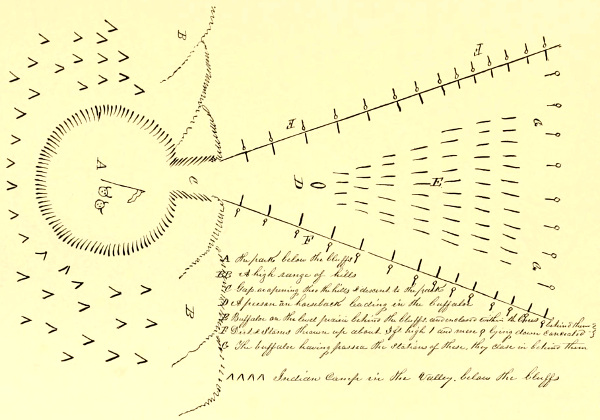
A Buffalo Park or “Surround”
BUREAU OF AMERICAN ETHNOLOGY
FORTY-SIXTH ANNUAL REPORT PLATE 70
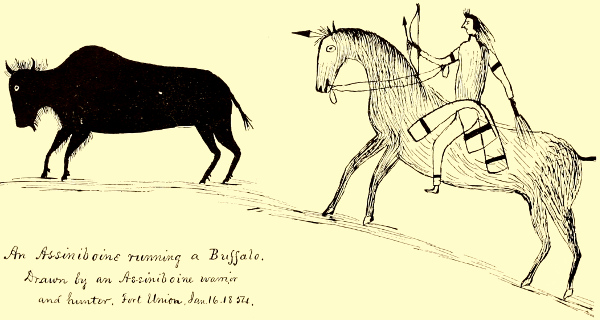
An Assiniboine running a Buffalo.
Drawn by an Assiniboine warrior and hunter, Fort Union, Jan. 16, 1854.
Another Head painted and decked very gaudily is placed in the
lodge of the master, who smokes and invokes it, at times singing the
Bull Song, which he accompanies with a rattle nearly all night, and
prophesies as to their appearance of success in the morning. A
man is now chosen who is to lead the buffalo within the lines, and
there are but few among them who can do it. When the discoverers
have reported buffalo to be within 8 or 10 miles of the camp, and
the wind is favorable, the master, after great ceremonies to the
Heads, and making them other sacrifices, gives notice that a throw
must be made, sending all the camp to take their stations behind
the piles of earth, lying down; he remains in camp, keeping up a
singing, rattling, and smoking—with invocations all the time. The
person who brings the buffalo mounts a horse and meets them a great
distance from camp. When within about 150 yards of the herd he
covers his body with his robe, lies along the horse’s back, and imitates
the bleating of a buffalo calf.
The whole mass immediately moves toward him. He retreats
toward the pen, always keeping to the windward of them, and about
the same distance ahead, renewing the noise of the calf whenever
they appear to stop. They generally follow him as fast as his horse
can gallop, and in this way alone he conducts them within the lines
of the angle. Of course as soon as they are a short distance in, the
scent of one of the angles reaches them but it is now too late, they
have closed in behind. The animals now take fright and rush from
one line to another, but seeing people on both sides (who rise as the
buffalo attempt to get through) they keep straight forward. The
leader on horseback now makes his escape to one side, and the whole
herd plunges madly down the precipice, one on top of the other,
breaking their legs and necks in the fall. Into the pen they tumble,
those in front having no power to stop. They are forced on by the
pressure from behind and frightened by the yelling and firing of
the savages. When all have passed into the pen the work of
slaughter commences, with guns and bows firing as long as any
appearance of life remains. From 300 to 600 are thus thrown in at
one time by a small camp, and two or three days are required to
skin and cut them up.
Men, women, and children now commence skinning. Each secures
as many hides as he can skin. The master of the park claims a
portion for his share, indeed all are said to belong to him, but he
does not take more than the rest. All the tongues, however, are
his, and he also receives other payment for his services in presents,
besides the standing of a divining man. Plate 70 will perhaps
exhibit the hunt more clearly if we have not been sufficiently plain
in the description.
When there is a deficiency of people to man the angles they are
made by placing the lodges of the camp in that form, but this can
only be done when they have a dozen or two of fast horses to extend
the angle of the lodges and force the buffalo within the lines. This
is also done, but it does not succeed as well as the way described.
Great is the joy and feasting in camp after a large throw.
Approaching Buffalo.—This is done on foot with the gun by a
single man. It is indispensable he should have on a skin dress in
summer and a white blanket coat over it in winter, or a buffalo robe
coat with all the hair turned inside.
Any dark-colored dress is easily seen by them at a considerable
distance, but white or light-colored clothing does not attract their
notice. The hunter has his gun covered with skin to prevent the dirt
or snow from entering the barrel while in the act of crawling. His
accoutrements are also firmly attached to his person by a belt. He
proceeds toward the buffalo, keeping the wind as nearly in his face
as possible, sometimes being obliged to make a circuit of miles to get
the wind in the right direction. When near the animals he observes
from the top of some hill how they are stationed, which way they
travel, and the nature of the ground as regards coulees, gullies,
bushes, grass, and any objects that may hide his person from their
view and shapes his course according to the means of concealment
presented. If he finds the country too level to get them within
range of the gun he then commences crawling on his belly toward
them, pushing his gun ahead as he goes.
This is a very laborious and slow mode of progressing and often
takes one or two hours to come within shooting distance, as the
hunter only moves while the animals are eating, stopping the moment
their attention is directed toward him. In the snow it is a very cold
business, and in the summer difficult on account of the cactus, but
they are obliged to do it frequently in both seasons on these level
plains. Great precaution is needed to approach buffalo or antelope
on a level plain. The hunter covers his head with sage bushes, and
sticks the same or grass in his belt; at other times a wolf skin covers
his head and back—he lying flat, no form of the man can be perceived—and
the animals being accustomed to these objects do not
affright so easily. When by any of these means he has arrived within
shooting distance he fires without rising, elevating his piece by support
of the elbows. After firing he remains motionless a few minutes
during which the buffalo, after recoiling a few paces, and seeing
nothing on the move, commence grazing. He now turns over on his
back and reloads his gun (lying in this position) by putting the butt
against his foot—and when ready will turn over on his belly and
fire again, and so on, sometimes killing six or eight without changing
his place, or with very little movement.
As soon as he rises the herd runs off and he commences skinning.
Some hunters mimic the bleating of a calf and thus decoy the buffalo
to them, but this is a rare talent, and only practiced by a few good
performers; in hilly places or where there are gullies and bushes to
hide the hunter, neither buffalo nor antelope are difficult to kill, but
on the barren and level plain it requires great exertion, time and
patience.
Another method by which great numbers of both buffalo and antelope
are slain is, when the snow has drifted in the gullies, forming
banks 10 to 15 feet deep. The animals are pursued on foot, with
raquettes and snowshoes. The hunter goes over the snow, but the
animals become embedded and are killed with ease. In the summer
if several animals are killed, the meat is placed in a pile covered
with the hides, and a portion of the hunter’s clothing left on it, the
scent of which prevents the wolves from coming to it. Occasionally
the bladder of the animal is inflated, small pebbles put in, which
being tied to a stick and stirred by the wind, will keep off the
wolves and foxes.
But in the winter the usual way is to bury the meat in the snow,
which effectually prevents the wolves from eating it, as they have
no power of smell through a foot of snow. Meat can be left in this
way in perfect security for a month or more, but they usually
return with their dogs and take it away the next day. If the hunter
goes out on horseback he leaves his horse near the buffalo, and
after having killed in the manner stated, packs him home with the
meat and hide, but in the deep snow horses can not travel, the dogs
do not sink much in the snow and the men and women go over it on
snowshoes.
Antelope are hunted in the same way as the preceding, also sometimes
decoyed by tying some portion of clothing to a pole, the
man lying down and raising and lowering the pole at intervals, or
by kicking up his heels, one after the other. They have great curiosity
to see the strange object, and after making many circles will
come near enough to get a shot, though as soon, as they make out
the man they are off. A wolf skin is decidedly the best disguise
when hunting any of the animals on foot.
It may as well be recorded here that all young hunters sacrifice
the first game they kill by cutting it up and giving it to the crows,
magpies and wolves, saying to each, “I give you this that I may
always be able to kill and feed the wolves, that I may be successful
in war.”
The bull’s head is often painted and bound round with scarlet
cloth, with painted feathers or sticks stuck in, and an address made
to it announcing that it is done by the hunter to prevent the animal
from goring him. Likewise the Assiniboin, when they undertake to
swim the Missouri, will tie to a stick some dried buffalo guts, grease,
and bladder, and stick the same in the water, say to it, “This is to
enable me to cross without accident, let no wind blow, nor pain
take me in crossing.” They are not expert swimmers like the Crow
Indians, and the fear of the undertaking causes the sacrifice. In
all these things they are very particular and superstitious, asserting
that if these ceremonies are neglected some accident will certainly
happen to the person who despises these powers.
Deer Hunting.—A good deer hunter must use the rifle. Shotguns
do not shoot with certainty. This is the reason why all these Indians
are poor deer hunters. They use the northwest shotgun altogether
except a few of the Sioux, who hunt antelope and bighorn with the
rifle. The art of deer hunting may be thus divided: Finding the
deer, approaching it, shooting it, cutting it up, and carrying it home.
They are hunted in the timber by a man alone and on foot. He must
be well acquainted with the habits of the animal, where it is to be
found at different hours in the day, what it feeds upon at different
seasons, to know by the tracks if it is traveling, grazing, running,
retiring to rest, or going to water; he must be quick sighted, a good
walker, and go cautiously through the bush when near the game.
The morning and evening are the best times to hunt them, as they
are then on the edge or borders of the woods where grass is found,
or in open places in the bottoms; returning into the thick bushes
for a few hours in the middle of the day. The hunter travels fast
until he comes near the place where he judges a deer is to be found,
then proceeds very slowly and silently, looking in every direction,
always keeping the wind in his favor until the animal is seen.
He then approaches it stepping from tree to tree, bush to bush, crawling
and creeping, hiding himself entirely from its view, by every
means, and making no noise. When he thinks he is within range
he rises and fires quickly and the deer falls. It is then skinned and
cut up, the meat packed in the hide, and it tied in a bundle by the
skin of the legs, in such a way as to form a collar, which is drawn
over his forehead, by lying or sitting down, and slipping it over,
then rising up with the weight between his shoulders he starts homeward.
If more than one is wanted he hangs the first on a tree thus
cut up, and proceeds in quest of others, sometimes killing three or
four in a day, which he returns for with his horse or dogs the
next day.
Whistles made of wood like the mouthpiece of a clarinet are used
to call both deer and elk in hunting seasons, and are then a useful
decoy. They do not catch them in traps or pits.
Elk Hunting.—This is done on foot, with the gun, but by parties
of men. Elk go in droves of from 100 to 300 each and are found in
the large timbered bottoms of the Missouri and Yellowstone. There
is some ceremony required in hunting this animal. In the first place
some divining woman who is said to be an “elk dreamer” states
she has had a favorable dream for hunting them. The woman is
then stripped to the waist and also barelegged, the body and face
painted a bright yellow, and a wreath of bushes with leaves on projecting
two or three feet on each side is placed on her head in imitation
of the horns of the elk. Thus decorated she starts at the head
of a party of 15 to 25 men. When in the vicinity of the place,
where, according to her dream, the elk are to be found, she stops
and commences her incantation song, while the others continue in
quest of the game. As soon as the herd is discovered the party
separate, and outflanking them on either side, commence firing and
running toward them, loading and firing while running, in quick
succession, when the elk become confused, scatter and turn in different
directions, presenting at times a mark for each of the hunters.
Every shot bewilders them the more, and instead of running in
any one direction they keep turning every way until a great many
are killed.
They are then skinned, cut up, and the meat and hides packed
home on horses brought for the purpose, which having been left
behind in charge of some women and boys, are brought up during
the fixing. The skins are used for clothing and the meat, though
eaten, is not relished much by most of the Indians.
Elk are also approached singly and at those times the same precautions
are used as stated under the head of deer hunting, though
they are not so shy and timid an animal as deer.
Grizzly Bears.—This animal is not hunted but often found when
not desired, and mostly passed by unmolested by a single Indian
when on foot, though on occasions they do kill them in this way,
which exploit ranks in bravery next to killing an enemy, but the
thickets and mauvaise terre which they inhabit makes the pursuit
too dangerous for ordinary hunters. They are more frequently killed
in their dens in winter.
The grizzly bear in the beginning of cold weather and snow seeks
some hole in the side of a hill in some solitary place, and carries
in a quantity of grass and brush to make his nest, lies all winter
apparently asleep and eats nothing, though they are said to derive
some nourishment by sucking their paws. The nest or wash is
always within a few feet of the entrance and they can easily be seen
from the outside. Generally a den contains two to four bears, or one
large male and two yearling cubs, or one large female and two
yearlings. Sometimes, however, they are found singly. When a den
is discovered six or eight Indians go to attack it, approaching the hole
so close as to see the foremost bear, when three of them fire, the others
reserving their shots. They all run off some distance and if the animal,
or any others pursue them, the rest fire. If the first one has
been killed and there are others the smoke of the guns drives them
out, when they receive a volley from the hunters. If they see nothing
after waiting a sufficient time for the smoke to escape from the hole
they again approach as before and see if the animal be dead. If so,
they make a smoke within the entrance with the view of driving out
any other that may be within. Should nothing appear they conclude
there is but one, enter, and drag him out.
Frequently two or three bears are killed in the same hole at the
same time, and at others some of the hunters get dreadfully mangled.
Bears are also run on horseback, when found on the plains, and shot
with arrows. This is the least dangerous manner of killing them.
No pits or traps are used, though we have known forked sticks
to be placed before the hole so that when they came out they were
caught by the hind part and detained a short time. When a bear
is killed he is skinned, all except the head, which is covered with
scarlet cloth, the hair smeared over with vermilion, handsome feathers
stuck around it, and new kettles and tobacco laid before it.
It is presented with the pipe to smoke and a long ceremony of invocation
takes place, purporting that they give him this property and
pay this attention to have pity upon their wives and children and not
tear them when they are hunting after fruit and berries. They
say if this is not done the bear will certainly sooner or later devour
some of them or their children.
Beaver.—None of these Indians trap the beaver to any extent except
the Crow and Cree Indians. The steel trap is used by them, set
under the water, and a stick dipped in the musk or oilstone of the
beaver, placed behind the trap, though above the surface. The animal,
smelling the bait, will come to see what it is, and in swimming
around is caught by the foot. Oils of cinnamon, cloves, and
rhodium are also used for bait by white trappers.
Wolves and Foxes.—Wolves and foxes are caught in deadfall traps
made by planting sticks in the ground with a crosspiece supporting
a heavy roof of stone laid on sticks. The whole is propped up with
a stick, and the wolf going in to eat the meat displaces the prop and
the whole weight falls upon him and breaks his back. The Cree
catch them in a pit or hole dug for the purpose—covering it with
a revolving trap door with a bait of meat on each end above and
beneath. The animal in endeavoring to reach the bait is turned in
by the revolving of the door under its weight, which brings the
other bait on top. A second revolution turns up the first bait and
turns down the second wolf.
In this way they will catch as many as the pit will hold, especially
as when a few are turned in they commence fighting; and the
noise attracts others. Wolves are also sacrificed to and small presents
given them, with the view of avoiding their being bitten by them
when mad, or as the Gods of War.
The chase does not vary much at any season, except that in the
summer, no skins being seasonable but deer in the red, only enough
animals are killed to suffice for food, clothing, lodges, etc. From the
middle of September to the middle of March the hair and fur of
all animals become merchantable. They are then hunted for the
hide, though all prime furs are taken off in the middle of the winter.
Pelts are judged by the thickness of their skin and fur. In
the warm months all animals shed their hair. A little observation
enables a person to determine to a certainty in what month the
animal has been killed.
Hunting parties not decided on by council in the soldiers’ lodge
are formed by any respectable hunter sending invitations to those he
wishes should accompany him.
The spoils of smaller game belong to him who killed it but they
share the meat with all who are there, and but little difficulty occurs
on this point. When but few animals are killed it is always known
who killed them, and when many are slaughtered all have enough.
Disputes arise occasionally, however, but it is not a matter of sufficient
importance to proceed to extreme measures, and one of the party
usually relinquishes his claim.
The morning and evening are the best hours for approaching
small game, as at those times they are found feeding, but buffalo
can be easier approached in the middle of the day when they lie
down for an hour or two, and if not asleep their range of vision is
much diminished by that position and intervening grass. Light
and shade are not of much consequence in approaching game. The
object of the hunter is to keep out of sight entirely until the moment
of firing, and when that is not possible to make use of some skin,
branches, grass, etc., to deceive the animal, move very slowly, and
keep the wind in his favor.
The manner in which animals are decoyed has been pointed out,
but is not always successful, and only resorted to by those who are
adepts in the art of mimicry, as in the rutting season. This is the
reason why he who leads the buffalo into the parks is supposed by
the mass to be possessed with some supernatural power which forces
the buffalo to follow him, when in fact it is nothing more than a
correct imitation of the bleating of a calf or a noise as though a calf
was being devoured by a wolf and crying for help. The buffalo
never get near enough to the man to make him out, as he is covered
with his robe, the hair turned outward, and he always keeps the wind
in his favor. It is, however, a rare talent.
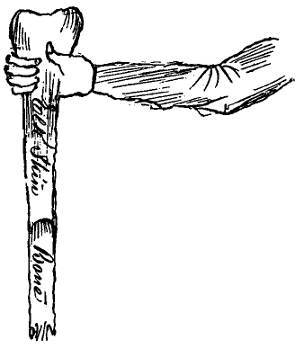
Figure 33.—Tool for fleshing the hide
The hide of the buffalo, to make a robe, is taken off in two halves,
by slitting the animal down the middle of the back and the middle
of the belly. The first process it undergoes afterwards is taking off
the portions of meat and membrane adhering to it, so that it will
present the smooth clear skin. This is done with a tool made from
the shin bone of an elk. (Fig.
33.) The lower end is cut to an
edge and small teeth made therein.
The skin is hung up at one
corner to a pole and the meat
is dug off by hoeing down with
the instrument, which is held
firmly at the upper end. A
woman will finish this operation
on two whole skins or four
halves in one day. Next the
skin is stretched to dry. Holes
are cut through it near the edge.
In summer it is pinned to the
ground by wooden pegs, or in
winter when the ground is
frozen, stretched on a frame of
four poles tied together, and a
small fire built to dry it. When dry the next thing to be done is
to scrape it, that is, to hoe off about one-third of the thickness of
the hide. This is done with an iron tool about 3½ inches long,
1½ inches wide, and ⅛-inch thick. Formerly a flint stone was
used for this purpose, but the iron tool answering better, is now
substituted. This piece of iron being sharpened at one edge is tied
on a handle made of elk’s horn (Fig. 34), cut off at one of the forks,
so as to afford a projection to fasten it, being held in both hands.
The hide is laid on the ground, the woman stands upon it, and,
stooping, digs off the hide in shavings, until of the proper thickness.
This occupies about half a day to each whole hide and is a very
fatiguing employment. Grease is then melted, sprinkled sparingly
over the skin, and it is suspended over a small fire for a few hours
that the grease may penetrate; then taken down and smeared over
with the brains or livers of some animals boiled in water, being
soaked thoroughly and left all night in this state. In the morning it
is again stretched on the frame, the liver scraped off, clean water
thrown on and scraped off until the hide becomes white. A fire is
then made near and the skin slowly heated and rubbed with pumice
stone or porous bone until it is about half dry, then taken out
of the frame and drawn backward and forward round a strong cord
of sinew which is tied at each end to the lodge pole. Every few minutes
the skin is held a short time to the fire, then rubbed, and this
operation continued until it becomes perfectly dry and soft. This is
also hard work. A good hand will rub two whole skins or four
halves in a day. The skin is now dressed. The holes made for
stretching it around the edges are cut off and it is sewed up along
the back with an awl and
sinew, which takes about
half an hour to each two
halves of the buffalo.
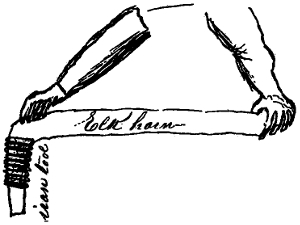
Figure 34.—Tool for scraping hides or shaving
the skin
The robe is now fit for
sale and is packed away.
Deer and elk skins undergo
the same operations, and in
addition the hair is scraped
off with the same tool that
the hide is shaved with,
though they are skinned
whole and not in halves
like the buffalo hides. It
will thus be seen that at least three days are required to prepare
one buffalo robe for market, but by their division of time in attending
to several skins in different stages of advancement the labor
would be about equal to two days for each buffalo skin. Twenty-five
to thirty-five robes is considered an excellent winter’s work for
one woman. The average is about 18 to 20 each. Wolf, bear, fox,
rabbit, beaver, hare, ermine, lynx, otter, rat, mink, etc., are not
dressed for market, and all these are skinned, stretched and dried
by the men and boys. A wolf or fox skin is now and then dressed for
the use of a woman or hunter to wear round his head, and undergoes
the preceding operations, though the skin being small and light
not much labor is required. Robes and skins are packed up in small
bundles, the hair side out, each bundle weighing 30 or 35 pounds,
and when a sufficient number are collected for supplies, one of these
bundles is tied on each dog travaille and they go to the trading house
to dispose of them.
Instruction in Hunting.—As stated in a former place, boys commence
with archery as soon as they can run about after birds and
rabbits, enlarging the size of the bow to suit their strength, until
they attain the age of 16 years, when the full-sized bow is used.
About this time they are taught by their father or other relations
the use of firearms and the different modes of approaching game.
At this age they may be considered fit to engage in the active labors
of the chase on foot, but seldom run buffalo on horseback so early.
About 18, however, they can hunt in every way, though before this
age they can and do assist in supporting their parents. Even when
much younger they follow to the hunt and aid in skinning and packing
home meat. They are perhaps of more service in this way when
young than at a riper age, when the pursuit of war and the possession
of women occupy the greater part of their time. Women are
never known to practice any part of the hunter’s art when left alone.
They generally find some relative to remain with them when deserted
by their husbands, and their labor always secures them a home.
When they desert the camp on account of some quarrel they
travel alone for days, subsisting on roots, berries, or fruit, if the season
affords them, shaping their course toward the fort or some other
band of their own people.
The bow and arrow is used altogether by all these tribes when
hunting buffalo on horseback and the Northwest shotgun is the only
arm employed in killing any and all game on foot. A few Sioux,
perhaps a dozen in the whole nation, use rifles in hunting antelope,
bighorn, and other small game. A warrior has if possible both gun
and bow. Ammunition is sold at the rate of 3 pounds of powder and
1 pound of balls for one buffalo robe, which is enough for a month’s
hunting by any Indian. Traps, metallic instruments, arms, or anything
they want, also persons to repair their guns, kettles, and axes
and to make tools to dress robes, etc., can be furnished them at any
tune; but they will not pay for these things. We have kept in constant
employment, mostly for their benefit, a blacksmith, a gunsmith,
and a tinsmith at all the forts for 20 years past and are heartily tired
of the business, as no profit arises from their labor.
It is not designed hereby to produce an impression that these
labors have been performed by us from charitable motives, but thereby
to put the Indians in a position to hunt and collect skins for the
trade. Every Indian without a horse or gun, or only with his bow
and arrows is an idler; his time is a loss to us. We therefore lend
him a gun and furnish him, with ammunition free of charge. He
commences hunting and realizes to us from $60 to $80 in skins that
would otherwise have remained upon the backs of the animals. True
he never returns or pays for the gun, but he has it, or some other
has, and it is in our active service. As long as the buffalo are as
numerous as they now are these tribes will have no difficulty in maintaining
themselves by the chase. Traders are too observant of their
own interests to let them suffer for the means of hunting, but should
the buffalo fail the very reverse would be the case. In that event
the trade not being of sufficient profit would be discontinued, and
the Indians thrown upon their own resources, which are extremely
deficient.
They are no deer hunters, and besides only a small portion of
their country along the rivers is stocked with deer and elk and the
greatest famine and distress imaginable would follow, as they are
entirely unacquainted with agricultural pursuits.
There appears to be an anxiety exhibited on this point in many
of the queries, viz., whether the chase is sufficient for the support
of the Indians, and whether they would not be benefited by the
introduction of agriculture. It does not admit of a doubt; neither
are any arguments required to prove this. Having witnessed their
eating their own children during a temporary absence of buffalo
in 1845-46 is enough to satisfy any person on this head. Any railroad
or emigration of whites through their country would ruin it
at once as a buffalo country, and the misery above alluded to would
as surely follow as night succeeds day.
We think, however, that attention on the part of white friends is
not enough directed to pastoral pursuits instead of agricultural and
mechanical. It appears to us that the former occupation would suit
the Indian better to commence with. He would thereby gradually
emerge from his savage state into another which would lead to
agriculture in the end. The tilling necessary for the support of his
stock would be increased in proportion as he saw the advantages
arising therefrom. It would be expecting too much of the Indian
to suppose that he would suddenly change his indolent life for one
of hard and constant labor, but it seems reasonable that the raising
of horses, cattle, hogs, and sheep, for which their country is admirably
adapted, would be to them both interesting and profitable employment,
particularly as they could unite these operations with the
chase when game came near. This state would be but the chrysalis
in the present generation, to merge into agriculture, mechanical
arts, and civilization in the next.
Another argument in favor of this is that they are accustomed to
animal food entirely, therefore grain of any kind could not replace
this; but domestic animals, fowls, eggs, etc., would—and in the meantime
a relish would be formed for breadstuff and vegetables, the
want of which is not now felt. The course to be pursued (that is if
any be in contemplation) by persons in high stations appears to us
to be very plain, and must be apparent to any one who makes himself
acquainted with their real character as set forth in these pages.
These tribes take no fish in quantity by any means whatever.
The raising of a war party is always a subject of discussion in the
soldiers’ lodge, not to choose the persons, but whether the time is
suitable; if men, arms, and ammunition can be spared from camp,
or if they are required for defense; if it is advisable to keep up the
war; how they are situated with regard to their enemies as to locality,
numbers, and general prospects of success as presented at the
time. It being determined in favor of hostilities, the partisan soldier
or chief who intends leading the expedition proceeds to fast,
sacrifice, and dream in the manner before pointed out in these pages,
and having had favorable visions makes a feast of dog in his own
lodge, and invites thereto the persons he wishes to accompany him,
opening to them the object and plan of the expedition, after the
feast has been concluded. Should he not be able to obtain a sufficient
number of recruits in this way he sends runners with tobacco to
other camps conveying an invitation to join within a given time.
War is made either to steal horses from their enemies or to take
their scalps. For the first object but few people are required, as concealment
and avoiding battle is aimed at, and parties for this purpose
are comprised of from 10 to 30 men, whereas a party starting
expressly for battle often contains two, three, or four hundred warriors.
We will endeavor to follow up the first description of parties,
supposing stealing horses to be the object, which is the most common
kind of war excursions. The partisan or captain, as has been
stated, after dreaming, sacrificing, etc., to Wakoñda, the Sun, and
Thunder, makes his last offering, consisting of some scarlet cloth
and tobacco, to the Wolves, which are considered the war fetishes,
and viewed in the light of the special Gods of War. The day for
starting being appointed, all his followers are assembled the night
before, when the business is again considered, and they consent to
follow him as the leader during the time they are out, obey his instructions,
without, however, acknowledging any right in him to
punish in case of disobedience, also reserving to themselves the privilege
of leaving him at any time and under any circumstances they
think proper.
It is a voluntary action and those who will not obey or are dissatisfied
leave and return home at any stage of the march, but do
not separate and remain to thwart the intentions of the others. No
harm being done by their desertion, no punishment follows. At all
events he is obliged to be contented with these precarious terms of
enlistment. The night previous to their departure they assemble
(say 20 men) in the soldiers’ lodge, where a dance called the Crow
dance is performed by them, and the next morning they all start
together, singing the Wolf Song as they leave, their faces usually
being painted with vermilion at all times and particularly at this
time. All go on foot; no order or file of march is taken up; neither
is it necessary. Each one has six or eight pairs of good strong-soled
moccasins on his back. Some are armed with bows and arrows,
some with guns, and some with lances and war clubs. Battle not
being sought, a profusion of arms is not desired and might prove
cumbersome. Every man furnishes his own ammunition and war
implements.
Though guns are sometimes borrowed and ammunition begged of
their friends and relatives, yet there is no tax laid on the camp for
supplies nor any public arrangement whatever for providing arms,
etc. No provisions are taken; they hunt it on their way. The partisan
takes his fetish Wolf Skin, which is an entire skin of that
animal dressed with the head, ears, legs, etc., complete, so that by
lying down or standing on his hands and knees and covering himself
with the skin, drawing it over his head, he might easily be passed
as a wolf by any person within a short distance. His other charm
or fetish is also secured about his person. A good many, and sometimes
the whole party, have wolf skins of the above description on
their backs.
During their march through their own country but little precaution
is used. They stray along at random and toward evening look
around for some game for supper, kill whatever presents itself, take
enough for the night and the next day and encamp.
They proceed in this way, if no signs of enemies appear, until entirely
out of their usual hunting grounds, the leader in the meantime
consulting his dreams, smoking to his fetish wolf skin.
A bad dream, or any unpropitious omen, such as the howling of a
single wolf in a peculiar manner, breaking his pipe, letting fall
his fetish, very severe thunder and lightning, would suffice to turn
back the expedition. When large parties start we find two or three
returning almost every day from the time of leaving until the attack,
caused by dissensions, omens, or other dissatisfaction, but no disgrace
or remarkable comments are attached to this fact, though the
excuses some of them give look very much like fear.
Having arrived at their enemy’s country, the greatest possible precaution
and vigilance are now exercised.
According to the orders of their leader they proceed slowly, scatter
in different directions for miles around, lie about on the tops of the
hills covered with their wolf skins, or headdresses made of bunches
of wild sage, examining the country in every direction for hours
before they move. If nothing is seen they signal to each other the
result by imitating the howling of wolves, the barking of foxes, or
the hooting of owls, as the signals agreed upon require. Assembling
in some hollow, they compare notes, receive new directions, and proceeding
a few miles, separate again and reconnoiter as before. They
now shoot very seldom, and only when meat is absolutely wanted,
and the wind blows in a direction to carry the report away from their
enemies, or toward that part of the country already explored. By
observing the movements of crows and wolves, in which direction
they travel, where they stop and light, they will find out the carcass
of some animal killed by the hunters of the camp. The state of its
decay, tracks, and other signs around will determine the probable
direction of their enemies, and they steer for that point.
When advanced thus far—that is, to know they are in the vicinity
of a camp—the real science of their manner of warfare exhibits
itself. Night marches commence, and separating as before about
daylight they occupy the hills, lying motionless all day, watching
in every direction some signs of their enemies. They are placed so
as to be within call of each other, and the signals for different discoveries
being agreed upon by imitating the howling of wolves, etc.,
as has been stated, they can communicate with each other all the time
without rising to their feet. They never expose their persons to
view on a hill. If necessary to assemble they crawl down and meet
in some ravine well covered with thick bushes. They now never
shoot, make no fire, eat nothing, keep very quiet, and travel in the
night. Of course, by these measures they must soon perceive some
one belonging to the camp, and by observing his direction will find
where it is.
Having discovered the camp, the last rendezvous takes place prior
to the attempt upon the horses, and here several things are determined—a
place is agreed upon where they will all assemble after
the attack, a direction for the return chosen in case of separation,
smoking, and invoking the different fetishes are performed, and
general directions given by their leader as to the manner of approaching
the camp.
There can be no plan of operations laid down, as they are as yet
unaware of the position of the camp, how their horses are kept,
what surrounding objects afford concealment, etc. In the night
they approach the camp in a body under cover of the hills and
bushes, and when near enough to see the horses, and judge of the
opportunities of getting to them unobserved they again separate,
and each pursues his own way of proceeding from different points,
as the nature of the ground affords. The best horses of the Crows
and Blackfeet are usually picketed near the lodge of their several
owners and the rest grazing near. Sometimes pens are made around
the lodges, the horses driven in at dark, and cottonwood bark thrown
in for them to eat. The risk of extracting horses from the interior
of a camp is very great, as young men are moving about from lodge
to lodge all night in their various prosecutions of schemes on women;
but the horses must be had, and the venture must be made.
Near daylight, when all the people of the camp are supposed to
be asleep, but when yet dark (and the darkest kind of nights are
chosen) each warrior creeps slowly and silently toward that portion
of horses apparently the best situated to be taken off unperceived.
Should he in this way be so fortunate as to reach them without discovery
he cuts the cords with which they are tied and works them
gradually into the shade or darkness, then mounting one, drives
the whole to the appointed place of rendezvous. But owing to the
many obstacles in the way of each, the probability of some one being
observed is great, and in that case the whole camp is alarmed on the
instant, each rushing toward his horses. Shots are fired and the
warriors seek safety in flight, with or without horses as it happens.
If there be snow to show their tracks the enemy pursues them the
next day, but if no trail can be found to follow they abandon it.
In either case the warriors shape their course individually toward
the appointed place of meeting, and if all are not assembled, leave
some token for those not arrived to know they have passed, and
continue their flight.
The horses are put to full speed day and night for several days
in succession until entirely out of reach of pursuit, and now begins
a series of quarrels as to the right of possession of the animals.
Some who have been disappointed and drove none off take from
those who have. The leader takes several, combinations of two or
three to rob another are entered into, horses are killed in the quarrel,
or stolen from each other, and unless a great haul has been made
very little satisfaction appears. These differences are mostly gotten
through with before reaching home and they make known their
approach by setting the prairie on fire. When arrived in the outskirts
they shoot and sing, but do not black themselves for stealing
horses, unless they have brought a scalp also, which occasionally
happens. If any of their party have been killed they arrive uttering
loud lamentations.
The whole camp turns out to meet them. The old women cry
over their sons, rubbing the hand down their face, a great deal of
flattery is used by some of the elderly men, shouting the name of
some one of the warriors in a loud voice, stating his bravery, greatness
of heart, etc., until overwhelmed by glory, he presents him with
one of the horses. Great is the joy and tumult, and it frequently
happens before the warrior has arrived at his own lodge, that all
his horses are given away, and he retains nothing but the glory of
the action. In this event, however, his name is sung around the
camp by the persons who have received these gifts, accompanied
with the song of thanks, and loud and prolonged praises of his
bravery and strength of heart.
War parties for battle are a long time in contemplation, frequently
occupying a whole winter in preparing for the campaign,
and in counseling regarding it. Usually large parties are led by
some chief of a band, and invitations are sent by him to different
chiefs of other bands of the same nation and to those of another
nation with whom they are at peace.
In the beginning of the summer they all assemble with their lodges
at the place appointed, and a great deal of debate, feasting, and
private consultation takes place, with sacrifices by the chiefs and
soldiers, and also by many of the warriors to the several supernatural
powers before referred to. It appears to be the misfortune
of these large expeditions to fail in executing anything like what is
anticipated at the start. Here also, the cause of their failure appears
to be due to their insubordination. There is no one man to lead,
no one source of authority in carrying out any plan decided upon.
The nominal leader as chief is only chief of his band, and even
among these there are others who are his equals in war. There
are several chiefs of bands, and also many other chiefs; every one’s
advice, although asked, can not be taken, which produces dissatisfaction.
The soldiers of one band will not be commanded by those
of another, rank on every side is interfered with, old grudges renewed
by meeting with old delinquents, in short though all looks pretty fair
on starting, yet difficulties and disputes from various causes take
place every day after, which results in their leaving and returning
home in detached parties.
When, however, the ranks have by these means become purged
of the most turbulent and unruly characters the others proceed in the
following order: Chiefs, warriors of note and soldiers, dressed in
deerskin shirts and leggings trimmed with ermine, horse, or scalp
hair. A war eagle feather cap is on his head, a shield of bull’s hide
covers his arm, a bow and quiver of arrows is carried on his back,
a short gun stuck in his belt with pouch and horn across his shoulders
and scalping knife in its sheath, the powder horn and ball pouch are
carried on the middle of the back, the connecting strap reaching
across his breast and the upper parts of both arms. These are the
mounted men, and the most distinguished for their former deeds.
The footmen consist of young warriors and new recruits without
any peculiar insignia, but well armed if possible. The soldiers are
men holding that rank in whichever camp they reside, and their
duty is to ride on the outside of the main body to keep any person
from straying away and prevent any useless noise or manner of
travel.
The scouts are appointed by the leader and changed daily; their
duty being to separate and keep 5 or 6 miles ahead of the main body.
These scouts or discoverers are footmen and use the same precautions
as before stated. The main body moves slowly forward after reconnoitering
has commenced, without any order, and only passing whatever
ground has been rendered secure by the reconnoiterers. During
the time before arriving in their enemies’ country, or at least before
any signs of enemies have been perceived, they run buffalo with
horses, kill enough meat for present use and dry and pound more
to be used when hunting is not advisable. When signs of the camp
are perceived, sentinels are posted every night, who lie down around
the camp within 200 or 300 yards of the main body, and 50 or 60
steps from each other. All the horses belonging to the expedition
are picketed within this circle and near the place where their several
owners sleep. These sentinels are changed every night.
When by means of scouts and other observations they have discovered
the camp it is approached in the night and the several advantageous
positions which the ground affords around it are occupied
by different detachments of the party, who are to attack from
various quarters as nearly as possible at the same time. About daybreak
a rush is made by the mounted men, shouting the war whoop
and firing into the lodges as they pass through. The attention of
the horsemen is directed toward driving off every horse found
in camp. These, although picketed, take fright at the noise, snap
their cords and are driven away. This rush only passes through
the camp, and the enemy being raised and armed turn out and pursue
and a battle now takes place near the camp. Indian fighting is
individual fighting, each one for himself, without any military order,
line, or file. Orders are given by any of the chiefs or soldiers in a
loud voice when some advantage presents itself. Both parties endeavor
to cover their bodies by any objects which are in the way.
A thicket is much desired, small trees, stones, bunches of grass, or
hollows made by the rain are all occupied, and those who cannot
find any shelter jump from side to side, never standing still a moment
to avoid any certain aim for their enemy’s fire.
The whole is accompanied with a terrible yelling on both sides.
When one falls on either side the war whoop is sent forth by the
party who killed and a simultaneous rush is made by the enemy to
obtain the scalp and the friends of the fallen man to rescue the body.
In these mêlées of small parties take place the terrible savage struggles
for which they are remarkable. It is hand-to-hand fighting by
a few on each side over the body of the fallen man.26 Knives, lances,
and war clubs are the arms then used and frequently several fall on
each side before one party recoils. These scenes are going on over
several parts of the field at the same time. The war whoop is sounded
from either side whenever any success is visible, and when any disproportionate
loss takes place the flight of that party is the consequence.
This is the great aim of either party, as a massacre of the
scattered fugitives then takes place. It should be remembered that
when the contending parties are nearly equal very little damage is
done.
The firing is at such a distance that only a random shot takes
effect, and after abusing each other and firing hundreds of shots all
day, perhaps only three or four are killed. There must be a great
superiority of numbers and position on one side where there is any
great destruction. The greatest loss of life happens when some 200
to 400 warriors surprise a camp of 20 or 30 lodges, or when the war
party is too large to effect concealment for stealing horses, and too
small for defense. In this case when pursued by the whole camp
they are brought to a stand. If on the prairie they take up a position
on the top of some hill covered with stones with which they make a
barricade or seek a gully or cluster of bushes. Here they fight as long
as one of them is living, but being surrounded by a superior force are
all killed in the end. Three years since 52 Assiniboin who were discovered
in an attempt to steal horses from the Blackfeet were pursued
and brought to bay in a sink hole, or gully, where they were
surrounded by about 800 men of the latter nation and fired upon
until all were killed.
Their enemies, however, lost 34 men before they succeeded. A
retreat is ordered in words to that effect and the movement being
perceived is followed by all, which generally ends in downright
flight. A very common exhibition of individual bravery is, when
the parties are equally divided, and slow skirmishing going forward,
each party having good positions, a single warrior rides forth near
the place where the other party is stationed, and riding slowly within
reach of their fire along their front, sings his war song and calls
out his name, presenting a mark for the whole of his enemies to fire
at. Either he or his horse is generally killed, or if he escapes he is
considered a brave man ever afterwards. In either case he is followed
by one of the opposite side in the same manner, and in this way
often three or four are killed. They eat no root supposed to have the
power of deadening pain or inspiring courage.
The divining men are consulted as to the nature of their dreams
before they set out, and on the march, but not in regard to their
operations in battle.
Battles are planned as soon as they can determine the position of
the enemy, which plans are changed according to circumstances
afterwards, but the fighting is done at random, each loading and
firing when he chooses, and using any measures of concealment of his
person.
No general orders are conveyed or aids employed, although whenever
a cluster of men occupy a position some soldier or chief being
there gives orders to the others, individually or collectively, as the
danger is apparent. The chiefs and soldiers retreating would be a
signal for all to run. The leader gives advice occasionally as to dislodging
the enemy, etc., but all his orders partake of the nature of
requests. They rally often during a retreat if the party be large, and
keep up a running fight for 10 or 15 miles.
A favorite device to decoy enemies is to send but few to make an
attack on their camp and drive off the horses. The camp, following,
are led to where the main body lies in ambush.
The war whoop is the signal of advance and also of encouragement
during the fight. It is also a cry of joy when any of the enemy
fall, and at all times a defiance, but never used in retreat or under
any humiliating circumstances. They speak to and abuse each other
during the fight, adding their former deeds to exasperate the enemy
and induce some one of them to step forth that he may be killed.
They never quit a masked wood and take the level plain unless their
party is greatly superior in numbers and no danger of pursuit is
apprehended; but if they are few they remain in the wood until
burnt out, which is done by setting fire to the grass on the prairie,
which in a wind will communicate with the undergrowth of the
woods. If this can not be done by the surrounding party the besieged
party defend their position until night and then make their
escape under cover of the darkness.
The Gros Ventres and Crows are the only nations who take women
and children prisoners and spare their lives, though they kill all
males able to bear arms.
All the wounded left on the field are tortured to death in every
possible way, mostly by mutilation, are seldom burned, perhaps for
the reason that death would be too soon produced by that manner
of proceeding. The Assiniboin burn children prisoners.
The Crow Indians a few years since, after killing all the men
and large boys of 50 lodges of the Blackfeet, took prisoners upward
of 200 women and children. One of our gentlemen now in charge
of that nation was with the Crow camp when the battle took place,
and for two or three months afterwards, during which time he sought
occasions to liberate about 50 women and send them home to their
people. Most of these prisoners, it appears, are treated well, particularly
the children, who are adopted into families who have lost
their own. When a child is thus adopted it is painted and dressed
very gaily, a horse given to it to ride, and to all appearances treated
as affectionately as their own.
A grown woman, however, is not adopted. They are retained to
work, or if young and handsome are kept as one of the wives of
their owners, though not abused or made to bear any unusual hardships.
It is singular that when these women prisoners have remained
a few years with the Crow Indians they will not return to
their own people, even if liberty be given them. Indeed, after the
first few months they are not watched and have it in their power
to leave at any time, and many do during the first year of their
captivity, but after having learned to speak the language, mostly
remain, which proves that nation to be much more lenient toward
their women than the Blackfeet and others. The children prisoners
become identified with them and never desire to leave when grown.
Every male fit to bear arms is put to death by the tribes. The
Assiniboin, Blackfeet, Sioux, Cree, and Arikara also kill women
and children and sing and dance as much for their scalps as for
those of men. The horrid manner in which they put the small children
to death exceeds description. Some are stuck through with
wooden skewers, like a rabbit, while alive, and roasted before the
fire.
There is but little subordination in all large war parties of Indians.
There appear to be jealousies on every side between soldiers and
chiefs or between the warriors and soldiers. No penalties being
attached to disobedience, it has no limit, and they are often in as
much danger from each other as from their enemies. Once in a
century a chief arises who can lead large parties to war, but it is
only when his success and capacity as a warrior is accompanied
by his art as a prophet and he has gained entire ascendancy over all
his people. Small parties succeed better—say from 80 to 100 men.
These an ordinary chief can command tolerably well, because they
are for the most part chosen from his own band and composed of
his own relations. This kind of party always proves most successful,
as the leader only attacks when success is certain from the numbers
on each side. All Indians carry off their wounded if possible, and
the dead also if not scalped, interring the latter in some secure place
not likely to be discovered by their enemies.
As stated, no grown male prisoners are retained alive by any of
these tribes, and only two preserve the lives of the women and
children. These, of course, are obliged to work, though not exactly
in the character of slaves. All the women work and these pursue
the same labors, though no doubt a greater share falls upon them
than upon others. No description of labor, such as carrying burdens,
drying hides, cooking, or procuring fuel, etc., is considered disgraceful
or menial. They all do it, even the wives of the chiefs,
and the prisoners would be compelled to employ their time to the
advantage of their owners; or if young and handsome would be
kept as wives, yet still be made to work as the rest. They are not
beaten nor brutally treated, but forfeit their lives by an attempt
to run away. Female chastity is always violated on prisoners27 if
they are even tolerably young and good looking, and often in such
a degree as exceeds the possibility of description or belief, but we
are not aware that any superstitious opinions are connected with
the act.
Costume of a Warrior.—The ordinary costume of a mounted warrior
of known bravery has already been described. The headdress,
however, differs in form according to the fancy and standing of the
individual. The tail feathers of the war eagle are the only mark
of rank. These are attached to scarlet cloth or otter skin in many
ways, sometimes merely encircling the head, at others extending in
a ridge along the back, reaching below the horse’s belly when
mounted. The shirt and leggings are made of clean white dressed
deerskin, antelope, or bighorn skin, with black stripes painted around
the arms and legs and fringed with the hair of the scalps taken
by him, occasionally also with ermine skins, or horsehair. The
horse’s head and tail are adorned with the same kind of feathers,
as also his lance and shield. The latter is a piece of dried raw
bull’s hide, very thick, round, and about 18 inches in diameter. The
feathers are sewed or tied on around near the edge, and two or three
in the center. Frequently this is painted with the figure of some
animal, either real or imaginary, and is impervious to arrows,
though a ball will perforate within the distance of 100 yards if it be
held steadily.
The manner in which it is slung on the left arm and being
bowed in the middle the ball is apt to glance off to one side and often
in this way his life is saved. Arrows will stick in but not go through,
and he can with it cover most of the vital parts, at the same time
using his arms with ease. A good many of the renowned warriors
wear necklaces made of the claws of the grizzly bear, worked or
tied on a strip of otter skin, and chiefs wear their medals if they have
any. These fine dresses are not worn on the march, but packed on
their horses in bundles, and put on when the attack is about to be
made.
The faces of most of them on starting or in battle are painted
with vermilion, the entire face being a bright red, though no orders
are given to this effect. Indians generally paint on all public occasions,
but no other parts of the body are painted at this time.
The costume of those on foot does not differ from that of a hunter,
except he has both gun and bow, if possible, sometimes adding a
shield, and a bundle of moccasins on his back, which, with a blanket,
or skin capot, leggings of the same and breech flap, completes the
dress.
No great display of dress can be made on foot and is not often
seen except among the Blackfeet, when it is the same or nearly the
same as the mounted warriors. The hair of the young warriors is
dressed out and adorned in many ways, sometimes enclosing small
portions in front with beads, shell, or wampum, which hangs down on
each side of the face. The Crows have small portions combed up in
front and the whole of the rest tied in a queue behind, which is spread
out and stiffened with patches of gum, spotted with white clay, and
looks like turkey feathers. The elder warriors generally tie up their
hair in a knot in front, which projects out from the forehead like a
thick short horn. During the march not much attention is paid
either to painting or ornaments, but on the eve of battle, if possible,
it is done. Nothing uniform appears, however, in their costume,
ornaments, or hair dressing, each one suiting his fancy in
these particulars, except the acknowledged marks of warriors are
not worn by untried and inexperienced recruits.
The back dress, if not a continuance of the headdress, is mostly a
wolf skin thrown over his robe, the tail trailing on the ground and
the snout on his shoulder. Crow-skin headdresses are also worn
by young warriors, and owl feathers are worn by new beginners.
No portion of their war dress is constructed so as to emit jingling
sounds, though such are worn on other occasions. Every Indian has
either a blanket, buffalo robe, or dressed skin of some kind covering
the whole person, and these are painted with their battle scenes or
garnished with beads and porcupine quills in many ways. His robe
is his bed by night and his cloak in the day, under which in the
winter is worn a blanket capot, made with a hood to cover the head.
In the large summer war parties, portions of lodges of two to four
skins each are taken along with which they make cabins to protect
themselves from the rain, but in the winter no shelter is made.
When parties are too small to admit of proceeding without fear of
night attacks from their enemies while in their country, they make
small forts every night of dry timber along some stream, or of rocks
when timber is not to be had.
Weapons.—Firearms are certainly much valued by warriors. Indeed,
they are the principal arms, but bows and arrows are used
fully as much by mounted men. The difficulty appears to be the
loading of the gun on horseback. If possible they carry both on
their war expeditions, also some are armed with lances, war clubs,
and battle axes. The last three instruments are used only in
mêlées at close quarters. Indians are often so situated in battle that
neither gun nor bow can be used, and in these emergencies the tools
last mentioned stand them in great need. Guns are therefore only
additional weapons, aiding and facilitating their mutual destruction,
but have by no means been substituted altogether for the bow
and arrow. The metal arrow point is superior to the flint one formerly
used, and more easily procured. The arrows for battle are
barbed and tied on loosely, so that an attempt to withdraw the arrow
invariably leaves the iron in the wound, which makes many of their
wounds dangerous that would not be so if the metal could be
extracted.
The stone war club is the most efficient weapon in battle of any
we know of. A drawing of one is shown in Plate 65. The weight
of the stone is about 5 pounds. The handle is made of elastic sinew
and can not be broken. Any attempt to ward off the blow must
be attended with a broken arm, and if the stroke is not fended
the strongest man must fall beneath it. Tomahawk and battle axes
are not thrown at their enemies, as generally represented, but are
secured to the wrist by a strong cord, and only used at close quarters;
as also the lance and knife. The scalping knife is of English manufacture,
a logwood or Brazil wood handle, and soft steel blade about
8 inches long and 1½ inches wide, sharp on one edge, and with the
point turned like a butcher knife. These are the kinds of knives
mostly used by all Indians for hunting and all purposes, though
Willson’s butcher, Cartouche, eye dagues, and other knives can be
had. Most Indians at all times carry knives of some kind and scalps
are taken off with whatever knife they happen to be in possession of
at the time.
In loading the gun in battle it is first primed from the horn, then
a charge of powder put in, and a few balls being held in the mouth
of each man, one is dropped in wet on top of the powder, without
any wad between or on top. In this way they load and fire very
quickly, four or five times in a minute, but not with a very certain
aim.
When scalps are taken without loss on their side the whole party on
their way back paint their faces a jet black with a mixture of grease
and charcoal. This is the symbol of joy, and on arrival in camp
the scalp song is raised. The whole population turns out to meet
them. Whichever person the warrior touches also blacks himself
and commences singing. If the party has had any one killed, the
relatives of the deceased smear their faces and clothes with white
clay, the symbol of mourning, wear old, ragged skins on their backs,
go barefooted, cut their hair, arms and legs, and cry in loud
howlings.
In this event the camp presents a scene of mingled rejoicings and
lamentations, which are kept up for many days and nights in succession.
If the loss on the part of the warriors is greater than the
gain—that is, if they have lost two or three men and taken but one
scalp—no faces are blackened, no dancing is done, and the scalp song
is sung throughout the camp, at the end of which all set up a howling
cry.
It often happens that the party have all, except a few, been killed,
and should the partisan in that case have escaped he does not return
immediately to his own camp but remains in another for some time,
until the grief for the dead has in a manner passed, for should he
come home with the report of a general massacre of his party he
would run great risk of being put to death by the relatives of the
persons who fell while under his charge.
Dancing must be considered as a characteristic mode of expressing
popular opinion on most, if not on all, occasions and is generally done
with the view of swaying the multitude, and conforming their actions
to certain measures. It is also one of their principal means of publishing
and handing down to posterity the remembrance of their
gallant actions, of inspiring the young with a desire for distinction,
and of awarding the praise due all brave warriors. Dances are
usually performed by the different kins, such as the Wolf-pups,
Braves, Bulls, Foxes, Mice, Comrades, Ducks, and Crows. All these
are societies, formed by different young men, some of which we have
had occasion to mention in a former answer, and all have for their
object combination in love or war. There is also the Soldier’s Dance
in which none but these officers act, and several dances in which all
promiscuously take part, or in which the distinction of the different
clubs named is not recognized. Of this nature are the scalp dance,
dance in the diviners’ lodge, and others got up for begging purposes.
Most Indians after having passed the degree of soldier and
emerged into that of chief or councillor seldom perform in any
dances, though they encourage it by their presence. There are but
two dances in which the women join the men, which are that in the
diviners’ lodge and on the occasion of taking a scalp. There is
also another in which women alone perform, aided by a few young
men, say, five or six. The principles of all these are imbibed by the
youths, from their being always publicly exhibited, and from their
natural talent of imitation, but they do not join in the circle until
at the age of maturity, except a few girls in the scalp dance. Each
one of these performances has some motive independent of amusement,
as will perhaps appear from the different descriptions of
them which follow, and are to them often matters of deep interest
and importance.
Scalp Dance (Wah-kittai Wache).—When a scalp is taken it is
during the return stretched on a small hoop, and left in this manner;
the hoop is attached to the end of a rod about 5 feet long. These
are handed by the warriors on arrival to those in camp who have
recently had some of their relatives killed by enemies and is an
intimation that revenge for the dead having been taken, their mourning
must be laid aside, their faces blackened, and they to rejoice with
the others in the dance, which is always done. Moreover, this mark
of politeness on the part of the warrior to those in mourning is always
remunerated by a suitable present—a gun, a blanket, or some other
piece of property. Often a horse is bestowed in the excitement of the
moment. The dance is then called by an old man going round the
camp singing the song and beating a drum, calling on all who feel
disposed to join in celebrating their triumph by a dance, and each
one makes the necessary preparations. (Pl. 71.)
Both men and women paint their faces entirely black, except the
tip end of the nose, which is not touched, dress in the gaudiest and
best style they can afford, and at a signal by the yelling and drumming
of the music assemble in the area or public square with which
most villages are furnished, being an open space in the center of the
camp, near the soldiers’ lodge. In this dance the men carry no
arms of any kind. Some of them have in their hands a rattle with
which they keep time, but most of the women hold in their right
hand some weapon, such as a tomahawk, bow, pakamāgan, lance, or
stick. The scalps also are held by the females. Being attached
to the rod, they are shaken up and down to the taps of the drums.
When ready they form nearly a circle. Old men with drums come
first, next all the rest of the male dancers, and afterwards the women,
the whole ring standing so close as to press a little against each
other, and the scalp rods, and other things held in the hand, are
extended out a little in front.
The scalp song is now struck up by the music, and joined in by
the whole circle, the women singing only in the second part of the
tune. In this song the name of the warrior who has killed the
enemy is introduced, with a few words alluding to the circumstances,
though without any violation of the tune or time. The part of the
tune at which the women commence is when the names or words are
sung. The rest consists in a loud chant by all the ring. After
swinging to and fro a moment they all move round in a circle by
short side steps, lifting their feet together and keeping the exact
time with the drums, and after describing one or two circles by these
movements the song concludes with a general shout from the men,
the scalp is forcibly shaken, and some warrior stepping forth from
the ring recounts in a loud voice either his share in the present glory
or some of his former brave deeds. This is received with a loud
shout of approbation, the drums beat up, the song commences and
another round or two is performed.
Then some other makes a speech of a like nature, either in praise
of himself or of those who brought the scalps, and in this way it continues
for several hours. Occasionally some old woman will take
the scalp in her teeth and shake it like a dog, or throw it on the
ground and trample on and abuse it as though it were a living enemy,
concluding with a short speech in praise of the warriors, and the
dance proceeds as before, the music going round with the dancers.
During the night, or rather all night, nothing but the same dancing
and song is heard. They make small fires outside the lodges and
a dozen or so of young men and women, with a drum or two, sing
and dance around each fire, with or without the scalp, and without
public speaking. Sometimes 20 or 30 of such dances are going on
in different parts of the camp at the same time, all night and nearly
all day, for weeks in succession, until they grow tired of it, or some
new excitement supersedes. Their faces are blackened all this time
and the color left to wear off but never washed off.
The opportunity is not lost by the young men during these night
dances to make love, in all the various ways that passion is susceptible,
and many runaway matches are concluded at these times, when
the young warriors having the advantage of the battle glory are most
likely to be successful. Portions of the scalp are also sent by runners
to the different camps, with the news of the battle. The tenor of
the song includes the names of the warriors who struck the enemy,
and if any of their names have been changed on this occasion it is
also mentioned, so that the new name by the time the dancing is concluded
in the different camps is thoroughly known by all the nation.
This dance is not attended with any violent gesticulation or eccentric
motions, as has been represented, but is an orderly affair, and seriously
performed. Unless a scalp has been brought no singing or
dancing can take place. Even if many enemies were seen to fall, yet
the enemy must be struck, which is the coup, and the hair produced,
which is the proof.
Brave’s Dance (Nappaishene).—This is performed by the group
or club of Indians bearing this title, who are tolerably numerous
and composed of men from 20 to 30 years of age, whose organization
has already been alluded to in these pages. No one is admitted in
the ring but those who belong. The women, say 8 or 10, stand
behind as many drummers and join in the chant but take no part
in the dance. All sing, both dancers and musicians. The men form
in a ring completely naked.28 Their bodies are painted in various
ways. Yellow and red stripes from head to foot is a favorite manner
of painting, red face and yellow body, or red face and body
striped with white. Sometimes the face is dotted with white, yellow,
or red spots, and to their moccasins are attached skunks’ or
foxes’ tails. Guns, spears, bows, and other implements of war are
held in their hands and some have rattles with which they keep time
to the taps on the drums.
BUREAU OF AMERICAN ETHNOLOGY
FORTY-SIXTH ANNUAL REPORT PLATE 71
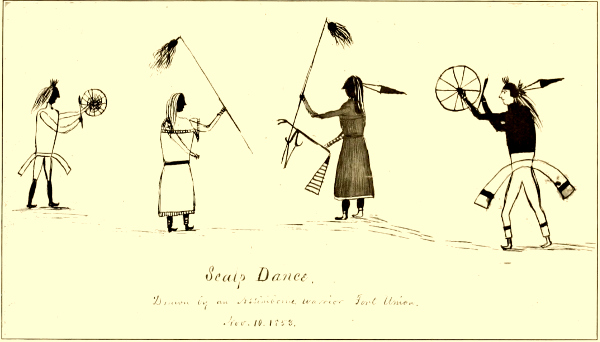
Scalp Dance.
Drawn by an Assiniboine warrior Fort Union.
Nov. 10. 1853.
BUREAU OF AMERICAN ETHNOLOGY
FORTY-SIXTH ANNUAL REPORT PLATE 72
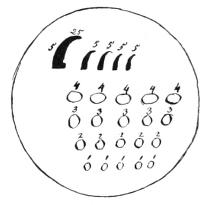
 |
One large crow’s claw, red on one side and black on the other, being the only one that will occasionally
stand on end, in which case 25 for it is counted besides its value of 5 when on its side. |
 |
Four small crow’s claws, painted the same as the large one, which count 5 each if the red side turns
up; if the black side, it counts nothing. |
 |
Five plum stones burned black on one side and scraped white on the other; the black sides
turned up are valued at 4 each; the white, nothing. |
 |
Five small round pieces of blue china, one-half inch in diameter, which count 3 each for the blue
side; the white side, nothing. |
 |
Five vest buttons, the eyes filed off; the eye side turned up counts 2 each; the smooth side, nothing. |
 |
Five heads of brass tacks, the concave side turning up counts 1 each; the convex side, nothing. |
| FIRST THROW |
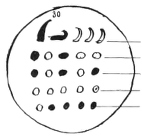 |
| |
| The big claw on end, 30, and 3 red claws, 15 |
45 |
| Two burnt sides up, nothing |
0 |
| Three blue sides up, 3 each |
9 |
| One eye side up, nothing |
0 |
| Four concaves up, 1 each |
4 |
|
58 |
SECOND THROW |
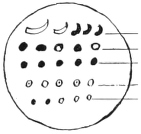 |
| |
| Two red, none on end, nothing by claw |
0 |
| Three burnt sides up, 4 each |
12 |
| Five blue sides up, 3 each |
15 |
| Three eye sides up, 2 each |
6 |
| Two concaves, nothing by tacks |
0 |
|
33 |
| THIRD THROW |
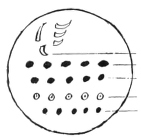 |
| |
| The big claw on end, 30, all the rest red, 20 |
50 |
| Five burnt sides, 4 each |
20 |
| Five blue sides, 3 each |
15 |
| Five eye sides up, 2 each |
10 |
| Five concave tacks, 1 each |
5 |
|
100 |
Nota Bene.—This is the best throw that can be made and takes all the stakes when the game does not
exceed 100.
Cos-Soo´, or Game of the Bowl
The step is done by jumping off both feet and striking them
forcibly on the ground, one a moment sooner than the other, always
keeping the exact time. No words are used in the song, and when
the round is about half finished it suddenly ceases, though the drumming
and dancing is continued, accompanied by a low simultaneous
grunt by all at each step. They commence the dance in the form
of a ring but do not go round. Dancing for the space of a minute
in the same position, they bend their bodies forward and press all to
the center of the circle, turning and looking in every direction without
any order, and when all are huddled very close, and that part of
the song arrives where the chorus is discontinued, all except the tune
on the drums, they keep it up for the space of about a minute afterwards,
when a sudden and general yell by all finishes that round,
and the form of the ring is resumed.
This is the principal occasion taken by those concerned to recount
their former deeds of valor or coups. The whole camp being spectators,
and the bravest of them present, also many in whose company
the acts now about to be published had been performed, makes it
indispensable that the boasts of the warriors should be confined to the
limits of truth. After one round has been danced a warrior (one
of the dancers) steps forth in the middle of the ring and speaks in
a loud voice to this effect, using his gun or lance in gesticulation:
“One or two years since, he, in company with 15 others, went upon
the Blackfeet and succeeded in bringing away 40 of their enemies’
horses” [here the drum is tapped once]. “On another occasion in a
battle with the Crow Indians six years since he struck an enemy
the first” [here follows two taps on the drum]. “At another time
he struck two enemies the second, took a gun and a tomahawk from
the dead enemies” [four taps on the drum].
“Also that in battle he took an enemy’s horse” [one tap]. “That
he fired fifteen shots” [one tap]. “Four years since, being near
the Blackfeet camp with six others in quest of horses, they were
discovered and pursued but succeeded in making their escape” [one
tap on the drum]. “Alone and on foot he, three years since [naming
the place] killed and brought to camp a full-grown grizzly bear” [one
tap on the drum]. “Behold where one of the balls of the Blackfeet
broke my arm” [one tap]. “Here an arrow pierced my thigh”
[another sound of the drum], etc., until he has run through the
catalogue of his meritorious acts, when he is honored with a general
shout of approbation, the music strikes up, the song commences, and
another round or two being performed, another warrior recounts his
coups in the same manner. In this way they continue until all who
wish have had an opportunity of renewing the remembrance of their
past deeds, and reestablishing their importance as braves in the eyes
of their countrymen. It takes some hours to prepare for and perform
this dance and it is only done twice or thrice a year. Although
the performers are naked, yet there is no idea of indecency29 attached
to this fact. They are in a manner obliged to appear in this state so
that they may publicly expose and point out any wound they may
have received in battle.
Wounds behind are fully as honorable as those before. Running
away where success is impossible is more commended than death or
defeat by remaining. The number of shots a man has fired during
the fight, if over 10, counts a coup, inasmuch as it shows he has
stood his ground long enough to fire that many.
Killing an enemy counts nothing unless his person is touched or
struck. The first who strikes the dead foe counts the best coup,
although each succeeding one counts as far as the fourth.
Scalping does not count more than striking. Taking an enemy’s
gun or horse or bow by any means counts a coup, likewise killing a
grizzly bear alone and on foot. Scalps are very little valued by him
who takes them. They are mostly cut up in small pieces and sent to
the different camps. The hair seen on the warrior’s leggings is sometimes
really the hair of the enemies slain by him, and at others his
own, or horsehair. In either case it is the symbol of having killed.
If he has struck even one enemy he is entitled to wear hair on his
shirt and leggings, but it is not absolutely necessary that it should be
the same hair as that which he took from his enemy’s head. Any
human hair or black horsehair will answer the purpose fully as well
if he has a right to wear it.
Fox Dance (To-kah-nah Wah-che).—This is done by those
who belong to the band called Foxes, who are pretty numerous among
several nations. It is got up with the view of publishing their feats
as in the preceding one, and also to display themselves as a body.
Their costume consists of a deer or antelope skin, shirt, and leggings
painted a bright yellow, and their faces painted with yellow
stripes, besides other forms. A dressed fox skin being slit in the middle,
the head of the man is thrust through, the skin spread out on his
shoulders, the head of which lies on his breast, and the tail hangs
down his back, the whole skin being fringed round with colored
garnishing of porcupine quills, bells, and polished buttons placed in
the eyeholes of the animal in the skin.
A headdress of foxes’ teeth, bored and strung, is stretched across
the middle of the head from ear to ear, a lock of their hair is tied
in front, which projects out several inches, and the rest, combed
straight down behind, to which at about the middle is attached four
war eagle feathers. Their lances are wrapped with fox skins cut
in strips, and the tails of that animal sewed on the handle every 12
inches or so. Some also carry their bows and quivers of arrows at
their side during the performance.
After having been warned of the meeting, and preparing in the
above manner, they assemble at the sound of several drums and
whistles at the spot appointed, being generally near the center of
the camp. Here they form in line during the drumming and singing,
which is kept up by five or six men and women who are invited
for the purpose (this music) taking their stand to one side, the
women as usual behind the drums, who sing, but take no part in the
dance.
When ready they all start off at a swift pace and describe the
movement of the coiling of a snake, and when wound up in this
form, all commence jumping up and down, striking one foot immediately
after the other on the ground, keeping exact time, and all
singing with the music for the space of about a minute, when a
general flourish on the drums and a shout or yell from the dancers
concludes that round, and their places in line are resumed.
Some one of them now steps forward and counts his coups in the
same manner as pointed out in the Brave Dance, which is succeeded
by another movement in dancing, which is again followed by another
speaking, and so on until all who wished have spoken, the drum denoting
by taps the value and number of coups thus counted by each.
The whole concludes by a feast given by one or more of the most
distinguished members of this club, during which their professions
of amity and assistance are renewed, and presents often exchanged;
the musicians also partake of the repast.
This club is composed of men from 20 to 25 or 28 years of age.
Duck Dance (Pakhan´tah Wah-che).—This is done by the
band who bear that name and are not so numerous as the others.
The same principles govern their proceedings, being to seek this
occasion to publish and perpetuate the memory of their past deeds
on the battle fields. The dancers are all naked except the breechcloth,
which hangs down before and behind one or two yards.
Their bodies are painted in various ways, principally striped, according
to the fancy of the individuals. No arms are carried in the
dance, but they hold in their hand a flat striped painted stick about
2 feet long, with which they keep the time. Women are excluded
from the ring but form a portion of the music. All sing, both
dancers and drummers. The evolutions are: Commencing in a ring,
they mingle together for a few minutes and conclude with a general
shout, after which coups are counted by those who wish, or
who are able, as in the preceding. The time, step, and figure of
every dance differ, but we can not describe them so as to be understood.
Bulls’ Dance (Tah-tun-gah Wah-che).—The kin called Bulls
is perhaps the most numerous among them, and a good many middle-aged
men and chiefs are found in this dance who do not figure in
the others. Their headdress is the skin of a buffalo bull taken off
as low as the shoulders of that animal, and dressed with the head,
horns, hair and snout complete. Around the holes where the eyes
were and in the nostrils and mouth are sewed pieces of scarlet cloth.
The skin is then sewed up along the back of the neck. The head
of the man is thrust in this, and the rest of his body being naked
except the breechcloth and moccasins, is painted with black and
red stripes. They carry guns and powder horns in the dance, moving
without any order, jumping about, snorting, and shaking their
horns at each other, and firing among their feet with powder. The
song is the Bull Song. They usually are attended by six or eight
drummers and singers, all males, who are not dressed in any
remarkable manner.
No speeches are made by the Bulls during the dance, but they seek
the occasion of other dances, such as the Braves or Soldiers to
which most of them belong, to perpetuate the remembrance of their
chivalrous deeds. This kin give a good many feasts to each other
and are said to be remarkably faithful in the observance of their
promises of mutual aid and protection.
Soldiers’ Dance (Ahkitchetah Wah-che).—This body of men
having already been fully described in these pages it will, of course,
be understood that their dance must include the most important
personages in camp. They seldom perform, and only with a view
of exhibiting their force as a body; and in the presence of strangers
or visitors to count their coups or when a war party is in contemplation,
with the intent of stimulating the ardor of the young to
follow them to battle. They must have some object to dance for, as
they are not men to expend much time merely for the sake of amusement
and display; besides their characters and acts are so well
known as to need no repetition.
Their costume is as nearly as possible that of warriors equipped
for battle. From the nose up their faces are painted a bright red,
and from thence down to the neck a jet black. The dancers form
the ring on foot but are attended by a guard of mounted soldiers,
dressed in very gay battle array, who ride round outside the ring
all the time, striking, and keeping at a respectful distance either
man or beast that is found in the way. A select band of drummers
and female singers is chosen and placed apart, who having struck up
the song, the dance is led off by a soldier alone, who moves out by
short steps toward the center of the circle, is soon joined by all the
rest, jumping and keeping the time, which round concludes with a
loud yell and discharge of firearms, and the one who led off the dance
counts his coups on his enemies in the manner before related. This
is also accompanied by taps on the drum denoting the number and
value of the coups and the speech, honored with a general shout of
approbation.
The warrior resumes his place, another leads off, and the same
behavior is repeated until all get through, the whole ending with a
feast of dog meat given by the chief of the soldiers in the Soldiers’
Lodge, to which the strangers, if any in the camp, are invited. This
is the most imposing and warlike dance they have, and is well calculated
to inspire the young with a desire for glory. Their dresses
and appointments are very gay and complete according to their rank,
their gesticulation and oratory fierce and bold.
White Crane Dance (Pai-hun-ghe-nah Wah-che).—There is no
band of this name, but the dance is got up by some divining man, most
probably for some begging purposes. He is the principal figure, being
painted yellow and wearing a dressed elk-skin robe on which a
large two-headed crane is painted. The costume of the others is
whatever their fancy dictates, and, of course, they put on the gayest
attire they can afford. The dancers are young men of any and all
kins who choose to take part, except women, who join the chorus.
The evolutions are different from any of the rest, as also the song, but
can not be described so as to be understood. The only one who
speaks during the performance is the divining man, and the tenor
of his speeches differs according to his object in introducing the
dance.
Crow Dance (Cong-ghai Wah-che).—This dance is performed
by the kin called Crows. Neck and head dresses of crow skins taken
off the bird entire with wings and head on are worn by all, and crow
feathers adorn their lances, shields, and other war implements. For
the rest, it proceeds much in the same way as the others. These are
mostly young warriors.
Dance of the Mice Comrades or Provision Stealers (Wok-e-po
maun noomp-pe).—This is done by a band of young men bearing the
above name. The dance is kept up all night and during it some of
them take by stealth the provision bales from the rest of the camp
who are asleep, on which they feast all night.
The dance is performed in a large lodge, or rather several lodges
thrown into one for the purpose. The bales or other property thus
obtained are kept until daylight, when the haranguer of the camp
publishes that those who have lost anything will go and redeem it,
and the several owners of the provision sacks present a piece of
tobacco to the dancers, who deliver them their property. By visiting
many lodges in the night a good deal of provisions, robes, etc., are
secured, which often take the best part of the next day to distribute.
The dress of this club, though gay, is not remarkable in any way
except they hold in their hands the skins of stuffed mice or have
the same attached to different parts of their attire. To describe the
whole of their dances in detail with the different costumes would
occupy too much space and perhaps not be required. We think
enough has been written to present a general idea of these performances
and their use with the Indians.
Whip Dance (Etchap-sin-tai Wah-che).—This dance is performed
by as many warriors as choose to assemble with whips ornamented
with eagle feathers and horse-skin wristbands tied to the
whips. In this the number of horses they have stolen from their
enemies at various times is boasted of.
Divining Dance (Tee-chagh-hah).—The divining dance is a
complicated religious ceremony occupying a whole day and that part
of it appropriated to dancing is done by men and women promiscuously,
headed by some of the divining men without any distinction
of kin or speeches regarding their coups. Their bodies are also
scarified and pieces cut out of their shoulders.
Women’s Dance (Ish-kun Wah-che).—This is a dance in which
women alone perform. They are painted in many ways and very
gaily dressed. The men drum and sing for them and the dancers are
ranged in two parallel lines opposite, dancing forward until they
meet, and then resuming their places. Besides the foregoing, there
are several other dances, all of which have for their object swaying
popular feeling in some way. Very little is done by Indians in any
form merely for amusement, and their dances in this respect partake
of the nature of the rest of their employments.
Most of these tribes, particularly the Sioux, are fond of ball playing
in parties. The principal game at ball is called Tah-cap-see-chah,
being the same denominated shinny or bandy by the whites. It is
generally got up when two different bands are camped together and
a principal person in each having made a bet of a blanket or gun,
they choose from their bands an equal number of young men, who
are always the most active they can select, the number varying from
15 to 40 on each side. Sometimes the play is headed by the chief of
each band betting, though they take no part in the game, which is
usually played by men 20 to 30 years of age. Each of the players
stakes something against an equivalent on the part of one on the
opposite side and every bet is tied together separately, which consists
of shirts, arrows, shells, feathers, blankets and almost every
article of trade or their own manufacture, and as fast as the bets
are taken and tied together they are laid on a pile about the center
of the playground, being given in charge of three or four elderly
men who are chosen as judges of the sport. After this has been
concluded two posts are set up about three-quarters of a mile apart
and the game consists in knocking the ball with sticks toward these
posts, they being the limit for either party in different directions.
They strip naked except the breechcloth and moccasins and paint
their bodies in every possible variety of manner. Each is furnished
with a stick about 3½ feet long, turned up at the lower end, and they
range themselves in two lines, commencing at the middle of the
ground and extending some distance on either side. The ball is cast
in the air in the center of the course, struck by some one as soon
as it falls, and the game begins, each party endeavoring to knock
the ball to the post designated as their limit. The game is played
three times and whichever party succeeds in winning two courses
out of the three is judged conqueror. When the players are well
chosen it is often an interesting game, and some splendid specimens
of foot racing can be seen, but when one of them either intentionally
or by accident hurts another by a stroke with the play stick a general
shindy takes place, and the sticks are employed over each other’s
heads, which is followed by a rush for the stakes, and a scramble.
We have seen them when this was the case arm themselves and
exchange some shots, when, a few being wounded, the camps would
separate and move away in different directions. Supposing, however,
the game proceeds in its proper spirit and humor, each bet
being tied separately, the parcels are handed out to the successful
party by the judges. This game is not often played by large parties
of men, or if so it is very warmly contested and very apt to break
up in a disturbance.
We have seen it also played by both men and women joined, a
few men aiding two parties of women. This was among the Sioux,
but with the other tribes it is generally played by men only.
Another mode of playing the game is by catching the ball in a
network over a small hoop a little larger than the ball attached
to the end of a stick. They catch it in this net as it flies through
the air, and throw it from one to the other toward either goal. The
man who catches can run with the ball toward the limit until he is
overtaken by one on the other side, when he throws it as far as he
can on its way, which is continued by the others. The women play
hand and foot ball, also slide long sticks on the snow, or billiards
with flat stones on the ice. We know of no other game at ball
worth mentioning being played among them.
Foot racing is often practiced by the Mandan and Crows. The
former nation before they were so much reduced by smallpox had a
regular race course 3 miles in length, in which any and all, who
chose, could try their speed, which they did by running three times
around this space, betting very high on either side.
They still practice the amusement, but not so much as formerly.
Foot races among the Crow Indians are usually contested by two
persons at a time, a bet being taken by those concerned, and many
more by the friends and spectators on either side, consisting of
blankets, buffalo robes, or some other article of clothing. They
mostly run about 300 yards and in starting endeavor to take every
advantage of each other, a dozen starts being often made before the
race begins. These Indians also run horse races, betting one horse
against the other. The same trickery and worse is displayed in
their horse races as in their foot races, and often the loser will not
pay. The Sioux also have foot races in which any one may join,
provided he bets, which, if they have anything to stake, they are sure
to do. The name of being a fast and long runner is highly prized
among them all; indeed, after being a warrior and hunter that of
being a good runner is next to be desired, but the principal aim in
all these amusements appears to be the winning of each other’s
property. They, of course, occupy and enable them to pass agreeably
some of the long summer days, but we never see these things
introduced without the bets or prospects of gain, and from this fact,
together with the earnestness exhibited in betting, and in the contest,
we conclude it to be no more than another mode of gambling, to
which they are all so much addicted.
Most of their leisure time either by night or by day among all
these nations is devoted to gambling in various ways, and such is
their infatuation that it is the cause of much distress and poverty
in families. For this reason the name of being a desperate gambler
forms a great obstacle in the way of a young man getting a wife.
Many quarrels arise among them from this source, and we are well
acquainted with an Indian who a few years since killed another,
because after winning all he had he refused to put up his wife to
be played for. Every day and night in the Soldiers’ Lodge not occupied
by business matters presents gambling in various ways all
the time; also in many private lodges the song of hand gambling
and the rattle of the bowl dice can be heard. Women are as much
addicted to the practice as men, though their games are different,
and, not being in possession of much property, their losses, although
considerable to them, are not so distressing. The principal game
played by men is that of the Bowl or Cos-soo´, which is a bowl made
of wood with a flat bottom, a foot or less in diameter, the rim turned
up about 2 inches, and highly polished inside and out. A drawing
and description of the arithmetical principles of this game is now attached
in this place. Pl. 72.) The manner of counting therein mentioned
is the manner in which we learned it from the Indians, but the
value of each of the articles composing the dice can be and is changed
sometimes in default of some of them being lost and again by
agreement among the players in order to lengthen or shorten the
game or facilitate the counting. However, the best and most experienced
hands play it as it is represented. It can be played between
two or four, that is, either one on each side or two against two.
The game has no limit, unless it is so agreed in the commencement,
but this is seldom done, it being usually understood that the players
continue until one party is completely ruined.
The bowl is held by the tips of the four fingers inside the rim
and the thumb underneath. The dice being put in, they are thrown
up a few inches by striking the bottom of the bowl on the ground,
so that each counter makes several revolutions. It is altogether a
game of chance and no advantage can be taken by anyone in making
the throws. The counters or dice never leave the bowl but are
counted as the value turns up. One person having shaken it and the
amount of his throw having been ascertained a requisite number of
small sticks are placed before him, each stick counting 1. In this
way the game is kept, but each keeps his adversary’s game, not his
own; that is, he hands him a number of sticks equal to the amount
of his throw, which are laid so that all can see them. Each throws
in turn unless the big claw stands on end, in which case the person
is entitled to a successive throw. By much practice they are able to
count the number turned up at a glance and the principles of the
game being stated on the drawing, we will now describe how it is
carried on. It has been observed in these pages in reference to their
gambling that it is much fairer in its nature than the same as carried
on by the whites and this is worthy of attention, inasmuch as it
shows how the loser is propitiated so that the game may not result
in quarrel or bloodshed, as is often the case.
The game is mostly played by the soldiers and warriors, and each
must feel equal to the other in courage and resolution. It is often
kept up for two or three days and nights without any intermission,
except to eat, until one of the parties is ruined.
Example.—A plays against B; each puts up a knife, and they
throw alternately until 100 is counted by the dice; say A wins. B
now puts up his shirt against the two knives, which is about equal in
value; say A wins again. B then stakes his powder horn and some
arrows against the whole of A’s winnings. Should B now win, the
game commences again at the beginning, as A would only have lost
a knife; but supposing A wins. B now puts up his bow and quiver
of arrows against all A has won—the stakes are never withdrawn but
let lie in front of them. Say A again wins. B then stakes his
blanket and leggings, which are about equal in value to all A has
won, or if not, it is equalized by adding or subtracting some article.
Supposing A again to be winner, he would then be in possession of
2 knives, 1 shirt, 1 blanket, 1 powder horn, 1 bow and quiver of
arrows, and 1 pair leggings, the whole of which the Indians would
value at 8 robes. B now stakes his gun against all the above of A’s
winnings. Now if A again wins he only retains the gun, and the
whole of the rest of the property won by A returns to B, but he is
obliged to stake it all against his gun in possession of A, and play
again. If A wins the second time he retains the whole and B now
puts up his horse against all of A’s winnings, including the gun.
A wins, he retains only the horse, and the gun and everything
else reverts again to B, he being obliged to stake them again against
the horse in A’s possession. If A wins this time, he keeps the whole;
but if B wins, he only gets back the horse and gun, and all the rest
of the property goes to A. Supposing B again loses and continues
losing until all his personal property has passed into the hands of
A, then B, as a last resort, stakes his wife and lodge against all his
property in the hands of A. If A wins he only keeps the woman;
the horse, gun, and all other property returns again to B with the
understanding, however, that he stakes it all to get back his wife.
Now if B loses he is ruined; but if A loses he gives up only the
woman and the horse, continuing the play with the rest of the
articles against the horse until one or the other is broke.
At this stage of the game the excitement is very great, the spectators
crowd around and intense fierceness prevails, few words are
exchanged, and no remarks made by those looking on. If the loser
be completely ruined and a desperate man, it is more than likely he
will by quarrel endeavor to repossess himself of some of his property,
but they are generally well matched in this respect, though
bloody struggles are often the consequence. We have known Indians
to lose everything—horses, dogs, cooking utensils, lodge, wife, even
to his wearing apparel, and be obliged to beg an old skin from some
one to cover himself, and seek a shelter in the lodge of one of his
relations. It is, however, considered a mark of manliness to suffer
no discomposure to be perceptible on account of the loss, but in most
cases we imagine this is a restraint forced upon the loser by the
character of his adversary.
Suicide is never committed on these occasions. His vengeance
seeks some other outlet, in war expeditions, or some way to acquire
property that he may again play and retrieve his losses. There are
some who invariably lose and are poor all their lives. A man may
with honor stop playing with the loss of his gun; he has also a second
opportunity to retire on losing his horse, and when this is so understood
at the commencement they do, but when a regular set-to takes
place between two soldiers, it generally ends as above described.
Ordinary gambling for small articles, such as beads, vermilion,
rings, knives, arrows, kettles, etc., is carried on by playing the game
of hand, which consists in shuffling a pebble from one hand to the
other and guessing in which hand the pebble lies. They all sit in
a ring on the ground, each with whatever stake they choose to put
up before them. Both men and women join in the game and a song
is kept up all the time by the whole with motions of the hands of
him who holds the pebble. After singing about five minutes a guess
is made by one of the parties as to which hand the pebble is in, and
both hands are opened. If the guess has been correct, the one holding
the pebble is obliged to pay all the rest an equivalent to the stake
before them; but if the hand not containing the pebble be picked
upon, all the ring forfeit their stakes to him. Either one man can
thus play against the whole or he has it in his power to pass the
pebble to the next, he betting like the others.
This is a very common game, and a great deal of property by it
daily changes hands, though seldom such large articles as guns,
horses, or women.
The usual game which women play alone, that is, without the men,
is called chun-kan-dee´, and is performed with four sticks marked on
one side and blank on the other, as described in Plate 73. The
women all sit in a circle around the edge of some akin spread
upon the ground, each with her stake before her. One then gathers
up the sticks and throws them down forcibly on the end, which makes
them rebound and whirl around. When they fall, the number of
the throw is counted as herein stated. Each throws in turn against
all others, and if the whole of the marked sides, or all the fair sides
of the sticks are turned up, she is entitled to a successive throw. The
game is 40, and they count by small sticks as in the preceding. In
fine weather many of these gambling circles can be seen outside their
lodges spending the whole day at it instead of attending to their
household affairs. Some men prohibit their wives from gambling,
but these take the advantage of their husband’s absence to play.
Most of the women will gamble off everything they possess, even to
the dresses of their children, and the passion appears to be as deeply
rooted in them as in the men. They are frequently thrashed by their
husbands for their losses and occasionally have quarrels among themselves
as to the results of the game.
Another game is played by the boys and young men which consists
of planting an arrow in the snow or ground and each throwing
other arrows at it until struck, and he who strikes the planted arrow
is winner of all the arrows then on the ground.
When a warrior dies the body is straightened and dressed in full
war dress, as for battle, the face being painted red. It is then
wrapped up in a blanket, which is again enveloped in scarlet cloth,
or his flag, if he has one; then his bow, quiver, sword, gun, powder
horn, battle ax, war club, tomahawk, knife, and his medicine or
charm are laid alongside and the whole baled with the body in his
buffalo robe, being the one on which his coups on his enemies are
painted. The last covering is the raw hide of a buffalo, hair inside,
which incloses all, and is strapped up tightly by strong cords passed
through holes cut around the edge of the skin, the whole presenting
the form of a large oblong bale. All this is done by some old men,
often some of the divining men, though not those who attended him
while sick; and the persons who pay this attention to the corpse
know they will be well paid by the relatives of the deceased, as it
is the greatest honor one Indian can confer on another and is a
claim on the patronage of the relatives during their life. Before
enshrouding the body some one of the persons who officiate cuts off
a lock of the dead man’s hair, which he retains a year. At the end
of that time the nearest relatives of the deceased buy the hair from
him at a very high price in horses, blankets, etc. This is another
long ceremony and should be described, but our limits do not
admit of it.
When the body is thus dressed and prepared for interment it is
the wish of the relatives to get it out of sight as soon as possible, or
in a few hours after dissolution, but it often happens that there is
no suitable place in the vicinity for burial and they are obliged to
carry it along for several days. Most of these tribes prefer scaffolding
the corpse on trees, which is the most ancient method of disposing
of them, arising from the want of tools to excavate, particularly
in the winter season, when the ground is frozen to the depth of 5
feet as solid as a rock, and for the reason that they wish the dead
to be placed where they can at all times feast and speak to them.
Of late years, however, they prefer their being interred by the whites
at the different trading forts if possible, but as this can only happen
to a few the others either scaffold them or inter them, when the
weather admits, on the tops of hills, covered with large stones, which,
being rolled on the grave after it is filled prevent the ravages of
the wolves and foxes. In either case the clothing, arms, medal, or
other trinkets not bequeathed are deposited with the body, and as
the sanctum of the dead is never disturbed nor these articles renewed,
they must present a sure criterion whereby to judge of their
state of arts and arms at the time of the interment as far as it is
possible to be determined by the nature of the materials thus deposited.
Supposing they are near the timber, and the man has died
in the night, the funeral takes place next day, or if he has died
during the day it is disposed of the following morning.
At the moment life becomes extinct the relatives set up a loud
howl, cut their hair and legs, and the neighbors crowd into the lodge,
each endeavoring to excel the other in the violence of their lamentations,
which are kept up without intermission from that time until
the funeral is over, by all, and during this interval the whole of the
property of the deceased, except his war horse and arms as mentioned,
is given away by the relatives to those who lament. All his
horses, skins, clothing, provisions, and a good part of that of his relatives
(brothers, father, etc.) must pass into the hands of strangers;
even the blankets off their backs, arms, and cooking utensils are
seized and carried away by those who aid in mourning. If he has
made a will, which occasionally happens, it is sometimes carried into
effect, but usually the nearest relatives sit around the body howling,
with their heads down, and pay no attention to the general pillage
which then takes place, or if they do, it is only to tell each of the
mourners which of their horses or other property to take away, giving
the horses to those who have aided in laying out the dead man.
Their custom is to make themselves as poor as they can be made on
these occasions, either in property or with regard to their persons.
The body being placed on a horse travaille crosswise, it is conveyed
to the spot for scaffolding by leading the horse, the whole following
without any order and uttering loud howlings, both men and women.
Several men now ascend the tree and draw up the corpse with strong
cords attached to it, placing the feet as near toward the south as the
fork of the tree will admit, and elevating the head part of the bale
so that it may face in that direction, after which it is secured by the
cords being tied round the limbs of the tree many times, to prevent
the wind from blowing it down.
When this is finished they recommence cutting their legs and
howling, calling on the deceased by the tie of relationship which
bound them, thus: “My brother” or “my son,” adding, “remain in
peace where you are; let your spirit go to the south and not be
troubled; we will feast you; do not visit us in spirit; you are happy;
and we are miserable.” These words are not distinguishable on
account of the noise, and most probably muttered; as, having witnessed
many of these funerals in every way, we have never heard any
other words than lamentations; but they say they do pronounce
them either mentally or very low, and that if it is neglected some
more of their relatives will die; consequently we are bound to believe
they utter these and other words in an audible voice. At this
stage of affairs his war horse is led under the tree and shot, in addition
to which, among the Crow Indians, a finger or two of each of
the near relatives are chopped off and the blood smeared over their
faces, left to dry there, and remain until it wears off. The deceased’s
shield, lance, or other implement, too long or unwieldy to be enveloped
with the body, are now tied at his head on the tree, and the
mourners retire. Some of the near relatives, however, often remain
all day and night, naked and barefoot, exposed to cold, snow, or rain,
for several days and nights without eating until they are completely
exhausted, and for a year or more afterwards wear nothing but an
old torn skin, which, with their bodies and faces, is smeared over with
white clay, and present a miserable appearance.
This is the most general custom among all the tribes of which we
write of disposing of their dead, and nine-tenths of them are scaffolded
in this way. Yet occasionally some, either by request or
desire of surviving relatives, or in the event of their dying where no
timber can be found, are interred on the top of a hill. In either case
the mourning and ceremonies are the same. When interred, the hole
or grave is excavated to the depth of about 5 feet, and made large
enough to contain the implements before referred to, which are all
buried with the body, the grave filled up and large rocks rolled upon
it. In either way no inscription or device is made to mark the spot,
nor any hieroglyphics carved on trees denoting the age, name of the
person, or anything else. No consolation is offered to Indians at the
time of the funeral, nor for several days afterwards. Those who
wish to console must aid to mourn, but say nothing. In a few days,
however, many elderly men invite the relations to feast and console
them by the usual arguments the nature of the case dictates. The
reason why the feet are placed southward and the face turned in that
direction is that the Indian paradise is supposed to be in that quarter,
and the soul is thus given to the South Wind to be carried off to that
point. Very brave and formerly renowned warriors sometimes requested
not to be interred in any way, in which case they are placed
inside their lodge propped up, in a sitting posture, dressed and
painted, the door of the lodge is closed tight, and the outside around
the lodge inclosed by a hedge of thick branches and dirt to prevent
the wolves from entering, and the whole is thus left on the plains.
In the course of time the lodge rots away, the wolves enter, and
the bones are scattered about or carried away by them. This is the
manner in which the Chief Wah-he´-muzza, or The Iron Arrow Point,
ordered his obsequies to be performed, giving for his reason that
he wished to remain above ground in order to see and hear his
children all the time and to have the spot rendered remarkable by
his being there.
The death of ordinary Indians is attended with like results, though
if not warriors of note they are merely enveloped in their ordinary
clothing and blankets or skins with their implements, but no horse
is killed over their grave. When women die their favorite dogs
are killed and all their tools for scraping and dressing hides, with
their pillow and porcupine quills, are enveloped with them. If she
be the wife of a chief or man of importance she is also wrapped in
scarlet cloth, formerly in painted skins. There is as much mourning
and distress observed on the death of their children, perhaps
more, than when grown. On these occasions often some one of the
parents destroy themselves, and all other Indians are very attentive
to them for several days until the most violent grief is over. Should
anyone offend the parent during this time his death would most
certainly follow, as the man, being in profound sorrow, seeks something
on which to wreak his revenge, and he soon after goes to war,
to kill or be killed, either of which being immaterial to him in that
state.
The reason the implements are deposited in the grave is that they
are supposed to be necessary to his being in the world of spirits. It
is a very ancient custom, perhaps coeval with their existence.
We know of no tumulus or barrow erected either in former or
later times through this country containing many bodies or possessing
the character of a charnel house, but are in the knowledge of
the graves of many chiefs either on scaffolds or on hills.
Bodies are never interred in a sitting posture, though that manner
is sometimes observed when deposited in the lodge above ground and
the posture preserved by stakes driven in around the body with forks
on the end supporting the different members and equilibrium.
There are no herbs or spices placed with the corpse, neither is it
submitted to any process analogous to embalming. It is enveloped,
as before mentioned, in skins to which those who can afford it add
scarlet cloth and blankets.
Scaffolding of corpses is the general manner of disposing of them
with all the prairie tribes, and the way they are prepared has been
alluded to. They would prefer having them boxed instead of baled,
but have no tools to prepare timber, and even if they had can not
at all times procure it, which together with their lack of means to
excavate in these frozen regions were no doubt the original causes
of this mode of burial. When bodies are brought to the trading
houses for interment or scaffolding they are always boxed by the
whites, the coffin being made large enough to contain the implements
and ornaments enveloped with the corpse. This in former times
was a great honor done the Indians and highly recompensed, but
of later years is a great bore and expense.
This method of securing them can, however, only be embraced
when death takes place near the houses, and consequently happens
to few. The Mandan and Gros Ventres, being stationed at the fort
with those nations, have their dead boxed by the whites and placed
on a scaffold made of posts planted near their villages. The Arikara
prefer interring them in the ground, and all the rest of the tribes
place their dead, secured in the manner described before, in the forks
of trees, which in a year or two, as soon as the cords rot off and
the envelopes fall to pieces, are blown down, and the bones are found
scattered beneath. Carnivorous birds, such as eagles, ravens, and
magpies, often pick at the envelope until they get at the body, but if
it is well strapped in rawhide it is generally secure from either birds
or beasts as long as it remains in the tree.
It is the custom of the Assiniboin to put up a funeral flag over
the graves of their dead, particularly children, which at this time
is composed of some such fabric as red flannel or calico tied to a pole,
but which was formerly made of feathers and light skins. This is a
very ancient custom, arising, we are told, from the necessity of
having some such object thus raised which, fluttering in the wind,
frightens away the beasts and birds of prey.
The custom of collecting and reinterring the bones is very general
at the present day among all these tribes; indeed, it is seldom
neglected if when they visit the scaffold they find the body to have
blown down and the bones exposed.
The bones are picked by any one of the party, not related, in the
presence of some of the relatives of the deceased, and this time buried
in the ground, with demonstrations of grief and some scarifying,
though they do not go into mourning dresses further than some white
clay about the face, and no property is confiscated by others, as in
the case of the first funeral, but those who aid are paid with some
smaller articles. On these occasions a feast is made for the dead
which, being eaten, and the spirit propitiated by prayer and invocation,
the whole concludes, those concerned resuming their usual dress
and occupations.
There is no such thing as charnel houses or receptacles for the dead
in all the district of the upper Missouri, neither are there any appearances
of such things having been, each individual being buried
or scaffolded separately at the most convenient place and as soon as
possible after decease.
Incineration of bones is not practiced by any of them, neither do
their traditions mention this custom to have ever existed among
them; they have a horror of the idea.
Their symbols of mourning have been referred to, which are cutting
short their hair, scarifying their legs, cutting off their fingers
(Crow Indians), wearing an old tattered robe or skin on their back,
the rest of the body being naked except the breech flap of the men,
or body dress of the women, bare legged, bare footed, the face, hair,
body, and robe smeared with white clay, often intermixed with
their blood.
When the lock of hair of the deceased has been redeemed by the
relative by high pay to him who took it, which is done in a year or
two after demise, this relic is inclosed in a small sack and carried on
the back of some of the female relatives. A piece of tobacco is
wrapped with it, which is used on several occasions, as before mentioned.
There are periodical visits to the grave, twice or thrice a
year for the first year, and afterwards for several years whenever
they happen to be in the vicinity, and on these occasions takes place
the feast to the dead, so often referred to in these pages, which is
one of their principal ceremonies. A repast is made of corn or
pounded meat mixed with grease and sugar, sometimes a dog is
cooked by some medicine man, and a crowd of people being assembled
round the grave after lamenting the dead by howling, smoke, and
pray to the spirit, leave a portion of the feast for it, and the rest is
eaten by those who attend the ceremony. One of their prayers at
these times is recorded in a former page, together with the reason of
these observances. Fires are kindled near the grave or under the
scaffold, but do not appear to be of further use than to light the pipe
by while smoking to the dead, and are suffered to expire at their
leisure.
No gravestones or posts are planted to mark the place, or any
inscriptions or devices painted or carved by any of these tribes,
denoting the age of the deceased or any other thing.
As has been frequently stated, there are no large mounds perceived
on the upper Missouri, the work of Indians, as have been discovered
in some of the western States, but were it an object or custom to bury
the dead in that manner we believe there is energy and power sufficient
among any of these tribes to accomplish a work of the kind,
even with the rude tools they have, in a loose soil, free of rock, and
in the summer season. These mounds have most probably been national
or public depositories for the dead of Indians in stationary
huts; and as great superstition is attached to all funeral rites, it is
not improbable they were excavated in a length of time by the united
efforts of the nation. Being a work in which both women and children
could join, and which could be executed with the most primitive
tools, they no doubt worked at it in favorable seasons, stimulated to
exertion by the directions and commands of the divining men. These
marks of antiquity only prove the nation to have been numerous,
stationary, and unanimous in the undertaking. The materials disinterred
from these receptacles must show beyond doubt the state
of arts and advancement of the tribe at the time the interment was
made, supposing the articles thus exhibited to be of their own manufacture
and not traded from Europeans. Bones reburied are not
accompanied with a new deposit of instruments.
Those articles first enveloped with the body, if found, are reinterred
with it, which, having been the property of the deceased, are
valuable, but to none other. It is only when the corpses fall from
scaffolds or the bones of the dead by some means have become exposed
that a second burial takes place; otherwise no Indians disturb
the repose of the dead.
The care of orphan children and the aged devolves upon the
nearest relatives of their deceased parents, but neither the chiefs
nor any other persons not of kin pay them the least attention, unless
they are adopted into their families. The aged and infirm are
supported by their sons and other relatives until they become helpless
and a burden, and are then left in some encampment to perish.
There are no very old people without some relatives. The fact of
their being old presumes that some of their lineal descendants are
living, and it is with these they reside; but should there be no kin
whatever acknowledged they would only the sooner die, as neither
chiefs, hunters, nor any others would take the least interest in them,
much less furnish them with provisions or be troubled by packing
them along in traveling. Should an aged person of this description
die in camp the body would be wrapped in the skins composing its
bed and stuck on a tree by some of the men, without the least symptom
of mourning. The life of the aged of both sexes, even with
their own children, is one of drudgery and misery, and when entirely
helpless they are in a manner obliged to get rid of them in
some way, as their manner of traveling and conveniences of lodging
are not adapted to the infirm.
A very near and correct view of their means and disposition warrants
the opinion that it is more through extreme necessity than
hardness of heart that they resort to the inhuman alternative above
mentioned. Age without power is never venerated even by sedentary
Indians, though these can and do treat the infirm better than
the roving tribes, because, being better prepared with commodious
lodges and not obliged to travel, the burden of useless and aged persons
is not so much felt. They are therefore tolerated for their
talents in story telling and other qualifications, exciting more their
laughter than their abuse or neglect. But it is always a hard fate.
The others will say they have had their day, their youth, and their
prime, have enjoyed much and should now die and remove the burden
of their care. They all know and expect this to be their own
fate if life be prolonged, and hence we find the influence of chiefs,
once renowned, declining with age or debility. Their gallant acts
and services are forgotten or laughed at, later incidents of the
same nature replacing theirs in the memory of their friends; they
are neglected, ridiculed, imposed upon, and, being helpless, submit.
It does happen with some divining men that the older and uglier
they become the more they are feared for their supernatural powers,
and these, as long as they can sing and drum, are well off, because
they can always command property for their services and pay their
way for any attention or assistance, besides their supposed supernatural
powers prevent any practical jokes or petty torments from
being inflicted as on ordinary aged persons.
There are but few old people of either sex. Their lives are too
laborious, precarious, and exposed to secure an advanced age.30
The lodges of the Sioux, Crows, Assiniboin, Cree, and Blackfeet are
made of buffalo skins, hair shaved off and dressed, then sewed together
in such a manner that when placed upright on poles it presents
the form of an inverted funnel. The skins are dressed, cut out,
and the lodge made up altogether by the women. When cut and
sewed and laid on the ground it is in shape nearly three-quarters of
a circle, with the two wings of skins at the small end to serve as
vanes, which are changed by moving the outside poles with the wind,
to prevent the lodge from smoking. The tent is stretched on poles
from 12 to 20 feet in length according to the size of it, each family
making one to suit the number of persons to be accommodated or
their means of transporting it; therefore their sizes vary from 6 to
23 skins each, the one being the smallest, and the other the largest
size in general use, the common or medium size being 12 skins, which
will lodge a family of eight persons with their baggage, and also
have space to entertain two or three guests. The area of a lodge of
12 skins when well pitched is a circumference of 31 feet, and the
space each grown inmate requires for bed and seat would be about 3
feet in width. People seldom stand upright in a lodge. They enter
in a stooping posture, and moving forward in this way to the seat
opposite, sit there until they leave. (Pls. 74, 75.)
When sleeping the feet of every one is turned toward the center
of the lodge, where the fire is made, the smoke escaping at the opening
in the top. The material will last with some repairs about three
years, not longer. They usually make new lodges every third summer
and cut up their old ones for leggings and moccasins. Their
lodges are always carried along when they travel with the camp,
being packed on a horse in summer, or on a travaille in winter, in
default of horses, and when the snow is deep they keep out wind and
rain and answer all their purposes, but are cold, smoky, and confined.
Families of from 2 to 10 persons, large and small, occupy tents of
different dimensions, say, one of 6 skins for the former and one of
16 skins for the latter number. Lodges of 36 skins are sometimes
found among the Sioux, owned by chiefs or soldiers. These when
carried are taken apart in the middle in two halves and each half
packed on a separate horse. When erected, the halves are again
joined by wooden transverse pins, the poles are dragged on the
ground, being tied together in equal-sized bundles, and slung to each
side of the horses. A tent of this size will accommodate 50 to 80
people on an occasion of feast or council, as they can sit in rows three
or four deep; about 30 persons, however, could sleep therein with ease,
independent of the space required for baggage, provisions, and utensils.
The females, young and old, aid in making them, and the eldest
of them erects, removes, and arranges the locations of the interior
in the manner described in a former answer.
They are never vacated and left standing, but are needed wherever
they go to protect themselves and property from the weather. The
skins are put up when sewed together in proper form without being
smoked, as the smoke from the fire in the inside soon penetrates them
and renders them impervious to rain. The men have nothing to do
with the construction, erection, removal, or internal arrangement of
the lodges.
BUREAU OF AMERICAN ETHNOLOGY
FORTY-SIXTH ANNUAL REPORT PLATE 73
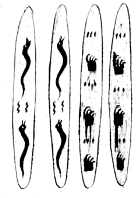 |
Four sticks 12 inches long, flat and rounded at the ends, about 1
inch broad and one-eighth inch thick, are used. Two of them
have figures of snakes burned on one side, and two the figure
of a bear’s foot burned on. All the sticks are white on the
sides opposite the burned sides. |
| THROWS |
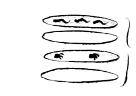 |
Two painted or marked sides and two white count |
2 |
 |
All the white sides turned up count |
10 |
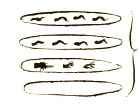 |
Three burned sides up and one white count nothing |
0 |
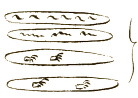 |
Four burned sides up count |
10 |
Nota Bene.—Three white sides up and one burned side up counts nothing.
The Chun-kan-dee´ Game
BUREAU OF AMERICAN ETHNOLOGY
FORTY-SIXTH ANNUAL REPORT PLATE 74
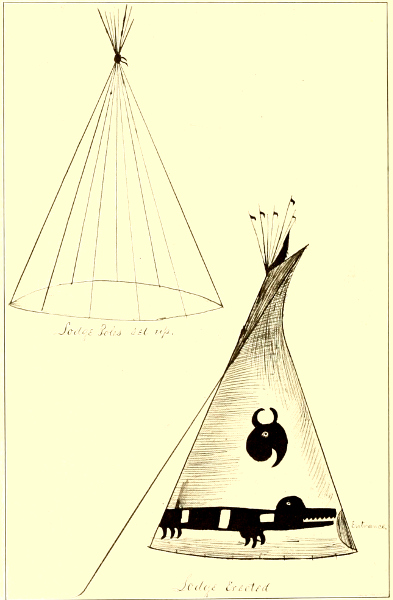
A Lodge Frame and a Completed Lodge
BUREAU OF AMERICAN ETHNOLOGY
FORTY-SIXTH ANNUAL REPORT PLATE 75
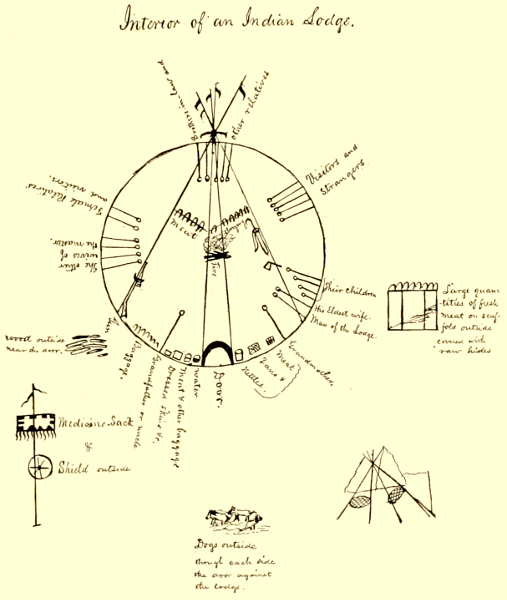
The Interior of a Lodge and Its Surroundings
BUREAU OF AMERICAN ETHNOLOGY
FORTY-SIXTH ANNUAL REPORT PLATE 76
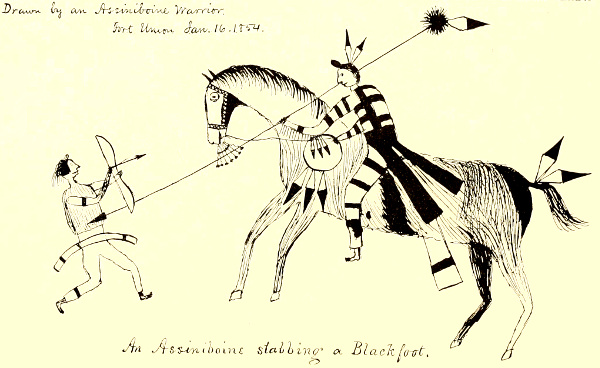
An Assiniboine stabbing a Blackfoot.
Drawn by an Assiniboine Warrior.
Fort Union Jan. 16. 1854.
The Mandan, Gros Ventres, and Arikara live in dirt cabins made
by planting four posts in the ground, with joists on the top. From
this square descend rafters to the ground in angular and circular
shape, the interstices being filled with smaller sticks and willows;
then grass is laid on, which is covered with mud, over which is thrown
earth, and the whole beaten solid. An opening is left in the top for
the smoke and a door in the side, which is extended into a covered
passage of a few steps and will admit a man upright. These are
large and roomy huts, will accommodate 30 or 40 persons each, but
are generally occupied by one family, who frequently have their
beds and bedsteads, corn cellar, provision room, and often a horse
or two under the same roof. They are said to be damp and unhealthy.
The figures and representations of animals, etc., painted on their
skin lodges are those of monsters seen by them in their dreams;
also the hand is dipped in red paint mixed with grease and its impression
made in many places over the tent. This denotes the master
of the lodge to have struck an enemy. The same impression is also
made on their naked bodies in some of their dances and has the same
signification.
Skin canoes are the only watercraft used by these tribes, and
these are only to be found among the Mandan, Gros Ventres, and
Arikara. They are made of the skins of one or two buffaloes with
the hair on, not dressed, and stretched over a basketwork of willows.
The women make, carry, and propel them with paddles, one person
only paddling in front. A canoe of one buffalo skin will contain
four persons and cross the Missouri, but they must sit very quiet
or they will upset. The women carry these canoes on their backs
along the bank to the place where they wish to cross, and on their
return bring them to the village and turn them upside down to dry.
A canoe of this kind is made in two or three hours and will last a
year. Bark canoes are used by the Chippewa, but we are not well
enough acquainted with their construction to describe them. When
no skin can be found to make a boat war parties will cross any river
on a raft.
There is no doubt but most of these nations are disposed to advance
from the barbaric type, though as yet they have made but little
progress. Indeed, when we consider their mode of life, wants, and
situation with regard to each other we can not imagine how they
can well be anything more than what they are. Harassed by internal
wars, pinched by necessities that compel them to constant exertion,
discouraged by the ravages of diseases, and overwhelmed by
innumerable superstitious fears, their condition is not one calculated
to prepare either mind or body for the arts and habits of civilization.
The whole tenor of an Indian’s life, and the sum and substance
of all his labors is to live, to support his family, and rear
his children, and he must bring them up in such a way that they in
their turn can do the same. For this all is risked, and to this end
the whole of their occupations, even their amusements, tend. They
would be most willing to embrace any mode of life by which this
main object could be realized with less risk and toil than the one
they now pursue, but they must first be convinced of the certainty
of success in the strange pursuit to which their formed habits must
give way before they would apply themselves.
Their present manner is certainly precarious, but they would not
abandon it unless some better way to live was made manifest, not
by tales and speeches but by actual experiment. Indians (men) will
not work. Even the slight attempt at agricultural labor by the few
nations on the upper Missouri who raise corn and other vegetables
devolves solely upon the women to perform them, and the men hunt
as the other tribes. Meat must be had, and as yet no relish has been
formed by any of them, except the Sioux, for the flesh of domestic
animals. Notwithstanding all this, we see in many things a desire
to change for the better, exhibiting itself in a general feature of improvement
when compared with that of 20 years since. Within that
time and within our acquaintance with these people the Sioux, Assiniboin,
and other nations were much more savage than they now
are. At the period to which we allude it was almost impossible for
even the traders, much less strangers, to travel through their country
without being robbed and often killed. Horses were stolen from
whites on all occasions; every person outside the fort was liable to
be abused, imposed upon, flogged, or pillaged, and even their dealings
with each other were no better. Murders upon slight provocation,
robberies, and misdemeanors of all kinds were common among
them. Even whole bands armed against each other and skirmishes
took place whenever they met.
All these things now, if not obsolete, are very rare. Whites move
about among most of the nations with security of life and property,
and the Indians are better clothed, provided for, armed and contented
than formerly. For these happy results so far we are indebted to the
unmitigated exertions and good counsel of a few white traders of the
old stock, some good Indian agents, the entire abolishment of the
liquor trade, and lately the humane endeavors on the part of the
Government by the treaty at Laramie in 1851.
Most of them are beginning to see the superiority of drugs and
treatment of the sick as exhibited to them by whites and are becoming
aware that their drummings and superstitions are of no avail,
but it is only a perception of truth, not as yet leading to any change
in their superstitions, because no person instructs them in aught
better. As it stands at present and to come to the point of this
matter, we would say a disposition to emerge from barbarism is
apparent among most of these tribes, though as yet no great advancement
has been made. The small improvements alluded to only show
the desire to exist, but their present organization, knowledge, and
relative positions to each other as nations do not admit of further
improvement, which must necessarily unfit them for their ordinary
pursuits and successful contention with enemies.
Their provisions, cooking utensils, manner of cooking, serving the
meal and eating assimilates yearly more to that of the whites. Their
conversation, desires, and willingness to listen to counsel for their
benefit all convince of a disposition to advance toward civilization
and exchange their present mode of life for one more certain in
its resources, provided they could follow these employments secure
from the depredations of neighboring tribes yet their enemies; but
here is the difficulty, they are obliged to be always in readiness for
war, also to make excursions on their foes to replace their stolen
horses or revenge the death of their relatives.
They usually eat three times a day, morning, noon, and night, if
meat is plenty, but the number of meals depends altogether on
the supply of food, as has already been stated. Clay pots and other
earthen vessels are still in use among the Mandan, Gros Ventres, and
Arikara, being of their own manufacture, though they also have
metallic cooking utensils.
The flesh of buffalo and other animals is cut in broad, thin slices
and hung up inside the lodges on transverse poles over the fire, but
high up in the lodge and in the way of the smoke, which soon penetrates
it, and in a few days the meat is dried and fit to pack away.
In the summer it is dried by spreading it in the sun, being cut up
as above, which soon cures it. They employ no salt in curing any
meat.
The parts of the buffalo eaten in a raw state are the liver, kidneys,
gristle of the snout, eyes, brains, marrow, manyplies, or the omasum,
testicles, feet of small calves in embryo, and glands of the calf
envelope. Meat when cooked is either boiled or roasted, principally
the former, and always rare in either way, not overdone.
They have no salt for seasoning, but are fond of a little in the
bouillon. In former times meat was boiled in the rawhide, in holes
in the ground smeared with mud, and heated stones dropped in, or
in pots made of clay and soft stone, but metallic cooking utensils,
consisting of kettles of every size and description, have entirely replaced
these. Tin cups and pans, with some frying pans, wooden
bowls, and horn spoons, are yet common.
The tongues of buffalo sent to market are salted by the traders,
who secure them from the Indians during the winter in the hunting
season, and when frozen, salting them before the spring thaw comes
on. None of these tribes preserves meat in any other way than above
mentioned, some of which when dried is pounded and mixed with
berries and marrowfat. It is then called pemmican, or in Cree
pim-e-tai´-gan. Dried meat will keep but one year if free of wet,
as afterwards the fat turns rancid and the lean tasteless.
The tail of the beaver is first turned in the blaze of a fire, the outside
skin scraped off, then incisions are made each side lengthwise
along the bone, and it is held in boiling water for a few minutes
to extract the blood. It is then hung up in the lodge or in the
sun and left to dry.
All inquiries regarding fish are inapplicable to these Indians, as
they take none in quantity. The few catfish that are hooked by the
Gros Ventres and Arikara are boiled in water, no salt added, and a
horrid mess of bones and fish mixed together is produced, which
no one but an Indian could eat. They eat but do not relish them.
All the hunter tribes rely greatly on the spontaneous roots and
fruits found in the country and collect, dry, and pack them away,
to be used in times of scarcity of animal food. We have known hundreds
of Indians to subsist for one or two months on the buds of the
wild rose boiled with the scrapings of rawhides. At all times the
different kinds of roots and berries are a great resource, are used in
their principal feasts and medicine ceremonies, are of great assistance
when game is not to be found, are easily packed, and contain
considerable nourishment. The following is a catalogue of those
found among all the nations of which we treat, though there are
several others whose names in English are unknown to us, and some
of these now named peculiar to the most northern latitudes.
Roots, Berries, etc., Eaten by the Indians of the Upper Missouri
| English Name |
Assiniboin name |
Method of preparation |
| Prairie turnip (pomme blanche) |
Teep-se-nah |
Dried and pounded. |
| Service berries |
We-pah-zoo-kah |
Dried. |
| Bull berries (grains des boeufs) |
Taque-sha-shah |
Do. |
| Chokecherries |
Cham-pah |
Pounded with seeds and dried. |
| Red plums |
Caun-tah |
Stones extracted and dried. |
| Wild grapes |
Chint-kah |
Not preserved; eaten ripe. |
| Currants |
Wecha-ge-nus-kah |
Do. |
| Gooseberries |
Chap-tah-ha-zah |
Do. |
| Wild rhubarb |
Chan-hn-no-ha |
Tops eaten raw or boiled. |
| Fungus growing on trees |
Chaun-no-ghai |
Not dried; found in winter. |
| Artichokes |
Pung-ghai |
Eaten raw or boiled; not preserved. |
| Berries of the red willow |
Chau-sha-sha |
Eaten raw only in great need. |
| Antelope turnips |
Ta-to-ka-na Teep-se-nah |
Boiled and dried. |
| Wild garlic |
Ta-poo-zint-kah |
Raw; not preserved. |
| A berry called |
Me-nun |
Not dried; eaten ripe. |
| Acorns31 |
Ou-tah-pe |
Roasted and dried. |
| Strawberries |
Wa-zshu-sta-cha |
Not dried. |
| Inner bark of cottonwood |
Wah-chin-cha-ha |
Resorted to in time of actual famine. |
| Berries of the smoking weed |
She-o-tak-kah |
Not preserved; eaten ripe. |
| A root resembling artichoke |
Ske-ske-chah |
Dried, pounded, and boiled. |
| Buds of the wild rose |
We-ze-zeet-kah |
Found everywhere all winter on the stalk. |
| Red haw berries |
Tas-paun |
Not dried; eaten in fall and winter. |
| Animals Eaten by Indians |
| Buffalo (wo-ta-cha) |
|
| { bull |
Ta-tun-gah. |
| { cow |
Petai. |
| Antelope |
Tah-to-ka-nah. |
| Elk |
Opoñ. |
| Deer |
Tah-chah. |
| Bear |
Wah-ghuñ-kseecha. |
| Wolf |
Shuñkto-ka-chah.32 |
| Foxes |
|
| { red |
Shunga shanah. |
| { gray |
To-kah-nah. |
| Porcupine |
Pah-hee. |
| Badger |
Kho-kah. |
| Skunk |
Man-gah. |
| Rabbit |
Mushtinchanah. |
| Hare |
Mushtincha ska. |
| Ermine |
E-toonka sun. |
| Otter |
Petun. |
| Mink |
E-koo-sa. |
| Beaver |
Chap-pah. |
| Muskrat |
Sink-pai. |
| Glutton |
Me-nag-gzshe. |
| Lynx |
Ega-mo´ |
| Mouse |
Pees-pees-anah. |
| Ground squirrel |
Tah-she-ho-tah. |
| Water turtle |
Kai-ah. |
| Terrapin |
Pat-kah-shah. |
| Horns of elk in the velvet. |
Tah-hai. |
| Horse |
Shungatun-gah. |
| Mule |
Sho-shonah. |
| Dog |
Shunka. |
| Snake (not eaten except by Cree). |
|
| Birds Eaten |
| Crow |
Ah-ah-nah. |
| Raven |
Con-ghai. |
| Magpie |
Eh-hat-ta-ta-na. |
| Owl |
He-hun. |
| Duck |
Pah-hon-tah. |
| Goose |
Man-ghah. |
| Crane |
Pai-hun. |
| Pelican |
Mid-dai-ghah. |
| Small bird of any sort. |
Sit-kap-pe-nah. |
| Eagles are not eaten. |
|
| Parts of Buffaloes Not Eaten |
| Glands of the neck. |
Sinews. |
| Bull’s pizzle. |
Horns, hoofs, and hair. |
Every other part, inside and out, is eaten, even to the hide.
Sugar is made from the sap of the maple. Wild rice is gathered by
the Cree and Chippewa on Red River and the adjacent lakes, but
not by the upper Missouri tribes. In times of great scarcity old
bones are collected by the nations of whom we write, pounded, and
the grease extracted by boiling, and eaten together with any of the
foregoing roots or berries that can be found. But these sad times
always happen when the snow is deep, the ground frozen, and they
can not be found. Then those who have not laid up a stock of some
of these roots the previous summer are driven to the necessity of
killing and eating their horses and dogs, which being exhausted and
nothing more to be found they are compelled to eat human flesh.33
In the materials of their clothing, as far as the cold climate will
admit, articles of European manufacture have been substituted for
their skins, but there being no fabric as yet introduced equal to or
even approaching the durability and warmth of the buffalo skin,
all hunters and travelers in the winter season must be clothed with
the latter to preserve life or prevent mutilation by frost. Still in
the summer season these are laid aside, being full of vermin and
saturated with grease and dirt, and the Indian steps proudly around
in his calico shirt, blanket, and cloth pantaloons. Their hair also,
formerly tangled and matted, has been unraveled by the use of different
kinds of combs, and the livestock, which found “a living and a
home there,” has, by these instruments, been torn from their comfortable
abode, thus rendering useless their original method of disposing
of these vermin, viz., extracting them with their fingers and
masticating them in turn for revenge.
Most of the clothing used by these tribes is made of skins of their
own procuring and dressing, the process of which has already met
with attention. They have different dresses for different seasons,
also various costumes for war, dancing, and other public occasions,
some of which have been described. In the summer seasons, when
comparatively idle, the clothing traded from the whites is preferred
on account of its superior texture and color, but in their usual occupations,
in winter, at war, in the chase, or any public ceremonies
among themselves, very few articles of dress thus obtained are seen,
if we except some blankets, undercoats, scarlet cloth, and ornaments.
Their own dresses of skins fancifully arranged, adorned with
feathers, beads, shells, and porcupine quills, are much more highly
prized by them than any article of dress of European manufacture
introduced by the traders.
We will now detail a few of the most common or everyday dresses
among them, in different seasons, male and female, estimating the
cost of each in buffalo robes at $3 each, their value in this country.
Summer and Fall Dress for Men
| No. 1 |
| A buffalo robe, thin hair, or a dressed cowskin robe on the back |
1 |
|
robe |
|
| Dressed deer or antelope skin leggings |
1 |
|
robe |
|
| Cloth breech flap and moccasins |
|
½ |
robe |
|
|
2 |
½ |
robes |
at $3=$7.50 |
| No. 2 |
| A scarlet blanket |
4 |
|
robes |
|
| Beads worked in same |
10 |
|
robes |
|
| Deerskin shirt and leggings fringed and garnished
with beads and porcupine quills |
5 |
|
robes |
|
| Breech flap of scarlet cloth and moccasin |
1 |
|
robe |
|
| Necklace of bear’s claws |
5 |
|
robes |
|
| Moccasins and handkerchief for the head |
1 |
|
robe |
|
|
26 |
|
robes |
at $3=$78.00 |
| No. 3 |
| White blanket |
3 |
|
robes |
|
| Calico shirt |
1 |
|
robe |
|
| Neckerchief and cloth breech flap |
1 |
|
robe |
|
| Cottonade pantaloons |
1 |
|
robe |
|
| Muskrat cap |
1 |
|
robe |
|
| Moccasins |
0 |
|
robe |
|
|
7 |
|
robes |
at $3=$21.00 |
| No. 4 |
| White blanket |
3 |
|
robes |
|
| Blanket capot |
3 |
|
robes |
|
| Skin leggings, plain antelope skin |
1 |
|
robe |
|
| Breechcloth and moccasins |
|
½ |
robe |
|
|
7 |
½ |
robes |
at $3=$22.50 |
| No. 5 |
| Scarlet or Hudson Bay blanket |
4 |
|
robes |
|
| Beads worked on same |
10 |
|
robes |
|
| Scarlet laced chief’s coat |
6 |
|
robes |
|
| Black fur hat and three cock feathers |
2 |
|
robes |
|
| Silver hatband and plate |
2 |
|
robes |
|
| 1 pair silver arm bands |
2 |
|
robes |
|
| Scarlet cloth leggings and hawk bells |
1 |
|
robe |
|
| Black silk handkerchief and cloth breech flap |
1 |
|
robe |
|
| Silver gorget, ear wheels and hair pipe |
2 |
|
robes |
|
| Moccasins garnished with beads |
|
½ |
robe |
|
|
30 |
½ |
robes |
at $3=$91.50 |
Winter Dress for Men
Hunter’s winter dress of the Plains
No. 7 |
| Buffalo robe coat, hair inside |
1 |
|
robe |
|
| Buffalo robe over it |
1 |
|
robe |
|
| Skin cap and mittens, hair inside |
|
½ |
robe |
|
| Blanket breech flap, robe, moccasins, belt knife,
and fire apparatus |
|
½ |
robe |
|
Dressed cowskin leggings
1 pair snowshoes |
|
½ |
robe |
|
|
3 |
½ |
robes |
at $3=$10.50 |
| No. 2 |
| White blanket coat with hood |
3 |
|
robes |
|
| White blanket over it |
3 |
|
robes |
|
| Flannel or calico shirt |
1 |
|
robe |
|
| Blanket leggings |
1 |
|
robe |
|
Soled rope moccasins
Blanket breech flap
Skin mittens, hair inside |
1 |
|
robe |
|
|
9 |
|
robes |
at $3=$27.00 |
No. 2 is the dress of a wood hunter, ordinary warrior in winter,
if we take away the blanket and substitute a buffalo robe; or it is
worn in traveling, and is occasionally used by hunters in the Crow
and Sioux Nations, but the Cree and Assiniboin mostly wear No. 1
winter on the plains. Other ordinary dresses are only variations
of the foregoing, adding some articles and withdrawing others, but
none of them are used when in full dress, on public occasions, among
themselves, except sometimes No. 5. All their fancy dresses for
dances, war, and feasts have their peculiar marks and distinction
in rank; also the robes worn by chiefs, soldiers, or warriors in stated
assemblies have their battle scenes painted on them in rude drawings,
though intelligible to them. When merely designed to be ornamental
the drawing consists of a representation of the sun, made
by a large brilliant circle painted in the middle. Sometimes a
calumet is pictured, and other devices, such as guns, bows, lances,
horses, etc.
The dresses of the divining men are not distinguished from those
of ordinary Indians by any marks, unless they are able and wish
to renew the remembrance of their former coups on their enemies
by wearing a robe on which they are drawn, but being generally
old they seldom make any display in dress, though wearing a cap
or piece of bearskin round the head is common with them. The
rest of their clothing in summer would answer to No. 1 and in winter
to No. 2, abstracting the blanket capot.
Women’s Summer Dresses
| No. 1 |
| Dressed cowskin cotillion |
1 |
|
robe |
|
| Leggings of same |
|
½ |
robe |
|
| Dressed cow or elk-skin robe |
1 |
|
robe |
|
| Moccasins |
0 |
|
robe |
|
|
2 |
½ |
robes |
at $3=$7.50 |
| No. 2 |
| Colored blanket |
4 |
|
robes |
|
| Blue or scarlet cloth dress |
3 |
|
robes |
|
| Garnishing of beads on same |
5 |
|
robes |
|
| Scarlet cloth leggings ornamented with beads |
2 |
|
robes |
|
| White deerskin moccasins worked with beads |
1 |
|
robe |
|
| Heavy bead earrings and necklaces |
4 |
|
robes |
|
| Brass-wire wristbands and rings |
1 |
|
robe |
|
|
20 |
|
robes |
at $3=$60.00 |
| No. 3.—Crow Indians |
| Fine white dressed elk-skin robe |
1 |
|
robe |
|
| Fine white bighorn skin cotillion adorned with 300 elk teeth |
25 |
|
robes |
|
| Neck collar of large brass wire |
1 |
|
robe |
|
| Fine antelope skin leggings worked with porcupine quills |
3 |
|
robes |
|
| Brass wire wristbands and rings |
1 |
|
robe |
|
| California shell ear ornaments |
3 |
|
robes |
|
| Very heavy bead necklaces |
3 |
|
robes |
|
| Moccasins covered with beads |
2 |
|
robes |
|
|
39 |
|
robes |
at $3=$117.00 |
| No. 4.—Sioux |
| Fine white dressed elk skin robe, painted |
1 |
|
robe |
|
| Fine white dressed antelope skin cotillion heavily ornamented with beads or shells on breast and arm |
30 |
|
robes |
|
| Leggings of same ornamented with beads |
3 |
|
robes |
|
| Bead or wire necklace |
2 |
|
robes |
|
| Garnished moccasins and brass breast plate |
1 |
|
robe |
|
| Ear bones |
3 |
|
robes |
|
|
40 |
|
robes |
at $3=$120.00 |
| No. 5.—Common Sioux, Assiniboin, or Crow Dress |
| White blanket |
3 |
|
robes |
|
| Blue cloth cotillion or green cloth |
2 |
|
robes |
|
| Scarlet cloth leggings |
1 |
|
robe |
|
|
6 |
|
robes |
at $3=$18.00 |
| No. 6.—Winter Dress |
| Buffalo robe |
1 |
|
robe |
|
| Dressed cowskin cotillion |
1 |
|
robe |
|
| Dressed cowskin leggings and shoes |
1 |
|
robe |
|
|
3 |
|
robes |
at $3=$9.00 |
| No. 7.—Winter Dress—Crows |
| Buffalo robe much garnished with porcupine quills |
4 |
|
robes |
|
| Big Horn cotillion trimmed with scarlet and
ornamented with porcupine quills |
3 |
|
robes |
|
| Leggings of elk skin, fringed and worked with quills |
2 |
|
robes |
|
| Wrist, ear, and neck ornaments, say |
3 |
|
robes |
|
|
12 |
|
robes |
$3=$36.00 |
There are many other dresses worn, differing in cost according to
the ornaments or labor bestowed on them, and the foregoing are
varied with their fancy and means; some therefore would cost high
and others merely a trifle. Those of mounted warriors, for dances,
soldiers, etc., are still more valuable owing to the war eagle feathers
and other decorations. It is difficult to determine the cost and durability
of each costume. The cost has been stated, but every Indian
can dress only according to his means, which, if sufficient, will adorn
his clothing with ornaments to a great extent; but if limited, he
must be contented with such materials for covering as are yielded by
the skins of the animals that furnish him with food; consequently
every shade and variety of dress is visible among them. Some portions
of these dresses are only worn on occasions, while others are
retained all the time, and wear out the sooner. As an ordinary rule,
Indians, both male and female, renew their clothing of European
manufacture every spring, though the portions discarded are cut up
for leggings, breech flaps, hunting caps, gun wadding, etc.
It may be said to last six months if worn while hunting, or a
year if only used at times, in traveling and while idle, as is comparatively
the case in the summer season. A complete suit of skin
will last the whole year round, its actual cost being only the labor
of dressing, and as time in the summer is of no value to them it may
be said to cost in reality nothing if not ornamented. Blankets and
cloth are not damaged by wet but do not resist the cold. Skins
are impervious to cold and wind but are destroyed by being wet,
hence the necessity and advantage of wearing the one in summer and
the other in winter, independent of the filthy nature of skins when
long worn, and of the capability of woolens to be cleansed by washing.
The dress of a mounted warrior pl. 76), as in battle or in the
dance, would be as follows, the cost being estimated as before:
Mounted Warrior’s Dress
| Buffalo robe painted with battle scenes and garnished with porcupine quills; best; 6 robes |
$18.00 |
| Skin shirt and leggings garnished with human hair and porcupine quills, valued at 1 horse or 10 robes |
30.00 |
| War-eagle feather cap, largest kind; price, 2 horses, 10 robes each |
60.00 |
| Necklace of bear’s claws wrought on otter skin, 6 obes |
18.00 |
| Feathers of the war eagle on shield, lance, and horse, 10 robes |
30.00 |
| Garnished moccasins, 1 robe |
3.00 |
| Shell ear ornaments, 4 robes |
12.00 |
| Total |
171.00 |
| Another fancy dress would cost as follows: |
| Scarlet blanket, 4 robes, at $3 |
$12.00 |
| Beads on same, 10 robes |
30.00 |
| Skin shirt and leggings garnished with porcupine quills and trimmed with ermine, 20 robes |
60.00 |
| Bear’s-claw necklace, 6 robes |
18.00 |
| Soldier’s cap of magpie feathers, tipped with red and fringed with ermine, 10 robes |
30.00 |
| Brass-wire arm bands, 3 robes |
9.00 |
| Eagle feathers on lance and shield, 6 robes |
18.00 |
| Shell ear ornaments and moccasins, 4 robes |
12.00 |
| Total |
189.00 |
Both of the above dresses are principally of their own manufacture;
yet if a trader wishes to purchase them he has great difficulty
in doing so, even by paying the above prices in merchandise, of
which they always stand in need; indeed, they seldom can be induced
to part with them on any terms unless forced to sell to supply some
reverse by loss of property which has happened to their families.
The reason is that they are scarce, difficult to replace, and also it is
the wish of the warriors to wear them during their lives on all public
occasions and to be clothed with them when they die. Two tails of
the war eagle of 12 feathers each would be worth two horses if
wrought into a cap, or something more than a horse without.
Usually the value of the tail feathers of this bird among any of the
tribes of whom we write is $2 each in merchandise in this country, or
15 feathers for a horse.
Ten ermine skins will also bring a horse among the Crow Indians,
and 100 elk teeth are worth as much, there being but two teeth in
each elk which are suitable, and the tail feathers of the war eagle
are the only ones used. The elk are not killed in great numbers by
any one hunter, so that much time and bargaining are required for
an individual to collect 300, the number usually wrought on a Crow
woman’s dress. The eagles are scarce and difficult to catch; hence
the value of these two ornaments.
The men in their homes in their own country at night divest themselves
of their moccasins, leggings, and blanket capot (if any),
retaining only the breech flap, and covering themselves with their
robe or blanket; but when traveling, at war, in the chase, or encamped
on the borders of their enemy’s country no portions of clothing
are taken off at night; even their arms and accouterments are
retained while sleeping. In the summer season the women lay aside
their leggings and moccasins when going to bed, reserving only the
petticoats, or cotillion, as it is called in this country, and covering
themselves with the robe, but in the winter, or in traveling, no part
of their clothing is taken off. Young unmarried and as yet untouched
women take the precaution at night to wind around their
dress a strong cord, strapping the same tightly to their body and legs.
This is done by some of their female relatives, the cord being well
tied and wrapped around many times to prevent the consequences
of any mistakes on the part of young men as to the location of their
bed, which might happen if they entered during the night, or if they
were guests. It is considered a great credit to a young woman never
to have slept unbound as above previous to marriage. Saddles,
billets of wood, and parts of clothing taken off serve as pillows for
the men. Provision bales, wooden bowls, and baggage sacks answer
the same purpose for the women. Rawhides, saddle blankets,
apishimos,34 skins in hair, with grass and twigs beneath form the bed,
which is seldom longer than two-thirds the sleeper, and about 3 feet
wide.
All Indians are excessively fond of display in ornaments. Indeed,
as may have been gathered from the preceding, the value of their
dresses depends entirely upon the nature and extent of these decorations.
Small round beads of all colors are used in adorning every
portion of their dress, as also agate for their ears, hair, neck, and
wrists, but these are by no means as valuable as several kinds of
shells or as their ornamenting with colored porcupine quills. A
shell, called by the traders Ioquois,35 is sought after by them more
eagerly than anything else of the kind. They are procured on the
coast of the Pacific and find their way to our tribes across the mountains
through the different nations by traffic with each other until the
Crows and Blackfeet get them from some bands of the Snake and
Flathead Indians with whom they are at peace.
These shells are about 2 inches long, pure white, about the size of a
raven’s feather at the larger end, curved, tapering, and hollow, so
as to admit of being strung or worn in the ears of the women, worked
on the breast and arms of their cotillions, also adorn the frontlets
of young men, and are worth in this country $3 for every 10 shells.
Frequently three or four hundred are seen on some of the young
Crow or Blackfoot women’s dresses. The large blue or pearl California
shell was once very valuable and still is partially so. It is
shaped like an oyster shell and handsomely tinted with blue, green,
and golden colors in the inside. One of these used to be worth
$20, but of late years, owing to the quantity being introduced by
the traders, the price has depreciated to about half that amount.
These shells they cut in triangular pieces and wear them as ear
pendants. Silver is worn in the shape of arm and wrist bands. Hat
bands, gorgets, brooches, ear wheels, finger rings, and ear bobs
are mostly in use among the Sioux, the upper nations preferring
shells. Other ornaments consist of elk teeth, colored porcupine
quills, and feathers of the white plover dyed. Feathers of ravens,
owls, hawks, and eagles, furs cut in strips and wrought in various
parts of their dress, besides a great variety of trinkets and paints
furnished by the traders, among which are brass rings, brass and
iron wire, beads, brass hair and breast plates, brass and silver
gorgets, wampum moons, hair pipe, St. Lawrence shells, spotted
sea shells, hawk bells, horse and sleigh bells, cock and ostrich
feathers, thimbles, gold and silver lace, etc.
The principal paints sold them are Chinese vermilion, chrome yellow
and verdigris. Out of all these an Indian can please himself,
and either buy such as are mentioned, or use the shells, feathers,
furs, etc., their own country and labor produces.
The native dyestuffs for coloring porcupine quills and feathers
are as follows: For yellow, they boil the article to be colored with
the moss found growing near the root of the pine or balsam fir tree.
For red, they in the same way use the stalk of a root called we-sha-sha,
the English name of which is unknown to us. They have also
some earths and ochers, which by boiling impart a dull red, violet,
and blue color, but we are unacquainted with the process and their
names in any other language except the Indian. Their native dyes,
however, with the exception of the yellow, are superseded by those
introduced by the traders, with all but the Crow Indians, who living
near and in the Rocky Mountains find several coloring herbs and
mineral substances unknown to the other tribes, which produce much
better colors than these mentioned. At the present day they all
mostly use the clippings of different colored blankets and cloth,
which by boiling with the substance to be dyed, communicates the
tint of the cloth to it in some degree. Thus rose, green, pale blue,
and violet colors are obtained. For black they boil the inner papers
in which Chinese vermilion is enveloped.
Tattooing is much practiced by all these tribes, and a great variety
of figures are thus painted, sometimes in spots on the forehead,
stripes on the cheeks and chin, rings on the arms and wrists; often
the whole of the breast as low down as the navel, with both arms, is
covered with drawings in tattoo. It is a mark of rank in the men,
distinguishing the warrior when elaborately executed, and as the
operation is one requiring the pay of one or two horses, it proves
the person’s parents to have been sufficiently rich to afford that mark
of distinction imprinted on their children, whether male or female.
It is usually done on females at the age of 12 to 14 years, is only
exhibited on them in the form of a round spot in the middle of the
forehead, stripes from the corners and middle of the mouth down to
the chin, occasionally transversely over the cheek, and rings around
the wrist and upper parts of the arms. On them it is merely designed
as ornament. Men are tattooed entire after having struck
their first enemy, but smaller marks of this kind are also only ornamental.
The material employed and the modus operandi are as follows:
Red willow and cedar wood are burned to charcoal, pulverized,
and mixed with a little water. This is the blue coloring matter.
From four to six porcupine quills or needles are tied together with
sinew. These are enveloped in split feathers; wrapping with sinew,
until a stiff pencil about the size of a goose quill is had, with the
quills or needles projecting at the end. One of the priests or divining
men is then presented with a horse and requested to operate. At
the same time a feast of dried berries is prepared, and a considerable
number of elderly men invited to drum and sing. When all
are assembled the feast is eaten with much solemnity and invocations
to the supernatural powers.
The person to be tattooed is then placed on his back, being stripped
naked, and the operator being informed of the extent of the design
to be represented, proceeds to mark an outline with the ink, which,
if correct, is punctured with the instrument above alluded to, so as
to draw blood, filling up the punctures with the coloring matter as
he goes along, by dipping the needles therein and applying them.
The drumming and singing is kept up all the time of the operation
which, with occasional stops to smoke or eat, occupies from two to
two and a half days, when the whole of the breast and both arms are
to be tattooed; and the price for the operation is generally a horse
for each day’s work.
There are no badges of office that we are aware of. These marks
belong to kinships and appear only in their dress in the different
dances, apart from which nothing is seen denoting official station.
Rank is known by the devices drawn on their robes; that is, to a
warrior who has struck an enemy and stolen horses is accorded the
privilege of wearing a robe adorned with a representation of these
acts; he is also entitled to make the impression of a hand dipped
in red paint on his lodge or person, to wear hair on his shirt and
leggings, and two war eagle’s feathers on his head. After making
many coups he arrives at the degree of camp soldier36 and is known
on public occasions by the addition to the above of the war-eagle cap
or bear’s claw necklace, which, together with the advantage of
publishing his feats in the dances and other ceremonies, establishes
his standing among his people.
A still further progress, so as to rank with chiefs or councillors,
is not attended with any additional display or mark of distinction;
indeed, in that event their coups are seldom boasted of, that being
rendered unnecessary from the fact of the whole nation’s being aware
of the cause of his advancement, and although chiefs and councillors
generally have appropriate dresses, as already described, they never
wear them unless on the most important occasions, such as a battle,
council with other nations, great religious assemblies, or an approaching
dissolution. It is their greatest desire when arrived at
the head of the ladder of fame to receive a flag or medal from
some whites in power, which are worn or displayed on all ordinary
convocations and councils. In like manner a sword would be the
mark of a soldier in camp, but we see no other badges of office except
what have already been referred to as existing in kins, which are
laid aside as soon as the ceremonies which caused this display are
concluded.
As has before been observed, these tribes have naturally little
or no beard. What few hairs and down make their appearance on
the face and other parts of the body are extracted by small wire
tweezers of their own make. They have no method of killing or
dyeing the hair; they cultivate it, and consider to cut it a great
sacrifice. It is only clipped short or torn out by handfuls in excessive
grief, but is never shaved, and until modern times but seldom
combed.
Laying aside the advantages of education, of knowledge acquired
by conversation with superior men, and the increase of ideas gained
in travel by the European, and drawing a comparison between the
ignorant white and the savage, we feel bound to award preference
to the latter. In all their conversation, manners, government of
families, general deportment, bargaining, and ordinary occupations
they exhibit a manliness, shrewdness, earnestness, and ability far
superior to the mass of illiterate Europeans. Even their superstitions
and religion present a connected, grand chain of thought,
having for its conclusion the existence of a Supreme Power, much
more satisfactory and sublime in the aggregate than the mixture of
bigotry, infidelity, enthusiasm, and profanity observed in the actions
and language of the lower class of Christians. An excellent opportunity
offers in this country to draw a comparison between the Indians
and the engagees of the Fur Company, and what can never
fail to strike the mind of the observer is the superior manliness and
energy of the Indian in thought, word, and action, as evinced in
their patience, contempt of death and danger, reverses of fortune, in
their affection for their children, government of their families, their
freedom from petty vexations, and useless bursts of impotent passion.
The Indian reverences his unknown God in his way. Though the
principle be fear and the object Creation, it leads to reliance and
resignation when his own resources fail, whereas the whites spoken
of vent their displeasure for most trifling grievances and accidents in
eternal curses on the Great Disposer, the Virgin Mary, and all other
holy persons and objects they deem worthy of their execration.
These Indians are capable of pursuing a logical train of reasoning
to a just conclusion. If the subject be one with which by experience
they have become acquainted, they can argue it point by point with
any person. Even the Assiniboin, who are the most ignorant of all
these tribes, can pursue a satisfactory mode of conversation. Clear
sightedness is more observable in matters touching their own personal
or national welfare, the utility and expedience of war or peace,
camp regulations, or the advantage of trade. Not many years since
the Cree and Assiniboin combined against the Hudson Bay Co. at
Red River for the purpose of forcing that powerful house into more
reasonable prices for goods and a less distressful policy of trade or
to abandon the country.
The case was as follows: It was then and still is in a measure the
custom of that company to make credits to those Indians in the fall
for nearly the entire amount of their winter hunts, taking advantage
of their necessities in putting exorbitant prices on the supplies thus
advanced, so that when an Indian came to pay he found himself
with nothing left to clothe his family or meet his wants; in fact,
as poor as before, and consequently obliged to contract other debts
on the ensuing year, being in this way kept always poor, more especially
so if by some accident his hunt should fail.
Even those who were not indebted bought supplies at such enormous
rates as with difficulty to support themselves. In order, therefore,
to reform these proceedings they assembled in council at various
places, sent runners to all the camps in the two nations, and decided
to convene at the Hudson Bay Co.‘s fort and make known to them
their determination, which was to hunt no more at such prices, or if
they did hunt, to seek some other market for their furs on the Mississippi
or Missouri. The company being aware of their proceedings
and knowing the inexpedience of being forced into measures, besides
dreading the effect such a large body of discontented Indians might
have on the settlers and property, sent their half-breed runners to
the different camps on the advance toward the fort with orders to
turn them back with stories that the smallpox had appeared in the
settlement. The fear of this terrible infection disbanded the expedition,
the Indians traveling in haste the contrary direction, which
gave the company time to alter in detail their manner of dealing with
them, apparently of their own accord. Things of this kind prove
the Indians to be capable of looking into their own interests, also of
acting in a body when they are concerned, in cases where rank is not
interfered with nor subordination required, while gain is the object
and public opinion unanimous.
On subjects in which their actual experience and observation are
at fault, even if supported with good arguments, they are suspicious
and incredulous. They listen, doubt, but say little. On all such
topics their minds receive a bias from their superstitions and lack
of appreciation of motive. They can not conceive of any efforts
made through motives of charity, benevolence, or pity, nor realize
any other disinterested action, even if it be for their benefit, because
all they do is in expectation of reward, and being destitute of the
above principles of actions are disposed to attribute interested views
to everyone else. In reviewing such subjects with them, and supporting
the moral principle by argument, they are silenced, though not
convinced; they do not grasp it, but will not contradict, for the
thing may be so. Hence their thoughtfulness and apparent apathy,
also their uninterrupted deliberations in councils and conversation,
all arising from a desire to hear the subject in all its bearings,
either with the view of forming an opinion or of the propriety of
expressing it.
Regarding their temperament, it is peculiar and general. We see
none of those great differences in disposition observed among the
European races.
There appears to be a uniformity of individual feeling and action
among them. Being all the same on like occasions, it would seem a
national and natural feature, calling forth corresponding feelings
and actions with circumstances as they arise, exhibited in overwhelming
demonstrations of grief or joy, in seriousness in business, ceremonies,
and worship, excessive gayety in their amusements and
lighter conversation, with earnestness in matters of personal interest.
They have strong powers of memory and forecast, are of a reflective
habit, their physical propensities predominating over the
moral, in their general conduct grave, can be and are very gay on
occasions, but upon the whole are rather of a cold than a fervid
temperament. We are unable to say whether their reasoning powers
are brought out or strengthened by education, never having witnessed
its application to any of these tribes, but see no reason why they
should not be as capable of improvement in these respects as any
other race of people. Their ideas are by no means groveling, nor
is their form of government to be derided. Neither can we conscientiously
assign to them a lower place in the scale of creation; perhaps
not so low as any other race of uneducated sentient beings.
We are not well enough acquainted with the capacity and history
of the oriental stock to say whether these assimilate in any great
degree; most likely the inference can be drawn from what has been
written in these pages.
We may state that as yet no person has appeared among them noted
for his natural or acquired powers as a real physician, though many
have risen to eminence in this department from their supposed supernatural
powers in curing the sick. Neither does their history produce
any person who has evinced ability as a linguist,37 moralist, or in the
cultivation of any of the exact or moral sciences.
They use no studied maxims of expression in conversation, nor are
there observed any compositions partaking of the nature of laments,
unless the speeches made to departed spirits and the universal monotonous
mourning chant38 would be construed in that light. Their
ordinary talk is pretty much the same as that of other men, though
perhaps the Indians use fewer words in conversation, selecting only
those which have a direct reference to the subject. They do not
evince a quickness in repartee, even in their jokes, and all conversation,
except the obscene, is carried on more deliberately and concisely
than among other races. The effect of their oratory is a great deal
enhanced by the position, bearing, and gesticulation of the speaker,
yet it is not without its merits; simplicity, clearness, and strength of
language are its distinguishing traits. We have heard and understood
some hundreds of speeches on every subject of interest among
the Sioux, Assiniboin, and Cree Nations, and must confess we can not
discern the figures and tropes attributed to their oratory by fiction
writers. Metaphor is sometimes used, but not often. Their eloquence
lies in the few words, bold assertions, and pointed questions
with which they clothe their ideas, added to fierce expression of
countenance and earnestness of gesticulation.
Everything they say in a speech has a tendency to gain their object
if they have any, and Indians seldom speak otherwise. No set
forms are followed, their thoughts finding utterance as they arise, or
rather according to their feelings, and consequently make an impression
on their auditors. The principal aims of the Indian speeches
we have heard were to gain something or to impress the mass with
the spirit of emulation, a desire for war or peace, and for the better
regulation of their national affairs. One or two addresses of this
kind have already been inserted and now follow two more, both
heard and interpreted by myself and copied from our records. We
fear in reading them, a woeful disappointment on the part of novel
writers and romantic authors of Indian tales, but such as they are
they exhibit true samples of Indian eloquence at the present day,
however much it may differ from that in the time of the celebrated
Logan and others. In interpreting these speeches, the exact and
entire ideas of the Indians are preserved, though the words chosen
to express them are not always the same. We have had occasion to
remark on this head before that no Indian language admits of being
translated word for word; to do so, the purport desired by the
Indian would fail, injustice be done to his ideas as realized by him,
and a futility of words presented so devoid of order as to make no
impression on the person for whom they are intended.
Nevertheless it is not to be inferred that the ideas have been improved
upon. They are entire, and only so because clothed in the
only kind of words sufficient to convey the real extent of their
signification.
The occasion which produced the following speech by the Crazy
Bear was this: In the summer of 1837 the Assiniboin, with other
nations, were invited to attend the treaty at Laramie. It was with
great difficulty any of them could be persuaded to go, as the road
along the Yellowstone was beset with Blackfeet war parties; but this
man with three others went in company with A. Culbertson, Esq.,
who was authorized to conduct them. The Crazy Bear was, while at
the treaty, made chief of the Assiniboin Nation by Col. D. D. Mitchell,
the United States commissioner, and on his return to his people
repeated to the nation the stipulations of the treaty, together with
the “talk” held at the rendezvous, but, as usual with Indians, was
not believed. It also happened that in the ensuing spring, by some
delay, the merchandise intended for the Indians and promised them
at the treaty did not arrive in the West in time to be forwarded, so
that summer passed and the Missouri froze over without any appearance
of presents forthcoming. The Indians became dissatisfied,
thought they had been trifled with, abused Crazy Bear and me for
deceiving them, raised war parties, and bid fair to break the treaty
and become more troublesome to whites than ever.
Amidst all this clamor and disturbance the chief stood firm and,
being supported in office by the fort, all hostile demonstrations were
for the time averted. At this juncture, in January, 1853, Mr. Culbertson
arrived from St. Louis with orders from the superintendent
to supply the amount due the Indians as per treaty from the merchandise
of the fur company in this country. The nation therefore
being called together and placed in order in the interior of the fort,
the goods as per invoice laid in front of them, the Crazy Bear rose
and said:
“My children and friends: The clouds that have hitherto obscured
the sky are brushed away and a fine day appears before you. The
time has arrived when all the turbulent and discontented must be
convinced that the whites have but one tongue; that our great father,
the President, is rich and powerful. But a few days since most of
you were violent in your reproaches against myself and the whites.
If you have any more abuse left, heap it on now, disburden your
hearts at once of all complaint, make the pile of your abuse as large
as the pile of goods before you. The whites have kept their word
and your heads should hang in shame.
“When you were invited to the treaty you were afraid to go,
some to leave their wives, others their children, others to cross the
warpath of the Blackfeet. I went. I appeared among nations in
your name and am the cause of the present smiling pile of goods
being laid before you.
“When I returned from the treaty after an absence of three moons
and repeated to you the words of our Great Father, what was my
reception? How was I listened to? When, by some accident the
goods promised did not arrive, how did you act? What now do you
think of yourselves?
“I hold in my hands the words of our Great Father. They are
scored on my heart, were poured into my ears, did not run out, and
now is the most fitting time to repeat what I have so often told you
without being believed. Your Great Father does not want your
lands; he seeks your welfare. You are a few poor miserable beings;
he is rich, his people are numerous as the leaves of the cottonwood.
He desires to stop the bloody wars heretofore existing between
Indian tribes, to make all one people, to enable all to hunt and visit
together in peace and friendship. He wishes you to refrain from all
depredations on whites, respect your chief as a chief, and listen to
his words. For this he sends you these presents which will be
repeated every year for 15 years, unless by your misconduct you
incur his displeasure. I have heard the words; they are true. I
have seen his soldiers and know he has the power to punish those
who have no ears.
“A great deal of what you do and say is foolishness, the work
and talk of children, not of men. Last fall in despite, you raised
war parties, made threats against myself and the whites, gave me
trouble. You now see the rashness of your proceedings. Who gives
you these goods?
“Do you pay for them? Have you traded them? Do you intend
to recompense your Great Father in any way? If so, listen to his
words. It has been said I have sold you to the whites—bartered
for your lands. I now tell you it is no such thing. There are no
stipulations made for your lands in these papers. They were not
even mentioned in the treaty. They are too cold for any persons
except Indians, or any animals other than those with heavy hair.
“The Blackfeet are yet your enemies, but are to be spoken to by
our Great Father; therefore let us refrain from war upon them to
advance the views of our Great Father. Since the treaty I have had
a son and a son-in-law killed by these people, and all my horses stolen
twice. I can count seven times damage they have done me and my
nation, but still I am disposed to remain quiet so that our Great
Father may be pleased. All of you do the same. The day is coming
when the Blackfeet will have ears given them.
“There are many poor people in this assembly that will be greatly
benefited by this distribution of goods. Indians are born poor; they
are always poor. Whatever they get for nothing is a great help and
they should be thankful.
“I now appoint you six men, soldiers, for the equal distribution of
these goods. Let all have a fair share. Your duty as soldiers does
not end here. In the camp when you hear of war parties being
assembled, stop them.
“If any one breaks the treaty stipulations with regard to the
whites or other nations I desire you to punish them. If you are
not able to do so you are no soldiers, and such disturbers shall be
taken down by the whites in irons.
“The President of the United States has thought fit to appoint me
your chief. Here is my medal; there are my papers. This makes
some of you jealous. You should have thought of it before and
plucked up courage enough to be seen at the treaty, that he could have
chosen a better man than I, if there be one. As it is, as long as I
can stand and my voice holds good I shall never agree to what is
wrong nor be deterred from doing what is right.39 I have spoken.”
It is the custom of most of the upper Missouri tribes when at the
fort for trading purposes for the principal men to make what are
called presents; that is, a portion of the buffalo robes are brought
into the office and with much ceremony laid at the feet of the gentleman
in charge of the fort, which action is followed by a speech.
To a spectator only viewing the act as a gift, and only understanding
the literal meaning of their speeches on the occasion, they would
appear to be the most liberal people in the world, as often 100 to 150
buffalo robes are laid down and carried out to the store without any
merchandise being produced in payment at the time, besides each
Indian distinctly states many times in his speech that it is absolutely
for nothing he makes the present.
But unfortunately for this generous appearance it has quite the
contrary signification. The trader during the course of this harangue
receives hints enough as to the compensation for the present and the
Indian fully expects both the honor done to the trader and the skins
given to be paid for; in fact, requiring in return nearly double the
amount in value had the skins been handed, as is usual by the mass
of the Indians, to the clerk of the store without any ceremony. It is
at these times that the principal men make the speeches, such as the
one which follows, which, though not distinguished for beauty of
allegory or force of argument, may serve to show their shrewdness
and cunning, also their reliance on flattery to gain their ends. It
was necessary to premise this much so that the speech could be
understood in all its bearings.
“My friend, my Father, look at me. You see standing before
you one of the poorest of his nation, but one who has a good heart
and open hand. Our Great Grandfather, the Earth, is the parent
of us all—Indians and whites. When Wakoñda created man he
made two sorts; one clothed, comfortable, rich, plenty to eat, and
endowed with wisdom; these were the white men. The other he
produced naked, in a cold climate, poor, ignorant, obliged to hunt
for their meat, to labor, to starve, to suffer, to die; these were the
red men.
“Who receives the profits of their labor? The whites. Who protects
them from their enemies? Themselves. When your Great
Grandfather across the sea sent you to reside with Indians, what did
he say? Did he pour no good words into your ears? Did he not
tell you, you will behold a poor, naked, starved nation, have pity on
them? I believe he did, he was a chief, a man of sense, a rich man,
and no doubt said, ‘Give away a portion of your good things to the
Indian, let him feel something soft on his back. He is not an animal,
his body is not covered with hair like the buffalo, but he is a
man like yourself and requires clothing to protect himself from the
cold. Are you not aware Indians freeze to death?’40
“When this big fort was built, when the first whites opened the
road tip the Missouri, they found us with bone knives, stone axes,
clay pots, stone arrow points, bone awls, and nothing but the bow
and arrow to kill game; they had pity on us, and exchanged for our
skins iron arms and utensils.41 In this they did well; they bettered
the Indian; they made themselves rich. They had sense. They also
gave us good words, and I have recollected them; they have been
handed down to us when children, and all good Indians remember.
I was told if you meet a white man give him your hand, take him
to your lodge, give him to eat, let him have lodging, show him the
road. I have done so.
“If you meet him while on the warpath, do not steal his horse or
rob him of his property. If others steal his horses, bring them back;
if any of the fort property is damaged, pay for it. I have done so.
I was told to hunt, make robes, trade the skins for blankets, arms,
and ammunition. All this I have continued to do from my youth
to the present time. My part has been fulfilled. Yet you see me
before you still a poor man. I stand nearly alone in the village,
like an aged tree whose tops are dead. The bones of my friends
and relatives are piled around the fort or scattered over the plains.
All the good, all the wise, all the handsome, all the brave were
rubbed out by the smallpox. Young men are growing, but they
are not like those of the old stock.
“The road to the fort gates has been swept free of grass by the
feet of my people in coming to trade. Each year we have loaded
your boats with the skins of our animals, and I now bring a few
more. The 10 robes laid before you are a present, for which I desire
nothing. I wish to make your heart glad and to have my name
remembered on the large books.42 I know very well you are a chief
and will have pity on me. Let me feel something soft over my
shoulders.43 Bestow some glittering mark on my back,[44] cover my
bare head45 and let something gay46 appear there, that my young
men may know that I am respected at the fort.
“My leggings47 are worn out and the cold enters, and my breech
flap no more covers what is beneath. My body44 and neck48 are laid
bare in hunting skins in this cold weather. I lack some mark49 of
my standing with the fort to make my young men listen to my words
to be good to the whites and hunt. If you wish many robes, recollect
the young men are hunters and can not kill buffalo without ammunition.50
The women have hard work dressing skins; their arms are
sore; some beads and vermilion51 would give them strength; and the
tobacco52 you will no doubt furnish me will be smoked by all my
people in talking over matters for the good of the fort and in the
councils for hunting. I know you are a chief and good father to your
red children and will never refuse them what they ask. Remember
our hardships, dangers, and exposures in hunting for you. Open
your heart and lengthen your measure and reduce,53 if ever so little,
on the prices of trade. Indians suffer for everything; even the
tobacco chewed and spit out by the whites is picked up and smoked
by them. Your store is large; let your heart be so also. Let me be
able to sing your praise;54 your name is in the clouds; your father
was a chief; you will be greater than he. Listen to the words of your
poor friend. I have spoken.”
The Sioux make better speeches and use more figures than the
Assiniboin, but none of the many we have heard among both and
other nations are as replete with metaphor as is represented by
fiction writers. Either the Indians treated of by them were of a
superior order or the speeches have been liberally interpreted. The
foregoing presents their style as it now exists among all the upper
Missouri tribes, though subjects of more importance, such as war,
peace, or religious rites, are accompanied by a proportionate earnestness
of oratory and boldness of gesture. They do not pride themselves
on making fine or flowery speeches, but bold, pointed, and
sensible ones, and, if begging be the object, will descend to the grossest
flattering of their auditor, and vainness of their own merits.
Picture writing can not be said to be much practiced by any of
these tribes, though it is to some extent by all, principally by the
Crow and Sioux Indians. The former of these nations are incessant
in the war expeditions against the Blackfeet, and in the absence of
the warriors the camp from which they departed moves in quest of
game, but pursue a direction made known to the warriors before they
leave. It often happens that the trail made by the camp is effaced
by rain or covered with snow before their return, also that they (the
camp) are obliged to diverge from the route agreed upon, and in
these cases leave intelligence in pictorial devices in some of their
encampments as guides to the returning absentees, who, if they find
them, can not fail to reach their friends by following the instructions
pointed out by these means. (Fig. 35.) Another occasion where it
is useful is where a war party, after having made an attack, whether
successful or not, have reason to believe more of their own people are
out for like purposes, wish to convey to them the intelligence that
their enemies are on the alert, and prevent if possible their falling
into their hands, as would happen if they attempted to steal the
horses before the late excitement caused by their own appearance had
subsided. The information, together with the success or failure of
their own expedition and any other matters they wish their friends
to know, are pictured in some place likely to be found by those for
whom it is intended.
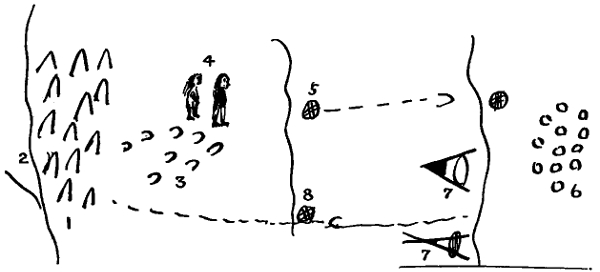
Figure 35.—Picture writing. Key: “We are a camp of 13 lodges (1); encamped on a
creek above the forks (2); started hunting with eight horsemen (3); and two women
on foot (4); slept two nights out (5); found buffalo beyond the second creek from
the camp (6); killed some, and made travails (7); and slept but one night on our
return home (8)
There is, however, this danger in these records, that if they are
stumbled upon by their enemies in their war excursions they are as
certain a guide to them as to their own people, and this is one of
the reasons why it is so seldom done. But the Crow Indians, who
rove through the spurs of the Rocky Mountains, frequently making
long and rapid marches, are compelled to leave such marks behind,
or some of their warriors would ramble about for months searching
for their homes, which would be extremely inconvenient should they
be driving before them a herd of their enemies’ horses. The information
conveyed by this system of writing is complete as far as
it is intended, which is only to represent leading and general facts,
and is not nor could it be applied to minute details. All warriors
read and understand the devices of their enemies and most of them
practice it when necessary, but the direction to war pursued by the
Cree and Assiniboin in the summer, being over plains, there are no
places noted as their usual encampments, and timber is seldom
found; they therefore practice this manner of writing less than the
others, owing to the probable uncertainty of their being found by
their friends. In the winter, however, it is occasionally done by
them when their way lies along some river, and their encampments
are found by the small forts in which they have slept every night
being left standing.
The same species of intelligence is sometimes left in hunting
grounds with the view of announcing to any of their own nation
who are supposed to pass the same way that the game, as denoted
by the carcasses round, has been killed by friends, not war parties of
enemies, intimating to them the direction and situation of their
camp, that meat may be had there, that a juncture of forces is desirable,
etc. The number and kind of game taken are not painted
as the heads of the animals around would show that, but it, too,
could be explained if wished.
These devices are generally drawn on some dry tree without the
bark, the characters being cut in the wood and filled up with
vermilion mixed with grease to prevent it being washed off by rain.
Pieces of bark and portions of skins are used, and in default of
either soft stone will answer. Powder dissolved in water is used to
mark on the skin, the impression being made with a pointed stick,
inked and pressed forcibly on the skin.
The meaning of every mark is fixed and exact, understood by the
mass of warriors of all tribes, not confined to or practiced by the
priests unless their situation in traveling be the same as the warriors
or hunters and they desire in like manner to convey some information
to the nation. The foregoing purposes in different forms are the
only ones to which we have had the opportunity of witnessing the
application of these devices. Perhaps they are the only cases as yet
necessary for their present operations, but there would be no difficulty
in their picturing the passage of whites or other nations through
their country should it be required, and the same be intelligible to
them.
Another form, and the one in which this manner of writing appears
to be of more importance among them, is the devices drawn on the
robes, exhibiting their standing as warriors whenever they appear.
The height of distinction in an Indian, and his greatest ambition, is
to impress upon his own people or strangers the idea of his being
brave, of his having done acts that entitle him to appear among
men, of his superiority in this respect over others in the crowd;
therefore the actions which lead to these impressions are pictured
on his robe; his biography is carried on his back so that “he who runs
may read.” It insures him respect through life, an honorable shroud
at his death, and is believed to merit reward in futurity. A further
use these devices are made to serve is the representation of monsters
said to be seen by them in dreams, and supposed to have the effect
when painted on their lodges of averting strokes of lightning, disease,
etc.
In like manner buffalo heads are pictured to bring those animals
in the direction of the camp, besides a great variety of smaller
devices are seen on their shields, drums, medicine sacks, and envelopes
of their amulets, to all of which appropriate and general meanings
are attached corresponding with their superstitious belief or
to insure success in domestic affairs. In conversation with most
elderly Indians regarding locations, travels, or to explain battles
and other events, resort is had by them to drawing maps on the
ground, on bark with charcoal, or on paper if they can get it, to
illustrate more clearly the affair in question. In this way the chief
of the Crow Nation three years since made and left with us a map
pl. 77) of his intended travels during the entire fall and winter succeeding,
embracing a circumference of 1,500 miles, with the different
encampments to be made by that nation in that time, and so correct
was the drawing that we had no difficulty in finding their camp the
following winter in deep snow, one month’s travel from this place. It
is regretted that those Indians are not now in this neighborhood, as in
that case some specimens of their charts and devices could be inserted,
but in default of better we present in this place some Assiniboin
drawings, with their explanations, which will serve to give a
general idea how they are managed, and other pictorial devices are
attached in several parts of this work.
These are the only forms the pictorial art of the Indians takes. It
is more largely applied to the designs represented on their robes
and mythological subjects when appearing on their lodges, fetish
envelopes, etc., as has been stated. Songs can not be recorded in this
or any other form. The value it may be to a people who are without
letters is mostly apparent in the instances where it denotes the rank
and standing of individuals when painted on their robes. The information
intended only for their friends when cut on trees is liable
to be interpreted to their disadvantage by enemies, which would
consequently be a bar to its general practice. None of their drawings
are executed with neatness, but occasionally have some pretensions
to proportion. It appears to be the meaning only that is
desired, for paintings done by whites correctly are not more appreciated
as work of art, perhaps not so much, as their own rude representations,
but are looked upon with more superstitious dread.
The explanation of the drawing pl. 78) would be as follows:
“We were a party of 20 men (1) and stole 39 horses (2) from the
Blackfeet” (see the 39 horse tracks so marked going away from the
camp). “The camp turned out, killed one of us” (see the picture
of a hand pointing toward their enemy’s camp (3) and a scalped
man drawn) “and recaptured from us 14 horses (4)” (see the 14
tracks going back to camp, each track always standing for a horse).
“We forted and fought with them” (see (1) representing a brush
fort and the men therein; the guns pointing toward the fort (5)
are those of their enemies and the others signify the firing kept up
by themselves).
“In the battle three of us were wounded and six horses killed”
(see 6 representing a wounded man, and six horses stationary, seven;
that is, going neither way, proving them to be unable to travel).
“We got off with 19 horses” (8) (this being the tracks of horses leaving
the fort); “the first night we encamped on the plains near a
spring” (9) (the dotted line shows the path, and 9 is intended to represent
a small fort or sleeping place, with another dotted line to the
left where the spring (10) is marked). “In the encampment we left
a wounded man (6); we made two more encampments after that, when
we now leave this painting and intend pursuing our course home to
the right. A band of buffalo (11) was seen on the opposite side of
the river on a creek while the battle was going on, which are all we
have yet seen.” (These marks mean buffalo tracks.)
The end of the dotted line is as far as they have then gone, and
other marks show the road they intend to pursue, but if they expect to
get home without sleeping the dotted line is made as far as the lodges.
Explanation of Plate 79.—“We are a party of 10 men (1), have
stolen 21 horses (2) from the Blackfeet and taken a scalp (3), but
lost one of our own party. The first night we forted on a creek (4),
the second night we slept on the prairie in a small fort at the foot
of some timbered hills (5), the third night we slept at a lake (6),
the fourth at a spring (7) where we are now. We intend to make
three more encampments to get to our lodges, which are on the head
of the next river (8). These figures (9) represent the lodges of their
enemies, and the horses’ tracks going from the lodges, indicating
them to have been stolen, each single mark (10) counting a horse.
The guns, bows, and lances show the party to be 10 (1). The hand
pointing the direction in which they are traveling and toward a
scalp (11) intimates that they have killed an enemy. The hand
pointing the other way with the scalp (12) explains they have lost
one of their party. The dotted line is their path home along a river
and only extends as far as they have traveled to the place where the
painting was left. The number of days they expect yet to travel to
reach home are indicated by these characters (8, 10), the one a brush
fort, signifies the number of encampments, and the horse track with
it means it is the road they intend to travel.”
BUREAU OF AMERICAN ETHNOLOGY
FORTY-SIXTH ANNUAL REPORT PLATE 77
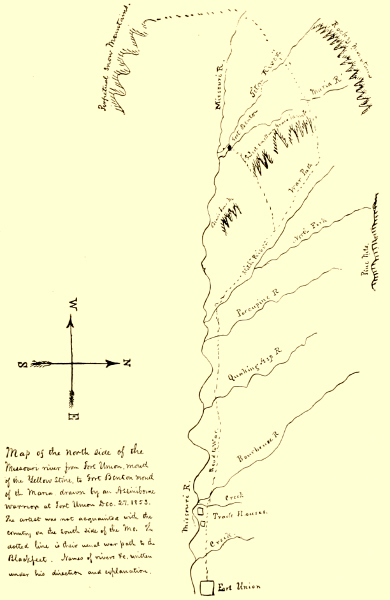
Map of Region Above Fort Union
BUREAU OF AMERICAN ETHNOLOGY
FORTY-SIXTH ANNUAL REPORT PLATE 78
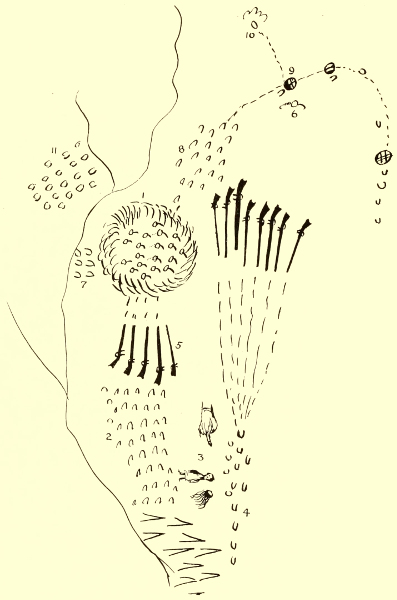
Diagram of a Battle Field
BUREAU OF AMERICAN ETHNOLOGY
FORTY-SIXTH ANNUAL REPORT PLATE 79
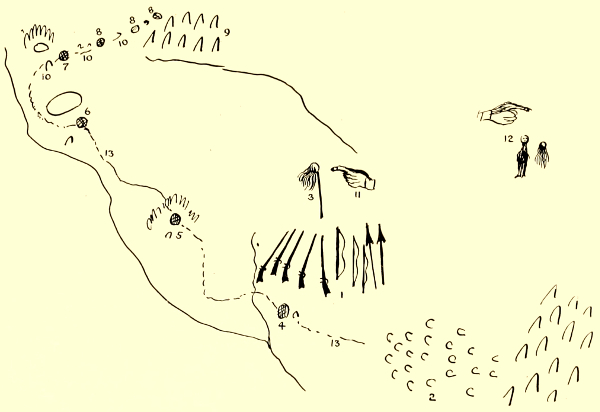
Diagram of a Battle Field
BUREAU OF AMERICAN ETHNOLOGY
FORTY-SIXTH ANNUAL REPORT PLATE 80
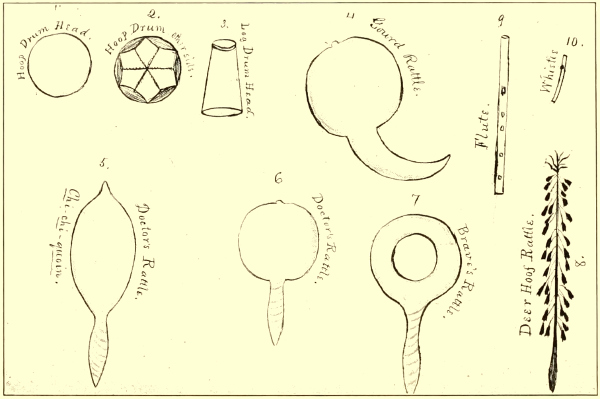
Musical Instruments
As has been several times mentioned in these pages, one of the
principal ways of passing time at night in an Indian camp is the
recital of fables for their amusement. Most old men and women can
recount these stories, but there are some particularly famed for their
talents in this respect, and these are compensated for their trouble
by feasting, smoking, and small presents. At night, when all work
is over, a kettle is put on containing some choice meat, tobacco mixed
with weed prepared, the lodge put in order, the family collected, and
the story-teller invited, who often prolongs his narrations the
greater part of the night. Some of the tales are of a frightful kind,
and to their impression on young minds is no doubt mainly to be
attributed the fear of ghost monsters and other imaginary supernatural
powers exhibited by most Indians when grown.
We have taken some pains to call together a few of the most famed
and sensible story-tellers and listened with much patience to a great
many of their allegories, but find nothing in any of them bearing
on their ideas of a future state.55 The circumstances and actors portrayed
do not reveal the actual notions of the tribe on their religion
as it now exists but are founded on their ancient mythology and
handed down complete in their details through successive generations,
and their real significance, if they ever had any further than
amusement, is now lost or absorbed in their manner of worship as
referred to in these pages.
Nevertheless, we can discern in them a probability of their being
the real belief of their ancestors in their primitive ignorance, before
their superstitions and religions had assumed a systematic form and
tangible shape. This much may be inferred by the tacit acknowledgment
of their truth apparent in the auditors and the unwillingness
evinced by all to hear them ridiculed or contradicted. We think
the truth of the matter is these tales were believed and formed a
portion if not the greater part of the religion of their ancestors,
are reverenced for their antiquity and originality, together with a
lingering uncertainty as to their having actually transpired in
times long passed. This may be deduced from the evident veneration
with which some of them are regarded, and from the fact that
there are no new fables made at the present day, nor any one who
possesses or professes the character of a myth maker. These stories
are not added to or diminished, for if in the telling the least circumstance
be omitted the narrator is reminded of the error and
corrects it. In none of them is the creation of animals or other
objects, animate or inanimate, reasonably attempted, though such
things are alluded to in many absurd forms and grotesque imaginings
according with the general tenor of the tale. These, though
often trifling in their details, present a connected chain of events
and often contain a kind of moral, that is, a double meaning as
observed in the one relating to the formation of the Ursa Major and
Polar Star, before inserted.
None of these serve to demonstrate to the young the power and
ubiquity of Wakoñda.56 This awful principle is too much feared
to be lightly introduced in common conversation or connected with
amusing tales, though inferior demons and minor supernatural powers
with a great variety of figures of the imagination, such as monsters,
ghosts, giants, beasts with reasoning powers, transformation,
and works of necromancy, are represented.
There does not appear to be much useful instruction conveyed by
any of these oral tales, but they are resorted to as a source of amusement.
Stories related by us to them from books, such as the fables
of Æsop or those from the “Arabian Nights,” are listened to with
great attention and sought after as eagerly as their own fiction.
Moreover, they can, when these fables are plainly narrated, not only
comprehend the literal meaning but appreciate the moral when it is
pointed, not in its moral sense but as a necessary conclusion arising
from the circumstances related. The only objection to recording
many of these tales is their interminable length, one frequently occupying
two or three hours in its recital. So remarkably long are they
that the auditors are apt to become sleepy, and the narrator, if not
responded to occasionally to convince him of their attention, breaks
off and abruptly takes his leave. We now subjoin some of these
stories that may serve to show the scope of imagination involved
and that others may form their own opinions regarding their interest
and utility.
A long time ago there lived a great chief of a powerful nation,
but he was a fearful and desperate man. He had killed six of his
wives at different times in fits of passion, and at the time of our
story had separated from his people, being jealous of his wife, and
placed his lodge alone on the bank of a small stream. His family
consisted of his wife, a boy say 12 years old, and a girl about 10 years,
both his children by the woman now with him. The man went out
hunting, and the game being far off did not return for several days.
In the meantime the woman continued her domestic duties at home.
Being in the timber in quest of wood, she struck her ax on a hollow
tree and a great many snakes came forth, one of which57 was large
and handsome, had a fascinating eye and horns upon his head, spoke
sweet words to the woman, and in the end succeeded in seducing her.
Her husband returned and inquired of her “What had become of the
paint on her face, which he put there before starting?” She made
some hesitating answer and he suspected all was not right and
determined to watch. In the course of a few days he gave out that
he was again going hunting and might be absent some time, as he
had not yet seen game. He as usual painted his wife’s face and
departed. In place of going to hunt he hid in the bushes to watch
his wife, who made her visits to the snake’s nest, striking on the tree
and calling on the horned snake in terms of endearment to come
forth. The snake came out, and the husband witnessed the infidelity
of his wife.
He remained a day or two near the place, and each day observed his
wife to repair to the snake’s den for like purposes. He then returned
home. She was absent, but returned in a short time. “My wife,”
said he, “I have killed a deer some distance off; go and get the meat.”
After having received instructions as to where the meat was to be
found, the woman departed with her dogs to bring it. In the meantime
her husband went into the bushes, struck with his battle ax on
the snake’s house, saying, “My husband, come forth,” imitating the
voice of his wife. The reptile sallied out with all his family and the
Indian destroyed them all with his battle ax. Gathering up the
snakes, he carried them home and cooked them by boiling them to
a jelly. His wife returned without finding any meat (as indeed
there was none), and found her husband sitting down sharpening a
huge flint ax. He invited her to sit down, and observing that she
must be hungry after such a long travel, poured into a bowl the mess
of snakes, which he handed to his wife, who, thinking it was some
other kind of meat, ate the whole. After she had feasted, the man
said, “You have eaten your beloved husband, the snake, and now you
shall follow him.” He rose up and cut her head off at one stroke of
his sharp ax. A storm arose, the wind blew, the thunder rolled, and
the man disappeared in a whirlwind of dust and was caught up in
the air. The children, much frightened at all this, ran out of the
lodge over the prairie, never ceasing their speed until they were at
some distance.
On stopping to rest themselves they looked back and beheld the
Head of their mother rolling after them, calling on them to stop.58
This frightened them more and they continued their flight. The
Head rolling after them was now very near and the children were
very tired. The boy threw his knife behind him and immediately
the prairie was bristling with knives, through which the Head on
endeavoring to pass was cut in a dreadful manner, and stopped in
its course. The children continued their way. A fox came to where
the Head lay, and the Head said, “My friend, I am in want of a husband,
will you marry me?” “You are too ugly,” replied the fox
and disappeared into his hole. The Head followed the fox, who
being afraid of it, when he arrived at the end of the burrow commenced
digging farther in great haste, the Head still following and
calling on the fox to stop. But the animal dug very fast, and
finding he could not escape from the Head in this way came out to
the surface of the earth near where the children were. The Head
also came out and, perceiving them, rolled after them, coaxing them
to stop, but they ran forward until they arrived at the top of a hill.
The little girl said, “My brother, I am tired, throw something else
behind you, the Head is close upon us.” He threw his awl and up
rose innumerable awls on the prairie which, pointing toward the
Head, formed a barrier which it could not pass. The children continued
their flight. A badger appeared alongside of the Head.
The Head said to it, “My fine fellow, I wish to marry you. Will
you be my husband?” “Your face is too ugly and bloody for me,”
said the badger, and disappeared in his hole.
The Head followed the badger, who like the fox continued digging
underneath the ground, making a road underneath the awls in
the direction the children were going, so that the Head came out
again to where they were seated resting themselves. On seeing it
they again ran forward, the Head after them calling on them to stop,
but they were afraid. Again did the little girl get tired and ask
her brother to save them by throwing something behind him. He
threw his tinder or spunk, and immediately the prairie took fire,
spreading out behind them, burning the Head to a cinder, leaving
nothing but the bones. The children traveled on. A wolf this time
came near the Head and, as with the fox and badger, was desired
by the Head to become her husband. “You are nothing but a frightful
ghost,” exclaimed the wolf, and ran into his hole. The Head
followed, the wolf dug, and in the end the Head again came out
near the children. They ran forward and arrived at the bank of a
large river. Two cranes were standing on the bank. The boy requested
the cranes to carry them over. One of the cranes asked
the boy, “How does my breath smell?” “Very sweet,” said he,
“as though you had eaten service berries.” “Good,” replied the
crane, “now both of you get on my back.” They being seated, the
bird flew across and landed them in safety on the opposite shore.
In the interim the Head came to where the other crane was standing
and commanded it to bear it over immediately, as it was in a great
hurry to overtake the children. The bird proposed the same question.
“How does my breath smell?” “It smells of stinking fish,”
replied the Head. “Good,” said the crane, “now get on my back.”
The Head having placed itself, the bird flew, and when about the
middle of the stream shook the Head off its back in the water, which
on falling cried out, “Now, I go to dwell among the fishes!”
The children perceiving they were freed from their tormentor
continued their route more at leisure, and after traveling some days
they arrived at a large camp very hungry and very tired. It was
the camp of their father, and he was there as its chief. When he
saw his children he abused them for having a bad mother, would not
let any person give them food nor take them into their lodge. He
brought cords, bound the children’s hands, and taking them outside
the camp raised them into a tree, tied them both together and to the
top limb of a large tree. He then ordered the whole camp to move
off and thus left his children to perish. After all had gone he again
looked that his children were secure and examined the camp to see
that no one remained behind, but perceived nothing but a little old
dog lying on an extinguished fire, with his head in a large shell
for a pillow, apparently sick. “Why do you remain behind the
camp?” inquired the man. “Because I am sick and can not travel,”
answered the dog. The man was enraged, told the dog to begone,
kicked it, but he only howled and would not raise his feet. The
chief after beating the old dog so that he thought him dead left
and followed his people. As soon as he departed and was out of
sight the dog rose and sought the tree where the children were, commenced
gnawing at the root of it, and in four days and nights it fell
to the ground.
He then gnawed off their cords, which occupied two nights more,
and the children found themselves free but so very weak they could
not travel. The little old dog rambled through the ground where
the camp had been placed, discovered a piece of rotten wood afire,
and brought it to where the children were. He gathered other
branches and made them a comfortable fire, at which they warmed
themselves. The little boy covered his eyes with his hands and hung
his head, his sister cried, they were very hungry and very miserable.
“Look, my brother, what a fine herd of elk is near!” the girl exclaimed
as about 50 of those animals came walking toward them.
The boy looked at them, wishing they were dead so that they might
have meat, and as soon as he looked upon them they all fell dead.
They went to them, and, having no knife wherewith to skin them,
the boy wished them skinned, and in a moment they were so. He
now began to see the power granted him, which was to look upon and
wish for anything he desired. By the same means he produced the
elk skins dressed and made into a large lodge, far larger than any
of his people, which was erected, and the meat of the elk piled around
the lodge on scaffolds outside. In the interior was an apartment for
the little old dog. They were now happy.
Day after day large herds of buffalo came near the lodge, and on
looking at them the boy killed them, skinned them, and placed the
meat on scaffolds, cut up and dried.
When he thought he had enough he made a feast to the magpies
and desired one of them to take along some fat meat and fly in the
direction of the camp to endeavor, if possible, to overtake them. The
bird left and after flying some days arrived at the camp. They were
all starving, having had no meat for a long time. Some of the men
were playing ball in the middle of the camp. The magpie advanced
and dropped a large depouille among them and all scrambled to get
a share. They inquired of the bird where he got the meat, and
received the information, together with the news, that a great deal
of meat was on scaffolds, enough to feed the whole camp. The father
of the children was the chief; he called a council and determined on
going back to the large supply of food, but knew it belonged to his
children from the description given of them by the magpie. In due
time the camp arrived at the boy’s lodge and placed their tents. The
boy sat in his lodge, his head down, and his eyes covered with his
hands. All the camp with his father at their head came around
begging him for meat. But the boy answered not a word, neither did
he look up. The rest had no power to take the meat, not even to
approach the scaffolds. The second day after their arrival his sister
said, “Do, my brother, come out and look what a fine camp of our
people are here.” He went, looked, and all fell dead in their lodges,
or wherever they happened to be. At this the little old dog began to
cry and besought the boy to revive his (the dog’s) relations, who fell
with the others. “Show me them,” said the boy. “They shall live.”
He went with the dog through the camp, who pointed out his sisters
and brothers, all lying dead. The boy revived them by looking upon
them.59 After a short time the little girl said, “My brother, it is a
great pity so many fine men and women should die. Look upon them
and let them live again.” The boy did as desired and the whole
camp was again called to life and motion.
He then made a feast, called all of them together, distributed the
meat, and told them of the conduct of their father toward them.
The boy was made chief of the camp, the little old dog was transformed
into a man and became the first soldier, and the father was
degraded to be a scullion and bearer of burdens for the whole.
An old woman lived in a lodge alone except her children, and raised
corn in a garden. One of her little boys was shooting birds with
arrows in the garden, when on a sudden appeared a sack full of rice,
which, dancing up and down before the boy, sung out, “My nephew,
shoot me and eat me, my nephew, shoot me and eat me.” (This part
is sung by the narrator.) The boy shot an arrow into the sack and
all the rice spilled on the ground. Here the story ends with a
general laugh.
By Tah-tun-gah-hoo-hoo-sa-chah, or “The Bull’s Dry Bones,” an Old
and Famed Priest of the Assiniboin
The whole surface of the earth was at a time covered with water;
in fact, no land existed but at the bottom of this great ocean. Seven
persons were on a raft, viz., five men and two women. These were
the first Gros Ventres, besides whom the only living objects visible
were a Frog, a Muskrat, a Crow, and a Spider. The men, wishing
for land and being informed in a dream how to act, told the Muskrat
to dive to the bottom of the water and try to bring up a portion of
earth. The being plunged, remained a long time under, but appeared
without any. He was ordered to try again, and dived still
farther, remaining under a much longer time, but reappeared with
nothing. Again and again he plunged and at last disappeared for
such a length of time that all thought he was drowned, but he
rose to the surface, stretching out his claws to those on the raft,
saying, “I have brought it,” and immediately expired from exhaustion.
They drew in the being and scraped from between his
claws a small portion of earth which they made into a flat cake, set
it on the water, and behold it spread rapidly in every direction.
They then called the Crow, gave it directions to fly as far as the earth
extended. The bird departed but did not return, from which they
concluded it to be so extensive that the Crow could not come back.
Being in possession of land, and seeing all was damp and cold and
barren, they wished for spring to make something grow, and inquired
of the frog how many moons remained until spring would come.
The Frog said, “Seven,” but the Spider contradicted it, called him a
liar, on which a quarrel ensued, and the Spider beat the Frog to death
with a stick. The latter, on dying, stretched out his legs toward
the men, indicating seven by the claws thereon. The eldest of the
party and head of the whole, whom they called their father, not
being certain whether the Frog told the truth, started two of
the others (brothers), both very brave and venturesome, with orders
to travel in quest of spring. They set out eastward and in six
months arrived at warm weather, where they found spring bundled
up and placed on a scaffold, the packages consisting of flowers, seeds,
turnips, roots, etc. Two large Cranes were standing beneath the
scaffold, which the brothers loaded with the “spring season” and
ordered them to fly back to their people. The birds started, and in
another month arrived with their cargo safe, thus verifying the
predictions of the Frog, which so enraged the men against the Spider
that they put him to death, and he is to this day despised and
crushed by all, while the frogs every spring sing forth the praises of
their truthful ancestor.
The travelers, having accomplished their mission, bent their course
westward to explore the new country, and after a long time came
to the Rocky Mountains.
In one of the valleys between the mountains they perceived a
motion in the earth at a certain spot as though it was boiling or as
though some animal was endeavoring to get out. One of the brothers
proposed shooting an arrow into it, but the other objected and requested
him to let it alone. The former was, however, a very obstinate,
reckless man who never would listen to good advice, and shot
an arrow into the spot. A whirlwind gushed out, and rose up in
the air in a round black column, bearing the two men up along with
it. Higher and higher they rose until so far above the earth that
they could not see it. The wind now carried them eastward for several
days, when at length they descended to earth on the other side
of the sea. Here they rambled about some time and found an old
woman working in a cornfield from whom they begged something
to eat. She gave them a mess of corn and potatoes. After having
eaten they inquired of her if she could inform them how they could
get back to their family. She said she could, but they must implicitly
follow her directions or some harm would befall them. After they
had made the required promises she took them to the seashore, made
a sacrifice of some corn to the water and invoked the appearance
of the Wau-wau-kah. Immediately afar off appeared an object moving
over the surface of the water, spouting it out high in the air,
and, approaching with great rapidity, soon arrived at the place
where the travelers stood. The being thus conjured up had the head
of a man, though of monstrous size, and out of which projected two
horns as large as the largest trees.
The body was that of a beast covered with long black hair, the tail
was like that of a very large fish and covered with scales, and it was
endowed with a spirit. To this monster the woman gave directions
and made two seats in its horns like large birds’ nests, one in either
antler, in each of which she placed a man, in one a sack of corn
and in the other a sack of potatoes. Spreading out her hands and
invoking the sun, the monster at her desire departed with its cargo
and in a great many days arrived at the opposite shore in safety.
The old woman had instructed the travelers that immediately on
landing they should sacrifice to the waters, by throwing in a little
corn. One of them did so, but the obstinate brother would not.
Being reproached by the monster for not following the advice of the
woman he shot an arrow into it and was immediately swallowed up
by the beast. The remaining brother was in great distress at this,
and, recollecting the conduct of the old woman, made a sacrifice
of some corn. Stretching out his hands he invoked the Sun to his
aid. Immediately a dark round spot appeared in the west which
came forward with terrible velocity and a whistling sound, increasing
in size and speed as it approached. This was a thunder
stone, which, with an awful report and bright flash, struck the
monster on the back, separated it in two, and the man was liberated.
A terrible storm arose, the sea rolled, and the monster disappeared.
They now bent their course westward and after many days came to
a lodge inhabited by an old man and his family, from whom they
begged something to eat. He showed them immense herds of buffalo,
apparently tame, and all black except two, which were milk white.
He told them to kill whichever they wished, but not to destroy more
than they wanted for food or clothing. The good brother killed a
fat cow, which, being more than they wanted, he took the rest of the
meat to the old man’s lodge. The other remained behind and shot
arrows into a great many buffalo uselessly, for which the old man
reproached him. After having feasted they were about departing
when the old man showed them a great number of ducks and geese.
“These,” said he, “with the buffalo, are our life; treat them well.”
On the old man’s leaving the Indian who had no ears commenced
killing the birds with a club and made great havoc. The old man
returned and said, “You have done wrong, you are a bad man, evil
will befall you, the Wau-wau-kah shall bar your road home to your
people. But your brother is a good man, has ears, and for his sake
some of my buffalo will follow him home to his people, and the white
cowskin shall be his fetish to remember me by.” They separated;
the travelers pursued their journey and encamped on the prairie at
the foot of what they supposed was a mountain, but which was the
Wau-wau-kah lying across their road. In the morning they advanced
to go around it, but, turn whichever way they would, the monster
turned with them and obstructed their way, so that the whole day
was spent in useless efforts to get forward.
The good brother proposed sacrificing some corn to appease it,
but the other became very angry and would not listen to any peaceful
measures. He collected immense piles of buffalo dung all around
the monster and set it on fire, by which the Wau-wau-kah was
roasted alive. The smell of the roast being savory he cut out a
slice and ate it, offering some to his brother, who, however, would
not taste thereof. In the morning they continued their way, the
buffalo following at a distance. At rising the ensuing morning the
one who had eaten the flesh of the monster said, “Look, my brother,
what handsome fine black hair is growing from my body.” The
other looked and beheld the hair of the beast. On the next morning
he said, “Look at my head, my brother, horns are coming out
upon it,” and so it was. On the third morning he said, “Look at
my legs, my brother, fish scales are growing there.” Each and every
morning when they arose the Indian was assuming more and more
the shape and appearance of the Wau-wau-kah. In the course of a
few days his body was completely covered with hair, his head was
furnished with horns of a monstrous size, and his legs were growing
together in the form of a fish. They traveled on, the body and
entire shape of the Indian rapidly increasing in size and appearance
to that of the monster whose flesh he had eaten. They now proceeded
slowly, owing to the difficulty the one experienced in walking
by the change he was undergoing, and this impediment increasing
in proportion as his extremities gradually assumed the form of a fish.
In the course of time they arrived at the mouth of the Yellowstone
and encamped for the last time together. The change was
now nearly completed, and when they arose in the morning behold
a complete Wau-wau-kah was presented, who said to the other,
“Depart, I am no more your brother; I am no more a man; I am
either your friend or your enemy, according to the way you treat
me. Leave. You will find your people several days’ travel down
on the banks of the Missouri. Take them the corn. Yonder stand
the buffalo you have brought; they will follow you home. You will
become a powerful nation. Each and every year they must sacrifice
some corn to me by throwing it into the Missouri, or the wind shall
blow, the rain fall, the water rise and destroy your crops. As for
me, I shall be separated here; my head will go up into the clouds
and govern the wind, my tail fall into the water and become a
monstrous fish to disturb it. My body will rove through the Rocky
Mountains; my bones may be found, but my spirit will never die.
Depart, you have ears and a good heart.”
At the close of this speech the winds blew, the thunder rolled, the
lightning flashed, and a terrible storm arose, amidst which the monster
disappeared. The other returned to his people, told them the
story of his travels, and to this day corn is sacrificed to the Missouri
by the Gros Ventres to appease the spirit of the Wau-wau-kah.
The construction of the Indian flute and music produced by it have
already been described, although we are not able to state in what
manner, if any, it resembles the Arcadian pipe.
Most ceremonies, dances, public demonstrations of joy or grief,
and other matters of general interest are accompanied by songs, which
have appropriate names, but these chants are for the most part only
tunes or modulations of voices in concert, with the introduction of a
few words in some of them. They are in fact a continued chorus
consisting chiefly in repeating the meaningless syllables “Hai-yah,
hai-yah, hai-ai-ai-yah-ah-ah, hai-yah, he-e-e-ah, hai-yah,” etc., fast or
slow as required by the nature of the song. Where words are introduced
they are composed of five or six syllables or three or four
words, bearing some relation to the event which is honored with the
song, but are of no consequence, so that all question regarding their
rhyme or poetical compositions may be passed over in silence. The
tune is generally begun by one person pitching it, who after singing
a few notes, is joined by the whole choir, or sometimes, as in the
scalp song, the women add their voices in the second part of the tune,
where the name of the warrior who killed the enemy is mentioned.
The modulations are bold and wild, by no means discordant or disagreeable,
and they are remarkable for keeping very exact time
either with the voice, drums, or feet, and where words are added they
are so few, and the syllables so separated to accord as scarcely to be
understood or distinguished from the rest of the chant.
The songs are measured, accents occur at fixed and regular intervals,
being mostly the same in beats as the Scotch reel time. The
effect intended is produced by action, energy of voice and motion,
costume, and the wild intonations of the time, not from words repeated.
These songs are suitable to the occasion, and the whole when
well got up has a decidedly unique appearance, singularly correspondent
in all its component parts. These chants are very difficult
for us to learn and scarcely less so to describe, but are preferred by
them to any music, vocal or instrumental, of white performers yet
presented to them. The length of a tune is about equal to eight
bars of our common time, and the syllables to each beat vary from
four to eight, but in some of the medical songs the intonation is so
rapid as scarcely to admit of being counted. Songs for dancing,
medicine (that is, the practice of healing), and on other assemblies
are generally accompanied with drums, bells, rattles, flutes, and
whistles, of all of which the drum is the principal instrument, for
though on some occasions all of them and several of each kind are
used, yet there are none in which the drum is not used, but several
where the rest are dispensed with.
Independent of public songs, singing is a very common amusement
for the young men at nights, principally to attract the attention of
the females, and often intended as signals for secret assignations.
Subjoined is a list of most of their songs, in reading over which it
will be observed that there are none denominated “Hunting songs,”
that employment not being celebrated in song in any way, either for
success or failure, unless the incantative song by the Master of the
Park to bring the buffalo toward it would be construed in that light.
The uses of the others can be traced in their names, taken in connection
with what has already been written concerning their ceremonies.
The words “do-wan” attached to all means “a song.”
Songs of the Sioux, Crow, and Assiniboin Nations
| Indian name |
Interpretation |
Occasion, etc. |
| Wah-kit-tai´ do-wan |
Scalp song |
More than ten different kinds. |
| Chan-du´-pah do-wan |
Incantation Pipe song |
Two or three varieties. |
| Tah-tun´-gah do-wan |
Bull song |
In the Bull dance; also used in the park. |
| Te-chagh´-ah do-wan |
Incantation Lodge song |
Religious. |
| Cong-ghai´ do-wan |
Crow song |
In Crow dance and before starting to war. |
| Pai-hun-ghe-nah do-wan |
White Crane song |
Incantation—in the song of that name. |
| Nap-pai´-she-ne do-wan |
Song of the Braves |
In the dance of “Ceux qui sauve pas.” |
| Ah-kitchetah do-wan |
Soldiers’ song |
Used at the soldiers’ dance. |
| To-kah-nah do-wan |
Foxes’ song |
In the dance of that band. |
| Ah-do-wah |
Diviner’s song for the sick |
About 20 different kinds. |
| At-to-do-wah |
Tattooing song |
Sung while performing that operation. |
| Opah-ghai do-wan |
Gathering of the kins |
Called also the thunder song (incantation). |
| Och-pi-e-cha-ghah do-wan |
Buffalo Park song |
Incantation. |
| Shunga-tunga do-wan |
Horse song |
In the whip dance. |
| Shunk to-ka-chah do-wan |
Wolf song |
Sung on starting to war. |
| To-shan do-wan |
Drinking songs |
More than ten varieties. |
| We do-wan |
Sun song |
Religious. |
| We-chah-nauge do-wan |
Song to the dead |
Lament. |
| Hoonk-o´-hon do-wan |
Song of thanks |
Several. |
| Wah-ghunh´-ksecha do-wan |
Bear song |
Medicine. |
| We-coo-ah |
Love song |
About 10 varieties. |
| Nap-pai-e-choo do-wan |
Hand gambling song |
|
| Hampah-ah-he-yah |
Moccasin gambling song |
|
| We-hhnoh´-hhnoh |
Incantation song and feast |
|
| Tsh-kun do-wan |
Women’s dance song |
Where women only perform. |
| Opon do-wan |
Elk song |
Medicine for elk, religious. |
Their drums are of two kinds. The most common is made like
a tambourine without its bells, the skin forming the head being
stretched over the hoop while wet and kept there by sinews being
passed through it and the hoop a few inches apart. (Pl. 80, fig. 1.)
The inside portions of the skin have cords made of sinew extending
across from several places, meeting in the middle and forming a
handle to hold it up by (2). It is held up in one hand and beaten
with a stick by the other, no more beats being made than are necessary
to correspond with the accents of the notes, thus preserving the
time.
The other kind of drum is made of a piece of hollow dry tree
about 2½ feet long, scraped to a shell and smooth inside and out,
resembling in shape a staff churn (3). The head or skin is stretched
on the smaller end with a hoop, which is retained in its place
by sinews passed through. The other is left open. When beaten
but one stick is used, the drum being set on end. Both are often
painted with different devices. The rattles, wag-ga-mó (Sioux) or
Chi-chi-quoin (Cree), were originally and in a measure still are
gourds dried with the seeds in, or after being dried the seeds, etc.,
are taken out and pebbles put in (4). Others are made of the
rawhide of elk stretched over a slight frame of woodwork while wet
and dried in that shape, pebbles being put therein at holes left in the
top or in the handle (5 and 6). No. 7 is the rattle used by the
“braves” in their dance. It is made of rawhide like the rest, but in
the form of an open ring.
No. 8 is the rattle made out of deer and antelope hoofs scraped thin
and light, reduced in size, and a number of each attached to small
strings, so closely that they clash together when shaken. The
flute (9) is made of wood, and the whistle (10) is the wing bone of a
swan. These have before been described. From what has preceded
it will be understood that there are no verses in their songs evincing
their patriotism, or other chants representing their triumphs; that
all is chorus and tune. Their laments for the dead are of the same
description, adding a few words and calling upon the departed by
stating the degree of relationship, the few mournful words to deplore
their loss, and the rest of the chant is in meaningless ejaculations.
Their music is never recorded nor have they such things as music
boards or bark songs. In their bacchanalian songs they often repeat
catches of whatever comes into their minds at the time, adapting the
words to the song, but these words or any particular expressions do
not properly belong to the songs, which in their original are of the
same description as the others.
Many lullabies are sung to children by their mothers, but as usual
but few words introduced, consisting mostly of humming of different
tunes to put them to sleep, adding sometimes, “Sleep, sleep, my pretty
child,” or “Red fox come here; you will get a marrow bone to eat”—this
when they are 2 or 3 years old.
There is nothing in their painting or sculpture worthy of notice.
All are rude drawings and carvings scarcely intelligible without explanation.
The nations we write of are as yet in their savage state. But
few steps have been taken by them in the path of knowledge. Their
original manners and customs, if not entire, are but slightly changed,
their superstitions the same as their ancestors, and their minds
deplorably void of moral truth or useful science. Their idol worship
remains undisturbed by religious teachers, and the humane
efforts in this respect, extended to China and the South Seas, are
withheld from the coppered brethren residing next door.
There are some points not to be overlooked, inasmuch as they have
a general bearing upon the whole race, involving a subject of great
interest to which the foregoing details form but the prelude. The
principal of those to which we allude is this: “How far has knowledge,
art, and commerce, and the progress of civilization, affected
the improvement of the Indians, and changed or modified their
original manners, customs, and opinions?”
As art and knowledge are yet in their infancy among them and
as has been stated but little improvement in their moral condition is
visible, yet great and important changes have been brought about
by the commerce of trade, without which any plan for their future
advancement would be retarded a century, and by correct appreciation
of which views can be formed regarding contemplated measures
for their prosperity.
In the foregoing pages, which present their savage life in detail,
nothing speculative has been ventured upon, no conjectures hazarded,
by us or by anyone well acquainted with the wild tribes, nor will any
new opinions be perceived. The whole is merely a collection of
facts, thrown together in the form of answers to certain questions
without further comment than necessary for their illustration and
clothed in the simplest garb of verbiage to facilitate their comprehension.
When we entered the fur trade in the spring of 1833, now 21
years since, all the Indians herein treated of, from the Sioux to the
Blackfeet, inclusive, were much more ignorant in everything, degrading
in their habits, slovenly in appearance, and barbarous in their
actions than they now are. Life was then held by a slight tenure,
crime was frequent, atrocious disorder and family feuds were general,
and their occupations confined to slaughtering their enemies, murdering
each other, and providing for their families only in extremes of
necessity.
The traders of the Columbia Fur Co. and after them those of the
American Fur Co. were men of ability, honesty, and truth. In the
course of their dealings, intermarriages, and conversations with the
Indians, the minds of the latter were enlarged, a different train of
thought and action engendered, new desires created which gave a
stimulus to industry, which raised the Indian from the level of the
brute to the standing of an intellectual being.
The enmities formerly existing between different bands of the
same nations, arising from the petty jealousies of chiefs or private
family animosities, were soldered up by the traders. To be sure their
object in this was personal gain, but that is immaterial, the beneficial
results arising from their traffic, etc., were consolidation of force and
interest of the Indians, unity of purpose and action, entailing order
in their government, a great diminution of family feuds and private
quarrels, and an application of their time to the comfort and welfare
of their families instead of its being spent in bloody contention or
domestic idleness or discord.
The introduction of firearms, metallic cooking utensils, and other
tools gave them a greater reliance on their own powers, increased
their hunting operations, and with them their domestic comfort, by
these means withdrawing their attention from their barbarous practices
and opening a new field for their exertions. With the substituting
of European instruments and clothing arose a different kind of
pride than that of olden time. The distinguishing features of the
original savage were fierceness, obstinate will, and bloody determination,
leading to barbarous and disgusting practices. Their women
were worse than slaves, the extent of their labor was more than they
could bear. With the stone ax, the bone awl, the clay pot, the rib
knife, and all their primitive tools, even their most pressing wants
were met with great difficulty. The process of procuring fuel alone
was one of much toil, and occupied most of the time of one female
to a lodge. On account of their inadequate instruments for dressing
hides their clothing was wretched, often insufficient to protect from
cold or to cover with decency.
Commerce has changed all this by facilitating their means, and the
character of their women has risen from a state of intolerable slavery
to one of ordinary labor scarcely more servile than that of
European female operatives. Their persons are cleanly dressed,
combed, and adorned, a desire to appear genteel is manifested, a
neatness in their lodges and domestic arrangements perceptible, proving
the transfer of their time and ideas to these ends from those of
original filth and savage recklessness.
In former times the trade was carried on in their different camps
by paying a number of desperate men (Indians) to restrain the
populace from robbing the trader. This force was effective and necessary
at the time, because the wants of the Indians were so numerous
and pressing, their cupidity so great, that it was impossible for the
trader publicly to display his goods or deal with them on anything
like fair terms. And the Indians thus employed considered it an
honorable station; it flattered their pride to rely for protection on
their bravery, and no robberies could be committed nor the traders
insulted without killing these men at the door of the lodge, which was
never attempted. This gave rise to a body of men called soldiers,
and the power first invested in them by the traders formed a nucleus
around which collected a superior and coercive force, which, in the
course of time, was applied to their own civil organization, producing
order in their government, unity of action, and rendering effective the
decisions by council.
The original natural authority was centered in the chiefs of small
bands, supported only by their family connections, who could not
or would not enforce decrees for general welfare nor interfere in
any public differences not touching their private interests. Power
being thus confined and circumscribed, separations into small camps
took place and minor subdivisions into heads of families, resembling
in this elementary form of government that of the ancient patriarchs
who as their interests jarred or covetousness increased made war
upon each other and were insufficient for any general purpose.
But when the body of soldiers was established and their efforts
united to support the chief and council, they soon collected in large
bands, from two to four or six hundred lodges each, entered into
effective measures of defense from the surrounding tribes, regulated
their hunts to advantage, and by this consolidation of interest extinguished
the principal sources of private discord. This was a
great step in advancement produced by the traders and their commerce,
for through the chief and council as the organ of public
opinion and soldiers as its support the nation could be spoken to,
their interest consulted, their feelings known, and the mass made to
advance toward a further point of improvement.
Property by means of commerce having been acquired, rates of
exchanges established, and hunting operations enlarged and facilitated,
other things besides scalps became valuable in the eyes of the
Indians. Each having something to lose, perceived the necessity
of respecting the rights of others, giving rise to a spirit of compromise
in difficulties, so that arms were less resorted to in settling
disputes, payment in most cases superseding that ancient and barbarous
custom; also they evinced a disposition to aid each other in
times of need, which minor obligations bound still closer their
hitherto feeble bonds of society.
These were some of the effects of the introduction of commerce.
A still further improvement is visible in their expansion of ideas
arising from association with white traders, exhibited in their amelioration
of manners, desire for knowledge, doubts of their own superstitions,
increase of their vocabulary and modes for expressing
thought, reason supplying the place of passion, and the general usefulness
of the whole, resulting in their minds having been made
capable of comprehending religious or scientific instruction and
their time and talents to be applied to either their moral or spiritual
welfare.
This is the point to which these wild tribes are supposed by us to
have arrived, but no further. Their future condition depends more
upon their white allies than themselves. Traders have instilled education
enough to serve their purposes and let them alone. It would
be inexpedient for them to do more.
It is also apparent, if their present attainments be not improved
upon by those in power, that they must recede, and in case of a discontinuance
of trade or a worse influx of whites, their now to them
useful organization must dissolve. In this event they must become
more miserable than at first, because the desires and necessities induced
by their partial elevation can not be satisfied from their
original resources, these having been lost and abandoned during their
advancement, consequently their present support withdrawn, their
hunting ruined, distress, famine, and dissolution as nations must
certainly follow.
If they are left in their present condition until the tide of emigration
has reached their as yet undisturbed hunting grounds, and the
green plains, now covered with multitudes of buffalo, shall be strewn
with innumerable grog shops, occupied by nests of gamblers, and
hordes of outlaws, bringing with their personal vices a host of infectious
diseases, where will the poor Indian be then? Bitter would
and should be the reflections of our great national reformers that
they had not in time stretched out a saving arm to the aborigines.
It may be said, point out a way, state some feasible plan. Heretofore
our policy has been lame, and our efforts retarded by our being
but partially informed as to their capacity of improvement, or the
practicability of bettering their condition.
To all this we would answer the course to be pursued is plain and
can be easily gathered from these pages, which, like other productions
of the kind, most probably will be thrown aside as soon as read or
disbelieved because the facts recorded do not coincide with preconceived
notions of Indian character.
We do not feel ourselves called upon by the inquiry to present a
plan of operations, neither do we feel capable of instructing superior
men. A plain statement of facts is sought and herein presented,
though more could have been done had it been requested. Extensive
establishments having for their object the civilization of the Indians
have already been commenced with several nations within the boundaries
of the United States and have met with success. Let others be
tried, adapting the means to the situation and necessities of the
roving tribes. A sudden revolution of feeling, an entire change in
their habits and occupations, can not immediately be expected, would
not be natural, neither would it be durable, but a gradual change
brought about in their present employments, by combining them with
pastoral and agricultural pursuits, a judicious introduction of mechanical
arts, their superstitions carefully undermined and replaced
by moral truth, their temporal welfare consulted, and a certain chance
of subsistence presented; these things being accomplished, the eyes of
the present grown generation would close in the rising prosperity of
their children.
We perceive in the closing remarks of the inquiry these words:
“In all questions where the interests of the tribes clash with those of
the persons whom you may consult, there is much caution required.”
Now, our personal interests and those of every trader are at direct
variance with any innovations in the present employments or
organization of the Indians. Any improvement in their condition
mentally or the introduction of other pursuits such as arts and agriculture,
even the inculcation of the Christian religion, would immediately
militate against the trade and unfit the Indians for being only
hunters or being regarded only as a source of profit. We are perfectly
aware that the policy advised in these pages, if acted upon,
would effectually ruin the trade and with it our own personal interest
and influence in that capacity. All these things have been well considered
and had they any effect would only have led to our remaining
silent on the subject; but, having written, we prefer placing
things in their proper light, aiming at great general good, and thus
without further comment the whole is left in the hands of those for
whom it is intended.
The prairie tribes have not been much affected by intermarriages
with Europeans except the Cree. Most of the Red River settlement
of half-breeds are of Cree and Chippewa extraction, who though not
generally having the advantage of education, are, however, a bold,
hardy, and fearless people, invariably good-looking, active, and brave.
They unite hunting with agricultural operations but prefer the
former, the indisposition to work showing itself equally in the descendant
as in the original stock. Their parents and the Cree Nation
generally have been, if not benefited, much instructed by these people,
and are superior in intellectual acquirements to any of the other
tribes. The history of this settlement is no doubt well known to all,
so that we need not describe it here.
As far as these other tribes are concerned the only intermixture has
been of the fur traders and engagees of the fur company. Of these,
all that can afford it take their children to the States to be educated,
who usually make intelligent and respectable men. If it were not
for the popular prejudice existing, or if it were possible, we would
advise amalgamation of the races as the most efficient means for
saving the remnants of the Indian tribes.
Regarding the comparative population of these tribes with the
years 1833 to 1854, the decrease is very great. Smallpox, cholera,
measles, and influenza, together with other diseases and wars, incidental
to the climate and their pursuits, have reduced the Sioux about
one-third, the Mandan three-fourths, the Arikara one-fifth, the Assiniboin
one-half, the Cree one-eighth, the Crows one-half, and the
Blackfeet one-third less than they were at the former period.
They—that is, from the Sioux up—are now slowly on the increase.
To answer the queries on this head would require a volume of itself,
but the Assiniboin being the same or nearly the same as the Sioux,
and as the Sioux has already been translated into the English letters,
books published in it, and the same taught in schools on the Mississippi,
it is presumed that any and all answers to these queries can
be obtained by procuring the books printed in the Sioux language
and by examining their manner of instruction. We have seen the
New Testament in that language, also several letters, and believe it
to be well adapted to the purpose of Christianity or general usefulness.
Should, however, it be the desire of the department that extensive
vocabularies be made out and explanations of their language
given, or should any other information regarding these tribes be
sought, we will at any time satisfy it on these topics, provided the
efforts now made for their instruction regarding the prairie tribes
meet with the success it is presumed to deserve.
The following bibliographical list of works is submitted to enable the student
to verify and extend the work of Mr. Denig.
Bacqueville de la Potherie, C. C. le Roy de la. Histoire de l’Amérique Septentrionale.
Tomes I-IV. Paris, 1722. (Same, Paris, 1753.)
Catlin, George. Illustrations of the manners, customs, and condition of the
North American Indians. Vols. I-II. London, 1848.
[To be used only with caution.]
Chittenden, N. M., and Richardson, A. T. Life, letters, and travels of Father
Pierre-Jean De Smet, S. J., 1801-1873. Vols. I-IV. New York, 1905.
Coues, Elliott, ed. New light on the early history of the greater Northwest.
The manuscript journals of Alexander Henry and of David Thompson,
1799-1814. Vols. I-III. New York, 1897.
De Smet, Father Pierre-Jean. See Chittenden, H. M., and Richardson, A. T.
Dorsey, George A., and Kroeber, A. L. Traditions of the Arapaho. (Field
Col. Mus. Pub. 81, Anthrop. ser. vol. V, Chicago, 1903.)
Dorsey, J. Owen. A study of Siouan cults. (Eleventh Ann. Rept. Bur. Ethn.,
pp. 351-544, Washington, 1894.)
—— Siouan sociology. (Fifteenth Ann. Rept. Bur. Ethn., pp. 205-244,
Washington, 1897.)
Dobbs, Arthur. An account of the countries adjoining to Hudson’s Bay in
the north-west part of America. London, 1744.
Fletcher, Alice C. The Elk mystery or festival. Ogallala Sioux. (Rept.
Peabody Mus. Amer. Archaeol, and Ethn., vol. III, pp. 276-288, Cambridge,
1881.)
—— Hae-thu-ska Society of the Omaha tribe. (Journ. Amer. Folk-Lore,
vol. V, pp. 135-144, Boston and New York, 1892.)
Franklin, John. Narrative of a journey to the shores of the Polar Sea.
Philadelphia, 1824.
Handbook of American Indians North of Mexico. Bur. Amer. Ethn., Bull. 30,
pts. 1 and 2, Washington, 1907-1910.
[The tribal and other articles in this work are arranged in alphabetical
order.]
Hayden, F. V. On the ethnography and philology of the Indian tribes of the
Missouri Valley. (Trans. Amer. Philos. Soc., n. s. vol. XII, pt. 2, Philadelphia,
1862.)
[Largely based on information supplied him by Edwin T. Denig.]
Henry, Alexander. Travels and adventures in Canada, and in the Indian
Territories, between the years 1760 and 1776. New York, 1809.
—— See also Coues, Elliott, ed.
Hind, Henry Yuel. Narrative of the Canadian Red River Exploring Expedition
of 1857, and of the Assiniboine and Saskatchewan Exploring Expedition
of 1858. Vols. I-II. London, 1860.
Jesuit Relations. Relations des Jesuites contenant ce qui s’est passe de plus
remarquable dans les missions des pères de la Compagnie de Jesus dans
la Nouvelle-France. Embrassant les années 1611-1672. Tomes. I-III.
Quebec, 1858.
—— Jesuit Relations and allied documents. Travels and explorations of
the Jesuit missionaries in New France, 1610-1791. Reuben Gold
Thwaites, editor. Vols. I-LXXIII. Cleveland, 1896-1901.
Kelsey, Henry. A journal of a voyage and journey undertaken by Henry
Kelsey ... in anno 1691. With an Introduction by Arthur G. Doughty
and Chester Martin. In The Kelsey Papers, published by the Public
Archives of Canada, ..., Ottawa, 1929.
[He mentions “ye Stone Indians” and also has an “Account of these
Indians beliefs and superstitions,” which seems to be the first sketch of
the life and customs of the Plains Indians.]
Kroeber, Alfred L. Ethnology of the Gros Ventre. (Anthrop. Papers Amer.
Mus. Nat. Hist., vol. I, pt. 4, New York, 1908.)
—— The Arapaho. (Bull. Amer. Mus. Nat. Hist, vol. XVIII, New York,
1902.)
See also Dorsey, Geo. A., and Kroeber.
Lewis, Meriwether, and Clark, Wm. Original journals of the Lewis and
Clark Expedition, 1804-1806. Reuben Gold Thwaites, editor. Vols.
I-VIII, New York, 1904-1905.
La Potherie. See Bacqueville de la Potherie.
Long, John. Voyages and travels of an Indian interpreter and trader, describing
the manners and customs of the North American Indians. London,
1791.
Lowie, Robert H. The Assiniboine. (Anthrop. Papers Amer. Mus. Nat. Hist.,
vol. IV, pt. 1, New York, 1909.)
Margry, Pierre. Decouvertes et etablissements des Francais dans l’ouest et
dans le sud de l’Amerique Septentrionale (1614-1754). Memoires et
documents originaux. Pts. I-VI. Paris, 1875-1886.
Maximilian, Alex. P., Prinz zu Wied. Reise in das innere Nord-America in
den Jahren 1832 bis 1834. B. I-II. Coblenz, 1839-1841.
Mooney, James. Mescal plant and ceremony. (Therapeutic Gazette, 3d ser.,
vol. XII, Detroit, 1896.)
—— Calendar history of the Kiowa Indians. (Seventeenth Ann. Rept. Bur.
Amer. Ethn., pt. 1, Washington, 1898.)
—— The Ghost-dance religion and the Sioux outbreak of 1890. (Fourteenth
Ann. Rept. Bur. Ethn., pt. 2, Washington, 1896.)
Perrot, Nicolas. Memoire sur les Moeurs, Coustumes et Relligion des Sauvages
de l’Amerique Septentrionale, publie pour la premiere fois par le R. P. J.
Tailhan. Leipzig et Paris, 1864.
Radisson, Peter Esprit. Voyages of Peter Esprit Radisson ... with historical
illustrations and an introduction by Gideon D. Scull. Publ.
Prince Society. Boston, 1885.
Schoolcraft, Henry R. Historical and statistical information, respecting the
history, condition, and prospects of the Indian tribes of the United States.
Pts. I-VI. Philadelphia, 1851-1857.
[In his fourth volume he publishes Denig’s Assiniboin vocabulary.]
Scull, Gideon D. See Radisson, Peter Esprit.
Thwaites, Reuben Gold, ed. Early western travels 1748-1846. Vols. I-XXXII.
Cleveland, 1904-1907.
Wissler, Clark. The Blackfoot Indians. (Annual Archaeol. Rept. for 1905.
App. Rept. Min. Ed. Ont., pp. 162-178, Toronto, 1906.)
Kurz, Frederick. Journal. Copy of translation in the archives of the Bureau
of American Ethnology, Smithsonian Institution. 1,076 typewritten pages
with 125 drawings.
INDEX
A
B
C
D
E
F
G
H
I
J
K
L
M
N
O
P
Q
R
S
T
V
W
|
| A |
| Page |
| ABORTION, means used to produce |
521 |
| ACCOUNTS, method of keeping |
420-421 |
| ADOPTION OF CAPTIVES |
552 |
| ADULTERY, punishment of |
482 |
| See also INFIDELITY |
|
| ADVANCEMENT OF TRIBES |
579-580 |
| AGED PEOPLE, treatment of |
422, 443-444, 576-577 |
| AGRICULTURE— |
|
| among the Missouri Indians |
463-464 |
| claim to land based on |
477 |
| need of |
543 |
| of the Plains tribes |
407 |
| AMERICAN FUR COMPANY, traders of |
621 |
| AMPUTATION, practice of |
427-428 |
| ANIMAL LIFE, of the upper Missouri |
410-412 |
| ANIMAL SYMBOLS, use of |
412 |
| ANIMALS— |
|
| belief concerning |
487 |
| custom regarding killing of |
412 |
| list of, used for food |
583 |
| ANNUITIES, distribution of |
473 |
| ANTELOPE, hunting of |
535 |
| ANTIQUITIES, absence of |
413, 414 |
| ARIKARA— |
|
| migration of |
405 |
| pottery of |
413 |
| ARROW AND BOW, used in buffalo hunting |
542 |
| ARROWS, game played with |
570 |
| ASSINBOIN INDIANS— |
|
| advancement of |
579-580 |
| attitude of, toward debts |
476 |
| character of |
459 |
| characteristics of |
397, 468 |
| discussion of method of dealing with |
470-474 |
| etymologic interpretations of the name |
381 |
| intellectual capacity of |
593-602 |
| intertribal relations of |
403-404 |
| names of |
396 |
| origin of |
395 |
| progress of |
620-623 |
| strength of, compared with white man's |
529 |
| territory occupied by |
396-397 |
| traditional origin of |
382 |
| ATONEMENT, no conception of |
490 |
| AUDUBON, assisted by Denig |
381 |
| B |
| BAD ANIMAL, Assiniboin war leader, |
402 |
| BALL GAME, described |
565-566 |
| BAND, composition of |
431 |
| BEADS— |
|
| use of |
590 |
| BEAR— |
|
| claws of, worn as necklace |
553 |
| dead, invocations to |
499-500 |
| killing of |
537-538 |
| BEARD— |
|
| extraction of |
593 |
| BEAVER, trapping of |
411, 538 |
| BELIEFS— |
|
| concerning animals |
487 |
| concerning astronomy |
414-418 |
| concerning crime |
479-483 |
| concerning future life |
418 |
| concerning Great Spirit |
397 |
| concerning prehistoric annuals |
412 |
| concerning territorial rights |
476-478 |
| concerning the earth |
406 |
| BETTING, on races |
566 |
| BIRDS— |
|
| list of, eaten by Indians |
583 |
| BLACK ROOT, medicinal use of |
425-426 |
| BLACKFEET, migration of |
405-406 |
| BLEEDING, practice of |
426 |
| BLUE THUNDER, Assiniboin warrior |
402 |
| BODY PAINTING, for the dance |
559, 562 |
| BONES— |
|
| of prehistoric animals |
411-412 |
| of the dead, reinterred |
574-575 |
| BOW AND ABROW, use of |
542, 555 |
| BOWL GAME, description of |
567-569 |
| BOYS, ASSINOBOIN, characteristics of |
444 |
| BRAVERY, exhibition of |
550 |
| BRAVES' DANCE, described |
558-560 |
| BUFFALO— |
|
| as food |
581-582 |
| discussion of destruction of |
460-462 |
| hunting of |
530-536 |
| importance of |
410-411 |
| parts of, eaten raw |
581 |
| See also GAME; HUNTING |
|
| BULLS' DANCE, described |
532 |
| BULL'S DRY BONES, doctor and soothsayer |
422 |
| BURIAL CUSTOMS |
570-576 |
| BURIAL MOUNDS, absence of |
573 |
| BURIALS— |
|
| in lodge |
573 |
| in sitting position |
573, 574 |
| on hilltop |
572 |
| orientation in |
572, 573 |
| scaffold or tree |
493, 571, 572, 574 |
| See also GRAVES |
|
| C |
| CALUMET, ceremonial use of |
446-447 |
| CAMP— |
|
| Indian life in |
508-510 |
| organization of |
440-446 |
| CANNIBALISM, in time of famine |
523, 534 |
| CANOE INDIANS, an Assiniboin band |
430 |
| CANOES— |
|
| use of |
579 |
| CAPACITY, INTELLECTUAL, of the Indian |
593-602 |
| CAPTIVES, treatment of |
551, 552, 553 |
| CATAMENIAL CUSTOMS |
524 |
| CHARMS— |
|
| animal symbols used as |
412 |
| belief in |
495 |
| CHASTITY— |
|
| attitude toward violation of |
482 |
| of captives, violation of |
553 |
| See also ADULTERY; VIRGINITY |
|
| CHIEFS— |
|
| authority of |
622 |
| duties of |
431-432, 441 |
| See also HEAD CHIEF; WAR CHIEF |
|
| CHIEFTAINSHIP— |
|
| settlement of |
432-433, 435 |
| succession in |
449 |
| CHILD BEARING, age of |
513 |
| CHILDBIRTH, customs connected with |
429, 516-517 |
| CHILDREN— |
|
| behavior of |
520 |
| care of |
444 |
| correction of |
620 |
| customs concerning |
519 |
| grief over loss of |
573 |
| male, most desirable |
521 |
| mortality among |
513 |
| orphan, care of |
576 |
| torture of, as captives |
551, 552 |
| CLAN TOTEMS, absence of |
435 |
| CLANS, of the Upper Missouri Indians |
434-435 |
| CLIMATE |
|
| of the Upper Missouri |
410 |
| CLOTHING |
|
| cost of |
585-588 |
| decorated with hair |
560 |
| made of skins |
504, 506 |
| of men |
585-586 |
| of the Assiniboin |
464-465, 584-590 |
| of women |
587-588 |
| renewal of |
588 |
| worn while sleeping |
590 |
| See also COSTUMES |
|
| COLUMBIA FUR COMPANY, traders of |
621 |
| COMMERCE, effect of, on Indian |
464, 485, 621-623 |
| See also TRADE; TRADERS |
|
| CONJURORS. See DOCTORS |
|
| COOKING, methods of, |
582 |
| COSTUME |
|
| of warriors |
548, 552-554 |
| worn at Bulls' dance |
562 |
| worn at Fox dance |
561 |
| worn at Soldiers' dance |
563 |
| COUNCIL, description of |
436-440, 446-448 |
| COUNCIL LODGE, diagram of |
437 |
| COUNCILS, discussion of |
451 |
| COUNTING, system of |
418-420 |
| COUP, counting of |
560 |
| COURTSHIP, customs of |
510-511 |
| CRADLE BOARDS, use of |
519-520 |
| CRAZY BEAR, Chief |
|
| account of |
401 |
| made head chief |
431 |
| speech of |
597-599 |
| CREATOR, conception of |
486 |
| CREDIT, among the Indians |
459 |
| CRIME |
|
| beliefs concerning |
479-483 |
| Indian conception of |
483 |
| punishment of |
448, 452, 455 |
| See also RETALIATION |
|
| CROW DANCE, described |
584 |
| CROW INDIANS |
|
| amputation practiced by |
427 |
| crime among |
454 |
| dress of |
587, 588 |
| treatment by, of captives |
551, 552 |
| D |
| DANCES |
|
| description of |
556-565 |
| love making at |
558 |
| purpose served by |
556, 557, 563, 564-565 |
| DEATHS, causes of |
478 |
| See also BURIAL CUSTOMS; MOURNING CUSTOMS |
|
| DEBTS, payment of |
459 |
| DECORATION— |
|
| See also ORNAMENTS |
|
| DEER hunting of |
536 |
| DENIG, E.T.— |
|
| ancestry of |
383-384 |
| brief account of life of |
380-381 |
| character of |
382 |
| Indian name of |
386 |
| tribes described by |
379 |
| DE SMET, REV. G.I.— |
|
| acknowledgment by, to Denig |
386 |
| object of correspondence with |
467 |
| DESTRUCTION— |
|
| rarity of |
425 |
| DIVINING DANCE, briefly described |
564 |
| DIVINING MAN |
|
| application of the term |
494 |
| dress of |
586 |
| See also DOCTORS; PRIESTS |
|
| DIVORCE, right of |
512 |
| DOCTORING, See MEDICINE |
|
| DOCTORS— |
|
| activities of |
443 |
| character of |
492 |
| fear of |
485 |
| office of |
492-493 |
| payment to |
423, 424 |
| See also DIVINING MAN; PRIESTS |
|
| DOGS |
|
| ceremonial eating of |
489, 491 |
| feast on, at soldiers' dance |
563 |
| DREAMS— |
|
| beliefs concerning |
494-495 |
| symbols adopted after |
412 |
| DRESS, See CLOTHING, COSTUMES |
|
| DRUMS, described |
619 |
| DUCK DANCE, described |
562 |
| DYESTUFFS, native |
591 |
| E |
| EAGLE FEATHERS— |
|
| badge of distinction |
449 |
| value of |
589 |
| EARTH, beliefs concerning the |
414 |
| EARTH LODGES, construction of |
579 |
| ECLIPSE, beliefs concerning |
415 |
| EDUCATION, discussion of need of |
466-470 |
| ELK, hunting of |
537 |
| ELK HORNS, mound of |
398 |
| ELK TEETH, value of |
589 |
| ERMINE SKINS, value of |
589 |
| EXCHANGE, no medium of |
420 |
| EYESIGHT, acuteness of |
527-528 |
| F |
| FABLES, of the Assiniboin |
609-617 |
| FACIAL PAINTING |
|
| for burial |
570 |
| for the dance |
557, 563 |
| for war |
554 |
| FAMILY LIFE, of the Assiniboin |
503-508 |
| FASTING |
|
| in time of scarcity |
509 |
| object of |
489-490 |
| FATHER-IN-LAW TABOO |
503-504 |
| FEASTING, IN TIME OF PLENTY |
509 |
| FEATHERS, eagle |
|
| a mark of rank |
553 |
| value of |
589 |
| FETISHES— |
|
| belief in |
495 |
| See also CHARMS |
|
| FEUDS, the result of murder |
453 |
| See also RETALIATION; REVENGE |
|
| FIREARMS— |
|
| importance of |
466 |
| valued highly |
555 |
| See also GUNS |
|
| FIRST-WHO-FLIES, account of |
401-402 |
| FISHING, among Upper Missouri Indians |
544, 582 |
| FLUTE, use of |
512 |
| FOOD— |
|
| animal, of the Upper Missouri Indian |
581-582 |
| of the Plains tribes |
407-408 |
| quantities of, consumed |
509 |
| FOOT RACES, popularity of |
566 |
| FORT BENTON, a trading point |
407 |
| FORT BERTHOLD, a trading point |
407 |
| FORT CLARKE, a trading point |
407 |
| FORT PIERRE, a trading point |
407 |
| FORT UNION— |
|
| a trading point |
407 |
| described by Denig |
381 |
| FOX DANCE, described |
561 |
| trapping of |
538-539 |
| FUR TRADE, See TRADE; COMMERCE |
|
| FUTURE LIFE, belief in |
418 |
| G |
| GAMBLING— |
|
| among women |
569-570 |
| games used for |
567-570 |
| infatuation for |
567 |
| losses in |
569 |
| See also BETTING |
|
| GAME— |
|
| abundance of |
460 |
| discussion of diminution of |
460-630 |
| division of, after hunt |
456, 531, 533-534, 539 |
| laws regarding |
455-456 |
| of the upper Missouri |
410-411 |
| GAMES, of the Indians |
565-566 |
| GENS DES CANOTS, an Assiniboin band |
430 |
| GENS DES FILLES, an Assiniboin band |
430 |
| GENS DES ROCHES, an Assiniboin band |
430 |
| GENS DU GAUCHE, an Assiniboin band |
430 |
| GENS DU LAC, an Assiniboin band |
430 |
| GENS DU NORD, an Assiniboin band |
430 |
| GHOSTS, beliefs concerning |
493, 494 |
| GIFTS— |
|
| compensation expected for |
600 |
| for treatment of the sick |
424 |
| return of |
475 |
| GIRLS, ASSINIBOIN, characteristics of |
444 |
| GOVERNMENT, Assiniboin |
435, 445-446 |
| See also CHIEFS, CHIEFTAINSHIP, TRIBAL ORGANIZATION |
|
| GRAVES— |
|
| not marked |
572, 576 |
| GRAZING, on the plains |
408 |
| GREETINGS, of the Indians |
524 |
| GROS VENTRES— |
|
| ceremonial scarification of |
490 |
| self-torture of |
522 |
| women and children spared by |
551 |
| GROS VENTRES OF THE PRAIRIE— |
|
| migration of |
405 |
| once Arapaho |
405 |
| GUNS, manner of using |
555 |
| H |
| HABITAT, of the Assiniboin |
406-410 |
| HAIR— |
|
| symbolism of, when decorating clothing |
560 |
| HAIRDRESSING |
554 |
| HANDGAME, description of |
569 |
| HAYDEN, F.V.— |
|
| Denig manuscript used by |
380 |
| Denig's vocabulary mentioned by |
382 |
| HEAD CHIEF, duties of |
441 |
| HORSE RACES, trickery in |
566 |
| HORSES— |
|
| a cause of warfare |
470 |
| disposal of, at owner's death |
479 |
| introduction of |
412 |
| sacrifice of |
491 |
| stolen by war party |
547 |
| value of |
471 |
| wealth estimated by |
474 |
| HOSPITALITY, INDIAN— |
|
| affairs settled through |
514 |
| discussion of |
513-515 |
| self-interest in |
515 |
| HUDSON BAY COMPANY |
|
| custom of |
594 |
| ruse practiced |
595 |
| HUNTER— |
|
| dress of |
586 |
| precarious life of |
504 |
| HUNTING— |
|
| instruction in |
542 |
| laws connected with |
455 |
| season for |
539 |
| HUNTING CUSTOMS |
444-445, 504, 530-543 |
| HYDROPHOBIA, remedy for |
426 |
| I |
| IDOLS, use of |
497 |
| IMMORTALITY, belief In |
418, 498-499 |
| IMPLEMENTS, of the upper Missouri tribes |
398, 414 |
| INDIAN AGENTS, discussion of office of |
473-474 |
| INDIAN DANCES, See DANCES |
|
| INDIAN SCHOOLS, urgent need of |
466-470 |
| INDIAN SONGS, See SONGS |
|
| INFANTICIDE, a common custom |
521 |
| INFIDELITY, punishment for |
504-505 |
| INHERITANCE, among the Assiniboin |
478-479 |
| INTERMARRIAGE, with whites |
625 |
| IRON ARROW POINT, CHIEF, mention of |
573 |
| J |
| JUGGLERY, fear inspired by |
528 |
| K |
| KINSHIP, terms of |
503 |
| KURZ, FREDERICK, Denig discussed by |
384-386 |
| L |
| LABOR |
|
| attitude toward |
553 |
| division of |
463, 505 |
| LAND, rights to |
476-478 |
| LANGUAGE, of the Assiniboin |
402, 625 |
| LANGUAGES |
|
| preservation of |
405 |
| LARAMIE TREATY |
|
| effect of |
467 |
| reference to |
431 |
| LE BAS ROUGE, a branch of |
|
| the Canoe Indians |
431 |
| Le Chef du Tonnebbe, speech of |
600-602 |
| LE GROS FRANÇOIS, Assiniboin chief |
395 |
| LEGEND, Assiniboin |
500-503 |
| LEWIS AND CLARK EXPEDITION, |
|
| mention of |
395 |
| LIQUOR, bad effects of |
530 |
| LODGES |
|
| burial in |
573 |
| construction of |
577-578 |
| manner of using |
578 |
| orderly life in |
507-508 |
| soldiers' |
436 |
| See also EARTH LODGES; COUNCIL LODGE; SACRED LODGE |
|
| LONG HAIR, Crow chief, mention of |
479 |
| LONGEVITY, of the Indians |
513 |
| LYING, a common custom |
482 |
| M |
| MANDAN |
|
| ceremonial scarification of |
490 |
| epidemic among |
400 |
| self-torture of |
522 |
| MARRIAGE CUSTOMS |
504, 506, 507, 510-512, 522 |
| See also INTERMARRIAGE |
|
| MASTER OF THE PARK, duties of |
443 |
| MEAT— |
|
| curing of |
581 |
| division of, after hunt |
531 |
| MEDICINE— |
|
| practice of |
422-426 |
| use of the word |
486 |
| MEDICINE MEN, See DOCTORS; PRIESTS |
|
| MEDICINE SACK, described |
498 |
| MEDICINES, of the whites, Indian use of |
581 |
| MICE COMRADES' DANCE, described |
564 |
| MIDWIFE, office of |
516 |
| MIGRATION— |
|
| of the Assiniboin |
395-396 |
| of tribes |
405-406 |
| MINERAL SPRINGS, occurrence of |
409 |
| MISSIONARIES, discussion of teachings of |
468 |
| MONGOLOID— |
|
| beliefs concerning |
417, 484-485 |
| time reckoned by |
416 |
| MORTALITY, among children |
513 |
| MORTUARY CUSTOMS, See BURIALS; GRAVES;
MOURNING CUSTOMS; WIDOWERS; WIDOWS |
|
| MOTHER-IN-LAW TABOO |
503-504 |
| MOUND, of elk horns |
398 |
| MOUNDS— |
|
| absence of |
576 |
| MOURNING CUSTOMS |
556, 571, 572, 575 |
| MURDER— |
|
| Indian beliefs concerning |
480 |
| punishment for |
452-454 |
| MUSIC— |
|
| described |
617-618 |
| on the flute |
512 |
| MUTILATION, as a sign of mourning |
572 |
| MYTHOLOGY, of the Upper Missouri Indians |
500-503 |
| MYTHS, relating of |
607-608 |
| N |
| NAMES— |
|
| change of |
516-517 |
| of camp soldiers, list of |
518 |
| of chiefs, list of |
518-519 |
| of warriors, list of |
518 |
| of women, list of |
619 |
| NAMING OF CHILDREN |
516-517 |
| NUDITY, attitude toward |
560 |
| O |
| OATHS, use of |
524 |
| OLD PEOPLE, treatment of |
422, 443-444, 576-577 |
| OMENS, belief in |
497 |
| ORATORY, of the Indians |
526, 596-602 |
| See alwso SPEECHES |
|
| ORIENTATION, in burial |
572, 573 |
| ORNAMENTS, use of |
590-591 |
| P |
| PAINTING, on clothing |
421, 586 |
| See also BODY PAINTING; FACIAL PAINTING |
|
| PAINTS AND DYES, use of |
591 |
| PARENTS, attitude toward |
485 |
| PARK, buffalo caught in |
532-533 |
| PEACE TREATIES, between tribes |
404 |
| PICTOGRAPHS, reading of |
412-413 |
| See also PICTURE WRITING |
|
| PICTURE WRITING— |
|
| explanation of |
603, 606-607 |
| use of |
421, 603-605 |
| PIPES, use of |
413 |
| POPULATION— |
|
| affected by smallpox |
465 |
| causes of reduction in |
625 |
| effect on, of intoxicating drinks |
465 |
| increase of |
405 |
| of the Assiniboin |
396-397 |
| PORCUPINE QUILLS, use of |
590, 591 |
| POTTERY— |
|
| of the Arikara |
413 |
| PRAIRIE FIRES, effect of |
408-409 |
| PRAYERS— |
|
| object of |
412 |
| of a warrior |
483-484 |
| to ghosts |
484 |
| PRESENTS, See GIFTS |
|
| PRIESTS— |
|
| character of |
492 |
| name for |
486 |
| office of |
492-493 |
| power of, in council |
450-451 |
| See also DOCTORS; DIVINING MAN |
|
| PRIMOGENITURE, among Assiniboin |
478-479 |
| PRISONERS, See CAPTIVES |
|
| PROFANITY, lack of, among Indians |
482 |
| PROPERTY— |
|
| loss of, as result of crime |
480 |
| of the deceased, disposal of |
571 |
| placed with the dead |
571 |
| PROPERTY RIGHTS, discussion of |
474-476 |
| PROVISION STEALERS' DANCE, described |
564 |
| PUBLIC CRIER, duties of |
442 |
| PUNISHMENT— |
|
| for violations of law |
445 |
| of crime |
479-483 |
| See also RETALIATION |
|
| Q |
| QUILLS, PORCUPINE, use of |
590, 591 |
| R |
| RACES, betting on |
566 |
| RANK, insignia of |
592-593 |
| RAPE, punishment for |
482 |
| RATTLE, made of hoofs |
619 |
| RATTLESNAKE, cure for bite of |
425-426 |
| RED ROOT INDIANS, a branch of the Canoe Indians |
430-431 |
| RELATIONS, GOVERNMENTAL, with Indians, discussion of |
470-474 |
| RELIGION— |
|
| discussion of attempted change in |
468-469 |
| of the Upper Missouri Indians |
481-483, 486-493, 594 |
| See also CRIME |
|
| RETALIATION, among the Assiniboin |
452-455 |
| RETREAT, in warfare, attitude toward |
560 |
| REVENGE, justification of |
481 |
| See also CRIME; RETALIATION |
|
| RICE, WILD, use of |
584 |
| ROBBERY, among the Indians |
476 |
| See also THEFT |
|
| RUNNING, speed in |
529 |
| S |
| SACRED LODGE— |
|
| ceremony of |
488-489 |
| construction of |
488 |
| SACRIFICE— |
|
| amputation of fingers as |
427-428 |
| made by hunters |
535 |
| to the river |
536 |
| to Wakoñda |
489 |
| SCAFFOLD BURIALS |
|
| description of |
572 |
| disintegration of |
574 |
| reasons for |
571 |
| SCALP DANCE, description of |
557-558 |
| SCALP SONG, singing of |
555, 556, 557-558 |
| SCALPING, practice of |
524 |
| SCALPING KNIFE, described |
555 |
| SCALPS, rejoicing over |
555-556 |
| SCARIFICATION, practice of |
490, 564 |
| SCHOOLCRAFT, HENRY R., circular by |
378 |
| SCHOOLS |
|
| Indian, need of |
466-470 |
| SCOUTS, of war party, duties of |
549 |
| SEASONS, recognition of |
415 |
| SELF-TORTURE, to propitiate Wakñnda |
490 |
| SHELLS |
|
| highly valued |
590-591 |
| SHIELD |
|
| rawhide, described |
553 |
| SICKNESS |
|
| treatment of |
423-424 |
| See also SMALL POX |
|
| SIGHT, acuteness in sense of |
527-528 |
| SILVER, use of |
591 |
| SIOUX BANDS, list of |
435 |
| SIOUX INDIANS, dress of |
587 |
| SKIN DRESSING, described |
540-541 |
| SKINS— |
|
| judging of |
539 |
| used for clothing |
584 |
| SKY, beliefs concerning |
415 |
| SMALLPOX— |
|
| difficulty of curing |
428 |
| epidemics of |
396, 399, 400 |
| SMOKING, custom of |
524 |
| SNOW, hunting in |
535 |
| SOLDIERS— |
|
| duties of |
442, 448 |
| organization of |
436 |
| SOLDIERS' DANCE, described |
562 |
| SONGS— |
|
| accompanying ceremonies |
496 |
| list of |
618-619 |
| lullabies |
620 |
| use of |
617 |
| SON-IN-LAW, status of |
511 |
| SORCERY, fear inspired by |
528 |
| SPEAKING, in public |
526 |
| SPEARHEADS— |
|
| See also POINTS |
|
| SPEECHES— |
|
| at scalp dance |
558 |
| made by Assiniboin chief |
438-439 |
| of Crazy Bear |
597-599 |
| of Le Chef du Tonnerre |
600-602 |
| See also ORATORY, SPEAKING |
|
| STARS, knowledge concerning |
417 |
| STEALING. See THEFT |
|
| STOICISM OF THE INDIAN |
525 |
| STONE INDIANS, an Assiniboin band |
430 |
| STORY-TELLING. See MYTHS |
|
| STRENGTH, Indians— |
|
| Assiniboin |
529 |
| SUGAR, method of obtaining |
584 |
| SUICIDE, among Indians |
522 |
| SUN— |
|
| beliefs concerning |
415 |
| worship of |
496 |
| SWEAT HOUSE, use of |
425 |
| See also VAPOR BATHS |
|
| SYMBOLS, ANIMAL, use of |
412 |
| T |
| TABOOS, concerning women |
524 |
| TACITURNITY OF THE INDIAN |
526 |
| TATTOOING— |
|
| a mark of dignity |
449 |
| custom of |
522, 592 |
| TERRITORY, rights to |
476-478 |
| THE GAUCHE, Assiniboin chief, account of |
400 |
| THEFT— |
|
| among the Indians |
476, 481-482 |
| punishment for |
482 |
| TIME, reckoning of |
415-416 |
| TOBACCO, ceremonial use of |
447, 496 |
| TOMAHAWK, manner of using |
555 |
| TORTURE OF ENEMIES |
491-492, 551 |
| See also SELF-TORTURE |
|
| TRADE— |
|
| of the upper Missouri |
457-466 |
| profits of |
460 |
| with the Assiniboin |
397-398 |
| TRADERS— |
|
| demands upon |
460 |
| general character of |
457, 621 |
| risks taken by |
459 |
| TRADING, method of |
458, 459 |
| TRADING POINTS, on the Missouri |
407 |
| TRADITIONS— |
|
| Assiniboin |
402-403 |
| relating of |
521 |
| TRAVEL— |
|
| guidance in |
526-527 |
| traces left by |
527 |
| TREATIES, with the Assiniboin |
398 |
| TREBITSCH, R. |
573 |
| TRIBAL ORGANIZATION, Assiniboin |
430-431 |
| TRIBES— |
|
| divisions of |
404 |
| list of, described by Denig |
378 |
| migrations of |
405-406 |
| separation of |
405 |
| TWINS, occurrence of |
513 |
| V |
| VACCINATION, among the Assiniboin |
428 |
| VAPOR BATHS, effect of |
429 |
| See also SWEAT HOUSE |
|
| VEGETAL FOOD, of Upper Missouri Indians |
583 |
| VERMIN, method of disposing of |
584 |
| VESSELS, CLAY, for cooking |
581 |
| VIRGINITY |
|
| precautions to insure |
590 |
| violation of, of captives |
553 |
| VOCABULARIES, recorded by Denig |
382-383 |
| W |
| WAH-HE´ MUZZA, Assiniboin chief |
395 |
| WAKOÑDA |
|
| the Creator |
414 |
| the supernatural power |
486, 487-488 |
| WAR |
|
| a means of advancement |
525 |
| made to steal horses |
544 |
| made to take scalps |
544, 548-551 |
| object of |
544 |
| WAR CHIEFS, power of |
449-450 |
| WAR CLUB, stone, use of |
555 |
| WAR EXPLOITS, recounting of |
559-560 |
| WAR LEADER, responsibility of |
443 |
| WAR PARTY |
|
| attack by, described |
549-550 |
| organization of |
544-545 |
| return of |
547-548 |
| tactics of |
545-547 |
| WAR WHOOP, use of |
551 |
| WARFARE |
|
| attitude toward retreat in |
560 |
| causes of |
470 |
| causes of failure in |
548 |
| customs of |
544-554 |
| means of preventing |
470-471 |
| precautions taken in |
549 |
| WARRIOR, burial of |
570-571 |
| WARRIORS |
|
| Assiniboin, list of |
401-402 |
| dress of |
553-554, 586, 589 |
| insignia of |
593 |
| tattooing of |
592 |
| WEAPONS, described |
555 |
| WHIP DANCE, briefly described |
564 |
| WHISTLES, use of, in hunting |
537 |
| WHITE CRANE DANCE, described |
563 |
| WIDOWERS, remarriage of |
511 |
| WIDOWS |
|
| remarriage of |
511 |
| suicide among |
522 |
| WILD RICE, use of |
584 |
| WITCHCRAFT, belief in |
493-494 |
| WOLVES, trapping of |
538-539 |
| "WOMAN CHIEF," account of |
433-434 |
| WOMEN |
|
| burial of |
573 |
| clothing of |
587 |
| customs regarding |
524 |
| list of names of |
519 |
| marriageable age of |
611 |
| status of |
433, 451, 455 |
| treatment of, as captives |
551, 552, 553 |
| work of |
444, 505 |
| WOMEN'S DANCE, briefly described |
564 |
| WOMEN'S GAME, description of |
569-570 |
| WOOLEN GOODS, introduction of |
464-465 |
| WOUNDS, recovery from |
429-430 |
Inconsistent spelling and hyphenation are as in the original.