It had been a warm September day; and I was resting in my hammock,
swung from a wide-spreading tree that stood near the tent of my Indian
host. We had partaken of our evening meal beside an outdoor fire. The
mother was busy clearing away the supper dishes, the men had gone off
to look after the horses, the children had fallen asleep, and I lay
watching the shadowy darkness come out of the east and slowly pursue
the glowing trail of the retreating sun, thinking of the Indian's
imagery of night ever haunting and following upon the track of day,
seeking to gain the mastery. I was aroused from my musings by hearing
the mother say, "It is chilly!" for the fire had died down, and the
deep blue of twilight was all about us.
She dropped beside the embers, blew them into a feeble blaze, threw on
fresh wood, that crackled and sent up a shower of sparks and soon
bright yellow flames illumined the under side of the branches beneath
which I was swinging.
The call of the fire summoned one tall form after another out of the
dusky surroundings, and around the blazing logs robes were spread here
and there, on which the men reclined. By and by the women came and
dropped down near the fire, and added the treble of their voices to
the deep tones of the men, as the chat of the day's occurrences went
on.
It was a peaceful, picturesque scene upon which I looked; and by very
contrast my thoughts reverted to the preceding evening, when I had
attended a meeting of the He-dhu´-shka, society composed of warriors.
The gathering had been in a large tent; and, as the night was warm,
the bottom of the tent cover had been lifted to let the breeze blow
through. This had given an opportunity for the crowd outside to look
within and watch the ceremony and the dramatic dance. To the right of
the door, in two circles around the drum, sat the choir of men and
women, all in their gala dress. Each member of the society, wrapped in
his robe, with measured steps entered the tent, and silently took his
seat on the ground against the wall. The ceremony had opened by the
choir singing the ritual song which accompanied the act of charring
the elder wood with which the face of the Leader was afterward to be
painted. As memory brought back the scene in vivid colours,—the
blazing fire in the centre of the wide circle of muffled warriors, the
solemn aspect of the Leader awaiting the preparation of the elder
wood, and his strange appearance after the painting of his face,—I
pondered wonderingly as to what it all might signify. In my perplexity
I spoke from my hammock to one of the elder men in the group before
me:—
"Grandfather, I wish you would explain to me the meaning of what I saw
yesterday at the He-dhu´-shka Society. Tell me why the Leader put
black on his face."
My friend was accustomed to my questionings, and all eyes were turned
toward him as he replied:
"The Leader put the black cloud over his face, because the black cloud
is worn by Thunder when it comes near to man. The song sung while this
is being done tells that the Leader is making ready and impatiently
awaits the commands of the approaching god of war."...
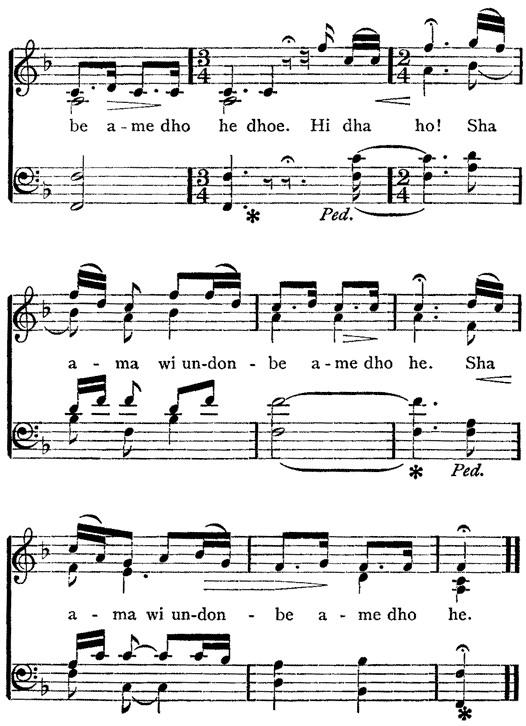
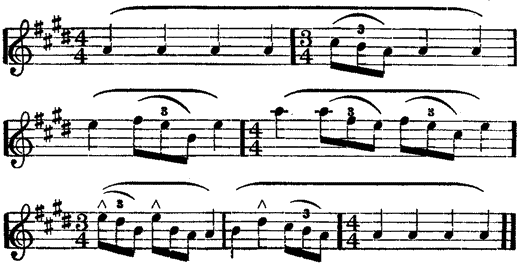
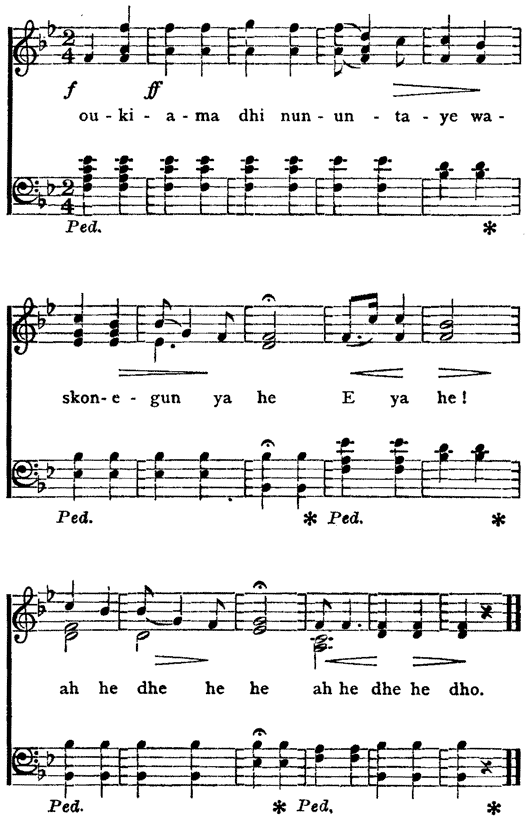
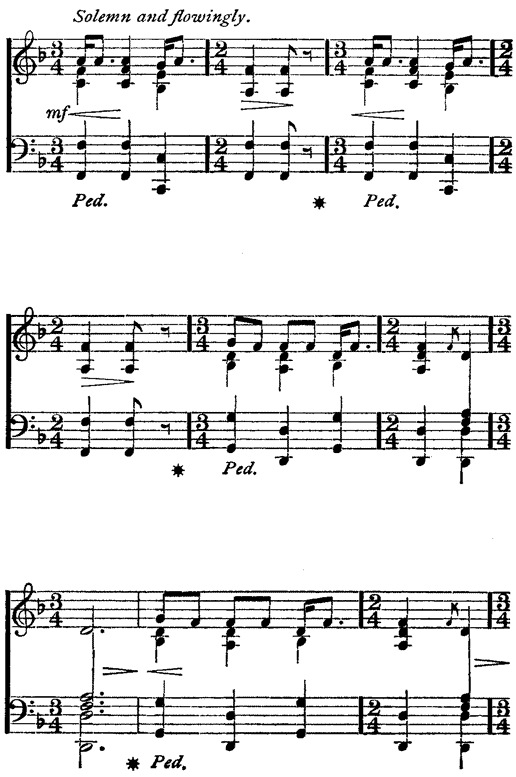
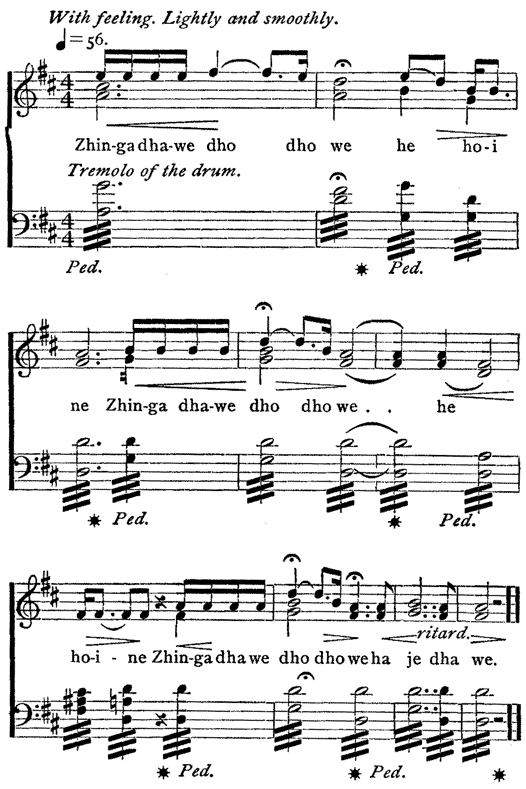
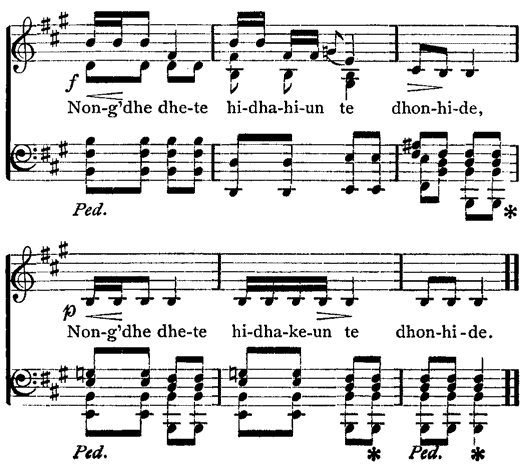
This is the song which accompanied the preparation and the putting on
of the insignia of the thunder god. The music is expressive of the
tremulous movement of the leaves, of the flying of the birds, of the
stir of all nature before the advancing storm, typifying the
stirring of the heart of man when summoned to fight the enemies of his
people.
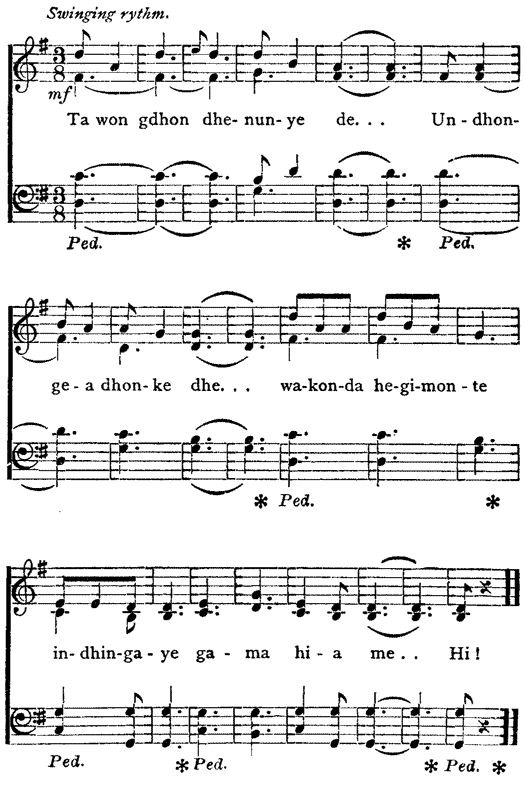
PUTTING ON THE INSIGNIA OF THE
THUNDER GOD.
Omaha. He-dhu´-shka.
Harmonized by Prof. J.C. Fillmore.
[Listen] [PDF] [MusicXML]
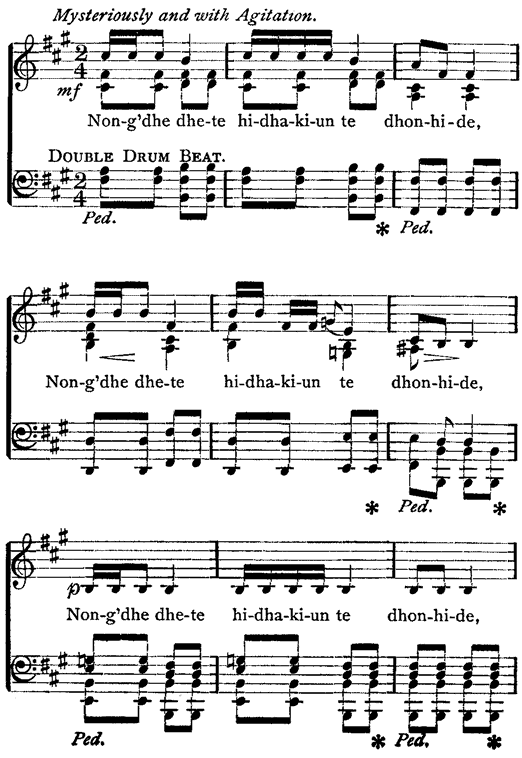
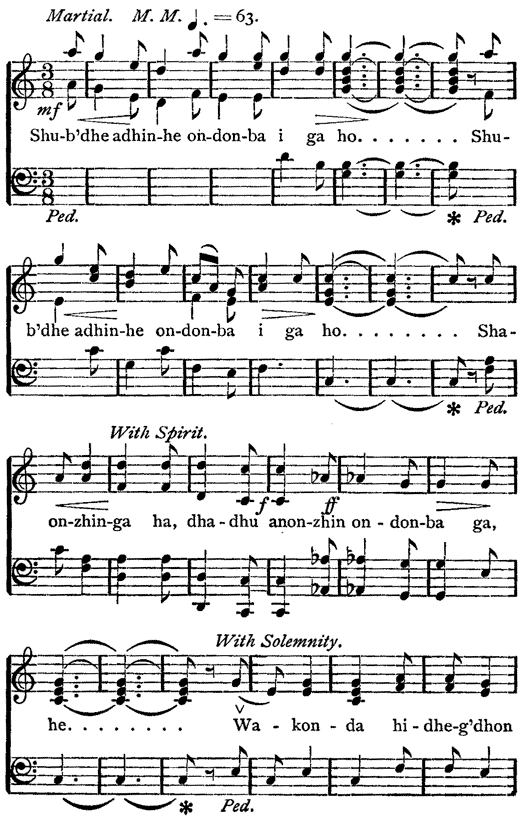
Non-g'dhe dhe-te hi-dha-ki-un te dhon-hi-de,
Non-g'dhe dhe-te hi-dha-ki-un te dhon-hi-de,
Non-g'dhe dhe-te hi-dha-ki-un te dhon-hi-de,
Non-g'dhe dhe-te hi-dha-hi-un te dhon-hi-de,
Non-g'dhe dhe-te hi-dha-ke-un te dhon-hi-de.
|
At the close of the song and ceremony of blackening the Leader's face,
I had seen the Leader take the pipe belonging to the society, fill it,
and reverently lift the stem upward.
"When the Leader's face is painted," continued the old man, "he offers
the pipe to Wa-kon´-da (god). The words of the song then sung mean:
Wa-kon´-da, we offer this pipe (the symbol of our unity as a
society). Accept it (and us). All the members must join in singing
this prayer, and afterward all must smoke the pipe."
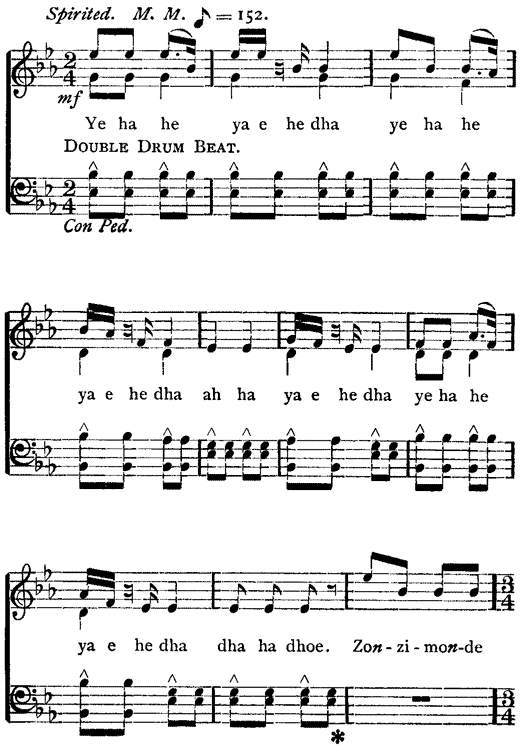
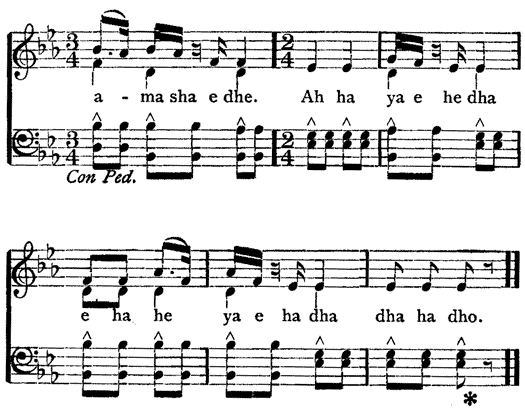
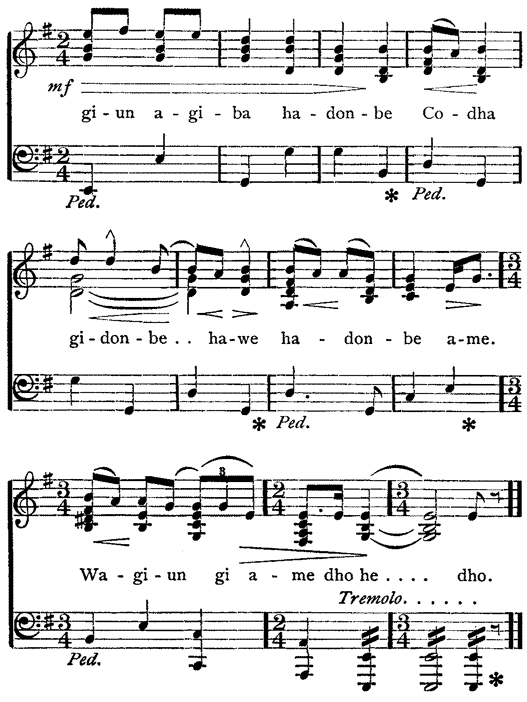
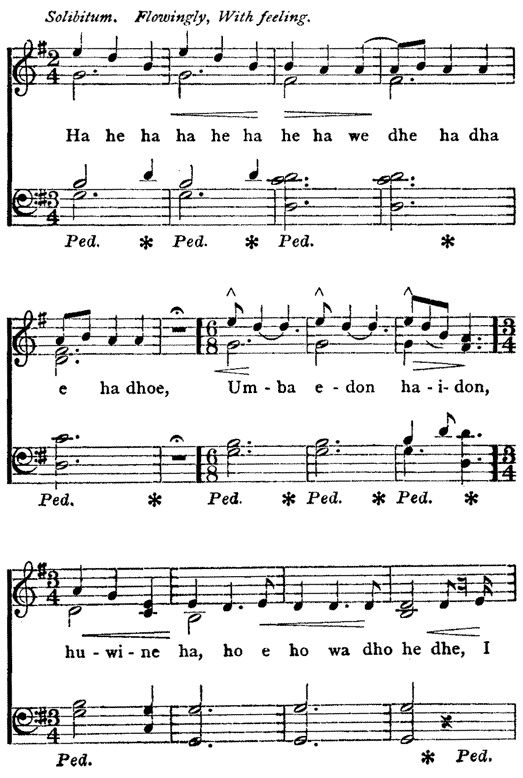
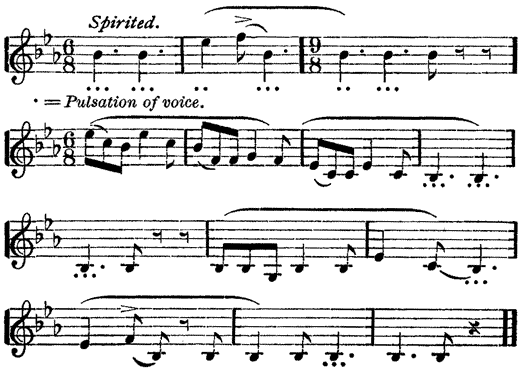
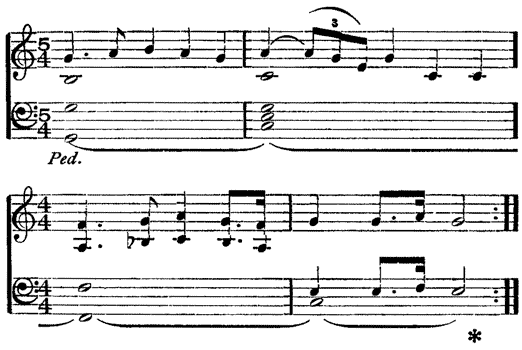
PRAYER OF THE WARRIORS BEFORE
SMOKING THE PIPE.
Omaha. He-dhu´-shka.
Harmonized by Prof. J.C. Fillmore.
[Listen] [PDF] [MusicXML]
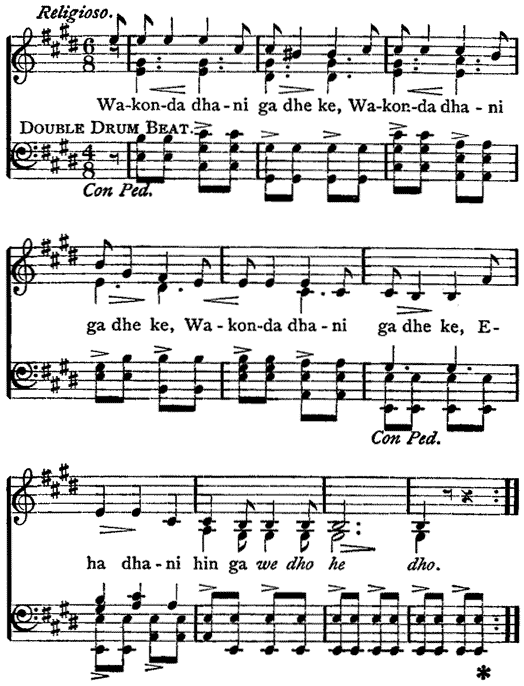
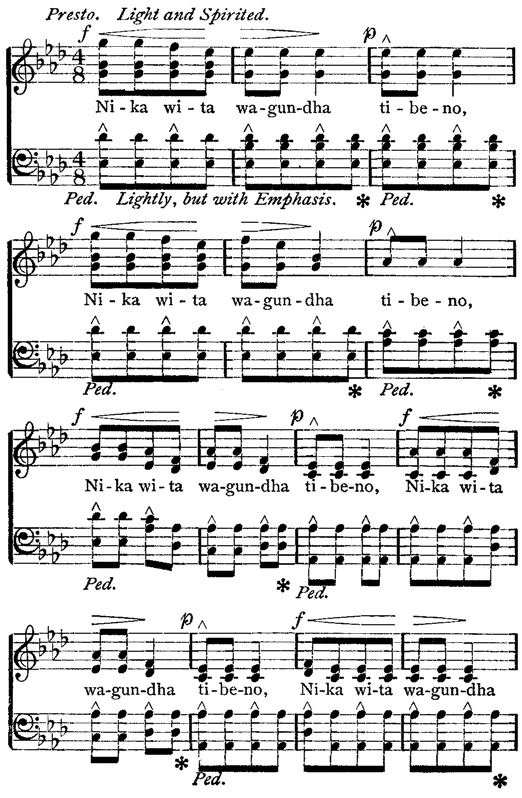
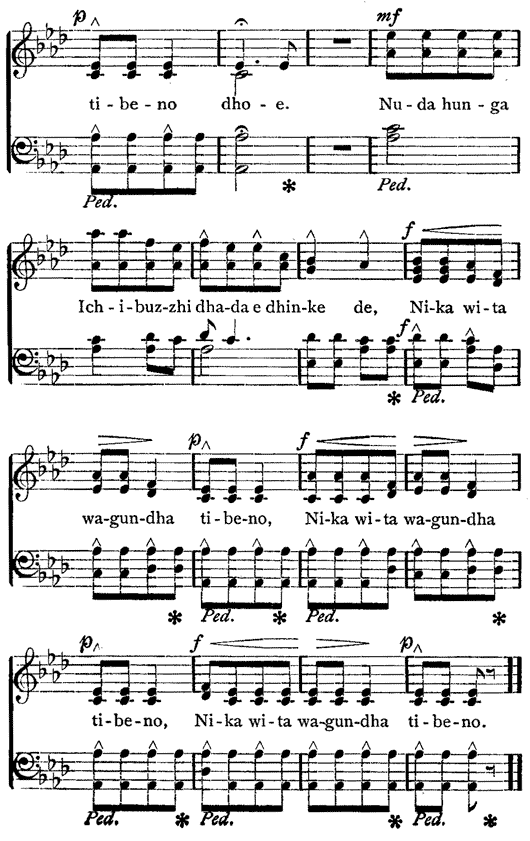
Wa-kon-da dha-ni ga dhe ke,
Wa-kon-da dha-ni ga dhe ke,
Wa-kon-da dha-ni ga dhe ke,
E-ha dha-ni hin ga we dho he dho.
|
"The He-dhu´-shka Society is very old," continued my friend. "It is
said to have been in existence at the time when the Omahas and the
Ponkas were together as one tribe. There is a song with a dance which
must be given at every meeting. It is to keep alive the memory of a
battle that took place while we were migrating westward, and where
defeat would have meant our extermination as a tribe. I will tell you
the story.[2]
"One morning the tribe, whose country had been invaded by the Ponkas,
made an unexpected assault upon the camp of the invaders. For a time
it seemed as though the Ponkas would fare badly at the hands of their
assailants, who were determined to drive out or destroy the intruders;
but after a desperate struggle the Ponkas pushed their enemies back
from the outskirts of the village, until finally their retreat became
a rout. Both sides suffered great loss. The ground was strewn with the
dead, and the grass stained with the blood of the warriors who fell in
the battle; but the victory was with us, and we had conquered the
right to dwell in that country.
"At the outset of the conflict a man bent with age emerged slowly from
the door of one of the tents. The breezes played with his long white
hair as he stood leaning on his staff, shading his face with one hand
and looking intently in the direction whence came the noise of battle.
As he recognised the voice of a warrior rushing to the fray, imitating
as he ran the cry of some animal (his tutelary god), the aged man
called after him:
"'Once more! Once more be the undaunted warrior you have hitherto
been! Utter aloud your mystic cry, and make the enemy to tremble with
fear!'
"If a youth passed by, singing his death song, the old man would
ask:—
"'Who is that young man? He promises well.' Upon being told whose son
he was, the aged man shouted: 'Ho-o! You have the spirit of your
father. Be like him: turn not your face from the foe!'
"All day the old man stood at his door as though rooted to the ground.
As the hours sped on, fainter and fainter grew the shouts and the
cries of the contending men, until finally the sounds died away. Even
then the venerable man moved not from his tent, but still stood
watching. Lower and lower dropped the sun toward the western horizon,
and all through the village anxious faces were turned in the direction
whence the last sound of the fight had been heard. Suddenly a woman
cried,—
"'There they come!'
"At her words the old man leaned forward, straining his dim eyes to
discern the distant figures on the far-off hill. In single file, on
the warriors came, one preceding another, according to the grade of
the honours he had won in the battle. The Herald hastened forth from
the village to meet them and to learn their tidings. After a halt he
turned and came on in advance of the men, shouting as he came near
the village the names of those who had fallen in battle. As each name
was called, the wife or mother of the slain man rent the air with
sudden cry and wail, so that the whole village vibrated with the sound
of sorrow as the victorious warriors drew near. In the midst of all
this commotion the aged watcher remained motionless, giving no sign of
emotion as the wailing grew in volume, and stirring not even when he
heard the names of his two sons called in the long death-roll.
"As the warriors entered the village, the Herald proclaimed the names
of those who had distinguished themselves in that memorable fight.
Slowly the men of valour approached their aged chief, who bowed
acknowledgment as each one spoke and laid at his feet a trophy of war.
"Among the veterans came a young warrior, who, in this his first
battle, had, in a hand to hand contest, wrenched a club from the grasp
of his antagonist, and had slain the enemy with his own weapon. This
club he presented to the old man, recounting the deed. The chief,
lifting the weapon, exclaimed with a dramatic laugh: 'Ha, ha, ha! It
is thus you should treat your enemies, that they may fear you. My
exhortations to our young men have not fallen on deaf ears. Those who
sought to destroy our people lie scattered and dead on the ground.
Wherever their shadows may wander, even there the fear of you shall
be. The enemy sought to make me weep, but I laugh.' And the old man
danced to his triumphant laugh for the victory of that day."
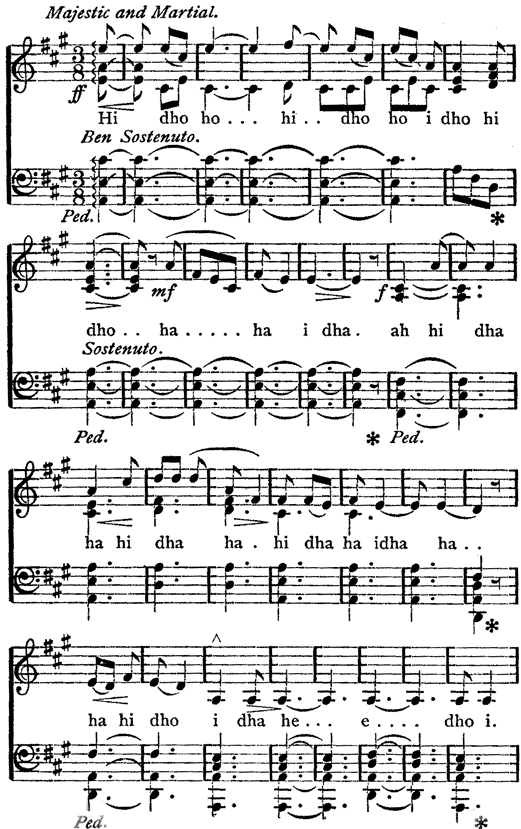
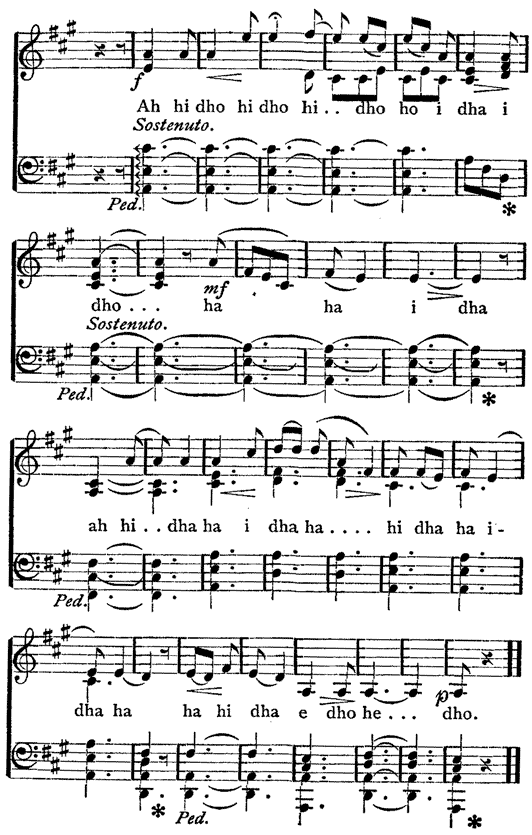
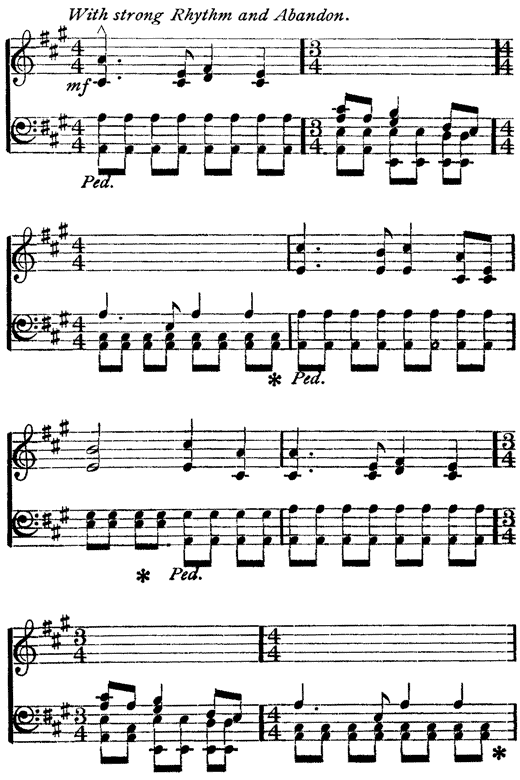
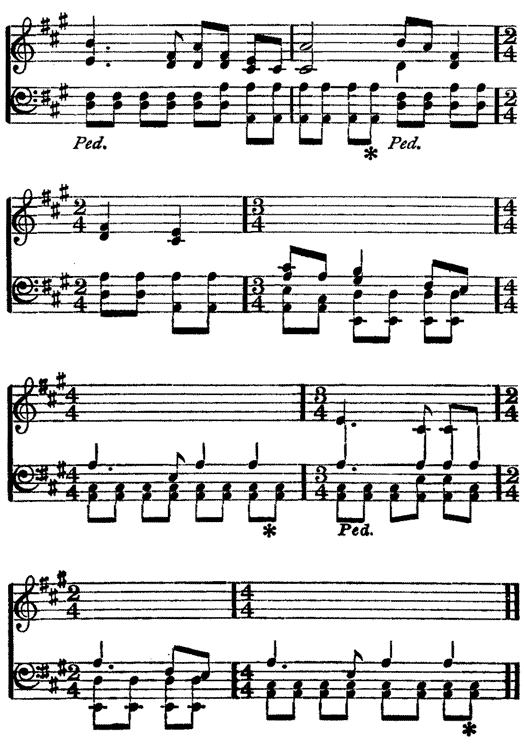
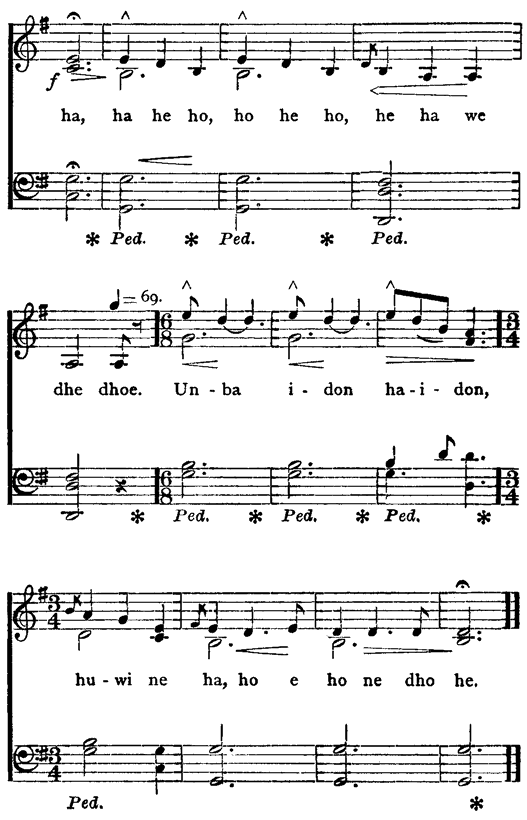
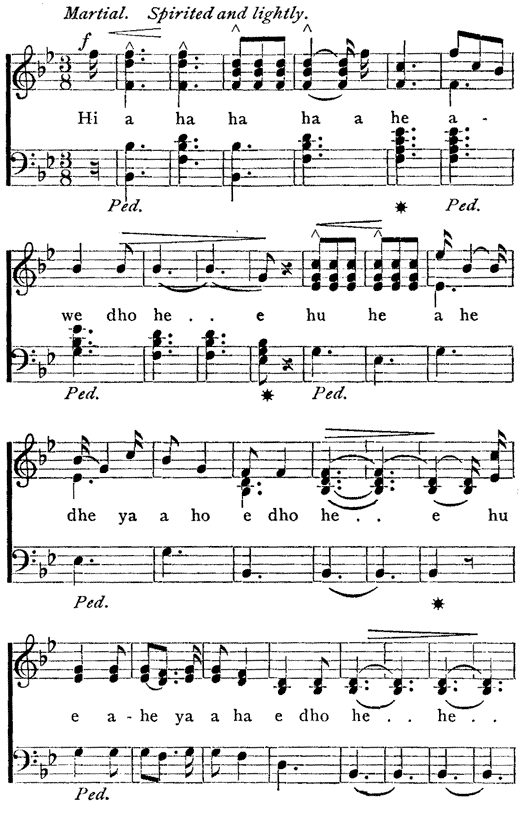
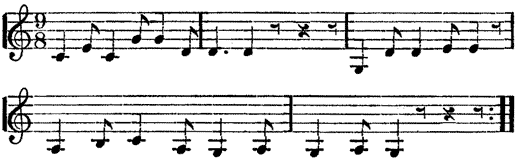
SONG OF THE LAUGH.
Ponka. He-dhu´-shka.
[Listen] [PDF] [MusicXML]

Ha, ha, ha ha ha! Ha ha! hi hi! ha ha! hi!
So this was the meaning of the monotonous song that had accompanied
the opening dance I had seen at the He-dhu´-shka Society, where the
dancer, with body bent and with short rhythmic steps, had kept time to
the dramatic laugh of the song,—a song that had seemed so aimless to
me only the night before.
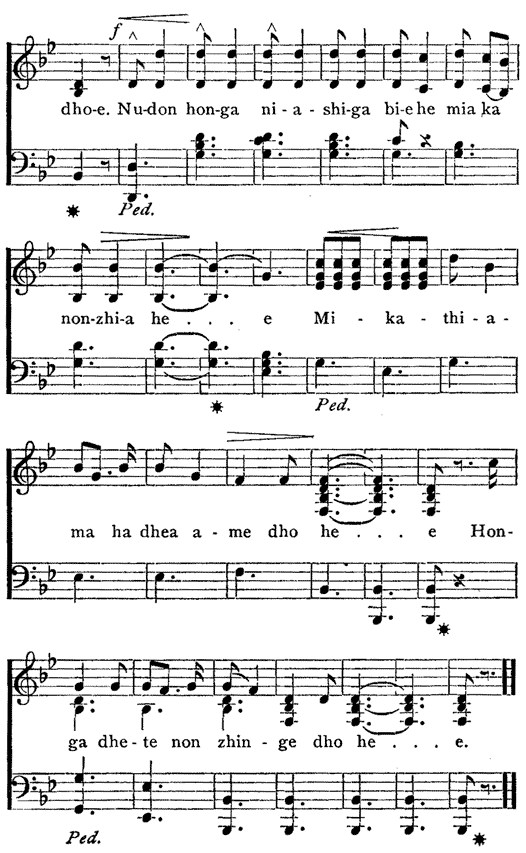
"Every song of the Society has its story which is the record of some
deed or achievement of its members," said another old man who was
lying beside the fire. "I will tell you one that was known to our
great-great-grandfathers," and rising upon his elbow he began:—