BY COLONEL GUIDO ILGES
"LITTLE MOCCASIN" was, at the time we
speak of, fourteen years old, and about as
mischievous a boy as could be found anywhere in
the Big Horn mountains. Unlike his comrades
of the same age, who had already killed buffaloes
and stolen horses from the white men and the
Crow Indians, with whom Moccasin's tribe, the
Uncapapas, were at war, he preferred to lie under
a shady tree in the summer, or around the campfire
in winter, listening to the conversation of the
old men and women, instead of going upon expeditions
with the warriors and the hunters.
The Uncapapas are a very powerful and numerous
tribe of the great Sioux Nation, and before
Uncle Sam's soldiers captured and removed
them, and before the Northern Pacific Railroad
entered the territory of Montana, they occupied
the beautiful valleys of the Rosebud, Big and Little
Horn, Powder and Redstone rivers, all of
which empty into the grand Yellowstone Valley.
In those days, before the white man had set foot
upon these grounds, there was plenty of game,
such as buffalo, elk, antelope, deer, and bear; and,
as the Uncapapas were great hunters and good
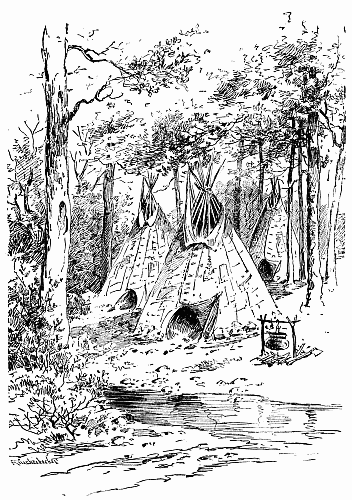
shots, the camp of Indians to which Little Moccasin
belonged always had plenty of meat to eat
and plenty of robes and hides to sell and trade for
horses and guns, for powder and ball, for sugar
and coffee, and for paint and flour. Little Moccasin
showed more appetite than any other Indian
in camp. In fact, he was always hungry, and used
to eat at all hours, day and night. Buffalo meat
he liked the best, particularly the part taken from
the hump, which is so tender that it almost melts
in the mouth.
When Indian boys have had a hearty dinner of
good meat, they generally feel very happy and
very lively. When hungry, they are sad and dull.
This was probably the reason why Little Moccasin
was always so full of mischief, and always
inventing tricks to play upon the other boys. He
was a precocious and observing youngster, full of
quaint and original ideas—never at a loss for expedients.
But he was once made to feel very sorry for
having played a trick, and I must tell my young
readers how it happened.
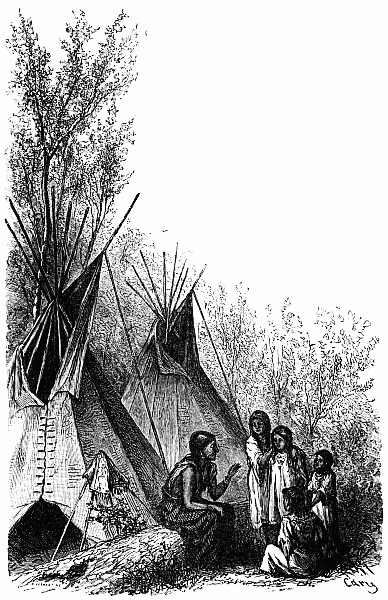
"Running Antelope," one of the great warriors
and the most noted orator of the tribe, had returned
from a hunt, and Mrs. Antelope was frying
for him a nice buffalo steak—about as large
as two big fists—over the coals. Little Moccasin,
who lived in the next street of tents, smelled the
feast, and concluded that he would have some of
it. In the darkness of the night he slowly and
carefully crawled toward the spot where Mistress
Antelope sat holding in one hand a long stick, at
the end of which the steak was frying. Little
Moccasin watched her closely, and, seeing that
she frequently placed her other hand upon the
ground beside her and leaned upon it for support,
he soon formed a plan for making her drop the
steak.
He had once or twice in his life seen a pin, but
he had never owned one, and he could not have
known what use is sometimes made of them by
bad white boys. He had noticed, however, that
some of the leaves of the larger varieties of the
prickly-pear cactus-plant are covered with many
thorns, as long and as sharp as an ordinary pin.
So when Mrs. Antelope again sat down and
looked at the meat to see if it was done, he slyly
placed half-a-dozen of the cactus leaves upon the
very spot of ground upon which Mrs. Antelope
had before rested her left hand.
Then the young mischief crawled noiselessly
into the shade and waited for his opportunity,
which came immediately.
When the unsuspecting Mrs. Antelope again
leaned upon the ground, and felt the sharp points
of the cactus leaves, she uttered a scream, and
dropped from her other hand the stick and the
steak, thinking only of relief from the sharp pain.
Then, on the instant, the young rascal seized
the stick and tried to run away with it. But Running
Antelope caught him by his long hair, and
gave him a severe whipping, declaring that he
was a good-for-nothing boy, and calling him a
"coffee-cooler" and a "squaw."
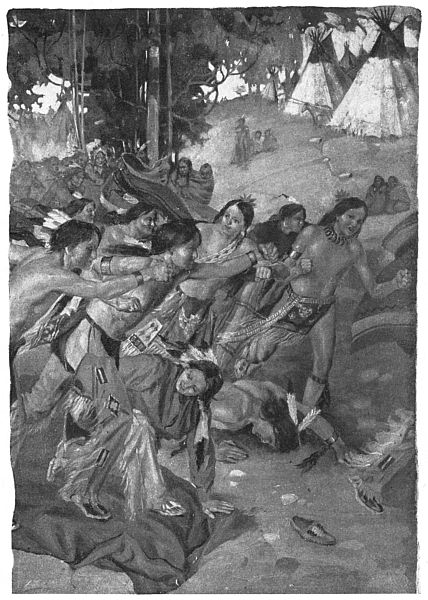
The other boys, hearing the rumpus, came running
up to see the fun, and they laughed and
danced over poor Little Moccasin's distress.
Often afterward they called him "coffee-cooler";
which meant that he was cowardly and faint-hearted,
and that he preferred staying in camp
around the fire, drinking coffee, to taking part in
the manly sports of hunting and stealing expeditions.
The night after the whipping, Little Moccasin
could not sleep. The disgrace of the whipping
and the name applied to him were too much for
his vanity. He even lost his appetite, and refused
some very nice prairie-dog stew which his mother
offered him.
He was thinking of something else. He must
do something brave—perform some great deed
which no other Indian had ever performed—in
order to remove this stain upon his character.
But what should it be? Should he go out alone
and kill a bear? He had never fired a gun, and
was afraid that the bear might eat him. Should
he attack the Crow camp single-handed? No, no—not
he; they would catch him and scalp him
alive.
All night long he was thinking and planning;
but when daylight came, he had reached no conclusion.
He must wait for the Great Spirit to
give him some ideas.
During the following day he refused all food
and kept drawing his belt tighter and tighter
around his waist every hour, till, by evening, he
had reached the last notch. This method of appeasing
the pangs of hunger, adopted by the Indians
when they have nothing to eat, is said to be
very effective.
In a week's time Little Moccasin had grown
almost as thin as a bean-pole, but no inspiration
had yet revealed what he could do to redeem himself.
About this time a roving band of Cheyennes,
who had been down to the mouth of the Little
Missouri, and beyond, entered the camp upon a
friendly visit. Feasting and dancing were kept
up day and night, in honor of the guests; but
Little Moccasin lay hidden in the woods nearly all
the time.
During the night of the second day of their
stay, he quietly stole to the rear of the great council-tepee,
to listen to the pow-wow then going on.
Perhaps he would there learn some words of wisdom
which would give him an idea how to carry
out his great undertaking.
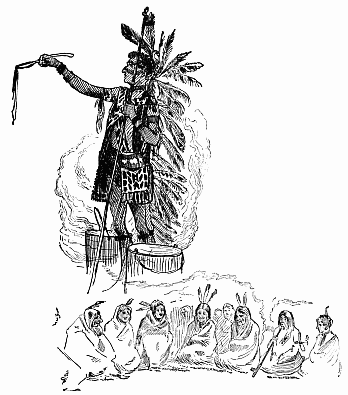
After "Black Catfish," the great Cheyenne
warrior, had related in the flowery language of
his tribe some reminiscences of his many fights
and brave deeds, "Strong Heart" spoke. Then
there was silence for many minutes, during which
the pipe of peace made the rounds, each warrior
taking two or three puffs, blowing the smoke
through the nose, pointing toward heaven, and
then handing the pipe to his left-hand neighbor.
"Strong Heart," "Crazy Dog," "Bow-String,"
"Dog-Fox," and "Smooth Elkhorn" spoke of the
country they had just passed through.
Then again the pipe of peace was handed
round, amid profound silence.
"Black Pipe," who was bent and withered with
the wear and exposure of seventy-nine winters,
and who trembled like some leafless tree shaken
by the wind, but who was sound in mind and
memory, then told the Uncapapas, for the first
time, of the approach of a great number of white
men, who were measuring the ground with long
chains, and who were being followed by "Thundering
Horses" and "Houses on Wheels." (He
was referring to the surveying parties of the
Northern Pacific Railway Company, who were
just then at work on the crossing of the Little
Missouri.)
With heart beating wildly, Little Moccasin listened
to this strange story and then retired to his
own blankets in his father's tepee.
Now he had found the opportunity he so long
had sought! He would go across the mountains,
all by himself, look at the thundering horses and
the houses on wheels. He then would know more
than any one in the tribe, and return to the camp,—a
hero!
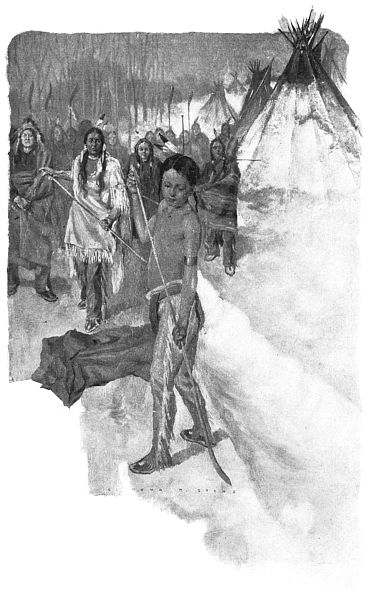
At early morn, having provided himself with a
bow and a quiver full of arrows, without informing
any one of his plan he stole out of camp, and,
running at full speed, crossed the nearest mountain
to the East.
Allowing himself little time for rest, pushing
forward by day and night, and after fording
many of the smaller mountain-streams, on the
evening of the third day of his travel he came
upon what he believed to be a well-traveled road.
But—how strange!—there were two endless iron
rails lying side by side upon the ground. Such a
curious sight he had never beheld. There were
also large poles, with glass caps, and connected
by wire, standing along the roadside. What
could all this mean?
Poor Little Moccasin's brain became so bewildered
that he hardly noticed the approach of a
freight-train drawn by the "Thundering Horse."
There was a shrill, long-drawn whistle, and immense
clouds of black smoke; and the Thundering
Horse was sniffing and snorting at a great
rate, emitting from its nostrils large streams of
steaming vapor. Besides all this, the earth, in the
neighborhood of where Little Moccasin stood,
shook and trembled as if in great fear; and to him
the terrible noises the horse made were perfectly
appalling.
Gradually the snorts, and the puffing, and the
terrible noise lessened, until, all at once, they entirely
ceased. The train had come to a stand-still
at a watering tank, where the Thundering Horse
was given its drink.
The rear car, or "House on Wheels," as old
Black Pipe had called it, stood in close proximity
to Little Moccasin,—who, in his bewilderment
and fright at the sight of these strange moving
houses, had been unable to move a step.
But as no harm had come to him from the terrible
monster, Moccasin's heart, which had sunk
down to the region of his toes, began to rise
again; and the curiosity inherent in every Indian
boy mastered fear.
He moved up, and down, and around the great
House on Wheels; then he touched it in many
places, first with the tip-end of one finger, and
finally with both hands. If he could only detach
a small piece from the house to take back to camp
with him as a trophy and as a proof of his daring
achievement! But it was too solid, and all made
of heavy wood and iron.
At the rear end of the train there was a ladder,
which the now brave Little Moccasin ascended
with the quickness of a squirrel to see what there
was on top.
It was gradually growing dark, and suddenly
he saw (as he really believed) the full moon approaching
him. He did not know that it was
the headlight of a locomotive coming from the
opposite direction.
Absorbed in this new and glorious sight, he did
not notice the starting of his own car, until it was
too late, for, while the car moved, he dared not let
go his hold upon the brake-wheel.
There he was, being carried with lightning
speed into a far-off, unknown country, over
bridges, by the sides of deep ravines, and along
the slopes of steep mountains.
But the Thundering Horse never tired nor
grew thirsty again during the entire night.
At last, soon after the break of day, there came
the same shrill whistle which had frightened him
so much on the previous day; and, soon after, the
train stopped at Miles City.
But, unfortunately for our little hero, there
were a great many white people in sight; and he
was compelled to lie flat upon the roof of his car,
in order to escape notice. He had heard so much
of the cruelty of the white men that he dared not
trust himself among them.
Soon they started again, and Little Moccasin
was compelled to proceed on his involuntary journey,
which took him away from home and into
unknown dangers.
At noon, the cars stopped on the open prairie to
let Thundering Horse drink again. Quickly, and
without being detected by any of the trainmen, he
dropped to the ground from his high and perilous
position. Then the train left him—all alone in
an unknown country.
Alone? Not exactly; for, within a few minutes,
half a dozen Crow Indians, mounted on
swift ponies, are by his side, and are lashing him
with whips and lassoes.
He has fallen into the hands of the deadliest
enemies of his tribe, and has been recognized by
the cut of his hair and the shape of his moccasins.
When they tired of their sport in beating poor
Little Moccasin so cruelly, they dismounted and
tied his hands behind his back.
Then they sat down upon the ground to have a
smoke and to deliberate about the treatment of
the captive.
During the very severe whipping, and while
they were tying his hands, though it gave him
great pain, Little Moccasin never uttered a groan.
Indian-like, he had made up his mind to "die
game," and not to give his enemies the satisfaction
of gloating over his sufferings. This, as will
be seen, saved his life.
The leader of the Crows, "Iron Bull," was in
favor of burning the hated Uncapapa at a stake,
then and there; but "Spotted Eagle," "Blind
Owl," and "Hungry Wolf" called attention to
the youth and bravery of the captive, who had
endured the lashing without any sign of fear.
Then the two other Crows took the same view.
This decided poor Moccasin's fate; and he understood
it all, although he did not speak the Crow
language, for he was a great sign-talker, and had
watched them very closely during their council.
Blind Owl, who seemed the most kind-hearted
of the party, lifted the boy upon his pony, Blind
Owl himself getting up in front, and they rode at
full speed westward to their large encampment,
where they arrived after sunset.
Little Moccasin was then relieved of his bonds,
which had benumbed his hands during the long
ride, and a large dish of boiled meat was given
to him. This, in his famished condition, he relished
very much. An old squaw, one of the wives
of Blind Owl, and a Sioux captive, took pity on
him, and gave him a warm place with plenty of
blankets in her own tepee, where he enjoyed a
good rest.
During his stay with the Crows, Little Moccasin
was made to do the work, which usually falls
to the lot of the squaws; and which was imposed
upon him as a punishment upon a brave enemy,
designed to break his proud spirit. He was
treated as a slave, made to haul wood and draw
water, do the cooking, and clean game. Many of
the Crow boys wanted to kill him, but his foster-mother,
"Old Looking-Glass," protected him;
and, besides, they feared that the soldiers of Fort
Custer might hear of it, if he was killed, and punish
them.
Many weeks thus passed, and the poor little
captive grew more despondent and weaker in
body every day. Often his foster-mother would
talk to him in his own language, and tell him to
be of good cheer; but he was terribly homesick
and longed to get back to the mountains on the
Rosebud, to tell the story of his daring and become
the hero which he had started out to be.
One night, after everybody had gone to sleep
in camp, and the fires had gone out, Old Looking-Glass,
who had seemed to be soundly sleeping, approached
his bed and gently touched his face.
Looking up, he saw that she held a forefinger
pressed against her lips, intimating that he must
keep silence, and that she was beckoning him to
go outside.
There she soon joined him; then, putting her
arm around his neck, she hastened out of the camp
and across the nearest hills.
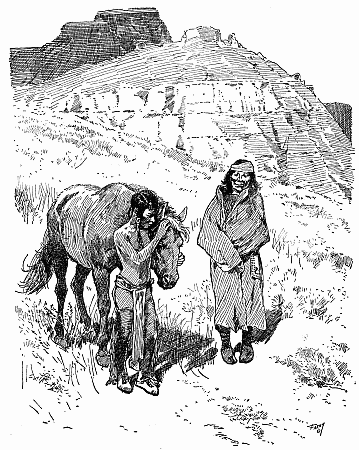
When they had gone about five miles away
from camp, they came upon a pretty little mouse-colored
pony, which Old Looking-Glass had hidden
there for Little Moccasin on the previous day.
She made him mount the pony, which she called
"Blue Wing," and bade him fly toward the rising
sun, where he would find white people who would
protect and take care of him.
 "THEY CAME UPON A PRETTY LITTLE MOUSE-COLORED PONY"
Old Looking-Glass then kissed Little Moccasin
upon both cheeks and the forehead, while the tears
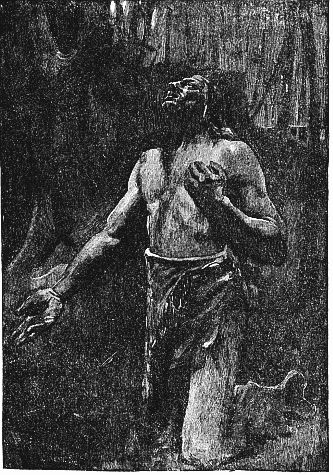
ran down her wrinkled face; she also folded her
hands upon her breast and, looking up to the
heavens, said a prayer, in which she asked the
Great Spirit to protect and save the poor boy in
his flight.
After she had whispered some indistinct words
into the ear of Blue Wing (who seemed to understand
her, for he nodded his head approvingly),
she bade Little Moccasin be off, and advised him
not to rest this side of the white man's settlement,
as the Crows would soon discover his absence,
and would follow him on their fleetest ponies.
"But Blue Wing will save you! He can outrun
them all!"
These were her parting words, as he galloped
away.
In a short time the sun rose over the nearest
hill, and Little Moccasin then knew that he was
going in the right direction. He felt very happy
to be free again, although sorry to leave behind
his kind-hearted foster-mother, Looking-Glass.
He made up his mind that after a few years, when
he had grown big and become a warrior, he would
go and capture her from the hated Crows and
take her to his own tepee.
He was so happy in this thought that he had
not noticed how swiftly time passed, and that already
the sun stood over his head; neither had he
urged Blue Wing to run his swiftest; but that
good little animal kept up a steady dog-trot, without,
as yet, showing the least sign of being tired.
But what was the sudden noise which was
heard behind him? Quickly he turned his head,
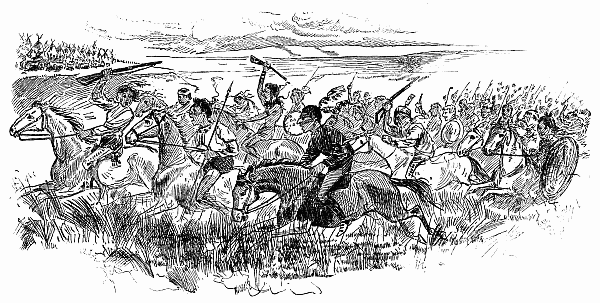
and, to his horror, he beheld about fifty mounted
Crows coming toward him at a run, and swinging
in their hands guns, pistols, clubs, and knives!
His old enemy, Iron Bull, was in advance, and
under his right arm he carried a long lance, with
which he intended to spear Little Moccasin.
Moccasin's heart stood still for a moment with
fear; he knew that this time they would surely
kill him if caught. He seemed to have lost all
power of action.
Nearer and nearer came Iron Bull, shouting at
the top of his voice.
But Blue Wing now seemed to understand the
danger of Moccasin's situation; he pricked up his
ears, snorted a few times, made several short
jumps, fully to arouse Moccasin, who remained
paralyzed with fear, and then, like a bird, fairly
flew over the prairie, as if his little hoofs were not
touching the ground.
Little Moccasin, too, was now awakened to his
peril, and he patted and encouraged Blue Wing;
while, from time to time, he looked back over his
shoulder to watch the approach of Iron Bull.
Thus they went, on and on; over ditches and
streams, rocks and hills, through gulches and
valleys. Blue Wing was doing nobly, but the
pace could not last forever.
Iron Bull was now only about five hundred
yards behind and gaining on him.
Little Moccasin felt the cold sweat pouring
down his face. He had no firearm, or he would
have stopped to shoot at Iron Bull.
Blue Wing's whole body seemed to tremble beneath
his young rider, as if the pony was making
a last desperate effort, before giving up from exhaustion.
Unfortunately, Little Moccasin did not know
how to pray, or he might have found some comfort
and help thereby; but in those moments, when
a terrible death was so near to him, he did the
next best thing: he thought of his mother and his
father, of his little sisters and brothers, and also
of Looking-Glass, his kind old foster-mother.
Then he felt better and was imbued with fresh
courage. He again looked back, gave one loud,
defiant yell at Iron Bull, and then went out of
sight over some high ground.
Ki-yi-yi-yi! There is the railroad station just
in front, only about three hundred yards away.
He sees white men around the buildings, who will
protect him.
At this moment Blue Wing utters one deep
groan, stumbles, and falls to the ground. Fortunately,
though, Little Moccasin has received no
hurt. He jumps up, and runs toward the station
as fast as his weary legs can carry him.
At this very moment Iron Bull with several of
his braves came in sight again, and, realizing the
helpless condition of the boy, they all gave a shout
of joy, thinking that in a few minutes they would
capture and kill him.
But their shouting had been heard by some of
the white men, who at once concluded to protect
the boy, if he deserved aid.
Little Moccasin and Iron Bull reached the door
of the station-building at nearly the same moment;
but the former had time enough to dart inside
and hide under the table of the telegraph
operator.
When Iron Bull and several other Crows
rushed in to pull the boy from underneath the
table, the operator quickly took from the table
drawer a revolver, and with it drove the murderous
Crows from the premises.
Then the boy had to tell his story, and he was
believed. All took pity upon his forlorn condition,
and his brave flight made them his friends.
In the evening Blue Wing came up to where
Little Moccasin was resting and awaiting the arrival
of the next train, which was to take him back
to his own home.
Then they both were put aboard a lightning-express
train, which took them to within a short
distance of the old camp on the Rosebud.
When Little Moccasin arrived at his father's
tepee, riding beautiful Blue Wing, now rested and
frisky, the whole camp flocked around him; and
when he told them of his great daring, of his capture
and his escape, Running Antelope, the big
warrior of the Uncapapas and the most noted
orator of the tribe, proclaimed him a true hero,
and then and there begged his pardon for having
called him a "coffee-cooler." In the evening Little
Moccasin was honored by a great feast, and
the name of "Rushing Lightning," Wakee-wata-keepee,
was bestowed upon him—and by that
name he is known to this day.

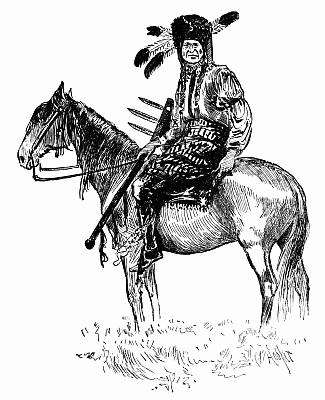
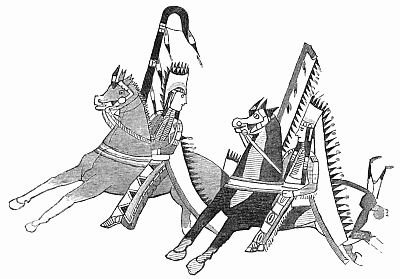
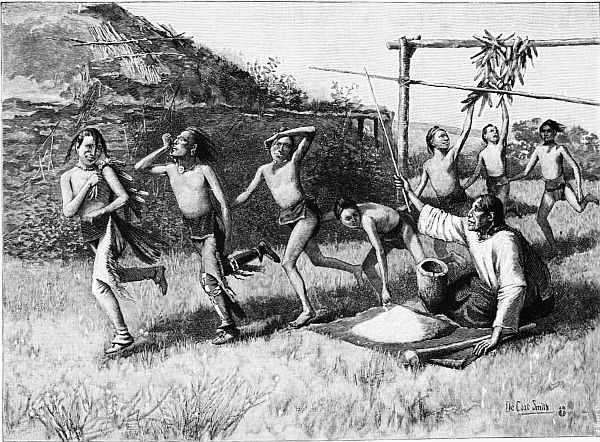
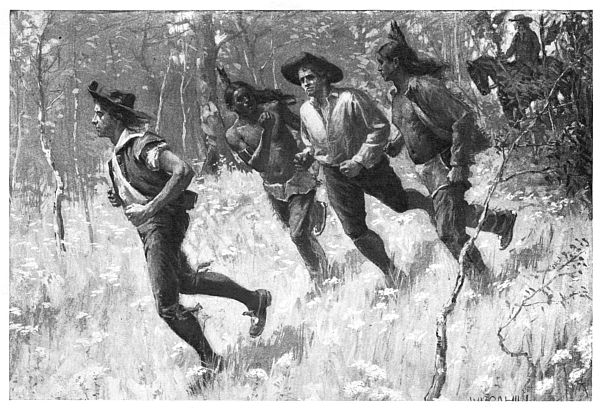
 AN INDIAN HORSE-RACE—COMING OVER THE SCRATCH