A LONG, long time ago the son of
the first chief of the animal
people set out upon a journey.
Dressed in the skin of a raven, and
carrying in his beak a magic bag which
his father had given him, he flew eastward
over a dark and watery waste.
When he had flown far and was tired,
he dropped a stone in the sea, and
it became an island, upon which he
rested.
Again he rose up and flew onward upon
slow black wings, no blacker than the
gloom that covered the face of the world.
As he skimmed the surface of the waves,
80]
he scattered from his enchanted bag
the spawn of every kind of fish, so that
the sea was filled with finny life. Then
he turned toward shore, and over the
dry land he cast berries and seeds of all
plants that are good for food, so that
the earth too was ready to burst with
fruitfulness, only there was no sun to
warm it into life.
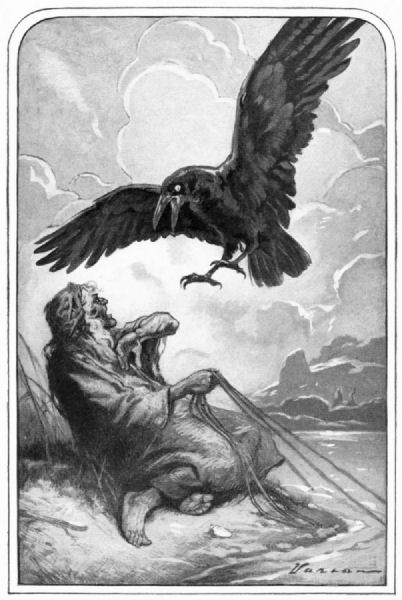
Raven became very tired of the eternal
darkness, and at last he flew straight
upward until he found the hole in the
sky, and went right through the hole.
There he left the raven’s skin lying and
flew on till he came to a spring of clear
water, bubbling up with a sound like
maidens’ laughter near the wigwam of
the Chief of Heaven. He turned himself
into a leaf and floated in the pool,
waiting for the chief’s daughter. When
she came, she was indeed very beautiful.
Stooping, she dipped up the leaf
81]
in her bucket and drank it with the
water.
Now the maiden returned to her home,
and not long after a child was born to
her. The baby grew very fast. He was
stronger than any child ever seen, yet
he cried continually. Soon he was creeping
about the floor and crying all the
time in a loud voice. The wise old men
were called in to explain these cries, and
the wisest one of all told the princess
that her son was crying for a large box
that hung under the roof. This was
the box that held the daylight.
Since nothing else would do, they took
down the box and gave it to the child
to play with. For four days he rolled
it about the floor; then one day, when
no one was looking, he lifted it to his
shoulders, got to his feet, and ran out
of the door with it. He sped as fast as
he could to the hole in the sky, put on
82]
the raven’s skin that he found lying
there, and flew down to earth with the
precious box.
Now the Frog people were fishing down
there, and they made a great noise and
confusion in the darkness. Raven called
upon them to be silent, but they paid
no attention to him. The big frogs
were bellowing very loud, and the little
frogs were piping high and shrill, and
there was no peace or quiet anywhere.
Raven told them twice to be less noisy,
and when they would not, he said, “Then
I shall open the box.”
So he opened it, and daylight overspread
the earth.
Again Raven flew over the waters
till he reached the mainland and the
wigwam of the old, old woman who
holds the tide lines in her hand. At that
83]
time the tide would remain high for
many days at a time, so that the people
could get no clams or other sea food.
It happened that Raven was very hungry
for clams, but he entered the hut
and sat down, saying pleasantly:
“Good day, grandmother: there is fine
digging to-day. I have just had all the
clams I could eat.”
“Nonsense!” exclaimed the old woman.
“What are you talking about, Raven?
You know very well that the clams are
all covered.”
“Yes, but I’ve had all the clams I
want,” he insisted.
“That isn’t so,” she declared.
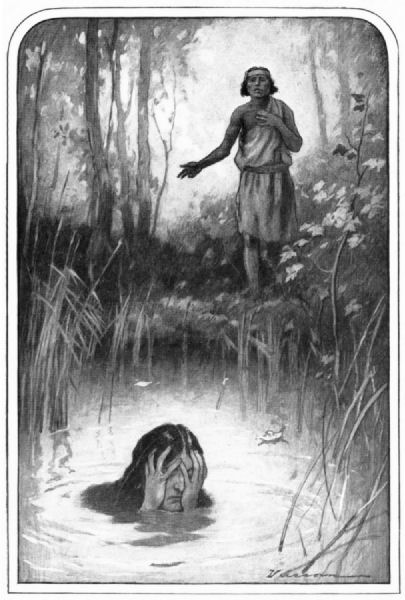
THE OLD WOMAN AND THE TIDES
He rudely pushed her backward until she fell down.
Page 83.
Upon this he rudely pushed her backward
until she fell down, and her mouth
and eyes were filled with dust. Of
course she was forced to let go the tide
lines, so that the tide ran quickly out,
and the beach was covered with fine
84]
fat clams and other shellfish. Raven
did not come back to the hut until
he had eaten as many as he possibly
could.
“My eyes are blinded with dust,”
mourned the old woman. “Will you
not give me back my sight?”
“I will, if you will promise to slacken
the tide lines twice a day,” he replied.
So she said that she would, and from
that time to this the tides have run in
and out twice each day.
After a time, Raven saw that the
people were discontented without fire,
for they could neither cook their food
nor warm themselves when it was cold.
He remembered that they had fire at
home in his father’s village, so he flew
westward once more until he came to
the wigwams of the animal people. But
85]
however hard he begged, they would
not give him what he had come for.
Raven made a new plan. He went a
little way off and sent the Sea Gull to
the camp with this message:
“A handsome young chief will come
to feast and dance in the dwelling of
your chief. See that all is ready.”
He knew that the people would prepare
for their guest, so he caught a Deer
and tied a bundle of pitch-pine to its
tail, for at that time the deer had a long
tail like that of the fox. He borrowed
the canoe of the Great Shark, and with
the Deer came in it to the village.
As he expected, the house of his father
the chief was full of people, and there
was a big fire made and much feasting
and merriment. All the creatures were
dancing and singing, and the very birds
clapped their wings for joy.
The Deer entered, leaping and dancing,
86]
and his grace was much admired,
but as he danced around the fire he
swung his long tail over it, and the pitch
blazed up. He ran out, sprang into the
sea and swam off, with his lighted tail
flaring above the waves like a torch.
Many sprang into their canoes and
tried to follow him, but he escaped and
reached our shores in safety. There he
struck a dead fir tree with his blazing
tail and said to it:
“You shall burn as long as the years
last!”
We should remember that it is to him
we owe the gift of fire, for his tail was
burned off, and since that day all Deer
have had a short black tail.
Raven had been flying all night over
the ocean, and he had grown very hungry
indeed, but what was there to eat?
87]
At sunrise he reached a sand spit, and
there sat a large Crab. Raven thought
he might be good to eat, but he was a
little timid about attacking him, so he
merely touched him on the back, saying,
“Let us have a game, grandfather!”
“Certainly not,” replied the Crab
gruffly.
But Raven grew bolder and touched
him again and again, crying out teasingly,
“Come on, let us have a game,
grandfather!”
Presently the tide turned, and about
that time the Crab grew angry. He
seized Raven by the leg and walked very
slowly into the water with him.
“Dear grandfather, only let me go!”
begged Raven, for he was terribly
frightened.
Crab paid no attention to his prayers
and cries, but walked on the bottom of
the sea until he felt sure that his enemy
88]
was dead, when he let go of him, and
Raven came up and floated lifeless on
the top of the waves.
A light wind wafted him ashore, and
he lay for a long time motionless on the
warm sand. At last the sun revived
him, and he awoke. He looked at his
raven skin and saw that it was sadly
draggled and some of the feathers had
come off, but he was so thankful to be
alive that he only said to himself, “After
all, I have not done so badly!”
Not long after this, Raven grew tired
of the jet-black robe that his father had
given him, and one day he exchanged it
for a beautiful blanket of many colors,
such as is worn to dances. He had not
gone very far when the gay blanket fell
to pieces, and he was cold and sorrowful.
He did not know what else to do, so
89]
he went back to look for his raven skin
and found it lying by the roadside. He
put it on again, but soon came upon
another dance blanket even handsomer
than the first. Forgetting the lesson he
had just had, he tore his old robe in half
and threw it away with contempt, and
dressed himself in the other. Then he
walked on, thinking how well he must
look in the eyes of any whom he might
chance to meet.
This fine dandy was greatly pleased
when he saw a strange village near at
hand, until, glancing downward, he found
to his dismay that he was covered with
nothing but moss and lichens. Crying
bitterly, he was once more forced to go
back in search of his raven skin; after
hunting a long time he found it, but it
was torn in two. Sadly he pinned it
about his body as well as he could and
again turned his steps toward the village.
90]
While he was still a little way off,
Raven plucked up spirit and gathered
a piece of rotten spruce wood, which
by his magic art he turned into a slave.
Lacking a fine blanket, he made for himself
some large ear ornaments out of
common clam shells which he found on
the beach. Then he ordered his slave
to walk before him, crying in a loud
voice:
“People of the village, here comes my
master, who is a great chief! You will
know him by the costly ornaments of
abalone shell in his ears!”
It is said that the strangers were
deceived by this fine talk and invited
the pretender to their chief’s wigwam,
where a feast was given in his honor.
One day Raven happened to see a
boat load of hunters coming home with
91]
plenty of game. As usual, he was hungry,
and it occurred to him to take the
shape of a woman in the hope of obtaining
some food.
Sure enough, when the hunters noticed
a good-looking young woman on the
shore, they beached their canoe and
took her on board. She had a child in
her arms, and the child cried incessantly.
“It is hungry,” the woman explained;
so they made much broth of wild ducks
and fed the child and its mother. They
feasted most of that night, and the head
man was so well pleased with the supposed
woman that he offered to marry
her. All went well till they awoke in
the morning, when, to his surprise and
disgust, the new wife looked like a man.
“So it is you, up to your tricks again,
you good-for-nothing Raven! Be off
with you!” exclaimed the angry hunter,
and he cast him overboard.
92]
Raven put on his feathered robe and
flew off without any trouble, and at the
same moment the baby turned to a crow
and flew away also.
Raven was out for a walk and came
upon a crowd of children playing with
whale’s blubber. Huge piles of it lay
at their feet, and they were throwing
lumps at one another in great glee. He
stopped and spoke to them.
“Where did you get all that blubber?”
he asked.
“Oh,” answered the oldest boy, “we
climb up that tall tree you see over
yonder and jump down from the topmost
limb. As we land, we cry out, ‘Be
piled up, all my blubber!’ and it is so.”
Raven immediately climbed the tree
and jumped off the highest branch,
shouting, “Be piled up, all my blubber!”
93]
Nothing happened except that he
struck the ground so hard that he was
lame for several days. Meanwhile the
children picked up the blubber and ran
off, laughing heartily.
Once upon a time Raven came to a
small house away from everybody, where
lived two women, a widow and her young
daughter. The elder woman asked him
in and gave him a good supper, and as
the house appeared to be well stocked
with dried fish and other necessaries,
he proposed that evening to marry the
daughter and was accepted.
The next day, after a hearty breakfast,
he borrowed the old woman’s stone
ax and went out. He told the two
women that he was going to cut down a
cedar tree and make a boat for the fishing,
and he charged his wife to see that
94]
her mother had a good meal ready for
him on his return. Before night he
came back very hungry, saying that he
had felled the tree and would begin
next day to hollow out the canoe.
This went on for some time, Raven
going forth every morning with the ax
and returning in the afternoon, apparently
tired out, and with so great an
appetite that the widow’s stores of food
were getting low. They could hear the
blows of the ax from time to time in the
depths of the forest, but somehow the
boat was never quite finished.
At last one morning the old woman
said to her daughter, “Go quietly, my
child; follow your husband without letting
him know it, and see for yourself
what progress he is making.”
The young wife did as she was told,
and there was the trickster pounding
a rotten stump with the stone ax so as
95]
to make the sounds they had heard.
When she told her mother what she had
seen, the two women packed up all the
goods they had left and went away.
When Raven went home that night,
he found only the empty hut, which
was as much as he deserved.
Now Raven had been unfortunate for a
long time and was poorer than ever, but
he had at last contrived to build a small
hut and make a boat and a spear. Just
as he was ready to go fishing, a heavy
fog came down and covered the face of
the water, hiding his boat entirely. When
the fog lifted, there sat a beautiful
woman in the bow of the canoe.
“You have come to my boat; will
you be my wife?” asked Raven.
And the woman consented, saying,
“Yes, if you will be always kind to me,
96]
my husband. Remember, I am the Salmon
Woman.”
“Then we shall have plenty of fish
in our lodge,” exclaimed the pleased
bridegroom.
And he was right, for next morning
his new wife rose early and stepped barefoot
into the little brook that ran close
by their hut. Instantly salmon by hundreds
came leaping up the stream, and
she called to him, saying:
“Husband, come! the creek is full of
silver salmon!”
After he had speared many, he went
after wood with which to smoke their
abundant catch, and as he feared the
birds might come down and steal some
of his fish while he was gathering the
wood, he left one of his eyes to watch
the boat, telling it to be sure and call
him in case the birds came near the
salmon.
97]
Soon the eye cried out, “Master, come
quickly! the birds are here.” But as
he was very busy he merely replied,
“Hide the fish under the seat until I
come,” and went on with his work.
When he came back to the boat with
a load of wood, he found to his sorrow
that the greedy creatures had not only
eaten up all the fish but his eye also.
Crying bitterly, Raven went back to
his wife, who asked him what the matter
was. When he told her, she had only
to touch the empty socket, and immediately
he had a new eye quite as
good as the other. As for the stolen
fish, he did not miss them at all, for the
tiny stream was now so full of salmon
that there was scarcely any water to be
seen.
Although their poor hut was well
supplied with food, and his meals well
cooked, and his wife was as loving and
98]
kind as she was beautiful, nevertheless
Raven would leave her in the morning
and be gone all day without saying where
he went. By and by he began to come
home in a bad temper and to speak to
her harshly. One evening he exclaimed:
“Well, who has been to see you to-day?”
“No one has been to see me, my
husband,” she replied. “No one ever
comes to this lonely place.”
“Don’t try to deceive me,” said he
roughly. “A man has been here in my
absence. I know it, because I have
been gambling this long time, and at
first I had good luck, but to-day my luck
was bad; therefore I know you have had
a man here.”
Then the Salmon Woman felt insulted,
and without speaking to him she
turned to the dried fish that hung from
the ceiling.
99]
“Come, O my tribe!” she cried, and
all the fish came to life and followed her.
She sprang into the water and swam
away, and they all swam after her,
leaving the unkind husband alone and
hungry once more.
It is now many years since the ancient
friendship between man and the animal
tribes was broken, and since that time
the animals have been hunted continually
and go about in fear of their lives.
One day Grizzly Bear invited all the
larger beasts to meet at his wigwam and
discuss the matter. Deer, Elk, Wolf,
and many others were present when
Grizzly Bear made his great speech in
which he spoke of the constant danger
they were in and the need of finding a
remedy, and finally proposed that they
petition He-Who-Made-Us to lengthen
100]
the winter and cause very deep snows
with extreme cold, so that the hunters
could not get about.
All agreed to this plan, but Wolf got up
and proposed that before acting upon it
they should consult the smaller animals
and even the Insect tribes. “For,” said
he, “if we ignore them now they may
make trouble for us later on.”
The others had no objection, and next
day Beaver, Squirrel, Mink, Muskrat,
all four-footed creatures down to the
little Mouse, and all of the Insect tribes
as well, were invited to join in the
council.
It was a great gathering. The larger
animals sat on one side of a wide semicircle,
and the smaller on the other side.
Again Grizzly Bear made the first speech,
telling of the meeting of the day before
and of his suggestion, and asking all
present for their opinion on the matter.
101]
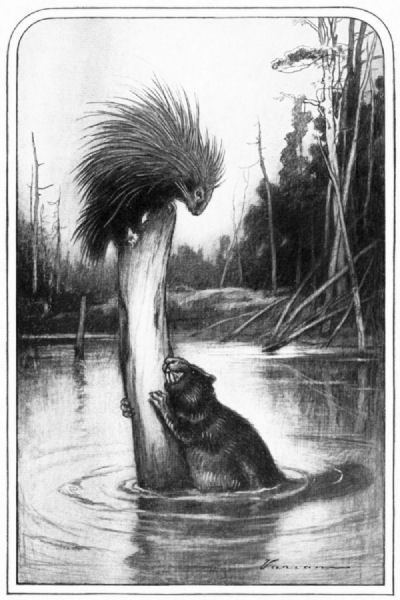
After a silence, Porcupine arose and
remarked that the idea might do well
enough for those who had warm fur
coats, but that many of the little people
were not so well protected against severe
weather, and as for the feeble Insects, if
the winters should become any longer
or colder than they were already, they
would all perish, therefore they could
not agree to the proposal.
“I don’t care whether you agree or
not,” growled the Bear. “We larger
animals have decided that this is the
best thing to do, and we are going to do
it anyhow.”
“I fear you are short-sighted,” replied
Porcupine, who found that he had
used the wrong argument. “You large
animals are always roaming the woods
in search of something to eat, and if
the winters grow any colder there will
be no food for you, that is certain. All
102]
life will perish, even the roots of the
grass on which the Deer lives, and the
berry bushes of which the Bear is so fond
will be frozen. You will all starve, but
we shall live, for we Porcupines can live
on the bark of trees; and as for the
smallest Insects, they can burrow into
the earth and survive.”
The other animals were impressed by
this speech and began to say among
themselves, “How wise he is!” “Now
who would have thought of that?” and
“I think we should reconsider the matter.”
“Ah, ha, ha!” laughed Porcupine, and
he was so pleased with himself that he
stuck his thumb into his mouth and
then bit it off, which is the reason that
he has only four fingers and no thumb.
Now the animals called him the wisest
of their number and accepted his decision,
and as for those who would not
103]
agree, Porcupine filled them full of sharp
quills, on which account they all stand
in awe of him to this very day.
Once there were four great chiefs who
lived in the four corners of the earth,
and their names were North Wind,
South Wind, East Wind, and West
Wind. The other three all hated North
Wind, for he was very rude and boisterous,
and insisted upon blowing his
bitter blast into their faces at all times
of the year, so that the tender fruit
buds and fragile blossoms were never
safe from his withering breath.
Finally they united to make war upon
him, and after a long struggle they succeeded
in gaining his promise that he
would only blow for half the year, which
helped matters a little.
Now the South Wind had four sturdy
104]
sons and a beautiful daughter, while
North Wind’s family consisted of twin
boys, one of whom was called Frosted,
and the other Frozen. No sooner were
the children grown up than Frosted
wished to marry the daughter of South
Wind, who was as fair and gentle as a
summer’s day, but she would have nothing
to say to him.
The next year Frozen came courting.
He was a handsome fellow, very determined,
and proved more fortunate than
his brother. The wedding feast was the
finest ever known in that part of the
country. It lasted for seven days, at
the end of which Frozen carried home
his bride in a tempest of wind and rain.
When South Wind’s daughter reached
the land of perpetual snow and ice, she
very soon regretted her rash choice.
There was not so much as a spark of fire
in the house, which was built of ice
105]
blocks, and day and night she was chilled
to the very marrow of her bones. Meanwhile
the rest of the family were saying,
“What a pleasant season we are having!”
and “The weather seems unusually mild
for this time of the year!”
At last she could bear it no longer, and
one day as she sat sadly on the beach
she picked up a bit of yellow driftwood
and carved it into the shape of a duck.
When she had finished, she tossed the
duck into the air, saying:
“Fly south, little duck, and tell my
father that I am very unhappy here in
the cruel northland!” And the duck
flew away southward.
Far in the southland the South Wind’s
wife stood in the door of their wigwam
and called to her husband, “Look, husband!
Spring is coming, for I see the
ducks returning!”
The little yellow duck came on, and
106]
as soon as he was near enough he gave
the daughter’s message:
“Your child is very unhappy there in
the cruel northland!”
When South Wind understood it, he
was angry and called his four strong sons
to his side. “Boys,” said he, “go at
once to North Wind’s house and bring
home your sister!”
The eldest son started first in the shape
of a great gray cloud, and when the little
bride saw the cloud in the distance she
was glad, for she felt sure that it was her
brother. But immediately North Wind
went out with his two sons to meet him
and drove him back, so that she wrung
her hands in sorrow.
The second brother went as a very
black cloud, and he got a little farther
than the first when he too was fiercely
attacked and beaten back. Then the
bride of Frozen cried bitterly, for she
107]
began to be afraid she must stay there
forever.
The third brother went as a great
storm of rain, and he had nearly reached
the spot where his sister was eagerly
waiting, when the icy wind turned the
rain to hail and drove it back, and the
poor girl was in despair.
However, there was still the youngest
brother. He went as a sharp-edged and
thin cloud which slipped right by North
Wind and reached his palace, where he
turned all the ice to water. The whole
country was flooded, and North Wind
and his family were helpless.
“Not only does your son lose his
bride,” cried the victorious son of South
Wind, as he retreated with his sister,
“but I shall take away three of your
months also. From this time forth you
are allowed to blow but three months in
the year.”
108]
Thereupon the four Winds divided
the year among them in this fashion:
to North Wind the three winter months,
to East Wind the spring, to West Wind
the summer, and the autumn to South
Wind.
In the old days the hunters were many
and skillful. They killed hundreds of
mountain goats for their flesh and skins
and left their bones lying unburned on
the rocks, which was a great dishonor.
Moreover, their children were thoughtless.
One day, a young man whose name
was Really Black Raven Feather was
walking along the beach, and he saw a
group of boys making merry with a kid.
They would seize it and throw it into the
water, watch its struggles for a time, then
drag it ashore half drowned, and as
109]
soon as the poor creature was able to
walk, they would throw it in again.
When they tired of this sport, they built
a fire and put the kid in the fire, to dry,
as they said; but before it was more
than scorched this young man pulled
it out and scolded the boys severely for
their cruelty, so that they all ran away.
Not long after this, a messenger came
down from the hills inviting all the
villagers to a feast, and as was the
custom they followed the messenger.
They came to a large wigwam on the
mountain side which they had never
seen before, and all were seated within
this immense tent. Really Black was
given a seat immediately behind the
tent pole, which was unusually heavy.
Soon a crowd of people wearing goats’
headdresses came dancing and singing
over the rocks. They danced around
and in front of the wigwam, and presently
110]
the chief dancer kicked so high that he
touched the tent covering with his goat’s
hoof. Instantly it fell down on the
heads of the guests and became a mountain
which crushed them to death. Only
Really Black was saved. He clung to
the tent pole, which became a giant spruce
growing out of the side of the mountain.
Therefore he and his descendants have
always respected the goats, and taken
care to burn their bones when it was
necessary to hunt them for food or
clothing.
There was once a man who took his
wife with him to hunt raccoons at a
distance from the village. They were
very successful. Every night the man
shot several of the animals, and in the
daytime they were both busy skinning
them and trying out the fat. One day
111]
the young wife became tired of work
and she approached her husband and
tried to attract his attention, saying
playfully:
“Look at me, my husband!”
It is true that she was a pretty woman,
but the man was bent on skinning his
game just then and took no notice of
her. Seeing that he made no answer,
she kept on teasing him to look at her.
At last he grew provoked.
“Go away,” said he crossly; “you are
no better than these raccoons!”
At this the young woman was much
hurt and went away without speaking.
Her husband finished his work and then
came to his supper, but no meal had
been prepared for him, and no wife was
to be seen. He called and called, but
no one answered. After searching for
her some time, he discovered the woman
taking a bath in a small pool, which she
112]
had made for herself by piling up sticks
and pebbles to dam the stream.
THE WOMAN WHO BECAME A BEAVER
He discovered the woman in a small pool.
Page 111.
“Come, my wife, it is time to eat,”
begged the young husband.
“You have said that I am no better
than the raccoons,” she answered, “and
I am very much ashamed. I prefer to
stay where I am.”
He went back to their hut, but came
again later in the evening and tried hard
to persuade her.
“My wife, you know that I love you,”
he protested. “I only spoke as I did
because I was thinking of my work and
I wanted to get through with it. I am
sorry for what I said, and I did not mean
anything by it. Come, now, you should
not stay in the water so long or you will
be sick; and besides, it is time to go to
bed.”
She would not listen to him, however,
and he noticed that the dam had grown
113]
higher, and the pool was much bigger
than before.
The woman did not come to bed at
all that night, and the deserted husband
could not sleep for thinking of his wife
swimming about in the cold water. He
lay awake, listening to the lapping of
the little waves and the slap of her
leathern apron as it struck the water
when she dived.
Next morning the pool had become a
pond, and out in the middle of it he
could still see her swimming about.
For the third time he called to her and
pleaded with her to come out, but she
would not answer him at all, so he went
home very sorrowful.
Now the young woman had six
brothers, and when they heard what
had happened, they all declared that
they would go and bring home their
sister. Their brother-in-law guided them
114]
to the spot where he had left her and behold!
a large lake filled the valley, and
there was a beaver house under the dam.
The young men saw several young
beavers swimming about, and presently
they heard a great beaver tail spank the
water. Looking closely, they recognized
the woman, but she was covered from
head to foot with soft brown fur, and
her leathern apron had become the flat
tail of a beaver.
At this they wept much, and with
one voice implored her to come home.
“No,” said the beaver woman. “My
husband has said that I am no better
than the raccoons, and I am too much
ashamed to live with mankind any
longer. Do not trouble about me
further, for I shall never come back.”
“Let us go away and leave her,”
said the eldest brother, for he did not
know what else to do.
115]
“No,” said the youngest. “Let us break
the dam; then all the water will run out,
and she will be compelled to come.”
They broke the dam and destroyed
the beaver house. The woman lay face
downward in the mud at what had been
the bottom of the lake. She was quite
dead. In all points she was like a
beaver, but when they turned the body
over, grieving much, the face was the
face of the offended wife.
The ten sons of a chief went hunting,
and all took their wives with them except
the youngest brother, who was unmarried.
They all camped together at
night, and in the morning the eldest
prince went out in search of game.
The first thing he saw was a fat porcupine
coming toward him, which he
easily caught. He wrung its neck, and
116]
hung it on the branch of a tree, and
went on.
Near the top of a hill, he met a handsome
white she-bear and shot her dead.
He kept on to the very top, and looking
down, perceived a strange town at the
foot, which made him very curious. He
walked up boldly to the first hut,
in which a pretty young woman sat
alone. She beckoned to him through
the window, but he had scarcely entered
when some one called out from the next
dwelling:
“You have a visitor. Send him here:
the chief wishes to see him.”
At the chief’s door, several young men
met the stranger with much kindness
and greatly admired his weapons, which
they begged to be allowed to examine.
As soon as he went in, the chief greeted
him with all hospitality. He ordered
that the softest robes be brought for his
117]
seat and caused him to be served with
the choicest food. While he ate, his
weapons were returned to him and laid
at his side. When night came, the
chief said, “Bring the best blanket for
our guest; he will remain with us to-night”;
and it was done.
In the morning a cry arose, “The
bears are coming!”
“Let my best hunters go out against
them,” ordered the chief. Now the
young prince was an expert hunter and
had a mind to display his skill, so he
hastened to attack the foremost bear.
He drew out his best arrow, but to his
astonishment the arrow broke. Hurriedly
he seized his spear, and the spear
broke. In a moment the grizzly bear
was upon him and bore him to the
ground.
As soon as he was dead, the young
men dragged his body into the chief’s
118]
hut, where the chief caused it to be cut
in pieces and hung up to dry.
Now when this young man did not
come back to camp on that day or the
next, his wife grew anxious, and the
next in age offered to go in search of
him. He set out in the same direction,
and half-way up the hill he met a fat
porcupine, which he clubbed and hung
in a tree as his brother had done. A
little further on, he saw a white she-bear
and killed her, after which he went
toward the village which he observed
in the distance.
The pretty young woman invited him
to come in, and the young men welcomed
him cordially and took away his weapons,
which they returned to him as he sat
feasting in the house of the chief. In
short, everything happened to him exactly
as it had happened to his brother;
and in the morning, when his arrows
119]
broke off short, he was at the mercy of
the bear, and his body was cut up and
hung beside that of the first.
Next day, the third youth went to
look for the other two, and so on, until
all were gone except the youngest. The
nine widows mourned continually, and
they begged the last brother not to follow
the others, for if he should, they felt
sure that he too would be lost and they
would all be left without a protector.
However, he insisted upon going, assuring
them that not only would he come
back safe and sound, but would bring
back their husbands also.
He took the same path up the hill,
and when he saw the fat porcupine
coming to meet him, it occurred to him
that he had better let her pass unharmed,
and he did so. A little later, he met the
white she-bear and shot her; but when
he came to her he could not help laying
120]
his hand gently on her side and exclaiming
aloud, “How beautiful she is!”
Instantly the bear became a handsome
young woman, who smiled upon
him, and warned him of the dangers that
he would meet in the Bears’ town at
the foot of the hill.
“These people are really Bears,” said
she, “and I am one of them sent to
deceive you. But you have no wife,
and I like you very much. Do not
let the young men take your weapons
even for a minute, or they will change
them to dry sticks as they did those of
your nine brothers, who killed me without
remorse.”
Finally she gave him two small pups
and told him to hide them in his robe,
and if ever he was in trouble to set them
one by one on the ground, saying, “Red,
grow up quick and help me!” “Spot,
grow up quick and help me!” and it
121]
should be so. Then she kissed and
embraced him, and he went on down
the hill to the village.
In the first hut he came to he found
his sweetheart again, and she greeted
him lovingly. When the chief sent for
him, she delayed parting with him as
long as she could, but was at last forced
to let him go, with many charges as to
the best way to outwit her kinsmen.
Accordingly he kept fast hold of his
weapons, when the young men crowded
admiringly about him, and even lay
awake all night lest they should take
them from him while he slept.
In the morning, when the Bears came
on as before, and the chief called for men
to go out and meet them, the young
prince drew his bow and shot the foremost
through the heart. More followed,
and he killed them one after another until
his arrows were all gone. Then he fought
122]
with his spear until he was tired out, and
still the Bears came on.
Finally he remembered the pups that
his sweetheart had given him, and he
placed the first one on the ground, saying,
“Grow up quick, Red, and help
me!”
Instantly the pup became an immense
dog which rushed at the Bears
and drove them back.
Then he put down the second pup,
saying, “Grow up quick, Spot, and help
me!” and another savage dog attacked
and put to rout the last of his enemies.
Then the young man returned to the
Bear chief’s wigwam for his nine brothers.
He took down the pieces of their bodies
and laid them side by side, and they all
came to life and followed the hero and
his Bear wife back to their own camp,
where they were welcomed with great
rejoicings.
123]
In the old days, a chief’s daughter
was expected to marry the son of her
uncle, and so keep the chieftainship in
the family. But there was once a proud
princess who behaved very badly to
her cousin when he came wooing, according
to the custom.
“I must be sure that you love me,”
she said.
“I do love you,” he declared.
Upon which she answered, “Then
prove your love by making a cut down
your right cheek.”
The young man immediately took
out his knife and slashed his right cheek
so that the blood streamed over his face.
When the cut had healed, he went
again to his cousin and asked for her
hand with some confidence, but she said:
“First you must cut your left cheek
124]
also, and then I shall know that you
really love me.”
The young man did not like to do it,
but he would not give up, and he slashed
his left cheek also.
He waited for the second cut to heal
and then went to her with his scarred
face and begged her to marry him at
once.
“Yes,” said she, “I will marry you,
for you have done well,” and she kissed
him, so that he became more in love
than ever. Finally she told him sweetly
that she was not yet entirely satisfied,
and that before the wedding he must
cut off all his hair.
Now short hair is considered a disgrace
to a man, and the prince was most
unwilling to cut his off, but at last he
yielded and went to her to ask that the
wedding day might be set. But she
refused to see him, merely sending a
125]
servant with the message that he must
be quite mad to suppose that she would
marry such a hideous object as he had
made of himself.
The poor young man was very unhappy,
and he left his home and wandered
away until he came to a small hut that
stood all by itself under a hill.
An old woman opened the door and
kindly asked him to come in—“that
is,” said she, “if you are the chief’s son
who was rejected by his cousin.”
“I am he,” declared the youth.
“What can I do for you?” asked the
old woman.
He answered that he wanted nothing
more than to be as he had been, before
he disfigured himself at the bidding of
the cruel young woman.
Accordingly the crone prepared a bath
for him, and when he came out his skin
was smooth and fine, without any mark
126]
upon it. She combed his hair with a
comb of ivory, and it became long and
splendid and fell over his shoulders
like a mantle, so that he was far handsomer
than before.
When he went back to the village, all
the people admired him as a being from
another world, and his cousin put on
her best robes and walked to and fro,
trying to attract his attention, but he
did not even glance at her. Finally
she sent her servant with a message,
asking him to come and see her.
When he did not appear, she sent a
second time, and inquired very humbly
what she could do to please him. He
told the messenger to say that if she
would slash her right cheek with a knife,
he would come.
So the princess cut open her right
cheek, and when the cut had healed she
sent to her cousin again. This time he
127]
made answer that she must first cut
her left cheek also, and she did as he
ordered.
When her messenger came to the prince
a fourth time, he directed that her mistress
cut off all her beautiful hair, declaring
that he would then be entirely
satisfied. Crying bitterly, the poor girl
cut it off and sent it to her lover, but he
threw it on the ground with contempt,
saying that nothing would induce him
to look upon the face of a woman who
had so disfigured herself.
The wise men say that since this
happened, women have not been allowed
to choose their husbands, or to refuse
the men who have been selected for them
to marry.
There were once four chiefs who were
brothers and lived in one village. In
128]
the dead of winter, when food was
scarce, a lean stranger came among
them and stopped at the hut of the
eldest brother.
He was courteously received and
seated by the fire, as is the custom, and
the chief asked him where he came from.
“I have come a long way,” replied
the stranger.
“And what have you eaten on the
way?”
“I have eaten nothing but snow,” he
said.
Then the chief ordered a dish of snow
and a spoon to be placed before his
guest, but he got up without touching
it and went on to the house of the second
brother.
Here he was again asked where he
came from and what he had eaten on
the road, and when he answered that he
had eaten only snow, he was given a
129]
large dish of it with a spoon. The same
thing happened at the third house.
When the traveler came to the dwelling
of the youngest brother, and the
host heard that he had eaten nothing
but snow and was starving, he said to
his wife, “Wife, see if there is still a dried
salmon left.”
She looked, and found a single one,
half of which she broiled and gave it on
a dish to the stranger.
After he had eaten, he made ready to
go on, but his host said, “Wife, give
our guest the other half of the salmon to
eat on the journey,” and she did so.
Then the stranger said to him, “All
the others ridiculed a starving man, but
you were a true host. Your kindness
shall be rewarded. Meet me to-morrow
at the mouth of the river.”
The young chief did as he was told,
and behold! a great grizzly Bear, who
130]
presented him with leggings, a grizzly-bear
headdress, and a magic bow which
killed all manner of game. From that
day he never went hungry, but became
the envy of his elder brothers and the
richest man in the village.
Once there was a young man newly
married who was very fond of his wife.
She was not only a pretty woman, but
she wove the most beautiful dancing-blankets
of any one in the tribe.
One day this young man went into
the mountains to hunt wild goats, from
whose hair his wife might weave more of
her much-prized blankets, and she went
with him to keep his hut and to cook for
him. While they were yet far from the
village, the girl fell sick, and although he
did all that he could for her, the young
husband soon saw that she was dying.
131]
“Tell me, my dear, what can I do for
you?” he begged, as he hung over her.
“Only do not leave me soon, my
husband! Do not soon forget our love,”
sighed the wife, and she died.
The goat-hunter mourned her truly,
and he did as she had asked him to do.
He remained on the spot where he had
lost her and seemed to have no thought
of going back to the village. He kept
her body with him in the hut as long as
he could, and when at last he was forced
to lay it away, he carved an image out
of cedar wood and set it up in front of
her loom, so that as one entered the hut
it seemed that a woman sat there, weaving
a dancing-blanket. Every morning
he went out hunting goats, and when he
returned in the evening he would call
out as he came near the hut, saying:
“Come out, my wife, and see what I
have brought you!”
132]
Then he would answer himself in a
woman’s voice, “I cannot come just
now, my husband. I am weaving, and
the wool may become snarled if I leave
my loom.”
Presently he would enter the wigwam,
come up behind his wooden wife, and
kiss her lovingly.
After a time, the story of these strange
doings spread to the village, and two
young girls, sisters, being filled with
curiosity, decided to come and find out
for themselves what truth there might
be in the rumors that were about. When
they reached his lonely hut, the hunter
was away as usual, so they raised the
door-flap and peeped in. There sat the
wooden wife in front of the loom, with
her back to them, exactly like a woman
weaving.
“Elder sister,” said they, “we are
hungry.” But when she did not move
133]
nor speak, they knew that she was not
a real woman, and they hid in a corner
behind some blankets until the husband
should return.
By and by they heard his voice outside
the hut, telling his wife to come out
and see the game he had brought, and
then her usual answer that she was busy
weaving and could not come just then.
Next he came in, put his arms about the
wooden wife, and kissed her fondly.
Upon this the elder girl could not help
laughing so that he heard it and discovered
them both. But the young man
was a courteous host. He begged them
to be seated and offered them food, and
the elder sister ate heartily; she even
over-ate, while the younger was very
quiet and took but a taste of each dish.
The hunter took note of their conduct,
and when supper was over, he asked the
younger girl to be his wife.
134]
“I will marry you,” said she, “if you
will put away your wooden wife.” Accordingly
he destroyed the image that
he had made, and married the girl, and
they lived happily together for many
years.
Ildini lived at End-of-trail, with his
wife and two boys. One day he went
fishing when the wind blew strong from
the shore. It blew his boat so far out
that he could not get back. All day and
all night he was blown about the cold
gray waters. He became very hungry
and chilled to the bone.
Ildini prayed and sang for a fair wind.
This was his song:
“Ocean Spirit, calm the waves for me!
Come closer to me, my Power!
Calm the waves, so that I may go home!”
After many days the wind went down
and the canoe floated near a strange
135]
shore, but by now the man was so weak
that he could not land. On the shore he
saw no one but a little child, scarcely
big enough to talk. He told the child
his name, “Ildini”, and the little fellow
repeated it over and over as if it were a
game—“Ildini—Ildini—Ildini!” He
ran home still saying over the new name,
and exclaimed to his grandfather:
“Grandfather, come—Ildini!” He
kept saying this until the old man followed
and discovered the canoe and the
fisherman, who was by this time unable
to stand.
He called his wife to help him and
together they carried Ildini to their
house, where they rubbed his limbs,
warmed him and gave him broth, a little
at a time. When he had recovered, he
became the chief of that tribe, and
learned their ways and their language.
He never ceased to mourn for the two
136]
sons whom he had left behind at End-of-trail,
but he did not weep for his
wife, for he believed her faithless and
thought that she had been the cause of
his misfortune. In truth she supposed
him dead and had long since married
another.
139]