On the morning of the ninth day of their captivity,
some warriors took Sylvia off about forty
rods to where a number of chiefs seemed to be
holding a council. One of the Indians told
Sylvia that she must go with an old chief who
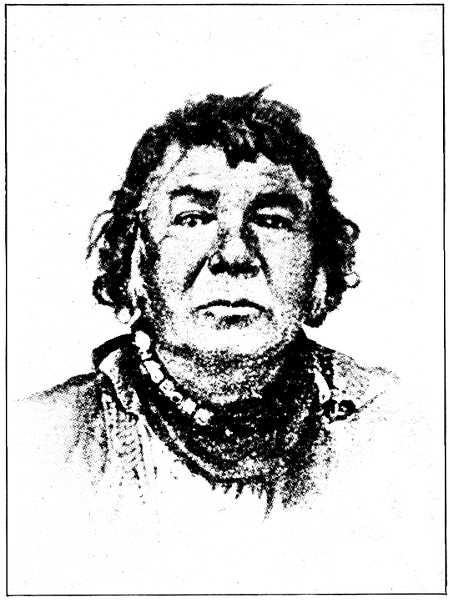
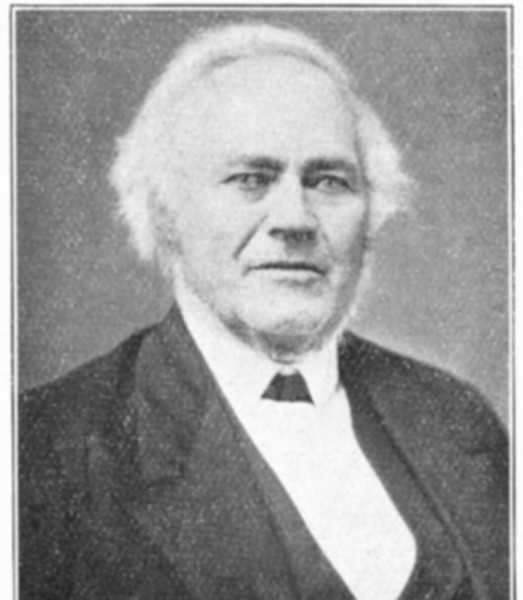
was pointed out to her, namely, White Crow,
a chief of the Winnebagoes, who was about
fifty years of age, tall, slim, with a hawk nose,
and as much of sinister look as a man who had
only one eye could have, for one of his eyes
had been put out in a brawl. He was addicted
to drink, gambling, fighting, and other disreputable
practices.26 Under any circumstances
Sylvia might have protested against going with
him; but when he informed her that Rachel
must stay behind, Sylvia declared that she
would not go without her sister. White Crow,
who was a fine and fluent orator, and spokesman
of his band on all occasions, made a long, loud
speech in which he exhibited considerable excitement,
but was listened to with great interest
by the other warriors. After he had finished,
Chief Whirling Thunder arose, walked over to
where Rachel was and brought her to where the
council was being held. The situation was painfully
interesting to the girls, because they had
some intimation that it was all about their fate.
After some conversation among the chiefs
they shook hands and the captives were surrendered
to White Crow, who must now get the
girls to Blue Mounds Fort to obtain the $2,000
reward. The Port was about eighty miles to
the southwest in a bee line. By the nearest trail
through the Madison lake region, it was about
ninety-three miles; and by way of Portage and
thence on the Military Road to the Blue Mounds
Fort, it was about one hundred and seven miles.
The Sacs and Foxes were along the former
route, which meant great danger, and the Military
Road was the best in that country. Therefore,
White Crow chose the latter route. The
horses were brought, riding switches were cut
and White Crow and Whirling Thunder with
their captives seemed ready to go. The squaws
with whom the girls had been staying were very
much grieved at parting with them, tears rolling
down their cheeks, and the girls who now
reciprocated the affection of the squaws, preferred
to stay with them rather than to go with
the warriors; but the chief’s stern orders had to
be obeyed.
At this trying moment of the girls, a young
warrior suddenly stepped up to Rachel and with
a large knife cut a lock of hair from over her
right ear and another from the back of her
head. At the same time he muttered to White
Crow, in the Indian language, something which
the girls afterwards learned, was that he would
have Rachel back in three or four days. His
example was followed by another Indian who
stepped up to Sylvia and without leave or a
word of explanation, cut a lock of hair from
the front of her head and placed it in his hunting-pouch.
Sometime afterward a number of
Indians made an attack on Kellogg’s Grove
colony (near Dodgeville, Wis.) and one of them
who was shot by a miner named Casey had
around his neck a lock of braided hair which
was subsequently identified as that taken from
the head of Rachel Hall.
It might not be amiss, here, to state that
among some of the Indian tribes the cutting of
the hair had a mystical meaning closely allied
to the life of a person, and was usually attended
with religious rites. The first clipping of a
child’s hair was retained for religious purposes.
A scalp had a double meaning: it indicated an
act of supernatural power that had decreed the
death of the man, and it served as tangible
proof of the warrior’s prowess over his
enemies.27
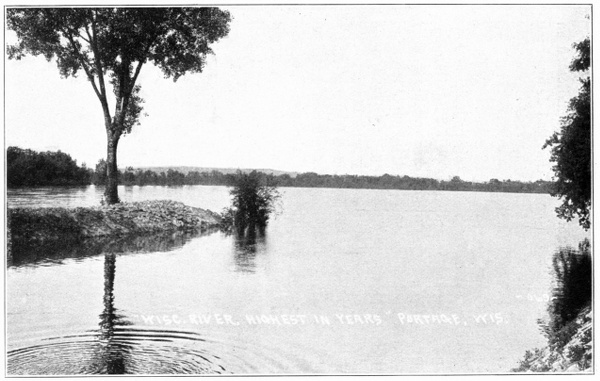
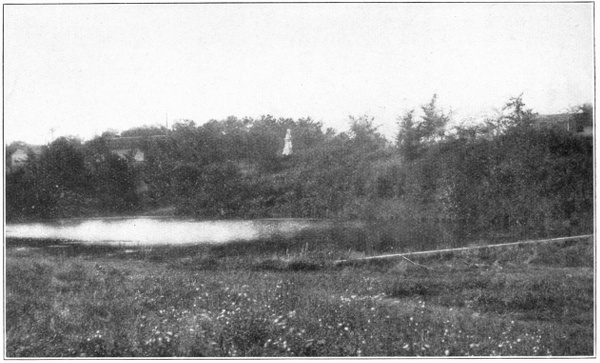
WHERE HALL GIRLS ENTERED CANOES.
While the Indians were taking locks of hair
from the girls, White Crow, Whirling Thunder,
and a few more Indians, had mounted their
horses, and with their captives on ponies, all
rode off at a gallop, keeping up a rapid speed
during the rest of the day and far into the
night, the Indians looking back frequently.
No doubt White Crow feared that the Sacs
might regret that they let the girls go, and
would try to recapture them. It was about
forty-seven miles to Portage, and until that
place was reached the danger was great. The
girls appreciated the danger; otherwise, they
would have dropped off their ponies from sheer
exhaustion. A ride of forty-seven miles on
wabbly ponies!
Finally, they arrived on the bank of the Wisconsin
River near the mouth of Duck Creek
(just below Portage, Wis.) where was located
a village of Chief Dekorah.28
At this place the Indians prepared a bed
upon a low scaffold, which was furnished with
abundant blankets and furs, where the girls lay
until daylight. The sun had not yet arisen
when a party of Sac warriors, some of whom
were dressed in the clothing of white men, came
into camp. They wanted to talk to the girls,
but Whirling Thunder told the girls not to
listen to them and to keep away from them.
Then a long conversation of loud angry words
was kept up between the Indians for some time,
when the Sacs mounted their horses and rode
away.
It was ascertained later that one of the Indians
who helped to capture the girls at Indian
Creek was on a hunting trip when the captives
were turned over to the Winnebagoes and on his
return finding the prisoners gone and not having
received his portion of the ransom, he
started off with a number of warriors with the
determination to recapture the girls or kill
them. No doubt that if the Sacs had overtaken
the Winnebagoes with their captives before they
had reached the Winnebago camp, they would
have fought for the girls, which would either
have ended in the death of the girls or their
being again carried off into captivity. Such
was the Indian custom.29 What an almost
miraculous escape the girls had!
Immediately after the Sacs left, a hastened
breakfast was prepared. No doubt White Crow
feared an attack if he should keep the girls at
that place or if he should continue his journey
along the Military Road. Whatever caused him
to change his course, he arranged to take the
girls down the Wisconsin River30 and to send
the horses around over the hills, on the west
side of the river, to the next camping place.
Breakfast was eaten as hastily as it had been
prepared and then the girls were placed in
canoes and with a convoy of about one hundred
Indians, were paddled off. At first the girls
feared that their little barks would tip, but
soon they found their canoes were in expert
and safe hands and that the new manner of
travel was far superior to horse-back riding.
It was restful and gave them a fine opportunity
for observation, which under favorable circumstances
would drive an artist into ecstasy. The
majestic bluffs with wooded slopes and craggy
crests, lined the river for many miles, stretching
off to the west around Devil’s Lake. It was
ideal scenery and connected with many a
romantic Indian tale.
The spring freshets from the melting snows
and heavy rains, had swollen the river so that
it spread considerably over its banks, reaching
in places from the foot of one bluff to the foot
of another. Down this murky water the Indians
paddled their canoes, hour after hour,
over a distance of about thirty miles, and
landed on the west bank, where they camped
for the night.
In speaking of this canoe ride the girls say:
“The name of the river we never knew, neither
can we tell whether we traveled up or down
the stream.” The name of the river was learned
from Shabona. It is not strange that the girls
could not tell which way the river flowed. The
writer has often been on that river during
freshets, and the way the water flows back and
forth, dotted with eddies, would easily confuse
a stranger.
Early the next morning White Crow went
around to the wigwams with a gourd in each
hand, and stopping at the door of each wigwam
he would shake the gourds violently and talk as
if he were lecturing.
Having finished this religious service, he left
the camp and did not return again until sundown.
Probably, he crossed the river and went
to his own village at the west end of Mendota
Lake to get information concerning the ransom
offered for the captives. He was a sly chief,
and if he did not have considerable confidence
in the success of his undertaking, instead of
taking the girls across to Blue Mounds he might
have them run further down the river and there
hold them longer in captivity.
The thirty-first day of May had arrived and
for the second night the Indians camped on the
west side of the Wisconsin River. Before retiring,
White Crow for the first time spoke to the
girls in the English language. He inquired
whether their father, mother, or any sister or
brother, was alive, to which the girls replied
that all had been killed on the day of their captivity.
White Crow appeared sad, shook his
head, and after hesitating a moment, said he
would take the girls home in the morning. He
asked the girls if they thought the whites would
hang him if he took them to the fort, to which
they replied that on the contrary the people at
the fort would give him money and presents for
his trouble.
The conversation with White Crow roused the
hopes of the girls considerably, but a lingering
doubt as to the truth of his words kept revolving
in their minds throughout the night.
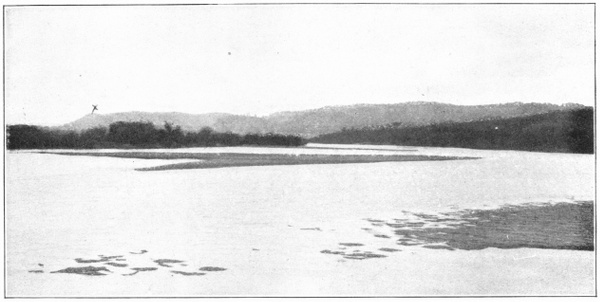
WHERE HALL GIRLS LEFT WISCONSIN RIVER.
† “BLACK HAWK’S LOOKOUT.”
The next morning the chiefs accompanied
by about forty warriors put the girls in canoes
and swam their horses across the river alongside
of the canoes, landing above the mouth of Black
Earth Creek. The horses were mounted in
haste, but as most of the warriors had to travel
on foot and were impeded by marshes and
underbrush on the flat bottom, the progress was
slow. The girls watched the sun with eagerness
in their endeavor to tell which way they were
traveling and were assured thereby that they
were again going southward, although only in
a circuitous course. Hour after hour passed
away, the girls all the while expecting to catch
sight of the fort. Finally, as the sun was sinking
off over the Wisconsin River, the Indians
once more camped for the night on the bank of
a creek.
There were two or three Indian families
camped at this place, and on seeing the girls
they expressed great joy. In a short time the
squaws had prepared a supper consisting of
pickled pork, potatoes, coffee and bread for the
girls, White Crow and Whirling Thunder, the
rest of the Indians dining apart from them.
The meal was the best cooked and the spread
the cleanest that had been placed before the
girls, and it tempted their appetite so that they
made a very fair meal, after which they felt
sleepy and were glad when they could lie down
to rest. In a short time most of the Indians had
retired, excepting White Crow, who seated himself
close to the girls, where he smoked a pipe
all night. This was the first time that a warrior
had kept guard over them, and the inference
of the girls was that the old chief feared
an attack of the Sacs who had visited their
camp at Portage. The girls thought that perhaps
the Indian chief who had been rebuffed at
that place might have gone after recruits, and
that at any moment the Indians might swoop
down upon them. Now, when they were almost
within grasp of their freedom, it racked the
minds of the girls to think that there was a
possibility of being slaughtered or again carried
into captivity. In this condition of mind the
girls passed the night.
The camp was astir at sunrise and for the
last time White Crow went around performing
his religious service by rattling his gourds and
addressing the Indians. After breakfast the
girls were again mounted on their ponies and
all moved forward over higher ground, and before
ten o’clock they had reached the Military
Road from Fort Winnebago, by way of Blue
Mounds, to Prairie du Chien. The sight of the
wagon tracks was the first sign of civilization
that the girls had observed since their captivity
and increased their confidence in the probability
of their early release. Also, the road was much
better than any they had traveled since their
capture. It led through groves and oak openings,
along the high ridge that is unbroken to
the Mississippi River. Inspirations of hope were
necessary to revive the girls’ spirits and enable
them to complete the remainder of their long
journey, as they were exhausted to the verge of
collapse. Hope is a great stimulant, and it was
on this that the girls were now subsisting.
“Auspicious Hope! in thy sweet garden grow
Wreaths for each toil, a charm for every woe.”
About two o’clock in the afternoon the Indians
halted for lunch and to let their horses
feed. The principal food was duck eggs, nearly
hatched, that the Indians ate with relish, but
which the girls rejected with disgust. After
lunch they had not traveled far until they
caught sight of Blue Mounds Fort in the distance.
White Crow took a white handkerchief
that Rachel had tied on her head, which he
fastened on a pole for a flag of truce, and rode
in advance of the Indians and their captives. In
a short time Lieutenant Edward Beouchard,
who was commander at the fort, met them and
addressed the Indians in their own language.
The warriors now formed a circle into which
Beouchard rode and he and the Indians talked
at considerable length. According to Beouchard’s
subsequent statement the Indians were
unwilling to give up the girls until they were
assured by Col. Gratiot that the $2,000 reward
would be paid. Beouchard having assured the
girls that they would be well treated by the
Indians until his return, went back to the fort
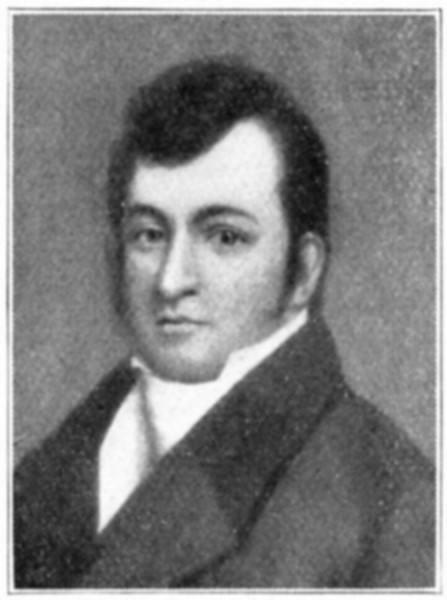
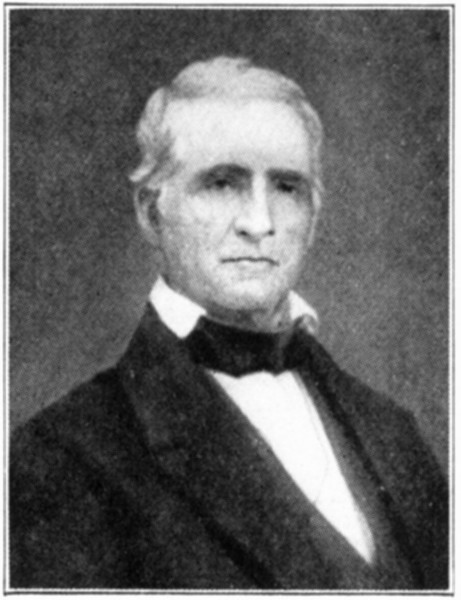
and soon returned with Col. Henry Gratiot, the
Indian agent, and a company of soldiers in
which Edward and Reason Hall, uncles of the
captives, were serving as privates.
Col. Gratiot assured the Indians that the reward
for the rescue of the girls would be paid.
Also, he invited the Indians to be his guests at
the fort, and that he would prepare a big feast
for them. The Indians being very hungry the
feast appealed very strongly to them. Finally,
the chiefs agreed to place the girls in the custody
of Col. Gratiot until the reward would be
paid, the Indians retaining the right to the return
of the captives if the government failed to
pay.
The calico dresses which the girls had received
from the Indians, had become torn by
riding through brake, briars and brush, and
with their soiled faces and disheveled hair, made
them objects of pity.31 In a sense, the girls
bearing their crosses, had followed their Master
up Calvary to its summit, where He granted
their prayer by setting them free.