Availing ourselves of the kind hospitality of
our friend in Carnac Street, we reposed
during the day intending to leave Calcutta again
by the night train (Madras Mail) for Madras, our
next destination. This was a considerable journey
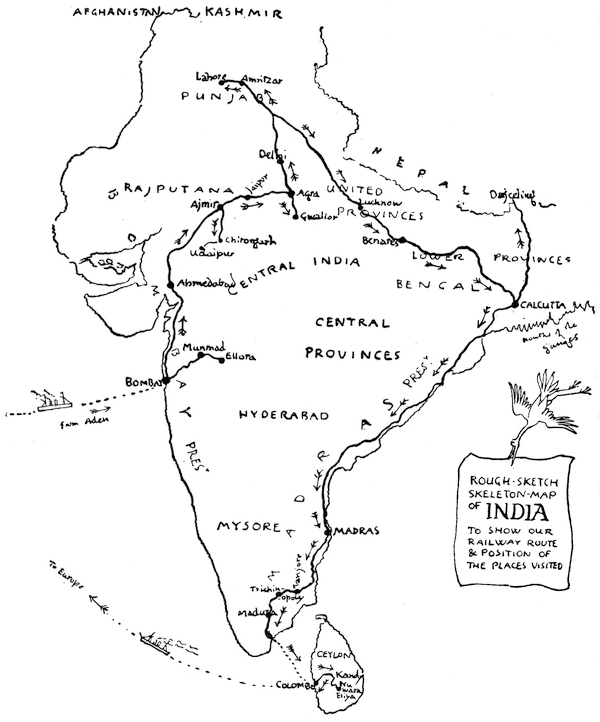
as a glance at the map will show; in fact it was our
longest in India, occupying two nights and two
days.
After some anxious moments in Carnac Street,
through our tickorgary not turning up for us at
the time ordered, or through some muddling on the
part of our bearer, we eventually got conveyed to
Howrah Station. Luckily the train did not start
so soon as stated—it never does in India—and we
were saved.
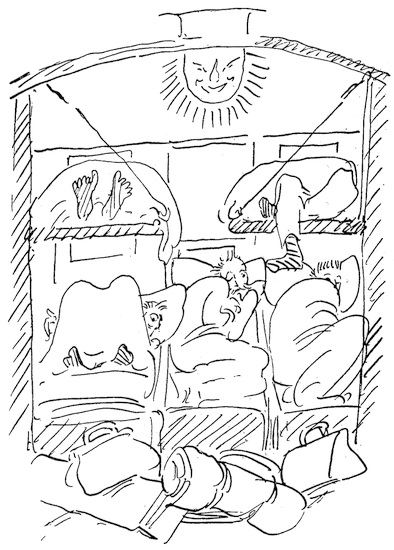
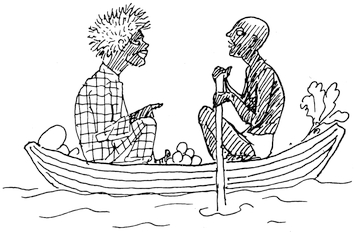
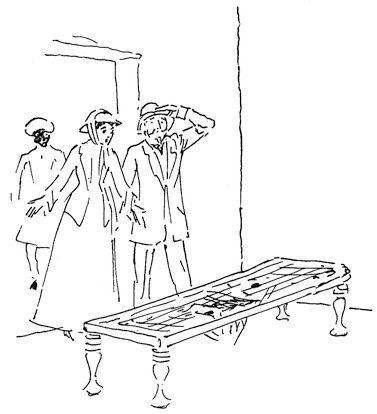
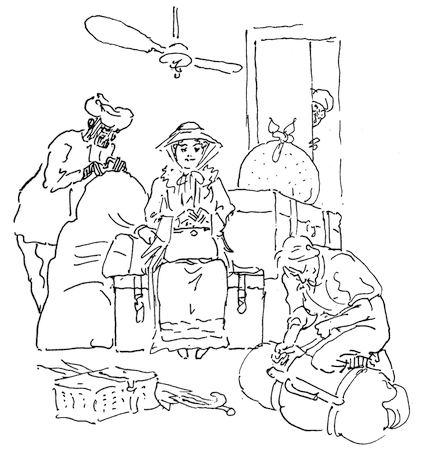
CALCUTTA TO MADRAS—SECTION OF SLEEPER—OR SOMETHING
LIKE IT
The train proved, however, to be very crowded,
and we could only secure a berth each in separate
compartments, though there was a small sliding
door between the ladies’ and the gentlemen’s sleeping
compartment, through which communication could
be made. Four ladies, a baby, and a parrot, and
the green pigeons made up the complement in the
ladies’ part. I had two travelling companions only,
a river-steamer captain or engineer on sick leave,
going south with his family, and an English officer
of the Army Medical Service going to some hill
station beyond Madras. The former kept himself
going with whiskey and soda, of which he freely
invited his fellow travellers to partake. The
latter proved to be Capt. J. B. Dalzell Hunter of
the 64th pioneers. He was studying Persian, and
introduced me to a most interesting book, the
“IQD-I-GUL,” or “The Rose Necklace,” being
selections from the Gulistan and auwār-i-suhaite
translated into literal English with notes by Adālat
Khan. This was full of delightful stories, and
rich with oriental imagery and wisdom.
Leaving Calcutta in the darkness of night, of
course nothing could be seen of the country till
next morning when we were approaching Cuttack,
when we took “Chota Hazri”—or early light
breakfast. A little south of this hills appeared
inland reminding one in character and apparent
height of our lake country. We passed Poori,
the junction for Juggernath, where crowds of
pilgrims go, especially at the time of the great
festival of Krishna in March, when the image of
the god is borne through the town on the famous
car, out to a temple in the country. The old
story we were told in childhood of the dreadful
heathen custom of the natives on such occasions
throwing themselves under the wheels of the car
of Juggernath has been discredited. Krishna,
being a god of love and life, not a destroyer,
would not be pleased with human sacrifices, and
they would be quite inappropriate. It might be
possible, however, that the car, drawn as it is by
men with great cables, through the press of pilgrims,
might accidentally crush some one fallen in the
crowd, and European missionaries may have misunderstood
what had really happened, and had
misrepresented and exaggerated it.
There were many new and different types of
natives at the stations. We were now on the
Bengal-Nagpur Railway, and the native crowds,
and groups entering or leaving the train all down
the line, were most interesting in character and
colour. Pilgrims from Juggernaut bearing small
canes back with them as signs of their pilgrimage,
Brahmans with red marks like seals on their foreheads,
and others with the triple pronged fork-like
mark of Siva in white and red. The men
wore their hair long like women, sometimes done
up in ample knots at the back of the head, and
sometimes hanging down the back. All wore a
sort of tight cotton skirt or piece of drapery
chequered or patterned in colour wrapped round
the loins, and depending from the waist to the
feet; a white loose jacket frequently surmounted
this, so that judging only from the back view,
the stranger with European prepossessions as to
dress distinctions between the sexes, might have
some difficulty in saying which was which, or who
was who, especially as the native women frequently
wore similar skirts, white bodices, and their hair
in knots. It was chiefly the beards that betrayed
the gentlemen; otherwise the equality of the
sexes was fairly well established, as to outward
appearance at least, in the way that might astonish
some of our Western reformers. It is true some
of the men, like the ancient Egyptians, wore nothing
above the skirt, except perhaps a white scarf on
the shoulders, and the field-workers and coolies
all down the Coromandel coast wore nothing but
white turbans and waist cloths.
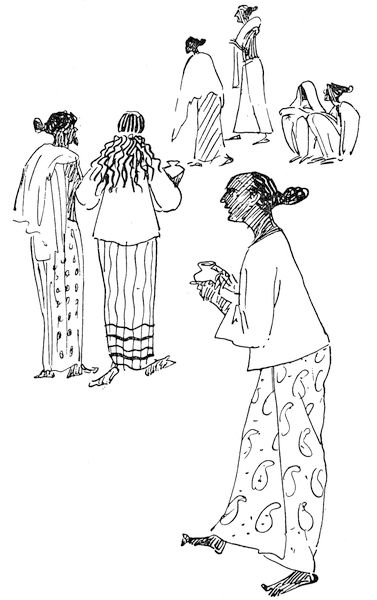
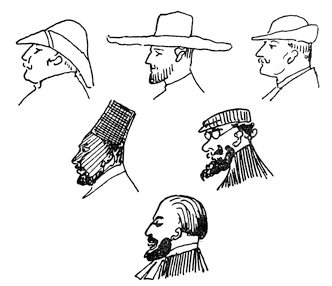
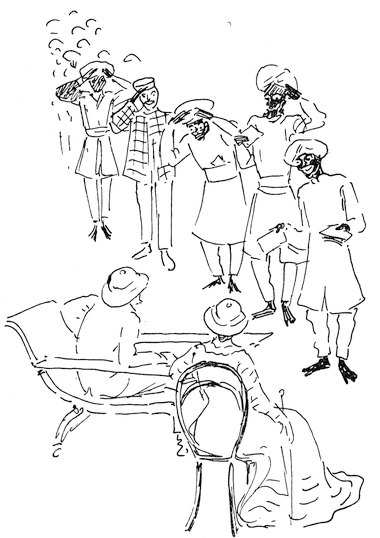
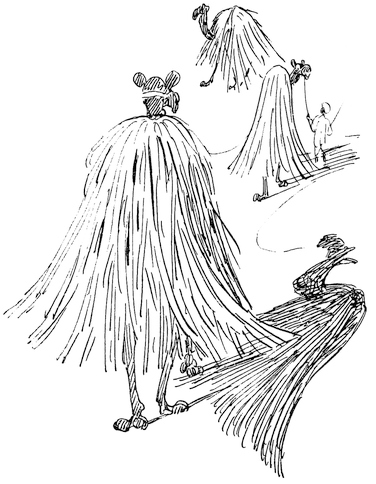
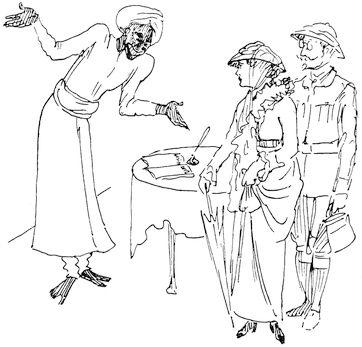
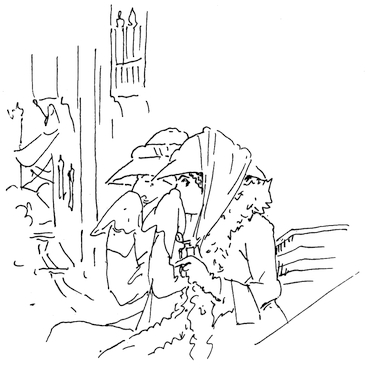
LADIES OR GENTLEMEN? (FASHIONS IN SOUTHERN INDIA)
We passed the Silver Lake, really an inlet of the
sea nearly surrounded by hills, the train startling
large flocks of brown geese from the margin as it
passed. Our old friends the white cranes we saw
again lower down the line among the marshy pools.
Paddy fields in various stages, often under water,
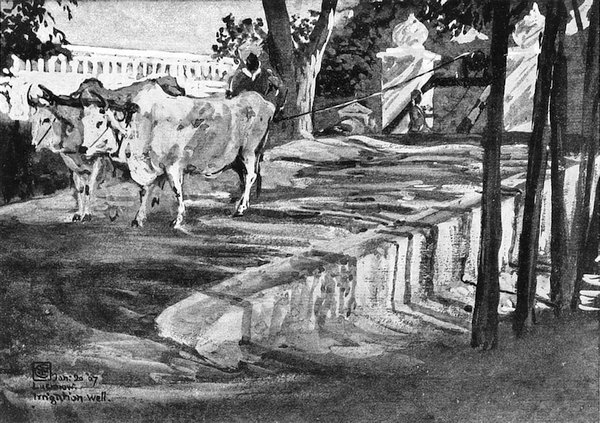
irrigation wells drawn by oxen, as well as another
pattern—like the Hungarian or Egyptian, a walking
beam weighted at one end, the other having a rope
attached to the bucket. The Southern Indian
ones are, however, worked by the natives, generally
two, working up and down from the centre, from
which the beam swings, making it dip and rise
again with bucket, the men steadying themselves
by upright bamboos fixed each side, sometimes
chanting a song to mark the time and enable them
to move together.
Groves of palms were passed and pyramidal
hills, bringing the same suggestion of Egypt
we had had before, on the way to Chitorgarh.
There was no doubt about getting further south as
the temperature was much higher, the thermometer
registering 75° to 80° and this was February 4,
whereas only two days before we had been shivering
over a fire at Darjeeling! In the burning sun we
could see the dark figures in white turbans and
waist cloths, coolies on the railway line, and
ploughmen in the fields toiling in the heat. We
stopped for breakfast at Berhampore. In the
district from here to Vizianagram there was formerly
a flourishing silk weaving industry among the
natives. “All gone now,” said a bright-looking
European official in white drill and topi who
entered our compartment. From what he told us
further, it seems that this industry declined for
very obvious causes—because the raw silk, the
very material upon which it subsisted, was exported
and consequently the occupation of the native hand-loom
weavers was gone.
At Waltair, one passenger left, but our compartment
was kept full as another immediately
succeeded him and all four berths were occupied
on the second night. One got more or less
broken sleep, but perhaps more than might be
expected.
At Bapatia next morning there was chota hazri,
or early tea, ready, and it was very welcome. At
Bitragunta there was a halt for breakfast. As we
approached Madras, late in the afternoon, we came
by lovely groves of palms, quite dark thick forests
of them, with pools of water among them in which
water lilies bloomed. Green parroquets decorated
the telegraph wires, sitting in rows much as the
swallows do in England in the autumn. The
telegraph wires all over India are however a
favourite resting perch with a variety of birds,
and quick an observer may get a good notion of
the variety of species in Indian Ornithology by
noticing the many kinds of birds which may be
seen in such positions, clearly silhouetted against
the sky.
We arrived at the Beach Station, Madras, about
five o’clock on February 4, relieved to have reached
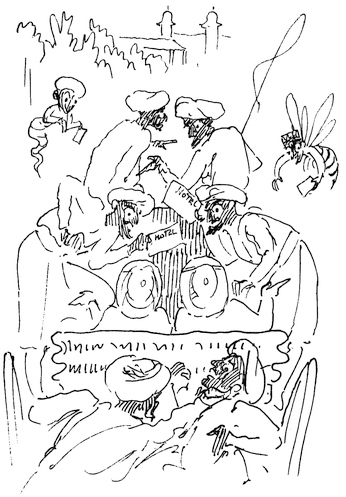
the end of our long journey. Hotel touts here
may be described as active and strong on the wing.
We eventually squeezed ourselves into a tickagary
with our light baggage, and in spite of the presence
of Moonsawmy—or perhaps in colusion with him—an
officious native guide mounted the box and
offered us information as to the public buildings
we passed on the way to the hotel. The Prince
of Wales’s was full, but the proprietor advised us
of another not far off, known as the Castle, which
had formerly been the pavilion or palace of a native
prince, and was a large two-storied yellow washed
building with colonnades on the ground floor, and
extensive terraces on to which the rooms opened
out, on the first floor. These terraces were protected
by a parapet which took the form of low
battlements, whence possibly the hotel derived its
name. There was a pleasant garden shaded by
trees around the building, walled in from the road,
and having entrance gates. Here we found
agreeable rooms and plenty of space, without
oppressive luxury or comfort, and as cool as might
be expected, if it is ever cool anywhere in Madras?
The hotel was under English management, and
photographs of familiar places at Torquay and on
the Cornish coast hung in our salon. Mosquito
curtains told their usual tale, being generally a
necessity in India, but are more particularly so at
Madras.
On the drive from the station we passed Fort
St George which dates from 1680, and is the only
building of any historic interest. There were big
Law Courts in a pretentious Italian Gothic style
after the manner of modern Bombay architecture.
The British traders and their stores and posters
were in evidence, and “summer sales” going strong
at the drapers, attracting smartly dressed English
ladies in their motors and dog-carts. The streets
were broad, and there was plenty of space everywhere.
The hotels and bungalows were surrounded
by large gardens, and abundant trees—palms being
very plentiful.
It was pleasant to hear the clear notes of birds
in the early morning, and of course we had the
usual kite and crow chorus. In the evening there
was a children’s party going on at a pavilion in the
garden, and popular European waltz tunes came
from a piano.
The temperature in our rooms ranged from 75° to
80° and we felt anything but energetic. We had,
moreover, in the afternoon an interesting drive out
to the Adyar Library, the headquarters of the
Theosophical Society built by Colonel Alcott who
was now lying ill there. Having had a telegram
from Mrs Annie Besant in the morning, a visit was
arranged. She could not leave the Colonel, as he
was then in a dying state. Our road lay between
beautiful groves of palms of various kinds, mostly
cocoa palms, and native villages, the huts of one
story, long and low, and roofed with ridge tiles of
a delightful bronze colour, the tiles, probably sun-baked,
being doubled and trebled over and under
alternately. The roads were covered with a fine
dust of a rich reddish-brown tint, almost coffee
colour, and this tint varied with the full red and
bright white of the dresses of the natives, and their
dark skins, and relieved by the clear light green of
the paddy fields, and the gold and green of the
palms, in the warm evening sunlight, made a fine
harmony.
We passed a Hindu temple and a tank, and
crossed a bridge over the broad river (Adyar) and
on the other side presently drove under an ancient
fragment of a stone carved gateway, and so through
the wooded grounds to the Adyar Library, a new
building of red brick and red sandstone of semi-Hindu
type.
A lady clad in white conducted me to a large
upper chamber very lofty and long in proportion
to its width, furnished more or less like a European
drawing-room, with chairs and couches, but high on
the wall at intervals were various religious symbols,
in white plaster relief, among which I noticed the
Gammadion and the Serpent and the Tree. There
was a pretty view over the river from the windows,
on the side.
Presently Mrs Besant entered. She was robed
in white. It was the sari dress of the native women
in some fine soft material, with embroidered borders
also white. Her hair too had whitened since I
knew her in London many years before. We
spoke of the old days—of Cunninghame Graham,
G. Bernard Shaw, and Sidney Webb. Mrs Besant,
once an active and ardent socialist, seemed to have
quite removed herself into another world, strikingly
different from the one of strife and protest in which
she with her wonderful eloquence had been a potent
influence, and was now devoting her life to inculcating
the principles of Theosophy and educational
work among the young Hindus. Her idea was to
gather the best elements out of all religions, and to
unite them in one comprehensive creed, the keynote
of which, as I understood, is universal brotherhood.
In her schools she desired to cultivate the
higher side of the native Hindu religion, refining
and spiritualising, though by no means Europeanizing,
but preserving all native characteristics in
dress and courteous manners, and as far as possible
preventing any Western contamination.
In the great hall on the ground floor the first
thing that catches the visitor’s eye is the text
inscribed aloft on the entablature in large carved
characters—“There is no religion higher than
truth.”
On the walls of this hall, also, are carved in stone
another series of symbols, treated as a series of
panels in relief, and among these it was interesting
to find Mr Holman Hunt’s well-known picture
“The Light of the World,” reproduced in relief by
a native sculptor. In a recess in the opposite
wall was a life-size seated portrait of Madame
Blavatsky in marble. It was intended to place a
statue of Colonel Alcott standing beside her, Mr
Besant told me. His loss will be a severe one
for the Society.
We drove back by way of the Triplicane or
Mohammedan quarter—the native bazaar, a brilliant
scene of colour and movement. On the way we
passed several “Toddy Tappers,” as they are called,
at work on the palm and stems. These are natives
who extract a sort of spirit from the palm, and who,
clad only in white turbans and waist-cloths, climb
the tall, smooth columnar stems of the cocoa palm,
by a curious method—a sort of loop of cane which
encircles the upper part of the body, and hooks
round the tree stem. This they shift in jerks as
they climb, using their legs and feet in the usual way
as a grip on the stem. We noticed the small, gourd-like
bottles attached to some of the trees, which are
placed so as to catch the juice from incisions made
in the bark. The spirit made from this juice is
sold in the bazaars.
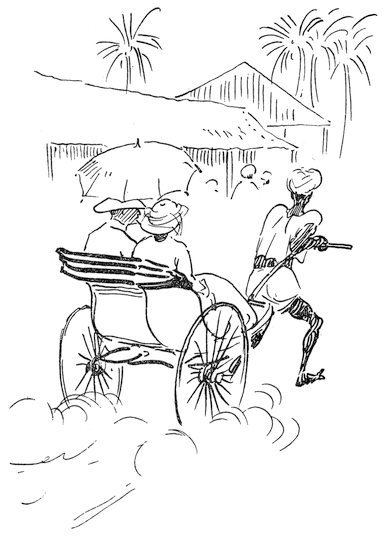
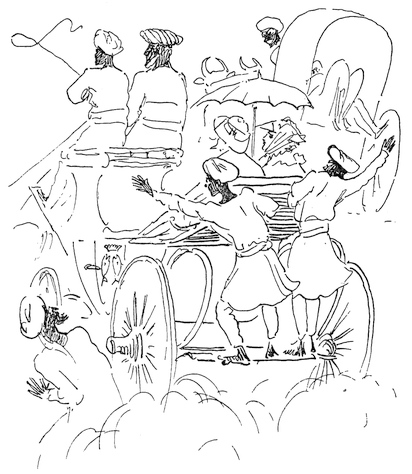
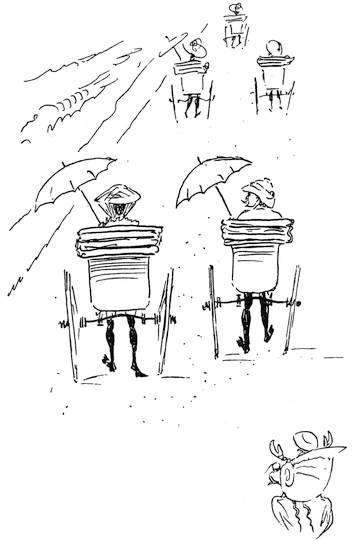
MADRAS—A JIN-RICKSHAW MADE FOR TWO
The jin-rickshaw is much in use in Madras as a
means of locomotion, and some of them will even
carry two people at once, though this seems heavy
for one boy. The native boys who draw them
are, however, active enough and but little
encumbered with clothes, and are always eager
for custom. Mount Road is the main thoroughfare
in the European quarter, and here all the principal
shops and stores are situated. These as buildings
were mostly pretentious and tasteless. St George’s
cathedral was a semi-classic church with a pointed
spire. The Post Office had red-tiled gabled spires
of a more or less Swiss type, with iron crestings,
and arcaded balconies on each story. One sees
relics of eighteenth century semi-classic taste in
some of the older houses with plastered walls yellow
and white-washed. The vast gardens which broke
the continuity of the buildings, and often isolated
them, and the pleasant avenue-like character of the
main roads, always lined with shady trees, made
up for many architectural short-comings, and again
suggested spacious ideas for a garden city.
At the head of Mount Road was the Munro
statue where other roads diverged—a bronze statue
by Chantry of a gentleman in a cloak pointing—probably
to indicate his line of policy, though,
more literally, he might be taken to be showing
the stranger what a long way he was from
Madras. The electric trams are no doubt useful
as the distances are enormous and dusty, walking
being impossible for Europeans, as they would
soon be covered with a powdering of fine red
dust.
We paid a visit one evening to the Botanic
Gardens where we saw the Victoria Regia (which
is usually associated with the inside of a hothouse
at Kew) growing in the open on a lake.
There were beautiful palms here and many
varieties of trees. One we noted was covered
with white blossoms which looked and smelled like
orange or lemon flowers, and had green fruit of
an egg shape, hanging from its branches.
Madras we found too oppressive and inervating
to stay long, and so on February 8th we departed
for Tanjore, rising at 4.30 A.M. to catch an early
train, and were only able to snatch a hasty hazri,
and get into a belated carriage and drive through
the gloom of the early morning—or rather by the
dim light of the waning moon to the station for the
5.45 train South.
Our compartment was shared at different stages
of the journey by British officers. A Babu with a
quantity of baggage, and three German Mission
people—a gentleman and two ladies with still more
baggage, who filled it pretty well up to Tanjore.
The country seemed very productive, and on each
side of the line most of the way were large crops
of paddy, much of it under water. In many places,
too, the natives were ploughing in the water.
The crops in some of the fields (or rather pastures
separated by low banks of earth) were a brilliant
light green, in others the grain was ripe, and was
being reaped with hooks by the natives, while
further on they would be threshing and stacking
the straw. The method of threshing out the grain
was primitive. A man would hold a loose sheaf in
his hand and beat it hard, several times in succession,
on the ground; this shook out the grain, and
then he would cast the straw that remained to the
men who were stacking it near by. They made
low wide stacks straight on to the bare earth. The
women gathered up the paddy as it was reaped.
We passed more fine groves of cocoa palms,
distant hills were visible inland here and there, and
there were generally large sheets of water each
side of the line, but the rivers which we frequently
crossed were almost dry.
The crowds of natives at all the stations were
again very interesting. The men generally wearing
their hair long and done up in knots. In fact
the men had finer and more luxuriant heads of hair
than the women, whose hair was usually short and
fuzzy. Sometimes the men had their foreheads
and temples shaved, and let their hair grow freely
at the back. Caste marks were painted very
boldly and distinctly on the dark foreheads. The
sacred mark of Siva occurring most frequently—a
red vertical stroke in the centre between two
white lines radiating from the nose.
The men also wore the coloured skirt tightly
wrapped about their middle and falling to their
feet, the upper parts of their bodies being left bare,
except for a loose white scarf, like a towel, thrown
over their shoulders. The coolies and agriculturists
wore nothing but turbans and waist-cloths. The
women invariably wore silver nose rings, earings
and anklets, and the Sari dress. Mahomedans
seemed to be very scarce in these parts. As to
colour, reds and whites prevailed in the dresses.
Sometimes the vivid crude (magenta) aniline pink
which has become unfortunately too common in
India was to be seen. A favourite blend was red
and yellow in the women’s Sari dresses, in stripes,
or crossed tartan-wise.
Light cakes, bananas, and painted toys and
other trifles were hawked about at the stations, the
sellers uttering curious cries and chants. Every
station had its tap of water, and always a thirsty
throng of natives from their crowded compartments
would be seen clustering around it filling
their bright brass drinking cups, which they
invariably carry, quenching their thirst and washing
themselves.
Apropos of the refreshment stations, I find a note
in my journal as to what appears to have been a
particularly unsatisfactory Tiffin at Villuparam, for
which we were induced to pay 1 rupee 8 annas in
advance, but of which “only a little currie was really
eatable.” How much more sensible (perchance not
so profitable) it would be to give travellers the
chance of ordering from the carte, and paying
according to a fixed tariff. Travellers are by no
means always able to eat the provided meal, and
need milk and easily digestible foods, and simple
cookery. The hard meat, stringy fowl, and messed
up dishes usually offered are very inappropriate, if
not positively injurious food. Simply cooked sound
fresh food is a great want at hotels and railway
stations all over India.
We arrived at Tanjore between 6 and 7 in the
evening. There were sleeping and refreshment
rooms at the station. The station-master met us
and said that a room would be vacant at 9 o’clock,
as Lord and Lady ——? who then occupied them
were leaving by the 9 P.M. mail. In the meantime
we had a ladies’ waiting-room to ourselves and could
dine during the interval. The sleeping-rooms
were across a bridge on the other side of the line
in a new terraced building, with an English housekeeper
sort of woman to receive us and our rupees.
There was quite an up-to-date porcelain bath, but,
on examination, one tap was cut off, and there was
no water in the other! There were spring beds
and mosquito curtains, and it was a fairly cool room.
The system here was to charge 1 rupee 8 annas
for a room for the first twelve hours, and if occupied
for longer then the rate was higher.
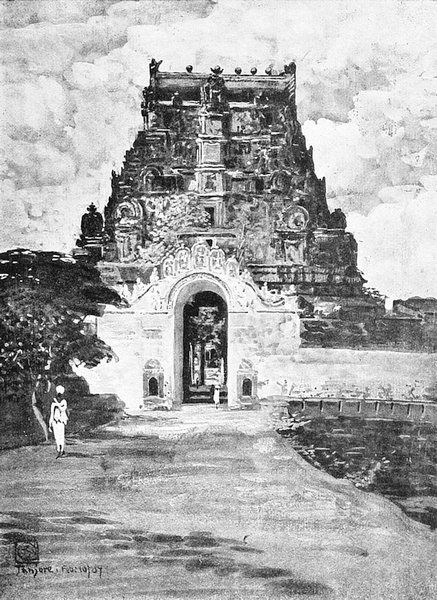
TANJORE—THE GREAT GATE OF THE TEMPLE
Hearing there was a good Dak bungalow near
by, we decided to take up our quarters there the
next morning and found it quite nice, cool, quiet,
old-fashioned and unpretentious, and there being no
other travellers we had it all to ourselves. From
what the native in charge said it appeared that the
new station rooms rather injured his custom, as
travellers now mostly stayed there.
Our exploration of Tanjore commenced by driving
to the Old Fort within which stands the great
Hindu Temple dedicated to Siva. The great
gateway is approached by a bridge over a moat,
then dry, which surrounds the Fort. The outer
gate is plastered and is crowned by a row of figures
of deities in niches which are brightly coloured.
The great gateway is of yellow sandstone and is
richly carved—a mass of figures and detail. The
image of the god Siva and his various incarnations
constantly appears. Various legends connected
with these are painted on the walls of the court at
the back of an arcade, and are exceedingly curious.
The great Nandi, or sacred Bull of Siva, a
colossal image of a recumbent Bull, richly ornamented
with chains and bells around his neck, is
seen on a pedestal approached by steps in the
centre of the court, under a pillared and decorated
canopy. When we saw it first a magnificent peacock
had perched himself upon the head of the bull, his
tail drooping over its neck. The bull was carved
out of a fine black stone, really syenite, but much
darkened by libations of oil with which the image
is constantly anointed. It has all the character of
the type of zebu in this district. We saw its living
prototype in a street of Tanjore—a splendid black
bull (short-horned) lying down with its yoke companion,
a white one, equally noble looking.
The pillared front of the small temple close by
was richly coloured, and on a sort of frieze was
a series of portraits of the reigning family of
Maharajahs.
The Temple guide spoke a little English, but
occasionally would stop for want of words, but we
generally gathered his meaning, and he seemed
unusually intelligent.
Ganesha, the elephant god (of generation) frequently
appeared among the others, Siva and
Parvati being the chief. One of the scenes
painted on the wall of the arcade, already spoken
of, represented the wedding of Siva and Parvati,
who stood, hand in hand, with a tree in the middle—like
Adam and Eve. Among the guests at this
wedding were represented two giants, one whose
appetite seemed to know no limit, while the thirst
of the other was unquenchable. The first was
shown devouring all kinds of food, and to express
the drinking capacity of the other a stream of water
full of fish was flowing into the mouth of the other.
These were very primitive paintings, but expressive.
The figures were drawn in black outline and filled
in with flat tints. At the gate of the Temple there
were drawings on the white-washed wall in thick
outline in Indian red, in quite a different style and
no doubt of a much later date. A large number of
Lingams were shown in rows placed together in
one corner of the court, and there were many
Lingam shrines in the arcade besides. Here and
there was colouring on the carved figures, but, as a
rule, the elaborately carved pagodas were left in
yellow sandstone, which had blackened where
exposed to the weather, and it may have been that
colour had been worn off.
The later temple (dating from about the fifteenth
century) had remarkably delicate carving on its
lower courses, the edges being frequently pierced.
At the steps of the entrance an elephant, carved on
each side, formed the balustrade, each having two
trunks, one curling inwards and holding a man in
its coil, and the second extended and terminating
in a volute at the end of the steps on each side.
There was a noticeable point, as giving further
evidence of primitive wooden construction, in the
carved detail under the eaves of the great temple
where there was a sort of intersected lattice work
faithfully rendered in stone. It recalled the screens
of bamboo and matting, commonly used in this
district, added on to the edges of the tiled roofs in
front of the huts and bungalows as extra shields
from the sun, and this carved stone lattice work
may have been derived from the wood work and
the cane and wicker structure of the primitive
buildings which preceded the use of stone.
In the court of the great temple, in a shed (roofed
with corrugated iron I regret to say), we saw the
cars used for the procession through the city, on
the occasion of the great annual festival in March,
which appears to be similar to the Juggernaut.
The high pyramidal canopied roof, supported on
columns, was carved like the pagoda of a temple,
which, in fact, it represented. The image of the
god being placed within. The car would be drawn
by a pair of oxen.
We saw afterwards a religious procession of the
kind passing down the principal street. Two men
carried a banner in front, a piece of red cloth suspended
between two poles. After them came a
band playing tom-toms and hautboys, such as we
heard at Benares. Then came the car drawn by
two zebus, with its high pagoda, accompanied by
priests in white robes, with long hair and marks on
their foreheads.
It struck me as remarkable how closely the dress
of the native men here resembles that of the people
of ancient Egypt as pictured on the monuments.
Indeed, the Hindu pantheon itself suggests a
certain kinship to the symbolic Egyptian religion,
embracing, as it appears to do, the deification of
all natural forces and types of animals and birds.
The Hindus have their elephant god, their monkey
god, and their parrot god, for instance, each figured
with the animal’s head but otherwise human, just
as the Egyptians imaged their hawk-headed, cat-headed,
and other deities. The ox of Osiris, too,
seems to present a parallel to the sacred bull of Siva.
We next visited the tank in the citadel, noted
for the purity of its water, but it looked muddy
enough we thought, and felt no inclination to test
the sample offered us by a native in a cup.
Near the tank was a very plain Christian church,
dating from about the end of the 18th century or
the beginning of the 19th, absolutely bare of ornament
or symbol, with the exception of a small
mural monument at the west end—a bas-relief in
marble by Flaxman, in memory of one Schwartz, a
British missionary. Not, however, a very good
specimen of the sculptor’s work, and looking as if
it had been rather done to order, and though it
had Flaxman’s characteristic broad simple treatment,
was rather over smooth and “goody-goody”
in expression—a missionary looking benevolent on
his death-bed, clerical attendant and probable successor
at his side, group of good boys in front, and
row of turbaned Indians, presumably converts, on
the other side of the bed.
It was curious to see this bare, gaunt, puritanical-looking
church, planted almost in the shadow of the
great Hindu temple with its frank nature worship,
pantheism, and riot of symbolism and imagery.
From the citadel and the temples we drove over
the bridge across the river into the city to see the
palace of the Maharajah. Not a very beautiful
building—a big, rambling, yellow-washed pile,
looking rather untidy and neglected. In the guardroom
at the entrance gate, there was a portrait of
the father of the present prince. Through a corridor,
the walls of which were painted with quaint
figures, we reached a small chamber, open on one
side, but painted on the three other walls with large
equestrian portraits of three Maharajahs—grandfather,
father, and son. They were in profile, very
richly dressed, and on finely caparisoned horses,
with hunting dogs—the dogs running underneath
the horses. These mural portraits were painted in
tempera, apparently, on the white-washed wall,
and had flaked off in places, but they were good
characteristic Indian work, and reminded one a
little in treatment of European mediæval design,
such as may be seen in Burgundian tapestries of
the end of the fifteenth century.
We next came to a small court where we saw
the Durbar Hall, divided from the court by an open
colonnade. Inside was a miscellaneous collection
of objects—portraits, rather dreary ones of the
Maharajahs and favourite hounds, some on very
dilapidated canvasses with holes through them—old-fashioned
French lithographs of the early
“fifties,” much fly-blown; a handsome palanquin,
with dragons’ heads on the ends of the poles;
another one was carved, and plated with ivory.
There was also a beautiful ivory fan, of a large
size and peculiar shape, probably to be used as a
punka. Then, too, there was a bronze bust of
Lord Nelson, presented by some English lady to
a former Maharajah, and her own work. Then we
saw the library, which contained quite a large collection
of old-fashioned English books—in eighteenth
and early nineteenth century bindings—such as a
set of The Spectator, Hayley’s Poems, Burns, Scott,
etc., and also an extensive library of Hindu and
Tamil manuscripts. These were peculiar in form,
and consisted of long oblong sheets of a roughish
sort of paper, rather resembling papyrus in quality,
protected by thin boards on loose covers of thin
wood, secured round the middle by ties. These
covers were sometimes lacquered on their outsides
in various designs. On one I noticed the typical
design representing Vishnu, with the lotus flower
springing from his navel which contains the figure
of Buddha, Laksmi looking on in wonder. These
figures were drawn in black outline on gold, the
gold high-toned with coloured lacquers. A smell
of naphtha or some such moth antidote pervaded
the place.
We were then shown the armoury, where there
were some rather showy sporting guns of English
make, bearing the name of Mortimer & Co., and
elaborately chased. There were very vile portraits
of King Edward VII. and Queen Alexandra.
After this we saw another Durbar Hall—the
Maharana’s—adorned with more dreary portraits of
the family and a few stuffed birds. The most
curious thing was a real skeleton in a real cupboard,
side by side with a skeleton beautifully
imitated in ivory. There they hung inside a plain
upright cupboard, looking like a hanging wardrobe—but
what a wardrobe! What hung there
needed no robes!
Down the main street of Tanjore there were
placed at intervals very curious and richly carved
wooden pagodas, apparently very old, upon cars
with massive wheels of wood, somewhat like rude
ox-cart wheels, some of them being discs. These
were probably used in processions at the festivals.
The houses were generally low, and of only one
story, with the low-pitched ridge-tiled roofs as at
Madras, the porches and raised terraces on platforms
in front forming the shops, being further
protected from the sun by lean-to extra roofs or
screens of matting and bamboo, sometimes supported
on uprights of cocoa palm stems. Occasionally
these screens are supported by growing
trees which spread their foliage above. Pumpkins
and gourds are often grown upon the tiled roofs,
and have a charming effect with their wandering
stems, green leaves, and golden spheres of fruit
scattered over the rich brown tiles.
The roads are deep in red-brown dust as at
Madras, and there is a continual traffic of little
covered tongas drawn by little trotting zebus in
single harness. We had a broken-down victoria
to drive in, and a fearful old crock of a horse, given
to jibbing and really not fit to drive. The carriage
seats were sliding ones, too!
Tanjore spreads itself over a large area of open
spaces, interspersed with trees, gardens, and tanks.
The water is abundant, and washing operations
frequent. There is no coherent plan about the
town, the streets wandering about into open space,
and leaving off in a casual sort of way. There was
a considerable market going on in provisions, and
there was a silk-weaving quarter where may be
seen the native weavers stretching long threads of
silk on bamboo frames the whole length of the
street, and winding it off on to wheels—our
carriage nearly collided with one in a narrow
street. The raw silk is often wound round
short staves.
We visited a weaver’s shop, and were shown
some hand-woven silk saris, brocaded with silver
thread, the silver being turned into gold by some
colouring process. A dress of ten yards can be
bought of this beautiful material for 24 rupees.
Red and purple are the principal colours, and
these, with the gold thread woven in border
designs of elephants, horses and peacocks, have
a very gorgeous effect.
European influence seems to have declined in
Tanjore, although there are numerous Christian
missions about. What strikes the unprejudiced
spectator is the extreme unsuitability of any modern
western type of Protestant Christianity, with all
that it involves to the native mind, to say nothing
of climate and habit.
Western influence, it is true, asserts itself to the
eye, at least, in the form of an ugly clock tower,
and we passed “The Tanjore Union Club,” where
we saw native gentlemen in their cool, white, loose
clothing playing lawn tennis in a well laid-out
court. But the life of the mass of the people goes
on unchanged as it has done for ages.
In driving through the town we saw many little
white-washed temples among the native houses,
their richly carved pagodas rising above the low
brown tiled roofs. At the doors are quaint paintings
of elephants or tigers, and the white walls of
the shops and dwellings are frequently ornamented
in the same way with curious figures, among which
occurs not unfrequently the English soldier with a
dragoon’s helmet and jack-boots. Outside a liquor
shop I saw, painted rather boldly in red outline, a
European lady and gentleman refreshing themselves
with wine-glasses in their hands. The lady’s
costume reproduced the rather fussy fashion of
twenty-five or thirty years ago, the frills and
furbelows quite carefully worked out with the
Indian love of detail, but somehow the general
effect was rather Elizabethan than Victorian.
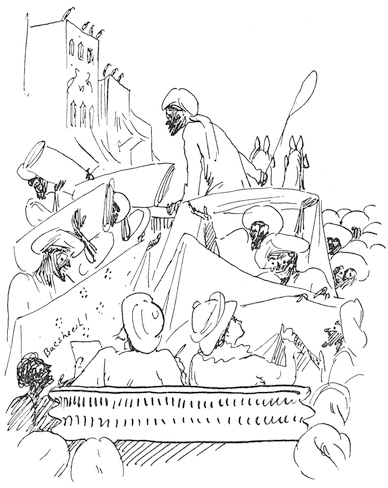
In passing along one of the streets we heard a
sound of tom-toms, and presently saw approaching
on a zebu cart a large theatrical poster painted
on the outer sides of two large boards leaning
together, tent-wise, on the cart. These bore
announcements in Hindustani and Arabic, with
pictures of exciting scenes—Rajahs flourishing
scimitars over people, and so forth. Natives
walked alongside the cart distributing pink bills
of the performances printed in Arabic, while the
tom-toms attracted attention to the forthcoming
show.
In the evening we drove to the theatre, accompanied
by our bearer. We reached an open
ground outside the town; it was rather dark, but
we saw a row of lights in front of us, and heard the
sound of tom-toms. The old horse jibbed and
would not go further, so we left the carriage, and
Moonsawmy conducted us to some temporary
structures of matting and bamboo, where tickets
were sold. One rupee secured a chair in the front
row. The theatre was a large, tent-like structure,
with plastered piers supporting a roof of matting.
The floor was of earth, the common ground, in fact,
upon which the back rows squatted. The stage
was also of earth, raised about three or four feet,
the front being painted in broad red and white
vertical stripes. The footlights were ordinary oil
lamps, clustered in groups. The audience was
entirely native (besides ourselves, who were the
only Europeans present). Some sat close up
alongside the stage on raised steps of earth. Dark
draperies hung at the sides of the proscenium, and
there was a coarsely-painted drop scene, of the kind
familiar in third-rate provincial theatres and music-halls
at home.
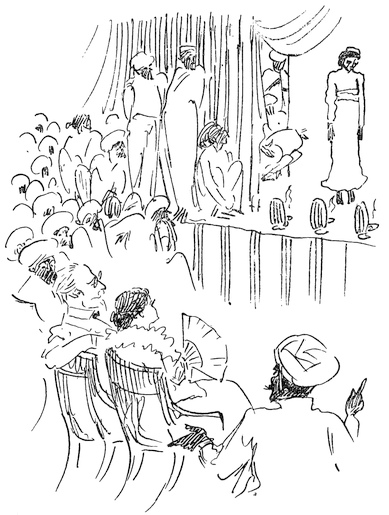
TANJORE—NATIVE THEATRE—HOUSE FULL. PERFORMANCE FROM
9 P.M. TILL 2 A.M.—BUT WE DIDN’T STOP TO SEE IT THROUGH
The first scene apparently represented a suburban
street in the European quarter of an Indian town;
at least there was a square towered church in it,
ugly enough, although some high-pitched gables
rather suggested suburban England. A road
in very acute perspective ran through the
centre of the scene, which might, after all,
have been bought from some European travelling
theatre.
The curtain raiser was of a sort of operatic,
conventional courtship motive, and consisted of a
musical dialogue between a young lady and gentleman
of uncertain country, costume, and period.
The girl was badly dressed in a white muslin
frock, with a little red silk waistband, and a
tinsel coronet or tiara on her head. She kept
her eyes on the ground the whole time, and
moved stiffly and shyly; her action, as well as
that of the gentleman, being rather suggestive
of marionettes.
The lady began by singing, each strophe or
couplet being repeated or answered by an antistrophe
from a chorus concealed behind the scenes,
to the accompaniment of tom-toms. The little
wooer presently appeared (also a girl), dressed in a
cap of tinsel, a tunic of black velvet trimmed with
silver tinsel, and breeches of the same, with brown
hose or boots. He also began singing strophes,
which were responded to or repeated by the chorus,
and the lady replied in the same way. Whenever
the lover made any advances the lady repelled
them, and, after each of her sung speeches, crossed
over to the opposite side of the stage, the lover
doing the same. After a long course of this monotonous
question and answer, sing-song business,
they finally came to terms, and stood singing
together, the lover with his arm round the lady’s
shoulders. A harmonium, playing at the wings,
assisted the tom-toms.
The pièce de resistance next began. The first
scene was a room of state in a Rajah’s palace.
The Rajah and his grand vizier, and an old priest
or soothsayer in a turban and Indian dress, were
the characters. The Rajah was a white man, of a
rather Irish cast of countenance. He was dressed
in black and silver, having wonderful silver spangles
in circular patches as big as dinner plates down the
front of his trousers. He wore a sabre at his side,
and he was seated on a throne mounted on several
steps, and each step was decorated by a large
globe of silvered Bohemian glass. The vizier was
attired in a similar way, but not quite so gorgeous
as the king.
From our bearer’s interpretation it appeared that
the Rajah, or king, who commenced chanting in a
most doleful and monotonous way, was in trouble
for want of an heir to the throne, and consulted the
turbaned old gentleman about it, who gave his
advice at considerable length.
The next scene showed the interior of a temple;
an image of the sacred bull was there, and a black
man, clad only in a waist cloth, was officiating,
apparently as priest. He was also evidently
regarded as a comic actor by the audience, and it
was rather curious to observe that his obvious
burlesque of some native religious observances
were received with laughter. He seemed to put
the Rajah, the vizier, and the soothsayer, who now
entered, through their religious paces, waving a
brush over them and putting garlands round their
necks, uttering curious gibberish the while, with
extravagant action, which seemed vastly to amuse
the audience.
The next scene showed the Rajah seated again
in his palace, and to him entered a troop of zenanas
to announce the joyful news of the birth of an heir;
but after they had departed with many salaams,
something seemed to go wrong, and the Rajah
began his doleful plaint again. The soothsayer
and the vizier were again consulted, and both had
a good deal to say, but matters did not seem to
mend much, and the scene promising to be interminably
long, we felt we had had about as much of
the drama as we could do with, and hearing, moreover,
that the performance would continue until
2 a.m., having commenced at nine, we left Moonsawmy
to sit it out, after he had found us our
carriage.
The next day we had another drive through the
city and its surroundings, reaching a pleasant
region of palm-groves, and lakes where buffaloes
were enjoying a bath. They lie in the water quite
deeply, with often only their heads out or the ridges
of their backs showing.
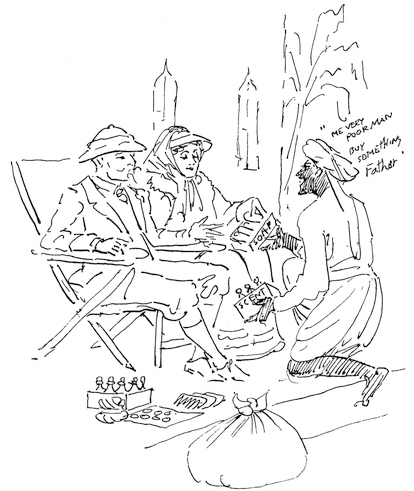
At the bungalow various native pedlars and
travelling merchants came up with their bundles,
and, as we sat under the verandah, they would
untie these and spread out their wares before us.
These were generally new silver and copper repoussé
dishes and bowls, samples of the craft of
the Tanjore district, but not good, being vulgar
and mechanical in workmanship, although repeating
traditional patterns and representations of the
chief deities of the Hindu pantheon. Some of
these were embossed in silver, or rather were partly
silvered over the copper, leaving bright copper
in parts, but they had rather a flashy and tasteless
appearance. The best things were the small
antique bronzes and brass objects—bulls, horses,
birds, peacocks, lamps, and curious shaped vessels,
and many of these were highly interesting. A pair
of bronze stirrups I acquired were charmingly
designed, and showed delicate design and workmanship.
In the town they make a kind of brass standard
lamp, in various sizes, having a moulded stem supporting
a shallow vessel for the oil, with niches
from four inches, the brass image of a cock is usually
placed at the top as a sort of finial. The parts are
made to unscrew like the well-known antique
Roman lamp which, in general design and structure,
this Tanjore lamp strongly recalled. Some,
indeed, were terminated by ring handles just like
the Roman ones.
We had been fairly comfortable at the Dak
bungalow, and the two brothers who kept it were
most anxious to please. The cooking was unusually
good, and the place was certainly very quiet.
The windows had no glass, but were closed with
Venetian shutters (which did not always act, however,
satisfactorily). The floors were covered with
India matting, and the beds were furnished with
mosquito nets. The meals were nicely served, and
the table always decked with flowers. The thermometer
in our rooms registered usually about 75
degrees, whereas at Madras it went up to 80 degrees.
Water was not carried here in goat-skins as in
Bombay and the North-West and Central Provinces,
but in large earthen jars. A man would carry one
in each hand, or slung by strings from a stick over
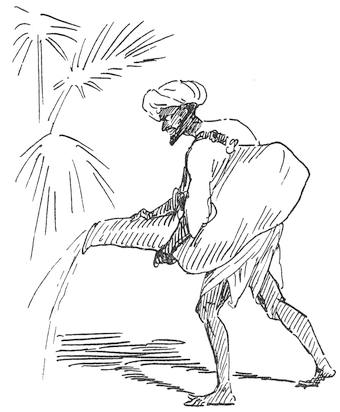
the shoulder. There was a fine young native who
watered the garden in front of our bungalow—he
had a splendid figure, and was almost the colour of
ebony. I tried to get hold of him to get a study
from him, but somehow he was not to be found
when the time came, and another very inferior
specimen was offered in his stead.
We left Tanjore on the evening of February 11
for Trichinopoly. It is only a two hours’ journey
by the railway, and we arrived quite punctually
about 8.30. It was too dark to see much of the
country, or get anything but a vague idea of the
place, especially when under the cover of an ox
tonga, two of which vehicles conveyed us and our
baggage to the travellers’ bungalow about a mile
off, the little zebus trotting along at a brisk pace as
fast as ponies, and much better conditioned than
any tonga ponies we saw in India.
At the bungalow we found an English lady and
gentleman, a newly arrived official and his wife,
who had not yet got a house—who were then
dining by candle light on the verandah—in possession
of the best room, and had to make the best of
it in a small side room, poorly furnished, and with
no mosquito nets. We got some soda and milk
and turned in, but, alas, the beds were hard as nails
and the mosquitoes troublesome and strong on the
wing, while the temperature went up to 80 degrees
again!
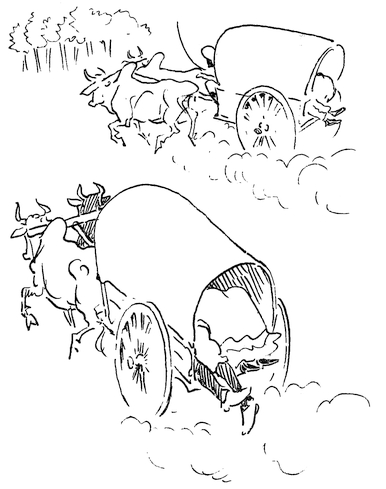
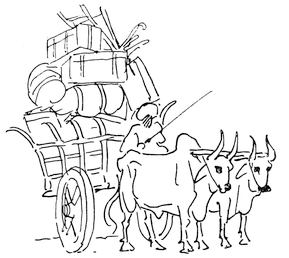
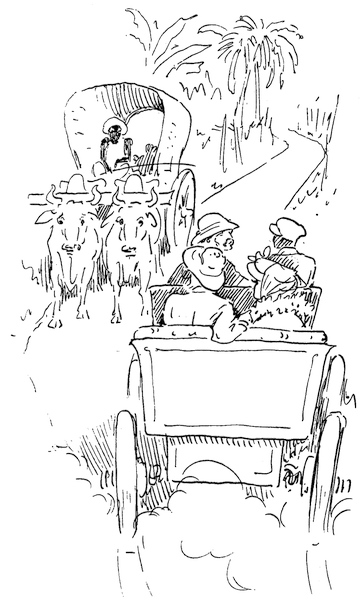
TRICHINOPOLY—OX TONGA—VITA BREVIS!
After breakfast the next morning we got a carriage
(which was a considerable improvement both
as to vehicle and horse to the one at Tanjore), and
drove towards the fort, which stands conspicuously
on a bold rock rising abruptly from the plain.
Passing through the native bazaar we crossed over
a long bridge, which spanned a very broad river
thronged with bathers, and people washing clothes,
and watering cattle, all busy in the stream which
was quite shallow, not more than waist high. This
bridge had been designed and built by an English
engineer, somewhere in the forties. It was of red
sandstone, and our driver pointed out a stone in the
coping inscribed to certain English officers who
served under Clive, and helped to lay “the foundations
of the British Empire in India” in 1750–4.
At about two miles from Trichinopoly we came
to the great Temple of Seringham. Thatched
native huts, forming a sort of bazaar, led up to
and were clustered about the great gates, which
resembled the entrance to the Temple of Tanjore.
The height of the gateways were very great in
proportion to their width. The great pagodas piled
over them were carved with the greatest richness
and intricacy of detail, and covered with the figures
of gods and imagery of all kinds, surmounted by
the curious rounded long barrel-like cresting, which
is so characteristic of Hindu temple-architecture.
The sculptured or modelled work here was all
coloured, but many of the figures were said to be
in stucco.
I think we passed through three of these gateways
before we reached the final one leading into
the court, with a many columned pavilion in the
centre, having a painted ceiling in which the Hindu
gods figured. The great Temple of Seringham is
sacred to Vishnu, whose image appears very frequently.
Opposite to this central pavilion is a
colonnade having a frieze of carved and coloured
figures under a cresting, Vishnu being in the centre.
This seemed to be the Hindu equivalent for a
sculptured pediment. The effect of the thickly
clustered columns of white-washed stone supporting
this band of rich carving and colour was very striking,
the sharp light and shade of noontide throwing
the front into strong relief, and through the aisles
formed by the columns we could see another lighted
court beyond.
The main passage through was lined by the little
stalls of a bazaar, grouped at the bases of the
columns, where mementoes in the shape of small
tin pictures heightened with coloured lacquer were
stamped in relief with representations of Vishnu
and his goddess, bead rosaries and necklaces, and
jewellery were also sold, and little silk bags
embroidered with portraits of the same deities.
As we stood facing the second court, the sacred
elephant of the temple came up, his forehead bearing
the mark of Vishnu, painted large in red and
white. It was amusing to see the animal pick up
a two-anna piece from the ground, and pass it over
its head to its keeper and driver seated on its neck.
Another younger and smaller elephant soon joined
the other, and this one had beautiful tusks which
his larger companion was without. This one, too,
skilfully picked up the small coins in the same way,
fumbling with the sensitive finger-like point of his
trunk to get hold of them in the crannies of the
pavement.
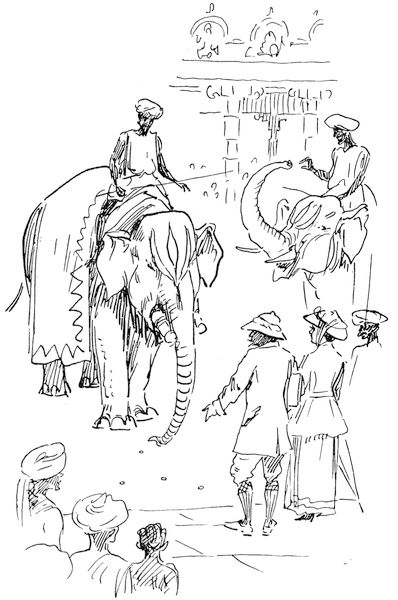
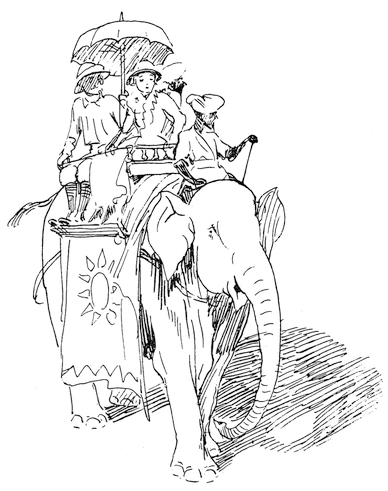
THE SACRED ELEPHANTS OF SERINGHAM—SECURING TWO-ANNA
PIECES!
We then, passing across this second court,
entered the Hall of a Thousand Columns—a sort of
architectural forest. Before this is reached, however,
there is a smaller hall which has a very
remarkable range of carved columns—the most
extraordinary carved stone work in Southern India.
They are strictly speaking rather columnar brackets,
bracketed columns or corbels resting on bases, and
they represent warriors on horses spearing lions
and tigers. The chief feature in each is the rearing
horse, which with its rider and lance, and smaller
figures below, and the attacking tiger, or, sometimes,
elephant, form a connected group cut out of a single
block of stone. These sculptures have so barbaric
and antique an appearance that it seems surprising
they should only date from the seventeenth and
eighteenth centuries together with the whole of the
temple buildings.
A curious effect is given to the interior of some
of the temples here by the practice of whitewashing
the pillars and walls, and leaving the carved figures
untouched in the stone, which gives them by
contrast an unusually swarthy appearance.
Returning, we had a view of the Rock of
Trichinopoly with the old fort and temple on the
summit. This syenite rock crops out in various
places in this district, but not often rising much
above the ground, but only emerging here and
there from the earth in a manner rather suggestive
of the backs of tortoises.
Saw a mongoose at the roadside which soon crept
out of sight and hid in the low brushwood at our
approach. Trichinopoly is well wooded, but is not
particularly picturesque, though the scattered tiled
or thatched bungalows look pretty enough in their
gardens, but on the whole it gives one the impression
of rather a straggling place. There was
a deserted looking mission church with a few
tombstones about it quite near our bungalow,
trying to look like an English village church, but
not succeeding. Leipzig Lutherans and Wesleyan
Methodists are said to have “missions” here, as
well as the Church of England. These missionaries
seem to plant their stations wherever there are
important Hindu temples. The wonder is that the
natives are so tolerant.
Madura was our next destination, and we were
not sorry to get away from our stifling little barn
of a room at the bungalow, leaving in the early
morning about daybreak for the 5.45 Madras mail.
The country was flat at first, with, again, large
sheets of water along the sides of the line, but as
we passed from the Trichinopoly district to the
Madura district we entered a mountainous region,
thickly wooded. I noted many cedar trees, and a
kind of cactus growing high with tall tree-like stem.
It was an interesting and varied country the rest
of the way. The crops were chiefly paddy and
castor oil plant.
One station had the extraordinary name of
Ammayanayakanur, and we were soon in the
tobacco-growing district, passing Dindigul with a
rock and an old fort upon it, not unlike Trichinopoly
in character. Cigars of the district were offered at
the station, but we saw no tobacco crops near the
line.
We reached Madura about noon, in time for
tiffin, and engaged a room at the station, which was
a great improvement as to beds and general appointments
on our recent bungalow experiences.
The sleeping-rooms were built out on a separate
wing which appeared to be new. They opened on
to a corridor which led to a large open terrace, and
were in charge of a Eurasian woman. There was
also a good dining-room at the station.
It was tremendously hot, however, and we could
not very well move out until after 4 o’clock, when
having engaged a guide we drove out to see the
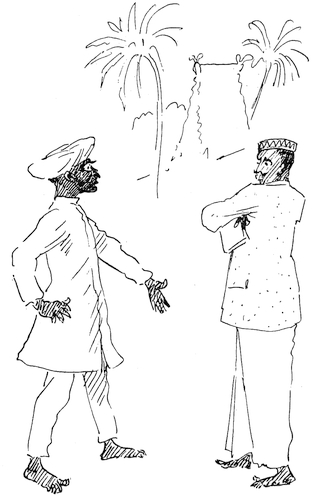
great temple. Our bearer objected strongly to the
guide and there was some friction between them,
but as native servants were prohibited from entering
the temples, and were always stopped at the
gates, Moonsawmy could not show cause why the
guide was not necessary, and we found him very
intelligent, speaking English well, and having the
history of the place at his fingers’ ends.
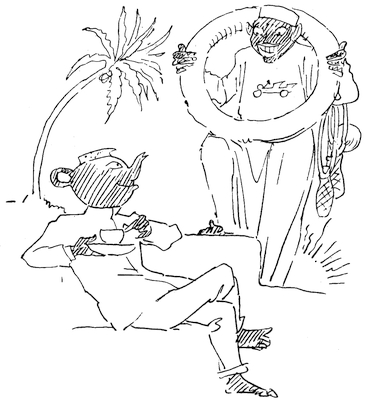
THE RIVALS. OUR MOONSAWMY AND THE MADURA GUIDE
The Madura temple is so remarkable and is on
such a scale that I was anxious to get all the
information about it I could. Mr Pillai (the guide)
was very useful and well-informed, and he gave us
many interesting stories and details about the
sculptured figures and paintings.
There are four great pagoda-gates, richly carved
and painted, of the same type but larger than
those at Tanjore and Trichinopoly. Evidently
the Hindus had no scruples about colouring their
sculpture, and the colouring has been renewed
from time to time. The prevailing tints used are
turquoise blue, vermilion, yellow, white, and green.
One of the gates the guide pointed out was granite
up to the first story, and the figures were in stucco
above.
The four gates mentioned are connected by a
high wall, on the crest of which occur at intervals
the image of Siva (to whom the temple is dedicated)
seated between two bulls, the bulls being
placed upon the top of the wall, and the image of
the God in a sort of arched recess, sunk into it a
little below. The upper part of the wall is uncoloured,
but a sort of high dado is carried along
it below, painted in broad vertical stripes of red and
white which seems a favourite scheme of decoration
in Southern India. The wall encloses a broad
paved court, and inside this is another wall with
gates, through which the various temples and
columned halls are entered.
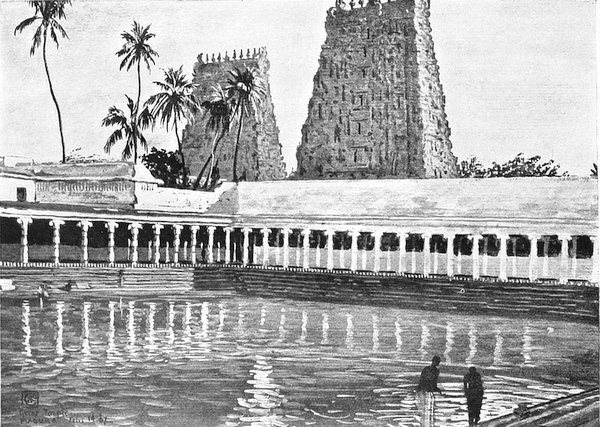
In the centre of all is the sacred tank, a large
pool of water surrounded by steps, and an arcade
of white columns. As we approached this, we
saw a crowd of natives, men and women, seated
on the paved margin of the tank along one side
and between the columns listening to a priest who
was preaching with much earnestness. Our guide
said he was translating or expounding (one did not
know with what gloss) passages from the sanskrit
text of the sacred books which another priest
previously read in the original.
The scene was a picturesque one. The various
colours of the people’s dresses, in which dark red
prevailed, showed against the white wall and columns,
and the brown faces made a harmonious scheme of
colour.
The wall along the upper part was painted with
a series of histories of Siva and his incarnations.
These picture-stories were arranged in tiers or
friezes, about four or five deep, one above the other,
and running the entire length of the wall behind
the colonade, each side the tank. These paintings
were highly interesting, painted probably with the
main object of making the stories intelligible to the
people, they were quite decorative, full of detail, and
forming a rather closely filled and dark pattern of
colour, having the effect of a woven hanging.
One of the painted legends treated of a certain
Maharajah who appears to have persecuted the
early Jain seceders, much as the Roman emperor
treated the early Christians, with great ferocity,
finally impaling them on stakes, and thus they
were painted all of a row!
The Jain sect was at first apparently regarded as
a schism, and the Jains as heretics or apostates falling
away from the pure Hindu worship of Siva.
One seems here, in this great Temple of Madura,
to get back to the most ancient type of religion, and
one which, after all, allowing for evolution in our
ideas, seems the most lasting—Nature worship. The
Hindus in their pantheon include and embrace
everything, at least in their own universe, which is
their own country, and to them, truly, “nothing is
common or unclean.” Their deities incarnate
themselves in all sorts of forms. Siva, according
to one legend, for instance, even taking the form of
a wild sow, and suckling the young of the mother
which had been slain by the hunters. The second
son of Siva rides upon a peacock, the representative
bird of India. The Zebu bull is sacred to Siva,
and in the Lingam is symbolised and revered the
male and female principle of generation, the root
and source of all life on the earth.
In one place in the temple, between two of the
columns, was a group of the nine planets personified
and placed around the sun—a golden sphere in the
centre. For each of these embodied planets might
be found a corresponding personality among the
deities of the classical world.
Another striking thing about the Madura temple
is the force of realization and expression in the
figure sculpture. Life-sized figures of different
gods and demons are carved in stone in front of
the columns in many of the halls of the temple, the
columns themselves frequently white-washed, while
the figures are left in the untouched stone and look
in contrast like bronze figures, their elaborate detail
and undercutting emphasizing this suggestion.
Indeed, the variety of character, invention, as well
as the vigour and freedom, governed by a certain
formalism, of some of this sculpture at its best
reminds one of European gothic sculpture in the
Middle Ages, not only in its symbolical and
legendary aspect, but also its all embracing character
and sympathy with the life of the people. The type
of the Hindu mother appears, for instance, in one
of the best of the figures carrying her child on her
hip, just as the native women do to this day, while
a suckling infant is suspended at her breast.
Mockery, if not humour, too, seems to come out
here and there sometimes, as in the dancing figure
of a mocking musician playing on his pipes.
A frequent subject is Siva presenting his sister
in marriage to Vishnu, and there are besides a
number of curious legends connected with the
sculptures here, which are very various, and, of
course, not unfrequently become grotesque or
monstrous under the influence of the Hindu
religious symbolic ideas and the Hindu inventiveness;
but one feels that here is a genuine piece of
ancient life, expressed in the forms of Hindu art—frank
nature worship in full vigour of life, and a
dominant influence in the lives of millions of people.
In the sacred tank the people were constantly
bathing and washing their clothes. The water
never seems to be changed and is perfectly green
in colour. Our guide said it remained pure and
ordered a man to show its quality by dipping his
hands in and holding a small quantity in them,
cupwise. The water, however, was, even in this
small quantity, quite green, although a clear green.
It must have been full of vegetable matter, one would
think. It reminded us of what the Maharajah’s
secretary had said of the Ganges water at Benares.
The colouring of the interior of the Temple in
parts recalled the mural decoration of ancient
Egypt in its use of simple primary colours—red,
green, white, and yellow prevailing. The lotus
flower, too, was constantly introduced, treated as a
rosette upon the ceilings.
Some of the pillared halls were, however, left in
plain stonework, or simply whitewashed. One
long hall we entered looked very impressive in the
dim light, a single ray from the sun penetrating,
and making a spot of intense light upon the floor.
We saw a gilded copper dome, and a golden
flag staff, and our guide pointed out the great doors
behind which the festival cars were kept, and we
saw, too, wonderfully decorated life-sized images of
elephants and horses which formed part of the show
on great occasions. There were two black and
two white elephants, standing between the columns,
under rather tawdry and tinselly canopies, and other
furniture of the festivals; one large hanging bearing
the words of welcome to the Prince and Princess
of Wales, which must have been used for the occasion
of their visit.
Various donors of parts of the temple were
pointed out, in effigy. The Czar of Russia appeared
(not however in person) as the donor of certain
shrines and a brass canopy or arch which held many
lamps.
SACRED TANK OF THE GREAT TEMPLE, MADURA
The practice of drawing the image of the god on
festival days through the streets on great cars seems
general at all the chief temples in Southern India,
and not confined to Juggernath. At Seringham
we saw the great car on which the image of Siva
was drawn on such occasions, and also the thick
cables—like ship’s cables—which were used for the
purpose—multitudes of men hauling the car out of
the temple and along the streets by these means.
Here, too, at Madura the god Siva is represented
seated upon his car which is treated as a kind of
throne, the wheels and the horses sculptured at the
sides in a symbolic sort of way.
In some of the painted histories on the walls,
Siva is shown in a winged car (suggesting his rapid
flight and omnipresence, perhaps) and, presumably,
his image is drawn out on a car at festivals to keep
his presence and moving influence vividly in the
minds of his worshippers.
It was curious to see the bazaars in the corridors
and outer courts of the temple. Rows of stalls,
where all sorts of miscellaneous things were sold—brass
ware, pottery, woven stuffs, beads, and all
kinds of knick-knacks and toys. Some of the sellers
squat on the pavement and spread out their goods
before them. The temple and its courts is a great
resort of the people, in fact. Pilgrims lie down and
sleep near its shrines, and the children play freely
between its pillars. Bats flutter in and out of the
crevices of the ceilings, or hang in little black
clusters up aloft in their recesses.
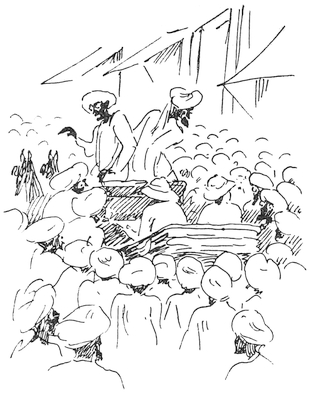
In sketching at the sacred tank a very large crowd
of natives gradually collected behind me, and on each
side, and it was as much as the guide could do to
keep them from closing in, and completely surrounding
me. Some American visitors to the temple
whom we met afterwards in Ceylon said that, seeing
this vast concourse pressing round the tank, they
thought it was a suicide! Travellers usually take
snap-shots with hand cameras, and I imagine
that a sketcher in colours is comparatively rare.
The crowd, however, were quite quiet. The
guide was encouraging, and remarked when
I had finished that it was “better than a
photograph.”
Another afternoon we drove out through the city
and some three miles beyond to see the “Teppa
Tank”—a large sheet of water, enclosed by a low
wall painted in red and white stripes, with steps to
the water and carved bulls decorating the balustrades.
On an island in the centre of the tank rose
the pagoda of a temple, in stucco, and four small
pagodas at the four corners of the garden-island—a
mass of foliage amid which the pagodas shone,
ivory-white in the sunshine.
Near this tank on the roadside was another
temple sacred to a goddess who was the object of
solicitude in the case of people desiring offspring,
and to whom votive offerings of cradles were made
by the devotees, as well as doll-like images of
children made of baked clay and painted. The
flat roof of this temple was peopled with a crowd of
these grotesque images, and the carriage boy was
sent to fetch one for our inspection.
Then we drove on to where grew a gigantic
Banyan tree—eighty feet in girth, and having
quite a small forest around its central vast trunk
of offshoots—new trees which had rooted themselves
in the earth from the parent branches.
It was rather suggestive of a many pillared
sylvan temple.
After this we reached the Palace of Tiramala,
which stood at the head of a large village—an
imposing structure in stucco, mostly yellow washed.
The enormous columns of the court looked out of
proportion to the arches they supported, which were
of a rather debased Mogul type, heavy with very
elaborate grotesque ornamentation in stucco in the
spandrils and on the ceilings, many of which had
as a central device a large lotus flower formally
treated as a rosette, and in some instances elaborately
painted. The effect of the whole building
was rather weird, and suggested a rather queer
architectural nightmare, in which massive Norman
cathedral piers had swallowed Roman Doric ones,
or vice versa, and a Hindu modeller had broken
up some Mogul arches, and fastened them together
again with grotesque elephants and dragons’
teeth.
The palace was now used as law courts, and it
was curious to see two modern oil portraits of two
neat English lawyers hanging on the walls of these
vast columned halls.
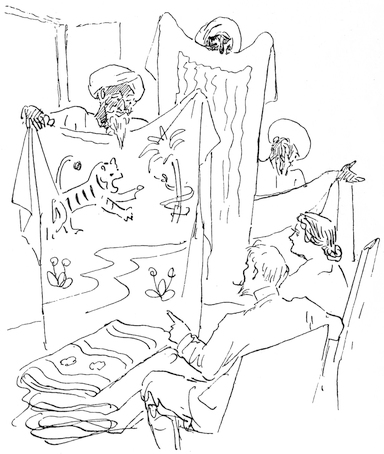
We next visited a native shop in the village bazaar
where the fine muslins and silks of the district were
made and sold. We were duly seated in chairs
and fanned by boys, while an active brown member
of the firm unfolded tempting saris, pugarees, and
silk stuffs, some beautifully brocaded with gold
thread, and of course we possessed ourselves of a
few specimens.
In this district there is a thriving native silk
industry, hand-weaving, also dyeing, and the ingenious
native craft of making patterns on cottons
and muslins by tying and dipping. Hanks of
cotton and silk may be seen hung out over bamboo
poles placed horizontally, and ox-carts roll by filled
with the dyed skeins. There is a fine dark rich red,
frequently seen in the sari dress of the women, also
a dark purple. The women here generally wear
the dark red sari with a narrow border of black;
in some cases the sari is black with a red border.
In the village street we saw a little native bride
drawn in a carriage.
Returning to the city in the cool of the evening
we stopped at the temple bazaar and bought some
zebu bells—curious little pear-shaped brass bells,
each with a different tone, which are hung round
the animals’ necks. Their foreheads, too, are
frequently bound with strings of beads, or shells
fixed on leather bands, and their horns are painted
green or red.
There is a method of decorating the centres of
the dining tables in Southern India which, I think,
we first noticed at the hotel at Madras, or at one
of the refreshment stations on the Coromandel
coast. It consists in arranging dyed sago seeds in
patterns forming a table centre on the white cloth.
At the station refreshment room at Madura there
was a more elaborate example done by means of
stencils—a border of yellow enclosed a lightly
powdered filling, and an effective outer border was
produced by a repeated sprig of a red rose with
green leaves. The general effect was that of an
embroidered pattern, but of course it was liable to
slight displacements, and was constantly done
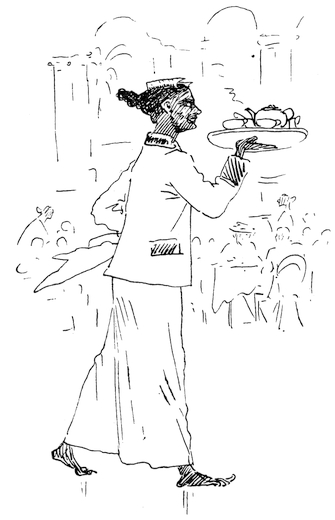
afresh, one of the waiters being the special
artist.
We left Madura on the 15th of February for
Tuticorin.
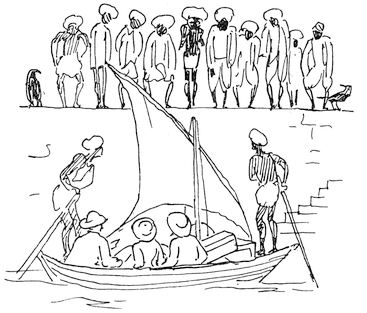
TUTICORIN. DEPARTURE FOR COLOMBO. THE LAST OF THE
KITES AND CROWS.
The country traversed was flat and plain for the
most part, with cultivated crops of castor oil
plants, paddy, and corn, alternating with jungle
of brushwood, but no fine trees. Hills were
seen in the distance on the right, and we made
several stoppages at short places with very long
names.
Arriving at Tuticorin about four in the afternoon,
we went on to the beach station, and got on
board a small steam launch or tug in waiting at
the jetty, then we saw the last quarter, as it were, of
our Moonsawmy, and took our leave of him, after
he had had his usual fierce dispute with the coolies,
who certainly never received trade union wages
from him. On the whole we were not sorry
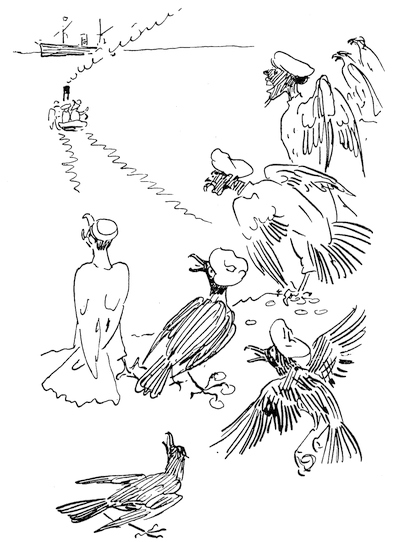
to get away from the rupee-hunting throng
which usually hang about stations and wharves—the
kites and crows in pursuit of the traveller,
their prey, who for the time being, at least, now
escaped their clutches.
Tuticorin presented no obvious attractions
except the sea, which we were quite glad to meet
again. The launch seemed just large enough to
hold the train-load of passengers—Americans,
Germans, and English with their baggage, and after
about half-an-hour’s steam across the harbour we
reached the steamer (the “Pandua” of Glasgow) and
climbed up the gangway to the saloon deck. We
secured a rather small but well-appointed berth
opening off the saloon, and were able to enjoy a
well-served dinner—food seems generally better on
ship-board than on land—at least Indian land.
Cargo boats were clinging to the steamer’s side,
and, at sunset, one by one cast off and hoisted
their lateen sails (like those of an Arab dhow) each
boat having one about the length of the vessel.
The sailors in hoisting up the sail climbed and
clung to the rope, to bring it up with their weight.
Chanting a curious sort of song the while, our
steamer weighed anchor and started, and we looked
astern and saw the last of India fading from view
behind the shining wake of the steamer, and lost in
the glow of an orange sunset.