| Comparative Yearly Exports of Diamonds from the Promulgation of Act 48, 1882, to December 31st, 1886. |
|---|
| |
|
|
|
|
|
|
|
Carats. |
Declared Value. |
Average per cent. |
| 1882 Four months |
796,546⅝ |
£1,156,273 |
14 1 |
6 |
29/ |
|
| 1883 |
2,413,953⅜ |
2,742,521 |
1 |
0 |
22/ |
8 |
| 1884 |
2,263,686⅝ |
2,807,288 |
3 |
4 |
23/ |
9 |
| 1885 |
2,440,788⅜ |
2,492,755 |
13 |
2 |
20/ |
5 |
| 1886 |
3,135,432⁶⁄₈ |
3,507,210 |
14 |
0 |
22/ |
4 |
| Total, |
11,050,407⅜ |
12,706,049 |
6 |
0 |
23/ |
|
“A policy under which people who desire to leave the country with
their wives and children and stock, because they regard the exceptional
laws to which they are made subject as oppressive and intolerable, and
who while endeavoring to carry their desire into effect peaceably may
be pursued by armed forces, may have all their property confiscated,
their women and children captured and placed in forced servitude
with their white fellow-subjects, and be themselves thereafter tried
for rebellion, under savage instead of civilized laws, is to my mind a
most objectionable policy, and one which should be superseded as
quickly as possible.”
520
To the Honourable Speaker and Members of the Honourable House
of Assembly of the Colony of the Cape of Good Hope, now in Parliament
Assembled.
The humble Petition of the undersigned chiefs, sons and grandsons
of the late Paramount Chief Moshesh, their councillors, headmen and
followers, humbly sheweth,—
1st. That the Peace Preservation Act was proclaimed law in Basutoland
by her Majesty’s High Commissioner and Governor of the Colony
of the Cape of Good Hope, from 21st May, 1880.
2d. That thereupon your petitioners, her Majesty’s loyal native
subjects of the Basuto nation, did obey the said law, and surrendered
their guns, her most gracious Majesty the Queen having been pleased
previously to command their obedience, and to assure them most
graciously of her deep interest in the welfare of her Majesty’s Basuto
subjects, for proof of which your petitioners beg to refer to Earl Kimberley’s
letter of 13th May, 1880, to his Excellency the Governor, Sir
Bartle Frere, which was duly communicated to your petitioners by the
Governor’s agent and chief magistrate in Basutoland, Colonel C. D.
Griffith, C.M.G.
3d. That, owing to influences and wicked dispositions, which are
now matters of history, the greater portion of her Majesty’s subjects
in Basutoland, misled by the chiefs Lerothodi, Masupha, Joel Molapo,
and other minor chiefs, rebelled against her Majesty’s commands, took
up arms, slaughtered numbers of her Majesty’s loyal and obedient subjects
for having obeyed her Majesty’s commands, and carried on open
war against her Majesty’s colonial forces.
4th. That your petitioners, at the risk of their lives, and with the
loss and sacrifice of all they had been possessed of before the rebellion,
in cattle, sheep, horses, grain, wagons, ploughs, houses, lands and
various other properties, remained faithful to her most gracious
Majesty throughout the rebellion, and at her Majesty’s call did even
enroll themselves for active service, fighting her Majesty’s battles
against their rebellious countrymen at Kalabani, Lerothodi’s Village,
Mafeting, Makwai’s Berg, Kolo, Tweefontein, Boleka, Maseru, Thlotse
521Heights, Mohalie’s Hoek and Quithing, in all of which the loyal Basuto
subjects of her Majesty acquitted themselves to the satisfaction of the
Commandant General of Colonial forces, as is most abundantly testified
to in numerous dispatches, and in the official lists of killed and
wounded.
5th. That in the month of April, 1881, and after open war had
been carried on for nine months, negotiations were entered into between
her Majesty’s Governor and High Commissioner and the Basuto
chiefs then in rebellion, when your petitioners, knowing the character,
feelings, and real objects of the rebel chiefs, as in duty bound, made
humble petition to his Excellency the Governor, setting forth their
apprehensions in regard to the consequences to themselves and their
country that would assuredly arise from any arrangement which
would not include a perfect submission of the rebels and the maintenance
of a force sufficient to enforce such submission, to which they
never received a reply, nor even acknowledgment.
6th. That subsequently, an agreement having been come to between
his Excellency the Governor on one part, and the rebel chiefs
of the Basutos on the other part, a document was published in the
English language, but never publicly given out in Sesuto, bearing the
signature of her Majesty’s Governor, Sir Hercules George Robert
Robinson, G. C. M. G., known as the Governor’s Award, bearing date
29th April, 1881, and by which an end was put to actual hostilities in
Basutoland.
7th. That the Governor’s Award having become known to your
petitioners, they, feeling alarmed at and grieved with the apparent
want of any tangible provision whereby the carrying out of the Award
could if required be actually enforced, and further foreseeing great
troubles and miseries to themselves arising from such a state of things,
again approached his Excellency the Governor by humble petition of
11th of May, 1881, setting forth all their apprehensions and grievances,
to which humble petition they never received either a reply or
acknowledgment.
8th. That subsequently, to wit, on the 25th August, 1881, a change
of government took place in Basutoland, Mr. J. M. Orpen succeeding
Colonel C. D. Griffith, C. M. G., in the office of Governor’s agent,
and from the first day when Mr. J. M. Orpen took over the government
of Basutoland, your petitioners are grieved to say their rights
and interests as her Majesty’s loyal and obedient subjects were ignored,
they themselves were treated in every respect as if they had committed
522a crime by remaining loyal, whereas the rebels were encouraged in
every way, and treated with a deference and submission as if their act
of rebellion had been a virtuous and meritorious one; and the Colonial
forces were gradually withdrawn from Basutoland, whilst it was a
notorious fact that the rebels had not in any way complied with the
conditions of the Award.
9th. That notwithstanding the open defiance of the Queen’s authority
throughout Basutoland; notwithstanding the notorious anarchy which
prevailed from one end of the country to the other; notwithstanding
the persistent, obstinate refusal of complying in fact with his Excellency’s
Award on the part of all the rebel chiefs; notwithstanding
the repeated insults and injuries inflicted upon and forcible expulsion
by the rebels of such of your petitioners as, in accordance with Mr.
Orpen’s desires, had tried to reoccupy their former grounds; notwithstanding
the direct insults and affronts offered frequently to the
Queen’s representative and her magistrates in this country by the
rebels; and notwithstanding the earnest reports of those magistrates
in Basutoland who, from many years’ experience in the country, were
best able to advise the government as to the real state of affairs; yet,
the Acting Governor’s agent continued and persisted in officially reporting
to the government that matters were satisfactory, that things
were quieting down, that the Loyals’ cattle were being gradually restored,
and that, more particularly in Mafeting and Leribe districts,
the Loyals had returned and still were returning to live amongst the
rebels, by whom they were well received, all of which official reports
were diametrically opposed to real fact.
10th. That consequently, and as a natural sequence of such a policy,
the conditions of the Governor’s Award remained unfulfilled in almost
every particular clause thereof: the cattle fine was only partially complied
with, no guns were surrendered, gun licences were taken up in,
comparatively speaking, few instances, and then only without even
the production, much less the surrender, of a single gun, and on payment
of such insignificant sums, that in many instances even the sum
of two shillings and sixpence sterling was accepted, instead of one
pound as laid down in the Award; the great bulk of the cattle, almost
all the horses, all the sheep and goats, and every description of movable
and immovable property belonging to your petitioners, and which,
according to the Award, should have been restored to them, were retained
in the hands of the rebels, who refused to give them up; not a
single sixpence of compensation was made to traders and others for
523losses inflicted upon them during the rebellion, and your petitioners
being debarred from re-entering upon their lands and houses, were
kept in the greatest misery, depending upon government rations,
scarcely adequate to maintain themselves and their families, cooped
up within confined areas around the fortified camps of the diverse seats
of magistrates in Basutoland.
11th. That under these heartrending sufferings, and exposed daily
to insults and injuries, not only on the part of the rebel Basutos, but,
they grieve to say it, under continued pressure and insults heaped
upon them by and through the acting Governor’s agent, your petitioners
never swerving from their loyalty to her Majesty’s government,
again, and for the third time, approached most humbly his Excellency
the Governor by respectful petition of 20th October, 1881, setting forth
again their miseries and grievances, and representing the true state
of affairs in Basutoland, to which humble petition they have never
received either reply or acknowledgment; but the said petition, for
reasons unknown to your petitioners, was held back by the acting
Governor’s agent, from the 20th of October to the end of November
or beginning of December, and, subsequently, your petitioners were
harassed and persecuted beyond measure by the acting Governor’s
agent, who persisted in representing what is absolutely untrue—that
your petitioners had been instigated by some white man to petition
his Excellency; that the petition had been made by the said white
man, and that its contents were not true, whereas the said petition was
the cry from the hearts of your petitioners, and contained nothing but
what was absolutely and strictly true; saying which, according to truth,
your petitioners nevertheless humbly maintain that they have a perfect
and constitutional right to ask any man, white or black, to draft, write,
or translate such letters or petitions as they may deem expedient to
address to the authorities in matters concerning their interests, and
that neither the Governor’s agent nor any other official person serving
in the government, has a right to object to or to discredit such documents
bearing your petitioners’ signatures in any way whatever, on
account of such having been drafted, written, or translated for them
at their own request by any person whatsoever.
12th. That all the grievances and miseries of your petitioners remaining
unredressed to the present day, the Governor’s Award being
succeeded by an Ultimatum, which holds out the eventuality of an
entire cancellation of the Award, whereby your petitioners, after having
been dealt with more harshly and unjustly ever since they ventured
524to exercise their undoubted rights as free subjects of her Majesty the
Queen, to petition his Excellency the Governor, would now be cast
away entirely, and deprived even of the most solemn acknowledgment
of their most sacred rights, which had been clearly laid down in the
Award, and all their most humble petitions having been studiously
ignored, your petitioners have but one anchor of hope left to them,
to which last anchor they would now cling by approaching most
humbly and yet most hopefully your Honourable House with their
cries for justice.
13th. That your petitioners, before the rebellion, were possessed,
in round numbers, of 28,000 head of cattle, 7,000 horses, 29,000 sheep
and goats, 200 wagons, 400 ploughs, 12,000 bags of grain, and property
of other description to the amount of £12,000 sterling, all of
which losses have been duly registered at the diverse magistracies, and
the lists of which losses will be found on official record, besides the
value of their lands and the great comfort of their families, and tribal
rights and positions, which cannot possibly be valued in money, and
all of which they sacrificed in order to remain loyal subjects and faithful
to her Majesty’s commands.
14th. That your petitioners, taking all the obligations of loyal
subjects upon themselves, are fully aware that they owe, and they are
fully prepared to maintain, that loyalty, as a moral obligation towards
their most gracious Sovereign Lady the Queen, even in adversity, and
they would cheerfully bear all their losses without a murmur, nor
would they dare to trouble her most gracious Majesty’s government
with their complaints and prayers for redress, if they knew or were told
by her Majesty’s government that the power of the government had
ceased to be strong enough to carry out her Majesty’s promise of protection,
or to enforce the terms of the Award given by her Majesty’s
Governor of the Colony of the Cape of Good Hope, in which case your
petitioners would loyally sympathise with her Majesty’s adversities in
her dominions in South Africa, and, although poor and miserable by
the misfortunes of war, they would nevertheless rally round her
Majesty’s throne, and, being unable to give any more, they would at
least offer their last drop of blood in the defence of her Majesty’s
prestige and in the maintenance of her Majesty’s rule in South Africa;
but
15th. That your petitioners’ faith in the might and good faith of
her Majesty’s all-powerful rule over her glorious Empire throughout
the world has not in the least been shaken by recent events in Basutoland;
525and they being convinced of this power, and fully confident that
their interests are now as dear to her Majesty as they were when Earl
Kimberley expressed her Majesty’s sentiments towards your petitioners
in his letter of the 13th May, 1880; and further knowing that the
justice of your petitioners’ claim to be reinstated in all the rights and
properties lost by reason of their loyalty during the late rebellion has
been clearly laid down in his Excellency’s Award, and was acknowledged
as indisputable by both the last and the present responsible
Ministers of the Cape Colony, and being fully convinced that all their
present miseries and wretched situation is exclusively due to the mistaken
policy adopted by the present government of Basutoland in
dealing with the rebellious chiefs.
Your petitioners, therefore, approach your Honourable House most
humbly and most hopefully, and pray that it may please your Honourable
House to inquire into your petitioners’ case, and if it so please
your Honourable House to permit your petitioners to plead their cause
at the bar of your Honourable House, by a deputation of three chiefs
whom your petitioners have chosen as their spokesmen, and to grant
generally such relief to your petitioners as your Honourable House
may deem meet, and in duty bound will ever pray.
Jonathan Molapo,
Chief of the Leribe District.
Mokhethi Moshesh,
Hadiyana Mosheshoe,
(And 896 others).
Basutoland, March 14, 1882.
Whereas I, Thomas Francois Burgers, State President of the South
African Republic, have received a despatch (dated the 9th inst.) from
her British Majesty’s Special Commissioner, Sir Theophilus Shepstone,
informing me that his Excellency has resolved, in the name of her
Majesty’s government, to bring the South African Republic by annexation
under the authority of the British crown; and whereas I have not
the power to draw the sword with good success for the defence of the
independence of this state against a superior power like that of England,
526and moreover feel totally disinclined, in consideration of the welfare
of the whole of South Africa, to involve its white inhabitants in a
disastrous war by any hostile action on my part, without having
employed beforehand all means to secure the rights of the people in a
peaceful way: Therefore, I do hereby, in the name and by authority
of the government and the people of the South African Republic,
solemnly protest against the intended annexation.
Given under my hand and under the seal of the state, at the government
office at Pretoria, on this the 11th day of April, in the year
1877.
Whereas her Majesty’s Special Commissioner, Sir Theophilus Shepstone,
has thought fit, in spite of my solemn protest entered yesterday
against his Excellency’s intention communicated to me by missive
dated 9th of April, to carry out that intention, and has to-day proclaimed
the authority of her Britannic Majesty’s government over the
South African Republic; and
Whereas the government has decided to submit provisionally under
protest for the purpose of, in the meantime, sending to Europe and
America a deputation, in the persons of Messrs. S. J. P. Kruger and
E. P. Jorissen, for the purposes of defending the right of the people
and for endeavoring to arrive at a peaceful solution of the matter:
Now, therefore, I, Thomas Francois Burgers, State President of
the South African Republic, hereby, on behalf and by advice of the
executive, command all officials, burghers and inhabitants, to abstain
from every word and every deed of violence by which the work of the
deputation may be made fruitless, and I exhort all burghers and inhabitants
to assist in maintaining the decision of the government and
in the preservation of order and the prevention of bloodshed.
Thos. Burgers,
State President.
Government Office, Victoria, April 12, 1877.
Shortly after the proclamations were read, most of the officials
assembled in the Volksraadszaal, where his Honor the President addressed
them, in a state of great emotion, very nearly in the following
words:
“Gentlemen, officials of the South African Republic: You are no
strangers in the land. You also know what the government has
527resolved to do. We bow only to the superior power. We submit
because we cannot successfully draw the sword against that superior
power, because by doing so we would only plunge the country into
deeper miseries and disasters. We have resolved to appeal to England
herself; and if we get no redress there, then we will seek the friendly
intervention of other powers that have acknowledged our independence.
I have called you together to make one request to you: continue
to occupy your offices in abeyance of the result of this appeal. No
other oath of office will be demanded from you, and you can continue
to serve under the oath once sworn to the Republic. I have pledged
my word for you, and I know I can depend upon you that you will not
disappoint me. Serve the new government with the same honesty
and fidelity with which you have served our government, for by that
you will serve the people. I am leaving my office under protest on
behalf of myself, of the government, of the officials, of the Volksraad,
and of the people. Grant me therefore this one favor, that you serve
the people so long, and redeem the pledge that I have given for you.
I thank you for the fidelity which you have shown me in your posts
as officials. I leave my office with the certainty that I have not
offended any one of you willfully, and if I have perhaps done so from
weakness, I ask you to forgive me.”
Mr. Consul of Belgium: “You are the only representative of a
foreign power present here to-day. You know what has happened
here to-day, and you know also what has caused this event, and of
course you will communicate every thing to your government. I thank
your government, your king, your people and yourself, for the
brotherly hand offered by Belgium to this youthful Republic. Be you
my spokesman to your king and people, and tell them that, although
the government be altered, yet the people remain. Meanwhile I
request you, Mr. Consul, that you remain here at your post until the
result of the protest shall be known. And now, gentlemen, for the
moment I leave the scene. I wish you God’s richest blessing. Farewell.
Be true to yourselves, to the people and to the government.”
Mr. Swart briefly addressed his Honor in a few words of farewell,
uttering the hope that the day may soon come when we would again
welcome him as head of the state. He then handed to his Honor the
key of the government office.
His Honor said: “Here is the key of our office. I hand it over to
the superior power and thereby give it into the hands of God, who will
at the proper time deliver it to the right man. I order you—it is my
528last order—to deliver it to the chief of the new government and conduct
yourselves worthily as men and officers. Farewell.”
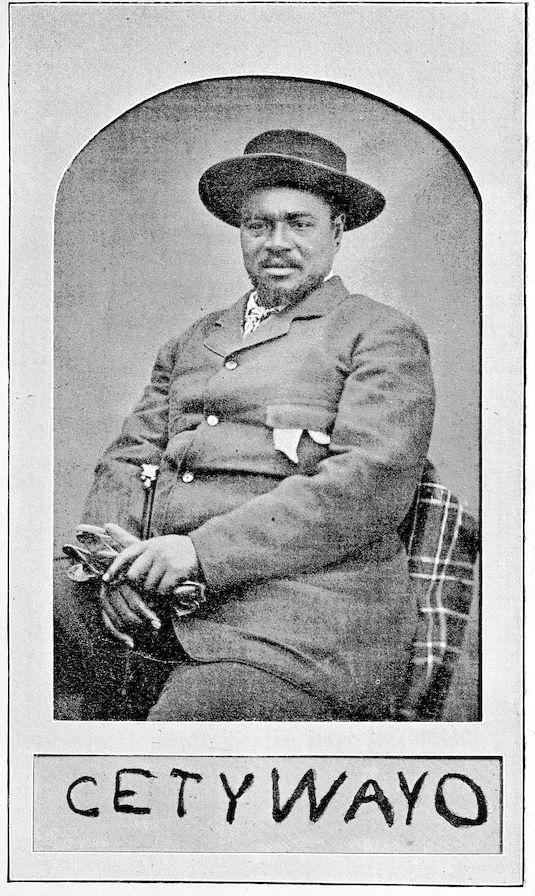
1. The Lieutenant Governor of Natal sends, in the name of the
Queen’s High Commissioner, these further words to the Zulu king and
nation.
2. These are the words of the High Commissioner and they are
sent by the Lieutenant Governor, through the same officers who delivered
the words of the Award in respect of the disputed boundary
question, namely:—The Hon. John Wesley Shepstone, Secretary of
Native Affairs, Natal; the Hon. Charles Brownlie, Resident Commissioner
for Native Affairs in the Cape Colony, at present attached to the
staff of the High Commissioner; Mr. Henry Francis Fynn, Resident
Magistrate, Umsinga Division, Natal; and Colonel Forester Walker, of
her Majesty’s Scots Guards, lately attached to the staff of the High
Commissioner; to be delivered by them to the Zulu representatives,
that they may be duly communicated to the king and council and
people of the Zulu nation.
3. The king and nation will recognize in the Award that has just
been given on the matter of the disputed boundary, the determination of
the British government to give effect to the words which have been
spoken at different times by its representatives in this country regarding
the matter.
4. The dispute respecting the boundary was one that had existed
for many years. It was a question between the government of the
Transvaal Republic and the Zulu nation. The latter made many and
frequent representations to the Natal government on the subject. The
government of Natal was always anxious that the dispute should be
settled by peaceful means, and always counselled the Zulu king accordingly.
It considered that the dispute might be and could be settled
properly and satisfactorily, by means of an impartial inquiry; and was
always ready to use its good offices for that purpose. The opportunity
for doing so, however, did not occur. The years passed without any
settlement of the question, and at length last year the Transvaal came
529under British rule. Now when that took place, the Zulu king, if he
trusted the British government, had every reason to believe that whatever
rights the Zulus might have in the disputed territory would be
investigated and accorded to them. But, without waiting, the king
sent armed Zulus on to the disputed territory, and by threats obliged
the European settlers in it to leave their homes. This proceeding on
the part of the Zulu king might well have been resented by the English
government: but having regard to the promises and words of its representatives
in times past, and desirous to avoid all appearance of prejudging
a long-standing question in which its own interests had become
involved, it withheld its hand in order that the inquiry so long spoken
of might be held.
5. The inquiry was instituted by the government of Natal, and was
held by trusty persons appointed by the Lieutenant Governor of Natal.
It was held in the presence of the representatives both of the Transvaal
government and the Zulu king and nation, and all that was said and
put forward in support of these claims by both parties was heard and
considered.
6. It is clear from the inquiry that some negotiations took place
between Cetywayo and the Boers in 1861. Cetywayo’s right of succession
to the late king Panda was then very uncertain. Two other
sons of Panda were in the hands of the Boers, and the evidence goes
to show that certain promises to cede land were made by Cetywayo,
partly in order to obtain the surrender of these two sons of Panda, and
partly in consideration of presents of cattle.
7. What were the extent and character of the promises made by
Cetywayo has since been disputed, but promises of some sort there
undoubtedly were. Certain land was also beaconed off, but no recognition
or confirmation of the cessions said to have been promised
appears ever to have been given by the king Panda, or by the great
council of the Zulus, and accordingly the commissioners who inquired
into the dispute, after careful deliberation, recorded their finding
against any authoritative or sufficient cession of that land having been
made by the king or nation. This decision has been accepted by the
High Commissioner and has now been communicated to the Zulu
king and nation. This Award assigns as belonging to the Zulu nation,
and as subject to the Zulu king, a great portion of the disputed land
claimed by the king, which lies between the Buffalo and Pongola
Rivers.
8. But while the British government in this way gives up to the
530Zulu king and nation land which is thought by the commissioners to
be by strict right belonging to the Zulus, and while the British government
has, and always will have, a due regard for it, at the same time
will strictly require all that is due to its own honors and the just rights
and interests of the Queen’s subjects.
9. It has already been intimated in connection with the Award,
which was an Award regarding the territory lying on this or the south
side of the Pongola River, that on the other, or north side of that
river, the Zulu king must not, as he has of late appeared inclined to
do, attempt to take any action in respect of that territory, as if he had
any right or jurisdiction there, but that if the king has, or thinks
he has, any claim of any nature in that direction, he must state
them to the British government, by whom they will be duly considered.
10. The High Commissioner has under his consideration the proceedings
connected with the outrage that was committed some months
ago in Natal territory by Zulu subjects, the sons, relatives and people
of the Zulu chief Sirayo. This has been a grievous and gross outrage
committed on British territory. Mehlokazulu, Inkumbokazulu and
Tyekwana, sons of Sirayo, and Zuluhlenza, a brother of Sirayo, with
a large number of armed attendants, crossed the Buffalo River into
Natal territory in two parties, and by force and violence took out of
Natal territory two Zulu women. Having taken these women back
into the Zulu country, they there, as it is reported, killed them.
11. The Lieutenant Governor of Natal, when he heard of these
occurrences, sent messages, one on the 1st and another on the 6th of
August, to the king, stating what had occurred, and requesting that
the sons and relatives of Sirayo, the ringleaders of the outrages, should
be given up to the Natal government for punishment for the offences
committed by them in Natal territory. Cetywayo, in reply, admitted
that Sirayo’s people had done wrong, but he has endeavored to make
light of the offence, and he has not given up the men as desired.
Instead of doing this, they sent £50, which he wished the Natal government
to accept as a fine in lieu of the punishment of Sirayo’s people.
The money was not accepted, and the king was told that such a fine
would be no punishment for those guilty of the offence, and no reparation
for the outrage. The king said, however, that he would lay the
matter and demand of the Lieutenant Governor before his great
council; but many weeks have passed and no further intimation has
been received by the Natal government to show that the king has laid
531the matter before the council, or what the deliberations of the council
has been.
12. Her Majesty’s High Commissioner has now therefore to require
that the Zulu king will forthwith send in to the Natal government for
trial under the laws of the Colony, for the offence committed by them
in the Colony, the persons of Mehlokazulu, Inkumbokazulu, and
Tyekwana, the sons of Sirayo, and also Zuluhlenza, the brother of
Sirayo, who was wrongly accused, as he was not one of the party who
came into Natal territory, but was at Umhlan-den-Hlorn at the time;
he is accordingly exempted from this demand, but the others now demanded
must be sent in and delivered over to the Natal authorities
within twenty days from the date that this demand is made. The Zulu
king is required, in addition, to pay to the British government a fine of
500 head of cattle for the outrage, and for his delay in complying with
the request of the Natal government. These cattle must also be sent
in within the period above named.
13. There has also been another offence committed by Zulu subjects
on the persons of British subjects at Middle Drift on the Tugela River,
below Fort Buckingham. These two British subjects, Messrs. Smith
and Deighton, were, while at or near the drift in the month of September
last, surrounded by a party of fifteen Zulus who, armed with guns
and assegais, in an excited state, took hold of the two white men, and
made them sit down, demanding what they were doing there, as the
ground belonged to Cetywayo. Gradually the Zulus became more
quiet, and after detaining the two white men for an hour and a half,
or thereabouts, they allowed them to go. This interference with and
treatment of two British subjects was an interference and treatment
which was unwarrantable. It was an offence against the persons of
two British subjects which cannot be passed over without notice, and
as a punishment for the offence, and a warning against the commission
of similar offences in the future, the High Commissioner requires that
a fine of 100 head of cattle shall be paid to the British government.
This fine must also be paid within the period of twenty days from the
date of the communication being made.
14. The two cases referred to have been cases of offence—one of
them of a most serious and outrageous nature—committed by individual
Zulu subjects on British territory, or against the persons of British
subjects, for which it has been found necessary to demand that reparation
shall be made in the manner above stated.
15. There is also the case of Umbelini, a Swazi refugee living in the
532Zulu country, who is charged with having recently made a murderous
raid into the country north of the Pongola River, which is claimed as
British territory by the Transvaal government. It will be necessary for
the offenders in this case to be given up to be tried by the Transvaal
courts for the offence of which they have been accused, and a further
communication will be made to Cetywayo when the Transvaal government
has stated who, besides Umbelini, must be given up to be tried.
16. But beyond these matters which relate to certain offences
committed by certain Zulu subjects against the British government,
the attention of her Majesty’s Commissioner has of necessity been
given to the state of government and the state of affairs in the Zulu
country, as affecting both the conditions of the Zulu people and the
peace and safety of the Queen’s dominions lying adjacent to Zululand,
and of other tribes and peoples, the allies or friendly neighbors of the
British government.
17. In the time of the late king Panda the relations of the British
government and the Zulus had always been of a friendly nature. The
English government and the Zulus were near neighbors, and all the
Zulu nation can bear witness that the English government never did
anything unfriendly, or showed in any way otherwise than most friendly
and well disposed towards the Zulus. Panda, it is well known, was
established in the chieftainship by the Dutch emigrant farmers, who
defeated the Zulu king Dingaan. It was after this that the English
came into Natal and established relations with Panda and the Zulu
nation.
18. Panda’s reign was a more peaceful one than those of his predecessors,
and his rule was milder and more tolerant. He encouraged
trade. He allowed Christian missionaries to settle on the land, and set
aside stations for them and gave them land, and there was good promise
of an improvement in the condition of the Zulu people.
19. Unhappily, during the latter part of his reign, and when he
became old, trouble came upon the land in consequence of the difference
between Cetywayo and his brothers as to who should be successor
to the king.
20. Panda had always behaved in a loyal and friendly manner to
the British government, and when, on account of the continued excitement
and uneasiness in the Zulu country, he asked the Natal government
to interfere, the government sent Mr. Shepstone, the Secretary
for Native Affairs, to recommend Panda to nominate a successor, and
so remove the uncertainty on that point, and the cause of dispute
533among the brothers. The result was the nomination of the house of
Cetywayo, which, settling the dispute of succession, gave quiet again
to the Zulu country.
21. After the death of Panda, the sons of the late king, and the
headmen of the Zulu nation, assembled and sent messengers to the
government of Natal saying that the nation found itself wandering
because of the death of the king. “There was no king,” they said,
and the messengers brought from the nation four oxen, representing
the “Head of the king” to the Natal government. They further
asked that Mr. Shepstone, who had been present at the nomination of
Cetywayo, might go and establish what was wanted, and, at the same
time, breathe the spirit by which the nation should be governed. They
said, moreover, it was the will of the nation that the new king should
be the son of the British government.
22. The government of Natal had no wish to mix itself up with
these arrangements of the Zulu people; but eventually it consented
and sent Mr. Shepstone to take part in the installation. It was the
wish of Cetywayo that this should be done—it was the wish of the
whole Zulu nation. In consenting to this, the British government had
no selfish object of any kind. It did not seek to obtain a single foot
of land for itself, nor any advantage nor any privilege whatever. It
wanted nothing for itself, and demanded nothing for itself. Its only
motive in complying with the wish of the Zulu nation, and in taking
part in the coronation of the new king, was that in doing so it might
help to assure the peace of the Zulu country and promote in some
degree the welfare of the Zulu people.
23. In taking part, therefore, the only conditions it made were in
favor of the good government of the people. At a formal meeting held
previous to the installation between Mr. Shepstone, Cetywayo and the
headmen of the Zulu nation, several matters were discussed, chief
among which were certain regulations or laws for the better government
of the Zulu people, which were to be proclaimed on the occasion
of the installation. Subsequently, on the day of the installation, the
laws were formally proclaimed by Mr. Shepstone.
24. It was proclaimed:
1. That the indiscriminate shedding of blood should cease in the land.
2. That no Zulu should be condemned without open trial and the public
examination of witnesses, for and against, and that he should have
the right of appeal to the king.
3. That no Zulu’s life should be taken without the previous knowledge
534and consent of the king, after such trial has taken place, and the right of
appeal had been allowed to be exercised.
4. That for common crimes, the loss of property, all or a portion, should
be substituted for the punishment of death.
25. Now these laws were formally proclaimed by Mr. Shepstone,
who represented the British government in Natal, and proclaimed with
the formal consent of Cetywayo, of the chief men of the nation, and
of the natives then assembled. It was not done as a mere idle ceremony
or form: it was not done in secret but in public; it was not done
in the dark, but in the open day; it was not done in solitude, but at
the royal kraal, in the presence and the hearing of the king, the chiefs
and the assembled people. They were laws for the good government
of the Zulu people. The subject of them had been carefully and deliberately
discussed beforehand between the British representatives and
Cetywayo and his councillors, and agreed upon, and then afterwards,
in the hearing and presence of the people, the laws had been solemnly
affirmed.
26. These laws for the well-being of the Zulu people were the conditions
required by the British government, in return for the countenance
and support given by it to the new Zulu king, by the presence
of its representative, and by his taking part in the king’s coronation;
and once spoken as they were, they cannot be broken without compromising
the dignity, the good faith, and the honor of the British
government.
27. The British government now asks, How has it been in this
matter? Have the promises then made been kept? Have the laws
which were then proclaimed been observed? Let the Zulu king
answer!
28. There is but one answer. The king and people know very well
that the promises have not been kept. They know that these laws
have not been observed, but that they have been broken time after
time, and that they are almost daily broken in the Zulu country. They
know very well that the lives of hundreds of Zulu people, men, women,
old and young, have been taken since that day without any trial at all,
that the indiscriminate shedding of blood has not ceased, and that the
killing of Zulu people has gone on as if no promise had ever been made,
and no law ever proclaimed.
29. Hence it is that all Zulus live in fear to lose their lives any day.
No man knows when he may be suddenly set upon and killed, and all
belonging to him destroyed or taken away.
53530. How can these things be? Were the words which were spoken
at the coronation mere empty words, meaning nothing? The Zulu
king knows that it is not so, and that it cannot be so. The British
government in Natal did not want, and it did not ask, to take any
part in the installation of Panda’s successor. It wished well to the
Zulu country and the Zulu people, but for itself it wished for nothing,
it asked for nothing. It was Cetywayo himself, it was the Zulu nation
assembled together, that sent to the government to ask it to take part.
Even then the government did not desire to take any part in what was
being done, but it consented to do so, asking nothing for itself, but
asking certain conditions for the good of the Zulu people.
31. The conditions which it asked were conditions for the protection
of the lives of the Zulu people, that they might not be condemned and
slain without trial, without knowing what their offence was, without
cause, and without chance of justice. These were the laws proclaimed.
32. The British government cannot, then, allow that the words
which were once spoken on its part should be empty words, or that the
promises which were made to it, and for which it became the mouthpiece
and the guarantee to the whole Zulu nation, should be treated as
if they were mere idleness and empty sound. But for five years they
have been so treated, and now it can be no longer so.
33. The promises have not been kept, and how is it possible they
can be kept so long as the present system of government is maintained
by the king?
34. The present system of government is destroying the country.
All the young men, all the able-bodied men of the country, are taken
as soldiers. They are taken from their homes at an age when they are
becoming useful to their parents, and are kept for several years in the
compulsory service of the king. They are not allowed to marry, as
the other men around them, as in Natal, as among the Amaswagi, as
among the Amapondo. They cannot marry when they desire to do so,
but they must await the permission of the king, and they are often
kept for seven years without the permission to do so. They are not
allowed to labor for themselves, or to plant, or to reap, or to live in
quiet and in peace with their families and relatives. They are constantly
summoned up to the king’s kraals, as if for war, although
there is no enemy to fight with, and thus they come to fight among
themselves, and blood is shed, and there is distress and moaning in
the land; or they are sent out in parties to surround the kraals of
those who have given offence to the king, or who are accused by private
536enemies, and who then, without trial and without a word, are killed,
their kraals laid desolate, and their families, and all they have, carried
off and destroyed.
35. Thus the army is made an instrument, not for the defence of
the country but for the oppression of the people. All the best interests
of the Zulu country and the happiness of the Zulu people are sacrificed
in order that the king may keep up this large army. For what
purpose is this army kept up? Is there an enemy? Where is the
enemy? Cetywayo knows very well that there is no enemy, and that
there is no occasion for this large army. In the days of Chaka or
Dingaan it might be different, but now on all sides of the Zulu country
is the territory of the British government, or of its allies and friendly
neighbors. The king knows very well that the British government is
a peaceful and friendly power, and that it wishes well to the Zulu
people, and that it wishes them to live in peace and comfort. The
king knows this well, for did not his father live to become an old man
under the shelter of the British government, and has not Cetywayo
himself grown up to manhood under the eye of the English?
36. With regard to the native neighboring tribes, the Basuto,
Amapondo, the Amaswagi, and others, they are either the subjects or
the allies or neighbors of the British government, and the Zulu
king knows he has nothing to fear from them. They are, besides,
peaceful people and not given to war and aggression.
37. For what purpose then does the Zulu king keep up this large
army, which brings so much hardship and so much misery upon the
Zulu people themselves? It can serve no good purpose. It can be
made of no use, except it be used for the oppression of the Zulu people
or for aggression upon British subjects or the allies and neighbors of
the British government.
38. There is, therefore, no real need for the army. The present
system is working the destruction of the Zulu people. The army was
used against the very people of the country to which it belongs. It is
the strength of the nation destroying the nation itself.
39. Let the natives say if this is not so? Besides, while the king
keeps up this army, while he is continually calling it together, it is
impossible for his neighbors to feel secure. They never know what
may happen, and the British government is obliged to keep large numbers
of the Queen’s troops in Natal and the Transvaal in order to
protect British subjects against the dangers of a possible aggression by
the Zulu king.
53740. This state of things cannot last. It is dangerous to the peace
of all the countries adjoining Zululand, and it is hurtful to the Zulu
people themselves. The British government cannot allow it to continue.
It has become absolutely necessary that some change should
be made.
41. It is necessary that the military system which is at present
kept up by the king should be done away with as a bad and hurtful
one, and that he should instead adopt such military regulations as may
be decided on after consultation with the great council of the Zulus,
and with the representatives of the British government.
42. It is necessary that the Zulu army, as it is now, shall be disbanded,
and that the men shall return to their homes.
43. Let the obligation on every able-bodied man to come out for
the defence of his country, when it is needed, remain, but until then
let it be that every man shall live, if he please, quietly at his own home.
44. Let every man then be free to remain at his home, and let him
plant and sow, and reap and tend his cattle, and let him live in peace
and with his family.
45. Let him not be called out for war or for fighting or for assembling
in regiments, except with the permission of the great council of
the nation assembled, and with the consent also of the British government.
46. Let every man, when he comes to man’s estate, be free to
marry. Let him not wait for years before he gets permission to do
this, for oftentimes the king forgets to give the permission, and the
years pass on and the man becomes old. But let him be free to marry
when he pleases, as it is in Natal.
47. So will the king have contented subjects.
48. Then with respect to the promises made at the coronation, let
rules at once be laid down that any Zulu, man or woman, old or young,
who is accused of any crime, be tried by properly appointed indunas
before punishment, that no one may be punished without cause, and
that the life of no one be taken until the offence of which he is accused
be heard openly against him; and on answers given by him in self-defence,
in order that those by whom he is tried may say whether he
is guilty or not before he is punished: and if any one is declared guilty
let him not be killed before the king has given his consent, and until
the person declared guilty has been able to make an appeal to the king.
49. Thus it was promised it should be at the time of the coronation,
but the promises have not been kept.
53850. But in future it will be necessary that the promises be kept,
for the British government holds itself bound to see that this is so;
and in order that they may be kept, and that the laws regarding them
may be duly carried out, the Queen’s High Commissioner, on behalf
of the British government, will appoint an officer as his deputy to
reside in the Zulu country, or on its immediate borders, who will be
the eyes and ears and mouth of the British government towards the
Zulu king and the great council of the nation.
51. What words the king or the council of the nation may desire
to say to the British government can then be said through this officer,
and also what words the British government may desire to say to the
king and the great council can be said through him, so that all misunderstanding
and questions that arise between the two countries, or
between the subjects of the two countries, may be dealt with and settled
through this one officer speaking with the king and the great
council.
52. This officer will see that the rules regarding the trials of all
Zulus before punishment are kept, and that no man is killed without
trial, but that all men may have an opportunity of answering the
accusations brought against them, and if need be of appealing to the
king.
53. He will see also that the arrangements to be made regarding
the army are carried out; that no one is called out for war without
necessity; that all men are allowed to live at their homes in peace;
and that every young man is free to marry. So will it be well with
the Zulu people.
54. The late king Panda allowed several European missionaries to
settle in Zululand. Cetywayo also allowed them to stay in the country,
but during the last two years some of the natives living on the mission
stations were killed without trial, or form of trial, and others were
terrified, and thus the missionaries have, most of them, been obliged
to abandon their stations; and the High Commissioner desires that all
those missionaries who, until the last year, lived in the Zulu country
and occupied stations, as also the natives belonging to the stations, be
allowed to return and occupy their stations. He desires also that all
missionaries be allowed to teach, as in Panda’s time, and that no Zulu
shall be punished for listening to them. If any Zulu wishes, of his
own choice, to listen to the missionary he is free to do so. If any
native living on a mission station does wrong, he will be liable to punishment,
but he must be tried first.
53955. If any case of dispute occurs in which any of the missionaries,
or in which any European is concerned, such dispute should be heard
by the king in public and in the presence of the British resident; and
no sentence of expulsion from Zululand shall be carried out until it
has been communicated by the king to the Resident, and until it has
been approved by the Resident.
56. These are the words of her Majesty’s High Commissioner,
which the Lieutenant Governor of Natal sends to the Zulu king and
the chief men of the nation, and for the whole Zulu nation,
57. These are the conditions which her Majesty’s High Commissioner,
in the name of the British government, considers necessary for
the establishment of a satisfactory state of things in the Zulu country,
and for the peace and safety of the adjoining countries. Let, therefore,
the king and the chief men of the nation consider them, and let
them give their answer regarding them within thirty days from the
day on which this communication is made to the Zulu representatives,
in order that her Majesty’s High Commissioner may then know if the
king and the great council agree to the words which are here given,
and will give effect to these conditions, which are necessary both for
the peace and safety of the Queen’s subjects and allies and also for the
safety and welfare of the Zulu people, to which the Queen’s government
wishes well.
(Signed)
Henry Bulwer,
Lieutenant Governor.
I beg to write, for the information of your honorable Society, and
state that I am an Englishman by birth, and have been a resident of
the Zulu country, and living among the Zulus, for the last twenty
years, and I can confidently say that there is no white man in this part
of South Africa so fitted to judge of their feelings towards the English
race as I am.
I would not now address your honorable Society if it were not that
I have noticed a very strong, wrong and arbitrary feeling gaining
ground against the Zulu nation on the side of the white population in
this part of South Africa. A strong feeling of color and jealousy I
cannot understand, unless it is on account of the independency of the
540Zulu race, a feeling taken up without any just cause, and that feeling
is now on the verge of breaking out on the pretext of a false claim of
land boundary; a claim pretended to being upheld for the Dutch Boers,
who are no friends of the English race, and are well known in this
part of South Africa for their encroaching propensities on any land
belonging to the natives of this country, to evade English laws, on the
pretext of getting permission to graze cattle, on the grass becoming
scarce on their own farms, and afterwards claiming the land. A claim
in which the Natal government have always upheld the Zulus, and
now, since the annexation of the Transvaal (in 1877), the head of
the government there, who professed to side with the Zulus while he
was in Natal, has now turned round and claimed for the Dutch a
country thickly inhabited by the Zulus.
I write this for the information of your honorable Society, in the
hope that you will try and put a stop to proceedings which will, if
carried out, be the cause of bloodshed in an unjust cause, as I can
assure you nothing but the grossest act of encroachment and oppression
will cause the Zulus to take up arms against the English race, who
wish to live at peace with them, not being ripe enough for civilization
or civilized laws.
The standard rule that is gone by against the black races in this
part of South Africa is the Amaxosa, or Cape Frontier Kafir, who is
not to be compared to the Zulu; nothing but forced Christianity or
civilization will spoil the Zulus, and the class of foreign missionaries
we have in the country does more injury than good to them. Let
them say what they like in their reports to the societies, they make
no converts to their faith, besides the pretended ones or vagabonds,
who imagine that by being clothed and under the garb of Christianity
they will be exempt from all king’s service and laws of the country,
and be allowed to roam about and do as they please.
The Zulu nation, judiciously dealt with, would remain a firm ally
and friend to the English, and it would be a shame for any false notions
of power on the English side to take advantage of such power, and
destroy the Zulu race, which would undoubtedly be the case if they
were overthrown; they would then become a lot of bold rogues, and
eventually give much trouble.
One of the most unfair features in the case is this, that the head of
the Transvaal government (Sir T. Shepstone) has always advised Cetywayo
to remain quiet, and not to go to war with the Boers in disputing
the boundary, promising him to see him righted, when, if it had been
541left to the Zulus and Boers themselves, I am sure the Boers would
have got the worst of it. He now turns round and is prepared to
fight himself, when he knows he is only too well backed up by England
for the Dutch, England not knowing the real facts.
The Zulus acknowledge no individual title to land, permission only
being given to squat, the land being looked on as belonging to the
squatter only so long as he occupies it.
But before sending the above letter, I thought I would consult Mr.
H. Escombe, and he advised me not to send the letter, as he had no
doubt it was the intention of the English government to disarm all the
native tribes in South Africa, and that I would only be making a fool
of myself, or words to that effect, but at the same time advising me
to wait the arrival of Mr. I. Sanderson, who was editor of the Natal
Colonist, a colonial newspaper, now defunct, and who was expected
out from England shortly. I acted on Mr. Escombe’s advice, and on
the arrival of Mr. Sanderson had a conversation with him, and gave
him the letter. He pretended to think well of my proposal, but before
he had time to carry it out, affairs, as regards Zulu matters, came to
a crisis, and Mr. Sanderson died shortly afterwards, and so ended this
matter.
The following resumé of the opinions of Dr. Schenk, a geologist
who has paid several professional visits and has lately made researches
at the gold fields, an account of which, I believe, he purposes shortly to
publish in Germany, is taken from the letter of a correspondent in the
Pretoria Volkstem under date February, 1887, and will be perused
with considerable interest by geologists.
The Barberton formation, the doctor said, consisted of very old and
in most instances highly metamorphosed rocks, composed of slate and
sandstone, with interposed eruptive rocks of greenstone (diorite, serpentine,
etc.). These rocks are highly erected, dipping invariably at
great angles, often perpendicular, and run from east to west. In this
formation the gold-bearing veins or reefs are situated, and these with
few exceptions run in the same direction (this is, for instance, the case
with the reefs at Moodie’s and with the Sheba, etc.), nearly always
accompanying the eruptive rocks. The gold, in the doctor’s opinion,
came from the interior of the earth with the eruptive rocks to the
542surface, and was therefore concentrated in these reefs, which consist of
quartz, and often contain iron along with the gold. This formation
probably corresponds in age with the Silurian formation of Europe,
and is found also in Swaziland, Zoutpansberg, and the recently discovered
gold fields of the Tugela. There is no young formation overlying
these rocks at Barberton, but in the Drakensberg and at Witwatersrand
a younger formation lies unconformably over the older rocks.
This the doctor concluded to be of Devonian age. It consists of large
beds of sandstone, with here and there slate and greenstone. This
younger formation had subsequently been folded in the same way as
the Barberton rocks, though not so highly erected. The Barberton
formation, he is inclined to think, proceeds beneath this formation in
a westerly direction to Witwatersrand and thence to Bechuanaland.
Regarding the presence of the before-mentioned younger formation, he
considered it was due to the overflowing of this part of the country by
the sea, which by wearing away the higher portions of the mountains,
and destroying their rock, including the gold-bearing reefs, formed a
more level plain and covered it with the destroyed masses of the old
formation. This new formation, therefore, was simply a re-deposit of
the old one under a different appearance. The sandstone schists
abounding at Witwatersrand were no doubt formed of the softer rocks,
while the conglomerate resulted from the destruction of the hard reefs
before alluded to; these probably having been reduced, by the action
of the water, to sand and pebbles, which afterwards became cemented
into a solid mass. The conglomerate of Witwatersrand, Dr. Schenk
further observed, is imbedded in the sandstone, to form a series of large
belts, the extremities of which are at the surface. His reasons for
coming to this conclusion were that at Witwatersrand the conglomerate
dipped to the south, while between Heidelberg and the Vaal (southward
of the Rand) it dipped to the north, or in an exactly opposite
direction, and between these places it lay more horizontally, thus
affording grounds for supposing that the conglomerate at one place is
connected with that at the other. The doctor, in conclusion, remarked
that the Witwatersrand conglomerate was a most peculiar formation,
and that he had never before seen anything of the kind. It did not,
in his opinion, run into a reef, as many old diggers and others seem to
suppose; but the reefs from which it originated, and which he judged
to be the continuation of the Barberton reefs running through this
place, he considers to be somewhere in the vicinity of the conglomerate,
but at a considerable depth from the surface.
- P. 228, added missing footnote anchor.
- Silently corrected obvious typographical errors and variations in spelling.
- Retained archaic, non-standard, and uncertain spellings as printed.
- Re-indexed footnotes using numbers and collected together at the end of the last
chapter.