The Soldier's Reward.—Review of the Russian Army.—American Cannibals.—Palace
of Potemkin.—Palace of the Grand-duke Michael.—Equipments
for Travelling.—Rough Riding.—Poland.—Vitepsk.—Napoleon
in Poland.—The Disastrous Retreat.—Passage of the Berezina.
Early the next morning I went out about twelve
versts from the city to attend a grand military review
by the emperor in person. The government of Russia
is a military despotism, and her immense army,
nominally amounting to a million, even on the peace
establishment numbers actually six hundred thousand,
of which sixty thousand follow the person of the emperor,
and were at that time under arms at St. Petersburgh.
When I rode on the parade-ground, the spectacle
of this great army, combining the élite of barbaric
chivalry with soldiers trained in the best schools of European
discipline, drawn up in battle's stern array, and
glittering with steel, was brilliant and almost sublime;
in numbers and military bearing, in costliness of armour
and equipment, far surpassing any martial parade
that I had seen, not excepting a grand review of French
troops at Paris, or even a fourth of July parade at
home. I once had the honour to be a paymaster in
the valiant one hundred and ninety-seventh regiment
of New-York State Militia; and I can say what, perhaps,
no other man who ever served in our army can say,
that I served out my whole term without being once promoted.
Men came in below and went out above me;
ensigns became colonels and lieutenants generals, but
I remained the same; it was hard work to escape promotion,
but I was resolute. Associated with me was a
friend as quartermaster, with as little of the spirit of a
soldier in him as myself, for which we were rather
looked down upon by the warriors of our day; and
when, at the end of our term, in company with several
other officers, we resigned, the next regimental orders
were filled with military panegyrics, such as, "the
colonel has received, with the greatest regret, the resignation
of Lieutenant A.;" "the country has reason to
deplore the loss of the services of Captain B.;" and
wound up with, "Quartermaster G. and Paymaster S.
have tendered their resignations, both of which are
hereby accepted." But when strains of martial music
burst from a hundred bands, and companies, and regiments,
and brigades wheeled and manœuvred before
me, and the emperor rode by, escorted by general
and field officers, and the most magnificent staff in
Europe, and the earth shook under the charge of cavalry,
I felt a strong martial spirit roused within me,
perhaps I was excited by the reflection that these soldiers
had been in battles, and that the stars and medals
glittering on their breasts were not mere holyday ornaments,
but the tokens of desperate service on bloody
battle-fields.
In a body, the Russian soldiers present an exceedingly
fine appearance. When the serf is enrolled, his
hair and beard are cut off, except on the upper lip, his
uniform is simple and graceful, a belt is worn tightly
round the waist, and the breast of the coat is thickly
padded, increasing the manliness of the figure, though
sometimes at the expense of health. In evolutions they
move like a great machine, as if all the arms and legs
were governed by a single impulse.
The army under review was composed of representatives
from all the nations under the sway of Russia;
Cossacks of the Don, and the Wolga, and the Black
Sea, in jackets and wide pantaloons of blue cloth, riding
on small horses, with high-peaked saddles, and carrying
spears eight or ten feet in length. One regiment had
the privilege of wearing a ragged flag and caps full of
holes, as proofs of their gallant service, being the only
regiment that fought at Pultowa. And there were Calmucs
in their extraordinary war-dress; a helmet with a
gilded crest, or a chain cap with a network of iron rings
falling over the head and shoulders, and hanging as
low as the eyebrows in front; a shirt of mail, composed
of steel rings matted together and yielding to the body,
the arms protected by plates, and the back of the hand
by steel network fastened to the plates on each side;
their offensive weapons were bows and arrows, silver-mounted
pistols peeping out of their holsters, cartridge-boxes
on each side of the breast, and a dagger, sword,
and gun.
The Kirguish, a noble-looking race, come from the
steppes of Siberia. Their uniform is magnificent, consisting
of a blue frockcoat and pantaloons covered with
silver lace, a Grecian helmet, and a great variety of
splendid arms, the yataghan alone costing a thousand
rubles. They are all noble, and have no regular duty,
except to attend the imperial family on extraordinary
occasions. At home they are always at war among
themselves. They are Mohammedans; and one of
them said to an American friend who had a long conversation
with him, that he had four wives at home;
that some had more, but it was not considered becoming
to exceed that number. A bearded Russian came
up and said that these Kirguish eat dogs and cats
against which the Kirguish protested. The same Russian
afterward observed that the Americans were worse
than the Kirguish, for that a patriarch of the church
had written, and therefore it must be true, that the
number of human beings eaten by Americans could not
be counted; adding, with emphasis, "Sir, you were
created in the likeness of your Maker, and you should
endeavour to keep yourself so." He continued that
the Russians were the first Christians, and he felt much
disposed to send missionaries among the Americans to
meliorate their condition.
The Imperial Guards are the finest-looking set of
men I ever saw. The standard is six feet, and none
are admitted below that height. Their uniform is a
white cloth coat, with buckskin breeches, boots reaching
up to the hips, and swords that Wallace himself would
not have been ashamed to wield. But perhaps the most
striking in that brilliant army was the emperor himself;
seeming its natural head, towering even above
his gigantic guards, and looking, as Mr. Wilkins once
said of him, like one who, among savages, would have
been chosen for a chief. In the midst of this martial
spectacle, the thought came over me of militia musters
at home; and though smiling at the insignificance of
our military array as I rode back in my drosky, I could
but think of the happiness of our isolated position, which
spares us the necessity of keeping a large portion of our
countrymen constantly in arms to preserve the rest in
the enjoyment of life and fortune.
The next morning my Polish friend, hopeless of success
either in his lawsuit or his lovesuit, fixed a day
for our departure; and, with the suggestion that I am
about leaving St. Petersburgh, I turn once more, and
for the last time, to the imperial palaces. Not far from
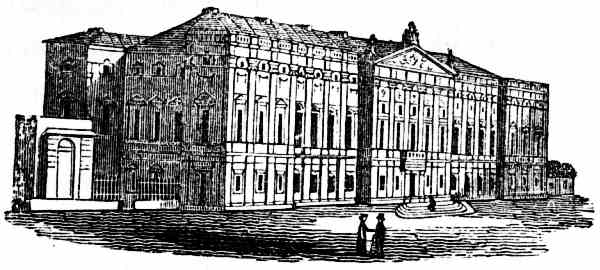
the Hermitage is the marble palace; a colossal pile,
built by the Empress Catharine for her favourite, Count
Orloff, presenting one of its fronts to the Neva. All the
decorations are of marble and gilded bronze, and the
capitals and bases of the columns and pilasters, and the
window-frames and balustrades of the balconies, of cast
bronze richly gilded. The effect is heightened by the
unusually large dimensions of the squares of fine plate
glass. A traveller in seventeen hundred and fifty-nine
says "that the prodigies of enchantment which we read
of in the tales of the genii are here called forth into
reality; and the temples reared by the luxuriant fancy
of our poets may be considered as a picture of the marble
palace, which Jupiter, when the burden of cares
drives him from heaven, might make his delightful
abode." At present, however, there are but few remains
of this Olympian magnificence, and I think Jupiter
at the same expense would prefer the Winter Palace
or the Hermitage.
The Taurida Palace, erected by Catharine II. for her
lover, Potemkin, in general effect realizes the exaggerated
accounts of travellers. The entrance is into a spacious
hall, which leads to a circular vestibule of extraordinary
magnitude, decorated with busts and statues
in marble, with a dome supported by white columns.
From thence you pass between the columns into an
immense hall or ballroom, two hundred and eighty
feet long and eighty wide, with double colonnades of
lofty Ionic pillars decorated with gold and silver festoons,
thirty-five feet high and ten feet in circumference.
From the colonnade, running the whole length
of the ballroom, you enter the Winter Garden, which
concealed flues and stoves keep always at the temperature
of summer; and here, upon great occasions,
under the light of magnificent lustres and the reflection
of numerous mirrors, during the fierceness of the
Russian winter, when the whole earth is covered with
snow, and "water tossed in the air drops down in ice,"
the imperial visiter may stroll through gravel-walks
bordered with the choicest plants and flowers, blooming
hedges and groves of orange, and inhale the fragrance
of an Arabian garden. Paul, in one of his "darkened
hours," converted this palace into barracks and a
riding-school; but it has since been restored, in some
degree, to its ancient splendour.
The palace of Paul, in which he was assassinated,
has been uninhabited since his death. But the triumph
of modern architecture in St. Petersburgh is
the palace of the Grand-duke Michael. I shall not attempt
any description of this palace; but, to give some
notion of its splendours to my calculating countrymen,
I shall merely remark that it cost upward of seventeen
millions of rubles. But I am weary of palaces;
of wandering through magnificent apartments, where
scene after scene bursts upon my eyes, and, before I
begin to feel at home in them, I find myself ordered
out by the footman. Will the reader believe me? On
the opposite side of the river is a little wooden house,
more interesting in my eyes than all the palaces in St.
Petersburgh. It is the humble residence of Peter the
Great. I visited it for the last time after rambling
through the gorgeous palace of the Grand-duke Michael.
It is one story high, low roofed, with a little piazza
around it, and contains a sitting-room, bedroom, and
dining-parlours; and Peter himself, with his own axe,
assisted in its construction. The rooms are only eight
feet in height, the sitting-room is fifteen feet square, the
dining-room fifteen feet by twelve, and the bedchamber
ten feet square. In the first there is a chapel and
shrine, where the Russian visiter performs his orisons
and prays for the soul of Peter. Around the cottage
is a neat garden, and a boat made by Peter himself is
suspended to one of the walls. I walked around the
cottage, inside and out; listened attentively, without
understanding a word he said, to the garrulous Russian
cicerone, and sat down on the step of the front piazza.
Opposite was that long range of imperial palaces extending
for more than a mile on the Neva, and surpassing
all other royal residences in Europe or the world.
When Peter sat in the door of this humble cottage, the
ground where they stood was all morass and forest.
Where I saw the lofty spires of magnificent churches,
he looked out upon fishermen's huts. My eyes fell
upon the golden spire of the church of the citadel glittering
in the sunbeams, and reminding me that in its
dismal charnelhouse slept the tenant of the humble
cottage, the master-spirit which had almost created out
of nothing all this splendour. I saw at the same time
the beginning and the end of greatness. The humble
dwelling is preserved with religious reverence, and even
now is the most interesting monument which the imperial
city can show.
And here, at this starting-point in her career, I take
my leave of the Palmyra of the North. I am compelled
to omit many things which he who speaks of St. Petersburgh
at all ought not to omit: her magnificent churches;
her gigantic and splendid theatres; her literary,
scientific, and eleemosynary institutions, and that which
might form the subject of a chapter in her capital, her
government and laws. I might have seen something
of Russian society, as my friend Luoff had arrived in
St. Petersburgh; but, with my limited time, the interchange
of these civilities interfered with my seeing the
curiosities of the capital.
My intimacy with the colonel had fallen off, though
we still were on good terms. The fact is, I believe I
fell into rather queer company in St. Petersburgh, and
very soon found the colonel to be the most thorough
roué I ever met. He seemed to think that travelling
meant dissipating; he had never travelled but once,
and that was with the army to Paris; and, except
when on duty, his whole time had been spent in riot
and dissipation; and though sometimes he referred to
hard fighting, he talked more of the pleasures of that
terrible campaign than of its toils and dangers. In
consideration of my being a stranger and a young
man, he constituted himself my Mentor, and the advice
which, in all soberness, he gave me as the fruits
of his experience, was a beautiful guide for the road to
ruin. I have no doubt that, if I had given myself up
entirely to him, he would have fêted me all the time
I was in St. Petersburgh; but this did not suit me,
and I afterward fell in with the Pole, who had his own
vagaries too, and who, being the proprietor of a cloth
manufactory, did not suit the aristocratic notions of the
colonel, and so our friendship cooled. My intimacy
with his friend the prince, however, increased. I called
upon him frequently, and he offered to accompany me
everywhere; but as in sightseeing I love to be alone, I
seldom asked him, except for a twilight walk. Old associations
were all that now bound together him and the
colonel; their feelings, their fortunes, and their habits
of life were entirely different; and the colonel, instead
of being displeased with my seeking the prince in preference
to himself, was rather gratified. Altogether, the
colonel told me, he was much mistaken in me, but he
believed I was a good fellow after all; excused my
regular habits somewhat on the ground of my health;
and the day before that fixed for my departure, asked
me to pass the evening with him, and to bring my friend
the Pole. In the evening we went to the colonel's apartments.
The prince was there, and, after an elegant
little supper, happening to speak of a Frenchman and a
Prussian living in the hotel, with whom I had become
acquainted, he sent down for them to come up and join
us. The table was cleared, pipes and tobacco were
brought on, and Champagne was the only wine. We
had a long and interesting conversation on the subject
of the road to Warsaw, and particularly in regard to
the bloody passage of the Berezina, at which both the
colonel and the prince were present. The servant, a
favourite serf (who the next day robbed the colonel of
every valuable article in his apartment), being clumsy
in opening a new bottle of Champagne, the colonel said
he must return to army practice, and reaching down his
sabre, with a scientific blow took off the neck without
materially injuring the bottle or disturbing the contents.
This military way of decanting Champagne aided its
circulation, and head after head fell rapidly before the
naked sabre. I had for some time avoided emptying
my glass, which, in the general hurry of business, was
not noticed; but, as soon as the colonel discovered it, he
cried out, "Treason, treason against good fellowship.
America is a traitor." I pleaded ill health, but he would
not listen to me; upbraided me that the friend and old
ally of Russia should fail him; turned up his glass on
the table, and swore he would not touch it again unless
I did him justice. All followed his example; all decided
that America was disturbing the peace of nations;
the glasses were turned up all around, and a dead stop
was put to the merriment. I appealed, begged, and
protested; and the colonel became positive, dogged,
and outrageous. The prince came to my aid, and proposed
that the difficulty between Russia and America
should be submitted to the arbitration of France and
Prussia. He had observed these powers rather backing
out. The eyes of France were already in a fine
phrensy rolling, and Prussia's tongue had long been
wandering; and in apprehension of their own fate,
these mighty powers leaned to mercy. It was necessary,
however, to propitiate the colonel, and they decided
that, to prevent the effusion of blood, I should
start once more the flow of wine; that we should begin
again with a bumper all around; and, after that, every
man should do as he pleased. The colonel was obliged
to be content; and swearing that he would drink for us
all, started anew.
The Prussian was from Berlin, and this led the colonel
to speak of the stirring scenes that had taken place
in that capital on the return of the Russian army from
Paris; and, after a while, the Prussian, personally unknown
to the colonel, told him that his name was still
remembered in Berlin as a leader in Russian riot and
dissipation, and particularly as having carried off, in a
most daring manner, a lady of distinguished family;
and—"go on," said the colonel—"killed her husband."
"He refused my challenge," said the colonel, "but
sought my life, and I shot him like a dog." The whole
party now became uproarious; the colonel begged me,
by all the friendly relations between Russia and America,
to hold on till breakfast-time; but, being the coolest
man present, and not knowing what farther developments
might take place, I broke up the party.
In the morning my passport was not ready. I went
off to the police-office for it, and when I returned the
horses had not come, and the valet brought me the usual
answer, that there were none. My Pole was glad to
linger another day for the sake of his flirtation with
the little girl opposite, and so we lounged through the
day, part of the time in the bazar of a Persian, where I
came near ruining myself by an offer I made for a beautiful
emerald; and after one more and the last twilight
stroll on the banks of the Neva and up the Newski Perspective,
we returned at an early hour, and for the last
time in Russia, slept in a bed.
At nine o'clock the next morning a kibitka drove up
to the door of our hotel, demanding an American and a
Pole for Warsaw. All the servants of the hotel were
gathered around, arranging the luggage, and making
a great parade of getting off the distinguished travellers.
The travellers themselves seemed equipped for a long
journey. One wore a blue roundabout jacket, military
cap and cloak, with whiskers and a mustache tending
to red; the other, a tall, stout, Herculean fellow, was
habited in the most outré costume of a Russian traveller;
a cotton dressing-gown of every variety of colours,
red and yellow predominating; coarse gray trousers;
boots coming above his knees; a cap tout a fait farouche,
and there was no mistake about the colour of
his hair and mustaches; he was moving slowly around
the kibitka in his travelling dress, and looking up to the
window opposite, to give his dulcinea the melancholy
intelligence that he was going away, and perhaps to
catch one farewell smile at parting. The carriage of
these distinguished travellers was the kibitka, one of the
national vehicles of Russia, being a long, round-bottomed
box or cradle on four wheels, probably the old
Scythian wagon, resting, in proud contempt of the effeminacy
of springs, on the oaken axles; the hubs of
the wheels were two feet long, the linchpins of wood,
the body of the carriage fastened to the wheels by
wooden pins, ropes, and sticks; and, except the tires of
the wheels, there was not a nail or piece of iron about it.
The hinder part was covered with matting, open in front
somewhat like an oldfashioned bonnet, and supported
by an arched stick, which served as a linchpin for the
hind wheels; a bucket of grease hung under the hind
axle, and the bottom of the kibitka was filled with
straw; whole cost of outfit, thirteen dollars. Before
it were three horses, one in shafts and one on each side,
the centre one having a high bow over his neck, painted
yellow and red, to which a rein was tied for holding up
his head, and also a bell, to a Russian postillion more
necessary than harness. The travellers took their
places in the bottom of the kibitka, and the postillion,
a rough, brutal-looking fellow, in gray coat and hat
turned up at the sides, mounted in front, catching a
seat where he could on the rim of the wagon, about
three inches wide; and in this dashing equipage we
started for a journey of a thousand miles to the capital
of another kingdom. We rolled for the last time through
the streets of St. Petersburgh, gazed at the domes, and
spires, and magnificent palaces, and in a few moments
passed the barrier.
I left St. Petersburgh, as I did every other city, with
a certain feeling of regret that, in all probability, I should
never see it more; still the cracking of the postillion's
whip and the galloping of the horses created in me that
high excitement which I always felt in setting out for
a new region. Our first stage was to Czarskoselo, our
second to Cazena, where there was another palace. It
was dark when we reached the third, a small village, of
which I did not even note the name. I shall not linger
on this road, for it was barren of interest and incident,
and through a continued succession of swamps and forests.
For two hundred miles it tried the tenure of adhesion
between soul and body, being made of the trunks
of trees laid transversely, bound down by long poles or
beams fastened into the ground with wooden pegs covered
with layers of boughs, and the whole strewed over
with sand and earth; the trunks in general were decayed
and sunken, and the sand worn or washed away,
reminding me of the worst of our western corduroy
roads. Our wagon being without springs, and our seats
a full-length extension on straw on the bottom, without
the bed, pillows, and cushions which the Russians usually
have, I found this ride one of the severest trials of
physical endurance I ever experienced. My companion
groaned and brushed his mustaches, and talked of the
little girl at St. Petersburgh. In my previous journey
in Russia I had found the refreshment of tea, and on
this, often when almost exhausted, I was revived by that
precious beverage. I stood it three days and nights,
but on the fourth completely broke down. I insensibly
slipped down at full length in the bottom of the wagon;
the night was cold and rainy; my companion covered
me up to the eyes with straw, and I slept from the early
part of the evening like a dead man. The horses were
changed three times; the wagon was lifted up under
me, and the wheels greased; and three times my companion
quarrelled with the postmaster over my body
without waking me. About six o'clock in the morning
he roused me. I could not stir hand or foot; my mouth
was full of dust and straw, and I felt a sense of suffocation.
In a few moments I crawled out, staggered a
few steps, and threw myself down on the floor of a
wretched posthouse. My companion put my carpet-bag
under my head, wrapped cloaks and greatcoats around
me, and prepared me some tea; but I loathed everything.
I was in that miserable condition which every
traveller has some time experienced; my head ringing,
every bone aching, and perfectly reckless as to what
became of me. While my companion stood over me I
fell asleep, and believe I should have been sleeping
there yet if he had not waked me. He said we must
go on at all risks until we found a place where we could
remain with some degree of comfort. I begged and entreated
to be left to myself, but he was inexorable. He
lifted me up, hauled me out to the kibitka, which was
filled with fresh straw, and seated me within, supporting
me on his shoulder.
It was a beautiful day. We moved moderately, and
toward evening came to a posthouse kept by a Jew, or,
rather, a Jewess, who was so kind and attentive that
we determined to stay there all night. She brought in
some clean straw and spread it on the floor, where I
slept gloriously. My companion was tougher than I,
but he could not stand the fleas and bugs, and about
midnight went out and slept in the kibitka. In the
morning we found that he had been too late; that the
kibitka had been stripped of every article except himself
and the straw. Fortunately, my carpet-bag had
been brought in; but I received a severe blow in the
loss of a cane, an old friend and travelling companion,
which had been with me in every variety of scene,
and which I had intended to carry home with me, and
retain as a companion through life. It is almost inconceivable
how much this little incident distressed me.
It was a hundred times worse than the loss of my carpet-bag.
I felt the want of it every moment; I had
rattled it on the Boulevards of Paris, in the eternal
city, the Colosseum, and the places thereabout; had
carried it up the burning mountain, and poked it into
the red-hot lava; had borne it in the Acropolis, on the
field of Marathon, and among the ruins of Ephesus;
had flourished it under the beard of the sultan, and
the eyes and nose of the emperor and autocrat of all
the Russias; in deserts and in cities it had been my
companion and friend. Unsparing Nemesis, let loose
your vengeance upon the thief who stole it! The rascals
had even carried off the rope traces, and every
loose article about the kibitka.
Notwithstanding this, however, I ought not to omit
remarking the general security of travelling in Russia
and Poland. The immense plains; the distance of
habitations; the number of forests; the custom of travelling
by night as well as by day; the negligence of all
measures to ensure the safety of the roads, all contribute
to favour robbery and murders; and yet an instance
of either is scarcely known in years. It was
difficult on those immense levels, which seemed independent
of either general or individual proprietors, to
recognise even the bounds of empires. The Dwina,
however, a natural boundary, rolls between Russia and
Poland; and at Vitepsk we entered the territories of
what was once another kingdom. The surface of Poland
forms part of that immense and unvaried plain
which constitutes the northern portion of all the central
European countries. A great portion of this plain
is overspread with a deep layer of sand, alternating
however, with large clayey tracts and extensive marshes;
a winter nearly as severe as that of Sweden, and
violent winds blowing uninterruptedly over this wide
open region, are consequences of its physical structure
and position. The Roman arms never penetrated any
part of this great level tract, the whole of which was
called by them Sarmatia; and Sarmatia and Scythia
were in their descriptions always named together as the
abode of nomadic and savage tribes. From the earliest
era it appears to have been peopled by the Sclavonic
tribes; a race widely diffused, and distinguished by a
peculiar language, by a strong national feeling, and by a
particular train of superstitious ideas. Though shepherds,
they did not partake of the migratory character
of the Teutonic or Tartar nations; and were long held
in the most cruel bondage by the Huns, the Goths, and
other nations of Asia, for whom their country was a
path to the conquest of the west of Europe.
In the tenth century the Poles were a powerful and
warlike nation. In the fourteenth Lithuania was incorporated
with it, and Poland became one of the most
powerful monarchies in Europe. For two centuries it
was the bulwark of Christendom against the alarming
invasions of the Turks; the reigns of Sigismund and
Sobieski hold a high place in military history; and, until
the beginning of the last century, its martial character
gave it a commanding influence in Europe.
It is unnecessary to trace the rapid and irrecoverable
fall of Poland. On the second partition, Kosciusko,
animated by his recent struggle for liberty in America,
roused his countrymen to arms. But the feet of three
giants were upon her breast; and Suwarrow, marching
upon the capital, storming the fortress of Praga, and
butchering in cold blood thirty thousand inhabitants,
extinguished, apparently for ever, the rights and the
glories of Poland. Living as we do apart from the rest
of the world, with no national animosities transmitted
by our fathers, it is impossible to realize the feeling of
deadly hatred existing between neighbouring nations
from the disputes of ancestors centuries ago. The history
of Russia and Poland presents a continued series
of bloodstained pages. Battle after battle has nourished
their mutual hate, and for a long time it had been
the settled feeling of both that Russia or Poland must
fall. It is perhaps fortunate for the rest of Europe that
this feeling has always existed; for, if they were united
in heart, the whole south of Europe would lie at the
mercy of their invading armies. Napoleon committed a
fatal error in tampering with the brave and patriotic
Poles; for he might have rallied around him a nation of
soldiers who, in gratitude, would have stood by him
until they were exterminated.
But to return to Vitepsk. Here, for the first time,
we fell into the memorable road traversed by Napoleon
on his way to Moscow. The town stands on the banks
of the Dwina, built on both sides of the river, and contains
a population of about fifteen thousand, a great
portion of whom are Jews. In itself, it has but little
to engage the attention of the traveller; but I strolled
through its streets with extraordinary interest, remembering
it as the place where Napoleon decided on his
fatal march to Moscow. It was at the same season
and on the very same day of the year that the "grand
army," having traversed the gloomy forests of Lithuania
in pursuit of an invincible and intangible enemy, with
the loss of more than a hundred thousand men, emerged
from the last range of woods and halted at the presence
of the hostile fires that covered the plain before the city.
Napoleon slept in his tent on an eminence at the left of
the main road, and before sunrise appeared at the advanced
posts, and by its first rays saw the Russian
army, eighty thousand strong, encamped on a high plain
commanding all the avenues of the city. Ten thousand
horsemen made a show of defending its passes; and at
about ten o'clock, Murat le Beau Sabreur, intoxicated
by the admiration his presence excited, at the head of
a single regiment of chasseurs charged the whole Russian
cavalry. He was repulsed, and driven back to the
foot of the hillock on which Napoleon stood. The
chasseurs of the French guards formed a circle around
him, drove off the assailant lancers, and the emperor
ordered the attack to cease; and, pointing to the city,
his parting words to Murat were, "To-morrow at five
o'clock the sun of Austerlitz."
At daylight the camp of Barclay de Tolly was deserted;
not a weapon, not a single valuable left behind;
and a Russian soldier asleep under a bush was the
sole result of the day expected to be so decisive. Vitepsk,
except by a few miserable Jews and Jesuits, like
the Russian camp, was also abandoned. The emperor
mounted his horse and rode through the deserted camp
and desolate streets of the city. Chagrined and mortified,
he pitched his tents in an open courtyard; but,
after a council of war with Murat, Eugene, and others
of his principal officers, laid his sword upon the table,
and resolved to finish in Vitepsk the campaign of that
year. Well had it been for him had he never changed
that determination. He traced his line of defence on
the map, and explored Vitepsk and its environs as a
place where he was likely to make a long residence;
formed establishments of all kinds; erected large ovens
capable of baking at once thirty thousand loaves of
bread; pulled down a range of stone houses which injured
the appearance of the square of the palace, and
made arrangements for opening the theatre with Parisian
actors. But in a few days he was observed to
grow restless; the members of his household recollected
his expression at the first view of the deserted Vitepsk,
"Do you think I have come so far to conquer
these miserable huts?" Segur says that he was observed
to wander about his apartments as if pursued by
some dangerous temptation. Nothing could rivet his
attention. Every moment he began, stopped, and resumed
his labour. At length, overwhelmed with the
importance of the considerations that agitated him, "he
threw himself on the floor of his apartment; his frame,
exhausted by the heat and the struggles of his mind,
could only bear a covering of the slightest texture.
He rose from his sleepless pillow possessed once more
with the genius of war; his voice deepens, his eyes
flash fire, and his countenance darkens. His attendants
retreat from his presence, struck with mingled
awe and respect. His plan is fixed, his determination
taken, his order of march traced out."
The last council occupied eight hours. Berthier by
a melancholy countenance, by lamentations, and even
by tears; Lobau by the cold and haughty frankness
of a warrior; Caulaincourt with obstinacy and impetuosity
amounting to violence; Duroc by a chilling
silence, and afterward by stern replies; and Daru
straightforward and with firmness immoveable, opposed
his going; but, as if driven on by that fate he almost
defied, he broke up the council with the fatal determination.
"Blood has not been shed, and Russia is too
great to yield without fighting. Alexander can only
negotiate after a great battle. I will proceed to the
holy city in search of that battle, and I will gain it.
Peace waits me at the gates of Moscow." From that
hour commenced that train of terrible disasters which
finally drove him from the throne of France, and sent
him to die an exile on a small island in the Indian
Ocean. I walked out on the Moscow road, by which
the grand army, with pomp and martial music, with
Murat, and Ney, and Duroc, and Daru, inspired by
the great names of Smolensk and Moscow, plunged
into a region of almost pathless forest, where most of
them were destined to find a grave. I was at first surprised
at the utter ignorance of the inhabitants of Vitepsk,
in regard to the circumstances attending the occupation
of the city by Napoleon. A Jew was my
cicerone, who talked of the great scenes of which this
little city had in his own day been the theatre almost
as matter of tradition, and without half the interest with
which, even now, the Greek points the stranger to the
ruins of Argos or the field of Marathon; and this ignorance
in regard to the only matters that give an interest
to this dreary road I remarked during the whole journey.
I was so unsuccessful in my questions, and the
answers were so unsatisfactory, that my companion
soon became tired of acting as my interpreter. Indeed,
as he said, he himself knew more than any one I met,
for he had travelled it before in company with an uncle,
of the Polish legion; but even he was by no means familiar
with the ground.
We left Vitepsk with a set of miserable horses, rode
all night, and at noon of the next day were approaching
the banks of the Berezina, memorable for the dreadful
passage which almost annihilated the wretched remnant
of Napoleon's army. It was impossible, in passing
over the same ground, not to recur to the events of
which it had been the scene. The "invincible legions,"
which left Vitepsk two hundred thousand strong, were
now fighting their dreadful retreat from Moscow through
regulars and Cossacks, reduced to less than twelve
thousand men marching in column, with a train of thirty
thousand undisciplined followers, sick, wounded, and
marauders of every description. The cavalry which
crossed the Niemen thirty-seven thousand in number
was reduced to one hundred and fifty men on horseback.
Napoleon collected all the officers who remained mounted,
and formed them into a body, in all about five hundred,
which he called his sacred squadron; officers
served as privates, and generals of divisions as captains.
He ordered the carriages of the officers, many of the
wagons, and even the eagles belonging to the different
corps, to be burned in his presence; and drawing his
sword, with the stern remark that he had sufficiently
acted the emperor, and must once more play the general,
marched on foot at the head of his old guard. He had
hardly reorganized before the immense pine forests
which border the Berezina echoed with the thunder of
the Russian artillery; in a moment all remains of discipline
were lost. In the last stage of weakness and confusion
they were roused by loud cries before them, and,
to their great surprise and joy, recognised the armies
of Victor and Oudinot. The latter knew nothing of the
terrible disasters of the army of Moscow, and they were
thrown into consternation and then melted to tears when
they saw behind Napoleon, instead of the invincible legions
which had left them in splendid equipments, a
train of gaunt and spectral figures, their faces black
with dirt, and long bristly beards, covered with rags,
female pelisses, pieces of carpet, with bare and bleeding
feet, or bundled with rags, and colonels and generals
marching pellmell with soldiers, unarmed and shameless,
without any order or discipline, kept together and
sleeping round the same fires only by the instinct of
self-preservation.
About noon we drove into the town of Borizoff. It
stands on the banks of the Berezina, and is an old, irregular-looking
place, with a heavy wooden church in
the centre of an open square. As usual, at the door of
the posthouse a group of Jews gathered around us.
When Napoleon took possession of Borizoff the Jews
were the only inhabitants who remained; and they, a
scattered, wandering, and migratory people, without any
attachment of soil or country, were ready to serve either
the French or Russians, according to the inducements
held out to them. A few noble instances are recorded
where this persecuted and degraded people exhibited a
devotion to the land that sheltered them honourable to
their race and to the character of man; but in general
they were false and faithless. Those who gathered
around us in Borizoff looked as though they might be
the very people who betrayed the Russians. One of
them told us that a great battle had been fought there,
but we could not find any who had been present at the
fatal passage of the river. We dined at the posthouse,
probably with less anxiety than was felt by Napoleon
or any of the flying Frenchmen; but even we were not
permitted to eat in peace; for, before we had finished,
our vehicle was ready, with worse horses than usual,
and a surlier postillion. We sent the postillion on ahead,
and walked down to the bank of the river. On the night
preceding the passage, Napoleon himself had command
of Borizoff, with six thousand guards prepared for a
desperate contest. He passed the whole night on his
feet; and while waiting for the approach of daylight in
one of the houses on the border of the river, so impracticable
seemed the chance of crossing with the army
that Murat proposed to him to put himself under the
escort of some brave and determined Poles, and save
himself while there was yet time; but the emperor indignantly
rejected the proposition as a cowardly flight.
The river is here very broad, and divided into branches.
On the opposite side are the remains of an embankment
that formed part of the Russian fortifications. When
the Russians were driven out of Borizoff by Oudinot,
they crossed the river, burned the bridge, and erected
these embankments.
Besides the sanguinary contest of the French and
Russians, this river is also memorable for a great battle
between my companion and our postillion. In the middle
of the bridge the postillion stopped and waited till
we came up; he grumbled loudly at being detained, to
which my companion replied in his usual conciliatory
and insinuating manner, by laying his cane over the fellow's
shoulders; but on the bridge of Borizoff the blood
of the Lithuanian was roused; and, perhaps, urged on
by the memory of the deeds done there by his fathers,
he sprang out of the wagon, and with a warcry
that would not have disgraced a Cossack of the Don,
rushed furiously upon my friend. Oh for a Homer to
celebrate that fight on the bridge of Borizoff! The warriors
met, not like Grecian heroes, with spear and shield,
and clad in steel, but with their naked fists and faces
bare to take the blows. My friend was a sublime spectacle.
Like a rock, firm and immoveable, he stood and
met the charge of the postillion; in short, in the twinkling
of an eye he knocked the postillion down. Those
who know say that it is more trying to walk over a
field of battle after all is over than to be in the fight;
and I believe it from my experience in our trying passage
of the Berezina; for, when I picked up the discomfited
postillion, whose face was covered with blood,
I believe that I had the worst of it. All great victories
are tested by their results, and nothing could be more
decisive than that over the postillion. He arose a wiser
and much more tractable man. At first he looked very
stupid when he saw me leaning over him, and very
startled when he rubbed his hand over his face and saw
it stained with blood; but, raising himself, he caught
sight of his victor, and without a word got into the
wagon, walked the horses over the bridge, and at the
other end got out and threw himself on the ground.
It was a beautiful afternoon, and we lingered on the
bridge. Crossing it, we walked up the bank on the opposite
side toward the place where Napoleon erected
his bridges for the passage of his army. All night the
French worked at the bridges by the light of the enemy's
fires on the opposite side. At daylight the fires
were abandoned, and the Russians, supposing the attempt
here to be a feint, were seen in full retreat. The
emperor, impatient to get possession of the opposite
bank, pointed it out to the bravest. A French aiddecamp
and Lithuanian count threw themselves into the
river, and, in spite of the ice, which cut their horses'
breasts, reached the opposite bank in safety. About
one o'clock the bank on which we stood was entirely
cleared of Cossacks, and the bridge for the infantry was
finished. The first division crossed it rapidly with its
cannon, the men shouting "Vive l'empereur!" The
passage occupied three days. The number of stragglers
and the quantity of baggage were immense. On the
night of the twenty-seventh the stragglers left the bridge,
tore down the whole village, and made fires with the
materials, around which they crouched their shivering
figures, and from which it was impossible to tear themselves
away. At daylight they were roused by the
report of Witgenstein's cannon thundering over their
heads, and again all rushed tumultuously to the bridges.
The Russians, with Platow and his Cossacks, were now
in full communication on both sides of the river. On
the left bank, Napoleon's own presence of mind and the
bravery of his soldiers gave him a decided superiority;
but, in the language of Scott, the scene on the right
bank had become the wildest and most horrible which
war can exhibit.
"Victor, with eight or ten thousand men, covered the
retreat over the bridges, while behind his line thousands
of stragglers, old men, women, and children, were wandering
by the side of this river like the fabled spectres
which throng the banks of the infernal Styx, seeking in
vain for passage. The balls of the Russians began to
fall among the disordered mass, and the whole body
rushed like distracted beings toward the bridges, every
feeling of prudence or humanity swallowed up by the
animal instinct of self-preservation. The weak and
helpless either shrunk from the fray and sat down to
wait their fate at a distance, or, mixing in it, were thrust
over the bridges, crushed under carriages, cut down with
sabres, or trampled to death under the feet of their countrymen.
All this while the action continued with fury;
and, as if the heavens meant to match their wrath with
that of man, a hurricane arose and added terrors to a
scene which was already of a character so dreadful.
About midday the larger bridge, constructed for artillery
and heavy carriages, broke down, and multitudes were
forced into the water. The scream of the despairing
multitude became at this crisis for a moment so universal,
that it rose shrilly above the wild whistling of the
tempest and the sustained and redoubled hourras of the
Cossacks. The dreadful scene continued till dark. As
the obscurity came on, Victor abandoned the station he
had defended so bravely, and led the remnant of his
troops in their turn across. All night the miscellaneous
multitude continued to throng across the bridge
under the fire of the Russian artillery. At daybreak
the French engineers finally set fire to the bridge, and
all that remained on the other side, including many
prisoners, and a great quantity of guns and baggage, became
the property of the Russians. The amount of
the French loss was never exactly known; but the Russian
report concerning the bodies of the invaders, which
were collected and burned as soon as the thaw permitted,
states that upward of thirty-six thousand were found in
the Berezina."
The whole of this scene was familiar to me as matter
of history; the passage of the Berezina had in some
way fastened itself upon my mind as one of the most
fearful scenes in the annals of war; and, besides this,
at St. Petersburgh the colonel and prince had given me
a detailed account of the horrors of that dreadful night,
for they were both with Witgenstein's army, by the light
of the snow, the course of the river, and the noise, directing
a murderous fire of artillery against the dark
mass moving over the bridge; and nearer still, my companion
had visited the place in company with his uncle,
of the Polish legion, and repeated to me the circumstances
of individual horror which he had heard from
his relative, surpassing human belief. The reader will
excuse me if I have lingered too long on the banks of
that river; and perhaps, too, he will excuse me when I
tell him that, before leaving it, I walked down to its
brink and bathed my face in its waters. Others have
done so at the classic streams of Italy and Greece; but
I rolled over the Arno and the Tiber in a vetturino
without stopping, and the reader will remember that I
jumped over the Ilissus.