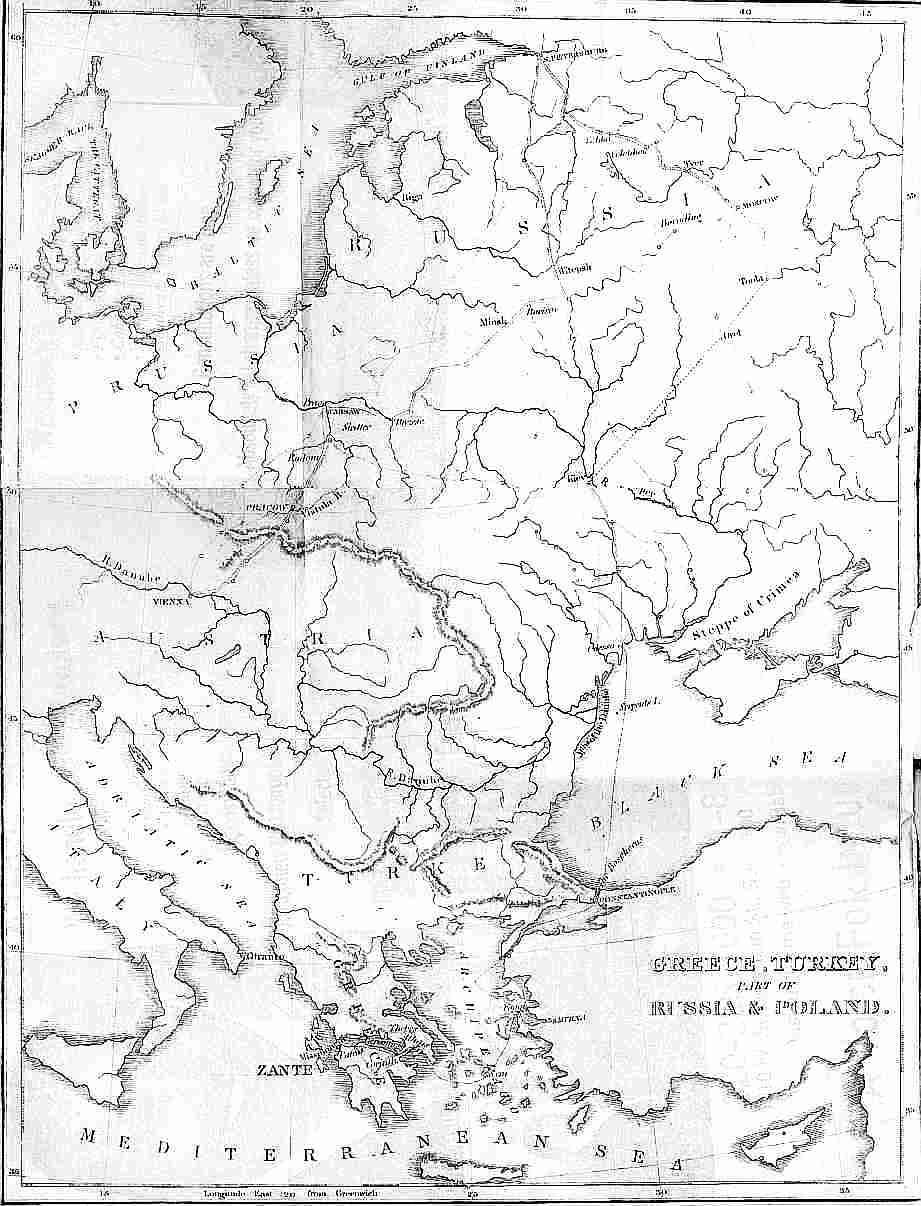
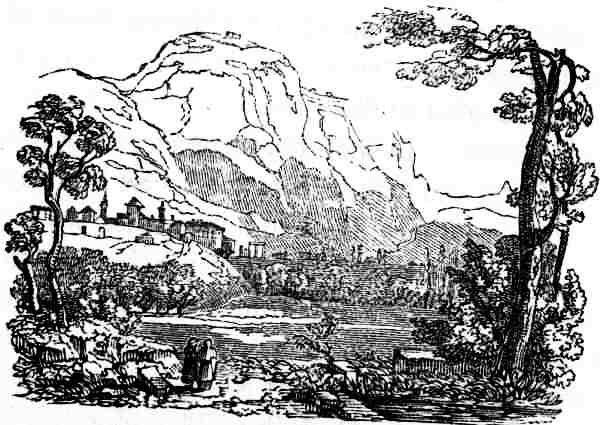
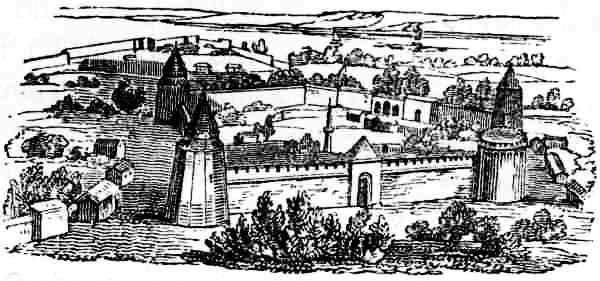
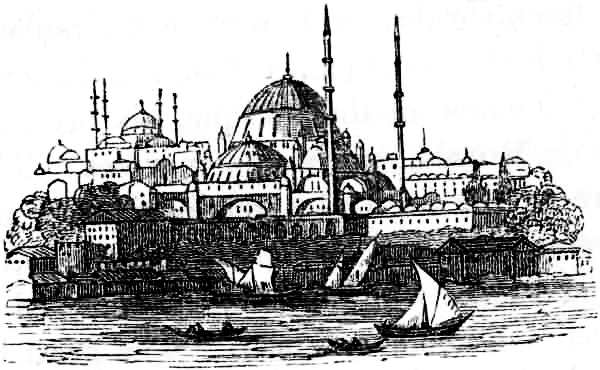
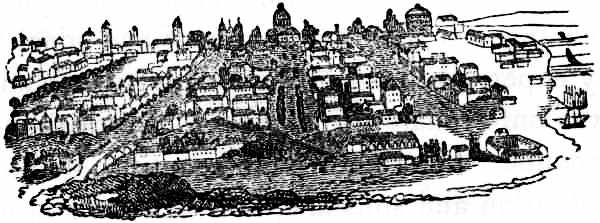
Ruins of Athens.—Hill of Mars.—Temple of the Winds.—Lantern of
Demosthenes.—Arch of Adrian.—Temple of Jupiter Olympus.—Temple
of Theseus.—The Acropolis.—The Parthenon.—Pentelican Mountain.—Mount
Hymettus.—The Piræus.—Greek Fleas.—Napoli.
The next morning I began my survey of the ruins
of Athens. It was my intention to avoid any description
of these localities and monuments, because so
many have preceded me, stored with all necessary
knowledge, ripe in taste and sound in judgment, who
have devoted to them all the time and research they so
richly merit; but as, in our community, through the
hurry and multiplicity of business occupations, few are
able to bestow upon these things much time or attention,
and, farthermore, as the books which treat of them
are not accessible to all, I should be doing injustice to
my readers if I were to omit them altogether. Besides,
I should be doing violence to my own feelings,
and cannot get fairly started in Athens, without recurring
to scenes which I regarded at the time with extraordinary
interest. I have since visited most of the
principal cities in Europe, existing as well as ruined
and I hardly know any to which I recur with more satisfaction
than Athens. If the reader tire in the brief
reference I shall make, he must not impute it to any
want of interest in the subject; and as I am not in the
habit of going into heroics, he will believe me when I
say that, if he have any reverence for the men or things
consecrated by the respect and admiration of ages, he
will find it called out at Athens. In the hope that I
may be the means of inducing some of my countrymen
to visit that famous city, I will add another inducement
by saying that he may have, as I had, Mr. Hill for a
cicerone. This gentleman is familiar with every locality
and monument around or in the city, and, which I
afterward found to be an unusual thing with those living
in places consecrated in the minds of strangers, he
retains for them all that freshness of feeling which we
possess who only know them from books and pictures.
By an arrangement made the evening before, early in
the morning of my second day in Athens Mr. Hill was
at the door of my hotel to attend us. As we descended
the steps a Greek stopped him, and, bowing with his
hand on his heart, addressed him in a tone of earnestness
which we could not understand; but we were struck
with the sonorous tones of his voice and the musical
cadence of his sentences; and when he had finished,
Mr. Hill told us that he had spoken in a strain which,
in the original, was poetry itself, beginning, "Americanos,
I am a Stagyrite. I come from the land of Aristotle,
the disciple of Plato," &c., &c.; telling him the whole
story of his journey from the ancient Stagyra and his
arrival in Athens; and that, having understood that Mr.
Hill was distributing books among his countrymen, he
begged for one to take home with him. Mr. Hill said
that this was an instance of every-day occurrence, showing
the spirit of inquiry and thirst for knowledge among
the modern Greeks. This little scene with a countryman
of Aristotle was a fit prelude to our morning
ramble.
The house occupied by the American missionary as
a school stands on the site of the ancient Agora or
market-place, where St. Paul "disputed daily with the
Athenians." A few columns still remain; and near
them is an inscription mentioning the price of oil. The
schoolhouse is built partly from the ruins of the Agora;
and to us it was an interesting circumstance, that a
missionary from a newly-discovered world was teaching
to the modern Greeks the same saving religion
which, eighteen hundred years ago, St. Paul, on the
same spot, preached to their ancestors.
Winding around the foot of the Acropolis, within the
ancient and outside the modern wall, we came to the
Areopagus or Hill of Mars, where, in the early days of
Athens, her judges sat in the open air; and, for many
ages, decided with such wisdom and impartiality, that to
this day the decisions of the court of Areopagites are regarded
as models of judicial purity. We ascended this
celebrated hill, and stood on the precise spot where St.
Paul, pointing to the temples which rose from every section
of the city and towered proudly on the Acropolis,
made his celebrated address: "Ye men of Athens, I
see that in all things ye are too superstitious." The
ruins of the very temples to which he pointed were before
our eyes.
Descending, and rising toward the summit of another
hill, we came to the Pnyx, where Demosthenes,
in the most stirring words that ever fell from human
lips, roused his countrymen against the Macedonian invader.
Above, on the very summit of the hill, is the
old Pnyx, commanding a view of the sea of Salamis, and
of the hill where Xerxes sat to behold the great naval
battle. During the reign of the thirty tyrants the Pnyx
was removed beneath the brow of the hill, excluding the
view of the sea, that the orator might not inflame the passions
of the people by directing their eyes to Salamis,
the scene of their naval glory. But, without this, the
orator had material enough; for, when he stood on the
platform facing the audience, he had before him the city
which the Athenians loved and the temples in which
they worshipped, and I could well imagine the irresistible
force of an appeal to these objects of their enthusiastic
devotion, their firesides and altars. The place is
admirably adapted for public speaking. The side of
the hill has been worked into a gently inclined plane,
semicircular in form, and supported in some places by
a wall of immense stones. This plain is bounded above
by the brow of the hill, cut down perpendicularly. In
the centre the rock projects into a platform about eight
or ten feet square, which forms the Pnyx or pulpit for
the orator. The ascent is by three steps cut out of the
rock, and in front is a place for the scribe or clerk. We
stood on this Pnyx, beyond doubt on the same spot
where Demosthenes thundered his philippics in the ears
of the Athenians. On the road leading to the Museum
hill we entered a chamber excavated in the rock, which
tradition hallows as the prison of Socrates; and though
the authority for this is doubtful, it is not uninteresting
to enter the damp and gloomy cavern wherein, according
to the belief of the modern Athenians, the wisest of
the Greeks drew his last breath. Farther to the south
is the hill of Philopappus, so called after a Roman governor
of that name. On the very summit, near the extreme
angle of the old wall, and one of the most conspicuous
objects around Athens, is a monument erected
by the Roman governor in honour of the Emperor Trajan.
The marble is covered with the names of travellers,
most of whom, like Philopappus himself, would
never have been heard of but for that monument.
Descending toward the Acropolis, and entering the
city among streets encumbered with ruined houses, we
came to the Temple of the Winds, a marble octagonal
tower, built by Andronicus. On each side is a sculptured
figure, clothed in drapery adapted to the wind he
represents; and on the top was formerly a Triton with a
rod in his hand, pointing to the figure marking the wind.
The Triton is gone, and great part of the temple buried
under ruins. Part of the interior, however, has been
excavated, and probably, before long, the whole will be
restored.
East of the foot of the Acropolis, and on the way to
Adrian's Gate, we came to the Lantern of Demosthenes
(I eschew its new name of the Choragic Monument
of Lysichus), where, according to an absurd tradition,
the orator shut himself up to study the rhetorical
art. It is considered one of the most beautiful monuments
of antiquity, and the capitals are most elegant
specimens of the Corinthian order refined by Attic
taste. It is now in a mutilated condition, and its many
repairs make its dilapidation more perceptible. Whether
Demosthenes ever lived here or not, it derives an interest
from the fact that Lord Byron made it his residence
during his visit to Athens. Farther on, and
forming part of the modern wall, is the Arch of Adrian,
bearing on one side an inscription in Greek, "This is
the city of Theseus;" and on the other, "But this is
the city of Adrian." On the arrival of Otho a placard
was erected, on which was inscribed, "These were the
cities of Theseus and Adrian, but now of Otho." Many
of the most ancient buildings in Athens have totally
disappeared. The Turks destroyed many of them to
construct the wall around the city, and even the modern
Greeks have not scrupled to build their miserable
houses with the plunder of the temples in which their
ancestors worshipped.
Passing under the Arch of Adrian, outside the gate,
on the plain toward the Ilissus, we came to the ruined
Temple of Jupiter Olympus, perhaps once the most
magnificent in the world. It was built of the purest
white marble, having a front of nearly two hundred feet,
and more than three hundred and fifty in length, and
contained one hundred and twenty columns, sixteen of
which are all that now remain; and these, fluted and
having rich Corinthian capitals, tower more than sixty
feet above the plain, perfect as when they were reared.
I visited these ruins often, particularly in the afternoon;
they are at all times mournfully beautiful, but I have
seldom known anything more touching than, when the
sun was setting, to walk over the marble floor, and look
up at the lonely columns of this ruined temple. I cannot
imagine anything more imposing than it must have
been when, with its lofty roof supported by all its columns,
it stood at the gate of the city, its doors wide
open, inviting the Greeks to worship. That such an
edifice should be erected for the worship of a heathen
god! On the architrave connecting three of the columns
a hermit built his lonely cell, and passed his life
in that elevated solitude, accessible only to the crane
and the eagle. The hermit is long since dead, but his
little habitation still resists the whistling of the wind,
and awakens the curiosity of the wondering traveller.
The Temple of Theseus is the last of the principal
monuments, but the first which the traveller sees on
entering Athens. It was built after the battle of Marathon,
and in commemoration of the victory which drove
the Persians from the shores of Greece. It is a small
but beautiful specimen of the pure Doric, built of Pentelican
marble, centuries of exposure to the open air
giving it a yellowish tint, which softens the brilliancy
of the white. Three Englishmen have been buried
within this temple. The first time I visited it a company
of Greek recruits, with some negroes among
them, was drawn up in front, going through the manual
under the direction of a German corporal; and, at the
same time, workmen were engaged in fitting it up for
the coronation of King Otho!
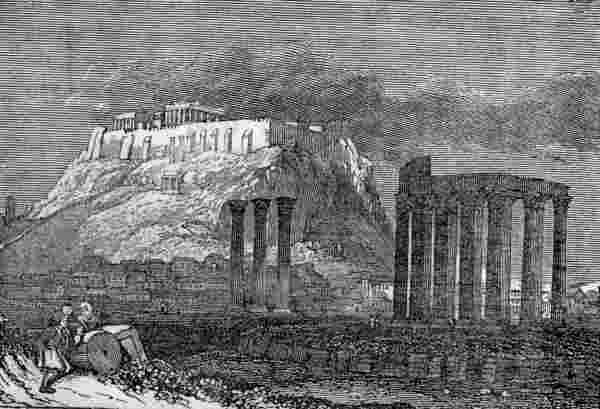
Temple of Jupiter Olympus and Acropolis at Athena.
These are the principal monuments around the city,
and, except the temples at Pæstum, they are more
worthy of admiration than all the ruins in Italy; but
towering above them in position, and far exceeding
them in interest, are the ruins of the Acropolis. I have
since wandered among the ruined monuments of Egypt
and the desolate city of Petra, but I look back with
unabated reverence to the Athenian Acropolis. Every
day I had gazed at it from the balcony of my hotel, and
from every part of the city and suburbs. Early on my
arrival I had obtained the necessary permit, paid a hurried
visit, and resolved not to go again until I had examined
all the other interesting objects. On the fourth
day, with my friend M., I went again. We ascended
by a broad road paved with stone. The summit is enclosed
by a wall, of which some of the foundation stones,
very large, and bearing an appearance of great antiquity,
are pointed out as part of the wall built by Themistocles
after the battle of Salamis, four hundred and eighty
years before Christ. The rest is Venetian and Turkish,
falling to decay, and marring the picturesque effect
of the ruins from below. The guard examined
our permit, and we passed under the gate. A magnificent
propylon of the finest white marble, the blocks of
the largest size ever laid by human hands, and having
a wing of the same material on each side, stands at the
entrance. Though broken and ruined, the world contains
nothing like it even now. If my first impressions
do not deceive me, the proudest portals of Egyptian
temples suffer in comparison. Passing this magnificent
propylon, and ascending several steps, we reached
the Parthenon or ruined Temple of Minerva; an immense
white marble skeleton, the noblest monument of
architectural genius which the world ever saw. Standing
on the steps of this temple, we had around us all
that is interesting in association and all that is beautiful
in art. We might well forget the capital of King Otho,
and go back in imagination to the golden age of Athens.
Pericles, with the illustrious throng of Grecian
heroes, orators, and sages, had ascended there to worship,
and Cicero and the noblest of the Romans had
gone there to admire; and probably, if the fashion of
modern tourists had existed in their days, we should see
their names inscribed with their own hands on its walls.
The great temple stands on the very summit of the
Acropolis, elevated far above the Propylæa and the
surrounding edifices. Its length is two hundred and
eight feet, and breadth one hundred and two. At each
end were two rows of eight Doric columns, thirty-four
feet high and six feet in diameter, and on each side
were thirteen more. The whole temple within and
without was adorned with the most splendid works of
art, by the first sculptors in Greece, and Phidias himself
wrought the statue of the goddess, of ivory and
gold, twenty-six cubits high, having on the top of her
helmet a sphinx, with griffins on each of the sides; on
the breast a head of Medusa wrought in ivory, and a
figure of Victory about four cubits high, holding a spear
in her hand and a shield lying at her feet. Until the
latter part of the seventeenth century, this magnificent
temple, with all its ornaments, existed entire. During
the siege of Athens by the Venetians, the central part
was used by the Turks as a magazine; and a bomb,
aimed with fatal precision or by a not less fatal chance,
reached the magazine, and, with a tremendous explosion,
destroyed a great part of the buildings. Subsequently
the Turks used it as a quarry, and antiquaries and travellers,
foremost among whom is Lord Elgin, have contributed
to destroy "what Goth, and Turk, and Time had
spared."
Around the Parthenon, and covering the whole summit
of the Acropolis, are strewed columns and blocks
of polished white marble, the ruins of ancient temples.
The remains of the Temples of Erectheus and Minerva
Polias are pre-eminent in beauty; the pillars of the latter
are the most perfect specimens of the Ionic in existence,
and its light and graceful proportions are in elegant
contrast with the severe and simple majesty of the
Parthenon. The capitals of the columns are wrought
and ornamented with a delicacy surpassing anything of
which I could have believed marble susceptible. Once
I was tempted to knock off a corner and bring it home,
as a specimen of the exquisite skill of the Grecian artist,
which it would have illustrated better than a volume
of description; but I could not do it; it seemed
nothing less than sacrilege.
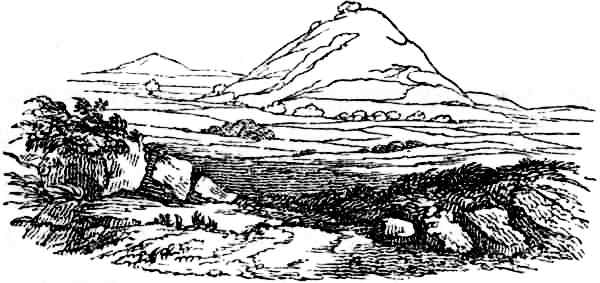
Afar off, and almost lost in the distance, rises the
Pentelican Mountain, from the body of which were
hewed the rough rude blocks which, wrought and perfected
by the sculptor's art, now stand the lofty and
stately columns of the ruined temple. What labour
was expended upon each single column! how many
were employed in hewing it from its rocky bed, in bearing
it to the foot of the mountain, transporting it across
the plain of Attica, and raising it to the summit of the
Acropolis! and then what time, and skill, and labour, in
reducing it from a rough block to a polished shaft, in
adjusting its proportions, in carving its rich capitals, and
rearing it where it now stands, a model of majestic
grace and beauty! Once, under the direction of Mr.
Hill, I clambered up to the very apex of the pediment,
and, lying down at full length, leaned over and saw under
the frieze the acanthus leaf delicately and beautifully
painted on the marble, and, being protected from
exposure, still retaining its freshness of colouring. It
was entirely out of sight from below, and had been discovered,
almost at the peril of his life, by the enthusiasm
of an English artist. The wind was whistling
around me as I leaned over to examine it, and, until
that moment, I never appreciated fully the immense
labour employed and the exquisite finish displayed in
every portion of the temple.
The sentimental traveller must already mourn that
Athens has been selected as the capital of Greece. Already
have speculators and the whole tribe of "improvers"
invaded the glorious city; and while I was
lingering on the steps of the Parthenon, a German, who
was quietly smoking among the ruins, a sort of superintendent
whom I had met before, came up, and offering
me a segar, and leaning against one of the lofty
columns of the temple, opened upon me with "his
plans of city improvements;" with new streets, and projected
railroads, and the rise of lots. At first I almost
thought it personal, and that he was making a fling at
me in allusion to one of the greatest hobbies of my native
city; but I soon found that he was as deeply bitten
as if he had been in Chicago or Dunkirk; and the way
in which he talked of moneyed facilities, the wants of
the community, and a great French bank then contemplated
at the Piræus, would have been no discredit to
some of my friends at home. The removal of the
court has created a new era in Athens; but, in my
mind, it is deeply to be regretted that it has been
snatched from the ruin to which it was tending. Even
I, deeply imbued with the utilitarian spirit of my country,
and myself a quondam speculator in "up-town
lots," would fain save Athens from the ruthless hand
of renovation; from the building mania of modern speculators.
I would have her go on till there was not
a habitation among her ruins; till she stood, like Pompeii,
alone in the wilderness, a sacred desert, where
the traveller might sit down and meditate alone and
undisturbed among the relics of the past. But already
Athens has become a heterogeneous anomaly; the
Greeks in their wild costume are jostled in the streets
by Englishmen, Frenchmen, Italians, Dutchmen, Spaniards,
and Bavarians, Russians, Danes, and sometimes
Americans. European shops invite purchasers
by the side of Eastern bazars, coffee-houses, and billiard-rooms,
and French and German restaurants are
opened all over the city. Sir Pultney Malcolm has
erected a house to hire near the site of Plato's Academy.
Lady Franklin has bought land near the foot of
Mount Hymettus for a country-seat. Several English
gentlemen have done the same. Mr. Richmond, an
American clergyman, has purchased a farm in the
neighbourhood; and in a few years, if the "march of
improvement" continues, the Temple of Theseus will
be enclosed in the garden of the palace of King Otho;
the Temple of the Winds will be concealed by a German
opera-house, and the Lantern of Demosthenes by
a row of "three-story houses."
I was not a sentimental traveller, but I visited all the
localities around Athens, and, therefore, briefly mention
that several times I jumped over the poetic and perennial
Ilissus, trotted my horse over the ground where
Aristotle walked with his peripatetics, and got muddied
up to my knees in the garden of Plato.
One morning my Scotch friend and I set out early
to ascend Mount Hymettus. The mountain is neither
high nor picturesque, but a long flat ridge of bare rock,
the sides cut up into ravines, fissures, and gullies.
There is an easy path to the summit, but we had no
guide, and about midday, after a wild scramble, were
worn out, and descended without reaching the top,
which is exceedingly fortunate for the reader, as otherwise
he would be obliged to go through a description
of the view therefrom.
Returning, we met the king taking his daily walk,
attended by two aids, one of whom was young Marco
Bozzaris. Otho is tall and thin, and, when I saw him,
was dressed in a German military frockcoat and cap,
and altogether, for a king, seemed to be an amiable
young man enough. All the world speaks well of him,
and so do I. We touched our hats to him, and he returned
the civility; and what could he do more without
inviting us to dinner? In old times there was a divinity
about a king; but now, if a king is a gentleman, it is as
much as we can expect. He has spent his money like a
gentleman, that is, he cannot tell what has become of
it. Two of the three-millions loan are gone, and there
is no colonization, no agricultural prosperity, no opening
of roads, no security in the mountains; not a town
in Greece but is in ruins, and no money to improve
them. Athens, however, is to be embellished. With
ten thousand pounds in the treasury, he is building a
palace of white Pentelican marble, to cost three hundred
thousand pounds.
Otho was very popular, because, not being of age,
all the errors of his administration were visited upon
Count Armansbergh and the regency, who, from all
accounts, richly deserved it; and it was hoped that,
on receiving the crown, he would shake off the Bavarians
who were preying upon the vitals of Greece, and
gather around him his native-born subjects. In private
life he bore a most exemplary character. He had no
circle of young companions, and passed much of his
time in study, being engaged, among other things, in
acquiring the Greek and English languages. His position
is interesting, though not enviable; and if, as the
first king of emancipated Greece, he entertains recollections
of her ancient greatness, and the ambition of
restoring her to her position among the nations of the
earth, he is doomed to disappointment. Otho is since
crowned and married. The pride of the Greeks was
considerably humbled by a report that their king's proposals
to several daughters of German princes had been
rejected; but the king had great reason to congratulate
himself upon the spirit which induced the daughter of
the Duke of Oldenburgh to accept his hand. From her
childhood she had taken an enthusiastic interest in Greek
history, and it had been her constant wish to visit Greece;
and when she heard that Otho had been called to the
throne, she naively expressed an ardent wish to share
it with him. Several years afterward, by the merest
accident, she met Otho at a German watering-place, travelling
with his mother, the Queen of Bavaria, as the
Count de Missilonghi; and in February last she accompanied
him to Athens, to share the throne which had
been the object of her youthful wish.
M. dined at my hotel, and, returning to his own, he
was picked up and carried to the guardhouse. He started
for his hotel without a lantern, the requisition to carry
one being imperative in all the Greek and Turkish cities;
the guard could not understand a word he said
until he showed them some money, which made his
English perfectly intelligible; and they then carried him
to a Bavarian corporal, who, after two hours' detention,
escorted him to his hotel. After that we were rather
careful about staying out late at night.
"Thursday. I don't know the day of the month." I
find this in my notes, the caption of a day of business,
and at this distance of time will not undertake to correct
the entry. Indeed, I am inclined to think that my notes
in those days are rather uncertain and imperfect; certainly
not taken with the precision of one who expected to
publish them. Nevertheless, the residence of the court,
the diplomatic corps, and strangers form an agreeable
society at Athens. I had letters to some of the foreign
ministers, but did not present them, as I was hardly
presentable myself without my carpet-bag. On "Thursday,"
however, in company with Dr. W., I called upon
Mr. Dawkins, the British minister. Mr. Dawkins went
to Greece on a special mission, which he supposed
would detain him six months from home, and had remained
there ten years. He is a high tory, but retained
under a whig administration, because his services could
not well be dispensed with. He gave us much interesting
information in regard to the present condition
and future prospects of Greece; and, in answer to my
suggestion that the United States were not represented
at all in Greece, not even by a consul, he said, with
emphasis, "You are better represented than any power
in Europe. Mr. Hill has more influence here than any
minister plenipotentiary among us." A few days after,
when confined to my room by indisposition, Mr. Dawkins
returned my visit, and again spoke in the same
terms of high commendation of Mr. Hill. It was pleasing
to me, and I have no doubt it will be so to Mr. Hill's
numerous friends in this
country, to know that a private
American citizen, in a position that keeps him aloof
from politics, was spoken of in such terms by the representative
of one of the great powers of Europe. I
had heard it intimated that there was a prospect of Mr.
Dawkins being transferred to this country, and parted
with him in the hope at some future day of seeing him
the representative of his government here.
I might have been presented to the king, but my carpet-bag—Dr.
W. borrowed a hat, and was presented;
the doctor had an old white hat, which he had worn all
the way from New-York. The tide is rolling backward;
Athens is borrowing her customs from the barbarous
nations of the north; and it is part of the etiquette
to enter a drawing-room with a hat (a black one)
under the arm. The doctor, in his republican simplicity,
thought that a hat, good enough to put on his own
head, was good enough to go into the king's presence;
but he was advised to the contrary, and took one of Mr.
Hill's, not very much too large for him. He was presented
by Dr. ——, a German, the king's physician,
with whom he had discoursed much of the different
medical systems in Germany and America. Dr. W.
was much pleased with the king. Did ever a man talk
with a king who was not pleased with him? But the
doctor was particularly pleased with King Otho, as the
latter entered largely into discourse on the doctor's favourite
theme, Mr. Hill's school, and the cause of education
in Greece. Indeed, it speaks volumes in favour
of the young king, that education is one of the things in
which he takes the deepest interest. The day the doctor
was to be presented we dined at Mr. Hill's, having made
arrangements for leaving Athens that night; the doctor
and M. to return to Europe. In the afternoon, while
the doctor remained to be presented, M. and I walked
down to the Piræus, now, as in the days of her glory,
the harbour of Athens. The ancient harbour is about
five miles from Athens, and was formerly joined to it
by long walls built of stone of enormous size, sixty
feet high, and broad enough on the top for two wagons
to pass abreast. These have long since disappeared,
and the road is now over a plain shaded a great part of
the way by groves of olives. As usual at this time of
day, we met many parties on horseback, sometimes with
ladies; and I remember particularly the beautiful and
accomplished daughters of Count Armansbergh, both of
whom are since married and dead.[2] It is a beautiful
ride, in the afternoon particularly, as then the dark outline
of the mountains beyond, and the reflections of
light and shade, give a peculiarly interesting effect to
the ruins of the Acropolis. Toward the other end we
paced between the ruins of the old walls, and entered
upon a scene which reminded me of home. Eight
months before there was only one house at the Piræus;
but, as soon as the court removed to Athens, the old
harbour revived; and already we saw long ranges of
stores and warehouses, and all the hurry and bustle of
one of our rising western towns. A railroad was in
contemplation, and many other improvements, which
have since failed; but an omnibus! that most modern
and commonplace of inventions, is now running regularly
between the Piræus and Athens. A friend who
visited Greece six months after me brought home with
him an advertisement printed in Greek, English, French,
and German, the English being in the words and figures
following, to wit:
"ADVERTISEMENT.
"The public are hereby informed, that on the nineteenth instant an omnibus
will commence running between Athena and the Piræus, and will continue
to do so every day at the undermentioned hours until farther notice.
Hours of Departure.
|
From Athens. | | From Piræus. |
| Half past seven o'clock A.M. | | Half past eight o'clock A.M. |
| Ten o'clock A.M. | | Eleven o'clock A.M. |
| Two o'clock P.M. | | Three o'clock P.M. |
| Half past four P.M. | | Half past five P.M. |
"The price of a seat in the omnibus is one drachme.
"Baggage, if not too bulky and heavy, can be taken on the roof.
"Smoking cannot be allowed in the omnibus, nor can dogs be admitted.
"Small parcels and packages may be sent by this conveyance at a moderate
charge, and given to the care of the conducteur.
"The omnibus starts from the corner of the Hermes and Æolus streets at
Athens and from the bazar at the Piræus, and will wait five minutes at each
place, during which period the conducteur will sound his horn.
"Athens, 17th, 29th September, 1836."
Old things are passing away, and all things are becoming
new. For a little while yet we may cling to
the illusions connected with the past, but the mystery
is fast dissolving, the darkness is breaking away, and
Greece, and Rome, and even Egypt herself, henceforward
claim our attention with objects and events of the
present hour. Already they have lost much of the deep
and absorbing interest with which men turned to them
a generation ago. All the hallowed associations of these
ancient regions are fading away. We may regret it,
we may mourn over it, but we cannot help it. The
world is marching onward; I have met parties of my
own townsmen while walking in the silent galleries of
the Coliseum; I have seen Americans drinking Champagne
in an excavated dwelling of the ancient Pompeii,
and I have dined with Englishmen among the ruins of
Thebes, but, blessed be my fortune, I never rode in an
omnibus from the Piræus to Athens.
We put our baggage on board the caique, and lounged
among the little shops till dark, when we betook ourselves
to a dirty little coffee-house filled with Greeks
dozing and smoking pipes. We met there a boat's
crew of a French man-of-war, waiting for some of the
officers, who were dining with the French ambassador
at Athens. One of them had been born to a better condition
than that of a common sailor. One juvenile indiscretion
after another had brought him down, and,
without a single vice, he was fairly on the road to ruin.
Once he brushed a tear from his eyes as he told us of
prospects blighted by his own follies; but, rousing himself,
hurried away, and his reckless laugh soon rose
above the noise and clamour of his wild companions.
About ten o'clock the doctor came in, drenched with
rain and up to his knees in mud. We wanted to embark
immediately, but the appearance of the weather
was so unfavourable that the captain preferred waiting
till after midnight. The Greeks went away from
the coffee-house, the proprietor fell asleep in his seat,
and we extended ourselves on the tables and chairs;
and now the fleas, which had been distributed about
among all the loungers, made a combined onset upon
us. Life has its cares and troubles, but few know that
of being given up to the tender mercies of Greek fleas.
We bore the infliction till human nature could endure
no longer; and, at about three in the morning, in the
midst of violent wind and rain, broke out of the coffee-house
and went in search of our boat. It was very
dark, but we found her and got on board. She was a
caique, having an open deck with a small covering over
the stern. Under this we crept, and with our cloaks and
a sailcloth spread over us, our heated blood cooled, and
we fell asleep. When we woke we were on the way
to Epidaurus. The weather was raw and cold. We
passed within a stone's throw of Salamis and Ægina, and
at about three o'clock, turning a point which completely
hid it from view, entered a beautiful little bay, on which
stands the town of Epidaurus. The old city, the birthplace
of Esculapius, stands upon a hill projecting into
the bay, and almost forming an island. In the middle
of the village is a wooden building containing a large
chamber, where the Greek delegates, a band of mountain
warriors, with arms in their hands, "in the name of
the Greek nation, proclaimed before gods and men its
independence."
At the locanda there was by chance one bed, which
not being large enough for three, I slept on the floor.
At seven o'clock, after a quarrel with our host and paying
him about half his demand, we set out for Napoli di Romania.
For about an hour we moved in the valley running
off from the beautiful shore of Epidaurus; soon the
valley deepened into a glen, and in an hour we turned
off on a path that led into the mountains, and, riding
through wild and rugged ravines, fell into the dry bed
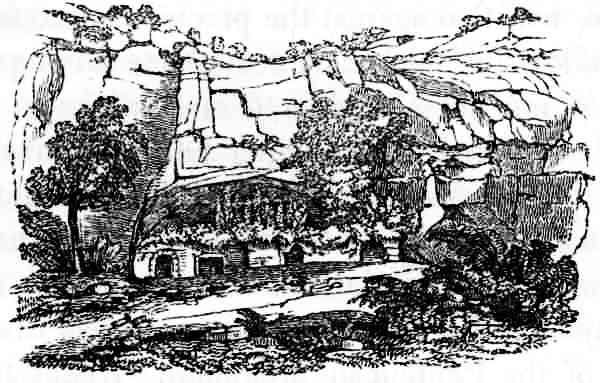
of a torrent; following which, we came to the Hieron
Elios, or Sacred Grove of Esculapius. This was the
great watering-place for the invalids of ancient Greece,
the prototype of the Cheltenham and Saratoga of modern
days. It is situated in a valley surrounded by high
mountains, and was formerly enclosed by walls, within
which, that the credit of the God might not be impeached,
no man was allowed to die, and no woman to be delivered.
Within this enclosure were temples, porticoes
and fountains, now lying in ruins hardly distinguishable.
The theatre is the most beautiful and best preserved.
It is scooped out of the side of the mountain,
rather more than semicircular in form, and containing
fifty-four seats. These seats are of pink marble, about
fifteen inches high and nearly three feet wide. In the
middle of each seat is a groove, in which, probably,
woodwork was constructed, to prevent the feet of those
above from incommoding them who sat below, and also
to support the backs of an invalid audience. The theatre
faces the north, and is so arranged that, with the
mountain towering behind it, the audience was shaded
nearly all the day. It speaks volumes in favour of the
intellectual character of the Greeks, that it was their
favourite recreation to listen to the recitation of their
poets and players. And their superiority in refinement
over the Romans is in no way manifested more
clearly than by the fact, that in the ruined cities of
the former are found the remains of theatres, and in the
latter of amphitheatres, showing the barbarous taste of
the Romans for combats of gladiators and wild beasts.
It was in beautiful keeping with this intellectual taste of
the Greeks, that their places of assembling were in the
open air, amid scenery calculated to elevate the mind;
and, as I sat on the marble steps of the theatre, I could
well imagine the high satisfaction with which the Greek,
under the shade of the impending mountain, himself all
enthusiasm and passion, rapt in the interest of some
deep tragedy, would hang upon the strains of Euripides
or Sophocles. What deep-drawn exclamations, what
shouts of applause had rung through that solitude, what
bursts of joy and grief had echoed from those silent
benches! And then, too, what flirting and coqueting,
the state of society at the springs in the Grove of Esculapius
being probably much the same as at Saratoga
in our own days. The whole grove is now a scene of
desolation. The lentisculus is growing between the
crevices of the broken marble; birds sing undisturbed
among the bushes; the timid hare steals among the
ruined fragments; and sometimes the snake is seen
gliding over the marble steps.
We had expected to increase the interest of our visit
by taking our noonday refection on the steps of the theatre,
but it was too cold for a picnic al fresco; and, mounting
our horses, about two o'clock we came in sight of
Argos, on the opposite side of the great plain; and in
half an hour more, turning the mountain, saw Napoli
di Romania beautifully situated on a gentle elevation
on the shore of the gulf. The scenery in every direction
around Napoli is exceedingly beautiful; and, when
we approached it, bore no marks of the sanguinary
scenes of the late revolution. The plain was better
cultivated than any part of the adjacent country; and
the city contained long ranges of houses and streets,
with German names, such as Heidecker, Maurer-street,
&c., and was seemingly better regulated than any other
city in Greece. We drove up to the Hotel des Quatre
Nations, the best we had found in Greece, dined at a
restaurant with a crowd of Bavarian officers and adventurers,
and passed the evening in the streets and coffee-houses.
The appearance of Otho-street, which is the principal,
is very respectable; it runs from what was the palace
to the grand square or esplanade, on one side of
which are the barracks of the Bavarian soldiers, with a
park of artillery posted so as to sweep the square and
principal streets; a speaking comment upon the liberty
of the Greeks, and the confidence reposed in them by
the government.
Everything in Napoli recalls the memory of the brief
and unfortunate career of Capo d'Istria. Its recovery
from the horrors of barbarian war, and the thriving appearance
of the country around, are ascribed to the impulse
given by his administration. A Greek by birth,
while his country lay groaning under the Ottoman yoke
he entered the Russian service, distinguished himself
in all the diplomatic correspondence during the
French invasion, was invested with various high offices
and honours, and subscribed the treaty of Paris in 1815
as imperial Russian plenipotentiary. He withdrew from
her service because Russia disapproved the efforts of
his countrymen to free themselves from the Turkish
yoke; and, after passing five years in Germany and
Switzerland, chiefly at Geneva, in 1827 he was called
to the presidency of Greece. On his arrival at Napoli
amid the miseries of war and anarchy, he was received
by the whole people as the only man capable of saving
their country. Civil war ceased on the very day of his
arrival, and the traitor Grievas placed in his hands the
key of the Palimethe. I shall not enter into any speculations
upon the character of his administration. The
rank he had attained in a foreign service is conclusive
evidence of his talents, and his withdrawal from that
service for the reason stated is as conclusive of his
patriotism; but from the moment he took into his hands
the reins of government, he was assailed by every so-called
liberal press in Europe with the party cry of
Russian influence. The Greeks were induced to believe
that he intended to sell them to a stranger; and Capo
d'Istria, strong in his own integrity, and confidently
relying on the fidelity and gratitude of his countrymen,
was assassinated in the streets on his way to mass.
Young Mauromichalis, the son of the old Bey of Maina,
struck the fatal blow, and fled for refuge to the house
of the French ambassador. A gentleman attached to
the French legation told me that he himself opened
the door when the murderer rushed in with the bloody
dagger in his hand, exclaiming, "I have killed the tyrant."
He was not more than twenty-one, tall and noble
in his appearance, and animated by the enthusiastic belief
that he had delivered his country. My informant
told me that he barred all the doors and windows, and
went up stairs to inform the minister, who had not yet
risen. The latter was embarrassed and in doubt what
he should do. A large crowd gathered round the house;
but, as yet, they were all Mauromichalis's friends. The
young enthusiast spoke of what he had done with a high
feeling of patriotism and pride; and while the clamour
out of doors was becoming outrageous, he ate his breakfast
and smoked his pipe with the utmost composure.
He remained at the embassy more than two hours, and
until the regular troops drew up before the house. The
French ambassador, though he at first refused, was
obliged to deliver him up; and my informant saw him
shot under a tree outside the gate of Napoli, dying gallantly
in the firm conviction that he had played the
Brutus and freed his country from a Cæsar.
The fate of Capo d'Istria again darkened the prospects
of Greece, and the throne went begging for an
occupant until it was accepted by the King of Bavaria
for his second son Otho. The young monarch arrived
at Napoli in February, eighteen hundred and thirty-three.
The whole population came out to meet him,
and the Grecian youth ran breast deep in the water to
touch his barge as it approached the shore. In February,
eighteen hundred and thirty-four, it was decided
to establish Athens as the capital. The propriety of
this removal has been seriously questioned, for Napoli
possessed advantages in her location, harbour, fortress
and a town already built; but the King of Bavaria, a
scholar and an antiquary, was influenced more, perhaps,
by classical feeling than by regard for the best interests
of Greece. Napoli has received a severe blow
from the removal of the seat of government; still it was
by far the most European in its appearance of any city
I had seen in Greece. It had several restaurants and
coffee-houses, which were thronged all the evening with
Bavarian officers and broken-down European adventurers,
discussing the internal affairs of that unfortunate
country, which men of every nation seemed to think
they had a right to assist in governing. Napoli had
always been the great gathering-place of the phil-Hellenists,
and many appropriating to themselves that
sacred name were hanging round it still. All over
Europe thousands of men are trained up to be shot at
for so much per day; the soldier's is as regular a business
as that of the lawyer or merchant, and there is
always a large class of turbulent spirits constantly on
the look-out for opportunities, and ever ready with their
swords to carve their way to fortune. I believe that there
were men who embarked in the cause of Greece with
as high and noble purposes as ever animated the warrior;
but of many, there is no lack of charity in saying that,
however good they might be as fighters, they were not
much as men; and I am sorry to add that, from the
accounts I heard in Greece, some of the American phil-Hellenists
were rather shabby fellows. Mr. M., then
resident in Napoli, was accosted one day in the streets
by a young man, who asked him where he could find
General Jarvis. "What do you want with him?" said
Mr. M. "I hope to obtain a commission in his army."
"Do you see that dirty fellow yonder?" said Mr. M.,
pointing to a ragged patriot passing at the moment;
"well, twenty such fellows compose Jarvis's army, and
Jarvis himself is no better off." "Well, then," said
the young American, "I believe I'll join the Turks!"
Allen, another American patriot, was hung at Constantinople.
One bore the sacred name of Washington;
a brave but unprincipled man. Mr. M. had heard him
say, that if the devil himself should raise a regiment
and would give him a good commission, he would willingly
march under him. He was struck by a shot from
the fortress of Napoli while directing a battery against
it; was taken on board his Britannic majesty's ship Asia,
and breathed his last uttering curses on his country.
There were others, however, who redeemed the
American character. The agents sent out by the Greek
committee (among them our townsmen, Messrs. Post
and Stuyvesant), under circumstances of extraordinary
difficulty fulfilled the charitable purposes of their mission
with such zeal and discretion as to relieve the
wants of a famishing people, and secure the undying
gratitude of the Greeks. Dr. Russ, another of the
agents, established an American hospital at Poros, and,
under the most severe privations, devoted himself gratuitously
to attendance upon the sick and wounded.
Dr. Howe, one of the earliest American phil-Hellenists,
in the darkest hour of the revolution, and at a time when
the Greeks were entirely destitute of all medical aid,
with an honourable enthusiasm, and without any hope
of pecuniary reward, entered the service as surgeon,
was the fellow-labourer of Dr. Russ in establishing the
American hospital, and, at the peril of his life, remained
with them during almost the whole of their dreadful
struggle. Colonel Miller, the principal agent, now
resident in Vermont, besides faithfully performing the
duties of his trust, entered the army, and conducted himself
with such distinguished gallantry that he was called
by the Greek braves the American Delhi, or Daredevil.[3]