AUTHOR OF “FIGHTING UNDER THE SOUTHERN CROSS,” ETC.
With Illustrations by H. Burgess
BOSTON AND CHICAGO
W. A. WILDE COMPANY
Copyright, 1902,
By W. A. Wilde Company.
All rights reserved.
Incaland.
Preface.
5
Since the years of the Chile-Peruvian War—1879-1883—a
great change has come over the land
where the Incas once held power. Military rulers
have yielded place to men chosen from the civil
walks of life; the large standing army has been
disbanded, and the pick, hoe, and shovel replace
sword, bayonet, and rifle.
Peru’s decline, from the days of Pizarro until near
the close of the nineteenth century, was due to the
ease with which natural wealth could be acquired.
The stages of the nation’s fall are marked by gold,
guano, and nitrate of soda. Spaniards lived in
opulence while Indian slaves unearthed the yellow
metal. Later, Peruvians lived in idleness while
coolies and peons shovelled the most productive of
all fertilizers from the surface of the Chincha and
Lobos Islands. Then in the south was found an
equally rich and equally accessible source of revenue
in the nitrate of soda.
All gold that lay in sight was exhausted by the
Spaniard; all guano was stripped from the treasure
islands; and finally, Chile wrested from Peru the
nitrate provinces.
It is this period of time—when Peru’s last visible
6means of wealth was passing from her—that is
covered in “Fighting under the Southern Cross”
and “Incaland.”
Peru emerged from beneath the war cloud staggering
under the burden of a foreign debt. To her
relief came representatives of an Anglo-American
syndicate. “Give us your railroads for sixty-nine
years,” they said. “We will extend them into the
fertile interior, and as compensation we will assume
your obligations.” Peru acquiesced. The Grace-Donoughmore
contract was signed. Bondholders
were satisfied.
The shackles of debt cast one side, the men of
Peru turned to work, guided by the rulers chosen
from civil life who had been placed in power.
They no longer depended upon the labor of a few
to maintain the majority in indolence.
They tunnelled and dug in the Sierra region and
brought to light a wealth of copper; they sank
wells in the north and were rewarded with flowing
oil; they constructed irrigation canals in Piura
Province, and developed a cotton which, because
of its lustre and resemblance to wool, is creating
a furore in the New York and Liverpool markets.
Gold, guano, nitrate, are the tombstones of old
Peru; agriculture and mining are the watchwords
of the new.
The dawn of a brighter day for Incaland is glinting
over the Andean chain.
Harvey held some of the white substance in
both hands, examined it curiously, then let
it filter through his benumbed fingers.
“This is snow, isn’t it?” he exclaimed.
Hope-Jones and Ferguson laughed.
“What! Have you never seen snow before?”
asked the former.
“Of course not. Didn’t I tell you that I visited
the States only once, when I was little more than
a baby, and remained but a month or two? I’ve
never been in these regions any more than have you.
I can remember rainfall, but snow! this is the first
I have seen,” and he stooped over again, scooping
up a fresh handful of the white, fluffy flakes that
had covered the ground to the depth of an inch.
“Look out!” screamed Hope-Jones.
Ferguson and Harvey jumped to one side, warned
by the cry, not a second too soon, for a huge
12boulder, roaring with the sound of an express train,
bounded down the mountain side, crashed over the
place where they had stood, and disappeared below
the ledge, reverberating as it fell into the chasm.
“Narrow escape that!”
“I should say so,” said Harvey, who had dropped
his snow and stood looking at the two young men,
his cheeks quite pale.
The three who thus had barely escaped death were
explorers from Callao, Peru, in the year 1879, and
this day they were eight hours’ walk beyond Chicla,
the highest point to which the Oroya railroad had
been built, and to which terminal they had journeyed
by train from the main seacoast city of Peru.
Harvey Dartmoor was seventeen years of age, the
birthday which marked his passage from sixteen
having been celebrated a week before his departure
from home. His father had been a wealthy iron
merchant in Peru, but the reverses which that country
had sustained in the few months of the war with
Chile, and which are described in detail in “Fighting
Under the Southern Cross,” had forced Mr.
Dartmoor, as well as many others in Lima and
Callao, to the brink of the financial precipice beneath
which yawned the chasm, ruin.
Harvey had been more in the confidence of his
father than Louis, who was a year older. This was
perhaps due to the younger lad’s resemblance to his
13father, in face and in personal bearing; or, perhaps,
to the fact that he was more studiously inclined and
therefore passed more time at home than did Louis,
who was fond of outdoor sports, and preferred a spin
in Callao Bay, or a dash over the pampas on his pony,
with his chum Carl Saunders as a companion, to
poring over books in the library.
It was in this manner—by being frequently at
home and in the office—that Harvey had learned of
his father’s distress of mind, caused by financial difficulties,
long before other members of the family had
realized the true state of affairs; and this observance
by the lad and his inquiries had as a sequel his
appearance in the great Andes chain, or the Cordilleras
of Peru.
His companions were an Englishman and an
American, who had resigned clerkships in offices to
undertake this journey. Horace Hope-Jones, the
senior, had been five years on the Peruvian coast,
coming to Callao from Liverpool, and John Ferguson
had lived in Ohio until 1875, when he was offered
a very good salary to enter the employ of a large
American house which had branch establishments in
several cities on the southwest coast. One was
twenty-three, the other twenty-two.
They were well known in the cities, and were
popular in amateur athletic circles, both having been
members of a famous four of the Callao Rowing
14Club, that had wrested victory from fours sent from
Valparaiso, Panama, and other cities. Harvey Dartmoor
was a junior member of this club, and it was
while serving as coxswain that he became acquainted
with Hope-Jones and Ferguson.
It came about curiously that the three were in the
Andes, at an altitude of 16,500 feet, this twenty-third
day of August, 1879. Two days before they
had stood on the beach at Callao, breakers of the
Pacific Ocean dashing at their feet; now they were
in a wilderness of granite, snow-capped peaks rising
on every side, and behind, towering above these,
were still others, stretching in a seemingly endless
chain.
Their quest in this vastness was gold, and an
Indian’s narrative caused their search for yellow
metal in the interior, where the great Incas once
ruled.
Hope-Jones and Ferguson had lived in bachelor
apartments in Lima, which is eight miles from
Callao, and for a year their wants had been attended
to by an old native, named Huayno, who cooked
their meals, made their beds and kept their rooms
tidy.
He was singularly uncommunicative during the
first eight months of his service, but later, falling ill
and being treated kindly by the young men, he told
them that he was of direct descent from the Incas;
15indeed, that there flowed through his veins blood of
the royal Atahuallpa, and that he might have been
a king had not the race been first betrayed by the
white men from Spain and then gradually exterminated,
until only a few were left; and these
wandered in bands through the interior, turned
from a once proud people to Philistines, because of
the injustice done them.
Thus old Huayno would talk evenings for hour
after hour, speaking in Spanish with a strange mixture
of the Indian tongue, and they would listen
intently, because he told wonderful things of life in
that portion of the interior to the north of Cerro
de Pasco, where the foot of white man had never
trod.
The Indian became worse instead of better, and
finally was bedridden. Hope-Jones and Ferguson
had grown much attached to him. They recognized
a person above the station in which circumstances
had placed him, and, moreover, they felt sorry for
one who was far away from his people and so lonely.
Therefore, instead of sending him to a hospital, they
called a doctor and engaged a nurse to be near his
side during the day, while they were absent at their
offices. The physician shook his head, after examining
the old man, and said:—
“He cannot linger long; perhaps a week, possibly
two, but no longer.”
16Ten days later the end came, and a few hours
before Huayno breathed his last, he beckoned Hope-Jones
and Ferguson to his side.
“My masters, I know that I am about to die,”
said he. “The sun of my life is setting in the hills
and soon it will have disappeared. Before darkness
comes I have much to tell you. In these weeks you
have done much for me, as much as you would have
done a brother; and so I, in turn, shall do for you.
Give me, I pray you, from that bottle, so the strength
may come to my voice.”
One of them handed him a glass, into which he
had poured some cordial, and the Indian drank
slowly, then raised himself partly in bed, leaning on
pillows which had been placed behind his back.
He was a tall, well-formed man, his skin of light
copper color, and he wore a beard that reached halfway
to his waist. His cheeks were much sunken and
shrivelled, and resembled stained pieces of chamois
skin that had been wet, then dried without stretching.
His luminous black eyes glistened from deep
cavities under shiny brows.
“I am of the tribe of Ayulis,” he continued, his
voice much firmer. “They now inhabit the country
round about the river Marañon, where they cultivate
yacas, plantains, maize, and cotton, and from the latter
the women weave gay cloths, so that their attire
is of more splendid color than that of any tribe.
17Eighty-five years ago it was not thus; then we were
not compelled to cultivate the fields, for having gold
in abundance we employed others to work. That
gold proved our curse, for the white men came from
Spain and levied tribute upon us, more and more
each year, until we knew that soon all would be
taken away. They levied tribute which we were
compelled to pay, but they never learned from where
we secured the metal, although they searched in parties
large and small and put many of our leading
men to the torture, in effort to force the secret from
them. An Ayulis has no fear of pain, and they
laughed when burned with hot irons and when boiling
oil was poured upon them.
“When at last the Spaniards drove them too far,
they choked the approaches to the mine with the
trunks of huge trees, and all voiced a pledge that
the place should never be opened again, nor would
the location be made known to these unwelcome visitors
from Spain. I am one hundred years old now;
I was twenty then, and I remember well the great
meeting of our tribe. Later we were revenged.
Six months from that day we joined forces with the
Jivaros, and at night we entered the town of Logroño,
where a terrible butchery befell. Every
white man was beheaded and every woman was carried
away. Then other white men came and we
were hunted through the forests for years, until at
18last we settled on the banks of the Marañon and
there turned our attention to farming.
“We thought no more of gold, my masters, for
that had been our curse; but well I remember the
days when the yellow metal was in plenty, and with
these eyes I have seen a nugget of gold taken from
the mine of which I speak, that was as large as a
horse’s head and weighed four arrobas.[1] Silver was
so plentiful and iron so scarce that horses were shod
with the white metal.
“Now I come to a time later by twenty years,
when, by accident, I killed a man of our tribe.
They would not believe me that I had meant him no
harm, and that the arrow was not sped by design,
but they declared that I should die. Had I been
guilty I would have awaited the punishment; but I
was innocent, and so I fled, and for a time I joined
the savages on the Ucalayli, but in a few years I
pushed on, over the mountains, to this coast where I
have since been.”
Hope-Jones and Ferguson had listened breathlessly,
bending forward, for the old Indian’s voice
had grown weaker and weaker. Soon he added:—
“I will tell you where the gold mine lies, for you
have been kind to me. Take paper and pencil, that
you may write down what I may say and not forget.”
They did so, and he went on:—
19“Cross the mountains to Oroya, go north even to
Huari, all that way it is easy. From Huari go
further north, three days on foot, to the great forest
of cinchona trees, which commence at the sources
of the upper Marañon. Enter this forest at Mirgoso,
a village of few huts in my day, probably larger now.
It is here that the Marañon properly commences.
Follow the river, keeping in sight the right bank
all the way. Travel six days by foot and you will
suddenly see a great white rock. Beyond this once
was a path, leading further north a half mile.
Along it trees have been felled; they are rotted
now. Push on and you will find the mine. Another—another—”
They bent closer, for his breath was coming in
spasms.
“Another white rock marks—”
They sprang to his side; a strange rattle sounded
in his throat.
“Lift me that I may see the setting sun.”
They did so and he looked out the window, toward
Callao, where the ball of red was sinking. Then he
fell back, dead.
For several days the young men said little concerning
the Indian’s story. They gave his body
fitting burial in the little cemetery at Bella Vista,
and returned to their work at office desks. It all
seemed a dream to them; either they had dreamed
20or they had listened to the ravings of Huayno. But
after a week they commenced to discuss the narrative,
first curiously, as one might talk of a fairy tale,
then earnestly, as if their minds were becoming convinced
that it had foundation in fact.
Why was it impossible? Were not legends heard
from every tongue of the fabulous wealth of the
Incas? Was it not said that they had secret mines,
from which gold and silver had been taken, and
which mines were closed and their bearings lost
after the advent of the white man? Had there not
been wonderful wealth in Cuzco?—a temple covered
with sheets of gold and heaps of treasure? At Cajamaráca,
did not Atahuallpa offer Pizarro, as a ransom,
sufficient gold to fill the apartment in which he
was confined and twice that amount of silver?
There could be no reason for the Indian to deceive
them; there was every reason why he should have
told them the truth. Would it not be wise to go
into the interior and investigate?
Nothing stood in the way. They had youth and
strength, the journey would be of advantage physically;
each had a small sum of money in bank and a
portion of this would furnish everything they might
need on the trip, leaving sufficient for emergencies
upon their return, should they prove unsuccessful.
These arguments, advanced by one, then by the
21other, determined them, and one evening Ferguson
jumped up from his seat at table and exclaimed:—
“Let’s go!”
“Say we do,” answered Hope-Jones.
“Agreed?”
“Agreed.”
“Shake on it.”
They clasped hands, and it was settled.
The very next afternoon they were discussing their
plans in the dressing room of the Callao Rowing
Club, when they were overheard by Harvey Dartmoor.
He was not eavesdropping. Such was not
his nature. They had not noticed his presence, and
finally, when he attracted their attention, they were
rather glad than otherwise that he had heard, and
soon asked if he would like to join in the search.
Harvey was known in Callao as a student, and the
young men believed that he would be of assistance
when knowledge of geology and chemistry should be
needed. Besides, he was a pleasant companion, and
although their junior, he was in many things far
advanced for one of his years. So it was decided
that Harvey should accompany them, provided his
father should give consent, and in the evening Hope-Jones
visited John Dartmoor at his home in Chucuito
and unfolded to him the strange sayings of the
Indian, Huayno.
Mr. Dartmoor was at first reluctant to permit Harvey’s
22departure. There was considerable danger in
the trip—from avalanches, wild animals, and perhaps
from savages, occasional bands of which were known
at times to approach the Marañon River.
But in Hope-Jones and Ferguson he recognized
young men of courage and determination; he knew
Harvey to have a similar nature, and beyond all that
he looked at the possibility of finding this treasure.
John Dartmoor had seen nothing but darkness on
all sides, and here was a glimmer of light. The
depreciation of paper money and the stagnation of
trade, because of war, had checked all business. He
was confronted with obligations which he could not
meet, and each night he dreaded the dawning of
another day, lest it bring failure before darkness
could come again. So at last he gave his consent,
and Harvey, delighted, made his preparations for the
journey.
The three decided to make no secret of the fact
that they were going inland to seek gold, but to no
one except John Dartmoor did they say aught concerning
the Indian’s revelations.
Having once interested himself in the venture, Mr.
Dartmoor proved of valuable assistance to the travellers.
Hope-Jones and Ferguson having shared
their information with his son, he in turn furnished
outfits complete for all three, and as his hardware
store was the largest on the coast, he was able to find
23nearly everything in stock. But the travellers, after
frequent discussions, left behind far more than they
first had planned to carry, for they appreciated the
fact that before them lay mile after mile of mountain
climbing.
When equipped for the journey, each was clad in a
suit of heavy tweed, the trousers to the knee, gray
woollen stockings, and walking shoes. Each carried
a knapsack, surmounted by two thin blankets, shaped
in a roll, and in each knapsack were the following
articles: One light rubber coat, one pair of shoes,
two pairs of stockings, one suit of underclothing,
three pocket-handkerchiefs, one tin plate, one tin
cup, knife and fork of steel, one pound of salt, one
large box of matches, one tooth brush, one comb,
needles, pins, and thread, one iron hammer, and one
box containing two dozen quinine pills.
Ferguson and Hope-Jones each carried a pick,
slung by cords over their shoulders, but Harvey was
deemed too young to bear a similar burden; besides,
two picks were plenty. Hope-Jones carried a shot-gun,
Ferguson a rifle, and Harvey a weapon similar
to that borne by the Englishman, but of less weight.
They all wore two ammunition belts, one around the
waist, the other over the shoulder. In pockets were
jack-knives, pieces of twine and lead pencils and paper,
for they hoped to send letters from the interior to
the coast by making use of native runners, although
24once away from the railroad they could receive
none.
Thus equipped, the departure was made from Lima
on the morning of August 20, and the three adventurers
were accompanied as far as Chosica by Harvey’s
brother Louis and by Carl Saunders, their
chum, who stood on the railway platform in the little
mountain town and waved a God-speed until the
train pulled out of sight.
The Oroya railroad is one of the seven wonders of
Peru, and no work by civil engineers in all the world
so challenges admiration. It rises from the sea and
threads the gorges of the Rimac, creeping on ledges
that have been blasted from out the solid rock, crossing
bridges that seem suspended in air, and boring
through tunnels over which rest giant mountains.
In places the cliffs on which rails are laid so overhang
the river far below that a stone let fall from a
car window will drop on the opposite side of the
stream. From the coast to the summit there is not
an inch of down grade, and in seventy-eight miles an
altitude of 12,178 feet is attained. Sixty-three tunnels
are passed through. Placed end to end they
would be 21,000 feet in length, so that for four miles
of this wonderful journey one is burrowing in the
bowels of mountains.
At one point the travellers stood on the car platform
and saw ahead of them the mouth of a tunnel,
25then, looking up the face of the precipice they saw
another black opening that seemed the size of a barrel;
higher still was a third, no larger in appearance
than a silver dollar; yet higher, as high as a bird
would fly, a fourth, resembling the eye of a needle.
Four tunnels, one above the other!
They would enter the first, wind around on
ledges, pass through the second, wind again, the
third, wind again, and before entering the fourth,
look down from the train platform along the face
of the precipice and see the entrances to the three
holes through which they had passed. They were
threading mountains, and always moving toward the
summit.
In this wild journey they passed over thirty bridges
that spanned chasms, the most remarkable of them
all being the iron bridge of Verrugas, which crosses
a chasm 580 feet wide and rests on three piers, the
central one being 252 feet high.
The noonday meal was taken at Matucana, in the
railway station house, and a half hour later they
were on the way again, and all three stood on the
platform of the rear car, watching the scenery, which
every moment grew in grandeur. As the train
wound around a ledge, like a huge iron snake, they
saw far beneath a little lake of blue, bordered by
willows. Even as they looked, clouds rolled out and
hid the water and the willows. So they were above
26the clouds! Yet above them were other clouds, of
fleecy white, drifting and breaking against the gray
masses of stone that rose ever and ever at the sides
of them and in front of them!
For a long time they were silent, looking down
into chasms so deep they could not in places see the
bottom; at other points appeared a silver thread
which they knew to be a river; or, they gazed up at
smooth cliffs, towering as if to shut out the sun, and
again at huge overhanging boulders that seemed
to need but a touch to drop and obliterate train
and passengers. While thus watching, Hope-Jones
suddenly exclaimed:—
“Where Andes, giant of the Western star,
Looks from his throne of clouds o’er half the world.”
“Who wrote those lines?” asked Harvey.
“Campbell, I believe. I never appreciated them
as I do now,” he replied.
They were soon joined by the conductor, who was
much interested in the three adventurers. The road
not having been constructed its entire length, it was
seldom that passengers for the interior were on trains,
and rarely indeed were met persons who intended journeying
as far as did these three companions. Those
who rode up the Oroya railroad were mainly tourists.
So, in those years, the railway was operated at a loss;
but it was government property, and the purpose was
27in time to connect the great interior with the seaboard.
The conductor was an American who had been
five years in Peru, and he was always glad to meet
any one from the States; so at once he fell into conversation
with Ferguson.
“How often do you go over the road?” he was
asked.
“Three times a week.”
“Do you not tire of the solitude?”
“No. Each time I see new grandeur. Look over
there. What is on that cliff?”
The three gazed in the direction he pointed.
“It seems to be a little animal about the size of a
lamb,” said Ferguson.
“It’s an Andean bull.”
“But, surely, how can that be?”
“Because the cliff, which seems only a few hundred
feet away, is thousands. In this rarefied air all
distances and sizes are misleading.”
“What did this road cost?” Harvey asked.
“In money, no one knows exactly, unless it be
the superintendent of public construction at Lima.
Henry Meiggs took the contract in 1868 for
$27,000,000, but the government has added many
million dollars since then.”
“You say in money. What other cost has there
been?”
28“Lives of men, my son. The line is not completed,
yet seven thousand men have perished during
its construction. They say that for every tie on
the railroad across the Isthmus of Panama a man
gave his life, but even that road has no such death
list on the dark side of its ledger as has this.”
“That is more than double the number of the
killed on both sides at the battle of Shiloh!” exclaimed
Harvey.
“Yes; if I remember my history aright,” assented
the conductor.
“What caused this frightful mortality?” asked
Hope-Jones.
“There have been many causes, sir. Extremes of
climate have affected those with weak constitutions
and rendered them easy victims to disease, pestilences
have raged in the camps, and there have been
hundreds of fatal accidents, due to blasting and to
the fall of boulders. I dare say that if one could
find a passage along the Rimac below,” and he
pointed to the chasm, “he would see whitened bones
between every mile post.”
That evening they reached Chicla, 15,645 feet
above sea level, and were entertained at the home of
the railroad superintendent, who had charge of the
upper division of the line. Chicla is a little town of
huts nestling in a small valley and surrounded by
mountain peaks. The nights are always cold, and
29for only a few hours during the day does the sun’s
face escape from behind the towering peaks and
shine upon the village.
At the supper table Harvey complained of a
drumming in his ears, and a few minutes later he
hastily left the table because of a severe nosebleed.
Ferguson felt something damp on his cheek not long
after, and using a handkerchief he noticed that it
bore a crimson streak. Blood was flowing from his
right ear.
The superintendent assured them that there was
no cause for alarm, and that every one suffered from
the effects of rarefied air when coming into a high
altitude.
“The pressure is less on the body up here,” he
explained, “but within your veins and cells is air
at the pressure received at sea level. This overpressure
air, in endeavoring to escape, forces the
blood with it. In a few hours the symptoms will
have passed away. None of you has heart trouble,
I trust?”
“No,” they answered.
“Then you will soon be all right.”
They passed a restless night, but in the morning
felt much better, and viewed from the veranda of
the house the coming of the day without a rising
sun in sight, for, the superintendent explained, it
would be ten o’clock before the rays would shine
30from over the mountain peaks in the east. The
valley was soon filled with a mellow light, and on
the western hills rested a shadow that slowly crept
downwards.
After breakfast they watched from the veranda a
train of llamas coming down the mountain side, bearing
panniers filled with silver ore.
“Those are wonderful beasts,” said the superintendent.
“Yes,” remarked Hope-Jones; then he added:
“Until recently, I believed they belonged to the
same family as the domestic sheep of Europe and
North America, but I ascertained by reading that
they are more closely allied to the camel.”
“So I have heard, and so examination would convince
even one not versed in natural history. They
are much larger than sheep, are powerful and
more intelligent; besides, they can go for a long
time without water and endure as heavy burdens as
a mule.”
“I understand that their flesh is good to eat.”
“Yes, it is quite palatable. So the llama is valuable
for three purposes—as a beast of burden, for its
long, silken wool, and for its flesh.”
An hour later Hope-Jones, Ferguson, and Harvey
bade the superintendent good-by, after thanking
him for his hospitality, and started on their journey
to the northeast. While in Chicla they had secured
31canvas for a shelter-tent. It was unnecessary to
carry poles, because these could be cut each evening;
and the additional burden, divided among the three,
was not heavy.
The first day’s travel was uneventful until toward
sundown, when snow commenced to fall, and Harvey
for the first time saw the crystal flakes beneath
his feet, and swirling through the air. They had
attained quite an altitude above Chicla, how much
higher they did not know, not having brought instruments.
But in the morning they would commence
to descend again to the region of the Montaña, the
great table-land valley of Peru which lies between
two parallel spurs of the Andes at an altitude of six
thousand to eight thousand feet—a valley rich with
forests and with smaller vegetation, a valley through
which flows the river Marañon, and is inhabited
by the Ayulis Indians; and in this valley somewhere
on the river Marañon, was a great white rock
that marked a nature’s storehouse of gold.
They pitched their shelter-tent, lighted a fire, and
ate a hearty supper of food they had carried from
Chicla; then, after talking for an hour, they went to
sleep, lying close together, wrapped in both blankets,
for the night was cold.
CHAPTER II. THE MONTAÑA OF PERU.
32
Early next morning the three adventurers were
awakened by a mournful cry. A long, shrill
note sounded near the shelter-tent and was followed
by three others, each deepening in tone. They sat
up and rubbed their eyes, then looked at one another,
as if to ask, “What is that?”
Again the long, shrill note, and again the three
mournful echoes, each deeper than the one preceding.
“What a ghostly noise!” said Hope-Jones.
“Oh, I know what it is!” exclaimed Harvey, rising,
his face brighter. “It’s the alma perdida.”
“Alma perdida! That’s the Spanish for ‘lost
soul.’”
“Exactly. That’s why the bird has such a name,
because of its cry. It’s an alma perdida—a bird,
that is piping so dolefully. Come, see if I am not
correct.”
He pushed aside the flap of the shelter-tent, sprang
without, and was followed by the young men. In
the light of early day they saw a little brown bird,
33a tuft of red on its head, perched on a scrub bush,
not a hundred yards away. Even as they looked
the shrill note was repeated, and then the doleful
ones of deeper sound.
“Shoo!” said Ferguson; and as the bird remained
perched on the bush, he threw a stone. The red-tufted
body of brown rose from the branch and disappeared.
“’Good riddance to bad rubbish,’” said Ferguson.
“We don’t want any such croakers at our feast;
which, by the way, reminds me of breakfast.”
“Whew!” exclaimed Harvey. “It’s cold!”
Indeed it was cold for these travellers from the
warm coast-belt, the mercury standing at about
thirty-five degrees Fahrenheit.
“Let’s run and get wood for a fire, then we’ll feel
warmer,” said Hope-Jones. “There’s a dwarf tree
over there. Surely some dry branches are beneath
it. Now for a two hundred yards’ dash! One!
two! three!”
Ferguson won, Hope-Jones second, and Harvey a
close third. The run started their blood well in circulation,
and they fell to gathering chips of bark
and dried twigs with a will, returning to the tent
each with an armful. They placed four stones
equidistant from a centre, so that a few inches were
between them, and in the spaces piled the wood.
“Be careful with the matches!” said Ferguson.
34“Only one for a fire. Harvey, take from your box
first.”
The boy stooped over and the two young men
stood to the windward of him, forming a shield. In
a few seconds a crackle was heard, then a thin line
of blue smoke rose from between the stones, and
tongues of flame licked the pieces of granite.
“More wood!”
It was added, and in a minute a merry blaze was
burning briskly.
They held their hands over the flames, and they
stood on the leeward side, not minding the smoke
which blew in their eyes, for the heat was carried to
their bodies, dispelling the chill that had come after
the run. Although the morning was somewhat
warmer than had been the evening before, it was
still very cold for these residents of the sandy coast-line.
Here and there patches of snow still lay on
the ground, but the white crystals were fast melting
under the glow of coming day. The sun was not
so tardy here as at Chicla, for no high peaks were
in the east, and even as they stood around the fire
a shaft of light was thrown across the valley in
which they had rested during the night.
“What shall we have for breakfast?” asked
Hope-Jones.
“Fried bacon and corn bread,” promptly answered
Ferguson.
35“But how shall we cook the bacon?” asked
Harvey.
“I’ll show you;” and the Ohioan unstrapped his
knapsack and took therefrom his tin plate, which he
placed on the four stones.
“How’s that for a frying pan!”
They had taken certain provisions from Chicla,
because the superintendent said it might be a couple
of days before they could reach that part of the Montaña
where game abounded, and the carrying of these
edibles had devolved upon Harvey, his companions
having burdened themselves with the canvas of the
shelter-tent. Another minute, and a fragrant odor
came from the dish that was resting over the flame.
“I wish the corn bread could be made hot,” said
Harvey, as he proceeded with the further opening of
his knapsack.
“It will be—in a jiffy,” was the reply. “Just
clear away some of the fire on the other side.”
This was done, the sticks and embers being pushed
back, and Ferguson commenced with his jack-knife,
hollowing out a space in the thin soil. Taking
Hope-Jones’s and Harvey’s tin plates, he placed the
bread between them, then laying them in the shallow
excavation, rims together, he raked over some earth
and on top of this a layer of hot coals.
“By the time the bacon is cooked our bread will
be ready,” he added.
36While this was being done Hope-Jones had visited
a little spring near by and had filled their cups with
sparkling water. Ten minutes later they were
seated around the fire, enjoying the breakfast, and all
agreed that they had never tasted a more appetizing
meal.
By half-past seven dishes were washed, the tent
taken down, knapsacks and bundles packed, and
they started, with a compass as a guide, toward the
northeast, between two mountain peaks—for in that
direction lay the Montaña. It was easy walking,
llama trains having made a pathway, and the country
soon became more regular, for they had passed the
region of gorges, precipices, and chasms; although
still among the mountains, the high peaks towered
behind, those in front becoming lower as they progressed.
They were travelling a down grade, and as they
pushed on there were continual signs of change in
the vegetable world. At the point where they had
encamped for the night grew only a few shrubs and
dwarf trees, whose gnarled branches told of a rigorous
climate. But soon cacti thrust their ungainly
shapes above ground, the trees became of larger size,
and a long grass commenced to appear. And as
above they had walked upon a gravel, which had
crumbled from the rocky mountain side, so further
down appeared a soil richer in alluvium as they proceeded.
37By eleven o’clock all the towering mountain
peaks were behind them. They were nearing
the table-land country and were among the foothills
of the first spurs of the eastern slope.
“O for a luncheon with potato salad!” exclaimed
Harvey.
“Sighing for potatoes in Peru is like sighing for
coals in Newcastle,” said Hope-Jones.
“Why so?”
“Because Peru is the home of the potato. It was
first discovered here. Didn’t you know that?”
“Yes, but I had forgotten it for the moment.
One is so accustomed to terming them ‘Irish
potatoes.’”
“Who discovered the vegetable in Peru?” asked
Ferguson.
“The Spaniards, in the seventeenth century.
Large tracts of land in the Montaña country were
covered with potato fields, and the Indians could not
recall when they had not formed a staple of diet.”
“How did the term Irish potato originate?”
“Sir Walter Raleigh is responsible for that, I
believe. The potato was planted on his estate near
Cork and flourished better in that soil than in any
other of Europe.”
The noon hour having arrived and the conversation
tending to increase their hunger, the three
adventurers looked about for a spring, and in the
38distance seeing a clump of willows and verdure of
unusual brightness, they hastened to the spot and
found a little mountain stream rippling over pebbles.
As they approached a number of parakeets flew
away, chattering, their brilliant plumage causing
them to appear as rainbow darts above their heads.
“An ideal spot!” said Hope-Jones.
“And here’s shade. We didn’t want shade this
morning, did we?”
“Hardly. But the day has grown warm.”
While speaking they cast knapsacks and burdens
one side and threw themselves down on the grass
for a brief rest before preparing the noonday meal.
The murmur of the brook had as an accompaniment
the hum of insects and the piping of finches—for
they were nearing the table-land, which pulsated
with life; far different from the drear of the early
morning, which was punctuated only by the doleful
notes of the alma perdida.
“I can almost think myself in an American harvest
field,” said Ferguson, rolling on his back and
clasping his hands over his head.
Hope-Jones placed a blade of coarse grass between
his thumbs, held parallel, then blew upon
the green strand with all his might.
“What on earth is that?” exclaimed Ferguson,
jumping to his feet, and Harvey came running from
the stream.
39“You said something about a harvest field, so I
stood in the kitchen door and sounded the horn for
dinner,” was the laughing response.
“What shall it be?”
“The same as this morning, with the addition of
hard-boiled eggs; that is, providing Harvey hasn’t
broken the eggs.”
“Indeed, I haven’t,” protested the boy, and he
commenced to unstrap his knapsack.
A fire was soon started and the eggs were placed
over the flame in a large tin cup. After being thoroughly
boiled, they were put in the stream to cool,
and bacon was fried as in the morning; but the
corn bread was eaten cold, “by way of a variety,”
so Ferguson said.
“I hope we may find some game this afternoon,”
said Harvey, as he cracked an egg-shell on his heel.
“We undoubtedly shall, for it cannot be far to
the Montaña proper.”
An hour later they resumed their burdens, and
with swinging steps continued on down the hillside.
The grass became more profuse, and soon
formed a velvet carpet under the feet. It was dotted
with the chilca plant, which bears a bright yellow
flower, of the same color as the North American
dandelion; and in places could be seen the mutisia
acuminata, with beautiful orange and red flowers,
and bushes that bore clusters of red berries.
40“The landscape is becoming gorgeous,” said Hope-Jones.
Trees were now larger, and vines of the semi-tropics
clung to the trunks and to the branches.
Little streams were of frequency, all running toward
the east instead of to the west, as had been observed
when on the other side of the cordillera; and so,
late in the afternoon, the sun commenced to go
down behind the hills, which seemed strange to
those who were accustomed to see it sink in the
ocean.
They saw something moving under the branches,
then a form stood still.
“It’s a deer. I suppose it’s the Peruvian taruco.
Can you bring it down at this distance, Ferguson?
If we go nearer, we shall probably see our supper
bound away.”
“I’ll try, but it’s a good range; almost six hundred
yards, don’t you think?”
“All of that.”
“Then I’ll adjust the sights for seven hundred.”
He threw himself flat on the grass, pushed his rifle
before him, resting the barrel on a stone, took aim
41for a minute, then fired. The deer sprang into the
open, gave a second bound, rising from all four hoofs,
and, twisting convulsively, fell dead.
“Bravo! At the first shot!” yelled Hope-Jones,
and jumping up, he ran forward, closely followed by
the others.
“What shall we do now?” asked Harvey.
“Fortunately I hunted quite a little when a lad
in the States,” said Ferguson, whipping out a long
knife and cutting the animal’s throat. “In a half
hour we can skin it,” he added.
“Say, fellows, I have an idea. What better place
can we camp than here?” asked Hope-Jones.
They were near a grove of tall trees, the bark of
which was white, and in marked contrast with the
dense green foliage. These were the palo de sangre,
or blood-wood of the upper Marañon, from which
is taken timber of a red color that is fine-grained,
hard, and receives a good polish. The trees were
not many in number, but they arched over a little
brook, and tall grass grew between the trunks.
“It’s a splendid spot,” replied Ferguson, “and I
have another plan to add as an amendment to yours.”
“What’s that?”
“To remain here all to-morrow.”
“And lose a day?”
“No; I think we should gain thereby. I confess
that I’m dead tired. The first day’s tramp always
42tells the most. Besides, we had a wearisome trip on
the railroad, and for a week before leaving Callao
we were continually on the jump. So a day’s rest
from tramping will do us all good; but I don’t mean
to idle away the time, for we can find plenty to do.”
“What, for instance?”
“Cut up that deer and smoke some strips of the
flesh to carry with us. We may not always be so
lucky, and smoked venison isn’t at all bad when one’s
hungry.”
The amendment was accepted, and they at once
went into camp.
It lacked two hours of sundown. The air was
pleasant and warm, and the sweet odor from flowers
was carried to their nostrils by a light breeze.
Hope-Jones cleared a space for the tent and cut
props for the canvas. Harvey fetched water from
the brook and gathered firewood; and Ferguson,
rolling up his sleeves, commenced to skin the deer,
then cut a large steak from the loin. In an hour
a bed of live coals was glowing, and, using a ramrod
for a spit, the Ohioan commenced to broil the venison.
Soon savory odors rose, and Hope-Jones and
Harvey stood quite near, smacking their lips.
“This is the best dinner I ever ate in my life,”
said the boy fifteen minutes later, as he sat on the
log of a tree, his tin dish between his knees.
They crawled into the shelter-tent early that evening,
43right glad to rest, and the two young men were
soon in dreamland. But Harvey tossed about uneasily
and his eyes refused to close; he was too tired
to sleep. For a long time he lay awake, listening
to the monotonous notes of the yucahualpa, which
sings only at night, and at last, the tent becoming
oppressive, he took his blankets and stole quietly
without. It was bright with starlight, but there
was no moon. A breeze from the west moved the
broad leaves of the blood-wood trees, and the sound
of their rustling was like the roar of breakers on a
distant beach.
The boy stepped to a fallen tree, from the trunk
of which branches protruded, but the leaves were
gone. Wrapping one blanket completely around
him, he lay down, his head resting in a fork several
inches above the ground; then he drew the other
blanket over him and the next minute was asleep.
CHAPTER III. A SNAKE AND A PUMA.
44
“Where’s Harvey?”
Hope-Jones, aroused by Ferguson, rose to
an upright position and looked around. The flap of
the shelter-tent had been thrown back, and the gray
light of early morning was stealing in.
“Not here? Perhaps he has gone to the brook.”
“Yes; probably for a bath. I guess I’ll follow
him.”
They lazily drew on their knickerbockers, laced
their shoes, and went outside, yawning as they
stepped on the grass, for the sleep was still in their
eyes. The next instant their attitude changed—from
heavy with drowsiness every sense became
alert, every muscle contracted and their nerves
throbbed, their cheeks from red turned ashen pale.
For Ferguson had clutched Hope-Jones’s arm and
had whispered, “Look!”
A hundred yards from where they stood lay Harvey,
sound asleep, his head resting in the fork of a
fallen tree and his face upturned. Two feet above
45this upturned face—a handsome, manly face—something
was waving to and fro like a naked
branch throbbed by the wind; only this something
moved with a more undulating motion. It was a
snake. The body was coiled around the limb of the
tree that rose from the fork, and the flat head and
neck waved at right angles.
“Sh! It may strike if alarmed!”
Both men sank to their knees.
“What’s it waiting for?” whispered Hope-Jones.
“I don’t know.”
“What can we do? Shall I risk a shot?”
“No. Your gun would scatter and perhaps hit
Harvey. We must try the rifle.”
“You do it, then. I never could hit that target.”
“I’ll try,” said Ferguson, clenching his teeth;
and he crawled quickly into the tent, and, returning
with the weapon, threw himself flat on the grass in
the position he had taken the evening before while
aiming at the deer.
The light had grown, so that twigs on trees stood
out plainly. They could see that the snake was of
a brown-green, the head very flat, and in and out
between the jaws moved a thin tongue, vibrating as
does a tightly stretched string that has been pulled
with the fingers.
“Why don’t you fire?” whispered Hope-Jones,
who had thrown himself down beside Ferguson.
46“Wait. I can’t hit that. No one could.”
The day was growing fast. Harvey slept without
moving, and above his face, no nearer and no farther
away, moved the flat head with pendulum-like
regularity.
All at once, a ray of light glanced from the rising
sun through the trees and fell on the face of the
sleeping boy—a line of golden light, reaching from
forehead to chin. Harvey moved. That instant,
the flat head ceased swaying, the portion of the body
free from the tree arched itself like the neck of a
swan and the snake was immovable, poised to strike.
But before the fangs could be plunged into the victim,
a rifle rang out, and the snake fell forward,
writhing, upon the neck and shoulders of the boy,
and he, at a bound, freed himself from the blankets
and started for the woods on a run, yelling: “I’m
shot! I’m shot!”
Hope-Jones and Ferguson followed and caught up
with him at the edge of the brook. Beads of perspiration
were standing out on his forehead, and his face
was pale.
“Where are you hurt, Harvey?” asked Ferguson,
anxiously.
He looked at them in amazement, for as a fact he
had just awakened. The yell and the exclamation
were only part of a nightmare, which had been
caused by the discharge of the firearm.
47Meanwhile Hope-Jones was feeling of him carefully,
his arms, his body, and examining his head
and neck.
“He’s as sound as a dollar,” he finally said.
“Of course I am,” Harvey replied rather sheepishly.
“What’s all the row about, anyway?”
“Come, we’ll show you,” and the young men led
him back to the tree and pointed to the dead snake.
Harvey did not understand even then what the
scene meant. He saw his blankets lying to one
side, where he had tossed them, and he saw the
reptile in the place where he had slept. Then Hope-Jones
related what had happened, and the lad turned
pale again when the Englishman ended by saying:—
“Had not Ferguson’s aim been true you would
be a dead boy, because I can recognize this snake as
of a poisonous species, although I do not know the
name.”
He turned the broad head over, and it was seen
that the rifle bullet had entered the mouth and
shattered the upper fang.
Harvey was silent for several minutes while Ferguson
stooped over and measured the reptile, announcing
that it was seven feet two inches long;
then the boy said:—
“I can never, never find words to thank you.”
“Don’t mention that, Harvey,” was the reply,
48“but remember and keep with us at night. We’re
in a strange land now, and there’s no telling what
we may meet.”
“I suppose we have all been careless,” said Hope-Jones.
“Back in the sierra there was no animal
life, except the llama and a few goats; we are in the
Montaña now and it’s different. However, let’s
change the subject and have breakfast.”
The fire was lighted, another venison steak was
cooked, and with it they ate the last of the corn
bread. After breakfast Ferguson set to work on
the deer, cutting the flesh into strips, and while he
was doing this Hope-Jones and Harvey, following
his direction, built a little smoke-house with three
boughs and started a slow fire within. Later the
strips of flesh were hung on pieces of twine that
had been stretched across the top, and the place was
closed, except for a small opening, through which
the fire could be replenished during the day. After
this the three went to the brook side and washed
such clothing as was necessary, which was hung on
bushes to dry.
The noonday meal consisted of fried eggs and cold
venison; then, after tending the fire in the smoke-house
once more, the three lay down for a siesta.
The afternoon was quite warm, the drone of insects
could be heard, and they had a refreshing sleep for
two hours.
49But the sun was not to set without further adventure,
which, like that of the morning, brought in its
train a lesson to the three who were unaccustomed to
the wilds of the Peruvian interior. Harvey, who
was the first to awaken, believed that he might find
some wild fruit in a clump of trees which grew about
a quarter of a mile to the east, and so he left the
camp at three o’clock and soon crossed the open
space. He found himself in a little grove, the size
of that in which the tent was pitched. But the
trees, which had appeared different at a distance,
were the same, and, disappointed, he was about to
return, when his attention was attracted by a purring
sound, like that made by kittens when their backs
are stroked; and looking down he saw, almost beneath
his feet, three little animals that were at play,
catching each other with their paws by the tails and
ears, and rolling over and over. They were not
much taller than kittens, but were more plump, and
their bodies were broader. The hair was a brownish
yellow, spotted with brown of a deeper tint, and
their little tails were ringed with the same color.
The boy watched them a few minutes, then thinking
what a surprise he could give Hope-Jones and
Ferguson, he lifted one in his arms. It was quite
heavy and gave forth a peculiar whine when taken
from its companions. Harvey held it close and
started back to the camp, walking briskly.
50He had gone about a hundred yards when there
came from behind him a hideous howl that made his
heart jump into his throat and his hair stand on end,
while chill after chill passed down his spinal column.
Glancing over his shoulder he saw an animal bounding
after him, mouth wide open and foam dropping
from yellow fangs. It was the size of a lion. Giving
a scream, the boy started toward camp at a speed
he had never equalled. For a few seconds he was so
dizzy from fright that he seemed to be floating in
air. Every muscle was stretched to its utmost, and
he bent far forward, calling at the top of his voice, in
the hope that his companions might hear.
Another awful howl sounded, this time nearer, and
he could hear the footfalls of the animal close behind;
the next second he could hear it panting, and
then, just as he felt that the next breath would be
his last, reason came to him, and he dropped the little
animal which, without thinking, he had held tight
in his arms.
The instant he did so the footfalls ceased and the
panting grew less distinct. He cast a swift glance
over his shoulder and saw that the animal had stopped
beside her cub and was walking round and round
the little yellow creature and licking it. The sight
gave him hope, and he ran on toward the camp, ran
as he had not even when that terrible breathing was
so close, for then fear had partly benumbed him and
at times he had staggered.
51He was halfway between the groves when the
animal’s cry sounded again and acted on him like the
spur on a horse. He glanced back. The creature
had left her cub.
“Perhaps she thinks I have another one of her
pups,” was the thought that flashed through Harvey’s
mind, and the inspiration came to dash his hat to the
ground, which he did, and a few seconds later he
looked back over his shoulder once more. Yes, the
animal had stopped, but only for an instant, to sniff
the piece of woollen, and then had bounded forward.
The boy plainly saw the tent ahead, but he could
not make out the figure of a person near the
canvas. Where were Hope-Jones and Ferguson?
Could he reach the grove? But of what use
to do so, unless they were there to aid him? His
heart beat wildly; perspiration flooded his face
and stood out in cold beads; he felt cold all over,
although he was running at a speed that should
have given him fever heat, and the day was very
warm.
At that instant a man appeared near the tent, and
Harvey gave a yell such as he had never uttered.
The man stood out plainly in the afternoon light,
and Harvey saw him turn. Simultaneously he
heard the footfalls of the animal and the hoarse
panting. The grove was near, the tent was near,
the man was near, and he was immediately joined
52by another. They were waving to him. What
could they mean?
It was a signal, but he did not understand. The
heavy breathing came nearer and nearer. The men
were running toward him, throwing their hands out
to the left. All at once he understood, and he
darted to one side. The second after he did so the
crash of a rifle rang out, then the deeper sound of a
shot-gun.
When Harvey looked up again Hope-Jones was
pouring water on his head and Ferguson was saying:—
“It’s a puma and of the largest size!”
“Well, young man, have you had enough adventures
for one day?” asked the Englishman, when the
boy sat upright.
“I guess I have,” he replied in a somewhat dazed
voice.
“You tackled quite a contract over there,” said
Ferguson. “How did it happen?”
Harvey told them, stopping now and then during
the narrative, for he was not yet wholly over his
fear, nor had he quite recovered his breath.
“I guess you will keep close to us in the daytime
as well as at night,” said Ferguson, when he had
finished.
“Yes, I think I shall,” the lad said somewhat dismally.
“What was it you said chased me?”
53“A puma of the largest species. Do you wish to
see it?” and Ferguson led the way a few steps to
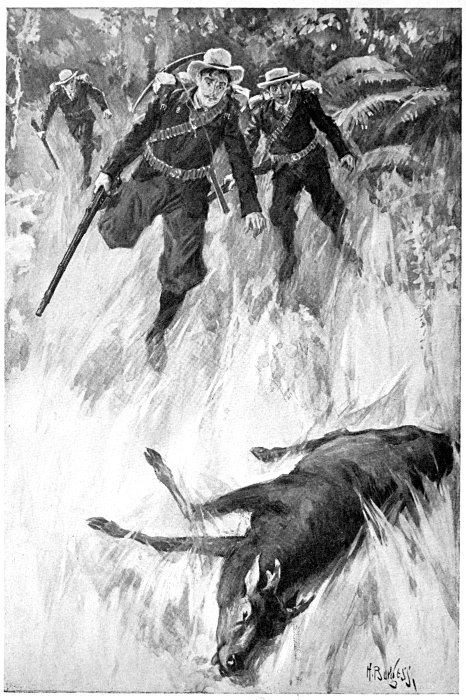
the right where the carcass of the animal lay in the
long grass.
Its legs were drawn up close to the body, proof
that it had died in a convulsion, and Harvey shuddered
as he looked at the long, sharp claws that
protruded from soft, spongelike feet. These were
the feet he had heard striking the ground in pursuit.
The puma somewhat resembled a leopard, and
measured forty-five inches from the nose to the root
of the tail, and the tail was as long as the body.
The head was rather small, the ears large and
rounded. The skin was a tawny, yellowish brown,
and the lower part of the body a dirty white.
“Ugh!” exclaimed Harvey, shuddering.
They walked back to camp. After supper Ferguson
said:—
“I move we adopt a couple of rules, to apply for
the remainder of the journey.”
“What are they?” asked Hope-Jones.
“First, that we keep within hailing distance of
one another.
“Second, that one of us always has a gun in
hand.”
“Agreed,” said the Englishman, and Harvey
nodded his head in approval.
CHAPTER IV. IN THE COILS OF A BOA.
54
“Cross the mountains to Oroya, then go north
to Huari, and in three days you will reach
the great forest of cinchona trees,” repeated Hope-Jones,
quoting old Huayno.
“Yes, but we have gone around Oroya, as advised
by the superintendent,” said Ferguson.
“That’s why we have kept a northeast instead of
a north course.”
“We should sight Huari to-morrow.”
“Yes. We should.”
It was the fifth day of their journey from Chicla,
and they were plodding along in a rain, rubber coats
buttoned close to the chin. The llama path was
very narrow and wound in and out among tropic
verdure. Everything was dripping with moisture,
large drops rolling from palm leaves, bushes throwing
spray as they were released after being pushed
one side by the pedestrians, and the long grass wound
55around their stockings until they became wringing
wet. It had been impossible to light a fire at
noon, and so they had dined on strips of smoked
venison.
“We must find some dry wood to-night and hang
our clothing near a blaze,” said Harvey. The next
minute he had darted ahead, then to one side.
“Remember rule number one!” called out Ferguson.
“All right,” came back the answer.
They caught up with the lad in a minute, and
found him standing under a clump of trees that
were about fifteen feet in height and which had
broad, flat tops. As they neared the spot a fragrance
as of incense was borne to their nostrils
through the rain.
“Here’s a feast after all the dried deer meat!”
called the boy, who had hung his knapsack on a
branch, placed his shot-gun against the trunk of the
tree, and was already climbing.
“What is he after?” asked Hope-Jones.
“I’m sure I don’t know. What have you found,
Harvey?” called Ferguson.
“Chirimoyas.”
“Then we’re in luck. My mouth waters at the
very thought of the fruit. But I never saw the
tree before,” he said, looking up at their young
companion.
56“The trees grow in plenty of places near Lima,”
Harvey replied. “I recognized them at once from
a distance. Here, catch!”
The fruit he dropped down was heart-shaped,
green, and covered with black knobs and scales,
much as is a pineapple, and was about two-thirds the
size of the latter.
When Harvey had detached a half dozen he descended,
and despite the inclement weather they sat
down for a feast, this being the first of fruit or
fresh vegetable they had tasted since leaving Chicla.
Although it was damp no rain fell on the place
where they rested, for the broad leaves of the trees
were so interlaced as to form a natural umbrella
that made a perfect watershed.
The skin of the chirimoya is thick and tough, and
their jack-knives were called into use, but once
within the shell a treat indeed was found. Internally
the fruit is snowy white and juicy, and embedded
within the pulp are many seeds, but these
are as easily removed as are the seeds of a watermelon.
“My, this is delicious!” said Harvey, smacking
his lips.
“Picking chirimoyas from trees is better sport than
picking up puma cubs from beneath them, is it not?”
asked Hope-Jones.
“Somewhat,” said the lad, as he buried his face in
57the fruit and took so large a mouthful that his cheeks
were distended.
“Be careful lest you choke,” warned Hope-Jones;
then turning to Ferguson he asked:—
“How would you describe the flavor should you
wish to do so to a person at home?”
“I couldn’t. It is finer than the pineapple, more
luscious than the best strawberry, and richer than
the peach. There is no fruit with which I could
make comparison. Can you think of any?”
“No.”
They enjoyed the repast with which nature had
provided them, then Ferguson urged that they take
up their march again.
“What’s the matter with remaining here?” Harvey
asked.
“It’s too damp. We all would have colds in the
morning. No, we must find a dry spot, even if we
have to keep going till late at night. As it is, perhaps
we had better each take a couple of quinine
pills. Here, I will stand treat,” and he commenced
to unstrap his knapsack.
“Chirimoyas for the first course and quinine for
the second,” remarked Harvey. “Who wouldn’t
call that a genuine Peruvian meal?”
Then they resumed their way in the rain, which
continued falling heavily, dripping from the trees
overhead.
58Since morning they had been descending into a
valley that was lower than any part of the Montaña
which they had as yet traversed; indeed, they were
at an altitude of only five thousand feet above sea
level; and as they were on the eastern slope, where
there is no trade wind to cool the air, the temperature
had become tropical.
Soon the path would mount again, and a climb of
three thousand feet was in front before Huari could
be reached; but for the time being they were threading
a region that was as dense with vegetation as
that which borders the Amazon. Huge vines and
creepers almost hid the trees from view, and green
moss hung in long festoons. In places were groves
of palms, in others trees of wondrous growth that
were completely covered with brilliant scarlet flowers.
Occasionally, between branches, they saw rare
orchids.
In the jungle at the sides of the path could be
heard the croaking of frogs, and on the bark of trees
sounded the sharp notes of woodpeckers. At times
a brilliant-colored snake crawled across the path.
But they saw little else of animal life, although the
occasional rustle of leaves ahead told that something
savage had slunk away.
“Probably a puma,” said Hope-Jones once, when
they had stopped to listen, and had brought their
guns into position. “But there is no cause for
59alarm. A puma rarely attacks a man unless brought
to bay, or unless,” and he cast a side glance at Harvey,
“some enterprising person endeavors to kidnap
a cub.”
“Will you ever forget that?” asked the boy, and
they laughed.
Since the day of the lad’s dual adventures little of
moment had befallen the travellers. They had remained
in company, and at night had selected spots
in scant groves, which they had inspected thoroughly
before pitching the shelter-tent. They were cautious
during the day as well. As for human beings, two
or three Indians had been met, but they were stupid
specimens, who did not speak Spanish, and who manifested
little curiosity at meeting a white man.
“They are a sneaky lot,” Ferguson had said.
“Notice how low their brows are and how narrow
the forehead.”
At times they saw a hut perched on a hill above
the roadway, but they did not care to investigate, and
passed them by. These places of habitation were
constructed somewhat like the North American
Indian’s tepee, of boughs wound with animal
hides.
But this all had been at a higher altitude. In the
valley which they now trod, and which was a tropic
jungle, there was no sign of man save the narrow
path—and the path at times was almost lost to sight
60in the dense growth—which told that occasionally
llama trains passed that way.
Toward four o’clock in the afternoon they reached
the lowest part of the valley, and at that hour the
clouds cleared away and the sun came out, causing
the leaves to glisten as if studded with diamonds, and
the air became heavy with the perfume of flowers
and the exudations from plants and vines.
Coaxed by the sun, hundreds of butterflies drifted
lazily from the sides of the jungle and moved as if
borne by light currents of air from flower to flower.
Some were white, their large wings dotted with
golden yellow; others were purple, fringed with
black; others the color of the dandelion, and still
others were crimson. In and out, between these
slow-moving seekers of perfume, darted hummingbirds
like dashes of many-colored lightning, and the
torn air sounded a faint note as they passed. This
sunlight also brought lizards of many hues into its
warmth, and chameleons which when prodded
changed color, from green to red or to purple,
depending upon the stage of anger. Meanwhile
the atmosphere grew heavier with the tropic odors
which the warm rain had coaxed from the vegetation.
“My, but I’m sleepy!” said Hope-Jones.
“So am I,” answered Harvey, who was bending
over his knapsack and placing therein the rubber
coat, of which he stood no longer in need. “Can’t
we camp hereabout?”
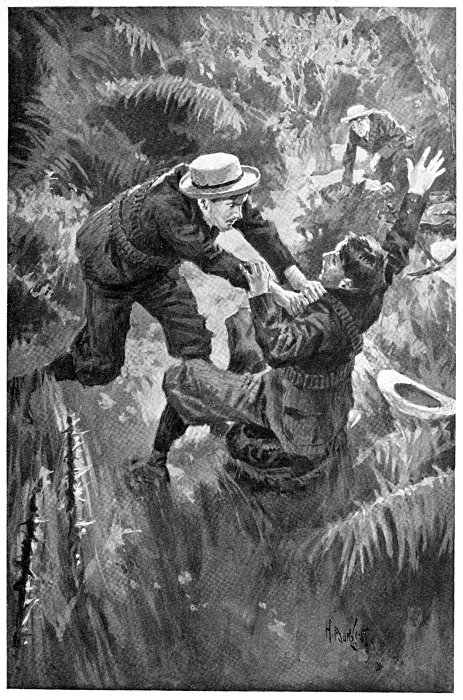
“Ran ... to the side of his friend, whom he seized by the collar.”
61“Miasma! chills! fever!”
“What’s that, Mr. Ferguson?”
“I said miasma, chills, and fever. That’s what
would befall us should we remain here for a night.
Beyond,” and he pointed to the hill that rose on the
other side of the valley, “we shall doubtless find a
place for the tent. However, we may as well rest
here a bit, and I spy a seat over there which I propose
to occupy.”
Saying this he cast aside his knapsack and rifle,
then walked ahead a few yards and to one side, where
he dropped upon what appeared to be a mass of
twisted vine, as large as the limbs of the average
tree.
The instant that Ferguson sank into the seat,
Hope-Jones, who had been looking ahead curiously,
let fall everything that he had in hand or on his back,
and springing from Harvey’s side with a bound, ran
as if on a race-course to the side of his friend, whom
he seized by the collar and not only lifted to an
upright position, but threw with all the strength he
possessed to the ground, by the path side, and ended
by catching him by the legs and dragging him some
distance.
Ferguson was very quick-tempered, and the moment
he jumped to his feet he darted at his companion
62with his fist clenched, roaring out at the top of his
voice:—
“I’ll fix you! What do you mean? That wasn’t
any joke.”
Harvey had run up, and he sprang between the
young men, wondering what had caused this; and a
glance at Hope-Jones’s face surprised him the more,
for it was pale as that of a corpse, whereas Ferguson’s
was red, and he was blowing with indignation.
“I’ll teach you!” he repeated. “Get out of the
way, Harvey.”
But Hope-Jones had found his voice by this time,
and instead of resenting his friend’s language he
gasped: “It’s a boa! It’s a boa!”
“What’s a boa?” and Ferguson glanced around.
“You sat down on a boa! It’s coiled up over
there!”
Then the young man who had been dragged along
the path so ruthlessly turned as pale as had his companion,
and so did the lad who had endeavored to
act as peacemaker. Meanwhile the three were retreating
rapidly to the point where they had dropped
their knapsacks and rifles.
“A boa!” repeated Ferguson. “I can hardly
believe it!”
“Yes. I once saw one coiled up like that in a
menagerie, and the thought that your seat was alive
came to me the instant you sat down. As I drew
63near I made out the scales, which resemble the bark
on a tree, and I also saw the head. Its eyes are
closed, and it’s evidently in a torpor after gorging.
You sat right down in the coils, and it’s a wonder it
didn’t wake and squeeze the life out of you.”
Ferguson shuddered, then throwing an arm around
his chum’s shoulder, he said:—
“Forgive me, old man.”
“Why, of course. I don’t blame you in the least.
I wouldn’t have blamed you if you had struck me.
In which case we would have fought and afterward
would have discussed matters. I expected as much
the moment I laid a hand on you, but there wasn’t
time for explanations at that stage of the game.”
“I should say not.”
They resumed their burdens and walked forward
again along the footpath, but they kept at a respectful
distance from his majesty the snake, which
remained as when first spied by Ferguson, motionless.
“I don’t wonder that I was fooled,” said he, halting
for a look at the enormous reptile. “It looks
exactly like branches or a huge vine coiled; now,
doesn’t it?”
“Yes, it does,” assented Harvey, “but down below
I can see the head. What enormous jaws!”
“Like a shark’s.”
“And they say that the jaws will stretch still
64wider, for they are fastened together by ligaments
that are as elastic as rubber.”
“Yes, they will stretch so that it can swallow a
young deer.”
“Perhaps that’s what it’s gorging on now.”
“Perhaps. You notice that hump below the neck?
That’s as far as the prey has moved down toward the
creature’s stomach.”
“Are you going to try a shot?”
“No, Harvey. Why should I? The boa hasn’t
harmed us, and should I only wound it, one of us
might suffer, for it’s said they move with wonderful
rapidity for a short distance.”
“Would it not be a good plan to hasten and climb
the hill yonder?” suggested Hope-Jones. “It
won’t be safe to sleep in this valley to-night, and
goodness only knows what we’ll stumble over
next.”
The others evidently thought so also, for they
quickened their pace, and giving the boa a wide
berth they pushed ahead. An hour later they were
threading their way by the side of a little stream up
the hillside. After walking some distance Harvey
said:—
“Mr. Ferguson?”
“Yes, my lad.”
“Are you going to quiz me any more about that
puma cub?”
65“No, Harvey. I’ll call the account square, if you
will.”
Hope-Jones laughed. “It looks very much as
though I should have plenty of amusement with
both——”
Ferguson and Harvey stood stock still. Hope-Jones
had vanished from sight.
CHAPTER V. HUARI, AND THE STORY OF THE BEAUTIFUL COUNTESS.
66
“B-r-r-r-r!” came a voice.
“What on earth has happened?” asked
Ferguson, in amazement, bending over a large hole
that had suddenly yawned at their feet.
“B-r-r-r! Help me out, fellows! I’m stifling!”
They threw themselves face down at the edge of
the cavity, and reached their hands below, but could
not feel anything.
“Quick, Harvey! Give me the pick! Catch
that, old man!” he called, pushing the iron arms
into the opening. A pressure was felt and a hoarse
voice replied:—
“That’ll help. I can crawl up the side that
slopes.”
The next minute Hope-Jones was with them again,
blowing dirt from his mouth and saying unpleasant
things about the animal that had dug the hole at
the path side. His ears were filled with loam, black
67earth had sifted back of his shirt collar, and such
hair as projected beneath his cap was tangled with
the soil. As for his clothing, it was streaked. Fortunately,
his shot-gun, knapsack, and pick remained
fastened to his back, and although dirty, he was
none the loser because of his drop below the surface.
Ferguson and Harvey brushed him off as best
they could, then the three resumed their way up the
hill.
“I didn’t see any hole,” remarked the Englishman,
a few minutes later.
“It was at the side of the path; most of it in the
jungle, and leaves had fallen over the edge,” Ferguson
replied.
“Mr. Hope-Jones?”
“Yes, Harvey.”
“Will you cry quits on the puma cub?”
“Certainly, my lad.”
“Hope-Jones!”
“Yes, Ferguson, I know what you are about to
say. Boa, puma cub, and holes are barred subjects
evermore.”
And they shook hands in a chain.
The path ascended rapidly and the vegetation
became less tangled as the travellers proceeded; so
too the atmosphere grew somewhat more bracing, for
the heavy odor of the valley did not mount to any
height. With the setting of the sun the new moon
68shone for several hours above the horizon, and the
silvery rays from the crescent, together with the starlight,
illumined their way so they were able to make
rapid progress until about ten o’clock, when the
ground becoming quite dry—for the rain of the valley
had not extended this far—they pitched the
shelter-tent and built a rousing fire, near which they
placed their damp clothing. Toward midnight they
turned in “tired to the bone,” as Harvey expressed
it, and none awakened until the sun was two hours’
high. Then, looking down into the valley, they
saw a billowy mist, which completely hid even the
tallest trees.
“There’s miasma for you!” exclaimed Ferguson,
pointing to the vapor. “As we passed through it,
perhaps we should take some more quinine.”
They acted on the suggestion, then, after a hurried
breakfast, set off on the road again, for they were
anxious to reach Huari that day, and the morning
start had been late. The road was up grade until
the noon hour, then became level again, and the
vegetation was the same as on the other side of the
valley, before they had plunged into the riot of undergrowth.
Toward three o’clock they saw smoke rising
lazily ahead and concluded they must be nearing
a town. A half hour later they came upon a number
of huts on the outskirts. Fields of maize and cotton
were under cultivation, and brown men, half naked,
69were at work in them with primitive tools—ploughs
that were but sharpened boughs of the ironwood tree,
trimmed wedge-shaped, and drawn by small oxen;
shovels made from the same wood; and other agricultural
implements with which they were strangers,
fashioned from stones that had been worn to sharp
edges. All the men wore beards, some quite long.
The huts became more numerous, and naked little
children, standing in the doorways or running about
in the narrow streets, stared at the travellers, while
the older boys and girls, who wore loin cloths or
skins of animals fastened as tunics, called in the
Indian tongue to persons who were within the dwellings.
They met few men and fewer women; the
better class of the former wore trousers and a poncho
(a blanket with a hole cut in the middle, through
which the head is thrust, and which falls over the
shoulders); whereas the poorer class were content
with the upper dress that came to the ankles: but
the women wore gowns of gorgeous color, though
they were ill-shapen and no attempt was made to fit
the figure.
The travellers neared the centre of the town
before they met a “white man,” or one who did not
belong to the Indian race. His features were proof
that he or his ancestors had come from a foreign
land, being in marked contrast with the thick,
stubby nose, narrow forehead, and broad lips of the
70Ayulis. Hope-Jones doffed his cap and addressed
him in Spanish.
The Peruvian, who had been staring at them since
they had come in sight, at once joined them, and not
only shook hands, but placed his right arm around
the shoulders of each in turn, patting him on the
back, meanwhile speaking rapidly, with much sibilation
of the s’s and rolling of the r’s, conveying in
the most flowery language his delight at their visit.
So they had journeyed all the way from Lima!
How tired they must be! But what matter? He
had comfortable beds at his house and they must rest
for a week, or a month if necessary, and be his guest
the while. What, could only remain one night?
Surely, they would be courting illness by thus hurrying
along. No matter, he would speak of that
later. They must accompany him now.
He placed his hand in Hope-Jones’s arm, and gathering
his poncho, which was quite long, much as a
woman would her skirts, he turned in the direction
from which he had come and led the way, explaining
as they walked that there were few white men in
Huari, “and,” he added, “some of them you would
not wish to meet.”
At the word “bed” Harvey had become very much
interested, so, for that matter, had Ferguson and
Hope-Jones, and they were not at all loath to accept
the invitation which had been so insistently given.
71After travelling five minutes and entering what
was evidently the better section of the Montaña
town, they stopped before a one-story building, bordered
by verandas, that was spread out over much
ground and was surrounded by fruit trees. It was
the most imposing structure they had yet seen in the
village, though, like others, it was built of adobe,
reënforced with bamboo.
The host and his companions were met by an Indian
woman, who appeared to be of better class than
those the travellers had seen on the streets, and she
was presented to them as Señora Cisneros. Her
greeting was spoken in excellent Spanish, and although
not quite as demonstrative as her husband’s,
it was none the less sincere. The travellers were led
to two connecting rooms, and after discarding their
burdens and returning to the cool veranda, they
were asked if they would not like to drink some
cold coffee.
“We have learned the art of coffee-making from
the Brazilians,” said Señor Cisneros, “and, believe
me, the beverage is better cold than hot. Would
you like to observe our arrangement? But perhaps
you are tired?”
Hope-Jones confessed that he was tired, but Ferguson
and Harvey manifested interest in the Brazilians’
teachings; so while the Englishman remained
on the veranda, chatting with the señora, the two
72young Americans accompanied the host to the rear
of the house and into an arbor that was covered with
trailing vines. It was a cool spot, far enough from
buildings to be affected by all breezes, and in the
centre stood an immense earthen vessel, the height
of a man and at least four feet in circumference. A
foot and a half from the bottom was a spigot.
“This jar is made of porous clay,” said the señor,
tapping the vessel, “and as a slight amount of the
liquid filters through, evaporation cools its contents.
Once every three months we boil coffee by the barrel.
It is poured in here, permitted to settle for a week,
and all sediment goes to the bottom. You will notice
that I draw the liquid from some distance above,” and
he placed a pitcher beneath the spigot, turning which,
a dark, clear liquid flowed.
“Taste it?” and he filled a small cup, then another.
“Is it not cold?” he added.
Ferguson and Harvey found the beverage delicious,
and expressed wonder that it could be coffee.
“Wait until some sugar is added,” said the Peruvian,
as pitcher in hand he led the way back to the
house.
For a half hour they rested on the veranda, sipping
cold coffee sweetened with brown sugar, and eating
paltas, which Señora Cisneros had placed on a little
table. They related their adventures to host and
hostess, and, without revealing their reason for visiting
73the interior, told that they were in search of
gold.
Señor Cisneros shook his head. “Perhaps there
is gold,” he said, “but I have found no trace of
any.”
Then he told that for years he had been engaged
in silver-mining, and that his llama trains passed over
the road which they had travelled.
“When the railroad pierces the interior,” he continued,
“there will be much profit made by those
who extract metals from the ground, but with the
present method of transportation one does well to
gain a livelihood.”
The señora was very anxious to hear about Lima.
She had been there once, but only for a few days,
soon after her marriage.
After a time the host ordered hammocks swung on
the veranda, and in these Hope-Jones, Ferguson, and
Harvey rested until a few minutes before dinner. It
seemed good to sit down in chairs, at a table, and to
taste other food than the game and fruits of the
woods, to say nothing of having crockery dishes to
eat from instead of the tin plates. They were early
in bed, and after a refreshing night’s sleep between
sheets, which, though coarse, were cool and clean,
they awoke with renewed determination to continue
their journey.
But while they were enjoying more of the señor’s
74delicious coffee—heated this time—rain commenced
to fall; huge drops came in sheets and leaden clouds
hung low; so they were nothing loath to accept an
urgent invitation to remain another day and night.
Señora Cisneros, learning of the scant stock of clothing
they had taken with them, insisted upon overhauling
their knapsacks, and she passed several hours
of the morning with needle and thread, darning and
mending. In the afternoon she packed them some
food from her well-stocked larder, sufficient to last
and add variation to their mountain bill of fare for
several days.
The next morning dawned warm and bright, and
the adventurers started early, after thanking host
and hostess time and again; and they promised
themselves the pleasure of a longer visit on their
return. They were passing from the town and were
waving their caps to Señor Cisneros, who had accompanied
them to the outskirts, when Ferguson said:—
“He’s a splendid fellow. I wish he were going
with us.”
“So do I,” said Hope-Jones. “He would be a
jolly companion.”
Harvey came suddenly to a halt.
“What’s the matter,” the young men asked.
“I happened to think of something. Cisneros is
a miner.”
“Yes.”
75“And he knows this country.”
“Yes.”
“He’s honest.”
“He has every appearance of being so. What are
you driving at?”
“And he told us that his silver mines were not
paying very well,” persisted the boy.
“Yes.”
“If we find gold we’re going to find a great deal,
are we not?”
“So old Huayno said. But why are you wasting
time standing here and asking all these questions?”
“Because I move we turn back.”
“Turn back! Why?”
“And ask Señor Cisneros to join us.”
“Tell him the secret?”
“Yes, and take him in on shares. One quarter
for each.”
Ferguson slapped his hand on his thigh. “Bully
for you, Harvey! That’s a splendid idea. I wonder
it never came to me.”
“It never entered my mind until the last time he
waved his hat,” said the boy, looking pleased at the
approval he had been given, for Hope-Jones had
spoken as warmly in favor of the project as had the
American; and the three at once commenced to retrace
their footsteps. They found their erstwhile
host on the veranda of his home, bidding adieu to
76his wife, for he had planned a trip to a neighboring
village.
“Take him one side and explain, Ferguson,”
whispered Hope-Jones.
“I am delighted that you are returning,” he called
out when they appeared. “Thought you would rest
a little longer?”
“No, señor; thank you. We wished to consult
with you regarding a certain matter. Will you
go for a short walk with me?” asked the elder
American.
“With pleasure,” and he led the way back of the
house, to the arbor, while Hope-Jones and Harvey
remained on the veranda with the señora, who looked
at them curiously, wondering of course what it meant,
but she politely refrained from asking questions.
The two were absent about a half hour, and when
they came in sight again Ferguson nodded his head,
as if to say, “He will go,” and the señor grasped
each of them by a hand.
“Pardon me, but I must immediately tell my wife
of this extraordinary news,” said he. “You need
have no fear. My secrets are safe with her,” and
the two passed into the house.
“So he’ll go?”
“I should say so. You should have seen his eyes
glisten. He believes that every word old Huayno
uttered is true; says he’s heard legends of this sort,
77but no one was ever able to locate the mine. All
stories agree, however, that it is beyond the cinchona
trees.”
“It was a capital thought, that of Harvey’s! I
wonder how long it will be before he can accompany
us?”
The señor answered the question in person, reappearing
just then and saying, “I shall be able to
leave in an hour, if you wish to start that soon.”
“In an hour?”
“Yes,” he replied, smiling. “I am accustomed
to long journeys and am always ready for departure.
The señora is even now placing my things in
order.”
So it happened that at nine o’clock they again departed
from Huari, but this time they were four in
number, instead of three. When beyond the confines
of the village the travellers from the coast were
surprised at being addressed by their new friend in
the English tongue.
“I did not know you could speak our language,”
exclaimed Ferguson.
“It has been long since I have used it,” was the
reply, “or I should have a better accent and vocabulary.
For ten years, until I was seventeen, I lived
in New York City; but that was thirty-five years
ago, and since then I have only met Englishmen
and Americans occasionally.”
78“Why didn’t you let us know before that you
could speak English?”
“Because you are excellent Spanish scholars; and
as my wife has not enjoyed the same advantages
that I have, I prefer to converse in the tongue with
which she is familiar. Now that we are away from
Huari, however, and by ourselves, I should be very
glad to use only the English and learn from you
that which I have forgotten.”
They found the señor a most pleasant companion
and also a valuable addition to the party. On the
trip from Chicla to Huari, after the edibles which
were stored in their knapsacks had been exhausted,
they were compelled to live on game, and the diet
became monotonous. But Señor Cisneros added to
the daily bill of fare materially by his knowledge
of the Peruvian vegetable world. He cut tender
shoots from a certain palm tree, which, when boiled,
tasted something like the northern cauliflower;
from a vine that grew in and out the long grass,
he made an excellent substitute for spinach: before
he joined them they had feared to eat berries, not
knowing which were poisonous; now they were
able to enjoy a dessert of fruit after every meal.
Their cooking utensils had also been added to at
Huari, a pot among other articles, and in this the
novel vegetables were cooked.
In lieu of a knapsack the Peruvian was provided
79with two commodious bags made of llama skins,
which were fastened together by a broad strip of
hide by which they depended from his shoulders.
He carried a rifle of the muzzle-loading description,
an old-time powder horn and bullet-pouch. He
proved himself as good a shot as Ferguson, and a
pleasant rivalry soon sprang up between the two.
Old Huayno had told them to push ahead for
three days from Huari, to the forest of cinchona
trees, and find the head waters of the Marañon, one
of the rivers that are tributary to the Amazon.
At its source this stream is very small, and the
travellers from Callao had wondered how they might
recognize it from others, and had regarded this stage
of the journey with some apprehension, lest they
might fail in reaching the river on which the great
white rock was located. But Señor Cisneros knew
exactly the course to take, and without aid of compass
he directed their steps.
“We shall be longer than three days on this
journey,” he said. “Your Indian friend reckoned
the distance as it was covered by those of his tribe
who were able to move much more swiftly than we
can with our numerous burdens. We shall be five
days, rather than three.”
“Then from the river’s source to the great white
rock it will perhaps be two weeks’ journey?”
“Yes; I should think it probable.”
80He was correct concerning the distance from
Huari; it was evening of the fifth day when they
pitched the shelter-tent on the edge of a dense, dark
forest.
“My, but there’s sufficient quinine in there to cure
a world of giants!” exclaimed Harvey.
“Those are not cinchona trees, my son,” said the
Peruvian.
“No? But I thought this was the forest of cinchona
trees.”
“So it is; for the reason that the valuable growth
appears frequently in these woods. We will doubtless
see many specimens during our journey, but
none is in sight from here.”
“What does the tree look like, señor?”
“It resembles the beech, with the flowing branches
of the lilac, and has smooth wood, susceptible of a
high polish. The leaves resemble those of the
coffee plant.”
“Are you versed in the method of preparing
quinine from the bark, señor?”
“It happens that I have made the subject quite a
study,” he replied. “Several years ago a representative
of the British government was my guest
in Huari. He had been sent to Peru for the purpose
of deciding whether it would be possible to
transplant young cinchona trees from these forests
to India and other tropical countries. With him I
made several expeditions.”
81“What was the result, señor?”
“He recommended that transplanting be attempted.
It was done, and I understand that cinchona
groves are thriving in many places.”
“Is that possible!” said Ferguson. “I was of
the opinion that Peruvian bark only grew in Peru.
But as I think of it, I really am very ignorant on
the subject. Perhaps you will tell us more concerning
the enemy of chills and fever.”
“I will be glad to, but suppose we have supper
first.”
To this all agreed. They had made the tent ready
for the night while thus conversing, and had gathered
fuel for the evening fire, so that soon the pot was
surrounded by a bright blaze.
“The water in which our food is cooking should
have a peculiar charm for us all,” said the señor.
“Why so?” asked Hope-Jones.
“Because it comes from the Marañon, which flows
past the white rock and the gold mine.”
“Do you mean to say that the little stream from
which I fetched water is the Marañon, señor?”
Harvey asked.
“Yes, or one of the small branches that form the
head. A day’s journey from here it broadens considerably.
How it is beyond I do not know, for I
have never gone further.”
After supper, when they had drawn up logs for
82seats near the fire, because the night was chill and a
damp breeze came from out the forest, Señor Cisneros
commenced his promised narrative of the white
powder that occupies such a prominent place in the
medical world.
“Once upon a time, in fact in the year 1638, there
lived in Cuzco a most beautiful woman who was
loved by all who knew her.”
“Why, you are starting out as if telling a fairy
story!” said Harvey, laughing.
“The facts are something like one of those charming
tales,” replied the señor, who resumed:—
“This woman, renowned for her beauty and her
grace of manner, was the wife of the ruler of Peru.
One day she became grievously ill, and the doctors
of that time were unable to remedy her condition.
Her flesh burned with great heat, her cheeks were
flushed with red, her eyes were unusually bright, and
the blood pulsed rapidly through her veins. She
soon became delirious, failed to recognize her husband
and children, and all those in the palace were
in despair.
“At that time a most learned man was the corregidor,
or chief magistrate, of Loxa. He was not
only versed in the study of the law, but he had familiarized
himself more than any other man with the
vegetable life of Peru; he was a botanist, self-taught.
This man learned that the countess was at death’s
83door; and hastening to the palace he asked permission
to see her. It was granted, and after looking
for a few minutes upon the woman, who was tossing
about on the silken couch, he abruptly left the apartment,
saying that he would soon return.
“Within the half hour he was back, carrying a
shallow dish, in which were pieces of bark steeped
in water. He gave the countess some of the liquid
to drink and urged that the dose be repeated at
intervals during two days. His instructions were
followed; she became restful, slept sweetly, and the
fever left her body. In a week she was up and
about, and in a fortnight was out in the palace
grounds.”
“And that story is true?” asked Harvey.
“Yes, true in every detail. It is vouched for in
the public records of Peru.”
“Of course the drug he gave her was the essence
of Peruvian bark.”
“Yes, extracted in a primitive form.”
“What was her name?” asked Hope-Jones.
“The Countess of Chinchon.”
“That is why the tree is called cinchona?”
“It is, and to be more correct one should spell it
‘chinchona’ instead of ‘cinchona.’”
“How did the term quinine originate?”
“From the Indian compound word ‘Quina-Quina,’
meaning ‘bark of barks.’”
84“You say the trees are isolated, señor?”
“Yes. They seldom grow in clumps, and the
task of finding them is often great; the native
searchers, or cascarilleros, undergo great hardships
in penetrating the jungle-like forests.”
“How is the white powder prepared?”
“There are several processes, the most popular, I
believe, being that of mixing pulverized bark thoroughly
with milk of lime, then treating the substance
to the action of certain chemicals, and
ultimately the sulphate of quinine is produced.
Different manufacturers have different processes;
many of them are kept a secret. The object is to
extract the maximum amount of quinine from the
bark and leave as little of other ingredients in the
powder as possible.”
From the subject of Peruvian bark they changed
to that of the journey on the morrow, and a half
hour later, with knapsacks and bags as pillows, they
went to sleep in the shelter-tent. Harvey, as he
closed his eyes, thought of the beautiful Countess of
Chinchon, and wondered if she could have been as
pretty as Señorita Bella Caceras, a girl in Callao
whom he had met under most peculiar circumstances
while adrift one night in the bay of that name.
CHAPTER VI. A DISCOVERY AND AN ALARM.
85
They entered the forest the next day, and for
a week were in its confines, threading the
right bank of the Marañon and following its current.
The way along the river was easy to travel, when
compared with the seemingly impassable jungle to
the right and the left of the stream, but it was not
without its difficulties, and many times they were
compelled to stop and cut the heavy growth of vines
with the small axe which Señor Cisneros had added
to the outfit. At night they were bothered by mosquitoes,
and the insect plague became so great one
evening that they kept watch and watch, the one on
duty throwing on the embers of the fire a bark
which emitted a light yellow smoke which drove the
pests away.
Game was plentiful in this forest, and what with
the flesh of four-footed animals and birds, reënforced
at times by fish caught in the stream and the vegetables
harvested by the Peruvian, they managed to
86fare very well. But in other respects they were not
treated so kindly. Thorns tore their trousers and
their coats, their shoes were wearing out, and faces
and hands became covered with scratches and bruises,
the latter caused by many falls, which it was impossible
to avoid because of the insecure footing.
In spite of this they were in the best of health;
and as for their clothing, they made good use each
night of the needles and thread which they had
brought; and although some of the darns and patches
were curiosities to look upon, they served their purpose.
Hope-Jones and Ferguson had both been
smooth-shaven while in the city, but by the time they
were a week from Huari, mustaches covered their
upper lips and light growths of beard were dependent
from their chins.
“Nobody in Callao would know you,” said Harvey,
one morning. “I never saw such a change in persons.”
“How about yourself?” retorted Ferguson. “If
you could but glance at your own face in a mirror
you would not say much.”
Somewhat later in the day the boy made use of a
deep pool of water for that purpose, and was surprised
to see, peering up at him, features that were copper-colored
from sunburn and exposure to the elements.
The outdoor life at home had tanned him somewhat,
but nothing in comparison with this.
87The weather, while they were in the forest, was
dry and pleasant, but the very day they emerged
from its confines, a rain poured down that was even
heavier than that which had detained them twenty-four
hours at Huari. It commenced to fall as they
were awakening, and descended in such torrents
that any thought of trying to pursue their way while
it lasted had to be abandoned. Their shelter-tent
was fortunately pitched on a slight elevation, beneath
the branches of a large ironwood tree which
broke the force of the drops, or rather of the rain-sheets.
Señor Cisneros and Hope-Jones put on rubber
coats and dug a shallow trench around the canvas,
making a channel toward the river, and for the remainder
of the day they sat in the little enclosure,
except for a few minutes when one or the other ventured
forth for a “breath of fresh air.” All wood in
the vicinity was too wet for use as fuel; indeed,
there was no spot where they could build a fire, had
they had dry timber; so they were compelled to subsist
upon smoked meat.
“This is Monday, is it not?” Harvey asked.
“Yes, and a decidedly blue Monday,” was the
reply.
Toward evening they voted it the most miserable
day of the journey, and their only comfort came
from the Peruvian, who assured them that the heavy
88rains in that season seldom lasted for more than one
day.
The rule held in this instance, and soon after dark
the clouds were driven away, the moon silvered the
dripping trees and bushes, and the travellers were
able to emerge from under the canvas. By digging
beneath some leaves, they found dried, decayed wood,
that served admirably for fuel, and soon had a roaring
blaze started, over which they cooked some fish
that Harvey had caught during the afternoon.
After leaving the dense forest behind, they followed
the Marañon through a much more open
country. There were many trees, but they were
not so close together, nor were they so tangled
with vines, and the undergrowth also became
thinner. This was due to a change in the soil,
they having passed from the region of black earth
to a land that contained more sand. It became
quite rocky close to the river, and they were compelled
to make frequent detours from the bank
because of the boulders through which the stream
passed.
One morning all became very much interested in
witnessing a body of foraging ants, to which their
attention was called by Señor Cisneros.
“These little creatures can be seen only in South
and Central America,” he said, “and they have the
reputation of being the wisest of all antdom. Look
89how they are marching in regular phalanxes, with
officers in command!”
The diminutive black and gray army covered a
space about three yards square, and was moving
from the river across the path.
“I will interrupt their progress,” said the Peruvian,
“and we shall have plenty of opportunity to
observe them. Fetch me that pot full of water,
Harvey.”
While the lad was hastening to the river, he dug
with one of the picks until he had made a narrow
channel about ten feet long, into which he poured
the water as soon as it was brought him, and just
as the vanguard of the ant army approached. The
little soldiers halted on the edge of this ditch, and
from the sides and rear hurried ants that evidently
were officers.
“Now I shall give them a small bridge,” the señor
said, “and if they have the intelligence of a body
that I observed about a month ago, they will quickly
make the footway broader and in a novel manner.”
Saying which, he cut a rather long twig, one that
was narrow, but would reach across the little trench,
and this he placed in position.
Two of the ants hurried on the little span, then
returned to the army. They evidently gave some
instructions, for two or three score of the main body
left the ranks, and hurrying on to the twig, swung
90themselves from the sides in perfect line, until the
passageway had been made three times as broad
as before. Then, at an order, the army commenced
moving over.
“Isn’t that wonderful!” exclaimed Hope-Jones.
“Indeed, yes. Many students of the ant rank
him in intelligence next to man. You will observe
that the little fellows who are offering their bodies
as planks for the bridge are of a different color,
and evidently different species from the marchers,
and that others of both kinds constitute the main
body.”
“Yes, that is so.”
“The little fellows are slaves.”
“Slaves?” echoed all three.
“Yes, slaves captured in battle, and made to do
the masters’ bidding.”
“Do they always obey?”
“I have watched them many times and have never
seen any sign of rebellion. Frequently the superior
ant, or the one who owns the slaves, will remain
perfectly still and direct the little servants. In that
way I saw a score of the slaves tug away at a dead
bee, one day, and it was perfectly plain that a larger
ant that stood near by was giving orders.”
“You say they are called foraging ants?”
“Yes. They roam about in bands like this in
search of food. They are carnivorous and eat such
91insects as are unfortunate enough to be in their
path.”
The army was fully fifteen minutes crossing the
living bridge, and when the last company had passed,
the slave ants detached themselves and followed.
But two or three, evidently exhausted by the strain,
fell from the twig into the river. No attention was
given them; they were left to drown.
“Did you notice that?” said the señor. “Now
watch how differently members of the superior class
of ants are treated when in distress.”
He stepped ahead a few feet and drawing some of
the larger species from the main body with a stick,
he covered them partly with gravel, until only a leg
or two were visible. At once several ants of the
same species stopped their march, and summoning a
small body of slave ants, went to the rescue. By
butting with their heads and tugging away at the
small stones the slaves soon rescued the imprisoned
masters, and all rejoined the army, bringing up the
rear.
“Bravo!” shouted Harvey, as if the little fellows
could understand.
That afternoon the travellers fell to conversing of
the old mine which they expected to find. Not that
it was an unusual subject for conversation, for it
was the topic most frequently broached; but the
talk this day was of special interest, because Señor
92Cisneros told them minutely of the mining laws of
Peru. Hope-Jones had expressed worry lest foreigners
would not be permitted to enjoy the results
of discovery, but his fears were set at rest by the
Peruvian, who said:—
“Our mining laws have been greatly misunderstood
in other countries, and exaggerated reports
concerning them have been sent broadcast. The
foreigner’s right to own what he finds, providing no
one else has a prior claim, has never been disputed.
Recently it was made the subject of special legislation.
During the last session Congress passed a
law which, among other provisions, states that
‘Strangers can acquire and work mines in all the
territory of the Republic, enjoying all the rights
and remaining subject to all the obligations of the
natives respecting the property and the workings of
the mines; but they cannot exercise judicial functions
in the government of the mines.’”
“What does that last clause mean, señor?” asked
Hope-Jones.
“It has been interpreted to mean that the foreigner
cannot hold the position of mine superintendent,
the object plainly being to prevent his
having active control of the natives who, of course,
would be called in to do the manual labor.”
“It is fortunate then that we have taken you with
us,” said Ferguson. “You will be able to act as
93superintendent, and we shall not have to employ an
outsider.”
“I should like nothing better; that is, providing
we find the mine. But are we not, as you say in
the States, counting our chickens before they are
born?”
“Before they are hatched,” corrected Harvey, but
not in a manner which the señor could possibly take
exception to—for that matter, he had asked them
many times to speak of his mistakes during the trip.
“Oh, it’s fun to do that,” continued the lad. “So
I move that we have an election of officers, and I
place Mr. Hope-Jones in nomination for president.”
“I vote ay,” said Ferguson.
“And I also,” said the Peruvian.
“Of course I do,” Harvey said. “And I nominate
Mr. Ferguson for treasurer.”
The others agreed as before.
“Let me propose Harvey Dartmoor for secretary,”
said the señor, entering into the spirit of the
moment.
The choice was unanimous.
“And now,” Hope-Jones said, “we will name
Señor Anton Cisneros vice-president and general
superintendent of all our properties.”
“Thank you, gentlemen,” said the Peruvian, doffing
his hat. “I only hope the stockholders of the
corporation will be of your mind.”
94“The stockholders! How can they change our
election?”
“You will have to sell stock in order to work the
property, and those who buy shares will have a right
to vote.”
“Certainly. But cannot we hold the majority of
shares?”
“I am glad to hear you say that. If we find anything
nearly as valuable as the old Indian claimed,
it would be a pity to let the property pass out of
our control.”
“Tell us something more of the mining laws,
won’t you?” asked Ferguson. “In speaking of the
recent enactment, you stated that ‘strangers should
be subject to all the obligations of natives.’ What
does that mean? Is the taxation heavy?”
“On the contrary, it is very light, just sufficient
to meet the expenses of the government mining
bureau. The tax is fifteen dollars a year for every
mine,—gold, silver, nitrate of soda, salt, petroleum,—no
matter what it may be.”
“And how would we ‘prove a claim,’ as they
say in the States?”
“Did you inquire in Lima whether any mines had
been reserved in the locality where we intend
prospecting?”
“No, señor, for we did not wish to attract attention
to that section of the state.”
95“You were doubtless right. It was perhaps unnecessary.
In all probability no one has sought
treasure in that region. Still, that point must first
be definitely settled. The government issues a
quarterly statement, called the ‘padron,’ in which
are given the boundaries of all new claims. These
padrons are indexed, and it is possible to learn the
location of all mines in a given region. If we discover
valuable properties where old Huayno said
they were located, or anywhere else, we will at once
stake off the land, just as is done in the United
States, then return to Lima, examine the padron
index, and if no one else has a claim we will notify
the Deputy Commissioner of Mining that we desire
title.
“He will issue us a document, upon our payment
of the first year’s tax, which will be similar to the
‘patent applied for’ paper given in the United
States. Within ninety days after receiving this, it
will be necessary to return to the mine with one of the
officials of the mining department and an official surveyor,
whose expenses for the trip we shall be compelled
to meet. These will fix the actual boundaries,
and upon their return to Lima a document will be
issued giving us the right to mine the property, and
guaranteeing our sole possession so long as we pay
the annual tax.”
“That all seems very simple,” said Harvey.
96They had few adventures during this stage of the
journey. Several times wild animals crossed their
paths, but the young men had learned wisdom on
the trip from Chicla to Huari, and Señor Cisneros
was an old woodsman, so they were always on the
lookout. Game continued plentiful, although the
country grew more open each day.
The Marañon changed from a slow-running stream
to a broad, rapid-coursing river; in places were cataracts,
and the shore line became uneven, boulders
being piled so high that the way between them was
difficult to find. In this rough country they were
once all day going three miles and were exhausted
when night came. Harvey and Ferguson had large
blisters on their feet, and the other two proposed
that they rest for the twenty-four hours following;
but the Americans were too anxious to proceed,
being so near the journey’s end, and the next morning,
binding pieces of a handkerchief around the
bruised places, they announced themselves able to
push ahead.
This was the twelfth day from Huari, and all
agreed that at any time they might come upon the
great rock that marked the way to the mine. They
were certain they had not passed it unobserved, for
since the fifth day from the village they had not
moved a step forward after dusk or until morning
was well advanced. When compelled to make detours,
97one or more of them had ascended every half
hour to some eminence, like a tree or a high mound,
and had carefully surveyed the right bank to the
water’s edge.
Toward four o’clock on this day Hope-Jones and
Harvey were walking somewhat in advance of the
others. The boy was limping slightly and was in
more pain than he would admit to his companion,
who had urged him not to go any further, to which
Harvey had replied, “One more mile and then I’ll
give in.”
The lad was singing, to keep up his courage, and
the words were those of the familiar Sunday-school
hymn:—
“Onward, Christian soldiers,
Marching as to war.”
Suddenly he stopped, gave a yell, and his face
turned pale.
“What is it?” exclaimed Hope-Jones. “Are you
hurt?”
“Look! Look! Look!” and the boy pointed
straight ahead, between two trees. There, bathed
in sunlight, the Englishman saw that which made
his heart beat like a trip-hammer—a high boulder
that shone as purest marble.
“Hurrah!” he shouted, throwing his cap in the
air. “Come on, everybody! There’s the rock!
There’s the great white rock!”
98Ferguson and Señor Cisneros came up at a run.
“What? The rock?” they called.
“Yes. Look!” and the man pointed in the
direction they had gazed.
That instant the Peruvian exclaimed excitedly:
“Down with you! Drop down, everybody! Down,
flat on your stomachs!”
Startled by his commanding tones they obeyed.
“What is it?” asked Hope-Jones.
“Sh! In a whisper! Indians! A score of them!
And they look like the Majeronas!”
CHAPTER VII. THE CANNIBALS OF PERU.
99
“The Majeronas!” echoed Ferguson, but in the
whisper which he had been cautioned to use.
“Are they not a savage tribe?”
“They are.”
“I didn’t know they came this far, not within
three or four hundred miles of here. So I was told
in Lima.”
“It is only recently that they have visited this
region. Within the last year several reports have
come to Huari of their depredations.”
“They are said to be cannibals, are they not?”
“Yes.”
Harvey shivered and drew his gun closer.
“What are we going to do?” Hope-Jones asked.
He was thinking, and so were the others, how lucky
it was that they had induced the experienced miner
and woodsman to accompany them.
“For a time we will wait here,” was the reply.
“They may go away. Again, I am not certain they
100are the Majeronas. I didn’t spend any great amount
of time examining them, I can assure you. They
may be friendly Ayulis, but just at present we do
not care to meet even friendly Ayulis.”
“What is the difference between the tribes, señor?”
Harvey asked, gaining control of himself and preventing
his teeth chattering.
“The Majeronas are much lighter and their beards
are thinner. The Indians yonder certainly answer
the description, but the light may have deceived
me.”
“I think the light of a setting sun would darken
a face, don’t you?” suggested Ferguson. “It
certainly gave a red tinge to that white rock.”
“Perhaps you are right.”
They were lying very close together, and words
spoken in a whisper were heard by all. Each had
drawn his weapon to his side, and those with modern
guns threw open the breech-locks and made certain
that loaded shells were in the chambers, while the
Peruvian examined the cap on his rifle and swung
loose his powder-horn and shot pouch. They remained
in this position for nearly an hour, and not
hearing a sound from the direction where the Indians
had been seen, hope came that the redmen had
gone.
But this was dispelled toward five o’clock by
Señor Cisneros, who pointed to above the rock behind
101which they were hiding, and called attention
to a thin line of blue smoke in the distance.
“They are making a fire,” he said, “and have
undoubtedly chosen that place for a camp.”
Neither Hope-Jones, Ferguson, nor Harvey said
a word. The Peruvian waited a minute, then
whispered:—
“Do you want to retreat? We can crawl for a
short distance and then take to our feet.”
“And the white rock in view! No, I don’t want
to retreat,” said the Englishman.
“Nor I,” said Ferguson.
“What do you say, Harvey?”
“I’d rather die first,” and he clenched his fists
in a manner that showed he meant all that he
said.
“That’s right,” whispered the señor. “You have
courage; that’s the main thing. It would indeed
be a pity to leave the spot now, for I am convinced
that old Huayno told the truth in everything. If
they are Majeronas, it is only a wandering band.
The main tribe is far away, and we shall have only
these to settle with, should the worst come to pass.
But the probabilities are that they will go away in
the morning. Should they stay in this neighborhood
for a time, we might be able to remain in hiding.
I think we have three or four days’ supply of dried
meat, and it will be easy to crawl down to the river
102for water. If it comes to a fight, we have these,”
and he tapped his rifle.
“What are they armed with?” asked Ferguson.
“Arrows and bludgeons, I have been told.”
They remained in the prostrate position for
some time, in fact until night fell, then following
the direction of Señor Cisneros they moved nearer
the river, arriving at last at a shallow basin, surrounded
on three sides by boulders, between each
of which was a space of about a half foot, giving a
view of the surrounding country, and which would
make excellent openings for their guns, should it
prove necessary to use them.
“How’s this for a natural fort?” said the Peruvian.
“We’re near the water supply, and I think
we can hold the position for a time.”
“What about supper?” asked Harvey, who, after
the first minute’s fright, had shown as much unconcern
as any of them and was now feeling quite
hungry.
“Dried meat and water,” promptly said the señor.
“No fire must be lighted to-night. I will get the
water.”
He took a skin bag, which he had brought from
Huari, and slowly crawled in the direction of the
river. He moved so cautiously that they did not
hear a sound, and when he returned to the camp, in
a quarter of an hour, his appearance was so sudden
103and without warning that all three were
startled.
They ate sparingly of the dried meat, for Señor
Cisneros, who had taken command at the urgent
solicitation of the others, had divided the food
supply into rations sufficient to last three days.
“We must call you captain now,” said Harvey,
as he munched his share, “for these are war
times.”
After supper they made preparation for the night,
moving cautiously, so that metal might not ring out,
nor anything fall. They had no poles for the shelter-tent;
it was deemed unwise to try to secure
any, so they disposed the canvas as a bed and
spread a blanket. This done, the señor said he
would go out and reconnoitre.
“I must ascertain whether they are Majeronas or
Ayulis,” he explained, “and I must also learn their
number.”
He took everything out of his pockets and divested
himself of such clothing as would impede
his progress—removed his poncho, his shoes and
stockings, and soon was ready, barefooted and clad
only in a woollen shirt and trousers. Sounds now
came distinctly from down the river. These noises,
first heard faintly while they were eating their
frugal supper, grew in volume and became long
wails, rising and falling.
104“They are singing,” whispered the señor. “That
is a chant.”
He placed a hunting-knife in his belt, laying
aside his rifle, and announced himself ready to leave.
“What if they should see you and should attack?
How are we to know it?” asked Ferguson.
The captain shrugged his shoulders. “I think
you would not know until I failed to return.”
“That will never do, sir,” protested the American.
“Take your revolver,” and he picked up the
small weapon, which had been discarded with the
rifle. “If you are attacked, fire a shot, and we will
hurry to the rescue. We all stand together in this.
Don’t we, fellows?”
“Of course we do,” said Hope-Jones and Harvey.
He looked at them gratefully and started to
leave, but stopped a minute to say: “While I am
gone keep a close watch. Don’t worry, even should
I be absent two hours, for it will be slow work. I
will fire the pistol should anything happen. Good-by.”
“Good-by,” they said, and each grasped him by
the hand.
It was quite lonely when he had gone, and they
then appreciated how much they depended upon him.
From down the river the sound of the chant came
louder, evidence that more voices were joining in the
evening song. It was a night with no clouds in the
105sky, and the full moon shone direct upon their camp
and the surrounding country, silvering the broad
leaves of trees, throwing the trunks into blackness
more deep by the contrast, and causing strange
shadows to appear on all sides. As a gentle wind
stirred the branches, the shadows moved from side to
side. Once or twice Harvey, who was stationed at
the opening near the wooded country, was certain
that he saw the figure of an Indian, and whispered
a warning, but each time it proved to be only the
obscuration of the moonlight by a branch or a rock.
From the river bank came the croaking of frogs,
tree-toads sounded among the growth of vegetation; in
the blackness where stood the trees, flitted fireflies, and
occasionally a glow-worm crawled along the ground.
They were startled now and then by a faint splash in
the river and made ready for an attack, but as nothing
followed, they concluded that a fish had risen
and in diving again had flipped the water with its
tail—a sound they would not have ordinarily noticed,
but which seemed loud to their sense of hearing, more
acute than usual because of the nerve strain under
which they rested.
After a time that seemed to him interminable Harvey
whispered to Hope-Jones, “I wonder if anything
has happened to the captain. Has he not been gone
longer than he expected?”
The Englishman looked at his watch. The moonlight
106was so bright that he could distinctly see the
dial and the hands.
“No, he has been absent only an hour,” was the
reply.
From the woods came the hoot of an owl. A few
minutes later a low growl was heard in the distance.
“That’s a puma,” said Ferguson. “If it should
come this way we would have to fire, and then those
redskins would be attracted.”
But it did not come near them, nor did the growl
sound again. The owl continued to hoot dismally,
and the call of a night bird was also heard. Of a
sudden Hope-Jones exclaimed “Sh!” and pushed
his rifle through the opening at the side of the river.
A dry branch had crackled. His warning was followed
by a voice outside the camp, saying in low
tones, “It’s I, boys,” and the next second the captain
had rejoined them. He was considerably out of
breath, and they noticed that his clothing was more
torn than when he had left the camp.
“It’s pretty tough work crawling nearly a mile on
the hands and knees,” he finally found voice to say.
“But I saw them and had a good view, lying on a
rock that overlooked their camp. I was so close that
I could have picked off a half dozen with my revolver.”
“Are they Ayulis?” asked Ferguson.
“No, Majeronas.”
107“The savages?”
He nodded his head.
None of them asked any more questions for a full
minute, then Harvey said rather hoarsely, “How
many of them are there?”
“It’s a large band, my boy. More by far than I
would wish for. I counted forty.”
Forty—and they were four! No wonder their
cheeks blanched.
“They have eaten a deer and other animals that
I could make out,” the captain continued, “and are
lying around on the ground, resting after their
feast. It would be an easy matter for us to creep
up to them and pick off a score and probably put
to flight the remainder, but I don’t like to have
the blood of even a Majerona on my hands, unless
to save our lives. What do you say?”
They agreed with him, then inquired what would
be best to do.
“There’s nothing to do, but to wait developments.
We are in no danger to-night, so long as we keep
still. The probabilities are that they will move in
the morning, and I think they are going down
stream. However, should they come this way, we
shall have to face the music.”
“Could we not confer with the chief and promise
him presents if they will let us alone?”
“Confer with a Majerona! Never, my boy.
108They are the Philistines of Peru and are cannibals.
Why, that fire over there was not to cook their
food. They pulled the deer apart and ate strips of
meat raw. I don’t wish to frighten you, only to
make it plain that we are near an enemy that
doesn’t even know what it is to spare a man of a
different tribe or race. To change the subject, I
will suggest that as we have to prepare for a siege,
our best plan is to get some sleep. It will be
necessary to keep a close watch all night. I am
very tired and I will ask Mr. Hope-Jones to stand
the first, Mr. Ferguson the second, and I will take
the third.”
“What about me?” asked Harvey. “I should
do my share.”
“Very well. I thought you might be lonely on
guard. You may take that last watch, the one near
daybreak. That will make four watches of two
hours each. Come, those who can get rest had
better improve the opportunity.”
Saying which the Peruvian rolled himself under a
blanket and lay down in the shadow of one of the
boulders. Ferguson followed his example, and Harvey,
drawing his cover close, took a position in the
centre of the camp.
“Tell the lad to come out of the moonlight,”
said the captain to Ferguson, who was between
them. The American did so, and Harvey crept
109closer to Señor Cisneros. “Why was that?” he
asked.
“Because moonlight falling on one’s face in this
latitude sometimes causes insanity.”
“I have heard that,” the boy said, “but I thought
science had exploded the theory.”
“Science or no science, no Indian will ever lie
down in the open without covering his head. And
now good night. Try to sleep.”
But as for sleep, nothing was farther from Harvey’s
mind. He lay quite still, however, so as not
to disturb the others, and watched Hope-Jones, who
stood at the opening near the river, his rifle resting
on the little ledge of rock, gazing steadily in the
direction of the Indian camp. The owl continued
to hoot, the night bird to call, the tree-toads chirped
merrily, and the frogs kept up their doleful croaking.
But the mournful chant had ceased, and it
was evident that slumber had stolen over the camp
of the Indians. The boy, in earnest endeavor to
sleep, resorted to all those expedients which are
recommended, and finally counted up to one thousand.
After that he yawned and wondered if it was
possible, if he was really losing consciousness under
such circumstances; if——Some one tapped him
on the shoulder, and he sprang to an upright position.
“It’s your watch, Harvey,” the captain said. “But
never mind, I will stand it for you.”
110“No, sir,” said the boy, stoutly, as he rubbed his
eyes and picked up Ferguson’s rifle. The captain
rolled himself in his blanket without further words
and was soon breathing heavily.
Could it be possible, thought the lad, that it was
really his turn? Why, it seemed that only the
minute before he had watched Hope-Jones standing
at the opening, and now the Englishman was lying
down. Why, not only the captain but Ferguson had
stood watch in the meanwhile! And there was no
moonlight! Of course not; it was four o’clock in
the morning. He yawned; then shook himself and
muttered, “This will never do!” and, all at once,
he was wide awake and fit for his duty as sentry.
It was chill and damp. From the river a light
mist was creeping. He could not see it, but he felt
the wet on his cheeks. The bird had ceased crying,
and so had the tree-toads and the frogs. It was indescribably
lonely; but his great comfort came from
the fact that three trusted companions were so near
that he could almost touch them with his foot, and
he knew they would awaken at his slightest call.
While standing there, his rifle resting on the ledge,
he thought of the dear ones at home and wondered
what they would say, could they know the plight he
was in. “My, but Louis and Carl would give their
boots to be here, I know!” was a sentence that
passed through his mind. And the other members
111of the Callao Rowing Club—what adventures he
could relate to them upon his return! He thought
of the regattas, when as coxswain he had steered to
victory the eight-oared shells in which Hope-Jones
had pulled stroke and Ferguson bow; and now here
they were, far in the interior of Peru, near a camp
of cannibals.
At the thought of cannibals, Harvey’s heart gave
a quick jump. But it was soon steady again, and
he commenced thinking of the dreary night he had
passed in Callao Bay, while afloat on a torpedo, which
strange adventure of the younger Dartmoor brother
is related in detail in “Fighting Under the Southern
Cross.” He had come out of that safely, and why
not out of this? Then the lad remembered that for
several nights he had neglected to say those words
which he had learned when a little child at his
mother’s knee, so he fervently repeated the prayers
she had taught him. After this he felt more courage
than ever, and when a fish rose in the river, it did not
cause him to start as had the sounds earlier in the
night. Thus communing with himself and with his
God, time passed quickly for the boy, and soon he
began to make out the shadowy forms of the mist
that rose from the water.
In this latitude, near the equator, there are only a
few minutes of twilight, so it was soon bright enough
for him to look at the watch that had been left on
112the stone ledge. Ten minutes to six! He could
soon call the others. The generous impulse came
to let them sleep for another hour, but it was followed
by the thought that the Indians were undoubtedly
awakening, and as they might at once march up
the river, it would be well for all to be on the alert.
So when the long hand pointed at twelve and the
short hand at the dot which on clocks and watches
is the sign for six, he touched the captain lightly on
the arm. Señor Cisneros sprang up. It was broad
day. He awakened Hope-Jones and Ferguson.
CHAPTER VIII. THE FORT ON THE MARAÑON.
113
For several minutes after the camp was astir the
Peruvian stood near one of the openings, and
placing a hand partly back of an ear, so that more
sound waves might reach that organ, he listened
intently, in hopes that he might determine whether
the Majeronas were on the move or still in camp.
But in early day they are not given to making as
much noise as at night, when that wild chant, considered
part of a religious ceremony, rolls out, and
the captain turned to his companions, disappointed.
Then, as all were hungry, another ration was consumed
by each, and as there was plenty of cool water
in the skin no one was called upon to risk a trip to
the river. They continued conversing in whispers
and observed the same caution as on the evening
before. Unless they gave thought to the cause, their
low tones seemed very strange and unnecessary, for
nothing was in evidence to remind them of the presence
in the vicinity of savages; not even did smoke
114rise from the place where they were encamped. Soon
after breakfast Harvey said to Señor Cisneros:—
“If you will permit me, captain, I will crawl over
to that tree,” and he pointed to one whose lower
branches were near the ground, yet whose trunk rose
to quite a height, “and by climbing I can see what
the Indians are doing. The leaves are thick so that
I shall be well hidden, and my suit is about the color
of the bark.”
The plan was approved and the boy left the camp,
imitating the manner in which Señor Cisneros had
made his journeys of the evening before. The three
within the enclosure looked at him approvingly, and
the Peruvian said: “He worms his way along as
well as an experienced woodsman. That’s a very
clever lad.”
“Indeed, he is,” said Hope-Jones, “and a more
truthful, honest youngster I never met.”
They watched the tree which Harvey had spoken
of as his goal, and before long they saw something
moving in the branches, but very slowly, for the boy
was observing even more caution than when on the
ground. After ten minutes’ careful climbing he
reached a spot halfway to the top, where the branches
were fewer, and there he stopped, evidently at a sufficient
altitude to look over the intervening boulders
and see the camp of the Majeronas. He was stationary
for a few seconds, then they saw him commence
115to descend, but no longer slowly and with
caution; he came down hand below hand, and when
he reached the ground he ran to the camp, not attempting
to observe the quiet which had marked his
departure.
Knowing that he must have good cause for alarm
and feeling that an attack was possibly imminent,
the three men stood at a “ready” in the openings,
their weapons poised. When Harvey joined them
he said quickly, but in low tones:—
“A half dozen of the savages are coming this way.
They were not far off when I left the tree and were
moving slowly, looking closely at the ground, as if
in search of something. The others are still in
camp.”
Saying this, Harvey picked up his shot-gun.
“You say they are walking slowly and looking
down, as if in search of something?”
“Yes, captain. They were bent low, and at first I
thought they were crawling; then I saw that they
appeared to be examining the ground as they
passed.”
“Hum! I suppose they found my trail. The
copper-colored rascals have a scent as keen as a dog.
But I think that I fooled them.”
“How so?” asked Ferguson.
“I took to the water when halfway between the
camps and waded for a couple of hundred yards.”
116“Then you don’t think that they will be able to
track you?”
“No. But they may search the neighborhood
before they leave.”
“Harvey reports the main body still at the white
rock. How do you account for that?”
“The band is undoubtedly resting for the day.
It is probable that the savages have travelled some
distance and have called a forty-eight hours’ halt.
I can think of no other reason, for surely there could
be no game to attract them in this vicinity, and there
is no hostile tribe near for them to attack.”
“You don’t suppose they are in search of the gold,
do you?” asked Harvey.
“Gold! They don’t know what gold is. They
are the most ignorant Indians in all Peru.”
This whispered conversation was suddenly brought
to an end by Ferguson, who placed his fingers on his
lips, to enjoin silence, and pointed through the opening
nearest the river. They looked in the direction,
and saw a head projecting beyond a rock. It was
the head of a Majerona, long black hair, and skin a
light copper color. The savage looked up and down
stream, then was lost to sight for a moment, and
soon stood out in the open, where he was joined by
several others.
They were naked, save for strips of hide that
served as loin cloths. They were tall, well-formed
117men, straight and muscular: each held a long bow,
and dependent from the belt of hide, instead of
swung over the shoulder, was a quiver filled with
arrows. The cannibal who had first thrust out his
head had done so cautiously, as if to survey the
country, but they soon became bold, evidently convinced
that they were alone. First, they took a
few steps up stream, at which the white men tightened
their grips on the weapons, and then, for some
reason, they turned about and hurried away.
“Whew! that was a narrow escape!” muttered
Ferguson.
“Yes; and I fear it will prove no escape after all.
They were sent out to scout, and another band undoubtedly
will be despatched in a little while. The
chances are against our not being seen, and as the
probability is that we will have to fight, I propose
that we make our fort better suited for defence.
Harvey, fill every pot, pan, and cup we have with
water. Don’t try to crawl; only step as softly as
possible so as not to cause stones to roll and dry
branches to break. Hope-Jones and Ferguson, I
wish you would go to that drift pile over there, and
bring me all the branches and wood possible. You
cannot bring too much.”
They at once commenced their allotted tasks, and
the señor remained behind the boulders, keeping an
eye down stream, and at the same time directing
118where the wood should be placed as it was brought
in. First, he had the openings between the rocks
carefully filled, to the height of his shoulders, the
pieces of wood interlaced in the same manner that
log fences are built in the American farming country.
This done, he gave orders for wood to be piled at
the rear of their position. It will be remembered
that the boulders formed a shelter on three sides,
and Ferguson and Hope-Jones, seeing at once that
the Peruvian’s idea was to close the fourth, redoubled
their efforts, and within a half hour they had brought
in what they deemed sufficient material to erect the
barricade.
“More!” the captain said, when they asked him if
that would do. “Bring all of that pile if you can.”
Harvey had finished his task by this time, and
placing him on guard, Señor Cisneros turned his
attention to shaping the rear defence. He constructed
the wall V-shaped, the angle outward, explaining
to the boy that in this form it could better
withstand the force of an attack, should the Indians
try to rush the position. But the longest boughs he
placed slanting against the high boulders, so that
they formed a roof over half the space. These he
wove in and out with a tough young vine that he
had directed Ferguson to bring from a tree near by,
and which had fallen in a mass when a slight pull
had been given.
119An hour after they had commenced their task, the
captain said there was sufficient wood on hand, and
Hope-Jones and Ferguson, tired, red of face, and perspiring
profusely, pushed in through the narrow
opening that had been left for their entrance, which
the Peruvian at once closed with some branches that
he had placed to one side for that purpose.
Ferguson had cut his left hand, and the handkerchief
which he had wound around the injured member
was blood stained. When he was asked if the
cut was a deep one, he replied by saying that it was
lucky it had not happened to the other, or he would
have trouble holding his rifle. Then he questioned
Señor Cisneros why he had formed a roof over part
of the enclosure.
“To be sure it’s nice to have shade,” he said, “but I
should have thought you too tired to attend to that.”
“And might have had mercy on you two and not
have asked you to carry in more boughs than absolutely
necessary, eh?” responded the captain, smiling.
“I didn’t say that.”
“No; but I wouldn’t blame you for thinking it.
However, this little roof will probably prove more
valuable than any defence we have constructed.”
“How so?”
“Did you ever see a Peruvian Indian shoot an
arrow? an Ayuli, or a man of any other tribe?”
120No. They had not.
“I have watched them many times; and I have
seen them kill a deer and not aim at it at all; only
shoot up in the air.”
“And the arrow would describe a parabola and
fall on the animal?”
“Its flight would rather be the sides of a triangle,
and it would turn in mid air at the apex, then falling
at the same angle on the other side, would strike the
deer in the back.”
“Have you seen this done?”
“Yes; and not once, but several times.”
“Then I can understand why you built the covering!”
exclaimed Hope-Jones; and so did the others.
As the three men were quite tired, the captain let
Harvey stand guard, and they lay down in the shade.
Thus another hour passed, and not a sight of an Indian
was had, nor did a sound come from down the
river.
Toward noon the rations of dried meat were passed
around, and so was water, sparingly. After that they
talked and waited, relieving each other at the opening
near the river every half hour, in order that all
might be in good condition should an attack occur.
One o’clock came, two, then three, and the little
garrison commenced to speculate on the probability
of danger having passed. Perhaps the band had
gone away; it might be that the savages they had
121seen in the morning had been recalled to camp in
order to resume the march; or, perhaps all were
resting, and no further attempt was being made to
reconnoitre the surrounding country. In that event
they would undoubtedly leave early the next morning.
But even after the Majeronas had departed,
how long would they have to remain quiet and on
the defensive before they dared approach the location
of the mine?
“I would almost rather have a fight with them;
that is, if we could give them such a taste of modern
firearms that they would leave the country,”
said Señor Cisneros, rising from the place where he
had been resting in the shade.
He approached the opening that faced the thinly
grown forest, and gazed over the brushwood that
was piled as a protection, in the direction of the
trees. They saw him bend forward, as one is apt to
do when looking intently at something, and then,
turning, he beckoned Ferguson to his side.
“Look,” he whispered. “Do you see that long
grass waving over there, under that ironwood
tree?”
“Yes. I guess it is wind blown.”
“But there isn’t a particle of wind. Wet your
finger and hold your hand up high.”
The American did so. “No,” he said. “There’s
no breeze. What makes the grass wave, then?”
122“One of those copper-skinned rascals is crawling
through it,” said the captain.
“Shall I pick him off?” and Ferguson reached
for his rifle.
“By no means.” The señor reached out his hand
and caught the barrel. “We are not sure that they
have seen us, although such is probably the case.
Aside from that, I would rather not be the first to
engage. But a better reason than all is that we
should reserve our fire, if firing be necessary, until
we can let go a volley into their midst. It might
stampede them.
“Ah! see!” he exclaimed a moment later. “My
first surmise was correct.”
The Indian had risen suddenly from the grass
and had bent his bow. But the arrow was not
aimed in their direction; it was pointed toward the
woods, away from the river bank, and that moment
Ferguson saw a young deer near a dwarf palm.
Sharp and clear they heard the twang of the hide-string
and the whistle of the dart, so near was the
savage to them; and the animal fell dead in its
tracks. The Majerona walked leisurely over to
where his prey had dropped, and lifting it on his
broad shoulders, he started back to camp.
“He is a hunter for the band,” said the captain.
“There are probably others out. His actions are
proof that they do not even suspect we are in the
123vicinity. I suppose they think that my trail, which
they followed for a short distance this morning, was
that of a wild animal. Now I believe that we are
going to get out of this without even a brush with
them.”
All breathed easier at these reassuring words; all
except Harvey, who said, “But there is a chance
they may come, is there not?”
“Why, from your tone, I really believe you wish
they would,” said the señor. “But,” he added,
“that chance and a remark which I made to Mr.
Ferguson have reminded me of something. I believe
I said that a volley might have a demoralizing effect,
did I not?”
“Yes; I think you did.”
“Then I shall endeavor to increase the effect.
Didn’t I see a gourd in camp?”
“Harvey has one which Señora Cisneros gave him.”
“Let me have it, Harvey. I can’t promise to
return it, but I may make it of use.”
He emptied some powder into the receptacle,
then asked for a contribution of loaded shells,
which he put with the black grains. With some
shreds of cotton, which he twisted into shape, and
some dampened powder he made a fuse and placed
it in the opening of the gourd, then sealed it with
moist clay made from the soil underfoot, dampened
with water.
124“There!” he exclaimed, “there’s a bomb! It
may fail to ignite, and it will have to be handled
quickly, but if it ever does go off in the midst of
the copper-skins there will be a foot-race down the
river that will prove interesting.”
He had been an hour making this weapon of
defence. The hands of their watches pointed to
four o’clock, and the shadows to the east of them
commenced to grow long. Ferguson was on watch.
The others were lolling about on the ground, thinking
more of other matters than they had at any time
since the evening before, when they were suddenly
startled by a rifle shot.
An answering scream came from above their heads,
and a wounded Majerona, who had crawled to the top
of the lowest boulder and was peering into the camp,
came rolling down upon them.
CHAPTER IX. ATTACKED BY CANNIBALS.
125
In his descent the savage struck Harvey, who was
crawling from under the shelter, and the lad was
sent sprawling to the other side of the little enclosure.
“Hold him! Keep him down!” called the señor
to Hope-Jones, who with great presence of mind had
fallen upon the struggling Majerona. But there was
little use for the Peruvian to urge, or the Englishman
to use his strength, for the Indian was mortally
wounded; his struggles were death throes, not efforts
to give combat, and in a few seconds he rolled over,
dead. The rifle ball had pierced his brain. Two
shots had rung out from the opening while this was
going on, and howls and cries answered them. Ferguson
was busily pumping lead into others of the
cannibals, and when his companions hurried to his
side, they saw one man stretched out not fifty feet
from the enclosure, and another, evidently wounded,
was being assisted away in the direction of the
encampment by a half dozen fellow-tribesmen.
126“Now we are in for it!” said Señor Cisneros.
“But first, my friend,” he said warmly, offering his
hand to Ferguson, “I want to tell you that you have
saved our lives. Another minute and all those reptiles
would have been in here, and we should have
been massacred. How did you happen to see
him?” pointing to the dead savage, lying against
the brush heap—“and how did you happen to act
so promptly?”
Ferguson’s cheeks were red and his eyes were
snapping in a manner they had, when he was
excited. He was also breathing quickly.
“It was only good fortune; that’s all,” he replied.
“I grew tired standing stock still while you were
loafing in the shade, and to amuse myself I had
lifted my rifle to my shoulder and was taking aim
around at different objects. I suppose that while
doing this I neglected to watch the opening as
closely as I should, and one of the Indians sneaked
up in the grass, like that fellow did this morning.
But it happened that when he put his head over
the rock, I was aiming at a spot near where his
black hair appeared; so all I had to do was to pull
the trigger.”
They all congratulated him—all, including Harvey,
who had picked himself up and was rubbing his
head where a lump the size of a hickory nut testified
to his having struck against a stone after being
127given momentum by the wounded savage; then they
hastened to make such preparations as were necessary
before the attack which they now knew must
come.
“First, let’s get rid of this body,” said the captain,
and taking down some of the brush at the rear,
they dragged the corpse out and toward the river.
Returning, they made everything snug again, and
the captain disposed of the forces for the fray.
“My plan of reserving the fire for a volley has
been spoiled,” he said, “so the next best thing will
have to be done. Ferguson, you’re a splendid shot.
Do you think that with a boost you can get up on
the rock, in about the place where your friend, the
Majerona, was lying?”
“Yes, I guess so,” replied the American, surveying
the steep boulder.
“Then it would be well for you to do so and commence
picking them off with your rifle as soon as
they come in sight. We have only two openings
down here that command their approach, and there
won’t be an opportunity for us all. We must kill
and wound as many as possible before they get near.
That’s our only hope.”
“What am I going to do?” asked Harvey.
“There are only two openings, and I suppose you
and Mr. Hope-Jones will want to cover those.”
“You can alternate with me, my boy. My rifle,
128unfortunately, is a muzzle-loader, and while I am
ramming in a charge you can step to the peep-hole
and use your shot-gun. Of course,” he continued,
“the shot-guns will not carry as far as the rifles
and will not be serviceable as soon, but we have
plenty of ammunition, and I think it would be wise
to blaze away with all pieces as often as possible
during the first five minutes and make plenty
of noise.” Then turning to Ferguson again he
said:—
“Don’t stay up there a second after it seems dangerous.
You can slide down, can you not, without
assistance?”
“Of course.”
“How many cartridges does your rifle carry in
the chamber?”
“Eight.”
“Then don’t take any more with you. They will
be sufficient until the arrows commence to fly, and
then I want you with us here. That reminds me,
I told Hope-Jones and Harvey to blaze away,
regardless of aim, with their shot-guns for a time,
but I suppose you understand the same does not
apply to the rifles. We must make every shot
count.”
“Never fear for that. Will you give me a boost
now, sir? They will be coming any minute.”
“Yes. Help me, Hope-Jones. Steady me a bit,”
129and the Peruvian stood upright against the rock
and told the Englishman to press against his back.
“Leave your rifle, Ferguson, and we will pass it up
to you.”
By stepping on a stone the American obtained a
foothold on the señor’s shoulders, then reaching up,
he caught a ledge of rock and bringing into practice
an exercise he had learned on the horizontal bars,
he drew himself with ease to the ledge, from which
he scrambled to the surface.
“Quick!” he exclaimed, the moment he looked
around. “Pass me my rifle. They are coming!
I can see them down the river! Gracious, what a
band of them!”
At the captain’s direction, Harvey jumped on his
shoulders as Ferguson had done and passed the repeating
rifle to his companion, then the Peruvian
and the Englishman took positions at the peep-holes,
while the lad stood back, waiting.
If the truth be told his heart was beating like it
had on days after a boat race, and he felt the blood
surging to his temples. There was an instant after
Ferguson said that the Indians were coming that he
felt dizzy. But it passed almost as soon as it had
come, and he bit his lip until it bled, for he was
angry that any alarm should have seized him. The
moment this feeling of anger came, he was surprised
to note that his heart commenced to beat normally,
130that the fever left his cheeks, and that he became
self-possessed. And from that moment he became
as cool and collected as any one in the little fort.
“How far are they off?” called out Señor
Cisneros.
“A half mile, sir,” answered the voice from above.
“Do you think there are more than forty?”
“I dare say not; but they seemed to number two
or three hundred when they first came in sight.”
“I counted forty when I reconnoitred their camp
last night, and they must have all been within the
vicinity of the fire, for there would have been no
object in their scattering at that hour. Therefore,
with two dead and one wounded we have thirty-seven
to fight. How are they coming? In a
body?”
“Yes; close together; all in a bunch.”
“So much the better.”
This conversation had been carried on in loud
tones, that Ferguson might hear and be heard, for
he was lying on the far side of the boulder. It
seemed strange to speak in this manner after the
enforced whispers that had been the rule for twenty-four
hours.
“Now I can see them,” said the captain, and he
rested his rifle on the ledge. A sharp report
sounded above.
“Did you bring another down?”
131“No,” called back Ferguson. “I missed.”
“You’re honest, that’s sure. Most persons would
have said they didn’t know, but thought so. Better
reserve your fire a few minutes.”
The American did as he was advised, but before
any of them below had an opportunity to take effective
aim, his rifle spoke again and the captain called:
“How now?”
“I saw a copper-colored rascal whirl ‘round and
‘round and then drop.”
“Bravo! That makes thirty-six!”
A minute later the Peruvian’s weapon sounded,
and without waiting to notice the result, he darted
back and commenced to reload, saying:—
“Now blaze away, my lad!” and Harvey rushed
to the opening. Hope-Jones in the meantime had
discharged one barrel, then another, of his shot-gun
and had thrown back the breech to press in fresh
shells, while the sharp report of Ferguson’s rifle came
from above, once, twice, thrice, and the American
was heard to call above the din:—
“They’re getting it! You struck one, Cisneros,
and I have fetched two more.”
“Thirty-three,” said the Peruvian, and he crowded
Harvey one side as the boy was loading his double-barrelled
gun, and taking aim once more, he sent
another bullet into the dark throng that was rapidly
approaching, for the Indians were running.
132After that there was no opportunity to keep count.
Ferguson came sliding down from his altitudinous
perch, having exhausted all the cartridges in his
rifle; and ejecting the worthless shells, he loaded
again, then stood behind Hope-Jones, to alternate
with him at the peep-hole, and after the Englishman
had fired both barrels point-blank, the American
jumped to the opening and pumped eight shots in
the direction of the enemy, as fast as the mechanism
of the modern arm would work.
Harvey, the while, had been loading with feverish
haste, running toward his peep-hole the moment it
was left by the Peruvian and discharging his weapon.
He took aim, and after the third discharge, he saw an
Indian fall, evidently from shot he had sent speeding,
for the man was somewhat detached from the
others and the boy had tried to bring him down.
The little enclosure became filled with smoke, and
their faces and arms were streaked with dirt. All
were more or less powder-burned, but of this they
did not know till afterwards.
“What now?” suddenly said the captain, for the
Majeronas had halted. “They are bending their
bows! Watch out, all! Down on your faces!”
The warning was not a second too soon. Whistling
like a wind that scurries around the gable of
a house in winter, a flight of arrows poured into and
over the little fort, and others could be heard striking
133against the front boulder. Several of the darts
came through the openings and rattled against the
stones, and one transfixed Ferguson’s knapsack,
which was in a corner.
“Now, at them once more!”
And the men and boy jumped to their places as
before.
The target was not nearly so good. The Indians
had separated and were spreading out. They could
be seen running in different directions, evidently
carrying out some command of their chief, and a few
minutes later a dozen commenced climbing trees,
keeping their bodies on the side opposite the fort.
“This is different,” exclaimed the señor. “Pick
off all you can while you have the opportunity, for
we shall soon be compelled to seek shelter.”
The guns were kept busy until the barrels were so
hot that they burned the hands, but only one Majerona
fell—a bold fellow who had run forward of
the others, and whom it was Harvey’s lot to make
bite the dust, at which the captain patted the boy on
the shoulder and said:—
“I wish I had a lad like you. If God spares me,
I am going to make it my business to tell Señor
Dartmoor what a son he has.”
A little later he called, “Under cover, all of you!”
and they darted beneath the thick mass of boughs
that he had placed against the side of the boulder.
134Then they knew with what wisdom he had constructed
this protection, for arrows commenced to
rain into the enclosure from all sides, some whistling
low over the boulders, others dropping as if from
the skies. They came with such force that those
which fell without stood upright in the ground, and
although others penetrated the protecting branches,
they lost their force and none of the defenders of the
fort was harmed. However, as a further protection,
they lay flat on their faces. This lasted for full five
minutes; then there was a lull, and Señor Cisneros,
creeping to an opening, said:—
“They are forming again. No, don’t fire,” and he
restrained Hope-Jones. “I have an idea.”
“What is it?”
“If we withhold our fire, they will think we are
all dead or so grievously wounded as not to be able
to resist. You see, they don’t know anything about
our roof. The fellow who got a view inside was
placed in a position where he could not relate the
result of his observations. Yes, they are forming in
a body for a rush. Now wait, everybody, until I
give the word!”
He darted under the boughs to the furthermost
corner and at once reappeared with the gourd
which, earlier in the afternoon, he had fashioned
into a bomb.
“Who has a match?”
Harvey gave him some.
“Angry copper-colored faces showed at the opening.”
135“Here, Hope-Jones, take my rifle! You can use
it and your shot-gun as well, for I shall be busy
with this thing. Harvey, don’t try to fire, but have
your gun handy. When I give the word, pull away
as fast as you can at the brush in the opening nearest
the Indians, so that I may have room in which to
throw.”
These directions were no sooner given than the
band of Majeronas, yelling, sprang toward the stone
fort. The four defenders bent down low, that they
might not be seen. The Indians ran with great
speed, brandishing bludgeons; they had cast their
bows one side, evidently believing the victory
won. Señor Cisneros let them come to within a
stone’s throw, then he called:—
“Now let drive!” and Ferguson and Hope-Jones,
jumping to the opening, discharged three shots simultaneously,
and the repeating-rifle of the former
was worked as it never had been worked before.
“Pull down the brush! Use both hands! Quick
now!”
Harvey sprang to his task and tore away the small
branches. The crackle of a match was heard, and,
just as angry, copper-colored faces showed at the
opening, the captain called out:—
“Duck down, everybody!”
The next instant a report as of a cannon was
heard, followed by screeches and howls; and a
cloud of white smoke drifted away before a light
136breeze that had sprung up, while a crackle as of
giant fire-crackers told of the exploding cartridges
with which the gourd had been loaded.
“Out and after them!” screamed the señor, seizing
his rifle and pushing his way through the opening,
in which act he was followed by the three
companions.
But they met none in combat. The Indians were
fleeing, running in a confused mass along the river
bank, shrieking in their fear. Two or three picked
up their bows as they sped, and turning, let fly each
an arrow, then joined the others; but the majority
never turned. The defenders of the little fort followed
for several hundred yards, firing as they went,
not in endeavor to kill more, for they did not stop
to take aim, but to spread the alarm; until at last
loss of breath caused a halt. But the Majeronas,
greatly reduced in numbers, kept on, their howls
growing fainter and fainter, until they were heard
no more, and the last of the savages disappeared
down the river.
“Do you think they will come back?” panted
Hope-Jones.
“No. They believe they attacked a band of
devils. There is no longer danger.”
“Where’s Harvey?” It was Ferguson who asked.
They looked around, and their cheeks blanched.
The boy was not with them.
CHAPTER X. NEAR TO DEATH’S DOOR.
137
For a minute none of the three said a word, then
Señor Cisneros suggested that perhaps the lad
had remained behind.
“No. That’s not his way. He would be with us
unless hurt, or——”
Hope-Jones could not find the word for the alternative;
his voice choked. “Let’s hurry back,” he
added.
They did so, going as fast as when in pursuit of
the enemy, and not stopping until they had reached
the fort. Outside they saw their boy companion
lying beside a large stone not a hundred yards from
the opening. An arrow was fastened in his breast.
Hope-Jones dropped on his knees. Ferguson
reached over to pull out the arrow, but was restrained
by the captain.
“Don’t,” he said. “It might cause a fatal hemorrhage
if there is not one already. Wait until we
see how far it has entered;” and he commenced
138unfastening Harvey’s coat, which had been buttoned
close, that it might not impede his action.
“I fear it has reached his heart,” said the Englishman,
in a whisper. “See, it penetrated the left
side.”
“His hands are cold,” Ferguson added. “I cannot
feel the pulse.”
All three were quite pale and were trembling. It
seemed probable that life had left the boy’s body.
“Bring some water, quickly,” said the captain.
“I will do the best I can.”
Ferguson darted off to the fort and returned at
once with the skin bag filled.
“Help me turn him over. There, that’s right;
not too much,” and the captain loosened another
button, then carefully inserted his hand beneath the
coat. He felt in the region where the arrow had
penetrated, and touching the shaft moved his fingers
cautiously downward. Then a puzzled expression
came over his face, and he muttered: “Something
hard. I don’t quite understand. There isn’t any
blood.”
He withdrew his hand, looked at it, then inserted
it again and caught the shaft firmly. The dart
turned to one side, but did not come out. The captain
jumped to his feet.
“That arrow isn’t in Harvey’s body!” he exclaimed.
“It’s fast in something that he has in the
139pocket of his flannel shirt. He’s fainted; got a
knock on his head or something. Throw some
water on his face!”
Ferguson did as directed, and Harvey immediately
sat upright, then began pawing the air, as if warding
off a blow, and tried to rise to his feet. Desisting
suddenly from this effort he exclaimed: “What’s all
the rumpus about? And—and—where are the
Majeronas?”
Ferguson and Hope-Jones were too overjoyed to
speak. They clapped the boy on the back, rubbed
his arms, and asked him where he was hurt. For
reply he put his hand to his head, and they found
there another lump.
“I stumbled, I guess, and struck my head,” he
said. “I can remember falling, and I saw a lot of
stars and—but say, where are the savages?”
“Yes; and when you were falling, this was shot
into you.” The captain pointed to the arrow, which
was drooping, but still was held firmly.
Harvey looked at it in surprise, then reached
under his coat. As he touched the shaft his cheeks
turned a fiery red. He endeavored to withdraw the
dart by pulling at it from the outside, but it would
not come, so Ferguson bent down and helped him
unfasten the remaining buttons of his coat and remove
the garment. But even with the weight of
that on the shaft, the arrow held firmly to the something
140that was in Harvey’s pocket, and he was at
last compelled to cut the flannel. Then all saw that
the point was embedded firmly in a pincushion, no
larger than a plum, a pincushion well stuffed with
cotton and which had barred the way to the boy’s
heart.
“How on earth did you happen to be carrying
such a thing in your pocket?” asked Hope-Jones.
He did not answer. He was looking at the little
article, and his face turned pale as he thought of his
narrow escape from death; and at the same time he
thought of those he had left behind and of the giver
of that which had so strangely saved his life, Señorita
Bella Caceras, niece of the famous Captain Grau,
who, the evening before the departure of the three
from Callao, had made this little present to the lad,
that he might have some token to carry with him
into the wilds of Peru. Thus a girl’s thoughtful
gift and a boy’s romantic manner of carrying the
keepsake had resulted in the arrest of a Majerona
arrow, aimed at the heart.
He did not explain all this to his companions, who
pressed closer, congratulating him and patting him
on the back, for every moment they realized more
and more what a narrow escape he had had; no, he
kept his secret and later he sewed up the pocket,
replaced the little pincushion, and vowed that he
would carry it with him so long as he lived. He
141also saved the arrow, so that when he returned to
Callao he could present it to the señorita.
The men attempted to assist him into the fort, but
Harvey protested that he was as well and as able to
be about as ever in his life.
“Then let’s start for the white rock,” said Ferguson.
“No, indeed,” was Señor Cisneros’s rejoinder. “I
for one favor a good rest.”
“Perhaps that would be a better plan.”
“Indeed it would,” assented Hope-Jones. “I
confess that I am played out.”
“First, let’s give these bodies some sort of burial,”
said the Peruvian, and he pointed to the corpses
that were strewn over the ground.
They dug a trench with their picks, and gathering
the dead Majeronas from near the fort and from
several hundred yards away, they placed them in
the shallow opening and covered them with earth.
Fourteen were thus interred. How many savages
had been wounded they never knew. A few of
those who had been struck by bullets and not killed
during the battle, had been helped away by their
comrades; others, who were mortally wounded, had
been killed, as was the custom of the tribe.
CHAPTER XI. BEYOND THE WHITE ROCK.
142
The grewsome work of burial completed, they
reëntered the little fort and made preparations
for the night. First, they went to the river bank
and enjoyed a bath in the cool, crystal waters; and
there for the first time they discovered many bruises
on their bodies, caused by bumps and knocks received
during the quick action of the afternoon.
Ferguson had scraped one of his shins while sliding
down the rock after emptying his rifle at the
approaching Majeronas, and the cut on his left hand
pained him greatly. Hope-Jones found a black and
blue spot on his right shoulder, which he could not
account for until he remembered that in his excitement
he had several times neglected to press his shot-gun
close when firing; and a little later he discovered
that the lobe of his right ear was torn.
“An arrow struck there,” said the captain, after
examining the wound. “You had as narrow an
escape as had Harvey.”
Then the captain looked at his own physical condition
143and reported that the tendons of his left ankle
had been strained, and that a long powder burn on
his right cheek marked where a flash had sprung
upward from an imperfect cap on his old-fashioned
rifle.
But of them all Harvey showed more marks of
battle. A very painful black and blue spot on his
side told where the foot of the Majerona had struck
him after the drop from the rock, and two bruises on
the back of the head marked his contact with stones
on the occasions of his falling. His hands were
scratched and torn in several places, but he could not
tell how these minor wounds had been received until
the captain remarked that he had never seen a brush-heap
disappear so rapidly as when the boy pulled
away branches from the opening, to make room for
the bomb; and then the lad recalled that at the time
he had felt the sharp prick of thorns.
Although they were refreshed after the bath, they
limped more or less on their return to camp.
“Is that due to the fact that we have just seen
where we have been hurt?”
“Partly that and partly because the excitement is
over,” said the captain.
“It will be good to have a hot supper,” the elder
American remarked, changing the subject; “but I’ll
be switched if I feel much like making a fire and
cooking.”
144“What have we to cook, anyway? There’s not a
bit of fresh meat in the camp, and I’d rather go to
bed hungry than hunt for anything,” interposed
Harvey.
“Go to bed?” queried Hope-Jones.
“Well, turn in, lie down, go to sleep, or whatever
you call it; but it’s going to be ‘go to bed’ for me,
because I shall pile up some of that dried moss over
there and make a couch.”
“A good idea,” said the señor. “We will all do
it. As for supper, I for one propose to eat my last
ration of dried meat and not try for any game to-night.”
The others did not demur, and although the sun
was not yet set, they proceeded to bring in the moss
and distribute it under the boughs that had sheltered
them from dropping arrows. But as the three adventurers
from Callao were spreading their blankets and
kicking off their shoes, Señor Cisneros interrupted them
with, “Not so fast there! What about a watch?”
“A watch to-night? Is one necessary?”
“Certainly, and every night, so long as we are in
this region. The Majeronas are probably gone for
good, but some of them might return. Yes, sirs, we
will take our turns, above and below, as they say on
shipboard.”
“Who first?” asked Hope-Jones.
“Suppose we draw lots. Better still, let Harvey
145choose which watch he will stand, as he is the one
most used up, and we men will draw straws!”
Harvey decided that he would prefer to be sentinel
from six till eight o’clock, then have a night’s
rest through, so the others lay down under the
shelter, and he stationed himself in the opening, near
the river, with Ferguson’s rifle in hand.
A heavy rain fell on the following day, and they
were only too glad to remain under the shelter of
the boughs which, reënforced with the canvas of the
shelter-tent, made an almost perfect watershed.
Harvey was somewhat feverish in the morning, and
the others felt even more wearied than on the night
before, so all were rather pleased than vexed that
the elements had conspired to delay their journey.
Lest the younger member of the party should fall
ill, Señor Cisneros early set about administering the
remedies which were at hand, the first of which was
quinine, and he gave Harvey ten grains. Then,
believing that a hot foot-bath would prove beneficial,
he cast about for a utensil that could be improvised
as a tub, and finding none, he dug a hole, two feet
deep and about two feet square, into which he
poured water heated by Hope-Jones over a brisk fire
built in a corner of the fort, where a ledge of rock
sheltered the crackling wood from the rain. This
novel bath was at the edge of the lean-to of boughs,
and when Harvey, following the captain’s directions,
146plunged his lower limbs into it, raindrops fell on
his knees, but these and his body to the waist were
covered with moss, and the lad was compelled to
stay in that posture for ten minutes and “steam,”
while the captain added hot water until the patient
yelled out that he was being scalded.
“I dare say you think you are,” said the Peruvian,
as he desisted, “but I can bear my hand in here.”
Notwithstanding a demonstration to this effect,
Harvey protested against the temperature being increased,
and at last was permitted again to roll over
on his moss couch, where, covered with blankets, he
soon fell asleep.
It was three o’clock in the afternoon when he
awakened. The fever had passed, the aches had
disappeared from the muscles, and he said that he
felt somewhat better, though a trifle weak. To
prove there was at hand a remedy for this condition,
Señor Cisneros pointed to Ferguson, who was busy
in the far corner, turning ‘round and ‘round, over
the glowing heat of embers, the ramrod of the captain’s
rifle, on which were spitted a dozen little
birds; and from the broilers came a savory odor that
caused Harvey to smack his lips in expectation.
“They are plovers,” said the señor. “Hope-Jones
went out about ten o’clock to find you a delicacy,
and he succeeded in bagging enough for us all.”
The wild birds, reënforced by one of the captain’s
147palm-shoot vegetables, furnished a most edible repast,
and it was not long thereafter before Hope-Jones,
Ferguson, and the youngest member of the
party turned in, the captain taking the first watch.
When Harvey awoke in the morning, he reported
himself fit for any task, and the others, having recovered
from strains and bruises, agreed to start as
soon after breakfast as the packing of the camp
equipment would permit. Before the departure,
Señor Cisneros fastened a pole firmly between two
of the rocks and attached thereto a handkerchief.
“It’s possible, though not probable, that hostile
Indians may appear again,” he said. “In that event
it would be well for us to retreat to this position,
which is naturally fitted for defence, and which we
have rendered even more impregnable. As the
boulders do not show their peculiar form from down
stream, we might pass the place by in our haste to
seek shelter, but with that flagstaff set I don’t believe
we could miss it.”
“Hadn’t we better give our little fort a name?”
asked Harvey.
“To be sure we had,” said Ferguson. “Victory
do?”
“I would suggest Majerona Hill,” said Hope-Jones.
“Would not Fort Pincushion be more appropriate?”
asked the captain.
148“Capital! Capital!” exclaimed the two men,
and the boy blushed as he had done on the occasion
when he felt the object in his pocket which had been
pierced by the arrow.
Although the white rock, which had been their
goal since leaving Callao, had seemed only a short
distance from the fort, yet they were nearly half
an hour reaching a point beneath its strange formation,
and all four expressed astonishment at the
brilliant, pearly white lustre. Ferguson was the
first to touch the stone, and in passing his hand
over the surface, he noticed that his finger nail left
a mark.
“My, how soft it is! Almost as soft as soapstone!
Can you tell us, Mr. Geologist, what manner
of outcropping the Earth has given us here?”
Harvey, thus appealed to, took from his knapsack
the little hammer which he had brought for such
purpose, and knocking off a fragment, he examined
it critically, then said:—
“It looks very much like alabaster.”
“Alabaster in these regions?”
“Yes, and it is not unusual. The stone is found
near Cuzco, and it abounds in the Cordilleras of
Chile. To be sure, the best quality comes from Tuscany,
but excellent specimens abound in this interior
region, and we have found an unusually large
deposit.”
149“It seems to me that I perceive a faint odor of
lime,” said Hope-Jones.
“Then I am correct in saying that this is alabaster,”
the boy answered; “for alabaster is a
compact variety of sulphate of lime.”
“Now for the mine!” exclaimed Ferguson, and
they at once turned from the shaft and made ready
to continue the journey.
“Old Huayno directed you to proceed farther
north for a half mile, until you should see another
white rock, did he not?” asked the captain.
“Yes.”
“Then put your compass on something level,
Hope-Jones, and give us the bearings.”
The Englishman did so, and the needle pointed in a
direction that took them away from the stream, into
the light growth of woods. They tightened their belts
and started, pushing forward rapidly and eagerly.
Months afterward Harvey said that no stage or event
of the journey, not even the encounter with the savages,
was so firmly impressed on his mind as was this
period after they swung to the left from the bank of
the river Marañon.
“I had a stuffy feeling,” he explained; “all
choked up, and didn’t know whether I should cry
like a baby when I reached the mine, or shout like a
man. I thought all the time of mother, father,
Rosita, and Louis, of what riches would do for them.
150Yes, to be sure, I thought of myself as well, but to
tell the honest truth, it was not so much with the
idea of having great riches at hand, as it was to be
able to purchase some books that I wanted, and a
sail-boat.”
These thoughts of the boy were shared in their
intensity by the other members of the party. Hope-Jones
had left an aged mother in England, who,
though not in want, would be none the less a sharer
in any good fortune that might come to her son;
Ferguson built air-castles for his sister, who was
studying music in Boston, and who had written him
only by the last mail that she would be perfectly
happy, could she but go abroad. As for the captain,
he had long wished that six months might be passed
in Lima and the remaining period of the year in their
home in Huari. Thus busied they said little or
nothing during the first ten minutes after leaving
the Marañon, but kept on diligently, making
as much speed as was possible over the rough
country.
Their speculating reveries were interrupted by the
captain, who called a halt for a conference.
“Your old Indian friend said something about
trees having been felled across the path from the
river to the mine, did he not?”
“Yes.”
“Then it is about time for us to meet with them
151in quantity. There are a few here and there, but
not enough as yet to indicate that we have reached
the region where the Ayulis placed obstructions.
Another matter to consider is that a white rock hereabouts,
although the timber is sparse, would not be
so readily seen as the pile of alabaster on the river
bank. And again, it must be remembered that the
Ayulis did not use a compass in determining the
course of their journeys; they judged such a direction
to be north, and another south, by the relative
bearing of the sun. Therefore, although Huayno
said to go north from the river, yet his ‘north’ might
have been northeast or northwest.”
“What then do you propose to do, sir?”
“I believe it would be wise to spread out. You,
Hope-Jones and Harvey, walk over to the right
until you are within easy calling distance of one
another, and Ferguson and I will do the same on
the left. We will then move forward in a fan-shape
and cover the country closely, watching out for a
white rock and for fallen trees that seem to have
been felled systematically. Everybody move slowly,”
he added. “About like this,” and he took several
paces, to give them an example.
Fifteen minutes later not one was in sight of the
other, and then they commenced the slow forward
journey, “beating the country,” one might say, not
for animals or birds, but for signs that a century
152before had marked for the aborigines of Peru the
place where great treasure lay buried.
Harvey, between the captain and Hope-Jones,
could hear the swish of the latter’s walking-stick as
he cut the plants through which he moved, but not
a sound came from his left. Occasionally a little
animal darted from a decayed log; or, with a whir,
a bird, startled from the undergrowth, would fly
ahead, slanting upwards. But he saw nothing else.
The trees were not much nearer together than in an
orchard. Of course they were large of trunk and
branch, and the shade was almost continual. Here
and there one had fallen, but the boy saw no signs
of a number having been felled by man. After
fifteen minutes had passed he heard Hope-Jones
call: “Anything in sight, Harvey?”
“Nothing.” Then he repeated the question, turning
to the left.
“Not a sight that is cheering, my boy,” was the
captain’s answer.
The Peruvian’s voice was quite indistinct, and
Harvey, believing he had borne too far to the right,
altered his direction somewhat. Then time commenced
to hang heavy, and the minutes dragged
like hours as he moved on, but ahead he saw an
interminable succession of giant trees, interspersed
here and there with immense heliotrope bushes, but
never a rock of prominence or a number of trees
153felled as if to offer a bar to progress. Finally there
came a call that set his blood tingling.
“Come on, Harvey, and bring Hope-Jones with
you!” shouted the captain.
The lad repeated the cheerful words, and soon the
crackling of underbrush announced the approach of
the Englishman, who, panting from his exertions,
joined the boy, and then the two made equal haste to
the side of the Peruvian, who guided them by frequent
shouts.
“What is it?” both asked.
“Ferguson has seen something and is waiting,”
he answered, then called out: “Give us a word,
over there!”
A shout came in reply, and going in the direction
of the sound, the three made the most haste possible.
They found the elder American standing near a
mass that resembled a mound, and in every direction
ahead of him were similar curious shapes.
“Don’t you think these have been formed by heaps
of fallen trees, covered in time with vegetation?”
he inquired.
“You may be right. Here, lend me your pick-axe,
Hope-Jones;” and taking the tool the captain
commenced vigorously to make an opening. The
mound yielded beneath the blows and proved to be
little more than a mass of foliage supported by soil
that had been formed of dead timber. Within were
154gray, shrivelled pieces of wood, some of which Harvey
drew forth and eagerly examined.
“Yes,” he exclaimed, “these are pieces of trees,
almost fossilized.”
“Then we are in the right path,” said Hope-Jones.
“But where is the white rock?”
“That remains to be found. Let’s push onward,”
said the captain.
As all the mounds seemed to be within reach of
the eye on both sides, and to extend in a line straight
ahead, they continued their way together and
travelled through the strange land that spoke of the
Ayulis’ anger and the efforts of the aborigines to
prevent their treasure falling into the intruders’
hands.
Captain Cisneros remarked that the trees were
not so tall as those they had left behind, which, he
said, was conclusive evidence that the primeval
growth had been cut down, and that this thin forest
had sprung into being since that day. It was
noticed that the ground sloped somewhat from both
right and left; they were, in fact, in a little valley,
through which, as Ferguson remarked, a stream once
flowed and probably still flowed during the rainy
season.
For nearly fifteen minutes they kept on, and then
as suddenly as the mounds had commenced, they
came to an end, and beyond them the trees were of
155ancient growth once more. They looked at one
another quizzically, as if to say: “We have passed
the obstructions. Where is the white rock that
marks the mine?”
“We’ve missed it somehow,” said the captain.
“Perhaps it’s to the right, or the left. Hope-Jones,
you and Harvey go around the mounds on one side,
and Ferguson and I will go on the other.”
They separated, as proposed, and carefully surveyed
the country for the landmark which meant
fortunes to them. The two parties were an hour
making the detour, and when they met again at the
point where Ferguson had first called their attention
to the curious earth formations, neither had any
encouraging report to make. All were puzzled.
What could it mean? Had old Huayno hoaxed
them, and thus vented his wrath against white men?
The captain asked this question and was assured by
both Hope-Jones and Ferguson that they, who had
known the old Indian, could not entertain the
thought for a minute. Could he have been mistaken
concerning the location of the second white
rock? That was possible, but where could they
search for it, if not among these mounds? Huayno’s
estimate of distances had proved different from
theirs; still the general direction had been correct,
and they had found all the landmarks that he had
named—all save the last and the most important.
156While discussing what had better be done, they
unstrapped their knapsacks and ate the noonday
meal, for the morning had passed. This done, the
captain said that he would keep on some distance in
the general direction they had followed since leaving
the river, and while he was gone the others could
explore the mound region more thoroughly.
It was four o’clock when they met again, weary
and discouraged, for not one had seen aught that led
him to believe they had located the mine.
“I thought I had the rock in sight once, boys,
but it turned out to be a tree with white blossoms,”
said the captain.
As the shades were lengthening in the woods, the
explorers turned back to the river, and once arrived
at the white rock on the bank, they decided to camp
there for the night and not walk to Fort Pincushion.
So they pitched the shelter-tent, built a fire
and cooked some game which they had killed on the
return trip. Then, after arranging for the watch,
those who could “turn in” went to sleep immediately,
for their brains were fatigued by the disappointment,
even as their bodies were by the physical
exertion.
CHAPTER XII. HARVEY AS A SENTRY.
157
Harvey was called at two o’clock in the morning,
and he posted himself as sentinel under a
small tree that grew near the shelter-tent. He had
become somewhat accustomed to being rudely awakened
and to being alone while the others slept, and
now that an attack by Indians was improbable, and
it was no longer necessary to strain his sense of hearing
that he might note the slightest sound, the novelty
of the situation appealed to him.
This night the moon in its third quarter shone
from out a cloudless sky, and at the altitude of the
great intermontane valley in which they rested, the
rays were brighter than at points nearer the sea
level, so the river bank and the open country were
visible with nearly the distinctness of day.
As the boy walked a few times back and forth, a
rifle on his shoulder, then paused for a short rest
under the tree, he puzzled his brain to account for
their not having found the second white rock. He
158believed implicitly in the truth of all that Huayno
had said, and was confident that not far from where
he stood great riches were stored in the ground.
But could they ever locate the mine? It would
be a task of years to demolish all those mounds and
ascertain which hid the entrance to the old workings;
and should it be attempted, others must learn
what they were doing on the banks of the Marañon,
others would flock to the place with picks and
shovels, and among these others some one or two
might first find the store of yellow metal.
Thus cogitating he walked closer to the river and
stood beneath the great white rock, which shone
resplendent in the moonlight, glistening and seeming
to be translucent. Studying the strange geological
formation attentively, he noticed for the first
time that only the side facing up stream and the side
facing the woods were white; those facing down
stream and the opposite shore were much darker,
almost a slate color. This peculiarity had not been
remarked, because no member of the party had gone
farther down stream. The boy also saw that the
rock was several feet from the river and that its
lower portion, where the water washed, had turned
this same slate color.
He paced slowly back to the tree, meditating on
these observations, and endeavoring to solve the
reason for the varying of the physical features of
159the unique landmark. In the midst of this his mind
strangely reverted to the time of a dinner party that
had been given at his father’s home in Chucuito
about six months before, and try as he might he
could think of nothing else than this entertainment
and the people who were present; then of the conversation
that had occurred—and the moment the
mind cell that contained the impression left by that
conversation opened, he had the solution of the problem
which confronted them.
At this dinner Don Isaac Lawton, editor of the
South Pacific Times, had been asked to explain the
absence of rain on the Peruvian coast-line. He had
done so in these words:—
“The absence of rain on the coast is caused by the
action of the lofty uplands of the Andes on the trade-wind.
The southeast trade-wind blows obliquely
across the Atlantic Ocean until it reaches Brazil.
By this time it is heavily laden with vapor, which
it continues to bear along across the continent,
depositing it and supplying the sources of the
Amazon and the La Plata. Finally, the trade-wind
arrives at the snow-capped Andes, and here the last
particle of moisture is wrung from it that the very
low temperature can extract. Coming to the summit
of that range, it rushes down as a cool and dry wind
on the Pacific slopes below. Meeting with no evaporating
surface, and with no temperature colder than
160that to which it is subjected on the mountain tops,
this wind joins the south trades and reaches the ocean
before it becomes charged with fresh moisture.”
Harvey, recalling this conversation, for it had been
imprinted upon his mind, because it was the first
explanation he had heard of this Pacific coast
phenomenon, began to reason that if the trade-winds
blew in a certain direction over Brazil and in a
certain direction on the coast, there was undoubtedly
a regularity of the wind currents in this intermontane
valley. He had noticed since leaving
Huari that what breeze stirred, blew in their faces;
therefore the general direction of the wind was up
stream, or toward the southwest.
That being true, the reason why a portion of the
great white rock had turned a slate color was evident—it
was weather-stained, and the remaining
portion, sheltered from the winds, retained its lustre.
At this stage in his reflections he recalled a sentence
from his geology: “Alabaster is soluble to a certain
extent in water.”
This white rock was high above the river and had
not been dissolved by the stream. Its northern portion
had undoubtedly been worn by rains, and it was
probably not so high as when old Huayno was a
young man; still it had been better preserved than
if the full force of the stream had been brought to
bear upon it.
161“What if conditions had been different and the
rock had been wave-washed all these years?”
Harvey asked, and then answered himself: “It
would have been worn down and all sides would
have been weather-stained, even as the more exposed
portions are.”
In the region of the peculiar mounds they had
noticed a depression, and all had agreed that it probably
formed the course of a stream during the
rainy season. Perhaps the second white rock had
stood in this depression; it was undoubtedly not so
high as that which was nearer the river, even in old
Huayno’s day. What then would have been the
natural result of a low rock of alabaster, washed five
and six months in the year by swiftly running
waters?
Again he answered himself, to the effect that
under such circumstances a rock of this description
would have been worn down in the eighty years,
perhaps almost to a level with the country, and
its entire surface would be slate-colored, like
the weather-beaten sides of the landmark on the
Marañon.
Five minutes later Harvey entered the shelter-tent
and awakened Ferguson.
“My turn to stand guard, eh?” said the elder
American, as he threw off the blankets and commenced
putting on his clothing.
162The boy made no answer until he was joined on
the outside by the young man; then he said:—
“No, it isn’t your turn, and it won’t be for an
hour, but I would like to go into the woods for a
little while and don’t wish to leave the camp unguarded.”
“Go into the woods! Are you crazy, lad? Has
the moon affected you?”
“I have an idea that I can find the second rock.”
“You have, have you?”
“Yes.” And then he explained his chain of
reasoning.
“Now I call that clever,” said Ferguson, “and I
believe you have hit the nail on the head. Don’t
you want somebody to go with you?”
“No. There’s no danger. I shall carry my shot-gun.
Besides, the camp must be guarded, and I
don’t want to awaken the other two.”
“Why not?”
“They’ve had their watch; and besides, if I fail,
there won’t be so many persons disappointed.”
“Sensible precaution, that.”
“I wish I had Mr. Hope-Jones’s compass.”
“Here it is. He gave it to me in the woods because
his pocket is torn.”
“Let me have it, please. Mr. Ferguson, 5280
feet make a mile, do they not?”
“Yes.”
163“And one-half of 5280 is 2640?”
“Certainly.”
“I cover about two feet at every step through
this broken country, do I not?”
“About that. But what are you driving at?
You are the greatest boy to fire questions at one that
I ever met.”
“Why, I want to go in the direction old Huayno
gave for exactly a half mile, or as near that as
possible, and then investigate.”
“Well, take care of yourself, and if anything
happens fire a shot and I will hurry to your aid.”
“Good-by.”
“Good luck.”
And the boy disappeared in the timber. “One,
two, three, four, five, six, seven, eight, nine, ten,”
Harvey counted, and then into the twenties and into
the hundreds, thus numbering the steps as he took
them in a north direction, guided by the compass
needle. He soon lost sight of the camp and of the
white rock and was well in the region of the tall
trees. He had carried only his shot-gun, the little
iron hammer, and the compass. The early morning
was cool, the air bracing, and as the moon’s rays
gave plenty of light, he made quick progress; but
from the start he so regulated his steps that they
would not be much over two feet each in length.
Whatever addition there might be to that measure
164he thought would in the total correspond with old
Huayno’s idea of a half mile, for the Indian’s estimate
had invariably been less than the actual
distance.
He had counted one thousand before he stopped
to rest; and then the halt was but momentary,
more to tighten his belt and shift his shot-gun from
one shoulder to the other, than because he was
tired. Soon after starting again, he noticed to his
satisfaction that he had entered the slight depression
which they had observed in the afternoon, and
through which it was believed a river ran during
the rainy season. Its course there was north to
south, where it entered the Marañon. Thus the
strength of one link in his theoretical chain had
been proven; if the second white rock was directly
north from the main river, it undoubtedly stood in
the bed of this periodical waterway.
About this time he entered the region of the
curious mounds and was able to remain in the
little valley, for the waters had washed a way
around each, not so deep as the channel, however,
proving that a portion of the flow had soaked
through the strangely formed hillocks.
At his two-thousandth step the boy noticed that
the mounds had increased in size and were closer
together. A hundred yards farther they appeared
to be merged into one, which was several hundred
165feet in circumference, and which appeared to be a
little table-land, indented by the depression across
its surface. At the opposite end from where he
had entered the table-land, or rather on the opposite
side of the circle, the river-bed swept in an angle to
the east.
Perspiration stood in beads on his forehead; his
heart beat wildly. Was he right? Was this little
table-land, this mound larger than all the others, an
elevation at the mouth of the mine? Was the decomposed
wood under his feet the remains of trees
which had been felled in the greatest number by the
Ayulis, because of proximity to the treasure? If
these facts were true, then where had the white rock
stood? Why, at the point where the river of winter
changed its course to the east; that was the most
probable point, if the pillar that marked the mine
opening bore north from the Marañon, as old Huayno
had said.
It took him but a minute to reach this point, and
once there he put down his rifle, then commenced
to crawl on all fours over the little hillocks with
which the big mound was dotted, striking the
ground hard blows with his hammer. After having
done this for a quarter of an hour or so he stopped,
for he was almost out of breath, then when rested
he moved to the other side of the depression, at a
point a few yards beyond, where it turned east at
166right angles. There his foot encountered something
hard, and throwing himself down, he commenced
feverishly to tear aside the vines and
creepers that formed a covering. When they were
removed he saw a dark brown rock that was covered
over with decayed vegetable matter. Scraping this
off, the lad made use of his little hammer, and after
three or four blows a wonderful thing happened.
As the dirty brown shells of an oyster open and
reveal an interior of pearly white, so the breaking of
the rock showed a seam that was the color of milk.
Ferguson, standing guard near the Marañon, was
wondering what kept Harvey so long and was blaming
himself for permitting the lad to enter the
woods unaccompanied at such an hour, when his
attention was attracted by the crackling of underbrush
some distance away, and then the sound of
footfalls nearing him rapidly.
“Harvey’s on the run!” he ejaculated. “Wonder
if it’s a puma this time, or what?” and swinging his
rifle on his shoulder, he started at a double quick to
the forest, where he met the boy, hatless and minus
his shot-gun, just beyond the first line of trees.
He had no opportunity to make inquiries, for the
lad waved a piece of rock the instant he caught sight
of him and screamed:—
“I’ve found it! I’ve found it! Look at this!
will you?”
167It happened that the shelter-tent had not been
erected in a very secure manner the evening before,
for all hands had been too tired and discouraged;
they had used a very thin piece of wood for a centre-pole.
Therefore the result of a wild rush under the
canvas by Ferguson and Harvey, both anxious to
tell the cheering news, was the collapse of the cloth
structure, and in the entangling folds three men and
a boy were soon struggling. To add to the confusion,
Hope-Jones, who had been dreaming of the
Majeronas, imagined an attack was on, and reaching
out for the fancied opponent nearest him, he commenced
pommelling Ferguson lustily. The elder
American, who was so imprisoned by the canvas that
he could not defend himself, might have been seriously
injured had not Señor Cisneros rolled himself
free, and dragged the bellicose Englishman away.
He then freed the others, and as Harvey was still
breathing heavily, after the wild dash through the
woods, he drew the boy to him, believing he had
been injured.
“No, I’m not hurt,” exclaimed the lad, panting.
“Look, I have found the white rock over there in
the woods! Here’s a piece that I chipped off,”
and he exhibited the specimen of alabaster, to which
he had held firmly.
Hope-Jones, who by this time had come to his
senses, gave a yell of joy, and the captain, jumping
168to his feet, caught Harvey by the shoulders in an
embrace, then urged him to relate the details of his
exploration.
Of course there was no thought of attempting to
sleep again that night; they did not even straighten
up the shelter-tent. Hope-Jones and Ferguson
favored starting at once in search of the treasure,
but the captain said it would be wiser first to eat
breakfast. “Besides,” he added, “Harvey needs
some rest.”
So they built a fire and soon were enjoying tin cups
of hot coffee and some broiled duck’s meat—for the
captain had snared wild fowl the evening before
and had prepared it while on watch.
Although the moon was setting when the start
was made from the camp, they pushed on quickly,
for their watches told them that in another half
hour dawn would come; and when at last they
reached the large centre mound and the point where
Harvey had found the second white rock, a gray
light was penetrating the woods.
Three happy men, and a boy who was even
happier, sat around the camp-fire on the banks of
the river Marañon that evening.
“You say the quartz is the richest you ever saw?”
asked Harvey.
169“Yes, it is,” and the captain lifted one of the
many pieces they had brought from the mine as
samples, and all looked at it for perhaps the hundredth
time that day.
“How long do you think we had better remain
here?” Ferguson inquired.
“Perhaps a fortnight. That will give us ample
time in which to explore the property and stake it
off.”
Another member of the camp was a friendly
Ayuli Indian, who had appeared on the bank as
they emerged from the wood. He with others had
been driven far from his village by the marauding
band of Majeronas before the latter’s encounter
with the white men, and he was making a long
detour on his return. They had detained him
over night and on the morrow intended sending
him with letters to Huari, from where they would
be forwarded to Chicla and then to Callao.
CHAPTER XIII. BELLA CACERAS RECOGNIZES A VOICE.
170
One evening early in November, 1879, several
persons met at the home of John Dartmoor
in Chucuito, a suburb in Callao.
From La Punta, a seaside resort, had come Captain
and Mrs. Saunders, with their sons, Carl and
Harold, the first-named a boy who was just graduating
from his teens and the latter a much younger
lad. Carl was the chum of Louis Dartmoor, Harvey’s
elder brother; and these three, Carl, Louis,
and Harvey, had experienced many adventures in
Callao Bay together. Another adult guest was
Don Isaac Lawton, a courtly British colonial, editor
of the South Pacific Times, a man greatly esteemed
by both Mr. Dartmoor and Captain Saunders, indeed
by all the American and English residents of
Peru.
A younger visitor was Bella Caceras, whose
name has appeared in earlier chapters. Seated
beside her on a couch in the little parlor this evening
was Rosita Dartmoor, whose strong resemblance
171to her Peruvian mother was as marked as was her
younger brother’s resemblance to his American
father.
A dinner had preceded the social evening, and the
occasion of the gathering was to celebrate Rosita’s
fifteenth birthday. One who did not know how
rapidly girls mature in these South American countries
would have thought her several years older;
indeed, in the United States she would readily have
passed for a miss of eighteen or nineteen, and so
would Bella Caceras, who was Rosita’s age. Both
girls wore long skirts, and in Peru they were considered
old enough to enter society. This winter
would have witnessed their début, had it not been
for the circumstances of the times preventing the
social entertainments that for years had marked
Lima and Callao as gay cities of the West Coast.
Peru, in this November of 1879, was a nation of
mourning, a country plunged in despair. Eight
months before she had taken up arms against Chile,
to prevent the latter’s seizure of land to the south
which was rich in nitrate of soda. Entering the
contest with a well-equipped army and with a navy
that was deemed by many the equal of the enemy’s,
she had met a series of reverses that were disheartening,
and in this early summer month—the seasons
below the equator are the reverse of those to
the north—it was evident that the country’s doom
172was sealed, and that any day a conquering army
might move from the south and besiege the capital.
Fate had been unkind to the northern republic.
One month after hostilities had commenced, the
largest war-ship, the Independencia, had been lost
on a reef near Iquique while in pursuit of a little
Chilean gunboat that was hardly worthy the capture.
In October, the Huascar, a turret-ship of great
power, had been surrounded off Point Angamos,
while steaming north, by nearly all the ships of the
Chilean fleet and had been captured after a bitter
engagement, but not until nearly one-half of her
crew had been killed and she had been set on fire
in several places.
It was during this engagement that Grau, admiral
of the Peruvian navy, had been killed; and that
is why Bella Caceras was in mourning, for he was
her uncle. The loss of the Huascar had cast a
gloom over all Peru, and the despair was heightened
a few weeks later by the news that the gunboat Pilcomayo
had been captured.
Meanwhile revolution had left its scar upon the
country. Prado, the president, had fled to Europe,
and an attempt by his ministers to form a government
had been resisted by Don Nicolas de Pierola,
who with a force of mountain men and some army
and navy officers, who flocked to his standard, had
attacked the palace in Lima, which they had captured
173after a bitter struggle; and as a result, Pierola
was at this time dictator of Peru. The land
forces had not been more successful than had the
maritime. Reverses had been met in the south, and
orders had been given to concentrate troops in the
vicinity of Lima, to take part in the defence of the
capital; for now that the Peruvian navy had been
nearly annihilated, the ocean highway was clear, and
it was possible for Chile to move transports as she
wished.
Callao was the one strong point in the country.
Defended by large modern guns in the castles, in
the Chucuito forts, at Los Baños and at La Punta,
the city was pronounced able to withstand any bombardment.
But a blockade! That was what the
residents feared, for with a cordon of ships in the
offing commerce could not be maintained; supplies
of food from the north and south and supplies from
Europe, upon which the residents greatly depended,
would cease.
As yet no Chilean ships had appeared off the port,
except to reconnoitre, but rumors came from the
enemy’s country that a squadron for blockade duty
was forming, and more heartrending than all was
the report that machinists were busy on the Huascar,
putting her in trim, and that she would form one of
the fleet. At this news Peruvians gnashed their
teeth with rage.
174It would be bad enough to have the ironclads
Blanco Encalada and Almirante Cochrane dominate
the sea within their sight, but to be compelled to
witness a little turret-ship, once the pride of the
Peruvian navy, steam near San Lorenzo island at
the entrance to the harbor, flying the lone star flag
of the enemy, would be the last drop in the bitter cup.
The gloom which overspread the country had
little part in John Dartmoor’s home on this evening.
They were all very happy, for any day they were expecting
the return of Harvey from the interior, and
a letter received from him had told them that his
mission had been successful, even beyond their most
fanciful expectations.
It was only the extreme of circumstances that had
influenced Mr. Dartmoor to let his younger son
undertake this hazardous trip. At the time of the
lad’s departure he had believed he could postpone
the evil day for several months, but a few weeks
later came the news of the naval engagement off
Point Angamos and the defeat of the Huascar, which
caused a financial panic in Callao and Lima, and
among the many forced to the wall was the American
iron merchant.
He bravely faced the storm and was ably assisted
by his wife and children, who cheerfully accustomed
themselves to the new life that was made necessary.
They gave up their handsome home and moved into
175a little cottage; Mrs. Dartmoor yielded her jewels,
that more money might be paid their creditors;
Rosita denied herself the pleasures which her father’s
wealth in former years had enabled her to enjoy, and
Louis, believing that he should no longer be a burden
at home, secured a position as purser’s clerk on one
of the steamers of the Pacific Steam Navigation
Company.
A fortnight before this evening the same persons
had met at Mr. Dartmoor’s home to bid good-by to
Louis, who had planned to sail on the morrow, and
while they were gathered in the little parlor a clerk
had arrived from the ship chandler’s, where Mr.
Dartmoor had found temporary employment, and had
brought a letter received late in the afternoon. It
was from Harvey, and the lad had written:—
“Dear Ones at Home: I have found it, or
rather we have found it. The mine is here, just
where the old Inca said it would be found. Mr. Ferguson,
who is somewhat versed in such matters, says
that millions are buried. From the study that I have
had, I know that our assays have shown twenty-five
per cent gold to seventy-five per cent gross.
“Of course it is difficult to work this mine, because
no means of transportation exist, but as Mr. Hope-Jones
says, ‘Gold is gold,’ and there will be no lack
of capital to exploit what we have found. This
176letter I have written with the stub of a pencil,
seated on the side of an ironwood tree. It is sent
by a native, who has promised to take it to Chicla,
from where it will be forwarded by post. We shall
start home in about two weeks, after we have collected
sufficient samples. My love for everybody, and I
hope this letter will not arrive too late.
“Harvey.
“P.S. Please ask Rosita to tell Bella Caceras,
the next time she sees her, that I have appreciated
her gift very much. It has been a constant companion.”
The joy which the receipt of this letter had given
them all can well be imagined. John Dartmoor saw
the rehabilitation of his fortunes at no distant day,
and the reinstatement of his wife and children in the
life to which they had been accustomed. The letter
had also made it unnecessary for Louis to go to sea,
but as he had promised the superintendent of the
steamship company to take the position, and as it
would have been difficult to find another person competent
for the place on such short notice, he had
made one voyage to Panama, returning the evening
before this entertainment in honor of his sister’s
birthday.
To another member of this party Harvey’s news
had also brought happiness and relief from worry.
177Mr. Lawton had felt the burden of financial depression
almost as much as had Mr. Dartmoor, and
although he had weathered the first storm, yet every
one knew that it was but the matter of a month or
two before his publishing house would be compelled
to close. The very day after the boy’s letter came
to Chucuito, Harvey’s father had entered the editorial
rooms and had said:—
“Don Isaac, can you hold out for a little while
longer?”
“Yes, I think I can,” was the reply. “But what
is the use? The end must come, and might as well
happen now as later. Advertisers simply cannot
pay their contracts, for all business is at a standstill,
and there is a straight loss in the circulation
with the currency so depreciated.”
“Well, I wish you to hold on until Harvey
returns.”
“Why so, my friend?”
“Because I know that nothing would give my son
more pleasure, after caring for his mother and sister,
than advancing you all the money necessary to tide
you over.”
“Do you think so, Dartmoor?”
“Indeed I know it, and can promise it for him.”
“Thank God!” exclaimed the Britisher fervently,
but in a choking voice. His eyes were unusually
brilliant, for they had grown moist. He was a
178bachelor, all his relatives were dead, and his newspaper
was the one object that made life dear to him.
That evening Mr. Dartmoor said to his wife: “It
seemed so strange for me to speak of Harvey lending
money. But it is a fact, and he will really be
lending it to us, for it will be his.”
“I am certain you know Harvey better than that,”
Mrs. Dartmoor had replied. “You see if his very
first act is not to insist that his interest be transferred
to you.”
“But I would not accept it.”
“Nor should I wish you to. But he will have it
arranged in some manner, that I know.”
Although Captain Saunders was not in financial
distress, for he was paid in gold by the American
Board of Marine Underwriters, for whom he was
agent on the West Coast, yet the letter from the
interior had made him none the less happy than it
had the others, for John Dartmoor was not only a
close friend of his Peruvian life, but they had been
chums in boyhood, even as their sons were at this
time; and for Don Isaac he had the same regard.
None of them in Chucuito permitted the news to
alter their mode of living. Mr. Dartmoor remained
at the desk in a ship chandler’s, and with his wife
and Rosita lived in the little cottage, waiting until
the adventurers should return from the interior.
The good news had been noised about in Callao and
179Lima, and several offers had been made Mr. Dartmoor
by persons anxious to advance money and
secure a promise of an interest in the wonderful
mine. But all these the American refused, saying
that the property was not his, but his son’s, and he
did not wish to make any arrangements until the lad
should return.
It will be noticed that Harvey in writing had
refrained from making mention of the encounter
with the Majeronas. He had done this so that his
parents might not be alarmed. And he had said
nothing concerning Señor Cisneros. So that all they
knew was that the mine had been located, that it was
rich in gold, and that the boy was well.
“Let’s see, it’s a little over two weeks since the
letter came, is it not?” asked Captain Saunders on
the occasion of this birthday entertainment.
“Yes, two weeks ago Tuesday.”
“He said that they expected to leave within a
fortnight?”
“Yes.”
“Then he is due now at any time.”
“I hardly expect him so soon,” said Mr. Dartmoor.
“The Indian runner, accustomed to the country, and
having nothing to carry, would be able to make
much better time through the mountains than Hope-Jones,
Ferguson, and my son, burdened with their
camp utensils, and with the samples of ore. So I
180would not be surprised should another week elapse
before their arrival.”
“You are doubtless correct. I had not thought of
those matters.”
“Wouldn’t it be jolly though if they should arrive
unexpectedly to-night!” exclaimed Carl Saunders,
and Louis added, “I should say so.”
They were interrupted by a loud ring at the bell.
“I wonder if it can be possible!” exclaimed the
elder Dartmoor boy, springing to his feet and rushing
out into the hall. All conversation ceased, and
they listened intently. But it was not the voice of
Harvey that sounded when the door was opened.
The tones, however, they recognized as those of
a very dear friend, General Matajente, the smallest
officer in the Peruvian army, a man who had been a
captain in the navy during the administration of
President Prado, but who had joined the land forces
of Pierola and had rendered that leader such signal
service that he had been rapidly promoted.
“Are your parents in?” they heard the general
ask Louis, and the next minute he came hurriedly
into the room, apologizing for having called at such
a late hour, and expressing himself overjoyed at meeting
so many of his friends at one time.
The general was an exquisite in the matter of dress,
and wore black mustachios that were so long and
stood out so prominently that he gave a person the
181idea of a walking cross. Although he was much
undersized, yet those who knew him never gave the
matter of his height any thought, for he was a most
courageous and pugnacious personage. Both Carl and
Louis had seen him facing an enemy, and had marvelled
at his quickness and his dexterity. They had
been present on the Pilcomayo, which he once commanded,
when the captain had fought a duel with a
naval officer who was much his superior in physique,
yet who had been in the hands of the little man as a
mouse in the paws of a kitten. They had also seen
him lead the famous cavalry charge in Lima, and
sweep right into a battery of guns, sabring the
artillerists until all the pieces were silenced. When
they thought of these things, Captain Matajente, as
they always called him to one another, appeared
as a giant, rather than a dwarf, which he was in
reality.
“Had we known that you were in the city, general,
we should have sent you an invitation on behalf
of Rosita,” said Mr. Dartmoor.
“I know you would, and I am delighted that I
happened in. The fact is I came from Lima only on
the last train.”
“Are you going to remain long?”
“Only over night,” he replied. “I came to listen
in detail to some remarkable adventures; as remarkable,
I am sure, as any that ever happened to three
182young men; and I came also, Mr. Dartmoor, to
introduce my cousin, Anton Cisneros, a resident of
Huari, who has journeyed to the coast on a business
trip.”
“I should be delighted——”
Mr. Dartmoor was cut short by the entrance from
the hallway of a tall, dark-featured Peruvian, clad
in a long poncho and wearing heavy top-boots,
who was presented to those who were in the parlor.
“Rosita,” whispered Bella Caceras, “I believe that
Harvey has returned. Look at the general. Don’t
you notice a twinkle in his eyes? And what is
Louis waiting out in the hall for? I hear voices,
Rosita! I tell you, it’s your brother!” and the
vivacious Peruvian girl darted from the room. A
second later she gave a little scream of delight, then
was heard to say: “I knew it! I knew it! Rosita,
come here!”
“Ah! the little minx has spoiled my surprise!”
said General Matajente to those in the parlor. “Harvey,
come in and bring your friends!”
“Harvey here!” exclaimed Mrs. Dartmoor, rising
quickly, and she ran to the door, followed by her
husband.
Yes, Harvey was there, and so were Hope-Jones
and Ferguson.
“Why, you have grown nearly a foot!” said
Mr. Dartmoor, holding him off at arm’s length after
183the first welcome was over. “And you are almost
black.”
Then all fell to talking at once, as is usual on such
occasions. General Matajente explained that he had
met the travellers by chance as they were leaving the
Oroya Railroad station in Lima, after coming in
from Chicla. That was at five o’clock in the afternoon,
and he had taken them to his home, where they
had removed the stains of travel. He had been
pleasantly surprised to find that the companion of
their interior journey had been his cousin from
Huari, and from him he had learned something of
the adventures of the four. Anxious to hear the
story in detail, and also to be a witness to the joyful
reunion, he had accompanied them to Callao and on
to Chucuito. He had planned that Harvey’s entrance
should be a surprise, but the keen ears of
Bella Caceras had enabled her somewhat to turn the
tables.
The five had dined in Lima, but were nothing
loath to again sitting down at the board, and at ten
o’clock all drew up chairs. Then, as every one
insisted that the story of the adventures be told
that night, Hope-Jones described their experience
from Lima to Huari, and the captain took up the
thread of the story from the time of their departure
from the mountain town. Mrs. Dartmoor shuddered
when the adventure with the puma was related,
184and the girls turned pale. But when it came to the
battle with the Majeronas, the details were listened
to with breathless eagerness, and Harvey felt his
mother’s arm press him closer.
There were two scarlet faces in the room as the
captain detailed the sequel to this fight and Harvey’s
narrow escape from death; and then, for the first
time, the men learned who had been the donor of
the pincushion that had stayed the arrow’s flight,
for Bella Caceras had jumped to her feet, and had
run over to the boy’s side when she heard how he
had carried her little gift, and what it had done for
him. The two were for several minutes the objects
of many good-natured jests, but they bore them
bravely, and, all being interested in hearing of the
further discoveries, the narrative was resumed.
It was after midnight before everything had been
told, and before they thought of rest. Mr. Dartmoor
insisted that Señor Cisneros should remain
with him, and that Hope-Jones and Ferguson also
should stay. As the house was too small to accommodate
all whom the genial American wished to
accommodate, Captain Saunders invited General
Matajente to go with him to La Punta, and he also
urged that Louis join them as Carl’s guest. This
arrangement was finally agreed upon, and the party
for La Punta withdrew, being accompanied as far as
the little railway station by Don Isaac, who had
185refused all invitations and had said that he would
prefer to walk to his rooms in Callao.
“For,” he explained to Captain Saunders, “I feel
a strange buoyancy to-night; even as if I were a
boy again.”
The editor had good cause for this. A few minutes
before good nights were said, he had been taken
to one side by Mr. Dartmoor, who had whispered:—
“I spoke to Harvey of my wish that you should
share our good fortune, and he is enthusiastic at the
idea.”
CHAPTER XIV. BLOCKADE OF CALLAO HARBOR.
186
Louis Dartmoor and Carl Saunders were
early astir at the home of the latter’s parents
in La Punta the next morning. The Peruvian residence
of the American captain was a suite of rooms
in a large, rambling hotel, situated at the extreme
tip of the narrow peninsula that juts into the Pacific
west of Callao, and forms, with San Lorenzo Island,
three miles distant, a shelter for the bay.
It was only a stone’s throw from the hotel to the
beach, and as was their frequent practice, the boys
donned their bathing suits in the bedrooms, and
running down the rear stairs, took a dip in the
ocean before breakfast, diving through the inrushing
breakers and swimming out some distance from
the shore. They were in the water about a half
hour and had returned to the rooms by half-past six.
Faustina, Mrs. Saunders’s cook,—the suite occupied
by the Americans resembled in many respects the
apartment house of the United States, inasmuch as
187they had their independent kitchen and dining room,—had
just arrived from Callao, and had put the
water for the coffee over to boil. So the boys, having
plenty of time on their hands before breakfast
could be ready, dressed at their leisure, after a brisk
rub-down with coarse towels, then went out on the
broad veranda, where Louis told Carl of some of his
experiences while on his one voyage as purser’s clerk;
then they began discussing the return of Harvey.
The veranda was unusually wide, even for a South
American country, and ran the entire length of the
hotel. From the north end it commanded a view of
the bay and also of the entrance to the harbor, which
was past the north end of San Lorenzo. The channel
between that island and La Punta was so strewn
with reefs as to be dangerous for any except very
light-draught vessels. When they had reached the
end of the veranda, a light mist had obscured most
of the bay, and it was quite dense to seaward; but
while they were talking this mist gradually disappeared
under the influence of the sun’s rays, and a
breeze had commenced blowing from the south, so
that within a quarter of an hour the waves had
turned from a dull gray to bright indigo, except
close in shore, where they broke in white foam before
dashing on the stony beach.
Louis, happening to glance toward the end of San
Lorenzo soon after this transformation was wrought,
188seized Carl’s arm and gave a yell as he pointed in the
direction where ships round the headland to enter
port. “Look! Look!” he said.
Carl did so, then gasped, “The Chileans!”
“Yes, the Chileans! The blockading fleet! One,
two, three, four, five ships!”
“Oh, Louis!”
“Yes, Carl!”
“Isn’t that the Huascar?”
“Great Scott! I believe it is! Our little Huascar,
with the lone star flag at her gaff! Isn’t that
terrible!”
“And there’s the Pilcomayo too. Think of it.
The gunboat that Captain Matajente once commanded;
and now he is perhaps asleep in our guest
room. We must tell him and also tell father.”
“Wait a minute, Carl. That’s one of the big ironclads,
I guess; that one to the right of the Huascar,
Wonder whether it’s the Blanco or the Cochrane?”
“I don’t suppose anybody can tell at this distance.
They are sister ships, you know, and I heard father
say they differed only in their superstructure.
Whichever she is, she is the flagship, for I can make
out the admiral’s pennant at the fore truck. And
look, a steam launch is putting off from her side and
making for shore! Perhaps they are sending notice
of a bombardment!”
The boys then hurriedly left the end of the veranda
189and ran into the little parlor, then into the first bedroom,
where they found Captain Saunders shaving.
Both were too excited to say anything for a full
minute, and the American, somewhat vexed at the
intrusion, exclaimed:—
“Carl, you should not bring your friend in here,
for I am not yet dressed.”
“But father—the Chileans—the Chileans—are—in
the offing.”
“The Chileans! Who said so? It must be a
bola!”[2]
2. Many false rumors and many grossly exaggerated reports were
current up and down the coast during the Chile-Peruvian war, and
these were designated by the term “bola.”
“But it’s not a bola, father. We have seen them
ourselves. There are five ships—one of the big
ironclads, the Huascar, the Pilcomayo, and two
other vessels; all are steaming up and down.”
Captain Saunders placed the razor on the dresser,
hurriedly washed his face, and went with the boys to
the point from where they had viewed the fleet.
They had no more than reached the end of the veranda
than they heard the pattering of bare feet on
the wood floor, and turning, saw General Matajente
running toward them, exclaiming at the top of his
voice: “What’s that I heard? The Chileños? Did
any one say the Chileños were in sight?”
It was well for the boys that they had frequently
190been impressed with the little general’s prowess, else
they might not have restrained their laughter at the
sight which he had presented. Hearing their report
of the enemy, he had jumped from his bed and had
run without stopping to dress. The evening before,
Captain Saunders had given him a pair of his pyjamas,
and these the little general had been compelled
to turn up both at the legs and arms, until the fold
of the former reached to his knees and of the latter
to his elbows. He was evidently accustomed to
wearing a nightcap when at home, and such an article
not being in the American’s wardrobe, the Peruvian
had tied his handkerchief over his head.
Beneath this band of white his long, black mustachios
stood out straight and his shaggy eyebrows protruded.
In his haste and excitement he pushed Carl and
Louis one side, and to see the better, when he reached
the place that commanded a view of the harbor
entrance, he stood up on the foot-board of the rail.
Then he broke out into violent exclamations.
“C-a-r-a-m-ba!” he hissed, “the audacity of
them! To bring the Huascar here with their abominable
flag flying! And my little Pilcomayo! My
pride! My treasure! With dirty Chileños on her
decks! C-a-r-a-m-b-a! It is too much! It is too
much!”
Tears commenced to roll down his face, and he became
191almost hysterical. The man who, during his
lifetime, had faced death perhaps a hundred times
without flinching, the man who, in the streets of
Lima, had led a cavalry squadron right into the very
centre of a battery, was sobbing like a child. But
they understood those tears and also the convulsive
chokings. They knew that not only sorrow, but
anger, was struggling for utterance, and in addition
to all was humiliation.
“They are coming ashore, coming to give notice!”
he explained, noticing for the first time the little
steam launch that was now some distance from the
largest ship. “I hope that notice will be of a bombardment;
that they will engage the forts like men,
and not skulk in the offing and destroy ships that
cannot fight. O for one shot at them with the
castle guns!”
He darted away from the railing and started for
the stairs that led from the veranda to the main
floor beneath.
“Where are you going, general?” asked Captain
Saunders, catching the little officer by the sleeve of
his pyjamas.
“To the castles,” he replied.
“But you cannot go in this attire. Remember,
you are not yet dressed.”
The Peruvian officer then realized for the first
time that he had appeared in his night clothes, and
192his one fault being his vanity, he became as humble
as a reprimanded child when he appreciated what a
sorry figure he had cut. To add to his confusion,
Mrs. Saunders came from her rooms at that moment,
and before her husband could reach her side and
ask her to withdraw, she had taken a dozen steps
in their direction. In his anxiety not to be seen,
the general had stepped behind Carl, and had whispered
to the boy: “Shield me! Shield me, I beg
you!”
That was easy to do, for the youth was much taller
than the officer, and considerably broader, so that,
standing still, he completely hid the diminutive
general, who remained quiet until Mrs. Saunders had
left the balcony. Then, darting from behind his
human barrier, he made haste by a side door to the
room where he had passed the night.
A few minutes later Faustina announced that
breakfast was on the table, and Carl and Louis at
once sat down with Captain and Mrs. Saunders.
Although the latter was much interested in the news
of the advent of the Chilean fleet, she asked if General
Matajente had been awakened, and suggested
that they await his arrival. But Captain Saunders
understood the officer so well that he knew he would
not wish to present himself before the boys after his
peculiar appearance, and he also realized that the
Peruvian wished to reach Callao with all haste; so
193he made excuses for him, and with his own hands
carried a tray laden with edibles to his room.
“I shall go to Callao with our friend,” he said,
on his return. “It is necessary that I know at
once what course the Chileans have decided to
take.”
“May we go with you?” Carl asked.
“Yes, if you hurry, for I shall not detain the general.
The next dummy leaves in ten minutes. If
you can catch that, you may go. But not so fast
with your coffee, Carl. You will choke.”
“What do you think they will do?” asked Mrs.
Saunders.
“I hardly think they will bombard,” he replied,
“for they know the range of the guns in Callao, and
they could not approach near enough to do any
damage without exposing themselves to the Peruvians’
fire. So I expect they will send notice of a
blockade. However, it may be of a bombardment,
and in that event, Louise, we shall have to move to
Lima to-night. So immediately after breakfast, you
had better call in Faustina and pack the trunks;
then we shall be ready for any emergency.”
“What if they declare a blockade?” his wife
asked.
“Then our future actions will depend greatly upon
its nature. If a close blockade be declared, one that
will prevent the entry of any vessels until the war is
194ended, I believe it would be wise for you to leave at
once for the States with the children.”
“Oh, father, please don’t send me. Let me remain
with you.”
“Would you not wish to go with your mother,
Carl?”
“Yes, of course, but——”
“If I should have to go, let him stay with you,”
Mrs. Saunders said. “I can understand exactly how
he feels about leaving now. He would be a companion
for you, dear; and besides, the experience would
be valuable.”
“Well, well, we shall see about it later. Matters
may not come to such a pass that it will be necessary
for anybody to go. Are you ready, boys? Then
join me at the dummy, and I will walk over with the
general. Pardon him, Louise, if he does not come in
to say good-by; he is quite put out by the course of
events.”
A half hour later the four had reached Callao, and
Captain Saunders, with Carl and Louis, went direct
to the editorial rooms of the South Pacific Times,
knowing that there they would hear the first reliable
news; and General Matajente went to the office of
the captain of the port. In Mr. Lawton’s apartments
they found Mr. Dartmoor and Harvey, and
several other American and English residents of
Callao, all assembled for the same purpose. Harvey
at once joined his brother and their chum.
195“Where are Hope-Jones and Ferguson?” asked
Louis.
“They left early this morning for Lima, by the
first train, I believe; before we knew the Chileans
had been sighted. And I want to know, Louis, why
you didn’t tell me last night that the Huascar and
the Pilcomayo had been captured while I was in the
interior? It came as a great shock this morning.”
“That’s so, Harvey. I confess I had completely
forgotten that you were not as well posted as we.
But tell me, does father think that this will make
any difference with your mine?”
“Don’t call it my mine, Louis. It belongs to us
all; or rather, it is father’s, and that is just the same
thing.”
“Well, does he think the arrival will interfere
much with your plans?”
“No. He is rather glad than otherwise that the
fleet has come, for he believes it will hasten the end.
Of course, it will be impossible for us to do anything
until peace shall be declared, that is, to commence
any mining; so the sooner Peru yields the better.”
“In the meantime, what are you going to do?”
asked Carl.
“Señor Cisneros will return to the interior this
week with a surveyor and a deputy from the mining
bureau, so as to comply with the law and perfect our
claim, and some one will go to either New York or
196London and interest capital, in order that we may
have the ready money with which to secure machinery
and bring the ore to the coast. In the meantime,
we shall be able to borrow sufficient from one
of the banks here to pay all preliminary expenses.”
“Who will go to New York?”
“That I don’t know. We have arranged to
hold another meeting to-night at Chucuito and
decide.”
Their attention was attracted by the entrance of
an officer in the service of the Pacific Steam Navigation
Company, who had come from the office of the
captain of the port.
“Has the Chilean launch arrived at the mole?”
asked Don Isaac, eagerly; and the others pressed
near.
“It has. And the admiral has served notice on
all interests that he intends maintaining a close
blockade. Non-combatants will be allowed forty-eight
hours in which to leave; after that no vessel,
sail or steam, will be permitted to enter port or
depart. So my ship, gentlemen, will be the last
to leave.”
Hearing this, Captain Saunders jumped to his feet,
and beckoning Carl to his side, bade him come, and
the two hurriedly left the room.
“What’s the matter, father?” the boy asked, as
they walked rapidly across the plaza.
197“Didn’t you hear Captain Brown say that his ship
would be the last to leave Callao?”
“Yes, sir.”
“Then I have no time to lose in securing a passage
for your mother, Harold, and yourself. The
boat will be crowded; hundreds will apply who will
not even be able to get berths. By going to the
office at once, I can perhaps reserve a stateroom.”
“Father, I wish you would let me remain with
you.”
“Do you know what it means, Carl, to be in a
blockaded city with all supplies cut off?”
“I can imagine, father; but I should like very
much to stay with you. Besides, I am some little
help in the office, am I not?”
“Yes. But with a blockade established, no ships
will come in, and I shall have nothing to do.”
“Then, isn’t that a reason for my remaining?
You will be very lonely, and should have one of
your sons by your side.”
Captain Saunders smiled. “Very well put, Carl,”
he said, “but I wonder how much Louis and Harvey
have to do with your anxiety to remain? But you
may do as you wish, and I shall reserve a stateroom
for your mother and Harold. Now that this is
settled, I wish you to take the next dummy back to
La Punta, and tell your mother what has occurred;
then help her all you can with the packing. I shall
198be home early this afternoon,” and he turned in the
direction of the Pacific Steam Navigation Company’s
offices, while his son kept on to the railroad station.
As Captain Saunders was leaving, after having
secured the quarters on the Panama steamer, he met
John Dartmoor and Señor Cisneros.
“Are you going to send Mrs. Dartmoor to the
States?” he asked.
“No. I should like to, but she and Rosita would
prefer to remain and move to Lima in the event of
open hostilities. The señor and I are about to
engage a berth for some one who must go to the
States and arrange to secure working capital for
our mine. Saturday’s boat will be the last out, you
know.”
“Yes, so I heard Captain Brown say, and I came
here at once to engage passage for Mrs. Saunders.”
“I am very sorry to learn that she is going, but I
think you are wise. We may see some pretty tight
times here.”
“There’s little doubt of it.”
“Are both boys going?”
“No, Carl remains with me.”
“That will delight Louis and Harvey. And by
the way, Saunders, I am going to move back to my
old home in Chucuito this week. Suppose you and
Carl come and live with us after Mrs. Saunders and
Harold leave; or at least make us a visit.”
199“I should be very pleased, Dartmoor; that is, to
visit until I can find suitable quarters.”
“Do so, then.”
That evening a meeting was held of those interested
in the Bella mine—for so Captain Cisneros
had insisted upon naming the property after he had
learned the true story of the pincushion in Harvey’s
pocket. It was decided that both Hope-Jones and
Ferguson should go to New York, for the purpose of
interesting capitalists; that Señor Cisneros should
return to the interior, and that Mr. Dartmoor should
attend to the company’s interests in Callao and
Lima.
So it happened that when the last steamship sailed
from Callao before the blockade commenced, Harvey
waved an adieu from a small boat to the two young
men with whom he had passed such adventurous
times in the interior; and from another boat Captain
Saunders and Carl fluttered handkerchiefs and were
answered with love signals waved by Mrs. Saunders
and Harold.
CHAPTER XV. DARNING THE NEEDLE.
200
The darkest period in Peruvian history was the
year 1880. Defeated on sea and on land, the
nation had drawn its forces toward the centre and
awaited a final struggle near historic Lima, the City
of the Kings.
But the Chileans, triumphant, were in no haste to
follow up the victories of Tarapacá, Tacna, Arica, and
Point Angamos; they realized the enervating influences
that always are at work in an army that is
inactive and on the defensive; and although as early
as January nothing hindered the northward movement
of their land forces, they refrained from striking
the decisive blow, and passed the time perfecting
the transport service, increasing the efficiency of the
troops and laying by stores of munitions of war.
The blockade of Callao, established toward the
close of 1879, was maintained without interruption,
and the harbor, which only two years before had
been second only to San Francisco in commercial
201importance on the west coast of the Americas, became
a drear waste of water, for not a vessel, of sail
or steam, was permitted to enter, unless it might be
an occasional war-ship of a neutral power; nor could
any craft depart after the expiration of the forty-eight
hours which the Chilean admiral had given
as notification.
During those two days and two nights, craft of all
description and flying flags of all nations prominent
in the maritime world put to sea and sailed north
or south, some laden, but the majority in ballast;
and when the last one had departed and the enemy’s
cordon was close drawn in the offing, the Bay of
Callao reflected only one story—the death of commerce.
Where two hundred ships had swung at anchor, a
Peruvian sloop or an abandoned bark rose sluggishly
with the ground swell; where once was seen the men-of-war
of the Peruvian navy, awaiting the word from
Lima to dash south, now appeared only the wooden
corvette Union, the obsolete coast defence monitor
Atahuallpa, and the school-ship Maria Theresa; once
there was constant danger of collision in the harbor,
because of the press of small boats—cutters, gigs,
and barges, propelled by oars; steam launches darting
here and there, whistles blowing lustily; lighters
moving slowly as long sweeps were pushed, and sailboats
gliding with white wings outstretched,—now
202the appearance of even a rowboat caused conjecture.
Before Harvey’s departure for the interior, the
bay had been a never ending source of delight to the
three boys; indeed, it had appealed to all foreign
residents, as well as to the natives, but to none more
than to the members of the Callao Rowing Club, for
the placid waters permitted their going some distance
from the shore, even in the racing shells, and
the trade wind not reaching the water near the
beach line, and the surface not being ruffled, it was
possible to feather the spoon oars by sliding them,
even as is done on pond and river. After the
blockade was established, Carl, Louis, and Harvey
occasionally went out for spins; but the wide waste
of harbor had little attraction, and they soon abandoned
visits to the boat-house at Los Baños, preferring
to take their recreation in the fields, on
horseback, or in some of the games that had been
introduced from the United States and England.
Other members of the club felt the same about
rowing in the bay; and a fortnight after the Chilean
vessels appeared in the offing, the governing board
decided to close the boat-house until peace should
be declared and normal conditions be restored in
Callao. So the shells, practice boats, canoes, and
the sail-boat were carefully housed in the large covered
barge that was anchored a short distance from
203shore; the doors were securely fastened, and Pedro,
the keeper, was told he would have to seek other
employment. The members removed their effects
from the lockers in the apartments which had been
rented from the owner of the Baños del Oroya, and
the lease to these shore quarters was surrendered.
But the Callao Rowing Club did not disband. The
organization was maintained, and to-day it is a flourishing
athletic association, famous up and down the
West Coast.
In naval parlance ships are “darning the needle”
when they steam back and forth before a harbor,
out of the reach of shore batteries, yet near enough
to prevent entrance and departure of vessels. This
is what the Chileans did day after day, week after
week, and month after month, and it became an
accustomed sight to see their low, black hulls in the
offing, steam rising lazily from the funnels.
The vessels first on blockade duty were the Blanco
Encalada, which flew the admiral’s pennant, the
Huascar, the Angamos, the Pilcomayo, and the
Mathias Cousino. Others were added after a time,
and there were frequent changes in the squadron;
but the little Huascar was kept on the station as
an aggravation to the Peruvians. The Angamos
was a cruiser of a modern type and armed with one
rifle gun, which, reports said, could throw a shell
from Callao to Lima—eight miles.
204The monotony of the blockade was broken after
the first month by a short bombardment of Callao,
which was brought about by the Chucuito forts
opening upon a steam launch from the Blanco
Encalada, that ran in close to La Punta, evidently
to reconnoitre the shore battery there. The shots
from the land guns were fired at six o’clock in the
evening, and the Chilean squadron steamed into the
harbor one hour later. The first broadside from
out in the bay was followed by a panic in the seacoast
city and a wild rush of the residents to escape
into the environs. Among the thousands who fled
from their homes were Mr. Dartmoor and the members
of his family and Captain Saunders and Carl.
After that exciting night, most of which was passed
in the fields, they and many others moved to Lima
and only visited Callao during the day.
Little damage was done by the bombardment;
only a few houses were destroyed, and no loss of life
was reported. But the brief engagement was signalled
by as remarkable an incident as any ever
related concerning war times, and the story thereof
is told in Callao to this day. Immediately after
dinner that evening the daughter of an American
bookseller sat down before the piano in the parlor
of her father’s home and commenced playing. After
rendering one of Mozart’s compositions she swung
around on the stool, in order that she might easily
205reach for more sheet music, and the motion brought
her feet and lower limbs from beneath the instrument.
At that instant the Blanco Encalada opened
fire out in the bay, and a shot from one of her guns,
flying shoreward, pierced the side of this residence,
cut through the piano stool, as neatly as would a
buzz-saw, crushed the lower part of the piano, and
made its exit through another wall. The young
woman fell upon the floor unharmed. Had she not
swung partly around her legs would have been shot
away. No other residence of any consequence was
struck that night, the dwellings destroyed being
ramshackle structures.
One week later an attempt was made at midnight
to destroy the monitor Atahuallpa with a torpedo,
but side-nets had been lowered around the war-ship,
and the submarine engine was caught in the meshes,
where it exploded, throwing water on board. The
report caused alarm in the city, but investigation
proved that no damage had been done. Attempts
were made later in January to destroy the Union,
and they also failed. Short bombardments became
of more frequency, and those who remained in
Callao grew accustomed to the gun-fire and the
whistling of shot and shell.
Thus passed the late summer and early spring of
1880. With each succeeding week the value of food
products increased, for no supplies came into port,
206and the irrigated lands were not of sufficient area to
furnish all vegetable products that were required.
Demand was made on the interior, but the means
of transportation were so poor that articles thus
brought commanded almost prohibitive prices. Eggs
were sold for two and three dollars a dozen, and
meat became worth almost that sum per pound;
potatoes, even in the land of their birth, brought
fancy prices, and milk and butter were soon not
obtainable. But rice and corn were in plenty, so
that, although the majority were compelled to deny
themselves a variety of diet, there was no fear of
starvation.
CHAPTER XVI. JOHN LONGMORE’S REVENGE.
207
Señor Cisneros returned from the interior
toward the latter end of January, and immediately
after the report of the surveyor and the deputy
inspector had been filed, a patent was issued to the
Bella Mining Company of Callao and New York, to
dig ores from the district which had been chartered
and to extract precious metals therefrom.
Beyond this action, which secured the claim, nothing
could be done until peace should be declared.
Hope-Jones and Ferguson undoubtedly had interested
capitalists of the United States, but it was
impossible for the Englishman and American to reenter
Callao; and it was equally impossible for them
to communicate with their associates in Peru, because
all mail service had ceased with the establishment of
the blockade.
The fact that mining operations had been delayed
did not greatly inconvenience the Dartmoors, for the
banks of Lima were only too glad to come to their
208assistance. And at that period occurred a demand
for agricultural implements, so great that the receiver
who had control of the bankrupt hardware store
reported rapidly increasing business, notwithstanding
the fact that Callao was often under fire; and
with the consent of local creditors he engaged the
former owner of the establishment to conduct the
new trade, which promised soon to pay all indebtedness
and leave a profit.
Mr. Dartmoor regretted that he had not sent his
wife and children to the States, when he saw how
the war promised to drag along; and Captain Saunders
was sorry that he had not insisted upon Carl
going north with his mother. But the boys were
very well satisfied to remain. Not a day passed
without some excitement—the firing upon forts
and the attacks on war-ships at anchor, and the
kaleidoscopic panorama of Lima, which was the
centre of a brilliant army corps.
The Dartmoors lived in the capital until the latter
part of June, when the bombardments having practically
ceased, they reopened the house at Chucuito
and lived there part of the time. Mrs. Dartmoor and
Rosita would pass several days in each week in the
spacious suburban home, returning to Lima in the
evening; but Louis and Harvey would frequently remain
all night, and usually Carl Saunders was with
them. Although the boys enjoyed life in Lima for
209a season, they were happier near the ocean, for all
three were splendid swimmers, and every morning
they could run over to the Santa Rosa beach and
have a dip before breakfast.
On one of these occasions—it was the morning
of July 3—they left home somewhat earlier than
usual; indeed, it was a half hour before dawn, for
they had been asked to go to Callao immediately
after breakfast and assist on their father’s books.
“Whew!” exclaimed Louis, as they emerged from
the house. “It’s rather cold for a dip, isn’t it?”
“The water is warmer than the air, fortunately,”
said Carl, who had been a visitor for nearly a fortnight
with his chums.
“And a brisk run will put us in condition,” added
Harvey. “So let’s be off!”
They started at a swinging pace to cover the quarter
mile, which was the width of the peninsula at
this point, and leaving behind them the rough breakers
of Mar Bravo, in which no man could live, they
rapidly neared the more peaceful shore on the bay
side, where bathing was safe for those who could
swim.
But they did not take a “dip” on this morning;
instead they became witnesses to a tragedy, one of
the tragedies of history.
For, as the lads swung down beneath the Santa
Rosa fort, toward the line where the rollers break,
210they saw a number of forms gathered on the beach,
and a sentinel’s call to “halt” brought them to a
sudden stand.
An officer came running up, a very small officer,
who, as soon as he saw who the intruders were,
exclaimed, “Good morning, boys”; and recognizing
General Matajente, they at once felt at their
ease.
“You are out rather early, are you not?” he asked.
“But you are in time to witness something that I
am sure will interest you. How would you like to
see the Blanco Encalada blown out of water?”
This question was asked in a whisper; and without
waiting for it to be answered, the diminutive general
turned and walked down to the beach, closely followed
by the three thoroughly astonished and interested
lads.
A dozen officers and a score of soldiers and sailors
were gathered near the water line; but towering
above them all was a figure that the boys at once
recognized in the growing light, and Harvey, exclaiming:
“Why that’s John Longmore! I haven’t
seen him since the Huascar was captured!” darted
forward and seized his old-time friend by the hand.
The man thus addressed had once been a recluse
on San Lorenzo Island, having lived there in solitude
from the time of his wife’s death until the outbreak
of the war with Chile. He was an American by
211birth, but he had so loved his Peruvian wife, for
whom he had abandoned the sea, that for her sake
he had sworn allegiance to this South American
country.
When war had been declared he enlisted on board
the Huascar and was one of the crew during all her
famous engagements. Wounded during the fight off
Point Angamos, he was sent home; and soon thereafter
he followed Captain Matajente into the ranks
of Pierola’s forces, and took part in the famous charge
upon the artillery in Lima.
The boys had known him while he lived on San
Lorenzo Island, frequently rowing over to the
rugged place where his hermit’s hut was perched;
they had been with him during some of the exciting
scenes of the early war and had witnessed his daring
in Lima. But since old John had become a captain
in the Peruvian army they had not met him as frequently,
and a week before Harvey’s return he had
been sent north on recruiting duty; so the lad had
not been able to greet him until this morning.
He grasped Harvey cordially by the hand,
exchanged a few words with him, then with Carl
and Louis, and finally saying, “You are just in
time,” he left them to attend to the work in hand.
A remarkable sight met their gaze when they
turned from greeting their old-time friend to learn
what was going forward. For a space of several
212yards the beach appeared to have been transformed
into a market stall. The sand and stones were covered
with meats and fresh vegetables, of a quality
that would have made them tempting even before
the blockade had transformed ordinary food products
into delicacies, and of a quantity that bespoke
a large outlay of money. Rich red shoulders of
beef, the fat white and firm, told of the slaughter of
a young Andean bull; rounded joints of lamb and
mutton spoke of importations from the fertile grazing
lands of the interior. Quail, snipe, and plover,
which all knew must have come from the mountain
valleys, were piled promiscuously, and so were barnyard
fowl of the western slope. There was much
green stuff in sight—corn, sweet potatoes, cauliflower,
and beans; baskets were filled with tomatoes,
paltas, and the tempting chirimoyas.
The boys looked upon all this in astonishment,
marvelling equally concerning the use to which it
was about to be put, and the means by which it had
been procured. In the rapidly growing light, they
saw other strange sights—articles in marked contrast
with the wealth of edibles: barrels marked
“gunpowder” and kegs filled with even more powerful
explosives. Near these was a peculiar machine,
resembling druggists’ scales inverted, and
minus the weighing pans. Drawn up on the beach,
so that only the stern rested in the water, was a
213large lighter. A number of sentinels surrounded
this strange conglomeration and also the soldiers,
sailors, and officers of both army and navy, who
were gathered near.
“Harvey,” said General Matajente, approaching
the boys, “it’s lucky you came. Can you tell us
what time the tide turns? Since Captain Longmore
and I left the navy, to join the land forces, we have
not kept posted on such matters.”
It was not unusual for persons to appeal to the
younger Dartmoor boy for information concerning
conditions in the bay. For three years before going
into the interior, he had made them a special study,
and had found that the information so gained aided
him greatly when acting as coxswain in regattas.
After removing from Lima to Chucuito, he had
resumed these observations, probably more from
force of habit than other reason, and so he was able
to answer promptly, “At twenty-nine minutes after
six, sir.”
“Then we have no time to lose. Captain, as this
is your idea, I wish you to take command here and
carry out your plans.”
At the order from General Matajente, Old John—the
boys could not think of him save as Old
John, the sailor, although he was now an artillery
officer—stepped forward, and by his command work
was begun. The object of their endeavor at first
214puzzled the lads, but in a few minutes all became
quite clear.
Sailors and soldiers rolled the barrels and kegs of
explosives to the side of the lighter, and the larger
ones were lifted into the hull and placed amidships.
Also into the hull went Old John, who was handed
the peculiar mechanical contrivance, and the boys,
who were permitted to peer over the sides, saw him
make fast the base to the floor of the craft, then busy
himself adjusting the arms, to one of which they saw
a spring had been attached. The kegs of explosives
were now passed in and placed nearer the peculiar
machine than had been the barrels, then Captain
Longmore, still remaining within the lighter, directed
that the provisions be handed to him.
The more bulky of these, such as the shoulders of
beef, were distributed on the bottom of the boat, but
arranged in such a manner that portions of their surface
would show above the mass of green stuff that
was soon thrown in. Although the beef, mutton,
potatoes, cauliflower, and the other vegetables were
stowed away in bow and stern with apparent carelessness,
more attention was given to the placing of
the products amidships, in the vicinity of the explosives,
and above the mechanism a space about a foot
in diameter was kept open.
The game, the fruit, and the smaller vegetables
were placed in tempting array on top of the coarser
215products, and after adjusting the edibles to his satisfaction,
John Longmore sprang out and called all the
sailors round him.
“Now, in with her, men! But carefully, so as not
to dislodge the cargo! Wade out beyond the line
of breakers and hold her there, steady, until I come.”
They formed ten deep on each side of the craft, and
slowly pushed her down the beach and into the water;
then, following orders, they waded out until the bow
was about ten feet from shore. The big boat rose
and fell on the glassy rollers, and was kept in place by
the sailors, who held firmly to the gunwales.
“What time is it, sir?” asked Old John.
“Exactly half-past six,” replied General Matajente.
“Then the tide has turned and is on the ebb.
Shall I let her go, sir?”
“Yes, if all is in readiness.”
“In a moment, sir, as soon as I attach this,” and
he held up a percussion cap; “and this,” and he
displayed a small shoulder of lamb.
Strange combination! thought the boys as they saw
these last articles needed to complete the engine of
death that was about to be set sailing under the most
alluring flag of peace—agriculture; and they
watched intently as the gaunt seaman strode through
the surf to the side of the lighter, then climbed on
board.
216The morning was misty, but at such a short distance
from shore he was easily discernible, bending
over and moving his hands and arms. He was not
engaged in this for more than two minutes, then he
dropped over the side, and called out, “Push her
off, men!”
Old John waded ashore, and the lighter, loaded
with explosives and disguised with market gardeners’
truck, with the choice from butchers’ stalls, with
delicacies from the fruiterers; yes, even with a few
flowers, which were strewn carelessly on top, as if
placed there by some one who had given them
as a memento to the owner of the cargo—this engine
of death drifted slowly into the mist, out toward the
sea, borne by the ebb tide.
The artillery captain spoke for a moment with
General Matajente, then turned to the boys and bade
them good-by, saying that he must go to the castles.
“But first, won’t you please tell us what you did
when you went on the lighter while the men were
holding her?” asked Harvey. “We saw what was
done on shore, but cannot understand what followed.”
“Certainly, my lad. You noticed that I carried
a percussion cap and a shoulder of lamb?”
“Yes.”
“I placed the meat on the arm of the machine to
which the spring is made fast, and the percussion cap
upon an open keg of powder, beneath the other arm.
Do you understand?”
“The engine of death drifted slowly into the mist.”
217“Yes, I think so. When the piece of lamb is lifted
the spring will fly up, the opposite arm will descend,
explode the cap, and——”
“Exactly,” the captain said.
“But could not a person see all this arrangement
and suspect something?” asked Louis. “You left
quite a space there.”
“That is all filled in, and I put the most tempting
game and fruit right above the powder.”
“Then,” said Carl, slowly, “you expect the boat
will drift far out in the bay; will be sighted by one
of the ships on blockade; that an attempt will be
made to take the stuff on board, and all hands will
be blown to kingdom come?”
“That is what I hope, my lad.”
“It’s horrible!” said Harvey.
Old John laughed in a peculiar manner and walked
away.
As the boys were going slowly up the beach, Carl
said:—
“Did you notice the change in Old John? I
believe he’s insane.”
“So do I,” said Louis.
“And I,” echoed Harvey. “The old whaler we
once knew on San Lorenzo couldn’t have planned
such a trick.”
218They had not gone far before they were joined by
General Matajente. He walked on in silence until
they reached the La Punta road, then they heard
him mutter:—
“I don’t like it one bit, boys; I don’t like it one
bit.”
“Don’t like what, general?”
“That business down on the beach.”
“Why then did you permit it, sir?”
“Orders, my boy, orders. It was not the old
boatswain who suggested the plan to a naval officer,
but a captain in the artillery arm who went to headquarters.
John Longmore told the people in the
palace at Lima of his plan, and I was sent down here
to oversee the operations.”
“Then you do not approve of what has been
done?”
“Orders, my boy, orders,” was his only reply.
CHAPTER XVII. JOHN LONGMORE’S REVENGE ( continued ).
219
When the sun was an hour high the mist faded
away; the gray mantle disappeared, and
Callao Bay became of two colors, a green within the
space of an imaginary arc extending from the tip of
La Punta to Los Baños, and a blue beyond, as far as
San Lorenzo, where it merged into the indigo of the
immensity of waters.
Upon the surface of the green, circling around
occasionally when caught by a surface current, but
steadily moving with the tide, was a market gardener’s
lighter, crowded from keel to gunwales with
every variety of produce. Such a sight had not been
witnessed for more than six months, not since those
ships, discernible far in the offing, had enforced the
closing of the port. Before that time these lighters
had been frequently rowed and sailed over the bay,
moving toward the heart of the city from the fertile
region of the Rimac on the north.
When men saw what manner of craft was adrift
220they rubbed their eyes, to make sure that sleep was
not with them and conjuring a fanciful vision in
a dream. No, the boat was still there, rising and
falling on the slowly undulating rollers and moving
ever toward the open. Then between La Punta’s
tip and the northern shore perhaps a dozen persons
sprang into skiffs, whitehalls, and wherries, and let
fall oars to race for the prize.
“Halt!” called a soldier standing on the beach
near the big, smooth guns on The Point.
“Halt!” An infantryman levelled his rifle beneath
the forts at Chucuito.
“Halt!” yelled a red-uniformed guard, stationed
on the mole in Callao.
“Halt!” A boatman who was pushing off from
Los Baños dropped his oars and came back on shore.
“Halt! Halt! Halt!” was heard at intermediary
points, for around all the sweep of land bordering
the bay stood sentinels, and their orders were to
permit no man’s interference with the progress seaward
of that lighter laden with garden truck.
From these guardsmen was learned the nature of
the craft that was so jealously watched, and the news
spread with lightning rapidity over the city of Callao,
to Bella Vista and haciendas adjoining, to Miraflores,
to Chorillas, and all over Lima; and from there
it was wafted up the mountains to Chosica and even
to Matucana.
221Peru was to be revenged! That was the keynote
of the message, and then followed in more or less exaggerated
form an account of what had been done
and what was the expected sequel. Revenge! After
having been humiliated in the south by many defeats,
after suffering from blockade—which is a
thumb-screw torture inflicted by one nation upon
another—and after being insulted by the flaunting
in their face of the lone star flags hoisted on the
Huascar and the Pilcomayo; after all these had occurred
and all this time had elapsed, Peru was at last
to be revenged!
The Chilean fleet would be blown out of the water
before noon! This was the word which was sent
from mouth to mouth.
Early risers, who were on the streets soon after
dawn,—venders of water and venders of such scant
green stuff as could be obtained,—hurried to the
shore and dotted the beach here and there, gazing
seaward expectantly. All that day jackasses wandered
unattended around the streets of Callao, braying
mournfully, and bearing on their backs casks
that had been filled from the river Rimac, or baskets
that contained plantains and coarse vegetables.
In a few minutes these hucksters and providers
of the day’s drinking supply were joined by other
men, persons who lived near the beach and had run
from breakfast tables when the news had reached
222them; some were only half dressed, for they had
jumped from their beds at the summons. Then
from out all the streets of the seacoast city poured
a throng, and men were joined by women and children.
A solid human line marked the entire water-front,
and behind it formed others. Balconies of
buildings that faced the sea were rented that morning,
and then space in windows was sold. Callao’s
shore line was the tier of a gigantic amphitheatre;
the bay was the arena.
A severe earthquake shock is followed by an exodus
from the seacoast to Lima, which is on high
ground and beyond reach of a tidal wave. At such
times all manner of equipages are pressed into service;
railroad trains are overcrowded, and those who
cannot ride in car or carriage, on horses or mules, run
or walk along the road. But no flight from the
coast to Lima ever equalled the outpouring from the
City of the Kings toward Callao on this morning of
July 3, 1880; and within two hours after the
lighter had been pushed from the Chucuito beach
the depopulation of the capital commenced, and a
wave of humanity swept down the highway and
spread out over the pampas country.
After taking leave of General Matajente, the boys
had directed their steps toward the Dartmoor residence
on the Mar Bravo side of the peninsula, and
realizing each minute more and more vividly the
223stupendousness of the impending tragedy, they increased
their speed accordingly, until, when the
house was reached, they were running as fast as
they could; and bounding up the stairs, two and
three at a time, they burst into the dining room,
reaching there nearly out of breath.
Mr. Dartmoor was at breakfast, and with him at
table was Captain Saunders, who had been his guest
over night. The men listened in astonishment to
the recital, and at its conclusion the iron merchant
said:—
“No business can be transacted this day. We
may as well go to Callao and witness this deplorable
attempt at destruction of life and property.”
“You may well say deplorable,” remarked Captain
Saunders. “Torpedo warfare is to be regretted
under any circumstances. But against the modern
engines of destruction, which are projected beneath
the water, the enemy has some means of defence.
He may let down nets at the sides and entangle the
projectile, or by continual vigilance keep his ship
from being struck. Against this bomb-laden market
boat there is no defence, except accidental discovery
of its true character. It is an abominable
trap, and if any one is killed thereby, it will be coldblooded
murder.”
“You say that General Matajente did not approve
the action?” asked Mr. Dartmoor.
224“Indeed he did not, sir. His expression told us
more than did his words, however. He seemed to
be thoroughly disgusted.”
“I should expect as much from him, and I believe
that Peru as a nation will not approve such methods
of warfare. Let us hope this attempt will not succeed.
I am surprised, though, boys, that your old
friend should have conceived such a plot.”
“That man, John Longmore, is insane,” said Captain
Saunders, with emphasis. “He has been insane
ever since he received that sabre cut on board
the Huascar. He is a monomaniac in his hatred of
Chileans.”
“We noticed his peculiar actions this morning,
father,” said Carl.
The boys were hastening their breakfast while
this conversation was taking place, and announced
themselves ready for departure as soon as their
fathers pushed back chairs from the table.
“If this succeeds, it will be deplorable for another
reason than the immediate loss of life,” said the captain,
rising.
“You mean because of a postponement of peace
negotiations?”
“Yes.”
“I fear you are correct.”
“How will it affect the peace negotiations, sir?”
Louis asked.
225“Because the Chileans will become so incensed that
they will not listen to the propositions for arbitration
which have recently been made by commissioners
sent from Washington. Not only that,” said Captain
Saunders, “but any hope of Chile abandoning
her idea of territorial annexation will be gone. I
prophesy that if this lighter, armed and equipped
by John Longmore, does any considerable damage
in the Chilean fleet, that Peru will pay for it with
the province of Tarapacá.”
“The richest province?” said Harvey.
“Yes, my lad, the richest nitrate of soda country
in the world.”
By this time they were on the plank road that
leads from Chucuito to Callao, and after a brisk
walk of fifteen minutes reached the business section.
They were too early to meet the mass of humanity
that later surged through all the streets; but they
encountered some hundreds of persons who were
rushing toward the water-front.
“This will be a gala day,” remarked Captain
Saunders.
“Yes, until the truth is known,” was Mr. Dartmoor’s
reply. “Then you will see a reaction and
genuine sorrow. I know these people, I have lived
among them since we parted company in the States,
immediately after the war—and,” he added in a
low tone, “I married one of them.”
226“Pardon me, my old friend,” said Captain Saunders,
“I did not intend to wound your feelings. I
was not speaking bitterly of the Peruvians as a
people, but of those who are responsible for this
action to-day.”
“You must remember that an American suggested
it.”
“That is true, John, but he is insane, I am certain.
Those who gave it the stamp of approval are the
guilty ones.”
They had reached the large building owned by
the English Railroad Company, and the boys, who
had walked somewhat in advance, stopped in front
of the entrance to the flight of steps and looked
back inquiringly.
“Yes,” said Captain Saunders, in reply, “go
ahead.” Then he added, “There’s no better place,
is there?”
“No. We may as well go up here.”
The railroad building was situated on the beach,
and a broad balcony on the second floor jutted out
over the water. This veranda and nearly all the
rooms on the floor were leased by the English Club.
From no place, except the tip of La Punta, could a
better view be obtained of the bay.
Mounted on tripods at both ends of this open space
were two large telescopes; numerous marine glasses
were on tables. For years, until 1880, these clubrooms
227had been a favorite place for captains of the
merchant marine and naval officers to lounge during
afternoons, and they had been no less enjoyed by
the Anglo-Saxon residents of Callao and Lima.
The boys hurried to the railing as soon as they
had reached the veranda and looked seaward. Out
in the offing, darning the needle, were six ships on
blockade duty. About a mile from shore, heading
well out from the Chucuito beach, was what appeared
to be a small boat. They knew it was the lighter,
and glances which each in turn took through one of
the telescopes showed that the cargo of vegetables
and meats had not been disturbed. It was the only
craft moving on the bay. At anchor, but safe under
the forts, were the monitor Atahuallpa, the corvette
Union, and the training ship Maria Theresa, remnants
of the Peruvian navy. Within the new pier were
perhaps a score of vessels, tied up until the blockade
should be over. Nothing else was on all that broad
expanse of beautiful harbor, except a little schooner,
moored at a buoy, and an abandoned, unseaworthy
bark.
For several weeks after the blockade had been
established, the members thronged the club-house
and waited their turn to gaze through the powerful
lenses at the ships flying the lone star flag; but long
before July, 1880, came around, the enemy’s fleet had
ceased to attract attention; and as nothing stirred
228in the bay, the men shunned the balcony because the
view it commanded was disheartening. It told of a
dead commerce, of stagnant trade. But this morning
all those who possessed the little blue membership
tickets hastened to the quarters, and many
brought friends, so that within an hour after the
arrival of Captain Saunders, Mr. Dartmoor, and the
boys, the place was overcrowded, and late comers
were compelled to go higher and seek vantage points
in windows of the railway company’s offices.
The Chucuito party was fortunate, both in arriving
early and in being joined by a number of intimate
friends, for they were enabled to take possession
of one of the large telescopes, and hold it for the
morning.
Don Isaac was the first to come, and he listened
attentively to the recital by the boys, who told again,
for his benefit, of the strange doings at the break of
day on the Chucuito beach. They had hardly finished
when Señor Cisneros appeared.
“What is this I hear? Are they going to use a
torpedo in broad daylight? I fear it will prove certain
death for the crew that attempts to approach
those ships,” and he pointed seaward.
Captain Saunders explained that the torpedo was
not of the kind generally launched from war vessels,
or sent from shore, and he briefly described the construction
of John Longmore’s engine of death. The
229Peruvian’s face flushed while he listened to the recital,
and his eyebrows contracted.
“This should not be allowed!” he exclaimed.
“It is a crime! Pierola should be appealed to and
asked to stop this slaughter.”
At these words Mr. Dartmoor looked at Captain
Saunders triumphantly. He had been correct in his
estimate of the people. First, the officer who had
been ordered to oversee the details of launching the
lighter had denounced the work to which he had
been assigned; and now a representative citizen from
the interior deplored the event in even more energetic
terms.
It was too late to stop the enactment of the
tragedy, too late to appeal to Pierola. The fiendish
plot, hatched in the crazed brain of the old whaler,
and approved by a hot-headed official in Lima, must
go forward. The boat which was laden with market
produce had drifted two miles from shore, and
was nearing the line where the green water of the
harbor merged into the blue beyond; as it passed
from one colored surface to the other events began
to move rapidly—and all the while, from along the
shore, came the buzz of the many thousands who had
crowded as near as was possible to the water’s edge.
“Look!” suddenly exclaimed Louis. “A boat
is putting off from the mole!”
“It’s the state barge,” said Harvey, after a glance
230through the marine glasses. “I wonder what’s up
now.”
The question was soon answered by the craft itself,
which was rowed alongside the Union. Believing it
had been sent out only to carry an officer back to his
ship, they paid no more attention to this section of
the harbor until Carl called attention again to the
corvette, by saying that a steam launch had put
off from her side. Puffs of smoke came from the
short stack on this small vessel, and after swinging
under the stern of the Union she shaped a course
out toward the open.
The foreigners on the club veranda looked at one
another in amazement; the natives on the beach set
up a shout.
“Thank God!” fervently exclaimed Señor Cisneros.
“They are going to tow that lighter back to
the shore.”
Out steamed the launch, at full speed, sending
spray flying at the sides of her stem, and leaving
astern a narrow path of white that marked where
her propeller had churned the water.
Until this small craft appeared in the bay, the
Chileans had evidently given no heed to the lighter
that, by this time, had well entered the blue; if it
had been sighted by them, no sign to that effect had
been made; they continued to steam slowly backward
and forward, patrolling the entrance. But when the
231launch had covered half the distance between the
shore and the provision-laden barge, the cruiser
Mathias Cousino, which at that time happened to be
the nearest to La Punta, changed her course and
made toward the harbor. Ten minutes later she
fired a bow gun, and the shot plunged into the water
not far from the launch.
The Peruvian boat at once put about and made for
the Union. A dense cloud of smoke from her stack
told that the stoker on board was using all his
energy, and that the boiler had been called upon for
the highest pressure it could stand.
An expression of disappointment could be seen on
the faces of Mr. Dartmoor and Señor Cisneros. The
crowd shouted again, and the noise made by the
many thousands was like the roar of a train, or the
rasping of stones over stones on a beach when the undertow
sucks them back. One could not tell whether
this shout was in approval or disappointment.
“I do not believe it was ever the intention to have
that launch tow the lighter back to port,” said Captain
Saunders.
“You do not?”
“No.”
“Why did she go out, then?”
“It was a ruse.”
“But what could have been the object?”
“That ship’s manœuvre answers your question,” and
232the captain pointed to the Mathias Cousino, which
was moving slowly toward the provision-laden craft.
“The Chileans had not noticed Old John’s floating
mine, or having noticed it were suspicious,” he added.
“The launch was sent to attract their attention, or to
lull their fears by an apparent anxiety to tow the
lighter inshore.”
Whether Captain Saunders had surmised correctly
or not was never known in Callao; the instructions
given the officer in command of the launch were not
made public.
Every eye had been turned in the direction of the
Chilean cruiser that had left her station, and as she
came within a mile of the barge, men on the club
balcony climbed on the railings and on tables, that
they might see the better, expecting that she would
prove a victim to the floating mine. But after a few
minutes the Mathias Cousino altered her course, and
describing a broad semicircle, returned to her position
in the squadron.
“She has set signals!” said Captain Saunders, who
had been looking through the telescope.
“And the Blanco is answering!” remarked Señor
Cisneros, after sweeping his marine glasses to the
right, where the flagship formed one of the wings of
the fleet.
“She’s shaping a course for the lighter!” exclaimed
the captain, who had swung his telescope around; and
233then every one looked toward the north, from which
point of the compass the big ironclad was lumbering
shoreward.
A breeze from the south, blowing somewhat earlier
in the day than was usual, had cleared the last
shadow of mist away, a cool temperature had prevented
the forming of a heat haze, and the eye could
discern even trees on San Lorenzo Island.
At the time of exchanging signals the Blanco was
about six miles distant from the Mathias Cousino.
She moved sluggishly, not over eight knots an hour,
for her hull had become foul with the marine growth
of the South Pacific; and it was a half hour from the
time she left the line before she reached the spot
where the cruiser had been. The lighter had moved
some two and a half miles from shore, and was still
drifting. To reach this craft the big man-of-war had
approached so near that even those who had no marine
glasses could make out features of her superstructure;
while persons sitting at the telescopes
counted the number of men stationed on the bridge
and on other elevated deck works.
By approaching this close the flagship came within
easy range of the shore guns, and when she was only
a few cables’ length distant from the lighter, a shell
was sent screeching over the water from one of the
rifled pieces in the castle. It struck to the south of
her, fully a quarter of a mile.
234“That bluff is so poor that I should think her
commander would see through it,” said Captain
Saunders.
“What do you mean by a bluff, father?” asked
Carl.
“Why, that gun-fire, evidently ordered to lull the
suspicions of the Chileans, who might wonder if no
shots were let fly.”
“Didn’t they aim at her, then?”
“Certainly not, son.”
At that moment a shell flew from the Chucuito
fort, and it went as wild as had that from the castle.
Then everybody bent forward breathlessly, looked
out over the bay with staring eyes, and not a word
was spoken; a silence as of death had fallen upon
the multitude that thronged the shore lines. For
the Blanco Encalada had slowly passed between the
lighter and the land, had reversed her propeller, and
had come to a stop with the lighter alongside. None
could see this boat that was crowded with food-stuffs
and undermined with sufficient explosives to destroy
every ship out there in the offing, but they knew
that it had been made fast, and that greedy eyes of
half-famished sailors were spying the wealth of edibles—enough
food to put new life into every man
in the fleet, even as there was sufficient material,
hidden by the green, to insure every man a horrible
death.
235Minutes passed like hours; the ticking of watches
could be heard. What could they be about on the
ironclad? Why the delay? Why did the crash
not come and be over with?
Harvey was watching as were the others, but all
at once he buried his face in his hands and covered
his eyes. The boy who had stood before the Majeronas
so bravely became dizzy when he thought of
the awful scene that might spring into being any
moment out in the bay; a lump was in his throat.
Carl and Louis also turned away at times. Strong
men were affected and nervously twitched their
fingers, tapped the floor with their feet, or bit the
ends of their mustaches.
“She’s away! She’s safe!” suddenly exclaimed
the captain. “She’s made out the trap and is putting
out to sea again!”
Then everybody saw the lighter reappear under
the war-ship’s counter, and gradually the water and
sky line broadened between the big ship and the
boat.
CHAPTER XVIII. JOHN LONGMORE’S REVENGE ( concluded ).
236
Señor Cisneros gave vent to a sigh of
relief; so did Mr. Dartmoor. The boys were
both disappointed and pleased. If they could have
seen a war-ship destroyed without loss of life, the
spectacle would have thrilled them; or could they
have been eyewitness to a naval engagement in which
both sides had warning, they would have enjoyed
nothing better. They understood perfectly the
attitude taken by their seniors, and their love of fair
play told them that such methods of warfare as that
employed by John Longmore could have no honest
approval.
Captain Saunders picked up his hat from a table,
and, rising from the chair where he had ensconced
himself so as to look the better through the telescope,
he prepared to leave the veranda, and waited a
minute until the others could make ready. Several
club members had hurriedly taken their departure,
237anxious to avoid the crowd that would throng the
streets.
“Come, boys,” Mr. Dartmoor said, and he started
toward the stairs.
“Just a minute, please, father?” asked Louis, who
had taken a seat at the telescope. Then he added,
“I wonder what the Blanco is signalling for?”
“She is signalling, that’s a fact,” said Carl, who
had taken up a pair of marine glasses and was looking
seaward.
“Hurry! Don’t you see you are keeping us all
waiting?” insisted Mr. Dartmoor.
“One second, please, one second! Oh, father,
look! There’s another ship coming up. See, that
one to the south is leaving the line!”
Mr. Dartmoor turned and took the marine glasses
which Carl handed to him.
“Take a look, captain,” he said, after a minute.
“I do believe another ship is planning to take the
cargo on board.”
Captain Saunders put his eye to the telescope and
was heard to mutter:—
“You’re right, Dartmoor.”
He gazed at the oncoming vessel some few minutes
longer, then added: “Yes, sir; one of the
transports is making in this direction. And I think
that I can understand the reason.”
“Are we still in doubt as to the outcome?” asked
238Don Isaac, who with Señor Cisneros had returned to
the corner.
“Yes. And if I am correct in my surmise, the plot
will now succeed.”
“How so? Don’t you think that the Blanco’s
officers guessed the nature of that cargo?”
“No. I don’t believe they did. If they had, she
would probably have stood off a short distance and
put a shell into it, to test the correctness of the suspicion.
Instead of that, the admiral has signalled
another ship to approach. My strongest grounds for
believing that the ruse has succeeded are based on
the nature of the vessel that has been called from the
line.”
“In what respect?”
“She’s a transport. Moreover, she was formerly
in the coast service.”
“Yes?”
“If I am not mistaken, she is the Loa, formerly one
of the Chilean Transportation Company’s vessels.
You will remember her. She was on the Callao-Valparaiso
run a year or so ago.”
“I remember her well,” said Mr. Dartmoor. “I
once took passage on her to Arica. Why has she
been called?”
“Because she has machinery on board that can be
used for lifting the provisions from the lighter.
There is a heavy swell outside, and the Blanco could
239not bring the small boat close enough to transfer the
green stuff; so the former coaster has been ordered
to do it. She is especially equipped, with steam
winches and swinging cranes, which have been used
for that purpose for many years, up and down the
coast. Watch, and you will see that I am correct,”
and he settled himself firmly in the chair, convinced
that the tragedy had been postponed, not
avoided.
Other club members had noticed the manœuvre
out in the open, and had returned to their seats and
positions near the railing; and still others, who were
descending the stairs, had been called back by their
friends. A movement had been noticed in the crowd
on the beach, a wave of humanity had receded toward
the city when the Blanco put out to sea again; now the
wave was sweeping back, for keen eyes all along the
water-front had noticed that change in position by
ships of the enemy.
The Loa, one of the largest passenger steamers on
the Pacific in that day, had been bought by the Chilean
government for the purpose of carrying troops
from Valparaiso to the Peruvian seaports. Pending
the embarkation of the large force that was ultimately
to march on Lima, she had been sent to the
blockading fleet with supplies. The vessel was
almost new, her engines were of a late pattern, and
she could steam a good fourteen knots. Therefore
240her progress from the line was much more swift than
had been that of the Blanco Encalada. On she came,
parting the glassy rollers, throwing a curved wave to
port and another to starboard, smoke belching from
the stack, and steam flying in gray tangles from the
escape pipe.
“What a shame!” remarked Señor Cisneros, as
they watched her approach. “I have heard that the
poor fellows out there have been attacked with
scurvy. Think what a treat those vegetables would
be to them after these long months of salt pork and
dry bread!”
“We can only hope that they will discover the
plot,” said Mr. Dartmoor.
For ten minutes little was said by those on the
veranda; then Captain Saunders, who remained with
his eye glued to the object glass, exclaimed:—
“She’s shifted her helm and will bring the lighter
on the shore side of her.”
They noticed that she had altered her course; then
she slowed down perceptibly.
Five minutes later the Loa appeared to be motionless;
if she was moving, it was very slowly; the
lighter had been brought abeam. Observers who
had no glasses could tell the relative position of the
two craft, so clear was the air; those with marine
glasses could see that preparations were going forward
to make the provision boat fast; through the
241powerful telescopes every movement of persons on
the deck and bridge could be watched.
Captain Saunders commenced to describe rapidly
what was happening, for the benefit of those who
had no lenses to aid their vision.
“The lighter is abreast the Loa,” he said. “They
have let a rope down over the side, and a sailor is
descending to the boat. There! he has found a
footing and is making the rope fast to the bow.
Another rope has been thrown him, which he is
making fast to the stern. Down this comes another
fellow, to help him, and another. Three of them are
now on board. Fenders are being thrown them to
place between the sides, for she is bumping heavily.
Ah! nearly over!”
“What was nearly over?” Mr. Dartmoor asked.
“The lighter?”
“Yes. She was almost swamped. I wish she had
been. Perhaps that wrench has dislodged the machinery
of the mine. Now they are passing down
poles and these are being used between the sides,
instead of fenders, so as to keep her farther off.
More men are going on board; there are fully a
score of them among the green stuff. I can make
out a number of them eating fruit. Poor fellows,
what a treat all that does seem! Little do they
know that they are enjoying chirimoyas, paltas, and
oranges while standing on the brink of death! Now
242we shall be able to tell. The suspense won’t last
much longer!”
“What has happened?” asked Don Isaac.
“They have swung the crane around and are
lowering the chain with a basket attached.”
“That means they are loading with the green
stuff first, I believe. You said that was on top, did
you not, Carl?” asked the editor.
“Yes, sir,” the boy replied, in a choking voice.
“The fruits, the lettuce, beans, and such things are
scattered about over the meat and larger vegetables.
And flowers too.”
“Flowers?”
“An armful of them, sir,” Harvey said.
“Then that accounts for the bunch of red which
I saw one of the men throw on board just now,”
said Captain Saunders. “There goes the first basketful.
It is going up rapidly; the crane is swinging
inboard; it is being dumped on deck. Now the
crane is travelling back and the basket is lowered
again. The men fall to. They are loading with a
will, for an officer has gone down among them and
is directing. I suppose the poor devils stopped too
often to taste the fruit. The second basketful is
going up! up! up! That also is dumped. What’s
this? The basket is not coming back! No, hooks
are being lowered on the end of the chain. They
must have put in all the vegetables that were on top
243and have reached the meat. Ah, they are commencing
at the bow and not amidships. There goes a
shoulder of beef! Inboard with it! Out comes
the crane arm again and down go the hooks! Another
shoulder of beef! Those fellows are working
like mad. Why, Dartmoor, they must be nearly
famished. I suppose they didn’t appreciate what a
rich haul they had come across. Merciful God, if
Thou wilt but stay Thine hand!”
The brief, fervent prayer was echoed by all who
heard. The faces of men and boys had become
ashen pale. Two hundred men were on the transport
Loa, two hundred hungry men, and there were
thousands of others in the fleet. The launch contained
enough fresh provisions to give them all a
treat for at least one day.
The Blanco Encalada had steamed only a short
distance away, and then had swung around and lay
rolling in the trough, waiting, her crew evidently
watching the work that was being pushed forward.
Other ships of the fleet, realizing from the signals
what was happening, had edged closer in.
“They are working their way aft,” continued
Captain Saunders. “Some smaller pieces are being
sent up the side. You say the infernal machine is
located exactly amidships?”
“Yes, sir,” answered Harvey, in a whisper.
“There, there!” The captain held his hand out,
244as if in a warning. “The officer is bending over;
a sailor bends over with him. The hook is being
made——”
The sentence was never finished.
A blinding flash sprang from the side of the transport,
a flash that dazzled the eye even in the bright
day, and for one infinitesimal measurement of time
everything stood out plainly—the side of the ship,
the lighter, the men bending over, the men grouped
among the provisions, and those who had manned
the chains. Then, in contrast with the lightning-like
movement of the great glare was the slow movement
of the steamship, parting in twain. She
opened as though a giant wedge had cleft her in
two; she had been rent asunder by a force that was
titanic. And as she thus divided, a roar the like of
which no man in Callao had ever heard came thundering
over the water. The great sound waves
threw themselves upon buildings, causing them to
tremble to their foundations, and thrust upon sensitive
ear-drums with deafening force. Then they
swept on, over the seacoast city, over the pampas
country, up to Lima, rattling windows there, and
passed from the City of the Kings to the spurs of
the Andes, which threw them back in a prolonged
echo, so that all the valley seemed filled with sound.
While the roar was spreading, a column of water
had sprung into being out in the bay, and spurting
245through it was a writhing mass of steam. This
vaporous geyser bore in its embrace fragments of
men and fragments of iron, steel, and wood; it
carried dismembered human beings aloft in its gray
fantastic flight, and it also bore piston rods, segments
of crank shafts, plates, torn and twisted from
the hull, hatch coverings, deck railings, and sides of
superstructures; it enveloped a medley of wrought
metals and rough wood, and a medley of quivering
bodies. It bore upward also the ragged ends of the
transport Loa, lifting the segments that had been
torn asunder, so that the bow of the ship dipped
down, and the stern did likewise. Then these two
parts plunged beneath the surface, going in opposite
directions, and as they went, the spout of water fell,
and the steam settled down over all. This steam
could be seen whirling and eddying, and when the
light wind threw it to one side, the water was seen
to be whirling and eddying even as had done the
vapor, throwing up pieces of wood in places, and
also black objects, which those who still looked—and
they were not many, for the great majority had
turned their heads because of the horror—knew to
be the bodies of men.
From the sides of the Blanco Encalada boats commenced
to creep; from farther out in the bay other
vessels of the fleet cast great columns of smoke into
the air as they made haste to the rescue.
246The many persons on the veranda of the English
Club said nothing for fully five minutes, so struck
with awe were they. Then Captain Saunders found
voice to call the boys.
“We had better go now,” he said. “You have
witnessed what will go down into history as the
crime of the Chile-Peruvian War.”
His prophecy was true. That which Mr. Dartmoor
and Señor Cisneros had said also came to pass, for
Peru as a nation mourned what had been done, and
the blush of shame came to the cheeks of many
whenever the sinking of the Loa was mentioned.
Months later those in Callao who had watched
this spectacle learned that one hundred Chileans
had been killed and fifty wounded by Old John’s
infernal machine.
“We had better go to Lima,” added the captain,
when they had left the veranda and had mingled
with the thousands who were slowly leaving the
beach.
“Why? Do you think there will be a bombardment?”
“Assuredly there will be. The Chileans will be
avenged to-night.”
They went to the capital, and so did thousands of
other residents of the seacoast city.
At sunset the Chilean fleet steamed in close under
the guns, and paying no heed to the fire from the
247forts, poured shot and shell into Callao until morning
came. Houses were destroyed, large buildings
were lacked through and through, and many fires
were started. There was a death list among those
who remained in the town, and many persons were
wounded.
CHAPTER XIX. A STRANGE DISAPPEARANCE.
248
News filtered through the lines from the south
of serious reverses to Peruvian arms. It came
overland, for there was no communication by sea.
The word was to the effect that Arica had been
taken by assault on June 7, and that there had been
great loss of life in the Peruvian army.
No man doubted that the Peruvian city had
fallen, but as for the particulars, so many rumors
were afloat that no credence was given any of them,
and every one anxiously awaited definite information.
Much lawlessness prevailed about this time, both
in the cities and in the surrounding country. Nearly
half the population was under arms in Lima and
Callao, and these many thousand soldiers, inactive
save for the daily drills, became restless, and when
given liberty they resorted to deeds of violence.
Day after day reports reached the towns of country
haciendas having been pillaged, and the occupants
forced to pay tribute to marauding bands; citizens,
249out late at night, were frequently robbed; and a
prominent English physician of Callao was attacked
while walking on the plank road leading from
Chucuito, and was killed.
The army as a whole deplored this reign of terror,
and officers did their best to check the wave of
crime. Courts-martial were frequent; the guilty
were ranged against a wall and shot, but, despite
this energetic action, deeds of violence continued.
Some of the worst characters in Peru had volunteered
for the ranks, and as they were known as
desperate fighters, their services had been accepted.
All would have been well could they have been led
at once against the enemy, but retained in camp, and
months passing without action, their worst natures
came to the surface.
When the reign of terror had become recognized
as beyond the power of the authorities entirely to
subdue, Mr. Dartmoor regretted more than ever that
he had not sent his family to the United States;
indeed, he regretted that he had not left the country
with them before the enemy’s ships had closed
the port.
Captain Saunders, convinced that no vessels could
enter the harbor for many more months, and realizing
that in their absence his presence in Peru was of
no benefit to the American Board of Marine Underwriters,
decided upon an overland journey, with Carl,
250to one of the northern cities, from where they could
take passage for Panama. He spoke of the plan to
Mr. Dartmoor, and the iron merchant decided to
accompany him. Mr. Lawton, hearing of their proposed
trip, and having arranged his affairs in a satisfactory
manner, said that he also would go.
“But your newspaper?” asked Captain Saunders.
“I shall suspend publication. All my obligations
have been met, thanks to Harvey and his father, and
I am in a position where I can close the plant and
reopen it when peace shall be declared and business
resume.”
“I think it would be wise for us all to go,”
declared Mr. Dartmoor. “Nothing can be done
with the mine until this unfortunate war shall come
to an end, and we are constantly exposing our lives
here. What will you do?” he asked, turning to
Señor Cisneros, who had remained in Callao, hoping
that the clouds of depression might lift.
“I shall return to Huari and wait for peace,” he
replied. “We are safe in the mountains. I wish
you all could go with me.”
They thanked him, but declined. Mr. Dartmoor
had not been home save for a brief period since the
Civil War; he wished his children to become better
acquainted with the great republic to the north, and
he was anxious that Mrs. Dartmoor should see more
of the United States.
251Plans were formed to travel overland to Payta,
and some forty or fifty other Americans and English
decided to accompany them. The day for departure
had been set when two events occurred, the first of
which put a temporary stop to preparations, and the
second altered their arrangements materially.
One evening, during the last week in July, five
young persons were gathered in the parlor of Mr.
Dartmoor’s Chucuito residence—Carl Saunders,
Louis and Harvey Dartmoor and their sister Rosita,
and Bella Caceras. The presence of the girls in
the Callao suburb was due to a temporary truce that
had been agreed to by the commander-in-chief of
the land forces and the admiral of the Chilean fleet,
whereby it was agreed not to exchange shots for a
fortnight.
This had no effect upon the blockade, but it made
Callao a safe place to live in so far as the element
of bombardment was eliminated, and, taking advantage
of the lull in hostilities, those who had homes
near the sea removed from Lima, so as to enjoy
the bracing salt-laden air and have a brief respite
from the crowded, soldier-burdened life of the
capital.
The evening had been prefaced by one of those
dinners for which John Dartmoor’s home had been
noted before his financial difficulties had embarrassed
him. To be sure, this day the dishes were not as
252numerous as they had been before the blockade, and
that which was served cost four and five times the
price of edibles in the olden times, but steaming
pucharo was there, as of yore, and there was no
lack of paltas and other fruit.
After the enjoyable hour at table, Mr. Dartmoor,
Captain Saunders, and Señor Cisneros went to the
billiard room, and Mrs. Dartmoor accompanied the
young people to the parlor, from where, after a few
minutes’ conversation, she went to her bedroom,
having some sewing to do—for these days of preparations
were busy ones, and, as all women know,
it was upon the mother that the greatest burdens
fell.
Toward eight o’clock, Harvey, who had stepped
out on the balcony for a minute, suggested that
they stroll over to Mar Bravo beach.
“It’s a perfect night,” he said. “The moon is
full and there’s hardly a cloud to be seen; only a
few of fleecy white that scud along as if ashamed
to interrupt the light.”
“Do you realize, sir, that if you should change
that sentence a trifle you would have a verse for a
poem?” laughingly said Bella Caceras. “But you
are right. It is lovely. Let’s all go. The evening
is warm and we do not need any wraps, do we,
Rosita?”
“I think not,” and rising, Miss Dartmoor joined
253her friend, then all passed out the door and down
the stairs.
“Where are you going?” called Mr. Dartmoor,
from the billiard room.
“To the beach, father,” answered Louis.
“Don’t be gone long.”
“No, sir; not over a half hour.”
It was the first time the five had visited Mar
Bravo beach since the happy days preceding the
blockade, when these evenings at Chucuito were of
frequent occurrence.
“This does seem good!” exclaimed Harvey, as
he sat down on a circular, flat-topped stone, as near
the line where spray dashed as he could venture
without being wet.
“What did you say?” called Bella Caceras, who
was seated somewhat above him.
“I said that this seems good,” he called back.
For, although they were almost within touch, the
roar of the breakers and their accompanied undertow
was so loud as to drown conversation.
“Better than fighting Majeronas with pincushions?”
he heard her mischievously ask.
At this he followed a receding breaker, and snatching
a clump of seaweed from the swirl, he returned
and threatened to crown the Peruvian with the dripping
mass unless she offered an apology.
“I’ll be good! I’ll be good!” she shouted, endeavoring
254to rise. “Oh, look at the beautiful starfish
you have in the bunch!”
Harvey deposited the seaweed at her feet, and
Rosita came over with Carl and Louis, to examine
closely the red stellerid that had been so unexpectedly
captured. The time passed only too quickly, and all
were surprised when Louis, looking at his watch,
and recalling the remark he had made to his father,
said they must hasten home, for they had been absent
from the house nearly an hour.
On the return, when halfway between the beach
and the Dartmoor Row, as the house owned by the
boys’ father and those adjacent to it were called,
Carl proposed a race.
“I can’t run,” protested Bella Caceras.
“Oh, try,” urged Louis.
“Let me whisper in your ear,” said Rosita, and then
exclaiming, “Pardon me, boys,” she said to her friend,
very low, “Let’s start with them, then you and I
stop suddenly, and walk on. We will have a nice talk
all alone and they’ll never notice it.”
“Very well.”
“Will you race?” asked Carl.
“Yes, we’ll race.”
“Then all in line,” said Louis. “One, two, three,
and off!”
Great rivalry had always existed between the boys,
and once started they strained every muscle to call
255forth speed. Before his trip into the interior Harvey
had never been able to keep up with his brother and
chum; but that journey had toughened him greatly,
made him more agile, and this evening he surprised
the other two by taking the lead and keeping it. So
intent were all three, that they never looked around
until the house was reached, nor even then, for Harvey
dashed in at the front door, the others after him,
and all sat down on the steps, panting and out of
breath.
“Well, that’s the jolliest sprint we’ve had for a
long time,” said Louis, when he had recovered sufficiently
to form the words.
“I believe it is the first time we have tried to see
who could beat since we used to run from Chucuito
to La Punta in the old days of the Rowing Club,” replied
Carl. “And say, Louis, what do you think of
your young brother here? Beating us square and fair
by three feet or more in a three hundred yard dash!”
“Sh!” exclaimed the boy whom they were complimenting.
“Listen! What’s the row in the yard?
And, Louis, mother is screaming, calling out, or
something. Come on! Come on, Carl!”
They needed no urging, but dashed up the stairs,
two and three steps at a time, then through the
house to the rear balcony, which overlooked a large
court. There they met Mrs. Dartmoor, who was
crying hysterically.
256“What’s the matter, mother?” asked Louis and
Harvey, at the same instant.
“I don’t know,” she sobbed. “There was a noise
in the stables and your father went down. I heard
some terrible sounds, and then he called for Carl’s
father and Señor Cisneros. They were already on
the way to him, and the three must have had an encounter
with some one. It seemed as if all the
horses had been turned loose. Oh, I don’t know
what has happened!”
At that moment a voice came from below, calling:—
“Have the boys returned?”
“Yes, father,” replied Louis. “We are here.”
“Come down.”
“All right, sir,” he replied, and the lads obeyed
only too willingly. Mrs. Dartmoor, reassured at
hearing her husband’s voice, returned to her room.
The Dartmoor Row, which included the house occupied
by John Dartmoor before his failure, and to
which he had removed since the discovery of the
gold mine, and the advance to him of money by capitalists
of Lima, consisted of a number of fine residences,
built in a semicircle in the heart of Chucuito
suburb. They were, in fact, the most pretentious
structures in this little place, and because of the prominence
in diplomatic and business life of the tenants,
they were known by foreigners all up and down the
257West Coast. Back of the houses was a high fence,
which completed the circle, and which enclosed a
large court. Within the enclosure were the stables
and other outbuildings, arranged so that the whole
somewhat resembled an English country residence;
indeed, it was said to have been patterned from an
estate near London. Flights of stairs connected the
court with the different houses, and it was down one
of these that the boys ran. At the bottom they met
Mr. Dartmoor, Señor Cisneros, and Captain Saunders.
“We had a little brush with them,” said Louis’s
father.
“With whom, sir?” the lads asked, and they saw
that the iron merchant was holding a handkerchief
to the side of his head and that the Peruvian was
limping as if his leg pained him.
“With a rascally band of soldiers,” replied Mr.
Dartmoor. “But they were not half so bad as their
leader. Louis, who do you think he was?”
“But, father, are you hurt?”
“Nothing to speak of. Tell me, who do you think
led the soldiers into the court?”
“Alfred?”
“Yes, Alfred.”
“The scoundrel!”
Mr. Dartmoor spoke of a young Englishman to
whom they had given employment about the place.
He had deserted from an English man-of-war, and,
258believing his story to be true, that harsh treatment
had caused him to run away from the ship, the iron
merchant had found work for him. But he soon
learned that the young man was addicted to the use
of strong liquors, and after repeated warnings he was
compelled to discharge him. The notification that
he was no longer needed had brought bitter words
from the former sailor boy, who had denounced Mr.
Dartmoor and had threatened to “get even.”
“What did he try to do, father?” asked Harvey.
“Try to do! He has done it. He and his band
have taken all the horses!”
“The horses?”
“Yes, every one that was in the stables. Yours
and Louis’s, mine, and two that belonged to Mr.
Dartnell. I heard the noise and ran down the stairs.
There were fully twenty of them, and I could do
nothing, so called Captain Saunders and the señor,
but they got away.”
While this conversation was taking place they had
walked from the centre of the court to the stairs,
which they soon commenced to mount. At the top
they were met by Mrs. Dartmoor, who asked:—
“Did Rosita go into the court with you, boys?”
“Rosita? No,” said Harvey. “Is she not in the
house with Bella Caceras?”
“No. I have called her several times.”
“Why, that is strange. They came back with us
259from Mar Bravo. That is, they followed close
behind.”
The boy ran into the house and called “Rosita!
Rosita! Rosita!”
No answer came.
Louis and Carl hurried after him. “They are hiding
downstairs,” said the latter. “They are playing
a joke on us because we ran away from them.”
“They shouldn’t do that,” said Harvey. “They
must have heard mother call. A joke is a joke, but
they ought not to worry her.”
The boys ran down the steps and out in front.
The girls were not in sight. They looked in the
doorways of the neighboring houses. No one could
be seen.
“Rosita! Rosita!” called Harvey and Louis.
“Don’t try to hide any longer. We know where
you are.”
There was no answer.
“Where do you suppose they are?” asked Harvey,
and his voice trembled.
“I think we should tell father,” said Louis, and
running to the foot of the stairs he called to Mr.
Dartmoor.
“What is it, Louis?” asked the iron merchant.
“We can’t find Rosita and Bella Caceras.”
“Can’t find Rosita! Why, what do you mean?
Rosita!” he called.
260No reply came.
“Where were they, boys, when you saw them
last?”
“Following us from Mar Bravo. We all started
on a foot race, and the girls were with us. They
couldn’t have been more than a dozen steps in the
rear.”
“Perhaps they are hiding behind the stones. Run
over to the beach and see if they are not.”
The boys did as they were bid and returned in five
minutes. No sign of the girls had been seen. All
called again. There was no answer. Mrs. Dartmoor
came downstairs and added her cries to those
of the men and the boys. Not a voice was heard in
reply.
Rosita Dartmoor and Bella Caceras had disappeared.
CHAPTER XX. A CHASE INTO THE PAMPAS COUNTRY.
261
They formed a startled group out in front of
the Dartmoor Row, standing in the white of
the moonlight, and for fully a minute not a sound
came from them, except low moans from Mrs. Dartmoor’s
lips. These, too, suddenly ceased, and the
woman fell toward her husband.
“Quick, Louis! Help me! Your mother has
fainted!”
The boy sprang to his father’s side.
“We must carry her upstairs.”
Captain Saunders also hurried to assist, and the
three bore the deathlike mother to her bedroom,
where restoratives were applied, and she soon regained
consciousness.
“There, I am better now,” she said, as soon as she
could sit upright. “I must go down and look for
Rosita,” and she tried to struggle to her feet.
“No. Please don’t try to do that,” urged her
husband. “Louis will go, and so will the captain,
262and with Señor Cisneros, Carl, and Harvey they will
do all that is possible. I shall remain by your side
until you are much better.”
Then he stepped over to Captain Saunders and
whispered, “For God’s sake do what you can!”
“Rest assured that I will,” was the reply, and he
left the room with the boys.
Below they saw Señor Cisneros walking slowly up
and down the road, near the end of the row. He
was bent nearly double, and was carefully examining
the ground.
“Come here,” he finally called to those who were
gathered near the door, and when they had approached,
he added, “Do you see these hoof prints,
rounding from the stables.”
“Yes,” they all exclaimed.
“Notice that they continue on in front of the
houses about a hundred feet and then stop.”
He had walked along while calling their attention
to the marks that were plain in the light-colored,
sandy soil of the roadway.
“You are correct,” said Captain Saunders. “What
does it mean?”
“First, let’s ascertain if they continue up the
main road,” and turning, he walked in the direction
of Callao again.
“Yes,” he added, “they doubled over this stretch.
Notice how confused the imprints are, and now,”
263when they had passed the corner, “see, they are
plain again on the way to the city! Those girls,
Rosita and Bella, have been kidnapped.”
“Kidnapped? By whom?”
“By that scoundrelly Englishman and his ruffianly
band. After leaving the stables they made for the
main road. At the corner they saw the girls, and
as they were only a few feet away, they picked them
up and dashed off again. We did not hear them
nor the cries of the girls, which of course were soon
stifled, because we were so occupied in the court.”
“I did hear a scream,” said Captain Saunders,
“but paid no particular attention, thinking one of
the women servants had cried in alarm because of
the uproar in the stables. But, señor, for what reason
would they kidnap the girls?”
“For a ransom. That English renegade knows
about the gold mine, and the thought came to him
at once to extort money. Here, Harvey, come
back!”
The boy, who had started on a run, came to a
halt.
“Where are you going?”
“After them,” he replied.
“You can do nothing alone and on foot. We’ll
all start. Louis, are there any horses in the neighborhood?”
He shook his head in negation.
264“Oh, yes there are!” exclaimed Harvey, who had
quickly returned. “There are some at the fort.”
“Then hurry over there as fast as you can, explain
to the commandante what has happened, and ask
him if he will lend us mounts. Louis, you go with
him, and Captain Saunders, let your son go also. It
will take three of them to bring back the horses.”
“Certainly. Make haste, Carl!”
The lads disappeared around the corner, and their
footfalls could be heard as they started to cross the
peninsula.
The señor at once went upstairs, and returned with
Mr. Dartmoor, who looked over the ground as the
others had done, and became convinced that the
Peruvian’s theory was correct.
“Mrs. Dartmoor is better,” he said, returning to
the door. “Captain, will you do me a favor?”
“Anything you ask.”
“Then remain with my wife, for I must join in
this chase.”
“I shall do so willingly, if she needs any one.”
“Yes, she does; for her nerves are completely
shattered, and I dare not trust her alone.”
“Very well, I will remain. Would you like to
have Carl accompany you?”
“By all means. We need as large a force as can
be quickly mustered.”
They were upstairs again before this conversation
265was ended, and Mr. Dartmoor, hastening to his wife,
reassured her the best he could.
“I do not apprehend any harm will befall the girls,
aside from a rough ride,” he said. “Those marauders
want money, that’s all.”
“You will pay them?”
“Yes, of course I will, should it be necessary; but
I don’t think it will be.”
“Hurry, then; oh, do hurry!”
“We will be off as soon as the horses come. It
will be all right then for me to go and leave Captain
Saunders with you, dear?”
“Yes, yes. I really do not need any one—but
if the captain could stay, I should like to have
him.”
“I am very glad that I can be of any service,”
said Carl’s father. “And let me assure you, Mrs.
Dartmoor, that I feel convinced your daughter and
Señorita Caceras will soon be recovered.”
Meanwhile the men who were to go were making
hurried preparations, casting aside coats and vests,
and donning flowing ponchos; also exchanging shoes
for high boots. Mr. Dartmoor went into the boys’
room and gathered an armful of articles, which he
thought his sons would need, and which he carried
downstairs so they might lose no time in getting
ready for the road.
“We’ll leave what we don’t want on the sidewalk,”
266he called to Captain Saunders. “Please have one of
the servants take them in.”
The clatter of hoofs sounded, and four horsemen
dashed around the corner and came to a sharp halt
in a cloud of dust. Four other horses were being
led. The first to dismount was a little man clad in
a brilliant uniform of red and gold braid.
“General Matajente!” exclaimed Mr. Dartmoor,
and he grasped the soldier fiercely by the hand.
“Thank God you have come!”
“Rosita and Bella kidnapped!” replied the officer.
“Never fear, we will soon be up with them.”
“Hurry, boys! dismount and make ready!” and
Mr. Dartmoor pointed to the clothing that lay on the
pavement.
So expeditious were the lads that they were fully
equipped by the time the men had tightened their
saddle girths.
“Have you weapons?” asked the general, as they
all prepared to mount.
Mr. Dartmoor made an affirmative gesture.
“And the boys?”
“Each has a revolver. I have permitted them to
carry firearms since these dangerous times began.”
“Then let’s be off!”
They started at a canter up the road to Callao,
knowing the wisdom of not urging the horses at the
start. As for the course they pursued, the topography
267of the land was such that the marauders could
have taken no other. In the city they received
information that directed them still farther. A
policeman near the English railway station had seen
the soldiers going rapidly to the northeast. Yes, he
had noticed two señoritas in the party, and he had
believed the troops were escorting them. Did they
call out? No.
“Then,” said General Matajente, “they must have
been gagged, or else the scoundrels rode close and
threatened them. Tell me,” he inquired of the
policeman, “were the señoritas mounted—each on a
horse by herself?”
“Yes, señor commandante.”
“Forward, then!” And the party started across
the city in the direction indicated. At the farther
end, not far from the Baños del Oroya, they came
upon a sentinel on guard near an artillery camp, and
from him they also secured information. The kidnappers
had passed on beyond Callao, going in the
same general direction.
“They have taken the road to Bella Vista, that’s
certain. Now we can go faster.”
Spurs were pressed to flanks, whips were let fall,
and the horses dashed forward on a run. The three
men were in front and the boys close behind.
The animals that had been brought from the Santa
Rosa fort were the best in the stables, for General
268Matajente, who had been the guest, during the evening,
of the commanding officer, and had heard Louis’s
and Harvey’s petition for steeds, had warmly
seconded their request and finally had selected the
mounts himself. Accustomed to command, the little
officer had unconsciously taken the head of the party;
and Mr. Dartmoor was rejoiced thereat, for the
courage and ability of the general had been tested
many times, and was known to equal that of any man
in the service of Peru.
It is two miles from Callao to Bella Vista, and
within five minutes after leaving the city they drew
rein in the little settlement, their horses snorting,
with heads uplifted, necks arched, flecks of foam
dropping from their mouths, and sweat commencing
to show on their shoulders.
“Two roads branch from here,” said the general,
“and we must decide quickly which to take. Señor
Cisneros, perhaps you can aid us again.”
The resident of Huari had already dismounted, and
he went at once to the fork, then walked rapidly in
a stooping posture along the highway to the right.
It was still bright moonlight and would be for several
hours, so that he had little difficulty in scanning the
ground. After going a hundred feet or so, he returned
with the information that no one had recently
passed that way, except a party of two or three, and
they had moved at a walk. Then he moved over
269the left branch, going even farther this time, and
upon returning he said:—
“Not a person has passed over this road on horseback
in the last twenty-four hours.”
They looked at one another in alarm. Had a
mistake been made and all this time wasted? Who
had given the wrong direction, the policeman or the
soldier?
But suddenly the general exclaimed: “There
may be a clever rogue in that party. To horse,
señor! I have a plan,” and riding forward, he
led them along the road that branched to the
left.
“Where can he be going?” asked Mr. Dartmoor.
“He must realize that every moment
counts.”
“He believes they made a detour, and so do I,”
replied Señor Cisneros.
The general rode at a rapid gait full a quarter of
a mile, bending down close to the saddle, his head
almost on a level with his horse’s neck, scanning the
white roadway; then, drawing rein suddenly, he
exclaimed in a triumphant tone:—
“Try it again, señor, at this point.”
Señor Cisneros was no sooner on his feet than he
said: “Yes, here are the tracks! They came out of
the short grass at this point.”
“And they entered it below Bella Vista, believing
270they could throw us off the trail!” added General
Matajente. “Now I think we have them. The
road is straight to the Rimac, then follows along its
bank for ten miles, and after that comes a bridle-path
up the hills. Forward! Not too fast, señores!
Easy with the horses for a few minutes, then we’ll
let them out!”
They rode close. No words were exchanged; the
only sounds were the hoof-beats and the hoarse
breathing of the horses. The speed was increased
gradually, General Matajente setting the pace, and
soon the gnarled cacti and dwarf shrubs of the
pampas country seemed to pass them by as do objects
seen from the window of a train. A half hour
of this riding brought a mass of vegetation in sight
ahead: rows of bamboos, palms, and willows. The
soil became more fertile; thick, heavy grass, dotted
here and there with yellow lilies, took the place of
the dry vegetation.
They had reached the valley of the Rimac. From
the dense underbrush on each side darted birds; the
cries of others sounded. A silver thread shone between
an opening in the woods ahead, and in another
minute the road turned more to the east, commenced
to follow the wanderings of the river, and became
no longer level but slightly up grade.
“Halt!” said General Matajente, and when they
had drawn rein he added: “A five minutes’ rest
271now may be worth a mile of extra speed later.
Everybody dismount! Now let’s lead the animals
to the bank and let them drink. But only a little.
Remember, boys, only a swallow or two. Beat them
back if you have to.”
They did as he directed, and had no little trouble
restraining the heated, panting animals; then returned
to the road again and waited by the horses’
sides until the word was given to mount, when they
started once more, convinced that they were on the
right track, for all had been able to see the imprints
of hoofs on the roadway.
“The scoundrels didn’t stop to water here,” said
General Matajente to Mr. Dartmoor, when they were
riding again. “They probably tried it farther along
and failed, for the banks are too high. I tell you,
my friend, we’ve got them!”
The iron merchant reached out his hand and
grasped that which the little officer had extended.
No further words were exchanged, for the father
was too choked for utterance.
Fragrance from heliotrope bushes came to them,
borne on the light wind that swept down from the
mountains. The road turned frequently, and at no
time could they see far ahead; it was thrown into
shadow in places by dense grasses, and in others
stretched away in clear moonlight. On they rode,
faster and faster, the horses needing very little
272urging, for they sprang forward gladly in the clear,
cool night. An hour passed without a word being
said by any one, then the silence was broken by
the general.
“They should not be far off now. I don’t believe
they had over a half hour’s start, and they do not
know how to save their horses. Besides, the most
of the animals they have cannot compare with these.
Of course those which they took from your stables
are runners, but all the others must be ordinary
cavalry mounts.”
Mr. Dartmoor nodded his head, to signify that he
understood, but he did not speak.
Still they rode on, sweeping under willows that
touched their heads and shoulders, curving in and
out between the bamboo rows, at times near the
river, again several rods from the bank, following
the winding road that by this time had narrowed so
that only two could ride abreast, and was increasing
in up grade. They had passed through an unusually
long stretch of forest and had emerged into an equally
long reach of roadway, lighted by the moon, which
was still about two hours high—for it was nearly
midnight—when General Matajente yelled:—
“There they are!” and pointed to markings
straight ahead that at first looked like tall bushes,
indicating another turn, but which a second glance
told were moving.
273A burst of speed followed his exclamation, for
reins had been loosened, rowels dug into the horses
feverishly, and whips let fall. The pursued were
not a quarter of a mile distant and the pursuers
were rapidly nearing them, for the shadows grew in
size. Indeed, they grew so rapidly that the general
looked with care, and then cried sharply, “Halt!”
catching Mr. Dartmoor’s horse by the bridle, throwing
both the front animals almost on their haunches
and bringing those behind to a stand.
“What do you mean?” exclaimed the iron merchant,
angrily. He had drawn his revolver.
“You must not fire. Remember the girls are
with them.”
Mr. Dartmoor replaced the weapon in his pocket.
“But why do we stop?” he asked.
“They have stopped. And see, one of the band
is coming to meet us. They want to parley. Let
me speak with him, will you?”
“Yes, yes, and pardon me, general.”
The little officer rode ahead a few paces, and
Señor Cisneros moved up to Mr. Dartmoor’s side,
then all pressed closer.
A man clad in a ragged uniform came riding
slowly from the group beyond.
“Well, what is it, fellow?” said the officer.
“General Matajente!” The tone showed the
surprise felt by the bandit, but noticing the small
274numbers behind the intrepid warrior, he regained
courage and said insolently:—
“Our captain wants money.”
“Who, pray, is your captain?”
“Captain Alfred. He sends word that the señoritas
must be paid for.”
“If I did right, I would shoot you down, you dog.”
“Then they would kill the señoritas.”
“And what would happen to the murderers?”
The bandit shrugged his shoulders. “We are
forty and you are six,” he said.
“So many as that!” General Matajente was heard
to murmur; then aloud he said, “What do you
propose?”
“The captain wants twenty thousand pesos (dollars),
señor commandante, and he will release the
señoritas unharmed.”
“And if he is refused?”
The bandit drew his hand across his throat significantly.
“Stop!” implored Señor Cisneros, seizing Mr.
Dartmoor’s bridle rein.
“Twenty thousand dollars! You don’t suppose
we’ve anywhere near that sum at our command!”
“Our captain says that you can get it, señor commandante.
He knows of the gold mine.”
“But even if we could get the money, it would
take a long time. Will you return the señoritas to
us if we promise to pay?”
275“I will ask the captain,” was the answer, and the
man rode back. He soon returned. “No, señor
commandante. The captain will keep the señoritas,
and they will be taken to our camp near Chosica.
He promises they will be unharmed if you will do
what he says.”
“What is that?”
“Return to Callao, secure the money, then two of
you, not more, come to Chosica twenty-four hours
from now. We shall be able to see you approaching
a mile away. If more than two come, it will be useless,
for no one will appear; but if you do as the
captain says, the señoritas will be delivered to you.”
“That can never be!” exclaimed Mr. Dartmoor.
“Twenty-four hours in those rascals’ hands! The
girls had better be dead. Let’s advance, general.”
“Please don’t interfere,” urged the officer. Then
to the bandit he said, “What do you suppose will
happen to you later?”
“Quien sabe?” (who knows) and he shrugged his
shoulders again. “We shall have the money.”
Harvey pushed forward his horse just then to the
side of General Matajente, and began to whisper
earnestly in his ear. After a few minutes the
officer said:—
“This young man wishes to return with you and
reassure his sister and her companion. Will you
take him?”
276“What answer shall I give the captain?”
“That depends upon whether the señoritas are
unharmed and whether you do what we ask. When
the boy returns you come with him and we will
give the reply.”
“Very well, señor commandante. I can see no
harm in that,” and wheeling his horse he went back
over the road, with the boy following.
As soon as they were out of earshot General
Matajente said earnestly:—
“When they return, hold your horses ready for a
sudden dash. Draw your revolvers, but keep them
concealed.”
“What do you propose?” asked Señor Cisneros.
“I do not understand clearly myself, as yet.
Harvey has formed some plan, and will tell more
when he has seen his sister and Señorita Caceras!”
The lad had indeed thought of a way to outwit
the bandits. It came to him suddenly, and was not
fully matured even when he started from General
Matajente’s side, but as he rode on he saw more
clearly, and his heart beat fast and the blood surged
to his cheeks. “If they are only mounted on Nigger
and Tom,” he thought. “If they only——”
His guide stopped further reflection by the sharp
command, “Wait here, while I ride on,” and Harvey
reined in his horse under an ironwood tree, about
fifty yards from the group, which could now be seen
distinctly ahead.
277The envoy evidently conferred with the leader,
for after a few minutes another voice called out,
“Ride up! quick now!” and the boy urged his
horse forward. He was permitted to approach
within a few feet, and there he saw his sister
and her friend, both mounted on horses and seated
astride.
“Thank God!” he thought, “Rosita is on Nigger
and Bella is on Tom.”
The girls were not bound, nor were they gagged,
but forming a semicircle behind and at the sides of
them, partly in the road and partly in the long grass,
were a dozen mounted bandits, revolvers shining in
their hands. The girls were very pale, but did not
appear to have been injured in any way. They
looked like ghosts there in the moonlight, clad in
the white dresses they had donned for the evening
at Chucuito. They were strangely silent, and the
only greeting given Harvey was with their wild,
staring eyes.
The man who had called out rode from the centre,
and Harvey saw that he was Alfred, the discharged
servant.
“Want to speak with your sister, eh, boy? Well,
you can. They’re all right. Yes, you may answer,”
he added, turning to the girls. “You see, we told
them we’d blow their brains out if they said anything.”
278“Oh, Harvey! Save us! Save us! Isn’t papa
coming?”
“It will be all right, Rosita,” the boy answered
nervously. “Have you been hurt?”
“No, not much. My side pains me, for I was
lifted suddenly into the saddle.”
“How are you, Bella?”
The Peruvian girl, who had not yet spoken, answered
hurriedly and somewhat wildly, “It’s horrible!
horrible!”
Harvey gained control of himself by an effort, and
said: “We’re going to get you out of this all right.
Don’t worry any more. I’ve got to go now. Keep
up your courage.”
As he turned his horse, the bandit who had been
an envoy rode out from the bushes to his side.
“One moment,” said the leader, and Harvey drew
rein.
“You can tell your father and the others that the
girls are in front and we propose to keep them there.
If any of you fire, they will be hit first. Now go
back, and I think you will advise the old gentleman
to pay.”
On the return trip Harvey continued saying to
himself, “Rosita is on Nigger and Bella on Tom.”
“How are they, my son?” called Mr. Dartmoor,
as soon as the two were within hailing distance.
“They have not been hurt,” replied the boy,
279who then rode rapidly to the side of General Matajente.
“The captain wants his answer, señor commandante,”
exclaimed the bandit.
“Just a minute; wait till I hear the lad’s report.”
Meanwhile Harvey had been whispering rapidly:
“The girls are on our horses, Rosita on Louis’s and
Bella on mine. They are the swiftest horses in Chucuito.
Both are several steps in advance of the men,
and no one is touching them. They are good riders.
Shall I do it?”
“Yes, and God help you. Quick now!”
The boy swung his horse round, and rising from
his saddle yelled at the top of his voice:—
“Coo-ee! Coo-ee!”
It was a call used by brothers and sister. When
out riding, if they became separated and wished to
attract one another’s attention, this was their signal.
It meant to hurry as well.
“Coo-ee! Coo-ee!”
Horses had learned the call, as well as the boys
and the girl. The animals always pricked their
ears and started toward the sound when it rang
out.
“Coo-ee! Coo-ee!”
A sharp ring of hoofs; a scream from up the
road—a scream, the intonation of which showed
that the one who gave vent to it understood.
280Quick as a flash General Matajente wheeled his
horse, dashed up to the solitary bandit, and gave
him a blow on the head with the butt of his revolver
that caused the man to reel and fall from his saddle.
“Open ranks there!” called the general. “Let
the girls through!”
Two black streaks, bearing fluffy burdens of white,
were moving swiftly down the moonlit road, followed
several yards behind by a dense mass, from
which came cries and yells.
“Close in after the girls, Dartmoor and Cisneros!”
ordered the little officer. “Carl and Louis go next!
Harvey, stay with me!”
On came Nigger and Tom, gaining with every
stride of their magnificent limbs; on into their
midst and through them, down the road, and as they
went the two men and two boys followed and covered
the retreat.
“Fire!” called General Matajente, who had taken
his revolver from a saddle pouch. Two shots rang
out, one from his weapon and one discharged by
Harvey. A man fell from the front rank of those
who pursued, a horse toppled over, and there was
confusion in the mass.
“Now ride for it!” called the general, and off the
two started, down the road, following the others.
Soon cries came again from the rear, horses at a
gallop were heard, and an intermittent firing began.
But the bandits were riding hard and their aim was
poor.
“Two black streaks, bearing fluffy burdens of white, were moving swiftly down the moonlit road.”
281“On with you!” exclaimed General Matajente,
digging spurs into his horse. “Ah! What’s
that?” and he pointed to a dense mass ahead of
them, ahead even of the girls and their escorts, a
mass that was coming forward swiftly. “Cavalry!
The commandante of Santa Rosa fort! He said that
he would follow.”
It was indeed a squadron, and the ranks opened
to let the fugitives pass through, then re-formed with
General Matajente at the head. The bandits, not
seeing the increased force because of a turn in the
road, came on wildly, and were met by a withering
volley from carbines. There was a short, sharp
struggle, and in five minutes twenty men lay dead
or wounded on the ground, and a score more had
been made prisoners.
Then all rode back to Callao, Rosita still on
Nigger, close by her father’s side, while Bella Caceras,
on Tom, had Louis and Harvey as escorts.
CHAPTER XXI. OLD GLORY IN THE BAY.
282
“The star-spangled banner,
O long may it wave!
O’er the land of the free
And the home of the brave.”
General Matajente and Señor Cisneros
acted as hosts one afternoon, a week after the
stirring events related in the last two chapters, and
entertained as guests at luncheon those who were
about to undertake the overland journey north. The
tables were set in the grand salle of the big hotel on
the tip of La Punta.
The truce agreed upon by the commanders of the
land and sea forces would end with the going down
of the sun on the morrow, and it was expected that
warlike operations would be renewed with vigor.
This meant active work for the general, and as his
friends would leave for the States within twenty-four
hours, he had suggested this means of bidding farewell.
283Don Isaac was also there, and so were Señor and
Señora Caceras and Bella. The latter would, of
course, remain in Peru; at least everybody thought
they would remain, until, immediately after rising
from the table, Mr. Dartmoor announced that he had
persuaded Señor Caceras to send his wife and
daughter to the States with them. There was much
rejoicing among the young people at this, for they
had been drawn very close by the perils through
which they had passed.
“I don’t see how it is possible for me to get ready,”
said the señora.
“Try,” urged Mrs. Dartmoor. “I will help you
to-night and to-morrow morning.”
“I would advise you to make the journey, madam,”
said Don Isaac “Your daughter does not seem to
have been well since her exciting experience.”
“No, she has not, and I suppose the journey, especially
the sea voyage, would be of great benefit.”
“Indeed it will,” assented Mrs. Dartmoor. “Rosita
also needs a change. She has become very
nervous. For that matter, I think we have all been
somewhat upset by these trying times. I wish your
husband could accompany us.”
“I may be able to do so, at least as far as Panama,”
he said.
“Then I shall go,” said Señora Caceras.
Bella brightened at this, and Harvey, who had
284appeared somewhat worried when the conversation
had taken a doubtful tone, exclaimed in unromantic,
but no less hearty, tones, “Isn’t that bully!”
“General Matajente, I wish that you could go,”
said Mrs. Dartmoor.
“Duty, señora, compels me to remain.”
“And you, Señor Cisneros?”
“I must return to Huari.”
From the large salle in which luncheon had been
served they went to the broad veranda above, where
there were many chairs, and from where they could
enjoy the beautiful view of the bay, the seacoast city
beyond, and Lima in the distance.
Both Carl and his father felt a twinge of sadness
when they saw the suite of rooms where they had
passed so many happy months before Mrs. Saunders
had returned to the States with Harold, but this was
followed by the glad thought that they would soon
be speeding north, homeward bound.
While the adults drew chairs near the centre of the
broad balcony, the young people walked to the end,
from where they could command a better view of the
bay and also of San Lorenzo.
“Oh, those were happy days when we could row
over there in the practice boats!” exclaimed Louis,
pointing to the big island.
“Are not these days happy, sir?” asked Bella
Caceras.
285“Y-e-s,” he stammered, somewhat confused.
“You know, I meant——”
“Well, what did you mean?” she demanded
laughingly.
“It was a different kind of happiness,” said Harvey,
coming to the rescue.
“You said that very prettily; didn’t he, Rosita?”
“Yes, he did. But tell the honest truth, boys,
where would you rather be—out in the bay, or talking
with us here, on the veranda?”
“Here,” replied Carl.
“So I say,” Louis replied.
“And you, Harvey?”
“I would rather be out in the bay, and have you
girls with us.”
At this they all laughed heartily.
“Look, there’s another ship coming to join the
fleet!” exclaimed the youngest lad, pointing seaward;
and they saw a seventh vessel farther out,
heading toward the six that composed the blockading
squadron.
“It was there that you were capsized, was it not?”
asked Bella of Louis.
“Yes, just off the end of San Lorenzo, near where
the Blanco Encalada is cruising. My! Carl, but
that was an anxious evening! I don’t believe I ever
told you how frightened I was during the hours that
we clung to the overturned cat-boat.”
286“No, and I never told you. I think we kept one
another’s courage up, don’t you?”
“Yes I’m sure we did.”
“Let’s leave this place,” said Harvey, “and go
where the others are. It makes me homesick to
look out over the bay.”
“Why?” asked the girls.
“Because the ships are all gone. It’s like going
through a house where everybody is dead.”
“Ugh! what a comparison!”
Captain Saunders was talking when they came
near, and they drew up chairs and listened. He
had been telling those near him of a lonely six
months he had passed in Nicaragua, soon after the
close of the war, when he had been compelled to
remain in that country as an attaché to the United
States legation.
“I had not been long married,” he was saying,
“and had left Mrs. Saunders and Carl in the
States, for there was no steamship communication
then, and the voyage to many parts of the Central
American coast was made in sailing vessels. It was
a very lonely life, there were few congenial spirits,
and the one or two who were companionable were
as homesick as I. On three occasions I was sorely
tempted to go on board a steamer and sail for New
York, and it is curious to note how old associations
influenced me at such times.”
287“How was that?” inquired Don Isaac.
“The first,” said the captain, “occurred one hot
afternoon while I was lying in a hammock under a
cypress tree. It was a very oppressive day and I
was endeavoring to sleep, when suddenly from somewhere
came the notes of violin music. Somebody
was playing, ‘Maryland, my Maryland.’ The air
at once brought before my mind the two years I had
passed at college in northern Ohio, for one of my
old fraternity songs had been set to this music. I
saw the fresh green campus, bordered with maples,
the gray weather-stained dormitories, the red brick
gymnasium, and before me passed one after another
of my old college friends. An irresistible longing
came to rise and hurry to the land where they lived,
away from that land of strangers.”
“And the second time?” asked Señor Cisneros.
“Was one night while lying awake and tortured
with fever I heard the strains of ‘Home, Sweet
Home.’ Then came a picture of my wife and child,
of the wooden house, opposite the Episcopal church,
in the little village where I had left them. I could
see the yard, the well-sweep, yes, and I could hear
the wooden roller creak as the bucket was hauled
from the cool depths; and in my longing I believe
I called out for some of that cold, crystal water
which I had drunk when a boy.”
288“The third?”
“The third,” said Captain Saunders, sitting upright,
“was at Greytown, or San Juan del Norte,
on a Christmas day. I was looking out into the
bay when there rounded a cape and steamed in full
view a ship of graceful lines, and I saw fluttering
from her gaff——”
“Oh, father!” interrupted Carl. “A man-of-war
is coming into the harbor!”
They all jumped to their feet, and hastened to the
end of the veranda.
“There,” said the captain, “there’s the picture
I saw. Look! The stars and stripes! An American
war-ship has arrived.”
It was so. A cruiser, of graceful lines and tapering
masts, was moving slowly over the passive waters
of the bay, and streaming from her halyards was
Old Glory. They watched her in silence as she
steamed to a point opposite Chucuito, where the
anchor was let go, and then the stillness of the afternoon
was broken by the discharge of cannon as her
forward guns fired a salute to the Peruvian flag that
had been broken at the fore truck.
“That must be the Pensacola,” said Harvey.
“Yes, and Brown is her captain,” Captain Saunders
exclaimed.
“Why has she come here, do you suppose?” asked
Mr. Dartmoor.
289“To take Americans and other foreigners to the
north before a general bombardment is begun.
Brown has probably received word that Chile contemplates
aggressive action, and he has come to our
rescue. Dartmoor, our overland journey need not
be undertaken. We can sail north in an American
man-of-war.”
A half hour later they left the hotel and went by
the little train, some to Chucuito and others to Callao.
While walking to the station, Bella Caceras,
who had been very quiet ever since the advent of
the Pensacola, stepped to Captain Saunders’s side
and said to him:—
“I’m so sorry. No, not exactly sorry, because
I’m glad for your sake, but I’m sorry for ours.”
“Sorry about what, young lady?”
“That mamma and I cannot go to the United
States.”
“But why can’t you go?”
“You said, didn’t you, that the war vessel would
take away Americans and other foreigners? We
are Peruvians.”
“Bless my heart!” ejaculated the captain, “if
you look at old Brown only half as wistfully as you
do at me, he will not only take you, but will surrender
his cabin for your occupancy. Of course
you will go, if any of us do. I promise that.”
Whereat Bella became happy again, and ran to the
290side of her mother and father, to whom she told the
good news.
That evening the American consul sent word to
the members of the foreign colony that Captain
Brown of the Pensacola would take all citizens of
the United States on board the Pensacola on the
morrow and carry them to Panama, and that he
extended like invitations to other non-combatants
who wished to escape from the beleaguered city.
“The word ‘non-combatant’ applies to you, Miss
Bella,” said Captain Saunders, smiling at the young
Peruvian.
He was right. The commander of the cruiser was
glad that he could grant passage to the friends of
the Saunders and Dartmoors, and by three o’clock
the next day those who had planned the overland
trip were stowed away, bag and baggage, on the
American man-of-war. As she steamed out of port
an hour later, two persons waved good-bys from
the Peruvian state barge, that had been pulled out
into the harbor. One was General Matajente and
the other Señor Cisneros.
The war-ship steamed near the Blanco Encalada,
and through a speaking-trumpet Captain Brown
thanked the admiral for permitting his entrance into
the harbor. Then the course was shaped for the
north.
At five o’clock the land was but a blue haze in
291the distance. Carl, Louis, and Harvey stood at the
stern rail and watched the fading outlines.
“Good-by, Peru,” said Carl, finally. “I suppose
I shall never see you again.”
“Poor Peru!” exclaimed Louis. “She has been
kind to us. I wonder what her future will be?”
Harvey said nothing, but to him the shore line
was even more dim than to the others, for a mist
had formed in his eyes.
CHAPTER XXII. DARK DAYS IN INCALAND.
292
The exodus from Callao was none too soon.
The day following the departure of the Pensacola,
the Chilean ships steamed close in, and for
forty-eight hours rained shot and shell into Callao.
Houses were set on fire in many quarters, and had it
not been for the non-combustible property of adobe,
out of which nearly all buildings were constructed,
the seaport would have been laid in ashes. As it
was, some of the finest residences were riddled, and
General Matajente learned with sorrow that the
Dartmoor Row had been partly destroyed.
The castles, the Santa Rosa fort, the guns at Los
Baños and those at La Punta, replied vigorously to
the fire, striking the enemy repeatedly and ultimately
driving them out of range. But the cruiser
Angamos, armed with her powerful rifle, could stand
out in the harbor where no shot could reach her, and
throw shell after shell into the town. The screech
of these missiles was heard night and day; it became
293horrible but familiar music, and men, yes even
women, slept of nights while the projectiles were
speeding on their way to give destruction and perhaps
death at their journey’s end.
August, September, and October of 1880 passed,
and no move to the north was made by the Chilean
land forces. Envoys from the United States had
arrived in Callao, and others had gone on to Chile.
They came with proposals of arbitration and the
expression of hope that peace would ultimately
result. They came instructed to do all in their
power to settle the difficulties between the republics,
and they also told Chile that she must not demand
territory from Peru as the price of peace. While
these negotiations were pending aggressive operations
ceased, and although the blockade of Callao
was maintained, there were no bombardments.
But Chile resented interference by the United
States, and particularly the insistence that no territory
should be demanded from Peru. For years she
had had eyes fixed on the rich nitrate beds of the
Tarapacá Province—the richest in the world, and
finally the government of the southern republic
announced that Peru and her ally, Bolivia, must
yield this district or Chilean armies would march on
Lima.
Protests were in vain. November brought the
news that army corps were being mobilized in Valparaiso
294and in the captured city, Arica. Early in
December came the information that three great
divisions, numbering twenty-five thousand men in
all, had embarked on transports and were sailing
north. A week later a fleet of nearly fifty ships
appeared off the Peruvian coast, a few miles south of
Callao, and under cover of the guns of all the vessels
of Chile’s navy, men-of war coming from the south
and the others being withdrawn from blockade duty,
this great force was landed.
Peru met the blow as best she could. Her army,
which had deteriorated during the long inactivity,
went into line with forebodings of disaster. The
troops under the red, white, and red disputed every
foot of ground between the capital and the sea, fighting
fiercely at Chorillos, Miraflores, and San Juan,
but they could not beat back the enemy; they were
defeated and routed, and Christmas day saw the
Chileans in Lima.
But the Peruvian army had not yet yielded, although
the enemy had taken possession of the capital;
the troops had withdrawn to the north, and from there
they continued to wage war. Several attempts were
made by the United States to bring about a peace,
overtures to arbitrate were frequently advanced;
but to all Chile turned a deaf ear, and insisted that
the demands made in 1880, that the nitrate provinces
be surrendered, must be met before the troops would
be withdrawn.
295For three years this desperate, one-sided struggle
continued, and then Peru, compelled to purchase
peace at any price or lose her individuality as a
nation, made the best terms she could. Bolivia
yielded all her rights on the seacoast, and Chile
secured the port of Antofogasta forever. Peru
yielded the province of Tarapacá, and by the final
treaty, signed in 1884, she gave to Chile for a term
of years the provinces of Arica and Tacna, it being
agreed that in 1893 a vote of the people should be
taken, to determine to what power they wished
ultimately to belong.
Thus the land of the Incas emerged from its second
overwhelming defeat—the first at the hands of
Pizarro’s forces; the second at the hands of the
Chileans.
CHAPTER XXIII. AN APPEAL TO THE UNITED STATES OF AMERICA.
296
The dawn of the twentieth century found Peru
recovering from the financial depression which
had followed the war, but still far from the position
which she had held before 1879. It also found
her knocking at the door of the great republic of the
north, and asking that a protecting arm be extended
below the equator, and that certain promises made
years before be fulfilled.
In the whirl that marked the last days of the
nineteen-hundredth term, the land of the Incas had
been lost temporarily from view. Peru’s ancient
enemy, Spain, had occupied the central position, and
at the hands of the vigorous northern country had
received even a more bitter defeat than that given
her on the west coast of South America when the
countries there had wrested their independence.
The Philippine Islands had changed in their allegiance,
so had Porto Rico, Guam, Tutuila, and Hawaii,
and Cuba had become independent.
297All these events had overshadowed that which had
happened and was happening on the Western Hemisphere
to the south. But when the clouds of conflict
cleared away, there came into view a shade on the
southern horizon that told of trouble there. Peru
was seen gesturing and asking to be heard. Permission
granted, this is what she said:—
“Twenty years ago we were at war with Chile,
not through any fault of ours, but to save our southern
provinces from being taken away from us. Several
times during the early stages of that conflict we
had opportunity to make honorable peace, and each
time we were deterred because of the word that you
sent us, to the effect that exorbitant terms made by
the enemy should not be listened to, and that you,
with your great force, would prevent any seizure of
our territory. We listened and took heart. We
continued the struggle and waited. Internal affairs
withdrew your attention from us, and we were left
to do the best that we could. The best proved the
worst. Our richest lands were seized, and other land,
almost as valuable, was taken for a number of years,
upon a promise made that it would be returned.
That promise has not been kept. We have paid
Chile more indemnity than was paid by France after
the Franco-German War, and still our southern neighbor
insists upon the pound of flesh and demands complete
cession of the provinces of Arica and Tacna in
298addition to Tarapacá. Therefore, we appeal to you,
to the United States of America, the mother of all
republics, and ask that you insist that justice be
done.”
It was a beautiful afternoon in early spring of the
year that was the most prosperous in United States
history. A man of about thirty-six or seven years
of age was hurrying along Pennsylvania Avenue,
not looking carefully to his steps, nor minding how
carriages might be approaching at street crossings,
so occupied was he with his thoughts. He was
warned by several coachmen and hailed by one or
more bicyclists, while the driver of an automobile
rang his gong loudly before he dodged from in front
of the rubber-tired wheels. Finally he ran squarely
into another man, and then came to a sudden stop,
for he must needs beg pardon. But as he lifted his
hat he caught sight of the person’s face and
exclaimed:—
“Carl Saunders!”
“Harvey Dartmoor!”
They grasped hands warmly. “Why, we have
not met since we left the steamer at New York
in 1880.”
“That’s so. More than twenty years ago. In
many things it seems like yesterday and in others
299a century. What are you doing in Washington,
Carl?”
“I came on for a day, to attend to some business
for father. And you, Harvey?”
“I live here. At least I have a home here, and
pass half the time; the remainder of each year I am
in Peru. In fact, I am returning the day after to-morrow.
That reminds me, Carl, I have a very
important engagement at the White House.”
“With the President?”
“Yes, with the President. He has appointed two
o’clock as the hour when I may see him, and it now
lacks but five minutes of that time.”
“Then I must not detain you. Come and see me
when you have finished.”
“I will. Where?”
Mr. Saunders named a hotel, and after a brief
hand clasp they parted.
Ten minutes later, in the White House, a dignified,
courtly gentleman asked the hurrying pedestrian
of Pennsylvania Avenue to be seated, and then
he said:—
“Have I the pleasure of addressing Mr. Dartmoor?”
“Yes, your Excellency.”
“The Peruvian minister has spoken very highly
of you, sir, as one of the leading business men of his
country. He also informs me that you are a citizen
300of the United States, and despite your love for the
sub-equatorial country you have never forsworn
your allegiance.”
“I have not, sir; nor shall I ever do so.”
“That I am glad to hear. It should not be an
easy matter for a citizen of this nation to relinquish
the ties. And now, sir, what may I do for you?”
“I have called, your Excellency, to place before
you briefly the conditions that exist in Peru, and the
causes that have led to the present state of affairs,
and to enlist your sympathy, if possible. I was a
spectator of many events of the war that began in
1879, and, since then, half my time has been passed
in Lima and in Callao. If you will grant me a few
minutes of your valuable time, I will say in as few
words as possible that which appeals to me as the
meat of this momentous question.”
“Proceed, sir.”
“I thank you. I will not burden you with the
events that led to the declaration of war, nor with
an account of the war itself, for that is not germane,
but I shall come at once to the time when the United
States entered upon the scene.
“In 1880 President Hayes offered the mediation
of the United States to the belligerents, and the
same being accepted, conferences were held in Arica
under the auspices of the representatives of the
United States in Chile, Peru, and Bolivia, Thomas A.
301Osborne, J. P. Christiancy, and General Charles
Adams. Mr. Osborne declared, in his opening
speech, that the independence of the United States
was the origin of republican institutions in America,
and that the United States considered themselves in
a manner responsible for the existence of the institutions;
that the independence of the South American
republics was acknowledged, first of all, by the United
States, and the stability of the institutions founded
upon the independence, being put to a severe test
by the war, he hoped the belligerent republics, impelled
by the same wish that animated the United
States, would endeavor, by every means in their
power, to put an end to the war, by an honorable
and lasting peace. To this Chile replied haughtily,
that the province of Tarapacá must be ceded to her;
and the first conference came to an end.
“On June 15, 1881, new ministers were chosen to
represent the United States in the belligerent republics,
General Stephen A. Hurlbut in Peru and
General Judson Kilpatrick in Chile. To General
Hurlbut, Secretary of State James G. Blaine gave
the following instructions:—
“’It will be difficult, perhaps, to obtain from
Chile a relinquishment of claims to territory, but, as
the Chilean Government has distinctly repudiated
the idea that this war was a war of conquest, the
Government of Peru may fairly claim the opportunity
302to make proposals of indemnity and guarantee
before submitting to a cession of territory.
If you can aid the Government of Peru in securing
such a result, you will have rendered the service
which seems most pressing.’
“On August 25, 1881, General Hurlbut said, in
the course of his reception speech at Lima:—
“’I wish to state further, that while the United
States recognize all rights which the conqueror
gains under the laws of civilized war, they do not
approve of war for the purpose of territorial aggrandizement,
nor of the violent dismemberment of a nation
except as a last resort, in extreme emergencies.’
“But, your Excellency, the efforts of General
Hurlbut and General Kilpatrick came to naught, and
on November 1, 1881, Mr. William Henry Trescot
was sent to Peru, Bolivia, and Chile, as a special
envoy. To him, in the course of his instructions,
Mr. Blaine said:—
“’Already by force of its occupation, the Chilean
Government has collected great sums from Peru;
and it has been openly and officially asserted in the
Chilean Congress that these military impositions
have furnished a surplus beyond the cost of maintaining
its armies of occupation. The annexation
of Tarapacá, which, under proper administration,
would yield annually a sufficient sum to pay a large
indemnity, seems to us inconsistent with the execution
of justice.’
303“Mr. Trescot’s mission failed as had the others,
but, your Excellency, it did not fail through any
fault of his: it failed because of the change in the
policy at Washington. While this special envoy
was absent upon his delicate mission, the assassination
of President Garfield occurred and Mr. Arthur
became President. With his advent there came
into office a new Secretary of State, Mr. Frelinghuysen,
who at once altered the policy of his predecessor,
and Mr. Trescot’s instructions were changed by
wire. In the meanwhile, your Excellency, Peru, not
knowing of a change of heart at Washington, had
continued the struggle, believing that this great
country would continue upon the lines which it had
laid down and not permit the seizure of territory by
Chile. Not content with modifying Mr. Trescot’s
instructions, Mr. Frelinghuysen recalled that gentleman
to Washington. Fully appreciating the gravity
of the situation, although he was no longer an envoy,
Mr. Trescot, on June 5, 1882, wrote Mr. Frelinghuysen
as follows:—
“’If the United States intend to intervene effectively
to prevent the disintegration of Peru, the
time has come when that intention should be
avowed. If it does not intend to do so, still more
urgent is the necessity that Chile and Peru should
understand exactly where the action of the United
States ends. It would be entirely beyond my duty
304to discuss the character of the consequences of
either line of conduct; but I trust that you will not
deem that I am going beyond that duty in impressing
upon the government that the present position
of the United States is an embarrassment to all the
belligerents, and that it should be terminated as
promptly as possible.’
“Two weeks later, your Excellency, newly accredited
envoys were sent to Peru and Chile, Dr.
Cornelius A. Logan to the latter nation and Mr.
James R. Partridge to Peru. The instructions of
these gentlemen, your Excellency, were no longer
declarative that Chile had no moral right to demand
territory of Peru, but they contained the recommendation
that Peru be urged to make the best
terms possible, in order that the war might be
brought to an end.
“Mr. President, the good offices of the United
States produced the sole effect of encouraging Peru
in her resistance, confident, as she was, of their
efficacy, thus greatly aggravating the condition of
the vanquished nation, only to find herself forsaken
in the end and defenceless in the hands of her
implacable enemy. In this regard, Mr. President, I
should like to repeat the words of Mr. Hurlbut. In
his official note to Mr. Blaine, dated Lima, October
26, 1881, he wrote:—
“’If the United States, after denying to these
305people every application for aid from any European
state, shall themselves refuse any help in their
desperate situation, it would seem to be almost a
breach of national faith. I myself am a profound
believer in the right and duty of the United States
to control the political questions of this continent, to
the exclusion of any and all European dictation.
This I understand to be the opinion held also by the
American people and to have been asserted by Congress.
This I also understand to be the doctrine of
the administration which sent me to this place.’”
The President was silent for several minutes after
Mr. Dartmoor had finished, then he said:—
“You have placed the matter before me very concisely,
sir. I am of course familiar with the details,
but I never had my attention called to them in such
a brief yet forceful manner.”
“Thank you, your Excellency,” said Mr. Dartmoor.
“Your position,” continued the President, “is that
the United States, by interfering in the Chile-Peruvian
War, gave the last-named nation undue encouragement,
and because of a change in policy, failed
to impress Chile with the firmness of its position.
Because of this, you believe the United States should
now interfere and prevent Chile’s retention of the
provinces of Arica and Tacna?”
“Yes, your Excellency.”
306“Mr. Dartmoor, I will place the matter before
Congress with the recommendation which you have
urged.”
He rose from his seat, and the conference was at an
end.
Harvey left the White House very much pleased
with the result of his call, and hurried to the hotel
where he had promised to meet his old friend, Carl
Saunders; and arrived there, he related in detail the
conversation with the President, and received the
congratulations of his chum of the Callao Rowing
Club days. Then they fell to discussing events that
had occurred those many years ago, and talked of the
persons they had then known. Both heard with
relief that all members of the two families who had
been so intimately associated were living. Carl was
delighted to learn that General Matajente was high
in favor with the government, and as belligerent as
ever, notwithstanding his advanced years.
“And John Longmore?” he asked.
“Poor fellow! he died in an insane asylum.”
“How is Señor Cisneros?”
“He is very well, and is resident manager of the
mine.”
“That’s so, the mine! I forgot to ask about that.
Then it has paid?”
“Yes, it has paid beyond our expectations, and
has made us all wealthy, so far as worldly goods are
307concerned. But what are we doing here? I wish
to have you visit me at my home.”
“I should be delighted. Is it far?”
“No; on Q street. Come. Rosita, who is visiting
me, will be delighted to see you.”
On the way Carl asked if Harvey had ever heard
of their esteemed friend, Don Isaac Lawton.
“Why, yes; he is in Jamaica, and is in good
circumstances.”
They soon entered one of those large, elegantly
furnished residences for which Washington is
famous, and after closing the door Harvey called
out:—
“Rosita, here is an old friend from Callao!”
A tall, handsome woman soon appeared, and
grasped the visitor’s hand cordially. She was followed
into the room by one who was not so tall, but
even more beautiful and graceful.
“This is my wife, Carl. But, how stupid! Why,
you know her!”
“Know her? Know Bella Caceras? I should
say so!”
At the dinner table the guest remarked a curious
ornament on the wall.
“Did I never tell you its history?” Harvey asked.
“To be sure I did. It’s the Majerona arrow.”
“And the pincushion?” asked Carl.
“I still carry that in my pocket.”
VOCABULARY.
309
Pronunciation.—ā, ē, ī, ō, as in fate, mete, site, rope; ă, ĕ, ĭ, ŏ,
as in hat, met, bit, not; ä, ë, ï, ö, as in far, her, fir, nor; ēē, as in
feet; ôô as in hoot.
Alma Perdida, Äl’-mä Pār-dēē’-dä.
Almirante, Äl-mē-rän’-tē.
Antofogasta, An-tō-fō-gäs’-tä.
Arica, Ä-rēē’-cä.
Arroba, Ä-rō’-bä.
Atahuallpa, Ä-tä-wäl’-pä.
Ayuli, Ä-yôô’-ly.
Baños, Bän’-yōs.
Bella, Bë’-yä.
Blanco Encalada, Blän’-cō Ën-cä-lä’-dä.
Bola, Bō’-läw.
Caceras, Käs’-ä-räs.
Cajamaráca, Kä-hä-mä-rä’-cä.
Callao, Käl-yōw’.
Cerro de Pasco, Sār’-rō dā Päs’-kō.
Chicla, Chēēk’-lä.
Chile, Chēē’-lā.
Chirimoya, Chēē-rēē-möy’-yä.
Chosica, Chō-sēē’-cä.
Chucuito, Chôô-quēē’-tō.
Cinchona, Sēēn-kō’-nä.
Cisneros, Cēēs-nē’-rŏs.
Cordillera, Cōr-dēēl-yā’-rä.
Covodonga, Kō-vō-dŏn’-gä.
Grau, Gräw.
Huari, Whä’-rēē.
Huascar, Wäs’-cär.
Independencia, In-dā-pĕn-dĕn’-cēē-ä.
Iquique, Ēē-kēē’-kä.
Islay, Ēēs-lī’.
Jivaro, Hēē-vä,’-rō.
La Punta, Lä Pôôn’-tä.
Lima, Lēē’-mä.
Llama, Yä’-mä.
Logroño, Lō-grōn’-yō.
Majerona, Mä-hā-rō’-nä.
Manco Capac, Män’-cō Kä-päc’.
Marañon, Mä-rän-yōn’.
Matajente, Mä-tä-gĕn’-tā.
Matucana, Mä-tôô-kän’-ä.
Mirgoso, Mēēr-gō’-sō.
Mutista Acuminata, Mu-tēē’-sēē-ä Ä-q-mēē-nä’-tä.
Oroya, Ō-rōw’-yä.
Palo de Sangre, Pä,’-lō dā Sän’-grā.
Pedro, Pā’-drō.
Peru, Pā-rôô’.
Peso, Pā’-sö.
Pilcomayo, Pēēl-cō-mī-yō.
Prado, Prä’-dō.
Rimac, Rēē’-mäck.
Rosita, Rō-sēē’-tä.
Señor, Sĕn-yṓr.
Señora, Sĕn-yō’-rä.
Señorita, Sĕn-yō-rḗē-tä.
Taruco, Tä-ru’-kō.
Ucalayli, U-cä-lä’-lēē.
Valparaiso, Väl-pä-rī’-sō.
Vista, Vēēs’-tä.
Yucahualpa, W-kä-whäl’-pä.
311Fighting Under
the Southern Cross.
A Story of the Chile-Peruvian War.
BY
CLAUDE H. WETMORE.
335 pages. Illustrated. 12mo. Cloth, $1.50.
CONTAINING PRONOUNCING VOCABULARY AND MAP OF CALLAO BAY
This is one of the best stories for boys that has been issued, and
with great pleasure we heartily recommend it.—Observer.
This story is full of thrilling interest and dramatic power. The
many picturesque descriptions give a real portrayal of the country
and its people.—Book News.
This volume is so real that one imagines he is in the centre of
action. This doubtless is due to the author’s thorough acquaintance
with the customs and conditions of these countries.—St. Louis Star.
Just now when there are so many reminders of the differences
existing between the South American States, and while the influence
of the Pan-American Congress in Mexico is being so strongly
felt, this book is very timely. It is a very vivid picture of the war
between Chile and Peru in 1879, and a portrayal of the customs and
manners of these states that is extremely interesting, and that throws
much light on present problems.—Christian Endeavor World.
The bitter war of conquest waged by Chile against Peru has never
been given any popular presentation until now. The author is a
traveler who has covered all of South America and was a resident of
Peru when the war broke out. His picture of that period is absorbingly
interesting, and the promised sequel of this volume will be
awaited with great eagerness.—The Interior.