Owen started out of the door in a great fright.
Mrs. Wilson was strolling in her yard, and the boy
called to her. There was a side gate that led out
in the alley-way. She came through quickly,
although she had held very much aloof from
these undesirable neighbors.
They had laid Dil on the lounge, stuffed anew
and covered with bright cretonne. Patsey looked
at her, wild-eyed.
“I think she has only fainted. My sister faints
frequently.” She began to chafe Dil’s hands, and
asked them to wet the end of the towel, with
which she bathed the small white face, and the
brown eyes opened with a smile, a little startled at
the stranger bending over her. She closed them
again; and Mrs. Wilson nodded to the intensely
eager faces crowding about, saying assuringly,—
“She will be all right presently.”
Then she glanced around the room. It was
clean, and it had some pretty “gift pictures”
227
tacked up on the whitewashed wall. There was
a bowl of flowers on the window-sill. The table
had a red and white cloth, there were some Chinese
napkins, and cheap but pretty dishes. The long
towel hanging by the sink was fairly sweet in its
cleanliness, and this pale little girl was the housekeeper!
“Have you ever fainted before? What had
you been doing?” she asked in a quiet manner.
“We’d been up to Cent’l Park. It was so beautiful!
But I guess I got tired out,” and Dil smiled
faintly. “You see, I was in the hospital in the
spring, an’ I ain’t so strong’s I used to be. But
I feel all well now.”
“Youse jes’ lay still there, ’n’ Owny, ’n’ me’ll
wash up the dishes.”
Patsey colored scarlet as he said this, but he
stood his ground manfully.
“They’re so good to me!” and Dil looked up
into her visitor’s eyes with such heartsome gratitude
that the lady was deeply touched. “Patsey,”
she added, “you’ve got on your best clo’es, ’n’ I
wish you’d tie on that big apern. Mrs. Wilson
won’t make fun, I know.”
“No, my child; I shall honor him for his carefulness,”
returned Mrs. Wilson.
Patsey’s face grew redder, if such a thing was
possible, but he tied on the apron.
228
“I ought to have been more neighborly,” began
Mrs. Wilson, with a twinge of conscience. “I’ve
watched you all so long, and you have all improved
so much since old Mrs. Brown was here! But
everybody seems so engrossed with business!”
“That’s along o’ Dil,” put in Patsey proudly.
“When Dil come things was diff’rent. Dil’s got
so many nice ways—she allis had.”
“Is your mother dead?”
Dil’s face was full of scarlet shame and distress,
but she could not tell a wrong story.
“Her mother ain’t no good,” declared Patsey,
in his stout championship; for he did not quite
like to tell a lie, himself, to the lady, and he knew
Dil wouldn’t. “But Dil’s splendid; and Owny,
that’s her brother,” nodding toward him, “is fus’ rate.
We’re keepin’ together; an’ little Dan,
he’s in a home bein’ took keer of.”
“O Patsey!” Dil flushed with a kind of
shamefaced pleasure at his praise.
“So you be! I ain’t goin’ back on you, never.”
And there was a little gruffness in his voice as is
apt to be the case when a lump rises in a big boy’s
throat. “An’ you couldn’t tell how nice she’s fixed
up the place—’twas jes’ terrible when she come.”
“But you all helped,” returned Dil.
“And you are all so much cleaner and nicer,”
and their visitor smiled.
229
“Yes; we’m gittin’ quite tony.” Patsey slung
out the dishcloth and hung it up, and spread the
towel on a bar across the window. Fin and
Shorty edged their way out, and Fossett settled to
a story paper. Owny wanted to go with the boys,
but he compromised by sitting in the doorway.
“There is a little child here through the week,
and I’ve seen a baby. My child, you are not
compelled to care for them, are you?”
“We didn’t want her to,” protested Patsey; “but
you see, there was another pooty little thing, her
sister Bess, who was hurted ’n’ couldn’t walk, ’n’
Dil took care of her. ’N’ las’ winter she died,
’n’ Dil’s been kinder broodin’ over it ever sence.
We wos off all day, ’n’ she got lonesome like; but
she ain’t gonter have ’em any more, ’cause she
ain’t strong, ’n’ we kin take keer of her,” proudly.
“You look as if you ought to be taken care of
altogether for a while.”
Mrs. Wilson studied the pale little face. It
had a curious waxen whiteness like a camellia.
The eyes were large and wistful, but shining in
tender gratitude; the brows were finely pencilled;
the hair was growing to more of a chestnut tint,
and curled loosely about her forehead. She was
strangely pretty now, with the pathetic beauty
that touches one’s heart.
“Tell yer wot, Dil, us fellers’ll chip in an’
230
save up a bit ’n’ send youse off to the country like
the ’ristocrockery. You don’t happen to know of
some nice, cheapish place?” and Patsey glanced
questioningly at the visitor.
“There are very nice places where it doesn’t
cost anything. Country people often take children
for a fortnight or so. My daughters went to
a beautiful seaside place last summer that a rich
lady fitted up for clerks and shop-girls. Of course
they are older than you, young ladies, but—let
me think a bit—”
Mrs. Wilson had never known much besides
poverty. Youth, married life, and widowhood had
been a struggle. She hired the whole front house,
and rented furnished rooms to young men whose
incomes would not afford luxurious accommodations.
Her sister was in poor health; her two
girls were in stores. Her son, who should have
been her mainstay and comfort, was in an insane
asylum, the result of drink and excesses.
“I can’t remember, but I must have heard my
girls talking about places where they take ‘little
mothers,’—the children who tend babies, and give
them a lovely holiday in a beautiful country place,
where they can run about the green fields and
pick flowers and play and sing, or sit about and
have nothing to do. I will try to learn something
about them.”
231
“I don’t b’leve I could go ’way,” said Dil,
with soft-toned doubtfulness.
“I wish you’d talk her out’n havin’ any babies.
She ain’t no ways strong ’nuff. An’ we boys kin
take keer o’ her. She airns her livin’ over ’n’
over agin. She’s had ’nuff to do wid kids all
her life,” protested her champion.
“But Nelly’s so sweet, and ’companies me so
much,” Dil said longingly.
“But you orter be chirkin’ up a bit, ’stead er
gittin’ so thin, an’ faintin’. ’Twas nawful, Dil.
You looked jes’ ’s if youse wos dead.”
“It didn’t hurt any, Patsey;” and she smiled
over to him. "’Twas queer like ’s if all the bells
in the world was ringin’ soft an’ sweet, an’ then
you went sailin’ off. ’Twas worse when I went
to ketch my breath afterward. But I’m all right
now.”
She glanced up smilingly to Mrs. Wilson, who
took the soft little hands in hers, for soft they
were in spite of the hard work they had done.
Patsey had whisked the table up to the side of
the room and brushed up the crumbs. Then he
sat down and watched Dil.
Mrs. Wilson said she must go in home, but she
would run over in the morning. Patsey expressed
his thanks in a frank, boyish manner, and Dil’s
eyes said at least half of hers.
232
Then Mrs. Brian and her husband returned,
and she stopped to hear what kind of a picnic
they had had. Between the three they told all
the story and the fright.
“Yes; she must give up all but Nelly, for her
mother wouldn’t know how to stand it on such
a short notice. The child achilly cries for you on
Sundays, her mother told me. But we can’t have
you killed for any babies in the land,” said Mrs.
Brian emphatically.
“That’s the talk!” exclaimed Patsey.
“Why, I feel jes’ as well as ever, an’ all rested
like,” and Dil sat up, smiling. “We walked so
much to-day, but to-morrow I’ll be all right.”
She seemed quite right the next morning.
When Mrs. Brian’s “man” had gone, she came
in and helped Dil with the breakfast things. Mrs.
Cairns would leave her baby for the half-day, and
Nelly came. Mrs. Wilson looked in upon her,
with a bit of sewing in her hand. Dil did not try
to do anything besides entertain the little ones.
How sweet and naturally she did it!
But she was so tired she lay on the lounge a
long while in the afternoon. Nelly played about,
and talked in her pretty broken fashion. Dil
dreamed of the vision she had seen.
About five Mrs. Wilson came in, her thin face
lighted with eagerness.
233
“I must tell you something quite delightful,”
she began. “I sew for several ladies; and one of
them, a Miss Lawrence, came in about an hour
ago. She’s interested in several charities, and I
asked her about the places where they sent poor
tired children to recruit. My dear, she is on the
committee of a society; and they have a beautiful
large country-house, where they can take in from
twenty to thirty children. There’s a housekeeper
and nurses, and different young ladies go up to
stay a week or two at a time. They read to the
children, and take them out in the woods, and help
them at playing games; and there are music and
singing, and great shady trees to sit under, and a
barn full of new-mown hay, where they can play
and tumble. Why, it made me wish I was a little
girl!”
Mrs. Wilson put her hand on her side, for she
had talked herself out of breath.
Dil’s eyes shone with delight. She could see it
all in a vivid manner.
“Miss Lawrence couldn’t stay to-day; but she
is coming to-morrow morning, and wants to see
you. She was so interested in the way all you
children are living here. She’s a lovely woman;
and if there were more like her, who were willing
to pay fair prices for work, the poor would be
much the gainer.”
234
“You’re so good to me! Everybody is now,”
said the child gratefully.
Dil thought she hadn’t done much of anything
that day, but she was really afraid to tell Patsey
how tired she felt. He would wash up the dishes.
“That’ll be jes’ the daisy, Dil!” he said, when
he heard about Miss Lawrence. “You want some
country air, an’—an’ reel fresh country milk.
An’ don’t you worry. We’ll git along. You jes’
go an’ hev a good time.”
Oh, could she go to such a blessed place—like
Central Park all the time?
She was quite shy and embarrassed when Miss
Lawrence called. A large, pleasant-looking woman,
with indications of wealth and refinement
that Dil felt at once, and she seemed so much
farther away than Mrs. Wilson. But she questioned
Dil very gently, and drew her out with a
rare art. The pale face and evident weakness
appealed to her,—seemed, indeed, to call for
immediate attention.
“I shall put you on our next week’s list,” Miss
Lawrence said with gracious interest. “If any
one ever earned a rest, I think you have. And I
will come in to-morrow evening and talk it over
with your brother and the boys.”
The “boys” made themselves scarce, except
Patsey and Owen, although Shorty went and sat
235
on Mrs. Brian’s stoop. But Miss Lawrence had
seen boys before, and even ventured on a dainty
bit of slang that won Patsey at once. He was
eager for Dil to go and get some red cheeks like
Owen. It didn’t seem as if the two could be
brother and sister.
If Miss Lawrence had seen the sleeping accommodations
she would have been more than
shocked; and yet there were hundreds in the
city not as well housed, and few of the real poor
as tidily kept.
“It would be jes’ lovely to go,” admitted Dil,
with curious reluctance. “But a whole week!”
“Two weeks!” almost shouted Patsey. “An’
youse’ll come home so fat wid de new milk an’
all, yer clo’es won’t fit yer. We’ll jes’ hev to
make an auction an’ sell em’ second-hand.”
“An’ take half the money an buy her some
new ones,” said Owen with a laugh. “T’other
half we’ll put in the bank.”
Shorty had come sneaking back, and joined in
the merriment.
“’N’ I kin cook purty good, ’n’ wash dishes,”
began Patsey, when Dil interrupted,—
“Oh, you will be careful of thim, won’t you?”
“Careful! I’ll treat ’em as if they was aiggs.
An’ I’ll make the boys stan’ roun’, so’s to keep
the house—well—decent!” and he made a
236
funny, meaning face. “Je-ru-sa-lem! what a hole
we had when youse come! An’ now it’s like a
pallis.”
Not like the palace Dil remembered in the
book that had been such a treat to her and Bess.
Everybody made it easy for Dil. Mrs. Brian
would see to the boys, and Mrs. Wilson offered to
keep Nelly until her return. Still, it was Friday
before Dil could really make up her mind.
On Saturday Dil took Nelly and went up to
Madison Square. The policeman kept out of her
way; he could not bear to face her look of disappointment.
But just at the last she took him
inadvertently.
“You see, I’m sure he’ll come soon,” she said
with a confidence that seemed like a presentiment.
“’Cause he’ll be thinkin’ ’bout the Sat’day he
made the picture of Bess an’ me. An’ I want
him to know where I’ve gone; so I’ve writ it out.
I’ve been studyin’ writin’.”
“She looks like a ghost,” the man said to himself
as his eyes followed her. “She’s that changed
in a year no one would know her except for her
eyes. If he don’t come soon, he won’t see her at
all, to my thinking. Hillo! what a scheme! I’ll
hunt him up. Why didn’t I think of it before!
John Travis! Seems to me I’ve heard something
about John Travis.”
237
Sunday was a soft, cloudy day, with a touch of
rain. Every boy stayed at home—you couldn’t
have driven them away. They promised to give
Mrs. Brian the rent every night, so as to be provided
for next Monday. They sang some of their
prettiest songs for her; they didn’t know many
hymns, but they had a spirit of tenderest devotion
in their hearts.
The boys said good-by to her the next morning
in a rather sober fashion. Patsey and Owen were
going to take her to the ferry. Mrs. Brian brought
down her satchel, and Dil put in her white dress,
some aprons, and various small matters. She was
to wear her best pink gingham. Mrs. Wilson was
full of hope, Mrs. Brian extremely jolly, and
was sure Barnum would want her for a “fat girl”
when she came back.
Dil’s similitudes were very limited, but Cinderella
and the fairy godmother did come into her
mind.
Miss Lawrence was in the waiting-room with
half a dozen girls. She came and greeted Dil
cordially, and told her she looked better already.
The child’s eyes brightened with a sunny light.
Owen said good-by in a boy’s awkward fashion,
and gave her the bag. Patsey was reluctant, and
he turned slowly away.
Then he came back.
238
“Good-by, Dil, dear,” he said again with deep
tenderness as he stooped to kiss her. He was so
much taller, though only a few months older.
And always Patsey Muldoon was glad he came
back for that kiss.
Then Miss Lawrence bought tickets and ushered
her small procession, nine of them now, through
the narrow way and out on the boat. They huddled
together at first like a flock of sheep. Dil
noticed one little hump-backed girl, who had large,
light eyes and golden hair in ringlets. She was
not like Bess, and yet she moved Dil’s sympathetic
heart. Had a drunken father “hurted
her”?
She felt shy of the others, they all seemed in
such spirits. As they were going off the boat,
she drew nearer the unfortunate child and longed
to speak.
An impudent leer crossed the other face.
“Who yer lookin’ at? Mind yer own biz. I’m
jes’ as good as youse!” was the unexpected salutation.
“Yes,” answered Dil meekly, her enthusiastic
pity quenched.
Dil’s seat was in the window end, and her companion
a stolid little German with two flaxen tails
down her back. So she sat quite still. The
morning had been so full of excitement she could
239
hardly think. She had been just whirled about,
pushed into the adventure.
But the “little mothers” interested her. Did
they like babies, she wondered? Did their arms
ache, and were their backs strained and tired
carrying them about? Most of them were thin
and weary looking, yet they were in gay spirits,
making little jokes and giving quick, slangy answers,
ready to laugh at anything.
Dil seemed quite apart from them. They passed
through a tunnel, and there were little shrieks and
giggles. The German girl caught Dil’s arm. Then
they crossed rivers, passed pretty towns, bits of
woods, flower gardens, long fields of waving corn,
meadows where daisies still lingered, and tufts of
red clover looked like roses. Ah, how large the
world was! And maybe heaven was a great deal
farther off than she and Bess had imagined. They
might have been all winter going if they had
walked. She felt suddenly thankful that John
Travis had advised against it.
It was Dilsey Quinn’s first railroad journey,
and it gave her the sensation of flying. She had
brightened up, and a soft flush toned the paleness.
An indescribable light hovered about her
face, the rapt look that we term spiritual.
They trooped out of the train,—it seemed a
week since they had started, her brain was so full
240
of beautiful impressions. A young lady had come
down to meet them, and walked with Miss Lawrence.
The children were wild with the newness
of everything; some of them had not even seen
the nearest park before. They chased butterflies;
they longed to chase the birds; they ran
and laughed, and presently came to a great white
house set in an old orchard.
“Children,” said Miss Lawrence, “here is your
new home. You can run and play to your heart’s
content. In the woods yonder you can shout and
be as wild as you like. But you must come in
first and take off your best dresses. And now
you must mind when you are spoken to, and not
quarrel with each other.”
They went through a wide hall and up an old-fashioned
staircase. Three large rooms were full
of narrow white-draped cots. The girls who
pushed on ahead were given numbers to correspond.
There were pegs for their hats and garments,
a shelf for their satchels and bundles.
What a whispering, chattering, and giggling!
Here was a bath-room, and basins for washing.
And then the bell rang for dinner.
Oh, what a dinner it was to most of the newcomers!
A great slice of sweet boiled beef, vegetables,
and bread in an unstinted fashion, and a
harvest apple for dessert. Dil was too full of
241
rapture to eat, and she let the next girl, whose
capacity seemed unlimited, have most of her
dinner.
Afterward they went out to play. Hammocks
and swings were everywhere. They ran and
shouted. They sat in the grass, and laughed
with a sense of improbable delight. No one to
scold, no work to do, not to be beaten for a
whole long week! Oh, what joy it was to these
little toilers in courts and slums and foul tenement
houses!
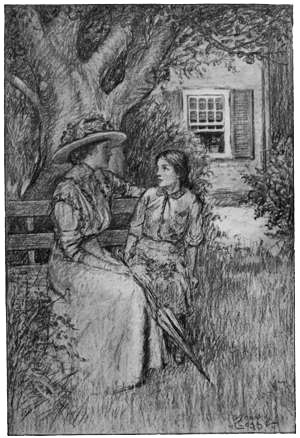
Dil sat on a seat built around a great tree, and
watched them. She was like one in a dream,
quite apart from them. There is a delightful,
unquestioning freemasonry among children. The
subtle sign is given in a word or look or smile,
and they are all kin. But it had been so long
since Dil was a child, that she had forgotten
the language.
She was not unhappy nor solitary. She was
simply beyond playing, far from boisterous mirth.
She had been doing a woman’s work so long, and
childhood for the poor is ever a brief season.
Two or three girls shyly asked her to play
“tag.” She gently shook her head. Then a
long-ago sound caught her attention.
Two little girls were holding their clasped
hands up as high as they could stretch. A small
242
procession passed, each girl holding to the skirt
of the other, and singing:—
“Open the gates as high as the sky,
And let King George and his men go by.
Needle’s eye as I pass by,
Awaiting to go through;
Many a lass I have let pass,
And now I have caught you.”
Down came the arms of the “gates” over the
head of the girl just under them. There was a
shriek and a giggle. Then the one who was
caught had to be a “gate,” and so it went on.
Dil looked, fascinated with a kind of remembered
terror. It seemed as if she must have
heard that in another world, it was so long, long
ago. Before Bess was “hurted,” when Dan was
a chubby baby, she had them both out, caring
for them. At least, Dan was in the corner of the
stoop, and Bess was tossing a ball for his amusement.
A group of girls were playing this very
game. The arms came down and took Dilsey
Quinn prisoner, and all laughed because she had
been so quick to evade them.
Something else—her mother’s heavy hand that
dragged Dil out of the ring. The girls scattered,
afraid of the tall, strong virago. Dil picked up
the baby and took Bess by the hand. They were
243
not living in Barker’s Court then. She shuddered,
for she knew what awaited her. She should have
been in the house, getting supper, to be sure.
She had not meant to play so long, and even then
she so seldom played.
Poor Dil! For a fortnight or so she carried
the marks on her body.
“I’ll tache ye to be wastin’ of yer time foolin’
wid sich,” said her mother.
Then Bess was “hurted,” and her mother ill in
bed for weeks. They were warned out of the
house, and for some time it was hard lines for
them all. Dil never played any more. Childhood
was at an end for her.
And when she heard the merry voices here, a
cold, terrible shiver came over her with the old
memories. Was it softened by the thought that
Bess could run about then? But even little
Bess had sometimes been cruelly beaten. After
that—was there a strange comfort that had never
come before, that Bess’s accident had saved her
many an unreasonable punishment? For Mrs.
Quinn had let the poor little sufferer pretty much
alone. Dil had managed to stand between, and
take the blows and ill usage.
Does God note all the vicarious suffering in the
world, and write it in the book of remembrance?
Dil turned her head away. Another party were
244
playing “Ring a round a rosy.” And a group on
the grass were being inducted into the mystery of
“Jacks.” She wondered a little where her mother
was. She did not want to see her, but she hoped
matters were better with her. Surely she need
not work so hard. And oh, if she would not
drink gin! But Dil had noted the fact that most
women did as they grew older.
Miss Lawrence came out presently with a
bright cheery word for them all.
“You’re not playing,” she said to Dil. “You
must run about and have some fun, and get some
color in your cheeks. And you must not sit and
brood over your hard life. That is all passed, and
we hope the good Father has something better
in store. And you must be friendly with the
others.”
“Yes’m,” answered Dil, with soft pathos.
“Only I’d rather sit here an’ look on.”
“Don’t get homesick after your boys,” and the
lady’s smile went to Dil’s heart. “You’ll feel less
strange to-morrow. I want this outing to be of
real benefit to you. I’m going down to the city
now, and will see Mrs. Wilson. When I come
again I’ll bring you some word from the boys. I
am sure everything will be done for your comfort.”
“Yes’m,” Dil answered meekly, but with an
uplifted smile.
245
Several little girls ran and kissed her a rapturous
good-by. When Dil saw her go out of the
gate she felt strangely alone. She wanted to fly
home to the boys, to get their supper, to listen
to their merry jests and adventures, to see their
bright eyes gleam, and hear the glad laughter.
She felt so rested. Oh, if she had not promised
Patsey to stay a whole long week. And one day
was not yet gone.
She espied a vacant hammock, and stole lightly
out from her leafy covert to take possession. It
was odd, but the little hump-backed girl seemed
a centre of attraction. She said so many droll,
amusing things. She was pert and audacious to
be sure. She could talk broken Dutch and the
broadest Irish, and sing all the street songs. The
children were positively fascinated with her. A
wonder came to Dil as to how it would feel to
be so enthusiastically admired.
She lay there swinging to and fro until the supper
bell rang long and loud. One of the attendants
came and talked with her while the children
were tripping in from the woods. Something in
her appearance and gentle manner reminded Dil
of the hospital nurse.
There was a good deal of singing in the evening,
but they all went to bed early. How wonderfully
quiet it was! No dogs barking, no marauding cats
246
wauling dismally on back fences, no rattle and whiz
of “L” cars, no clatter of heavy wagons. And
oh, the wonderful sweetness in the air! If Dil
had ever achieved Bible reading, she would have
thought of “songs in the night” and a “holy solemnity,”
but she could feel the things unutterable.
The window was next to her bed. She sat up
and watched the ships of fleece go drifting by.
How the great golden stars twinkled! Were they
worlds? and did people live in them? They made
a mysterious melody; and though she had not
heard of the stars singing for joy, she felt it in
every pulse with a sweet, solemn thrill of rapture.
Was that heaven back of the shining stars?
And oh! would she and Bess and John Travis be
together there? For he would help her to call
back Bess, as she came on Sunday. It was
only a little while to wait now. She felt the
assurance—for the poor ignorant little girl had
translated St. Paul’s sublime, “By faith.”
The moon silvered the tree-tops, and presently
sent one slant ray across the bed. Dil laid her
hands in it with a trance of ecstasy. The delicious
state of quietude seemed to make her a part
of all lovely, heavenly things. It was the “land
of pure delight” that John Travis sang about.
A whole line came back to her,—
“And pleasures banish pain.”
Dilsey Quinn had attained to the spiritual
pleasures. Pain was not, could not be again.
She was not a bit sleepy. She watched the
moon dropping down and down. All the insects
had stopped. A soft darkness seemed spread over
everything, and by dozens the stars went out.
Ah, how wonderful it all was! If people could
only have chances to know!
“My child,” said Miss Mary at the breakfast
table, “you are not eating anything! Don’t you
like porridge, and this nice milk?”
“Yes, it’s so good,” replied Dil gratefully.
“An’ the milk seems almost as if ’twas full of
roses, it’s so sweet. But I can’t get hungry as I
used, an’ when I eat just a little I seem all filled
up.”
“Would you like bread better? And some nice
creamed potatoes?”
“I don’t want nothin’ more.” Dil looked up
with a soft light in her eyes. “Mebbe by noon
I’ll be hungry—I most know I will.”
“Yes, I hope so.”
It was such a long morning to Dil, so hard to
sit round and do nothing. If there had been a
baby to tend, or a room to tidy. She would have
been glad to go to the kitchen and help prepare
the vegetables. She was so used to work that
she could not feel at home in idleness.
248
She went over to the woods with the children
to please Miss Mary, who suggested it so gently.
But some feeling—the long disuse of childhood—held
her aloof. She could not join in their plays,
but it was a pleasure to watch them. And how
wonderful the woods were! The soft grasses
with feathery heads, the mosses, some of them
with tiny red blossoms not as large as a pin’s
head. There were a few wild flowers left, and
long trails of clematis wandering about; shining
bitter-sweet, green chestnut burrs in clusters, the
long, fringy blossoms in yellow brown still holding
on to some of them. There were bunches of little
fox grapes, too bitter and sour for even children
to eat.
She sat down on a stone and almost held her
breath. It was the real, every-day country, not
Central Park. The birds sang at their own sweet
will, and made swift dazzles in the sunshine as
they flew from tree to tree. Could heaven be
any better? But there was no pain nor sickness
nor weariness in heaven. And she felt so strangely
tired at some moments.
She used her utmost endeavors to eat some
dinner. It had such an appetizing flavor. The
little girl next to her, who had swallowed her supper
so quickly last night, eyed it longingly.
“You can have the potato and the meat,” Dil
249
whispered softly. That travelled down red lane,
and still seemed to leave a hollow behind. It was
like the hungry boys at home, and she smiled.
She sat under the tree again, and Miss Mary
tried to persuade her to go and play, but she was
gently obstinate.
“Miss Lawrence asked me specially to look
after her,” she said to another of the attendants.
“She looks like a little ghost; but whether she
is really ill, or only dead tired out, I can’t decide.
It’s so natural for children to want to play, but
she doesn’t seem to care to do anything but mope.
Yet she speaks up so cheerful.”
“Poor children! How hard some of their lives
are,” and her companion sighed.
Dil’s supper tasted good; and she was so sorry
she couldn’t eat more, as she glanced up and
caught Miss Mary’s eye.
“I’m ever so much better,” she said in her soft,
bright manner. “I’m glad; for the boys wanted
me to get well an’ fat, an’ have red cheeks. I’ll
try my best, you’re all so good. An’ it’s such a
beautiful place. I wonder what made—some one—think
’bout the little mothers? But the babies
ought to be here too.”
“That wouldn’t give the little mothers much
rest. Are there many babies in your family?”
“There ain’t any, but—but some that come in.
Other people’s babies.”
250
“And does your mother keep a nursery?”
“I ain’t got any mother now. I took the
babies ’cause I liked them.”
“But where do you live?”
“With my brother an’—an’ the boys. I keep
house.”
How unchildishly reticent she seemed. And
most of the children were ready to tell everything.
The little household was called in for their
evening singing.