One will find Lyndhurst in New Forest a
pleasant place for a day’s rest after returning from
the Isle of Wight to the mainland. Especially is
this so if it be early in the summer before the more
crowded season comes on. The town will be fairly
quiet then and the Crown Inn has an air of solid
comfort that almost takes it out of the class of resort
hotels. Its spacious gardens to the rear afford a
sylvan retreat that is an agreeable variation from an
almost continual life on the open road. Lyndhurst,
it is true, is no longer the retired village of half a
century ago, when Leighton and Millais came here
to get away from busy London and to pursue their
sketching without interruption. The rather ugly red
brick church just over the way from the Crown evidences
Lyndhurst’s modernity, though its distressing
newness may be momentarily forgotten in contemplation
of Leighton’s great altar piece, illustrating
the story of the ten virgins.
One may care little about William Rufus, who
was so fond of hunting in New Forest and who,
while engaged in his favorite pastime, was killed by
a forester’s arrow; yet a pilgrimage to the spot
where he is said to have fallen is worth while—not
merely to see the iron casting which encases the old
stone, but to view one of the prettiest glades in the
forest. We came early in the day, which is the time
to come to avoid the crowds of trippers who flock
here in season, and we had undivided possession of
the scene of sylvan beauty. A shaded byway leads
to the main road, which soon brings us to Romsey.
There is little to detain the wayfarer in Romsey
aside from the abbey church, whose high roof
reaches almost to the top of its central tower—in
fact, the noble bulk of the church rises over the
town, completely dwarfing the low buildings that
crowd closely around it. One can but admire its
great size and perfect proportions, and though there
may be incongruous details, these will hardly be
noticed by the layman.
The interior is almost pure Norman—massive
pillars supporting the great rounded arches. The
height and size of the columns give the church an
impressiveness that is hardly surpassed by any other
in the Kingdom, and after Durham, it easily ranks
as the finest example of Norman architecture extant.
It dates mainly from the twelfth century, and
a Saxon church previously occupied the site, slight
remains of this being incorporated into the present
building. The most remarkable Saxon relic is a
life-size image of Christ upon the cross, of a type
not found later than the eleventh century.
There is often a gruesome side to the old English
church—a bit of human skin flayed from a living
church robber is shown at Gloucester, frightful effigies
representing decayed corpses at Canterbury
and Sherborne, and at Romsey a broad plait of
human hair, found in recent restoration work. It
was in a leaden casket and even the bones had
mouldered to dust, but the soft brown hair was almost
unaltered, and it is thought to have adorned
the head of some Roman maiden, for the casket
showed traces of Roman work. The old caretaker
has reserved this weird little relic for the last of his
wonders—we leave the abbey and pass out into
the sunshine of the perfect summer day. We shall
not soon forget Romsey Abbey Church and we
cast more than one backward glance as its giant
bulk recedes in the distance.
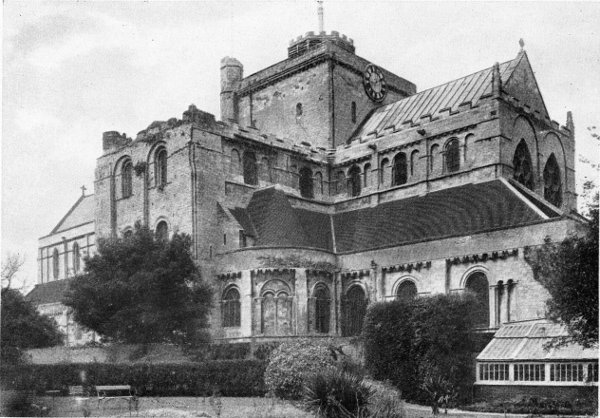
ABBEY CHURCH, ROMSEY.
Surely Twyford, a few miles south of Winchester,
has quite outlived any claim to its one-time
title of “Queen of Hampshire villages.” It has paid
the price of its popularity; modern brick buildings
crowd upon its creeper-clad cottages or have superseded
them altogether. Its church has been restored
to the point of newness, and its yew tree, locally
reputed to be the largest in England, is easily surpassed
by the one at Selborne. Still, Twyford is
not without an especial interest to American visitors.
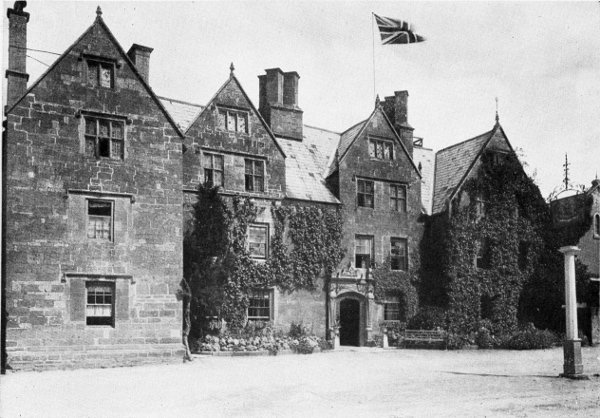
Here stands the Elizabethan mansion where Benjamin
Franklin penned his autobiography while a
guest of the vicar of St. Asaphs. The rambling old
house with a fine stretch of lawn in front of it may
be plainly seen from the road.
No matter how frequently the wanderer may
pause in Winchester, the attraction of the ancient
capital can never be outworn. One might spend a
day among the college buildings, whose rough flint
walls and slate roofs, sagging but little beneath the
weight of years, stand much the same as when the
builder finished them six hundred years ago. Nor
should St. Cross and its quaint brotherhood, one
of those strange medieval charities, be forgotten. A
great quadrangle of buildings and an elaborate
church, all for “thirteen poor men decayed and past
their strength,” seems a great means for a small
achievement. Much has fallen into disuse, but the
church is still in good condition and in many respects
a remarkable piece of architecture. But after all,
Winchester’s greatest charm is not in her college or
her cathedral, but in her old-world streets and odd
corners. Nor should one forget the shops in which
antiques of merit in furniture, books and other articles
may be found.
A broad easy road leads from Winchester
through Alton to Jane Austen’s Chawton, from
whence a secluded byway brings us to Selborne, a
nook that every tourist knows. But Selborne, nestling
beneath its hills, its thatched cottages and weather-worn
buildings stretching along a wide grass-grown
street, has no hint of the resort town. There
are other villages in the Hampshire and Surrey hills
that may match it, but none of them had a Gilbert
White to give it immortality.
The street was quite deserted on the drowsy
summer afternoon when we checked our car under
the great tree beneath which the village worthys congregate
in Selborne. A shopkeeper pointed out
the Wakes, once White’s vicarage, which a modern
owner has extended into a large rambling house,
probably bearing little resemblance to the modest
home of the curate of Selborne. Still, it incorporates
his cottage, though red brick and tile have displaced
the half-timber gables and thatched roof.
But his church is not much altered and the giant
yew, the largest we saw in England, is still standing,
hale and green. Its circumference measured twenty-three
feet in White’s time, and he declared that its
years must be at least coeval with Christianity. Its
girth at present exceeds twenty-five feet. One cannot
stand beneath it without being impressed with its
hoary antiquity, and the great events that crowd
the procession of years which have passed over the
old tree quite overwhelm one.
Indeed, it must have stood here when the
Romans ruled in Britain; it was sturdy and green
when the Conqueror came a thousand summers
past, and it looks today as if it well might weather
the storms of a third millennium. Such historic trees
have almost a human personality; and, fortunately,
they are carefully guarded by an enlightened public
sentiment in England.
The day is a quiet one in Selborne; we have
the yew tree and church all to ourselves. We wander
about the churchyard and with difficulty locate
the unpretentious headstone with the almost illegible
initials, “G. W.”—a simple memorial, indeed—though
inside the church there is an appropriate
tablet to the memory of the well beloved
naturalist. One can easily see how he could lead
in Selborne the simple studious life reflected in his
works. Verily, we need a revival of his plain common
sense today when the fiction of the nature-faker
bids fair to supersede the facts of natural history.
From Selborne it is but a step across the border
into the downs of Sussex—“Green Sussex, fading
into blue,” as the poet so aptly puts it. The low
sun strikes along the rough hills as we enter Midhurst,
nestling in a nook in the downs and reached
by rather difficult roads. It is a quiet town with
an air of thorough self-contentment; a town of
weather-beaten houses with over-hanging timbered
gables, sagging tile roofs and diamond-paned casements;
one long wide street sweeps through it with
narrow crooked lanes branching to either side—an
unspoiled old-country town, as yet quite undiscovered
by the globe-trotters.
And yet Midhurst is not without historic importance,
having been a place of considerable size
at the time of the Conquest. The site of its strong
castle which once stood on the banks of the pretty
little river, Rother, is now marked only by a grass-covered
mound; but it was once the home of a
powerful Norman family, the Bohuns, who in 1547
entertained King Edward VI. in great splendor.
Nor is Midhurst wanting in associations with famous
men, for Sir Charles Lyell, the great geologist,
and Richard Cobden, the “Father of English Free
Trade,” received their early education in the ancient
grammar school which may yet be seen.
But the romance of Midhurst is in Cowdray
Park, the estate which adjoins the town. What a
pity it is that the mansion and the story did not
seize the fancy of Walter Scott—who alone could
have done it justice. We entered the park and
drove through an avenue of giant chestnuts directly
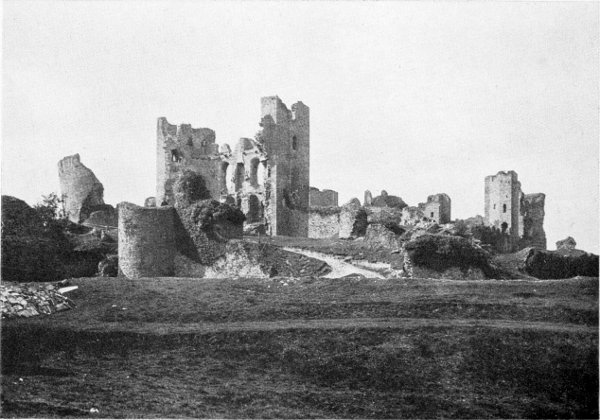
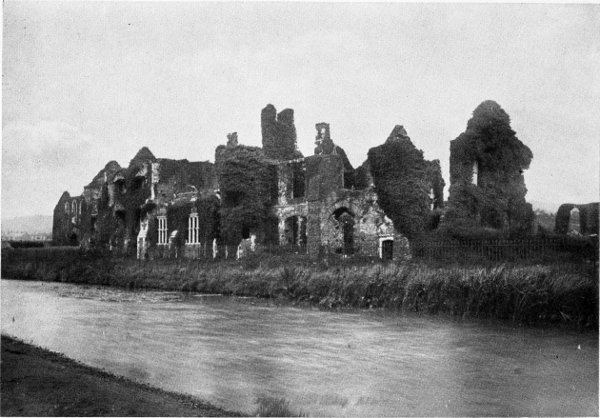
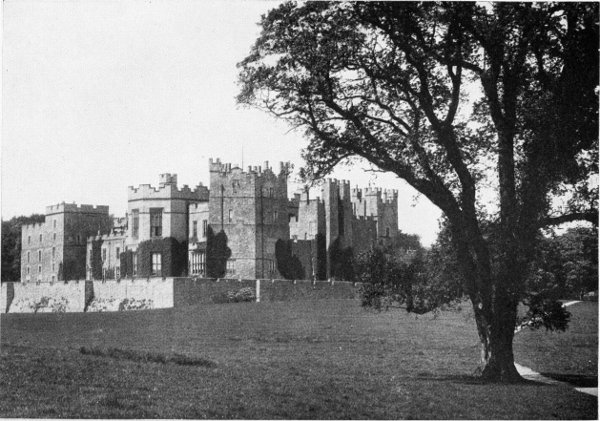
to the shattered palace. And what a glorious ruin
it is, with its immense stone-mullioned windows, its
great grouped chimneys, and sculptured mantels and
bosses that cling to the wall here and there. Though
roofless, the walls are almost entire, and over them
the ivy flings its dark mantle and falls in heavy
masses from the broken battlements. One does not
care to analyze the ruin into its component parts—what
did we care for hall and chapel and chamber?
It is the impression that came to us as we wandered
through it in the fading light that lingers with us
now. What a memory it is of darkened halls, of
great empty windows, through which the light falls
mellow and ghostly, and of weird traditions which
the old crone who keeps the key constantly droned
in our ears.
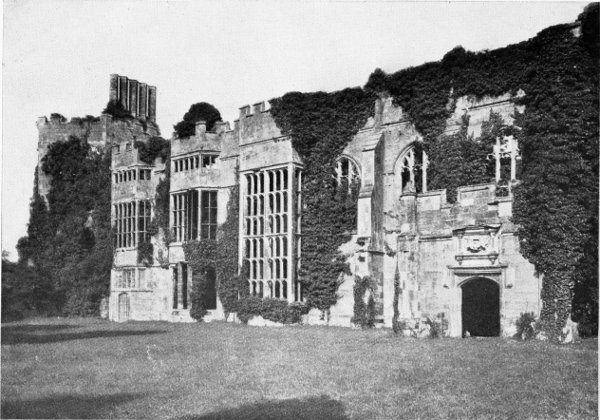
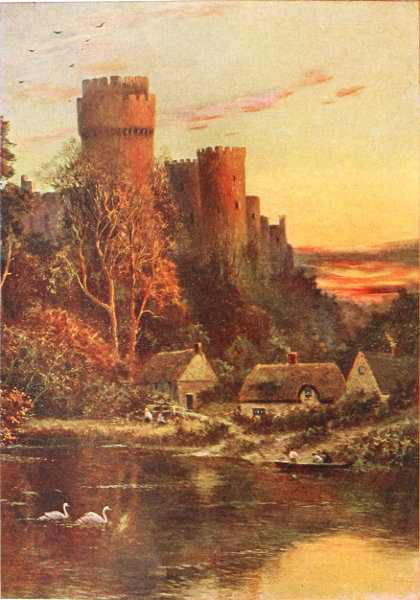
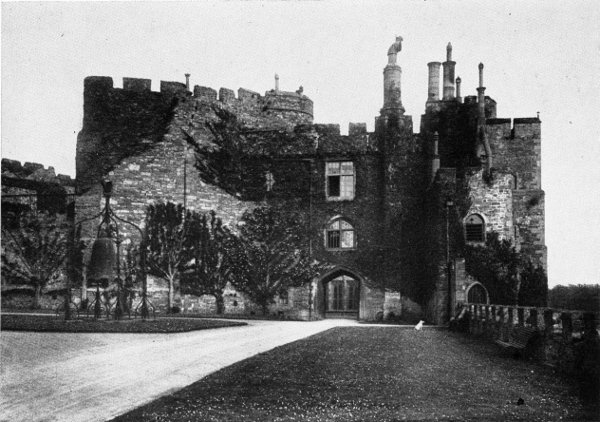
COWDRAY CASTLE, NEAR MIDHURST.
The curse of Cowdray has made more than
one listener shudder and turn pale and even those
who listen as we do in benevolent scepticism can
only say, “Strange—strange!” For the lands of
Cowdray were rent from the monkish owners by the
ruthless Henry and were given into the possession
of the first viscount of Montague, who built the
splendid palace, one of the costliest and most imposing
in the Kingdom. It was in no sense a fortified
castle, but a great baronial residence, standing
on low-lying grounds with no attempt at strength of
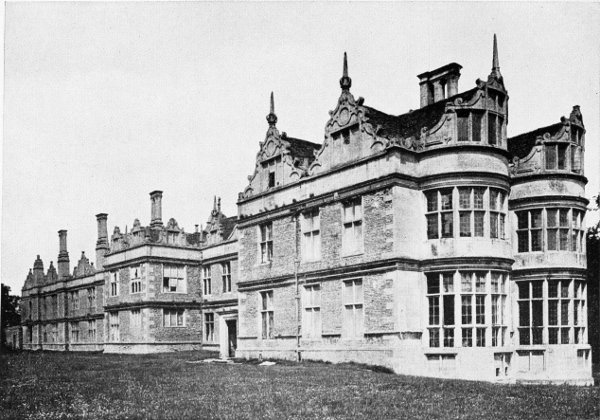
position. In some respects the palace recalls Kirby
Hall, though here ruin is more complete.
When the last monkish habitant departed
from the lands of Cowdray, he left his curse upon
them: that the line of the Montagues should perish
by fire and water. It was long in being fulfilled,
but in 1793 the palace was destroyed by fire
and the last Montague was drowned in a foolhardy
attempt to swim across the Rhine above the Falls
of Schoffhausen. He must have perished without
knowing the fate of his ancestral home. With the
palace were burned many works of art and antiquities
of inestimable value, among the latter the
roll of Battle Abbey and the coronation robes and
sword of William the Conqueror. The estate descended
to the sister of Lord Montague, who, dreading
the curse, is said to have guarded her two sons
with the greatest care, even filling the fish ponds near
her home and keeping the youths jealously away
from sea and river. Yet one day they escaped from
the care of their attendants and were both drowned
in the sea at Bognor. The broken-hearted mother
sold Cowdray to the Earl of Egremont, who had
no issue to inherit it. But the curse seems to cling
to it still—after our visit a wealthy London contractor
purchased the estate and began a thorough
repair of the modern house (not the ruined palace),
but while the work was in progress the mansion
caught fire and was burned to the ground.
Darkness overtakes us as we sweep along the
hills toward Worthing, where we arrive by lamplight.
Morning reveals a quiet and somewhat secluded
watering-town, patronized by people who
seek to get away from the ceremony and expense
of such places as Brighton and Bournemouth. Its
hotels are unpretentious, comfortable and accommodating—qualities
not so common to resort inns as
to go without notice. But Worthing is modern;
there is little to detain one on such a pilgrimage as
our own. We follow the broad white road which
climbs steadily northward from the sea to the distant
hills and winds among them to the dreary hamlet
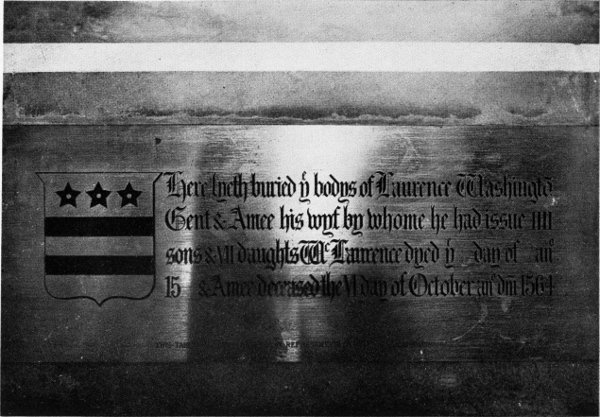
of Washington. The name, so familiar to us,
bears no reference to the distinguished family. It
is of old Saxon derivation—Wasa-inga-tun (town
of the sons of Wasa).
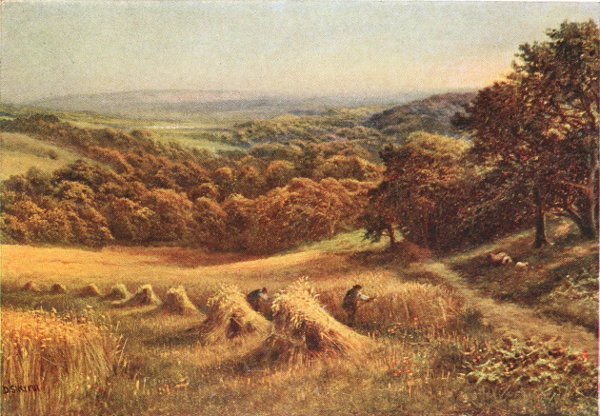
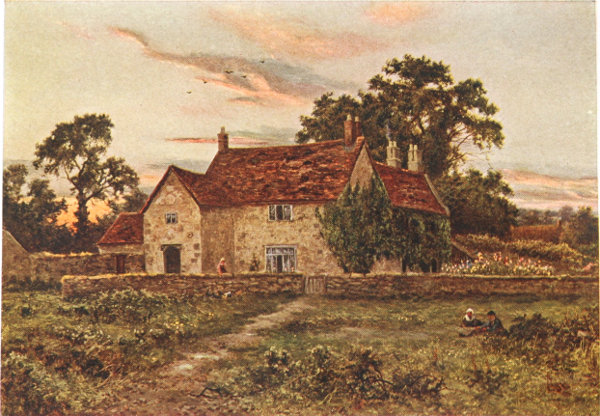
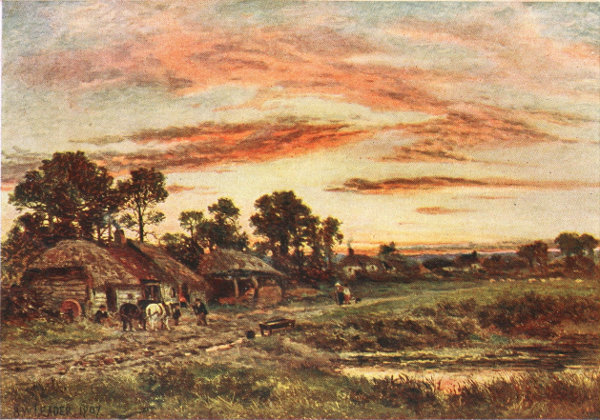
A SUSSEX HARVEST FIELD.
From the Original Painting by Daniel Sherrin.
Near at hand is Warminghurst, once the Sussex
home of William Penn, who bought the great
house in 1676. One of his children died here and is
buried in Coolham churchyard close by. Penn was
wont to attend services at the meeting house not far
away, which was built of timbers taken from one of
his ships. It goes locally by the strange designation
of “The Blue Idol”—just why, no one seemed to
know—and we wandered long in unmarked byroads
ere we found it. It is a mile and a half from
Coolham, and one follows for a mile a narrow lane
branching from the Billingshurst road.
The simple old caretaker lives in a modern addition
to the chapel and tills the plot of ground in
connection with it. The chapel is a low brick-and-timber
building whose interior is the plainest imaginable;
a half dozen high-backed benches, a
platform pulpit without a stand, and a few books
made up its furnishings. As at Jordans, the women
sat during worship in a gallery which could be cut
off by a sliding partition in case of interruption by
persecutors. The old law forbade the assembling
of women in the Quaker meetings, but from the
gallery they could participate in the services, yet
could instantly be shut out of the room if the king’s
officers should arrive. Outside, the chapel is surrounded
by greensward and tall trees, and the old
man was mowing the grass in the tiny burying-ground.
Services are still held at intervals, as they
have been for the past two centuries or more. Probably
the spot was chosen on account of its very
retirement, since when the chapel was built it was
a criminal offense for the Quakers to assemble in
any place of worship. The chapel is unaltered and
seems quite as remote and lonely as it must have
been in Penn’s time; and the spirit of that old day
comes very near as one stands in the tiny room where
the founder of the great American Commonwealth
was wont to worship according to his conscience,
coming hither from Warminghurst in his heavy ox-wagon.
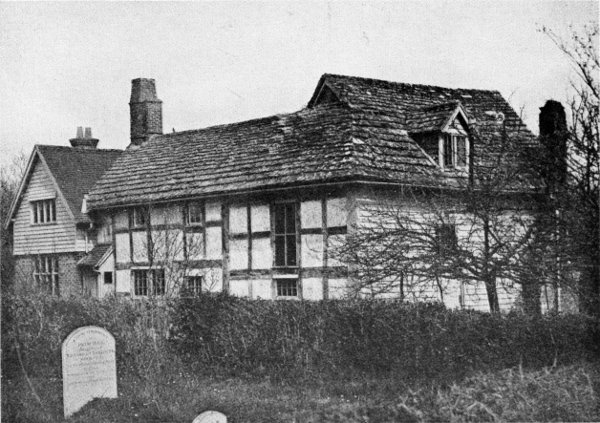
THE “BLUE IDOL,” PENN’S MEETING HOUSE, SUSSEX.
We now begin an uninterrupted run to the
east through Mid-Sussex over an unsurpassed road
to Cuckfield, Hayward’s Heath, and Uckfield. We
continue on the London and Eastbourne road to
Hailsham, from whence a digression of three or four
miles brings us to the ruins of Herstmonceux Castle.
Though styled a castle, it was really a great castellated
country mansion, never intended as a defensive
fortress. It reminds one in a certain way of Cowdray,
though it lacks much of the beauty and grace
of the Midhurst palace, and its conversion by its
owner into a picnic ground also does much to detract.
The story of its destruction is peculiar. It was
deliberately dismantled and partially torn down in
1777 by its owner, who used the materials in erecting
a smaller house, now called Herstmonceux Place,
which would be less expensive to maintain. It is interesting
to know that Wyatt, the architect who
dealt so barbarously with Salisbury and Hereford
Cathedrals, was the advisor of this wanton destruction.
The last descendant of the original owner died
in 1662, and since then the estate has changed hands
many times. It is now one of the most popular tripper
resorts in Sussex and during the summer months
the daily visitors number hundreds.
It is not our wont to trouble ourselves much
with the sober history of such places, but there is
one melancholy incident of the early days of the
palace which has weird interest for the wanderer
who stands amidst the shattered grandeur, and which
we may best relate in the words of an English historian:
“Lord Dacre, of Herstmonceux, a young nobleman
of high spirit and promise, not more than twenty-four
years old, was tempted by his own folly, or
that of his friends, to join a party to kill deer in the
park of an unpopular neighbor. The excitement
of lawless adventure was probably the chief or only
inducement for the expedition; but the party were
seen by the foresters; a fray ensued, in which one of
the latter was mortally wounded and died two days
after.
“Had Lord Dacre been an ordinary offender
he would have been disposed of summarily. Both
he and his friends happened to be general favorites.
The Privy Council hesitated long before they resolved
on a prosecution and at last it is likely they
were assisted by a resolution from the King.
“‘I found all the Lords at the Star Chamber,’
Sir William Paget wrote to Wriothesley, ‘assembled
for a conference touching Lord Dacre’s case. They
had with them present the Chief Justice with others
of the King’s learned council, and albeit I was
excluded, yet they spoke so loud, some of them,
that I might hear them notwithstanding two doors
shut between us. Among the rest that could not
agree to wilful murder, the Lord Cobham, as I took
him by his voice, was very vehement and stiff.’
They adjourned at last to the King’s Bench. The
Lord Chancellor was appointed High Steward and
the prisoner was brought up to the bar. He pleaded
‘not guilty,’ he said that he intended no harm, he
was very sorry for the death of the forester, but it
had been caused in an accidental struggle; and
‘surely,’ said Paget, who was president, ‘it was a
pitiful sight to see a young man brought by his own
folly into so miserable a state.’ The lords, therefore,
as it seems they had determined among themselves,
persuaded him to withdraw his plea and submit to
the King’s clemency. He consented; and they repaired
immediately to the Court to intercede for his
pardon. Eight persons in all were implicated—Lord
Dacre and seven companions. The young
nobleman was the chief object of commiseration;
but the King remained true to his principles of equal
justice; the frequency of crimes of violence had required
extraordinary measures of repression; and if
a poor man was to be sent to the gallows for an act
into which he might be tempted by poverty, thoughtlessness
could not be admitted as an adequate excuse
because the offender was a peer. Four out of
the eight were pardoned. For Lord Dacre there
was to the last an uncertainty. He was brought to
the scaffold, when an order arrived to stay the execution,
probably to give time for a last appeal to
Henry. But if it was so the King was inexorable.
Five hours later the sheriff was again directed to
do his duty; and the full penalty was paid.”
Leaving the ruined mansion we drop down to
the seashore, passing Bexhill on the way to Hastings,
which is now a modern city of sixty-five thousand
people, its red-brick, tile-roofed houses rising in terraces
overlooking the sea. Once it was an important
seaport, but here the sea has advanced and wiped
out the harbor, and it is now chiefly known as a
watering-place. A few miles from the town was
fought the Battle of Hastings, which stamped the
name so deeply on English history and marked the
overthrow of the Saxon dynasty. On a precipitous
hill looking far over town and sea stands the
scanty ruin of its castle, whose story is much clouded,
though legend declares it was built by the Conqueror.
Far greater is the attraction of the unspoiled
old towns of Winchelsea and Rye, a few miles
farther on the coast road. A former visit gives them
a familiar look, but we stop an hour in Rye. The
receding sea robbed these towns of their importance
hundreds of years ago, and their daily life is now
quite undisturbed by modern progress. Each occupies
a commanding hill separated by a few miles
of low-lying land. A local writer makes the truest
appeal for Rye when he declares that it gives us
today a presentment of a town of centuries earlier.
“Rye,” he says, “is southern and opulent in coloring.
There is here mellowness, a gracious beauty; one
has the feeling that every house and garden is the
pride and love of its owner, and indeed this impression
is a true one, for it is the characteristic of Rye
to inspire the loving admiration of its inhabitants,
whether native-born or drawn thither in later life.”
Rye has a magnificent church, the largest in
Sussex, which overshadows the town from the very
crest of the hill. A very unusual church it is, with
a low cone-pointed tower and triple roofs lying alongside
each other. At the end of the nave are three
immense stone-mullioned windows, very effective and
imposing, though the glass is modern. Queen Elizabeth
presented to the church the remarkable old
tower clock which has marked time steadily for more
than three hundred years. The pendulum swings
low inside, describing a wide arc only a little above
the preacher’s head.
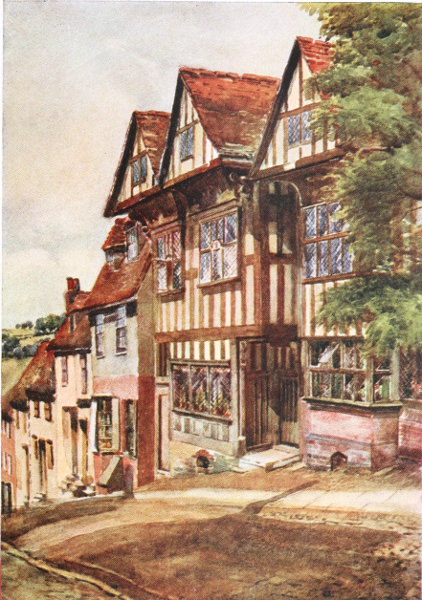
THE HOSPITAL, RYE.
From Original Water Color by Theresa Thorp, A. R. M. S.
Rye itself is quite as interesting as its church,
a place of crooked lanes and odd buildings, among
which the hospital pictured in such a realistic manner
by our artist is one of the most notable. It is
a splendid combination of stucco and timber, with
red tiled gables and diamond-paned lattice windows.
Much else there is in Rye to tempt one to linger,
but the sun is setting and we are off on the fine level
road to Folkestone. For the latter half of the distance
we run along the very edge of the ocean—as
we saw it, fifteen miles of shimmering twilight
water. Those who are attracted by the gruesome
will pause at the old church in Hythe to see the
strange collection of human remains, thousands of
skulls and bones, that are ranged on shelves or piled
in heaps on the floor in the crypt. Whence these
ghastly relics came, antiquarians dispute; but local
tradition has it that a great battle was fought near
Hythe, between the Britons and Danes, and these
bones are the remains of the slain. Be that as it may,
one does not care to linger—a mere glance at such
a charnel house is quite sufficient.
Folkestone may well contest with Brighton,
Bournemouth and Portsmouth for first honors among
English watering-places. We have seen nearly all
of them and we should be inclined, in some particulars,
to give the honors to Folkestone; but let those
who enjoy such places be the judges. Anyway,
there are few statelier hotels in England than those
on the east cliff and few that occupy a more magnificent
site. At the Grand they are more willing
to permit you to take ease than at most English
hotels of its class. You are not required under penalty
to be on hand for dinner at a certain hour, announced
usually by a strident gong, and to make the
pretense of swallowing an almost uneatable table d’hote
concoction pushed along by a vigilant waiter
bent on making all possible speed. This hotel and
many others stand on the east cliff several hundred
feet above the sea, but one may reach the shore by
a lift, or if inclined to exercise, by a steep winding
pathway. On moderately clear days, the white line
of the French coast may be seen from the hotel.
Very like to Folkstone is Dover, but seven miles
farther up the coast, and thither we proceed over a
steep road closely following the sea. Dover was
chief of the cinque ports of olden days and its small
bay still affords shelter for shipping, including ocean-going
steamers. But the first thing that catches the
pilgrim’s eye when he comes into Dover is the splendidly
preserved, or rather restored, castle, which
stands in sullen inaccessibility on the clifflike hill
overlooking the city. We make the stiff climb up
to the castle gateway, only to be halted by the
guard with the information that we are an hour early.
We have had such experiences before and we suggest
that no possible harm can be done by admitting
us at once.
“I really cawn’t do it, sir,” said the guard.
“Some of the guards got careless in letting people
in before hours and the Colonel says he will court-martial
the next one who does it.”
Of course this silences our importunity and we
engage our soldier friend in conversation. Why
did he enter the army?—Because a common man has
no chance in England; he was going to the dogs and
the army seemed the best opportunity open to him.
He had enlisted three years ago and it had made a
man of him, to use his own words. He rather looked
it, too—a husky young fellow with a fairly good face.
The castle is strongly fortified and garrisoned
by a regiment of soldiers. The interior of the court
is largely occupied by barrack buildings, and of the
ancient castle the keep is the most important portion
left. It was built to withstand the ages, for its walls
are twenty-three feet in thickness and it rises to a
height of nearly one hundred feet. Within it is a
well three hundred feet deep, supposed to have been
sunk by the Saxon king, Harold. The primitive
chapel dates from Norman times. There are also
remains of the foundation of the lighthouse that occupied
the commanding height, long
“ere the tanner’s daughter’s son
From Harold’s hand his realm had won.”
Dover has other antiquities, among them a
church so old that its origin has been quite forgotten.
Roman brick was used in its construction, probably
by Saxon builders. Over against the town gleams
the white chalk of Shakespeare’s Cliff, so called because
of the reference in King Lear. Queen Elizabeth
visited Dover and vented her wit for rhyming
on its mayor, who, standing on a stool, began,
“Welcome, gracious Queen,”
only to get for his pains,
“O gracious fool,
Get off that stool.”
The eastern Kentish coast, lying nearest to the
continent, once had many towns of importance that
have since dwindled and decayed. Among these
is Sandwich, once second of the cinque ports; but
the coast line receded until it is now two miles away.
The town contains some of the richest bits of medieval
architecture in England. The wall which once
surrounded it may still be traced and one of the
original gateways is intact. We drove through the
narrow crooked lanes that serve as streets in Sandwich,
and could scarce believe the population no
more than three thousand. The low lichen-covered
buildings, with leaning walls and sagging, dull-red
tiles, straggle over enough space for a city of three
or four times the size. There is no touch of newness
anywhere; no note of inharmonious color jars
with the silver grays, grayish greens and brownish
reds that prevail on every hand; no black and white
paint destroys the beauty of the brick and timber
fronts and gables. Most of the houses have but one
story and the streets run with delightful disregard
of straight lines and bid defiance to points of the
compass. The two churches with splendid open-beamed
oak roofs are well in keeping with the spirit
of the surrounding twelfth and thirteenth century
structures. They stand a mute evidence of the one-time
greatness and prosperity of Sandwich. One of
the old houses is pointed out as the stopping-place
of Queen Elizabeth when she was touring the
Kentish coast.
From Sandwich we skim along smooth, level
roads to Ramsgate, Broadstairs and Margate, the
last of the long chain of resort towns of the southeastern
coast stretching from Land’s End to the
Thames River. What an array of them there is:
Penzance, Torquay, Portsmouth, Bournemouth,
Brighton, Eastbourne, Bexhill, Hastings, Folkestone,
Dover, Ramsgate, Broadstairs, Margate, and
a host of lesser lights. We have seen them nearly
all and many more such places on the northern and
western coasts, as well as a number of inland resorts.
It is therefore a phase of England with which we
have become fairly familiar, and the old towns and
isolated ruins seem only the more charming and time-mellowed
by contrast with the crowded and sometimes
gaudy modern resorts. Margate, situated just
at the mouth of the Thames on low-lying grounds,
is one of the most pretentious of all.
A few miles out of Margate we turn from the
main Canterbury road into a byway from which we
enter the lanes through the fields and farmyards.
The country is level and intersected everywhere by
sluggish drains; but the wheatfields, nearly ready
for the harvest, are as fine as we have seen in England.
From afar we catch sight of the twin towers
of the ruined church at Reculver, the object of our
meanderings in the fen-land lanes. We halt in the
tiny hamlet beneath the shadow of the grim sentinels
on the sea-washed headland. The old caretaker
hastens to meet us and is eager to relate the story of
the ruin. Aside from the towers there is nothing but
fragments of the walls; he points out clearly where
portions of a Roman temple were incorporated into
the Saxon church, and also the Saxon work that the
Normans used. One hundred years ago, this remarkable
church was nearly intact; but the rapid
encroachment of the sea upon the brittle rock on
which the structure stands convinced a short-sighted
vicar that it would soon be undermined by the
waves. It was therefore torn down, with the exception
of the towers, and the stone used for a
small church farther inland. The sea is now held
in check by stone and timber riprap and though it
gnaws at the very foot of the ruin, there seems little
chance that it will farther advance. Besides the
church there are the remains of a great Roman
castrum, or fort, at Reculver: a strong wall, several
feet high in places, once enclosed a space of considerable
extent, though a large part has been inundated
by the sea.
One will never weary of Canterbury; come as
often as he may he will always feel a thrill of pleasure
as the great cathedral towers break on his vision.
And indeed there is nothing of the kind in all
Britain finer than these same towers. We reach
the town later than we planned and hasten to the
cathedral, but the guide, wearied with troops of
holiday visitors during the day, tells us we are too
late. We find means, however, to extend our time
and to enlist his willing services; and thus we come
to see every detail of the magnificent church as we
could hardly have done earlier in the day. It has
no place in this chronicle, this
“mother minster vast
That guards Augustine’s rugged throne,”
about which volumes have been written and with
whose history and traditions the guide-books fairly
teem. We have visited it before during a Sunday-morning
service, but its vast dim aisles, its great
crypts, its storied shrines and tombs, and the ivy-clad
ruin of its old monastery, all make a strangely different
impression when viewed in the deepening
shadows of the departing day.
After sunset we wander about the old streets,
where even the more modern buildings conform to
the all-pervading air of antiquity. It is the close of
the Saturday holiday and the main street is packed
with a cheerful crowd of people of all degrees.
Shop-keepers improve the opportunity to sell their
wares and a lively trade is carried on at the open
booths along the walks. One butcher is especially
active in booming business, having a fellow in front
of his place, a “barker,” we would style him in the
States, who bellows in a voice like a foghorn,
“Lovely meat! the same that the king and nobility
heats—lovely meat.” Surely a recommendation
that would shake the resolution of a confirmed vegetarian.
But we soon weary of the glare and noise of the
crowded street. We wander into the crooked
lanes that lead to the nooks and corners about the
cathedral. We catch the towers from different viewpoints;
as they stand, boldly outlined against an
opalescent sky flecked with red-toned clouds, they
form a fit study for the artist—and one of which the
artist has often availed himself. The college court
is full of shadows; how easy it would be to imagine
a cowled figure stealing along in the dusk and passing
from sight in the Norman entrance yonder—than
which there is no choicer bit of medieval architecture
in the Kingdom.
We have the whole of the following day to
reach London; and what a superb day it is, the
very essence of the beauty of English midsummer!
We have been over the Rochester and Maidstone
road before, so we take the narrow and hilly but
marvelously picturesque highway that drops some
fourteen miles straight southward. The country
through which it passes is distinctly rural, with here
and there a grove or a farmhouse. A little to one
side is Petham, a quiet hamlet under gigantic trees,
with a half-timbered inn seemingly out of all proportion
to the possible needs of the place. The
main road running from Hythe, near the coast,
through Ashford to Tunbridge Wells, a distance of
about fifty miles, is one of the finest in the Kingdom.
It runs in broad, sweeping curves through a gently
undulating country, and the grades are seldom
enough to check the motor’s flight. It had lately
been re-surfaced and much of the way oiled or asphalted,
quite eliminating dust. We pass much
charming country, wooded hills, stretches of meadowland,
fields of yellowing grains, and many sleepy villages,
all shimmering in the lucent air of a perfect
summer day. The sky is as blue as one ever sees
it in England, and a few silvery-white clouds drift
lazily across it. It is what the natives call a very
warm day, but it seems only balmy to us.
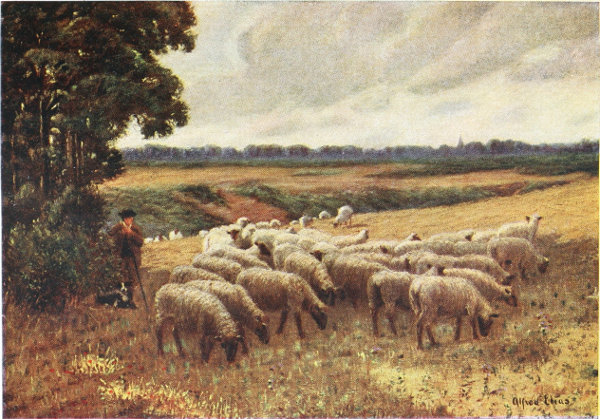
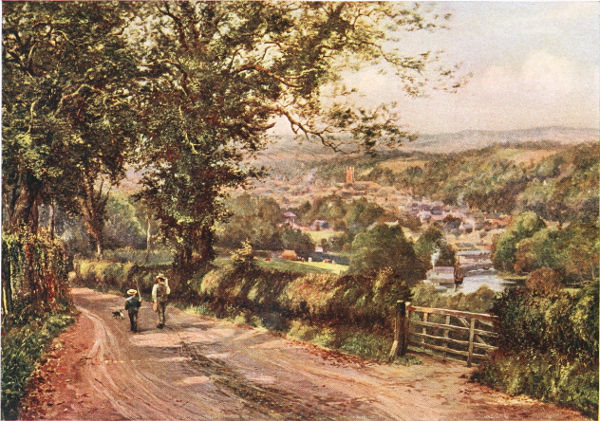
ON THE DOWNS.
From Original Painting by Alfred Elias.
Bethesden, Biddenden and Lamberhurst all
attract our attention. The second has a very quaint
old inn on the market square, with a queer little ivy-covered
tower; but Lamberhurst hardly merits the
extravagant praise given it by William Cobbett in
his “Rural Rides”—“one of the most beautiful
villages that man ever set eyes upon.” Still, it may
have altered somewhat since his time; there are few
red-brick villas among the older cottages. It is, none
the less, a pleasant place, rich with verdure and
bright with flowers, and picturesquely situated on
a gently rising hill. Coming on this road, one gets
the best conception of the really magnificent situation
of Tunbridge Wells, and cannot wonder that
it has gained such popularity. The main part of
the town lies in a depression in the undulating downs,
its villas, houses and streets all set down on a liberal
scale with plenty of room for trees, in whose luxuriant
foliage the place is half hidden. All around
stretches the wavelike succession of the hills, diversified
with forest and bright with heather and gorse.
Thackeray was very fond of Tunbridge Wells and
his enthusiastic words in “Round About Papers”
breathe much of the spirit of the place:
“I stroll over the common and survey the beautiful
purple hills around, twinkling with a thousand
bright villas which have sprung up over this charming
ground since first I saw it. What an admirable
scene of peace and plenty! What a delicious air
breathes over the heath, blows the cloud-shadows
across it, and murmurs through the full-clad trees!
Can the world show a land fairer, richer, more
cheerful?”
We pause at the excellent though rather unpretentious
Grand Hotel for our late luncheon; and as
a final adieu to the pleasant town, drive through
its commons with their strange wind-worn stones,
before setting out Londonward. We pass on into
Sussex as far as Grinstead and there strike the direct
London road through Epsom, where we have a
glimpse of the famous racing downs. The quiet,
staid-looking old town gives no hint of the furor
that possesses it on Derby days. A few miles
farther we enter the outskirts of London.