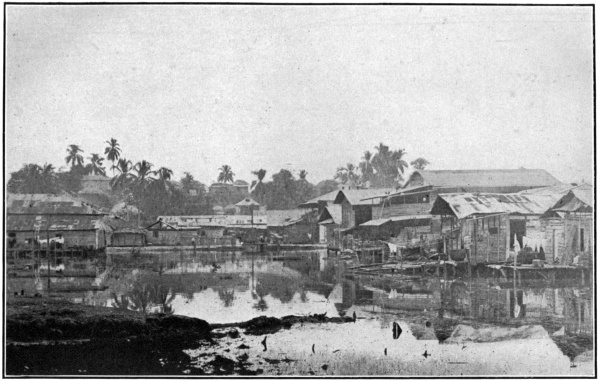
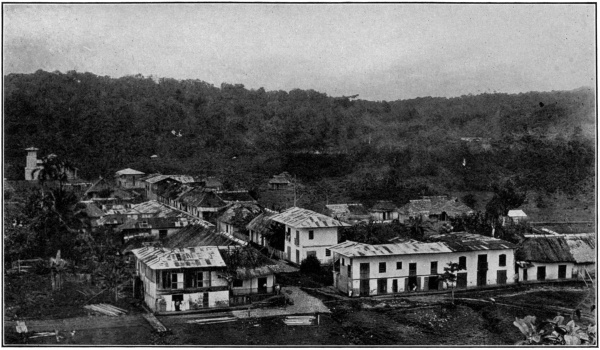
Cochabamba is one of the more important cities of
Bolivia. In size it ranks next to La Paz, although it is
not nearly so modern, and in point of activity it is far in
advance of Sucre. The population is about thirty-five
thousand.
The plain upon which the city is built was at one time
the bottom of a lake, which fact is indicated by its ancient
name of Oropeza, a Quechua word meaning “plain of the
lake.” On account of its high elevation, which is approximately
eight thousand five hundred feet above sea-level,
the region enjoys a mild climate; the average annual temperature
is 66° F. Rain falls in abundance during the
months from November to April; and during the dry
months irrigation is resorted to for providing water to the
fields of alfalfa and grain. The country is naturally of a
decidedly semiarid character.
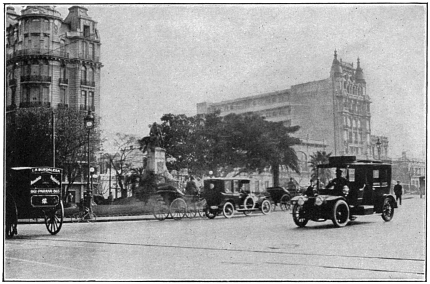
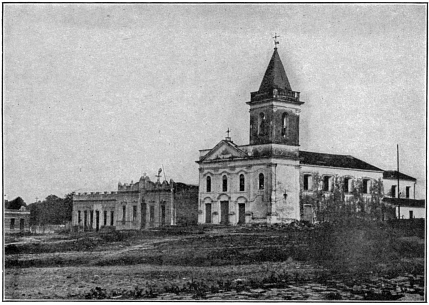
The city boasts a number of fairly modern buildings, although
by far the greater number are of the low adobe
type with thatched or tile roofs; delightful little plazas
filled with tropical trees and shrubbery relieve the monotony
of the rows of white edifices.
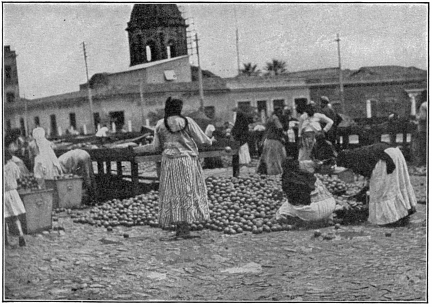
The shops are filled with provisions and dry-goods at
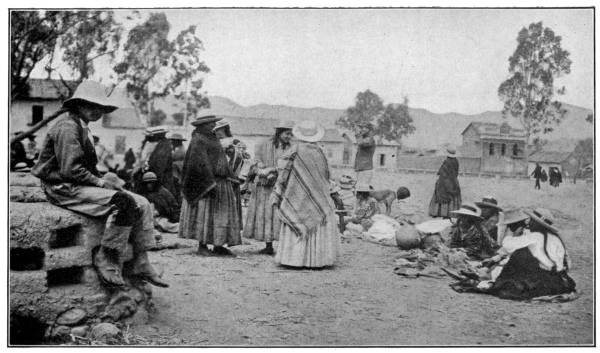
remarkably low prices; the city market is supplied with a
superabundance of produce, flowers, and articles of native
manufacture; the people are courteous and obliging, and
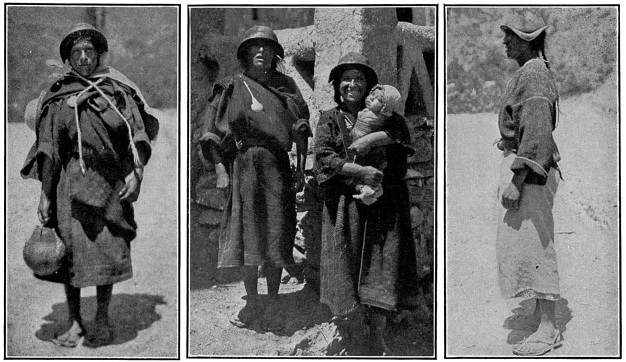
the great numbers of Indians and Cholos give a touch of
gayety and color to the throngs which fill the streets.
Among the city’s institutions deserving of special mention
is the Cochabamba Institute, founded in 1911. The
instructors are nearly all Americans of the type one meets
all too rarely in South America, and who are really doing
a great and noble work in furthering the educational and
moral progress of the country. Several hundred students
of both sexes, from many and remote parts of Bolivia,
attend the literary and business classes of the college, live
under the care and refining influence of its instructors,
and, as I subsequently discovered, introduce into their
homes the desirable and elevating qualities which they
have acquired.
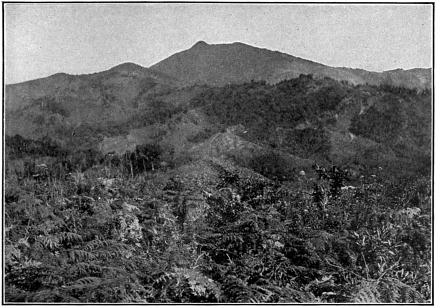
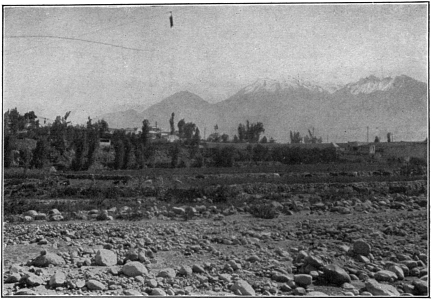
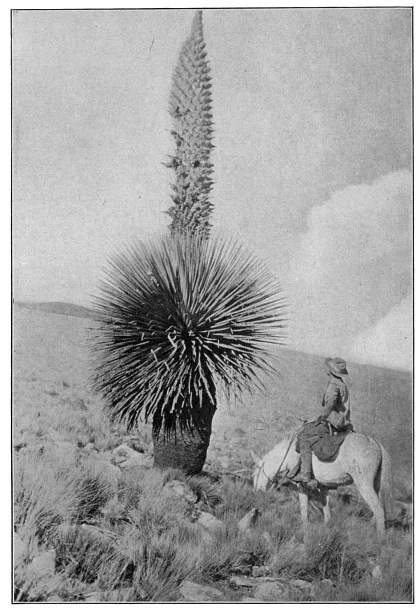
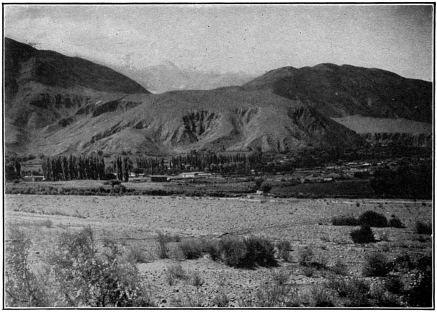
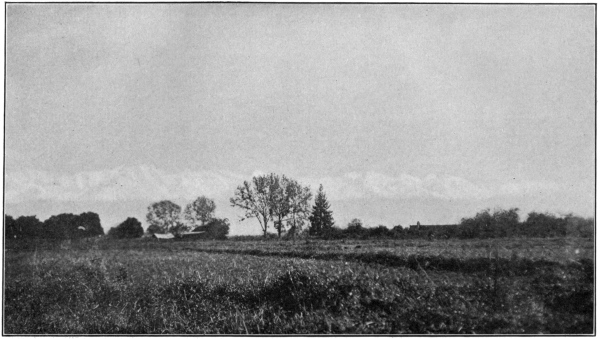
To the northwest towers the Cerro Tunari, a mountain
over fifteen thousand feet high and of imposing appearance.
It rises in majestic proportions above the uneven
summits of the cordillera, in a manner befitting a snow-crowned
monarch of the range.
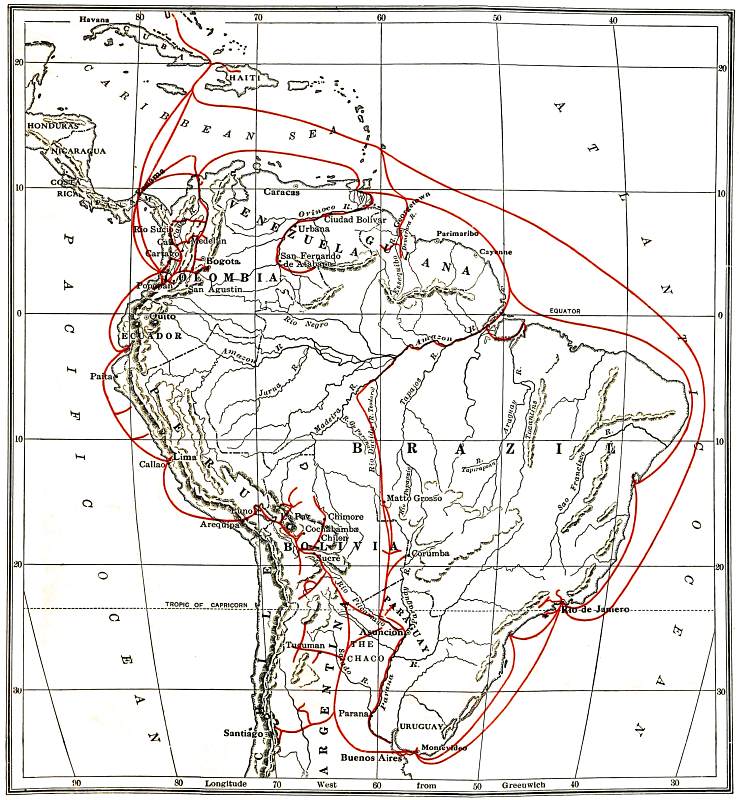
We spent several days in the city, adding to our outfit
and purchasing mules, and then started eastward en route
to the Beni district; it was our intention to go slowly and
stop at places which offered a suitable field for our operations.
Leaving Cochabamba on the afternoon of May 9, 1915,
we rode the fifteen miles to the town of Sacaba, arriving
there at dusk. The intervening country is thickly settled,
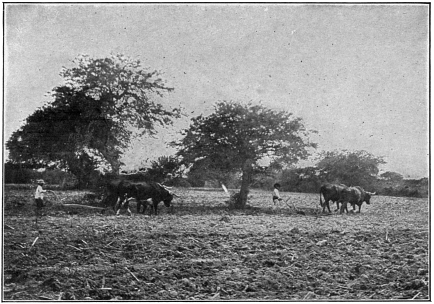
and large areas are irrigated and planted in alfalfa, maize,
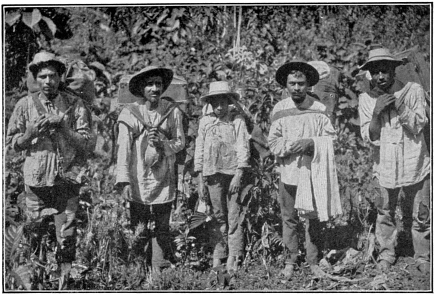
wheat, grapes, and vegetables. Nearly all the inhabitants
are Indians of the Quechua race.
Beyond Sacaba the trail adheres closely to the bed of a
small stream, and ascends at a steep angle. Numerous little
canals carry the water along the mountainside, and the
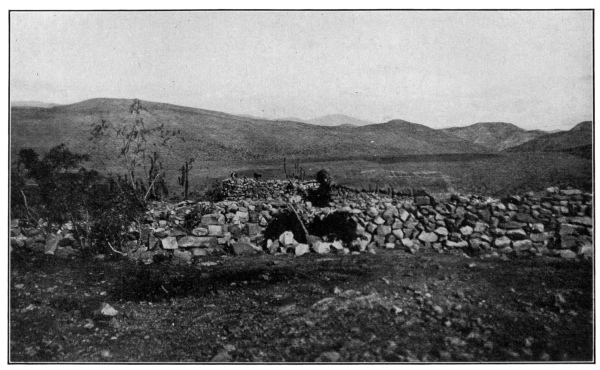
country is dotted with small stone huts surrounded by
carefully cultivated fields; this is made possible by the fact
that the rivulet never dries, but, on the contrary, supplies
a constant stream of water of sufficient volume to irrigate
a large area. The canals have been dug with great precision;
each family uses only as much as required, and at
stated intervals, so there is enough for all.
The trail goes up steadily until an elevation of twelve
thousand feet is reached. As we neared the top a strong
wind sprang up, so that it was difficult to keep one’s place
in the saddle. The mountainside is covered with small,
round rocks of uniform size, such as one would usually
expect to find in a dry river-bed.
Beyond the high summit of the first ridge lies the high
mountain valley in which is located the Quechua village
of Cuchicancha (meaning “pig-pen”). There are several
score of huts scattered about in little groups, and built of
rocks, with thatched roofs. The Indians speak practically
no Spanish, and live in much the same way as they did in
the days of Atahualpa. In order to cultivate the land
they have gathered the rocks which everywhere carpet the
ground into huge piles, and also built fences of them; large
quantities of potatoes, ocas, and avas are grown.
Each family owns a flock of sheep, which apparently
replace the llamas of olden days, although flocks of the latter
animals are still to be seen frequently; also a few pigs
and burros. They have likewise taken to cultivating
wheat, oats, and rye.
We decided to spend a week at Cuchicancha and succeeded
in persuading an old Quechua man to rent us his
hut for that length of time. He spoke not a word of Spanish,
or at least pretended that he knew nothing whatever
of that language, so all conversation had to be carried on
through an interpreter. As our coming was a complete
surprise to him, he asked if he could occupy the habitation
with us for a few nights until he had time to find sleeping-quarters
elsewhere; to this we, of course, consented. One
night I was awakened by loud talking, and much to my
astonishment found that the aged Indian, who had evidently
taken too much chicha during the day, was restlessly
tossing on his pile of sheepskins and blankets, and talking
in his sleep—in excellent Spanish. After that we conversed
with him without the aid of an interpreter, and he understood
every word of it, too.
The weather at Cuchicancha was splendid; it was autumn,
and while the nights were cold, the days were always comfortably
warm. The Indians were friendly and brought
us eggs, goats’ milk, chickens, and bread. Each morning
the children took the flocks to the narrow river-bed to feed
on the sparse vegetation, and at night they brought them
back to the stone corrals; they took a few boiled potatoes
with them for lunch, and also their spinning for pastime.
All spin except the men; and every one had an abundance
of blankets and ponchos; even the bags for grain and potatoes
are made of homespun wool.
The harvest had been gathered and every one seemed
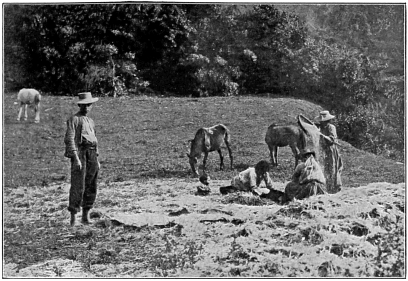
contented. One day a party of Indians collected to thresh
wheat; from a distance I could hear the boom of a drum
and the shrill wail of reed flutes; as I approached, a strange
sight met my eyes. Bundles of grain had been piled in a
high mound, on the top of which sat the musicians; a dozen
mounted Indians were driving a herd of mules and burros
around the base. Around and around they went at a
frantic pace, keeping perfect time with the music; as the
animals circled the stack a man on top cast armfuls of
wheat down in their path, so that in running over it repeatedly
they naturally trampled out the grain. About a
hundred men, each holding to a long rope, formed a circular
fence around the racing mob and prevented any of the
animals from escaping.
We were surprised at the abundance of life in this naturally
barren region. There were practically no indigenous
trees, but a long line of willows had been planted near one
of the houses, and to these thousands of cowbirds, doves,
and finches came each night to sleep. A short walk across
the stubble-fields always revealed something new. There
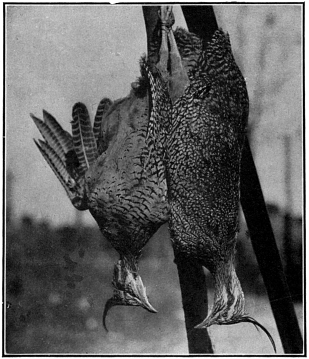
were tinamou which rose with a loud whir, reminding one
of partridges; many species of brownish birds belonging to
the wood-hewer family, one of them with a long, curved bill,
but they ran about on the ground or perched on the stone
fences; large flickers lived among the rocks, and condors
soared above; and there were even flocks of gulls and plovers.
The most unusual birds were two species of very
small parrakeets which clambered about over the rocks
and slept in holes in the high banks. Vast numbers of
cavies lived in the rock-piles, from which they sallied at all
hours of the day in quest of food, and many small rodents
inhabited the grain-fields.
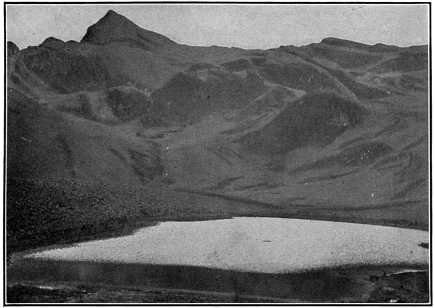
A good trail leads eastward from Cochicancha; the summit
of the range rises about two leagues from the settlement.
At the time of our visit the black, rocky peaks were
covered with a mantle of snow and an icy wind swept
through the cleft which serves as a pass. The elevation of
the trail is thirteen thousand four hundred feet. At the
base of the towering masses which rise several hundred
feet above the passage, lies a placid little lake, and ducks,
and gulls were swimming on its peaceful surface. Condors
swept down from above to inspect us, and then soared back
to their dizzy perches among the unscalable crags.
On the eastern side of the divide the trail leads downward
abruptly, and the character of the country changes;
at eleven thousand feet a sparse growth of bushes appears,
growing denser with each passing mile. Suddenly we
found ourselves on the rim of a gorge through which the
Incachaca River rushes—a raging mountain torrent fed by
snows melting in the high altitudes. The path is a mere
shelf cut in the face of the cliff; to the left rise the smooth
walls of frowning, black rock; to the right is a sheer drop
to the river. We could peer over the edge of the precipice
and see drifting clouds two thousand feet below, filling the
chasm and shutting from view the bottom hundreds of feet
lower down.
At seven thousand seven hundred feet the forest begins;
a collection of half a dozen huts called Incachaca nestles in
its inner border, and there we decided to remain for a few
weeks. We secured space in a large house belonging to
an organization which is engaged in digging a canal along
the opposite side of the gorge; when this work is completed
the water of the river will be turned into the artificial
course and utilized for running dynamos to furnish electricity
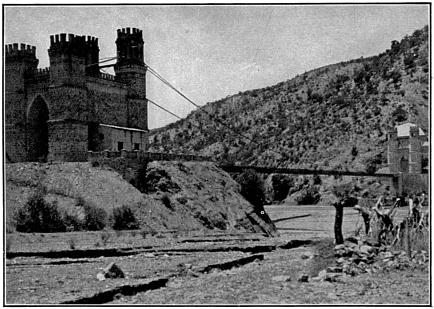
for the light and street-car service of Cochabamba.
A power-house had been constructed at the bottom of the
ravine, and the lines for transmitting the current had been
strung across the mountains.
At Incachaca the river flows through an underground
channel; while exploring the forest one day we came suddenly
upon the narrow cleft in the mountainside, scarcely
a dozen feet across, and with a great deal of effort were
finally able to distinguish the roaring white torrent a hundred
feet below. The edges of the cleft are so overgrown
with ferns that one has no idea of its existence until the
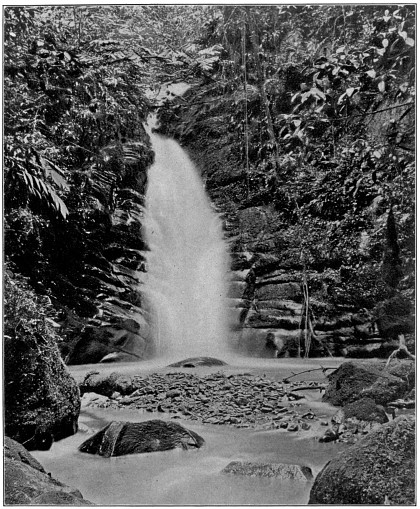
very brink is reached. A short distance below, the river
emerges from the darkened cavern, and plunging over the
face of a precipice, thunders into a pool in a sheer drop of
fifty or sixty feet.
We found the upper limit of a subtropical fauna at Incachaca.
Bird-flocks travelled hurriedly through the trees;
they were composed of bright-colored tanagers, finches,
and cotingas. Honey-creepers and hummers were plentiful
in the flowering shrubs. Queer little ducks called merganettas
disported in the pool below the falls, and dippers
ran nimbly along the edge of the water. In one of the tall
trees near the river we discovered the nest of an eagle. We
found it impossible to climb the tree, but a German named
Ricardo Marquardt, who was in charge of the workmen
along the river, succeeded in reaching the huge mass of
sticks seventy feet above the ground, and brought down a
beautifully spotted egg. To my companion, Mr. Howarth
S. Boyle, who accompanied me on the entire trip, belongs
the credit of taking the rarest birds from this locality;
they were a pair of white-eared thrushes (Entomodestes),
which, so far as I can learn, exist in only two other museums.
Among the lower growth lived many ant-thrushes
(Grallaria), whose clear call could be heard at all hours of
the day. This is one of the hardest of all birds to collect.
The long-legged, tailless songsters never leave the thick
growth of ferns and brush, and the only way to secure them
is to enter the dense cover, sit quietly, and imitate the
clear, ringing call in the hope of attracting the birds; sometimes
this requires hours of patient work, and more often
than not the effort is futile.
Coatimondis, or raccoons, roamed in the woods in small
bands, sniffing in the damp mould and searching for insects;
while feeding they uttered deep grunts, but when
frightened they gave a succession of rapid bird-like chirps.
These animals spend a good deal of their time in the trees,
but are almost invariably found on the ground in the daytime;
when pursued they are very pugnacious and it takes
an exceptionally agile dog indeed to avoid being severely
torn by the sharp teeth and claws. In captivity they become
very tame, and make nice little pets, although their
mischievous disposition often gets them into trouble.
From Incachaca to Locotál is a distance of only eight
miles, but the scenery along a part of the route is as impressive
as any to be found in the entire Andean chain;
perhaps the gorge of the Urubamba, in Peru, alone equals
it in grandeur and awe-inspiring magnificence. The bare,
shattered, and split crags reach many hundred feet above
the trail, and stand in a leaning position so that the tops
actually hang over the narrow passageway as if threatening
to topple over at any moment; below, the steep slope is
covered with huge boulders which have fallen from the
towering masses above.
At Locotál there are but half a dozen houses, occupied
by Quechua families who subsist mainly on the profits derived
from the sale of chicha. We stopped a few days in a
hut owned by a kind-hearted old woman who gave us permission
to use it; next day we found that we were occupying
the schoolroom, and the teacher followed by his half-dozen
ragged scholars came to take possession. He tried
to show us how important it was to have the place at once,
but we saw no reason why he could not conduct his class
out under the trees just as well as under the shelter; this
suggestion offended him very much, so greatly to the delight
of the pupils he declared a vacation until the gringos should
move on.
Chicha, the native drink of Quechuas and Bolivians alike,
is a kind of corn-beer; it is made by grinding maize into a
fine meal, after which the women and children thoroughly
masticate a part of it; water is added to the mass and the
thick liquid is boiled several hours, after which it is poured
into jars to ferment; it is of a yellow color, has a tart, agreeable
taste, and is intoxicating.
The forest at Locotál is somewhat taller than at Incachaca,
but the birds are of a similar character. Very abundant
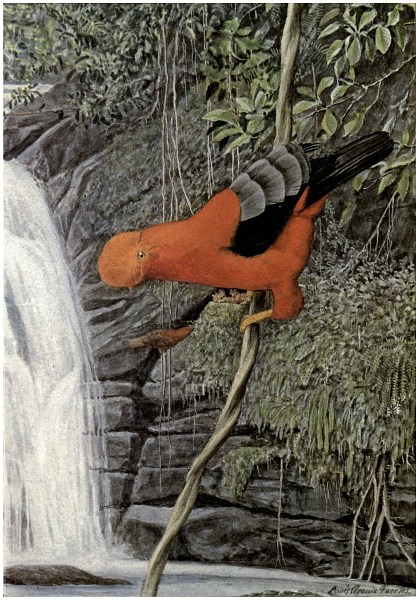
and beautiful were the brilliant cocks-of-the-rock; the
bright, orange-red creatures flashed through the deep green
of the forest like fiery comets and, perching on the low
branch of a tree, quietly surveyed their surrounding, or
uttered hoarse, croaking calls. This bird is most conspicuous
in its natural environment. Among the other large
birds were green toucans (Aulacorhynchus); the natives
hunted them on every possible occasion for the sake of
obtaining the bill, which they use as remedio, the rasping
sound made by rubbing the mandibles together being supposed
to be an unfailing cure for epilepsy.
While pursuing our work at Locotál, a man named
Quiroga chanced to pass, and begged that we pay him the
honor of stopping at his house some distance below; it was
a charming place, he said, in the very heart of the wonderful
Yungas. We gladly accepted his invitation, and one
morning loaded our outfit on mules and started down the
trail. For a mile there is only a narrow ledge in the face
of a rounded mountain of dark sandstone; a few stunted
sprouts, and myriads of orchids covered with purple blooms,
have secured a precarious foothold in crevices in the glazed
surface; hundreds of feet below, but invisible, the river
tears through a narrow gorge. At one point a strip of the
shelf upon which we travelled had entirely disappeared;
we could not see the bottom of the canyon—its depth was
too great—but there were evidences we could not mistake,
telling us the history of the gap in the trail. Vultures
hovered over the spot and perched on the scant vegetation,
and from below came an overpowering stench. What more
was needed to reveal the fact that the missing section of
trail, in its mad dash through space, had taken with it the
pack-train of mules, and probably the men attending them,
which chanced to be passing at the time.
Miguelito is only three miles below Locotál, and consists
of three or four huts in the centre of a grassy clearing.
The Quechuas who live there are friendly, and one may be
sure of a welcome for a night’s stop.
At five thousand five hundred feet the forest becomes
taller and the trees attain a greater diameter. The vegetation
of the subtropic zone reaches its highest development
at this altitude. After crossing a ridge six thousand seven
hundred feet high, the trail descends a long slope into the
Yungas, properly known as the Yungas of Cochabamba.
At the base of the ridge, and shortly before entering the
cultivated area, we crossed the dry, narrow bed of a stream
which was filled with rocks bearing the imprints of leaves,
and also fossil shells.
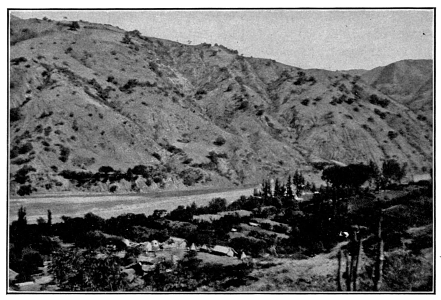
Yungas is the name given to the fertile mountain slopes
which have been cleared of forest and cultivated; it stretches
along the sides of the Rio Yungas for a number of miles,
and huts dot the roadside at frequent intervals. When
we visited the region in June only the Indian caretakers
lived in the habitations, the coca, which is the principal
product, having been collected a short time before, and
the propietarios having gone back to Cochabamba. The
owners visit their plantations three times a year, supervise
the picking and packing of the leaves and, after a month,
return to Cochabamba to sell the drug and live on the
proceeds until the next harvest.
After spending an hour in questioning the occupants of
the various houses which we passed, we succeeded in locating
the house to which we had been invited. It was a low,
one-room board structure, open at both ends, and with
wide entrances on each side, situated in the centre of a
large banana-field. An Indian, so old that he could hardly
walk, lived in the hovel and refused to admit us; however,
we flourished our letter of introduction from the owner of
the premises, took possession, and remained a week. When
we left, the aged tenant implored us to remain, as we had
daily provided him with all the game he could eat, and
had provided him with some medicines that he greatly
needed.
The climate at this season, June, was most trying. Although
the elevation is only three thousand five hundred
feet, the whole region was covered with fog each night,
and the cold and damp penetrated everything; during a
part of the year the weather is good, and then life in the
Yungas is more bearable. We had a trying time at Señor
Quiroga’s hut, and while the pleasure of investigating a
new region is always intense, our joy at leaving was in this
particular instance vastly greater.
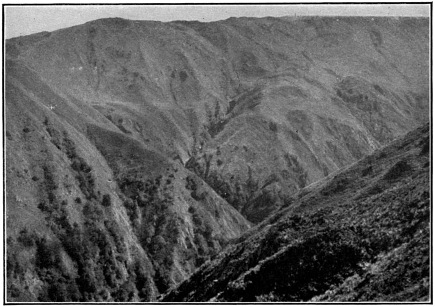
There is no flat valley along the river, which is of considerable
size, and all cultivation is done on the steep mountainsides.
Coca is planted in terraces and occupies the
greatest acreage; then there are red bananas, plantains,
guavas, and sugar-cane.
The fauna of the country seems to represent a transition
zone. There are birds typical of the higher country, and
others which are common lower down; also, a number found
at approximately this altitude only. Near the house, and
on the edge of the banana-plantation, was a tall, isolated
tree. Flocks of birds, in their flight from one side of the
canyon to the other, would invariably alight in its branches
for a few minutes’ rest. There were many brilliantly colored
little tanagers (Tanagra) which came to the tree in
considerable numbers and chirped and quarrelled as they
flitted about examining the leaves for insects, or reached
out to pick the small fruits with which the tree was covered;
one day not less than seven species of these birds
visited this resort within a short time.
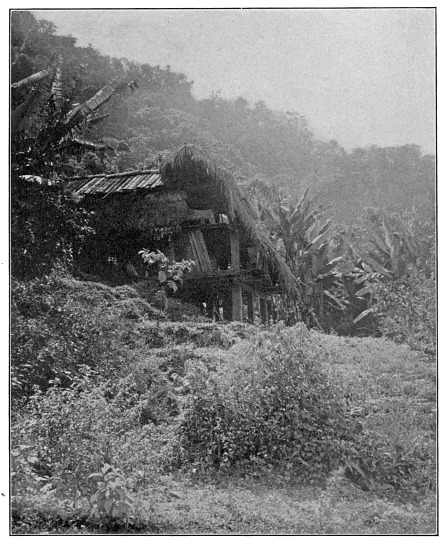
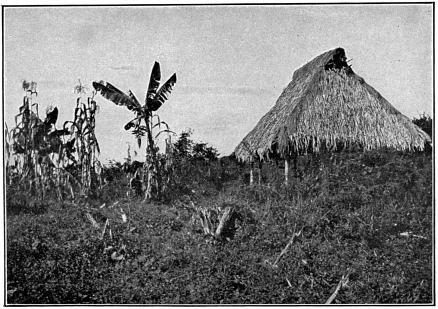
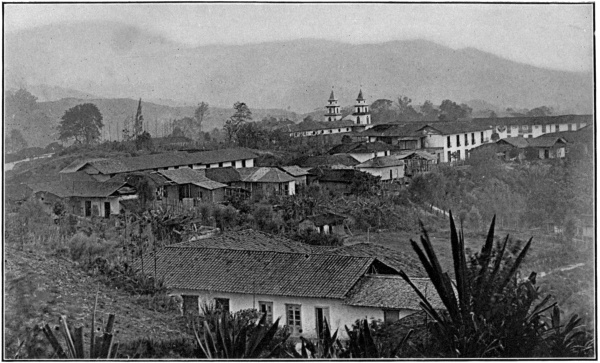
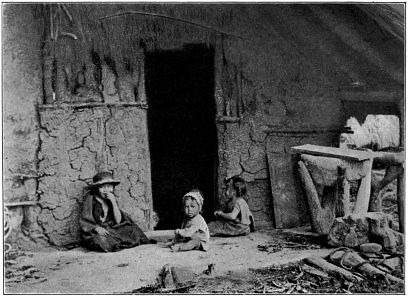
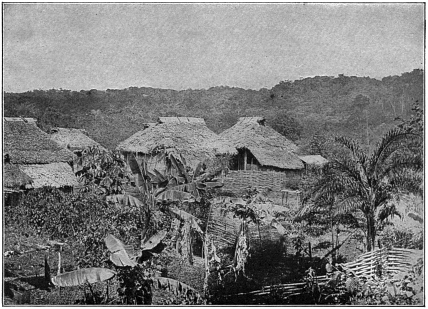
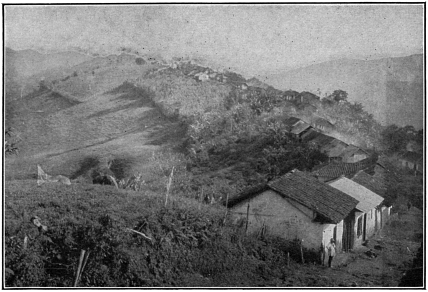
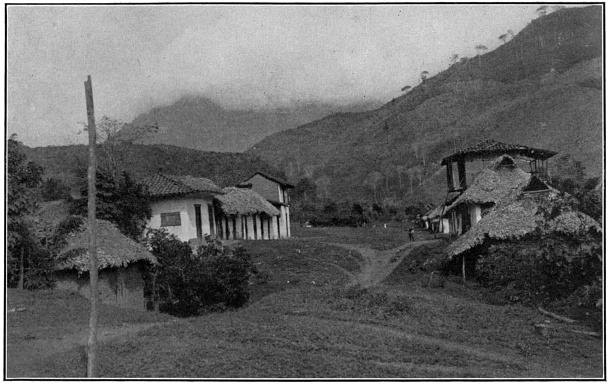
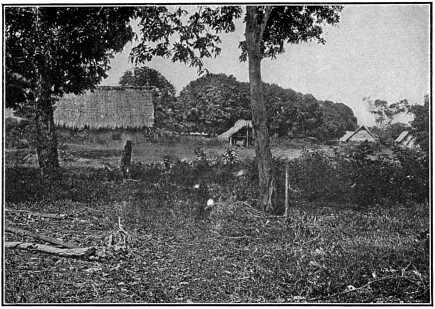
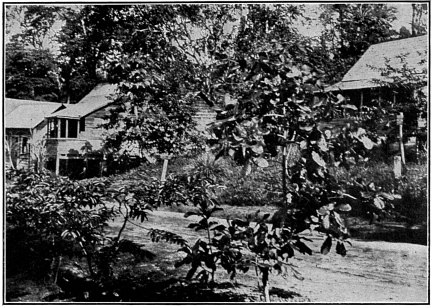
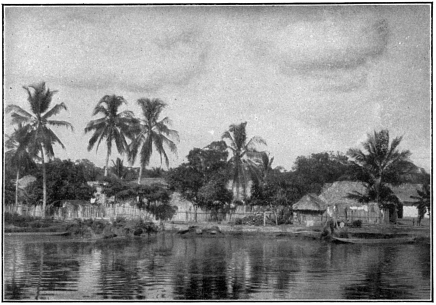
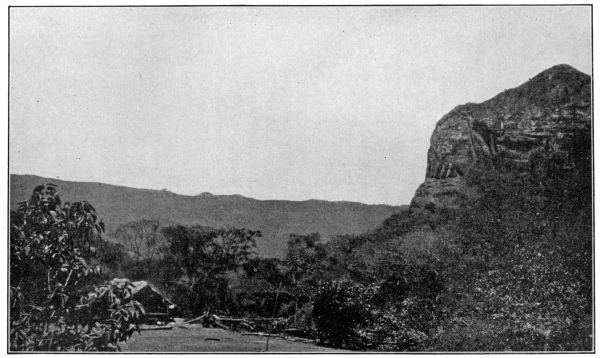
An Indian hut in the Yungas of Cochabamba.
Giant orioles (Ostinops) were also very plentiful, and
travelled in large, noisy flocks. One of the more interesting
birds was a species of small, red-tailed parrakeet (Pyrrhura)
which clung to and crawled up the sides of trees like squirrels;
it was almost impossible to see them unless they
moved, so well did their coloration, and more particularly
their actions, conceal them.
We had travelled to the Yungas on mules owned by the
expedition, and upon our arrival turned them loose to feed
as usual. Next morning the animals were in a sorry plight;
they had been visited by vampire-bats during the night,
and bled so badly that we had to send them back to Locotál
without delay. Severe as this attack seemed to be,
it was mild compared to what we were to see later on. We
discovered clumps of the small bats guilty of the execution
spending the days under the roof of our hut, and despatched
many of them, but this made no impression whatever upon
their vast number. People, also, are bitten on any part
of the body which is left exposed at night, and I have frequently
seen Indians which had been attacked on nose,
forehead, and arms.
After completing our work in the Yungas we returned
to Cochabamba in order to await more favorable weather
for the trip into the lowlands of eastern Bolivia, and to
restock our outfit with articles which had been used, and
others which it seemed necessary to acquire for the difficult
undertaking ahead.
After spending several weeks in the vicinity of Cochabamba,
we made arrangements with the mail-carrier which
enabled us to travel jointly to the Chaparé. He usually
made the trip at six weeks’ intervals during the dry season,
and, consequently, he knew the trail better than any
one else. His peons were also accustomed to the country
and knew how to adjust packs so they would meet the
varying conditions of the road, which is an “art” that
can be learned through long experience only.
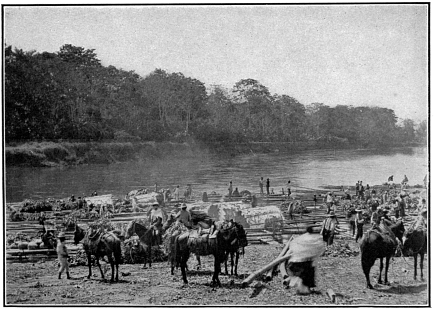
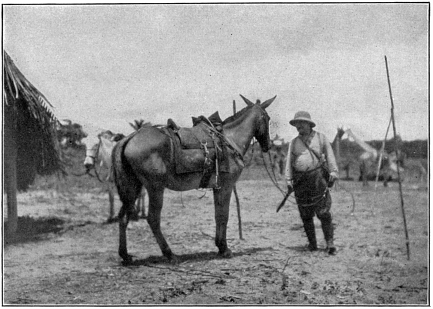
On July 12 we left Cochabamba. Besides my companion
and our personal attendant there were the mail-carrier and
his three peons; twelve good, strong mules carried the luggage,
and there were half a dozen riding and spare animals—quite
a cavalcade for the kind of undertaking in hand.
Three days after starting we reached our old camping-spot
in the Yungas, and, after stopping for a short chat
with the old caretaker of Señor Quiroga’s hut we proceeded
into what was for us terra incognita.
Numerous huts of flimsy construction are scattered along
the entire twenty miles or more of cultivated slopes; each
has a fenced-in area paved with flat stones upon which
coca leaves are dried. We stopped at a number of these
dwellings in an attempt to buy fruit or vegetables, but unfortunately
the men were all away working in the fields,
and any one who has attempted to purchase anything from
the average Quechua squaw knows how hopeless a task it
is. Although they may have a superabundance of the
article desired, they seem to take great delight in refusing
to sell anything to a stranger; then the only method to
follow is to take what is needed, offer a fair price for it
and pass on, leaving them in the midst of their wild rantings;
the men are easier to deal with.
The peons, and the patrón as well, stopped at each hut
where the white flag announced that chicha was for sale,
and attempted to drink enough to last them until their
return; after their money gave out they left articles of
clothing in payment for the drinks. It was therefore a
great relief when the last abode of the intoxicating beverage
had been left behind, and we plunged into the wilderness.
Immediately after leaving the Yungas we ascended
a precipitous slope, the top of which was seven hundred
feet above the surrounding country, and then descended
on the other side until the elevation was only two thousand
feet; here the forest was more tropical in character,
and some of the trees, especially the cottonwoods, reached a
height of one hundred and fifty feet, and measured twenty-five
feet through the buttressed roots at the base.
The day after leaving the Yungas we reached the most
dangerous part of the whole trail. After crossing a number
of steep, high ridges, we came to an abrupt slope, the
side of which is seared by a huge gash where the treacherous
white clay keeps sliding constantly into the river, many
hundreds of feet below. Each caravan desiring to pass
must first cut a ledge in the moving mass of soft, muddy
earth, and then hurriedly lead the mules across, one at a
time, before the newly made trail is obliterated. The spot
is very appropriately named Sal-si-Puedes (pass if you can),
for any one succeeding in crossing this slide is very apt to
possess the ingenuity required to negotiate the remainder
of the trail.
That night we made camp early on the banks of the Rio
San Antonio, called Chuspipascana by the Indians, which
means Mosquito River. The altitude of the site is only
one thousand eight hundred feet above sea-level. The
river was a clear, rapid stream one hundred feet wide,
flowing through a rock-strewn bed a quarter of a mile
across. Swarms of black flies, sand-flies, and other stinging
or biting insects immediately came out to greet us.
Birds were very abundant. In addition to the jays, ant-wrens
and manakins, which remained in the forest, flocks
of parrots and toucans flew across the open spaces. One of
the most unusual occurrences was the great flocks of a
new species of giant oriole; there were not less than one
thousand of these birds in a single flock, and they roamed
almost everywhere, coming close to camp to inspect the
tents, and to discuss them in hoarse cries of curiosity or
resentment. They were beautiful creatures, of a deep
chestnut color with light olive-green head and neck; the
face is devoid of plumage and of a flesh-color, while the tip
of the bill is deep orange. The flesh is highly esteemed
by the natives and we found it quite palatable.
As soon as the cargoes had been neatly placed in a pile
and covered with a tarpaulin to keep them dry the peons
cooked their supper; this consisted of a thick soup made
of corn-meal and charque (dried beef). They had a meal
in the morning and another at night; during the long walk
throughout the day they chewed coca leaves. The mules
were turned loose to shift for themselves, but as plenty of
wild cane grows near the rivers, they had an abundance of
food. One of the animals carried a bell tied to its neck,
and the others would seldom stray out of hearing of the constant
clanging. In the morning the men easily located
the bell-mule and led it back to camp, the others following
in single file. Should one be missing, which was a rare
occurrence, it was only necessary to take the bell and
shake it vigorously; this soon brought the stray member
to the spot.
The remainder of the journey was through the heavily
forested lowland; the last of the mountain ridges had been
left behind.
During the dry season the caravans follow the courses
of streams as much as possible. The water is low, and the
wide, rocky margins serve as roads. This is far from being
easy on the mules; the animals go stumbling and slipping
along, but a good many miles are cut from the total length
of the journey. Streams are encountered with frequency,
and as one penetrates farther into the interior they become
wider and deeper. We crossed not less than six fords in a
single day, all between two hundred and three hundred
feet wide, the water averaging from three to four feet deep.
Although the current is strong, the mules are accustomed
to this kind of work and usually manage to cross safely,
often stopping in the deepest, swiftest spot to unconcernedly
take a drink. Occasionally, however, one of the animals
slips on a moss-covered boulder and falls; then it is a
difficult matter to assist the drowning creature to his feet,
as the swift water may roll him over, and the weight of the
pack keeps him down. In any event, the least result of
such an accident is the thorough saturation of everything
in the pack, and this means a day’s loss of time while the
soaked effects are spread out to dry. During the rainy
season streams rise with startling rapidity, and parties
have often been forced to camp on the river-bank many
days until the water went down. To turn back is hopeless,
as the last stream crossed is just as high as the one
ahead; there is nothing to be done but wait.
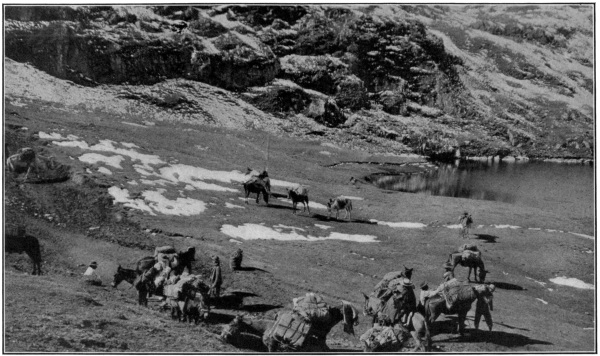
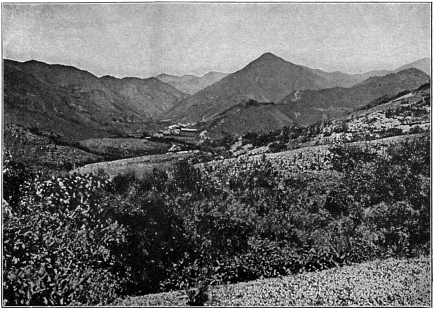
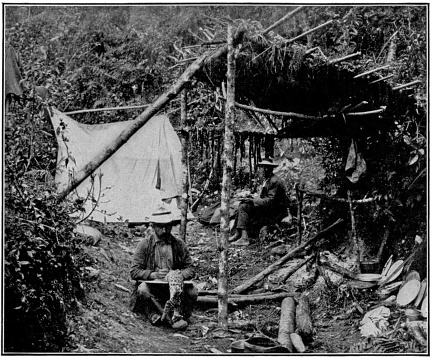
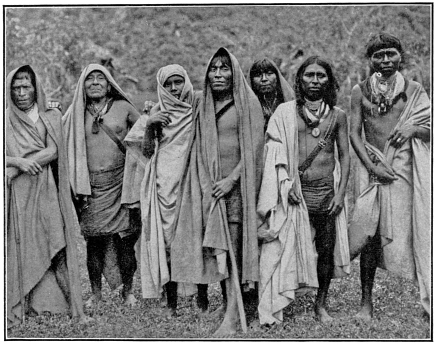
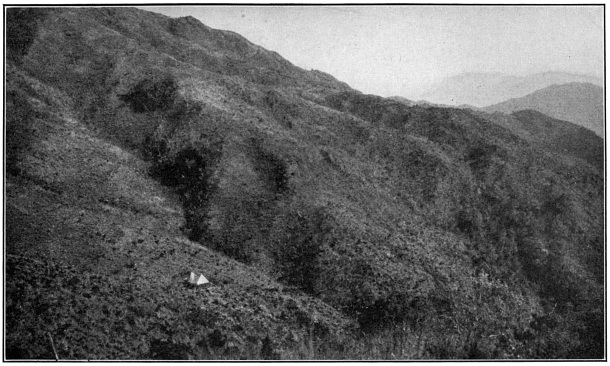
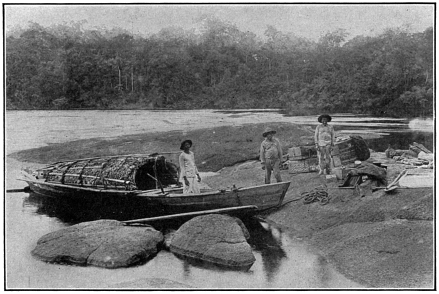
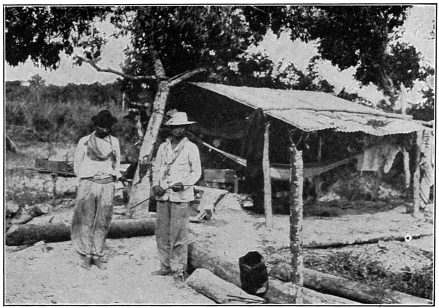
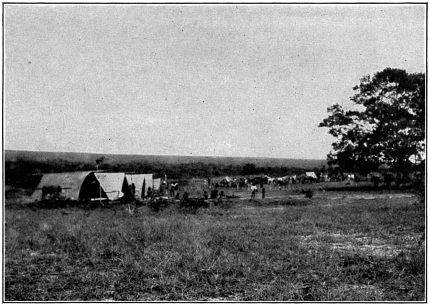
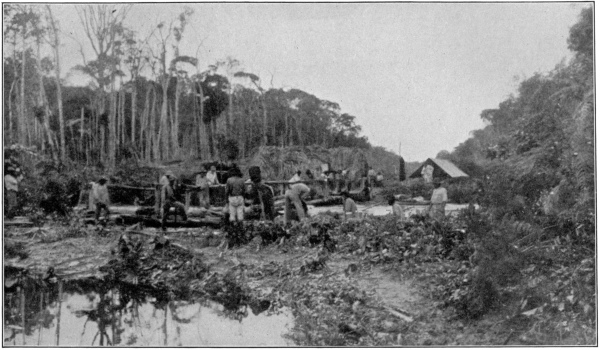
The expedition in the Cuchicancha Pass.
Wild animals are particularly abundant in this section
of the country. All day long we could hear the raucous
scream of long-tailed, multicolored macaws (Ara) as they
flew two by two overhead. Many hawks sat alertly on
dead snags near the water, and black-and-white gulls flapped
hurriedly up and down along the river. Occasionally we
caught a glimpse of a small flock of muscovies, the largest
of South American ducks, as the great, black birds flew
heavily up-stream. There were also black guans, resembling
small turkeys, which sat quietly in the tops of tall
trees until we approached quite near to them; then, emitting
a loud, mule-like bray, they set their wings and soared
across the river or down into the underbrush. At night the
forest was usually quiet, reminding one of “Pools of Silence.”
Occasionally, however, the still air was suddenly
rent by the most unearthly noise that mortal man ever
heard, and the woods rang with the wild, insane cackle of
forest-rails (Aramides). Beginning with a shrill oohoo-hee-cra,
the demoniacal chorus continued several minutes without
interruption, swelling constantly and finally ending
with a few low, explosive cow-cow-cows. A number of
birds always sang together, and the first time one hears the
performance it is enough to make the flesh creep and the
hair to stand on end; but even after becoming somewhat
accustomed to the noise, it falls short of conducing to peaceful
slumber, suggesting as it does the agonized shrieks of
some tortured spirit of the jungle.
Night-monkeys (Douroucouli) were apparently plentiful,
but we never saw them in the daytime. After darkness
had fallen they began to move about in the tree-tops; one
night a troop selected the tree under which we camped for
the scene of their frolic, and kept us awake the greater
part of the night. They jumped about in the branches,
and from the swishing noises which reached us it was easy
to imagine them enjoying a good swing up and down upon
some particularly springy limb. They dropped leaves and
twigs down upon the tent-fly, probably through accident,
but perhaps prompted by the desire to find out if anything
would happen. At frequent intervals they drew together
in a close group to chatter in low, grunting tones, and then,
coming to the conclusion that the queer-looking objects
below them must be capable of performing some interesting
action, again began to tempt fate by showering down more
twigs and leaves.
In many places the receding water of the river had left
isolated pools; these were teeming with fish of many species;
some of them were of large size. A number which
we caught had practically the entire tail and fins eaten off;
their cannibalistic brethren had no doubt taken advantage
of the circumstances in which they were all placed, and
begun to devour them piecemeal, at their leisure.
The trees were tall and straight, and there was dense
undergrowth near the rivers only. Mosses and epiphytes,
so typical of the subtropical zone, were almost lacking, but
frequently the wind brought the delightful fragrance of
ripening vanilla-beans and the perfume of flowers. Great
clusters of scarlet trumpetflowers dangled from the tips
of slender vines, and from the tops of many of the trees
drooped long garlands of huge white-and-blue flowers that
resembled sweet peas; some of these blooms were two inches
in diameter. There were also clumps of terrestrial orchids
on some of the rocks, with slender spikes of deep purple
flowers waving daintily under the impulse of each passing
breeze.
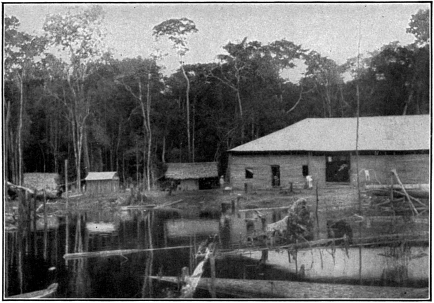
Seven days after leaving Cochabamba we came suddenly
upon the little cluster of grass and bamboo houses
known as Todos Santos; there were exactly seven of them,
two of which were of large size, partially enclosing a wide
plot of ground carpeted with soft green grass. Tall forest
hemmed in the settlement on three sides, and the Rio
Chaparé, flowing through deep banks, formed the boundary
on the fourth side.
The largest building was occupied by the corregidor, or
federal agent, who generously provided us with accommodations;
in addition to the several living-rooms there was
an immense wareroom stored with hides, salt, and other
articles of commerce. The remainder of the houses were
occupied by families of Bolivians who possessed land or
concessions in the neighborhood, and owned numbers of
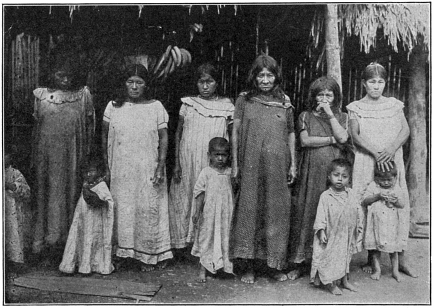
Indians of the Yuracaré tribe; these latter lived in long
sheds built in the rear of the dwellings of the people they
served. There was also a small church, but no shops of
any description. In spite of its inconsiderable size, Todos
Santos is a place of importance because it serves as an
outlet for commerce from Cochabamba and Bolivia in general,
and is the port of entrance for hides from Trinidad,
and merchandise entering by way of the Amazon and
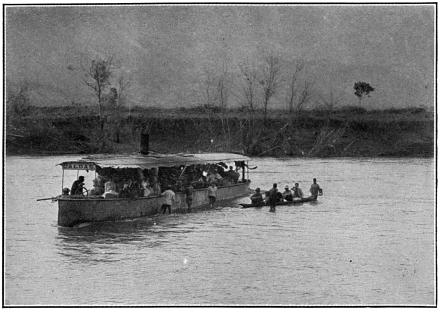
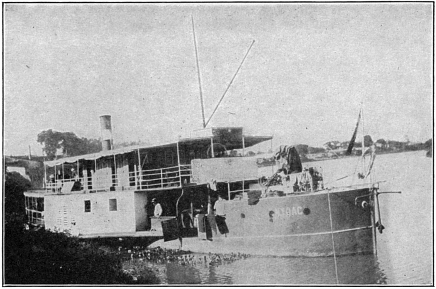
Madeira-Mamoré Railroad. A small steamer, the Ana
Catarina, was tied up against the bank, waiting for the
water to rise sufficiently for her to proceed down the river;
this boat plies more or less regularly between Todos Santos
and Trinidad, and requires three days for the downward
trip, and five days coming up. From Cochabamba to
Trinidad is a distance of approximately two hundred and
sixty-five miles, one hundred and sixty-five overland and
one hundred on the river.
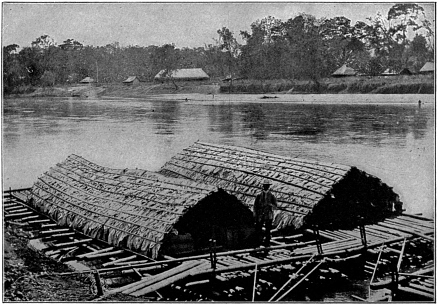
During the dry season steam-navigation on the Chaparé
is very irregular, but canoes of large size and native paddlers
may always be had. During the rainy season there is
a small steamer or launch each fortnight.
Several years before, the government had by law abolished
the practice of keeping Indians in the condition of
semislavery, and had ordered all owners to turn them over
to the missions; this, however, had not been done, and each
Bolivian family living at Todos Santos had a number of
Yuracarés in its service. Not far from the settlement were
a number of clearings, some of considerable size, where
fruits and vegetables were cultivated for the benefit of the
amos, as the owners of Indians are called; the Indians
cleared the ground, cultivated it, and then brought in the
results of their labor, receiving nothing in return. They
seemed fairly contented, however, and did not appear to be
suffering from ill treatment. They frequently spent days
at a time in their shelters on the edges of the fields, or in
hunting and fishing trips far from their homes.
Each Yuracaré woman kept a number of Amazon parrots
which she looked after carefully and refused to sell, even at
a good price. Upon asking the reason for this I was told
that they reared them for the sake of the tail-feathers,
which are in great demand by the Aymarás. Each parrot
will grow three “crops” of feathers a year, each of which
is worth fifty centavos. The Aymarás from the vicinity of
La Paz send down agents at regular intervals to purchase
these feathers, as they use them in making ornaments worn
during their annual festivals.
In the branches of one of the tall trees near the village
a neat little hut had been built of bamboo and leaves, reminding
one a great deal of a Philippine tree-dwelling.
Indians armed with bows and arrows would conceal themselves
in this house, forty feet above the ground, and shoot
many of the birds which came to feed on the fruit covering
the tree; other Indians, hidden about the base of the
tree, watched where the birds fell, gathered them up and
skinned or plucked them. In this way quite a number
could be shot without alarming a feeding flock.
The forest around Todos Santos abounds in wild life.
Squirrel-monkeys (Saimiri) are very numerous and travel
in troops of from twenty to fifty individuals; we saw them
daily, playing about in the trees, and feeding on fruits,
buds, and insects. They are delightful little pets, and
one that we owned spent the greater part of the day catching
the mosquitoes which infested our habitation. It
searched every nook and crevice for insects, and one of its
chief pastimes was to look through a pack of cards in the
hopes of finding mosquitoes between them. Harpy eagles
also are very plentiful, and feed on the squirrel-monkeys
to a great extent, as they are easy to catch. However,
monkeys are not the only animals which suffer; we one day
found the remains of a sloth which had been dropped by
an eagle, the entire fore part of which had been eaten
away.
There were numerous trees covered with vivid-scarlet
blossoms, scattered throughout the forest, and forming
gaudy little islands of color, which stood out very conspicuously
amid the green tree-tops. These trees are known as
madres de cacao, because they are frequently planted in
cacao-groves to shield the young plants from the sun. The
flowers contain so much nectar that numbers of birds feed
upon them, including parrots, macaws, and orioles; when
the brilliant blooms fall into the river they are greedily
snapped up by fish.
Of small birds there was such a variety that it would be
impossible to mention all of them, but one in particular deserves
attention. It is a species of manakin called the
“child of the sun” by the Yuracarés, who look upon the
tiny creature with reverence and would not harm it under
any circumstances. The bird is not as large as a sparrow,
but is of stocky build, with a bright orange-red head and
neck, the remainder of the body being black. As it whirs
from branch to branch it makes a loud sputtering, crackling
noise which reminds one of a bunch of small, exploding firecrackers.
The female of the species is of a dull-green color.
At Todos Santos, as elsewhere, local migrations of birds
in the heart of the tropics were several times forcibly brought
to our attention. We had been hunting in the forest a
number of weeks and were pretty well acquainted with its
inhabitants; suddenly a species entirely new to us appeared
in great abundance in all parts of the region; each member
of the expedition, including the native assistants, brought
in specimens of it the same day. This can be explained
only by the fact that flocks of these particular birds had
arrived suddenly from some distant part, probably attracted
by a fruit or insect which chanced to be plentiful at
the time, and upon which they fed.
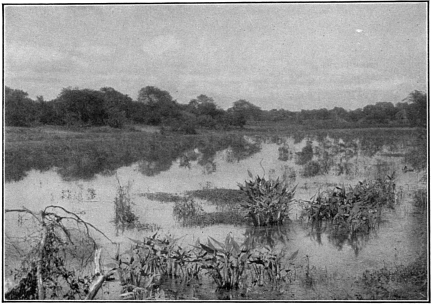
Several miles from port, and entirely concealed by the
forest, stretches a lagoon of considerable size; it is connected
with the Chaparé by a small, brush-clogged creek,
but the water is stagnant and filled with decaying vegetation
and detritus. Masses of bushes and swamp-grass
grow all along the borders, and in some sections the surface
of the water is covered with floating, aquatic plants.
As may be supposed, many species of birds live both about
the water and in the dense thickets that line the banks.
Among the former was the rare little sun-grebe, but it was
by no means abundant; the few solitary individuals we saw
were always surprised out in the open water and, after giving
a series of hoarse, loud cries, either flew or swam as
rapidly as possible to the nearest clump of vegetation,
which offered a secure retreat. Graceful jacanas stepped
about daintily on the lily-pads; their toes are very long and
give the feet a wide spread, thus enabling the birds to walk
on the floating little islands of water-hyacinths and wild
lettuce; for this reason the natives call them pájaro de Jesu-cristo,
because they can “walk on the water.”
Several species of flycatchers and large, noisy wrens
(Donacobia) lived in the partly submerged bushes; we found
several of the bulky, domed grass nests of the former, but
it was almost invariably impossible to reach them as they
always harbored colonies of biting ants, which rushed out
in maddened frenzy when the nest was touched; however,
the birds and ants seemed to live in perfect harmony.
In the tangles of tall bamboo growing on the bank and
drooping out over the water lived flocks of hoatzins and
numbers of several species of dendrocolaptine birds or wood-hewers;
also an occasional water-turkey and cormorant.
Many black-and-white ibises soared above in circles and
at a great height; they acted not unlike vultures, but the
long, outstretched neck and legs immediately gave a clew
to their identity.
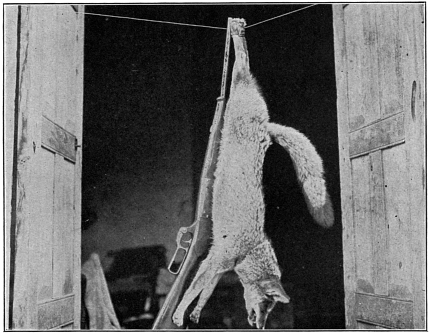
The forest was full of surprises. One morning my companion
encountered a tamanduá ant-eater which was on
the ground, and refused to realize that the close proximity
of man meant danger; he was but lightly armed, and shot
the tough, thick-skinned animal with the 32-bore auxiliary
tube of his shotgun, and number 12 shot—an unheard-of
feat.
It was, however, not always necessary to go into the
forest to hunt; the open plot in which the settlement lay
attracted many birds, such as scarlet tanagers, vermilion flycatchers,
swallows, and others, which were never found in
the forest, and small mammals in abundance lived in the
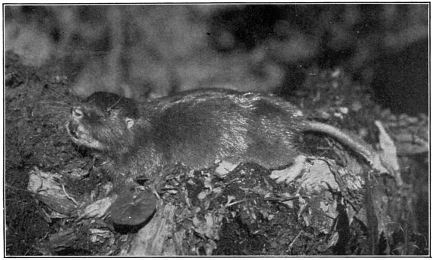
houses. We frequently caught five species of rats in a
single house in one night, and at least two species of bats
lived in the palm-leaf thatch of the roof. Some of the rodents,
particularly a large, spiny rat, lived under the floor,
while others made the walls and ceiling their homes; each
species seemed to adhere more or less to its own part of the
dwelling, thus dividing the houses into well-defined “life-zones.”
The natives are very fond of the flesh of the spiny rat
and often begged for any which chanced to come to our
traps.
Ocelots were not wanting in the neighborhood; they visited
the hen-houses occasionally at night, but never entered
by the doors, preferring to tear holes in the side of the
structures; they killed a large number of fowls, on one
occasion nearly twenty on a single visit, and prompted
apparently by the mere lust for killing.
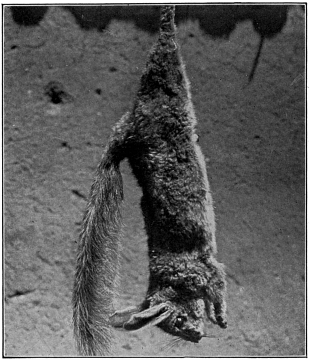
At night vampire-bats came out in hordes; they attacked
everything from human beings on down; even the few
miserable pigs kept by the Indians were severely bitten
and kept up a continuous squealing as the bloodthirsty
creatures settled on them, usually at the base of the ears,
and began their painful operations. The worst sufferers
by far, however, were our mules. As soon as the sun set
our peons brought the animals to the corral and strapped
canvas covers over them; this precaution was of little avail,
for the bats attacked all exposed parts, causing the mules
to kick and roll, with the result that their covers were soon
torn off. We went out frequently to watch these obnoxious
creatures at work; after circling above their prospective
victim a few times, they dropped suddenly, usually upon
the neck or flanks, and at once began to bite and suck,
making a grating sound with the teeth all the while. They
paid no attention to us, although we stood but a few feet
away, but clung with folded wings to their prey, perfectly
motionless and in an upright position; if we moved they
uttered a few squeaks, but made no attempt to fly until we
reached for them and came to within a few inches, when
they reluctantly fluttered up, but almost immediately settled
on the other side of the animal. Desiring specimens
of them for our collection, we went one night to the corral
armed with a butterfly-net and, approaching one of the
mules on whose back were a dozen or more bats, made a
hurried sweep with the net; as the large, white bag of netting
scraped the back of the nervous animal he sank to his
knees with a groan of despair, wondering, no doubt, what
new monster had swooped down upon him to add fresh
suffering to his already unbearable existence.
In the morning the mules were in a pathetic condition;
blood continued to flow from the wounds made by the
bats’ sharp teeth, so that the ground was red and the animals
were covered from head to foot. It was always necessary
to take them to the river and wash them, then disinfect
the numerous punctures; if this is not done flies
attack the sore spots, infesting them with their larvæ, and
the animals die of blood-poison. After three nights we
were compelled to start the mules back to Cochabamba, as
they were on the verge of exhaustion.
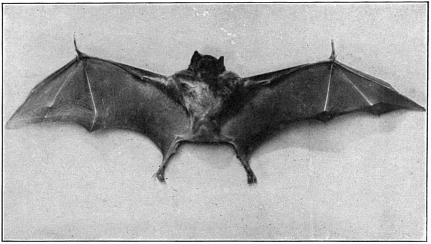
Vampire-bat from Todos Santos.
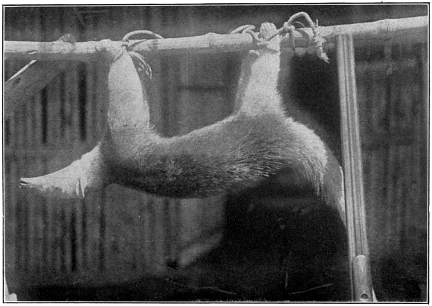
Tamanduá ant-eater.
While at Todos Santos we learned of a mission among
the Yuracaré Indians about twelve miles distant, and near
the Rio Chimoré. We expressed a desire to visit it, but
the intendente told us that such a move was impossible.
He said that the priest in charge of the mission was absolute
monarch of the territory under his control; that he
would permit no one to come near his retreat, and that this
mandate had never been disobeyed. Such statements
made the place seem of especial interest to us, and we were
eager to go there at almost any cost; we devised many
plans which we hoped would lead to an interview with the
priest, but all of them failed miserably; finally, however,
the opportunity came to us in an unlooked-for manner. A
misfortune to one person frequently comes in the guise of a
blessing to another, and so it happened in this instance.
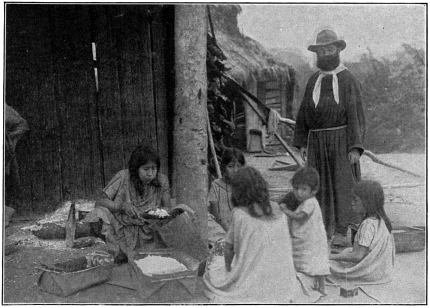
As we were pursuing our work one afternoon in the open
corridor in front of our room, a long canoe drew up at the
river-bank, and the priest, followed by a dozen Indians,
stepped ashore and marched across the clearing to the intendente’s
quarters. We immediately recognized him as
Padre Fulgencio, the missionary of whose despotic rule we
had heard so much; but he did not even glance at us as he
passed. While debating upon some diplomatic move which
might serve as an excuse for an interview, for now or never
was the time to obtain the coveted permission, he suddenly
emerged from the house and came straight to us. A few
curt remarks were exchanged, and then he began to relate
his trouble. To make a long story short, he was suffering
from a severe toothache; it had kept him awake many
nights, and at last he was forced to come out of his retreat
in search of a remedy. The intendente could do nothing
for him; could we?
How I thanked my lucky star for a limited knowledge of
medicine! After an examination, conducted with much
formality, the trouble was pronounced curable. He submitted
bravely to the injection of cocaine, and soon after
was relieved of the aching member. Tears rolled down his
cheeks as he expressed his gratitude, and then, taking note
of the work upon which we were engaged, he suddenly
asked: “Why don’t you come to the mission; I have four
hundred Indians who spend several days each week in
hunting, and they can take you anywhere, and also bring
you all kinds of animals.”
We needed no urging, and within five minutes the day
was set when porters in abundance should come to convey
our equipment, and we should start on our journey to the
mysterious stronghold of Padre Fulgencio, and the boundless
jungles bordering the Rio Chimoré.