E stood side by side, my cousin and I, and viewed the disaster with the
gloomy, helpless ignorance of jurymen at a coroner’s inquest, and the
mirage of tea that had risen before our thirsty eyes a few moments
before, sank into the yellow sand in which wallowed our broken-winged
wagonette.
The cocher made light of it. There was a blacksmith quite close—en
effet, a cousin of his own, and a man of great intelligence, and all
would be arranged in a little quarter of an hour. My cousin with some
trouble disinterred the Waterbury—she was in the habit of saying that
she had no wish to display it as jewellery, but it seemed to me she
might have struck a mean between a châtelaine or a wristlet, and a lair
so profoundly situated that I hesitated to ask her the hour unless I
knew she was going to bed. It was half-past six o’clock; the blacksmith,
however intelligent, could not come without being fetched, the re-fixing
of the wheel would take some time, getting back to Pauillac would take
some more, and the evening was becoming chilly, as October evenings even
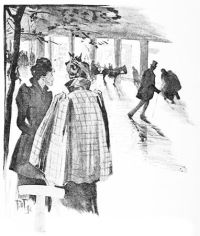
in the Médoc have a knack of doing. Our driver had by this time
untackled the tired white horse, and we were all pacing along toward
nothing more definite than the setting sun, while hunger and ill-temper
ran neck and neck in our bosoms. The road stretched implacably on to the
horizon, its yellow reaches turning grey as the warmth slowly went out
of the sky; the vintagers had all gone home to their dinners, and there
was nothing moving except the topsails of a ship that glided spectrally
along behind the shoulder of a low hill on our left, and told us of the
nearness of the great river highway where the steamers and sailing
vessels were going on their way, sublimely independent of such things as
linch-pins or table d’hôte at Pauillac.
Two stone pillars, a small clump of trees, and a railed-in track
connecting these, broke at length the blue-green monotony of the vines;
and a low gate, with a little black-pinafored girl sitting on it, seemed
to suggest a house somewhere near. It also suggested a possibility of
repose till such time as the carriage should be repaired, and we stopped
the cocher and his flow of conversation to ask if there was a house
là-bas. Perfectly, there was a house. Did he think its proprietor
would permit us to rest there till, etc. etc.? Perfectly, again; in
fact, the lady to whom it belonged was yet another of his cousins, a
person altogether charming, Madame Suzanne Marcault, and behold one of
her children. The little girl was here imported into the conversation,
and after some interchange of patois, we found ourselves following the
black pinafore up the narrow lane, to demand hospitality from Madame
Marcault in the name of M. Joseph Blossier.
It had become almost dark, and presently the last of the light was lost
under a thick trellis of vines; then our noses were smitten by a smell
of almost painful deliciousness, and our small guide, who had demurely
stepped along in front of us, suddenly ran round the corner of a wall
that half closed the end of the lane, and we heard ourselves announced—
‘Maman! V’là deux Anglaises!’
We followed upon the heels of this introduction, and found ourselves at
the wide-open door of a cottage kitchen, wherein a broad-backed peasant
woman was stacking logs on a blazing wood fire, and was thereby
stimulating a couple of cauldrons to a state of bubbling perfumed
ecstasy. This was Madame Suzanne Marcault.
We decided afterwards that we had never met any one with quite such good
manners as Madame Suzanne. Hers was one of the many cuisines de
vendanges, and we had stumbled in upon her at the critical moment known
to the Irish cook as ‘dishing-in the dinner,’ but not for a second did
she let us realise how intensely inconvenient our visit must have been.
Her politeness was as sincere as the
smell of her potage, and the fulness of her sympathy as we recounted
our adventure was not in the least daunted by the fact that my cousin
alternately referred to the wheel as the boue or the rue. Her heart
was so kind that she felt what we meant.
While we were still labouring with our story, wheels were heard on the
road, and a whip exploded into a coruscation of crackings at the door.
‘Ah, Dieu! Les voilà pour le dîner! Dépêche-toi, voyons!’ A long row
of quaint brown and yellow earthen vessels was set out on a table along
one wall of the kitchen; there must have been two or three dozen of
them, but in a few whirling minutes our hostess and the little girl had
not only filled them with the savoury contents of the cauldrons, but had
somehow or other stacked them all in the gig that had just driven up to
the door.
‘Nous n’avons pas du monde ce soir,’ explained Madame Suzanne, when
she had ladled out the last potful of soup, and had settled down into a
sort of steaming tranquillity. ‘Ils sont tous là-bas, près St.
Estéphe.’ ‘They’ meant the vintagers to whom she was temporary cook,
and while the wheels, or rather the wheel, of our chariot still
tarried, we fell into discourse with her about them.
‘Le patron feeds them well, pardi,’ she said. ‘Tiens, would ces
dames like to taste the soupe de vendange?’
We tasted it, and it was perhaps the noble flavour of that vintage soup
that inspired the scheme that simultaneously occurred to us both. Should
we ask this nice woman, with her Irish friendliness, and her sympathetic
comprehension of bad French, and her excellent cookery, to put us up for
the night? We discussed it hurriedly between scalding, inelegant
mouthfuls of soup, sopped bread, and tresses of cabbage, interspersed
with flatteries on its quality. We wanted to see the Médoc au
fond,—what more than this could show us its nethermost profundities?
If we had lived out a night in a Connemara cottage, could we not stand
one in a French ferme? So clean, so convenient, so glowing with local
colour. Was it not almost a duty to accept such an opportunity?
It is a useful thing to be pronounced eccentricities. As we diffidently
unfolded the suggestion to Suzanne, she put her hands on her hips and
smiled at us with that smile of lenient amusement with which our sojourn
in the Médoc was making us familiar. It was droll, pardi! She had
never before had pensionnaires, but she had once been servant in a
hotel, and if we feared the long drive in the cold—this was how we had
put it—she would know how to make us comfortable. Voyons!
Delightful creature! so practical, so unconventional, so Irish in fact,
we said to each other, as we listened to her explaining our scheme, with
bursts of laughter, to M. Joseph Blossier, who had come to tell us that
the carriage would be ready tout-à-l’heure. We had left her to deal
with him; he required a more masterful treatment than our French would
rise to, and it was with sincere thankfulness that we finally saw him
depart, with promises to return for us in the morning with sundry
essentials enumerated in a note to Léonie, our femme de chambre.
We sat hungrily in a corner of the kitchen while the little girl spread
a surprisingly clean cloth on the table, and Madame Suzanne stirred the
ragoût, and delicately added to it some further finishings which we
trusted were not garlic. The yellowish walls and the smoke-stained
wooden ceiling took the firelight with warm good fellowship; the blue
china-tiled stove, hard-working aide-de-camp to the big open
fireplace, sent an upward glow from its red charcoal upon the glittering
array of pots and pans and glazed earthen vessels upon the wall above
it; and round the open door the vine leaves and bunches of grapes were
emphasised theatrically by the firelight, and the last light of the
evening and the whirring of the cigales came strangely through them
from without. The master of the house was late, and feeling, no doubt,
like other hostesses, that the interval before dinner required
alleviation, Madame Suzanne offered to show us over the rest of her
house.
She began paradoxically by leading us out of it, and then took her way
round the corner of the house under the grape trellis. She stopped at
what was apparently a coach-house door, and after some difference of
opinion between a large key and its keyhole, pushed it open. A blast of
cold air nearly extinguished the flame of the little chimneyless lamp
that she carried, as we followed her into a lofty barn, with giant
barrels looming round its walls, and permeated with the sour,
unforgetable, indescribable smell of a Médoc cuvier. This place was
about forty feet long, and at the end of it we dimly descried a ladder,
with a hand-rail, mounting to a door high up in the wall. Towards this
we incredulously followed our hostess, and having stumbled up it after
her, found ourselves in a musty loft; and then, saying something, whose
import we did not quite catch, about her eldest daughter, Suzanne
unlocked another door, and told us that this was where we were to sleep.
Our courage receded to the toes of our boots; were we to share the room
with that eldest daughter, or could it be that we were to join in an
even more general family party? It was a long bare room, with nothing in
it except a very large bed, swathed and canopied all over with heavy
brown draperies, a chair, and a small table in the middle of the room,
on which was a toy piano, a manual of devotion, and a little mirror made
of something resembling tinfoil.
‘It seems we need not have sent for our washing-gear,’ observed my
cousin. ‘I wish we were well out of this.’
‘It is a pretty bed, hein?’ said the amiable Suzanne, thumping the
awful brown swaddlings of our couch. ‘And you need fear nothing; my
husband and I and la petite sleep in there.’ She pointed to another
door. ‘If you are ill, anything, you have but to knock’—
‘And mademoiselle, votre fille aînée?’ we faltered.
Ouf! We need not trouble ourselves about her. It was but last week
that she had had a fever in that very bed—a fever scarcely worth
mentioning; but she was now in Bordeaux for change of air: ‘et
maintenant, mes demoiselles, descendons!’
We did not dare to inquire further as to Mademoiselle Marcault’s fever,
but we felt that it gave the finishing touch of horror to those dusky
draperies. It was too late now, however, to draw back, and, expressing a
lying satisfaction in all that we had seen, we followed our hostess’s
devious course to the kitchen. M. Marcault was there with another man,
who, it was explained, was a friend who had come to dine. Both were
dressed in blue linen blouses, and were of the sharp-nosed,
long-moustached type common in Médoc and both rose and bowed solemnly as
Madame Suzanne introduced us.
‘Deux demoiselles Irlandaises,’ she explained, with an up-and-down
flourish of the lamp, in order that no details of the appearance of the
maniacs might be lost, ‘who are anxious to become acquainted with an
intérieur paysan.’ At this juncture we were far more anxious that la
nourriture paysanne should become acquainted with our interior, but we
made reply in fitting terms, and beguiled the remaining interval before
dinner with political conversation. We always found it advisable in
France to announce our true nationality as soon as convenient. We found
ourselves at once on a different and more friendly footing, and talk had
a pleasant tendency to drift into confidential calumny of our mutual
neighbour, perfidious Albion, and all things ran smoother and more
gaily. Dinner was ready at last, and we all sat down very close to each
other round the narrow table. Suzanne fetched the soup and the ragoût
off the stove, and helped us all out of the pot. Our glasses were filled
with excellent ordinaire, and we began to think it was a charming
party. The two men were most agreeable and instructive, talking with
astonishing ease and well-bred self-possession on any subject that was
started, and giving us much useful information on the subject of vines
and vine-growing.
We were most careful to copy our hosts in all things. We put salt in our
soup with the blades of our knives; we absorbed the rich sauce of our
delicious ragoût with pieces of bread, being indeed pressed to do so
by M. Marcault; we cleaned our knives on rinds of leathery crust; in
fact, we conformed, as we thought, admirably. Everything was going on
velvet, when, after the ragoût, the smell of fried oil became
apparent, and from a covered-in pan Suzanne helped us each to a large
piece of something that resembled sweet-bread, and cut rather like a
tough custard pudding. It was fried bright brown, but the inside was
yellowish white, and the whole thing was swimming in hot oil. We asked
nervously what it was.
‘Mais, mangez le donc,’ responded Suzanne, as she reversed the
frying-pan to let the last drops of oil run on to our plates. ‘C’est
biang bong! C’est du cépe—du champignong, vous savez,’ seeing that we
did not seem much enlightened. Here was local colour with a vengeance!
There rose before us in a moment the brown, contorted visages of La
Famille Empoisonnée among the mummies of St. Michel, and the dusty bits
of fungus that they still retained in their jaws. The situation,
however, did not admit of retreat. And we attempted none. The mushroom,
or fungus, whatever it was, had a dreadful taste, as though rotten
leaves and a rusty knife had been fried together in fat. Moreover, it
was patent to the meanest intelligence that, whatever its taste might
be, no digestion save that of a native or an ostrich could hope to
compete with it. We each swallowed two lumps of it whole, and then my
cousin looked wanly at me and said, ‘One more, and I shall be sick.’
It was hard and humiliating to explain that we both disliked and feared
this crowning treat of a Médoc repast, but we did it; and though we sank
in Suzanne’s estimation, it was more in pity than in anger that she
removed the horror from before us, and replaced it with a delicious
compôte of pears of her own making. We spent an agreeable evening, in
conversation so instructive that we fear to reproduce it here, mingled
with confidences as to Suzanne’s winter clothes, and criticisms of the
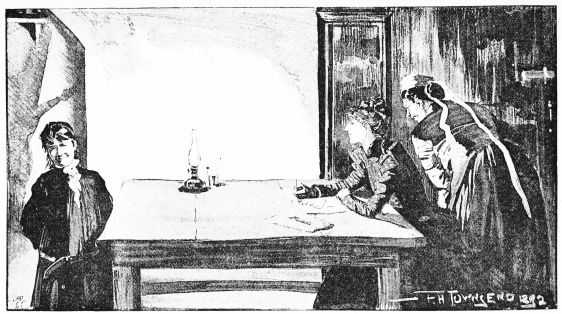
sketch I was making of la petite. Ten o’clock struck, and Madame
Suzanne gave a final tidying-up to her kitchen, and then, opening the
great chestnut wood wardrobe that stood near the door, she selected from
its layers of coarse brownish linen a pair of sheets, clammy with damp
and cleanliness, and led the way once more to our barn.
It was a curious feeling when, after we had helped our hostess to make
our bed, and said our good-nights, we found ourselves alone in the
depths of peasant France without so much as a toothbrush to remind us of
our connection with British effeteness, while the huge empty cuves in
the barn beneath us roared and sang like organ-pipes in the rising wind.
Under ordinary circumstances I do not think we should have survived the
dampness of those sheets, but they were not given a fair chance. That
night in the Widow Joyce’s cabin in Connemara was recalled to us by many
things,—things that, though small in themselves, recurred with a
persistence quite disproportioned to their bulk,—and often, while the
mosquitoes piped their drinking-songs beneath the canopy, and the fleas
came steeplechasing from the boards to the bed, and the candle burnt
lower and lower, and the slaughter waxed grimmer and greater, we said to
each
other that the exercise would at least save us from pleurisy or
rheumatic fever.
It was somewhere during an interval of exhausted sleep that we were
aware of Suzanne standing at our bedside and asking us in her strong
voice if we would like some coffee or some wine. We sleepily said No,
but perhaps, plus tard, when our things had come from the hotel, some
water. It seemed a very short time before those things made their
appearance, but it is obviously impossible to wash one’s self in a toy
piano—a fact which we explained as gently as possible to la petite.
She retired, and presently we heard a heavy step on the cuvier ladder;
something was set down outside, and, rising, we found a very large
garden watering-pot full of ice-cold water, and a very small white
basin, sitting side by side on our doorstep. They were tedious, and the
toy piano was nearly washed away in the flood; but they sufficed.