HUNTING IN THE MARQUESAS
The French have never actually prohibited the carrying
of arms in the Marquesas, as have the British in the
Solomons; but the possession and use of guns has been
so hedged about with restrictions as practically to
accomplish the same purpose. This is about the way it
goes: Coming to the islands with a gun, a permit must
first be secured before it may be landed. This allows
you to take it to your domicile but not to take it out
again. If you would carry it with you on the street, a
"Port des Armes" is required, which allows you, however,
to fire it only in your own backyard, and when that
sanctum is enclosed with a metre-high stone wall. If
you desire to fire it anywhere else, a "Permit de Chasse"
must be obtained. Finally, if you come to the conclusion
that the possession of a gun in the Marquesas imposes
too many burdens, and decide to dispose of it, a
permit to sell is required; and if, later, you regret your
action and want to get it back again, a permit to purchase
will have to be taken out before the deal can be
consummated. Each of these permits costs a good, stiff
fee, and it is largely this which is responsible for the fact
that the Marquesan native hunts today much after the
fashion of ancient times—with his wits and his hands.
A hunt of this kind comes nearer being real sport—that
is, of giving the quarry as good a chance to take the
hunter's life as the latter has to take that of the quarry—than
any form of the chase since the days of the troglodytes,
and lucky indeed may the white man esteem
himself who is allowed to join one of them. I eliminated
a good deal of the sporting element on both the
occasions on which I went out by carrying, and using,
a rifle or revolver, but as neither of these weapons—through
no fault of mine, however—figured seriously in
the final dénouements, I shall always tell myself that for
once in my life at least, I have seen real hunting—hunting
in which the hunter has a legitimate right to be proud
of the game he brings to earth. But first something of
a form of Marquesan hunting which—largely because
the white man with his modern weapons enters into it—is
as shameless as the old native "cave-man" method is
admirable.
One may hunt wild cattle, wild boar and wild goats in
the Marquesas, but the pursuit of the latter, however
one goes at it, is not worthy of the name of sport. Unlike
the mountain goat of the Cascades and the Canadian
Rockies, the Marquesan animal of that name is
neither hard to find nor hard to kill; so that if one goes
out after him with an intelligent guide it is usually a
matter of doing a lot of shooting at easy range and letting
the natives gather up and bring in the meat. It
is about comparable on the score of excitement to shooting
seals in their rookeries or starving cariboo in the
Arctic. Goat-hunting with beaters, as it is done in
Nukahiva, cannot be complained of on the score of lacking
excitement, but, on account of the unspeakable barbarity
of its inevitable sequel, is not to be contemplated
without a shudder, even when the drive is undertaken—as
it often is—to exterminate animals that have been
ravaging the village gardens.
I had heard in Hawaii that a goat-drive, next to a
cannibal feast, was the greatest attraction the Marquesas
had to offer, and one of the first inquiries I made after
my "battery" had run the gauntlet of French officialdom
was regarding the chances for arranging one. The
Residente promised at once to lend aid in the form of all
the prisoners in the island jail to act as beaters, saying
that the goats had become very numerous and troublesome
since the last drive and that he would be glad indeed
of a chance to get rid of a few of them; but when
I broached the subject to the trader, McGrath, who had
already become our court of first and last instance in
the filling up of the program for our Marquesan stay,
he frowned and shook his head dubiously.
"If you're half the sportsman I take you for you
would be sorry for it," he said. "You wouldn't engage
in one of your California rabbit drives for sport, would
you? No. Well, a Marquesan goat drive is just about
like one of those—and then some. I'll have to tell you
about the first one I took part in, I think, and then if
you still feel that you want to go ahead we will see what
can be done."
We drew out a couple of canvas deck chairs to a
breeze-swept corner of the front veranda of Cramer's
trading store, where McGrath, sipping now and then
at the long glass of absinthe and water which is the
approved drink in that corner of the Pacific, told his
story.
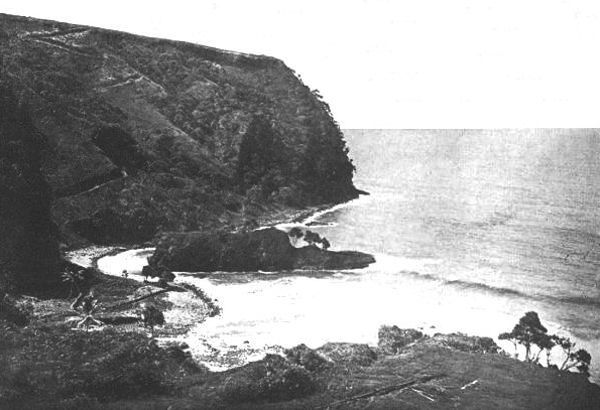
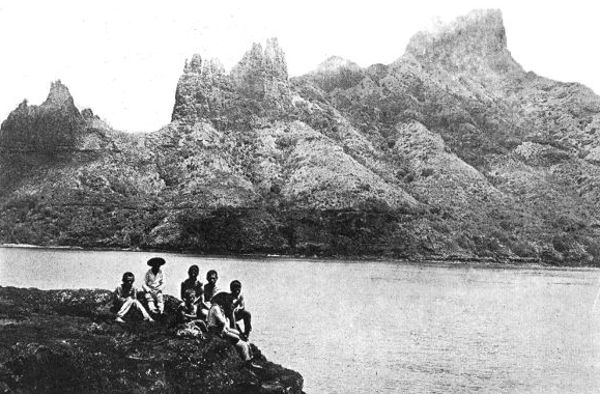
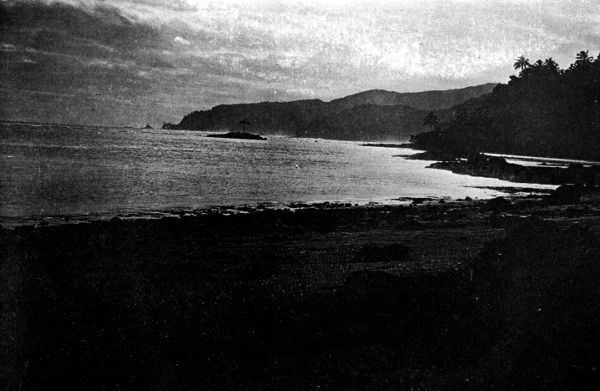
"Up at the top of that cliff—it's a thousand feet in
the sheer"—he began, pointing to a towering basaltic
buttress that reared its black bulk abruptly from the
northern loop of the bay, "there is a narrow but fairly
level and open table-land. The opposite side drops
down to Typee Inlet in the same way, and you will
remember how it tapers off to a knife-edge at the outer
point. The objective of every goat-drive is the open
space upon that point, for from it there is no escape
save across the narrow landward neck which is held by
the beaters and hunters. There is another escape, if
you want to call it that. Imagine an almost solid stream
of white furry patches, five hundred feet wide, rushing
out over the edge of that table-land there and falling
down the face of the cliff like a cataract in flood; and
then imagine—but I anticipate.
"The goats were particularly active when I first came
to Nukahiva—I was a missionary then, and lived here
in Taio-haie—and one night they brought their depredations
to a climax by tramping down the thorn fence of the
Residency garden and making a clean sweep of all
the vegetables. How much of a luxury truck garden
stuff is upon a tropical island unserved by steamers
and totally lacking in cold storage facilities, only one
who has lived under such conditions can appreciate.
Probably you're beginning to come to some appreciation
of it already. The Residente was, naturally, furious
over his loss, and plans were set afoot that afternoon
for a big drive to rid the immediate vicinity of as
many as possible of the obnoxious animals. I didn't
know what a Marquesan goat-drive was then, and readily
consented to take part.
"On the morrow at daybreak, mustering between officials,
soldiers, trading store employés and officers from
schooners in the harbour, ten or a dozen mounted men,
and between the "trusties" from the prison and other
natives drawn in by the opportunity of obtaining fresh
meat, fifty or sixty beaters, we set out in a long line
that reached from sea to sea across the landward end of
the peninsula.
"All morning we scared up the frightened animals
and drove them on before us until, at noon, we had a
herd that must have numbered some thousands cornered
upon the open table-land at the extremity of the point.
On three sides of the heaving mass of white the cliffs
fell sheer to the sea for a thousand feet, while to landward
escape was cut off by the hunt, its armed riders
drawn up in front, and the beaters, now shoulder to
shoulder, bringing up the rear in a solid double line.
"Twice the terrified band, led by a squad of patriarchal
old 'billies,' charged down upon us in a wild break
for freedom, only to fall back each time before the rain
of bullets and the deafening roar from the hard-pumped
repeaters and automatics. Even once more they massed
and, blindly, desperately, madly, made their last rush
to break our lines. Falling by scores, they still braved
the rifle fire until the last gun was empty, broke through
between the horsemen and, but for the close-packed
ranks of the beaters, would have gained their freedom
in thousands instead of a few scattered twos and threes.
"But the heavily-swung war clubs and the ear-splitting
yells of the natives checked the force of the rush, and
suddenly, as though simultaneously possessed of a common
impulse, every one of the survivors turned, rushed
to the edge of that great black cliff yonder, and went
lunging off into space. For a few moments, rising
above the dull roar of the surf against the base of the
cliff, we heard the thud and splash of the bodies striking
rocks and water, and then, save for the bleating of the
wounded at our feet, all was quiet. Not a goat had
faltered; not an unhurt animal remained on the plateau.
"For several long moments no one moved or spoke,
but each, with his horse reined sharply in, glanced guiltily
at the man on his left and on his right, and then let
his eyes fall shamedly to the ground. Even the natives
were awed and silent. Finally the Residente, shaking
his heavy shoulders like one who would rid himself of
the effects of a bad dream, dismounted, gave his horse
to a native, and picked his way out to the edge of the
cliff, the rest of us following suit. And then it was that
we were given to see the full enormity of the thing which
we had done, for the horror that had already befallen
was only the preliminary of a still grimmer tragedy, for
the final act of which the curtain was just being rung up.
"Lucky indeed—as luck went that day—were the
goats that had been killed on the plateau or had mercifully
plunged to instant death on the rocks. Many of
the animals, due to their falls having been broken by
striking the yielding mass formed by the bodies of their
mates, were still alive, and for the hundreds of these
that were floundering in the water a worse fate was reserved.
The reek of blood which welled up from below,
and the piteous bleats that assailed our ears, smote also
on keener senses than our own, and at even our first
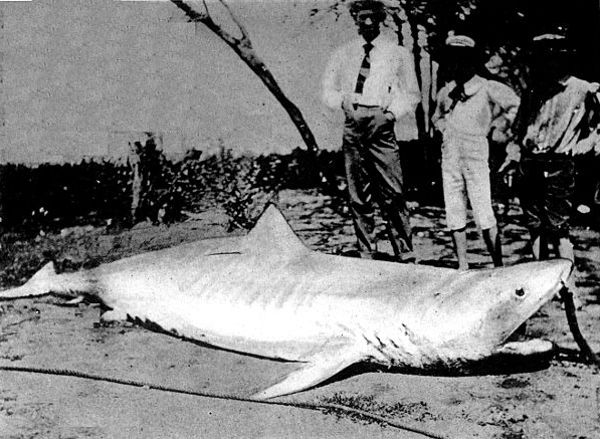
glance there were revealed to us the black dorsals of
countless lurking tiger sharks, cutting the water from
every direction and converging in a deadly focus on the
spot where the helpless little wisps of white were floating
at their mercy. They came and came, and still kept
coming, until it seemed that the whole Pacific was giving
up the sharks of the ages gone by to join in the
bloody carnival. The sea along the foreshore for hundreds
of yards was literally alive with great brown-black
forms that slashed and fought and piled upon one
another in frantic fury, while the water, five minutes
before us limpid as a woodland pool, was dyed to a deep
crimson, and its foam-lines in the eddies frothed up a
ghastly pink. I have surveyed the remains of several
cannibal feasts since that sickening noontide at the brink
of that great cliff, but never again have I known anything
to approach the overpowering feeling of mingled
horror, awe, disgust and regret that I then experienced."
McGrath straightened up with a long breath and
gulped the last of his glass of absinthe and water.
"Thus my first goat-drive," he concluded; "and thus
are the goat-drives of today. It's just as well you
should know what they are beforehand, for, if you're
anything like me, you would never forgive yourself for
getting drawn into one. However, goat-driving doesn't
exhaust the possibilities of Nukahiva by any means. I
shall be able to arrange a pig hunt for tomorrow or next
day without any trouble, I think, and, if there is any
way of getting the natives keyed up to it, I will get
them to take you out after a wild bull before you go.
You'll see something you never saw before in either
case."
It may be largely coincidence, but it is a fact at any
rate, that in nearly every place in the world where the
wild pig is found it is not considered quite the sporting
thing to hunt it with guns. There is no hard and fast
rule against it, of course, but in these places shooting a
wild boar, except as a dernier ressort, is considered about
on a par with potting ducks or pheasant. Thus, in Germany,
Austria and the Balkans it is customary for the
keenest sportsman still to take his chance with a boar
on foot, and armed only with a spear; in India the British
army officers ride that animal down in the jungle
and dispatch it with a short lance, and in Africa the
sporting thing to do is for the hunter to endeavour to
give the coup de grace with a native assegai. In North
America, for some reason, this custom is honoured only
in the breach, and the Texas peccary and the Mexican
javelin—neither of which is much more than an oversized
razor-back hog—are dispatched on sight with rifle
and shotgun.
Boar-hunting with a spear or assegai,—or even according
to the Indian practice of killing from the saddle, which requires
the greatest steadiness of seat, hand and nerve,—are certainly
not open to criticism on the ground of being un-sporting; but
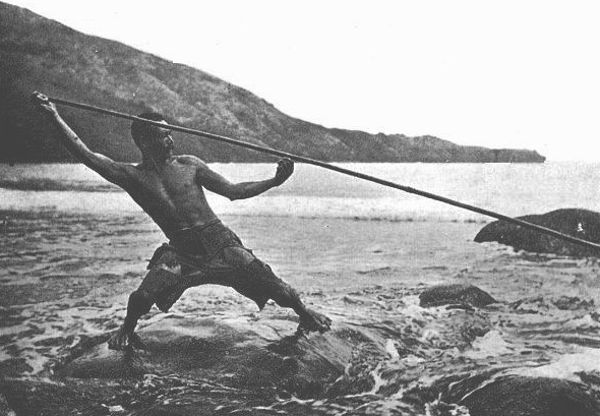
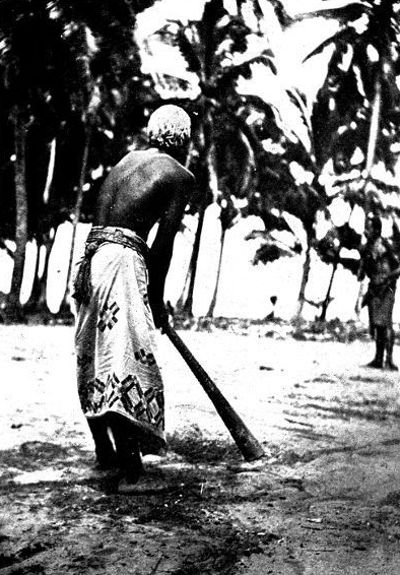
the Marquesan native, in attacking the boar of his islands with
a two-foot cutlass or macheté, which has been made for
slashing underbrush and opening coconuts—for cutting, not
thrusting—unquestionably goes all of them one better on the
score of taking chances, for he works literally at arm's length
and with his body unprotected even by the lightest of
clothes.
A Marquesan boar hunt, with no other weapons than
knives or cutlasses, is as exciting and hazardous an
undertaking as the most adventurous can desire. The
pigs are scared up in the bush by dogs and men, headed
off in their flight along the narrow run-ways in the
guava scrub, and dispatched by a knife-thrust between
the base of the neck and the shoulder. Killing a large
boar in this manner is an extremely nice piece of work,
as a difference of an inch to the right or the left in
plunging the knife means that the thrust will be almost
harmless and leaves the hunter open to the deadly sweep
of one of the scimitar-like tusks of the powerful animal.
The commonest scar one sees on the body of a Marquesan
is a long diagonal welt of white where the flesh
of calf or thigh has been laid open to the bone by the
tusk of a charging boar. If, as occasionally happens
when the boar is a large one, the slash is across the abdomen,
the hunter rarely survives to bear the scar.
McGrath was as good as his word in the matter of
arranging the pig hunt he had promised, but unfortunately,
through being called to Hatiheu to look after the
loading of one of his schooners, was unable to go along
himself.
"Be content to remain a spectator," was his parting
injunction; "and don't think because it looks easy for a
native to drop a charging boar with a cutlass and a twist
of the wrist that you can do it yourself. That was the
way I got this limp of mine—it comes from a tendon
that was cut by a side-swipe from a tusk of the first—and
the last—boar I ever tried to stick. Best take your
six-shooter along, but don't use it unless you have to.
It might serve to turn a boar that was charging you; but
it also might make one that was running away swing
around and come back. There are only two or three
small spots on a wild pig in which a pistol bullet—or a
half dozen of them, for that matter—will prove fatal,
and these you would hardly be able to locate with the
animal at a run."
McGrath laid special stress on my adhering to the
spectator rôle, and I set out with that injunction firmly
impressed on my mind. But the sticking trick looked
so ridiculously easy after I had seen it performed once
or twice that it was not long before I began to tell myself
that it was a case of "once bitten, twice shy" with
my trader friend, and that he had probably lost his nerve
on account of his unpropitious initial experience. And
so it chanced—but I had best tell something of the way
of a Marquesan with a pig before obtruding my own
troubles.
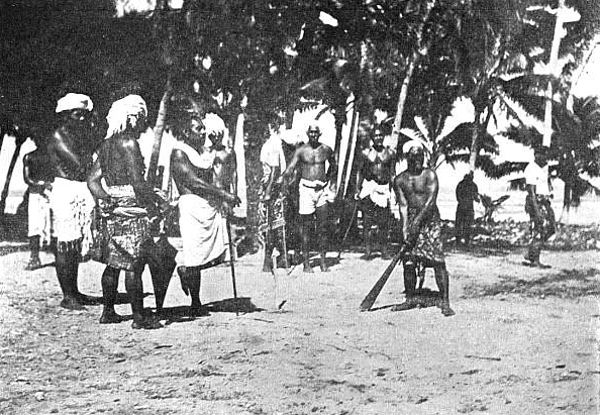
We set out from Taio-haie on foot in the first flush of
a heliotrope and daffodil sunrise—a dozen or more natives,
about twice that number of dogs, and myself—followed
the Typee trail for a mile up the mountain through the
endless ruins of the old Marquesan villages, finally to
branch off by a barely discernible foot path into the
veritable carpet of low scrub which belts the island at
the 500-foot level. Guava and lantana it was for the
most part, the former heavy with lucious yellow-red
fruit and the latter bright with tiny golden flowers.
As we fared farther from the main travelled trail, dim
runways through the bush began to appear, and these,
gradually converging as they led down toward the neck
of a rolling little valley which opened up beyond a
sharp ridge we had crossed, formed a narrow but well
marked path.
Four of the natives and I headed for a point where
two jutting walls of rock formed a natural gateway,
which was scarcely a dozen feet wide between the cliffs
and choked with several giant trees and a maze of lianas
and brush. Through this opening ran the runway we
were following, the only path by which pigs going back
and forth between the upper and lower valley could pass.
The others, with the dogs still held in leash by strands of
light liana, circled to the upper hills preliminary to
swinging around and beating back down the valley. I
was led, gently but firmly, up to a natural "grandstand"
in the angle of the buttressed roots of a big maupé tree,
one of the natives—a servant of McGrath's who was
evidently acting under orders—stopping alongside in
case I showed a disposition to "stray." My three other
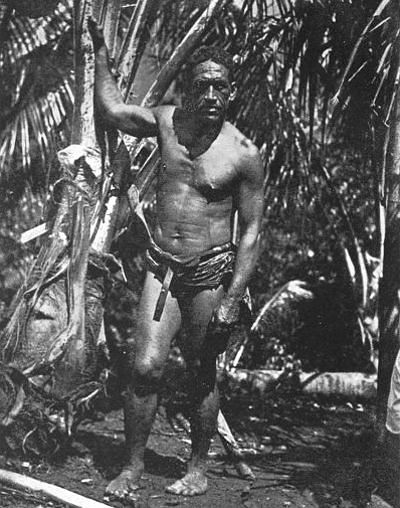
companions—strapping bronze giants with the muscles of
gladiators—took their stands in the centre of the runway.
One behind the other, at ten or twelve-foot intervals,
they lined up—there was no chance in the narrow,
bush-walled passage for anything in the nature of a
three-abreast, Horatius-at-the-Bridge formation—each
with his cutlass hand resting lightly on his hip, like a
fencer standing at ease. Cool, alert, ready, they waited,
three living, breathing incarnations of deadly efficiency.
So had I seen a puma waiting, patiently tense, upon the
limb of a tree above a path where deer were wont to
come on their way to water; so have I since seen sharks
lurking in quivering readiness among the coral spines
where ventured the divers for pearls.
Ten minutes passed, in which occasional stifled yelps,
now from this side, now from that, told that the dogs,
still in leash, were being spread out as quietly as possible
across the upper valley. Only occasional sharp crashes
in the scrub gave evidence of an increasing current of
uneasiness among the pigs. Tebu, who stood at "Number
1," broke into a low crooning chant, with a throaty
kluck and a queer chesty roll to it, which my "guard"
translated as an invitation to the pigs to come down and
join our party. Presently the other two natives took up
the air, the three of them swaying gently to the rhythm
of the barbaric chant.
The dogs appeared to have been released upon a preconcerted
signal, for their choruses of baying broke out all the way
across the valley at the same time, accompanied by the
ringing shouts of the men and the shrill ululations of a bevy
of women and girls who had trailed along after us and had
now joined the hunt.
Tebu hushed his singing and froze to attention as the
underbrush began to crackle, and I knew by the flash
of blood-lust in his eyes the instant he sighted the first
pig. This animal, which was startled but not aroused,
lunged back into the scrub before he reached the "gateway,"
and two or three other half-hearted mavericks did
likewise before one arrived on the scene who really had
his mind made up about going through to the lower
valley. Singleness of purpose showed in every line of
the flying black mass that came dashing down the
runway and headed straight for the "gate." Possibly the
fear of the dogs was in his heart, but he looked more
mad than frightened as, without a pause or a side-glance
of indecision, he hurled himself upon the motionless
bronze figure that blocked the way. On he came, like a
bull at a gate, and even as I gasped to myself that a
regiment of soldiers couldn't block his flight, he dashed
against the lone human barrier and the miracle was
enacted. The impassive giant hardly seemed to move.
There was sharp tensing of the powerful frame, a
flash of sunlight glinting across the golden muscles, a
quick movement of the wrist that might almost have
been a caress—and the flying mass of bone and sinew
was quivering at the gladiator's feet. There was not a
squeal or a kick. It was almost as though the bronze
Titan had waved his hand and muttered "Alive! Dead!
Presto! Change!" and that thus it had come to pass.
The swift transition from life to death reminded me of
the wilting of a steer under the touch of the "killer" in
an Uruguayan matadero, where they slay by severing
the spinal cord at the base of the horns with a knife
thrust. But there the twinkle of the wrist snuffed the
life spark in the body of a passive animal, while here the
same easy, effortless movement had smothered it while
it flared at full power in a quarter of a ton of flying flesh
and bone that was itself a Bolt of Death.
Another and yet another charging monster was
crumpled to earth while I was still lost in speculation
respecting the manner of the passing of the first, and it
was not until the fourth or fifth fugitive appeared that I
gathered my wits together for a dispassionate study of
the way the wonder was wrought. Then I quickly came
to the conclusion that it was the almost absolute
"evenness" of the charge that made the thing possible
at all. The surface of the runway was smooth and sloped
but slightly, while its narrowness and straightness at the
"gate" held the pig to an undeviating course whether he
wished it or not. Though he came at a great speed, the
huge body advanced almost as evenly as though running
on a track, making it possible for a man with a steady
hand and nerve to locate to a nicety that little
three-inch-wide spot between the neck and shoulder
where the point of knife must enter to be effective. That
vulnerable point would be covered by the upward toss
of the head that the boar has timed to make at the
moment of impact, and the whole success of the thrust
depends upon a quick forward step and a lunge that
anticipates that toss by the hundredth part of a second.
While he is waiting the native receiving the charge
scrapes a shallow depression in the path—something
similar to a sprinter's starting holes—into which the toes
of his left foot are set for a firm grip on the earth. At
the psychologic moment the right foot is advanced half a
pace, the left leg straightened into a brace, the right arm,
with its extended cutlass, stiffened to a bar of steel—and
the thing is done. The keen two-foot blade, slipping
between the shoulder blade and the first rib, shores
its way through heart and lungs, and its point may even
penetrate to the abdominal cavity. If the stroke is true
the blade and handle of the knife are buried to the wrist
of the arm that drives it and the charging animal
crumples up into an inert mass without uttering a sound.
If the vital spot is missed, what happens depends largely
upon the extent of the error. If the point of the knife
meets a bone squarely—as rarely happens, however—the
man behind it may be thrown backward or to one side
by the impact, and escape unscathed. The usual miss,
however, comes through having the point of the knife
deflected by the toss of the boar's head, and the result is
a glancing thrust which will probably leave the hunter
still in the path of the charge and exposed to the deadly
side-swipe of the great back-curving tusks.
It is not often that there is more than one wound—a
charging boar rarely returns to the attack once his impetus
has carried him clear of his enemies—and the consequences
of this depend largely upon its location. If a thigh is cut
deeply enough the wounded man will bleed to death; and
if the slash is across the abdomen, though he may linger,
it is rarely indeed that blood-poisoning fails ultimately to
claim him for a victim. Because the wild pig is so foul a
feeder, there is also grave danger of blood-poisoning
from the superficial wounds on the arms and legs, but
most of these, it is said, are recovered from.
Tebu dropped another pig or two with the same easy
nonchalance that had marked his manner from the outset,
and then, reluctantly, gave place to the man next in
line. This one was called Maro, and he was reputed the
champion pig-sticker of the leeward side of the island.
As first "backer-up," he had been chafing under the
enforced inactivity for some minutes and complaining
that Tebu was taking the cream of the sport for himself.
The new "Number 1" was less massive of build than his
predecessor, but was muscled with the fluent undulations
of swift-running water—a man compact of watchsprings,
a human tiger-cat. Deftly and easily he dropped his first
pig—a rangy boar—slapped a flying half-grown shote
contemptuously with the flat of his cutlass as beneath
his notice, and had just got well "set" on his toes again,
when that bane of the Marquesan pigsticker, a
"double"—two boars running close together—came
charging down.
By all the rules of the game this twin terror should
have been allowed to go by unmolested, for successfully
to stick a "double" is a feat as rare as a triple play in
baseball or the "hat trick" in cricket—a thing to be
talked about for years after it has happened. But it
chanced to come at the moment when the shifty Maro
was just "on edge"—nicely warmed up and steadied by
his first pig and yet not wearied by successive efforts—and
then there was the Beretani—the white man—who had to
be shown what a Marquesan could really do in a pinch.
Probably the latter was the more powerful incentive.
At any rate, without a gesture or a glance of hesitation,
he settled the toes of his left foot firmly into their hole,
poised for an instant in quivering readiness, and then,
with the swiftness of a striking cobra, lurched forward
in two lightning passes.
The first thrust, which was delivered at the full extension
of his reach, appeared barely to brush the neck of the
foremost boar, but the next—driven home with a short-arm
jab like a pugilist's close-in hook at an opponent's solar
plexus—buried the full length of the knife in the shoulder
of the second boar, and brought it down in a heap, Maro
himself being tripped and half-buried under the inert body.
That the first boar had been more than scratched seemed
impossible; yet there he lay, almost at my feet, giving
what appeared to be his dying kicks. Tebu and his mate
were extricating Maro from under the body of the second
boar, and it struck me that the humane thing to do would
be to put the wounded beast out of his agony. Accordingly,
without taking especial care to aim accurately, I directed
a couple of bullets from my ".38" automatic at a spot
behind one of the ears which appeared to be vulnerable.
Just where the bullets struck I never found out, for
the well-meant shots awakened something besides the
echoes of the rock-girt gorge. At the touch of the lead
the apparently dying boar scrambled to his feet and
made a dive for the lower end of the "gate." Tebu
struck viciously as the animal passed him, but only
landed a harmless slash, and the cutlass of the other
native, flung on the chance of severing a rear tendon,
went wide of its mark. The fugitive, running blind but
strong, disappeared among the mazes of trails that led
into the lower valley, followed by the wails of Maro, who
saw the feat of a lifetime marred by the interference of a
meddlesome outsider who had been too cowardly to
take a hand in the dangerous part of the game himself.
Shouting something in voluble Marquesan in my
direction, he leapt back into the runway as a renewed
crashing broke out above, and stood savagely on guard.
"What did he say?" I asked McGrath's boy, Tavu,
who had stuck closely to my side through all the excitement.
"He say he kill pig dead. You shoot gun, wake him
up. Maro damn mad. He say now he kill three pigs,
all one time. Maybe he mean 'long-pig.' Maro bad
fella b'long Anaho," and he touched his eye with a finger
as a sign that it would be well to be on guard.
The good fellow probably did Maro an injustice in
charging him with harbouring the intention of converting
my anatomy into that most recherché of Marquesan
delicacies, "long-pig"; but if there was any doubt of his
willingness, in his anger and disappointment, to tackle
three pigs at once it was effectually dispelled by the
events of the next few moments. The shouts of the
beaters and the barking of the dogs had been growing
louder all the time, and the crashings in the underbrush
told that the pigs were now coming in increasing numbers.
Three or four of them shortly came tearing into
view, and then—all of a sudden—the path was packed
with bristling black figures, the first few running hard
and free and the rest crowding and stumbling.
The rush of pigs as the beaters closed in was always
to be expected in this particular cul de sac, and McGrath
had warned me regarding it.
"Get out of the way and sit tight," he had said; "and
don't worry about the boys. They'll take care of themselves."
I appeared to be sufficiently out of the way already,
and Tebu and the third native, as soon as they had
caught sight of the impending avalanche, came over and
joined me on the roots of the big tree. I watched them
clamber up to safety and then turned to see the river of
pigs sweep by—and there was that sullen, scowling
tiger-cat of a Maro standing his ground in the middle
of the runway. Of course, the proper thing to have
done would have been for some self-sacrificing soul to
leap down and snatch the would-be suicide from "under
the wheels," a task for which the powerful Tebu was
admirably fitted by nature. I'm not sure that the duty
of indulging in this form of self-sacrifice is included in
the Marquesan ethical code, but even if it had been,
there was no time to put it into practice. Maro dropped
his first pig and made a pass at the second even as I
looked. The two animals were running almost
neck-and-neck, so that the second thrust was hardly
more than a slight slash upon the flying brute's shoulder.
It served to turn Maro in his tracks, however, and not
all of his super-feline quickness could bring him around
again in time to meet the rush. The shoulder of the
next pig sent him tottering sidewise as the animal
passed, and in another moment he had fallen fairly
across the upraising head of a huge boar in the van of
the ruck. For an instant the shining bronze body ceased
to flash against the heaving black background, and then,
as a rat is tossed by a terrier, it was flung cleanly into
the air, to come slamming down against the gnarled
roots of our maupê tree and collapse into a lifeless
heap. The body seemed to have struck the tree hard
enough to break half of its bones; yet the worst injury,
I told myself, must have come from the terrific toss that
had sent it catapulting through the air.
After the rush was over we lost no time in clambering
down to "view the remains." Tebu was smiling sardonically,
apparently not greatly shocked by the tragedy and perhaps
secretly pleased at having the only man in the island who
was held his equal in pig-sticking prowess put out of the
running. The other two natives seemed a little more upset,
and Tavu was muttering to himself the ancient Marquesan
proverb which translates literally as "Wild pig—'long-pig.'"
This has lost its meaning since cannibalism became
practically extinct, but in the old days it signified that
when the men went out to get the meat of the wild pig,
there was likely also to be man meat to eat at the feast
that was held when the hunt was over.
The body lay on its back, inert as the carcasses of the
pigs that littered the sides of the runway. Tebu and I
picked it up and turned it over to reveal the wound which
we knew must have been inflicted when it was tossed into
the air—and lo, beyond some bluing bruises, there was
no wound! We could only guess how so seemingly impossible
a thing as a man's being tossed ten feet by a wild boar
without being slashed to ribbons could have happened;
but the most probable explanation seemed to be that
Maro had fallen sidewise across the head of the
animal, behind the tusks, so that the upward thrust of
the powerful neck had only resulted in a mighty push.
No bones appeared to be broken. A welt on the back
of the head where it had struck the tree accounted for the
senseless condition of the scrappy pig-sticker, and this,
as far as we could discover, was the extent of the injuries.
A dash of water from the nearby stream brought Maro
back to life again, but too dazed, for the time being at
least, to recall the resentment he had harboured against
me on the score of the pig I had "waked up" with my
pistol shots.
The natives now cleared a space of brush with their
cutlasses and we prepared to rest and lunch in the
shadow of the big tree. A fire was started to heat stones
for roasting a young pig that had been captured, breadfruit
and plantain were put to cooking, coconuts were
opened and guavas, mangoes and a lucious array of other
tropical fruits were laid out on the broad leaves of the
taro plant. And then came the women to our Eden,
and with them the Serpent.
McGrath had given the strictest orders that nothing
in the form of toddy should be brought along on the
hunt, and this injunction had apparently been heeded as
far as the hunters themselves were concerned. But the
dozen or more girls who had come on later to help as
beaters and share in the division of the meat, claimed to
have heard nothing of the prohibition. Possibly it was
a "frame-up" on the part of the men, or perhaps it just
happened. At any rate, when the beating brigade began
to straggle in, it became apparent at once that tippling
had been going on, and shortly I saw the bruised
and battered Maro taking a long draught from a calabash
that was being held to his lips by a star-eyed minx
with a red hibiscus blossom behind her ear and a rakish
chaplet of fern frond tilted across her comely brow.
"Coco toddy," muttered Tavu, half in alarm, half
in anticipative ecstasy. "Plenty coco toddy b'long
vahine."
It would be churlish, I told myself, to attempt to forbid
the ambrosia to any of the tired gladiators when the
common herd of the beaters had already been cheering
themselves with it. Then—fatal mistake—I nodded my
head in acquiescence when an epu was held up for
Tavu, my guardian, to quaff, and—but I had already
taken a gulp of the liquid fire from a calabash that a
bronze, flower-crowned Hebe, with arms that were
symphonies of rippling loveliness and eyes that were
twin wells of limpid light, had brought and hung about
my neck. Another brought a wreath for my brow and a
flower for my ear, and thus crowned the king of the
Bacchic revel it became all the more difficult to
inaugurate a temperance program among my festive
subjects. There wasn't enough of the toddy to put them
in a cannibalistic mood, I argued; and, anyhow, they
were bound to have all they wanted, and at my
expense, as soon as they got back to Taio-haie.
At any rate, the "women did offer us of the wine to
drink, and we did drink," and it was all a very merry
little "hunting breakfast." It is not my purpose to
write here of the imp who lurks in the depths of the coco
toddy calabash to spring out upon the unwary one who
uncovers him, as I shall have more to say of him later
on in Tahiti. On this occasion such mischief as was
wrought was only indirectly traceable to him, and it is
by no means impossible that it might not have occurred
anyway.
This was how it came about: From time to time some
of the dogs that had strayed would come straggling in,
and in nearly every case driving a pig or two ahead of
them. As the animals appeared, now one and now another
of the natives would jump up, intercept the fugitive
in the runway and bring him to earth with that easy,
effortless neck-thrust that, to the beholder, was more
like a caress than a stab. But because they had drunken
of the insidious toddy and there were many spectators,
the stickers were more than ordinarily nonchalant in
their motions, and—possibly because I, also, had partaken
of the toddy—the trick kept looking easier and easier
every time it was done. And probably it was because
Maro had been stimulating his dazed faculties with the
toddy that the recollection of the "double" I had spoiled
for him reawakened, and he began to tell the party how
it happened. I didn't need to know Marquesan to
understand the fluent gestures which pictured me
resting comfortably in the tree while the killing was
going on, and showed how I didn't even dare to shoot
off my pistol at anything but a dead pig; and as for
having the courage to stand before one with a knife—the
scorn of his "let-me-forget-it" expression was positively
effacive.
In my own action I have always told myself that toddy
played no part; but that delectable beverage certainly
was responsible for the fact that Tavu, who was under
the strictest orders from McGrath to keep me out of
mischief, only nodded approbatively when I picked up
Tebu's big cutlass from the grass and strode out into
the runway to "make my honour white." Tebu, with
a roar of delight, seized another cutlass and came out
to "back up" for me, but I waved him indignantly aside,
resolved to do the trick alone. The good fellow stepped
aside obediently, but, unluckily for himself, "stood by"
against an emergency.
Flower-crowned and sword in hand! I have called
up that incongruous picture in memory many times
since, and always to caption it with some classic title.
Of these, "Bacchus in the Rôle of Ajax Defying the
Lightning" has seemed to me rather the most appropriate.
The crowd fell silent as a crashing and the barking
of dogs in the bush above told that another fugitive was
approaching, for they scented trouble with the Residente
in case anything happened to the Beretani who had been
put into their charge. (I learned later that the natives
hunting with a French official who had been killed
trying to shoot a wild bull the year before had been
seriously punished.) Thanks again to the toddy,
however, no one made a move to interfere.
It was an uncommonly unkind trick of Fate to have
held up the only really large boar that appeared in the
course of that hunt until I, the greenest of green novices,
had set myself so defiantly in the middle of his path that
there was no graceful way of getting out of it. Also,
it was harshly ordered that, whereas the other animals
had come charging down as evenly as though strung on
trolleys, this monster, with two dogs nipping his heels,
should be plunging and reeling like a ship in a gale.
I had clearly in mind everything that needed to be
done, even to kicking the toe-hole for my left foot, and
I kept repeating to myself the words of my old 'varsity
baseball coach to his batters—"Step out and meet it."
These words had been recalled to me repeatedly during
the morning as Tebu or Maro delivered his deadly thrust
with a quick forward step, and that, with keeping the
eye on the vulnerable spot between the neck and
shoulder, seemed to me to be the crucial points upon
which the turning of the trick depended. I have since
been told that this is quite correct. But this procedure
was calculated to be followed in the case of the
regulation direct-charging boar; what to do in the case
of a brute that was tossing his head in spirals, as now
this flank, and now that, was nipped by a pursuing
dog, I didn't—and I still don't—know just what to do.
Because I felt that I knew just what to do, and just
how to do it, I had myself perfectly in hand until,
sudden as a lightning flash, came the realization that
the spot that I must strike between the neck and the
shoulder was not keeping on an even plane. I had
experienced some fairly exciting close-in work with
grizzly and silver tip on a couple of occasions previous
to that morning, and since then I have stopped the
charge of a South American jaguar with a revolver and
known what it is to see a Bengal tiger clawing the
howdah of an elephant I was riding; but never have I
known anything to approach the "all gone" feeling
which accompanied the realization that I was not
going to be able to locate the spot which had to be
located if I was to avoid a collision that would make
that of Maro's a friendly jostle in comparison.
The instant the message "You can't do it!" was flashed
to my brain, the charging pig ceased to be a pig, so far as
I was concerned, and became a Car of Juggernaut, a
Bolt of Wrath, the incarnation of everything that was
Swift, Terrible and Inevitable. Before I knew it I had
dropped the useless cutlass, snatched out my automatic
pistol and was discharging it wildly at the approaching
monster. The rattle of shots was answered by a burst
of savage snarls mingled with quick yelps of pain, and
then, as the hammer snapped down on unresponding
steel after the last cartridge was fired, I sprang blindly
to one side and plunged headlong into the brush. That
I dove into the unsympathetic depths of some kind of a
fishhook thorn bush, which took ample toll for the intrusion
when I was dragged out by the heels a minute later, was
only an incident in the light of the fact that—thanks
to an instinct for preservation that not even coco
toddy had drugged to sleep—I had avoided so much as
a brush from the charging boar.
A roar of agony and shouts of consternation told me,
even before I was released from the tentacles of the thorn
bush, that some one else had got in the way of the charge
that I had declined to meet; then the noise of the pursuit
passed on and died out beyond the "gate." My pigskin
puttees were about the only things I had on that
did not remain, wholly or in part, in the embrace of the
thorns, but my own scratches were quickly forgotten
at the sight of the other victim of the charge. There
were two other victims, in fact—one a dog that had
been raked by a soft-nosed bullet from my pistol, and
the other the stout-hearted old gladiator, Tebu, who,
leaping to take up the challenge I had side-stepped, had
fallen afoul of the boar itself. His bulldog courage—or
the toddy—had impelled him to undertake on short
notice the job the Beretani had shirked, and, with no
chance to locate the vital spot for his thrust, had lunged
wildly and taken the consequences.
The dog was dead, and it looked for a while as though
Tebu, with a foot-long gash across his thigh and bleeding
like one of the pigs that lay beside him, would follow
suit. It transpired presently, however, that no
arteries were severed; so after staunching the flow as
effectually as possible with a torniquet and bandages
that left several members of the party nearly in a state
of nature after giving up their pareos for the wherewithal,
they rigged up a rough litter of boughs and lianas
and set off, not untenderly, to bear the wounded warrior
back to Taio-haie. There, thanks to the skilful and
kind care of the sisters at the Mission, he was soon on
his way to recovery.
A month later, in Tahiti, I received a letter from
Cramer, the German trader of Taio-haie. After going
on to tell how our friend McGrath had been blown away
in his cutter during a hurricane and was given up for
lost, he wrote:
"I saw Tebu today. He is still very lame, and probably
always will be, but he has been going out every
day since he left the mission hospital to hunt the big
boar that cut him up so the time he was out with you.
He says he is going to keep on hunting it until he kills
the boar or the boar kills him."
To this letter was added a postscript, written several
days later, which read:
"Tebu brought in the big boar last night. He says
he knows it by the cut he gave it on the shoulder. As
we found no bullet marks on the body we have thought
he is probably mistaken."
To this I replied:
"Probably Tebu is right. I cannot swear that I was
looking down the sights of my pistol when I fired those
shots."
Thus pig-sticking in the Marquesas. It is bloody
and cruel, as is the killing of all animals; but, because
the quarry is nearly always dropped in its tracks, it is
far less open to criticism on that score than most other
forms of hunting. But the finest thing—I may well
say, the grandest thing—about it is the fact that it is a
strictly man-to-beast, give-and-take affair, with the
hunter meeting his quarry more nearly on equal terms
than in any other form of hunting practised since the
days of the Cave Men.
Of the wild cattle hunt which McGrath, after infinite
trouble, arranged for one of the final days of our stay
in Nukahiva, I have written elsewhere.