Someone has accounted for the charm of
story-telling by the suggestion that the
natural man imagines himself the hero of the
tale he is reading, and squares this action or
that with what he would suspect himself of
doing in similar circumstances. The romancer
who can best beguile his reader into this
conceit of mind is likely to be the most
popular. It seems to me that with books of
travel this mental make-believe must also
take place if the reader is to derive the full
measure of entertainment from the narrative.
With myself, at all events, it is so, and
Hazlitt may be authority of sufficient weight
to justify the thought that my own experience
is not likely to be singular. To me the chief
charm in reading a book of travel is this
fanciful assumption of the rôle of the
traveller; and so far does it condition my
reading, that my readiest appetite is for a
story of wayfaring in some quarter of the
world where I may hope, not unreasonably,
to look upon the scenes that have first
engaged my mind's eye. Thus the adventures
of a Mr. Savage Landor in Thibet, or a
Sir Henry Stanley in innermost Africa, have
less attraction for me than the narrative of a
journey such as Elihu Burritt undertook in
his famous walk from London to John
o' Groats, or R. L. Stevenson's Travels with
a Donkey in the Cevennes. I will grant you
that the delicious literary style of Stevenson's
book is its potent charm, but I am persuaded
that others than myself have had their pleasure
in the reading of it sensibly increased by the
thought that some day they might witness
Nature's originals of the landscapes which
the master painter has depicted so deftly. It
had long been a dream of mine to track his
path through that romantic region of old
France; not in the impudently emulative
spirit of the throaty tenor who, hearing Mr.
Edward Lloyd sing a new song, hastens to
the music-seller's, resolved to practise it for
his next "musical evening;" not, forsooth,
to do again badly what had once been done
well; but to travel the ground in the true
pilgrim spirit of love for him who
"Here passed one day, nor came again—
A prince among the tribes of men."
Well did I know that many of the places with
which I was familiar romantically through
Stevenson's witchery of words were drab and
dull enough in reality: enough for me that
here in his pilgrim way that "blithe and
rare spirit" had rested for a little while.
The mountainous district of France to
which, somewhat loosely, Stevenson applies
the name Cevennes, lies along the western
confines of Provence, and overlaps on several
departments, chief of which are Ardèche,
Lozère, Gard, and Herault. In many parts
the villages and the people have far less in
common with France and the French than
Normandy and the Normans have with provincial
England. Here in these mountain
fastnesses and sheltered valleys the course
of life has flowed along almost changeless for
centuries, and here, too, we shall find much
that is best in the romantic history and
natural grandeur of France. Remote from
Paris, and happily without the area of the
"cheap trip" organisers, it is likely to remain
for ever "off the beaten track."
In order to visit the Cevennes proper, the
beautiful town of Mende would be the best
starting-place. But since my purpose was to
strike the trail of R. L. S., after some wanderings
awheel northward of Clermont Ferrand,
I approached the district from Le Puy, a
town which so excellent a judge as Mr. Joseph
Pennell has voted the most picturesque in
Europe. Besides, Stevenson himself had
often wandered through its quaint, unusual
streets, while preparing for his memorable
journey with immortal Modestine. "I decided
on a sleeping sack," he says; "and
after repeated visits to Le Puy, and a deal of
high living for myself and my advisers, a
sleeping sack was designed, constructed, and
triumphantly brought home." At that time
the wanderer's "home" was in the mountain
town of Le Monastier, some fifteen miles
south-east of Le Puy, and there in the
autumn of 1877 he spent "about a month of
fine days," variously occupied in completing
his New Arabian Nights and Picturesque
Notes on Edinburgh, and conducting, with no
little personal and general entertainment, the
preliminaries of his projected journey through
the Cevennes.
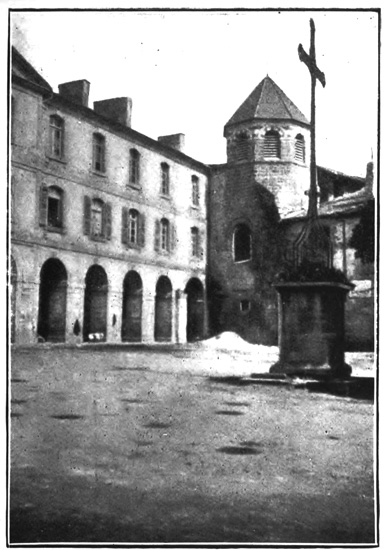
Where R. L. S. bought Modestine
"Our first interview (with Father Adam) was
in the Monastier market place."—R. L. S.
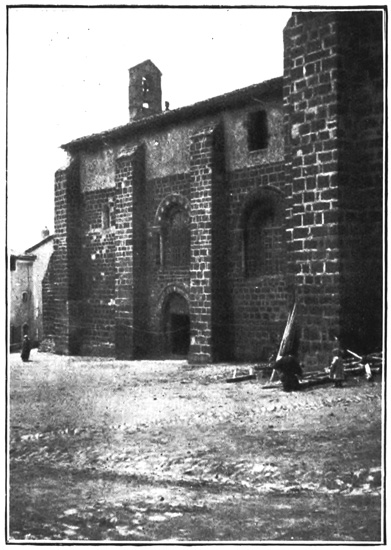
"The bell of Monastier was just striking nine,
as I descended the hill through the common."—R. L. S.
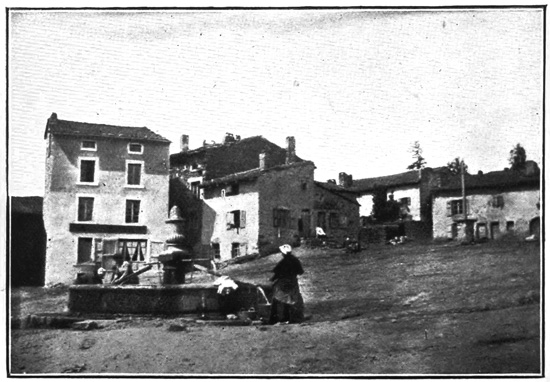
LE MONASTIER
Together with a friend I had spent some
rainy but memorable days at Le Puy in the
summer of 1903, waiting for fair weather to
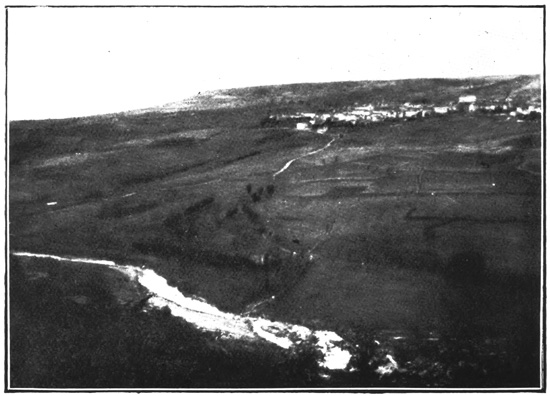
advance on this little highland town, which
lies secure away from railways and can only
be reached by road. A bright morning in
June saw us gliding on our wheels along the
excellent route nationale that carries us
thither on a long, easy gradient. The town
seen at a distance is a mere huddle of grey
houses stuck on the side of a bleak, treeless
upland, and at close quarters it presents few
allurements to the traveller. But it is typical
of the mountain villages of France, and rich
in the rugged, unspoilt character of its inhabitants.
Stevenson tells us that it is
"notable for the making of lace, for drunkenness,
for freedom of language, and for
unparalleled political dissension." As regards
the last of these features, the claim to
distinction may readily be admitted, but for
the rest they apply equally to scores of
similar villages of the Cevennes. Certainly it
is not notable for the variety or comfort of its
hostelries, but I shall not regret our brief
sojourn at the Hôtel de Chabrier.
Mine host was a worthy who will always
have a corner in my memory. Like his
establishment, his person was much the worse
for wear. Lame of a leg, his feet shod with
the tattered fragments of slippers such as
the Scots describe with their untranslatable
"bauchle," a pair of unclean heels peeping out
through his stockings, he was the living
advertisement of his frowsy inn, the ground
floor of which, still bearing the legend Café,
had been turned into a stable for oxen and
lay open to the highway, a doubtful shelter
for our bicycles. But withal, turning a shut
eye to the kitchen as we passed, the cooking
was excellent, and M. Chabrier assured us
that he was renowned for game patties, which
he sent to "all parts of Europe." The frank
satisfaction with himself and his hotel
he betrayed at every turn would have rejoiced
the heart of so shrewd a student of
character as R. L. S., and the chances are
considerable that in that month of fine days,
six-and-twenty years before, Stevenson may
have gossiped with my friend of the greasy
cap, for M. Chabrier was then, as now, making
his guests welcome and baking his inimitable
patties.
Did he know Stevenson? "Oui, oui, oui,
M'sieu!" Stevenson was a writer of books
who had spent some time there years ago.
"Oui, oui, parfaitement, M'sieu Stevenzong."
What a memory the man had, and how
blithely he recalled the distant past!
"Then, of course, you must have known
the noted village character Father Adam,
who sold his donkey to this Scottish
traveller?"
"Père Adam—oui, oui, oui—ah, non, non,
je ne le connais pas," thus shuffling when I
asked for some further details.
Mine host, who read the duty of an innkeeper
to be the humouring of his patrons,
could clearly supply me with the most surprising
details of him whose footsteps I was
tracing; but wishful not to lead him into
temptation, I tested his evidence early in our
talk by asking how many years had passed
since he of whom we spoke had rested at
Le Monastier, and whether he had patronised
the Hôtel de Chabrier. He sagely scratched
his head and racked his memory for a
moment, with the result that this Scotsman—oh,
he was sure he was a Scotsman—had
stayed in that very hotel, and occupied
bedroom number three, just four years back!
Obviously he was mistaken—not to put too
fine a point upon it—and his cheerful avowal,
in discussing another subject, that he was "a
partisan of no religion," did not increase my
faith in him. There were few Protestants in
Le Monastier, he told me; but as I happened
to know from my good friend the pasteur at
Le Puy that the postmaster here, at least,
stood by the reformed faith, and by that
token might be supposed a man of some
reading, I hoped there to find some knowledge
of Stevenson, whose works and travels were
familiar to the pasteur. Alas, "J' n' sais pas"
was the burden of the postmaster's song.
To wander about the evil-smelling by-ways
of Le Monastier, and observe the ancient
crones busy at almost every door with their
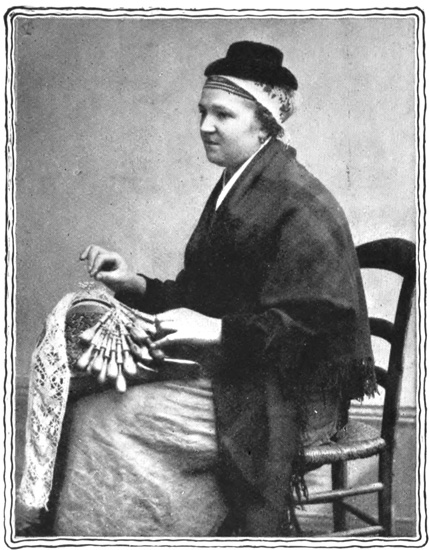
lace-making pillows, the bent and grizzled
wood-choppers at work in open spaces, is to
understand that, despite the lapse of more than
a quarter of a century, there must be still alive
hundreds of the village folk among whom
Stevenson moved. But to find any who could
recall him were the most hopeless of tasks;
to identify the auberge, in the billiard-room
of which "at the witching hour of dawn"
he concluded the purchase of the donkey
and administered brandy to its disconsolate
seller, were equally impossible, and it
was only left to the pilgrims to visit the
market-place where Father Adam and his
donkey were first encountered. So with the
stink of the church, whose interior seemed
to enclose the common sewer of the town,
still lingering in our nostrils, we resumed our
journey southward across the little river
Gazeille, and headed uphill in the direction
of St. Martin de Frugères, noting as we
mounted on the other side of the valley the
straggling lane down which Modestine, loaded
with that wonderful sleeping sack and the
paraphernalia of the most original of travellers,
"tripped along upon her four small hoofs
with a sober daintiness of gait" to the ford
across the river, giving as yet no hint of the
troubles she had in store for "the green
donkey driver."
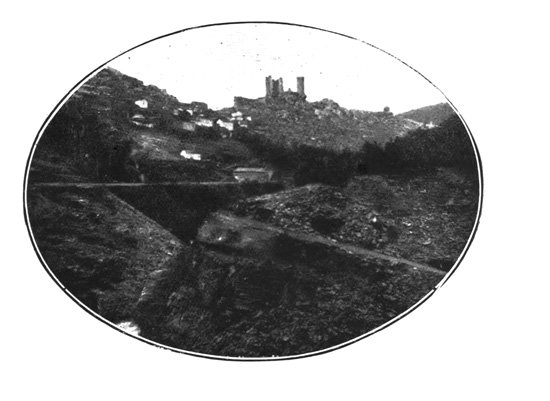
CHÂTEAU NEUF, NEAR LE MONASTIER
A drawing of this castle by Stevenson has been published.
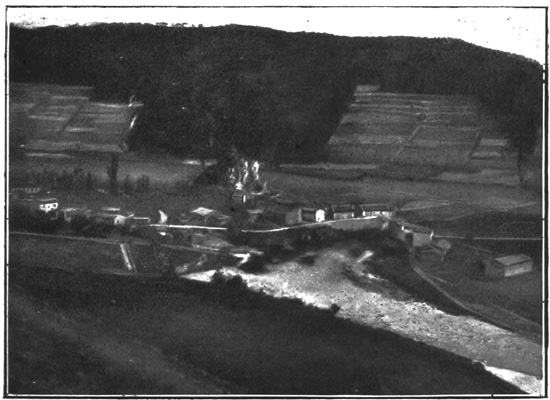
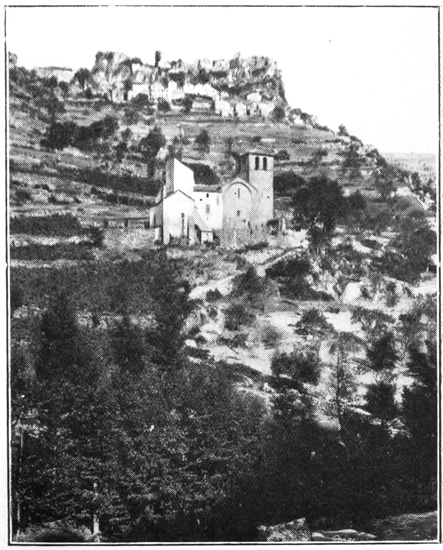
GOUDET
"I came down the hill to where Goudet stands in a green end of a
valley."—R. L. S.
Along our road were several picturesque
patches formed of rock and pine, and notably
the romantic ruins of Château Neuf, with the
little village clustered at their roots, which
furnished subjects for Stevenson's block and
pencil. Among his efforts as a limner there
has also been published a sketch of his that
gives with striking effect the far-reaching
panorama of the volcanic mountain masses
ranging westward from Le Monastier, a scene
of wild and austere aspect. A little beyond
Château Neuf we were wheeling on the same
road where he urged with sinking heart the
unwilling ass, and while still within sight of
his starting-place, showing now like a scar on
the far hillside, we passed by the filthy village
of St. Victor, the neighbourhood where the
greenness of the donkey driver was diminished
by the advice of a peasant, who advocated
thrashing and the use of the magic word
"Proot."
The road grew wilder as we advanced
towards St. Martin de Frugères, to which
village the sentimental traveller came upon a
Sabbath, and wrote of the "home feeling"
the scene at the church brought over
him—a sentiment difficult to appreciate as
we wandered the filth-sodden streets and
inspected the ugly little church, whitewashed
within and stuffed with cheap symbols of a
religion that is anathema to descendants of
the Covenanters. The silvery Loire far below
in the valley to our right, we sat at our ease
astride our wiry steeds and sped cheerfully
down the winding road to Goudet, feeling that
if our mode of progress was less romantic than
Stevenson's, it had compensations, for there
was nothing that tempted us to tarry on our
way.
"Goudet stands in a green end of a valley,
with Château Beaufort opposite upon a rocky
steep, and the stream, as clear as crystal, lying
in a deep pool between them." The scene was
indeed one of singular beauty, the fertile fields
and shaggy woods being in pleasant contrast
to the barren country through which we had
been moving. While still a mile away from
the place, we foregathered with two peasants
trudging uphill to St. Martin. I was glad to
talk with them, as I desired to know which of
the inns was the oldest. There were three, I
was told, and the Café Rivet boasted the
greatest age, the others being of recent birth,
and none were good, my informant added,
supposing that we intended to lodge for the
night.
To the inn of M. Rivet we repaired, this
being the only auberge that Goudet possessed
at the time of Stevenson's visit. We found
it one of the usual small plastered buildings,
destitute of any quaintness, but cleaner than
most, and sporting a large wooden tobacco
pipe, crudely fashioned, by way of a sign.
The old people who kept it were good Cevennol
types, the woman wearing the curious headgear
of the peasant folk, that resembles the
tiny burlesque hats worn by musical clowns,
and the man in every trait of dress and feature
capable of passing for a country Scot. The
couple were engagingly ignorant, and had
never heard of Scotland, so it was no surprise
to learn that they knew nothing of the famous
son of that country who had once "hurried
over his midday meal" in the dining-room
where we were endeavouring to instruct
Madame Rivet in the occult art of brewing
tea. The Rivets had been four years in
possession of the inn at the time of Stevenson's
visit, and I should judge that the place had
changed in no essential feature, though I
missed the portrait of the host's nephew,
Regis Senac, "Professor of Fencing and
Champion of the Two Americas," that had
entertained R. L. S. In return for our hints
on tea-making, Madame Rivet charged us
somewhat in excess of the usual tariff, and
showed herself a veritable grippe-sous before
giving change, by carefully reckoning
the pieces of fly-blown sugar we had used, a
little circumstance the cynic may claim as
indicating a knowledge of the spirit if not
the letter of Scotland.
It was late in the afternoon when we continued
our journey from Goudet, intent on
reaching that evening the lake of Bouchet,
which Stevenson had selected as the camping-place
for the first night of his travels. The
highway to Ussel is one of the most beautiful
on the whole route, lying through a wide and
deep glen, similar to many that exist in the
Scottish Highlands, but again unlike all the
latter in its numerous terraces, that bear
eloquent witness to the industry of the
country-folk. Every glen in this region of
France is remarkable for this handiwork of
the toilers, and the time was, before the advent
of the sporting nawbobs, when in some parts
of the Scottish Highlands similar rude stonework
was common in the glens.
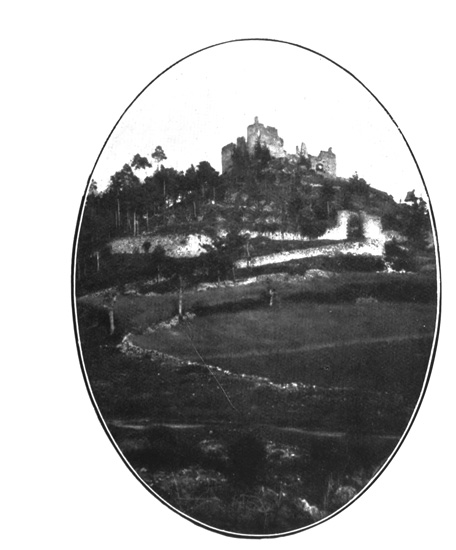
CHÂTEAU BEAUFORT AT GOUDET
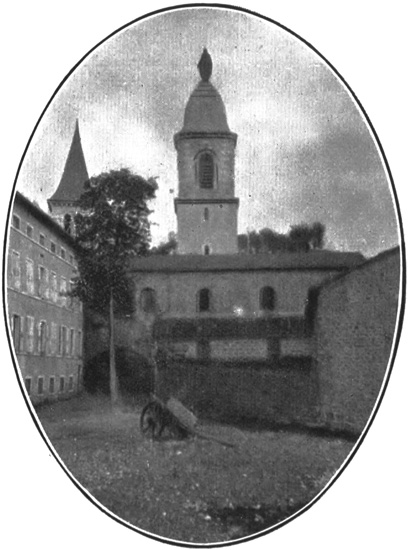
SPIRE OF OUR LADY OF PRADELLES
To those who have not seen this work of the
poor hill-folk it is not easy to convey a proper
idea of its effect on the landscape. In these
bleak mountain regions the sheltered valleys
and ravines are best suited for growing the
produce of the field, but as the soil is scant
and the ground too often takes the shape of
a very attenuated V, it is impossible to cultivate
the slopes of the valley in their natural
condition; so, with infinite labour and the
patience of their stolid oxen, the Cevennols
begin by building near the banks of the
stream a loose stone wall, and filling in the
space between that and the upward slope with
a level bedding of earth. Thus step by step
the hillside is brought into cultivation, and
the terraces will be found wherever it is
possible to rear a wall and carry up soil;
indeed, they are to be seen in many places
where it would have been thought impossible
to prepare them, and out of reason to grow
crops upon them. Often they are not so large
as an ordinary bedroom in area, and such a
space one may see under wheat. A hillside
so terraced looks like a flight of giant steps,
and it is a unique spectacle to children of the
plains to descry, perhaps on the twentieth
story, so to say, a team of oxen ploughing
one of these eerie fields.
Along this road, where on our right the
terraces climbed upward to the naked basalt,
and on the other side of the valley, now flooded
with a pale yellow sunset that picked out
vividly children at play tending a scanty herd
of cattle on the hillside, our donkey driver of
old had some of his bitterest experiences with
that thrawn jade Modestine. We, fortunate
in our more docile mounts, made excellent
progress to Ussel, after walking a good two
miles on foot. The road beyond that town
was lively with bullock wagons, heavily
freighted with timber, and carts, mostly drawn
by oxen, filled with women returning from
the market at Costaros, a little town on the
highway between Le Puy and Pradelles;
bullocks and people—the former to our embarrassment—being
greatly interested in the
wheel-travellers of these seldom cycled roads.
When we arrived at Costaros, a town that is
drab and dismal beyond words, the evening
was wearing out under a leaden sky, promising
the stragglers from the market good use for
their bulky umbrellas, and we had still eight
kilometres of rough country roads between us
and the lake. Stevenson, in his heart-breaking
struggles with the wayward ass, must have
crossed the highway in the dark some little
distance south of Costaros to have arrived at
the village of Bouchet St. Nicolas, two miles
beyond the lake; and as we urged forward in
the rain, which now fell pitilessly and turned
the darkling mountains into phantom masses
smoking with mist, we could appreciate to the
full the satisfaction with which he abandoned
his quest of the lake and spent his first night
snug at the inn of Bouchet. As we wheeled
through the mud into the large village of
Cayres no straggler appeared in the streets,
that steamed like the back of a perspiring
horse; but a carpenter at work in a windy shed
assured us that the chalet on the shore of the
lake had opened for the season, and in our
dripping state we pressed thither uphill,
feeling that two miles more in the rain could
not worsen our condition. It was a weird and
moving experience—the ghostly woods on the
hillside, the tuneless tinkle of bells on unseen
sheep, the hissing noise of our wheels on the
moist earth—and our delight was great when
we heard the lapse of water on our left. For
nearly a mile the latter part of the road lay
through a pine forest, where the ground had
scarcely suffered from the rain, but the way
was dark as in a tunnel, and glimpses of the
lake between the trees showed the water almost
vivid as steel by contrast.
"I had been told," says R. L. S., "that the
neighbourhood of the lake was uninhabited
except by trout." He travelled in the days
before the Syndicat d'Initiative du Velay,
which I shall ever bless for its chalet by the
Lac du Bouchet, whose lighted windows two
weary pilgrims descried that night with joy
unspeakable. Our arrival was the cause of
no small commotion to the good folk who kept
this two-storied wooden hostel. We were
their first visitors of the season, and it was
clear they hailed us with delight, despite the
lateness of our arrival. Candles were soon
alight in the dining-room upstairs, a fire of
pine logs crackling in the open hearth, the
housemaid briskly laying the table, the mistress
bustling in the kitchen, doors banging
cheerily in the dark night as the master went
and came between outhouses, fetching food
and firing for which our coming had suddenly
raised the need. Our bedrooms opened off
the dining-room, and were well if plainly
furnished, the floors being sanded, and we had
soon made shift to change our sodden garments
as well as the limited resources of wheelmen's
baggage would allow. Above all was the
ceaseless noise of the lake, that seemed to
lend a keener edge to the chilly air.
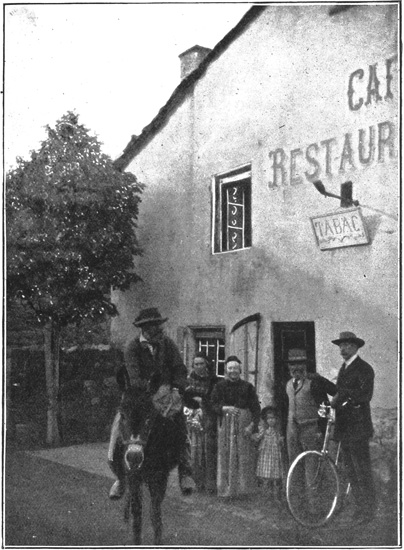
THE INN AT GOUDET
Where Stevenson was entertained by the old man and woman
who still conduct it
We could scarcely believe it was the middle
of June in the sunny south of France as we
sat there shivering before the spluttering logs
in a room "suitable for bandits or noblemen
in disguise." But a deep sense of comfort was
supplied by the savoury smells that issued
from the lower regions of the house. Our
blessings on the head of the landlady and the
whole French nation of cooks were sincere, as
we regaled ourselves with an excellent meal of
perch, omelet, mutton chops, raisins, almonds,
cheese, lemonade and coffee. Imagine yourself
arriving after nine o'clock at night at a
lonely inn anywhere in the British Isles and
faring thus! Moreover, the tenants of the
chalet—the two women especially—were the
most welcome of gossips, and the elder had a
gift of dry humour that must have served
her well in so wet a season. For three weeks
it had rained steadily, she said, and she feared
it was nothing short of the end of the world.
When we told her that we had come from Le
Monastier by way of St. Martin and Goudet,
she was highly amused, and the younger, a
rosy-faced wench, laughed heartily at the
thought of anybody visiting such places. The
lake of Bouchet—ah, that was another matter!
Lakes were few in France, and this one well
worth seeing. There were many lakes in
Scotland! This was news to them, and they
wondered why we had come so far to see this
of Bouchet,—as we did ourselves when next
morning we surveyed a tiny sheet of water
almost circular, no more than two miles in
circumference and quite featureless. It is
simply the crater of an ancient volcano, and
receives its water from some underground
springs, there being no obvious source of
supply. The lake, at an altitude of 4,000 feet,
is higher than the surrounding country.
When we awoke in the morning and made
ready for our departure the room was filled
with the smoke of burning faggots, as though
a censer had been swung in it by some early-rising
acolyte; and the fire was again a
welcome evidence of the landlady's thoughtfulness,
for the outlook was grey and the early
morning air bit shrewdly as the tooth of winter.
Had the day promised better, we should have
struck south from the lake to Bouchet St.
Nicolas, at whose inn Stevenson uncorked a
bottle of Beaujolais, inviting his host to join
him in drinking it; and the innkeeper would
take little, saying, "I am an amateur of such
wine, do you see?—and I am capable of
leaving you not enough." But the way
thither is no better than a bullock-track, and
several miles of similar road lie between
Bouchet and the highway; so with a lowering
sky ominous of more rain, and the knowledge
that for three weeks the country had been
soaking, we determined not to risk the
bullock-track, and retraced our path to
Costaros, passing on the way numerous ox
wagons laden with timber.
The whole countryside was sweet with the
morning incense of the faggot fires burning on
many a cottage hearth. We overtook several
young people driving cattle out to the pasture
lands, and noting that without exception they
carried umbrellas, our hopes of a good day
were not high. But by the time we had
reached the Gendarmerie, that stands at the
crest of the hill on the high road out of Costaros,
and were chatting with one of the officers
whom we found idling at the door, the wind
was rising and heaped masses of sombre clouds
were being driven before it across the sky,
though in their passage they disclosed no
cheering hints of the blue behind. The
gendarme admitted that the rising wind might
be a good sign, but he was not very hopeful,
and seemed to be more interested in meeting
two travellers from a country he had never
heard of than in discussing the weather.
There are parts of France, especially Normandy
and Brittany, where, to confess oneself a
Scotsman is to be assured of a heartier welcome
than would be accorded to one who
came from England; but Stevenson's boast
that "the happiest lot on earth is to be born a
Scotsman" counts for little in these highlands
of the south, where few of the village-folk have
ever heard of Scotland.
The road south of Costaros even on a bright
summer day must appear bleak and cheerless,
and that morning our chief desire was to move
along it as quickly as we could. Yet, as we
advanced, the scene was not without elements
of beauty, and the mists that veiled the
distant mountains gradually lifting, produced
a transformation entirely pleasing, while ere
long there were great and welcome rifts in the
grey above, and patches of blue sky heartened
us on our way. By the time we had reached
the hamlet of La Sauvetat the sun was peeping
out fitfully, and on our right it suddenly flooded
with amber light a meadow, yellow with
marigolds, where cows were pasturing, attended
by a small girl who was playing at
skipping-rope.
We had again joined the track of R. L. S.,
where, now armed with a goad, he drove his
donkey. "The perverse little devil, since she
would not be taken with kindness, must even
go with pricking." We had but to sit in our
saddles, and wheel rapidly down the long and
exhilarating descent to Pradelles, a very
tumbledown village with a great shabby
square lying at an angle of almost forty-five
degrees. The town occupies a little corrie on
the hillside, and the ground slopes quickly on
the west to the river Allier, beyond which the
country rises again in mighty undulations as
far as the eye can reach. For all its slanternness—perhaps,
in some degree, because of
that—Pradelles is a place of interest, perched
here at an altitude of 3,800 feet above sea-level.
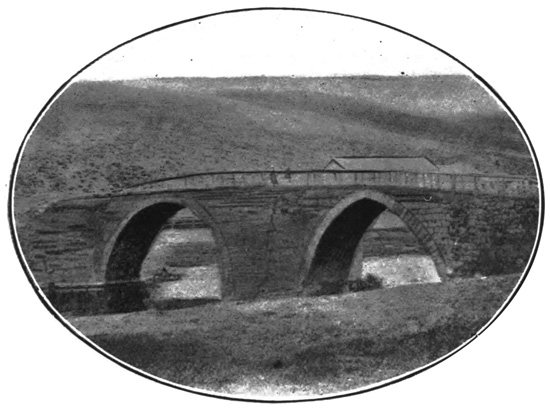
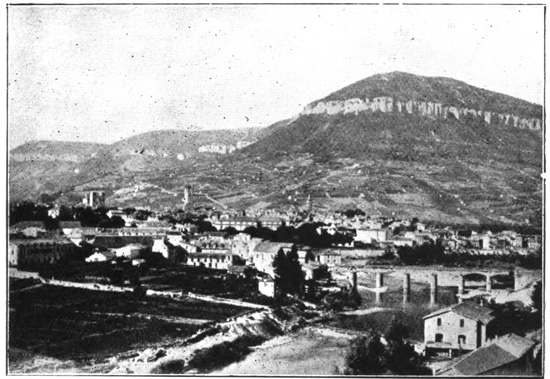
OLD BRIDGE AT LANGOGNE
"Just at the bridge at Langogne a lassie of some seven or eight
addressed me in the sacramental phrase, 'D'où 'st-ce-que vous
venez?'"—R. L. S.
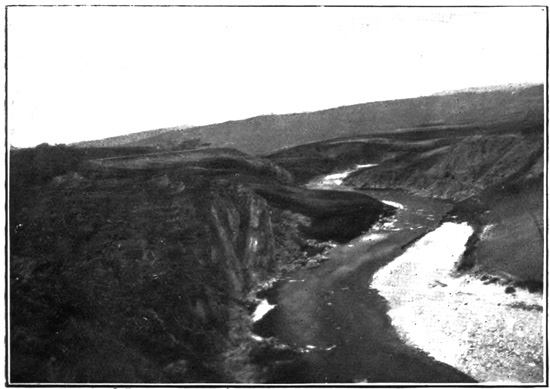
THE LOIRE NEAR GOUDET
"An amiable stripling of a river, which it seems absurd to call
the Loire."—R. L. S.
More than any other place we saw in our
journey, this old mountain town wears an unmistakable
"foreign" appearance, and one
walks its streets with the feeling that one is
moving cautiously along the sloping roof of
a house. Among its tumbledown buildings it
still possesses fragments of considerable historic
value, such as its ancient hospice, and a
gateway from the top of which a village
heroine killed some Huguenot heroes by throwing
a stone at them while they were leading an
assault against its walls. In the church of
Nôtre Dame this episode in the history of the
town is commemorated by a mural painting in
vivid colours, the stone which the devout
Catholic maiden is hurling at the devoted
heads of the besiegers being large enough to
warrant the assistance of a steam crane. The
interior of the church is very quaint and unusual,
and I am sorry that Stevenson did not
yield to the urging of the landlady of the inn to
visit Our Lady of Pradelles, "who performed
many miracles, although she was of wood,"
for his impressions of the church could not
have failed to be peculiarly piquant. The
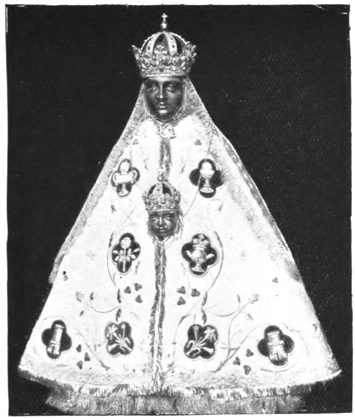
miraculous image of the virgin is a wooden doll,
dressed in lace and set on the high altar.
Pilgrims come in large numbers to its shrine
every fifteenth of August; and one of the
spirited paintings on the wall depicts the
rescue of the idol from a burning of the church
which, I should guess, took place about the
time of the Revolution. Evidently the rescuers
of Our Lady were not prepared to submit
her to the crucial test a sister image at
Le Puy survived—"burning for thirty-six
hours without being consumed." Many and
unfamiliar saints look down at us from the
walls, and at the west end there is a loft such
as might be seen in some of the very old
Scottish churches, occupied at the time of our
visit by a group of women, members no doubt
of some pious confraternity.
R. L. S. has some picturesque notes on "The
Beast of Gévaudan," whose trail he first
struck at Pradelles; for we were now in the
wild and uncultivated country of Gévaudan,
"but recently disforested from terror of the
wolves," whose grizzly exploits in the way of
eating women and children seem to have engaged
the imagination of our traveller. If
the wolves have gone, they have left in their
stead a flourishing progeny of wolf-like curs,
who infest the highways and byways in extraordinary
numbers, to the embarrassment of
the wheelman.
From Pradelles to Langogne is a long and
deep descent, and while walking our machines
down an unrideable path, a young woman on
a terrace near the road came forward to greet
us, tripping unexpectedly over the tether of a
goat, and landing softly and naturally on the
ground, where after her moment's surprise
she smilingly asked, "Où allez vous promener?"
more usually our bucolic greeting
than "D'où 'st-ce-que vous venez?" the latter
"sacramental phrase," on which Stevenson
remarks, being possibly suggested in his case
by the odd appearance of the traveller and
his beast of burden.
The bridge across the Allier at Langogne,
where Stevenson met the "lassie of some
seven or eight" who demanded whence he
came, is now a crazy ruin, and a serviceable
modern structure spans the river some little
distance to the west of it. Near this place he
camped for the night. He furnishes no information
about his stay at Langogne, where,
I should judge, he slept at one of the inns.
The town must have altered greatly since he
rested there, as it is now on the railway line
to Villefort, and a considerable trade in coal
seems to be carried on. It is also a popular
summer resort, though one is at a loss to
account for its attractions to holiday makers.
Its church dates from the tenth century, and
contains in a little chapel on the right, below
the level of the nave, the image of Nôtre
Dame de Tout-Pouvoir, which our landlady
at the Cheval Blanc assured us was très
vénérée, and the housemaid who conducted
us thither took advantage of the occasion to
tell her beads before the statue, keeping a
roving eye on us as we wandered about the
church.
Stevenson's track now lay somewhat to
the west of the course of the Allier, as he made
for the little village of Cheylard l'Evêque, on
the borders of the Forest of Mercoire, and
in this stage of his journey he was more than
usually faithful to his ideal of travel: "For
my part, I travel not to go anywhere, but to
go. I travel for travel's sake. The great
affair is to move; to feel the needs and hitches
of our life more nearly; to come down off
this feather-bed of civilisation, and find the
globe granite underfoot and strewn with
cutting flints." There was no need for his
quitting the highway, since his further
objective lay due south through the pleasant
valley of the Allier. But his diversion among
the by-ways was rich in adventure, and
furnished him with material for perhaps his
best chapter, "A Camp in the Dark." He
had the good fortune to lose his way after
nightfall, and to be forced to camp in a wood
of pines in happy ignorance of his whereabouts.
When next morning he did reach
Cheylard he was fain to confess that "it
seemed little worthy of all this searching."
With a less keen appetite for losing ourselves
in a maze of muddy bullock-tracks, we pressed
forward through the fresh green valley to
Luc, and here rejoined the path of our adventurer
once more. We had the road almost
to ourselves, and among the few wayfarers I
recall was a travelling knife-grinder, whom
we passed near Luc engaged in the agreeable
task of preparing his dinner, the first course
of which, potage au pain, was simmering in a
sooty pot over a fire of twigs. A nation of
gourmets, verily, when the humblest among
them can thus maintain the national art in
the hedges.
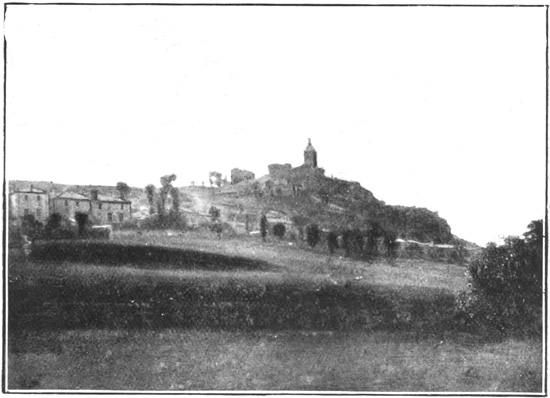
VILLAGE AND CASTLE OF LUC
"Why anyone should desire to visit Luc is more than my
much-inventing spirit can suppose."—R. L. S.
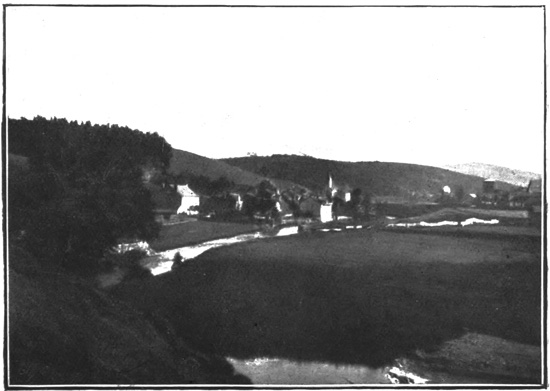
LA BASTIDE
"At a place called La Bastide I was directed to leave the
river."—R. L. S.
"Why anyone should desire to visit either
Luc or Cheylard is more than my much
inventing spirit can suppose." Thus our
vagabond. But journeying at a more genial
season of the year, we found the neighbourhood
of Luc not devoid of beauty. The
valley of the Allier is here broken into wide
and picturesque gorges, and in many ways
the scenery is reminiscent of Glen Coe, where
Alan Breck and David Balfour dodged the
redcoats. But late in September it would
bear a very different aspect, and Stevenson
tells us that "a more unsightly prospect at
this season of the year it would be hard to
fancy. Shelving hills rose round it on all
sides, here dabbled with wood and fields,
there rising to peaks alternately naked and
hairy with pines. The colour throughout
was black or ashen, and came to a point in
the ruins of the castle of Luc, which pricked
up impudently from below my feet, carrying
on a pinnacle a tall white statue of Our
Lady." There is now a railway station at
Luc, the line running near the road all the
way to La Bastide and as we continued
southward that sunny June day, it was only
the shrill noise of the crickets and the unusual
quilt work of the diligently husbanded hillsides
that told us we were not looking on a
Perthshire landscape. In a sweet corner of
the valley lies La Bastide, a drowsy little
town despite its long connection with the
railway, which existed even at the time of
Stevenson's visit.
Here, he tells us, "I was directed to leave
the river, and follow a road that mounted on
the left among the hills of Vivarais, the modern
Ardèche; for I was now come within a little
way of my strange destination, the Trappist
monastery of Our Lady of the Snows."
Thither we shall follow his steps, more closely
than usual, as the road is too steep to admit
of our cycling. For some distance the route
lies through a great forest of pines, but when
the crest of the hill is gained a far-reaching
prospect greets the eye. "The sun came out
as I left the shelter of a pine wood," writes
R. L. S., "and I beheld suddenly a fine wild
landscape to the south. High rocky hills,
as blue as sapphire, closed the view, and between
these lay ridge upon ridge, heathery,
craggy, the sun glittering in veins of rock, the
underwood clambering in the hollows, as rude
as God made them at the first. There was
not a sign of man's hand in all the prospect;
and, indeed, not a trace of his passage, save
where generation after generation had walked
in twisted footpaths in and out among the
beeches and up and down upon the channelled
slopes." Only when the snow comes down
and mantles these abundant hills would this
description not apply. It is a perfect picture
of what we saw. Presently we noted with no
small satisfaction the white statue of the Virgin,
which, standing by the highway at a point
where a side road strikes northward through
the pines, "directed the traveller to Our Lady
of the Snows." He describes the pine wood
as "a young plantation," but in the intervening
years the trees have grown into a
mighty forest, dark and mysterious, and the
statue of Our Lady was so overshadowed by
branches rich with cones, that it was impossible
to get a satisfactory photograph of it.
"Here, then," he continues, "I struck leftward,
and pursued my way, driving my
secular donkey before me, and creaking in my
secular boots and gaiters, towards the asylum
of silence." On our equally secular cycles we
followed the same track, the roadway being
dotted on each side with bundles of faggots
gathered by the silent monks, probably for
the use of the poor.
"I have rarely approached anything with
more unaffected terror than the monastery of
Our Lady of the Snows. This it is to have had
a Protestant education," says Stevenson, as
he recalls the feeling produced within him by
the clanging of a bell at the monastery while
he was not yet in sight of it. No bells clanged
as we descended the road which Father
Apollinaris was still in the act of making
when Stevenson encountered him. We
emerged at length from the shelter of the
trees into a wide hollow of land, from which
on every side the hills rose up, and where
on our right were the outer walls of the
monastery, plain plastered buildings, with
little barred windows on the ground floor
and a row without bars on the second story.
On our left was a large saw-mill, where steam
saws were giving shrill advertisement of their
use. Several monks were among the workers
at the mill, and a brown-coated figure was
walking along the road that opened on our
left beyond the timber sheds to some large
white buildings which, as we afterwards
learned, comprised the farm belonging to the
monastery. The first impression was not
exactly to touch one's feeling for romance.
Trappists in the timber trade suggests a heading
for a "snippet" periodical, and if the
monks were silent, here at least were noises
that smote unpleasantly on the ear.
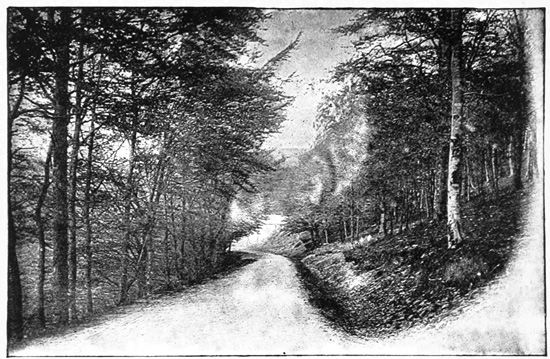
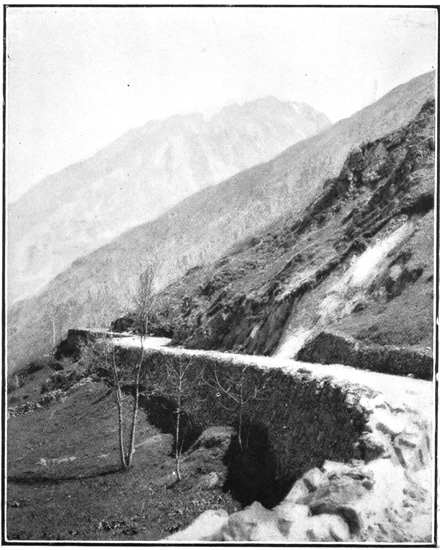
ROAD TO OUR LADY OF THE SNOWS
Made by Father Apollinaris "with his own two hands in the space of a year."
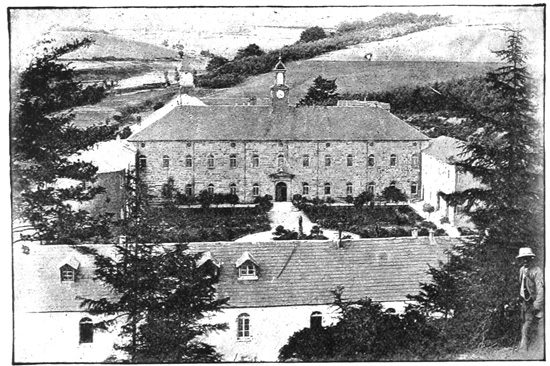
THE MONASTERY
"Modestine was led away by a layman to the stables, and I and my
pack were received into Our Lady of the Snows."—R. L. S.
The buildings of Our Lady of the Snows
are quite devoid of any architectural beauty.
They are set four-square in the hollow, and
the hills trend gently upward on every side
richly clad with trees, for the monks have reforested
much of the surrounding land, which
is the property of the fraternity. The south
side is occupied by a long, two-storied
building, which contains the main entrance—a
plain, whitewashed, barn-like structure—and
buildings of a similar type adjoin it east
and west, while the north side of the quadrangle
is filled by the more pretentious
masonry of the church, the chapter-house,
and other religious offices, though even here
the essential note of the architecture is
austerity, the clock-tower being devoid of
decoration and purely utilitarian.
When endeavouring to photograph the
buildings while the sun shone, an old man
with a very red face, a very white beard and
a very dirty white blouse came along, leaning
feebly on his stick. He was delighted on
being asked to become part of the picture,
and begged me to wait a moment while he
fixed on his left arm his plaque, whereon I
read in brazen letters, "Gardien de la
Propriété." This aged and infirm defender
of the monastic estates was as proud of his
plaque as if it had been a medal won in war.
There must be few attacks upon the property
of the monastery, which he informed me
extended as far as we could see in this windswept
hollow of the hills, if our friend of the
snowy beard and ruddy face stood for its
defence! We were cheered to learn from him
that there would be no difficulty in visiting
the monastery, and if we wished we might be
able to pass the night there. This we desired
most heartily for various reasons, but chiefly
because it was now close on six in the evening,
and days are short in these latitudes.
We were told to go round to the chief
gateway, and there to summon the Brother
Porter by ringing the bell. This we did, with
something of that "quaking heart" to which
Stevenson confesses in the same act, for the
clamour of a bell that one rings in a great
silent building seems fraught with news of an
offence for which one stands to receive the
penalty. Nor do your spirits rise when a
little shutter in the door is opened, and a
grizzly-whiskered face in a brown hood peers
through demanding your business. All was
well, however. The Brother Porter admitted
us to the courtyard, and went to
summon one of the novitiates who, as Guest
Father, would do us the honours of the
monastery. He was, as I should judge, a
young man of five-and-twenty, who came to
us through a door on the right of the entrance
that admitted to the hospice. Wearing
the white flannel habit of the monks, with a
black scapular hanging loose and bulky below
the neck, he was of medium stature, his
shaven face pleasant and comely, and his
dark eyes of that unusual brilliance which
Stevenson noted as "the only morbid sign"
he could detect in the appearance of the
monks. Our host bowed ceremoniously in
shaking hands with us, and immediately
escorted us across the trim garden to the
monastic buildings at the other side of the
quadrangle.
During their period of novitiate, which
lasts for three years, the monks have still the
liberty to talk with strangers or with the lay
brethren, but when their final vows are taken
they are supposed to be inarticulate, except
in performing the religious offices of each day.
The Guest Father would in two years more
be qualified for the silent life; meanwhile, he
exercised his power of speech with so much
grace that one felt truly sorry so excellent a
talker should contemplate with cheerfulness
the voluntary and useless atrophy of his
divine gift. Very reverently he led us into
the church, which is a plain but elegant
building with a vaulted roof, the walls being
whitewashed, and the woodwork, of which
there is not too much, chastely carved. A
number of good pictures are hung on the walls,
and there is a series of statues of the saints
on brackets, executed with some taste, and
entirely free from the usual tawdry colouring
of similar objects in French Catholic churches.
The altar also is in welcome contrast to the
common doll-show of the ordinary church,
and although the oft-repeated references to
the simplicity of the whole with which our
excellent friend pointed out the various
features of the place approached almost to
affectation, one must bear ready witness to
the apparent sincerity of these poor monks
in their efforts towards a simpler circumstance
of worship than the Roman Catholic Church
in general practises.
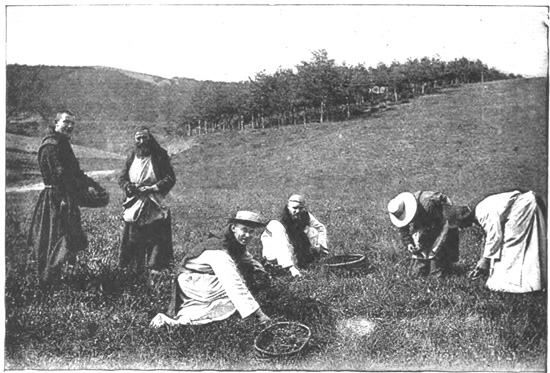
Trappist Monks gathering roots for distilling
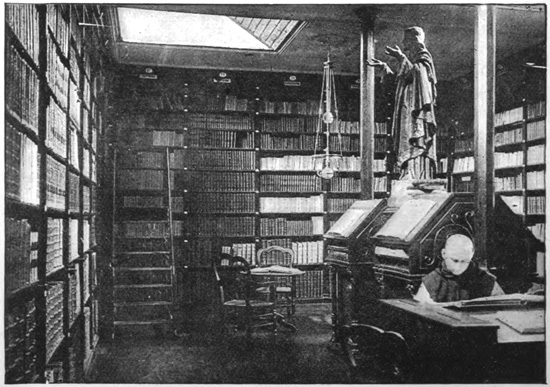
A Peep into the Library
OUR LADY OF THE SNOWS
The chapter-house is in keeping with the
church in point of restraint in decoration, its
beautifully panelled walls giving the apartment
a genial touch of warmth by contrast
with the cold white of its groined roof.
The library, which occupies a spacious room
on the upper story of the north wing, is
stocked with some twenty thousand volumes,
chiefly in Latin and French, but including an
excellent collection of works in Greek, religion
and history being naturally the chief subjects
represented. When we remember that many
of the monks are men of no intellectual gifts
and of small learning, being drawn largely
from the peasant class and the military, we may
doubt if the treasures of the library are in
great request. The librarian, at least, must
be a man of bookish tastes, since the collection
is arranged in perfect order. Our guide
assured us that the monastery possesses a
copy of Travels with a Donkey, but he did not
discover it for us.
The refectory is a large and bare chamber
occupying the lower story of the east wing.
Long narrow tables of plain wood stand around
the room, and on these are laid the simple
utensils of the meal. The monks sit on a
rude bench, and for the greater part of the
year they take but one meal in twenty-four
hours; but during the summer months, when
one might suppose their needs to be less, they,
by special indulgence, go so far towards
temporising with the flesh as to eat twice in
one day.
R. L. S. was moved to a little disquisition
on the subject of over-eating when he contemplated
the dietetic restraint of the Trappist
brethren. "Their meals are scanty, but even
of these they eat sparingly," he writes; "and
though each is allowed a small carafe of wine,
many refrain from this indulgence. Without
doubt, the most of mankind grossly overeat
themselves; our meals serve not only for
support, but as a hearty and natural diversion
from the labour of life. Yet, though excess
may be hurtful, I should have thought this
Trappist regimen defective. And I am
astonished, as I look back, at the freshness
of face and the cheerfulness of manner of all
whom I beheld. A happier nor a healthier
company I should scarce suppose that I have
ever seen. As a matter of fact, on this bleak
upland, and with the incessant occupation of
the monks, life is of an uncertain tenure,
and death no infrequent visitor, at Our Lady
of the Snows. This, at least, was what was
told me. But if they die easily, they must
live healthily in the meantime, for they
seemed all firm of flesh and high in colour,
and the only morbid sign that I could observe—an
unusual brilliancy of the eye—was one
that rather served to increase the general
impression of vivacity and strength."
On the topmost floor of the east wing we
were shown the dormitory, a long and, as I
recall it, a somewhat low-roofed room, divided
into numerous little cubicles, each enclosed
on three sides, and screened from the passage
by a curtain of red cloth. The couch consisted
of a single mattress laid on boards, with the
scantiest supply of bedclothes. Each of these
little compartments bore in painted letters
the monastic name of its occupant, and here
every night, after the toils and vigils of the
day, the brethren lay themselves down at
eight o'clock in their ordinary habit of dress,
being in this respect less fanatical than other
fraternities of the same order, who sleep in
their coffins, and even in unduly ready
graves. "By two in the morning," says
R. L. S., "the clapper goes upon the bell, and
so on, hour by hour, and sometimes quarter
by quarter, till eight, the hour of rest; so
infinitesimally is the day divided among
different occupations. The man who keeps
rabbits, for example, hurries from his hutches
to the chapel, the chapter-room, or the
refectory all day long: every hour he has an
office to sing, a duty to perform; from two,
when he rises in the dark, till eight, when he
returns to receive the comfortable gift of
sleep, he is upon his feet, and occupied with
manifold and changing business. I know
many persons, worth several thousands in the
year, who are not so fortunate in the disposal
of their lives. Into how many houses would
not the note of the monastery bell, dividing
the day into manageable portions, bring peace
of mind and healthful activity of body. We
speak of hardships, but the true hardship is
to be a dull fool, and permitted to mismanage
life in our own dull and foolish manner."
On our way back to the hospice we learned
with regret that Father Apollinaris, "so good
and so simple," had been dead five years, and
the right of the monastery to the title of Our
Lady of the Snows was clearly established
by the information that in the winter months
it is buried for weeks on end, and our young
friend of the shiny eyes shivered as he spoke
of the neige énorme, which he is doomed to see
every winter that he lives.
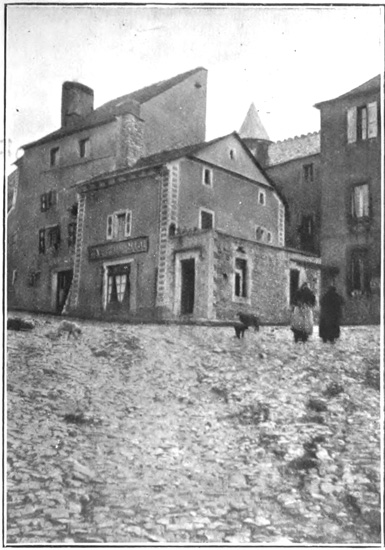
MAIN STREET, LE BLEYMARD
"From Bleymard I set out to scale a portion of
the Lozère."—R. L. S.
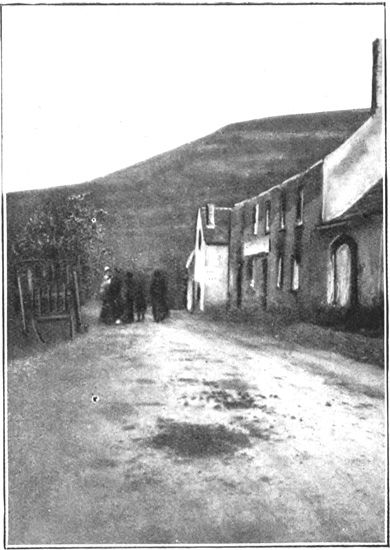
RUINS OF THE HÔTEL DU LOT
On the Villefort-Mende road, at La Remise,
near Le Bleymard
In the hospice the apartments for the use
of visitors and retraitants are situated. To
the right of the gateway on the ground level
are the kitchens and storerooms, and a door
opening at the foot of the stair admits one into
a small and barely furnished room, where
supper had been prepared for us. A small
table covered with American cloth, with chairs
set about it to accommodate perhaps eight or
ten guests, were the chief items of furniture.
There were a few prints of a religious character
hung upon the walls, and to the right of the
fireplace stood a little bookcase, containing,
however, no works of interest. The meal
served to us was well cooked and savoury, and
as an excellent omelet formed its pièce de
résistance, with soup, potato salad, walnuts,
figs and cheese included, it needed none of the
profuse apologies for poverty of fare with
which it was set before us.
We were afterwards shown our bedroom on
the floor above, a fairly commodious room
containing two iron bedsteads, with a more
liberal supply of bedclothes than we saw in the
dormitory of the monks, a small table and two
chairs. A crucifix stood on the mantlepiece,
and, as in some hotels, a printed sheet of
regulations was fixed on the wall near the door.
One may suppose it to have been a copy of
that which Stevenson noted, for it wound up
with an admonition to occupy one's spare
time by examining one's conscience, confessing
one's sins, and making good resolutions. "To
make good resolutions, indeed!" comments
R. L. S. "You might talk as fruitfully of
making the hair grow on your head." So far
as we could judge, the south wing at the time of
our visit sheltered no other strangers than ourselves;
nor did it appear there were any weary,
world-worn laymen living here in retreat.
At the time of Stevenson's sojourn among the
monks there was quite a little company in the
hospice, an English boarder, a parish priest,
and an old soldier being some of the acquaintances
he made in the little room where we had
supped. But there is a constant and increasing
number of visitors to the monastery, and
immediately below our bedroom there was a
large and well-stocked apartment that gave
evidence of this. Here we found a varied
supply of crucifixes and rosaries to suit all
purses, samples of the different liqueurs distilled
by the monks, and picture post cards in
abundance. The Brother Porter, a simple
boorish fellow, in vain spread his bottles in the
sight of two who were not patrons of the stuff;
but we reduced his stock of post cards and his
rosaries. He took the money like a post office
girl selling stamps.
When we took our places in the little gallery
that extends across the west side of the
chapel to hear the monks chanting the last
service of the day, Compline and Salve Regina,
we found that there was at least another
visitor, in the person of a stout and blue-chinned
curé. The white-robed monks were
seated in their chairs in the choir, books upon
their knees; while the organist in an elevated
position on a level with the gallery played,
unseen by us, "those majestic old Gregorian
chants that, wherever you may hear them
(in Meredith's fine phrase) seem to build up
cathedral walls about you." Paraffin lamps
shed a dim, uncertain light, and the rich full
voices of the singers resounded weirdly through
the white-walled chapel, the door opening now
and again as some of the lay brothers entered
and, crossing themselves, bowed wearily
towards the altar, moving to their places below
the gallery. After the elevation of the Host,
and when the service was almost ended, the
organist came down, and we noticed that in
making his way out of the chapel he hung back
a little in passing the choir screen, that he might
not meet on his way to the door any of the
brethren who were now slowly leaving.
Of a similar service Stevenson writes:
"There were none of those circumstances
which strike the Protestant as childish or as
tawdry in the public offices of Rome. A stern
simplicity, heightened by the romance of the
surroundings, spoke directly to the heart. I
recall the whitewashed chapel, the hooded
figures in the choir, the lights alternately
occluded and revealed the strong manly
singing, the silence that ensued, the sight of
cowled heads bowed in prayer, and then the
clear trenchant beating of the bell, breaking
in to show that the last office was over, and the
hour of sleep had come; and when I remember,
I am not surprised that I made my escape
into the court with somewhat whirling fancies,
and stood like a man bewildered in the windy
starry night." The effect of it all on the
sentimental traveller was summed up in these
fervent words: "And I blessed God that I
was free to wander, free to hope, and free to
love."
This, indeed, must be the impression all
robust and unfettered minds will receive
from a visit to Our Lady of the Snows. It is
true that in their busy saw-mill which stands
to the west of the monastery, and where the
timber from the hills is turned to commercial
use by the monks and their lay assistants, in
their well-managed farm some distance westward,
in the surrounding fields, in their many
workshops—in these they have varied occupations,
and of a manly character, but the
terrible uselessness of it all is ever present to
the mind of one coming from the stress and
struggle of the zestful world. Poor men! in
their sullen way they may believe they have
chosen the better part; but, simple and
devout as they may be, they are the real
cowards of life, the shirkers of the battle we
are meant to fight.
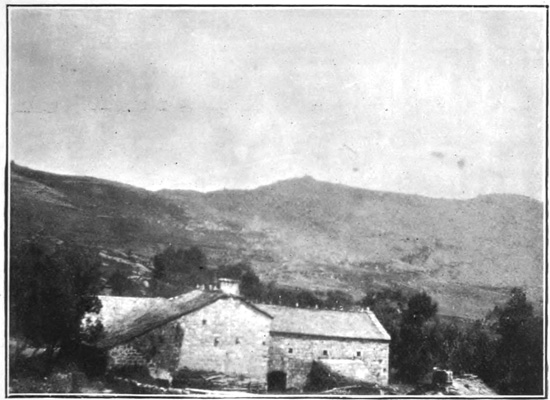
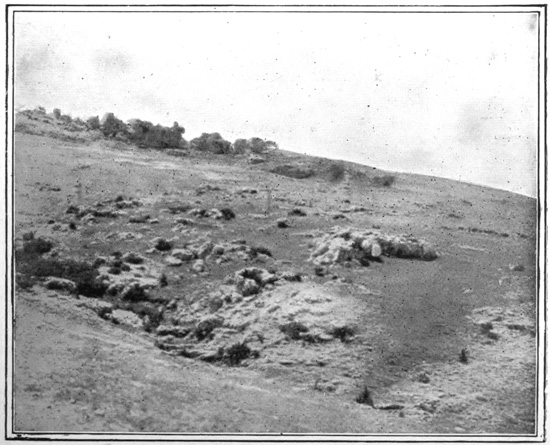
Malavieille, a mountain sheiling
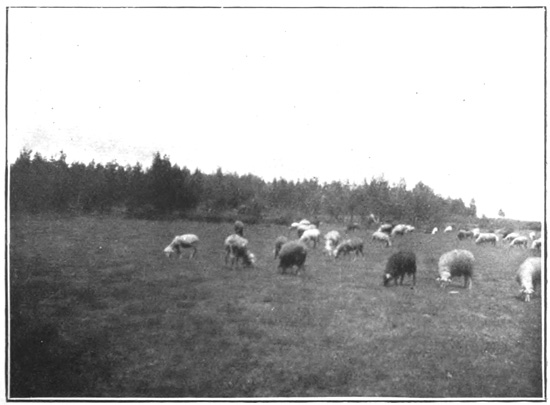
Scene of "A Night among the Pines"
"Buckled into my sack, and smoking alone in the pine woods,
between four and five thousand feet towards the stars."—R. L. S.
ON THE LOZÈRE
We slept the sleep of tired men in our room
upstairs, and heard none of those hourly
bells Stevenson records. Our young friend,
whose monastic name I foolishly omitted to
ask, called us before eight in the morning,
and after providing a capital breakfast, bade
us a ceremonious good-bye, watching us from
the door until the pine woods enclosed us.
We made a swift descent to La Bastide, and
by way of Chasseradès, where Stevenson
slept in the common bedroom of the inn,
reached Le Bleymard late in the afternoon,
passing through a country of bare hills and
poor villages clustered in gusty hollows or
hanging like swallows' nests on craggy slopes.
The valley of the Lot, rich and beautiful
westward to Mende, possesses no elements
of charm in the neighbourhood of Bleymard,
and we found that town so mean and featureless,
that we had no wish to pass the evening
there. The inn we wanted was, so a crippled
girl told us, at La Remise, on the high road,
and we must have passed it. We remounted
our cycles and retraced our path across the
river, a distance of perhaps three furlongs,
and lo! there stood the charred remains of the
Hôtel du Lot, where we had hoped to rest
ourselves. We had passed the place without
noticing it, and the view of its gaunt and
smoky walls, now that they had acquired so
personal an interest, chilled our hearts, for the
need to rest and refresh ourselves was pressing.
It was after sundown, and there lay between
us and Pont de Montvert a mountain higher
than Ben Nevis.
Opposite the unlucky Hôtel du Lot stood a
small auberge, kept by one Teissier. Two men
were drinking absinth at a table by the doorway.
One was a thick-set fellow, wearing
eyeglasses, and clothed not unlike a foreman
mechanic in England. The other was the
familiar dark French type, thin of features,
eyes bright as those of a consumptive, his
beard ample and of a jet black, against which
his ripe red lips showed noticeably. He was
dressed like a clerk or commerçant. They
made us welcome at their table, and we fell at
once to discussing the situation, from which
it was evident we could not hope to cross the
Lozère that night. Some tourists had experienced
a bad time traversing the mountain
the previous Sunday, and as we could not hope
to do more than reach the Baraque de Secours
by nightfall, it would be madness to attempt
the descent into the valley of the Tarn after
dark, the road lying in many places along the
lip of a precipice. Besides, this wayside inn
was very well managed, said the absinth
drinkers; they had lived there since being
burned out across the way, a statement that
cheered us not a little, as every other feature
of the place was extremely uninviting.
The landlady, who had shown no interest
in us whatever, I found busy at a large cooking-range
in a tiny kitchen, which opened off the
common sitting-room, and served also for the
living-room of the servants and familiar
loungers. She was a woman of austere countenance,
displaying like so many middle-aged
Frenchwomen a considerable moustache; but
I noticed that her teeth were white. Yes, she
would be glad to supply dinner if we were to
stay overnight. We were, I confessed without
enthusiasm; whereupon she specified
glibly the resources of her kitchen. We could
have soup, trout, jugged hare, chicken, fillet
of beef, potatoes, pastries, cheese, and other
things, and by naming one dish and connecting
it to the next with et puis, an aldermanic
banquet seemed about to be conjured up from
the dirty little room and its greasy stove.
The common room of the inn had a sanded
floor, and was furnished with a plain deal table,
round which some country bumpkins were
sitting on rush-bottomed chairs drinking beer
and spitting freely in the sand. A few cheap
oleographs nailed on the dingy walls were the
only efforts at decoration. Two drab and
unattractive girls gossiping with the customers
appeared to be the staff of the hotel.
I returned to the Frenchmen outside, and
found that my companion, anxious not to
enter the place until the last moment, was
playing at a game resembling bowls with some
village urchins, though understanding not one
word of their speech. But he came up in a
little while to learn the results of my
inquiries within, and soon we were all engaged
in a very entertaining discussion. It appeared
that the Frenchmen were concerned in the
zinc mines near Bleymard, him of the oily
clothes being chief engineer, the other business
manager. I suppose they would be the two
best conditioned residents in the district, and
here they were lodging at an hotel which, apart
from cooking, was below the standard of comfort
to be found in a crimp's den in the region
of Ratcliffe Highway. The Frenchman is a
wonderfully adaptable creature: give him a
table to drink at, a chair to sit upon, and a bed
anywhere under a roof, and he can contrive
to be happy.
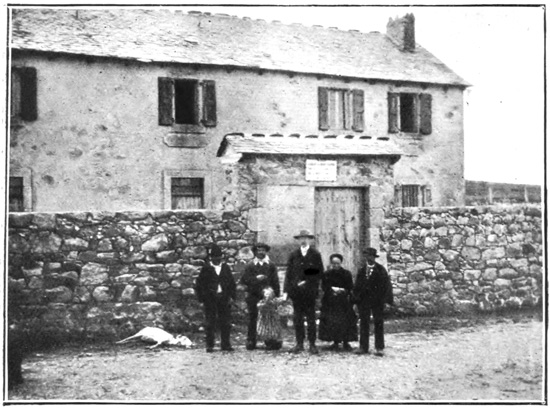
The Baraque de Secours
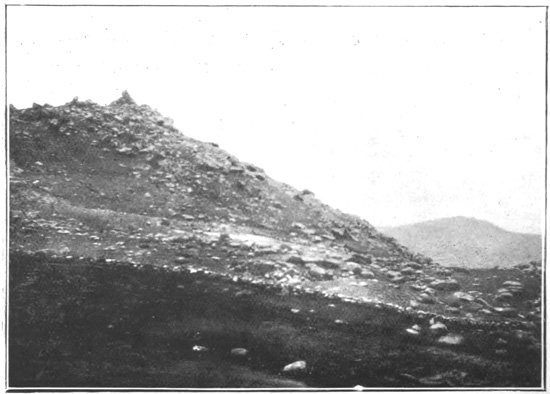
"The Lozère lies nearly east and west; its highest point, this Pic
de Finiels, on which I was then standing, rises upwards of 5,600 feet
above the sea."—R. L. S.
ON THE LOZÈRE
M. l'Ingénieur, although he spoke no
English, had seen something of the world, and
had even been to Klondyke. He could not
understand why anyone should have wandered
to such a hole as this—for pleasure!
But he expected that next year's guide-books
would describe Bleymard as notable for the
ruins of the Hôtel du Lot. A wag, obviously.
If we wanted to see places worth looking at,
there was Nice and Nîmes, said his friend
M. Barbenoire. Together they extolled, with
a rare gush of adjectives, the beauty of these
places, and promised to show us picture postcards
that would lure us into visiting them.
Tourists did come sometimes to climb the
Lozère, from the top of which in clear weather
one might see the Alps. The engineer laughed
merrily at this, and said the story was as much
legend as the exploits of the beast of Gévaudan.
He discussed in a very practical mind
the question of miners' wages, and thought
that the Bleymard zinc workers were better
off with four francs a day than English miners
with five or six shillings.
Sooner than we had expected dinner was
declared ready, and we went inside with no
great avidity; but to our surprise we found
the meal laid in a little room at the other end of
the drinking den, tolerably clean though dingy
and tasteless in its appointments. There we
were joined by the wife of M. Barbenoire and
two immense dogs of unfamiliar breed. The
maid who served us was engagingly free from
the usual formalities of the table, and between
the courses would sit coyly on the knee of the
engineer, munching a piece of bread; but for
the rest, ours was no Barmecide feast. The
aldermanic banquet appeared in all essentials
save the serving, and we fared so well that we
began to hope our bedroom would even be
comfortable.
When, later in the evening, we took our
courage in both hands and penetrated to the
upper story by way of a spiral iron staircase
through the kitchen roof and along a dark
lobby of loose boards, we were heartened not
a little to find in our room two good beds, clean
and curtained. Sleep was thus assured,
though the smell from the stable through the
wall was redolent of rats. It was "a wonderful
clear night of stars" when we looked
out of our window before retiring, and we went
to bed determined upon an early start. The
bellowing of the oxen in the stable and the
shouts of the buveurs below did not come long
between us and the drowsy god.
Alas! at dawn next day we looked forth on
a blank wall of mist backing the ruins across
the road. Not a hill was visible. We sought
our beds again, and by nine o'clock the outlook
was only slightly improved, the nearest
hills, now resonant with sheep-bells, being in
sight. The engineer comforted us with the
assurance that this was the common weather
in June, the best time of the year being from
July to October, but he thought the mists
might clear before noon. Presently it began
to rain, and during the whole day there was
not half an hour of clear weather. At times
the atmosphere would thin a little, only to
show us heavy clouds condensing on the higher
hills. Thus prisoned in our room, we contrived
to be comfortable, and I believe that
another day would have left us wondering why
we had dreaded staying at the inn, so soon
does the human mind adapt itself to circumstances.
The rain-sodden streets actually
provided entertainment. We watched with
interest the coming and going of shepherds
and their flocks, the former armed with commodious
umbrellas and their sheep shorn in
a way that left a lump of wool upon their backs
making them comically like little camels.
Many bullock wagons loaded with shale passed
by, and we noticed that the slightest touch
with the driver's wand served to direct the
team, whose heads were, to quote our hero,
"fixed to the yoke like those of caryatides
below a ponderous cornice." Children played
out and in the stables and among the ruins,
and an old man, wearing the usual dress of the
peasant, with pink socks showing above his
sabots, his hands thrust deep in his pockets,
and a stick under his arm, wandered aimlessly
to and fro in the rain most of the day. The
stage-coach from Villefort to Mende rested
for a time at the inn, causing a flicker of
excitement, and in the evening again the mine
officials were there to bear us company.
The engineer proved himself a thorough-paced
sceptic of the modern French sort. His
opinion of the country-folk was low—hypocrites,
fools, money-grubbers all! Holding
up a five-franc piece, he averred that for this
they would sell mother, daughter, sister; and
then similarly elevating a bundle of paper-money,
he exclaimed: "Voilà, le Grand
Dieu."
"This is a Catholic countryside?" I said.
"Yes," he replied, "but that makes no
difference."
"There is one Protestant in Bleymard,"
put in Barbenoire,—"myself!"
"And he isn't up to much," added the cynic.
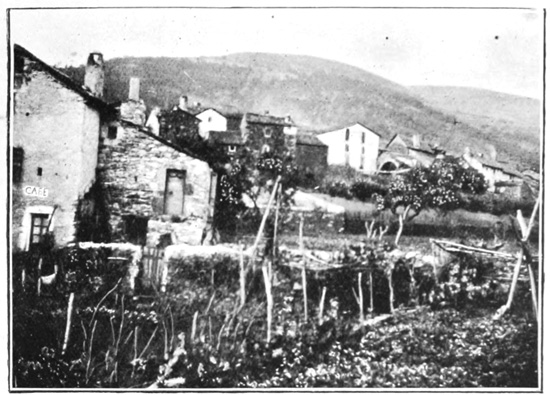
"A cluster of black roofs, the village of Cocurès sitting among
vineyards."—R. L. S.
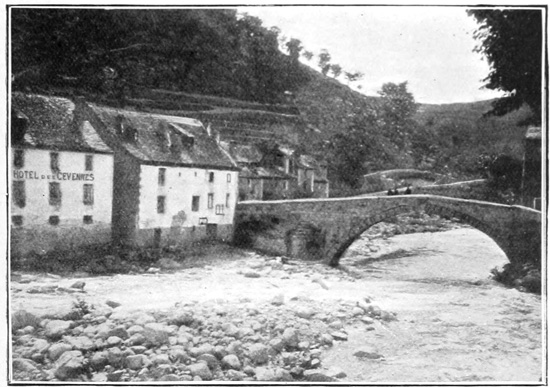
Bridge over the Tarn at "Pont de Montvert of bloody memory,"
and view of the Hôtel des Cevennes where Stevenson stayed.
"We shall set out at five in the morning,"
I said to the landlady before going upstairs,
and the engineer signalled to us as we left the
room the outstretched fingers of his right hand
twice; wherein he proved something of a
prophet, for it was nearer ten o'clock than five
before we determined to risk the mountain
journey, the sky being clear in parts and the
rain clouds scudding before a high wind, that
promised a comparatively dry day.
On the bridge across the Lot at Bleymard
we were hailed by a man in labouring clothes,
who smiled broadly and said, "Me speak
Engleesh." As we had not met a single Frenchman
between Orleans and this spot who pretended
to have any knowledge of our native
tongue, we tarried to have speech with this
cheery-faced fellow, whose white teeth shone
through a reedy black moustache. But his
lingual claims did not bear inspection. Beyond
saying that he had visited London and Liverpool,
and knew what "shake hands" meant,
and that English tobacco was better worth
smoking than the French trash—a hint which
I accepted by presenting my pouch—he could
not go in our island speech; and so we had
to continue our chat in French that was bad
on both sides, his accent resembling a Yorkshireman's
English, and mine—let us say an
Englishman's French. He was certain we
should have no more rain, as the wind was in
the north, and if it kept dry to twelve o'clock
we could depend on a good day. The weather
prophet is the same in all lands, and we had
not left him half an hour when we were sheltering
from a sudden downpour.
For some miles we had to plod upward on
foot in a wild and rocky gorge, with the merest
trickle of water below. Yet every corner
where a few square feet of clover could be
coaxed into life had been cultivated by the
dogged peasants, and patches were growing
at heights where one would have thought it
difficult to climb without the ropes of an
Alpinist. Many of these mountain plots were
miles away from any dwelling, a fact that
conveys some idea of the barren nature of the
country.
The tiny hamlet of Malavieille, about half-way
up the mountain side, is the highest point
permanently inhabited. It is a mere handful
of dark-grey houses, covered on slates and
walls with a vivid yellow fungus. Here the
upland fields were densely spread with violets,
narcissi and hyacinths, and a few dun cows
were browsing contentedly on this fragrant
fare, while a boy who attended them stood on
his head kicking his heels merrily in the sunshine.
He came up as we passed, staring at
us stolidly; and when we asked if the snakes,
of which we had just encountered two about
three feet long, were dangerous, he answered,
"Pas bien," and more than that we could not
get him to say, though he walked beside us for
a time eyeing curiously our bicycles.
When we had come within sight of the
Baraque de Secours, we had reached a sort of
table-land reaching east and west for some
miles. Eastward lay the pine woods where our
vagabond spent one of his most tranquil nights
as described in his chapter, "A Night Among
the Pines." It was there that, awaking in the
morning, he beheld the daybreak along the
mountain-tops of Vivarais—"a solemn glee
possessed my mind at this gradual and lovely
coming in of day." And it was there, too, that
out of thankfulness for his night's rest he laid
on the turf as he went along pieces of money,
"until I had left enough for my night's lodging."
Some of it may be there to this day,
for there is small human commerce at this
altitude, a shepherd or two being the only folk
we saw until we arrived at the shelter
which we had seen for more than half an hour
while we cycled arduously toward it.
The baraque is a plain two-storied building,
with a rough stone wall and porch enclosing a
muddy yard. It stands at a height of over five
thousand feet, being thus fully five hundred feet
higher than Ben Nevis. To the west the Lozère
swells upward, a great treeless waste, to its
highest point, the Pic de Finiels, 5,600 feet
above sea-level; while a splendid mass of
volcanic origin uprears its craggy head some
little distance to the south-east. "The view,
back upon the northern Gévaudan," says
Stevenson, writing of what he saw as he passed
near this point, "extended with every step;
scarce a tree, scarce a house, appeared upon
the fields of wild hill that ran north, east, and
west, all blue and gold in the haze and sunlight
of the morning." And then in a little,
when he began the descent towards the
valley of the Tarn, he says: "A step that
seemed no way more decisive than many other
steps that had preceded it—and, 'like stout
Cortez when with eagle eyes he stared on the
Pacific,' I took possession, in my own name, of a
new quarter of the world. For behold, instead
of the gross turf rampart I had been mounting
for so long, a view into the hazy air of heaven,
and a land of intricate blue hills below my
feet." As he makes no mention of the baraque,
I venture to suppose that it had not then been
built, for one so eager of new experience would
not have missed the opportunity of resting on
his way at this high-set hostel. A dead sheep—one
of several we had seen on the mountain—lay
on the road by the gate, and propping
our bicycles near it, we picked our way through
the mud and knocked at the door.
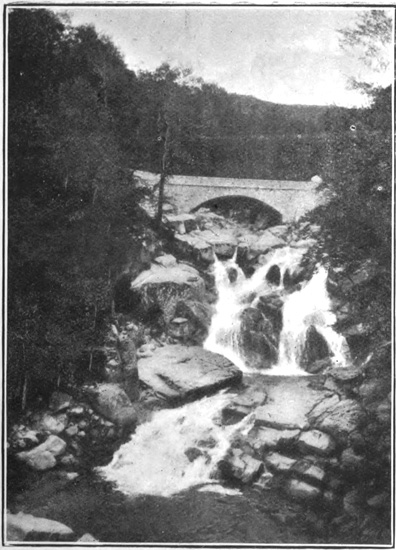
Waterfall on the Lozère, on Stevenson's route
between Finiels and Pont de Montvert
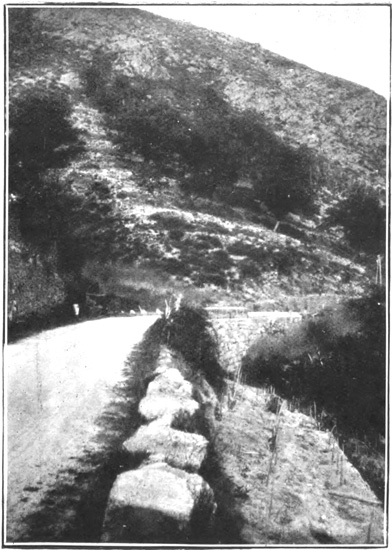
In the valley of the Tarn: Scene of Stevenson's
camp under the chestnuts on the hillside
A gruff voice bade us enter. We stepped
into a smoky room, with an earthern floor,
containing a rough wooden table and two rude
benches, and in a corner a small round table,
a few chairs and a plain wooden dresser. The
mouth that had emitted a very gutteral
"Ongtray" belonged to a man of small stature
but brigandish appearance, who was seated at
the smaller table eating industriously. We
asked for lemonade and biscuits, but the fellow
stared at the words and spoke in a patois
that was Greek to me. But when I explained
more sententiously that we desired
something to eat and drink, he disappeared up
a wooden stair, and we knew that a bottle of
atrocious red wine, which we would welcome
as so much vinegar, would be forthcoming.
Meanwhile, the man's wife—a fair-haired
little woman with cheeks like red apples,
dressed in the universal black of the French
country-wife—came in, leading a youngster by
the hand. I repeated to her our wants, which
she immediately proceeded to meet by breaking
four eggs into a pan, the shells being
dropped on the floor, and lo! an omelet was
well on the way by the time her husband in
his sabots came clattering down the stairs
with the undesired wine, a few drops of which
we used to colour the clear cold water we took
in our tumblers from a pipe that ran ceaselessly
into a basin set in the wall of the room
that backed to the rising land.
There is one respect in which the Cevennols
have progressed since Stevenson went among
them. He writes: "In these Hedge-inns the
traveller is expected to eat with his own knife;
unless he ask, no other will be supplied: with
a glass, a whang of bread, and an iron fork,
the table is completely laid." Not so had we
found it in any of the inns we visited, all had
risen to the dignity of knives and forks; but
here at this house in the wilds our table was
laid precisely as Stevenson describes, and the
bread being hard, it was a temptation to break
it across the knee like a piece of wood. We
had almost finished our meal when, after
some whisperings between the man and woman,
the fellow dived into his pockets and produced
a great clasp knife, which he opened and
handed to us.
While we sat and carried on a somewhat
faltering conversation—for both man and
woman spoke the dialect of Languedoc and
were superbly ignorant—two men entered of
the same brigandish type as the landlord, and,
speaking better French, proffered their services
as guides if we desired to scale the Pic
de Finiels. This we had no desire to do,
especially when they were frank enough to
state that the view from the top was of very
little interest. But they urged us to see the
magnificent view over the entire range of the
Cevennes from the more westerly peak, the
Signal des Laubies. This, however, would
have taken us some two hours, and we had a
long way to travel that day. We were curious
to know whether the baraque was tenanted in
winter, and one of the guides told us that
during the winter the whole of the uplands
around us lay deep in snow, the roads being
quite impassable. This shelter was only open
from the beginning of June to the end of
September, when its keepers retired downhill
again to Malavieille. R. L. S. crossed the
mountain on the second last day in September,
so that the snows would soon be lying on his
track. When we resumed our journey again
we were once or twice beguiled into thinking
that we saw some of the snows of yester year
lying among the grey and lichened rocks, but
a nearer approach turned the drifts into flocks
of sheep, which the sombre background
rendered snowy white by contrast.
We went forward into the country of the
Camisards along a well-made road which
gangs of labourers were leisurely repairing.
So good are these mountain roads, and so
diligently tended, that one is inclined to think
they are used chiefly for the transit of stones
to keep them in repair. That on which we
travelled has been made since Modestine and
her driver footed it through this same valley.
In less than a mile from the baraque it begins
to sweep swiftly downward. Stevenson thus
describes his descent: "A sort of track appeared
and began to go down a breakneck
slope, turning like a corkscrew as it went. It
led into a valley through falling hills, stubbly
with rocks like a reaped field of corn, and
floored farther down with green meadows. I
followed the track with precipitation; the
steepness of the slope, the continual agile turning
of the line of descent, and the old unwearied
hope of finding something new in a new
country, all conspired to lend me wings. Yet
a little lower and a stream began, collecting
itself together out of many fountains, and
soon making a glad noise among the hills.
Sometimes it would cross the track in a bit of
waterfall, with a pool, in which Modestine
refreshed her feet. The whole descent is like
a dream to me, so rapidly was it accomplished.
I had scarcely left the summit ere the valley
closed round my path, and the sun beat
upon me, walking in a stagnant lowland
atmosphere."
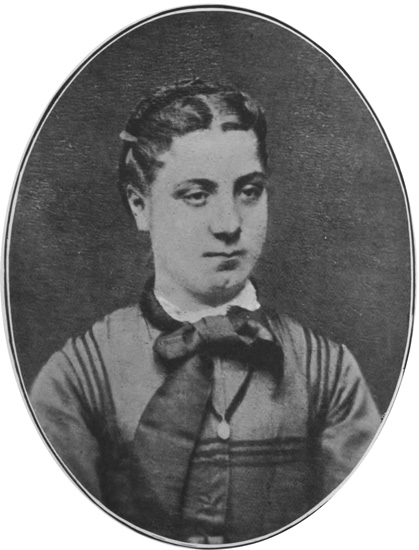
"CLARISSE"
The Waitress at the Hôtel des Cevennes, from a photograph supplied
by the Pasteur at Pont de Montvert
"The features, although fleshy, were of an original and
accurate design; her mouth had a curl; her nostril spoke
of dainty pride."—R. L. S.
If his descent was thus, how much more so
ours on our whirling wheels? We encountered
numerous cattle-drovers, whose herds spread
themselves across the path and rendered our
progress somewhat perilous, as neither hedge
nor stone stood between us and the abyss.
There is but little population in the valley, and
that centred in two small hamlets, though we
observed a number of deserted cabins which
Stevenson also notes. The river, too, as it
nears the larger Tarn was all his magic pen
had pictured; here it "foamed awhile in
desperate rapids, and there lay in pools of the
most enchanting sea-green shot with watery
browns. As far as I have gone, I have never
seen a river of so changeful and delicate a
hue: crystal was not more clear, the meadows
were not by half so green."
Our road brought us at length to Pont de
Montvert "of bloody memory," which lies in
a green and rocky hollow among the hills. To
Stevenson "the place, with its houses, its
lanes, its glaring river-bed, wore an indescribable
air of the south." Why so, he was unable
to say; as he justly observes, it would be
difficult to tell in what particulars it differed
from Monastier or Langogne or even Bleymard.
One of the first buildings that the
traveller encounters is the little Protestant
temple perched on the rocky bank of the river,
and perhaps it was again the Protestant
education of R. L. S. that led him to note a
higher degree of intelligence among the inhabitants
than he had found in the purely
Catholic villages. For my part, with the best
will to mark the difference, I found little to
choose between the Catholic and Camisard
townships, unless it were a more obvious effort
after cleanliness in some of the latter.
Pont de Montvert is memorable as the place
where the Covenanters of France struck the
first blow against their Romish persecutors;
here they "slew their Archbishop Sharpe."
The Protestant pastor, a fresh-faced man about
sixty, with a short white beard, and wearing
no outward symbol of office, but dressed in an
ordinary jacket suit and cloth cap, we found
in his home in a building by the river-side near
the bridge. Directly across the rock-strewn
course was the Hôtel des Cevennes, where
Stevenson sat at the "roaring table d'hôte,"
and was pleased to find three of the women
passably good-looking, that being more than
an average for any town in the Highlands of
France. Our pastor—his wife and golden-haired
daughter also—was more interested in
discussing Stevenson's travels than the religious
condition of his district, a subject on
which my companion, pastor from "the
Celtic fringe," was athirst for information.
To my various questions regarding the
position of the Reformed Church I received
the barest answers; there was no glowing
enthusiasm chez le pasteur for the Camisards
who a stone's-throw from where we sat
stabbed with many superfluous thrusts the
Archpriest Du Chayla, their most brutal
persecutor. But Stevenson and his donkey—ah,
that was another matter! He knew all
about them to the year, the day, the hour of
their quaint and curious visit; he was himself
only two years established in his charge at the
time. And Clarisse! We knew, of course,
what Stevenson had said of her? Would we
care to see her photograph? She was now
married, and settled in another town with a
considerable family growing around her. One
felt that after a quarter of a century, and with
a family thrown in, Stevenson would have
resolutely refused to look on the counterfeit
presentment of Clarisse. But, less scrupulous,
we chose to see her portrait, and the
pastor was good enough to present me with a
copy, as he possessed several which he had
procured three years before when ordering one
for an Englishman who had gone over the
trail of R. L. S. The carte shows the table-maid
of the hotel as still possessing some of the
featural charms so minutely and faithfully
noted by our author.
"What shall I say of Clarisse?" he writes.
"She waited the table with a heavy placable
nonchalance, like a performing cow; her
great grey eyes were steeped in amorous
langour; her features, although fleshy, were
of an original and accurate design; her mouth
had a curl; her nostrils spoke of dainty pride;
her cheek fell into strange and interesting
lines. It was a face capable of strong emotion,
and with training it offered the promise of
delicate sentiment.... Before I left I
assured Clarisse of my hearty admiration.
She took it like milk, without embarrassment
or wonder, merely looking at me steadily with
her great eyes; and I own the result upon
myself was some confusion. If Clarisse could
read English, I should not dare to add that
her figure was unworthy of her face. Hers
was a case for stays; but that may perhaps
grow better as she gets up in years."
When I look again at the photograph, I fear
that even this hope for her who was "left
to country admirers and a country way of
thought," has not been fulfilled.
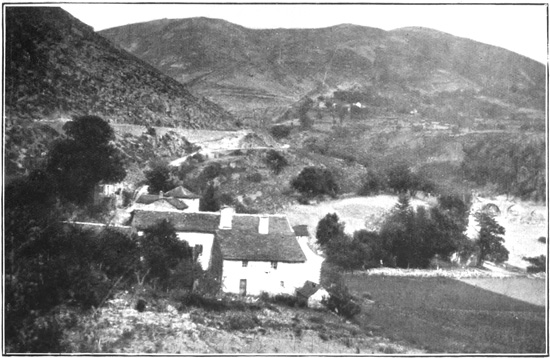
THE TARN VALLEY AT LA VERNÈDE
"It was but a humble place, called La Vernède, with less than a dozen houses and a Protestant chapel
on a knoll. There, at the inn, I ordered breakfast."—R. L. S.
The pastor came with us to point out Du
Chayla's house, which stands on the river side
westward of his own, the spire of the modern
Catholic church showing above the roof. Perhaps
it was only natural that he should look
upon so familiar an object without any show
of emotion, though my fellow-traveller set it
down to the cold Christless teaching of the
Eglise libérale, to which section of the French
Reformed Church Pont de Montvert is attached.
In that three-storied house, with
its underground dungeons and stout-walled
garden trending down to the river, the Archpriest
carried on "the Propagation of the
Faith" by such ungentle methods as plucking
out the hairs of the beard, enclosing the hands
of his Protestant prisoners upon live coal, "to
convince them," as R. L. S. quaintly observes,
"that they were deceived in their opinions."
On the 24th July, 1702, led by their "prophet"
Séguier, a band of some fifty Camisards
attacked the house of the Archpriest, to which
they at length set fire, and thus forced Du
Chayla and his military guard to attempt
escape. The Archpriest, in lowering himself
from an upper window by means of knotted
sheets, fell and broke his leg, and there in the
garden, where a woman was to-day hanging
out shabby clothes to dry, the Covenanters
had their vengeance of stabs. "'This,' they
said, 'is for my father broken on the wheel.
This for my brother in the galleys. That for
my mother or my sister imprisoned in your
cursed convents.' Each gave his blow and his
reason; and then all kneeled and sang psalms
around the body till the dawn." Save for a new
roof, the building remains much as it was two
hundred years ago.
The road, for close on two miles out of Pont
de Montvert, goes uphill past the Catholic
church—the town being now about equally
divided in the matter of religion—and then it
is a long and gentle descent to Florac. In no
respect has the road changed since Stevenson
wrote of it, nor is there any likelihood that it
will be altered ere the crack of doom. "A
smooth sandy ledge, it runs about half-way
between the summit of the cliffs and the river
in the bottom of the valley; and I went in
and out, as I followed it, from bays of
shadow into promontories of afternoon sun.
This was a pass like that of Killiecrankie; a
deep turning gully in the hills, with the Tarn
making a wonderful hoarse uproar far below,
and craggy summits standing in the sunshine
far above."
The slopes of the valley have been terraced
almost to the sky-line, not for baby-fields of
wheat, but to furnish ground for chestnut trees,
that clothe the hills with rich and sombre
foliage, and give forth "a faint, sweet perfume,"
which tinctures the air with balsamic breath.
R. L. S. goes into raptures over these chestnuts;—"I
wish I could convey a notion of the
growth of these noble trees; of how they strike
out boughs like the oak, and trail sprays of
drooping foliage like the willow; of how they
stand on upright fluted columns like the pillars
of a church; or, like the olive, from the most
shattered bole can put out smooth and useful
shoots, and begin a new life upon the ruins of
the old.... And to look down upon a level
filled with these knolls of foliage, or to see a
clan of old, unconquerable chestnuts clustered
'like herded elephants' upon the spur of a
mountain, is to rise to higher thoughts of the
powers that are in Nature." It was on a
terrace and under one of these trees that he
camped for the night, having to scramble up
some sixty feet above the place he had selected
for himself, which was as high as that from the
road, before he could find another terrace with
space enough for his donkey. He was
awakened in the morning by peasants coming
to prune the trees, and after going down to the
river for his morning toilet—"To wash in one
of God's rivers in the open air seems to me a
sort of cheerful solemnity or semi-pagan act
of worship"—he went on his way "with a
light and peaceful heart, and sang psalms to
the spiritual ear as I advanced."
Some little way from where he had slept he
foregathered with an old man in a brown nightcap,
"clear-eyed, weather-beaten, with a faint,
excited smile," who said to him after a while,
"Connaissez-vous le Seigneur?" The old
fellow was delighted when the donkey-driver
answered, "Yes, I know Him; He is the
best of acquaintances," and together they
journeyed on, discussing the spiritual condition
of the country-folk. "Thus, talking like
Christian and Faithful by the way, he and I
came upon a hamlet by the Tarn. It was but
a humble place, called La Vernède, with less
than a dozen houses, and a Protestant chapel
on a knoll. Here he dwelt, and here at the
inn I ordered my breakfast. The inn was kept
by an agreeable young man, a stonebreaker
on the road, and his sister, a pretty and
engaging girl."
We found this little hamlet even smaller
than we expected, some half-dozen houses and
a tiny place of worship, the whole lying below
the level of the main road, so that one could
have thrown a stone on their roofs, well-tilled
fields and meadows stretching down to the river.
A cantonnier who was busy breaking stones by
the roadway helped us to identify the place,
and was proud to confess himself a Protestant,
in common with the little handful of his fellow-villagers.
The country grows richer and more
fruitful as we approach Florac, passing on our
way the old castle of Miral and a picturesque
church compounded of an ancient battlemented
monastery and some modern buildings
with a tall tower.
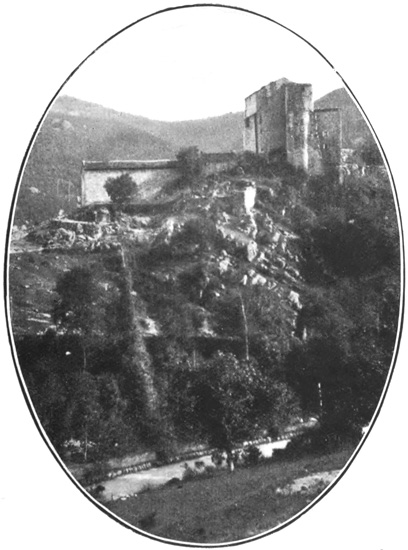
IN THE VALLEY OF THE TARN
"The road led me past the old Castle of Miral on
a steep."—R. L. S.
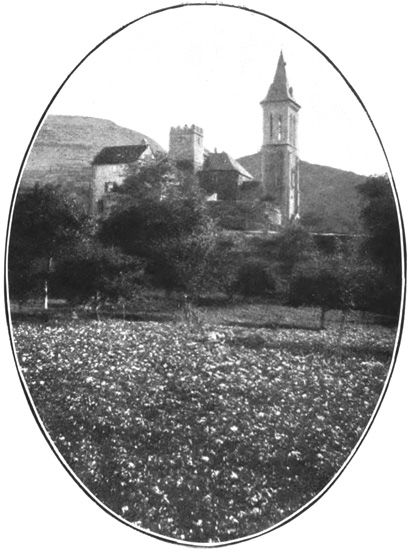
NEAR FLORAC
"Past a battlemented monastery long since broken
up and turned into a church and parsonage."—R. L. S.
The influence of a country on its people
suggested to R. L. S. an interesting comparison
as he journeyed through "this landscape,
smiling although wild." "Those who took to
the hills for conscience sake in Scotland had all
gloomy and bedevilled thoughts," he writes;
"for once that they received God's comfort,
they would be twice engaged with Satan;
but the Camisards had only bright and supporting
visions.... With a light conscience,
they pursued their life in these rough times and
circumstances. The soul of Séguier, let us not
forget, was like a garden. They knew they
were on God's side, with a knowledge that has
no parallel among the Scots; for the Scots, although
they might be certain of the cause, could
never rest confident of the person." A singularly
inapposite comparison. It was not in
pleasant valleys such as these, or in cosy little
towns like Pont de Montvert, that the Camisards
fought out their war with "His Most Christian
Majesty Louis, King of France and Brittany,"
but on the bare and rocky plateaus westward
of the Cevennes, and on such mountain-tops
as the Lozère. Stevenson had never seen the
Causse Méjan or the Causse du Larzac, to the
southward of the region through which he
travelled, or he would have realised that their
conditions were even less likely to foster
"bright and supporting visions" in the
Camisards than those of the mountain-hunted
Scots, though much better from a strategic
point of view.
Florac is a small town of white houses,
cuddled between the eastern front of the Causse
Méjan and the western foothills of the
Cevennes, with the river Tarnon, joined by
the Mimente to the south, running northward
on its outskirts. There are only two thousand
inhabitants, but the number and excellence of
Florac's hotels are accounted for by its being
an important centre for tourists visiting the
gorges of the Tarn, which, totally unknown to
the outer world at the time of Stevenson's
journey, are now admitted to possess the
finest scenery in Europe. Our French guide-book
frankly stated that Florac is a place "of
few attractions," but R. L. S. makes the most
of these in a sentence or two, describing the
town as possessing "an old castle, an alley of
planes, many quaint street-corners, and a live
fountain welling from the hill." The old
castle is quite without interest, and is indeed
the local prison, while the alley of planes,
called the Esplanade, is a dusty open space,
with many cafés lining it, and the grey, featureless
Protestant Temple at its southern end.
"It is notable, besides," he adds, "for
handsome women, and as one of two capitals,
Alais being the other, of the country of the
Camisards." I do not recall having noticed
an unusual number of handsome women,
though the wife of the Free Church minister
was quite the prettiest French woman we saw
in the Cevennes, and the Established Church
pastor's wife perhaps the most cultured.
R. L. S. found the townsfolk anxious to talk of
the part played by Florac in the days of the
Camisards, and was delighted to see Catholic
and Protestant living together in peace and
amity. But it may be that the conspicuous
absence of all windows from the lower parts of
the Protestant churches is a memorial of times
when the adherents of the reformed religion
were subjected to the prying eyes and perchance
the more dangerous attentions of the
Catholics without. Most of the public officials
were named to us as Protestants, and the
religious differences are as strongly marked
between the two sects of the latter as between
them and their townsmen of the Roman
communion. The larger and State-supported
church is Rationalistic, corresponding to our
Unitarian, and the smaller a Free Church, with
a symbol of the open Bible above its doorway.
In what we might call the Free Manse,
really an extension of the church for the
housing of the minister, a door communicating
between the place of worship and the domestic
apartments, we found M. Illaire and his wife
at play with their children—homely folk, who
gave us a cordial welcome, the heartier for the
fact that Mme. Illaire had stayed for a year
in that "quaint, grey-castled city, where the
bells clash of a Sunday, and the wind squalls,
and the salt showers fly and beat"—Stevenson's
own romantic birth-town. She could
thus speak our native tongue, and my companion,
for once in a way, needed none of my
interpreting. M. Illaire, an essential Frenchman,
swarthy of features, slight of build,
voluble and gesticulative, discoursed with
shining eyes of Protestantism, but was something
of a pessimist, and seemed to think that
at best a cold, bloodless Dieism would rule the
intellectual France of the future. I gathered
that, as in the old days of enmity between the
Established and Free kirks of Scotland, there
was no traffic between the two Protestant
churches in Florac, for Mme. Illaire confessed
that she had never seen the inside of the
Temple, which we had thoroughly inspected
earlier in the afternoon, receiving the key from
the pastor's wife, whose husband unfortunately
was absent on a visit to Montpellier.
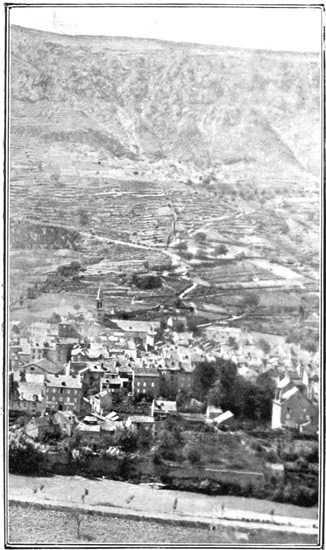
FLORAC
"On a branch of the Tarn stands Florac. It
is notable as one of the two capitals, Alais being
the other, of the country of the Camisards."—R. L. S.
The route of R. L. S. now lay along the
valley of the Mimente, which branches eastward
a little south of Florac, and penetrates
a country very similar to that traversed
between the Lozère and this point. It was
only a few miles from Florac that he spent his
last night à la belle étoile in the valley of this
little river, noting in one of his finest sentences
the coming of night: "A grey pearly evening
shadow filled the glen; objects at a little
distance grew indistinct and melted bafflingly
into each other; and the darkness was rising
steadily like an exhalation." At Cassagnas
he was in the very heart of the Camisard
country, where there is little to engage one
but the historic associations of the district.
At St. Germain de Calberte, six miles to the
south-west, reached by a rough and difficult
road more suitable for the foot than the wheel,
he slept at the inn, and the next afternoon
(Thursday, 3rd October) he accomplished the
eight remaining miles through the waterless
valley of the Gardon to St. Jean du Gard—"fifteen
miles and a stiff hill in little beyond
six hours."
There came the parting with the companion
of his travels, Modestine finding a ready purchaser
at much below prime cost. "For
twelve days we had been fast companions,"
he writes on his last page: "we had travelled
upwards of a hundred and twenty miles,
crossed several respectable ridges, and jogged
along with our six legs by many a rocky and
many a boggy by-road. After the first day,
although sometimes I was hurt and distant in
manner, I still kept my patience; and as for
her, poor soul! she had come to regard me
as a god. She loved to eat out of my hand.
She was patient, elegant in form, the colour
of an ideal mouse, and inimitably small. Her
faults were those of her race and sex; her
virtues were her own. Farewell! and if for
ever—— Father Adam wept when he sold
her to me; after I had sold her in my turn,
I was tempted to follow his example; and
being alone with the stage driver and four
or five agreeable young men, I did not
hesitate to yield to my emotion."
We are to imagine R. L. S. thus tearfully
occupied in the stage-coach bearing him east
to Alais, an important industrial town on the
main line northward through Le Puy, whither
there is no call to follow him. We have the
romantic regions of the Causses and the Tarn
gorges still to explore. Our way, no longer a
pilgrim's path, lies westward.