THE MAGNATE OF GREELTOP'S VISIT
The cavalrymen had been duly drilled in all the details of forming a
camp; and in a short time the tents were pitched, the pickets set up for
the horses, and the cooks were busy in preparing supper. The
headquarters tent was the first to be arranged, as soon as the major had
indicated its location. Colonel Coffee was invited to take a camp-stool;
for they do not have sofas and armchairs in a camp.
"I have been pleading with the officials for the last two weeks to
attend to the security of this region," said the colonel, as he seated
himself. "I have wondered every day during the last week that Greeltop
has not been sacked, and all our houses burned down; for there is a
great deal of Union sentiment in the place."
"Then the place must be particularly liable to an assault from the
guerillas," suggested the major.
"We have tried to form a Home Guard here for the protection of the
village, and we have a little band of about twenty men; but most of our
young and middle-aged men have left the place to enlist in the loyal
army, so that we have not much stock of which to form a company. But our
little band keep a picket of five or ten of their number in the
outskirts of the village, to warn us of the approach of an enemy."
"We shall soon relieve them of that duty."
"Our men are not soldiers, for they have had no training; but they are
made up of fighting material. Though I am sixty-five years old, I belong
to the company; and I have just returned from patrolling the region to
the eastward of us."
While he listened to the visitor, Major Lyon had spread out his map,
which included the locality; and with the assistance of the colonel he
obtained a clear idea of the surface of the country, the first requisite
for a military commander. While they were still busy over the map, the
sentinel at the entrance to the tent drew aside the curtain, and saluted
the commander.
"A messenger in a great hurry to see Colonel Coffee," said he.
"Admit him," replied the major promptly.
A gentleman dressed in a black coat with a standing collar to it,
encircled with a belt, in which was secured a pair of navy revolvers,
entered the tent, out of breath with excitement of running.
"The Rev. Mr. Elbroon, Major Lyon, one of our Home Guard," said the
colonel as soon as the clergyman appeared at the entrance.
There was nothing clerical in his appearance except the standing collar
of his coat; and the revolvers especially belied his profession.
"The Lord be praised for his great mercy!" exclaimed the minister, as
soon as he could get breath for utterance.
"What is the matter, Joseph?" asked the magnate of Greeltop very
familiarly.
"The guerillas are coming!" exclaimed the reverend gentleman.
"Where are they?" asked the colonel, as coolly as though he had been in
command of a regiment for years.
"They are coming down by the mountain road back of your mansion!"
gasped Mr. Elbroon, who was evidently very much alarmed, and could
hardly speak in his fatigue and excitement.
"Sentinel!" called the major sharply.
The man appeared at once.
"Where is Captain Gordon?"
"He is close by, Major."
"Ask him to come to my tent."
"Sit down, Joseph," said the colonel, giving his stool to his friend and
his fellow-soldier, it appeared. "You don't gain anything by blowing
yourself out."
"But this is no time to sit down," replied the excited minister, though
he took the proffered seat.
Captain Gordon appeared immediately.
"A raid of guerillas on the place, Captain! Have the first company ready
to march in three minutes!" said the commander in hurried tones.
The captain retired in haste, without asking any questions; and a moment
later the bugles were heard sounding the assembly. The major buckled on
his sword, and sent out an order for his horse.
"Thank the good Lord that the military have come at last!" exclaimed
Mr. Elbroon, as he crossed his arms on his breast, and looked up to
heaven in earnest prayer. "But we are wasting time, Colonel; and I am
afraid we shall see your beautiful mansion in flames before we can get
there."
"If we do, it will go up in a good cause," replied the magnate, with a
smile on his dignified face. "I can afford to lose it better than some
of the poor people of the village could their houses. But cool off,
Joseph; you are still all in a flutter."
"I will try to do so," replied the clerical soldier, "I saw them coming
when I was on the top of the mountain. I hurried my poor horse till he
broke down under me; and I had to run on foot the rest of the way."
"Rest yourself, Joseph. If you saw the guerillas from the top of the
mountain, there is no hurry; for they will not reach my house this
half-hour," added the colonel.
"You shall have another horse, my reverend friend," interposed the
commander, as he ordered the sentinel to send for a spare steed.
"Now, Joseph, where were the guerillas when you saw them?" inquired the
magnate.
"They were on the Cliff Road, just coming around the bend."
"That is four miles from my house, and five from here," continued the
colonel.
"But I have been a long time coming here," suggested Mr. Elbroon.
"Excuse me, Colonel Coffee; I should like a little more definite
information in regard to the road by which these guerillas will approach
the village," interposed the commander.
"I don't think they will approach the village at all, Major Lyon. I have
not the remotest doubt that my mansion is their objective point; and
they will first plunder that."
"We will take care that they don't do anything of the sort. Have you any
idea how many there were in the company you saw, Mr. Elbroon?"
"I could see them marching along under the cliff; I should say there
were not less than fifty of them," replied the clergyman. "I did not
wait to count them, but hurried to the village, where I inquired of
everybody for Colonel Coffee. The barber told me he was here."
"Company formed," reported the sentinel at the door.
"We are ready now, gentlemen," said the major, as he passed out of the
tent, followed by the others.
"The spare horse ordered, Major," said the sentinel, as he led him up.
The clerical gentleman was invited to mount this animal, which had been
ridden by one of the men killed; and the colonel mounted his own steed.
The commander took his horse, which was led by Deck, while Artie had
brought up the spare steed. The animal was a higher-spirited beast than
the parson had been in the habit of riding, and Artie had to take him by
the head to prevent him from running away; for he was one of the colts
of the Riverlawn planter's stock.
"My orderlies will ride with me," said the major; "I may want them.
Captain Truman, you will have the second company in marching order, in
case I send for them, though I don't know what this affair will amount
to; and you will leave a guard at the camp if you are called away."
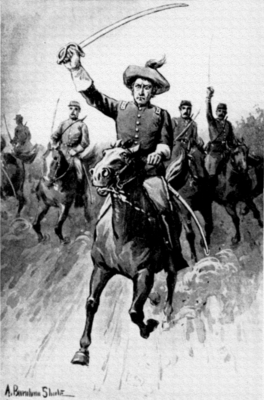
The order was given to Captain Gordon to march. The commander led the
column at full gallop, with the colonel at his side, and the orderlies
in the rear of them. In less than a minute they came to a road turning
off at the left, leading in the direction of the magnate's mansion. It
was situated on the side of a hill, and near the top of it. The
elevation was elliptical in form, and the loftiest part was not more
than sixty feet high, at the summit of which was a Chinese pagoda,
painted in gaudy colors.
There was a valley behind it; for the major could see the tops of some
tall trees, whose roots must be far below the top of the elliptical
hill. Beyond it were what the colonel called the mountains, though
probably not one of them was more than five hundred feet high. The
column followed the road into which it had turned till it came to
another; and here the major ordered the captain to halt his company.
"Here is another road, Colonel Coffee; and it passes behind the hill
which you call Greeltop," said the commander.
"Precisely so," replied the magnate, who thought the major had acquired
a very good knowledge of the locality when he had been there hardly more
than an hour.
"Captain Gordon, you will go that way with half your company, and
Lieutenant Gilder will follow me," said Major Lyon. "The road through
the valley unites with the one from the mountains, by which the
guerillas must approach the village. You will move cautiously as you
come near this road, and halt there till you hear firing on your right."
"You can hardly call it a road through the valley, though the captain
can get through without any difficulty," interposed the magnate. "It is
all a grove, but the ground has been cleared off."
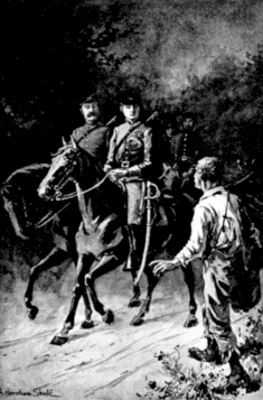
"Dexter, you will call Knox, and scout the road ahead of us. Don't let
the enemy see you, and obey the orders of the sergeant," continued the
major, as the first platoon rode off.
Life Knox was called from his place in the ranks, and the order of the
commander given to him. It was the kind of duty the sergeant liked; for
he was more at home there than in following military forms; though he
was a faithful and obedient soldier, and his captain wished he had a
hundred more like him.
"Here we go again, Deck," said the sergeant, as they galloped up the
road, by the entrance to Colonel Coffee's estate. "Your pa does well to
send me along with you this time, and not leave you alone as he did on
that bridge."
"But I can take care of myself, and I did that time; for I came back
like a bad penny," replied Deck.
"You managed fust-rate, my boy; and if you live to be as old as the
white-haired owner of this place, you will be a brigadier-general; and I
hope I shall be an orderly sergeant under you."
"You are a good deal more likely to become a brigadier-general than I
am, though I may get to be a corporal some time. You may be
major-general; for you understand war much better than most of us."
"That can't never be, Deck. I hain't got the eddication to be anything
more than a non-commissioned officer," said Knox, shaking his head, and
hurrying on his horse.
"It wouldn't be just the thing for a brigadier-general to say
'eddication,'" replied Deck.
"What would you call it? I didn't pay much attention to my eddication
when I was a young cub, and have been sorry for it ever sence. What do
you call it, Deck?"
"Ed-u-ca-tion."
"But I can't say it like that."
"Yes, you can. You have a brother named Edward, and you call him Ed when
you speak of him. Now say this, Life, 'Ed, you can.'"
"'Ed, you can.'"
"Good! Now say, 'Ed, you, Kate,'" which was the name he had given the
mare he rode.
"'Ed, you, Kate.'"
"Exactly; and it is just as easy to say 'educate' as 'eddicate.' Try
it."
He did it as well as though he had been to college.
"You will be a brigadier-general if you keep on; for you know more now
than half of them who pronounce their words correctly," added Deck,
reining in his horse as they came to another road. "This is the one we
are to follow, I think."
"I reckon 'tis; and we won't edicate—ed-u-cate—no more jest now."
"I don't see anything of any guerillas yet."
"They hain't got along," replied Knox, as he reined in his horse and
looked about him.
There was something peculiar about the place which attracted the
attention of the Kentuckian. The road passed through a round open
space. On one side was a broad gateway that led by a winding driveway to
the front door of the colonel's mansion.
"This would be a nice place to meet them gorillas," said Knox, as he
looked about him. "Now get in there, Deck," and he pointed to the open
gateway, and led his mate into it. "You hold Kate while I look inter
this thing afoot;" and he slid from his horse to the ground.
He followed the road, concealing himself as much as possible in the
shadow of the trees.