IN THE
LAND OF THE LION AND SUN, OR
MODERN PERSIA.
BEING EXPERIENCES OF LIFE IN PERSIA FROM
1866 TO 1881.
ILLUSTRATED BY FULL-PAGE PLATES FROM PHOTOGRAPHS AND FROM
NATIVE DRAWINGS.
BY
C. J. WILLS, M.D., LATE ONE OF THE MEDICAL OFFICERS OF HER MAJESTY’S TELEGRAPH
DEPARTMENT IN PERSIA.
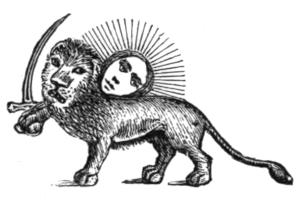
THE ARMS OF PERSIA
(from the Teheran Gazette).
NEW EDITION.
WARD, LOCK AND Co.,
LONDON, NEW YORK, AND MELBOURNE,
1891.
The right of translation is reserved.
EDITORIAL NOTE.
The author of the Land of the Lion and Sun may claim
an exceptional degree of credit for his book on one of the
most interesting countries in the world; for he derived his
knowledge not merely from a journey through the country,
but from a sufficiently prolonged residence to make him
thoroughly at home with the people, and to understand their
inner life. The Times, on its first appearance in 1883, characterized
it as probably the most amusing book of travel that
had been published in recent years. The author’s profession
gave him access to the personality of the people to a
marked extent, giving origin to many of the amusing anecdotes
referred to. The verdict of the Times was endorsed by very
many journals. Nature described the anecdotes as “distinguished
by three cardinal virtues: they are characteristic, they
are well told, and they are infinitely varied.”
Since his return to England, Dr. Wills has become well
known as a novelist and writer of short stories, which he has
contributed to most of the leading magazines and society
journals. His novels, some of which have been written in
collaboration with Mr. F. C. Philips, have been widely read
and highly appreciated.
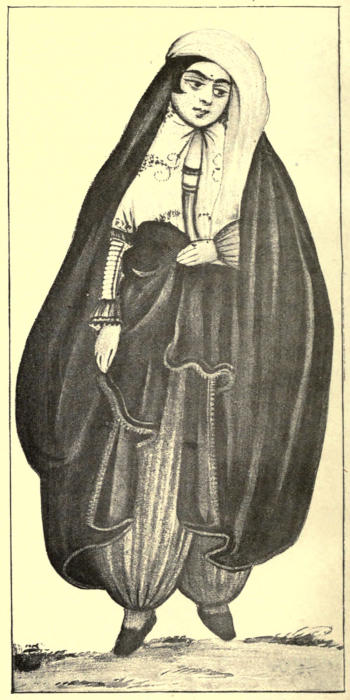
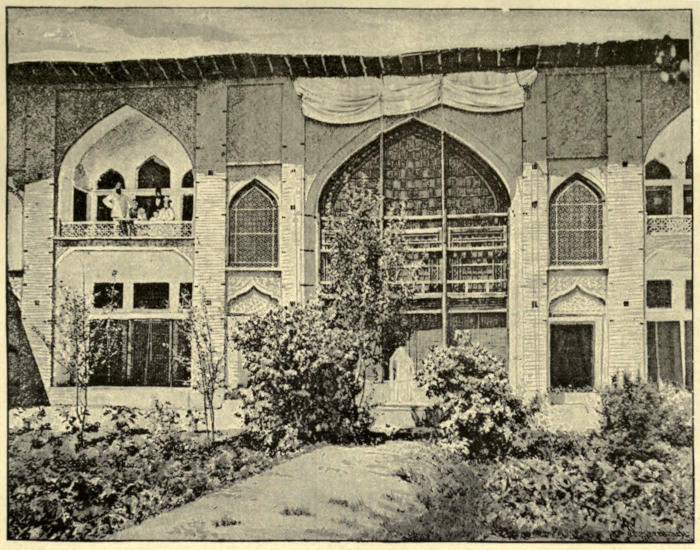
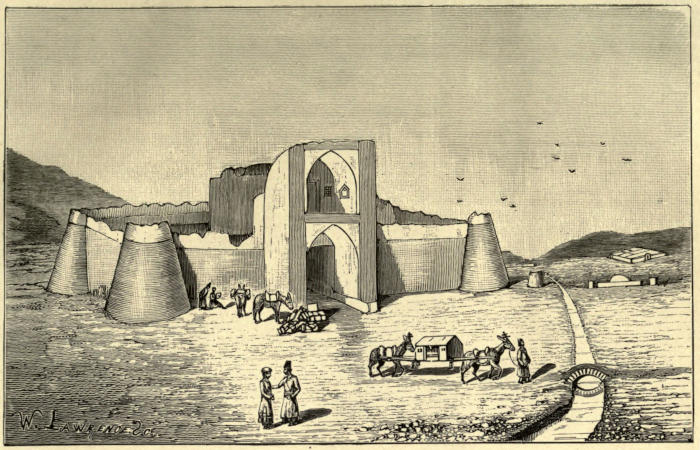
The illustrations, on separate plates, appear here for the first
time. They are reproduced from native drawings, and from
Dr. Wills’s photographs and drawings.
G. T. B.
TO
MAJOR-GENERAL SIR F. J. GOLDSMID, C.B., K.C.S.I.,
FORMERLY DIRECTOR IN CHIEF OF THE INDO-EUROPEAN
GOVERNMENT TELEGRAPH DEPARTMENT,
SPECIAL COMMISSIONER FOR THE SETTLEMENT OF THE
PERSIAN FRONTIER, This Book is Dedicated, WITH AFFECTIONATE ESTEEM, IN GRATITUDE FOR MANY
KINDNESSES,
BY HIS MOST OBEDIENT SERVANT,
THE AUTHOR.
PREFACE.
My reason for calling my book ‘The Land of the Lion and
Sun’ is that the Lion and Sun are the national emblems of
Persia, while the second title alone, ‘Modern Persia,’ would
have suggested an exhaustive and elaborate array of matter
which is beyond the scope of this work.
In a personal narrative, it is necessary to use a good many
I’s; and to avoid being obscure, I fear I have been at times
over minute, but I have preferred this to the risk of giving a
false impression.
I have striven to describe life in Persia as I saw it, not
exaggerating or softening anything, but speaking of Persia
as it is. The whole narrative may be considered as a record
of life in an out-of-the-way corner of the world; and the reader
being left to make his own reflections, is not troubled with
mine.
Usually no names are given, save of those of the dead, or
public men.
The important subject of our fast-dying commerce with
Persia, and the means of really opening the country, I have
relegated to an Appendix.[1]
As to the spelling and transliteration of Persian words used,
it is not classical, it does not pretend to be; but it will convey
to the ordinary reader the local pronunciation of the colloquial;
and the reader not knowing anything of Oriental languages
is troubled very seldom with accents and (apparently) unpronounceable
words. Thus Mūnshi is spelt Moonshee, as that
gives the exact sound: ū is often used to avoid the barbarous
appearance of oo. Of course there is no C in Persian; still as,
from habit, we write Calcutta and not Kalkutta, so some words,
like Cah, that use has rendered common, are inserted under
C and K. I think that all that is required is, that the ordinary
English reader shall pronounce the words not too
incorrectly; and it is only when a work is philological that
accuracy in transliteration is of any real importance. With
this end in view, I have tried so to spell Persian words that
by following ordinary rules, the general reader may not be very
wide of the mark. To avoid continual explanation I have
added a Glossary, with a correct transliteration. I have to
gratefully acknowledge the valuable help of Mr. Guy le
Strange in correcting this Glossary, and kindly favouring me
with the transliteration according to the system adopted by
Johnson, in several cases in which that author has not noted
words, &c.
Oriental Club, Hanover Square.
CONTENTS.
PAGE
CHAPTER I. I GO TO PERSIA.
Wanted a doctor—The Director-in-chief—Doubt and distrust—Simple
advice—Am referred to ‘Hadji Baba’—My kit—Saddle for
riding post—Vienna—Rustchuk—Quarantine—Galatz—Kustendji—Constantinople—Turkish
ladies—Stamboul—I have my hair
cut—“Karagews”—Turkish coffee—A philo-Turk—Shooting
party—The theatres—The Opera—Armenian theatre—Gambling
house—A Bashi-bazouk—We leave, viâ the Black Sea—The
Russian captain—Unarmed vessels—White Crimean wine—Foreign
wines in Russia—Deck passengers—Sinope—Batoum—Poti—The
post-house—Difficulty in getting food—Travelling en
tröika—Kutais—A tarantass—Apply for horses—An itching palm—We
start—Tiflis—Lecoq’s beer—A happy reprieve—The joys
of travel—Chief of the Telegraph in Tiflis—Uniforms—Persian
Consulate—Coffee and pipes—Smoking, an art—Effects on the
tyro—Tea—The Consul—His age—Dyeing the hair—The Opera,
varied costumes at—The Tiflis ballet—Leave Tiflis—Erivan—The
Pass—We lighten our load—Hotel—Washing—Nakchewan—Julfa,
the frontier of Persia
Preparations for the start—Costume—Chaff bed—First fall—Extra
luggage—The whip—Stages and their length—Appearance of the
country, and climate—First stage—Turk guides—Welcome rest—Weighing
firewood—Meana bug—Turcomanchai—Distances—New
friends—Palace of Kerrij
Teheran—The Director’s house—Persian visits—Etiquette—Pipes,
details of—Tumbakū—Ceremony—Anecdote—The voice of the
sluggard—Persian medicine explained—My prospects as a medico—Zoological
Gardens
The Gulhaek Road—Visit to a virtuoso—His story—Persian New
Year—Persian ladies—Titles—The harem—Its inhabitants—A
eunuch—Lovely visions—The Dervish—The great festival—Miscellaneous
uniform—At the Court of Persia—The Shah—The
ceremony—Baksheesh—Rejoicings
Start for Hamadan—Bedding—Luggage makes the man—Stages—Meet
Pierson—Istikhbals—Badraghah—Pierson’s house—Hamadan
wine—Mode of storing it—My horses—Abu Saif Mirza—His
stratagem—Disinterested services—Persian logic—Pierson’s horse’s
death—Horses put through their paces—I buy Salts and Senna—The
prince’s opinion—Money table—Edict
Morning rides—Engage servants—Dispensary—A bear-garden—Odd
complaints—My servants get rich—Modakel—The distinction
between picking and stealing—Servants—Their pay—Vails—Hakim
Bashi—Delleh—Quinine—Discipline—I commence the
cornet—The result of rivalry—Syud Houssein—Armenians—Cavalry
officer—Claim to sanctity of the Armenians—Their
position in the country—Jews
Tomb of Esther and Mordecai—Spurious coins—Treasure-finding—Interest—A
gunge—Oppression—A cautious finder—Yari Khan—We
become treasure-seekers—We find—Our cook—Toffee—Pole-buying—Modakel—I
am nearly caught—A mad dog—Rioters
punished—Murder of the innocents
Antelope—Hunting and hawking—Shooting from the saddle—Thief-catching—The
prince offers his services as head-servant—Our
hunting party—The prince takes the honours—Kabobs—A provincial
grandee—His stud—Quail-shooting—A relative of the king—Persian
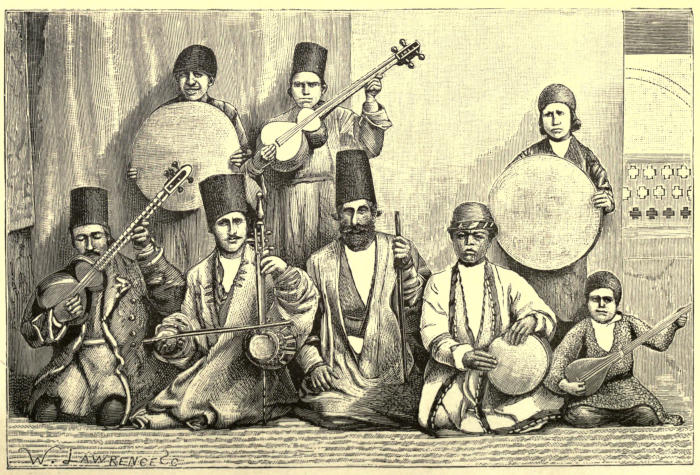
dinner—Musicians and singers—Parlour magic—The
anderūn—Cucumber-jam—Persian home-life—Grateful Armenians—Lizards—Talking
lark—Pigeon-flying—Fantails—Pigeons’
ornaments—Immorality of pigeon-flying—Card-playing—Chess—Games—Wrestling—Pehliwans—Gymnastics
Leave for Kermanshah, marching—Detail of arrangements—Horse-feeding—Peculiar
way of bedding horses—Barley—Grape-feeding—On
grass—Nawalla—Colt, anecdote of—Horses, various breeds
of—Turkomans—Karabagh—Ispahan cobs—Gulf Arabs—Arabs—Rise
in price of horses—Road cooking—Kangawar temple—Double
snipe—Tents—Kara-Su River—Susmanis—Sana—Besitūn—Sir
H. Rawlinson—Agha Hassan—Istikhbal—Kermanshah—As
we turn in another turns out—Armenians—Their reason for
apostatising—Presents of sweetmeats
Kermanshah—Imād-u-dowlet—We visit him—Signs of his wealth—Man
nailed to a post—Injuring the wire—Serrum-u-dowlet—Visits—We
dine with the son of the Governor—His decorations and
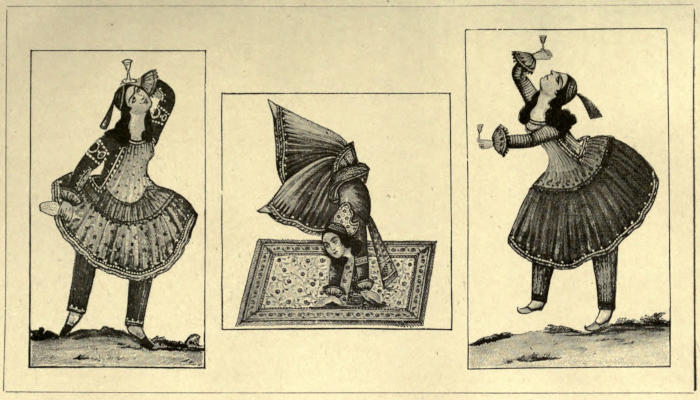
nightingales—Dancing girls—Various dances—The belly dance—Heavy
dinner—Turf—Wild geese—The swamp—A ducking
through obstinacy—Imādieh—Wealth of the Imād-u-dowlet—The
Shah loots him—Squeezing—Rock sculptures—Astrologers—Astrolabes—Fortune-telling—Rammals—Detection
of thieves—Honesty
of servants—Thefts through pique—My lost pipe-head—Tragedy
of two women
Deficiency of furniture—Novel screws—Pseudo-masonry—Fate of the
Imād-u-dowlet’s son—House-building—Kerind—New horse—Mule-buying—Start
for Ispahan—Kanaats—Curious accident—Fish
in kanaats—Loss of a dog—Pigeons—Pigeon-towers—Alarm
of robbers—Put up in a mosque—Armenian village—Armenian
villagers—Travellers’ law—Tax-man at Dehbeed—Ispahan—The
bridge—Julfa
Illness and death of horse—Groom takes sanctuary—Sharpness of
Armenians—Julfa houses—Kūrsis—Priests—Arachnoort—Monastery—Nunnery—Call
to prayer—Girls’ school—Ancient language
of the Scriptures—Ignorance of priests—Liquor traffic—Sunday
market—Loafers—Turkeys—Church Missionary school—Armenian
schools
Julfa cathedral—The campanile—The monk—Gez—Kishmish wine—The
bishop—The church—Its decorations—The day of judgment—The
cemetery—Establishment of the Armenian captives in Julfa—Lost
arts—Armenian artificers—Graves—Story of Rodolphe—Coffee-house—Tombstone
bridges—Nunnery—Schools—Medical
missionary—Church Missionary establishment—The Lazarist
Fathers
Tame gazelle—Croquet-lawn under difficulties—Wild asparagus—First-fruits—Common
fruits—Mode of preparing dried fruits—Ordinary
vegetables of Persia—Wild rhubarb—Potatoes a comparative
novelty—Ispahan quinces: their fragrance—Bamiah—Grapes,
Numerous varieties of—At times used as horse-feed—Grape-sugar—Pickles—Fruits
an ordinary food—Curdled milk—Mode
of obtaining cream—Buttermilk—Economy of the middle
or trading classes—Tale of the phantom cheese—Common flowers—Painting
the lily—Lilium candidum—Wild flowers—The crops—Poppies—Collecting
opium—Manuring—Barley—Wheat—Minor
crops—Mode of extracting grain—Cut straw: its uses—Irrigation
Pig-sticking expedition—Ducks not tame, but wild—Ruined mosque
with tile inscription—Ancient watch-towers—The hunting-ground—Beaters—We
sight the pig—Our first victims—The bold Gholam—Our
success—Pig’s flesh—A present of pork—How Persians
can be managed—Opium—Adulteration—Collection and preparation—Packing—Manœuvres
of the native maker—Opium-eating—Moderate
use by aged Persians—My dispensary over the prison—I
shift my quarters—Practice in the bazaar—An ungrateful
baker—Sealing in lieu of signing—Seals—Wisdom of a village
judge
Cost of living—Servants—Our expenses—Price of provisions—Bargains—Crying
off—Trade credits—Merchants—Civil suits—Bribery—Shopkeepers—Handicrafts—Damascening—Shoemakers—Other
trades—Bankers—An Ispahani’s estimate of the honesty of his
fellow-townsmen
Daily round—The river—Calico-rinsers—Worn-out mules and horses—Mode
of treating the printed calico—Imitations of marks on
T-cloths—Rise of the waters of the Zend-a-Rūd—Pul-i-Kojū—Char
Bagh—Plane-trees—The college—Silver doors—Tiled halls
and mosque—Pulpit—Boorio—Hassir—Sleepers in the mosque—Cells
of the students—Ispahan priests—Telegraph-office—Tanks—Causeways—Gate
of royal garden—Governor’s garden—Courtiers
and hangers-on—Prisoners—Priests—The Imām-i-Juma—My dispensary—Ruined
bazaar—A day in the town—Bazaar breakfasts—Calico-printing—Painters—The
maker of antiquities—Jade teapot—Visit
to the Baabis—Hakim-bashi—Horse-market—The
“Dar”—Executions—Ordinary—Blowing from guns—A girl
trampled to death—Dying twice—Blowing from a mortar—Wholesale
walling up alive—A narrow escape from, and horrible miscarriage
in carrying it out—Burning alive—Crucifixions—Severity:
its results
Julfa quarters—Buy a freehold house—I ornament, and make it comfortable—Become
ill—Apply for sick leave—Start marching—Telegram—Begin
to post—Reach Teheran—Obtain leave—Difficulty
at Kasvin—Punishment of the postmaster—Catch and
pass the courier—Horses knock up—Wild beasts—Light a fire—Grateful
rest—Arrive at Resht—Swamp to Peri-Bazaar—Boat—Steamer—Moscow—Opera—Ballet—Arrive
in England—Start
again for Persia—Journey viâ Constantinople—Trebizonde—Courier—Snow—Swollen
eyes—Detail of journey from Erzeroum
to Teheran—The races—Ispahan—Leave for Shiraz—Persian
companions—Road-beetles—Mole crickets—Lizards—Animals
and birds—The road to Shiraz—Ussher’s description—Meana bug
legend again
Entry into Shiraz—Gaiety of Shirazis of both sexes—Public promenade—Different
from the rest of Persians—Shiraz wine—Early lamb—Weights:
their variety—Steelyards—Local custom of weighing—Wetting
grass—Game—Wild animals—Buildings—Ornamental
brickwork—Orange-trees—Fruits in bazaar—Type of ancient
Persian—Ladies’ dress—Fondness for music—Picnics—Warmth
of climate—Diseases—The traveller Stanley—His magazine rifle
and my landlord’s chimney—Cholera—Great mortality—We march
out and camp—Mysterious occurrence—Life in a garden—The
“Shitoor-gooloo”—Bear and dog fight—The bear is killed
Buy grapes for wine-making—Difficulty in getting them to the house—Wine-jars—Their
preparation—Grapes rescued and brought in—Treading
the grapes—Fermentation—Plunger-sticks—Varieties
of Shiraz wine and their production—Stirring the liquor—Clearing
the wine—My share, and its cost—Improvement by bottling—Wasps—Carboys—Covering
them—Native manner of packing—Difficulties
at custom-house—The Governor’s photographic apparatus—Too
many for me—A lūti-pūti
Cheapness of ice—Variety of ices—Their size—Mode of procuring ice—Water
of Shiraz: its impurity—Camel-fight—Mode of obtaining
the combatants—Mode of securing camels—Visit to Fussa—Mean-looking
nag—His powers—See the patient—State of the sick-room—Dinner
sent away—A second one arrives—A would-be room-fellow—I
provide him with a bedroom—Progress of the case—Fertility
of Fussa—Salt lake—End of the patient—Boat-building—Dog-cart—Want
of roads—Tarantulas—Suicide of scorpions—Varieties—Experiment—Stings
of scorpions—The Nishan
Approach of famine—Closing of shops—Rise in mule-hire—Laying
in of stores—Seizures of grain—Sale of goods by poor—Immigrations
of villagers to the towns—Desertions of children—Increase
of crime—Arrival of money from England—Orphanage—Labour
question—Kūmishah—Village ruffian—His punishment—Prince’s
accident—The kalāat—Mode of bringing it—Invitation to the
ceremony—Procession—Gala dress of the prince—The arrival of
the firman—Assemblage of grandees—The kalāat—The Kawam’s
kalāat—Return to town—Sacrifice of an ox
A call to a patient—Start on post-horses—No horses—I carry a
lantern—The Bakhtiaris—Fall among thieves—They strip me—And
march me off—Mode of disguise of thieves—Attacked by
footmen—Division of spoils—Fate of a priest—Valuing my kit—Ignorance
of my captors—A welcome sight—My escape—I get a
horse—Reach Yezdikhast—Old women get thorns out of my feet—Want
of hospitality of head-man of Yezdikhast—Arrive at
Kūmishah—Kindness of a postmaster—More robbers—Avoid
them—Am repaid for my lost kit—Fate of my robbers
The Muschir—His policy and wealth—His struggle with the king’s
uncle—He is bastinadoed—His banishment to Kerbela—The
Kawam—Mirza Naim—Siege of Zinjan—Cruelties to Mirza Naim—Reply
to an author’s statement—Cashmere shawls—Anecdote—Garden
of Dilgoosha—Warm spring—“Sau-Sau-Rac”—The
Well of Death—Execution—Wife-killing—Tomb of Rich—Tomb
of Hafiz—Tomb of Saadi—A moral tale—Omens—Incident at
tomb of Hafiz
The Tazzia—Persian pulpit—Prince’s flirtations—Month of mourning—Details
of performance—Breast-beaters—Hymn in honour of
the king—The performers—Processions—Detail of the tragedy—Interludes—Rosehkhaneh—The
Ramazan—The fast—Hospitalities—Zalābi—Religious
affectation—Reading poetry—A paraphrase—A
quotation—Books and their covers—Calamdans—Writing
a letter—Sealing—Specimen of an ordinary letter—Apparent
piety—The evil eye—Talismans—I procure one
Bagh-i-Takht—Jews’ burial-ground—Christians’ cemetery—Its desecration—Sergeant
Collins’s murder—Capture and execution of the
robbers—How it was brought home to them—Memorial to Collins—Health
of the staff—Persians as servants—Persian cuisine—Kabobs,
varieties of—English dinners—Confectionery—Fruits—Vegetables—Pickles,
etc.—Cook-shops—Trotters—Mode of
selling meat—Game—Eggs—Wild vegetables—Potatoes—Disinclination
to use new seeds, and its cause—Narcissus—General use
of flower decoration—Tame birds—Wild birds—White ants—Damaging
the line—Hamilton poles
CHAPTER XXVIII. BEASTS, BIRDS, FRUITS, AND FLOWERS.
Tamed pigs—“Marjahn”—Mongoose—Persian cats—Their value—Van
cats—A fierce cat—How to obtain a Persian cat—Grey-hounds—Toolahs—Watch-dogs—Monkeys—Tame
lions—Tame
and cage birds—Superstition concerning house-snakes—I kill
a clockwinder—Wild ass—Fighting rams—Tame partridges—Gardening—Ordinary
flowers—The broom-plant—Vine-culture—Quinces
and pomegranates—Orchards—Garden parties
CHAPTER XXIX. PERSIAN CHARACTER, COSTUMES, AND MANNERS.
Character of the Persians—Exaggeration—Mercifulness—Anecdote—Costumes
of men—Hair—Beards—Arms—Costumes of women—Jewellery—Glass
bangles—Nose-rings—Painting of the face—Tattooing—Hair—Out-door
costume—Dress of children—Their
manners—Strange custom—Love of mothers—The uncle—Cousins—Slaves—Servants—Slavery
Travelling—Difficulties of posting—Saddles and bits—Cruel joke—Old
stories—Pastimes—Enamels—Persian pictures—Curio buyer—Carvings—Metal-work—Calligraphy—Kahtam—Incised
work
on iron—Embroideries—Silver-work—Washing of linen—Ironing—Needlework—The
bath—Washing the hair with clay—Bread
and baking—Unleavened bread—Other kinds—Travellers’ food—Inordinate
appetites—Food of the poor
CHAPTER XXXI. EDUCATION—LEAVE, AND RETURN VIÂ INDIA.
Education—Schools—Punishments—Love of poetry—Colleges—Education
of women—Religion—March to Bushire—Extremes of
cold and heat—Good luck—Go home to England—Leave viâ
India—The “Boys”—Lisbon—Algiers—Port Said and Suez—Jeddah—Donkeys—Coral
reef—Sea-slugs—Aden—Madagascar
oranges—“Grimes”—Kurrachee—Drives—Visit to the alligators
at Muggerpir—Disgusting scene—A legatee—Black-wood furniture—A
lost bargain—Persian Gulf—Bushire—Leave for Shiraz
Our start for Shiraz—Camp out—Borasjūn—Spring at Dalliké—Kotuls—Kazerūn—Buy
a horse—A tough climb—Place of
Collins’s murder—Arrive in Shiraz—Hire a house—Settle down—Breaking
horses—Night marching—Difficulties of start—Mūrghab—Find
our muleteer and loads—Abadeh—Yezdikhast—Kūmishah—Mayar—Marg—Arrive
in Julfa
Hire a house—Coolness of streets—Idleness of men—Industry of
women—Stone mortars—Arrack—Hire a vineyard—A wily
Armenian—Treasure-trove—The “Shaking Minarets”—A hereditary
functionary—A permanent miracle—Its probable explanation—Vaccination—Julfa
priests—Arrack as an anæsthetic—Road-making—Crops
of firewood—Fire temple—Huge trees—The
racecourse—Disappearance of ancient brick buildings—Donkeys—Healthiness
of Julfa—Zil-es-Sultan—His armoury—Prospects
of the succession to the throne—Bull-terriers—Mastiffs—Politeness
and rudeness of the prince
Proceed to Teheran—Takhtrowan—Duties—Gulhaek—Lawn-tennis—Guebre
gardener—A good road—The Shah—Custom of the
Kūrūk—M. Gersteiger—Cossack regiments—Austrian officers—New
coinage—Count Monteforte—New police—Boulevard des
Ambassadeurs—English Embassy—Tile gates—Summer palaces—Bazaars—Russian
goods—Demarvend—Drive to Ispahan—Difficulties
of the journey—Accidents—Danger of sunstroke—Turkeys—Keeping
peacocks—Armenian tribute of poultry—Burmese
and Japanese embassies—Entertainment and fireworks—Cruel
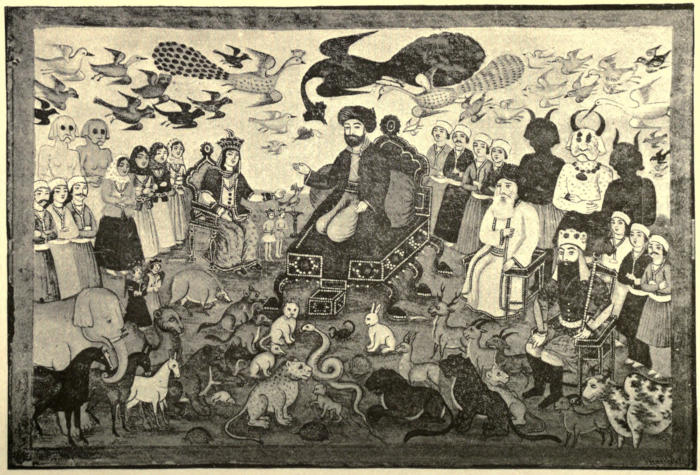
treatment of Jews—Oil paintings—Bahram and his queen—Practice
makes perfect—Pharaoh and the Red Sea—Pharaoh and
the magicians
New Year’s presents—Shiraz custom—Our cook’s weaknesses—He
takes the pledge—And becomes an opium-eater—Decide to go
home—Dispose of kit—Start for Europe—Our own arrangements—Diary
of our journey home—Arrival
IN THE LAND OF THE LION AND SUN. — CHAPTER I. I GO TO PERSIA.
Wanted, a doctor—The Director-in-chief—Doubt and distrust—Simple
advice—Am referred to ‘Hadji Baba’—My kit—Saddle for riding post—Vienna—Rustchuk—Quarantine—Galatz—Kustendji—Constantinople—Turkish
ladies—Stamboul—I have my hair cut—“Karagews”—Turkish
coffee—A philo-Turk—Shooting party—The theatres—The
Opera—Armenian theatre—Gambling-house—A Bashi-bazouk—We
leave, viâ the Black Sea—The Russian captain—Unarmed vessels—White
Crimean wine—Foreign wines in Russia—Deck passengers—Sinope—Batoum—Poti—The
post-house—Difficulty in getting food—Travelling
en tröika—Kutais—A tarantass—Apply for horses—An itching
palm—We start—Tiflis—Lecoq’s beer—A happy reprieve—The
joys of travel—Chief of the Telegraph in Tiflis—Uniforms—Persian
Consulate—Coffee and pipes—Smoking an art—Effects on the tyro—Tea—The
Consul—His age—Dyeing the hair—The Opera, varied
costumes at—The Tiflis ballet—Leave Tiflis—Erivan—The Pass—We
lighten our load—Hotel—Washing—Nakchewan—Julfa, the frontier of
Persia.
I think that there is no more painful position than that of
the young medical man. I had “passed,” and had got my
qualifications. An assistant I did not wish to be, and I therefore
consulted the advertisement columns of the Lancet, and
was prepared to go anywhere, if I might see the world, and
have what Americans call a good time.
At my first attempt I came on an advertisement of three
appointments, under the Indian Government, in Persia; the
address was the Adelphi. Off I started for the Adelphi, which
I had always looked on as a neighbourhood full of mystery,
and whose inhabitants were to be mistrusted. Timeo Danaos.
A first-floor—this looked well. I knocked, was told to
enter. Two gentlemen, kneeling on the floor, looked at me in
a disturbed manner. The whole room is strewn with sheets of
written foolscap, and it appears that I have arrived inopportunely,
as official documents are being sorted. I am asked to
take a seat, having stated to the elder of the two that I am
come to see the director on business.
Now I couldn’t at that time fancy a director who knelt—in
fact, my only idea of one was the typical director of the novel,
a stout, bechained man—and my astonishment was great at
being quietly informed by one of the gentlemen that he was
Colonel G⸺, and should be glad to hear anything I had to
communicate. I stated my wish to obtain such an appointment
as was advertised; the duties, pay, &c., were pointed
out, and I came to the conclusion that it would suit me as
a “pastime” till the happy day when I should have a brass
plate of my own. But if my ideas of a director were lofty, my
ideas of a colonel were loftier; and I said to myself, one who
combines these two functions, and can be polite to a humble
doctor—must be an impostor.
I was asked for my credentials. I gave them, and was told
to call in the morning, but distrust had taken hold of me; I
got an ‘Army List,’ and, not finding my chief-that-was-to-be’s
name in it, I, forgetting that we had then an Indian as well as
an English army, came to the conclusion that he must be an
impostor, and that I should be asked for a deposit in the
morning, which was, I believed, the general way of obtaining
money from the unwary.
With, I fear, a certain amount of truculent defiance, I presented
myself at the appointed hour, and was told that my
references were satisfactory, that a contract would be drawn
up that I should have to sign, and that I should be ready to
start in a fortnight; but, rather to my astonishment, no mention
was made of a deposit. “I think there is nothing more,” said
Colonel G⸺.
This, I concluded, indicated the termination of the interview;
and, after considerable humming and hawing, I came to
the point, and blurted out that, after searching the ‘Army
List,’ I couldn’t find any Colonel G⸺, and that no one had
ever heard of the Telegraph Department in Persia.
Instead of being annoyed, the Colonel merely asked if I
knew any one at the War Office. As it happened I did.
“Well, go to him, and he will tell you all about it.”
Off I went to the War Office, found my friend, and, to his
horror, told him that I wanted to know if the Persian Telegraph
Department existed or not, and if the director was or was not
a myth. He easily satisfied me, and I felt that I had been
stupidly suspicious.
I then announced to my friends and relatives my probably
immediate departure for Persia. Strange to say, they declined
to see it in any other light than a peculiarly elaborate and
stupid joke. Instead of congratulations, I was treated as an
unamiable and tiring lunatic, and from none of my friends was
I able to get any information as to Persia. One man had a son
in Baghdad! but it was no good his writing him, as it took six
months to get an answer.
After a day or two I again presented myself at the office,
and I had the country described to me, and various recommendations
as to outfit given me, and I also was introduced to
Major C⸺, the assistant-director. His advice was delightfully
simple. “You’ll be able to wear out all your old clothes;
don’t buy any new ones; have a ‘Dayrell’ bridle; get nothing
but flannel shirts.” Colonel G⸺ certainly took great trouble
to explain to me all about the country, and, taking me out
to lunch with him, bought me Morier’s ‘Hadji Baba,’ saying,
“When you read this you will know more of Persia and the
Persians than you will if you had lived there with your eyes
open for twenty years.” This is going a long way; it is seventeen
years since I went to Persia, and I read ‘Hadji Baba’
now, and still learn something new from it. As Persia was
in Morier’s time so it is now; and, though one sees plenty of
decay, there is very little change.
Two other candidates came forward, to whom I was deputed
to explain matters. They accepted the conditions, and, the
deeds being prepared, we all three went to the India Office and
signed a contract for three years.
On going to the Adelphi I was told that a sum of one
hundred pounds had been handed to each of my two colleagues
to take them to Persia. But I was glad to seize the opportunity
kindly given me by Colonel G⸺ of travelling with him, and
he told me to meet him in Vienna on a certain day.
I had now no time to lose, and proceeded to buy my kit;
what that kit was it is as well the reader should know.
I got enough ordinary clothing for three years, such as we
use in England for morning or country wear, also two pairs of
riding-boots; these fitted me, and were consequently useless,
for I soon found that in riding long distances boots much too
big are the thing, as then the foot is neither cold in winter or
crippled in summer; a knife, fork, and spoon, to shut up; a
revolver; a small bradawl, with the point buried in a cork, for
boring holes in straps; a military saddle (hussar officer’s),
with wallet-holsters and a high cantle (this cantle keeps one’s
rugs off one’s back when riding post, which is the only way
of quick travelling in the country); a double-barrelled fowling-piece
(nearly useless). My kit was packed in a couple of
bullock-trunks, and my saddle sewn up in my rugs, which
were thick and good. I also had a blanket-lined waterproof
sheet.
I gave myself a week in Paris previous to my nominal start,
and thence I proceeded to Vienna, to be ready to leave with
Colonel G⸺ as soon as he arrived there.
I went to the “Golden Lamb,” a very comfortable hotel
which the Colonel had chosen, and beguiled my time pleasantly
enough in going nightly to the theatre to hear Offenbach’s
operas done in German. I saw ‘Bluebeard,’ ‘La Belle
Hélène,’ &c. I was a fortnight in Vienna, and I began to pick
up a smattering, for, of course, the German learnt at school is
useless; my Offenbach system I found more effectual than the
usual one of “the gardener’s wife has brought the hat of the
merchant’s little boy,” &c.
A week after the Colonel’s arrival our stay in Vienna ended.
We left for Basiatch (by rail twenty-seven hours); slept there,
and started early in the morning for Rustchuk by steamer.
There we found that passengers from up the river were in
quarantine; and the letters were taken with a pair of tongs,
with immense precautions, for fumigation; we were advised
not to land, as we should certainly have to go to the lazaretto;
and we were told that if we quietly went on to Galatz, and
said nothing, we could return the next day as from a healthy
port.
We were lucky in taking the advice, as a passenger did
venture on to the lighter, and was, willy-nilly, marched off to
what we learnt afterwards was a six weeks’ quarantine.
We went on to Galatz, which we reached the next day.
Galatz is like a rural Wapping, but muddier. We went to
bed, to find ourselves under weigh in the morning. We soon
got to Tchernavoda, which seemed a mere village. There we
landed, and thence, by a very slow train indeed, to Kustendji.
At this place we heard the ravages of the cholera had been
very great. We slept there that night, and started at noon next
day for Constantinople by steamer.
It blew hard, and we were very glad indeed to find ourselves
in the Bosphorus. There the scenery became splendid; no
description of mine can do justice to the castles and palaces
hanging on the water’s edge; the crowded picturesque villages
that were reflected in the clear blue water; the shoals of
porpoises that accompanied the ship at full speed, ploughing
the water with a loud noise, and then, in their course, leaping,
still continuing the race, from the water; and then entering
it again amid a shower of spray. This wonderful scene continued
for eighteen miles. At 5 P.M. we anchored in the
Golden Horn. The scene was indescribable; all I had ever
seen or read of paled before it. We were too late to land, as
one cannot do so after sunset.
Next morning we went ashore in a caique, rowed by very
picturesque boatmen in white kilts, passed the Custom House,
and went straight to Misseri’s, preceded by our baggage, borne
by three porters. These “hammals” bear gigantic burdens,
and as in most Eastern towns there are no carriage-roads, they
are of great use, and generally form a distinct corporation.
At Misseri’s the Colonel was well known, having stayed
there several times before. In Constantinople, happily for me,
instead of going on at once, my chief was delayed by orders
from home for nearly two months; and I was enabled to see a
good deal of the town.
Great was my delight to watch the Turkish ladies, their
muslin yashmaks lending a fictitious delicacy to their complexions,
going about in handsome carriages. Innumerable
were the mysterious stories I heard after table d’hôte of these
veiled beauties. Many a time have I gone on long expeditions
into Stamboul with Mr. Ayrton, a brother of “Board of Works
Ayrton,” who, with a thorough knowledge of Turkey and the
Turk, took me under his wing in his daily pilgrimages to the
most unsavoury but interesting nooks of the Mahommedan
portion of the city. We went to coffee-houses, and listened to
story-tellers; we dined on savoury kabobs; and, alas! I well
remember my philo-Turk friend persuaded me to have my
hair cut by a Turkish barber. It was only too well done; when
the satisfied shaver handed me the glass I was as a sheep
before the shearer, dumb, but with horror; my head was pink,
so closely was it cropped, and my only consolation was the
remark of my introducer to oriental life, that “in the East
they generally did things thoroughly.”
I saw too the Turkish Punch (“Karagews”), a most immoral
puppet; and the mildest and most favourable description of
him was that “his manners were none, his customs disgusting,”
but then my mentor said he was “very oriental”—perhaps
the terms mean much the same thing.
As the coffee seemed particularly delicious in the native
cafés, I, after some trouble, ascertained the real receipt for
coffee à la Turca (not à la Turque), as they call it. Here it
is; for each tiny cup (about a small wineglassful), a teaspoonful
of coffee fresh roasted, and ground at once while hot
to a fine powder in a brass hand-mill, or at times pounded in
a mortar, is thrown into a small and heated saucepan; add the
required quantity of boiling water. Place on the embers;
when it threatens to boil over, remove; replace, and remove
a second and a third time; serve. All the dregs go to the
bottom. No sugar or milk used—never clean the saucepan!
At these cafés long chibouques with yellow clay heads are
smoked, the heads being rested on a brass tray. A ball of live
charcoal is placed on the long-cut Samsoon tobacco (or if the
customer be liberal, Macedonian), the stem is jasmine or
cherry wood, and the grander the pipe the longer the stem;
rich customers bring their own mouth-pieces, which have a
long inner conical tube that fits any stem. These mouth-pieces
are of amber, and are frequently ornamented with a
hoop of brilliants. The pieces of amber are two in number, and
if of large size and of good colour cost two pounds, upwards
to even five-and-twenty: the ordinary fashion is to separate
these two pieces by a thin circle of lapis-lazuli or other stone.
The narghilé is also much used. It will be fully described
as the “kalian” further on. In it is smoked the tumbaku of
Persia. A few pence is charged for the whole entertainment of
coffee, smoke, shelter, and music, such as it is, generally a
guitar or flute-player, who is glad to play to order for a cup of
coffee. The customers sit on little low stools like the French
church chairs without their backs. In some of the grander
cafés divans, and even chairs, are provided.
Mr. Ayrton had spent many years in Egypt. He wore a coat
made by a Turkish tailor, a shawl waistcoat and a fez, and
with his cropped grey hairs (it was his barber who operated on
me) and his big chibouque with the amber mouth-piece (he
had a large collection of them) with the ring of diamonds, he
looked a thorough Turk, and I fancy posed and was treated
as such. I remember myself thinking that the get-up was assumed
for the purpose of getting a deeper insight into Turkish
life. From what I know now, I merely suppose that, from his
wearing the fez, he was, or had been, in Turkish employ; all
government servants in Turkey have to wear it. Dr. Millengen,
in whose arms Byron died, and who was an old government
employé (physician to three Sultans), wore it; so did his son,
who was in the Turkish Government Telegraph; and another
son of his, I afterwards met in the Turkish Quarantine Service
at Teheran, told me he wore it always while in Turkey.
I was introduced to a M. la Fontaine, a most enthusiastic
sportsman, and his many nephews, and by him I was given a
day’s cock-shooting, and there was plenty of it. As for me, I
was an utter muff and cockney, or rather town-reared; but had
I not a new pin-fire breechloader, and was it not my first day’s
real shooting? And as I really did shoot two brace, I returned
a delighted but tired youth. That night will be ever memorable.
I ate my first pillaw, with fowls boiled to rags in it,
and followed by curds with thick cream on the top called
“yaourt.” How we all ate!
We had come from Pera, crossing in a steamer, and had to
ride some twenty miles on rough little ponies to the sleeping
place, and—horror of horrors!—on Turkish saddles. Now to the
timid rider a Turkish saddle is at first a delight, for to leave
it without great effort is impossible, and there is a pommel
which is so high that it appears the height of folly not to cling
to it; but when one’s knees are in one’s mouth, when one’s
saddle is hard as iron and cuts like a knife, when one has new
and heavy shooting-boots on, and one’s unmentionables have a
tendency to ruck, besides having the glory of carrying a forty-guinea
gun slung (oh, demon cockney gun-maker!) by a sling
that slips along the barrel, and was highly recommended,
with the addition of one hundred loaded cartridges distributed
over the many pockets of a very new shooting-coat, in the sun,
with a fur cap on—is it to be wondered at that the sufferings of
the tortured Indian at the stake were child’s-play to what I
endured without a groan, and repeating constantly assurances
of my delight and enjoyment?—and remember, reader, we went
at a brisk canter all the time.
How glad I was to lie down! How grieved I was, at 4.30 A.M.
the next day, to be called, and, after a hurried wash, to start in
the half dawn in my tight and heavy boots! But the firing
began; I forgot the tightness of my boots, the stiffness of my
back. Do you remember how stiff you felt after your first
riding lesson, my friend? and you hadn’t one hundred loaded
cartridges about you, and an intermittent garotte with your
knees in your mouth; and I thanked Heaven I need not sit
down, for weighty reasons.
Of course I fired wildly; of course I missed continually, but
it was my first day, and I never enjoyed anything so much in
my life. I hobbled bravely on till there was no more daylight,
but I did feel thoroughly done on getting in, and I did not
enjoy my ride back the next day.
I used to try and learn Persian in my idle hours, and I soon
mastered the printed character and could read fluently, but
without the slightest idea of meaning. Kind Colonel G⸺
gave me many a lesson, but I fear that loafing in Stamboul by
day and going to the French or Italian theatre in the evening
had greater attractions.
I was always passionately fond of the stage, and, as we were
always going in a day or two, I used, on the principle that I
might never be able to go to the play again, to go every
evening.
Of course there was only a third-rate French company, but
how very good they were! The term “stick,” so justly applied
to many of our actors, could not be attached to any player in
the little band. All were good, and all were good all round,
and though the leading man might be everything in the drama,
yet he didn’t object to play the lover in the little vaudeville,
and played it well. An Englishman, in the event of anything
so dreadful happening to him, would soon let his audience see
that he was only doing it under protest.
At the Opera the prima donna was ridiculously fat, and to a
man unmusical this somewhat destroys the illusion—but then
the fauteuils d’orchestre only cost ten francs. I also went to an
Armenian theatre, but it had the national characteristics,
squalor and misery, and I did not repeat the visit. I failed
even to see an Armenian piece (if such a thing exists), but
sat out a fearful edition of ‘The Chiffonier of Paris;’ and I
was told that all the pieces played in Constantinople (Pera) in
Armenian were mere translations.
Even the delights of gaming were permitted in Pera. A few
doors from Messeri’s was the Café “Flam,” as it was affectionately
called by the Pera youth. “Café Flamand” was, I fancy,
its real title. Here were played “pharaon” and roulette. I
was recommended the former game, for economical reasons—it
took longer to lose a napoleon. Nobody seemed to win at
either game, but pharaon certainly “took longer.” I was not
tempted to make frequent visits, as I had played for some
small sums at Baden-Baden a year or two before. There one
was at least cheated fairly; here the robbery was open.
A few days after the New Year the Colonel told me that we
should really leave for Persia by the very first opportunity. I
bid farewell to all the kind friends I had made, had my photo
taken in breeches, boots, and revolver at Abdullah’s—a weakness
every Englishman who reaches Constantinople is guilty
of. It does not do to be too oriental. At Abdullah’s I purchased
a fearful-looking type, marked a Bashi-bazouk, and
found it out afterwards to be the portrait of a man whose acquaintance
I made in Persia, the Dutch Consul in Bushire; but
he made a very good type, being a big man; and he literally
bristled with weapons, and seemed capable of any atrocities.
One fine afternoon, on January 5th, 1867, we were rowed on
board the Russian steamer Oleg. We had an English-speaking
captain, who was genial and communicative. My chief was
confined to his cabin; and as there was nothing to read and
nothing to do, I saw a good deal of the Russian. He told me
that all the commanders of their mail-boats were naval officers,
and that all the mail-boats could be turned into war-steamers
at a few hours’ notice, merely requiring the guns to be put into
them: “so that, as you English don’t let us have war-vessels
on the Black Sea, we run a superior class of mail-boat” (built,
however, on the Clyde). And a very superior boat she was.
I was told by the captain to avoid the high-priced wines,
and stick to white Crimean. This was a particularly delicious
light wine, like a good Sauterne; and I find, from after experience
of Russian railway buffets, which far exceed anything
of the sort we have in grandeur, that, as a rule, the liquor is
simply fair red and white country wine, the only difference
being in price and label.
In some of these labels the Muscovite imagination fairly
runs riot. You see “Château d’Yquem,” “Schloss Johannisberg,”
&c., but nobody ever seems to drink them, and they
are mere table ornaments. The rich drink nothing but champagne
of known and expensive brands, and bottled stout;
while the middle classes stick to “piver” (Russian beer) and
vodki.
Tea, in tumblers, was continually being served, with a big
slice of lemon in it. The deck passengers, among whom were
many rough Circassians, all armed to the teeth, cuddled down
into the nooks of the cargo, and managed to keep themselves
warm as best they could. They too always were drinking tea,
but they adopted a plan to economise sugar that I have noticed
constantly among the Russian poor: a bit of sugar is placed
in the cheek, and then the tea is swallowed in gulps; the poor
fellows thus keeping up a sort of delusion that they are swallowing
sweet and hot tea, though the mouth only, and not the
tea, is really sweetened. There was none of the exclusiveness
of the Englishman. A made tea, and regaled B, C, and D;
then B treated the rest, and so on; when not asleep, eating,
or tea-drinking, the deck people were card-playing and smoking.
The short pipe was a good deal used, and passed from hand
to hand, while the trader class smoked the cigarette. All the
men, and most of the women, wore a sort of rough butcher-boot;
and, from the state of the roads at Poti, any other foot
clothing for pedestrians would have been impossible.
We lay to off Sinope on the 7th (here the Russians, our little
captain took care to remind me, destroyed the Turkish fleet),
but could not land passengers, a gale blowing. We changed
steamers at Batoum on the 10th.
The scenery at Batoum is very fine; the sea, without a wave,
of a deep blue; well-wooded hills and the Elburz range of the
Caucasus covered with snows forming the horizon. So warm
was it here that we lay on the beach throwing stones into the
tranquil sea.
At last we arrived at Poti, being the fifth day from Constantinople.
We were put on a lighter with our baggage, and
taken direct to the Custom House; thence we got on a little
steamer that was to take us up the Riom river, and of this we
had some twelve hours, the great part of the time being
occupied in getting aground, and getting off again.
From Poti to Merand we went in a telega, en tröika, some
sixty versts, over what was rather a track than a road, in
thirteen hours.
A telega, or road-waggon, is easily described as an oblong box
on wheels, and of the severest simplicity. The box is about five
feet by three feet six inches at the top, and five feet by three feet
at the bottom, with a plank in the front for the driver. There
are no attempts at springs; strength and lightness are all that is
aimed at; these are attained—also the maximum of discomfort.
To this machine are harnessed three horses: one trots in the
shafts with a yoke four feet high, the other two, in traces at
either side, gallop. The harness is rope, the driver often drunk.
Travelling thus is monotonous, and after a time very painful.
To the Russian officer, with his big pillow, little or no luggage,
and plenty of hay, a tröika is comparatively comfortable, for
he can lie stretched out, and be tolerably free from bruises, but,
doing as we did, we suffered grinding torments. One telega
was full of our luggage, and in the other we sat on a portmanteau
of the Colonel’s; at each jolt we were obliged to clutch
the edge of the machine to prevent knocking one against the
other, and there was no support of any kind. To people
accustomed to ride on springs our sufferings would only be
apparent if they had once tried what it was to travel in this
way for many hours over the roughest roads, day and night
and at full speed, and without springs of any kind. When our
hands got painfully bruised we changed sides, and bruised the
other ones, for we were forced to hold on. When we were
lucky enough to get a broadish telega we got some hay, and
sat on it, thus resting our knees.
On our way we only saw one woman and, say, a hundred
men. The country seemed to me very thinly populated after
teeming England. On our arrival at the post-house at Merand
we were shown a room with two plank bedsteads and a fireplace.
I little thought that in Persia the post-houses hadn’t
even the plank bedsteads.
Neither of us could speak one word of the language; we
tried French, German, Italian, Turkish, Persian—all of no
avail—and we had no food. At last we obtained fire and a
samovar, or Russian tea urn; the first by pantomime, the
second by looking fierce and repeating the word.
We pointed to our mouths, heads were shaken (perhaps they
thought we wanted a dentist); at last I had a happy thought, and,
by drawing a hen and egg, and hopping about the room clucking,
the postmaster’s wife at last produced the required eggs; they
then brought bread and sausage, the latter much decomposed.
Colonel G⸺ was taken ill in the night, and I feared we
could not proceed. But by 8 A.M. (of the 12th) we were again
on the road, and did the thirty-four versts on a good military
road by noon. The 12th is with Russians New Year’s Day,
and we found the town of Kutais for the most part drunk and
letting off its firearms.
Here our landlord informed us that there was an opportunity
to buy a tarantass, which we could dispose of when we reached
the Persian frontier or at Tiflis.
I was greatly delighted when the Colonel decided on purchasing
this very primitive carriage. Fancy an old-fashioned
open carriage to hold two, with cushions stuffed in prehistoric
ages with hay, a tarpaulin apron, a huge hood provided with a
leather curtain which, when dropped, plunged the traveller
into black darkness, but kept the wind and rain out; a gigantic
box and boot, the whole slung on a perch from four posts by
thick straps, and having very small fore and very large hind
wheels, a plumb-line dropped from the top of the latter being
quite a foot beyond the bottom. But it kept us warm and
dry, would hold all the luggage, and would in theory enable
us to travel with three horses instead of six. We found out
afterwards that we had to take five, when we were lucky enough
to get them.
I fancy the whole machine cost one hundred and fifty roubles,
or, at the then exchange, fifteen pounds. Then came a wheelwright,
and he took some seven hours at the wheels. At
length, about five, all was pronounced ready, and we sent our
“padoroschna,” or permit to take post-horses, to the postmaster
for horses. Reply: “None just at present; would send
them over as soon as they came in.” To lose no time, we
carefully filled the boot with our luggage, and my bullock-trunks
were firmly roped on behind.
We took tea preparatory to our start, and laid in provisions
of bread, beer, &c., with a couple of fowls; for we were told
we should find nothing but black bread and hot water on the
road. Still no horses.
We went to the post-house, where we found nine beasts,
but were told that these were all reserved for special service.
The Colonel then smelt a rat; but what were we to do? the
postmaster (a major) was dining out, and no one knew where
he was.
The waiter told us at length that what was wanted was a
bribe; but then we could hardly believe him, for had we not
conversed with the postmaster—a uniformed and decorated
individual, who spoke French and smoked cigarettes with
an air?
However, there was nothing else for it; the postmaster was,
much against the grain, asked to breakfast; a fifteen-rouble
note was put under his plate, and an hour afterwards horses
were actually being put to.
In we got, having a portmanteau, a hat-box, a cocked-hat
case, a sword-case, umbrellas, rugs, pillows (these last a very
needful thing in Russia; travellers even by rail carry them,
and they are almost a necessity) in the carriage with us; the
apron was buttoned down, the curtain triced up, and, with
a wrench and a creak, off we went at a hard gallop. It is not a
comfortable mode of travelling, far less a luxurious one; but
one does get over the ground; one is dry; and certainly, as
compared with the telega, one’s sufferings are less intense.
We occasionally left the tarantass to take tea at a post-house,
where, ever for lack of fresh horses, we had to feed and
rest our old ones. Our Kutais informant was right; nothing
to be got but the samovar (or Russian urn) full of boiling
water; no furniture, save two wooden bedsteads, with a
slanting board at the head; the tariff for horses, and the
“icon” (or religious picture) in the corner. Still, there was
freedom from noise and movement, which was a great thing.
The horses seemed to be fed on nothing in particular; they
were turned out in the mud to graze, and were given branches
of trees, which they gnawed as a bonne bouche, but I saw no
grain given; but these horses went, and they were lashed
and howled at; in fact, the driving seemed very hard work
indeed. We travel day and night, and never halt but to
change horses. After seventy-two hours, we at length reached
Tiflis.
I didn’t see much of the road; in most places it was mud,
and in many it seemed dangerous. Often our tarantass was
repaired with nails and ropes, but we arrived unbroken at the
Hôtel du Kaukase of M. Arsène Barberon.
This man kept a really comfortable house, and as it was
suggested to us that this was the last civilised place, we were
only too glad to make the most of it. We were given sheets
to our beds as a favour and as a luxury; and we got a good
dinner, with some “Lecoq” English stout, very good and
strong. One never hears the name in England, and whether
really English or not I don’t know, but it is very double, and
much esteemed by the Russians.
Our bedrooms unfortunately abutted on the billiard-room;
and as the Russian officers, by whom the hotel was frequented,
seemed to be very loth to stop play, it was difficult to sleep
till, about 4 A.M., even these festive gentlemen retired.
When I came down, I found that the Colonel, an old
traveller, had preceded me, and was engaged upon a pile
of official letters and telegrams.
“I shall be unfortunately detained here some days.”
I was overcome by a deep sense of gratitude that words
cannot express; for I really was so tired and bruised that
I felt as if I had been pummelled all over; in fact, that I
should have been glad to be taken to pieces and put away for
a time.
Now this perhaps will be looked on as affectation, but it is
not so; as one gets used to the various modes of travelling,
one ceases to have any grievance, and to feel fatigue, looking
on the whole matter as in the day’s work; but the first time,
it’s all very well, but we none of us like it in our hearts. Of
course we called it glorious, and so it was, in the sense that it
was a change.
But who would care to travel from, say, London to York
in an old-fashioned bathing-machine, with a companion of
greater age and social position than your own, pride preventing
one’s grumbling, and going at a hard gallop over the worst of
roads, and a good deal of loose and angular luggage with you,
day and night?
My chief next day was waited on by a young man of prepossessing
appearance, in a stylish uniform, the embroidered
shoulder-straps of which were decorated by lightning-flashes.
I was somewhat surprised to hear that this was a signalling-clerk
of the Russian department.
In Russia every officer, however small, has his uniform,
which is cheap, and stylish wear. I, being very young, perhaps
felt a little jealous; but the Colonel assured me that, as uniform
was always typical, mine would probably have silver leeches
running up the red stripe of my trousers, and a gilt mustard-plaister
in miniature on the collar. This contented me, and
reconciled me to my position as “a plain-clothes officer.” The
chief of the telegraph, too, called, and we called on him; many
cigarettes were smoked, and much very hot tea in tumblers
drunk.
We went also to see the Persian consul, who was very
civil, and apparently a very intelligent man; he gave us coffee
in the Persian manner. Small silver filagree cup-holders,
the size of egg-cups, were handed round on a tray; and placed
in each was a smaller vessel of china, holding about a liqueur-glassful
of strong sweet black coffee, flavoured with cloves. It
was not bad.
When the cups were emptied two servants advanced, one
bearing the tray, the other taking with both hands the empty
coffee-cups and holders, and placing them upon the tray.
Then came the water-pipe or kalian; three of these were
brought in. My first inhalation provided me with a mouthful
of peculiarly filthy-tasting water (I learnt afterwards that the
water from the kalian is commonly used in Persia as an
emetic); having, with some difficulty, got rid of this, I commenced
to smoke, and to do as I had seen our host do, eject
huge clouds from my nostrils. But I perceived that the other
kalians were gone; I asked the Colonel if there were any
etiquette as to sending the pipe away. He said—
“Oh, no; our host is an old friend. Smoke as long as it
gives you pleasure.”
The consul asked me how I liked the Persian pipe. I
eagerly replied that I had never smoked anything so mild and
so delicious.
He was delighted, but seemed surprised at my calling it
mild. The old gentleman spoke French, and said, “Du tout—très-fort.”
And so I found it, for I began to feel giddy. It appears
that the tobacco used was particularly choice and strong, and
that, as a rule, of such tobacco only a few whiffs are ever taken.
I could smoke no more, and collapsed, for the next five
minutes having the awful sensations of the youth who smokes
his first “real foreigner.” But this feeling passed away as
quickly as it came, and I was soon myself. Another pipe was
brought, and then tea, à la Russe, with lemon.
Tea à la Persane consists of a very small cup, holding
some two ounces; in this lump-sugar is placed, in big lumps,
and if much honour is wished to be shown to the guest, when
the cup is full the sugar should project from the centre of the
liquid in an island!
The tea used is generally scented Pekoe among the rich,
and made very weak. It is also always washed before it is
allowed to draw. Persians do not like strong tea.
In after years, in Persia, I was somewhat intrigued to make
out why my sweeper objected to sweep his carpets with tea-leaves,
and it was only on pressure that I extracted the fact
that “the servants always dried my strong black tea-leaves
and sold them as tea in the bazaar.”
After some chat in Persian, which Colonel G⸺ spoke in
a masterly manner, the Colonel asked for “the pipe of departure,”
which, it appears, is the best way of going, as it is
considered polite to ask permission to depart, and not to get
up and go.
Our host was a largely-built, well-set-up man, dressed in a
pair of uniform trousers, stockings (he had removed his shoes
on entering the room), and a thick black frock-coat, such as
the Turks wear, lined with fur; he did not show any linen.
His hair and beard were jetty black, as was his heavy
moustache. He wore a black Astrachan hat, which he did
not remove, and a sword. He insisted on coming to the door
with us, and shook hands in the most cordial manner.
As we were on the road home the Colonel asked me if I
could give a guess as to our friend’s age. I said, confidently,
“From forty to forty-five.”
“He is probably eighty—certainly over seventy. The
black hair which you see is the result of dye. The whole of
the upper classes, and all townsmen, military or government
employés, dye their hair; it is done usually once or twice a
week, and the substances used are, first henna, then indigo.
They are allowed to remain on many hours; the result is the
fine black dye you see. The villagers, as a rule, use only the
henna, which gives a deep purply-black to black hair, and a
bright red to white.”
I was also told that when in deep mourning a Persian ceases
to dye at all (and, alas! at first he also ceases to wash); the
result is comical in the extreme, for one sees men with beards
of some foot or more in length half red or rusty black, and the
rest quite white. When ill, too, he does not dye.
Afterwards I could always by this means make a pretty
shrewd guess, even before asking the question, as to how long
a patient had been on the sick-list, by the length of the undyed
part of his beard.
The next evening we went to the opera, and saw ‘Don Giovanni’;
the acting and singing was fairly good, but the auditorium,
though it was not by any means a gala night, was brilliant
in the extreme. Circassian officers, in their long coats of white,
pale blue, black, &c., their breasts covered with the ornamental
little silver boxes of niello-work that contain, or are supposed
to contain, the charges for their picturesque weapons; their
long straight swords, silver or silver-gilt; and the belts, that
would delight South Kensington people, covered with bosses
of this same niello-work; their boots, reaching in some cases
to the knee, fitting like gloves at the foot, and so wrinkly
down the shin as to certainly drive a West End coachman
mad with jealousy. Then the hats—cylinders of shaggy
sheepskins—white, gray, black, surmounted by a bit of inner
cap of blue, red, scarlet, or white, elaborately embroidered in
gold. And good-looking men, too; no little fellows—all big
strapping men, who looked as if they could ride and fight, as
well as come to the Tiflis Opera. Nearly all were decorated;
some had many medals and orders. This decoration is overdone
in the Russian Army.
With the ladies I was disappointed—the Georgians and
Immeritians were in the large majority. They were heavy-jowled
females, who seemed to wear a profusion of rich clothes;
they had a sort of crown of velvet and gold lace, over which
hung down at the back an embroidered kerchief and hideous
jewelry. They never smiled—still the brilliant officers hung
over their chairs; and perhaps they may have been very
charming. They all had big eyes and a quantity of coarse
hair. One or two blonde Russian ladies were present, and
they were much dressed.
The little theatre was peculiarly decorated in a semi-oriental
style, and the coup d’œil was really very striking. The portion
of the opera which seemed to give the greatest satisfaction was
the introduced ballet, which I understand was composed of
Tiflis girls; they did not dance well, but were remarkably
handsome, and much applauded. This theatre has been since
burnt down, and a larger one erected.
As Colonel G⸺ was compelled to remain here eight days
I was able to go again to the Opera, and I saw ‘Masaniello’
very fairly done.
I went all over the town looking out for a souvenir, but
there was nothing but silver work, which was dear, and beyond
my means at that time.
We had here our first taste of the celebrated Kakheiti wine.
There are two sorts, white and red—the latter is the best; it is
a strong, coarse, rough wine, and has a very leathery taste. As
it is kept in skins, and not casks, this is not to be wondered at.
It contains a great deal of tannin, and our landlord told me
if kept in casks it turned black, probably from this excess of
tannin (or perhaps bad casks). It costs at the hotel a rouble a
bottle.
One thing that strikes one in Russia is the peculiarly good
bread. I have now been in Russia five times, and I never
have tasted anywhere bread so white or so delicious. Often
have I made a breakfast of it, and sent my cutlet untasted
away.
We laid in a good supply; and, with some Kakheiti wine,
some stout, cold fowls, and tea, we left Tiflis, knowing we
should get nothing till we got to Tabriz. The tarantass had
been thoroughly overhauled; and, in a heavy drizzle, off we
went, well provisioned by Arsène Barberon.
After four days’ severe travelling we reached Erivan. Snow
had fallen heavily, and rendered some of the defiles of the
Caucasus almost impassable, in particular one called Delijan,
at the head of Lake Jeukjar. There we were obliged to have
seven horses to the tarantass to pull and some men to push,
in which we assisted. We had a precipice going sheer down
on one side and snow twelve feet deep on the other. Our
difficulties were increased by meeting three hundred camels
laden with huge unpressed bags of Erivan (or Persian?) cotton,
in a place where there was hardly room to pass, and it was impossible
for either party to turn back. Our Cossacks, however—we
had two of these gentry—by whipping the drivers, made
them go on the outer or dangerous side, while we remained
stationary until the camels had passed; then, amid much
shouting and swearing, we did the Pass.
At four stages from Tiflis we had our luggage put on
camels to be brought on to Erivan, and went on ourselves in
the tarantass, with never less than five horses. The most
slashing races take place on the road, as he who succeeds in
presenting his padoroschna (or permit to take post-horses) first,
takes as many horses as he needs; and if the roads are bad
often takes all, as he wishes to be well ahead of rival
travellers.
In Erivan we are in savage Russia—the people are the
ugliest and dirtiest we have yet come across. At the so-called
hotel they gave us two wooden bunks with mattresses—a great
luxury after the post-houses without. Our servant, a ferocious
Persian lent us by the consul at Tiflis, named Mahommed Ali,
having ordered water for washing, the waiter, if the greasy
ruffian could be dignified with that title, asked if it would not
do in the morning.
On being sworn at in Turkish and Russian by Mahommed
Ali, and afterwards beaten in the passage, water in one brass
jug and one basin was brought, and the Russian stood by to
pour it over our hands—this is the cleanly mode of performing
one’s ablutions here. The fellow then brought a dirty towel,
on which Mahommed Ali again remonstrated with him in the
passage in a forcible manner; in this sort of thing Mahommed
Ali is very useful.
On leaving Erivan, which was covered with snow, we reached
in a day and night Nakchewan; round this place I saw cotton
bushes—of course they were bare. Here we rested a night.
Going on next morning, we came to Julfa, the frontier
village of a few hovels. Crossing the river Araxes, a shallow
stream, we put up in the windowless telegraph office. As we
saw nothing but snow since we left Tiflis, there has been little
to describe in the way of scenery; as may be fancied, the cold
was intense. We are now in Persia.
CHAPTER II. POST JOURNEY TO THE CAPITAL.
Preparations for the start—Costume—Chaff bed—First fall—Extra luggage—The
whip—Stages and their length—Appearance of the country, and
climate—First stage—Turk guides—Welcome rest—Weighing fire-wood—Meana
bug—Turcomanchai—Distances—New friends—Palace
of Kerrij.
At Julfa, on the Araxes—a muddy stream, when we were
there, easily fordable—is the Persian frontier, and here our
horse-journey was to begin. The tarantass was sold a bargain
to the postmaster. A change of clothes and boots and a few
flannel shirts were stuffed in the “koorjins,” or saddle-bags,
made of rough carpet; boots were greased and put on, so were
spurs; and I, in my innocence, at the instigation of the
saddler, who I suppose wished to get rid of them, had provided
myself with a pair of huge long brass ones, such as were worn
by the barons of melodrama, and palmed off on me as real
Mexican persuaders adapted for long journeys—these awful
things the Colonel suggested I should do without, but I did
not like to be shorn of any of my splendour, and I wore them.
At first I spurred myself considerably when walking, but I got
over this, and no doubt they added to the picturesqueness of
my get-up. Fur-cap, “horsey” box-cloth pilot-jacket, with big
horn buttons, cords and boots, also a huge courier’s whip and
fur gloves, made, to my youthful mind, a striking picture, and
I greatly appreciated myself.
At Tiflis we had provided ourselves with bags, some seven
feet long and four feet wide—these bags were to be filled with
chaff, of which there is an abundance, at each station. It is
called “kah,” and is the ordinary horse-feed, some of it being
always in the manger; at this the Persian horse persistently
munches; when he has had a bellyful of it he gets his morning
or evening feed—never before. This rather primitive
mattress is soft, cool in summer, warm in winter, free from
insects, and there is no bed to carry.
We each carried a small washing-basin of brass; we had
also a teapot and two tin plates. I had a wonderful expanding
cup which I used to fill with wine, but, before I had time to
drink, it generally collapsed, so I soon flung it away. We
carried a few packets of candles; and, having our chaff-bags
filled, we retired early, to begin on the morrow our first day’s
posting. To my companion, an old traveller, this was nothing,
but I looked forward to it with mixed feelings of delight
and awe.
Apparently in the dead of night—really at dawn—I saw the
Colonel dressed and busy; I hurried on my clothes, bundled
my few odds and ends into my saddle-bags, rolled up my rugs
into a cylinder, with the waterproof one outside, swallowed
as many cups of hot tea as I could hold (it was terribly cold),
reluctantly put my long brass spurs away—the Colonel told
me I should only find them in my way—and dragged my
various impedimenta into the yard.
The fact was that, with our heavy baggage, which quite
loaded one of the horses, which was to be led, we were unable to
take more than one servant. To be without one when posting
in Persia is extremely inconvenient. Of course, if speed is a
great object, a man gets along much faster without a servant,
but then he has to do everything for himself, and to know how
to do it.
After some three-quarters of an hour we managed to get the
baggage-horse loaded with two portmanteaux, and our own
beasts saddled; the koorjins, or saddle-bags, put on across the
loins of the horses, and firmly secured by a strap passing from
the bottom of each bag to the girths. This is most important
to prevent the shaking up together of everything the saddle-bags
may contain.
My “Dayrell” bridle was fitted with a common watering
bit, and as the horses of Persia are accustomed to a very severe
native machine, my melancholy animal, as soon as he had been
lashed into a canter, bolted, and was only brought to a stop by
his coming down on his nose, which he did after some quarter
of a mile. Of course, with such a bit, it was quite impossible
to pull him up. As usual, though we fell with a crash, no one
was hurt. I struggled to my feet, but the pony lay quite
still, as if injured, till the “shargird chupper,” or horse-boy, on
his arrival, by a few vigorous kicks caused him to get up and
shake himself. The Colonel now advised me to take the
native bridle used by the shargird, and with this, of course,
I could easily command my pony.
Several times we had to stop to arrange the load of the pack-horse,
and also to alter the contents of our saddle-bags. These
should be so packed as to be of nearly exactly equal weight,
as when they are not so they gradually slip round, and one’s
horse stops; when one finds one bag under his belly, the
other on his crupper.
The ordinary chuppering kit of saddle, rugs, and bags is
well suited for this kind of travelling, but we had besides a led
horse, a tin cocked-hat case, a leather hat-box, and a sword and
umbrella of the Colonel’s. Our shargird, after many attempts
to manage differently, fixed the tin cocked-hat case to his
saddle, en croupe, tied the leather hat-box on as a knapsack
behind his shoulders, and carried the sword under the surcingle
of his saddle.
We kept on at a smart canter, only stopping to fix or shift
the loads of the various animals. As soon as we were a mile or
two from the station the shargird ceased to lead the baggage-horse;
he had been compelled to do so till then, as he would
have turned back.
The cantering through the cold air was exhilarating; and
now I had time to look at the country—Persia at last!—which
I was to inhabit for three years certain. I found that the road,
if such it could be called, simply consisted of a number of
tracks across country, which ran along irregularly side by side,
formed by the wear of strings of mules and camels; there was
no road in our sense of the term; in fact, the judicious thing
seemed to be to go as straight ahead as one could, avoiding
bad bits by a curve, and keeping to the most worn portion of
the track, unless it was deep in mud or water. The ponies did
not require much urging, and I found it expedient to keep my
big chupper whip quiet, till I had learnt how to use it with
ease and effect.
This whip is provided with a short stick of hard and heavy
wood, covered with leather, and having a big loop of the same,
that it may hang at the wrist when not in use.
The lash is a round one of four thongs of Hamadan leather
plaited, and is from four to seven feet long; when the latter,
it is reduced in actual length to about three and a half feet by
plaiting the lash from the stick downwards for about two feet;
it ends in a knot, and beyond this are two flat pieces of leather
some six inches long, which the expert keeps flicking under
the horse’s nose; thus, without hurting the horse or tiring himself,
letting him be aware of the punishment in store for the
lazy being at hand.
The stages are from three to eight farsakhs in length, a
farsakh being in the rough three and a half miles; they vary
in different parts of the country, and are especially long between
Teheran and Hamadan, some of the seven-farsakh stages being,
in the opinion of those who have been often over them, thirty
miles and more.
The average stage is, however, five farsakhs, and from one
large city to another, as Tabriz to Teheran, Teheran to
Ispahan, or Ispahan to Shiraz, this reckoning holds good.
As a rule, a very short stage has a very bad road, a very long
one a good one; but this is not invariable. The first and last
stage of a long journey, too, is as a rule a very short one, as
Persians like, in marching, to have the first stage a short one,
that omissions may be replaced before definitely starting, and
the caravan got together well outside the town. The last
stage being a short one enables friends to receive them, makes
it easier to put on good clothes and to brush up after the
journey—in fact, to arrive in a presentable condition.
All around us were earth-hills, with quantities of loose
stones on them; here and there patches of snow; in the
distance, in every direction, we were surrounded by snow-covered
mountains; but the sky was blue and cloudless, the
air was pure and dry. As it got warmer and warmer we felt
a sense of freedom, and that a change for the better had been
made from the noisy and stifling tarantass.
Our guide now began to shout “Yawash!” (gently), and
“Nuffus! nuffus!” (breath), and the Colonel intimated to me
that we must walk our animals to give them their second
wind. This we did, and we jogged along easily till within
some six miles of the post-house. Then the guide rushed to
the front, the ponies did their best, and it appeared the correct
thing to get them along as fast as possible. The fact was that
we had very good horses, so that as we cantered up to the
post-house, having done our stage of six farsakhs (twenty-one
miles) in three hours, we felt that the Colonel, being burdened
with a greenhorn and a lot of extra luggage, had not done
badly.
And now I thought that I had fairly earned a rest and
something to eat. I was hungry and rather tired, for, being
determined to get no cropper, unless my beast came down
as well, I had used my knees too much. Your experienced
chupper merely rides by balance, to avoid tiring himself.
What, then, was my disgust at seeing the Colonel order out
more horses at once, and to see him set to to help with the
saddling. I groaned in the spirit, and did the same; though
it was with some doubt that I agreed to the proposition that
“it was very lucky we got horses, and could get on at once.”
The Colonel explained to me that, in travelling “chupper”
(or post), it was incumbent on the traveller never to stop during
the day, at least when he could get horses. This is doubtless
a safe rule, but a corollary should be added that, unless the
country is very safe indeed, it is as well, unless very urgent, not
to go on after sunset. To a neglect of this latter rule I must put
down my falling into the hands of robbers during the famine.
I now found out what it was to get a really rough and bad
horse; this beast’s only pace was a hard trot, and the amount
of shaking was tremendous. The road was much as before,
and the going was fairly good. On reaching the next stage
I was heartily glad to find there were no horses, which gave us
time to get some tea, and a breakfast of hard eggs and harder
biscuits. It was two ere we could make a start, and I did not
forget to change my steed, and profited considerably; but the
shaking had been severe, and I felt very stiff and tired. I
was, however, ashamed to say so, and I chimed in with my
companion in his praises of the delights of posting, and the
glorious freedom of travel in the East.
Though the Colonel was a good Persian scholar, he could
not make much of the guides and post-house keepers, who are
all Turks; and very few of them speak Persian, Turkish being
the language of the country. It is not till some four stages
past Tabriz that Persian is the dialect of the peasant.
The reigning family, too, affect to think and speak in
Turkish with their relatives and families; but it is not the
Turkish of Constantinople, but the rougher speech of Tabriz,
the cause being probably that at some period of their early
life they have resided at Tabriz, where nothing else but
Turkish is spoken; of course, it is also their ancestral tongue.
We got safely to our third post-house, at half-past three,
got fresh horses, and started. The warmth of the last two
stages had ceased, and patches of snow were getting more
frequent; but I felt, though sorely against the grain, that as
long as the Colonel would go on I ought not to object, under
penalty of being thought a muff. Our steeds were bad; we
couldn’t get more than a walk out of them, and we were six
hours doing the stage, which we reached chilled to the bone.
I was indeed delighted to hear from the Colonel that “it was
hardly worth while pushing on!” and as I scrambled into the
bare and blackened room which the postmaster allotted to us,
and busied myself in getting a light, I was grateful that even
the Colonel’s ideas of duty were satisfied. Of course, afterwards,
such a day’s posting came to be looked on as a joke;
but sixty-eight miles, over bad roads, to a man not accustomed
to the saddle, is a serious matter.
Our first care was to get the postmaster, a poor ragged
fellow, to light a fire of brushwood; a fierce blaze that
thoroughly warmed the room, and at the same time filled the
place with smoke, was the result. Then he bethought him
that the chimney was stopped up with a brick; the brick was
removed, and more brushwood put on. Then he gave us a
carpet on loan, brought some firewood and the scales to weigh
it; the weights were big stones, the scales two baskets slung
on a stick.
There were recesses some yard from the ground all round
the room, which was some eight feet by twelve. The floor was
earth, the walls mud, the roof big poles with branches of trees
laid across them. In the recesses we stuck three candles. The
walls and roof were polished black from the smoke of many
fires. In the part of the room near the door were flung our
saddles and luggage. No furniture of any kind; we got the
bullock-trunk forward to use as a table.
The shargird chupper brought our chaff-bags filled, and laid
one on either side of the fireplace as a mattress; we laid our
rugs, and put our saddle-bags for pillows. We made a big
fire, borrowed a kettle, got some strong tea under weigh,
enjoyed a dinner of cold fowl and biscuit; barricaded our door,
which seemed merely three planks nailed together, and lay
down to sleep like tops. The naib, or postmaster, replaced
the brick, and the ashes of our fire were alight in the morning.
I never enjoyed a night’s rest so much. But at 5 A.M. there
was the Colonel with the tea under weigh, and adjuring me
to rise.
Up I got, gobbled down some hot tea, and we started in
the snow at six, for it had come down heavily in the night.
Ah, it was cold! and hardly light, the horses trying to turn
back as we followed at a snail’s pace the shargird, who seemed
not to know much of the road. In a few minutes I was
sitting on alternate hands in a vain attempt to keep them
warm. We had fortunately taken the precaution to put on
big Turkish wool socks over our boots, and this kept our feet
from freezing, for the cold stirrup-iron soon, in such weather,
extracts any warmth from the feet.
At last the light came, and we could see the village and
post-house, some half-mile off, after an hour’s wandering; but
we were on the road, which was something. And now that we
could see to go, and the shargird was sure of the way, off we
went at the usual pace, a smart gallop. Nine o’clock brought
us to the next stage—five farsakhs.
We reached Meana, at which there is a fine new post-house,
at about five, but we had arranged that, unless we were
compelled to sleep at this place, we would avoid it, as the
celebrated so-called bug of Meana is found here. During
the whole time I have resided in Persia I never could find
any one who had suffered any ill effects from the bite of the
“Meana bug” at all in proportion to the horrors narrated;
and I must look on the description given by travellers as
apocryphal: Eastwick dilates on it. The kenneh, or camel-tic,
certainly causes a particularly irritating wound, which will
be found fully described further on. But the “Meana bug,”
I am inclined to think, is nothing more than an ordinary
camel- or perhaps sheep-tic, and by no means dangerous to
life (pace Eastwick). But we both at that time were inclined
to believe that there was something in the terrible accounts
given of the insect, and so we avoided Meana. As it was we
made a very great mistake; Meana, having at that time a
brand-new post-house, was quite safe; but as we pushed on
darkness caught us, and we did not arrive till nearly ten at
night at Turcomanchai. Here was an old caravanserai only
to put up in; the post-house was in ruins. And on the Colonel
asking the postmaster if he had many insects he shrugged his
shoulders in a significant manner.
We found a French merchant, with a big box of valuables,
in the blackened cell of the doorway appropriated to posting
travellers. He was marching, but had taken the room as the
only water- and wind-tight one, and he welcomed us to a share
of it and his big fire. It was very cold outside, and we were
glad to get to the grateful warmth and partake of a cup of tea.
But we had not been in the place half an hour when we
found that it was literally alive. We couldn’t go on, and there
was no other place to go to.
I throw a veil over our sufferings. How we regretted the
clean new post-house at Meana, and how glad we were to leave
Turcomanchai[2] at the earliest break of dawn! The insects,
however, were merely fleas, B flats, and those nameless to ears
polite.
There was little or no snow on the road as we started, but it
was sufficiently cold; the roads were hard, good, but full of
loose stones.
Such was the journey—each day a repetition of that before
it, varied only in weather.
February 12, after going 480 miles chupper, we were met
about twenty miles from Teheran by Major S⸺, the director
of the Persian telegraph department, Mr. B⸺, my medical
chief, and Messrs. T⸺ and M⸺, secretaries of the English
Legation, all friends of Colonel G⸺’s.
They escorted us to a place called Kerrij, a palace of the
Shah’s, gave us a sumptuous dinner, and we lay down to sleep
in huge rooms gay with paint, gilding, and coloured glass. A
mighty brew of egg-flip prevented a wakeful night; and the
next morning we rode over a muddy plain to Major S⸺’s
house in Teheran, which was to be my home till I started for
“down country.”
CHAPTER III. TEHERAN.
Teheran—The Director’s house—Persian visits—Etiquette—Pipes, details of—Tumbakū—Ceremony—Anecdote—The
voice of the sluggard—Persian
medicine explained—My prospects as a medico—Zoological Gardens.
Teheran struck me as a poor place, particularly from the
outside of the town; the streets were narrow, and the houses
seemed mostly of plastered mud, or of mud alone. And when
we reached Major S⸺’s house, on the outside the prospect
was not inviting, but no sooner were we inside than everything
was comfortable: good doors, good windows, carpets of great
beauty, chairs—only try to do without these for a few days,
and then, and then only, does one appreciate their comfort—big
settees and divans, and a host of smart and attentive
servants. Tea and pipes at once; a warm bath, much needed,
in prospect, and, above all, the freedom from the morning’s
call to boot-and-saddle at an unearthly hour.
No sooner was breakfast over than messages were for ever
arriving for my chief as to what time he would receive this
grandee or that friend; and shortly the ceremonious visits
commenced. I was, of course, only too glad to see what a
Persian visit was like.
To be a successful entertainer in Persia it is imperative to
be a master in the art of compliment, as the conversation
itself is generally trivial; but the exact amount of compliment
must be meted out with a careful hand, according to the
visitor’s rank. By no means should the thing be overdone, as
an excess of good treatment, over and above what the caller
is entitled to, merely lowers the recipient of the visit in the
guest’s estimation.
Of course I did not at once appreciate the differences of the
intonation in the “Bismillah!” or invitation to be seated, but
I saw that great differences were made in the position of the
guest, in the duration of his visit, and whether he were pressed
to stop or not, and in the rising and advancing to receive him,
or the refraining from so doing.
I soon found out that in addressing a great man, or at
times an equal, the third person plural was frequently used;
while the expression “bander” (literally, the slave), really
“your servant,” in lieu of the first person singular, touched on
scriptural form. “Shuma” (you), the second person plural,
was, of course, frequent, but in the case of a grandee some
prefix was used, as “sircar-i-shuma” (your excellency), &c.;
these prefixes it was necessary to use correctly, giving each
man his due, or if you wished to please him, a little more than
his due. To give a man a good deal more than his due was
understood to be sarcasm.
The second person singular is only used to inferiors, servants
or children, or in anger. As a rule the lower-class
Persian always uses to the European the second person singular,
if he thinks he can do it with impunity; and it has to
be resented, and the transgressor put in his place at once, or
all respect is gone. Of course the offender feigns ignorance.
Each visitor was regaled with some three little cups of tea and
the same number of water-pipes; some of the more advanced
among the guests affected cigarettes, as did Major S⸺
and most Europeans. A few whiffs would be taken from the
water-pipes, and they would be removed or passed on, at the
will of their masters, for I noticed that, as a rule, the greater
personages brought their own pipes.[3]
The tobacco smoked in the kalian is called “tumbakū,” in
distinction to “tootoon,” or that smoked in pipes or cigarettes;
it is sold in the leaf, which is packed dry in layers, and is
preserved in bags sewn up in raw hide; it improves by age,
and is quite unsmokable the first year. The best comes from
Jarūm, south of Shiraz.
When a visitor is offered a pipe, and there is not a second
one to hand, it is at once taken to him by the host’s servant.
He then deprecatingly suggests that his host should smoke
first; this is declined by a sweeping gesture. He now offers
it to the other guests, if any, and, on receiving a negative
gesture, commences to inhale.
Should, however, the host be much superior in position, the
visitor will either refuse to smoke first, or, if he has the bad
taste to do so, the host does not smoke at all, but sends the
pipe away. When there are many visitors and only one pipe,
the greatest one smokes first, then the rest smoke in order of
rank, previously paying the compliment of suggesting that
some one else should precede them. These little punctilios
are endless.
Priests or holy men do not, as a rule, like to smoke the pipe
of the European, or to smoke even out of the same pipe. Of
course the only plan to be then adopted is to feign a disinclination
to smoke at all. As a rule, Persians (the Frenchmen
of the East) are usually so polite as to prevent any sign of
this disinclination to be apparent, and will bring their own
pipes, or smoke those of friends, and so get over any hitch.
But at times bigoted men will try to be offensive. I well
remember a case in point. A priest of Hamadan, high in
office, had occasion to call on our superintendent, Captain
Pierson, R.E. Pierson, with whom I lived at the time, sought
to provide against any possible unpleasantness by purchasing
a pipe with a clay bottle and head (it was summer-time, and
such pipes are liked then), and told his servant that if the
priest didn’t provide his own smoke, this particular pipe was
to be brought to him, with a hint in a whisper to the guest
that it was an entirely new one.
As he had expected, so it turned out; the holy man came
without his pipe, and on the usual procession of pipebearers
entering, he roughly informed Pierson that he did not smoke
after Europeans. Pierson drew his attention to the fact that a
new pipe had been specially provided.
He took it, smoked it, and then had the gross impertinence
to hand it to Pierson; the latter politely declined, but the
priest was not content, and drew from Pierson the following:—
“Just as it would be painful to you to smoke after a European,
so it would pain me to do so after a Mussulman. I
provided against you having to do without your pipe, and
respected your prejudices; as you are my guest, politeness
prevents my expressing what I think of your conduct. You
can break that pipe to pieces and burn the stick”—this to his
servant—“I do not care to smoke it.”
The priest turned pale, sat silent for a minute, and then said
in apology—
“Yes, yes, you say truly, I have eaten dirt.”
Strange to say, we were very friendly with him afterwards.
The pipe affected by the lower classes is the short chibouque,
this nearly every North Persian of the lower class
carries at his back in his girdle or in his pocket; there is a
small clay, brass or iron head, and a straight stem of cherry-wood,
six inches to a foot long, with a bore some half-inch in
diameter through it; there is no mouth-piece, and it is held to
the lips, and not in the teeth. The tobacco smoked is usually
Samsoon, a common kind of coarse Turkish; or Koordi, a mild
tobacco, nearly white in colour, but with a pungent flavour;
there are many other varieties. This Koordi looks like coarse
sawdust, and is quite dry, and is simply the leaf-stalk and stem
of the plant coarsely pounded; to look at it, no one would
suppose on a first inspection that it was tobacco at all: the
best comes from Kermanshah.
A third kind of pipe is used by the Arabs of the Gulf and
many South Persians; it consists simply of a tube of clay, an
inch in diameter, bent at a right or acute angle, and constricted
at the middle; from end to end it measures four to
seven inches; one side is crammed with tobacco, “Tootoon i
Koordi;” a coal is placed on it, and it is passed from hand to
hand till the contents are burnt out. It is a very primitive pipe.
Enough of pipes. By five all the visitors had gone; we
dined at seven, and I retired to sleep in a comfortable bed.
“Chai, sahib” (tea, sir); and a lordly individual, with huge
mustachios, a black lambskin cap, a brown cloth inner coat, a
blue cloth outer coat, a broad belt, and a long “kummer” (or
straight broad-bladed sword), dark-blue “shulwar” (what an
American calls pants, and an outfitter pyjamas), and his stockinged
feet—his shoes were outside my door—places a cup of
tea, some twice-baked sweet biscuit, of delicious crispness, and
some marmalade, at my side, and departs. He soon returns
with a second cup of tea and a kalian.
As I am a griffin, he draws my attention to the latter being—“Welly
good thing, kalian.”
He then goes through a pantomime suggesting sleep, talking
all the time to me in Persian. I take his advice.
At eight he wakes me, and I find he has a warm tub ready
for me. I dress once again in the clothes of ordinary life,
and go down, to find no one about, for Major S⸺ has gone
to the office, and taken the Colonel with him.
However, my especial chief, Mr. B⸺, soon appears, accompanied
by his big black dog “Topsy,” who comes into all the
rooms and sits on all the settees: there is a fine sense of liberty
in this. Mr. B⸺ warns me that I must not hope to make
anything by practice—that he never did, and I never shall;
but that there is a fine field for gratuitous work.
He then explains to me the Persian system of medicine. It
has its advantages in its delightful simplicity. All diseases
are cold or hot. All remedies are hot or cold. A hot disease
requires a cold remedy, and vice-versâ.
Now, if the Persian doctor is called in, and has any doubt as
to the nature of the disorder, he prescribes a hot remedy, let
us say; if the patient gets better, he was right; if worse, then
he prescribes a cold remedy, and sticks to it. He thus gets
over all need for diagnosis, all physiological treatment, and he
cannot, according to his own lights, be wrong.
His prescriptions contain a multitude of mostly obsolete and
inert drugs, ten being a small number of ingredients, twenty
an ordinary one. Before he is summoned, an omen is taken by
the patient and his friends, as to who shall be called in; when
he has seen his patient, another is taken, as to whether his
advice shall be followed or not. His fee is a few pence, or
more generally he undertakes the case on speculation; so
much—of which he is lucky if he gets half—if the patient gets
well; nothing if he doesn’t.
Most of the relatives, friends, and neighbours prescribe
various homely, or at times, powerful remedies, which are all
as a rule tried.
Quiet by the sick-bed is unknown; in fact, the patient used
to fuss and noise would be depressed by it. And remedies and
contrivances of a barbarous nature, such as putting a patient
in fresh horse-dung, sewing him up in a raw hide, are the rule
rather than the exception.
Usually the European doctor is distrusted, only called in when
the patient is breathing his last, or by the very rich or very poor.
Mr. B⸺ gave me one very good piece of advice. “You
will go to Hamadan—with the Persians novelty is everything.
Strike while the iron is hot, and before the novelty is worn off,
and you—well, you will get lots of experience.”
I was astonished and incredulous—it was all true.[5]
We visited the telegraph-office, and looked round the
Colonel’s garden, returning to breakfast at eleven, and we sat
down to a substantial déjeuner à la fourchette, with country
wines, and tea for those who preferred it. It was followed by
the inevitable kalian and coffee.
I wanted much to see the Zoological Gardens, but we were
told that the Shah had turned the beasts loose. We, however,
decided to go, and we found it so—they were all loose.
The leo-panther, a cross between the lion and panther, a
lovely animal like an immense cat, very tame, allowing one to
pat him; two lions, a bear, two tigers (young ones), walking
about with the antelopes and wild sheep. I must say the
presence of the tigers was not quite pleasant. There is a
pretty building—a sort of summer pavilion—here, belonging to
the king, well worth seeing.
A curious incident occurred as Major S⸺, Mr. M⸺,
Mr. B⸺, and I were walking home from these Zoological
Gardens; we were crossing a bit of desert plain behind the
gardens towards the Major’s house. On a sudden we saw
come from under the corner of the garden wall at a shambling
trot—a big tawny animal; to discover that it was a lioness was
instantaneous, and it was coming our way. B⸺, with whom
discretion was the better part of valour, did not hesitate; like
the last of the Horatii, he “vowed revenge, and to pursue it
fled.”
We kept on, but fear was in all our hearts—I know it was
in mine, possibly the Major was exempt—but we walked very
fast, looking ever and anon at the advancing lioness. There
was apparently no mistaking the shambling pace of the
wild beast; as it got nearer it turned out to be a big dog.
Of course when we arrived at the house we all laughed
at B⸺.
The Major’s dignity and profession forbade his running,
Mr. M⸺, as a diplomat, never of course did anything in a
hurry, so couldn’t run, and as they were present I didn’t like
to run, though I itched to do it. Of course, B⸺ said he
knew it was a dog, and ran to frighten us; if so, his simulation
of terror was almost lifelike.
In the evening we dined at the English Mission,[6] where
there is a billiard-table—my last game for some time, I fancy.
CHAPTER IV. TEHERAN.
The Gulhaek Road—Visit to a virtuoso—His story—Persian New Year—Persian
ladies—Titles—The harem—Its inhabitants—A eunuch—Lovely
visions—The Dervish—The great festival—Miscellaneous uniform—At the
Court of Persia—The Shah—The ceremony—Baksheesh—Rejoicings.
I passed a fortnight in Major S⸺’s house, and gradually
got some sort of smattering of colloquial Persian; but I could
not see much of the place, for I had no servant of my own, and,
though a horse was always at my disposal, not knowing the
language, I was unable to go out alone, and was forced to
content myself with rides on the “Gulhaek Road” with my
chief, Mr. B⸺.
This “Gulhaek Road” was the usual ride, simply because it
was at that time the only attempt at a road on our side—or, in
fact, any side—of Teheran. It led past the Kasr-i-Kajar, one
of the royal palaces, to Gulhaek, where the English Legation
summered, and also to the other numerous villages at the foot
of the mountains, at each of which a foreign legation during
the summer hung out its ensign; as Zergendeh, where the
Russians lived; Tejreesh, the French, &c.
One visit we paid, to a gentleman who had been many years
in the Persian service, was rather amusing. Our host was an
old Frenchman who held an appointment as instructor in
French and translator to the Shah, and was a Mahommedan.
I do not know whether the account I heard of his mode of life
was true or not. It was that he proceeded to Hamadan every
year, and invested in two wives; as the spring came round he
divorced them, and made his annual excursion, returning with
two more. He was a very cheery old man, and evidently
derived great comfort from a barrel-organ that stood in his
room. Of his other comforts I know nothing, but I did see
two remarkably clean pairs of ankles and two remarkably fine
pairs of eyes. This was all one could make out of two closely-veiled
females, who, with many giggles, constantly bustled in
and out of the room on divers pretexts. The Frenchman had
a large collection of valuable antiquities, which he showed us,
and they were all genuine. That was seventeen years ago; now,
in a hundred specimens from Persia, be they what they will,
ninety are shams. Amongst other treasures he had a fine
balass ruby as big as a florin, on which was cut an intaglio of
a Sassanian king, which was, I believe, afterwards purchased
by Mr. Alison (then Her Majesty’s Minister) for a large sum.
At that time the craze for objects of oriental art had not set in,
and the big tiles we saw (or bricks) of reflet métallique, with
raised inscriptions, were such as one seldom sees nowadays,
save in national collections.
Our host’s history had doubtless been a checkered one, and
I was told on good authority that he had a faithful page who
waited on him, and—gaily dressed as a boy-pipebearer, a
favourite attendant with the wealthy of the capital—attended
his master wherever he went. The page was a lady in disguise,
and a Mussulman; but, alas! this romantic episode could not
be allowed to continue. Some busybody betrayed him to the
priests, he and the lady were arrested, and he had the usual
choice of Islam or death. Under the circumstances he chose
the former, and retained, under an outward conformance to the
tenets of Mussulmanism, a practical power of jollity and
“keeping it up” which few of the most advanced viveurs
could rival. I was afterwards led to understand that the
French Minister of the day at the Court of Persia had the
power, but not the will, to protect the poor fellow against the
very unpleasant choice given him. Years sober us all, and I
saw the gentleman long afterwards, a most grave and reverend
seigneur.
The Persian New Year was about to commence, and, as there
is always a jubilee reception of all the foreign ambassadors by
the Shah, it was decided that Colonel G⸺ should be presented
at it by the minister, and I too was to have the pleasure
of seeing the splendours of the Persian Court; after which
Major S⸺, who was going to Baghdad on duty, kindly
promised to allow me to accompany him as far as Hamadan,
where I should enter on my active duties.
One morning my medical chief asked me if I should like
to visit the anderūn, or ladies’ quarter, of a great Persian
nobleman?
“As you are going down country you probably won’t have
the chance again; and I have seen such things too often for it
to be any pleasure to me.”
Of course I was delighted. I hurriedly put on a long-tailed
coat, which is de rigueur in visiting a Persian house, our short
ones being considered by them as extremely indecent. I had
goloshes on over my boots, and rode off with one of B⸺’s
servants to the house of the Eyn-ul-Molk (eye of the state);
such titles, not being hereditary ones, are usual among the
statesmen and great officials of Persia.
“The Sword of the State,” “The Pillar of the Kingdom,”
“The Shadow of the King,” are all titles in actual use; they
are sufficiently high-sounding and poetical even to satisfy a
Persian’s sense of dignity.
No sooner is a prince born, than the king proceeds to give
him a title, which as he grows in dignity and years is often
changed for a higher one; thus, when I came to Persia, Sultan
Massūd Mirza, the eldest son of the king, was known as
Yemeen-u-dowlet, or Sword of the State; this some ten years
afterwards, when the young man became a real power in the
kingdom, was changed to Zil-es-Sultan, or Shadow of the
King.
On reaching the house of Eyn-ul-Molk, I was at once conducted
to his presence, given a chair, and treated with great
consideration. I removed my goloshes at the door of his
apartment. An interpreter, who spoke pigeon French, informed
me that one of the ladies was ill, and that I had better
see her and prescribe.
The Eyn-ul-Molk was a blear-eyed, venerable man of evidently
high position, very rich and very anxious; as the interpreter
put it, the patient was trop jolie pour mourir, and my expectations
were considerably aroused.
I was handed over to a white eunuch, who seemed to be
troubled with all the ills that flesh is heir to, and who grunted
and grumbled a good deal as he led me towards the part of the
house set apart for the habitation of the ladies.
After passing through several yards and passages, we came
to a low door with a curtain. My guide entered, and raised
the curtain, previously shouting “Bero! bero!” (be off,
be off).
A crowd of children and negresses scuttled off into the
various rooms which surrounded a well-kept garden, with beds
of flowers and playing fountains, some thirty yards by fifteen.
Those who did not go out of sight drew down the big sheets
of printed calico that covered their heads, turning themselves
into faceless bundles, terminated in bare legs visible to the
knee, with feet either bare or thrust into tiny slippers; even
the very little girls had veils, though they did not cover their
faces, and were mostly pretty little round-faced things, with
large eyes, and fringes of black hair cut across their foreheads.
I had been told not to appear to notice anything, as that
would be interpreted as a desire to look at the inhabitants
of the anderūn, which would be considered the height of bad
breeding. So I kept my eyes discreetly fixed on the ground,
feeling certain that I should find plenty of time for thorough
investigation.
The old eunuch took me into a room, beautifully carpeted,
and bare of all furniture save one chair, on which I was directed
to sit.
He left me, and I noticed that the room was decorated with
small mirrors let into elaborately cut plaster-of-Paris work;
the walls were so covered with small facets of mirror that one
could hardly see anything of the white plaster, which was
arched at the ceiling, arch within arch, in the manner so familiar
to us in the decoration of the Alhambra; but a peculiarly
chaste effect was produced, for neither colour nor gilding was
used—only pure white plaster and mirror. In many places
there were panels, where plaster-work, cut (not moulded) in
high relief, showed patterns whose effectiveness could not be
denied. In fact, the result was one of chastened splendour
quite new to me. The doors, which were of polished walnut-wood,
were covered by curtains of bright colours of Yezd silk,
some six feet by four, simply suspended in front of them. The
window, which occupied one entire end of the room, was composed
of small pieces of glass of all the colours of the rainbow,
set in a wooden frame of a geometrical pattern of a very elaborate
nature; as the window was some fourteen feet by ten, and
no piece of glass was more than two inches square in size, some
idea may be formed of the enormous amount of work in such
a piece of carpentry. The wood employed in such work is
plane, and it does not warp.
This window was made in three compartments; each one
was made to draw up when required, thus giving a full view
of the garden; all were, however, at present down, and the
coloured light which entered produced a very rich effect—a
relief, too, from the strong sunlight outside.
Round three sides of the room were nummuds, or felt carpets,
some two inches thick; as one walked on them, it was like
going over the softest turf; they were light-ochre in colour,
with a pale-blue pattern inlaid. In the centre was a carpet
some twenty feet by nine. I had never seen such a carpet; it
was very beautiful, but of very subdued colours, and of a rather
large pattern.
In each of the three walls there were three recesses or
takhjahs, a yard from the ground, and in each of these was
placed a glass vase of narcissus blooms; as every vase contained
some hundred stems, the perfume was somewhat overpowering.
The eunuch now returned, seated himself on the ground at
my side, and a black woman, of hideous aspect, brought me a
water-pipe.
While I was smoking it, the curtain at one of the doors was
lifted, and two young ladies entered, aged from sixteen to eighteen,
though they seemed some three or four-and-twenty to me.
I must acknowledge that I was unprepared for such a free display
of loveliness, and it was the first time I ever saw Persian ladies
in their very becoming, if slightly indelicate, home-dress.
Their feet and legs were bare; their skirts were bouffés
by a number of under-skirts such as are usually worn by the
ballet on our operatic stage; but instead of these under-garments
being white and gauzy, they were of silk, and of all
colours. The outer skirt was of silk also—in the one case pale
pink, in the other pale blue—with gold patterns on them, and
these voluminous skirts barely reached their knees. Each lady
wore a small zouave jacket of bright-coloured gold-embroidered
velvet, with tight-fitting sleeves, which buttoned from the
elbow with a multitude of small silver buttons, but these
buttons were not fastened. A gold-embroidered gauze shirt
was worn under this jacket that left, I am sorry to say, nothing
to the imagination; the sleeves of it were wide and open.
Each lady had tied a gold-embroidered silk kerchief, called a
“chargāt,” over her head, fastened by a brooch at the chin;
each had a fringe of hair over her forehead, and each had a big
love-lock, which came from under her kerchief, at the middle
of her cheek. Long tresses of black hair came below their
waists.
Both were good-looking plump girls, in robust health. Both
giggled, and both were full of fun.
The one who was supposed to be ill had not coloured a very
rosy pair of cheeks; the other was heavily rouged. Their eyelashes
were darkened with antimony, but their eyebrows were
unpainted. The Persian woman’s eye is usually very dark and
large, and the painting the edges of the lids produces a very
languishing effect.
After talking to the eunuch for some minutes, in which the
old fellow evidently was calling these very gushing ladies to
order, they suddenly plumped down on their knees in front of
me, and compelled me to feel both their pulses, look at both
their tongues, examine their throats, and a second time to feel
their pulses at the other wrist.
As I understood very little Persian, and neither they nor the
eunuch anything but that language, it was very difficult to
make out what was the matter. One thing was very certain—they
looked upon the whole matter as a very good joke; and
seemed inclined to torment the eunuch and make great fun
of me.
At last one lady showed me a flea-bite on a very round and
shapely arm, which literally jangled with glass bangles and
gold bracelets. As this was the most serious symptom I had
yet seen, I began to think I had better retire, when tea was
brought in by a young negress.
The ladies, the eunuch, and myself, all partook, but the two
ladies did so with shrieks of laughter, in which the negress
joined.
Suddenly a cry of “Aga! aga!” (the master, the master)
was raised, and I saw the Eyn-ul-Molk coming up the garden.
The two indiscreet ones became at once staid matrons of the
severest type. They sprang to the other side of the room,
they drew their kerchiefs, or rather the corners of them, over
their faces, leaving the eyes alone visible; and the young
negress who had brought the tea became a statue of propriety
in ebony, pulling her big print veil over her mouth till she
looked like a living bolster.
The old nobleman came in, and I was made to feel again
the pulses of my patient, and again look at her tongue. But
nothing but her eyes and tongue were now visible, and both
ladies pretended to look on the infidel doctor with horror.
They answered their husband’s questions only in a whisper,
and in a few minutes I followed the Eyn-ul-Molk to the
“berūni,” or general apartments. I noticed that these were
furnished with much less luxury than the women’s side.
I now managed to find out that the fair sufferer had that
morning very early had a slight attack of intermittent fever,
and, with the help of the interpreter, I said that I would
prescribe on getting home.
The farewell pipe was brought, and I retired, I trust, gracefully.
Thus ended my first visit to a Persian patient.
I suppose that my remedies were successful, for, though I
was not asked to attend again, I received a plate of oranges
and two dried salmon as a fee, with a polite message of thanks
in a day or two.
As this visit had occupied some four hours in all, I came to
the conclusion that I should not add much to my income by
private practice, the result of an attendance on the wife of a
great noble being so small in a money point of view; and
though interesting at the time from its novelty, yet I felt that
that would soon pass off.
I had been regularly robbed of my rest, after the first few
dreamless nights that one has at the end of a long journey,
by a sort of hooting sound, followed by cries of “ya huc,
h-u-u-u-c.” These noises were repeated at irregular intervals
all through the night, and I found also that they occurred
in the day-time whenever Major S⸺ entered or left the
house. They proceeded from the Major’s dervish, and they
grew louder and more frequent day by day.
The dervishes, or wandering mendicants, are persons who,
from laziness or inclination, take a vow of poverty, either for a
time or permanently. They form various colleges or sects, and
have recognised heads (“mūrsheds”) to whom they show great
deference. It is extremely difficult to find out what their
precise tenets are, for the more learned among them have a
great disinclination to discussing religious matters with the
infidel, while the more ignorant seem, when sane, to have really
no religion, save that of doing no work. In many ways they
resemble the monks of old amongst ourselves, though, as—in
Persia at least—they seldom live in communities, “wandering
friars” would be a safer comparison. Persians as a rule
dislike and despise them, but they fear to offend the masses
by showing it, and cede to them a great show of deference.
The more respectable simply wander about, obtaining free food
and lodging in any town they may pass through. Others
combine the profession of travelling mountebank and dealer
in charms with that of religious mendicancy.
Many are clothed all in white, having taken a vow to that
effect; and most of them refrain from shaving or from cutting
the hair. All, or nearly all, wear a tall cap of felt or cloth,
shaped like a sugar-loaf, and ornamented by inscriptions of
texts from the Koran. Most of them carry a carved almsholder,
which is generally composed of a huge nut elaborately
carved, and suspended by brass or silver chains from the
waistband. A steel axe is often carried, and a panther or deer-skin
worn. All affect a striking and eccentric appearance,
and all have a lean and travel-worn air, save some few, who
merely affect the costume, and are dervishes only in dress.
One man who used to haunt the Gulhaek Road was entirely
naked, and was a most importunate and offensive beggar. A
European got into some trouble on this man’s account, for on
his accosting him with great importunity, and then proceeding
to curse him because his demands were ungratified, the despised
infidel administered several lashes with the long thong
of his hunting-crop.
Another celebrated dervish, who is a man of some property,
draws a good pension from the Shah, and is sent yearly to
some shrine to pray for the king, his expenses being defrayed
from the royal purse. He perpetually rotates his head, after
the manner of the harlequin of the old school, and incessantly
vociferates in a loud voice, Ali Oh! Ali Oh! As he is always
bareheaded, and an old man rather inclined to corpulence, the
result is not edifying; but his perquisites must be very large,
as he is well known to possess the royal favour. Provincial
governors and local magnates treat royally “him whom the
king is delighted to honour.” I have seen this man roll his
head continuously and vociferate his cry, merely pausing for
breath, for three hours at a stretch: the power of doing this
continuously can only have been attained by long practice.
His journeys over all Persia are so frequent, and he is so well
known, that in every large town great crowds turn out to gaze
on and follow “Ali Oh!”, by which name the man is always
known.
A striking appearance is attained at all hazards; often the
clothing being merely a pair of short drawers, an antelope,
panther, or tiger-skin being slung across the shoulder, and
an axe or huge club, often armed with spikes, being almost
invariably carried.
When a dervish meets a horseman or any one of condition
he offers him in the politest manner a flower, or even a leaf or
blade of grass; as a rule it is accepted and a trifle given. At
other times the dervish will simply stretch out his hand or his
almsholder, and favour the passer-by with a steady stare, the
word “huc” (my right) being suddenly ejaculated.
Dervishes are often professional story-tellers, the costume
being merely donned for effect; or, as in the case of a highly-gifted
story-teller of my acquaintance, one Aga Nusserulla of
Shiraz, a man who earned a good living by his erudite and
interesting tales, the cap only was worn, and that merely when
engaged in his public recitals; he also carried the big iron
axe, with which he gesticulated in a manner really graceful
and artistic.
I often, as I grew more acquainted with Persian, had this
man in to beguile the tedium of the long evenings, and he
would sit by the hour under the orange-trees, rattling off an
endless story freely interspersed with poetical recitations,
which were always apposite and well given—in fact, they were
intoned. He never allowed the interest of his tales to flag,
and never left off, save at a point so interesting as to ensure a
request for his attendance the succeeding evening, adopting
the principle of the lady of the ‘Arabian Nights.’ I frequently,
on passing through the Maidan, or public square, of Shiraz,
saw Aga Nusserulla surrounded by a gaping crowd of peasants,
porters, and muleteers squatting in a circle, he striding up
and down and waving his axe as he told his story of love or
fairyland; then he recognised my presence by merely the
slightest drop of his eyelid, for his harvest of coppers would
have been blighted had he betrayed to his gaping listeners
his intimacy with a “Feringhi” (“Frank”—the term used in
Persia for all Europeans to their face; that of “Kaffir,” or
“unbeliever,” being carefully kept for speaking of them in
their absence).
The tales told in the bazaar to the villagers were mostly
bristling with indecency; but the dervish never transgressed
in this respect on getting a hint from me that that sort of
thing was unpleasing, and his stories were always of great
interest, intensely pathetic at times, and at others very comic.
His power of imitation was great; the voices of his old men
and women were unmistakable, while the sex of the lovers
was equally distinct, and his laugh was infectious and
sympathetic.
Another dervish I knew was a man six-feet-six in height,
who was possessed of the sounding title of “King Panther”
(Shah Paleng). This man’s only title to respect was his great
height and startling appearance, for he was but a stupid and
pertinacious beggar, after all. I had the misfortune to make
his acquaintance, having selected him as a good photographic
type; I got my type, but could not get rid of my model,
always finding the fellow seated in my courtyard, engaged
apparently in religious meditation. It was only by the
strongest remonstrance with my servants that I could get him
kept out of the house, and even then he used to haunt my door.
Dervishes, as a rule, have many vices. They have very
often vague ideas of meum and tuum, and debauch and rob the
wives of the villagers by tricks; in fact, their holiness is more
believed in by the women than the men throughout Persia.
Many are drunkards, others take opium; this is often the
cause of their haggard appearance.
Others indulge in the smoking or drinking of bhang, or
Indian hemp, and when under the intoxicating influence of
this drug, a state which is induced prior to the coming-on of
the stupefying effect, they have been guilty of great and
dreadful crimes.
In Shiraz they were credited with nightly orgies and the
celebration of unknown rites, the mysteries and horrors of
which were probably much exaggerated, being possibly merely
debauches of smoking and drinking.
So common is the condition of the dervish in Persia, that
in each of the big towns there is a shop appropriated to the
sale of their paraphernalia of tiger-skins, axes, embroidered
hats, &c.
The vows seem simply to consist of those of poverty and
obedience to a chief, with a payment of a portion of the alms
extracted from the charitable to him. There is no vow of
continence; and, on the whole, a dervish may be generally
said to imply an idle “vagrom” man, who lives by imposing
on the good-nature of others.
We were approaching the Aid-i-No-Ruz, or festival of the
New Year, when it is the custom of the dervishes to erect a
sort of tent at the street-door of any personage, and to remain
in it till dismissed with a present.
Major S⸺, as an undoubted personage, had a dervish sent
to his house. He had suffered from the infliction before, and
had bought himself off on that occasion by a gift of fifty kerans
(two pounds), but this time he was determined to grin and
bear it, thinking that by making a stand he would escape a
similar infliction in the future.
The chief of the dervishes indicates to his subordinates the
houses that they are to besiege, and they are allotted to the
various members of the fraternity according to seniority—the
king, the prime minister, the chancellor, and so on,
downwards.
When I say that every man of standing had his dervish, it
will be seen that there were many of the brotherhood at that
time in Teheran.
Every foreign minister had one at his door, and I am sure
that any Persian of consideration would have been very loth
to be without this very visible sign of greatness.
The Major’s dervish was to be found in the street day and
night, in or beside his so-called tent; this consisted of some
two yards of thin canvas, pegged into the wall at the side of
the outer gate, and held down by three pieces of string. The
dervish sat by day on an antelope-skin, and by night (if he
ever did sleep) slept on it in his clothes.
As any one, visitor or host, entered or left the house, a
shrill blast was blown on a buffalo-horn, and the man emitted
his monotonous “Huc—yah huc” and extended his palm. He
had a small pot of live charcoal before him; and smoking,
and his so-called garden (a sort of playing at gardening, six
twigs of box-tree being planted in a little heap of dust, and an
orange being placed between each), occupied a good deal of
his time.
The annoying part of it was that he was always there, and
that we could never forget, or fail to notice this fact, from the
persistent salutations of “Salaam, sahib!” smilingly given,
or the eternal cries and blasts of the buffalo-horn, by which he
made night hideous and the day unbearable. As time wore
on and the New Year approached, the blasts and cries became
more prolonged and more frequent, and the whole household
became more and more depressed. We all knew that the
servants were providing the man with two square meals a day
and unlimited tobacco, of course quite contrary to orders.
But I think the greatest sufferers were myself and a friend,
whose bedroom-window was above the so-called tent of this
demon in human form. Patience has its limits, and one
morning we determined to, as we hoped, induce our bugbear
to shift his quarters. We poured our two tubs into one, and
carefully choosing our moment, suddenly emptied the contents
on the tent.
Down it came on the head of the dervish, putting out his
fire-pot, and producing a very free succession of invocations to
saints.
But, alas! when we went out in the morning, hoping to find
him gone, we were received with “Salaam, sahib!” and a solo
on the horn that for volume, Harper, of trumpet fame, might
have vainly attempted to emulate.
We slunk off, but vowed further vengeance. The next day
we determined on a baptism of fire, and we carefully stoked
our “mangal,” or brazier, till it gave off a fine red heat, and
was quite full of live charcoal. At that time, when there were
few fire-places in the rooms of Persian houses, it was usual to
employ these braziers to warm the rooms.
We did not impart our design to the Major, who would
doubtless have disapproved, but as soon as the coast was clear,
and we were sure that the dervish was in his tent, we prepared
for action.
We had got the brazier into position, when the wretch commenced
one of his frantic solos; down came the contents, some
twenty pounds of live charcoal and wood-ashes.
The dervish laughed at such things, and blew a defiant blast;
but in a moment the charcoal, having burnt through the tent-roof,
descended on his flowing locks, and, amidst deriding
shouts of “Khock ber ser um!” (ashes on my head), a
favourite form of imprecation with Persians, from my companion,
the dervish emerged considerably the worse.
We were delighted, and felt that we had been at last too
many for him. Though our minds were not quite free from
visions of a severe wigging from the Major, we felt we had
triumphed, and hurried down to tell our tale.
We then found that the dervish had exhausted even the
Major’s patience, and had received his present and gone. We
maintained a discreet silence. Whether the Major heard of
our two attacks I never knew, but the man was gone—tent,
garden, fire-pot, oranges, and all. Perhaps the treatment he
got was considered too bad; anyhow, he was gone, and we
ceased to hear nightly “the voice which cried, Sleep no more.”
A few days after the above little drama came the Aid-i-No-Ruz,
or New Year’s Day: the excitement was great.
It appeared that uniform of some sort was de rigueur, and
Colonel G⸺ kindly lent me a blue frock-coat with many
frogs, and a gold-laced cap; a pair of uniform inexpressibles
with a broad red stripe, were got from some one else; a cavalry
sabre and a pair of buckskin gloves completed the semi-military
appearance which is possessed by officers of the English
army on the stage; there they always live in uniform, off it
never; a pair of goloshes were also donned!
I was only too grateful to complete my nondescript rig-out,
for, determined as I was to see the sight, and uniform of some
sort being a sine quâ non, Mr. Alison, Her Majesty’s Minister,
had kindly placed at my disposal the full-dress costume of a
Highland chief, in which all my friends were dying to see me,
and in which I should no doubt have presented a striking
appearance; and rather than not go, I was determined to don
even so appalling a costume as that worn by the traditional
Highlander.
I had girded on my sword, when my medical chief entered
in a frock-coat similar to mine, but with fewer frogs, and a cap
with much narrower lace.
We were doubtless filled with mutual admiration, but my
chief’s eye soon fell on my wealth of frogs, for was not I disguised
as a lieutenant-colonel, while he was merely a travesty
of a captain?
“This will never do, Wills. Why, I shall appear to be
your subordinate!”
There was no doubt of the justice of the remark. My
plumage was decidedly the handsomer. I consented to a
change to the less-befrogged and humbler coat; but my chief
had long arms, and what was short in the sleeve for me was
only half-way down his fore-arm, and he showed all his cuff and
a good deal of shirt-sleeve. He looked now undoubtedly my
senior, but also as if he had grown considerably since that coat
was made. We had to stick to our caps, as my head was too
big to get into his.
We all collected, and we two doctors caused some amusement
by our very martial array; in fact, our get-up was a
considerable likeness to that of “the bold gendarmes.”
Off we went, all on horseback, to the English Mission (or
Legation), and we joined the procession of his Excellency, Mr.
Alison, who was doubtless disappointed not to have in his
train a spurious Highland chief.
The streets were crowded; every one, to the poorest, in new
clothes, for the Persian on this auspicious day always puts on
a new suit. Many of the streets and bazaars were lined by
soldiers of rather unmartial appearance, and most of them were
preparing plumes of white cocks’ feathers, which they got
ready with a knife, a bit of stick, and some string.
The din was tremendous. Gradually we neared the palace,
and, getting down at one of the side doors of it, we entered in
the order of our rank, the ambassador and Colonel G⸺,
in full uniform, with cocked hats, leading the procession;
then came the secretaries, then the mission doctor, the major,
then my chief, while I came last and least, the junior of all.
Passing through many courtyards crowded with grandees
and their servants, we came into a handsome apartment well
provided with chairs; there we found the other ambassadors
and their suites, viz., the French, Russian, and Turkish, who
had preceded our party; they were in full dress, and wore all
their orders.
Pipes were handed round, and then trays of sherbet (iced
water flavoured with syrups) and coffee; also a profusion of
sweetmeats.
After some half-hour, the master of the ceremonies—who was
arrayed in the tall turban of Cashmere shawls, the long robe
of the same, trimmed with fur, and the red stockings, that
constitute the Court dress of Persia; decorated with numerous
orders and the portrait of his sovereign set in diamonds—preceded
Mr. Alison, who, as the “doyen” of the ambassadors,
took precedence of the other nationalities; and ushered us in.
We entered a garden, up the path of which were laid
carpets, and in the midst was a fountain; various little formal
beds, filled with narcissus and planted with shrubs, occupied
the rest of the space, while a long “hauz,” or enclosed basin,
raised some six inches from the ground, ran down the centre;
the water in this, which was quite still, was ornamented with
an elaborate pattern, formed on its surface by sprinkling
handfuls of rose-leaves, and the effect was pretty in the
extreme. All round the edge of the hauz were placed a
continuous row of oranges.
A few of the royal body-guard, or “gholams,” with their
guns in red cloth cases, slung over their shoulders, stood about
in motionless groups; also some of the king’s ministers and
more favoured servants chatted in whispers; while at an open
window sat the Shah-in-Shah, or King of kings and Asylum
of the Universe.
When we had all entered we made a military salute, to which
the Shah vouchsafed no reply; after a few more paces, we halted
again and made a second; and then we were ushered into the
room itself in which his Majesty deigned to receive us. Here
we all formed in single file in order of rank behind our respective
ambassadors, thus forming four files.
The Shah was on our entrance no longer sitting, but lounged
against a table; on it lay his jewelled sword, which, covered
as it was with diamonds, literally glittered in the strong sunbeams,
these also illuminated the jewels with which the king
really blazed; the royal plume, or “jika,” of white feathers
and diamonds trembled on the black hat of finest Astrachan
lambskin, shimmering with rays of many-coloured light.
I learnt afterwards that as the Shah, if he sits himself, is
obliged to give seats to the ambassadors, he avoided it by not
sitting down, but lounged in the manner described. There was
nothing particularly striking in the room; it was much over-decorated,
and in the most barbarous taste; the carpets, however,
were valuable.
The ambassadors now all gave the king a military salute,
and so did the suites and hangers-on. To this his Majesty
returned a not over-gracious nod. The king now addressed
them in turn, and each ambassador replied through his
dragoman or Oriental secretary, replying to the questions as
to his sovereign’s health, and congratulating the Shah on his
festival. Mr. Alison presented a new secretary, and introduced
Colonel G⸺, who was favourably received, and in fluent
and graceful Persian he replied to the Shah’s queries, and made
somewhat of a speech on telegraph matters, which was also
graciously received, the Shah assenting frequently. The king
now unceremoniously left the room, and every one saluted.
We all hurried off to see the great ceremony of the public
salaam. We were ushered pell-mell into a room that commanded
on one side the court of audience, on the other the
public square of Teheran. In the former were drawn up in
rows, according to their degree, all the officers of state, all the
governors of provinces, all the generals and servants of the
Crown, the secretaries of various departments, and the foreign
employés, among whom I saw Mr. D⸺ and one of the
signallers, of the Telegraph Department.
We were told that in a few moments the Shah would
lighten their countenances by appearing in an open balcony
above our heads.
The royal “farrashes,” or carpet-spreaders, armed with long
wands of unpeeled boughs, who surrounded the courtyard,
began to beat the few unauthorized onlookers at the far corners,
and on a sudden the whole crowd bowed nearly to the ground—a
ceremony in which the unfortunate Mr. D⸺ had to join
nolens volens. This told us that the king had shown himself.
The prostration was repeated a second and a third time.
Then the Prime Minister, having his rod of office, with many
bows, mumbled a speech to his Majesty; to which the king
replied in a few words in a loud voice.
A priest in a green turban (being a Syud or descendant of
the prophet) now recited what was apparently a long prayer:
a dress of honour on a tray was immediately, by the king’s
order, produced, and placed on his shoulders; and this was no
empty compliment, for I was told by an experienced onlooker
that the cloak was worth one hundred pounds or more.
Then a poet recited an ode, and got also a dress of honour;
and then, at the royal command, men bearing trays of gold
coin distributed handfuls to the officials, the number and size
of the handful being in proportion to rank; the bigger people,
who stood in the front ranks, getting the larger and more
numerous handfuls. Even Mr. D⸺, who was in a back row,
got some seventy kerans (three pounds). The coins were gold,
and very thin, and are instituted for this special occasion; they
are called “shahis,” which is, literally, “king’s money,” and
were worth some one shilling and eightpence each. During
the excitement and scramble that the distribution occasioned,
the king retired, and the orderly ranks of Government servants
became at once a seething crowd.
We lookers-on now crossed the room and stood at a balcony
which commanded the public square. This was kept clear by
a double line of soldiers all in new clothes for the occasion.
The space was occupied by dancers, buffoons, jugglers,
wrestlers, sword-and-buckler men, and owners of fighting
sheep and bulls, with their animals; while in front of the
big pond or hauz, immediately below our balcony, stood
twenty wretched Jews in rags and tatters, prepared to be
thrust head over heels into the water for the royal delectation.
The king’s farrashes kept up showers of good-humoured
blows on an equally good-humoured crowd at all the entrances.
Not less than fourteen to sixteen thousand people were present;
all were on the tiptoe of expectation.
Suddenly a cannon from among a battery in the square was
discharged, and the king appeared. The entire crowd bowed
to the ground three times; then the people shouted and
cheered, the dancers went through their antics, the buffoons
began their jokes, some forty pairs of wrestlers struggled for
mastery, among whom was the king’s giant, seven feet eight
inches high; gymnasts threw up and caught huge clubs, and
showed feats of strength and skill; the swordsmen engaged in
cut and thrust, hacking each other’s bucklers; the jugglers
showed their sleight of hand; the fighting bulls and sheep
rushed at each other; the royal bands and the regimental ones
struck up different tunes; the zambūreks (or camel artillery)
discharged their little cannon; the Jews were cast into the
tank, and on coming out were again thrown in by the farrashes
and executioners; while the rest of the cannon fired away
merrily in every direction; the bulls got among the crowd,
the women shrieked and the men shouted.
Handfuls of gold coin were thrown to the various performers,
for which they violently scrambled; and amidst the
smoke and cries the king retired.
The royal salaam was over, and we struggled through the
crowd within the palace to our horses at the gate, and rode
home through a happy mob, having assisted at a great Persian
festival.
I dined at the Russian, English, and French embassies
several times at Teheran. As the entertainments were European
there is nothing to be described.
CHAPTER V. HAMADAN.
Start for Hamadan—Bedding—Luggage makes the man—Stages—Meet
Pierson—Istikhbals—Badraghah—Pierson’s house—Hamadan wine—Mode
of storing it—My horses—Abu Saif Mirza—His stratagem—Disinterested
services—Persian logic—Pierson’s horse’s death—Horses
put through their paces—I buy Salts and Senna—The prince’s opinion—Money
table—Edict.
A few days after the great festival Major S⸺, who was
going down country, kindly allowed me to accompany him
as far as Hamadan. We started one afternoon, doing the
two first stages by sunset, and stopping at the post-house at
Karneabad.
The weather was fine, the roads and horses good. I had by
this time learnt to ride by balance only, and acquired the art
of remaining in an upright position on my steed whenever he
suddenly dropped as if shot, instead of going over his head by
the force of momentum. The Major had a few tinned provisions,
which it had been impossible to get in a place like
Tiflis, and with a roast fowl or two our commissariat was well
provided. The intense cold was over, and I was glad to use
my goggles to protect my eyes during the middle of the day.
We also never started before the light was good, which made
an immense difference in our comfort.
I had invested in a native bridle, the severe bit of which
enabled me thoroughly to control my horses, and, being the
one they were used to, did not keep them in the perpetual state
of fret that the European bit did. My saddle-bags, too, were
well packed and exactly the same weight, so that I never had to
get down to put them level, and they never annoyed the horse.
I had my rugs, four in number, and the same size, sewn
together down one side and at the bottom, so that whichever
side I might have to the draught, and of this there is always
plenty, I could have one blanket under me, three over me, and
the sewn edge to the wind, while, as the bottom was sewn up,
the blankets could never shift, and the open side could be
always kept to the wall. This arrangement, an original one,
I have never altered, for in hot weather, by lying on say three
blankets, one only was over me.
There is, however, one thing that I soon found out in travelling.
To thoroughly rest oneself it is needful to, firstly,
undress and wear a night-jacket and pyjamas; and, secondly,
to sleep in a sheet. The addition to one’s comfort is immense,
particularly in warm weather, while the extra weight of a sheet
is not worth considering. An air pillow, too, is a great luxury.
I have been in the habit of no longer using a waterproof
sheet to keep my blankets dry, but of rolling them tightly up,
and then strapping them and cramming them into an india-rubber
soldier’s hold-all, which ensures a dry bed, and straps
handily to the saddle. This hold-all was the cause of a rather
amusing adventure.
On coming home once on leave, in a great hurry, I had left
Persia with only my hold-all, having given my saddle-bags
and road kit to my servant. I had come direct from Tzaritzin
on the Volga to Boulogne without stopping, but had to wait
some hours on the tidal boat before she started. I stepped on
board and asked one of the men where the steward was.
“Oh, he ain’t aboard yet, mate.”
“Can you get me a wash?”
“Come along a’ me, mate.” The man took me down to what
seemed the fo’cassel, and placed a bucket of water before me.
I said, “Come, is this the accommodation you give your
first-class passengers?”
The man roared with laughter.
“No yer doant, mate, no yer doant. I never seed no first-class
passengers with luggage like that,” pointing to my hold-all;
and it was only on producing my coupon book, that the
man could be persuaded I was not a deck passenger, and to
take me to the saloon aft.
As I was covered with coal dust, and generally grimy—the
opportunities for washing being then not what they are now in
Russia and Germany—the hold-all had made the man sure
that I was an impostor.
We came in the afternoon of the third day into Hamadan,
having done the stages in fair time. The journey was without
incident, save that a string of antelopes crossed the road in
broad daylight some ten yards ahead of us. As they appeared
so suddenly, we neither of us thought of using our revolvers.
Hamadan looked pretty as we entered it, and was surrounded
by apparently interminable gardens. On turning a corner
we came upon Captain Pierson, under whom I was to serve,
and of whose division I was in medical charge. He had ridden
out to meet us.
In the early days of the Persian Telegraph it was usual to
ride out with the departing, and to do the same to meet the
coming guest.
This is the Persian custom of the “istikhbal,” or ceremonious
riding out to meet the new arrival; being a very
important ceremony, regulated by hard-and-fast rules: such
as that the greater the personage, the further must the
welcomer travel; while the lesser the welcomer, the further
must he go. Thus, in the case of a new governor of Shiraz, the
king’s son, the big men rode out three stages, the ex-governor
one, while some actually went as far as Abadeh, or seven days’
journey; but these were mostly merchants or small people.
Great fuss and parade is made, the condition of the incomer
being denoted by the grandeur of this “istikhbal,” or procession
of welcome. In the case of official personages, soldiers,
both horse and foot, go out; led-horses also are sent simply for
show, splendidly caparisoned with Cashmere shawls or embroidered
housings on the saddles. And it is found necessary,
in the case of the arrival of ambassadors or envoys, such as
that of Sir F. Goldsmid (when on the duty of the definition of
the Seistan boundary), to stipulate that a proper istikhbal
shall be sent out prior to the commissioners entering a large
town.
There is another ceremony, that of the “badraghah,” or
riding out with the departing guest. This, however, is not so
formal, and is less an act of ceremony than one of friendship;
however, it is a compliment that in both cases is much appreciated,
especially when shown by a European to a native.
Latterly the Europeans have almost given up this riding
out, which practically is a great nuisance to those riding at an
unusual or uncomfortable time, perhaps in the sun, and when
the arrival of the guest is very uncertain; it is, too, very
annoying, when tired with a rapid chupper, and having ridden
many hours on end, to be put on a very lively horse, ready to
jump out of his skin with condition, and to pull one’s arms off.
As we had got in sooner than was expected, and were only
some mile from Pierson’s house, we did not change our horses
for the fresh ones provided by him, and after many turns and
twists between high mud walls, we came to the house, and here
my travels ended for the time.
The courtyard was some twenty yards by thirty wide. A
hauz or tank ran the entire length, filled by a constant stream
of running water, and on either side of it was a long flower-bed
sunk in the stone pavement, about the same depth below it as
the hauz was elevated above.
On a level with the ground in the basement were the cellars
and servants’ quarters, and above this a platform ten feet from
the ground, some four yards broad, which extended the whole
width of the courtyard. This was covered by an enormous
structure, consisting of a roof some six feet thick, being
painted wood mudded over a yard deep; and then under it a
hollow air-chamber, supported on three huge wooden octagonal
columns, likewise painted in red, blue, and yellow. Behind
and beneath this talár, or verandah, which was some thirty feet
from floor to ceiling, was a central room (orūssēe), elaborately
painted and gilt in the vilest taste, with a huge window
(which could be kept wide open in hot weather) of coloured
glass, in small panes four inches by seven. This was the
dining and reception room.
On either side of this orūssēe, and having the talár still in
front of them, was a smaller apartment. One was Pierson’s
bedroom, the other mine. Thus in front of the three rooms
was a covered platform, four yards by twenty. On this during
the summer, save when the sun was on it, we lived, and when
the sun was high the rooms were kept cool by the talár.
We soon sat down to a sumptuous dinner, and I tasted, for
the first time, Hamadan wine, of which I had heard many and
different opinions. It was a delicious pale, scented, straw-coloured
wine, like a light hock; rather too sweet, but apparently
of no great strength. I soon found, however, that in
the latter idea I was much in error, for it was a wine that went
straight to the head, and remained there.
Delicious as it is, the fact of its newness—and it often will
not keep, a second summer generally turning it sour if in
bottle—makes it objectionable, for though it is light and
delightful, especially when iced, a headache surely follows
even a third glass.
The natives, we found out in after years, are able to keep it
in bulk, and then the tendency to give an after headache goes
away, but so does the delicious flavour. In winter so cold is
Hamadan, that the wine, which is kept in huge jars holding
two hundred maunds (or eight hundred bottles), or even more,
sunk half their depth in the ground, has to be kept from
freezing by making a hot-bed of fermenting horse-dung
around the upper part of these jars, and often these means
fail; for I have myself been present when blocks of frozen
wine have been chopped out of the jars for drinking; these
plans of storing wine only refer to Hamadan: in other
Persian towns the wine, as soon as it is cleared, is placed in
carboys, holding from six to twenty-four bottles.
It is sold in Hamadan in baghallis, or native bottles, holding
about a pint and a half. They are of the very thinnest glass,
and very fragile when empty. One of these bottlefuls costs about
fourpence—at least it did when I was in Hamadan in 1869.
In a couple of days Major S⸺ left on his way to Baghdad,
and Pierson insisted on my remaining his guest, which I
was only too glad to do, till I could get servants, etc. of
my own.
The first thing, however, was to buy a horse, as I could not
draw my horse allowance from Government till I had really a
horse of my own, and the three pounds a month was, considering
the smallness of my pay, a consideration. Of course at
that time I knew nothing about horses, and was fortunate in
having the advice of Pierson. As soon as it was given out
that I wanted horses there was a permanent levée at our
quarters of all the owners of the lame, the halt and the blind,
and their animals. These men, however, were all sent to the
right-about by Pierson, and at last a dealer came with four
likely young horses; these were examined and pronounced
sound. On their price being asked, one hundred tomans each
was demanded. I was disappointed, for this was exactly the
sum (forty pounds) that I was prepared to give for two horses.
But I was reassured by Pierson, who made me understand that
that was always the price asked for any beast worth having,
and merely meant that the seller did not mean to take less
than one half the amount. I was told, too, that if one wanted to
buy a horse anywhere near its value some weeks must be taken
in the negotiation. The matter ended in Pierson’s offering
the dealer fifty tomans for two of the animals, and the man
leaving our courtyard in simulated indignation, declining
even to notice a bid so ridiculous. However, as Pierson said
we had not seen the last of him, I did not despair.
Next morning, on coming out to breakfast, I saw our horse-dealer
seated with the servants, and as Pierson put it, “They
are settling the amount of commission they are each to get,
and this commission they will have; ten per cent. is legitimate,
more is robbery. So all we have to do is to be very determined;
if you can get any two of the four animals for your
limit you will do well, if not you must let them go.”
Pierson now sent for his head-man and told him that “I was
to have two serviceable horses for forty pounds, and that I
should not pay a penny more; so, as he knew the amount of
modakel (profit) he and the rest of the servants could make,
he had better do the best he could for me, and that he
(Pierson) would see that I was not done as to quality.” The
man cast up his eyes and retired.
While we were at breakfast a poor prince, Abu Saif Mirza,
came, and was invited to partake. Pierson told me that he
was a very good fellow indeed, and a grandson of Futteh-Ali
Shah,[7] a former Shah of Persia, but from the irregularity with
which his very small pension was paid, he had to live almost
by his gun, and chance meals, such as the present.
Of course I could not understand what he said, but he fully
entered into the difficulty as to finding me a horse. And as
in Persia nothing can be done without stratagem, he suggested
on the spot a means for bringing the dealer to his senses; it
was deep, “deep as the deep blue sea.” It was simply this:
he would exhibit his horse to Pierson and promise to send it
for trial to-morrow, naming a price just about its value, and
“then you will see all will be well.”
No sooner was breakfast over than the prince’s horse was
brought into the courtyard, stripped and examined, and the
suggested arrangement made. As it happened I afterwards
bought this very horse for Pierson to make a wedding present
of, but he would have been more than I could manage at the
time, being a spirited beast and a puller. The Shahzadeh
(prince) took his departure, promising loudly to send his horse
round in the morning.
No sooner was he gone than the nazir, or head-servant,
presented himself and delivered to Pierson an oration somewhat
of this sort. “May I represent to the service of the
sahib, that it would be very unwise to purchase the horse of the
prince? he is not young” (he was five years old), “he is gone
in the wind” (he was quite sound), “and his temper is awful;
besides this I have reason to know that he is worthless in every
respect” (he was one of the best horses I ever saw, and I
knew him for ten years). “Of course to me it would make a
great difference, for the prince has indeed offered me a handsome
commission” (quite untrue), “while from this poor dealer
not a farthing can be wrung by the servants. No! he would
rather die than pay one farthing. So though the other
servants are loath to let a sale take place to my sahib’s friend,
yet I, as an old servant, and looking for a reward from my
sahib for conduct so disinterested, have after infinite trouble
got the dealer to consent to a hundred and fifty tomans for
any two of his four horses.”
“Be off,” was the laconic reply of Pierson. “When we
ride to-day, if the dealer will sell for my price, let the horses
be ready and I will see them and ride them; if not he
can go.”
The man sighed and replied: “Ah, I see, sahib, the prince
has laughed at your beard, and persuaded you to buy his
worthless brute. I can’t offer such terms to a respectable
man like the dealer, but I will give the message.”
I now saw the horse-dealer leave the courtyard with the air
of an injured man, and I feared I was as far off a purchase as
ever. But Pierson reassured me. I had plagued him to sell
me one of his own large stud which he wished to reduce, but
he declined with a smile, saying he never sold a horse to a
friend unless he was a thorough judge, and that as I knew
nothing about horses he must decline, as I might repent when
too late; and though I pressed him a good deal, he would not
relent. Few men would have lost an opportunity to get rid
of beasts they did not require, but Pierson was a man in a
thousand.
At that time he had eight horses in his stable, all good and
all sound. He had named them after heathen gods, Jupiter,
Pluto, Saturn, Cupid, Hercules, etc. But his pet nag, Apollo—a
grey he had given one hundred and twenty tomans, or fifty
pounds, for, an enormous price in those days in Persia—had a
few weeks before caught his foot in a hole while galloping over
turf; horse and man came down with a crash; Pierson was insensible;
and when he came to himself he found, some four
yards off, his favourite lying dead with his neck broken.
He rode away on his groom’s horse, the man carrying his
saddle and bridle. On getting to the house he sent a gang to
bury the poor beast, but too late, for the villagers had taken
off the skin and tail. Pierson on telling me the story did it
so pathetically, that he left off with wet eyes, and I felt inclined
to sob myself.
As we got ready for the afternoon ride, the horse-dealer and
his four horses appeared, and with a sigh he informed Pierson
that he accepted the terms, or nearly so. On getting out of
the town the horses were put through their paces. They were
a big grey, with enormous mane and tail, of not much breed,
but in dealer’s condition, and a well-shaped and strong-looking
beast; an iron-grey, who plunged and shied and was generally
vicious, but really the most valuable of the four; a fourteen-hand
pure-bred Arab, with a huge scar of a spear-wound a foot
long on his shoulder, otherwise perfect, of angelic temper, but
small by the side of the Persian horses, as all Arabs are; his
muzzle almost touched his chest as he arched his neck, and his
action was very high, yet easy; he seemed an aristocrat compared
to the rest; his thin and fine mane and tail were like silk—he,
too, was five. A big, coarse, raking chestnut, that took
all the boy who rode him could do to hold him, rising four,
completed the list.
Pierson kindly rode them all, and with considerable fear I
did the same, save the lively grey, which I wisely acknowledged
to be too much for me. The big chestnut bolted with me, but I
stuck on. The other chestnut was all I could wish, fast, paces
good, no tricks, willing—but, then, the scar. I did not wish to
buy him on that account, but Pierson over-ruled me, and I took
his advice; he told me that in Persia a scar was nothing, that
I could ride the horse in comfort and safety, as he had no
vices, and that whenever I wished to sell I should lose very
little. The raking chestnut, as a young horse, Pierson told
me was a speculation; he might turn out well, he might not.
And the grey—well, all I could get out of Pierson was, that
“he had a fine mane and tail,” which he certainly had, and
that “he was value, or nearly.” He was not a well-bred
animal, and I liked him, I fear, on account of the mane and
tail; but he pulled. All were entire horses.
Pierson wouldn’t let me buy the iron-grey, had I wanted to,
as he said he was dangerous, even to a good rider.
So the matter ended in my taking the chestnut for five
hundred and fifty kerans and the grey for six hundred and
fifty. Pierson said the prices ought to have been reversed. He
was right. I had that chestnut Arab ten years; he never was
sick or sorry, and I never had to strike or spur him; a pressure
of the knee and a shake of the rein would make him do his
utmost. And he was a fast horse; small as he was he carried
my twelve stone comfortably, and as a ladies’ horse he was
perfect, having a beautiful mouth, while he followed like a
dog, and nothing startled him or made him shy. In the
stable he was quiet, save to a new-comer, on whom he always
left his mark by a bite on the neck, and then, having asserted
his position, which was afterwards never disputed, he was
always friendly to stable companions. He never kicked. I
gave him away at last, when I left Persia on leave.
Next morning the “poor prince” called and looked over
my purchases; he approved the chestnut, but shook his head
at the grey, saying he had “ableh,” or leprosy, and that in
time he would break down, pine, and die. The only sign he
had was a pink patch the size of a fourpenny-piece on his
black muzzle. “Give him back,” said the Prince.
“I can’t see anything wrong,” said Pierson. His mane and
tail decided me. I stuck to him, christening him “Salts”—the
chestnut I called “Senna.”
The custom in Persia is that, until a horse has been three
nights fed in the stable of a new master (unless specially
stipulated to the contrary before witnesses of respectability,
or in writing) he may be returned without giving any reason
whatever, simply on the purchaser repenting his bargain; this
is often taken advantage of by the buyer to return the animal
in order to lower his price; the manœuvre seldom succeeds, as
the seller is prepared for it.
The European, if awake to his own interest, generally spends
the three days in giving the beast a good “bucketting” over
ploughed land, when, if there be any hidden defect, it comes
out, and the animal can be returned. We did this, but no
fault showing itself, I paid my one hundred and twenty
tomans[8] (forty-eight pounds) and concluded the purchase.
CHAPTER VI. HAMADAN.
Morning rides—Engage servants—Dispensary—A bear-garden—Odd complaints—My
servants get rich—Modakel—The distinction between
picking and stealing—Servants—Their pay—Vails—Hakim Bashi—Delleh—Quinine—Discipline—I
commence the cornet—The result of
rivalry—Syud Houssein—Armenians—Cavalry officer—Claim to sanctity
of the Armenians—Their position in the country—Jews.
As the weather got warmer we began morning rides; we used
to start regularly at six A.M. Pierson kindly gave me a hint
occasionally, and we had some very enjoyable canters about
Hamadan, the environs of which are very pretty and full of
foliage; in this other Persian towns are generally rather
deficient. We usually managed to get in before the sun got
too high, had a second tub, and dressed for breakfast.
I engaged three servants, Abdul-Mahomed, personal or
head-servant; Abdullah, a groom-boy; and Ramazan, as
sweeper and dispensary attendant.
As the staff under my official charge was very small, and
they were unmarried healthy men, my Government work was
very trifling; but a constant crowd at the door, desirous of
seeing the new Hakim,[9] made me anxious to take the advice
given me while in Teheran, and make the most of my opportunities
ere the novelty had worn off. I gave out, then, that
I was prepared to see patients from eleven A.M., and a courtyard
that we did not use in any way, (it was originally the
women’s quarter of our house,) was kindly placed at my disposal
by Pierson, who also gave me the advantage of his knowledge
of Persian as an interpreter.
I saw my servant was very busy indeed, and that all the
morning a file of people were flocking into the courtyard, in
which I had installed my dispensary. Precisely at eleven I
proceeded to seat myself; what was my astonishment to find
some two hundred people sitting in groups, my two servants
vainly endeavouring to keep some sort of order; the noise
was great, and practical joking and laughter were in the
ascendant.
Pierson’s presence, however, awed the rioters, and silence
was after a time obtained, some few of the more noisy among
the males being ejected.
I soon found that many of the so-called patients had merely
come from curiosity, while others had old injuries to complain
of, and did not expect medicines, but miracles.
The replies to the question, “What is the matter?” were
sometimes highly ridiculous, one man informing me that he
had a serpent in his inside, while another complained of being
bewitched.
Among the ladies, Pierson, who bravely stuck to his self-imposed
duty of interpreter, informed me that the principal
request was for aphrodisiacs, drugs to increase embonpoint, and
cosmetics; while many women of apparently great age were
urgent for physic for improving their appearance. Many
cases of eye-disease presented themselves, and not a few of
surgical injury, which had been treated only in the most
primitive manner. It was only by four in the afternoon that
I succeeded in getting rid of the rabble-rout that had come to
my dispensary.
Rome was not built in a day. As the novelty wore off
and the sightseers ceased to come, the sick, who generally
amounted to from two hundred to two hundred and fifty a day,
more or less, became more tractable, and my servants better
able to manage them.
I made stringent rules as to seeing all in the order of their
coming, and separating the men from the women. Although
I saw many thousands of patients in Hamadan, yet I found
that I made no appreciable addition to my income; those who
could pay, didn’t; and the only grist that came to the mill
my two men absorbed. These now bloomed out in silken
raiment, and my head-man, whose pay was twelve pounds
a year, and clothe and feed himself, actually kept a servant of
his own, and adopted a slow and dignified pace, which, as he
day by day increased in wealth, became more and more
apparent.
I, after some weeks, on some provocation or other, determined
to discharge Ramazan, who immediately told me, with
many protestations, that on account of the great love he bore
me he could not leave me, and was desirous to stay at half-wages.
On my remaining obdurate he wished to stop on
nothing a month and “find himself.” He begged so hard that
I couldn’t turn him out, and forgave him. The fact was, that
his pickings from the daily crowd of patients was some ten
times as much as his pay.
Often have I been asked by Persian acquaintances, “What
is your pay?” “Little enough,” I reply. “Ah, but what is
your modakel?” i. e. pickings and stealings.
This system of modakel it is useless to fight against. The
Persians, from the king downwards, speak of “my modakel.”
The governor of a province buys his appointment: this is the
king’s modakel; he farms the taxes for one hundred thousand
tomans, and sells them for half as much again; this is his
modakel; the buyer exacts two hundred thousand, the
difference is his modakel.
I buy a horse, a carpet, or a pound of sugar, ten per cent. is
added by my servant to my bill. I sell a horse, and ten per
cent. is taken on the price by my servant. I pay a muleteer,
and ten per cent. is deducted from the hire. These things
are the so-called legitimate “modakel” of my servant, and I
cannot avoid it. If pressed, or the thing is brought home to
him, he will not even hesitate to acknowledge it.
“It is the custom, sahib. Could you have bought the
thing cheaper than I, or sold it so well, even with the
modakel? No, you could not; then why object? What
stimulates me to do the best I can for you? My modakel;
you cannot fight against it.” And he is right; the ten per
cent. is extracted from all, Europeans or Persians; and it is
no use to kick against the pricks. But more than this is
considered robbery (if detected).[10]
In the last five years of my life in Persia I kept all these
servants mentioned in the note, with the exception of a nazir,
who is, as a rule, a purely useless man, and only an increaser
of his master’s expenses for the sake of the addition to his own
profits. Thus my cook, through whose hands the whole
expenses, eight hundred kerans a month, or at times a
thousand, used to pass, made, say, ninety kerans as his percentage;
out of the sums paid for shoeing and repairs and
sale of manure (a valuable perquisite), the grooms made
theirs; while for every penny expended by my servant a
percentage was taken in money or goods.
Even the laundress would take (not steal) a tenth or more of
the soap given her. But then it was no use fighting against
it, for it was not etiquette for the better-class European to be
seen in the bazaar, save for special things, as curios, and such
a proceeding would entail a great loss of consideration, and
cause him to be classed as a “mean white.”
Again, one’s head-servant, though he took this percentage,
made it a point of honour to do his best for you after that had
been deducted, and no one else but himself was permitted to
rob on a large scale.
I have struggled against the system repeatedly. I have
even caused muleteers to be paid in my presence, and have
given them a present for civility, and have then ordered the
men off the premises, not allowing my servants to leave the
house; or I have paid by cheque on a native banker; but I
am sure the servants got their commission, and shared it in
certain proportions arranged among themselves.
Another source of revenue to servants is the system of vails.
This is, I am glad to say, being lessened. At one time the
Europeans encouraged it. I remember, after I had been about
a year in the country, going to stay with Pierson in Teheran,
on a visit of five weeks: I gave his head-servant to distribute
amongst the rest two hundred and fifty kerans, or ten pounds.
The man’s face did not express a lively satisfaction, though
that was merely policy; and as I was riding out of the gate,
the “dog-boy,” a youth retained to feed the five or six dogs
my friend kept, seized my bridle, and asked me roughly,
“Where was his present?” This was more than mortal man
could stand; I thonged the fellow, going back afterwards to
explain and apologise to his master, who turned him out then
and there.
Thus a servant, though he nominally feeds and clothes
himself, has his wages, his profits, his presents which each
servant gets from his master at the New Year—generally a
month’s pay—his vails, and his master’s old clothes; as
these fetch a high price in a bazaar, they are an important
item in the servant’s budget. In addition to this, he gets
a small allowance when travelling, and on the road his master
feeds him. So that, taken altogether, his position is not a bad
one, the emoluments of my head-man, for instance, being
more than those of a native country doctor in fair practice.
I felt considerable satisfaction at this time at the visits to
my dispensary of the “hakim bashi” (chief doctor), or rather
one of those who had that title in Hamadan. He expressed
himself as eager to learn, and knew a few words of French.
I was, of course, delighted to give him any information I
could, and he seemed very grateful for instruction; he, however,
turned out afterwards to be a wolf in sheep’s clothing,
and was very nearly the cause of my stay in Persia being
brought to an abrupt termination, a matter which will be duly
detailed.
One day one of the servants brought a “delleh”[11] for sale,
a sort of weasel, and of similar size; he was of an olive-green
colour, with a bushy tail, having patches of yellowish-white
on the body: a boy dragged him in by a string. He was
so fierce no one would go near him, and was evidently
carnivorous.
He was kept on our platform tied to a ring, till one day he
gnawed his thong and bolted into a hole. In this hole he
remained, just showing his nose in the daytime, but coming
out at night, when he was generally pursued by our dogs, who
roamed about the place loose.
I had been in the habit of feeding the beast on raw meat, of
which he was immoderately fond, and after some little trouble
I taught him to come to call. The animal got very tame,
though extremely pugnacious when teased, bristling his long
soft fur out, like the mongoose, biting savagely, and emitting
a short sharp cry of rage.
He used to beg for his food, sit in our hands, allow himself
to be stroked, and became a great pet with both of us; but, as
he showed a great disinclination to be tied up, we allowed him
to live in his hole in the wall. As he grew fat from good living,
he discontinued his nocturnal excursions, presenting himself at
meals with great regularity; his intelligence was great, and
the servants, who hated him, and looked on him as “nejis,” or
unclean, kept carefully out of his way; as did the dogs, most
of whom had been bitten severely, and the suddenness of his
movements and the sharpness of his cries terrified them.
The beast, too, had another mode of defending himself,
which I am glad to say he only resorted to once when hard
pressed. Two of the dogs had got him in a corner, when
suddenly they both bolted, and the delleh made for his hole
in a dignified manner. He had employed the mode of defence
used by the skunk, and the particular corner of the courtyard,
and the two dogs and the delleh were unapproachable for a
fortnight.
However, the animal had no stronger odour than any other
carnivorous beast, save on this occasion, and it probably was his
only means of safety. After he had inhabited his hole some
months, while he was gambolling on our platform, I saw the
head of a second delleh cautiously protruded and rapidly withdrawn.
He had been joined by a female, and after a week or
two, she too became quite tame. Like the ferret and mongoose,
these animals waged war against whatever had life,
hunting fowls, etc., with the peculiarly stealthy gait so well
known.
I noticed now that a considerable number of my patients,
and Persian acquaintances, and all the servants, were continually
pestering me for quinine. The reason was that the high
price of this drug, pure as I had it, was a temptation, and
as each impostor got a small quantity, my store sensibly
diminished.
I was loath to stop distributing the drug altogether, as I had
been particularly instructed that the giving away of quinine
to the sick was beneficial, indirectly, to the good feeling which
we desired to produce towards the English in Persia.
However, I made a rule only to give away the drug in solution,
or, in the case of servants of our own, in the dry state in
the mouth.
This had the desired effect, and as a rule one dose of the
bitter drug caused the most grasping of the domestics to
hesitate before applying for a second. This system I adopted
during the whole time I was in the country, only giving the
crystals to the European staff, and the quinine being distributed
each year in ounces, where before it had been pounds.
In fact, I did away with one of the sources of legitimate (?)
modakel of the servants, who had traded on my innocence and
simulated fever (intermittent) to obtain what was such very
“portable property.”
One morning, while we were at breakfast under the “talar,”
we saw a European enter the compound, and a little scene
ensued that was sufficiently amusing. I must premise that in
those early days of the Persian Telegraph Department, when
communication was infrequent, owing to the continual destruction
of the line, orders could only be conveyed by letters,
which often never reached their destination.
The unknown sahib, without announcing himself, or asking
if the superintendent were visible, stalked up on to the platform
and thrust a paper into Pierson’s hand. On it was an
order to Mr. P⸺ to proceed to Hamadan and take charge
of the office there. And he (Mr. P⸺) had that moment
alighted from his horse, having marched some twelve stages
from Ispahan.
Pierson took the paper, read it, and said, “Well?”
The stranger replied, “I’m P⸺.”
“Have you nothing else to say?” said Pierson.
“No; I’ve come to take charge of the office here.”
Pierson now called for ink, and wrote “Mr. P⸺ will
proceed at once to Shiraz, and take charge of the office there,”
and signed it.
“You need not discharge your mules, and will start to-morrow.
Good morning to you.”
Mr. P⸺ was equal to the occasion; he walked out of the
place without a word, and he did start the next day (on his
march of sixteen stages).
So much for discipline.
Pierson, who played the concertina, cornet, and piano,
suggested to me as a pastime that he should teach me the
cornet. To this I assented; and the first thing was to learn
to blow. This is not so easy as it seems, and as the noises I
produced were not pleasant, Pierson only allowed my practising
in the house when he was not at home. The flat roof at sunset
was my place to practise, and here I blew to my heart’s content.
I only blew one note of various loudness, and to my
astonishment found I had a rival, whose lungs were stronger
than mine; he, too, blew one note in rapid succession. I blew—he
blew—but his were decidedly the stronger sounds, and he
blew longer. I kept up my blowing, but soon came down,
feeling my inferiority.
The next night I was alone, my rival absent. I blew my
one note in rapid succession till I could blow no more. Suddenly
I heard cries, and sounds of beating, and shouts of men
and women—a row evidently. I blew on.
Next morning the British Agent, Syud Houssein (these
native agents are appointed by the English Legation in lieu of
consuls throughout Persia at the great cities; they are really
news-writers, but act as consuls, and look after English
interests), came to Pierson, with a long face, saying that a
complaint had been made to him by the Governor, of the
conduct of the sahibs in his (Pierson’s) house.
It appears that when the bath is full of men, and the
time allotted to them expires, the bath is cleared, and the
bath-man, on its being empty, blows on a buffalo horn for a
few minutes a succession of notes. This is the signal to the
expectant women, and so on, when the time for the ladies
expires, for the men. The bath-man was my unknown rival.
The day before, the bath being full of women, I proceeded
to our roof to indulge in cornet practice. My efforts, alas!
were so like the solos of the bath-man, that the Hamadan
men of our quarter rushed to, and into the sacred precincts of,
the bath. The women who were inside were furious at the
unexpected intrusion, and called on their male relatives for
protection. A fight ensued, which only ceased on both parties
uniting to give the innocent bath-man a sound thrashing;
which having thoroughly accomplished to their satisfaction,
and broken his buffalo horn, they retired, hinc illæ lachrymæ.
The matter was soon explained, and a small present consoled
the beaten bath-man, and I gave up the cornet.
Syud Houssein was a dignified little man, with the dark
complexion and scanty black beard that is supposed to characterise
the true descendants of the prophet. I fancy myself
that while his duties consisted merely in looking after the
few Persians who were British subjects in Hamadan, and
writing a monthly news-letter to the Legation at Teheran,
he was quite happy; but that the actual presence of the
unbeliever in the city itself was not very palatable to him.
However, we ever found him kind and courteous, though he
avoided breaking bread with us, save in secret and when there
was no escape.
There are a great many Armenians in Hamadan, and there
are villages in the immediate neighbourhood of the place
inhabited only by them. They have mostly adopted the
Persian dress and language, Armenian being in disuse as a
language among those living in Hamadan, and there being no
distinctive mark by which one can tell them in either indoor
or outdoor dress; unlike the Armenian of Teheran, who adopts
the dress of those of his nation who are Russian subjects, or
the Julfa (Ispahan) Armenians, who affect the fez to simulate
the Turkish subject, or at times pretend an ignorance of
Persian, and disguise themselves as sahibs. A ludicrous
instance of this occurred once when I was coming into Shiraz
chupparee. In the distance I saw under some trees, by a
running brook, where generally travellers from Shiraz bid
their friends farewell, what appeared to me an officer in the
full-dress uniform of the English (?) army. I was intrigued,
and as the trees were off the road I cantered up to the group.
I found one of our Armenian signallers in an engineer
officer’s full-dress scarlet mess jacket, jack-boots, a full-dress
uniform cap, lambswool drawers (sewn up in front) to simulate
buckskins, a huge cavalry sabre, and three revolvers. The fact
was that he had assumed what he supposed to be the correct
get-up of an English officer of rank, in order that if any
highway robbers met him (the country was very disturbed at
the time) on his seven days’ march to Abadeh, they might
refrain from attacking him. He arrived safely. Unfortunately
these assumptions of the appearance of the European
by Armenians does not add to the respect which the real sahib
receives.
Some of the tales these people tell to increase their own
importance in the eyes of their oppressors, the Persians, are
ingenious and amusing. When I was living in Julfa, an
Armenian village close to Ispahan, which had been for divers
reasons made the headquarters of the Persian Telegraph
Department in that place, I was called upon by a great personage,
the farmer of the taxes, a Persian, one Rahim Khan.
After the usual compliments, he remarked, in conversation,
that “I must be very glad to live in so holy a place as Julfa.
Full, too, of churches.”
I demurred.
“But amidst your co-religionists, men whom you so much
revere.”
This was too much. I told him that “we could not respect
the Armenians, but that we pitied them for the many years of
oppression they had undergone, which probably had brought
out the bad points in their characters.”
He would not be denied. “But you revere them?” he
persisted.
“Quite the contrary.”
He burst into a laugh. “Ah! dogs, and sons of dogs as
they are,” he replied; “only the other day one of them told me,
on my congratulating him on the presence of their protectors,
the English—for you know, sahib, before the Feringhis came,
they were as are now the Jews—that they were not complimented,
but rather the Europeans; for, said the dog, ‘we are to them
what your Syuds (descendants of the prophet) are to you,
noble sir’—in fact, holy men.”
This anecdote is characteristic of the Armenian.
The Hamadan Armenian is brighter and more civilised
than his Ispahan confrère, his frequent journeyings to Russia
having sharpened him, while, there being only two priests in
the place, he is not bigoted. He has adopted the manners
and dress of the Persian, also his language, and is so far less
exposed to annoyance by the reigning people; in fact, in
Hamadan he is not looked on or treated as an outcast; while
in Julfa the national dress, specially apparent in the female
attire, the national language, and their ignorance and lack of
politeness, make them a people apart.
The gist of the matter is, that in Hamadan and its environs,
the Armenian is simply a Persian, not a Mahommedan; while
in Julfa he is an Armenian of the Armenians; “and the Jews
have no dealings with the Samaritans.”
As to the Jews, their position is terrible. Probably in no
country in the world are they treated worse than in Persia.
Beaten, despised, and oppressed, cursed even by slaves and
children, they yet manage to exist, earning their living as
musicians, dancers, singers, jewellers, silver- and gold-smiths,
midwives, makers and sellers of wine and spirits. When
anything very filthy is to be done a Jew is sent for.
CHAPTER VII. HAMADAN.
Tomb of Esther and Mordecai—Spurious coins—Treasure-finding—Interest—A
gunge—Oppression—A cautious finder—Yari Khan—We become
treasure seekers—We find—Our cook—Toffee—Pole-buying—Modakel—I
am nearly caught—A mad dog—Rioters punished—Murder of the
innocents.
Hamadan has no show place save the shrines of Esther and
Mordecai. A poor-looking, blue-tiled dome or “gōmbeza,”
some fifty feet in height, surmounts the shrine, and covers the
tombs themselves; the rest of the building is in red brick, in
many places mudded over. It presents the appearance of an
ordinary minor shrine. In the outer chamber is nothing
remarkable. A low door leads to another apartment by a
passage; on crawling through this inner passage, which can
only be done with considerable discomfort, almost on hands
and knees, one enters a vaulted chamber, floored with common
blue tiles. There is no splendour here, and nothing to attract
the cupidity of the Persians.
In one corner lay a heap of common “cherragh,” or oil lamps
of burnt clay, covered with blue glaze, such as are used by the
poor. They are on the same principle as the classic lamp, a
reservoir for the oil or fat, with a projection in which lies the
wick of twisted cotton or rag; these lamps will give a dull,
smoky light for some hours without trimming. Our guides,
two evil-looking and squalid Jews, informed us that twice a
year the place was illuminated. In the centre of the apartment
stood two wooden arks, almost devoid of ornament, but
of considerable age; these were thickly sprinkled with small
pieces of paper, on which were inscriptions in the Hebrew character,
the paper being stuck on as is a label. Our guides
could only tell us that pious Jewish pilgrims were in the habit
of affixing these to the arks. We could not even ascertain
which was the tomb of Esther and which that of Mordecai.
The arks were shaped like dog-kennels, and had a slightly
ornamented pinnacle of wood at either extremity of their roofs.
The guides declined to allow Pierson to make a drawing of
them; but I fancy this was merely done to extract a further
gratuity. Nothing else was in the place save a poor and
much-thumbed copy of the Jewish Scriptures, quite modern
and in the book form.
When we left the tomb, after having gratified the two Jews,
one produced from his pocket a large bag of what appeared to
be ancient coins, both copper and silver. We examined these,
and I was anxious to make a purchase; but Pierson assured
me that they were spurious. And the Jew, after many protestations,
acknowledged that they were so, with the exception
of a few coins of Alexander the Great, with the head in
high relief; and Sassanian coins of various monarchs, on the
reverse of which were always represented figures and an altar
(of a fire temple). These two sorts of coin are so common in
Persia as to be absolutely worth merely their weight in silver,
and the coins of the Sassanian monarchs are constantly being
found in crocks.
Treasure-finding in Persia is a frequent thing, and is easily
to be accounted for in a country where the bankers are simply
money-changers, and there is a danger of being a mark for the
oppressor, in being thought a rich man. The only way to invest
money is in land or houses; either of these methods are
subject to the same objection, the owner is known to be a man
of property; and unless he can buy protection is subject to
exactions and extortions innumerable. Burying or secreting
remains; for a good Mussulman will not lend his money at
interest, though many who are not strict do so, the current
rate of interest among merchants being twelve per cent. per
annum, paid monthly; while, where there is risk at all, or the
loan is given without full security, twenty-five to forty per cent.
is often exacted.
Ruins of all sorts abound in every part of Persia, and
these ruins are constantly being either levelled for cultivation,
the earth being valued as a fertiliser (they are many of them of
mud), or taken down and removed in donkey-loads for the
sake of the old burnt bricks, which it is found practically
cheaper to obtain in this manner than to make and burn; for
an old brick is more valuable to the builder, being always a
good brick, than the new one, which is often small and worthless,
except for ornamental facings of decorative brickwork—an art
in which the Persians, particularly in Shiraz, have attained a
great proficiency, but which, from the poverty of the country,
and the less substantial mode of building practised on that
account in the present day, is rapidly dying out.
In these various operations the discovery of a “gunge,” or
treasure, is not infrequent, although such a find is not always
a very profitable transaction for the finder. I have known
three such instances.
One occurred at a place called Bonaat, in the province of
Fars, some five stages from Shiraz. The finder was a man of
learning, who had a house and a few acres of land at this
place. He had mostly lived at Baghdad, where he had been
well educated, but, on his marriage, bought the little estate at
Bonaat.
He found one day in the mud wall of his house, a very old
one which he was rebuilding, five jars full of coin. He sent
away the workmen, but not before some of them were aware of
the discovery, and at once proceeded to bury the treasure (of
the truth of this story there is no doubt). Two or three days
after this, a messenger from the owner of the greater part of
the country in the neighbourhood arrived, and he proceeded
to demand the whole of the treasure-trove; he gave no good
reason, simply saying that his master meant to have it. The
finder tried to make terms with the man, but, unfortunately,
he had no means of bribing him but with the actual coins
found, which the messenger was anxious but afraid to accept.
Taking possession of all the contents of one jar, which my
acquaintance with many protests placed at his disposal, the
great man’s retainer produced a written order for the man to
accompany him to Shiraz, and, putting two men in charge of
the house and the rest of the treasure, the poor fellow’s wife,
child, and servant being sent off to a neighbour’s without
ceremony, they started at once for the residence of the man in
power at that place. The end of the matter was, that the
contents of all five jars went to this grandee, while nothing
remained to the unhappy finder but the suspicion of his having
secreted a still greater treasure, and he went about in fear
of his life, frequent demands being made for the supposed
balance still hidden. In disgust he sold his house and land
for a trifle, and went to Bushire, where, under the shadow of
the British Residency, he was safe from further troubles. I
never got other details than this, but I am in a position to
vouch for their truth.
Another case was that of a villager who found a treasure of
coin in the ruins of a mud village close to Ispahan. He,
luckily for himself, was alone, and managed to transport the
whole amount, little by little, to a place of safety. Shortly
after this he set out, as a poor man, to walk the pilgrimage to
Mecca. This was sufficient and valid excuse for a disappearance
for two years. This time he wisely employed in the safe
investment of the amount. He went in rags, he returned in
comparative affluence; and though often accused of the crime of
having discovered a treasure, he wisely denied it; and having
secured by a handsome payment the protection of a local magnate,
whom he had, doubtless, to heavily subsidise each year,
he remained a wealthy man, and will probably be allowed to
die in his bed.
The last case was that of a peasant of the neighbourhood
of Zinjan, and occurred within the last five years. It was
reported to the local governor that a peasant named Yari was
in the habit of selling ingots of gold to the Jews of Zinjan at
a rate considerably below the market price; the governor
seized the man, searched his house, finding a considerable
quantity of gold in ingots therein, and, as the matter had now
become public, reported the whole affair to Teheran, with a
statement that the fellow had discovered a gold-mine, or
found “the treasure of King Darius,” or the way to make
gold!
This “treasure of King Darius” is a legendary myth that is
constantly occurring to the minds of the inflammable Persians.
An order came to take the man at once to the capital, but he
simply denied either the treasure or the mine, stating that he
had found a few ingots, and sold them gradually. But the
evidence pointed another way, for the appliances for fusing the
metal, of a rough description, were found in his house, and
what could an obscure villager know of fusing gold?
The man remained a long time in prison in Teheran, and it
is stated on the best authority that means were employed to
cause him to speak, which are common in the East, but are
happily no longer in use in Europe (save, it is said, in
Turkey).
At last he confided to his jailers that he had discovered a
gold-mine in the hills; the excitement was intense, he received
at once a dress of honour and the title of Khan, equivalent to
our knighthood—i. e. it converts a nobody into a somebody.
And Yari Khan, carefully guarded and treated with consideration,
was taken to Zinjan that he might point out the site of
the mine, for his descriptions, though very graphic, had not
enabled the searchers to find it. On his arrival he endeavoured
by an opportune illness to put off the evil day, but as finding
the mine was of more importance to the authorities than the
health of a villager, he was soon conveyed to the mountains
where he had carefully indicated its situation. But he could
not or would not find it. Free recourse was had to the bastinado,
but no mine. The man was cast into prison, and doubtless,
unless ere this he is dead, or has confessed the source of his
wealth, or found means to administer a bribe, he is still in
prison on the lowest diet and a frequent administration of
stick, even if other and nameless horrors be not resorted to.
Pierson told me that one of the occupations of the Hamadan
Jews is the manufacture of the so-called ancient coins; these
are sent in large quantities to Baghdad, Teheran, Ispahan,
and Constantinople, and sold there to the unsuspicious or
ignorant European. He told me, too, that Hamadan has a
great reputation for the finding of real antiquities, and that
many of the Jews actually paid a small sum for the privilege
of searching the ground in certain spots, taking the chance of
a find or a blank day.
A Jew readily acceded to the proposal that he and two
labourers should be paid for their time, and a few kerans
should be given by us for permission to dig, and the intrinsic
value of any object in the precious metals handed over to him,
the objects themselves being ours.
A few days after, the Jew came to show us the place, some
miles from the town where the search was taking place. Two
labourers dug some foot of the surface earth away in clods and
piled it in heaps. The Jew watched the labourers, and we
watched the Jew. After they had uncovered the whole of the
ten yards square, which it was agreed that we should dig, the
labourers set to to sift it through a coarse sieve, but nothing
was found; a second sifting, however, which we noticed that
the Jew watched with much more curiosity than the first,
produced four small cubes of gold; they were about one-third
of an inch cube, and were composed of tiny beads of pure gold
soldered together, a hole being left in two of the opposite
sides for stringing; they were hollow, and about two pounds in
value (the four). We found only these, and they were too
few to form an ornament, though doubtless real relics of
ancient Ecbatana. So we rewarded our Jew, and dug no more
for hidden treasure, or rather antiquities.
I frequently laugh at our housekeeping experiences in those
early days. We paid our cook ten kerans a day each for our
messing, but every little extra was debited to us with stern
accuracy; as, one day we made a pound of toffee, and at the
month’s end were charged, “For making the Feringhi sweetmeat,
fifteen shillings!” These items and the pay of my
servants and my horse-keep made me fear that I should not
be able to live on my pay; but I soon found that the cook
was simply charging us four times the cost of our living. As
Pierson was now leaving for Teheran, I was able to manage
with a humbler cook on a less extravagant scale, and live
better.
An amusing instance of the inveterate habit of making
modakel now occurred prior to Pierson’s departure. In the
early days of the Telegraph Department in Persia the line
was supported by wooden poles, generally poplar, and much
trouble was found in buying these. It would have been impossible
for a European to buy them at all, and as the natives
had to be employed, it taxed all Pierson’s ingenuity to prevent
wholesale robbery taking place. The poles had to be paid for,
and the buyer and seller generally managed to put their heads
together to make the “Dowlet Ingleez” (English Government)
pay a very fancy price.
Some poles were suddenly very urgently required, and the
Sarhang or Colonel, the chief of the officials of the Persian
office of the telegraph in Hamadan, the moonshee[12] or
interpreter, a member of our staff, a native of Baghdad, and
Pierson’s head-servant or nazir, were sent together to buy
poles to the tune of kerans two thousand four hundred, in the
villages in the neighbourhood, on the principle that each
would act as a check on the other. These gentry divided
their money into two portions, half to be profit and half to
buy poles.
The poles were purchased; but when they returned, the
moonshee desired an interview with Pierson.
After pointing out his own integrity and high sense of
honour (this man’s English was peculiar; it had been acquired
of the sailors in Baghdad, and was freely interlarded with oaths;
but, worst of all, he had never learnt the use of the words
very, more, and most, substituting the more homely expression
which is used by Anglo-Saxons for sanguinary, as a word
meaning all three; his conversation was thus less choice than
forcible), he communicated to Pierson that half of the sum said
to be expended had been set aside as plunder, but that he was
no party to such arrangement. When I heard of the matter
I set it down to disinterested virtue, but Pierson, whose
experience of the Oriental was larger than mine, determined
to sift the matter.
Hardly had the moonshee retired than the nazir requested
a private interview, and stated that he too felt impelled by
virtuous indignation to discover to his master the wicked conspiracy
of the Colonel and the moonshee, who had agreed to
divide the hundred and twenty tomans illicitly gained into
three shares, making forty for each; but that the Colonel
suggested to him that it would be better to give the moonshee
nothing, which would leave them, the sarhang and himself,
sixty each.
“Of course, I report the affair to the sahib, and he will use
his discretion,” he said. The next morning Pierson sent for
the Colonel, who denied the whole matter, produced receipts
duly sealed for the payment of the whole two thousand four
hundred kerans, and indignantly protested his honesty:
“Comme officier Persan—décoré par sa Majesté!” (he spoke
French fluently.) On an inquiry being instituted, it came
out that the original idea was, as the moonshee said, to divide
the plunder into three shares. Then, as the nazir said, into
two—hence the honesty of the moonshee; and at last the
Colonel resolved to keep the whole himself, which accounted
for the virtue of the nazir. The money was disgorged, and
the chief of the Persian Telegraph in Teheran fined his
subordinate in Hamadan forty pounds, or one hundred tomans.
So there is not always, in Persia at least, “Honour among
thieves.”
Pierson left for Teheran, and I was alone in Hamadan with
no one to speak to but the two corporals of engineers, who were
the office staff, and the two others, who were inspectors of the
line. I was then very ardent, and pushed my dispensary work,
having many and interesting cases, and finding my patients,
especially among the poor, increasing in number. Ramazan
was gayer in his attire than ever, and my knowledge of the
colloquial increased rapidly. I had, however, to freely have
recourse to pantomime, as my only interpreter, the moonshee,
now Pierson was away, seldom came near me.
But I had, without knowing it, raised up enemies among the
native doctors. I found that, if I could not get money from
my better-class patients, I could get experience; and I had
commenced a system of seeing every one gratuitously. Of
course I had no lack of patients, but the effect was, that the
consulting-rooms of the native doctors were emptied, as the
Persians would always prefer gratuitous physic with the
additional “tamasha” (show) of a European doctor, to paying
those who practised medicine strictly as taught by Aflatoon
(Plato), Abu Senna (Avicenna), Galenus (Galen), and Pocrat
(Hippocrates). This state of things was naturally intolerable
to the profession in Hamadan, and my pseudo-friend, the Hakim-bashi,
with the rest of his brethren, took steps to frighten me,
in order to make me cease my obnoxious system.
I had been sitting quietly in the courtyard when my servant
ran in to say that there was a mob at the door. I went on the
roof and found it was so; some two hundred ragamuffins were
assembled; they hooted me, and said a good deal evidently of
an uncomplimentary nature. After a while stones began to
come. I returned with a gun, which I valiantly discharged
over their heads, shouting “Bero!” (“Be off;”) for I felt
that, if I did not get rid of the small mob, a big one
would soon form, at whose hands I should fare badly. However,
the gun effectually frightened the fellows off, and the
space outside my door was cleared. I got on my horse to go
to the telegraph-office and seek advice. Off I started, accompanied
by my servants (three) and all Pierson’s dogs.
I noticed on the road that one of these dogs behaved in an
eccentric manner, attacking several people; but I was too
occupied and excited by my own affairs to take much notice.
On getting to the office, I at once sent a message to the director
in Teheran, and his promptitude prevented any further unpleasantness
to me. Orders came by wire to the Governor of
Hamadan to punish the rioters the next morning; and ere
I left the office a guard of soldiers (at the instance of our
British Agent in Hamadan, who had heard of the affair) was
sent to escort me to my house, four sentries being placed to
relieve guard at my door.
I felt now that all was safe, and the only result was that my
friend the Hakim-bashi, who got up the row, was severely
bastinadoed by the Governor.
On my return to the house I noticed the very extraordinary
behaviour of “Jill,” a black setter, one of a pair (“Jack” and
“Jill”) belonging to Pierson; she snapped and bit, emitting
a peculiar cry, and showed signs of rabies. I shut her up and
made inquiries; it appeared that she, an unusually quiet and
playful dog generally, had bitten every dog in the house.
These were a very fine Arab greyhound and two young bull-terriers
of Pierson’s, a Persian greyhound of my own, and
a little white dog owned by the cook—for Persians will often
own and pet a small, long-haired dog. Undoubtedly all had
been bitten.
There was nothing for it but (Jill being now certainly rabid,
for I had watched her, and she was eating earth and uttering
the special cry which, once heard, can never be forgotten) to
destroy them all; this I had done, and the cook wept bitterly,
but assented to the measure. It is sad, in such a place as
Persia, to lose all one’s four-footed friends at one fell swoop;
but so it was, and thus ended an exciting day. I have never
seen, except on this occasion, a rabid dog in Persia; and as it
is a country where water is very scarce, it shows that want of
water can have little to do with causing rabies. I never either
saw or heard of a case of hydrophobia in Persia.
CHAPTER VIII. HAMADAN.
Antelope—Hunting and hawking—Shooting from the saddle—Thief-catching—The
prince offers his services as head-servant—Our hunting party—The
prince takes the honours—Kabobs—A provincial grandee—His stud—Quail-shooting—A
relative of the king—Persian dinner—Musicians and
singers—Parlour magic—The anderūn—Cucumber-jam—Persian home-life—Grateful
Armenians—Lizards—Talking lark—Pigeon-flying—Fantails—Pigeons’
ornaments—Immorality of pigeon-flying—Card-playing—Chess—Games—Wrestling—Pehliwans—Gymnastics.
The “poor prince,” Abu Seif Mirza, called one day and
suggested our going the next morning to hunt antelope,
promising to show us sport. When posting from Teheran we
had seen several herds of antelope, generally five or six animals
together; and on one occasion, as I have noted, a string had
suddenly crossed the road within ten yards of us—a thing very
unusual, and which never occurred to me since. The hunting
of the antelope is a favourite pastime among the grandees of
Persia, and is also practised by the villagers, who will frequently
get a pot-shot from behind a stone when the animals
visit their drinking-places. They are either pursued with
relays of dogs, shot from the saddle, or, rarely, hawked with a
specially large kind of falcon, who always succeeds in stopping
them till the dogs pull them down. Our plan was the second
one. After drinking tea, we started one afternoon and marched
out some seven farsakhs into a sandy wilderness; the shah-zadeh
(or prince), who was a well-known shikari, shooting
several small birds from the saddle while at full gallop, to
show his skill.
Abu Seif Mirza, after holding small offices at the courts of
the different Governors of Hamadan, such as mirshikar (or
chief huntsman), ser-cashikji-bashi (or chief of the guard), etc.,
had given up the life of a courtier, and tried to support
himself by agriculture; this did not answer, for the prince,
though a sober man, was a spendthrift. He told us an
anecdote, which we found on inquiry to be quite correct.
On one occasion the Governor of Hamadan sent for him,
and offered him a present of forty pounds and a dress of
honour if he would rid the environs of the town of a certain
highway-robber. The grandson of a king did not hesitate,
and set about the matter in a business-like way.
“My great object,” said he, “was to obtain the reward
intact, and so the only thing was to do the job myself, as going
out in a party in search of the robber would have been expensive,
and he would have got wind of it and kept out of
the way. I consequently put on the dress of a substantial
villager, disguised myself as a man of the pen by a big turban
and huge slippers down at heel, mounted a donkey provided
with a big pair of full saddle-bags, and started for the neighbourhood
where the robber carried on his trade. At the first
stage I purposely started after all other travellers had left, so
as to make myself a conspicuous mark for attack, and as I
apparently carried no weapons, I seemed, doubtless, an easy
prey.
“On getting some half-way to the village to which I was
proceeding, I was suddenly pounced upon by two men armed
to the teeth, who rushed out from behind a ruined wall and
covered me with their guns. I placed my donkey whom I
was driving between us, and immediately simulated abject
fear. ‘Amān, amān!’ (‘Mercy, mercy!’) ‘Oh, masters!’ I
cried out; ‘I am a poor priest.’
“The men, seeing me apparently unarmed, lowered their
guns and demanded my money; with many protestations I
thrust each hand into the long pockets of my outer garments,
and whipping out a brace of pistols before they had time to
raise their weapons, I had shot one through the heart, and now
rushed on the other, ordering him to drop his gun or I would
fire; he was too astonished to resist. I bound him firmly, and
informing him that on the first attempt to escape I should
either hamstring or shoot him, I proceeded to reload my discharged
pistol. I now searched them both, but only found a
few kerans on them. I laid the dead man across my donkey—he
it was on whom the price had been set; I shook the
priming out of their guns and removed the flints, and we got
safely back to the caravanserai from which I had started.
The next morning I brought my prisoner and the dead man
into Hamadan. Of course the fellow was duly executed, but
the dog of a Governor never gave me anything but a colt
worth some fifty kerans—a bad business, sahib; and though
the catching the thieves did not cost me much, on other
occasions I didn’t get off so cheaply.” Here he showed us
several scars of sword-wounds.
The prince now changed the subject to that of servants.
Addressing Pierson, he asked him what wages he gave his
head-man (nazir).
Pierson told him he gave two pounds a month.
“And he robs you, I suppose?”
“Of course.”
“Why not engage an intelligent and honest man?”
“You know, Prince, I can’t find such a man in Persia.”
“Don’t call me ‘Prince,’” he said. “A man so poor as I
am should do as I have done and drop the title; I only call
myself ‘Khan’”—and here the tears were in his eyes—“till—till
I can find myself in bread and my horse in food. Let me
see; five tomans a month, the usual modakel—say ten tomans,
my commission say twenty tomans; thirty-five tomans—a
noble position! try me.”
Pierson was amused, and treated the matter as a joke.
“No,” said the prince, “it is real earnest. I will come to
you the day after to-morrow.”
Pierson pointed out that it was impossible.
“I can’t see it,” said the prince; “in Persia the servants of
the king may attain the highest offices of the State; there is
no degradation in being a servant. What is the chief vizier
but the king’s head-servant?”
The matter passed over, and Pierson did not engage a King
of Persia’s grandson as his domestic.
We put up for the night in a village, and were sufficiently
comfortable. At two A.M. we rose, and started at three. Abu
Seif Khan (as I may now call him, for so he desired to be
addressed) directed us to load with slugs, which he declared
much more favourable than a bullet, and gave us his directions,
which Pierson explained to me. They were, first, that it is no
use to follow an antelope unless he is hit; second, to be sure
not to fire until near enough; third, to keep our eyes open,
and note the animals ere they could see us. The antelope,
the prince told us, always make straight for their lairs,
avoiding the mountains, and the only way to get a shot is to
attempt to cross their track, and to fire at the point where the
animal is actually nearest. He particularly warned us as to
the futility of following the animal, unless wounded, and
definitely instructed us always to fire on the slightest chance,
and to keep the horse at his greatest speed when doing so, “as
unless he is really going ventre à terre it is impossible to
attain accuracy. If you do make a hit, follow the beast as
long as you can see him, then follow his track if you can
find it.”
It was now nearly dawn, and we were going straight for a
range of low hills, and as yet had seen nothing. Our Nimrod
now stopped, and directed our two grooms to continue slowly
straight towards the hills, now three miles off, in order to
disturb the animals, while we turned our horses’ heads to a
direction nearly parallel with the range, but tending towards
it, going at an amble.
Every now and then we saw groups of antelope in the
distance, on the plain on our right, but nothing between us
and the hills. Abu Seif Khan explained that to follow these
would be hopeless, and that our chance was that the servants,
with whom were the dogs, would put something up, and that
we should attempt to head them, in which we should certainly
fail, but that we should have a chance for a shot. All the
dogs had been sent with the servants except the Persian’s,
which, though of strange appearance, could both, so the prince
said, hunt by sight and scent, and would find an antelope if
we had the luck to wound one.
The ground was good going, a plain of sand and gravel, a
few loose stones lying about, and a rock or two protruding
occasionally; the whole having a greenish tinge from the tufts
of young spring grass growing here and there, and as yet undried
by the fierce sun: patches of thorn-bushes (bhuta) were frequent,
but there was no cover of any kind. The sun now rose, and the
few antelope we had seen, which before had appeared black,
now became white, but they were all on the open plain and
quite out of our reach, of which they seemed well aware, as
they continued grazing.
Our leader adjured us to keep a sharp look-out, and kept
himself carefully watching the space between the hills and
us, more especially in our rear.
At last we saw four rapidly moving spots: to dash for the
hills was the work of a moment. The spots on our left became
galloping antelope. How we thirsted for their blood, and we
raced apparently with them as to who should attain first a point
half-way between us and the hills. On they came, and on we
went; our horses needed no stimulus, our guns were on full
cock. Pierson, who had borne too much to the left, came near
them first, or rather, they came near him, for they seemed to
fly. He did not raise his gun.
Now was my turn. I was, I fancy, some hundred or perhaps
ninety yards from the animals, and I should have fired as
they crossed me, bearing to my left, and thus had them broad-side
on, but I forgot the Persian’s caution; my horse was
going well, and I thought I must get nearer. I bore to my
right and followed; but, alas! I found my “Senna” seemed,
having made a supreme effort, to die away; the antelope
were doubtless well out of range when I fired my two barrels,
without effect of course.
I did not attempt to reload, but watched the prince, who
with loud cries had kept well to the right, fire first one barrel
and then the other; at the second discharge the third antelope
swerved, but kept on his course, and the animals were soon out
of sight, Abu Seif Khan tearing after them in hot pursuit,
loading as he went. Pierson now galloped up, and we cantered
after the prince, although we were doubtful if his eager pursuit
was aught but mere bounce. But, no; after a smart
canter of about two miles, we saw the Persian stop behind a
low sandhill, dismount, look carefully to his gun, ramming
down his charge again for precaution’s sake, and flinging off
his huge, loose riding-boots and his heavy coat, he commenced
climbing the mound, crouching as he went. He had
previously by a gesture warned us to remain where we were.
As soon as he reached the top of the mound he fired and
disappeared on the other side. We cantered up, and found
him cutting the throat of a fine buck ahū (antelope). He now
set to in a sportsman-like manner to disembowel the animal,
and it was soon slung en croupe on his horse.
It appeared that his first shot was unsuccessful, but the
second had injured the fore-leg of one of the herd. As he
instantly followed, he noticed that one lagged a little behind,
and that four passed behind the sandhill but only three reappeared.
The sequel we had seen.
The sun was now high, and it was close on eight; we marched
slowly back to the village and breakfasted on antelope kabobs;
that is to say, small lumps of meat of the size of a half walnut
skewered in the usual manner—of a piece of meat, a shred of
onion, a piece of liver, a shred of onion, a piece of kidney, and
so on; they were impaled on a long skewer and turned rapidly
over a fierce fire of wood-ashes until cooked; and very tender
they were.
The Persians always cook an animal before it is yet cold,
and thus ensure tenderness, otherwise antelope-meat must hang
ten days to be eatable, for we do not boil venison as they do in
Persia.
We started from the village at midnight, and marched till
nine A.M., arriving at a large village by a river, called Mahrand,
thirty miles from Hamadan, the owner of which, Mahommed
Houssein Khan, Mahrandi, had invited us to visit him for a
few days; we were to hunt the antelope and have some quail-shooting.
Our host, a great friend of Pierson’s, was an enormous
man of great wealth, whose life was a harmless one,
passed generally in his own village, and he was liked by his
acquaintances, and adored by his ryots (villagers). Simple-minded
in the extreme, he had, save a fondness for the bottle—a
fault common with the wealthy in Persia—no vices such as
are usual in the Persians of towns.
We stayed with him four days; the first morning some fifty
horses were paraded for our inspection, for our host bred very
fine animals, and among other taxes had to find yearly three
fine beasts fit for the royal stables. As we sat at a window just
raised from the ground, the entire string were led or ridden
past us; but as the clothing was on, one could not see much
of them.
This clothing consists of a perhan (shirt) of fine woollen
blanketing, which envelops the whole body of the animal,
being crossed over the chest, but all above the withers is
bare. Over this is the jūl, or day clothing; this the horse
wears summer and winter, save during the midday time in
summer, when he is either naked or has only the perhan on.
The jūl is of the same shape as the perhan, but is of coarser
texture and lined with felt. Over the jūl is the nammad,[13] or
outer felt.
This is a sheet of felt half or three-quarters of an inch thick,
and so long that it can be drawn over the horse’s head and
neck while the quarters are still well covered, thus completely
enveloping the animal in a warm and waterproof covering, and
enabling him to stand the cold of winter in the draughty
stables of the caravanserai, or even, as is frequently required, to
camp out. (During all the summer months in Persia the horses
sleep outside.)
This nammad is held in its place by a long strip of broad
cotton webbing, which is used as a surcingle, and usually,
except at night, the part of the nammad used to cover the neck
is doubled down over the animal’s body.
As the procession went by we gave free vent to our admiration;
as Pierson acknowledged, he had never seen such a
collection of horses. I, too, was surprised. Some dozen of
the finer animals were stripped, and as we admired each, the
usual empty compliment of “Peishkesh-i-shuma” (“A present
to you”) was paid us.
The quail-shooting was good fun; we marched through the
green wheat in a row of some ten, horses and servants following,
and the birds got up in every direction, a very large bag
being made, though probably as many more were lost in the
high wheat. The peculiar cry of the bird resounded in every
direction.
Several princes were among the guests of Mahommed
Houssein Khan, and he and his sons showed us and them
the greatest kindness and attention.
In the afternoon suddenly arrived Suleiman Mirza (literally
Prince Solomon), a near relative of the king, who was returning
from a pilgrimage to the burial-place of the saints at
Kerbela, near Baghdad. This man was quite a Daniel
Lambert, moving with difficulty, very old, but of a very
merry disposition; a good deal of joking took place after his
arrival.
PERSIAN BAND.
After an apparently interminable Persian dinner, which
consisted of some hundred plats, among which may be favourably
mentioned the pillaws of mutton or fowls, boiled and
smothered in rice, in rice and orange-peel, in rice and lentils,
in rice and haricots, in rice and “schewed,” a herb somewhat
resembling fennel; the fizinjans of fowls and boiled meats;
also partridges boiled and served with the concentrated juice
of the pomegranate and pounded walnuts; kabobs of lamb
and antelope; a lamb roasted whole, stuffed with dates, pistachios,
chestnuts, and raisins; salt fish from the Caspian;
extract of soup with marrow floating in it; dolmas, or dumplings,
made of minced meat and rice, highly flavoured and
wrapped in vine leaves and fried; rissoles; wild asparagus
boiled; new potatoes, handed round cold, and eaten with salt;
while roast quails, partridges, and doves were served with
lettuces, drenched with honey and vinegar.
Each guest was supplied with a loaf of flat bread as a plate,
and another for eating.
We sat on the ground, some twenty in all, round a huge
tablecloth of red leather, if I may use that expression, for a
large sheet of leather laid on the ground. Suleiman Mirza, as
the king’s relative, occupied the place of honour. On the
other hand of our host sat Pierson, and I next him, while Abu
Seif Mirza, as a prince, took his position by right on the other
side of the great man, and was by him punctiliously addressed
as prince, and generally treated as one. Huge china bowls of
sherbet were placed down the centre of the sūfrah (tablecloth),
and in each bowl was an elaborately-carved wooden spoon,
which were used indiscriminately; these spoons held a gill, and
were drunk from, no glasses being used.
During the time the dinner was progressing little conversation
took place, everybody being engaged in eating as much
of as many dishes as possible. But a band of villagers played
the santūr, a sort of harmonicon; the tūmbak, or small drum,
played on with the tips of the fingers—there were two tūmbak
players; the neh or flute, or, more properly speaking, reed;
and the deyeereh, literally circle, a kind of large tambourine,
played, like the tūmbak, with the tips of the fingers.
As soon as every one had (literally) eaten his fill, Suleiman
Mirza, the king’s relative, rose, and we all got up.
In lieu of grace each man said, “Alhamdillilah!” (“Thank
God!”) and from politeness most of the guests eructated, showing
that they were thoroughly satisfied.
This ceremony is common through the East, and it is
considered the height of rudeness to the host to abstain from
it. Coffee was now handed round, and pipes were brought. A
singer, too, commenced a ditty, which he shouted as do costermongers
when crying their wares in England; he put his hand
to the side of his mouth to increase the sound, his face became
crimson with his efforts, the muscles and veins stood out in
relief on his neck, and his eyes nearly started from their
sockets. He frequently paused to take breath, and ceased
amid loud applause. The singing and music were kept up till
a late hour.
Politeness prevented our retiring, but we longed for rest; and
on Pierson’s being tormented into a long disquisition on magic,
he seized the opportunity to get away by stratagem. Telling
the fat prince that, as he insisted on seeing the magic of the
West, he would gratify him, he placed the old gentleman on
a mattress, and putting four princes (he insisted on royal
blood), standing each on one leg at the four corners, with a
lighted lamp in each hand, he gravely assured them that we
should retire and perform an incantation, while, if no one
laughed or spoke, on our return the lights would burn blue.
We got to bed, barricaded ourselves in our room, and tried to
sleep. After some few minutes, loud shouts announced the
discovery of the ruse, and a party arrived to bring us back, but
too late, for we had retired.
Next morning I was asked to see some of the ladies of the
family. So little does this village khan observe the Mahommedan
rule of veiling the women, that I was allowed to pass
my whole morning in his anderūn. My host’s wife, a huge
woman of five-and-forty in appearance, but in reality about
thirty-five, was intent on household cares; she was making
cucumber-jam. The cucumber having been cut into long
slices the thickness of an inch, and the peel and seeds removed,
had been soaked in lime-water some month; this was
kept frequently changed, and the pieces of cucumber were now
quite transparent. They were carefully put in a simmering stew-pan
of strong syrup, which was placed over a wood fire, and,
after cooking for a quarter of an hour, the pieces of cucumber
were carefully laid in an earthen jar, and the syrup poured
over them, spices being added.
I fancy that about a hundredweight of this preserve was
made that morning. When cold the cucumber was quite crisp;
the result satisfied our hostess, and she presented me with a
seven-pound jar.
Our host’s young son, a youth of seventeen, caused considerable
commotion among the two or three negresses by his
efforts to get his fingers into the cooling jam-pots; while his
two sisters, nice-looking girls of fifteen and sixteen, tried to
restrain his fancy for preserves in vain. We all laughed a
great deal, and mother and daughters were full of fun, while
the grinning negresses thoroughly enjoyed the noise and
laughing.
Not having seen a woman’s face for three months, these
girls seemed to me perhaps better looking than they really
were, but I confess returning to the outer regions of the berūni
with regret; and Pierson envied my good fortune in having, as
a medico, had a glimpse of Persian home-life which he could
never hope for. Really the patient was, as it often is, a mere
excuse for entertaining so strange a being as a Feringhi, and
getting thus a good look at him.
We went out twice after antelope, which we hunted with
relays of dogs; but as we were not successful, there is little to
tell. We returned to Hamadan, regretting the end of a very
pleasant visit.
On our arrival a grateful patient among the Armenians sent
me eighty kerans (three pounds ten) in a little embroidered
bag. As the woman could ill afford it, I told her that I
would accept the bag as a keepsake, and returned the money.
So unheard-of a proceeding astonished the Armenian community,
and the priest, a wealthy old sinner, saw his way, as
he thought, to a stroke of business. I had treated him, too,
and he brought me a similar sum in a similar bag. Great was
his disgust when I thanked him for the money and politely
returned the bag, and he confided to my servant that, had he
thought this would have been the result, he would never have
paid a farthing.
One day a villager brought us two large lizards, some three
feet from snout to the tip of the tail, and we secured them
for a couple of kerans. They ran about the place for a week
or two, interfering with no one, but did not get tame. The
dogs chased them when they were not on the face or top of a
wall, and they at first used to bolt; but after a time they
stood still, allowed the dog to get within range, and
then—thwack—the tail was brought down with tremendous force,
and the dog retired howling. After a day or two no dog
would go near the lizards. They were uninteresting as pets,
and as Pierson once got a severe blow on the shin from one
he stumbled over in the dark, we sent them away. They were
huge beasts, of a yellow-ochre colour, and lived on flies and
chopped meat; they were never seen to drink.
I purchased about this time a talking lark: he seemed the
ordinary lark such as we see in England; “torgah” is the
Persian name. The bird never sang, but said very plainly,
“Bebe, Bebe Tūtee,” which is equivalent to “Pretty Polly”—being
really “Lady, lady parrot;” he varied occasionally by
“Bebe jahn” (“Dear lady”). The articulation was extremely
clear. There are many talking larks in Persia. The bazaar
or shopkeeper class are fond of keeping larks, goldfinches, and
parrots, in cages over their shops.
Sitting, too, on our roof, we could see the pigeon-flying or
kafteh-bazi. A pigeon-fancier in Persia is looked upon as a
lūti (blackguard), as his amusement takes him on the roofs
of others, and is supposed to lead to impropriety; it being
considered the height of indecency to look into another’s
courtyard.
The pigeons kept are the carrier, which are very rare; the
tumbler, or mallagh (mallagh, a summersault), and the fantail,
or ba-ba-koo. The name exactly represents the call of the fantail.
It was this bird which was supposed to bring the revelations
to the prophet Mahommed, and consequently keeping a
fantail or two is not looked on as discreditable. They are never
killed. These fantails do not fly with the rest, keeping in
the owner’s yard and on the roof. The yahoo is the other
ordinary variety, and is only valued for its flesh, being bred, as
we breed fowls, by the villagers. It has a feathered leg, and
will not fly far from home.
The pigeons are flown twice a day, in the early morning and
evening, and it is a very pretty thing to watch.
The owner opens the door and out fly all the pigeons, perhaps
thirty, commencing a circular flight, whose circles become
larger and larger. The fancier watches them eagerly from
his roof, and when he has given them a sufficient flight and
there are none of his rival’s birds in view, he calls and agitates
a rag affixed to a long pole. This is the signal for feeding, and
the weaker birds generally return at once to their cupboard,
the stronger continue their flight, but lessen the diameter of
the circle, and one by one return, the best birds coming back
last. As they come over the house they commence to “tumble”
in the well-known manner, falling head over heels as if shot;
some birds merely make one turn over, while others make
twenty. It is a very curious and a very pretty sight. The
birds are extremely tame, and settle on the person of the
fancier.
Hitherto there has been nothing more than a flight of pigeons,
but in the afternoon, about an hour or two hours before sunset,
the real excitement commences. Up goes a flight of some twenty
pigeons, they commence to make circles; no sooner does their
course extend over the house of a rival fancier than he starts
his birds in a cloud, in the hope of inveigling an outlying
bird or two into his own flock; then both owners call, whistle,
and scream wildly, agitating their poles and flags.
The rival flocks separate, but one bird has accompanied the
more successful fancier’s flight. As it again passes over the
house of the victimised one, he liberates two of his best birds;
these are mixed with the rest, but ere they have completed
half a circle they, with the lost one, rejoin their own flight.
Their delighted owner now calls down his birds, and in a few
moments envelops a pair of his rival’s in a crowd of his own.
Then again commence the cries, the whistlings, the agitating
flags, and the liberation of single or pairs or flights of birds.
As one of Mr. A.’s birds is being convoyed towards B.’s roof
with a pair of his, Mr. C. envelops the three in a cloud of
pigeons, and the whole flock alight—C.’s flight in his own
dovecot, and A.’s bird and B.’s pair, as timid strangers, on a
neighbouring wall; A. and B. vainly screaming while their
two flocks keep circling high in air. C., B., and A. simultaneously
run over roofs and walls to get near the birds. But
B. and A. have a long way to travel, while happy C. is close
by; he crouches double, and carrying in one hand a kind of
landing-net, makes for the birds; in his bosom is a fantail
pigeon, in his left hand some grain. Artful B. throws a stone
and his two birds rise and fly home, and with a fancier’s
delight he watches C.; but A. is too far off for this manœuvre,
and hurries over roof after roof. Too late! C. has tossed his
fantail down near A.’s bird, the fantail, struts about calling
“Ba-ba-koo, ba-ba-koo!” The prize has his attention taken
and stoops to peck the seed that C. has tossed over a low wall.
As he does so C.’s landing-net is on him, the fantail flies
lazily home, and C., shouting and brandishing his capture,
makes the best of his way to the roof of his own premises.
Then the flights begin again, rival fanciers from distant
roofs liberate their flocks, flags are waved, and the drama,
with endless variations, is repeated. Once a fancier always a
fancier, they say.
A. repairs to C.’s house to buy back his bird at six or more
times its intrinsic value, for to leave a bird in the hands of a
rival fancier might cost the man his whole flock on a subsequent
occasion, the captured birds, of course, acting as the best of
decoys.
The favourite birds are ornamented with little rings or
bracelets of silver, brass, or ivory, which are borne like
bangles on the legs (the mallagh, or tumbler, has no feathers
on the leg) and rattle when the bird walks; these bangles are
not ransomed, but remain lawful prize.
As the colours of the birds are very different, one soon
recognises the individual birds of one’s neighbours’ collections,
and the interest one feels in their successes and defeats is
great. Our high roof, towering over most others, made us
often sit and watch the pigeon-flying; and the circling birds
as they whirred past us, flight after flight, against the blue,
cloudless sky near sunset, was a sight worth seeing. The
fanciers were many of them old men, and some actually lived
on the ransom exacted from the owners of their captives.
These pigeon-fanciers had a slang of their own, and each
coloured bird had a distinctive name. So amused were we
that I ordered my groom to buy a flight of pigeons and
commence operations; but Syud Houssein, the British Agent,
pointed out that it would be infra dig. to engage in a practice
that was considered incorrect. It is strange that sporting, or
what is called sporting, generally leads, even in the East, to
blackguardism.
Card-playing, too, is only indulged in by the less reputable
of the community; there is only one game, called Ahs an Ahs;
it is played with twenty cards—four kings, four soldiers (or
knaves), four queens (or ladies), four latifeh (or courtesans),
and four ahs (or aces). This latter is shown generally
by the arms of Persia, “the Lion and Sun.” The lion is
represented couchant regardant, bearing a scimitar, while the
sun (“kurshid,” or head of glory) is portrayed as a female face
having rays of light around it; this is shown as rising over the
lion’s quarters. There is only this one game of cards played
with the gungifeh (or cards); they can hardly be called cards,
as they are made of papier-maché an eighth of an inch thick,
and elaborately painted. As much as ten tomans can be
given for a good pack. European cards are getting generally
used among the upper classes, who, under the name of bank
or banco, have naturalised the game of lansquenet. But as
Persians have an idea that all is fair at cards, like ladies at
round games, they will cheat, and he who does so undetected
is looked on as a good player (“komar-baz zereng,” clever
gamester).
Chess (“shahtrenj”) is much played by the higher classes,
but in the Indian manner, the pawn having only one square
to pass and not two at the first, as with us. Backgammon, too,
is in great vogue; the dice, however, are thrown with the hand,
which leads to great “cleverness,” an old hand throwing what
he likes; but as the usual stakes are a dinner or a fat lamb,
not much harm is done.
The lower orders have a kind of draughts played on a board
(marked somewhat similar to our Fox and Geese), and at each
angle of which is placed a mor (seal), i. e. piece. This game
is generally played on a brick or large tile, the board being
chalked, the pieces stones; they are moved from angle to
angle. I never could fathom how it is played, the rules being
always different and seemingly arbitrary.
Another game is played on a wooden board or an embroidered
cloth one; this is an ancient one called takht-i-pul. I have a
very old embroidered cloth forming the board, the men being
of carved ivory, given me by Mr. G⸺, of the Persian Telegraph
Department, but I never could find two Persians who
agreed as to the rules. Pitch-and-toss is constantly engaged in
by the boys in the bazaar.
Rounders (a bastard form of it) are played by the Ispahan
boys, and they also play at a species of fives. Marbles are
unknown, but I have seen the primitive game of “bonse,”
which is played by our boys with “bonses” (large marbles),
large pebbles being the substitutes for the bonses in Persia, as
they are with street-boys here.
Wrestling is in great favour; the gymnasia (Zūr Khana)
are frequented by the youth and manhood of all ranks, who
meet there on an equality. Wrestling bouts are common among
the boys and youths on every village maidān.
In each gymnasium (Zūr Khana, literally “house of force”)
the professional “pehliwan,” or wrestlers, practise daily; and
gymnastics, i. e. a course of attendance at a gymnasium, are
often prescribed by the native doctor. Generally an experienced
and retired pehliwan acts as “lanista,” and for a small
fee prescribes a regular course of exercises. Dumb-bells are
much used; also a heavy block of wood, shield-shape, some
two feet by three, and three inches thick, with an aperture in
the middle, in which is placed a handle. The gymnast lies on
his back, and holding this in one hand makes extension from
side to side; a huge bow of thick steel plates, with a chain
representing the string, is bent and unbent frequently.
But the great and most favourite implements are the clubs
(what we call Indian clubs); these the professional athlete
will use of great size and weight; and after going through the
usual exercises will hurl them, together or alternately, to a
great height, and unfailingly catch them.
The wrestling is carried on, as a rule, good-temperedly; but
when done by professionals for reward, awkward tricks are
employed, such as suddenly thrusting the fingers into the eye
of the adversary, and others still more dangerous.
As a preventive against these, the wrestler always wears
knee breeches of stiff horsehide, some of which are beautifully
embroidered with blue thread; all above the waist and below
the knee being bare. A good deal of time is, as a rule, lost in
taking hold and clappings of hands, and then generally the
bout commences with one hand grasping the adversary’s, while
the other clutches the body. The object is not a clean throw,
but to make the knees of the opponent touch the ground, and
consequently agility tells more than strength and size. The
pairs are always made with regard to skill, size and weight
being little considered.
The gymnasia are merely darkened rooms (for coolness),
with a sunken ring in the centre, where the wrestling takes
place. The floor is nearly always of earth only, to render falls
less severe.
A Persian has no idea of the use of his fists. When a street-fight
takes place, the combatants claw and slap at each other,
and end by clutching each other’s “zūlf” (long love-locks,
which most wear), or beards, or clothing. Then comes a sort
of wrestle, when they are generally separated.
Every great personage retains among his favoured servants
a few pehliwans or wrestlers; and among the artisans many
are wrestlers by profession, and follow at the same time a trade.
CHAPTER IX. KERMANSHAH.
Leave for Kermanshah, marching—Detail of arrangements—Horse feeding—Peculiar
way of bedding horses—Barley—Grape feeding—On grass—Nawalla—Colt,
Anecdote of—Horses, Various breeds of—Turkomans—Karabagh—Ispahan
cobs—Gulf Arabs—Arabs—Rise in price of horses—Road
cooking—Kangawar temple—Double snipe—Tents—Kara-Su
River—Susmanis—Sana—Besitūn—Sir H. Rawlinson—Agha Hassan—Istikhbal—Kermanshah—As
we turn in another turns out—Armenians—Their
reasons for apostatising—Presents of sweetmeats.
On Pierson’s return to Hamadan, I gladly prepared to start
with him for Kermanshah. My traps were not numerous—a
folding-table, four chairs, a tressel bedstead, and two bullock-trunks,
formed one load; and my bedding in a case, made of
carpet, bound with leather, and surmounted by my head-man,
another; my groom was perched on a third, sitting on the
clothing of the two horses, and carrying their head and heel
ropes and the stable spade, with which their bed of “pane”
(dried horse-dung) is prepared at night, and the copper bucket
for watering them.
The cook, with all his batterie de cuisine, had the fourth, and
Ramazan and the contents of the dispensary took two more.
I think another was charged with bottled beer, and of course
we each rode our horses. The stages were:—
Farsakhs.
Assadabad or Seydabad
7
Kangawar
5
Sana
6
Besitūn
4
Kermanshah
6
Or miles, 112; farsakhs, 28.
An hour’s riding took us clear of the vineyards of Hamadan,
and we passed over grassy downs with patches of desert till
we got to the commencement of the Seydabad Pass. This,
though it would be looked on as a tremendous matter in
England, is nothing difficult to get over when there is no snow,
and an hour’s smart climb brought us to the top.
The descent on the other side was much longer, and we
made the seven farsakhs, about twenty-eight miles, in nine
hours’ continuous marching. The road was very bad, being
full of loose stones the whole of the way from the commencement
of the ascent. We put up at the “chupper-khana;” as
this was my first experience of marching, I may as well detail
our arrangements.
As soon as we had cleared the top of the pass, the servants
pushed on with those loads that it was needful to unpack, while
we came on slowly with the mules; the grooms, too, went on
as smartly as possible; my fellow had my other horse led in a
halter. As it got to nearly sunset (we had started very late, as
is always the case in a first stage), we cantered gently in to the
post-house.
Our grooms were at the door ready to take our horses, and
we found the dirty little mud room swept, carpeted, a fire lighted,
and the entrance curtained with a tent door; the chairs and
table had been put out, and the kalians got under weigh. Our
servants had tea ready, and we were quite prepared to rest and
be thankful. Our books and pipes had been put handy in our
bedding, and were laid out for us.
Half-an-hour after sunset the groom came to say he was
going to feed the horses. We go into the yard, into which our
room opens, and find Pierson’s stud of Gods on one side, my
two on the other, each tethered by double head-ropes to a mud
manger, which is constructed in the wall, and secured by heel-ropes
of goats’ hair tied to pins of iron a foot long, firmly driven
into the ground.
The horses had been carefully dry-rubbed and clothed, the
nammads, or felt coverings, drawn over their necks, for it was
chilly, and the beds of “pane” laid for them.
The Persians use no straw for making beds for their horses,
as it is too valuable; but they utilise the dung, which is carefully
dried in the sun and then stored, as bedding; this is very
dry, clean, and soft, and quite without smell. When thus dried,
it is called “pane.” It is laid a foot deep all round the standing
of the horse, and the edges carefully smoothed (as a gardener
in England smooths his flower-beds) by the grooms.
The horses, well aware that it is feeding-time, and having
been watered some ten minutes before (they had been walked
about for half-an-hour to cool them on arrival—a thing a Persian
never omits), now commenced neighing, playfully biting and
letting out at each other as far as their heel-ropes would permit.
Pierson’s head-groom measured out in handfuls the allowance
of barley for each beast, and it was poured into a nosebag filled
with “kah,” or chaff, and then affixed to the animal’s head, that
not a grain might be lost. When we had seen this done, and
noticed that each horse fed well, we left, our place being taken
by the head-servant, who stayed till the barley was eaten; for
in those days we could not trust our grooms, who would always
steal the barley if they could.
Oats are not used in Persia, though there are many salt-marshes
in the country where they would grow well. Barley
is the only food for horses, the allowance being from seven to
ten pounds of barley for the animal’s two feeds; generally
seven pounds are not exceeded. (It must be remembered that
the general run of animals is much smaller than that of
English horses, fourteen hands being the usual height, and
fifteen being an unusually large beast.) This allowance is
divided into two feeds, five pounds at night and two in the
morning. This, with as much as he chooses to consume of
wheat or barley straw, broken in pieces two inches long
(“kah”), is all the animal has from one end of the year to the
other; no hay is given, but for a month the horse is put on an
entire diet of young green barley-grass, of which he will eat
two hundred and fifty pounds a day. Prior to being put on
this diet, which is termed full grass, he has a larger and larger
proportion administered with his chaff; this mixture is called
“teleet.”
The barley-grass is cut by the grooms, by tearing handfuls
of it against a curved toothed sickle fixed upright in a piece
of wood, and is given from two to four inches long. As the
horse is given “teleet,” his grain is diminished, and, when he is
on full grass, stopped altogether; as he gets more and more
grass, his teeth get blunt, and do not break the grain, and on
leaving off grass his barley has to be soaked.
A horse on grass cannot do any serious work, and the
gentlest canter will put him in a lather. Of course it is very
difficult to march a horse when on grass, and in Persia
it can only be had in the spring; and unless he is going
from a country where the season is early to one where it is
late, the animal has to do without grass altogether, or even to
march on “teleet”—a very dangerous thing, as he will often
break down. The Persians are very fond of seeing their
horses fat, particularly the townsmen, so that these latter will
keep their beasts on entire grass for two months, and on
“teleet” seven months in the year, giving clover, too, mixed
with the “kah,” when they can get it. The result is an animal
bursting with fat, very irritable and restive, but who can do no
work.
To old horses “nawallah,” or balls of dough made of barley
flour and water, are given; the animals take to this, which is
the usual camel food, and will look fat and work well when they
have not a tooth in their heads.
During the only grape season that I was in Hamadan, the
fruit was so cheap that we put our horses on a diet of it for a
week. Hasseens, or earthen pans of tile, were affixed to the
wall in the mangers, and the horses grew extremely fat on a diet
of grapes alone.
Persian horses, like Persian women, age early; possibly they
are ridden too young; the two-year-old is often put to hard
work, and an animal of nine is an old horse.
The young colt of two is termed a no zin, or newly fit for the
saddle. On one occasion I had removed a tooth for the Zil-es-sultan,
the Governor of Ispahan (the king’s eldest son). As
it came out at once he was much pleased, and gave me an
order on his master of horse for an “asp-i-no zin,” “a horse just
ready for the saddle,” meaning a two-year-old.
I sent over the order, and to my disgust got back an eight-months-old
colt. This, of course, was of comparatively little
value. I did not like to complain, for “one must not look a
gift-horse in the mouth,” and the master of horse was an
acquaintance, and the prince’s maternal uncle.
I had recourse to stratagem, being put on my mettle by
ironical questions from my Persian friends, as to whether I had
ridden my horse, etc.
The prince was about to review the troops, and I sent a
polite message to the master of the horse, asking the loan of a
Persian saddle, for, said I, “I want to ride out on my new horse,
and to thank the prince for his present.” This brought the
master of the horse (“mir-achor,” or “lord of the manger”) to
my house to call on his dear friend the English doctor. Pipes
were smoked, tea drunk, and then I was asked why I wanted a
Persian saddle.
“You see, the prince’s present has been probably only used to
a Persian saddle, having been just broken in, and I have none.”
“But, dear doctor sahib, he is not fit to ride, he is eight
months old.”
“Oh, my friend, you, as the mir-achor, are far too good a
servant of his Royal Highness to give me other than his order
said, a horse fit for the saddle—the order said so, so he must be
fit for the saddle. I ride him out to the review to-morrow, and
shall thank the prince.”
The mir-achor sighed, and with a half-wink said, “I see you
don’t like the colt, I shall send you another; in fact, some to
choose from.”
“Many, many thanks, let them be good, or I shall surely
ride out on the one I have; and in case I don’t take any of
those you send, don’t forget the saddle.”
The mir-achor left, and in an hour sent me over three full-grown
but worthless brutes to choose from.
I sent them back, telling his servants that I would send for
the saddle their master would lend me.
The grooms returned with a full-grown horse of considerable
value, which I took, and returned the worthless eight-months-old
colt. I was duly felicitated on my action by my Persian
friends, and was told that I had behaved in a very diplomatic
way.
The horses most in use in Persia are, in the north, the
Turkoman, rarely seen south of Teheran, and despised in Fars—a
tall, ungainly animal, sometimes over sixteen hands, with
no barrel, heavy head, but great stride and endurance.
These Turkomans, when one is on them, give the idea of
riding on a gate, there is so little between the knees. They
will get over, at a jog or loose canter, one hundred miles a day,
and will keep it up for ten days. Their gallop is apparently
slow, but, from the length of stride, they get over a great deal
of ground.
They are, however, not sure-footed, and quite useless on bad
roads and hilly country, having a tendency to fall. I have
never seen a Persian of condition ride a Turkoman horse
himself, though many great personages keep several for show,
on which they mount servants. In their own plains, and for
the long expeditions for plunder (“chuppaos”) made by the
Turkomans, they are doubtless invaluable; they are able to go
without water for three days, and to subsist on the hardest and
scantiest fare, and after the severe training they undergo
previous to these expeditions, they will get over an amount
of ground that no other breed could hope to cover. Their
paces are rough and uncomfortable. They vary in price from
kerans three hundred to kerans five thousand; the usual price
is four hundred to six hundred for a good one. The mane is
in some cases almost wanting, and what there is is generally
removed by a knife, and the stubble burnt off by a hot iron, or
by means of gunpowder or depilatory. This gives the breed
an unearthly and incomplete appearance. The tail, too, is
very slenderly provided with hair.
The “Karabagh”—also used in the north and towards the
Caspian; he is seldom seen south of Teheran—is a miniature
edition of the English hunter: big-boned and clean-limbed, he
stands fourteen and a half to sixteen hands; the latter is, however,
an unusual size; he is generally evil-tempered, but is up
to hard work, and always has a black mark running from the
mane to the insertion of the tail; his mane is thick, so is his
tail; his head is heavy. Many big horses are produced in
Teheran from the mixture of the Turkoman and Karabagh,
but they are leggy, and retain the tendency of the Turkoman
to fall on stony ground. They are called “Yamūt;” the price
is two hundred and fifty to five hundred kerans. There is an
underbred look about both species.
Ispahan produces a peculiar kind of cob, with great weight-bearing
powers, short-legged, big barrelled, never exceeding
fourteen hands, often less. These animals are taught to amble,
and are capable of carrying heavy men or heavier loads. The
neck is generally very short and thick. Often very full of go,
they are seldom fast, but have much bottom, are very hardy,
and stand exposure and hard work. They have a clumsy
appearance, enormous manes and tails, and often a good deal
of long hair under the jaw; all have huge ears and coarse coats;
the colour is generally grey; their appetites are enormous, and
they eat more than larger horses. Price, from one hundred
and twenty to four hundred kerans. This, I am convinced, is
the natural horse of Persia.
The horses of Shiraz, or “Gulf Arabs” as they are called in
India, because they are shipped from the Persian Gulf for the
Indian market, are the result of cross-breeding from big
Persian mares by the smaller and better-bred Arab horse.
They are practically the best horses in the country, quite free
from vice, fast, and with most of the good points of the Arab,
particularly the small head. In the good ones the forehead
(brow) is always very convex, never flat. The ears are small
and carried well. The tail is carried, as the Persians put it,
like a flag, the tail-bone very short and straight. Among the
natives, if the tail is carried at all on one side, and not well
up, it considerably detracts from the animal’s value. They
frequently dock the tail-bone, but the hair is never shortened.
Grey is the usual colour; though there are many chestnuts
and bays, I never saw a black. The barrel and chest are very
large, and the body short and compact; they have magnificent
shoulders, and are full of bottom. The better ones are not at
all goose-rumped, which all other breeds in Persia, except
Arabs, are, while the hoofs are large and healthy. These
horses are always full of spirit, and willing, their faults being
that they are a little delicate, and dainty feeders; they are
very sure-footed, going at full speed over the roughest ground
or loose stones. They all pull, and, from the severe nature of
the Persian bit, are hard-mouthed, till they have been ridden
on the snaffle for some months. Many have a tendency to shy,
but no other vices; they stand fourteen and a half to fifteen
hands, and cost from five hundred to two thousand kerans.
The real Arabs, which come from Baghdad and the frontier,
in the Kermanshah Province, are too well known to need
description, and are all that the heart could desire, save as to
size. They stand thirteen three to fourteen two, seldom more,
and cost from five hundred kerans up to anything.
In the last fifteen years the price of horses has gone up from
fifty to eighty per cent.; this is due to the steady drain for the
Indian market, and also to the famine, when thousands were
starved to death and thousands more killed and eaten, and to
opium-growing in lieu of corn.
When I first came to Persia a fair yabū, or pony, could be
got for one hundred and twenty kerans; they cost now (1883)
two hundred to two hundred and forty. Horses in proportion.
But the Gulf Arabs are very cheap in Teheran, which is by far
the best place to buy horses in.
To return. We have smoked and chatted till eight o’clock,
when our dinner is put on the table—soup, tinned fish, a leg
of mutton, potatoes, a custard-pudding; these have been
properly cooked, and are served hot.
Save the eggs and the milk for the custard, we brought all
these good things from Hamadan, and the cook deserves great
credit, for his kitchen has been merely a corner of the post-house
yard, his range three or four bricks, and he has roasted his leg of
mutton in a saucepan, and sent it to table with delicious gravy;
and thus we fare daily while on the road. Some men, even when
marching, insist on a hot breakfast on the road itself, of three
or four courses, but this is only needful when there are ladies.
Dinner over, kalians and coffee are brought. Our beds are
made one on each side of the fireplace, but not on the ground,
for we have tressel bedsteads, and ten sees us fast asleep.
A fertile plain brings us, next morning’s stage, to Kangawar,
a large and prosperous village. Here the climate grows warmer.
It is a very well-watered district, and the people seem well-to-do.
In fact, in Persia, wherever there is water there is
prosperity.
There is the ruin here of a temple said to have been erected
to Diana; nothing seems to be known about it, and it is only
memory that tells me that some authority gives it as a temple
to Diana. However, the four stone columns, minus their
capitals, are still standing; they are united by a mud wall, and
form part of a villager’s house.
In the swamp in front of the village we go out for snipe;
Pierson gets three brace and one double snipe. I manage to
get a teal, which I pot from behind some reeds, the snipe being
as yet too much for me. I also shoot several snippets, but am
disappointed when Pierson tells me to throw them away. I
have one cooked in defiance—it is uneatable.
We stop two days in Kangawar, and live in a tent. This is
a very comfortable one, with double walls, the property of
Government, made, so a label on it says, at the school at
Jubbulpoor. It is constructed, so another label tells me, for
two subalterns. It has a passage a yard wide between the
walls, which keeps it cool in summer. We find it chilly at
night, and as we have no stove we are unable to light a
fire. The second day Pierson gets several double snipe, and I
get very wet.
On our next march we come upon the Kara-Su (black
water) River, and see a valley teeming with bird-life—herons,
ducks, geese, what appear to be black swans, cormorants,
cranes of various colours, from the big white “leg-leg” with
black wings, to small and graceful ones of pure white; mallards,
teal, and widgeon. They unfortunately are on the other
side of the river, which is unfordable here, in a swamp which
extends for miles.
As we near Sana we see a man and woman seated on a
mound commanding the road, under a big green cotton
umbrella, near a grove. The woman, gaily dressed, with her
face painted and without any veil, her hair in long tails, strung
with coins, importunately solicited us. The man remained under
the umbrella, and took no notice. They were “Susmanis,”
or gypsies. These people have no particular religion—certainly
they are not Mussulmans; they live by singing, dancing,
and prostitution. The woman, who had considerable attractions,
followed us for nearly a mile, and begged hard for a present.
Sana is always infested by bands of these “Susmanis,” who prey
on the pilgrims.
We are now on the direct pilgrims’ road to Kerbela, where
are buried the imams, or saints, of the Sheahs, Hussein and
Hassan, one of the greatest shrines of Persian pilgrims. More
groups of “Susmanis” accost us, and demand alms, openly
proclaiming their trade.
We reach Sana, and pitch the tent in a large garden with
plenty of running water, where we are able to get a good bath
next day. The climate is here very pleasant; although it is
early in spring, the sun is very powerful, and the night no
longer chilly. The greater part of the afternoon is taken
up with a long wrangle with the head-men of the village as to
the price of poles for the telegraph-line. Pierson’s ideas and
theirs differ widely as to the value of these, but a threatened
reference to the Imād-u-dowlet (“Pillar of the State”), the
Governor of Kermanshah, soon reduces the price, for these
sharks would much prefer dealing with the Feringhi than
their fellow-countrymen, as the latter would probably take the
poles for nothing.
Another day’s journey brings us to Besitūn, which is
distinguished by an inscription carved on the face of a perpendicular
cliff, with colossal figures, of which a correct and
learned description has been given by Sir Henry Rawlinson.
At the foot of this cliff are a few fragments of what is supposed
to have been “Shushan the palace.”
It is said that here, when Sir Henry Rawlinson was engaged
in copying the inscriptions, on a scaffolding on the face of the
cliff, at a great height from the ground, that he fell over
backwards, and was caught by his trusty Arab muleteer,
Hadji Khaleel; and that, in gratitude, Sir Henry, who at that
time held a diplomatic position in Persia, made the Hadji
British Agent in Kermanshah. This is the legend among the
natives. I give it as I heard it.
I had the pleasure of the honest old Hadji’s acquaintance in
that place, and was shown much kindness by him. Whether
or no this legend had any ground I cannot say; but Hadji
Khaleel was a charming old man, honest as the day, though
with somewhat rough manners.
His son, Agha Hassan, who was, at the time I speak of, his
right hand, is now the British Agent, and has become, by successful
commerce, the wealthiest man in the province. Agha
Hassan rode out to meet us, his father, Hadji Khaleel being ill,
and Pierson told me that he recognised and spoke in rapturous
terms of my “Senna,” to whom by this time I had become
much attached, and who once had belonged to him.
An istikhbal of a colonel, his attendants, and two led-horses,
were sent out to do Pierson honour by the Governor; kalians
were smoked on the high road, and we came in sight of
Kermanshah after crossing the Kara-Su River by a fairly
well-made bridge.
The place looks well, and appears surrounded by a grassy
plain, a very unusual sight in Persia. The town had an air
of prosperity, and the people were well fed and well clothed.
It occupied several small hills, and hence appeared considerably
larger than it was.
Like all Persian towns, the streets were narrow, and, save
in the bazaars, in which were the shops, one saw nothing
but dead walls; each house having an arched entrance closed
by a heavy, unpainted wooden door, with many big nails
in it.
The causeway was generally some three feet wide, and raised
a yard from the ground, and frequently ran on both sides of a
path a yard wide and often two feet deep in mud or water,
looking like a ditch, but it was really the road (save the
mark!) for horses, mules, and camels. Many of the houses
were built of burnt bricks, and the place seemed busier than
Hamadan. I noticed many Arabs about wearing the gay
Baghdad dress, with fez and small turban. The town was
straggling, with many open spaces.
Quarters were assigned to us in the house of a man who was
ejected to enable us to occupy them; they were not in themselves
a bad place, but were in the worst and most disreputable
part of the town; while the house I was obliged to rent was
actually next door but one to that occupied by the public
executioner, one Jaffer, and where dwelt the public women,
the monopoly of whom was the largest source of this man’s
revenue. All this is now changed, and Europeans can in most
parts of Persia live where they like, the householders being only
too glad to get a solvent tenant. Save in the capital, houses
rarely are rented by Persians, it being usual to borrow a spare
house, or, if a man has more than one, to put a relation in,
rent-free.
The farce of the danger of living in the Persian towns is
still kept up in Ispahan (the Ispahanis are the quietest men
in Persia), where the English inhabit an unclean Armenian
village, paying high rents, when houses in the town could be
had much better and cheaper; the real reason probably being
that the Armenians may enjoy the immunity they have from
all control, caused by the presence of the European. But it
has not answered, for in Ispahan the European is looked on as
merely a clean and sober Armenian. Still, as an experiment
of what the Armenian would be when practically unrestrained,
it is valuable.
The Hamadan Armenian is hard-working and respectable,
if occasionally a drunkard, looked on by his Persian fellow-subject
as a friend and a good citizen. While the Ispahani
looks on the Julfa Armenian as a race apart, and merely the
panderer to his vice and the maker of intoxicating liquors; and
the hang-dog Armenian, with his sham Turkish or European
dress and the bottle of arrack in his pocket, scowls staggering
along in secure insolence, confident in the moral protection
given him by the presence of the Englishman, whom he robs;
respecting neither his priest, whom he has been taught to
despise; nor the missionary, whom he dislikes at heart (though
he has educated his children gratuitously), and whom his
priest openly reviles.
A curious instance of the religious stability of the Julfa
Armenian is shown in the fact, that a Protestant on any dispute
with the missionary becomes Catholic or Old Armenian. The
Old Armenian, after a row with the priest, becomes either Protestant
or Catholic. The Catholics, as a rule, do not relapse
or become perverts. In fact, a common threat with the
Armenian to his spiritual pastor and master, missionary, priest
or padre, is to say, “Do it, and I’ll turn,” and some have many
times; in fact, a very small temporal matter often is the
cause of conversions as sudden as insincere.
We were glad enough to get in, and had hardly got our
boots off ere a number of trays of sweetmeats were brought for
Pierson, on the part of Hadji Khaleel, with compliments, and
a similar present was sent from the Imād-u-dowlet, who sent
his farrash-bashi (literally chief carpet-spreader, but really his
minister) to represent him. This man was well bred, well
meaning and obliging, and afterwards, through a singular
circumstance, one of my best friends among the Persians.
I continued to stay with Pierson, not moving into my own
quarters till he left Kermanshah.
CHAPTER X. KERMANSHAH.
Kermanshah—Imād-u-dowlet—We visit him—Signs of his wealth—Man
nailed to a post—Injuring the wire—Serrum-u-dowlet—Visits—We dine
with the son of the Governor—His decorations and nightingales—Dancing
girls—Various dances—The belly dance—Heavy dinner—Turf—Wild
geese—The swamp—A ducking through obstinacy—Imādieh—Wealth
of the Imād-u-dowlet—The Shah loots him—Squeezing—Rock sculptures—Astrologers—Astrolabes—Fortune-telling—Rammals—Detection
of thieves—Honesty of servants—Thefts through pique—My lost pipe-head—Tragedy
of two women.
Kermanshah is decidedly the cheapest place in all cheap
Persia. Bread was selling at seven pounds for twopence;
mutton, seven pounds for fourteenpence, or twopence a pound;
and other things in proportion. It costs here threepence a
day to keep a horse (1867).
The day after our arrival Pierson went to visit the Imād-u-dowlet,
uncle (?) of the king, and Governor of the province.
He is a man of very large fortune, and is liked as a Governor,
being stern, but generally just, his wealth putting him above
any wish to oppress the little people. We rode to the maidān,
or public square, then in under an archway and up a steep
incline, which conducted us to the interior of the citadel, in
which the Imād lived.
As we entered we noticed a man nailed by the ear to a
wooden telegraph post.
The Imād-u-dowlet received Pierson very kindly, and laughed
and joked a great deal. His eldest son, the “Serrum-u-dowlet,”
a man of five-and-thirty, was present; he spoke a
little French and was very friendly and complimentary.
The wealth of the Governor was shown in his coffee-cup
holders, of gold enamelled, and decorated with rows of diamonds;
his water-pipes (kalians) all of gold; and his own special one,
the bottle of which was of gold so thickly encrusted with
emeralds that it appeared like green glass; all the stones were
pale, and consequently of comparatively little value separately.
The Governor in appearance was a man of five-and-forty,
with a heavy black beard and thick moustache; but he was
really sixty-five: this youthful look was due to hair-dye.
He told us that the man who was nailed to the telegraph-post
was a villager who had been detected red-handed in
breaking the telegraph-wire, and that he was to remain thirty-six
hours, when he would be imprisoned. “It is a capital
warning to other offenders,” said the Imād. At this time the
line was frequently damaged, several miles at a time often
being pulled down by malicious travellers and villagers, particularly
on the frontier near Kermanshah. Pierson, however,
begged that the man might be removed at sunset, on the
ground that he would cease to act as a warning at night.
This was reluctantly agreed to.
The latest gossip of Teheran was retailed, and a few vague
remarks were made as to the politics of Europe. I was asked
to feel the Imād’s pulse, and did not fail to try both wrists, as
I found if I did not do so I was supposed not to know my
business. This was hardly charlatanry, but merely a deference
to the prejudices of the place. After the usual tea and pipes
had been gone through we retired.
The man was still nailed to the post, surrounded by a
gaping crowd of villagers. He amused himself by cursing
Pierson as “reis-i-seem” (“master of the wire”) as we passed
him. The Imād, however, unpinned him at sunset, as he had
promised.
The next morning the “Serrum-u-dowlet” called to return
Pierson’s visit to his father, and asked us to dine with him that
evening, entreating us to come in time for tea in the afternoon.
The whole forenoon was occupied in receiving visits from the
personages of Kermanshah.
At five we repaired to the house of the “Serrum-u-dowlet.”
We found him sitting with his brother in a large talár, or
archway, one side of which was open to the air. The whole
room was decorated in the strangest taste; there were the
usual mirrors and florid mural paintings; these in this case
were life-size full-length portraits of posture dancers and
dancing girls, and were in ancient costumes, having been
painted fifty years ago. The takhjahs in the walls were filled
with chromo-lithographs in very dubious taste; several odd
chandeliers hung at various heights as ornaments, some twenty
pair of old carriage-lamps were stuck into staples in the walls,
and as many small cages stood about, each containing a
bulbul, or nightingale. What with the noise these birds
made, and the splashing of a fountain which played furiously
in a basin of yellow Yezd marble in the centre, it was difficult
to catch what was said. Pipes were brought, and a long
desultory conversation ensued, in the course of which our
host’s guns, dogs, and miscellaneous property were exhibited
and duly admired.
The noise was deafening, and directly we had walked round
the garden a band of musicians, some twenty strong, made
night hideous with their strains and singing. Wine was now
produced, and freely partaken of by both brothers, and trays
of sweetmeats were handed round and afterwards placed on the
ground around us. Spirits, in the form of arrack, the strong
coarse spirit of the country, were pressed on us, but we declined.
Our host and his brother, however, drank it like water.
On a whispered order being given to the servants four
Susmani girls and a buffoon now appeared. These commenced
a kind of posture dance, the buffoon singing and making
remarks, which produced a good deal of laughter from the host
and his brother, but were unintelligible to me, and simply
disgusting, as Pierson told me, who could understand.
The girls were pretty in a way, brunettes with large eyes;
their faces were much painted, and they were fine girls; their
ages were from twelve to seventeen. Their dance had no
variety, they spun round, the hands high in air, while the
fingers were snapped with a loud report. A very free exhibition
of considerably developed charms took place. Every
now and then the dancer would make what we call a cheese;
then, standing with the feet motionless, the body was contorted
and wriggled, each muscle being made to quiver, and
the head being bent back till it almost touched the ground;
the fingers being snapped in time to the music; or tiny
cymbals, some inch in diameter, were clashed between the
forefinger and thumb of each hand. The musicians, who
played continuously, kept up a sort of loud chant the whole
time. The girls now showed some skill as equilibrists,
balancing full glasses, lighted candles, etc., and an exhibition
of posturing was gone through. They stood on their heads
and walked on their hands; they then danced a scarf-dance.
FEMALE DANCERS AND EQUILIBRISTS.
(From a Native Drawing.)
We had not noticed that the buffoon had retired, but he
now re-entered, disguised in a remarkable manner. He seemed
a figure some four feet high, with a face huge and like a full
moon. This was, in fact, carefully painted on his bare abdomen,
the whole surmounted by a gigantic turban. He had
constructed a pair of false arms, and, with a boy’s coat and
large girdle, he presented the effect of a dwarf with a huge
round fat face; his head, chest, and arms were hidden in the
enormous white turban. The face represented was one of
intense and dismal stupidity, and his whole appearance was
most ludicrous; in fact, it was only on afterwards seeing the
man disrobe, that we made out how it was done.
He danced in and out among the girls, who stood in a
row snapping their fingers and posturing: but what was our
astonishment when we saw the dismally stupid face expand
into a grin, which became at length a laughing mask; it
resumed its dismal stupidity—it grinned—it laughed. The
musicians played and shouted their chant more and more
loudly, and the face of the figure assumed the most ludicrous
contortions. We all were unable to restrain our laughter, and
the triumphant buffoon retired well rewarded by the Serrum-u-dowlet.
The four dancers now became rather too personal in
their attentions, and begged for coin. We gave them a few
kerans, but were glad when they retired on dinner being
announced. We both pronounced them monotonous and
uninteresting.
After a heavy Persian dinner—much such a one as we had
at Merand—we, with some trouble, got away at eleven P.M.
Our hosts seemed inclined to make a very wet night of it; in
fact, their frequent acceptance of cupfuls of raw spirits from
the hands of the dancers had made them see things generally
in a rosy light. They wept when we left!
We rode home through the silent streets of Kermanshah,
the only light being our farnooses, or cylindrical lamps, made
of copper and calico, something in the fashion of a Chinese
lantern; and the full moon.
We met no one in the streets, which were deserted save by
the dogs, and the whole town seemed sunk in sleep. The
Persian is an early bird, going to bed at nine, and rising at
four or half-past four. It is very difficult to break oneself of this
habit of early rising on returning to Europe. One is looked on
as very eccentric on getting up at half-past four, and is hunted
from room to room by the housemaids. Certainly the early
morning is the best part of the day all over the world, but we
Europeans in our wisdom have altered it. “Nous avons
changé tout cela”—and we prefer living by gaslight, electricity,
etc.
The next morning the Serrum-u-dowlet came over to take
our photographs, and was very friendly; he took them really
well, and is a clever fellow.
We went for a ride, and had the unwonted luxury of a two
hours’ canter over good turf. I never had this anywhere else
in Persia but once. While near the river we saw plenty of
duck, and Pierson told me that they are always to be had in
the Kermanshah river.
In Kermanshah I found that the grassy plain round the
town had many attractions. Some two miles’ canter on it
brought me to a swamp where there were always snipe, except
in the hot weather, an occasional duck, and even at times wild
geese. A ludicrous incident happened to me one day in
regard to the latter. As I was cantering up to the swamp with
my groom, I saw on the other side of a herd of cattle a flock
of geese grazing. To dismount and take my gun from him
was the work of an instant, and I quickly inserted a cartridge
charged with No. 4, and a wire ditto, for my left barrel.
I walked stealthily among the cattle towards the flock of
geese, but the game took no notice of me, and allowed me to
get within thirty yards; then it came across me, how if these
were tame geese, what a fire of chaff I should get from Pierson.
I did not think of shouting, as of course I should have
done, which would have settled the question, but I retreated
stealthily to where my groom was standing with the horses.
I saw that he was full of excitement, and felt that I had made
a fool of myself. “Shikar?” (“Are they wild ones?”) said I.
“Belli, belli, sahib!” (“Yes, yes, sir!”)
Back I went, but alas! only to be too well convinced that
they were wild ones, for the whole flock sailed away ere I could
get within a hundred and fifty yards. I have often shot geese—that
is, a goose at a time—but I never had such another chance.
The birds really behaved just as tame ones would; I can only
suppose that my being among the grazing cows I was looked
upon as harmless. I did not relate that afternoon’s adventure
to Pierson for some time after.
The swamp, which was about a mile long, and at the widest
parts only five hundred yards, was in the centre impossible to
cross, save in summer, when there was no sport there. One
side had not nearly so much cover as the other, but there were
no holes; the other side was full of them, and it was only after
a long time that I got thoroughly acquainted with the geography.
In after days I had a guest who was very hot on
sport of all kinds; and as the swamp was all I could show him
at the time, it was arranged that we were to have a day there.
I, having a holy horror of wet feet, used to go in with a
pair of duck trousers and Persian shoes regardless of water,
and march on frequently up to my waist, changing on coming
out. I suggested this mode to my sporting friend, but he
looked on it as very infra dig. and unsportsmanlike, and set
out in a most correct get-up of shooting-coat with many
pockets, and the usual lace-up shooting-boots. Nothing would
induce him to take a change in case of a wetting, and off we
went. As his gun had no sling—almost a necessity in Persia,
where the weapon is so frequently carried on horseback—his
groom carried it in its case.
We got to the swamp, and, knowing the place, I said, “You
take the left side—there are no holes; and I who know the
holes will take the right, which is full of them.”
But my friend was not to be led; he remarked that the
right was certainly the best side, and as guest he ought to
have it. To this I of course agreed, but I pointed out that the
holes were deep and dangerous, and that I knew them, and he
did not. But, no, he insisted. I could, of course, only give in.
The place was alive with snipe. I went to the left, or more
open side, and was over my ankles in a moment. My
enthusiastic friend was in to his knees. We blazed away, and
were getting on well, when my friend lost his ramrod. Persia
being a very dry place, all wood shrinks, and it had probably
slipped out. There was nothing for it but to take the cleaning-rod
from the case and use that; the difficulty was how to carry
it, as we were firing frequently, and he didn’t want to unscrew
it. My friend had no belt, and so thrust it down his back,
between his shirt and waistcoat. We began again, and were
soon in the thick of them. We had now got to the widest
part of the swamp; I was separated from my guest by deep
water-holes, and was looking at him when with a shout he
suddenly disappeared, and it was evident he was in a water-hole.
I rushed out and ran round the head of the swamp to
his assistance; the servants were out of call. When I got
there he was nearly done for; he had fallen head foremost
into a hole, and could not get out, as the reeds gave way
when he pulled them, and there was only a bottom round the
edge of soft mud. The loading-rod had somehow got down his
back, and he could not get hold of it, while it crippled him;
and he had a very white face indeed when I helped him out
by holding my gun out to him. He had lost his gun, but my
groom dived and brought it out.
I wished him to canter home at once, but he did not like
to be seen in the pickle he was in—mud, green mud, from
head to foot; and he insisted on waiting till his man brought
a change. This took an hour, and the day, though bright,
was cold and windy. So there he stood in his wet clothes,
his teeth chattering, trying to keep himself warm by jumping;
but his struggles in the water-hole had so weakened him that
he could hardly stand. Of course he had a severe go of intermittent
fever, which laid him up for a fortnight. In after
excursions he was content to leave me the right or dangerous
side, which I from habit was able to safely travel in.
Pierson and I visited a magnificent palace which was in
course of construction by the Imād-u-dowlet. Some idea of
its size may be given when I say that there was stabling for
two hundred horses. In Persia, when a man passes fifty, he
begins to be seized with a mania for building, but he takes
care not to finish the works he undertakes, being thoroughly
persuaded of the certainty of his own death in case of the completion
of the edifice.
Some ten years after I had left Kermanshah, Imādieh—so
the place was called—was presented (I dare say much against
the grain) to the king. At that time the Imād-u-dowlet had
become the actual freeholder of the whole of the Kermanshah
valley, and his wealth was immense in money and flocks
and herds. But the inevitable evil day arrived. The
Shah recalled him to Teheran, and the squeezing process
commenced; large sums of money were wrung from him, and
the royal treasury correspondingly enriched. It is always
so in Persia; a man is allowed to quietly enrich himself, but
when he has achieved immense wealth he becomes a mark for
oppression in his turn. To use the common expression of the
country, “He is ripe; he must be squeezed.”
THE TOMBS OF THE KINGS. (NAKSH-I-RŪSTAM.)
Just by Imādieh, at the base of a high cliff, is an excavated
arched chamber, at the back of which, carved from the living
rock, is an equestrian statue armed with a lance; it is of
colossal size, and some fourteen feet high (?). Both figure
and horse are much damaged by time and the hand of man,
and it is difficult to make much out of the detail. There are
two other figures, one at either extremity of the back of the
arch.
Over the entrance of the arched chamber, which forms a
delightfully cool place to have tea in, are carved in the face of
the cliff itself two figures of Fame (?) (or winged female
figures); to the best of my remembrance they have trumpets.
These are more in the Roman style, or may be even modern
(pseudo-classic), for the early Kings of Persia employed
foreign artificers to decorate their palaces; instance being
seen in Ispahan, particularly in the large oil-paintings, which
are certainly not by Oriental artists. Of the great antiquity
of the figures within the arch there can be no doubt, and they
are more than alto-relievo, for they are only affixed to the rock
by a small strip, and are much under-cut. They have been
frequently scientifically described, and appear to be the work
of the Sassanian kings.
There are several similar though less pretentious figures:
one at Naksh-i-Rūstam,[14] near Persepolis; another, called by the
people “Ferhad and Shireen,” near Shiraz; but these latter
are simply rough carvings in relief.
A stone platform has been built in front of the archway, and
below this flows a great volume of spring-water that comes
from a natural tunnel beneath the statues. A large hauz or
tank is kept constantly full by this, and when we were there it
was ornamented by a flock of some sixty tame geese, the only
ones I had seen, save those in Teheran, and the recent sight
of them had something to do with my hesitation when in search
of sport on the occasion which I have noted.
The shade and coolness, the noise of flowing water, and the
huge tank with the geese on it (and a swimming goose in a
large piece of water is a decidedly handsome bird, when you
have no swans), rendered this place a favourite one to drink tea
and smoke pipes in.
The Naib-ul-ayālut, the second son of the Imād-u-dowlet, was
a man who devoted much attention to astrology and the pursuit
of the philosopher’s stone. He entertained us one day with
tea at the statue, and gave us an impromptu exhibition of fireworks;
and as they were discharged from the edge of the tank,
it acted like a mirror, and the effect was good in the extreme.
Astrology is at a premium in Persia; the monajem, or astrologers,
are consulted on almost every subject. Each village
has its diviner, and each big town supports several, the head
of whom boasts the sounding title of “monajem-bashi” (chief
astrologer).
Their great occupation is to predict fortunate hours, days,
etc. They will fix on a day for a great man to start on a
journey or arrive at a place, and the man will be careful to
follow the astrologer’s direction, for they have a great belief
in bad and good luck. The rules by which the astrologers
make their calculations are very complicated; strange to say,
there are many of them who really believe in their own profession.
Each has his astrolabe of brass or silver; some of
the brass ones are very large and handsome: I have known
as much as one thousand kerans paid for a good one. They
are manufactured in the country. The king’s astrologer is
a very great man indeed, and no important act is undertaken
without consulting him. Often the astrologer goes further
than his own special business of “ruling the planets,” and
by means of rolling six dice, which revolve on a rod run
through the centre of them, he pretends to read the future—in
fact, he is a fortune-teller. Many, too, are rammals, or
discoverers of stolen property. This is often ingeniously done,
after a good deal of hocus pocus, by working on the fears of
the thieves.
The old, old plans are adopted: sticks are given to the suspected,
and they are told they will grow if they are guilty; the
conscience-stricken breaks a piece off. Or they are told to
dip their hands into a pot placed in a dark room; this is full
of dye stuff; the guilty man does not dip his hand, and is so
detected. Or, more frequently, all the suspects are sworn to
innocence in the name of some local saint, and are informed
that the vengeance of the saint will fall on the guilty man if
the property is not returned; in the morning it often mysteriously
reappears. These men, then, are of use, and by their
means property may often be recovered that would otherwise
never be traced.
I myself have employed them successfully on several occasions.
As a rule, thefts by domestics of anything valuable are
very rare, though pilfering goes on a good deal, for the Persian
servant looks on his master’s tea, sugar, and grain as lawful
plunder; when things are taken, it is usually done by a servant
merely in the hope of getting a rival into trouble, and an edict
that the servants will have to pay a little more than the value
of the lost property is enough to bring it back; it is impossible
to detect under these circumstances the abstractor. But if a
thief is really among the household, the servants as a rule find
him out and clamour for his discharge.
Such an event happened when my best pipe-head suddenly disappeared.
I sent for the rammal, and after various mysterious
ceremonies unsuccessfully gone through, the man retired promising
me my property before noon the next day. Next morning
one of my men calmly informed me that he had seen the
prophet Mahommed in a dream, who addressed him thus—
“‘Hadji, my son, are you well?’
“‘Alas! no, holy prophet; I am in deep grief, my heart is
burnt up with misery.’
“‘Why is this, son Hadji?’
“‘My master has lost a pipe-head, O prophet, and I—I,
the innocent Hadji—may be suspected; the hearts of all the
servants are tightened (idiom) by this sad fear.’
“‘Be not afraid, son Hadji; if you look at the top left-hand
corner of your master’s tank, you will find it.’
“I swooned away with delight, sahib, and am only waiting
your permission to make a search.”
I smiled, and of course there they found my pipe-head. As
I knew theft was not intended, I said nothing, but I did not
reward the vision-seeing finder.
One day in Kermanshah I was surprised to meet a procession
in the streets. First came all the lutis or buffoons, the
public musicians singing and dancing, then a crowd of drunken
roughs, then a few soldiers with fixed bayonets, then the
“farrash-bashi,” or “principal tent-pitcher”—in reality the
Imād-u-dowlet’s head-man—on horseback; then the executioner,
clad in red, and his aides; then two wretched women,
their heads shaved and rubbed with curds, their faces bare and
blackened, dressed in men’s clothes, and both seated on one
donkey, led by a negro, with their faces to the tail (their feet
had been beaten to a pulp); then a crowd of some two thousand
men, women, and children. On inquiry I learnt that
these women were attendants at a public bath, and had betrayed
the wife of a tradesman into the hands of an admirer,
who had secreted himself in the bath with their connivance.
The woman complained, the man fled, and justice (Persian
justice) was being done on the two unfortunate women. The
Imād-u-dowlet had severely bastinadoed them and then gave
them over to the executioner to be paraded through the town
and then banished—after they had been handed over to the
tender mercies of all the ruffians of the city. The first part of
the sentence had been carried out, and they had been led thus
through the bazaars from dawn till afternoon; the executioner
taking, as is customary, a small tax from each trader according
to his degree. Such is the Persian custom from old times. I
learnt afterwards that the mob defiled these women, and one
died of her injuries; the other poor wretch either took poison
or was given it by her offended relatives the next morning.
Such is Persian justice.
CHAPTER XI. I GO TO ISPAHAN.
Deficiency of furniture—Novel screws—Pseudo-masonry—Fate of the Imād-u-dowlet’s
son—House-building—Kerind—New horse—Mule-buying—Start
for Ispahan—Kanaats—Curious accident—Fish in kanaats—Loss of
a dog—Pigeons—Pigeon-towers—Alarm of robbers—Put up in a mosque—Armenian
village—Armenian villagers—Travellers’ law—Tax-man at
Dehbeed—Ispahan—The bridge—Julfa.
In these early days of the Telegraph Department we all had
considerable difficulty in getting furniture; the little good furniture
Pierson and I had, viz., two tables, came from Baghdad,
and was originally made in India. I was delighted to get from
my friend the farrash-bashi a magnificent arm-chair made of
mahogany and stuffed in velvet. Even the word for a chair,
“sandalli,” was not used in Kermanshah, but “kūrsi,” a platform,
was the expression; and the rough chairs we got made,
of plane or poplar, painted bright green or red in water-colour
and unvarnished, and pinned together by wooden pegs in lieu
of mortises, were uneasy in the extreme, always coming to
grief; and the travelling camp-stools, with no back, were nearly
as bad. In Ispahan the natives are clever as carpenters, and
now make chairs, tables, and even chests of drawers very fairly.
I once had some made by a very clever young Armenian
carpenter, and the chests of drawers were very good indeed,
but I found that the locks and hinges were nailed on instead
of screws being used. I sent them back, and then, rather than
buy screws, which are somewhat expensive in Persia, the
carpenter cut slots with a file in the head of each round-headed
nail, sending them to me and triumphantly demanding
his money, supposing that now at least I was satisfied.
But on putting a screwdriver to them, I detected the
ingenious deception, and remembering the Persian proverb,
“If you can deal with an Armenian, you can deal with the
devil,” I had to put pressure on the man to get screws really
put on.
The farrash-bashi’s arm-chair arrived with five pounds in
cash, ten loaves of sugar—loaf-sugar was one and sixpence a
pound at that time and only used by the rich—several pounds
of tea, and twenty mule-loads of barley—not a bad fee. I was
surprised at the largeness of it, and found that the farrash-bashi
was a “mason,” which accounted for it.
One of the king’s servants conceived the brilliant idea of
introducing pseudo-masonry into Persia for the sake of his own
aggrandisement. He inaugurated so-called lodges of masons
(Feramūsh-khana, “the house of forgetfulness,” is the name
used in the country for a masonic lodge) all over Persia,
specially impressing on the neophytes the doctrine that implicit
obedience was in all things temporal to be yielded to the
superior, and exacted large contributions. With a people so
excitable as the Persians, anything mysterious has a great
charm. The astute mirza took care only to initiate rich neophytes,
or at all events men of position, and a gigantic political
engine was the result (of course all this was quite contrary to
the spirit of masonry, which especially avoids politics). The
king got wind of the matter, and the clever Armenian (for he
was a son of poor Armenians of Julfa) was banished the kingdom,
or fled to save his throat. But time went on, the past
was condoned, and the poor Armenian boy now occupies a
high diplomatic position at a great European Court, and holds
the title of prince.
It appears that the farrash-bashi’s handsome fee was not so
much caused by gratitude for professional treatment, but was
merely a way of “rendering unto Cæsar the things which are
Cæsar’s,” for he had seen a masonic jewel of mine similar to
one worn by the maker of mock masons, and hence the chair
and the rest of it.
A curious episode now occurred. The Imād-u-dowlet had a
son, his youngest and favourite. This fellow was guilty of
every crime that is possible. While we were in Kermanshah
he had attempted his father’s life, and actually wounded him
with slugs from a pistol discharged at a few yards’ distance.
The Imād at length confined him in chains to his chamber.
At the intercession of his brothers, the chains after forty-eight
hours were removed, and in a week or so he was received into
apparent favour, and set at liberty. But from what we learnt
afterwards, this was merely a manœuvre to quiet the minds of
the townspeople—his destruction had been resolved on.
One morning a man of the Imād’s rushed into our courtyard
and implored me to start at once for Imādieh, where, it was
stated, the prince had wounded himself with his gun. I left at
once on a very good horse of Pierson’s, and galloped violently
to the place.
Here I found the Imād’s doctor, Mirza Zeynal Abdeen. He
was as white as a sheet, and hurried me to the edge of the
large tank; there lay the corpse of the Imād’s son; a few
servants stood round, and seemed frightened out of their wits.
Mirza Zeynal Abdeen was beside himself, and besought me to
do something.
I told him the man had been dead some time. This seemed
to astonish him. On closer inspection I found that death had
been caused by a gun-shot wound, fired with the muzzle
touching, or almost touching, the junction of the chin and
neck; so close had the weapon been placed that the flesh was
burnt by the flame. The entire charge was lodged in the
brain. Nobody could give any information, but the man’s
discharged gun lay by him. I have no doubt that the matter
was really an execution, for one of the wrists was bruised by
finger-marks, and doubtless the unfortunate man had been
held down and slain with his own weapon.
An account was given that he had thrown the gun up and
caught it several times, but, missing it, that the butt struck
the pavement and the gun exploded; but the muzzle must
have been nearly touching when discharged. There being
nothing more to do, I promised to break the news to the
Imād-u-dowlet, though doubtless he was well aware of the
result.
I got on the horse Pierson had lent me on account of its
swiftness, to return, but he could hardly move, so I took my
servant’s. As we crawled towards the town, my servant
leading the foundered animal, we had to take him into a
village; he lay down and died, and I rode home on the servant’s
horse. On the way, every now and then, I met parties of the
grandees of Kermanshah, coming out with their servants to
inquire the result of the “accident.”
I replied to their questions that the man was dead, on which
these bearded men burst into loud weeping and shed floods of
tears, getting down to take up handfuls of mud, which they
immediately plastered on their hats as a sign of mourning.
I was spared any interview with the Imād. His people
stated that he was aware of what had happened, and was in
retirement in his women’s quarters. The unfortunate young
man’s funeral was conducted with every show of grief.
Pierson left for Teheran, where he was called to act temporarily
as Director, and I became now much occupied in
looking after the building of my house, which a native had
contracted to finish in six weeks under penalty of one toman
a day for any delay over that time. I frequently sent to the
man to ask why he did not commence, but the answer was
always the same, “Furder” (“to-morrow”). To-morrow, of
course, never came, and the fellow incurred a penalty of six
hundred kerans. I let him off two hundred, but he was
compelled to pay up the remainder, much to his astonishment
and disgust.
I had occasion to go to Kerind, which is the last telegraph-station
in Persia. The country was covered with snow, so I
could not see much of the place. The Kerindis are reported
to be a very turbulent set, and bad Mussulmans. They eat
many things that are unlawful, as the hare, and are said to
be devil-worshippers, or Yezeedis, and to celebrate certain
unchaste rites.
However this may be, they seemed to me to be a fine, honest
lot of people, and their then Governor, Malekneas Khan, certainly
was not deficient in politeness and florid compliment,
for he sent me a letter addressed “To the great English
doctor, he who sits in the presence of princes.”
On my return I passed through Myedesht, some seven
farsakhs from Kermanshah, celebrated for its horses. Here I
bought a strong three-year-old horse for four hundred kerans
(sixteen pounds). My stud had now got to five, for my patients
kept me in corn and fodder, so all an animal cost me was his
price and pay of groom. I used to take long rides each day,
and we always managed, the groom and I, to tire all five horses
over the turf. In fact, after dispensary hours there was little
else to do, for there were only two signallers here, of whom
I did not see much, as when one was on duty the other was
sleeping.
Captain Chambers, who was newly appointed to the Persian
Telegraph, now arrived, and it was a change for the better to
have a companion. He received orders to buy mules for the
Indian Government, for use in the Abyssinian war, and purchased
some three hundred. Hardly was the mule-buying
over, when orders came that the line from Teheran viâ
Hamadan and Kermanshah, was to be handed over to the
Persians; and I received orders to march across country to
Ispahan, to which station I was now appointed.
We started—Mr. Hughes, clerk in charge of Kermanshah
office, and his wife; Sergeant Hockey, Line Inspector, and his
wife; and two signallers, all of whom, with myself, were transferred
to the Ispahan section.
We went as far as Kangawar upon the post-road towards
Hamadan, and then turned off on a less-known route to
Ispahan, viâ Khonsar and Gūlpigon.
Nothing particularly noticeable occurred till we got to a
large village called Gougas, where we had to make a day’s halt
to rest the mules. The spring was well advanced, and the
whole plain showed heavy crops. What, however, interested
us was the quantity of ruined kanaats, or underground watercourses,
these teemed with pigeons; some of them were of a
depth of seventy feet.
The greater part of the irrigation of Persia is carried on by
systems of underground tunnelling, called “kanaats.” A well
is dug, generally on the slope of a range of hills, until water
is reached; then, a few feet above the bottom of this well,
a tunnel is made some four feet high and two wide, having
its outlet in a second well, and so constructed as to have
a very slight fall towards well No. 2. Should the ground be
soft these tunnels are lined by large oval hoops of baked
pottery, two inches thick and a foot wide. By placing these
continuously the prime cost of the tunnel is much increased,
but the expense for repairs is very much less; the great charge
being the annual clearing out that the tunnels, unless lined,
require, the soil falling in and blocking them, and the fall
of water being lost by accumulations of the settlings of mud
and sand.
Sometimes the wells of the kanaats are not more than twenty
yards apart; sometimes as far off as fifty or even eighty. As each
well is dug, the “mokennis,” or tunnellers, draw up from it all
the earth, which they carefully place round it in a circle. As
they come to water, the mud which is drawn up is poured on
the earth, and as it hardens in the sun, a number of crater-like
mounds are formed; these mark the lines of kanaats, which
may be distinguished running across barren plains for many
miles, or even farsakhs. They are often dry, and disused ones
are rather dangerous.
I once, when riding, went into an old one, horse and all, but
managed to scramble out as my horse struggled; he plugged
the well, and had to be, with some difficulty, dug and drawn
out.
A very curious accident happened to Mr. H⸺, of the
Department, when coursing at Teheran. Fair coursing was
obtained in the immediate vicinity of the capital, but the
kanaat-holes rendered it somewhat dangerous. A run took
place, and Mr. H⸺ was missed. His horse, riderless, joined
the others, and the only conclusion was that he must have
tumbled down a well-hole, which occur here in tens of thousands,
and in every direction. After a long search his hat
was discovered at the margin of one of the innumerable well-holes.
That saved his life; for had his hat not been found, he
would still be in the kanaat, as his voice would never have
reached the surface. Stirrup-leathers were joined, and he was
drawn out not much the worse, strange to say, though his
face and hands were badly cut. To construct a kanaat is the
highest benefit a rich man can confer upon a village; it at
once becomes a flourishing place. Sometimes a long series of
tunnels and wells are dug, and by some error in calculation
there is no supply of water; but this is very rare. The great
advantage of these subterranean channels is, that loss by
evaporation is reduced to a minimum, and water cannot be
stolen; of course the cost of making is very great; but if
successful it is a very profitable transaction, for the ryots
have to buy the water, and at a high price.
Most of the kanaats are full of fish: where they come from is
a puzzle, as the water is lost in the ground at one end and rises
subterraneously at the other. I believe it has been shown by
Darwin that fish-spawn is carried on the feet of frogs: this at
times accounts for it. The larger kanaat fish are not very nice,
having a sodden muddy taste—they are like tench; but the
smaller ones, when fried, resemble much the “Friture de la
Seine” sold at the restaurants at Asnières. We often, when
marching, amused ourselves by obtaining a good friture from
the openings of the kanaats in the villages, in rather an
unsportsmanlike manner. Cocculus Indicus (some ten beans)
was pounded and mixed with dough, and cast down one of the
wells; in an hour, at least a half-bushel of fish were always
caught. The fish poison imparted no poisonous effects to the
flesh of the fish, probably because so small a portion was taken.
The fish, if allowed to remain in the water, generally recovered;
the large ones always did. This mode of getting a dish of fish
would have been hardly excusable; but in a country where the
only food on the road is fowls or eggs, a change is of great
importance. These kanaat-fish will not take bait as a rule,
though I have known them to be voracious and easily taken
by paste.
The ruined and dry kanaats are much more numerous than
those in working order, and form a secure asylum for jackals
and porcupines. Three very good bull-terriers I had, once
went down a kanaat near Shiraz after a porcupine; two were
badly wounded from the quills, and the third, a very old and
decrepit dog, was lost, probably drowned. I fancy from their
muzzles that they must have killed the beast, but the dogs did
not recover from the effects of the quill wounds for a fortnight;
and one had a piece of quill lodged in her thigh that I did not
detect till she showed it me and almost asked me to extract it
a month after. In the unsuccessful search we made for the
decrepit dog in the kanaat, we nearly came to grief ourselves,
for as I was creeping along with a lantern in my hand, up to
my knees in mud and water, a quantity of earth and stones fell
from the roof, separating me from my man who followed. I
rushed for the well in front, and was drawn out by servants
who were awaiting me, while my man made for the one we had
descended by; we were equally glad to see each other. It
was the first time I had been in a kanaat—I mean it to be
the last.
Pigeons may generally be shot for the pot from these
kanaats, and afford very good practice; the pigeons are similar
to our blue rocks. One simply follows a line of wells, and just
before you reach a well, a servant throws a stone into that
behind; if there be any pigeons they usually rise and give a
fair chance, returning to the kanaat by a neighbouring well.
Considerable amusement may be got out of this. Gougas was
full of pigeons, and here we first saw the pigeon towers so
common in Ispahan. A description of one will serve for all,
for they differ merely in size. The towers are constructed
simply for the collection of pigeons’ dung, which commands a
high price as a manure for the raising of melons, and, in fact,
is a kind of guano. The pigeon when living in the kanaats
is liable to the depredations of jackals, foxes, etc., so the
Ispahanis, the most careful and calculating of the Persian
nation, build these towers for the pigeons. They are circular,
and vary in height, from twenty to seventy feet, and are sometimes
as much as sixty feet in diameter. The door, which is
merely an opening in the wall half-way up, is only opened
once a year for the collection of the guano, the remainder of
the time it is plastered like the rest of the building, which is
composed of mud bricks and ornamented with a ring of plaster
painted with scrolls or figures in red ochre. These bricks are
made on the spot, and cost from one keran to two kerans a
thousand. The whole surface of the inside of the circular outer
wall is covered with small cells open to one side about twelve
inches in size; in these the pigeons build. In the centre of the
circle are two walls cutting each other at a right angle, and so
forming a cross; the sides and ends of these walls are also
covered with cells.
I have counted cells for seven thousand one hundred pairs
in a large pigeon tower; there were five thousand five hundred
in the outer wall, and sixteen hundred in the cruciform wall
occupying the centre. Most of those near Ispahan are now in
ruins, for as it is no longer the capital, an excessive price
cannot be obtained for early melons, and so pigeon-keeping is
not so profitable. In no case did the proprietor of the tower
feed the birds; they picked up a living from the fields of the
neighbours.
A ridiculous incident now occurred to us. As we were
marching across an immense plain, we noticed men in a crowd
on the side of the mountains; they were all armed, and seemed
over a hundred in number. We were considerably alarmed to
see that they ran in a body towards our caravan, which we had
no doubt would now be looted, for what were three revolvers
and a cavalry sabre against a hundred armed men? The muleteers
ran away, shouting “Doz, doz!” (“Thieves, thieves!”)
We could not save ourselves by flight, for two of the party were
married—Mr. Hughes and Sergeant Hockey—and their wives
were in palikees, or paniers, on the mules.
The armed crowd advanced at a run; we put ourselves on
the supposed danger-side of the caravan. The mules had all
stopped when the drivers ran away, and to our delight we
found that the armed men were merely some villagers who had
fled to the mountains rather than pay excessive taxes. These
poor fellows begged us to intercede with the Governor of
Ispahan for them on our arrival, which we promised to do. Our
muleteers, seeing there was no fighting, now returned; we put
up our revolvers, and on we went. We did not pass through
Khonsar, which is off the road.
That night we arrived at a small village which had a
quantity of warm springs. So unsophisticated were the natives
that, having no other shelter to give us, they suggested that
we, like Mussulman travellers, should put up in the mosque.
To this we did not object, and had a very good resting-place.
This was a very extraordinary occurrence, as villagers are
generally very bigoted; but I fancy these people did not
really understand that we were not Mahommedans.
The next stage was Lilliane, an Armenian village; the
people were apparently prosperous; they wore the dress of the
ancient Armenians, or Feridan costume. Feridan is a collection
of villages, most of which are Armenian, in the neighbourhood
of Ispahan. The priest put me up; he had been to
Bombay, and seemed a decent fellow. He was an old man,
and told me that, were it not for their secluded position, they
should be much oppressed.
The men and boys seemed very boorish; the women were
clad in the peculiar ancient costume referred to. Cylinders
of pasteboard were swathed in chintz of various colours, and
worn as head-coverings. These hats, if they may be so called,
were ornamented with strings of silver coins; they wore long
trousers, the bottoms of which were in some cases elaborately
embroidered. It is these embroideries, called naksh, that are
exhibited in the Persian collection in the South Kensington
Museum. At one time they were part of the universal indoor
dress of the Persian women; each bride worked herself a pair
during her girlhood, and they are said to have employed
three, four, or even five years in the labour. The figures are
flowers, generally roses, worked in diagonal rows in fine silk
on muslin; there is no filling in, it is all stitching.
To return to the women. They had high shagreen shoes
and thick socks of coloured wool; the skirts were long but not
voluminous; over the dress was worn a long mantle of red
cloth, trimmed and lined with foxes’ skin; the shirts were red
or green, and the breasts were allowed to be fully exposed as
ornaments. This liberal exhibition struck us as very strange.
A huge metal belt of copper plated, or silver, girded their
waists; the hair was hidden by long kerchiefs tied over the
head and hanging down behind, while, strangest of all, a white
cloth was tied round the neck and hid the nose and mouth.
This, I was informed by the priest, is never removed—they
even sleep in it. With them it is what the veil is with the
Mahommedan woman, the sign of modesty: this completed
the costume.
The women, all save the very old, spoke only in whispers or
by pantomime. A girl on marriage never speaks in the
presence of her mother-in-law or husband—she only signs.
The very young girls and very old women, however, fully
made up for the silence of the rest.
The priest was much surprised that we did not accept his
invitation to get drunk, telling me that “if one didn’t get
drunk one might as well be a Mussulman.” The Armenians
were very friendly, but charged us much more for provisions,
etc., than the Mussulmans. They are great beggars.
Of Gūlpigon, a large, scattered place, we saw nothing, from
the weather being bad, but I got some good carpets there.
Our last stage brought us again on the regular caravan road
to Ispahan, and there we found a magnificent stone caravanserai
(Charlēseah).
There were quantities of travellers, but we were lucky
enough to arrive in time to find good rooms. This is of great
importance, for if one happens to come in after the arrival of
a big caravan with pilgrims, or a regiment of soldiers, it is
next to impossible to get rooms, and a row is often the result,
for the presence of a large number of co-religionists makes
the people put on the appearance of bigotry; and some beggar
will insist perhaps on occupying a room large enough for ten,
and decline to be even bought out; an unpleasant wrangle will
ensue, and then, if one is not good-tempered, a row. First come
is first served, and good road law.
ARMENIAN WOMEN.
(From a Native Drawing.)
Generally, however, a few kerans will secure two rooms, and
as a rule stratagems obtain the accommodation that force fails
to secure. I thought myself, when a married man, that it was
better to pay a small fee when I found, as I did at times, every
room occupied and no other place to go to. At the same
time it is a crying shame that the employés of our Persian
Telegraph Department, who always travel on business, should
not be enabled to go to the post-houses as a right, and that
they are at times compelled to argue in the rain, or engage
in serious rows, when they find that there is absolutely no
other means of getting shelter for themselves and families.
This is particularly hard, too, on the signaller and subordinate
member, who, with few muleteers and perhaps two servants,
finds it more difficult to secure a place to put his head in than
the superior officer, who has a regiment of servants and muleteers,
and can consequently overawe opposition, and be too
strong to provoke a row.
At times one must have recourse to stratagem. At Dehbeed,
the loneliest and coldest station in Persia, there is no village,
only a post-house and caravanserai, the latter quite in ruins;
these, with the telegraph-office, form all the shelter in winter,
in summer-time there are a few black tents. One bitter winter’s
day I arrived at Dehbeed, marching, and proceeded to the post-house.
This I found full of irregular horsemen, some twenty
in each bottom room, while their master, a Khan, engaged in
collecting taxes, occupied the top room. I, supposing these men
were servants, asked them to vacate one room; they declined,
and told me to get out of the place, and not on any account to
wake the Khan.
What was I to do? Dehbeed is twenty-four miles from any
village, the caravanserai in ruins, and the greater part of the
telegraph-office had fallen in from heavy snow. The unfortunate
sergeant in charge had reported to the superintendent,
Mr. W⸺, the state of his office, and on asking how he was
to keep the instrument dry with no roof, had been told “to
sit on it.” He and his family were at a loss for room, and
there was no other shelter of any kind, and snow to any
amount, temperature awful, and three in the afternoon. The
only thing was to shake down in the stable. I had no right in
the post-house as I was marching, and not riding, post, nor had
this Khan, for the same reason.
Programme:—to attempt to get a room by begging and
trusting to his politeness; if that fails, a ruse. I shout
violently, and am threatened by the rough horsemen.
At last I wake the Khan, and a message is sent down to know
what I want. I reply that a room is all I need, and will he
give me one of the three he occupies?
I am invited to a cup of tea.
Fortunately my caravan is not yet arrived, I being ahead,
so I go up-stairs, am very polite, and have no doubt of getting
a room. I am regaled with a cup of tea, and after a long
explanation from my entertainer, the royal tax-gatherer, as to
what a great man he is, and how he is waiting orders from the
Governor of Fars, at Shiraz, I am told I had better march
twenty-four miles, through the snow, to the next stage.
I did not argue with the Khan, but I was determined to get
quarters, and I told him that I should telegraph at once to the
Governor at Shiraz and complain.
“Go to the devil,” was the reply.
Boiling with rage I plodded through the deep snow to the
telegraph-office. I knew the line was down, and that I could
not telegraph to Shiraz, but I had my plan.
I returned with a large telegraph form covered with English
writing, and entering the Khan’s room in a blustering manner
sat down and tossed him the supposed despatch.
“What is this, sahib?”
“A message for you.”
“But I can’t read it; please read it for me.”
I carelessly comply, after pulling off my wet boots.
“His Royal Highness the Governor of Fars to ⸺, Khan.
“What do you mean by refusing to give the European
quarters? Vacate post-house at once, and proceed instantly to
Abadeh for orders.”
Now had this Persian been as sharp as he was ill-mannered
and dog-in-the-mangery he would have known that he would
never have received such a message; but he gave credit to it,
supposing that I had complained by wire, and he cleared out
with many apologies. Poor devil! He started for Abadeh,
seventy miles off, the nearest halting-place twenty-eight miles,
just as day was fading and my caravan marching in to the
post-house. The weather was very bitter, and this rather
Persian way of getting the man out did not weigh on my
conscience. I told the Governor of Fars, and he said simply,
“Serve him right, he ought to have given you at least one
room.”
Ispahan was surrounded by gardens and full of ruins.
Here a street, of which a fourth of the houses were inhabited;
there a ruined quarter; then miles of bazaar full of buyers and
sellers, who shouted “Bero, Armeni!” (“Be off, Armenian!”)
with occasional gaps of ruins. Then a huge maidān, or public
square, the largest in Persia, one end thronged by hucksters,
at the other the Musjid-i-Shah, or royal mosque; more ruins,
then a magnificent and lofty bazaar, also in ruins, through
which we rode; then the Char Bagh, a royal garden, with its
tile-domed college and golden ball, and with its rows of
magnificent planes, and its dry and ruined tanks and watercourses;
then a fine and level bridge which crossed the river
Zendarūd, which just at that time was full of rushing muddy
water, passing furiously under the many arches.
At length we arrived in Julfa, the Armenian village on the
further side of the Ispahan river, after seventeen days’ marching
from Kermanshah, and two occupied by our halt in Gougas.
We had found the grass and young wheat high there, and
plenty of lambs to be bought; but Ispahan was not so forward,
the trees being only just in leaf, and weather cold.
CHAPTER XII. JULFA.
Illness and death of horse—Groom takes sanctuary—Sharpness of Armenians—Julfa
houses—Kūrsis—Priests—Arachnoort—Monastery—Nunnery—Call
to prayer—Girls’ school—Ancient language of the Scriptures—Ignorance
of priests—Liquor traffic—Sunday market—Loafers—Turkeys—Church
Missionary school—Armenian schools.
I was given quarters in Ispahan that did not possess a stable,
and I had to hire one a good way off. This cost me one of my
horses, for my careless groom, instead of giving the animals
“teleet,” the mixture of grass and straw, simply filled their
mangers with clover, and, leaving them to their fate, went to
enjoy himself in the town. The natural result followed: I was
hurriedly summoned to the stable, and found my Myedesht
horse “Armchair” (I had given him this name on account of
the ease of his paces) flinging his head about against the ground,
from which he was unable to rise; he had acute inflammation
of the bowels, as I found from an examination after death.
At that time, knowing little or nothing of the diseases of
horses, I was compelled to send for a native farrier, and let
him work his wicked will on the poor beast. The treatment
he employed was to put on a quantity of heavy clothing,
canter the animal furiously about, and deprive him of water;
in about four hours he died. I have since had horses who
suffered in a similar way, notably in one case where I was
offered ten tomans for a horse which cost sixty. I bled him
largely and saved his life, but his hoofs were never any good
afterwards, becoming hollow, and he was chronically foundered.
I had better have dealt. Bleeding, in my experience, is the
only remedy; of course, the violent cantering is the very worst
possible thing.
During the excitement, my groom, a Persian of Kermanshah,
slipped away, and I found that he had taken sanctuary in the
Armenian Cathedral. I, however, as he was a Mussulman, got
him with some difficulty away, gave him the thrashing he
deserved, and kicked him out.
I found that in Julfa the cost of living was much higher
than in Kermanshah, the Armenians never allowing anything
to be sold to the English save at a high price; and in this
manner a sort of special rate was paid by the Europeans. The
remedy we adopted was to buy everything from the town, and
this answered so well that, in about six months, our pay went
twice as far as before. Mr. Walton, the superintendent, with
some difficulty got a bazaar list with the real prices of the
usual necessaries as sold in the town of Ispahan, and circulated
it among the staff. These prices turned out to be nearly the
same as those we had paid in Kermanshah.
Julfa itself was, for an Armenian village, unusually pleasant
in appearance. The Armenians are essentially gardeners, and
each house had its vineyard or orchard; the water for irrigating
these was led in open channels through the middle of the
principal streets, and the edges of these channels were thickly
planted with “zoban-i-gungishk,” or “sparrow-tongue,” a
quick-growing kind of willow, so called from the pointed leaf.
This tree makes the best firewood, giving a lasting ember;
the trees are lopped each year, and the twigs and branches are
used for making thatch, over poplar or plane poles, for
roofing those rooms which are not arched. In Ispahan most
rooms have an arched roof.
The houses in Julfa are all built of mud bricks; some of
them are very ancient, going back to four hundred years. The
clay of Ispahan is very tenacious; and as the walls, particularly
of the older houses, are built from four to five feet thick, very
substantial dwellings are the result, warm in winter but cool
in summer.
The Armenians almost invariably at that time (1871) built
their rooms with arched brick roofs; these were quite impervious
to the weather and delightfully cool in summer.
The cold in winter was very great, but as the Armenian does
not use an open fire, but sits the greater part of his time, his
feet under a “kūrsi,” or platform having a brazier under it,
and is very warmly clad in wool and skins, he does not
feel it.
These “kūrsi” (literally platforms) are an economical
arrangement used in every Armenian house. A small hole is
dug in the floor (in summer it is planked over); in this is
placed a clay fire-pan, half full of wood ashes; on them are
a few handfuls of lighted charcoal. The “kūrsi,” a frame
eighteen inches high, and varying from two feet square to
four, is placed over this fire, and over this “kūrsi” is laid a
“lahāf,” or thickly-wadded cotton quilt of such size as to
cover the “kūrsi” and extend beyond it for a yard and a half.
Around the “kūrsi” are placed thin mattresses or cushions; on
these the whole family sit by day, and here they all sleep at
night. In the day the “kūrsi” acts as a table, on which the
meals are eaten; at night the feet are kept thoroughly warm
by the fire-pot and the quilt. As the Armenians never wash
more than once a month, and very seldom that, the “kūrsi,”
with its heat, forms a nidus for the vermin with which they are
infested; but it enables them to support the cold of their large
and airy rooms at a minimum cost for fuel. Whole families
thus sleeping in one apartment, guests, married couples,
children and all, does not tend to promote morality, which
with these people is at a very low ebb.
What struck me most was the great multitude of priests
in the place. India and Batavia are supplied with priests
from Julfa; these priests are under the jurisdiction of a
bishop, whose head-quarters are the so-called monastery, or
Egglesiah Wang, literally “big church.” He is assisted by a
monk of jovial port, the Kalifa Kuchek, or, as he is familiarly
termed, the little bishop. This little bishop, who has held
his post for many years, is much and deservedly respected
in the place. Nominally the jurisdiction of Julfa is in the
hands of the bishop; literally, the little bishop attends to
this temporal power, and gives general satisfaction.
The Arachnoort, or bishop, at the time of my arrival was
one Moses; and he added to his income, regardless of consequences,
by accepting bribes to make priests; some of the
priests he made he accepted as little as ten pounds for, and
many could neither read nor write. His successor, the present
bishop, a man of singularly prepossessing appearance and
blameless life, does not do this, and exacts a fair education
and a good character in his candidates for ordination.
A very amusing instance showing this occurred in 1881. I
had a dirty, drunken cook, whom, though knowing his work,
I had to discharge for drunkenness and dishonesty; he was
notoriously a great blackguard, but a clever fellow. To my
astonishment in a day or two I met my drunken cook, dressed
in sad-coloured garments, washed and sober. I was much
surprised at the change for the better, and was told that the
reason was that he was to be made a priest in a day or two. I
inquired of the little bishop, and was told that he had offered
a bribe of twenty pounds, or kerans five hundred, to be made
a priest; but that, as the bishop did not like to hurt the
man’s feelings, he had told him to live cleanly, keep sober,
and that with study he might hope in time for ordination, but
that just at that time it was impossible to comply with his
wishes. The man’s feelings were thus spared. Alas! for the
cook; in a few days he was found, as usual, drunk and
incapable in the street, and compelled to say, “Nolo
episcopari.”
The “Egglesiah Wang” (great church) was formerly a
large monastery, and many monks inhabited it; the cells are
now mostly used as store-rooms. Besides the Arachnoort and
the little bishop, there were only two monks in my time, of
whom one died; the other, after offering himself as a convert
to Protestantism, and then to Catholicism (previously he had
even tried to turn Mussulman), was sent to Etchmiadzin, in
Armenia, on condition of being subsequently reinstated, and
there was subjected by the patriarch to severe discipline, and
forgiven. He has not returned.
The nunnery is still flourishing, and there are many nuns;
some of them have attained a great age. They are harmless
women, whose only fault is a love of the bottle; they fast
religiously, and conduct their services, which are very frequent,
by day and night, with great regularity. There was a
time when the Julfa churches were not allowed to have bells,
and over each church-roof is a board, hung from two posts.
This is drummed on with mallets, at first slowly, then fast,
for some fifteen minutes before each service at the nunnery;
and, as my house was near it, I can testify to the punctuality
of at least the call to prayers, at half-past three A.M. and other
unearthly hours.
These boards are used on every church save the “Wang,”
which is provided with a handsome bell-tower, standing in its
inner court on four substantial brick columns, and covered by a
dome-like roof; it is at least one hundred and thirty feet high.
On Sundays, Saturday afternoons, and all feast-days, the
knocking is deafening, and the awakening power is certainly
greater than the bell to those in the neighbourhood. We
may yet have it adopted in England as one of the primitive
forms of the early Church.
Great scandals have at times arisen in this nunnery. A
nun, the sister of a deserving artist who had learnt his profession
in India, was starved and beaten to death, and the
corpse buried at night-time by the nuns on account of her
alleged irregularities. The elder nuns are very fanatical and
ignorant old women. A curly-headed young Armenian, who
was detected on the premises by them, and excused himself on
the ground that he wished to convert them to Protestantism,
of which faith he was a paid teacher, nearly met with the fate
of Orpheus; that enterprising youth, after having an application
for increase of pay refused, left religion as a business and
took to dealing in skins, which offered more scope for his
talents. So much care had been expended on his education
that he could read the New Testament in the original Greek;
he, however, wisely left a calling for which he felt he had no
vocation.
The nuns visit the sick, and teach, under the superintendence
of an able priest (Mesrop), all the Julfa girls. They are
instructed in the elements of religion, and taught to read the
Scriptures, without understanding them, in ancient Armenian,
and to embroider, or to knit socks. The Armenian Scriptures
and prayers are written in ancient Armenian, which is a
language as different from the modern dialect as nineteenth-century
English is from that of Edward the Confessor. Consequently,
all the people, and most of the priests, do not
understand either the Scriptures or the prayers, which many
can read. I was present at the burial of a Christian child by
the Shiraz priest; the poor man could neither read nor write,
but he was prompted with the beginning of each prayer by a
member of the congregation, who could read the ancient
tongue; as he had these prayers all by heart he, on getting
the cue, recited them fluently.
A great portion of the service in an Armenian church is
performed behind a curtain, which is raised and lowered at
intervals. The sacrament is, I believe, not administered to the
laity. The services are inordinately long. I was present once
at a wedding, and the ceremony certainly lasted two hours.
Baptism is performed by total immersion, and the infant is
anointed in seven places with a cruciform mark, with green
oil, said to be brought from Etchmiadzin.
A priest, as a rule, is sent forth for two years to either India
or Batavia—where he goes is the important point. If he be
sent to Bombay, or a large community of rich Armenians, he
returns with enough to keep him for life and provide for his
children; if to a poor village, he returns as poor as he went;
he then is without duty for perhaps five years. All this is
arranged by the Arachnoort, and is usually determined by the
amount of bribe tendered by the priest to him; kissing, in
fact, goes by favour.
Some few of these priests are well educated, and have made
the most of the advantages of their stay in India—notably
the vicar, Kashish (priest) Mardyros. He is an enlightened
man, and honest, but he can never become bishop, for the
bishop must be a monk, and is always sent from Etchmiadzin.
The present Arachnoort speaks only ancient Armenian,
Constantinople Turkish, and a little Persian, and the power
for good or evil is mostly in the hands of the little bishop and
vicar. A priest may marry before he receives priest’s orders,
but if his wife dies he cannot re-marry, and the widowed
priest often becomes a monk. This rule leads to a good deal
of immorality, some of the priests being of very bad repute.
Another cause of crime in Julfa is the existence of a barely-concealed
traffic in liquor with the Mussulmans of the town.
Certain wine-sellers are tolerated by the venal authorities;
these men allow the Persians to frequent their houses at all
hours of the day or night, selling to them dreadful mixtures
of sour wine and arrack. A Persian is never a tippler—he
drinks till he is mad drunk, or till overcome by sleep. As a
rule the Armenian receives him as a guest, and he deposits
his weapons with his host for their mutual safety. He then
hands over his money, and drinks it out. Of course scenes of
violence ensue: stabbing is common. A fatal case again
occurred during my last stay in Julfa. I have been twice
myself threatened in the street by men carrying naked
knives; on the second occasion I thrashed the man severely,
and took away his knife. Any appeal to the authorities would
be useless. They reply, “He went to Julfa to get drunk;
what can you expect?”
A few months after my arrival I removed to comfortable
quarters in the Shireh-Khaneh, or wine-sellers’ street. Unfortunately
mine was the first house; at all hours of the day
and night violent knocks would be given at my door by
intending arrack-buyers. I could only reluctantly, and as a
last resource, administer a good beating to the knockers.
This, after a time, had the desired effect. In my street, too, a
sort of Alsatia or Tiger Bay was established; all the houses
were inhabited by wine-sellers save my own, and down this
street the inebriates from the town, and their Armenian
friends, were in the habit of swaggering, often with drawn
swords (kammer). On meeting these men I always used to
thrash them, and gradually this nuisance too was abated, and
when they got drunk, they got drunk on, and not off, the
premises of the wine-sellers. All the Julfa houses are made
with small low doorways, and massive doors are provided, of
great thickness. In many of the wine-sellers’ houses a beam
is kept, which leans against the door, the end going into the
ground; the door is then safe against the attacks of those
without.
All the old gardens and vineyards, too, are protected by low
doors, some yard square, constructed of stone six inches thick;
these revolve on a pin, and are like those figured as “stone
shutter at Bashan” in ‘The Rob Roy Canoe in the Holy
Land.’
There is a weekly market held each Sunday in the little
maidān, or square, of Julfa; it is well attended. Raw cotton,
fruit, grey shirting, chintzes, and notions, are sold here, and
also beef, for the Armenian, unlike the Persian, is a beef-eater.
Fairly good meat is obtained; one’s cook goes with a chopper
and hacks off what is wanted; they have no idea of any
difference in the value of joints.
Here, too, the Persian women hawk their cotton-yarn and
buy socks, which are hand-knitted in Julfa by the Armenians,
of wool, and also of cotton. Any hard-working woman can
keep herself in Julfa by knitting; the earnings barely exceed
five kerans (three and ninepence) a month; but this, with
economy, is enough to keep and clothe them.
As a rule the Armenian women are industrious and notable
housewives. In the summer they knit socks in groups at the
doors of their houses, and gossip; in winter they do the same
around the kūrsi, as long as it is light. Wine is made by all,
and the jars used in the fermenting are often very ancient,
some being two and three hundred years old.
Most of the men who work do a little market-gardening, and
many have orchards or vineyards. But the more active and
brighter travel to India or Batavia, and often make fortunes in
retail trade; some have even established well-known houses in
Manchester, Liverpool, and London. Many enter the Persian
service; these generally apostatise. The effect of this emigration
on the inhabitants of Julfa is deleterious in the extreme.
The rich relations rarely forget the family in Julfa, and there
are consequently a number of people subsisting on what the
successful husband, father, or son, sends as a pension. These
will not work, but prefer to drag on a life of idleness on a pittance.
I often have asked a man, “What are your resources?”
and he has replied, “My relatives at Bombay,” etc., as the case
may be. Armenians at times rise to high employ: the chief
of the Arsenal to the Shah is an Armenian, so is the
Ambassador in London.
The first day of my arrival in Julfa I was visited by twenty-six
priests; they were all regaled with brandy. The next day
there were twenty-nine, including the original twenty-six, who
called again. However, I treated them this time to tea, saying
I had no more brandy. The third day no more priests came.
Near the banks of the river is the old church of “Soup
Gework,” or “St George.” This is celebrated for being the
receptacle of two miraculous stones, which have reputed
power in the healing of diseases. They are said to have flown
from Etchmiadzin, in Armenia, in one night, and are the
ordinary stones of the country brought to Julfa by some rich
citizen in bygone days for some building which was never
erected.
There are also the ruins of the old church of the Jesuit
Fathers standing in its garden. There is nothing remarkable
in it. It is a plain brick building, less pretentious than most
Julfa churches, and whitewashed inside; it is rapidly going to
decay, as are many other of the Julfa churches, for the population
is lessening by emigration.
The successful Armenian seldom returns; when he does, he
repairs his father’s house, buys up the gardens round it, and
his estate is usually devoured at last by the priests and the
Persian authorities.
At one time turkeys were bred in Julfa, but the Governor
of Ispahan having imposed a tax of a certain number of fat
birds at the New Year, the Julfa Armenians allowed them to
become extinct. At the present moment—thanks to the protective
presence of the English in Julfa—the Armenians are
quite on an equality with the Persians, nay, even treat them
with a certain amount of arrogance. When I first came to
Julfa, no Armenian dared to ride a horse, and all used to get
off their donkeys when they saw a Persian of position.
Education has advanced. The English missionary school
and its energetic teacher, Mr. Johannes—who, educated in
England, left the Nassick School, where he was a master, to
take charge of the C.M.S. school—has effected wonders. The
boys, really well educated, go off at about seventeen to India,
and get their living respectably; and the C.M.S. has done
really good educational work; as to the proselytising, no
Mussulman convert has ever been made. Many fanatics of the
Baabi sect have sought and obtained temporary protection, to
which they owe their lives, but as a Christianising influence it
is at present a failure, though the enterprise has been carried
out regardless of cost, even in the most liberal manner.
The American mission at Teheran has really succeeded in
making some headway.
However, the at present (in regard to converts) abortive
mission to Julfa has in the educational department certainly
done wonders, and has given an impetus to the native schools,
which previously, heavily subsidised by successful Armenian
emigrants, had done no work at all, and were battened on by
a set of hungry priests and mirzas, who on some pretext or
other sent away their pupils for five days out of seven, and
declared a holiday. Where the income went nobody knew;
this much was apparent, there was no result.
The long fasts of the Armenian Church are loyally kept by
the poorer of the Armenian community and by the villagers.
They occupy altogether a sixth of the whole year, and in them
no eggs or meat may be eaten, only vegetables, fruits, grain, and
vegetable oil, but wine and spirits are freely indulged in.
CHAPTER XIII. ISPAHAN.
Prince’s physician—Visit the Prince-Governor—Justice—The bastinado—Its
effects—The doctor’s difficulties—Carpets—Aniline dyes—How to
choose—Varieties—Nammad—Felt coats—Bad water—Baabis—A
tragedy—The prince’s view.
Almost as soon as I arrived in Julfa I received a visit from
the prince’s hakim-bashi, Mirza Abdul Wahab. This gentleman,
a native of Kashan, had received his medical education
in Paris, and was an M.D. of its University. He described
his life in Ispahan as dull in the extreme, that he was never off
duty save when the Prince-Governor was asleep, and that
his anxieties on account of the vagaries of his charge were
great. The Mirza had spent seven years in France, and had
married there; he had also two native wives (his French wife
afterwards came to Teheran, but soon returned to France).
He complained of the many hours he had to stand, etiquette
forbidding any other attitude in the prince’s presence. He
told me that he had to read poetry to his Royal Highness for
many hours each day.
“Not that I mind reading poetry,” said he, “but no one
listens, which is provoking in the extreme.”
I was very glad to have an acquaintance with whom I could
converse, for of course the hakim-bashi spoke French fluently.
The appointment as physician to the eldest son of the king
and Governor of Ispahan is a high employ, and the doctor
hoped it would lead to better things; but he did not like the
being away from the capital. He became shortly a Khan.
He invited me to call on the prince, and told me that his
Royal Highness would receive me at half-past eight A.M.
the next day, or, as he phrased it, two hours after sunrise. I
promised to be punctual, and duly presented myself at the
appointed hour.
I passed through a garden crowded with soldiers, servants,
persons having petitions to make, and the usual hangers-on
of a great man and his train. In a crowded outer room sat
the Minister (or real Governor), Mahommed Ali Khan, under
whose tutelage the Zil-es-Sultan is. The prince himself, being
a mere youth, has no real power, and everything is done by
Mahommed Ali Khan. The hakim-bashi now met me, and
conducted me past a sentry into the private apartment of the
prince.
I took off my goloshes at the door, keeping my hat on, and
making a salute. The doctor introduced me in a few words,
and the prince, a good-looking youth of about eighteen years,
motioned me smilingly to a chair which had been placed for
me opposite him. I asked after his health in French, but he
insisted on my talking in Persian, and was much amused at
the hash I made of it. He was a fine, good-humoured youth,
full of spirits.
After the first few minutes he threw off all his air of dignity
and talked and laughed merrily, asking many questions as to
the manners of Europeans, the Queen, climate of England, etc.
He then gave me his likeness, and told me that he photographed
himself, which was the case. I was regaled with tea,
and took my leave, breakfasting in the town with the hakim-bashi
at his residence.
Here I saw for the first time the administration of justice in
Persia. The doctor was given the charge of the Jews of
Ispahan: the Jews had attended in a large crowd to complain
of extortions practised upon them by the soldiers who
stood sentry at his gate. These men, not content with exacting
small presents from the poor people, had insulted the wife
and daughter of one of their number and severely beaten
them.
As we sat smoking the kalian at the open window, the crowd
of some hundred Jewish men and women shrieked and gesticulated;
while the two accused soldiers, who stood with the
doctor’s servants, vehemently protested their innocence. The
hakim-bashi shouted, so did the accused, so did the accusers,
who wept, beat on their heads, and prepared apparently to rend
their already ragged garments.
THE BASTINADO.
“Somebody must be beaten,” said the doctor, “and these
Jews are undoubtedly horribly persecuted.”
When the shouting was at its highest, the doctor called to
the sergeant of infantry and whispered in his ear. The two
soldiers turned pale, and the Jews proceeded to implore
blessings on the head of the doctor.
Presently a pole some eight feet long, with a transverse
handle at either end and a loop of rope in the middle, was
produced, and, kicking off their boots, the two soldiers lay down
on the ground, and each raised a foot; but the doctor was not
to be appeased so easily, and insisted on both feet of each man
going into the loop. On this being done, the noose was
tightened by turning the pole by means of the handles, and
the soles of the soldiers’ feet were now upwards, and a fair
mark; two other soldiers held the ends of the pole, which is
termed a “fellek.”
The doctor now adjured the men to confess, as, if they did
not, as he put it to them, he should have to thrash them till
they did, and then have to punish them for the offence itself;
whereas, if they confessed, there would be only one beating
and accounts would be clear.
Both men confessed, though the value of a confession under
such circumstances may be doubted. Then the doctor’s
servants drew from his hauz a huge bundle of sticks some
five feet long; they were ordinary willow wands, switchy, and
about twice the thickness of the thumb at the butt; the bark
was left on, and it appeared that they were kept in water to
prevent their breaking too easily.
Four of the soldiers now seized each half-a-dozen wands,
and, taking one in their right hands, awaited the signal.
“Bezan!” (“Lay on!”) exclaimed the hakim-bashi, and they
proceeded to thrash the bare soles of their comrades with the
sticks; at first they struck fair on the feet, but whenever the
doctor’s eye was not on them, they broke the stick over the
“fellek” and substituted a fresh one.
The men now roared for mercy; some hundred sticks had
been broken over their feet, and, taking an average of four
blows for each stick, they had received four hundred, or two
hundred each.
“Amān Agha!” “Mercy, Lord!” “Oh, hakim-bashi!”
“Oh, merciless Jews!” “Oh, Mussulmans!” “Oh, doctor,
sahib!” “Oh, Lord, without mercy!” “Oh, rascal Jews!”
“Sons of dog fathers!” “Mer—cy!”
The hakim-bashi now addressed them—“Rascals, do you
know now that you are not to oppress the king’s subjects?”
“Ah,” replied one man, “but Jews—” He had better have
been silent, for the hakim-bashi raised his hand, and the beating
recommenced. I now interceded, and the men were led
off, limping.
I asked the doctor if such beatings would not lame the
men.
He replied, “Not in the least; they will be all right in two
days, if a little tender to-morrow. I have myself had quite
as bad a beating from my achōn (schoolmaster) when a boy.
There is no degradation in the punishment; all are liable to it,
from the Prime Minister downwards. What you have seen is
merely a warning; one and two thousand sticks are often
given—I mean to say fairly broken over the soles of the feet—and
thicker sticks than mine; say, six thousand blows.”
I asked what was the result of such beating.
“Well,” said the doctor, “I have known them fatal; but it
is very rare, and only in the case of the victim being old or
diseased.”
I was told that it is really very much a matter of bribing
the farrashes (carpet-spreaders) who administer the punishment.
As a rule, a severe beating, such as is given by the
king’s farrashes, keeps a man in bed for weeks or months.
Culprits much prefer it to a fine. Here the doctor called one
of his servants.
“Which would you prefer,” said he, “to lose a month’s pay
or take such a beating as those soldiers had?”
“The beating, of course,” replied the man.
“His pay is ten kerans a month,” said the doctor (seven-and-sixpence).
Custom, I suppose, is everything; to our tender feet such a
beating would be very terrible, but Persians of the lower class
walk much barefoot; in fact, like our own tramps, unless the
road be very stony, one sees them on the march take off their
boots and go bare, to save shoe-leather or sore feet.
The doctor told me of the trials and troubles of his position,
his long hours of duty, and his many anxieties when his young
charge was ill. “Your arrival is a great thing,” he said;
“you can speak as I cannot dare to, and you can insist on
proper directions being carried out. At present, when the
prince is indisposed, all the visitors and all the old women
prescribe, and as he tries all the remedies, he becomes
really ill.
“Then I have to telegraph his state to the king; then the
king’s French physician and his other hakims are ordered to
suggest remedies. You can fancy the result. Why, when I
came here, the then hakim-bashi was a young and rowdy
prince, who, though a very good fellow, kept the Prince-Governor
permanently on the sick-list, gave him two china-bowls
of physic to take a day, and tabooed everything that
was nice. Of course I broke through all that, and, by keeping
him free from physic and on good plain food, he is a strong
and healthy youth.” I sympathised with the doctor, and took
my leave.
From the doctor’s house I went to the principal bazaar of
the town to buy carpets, for I had disposed of most of my own
on leaving Kermanshah, to lessen the weight of my luggage.
I was shown several hundred carpets, some four by seven yards,
down to little rugs a yard square. Some of the finer carpets,
astonished me by their beauty, and also their price—forty
pounds was a usual figure for a large and handsome carpet.
The finer and more valuable carpets were not new—in
fact, few really good carpets are made nowadays. At the
time I am speaking of (sixteen years ago) the magenta aniline
dyes were unknown to the carpet-makers of Persia, and all the
colours except the greens were fast. Nowadays the exact
reverse is the case. A very brilliant carpet is produced, and
if a wet handkerchief is rubbed on it, the colours come off;
these are not fast, and the carpet is worthless.
The aniline dyes are particularly used in the Meshed
carpets, and as these are the showiest and most attractive, they
are largely exported. Of course a native will not look at
them, for when he buys a carpet he expects it to last at least
a century: he is generally not disappointed. One sees many
carpets which are quite fifty years old with hardly a sign
of wear.
At the time of which I am speaking, carpets had very
seldom been exported from Persia, and consequently there was
no rubbish manufactured; now (1883) it is quite different; if
a very good carpet is wanted, an old one must be bought.
The carpets made for the European market are coarse, and
the weaving loose. Many, indeed, are made of fast colours,
but gaudy patterns only are used, and the fine and original
patterns formerly in vogue are disappearing. Of a couple
of hundred carpets brought for sale, perhaps there may be
only six distinct patterns, though, of course, the borders
and arrangement of the colours may vary. The favourite
patterns are the “Gul Anar” and “Herati:” the latter is
certainly very effective, and is the pattern of nine-tenths of
the carpets exported.
To choose a carpet, the first thing is to see if the colours are
fast. This is done by rubbing with a wet cloth. If the
slightest tinge is communicated to this, the carpet should
be rejected. Then, if the carpet is limp, and can be doubled
on itself like a cloth, it is “shul-berf” (loosely woven) and
scamped. A carpet which is well woven (I am speaking of
new ones) is always stiff. Greens in the pattern should be
avoided, as they will fade to a drab, but this drab is not
unpleasing; white, on the contrary, in time becomes a pale
yellow, and is a good wearing colour, and should be chosen
rather than avoided.
The thinner and finer the carpet is, the greater is its value.
The size of the thread of the wool should be noticed, and the
smaller it is the better. It should be remembered that, in the
question of price, a thinner thread means a great difference in
the amount of labour in making.
The size, too, of the pattern should be noted, as a large
pattern is proportionately much cheaper. Again, the finer
patterns being only undertaken by the best weavers, one is
more likely to get a good carpet with a fine pattern than with
a coarse. The general effect, too, should be noted. This is
never bad, but at times an eccentric pattern is come across.
The softer the carpet is to the hand, the more valuable it is
as a rule, if it be not a Meshed carpet with aniline dye. These
latter should be avoided, as they always fade, and are of very
small value.
One of the reasons why Oriental carpets last so long, is that
chairs are not used, and they are not walked on by boots, and
so dirtied and worn, but by bare feet. The carpet should
now be doubled, and the ends applied to each other. If
one is broader than the other, it shows careless work, and
the carpet should be rejected as “kaj” (uneven, or rather,
crooked).
It must be then spread on a level floor and smoothed, to see
if it lies flat. Many carpets have “shatūr,” or creases; these
never come out. The carpet never lies flat, and wears in a
patch over the “shatūr.”
If all is yet satisfactory the carpet must be turned bottom
upwards, and the edges carefully examined; if any darns are
seen in the edges of the carpet it must be rejected, for the
Persians have a plan of taking out any creases by either
stretching the edges, which often break under the process, or,
if there is a redundancy, cutting it out and fine drawing it so
skilfully that it is only detected on carefully examining the
back. Such carpets are worthless.
The top of the carpet should now be inspected; if the edging
of cotton at the top or bottom be blue with no white in it, the
carpet is rubbish, and merely a thing got up for sale, absolutely
a sham. The edge or finish should be either white cotton or
black wool; the latter is by far the best, but is seldom seen
nowadays. The all-woollen carpets are mostly made near
Mūrghab, and by the wandering tribes of Fars; they are very
seldom exported, and are always of sad patterns, often very
irregular.
In making a carpet, the women who weave it will often run
out of the exact shade of wool used in some part of the pattern
or even ground-work; they will continue with another shade of
the same colour. This has a curious effect to the European
eye, but the native does not look on it as a defect.
The value in Persia of a carpet in the present day may, if
perfect (either new or old), be reckoned at from fifteen shillings
to two pounds a square yard. In the larger carpets nothing
can be obtained under a pound a square yard.
Of course there are a few carpets which have been made to
order for great personages which are worth more than the price
I have given, but these are not easily obtained and only at
prix fou. By the term carpet, I mean what Persians call kali,
that is, in contradistinction to farsch. Kali is our idea of carpet,
that is, a floor-covering, having a pile.
Farsch means floor-covering generally, and may be “nammad,”
or felt, or “gelim,” a thin, pileless floor-covering of coarse
pattern, and much used in Europe as a portière; in these
“gelim” white greatly predominates, and they soon get soiled
and dirty; they are only used in Persia by the villagers and
poor.
The farsch hamam-i, or bath carpet, is a finer species of
gelim made near Kermanshah; both sides are alike, the patterns
are elaborate and beautiful, and the colours very lovely, but
they fade, being mostly of aniline dye, and are harsh to the feel.
Their only recommendation is their extreme portability.
The nammad, or felts (carpets), are generally used by
Persians to go round the room and act as a frame to the carpet
(kali), which occupies the top and centre.
They are three in number for each room; two kanareh, or
side pieces, a yard to a yard and a half wide, and a sir-andaz,
literally that which is thrown over the head (of the apartment).
The kanareh are from half to two and a half inches in thickness,
and are usually of a light-brown or yellow-ochre colour, being
ornamented with a slight pattern of blue and white, or red and
green, which is formed by pinches of coloured wool inserted
when the felt is made.
The best nammad are made at Yezd, and are often expensive;
they cost about thirty shillings a square yard, and will last a
century; they are two inches thick.
Nammad, however, are now getting out of fashion, for they
will not stand the wear produced by chairs, which are coming
into common use among the rich. Carpets are taking their
place.
These nammad, or felts, are universally used as great-coats
by the peasantry, and are very good indeed as an outer covering,
being seamless. They are often made with bag-like sleeves
with a slit at the wrists, thus forming a glove, and when the
peasant wants to use his hands, they are thrust through the
slit and the glove portion turned back over the wrist. They
are all in one piece.
The gelim, or tent carpets, are very suitable for travelling
or rough work, and being thin are easily dried. They wash
well, and have no pile.
There is yet another variety of carpet called jejim: this is
very thin and more like a plaid in consistency; it is used by
horsemen, who wrap their spare clothing in it and use it as a
bed and carpet too.
For about fifty pounds I was able to get enough carpets for
all my living rooms, and, owing to the steady rise in the price
of carpets, on my departure in nine years’ time on leave, I got
as much as I gave for them. Exactly the same as with horses
after the famine, the demand being greater than the supply
on account of exportation, prices rose considerably.
A good deal of illness occurring just at this time among the
staff, I had my attention directed to the water, which, being
mostly from surface wells, was much contaminated. I therefore
engaged a water-carrier from the town, purchased a skin and
bucket for him, and the staff were supplied with a skinful
twice a day, for cooking and drinking purposes, from the
monastery well—a deep and good one.
The Persians are particular what water they drink, and
invariably employ a sakka, or water-carrier; but the Armenians
generally have a cesspool just outside their house door, and in
its immediate proximity the well is dug, often only ten feet
deep. The result is obvious.
Our superintendent being a married man, collars which I
had cast off for the last year, principally because I could not
get them washed, had to be worn; and I had to send them to
Teheran by post to get them washed, for in Ispahan the art
of ironing was unknown; and the American term for a shirt,
“boiled rag,” was literally appropriate.
I made the acquaintance of three brothers who were Syuds,
or holy men, but who had the reputation of being freethinkers;
these men called on me and insisted on my breakfasting with
them in the town: they were wealthy landed proprietors and
merchants. I found their house beautifully furnished and
their hospitality was great; they discoursed much on the
subject of religion, and were very eloquent on the injustices
perpetrated in Persia. They were nearly related to the
Imām-i-Juma, or high priest, a very great personage indeed,
who ruled the town of Ispahan by his personal influence. It
was said that any one who incurred his displeasure always,
somehow or other, lost his life.
Under the shadow of such a relation, the Syuds Hassan and
Houssein and their brother openly held their very liberal
opinions. They were, in fact, sectaries of the Baab.
This impostor has succeeded in establishing a new religion,
the tenets of which are very difficult to get at—a community of
property being one. Mahommedans state that a community of
women is also observed; this is, however, very doubtful.
The execution of their prophet, far from decreasing their
numbers, has had an opposite effect; many among the Ispahanis
and Zinjanis still secretly profess Baabiism.
A few years before my arrival in Ispahan (1867), a determined
attempt was made on the life of the present Shah by a
few of the fanatics of this sect, and the unsuccessful conspirators
were put to death with horrible tortures. (For details see
Lady Shiel’s work.) In these latter days (1880), when I was
in Ispahan, a priest was denounced by his wife as a Baabi. I
saw him led to prison; he avowed his Baabiism and declined to
retract, though offered his life; he, however, denied the statements
of his wife and daughter, who accused him of wishing to
prostitute them to others of his co-religionists.
On being taken to the public square for execution, after
having been severely bastinadoed, and when in chains, knowing
his last hour was come, he was offered his life if he would curse
Baab.
He replied, “Curses on you, your prince, your king, and all
oppressors. I welcome death and long for it, for I shall instantly
reappear on this earth and enjoy the delights of Paradise.”
The executioner stepped forward and cut his throat.
A few days after his execution, my friends the three
brothers were arrested, their valuables looted by the king’s son
the Zil-es-Sultan, the then Governor of Ispahan, and by the
Imām-i-Juma, the successor of their former protector in the
office of high priest of Ispahan. Their women, beaten and
insulted, fled to the anderūns (harems) of friends and relations,
but were repulsed by them for fear of being compromised.
They then came to the telegraph-office in Julfa and sat in an
outer room without money or food. After a few days the
relatives, rather than let the (to them) scandal continue of the
women being in the quarters of Europeans, gave them shelter.
The real cause of the arrest of these men was not their
religion; the Imām-i-Juma owed them eighteen thousand
tomans (seven thousand two hundred pounds); they were
sent for and told that if they did not forgive the debt they
would be denounced and inevitably slain. But habit had
made them bold; they declined to even remit a portion of
the sum owing; they were politely dismissed from the high
priest’s presence, and a proposition made to the prince that
the whole of their property should be confiscated by him, and
that they should be accused of Baabiism and executed. This
was agreed to. They were sent for and taken from the prince’s
presence protesting their innocence, the youngest brother
cursing Baab as proof of his orthodoxy.
The next day all were savagely beaten in prison, and it was
generally given out that they would be executed; but being
men of wealth and influence, no one believed in this.
The English missionary in Julfa, the assistant superintendent
of the telegraph, and a few Armenians, addressed a letter to
the prince which, while apparently pleading their cause, really,
I fear, accelerated their fate (if it had any effect). The prince
was furious, and vouchsafed no reply.
I happened to see him professionally, and he asked me why
I had not signed this letter. I replied that I had not been
asked to in the first place; and that I should hesitate to mix
myself up in the politics of the country, being a foreign
official. He appreciated my motives, and asked if I knew the
three men.
I replied that all three were my intimate friends, and I
trusted that their lives were not really in danger.
I never have been able to ascertain if his reply was merely
given to quiet me or not; it was this:—
“The matter is really out of my hands—it has been referred
to the king; he is very bitter against Baabis, as you know;
nothing that sahibs in Julfa may do will have any effect.
Why, sahib, what would your Prince of Wales say if he were
interviewed, and letters written to him about confessed criminals
by obscure Persians? The missionary, the missionary, he only
troubles me to make himself notorious.”
I explained that these Syuds were really personal friends of
the missionary as well as my own.
“All disaffected people are friends of missionaries, as you
very well know.”
I again asked him if they would be spared or not?
“I can tell you nothing more,” he said; “one has cursed
Baab, he will not die. As for the others the king will decide;
for me, I wish personally to kill no one; you have known me
long enough to know I dislike blood. I am not the Hissam-u-Sultaneh”
(the king’s uncle, a very severe Governor). He
changed the subject and declined to return to it. I cannot
tell if the two elder brothers had been offered their lives or
not. I went back to Julfa hoping that they would all be
spared. The town was in great excitement. Next morning
at dawn their throats were cut in the prison, and their bodies
flung into the square. The prince had not dared to execute
them publicly for fear of a tumult.
Their houses were looted, and part of their estates; the
Imām-i-Juma’s share of the plunder was large, and he never
repaid the eighteen thousand tomans. Such was Persia in
1880. The youngest brother, who had cursed Baab, was
spared, and afterwards reinstated in part of his family
property.
CHAPTER XIV. JULFA AND ISPAHAN.
Julfa cathedral—The campanile—The monk—Gez—Kishmish wine—The
bishop—The church—Its decorations—The day of judgment—The
cemetery—Establishment of the Armenian captives in Julfa—Lost arts—Armenian
artificers—Graves—Story of Rodolphe—Coffee-house—Tombstone
bridges—Nunnery—Schools—Medical missionary—Church
Missionary establishment—The Lazarist Fathers.
The sights of Julfa are very few—the cathedral, or Egglesiah
Wang, and the schools of the Church Missionary Society, the
cemetery, and the nunnery, being the only objects of interest.
The Egglesiah Wang, or “big church,” is a part of the
monastery of Julfa. At the entrance, which is by a stuccoed
doorway surmounted by a Latin cross in a mud wall, is a sort of
stone drinking trough, something like our old English fonts;
it is embedded in the wall. The door is of great thickness,
so that in disturbed times the monks would be safe against
attacks of Mussulmans; and for the same reason the entrance
is narrow and winding. On emerging from this short passage,
one comes to the outer court, in one corner of which are the
graves of a few Europeans who have either died in Julfa or
been brought here for burial. These are noted in Sir F.
Goldsmid’s ‘Telegraph and Travel,’ and some of the Latin
inscriptions are translated into English verse by him. A
large campanile of imposing appearance and peculiar (qy.
Russian) style, stands in the centre; it is new and well made,
and consists of a brick tower standing on stone columns, and
containing three bells. The rest of the courtyard is occupied
by logs of wood from the monastery garden brought here
to season previous to being sold to the Julfa carpenters.
Armenians are very unromantic. The monastery church has
a door opening into this courtyard, but entrance is usually
effected through a passage, in which are the tombs of former
bishops; these are mostly mere blocks of stone let into the
ground, but the two last bishops have more ambitious mural
monuments; the last, Thaddeus, having a black marble tablet,
probably cut in India, with an inscription (in English), setting
forth his virtues; over all is his photograph. There is an inner
entrance in this passage of railings, and the walls have some
small trap-doors through which the monks in stricter days used
to confess the laity—at least the females.
A few miserable daubs on plaster in this passage represent
Saint Michael weighing good and evil spirits, etc. To the
right is a low door, which leads to the church; at the extremity
of the passage is a large courtyard, which contains the apartments
occupied by the Arachnoort and the little bishop
Christopher.
There is no pretension to magnificence in these. The rooms
of Christopher are small, and comfortable in a humble manner;
a few religious engravings and paintings of saints that Wardour
Street would not look at, hang on the walls; it is carpeted
with cheap rugs, and a mattress and a couple of cushions form
the furniture; in the corner is the tall, silver-headed ebon staff
of the little bishop; in a recess stand his conical hat and hood.
A room quite without ornament forms his bedroom, and his
property, a few years ago considerable, he has made over to
the Church.
The little bishop is a gouty man, and does not indulge,
though there are legends that in his youth his potations were
pottle deep; he does not even smoke, but he snuffs—a thing
that most of the old people in Julfa do. A jovial old man in
a skull-cap and flowing black robes, he insists on regaling
one with gez; a sort of sweetmeat, prepared from the gezanjebine,
a mawkish exudation from a plant found in the desert
near here, and akin to manna; it is mixed with sugar and
made up into round cakes with almonds or pistachios. It is
impossible to break these cakes with the finger; they will bend
freely, but on striking them with a hammer or another cake,
they fracture at once. Ispahan is celebrated through Persia
for this sweetmeat, and large quantities are sent away in every
direction. In Julfa and Ispahan the gez is always offered on
the arrival of a guest, and urgently pressed on one; it is
considered impolite to refuse. The flavour is merely sickly
sweet, and it sticks to the jaws like butter-scotch; it is white
in colour, and very cloying. The monk, too, always has a
glass of good old Kishmish wine for his friends. The Kishmish
grape is the smallest in Persia; it is a bright yellow
colour, and very sweet; it is, when dried, what we call the
Sultana raisin. The wine is a golden yellow, delicious when
quite new, but terribly heady. It is a great favourite with
the Armenians, as it is quickly intoxicating. As a rule it
will not keep well, but when it does is not to be despised. A
glass of arrack is offered as an alternative, and this is more
suited to the native taste; it is, as a rule, what is called in
India “fixed bayonets.”
The monk is a laughing philosopher, and generally has
some store of local yarns; in fact, he is a sort of “vieulx Parchemins,”
and his tales would have astonished and delighted
the author of the ‘Contes drolatiques.’
Passing under the guidance of the monk we ascend on the
further side of the courtyard a long staircase and enter a
huge empty room newly carpeted, which brings us to the
curtained doorway of the bishop’s private apartment. On
the walls, decorated with many figures in cut plaster of
the Russian eagle (for the bishop is a Russian subject, and
wisely takes care that the Persian authorities shall know
it),[15] hang some twenty daubs in oil of saints and sacred
scenes; these are more pretentiously framed than those in the
monk’s room, but of equal value. A high chair, considerably
ornamented with native carvings, is the bishop’s habitual seat,
and at its side is a table covered with well-bound books,
which at my first visit considerably impressed me; but I
found out afterwards that they were always the same books,
so my respect for the literary attainments of the Arachnoort
somewhat diminished.
After a decorous interval the bishop enters, a handsome
man—a man who would create a furore in England—a man
with large, dreamy, black eyes, which he uses as much as the
late Mr. Fechter, a pale and interesting face, and a long,
silky beard, well combed, and black as the raven’s wing.
From his neck hang an amethyst cross and a large portrait
of the Virgin, in an oval enamel surrounded by paste. Clad in
black lined with violet, his tall conical cap and flowing black
hood give a fine stage picture, which is completed by a gentle
raising of the hand (a white and delicate hand) as if to bless;
a soft, whispering, almost purring voice, completed the charm
of a man who in some other sphere would have doubtless
achieved the success usually attained by great personal
attractiveness. A sort of smile, as of a superior nature compassionating
itself, spreads over his handsome face, and in a
whisper he asks after one’s health. The glossy beard is
stroked, the black eyes are rolled; coffee is brought, a kalian,
and the visitor retires, after much bowing on both sides.
The church alone remains to be seen, for the monastery
itself is not in use, the cells being filled with firewood and
corn. The church is not large, and is divided by a row of
coarsely-painted wooden rails into two compartments, the
outer and larger one, which is surmounted by a dome, being
decorated with large paintings in oil of the events in Bible
history from the creation. There is nothing particularly
remarkable in these; most are copied from well-known
pictures, while others are amusing in their naïveness. The
general effect is good, a sort of gorgeousness being produced
by so many yards of brightly-painted canvas. All round the
walls are modern tile-work, presenting a florid pattern of green
leaves on a white ground. The general effect of this is not
bad. The episcopal throne is placed just beyond the railings,
and consists of an elaborately-carved and ornamented chair,
covered by a wooden domed canopy, gilt and painted in gaudy
colours. A few feet in front of this is a raised platform, some
four feet from the ground, running back into a recess. This
can be curtained off at pleasure; a gaudy curtain hangs at
either side of it. At the extremity of the recess is the altar;
there is only one in the church. It has a sort of cabinet for
the host, and has numerous smaller platforms above it, each
a few inches high; on these are coarsely painted a few figures
of saints.
All round the church run various pictures of martyrdoms,
some of them horrible in their grim realness, others as intensely
ridiculous. Here are shown the various sufferings of Ripsimeh
virgin and martyr, also Gregor; these are the chief saints in
the Armenian calendar.
Illustrations are also seen of the parables and miracles.
One of these is the man who had the beam in his eye seeing
the mote in his brother’s. The mote is depicted as a moat,
and the beam as a huge beam of wood.
A painful daub, framed, and meant for the Entombment, is
gravely exhibited as a Raphael, and once it was intimated to
me that a good offer would not be refused. It is even copied
on the outer wall near the bishops’ tombs.
But the bouquet of the whole collection is the great picture
of the Day of Judgment. All the persons of the Trinity are
depicted, and the heavenly hosts are shown with the delights
of heaven. These are, however, in the upper part of the
picture, and of small size; but in the lower part, that representing
the pangs of hell, the artist has given free vent to his
taste for horrors.
New ideas for bogey might be derived from his very vivid
treatment of the devils. George Cruikshank, the devil-drawer
par excellence, is nowhere with the Eastern artist.
These devils are life-size, and so are the nude male and female
figures suffering torments. The mouth of hell is represented
as a yawning beast, vomiting fire and smoke, into the jaws of
which the nude wicked are tumbling. As a popular preacher
is reported to have said, “The devil feeds you on fire, and if
you don’t take it properly you get touched up with the spoon.”
This is actually represented.
The position of the picture is well chosen, being over the
door. All the congregation must see it on going out; and if
they feel certain of getting their deserts, it must make them
uncomfortable indeed.
Julfa was once a very large place, having twenty-four well-populated
parishes, and the Armenians were extremely prosperous.
A large village, with valuable lands, and an energetic
trading population, the agricultural portion of the community
being market gardeners, within a couple of miles of the then
capital Ispahan; it was a very different place from the Julfa of
to-day, which contains merely a population of old men, women,
and girls, the better description of male having all emigrated.
Ispahan, too, is now merely a vast ruin, with small local trade
and few wants. Shah Abbas the Great brought away the
entire population of Julfa on the Araxes, which now marks
the Russo-Persian frontier on the road between Tabriz and
Tiflis, and is now merely a village of a few hovels; and, giving
them lands in the immediate and best part of the environs of
Ispahan, in fact its present site, called it Julfa. The far-seeing
monarch sought to introduce the thrifty trading habits of the
Armenian among his own subjects, and to give an impulse to
the commerce of his country, and the Julfa artisans in those
days were not to be despised; travelling east and west, they
brought many arts from Europe, India, and China. The
weaving of shawls at Kerman and Yezd is still an important
trade, and only the connoisseur can detect the difference
between the Cashmere shawl and its imitation, that of Kerman:
probably the European would prefer the Kermani one. Silk
weaving was doubtless brought from China to Yezd. Coarse
imitations of the Chinese porcelain are to this day common in
Persia, but the art is dead. Enamelling, which the Armenians
practised, and even patronised—for in the Persian
collection in the South Kensington Museum may be seen
a large enamelled tray, quite a unique specimen, which bears
an inscription saying it was made for ⸺, prince of the
Armenians—is a dying art.
As jewellers these people attain great proficiency. Any
really difficult work was always brought by the native gold or
silver smiths of Ispahan to be finished by an Armenian of
Julfa, one Setrak. The trade of watchmaker, or rather watchmender,
is almost monopolised in Persia by Armenians; and
my former dispenser was a very good drug-compounder, having
received his instruction when a convict in India, serving his
time after committing a burglary with violence.
The cemetery lies on a bare and stony plain, under a lofty
hill called the Kūh Sufi. When Ispahan was the capital this
plain was all under cultivation by irrigation, the remains of
the canals being yet visible: here lie the inhabitants of Julfa,
and also a few Europeans. Each ancient grave is marked by
a huge block of stone of a cube form, the upper face being,
however, generally larger than the under one. Some are nine
feet long, a yard high, and two feet wide. Many of the stones
have Dutch, Latin, and French inscriptions. One of these
latter is the well-known one of the watchmaker to Shah Abbas
the Great. “Cy gît Rodolfe” is the inscription it bears; and
here lies Rodolphe, who was a great favourite of the king,
Abbas the Great. He was a youth of great beauty, and the
king was much attached to him. Having killed a Mahommedan
after being struck by the latter, he was offered the
usual choice of Islam or death. He preferred the latter; and
though the king is said to have given him ample time for
reflection, and to have promised him rank and wealth if
he would apostatise, preferring death to dishonour, he was
executed, and interred beneath this stone. It is very difficult
to get at the exact details of this story, as there are many
versions. It is told first by Chardin or Tavernier. Just at
the entrance to the burial-ground, by crossing a ditch, over
a bridge composed of old tombstones, one comes to the Kaweh-Khana
of the Armenians, a mud building of two stories.
Here in wet weather the funerals halt, and here on their
return the mourners stay to partake of wine and arrack. All
through Persia the habit of utilising tombstones for building
bridges occurs, and is not confined to the Armenians.
Ispahan, which is surrounded by huge cemeteries and intersected
by many watercourses, presents many instances of these
tombstone bridges.
There is little to see in the nunnery. The revenues which
have been, and are, plundered by the priests and those in
authority, are very small. Very few nuns are now encouraged
to take the veil. The scandals have been many, and instances
of cruel punishments have not been wanting. One nun was
expelled, but is now leading a reformed life in the Church
Missionary Society’s establishment, being employed as a
teacher of sewing. The nunnery has a large school, and the
girls are taught to sew and embroider, also to knit socks.
Long portions of Scripture are committed to memory, and the
ancient Armenian Bible is read, but not translated. Of course,
as the ancient and modern languages are quite different,
the power of reading what one does not understand is rather
useless.
But the schools of Julfa have received a great accession in the
establishment of those of the Church Missionary Society, which
are now (1883) conducted by Dr. Hoernle and Mr. Johannes,
the former being a medical missionary (i. e. a medical man in
priest’s orders), and the latter a young Armenian gentleman,
who was educated in England, and at one time a master in the
Nassick School in India. All that is taught in a middle-class
school in England is taught in the Church Missionary Society
school in Julfa; and the upper form proceed to the first four
books of Euclid, Algebra, Latin, and French, in which, unlike
the smattering of a middle-class school at home, a thorough
grounding is given. Dr. Hoernle, too, sees all comers
gratuitously, and administers to their ailments. He has a
large apartment as a consulting-room, with convenient waiting-rooms
for either sex. Another room has been set apart as a
hospital, where the more serious cases are treated surgically;
and the Church Missionary Society certainly has not spared
money in benefiting the inhabitants of Julfa.
Some orphan-boys are fed, clothed, and educated with the
others, and gradually it is hoped to make the school self-supporting;
but I fear that the Julfa people will hardly pay
for what they are used to get gratuitously. A girls’ school
has also been commenced by Mrs. Bruce, and sufficient funds
having been collected to obtain a schoolmistress, in November
1882 one went out. The Rev. Dr. Bruce, who commenced the
work in Julfa, is engaged in translating the Bible into Persian,
and portions of it have been completed and published.
All the difficulties which were first thrown in the way of
proselytism among the Armenians, have now been surmounted,
and a considerable number of converts have been made from
the Armenian Christians to the tenets of the Church of
England. But as yet no converts have been made from the
Mahommedans. These, however, are encouraged to come to
the services, in the hope of arousing their curiosity; but they
simply seem to come for the show, only presenting themselves
very occasionally. The magnificent establishment kept up by
the Church Missionary Society is the wonder of the Persians,
and Dr. Bruce has succeeded, principally by having expended
large sums of money in building in Julfa, and employing many
labourers, in securing the respect of the Julfa Armenians.
Employment is sought to be given to the less gifted among
the scholars in a factory where various arts are taught, such as
weaving, but this does not appear a success. The clever artisans,
Baabis, nominally Mussulmans, employed by Dr. Bruce
as decorators and builders, have made a really handsome series
of buildings, perhaps a little florid. These men have been
able to show their great skill in decoration, and the beautiful
geometrical patterns on the outer wall of the church, the hand-painted
screen which runs round the eaves of the courtyard,
and the incised decorations in stucco in the interior of the
church, representing parrots, flowers, etc., are curious in the
extreme.
This church can seat three hundred comfortably; the effect
is good of the pale yellow of the plaster and the coloured glass
of the windows.
Every door and window in the house, etc., is beautifully
made, stained, glazed, and varnished, and fitting accurately;
in fact, one feels a little envious when one leaves one’s poor
Persian quarters, with ill-fitting doors and windows, for this
handsome European-like establishment.
On leaving the first courtyard, which contains the private
quarters of Dr. Bruce and the church, one enters the school.
Three sides of a large courtyard are occupied by schoolrooms,
and a fine playground is in the middle, with a large stone
hauz, or tank, handsomely built. In this the boys in hot
weather daily bathe. Here, too, are parallel bars, a vaulting
pole, and a giant’s stride; beyond this is another courtyard,
containing a vineyard, the technical school, the dispensary,
and rooms for the orphans. Other rooms, but small and poor,
are occupied by the girls’ school, which is, however, I believe,
to be enlarged, and an English teacher, too, has lately gone out
for the girls. Another large house adjoining is occupied by
the steward of the orphans, while at the other side are built a
set of European stables. A garden is hired by Dr. Bruce,
where he cultivates successfully all kinds of European vegetables
for his table.
There is no doubt that so large an establishment, vying with
that of the bishop in size, and far exceeding it in the amount
of money expended, and the number of hands employed, is
of great benefit to the Julfa people.
The influence of the priests is on its last legs, and the
education given is very thorough, while gratuitous medical
attendance is provided by Dr. Hoernle. This, however, is indiscriminately
given to Mussulmans as well as Armenians. Of
course the great hope is that the benefits of the school may be
permitted to the Mahommedan population of the town; but
this, I fear, will never be. Let us hope I may be wrong.
The small establishment of the Lazarist Fathers, which is
the next house to the vast range of buildings belonging to the
Church Missionary Society, presents a great contrast.
The priest, with his two ragged servants, has much to do to
keep body and soul together, and he teaches a small school of
both sexes, where the course is less ambitious than that of the
English missionaries. His flock, some two hundred strong,
remains faithful to its ancient tenets, and has as yet given no
recruits to the rival establishment. This is strange, as the
Armenian Church has furnished the whole of some hundred
and twenty Armenian boys, and two hundred Armenian communicants
to the Church of England in Julfa; but as many of
these latter benefit directly or indirectly, or are merely temporary
Protestants to annoy their relatives, or to obtain
protection, the result of the whole thing cannot be considered
a success as yet—in eleven years a single Mahommedan convert
not having been obtained.
CHAPTER XV. ISPAHAN AND ITS ENVIRONS.
Tame gazelle—Croquet-lawn under difficulties—Wild asparagus—First-fruits—Common
fruits—Mode of preparing dried fruits—Ordinary vegetables
of Persia—Wild rhubarb—Potatoes a comparative novelty—Ispahan
quinces: their fragrance—Bamiah—Grapes, Numerous varieties
of—At times used as horse-feed—Grape-sugar—Pickles—Fruits an
ordinary food—Curdled milk—Mode of obtaining cream—Buttermilk—Economy
of the middle or trading-classes—Tale of the phantom
cheese—Common flowers—Painting the lily—Lilium candidum—Wild
flowers—The crops—Poppies—Collecting opium—Manuring—Barley—Wheat—Minor
crops—Mode of extracting grain—Cut straw: its uses—Irrigation.
Mr. Walton, the superintendent of the Ispahan section, had
a full-grown buck antelope (“ahū”), which was kept tied to a
peg on his croquet-lawn; the animal was rather fierce, and my
young bull-dog was accustomed to bark at him, keeping, however,
out of reach of his horns. On one occasion the antelope
got loose and chased the dog round and round the croquet-lawn,
from which there was no exit, it being between four
walls; the antelope was going well within itself, but the dog,
its eyes starting from its head, and its tail between its legs,
gave a shriek of terror as it felt the sharp prongs of the
pursuing antelope prodding it every now and then; at last,
utterly expended, fear made it brave, and it turned on the animal,
pinning him by the throat. We were then able to secure the
antelope, which no one had cared to approach, as his horns were
very sharp and he was very savage from being tied up. The
little croquet-lawn had been made under very great difficulties,
and it was only by getting grass seeds from Carter’s that Mr.
Walton was able to keep up turf; but he had, by dint of watering
and putting tent walls over the young grass in the heat of
the day, succeeded in making a very good lawn; and he and
his young wife played croquet nearly every evening. The fate
of the antelope was a sad one—he got loose one night, and
next morning was found drowned in the well.
Great quantities of wild asparagus were brought to the
houses of the Europeans for sale: it grows on the banks of the
ditches which surround the gardens of Julfa; there is no saltness
in the soil, but it thrives in great luxuriance, and is sold
for a trifle, the villagers gladly accepting a keran (ninepence)
for fourteen pounds’ weight.
A man came one day (March 4th) bringing the no ber, or
first-fruits (i. e. the first cucumbers of the season); they were
little things, some three inches long, packed in rose leaves, and
probably had been brought up by some traveller by post from
Shiraz, or down from Kashan, where it is very hot indeed. As
usual the man declined to sell, insisting that they were a
present—“peishkesh-i-shuma” (they are an offering to you)—and
consequently he has to be rewarded with twice the value.
Tiny unripe almonds, called “chocolah,” the size of a hazelnut,
have been brought too; they are much appreciated by
Persians as a first-fruit; they are soaked in brine and eaten raw,
and they are crisp and certainly not bad; or, when a little too
large and hard for this, they are eaten stewed with lamb, forming
a “khorisht,” or dish eaten as sauce to rice.
Unripe green plums are also eaten stewed in this way with
meat—Persians eat them raw with salt; and the unripe grapes,
preserved in their own juice as a pickle, or the juice itself
(ab-i-goora) is used to season the stews.
The first really ripe fruit is the white cherry, which is called
gelas; then the morella, or alu-balu; then the goja, or bullace
plum; then follow plums in endless variety, and then the peach
and apricot.
These latter grow in great perfection in Ispahan; there are
seven known kinds, six of which are sweet, and one bitter. The
most valued variety is the shukker-para; it is excessively sweet
and cloying. All grow to a large size, and so great is the
plenty that the fruit in an ordinary season is sold for twopence
farthing the fourteen pounds, or maund. The orchards where
the apricot is grown are generally sown with clover; the trees
are never thinned, but, notwithstanding this, the finest apricots
in the world are certainly produced in Ispahan. There are
also plenty of nectarines and peaches. The fruit being so
cheap, the natives never gather it, on account of cost of labour,
but allow it to fall into the clover which is universally sown
under the trees, and which partially preserves it from bruising;
so ripe is the fruit that it may be generally seen cracked, with
the stone appearing.
Great quantities of dried fruit are exported from Ispahan,
which is celebrated for its “keisi,” or dried apricots; these
are merely the fallen fruit, which is either too much bruised
for sale or has not found a market. They are simply placed
in the sun, and become in a week dry, hard, and semi-transparent,
thus forming a very portable food: the stones are of
course removed and the fruit becomes as hard as horn; an
hour’s soaking renders them fit to eat, or when stewed they
are delicious, being so very sweet as to require no added
sugar.
As a dessert fruit the Persians at times place an almond or
a peeled walnut within the fruit where the stone has been; as
it dries the nut becomes embedded, a sharp packing-needle
and string is run through them when half dry, and they are
sold thus, hung on strings like huge necklaces.
Enormous quantities of alū Bokhara, or acid plum, are sold;
these, however, are not dried but half boiled, and poured into
the skins of sheep, as bags, forming a kind of preserve; they
are very appetising, being a very acid yet sweet fruit, and are
eaten raw with mast (curdled milk), or are used as a sauce to
stewed meat with rice.
Cherries, too, are dried in the sun in the same manner, the
stones being extracted; also peaches.
Small melons, called germak and tellabi, now (May) make
their appearance; these, though far superior to anything produced
in England, are not thought much of. The big brown
melon, or karbiza of Gourg-ab, which will keep good a year,
and attains an enormous size—some being seventy and eighty
pounds in weight—is the most highly prized; the flesh is white,
and tastes like a Jersey pear. They grow on a salt soil, are
heavily manured with pigeons’ dung, and freely irrigated till
the plant flowers. Many choice varieties of melon abound, as
the “Shah passand,” or king’s favourite, and others.
The “Hindiwana,” or water-melons, are of three kinds, the
red-fleshed, the yellow-fleshed, and the white-fleshed: these run
from three to twenty-eight pounds in weight, as an ordinary
size; there are long and round descriptions. The skin varies
from pale green to almost black with green blotches; the latter
are the best.
Pumpkins also are common and of great size.
Cucumbers never grow long, but short and thick; they are
called “keeal,” are very plentiful and delicious, and may,
at the height of the season, be bought fourteen pounds for
one shaie, or halfpenny. There is another fruit something
between the melon and cucumber, a kind of eatable gourd,
called the koompezeh; it has not much flavour, and is eaten
with salt. The cucumbers form one of the staple foods of the
people; they are eaten with salt, and are looked on as a fruit;
the peasants eat at a sitting five or six pounds’ weight, and
find no inconvenience; the Persian cucumber may be eaten
with impunity.
Lettuces grow in vast profusion, also the kalam kūmri, a
strongly-flavoured kind of nohl-kohl. The Aubergine, or
“badinjan,” the fruit of which I have seen weighing three
pounds, and carrots and turnips are also grown: the carrots
are generally a green-rooted variety. Spinach, called “Ispinagh,”
is a favourite vegetable. Kanga (or chardons), a kind
of thistle, is brought from the mountains, and also Rivend, or
wild rhubarb; both are good.
Potatoes are now much grown, but were hardly known on my
first arrival in Persia. Kalam-i-Rūmi, or Turkish cabbage, is
raised successfully and attains an enormous size, twenty-eight
pounds being a common weight for a head; it is the perfection
of cabbage, and nearly all heart. Parsnips are unknown.
Toorbēsah, white radishes, are grown about the size of an
egg, the tops are boiled and eaten as greens. Apples are good
and common. Pears are very bad. The quinces and pomegranates
are magnificent; the former especially are grown
in Ispahan and are of great size and fragrance. They are
sent with the Gourg-ab melons all over Persia as presents to
grandees.
The bamiah, or lady’s finger, is little grown; it is a nasty
slimy vegetable when cooked. Vegetable marrows are common;
they generally have the seeds removed, and are filled with
spiced and minced meat, and are boiled. Gourds of many
forms are found, and used as vessels for oil, etc. Walnuts and
almonds are plentiful, also filberts. There are no chestnuts in
the south.
Some thirty varieties of grape are raised; some are merely
used for pickling, others for eating, and some only for wine-making.
The best eating grapes are the Ascari. This is
the first good grape to ripen; it is a smallish white grape,
globular, bright golden colour, very delicious, and the skin,
being very thin, is swallowed.
Kishmish, a delicious grape, of white elongated shape, also
small, and very sweet, both eaten and used for wine-making.
When dried this is the sultana raisin, stoneless, the skin very
thin.
Riech-i-baba, or “old man’s beard,” a long white grape, very
sweet and delicious in flavour. Some varieties of this have
tiny stones, others large; they are both red and white. Some
are two and a half inches long. The Persians, when the price
of grapes is very low, and they are unable to dispose of them,
boil them down to obtain the grape-sugar, which is sold all
over Persia and eaten in lieu of sugar; it is called “sheera.”
With vinegar this forms circa-sheera, a sour-sweet liquid, in
which various pickles are preserved, as grapes, apples, lemons.
I have mentioned that grapes are used in some places as
horse-feed.
The variety in Persian pickles is infinite, from grapes,
walnuts, almonds, peppers, onions, oranges, and lemons, green
fruits, etc.; a long list of conserves are produced.
All the fruits grown in England are found in Persia, save
only the currant, gooseberry, and raspberry.
Persians look on fruit as a staple food, and the ordinary meal
of the working classes and peasantry is a loaf of bread and
a pound or two of grapes or apricots, or a half-dozen cucumbers,
which are considered fruits. Meat is not often eaten by the poor
save at the great festivals. “Mast” is also much consumed.
This is curdled milk, and is made by adding a little curdled
milk to fresh milk warmed. It is then left to cool, and the
basin of curdled milk sets in a few hours, leaving the cream
on the top. For the first twenty-four hours this is sweet and
delicious, tasting like a Devonshire junket, but as a rule the
Persian does not care for it until it has become slightly acid.
When in this state a farthing’s worth (about half a pint) added
to a quart of water forms buttermilk, or “doogh.” A little cut
mint is added, and a few lumps of ice, and a cooling drink is
made, which is supposed by the Persians to be a powerful
diuretic. It is without question a capital thirst-quencher in
hot weather.
Cheese, too, is much eaten for the morning meal, with a little
mint or a few onions. The banker at Shiraz, to whom the
Government moneys were entrusted—a rich man—told me that
he or any other merchant never thought of any more elaborate
breakfast than these named above. This same man, when
giving a breakfast, would give his guests twenty courses of
spiced and seasoned plats. It is said of a merchant in Ispahan,
where they are notoriously stingy, that he purchased
a small piece of cheese at the new year, but could not make
up his mind to the extravagance of eating it. So, instead of
dividing the morsel with his apprentice, as that youth had
fondly hoped, he carefully placed it in a clear glass bottle,
and, sealing it down, instructed the boy to rub his bread on
the bottle and fancy the taste of the cheese. This the pair
did each morning.
One day the merchant, being invited to breakfast with
a friend, gave his apprentice the key of his office and a halfpenny
to buy a loaf of bread; but the apprentice returned,
saying he could not get the door open, and though he had
bought his bread, could not eat it without the usual flavour of
cheese.
“Go, fool, and rub your bread on the door, which is almost
as satisfying as the bottle.”
Doubtless it was.
Persia is not a favourable place for flowers; the gardeners
merely sow in patches, irrigate them, and let them come up as
they will. Zinnias, convolvulus, Marvel of Peru of all colours,
and growing at times as a handsome bushy plant, five feet
high, covered with blossoms; asters, balsams, wallflower,
chrysanthemums, marigolds, China and moss roses, or “gul-i-soorkh”
(from these the rose-water is made), and the perfume
in the gardens from them is at times overpowering, are the
usual flowers. Yellow and orange single roses are common;
they are, however, devoid of scent. The noisette rose, too, is
much grown, and the nestorange, a delicately-scented single
rose, the tree growing to a great size.
The favourite plant is the narcissus; it grows wild in many
parts of Persia. Huge bundles of the cut flowers are seen in
the dwellings of rich and poor; the scent is very powerful.
The Persians cut small rings of coloured paper, cloth, or
velvet, and ornament (?) the flower by placing the rings of
divers colours between the first and second rows of petals, and
the effect is strange, and not unpleasing, leading one to suppose
on seeing it for the first time that a bouquet of new varieties
has been cut, for so transparent a cheat does not strike one as
possible, and a newcomer often examines them with admiration,
failing to detect, or rather not suspecting, any deception. The
ordinary Lilium candidum is much admired in the gardens
of the great, and is called “Gul-i-Mariam” (Mary’s flower).
A large proportion of the narcissus are double; it is the single
variety that the Persians ornament. The tulip, too, grows
wild, and the colchicum, also the cyclamen. Above Shiraz,
however, there are few wild flowers until one nears the Caspian;
but below Kazeroon, in the spring, the road is literally a flower-bespangled
way, blazing with various tulips and hyacinths,
cyclamens, etc.
The principal crops in the neighbourhood of Ispahan are,
first the poppy; this is the white variety, and has been
grown with great success in Persia, particularly in Ispahan.
It has enriched the peasants, but rendered grain and other
produce much dearer, as, of course, much less is cultivated.
The young plants are carefully thinned till they are a foot
apart, and the ground is kept clear of weeds. When the
poppy is in flower, and just as the petals are about to fall,
the labourers, principally under the direction of men from
Yezd, who are supposed to understand the method of collecting
opium better than the rest of the Persians, score the seed-vessels
with a small three-bladed knife, making three small
gashes an eighth of an inch apart and three-quarters or half
an inch long at one cut. This operation is performed in the
afternoon. From these gashes the opium exudes in tears, and
these are carefully collected at early dawn. The process is
repeated a second, and even a third time; this latter is,
however, unusual.
And here lies the danger of the opium crop: should a shower
of heavy rain descend the product is absolutely nil, the exuded
opium being all washed away by the rain. All around Ispahan,
where there is good land, and it is not exhausted, nothing can
be seen for miles but these fields of white poppies, and the
scenery is thus rendered very monotonous.
The Persian farmer is fully alive to the value of manure,
and makes it in a very simple manner. All the wood-ashes
collected from a house, and the rest of the refuse-heap, are
placed in the open street in a circular ridge mixed with mould.
Into this is poured the contents of the cesspools, which are
allowed to sink into the thirsty heaps of earth and ashes. The
“koot,” or manure thus formed, is removed to the fields, allowed
to dry in the sun, then mixed with more earth, and after a
month or two scattered equally over the soil and dug in.
Barley—which is used for the feeding of horses and mules,
to the exclusion of oats, which are never grown—rice, and
wheat, are cultivated largely. The barley of Persia is very
fine; the wheat grown is the red variety. Beans, pulse, clover,
sesamum, maize, cotton, castor-oil plant, cunjeet (a sort of
colza), and nokōd, a grain like a pea, which is much used in
cookery; potatoes, lettuces, spinach, are all largely raised.
Tobacco, olives (near the Caspian), melons, and cucumbers
form the rest of the crops; and millet is also grown.
Quite one half of the barley is cut as grass for the horses,
and not allowed to ripen. Tares are grown for the same
purpose and cut green.
The harvest of wheat and barley is cut with the sickle, the
whole crop being cast pell-mell in a heap in the centre of the
field, perhaps some twenty feet high; there it is allowed to
lie for a month, or till it is convenient to the owner to extract
the grain. This is done by laying round the heap a small
quantity of straw with the ear on, and going over it with a kind
of car made with heavy beams and running on rollers fitted
with sharpened edges of iron; a boy rides on this, and, with
a rope and a stick, guides a pair of oxen, or a mule and a
horse, or a mule and a donkey, which draw this very primitive
machine. As the straw gets broken, more is added, and the
broken straw and ears dragged to the side with the grain
entangled among them; the weather being very dry, the grain
generally all falls out ere this crushing process commences.
The straw is in this way crushed into pieces some two or three
inches long. When the whole heap has been gone over, the
farmer waits for a windy day; when it comes, he tosses the
heap in forkfuls in the air. The cut straw is carried a yard or
two, and the grain being heavier falls straight to the ground
and is removed: the straw is now termed “kah,” and is stored;
it is the ordinary fodder of the country, hay being seldom used,
save by the rich.
It is also useful as a packing material and to make the
“kah-gil” (“gil,” clay), a kind of plaster with which all houses,
save those built of burnt bricks, are smeared, and with which
all roofs in Ispahan, Teheran, and Shiraz are carefully coated:
it is not until Ghilān, on the Caspian shore, is reached that we
come to tiled roofs. Mud bricks are also made with mud and
old or spoiled kah. It is doubtless for this that the Jews
desired straw of the Egyptians to make their bricks.
Sheep are never fed on clover in sitû, it is considered too
precious (it is cut and dried in twists some two yards long);
but they are, however, allowed to graze on the stubble of wheat
and barley, and so manure the land.
The greater part of the country is irrigated (save near the
Caspian, where the water is in such excess that men may be
seen ploughing up to their knees in it); consequently the fields
are made up into small squares or parallelograms by trenches
raised with the spade; these parallelograms run on each side
of a small trench, from which the water is admitted, and as
fast as one is opened and filled from the trench, it is stopped,
and water admitted to another, and so on until the whole field
is thoroughly soaked. Of course it is impossible to ride over
a recently watered field, as, if the soil is light, one’s horse is
soon up to his girths.
Land in Persia is of value according to the quantity of water
it is entitled to, and the great cost of a crop is usually not the
amount of labour bestowed or the rent paid, but the quantity
of water purchased.
In some places land is sown with barley, etc., as a speculation,
and it is left to chance; if it rains, a profit of, say,
eight hundred per cent. is secured; if it does not do so,
which is often the case, the whole crop, seed, rent, and labour
is utterly lost. This is the case near Bushire; the ground
is just scratched and the seed thrown in: it is looked on as
gambling by the Persians, and a religious man will not
engage in it.
CHAPTER XVI. ISPAHAN AND ITS ENVIRONS.
Pig-sticking expedition—Ducks not tame, but wild—Ruined mosque with
tile inscription—Ancient watch-towers—The hunting-ground—Beaters—We
sight the pig—Our first victims—The bold Gholam—Our success—Pig’s
flesh—A present of pork—How Persians can be managed—Opium—Adulteration—Collection
and preparation—Packing—Manœuvres of
the native maker—Opium-eating—Moderate use by aged Persians—My
dispensary over the prison—I shift my quarters—Practice in the bazaar—An
ungrateful baker—Sealing in lieu of signing—Seals—Wisdom of a
village judge.
On the arrival of Captain Chambers, our new assistant-superintendent
in Ispahan, he determined to get up a pig-sticking
expedition, a thing hitherto unknown in Persia.
The only man among us who had enjoyed that sport before
was Captain Chambers himself, and he had brought with him
from India a little armoury of spears; the shafts of these were
bamboo, and the heads, keen as razors, were protected by
small leather cases.
With some trouble we got one of these heads copied in the
bazaar; and Captain Chambers, three of the sergeants, and I
started for Ruhdesht, where we were assured we should find
plenty of sport.
We took with us two subalterns’ tents—Captain Chambers
and I occupied one, the other was used by the sergeants.
On our way we came to a little mosque all by itself in the
open plain, some twelve miles from the town; in front of it
was a large pond, on which were peacefully swimming some
thousands of ducks. We supposed that they were tame, and
belonged to the mosque, but on a stone being thrown among
them, they all flew away, to our great surprise, showing unmistakably
that they were wild ones.
After a wandering march of eleven farsakhs, we found the
particular village in Ruhdesht, to which we had been recommended,
for, as we found, Ruhdesht was not a village but a
district.
We passed many ruins, one of which was a large mud-brick
mosque in very good preservation. On the inside was a band
of tile-work some twenty feet from the ground, which was four
feet wide, and bore a beautiful inscription in interlaced Arabic
letters a yard high—the letters were white on a blue ground;
it was quite perfect, the height from the ground and its lonely
position having protected it from villagers. We also saw
several “mil,” or hollow columns; these appeared to have
been used as watch-towers, and not as places from which the
call to prayers was made, as they were frequently a long
distance from the mosques.
We gladly halted, having marched continuously from
two P.M. till dawn, and having gone off the track, mules, tents,
and all. We took a day’s rest for the horses and to arrange
operations. We found that a small river close to the village
was swarming with pig, and it was in the low shrubs and
jungle near the banks that the animals lived in the day, only
coming out on the open plain when driven, or at night. The
cover lay on each side of the river for a quarter of a mile in
depth; it was very dense and full of holes. As we had provided
ourselves with a “hukm,” or order, from the Governor
of Ispahan, we had no difficulty in hiring sixty beaters at
sixpence each, and this number was swelled by as many
volunteers; as the pigs did much damage to the crops, the
villagers were only too glad to assist in the hunt.
The cover was not so dense as it would be later on, it being
early spring, and the bushes as yet not in leaf. Having made
all the needful arrangements, Captain Chambers, as the Nestor
of the party, took command of the beaters, and sent the whole
of them in to beat up the river bank, while we were posted at
intervals of fifty yards, with strict instructions to attack the
boars only, which were carefully described to us. The beaters
were accompanied by many of our servants who wished to enjoy
the “tamasha” (show), and all the dogs.
While we sat anxiously watching the edge of the jungle,
the beaters gradually approaching us, a pig broke cover.
Regardless of the shouts of Chambers, who implored us to let
him get well out on the open and so give a run, all of us
raced at him; of course he re-entered the cover, and was no
more seen.
Then out came a sow and seven squeakers, each about
eight pounds. This was too much for our equanimity, and
though we had promised to carefully obey orders, the frantic
cries of Chambers of “ware sow” could not restrain us; we
repeatedly charged the sow, and it was a good way of learning,
for she got away untouched; all our horses were blown, and as
men charged her from different directions at the same time,
it was a mercy that there was no accident. Our horses, all
much too fresh, now became more manageable. We really
did succeed in spearing two young boars, neither of which
showed any fight, being ignominiously pursued and prodded
to death.
But a third and more matured animal was now put up, and
we carefully allowed him to get well into the open. Here
science was served, for Chambers got first spear easily by
good riding; the boar turned each time he was struck, and
after having been speared some seven times sat down on his
haunches with two spears in him, which some of the inexperienced
had let go.
The animal was evidently badly wounded, and it was a mere
question of time; but though our horses would pursue him
when running, none would come within striking distance now
he was stationary, and he certainly did not present a very
pleasing appearance; and though we rushed them at him, they
swerved and shied.
One of the Persian “Gholams,” or line-guards, now asked
to be allowed to cut the boar’s head off; permission was given,
and the man dismounted, drew his curved sword, made a
tremendous chop on the pig’s head, which did not seem to
wound but revive him, breaking the short sword off at the
hilt.
The animal now pursued the shrieking gholam for some
distance, but a few more stabs with the spears finished him,
then he was triumphantly borne away by the villagers.
The dogs caught three young pigs, and we returned to
camp tired out. In the party of five there had been seven
spills. I had two; on one occasion I was knocked over, horse
and all, by another man coming up diagonally without
warning and striking me sideways, and as he was the heavier,
over we went. My second was when pursuing a pig; my horse
slid down a dry ditch, and, on trying to get up the other side,
rolled over me.
But no one was hurt, which is a wonder, considering that
it was the first time we had carried spears, and they were all
eight feet long, and sharp. As we could get no bamboo, we
had had the shafts made of chenar or plane-wood; these were
heavy but strong; the few made of poplar were light, but all
of them broke at or near the head. I fancy that for good
sport the ground should have been better; our ground was
very open, but deep dry ditches to horses who do not jump
are serious matters. We had a good dinner when we got
home to the tents, and some tried to eat the pig’s meat, but
even the young pig’s flesh was blackish, and tough as india-rubber.
Eating wild pig’s flesh, considering what they will eat, is
a disgusting idea; and I quite agree with the action of
Captain S⸺ when a dead pig was sent him by the Governor
of Shiraz as a present.
The pig was dragged to the door by the servants of the
farrash-bashi (head carpet-spreader), a high official, and followed
by a shouting mob, and a verbal message came that a pig was
sent as a present. S⸺ happened to be out, but on his
return he wrote a polite note to the Governor telling him
that the English did not, as he had erroneously supposed,
eat wild pig, but looked on it as an unclean animal; and
requesting that the person who brought it might remove it.
It was ordered to be done, but the farrash-bashi sent some
Jews to drag it away. This S⸺ would not allow, but insisted
that the farrash-bashi himself should come and take it away;
he had to do so, and doubtless thought it not quite so good
a joke as the bringing, for the shouting crowd now laughed at
him instead of with him.
We had a second day very similar to our first, fortunately no
accidents and fewer spills. We then returned as we came; the
greater part of the way was near the river banks, and as we were
all very tired, also our horses, we were only too glad to get in
by sunset.
I had now an opportunity of seeing the preparation of opium
for the English and China markets.
A partner of the principal mercantile firm established in the
Persian Gulf came to Ispahan to examine the branch of their
business there and test the value of the trade.
The great difficulty with Persian opium is to obtain it of
sufficient purity; the Persian opium is always very deficient in
morphia, and upon the percentage of morphia by analysis the
value of the drug is determined in London.
As opium when bought in the country has to be taken in
small quantities and purchased blindfold, or rather on the
opinion of judges, whose fiat is possibly influenced, the whole
business is risky in the extreme. The ryot adds all sorts of
abominations to the fresh opium, to increase the weight, as the
pulp of apples, grape sugar, etc., and a further adulteration is
generally practised by Armenian middlemen. The system
generally adopted by the respectable merchant is to buy direct
of the ryot, if possible; even to go so far at times, if the farmer
be a substantial man, as to make him advances against his
future opium crop.
Having purchased the opium, the merchant pours it into
large copper pots, some of which may contain a quarter of a ton
of opium. He then proceeds to the “teriak-mali,” or preparation,
literally opium-rubbing. Having engaged skilled workmen
headed by a “reis” or “boss,” he contracts to pay these
men so much per chest, or by daily wages; and then, if the
weather be cold, the semi-liquid contents of the pots are
simmered over a very slow charcoal fire. The more solid
portions being previously removed, when the “sherbet” or
juice has become pretty thick, it is mixed again with the
original more solid portion and the whole beaten up; it is, of
course, frequently weighed to prevent thefts. Now commences
the regular “teriak-mali;” weighed portions, from half a pound
to one pound, as may be found convenient, are smeared upon
thin planks with a wooden spreader or spatula.
It is first spread perpendicularly, then horizontally, just as
in old days medical men used to spread a blister; it is done
with great rapidity and exactness. As each plank is covered it
is placed on end in the strong sun, and when sufficiently dry,
scraped off for rolling into cakes. If the opium be very moist,
or the sun weak, this has to be done many times.
The washings of the pots and utensils are carefully boiled
down that nothing may be lost, and after many weighings and
much manipulation, the opium, in theory absolutely pure, is
made into pound cakes, generally the shape and appearance of
a squared penny bun of large size, each weighing exactly one
pound. The cakes are varnished with some of the liquor or a
composition, having in the case where I was present been
stamped with a seal bearing the name of the makers.
Each cake, after it is thoroughly dry, is wrapped in a sheet
of clean paper, folded as a neat parcel and packed in chests.
The tax on each chest is heavy, and as the duty is levied per
chest and not per pound, a small profit may be made by having
light cases and making them hold, by careful packing, a little
more. The cases are marked, sewn up in hides, or, still better,
dammered, i. e. packed in tarpaulin.
The preparation is an anxious time, as the workpeople will
steal the opium if they can, and it is very portable. Opium is
also made up with oil in masses for the Chinese market and in
round cakes packed in poppy refuse to simulate Turkish, but
this manœuvre is not adopted by the English firm, who attempt
by great care in the manipulation, and by only buying of the
respectable among the farmers, to prevent anything but pure
Persian opium being sold under their brand.
Of course the smaller native makers try every means in their
power to increase the weight by fraudulent additions—starch
even has been employed—but these specimens often betray
their admixture by a peculiar appearance or fracture, and defeat
their object—often indeed bearing their own punishment by
being unsaleable, save at a loss. At the time I saw the
manufacture, Persian opium of the best quality was selling in
London at sixteen shillings a pound.
Large quantities of opium are consumed in the country.
Almost three-fourths of the aged, of both sexes, are in the habit
of taking from half a grain upwards, three times a day. And
I am unable to state that the moderate use of opium by the
aged or those travelling is attended with any ill effects. Of
course the abuse of opium is well known for its terrible
results.
The “teriakdan,” or opium pill-box, is in as common use in
Persia as the snuff-box was in England. The pills are usually
about one grain in weight, and mostly contain spices to the
extent of one half. But I have occasionally seen pills of five
grains in weight of purest opium—indeed, one of my patients,
who was an opium-eater, used to take seven such pills in the
twenty-four hours!
The Prince-Governor kindly placed at my disposal the rooms
in the town that had been previously occupied by Dr. Pollak,
the king’s physician, as a dispensary, and I saw many patients
among the very poor there; but as these rooms were over the
public prison, of course no respectable people, particularly
women, would come. So after some months I engaged rooms
looking into the great bazaar over the door of the principal
caravanserai, the caravanserai Mokhliss. Here for two tomans
(eighteen shillings) a month I had three handsome rooms, a
servant’s room, and a kitchen; and three times a week I saw
patients. As a rule the attendance was gratuitous, though
some few of the wealthier paid a fee.
A curious instance of Persian would-be smartness was shown
here. A baker in the neighbourhood had suffered from cataract,
and had come to me for relief. I had been happily successful,
and to my satisfaction had restored sight to both eyes. For
this I was rewarded with the sum of four pounds, and as the
man was a thriving tradesman and well to do, I thought him
the obliged party; but he regretted the four pounds.
One day, as I was sitting in the dispensary surrounded by a
crowd of sick and their friends and relatives, a melancholy
procession entered the room. The baker, with a rag of a
different colour over each eye, and a huge white bandage round
his head, was led, or rather supported, into the apartment; and
on my expressing astonishment, his relatives informed me
that his sight was quite gone through my unfortunate treatment;
and that he had come to get his four pounds back, and
any compensation for the loss of his eyes that I might be
pleased to make would be thankfully accepted.
“Ah, sahib, dear sahib, I am now stone blind,” he said.
Here with extended arms he advanced to my table, and the
assembled crowd shook their heads. I had some difficulty in
getting him to remove his many bandages; but on looking at
his eyes I saw that his vision, as I had supposed, was extremely
good. I naturally was very angry, for, letting the ingratitude
of the man alone, I did not care to be robbed of the credit of a
cure in so public a manner. I did not take long to decide
what to do. Among some antiquated instruments that had
accumulated in the dispensary was a large amputating knife
in a leather box. I got this box from the cupboard and placed
it before me. Taking my seat, with the man on the other side
of my table, I addressed him:—
“Of course, if I have deprived you of your sight, it is only
fair that I should remunerate you and return you the money
you have paid me.”
A beatific smile spread over his face.
“Ah, sahib, I know you are a great and generous sahib.
I am sure you would not wrong a poor Mussulman. Oh,
sahib, I want nothing but justice.”
“And what, my friend, do you consider justice?”
“Oh, sahib, doctor sahib, if you would refund the four
pounds that I paid you, and give me, say forty pounds, even
less, for my eyes, I should pray for you—yes, I and my family,
we should all pray for you.”
Here the supporters and family chimed in, “Yes, yes, he
has spoken well,” and the crowd of interested patients and
their friends whispered approbation.
I noticed, too, that my servant seemed trying to attract my
attention, and to dissuade me from a course he thought just,
perhaps, but too generous.
“Yes,” said I, “this is what ought to be done, there is no
denying it, in the case you describe. But”—and here I
began to shout—“but what should be done to the man who
comes here with a lie in his mouth? Know you, bystanders,
that this man is a liar; he sees perfectly!”
Here the patient shook off his supporters, and grasped my
table, turning pale.
“Ah,” I shouted, “you dog, I will enlighten your eyes,”
and, opening suddenly the morocco case, I produced the huge
glittering old amputating knife, and brandished it in his face.
Without a word he nimbly turned and fled down my staircase,
pursued by my servants, the two sentries, and the more active
of my patients’ friends.
“Stop, thief!” I shouted from my open window; “stop,
thief!”
This resounded along the crowded bazaar. Every idler
took up the cry; every hand and every stick was turned on
the flying man. In an instant he was secured, his clothes
torn to rags by the seething mob in the bazaar.
I shouted to him from the open window, and sarcastically
asked him if he was blind or not.
“Oh, sahib, sahib, through your kindness I see, indeed
I do.”
But I was not satisfied with this, and sent him, under guard
of my servant and the two sentries, to the high priest, who
registered his confession of attempted imposture, and drew up
a procès verbal, to which he affixed his seal. It is an ill wind
that blows no one any good, and the matter was for several
days the talk of the town, and increased my practice for the
time.
When I say that the high priest “affixed his seal,” I may
explain that sealing is always used in lieu of signing. When
a Persian writes a letter, he affixes his seal by dipping his
finger against the sponge-like ball of silk, that is full of Indian
ink, in his inkstand, and, rubbing a small quantity upon the
seal, gives a lick with his tongue to the paper to render it
moist and supple, waves it in the air to get rid of excess of
moisture, breathes on his seal, and presses it firmly against the
paper held over the forefinger of the left hand, which acts as
a pad. A very clear impression is thus produced.
Merchants and officials generally have several seals, one for
familiar communications, having simply the man’s name, as
“Hassan son of Houssein;” the next perhaps for sealing
cheques or receipts; and a third for official documents, of
larger size, with all his titles on it. He may even have
several other secret or private seals. They are generally
beautifully cut on agate or cornelian. Teheran produces the
best seal-cutters, and the price for engraving is from one
farthing to one pound a letter. Common seals are cut on
brass or silver. The rich Turks of Stamboul have their seals
cut in Teheran.
A curious story is told among Persians of the wisdom of
a certain cazi or magistrate. The story is a well-known one.
A woman was claimed by two men as wife; one a peasant, the
other a mirza or scribe. The two men each swore to the truth
of his claim. The woman was silent. The cazi, failing to get
any corroborative evidence, ordered the woman to remain for
a time with his own wives, and next day handed her over to
the mirza, ordering the peasant to be severely beaten. Then
the woman broke silence for the first time, and praised the
just judge. The lookers-on applauded the justice of the cazi,
but failed to see the grounds for the verdict.
Said the cazi: “I told her to milk a cow, and she could not.
I knew then she could be no peasant’s wife. Then handing
her my writing-case, I told her to put it in order. She took
the little silver spoon, and replenished my inkstand with water.
Only the wife of a man who could write could have done this
correctly. Hence my verdict.”
CHAPTER XVII. ISPAHAN.
Cost of living—Servants—Our expenses—Price of provisions—Bargains—Crying
off—Trade credits—Merchants—Civil suits—Bribery—Shopkeepers—Handicrafts—Damascening—Shoemakers—Other
trades—Bankers—An
Ispahani’s estimate of the honesty of his fellow-townsmen.
The cost of living in Persia is very low; and to give an
insight into the actual expense of housekeeping, I may say
that on about five hundred pounds a year I was able to live in
Ispahan, keeping—
Kerans.
A cook
50
a month.
A tableman
40
”
An assistant ditto
25
”
A farrash
25
”
A platewasher
20
”
A boy
15
”
A head groom
30
”
A second ditto
20
”
A woman laundress
25
”
An assistant ditto
15
”
About £10, or
265
kerans.
These servants all clothed themselves, and were not fed by
me, save in sharing the remnants of the meals.
About fourteen pounds of tobacco was expended in my house,
at a cost of eight kerans, each month.
A substantial breakfast of three or four courses was served
at twelve, tea and a snack being taken on waking. And a
solid meal of four courses and a dessert was taken at eight
as dinner. Tea and cakes at four, previous to the daily
ride.
The bill for messing myself, my wife, two children, and our
English nurse, together with our horse-keep for five horses,
our house rent being included, and the servants’ pay, was
about thirty-five pounds a month. Of course our English
nurse’s wages were not included in this, nor our bill for
European wines and tinned provisions. These latter were,
however, quite needless, save when travelling, when it is
difficult to obtain supplies, or anything but the roughest
food. I found the cost of living[16] pretty much the same in
Ispahan, Teheran, and Shiraz. At Hamadan and Kermanshah
prices used to be much less, but are now, I think, nearly the
same.
As I previously stated, no European goes himself to the
bazaar. To conclude a bargain with any Persian shopkeeper
great haggling and waste of time is required; and so high are
their ideas of the wealth of the Europeans, that it would be
hopeless to attempt to deal with them personally. Honesty
cannot be expected in the Ispahani or Teherani, but the Shirazi
may be pretty fairly relied upon.
A peculiar custom is in force in Ispahan, which is possibly
legal by the religious law. A man comes to a merchant and
makes a bargain. In the morning he makes “Dubbeh,”
i. e. repents of his bargain, calmly stating, “Makhmūn shūd
um” (“I have been deceived”). And now the bargain is off!
This is frequently done either to lower the price a little,
or, when the article is a fluctuating one, such as opium, to
take advantage of a rise or fall in the market. For this
reason it is, that all contracts have to be in writing, and
generally something is paid on account to bind the slippery
Ispahani.
The difference between wholesale and retail is very great,
the retailer not taking generally a profit of less than twenty
per cent. The usual rate of interest in the bazaar is twelve
per cent. per annum, i. e. one per cent. per mensem, simple
interest. Most, in fact nearly all, mercantile transactions are
on credit, discount for cash or a cash price being the exception.
In fact, so common is credit that the price of a thing is quoted
at so many months. Thus, in the case of loaf-sugar, it may be,
say a toman (seven and sixpence) a maund of fourteen pounds
and four months’ credit, or, when very cheap, eighteen months’
credit. The price would be quoted as either four or eighteen,
meaning the amount of credit allowed, the actual price being
the same. Most of the wholesale trade is done through
brokers, who act as commercial travellers, and solicit orders
on commission, which they generally manage to extract from
both buyer and seller. Among the brokers a few honest men
may be found, but they are rare exceptions.
The tager, or merchant class, are generally the most bigoted
and penurious of the Persian race. Only on retiring from
business do they dare to launch out into ostentation; for
the mere suspicion of wealth in Persia exposes them to the
exactions of those in power.
All disputes among merchants are settled by the mushtaheds,
or teachers of religious law. No court fees are paid openly,
but heavy bribes are often administered. Most questions are
submitted by mutual consent to arbitration, and a mejlis
(council of merchants) appointed by the disputants generally
meet at the house of some mūlla, or religious personage.
These, acting as assessors, settle the matter to the satisfaction
of both parties. A definite judgment is seldom given for
either plaintiff or defendant. A compromise is nearly always
suggested and carried out. Cases of flagrant miscarriage of
justice are not frequent. When they do occur, the merchants
generally decline to resort to the court of the particular judge
until he reconsiders the unsatisfactory decision, or by petition
to the capital they effect his removal if obdurate. As both
sides bribe, as a matter of course the judgments are generally
fair, always specious. These bribes are termed “rūshwah”
(manure).
THREE SHOPS IN THE BAZAAR.
(From a Native Drawing.)
The bazaaz, or shopkeeper, is the class next below the
merchant. He obtains everything on credit, and has frequently
no capital of his own. As a rule he has two prices,
one for cash, the other for credit. To his credit customers he
gives the worst of his merchandise, and tries to defraud them
in the weight. The cash customers, whom he is very desirous
of retaining, he treats better.
The “kossib,” or handicraftsman, is, as a rule, an honest man.
Healthy competition is kept up by the various trades being
located together, but this is merely by force of custom, and is
not compulsory. Thus, all the coppersmiths work in one
bazaar, and the noise caused by their hammering is deafening.
All of the wares made by natives are of the most solid and
substantial kind; cooking pots, always of solid copper, last for
generations, and when eventually worn out, are sold as old
copper, at half the price of new ones. The silversmiths also
usually work in the same neighbourhood; some among them
are very skilful, but the coarse work required by the villagers
tends to lower the tone of the articles turned out. Thin plates
of silver hammered into patterns of raised flowers and arabesque
work are in great request as mirror frames; the sheet of silver
is backed with pitch and hammered; the effect is good. Silver
articles are made which are afterwards chiselled in high relief
in patterns similar to the Scinde work. Armlets to hold talismans
(telism) are in great demand; they are called bazū-band,
and are made of gold, silver, or damascened steel, often inlaid
with gold.
The “pūlad,” or damascened steel, is beautifully veined, and
much of it is ornamented with work à jour and inlaid with
gold. But the almost prohibitive prices asked for this pūlad
work and the constant demand for export render it very
expensive.
The classes of shoemakers are many: the kafsh-dooz, or slipper-maker,
as we should term him, makes the coloured leather,
or shagreen slippers worn by the women; these only just
reach the commencement of the heel, and when new are very
elegant. They are shod with iron heels, which is a separate
trade of itself. The orussee-dooz, or men’s shoemaker, is
another trade. The chekme-dooz, or riding-boot-maker, a third;
these boots are always made loose enough to kick off, and are
practically better for long journeys on horseback than European
boots. There is also the ghēva-dooz, who makes the ghēva or
cotton shoe, by sewing together the knitted cotton top, or
“jurab”—literally sock, made by the village women—to the
sole, which is made by another trade, and formed of rags sewn
together and tipped with horn. These ghēvas are light and
cool, and very good for walking in; they are usually worn
only in summer, and on the naked foot; they are unsurpassable
in the foothold their broad soft sole gives for mountain
climbing. When dirty they are whitened with pipeclay.
The price is from two kerans to five kerans for an ordinary
pair; it is possible to give a pound for an elaborate or
embroidered pair.
The zangal, or leggings, are made of leather, and cover the
space between the knee and ankle; they are affected by
tribesmen, grooms, and muleteers as being cheaper than boots
and as useful. They are often elaborately ornamented with
embroidered leather. They are worn with ghēvas, sandals, or
coarse shoes. The “terkesh-dooz,” or harness-maker, is the
seller and maker of leather goods, such as holsters, harness,
saddlery, etc.
The attār, or apothecary, sells all the drugs in use in the
country, and most of the drysaltery, also tea.
The aleph sells grain, grass, and cut straw, also clover which
is dried in ropes, wood, and charcoal.
The bakkal, or general dealer, sells groceries, dried fruits,
and all that is sold by the oilman in England. Some of the
goods sold by the aleph, who generally only sells wholesale,
are retailed by the bakkal to the little people.
The dyer in Persia drives a roaring trade, as the cotton cloth,
shirting, or longcloth, as the case may be, is often bought and
afterwards dyed. The dyer, or rangraz, may always be known
by his arms, which are stained a deep blue, or other colour,
generally blue, as indigo is most used; all the shulwar
(trousers) of the men and veils of the women, and most of the
shirts of the lower orders, being dyed fast by indigo. The
Persians dislike dyes that are not fast, as the aniline, and
prefer the old ones, such as madder and indigo.
The tailor (“khyat”) in all cases makes up the materials of
his clients, and ready-made clothing, or “slops,” are unknown.
The tailor always cuts out the coat in presence of the customer.
The price for making a coat is about one toman, or two or
three kerans for a day’s work by a master tailor. The seamstress
is glad to take a less figure, and goes out to work for
half a keran a day and her breakfast. All sewing is invariably
done with silk, which is sold by weight.
The ūtūkash, or ironer, is employed to ornamentally iron
the dresses of the lower orders that are made of coloured calico
or longcloth. This he does by ironing a pattern upon them
with the edges of his iron, generally a box-iron filled with
charcoal; often, however, merely a heated rod. He irons upon
a large jar, which he holds between his knees. He also marks
the stuffs that are to be quilted for under-garments.
The shops of the potter are frequent. Pans for charcoal,
jars for the storing of grain, are made of sun-dried clay, while
a variety of burnt-clay articles are exposed for sale; cheap
kalian and chibouque heads, flower-pots of blue, green, and
purple glaze, tiles, kūmrahs or jars for wine, water, or vinegar,
goglets, pans, and drinking-vessels innumerable for holding
water; these are porous, and keep it cool. This ware is pale
greenish yellow, and very fragile; the best is made at Kashan.
Other non-porous and stronger vessels are made of red clay,
and are glazed of various colours. A black clay is frequently
employed, and decorated with silvery lines; the effect of this
is good.
The art of making pottery with a reflet métallique is now
lost in Persia. The wall tiles now so much valued in Europe
are seldom seen in sitû. Clever imitations are made in
Ispahan, but the art of making the metallic (reflet) lustre is
gone. Most of the bricks that are not protected, by the fact of
being in shrines, have been already stolen, and fear of the
consequences of detection is all that protects the rest. All is
fish that comes to the net, and the local magnates would sell
the big monolith of Yezd marble, which covers the grave of
Hafiz, for a price.
The caravanserais in the principal towns are surrounded by
hoojrahs or offices; these are protected by an orussee or glass
window or by wooden shutters. In these hoojrahs the
merchant transacts his business, and in the inner room or
umbar, which is approached by a low, heavy door from the
outer office, is his strong box and the more valuable of his
merchandise.
The banker in Persia is looked on simply as a small tradesman—in
fact, the business of the serof is despised; as being a
usurer on the sly, he cannot be a good Mussulman, to whom
usury is forbidden. His office is often merely a stall in the
bazaar, at which are exposed old bracelets, gold, silver, and
copper coin, and jewels always full of flaws. His principal
profit consists in the remittance of moneys from town to town,
and the buying and selling of bills on India and London. A
few bankers have offices in the caravanserais, and are in the
position of merchants, but there are no mahogany counters,
no rows of clerks; a couple of scribes and a black slave often
comprise the whole staff, but the bankers manage to do all
that is needful with this small assistance. Gold, until recently,
was seldom seen, and as everything was paid in kerans and
half-kerans, counting was very tedious—bad kerans common.
The usual way was to count a small amount, such as ten
tomans in kerans, and then weigh heaps of ten tomans each.
Some of the bankers are very reliable, and have accumulated
considerable wealth. Hadji Mirza Kerim of Shiraz is one of
these, and he is one of the few instances of a banker
thoroughly respected as a good Mussulman by his fellow-townsmen,
and as a good man by Europeans and Persians.
The Ispahani is so well known for trickery that Hadji
Mahommed Saduk, the Crœsus of Shiraz, a native of Ispahan,
but trading and residing in Shiraz, informed me himself
“that a merchant in Ispahan to live must cheat, and to thrive
must steal.”
CHAPTER XVIII. ISPAHAN.
Daily round—The river—Calico rinsers—Worn-out mules and horses—Mode
of treating the printed calico—Imitations of marks on T-cloths—Rise
of the waters of the Zend-a-Rūd—Pul-i-Kojū—Char Bagh—Plane-trees—The
college—Silver doors—Tiled halls and mosque—Pulpit—Boorio—Hassir—Sleepers
in the mosque—Cells of the students—Ispahan
priests—Telegraph-office—Tanks—Causeways—Gate of royal
garden—Governor’s garden—Courtiers and hangers-on—Prisoners—Priests—The
Imām-i-Juma—My dispensary—Ruined bazaar—A day in
the town—Bazaar breakfasts—Calico-printing—Painters—The maker
of antiquities—Jade teapot—Visit to the Baabis—Hakim-bashi—Horse-market—The
“Dar”—Executions—Ordinary—Blowing from
guns—A girl trampled to death—Dying twice—Blowing from a mortar—Wholesale
walling up alive—A narrow escape from, and horrible miscarriage
in carrying it out—Burning alive—Crucifixions—Severity: its
results.
In my early days I was in the habit of riding over from Julfa
to the town of Ispahan daily; twenty-five minutes’ smart
trotting brought me to my dispensary. During the summer
the river was easily fordable, large banks of gravel being
visible; these were occupied by the “rinsers of printed
calicoes;” while the sun was out, for about half a mile the
gravel banks were covered with long strips of printed calico
placed closely together; at dawn the rinsers came down from
the bazaars with many donkey-loads of dyed cotton cloths; the
beasts used for the carriage were the lame, the halt, and the
blind of the asses and mules of Ispahan. As the last use a
horse is put to in Persia is to be a miller’s pack-horse, so this
work seemed to be the end of the donkeys and mules.
Along the edges of the channels between the gravel banks
stood rows of old millstones; in front of each stone was a
rinser up to his knees in the river. Taking a piece of dyed
cloth half wrung out, which had been thoroughly soaked in
water, in his hands—and the pieces were at times twenty yards
long—he proceeded to thwack the roll of cloth against the
stone with his whole strength, keeping time to a loud song
until he was out of breath. As these men worked in rows, and
the cloths were full of water, the noise and splashing were
something tremendous. The work was heavy in the extreme,
and as they can only get to the river when low, some seven
months in the year, the pay is good.
As each piece had the water thus thoroughly beaten out of
it, a boy on the bank seized it and proceeded to spread it on
the gravel, fixing the edges and corners with a stone; his
duty was never to let the wrung cloth get dry, which he
managed to do by constantly dashing water over the out-spread
rows of dyed cloths with a pan. Often the process has
to be repeated several times, as the cloths are sent down from
the printers in the various stages. Above each furiously
beating rinser rose a cloud of variously coloured spray which
gradually became colourless; in every direction the sheets of
water thrown by the boys glittered in the strong sun, and the
loud choruses of the half-naked rinsers, and the barking of
their watch-dogs—for each batch had their dogs—made a
cheerful and exciting scene.
Of course the calico, cotton-cloth, or T-cloth, as it is
variously termed, had to be strong and good to stand such a
process; and the adulterator had little chance with the wily
calico-printer, who always weighed his cloth prior to purchasing,
washed and dried it, and then weighed it again;
the consequence is that, save of the best quality, little cotton-cloth
is sold in Ispahan. Certain brands well known for their
genuineness command a high figure, such as that of the Ace of
Spades, though they are soon closely imitated by unscrupulous
makers. However, the calico-printer is generally quite a
match for the adulterator.
Many of the rinsers make little hovels of brushwood and
earth, and live altogether on the banks of gravel, and in
February, when the waters suddenly rise, the scene is exciting
as they collect their traps at the last moment, and a few
seconds after, their huts are swept away—banks, huts, and
millstones disappearing, and a furiously rushing river of
muddy water taking their place. This yearly occurrence of
the rise of the waters happens on the melting of the snows
on the mountains. The Ispahan river (Zend-a-Rūd) usually
presents the appearance near the town of a number of chains
of pools of water united by a central brook just occupying
the middle of a wide but dried watercourse, having a hardly
perceptible stream, and as clear as crystal. No sooner, however,
do the spring rains commence than the stream becomes
muddy, or at all events discoloured; and when the “sale ab,”
or rise of the waters, comes, the dams that have been placed to
regulate the amount of water taken off by the various canals
for supplying the town and irrigation—some of which are
very old and really important works—are carried away, the
river is seen to rise many feet an hour; at times even a
large wave appears, and trees torn up by their roots come
rapidly down in large numbers. The huge bridges are
crowded by a shouting and excited populace, the banks and
all coigns of vantage are thronged, and for a couple of days all
Ispahan enjoys the sight. Then the river sinks, the stream
becomes clear, and a broad and swift river is seen till May,
when it gradually sinks to its normal summer insignificance,
most of its waters being taken off for irrigation and the supply
of the town.
THE PUL-I-KOJŪ.
During the “sale ab” the great sight is at the Pul-i-Kojū,
Bridge of Kojū. This handsome structure, crossing the river
from one of the ruined quarters of the town of Ispahan to the
palace of Haft Dust, in which Futteh Ali Shah died, is built
of brick with well-made stone piers, and is of very original
construction. As through its arches for eight months in the
year a small stream slowly flows, the huge piers are separated
at the bottom by merely narrow channels; these are arched
over, and a level causeway is the result; over this is built the
second or real bridge, which has rooms on each side of it at
each pier, with open doorways looking towards the waters;
there are stairs and rooms too in the upper piers.
When the rise of the waters takes place, this bridge, rooms,
staircases, and parapets are crowded, also the causeway. Rapidly
the lower arches become filled with the roaring torrent, still
more quickly it rises above them; at length it flows over the
causeway of stone, which at the last moment is left by the crowd,
and falls with tremendous noise into the seething flood the
other side; still rising, it thunders through the large archways,
and soon the curious appearance from the lower side is presented
of a regular waterfall the whole width of the stream, with as
many torrents as there are arches, seething out above this;
above all, the double-storied bridge covered with sightseers
shouting, singing, and shrieking, with the additional possibility
of the whole being washed away at any moment. The upper
bridges are often damaged; somewhat of the beauty of the
scene, however, is detracted from by the river at these times
being the colour of café au lait.
In summer, fording the river, I entered the Char Bagh (four
gardens), or in winter approached it by the bridge. There are
several Char Bagh in Ispahan, but the principal one extends
for about a mile on either side of the river in a straight line,
the centre of the line being formed by the bridge, which is
quite level—a rare thing in Persia; and also a rare thing in
Persia, it has many large arches; the parapet is some twelve
feet high, and at each pier is a small chamber having three
apertures to the river; above the parapet is ample room for
foot passengers.
The Char Bagh contains a double avenue of magnificent
plane-trees, some of great age—alas! too soon to disappear.
As these gigantic planes decay in the inside, they are felled
and become the perquisite of somebody: at times in great
gales they fall with a crash, the inside being quite gone. Also
whenever the Governor wants a big tree for any purpose he
takes one, but nobody plants any new ones.
A high wall bounds the Char Bagh on either side; at
intervals are edifices pierced by gates of from three to four
stories, of no architectural pretensions; they are of brick,
ornamented with barbarous designs on plaster in flaring colours,
which time has happily toned down; these gates lead to what
were once lovely fruit gardens, now mere enclosures sown
with grain, grass, etc. The Char Bagh is some thirty yards
or more wide: about half-way up on the right-hand side is the
Mehdresseh, or college, the tiled dome of which, now fast
decaying, is a very ornamental object for miles. The dome is
surmounted by a golden ornament which is stated to be solid
and of pure metal; this, I fancy, is very doubtful. The college
is entered by a high gateway, and here are the celebrated
silver doors—of the genuineness of these there can be no doubt;
the centre plates are very handsomely made, and have been
heavily gilt; the plates are not, however, very thick, and the
substance of the doors is wood under thin silver. The gateway,
which is in bad repair, contains nothing of interest, and is
blocked up by fruit-stalls and pipe-sellers. A rough kind of
orchard and a tank occupy the courtyard, a few pomegranates
and roses being the principal shrubs, though there are some
large trees. Several halls for instruction are seen on either
side; these, like the mosque beneath the dome, are lined and
roofed with one sheet of perfect tile-work, green, black, and
yellow on a white ground; the whole interior of the college,
too, is tiled. Taken separately, there is nothing particular
about these tiles, but the tout ensemble is grand and cool in the
extreme.
Of course we were not permitted to enter the mosque, as
there were many idlers about, but a good view is got from the
entrances and from the windows below the dome from the roof.
The only furniture is the “mambar,” or pulpit. The floor is
covered with coarse matting, or borio, which is made only in
Ispahan; another kind of matting, which is more expensive,
is in use throughout Persia, called hassir; in the manufacture
of this thread is used. The borio is of reedy grass alone,
strong, clean, and inexpensive. Contrary to the hassir, which
is made in strips, the borio is in one piece, and here we saw
pieces twenty yards by ten.
Thus there is nothing in the Persian mosque to distract the
mind from the prayers, the exhortation, or religious meditation,
though the coolness and dim religious gloom of the lofty halls
rather incline one to sleep; in fact, being the hot part of the
day, we saw many men curled up in sleep covered with their
camels’ hair abbahs, or cloaks.
The mosques are at night the casual wards of Persia; there
sleep those who have absolutely no home and no business, and
entrance is always free to all comers. The busy use the
numerous caravanserais. There were lofty minarets, from
whence is made the call to prayers, and numerous little cells
windowed with the old elaborate carpentry of the East, and
their beautiful tracery often papered over by the inmate to
render his cell warmer in winter; a bit of matting, a box, and
a few books, were the contents of most of them, in the corner
being a small carpet, which formed the place of honour by day
and the bed at night.
The students are all either divinity or law, aged from
eighteen upwards; and an Ispahan lawyer or priest, on
finishing his education, is looked on by Persians as the type of
hypocrisy and finesse. Many of the mūllas (priests) are not,
however, bad fellows when one can break through the crust of
apparent moroseness and fanaticism; they are mostly at heart
freethinkers, many Deists, more Atheists, few being good
Mussulmans.
Leaving the college and still proceeding up the Char Bagh,
a building on the right contains the Persian telegraph-office.
The office is for the local traffic, and the Persians have possession,
by convention, of one of the wires of the line; they do
their own local traffic, but the line is kept up by the English
staff of the Persian Telegraph Department.
At intervals in the Char Bagh are large hauz (tanks), most
of them in ruins, but during winter generally full of water;
all down the centre runs a watercourse a yard and a half wide—alas!
dry—edged by huge blocks of hewn stone and bridged
at intervals.
On either side of this watercourse is a paved stone causeway
ten feet wide edged by similar hewn stones; along the edges
under the walls is another paved road of less width; between
these causeways are wide beds once covered with flowers and
fruit-trees, now only sown with clover and barley, which in the
early spring gives, with the huge plane-trees, a fine coup d’œil.
The Char Bagh ends in a gateway of more lofty pretensions,
but of the same style of architecture as the buildings on either
side. Here, however, are a few tiles representing scenes in the
chase, probably made during the Afghan occupation.
A wide paved chaussée leads to the gate of the royal garden,
now merely a meadow with trees. At the entrance is the Lion
and Sun daubed in staring colours on a plastered wall, and
here, unless known to the sentries, one is not allowed to
pass. My professional work having made me free of the place,
we pass on, and leaving the Chehel Sitūn, or hall of the forty
columns, crowded with the hangers-on of the minister, who here
adjudicates with local grandees on minor affairs, we come,
passing a huge hauz or tank full of clear water, to a wall in
which are two recesses having life-sized portraits in oil of former
Ispahan magnates, evidently good likenesses and not without
merit. On the right is the principal entrance to the quarters
of audience of the minister and various antechambers. We dismount,
pass through a small door, are saluted by the sentry,
and enter a well-kept Persian garden, the paved walks of which
are fenced off, with telegraph wire and painted posts, from the
sunken beds.
Here, too, everything is in good repair, for we are now in
the outer courtyard of his Royal Highness the Zil-es-Sultan,
Governor of one-third of Persia, the eldest son of the king, a
man of genius, and in high favour; in fact, at present (1883)
the most powerful of his Majesty’s subjects, if we except the
Valliāt, or heir-apparent, a priest-ridden ascetic of weak intellect,
whom the royal policy, which points to the survival of
the fittest, will probably quietly remove, in which case the
Zil-es-Sultan will surely reign. Here all who are expecting
an audience of his Royal Highness or his people, wait; great
men and their servants, merchants, artisans, priests, veiled
women, wrestlers; a few well-dressed servants of the prince
swagger about, while his carpet-spreaders, or farrashes, with
long sticks, are present to keep order or administer the bastinado;
a few executioners, dressed in red, and shunned save
by the lowest, skulk in one corner, while half-a-dozen Jews
gesticulate and shake their fists in each other’s faces in
another.
Rooms at the side, open to the air, show mirzas in long
cloaks, busily writing official letters or making out accounts.
Close to the door, which is covered with a curtain, on which is
painted a colossal sentry on guard, stands a sentinel, and
here lounges the big moustached doorkeeper with his huge
silver mace.
The farrash-bashi here, too, is waiting a summons, with two
villagers in shirt and drawers of blue cotton, and felt hats:
they are chained, probably on a charge of highway robbery,
or a still more heinous crime in Persia, backwardness with
their taxes. They don’t seem comfortable, for they know that
a gesture from his Royal Highness will consign them either to
the tender mercies of the executioners, or the bastinado of the
farrashes, or even perhaps immediate liberty.
Many servants, with their masters’ pipes of gold or silver,
and dressed sumptuously, if domestics of the wealthy, smoke
or chatter. A knot of thin and forbidding-looking priests, of
sourest looks, some wearing the blue turban (marking the
supposed descendant of the prophet, or Syud), take as a
right, hardly acknowledging it, the salute of each passer-by,
and favour me, an unbeliever, with ferocious sneers, drawing
back their flowing garments to avoid contact, an action which
I resent by doing likewise. Here the curtain is raised, and
the greatest man in Ispahan (I speak of some years ago),
whose word to the priests and mob can give endless trouble to
the king—the “Imām-i-Jūma,” or high priest, and head of
the law, for he was both—appears, followed by two other
priests of high rank. His turban is dark blue, almost black;
all bend and salaam to him. I stop to give him a military
salute. He is an old patient of mine; he smiles and speaks
in a stage whisper, saying to the other priests what a very
superior unbeliever I am. I hurry on, and, passing through
many passages, come to my dispensary over the jail.
Three hours are occupied in seeing patients, then back
through the ruined bazaar, “Bazaarcha baland,” a lofty but
empty arcade of shops, having a second story above them, the
whole roofed in and beautifully finished as to the brickwork.
Cool and dim, this silent bazaar opens into the Char Bagh, and
I return as I came, in the hot sun, to breakfast; then siesta,
tea, afternoon ride, dinner at eight, perhaps a rubber, and so
the days go on.
Or I have a day in the town, and lunch at my dispensary
on bazaar food—slices of mutton off a sheep roasted whole;
brilliān, i. e. chopped and seasoned meat; pillaws of rice, with
various meats; kabobs, or chopped and seasoned meat roasted
on skewers, and served hot with herbs between two flaps of
bread, also hot; a bowl of sherbet, i. e. syrup and water, with
blocks of ice in it; grapes or apricots as dessert; then my
water-pipe is handed to me; the whole—and the plentiful
leavings give my servant and the groom a substantial breakfast—costing
a shilling.
Then, mounting, I visit the calico-printers, and see the
elaborate printing by means of blocks—some of them over
three centuries old—of the curtains for which Ispahan is
celebrated, covered with strange pictures of peacocks, elephants,
soldiers, lions, etc., in all the colours of the rainbow, and fast,
too, on a white ground.
Or I sit and chat with the artists on the upper story of the
caravanserai Gulshan, who each in his little room is hard at
work on some bookcover or pencase, or possibly is illustrating
a manuscript copy of Hafiz or Saadi, and chatting with whom
I learn a good deal of the inner side of Persian life. I look
over the work of my artist friends, who do not press me to buy,
but who do descant on the falling off in art in Persia.
Or I take a look at Houssein Khari, who has a factory for
false antiquities. Here I see, among heaps of sham, at times
something real and good; but Houssein Khari does not sell the
good things, only the rubbish. As I go he ironically holds
out to me a jade teapot, requesting me to buy it for one
hundred pounds. I see that the age of bargains is over, and
retire.
Or I make a visit to my friends the Baabis. Here, however,
I have to eat such a tremendous breakfast that a siesta is
needed, and I only am allowed to start homewards at six, after
pipes and tea have been taken, and much information extracted
from me.
Or a professional visit is made, and I come across bits of
Eastern life in out-of-the-way quarters of the huge and ruined
town.
Or I call on the hakim-bashi, or head doctor, my friend, and
hear of his troubles in ruling the Jews, editing his newspaper—for
he is the editor of the Ispahan Gazette—in establishing
the new or modern college, of which he is the head and the
prince the patron.
Or I take a long ride through the bazaars, to the disgust of
my servants, who do not care to be seen as an unbeliever’s
servants in the fanatical heart of the city.
Or, riding to the maidān, I look out in the early morning
for a cheap horse, which the brokers offer for sale here each
day, and see the furious riding of the Persian buyer trying his
steed. This maidān, or “place,” is, I think, over a quarter of
a mile long by a furlong wide. In the centre is a small
circular brick platform, on which is a high pole, with projecting
pieces for the feet, and a pulley at top. Here criminals used
to be hoisted by the feet, and then allowed, the rope being
cut, to be dashed head foremost to the ground. At the foot
of this pole take place the numerous executions, though the
Governor of Ispahan is not fond of shedding blood.
When the new Mission at Gulhaek was being finished in
the time of the late minister, Mr. Alison, he instructed the
builder to make “a place for a flagstaff,” and a huge pole
having been procured, it was set up, and the architect smilingly
presented the work to his Excellency.
Mr. Alison looked at it and tapped his forehead, and,
turning to the architect, said—
“I think I have seen somewhere something like this”
(there was then an execution pole in Teheran exactly like the
one in Ispahan, but with a higher and larger brick platform).
“Yes, yes,” replied the smiling Persian, of course, “the Dar”
(execution pole). “I have tried to copy it exactly; very
imposing, is it not? Strikes the eye at once.”
No praise came. His Excellency turned away, and the pole
was earthed up over the brickwork, leaving an ornamental
mound, now covered with shrubs and roses.
The ordinary way of execution is by throat-cutting; the
victim, clad in shirt and drawers only, is led into the square;
unless a celebrated criminal, only a few loafers crowd round; a
pipe is smoked by the culprit, and he is told to kneel; he
does so, and the executioner, coming behind him, cuts his
throat with a short curved knife. As a rule the body lies
where it falls, and the relatives, on payment of a small fee
to the executioner, are allowed to remove it next morning.
Blowing from a gun is a common form of death when it is
wished to strike terror into the hearts of evil-doers; I have
known it done once at Ispahan, the criminal being a Khan
accused of rebellion. This man had been some months in
prison under sentence of death; day by day he found means
to bribe the minister and the Governor, and his execution was
delayed; at length his funds being exhausted he was actually
brought out into the maidān, and the cannon loaded in his
presence; but he had still a little money left, which he paid, or
rather his friends did, and he was taken back to prison; this
was his last penny; the next day he was blown from a gun.
Just after my arrival in Teheran a notorious female dancer
of considerable personal attractions, and only seventeen years
of age, was brought before the queen-mother, who was celebrated
for her intrigues, charged with visiting the houses of
Europeans. The girl did not deny her crime, and, feeling her
danger, became desperate, reviling the queen-mother, and
saying that they were fellow-sinners. The queen-mother
immediately obtained an order for the girl’s death, and caused
her, to be first handed over to her own servants’ mercies, and
then to be rolled in a carpet and jumped on by the farrashes
till she was dead.
In the Governorship of the Zil-es-Sultan at Shiraz curiosity
took me, with some of the rest of the telegraph staff, to see two
men blown from guns; the roof of the doorway of the telegraph-office
commanded the maidān, or square.
One man was led out and blown from a gun; a second was
then brought forward, and they prepared to lash him to another
gun; but as he was very short, a good deal of time was lost in
getting some bricks, which were piled in a heap for him to
stand on; he was then lashed to the gun, the executioner
advanced with a port fire, the priming fizzled, but the gun did
not go off—they had forgotten to load it; the man was unbound,
the artillerymen went for more powder. I ran across the
square to try and beg him off from the prince, being at that
time in high favour. He kept me chatting, and in the meantime
I heard the report of the gun which killed the poor
fellow. About this time a man was blown into the air from a
mortar by the Zil-es-Sultan’s order in the square at Shiraz.
When I was last at Shiraz twenty highway robbers were
caught by the Governor, Khosro Mirza, the king’s uncle; nine
escaped death by bribery, but eleven were walled up alive.
Fourteen hollow pillars, four feet high, built of mud bricks,
were each built around a small hole in the ground, thus leaving
a cavity six feet deep.
One morning we heard that eleven men had been walled up
in them alive; it appeared that three of the fourteen men were
reprieved, that the farrash-bashi (chief carpet-spreader literally),
or principal of the police of the Governor, was ordered to wall
up eleven men, and that, fearing a disturbance, it was done
suddenly. At midnight he, with a force of some two hundred
soldiers, four executioners, and numerous farrashes, marched
the eleven highway robbers in irons some mile and a half
through the deserted streets to a place outside the town where
the pillars stood. They were accompanied by several masons
whom they had impressed, and a donkey-load of plaster of
Paris. It seems that the farrash-bashi had received from the
friends of one of the robbers forty pounds (one thousand kerans)
to allow him to escape, so on the road he seized on a poor
porter, intending to wall him up and let the robber go. Day
dawned ere they reached the place, and fortunately for the
porter a crowd assembled; among them were some who recognized
him; the farrash-bashi was forced to let him go, for had
he carried out his intentions Khosro Mirza, the Governor,
would not have spared him. Each robber was placed in a
pillar alive, then loose earth was poured in up to his chest,
then a quantity of earth was hurriedly mixed with the plaster
of Paris, water was added, a kind of mortar made, and the top
of each column was plastered over having the man’s head
enclosed in a mass of mortar which, had there been enough
plaster, would have set, at once destroying life. Unfortunately
the plaster was insufficient in quantity, no more was to be had;
the mud did not set, and many of the men were alive and crying
for water at the end of two days. The Governor on hearing
this sent the executioner to put them out of their misery,
which he did by opening the top of each column and cutting
their throats. As my wife and I came home from a ride we
passed the columns freshly plastered; this was in 1877.
Just prior to my first arrival in Persia the “Hissam-u-Sultaneh,”
another uncle of the king, had burnt a priest to death
for a horrible crime and murder; the priest was chained to a
stake, and the matting from the mosques piled on him to a
great height, the pile of mats was lighted and burnt freely, but
when the mats were consumed the priest was found groaning,
but still alive. The executioner went to the Hissam-u-Sultaneh,
who ordered him to obtain more mats, pour naphtha on
them, and apply a light, which after some hours he did. A
terrible death!
On another occasion a young slave who had shot his master’s
son by accident was “crucified,”[17] lived fifty hours, and was then
put out of his misery. There was no cross—the men are nailed
to walls. I was passing one day the outer wall of the “ark”
or citadel of Shiraz; I saw a small crowd, I rode up, the crowd
made way, and I found a poor fellow, very pale, standing with
his face to the wall; a horse-nail had been driven through each
foot, also through each of his hands, which were extended on
the wall, and three more nails had been driven through his
chest into the wall; he groaned occasionally, and I was
informed he had smoked and drunk water offered him by
compassionate bystanders.
He lived thirty hours, and the executioner took him down
then, and put him out of his misery. His crime was that he
had stolen a jewelled horse necklet of the Zil-es-Sultan’s; this
in the eyes of Persians is high treason.
The sentence, however, was not the prince’s, then a mere
boy, but his minister’s. He is now averse to blood, although
he is given to making severe examples to avoid continual
executions. With some Governors there are executions
weekly, and this in such a sparsely populated country as
Persia, is even more sad than the occasional cruel examples
made by Khosro Mirza, the late Hissam-u-Sultaneh, and the
Zil-es-Sultan, to avoid continual bloodshed, which I believe
to be the true reason of their occasional great severity; and
this policy is successful, for in their governments crimes of
violence are unusual, their severity being deterrent; and the
total of their executions very much smaller than that of the so-called
merciful Governors. In justice to these three Governors
this must be allowed, that the cruelty is much more apparent
than real.
It is to be noticed that executions are not nearly so frequent
now, as on my first experiences of Persia.
CHAPTER XIX. MY JOURNEY HOME AND MARCH TO SHIRAZ.
Julfa quarters—Buy a freehold house—I ornament, and make it comfortable—Become
ill—Apply for sick leave—Start marching—Telegram—Begin
to post—Reach Teheran—Obtain leave—Difficulty at Kasvin—Punishment
of the postmaster—Catch and pass the courier—Horses knock up—Wild
beasts—Light a fire—Grateful rest—Arrive at Resht—Swamp
to Peri-Bazaar—Boat—Steamer—Moscow—Opera—Ballet—Arrive in
England—Start again for Persia—Journey viâ Constantinople—Trebizonde—Courier—Snow—Swollen
eyes—Detail of journey from Erzeroum
to Teheran—The races—Ispahan—Leave for Shiraz—Persian
companions—Dung-beetles—Mole crickets—Lizards—Animals and birds—The
road to Shiraz—Ussher’s description—Meana bug legend again.
Finding my quarters in Julfa extremely inconvenient and
small, I bought a little house and did it up after my own ideas
of comfort. The place was originally two houses and formed
the quarters of two sergeants, but by purchasing both houses,
which I got for sixty pounds, freehold, with an indisputable
title, I was able to make a very comfortable place indeed.
I had two large and airy summer rooms, cool in the extreme,
and admitting currents of air in every direction. A large anteroom
opened into a smaller room, when the doors were closed
nearly air-tight, with a large fireplace. This was my winter
room; and in it I made a shutter opening into the anteroom
by which meals were served without opening the door: these
arrangements were needed, as Ispahan is bitterly cold in the
winter. There were two cool upper rooms, one of which by a
grated window looked on the street over the doorway. Besides
this there were three warm and sheltered bedrooms on the
ground floor of fair size, for winter, all with fireplaces. There
was much good dry cellar accommodation, a good kitchen and
servants’ quarters, a small garden in the outer courtyard
shaded by trellised vines, and I planted about fifty fruit-trees,
which cost from threepence to sixpence each, in the inner one.
The whole was surrounded by a high wall of some twenty feet,
built of mud bricks; around the inner side of the parallelogram
formed by this outer wall were built the rooms. There were
heavy wooden outer doors, and within them a large arched
doorway where the business of the house, with tradesmen,
forage-sellers, etc., was conducted. I had also a room for my
dispensary, and a granary.
And all this freehold for sixty pounds! Is it not a poor
man’s paradise?
On completing my purchase I proceeded to spend four
hundred kerans, or sixteen pounds, in painting, plastering,
wall-building; whitening or staining pale blue the interior of
the rooms (the building was happily in thorough repair),
paving my anteroom, six by four yards square, with white and
blue encaustic tiles, kargilling or plastering with mud the
whole outside of walls, roof, and rooms; putting in two
windows of coloured glass, and painting, gilding, plastering,
and decorating my dining or living room, and my best bedroom
de haut en bas. In fine, for about eighty pounds, I had
a freehold house, wind, water, and cold proof, with large and
cool quarters in summer, or warm in winter, a paved courtyard;
and the happy feeling that I was in my own place and could
do what I pleased to it, and that anything that I did was not
a case of sic vos non vobis.
The superintendence of my alterations gave me pleasant
occupation, and, like Robinson Crusoe, I felt time slip quickly
away. But I had hardly been a year in the house when I
went home on leave, and ultimately the place was sold by
auction for sixty pounds with all my improvements! A friend
of mine in 1880 wished to purchase it, but the then owner
declined one hundred and sixty pounds for his bargain.
About September I had a severe attack of typhoid fever, and
became on my convalescence extremely depressed. I could not
regain my strength, and I applied for sick leave to England.
I was told to march up by easy stages to Teheran and appear
before a medical board. I started with my cook and a groom,
and each evening I nearly made my mind up to go no further,
so utterly done up did I feel. In this depressed condition I
arrived at Kashan: here I got a telegram from Colonel S⸺,
the Director, telling me that he was leaving Teheran the next
day with Sir A. Kemball, the British Resident at Baghdad,
who was going home on leave by the last steamer, that of
course I could not catch that, and so he kindly invited me to
stay in Teheran with him till I was myself again and able to
return to duty.
This news upset me altogether; I had determined to march
to Teheran, and had hoped that by that time I should have got
strong enough to post to the Caspian, catch the last Caspian
steamer, and so home viâ Russia.
So impressed was I with the stupid idea that I must get
home to get well, that I made up my mind at once to try and
make a push to catch the Colonel and Sir A. Kemball. Tired
as I was, I took a post-horse at once—I had not enough money
with me to take two (in Persia one carries as little cash as
possible). I told my servants to get home as well as they could.
I determined to push on coûte que coûte. Leaving Kashan
at dawn I got to Kūm, twenty-one farsakhs (seventy miles), by
ten at night, and I felt fit to die, for I couldn’t eat or drink,
my stomach retaining nothing; eighteen hours in the saddle
brought me to Teheran, twenty-three farsakhs, or seventy-seven
miles. I got to Colonel S⸺’s house, only to find him gone.
I had a bath, I still could eat nothing; I borrowed money and
lay down till the afternoon, when I went before a medical
board, who seemed to look upon my quick ride to the capital
as a sort of certificate of perfect health, and I feared that my
leave would not be granted. However, my appearance, my
staring eyes and shaven head were in my favour, and leave
was given me; but I was told that, as I must miss the steamer,
it was useless. These steamers cease running as soon as the
mouth of the Volga freezes, and a telegram had come to say
the next one would be the last.
At five the same afternoon I mounted, having a bottle of
claret, the only thing I could take, a tin of soup and some tea
with me, also a brandy flask. I knew my only chance was to
keep on. As I came to each stage I found the time Sir A.
Kemball and Colonel S⸺ had preceded me was greater and
greater, but they slept—I did not—I kept on, with the feeling
that, as Giles Hoggett says, “it’s dogged as does it.” I rode
all night and got to Kasvin, twenty-five farsakhs (eighty-eight
miles), in fourteen hours. Here I had a difficulty in getting
horses. The liberal presents given by Colonel S⸺ and his
party had roused the extortionate feelings of the holy man in
charge of the post-house (he was a Syud and a noted rascal).
At first he would not give me horses at all, telling me there
were none, and to go and rest, as I was ill; but I was determined.
I submitted to the swindle of paying five kerans for a
so-called permit for horses; this I carefully kept, promising
myself to administer a thrashing should I ever return.
This I had the satisfaction of doing, when in robust health,
some five months afterwards. And I duly thonged the Syud,
to his astonishment and disgust, for I was so changed he
did not recognise me. He then of course called me “aga”
(master) and held my stirrup when I mounted.
After a delay of about four hours I got away from Kasvin,
and I was now gaining on the party in front; but I was doubly
unfortunate: the Colonel’s large party took seven horses, and
more if they could get them, and I was preceded by the
courier, who, a hale man, had started two hours in front of me.
Thus the horses I got were doubly tired, but I kept on with
the obstinacy of a sick man, though at times I think I was
half delirious. I could eat nothing, and the only thing that
had passed my lips since leaving Kashan, where I took soup,
was a little claret; an attempt to breakfast in Teheran had
made me very ill indeed. I arrived at a post-house, got two
new horses, gave a present to my former guide, and on I went.
I was too ill to talk, and my disinclination to speak caused an
amusing incident at one place. The guide, thinking me a “new
chum” who did not understand the language, amused himself
the greater part of the stage by calling me “rascal,” “dog,”
“son of a burnt father,” etc. This same fellow stole my matches
and emptied my claret-bottle. I could have wept, but was too
ill to thrash him or even remonstrate.
I kept on, never stopping more than the time to saddle.
Night came on, and on getting to Rustumabad I was delighted
to find the courier asleep, giving his two tired horses a rest.
I took two others, also tired ones, and on I went, leaving him
peacefully slumbering. We were now in dense forest—it was
pitch dark; the horses previously tired by the rapid riding of
Colonel S⸺’s party, and the return journey from the long
and bad stage of six farsakhs, they having gone before my
getting them about forty miles. When I got some ten miles
into the forest, the poor beasts refused to move. The guide
was, or pretended to be, in great terror of wild beasts, repeating
“Jūniver, jūniver!” (“Wild animals!”) to me continually.
Of the presence of these there was no mistake, from the
continued noises and roarings, though we saw none. There
was nothing for it but to dismount. My matches being stolen,
I tore out some cotton wool from my quilt, mixed it with
a little powder from a broken cartridge, and fired my revolver
through it. We soon had an enormous fire. How I enjoyed
it and the rest! The damp of the swamps—it is as damp here
as it is dry in the middle and south of Persia—had seemed to
enter my bones; and how I had longed for rest. Now I got
a little for the first time, lying on my quilt, my head on my
saddle-bags, before an immense fire, which the guide fed with
broken trunks and boughs. I enjoyed a sensation of delightful
rest I have never felt before or since. I even managed to eat
a little soup, and the guide made tea in the tin. How
I revelled in it, for I knew I must catch the Colonel by breakfast-time,
before he could leave Resht, and consequently not
lose the last steamer. I reluctantly left the fire as soon as the
horses could move, and we plodded on in the dark. We got
to Koodūm before dawn, and into Resht to M. M⸺’s house
by nine, where I found the Colonel and his party at breakfast.
Thirty-one farsakhs, over long stages and bad roads, in
twenty-two hours (one hundred and eight miles), or one
hundred and ninety-six miles from Teheran in forty-one
hours, was good travelling on tired horses, and for a sick man.
Colonel S⸺, who was astounded at seeing me, supposing
me four stages beyond Kashan, must, I think, have looked
upon me as an impostor. He was very cold indeed.
I tried to eat some breakfast, but failed, and left on a bad
horse to cross the swamp with the rest of the party for Peri-bazaar.
It was some miles through a nasty swampy road, the
fine chaussée there now is, not then existing.
My horse fell four times, and rolled me in the mud, for
I could not help myself. We got into the boat which was to
take us to Enzelli (or the steamer—I forget which), and then
I went off into a series of faints. Now, as a man can’t sham
faints, I suppose the Colonel came to the conclusion that I was
really ill. Anyhow, he was most kind to me; and as he went
on with us as far as Lenkoran, on the Caspian, both he and
Sir A. Kemball were lavish in kindness and attention.
I was very wretched indeed, for the spurt being over,
I utterly broke down, and I fear I proved a wretched fellow-traveller
to Sir A. Kemball, with whom I went as far as
Petersburg. Of the Caspian journey I remember nothing.
I had a week’s rest in my berth, during which I lived on wine
and broth, only moving when I was obliged, or when we
changed steamers.
When we got to Moscow we went to the Grand Opera and
saw a Russian patriotic opera, called ‘A Life for the Czar.’
The music was pretty, the dresses interesting. It was well
played and well sung by Russian singers. Another night we
saw ‘La Muette di Portici’ (Masaniello) in Italian; and the
third time we went, a grand ballet in five acts, that lasted four
hours—oh! and I had a cricked neck at the time.
From Moscow to Petersburg is a run of twenty-four hours
in a straight line, for when the railway was about to be constructed
the then Emperor Nicholas, having the plans placed
before him, took a pen, and, drawing with a ruler a straight
line between the two places, indicated the route he wished,
with a smile. At enormous expense every difficulty was
surmounted, and the direct route was made. It is literally
from Moscow to Petersburg, and no large town is touched.
This is the story; the map says nearly a straight line.
I went home direct by rail from Petersburg, getting to
Brighton November 1st, 1868, was in bed three weeks, and
an invalid for three months. However, I got the balance of
my sick leave cancelled, and came back to my duties before
it was over.
On March 5th, 1869, I again set out for Persia, viâ Marseilles,
leaving London at a quarter to eight A.M. I got to Paris at
six P.M., took a cab for the Lyons station, caught the mail
which left at a quarter past seven P.M., and arrived in Marseilles
on the 6th at noon. Being very tired, I went on board
at once, and succeeded in getting a state-room all to myself;
slept till four. At five P.M. we started in a tremendous sea,
dead-lights up, and the violin (planks fixed with cords to
prevent the table equipage leaving the table) at dinner. The
steamer was one of the Messageries Maritimes, the Illysse,
screw, two hundred and eighty horsepower.
The next day (the 7th) we entered the Straits of Bonifacio
at four P.M., where the weather was fine but cold;
passing Garibaldi’s house in Caprera, a small white building,
Corsica, and Sardinia; then the “passage of the Bear,” so
called from there being a figure formed by nature at the
summit of the lofty rocks somewhat like a bear. The scenery
of Corsica and Sardinia seems very desolate and rocky.
Monday morning, Italy—fine and warm. Tuesday, 9th, at
ten P.M., came to Messina; saw nothing. Half-past five next
morning we started. Wednesday, very rough all day; only
four at dinner; awful night; rounded Cape Matapan at
eleven P.M. Wind, which was before in our teeth, then in
our favour; impossible to sleep from cries of the sick and
continuous smashing of crockery.
Thursday, 11th.—Splendid day, fair wind; reached the
Piræus (port of Athens) in a lovely sun; water blue, smooth,
and clear. Unable to go to the Acropolis, as our captain said
we might start at any moment (you see it well in the distance).
I saw the railway opened. The Queen was present; she is
pretty, and very gracious. Left same day at five P.M.; awful
night.
March 12th.—Very fine, fair wind. Saw the supposed site
of ancient Troy. Supposed tombs of Hector and Achilles two
large tumuli. Lovely scenery down Dardanelles. Stopped
an hour at Gallipoli.
March 13th.—Arrived at Constantinople at seven A.M.
Went to Hôtel de Byzance—much better than Misseri’s; to
the bazaar—hot, noisy, and interesting. I had a Turkish
bath; much better than the Persian ones. They give you
clogs to keep your feet from the hot floors, and wicker cages
with couches in them to smoke your hubble-bubble and drink
your coffee in, after the bath.
Monday, 15th.—Left Constantinople by the French boat for
Trebizonde.
March 20th.—Reached Trebizonde; breakfasted with Mr.
G. Palgrave, our well-known consul, and his wife; started with
the courier for Erzeroum at seven the same evening.
The first few stages were muddy and uneventful; we soon
came to snowy passes; here my eyes got swollen, and I could
barely follow the courier. When we reached Erzeroum
(23rd), after having been several times stopped by snow, and
once nearly lost in it, I was led into the house of Mr. Taylor,
our consul. I could just see a dim form and hear a kind voice.
March 24th.—Next morning I could not open my eyes, they
were so swollen. The tatar who came with me is in the same
state. This is caused by the snow; my head is also swollen,
and my face all swollen and puffy.
The Persian chupper (or post) was to start in the afternoon,
and I decided to go on, but when I found that after leeching
my eyelids they were still closed, I was only too glad to accept
Mr. Taylor’s kind invitation to stop. I was a prisoner to the
house for five days, and at the end of that time I could open
my eyes.
Erzeroum is a terribly cold place, although there are double
windows and stoves all over the house, and though the skin-covered
doors shut tight by means of a weight, it is impossible
to keep warm. The snow in the town is four to twelve feet deep.
It is supposed to be the coldest place in Turkey, and is on a
snow-covered plain, surrounded by snow-covered mountains.
Only four months in the year are surely free from snow.
Mr. B⸺, the Chancellier here, tells me that the Erzeroumis
are so sharp that there are no Jews. A colony once came, but
finding that the natives weighed the eggs and bought only the
heaviest ones, they left the place in disgust.
Of course the state of my eyes prevented my seeing anything
of the place, but I shall never forget the cold. Of my journey
from Trebizonde to Erzeroum I have few details,[18] and my
blindness prevented my writing up my diary.
I reached Teheran on the 13th of April, and meeting M.
Sergipatoffski, one of the attachés at the Russian Legation,
three stages out, I hurried in just in time to be present at the
races got up by the Europeans, of which he advised me.
Being too wayworn and dirty to be introduced to the ladies,
I saw the principal race decided in my posting dress. Here I
saw one hundred pounds offered to my chief, Mr. B⸺, for
his chestnut horse, Arkansas, who walked off with the big race
as he pleased. Mr. B⸺ refused it, but the animal was not
good for much afterwards.
I looked forward to a good rest, but on the 15th I had,
after a two days’ stay, to start on duty at nine P.M., getting to
Ispahan after a heavy journey in sixty-three hours (rain came
down nearly the whole time. Distance, two hundred and
seventy-two miles) on the 18th of April. My colleague, Dr.
C⸺, whom I had gone thus hurriedly to attend, was seriously
ill, but soon got on his legs.
Early in June I left under orders for Shiraz, marching at night,
on account of the heat. In this mode of travelling one sees
little of the country. For distances and stages see Appendix.
In this journey, on my second stage, I met a poor prince,
Abbas Kuli Khan, who was travelling with his little daughter,
aged nine, and a companion, Hadji Ali Akbar, a priest. This
priest was a great sportsman, and a very amusing companion.
Abbas Kuli Khan was a relative of my friend Abu Seif Mirza,
of Hamadan, and introduced himself. He was one of the large
number of poor princes of Shiraz. His pension from Government
was very irregularly paid, and he was travelling with
“kajaweh” (covered paniers) for his little daughter, and a
pony on which he and the priest rode alternately. The roads
from the commencement of the famine were very unsafe, and
they were as glad to increase the force of my caravan as I was
to get a reinforcement of two determined well-armed men.
The little daughter delighted in the tremendous name of Bēbē
Sakineh Sultan Khanum, and was very like a pet monkey, being
mischief personified. The presence of these people broke the
monotony of the fifteen days’ march to Shiraz.
One thing that attracts one’s attention when marching is
the road-beetle. These insects seem to be perpetually
employed in moving the balls of horse or camel dung to
their nests off the road. They exhibit wonderful instinct in
their manœuvres to effect this object, and to bury the balls;
they also bury themselves at the same time. Their search for
the balls of dung is conducted on the wing, and they never
seem to touch anything else. When found, the insect alights
and proceeds to roll the ball by main force, either standing on
its hindmost legs and rolling it as we do casks, or at times
placing its head to the ground, and propelling the ball by the
hind legs. Many of the insects are trodden underfoot by
horses, as they seem impelled by a passion to bury the dung
regardless of external circumstances. They vary much in
size, from a Barcelona nut to that of a walnut. Through the
activity of these insects very little horse-dung, save that which
is trodden, is seen on the roads. They work summer and
winter, and as one marches in the sun, with one’s eyes on the
ground, one is astonished at the myriads of these beetles.
At times, too, for about two days in spring, the ground teems
with mole crickets. For two days around Meshed-i-Mūrghab,
in the neighbourhood of Shiraz, there were such numbers that
one would be seen in each space two yards square for several
miles; two days after, though I searched for them, I could not
find one. Near Ispahan, too, some fortnight afterwards, I found
them innumerable, and next day I again failed to find a single
individual in the same place. Do they all come out at once,
i. e. in one or two days?
Lizards are very numerous in some places, and their varieties
infinite; the dry, stony plains swarm with them in hot weather.
They are generally small, but I have seen them over a yard
long. The little fellows simply run a yard or two to escape
the horse’s hoof, and then remain motionless to avoid observation.
One often thus loses sight of them when attempting to
watch them, so like in colour are they to the plain. The dogs
on first starting on a march generally chase, kill, and eat them.
They invariably vomit after it, and quite tire themselves out;
as the journey tells on them, however, they cease to notice the
lizards.
Jerboa rats are very frequent, particularly in the south of
Persia, while one very occasionally sees a “Gūr-ken,” or grave-digger
(Meles canescens), and still seldomer the porcupine.
On the march antelope are frequently seen, and at times cross
the road close to one. I have also twice seen wild asses in
the distance, and moufflon in the hills. Sand-grouse (Bagh-a-ghulla)—so
called from their cry, which it well expresses—ravens,
hawks, eagles, owls, vultures, and fly-catchers innumerable—these
latter sit in rows on the telegraph-wires, and are of
gorgeous plumage—are often seen, and flocks of pigeons and
partridges; while ducks, teal, widgeon, mallards, cranes, and
herons, with single and double snipe, wild geese and cormorants
abound near water, as do frogs, who generally announce its
whereabouts at night. There is little enough to be seen in a
march from Ispahan to Shiraz, and the greater part of the
journey was done at night to avoid the heat.
Kūm-i-Shah, a large city, with many shrines and a great
resort of pilgrims, is not seen much of by the tired traveller.
Yezd-i-khast, or Yzed-khast, is elsewhere described by me, and
Abadeh is little more than a large village; while Dehbeed, the
coldest place in Persia, save in the high mountains, has merely
a telegraph-office and post-house, the caravanserai being in
ruins. Beyond this, one comes to Mūrghab and the tomb of
Cyrus, of which the description by Ussher will be found when
a march from Shiraz to Ispahan is given in detail. Then
the Persepolis plain, with Persepolis (Takht-i-Jemshid) and
Naksh-i-Rustam on the opposite side of the valley.
To those who desire to get a graphic and correct account of
Persepolis, I would recommend Ussher’s ‘Journey from London
to Persepolis,’ p. 533. All that can be said about it is said by
him, and, being no archæologist, it would be impertinence were
I to attempt a description. I have often passed it, and when
marching have frequently visited it; but my curiosity was
always exceeded by my anxiety to either reach Shiraz, or
proceed on my journey to Ispahan. Accurate as he is, I regret
to see that Ussher perpetuates the legends of the Meana bug,
winding it up with the pathetic sentence, “All vital energy
fading away from the emaciated frame, the victim perishes at
the end, a prey to the fatal venom” (p. 654, ibid.).
CHAPTER XX. SHIRAZ.
Entry into Shiraz—Gaiety of Shirazis of both sexes—Public promenade—Different
from the rest of Persians—Shiraz wine—Early lamb—Weights:
their variety—Steelyards—Local custom of weighing—Wetting grass—Game—Wild
animals—Buildings—Ornamental brickwork—Orange-trees—Fruits
in bazaar—Type of ancient Persian—Ladies’ dress—Fondness
for music—Picnics—Warmth of climate—Diseases—The
traveller Stanley—His magazine rifle and my landlord’s chimney—Cholera—Great
mortality—We march out and camp—Mysterious
occurrence—Life in a garden—The “Shitoor-gooloo”—Bear and dog
fight—The bear is killed.
After a fifteen days’ march over desolate plains without
any sign of vegetation save sparse gardens round some few
of the villages and the green valley of Yezdicast (or Yzedcast
as the natives call it), the view of Shiraz is certainly grand
and pleasing. Suddenly, after a twenty-mile march from the
last stage, the greater portion of which was between rocky
hills with nothing to please the eye save a little turf and a
few straggling trees around the tiny stream of beautifully
cool water known throughout the east as the Ab-i-Rookhni,
and alluded to by Moore as the “Rookhnabad,” the vast plain
of Shiraz bursts upon one’s view with the garden-surrounded
city at one’s feet.
Of course distance lends enchantment, and it looks so clean
and so cool, particularly after fifteen days’ marching, that a
strong contrast is presented to most Persian towns whose
mud walls as a rule are seen from afar.
Shiraz is, however, as I said, embowered in gardens and
cultivation. On the right, the Bagh-i-No, or New Garden; on
the left, the Bagh-i-Jahn-i-ma, the Garden of my Soul, full of
cypresses, which give, from their peculiar deep green, a coolness
to the scene very rare in Persia; little oases of garden can be
seen in the well-cultivated and smiling plain beyond the
whitish city, and within the walls are the palaces of the
Governor with their gardens full of trees, and numerous large
private houses whose gardens are ornamented by huge planes.
The green swamps of Karabagh, to which Shiraz probably
owes its unhealthiness, bound the view; but over the mist
that hangs above them tower the dark purple mountains
that bound the Shiraz valley.
A steep descent over a broad but good road brings one to
the wide space between the two royal gardens. Here on the
Thursday night the youth and bloods of Shiraz meet to race
and show off their handsome horses and exhibit their gayest
attire. Pistols are discharged, and light sticks, flung when
at full gallop against the ground, are caught after having
rebounded high in air; below the gardens, in the cemetery
at one side of this Rotten Row of Shiraz, and only separated
from it by a low wall, promenade the Shiraz ladies in search
of fun, or it may be intrigue. Veiled as they are, all are
outwardly decorous; but the laughter, the songs, and the
frequent glimpses of very pretty faces and soft brown eyes of
a lustrousness only seen in the East, and the tendency that
the gayer of the cavaliers have to saunter or show off their
horses along the cemetery side, and their frequent purchases
of nuts and melon-seeds from the peripatetic dealers with
which the place is thronged, seem to point that the groups
of laughing veiled ladies are the attraction. Certain it is
that visits to this cemetery are generally made on the sly by
the ladies of Shiraz.
One soon finds out that one has reached another country.
Instead of the thrift of the Ispahani and his mortified look—his
dress made purely for comfort and economy, and his
donkey or ambling pony—the Shirazi smiling, joking, singing,
clad if he can by any means attain it in gayest-coloured silk,
the turban frequently discarded, even among the aged, for
the jaunty hat of finest cloth or lambskin, the well-dyed and
kept moustaches, and the long love-locks, with the hat of the
smallest size and latest mode cocked with a knowing air
among the beaux; the universal pistols at the holsters, the
well-appointed and gay horse-trappings, and the well-bred,
well-fed, well-groomed horses, all with some breed in them,
like their riders. These men are a different race from the
more northern Persians; polite, at times debonnair, they
seem to enjoy life, and are in no way the down-trodden race
that the Ispahani seems; with them it is a word and a blow.
There is little fanaticism and some religion. Greyhounds,
hawks, and even half-bred hunting dogs of sorts abound, and
all are clean and well-looking.
As one approaches the walls, which are much ruined and
surrounded by a dry ditch, the garden of Dilgoosha (heart’s-ease),
the property of the Kawam, the hereditary calamter or
mayor of the town, and another huge Government garden,
the Bagh-i-Takht (or throne garden), with numerous private
ones stretching in every direction, varying in size from two
to one hundred and fifty acres, come into sight.
The dry bed of the river—it is only running say for two
months in early spring, and is at times for a day or two a
raging torrent—is now crossed by a steep bridge, and I canter
off to our superintendent’s (Captain St. J⸺) quarters by a
road skirting the town ditch, thus avoiding a march through
the crowded bazaars. He has kindly ridden out to meet me.
Here Shiraz wine is given me for the first time, and I am
sadly disappointed; it is intensely bitter, and not very clear
(when I first came to Shiraz it was only bottled for sending
up country); it is very strong and very genuine however.
After some years I got used to it, and cared for no other
native wine than what Moore calls “the red weepings of
the Shiraz vine,” which rather looks as if he pronounced it
Shī-raz, whereas the real sound is Shēē-rarz.
Here, too, we get delicious early lamb, for there are in all
the places south of Shiraz two lambing seasons in the year,
consequently young lamb all the year round; what we call
lamb the Persian would call mutton. The extravagant
Shirazi will not eat mutton when he can get lamb, and they
only kill them before they are weaned; in fact, the early ones
are, when ready for the spit, only some six to eight pounds in
weight, and consequently very young.
Weights differ all over Persia. In Ispahan everything is
sold by the Shah maund of thirteen pounds and three-quarters,
here in Shiraz is the Tabriz maund[19] of seven pounds.
Weighing is done by means of a steelyard for anything over
a maund. These steelyards are ingeniously made, one side of
the yard having the heavy weights, the other the lower marked
on it; and by reversing the hook the position of the fulcrum
is altered, and so either side reads correctly with the same
weight.
Much trickery is employed by the Persians in weighing,
and it takes some time to be able to circumvent their various
ingenious manœuvres. Local custom also is curious—each
article has a special mode of being weighed. Thus in Ispahan
one pays for a load of wood of twenty Ispahan (or Shah) maunds,
but the woodseller gives twenty-one, and thus five per cent.
from the weight is deducted; the same for charcoal and so on.
But the wily Ispahani also sells his grass (for the horses) by
weight, and prior to his arrival the bundles are carefully
dipped in water; it can hardly be called cheating, as they
all do it. But it also spoils the grass and makes it liable
to ferment, and give one’s horses colic if not consumed at
once.
There is little game to be found just round the town of
Shiraz, though I have put up partridges within a mile, but
the swamp of Karabagh, some seven miles to the south,
swarms during the winter with ducks and geese, also snipe;
the Persian does not try for the latter, as he does not shoot
for sport but for the pot, and snipe would burn too much
powder. Wild duck are generally sold in the market four,
five, or six for ninepence—probably a native gets them for
less—but they are not appreciated or eaten by the wealthy.
Persians have no idea of hanging game. Partridge (the red-legged)
are found on every hill and mountain, and are sold
four for ninepence, and are as often sold alive as dead. Many
people keep them in their gardens tame; they are as often
netted as shot, particularly during the breeding season; and
quite young birds are often captured with even down on them.
Quail are plentiful during the spring, and there are a few
woodcock in the gardens in winter and autumn; the wood-pigeon,
also the blue rock (which occurs in enormous flocks),
can always be got. Hares are not unplentiful, the price being
fourpence to sixpence each. Rabbits are unknown. Wild
geese are common, but very poor eating. Antelopes (gazelle)
are commonly sold; wild sheep (moufflon) are very rare.
Hyænas are frequent about the gardens in winter, while
the kanaâts swarm with jackals and a few porcupines. I have
seen what appeared to be a panther, and he was hunted by the
Persians, but got away. Foxes of the grey variety are common,
wolves less so. Bears are occasionally brought in, they are
small. Lions are at times seen and shot near Shiraz, particularly
in the neighbourhood of a hill called Kola-Muschir
(Muschir’s Cap), near Desht-i-Arjeen, the second stage on the
high-road to Kazerān and Bushir.
I had an idea that the lioness had as a rule a litter of only
two. But I saw once a litter of seven lion cubs (the mother
had been killed) in the possession of his Royal Highness
Zil-es-Sultan; they were some twenty pounds weight each,
screamed, continually growled, and always tried to bite when
handled; they appeared like very vicious kittens, and were
“the spitefullest little cusses” I ever saw.
The prince asked me if I should like one. I had no objection,
but he said:
“These are toys for princes, not at all in your way, doctor.”
They were afterwards sent to the Shah in Teheran.
Contrary to the custom in Ispahan, the houses are here built
of kiln-dried bricks. In Ispahan the houses built with mud
or sun-dried bricks stand at times five and six hundred years,
but the clay is peculiarly tenacious and the climate extremely
dry there. Here all save the houses of the very poor are built
of burnt bricks, which are beautifully white, cheap, and good.
The brickwork in Shiraz is often highly ornamental; elaborate
patterns are made in bricks of very small size upon the walls;
these are ever in the best taste and very chaste in design; the
interiors, however, fall short of the Ispahan and Teheran work;
brighter and more gaudy colours are used to suit the more
florid taste of the Shirazi, and the effect is not so good.
In the sunken beds of many of the courtyards are orange
trees; the scent from the blossoms of these is rather overpowering
in spring; the beds beneath are generally covered with a
tangle of luxuriant convolvulus or clover. The oranges are
the bitter orange, like that of Seville; generally a few of the
fruit are allowed to remain, and all through the winter the
golden balls make the trees gay. In the bazaar the sweet
oranges from Kafr and Kazerān, limes, fresh dates, pomiloes,
shaddocks, and fresh lemons, show that we are in a warmer
zone. And the complexions of the natives are more swarthy.
Here, too, we see the type of the ancient inhabitant of Fars,
the tall straight figure, the clear-cut features, and the aquiline
nose; the eye, too, is much larger, and the foot much smaller;
quite a Jewish cast of countenance is often seen. Here, too,
the ladies’ dresses are gayer. The hideous blue veil is often of
silk, and, among the ladies of rank, generally trimmed with
gold braid. These “Chadūr,” or veils, are very expensive, at
times costing, when the embroidery is deep (and it is always
really gold thread), some ten pounds.
The shirts are clean and white, the big baggy trousers always
of bright silk and always fitting the feet like a glove, the
slippers tiny; whereas the Ispahan lady never goes beyond a
sad-coloured cotton for her nether garment, and the feet coverings
are much larger and less natty in cut and material, as are
the feet themselves.
The tall hats of the lower orders are often of felt, and the
hideous triangular cap of chintz of the Ispahani is unknown,
save among the Jews.
As evening approaches the sound of music and singing is
heard in every direction, and the professional musicians, singers,
and dancers, under their Mūrshed, Chelinjeh Khan, drive a
roaring trade. There are here, too, many amateurs among the
upper classes even; such a thing in Ispahan as an amateur is
very rare. The “kosh guzerān,” or “free liver,” is openly a
toper, and considerable licence is the rule. Even the merchant
out of office hours enjoys himself, and as a rule does not work
more than four days a week.
The numerous gardens, public and private, are open to all
the world, and little picnic parties may be seen every day, all
the year round, taking tea and smoking and singing near
a stream or under the trees. The servants all smile, and
everybody seems to be enjoying himself. The thrifty Ispahani
when transferred to Shiraz becomes another man, and the
corners of his mouth turn down less; the few Ispahan
merchants soon make fortunes, and having done so seldom
return to their native place.
The climate is much hotter than Ispahan; snow is rare, though
at times very heavy. At night as a rule, during three months
of the year, one sleeps on one’s roof in the open air. Intermittent
fever, diarrhœa, dysentery, and typhoid are frequent.
Guinea-worm among those who have come from the Persian
Gulf is often seen, and cholera of a severe type is a frequent
epidemic; diphtheria and small-pox are rife. Shiraz is not a
healthy place, and drink in this hot climate has many victims.
Ophthalmia, too, is a great scourge, but phthisis here is happily
unknown, and is rare in Persia.
During my first sojourn in Shiraz I had the pleasure of
putting up Mr. Stanley, of ‘Across the Dark Continent’
renown; he had not then been to Africa, but was on his way.
One thing that he brought with him, then a novelty, was a
Winchester repeating rifle which carried a magazine of, I think,
eleven or fourteen cartridges. One day my landlord happened
to come in, and he being a travelled man had doubts on the
authenticity of Stanley’s “many-shooter.” The fellow had
been in India, and was a horse-dealer, and smart for that.
Stanley showed him the gun.
“Ah, I see,” said he, “it has two barrels” (the second barrel
is underneath and forms the magazine for cartridges).
He then declined to believe it went off more than twice.
Stanley was loath to fire away cartridges which he could
not replace, but as Meshedi Aga Jan importuned him, he suggested
that he should take an elaborately carved plaster-of-Paris
chimney some seven feet high on Aga Jan’s house as a
mark.
“By all means,” said the Persian.
At the fifth shot, for Stanley had fired at one point, down
came the chimney, and Aga Jan’s doubts were solved. He
wished Stanley to go on firing, but this Stanley declined to
do, as there were no more chimneys handy.
The second summer I was in Shiraz the cholera broke out
with great severity. I laid down rules for diet for the staff;
they were very careful, and nothing serious occurred among
them; but my private work in the town became considerable,
and my dispensary was thronged.
At length it became so serious that in our mohulla (or
quarter) seventy-two bodies were washed for the grave in one
morning (there are twenty mohullas in Shiraz). Of course in
an Eastern town it is difficult to get at facts, but this one
was sufficiently alarming, unburied bodies lay in rows in the
cemeteries. After a consultation with Captain St. J⸺ it
was decided to go into camp. By the energy of Mirza Hassan
Ali Khan, British Agent, in getting mules, in a few hours we
all cleared out of the town and encamped in Government
tents in the bed of the river some two miles out. There the
night was spent, and next morning the whole of the staff and
their servants moved to the banks of a river near Khana
Zinyun, quite away from human habitation, in cool and good
air, taking with them what tents they could carry and leaving
one of the inspectors and myself to take down the rest of them,
bring on the heavy baggage, and bury a muleteer who had
died in the night.
We had some difficulty in getting this latter done, as the
natives were in what is termed a “blue funk” and wouldn’t
touch the poor fellow. Just as we were sitting down to breakfast
Mr. P⸺, a Scotch merchant of Bushire, turned up; he
was surprised to find us, and had just arrived post from
Ispahan. He took breakfast with us, but on hearing what had
occurred in the night he declined our further hospitality and
started off at once.
By midnight we got all the things to the camp and
established a strict quarantine; we stayed out three weeks.
While we were in camp a curious incident occurred. I saw
a well-dressed Persian riding in our direction. I hurried out on
my horse and explained to him that he couldn’t enter our
camp. He said that he was ill and wanted the English doctor.
Of course I prescribed for him, and his servant proceeded to
make him comfortable under a tree (the weather was warm).
Next morning when I went to see him no one was there,
but the servant’s clothes lay on the ground. He may have
died in the night and the servant may have decamped with
his clothes, arms, and horse; but what did he do with the body?
The river would not have carried it away, and he could not
have buried it without tools; he may have carried it off on the
horse, or the master may not have died, but ridden away; but
why the clothes? who knows? But a Persian servant does
not throw away a suit of clothes for nothing.
We returned to the town without any casualties among the
staff or their servants.
During the very hot weather it was my habit while in Shiraz
to stay in the garden of “Resht-i-Behesht” (glory of heaven),
coming or sending into town to inquire if my services were
required and to attend to my dispensary. In this garden
there was a building with three large windowless rooms, but
having many doors and air-holes; these, when carpeted and
the doors covered with “chicks,” or fly blinds, were very comfortable
indeed. I slept on the roof, which was free from
mosquitoes, and lounged about the garden, which was very large,
sitting and smoking beside the streams, which were numerous,
or by the side of the gurgling “shitūr gūlū,” or “camel’s
throat.”
The garden was all shade, and, in addition to the building,
had two large brick platforms ten yards by ten, for day
sleeping—one being shady in the morning, the other in the
afternoon.
The shitūr gūlū was appropriately named, for it was a
long channel constructed to cause a gurgling noise—camels
have a habit of “gurgling.” The stream irrigating the garden,
which made a refreshing sound of running waters, was widened,
and at the edge was a hole some five feet deep and two in
diameter; at its bottom it branched off into a tunnel of some
four yards at a right angle; it then ascended at right angles,
opening into the bottom of a channel a little lower in level than
the first one; this it supplied, and the air drawn in at the one
hole and ascending at the other with the rush of water made a
gurgling noise. The gardener’s boy used for a present of a
few coppers to allow himself to be sucked down the one hole,
scramble along the earthen tunnel and appear at the further
opening. The tame bear kept by the gardener nearly lost his
life by jumping into the water (to avoid my dogs who pursued
him), and getting sucked down by the “shitūr gūlū.”
One day I was sitting with a young telegraph clerk of the
cable department, Mr. P⸺, recently arrived from England,
and on a pleasure trip (on leave) to Shiraz. As he knew
nobody, I put him up. This youth had a very high idea of the
dignity of the Englishman, and looked on the Persians as
“niggers.” While we were sitting in chairs on one of the
brick platforms reading the newly-arrived Times, the prince,
his Royal Highness Zil-es-Sultan, entered the garden with two
attendants only; he had on a blue satin coat with gold and
coloured embroidery, a pink tie, and white duck trousers.
He was very polite, and of course I rose to receive him, but
Mr. P⸺ remained in his chair reading his Times, and declined
to take any notice. The prince, astonished at being treated in
so cavalier a fashion, asked who he was. I told him.
“Ah,” he said, “he is very young,” and made no further
remark to him.
He then began to question me respecting the capabilities of
my bull-terriers who bayed at him from their chain pegs,
asking me if they would tackle the gardener’s bear. I suggested
that the bear was a tame one; but his Royal Highness was not
to be denied, and ordered my servants to loose the dogs, and
the weeping gardener was told to produce his bear. This was
a smallish, pale-green coloured animal about the size of a big
St. Bernard dog, but heavier.
Here Mr. P⸺, being interested on the appearance of the
bear, rose.
The prince laughed and said: “He will get up for a bear
then, and not for a prince.” He now ordered the dogs to be
loosed: they flew at the bear, who slapped at them and tried
to claw them, but they, fixing themselves one to each ear,
avoided his paws and kept clear of hugs. There they hung,
and the bear sat on his hind-quarters looking most miserable.
The prince now ordered my men to let loose a big and very
savage watch-dog I had, of no particular breed—one of the big
shepherd-dogs of the country.
This dog went immediately for the bear, who was quite
powerless, having the other two dogs still on his ears. The
force of his rush threw the bear over, the dog seized him by the
throat and was proceeding to worry him, when suddenly dogs
and bear all rolled into a muddy watercourse. Clouds of mud
covered the gay dress of the Prince-Governor, and the dogs
were by my order taken off, or they would have killed the bear.
The prince presented a piteous figure, green and black from
head to foot, for he had been standing close to the struggling
animals when they fell in. His two attendants tried to get
some of the mud off, but it was no use; good-humouredly
laughing at the accident, his Highness mounted his horse and
rode off at a gallop, attended by the crowd of mounted followers
that awaited him at the garden door outside.
The dogs having been set at the bear was unfortunate, for
having tasted the pleasure of bear-baiting, they barked and
howled at the mere sight of Bruin. At night all the dogs were
loose, but the bear was safe, for he lived in one of the high
trees, where he was out of reach, having a chain attached to a
rope some ten yards long. One night, however, he came down
and the dogs were upon him in an instant; the noise of barking,
shouting servants, with hurrying lights and sounds of a
struggle, awoke me. I, thinking thieves were in the garden,
rushed on the scene with my revolver, too late to save the bear,
who had been severely mauled by the dogs, then five in number
and all strong and savage. With difficulty they were separated,
but they had broken one of the bear’s hind legs, and I was
forced to shoot the poor animal in the morning when I found
out the nature of his injuries.
CHAPTER XXI. SHIRAZ WINE-MAKING.
Buy grapes for wine-making—Difficulty in getting them to the house—Wine-jars—Their
preparation—Grapes rescued and brought in—Treading
the grapes—Fermentation—Plunger-sticks—Varieties of Shiraz wine
and their production—Stirring the liquor—Clearing the wine—My
share, and its cost—Improvement by bottling—Wasps—Carboys—Covering
them—Native manner of packing—Difficulties at custom-house—The
Governor’s photographic apparatus—Too many for me—A
lūti-pūti.
My friend the Moollah, Hadji Ali Akbar (the priest who had
accompanied me in my march), impressed on me the great
importance of making my own wine. I pointed out that probably
a first brew would turn out badly, but he overruled me.
“The fact is,” said he, “I want to make wine for myself. I
can’t do it in my own house, I a Mahommedan priest; and
if I get the Jews to make it for me, that is worse, for it will be
bad, and I am a connoisseur. If I make it here, sahib, I shall
make it good, and kill two birds with one stone: you and I
will get good wine, and there will be no scandal.”
After some hesitation I consented. I gave my priestly
friend carte blanche to buy grapes for me, and, in fact, left it
all to him.
The grapes used for making the real “Cholar” wine are
brought from the vineyards, four days’ march off, on camels
or mules; they are carefully packed in strong baskets, called
lodahs, and are covered with brushwood to keep off the hands
of the hungry.
The grapes brought from the immediate vicinity of the
town, being cultivated by irrigation, are watery, and the wine
made from them will not keep: it is made and drunk at once,
and, being quite new, gives fearful headaches.
Of course we were to buy the Cholar grapes, and as many of
the Shiraz grandees were wanting them for wine-making, the
Hadji thought it better that we should send a trusty muleteer
and his string of mules with one of my own men. It was
arranged that the grapes already bought by the Hadji were, on
nearing the town, to be escorted by all my servants, and so
brought direct to my house, as otherwise they would be surely
intercepted, and taken to the house of some big-wig, whose
servants would simply carry them off, thus securing the real
“Cholar” grape, and then sending me the value, with a polite
message, saying that he thought that the grapes were his own.
I sent my head-man off, and we began our preparations. A
large dry room was carefully swept out to receive the jars or
kumrahs. These jars had been carefully selected by the
Hadji, and were all old ones that wine had been previously
made in; good wine cannot be made in new jars. Several were
rejected as having held vinegar; these, had they been used,
would have spoiled the wine. Each jar was scrubbed inside
and out, and then put in the strong sun for several days to air
and thoroughly dry it; then they were carefully dusted, and
the insides painted with hot tallow; this rendered the porous
jars thoroughly water-tight. They were now taken into the room
which had been made ready, and placed in rows, but clear of
each other, and a cloth placed over the mouth of each, and on
this a lid an inch thick of woven rushes. Each jar was about
four feet high; the shape was that of two cones standing base
to base; the size round the middle was seven feet, and the
mouths were three feet in circumference—each jar held about
one hundred and forty quarts or bottles. I had thirty jars,
and as each jar would make on an average half the wine it
would hold, I might reckon on two thousand one hundred
bottles! Of these the Hadji was to have one-third, and the
rest I was to lay down for my future use.
The Hadji warned me that a good deal of trouble was incurred
in wine-making, and that it was impossible to trust to
servants in the matter. “You or I will have to be actually
present to see the various processes carried out, and the rest
of the time the wine must be under lock and key.”
On the night of the 7th of October I got a note from my
servant that he had bought his grapes, and should enter the
town an hour after midnight, and he besought me earnestly
to send a sufficient escort, or, better, to go myself.
Off I started with all my servants, except my door-keeper;
the Hadji accompanied me, to act as a disinterested witness in
case there was any row. It was quite as well I went, for I
found my man with his thirty-five mule-loads of grapes being
marched off to the house of a Persian grandee. Fortunately,
the streets were clear, and as my servants outnumbered the
two blusterers who had terrified the muleteers by threats, I
succeeded in arriving at my own door with the entire thirty-five
loads in good order.
Here I was met by two men from the custom-house, who
insisted on the whole consignment going at once to the custom-house,
and suggested backshish. This offer I declined, and,
at the Hadji’s suggestion, I gave them an acknowledgment
that I had thirty-five loads of grapes, and that if any duty
was leviable I would pay it. With this they had to be contented,
and walked off grumbling.
After some hours’ work the seventy “lodahs” (or hampers)
of grapes were got into the courtyard; then they had to be
weighed, a lengthy process; there were exactly twelve hundred
maunds Tabriz, or eight thousand four hundred pounds nett of
grapes. They were quite ripe, and unbruised, and were carefully
packed in the lodahs with leaves and covered with brushwood.
And now commenced the wine-making. Basket after basket
was emptied into hasseens, or flat earthen pans. In these the
grapes were trodden thoroughly out, and the juice, stalks, and
husks were shot into the jars. As each jar was filled within an
eighth of the top the cloth was spread over the mouth of it,
and the lid placed on it. It then was left to ferment.
The treading-out process occupied forty-eight hours, and
I was heartily glad when it was over. Either the Hadji or I
was present all the time, to see that the work was thoroughly
done, and that no water, under any pretext, was brought to the
scene of operations. The slightest moisture spoils the wine.
The bunches were sorted as they were taken from the lodahs;
all the unripe or rotten grapes, of which there were very few,
removed; and the examined bunches were then thrown under
the feet of the treaders. When each pan was thoroughly
trodden its contents were carefully gone over, to see that there
were no unbroken grapes. Those that were discovered were
crushed at once by the fingers, and then the panful was
emptied into the jar.
The “Cholar” grape is generally white, very few black
vines being found. These grapes, being grown on terraces on
the mountains, cannot be irrigated; hence the keeping properties
of the wine. Probably no other wine would keep,
made in such a hot climate as Shiraz is, more than the year.
That from the Cholar grape never goes bad. The grape is
quite globular, and the size of a large marble-taw; they cannot
be mistaken for any other kind. They are not nice for
eating, having a harsh skin and many stones.
At last all the grapes being crushed and in the jars, or
kumrahs, as they are called, the room was carefully swept out
again and the door locked. Fermentation had already commenced,
as a slight crackling noise could be heard from the
jars that had been filled first.
The Hadji now prepared three plungers of wood. Each was
made like what laundresses call a copper-stick, but had at the
extremity four blades of thin plank at right angles to the
stick, about six inches long and two broad. These were for
thoroughly mixing and working up the mass of husks, stalks,
and juice.
On going to the wine-room fifty-six hours after the process
had been commenced, the six first jars were found sufficiently
progressed to proceed with. The grapes and husks had come
to the surface and formed a compact cake, which floated on the
fermenting juice, and nearly touched the lid. A buzzing noise
came from most of the jars, caused by the bursting of innumerable
small bubbles, and the temperature of the room was
considerably raised by the heat evolved.
The Hadji drew my attention to the fact that the jars were
getting hot, which was satisfactory, showing that fermentation
had thoroughly set in. With the plunger he now thrust the
cake of crushed grapes, etc., that had formed on the four first
jars, to the bottom, and a considerable escape of gas ensued.
The plunger was spun round in the liquor with both hands,
and the contents of the jar thoroughly mixed, the cloth and
cover were replaced, and the door locked.
In four hours’ time the process had to be repeated on eleven
more jars and the four original ones. Again in three hours’
time a fresh visit had to be made, and these had to be more
and more frequent. Thus great attention was required, for as
the room got warmer, from the heat evolved by the fermenting
juice, so did the fermentation increase in violence. In some
jars it was very furious, and from these the Hadji removed the
rushwork lids, leaving the cloths, however, on. The Hadji had
with him two of my servants, and he and they crushed in their
hands all the grapes that they found in the risen cake that had
escaped the feet of the treaders.
I had arranged that the wine when made was to be divided
between us haphazard, and now the priest told me that I must
make up my mind how I wished to have my wine—fruity,
syrupy, dry, or very dry. For though as yet the jars had been
treated exactly in the same way, now the treatment must differ
for making the various different varieties.
He told me that for immediate drinking, i. e. after the next
summer, a dry variety was best, but that for indefinite keeping
the more fruity the wine the better.
The jars were now marked, and from those that were wanted
to contain very fruity wine the husks and stalks were removed,
and these husks were added to those which were wished very
dry and very astringent. For the fruity, the stalks only were
removed and thrown away; while for the dry, things were
left in statu quo, and the stalks removed with the husks on the
twenty-first day (at about this time fermentation had nearly
ceased).
On the fifth day after commencement the Hadji began to
tilt the jars, and after removing any unripe grapes and some
stalks from the cake which always formed, but each day grew
thinner, he with bare arm and expanded fingers began to stir
up the liquor, which he had previously mixed with the plunger.
A sweep all round the wall of the jar was taken at the full
depth of his arm, and he counted one for each stir that was
done with all his strength. As he stirred he counted aloud,
and his four attendants had to do the same. When he got to
a hundred strokes they all stopped stirring. This was done
at first once a day, afterwards twice, and as fermentation was
passing away, again only once a day.
It was really hard work, and the Hadji did it and saw it
done, never shirking. I was considerably amused at seeing
the priest actually carrying on the art of wine-making and
instructing the unbeliever.
By about the twenty-fourth day the wine was ready for
clearing of the husk.
The sweet wine had already no husks in it, these having been
transferred to the jars containing the very dry. The stalks,
too, of all the various jars had in the process of mixing been
gradually removed. These, with all the unripe grapes and
husks, which had been day by day taken out and squeezed,
a handful or two at a time, were cast into a jar and preserved
for distillation.
A few jars were cleared by being filtered through a coarse
canvas bag, which was hung into the interior of a kumrah,
being lashed to the rim by a cord, and gradually drawn off by
a tap which had been inserted in the bottom. This was stored
in sealed carboys. The Hadji, however, strongly advised me
to treat the wine I meant to lay down in a different manner,
assuring me that I should find it a better plan. I did as he
directed, and my men pouring the contents of each jar into
a basket, I thus cleared it of the coarser impurities only, such
as husks, grape stones, etc., and the fluid, of the colour and
consistency of thin pea-soup, was put into the jars, which were
now filled to within an inch of the brim; the mouth was tied
over with the cloth, on the cloth was placed the rushen lid,
and the corners being turned over, the whole was plastered
with a layer an inch thick of straw and mud.
In twenty-four hours this was dry, and wine-making was
over.
I had ten jars of unfiltered wine, of which about one-twelfth
would be sediment; each jar contained forty maunds Tabriz
each of seven pounds or pints. I thus had four hundred
maunds of wine, or fourteen hundred quarts, of which one-twelfth,
or say one hundred bottles, had to be deducted.
Thirteen hundred bottles of wine remained, certainly enough
for three years. Besides this, I had about one hundred bottles
cleared and filtered for present drinking.
When the next autumn-time came, I took the uncleared
wine and put it in carboys. These were sealed up and placed
in a dry cellar.
The remnant of my wine, years after, I had the pleasure of
seeing sold by auction for the highest price wine had ever
fetched in Persia on the spot, viz., two kerans (one and sixpence)
a bottle. It had then been nine years in bottle, and was very
like a virgin sherry, very astringent and light to the taste, but
very powerful.
I only once made wine again; one’s house is thoroughly
upset, and one has wine on the brain. It is very interesting,
of course, to do it all for the first time, but it is a ticklish
affair, and requires an immense amount of personal attention.
The new wine is drinkable, and is like a light Bucellas to the
taste by the succeeding May; but it is then exceedingly
heady, and most intoxicating; one glass will give the most
fearful headache, while to the taste it appears a light wine.
No one who is a connoisseur will drink the new wine, on
account of the headaches which follow. These, however, need
not be dreaded after the second year, when the wine is
thoroughly drinkable. The fine aroma and bouquet only come
with age; and the nutty flavour, which is very strongly marked
in good old Shiraz wine, is not found until it has attained five
years in the carboy.
Of all Persian wines, Shiraz, or rather “Cholar,” wine is the
most renowned. That made in Ispahan is not to be compared
to it; while the stuff concocted in Teheran, of watered grapes
and vine leaves, is good only in colour. The Hamadan wine
will not keep, and is very heady, though pleasant in flavour.
The Kerman wine is rough, and carelessly made, but when old
is very good, tasting like a fair specimen of Caucasus wine.
Persian wine much improves by bottling. I made a point
of filling all wine, brandy, and beer bottles with Shiraz wine:
a thick crust is thrown down, and it matures more rapidly,
strange to say, when in bottle than when in bulk.
As a rule the Persians, when they store it in carboys, merely
put a bit of rag or cotton-wool in the mouth, not even trying
to keep out the air; but so good is the wine that it stands
even this treatment, and this, too, though perfectly pure, and
with no addition of spirit, or other adulteration!
From the refuse the arrack is distilled by the Jews, and it
is a profitable operation; they sell the strong pure spirit at one
shilling a quart.
The room where the wine-making goes on is much haunted
by wasps, but the exhalations kill them. I fortunately did
my wine-making in a separate courtyard, and so was not
troubled by them; but they are, unless one takes this
precaution, a great nuisance.
The carboys have to be ordered of the glass-blowers. They
are well made, and hold from ten to four-and-twenty bottles.
A rushworker has then to be engaged, who sits in a corner
of the courtyard, and with handfuls of rushes makes a kind
of rope. This he sews into an upper and a lower cup. The
upper one, having a hole in the middle, is thrust over the neck
of the carboy, which is then placed on the lower one; the two
edges are sewn together, and the fragile carboy is safely
packed, and will travel long distances securely.
Many, for economy’s sake, buy the carboys in which rose-water
has been stored, for they are to be had very cheap; but
a sort of false bouquet is produced, which is very distasteful to
the connoisseur, and puzzles one much on first tasting it.
When wine is to be packed for transport, it is usually
packed in baghallis, or native bottles; these, too, have to be
ordered from a glass-blower; they are, when empty, very
fragile, but of considerable strength when full; they hold
a pint and a half. They have a little cotton-wool crammed
into the neck, and on this is poured melted beeswax; they
are thus securely fastened.
A box of thin planks, three feet by two, is made (the planks
sewn, not nailed together); in this four to six dozen are
packed in loose straw, a rush mat two inches thick is sewn on
the top, and the thing is done.
A load of wine thus packed will travel over the roughest
roads by mule or camel for a thousand miles without coming
to grief.
I was glad to have made my wine myself, or rather under
my own eye, as the same year that made by the Jews for
the Governor all turned sour, and was, of course, spoilt.
I did not have to pay any duty, as the English employés
of the telegraph in Persia are allowed to escape customs
exactions of every kind—by treaty. But, as a rule, the
customs people detain our goods, and only give them up on an
order being got from the authorities in the capital, which has
been obtained by the interposition of the Legation. Thus
cases at times lie in the sun spoiling for weeks.
I had always, however, managed to obtain any little things
I had from England, till just now, by cajoling the custom-house
farmer, which was a shorter process than writing letters to the
embassy at Teheran.
I had been getting some photographic apparatus for the
Governor, and the muleteer arrived to tell me that the two
cases were in the custom-house. I sent a verbal message to
the man in charge, to ask him to let my servant take them, as
he knew no duty was payable by Europeans. But I got back
a rude reply that unless I had an order I must pay five per
cent. ad valorem or in kind. Now these particular cases were
the Governor’s photographic apparatus, for which he was very
anxious: and in them I saw an opportunity of retorting on the
custom-house people for the continual annoyance given in the
clearing our cases. So I went to the custom-house and saw
the gumrūkji, or customs-master.
“Where is your order, sahib? I can deliver nothing without
an order.”
Here the man’s eye said, “Give me something, and take
your boxes.”
I now appeared very anxious to get them, and pretended to
try and cajole the man by compliments. I argued, I was
flattering; but no. No order, no boxes.
“Of course you can pay the duty, five per cent.; or I will
take a twentieth part of the contents in kind.”
I now pretended to be greatly enraged, and I dared the man
to take his twentieth.
He, equally disgusted, gave the order to break open the
boxes. This was done in the roughest manner; the tin was
cut open, and parcel after parcel piled on the ground. One
parcel containing photographic albumenized paper was opened,
and the gumrūkji, to the delight of the assembled throng of
loafers and merchants, proceeded to count the quires and take
his twentieth in kind. I thought he had now gone far enough,
so I pretended to discover, with an appearance of astonishment,
that the things belonged to the Governor!
Now his air changed.
“Oh, sahib, doctor sahib, do assist me! These things must
be replaced. Oh, ashes, ashes on my head, oh, descendant of
seven generations of asses” (apostrophising himself). “Sahib,
doctor sahib, I will never annoy you any more. I will now,
now this instant, give you a writing, which will enable you to
always clear your goods on arrival; but do, dear friend, help
me to repack these accursed boxes. You have burnt my
father, indeed you have. Just smoke one kalian, just one in
the shade, and you will, I am sure, help me.”
“No, my friend; you are doing your duty in detaining my
boxes, and of course the law is the same for all. I will inform
the Governor of your virtue, and doubtless he will be pleased
to possess a Government servant so just, that he does not
hesitate to detain even his cases. Besides, how pleased he
will be to find them unpacked, and even the parcels examined.
These things, too, are easily injured. I even fear you may
have to pay for some.”
Here I pointed to two large lenses that, stripped of their
paper, lay on the stones. The agony of the customs-master
was now complete. He was afraid even to touch the various
parcels. There they lay. He wept.
Regardless of his entreaties, as he had been of those of
various Europeans whose bottled stout lay exploding in the
sun, I smilingly retired, telling him he would doubtless hear
from the Governor.
He did. The Governor was furious; when the custom-house
master’s zeal touched him personally, he was really enraged;
though when we had appealed to him to get perishable things
given up to us, offering an indemnity, if it could be at any
time proved that any duty was due, he had told us he could
do nothing.
The customs-master was heavily fined, and at any time
during the rest of my stay in Shiraz when I sent for my boxes,
they were given up at once, and when my servant, as directed,
asked if it were wished to examine them or not, the customs-master,
pale with rage, would reply:
“Go, son of a burnt father, no; I have opened his boxes
once, I never want to do so again.”
All this my man would gleefully narrate on triumphantly
bringing home my beer, or whatever had arrived.
I had had one other transaction with this customs-master.
He had a handsome colt rising three; I had long tried to buy
it, but he would never sell, or demanded a preposterous price.
At last he sent over one day to me saying, “What will you give
me in cash for my grey colt?”
I replied, “Ninety-five tomans” (about thirty-eight pounds).
This is really a very high price for a horse only rising three.
To my astonishment and delight the horse was sent over. I
gave a cheque for the money and tied my purchase up. The
next day I was left in peace to admire him; the third day
came a letter politely written, the pith of which was, “Return
me my colt, I have repented.” I looked on the affair as a
joke, but no; the man had not cashed my cheque. Had I paid
him in specie the bargain would have been concluded; as it
was he was in the right, and I reluctantly gave back the horse
I had had my eye on for months.
It was the law, and by that one must abide.
A peculiarity of the Shirazi is his fondness for repeating
words, changing the initial of the second. Use is second nature,
and a curious instance of the habit is narrated of the late
Kawam-u-Dowlet. When in the presence of the Shah, the
Kawam-u-Dowlet was asked by his Majesty—
“Why is it, Kawam, that you Shirazis always talk of kabob-mabob,
and so on? you always add a nonsense word; is it for
euphony?”
“Oh, ‘Asylum of the Universe,’ may I be your sacrifice; no
respectable person in Shiraz does so, only the lūti-pūti says it.”
Pūti is, of course, a nonsense (or meaningless) word, and
lūti, as here used, means a “blackguard!”
CHAPTER XXII. SHIRAZ AND FUSSA.
Cheapness of ice—Variety of ices—Their size—Mode of procuring ice—Water
of Shiraz: its impurity—Camel-fight—Mode of obtaining the
combatants—Mode of securing camels—Visit to Fussa—Mean-looking
nag—His powers—See the patient—State of the sick-room—Dinner sent
away—A second one arrives—A would-be room-fellow—I provide him
with a bedroom—Progress of the case—Fertility of Fussa—Salt Lake—End
of the patient—Boat-building—Dog-cart—Want of roads—Tarantulas—Suicide
of scorpions—Varieties—Experiment—Stings of scorpions—The
nishan.
A great thing in such a warm place as Shiraz is the cheapness
of ice; for about fifteen shillings in dear years and five in cheap
ones, ice can be obtained, all through the warm weather, and
in fact is used from May to October, as no one would think
of drinking anything uncooled. A huge block is thrown down
in one’s doorway each morning by the ice-seller; it is supposed
to weigh two Tabriz maunds, or fourteen pounds.
The Persians well understand the art of making water-ices
and ice-creams, and various ices unknown to us are made by
them, as tamarind juice, pomegranate and cherry-water ices;
iced “mast,” or curdled milk, and various ices of pounded
fruits, as apricots and cherries, which are very good.
Ices, however, are served with them on a more lavish scale,
and a larger quantity eaten, than with us. When I accompanied
Captain St. J⸺ in a call he made upon the Muschir, four
conical ices, the size and shape of an ordinary sugar-loaf, were
placed in handsome Chinese porcelain basins before each of us.
In fact the cheapness of provisions generally causes among the
well-to-do a lavishness and profusion (not to call it waste)
unknown in Europe.
The Muschir has a “yakhjal,” or place for the making and
collecting and storing ice, in an open plain some six miles
from the town at the side of the Ispahan road. The earth is
dug out to a depth of two feet; with this earth a mud wall
some twenty feet high is constructed of sun-dried bricks. The
excavation is some ten yards by one hundred, and the wall is
ten yards high by a hundred long; this wall runs in such a way
as to protect the open pond thus excavated, from the hottest
rays of the sun.
The delicious Ab-i-Rookhni (“stream of Rookhnabad”) is
diverted from its course during the first cold night. A few
inches of still clear water is collected in the pond, by morning
it is frozen; at night the water is again admitted, and another
inch or two of ice made. When three to six inches thick, the
ice is broken and collected for storage in a deep well on the
spot: and so day by day the process goes on during the short
winter until the storehouses are full. Should the supplies from
these be exhausted by a very large demand, ice, or rather blocks
of snow, are brought from the mountains; but as these are some
distance, and as snow melts much faster than ice, the weights
being equal, the price rises.
An order is generally issued when the ice is running short
that each house is to be on half allowance—a wise measure, as
it makes the cooks careful, and so everybody gets some.
So common is the use of ice that the poorest are enabled to
have it, a big bit being sold for a farthing, and even the bowls
of water for gratuitous drinking at the shop doors are cooled
by it. Ripe fruit is generally also cooled prior to being eaten.
The water of Shiraz itself—unless that of Rookhni or Zangi,
another mountain spring, which has to be brought from a
distance—is almost poisonous, being much contaminated by
surface drainage, etc. The Mussulman world has a horrible
idea that a certain body of water, however great the quantity,
or disgusting the nature, of the filth poured into it, remains
absolutely pure, and the result is that a great deal of serious
illness is produced; this is one of the reasons why cholera is so
very severe in the East, irrespective of the natural action of
the climate. I can only say that I was obliged, while in Shiraz,
never to drink water save when from the two springs, or in the
form of tea, when it was of course boiled; one glass of sherbet
or one tumbler of water making me ill.
My friend the British Agent, Mirza Hassan Ali Khan, C.S.I.,
used always to send a servant to the Rookhni stream, but the
fellow used, I fancy, to fill his water-skins, which were carried
on a mule, elsewhere, for although Rookhni water tastes of the
wild sage that grows on its banks, and my friend the agent thus
had as he fancied an infallible means of knowing it, yet I think
the wily water-bearer was capable of having a stock of sage
leaves with which he would flavour the water got from the town
stream, along the edges of which sat all the laundresses of Shiraz
washing (in it) their foul linen.
I met the Prince-Governor one day on horseback, and he
asked me if I had ever seen a camel fight. I replied that I had
not; he told me to ride on with him and he would show me
sport, as he was going to amuse himself with one. We rode to
the back of the royal garden, or “Bagh-i-No” (new garden);
here are always encamped hundreds of mules and camels. No
sooner did the prince arrive than the camel-men attempted to
run away, but the farrashes with their long sticks and a few
horsemen soon brought them back.
The prince ordered them to bring two male camels (in a
state of must[21]). At this they wept and tore their hair, for
they did not wish their property to be destroyed or depreciated
for the amusement of the young shah-zadeh. However, there
was no escape; the courtiers soon pointed out two huge
males secured apart from the rest of the animals, and from
their continued groanings and roarings evidently in a state of
must.
By the prince’s orders these were let loose; they “went for
each other” at once. At first they danced round one another
in a lumbering way; then what appeared like a huge bladder
was projected from their mouths: they then knelt before each
other, and a sort of fencing match took place; the ordinarily
quiet, patient faces of the beasts were changed into ones of
savage fury; the mouths widely open, and the retracted upper
lips showed the white teeth; and from the open mouths came
quantities of foam. The long supple necks were interlaced,
and quickly darted from side to side, while now and then the
open savage mouths would be locked together. The object
was to seize either the throat or leg. The feints and meeting
of the mouths lasted some few minutes, accompanied by loud
groans and roarings of extraordinary fierceness. At length one
beast, the paler one, seized his adversary by the foot; while
the other, a handsome, long-haired animal, only got hold of his
opponent’s ear. Blood flowed freely, and the poor camel-men,
who wanted to separate the animals, were much beaten by the
attendants. At last the dark long-haired animal left go, and
roared with agony; the victor commenced to drag him about
by the bitten foot. After some pressure the prince allowed
them to be separated. An awful wound was apparent on the
foot of the dark camel, and the efforts of some eight men
with bludgeons, ropes, and chains were required to restrain
the victor from pursuing his advantage, while the vanquished
limped off with his weeping master, roaring with mingled rage
and pain. The prince, ordering ten tomans to be given to the
camel-men (poor fellows! I doubt if anything ever reached
them), rode off.
Camels are mostly not vicious, save when must. They can
kill a man with a kick; and when they bite, worry; and they
generally bite the piece out. They are usually tethered apart
when in this state, which soon passes off, and secured by
bending one or even both fore-feet, and tying the leg in this
position, which renders them powerless. This is the same
principle as that adopted by Rarey the horse-tamer.
About this time I was requested to go at once to Fussa—this
place is some ninety miles from Shiraz—where the
Governor of the province (that of Fussa) lay ill. I obtained
leave of absence for a week, and made an arrangement to go
in one day and night, return in another twenty-four hours, and
have five days’ attendance on my patient.
The Muschir, to whose daughter Mirza Ali Akbar the
Khan Wakeel, as he was called, was married, was anxious that
I should start at once, and gave me a handsome fee. I agreed
that I was while at Fussa to be the guest of my patient, and
that he was to find me in food and house-room; and this was
an important stipulation, as in a place where a European had
possibly never been seen, it might have been difficult to get a
comfortable lodging or even food.
Two wild-looking horsemen and a servant of the British
Agent presented themselves, with a little bay pony of dolorous
aspect in a halter for my riding. I, knowing that no horses
were laid out, asked with scorn how the small pony could
possibly carry me ninety miles in twenty-four hours, which I
had stipulated for; but all three men assured me that I should
certainly arrive, myself and saddle-bags, in the time on the
little animal. I confess that I disbelieved them, but we started
off at a smart canter, and we cantered for ten hours with short
breaks of ambling. We got to a village two hours after midnight,
slept for four hours, and arrived in Fussa at four, doing
the journey under the time; the small bay seemingly not at all
distressed, and prepared to go back to Shiraz at once at the
same rate if desired. I was then surprised; I know that any
one of my own well-fed big horses would have knocked up.
But these little animals, used to the severest continuous work,
do it in the most extraordinary manner. I am a big, heavy
man; my saddle was a heavy English hussar saddle, and my
bags and bedding certainly weighed forty pounds or more.
Of course the beast I rode was a good one of his kind, and
probably a very good one, for when I left, the Governor of
Fussa declined to part with him even at a fancy price of three
times his apparent value.
We rode up to the door of the Governor, whom I found
propped up with pillows in a corner of the room, a huge, fat
man about thirty-eight, who was a general debauchee, opium-eater,
wine and spirit drinker, and bhang smoker. He was
suffering from gout.
An aged Syud, with a long beard and blue turban, was in
attendance from Shiraz as his physician. The Governor himself
was a strikingly good-tempered, even jovial man, and
between the paroxysms of his gout, joked and talked. The
village, or rather district, magnates sat round him chiming
in with all his observations, and trying to soothe his pains.
They were, master and retainers, the fattest set of men I
ever saw collected in one room. A long description of the
patient’s ills ensued, many pipes of peculiar construction were
smoked, and I was offered a tumblerful of strong spirit as a
matter of course, considerable surprise being expressed at my
refusing it.
Tea was continually handed round, which everybody, including
the patient, swallowed; a native bottle was frequently
produced from under his pillow from which he partook of
copious draughts of pure spirit, taken from a silver bowl
holding half a pint: this was emptied frequently. Every two
hours my patient swallowed a bolus of opium. Though we
were in the middle of summer, some thirty to fifty people
were always in the room, and every window was shut and
curtained; thus a semi-darkness was produced. Smoke from
innumerable pipes filled the air, while the heat was rendered
greater by a huge samovar, in which water for tea-making
bubbled. The temperature was ninety degrees out of doors at
fiveP.M. The chatter of conversation was continuous, and
four musicians strove to drive dull care away by playing
loudly in a corner. I found my patient had just had an attack
of delirium tremens, and was going the right way for another.
At seven, after having prescribed for him, I escaped to my
quarters under the pretext of dining, and lay down to rest.
At nine my servant informed me that my dinner was about to
be served; and a large circular tray, having some six dishes
on it, with bread and all et cæteras, a huge bowl of iced
sherbet and a bottle of wine, was brought in. I was very
hungry and anxious to fall to, and I felt a sense of anguish,
when, to my astonishment, my servant (whom I had brought
from Shiraz), assuming the part of the Governor of Barataria’s
physician, ordered the whole away in an indignant voice.
As soon as my dinner had disappeared, I demanded an
explanation of my man. It was this: “I know, sahib, that the
dinner I sent away was quite enough for the sahib, and a
good dinner, but here in Persia a man’s position is reckoned
by the quantity of the dinner sent him, and the number of
plats. They have sent you six plats. I have told them that
you couldn’t think of dining on less than eighteen; and if I
allowed you to eat the dinner that was sent, good as it was,
you would be looked down on. Are you less than the prince’s
physician? Certainly not. They would send him, or rather
he would demand, at least twelve plats. I assure you I am
acting in your interest.”
I suppose the fellow was right. Dinner for at least twenty-four
persons was brought on three huge trays. I tasted some
half-dozen well-cooked dishes, and then my servant removed
the rest, and I observed him, with the master of the house and
numerous hangers-on, dining in the open air on the very
copious dinner that remained. The man was right. Such
are some of the ways a Persian has of keeping up his
consequence.
About ten P.M. I went, a few doors off, to the house of my
patient the Governor. The same stifling room, the same hard
drinking, only now everybody was drinking. Dancing-boys and
singers, shrieking the noisy love-songs of Persia in chorus, were
keeping up the spirits of my patient. To the few who were not
drinking wines or spirits, tea was continually handed. Long
conversations on the topic of the patient’s illness took place,
and on local politics. Wearily, at two A.M., on the ground that
my patient must try to sleep, I succeeded in getting away. I
was accompanied home by a big man with a jet black beard, a
Khan who was one of the Muschir’s retainers, and a polite
fellow. What was my disgust to find his bedding spread in
my little room. I told my man to bring him my water-pipe to
smoke, and then I remonstrated. I said it was not a “Feringhi”
custom to sleep in a room with strangers. But the Khan said it
was late, that there were no other quarters, and commenced to
disrobe. “If you must have a separate room, take that,” said
he, pointing to two heavy doors at the end of the apartment.
I opened them, and found a small room, windowless, in
which apparently charcoal had been stored. Impossible for
me to sleep there; but, thought I, “these are really my
quarters, why shouldn’t the Khan sleep there? he is the
intruder.” I pretended to collect my bedding.
“You are never going in there!” said he.
“Why not?” I replied. “Look, look! the huge scorpion!”
I shouted. He jumped up, seized a stick, and ran into the
charcoal cupboard, for it was nothing more.
“Where?” said he.
“There! there!” said I.
He was well inside—to slam and secure the heavy doors was
the work of a moment. He shouted and swore, kicking at
the door, but it was a very strong one, and nobody came to his
assistance. He then entreated, promising to go elsewhere;
but I couldn’t trust him, and so I composed myself to sleep,
and soon dropped off. In the morning on waking a melancholy
voice entreated liberation; but I could not do it then,
as he might have taken vengeance. So I went off to the
Governor, and complained of the intrusion on my quarters;
my man then liberated the much-begrimed but now humbled
Khan; and I got another set of rooms, in which I was more
comfortable.
I saw no more of the Khan: the laugh was too strong against
him, and he returned at once to Shiraz. Until my arrival
the Governor was not aware of the nature of his disorder; with
great trouble I got him to reduce his opium and cease his
potations. I was happily able to give him relief, and we
parted mutually satisfied after I had been five days at Fussa.
The place was much warmer than Shiraz; grain and cattle
were cheap indeed here. The soil, though sandy, is very
fertile; and the town, or rather collection of villages (for it is
more a district than a town), is interspersed with groves of
date palms. Oranges are, of course, abundant, and there is
great plenty in the place. There had need be, for the exactions
of those in power are very great in Persia. The people
were a laughing, careless set, devoid of fanaticism, having
indeed very little religion. Nearly all drank wine to excess.
The women seldom veiled, and talked with me without any
mauvaise honte. They indeed seemed to do most of the work;
for the field-work was probably not heavy, save at harvest-time,
the country being so very fertile. The road from Fussa was
a howling desert, except a well-watered village about half-way.
We passed the edge of the big Salt Lake, some ten miles
from Shiraz, on which appears an island, or what looks like an
island. After skirting this lake, whose shores are bordered by
an edge of mud some fifty yards in width, we reached the
village of Jaffir-a-bad, and thence, passing small villages and
gardens in every direction, got to the plain of Shiraz. The
pony brought me in as quickly as I had gone out, and I had
had a peep at country life in the south of Persia.
The prince’s hakim-bashi, the M.D. of Paris, replaced me,
and he, too, had a week’s leave. When he left, the old Syud
told the patient that he had gangrene, cut off the gouty toe, and
being unable to staunch the blood, the man died in forty-eight
hours.
A year after this, one of the sergeants built a large boat for
the exploration of the Salt Lake. This boat-building was an
amusement for us, but the boat was found to be so heavy that it
required fifteen porters to carry her through the streets. She
certainly held eight people, but was very deep in the water,
and more a barge than a boat, but as she was flat-bottomed
she would not turn over. While I was in Ispahan, where I
had gone on duty, she was placed on the large tank of the
Bagh-i-Takht, and after twenty-four hours left to the mercy of
the populace. I believe she is at the bottom of that tank now.
Another of the sergeants, a really skilled workman, and fired
by the actual boat having been floated, in conjunction with the
builder of the first one, resolved to make a real wherry. This
they did from various drawings, and they succeeded in building
a very handsome boat, having curved planks, which were bent
with great trouble with hot water. This boat was also fastened
with copper rivets, and really handsomely finished; but though
so light that three men could carry it, it held two comfortably,
and would probably have been speedy, but it was so terribly
crank that no one would venture in it; and though it was
ballasted till the gunwale was almost level with the water, it
turned over on the slightest movement. This, the second and
last boat built by the English in Shiraz, is also at the bottom
of one of the tanks. At Ispahan an extraordinary barge was
made afterwards by two of the staff for the Zil-es-Sultan, and
this could be rowed; but it was a barge, and had no pretensions
to be called a boat.
I now started a dog-cart, which I received from Kurrachee,
intending it for Ispahan, where there are good roads; as fate
would have it, when the thing arrived I had been stationed at
Shiraz, where there were next to no roads. I put my trap
together with some difficulty, for the wood had warped in the
long land journey, and found it to be a big dog-cart of the
largest, heaviest, and (luckily) strongest type. Its weight
appalled us all.
Followed by a crowd, our servants dragged it outside the
city gates, and I put my chestnut horse in. Of course, he had
never been in the shafts before. On attempting to urge him
forward he sat down, as a dog sits, and declined to stir; this
manœuvre he constantly repeated. I now in despair tried an
old and valueless grey horse. He walked off with the machine
at once, and, barring the want of roads, I had no difficulty.
Luckily, the trap was built of a solidity I have never seen,
save in railway carriages, and so, regardless of roads, I was able
to go about. The stony bed of the river, with an occasional
bit of hard road, and thence to the sandy plain of Jaffir-a-bad,
was about the only drive.
Here, and here only in the neighbourhood of Shiraz, one sees
enormous tarantulas. These beasts, some with bodies as large
as a pigeon’s egg and legs in proportion, are very brave; when
attacked with a stick, instead of taking flight, they advance
threateningly at the person who molests them, and attempt
to bite the stick; they are really formidable-looking brutes,
covered with brown hair.
A story was told me by the late Dr. Fagergren, a Swede in
Persian employ, who had been twenty-five years in Shiraz, to
the effect that scorpions, when they see no chance of escape,
commit suicide; and he told me, that when one was surrounded
by a circle of live coals, it ran round three times and then
stung itself to death. I did not credit this, supposing that the
insect was probably scorched, and so died. I happened one
day to catch an enormous scorpion of the black variety. In
Persia they are of two kinds: black; and light green, or greenish
yellow; the black variety being supposed to be much the more
venomous. The full-grown scorpions generally are from two
to three inches long; I have seen one five inches when
extended from the tip of the claws to the sting, but he was
phenomenal. The one I caught was very large, and to try the
accuracy of what I supposed to be a popular superstition, I
prepared in my courtyard a circle of live charcoal a yard in
diameter. I cooled the bricks with water, so that the scorpion
could not be scorched, and tilted him from the finger-glass in
which he was imprisoned unhurt into the centre of the open
space; he stood still for a moment, then, to my astonishment,
ran rapidly round the circle three times, came back to the
centre, turned up his tail (where the sting is), and deliberately
by three blows stabbed or stung himself in the head; he was
dead in an instant. Of this curious scene I was an eye-witness,
and I have seen it repeated by a friend in exactly the same
way since, on my telling the thing, and with exactly the same
result. For the truth of this statement I am prepared to
vouch.
Of the effects of the sting of the scorpion (generally only
the lower orders are bitten, as they are barefooted, and their
work may take them to cool and damp places where the insects
love to lie) I have had much experience: I consider it is never
fatal, save in the case of infants stung in the throat, but it is
very painful, the only remedy being liquid ammonia to the
wound, which gives speedy relief.
I have never seen a case of serpent-bite in Persia, and
hydrophobia is very uncommon, though it is said to exist.
The only case of rabies I have seen is that of Pierson’s dogs,
narrated previously. Hornets and wasps sting badly, and
frequently I have known death occur in a child much stung.
The sting is worse than that of the British wasp. As to the
Persian tarantula, it merely bites.
A curious custom in Persia is the “nishan,” or token. The
token is some secret conveyed by a third party, as a token or
sign of the consent of the giver of the token to the request.
Thus a man will say, if away from home, and one wishes to
borrow his horse, “Tell my steward to give you my horse, by
the ‘nishan’ (or token), that I gave him a present this morning.”
As the steward knows that the giving of the present
was only known to his master and himself, he hands over the
horse at once.
CHAPTER XXIII. SHIRAZ.—THE FAMINE.
Approach of famine—Closing of shops—Rise in mule-hire—Laying in of
stores—Seizures of grain—Sale of goods by poor—Immigrations of villagers
to the towns—Desertions of children—Increase of crime—Arrival
of money from England—Orphanage—Labour question—Koomishah—Village
ruffian—His punishment—Prince’s accident—The kalāat—Mode
of bringing it—Invitation to the ceremony—Procession—Gala dress of
the prince—The arrival of the firman—Assemblage of grandees—The
kalāat—The Kawam’s kalāat—Return to town—Sacrifice of an ox.
The famine was now setting in in Persia seriously—for two
years not a drop of rain had fallen; the crowds of professional
beggars were reinforced by really hungry people, thefts from
shops became common, as did burglaries, and the roads were
now very unsafe. In the corn-chandlers’ shops very small
supplies of grain were seen, and these much adulterated by the
addition of dust, stones, etc. The bakers baked as little bread
as they could, mixing their dough in as small quantities and as
slowly as possible; the loaves became gradually worse and
worse, though the price remained nominally the same. The
coarse barley-bread ceased to be baked altogether, and at last
the bakers refused to sell to the crowds which formed at their
shop doors unless they were their regular customers, and then
only for ready money, and one small loaf to each person, selling
by weight being discontinued altogether. All who had enough
ready money laid in a store of grain and flour.
FAMINE GROUP.
Those who had cheap horses and donkeys sold them, and
the price of the cheaper class of horse fell very low, till at last
beasts were turned out as worthless, and killed and eaten by
the poor.
Meat fell in price, but this did not much help those who
had no money to buy even bread. Large establishments were
suddenly much reduced; the armies of hangers-on, who live
on the leavings of the rich and their attendants, were now
thrown upon the streets. Many of the bakers and butchers
closed their shops and fled.
Mule-hire rose to an almost prohibitive price, and it must be
remembered that this, in a country where all transport is by
mule and camel, meant the paralysis of trade. All the animals,
save of the very rich, presented a half-starved appearance. In
the waste grounds near the towns, and by the sides of the high-roads,
lay the bodies of dead and dying mules and horses.
Flour became adulterated, and was ground at home by the
consumers. Grandees, and merchants began to lay in stores
of grain from their villages, disposing of none, although an
enormous profit could be obtained on the contents of their
granaries. The Governors of the towns seized grain, or paid
for it at a nominal price, and sealed it up in the public or
Government grain stores. Provender on the high-roads became
unattainable.
Prices, though steadily rising for all descriptions of cereals,
suddenly dropped on the hope of rain, only to rise in a few
hours to a still more serious figure. The lower classes began
to pledge and sell their copper-ware, tools, arms, and clothing.
In the post-houses, where from six to ten horses were generally
kept, only two, and at times none, were seen.
Villagers in quest of food began now to pour into the towns,
and remained herding in starving crowds in the mosques,
having neither the means nor the strength to return to their
homes. The charity of the Persians themselves was nearly
exhausted, for each rich man had to feed his crew of hungry
servants and their families. The few unorganised attempts to
feed the poor, resulted in the crushing to death of several, and
the one loaf of bread doled out to each person on these rare
occasions only served to prolong their sufferings. Children
now began to be deserted in the streets, the dead and dying to
be seen frequently, the greater portion of the bazaar to be
closed, typhoid to be rife, and crimes of violence to be
frequent.
And now came the first funds from England from the Persian
Relief Committee. In each town the money was husbanded
and relief given in the way most efficient and economical.
Money was found to be the most safe plan, at all events in
Shiraz, of which I speak from experience, for any attempt to
buy bread in quantities failed, and caused an immediate rise
in price. Very many applicants were sent away; relief in the
shape of a numbered ticket, entitling the bearer, whose person
was described in a book kept for the purpose, to weekly relief
in money, was given to the utterly destitute. The difficulty of
deciding on the claims of the various applicants was great, and
in many cases which had to be denied permanent relief, temporary
alms were given.
A large house was rented, and in it were placed all the
deserted orphans found in the streets; these were mostly the
children of villagers, though some were those of townspeople.
These children were plainly but comfortably clothed in the
ordinary dress of well-to-do Persian villagers, and well and
regularly fed. They were placed under the care of an intelligent
and humane Persian, who really did his duty to them,
and were regularly inspected by the members of the Relief
Committee; also they were frequently seen at unexpected
times. The poor emaciated bundles of rags soon developed
into strong, healthy children, and the regular food, comfortable
quarters, and good clothes did wonders. Most of the staff took
one or two into their service.
Seven years after, one of my two, who were taken as stable-helps,
was getting pay from me at the rate of thirty shillings
a month, and was my head groom, and would anywhere obtain
that pay. Two were taken as markers in the billiard-room,
and are now respectable servants. As the famine ceased, the
unclaimed orphans were apprenticed to good trades, or placed
in the houses of wealthy Persians as servants. No attempt at
proselytism was made, but a Persian priest was engaged to teach
the usual rudiments of reading, writing, and the Koran.
Many villagers came in and claimed their children, and
these were often loath to leave their clean quarters and good
food, to return to hard drudgery and rags in their native
villages.
It may be safely said that no deaths from starvation took
place in Shiraz after the arrival of the first instalment of relief
money from England. Of course, the application of the funds
was carried out irrespective of the religion of the applicants;
and this application was easier in Shiraz than in Ispahan.
The Armenian community in Shiraz were very few, and only
some four families needed relief; while, on the contrary, the
Jews were many and terribly poor.
As to the labour question, a few of the more able-bodied
were set to the nominal work of picking the stones off the high-road,
but no heavy labour was insisted on. In the winter, too,
the snow having blocked the streets, the poor were employed
in removing it for the general good.
I happened to go to Ispahan, and also assisted in the distribution
there. The Ispahanis are much more provident than
the people of Shiraz, and I do not think the distress would
have been so great but for the influx of villagers. At Koomishah,
the third stage from Ispahan towards Shiraz, the
effects of the famine were very severe, and I was glad to be
able to distribute some four hundred kerans of the Poor Fund,
both going and coming, there. Of course this amount did not
go far, and I was besieged in the post-house by the hungry
crowd of women and children; the sum was too small to permit
of giving anything to the men. First we admitted all the
aged women, and gave them a keran and a half each; then
each child was given a keran, and, when they had secreted it,
the whole number were passed out and the gates closed. From
the roof of the post-house I perceived a big burly villager, who
was employed in robbing the children, as they went out, of
their slender store, even throwing them on the ground and
taking the coin from their mouths. The other villagers, of
whom there was a large mob, merely laughed, but did not
interfere. But getting down from the back wall of the post-house
by means of horse-ropes, the postmaster, my groom and
I succeeded in catching the fellow, and dragging him into the
post-house, and then the post-boys gave him a good hiding by
my order, and we took the money away. He, of course, complained
to the local Governor, who requested an explanation.
I called on him and told him of the fellow’s misdeeds, and,
much to his astonishment, the man in power gave the ruffian a
liberal bastinado.
Terrible stories are extant of what happened in certain
places, and there is no doubt of the truth of many of these.
That the people ate grass and the carrion, that they lived on
the blood at the public slaughter-houses, that they, having
sold all, also sold their children, is within my personal knowledge.
Cannibalism, too, was proved. In fine, had it not
been for the exertions of the Persian Relief Committee in
London, the ravages of the famine would have only ended in
the temporary depopulation of the south and centre of Persia.
Each great personage in Ispahan and Shiraz did his best to
preserve his own dependents from starvation; but there being
no kind of organisation among the Persians, and transit-rates
being prohibitive, and the roads unsafe, small local famines
were frequent, and the ravages of typhoid and diphtheria—the
latter previously unknown in the country—were very
great.
Just now an accident to the Prince Zil-es-Sultan took place.
He was out shooting near Shiraz, and having charged one
barrel of his gun twice, the weapon burst, tearing the palm of
his hand and the ball of the thumb. I was called in to attend
him, and was fortunate enough to preserve the hand. For this
his Royal Highness was very grateful, and during the whole of
my time in Persia showed me many kindnesses, besides giving
me an extremely liberal fee, even for a king’s son: he compelled
his vizier also to give me one. He even insisted on
decorating me with the star of the Lion and Sun; but as
Englishmen in Government employ are not allowed to accept
the decorations of foreign Governments without special permission,
the honour, much coveted among the Persians, was not
of much benefit to me. I got it in a very public and sudden
manner, and as the occasion of giving it was sufficiently curious,
I may as well describe it.
It is the custom in Persia to send to all governors, royal
personages, and ministers, a yearly present from the king, to
show the royal satisfaction. These presents are all termed
kalāats (or dresses of honour), even though the gift may be
in jewellery, or even specie; a dress or robe of greater or less
value, or a jewelled weapon, being the general kalāat. The
withholding of the yearly robe of honour to a provincial
governor is generally the sign of the royal disfavour, and the
despatching of it often the token of the recipient’s confirmation
in office, though at times it is what gilds the bitter pill of
his recall. The kalāat is usually sent from the capital by the
hands of some person of consequence, generally some favoured
servant of the Shah, and this man is sent down that he may
receive a present, generally large in amount, from the
recipient, and may bring back the usual bribe to the Prime
Minister for retention in power, or even the same thing to the
king himself.
The New Year’s festival is generally the time of the despatch
of the official dresses of honour from the capital. The bearer,
and his two or more attendants, generally come on post-horses,
and the etiquette is that the recipient goes out to meet the
royal gift. The bringer, on arrival at the last stage, is met
by the servants or friends of the recipient, who send off to
announce the arrival. He now takes off his travel-stained
garments, puts on his finery, and starts on horses sent out for
him, bearing the royal bounty at his saddle-bow wrapped in
a Cashmere shawl. The recipient, accompanied by all his
friends and the greater portion of the populace—for the bazaar
is closed by order, and a general illumination commanded for
the evening; all the shops are visited, and severe fines inflicted
on any one disobeying—proceeds to meet the present, and
await its arrival. The distance that is gone is regulated by the
position of the recipient—the greater the personage, the less
distance he goes.
One morning the prince sent for me and told me that a
kalāat from the Shah would arrive for him the next morning,
and that he wished his hakim-bashi and myself to ride out with
the magnates of the place, who would accompany him, to meet
it. I of course expressed my readiness to attend his Royal
Highness, and I was told by the hakim-bashi, who was very
jubilant, that probably a decoration would be given to each of
us. To have declined would have been to give mortal offence,
and to have lost the favour of the Governor of the province,
whose partiality secured me against annoyance from the natives
of any kind. So the next day I presented myself at nearly
noon and found the prince in great feather, the head astrologer
having appointed two in the afternoon for the enduing of the
dress of honour. Every one was in gala dress, the streets were
thronged by a holiday mob in high good humour. And out
we all rode. First came four yessaouls, or outriders, with
silver maces, showing off their horses by capering in circles;
then six running footmen, each with his silver-headed staff
and clad in the royal scarlet, in the ancient costume of Persia,
and with the strange head-dress somewhat like a fool’s pointed
cap—these men are called “shahtirs;” then grooms mounted,
leading the handsomest horses of the prince’s stud with gold
and jewelled harness and a Cashmere shawl spread over each
saddle; then the “mir-achor” (literally, lord of the manger),
or master of the horse—a coarse, heavy fellow, the prince’s
maternal uncle (his mother, they say, was a peasant girl who
struck the king’s eye while washing linen at a village stream)—the
mir-achor riding a big and valuable animal; then the
prince himself, on a handsome iron-grey, the tail of which is
dyed red (a royal custom permitted only to the sons of the
king besides the Shah himself), clad in his best—a handsome
shawl-coat of great value and trimmed with sable, an under
dress of blue satin embroidered in silver, gold, and coloured
thread, a gold belt having a rosette of diamonds with a huge
central emerald, the thing being four inches in diameter, and
wearing his various decorations and the portrait of the Shah
set in brilliants. His black cloth hat is fiercely cocked, and
he smiles at the acclamations of the people, and is evidently
delighted at his apparent popularity. After him come the two
rival magnates of Shiraz, the Kawam and Muschir (the minister
of the young prince); then the two secretaries, the hakim-bashi,
and myself; then the principal people of Shiraz and the
prince’s attendants, all on horseback; then some merchants on
mules; then a shouting crowd which follows the procession.
Soldiers lined the road, and a battery of artillery is drawn up to
fire one hundred and one guns when the royal dress of honour
is donned. We ride to about a mile and a half from the town
on the Ispahan road. Half-a-dozen horsemen station themselves
at distances of one hundred yards along the post-road
in the direction whence the king’s messenger must come. In
a few moments a gun is fired by one of these, then another as
he perceives the messenger’s arrival, and we see three men, one
bearing a bundle, advancing at full gallop. A letter is handed
to the prince, it is the royal firman; he raises it to his head
and hands it to the Muschir, the principal official present; the
messenger rides at the prince’s side, who asks him the news of
Teheran.
We all ride slowly back towards the town, and so enter the
“Bagh-i-No” (new garden), a Government garden where the
dress of honour is to be publicly put on.
The prince invites me into an inner room, and I am given
coffee. He then tells me that he has requested the Order of the
Lion and Sun to be conferred on me, for which I express my
gratitude; and the hakim-bashi, who is also to get it, does the
same.
The doctor and I enter the big open verandah, or talár, and
are given a prominent place among the grandees there, a few
priests and officials also being honoured with places, as are the
chief merchant and some others. Vases of roses and common
flowers are placed at intervals along the front of the talár,
beyond this is the big tank, round which are crowded the
merchants, tradesmen, and populace of Shiraz, an orderly
crowd. The Muschir who presides is affable, and regales us
with sweetmeats, pipes, and sherbet.
The prince enters, followed by the bearer of the kalāat. We
all stand up, the royal firman or order is read by the Muschir.
The kalāat, a Cashmere shawl-coat worth some eighty pounds,
and trimmed with rich furs, having a string of big pearls and a
bored but uncut emerald attached to the top button, is put on
by the prince amid acclamations, being handed to him by the
bearer. Then a jewelled wand or rod of office some four feet
long is handed by the Muschir to the Kawam, or mayor of
Shiraz; he bows, more acclamations—this is his kalāat. Then
the star (having a centre enamelled on gold of the Lion and
Sun) is affixed to the breasts of the hakim-bashi and myself;
and now we all rush for our horses, and the mob rush for the
flower-vases, which are mostly smashed in the struggle.
We return to the town in procession as we came. On nearing
the bridge, the Jews, as is customary, behead a little ox at the
feet of the prince, and their chief man runs with the bleeding
head by the prince’s side till driven off by the farrashes or
stick-men; then glass jars of sweetmeats were smashed by
the tradesmen under the feet of the royal horse, and amidst
shouts, dust, and the reports of the cannon, we enter the town,
and I, popping my star in my pocket, canter off to my own
house. I have never worn it since, but I could not refuse it,
as it was meant in kindness, and I did not wish to offend.
CHAPTER XXIV. I FALL INTO THE HANDS OF BRIGANDS.
A call to a patient—Start on post-horses—No horses—I carry a lantern—The
Bakhtiaris—Fall among thieves—They strip me—And march me
off—Mode of disguise of thieves—Attacked by footmen—Division of
spoils—Fate of a priest—Valuing my kit—Ignorance of my captors—A
welcome sight—My escape—I get a horse—Reach Yezdikhast—Old
women get thorns out of my feet—Want of hospitality of head-man of
Yezdikhast—Arrive at Kūmishah—Kindness of a postmaster—More
robbers—Avoid them—Am repaid for my lost kit—Fate of my robbers.
The roads are not safe, and at night are dangerous; but with
a man ill at the one end of the division, two hundred and fifty
miles off, and the doctor at the other, the only thing for the
doctor to do is to go to his patient as fast as possible.
Had I been going to march, I should have applied to the
Persian authorities for a strong guard, and it would have been
provided, but in posting this is impossible. It was the height
of the famine time; in place of six or eight horses in each
post-house, all well up to their work, two or three was the
maximum, and these mere living skeletons, and I knew that
at some stages all had died. I had never been looted, and,
trusting to my luck, I sent for horses; but I felt that looting
was likely. I took no gold watch, but only an aluminium one,
and as little money as possible. Beyond my clothes I had
nothing valuable save a case of instruments belonging to
Government, that I required at Ispahan.
By this time I had begun to pique myself on the rate I could
get over the ground “en chuppar;” and I had established a
rule in my own mind that there were two ways of posting, and
two only: going when there was light; and going as long as
horses were to be had, day and night. Anything else was of
little use, as one could not go faster than the latter mode, and
if one wanted to go more slowly than the former, one might as
well march. In the famine time nothing but water and firing
was to be got, and so the journey was naturally a thing to be
got over as soon as possible: also in this particular instance I
was going to see a patient, and so was bound to be smart.
Off I went about noon from Shiraz at a sharp canter, preceded
by my servant and followed by the guide, for one has
to separate them or they lose time in chattering. The servant
yelled, whipped, jobbled his horse with his sharp native stirrups,
and generally behaved as a lunatic. On emerging from
the town he exhorted me frequently to come on, and took as
much out of himself and his horse as possible. When we got
to Zergūn, six farsakhs, we had done it, over the good road
on the plain, under the two hours and a half. The next stage
to Seidoon is over a sandy plain, which, in wet weather, is a
very bad road indeed, and rough causeways have to be gone
over to keep out of the morasses. But we had had no rain for
two years, and all the way it was good going. We reached
Seidoon half-an-hour after sunset, and here my man began to
suggest that we should stop to sleep. I made him understand
that as long as I could find horses I was bound to go on; but
he seemed to fail to see that that rule applied to him.
On we went still, having kept to our two farsakhs (or eight
miles) an hour, including stoppages, and reached Kawamabad
at nine at night; here the road was less level, and my man
would lag behind.
The moon was high, and the scenery is very pretty—long
stretches of what in other times is turf and plenty of big trees.
At about six A.M. we got to Moorghāb. Here we had to
feed the horses, which caused a delay of an hour and a half,
and it was eleven before we reached Dehbeed, having done
very badly thirty farsakhs in twenty-three hours. These two
severe stages on famished animals had destroyed all chance of
a quick journey. We had walked the greater part of the last
stage, which, with the one we had done before it, are two of
the longest in this part of Persia, being each a good twenty-seven
miles, though called six farsakhs. From Dehbeed we
cantered over an undulating plain to Khonakhora; the going
was good, but the poor beasts constantly fell from weakness,
and I could not spare them. Again at Khonakhora there
were no horses, and I had to stop two hours to rest the old
ones, not getting to Sūrmeh till two hours after midnight, and
having to walk and drive the wretched beasts the greater part
of the way. Here my man was unable to go any further, the
walking of the last stage had been too much for him: there
was nothing for it but to leave him to come on as he pleased,
and that thoroughly suited him.
At dawn I reached Abadeh, the parting with the servant
and consequent wrangle having taken up nearly an hour. I
hardly knew the place; generally the approach to Abadeh is
through smiling gardens and vineyards, and heavy crops are
grown in the neighbourhood; now nothing. The people
besieged me in the chupperkhana for money. I was able to
get two broken-down horses; my own fell seven times in the
first hour from weakness, and the distance to Shūrgistan—over,
happily, a good and level road—is six farsakhs, a good twenty-four
miles; it was two in the afternoon before I could leave
Shūrgistan, and, as usual, there were no horses.
I was told at this place that the road was very dangerous, but
confident in my being a European, and being also armed, I
did not think there was much to fear. We crawled into Yezdikhast
over an undulating fairly good road at sunset, the
horses both lying down on entering the courtyard; they
had come the thirteen farsakhs in twelve hours, but were so
weak that I doubted being able to start before morning, but
the information I had at Abadeh by wire made me desirous of
pushing on; my patient’s state was critical, and at eleven P.M.,
finding that the horses could stand, I started.
Yezdikhast is situated in a valley through which runs a small
river, and on each side are precipitous cliffs and a bad road,
unpleasant to scramble up or down by day, and dangerous on
a dark night. The town itself is built on a perpendicular
island-like cliff, which stands in the middle of the deep ravine
thus formed; it presents a sufficiently striking appearance as
viewed from either the cliffs or the valley, impregnable to
attack save from artillery; the perpendicular cliff on which
it is perched shows up a bright yellow, against what is generally
a verdant valley, teeming with corn and grass, though
just at the time I was travelling quite bare, save just by the
river. There is only one small entrance to the town at one
end of the razor-backed cliff; this is a doorway just big enough
to admit a horseman stooping in his saddle, or a loaded mule.
This doorway is reached by a small bridge of a few poles,
which can be knocked away at once: the cliff, which appears
to be of sandstone, is honeycombed with underground granaries
and shelters for sheep and goats, as are the cliffs on either
side. On one side of the town, in the ravine, is the caravanserai;
on the other the chupperkhana or post-house.
The night was pitch dark, the guide couldn’t even see the
road, and I had to light my road lantern to enable us to get
out of the ravine up the rocky track that leads to the high-road;
when we did get on the road it was so dark, that I was
unfortunately still obliged to keep my light burning, to enable
us to keep on the track. And to this I suppose I owe my
subsequent misfortunes.
I was coming now to a notorious “doz-gah,” or robbing
place, Aminabad. Here is a magnificent caravanserai; but no
one can live here, for, being the frontier of two provinces,
one ruled by the Governor of Shiraz, the other by that of
Ispahan, it was a sort of debatable land. A few hours’ march,
too, brings one to the Bakhtiari country, governed by Houssein
Kūli Khan,[22] who ruled with a rod of iron the turbulent tribes
of these wild men. All wanderers, they are a brave and
untamable people, their customs quite different from the
inhabitants of the towns, upon whom they look with contempt.
They are practically independent, merely furnishing a large
contingent of irregular cavalry. The illustration gives a good
idea of the tent-life of the wandering tribes of Persia. The
tents are very portable, impervious to rain, wind, and sun, and
are woven by the women from the hair of the black goats.
They are very durable.
The Shah is here of little authority, the whole government
being vested in Houssein Kūli Khan, whose eldest son remains
with the king in honourable captivity in Teheran as hostage
for his father’s good conduct.
Several times have villagers been placed in the Aminabad
caravanserai, that the place might not be without inhabitants;
but it is always looted, the ryots beaten or murdered; even in
peaceful times the muleteers hurry past the caravanserai, and
make the best of their way to Yezdikhast.
TENT LIFE.—WANDERING TRIBES.
The country here on the least pretext becomes disturbed,
and robberies and murders in disturbed times are frequent.
The last time I passed it, in 1878, I was riding on in front
of the caravan, and looked into the huge courtyard out of
curiosity; and though the country was very peaceful indeed,
there lay the festering body of a murdered man. A few mud
walls run along the road, making convenient ambush, and
a ruined watch-tower marks the exact frontier line.
My lighted lantern had doubtless put the robbers of the
neighbourhood on the qui vive, but I could not have got
out of the Yezdikhast valley without it, and I hoped by
travelling at an unusual hour (midnight) in the pitchy darkness
to slip by unperceived. I had reckoned without my host.
As I passed at a slow amble, making as little noise as
possible, and flattering myself that no one could see us, I
was challenged.
“Who are you?”
I promptly replied: “Be off; I am a European.”
“Stand!” said a voice; and I saw a black object in the
shadow of the wall. I drew my revolver and placed it on full
cock; I stuck my spurs into my wretched horse; but the
presence of other beasts was enough for him; he merely
swayed with weakness, but did not budge. The black object
now rapidly approached, and resolved itself into five horsemen,
who surrounded me, and, prodding me with the muzzles of their
guns, ordered me to dismount in a series of hoarse whispers.
My thieves were well mounted and well armed; the odds
were too great for a fight. I couldn’t run away, and the guide
had disappeared, having slipped off his horse and run. I
used strong language and tried to brazen it out, but it was
of no use.
I was lugged off my horse, and several blows were struck at
my head, but my topi[23] kept them off. My assailants now
stripped me so rapidly as to show they were adepts in the
matter. They were evidently in a great hurry. I put my
revolver on half-cock and dropped it, thinking that I should
be stripped and left; but I had reckoned again without my
host. When they had stripped me to my breeches and shirt,
one fellow seized the pocket in which was my money, and with
one slash of his knife removed it, slitting the leg of my pants
to the knee. As another man was dragging off my shirt, he
remarked that it was silk, the fineness of the linen deceiving
his touch. I was now ordered to come along, and there being
no option, did so; but I felt the cold to my naked back,
and asked them for a covering, purposely in broken Persian,
thinking that if they did not know I was au fait at the
language, I might the better get at their intentions. One
man, the chief, ordered one of the village felt greatcoats to be
flung to me. I gladly wrapped myself in it, and picking up
my revolver, concealed it in the sleeve, trusting to have a
chance of perhaps selling my life dearly, or ending it if any
indignity were offered me. I had not gone many yards, when
the thorns began to enter my feet, and render walking painful.
I now requested to be put on a horse, but the only reply was
an order to come on at once, which was repeated, and a gun
put to my head. But I was desperate. I foresaw that if
I walked I should be lamed for months, and certainly in no
condition to escape. The chief now rode up, and I appealed
to him in very broken Persian. He ordered me to be put on
one of the post-horses, and to come on at once, adding
significantly, “If you don’t, we shall kill you here.” I felt
that there would be no chance to escape at present, but that
I might possibly have a future opportunity. We now left the
road, and pushed on in the direction of the Bakhtiari country.
I was glad to see that the two post-horses lagged considerably
and delayed us much. I found, too, that there was a
mule loaded with grain that these gentry had stolen, which was
driven by two men armed with iron-headed bludgeons. Our
party was now nine—the five horsemen, well armed and
mounted; the two footmen; the guide, who had been secured,
and whose hands were tied behind his back; and myself.
By this time I calculated that it was about two A.M. I could
see better, now we were on the open plain.
The head of our captors was addressed as Lutf Ali Khan.
He kept ahead, and avoided all intercourse with me. His
head and face were carefully covered with a long strip of
calico, which was wound round and round his head as a disguise.
What little I could see of his face was blackened with
charcoal.
As dawn approached I was able to make out these details,
and to take my bearings to find the road again should
I succeed in getting away. The robbers were all well mounted,
and their horses were fat and in good condition. I noted the
particulars of each man, but the chief gave me no chance to
recognize him.
At dawn, as we passed under a high cliff, we heard shots
fired, and bullets began to fly about our heads. The horsemen
returned the fire, which came from some twenty footmen who
were perched in coigns of vantage and under shelter, on the
top and face of the cliff. It was now daylight, and the
pleasures of being shot at were not increased when I saw that
the practice was good, for one of the horsemen now lost
a finger. A good deal of shouting took place, but as it was in
Turkish, I could not make out its purport. At last they
seemed to come to some sort of understanding, for the firing
ceased, and the footmen came down from the cliff into the
plain. These men were evidently also Bakhtiaris, and were
led by a small old man clad in white; he wore zangāl, a kind
of leather legging, and had a long, red-dyed beard, and a tall
felt hat. From what I overheard, I found out that the second
party had outnumbered the first, and that my spoils were to be
divided. The difficulty seemed to be about myself.
The head of the footmen said: “You have looted this
Feringhi; with this we have nothing to do. We loot not him,
but you.”
The man who had lost his finger now came to have it
dressed, which I did as well as I could for him. Instead of
being grateful, he merely, in most expressive pantomime, drew
his finger across his throat. Upon the principle that dead
men tell no tales, it was undoubtedly their intention to put
me out of the way. And had we not met the second gang, it
would have probably been done where we were, a lonely place,
safe from all interruption; but there were now too many
witnesses to the fact of my having been carried off. We continued
our march, accompanied by the footmen, about thirty
men, including ourselves. I found out afterwards that the
men who had looted me had only the day before robbed
a Syud, or descendant of the prophet, a moollah (or priest),
and after stripping him, as he was a holy man, and they did
not like to kill him in cold blood, they laid him on the
ground, piled big stones on him so that he could not stir, and
left him to die in the desert of hunger and thirst. His body
was found half eaten by jackals, and the men confessed the
fact when they had no further reason for denying it. So had
there been no second party arriving, I should have fared ill.
At about nine A.M. we halted. I was placed in charge of the
two footmen armed with iron-headed staves; and the guide,
whose hands had remained bound, with the two post-horses
and the load of grain, remained guarded by them. The rest
of the horsemen and the footmen retired to some three hundred
yards off, and commenced to unpack my saddle-bags. I was
now quite unarmed, for when the reinforcement came up,
I felt that to get away by any act of violence was impossible;
and as the finding of the revolver on me would probably cost
me my life, I dropped it when I had an opportunity of doing
so unperceived.
Several times men came to me from the anxious throng that
surrounded my kit and asked me the value or use of the
divers objects. To the latter I did not attempt to respond, but
I satisfied them as to the former by putting high values on
everything, thinking thereby to increase my own importance.
I told them my aluminium watch was worth forty pounds, and,
as it was very massive, they believed it. My guards insisted
on cutting off the brass buttons from my riding breeches,
saying to each other that they were gold. The thieves
argued and shouted a good deal over the spoil, and one
of my guards joined the excited circle formed round my
kit, while the other manifested the greatest interest in their
proceedings.
The post-boy by a nod now drew my attention to the distant
ridges, and, to my delight, I saw a large party of horsemen
pricking across the plain in our direction. On they came,
but slowly, apparently not seeing us. They got within some
five hundred yards undetected by the robbers or my guard,
who were intent on the booty; and then, instead of making a
charge and taking the robbers unawares, they commenced
firing. This, of course, disclosed their presence, and my delight
was great when I saw that they were irregular cavalry. The
robbers, however, showed no sign of retreating; they returned
the fire briskly, and the rescuers were much more in fear of
them than they were of the cavalry.
“Bring along the Feringhi,” shouted several, and firing
became brisk and promiscuous.
“Help me up with the load of grain on to the mule,”
shouted my sole remaining guard in choice Persian, which till
now he had not used: the other fellow had joined the rest of
the robbers.
I pretended to comply, and affected to be unable to even
move it.
With a curse he drew his knife and cut the bonds of the
post-boy, and ordered him to assist him, placing his iron-headed
stick on the ground. They struggled with the load,
and I did a not very brave thing, but it was my only means of
getting away—I seized the bludgeon and stunned my guard
with it, and then the guide and I ran, under a brisk fire, for
the cavalry. These men were now in retreat, and I was
adjured by them to come along; but I could run no more, my
stockinged feet being my only protection against the thorns;
my feet were full of them, and I was now dead lame.
“Give me a horse,” I said.
“Run, sahib, they are on us,” said they.
I could not, however, and I replied, “I’m going back to the
robbers,” and sat down. This was too much, and one of them
dismounted and gave me his horse, running by my side. I
now saw that we were rapidly moving off, pursued by the
robbers; vague shooting out of all range was going on in
every direction; and also as far as the eye could reach,
isolated footmen with guns and sticks could be seen making
the best of their way to the fight. Fortunately, we were
mounted, for I could see two hundred men at least—they were
Bakhtiaris. Discretion was decidedly the better part of valour.
After some three hours’ cantering, we reached Yezdikhast at
noon, and I was carried from my horse into a house; my feet,
full of thorns, I was unable to put to the ground; my head,
used to the protection of a sola topi, was covered only by a
small pot hat of nammad, to the edge of which, when he gave
it me, finding it did not fit, a friendly highwayman had given
a gash with his knife, which enabled me to get it on. As he
handed it to me, he made a significant gesture with his knife
across his throat—a cheerful joke these men were prone to. I
felt really ill after the excitement and exposure; for, though the
nights were cold, the sun in the morning was very strong, and
my feet were very painful and swollen; I could not walk.
Two old women now busied themselves in extracting the
thorns from my feet, and they had three hours’ work. My
feet were not right for a couple of months, and many thorns
remained in. There were no horses in the post-house. I had
no clothes and no money, and I was anxious to get on. A nice
position!
And now came a curious episode of want of hospitality on
the part of the khedkhoda (head-man of the village). Although
he had led the horsemen who rescued me, and might naturally
expect a handsome present, he would not lend or sell me a rag,
nor would he give me any refreshment, though he knew me
perfectly well, and was quite aware of my solvency. Neither
could I get any food from him. So there was nothing for it
but to have myself carried to the chupperkhana, and get what
I could from the postmaster, a poor villager. I did get some
clothes from him, but they were not over-clean, and I then
persuaded him to give me credit for a dinner and my horse
hire, and succeeded, after some wrangle, in a promise of both.
At a couple of hours after sunset, the khedkhoda sent me by a
boy the leg of a fowl and a little rice; this I sent away, saying
that he knew that was not the way to send me a dinner, and that
I should report his conduct. I got some fried eggs and bread
from the postmaster, and a few moments after a handsome
Persian dinner was sent by the khedkhoda, who had become
alarmed. He arrived himself, and smilingly motioned me to
set to. I was so enraged at his treatment, that I emptied the
dinner—rice, fowls, roast lamb, and melted grease—into his
face, and threw the big copper tray after him, and he retreated
humbled.
At dawn I started, accompanied by six guards, and passed
the spot where I was looted thirty hours before. My guards
did not leave me till I got to Maxsūd Beg, which is out of
the dangerous part of the country, and I got to Kūmishah,
where my patient was, without further adventure, in the afternoon;
but I was compelled to ride with my feet out of the
stirrup-irons, as I could not bear them to be touched, and they
were much swollen. Here I was able to attend to my patient,
who was in a sufficiently critical condition; however, I was in
time, and he recovered.
In contradistinction to my treatment at Yezdikhast, the post-house
keeper at Kūmishah lent me a brand-new suit of clothes,
and provided me with food during my stay in Kūmishah; my
patient was too ill for me to be his guest, and his servants had
deserted him; this postmaster lent me also four pounds in
silver. My friends in Ispahan sent me clothes, and on my
patient’s convalescence I rode in there after five days.
As I came near Marg and approached a narrow pass called
the Orcheeni, the gholam of the telegraph with whom I was
riding pointed out, on the face of the cliff at the part where
the road narrows, some dozen men with guns, crouched behind
boulders and rocks.
“They are stopping the way, sahib; there are probably more
in the pass, and if once we go in we shall be caught.”
Vacuus viator is all very well, but even though I had
nothing left to be looted of, if I sang, I preferred not to do so
coram latrone, so we turned off to the right by a camel road
that also leads to Marg, keeping on quietly till we were
detected, for at first the thieves could not see that we had left
the road; but as soon as they did, they rushed out to cut us off;
the distance was the same for both, but we were mounted, and
we screwed a canter out of our steeds and got safely away. I
met with no further adventure on that journey to Ispahan, but
my experience of Oriental brigands is not a pleasant one. Of
course it is much pleasanter to pose as a hero; but with my
revolver, had I fired on being surrounded, I should have been
blown out of my saddle.
Captain Pierson, then acting director, wished to send in a
claim for compensation to the Persian Government, but this
was not done. Had I been a Russian subject it would have
been otherwise. The value of all my kit was, however, repaid
to me.
Nothing more at the time was heard of the robbers; no effort
was made to arrest them. The country was at that time
demoralised by the terrible famine, but afterwards four of my
thieves fell into the hands of the king’s uncle, the present
Governor of Shiraz; he is a severe man, and they (including
Lutf Ali) were built up alive in brick pillars on the high-road
just outside Abadeh, and left to die gradually, perishing as
their victim the Syud did. The pillars and bones may be
seen on the roadside, and, like our old gibbets, are a terror to
evil-doers.
CHAPTER XXV. SHIRAZ.
The Muschir—His policy and wealth—His struggle with the king’s uncle—He
is bastinadoed—His banishment to Kerbela—The Kawam—Mirza
Naim—Siege of Zinjan—Cruelties to Mirza Naim—Reply to an author’s
statement—Cashmere shawls—Anecdote—Garden of Dilgoosha—Warm
spring—“Sau-Sau-Rac”—The Well of Death—Execution—Wife-killing—Tomb
of Rich—Tomb of Hafiz—Tomb of Saadi—A moral tale—Omens—Incident
at tomb of Hafiz.
The two principal men of Shiraz are the Kawam,[24] the calamter
or mayor of the town, in whose family the dignity has been for
some generations hereditary; and the Muschir,[25] an aged official
who has held all the offices of the province of Fars: he has
farmed the customs, collected the revenue, been the minister
(really responsible Governor) of the young prince during his
nonage, he has even been Governor himself; rising from a
small official, Abol Hassan Khan has succeeded in enriching
himself and at the same time making many friends and
dependants; his rivals have generally gradually succumbed to
his vigorous policy, and the free system of bribery at Teheran
adopted by the Muschir has generally removed them from his
path; when that has failed he has not scrupled to have recourse
to other measures. Careful to allow himself to be looted, at
times nearly ruined, by the powerful king’s uncle, the Hissam-u-Sultaneh,
he has always thus secured a friend at court, and while
feathering his own nest during the governorship of the Zil-es-Sultan,
he has always satisfied the young prince by large subsidies.
Having several daughters, all ladies of mature age and
all married save the favourite child—for whom he obtained the
title of Lika-ul-Molk—on the Muschir’s death, the Governor of
Shiraz, whoever he may happen to be, will have a gigantic
prize. After fifty years of successful official life the savings
of the old man must be enormous; besides his own estates,
which are very large, he inherited the entire property of his
brother, a very wealthy man, and much of that of his son-in-law,
the late Governor of Fussa. In 1879 and 1880, however, came
an evil day for him. Khosro Mirza, the Motummad-ul-Molk
and uncle of the king, was made Governor of Fars. This powerful
and politic prince had on a previous occasion been compelled
to leave Shiraz, and was subsequently deprived of his governorship
by the successful intrigues of the Muschir, whose son-in-law,
specially kept at Teheran for the purpose of having access
to the royal ear, had administered on the Muschir’s behalf
bribes to the king, to such an amount as to induce the Shah to
deprive his uncle of his governorship, and to appoint a man of
straw, thus giving the real power into the hands of the Muschir.
And now came the day of reckoning. The Muschir became, as
it were, a prisoner in his own house. The Kawam, his wealthy
and ancient rival, was at once taken into the Governor’s favour,
and titles of honour and local governorships conferred on his
son, a youth long supposed to be an idiot, but who now showed a
capacity for Persian political life which astonished even his own
people. The hungry sons of the Motummad, despatched into
the richest governorships of the province, proceeded to fleece
the dependants of the Muschir. And to be a dependant, friend,
or adherent of the old man became a crime.
Mirza Mahomoud, the secretary of the Muschir, was arrested,
his house and property arbitrarily confiscated, and his accumulations
wrung from him as the price of his life. And at
last the Governor seized the Muschir himself, and actually
administered a severe bastinado to his enemy, now an old man
of seventy-five: the Muschir’s life was also attempted by poison.
All that could be confiscated was taken, the ready cash and
jewels to an enormous amount became the property of the
Motummad-ul-Molk (the king’s uncle) and his sons, while
claims were made against the Muschir for great amounts.
But though Khosro Mirza hungered for the old man’s life,
he had yet influence sufficient at the capital to preserve it, and
an order came that the Muschir should retire to Kerbela (in
Turkey), the shrine of the prophets Houssein and Hassan, there
to end his life in prayer and repentance. But the Muschir may
yet prove a thorn in the side of his enemies; he is now back
in Shiraz and apparently inactive.
The Kawam (grandson of the celebrated Hadji Kawam of
Shiraz, executed by boiling to death), after being for some
years in the shade, through the successful intrigues of the
Muschir, is now in the full blaze of power. His son has his
foot in the stirrup of success, and he is the only local man in
real power in the province of Fars. Rather boorish in manner,
the Kawam is kind and honest, liberal and true to his adherents
in adversity; it remains to be seen whether he will show the
politic moderation of the Muschir, who never made an enemy
unless he was able to remove him. The system of the Kawam
has been to strengthen his local influence by marriages of the
various members of his family, and his open and honest, if at
times obstinate, policy has made him many personal friends,
more valuable than those of the Muschir, whose adherents were
either mercenary or those who for their safety assumed the name.
The policy of the Governors of Fars has invariably been to
play off the Kawam against the Muschir, so taking bribes from
both, but never destroying either. However, one thing is
quite certain, the Kawam is an old and honoured citizen of
Shiraz without a personal enemy save the Muschir, while the
latter does not possess a real friend, and being heirless may fall
a victim to some unscrupulous Governor, who may take his
life on some pretext, secretly or openly, for the sake of the
pickings from his still gigantic estates.
Another grandee of Shiraz was Mirza Naim, the paymaster
of the forces of Fars, a military officer of high rank and great
age. (He was the general who in the time of the Baabi revolt
besieged the walled city of Zinjan, the capital of a province
of Persia held by those fanatics; the place was obstinately
defended, the women even appearing on the walls, and fighting
and dying for the sake of their ridiculous creed. On the taking
of the city by assault, a kuttl-i-aum, or general massacre, was
ordered, and the atrocities committed were too horrible to
mention.) The Governor of Fars (at that time, 1870-5), the
Zil-es-Sultan, wishing to wring a large fine, and a considerable
sum of money supposed to have been appropriated by the paymaster-general,
after numerous indignities placed Mirza Naim
in a snow-chair—the man was seventy-five years of age—compelled
him to drink water-melon juice, to produce the well-known
diuretic effect, and while the sufferer was frozen to the
snow-seat, caused a dog to be placed on his lap, thus insulting
his aged co-religionist. Although the man had borne these
horrible tortures for some hours, he now consented to pay the
sum demanded. Of course the result to his aged frame was
not long in doubt; he soon succumbed to the effects of the
injuries he received.
I am particular in describing his treatment from the Zil-es-Sultan,
as it shows the improbability of the story told by
a radical politician who recently travelled through Persia,
and among other marvellous tales inserted the groundless
calumny, seen at page 15, volume ii., of Mr. Arthur Arnold’s
‘Through Persia by Caravan,’ in which he says, “A European
doctor, to his shame be it said, talking one day with the Zil-i-Sultan
[sic] upon the interesting topic of torture, suggested
an ancient method which, we were told, at once struck the
prince as applicable to the snowy regions of Ispahan. To
draw the teeth of Jews who refused gifts to the Government
was the practice in days when the civilisation of England
was no more advanced than that of Persia; but I never heard
before of stuffing a man’s trousers with snow and ice as an
efficient way of combating his refusal to pay a large demand
in the season when the thermometer stands—as it does in
Central Persia—for months below zero.” Now, as possibly I
may be alluded to under the vague title of “A European
doctor,” not many of whom exist in Persia to speak to the
Zil-es-Sultan, and the story is glibly told by this author, yet
I fancy that it will not be credited, even on the statement
of the retailer of scandals, said to be heard, through interpreters,
from Orientals; when it is considered that it was hardly needful
to apprise the Zil-es-Sultan of a means of cruelty, since he
was so ingenious as to use the very same old method on a
general of over seventy-five, some years before—I being in
Shiraz at the time, as the prince well knew—and the supposed
refinement of cruelty no new thing to the prince.[26] When an
author swallows and repeats such yarns, as that one of our sergeants
shot an unoffending Armenian, etc.—the unoffending
Armenian and the shooting being alike myths (see vol. ii.
p. 167, etc.)—one can only suppose that the capacity for
swallowing such tough stories is equalled by the pleasure
found in retailing them. Whoever the cap fits—and I do
not believe it fits any one—it does not fit me, and I will not
wear it. One can only pity a man who travels through a
country, mostly by night in a closed litter, with his eyes very
tightly shut and his ears very widely open, all whose facts
are hearsay, and most of whose deductions are mistaken.
One of the means of making presents used by the great in
Persia is the giving of Cashmere shawls; the gift of a shawl
is supposed to be an honour as well as a money payment to
the recipient. Among other presents made to me by the
Persians in my professional capacity was a pair of handsome
shawls; as it is not expected that these should be retained,
and as they were useless to me as dress-stuffs, for which they
are used by the upper classes in Persia of both sexes, I disposed
of one for eighteen pounds in the bazaar to a merchant,
and retained the other as a present to my mother. On taking
it to England I was astonished to find that it was unappreciated,
and still more surprised to learn that, as it was
made in several strips, as are all the real Cashmere shawls
that go to Persia, and fringeless, it was nearly absolutely
valueless; in fact, one of the large West End drapers offered as
a favour to give me thirty shillings for it. I took it back to
Persia, as my mother said it was useless to her, and sold it for
twenty pounds, my servant probably making a five pound
commission on the transaction.
Under the hills, some mile and a half from Shiraz, is the
garden of the Dilgooshah, or “Heartsease,” the property of
the Kawam; in the middle is a large and solid brick building,
having a small tank in the centre, the water flowing into which
is warm, about 70° Fahrenheit. Above the tank is a dome, once
decorated with a large picture of a battle; this was painted
on plaster, but all, save a few pieces, has crumbled away.
The garden is planted with orange-trees, and is very large.
Above the garden is the “Sau-sau-rac,” or sliding-place;
here for centuries the young of both sexes were accustomed
to resort; the rocks slope sharply down, and generations of
sliders have polished the stones till they have become like
glass. After a breakfast at Dilgooshah, whenever there are
children or young people, the whole party adjourn to the
“Sau-sau-rac,” and the juveniles, and not unfrequently the
elders, run up the edge and, squatting at the top, slide rapidly
down in strings, the whole tumbling over pell-mell at the
bottom; the more adventurous slide down on their stomachs
head downwards, but they generally squat and go down in
strings for mutual safety; all, however, thus conduce to the
polishing of the “Sau-sau-rac.”
A difficult climb of three-quarters of an hour brought one
to the Chah Ali Bunder, a well cut in the surface of the
living rock; a huge square aperture yawns in the surface. The
well was probably originally constructed to supply a mountain
fastness with water (which was, I think, never reached); the
shaft is of great depth, and is popularly supposed to be without
bottom. I have attempted to measure it by dropping a
stone, but the echoes thus produced render it impossible. One
hears no sound of water on throwing objects into it, and I
have lowered six hundred yards of string, and the cord has
remained still taut.[27]
There are no ruins round it, and this points to an unsuccessful
boring for water. Such a position in the times previous
to artillery—and it is only of very modern introduction in
Persia—would have been, if supplied with water, almost, if not
quite, impregnable, for the road up is very steep, and could
easily be rendered quite impassable.
The use to which the Chah Ali Bunder is now put reminds
one of the ‘Arabian Nights’; it is the place of execution of
faithless women. I am not sure whether it has been used
within the last ten years for that purpose, I believe it has.
But some seventeen years ago a friend of mine was present at
such an execution. The woman was paraded through the town
bareheaded, with her hair cut off, on an ass, her face being to
the tail. She was preceded by the lutis or buffoons of the town
singing and dancing, while the Jewish musicians were forced
to play upon their instruments and join in the procession.
All the rabble of the town of course thronged around the
wretched woman. The ass was led by the executioner, and it
was not till nearly dusk that the place of punishment was
reached. The victim had been mercifully drugged with
opium, and was probably unaware of her fate; she was ordered
to recite the Mussulman profession of faith; this she was of
course unable to do. Her hands were bound behind her, a
priest recited the profession of faith in her name, and the
executioner, saying “Be-ro!” (“Get thee gone!”) by a touch
of his foot launched her into eternity. Such executions are
getting less common in Persia than formerly.
In Shiraz, where intrigues among married women are very
rife, the husband’s relatives—and often the woman’s make
common cause with them—generally take the matter into their
own hands, and either fling the woman from a roof or into a
well, or administer a dose of poison; the adulterer generally
taking refuge in flight, or getting off with a severe bastinado
if the affair is brought home to him; generally, however, such
things are hushed up. In any case no notice is taken of them
by officials, and no punishment is visited upon the actors in
these private tragedies.
I had a man-nurse for my children, one Abdul Hamid, by
trade a gold lacemaker, a native of Shiraz; he was the
quietest and most humble of little men—nearly a dwarf. I
was told by him a curious incident in his history. Marrying
his cousin, a young and handsome Shirazi, she was not long
faithful to him; and his mother, who is usually the master-spirit
and guardian of her son’s honour in a Persian household,
finding that the lady’s amours were becoming notorious,
at length informed her son; there was unfortunately no room
for doubt; the husband ran with his woes to his mother and
brothers-in-law, respectable artisans; one of these the same
evening brought some corrosive sublimate, and the girl’s own
mother, her mother-in-law, her brothers, and her husband compelled
her to swallow a fatal dose of the drug.
Although in a few days the affair was common bazaar talk,
no notice was taken of the matter, the thing being looked on
as a natural ending to the woman’s intrigue. I asked my
man one day if the story were true; he replied, “Oh yes,
sahib, it was her fate,” and proceeded to inform me that he
was on the best of terms with the family of his late wife.
In the garden of Jahn-i-ma (my soul) is the grave of Rich
the traveller; he died in Shiraz when on his road home. Close
to this garden, in a small cemetery having a mud mosque, is
the monolith covering the grave of the poet Hafiz; it is a
huge block of Yezd marble beautifully carved with verses
from the writings of the poet. The Yezd marble is very similar
in appearance to alabaster. It is a favourite place of resort of
the literary, who may be frequently seen reading the works of
the poet, and smoking or meditating over his tomb. Around
him are buried many who look on his works as religious and
inspired writings; some, and the major portion of educated
Persians, simply consider Hafiz as an Anacreontic dreamer,
and his works the ways of wickedness made bright.
A mile off is the tomb of Saadi, another poet, the author
of the moral tales upon whose teaching the mental course of
most Persians is guided. The first story forms the keynote
to this system, and explains the otherwise mysterious course
pursued by most Orientals, who usually prefer the crooked
to the straight. The tale is well known, and I may be permitted
to quote it from memory. All these “moral tales” are
very concise. It is as follows:—
“Once a great king, having overcome his enemies in
battle, caused the principal captives to be brought bound into
his presence. On their arrival they commenced to revile him.
The monarch, being ignorant of their language, turned to his
minister and requested him to explain their speech. The
minister, instead of faithfully repeating their sentiments, said,
that overcome with the magnificence of the king, they were
expressing their astonishment at his greatness, and imploring
his clemency. The king, pleased, ordered their release. The
moral is, ‘It is better to tell a lie that produces good, than to tell
the truth which produces evil.’”
Thus the tenets of the Persian sage and those of the Jesuits
are similar. To do evil is lawful, if a greater good be the
result. I fear the evil is often done without the expected good
resulting.
A visit to the tomb of Saadi, or that of Hafiz, is common
among the Shirazis for the taking of omens or “fal,” as they
are termed. For a few coppers the dervish who usually acts
as guardian to the tomb produces his well-thumbed manuscript
copy of the poet, and, after an invocation to the Deity,
he thrusts his knife into the closed volume between the leaves.
Taking the passage at the top of the right-hand page, he
recites it to the anxious inquirers, and, if they be ignorant
people, he generally manages to recite a passage favourable to
their wishes. Nothing serious is done in Persia without the
taking an omen, “fal,” the casting of lots, “istikhara,” or
the decree of an astrologer. It was a common thing for a
patient to tell me that the reason he consulted me was, that he
had put all the names of the doctors of the town in a bag, and
mine had been drawn. I also was commonly told that a man
had refused his physic because the omen was against it. They
will close a bargain or not by an omen, start on a journey or
refrain from the same reason; and their action in such little
doubtful points as the staking in games is ruled in the same
manner. A common way to take an omen (in this case
“istikhara,” for “fal” is generally confined to the omen by the
book, be it Hafiz, Saadi, or the Koran) is to grasp the rosary
haphazard (every Persian man or woman carries a rosary) and
count from the bead grasped till the end is reached—good—doubtful—no;
the last bead reached being the decisive one.
On a taking the “fal” at the tomb of Hafiz by Captain
T⸺, R.E., who was a gold medalist in Persian, a curious
incident occurred. The old dervish, taking the book of poems
between his palms, muttered the usual invocation to God, and
opening the book proceeded to recite some stanzas highly
favourable to Captain T⸺’s proceeding on his journey. But
T⸺, taking the book from his hand, and looking only at
the first line, closed the volume and recited from memory that
line and some fifty that followed it. The dervish certainly
was nonplussed. Here was a Feringhi, who could not make
himself understood by even the servants (so different is the
Persian of books and that learnt in India from the colloquial),
reciting correctly, and with appropriate gesture, the poetry
that he, the dervish, prided himself on being familiar with.
His eyes rolled, he looked with astonishment on the gifted
European, put his spectacles in his pocket, bowed, and disappeared,
not even waiting for the present that he knew he
could be sure of. We were naturally much surprised, but we
were cognisant of Captain T⸺’s being well versed in the
Persian classics; for did he not address my servant as “cupbearer,”
“sorki”? and did he not request, to the man’s
astonishment, when requiring beer, that he should bring “the
soul-inspiring bowl”?—which phrases, being poetical, were
quite as Dutch to the servant as if a London waiter were
ordered to “fill high the bowl with Samian wine.”
Saadi, though more influencing the actions of the people, is
less read by the upper classes than Hafiz, to whom are paid
almost divine honours; and the humble tomb of the one, in
its little unkept garden, is little visited, while the handsome
stone over the grave of the other has generally a few reverent
idlers round it.
CHAPTER XXVI. SHIRAZ—PERSIAN CUSTOMS.
The Tazzia—Persian pulpit—Prince’s flirtations—Month of mourning—Details
of performance—Breast-beaters—Hymn in honour of the king—The
performers—Processions—Detail of the tragedy—Interludes—Rosehkhaneh—The
Ramazan—The Fast—Hospitalities—Zalābi—Religious
affectation—Reading poetry—A paraphrase—A quotation—Books
and their covers—Calamdans—Writing a letter—Sealing—Specimen
of an ordinary letter—Apparent piety—The evil eye—Talismans—I
procure one.
While in Shiraz I made my first acquaintance with the
Tazzias, or religious representations, given by the grandees
of the town, of the various histories from the Koran leading up
to the climax, the tragedy of the saints Houssein and Hassan[28]
and their wives and children.
Almost all of the wealthy did some public act or other in
the Mohurrim, the month of mourning for the martyred saints.
The tazzia, or dramatic representation, was given by the Zil-es-Sultan,
the Governor, in the garden of his palace, on a very
large scale indeed, and in a smaller way by the Muschir and
the Kawam and others.
To the prince’s tazzia I went by his invitation each day, and
the young prince took great interest in the getting-up of the
various scenes in the story.
A platform, some thirty yards square, was formed by placing
together a number of takhts, or wooden platforms. These were
planked over, and a level stage made by placing on them
big doors and planks. The whole was carpeted with thick
felts, and at one corner was placed a pulpit, draped in black.
This pulpit, like all Oriental ones, is merely a flight of
wooden steps, some eight feet high, leading to a platform
some two feet square, on which squats the preacher or reader,
as the case may be. The stage is placed some twenty feet
from the principal front of the prince’s palace, the rooms of
which thus form private boxes.
To the left spaces are roped off to accommodate the women,
who pour in in hundreds; they are all closely veiled. In the
lower room, also veiled, and facing the crowds of women, sit
the prince’s ladies. Above their apartment, at a large open
window, is the prince himself, and during the waits, and sometimes
even during the most pathetic parts, the young fellow
amuses himself in ogling the ladies, the better-looking of
whom seize these opportunities of raising their veils and
casting coquettish glances in his direction. I have even
known him, when very young, to have a basin of frogs handy,
and he would toss the animals out among the thickest throng
of the tightly-packed women, and shriek with laughter at the
cries and confusion produced.
To the right of the platform were dense crowds of men, the
common people of Shiraz, while several large rooms opening
towards the stage were devoted to the invited of the better
class, officials and courtiers.
The whole crowd were protected from the sun, rain, and
wind by a huge tent provided for the purpose, and the raising
of which had taken a hard week’s work, all the soldiers of the
two regiments in the town being employed to aid an army of
professional tent-pitchers. This tent was without walls, thus
permitting the free ingress and egress of the performers of the
tragedy and interludes, and the many processions of horses,
soldiers, camels, etc. It was sustained by four huge masts.
During this month the whole of the community go into the
deepest mourning. Black is the only wear, and the poor seize
the opportunity to have their old clothes dyed, and so get an
extra bit of wear out of them, the more ceremonious going
into mourning some days before the commencement of
Mohurrim, and remaining in black the whole even of the
following month.
Behind the stage is raised a huge scaffolding, covered with
red cloth, and hung with Cashmere shawls.
On this are arranged all the glass and crockery that the
prince possesses, and all he can borrow by hook or by crook,
all his mirrors, lamps, and chandeliers, and the whole are set
off by rows of brass candle-lamps hired from the bazaar, the
general effect being that of a very miscellaneous broker’s shop.
Considerable care is, however, devoted to this display, and its
grandeur, or the reverse, is one of the subjects of town talk
for a week.
The women having been crowding in from an early hour,
the wives of the grandees and officials are accommodated with
seats with the princess and her ladies, while the less favoured
have places retained for them in good situations by their
servants, and according to rank. As noon approaches every
seat is taken, and the stage surrounded on all sides by a sea of
faces, a path being, however, left all round it for the processions
to advance and make the circuit of the stage. All being
now ready the band plays a march, a gun is discharged, and
the Prince-Governor takes his place at his window.
A priest now ascends the pulpit, on the steps of which others
are seated, while a crowd of lesser moollahs squat at the base.
In a clear voice, every word of which is plainly heard in this
assembly of many thousands, the priest recites the facts of the
death of Houssein and Hassan. At the mention of these
names the audience become overwhelmed with grief, and,
baring their breasts, smite them, crying, “Ai Houssein, Wai
Houssein, Ai Houssein jahn!” (“Oh, Houssein, Woe for Houssein,
Oh, dear Houssein!”) or at times join in the choruses led by
organised mourners, who, with clenched fist or open hand,
strike their breasts simultaneously at each mention of the
names Houssein Hassan, Houssein Hassan, till they are out
of breath, and their crimson and bruised chests force them to
desist, with one final shout or shriek of “Houssein.” Half-a-dozen
volunteers (these generally dervishes), as the sainted
names are pronounced by the hundreds of voices, strike themselves
over each shoulder with heavy chains. All the beholders
are gradually worked up into a state of excitement and
enthusiasm, and the descriptions of the saints and their children’s
sufferings make even the heart of the European listener sad.
And now a curious chant in honour of the king is sung by
a band of youths; after this the priests leave the stage, and
the professional exponents of the drama make their appearance
dressed to sustain the characters of the day. Small boys,
chosen for their clear and sympathetic voices, from among the
singers of the town, sustain the little parts of the granddaughters
and grandsons of the prophet.
The wives are veiled, and these characters are played by
bearded men, as are the angels and prophets, who are also
veiled by glittering handkerchiefs.
Yezeed, the infidel king, and Shemr, the actual slayer of
the saint, are clad in gay attire, booted and helmeted, and,
with shirts of chain-mail on, rant as do the heroes of a Surrey
melodrama; but the language is effective, the action rapid,
and the speeches, though often long, accompanied by vigorous
pantomime.
There are no actual acts, no scenery, no curtain, but as each
scene terminates the actors leave the stage; and a long
procession of horses, camels, and litters and biers, on which are
carried the kotol (dummies) of the dead saints, enters with much
noise, music, shouting, and drumming; followed and preceded
by the volunteer mourners and breast-beaters, shouting their
cry of Hous-s-e-i-n H-a-s-san, Houss-e-i-n H-a-s-san, and
a simultaneous blow is struck vigorously by hundreds of heavy
hands on the bared breasts at the last syllable of each name.
Continual flourishes are played by the band, and the noise is
deafening, the excitement contagious.
The actors are mostly well up in their rôles; many of those
sustaining the principal characters have come from Ispahan,
where the tradition of the tazzia is handed down from father to
son; and year by year they have played the mournful tragedy,
making it a business as well as a religious act. They are
fed, dressed, and paid by the Governor. The numerous bands
of well-drilled supernumeraries who combat on the stage are
eager volunteers. Each speaking actor carries his part written
out on a small scroll on the palm of his hand, and calmly
reads it when memory fails him. Each act lasts from two
to four hours. The drama itself goes on for from a week to
twelve days, and various interludes and acts of it are performed;
the most popular being the wedding of Kasim, from
the great amount of spectacle, the death of Houssein, the
death of Ali Akbar, and the Dar.
A ROSEH KHANA, OR PRAYER-MEETING.
(From a Native Drawing.)
This latter is more than usually comic, and relates to the
supposed conversion and immediate martyrdom of a Christian
ambassador; the former of which is effected by the sight of
the head of Houssein. The deaths of the various saints
(imams) are portrayed with a ridiculous minuteness, but so
excited are the audience that they do not appear to cause
amusement. Thus, on the death of Ali Akbar, he enters
wounded and thirsty, and beats off some thirty assailants, then
after a long speech exits; then enter more assailants; re-enter
Ali Akbar, covered with arrows sewn on his clothing to the
number of sixty or so. He puts his assailants to flight, killing
several, is wounded, exit. Re-enter Ali Akbar, long speech;
he has now only one arm, puts assailants to flight, speech,
exit; re-enter armless, his sword in his mouth.
Enter a murderer. They fight. The murderer is slain.
Enter thirty assailants. At last Ali Akbar, after rolling
up and down the stage, is killed, to the immense relief of
everybody.
His head is stuck on a long spear, the band strikes up, the
mourners shout Houssein! Hassan! for ten minutes, and the
drama for the day ceases.
There are other irregular interludes, Adam and Eve, Cain
and Abel, etc. Some of the scenes are very comic; as that
between Yezeed the tyrant and his physician.
On the day when the martyrdom of Houssein himself is
portrayed, the place is thronged. The cruel Shemr, generally
very vigorously represented, is at times roughly handled by
the mob. The crowd are often regaled with sherbets by the
personage at whose cost the tazzia is given, also pipes, and
even coffee; and the amount expended in pipes, coffee,
tea, etc., to the numerous guests is very considerable indeed.
Almost every house has its rosehkhaneh, or reading of
prayers and Scripture. These are generally given either to
men or women; and in the latter case, female readers and
singers are employed. When given to men, the moollahs
officiate; and the reading takes place from a pulpit hung with
black, the roofs being crowded with rows of veiled women.
The tazzias are not approved of by the higher classes of the
priesthood, but custom has made the people cling to them, and
each small village has its local tazzia. Wherever a tazzia or
rosehkhaneh is held, small black flags are exhibited at the
door, and any one walks in. By the performance of the tazzia
the commemoration of the death of Houssein and Hassan is
annually brought home to the Shiah Mahommedan, and the
more fanatical yearly hold a sort of Guy Fawkes day, when
a comic tazzia, in ridicule of Omar, is held, and the (from their
point of view) usurper is finally conducted to the infernal
regions by the devil in person.
During the greater part of Mohurrim bands of boys visit the
houses of their quarter singing a long chant commemorative
of the death of the martyrs, and collecting a few pence at its
conclusion.
The month of Ramazan is the fasting month of the Persians,
and the great majority of the people rigorously observe it,
tasting no food nor water, nor even smoking, from sunrise
to sunset. Of course when the month falls in the summer
the penance is much more serious.
The more ascetic go “peishwaz,” that is, observe the fast
a few days before it is really in force.
Only the sick, very aged, young children, and travellers are
exempt, and no one dares to openly break it, though, of course,
many of the more advanced or irreligious do so in secret.
In the night, an hour before dawn, the cry is, “Oh, water,
water and opium!” This is the warning given to the people
to take their last snack, the farewell cup of tea and pipe; and
a copious draught of water and an opium pill are generally
swallowed just at the gun-fire which announces daybreak.
Now the fast commences, and all compose themselves to
sleep. At nine or ten the usually early rising Persian gets up
and prepares to maunder through the day. He does no
business save that which it is absolutely impossible to avoid.
Half the shops in the bazaar are shut, or only opened for a few
hours; the Government offices are closed the greater part of
the day; everything is put off “until after Ramazan.”
Towards the latter part of the afternoon the streets become
thronged; as sunset approaches every one gets more lively,
and at the fire of the sunset gun the longed-for pipe is seized,
a cup of tea taken, and in half-an-hour every one sits down to
a heavy meal.
Many parties are given in this month, the guests generally
spending the night at the host’s house.
A peculiar form of eatable, called zalābi, is prepared
during Ramazan. A thin paste of starch and sugar, mixed
with sesamun oil, is poured in streams upon heated copper
trays, and a kind of fritter produced, which is delicate-looking
and rather appetising. When eaten it is served cold.
A particular Mahommedan will not swallow his own saliva
during this month; and riders may be seen during Ramazan
with their mouths and nostrils carefully covered by the end of
their turban, or by a handkerchief, thus in their idea preventing
the breaking of the fast by the swallowing of dust, or
animalculæ invisible to the eye. Generally, however, this is
merely affectation of religious scruple.
The most severe trial, however, setting apart the thirst
produced in hot weather, is the abstention from smoking; and
a merchant or shopkeeper, who has the tube of a water-pipe
between his lips eight hours out of the twenty-four, really suffers
considerable inconvenience from a fourteen hours’ abstention.
The long nights of Ramazan are enlivened by numerous
festivities; dinner-giving takes place throughout the month,
and the number of pipes smoked till two A.M. is considerable.
The story-tellers are now in great request, and drive a roaring
trade going from house to house. Poetry, too, is much
recited and read aloud, the favourites being Saadi, Hafiz, and
Firdūsi. Story-books, cheaply printed and roughly illustrated,
are much read. They mostly contain short tales.
Here is one paraphrased, with a facsimile of the rude woodcut
illustrating the tale. I must premise that Mortaza Ali, the
fourth successor and son-in-law of Mahomet, was assassinated
by a fanatic; the caliphate having been previously usurped
by Omar and Abubekr, an old man the father-in-law of
Mahomet, who succeeded the prophet on his death. (So say
the Shiah sect.)
The reading of poetry is much in vogue among the upper
classes to promote sleep! and even the most ignorant can rattle
off long recitations. So common is the habit of introducing
poetry, that Europeans are looked on as very ignorant, because
their conversation is prosaic; and one of the staff obtained
quite a reputation as a well-read man in a curious manner.
He was acquainted with one (and only one) verse of Persian
poetry, a very well-known one. It was this:—
“For the mole on the cheek of that girl of Shiraz
I would give away Samarkand and Bokhara.”
Now the gentleman, on the mention of the word mole,
cheek, girl, Shiraz, Samarkand, or Bokhara, would instantly
introduce the quotation; and as Shiraz was the town we
lived in, and Central Asian affairs are continually on the
tapis, Samarkand and Bokhara, unlikely words as they were
for general conversation, were invariably introduced, and the
inevitable quotation made. Unfortunately another member of
the staff, jealous of his rival’s reputation, betrayed him, and
Othello’s occupation went.
Books are treated with consideration in Persia. They are
generally bound in boards, and these are elaborately hand-painted,
generally with representations of birds and flowers.
From two kerans to two hundred may be paid for a pair of
these boards. Sometimes a book is bound in leather. This is,
however, less common, save for account-books. A sort of outer
envelope of cloth or chintz is made, and the book enclosed in
it, thus preserving the binding and work at the same time.
Great expense, too, is lavished on the pencase (kalam-dān);
it is nearly always of papier-maché, about seven inches long,
one wide, and one and a half deep; it draws open and contains
the pens, which are reeds, an ivory or bone block for nibbing
them on, a tiny spoon for moistening the ink, and a penknife,
also the peculiar scissors for trimming paper. At one extremity
is a small box of silver or brass containing a skein of silk, which
absorbs a quantity of Chinese ink, and is wetted with the tiny
spoon as it dries up. A roll of paper is also carried at the
girdle, and a few adhesive strips of thin coloured paper are
provided for the closing of letters.
When it is wished to write a letter, the Persian sits if he
can, but this is not a sine quâ non; he tears from his roll of
polished paper (made in the country) a piece of the needful
size, and commencing in the right-hand top corner, he proceeds
to fill his sheet, writing from right to left, and leaving at the
left-hand side of his sheet a large margin of at least an inch;
should he reach the bottom of the page, and have still more to
say, he turns the paper round and proceeds to fill the margin.
He then concludes, reads the letter, and with his scissors carefully
trims off the torn edges, and cuts off all needless paper.
If it be an important letter he now seals it at the right-hand
bottom corner, or at the end; the sealing is often repeated on
the back, and is equivalent to our signature. He damps the
paper with his tongue, inks his seal, breathes on it, and presses
it sharply on the paper. A permanent and very distinct
impression is the result. He now cuts a tiny piece off one
corner, for to send a four-cornered letter brings ill-luck, the
Persians say. The letter is either rolled up and squeezed
flat, or folded as we should fold a spill; it is thus about three
to four inches long, and half an inch to an inch wide. A strip
of adhesive paper is rolled round it, and the end of this
is sealed in the same manner as before. The letter is now
addressed.
Titles are continually used in writing letters, and the
language is usually high-flown and even bombastic. Thus
an ordinary invitation to dinner would be couched from one
merchant to another:—
“To the high, the great, the influential, the descendant of
the Prophet Lord Ali Baba; please God you are in health. It
is my representation that to-morrow your slave will be delighted
to be honoured, in the house of your slave, with your illustrious
and pleasant company to dinner. I trust your Excellency’s
health is good. I have no further representation to make.”
Or after a long string of compliments and inquiries after
the health of the correspondent, comes the “mutlub,” or
essence of the letter, which is expressed thus:—“and please
send by bearer your horse. I have no further petition to
make.”
A Persian is apparently very pious in his conversation, the
name of God being continually introduced, but these phrases
have merely the meaning of affirmatives or negatives.
Thus:—“Inshallah (please God), you will ride out to-morrow.”
“Alhamdillillah (thank God), I have nothing to do. Inshallah,
I will.”
“Bismillah” (in the name of God), handing a pipe.
Friend admiring it: “Mashallah” (God is great). And so on.
Many of these phrases in which the name of God is used are
with the intention of avoiding the evil eye. Nothing must be
admired, in so many words, without one of these invocations.
Thus, one must not say, “What a fine boy!” on seeing a
Persian son, but “Mashallah” (praise God). In fact, the
word “Mashallah,” engraved on gold or silver and ornamented
with pearls, is commonly worn sewn to the caps of young
children, and the word is often written and worn as an amulet
to protect a fine horse. For the same reason a blue bead is
often put in the tail of a horse, or sewn on the caps of the
children of the poor. Cats’ eyes are frequently worn for this
protection from the evil eye, and a hand[31] with one finger
extended I have seen used. This hand was, of course, quite
different from the metal open hand which surmounts religious
buildings and banners, all the fingers of which are extended.
Talismans (“Telism”) are constantly worn; they are generally
enclosed in metallic cases and affixed to the arm (“Bazūbund”).
They are often verses from the Koran, at other times merely
figures rudely drawn, or a collection of letters placed in some
eccentric figure, as the well-known Abracadabra; often the
repetition of some of the names of God being simple invocations.
A Persian is very loath to let these talismans be seen. They
are generally obtained from dervishes, priests, or old women.
During the cholera time in Shiraz I was attending the
daughter of the then high priest. I happened to see the old
gentleman, who was sitting surrounded by a crowd of friends,
petitioners, and parasites. He was writing charms against the
cholera. I, out of curiosity, asked him for one; it was simply
a strip of paper on which was written a mere scribble, which
meant nothing at all.
I took it and carefully put it away. He told me that when
attacked by cholera I had but to swallow it, and it would
prove an effectual remedy.
I thanked him very seriously, and went my way. The next
day he called on me and presented me with two sheep and a
huge cake of sugar-candy, weighing thirty pounds. I did not
quite see why he gave me the present, but he laughingly told
me that my serious reception of his talisman had convinced the
many bystanders of its great value, and a charm desired by an
unbelieving European doctor must be potent indeed.
“You see, you might have laughed at my beard; you did
not. I am grateful. But if I could only say you had eaten
my charm, ah—then.”
“Well,” I replied, “say so if you like,” and our interview
ended.
CHAPTER XXVII. SHIRAZ.
Bagh-i-Takht—Jews’ burial-ground—Christians’ cemetery—Its desecration—Sergeant
Collins’s murder—Capture and execution of the robbers—How
it was brought home to them—Memorial to Collins—Health of
the staff—Persians as servants—Persian cuisine—Kabobs, varieties of—English
dinners—Confectionery—Fruits—Vegetables—Pickles, etc.—Cook-shops—Trotters—Mode
of selling meat—Game—Eggs—Wild
vegetables—Potatoes—Disinclination to use new seeds, and its cause—Narcissus—General
use of flower decoration—Tame birds—Wild birds—White
ants—Damaging the line—Hamilton poles.
Behind the town of Shiraz, under the hills, lies the Bagh-i-Takht,
or “throne garden.” In addition to its large size, it
is remarkable for a peculiar building on terraces, once very
magnificent. These terraces are faced by a wall of glazed
tiles, white, blue, black, and yellow. Placed behind a tank
so large as to be almost a lake, this curious construction is
reflected in the water, and presents a sufficiently strange
appearance. On some of the terraces are rows of orange-trees,
and on others a succession of fountains; these, alas! play
no more. The terraces are very narrow, and do not at first
strike the eye as such, and appear a many-coloured wall with
rows of trees, apparently growing out of it, and the whole
crowned by a lofty building, having more large trees within
its walls, and then the sky; the reflection of this and its
consequent doubling forms a very striking, if rococo, picture.
At either side is a lofty summer-house of several stories, and at
the further corners of the tank are low towers, which serve as
points of vantage from which the curious view can be admired.
The whole is more like a representation made upon screens
of canvas than a solid structure, and it looks like the pictures
exhibited at the Surrey Gardens in old days, from which the
beholders were delighted with the fireworks and siege of
Badajos, or the storming of Chusan. The place is indeed often
used for the display of fireworks, and a really grand effect is
obtained, of course doubled by the reflection in the water.
To the right of this garden lies the Jews’ burial-ground,
marked merely by a few small flat stones with Hebrew characters
on them. The grass and weeds grow luxuriantly, and
one has almost to search for the place, but it is a large and
ancient graveyard.
Behind the garden, on the surface of the hill, is the place
used by the Christians as a cemetery. Here lie Captain
Chambers and Mr. H. V. Walton, the maid-servant of the
latter, and several children of the staff; also some Armenians.
The place, like the Jews’ burial-ground, lay open, on the face
of the hill, unremarked and unvisited; but unfortunately a
subscription was raised, and a huge mud wall with four towers
was erected, also a small doorway and a stone door. Then
followed what was certain to take place—the graves were desecrated
by the Persians; every little tombstone and memorial
was broken into pieces; even the bricks were torn from the
bricked graves and flung about, and the Christian burial-ground
became the favourite drinking-place of the loafers of
the town. Away from all habitation as it was, and surrounded
by a high wall, it was a place of security for the holding of
the drunken revels of the worst of the rabble; and this was
all caused by the unfortunate wall. In this ground also lies
Sergeant Collins, who was murdered about fourteen miles from
Shiraz, while I was in the place.
Sergeant Collins was one of the inspectors of the line, and
of great personal bravery. He was an old soldier of the best
type, rough, but honest and thorough, and ever doing his duty.
He had had a hard life as a sapper, having been through the
China war, and had nearly completed his service for pension.
Sergeant Collins was upon the road, accompanied by his wife,
with two servants, a man and woman, and a muleteer and his
boy. The country was disturbed, and he should doubtless
have been accompanied by a guard, but this precaution was
not taken.
The sergeant, who was weak and ill at the time, was lying
upon the bedding thrown on a baggage-mule, being too weak,
from a recent attack of fever and ague, to sit his horse. His
muleteer suddenly shouted to him, “Sahib, they have blocked
the road.” Collins sat up on his mule and saw some men in
front of him covering him with their guns. These commanded
him to get down; the only reply that he made was to tell
them to be off, and to fire his revolver twice at them. It
appeared that the second shot slightly wounded one of the
men. The thieves now rushed in, firing as they came; more
thieves closed in from behind and also fired. Collins was hit
in two places, and death must have been instantaneous, as
a post-mortem examination I made two days after, when the
body was brought in, showed that one bullet passed into
the brain, and another fired from behind entered the chest.
He fell at once, and the ruffians rushed in and beat the body
with their iron-headed bludgeons, breaking one arm. They
then blindfolded his Armenian wife and his two servants, and
carried them some distance off the road, where they detained
them till after midnight. The dead body was also dragged off
the road itself. Some time elapsed ere the murderers could be
brought to justice.
Five of these came to a dismal ending. One died in some
weeks from a gunshot wound; it was said that this was from
one of the shots fired by Collins. One committed suicide
when the Persian authorities had made the pursuit very hot.
This is a most unusual thing in the East. Three others were
after considerable trouble arrested, and thrown into the jail at
Shiraz.
Mirza Hassan Ali Khan, C.S.I., then British Agent at
Shiraz, had to bring considerable pressure on the Persian
authorities to get justice done, but was at last successful. Of
course there was no moral doubt as to the guilt of the three
murderers, but to bring it home to them definitely was no easy
matter. To cause the men to be executed was simple enough;
the Governor of the town would have been quite pleased to
oblige in such a trifling matter; but no example would be
made, and the men would be looked on as martyrs, who had
suffered from pressure brought by the English Minister at
Teheran. In a civilised country these men would doubtless
have escaped, but in Persia, justice, though at times very
blind, is never slow, unless her palm is greased. Great dissatisfaction
was felt among us all that these men should be
allowed to escape, yet there seemed no way of bringing the
matter home to them. At last artifice was used by the Governor.
I was not present, but substantially what took place was the
following, and my informant was well posted, and said he saw
it all. The three men being brought into the Governor’s
presence, he smilingly asked them how they liked prison.
Of course they immediately began to assert their innocence,
and to call heaven to witness it. “Ah, my friends,” said the
Governor, “I, too, am a Mussulman. We are all Mussulmans
here—an unbeliever more or less does not much matter. I
shall not really punish but reward you. That you killed the
Feringhi there is no doubt; I must punish you nominally.
I shall cut off a joint from a finger of each of you; but your
dresses of honour are ready. Clothed with these you will be
immediately liberated; and now, my children, tell me all
about it; how did you manage it, eh?” The astonished and
delighted prisoners fell into the trap, and vied with each other
in giving the details. “The European fired twice from one
pistol—may we be your sacrifice—and we all fired at once,
rushing in on him. He was but a European. We trust in
the clemency of your Highness—may we be your sacrifice,” etc.
The Governor had now succeeded in bringing the murder home
to the three men. From this they did not deny it, but gloried
in the fact, gloating over the details. In a few moments they
were taken into the public square and their throats cut.
A red granite tablet was subscribed for by the engineer
officers and non-commissioned officers in Persia, and placed in
the Armenian church at Shiraz, to commemorate the death of
Sergeant Collins while gallantly defending his life against
long odds. Probably had he not been weak and ill at the
time the result might have been widely different, for he was
pluck personified, and a dead shot with gun or pistol, and he
had both.
Subsequently we lost another of the sergeants, who was shot
in the Ispahan section, but as he was almost insane at the time,
and his assailant was unaware of his derangement, there is
nothing to be said but that it was a misfortune. It says much
for the Persians and also for the staff, that these were the only
two deaths by violence that occurred in a period of seventeen
years. Although nearly all of the staff were much on horseback
during the whole of this time, no accidents occurred
worthy to be called so. And the general health has been
remarkably good.
Fever and ague, and at times dysentery, have been common,
but otherwise the health of the staff has been wonderfully good;
far better, in fact, than it would have been in Europe, for the
mortality has been very low indeed. A peculiar immunity
from the attacks of intermittent fever, to which we were nearly
all subject, was seen in the cases of European females, who
seldom suffered from it. But the climate was not favourable
to young children, who were much affected by the sun, against
which sufficient precaution was rarely taken.
The ordinary run of Persians make very smart servants,
and, unlike the Indians, they are ready to turn their hands to
anything; their strong points are their power of bearing fatigue,
their capabilities as cooks under adverse circumstances, and
their honesty as to the property of their masters. As in other
countries, the fewer they are the more work they do. The
native mode of cookery is extravagant, and possibly a little
greasy, but it is very varied. Rice is the basis of at least three-fourths
of the dishes, and as this seldom exceeds a penny a
pound, a little money goes a long way. Pillaw, or rice boiled
and served with clarified butter and containing lamb, mutton,
venison, fowl, or partridge; seasoned with herbs, spices, orange-peel,
raisins, pomegranate juice, plums, or unripe grapes, form
a curious variety; while chilaw, or rice plain boiled, and served
with the various kūrusht, or entrées, consisting of much-flavoured
plats as “ghari” (curry), boiled lamb, or mutton, or
fowl, or partridge; with sauces of pomegranates, unripe grapes,
plums, young almonds, apricots, or lemon-juice; and the concentrated
gravy covered with a layer of melted fresh butter,
form another section. All kinds of meats are also served roast.
Then there are the varieties of Dolma; these consist of meat
finely minced with raisins, almonds, spices, and rice, and
packed in a case of boiled cucumber, or marrow, or tomato;
and served hot with some rich sauce or gravy.
Then come stews or ragouts in infinite variety. Then meat
balls or cakes fried or served in pillaws with pungent vegetables,
as the nohl-kohl, forming the Kalam pillaw.
All English vegetables are found except the parsnip.
There are numerous dishes with eggs for a basis; fried
sweetmeats and baked ones whose names are legion; petits
pâtés, or “boorak,” containing highly-flavoured mincemeat;
and confections, jams, and sweetmeats without end. Delicious
but cloying, these dishes give a wonderful choice, and they are
very ornamental.
The different pillaws are fragrant steaming heaps of rice of
varied colours, from pure white to the bright green of the
Schevid, and the yellow of the orange, and the parti-colour of
the Palangi pillaw, whose red and yellow steaming pile delights
the Shirazi.
But the real triumph of the Persian cook is in his kabob.
No eater of juicy steaks, no consumer of mutton-chops done to
a turn in famed coffee-houses off silver gridirons, can in the
wildest flight of fancy approach the idea of the succulence of
the kabob. Tenderness and digestibility here approach their
highest pitch, and the acme of roasts is reached.
Small pieces of lamb-meat are cut from the little lamb of
six weeks old, either fresh slaughtered or well hung, both
being equally tender; these are thrust upon a flat sharp skewer
previously rubbed with an onion, with a tiny piece of the
delicate tail fat between each; the skewers are rapidly rotated
over a fierce charcoal fire until the kabobs are browned; then,
still smoking, they are placed before the diner and eaten with
bread and salt. This is the real kabob, it is the king of viands,
and above praise. It can be obtained at any time, and only
requires a lamb, a fire, and a skewer.
Numerous modes of painting the lily are in use amongst the
Persians. The meat is sauced with lemon-juice and onions overnight,
or dusted with pounded figs, or dipped in lemon-juice and
saffron, or packed in ice to produce a certain crispness.
The bazaar-kabob is simply a paste of chopped meat, very
finely divided and flavoured with onions; this is pasted over the
flat skewers, toasted, placed on a hot flap of bread, the skewers
withdrawn, and the whole eaten with mint, sorrel, or cresses and
salt.
A fair road cook, when posting, will give his master a dinner
of three or four courses, and on the march the meals are little
inferior in variety and goodness to those served at the home.
Most of the cooks in good European employ can cook an
ordinary English dinner; my own man had some two hundred
receipts from Acton’s book, and used to give us all the usual
English viands as well as Persian dishes.
Persian confectionery has attained a high pitch of excellence,
everything being pretty to the eye; but they have little idea
beyond the flavour of lemon-juice, so that most of their efforts
are sickly sweet. Toffee (“sowan”) is well made and like our
own. Their ices and sherbets (syrups in iced water) are
excellent. Jams are numerous and good; conserves of melon
and cucumber, also citron, are made. Dried fruits are abundant;
cherries, apricots, peaches, apples. Pickles are made in all the
varieties, similar to English ones, but in addition grapes, oranges,
apples, lemons, aubergines, chillies (green), and tomatoes are
common pickles.
Dried and salted fish are much used, but fresh-water fish are
little valued, except the salmon and the trout.
Dried prawns and shrimps are carried all over the country
from the Persian Gulf.
Dates are the staple in the south of Persia, and form a large
portion of the food of the poor all over the country. Fresh and
preserved dates are a dessert luxury. Melons, pumpkins, water-melons,
are much consumed, while all the common English
fruits, save the gooseberry, currant, and medlar, are cheap and
within the reach of all; as are also grapes, in endless profusion,
peaches, nectarines, and apricots.
The bamiah (lady’s finger) and aubergine are additions to
the usual English list of vegetables, and the nohl-kohl is in
common use, while radishes the size of a fist are a common
food of villagers.
Cheese and butter are cheap, being about twopence a pound,
while flour in the great cities seldom exceeds a penny a pound
(bread is the same price), and in villages is much cheaper.
With all these things to be got, Persia is really the poor man’s
paradise; in fact, to live in, the cheapest country in the world.
Tea and coffee are much drunk; the prices are those of
Europe for tea, but the best Mocha coffee is only a shilling a
pound. The only dear necessaries are lump-sugar and European
candles. Good wine may be got for from threepence to one
shilling a quart, and native arrack is from one-and-threepence
to one-and-ninepence a bottle.
In the bazaar are cook-shops where the labouring people
resort; here are sold bowls of soup, pillaws, kabobs (a separate
trade), and a cut off a sheep roasted whole may be had in
Ispahan. The trade of kalleh-puz, or cooker of sheep’s heads
and feet, is a common one; the head and feet of sheep are
slowly simmered for some twelve hours, and the liquor sold as
soup; the feet, tongues, and heads being retailed to peripatetic
vendors. The butchers sell by weight, and have no idea of
joints; the buyer is allowed to hack off a large or small
portion, and price is the same, irrespective of part. The liver,
lights, and kidneys, with the heart, are only eaten by the poor,
while the suet is carefully removed for the candle-maker, and
can only be had at a higher price than the meat. The huge tail
of the Persian sheep is looked on as a delicacy, and a portion
is allotted to each buyer.
The sheep are well slaughtered at the public slaughter-houses
outside the town, and nowhere else; a tax of ninepence is
levied on each carcase. When hung outside the shops of the
butchers, the carcases are decorated with strips of Dutch foil
and bunches of grass.
The oxen, being used as beasts of draught in the fields, are
only slaughtered when worn out, and beef is consequently only
eaten by the poor, being as a rule half the price of mutton. It
is hard and indigestible, and as the Persians never hang their
meat it is deservedly despised. Lamb is twice the price of
mutton. Among the Christians of Julfa, however, good beef
is at times to be obtained, but the animals are seldom larger
than Alderneys, save when buffalo-meat is had, and this is hard
and dark.
Game is frequently sold alive, being netted by the villagers,
quails and partridges being thus disposed of; the usual price
is four for ninepence. Wild ducks and geese are sold for a
few pence; also sand-grouse. Sparrows, too, are particularly
valued for soup for invalids, and are sold alive by the hundred.
There are no rabbits; hares being what is termed machrore, or
uneatable, in contradistinction to nejis, or unclean, are only
eaten by the irreligious; the price is usually fourpence to
sixpence.
Of course pork is not seen, pigs not being kept, and the flesh
of the wild pig is black and indigestible. Pork, however, is
looked on as an aphrodisiac, and the Europeans are constantly
asked for small pieces of it.
Tame ducks, save in Teheran, are unknown, and turkeys are
also very scarce.
Eggs, generally forty to sixty for the keran (ninepence), are
brought in by the villagers; the prudent Ispahani always tests
his eggs by dipping in water—a very sure test—those that float
being addled. Wild rhubarb (rivend), celery (jai-sheer), and
chardons, also a kind of truffle, are hawked by boys; the wild
onion, too, is looked on as a delicacy.
Mushrooms are found of large size, and are much appreciated.
Potatoes are now coming into common use among the
Persians; they cost a farthing to a halfpenny per pound for
very fine samples of the tuber. Some fourteen years ago they
were only cultivated for sale to Europeans, and were very rare
and dear. Strawberries are gradually coming into cultivation
near the capital. There are no raspberries. The Persians are
loath to try new seeds or vegetables. Although I grew green
peas in Ispahan, and offered to give the seeds to market-gardeners
there, they would not take them. For, said they,
“If the prince hears that I grow peas, I shall be obliged to
present them to him, and he will never pay me anything, and
when the crop is over, probably beat me because I have no
more.” The yield of vegetables from native seed is generally
very large: the Turkish cabbage grows to a size of twenty-eight
pounds per head and quite white, close, and tender.
The Persians never reduce the amount of fruit or vegetable
crop to produce a fine product; all things being sold by
weight and at a standard price, quantity, not quality, is what is
aimed at.
The narcissus and cyclamen grow wild; huge bouquets of
the blooms of the former are brought in in early spring, and
sold for a few farthings: every room at this time, even that of
the poorest labourer, is decorated with this flower. The moss-rose
and common pink are also everywhere sold; most of the
stalls of the bazaar-men are decorated at least with one, sometimes
with many, bouquets of common flowers. These men,
too, have talking larks, nightingales, or parrots hung in cages
over their shops, or, at times, turtle-doves.
A favourite pet among the Persians is the red-vented date
nightingale. This bird lives on dates alone, and is brought
from Southern Persia, below Kazerān. The owner places a
date and water in the cage, and after a day or two leaves the
door open. The bird flies away, but returns several times in
the day, and always sleeps in his cage, for nowhere else will he
find his food of dates.
Rats, save the Jerboa rat of the desert, are unknown; the
arid plains probably preventing their immigration. Mice, of
course, swarm, and the many ruins which appear all over the
country are full of owls, ravens, and foxes. Choughs abound
in certain places, notably on a high rock near Sivend,
between Shiraz and Ispahan, on the high-road. Each town
has its special bird that teems there, as in Ispahan, magpies,
and in Hamadan, doves.
Fly-catchers of many hues are seen hanging on the telegraph
wires in hundreds, and the oriole is common in Shiraz;
the nightingale in the gardens of Shiraz is literally as frequent
as the sparrow in a London street.
The marshes teem with water-fowl—grebe, mallard, ducks,
snipe, snippets, cranes, some very large, herons, flamingo,
cormorants, geese, and teal, are common; while eagles of
various kinds, hawks, some of immense size, and vultures are
seen on every march.
In some places the white ant is common, and when the
telegraph-line was of wood, considerable damage was done;
it is now, however, iron. Great diversity in the character of
the natives is seen in the amount of damage done to the line.
The turbulent native of South Persia always carries a gun,
generally also pistols, and he has a peculiar delight in aiming
at telegraph-poles, which he seems to consider as marks put
up for his convenience. The pole is made in three pieces—a
foot-plate (underground), a socket or holder of cast-iron, and
a standard of wrought-iron. The marksmen soon found out
that their bullets glanced harmless off the wrought-iron
standard, but that a third shot, piercing the cast-iron holder,
infallibly brought it down; of course its fall brought the
wire with it, and frequent interruption was the result. From
Kazerān to Bushire the poles were being continually replaced
at great expense, and at length it was considered expedient
to replace the ordinary iron telegraph pole by the ingenious
“Hamilton” pole in places. This “Hamilton” pole consists of
a strip of spiral wrought iron, exactly like a paper-spill in construction;
these foil the marksmen: the bullet goes in one side
and out the other, but the pole does not fall. I saw one five
years ago with seventy-three holes in it, and it was as firm as
ever, and is doubtless still standing.
This was one of the apparently trifling difficulties that had
to be overcome in keeping up constant communication between
England and India.
CHAPTER XXVIII. BEASTS, BIRDS, FRUITS, AND FLOWERS.
Tamed pigs—“Marjahn”—Mongoose—Persian cats—Their value—Van
cats—A fierce cat—How to obtain a Persian cat—Greyhounds—Toolahs—Watch-dogs—Monkeys—Tame
lions—Tame and cage birds—Superstition
concerning house-snakes—I kill a clockwinder—Wild ass—Fighting
rams—Tame partridges—Gardening—Ordinary flowers—The broom-plant—Vine-culture—Quinces
and pomegranates—Orchards—Garden
parties.
Among the curious ideas that the Persians have, is that the
presence of a pig in the stable is good for the horses’ health.
They say the “breath of the pig” does the horses good, and
makes them thrive. I fancy that the real fact is, that the
tame pig turns over the “pane,” or dry horse litter, a great
deal, and so prevents its rotting, and consequently saves the
groom a large amount of work, for he has daily to spread the
bed of “pane” used at night in the sun so as to thoroughly
redry it. A good groom has always a large supply on hand,
so as to give all the beasts warm, thick, and dry beds; a bad
groom sells it off to the bath-keepers, and it is burnt by them
as fuel.
Almost as soon as I had arrived at Shiraz my groom asked
permission to buy a little pig; a tiny squeaker was brought
and carefully nursed by him. These wild pigs are strangely
thin, and as active as a terrier; they are very affectionate,
and show it strongly to the horses and groom, all answering
to the name of “Marjahn” or “Coral;” this is the universal
appellation of tame pigs—much on the principle that all
waiters are William, all boots (or bootses) George, and all
chambermaids Mary.
When the horses leave the yard they are accompanied by
the pig, who is inconsolable if left alone in the stable, and
shows his grief by piercing screams and attempting to scratch
his way out. As long as even one horse is in the stable
piggy is perfectly happy, and goes on sedulously rooting and
turning over the “pane,” which is his continual amusement
and occupation, and from which he removes any stray grains
of barley.
I marched, when we all camped out on account of cholera,
some twenty-eight miles: “Marjahn” never left the heels of
my horse, and was able to keep up when I galloped, but
anything over half a mile was too much for him; he was not,
of course, in such high training as his wild relatives, and when
distressed he would commence squeaking and looking up in
an appealing manner. He remained with us in camp, never
leaving my horses, with whom he was on the best of terms. I
often used to put the horse to speed when out for rides, and
on “Marjahn’s” beginning to squeak the horse would look round
and attempt to slacken his pace, and “Marjahn,” if really left
behind, would show great distress. The pig would bathe in
the river, and show delight in wallowing and swimming. As
he got bigger he used to charge strange dogs who chased
him, and was always more than a match for them, generally
turning aggressor, and obstinately pursuing them with many
grunts and shrieks. “Marjahn,” when a fine young boar of
three years, was following my horse one day as I raced him
against a friend, forgetting in the excitement the distress of
the pig. Our gallop being over, I saw a black spot far away
on the plain; it was poor “Marjahn,” who had burst a blood-vessel
in his attempts to keep up with us; when we reached
him he was quite dead. I never cared to keep another pig,
and the groom’s grief was very great.
Another pet I had was an ichneumon, or mongoose; this
was one of the large reddish variety, and had been brought
from the Persian Gulf; I saw a boy dragging the poor beast
along by a string; I gave him a shilling and possessed the
mongoose. After the first two days, during which he was very
timid, he became very friendly, and soon learnt to come to call.
His antics were most extraordinary; he would climb almost
anywhere, and he killed all mice, scorpions, flies, beetles, and
moths, also small birds and snakes when he could get them;
his great delight was to get into any cranny or hole, and his
activity and fearlessness were surprising. I had a large white
Persian cat; this poor beast the mongoose was never tired of
pursuing; he would erect all his hair and follow the cat,
whose steps he would dog for hours; the cat was not allowed
by him to eat, for did he once take his eye off his stealthy
pursuer, the animal would spring on him, give him a severe
bite, and disappear like a ghost under the fender, or in some
convenient hole. I had to give the cat away, as he faded to
almost a skeleton, being nearly haunted to death. The aspect
of the mongoose when on the war-path was sufficiently terrific,
the erected hair increased his size three times, while the
bushy tail appeared part of the body, and was like a gauzy
wedge: every now and then he would give a low growl, and
when making his spring, emit a sharp rattling cry that was
very startling.
He exhibited great affection to me personally, and would
allow me to do anything with him; would cling on my finger
by one paw and swing, or sleep on my shoulder as I read.
At bedtime he would jump on the table and emit a plaintive
cry, attempting to attract one’s attention to the fact that it
was time to retire, and on my rising would precede me
gambolling to my bedroom, sit on a chair when I undressed,
and on my finally retiring jump into his little kennel. The
animal was much cleaner than a cat, and made an interesting
pet. He never would make friends with the servants, who
teased him, or with the dogs, who, after all being smartly
bitten in the muzzle, went in deadly fear of him. So tame
did he get that on my leaving Shiraz for Ispahan I carried
him the fifteen marches in my holster, turning him loose while
I breakfasted on the road; at night he slept on the bedding,
and when a stranger entered the post-house rooms he used to
bolt up the chimney (these chimneys had no soot in them).
He had a great fancy for warmth, and would sleep for hours
under the fender. On one occasion this desire for warmth was
nearly the cause of his death; he jumped into a brazier of
live charcoal, doubtless deceived by the white appearance of
the ashes on the top; of course the poor beast was much burnt,
but I managed to save him, and his affection was, if possible,
enhanced. I am sorry to say that his fate was a sad one: the
Armenians caught him and killed him for his skin. I was
happily able to cause the fellow who did it to be punished.
On reaching England I obtained a mongoose of a similar
kind from the Zoological Gardens, Regent’s Park: he too
became a great pet with us all, but he used to terrify the
neighbours, in whose houses he would suddenly appear, and
on several occasions I had to rescue him from the clutches of
a mob of British boys. He had an epileptic fit, to which he
was subject, and died. He too manifested the same extraordinary
affection far exceeding that of the dog, and while we
had him we never had a mouse or black-beetle. These animals,
like the weasel and ferret, are inordinately fond of meat, and
it is dangerous to attempt to take it from them, especially if
the beast be hungry. Neither my wife, myself, nor my English
nurse was ever bitten, and the mongoose, as I knew it, showed
far more affection and intelligence than most pets.
Something in an account of Persian life must be said of
Persian cats. The fact is, that long-haired cats are very
seldom seen; the usual cat is similar to the regular London
cat of the leanest variety, and the village cat resembles most
the half-starved beasts found in empty houses. Long-haired
cats are generally only seen in the houses of the rich, and
they are eagerly purchased for ten to fifteen shillings, when
good specimens and white, by the horse-dealers, who take
them to India in cages; they there find a ready market for them.
The best cats are Van cats, which are not really Persian;
these, if well bred, are deaf, and also have eyes of different
colours—a pink and a yellow eye, or a blue on one side and
yellow on the other. They will not catch mice, show no
affection whatever, their hair sticks to everything in spring,
and they are in every way objectionable. A few long-haired
cats are ash-coloured—these are rare. I saw one belonging to
the wife of the late Major Pierson. While Pierson and I
looked on, we saw this cat, which was a male, fight with and
kill another cat upon the roof. But the cat was tame and
almost affectionate to his mistress. The fact is, if you want a
Persian cat of the finest kind, you can best get one in Paris, at
any of the numerous bird-shops on the quays.
Dogs are not kept as pets by Persians, though they are
used for hunting and as sheep-dogs. The greyhound is an
exception; the Persians will pet and fondle these animals, and
even pay a long price for one. They are of two kinds, the
Arab dog, similar in all respects to a small English greyhound,
but deficient in bottom: the Persian dog, with longer
hair and feathered ears, feet, and tail, with immense bottom,
but deficient in speed: these are often crossed with each
other. The ears, feet, and tail of the Persian variety are often
dyed magenta or yellow, and a sufficiently ludicrous appearance
is the result. The “tazzies,” or greyhounds, are not
looked upon as unclean, and the term of sag or “cur-dog” is
never applied to them. The “toolah” is any kind of dog
that is not exactly a pariah, and is much affected by sporting
Persians, who attempt to hunt game with him; he is never of
any use, and generally is only kept as swelling his master’s
importance. These “toolahs” remind me of a curious definition
I once heard from a well-known dog-fancier, now dead.
Years ago I, with many other of my fellow-students, used to
keep bull-dogs and terriers; it was a common foible enough in
those days. My landlady, of course, would not permit a dog
of apparently ferocious breed to be kept on her premises,
so I boarded my dog with a dog-fancier. This man constantly
used the term “tyke” when he wished to speak disparagingly
of an animal. I asked him what the word “tyke”
really meant: and his definition of a “tyke” comprehends
the Persian “toolah.” “A tyke,” he replied, “is a dawg as
ain’t no sort of breed, and ain’t no sort of use!” What a
number of tykes we see in England, and why do people keep
and pay tax on them?
Watch-dogs are kept and kindly treated; they are let loose
on the roof at nights. The wandering tribes have some fine
dogs—short-haired, tawny, with black muzzles, having all the
characters of mastiffs; they are very fierce, and it is difficult to
obtain them. Near Hamadan, and also at times near Ispahan,
are found big sheep-dogs, of no particular breed, generally
long-haired and tawny with black muzzles. These are a
match for wolves, and are often savage; of this kind was our
big dog “Jarge.”
Monkeys and baboons are kept and trained by the lutis, or
professional buffoons, as are bears, and even lions. It is usual
when the wife of a man of any substance brings him a son,
that these men should bring the lion, with song and music, to
the house. The delighted lady invariably gives a present.
Should there be any disinclination to give it, the buffoons
threaten to loose the lion, which generally has the desired
result: if this be ineffectual they carry out the programme,
and themselves simulate terror.
LION AND LUHLIS.
They brought the lion to me in Shiraz, and played me the
trick of loosing him in my courtyard.
As I had not been presented with an heir, and the joke was
very unpleasant, I simply told my groom to let loose my dogs.
These flew at the lion, and he put his head in a drain and
roared. I afterwards found that he had been starved, and
teeth and claws drawn. The lutis were glad to apologize, and
quickly removed the king of beasts.
Of pigeons I have previously spoken. Nightingales, goldfinches,
talking larks, parrots, singing larks, and starlings, are
all seen in cages.
Snake-charmers are not often seen, and then with only a
few harmless snakes in a box. The Persians do not like to
destroy house-snakes, for two reasons: first, because they say
they do no harm; and secondly, because they suppose them
to be tenanted by the spirit of the late master of the house.
In my first house in Shiraz—an old and handsome one—I
was continually annoyed by a buzzing, as of the winding of
clockwork. This, I was told, proceeded from the snakes. I,
however, never saw one, though the buzzing was frequently
heard in all parts of the house.
One morning I heard a great twittering of birds, and on
looking out, I saw some thirty sparrows on the top of a half-wall.
They were all jumping about in a very excited manner,
and opening their beaks as if enraged, screaming and chattering.
I was at first at a loss to understand the cause of the
commotion, but I saw a pale-yellow coloured snake deliberately
advancing towards them from the ornamented wooden window
from which he hung. They all appeared quite fascinated,
which much surprised me, and none attempted to fly away.
The snake did not take the nearest, but deliberately chose one
and swallowed him. I, too glad to get rid of one of my buzzing
annoyances, got my gun, and, notwithstanding the entreaties
of my servants, some of whom wept, assuring me that the
reptile was inhabited by the spirit of the late master of the
house, I gave him a dose of duck-shot. He was a big snake,
some four feet long. I cut him open and extracted the sparrow.
After some ten minutes’ exposure to the sun, the bird got up,
and, after half an hour, flew away, apparently unhurt. The
snake was not a venomous one, nor do we find venomous ones
in houses in Persia.
Shortly after, a servant of my landlord came, and took away
the snake’s body, and all my servants sulked and looked black
for a week. But, on speaking to my landlord, an educated
man, he laughed, and simply congratulated me, and told me
that the clock-winding snake had annoyed him for years.
They are supposed to live in pairs, but I only saw the one,
and never heard the noise again.
The wild ass (“goor-khur”) has been kept as a pet, and even
ridden; but they generally begin to be very wild before
reaching puberty; of course the adults are quite untamable.
They are very rare, and do not generally live long in captivity;
they are also very fleet indeed, and a very fine mule is
produced by their union with a mare.
Rams are kept as pets, and trained to fight, as are bulls.
These rams may be seen chained outside the shops of the
owners, and on Thursday evenings they are fought, generally
for a dish of pillaw. They charge each other with great fierceness,
and the one driving the other from the field is proclaimed
the winner. The fights are often for considerable
sums. The rams wear large leathern collars, having bells
attached to them; the collars are ornamented with cowries.
Partridges are often allowed to run in gardens, being fed
like fowls; they become very tame; they are the red-legged
variety.
There is now a close time for game generally enforced
throughout Persia; this is a wholesome measure of the present
Shah’s.
One of our pastimes in Persia was gardening, but the dryness
of the climate and the great heat of summer render one’s
previous experience in England nearly useless.
On getting into a new house, the garden is usually found in
a very neglected state. It consists of a number of beds, which
are sunk to a greater or less depth in the bricked courtyard.
These gardens are at times of considerable size, the one in
my Ispahan house being a regular parallelogram, some fifteen
yards by twenty. The place had nothing in it but three or
four fine apricot trees. I turned it over to a Persian gardener
from the town, who commenced operations by making a raised
path six feet wide, lowering the garden itself to get the earth;
this path was in the form of a cross, and divided the large plot
into four equal beds. These were mapped out into ornamental
flower-beds, and sown with various seeds; each bed, containing
a different kind, was carefully sprinkled with strong manure,
and then the whole was flooded with water from the town
watercourse.
Each bed communicated with the other by a narrow trench;
some six inches of water was let on to the bed, filling it to the
top of the little bank of mould surrounding it; then the
opening was closed, and the water allowed to proceed to the
next bed. In this way each bed got thoroughly wetted once
or twice a week.
The seeds were generally soaked for some days before
sowing, often being tied up in a damp rag till they germinated;
and, as a rule, seeds sown dry, save very minute
ones, did not germinate.
The flowers sown were of the commonest description. They
were scattered very thickly, and never thinned.
Convolvulus (Lulufer, or Neelufer), Marvel of Peru (Lalah
basi), aster, zinnia of a uniform brick red, wallflower (or
Gul-i-Kher, lit. asses’ flower), portulacca (Gul-i-naz-nazi,
flower of coquetry), a kind of common cockscomb (Zūlf-i-aroos,
bride’s locks), the dahlia and Lilium candidum (Gul-i-Mariam,
Mary’s flower)—these two latter were looked on as rare
flowers, and of great price—the larkspur and the sweet-William,
the China rose (or Gul-i-Resht, flower of Resht), the
nastorange, a lovely whitish, orange-scented, single climbing
rose, the moss-rose (or Gul-i-Soorkh), of which the rose-water
and attar of commerce is made, blooming only every other
year, and the single orange and yellow rose, with the narcissus,
pink, and the wild Lallah or tulip, formed the principal
garden ornaments; while a useful background and edging was
made of the Jarroo or broom-plant. This sows itself, and
when cut in autumn and allowed to dry, it makes the usual
carpet-broom of Shiraz and Ispahan.
The iris, both white and purple, are great favourites; the
edges of the trenches had broad beans pricked in in twos and
threes, forming the earliest green leaf of spring. At irregular
intervals would be a pumpkin or gourd vine, or a vegetable-marrow;
here, there, and everywhere were inserted fruit trees;
while a few planes and poplars were planted to give shade
and rest for the eye. The lilac and vine, too, were planted
freely, but without any attempt at symmetry; while little
patches of herbs, as mint, aniseed, fennel, parsley, etc., were
grown in shady corners. No attempt at thinning out was
made; the things came up, and the larger plants grew, while
the smaller ones were dried up by the sun. The whole place
was flooded once or twice a week.
At Shiraz the gardening was still more primitive; a few
orange trees, the border planted with narcissus and a thick
jungle of convolvulus, with an occasional rose tree, was all
that one could manage.
In Teheran there is a French gardener, and was an English
one, to the Shah, but their influence had not been of much
avail. Mr. Finn, our consul at Teheran, was very successful
with geraniums, which flourish in Persia; but the natives
are too careless to preserve them through the winter, or to
take cuttings; a flower, in fact, having no real commercial
value.
Taking cuttings, save for the tobacco plant, is unknown;
but the grafting of fruit trees is practised, also budding.
The Persians well understand the culture of the vine, and
large harvests of fine grapes are the almost invariable rule;
they never thin the fruit, but keep the vines very closely cut,
resorting to a new vine in a very few years.
Manuring in some parts of the country is done on a very
liberal scale, particularly in Ispahan, where the traditions of
market gardening have been handed down from father to son.
The profitable opium crop is now, however, engaging the
attention of the Ispahani to the exclusion of almost everything
else.
Persia has particularly fine quinces and pomegranates. The
latter I have seen of four pounds’ weight. The Ispahan
quinces are sent all over the country, packed in cotton, as
presents. They give forth a very strong and agreeable
perfume, which is much delighted in by the natives; and they
are passed from hand to hand, and savoured like a sweet-scented
flower. The Attar-beg pomegranates have no perceptible
seeds, and their flavour is very delicious. Their
variety is great—sweet, sour, or sour-sweet; they vary, too,
from white to almost black in the pulp. As the pomegranate
flourishes throughout Persia, it seems strange that it is not
cultivated in England. It is very handsome as a shrub, and
the scarlet bloom most effective as a garden ornament. The
fig is small, but luscious, and innumerable varieties are found.
Gooseberries and currants are unknown.
In Hamadan the vines are grown on the edges of deep
trenches; the snow filling these trenches preserves the roots,
while the vines themselves are often protected with earth
during winter.
In the south of Persia, and also in the north, the very
slightest cultivation is employed, yet in good years the
harvests of every kind are very heavy. In all cases it is the
abundance, or the reverse, of the supply of water that regulates
the amount of harvest. Given plenty of water, the harvest
must be large.
The melon has been spoken of in another place. The
water-melons and the white-fleshed melons of Gourgab, near
Ispahan, are the finest in the world. I have seen melons
weighing twenty-eight pounds of the former variety; these
were, however, phenomenal.
In the orchards of Ispahan clover is sown under the trees to
break the fall of the fruit, which is only plucked when a choice
dish of it is required as a present. The usual way is simply to
pick up the droppings. The Persian never thins the fruit.
I have often recommended their doing so, but on two occasions
when I tried the experiment and marked the trees, it did not
succeed: the trees where the fruit had been thinned merely
giving fewer fruit, of the same size as the unthinned trees under
the same conditions and of the same variety.
Nothing can be more delightful than these cool and silent
gardens in the summer in Ispahan. The thick foliage keeps
out the sun, and the deep green of the short clover refreshes
the eye. Tea in a garden, with pipes and fruit, is a pleasant
way of spending a warm afternoon. Unfortunately the Persian
or Armenian usually looks on a fruit garden merely as a good
place to get drunk in, and the frequent sounds of music and
singing show the passer-by that this idea is being carried out.
Garden parties are, however, often given by Persians who
never touch liquor, and they are as enjoyable a form of entertainment
as may be. An invitation to one is generally given
without any preparation, as during the paying of a call; it is
accepted, and forthwith an immediate start is made. A few
carpets and pillows are rolled up and placed on a mule, with
the samovar or Russian urn in its leather case, and the tea
equipage in its travelling box. The cook, on his pony, takes
his whole batterie de cuisine, and hurries to the garden indicated
by his master, probably buying a lamb and a couple of
fowls, as he passes through the bazaar. The entertainer, his
wife and children too, if we are very intimate, the former on
his horse, the latter astride on white donkeys, proceed at
a leisurely pace in the direction of the garden; while the
servants, all smiles, for they enjoy the outing as much as the
family, accompany them on foot or horseback, carrying water-pipes,
umbrellas, and odds and ends. On reaching the garden,
fruit is eaten; then the whole party roam unrestricted among
the shady paths while tea is prepared. This is partaken of,
and then a musician, or a singer, or perhaps a story-teller,
makes his appearance and diverts us all. Or some servant,
who has a good voice, sings or plays on the flute to us.
Often a grave and reverend merchant will produce a “tarr,”
a species of lute, or a “santoor” (the dulcimer), a kind of
harmonica, and astonish us by really good Eastern music.
Few will consent to sing; it is infra dig. The nightingales
sing merrily, and dull care is effectually banished. In these
thoroughly family parties, wine or spirits are never introduced.
Chess or backgammon (Takht-i-Nadir, the camp of Nadir
Shah) are constantly played for a nominal stake of a lamb or
fat pullet.
The party is collected on a raised daïs in the open air, and
sit on carpets or lean on huge pillows. Candles are lighted in
the lallahs or Russian candle-lamps; these are convenient, as
they are not extinguished by wind. At about nine dinner is
brought, after innumerable kalians or water-pipes have been
smoked: this is eaten in comparative silence; host, guest,
wives, and children, all sitting round the leathern sheet which
represents a table, and dipping their hand in the platters. At
about ten all retire, the bedding of each is spread in a separate
nook, on one’s own carpet—all of course being in the open air—and
at dawn one smokes a pipe, drinks a little cup of black
coffee, and takes one’s leave.
Our host and his guests go about their several businesses,
while the women and children and servants generally breakfast
in the garden and return home together in the cool of the
evening, bringing back fruit and huge bouquets of the moss-rose
with them.
These impromptu entertainments are most enjoyable: there
is no sense of restraint, and their absolute suddenness, absence
of formality, and true hospitality, form a remarkable contrast
to the more formal pleasures of European life and the regularity
of entertainments which hang over one, till their very thought
becomes insupportable. Of course, such entertainments are
only possible in a country where the gardens are freely thrown
open to everybody.
CHAPTER XXIX. PERSIAN CHARACTER, COSTUMES, AND MANNERS.
Character of the Persians—Exaggeration—Mercifulness—Anecdote—Costumes
of men—Hair—Beards—Arms—Costumes of women—Jewellery—Glass
bangles—Nose-rings—Painting of the face—Tattooing—Hair—Outdoor
costume—Dress of children—Their manners—Strange custom—Love
of mothers—The uncle—Cousins—Slaves—Servants—Slavery.
The character of the Persian, as it appears to me, is that of an
easy-going man with a wish to make things pleasant generally.
He is hospitable and obliging, as honest as the general run of
mankind, and is specially well disposed to the foreigner. He
is very kind and indulgent to his children, and as a son his
respect for both parents is excessive, developed in a greater
degree to his father, in whose presence he will rarely sit, and
whom he is in the habit of addressing and speaking of as
“master;” the full stream of his love and reverence is reserved
for his mother; and an undutiful son or daughter is hardly known
in the country. Home virtues among the Persians are many.
No act of serious import is ever undertaken without the
advice of the mother; no man would think, for instance, of
marrying contrary to his mother’s advice; and by the very
poorest the support of their parents would never be looked on
as a burden. Respect for the aged is universal; “this grey
beard” is a common term of respect; and an aged man or
woman will frequently give an opinion unsolicited, and such
advice is often requested, and always listened to as valuable.
The peculiar honesty of the Persian servant towards his
master in respect to his goods and chattels has been previously
remarked; and in commercial morality, I fancy that a Persian
merchant will compare not unfavourably with that of the
European generally, if he does not always attain the high
standard theoretically adopted by the Englishman.
To the poor, Persians are unostentatiously generous; most
of the rich have regular pensioners, old servants, or poor
relations who live on their bounty, and though there are no
workhouses, there are in ordinary times no deaths from
starvation; and charity, though not organised, is general.
The Persian is, I regret to say, a liar, but Oriental exaggeration
and a tendency “to run into poetry,” as Mr. Wegg said,
perhaps accounts for much of this. After a time one learns to
mentally discount the statements made by the natives, and
habit generally enables one to do this correctly. All ranks of
society exaggerate and draw the long bow; a curious instance
of this occurred in Shiraz. I was conversing on the subject of
hunting with the king’s son, and a large circle of courtiers and
priests filled the room.
The prince narrated his exploits in hunting the antelope
the previous day, and gravely stated that while pursuing a
pair of “ahū,” when riding a very restive horse that he had,
his head-stall broke.
“What should you have done, doctor?”
“I should have tried to stick on as long as the ground was
good, and, expecting an accident, have awaited it.”
“Ah, that was because you were not a prince,” he said. “I
leant forward, and unclasping my belt, placed it in the horse’s
mouth as a bridle, and thus directing him, pursued my game
and killed both antelope.”
All the circle applauded (as of course they were bound to
do). I was silent.
“You don’t mean to say you don’t believe that?” said the
prince.
I smiled.
“Speak out if you don’t; I shan’t be offended in the least.”
“Well, your Highness, I don’t believe it.”
“Quite right, darogh bood” (it was a lie), unblushingly
replied his Royal Highness, and burst into a fit of laughter
quite unabashed; the circle of courtiers, of course, were
convulsed.
The giving of the lie is no insult in Persia; among the
natives a common expression is, “You are lying,” and the
general reply is merely to asseverate the statement by an oath,
no indignation whatever being shown at the charge.
Procrastination is the attribute of all Persians, “please God,
to-morrow,” being ever the answer to any proposition, and the
to-morrow means indefinite delay. A great dislike is shown
generally to a written contract binding the parties to a fixed
date; and, as a rule, on breaking it the Persian always appeals
for and expects delay and indefinite days of grace.
Only the upper classes and the natives of towns, among the
military and servant class, are in the habit of indulging in
intoxicants, and unchastity is confined to the females of these
classes; this vice among young women prior to marriage is
very unusual; and the Persian woman compares favourably
with her European sister in this respect.
Persians are clean in their persons, washing themselves and
their garments frequently, differing in this habit from the
Armenians, who never wash more frequently than once a
month, and consider it unhealthy to do so; these people have
great fear of taking cold, and dread water like cats.
I will not trust myself to give my opinion on the character
of the Armenian. Of course I have known brilliant exceptions;
but when I say that I endorse all that Morier, Malcom,
Lady Shiel, and the standard writers on Persia have said of
these people, I need not add that my impression is unfavourable
in the extreme. They possess one good quality, however,—thrift.
The Persian always makes the best of his appearance; he is
very neat in his dress, and is particular as to the sit of his hat
and the cut of his coat They are all fond of animals, and do
not treat them badly when their own property. Of course
hired horses and mules are often over-ridden, and a good deal
of cruelty from ignorance, in the way of riding animals with
sore backs, is seen; but as travellers must proceed, and are
frequently unable to give their horses or mules a rest, because
they must keep with their caravan, this is not to be wondered
at. The Persian, however, generally saves his animal as much
as possible, and frequently dismounts and walks, leading his
mule or horse. Much of the frequency of sore backs must be
put down to the badly-made saddles and pack-saddles, the
latter of which are merely stuffed with “kah” (cut straw).
MIDDLE CLASS PERSIANS.
PERSIAN BOY.
Cruelty is not a Persian vice; torture and punishments of
an unusual and painful nature being part of their judicial
system. There are no vindictive punishments, such as solitary
confinement, penal servitude for long terms of years, etc.
Seldom, indeed, is a man imprisoned more than twelve months,
the rule being that there is a general jail delivery at the New
Year. Royal clemency is frequently shown, often, perhaps,
with want of judgment; still, it is very frequent. A cook I
had, was years ago one of the Baabi rebels, and was seized
and conducted to Teheran. (His guilt was undoubted; he
himself acknowledged it; and these men had made an attempt,
nearly successful, on the Shah’s life, actually wounding him.)
This cook, “Mehdi,” was chained by the neck, with eleven
others, and led out in the Shah’s presence for execution. The
eleven men had their throats cut. “Enough,” said the king,
“let that poor rascal go!”
He was taken back to prison and his life spared; but though
the Shah had meant that he should be released, there being no
formal order, he remained in prison for several years, making a
good living by selling savoury messes to his fellow-prisoners.
The costume of the Persians may be shortly described as
fitted to their active habits. The men invariably wear an unstarched
shirt of cotton. This is sewn with white silk, cotton
as a sewing material being unknown; it is often, particularly
in the south of Persia, elaborately embroidered about the neck.
It fastens in front by a flap, having two small buttons or knots
at the left shoulder. It seldom comes below the hips. There
is no collar, and the sleeves are quite loose, and are not confined
at the wrist. The lower orders often have it dyed blue,
particularly the villagers; but the servant and upper classes
invariably wear a white shirt. Silk shirts used to be worn,
but are now seldom seen on men. Among the very religious,
during the mourning month (“Mohurrim”), the shirt is at
times dyed black.
The “zerejumah,” or trousers, are of cloth among the higher
classes, particularly those of the military order, who affect a
garment of a tightness approaching that worn by Europeans.
But the ordinary “zerejumah” is of cotton, white or
dyed blue, or at times red, cut very loose, and exactly similar
to the “pyjamas” worn by Europeans in India. They are
held up by a thin cord of red or green silk or cotton round the
waist, and the labouring classes, when engaged in heavy or
dirty work, or when running, generally tuck the end of these
garments in under the cord, which leaves their leg bare and
free to the middle of the thigh.
The amplitude of these loose garments enables the Persian to
sit without discomfort on his heels, his usual mode of sitting,
for chairs are only used by the rich, great, or Europeanised;
and it is a common thing for a visitor, if on familiar terms, to
ask to be allowed to sit on his heels, as the unaccustomed chair
tires him.
Over the shirt and “zerejumah” comes the “alkalūk,”
generally of quilted chintz or print. This is a closely-fitting
garment, collarless, with tight sleeves to the elbow, whence to
the wrist are a number of little metal buttons; these are
fastened in winter, and left open in summer.
Above this is the coat, or “kemmercheen,” a tunic of
coloured calico, silk, satin, moiré, cloth, Cashmere, or Kerman
shawl, gold embroidered silk, satin, or velvet, according to the
time of year and the purse or position of the wearer. This,
like the alkalūk, is open in front, and shows the shirt. It
has a small standing collar at times, and is double-breasted.
It has a pocket-hole on either side, giving access to the pockets,
which are always in the alkalūk, in which garment is the
breast-pocket, where watch, money, jewels, and seals are kept.
The length of the “kemmercheen” denotes the class of the
wearer. The military and official classes and the various
“noker,” or servants, from the king’s valet, who may be also
prime minister, wear them short; that is to say, to the knee,
while fops and lutis (sharpers) wear them shorter even than
this. The priests, and merchants, and the villagers, especially
about Shiraz, and the townsmen and shopkeepers, with doctors
and lawyers, wear them very long, often nearly to their heels.
Over the kemmercheen is worn the kolajah, or coat. This
is as a rule cast off in summer, save on formal occasions, as
when the wearer is performing his functions or making a call,
and is often borne by a servant or carried over the shoulder
by the owner himself. They are of cloth, shawl, or camel-hair
cloth, and are invariably lined throughout with either
silk or cloth, flannel, or even fur. They are like the Turkish
frock-coat, made with a very loose sleeve, and with many
plaits behind. They have lappels, as with us, and are trimmed
with gold lace (derbeeri), shawl, or fur, or at times worn quite
plain; they have a roll collar and false pockets.
Besides these garments there are others, as the long juba, or
cloth cloak. This ample and majestic garment is affected by
mirzas (secretaries), Government employés of high rank, as
ministers, farmers of taxes, courtiers, physicians, priests. The
wearers carry a staff as a rule. The jubas are made of the
finest cloth, very amply cut. They have a standing collar and
long sleeves. These sleeves are from one to two feet longer
than the arm, and are often allowed to hang down empty when
the garment is worn out of doors; but when in the actual
presence of guests or a grandee, they are used to keep the
hands hidden (a token of respect to those present), and the
many wrinkles formed by the excessive length of these sleeves
are supposed to be their beauty.
The abba, or camel-hair cloak of the Arab, is often worn by
travellers, priests, and horsemen. The priests particularly
affect it; it is a very picturesque garment, warm, and waterproof,
also very light. Some of these abbas are very expensive,
though plain; while others, much embroidered in gold,
are given as dresses of honour to the middle classes and
priests, and are used at weddings, etc.
Among outer garments worn by travellers and the aged are
the well-known poosseen, or Afghan skin-cloak. These are
full length, only used by travellers and the sick or aged; and
the “neemtan,” or common sheepskin jacket, with short sleeves,
used by shopkeepers and the lower class of servants, grooms,
etc., in winter. They are mostly seen at Ispahan. The Afghan
poosseen is a wonderful garment for travellers, as it is so very
warm, and forms bed and bedding, but it has to be kept dry.
The skins are dyed yellow; the fur is generally a natural brown.
An ample cloak is made with very long sleeves, which act as
gloves, the hands not being protruded. They are often elaborately
embroidered with yellow silk, and are worth in Teheran,
where they are very common, from four pounds (ten tomans)
to sixteen pounds (forty tomans).
Besides these “balapoosh,” or overcoats, is the “yapunjah,”
or woollen Kūrdish cloak. This is a kind of felt, having a
shaggy side, of immense thickness. It looks like a bear-skin,
and is of great weight. It is a half-circle in shape;
a strap at the neck holds it on. The wearer, generally a
shepherd, uses it as great-coat, bed and bedding. It is quite
waterproof, and very warm. The thing is worn slung, closed
side to the wind, and is used as a shield against the wind or
snow.
There is also the felt coat of the villager, before described,
a very warm and inexpensive garment, which wears well. It
is from half an inch to one inch thick, and enables the villager
to defy the severest weather. The cost is from five to fifteen
kerans.
The kemmerbund, or belt, is also characteristic of the class.
It is made of muslin, shawl, or cotton cloth among the priests,
merchants, traders, and bazaar people; shawls and muslin are
also affected by the secretary class and the more aged or
old-fashioned among the great Government employés.
In it is carried by the literati and merchants the pencase and
a roll of paper, and its voluminous folds are used as pockets:
and by the bazaar people and villagers, porters, and merchants’
servants a small sheath knife is stuck in it; while by “farrashes,”
the carpet-spreader class, a large canjar, or curved dagger, with
a heavy ivory handle, is carried; less for use than as a badge
of office.
The headgear, too, is very distinctive. The turban is worn
by the priests. These use generally a white one, consisting of
many yards of muslin, unless they be “Syuds,” or descendants
of the prophet, when a green one is worn. This at times is a
very deep colour, nearly black; at others a grass-green.
These Syuds, too, usually wear a kemmerbund, or girdle of
green muslin, shawl, or cotton cloth. Merchants also affect
the turban, usually of muslin, embroidered in colours; or of a
yellow pattern on straw-coloured muslin, or of calico, or at times
of shawl.
The waist of the Persian is generally small, and he is very
proud of his fine figure and broad shoulders.
The distinctive mark of the courtier, military, and upper
servant class is the belt, generally of varnished leather, black
in colour, with a brass clasp, usually of Russian manufacture.
The princes and courtiers often replace the brass clasp by a
huge round ornament of cut stones, the favourite one of his
Royal Highness Zil-es-Sultan being of diamonds, of large size,
a huge emerald being in the centre.
The “kola,” or hat, is of cloth or sheepskin, on a frame of
pasteboard. The most expensive are made of the black skin
of the fœtal lamb. Strange to say, these skins usually go to
Europe to be dyed—I believe to Leipzig. The commoner
people wear coloured lambskin hats, as grey, or even sheepskin,
with the wool long. The fashions in hats change yearly;
they are generally affected by the military and noker (servant)
class, by courtiers and beaux, and are usually worn with a
knowing cock. The Ispahani merchant, and the Armenian, at
times wear very tall ones.
The hair is generally shaved at the crown, or the entire head
is shaved, a karkool, or long thin lock, being at times left,
often two feet long from the middle of the crown. This is
kept knotted up and hidden. Its use is to enable the prophet
Mahommed to draw up the believer into paradise. The lower
orders generally have the hair over the temporal bone long, and
this is brought in two long locks, turning backwards behind the
ear; they are termed “Zūlf;” the beaux and youths are constantly
twisting and combing them. The rest of the head is
shaven. Long hair, however, is going out of fashion in Persia,
and the more civilised affect the cropped hair worn by Europeans,
and even have a parting in it.
The chin is never shaved, save by “beauty men,” or
“Kashangs,” though often clipped, while the moustache is
usually left long. At forty, a man generally lets his beard
grow its full length, and cherishes it much; part of a Persian’s
religious exercises is the combing of his beard.
Socks, knitted principally at Ispahan, are worn: they are
only about two inches long in the leg. The rich, however,
affect a longer sock: white cotton ones are worn in summer,
and coloured worsted in winter. The patterns of these worsted
socks are often very pretty and effective. The villagers only
wear a sock on state occasions, as at a wedding, the New
Year, etc.
Shoes are of many patterns; the Orūssi or Russian shoe,
similar to our children’s shoe without the strap, is the most
common. Next, the Kafsh, or slippers of various kinds. The
heel is folded down, and remains so. The priests affect a
peculiar heavy shoe, with an ivory or wooden lining at the
heel. Green shoes of shagreen are very common at Ispahan.
Blacking is unknown to Persians generally, but a European’s
servant may be always recognised by his polished shoes. Boots
are only used by horsemen, and are then worn much too large,
for ease. Those worn by couriers often come up the thigh,
and are similar to those used by our sewer-men.
With boots are worn shulwar, or baggy riding breeches.
These are very loose, and tied at the ankle by a string; a sort
of kilt is worn by couriers. Pocket-handkerchiefs are never
used, save by the rich or the Teheranis.
Most Persians affect a “shub kola,” or night hat, for wear
in their homes. This is a loose, baggy cap, of shawl or quilted
material: it is often embroidered by the ladies, and presents
of “night hats” are as frequent with them as our ones of
embroidered slippers.
As to arms, these are usually carried only by the tribesmen,
who bristle with weapons. The natives of the south of
Persia and servants—these latter generally, particularly in
Shiraz—carry a kammer, or dirk, which is, however, seldom
used as an offensive weapon, save in drunken rows. The
soldiery, on or off duty, always carry one of these “kammers”
or their side-arms, sometimes both. They hack, but never
thrust with them. Of course on the road the carrying of
weapons is the rule, and it is needed, as there is no police,
save the ephemeral phenomena introduced by Count Monteforte
at Teheran. These men, who are really efficient, are too
good to last.
The costume of the women has undergone considerable
change in the last century; it is now, when carried to the
extreme of the fashion, highly indecent, and must be very
uncomfortable.
The garment doing duty as a chemise is called a perhān; it
is, with the lower orders, of calico, white or blue, and comes
down to the middle of the thigh, leaving the leg nude. Among
the upper classes it is frequently of silk. At Shiraz it is
often of fine cotton, and elaborately ornamented with black
embroidery: among the rich it is frequently of gauze, and much
embroidered with gold thread, pearls, etc. With them it often
reaches only to the navel.
The head is usually covered with a chargāt, or large square
of silk or cotton, embroidered. These chargāts are folded, as
were shawls amongst us some years ago, thus displaying the
corners, two in front and two behind; it is fastened under the
chin by a brooch. It is often of considerable value, being of
Cashmere shawl, embroidered gauze, etc.
A jika, a jewelled, feather-like ornament, is often worn at
the side of the head, while the front hair, cut to a level with
the mouth, is brought up in love-locks on either cheek.
Beneath the chargāt is generally a small kerchief of dark
material, worn to set off the complexion, and preserve the
chargāt; only the edge of this is visible. The ends of the
chargāt cover the shoulders, but the gauze perhān, quite
transparent, leaves nothing to the imagination. The breasts
and chest are very visible, and the abdomen is quite bare.
On state occasions, or with women who aim at beauty, the
face is always painted more or less, and a profusion of jewellery
worn. This is of the most solid description, the gold some
twenty-three carats fine, and quite flexible: no hollow jewellery
is worn, intrinsic value being what is aimed at.
Silver is only worn by the very poor: coral only by negresses.
Necklaces and bracelets are much worn, and numerous
chains with scent-caskets attached to them; while the arms
are covered with clanking glass bangles, called “Alangū,”
some twenty even of these hoops being worn on an arm.
Jewelled “Bazūbund,” containing talismans, are often worn
on the upper arm, while among the lower orders and South
Persian or Arab women nose-rings are not uncommon, and at
times bangles, or anklets of beads, on the ankles.
The face on all important occasions—as at entertainments,
weddings, etc.—is usually much painted, save by young ladies
in the heyday of beauty. The colour is very freely applied, the
cheeks being reddled, as are a clown’s, and the neck smeared
with white, while the eyelashes are marked round with kohl
(black antimony). This is supposed to be beneficial to the
eyes, and almost every woman uses it—very needlessly, as the
large languishing eye of the Persian belle needs no adventitious
aid. The eyebrows are widened and painted till they
appear to meet, while sham moles or stars are painted on the
chin and cheek—various in their way, as the patches of the
eighteenth-century belles: even spangles are stuck at times on
the chin or forehead. Tattooing is common among the poor
and villagers, and is seen among the upper classes.
The hair, though generally hidden by the chargāt, is at
times exposed and plaited into innumerable little tails of
great length, while a coquettish little skull-cap of embroidery
or shawl or coloured silks is worn. False hair is common.
The Persian ladies’ hair is very luxuriant, and never cut; it
is nearly always dyed red with henna, or black with indigo
to a blue-black tinge; it is naturally a glossy black. Fair
hair is not esteemed, and I have been asked to condole with
ladies in their grief in being the possessors of fair locks. At
Ispahan so universal is this feeling that a young half-caste
lady having beautiful golden hair, dyed it on her marriage to
a pre-Raphaelite auburn, to please her Baghdadi husband.
Blue eyes are not uncommon, but brown ones, like those
of the full-blooded Jewess, are the rule: a full-moon face is
much admired, and the possession of a dark complexion
termed “nummak” (salt) is the highest native idea of beauty.
Most Persian women are small, with tiny feet and hands.
The figure, however, is always lost after maternity, and they
wear no support of any kind.
A very short jacket of gay colour, quite open in front, and
not covering the bosom, with tight sleeves with many metal
buttons, is usually worn in summer: a lined outer coat in cold
weather.
In winter a pair of very short white cotton socks are used,
and tiny slippers with a high heel; in summer in the house
ladies go often barefoot.
The rest of the costume is composed of the “tūmbūn,” or
“shulwar;” these are simply short skirts of great width, held
by a running string; the outer one usually of silk, velvet, or
Cashmere shawl, often trimmed with gold lace, according to
the purse of the wearer; or among the poor, of loud-patterned
chintz or print. Beneath these are innumerable other garments
of the same shape, and varying in texture from silk and satin
to print.
The whole is very short indeed; among the women of
fashion merely extending to the thigh, and as the number of
these garments is amazing, and they are much bouffée, the
effect of a lady sitting down astonishes the beholder, and
would scandalise the Lord Chamberlain. As the ladies are
supposed, however, to be only seen by their lords in these
indoor dresses, there is perhaps no harm done.
Indecency, too, is very much an idea, for a Persian lady,
who will thus expose her extremities and the greater part of
her trunk, will carefully veil her face, showing nothing but
the eyes. The ladies of rank, however, have no shame of
any kind, and display very redundant charms. The indoor
costume of the Persian lady is in fact exactly that of the
corps de ballet, but shorter: while in winter, an over-mantle
like the “kolajah” or coat of the man, and with short sleeves,
lined and trimmed with furs, is worn; this gives the costume
a peculiarly graceful appearance.
OUTDOOR DRESS OF PERSIAN WOMEN.
(From a Native Drawing.)
Leg-coverings are now being introduced, and the last
princess of the blood royal I saw added to her comfort, though
she destroyed the poetry of her appearance, by a tightly-fitting
pair of black cloth “pants” with a gold stripe! This garment
will doubtless soon become general.
In ancient days the Persian ladies always wore them, as
may be seen by the pictures in the South Kensington Museum.
In those times the two embroidered legs, now so fashionable
as Persian embroideries (“naksh”), occupied a girl from childhood
to marriage in their making; they are all sewing in
elaborate patterns of great beauty, worked on muslin, in silk.
The outdoor costume of the Persian women is quite another
thing; enveloped in a huge blue sheet, with a yard of linen as
a veil, perforated for two inches square with minute holes, the
feet thrust into two huge bags of coloured stuff, a wife is
perfectly unrecognisable, even by her husband, when out of
doors. The dress of all is the same; save in quality or costliness,
the effect is similar. And yet with such a hideous disguise,
a Persian coquette will manage to let the curious know
if she have a good face and eye, by lifting her veil in a sly
and half-timid way. The only thing I know exceeding in
folly the chimney-pot hat, is the outdoor dress of the Persian
woman. Expensive, ugly, uncomfortable, hot in summer, cold
in winter, words fail to express its numerous disadvantages; it
has one positive quality—as a disguise it is perfect, and its use
favours the intrigues rife in the country.
As for the children, they are always when infants swaddled:
when they can walk they are dressed as little men and women,
and with the dress they often, nay generally, ape the manners;
a Persian child of the upper class being a master of etiquette,
an adept at flattery, and a mirror of politeness. It is a strange
custom with the Persian ladies to dress little girls as boys,
and little boys as girls, till they reach seven or eight years;
this is often done for fun, or on account of some vow, oftener
to avert the evil eye.
Persian women are very fond of their children, and pet them
greatly. The love of the Persian for his mother is very great;
he never leaves her to starve, and her wishes are laws to him,
even when he is an old man, and she an aged crone. The
mother is always the most important member of the household,
and the grandmother is treated with veneration. Mothers-in-law
are not laughed at or looked down on in Persia; their
presence is coveted by their sons-in-law, who look on them as
the guardians of the virtue of their wives. The uncle, too, is
a much nearer tie than with us, that is to say, the paternal
uncle: while men look on their first cousins on the father’s
side as their most natural wives. Possibly this is because
their female cousins are the only women they have any opportunity
of knowing anything of personally. Black slaves and
men-nurses, or “lallahs,” are much respected and generally
retained in a household, while the “dyah,” or wet nurse, is
looked on as a second mother, and usually provided for for life.
Persians are very kind to their servants, and try to make
their people look on them as second fathers; a master will be
often addressed by a servant as his father, and the servant
will protect his master’s property as he would his own, or
even more jealously.
A servant is invariably spoken to as “butcha” (child). The
servants expect that their master will always take their part,
and never allow them to be wronged; if he does not do so, he
cannot obtain a good class domestic, while if he sticks to the
man, he never leaves him.
The slaves in Persia have what Americans call “a good time;”
well fed, well clothed, treated as spoiled children, given the
lightest work, and often given in marriage to a favourite son,
or taken as a “segah,” or concubine, by the master himself
(and respectable Persians only take a “segah” for ninety-nine
years, which is equivalent to a permanent marriage), slaves
have the certainty of comfort and a well-cared-for old age.
They are always looked on as confidential servants, are
entrusted with large sums of money, and the conduct of the
most important affairs; and seldom abuse their trust.
The greatest punishment to an untrustworthy slave is to
give him his liberty and let him earn his living. They vary
in colour and value: the “Habashi” or Abyssinian is the most
valued; the Souhāli or Somāli, next in blackness, is next in
price; the Bombassi, or coal-black negro of the interior, being
of much less price, and usually only used as a cook. The
prices of slaves in Shiraz are, a good Habashi girl of twelve
to fourteen, forty pounds; a good Somāli same age, half as
much; while a Bombassi is to be got for fourteen pounds,
being chosen merely for physical strength. They are never
sold, save on importation, though at times they are given away.
Strange as it may appear, to the mind of any one who has
lived in Persia, slavery in that country to the African is an
unmixed good. Of course the getting to Persia, and the being
caught, is another thing. But I have never seen a Persian
unkind to his own horse or his slave, and when overtaken by
poverty he first would sell his shirt, then his slave.
CHAPTER XXX. TRAVELLING—ART WORK—FOODS.
Travelling—Difficulties of posting—Saddles and bits—Cruel joke—Old
stories—Pastimes—Enamels—Persian pictures—Curio-buyer—Carvings—Metal-work—Calligraphy—Kahtam—Incised
work on iron—Embroideries—Silver-work—Washing
of linen—Ironing—Needlework—The
bath—Washing the hair with clay—Bread and baking—Unleavened
bread—Other kinds—Travellers’ food—Inordinate appetites—Food of
the poor.
Of marching with a native caravan I have no experience—Europeans
as a rule avoid it—and having usually enough
luggage and servants to occupy a string of mules of their own,
generally travel by themselves. A specimen of daily life
upon the road when marching will be given in my journal on
our road home, when we did twenty-eight days’ marching over
some twenty-five to thirty miles a day, with only two days’ rest.
Of travelling post I have said enough: I have ridden myself
from Ispahan to Teheran, seventy farsakhs, in thirty-nine
hours twenty-five minutes, the horses being mostly full of grass:
taking three miles and three-quarters to the farsakh, this
gives two hundred and sixty miles as the distance, or a continuous
speed of over six and a half miles an hour, allowing for
stoppages, sleep, etc., in that time. Probably the actual rate is
an average of eight miles, but it requires some resolution to
keep it up. When it is remembered that the roads are vile in
the extreme, being mere mule-tracks, and that horses can only
be changed every twenty to twenty-six miles; that a heavy kit
is carried; also that saddling, to be done well, has to be
done by oneself, the horses paid and haggled for, half the
time being at night, and that the post-people have to be
awakened; it is not perhaps, after all, bad going. Much faster
journeys than this however are made when the rider is expected,
or prepared to liberally grease the palms of the post-people.
As a rule the European always outrides the native, the
baggy “shulwars” of the latter rendering the wearer sore after
prolonged cantering, and the native saddle and short stirrups
being unfitted for long and rapid journeys. How a Persian
can ever be thrown, as they are frequently, is very wonderful.
Packed into the deeply-forked saddle, with a tremendous
pommel, to which they cling, a fall ought to be impossible.
The native bits are “ab khori,” or watering-bit, a common
snaffle; and “danah,” a most severe ring-bit. These are made
like the letter H, very small, and having a plate, to which a
ring is attached, affixed to the middle of the centre bar. This
ring acts as does the curb-chain; a horse can be certainly
stopped with one, but they are cruel though effectual; being
made square, they cut like a knife, and are the frequent
cause of very hard mouths. In fact, when one buys a horse
he is always a puller, and, if an old horse, it takes a long time
to accustom him to the snaffle. Of course in posting the
native bit is the best to use, unless one wishes to be quite
powerless.
Endless yarns are told in Persia of the road and its vicissitudes,
every one has had his special experiences; a few sweet,
many bitter, and each man starts fully determined in his heart
to make the fastest time on record, but a succession of bad
horses, an ugly fall, or a very wet day, often upset the most
careful plans; or the dearness of grain, or a series of couriers,
may provide the rider with a number of half-starved or tired
horses, or he may lose his way and find himself “on the road to
nowhere.” I travelled once with one Malek Mahommed Beg,
one of the couriers of the English Legation: this man was a
celebrated rider, and I well remember my astonishment at
seeing him get down from the saddle and deliberately place a
sharp stone under it, in order to get an extreme turn of speed
out of a wretchedly knocked-up post-horse. On going into
Teheran I was horrified to see the post-house guide deliberately
whip a bit of cord round his knife-blade, thus making a
goad of three-quarters of an inch in length, with which he urged
on his wretched steed; remonstrance was useless, and, as he
went on ahead, he called to me to follow his example.
Among the stock yarns told amongst Europeans in Persia is
that of the most cruel and elaborate hoax I have ever heard of.
One of the Teheran residents was in the habit of snubbing a
quiet little man, who had come to the country as private secretary
to the manager of an enormous scheme for the regeneration
of Persia; the little man bore the rough jokes and rudeness of
his tormentor for a year, and then, as even worms will turn, got
huffy and vowed revenge. Unluckily for the habitual snubber,
he had revealed in a moment of confidence that he was proprietor
of some tickets in an Austrian lottery scheme, and that
a drawing was imminent: also he gave some of his numbers,
even exhibiting the bonds or tickets. One morning the monotony
of Teheran life was broken with the news that X⸺
had won a fortune. It appeared that a bogus telegram was
brought to a gentleman in Teheran requesting him to ascertain
if the holder of a certain number in the lottery was in
Teheran, as he was believed to be a Mr. X⸺.
No sooner was the news communicated to X⸺ than he went
to his strong box to verify the number, and, to his delight,
found that he was the actual holder of the winning bond.
A castle, one hundred thousand gulden, and the territorial
rank of Count was, I believe, the prize, as stated in the
telegram.
X⸺ sent an immediate invitation to his friends to come to
his house, and was congratulated generally on his good fortune;
no one being taken into the secret, everybody’s pleasure was
sincere, and they became accomplices unawares, in the carrying
out of the elaborate trick. Just as the excitement was at its
height, and the clock was five minutes to twelve, the perpetrator
of the hoax arrived; he was received by the victim with
open hands, and bursting to tell his news: this was heard, and
the expected congratulations given. “I have made up my
mind to return to Europe at once,” said the doomed one: “we
shall buy a two hundred ton yacht and live a good deal abroad,”
etc., etc. “By the bye, what is to-day?” said the hoaxer.
The First of April!
Tableau! I regret to add, though, that this very cruel joke
caused an attack of hysterics to the victim’s wife.
X⸺ was the hero of many tales, one of which was too good
not to be perpetuated. An American missionary at a large
breakfast party was suddenly accosted by X⸺, from the
other end of a long table, with—“I say, P⸺, I don’t
believe in hell.” The parson took no notice, but the remark
was repeated in a loud tone after a dead silence.
“I say, P⸺, I don’t believe in hell.”
The pale Yankee drew himself up, and, in the national drawl,
quietly replied, “Waal, for your sake, X⸺, I hope you’re
right.” That parson was more than a match for his opponent.
Another Persian tale of these latter days is the answer of
a lady as witty as she was prepossessing. On the high-road to
the capital from the Caspian, the members of the expedition
sent by the German Government to observe the transit of
Venus met a lovely vision in habit and hat, on a prancing steed.
They halted, saluted, and declared their errand.
“To observe the transit of Venus, ah—well, you can go home
now, gentlemen; your duty is done; good-bye;” and the pretty
vision disappears at a smart canter “away in the ewigkeit,” as
Hans Breitmann says. That joke dawned on those Germans
after some hours.
There was once a little paper published in the Persian Gulf,
called the Jask Howl, to which I was a contributor, but it died
a natural death, after becoming very personal.
Theatricals, too, had their day, both in the capital and down
country. Lawn tennis, played on a ground of prepared mud,
was the great amusement when I left Teheran.
Riding, however, is the never-failing pastime, and the poorest
European can afford a horse.
Photography was to me a pleasant way of beguiling the
tedium of Persian down-country life. I spent many hours
a day, and obtained a fair proficiency; but finding myself
becoming a slave to it, I gave it up, though reluctantly. In
the meantime I had taken innumerable likenesses, and some
two hundred types. I had also had the barren honour of having
large photographs reproduced in the Graphic and Illustrated.
I patronised art in Persia to the extent of having some
enamels painted on small gold plaques. This art is rapidly
being lost, and the continued marring of an otherwise pretty
picture by errors of drawing and perspective is very annoying.
I also commenced having illustrations to the wonderful
novel of ‘Hadji Baba,’ by Morier, executed by native artists;
but the men I employed raised their prices in almost geometrical
progression as each fresh picture was executed. They
are, however, very spirited, and well exhibit Persian life.
While I was in Ispahan, M. P⸺ was sent by the ‘Magazin
du Louvre’ to buy curios, china, etc., of every description.
He bought with a vengeance, doubtless knowing what he was
about. All was fish that came to the net; and to see the little
Frenchman gesticulating to a crowd of excited Persians, each
anxious to dispose at a fancy price of his own wares, was very
amusing. Since that time it has been difficult to get anything
really good in the curio way in Persia, each man thinking his
own article an unappreciated treasure.
The Abadeh carvings, generally ornamental sherbet spoons
and boxes, carved from pear-wood with a common knife, and
very beautifully done, are still to be had; but the work is
deteriorating, and the attempt to copy European drawings is
destroying its originality.
Very beautiful carving, or rather engraving, on metal is still
done in Ispahan; and I have some cups of brass, and others
of silver, that are probably unique in this kind of metal-work.
But that, too, is deteriorating; the good artists find it pays them
better to do a quantity of coarse work for the exporting curio-dealers
than finer and more delicate engravings, which are paid
for at a higher rate, but which tax their sight and skill to the
uttermost.
Calligraphy as a high art is dying the death. A single line
by a great calligrapher was worth a fabulous amount, and large
sums were often paid for a good manuscript of Hafiz or
the Koran. Printing has destroyed all this, and the cheap
volumes from Bombay presses tend to eradicate calligraphy as
an art.
A kind of inlaid work similar to our Tonbridge ware is made
in Persia; it is to be seen at both Ispahan and Shiraz; though
not so chaste as the Indian work, it is much more varied in
pattern, and the effect is good. Metal is freely used with the
coloured woods, but brass, and not silver, is employed. It is
called “Kahtam.” Glove and handkerchief boxes are made
for the European market, and tables, chairs, chess and backgammon
boards, and mirror frames for the wealthy Persians.
The Shiraz work is the best.
Ispahan is celebrated for its incised work on iron. This
“pūlad,” as it is termed, is beautifully veined and cleverly
damascened, being inlaid with thin plates of gold. The
specimens are, however, very expensive; as the work is the
monopoly of a family, prices are almost prohibitive. This, too,
is a dying art.
Of painters and paintings I have spoken. The copying of
doubtful European works is their bane, and they fail in their
rendering of the nude, in which they delight. For pretty faces
and good colouring, the Persian artist has a deserved reputation.
He is especially great in miniatures, some of these being
almost microscopic.
The embroideries of Resht, on the Caspian, are too well
known to need description. They are very florid, but cheap
and effective. The price is about two pounds a square yard
for very elaborate ones, if a large one is ordered, and paid for
by instalments as the work proceeds. Aniline colours, used
to dye the silks employed, are the curse of the modern work,
the showy tints of which soon fade. These, however, can be
avoided by specifying that they are not to be used.
The gold and silver work, except that of Zinjan, is poor
in the extreme, but solid; while, for filigree-work especially,
Zinjan rivals Malta. There are, however, some great artists.
Stones are clumsily set, and often even strung and bored. A
few clever gem-setters have come from Constantinople to the
capital.
The use of starch is unknown in Persia, and the laundresses
very bad. As in most Eastern countries, the washing is done
at the side of a stream, the minimum amount of soap and the
maximum of beating being employed. Such rough washing
rapidly destroys one’s linen. Nowadays most Europeans keep
a laundress, or what is called a washerman, of greater or less
skill, and their shirts are “got up” as in Europe.
The Persians understand ironing, and the trade of ironer
is a common one. The dresses of the common people are
ornamented by lines drawn on them parallel with each other,
by means of a kind of iron. The garment is laid on a large
jar of clay, and, holding this between his knees, the ironer
(“ūtū-kesh”) makes his pattern upon the new garment of silk
or cotton.
The same means are used to mark the stuffs for quilting,
which is much in fashion. A Persian wears always at least
one quilted garment, and his quilts (“lahaf”) are simply large
sheets of thick quilting. New cloth clothes are also carefully
ironed, a box-iron, filled, with live charcoal, being generally
employed.
The needlework of the Persians is very beautiful, silk being
used for sewing to the total exclusion of cotton. Some of the
patterns of embroidery, particularly those on silk, are very
original; while the networks of white silk, done with the
needle on the “rubanda,” or veils, at the part covering the
eyes, being done wholly with the needle, are almost monuments
of art work.
Women as well as men smoke the kalian, and the aged ladies
are often opium-eaters to a large extent.
The great amusement of the Persian women of every rank
is the bath. Generally three or four hours in the week are
passed by the very poorest in the “hammām.”[32] As for the
wealthier, they have baths in their own houses, and use them
almost daily. The middle classes make parties to go to the
hammām, and assist each other in the various processes of
shampooing, washing with the “keesa,” or rough glove, and
washing the hair with pipe-clay of Shiraz—a plan, by the way,
which it is worth while to follow, for the hair is rendered
thereby cleaner than when eggs are used. The pipe-clay is
made up in little round cakes much resembling biscuits.
A traveller of the pessimist type, who was posting through
the country to India, once showed me a pocketful of these cakes
of clay, and drew my attention to the “beastly native biscuits,
that a fellow couldn’t eat!” He had got a large handful for a
copper as he passed through a roadside bazaar.
Serious matters are the dyeing of the hair and beard, the
use of the depilatory, and the smoothing of the soles with
pumice, and, lastly, the dyeing of the soles and palms of the
hands with “henna.” The very poor seize the opportunity to
wash their rags in the public bath at the same time that they
bathe. These public baths are open free of charge and without
distinction to rich and poor. A few coppers are given to the
“delaks,” or bath attendants, male and female. These pay for
fuel, hot water, etc. Certain hours are appropriated to each
sex. The whole bath can be always exclusively hired for a few
kerans.
As to bread, it is of three varieties, and is all made from
leavened dough. The “sangak” is of the thickness of a
finger, some three feet long and a foot wide. This is baked
in a peculiar manner, and from the word “sang,” a stone, it
obtains its name. A huge arched oven is half filled with
small pebbles from the river. Upon these pebbles is placed
a pile of brushwood; this is fired and fed till the stones are
sufficiently hot; the fire is then pushed into a corner, and the
flaps of dough are placed on the heated stones by means of
a peel, as many as twenty loaves being put on at a time.
Batch after batch is baked in this way, the stones being stirred
occasionally when they get too cool to bake well, and the fire
is raked forward and fed again, and so on. Or at times
the fire is simply shifted from place to place in the oven,
the loaves being placed on the stones as they are heated.
Thoroughly good bread is the result, crisp, appetising, and
satisfying. Eaten hot with butter, it is the finest of breads
after the Russian. Of course it is absolutely pure. The term
“flap-jack” is applied to this form of bread by the Europeans
in Persia.
The next variety is mostly baked by the smaller bakers of
the various suburbs of the towns, who have a slower sale. Your
Persian likes his bread hot from the oven, save the thrifty
Ispahani, who prefers it cold, thus gaining in the weight.
This is the “tannūr” bread. The “tannūr,” or oven, is
simply a huge jar fixed into the earth, and usually placed
against a wall. This is constantly fed with pieces of camel-thorn,
which catch from the flames at the bottom, and keep
the walls of the jar hot, as well as maintaining a high temperature
inside. The loaf is the same thickness as the
“sangak,” and about two feet by one, oval in shape. They
are flung against the inside of the heated jar by a peculiar
motion of the hand of the “shartir,” or baker’s oven-man. In
a few seconds they are thoroughly done and browned. They
are then quickly removed by a fork, and others placed in their
stead.
The third kind of bread is that usually baked by villagers
or tribesmen. It is a thick circular loaf, some foot or more in
diameter, and is a sort of griddle-cake.
It is baked on a hot plate of iron, or at times a pot-lid
covered with live ashes is placed over it, or the cake is turned
over.
The unleavened bread, which is best prepared by Armenians
and Kūrds, is merely a paste of flour and water, rolled to the
thinness of a wafer, and of great size. It is baked on a hot
plate, and is hung out to air and dry; it is then folded, when
not quite dry, into four. It will keep for several months if
kept dry, and is damped prior to using, when it loses its brittleness,
and becomes easily rent, but unbreakable. It is a capital
bread for the road, and is invariably carried by Persians when
marching, being very portable, and as palatable after a couple
of months as on the day it was made.
Rusks, biscuits, and a peculiar form of very dry bread,
called “twice-fired,” are specially made for travellers; and the
Armenians prepare a kind of bun, which is made with flour
and ghee, slightly sweetened and sprinkled with sesamum
seeds. Sesamum and poppy seeds are often used to ornament
and flavour the breads, especially the “tannūr” variety. Hard-boiled
eggs are also sold, dyed red or yellow, for the use of
travellers. A lump of cheese, a few raisins, and a dozen of
eggs are, with some of the “twice-fired” bread, a sufficient and
cheap provision for the native traveller.
The appetite of some of the lower orders for bread is very
extraordinary. I have often been surprised to have a servant
ask for an increase of wages, because he had a large appetite.
Persians invariably pay their servants so much in cash, so
much (by weight) of bread, two suits a year, and what is left
at meals divided among them. This the European does not
do; he gives it all in coin. I have seen a boy eat fourteen
pounds of new bread and, as a sauce to the bread, a dozen
hard-boiled eggs. I saw this, and I left him—still eating.
Bread, eggs, “mast” (curds), and cheese form the staple
food of the labouring classes in Persia; occasional onions,
eaten in chunks as a boy eats an apple with us, render the
menu tasty, and the eater insupportable.
Meat the poor seldom eat. When they do get it, they make
soup of it, pounding up the meat after it is boiled to rags, and
mixing it anew with the soup; they dip bits of bread in the
mess till it is consumed. Of course, in the fruit, lettuce,
cucumber, grape, and melon seasons, these form a large portion
of their diet.
CHAPTER XXXI. EDUCATION. LEAVE, AND RETURN VIÂ INDIA.
Education—Schools—Punishments—Love of poetry—Colleges—Education
of women—Religion—March to Bushire—Extremes of cold and heat—Good
luck—Go home to England—Leave viâ India—The “Boys”—Lisbon—Algiers—Port
Said and Suez—Jeddah—Donkeys—Coral reef—Sea-slugs—Aden—Madagascar
oranges—“Grimes”—Kurrachee—Drives—Visit
to the alligators at Muggerpir—Disgusting scene—A
legatee—Black-wood furniture—A lost bargain—Persian Gulf—Bushire—Leave
for Shiraz.
As to education in Persia, reading, writing, and the rudiments
of arithmetic are general among the merchant and bazaar
class; and each small village has its school, which is generally
held in the mosque. The usual sum paid for instruction to
the “moallim,” or schoolmaster, is from sixpence to a shilling
a month. The letters are taught, and then the reading in
Arabic of the Koran. Of course the boys do not understand
what they read, and as they all read at once in chorus, the
noise is deafening. The discipline is severe, and a boy who
is idle, or whose parents are backward with the monthly stipend,
has a rough time of it. The bastinado on a miniature scale is
always ready in the corner, and a rope and pulley is kept, in
which a troublesome boy’s hand and foot may be placed, that
he may be hoisted on high, a terror to evil-doers. This,
however, is not a painful punishment; it is a sort of substitute
for the standing on the form as practised with us. No attempt
is made to teach anything more than the three R’s; particular
attention is devoted to calligraphy, for a good writer is sure of
his living, if merely as a clerk.
Those who aspire higher, to the post of mirza or secretary,
generally obtain a knowledge of phrase, trope, and compliment
from the writings of the poets; and the intricacies of detail on
these matters are endless—in fact, they are a science.
The tales of “Saadi,” and a smattering of Arabic, form the
climax of what is learnt at school.
At many village schools a few only of the boys learn to
write, all to read. This power of reading they soon lose, but
a villager has little occasion for it, and the repeating from
memory of a few prayers, and passages from the Koran, with
some verses of poetry, is generally all that remains to the
villager of his education.
The quoting of poetry in Persia is universal; it is in every
man’s mouth from highest to lowest, and is introduced into the
most unpoetical conversations. The servants would often pass
their evenings listening to the declamation of the poet Firdūsi
as intoned by my cook; and certain hackneyed quotations are
ever on the lips of even the most ignorant.
A few boys, after leaving school, proceed to college (“medresseh”).
These are intended for the priesthood, the law, or
medicine.
There seem to be no regular courses.
The student studies Arabic sedulously, and reads a good
deal in a desultory sort of way, much time being devoted to
poetry and commentaries on the Koran, while he fills up the
rest of his time in literally “sitting at the feet of the local
Gamaliels,” regularly presenting himself at the receptions of
the heads of law and religion; he is seen at their “medjlisses,”
or assemblies; ever ready with a quotation, or a smooth
affirmative, or a sigh of astonishment at the erudition of his
patron; the student swells the throng of his numerous hangers-on,
accompanying him on visits, and to the mosques; ever
ready to write a letter, run with a message, give an order to a
servant; in fact, to do everything that is not exactly menial.
After a few years of assiduously imitating the great man,
the young priest or lawyer is, perhaps, sent to a small village,
where he may become pedagogue and parson, or he elects to
follow the fortunes of some grandee, as secretary on no wages,
with possible opportunities of modakel (peculation).
Or, if a doctor’s son or relative, he compounds his drugs for
a year, and then is a full-blown hakim, or physician, and,
setting up in some distant town, on the principle that “no
man is a prophet in his own country,” he may earn a very
comfortable living.
In Teheran there is a college where the rudiments of a
liberal education are taught by English and French professors
on an ambitious scale. From this college are recruited the
courtiers, diplomats, and Government employés of the Shah,
also the principal officers of the army.
The daughters of the rich and learned are the only women
who are at all educated; some of them are good readers and
reciters of poetry, and can even write verse themselves; but
most of the educated women can merely write a letter and read
the Koran, or an ordinary Persian story-book, the former without
comprehension, it being in Arabic. A great deal of their time is
given to poetry, and they are all of a very sentimental turn.
About one woman to fifty educated men are found, the policy
of Mahommedanism being “not to open the eyes of a woman
too wide.”
Among the educated classes many are infidels, others pure
theists, while communism as a religion is followed by the
numerous secret sectaries of the “Baab;” among whose tenets
is undoubtedly, though the Baabis deny the fact, that of
community of wives and property.
The great portion, however, of the merchants, traders, and
villagers are really Mahommedans, a practical and work-a-day
religion, when stripped of mummery and bigotry. The Persian
is not prone to fanaticism, though he is easily excited to it,
and dangerous when in a state of religious fervour. They are
very particular as to prayers and forms, as fasting, etc., and
many carry them out at great personal inconvenience.
Among the higher servants—military and courtier class—however,
irreligion is rife. These say no prayers, keep no
fasts, have no belief, and are utterly dead to everything but
what they believe to be their own interests. Many openly
boast their disbelief in anything, and this is done with impunity.
In the year 1874 I had occasion to march down to Bushire.
The journey was without incident, but shows the extraordinary
variety of the climate. We went down on our own horses in
five days.
The first night we lay covered with all our rugs in a small
room, four of us, with a huge fire, and it was impossible to
sleep for the intense cold. The next day we rode through
heavy snow, having to blunder through drifts on foot up to
our waists, dragging our horses, and glad to drink raw curaçoa
to keep any warmth in us when freezing on our horses, where we
were able to ride. The fourth night we slept in the open air
at Dalliké, under some palms, with next to no covering; and
as I was the only one of the party who had taken the precaution
to keep my head wrapped up in a handkerchief, and my
gloves and a pair of socks on, so I was the only one who was not
terribly bitten on face, feet, and hands by mosquitoes. That
day and the next we suffered from the heat.
The only memorable event in Bushire, which we left after
a week’s stay, was the good fortune of one of the cable employés.
He had bought a ticket in the big Indian Derby
sweepstakes for nine rupees, the original price being ten. It
was sold to him rather against his will, the seller being a
married man, and feeling it wrong to gamble. The ticket won
five thousand pounds, which was duly paid to the lucky buyer.
What must have been the feelings of the other man? Mr.
S⸺ (the purchaser), however, salved them by generously
giving him five hundred rupees.
Being now entitled to two years’ leave I made up my mind
to return home, and posted up to Teheran and Resht; thence
by Russian steamer over the Caspian.
On the Caspian I met the Rev. R. B⸺, of the Church
Missionary Society, who had been stationed at the Armenian
village of Julfa, near Ispahan. He was returning with his
wife, after a stay in Persia of some years. This companionship
made a tedious journey more agreeable. We had fine weather
on the Caspian, and reached Zaritzin without incident.
When passing through Russia a French lady, Madame
O⸺, authoress of ‘Impressions of Life in Russia,’ came
into our train. She was accompanied by a crowd of friends,
who had provided her with supplies of food and drink, fruits
and sweetmeats, on a most extensive scale.
These she most kindly insisted on our partaking of. She
proved an amusing companion, but differed on religious matters
with the clergyman, who at length expressed himself as shocked
with her very liberal opinions. The lady then ceased to argue,
and asked for a cigarette. My friend gave her one, but it was
of Teheran manufacture, and not at all to her taste.
“Tiens,” she said, handing a silver case to him, filled
with Russian Laferme cigarettes, “my opinions are like your
cigarettes, execrable, but my cigarettes are undeniable;” and
they were.
I took my two years’ leave, married, and made up my mind,
very reluctantly, not to return to Persia; but the English
climate did not agree with me, and at length my wife and I
determined to go out, and, at all events, see if it were preferable
to England or no.
I fancy it was rather against my own previous ideas, as we
were shown a letter of mine by a married French friend, who
had, when personally unknown to me, written to ask what was
the needful outfit for Persia. I had replied, so many shirts,
boots, etc., such saddlery, and, above all, no wife.
After five years’ experience we both think my advice to my
friend was correct.
In September 1876 we got on board the British India
Steamship Company’s ship Arcot. Our friends and relatives
went with us as far as Gravesend, and we went through all the
usual weepings and farewells. My wife was very ill till in
the Bay of Biscay; I insisted then on her coming on deck,
and after that, though she couldn’t stand the saloon, which
was stuffy, for the first week, she enjoyed the voyage, which,
as she had never left Europe before, had all the charm of
novelty.
We were lucky in our ship, and lucky in our captain, and
we had only one fellow-passenger, a youth of nineteen; save a
Portuguese doctor, who got in at Lisbon, and out at Aden,
whence he was bound to Mozambique. There was an enormous
staff of Portuguese (half-caste) waiters, and, with so few passengers,
of course we received great, almost oppressive, attention
from them.
The captain had a small dog, of the curly variety called
“Tiger,” and one “boy” looked after him, and another after
our little black-and-tan terrier, “Pip.”
Of this arrangement I was unaware till one day I asked
a “boy”—they were much alike—if he had seen the dog
about. “Don’t know, sah; I Tiger’s boy, sah; I go ask
Pip’s boy, sah.”
There being so few passengers we got a state-room for four
to ourselves, which opened into a bathroom. This was specially
convenient, and the bath of hot and cold water very refreshing
in the hot places we had to pass on our long seven weeks’
voyage.
At Lisbon we stayed two days. The entrance to the mooring-place
was very fine, and the site of the old town—that
destroyed by earthquake—was pointed out to us. The wine
trade seemed to absorb the principal energies of the inhabitants,
who were a bustling lot, and the reverse of prepossessing. As
it rained the whole time we were there, we saw nothing of the
place. We got a box of Bucellas, containing two dozen, for
two pounds, for use on our march up country, and found it a
clear light wine, but not strong enough for the ordinary
English palate. It did not seem to be sophisticated.
Algiers, the next port we reached, was a delightful break in
the voyage. We went ashore, saw the lions, and here my wife
had her first glimpse of Oriental life. The Arabs in their
white burnooses, looking in the gloaming like so many freshly-risen
Lazaruses, the negroes, veiled women, camels, etc., all
astonished and delighted her. We went for several long
drives (in the sun and dust); we sat under the palms of
the “Place,” in the dust, and heard the band; lunched at a
café in the dust; bought many lovely photographs, and were
very sorry to continue our voyage. We here got fresh sardines;
very far superior to tinned ones we thought them.
Of Port Said and Suez there is little to be said. A kind of
café chantant, with roulette on disadvantageous terms, seemed
to wake into extreme liveliness on the arrival of the P. and O.
boat at the more cheerful of these two towns, I really forget
which; and syrens, of an elderly Teutonic type, sang and
played on various instruments; while a roaring temporary
trade was done in beer and syphons. The canal is too well
known to need description.
At Jeddah we had two days. The first one was diversified
by an invitation to the house of the consul, whose nephew was
acting, and in the afternoon we went for a gallop on donkeys
in the desert—such donkeys, nearly fourteen hands high,
pure white; groomed within an inch of their lives, full of
spirit, and worth forty pounds apiece. I forget if these
animals were Bahrein donkeys, or, in fact, where they did
come from, but they were the equal of any hack I ever rode—soft-mouthed,
spirited, of free action. They kept up with our
host’s horse with ease, and our ride in the desert was certainly
an enjoyable one.
The next day the captain was good enough to give us a day
on a coral reef. We went by boat to the reef, and saw Nature’s
superb aquarium, where all the vegetation and fishes were
in good condition—such zoophytes, such seaweeds, and such
gorgeous fish, sponges of all sorts and sizes, and coral of all
sorts of shapes and colours; lovely, indeed, as seen through
the clear water.
The boat was run aground on the reef, and the men got us
many specimens, which we carefully treasured in a foot-bath
for twenty-four hours, but the great heat killed them all then.
Huge sea-slugs were very numerous; they are eaten by the
Chinese, and are dried and sold in large quantities.
We did not call at Hodeida, the port of Mocha.
At Aden we lay three days, and of course went to see the
tanks; very wonderful, but so often described that it would be
presumption to attempt it. We were presented by Captain
Hansard, of the B.I.SS. Co., with a large basket of the biggest
and sweetest oranges we had ever tasted; they were from
Madagascar. Only those who have been in the Red Sea can
appreciate the delights of such a present at its full value.
Captain Hansard’s vessel, the steamer for Zanzibar, was
moored alongside ours while cargo was trans-shipped, and there
was quite a congregation of British India steamers. Captain
Hansard brought on board for our amusement his pet, a rare
species of lemur; this being—he was more human than a monkey—constantly
accompanied the captain over his ship; he was a
dullish white, save the body and arms, which were covered by
a bright brown-coloured fur, giving the animal the appearance
of having on a sort of “cardigan;” the bright yellow eyes, and
noiseless, rapidly graceful movements were strange; the term
lemur being a very appropriate one, for the animal was very
ghost-like.
Quite different in habits from the common gray lemur,
“Grimes,” for so Captain Hansard named him, was a most
gentle and affectionate animal, clinging to his master like a
baby, and quite like a child in his affection.
But “Grimes’s” temper was uncertain; he got loose and
would have severely bitten a youth who teased him had he not
been with difficulty secured, and this he never would have
been had not Captain Hansard just then luckily come aboard;
to his master’s whistle he came at once. More agile than a
monkey, the creature, when pursued, flew over the rigging and
awnings, taking long bounds without apparent effort, like an
exaggerated Spring-heeled-Jack; and coming down to the
ground noiselessly, as if devoid of weight. “Grimes” was
altogether a notable animal; his master was much attached
to him. We were presented with a monkey by another of the
captains; he was amusing, as all monkeys are, but his light
paled before the superior attractions of “Grimes.”
Leaving Aden, we ran straight for Kurrachee, which we
reached after nearly five weeks from London. We knew no
one in the place, and we should have been glad to have seen a
little of India by taking a tour by rail, but Captain Burke
assured us that he might be ordered off at any moment by
telegram; and as we did not feel disposed to chance being
separated from our kit, we had to forego it.
Each day we went ashore after tiffin, and were driven about
in a landau and pair; it was much too hot to walk.
Since we reached Jeddah we had been sleeping on the skylight
platform; this was each night fenced in by tent walls, but
here the damp drove us below. On this skylight, too (a big
awning covered the whole deck), we lunched and dined.
One day we diversified our drive by an excursion to Muggerpir;
it is some twenty miles off, most of the way on a good
road, but a terribly dusty one; we had to take four horses, and
as soon as we arrived, were glad to take refuge in the travellers’
bungalow and lie down to escape the heat. After lunch (tiffin
I may say, as we were in India) we went to see the muggers
(alligators).
Behind a low mud wall was a muddy pool having some twenty
snouts exposed: apparently lifeless, they looked like bits of
driftwood; under a tree lay a big alligator quite motionless.
On the guardian being interviewed, he suggested our regaling
the muggers with a kid, and one was brought by a villager,
paid for, and killed. The priest in charge now advanced close
to the pool, the eyes of the owners of the snouts opened, but
the heads hardly moved; we saw several other smaller reptiles
among the bushes. The man now called to them, a few wagged
their heads slightly, but otherwise did not notice him; then he
brought the kid, and all now were instantly alive; those who
had been hidden in the bushes slid into the muddy water hole,
and all began to swim vigorously, while the big gentleman
under the tree actually opened his eyes; but he did not stir.
The body of the kid was tossed in, and was instantly torn in
pieces and struggled for; in two minutes it had disappeared;
it was a horrible sight. In another five minutes the pool was
still, the motionless heads lay sweltering in the sun, and all
was as quiet as death.
The guardian now advanced to the big alligator, and informed
us that he was a legatee, and regularly fed under the
terms of a will, and so independent of the votive kids. The
brute allowed the man to open his jaws, and gave no signs of
life, save that when called his eyes opened. He was a fine
animal, but the rest of the muggers were what Americans
would call “right mean little cusses.” We satisfied the priest
and returned to Kurrachee, having seen its one sight.
One other thing, the oysters at Kurrachee are not bad,
particularly when you know you won’t get any for five years
to come.
We were much struck with the beauty and cheapness of the
black-wood furniture here. This beautiful carved furniture is
now, so they told us, out of fashion in India, and may be had
for a song; the worst of it is, it is brittle and bulky. We went
to one of the dealers and bought a hundred pounds’ worth,
and for this sum our Persian home would have been sumptuously
furnished; we made a contract with the seller, in writing, to
pay him ten per cent. extra for the whole to be delivered free
on board, in cases not weighing over three hundred pounds
each, and not measuring more than four by three feet; if otherwise
as to size and weight, the bargain to be off. The afternoon
before the Arcot left, we, on our return from our drive, found
the dealer on board, and he smilingly informed us that the
furniture was all in the hold; he then presented his bill. I
smelt a rat, as I had told him I must see the cases and weigh
them before shipment. Luckily I did not trust the fellow,
for some of the cases weighed eight hundred pounds, and of
course could not have gone up country in Persia. I refused
to take delivery, and was threatened with the law. But it
appears that the dealer, on showing his contract to a solicitor,
was told he had no case, and reluctantly removed his packages.
I was sorry the man lost by the affair, but packages of huge
size and weight were useless for mule carriage. So we lost our
black-wood furniture.
We had ten days of the coast of Belūchistan and the
Persian Gulf, stopping at Linga, Bunder Abbas, etc., though
we did not go ashore, having no desire for some hours’ pull,
in the sun, in an open native boat on a very rough sea.
At length Bushire was reached, and after a seven weeks’
voyage from the time we left London, we landed in Persia; and
were hospitably entertained at the Residency, where Colonel
Prideaux, one of the whilom captives of King Theodore, was
Acting Political Resident in the Persian Gulf; Colonel Ross
being at home on leave.
I was anxious to draw pay again, which I could only do on
reaching my station, Shiraz; and to escape the rains: so I
engaged a muleteer, and finding two of my old servants and a
boy in Bushire, we started with thirty mules, ourselves riding
muleteers’ ponies.
Our stay in Bushire lasted only four days, and at some
personal discomfort we started, hoping to avoid the rains which
were due in a fortnight.
CHAPTER XXXII. FROM THE PERSIAN GULF TO ISPAHAN.
Our start for Shiraz—Camp out—Borasjūn—Spring at Dalliké—Kotuls—Kazerūn—Buy
a horse—A tough climb—Place of Collins’s murder—Arrive
in Shiraz—Hire a house—Settle down—Breaking horses—Night
marching—Difficulties of start—Mūrghab—Find our muleteer and
loads—Abadeh—Yezdikhast—Koomishah—Mayar—Marg—Arrive in
Julfa.
We ourselves, our small dog “Pip” in a cage, and our
canaries—almost unknown in Persia—and seventy-two tiny
“avadavats” (bought at Kurrachee for three rupees), left in a
boat for Sheif, on an estuary of the gulf, thus avoiding the
Macheelah plain, a dreadful march of mud and water, and
shortening the journey to Shiraz by two stages.
After four hours’ pull and sail in the burning sun we reached
Sheif. This appeared simply a mud hut on the beach. There
may have been a village, but we saw nothing of it. Here we
mounted our sorry steeds.
Some three hours after we caught up with the rest of our
loads, which had struggled out through the Macheelah the
day before. All the mules were knocked up, and my wife was
fatigued with the unwonted exertion of riding a muleteer’s
pony. This is at any time hard work for a man, for the beast
does not answer the bit, bores continually on it, and strokes
with a light-cutting whip are quite unfelt. There is also a
struggle among the riding ponies, more used to loads than
riders, as to who shall be last of all; in which a lady’s pony is
generally the victor.
It had been impossible to buy a hack suited to a lady in
Bushire. I had been asked English prices for the ghosts of
steeds—quite honestly, however, for Bushire prices are much
higher than Shiraz ones. So after my wife’s trying my pony,
the cook’s, and the head muleteer’s, I got one of our escort, a
good-natured fellow, clad in rags and smiles, to lend her his.
This “yabū” (common pony) was at all events easy, and had
a canter in him at need.
At sunset the muleteer informed me that we were twenty
miles from our halting-place, Borasjūn, and that the mules
could do no more. It was hopeless to attempt to go on, as my
wife was as tired as the mules. Night (happily a warm one)
was coming on; there was no sign of any shelter for miles, the
only thing visible on the sandy plain being the distant date-groves,
and these are of course no protection. The road was
dry, which was something, and we had plenty of food with
us; so we halted, spread our carpets, had tea, and later on
dinner, and camped out—rather a dreadful first day’s travelling
in Persia for a lady, to sleep without shelter, and in her
clothes, in the middle of the road, after travelling since
ten A.M. However, there was nothing else for it. The Sheif
road is a very unfrequented one, and the country was safe and
undisturbed. It was a lovely night, not a breath of wind. At
four A.M. we had tea, and started at five, getting into Borasjūn
at ten.
For the time of year the luxuriant vegetation near the
village was extraordinary; it was now late in October, the heat
was great, and the amount of moisture in the air somewhat
oppressive. We found capital rooms in the caravanserai, and
the clerk at the telegraph-station made us welcome to high tea,
being rather indignant that we had not come straight to the
office. After that we started again, and reached our halting-place
at midnight.
At Dalliké is a rest-house maintained by the Department for
the use of the employés. A short distance from the rest-house
at Dalliké is a hot spring of clearest water; the temperature is
about one hundred degrees, and being in a circular natural
basin, some four feet deep in the centre, and in a place where
no warm bath can be had, it is a favourite halting-place for
travellers. Besides giving a comfortable bath, there is a peculiarity
that I have seen nowhere else; the basin is full of
myriads of fish about the size of whitebait. On dipping the
hand in, they at once cover it, and in a minute it is quite
hid from sight by crowds of tiny fish: they have no fear, and
can be removed in handfuls. On stripping and entering the
basin a curious effect is produced by one’s limbs becoming
black with the fish, which nibble at the skin, and only leave
it when you plunge violently. On becoming still, one’s body
is again entirely covered with fish.
From thence we travelled by day only. At each village I
tried to get a pony for my wife, but nowhere could I succeed,
though I was ready to buy anything not absolutely vicious.
Mr. M⸺ kindly gave us quarters at the telegraph-office
at Kazerūn, and here we rested a day.
The kotuls, or passes (literally ladders), well known throughout
the country, had astonished my wife: they are terrible
places to ride up, and nearly impossible to ride down: she,
however, was determined not to be beaten, and had ridden
them all. We had been especially fortunate in our weather;
no rain, though we saw many clouds, and it was imminent.
As I was looking out of window at the Kazerūn telegraph-office,
I saw a man mounted on a handsome grey mare. I
hallooed, and he stopped. I went down and parleyed. The
mare was sound, and six years old, fast, light-mouthed. I
felt that, if free from vice, she was what my wife wanted. I
rode her, and succeeded in getting the man to close for seven
hundred and fifty kerans, about thirty pounds. I gave him
fifty kerans in cash, and a bill on Shiraz for the remainder. I
never regretted the purchase. The mare was all that a lady’s
horse should be. She was tall for Persia, being fourteen
three in height, no goose rump, and very handsome. Her
mouth soon got very light, and her only fault, a very trifling
one, was that she carried her ears badly. My wife and I
constantly rode her for four years, and after marching twenty-eight
stages from Ispahan to the Caspian on her with a
side-saddle on, I handed her over in good condition, having
sold her for a fair price.
Of course the journey to my wife became now a pleasure.
She had a horse of her own that did not jolt, and who at a
word or a shake of the rein would canter or gallop, instead of
the thwack, thwack of the muleteer’s yabū. By fancying the
troubles of a lady compelled to cross the Rocky Mountains on
a small Hampstead donkey, with a tendency to fall, one might
form some faint ideas of my wife’s trials in getting over her
five days’ climb from the coast to Kazerūn. We here left the
date-groves, which had been numerous till now.
Two more passes remained to us—the Kotul Dokter and
Kotul Peri Zun (the Passes of the Virgin and the Old Woman).
That of the Old Woman is very bad indeed, and it is a wonder
how loaded mules do get up it—miles of awful road among
loose rocks and stones, and then steep zigzags of paved road
up a perpendicular cliff. Awful work! We did it, however,
and did it in the night; for we had been stopped by a great
firing of guns and alarm of thieves in the beautiful Oak Valley,
and so lost the daylight. We avoided a great part of the pass
by scrambling up “Walker’s Road,” a straight path under the
telegraph-line, well enough to walk down, but almost impossible
to ride up, particularly at night; fortunately, we had a
moon, and the weather was fine. My wife, however, was compelled
to dismount twice, and we lugged, shoved, and dragged
the horses up, the mules, of course, going by the high-road:
at last we did get in, but all tired out.
Next day a longish march brought us to the hill leading
down into the plain of Desht-i-arjeen. It was on this hill,
some eleven years before, that Major St. John[33] was riding,
when a lion suddenly sprang upon his horse’s hind-quarters.
St. John had only a very small Colt’s revolver with him at the
time, when suddenly he saw a lioness some thirty yards in
front; he cracked his whip and shouted at her, thinking that
she would bolt. She charged; sprang, and came down under
his foot. With so small a pistol it would have been useless to
fire, so he spurred his horse, which, however, would not move.
The lioness now attacked from the rear, standing on her hind-legs,
and clawing the horse’s hind-quarters; he then jumped
off, getting, however, one slight scratch.
The horse now plunged and reared, knocking over the
lioness on one side, and the man on the other. The horse now
was moving away. The lioness stared at the horse, the man at
her; then St. John fired a couple of shots over her head to
frighten her, but without effect; she sprang again on the
horse’s hind-quarters, and both were lost to view. After an
hour St. John found his horse, who, however, would not let
him mount. He drove the animal to the little hamlet, where
he found a single family, but the fear of beasts would not let
the head of it come out to search for the horse; however, next
morning he was found quietly grazing; his quarters and flanks
were scored in every direction with claw-marks, and one wound
had penetrated the flesh, which St. John sewed up. In a week
the horse was as well as ever, but bore the marks for the rest
of his life.
I have taken the liberty of abridging Major St. John’s own
account of this real lion story from his note to the article
“Leo,” in the work on the ‘Zoology of Persia,’ volume ii.,
edited by Mr. W. Blandford, the well-known naturalist. At
the time the affair took place, Major St. John was superintendent
of the Persian Telegraph Department; shortly after, I
had the honour of serving under him in Shiraz for some time,
and was indebted to him for many kindnesses. I saw the
horse some two years after the affair, and the scars were very
apparent. I did not tell my wife this story till we had passed
the stage, and there was no more lion country.
Our next march brought us to Khana Zinyun, where a handsome
caravanserai has been built by the Muschir, the great
man of Shiraz. Before reaching it we passed a pole, marking
the place where the body of Sergeant Collins was found, after
his murder by highway robbers in the famine time.
The next morning we rode into Shiraz, and had no sooner
reached our house than the expected rain, which had happily
held off during our journey, began to fall, the sky was overcast,
and continuous storms took place, which lasted for a
fortnight. Thanking our lucky stars, we prepared to make
ourselves as comfortable as possible, and set to to unpack and
arrange our quarters.
When we arrived at Shiraz, the superintendent’s house, which
was in a garden just out of the town, was kindly placed at our
disposal. In a few days I succeeded in hiring a good new
brick-built house. We bought a few carpets, and moved into it.
My colleague, Dr. Odling, kindly gave us the loan of his
furniture for the six months he expected to be away on leave,
which was a good thing, as one cannot get furniture made in
Shiraz, and everything has to be ordered in India or Ispahan.
In the latter place there are fairly good carpenters.
Our house was the property of the superintendent of the
Government powder mills, and for ten tomans, or four pounds
a month, we hired it for the six months that we should have to
stop in Shiraz during my colleague’s leave of absence. On
his return it had been arranged that we were to go to Ispahan,
where we were to be permanently stationed.
The house was formed of a quadrangle, having rooms on
three sides, and a dead wall at the end.
The greater portion of our kit being in tin-lined cases, and
intended for our permanent abode, we did not unpack. After
about a week we had settled down into working order, obtained
a fair cook, and old and respectable servants; put our
little “Crescent” car together, a small low dog-cart, built by
McMullen, of Hertford, which has the great advantage of
taking to pieces, being easily put together, easily packed in
small and light parcels, and was thoroughly seasoned; and
stood the extraordinary dryness of the climate without cracking
or warping, which is saying a great deal.
The next thing was to get a trap-horse. The roads are mere
tracks, and very rough and heavy, and a strong animal was
required. I managed for twelve pounds to pick up a cobby
pony of thirteen two. I had him gelded, as even in Persia it is
considered unsafe to drive an entire horse; and he with another
animal I gave seven pounds for, were handed over to the
coachman of the Muschir to be broken. I had vainly attempted
to break them myself with a gun-carriage, for my little dog-cart
was too light and pretty to risk a smash with. After
a fortnight the Muschir’s coachman informed me that both
were quite broken. I suggested that he should drive them in
his master’s trap, a big brougham; but he evidently feared an
accident, and gave up the job in despair. Another fellow,
however, took it in hand, and after a few days I rode out some
five miles, and was delighted to find that one of the ponies
was fairly broken, the little grey one. The other one was
hopeless; he, however, answered well as a servant’s drudge.
We were able now to take frequent drives, though a long
one, from the heavy state of the roads, generally kept the
pony in the stable for a couple of days. Still it was nice
driving over the plain, when once outside Shiraz and its
environs.
My wife found the life amusing from its novelty; and as
we were not to remain in Shiraz during the summer, which is
the unhealthy time, our stay was enjoyable enough.
As Shiraz has been previously described, there is nothing
more to be said than that the winter soon slipped away, and
the spring, the most enjoyable part of the year in Shiraz,
arrived, bringing the jaunts to gardens so usual there.
My colleague, anxiously expected, did not, however, arrive
till July, and the weather had then got so hot as to necessitate
our marching up to Ispahan by night. As I have not noticed
this mode of travelling before, I cannot do better than quote
my wife’s diary, which gives her experience of the matter.
“On Tuesday, July the 17th, 1877, everything being ready,
we were informed that our muleteer was unable to start, his
mules being a hundred miles off; so after much delay we
found another, and engaged with him for forty mules, each
carrying three hundred and fifty pounds, at the rate of seven
hundred pounds, from Shiraz to Ispahan, for two pounds eight.
Besides this, our cook had three mules for himself and his
family, and with our own three horses, we shall form quite
a respectable cavalcade.
“Shiraz to Zergūn, 24 miles.—On Wednesday the 18th,
after weighing all our cases and tying them up with the charwardar’s
ropes, at six P.M. we rode out, accompanied by Mirza
Hassan Ali Khan (our friend the British Agent here); having
started all our servants, bedding, and road-kit, on six mules.
We kept one servant with us, and a gholam (or irregular
cavalry man), having an order from the Governor of Fars on
all the chiefs of villages to vacate their houses if needed, and
to find us with food and forage, of course being paid for them.
No sooner had we cleared the town, than, to our disgust, we
found our pantry-man surrounded by his weeping relatives,
his wife and our cook’s lady being unable to tear themselves
from their sympathising friends. This, of course, did not
matter, but, alas! the mule-load with our bedding was with
them.
“My husband, by a free use of threats, compelled
Abdul Hamid (the pantry-man) to start, the gholam following
in charge of the mule which carried Hamid’s wife and the
cook’s wife and daughter, a girl of nine; all closely veiled,
and weeping copiously.
“On getting about a mile out, the cage containing eight
canaries, two goldfinches, and eighteen avadavats, which we
had got at Kurrachee, was given to Hamid to carry in front of
him; but as it was his first journey and attempt at riding,
after about a couple of hundred yards he and the cage came
crash to the ground, some avadavats escaping; so we gave the
cage to a villager to carry on his head; we then bid good-bye
to Mirza Hassan Ali Khan; and my husband now was occupied
in whipping on the mule of helpless Abdul Hamid, to get him
up to the other servants, in which he succeeded after we had
gone twelve miles. From the packing, and excitement about
getting mules, and not having had anything since breakfast at
one P.M., we were very tired; as were the horses, which we had
been from peculiar circumstances obliged to keep on grass for
the last three weeks.
“The road was a good one, but the moon gave very little
light, and we could not canter on that account, and for fear of
the servants lagging. This stage was formerly a very bad one,
but the road was made good last year, when the king was
expected in Shiraz.
“At last, at eleven P.M., we reached the chupper-khana (or
post-house) at Zergūn, where we took the bala-khana (or upper
room); we drank some milk, and lay down till our dinner—a
roast fowl and potatoes, and custard pudding—was ready,
which was not till nearly one hour after midnight.
“After that we slept heavily till seven A.M., when we were
glad of our tea and devilled fowl. We had breakfast at
twelve, and vainly expected the mules all day; and after
seeing our horses groomed and fed, we dined at seven on soup,
boiled fowl, and caper sauce, Irish stew, custard pudding, figs,
and grapes; ice, of course, was not procurable; our wine we
brought with us, and we always have a flask full of it for the
road.
“Just before starting, at half-past two A.M., in the dark, we
had a basin of soup; and having got all our servants off,
started for our second stage.
“At three we got off, and after nearly missing the road, we
marched along with our mules till dawn, when we cantered
over a good and level road, and feeling tired at sunrise, got
down and had some cold fowl and wine. Another hour brought
us to Hadjiabad, where we found two comfortable rooms occupied
by some small official, of whose carpets and water-skin we took
possession (by means of a few kerans), and slept till breakfast.
We again rested till five P.M., when we had soup, and started,
reaching Sivend at nine P.M., seven hours’ journey, thirty-two
miles from Zergūn.
“To our disgust we found that the inspector had locked every
room in the telegraph-office, he being on leave; so we took up
our quarters on the verandah, which was fairly cool. In the
morning still no mules, so we moved over to the best house in
the village, where we are very comfortable. We were glad to
give our horses a rest, for the sudden exertion after grass had
done them no good. We passed our day in seeing our saddles
cleaned, the washing of ‘Pip,’ and writing letters.
“At night, the place being full of cats, who attacked the
birds, C⸺ shot two and missed two more. They, however,
ate one canary, and the wires being broken, C⸺ had to pursue
another bird over many roofs, catching him at last unhurt.
“Sunday.—Still no news of mules; sent a ‘kossid’ (or foot-messenger)
with a letter to Shiraz asking for steps to be taken to
get them out. The man is to get half-a-crown for walking the
fifty-six miles in eighteen hours, and to bring back an answer!
“Monday.—Venison for breakfast. We got a welcome
present of snow last night, and by laying the top of the table
on the bird-cage, succeeded in defying the cats.
“At twelve P.M., Wednesday, having no news of our mules,
we engaged two muleteers, started, and in two hours marched to
Kawamabad, eight miles, fording the river Bendamir half-way.
A fair road. The weather changed here; it was very chilly on
arrival, and cool and windy all day.
“Left Kawamabad at six P.M., Thursday, and reached the
tomb of Cyrus at twelve, where we rested a little, and ate some
fowl, and found the night very cold. The monument is like a
huge dog-kennel, of great squared stones, on a stone platform.
Ussher states the tomb itself to be forty-three feet by thirty-seven.
There are seven stone steps, which diminish in thickness
as one ascends. The kennel-like edifice at the top is
twenty-one feet by sixteen only; the thickness is five feet.
The interior dimensions are ten feet long, seven wide, and
eight high. There are no inscriptions. The door is four feet
high only. There are the remains of twenty-four columns, six
on each side.[34]
“Got to Murghāb, twenty-eight miles, at two A.M. A very
long and fatiguing march; several passes. This place is celebrated
for carpets, but we failed to obtain any. In the centre
of the village there is a large piece of turf like a cricket field—the
only piece of turf I have seen as yet.
“Left at six P.M. A bad road, with several passes, till half way,
when it became a sort of steppe; here we came on a number
of mules grazing: we fortunately sent a man to ask whose they
were, and they turned out to be our loads and the missing
charwardar,[35] who had passed us when we halted at Sivend.
“Our difficulties will now be much less, as with lots of muleteers
we shall get loaded and off quickly, and our bedding mule
(which at present carries my fortnightly box, C⸺’s portmanteau,
a carpet, two heavy chairs, and a table, a champagne
box full of wine, an india-rubber sack full of odds and ends, my
little black bag, a heavy cage for Pip, and the birds’ cage a
yard long, besides our bedding; and its pack-saddle weighing
thirty pounds) will go much lighter: we shall also get our bath,
which had gone on with the loads.
“We reached Dehbeed, twenty-six miles, at two; we had
soup and fowl on the road, and were very glad to get in. There
is nothing here but a chupper-khana, a caravanserai (in ruins),
and a telegraph-office. It is delightfully cool and windy, the
water, too, is like ice, and very good. Nothing to be got but
bread; but we had supplies with us. Left at nine P.M., and
over a fair road with two small passes to Konar Khora, twenty-four
miles. This is a more lonely place than the last; water
only and cucumbers to be got; a post-house and caravanserai
(in ruins) the only houses, and nothing nearer than twenty-four
miles. The flies so hungry here that they bite and hurt.
“Left at six P.M., over a level plain and splendid road; stopped
at Faizabad, twenty-four miles, at twelve midnight, and taking
the best house, a very good one with two rooms overlooking a
garden, slept again in the open air; much warmer here; meat
to be got again; we are now out of the wilderness; had a really
comfortable rest here; left at ten P.M.
“Reached Abadeh, sixteen miles, at two A.M. Our groom had
lagged behind with the horse-clothing, and the other two men had
lost their way; so we, the cook and the bedding, arrived alone.
C⸺ had to tie up the horses as best he could, and we took
an hour to get to bed. The road was good, and in the morning
we got a fair mutton steak, but no fruit was to be had. Left at
ten P.M. Abadeh is a large place enclosed in a mud wall, the
post-house being outside; it is celebrated for spoons carved in
wood in a wonderful manner, but they are useless and dear.
Here Mr. Carapet, of the Department, hospitably entertained us
and gave us a capital dinner, and a leg of mutton for the road.
“Over a long plain, twenty-four miles to Shūrgistan; put up
in the guest-house of the shrine; arrived at half-past three.
Nothing to be got here; so hot that we had to go downstairs—the
lower rooms are cooler. Left at half-past eight P.M., and
over a long plain to Yezdikhast, twenty miles, where we arrived
at one. A fine caravanserai; got a good room on the roof.
People here report the king’s death, and there is a panic. The
place is peculiar, being built on a high cliff which is in the
middle of a deep gorge nearly a mile wide, a small river running
down the middle. Our gholam left us here, this being
the frontier of Fars.
“Left at six P.M. with three guards on horseback, the road
reported to be not safe. This stage is where C⸺ was robbed,
and where the Bakhtiaris make their incursions. Twenty-six
miles to Maxsud Beg: a long road. Arrived at two A.M. Took
the guards the whole way, or we should never have found the
chupper-khana, which is off the road. Got some good bread
here at a small village. Found a load of ice sent us from
Kūmishah; a welcome present from the inspector there. A
good room twice the usual size, very cool; a high wind all day
and night. Left at half-past seven for Kūmishah, sixteen miles,
a fair road, wind very high and cold. Arrived at half-past
eleven, after much trouble in a rocky valley, servants losing
themselves and coming to grief. The brown horse went lame
(from a projecting nail) and had to be led. Were hospitably
entertained by the inspector, Sergeant McIntyre, who gave us
a breakfast of many dishes. A large place, but in ruins; very
cool; a fine shrine and resting-place for pilgrims, accommodating
some thousands.
“Left at half-past five; twenty miles over a dreary plain to
Mayar, a large caravanserai, and a village which is the Shah’s
personal property (in ruins); arrived at half-past eleven. No
beds, as we had got in two hours before the loads. I was so
tired, I lay down and slept in my habit. We were all too tired
to eat, and the servants were dead beat; so we went without
dinner, ordering a good breakfast to be served as soon as we
should wake. Being determined to try and get into Ispahan
(or rather Julfa) to-morrow, an early move was necessary; we
started at five P.M., and reached Marg caravanserai, twenty-eight
long miles, at two A.M.; here my husband determined to halt
for a few hours, and I slept till dawn in a wretched hole. There
were good quarters in the chupper-khana (post-house), and the
post-house and caravanserai are all that Marg consists of; but
we were told that glanders had been rife there, and we were
afraid to trust our horses in the place.
“At dawn our caravan arrived; the muleteers and servants
swore they could do no more, but a little persuasion and a
promise of a present got them off, after feeding their mules,
and we cantered on, reaching our quarters at ten A.M., after
a hot ride in the sun. By this forced march we escaped the
meeting with new friends, who otherwise, had we arrived the
next day, as was calculated, would have ridden out to meet us.
I lay down at once, and the mules and their riders dropped in
one by one, each man on his arrival seeming to shout louder
than his predecessor.
“But our journey was over, and I trust I may never again
have to march three hundred miles at night.”
CHAPTER XXXIII. JULFA.
Hire a house—Coolness of streets—Idleness of men—Industry of women—Stone
mortars—Arrack—Hire a vineyard—A wily Armenian—Treasure-trove—The
“Shaking Minarets”—A hereditary functionary—A permanent
miracle—Its probable explanation—Vaccination—Julfa priests—Arrack
as an anæsthetic—Road-making—Crops of firewood—Fire
temple—Huge trees—The racecourse—Disappearance of ancient brick
buildings—Donkeys—Healthiness of Julfa—Zil-es-Sultan—His armoury—Prospects
of the succession to the throne—Bull-terriers—Mastiffs—Politeness
and rudeness of the prince.
After a considerable amount of diplomacy, we managed to
secure a fine large house with a good garden and stabling, in
the principal and best street of Julfa. My wife was pleased
with the cool climate of Ispahan, the abundance of water, and
the rows of trees with which each street is planted.
The Armenian is a thrifty fellow, and plants the Zoban-i-gūngishk,
or sparrow-tongue, a kind of willow, on either side of
the small ditch which runs down the side or centre of the
streets; this ditch brings the water for the irrigation of the
gardens, and by planting the trees he obtains shade and fire-wood;
for the “Zoban-i-gūngishk” is the best of all woods for
fuel, and the roots keep the ditch-bank solid and in good
repair. Cool and pretty as the streets look from the unaccustomed
masses of foliage, one soon finds that one is in a
Christian village. Sheep and oxen are slaughtered all down
the principal street, in the most public manner; and on
Saturday night especially drunkards are common, while swarms
of loafers, generally men who live on small pensions from
relatives in India, lean with their backs against the wall,
basking in the early sun, or sprawl in the shade during the
heat.
In each doorway sit or lounge the women, but their hands
and tongues are busily employed; they knit socks as long as
daylight lasts; some widows even maintain a family by this
industry. With nose and mouth hidden, poorly fed, but well
and warmly clad, the Armenian woman makes up by her
industry for the laziness of her husband; she sweeps the house
and yard, cooks the food, makes the clothes, bakes the bread,
makes wine, arrack, flour—for this is generally ground in a
hand-mill by the poor; and the rest of her time is filled up by
knitting. These Armenian women are notable housekeepers,
and though generally ignorant and ungraceful—a girl is never
even fairly good-looking after seventeen—they are hard-working
and very virtuous.
In most of the quarters of Julfa may be seen at the roadside
huge stone mortars for the pounding of rice, by which
means it is extracted from the husk; these are the remains of
the teeming Julfa of other days, when it was a large city with
twenty-four crowded parishes, each with its church, the ruins
of most of which are now all that remain of the parishes. You
seldom see a Julfa man pounding at one of the huge mortars;
he prefers to hire a Mussulman or villager to do the heavy
work for him, and as he does not care to part with his money—“Thrift,
thrift, Horatio!”—the payment is generally a glass
of spirits. These spirits cost nothing, as each man makes his
own wine, which he sells, and from the refuse his arrack, which
he drinks. Armenians seldom drink wine; it is not strong
enough for them, and arrack is much more to their taste. All
the refuse, after clearing the wine, is put in a big pot, a head
and worm is fixed on with mud, and distillation by means of a
very slow fire of big logs is proceeded with. The product is
redistilled once, and even a third time. A strong rough spirit
is the result; it is generally coloured green, and flavoured
by thrusting a handful of leaves of anise (rasianah) into the
receiver. Of course the spirit is quite pure, being after a third
distillation simply strong spirits of wine. What the Armenians
sell, however, is much adulterated and drugged; it is known as
“fixed bayonets,” and is simply made to produce intoxication.
I secured a fine house in Julfa for forty-eight pounds a year.
One side of this house—it formed two of the four enclosing
sides of a big garden—is shown in the illustration. The immense
window indicates the great size of the huge T-shaped summer
room, or Orūssee, the floor of which was tiled. The fountain
is seen playing in the hauz, or ornamental tank, in front
of the Orūssee.
DR. WILLS’S HOUSE IN JULFA.
My landlord had a fine vineyard at the side of my house,
and for a yearly payment of one hundred kerans I secured the
right of entry, and the privilege of eating as many grapes as
we pleased. The landlord, however, made mud bricks, and
covered over all the paths with the freshly-made bricks laid to
dry; it was only, finding remonstrance ineffectual, by calling
our five dogs in with us, and letting them run over the soft
bricks, that I could get him to clear the paths. I found, too,
that I was waterless directly water became scarce and dear, the
man having sold our water. Fortunately the lease specified
the water, so I took the water, and referred the purchasers to
my landlord. They beat him, and got back their money.
I saw the three arguing and fighting for several days; how the
matter ended I did not inquire. I got my water.
Twice in my house concealed treasure had been discovered;
once to a large amount by the grandfather of my landlord,
and a second time to a smaller value by his father.
On this second occasion, the well running dry, men were sent
down to deepen it; a door was found in the wall, and a quantity
of arms and clothing were discovered in a small chamber in the
wall, but no money or jewels. I found a secret chamber in this
house, but it was empty.
Of course my wife had to be taken to that terrible fraud, the
Shaking Minarets. Why, no one knows, but every one has
heard of the Shaking Minarets. “You went to Ispahan. What
did you think of the Shaking Minarets?” is constantly asked
by those who have not been there. Even those who have, much
on the principle of the bumpkin, who, on paying his penny, is
triumphantly shown the biggest donkey in the fair, in a looking-glass,
and urges his friends to go and see that show: so does a
feeling of having been defrauded cause people to advise their
friends to see the Shaking Minarets. The mere name is
poetical and mysterious.
Upon a gentleman high in the diplomatic service being asked
what was the use of the British Agent at Ispahan, he replied:
“Oh, it is an hereditary office; he shows British travellers
the Shaking Minarets.”
But then that “excellency” was a humorous man. He it
was who, on being troubled by a pertinacious clergyman with
many grievances, and told by him (the parson) that “he was but
a humble member of the Church Militant,” replied, “Church
Pugnacious, you mean.”
Dearly did the British Agent love to perform his “hereditary
function.” The new-comer, full of desire to see the Shaking
Minarets, and really pleased with his visit to the town of
Ispahan, would make the appointment for the sight, and, seeing
the “hereditary functionary’s” enthusiasm, not liking to damp
it, would acknowledge that he had seen the eighth wonder of
the world.
An hour’s sharp canter through bridle-paths and shady lanes,
after crossing the river by the old Marnūn bridge, would bring
one to the little shrine, through the power of whose “Pir,” or
saint, there interred, the miracle of the Shaking Minarets is daily
on view. As one approached the village where the shrine is,
the labourers in the field would begin to run towards it, each
eager to be the holder of a European’s horse, and their shouts
would bring a crowd to the scene.
There is nothing particularly wonderful about the shrine; it
is under a lofty arch of modern construction, and is the usual
rectangular chest, under which reposes the body of the saint.
On the whole lies an open Koran and reading-stand. The chest
is covered by a ragged pall of cotton cloth; and a few strings
of copper “kendils,” or votive offerings, in the shape of small
copper cylinders constricted in the middle, attest the popularity
of the saint with the villagers. The guardian, also the village
schoolmaster, is a Syud, or holy man; no information can be
obtained from him, save that the dead saint has great power,
and that the shaking is a miracle. Proceeding to the top of
the shrine, a good view of the Ispahan valley is obtained,
and here one sees the celebrated Shaking Minarets. A lusty
villager ascends each, and by dint of strong shaking, both
vibrate considerably. The “hereditary functionary” used to do
this himself with great gusto, but, having visited England, has
become too important for the personal exercise of his “functions.”
When one man ceases to shake the vibration continues
in both, and a peculiar sensation of insecurity is felt when one
is inside the minaret.
The minarets are some twelve or fourteen feet high above
the roof. They are of brick; and the fact is, that being continuous
with a long thin wall which connects the two at the
base, the vibration caused in one is communicated to the other.
This is the miracle, which will probably some day cease by the
vibrator being propelled into space, and then the office of the
“hereditary functionary” will be really a sinecure. The place,
however, has been repaired, and the minarets rebuilt, within the
last thirty years, so the guardian says. I fancy that the
explanation of the miracle lies in the hypothesis I have
suggested, the long wall on which the minarets are built
having probably settled, and so, having no communication
with the side walls, being no miracle, but merely bad building.
We saw the miracle, expressed our wonder, thanked “the
hereditary functionary,” and went home sadder and wiser
than we came.
Vaccination is now happily appreciated in Persia. On my
first arrival it was unknown, and inoculation was regularly
practised. Another plan, too, was common, and the future
native pastor of the Protestant Armenians lost a child by its
practice. He put his own child in bed with a child having
small-pox, that it might take the disease in a benign form;
confluent small-pox of the most virulent type resulted, and
the poor child died, to the great grief of the parent, a most
deserving and honest fellow.
This man and one other are the only teetotalers of Julfa,
which may dispute the palm with any Scotch town for capability
of swallowing liquor on a Sunday.
So common is drunkenness here, that an old cook of mine,
an English-speaking Armenian, used to say to me on Sunday
night—
“Dinner finished, sir; if you no orders, I go get drunk with
my priest.” Needless to add, that they both did get drunk,
and that it was at the cook’s expense. Happily, there are some
few exceptions among the Julfa priests, for all India, Persia,
and Batavia are supplied with priests for their Armenian
communities from Julfa.
Spirits are supposed to deaden pain, and a Yezdi, a guebre
(fire-worshipper), who had lodged some slugs and iron in his
hand, prior to my removing them, swallowed a quart of strong
spirit without my knowledge. I supposed him to become
suddenly delirious, but he was only suddenly drunk.
Our first care was to make a road for our little dog-cart.
The gates separating the parishes were mostly too narrow to
let it pass, and we finally made one six feet wide at the
narrowest, having three bridges without parapets (which we
widened), and one was at a sharp angle, and a deep ditch the
whole way on one side, and a wall on the other. This was capital
for a small two-wheel thing, as long as the horse didn’t jib or
shy, or we didn’t meet any one. Happily, it did not in our
time, but when we got a bigger trap, a park phaeton, with a
pair of horses, the pleasure of our drive was somewhat damped
by the possibility of a capsize at night in the dark! But the
cherub that always keeps a watch over poor Jack must have
been on duty, for we never did have an accident. It was
Hobson’s choice, that road or none.
Crossing the river at Marnūn became our favourite ride, and
here one could canter for miles on a good road, the greater
part of which was shaded by the gardens and orchards on
either side. A great deal of firewood, too, is grown in this
neighbourhood, water is plentiful, and so firewood is a staple
crop. Getting out beyond the gardens, on a small mountain
standing by itself on the plain, was the ruin of an ancient fire-temple.
It was merely built of mud bricks, but here at
Ispahan these remain for centuries, and it was only on climbing
up to it that one perceived that it was not all quite
modern, and a small portion built of very large bricks on an
ancient wall. A grand view was got from it, as it commanded
the entire plain.
Several large plane-trees are to be seen in the villages, many
with platforms built round them, where the villagers sit and
smoke in the evenings. A sort of semi-sacred character is
attached to some of them, particularly to one which is called
the “plane of Mortaza Ali.”
A striking feature at Julfa is the so-called racecourse at
Ferhabad. A couple of walls enclose a straight run of over a
mile. These walls, which are in ruins, and of mud, have at
intervals various pavilions, some of the rooms of which are still
almost perfect. At the end is a large square, having many
rooms round it in a still better state. The road turned at
a right angle towards the village of Julfa; but as this is intersected
by wells and watercourses, it is not used as a cantering
ground. The place is supposed to have been the summer
palace of the Afghan conquerors.
Ruins and ancient buildings, when built of burnt bricks,
rapidly disappear in Persia. It is for a very simple reason.
It is cheaper to demolish an old building, and carry off the
good seasoned bricks by donkey-loads, than to make and burn
new ones, which often crumble.
In my own time a large and handsome college near the
Char Bagh of Ispahan has utterly disappeared, the prince
having given an order for its demolition, and that the material
be used in making the new one he has now completed. The
very foundations were grubbed up. In Ispahan itself every
third house is a ruin, and in Julfa the walls of gardens and
orchards often contain the bare inner walls of ancient houses,
which retain the brightness of their painting and gilding in
the dry and pure air.
Donkeys, as beasts of burden, are much employed in a
country where there are no carts or wheeled vehicles; save in
the capital, the donkeys do all the ordinary work of vehicles.
Earth, manure, produce, firewood, charcoal, grain, are all carried
on these beasts or on mules. Each animal has his pack-saddle,
in which he lives and sleeps. It is only removed when the
donkey gets a rare and very occasional curry-combing from
a very primitive sort of instrument, having jangling rings,
which produce a music supposed to be soothing to a donkey’s
soul. Every villager has his donkey; if more than one he is
well-to-do. The ordinary wage of a man is one keran, a man
and donkey one keran and a half, and each additional donkey
half a keran. They work from sunrise to sunset, with an hour’s
interval for feeding.
Julfa is a particularly healthy place, for the cesspools are
constantly kept clean by the market-gardeners, who pay for
the privilege of removing the manure. By mixing the contents
of the cesspools with ashes, a dry and portable manure is produced
of the highest efficacy, and odourless. It is removed on
donkeys, and stored in the fields until required.
In the very depth of the winter, when snow and ice had
rendered the ride to the town highly dangerous for horses,
I was summoned in haste to see my old patient the Zil-es-Sultan,
now the most important man in the kingdom next to
the king. I went, though risking my horse’s knees, and was
rather disgusted to find that I was sent for to see if he was ill
or not, as he was not sure. I found him in a hot room, temperature
eighty (by the thermometer), wrapped in furs, being
shampooed by three attendants, while a fourth was reading
poetry to him. He was, I told him, in a fair way to get ill,
and that air and exercise were all he needed. He took my
advice, and returned to his usual very active life.
He showed me an armoury of some eight hundred rifles,
with a proportionate amount of fowling-pieces and pistols. I
expressed the desired amount of admiration. I suppose the
time will come when his Royal Highness will make an effort
for the throne, probably on the present Shah’s death. It will
be a lucky day for Persia if he succeeds, as he is clever,
tolerant, and a good governor. His personal popularity is
very great, and his luck as a governor proverbial. He has
a dislike to deeds of blood, but is a severe governor, like his
uncle, the late Hissam-u-Sultaneh, whose virtues he emulates.
The Valliāt, or heir-apparent, on the contrary, is physically
weak, and mentally imbecile, being a bigot in the hands of a
few holy men, and as impracticable as he is obstinate. No
doubt if he ever does reign a black time will set in for the
country, for religious persecution on a gigantic scale will
commence, and the future of Iran be very sad.
The Zil-es-Sultan had just got two bull-terriers from England.
He was convinced of their ferocity; and certainly the dog, very
short-faced, and almost a bull-dog, was of terrific appearance.
His Royal Highness caused them to be let into the courtyard,
cautioning me to be very still, as not knowing me they might
attack me, and providing me with a lump of sugar to appease
them. Of course nothing of the sort took place, but the dogs
ran about and smelt the various grandees, to their great disgust.
The prince made great pets of them, feeding them with sugar.
I was surprised to find that though these dogs had not seen an
Englishman for months, yet on my speaking to them in English
they followed me about, fawning on me, and neglecting the
prince, and the dog-man who was their valet.
Since this time the prince has procured two huge half-bred
Dutch mastiffs, in which he greatly rejoices, and these animals,
though not fierce, are certainly very powerful dogs. Strange
that the love of animals in a man like the Zil-es-Sultan should
so overcome the Mussulman dislike of the unclean beast. The
dogs were in the habit of licking the prince’s hand.
This particular winter was an unusually severe one. There
was much snow, and it was impossible to get out for rides for
a fortnight; and two store-rooms of my huge house fell in,
from the heavy mud roofs being soaked with water, and breaking
their supports by the enormous increase of weight.
On one occasion in the early spring we had ridden out to
the garden palace of Haft Dust, and were preparing to take
tea, when with great noise the Zil-es-Sultan rode into the
place with some fifty horsemen. No sooner did he see and
recognise my servants than he asked if I was alone. On
hearing that my wife (“my house,” as my man put it) was
with me, he rode out, taking all his followers with him, and
sending me a message to “go on with my tea, that he trusted
I should enjoy my visit, that the place was mine as long as
I pleased,” etc.
Europeans avoid the Persians when with ladies, as very
ridiculous scenes are at times the result. One gentleman,
whose wife was not in her first youth, on meeting the prince
when riding with her, instead of avoiding him, stopped to
speak.
It was one of his rude days, for he calmly asked, in defiance
of the rules of Persian politeness, which demand the ignoring
of the existence of any female:
“Is that your wife?”
“Yes, my wife.”
“Well, I wouldn’t have a wife so old and ugly as that. Get
a young one.”
The situation for both lady and gentleman was embarrassing.
CHAPTER XXXIV. JOURNEY TO AND FROM TEHERAN.
Proceed to Teheran—Takhtrowan—Duties—Gulhaek—Lawn-tennis—Guebre
gardener—A good road—The Shah—Custom of the Kūrūk—M.
Gersteiger—Cossack regiments—Austrian officers—New coinage—Count
Monteforte—New police—Boulevard des Ambassadeurs—English
Embassy—Tile gates—Summer palaces—Bazaars—Russian goods—Demarvend—Drive
to Ispahan—Difficulties of the journey—Accidents—Danger
of sunstroke—Turkeys—Keeping peacocks—Armenian tribute
of poultry—Burmese and Japanese embassies—Entertainment and
fireworks—Cruel treatment of Jews—Oil paintings—Bahram and his
queen—Practice makes perfect—Pharaoh and the Red Sea—Pharaoh
and the magicians.
After an eighteen months’ stay in Julfa (Ispahan) I received
orders to proceed to Teheran “to act” (for my chief).
We started, my wife travelling in a “takhtrowan” (moving
bed). This consists of a box with doors and windows, six feet
long, three feet wide, and four feet high. A thick mattress is
placed in it, and plenty of pillows. Where the road is fairly
level, as from Ispahan to Teheran, it is not a bad way of
travelling for a lady. The great cause of satisfaction to her
was that she had her baby with her. Water was kept out of
the machine by a waterproof sheet being tacked to the top,
and a thick carpet was lashed over the roof when travelling in
strong sun. At each end of the box are shafts, and between
each pair a mule. The movement is at first rather sickening,
but this is soon got over, and the traveller sleeps the greater
portion of the stage.
Although we travelled as lightly as possible, we were forced to
take twenty-four mules, and were heartily glad when our journey,
which was twelve long stages, and without incident of any kind,
was over. I hired a little house at Gulhaek, the village where
are situated the summer quarters of the English Embassy, and
where lives the chief of my Department, in the summer.
In addition to my own work I was in charge of the staff of
the Indo-European Telegraph Company’s line who lived in
Teheran. Our own signalling staff too lived in the town. As
however we had an exceptionally healthy summer, the duties
were very light.
I was also placed in medical charge of the Russian Embassy
by the Russian Ambassador, M. Zenoview, for the greater part
of my six months’ stay, their own physician having gone to
Russia for a time on private business.
Gulhaek is one of the villages at the foot of the mountains
bounding the Teheran valley, and by prescriptive right the
English Legation go to Gulhaek, the Russians to the next
village, Zergendeh, and the French to another a couple of
miles higher, called Tejreesh. These places are delightfully
cool, and if the signallers of the Department and of the Company
could be moved to them, it would be a great boon to the men,
for it is terribly hot and unhealthy in the town, and the
expense would not be great: in fact it ought to be done.
Lawn-tennis, when we arrived, was in high vogue, and was
played every afternoon on a level ground (a lawn in Persia is
nearly impossible) mudded over with what is termed “kah gil,”
a mixture of “kah” (cut straw) and “gil” (mud). This forms
a sort of sheet of smooth and springy ground, which gives
a good foothold, and dries rapidly. The tennis was justly
popular, and was the most pleasant means of obtaining exercise,
and consequently health.
Our own comfort was increased by the arrival of an English
nurse, whom we had engaged to come out for a certain three years.
I was enabled to buy a small park-phaeton and a pair of
well-broken horses from a German, the master of the Shah’s
mint, who was leaving because he declined to debase the
coinage, which was contrary to the terms of his agreement.
In the garden next to ours lived a Guebre. A few of these
men have been under the protection of the English Embassy
time out of mind. He kept us supplied with strawberries
at tenpence a plateful; and as we had not tasted them since
leaving England, they were a great luxury, particularly in a
warm climate.
The greater part of the road from Gulhaek to Teheran,
being the way to the Shah’s favourite summer residences, is
planted on both sides with trees and shrubs. These give
a grateful shade; and as the road is in good order, it is
pleasant driving; but, when thronged, the dust rises and covers
everything, so that it is like a very dusty return from the
Derby, but with no excitement, and hotter. Still, a good road
in nearly roadless Persia was a thing to be taken advantage of.
Several times when out driving we met the Shah, and
invariably drew on one side to allow him to pass. His Majesty
was always very polite, and returned our salutes. On our
passing the first time he sent a man to inquire who we were.
The Prime minister, too, was particular in behaving in a
civilised manner, but the ragamuffin attendants on the royal
ladies always used to shout “Begone,” “Be off,” and their
postilions would always drive as close as possible, and pass one
as if they wished a collision, or to take a wheel off.
The custom of the kūrūk is dying out. It used to be death
for any man to be in the neighbourhood of the royal wives
when on their numerous outings. The people always fled, or
stood with faces to the wall; and Europeans, when they saw
the eunuchs’ procession approaching, and heard the cry of
“Gitchen” (Turkish “Begone”), to avoid unpleasantness and
possible rows, used to turn down the first street. A very
eccentric Austrian, the Baron Gersteiger Khan (the latter title
being, of course, a Persian dignity; for many years instructor
to the Persian army, and at last general; principal officer of
engineers, and constructor of roads, in which latter work he
has really left some striking marks of his success), on meeting
the ladies when he was on foot, turned his face to the wall like
a native, and as each carriage passed, deliberately saluted from
the back of his head. This delighted the ladies, and they
informed the Shah. The Shah sent for Gersteiger, and made
him repeat his salutes, and after laughing a good deal, gave
him a handsome present.
The king generally travelled in a carriage very like
a sheriff’s, with eight pairs of horses harnessed to it, with
postilions. They went at a fair pace, were always preceded
by the royal runners (“shatirs”), clad in their ancient Persian
dress of red, with the curious turreted hat, like a fool’s cap
and bells, and each bearing a gold baton. These men were all
good runners, and some six or eight ran in front, while one or
two always kept at his Majesty’s side.
When we were in Teheran a number of Russian officers
were engaged in forming some so-called Cossack regiments.
They engaged horsemen, whom they regularly paid, and seemed
to be teaching these men their drill successfully. These so-called
Cossacks were the Shah’s favourite toy of the moment,
and he was never tired of reviewing them. They were well
but plainly dressed, well horsed and well armed, and the
Russian officers were very popular both with Shah and soldiers.
A large contingent of Austrian officers had also arrived to
instruct the infantry and artillery; but though these gentlemen
were well paid, they did not find Persia the El Dorado
they expected. Some of them resigned while I was there.
They also fought among themselves; and all have now, I
fancy, left the country. The capital was ever rather a rowdy
place; murders and burglaries were common; and, as in other
towns of Persia, the “darogas,” or police-masters, and their
dependants were so mercenary, that the townspeople preferred
being robbed to complaining to them, on the principle of two
evils to choose the less.
The manufacture of false money had become a national evil,
and forgeries of the royal seals were frequent. The first evil
was sought to be got over by calling in the old rough coinage,
which was hammer-struck, and substituting a handsome series
of medals in gold and silver, having milled edges. These
were introduced with great success, and the new coinage was
handsome and popular. But it was soon counterfeited, and
when the nuisance had attained its height the Count Monteforte
arrived with special credentials from the Emperor of
Austria, and was installed as head of police. This gentleman
seemed to be exactly the right man in the right place. He
got on with the natives, in a few weeks established a character
for honesty and shrewdness, detected many offenders, recovered
much stolen property, and established a regiment of policemen,
well drilled, well dressed, honest, polite, and who refused
bribes. As bribes are to the Persian what beef is to the
Englishman, these phenomena have probably ere this been
either shelved or corrupted; but when we were in Teheran in
1880, they were in full swing, and the wonder and admiration
of foreigners and natives.
Just one street in Teheran is very much Europeanised; it is
fairly paved, and lighted by lamp-posts containing candles. It
is called the Boulevard des Ambassadeurs, and as it is a wide
street, the view from the bottom is somewhat striking, ending
as it does in the green hills and black mountains covered on
their tops with snow.
At the top, approached by an ornamental gate of great size,
is the palace of the English Ambassador. This has been
recently erected at enormous cost, partly from designs by the
late Major Pierson, R.E. It is surrounded by trees, and the
edifice meets the requirements of the country, and is very
original in appearance. It stands in a magnificent garden of
great size, in which are placed the houses of the secretaries,
built like English villas of the better class. The interior of
the Embassy is furnished with great splendour with English
furniture, and our ambassador to the Court of Persia is lodged
as he should be, en prince.
The rest of the town is wholly Oriental. Dead walls of mud
and brick are seen in every direction. The streets are mud in
winter and dust in summer.
The principal feature in Teheran is the numerous tiled
gates. These structures, covered with floridly-coloured tiles in
elaborate patterns, mostly geometrical, having centre-pieces of
representations of scenes from the mythology of Persia, were
certainly novel and curious. As a rule, the modern tile-work
is in striking contrast to the ancient, which is much chaster,
and in better taste.
Of the many palaces none were worth description, of those
that I visited, which were all mere summer retreats. They
were gaudy, much painted and gilt, and the white plaster-work,
decorated with mirrors, was the only kind of ornamentation
having the slightest pretence to be artistic. The dry climate,
however, enables this effective style of decoration to be used
for exteriors, and it retains its pristine whiteness in the clear
air for many years. Many large buildings seen from a distance
in Teheran have a great appearance of magnificence, and it
does not strike the beholder at first that they are merely
plaster-of-Paris over mud bricks. To them the term “whitened
sepulchre” is particularly appropriate; but the insecurity of
property must be considered, and a man would be unwise to
build an expensive edifice which would expose him to jealousy.
The bazaars are good, and sufficiently curious; of course
much inferior in size and richness to those of Stamboul
(Constantinople). Most of the goods exposed, not of native
manufacture, are Russian.[36]
The Russian goods are liked in the Eastern market. They
are very cheap, and very strong; in fact, are suited to the
country; they are also, alas! very ugly. The tremendous
land journey from Trebizonde, or that from the Persian Gulf,
or the alternative from Baghdad viâ Kermanshah, closes the
Persian market at Teheran to the English. Fortunes, however,
are made there, an importer of French goods (which are
particularly appreciated by the Persians) having retired with
a large one. About four hundred per cent. is generally charged,
which covers the heavy freight and the duty, and leaves about
cent. per cent. profit.
We found a great deal of gaiety at Teheran. A weekly
dinner at the Embassy, generally a daily drive, and the society
of many Europeans of different nationalities, was of course a
great break in the monotony of our life in Persia. But our
pleasures after four months were interrupted by the serious
illness of my wife. Our second little boy was born, and we
were lucky in having a reliable nurse.
The view of Teheran is made very unique by the great semi-extinct
volcano, Demarvend, in the distance, which gives it
great grandeur, towering, as it does, over the valley, with its
top covered in eternal snows, and taking innumerable lovely
tints at the rising and setting of the sun.
We came to Teheran by the longer way of Natanz, thus
avoiding the great Kohrūd pass, a particularly unpleasant
stage when there is much snow; and as my wife was really an
invalid, we determined to return to Ispahan driving—a thing
no one has done before, and I fancy no one will do again. I
had a new set of wheels made specially strong and heavy,
and with very strong tyres. I succeeded in buying a second
pair of half-broken horses, in case my own pair came to
grief, and we left in the autumn for Ispahan, the nurse and
babies occupying the takhtrowan, while my wife and I went in
the trap.
We drove through the town with some trouble, and as soon
as we were clear of the fortifications the road became broad
and level, and we reached Hadjiabad, a garden, where we
stopped the night.
The next day we crossed a rocky mountain, having to drag
the phaeton by hand some miles, and then, locking the wheels
with ropes, we got it down a very steep place. The rest was
plain sailing; the roads were generally fairly good. My wife
had to get out only some four times on a fifteen days’ journey,
and it was only on getting into or out of villages, where there
were at times deep ditches, but plenty of willing helpers, that
we had any difficulty.
On our last stage but three we mistook the road, and came
forty-eight miles instead of twenty-four. We, however, only
used our second pair once, as they were very unsafe; and our
horses, strange to say, did the whole journey well, and arrived
in fair condition.
At the last stage but two a ridiculous accident occurred.
We had frequently snapped the heads of bolts, and even the
bolts themselves, by going over very rough places, the jolt
breaking the heads off, as they were steel. These we generally
detected and replaced by others, which we had caused to
be made in Teheran. But Mūrchicah is a big village, with
numerous twists and turns between dead walls ere one gets to
the post-house. We had come a long stage, were very tired,
and very anxious to get in, and, instead of going over a deep
dry ditch which we had to pass, and which was very narrow,
in a careful way, I was foolish enough to try to pass it quickly.
The result was a snap of all three bolts that fixed the trap to
what is, I fancy, technically termed the fore-carriage. The
thing hung together till we had got the hind wheels out of the
ditch, and then the horses, pole, and two front wheels went
on, the carriage itself remaining behind and falling forward;
and, had not the apron been up, we should have been shot
out. Fortunately the reins were long, and the horses easily
pulled up. They were probably unaware of the accident.
Though we were in the village there was no one about. The
servants were either in front with the bedding, or behind with
the loads, yet in five minutes the bolts were replaced by fresh
ones, and we were proceeding on our way.
At this stage our little boy was taken very ill, and we both
felt that another march in the sun in the “kajawehs,” with his
man-nurse, might be fatal to him. So next morning we started
very early, and taking him in the trap, which had a hood and
an opening with a cut leather curtain behind, that made it
very cool: we hurried over the twenty-two miles, and did it in
two hours and twenty minutes through deep sand.
The next day’s stage was a very bad one, as, though short,
we had to pass through the town, and had to take the horses
out twice, and I dreaded our own very narrow and dangerous
road to the house. However, we got in without accident, by
starting at dawn, before ten; and the child, by rest and nursing,
was soon himself again.
The sun in Persia is a very insidious enemy. Many cases of
sun-apoplexy each year are seen, and I had a fixed rule that,
except for evening rides, my wife and I always wore an Elwood’s
sun-helmet, and this is the only real way to preserve oneself.
All other things but the topi are valueless, unless one uses the
hideous pith hat, or resorts to the turban. Of course in India
these precautions are still more necessary. I don’t know if
these sun hats are made for children. They are very necessary
if children are allowed to go at all in the sun, and they will go,
and natives will let them. But really good-looking riding-hats
are turned out for ladies. My wife had a solar riding-hat à la
Gainsborough, that was almost becoming; so that ladies at least
have no excuse. I was constantly warning those under my
care of the danger of little caps, billycocks, etc., but in many
cases I was looked on as a “Molly,” though I felt it my duty
to press my warnings. Of another thing I am convinced,
that the powerful effect of the sun is much lost sight of in
Europe, and I look on a bright helmet of metal, unless air-chambered,
as an invention of the devil, and pity the poor
Life Guards, etc.; the horsehair, however, happily saves them
a little.
On our journey down, at a place called Sinsin, we saw a big
turkey, and succeeded in buying a pair for fifty kerans, supposing
them to be the only pair. We found afterwards that
the head-man of the neighbouring village had a hundred birds,
and the price afterwards fell to eight shillings a bird.
We were very successful in the rearing of the young turkeys,
the hens sitting on their own eggs, and proving good mothers.
So many poults did we have, that, when we left Ispahan eighteen
months afterwards, we ate two a week for nearly six months.
The turkeys were of two varieties, the ordinary black ones, as
seen in Europe, and of large size, and a smaller bird, of lighter
colour, and more delicate, some of which latter were almost
pure white.
Peacocks are much valued in Persia, and supposed only to
be kept by royalty: the English Minister has several fine
birds, and the privilege of keeping them is jealously guarded.
We brought a quantity of tame ducks down from Teheran;
these increased and multiplied amazingly, and bred with some
wild ducks of the common kind. We brought also three
geese. Geese, ducks, and turkeys were common long ago in
Julfa when Ispahan was the capital, but the Armenians, finding
that they had to pay a yearly tribute of fat birds, allowed them
to die out, and so escaped the exaction. However, when we
left Julfa, all the Europeans had turkeys and ducks, and there
were plenty of geese at Soh, three stages off: so, doubtless, by
now (two years) they are plentiful.
We were glad to get back to our own home, for though
Teheran gave us most of the joys of civilisation, still we felt
that our home was in our big house at Julfa. And how we did
enjoy not having to start as usual the next morning!
Our stay in Ispahan was not chequered by any very exciting
events, save those personal to ourselves.
During our sojourn, two ambassadors passed through it.
One, the Burmese, an old and cheery man with huge ears,
accompanied by a staff of attachés, one of whom spoke English
well, and had been educated at King’s College. He was supposed
to be carrying rubies for disposal through Europe. He
had a ring with him as a present from the King of Burmah to
the Shah. Hoop, collet, and all, were cut out of one solid and
perfect ruby of the first water—a truly barbarous present.
These Burmese all wore the national apology for unmentionables—a
handsome sheet of silk, termed a “langouti.” This
is wrapped around the waist, and depends nearly to the feet;
their heads were bound with fillets of muslin. The Zil-es-Sultan
gave an entertainment in their honour, to which we
were all invited. A fair dinner was followed by fireworks;
these in Persia are always fairly good, the only thing being
that Persians do not understand coloured fireworks, otherwise
their displays are very good. One very good feature is, that
the public are always freely admitted. All the walls are
marked out with clay oil-lamps, and festoons of the same hang
from wires affixed to high poles: these are lighted after sunset,
as soon as it is dark. Music of a promiscuous character is
played, all the musicians and singers joining in to different airs.
The military bands strike up, each man playing his loudest at
his own sweet will. A gun is fired, and the huge golden rains
from earthen cones light up the whole scene, disclosing the
shouting throng of good-tempered Persians of the lower orders;
all people of condition having been provided with rooms and
seats. All the roofs are thronged with crowds of veiled women,
flights of rockets are continually let off, and the set-pieces
soon commence. These are supplied in great profusion, and,
save for the want of colour, they are quite equal to any effort
of European pyrotechny.
A row of wretched Jews are now pushed into the tank—a
proceeding which always accompanies any official display of
fireworks. I know not why, unless it is to let the poor Jews
feel, even in times of rejoicing, the wretchedness of their position.
Dancing boys dressed as girls twirl and tumble, buffoons
dance and pose grotesquely, the noise of music and singing is
at its loudest. “Kūrbāghah” (frogs), a kind of water firework,
are thrown in the tanks in every direction, and, as the
set-pieces are fading, the whole concludes with a tremendous
bouquet of fire as in Europe.
The Japanese ambassador, or rather commissioner, was received
with less ceremony, as he was proceeding incog. on
his way to Europe, having a mission to introduce Japanese
goods to the notice of Europeans generally. His attachés, too,
spoke French and English, and were funny little fellows; but,
as the Persians put it, “too ugly to have any value, even as
slaves!”
We patronised art in Ispahan by having oil-paintings, executed
by native artists, of incidents in Persian life; some of
these were sufficiently curious. Among the subjects illustrated
were “The Sticks,” a very tragic picture indeed, where the
expressions of pain, terror, supplication, and ferocity were well
shown.
Another amusing series were five pictures representing the
history of Bahram and his queen. The monarch is shown as
pinning, with a master-shot from his bow, the foot of an antelope
to its side while it was scratching itself.
“What do you think of that?” says the exulting king.
“Oh, practice makes perfect,” coolly remarked the lady.
They naturally separate; for it is a dangerous thing for a
wife to disparage her husband’s shooting. And here a curious
parody of an ancient classical legend occurs. Bahram hears of
a lady of great strength, who is in the habit of carrying a full-sized
bull to the top of a tower!
He goes to see the prodigy, and sees a lovely woman perform
the feat (scene depicted); his astonishment is manifested by
his placing his finger to his mouth—the typical gesture for this
sensation in Eastern art.
“Oh, that is nothing,” says the triumphant queen, “practice
makes perfect.” She then explains that she had commenced
her feat when the bull was a little calf. The king smiled, and
took her back.
Many of the subjects illustrated were the histories from the
Koran. Thus the passage of the Egyptians, and their subsequent
fate in the Red Sea, is shown; Pharaoh and his host drowning,
while a green-winged angel exhibits to the sinking monarch a
divine scroll, on which his sentence is written. The expiring
Egyptians are good, and the look of horror on the face of Pharaoh
is well done. But a small steamer is seen in the distance! Another
picture was “The staff of Aaron changed to a serpent, having
devoured the serpents of the magicians of Egypt.” Here the
winged dragon (or serpent) of Aaron is so tremendous, that
Wagner would have been glad of him at Bayreuth: he is
vomiting fire, and is a bogey of the first water. Pharaoh, his
eyes starting from his head, is depicted in horror, while Moses
has the satisfied expression of a conjurer after a successful tour de
force. Another represents Iskender (Alexander the Great), who,
having conquered the world, proceeds to the regions of eternal
night, as according to Persian legend he did in fact. The
conqueror and his warriors are well and carefully drawn, many
of the figures carrying torches and cressets; but the eternal
night is shown by painting the whole of the figures, trees, etc.,
on a black ground, and a curious effect is thus produced.
Solomon in all his glory (see Frontispiece) is a favourite
subject. Solomon, who had the power of speaking the languages
of animals and all created things, and who could
command the spirits of the earth and air, is seen seated on his
throne. Above his head is the fabulous bird, the simūrgh; to
his right, on a perch, is his favourite the hoopöe, below this
are two tiny efreet. The Queen of Sheba is seated in a chair
of state, behind her are her female servants and slaves, and two
gigantic jinns (genii). To the king’s left, are his Vizier Asaph
(the author of the Psalms of Asaph, or possibly the person to
whom they were dedicated), and Rūstam, the Persian Hercules,
armed with his bull-headed mace. Behind them are four jinns
of terrible aspect. The air is full of birds; and the foreground
of beasts, reptiles, and insects. The tiny figures with crowns
are angels, servants of Solomon; the turbaned figures are
courtiers and servants.
CHAPTER XXXV. WE RETURN VIÂ THE CASPIAN. — OUR JOURNEY HOME.
New Year’s presents—Shiraz custom—Our cook’s weaknesses—He takes the
pledge—And becomes an opium-eater—Decide to go home—Dispose of
kit—Start for Europe—Our own arrangements—Diary of our journey
home—Arrival.
A severe winter, diversified with occasional fine weather, when
the days were even hot in the sun, brought the No Rūz (or
Persian New Year) and the commencement of spring. Our
servants brought their plates of sweetmeats to mark the day,
and duly received a month’s pay, or clothes to that amount.
The woman-servant Bēbē brought her mistress an earthen
water-bottle, around the ledge of which was sown barley, the
grains being held on by a bandage, and the porous jar keeping
them constantly wet; the result was a number of rings of bright
grass, the whole forming a very pretty and original, if useless,
present. It is a common custom to do this in Shiraz at the
New Year, and even the poorest has his water-pot covered with
brilliant green.
Our cook is giving some trouble just now; for though a
capital chef, and though he has been with me fourteen years—having
begun at eight shillings a month, and arrived for the
last five years at forty and the spending of all the money—yet he
has his vices. When he was first with me as a youth of nineteen,
he was perpetually getting married, and as frequently
getting divorced; then he took to getting continually arrested
for debt; next drink became his foible, and this endured for about
four years; dismissal, the bastinado (by the authorities), fining,
were all tried without avail: at length, in despair, I sent him
to the head of religion in Ispahan, with a note to the Sheikh,
in which I apologised for troubling him, but stated that the
man was a very old servant in whom I had a great interest, and
would he make him take the pledge? The cook, who took the
note himself, had no idea of the contents. He told me that the
Sheikh read it and told him to wait; when the large assembly
that always throngs the Sheikh’s house had disappeared, the
old gentleman produced a Koran, and proposed that the cook
should take the pledge. He dared not refuse. After swearing
to take no wine or spirits, a formal document was drawn up, to
which the cook attached his seal. The Sheikh wrote me a
very polite note, and assured me that the man would keep the
pledge.
It appeared that he exhibited a tremendous “taziana,” or
cat-o’-nine-tails, to my man, as what pledge-breakers are
punished with.
The cook now was for weeks as sober as a judge, but he was
becoming a fool; the dinners were spoiled, or incongruous, or
both: in fact, as he must do something, he had become an
opium-eater. Opium, though habitually used by the aged of
both sexes, is seldom taken to excess, save by “lutis,” or
confirmed debauchees.
At last, finding it impossible to cure this determined offender,
I gave my reluctant consent to his proceeding to Kermanshah,
his native place, where he wished to stay at least a year. I never
saw him again.
I don’t know if the last straw was the loss of our cook, or if
we had come to the conclusion that definitely Persia was not
the place for a lady, but we decided to go home on two years’
leave, to which I was now entitled; and as we felt that it was
very probable we should never return, we determined to sell off
our entire kit. We accordingly drew out a catalogue of our
worldly goods in Persia, and distributed it among the telegraph
officials. By a couple of months everything was disposed of but
the rubbish. This was sold by auction, and produced a keen
competition among the Armenians.
I was enabled to get rid of our phaeton without loss, for a
Persian of wealth, the “Mūllavi,” gave me within forty pounds
of what I gave for it and the horses; and the severe work we
had had out of trap and horses for two years was well worth the
difference.
Captain W⸺, who was expecting his sisters out, viâ Russia,
took all our road kit and saddlery, and my wife’s mare and the
“takhtrowan,” all to be given over at Resht, on the Caspian,
so we were quite free to start.
March 28th, 1881.—Ispahan Julfa.—At last I hear that a
muleteer is found who will go direct to Resht, by way of Kūm,
Hajeeb, and Kasvin, avoiding the capital. I go to the house
of a Baghdad merchant in Julfa, and find the muleteer, who is
being regaled with pipes; he is the head-man of the neighbouring
village of Se Deh (three villages), and the proprietor of a
hundred mules. I am told that his son-in-law will go with the
mules, and am introduced to a young fellow some six feet high
and thickly built, who is a Tabrizi, and speaks good Turkish
and bad Persian. He is wearing the large heavy sheepskin cap
of Tabriz, with the wool long. The merchant informs me that
he thinks the hire should be sixty kerans per mule. This is said
in English, and he then turns to the elder man and says:
“You will, of course, give this sahib mules at forty kerans
per mule?”
The old man replies: “I have, after much persuasion, got
Jaffer Kūli, my son-in-law, to agree to eighty.”
The young man, with many vows, raises his hands to heaven
and demands eighty-five. “Why do you throw words into air,
Jaffer Kūli? as I am this merchant’s friend let us say eighty,
and the sahib will have had mules for nothing. Of course we
get a present?”
I here get up, saying, “These fellows are quite mad; let us
talk to men.”
They in turn rise and say, “Our last word is seventy-five.”
So we talk for an hour. Then, and not till then, the ceremony
of agreement is gone through, and the articles strictly
drawn up by the merchant, after much chaffering. At last he
begins to read in a sing-song drawl, for our mutual edification,
the following:
“‘I, Haji Mahomed, of Se Deh, and I, Jaffer Kūli, his son-in-law,
give and let, for the journey to Resht, from Ispahan, viâ
Koom, Hajeeb, Doong, Kasvin, to make twenty stages and halt
four days at our own expense, and at the wish of the sahib;
twelve mules, four for the mule litter, two for the kajawehs
(covered mule paniers), and six for loads; we hereby acknowledge
five hundred and fifty kerans, and two hundred more are
to be paid in Resht; our hire is sixty-two and a half kerans per
mule; we will start to-morrow, and have affixed our seals.’”
Here they all call on the prophet; and both muleteers seal,
and the merchant witnesses the document, which is handed to
me. I give them a cheque for five hundred and fifty kerans,
and we all go off to my house to look at the loads. On seeing
these, both men begin to vociferate. “Ah, loads, such loads,
no one ever took such loads; on no account will we go.”
“All useless, Haji,” we reply, and a pipe is given them.
They then proceed to sing their own praises, and we (the
merchant and I) profess to love them like brothers. They now
retire, and I and my wife and servants begin to pack up our
road-kit seriously; the travelling gear, got ready long ago, is
dragged out and re-examined; tarpaulin is nailed firmly on the
roof of the takhtrowan (horse litter), and the same is done to
the kajawehs; then thin red covers are put on and patched,
new straps and buckles are added to the bedding-bags, and the
bedding packed so as to get each side one weight; movable
curtains are hung in the takhtrowan and its harness is renewed.
In the morning the assistant muleteers arrive, and proceed to
cord each box with heavy ropes, leaving the ends loose; these
ends are afterwards tied together; and so each half load hangs
on a side of the pack-saddle; a long broad band with an iron
ring at each end is flung over the mule and his load, and
gradually tightened. Thus loaded, the mule and his burden
seldom, or never, part company.
The muleteer, having had some of his hire, signed his agreement
and roped some of his loads, is by Persian law bound to go,
and we calmly prepared to start on the morning of April 4th.
April 4th.—No sign of muleteer. We use our road kit, and
are in the same plight as when marching.
April 5th.—Muleteer arrives, and requests us to take back
our money. Mutual threats and curses deep. Muleteer refuses
to salaam. Muleteer is threatened with the Governor. Muleteer
demands a present. Muleteer is offered a thrashing.
Muleteer is insolent. Muleteer is pursued. Muleteer flees.
April 6th., eight A.M.—Muleteer arrives at six A.M. Harnesses
the takhtrowan to two beasts, who shy and kick, and
can’t be made to move. Again offers to return money. Is
again threatened with the Governor, and called a Jew. Retires
in violent passion.
Four P.M.—Arrival of muleteer with fairish horses (by the
way, the man’s beasts are all yabūs or horses). They are
tried and found satisfactory. Assistant muleteer addressed as
“Hadji” (“pilgrim,” a title very agreeable to the lower class
of Persians), and regaled with pipes. Head muleteer addressed
as “That.”
Muleteer declines definitely to start, and offers to refund,
but will go for increased hire. Muleteer publicly threatened
with Governor, and called “That wind-bag.”
Muleteer retires, swearing he will die rather than start.
April 7th., eight A.M.—No muleteer. Nine A.M.—Arrival
of muleteer and nine mules (i. e. ponies), four assistants, and
a donkey. Assistant muleteer is secretly promised twenty
kerans if he becomes the slave of hirer, to be given in Resht.
Eleven A.M.—Mules at last loaded; they start. The wives
of the servants come and weep on them. The takhtrowan is
carried to the high-road. Twelve noon.—I take N⸺ (our
English nurse), Frank, and the baby to the starting-place, and
put them into the takhtrowan, placing Charlie, our eldest,
with a nurse-boy, in one kajaweh, the woman-servant Bēbē in
the other. They leave.
Half-past twelve.—I go round my rooms for the last time.
A⸺ (my wife) and I mount, with our table-servant, last
of all. We leisurely walk our horses out. When we have
got a quarter of a mile, our servant swears he has dropped
his whip. I refuse to let him go back, as I don’t want to lose
sight of him. Scene with him. Grumblings, threats.
We pass the Missionary house. We bid them all good-bye
at the door. While this is taking place Ibrahim, the
head-man, disappears. I gallop after him, leaving A⸺ to
come on with the bedding and the groom. After a chase of
two miles I catch him. He swears I told him to get up to
the takhtrowan. Threats. Whispered curses. I shout myself
hoarse. We cross the river, pass through the town, four miles
out of which we reach the caravan. On over a sandy and
muddy plain to Gez. Four farsakhs. Time, half-past four P.M.
Tea, five P.M. Rest of caravan arrive. Eight, dinner. Nine, bed.
April 8th.—Leave Gez at nine A.M. Over a sandy plain,
six farsakhs, twenty-three miles, to Mūrchicah. Cold wind,
dull day, rain threatening. Arrive at “chupper-khana” (post-house)
at five, having breakfasted among some ruins on the
road, about half-way. The post-house keeper at this place was
the man who behaved so well to me, and lent me clothes when
I was robbed, so I gave him a double present, as usual, and a
bottle of wine.
April 9th.—Left this morning at seven for Soh, six long
farsakhs; left the plain, half-way breakfasted, and at the dam,
a long farsakh from Soh, were met by Sergeant McG⸺.
After ten minutes it began to rain heavily, and though we
cantered for two miles, we got pretty wet ere we got our rugs.
On their reaching us it left off raining. Mrs. McG⸺ gave
us a magnificent high tea. Soh is a terribly cold place. We
were hospitably entertained and well fed, but it is impossible
to get warm, even with huge fires.
April 10th.—In the morning at five A.M. the ground was
covered with snow, and the weather was severe; it also rained
till seven, when it cleared a little. Started the caravan at
eight, selves at nine. Rain and drizzle till we got to the
Kohrūd Pass, when it suddenly came on to snow heavily.
The track was through snowdrifts half melted, and before
we had got a dozen yards up the steep ascent, A⸺’s mare
was off the track, trembling with fear, and up to her girths.
A⸺, too, fancied, I think, that it was all over with us. The
muleteers began to call on God, Ali, and the other saints, but
we blundered along, one mule only falling. The snow got
very thick, but our goggles protected our eyes, and we were
heavily wrapped up. One side (the windward) soon got white,
and A⸺ appreciated the big, old-fashioned, silk handkerchief
which I gave her, to keep her sun hat on, and protect her face
from the snow. After an hour and a half of this, we cleared
the pass, the takhtrowan having got over in safety, and N⸺
and the babies not having had to get out, which, if they had
been obliged to do, would, with knee-deep snow and two feet
of mud, have been a serious matter.
The snow melted into drizzle, and in a quarter of an hour
we were in a sheltered valley, in a strong sun, and entering
the village of Kohrūd. We got to the post-house, and there
took off our wet wraps and hung them up. About two hours
before sunset. Six farsakhs. Seven hours in the saddle, all
but the last two being severe work for a lady.
April 11th.—Started early, as we have seven farsakhs (twenty-six
miles and a half) to do. Though we expected to feel the
heat, we had soon to take to our wraps, as a strong Scotch mist,
with occasional cold showers, followed us all through the
mountains to the caravanserai of Guebre-abad (which is
supposed to be haunted). We found it empty, and breakfasted
with our horses there, but the weather was too awful for N⸺
and the children to get out, so we sent them on.
Half-way to Guebre-abad we had to pass down the causeway
cut in the side of the mountain, which skirts the reservoir fed
by the Kohrūd torrent, where is stored the water for the town
of Kashan. It is simply a valley, closed at one end by a huge
wall of masonry. This retains the waters, the surplus falling
over the top, like the Staubach on a small scale.
Within two farsakhs of Kashan the climate changed; our
faces seemed on fire. We found wheat two feet high, clover
the same height, and the little rain that fell was warm and
refreshing. We got to the telegraph-office at five-thirty, and
were immediately regaled with tea by Mr. S⸺, the clerk
there. An hour and a half afterwards the caravan came in.
Here the men went to the bath, Bēbē started washing clothes,
and after dinner we inaugurated the new hot bath, just built in
the Government quarters (a great luxury).
Here at Kashan we determined to halt a day, and enjoy the
genial warmth, doors all open, and the luxury of not having to
start in the morning.
Kashan is celebrated for silk and velvet weaving, but the
silk is generally of very sad colours, and the objects useless to
the European, so we could merely buy a few handkerchiefs and
some velvet curtains.
The water supply from the Kohrūd torrent is collected in
the reservoir we passed, and on reaching Kashan is stored in
“ab umbars,” or water-cellars, and when they are emptied they
are regularly re-filled, thus getting a supply of fresh and clear
water.
All about are curious, conical buildings of mud, some ten
and twelve yards high. They have small terraces a few inches
wide at top, others a foot or two wide at bottom. These are
the grain stores of the place, and seem peculiar to Kūm and
Kashan.
I tried to pick up some curios in the bazaar, but found it
hopeless. The copper bazaar was particularly good and fine,
but all of the work was useful, not ornamental. Was bothered
by visitors the greater part of the afternoon, most of whom
came for advice gratis. Near this place is Feen, one of the
royal palaces, well worth a visit, but as our horses needed a
rest as well as ourselves, and it is a four-mile ride, and I had
seen it, we did not go.
April 13th.—Bid good-bye to Mr. S⸺. He had most
hospitably entertained us. Left Kashan for Sinsin, six farsakhs.
Found the immediate neighbourhood of the town
well sprinkled with villages; they however soon ceased, and
we came to a sandy desert, where it was very hot. Arrived
about half-past three. Directly we got in we poisoned the
kanaat (the underground canal for irrigation) in order to get
a dish of fish. In about an hour the fish came to the surface
quite intoxicated, and were caught and gutted at once. They
were very good, and the poison did not affect us. I used
six berries only of cocculus indicus, and we got about six
pounds of fish. We got a good dinner at nine—soup, fish,
roast lamb, pâté de foie gras, tinned peas, apricots and custard,
Ispahan wine, port, coffee, cherry-brandy. This gives some idea
of what a good road-cook can do. Directly we arrive in a place,
our “farrash” and table-man (who keep up with us) drag out
our carpets, sweep the little dirty rooms out, spread the carpets,
fill our bags with chaff for beds, make our beds, prepare tea,
and bring me a water-pipe. Then when this is completed, the
“takhtrowan,” loads, children, tables and chairs arrive; N⸺
and the children go to their room. We get chairs and have tea
and biscuits, or bread and jam (of course we have already had
déjeuner à la fourchette with three or four dishes and tea on the
road). In the early morning we have a slice of bread-and-butter
and a “snack,” with chocolate and milk. After afternoon
tea we doze, read, write, and stretch ourselves, or go for
a little walk near the chupper-khana, or caravanserai, as it
may be. The little sketch of the chupper-khana at Sinsin I
made on the spot, and it gives a good idea of the regulation
Persian post-house. In these post-houses the traveller in
Persia passes a good deal of his time: they are all built upon
this plan, and pretty much alike; the wall at the top is seen to
be crumbling; most of them are in varying stages of dilapidation.
They are all built of sun-dried bricks, except in the
extreme north, and plastered with mud and cut straw (kah-gil).
In the front is seen a takhtrowan or horse-litter, in which ladies
of rank, or invalids, usually travel.
A CHUPPA KHANA OR POST-HOUSE. (SINSIN.)
April 14th.—Leave Sinsin at seven A.M. for Passanghūm,
seven farsakhs (twenty-six miles and a quarter). Half-way,
breakfasted, at Shūr ab (Salt Water), where Sergeant McL⸺
was killed, a wretched, ruined hole. The name is a good one,
as nothing but salt water is to be got here. Heavy showers
caught us in the afternoon before we could get into Passanghūm.
From this place to Kūm is only four farsakhs, and
the gold dome of the great shrine can be seen from here.
Road all monotonous but good, with an undulating country
perfectly bare.
April 15th.—Left at eight for Kūm, as we are to breakfast
with Mr. J⸺, the clerk there. Half-way, two farsakhs,
a pretty village, Lengarood; then a muddy plain; then,
after many twists and turns, sacred Kūm. Through ruined
bazaars, past ruined shrines and tombs, close past the great
shrine, through a short but prosperous-looking bazaar to the
big bridge; then along the river in the open, sandy, but cultivated
plain for a mile, to the telegraph-office. On the first
view of Kūm, on leaving Passanghūm, the great gilded dome
sparkles and reflects in the strong Persian sun. Kūm contains
the tomb of “Fatmeh,” the sister of Imām Riza, who lies at
the shrine of Meshed. Imām Riza is the eighth imam, and
Fatmeh is considered a very holy person indeed. Many of the
kings of Persia are buried in the immediate neighbourhood of
the shrine, and numbers of both sexes visit it yearly. Out of
every hundred people on the two stages before we arrived at
Kūm, eighty were pilgrims.
Unlike the Meccan, this pilgrimage can be made at any time
of the year. Among Persians, after the great pilgrimage to
Mecca, which gives the title of “Hadji,” that to Kerbela ranks
next, and the man who has been there, for the rest of his life is
termed “Kerbelai.” This title too is generally given to one of
the lower orders when one wishes to stroke him the right way,
as is also that of “Meshedi,” or “he who has visited Meshed”
(as a pilgrim). This is the second great place of pilgrimage;
next comes Kūm, and though it carries no title, yet many
thousands go there yearly as pilgrims.
The tomb itself, I am told by my muleteers and servants, is,
as are most graves of holy persons in Persia, covered by an
ark; this in its turn is covered by a sad-coloured shawl. Of
course it is exactly under the great dome. Round the tomb
are laid shawls of considerable value as carpets; then comes a
wooden trellis-work, next a row of steel railings, inlaid with
gold, and, outside all, a row of solid silver rails surround it: they
are six feet high, and the thickness of a London area-rail. The
interior of the shrine is hung with European chandeliers of
various patterns (unlighted), and various votive offerings are
hung about.
Of course no Christian is admitted. The great dome is
covered with small copper sheets, each having a layer of
pure gold an eighth of an inch thick, on the outer surface: the
gold never dulls in the pure air of Persia. The top ornament
of the dome is also of pure gold, and reported to
weigh one hundred and forty pounds; this is probably not an
exaggeration.
The bridge over the river, which save in spring and winter
is dry, has nothing remarkable about it; there are a few gaudy
columns on it covered with blue and yellow tiles; the bridge
itself is steep and narrow and also badly paved, as are most
bridges in Persia.
Kūm lives entirely on the pilgrims, and is also a centre for
muleteers. This journey is the first occasion of my getting
them (the muleteers) to start on the next morning, as they and
the servants generally find a strong attraction in the shrine.
Here, too, is a favourite place to make “tobeh,” or a vow of
abstinence from some particular sin; the vow is registered,
solemnly made at the shrine, and generally, for a time at least,
kept.
In the afternoon I sold my last pony to the muleteer, and
have now no horses of my own in the country; my wife’s mare
is already sold to be given up at Resht, and my other pony on
the same condition.
Here, too, I discharged my groom, an ill-conditioned fellow,
who was lazy and useless, as I had only one horse to be looked
after, and the under-groom could manage that.
April 16th.—Left at eleven for Pul-i Dellak (the Barber’s
Bridge), so called because it was built by the court barber of
the day. We should not have gone to Pul-i Dellak, but the
road to Mejdabad is blocked, the river being unfordable, so we
have to come to this place (the third stage from Teheran) to cross
the river at the Barber’s Bridge. This gives us a stage more.
The bridge is the usual thing but longer, and an artificial
causeway has been built where the Kūm river and another
join our bridge, crossing the other stream (name unknown),
while a few broken arches only are left of a continuation to the
right of the causeway, of a bridge which once crossed the
Kūm river. At sunset, as is usual at this place, it blew great
guns. When we woke it was raining hard; it cleared at
eight A.M.
April 17th., eight A.M.—At the time we started the caravan we
got off ourselves in a drizzle, which at half-past nine became a
shower, and then heavy rain; this continued till half-past
eleven. It came down in buckets full, our puggeries got
wet and so heavy that we had to remove them. A⸺ over
her heavy jacket put a so-called waterproof cloak, and over
that a thick wool shawl; her knees she kept warm by one of my
overcoats, but the bottom of her habit ran water. I had a
blanket with a slit in it, and a big plaid kept my legs dry and
warm.
It then cleared, the sun got hot, the wraps were hung on
the loads to dry, and at three we arrived at Shashgird, an outlying
village, very poor, as all such villages are. Four walls, a
turret at each corner, a ruined room over the doorway; the
three sides within were mostly surrounded by hovels of the
bee-hive order of architecture; two of these we cleared out, our
servants took a third, while my wife’s mare got a fourth. The
rooms are small but clean and comfortable; a hole in the roof
lets out smoke; there is even the luxury of a door.
In the centre of the village square is a small pen; we inspect
it: it contains some five-and-twenty lambs three or four days
old. At sunset on the arrival of the mothers (after having been
milked) the bleating and noise is something awful; the pen is
opened, and the lambs distributed. Some of the mothers find
it difficult to recognise their offspring; soon, however, with the
help of the villagers of both sexes, and much laughter, all are
given to their own mothers.
Weather fine and warm, no need of fire. We dine and sleep.
Villagers polite and good-humoured, quite ready to turn out.
Many chattels left in our rooms with perfect confidence. Of
course they expect a little present. Shashgird is four farsakhs
from Pul-i Dellak over a sandy road very heavy from rain. A
choice here of clear water which is salt, muddy water which is
sweet; chose the muddy. No insects in our humble lodging,
which was clean and comfortable.
Villagers civil and very obliging. Present on going, three
kerans (two shillings and threepence)! They are delighted.
April 18th.—We left at nine A.M. in fine weather for Bagh-i
Sheikh (Garden of the Sheikh), five farsakhs; after a long two
farsakhs we came to a large and prosperous-looking village on
the edge of the salt-plain. Here outside the walls was a large
and good disused hammām (or bath); we breakfasted there, in
it, as it was cool and quiet; after two hours, at two, started
again, entered salt swamp, fortunately dry. After two miles
came on good road, and made the large Shah Abbas caravanserai[37]
at five P.M.; a mile before reaching it we struck the
high-road from Kūm.
A large caravanserai in good repair; no doorkeeper; took
four rooms—one for us, one for N⸺ and boys, one for servants,
one for mare. Not a soul in the place.
About four or five miles before getting into this place, one of
the ponies I had sold to the muleteer dropped as if shot; he
didn’t hurt me beyond pinching my ankle a little; he dropped
so suddenly, his foot giving way, that I was not quick enough.
I am sorry for the charwardar, one leg is evidently gone.
Some hundred mules now in the caravanserai, noise of their
bells all night long; country fertile, lots of villages all down
the valley; we passed several on our left only.
In lighting the kalian or water-pipe, the way of preparing
burning charcoal on the road without a fire, and with speed and
economy, is ingenious; a light is put to a bit of charcoal, that
is placed in a wire basket the size of one’s fist among other
pieces of charcoal; the basket is then swung round at the end
of a piece of string, and a handful of glowing charcoal is produced
in three to five minutes.
Difficulty in getting our chaff beds filled here: man would
only sell chaff, not lend it.
Told me he was ill. Told him I had the exact remedy for
his disease. Delight of chaff-man. Told him I never gave
away medicines, demanded fifty kerans. Rage of chaff(ed)-man.
He gave chaff, and I physic.
April 19th.—Left at half-past eight for Doong; weather
fine; road an uphill one. Saw heavy storms going on in the
mountains, and one passed us about two miles off; much forked
lightning in the mountains; at half-past twelve one was coming
straight down on us. The sun was overcast; suddenly, when
our man was getting out more rugs, a few drops came, then a
shower of hailstones all the size of the largest cherries, some
larger. The noise was terrific; the horses got frightened and
rushed off the road; one mule threw his load. I got off and got
hold of A⸺’s mare, and it was as much as I could do to hold
both horses and get her off; the servant’s pony broke loose and
kicked at the hail; none of the beasts would face it; fortunately
the muleteers held the takhtrowan and kajaweh mules. Down
it came, and it hurt; the ground got white, a heap formed
to windward of each bush and stone. In five minutes all was
quiet, and we started again after reloading the wine boxes
which had been kicked off by the mule.
In speaking of the size of the hailstones, I do not exaggerate, and
certainly I never saw any like them; they were all quite spherical,
and more like balls of hard snow than hail, but very hard.
I asked the muleteer if he had seen anything like them.
“Oh, they are nothing,” he replied; “in the neighbourhood of
Ararat I have seen them as large as eggs (!), and they killed
lots of sheep.” I thought him what the reader may think me.
At half-past three we got into Doong, after six hours and
a half in the saddle.
We found a big caravanserai with only one room, the other
places being merely stables, which were full.
However, some camel-men politely vacated it, and we, after
some half-hour’s sweeping, made it very warm and comfortable.
Fortunately it was a large one, twenty by ten, and sheltered,
being built at the end of a recess.
While at dinner something fell on the table; it was a camel-tic,
and I expected what followed.
A camel-tic is a flat insect, which is active when not distended
and hungry, but very sluggish when full. We caught
a small one in the bedclothes, but saw no more. In the night,
however, one bit N⸺ on the top of her head, and the wound
bled freely. This place was painful for a month.
In the morning, on walking over where some two hundred
camels had lain, it was difficult to avoid treading on the
sluggish and gorged beasts, who looked like smallish cockchafers.
I mean the tics.
April 20th.—Started at eight for Hajeeb, six farsakhs. On
getting to a big caravanserai, half-way, got down to breakfast,
muleteer going on; but in an hour he returned, saying Hajeeb
was not safe to stay in at night, so he advised stopping where
we were. We took three rooms; they seem comfortable.
Sleet storm in the afternoon.
The name of this place is Koshkirūd (Dry River). I don’t
think there are any tics here, but we shall see.
One tic found. No one bitten.
A tremendous wind blew all the twentieth, making it very
cold out of cover.
No robbers, which was lucky, as the caravanserai has no
doors.
April 21st.—Started at seven A.M. Went through undulating
hill tops, with only a few black tents in them, but
plenty of grass. Saw four troops of antelope. On getting to
Hajeeb (three farsakhs), found that one side of the caravanserai
wall had fallen down, and the place was really not safe from
night thieves.
Got breakfast of grilled mutton and maccaroni. Sent some on
hot for N⸺ and the children, who do not stop on the march.
After one and three-quarter farsakhs of same sort of
country, got to a descent and came to a large plain (the plain
of Kasvin?), thickly sprinkled with villages. Though the
wind continues, it is much warmer here, and the sun stronger.
The muleteer says that we shall have this wind to Kasvin, or
a stage beyond it.
The first village, Allah Sung, five farsakhs from Koshkirūd,
we did not stop at, but went a farsakh farther to Bōween, a
large village. Here we got a good carpeted room in the large
house of a villager, and another room for N⸺ and the children.
In our room are the man’s carpets and all his valuables,
boxes, etc., but they are left to our mercy without the slightest
hesitation—his bedding, his clothes, and all his earthly goods.
The people of this place are very well-to-do. They speak
Turkish, and do not understand Persian. The women do not
hide their faces.
As we are having a cup of tea, we get astonished at not
hearing of the arrival of our caravan.
I had ordered the servants to stop it as it passed the door.
I suddenly hear that it has passed the village. Ibrahim (my
head-man), at a crab’s run, goes to stop it. I saddle a horse
and gallop out. At the other side of the village I find Ibrahim
calling “Hoi, hoi!” to the caravan, which is a mile off. He
calmly informs me that they don’t hear him. I reply, “Ass!”
and canter after them and bring them in.
On nearing the house, a mob of boys, headed by a youth of
eighteen, amuse themselves by hooting me, and calling out,
“Dog of a European!” in Turkish. I remonstrate in Persian.
Delight of boys, who hoot more. I produce two of my four
words of Turkish, “Kupak ogli!” (“sons of dogs”). They
throw stones. I ride at them, and give my village youth the
lash of my crop across his face. They flee, and throw stones
from a distance.
Arrival of my muleteer, who remonstrates in Turkish with
some elders. Informs them that I am a European ambassador!
(Elchi Feringhi), and dangerous to tamper with. They
apologise. I reply, in a lordly manner, “Chok yakshi”
(Turkish for “very good”), my other two words.
Have tea.
Ten P.M., dinner.
April 22nd.—Started at eight A.M. Gave our landlord two
and threepence, with which he was satisfied. Of course, as
we had bought grain, bread, wood, etc., he had made a good
thing of us.
Wind still blowing very hard; lots of villages and cultivation,
the sun being stronger. The wind is not so troublesome as
yesterday, and we need no wraps. Still, it is difficult to talk.
After two farsakhs pass through a salt swamp, which is fortunately
dryish. Arrive at Kherrah, four farsakhs from
Bōween, at two-thirty. Caravan gets in at three forty-five.
Find a fine caravanserai, but no rooms, the villagers having
built up the entrances of the eight rooms there are. We find
the shopkeeper, and take possession of his shop and the two
next rooms. We have a door once more!—a real door! All
his commodities are scattered about, and he does not remove a
thing!
It appears this caravanserai is very little used, save by those
who stick in the salt marsh. This, in wet weather, though only
eight miles, must be a good day’s march, and sometimes even
impassable in places. There is a causeway of big rough stones,
but all the bridges were broken. At five P.M. wind went down
to nearly nothing. All to-day (over the swamp) the weather
seemed dull, from dust storms in the distance. We, however,
fortunately did not get into one.
A⸺’s saddle will give her mare a sore back if she rides
her, so she is compelled to ride one of the ponies, a hard trial
after the easy and willing mare.
I had the benefit of the mare, as my saddle doesn’t gall.
The back was better on arrival than when we started.
Our mules (yabūs, i. e. pack-ponies) are in fair fettle,
considering that we have only halted one day at Kashan.
To-morrow we strike the great high-road, and we left robber-land
yesterday.
The children, the baby included, as yet have not had a day’s
illness, and we are all in robust health.
All our rooms have been as yet wind and water tight, and
save at Soh (that very hyperborean place) we never had or
needed a fire.
We are hurrying on, as the steamer (so they say) leaves
Enzelli on the second; and if we do not halt we can get a day
there to repack and wash clothes, pay off the servants, hand
over my road kit, which Captain W⸺ has bought, get
money from Messrs. Ziegler, and start comfortably—Inshallah
(please God).
Talking of doors, when we have no doors we nail up two
curtains overlapping, if a big entrance, with an extra one crossway
over the top if high, and at bedtime we put crossways over
the bottom of the curtain our table-top and frame and two
chairs, built up so that, if any one attempts to get in, the whole
must come down on to a big copper bath with a crash, and so
wake us.
I rather pride myself on this arrangement, which is, I fancy,
very efficient, and keeps out wind and thieves too.
All the people here are big-headed, big-hatted, big-eared,
small-eyed, stupid, chibouque-smoking, Turkish-speaking
people, quite different from the smart and polished Persian of
the South and Ispahan; but they are honester, not grasping,
and in reality more obliging. Instance this morning, my cook
asked a man to help him load his mule (i. e. give him a lift
with his big saddle-bags).
He replied, “Load him yourself!”
On my asking the fellow if he called himself a Mussulman,
he grinned, and helped at once.
April 23rd.—Started at seven for Kasvin. Lovely day, no
wind, but after the first hour a good deal of sun. After three
long farsakhs, came in sight of Kasvin; another farsakh,
arrived at one P.M. People well-to-do. Heard that there is
an hotel (!) here, but distrusted it.
Went to a fine new caravanserai, where we got a courtyard
to ourselves.
Our muleteer says our beasts cannot go on, so we must
perforce halt a day.
We have a grand clothes-washing and child-bathing to-day.
Settle our trunks for the sea voyage.
In the afternoon I go to see the hotel. I find what I expected,
a very fine house, with bare walls, enormous charges, and impudent
and dishonest servants. I should be very sorry indeed
to put up there. I thrashed one fellow as it was for putting out
his tongue; the rest at once became polite.
They say that the steamer goes twice a week—Sunday and
Thursday.
I shall inspect the hotel again to-morrow.
There is a big tiled shrine, in which is the tomb of the son
of Imām Riza. It seems in good repair, but not in good taste;
also a Musjid-i Juma (big mosque), much ruined.
April 24th.—I find, after seeing the Russian telegraph clerk,
that the steamers go only once a week; so we must hope to
catch that of Sunday, the first. It will be very doubtful if we
do it.
To-day I went through the bazaars to try and get a piece of
Yezd silk (Houssein Kūli Khani) for A⸺, but failed.
I, however, found biscuits for the children, which the servants
said were not to be had. They had been brought from Ispahan,
where they were made.
When in the “chupper-khana,” I found a Russian locksmith,
who had come to Persia in search of work. He found none,
and was returning on foot from Teheran. He left this morning
to catch the steamer of the first. Turkish is here more spoken
than Persian, and the people seem quite another race, quiet and
industrious, and more honest, but rougher.
A good many of the houses are built somewhat after Russian
style, and our caravanserai has doors (and also big windows to
some of the rooms).
Everything but the bedding is packed ready for a start in the
morning early.
I say little of Kasvin, having had too much to do to see a
great deal of it.
Kasvin has no special production; it is merely a mart. It
is, however, a very populous town, and misrule is not so
rampant as in other places.
We each wrote a letter home; found no one at the post-office
and no letter-box, so had to entrust our letters to the Russian
telegraph clerk. They arrived in due course. The place
seems much larger than it really is, owing to large plots of
waste ground, which are unbuilt on.
April 25th.—Left for Masreh. Passed in lovely weather
through a grassy plain for two farsakhs; then two more to
Akabah; breakfasted in the village gateway; then a tremendous
two farsakhs through the hills to Masreh. Started at
seven-thirty, got in at three-thirty. Seven hours in saddle, one
hour halt.
Found a good room in chupper-khana, but the room for the
children is full of camel-tics. Moved them to the roof room,
which is supposed to be free. Our room is not safe from them,
and at night it is too cold to go outside.
A⸺ will not allow me to sleep in the takhtrowan, so we
shall all have to sleep in the room on the roof.
Masreh is a village of merely a few hovels, in a lovely
grassy valley. Since Kasvin nothing bare; all grass or
cultivation.
All night long we were awake at fits and starts looking for
tics. We must have killed twenty. They are ordinary sheep-tics.
They seem exactly the same thing as camel-tics, but smaller,
and the bites merely cause a spot (of effused blood) the size of
a split pea at biggest.
The camel-tic that bit N⸺ on the top of her head at
Doong has caused great soreness, and the blood flowed down
all over her face. I was once bitten on the foot, and tenderness
lasted two months. Frank and the baby were bitten, each
in two places; so was A⸺. I was a little bitten, but not by
tics; they leave a round black mark the size of sixpence.
April 26th.—Half-past seven A.M., left for Pah Chenar,
a steady ascent for eight miles, then tremendous descents of
steepness and difficulty. We had to get off our horses frequently
for comfort’s sake, and the baby and N⸺ had three
times to get out of the takhtrowan, while the children had twice
to leave the kajawehs.
The takht horses were continually with their hind-quarters
within three inches of the ground at the descents, and sliding
along.
The scenery was grand in the extreme, and the weather,
fortunately, fine. Small shrubs and wild roses now begin to
be frequent. When at the top of the mountain, two farsakhs
from Masreh, the view was gigantic. One saw far beyond
Kasvin, over the plains and into deep valleys, which reached
for miles, and were of every shade of grey, red, green, and
brown; some hills even were bright orange; and such a bird’s-eye
view was it when we commenced the descent that I, who
have seen many places, never certainly saw anything so vast
and magnificent.
It could not be called pretty till we got within a farsakh of
Pah Chenar. Then it was all green in the bottom of the
valley, in which ran a small, swift, and turbid river, or rivulet
at the present time, doubtless a month earlier a swirling
torrent.
The entire stage has been one continuous descent. Got in
at half-past four; eight hours in saddle. Half-an-hour lunch.
The people plough the almost perpendicular sides of many of
the hills, so we were constantly coming on patches of various
greens.
The climate has become tepid, and full of moisture; lots of
flies. A fine chupper-khana, with a new water-cellar close by,
from which I attempted to sketch the valley. We are all very
tired, and have walked a good deal of the way perforce.
A curious thing happened this morning when we left
Masreh. I had given the postmaster my knife to cut
something; when I left I forgot it, and only thought of it
when a mile away. I cantered back, and found my servants
just leaving. I immediately said to the head-man:
“Have you got my knife, as directed, from the postmaster?”
He took the hint, and said:
“No; I forgot it.”
“Give it me.”
The postmaster put his hand in his pocket, and gave it up;
but had I said “Where is my knife?” or “Have you got my
knife?” I should never have seen it again.
To get on with Persians it is necessary to be smart and
unscrupulous to a certain extent. Their own proverb is;
“Better is a lie which causes joy, than truth which produces
grief.” See the first tale in Sāadi. I am afraid my “as
directed” was an acted lie. But then Sāadi is a high
authority.
There is lots of water here, as the frogs are croaking all
night in bursts: a croak, a chorus; silence, a croak; then
“Berek ity kix, squax, squax,” etc.
Dinner at nine. Hotch-potch and mock-turtle soups, mixed
(the cook’s idea, and a good one); fresh salmon, leg of lamb,
mint-sauce, custard and plums, cheese, coffee, cherry-brandy,
Persian wine, port, Madeira, kalian.
The climate here being humid, is very feverish. The people
coming up get bitten by tics at Masreh, then get fever, and
put it down to the tics. May not this theory account for the
Bug of Meana? We are all taking quinine to-night, to avoid
it (fever and ague). The grimaces, as each man takes it pure
from a teaspoon, are grotesque, but all know its value, and are
glad of the dose.
April 27th.—Left at half-past seven A.M. for Rūdbar, an up-and-down
road, but fairly good, between mountains, by the
bank of the big river (Suffid Rūd, White River). Vegetation
plentiful; a few trees, barley in the ear. Came to Munjîl,
after several bits of very bad road, up and down hill. Munjîl
and Rustumabad are close together. There is a large olive-grove,
lots of springs, trees, and corn about the village. After
a mile came to a junction of three rivers, and on turning a
corner came to a bridge of six arches.
The bridge is new, and well built. By its side, attached to
its piers, is a wooden bridge, so placed that if (as is sometimes
the case) parts of the bridge be washed away, there may still
be a way over.
The wind was blowing a gale up-stream, and, though there
was lots of sun, it made it chilly, and the wind under the arches
blew up sheets of spray. As soon as we had crossed the bridge
we began a series of steep ascents along an awful road, from
one and a half to three yards wide, cut in the side of the cliff,
often having a sheer drop (and never any parapet) of several
hundred feet, to the rushing river. The wind was tremendous—the
horses at times unable to march against it—full in our faces.
The ascents were, it is no exaggeration to say, often of forty-five
degrees. One had to hold the mane firmly to keep the
saddle from going over the quarters, and we could not get
down, as the horses would not face the blast riderless. Arrived
(the last farsakh being the longest and worst I ever saw in
Persia) at Rūdbar at half-past three, a lovely village, embosomed
in olive-groves at the brink of the stream, in a
wooded nook. Forest and olive-groves on the other side of
the stream, which is still shut in by high mountains.
We put up at a good, but small, caravanserai in the village.
Here saw the dress of the Ghilān working class for the first time.
Also Ghilān shoes made of raw hide, with the hair on; the
fronts lace up with hempen string or thong, tying over the ankle.
To-day up to Munjil, and for the last two days we met
large parties of “chardūr nisheen,” or “dwellers in tents,”
with their wives, children, oxen, sheep, tents, dogs, horses, etc.,
quite in patriarchal style. Everybody carried something,
according to size, all save the men. The cows were all laden.
One little thing of five was carrying on her head her father’s
hat; all busy in some way or other. We bought a live lamb
for dinner, two and threepence.
The wandering tribes’ tents are pitched as follows, and we
saw so many, that we had an opportunity of seeing each stage.
Stakes are driven in the ground in pairs. Between these
stakes a piece of very stiff reed-work, like huge matting, is
placed on its edge, in the form of a square; this forms the
wall. Strong poles are put at the four corners, and cross-poles
are attached to these. The whole is fixed to a centre pole;
then cloths of black goats’ hair are stretched over them. The
ground is carpeted, and the whole is wind-proof, rain-proof,
and sun-proof. The wealth of the owner can be well guessed
from the size and newness of his tent furniture. We noticed
that they always had with them a primitive sort of plough, the
share being wooden.
April 28th.—Left Rūdbar at eight, for Imāmzādeh Hāshem.
Country more and more beautiful; wild flowers plentiful; all
the hills and mountains covered with trees to their summits.
Rode through olive-groves, each tree having a big excavation
in the ground by its side, which is filled with water frequently,
and so the tree is watered. Road very bad, and in many places
very steep, almost precipitous. We keep by the left bank of
the Suffid Rūd (or White River), which is at present the colour
of café au lait. After three farsakhs we enter woods; the usual
English trees, also yews, firs, box, wild vines, figs, and pomegranates
(these latter in bloom), ivy, convolvulus. The ground
is covered with red and white clover and ferns, violets, forget-me-nots,
huge anemones, and most English wild flowers.
Nothing bare; trees overhang the road, and we ford frequent
small streams, constant runnels and watercourses. Lovely
weather, temperature about eighty degrees Fahr. At half-past
four we came on a large chaussée, which is perfectly flat, and
at half-past six we get in—eleven hours (half an hour’s halt at
breakfast), or ten and a half hours in the saddle! A stiff march
for a lady.
The scenery has resembled the most wooded parts of Switzerland,
and at times the “Iron Gates” of the Danube, only much
more grand than either.
We have been in the forest since two P.M., and shall be in it
till we get to Peri-bazaar. From within a farsakh and a half of
this place there have been constant swamps, but even in them
the trees are dense.
We manage to get all in by daylight, having come certainly
thirty miles. We fortunately brought chaff (straw) with us,
but no barley is to be got. Mules nearly done up. Happily
this chaussée lasts to Resht.
We both agree that we have never seen anything so varied
or so lovely as to-day’s march, though it was long and fatiguing.
I hope we may get dinner at half-past ten; it is now ten.
The people here have a miserable, agueish appearance;
doubtless fever is very rife. We all again take quinine; the
servants decline to do so. I insist. They yield.
Half-past ten.—Have happily got barley for my wife’s mare;
trust to make the muleteer buy some for his mules, but price
very high. We pass a nearly sleepless night from warmth.
April 29th.—Leave Imāmzādeh Hāshem at half-past
seven; ride over the smooth road to Resht. The forest continues,
but the trees smaller and more sparsely scattered; a big ditch at
either side of the road keeps it dry; fields, or rather cultivated
swamps, begin to appear in the forest and gradually become
more frequent; at either side of the road, on the bank, are ferns
of all sorts, including maiden-hair, common male fern, and
ox-tongue; orchids of all colours, buttercups, forget-me-nots,
poppies, anemones, violets, myrtle, all blooming luxuriantly:
not a bit of bare earth to be seen—everything verdant. Quantities
of snakes, tortoises, and green lizards (very tame), small and
large.
At twelve we arrive at the town, and I send on a man to
M. Schwab, agent to Ziegler and Company (to whom, Ziegler
and Company, I have a letter).
M. Schwab puts us up in his huge house with great hospitality,
gives us a good double-bedded room, and gives his own room to
the children, telling us to make ourselves at home: we do so.
We find at M. Schwab’s, M. Vassiliardes, a Greek, formerly
one of Ralli’s people whom I had known in Teheran, and a young
American traveller, Mr. Doherty, who says he is a naturalist,
and “hopes to find curious bugs” in Persia. He will! He tells
me bug is American for beetle.
We breakfast. The rest of the day is occupied in paying
off servants, giving over Captain W⸺’s purchases, handing
over the mare, giving present to muleteer, repacking for the
ship, getting money, etc.
April 30th.—We start after breakfast. A⸺ and I, with
N⸺ and the children, in a rough cart on the mattresses and
pillows; the luggage in another, the servants on its top. After
one farsakh (the last one) we reach (passing through forest and
swamp) “Peri-bazaar,” in the midst of swamps. Here is the
wharf. In a few minutes we get on a boat manned by six
rowers and haulers, a bow-man and a steersman; we take three
servants with us, and the woman Bēbē. As soon as we push off
from the bank, a rope is attached to the top of the mast and
we are towed for an hour, by the haulers, through the swamp.
They then get on board and row; they row very badly with
oars like long-handled spades, and when the steersman calls
out “Mohammed,” they reply “Allah saklassān,” in a yelling
chorus, and spurt. We passed through a narrow natural canal,
and then came to the “Mūrd ab,” or “Dead Water,” a large
estuary; we row for three-quarters of an hour and then the sail
is set. We left Peri-bazaar at three, and reach Enzelli at
seven.
The canal and estuary were teeming with fish and water-birds,
and we saw cranes, herons, cormorants, and unknown
water-fowls in thousands, flying up from the reeds, or rising as
we neared them. We also saw a huge vulture who was eating
a fish (or was it a big fish-eagle?), but no boat or human being.
At each side of the boat are fixed sticks tied in a bundle;
these serve as fenders and rowlocks, really the latter being a
small ring of rope.
We land just at the door of the prime minister’s harem, a
tumble-down place. We find the governor of Ghilān in the
berūni, or men’s apartments; he has laid down carpets in our
rooms, and gives us tea, lights, dinner, and breakfast, i. e. he
does so for his friend M. Vassiliardes, and we reap the benefit.
Our beds are full of fleas. Weather hot and damp.
May 1st.—Lovely weather; have all ready by eight A.M. No
steamer. Breakfast from Akbar Khan, Governor of Ghilān.
Walk in the gardens, orange-trees with lots of oranges (of last
year) on them, and at same time in full bloom quantities of
roses, the iris too—very large and fine flowers. Everything
very damp; rather too hot in sun, but nice breeze.
Four P.M.—No steamer. Go over the six-storied tower of the
Shah, built when he went to Europe, a gew-gaw place going to
ruin from damp; protected by mats. We inspect his bedroom,
salon, etc. Walk in town; like a Russian suburb of, say,
Astrachan.
Seven P.M.—No steamer. Bed at ten.
May 2nd.—Get up at five. No steamer. At six the steamer
is seen; we cram in a few odds and ends, cushions and blankets,
and make the final distribution of clothes, etc., to servants.
We go down to the shore and get into our last night’s boat.
Half-past eight, arrive on board the steamer. Give my
servants their presents: they kiss our hands and weep; we
weep, the children weep. I send them off by saying their
boat is leaving. Our boat is the Tzarovitch Alexander, one of
the newest and best boats. N⸺ has all the ladies’ cabin;
we have a state room below. We take in cargo.
Eleven, breakfast. Vegetables very well done come after the
zakooska, or snack, then stewed steaks with carrots, then a
sweet sort of omelette with jam—and very little jam. We drink
piver (beer) of Astrachan. One P.M. Still taking in cargo.
Ten minutes to two.—We start, leaving some cargo-boats
still unloaded; our principal cargo seems to be raisins, eggs,
and cotton, and a little dried fish; but the captain tells me
that this is the largest cargo he has ever got from Enzelli. We
have been loading busily, both fore and aft, with steam cranes,
since the vessel’s arrival. We run along the coast, no motion
to speak of; strong sun, weather lovely. At half-past five we
dine, and we took tea at half-past three. Ship’s tea undrinkable;
we use our own. Dinner is stchēe (one of the national
cabbage soups), cutlets, roast duck, and a sort of Bavaroise. We
pass (without stopping) Astara at ten P.M., sea getting up.
Stop at Lenkoran at one A.M., take eight passengers for Bakū.
They talk in cabins and wake A⸺. I remonstrate in
German, French, and Persian; dead silence. Leave at three
A.M., sea going down. Tea at eight; lovely sun, pass between
islands; no sea on.
May 3rd.—Half-past ten, breakfast. Four P.M., arrived at
“Bakū;” went on shore, bought photos of Russian types of
Bakū, etc., changed all my Persian money into paper roubles;
exchange, three roubles forty-seven copecks to one toman (or
seven-and-sixpence).
May 4th.—Again went on shore. There is nothing to see;
the usual cheap imitation of French fashions, much business,
principally in naphtha (Bakū, owing to this, has in twenty years
risen from nothing). There is a good natural harbour, lots
of Russian officers about; Armenians, Persians, Lesghians,
more numerous than the actual Russians. Deep water full
of fine fish close in shore; our big steamer is warped up to
a wooden pier 300 yards long. Only four other steamers
lying here, all smallish, one barque, and lots of small crafts
like galliots. Oranges plentiful and bad, also tobacco from
Riga (?). I got a pair of Tartar enamelled earrings here, and a
big turquoise.
Noon (twelve).—Sudden rush of the beauty and fashion of
Bakū to breakfast on board; it appears that doing this, and
the club, are the two amusements of the place. The naphtha trade
and the steamer depot, with the garrison, form the society of
this place. Festive Russia drinks bad champagne, at one pound
a bottle, after breakfast. First whistle, half-past one. Second
whistle, a quarter to two. Embracing, weeping, departure of
Festive Russia, leaving some ten men-passengers, one Georgian
lady very uninteresting, and one young lady with a quantity
of fair hair and a fat baby. “Fair one with golden locks” is
kissed freely by every one.
Third whistle. Final rush; we are warped out. The deck
passengers are dissolved in oily and spirituous tears. At ten
minutes past two we paddle off. No sea in the bay. Half-past
four, tea. Half-past six, dinner. Heavy swell on. A⸺
and N⸺ go below; so does fair one with the golden locks,
at end of dinner. A⸺ lies down, and escapes. Quarter to
nine we all retire. Heavy swell on.
May 5th, seven A.M.—No swell. We make Durbend, said
to have been fortified by Alexander the Great. We anchor
half a mile off. I make a rough sketch. Arrival of “fair one
with the golden locks,” with the locks done into one huge
yellow plait; it is one foot from the ground exactly. I save
the fat baby’s life, who had made for the staircase, and shot
into my arms. At ten leave Durbend. Half-past ten, breakfast.
Half-past four, tea. Reach Petrovsk. A fine natural
harbour. Within this the Russians have made a second one,
formed by two horns of blocks of rough stone, tossed in pell-mell,
and masses of concrete, eight feet by four feet, which
stand in a row seawards on the loose stones. They have a
tramway for horses, and five men. Each mounts a horse and
drags a truck full of stones out (tandem). When they get to
the right place they dismount and throw out the stones.
Simple, not pretty, but effectual. They were doing this when
I was here ten years ago. They are doing it now.
The place is hardly Russian—full of Lesghians, who seem
prosperous. I did not go ashore, as it was getting chilly,
and there is nothing to see. The town covers a large space of
ground, but is sparsely scattered, and looks better from the
sea than nearer. As we had one thousand sacks of rice to
discharge we did not get off till half-past nine P.M. Weather
fine all night.
May 6th.—Up at eight. Did up rugs and bedding, as we get
on the “flat” at the six-foot channel in the afternoon, and are
towed in it to the Volga boat. We are at present in the boat in
which the Shah made his last voyage to Europe. Of course he
had it to himself, and the engineer tells me he slept on the
floor of the ladies’ cabin, and put his shoes on the table. So
much for the civilisation of the “Asylum of the Universe,”
“The king of kings!” The stewards, after a little remonstrance,
are civil and obliging, the food good and plentiful;
the fish particularly good; while the Astrachan beer is a great
treat, fourpence-halfpenny a bottle only. We had a lot of
port with us, which, as we had to drink or throw away, we preferred
the former. The corkage is charged fivepence. Many
Russians bring their own liquor.
Children and ourselves all in robust health. The rest has
done us good. The officers are all very obliging and friendly,
two speaking English, all German, and one some French; but
the stewards were, alas! Russians of the real vielle roche.
The bill had to be gone carefully through. I cut off one-fifth
of it; they merely smiled; and not finding that we were the
sheep who before the shearer was dumb, were very civil.
Quarter to one.—Nearing the nine-foot channel. Not a
ripple. We have been very fortunate, as the Caspian is at
times very rough! Half-past four, arrived at the “Nine-foot,”
as it is called. We go on board the “flat” This is a huge
barge, some two hundred feet long; forward and aft are the
holds; in the centre twenty cabins, each for four persons, and
the saloon; over these another saloon, and a hurricane-deck
on top. The sea is like oil, and we leave at ten P.M., being
towed by a small tug.
May 7th.—Wake to find ourselves in the Volga. At
eleven A.M. we reach Astrachan. Here I go on shore to the
office, and complain that I have been forced to take a ticket for
my two children, and that I ought only to pay half-fare for one.
This, however, I put in a veiled manner. I find that children
under ten travel free, and forty-one roubles are immediately
refunded! Officials of company most civil. Our luggage
is merely formally examined. I find all this is because my
passport has a favourable mark from my friends of the Russian
Legation in Teheran which signifies “treat the bearer well:” so
they tell me. We are even provided with a private cabin,
although every berth has been taken in advance. I and
“Charlie” drive in a droschy through Astrachan, a hideous
but flourishing, large town, evidently rich. I buy a pair of
Russian salt-cellars, ugly, but good. I had fever yesterday. I
have it again to-night. At ten P.M. we leave.
The current is very strong here, and the long shallow boats
very fast and powerful, but the vibration is tremendous, worse
than a railway carriage. There is every comfort, convenience,
and luxury on board. The scenery of the Volga above Astrachan,
as we see it on
May 8th, is very tame: a low sandbank, a little brushwood.
River two miles wide. A few villages; country quite flat;
consequently we see nothing. Here and on the “flat,” we
have had “sterlet,” the celebrated Volga fish—fairly good,
nothing wonderful. Here the police tell me not to wear my
grey wideawake, as, if I did, I should be mobbed as a Nihilist.
The Emperor just assassinated, and mob very excitable.
May 9th.—Tsaritzin, seven A.M. Go ashore and drive to
railway station, a very fine building. We dine, and at half-past
three P.M. start in a compartment of a first-class saloon carriage;
this we have all to ourselves. About every half-hour
we stop for five minutes at least. One gets in and out as one
likes, and the guard takes care that the train does not leave
without us. On every platform is a big vessel of clean
drinking-water for the peasants. Bottled beer, hot pies, and
vodka (a very raw spirit) to be got everywhere: the beer
sixpence a bottle, and very nice bread, quite a luxury, and so
good that the children eat it all day long, calling it “cakey.”
Travel with windows open all night; pace, seventeen miles an
hour, without stoppages.
May 10th.—Reached Griazi at noon. Sleep in the sleeping-room,
and after a bath leave at half-past six P.M. We have with
us sheets, pillows, and blankets, and at eight P.M. we all go to
bed, undressing and making ourselves quite at home. Start
at midnight.
May 11th.—Arrive at Orel ten minutes to nine A.M. Drive
round town with “Charlie” and A⸺ in droschy. Buy a gilt
silver salt-cellar of Moscow work. Nothing to see in the town,
which seems well-to-do and substantial. Get a bath, or rather
wash, and four hours’ nap in the waiting-room. Leave at
three P.M. Carriage to ourselves.
In this part of Russia a train consists of one first-class, one
second-class, and, say, fifteen third-class carriages. We find
that it suits us to go first, as we can lie down and go to bed,
which is of great moment in so long a journey. All the seats
draw out to form beds, and the carriages are lined with velvet,
have double windows, and every comfort on board. Pace,
twenty miles an hour. No charge is made for the children!
Witebsk at eight P.M.
May 12th.—Dunaberg at half-past five A.M. Here we find a
wretched station and buffet. They try to persuade us to go to
an hotel. We breakfast at the buffet, and then go by rail
some two miles, to the Dunaberg station of the Warsaw-Riga
line. This move was an inspiration. Here we found a really
magnificent station and buffet. Nothing leaves till to-morrow
at half-past three A.M.—an unearthly hour. We dine at the
buffet, and take one of the bedrooms in the station provided
for travellers by the Russian Government. We get a magnificent
appartement for three roubles, with two beds! with
blankets and pillows and a sofa. Fortunately, the beds are in
alcoves, so I take the sofa, and we all sleep till three A.M. of
the 13th. We get up, go down to the station, and at twenty
minutes past four A.M. (awful time) start for Berlin.
Arrive at Wilna at eight A.M. Get to Eydtkuhnen, the
Prussian frontier, at eighteen minutes to two. Here a form of
custom-house examination is gone through. Leave at twenty-two
minutes past two, and reach Berlin on May 14th at ten
minutes past six A.M.
We are all dog-tired, dirty, woebegone in the extreme, our
luggage eccentric-looking; and on our arrival in the Hôtel de
R⸺, Unter den Linden, a new and handsome building, we
humbly ask for rooms in French. The head waiter patronisingly
informs us that he hopes to give us rooms, and informs
the manager in German that we may be put anywhere.
We are taken into the lift and brought to the third floor.
Two good rooms are shown us for six and a half marks each
room—in all, with extra, i. e. children’s beds, fifteen marks.
When the head waiter sees our piles of luggage arrive, and
is asked for hot coffee, he becomes polite and servile, and tells
us he can give us better rooms on the second or first floors;
but we decline to move, sleep being our first object. We do
sleep, but miss the vibration of the carriage. We go to the table
d’hôte, and, as we dread strange liquors, order a bottle of a
well-known brand of dry champagne. It appears without label
and without cork carefully frozen. The head waiter glides up,
and remarks in English—
“You will find this a ver fine wine, sar.”
I taste it, and reply—
“You have brought me sugar-water; I asked for wine.
Take it away.” Astonishment of head waiter, who retires
with wine, and presently returns with same sweet mixture
in an old labelled and capsuled bottle. I taste, and point out
that the label says “très sec,” and the wine is sweet, in fact,
the same as before. He then tells me that the “pore waitre”
has made a mistake, and will have to pay for the wine if I
return it. I retort “that that won’t injure him, as it can’t cost
much, and that it would injure us to drink it.” This to the
intense delight of some German officers.
The waiter then tells me that he finds that they are out of
the wine I want, but he recommends ⸺. I decline to drink
it, saying, “I don’t care for ‘Schloss weis nicht wo,’” as I
feared getting a second succedaneum. After a sitting at the
lengthy table d’hôte of one hour and a half, we leave for more
sleep. The table was plentiful, but common, and required a
youthful appetite. This we did not possess, and we were
both decidedly seedy for the rest of our stay in Berlin. We
merely had our morning coffee at the hotel, and dined and
breakfasted at “Dressel’s,” a restaurant of European celebrity.
The cost was the same, but the wines and cook were undeniable,
the attendance good, and the place select and quiet, and
only some three hundred yards from our hotel in the Unter
den Linden. This evening my neck was cricked, and gave me
great pain. We still could not sleep, missing the jarring of the
train. A⸺ and Charlie quite knocked up. We all are
feeling the cold.
May 15th.—All of us quite knocked up: headaches and
sleeplessness, and want of appetite; in fact, we are getting ill.
I went to see the National Gallery and Altes and Neues
Museums. Much pleased with what I saw, but my cricked
neck annoyed me. A⸺ too ill to go out. Our eldest boy,
Charlie, still quite done up.
May 16th.—Saw the Galleries again, and the wax-works (to
which I took Charlie, who seems nearly himself again)—far
better than Tussaud’s.
In the evening we went to the Friedrich Wilhelm’s Theatre,
and saw the ‘Piper of Hammelin,’ a so-called comic opera.
The singing and acting were good, but serious in the extreme.
The orchestra stalls cost only three marks (three shillings).
Began at half-past seven, over at half-past ten. The players
very respectable, and the audience very quiet and appreciative;
dresses good, mise-en-scène fair, acting equal to that of English
provincials.
May 17th.—A⸺ much better. Went for drive in morning.
Had a good deal of business to do to get money, and
start luggage, etc. At five went to Zoological Gardens, a fine
collection and magnificent gardens, a concert; fairly good
dinner there, price very moderate: lots of guests. Much
pleased. These gardens are open till ten P.M. We returned
home by eight.
May 18th.—Had coffee. Started at ten. Breakfasted at
the station. Again no charge for the children. Secured a coupé,
with washing-place, etc., to ourselves, after some wrangle with
the guard, having to appeal to the station-master, who decided
in my favour against another claimant, I having placed my hat
in the carriage, and so retained it by travellers’ law, but the
guard had removed it and put other people in. Started at
twelve noon for Calais. Speed, forty miles, including stoppages.
Lovely country till we got to the iron region, Essen
(Krupp’s?). Minden particularly pretty.
May 19th, one P.M.—Arrive at Calais. Half-past one leave
by the Calais Douvres. Fair sea on, no pitching, but considerable
roll. None of our party sick; only some dozen ill in all
on board. A great improvement on the little boats as to
motion. Time, one hundred minutes. Half-past three leave
Dover. Half-past five arrive at Charing Cross Station.
Home! “Alhamdulillah!” (“Thank God!”)
FINIS.
APPENDIX A. Table of Post Stages and Ordinary Marches from Bushire, Persian Gulf, to Teheran.
Farsakhs (3½ to 4 Miles).
Bushire to
Ahmedi
6
Thence to
Borasjūn
6
Telegraph-office.
”
Daliki
6
Guest-house.
”
Khonar Takhta
5
”
Kamarij
4
”
Kazerūn
4
Telegraph-office.
”
Mean Kotul
5
”
Desht-i-Arjeen
4
Telegraph-office.
”
Khana Zinyūn
6
”
Chenar Rahdar
6
”
Shiraz
2
Telegraph-office.
”
Zergūn
6
”
Seidūn
7
Telegraph-office.
”
Kawamabad
4
”
Mūrghab
6
”
Dehbeed (the coldest place in Persia)
6
Telegraph-office.
”
Khana Khora
7
”
Surmeh
7
”
Abadeh
4
Telegraph-office.
”
Shūrgistan
6
”
Yzedkhast (or Yezdicast)
6
”
Maxsūd Beg
5
”
Kūm-i-Shah
5
Telegraph-office.
”
Mayar
5
”
Marg
6
”
Ispahan
3
To Telegraph-office, Julfa.
”
Gez
3
”
Mūrchicah
6
”
Soh
7
Telegraph-office.
”
Kohrūd
6
”
Kashan
6½
Telegraph-office.
”
Sinsin
6
”
Passan Ghūm
6
”
Kūm
4
Telegraph-office.
”
Pul-i-Dellak
5
”
Hauz-i-Sultan
6
”
Kanarigird
6
”
Teheran
7
Teheran to the Turkish Frontier,
viâ Hamadan and Kermanshah.
Teheran to
Robad Kerim
7
Thence to
Khaniabad
6
”
Kūshkek
6
”
Noberand
7
”
Zerreh
7
”
Marahkraba
6
”
Hamadan
6
Persian Telegraph-office.
”
Syudabad (or Assadabad)
7
”
Kangawar
5
Persian-office.
”
Sana
6
”
Besitūn
4
”
Kermanshah
5
Persian-office.
”
Myedusht
4
”
Harūnabad
7
”
Kerind
6
Persian-office (two stages from Turkish frontier).
Teheran to Resht (Caspian).
Teheran to
Meanjūb
5
Thence to
Sangerabad
6
”
Safarkoja
6
”
Abdūlabad
5
”
Kasvin
3
Persian Telegraph-office and so-called Hotel.
”
Masreh
7
”
Pah Chenar
6
”
Menjil
6
”
Rustumabad
5
”
Kudum
6
”
Resht
4
Resht to Peri-bazaar
4
Peri-bazaar to Enzelli (on the Caspian
Sea). 5 to 12 hours by boat.
N.B.—Towns and large villages are in italics.
APPENDIX B. Duration of our Journey from Ispahan to London.
Time.
Days.
Ispahan to Resht (488 miles) (including one day’s halt at Kashan and one day at Kasvin)
23
Resht to Enzelli
1
Halt in Enzelli waiting for steamer
1
Enzelli to Astrachan (including 22 hours in Bakū)
5
Astrachan (halt of ten hours) to Zaritzin
2
Zaritzin to Berlin
5
Berlin to London, including halt at Berlin
5½
42½
Possible time for a horseman to do
it, including stoppages but hitting off the steamer, and riding
day and night.
Days.
Ispahan to Enzelli (488 miles) (including six hours’ delay and rest in Teheran)
4
Enzelli to Berlin
12
Berlin to London thirty-six hours (including delay in Berlin)
1½
17½
APPENDIX C. TRAVELLING IN PERSIA.
In taking servants, take men who have travelled before: men who know
their business, and to whom travelling is no trial, soon learn their duties
and your ways, and after the second stage do all that they have to do with
great regularity. Men who may be good servants in a city, on the road if
they have never marched are quite helpless—they are for ever tumbling off
their mules, dropping and leaving things behind, always tired, always
asleep, and ever grumbling. Drop them as soon as you find them out, let
some one else have the pain of breaking them in and making men of them.
An old man (or middle-aged one) who has never travelled is hopeless; a
boy may learn.
The cook should be a good one and one who is used to the road, and a
man of even temper. Pity and spare him, for his trials are many—all day
on his mule, the rest of the twenty-four hours in the smoke and blowing
up a fire of, as a rule, damp wood, he barely gets his well-earned rest of
four hours. Promise him a good present on the arrival at destination,
humour him, let him make a little profit, and let him give you his accounts.
Make him always have hot water and soup ready, and always cold fowl or
meat in his bags, and he should be prepared to cook a hot breakfast at an
instant’s notice in twenty minutes on a bare desert plain, with the wood
and water he has with him, and without shelter of any kind.
In choosing a horse for the road it must be remembered that beauty is
nothing. Great strength and health with quick and easy walking powers
are needed, and a smooth action; the beast should be in good health, with
a healthy back and clean feet, and a good feeder; he above all things
should have a long stride and no tendency to trot; his paces being a walk,
an amble, and a canter, he should not be lazy or a puller; his temper
should be good, that he may be taken near the mules; and unless he be
sure-footed, and never cuts, he is useless for marching purposes. He
should not be too young or at all delicate, the more of a cob he is the
better; greys should be avoided, and above all white hoofs, or even one
white hoof.
He should be shod the day before leaving, but the hoof left as long as
possible. The Dayrell bridle, being also a head-stall, is good for marching.
In starting it is very needful to secure a respectful and respectable
muleteer, and having got him, to protect him from the exaction of ten per
cent. of his total hire by the servants; let him feel that you are his friend.
All the kit that is required on the journey, as tables, chairs, food, clothes,
and liquor, should be on one or two mules, not all mixed up on many,
with things that are not needed till the journey’s end.
On the groom’s mule (which should be a good one in order to come in
with the master’s horses) should be all the horse-clothing, head and heel
ropes, etc., and full nose-bags, so that the horses may get a good feed
on arrival (of chaff).
With the cook’s should be all their kit, a little dry fire-wood, knives
and forks, and tea: with the head-man on a good horse, a snack, water,
wine, matches, money, and a big whip, and the rugs and wraps. A whip
is needful, as one is liable to be mobbed or insulted.
A good supply of tinned provisions should be taken, dried fruits, rice,
flour, sago, tinned milk, and chocolate and milk, and some soups and
vegetables in tins. The wine should be strong, to bear dilution. One
bottle of brandy we took as a medicine; it arrived unopened.
In the foods the great thing is to get variety. Butter should be melted
and run into a champagne bottle for cooking purposes, while fresh and
good butter may be bought in each large town and carried in tins salted,
for four stages, or more if in winter.
Small tent carpets are needed, large ones are useless, and two small
ones are better than one of larger size, as they fit in better, or carpet two
rooms. A small broom is needful. Copper pots for cooking, and
enamelled iron cups and tin plates as being less bulky than copper are
required. Bottles when emptied should be repacked to avoid smashes; all
bottles should be in straw envelopes. Short carriage candles are good
and need no candlesticks—being thick they stand upright.
A table should be made of a board three feet long by two and a half wide,
with a cross piece near each end underneath; this is merely laid on cross
trestles held together by a string.
Folding chairs, not camp stools, should be taken, and they should be
strong and covered merely with canvas; thick stuff gets wet, and keeps so.
The best chair is with a buckle, so as to raise for dining, or lower for
lounging; by putting on a movable foot-piece of two small iron rods and a
bit of canvas, a fair and very comfortable bedstead is produced, and no mattress
needed. No mattresses should ever be used, but as coarse chaff is procurable
everywhere, large bags should be taken, the size of a mattress, half filled
with it, and shaken down; these beds are warm (and cool in hot weather),
fairly soft, and hold no insects. Pillows must be carried; linen pillow-cases
are best.
All “jims,” such as naphtha stoves, spirit lamps, air cushions, cork
mattresses, iron bedsteads, are practically useless, as they are either so
light as to smash, or so heavy as to be a nuisance. Everything should be
of the commonest and strongest materials.
Bullock trunks are the best kind of clothes box, but should have no
straps (the straps are always stolen), but strong brass hasps for two padlocks
for each trunk are a very good thing, as locks sometimes open from a
severe jar. As for bed-clothes, sheets are a great comfort; I never
travelled without them; they should be also carried through Russia. Red
or Vienna coloured blankets are the best, and should be carried in a
“mafrash band,” or big carpet waterproof trunk; the carpets should be
laid over all, and these with the man on top of them keep the bedding dry.
These mafrash bands serve also to hold all odds and ends.
Bread should be taken on from each stage, as it may not be got or be
very bad at the next, and when not wanted is gratefully accepted by the
servants. A double supply should be got at each large town, as it is
always good there.
At the big towns, too, very good “bazaar Kabobs” of chopped meat
(they are eaten hot), also biscuits and dried fruits, may be had. The tea
must be Indian, as that sold in Persia is very inferior.
Milk, as a rule, can only be got at sunset, and a tin or two of it is
useful.
It is always better to go to a post-house, or chupper-khana, than to a
caravanserai, as the noise of mules and camels is avoided, and the
loud cries which resound on the arrival or departure of a caravan, which
generally takes place at midnight or dawn.
Avoid night travelling if you can, but if you must do it, always start
before midnight. When alone and unarmed keep within hail of your
caravan, or keep at least one servant with you. It is easy to miss both
caravan and road. If you have a swift horse it does not much matter.
See that your horses get their corn, and that they eat it; also that they
are rubbed down when unsaddled, and are properly groomed two hours
after feeding; also watered night and morning. Examine their backs,
shoes, and hoofs each morning, and never take your groom’s word as to backs.
Insist on your saddlery, stirrups, and bits being bright each day.
Carry a big hunting crop and lash; even if you don’t mean to use it, the
sight of it prevents rudeness. Unless the part you are in is disturbed, arms
are as a rule needless.
Boots and breeches are only needed in autumn and winter, otherwise
Bedford cord trousers, or pantaloons, and shoes are better; no straps.
Boots, if worn, should be very large, with low heels, and well greased daily
with resin ointment, or Holloway’s.
Spurs save one’s temper and arms with a very lazy horse, but otherwise
are a nuisance.
A knife with corkscrew and straight blade, a tin-opening blade, and a
leather-borer, is a good and needful thing.
Money should never be carried; one’s servant should keep it, save a few
kerans.
In very cold weather it is as well to put on a big pair of coarse country
socks over one’s boots, and to twist a bit of sheepskin, with the hair on,
round the stirrup iron; these precautions keep the feet warm.
A sun hat or topi is of the first necessity; also thick and strong loose-fitting
gloves (old ones are best) of buckskin.
A change of trousers or breeches, in case of a soaking, should be kept
with the head servant, who should always have matches. Bryant and
May’s are the best, and with three of their matches a cigar or pipe
can be lit in any wind: they sell a tin outer match-box which is very useful,
as one cannot crush the box; this, with one’s knife, pipe and pocket-handkerchief,
should be one’s only personal load.
Oxford shirts, grey merino socks, and a cardigan of dark colour,
complete the equipment; the last is a sine quâ non.
A Norfolk jacket is best for outer garment. No tight-fitting thing is of
any use.
On arrival tea should be the first thing, the kettle being got under way
at once; then carpets spread, chairs and table brought, mattresses filled
and laid, beds made, and fire lit if cold. Make tea yourself in your
kettle, and make it strong; never let your servants make it, as they
either steal the tea or put it in before the water is boiling, so that they may
get a good cup, and you, of course, get wash.
A Persian lantern should be taken of tin and linen (this shuts up) for
visiting the stable at night, and another for the cook to use.
Water should always be carried both to quench thirst, and for a small
supply lest at the next stage water be bad or salt.
Smoked goggles are a necessity.
A puggree of white muslin should be used for day marching.
A big brass cup can be taken in a leather case on the head servant’s
saddle-bow; it acts as cup or basin.
No English lamps should be used, as they always get out of order.
It is wise before starting to see that the cook’s copper utensils are all
tinned inside. A copper sponge-bath and wash-basin are needed. Plates
and dishes all of tinned copper.
A few nails are required to nail up curtains, stop holes, etc.
APPENDIX D. RUSSIAN GOODS VERSUS ENGLISH.
The Karūn River Route—The best means of reaching the
Commercial Centres of Persia—Opinions of Experts—Wishes
Of Merchants.
Colonel Bateman Champain, R.E., in a paper read before the Royal
Geographical Society, January 15, 1883, after estimating the population of
Persia at six millions, gives among the products of the country, “grains of
all kinds, cotton, tobacco, silk, opium, fruits, dates, wool, hides, carpets,
rugs, and an immense variety of the luxuries and necessaries of life. There
is, on the other hand, a large demand for cloth, cotton fabrics, sugar, tea,
coffee, and all the innumerable comforts called for by a moderately civilised
community.” He then goes on to state, “that the great proportion of
these articles are imported from or through Russia” and that “it is but too
evident that Russian manufactures are steadily superseding British wares at
Ispahan, and even in the Persian markets south of that centre.” Colonel
Champain then proceeds to notice the various proposed means for reaching
the commercial centres of Persia; and after pointing out their disadvantages,
draws the attention of the Society to the proposed route viâ the Karūn
River.
General Sir F. Goldsmid, after corroborating the statements of Colonel
Champain as to the roads, spoke of railways in the future through Persia,
particularly a complete railway between England and India; said that
“failing the project of the great Indian railway, which could not be carried
out for many years, nothing could be better than the proposed communication,
partly by water and partly by road, viâ Ahwaz to Ispahan and
Teheran” (the Karūn River route).
Mr. G. S. Mackenzie, after some prefatory remarks, recounted how he
started from Mohammera (to which place goods may be taken by ocean
steamers), on the 27th July, 1878, in the steamer Karūn of 120 tons, built
for Hadji Jabar Khan, Governor of Mohammera, at a cost of 6000l.; in
twenty-three hours Mr. Mackenzie arrived at Ahwaz, without the steamer
either bumping or grounding, and he ascertained that at the lowest season
the river is navigable. At Ahwaz the river is blocked by rapids for about
1100 yards as the crow flies, but (a canal or) a tramway of some 1600 yards
would reach the open portion of the river; thence Captain Selby, in the
Indian steamer Assyria, succeeded in ascending to within five miles of
Shuster (and also he steamed up the Diz River to within one mile of
Dizful). From Shuster to Ispahan is 266 miles, or twelve ordinary mule
stages.
The time taken by goods in reaching Ispahan from Mohammera by river is,
Days.
hrs.
By steamer to Ahwaz
0
23
By transshipment by (train or) mules
0
4
Thence to Shuster by river, say fifty miles
0
12
By caravan to Ispahan (allowing one day’s detention)
13
0
14
15
The present route is from Bushire to Ispahan (while from a week’s
to a fortnight’s delay at Shiraz is generally experienced in getting
fresh mules)
23
0
Certain difference
8
9
Or probably (on account of delay at Shiraz)
18
0
The land journey (the chief of the Bakhtiaris being favourable, of which
there is no doubt) resolves itself to a journey over an ordinary Persian mule
track, no worse than the old one from Bushire to Shiraz, while as it passes
through a good grazing country, hire would be cheaper.
After some remarks in praise of Russia from Col. C. E. Stewart, Mr.
Russell Shaw, having a general experience of railways, and having actually
surveyed a proposed line from Baghdad to the Persian frontier, disposed of
the various costly and ideal schemes of railways for Persia; and suggested
the feasibility of reaching Persia from India.
The President, after a few general remarks, in which he wished well to
large schemes of railway extension through Persia, in the far distant future,
“thought it had been clearly demonstrated that it was possible,
at a very small cost, to get a route into that part of Persia
where alone Englishmen could hope successfully to compete
with Russians.”
The President stated that, “It was clear that if she (Persia) would offer
no obstacles, the route up the Karūn would very soon be made practicable;
and he could not but think that if it were steadily pressed upon the Persian
Government, the desired result would be obtained.”
He concluded with well-deserved compliments to Colonels Champain
and Smith, and Mr. Mackenzie.
It is a question whether the valuable commercial interests of this country
in Persia receive the attention they deserve. Why do we not try to imitate
Russia in opening the marts of Persia? She has done so till the word
“Russian” has come to mean “anything foreign”! Why do not we insist
on the Karūn River being thrown open to British enterprise? Russia is a
civilising influence, a rough one, perhaps, but still a civilising influence:
and she is civilising the Turkoman.
The export of opium alone in 1881 was 924,000 lbs., which at 16s. a lb.—an
ordinary price—is 739,200l.; and were Persia thrown open to English
enterprise, this sum would have been sent there, not in specie, but in
Manchester manufactured goods, etc.
I have good authority for stating that England is the only country
admitting the produce of Persia duty free; as opium, wool, cotton (and
good cotton), carpets, grain, dates, galls, gums.
Persia gives nothing in the way of facilities in return, for Russian influence
is too strong, and under that influence, or from her own tortuous policy,
she keeps the southern route, viâ the Karūn River, closed to English
enterprise.
But the principal difficulty that the English merchant has to contend
against, is the difficulty he has as an Englishman to recover debts, and
whether this be impotence or policy on the part of those in authority, the
fact remains, and has necessitated the withdrawal of important English
establishments from Ispahan and Shiraz. The tact or energy of Her
Majesty’s representatives at Teheran and Bushire is not to be doubted; but
Downing Street seems to order a “masterly inactivity” or “an expectant
attitude.” At Teheran we have a Minister Plenipotentiary and a Vice
Consul, with the usual staff of a Legation; at Tabriz and Bushire, Consuls-General:
but at Kermanshah, Hamadan, Ispahan, Shiraz, Yezd, and
Kerman, all great commercial centres, we have only native agents; these
men exercise no influence, and are held in contempt by natives and
Europeans alike, as powerless. At times, however, the native (or British)
agent has real influence, mostly personal: as in the case of Mirza Hassan
Ali Khan, C.I.E., our late agent at Shiraz. We wantEnglish Consuls to
protect us and our trade, say the merchants, and then the opening of the
Karūn River: without these Persia as a mart is closed to English enterprise,
and becomes the monopoly of Russia.
GLOSSARY OF PERSIAN WORDS,
Having the transliteration of the Oriental scholar Johnson
affixed in parentheses to most words. Where no parentheses
occur, the same way of writing the word as that
scholar is employed.
Abba, Abbah (abā).—A long, sleeveless, square-cut cloak, generally of
camel-hair—much worn by priests.
Ab-i-Rūkhni (ābi rukni).—The Spring of Rukhni (Rooknabad, Moore).
Ab Khori (āb khūrī).—A watering bit.
Achōn (ākhūn).—A schoolmaster.
Agha, Aga (āghā).—A lord, a master.
Ahū (āhū).—An antelope.
Aid-i-no rūz (aidi naw roz).—New Year’s Day.
Alangū.—A bangle (of glass).
Aleph, Alef (alaf).—A grain, grass, or forage-seller.
Alhamdulillah (al hamdu li’llāh).—Thank God. Praise to God.
Kalian, Kallian, Calian (kalyūn, kalyān).—A water-pipe or hubble-bubble.
Kallehpuz (kallapaz).—Sheep’s head- and trotter-boiler.
Kanaat, Kanat, Canaāt (kanāt).—An underground channel for irrigating.
Kanara (kanāra).—A side carpet.
Kanjar (khanjar).—A curved dagger.
Karavanserai (karavān-serai).—A public rest-house for caravans; a khan.
Karbīza (kharbuza).—A melon.
Karkool (kakūl).—A long lock of hair by which Mahommed is supposed
to draw the believer up into paradise.
Kashang.—A beau, lit. beautiful.
Kawam.—A prefect.
Keeal (kayal).—A cucumber.
Keesa, Keeseh (kisa).—A hair glove used in the bath.
Keisi (kayzi ?).—Dried apricots.
Kemmerbund (kamar-band).—A belt, or sash.
Kendil (kindīl).—A votive offering of peculiar shape, generally of copper
or other metal.
Kenneh (? kannah).—A camel- or sheep-tick.
Ketkhoda (kat-khudā).—The head-man of a parish or village.
Khan (Khān).—A conferred title, which descends to all children—now very
common: in the second generation equal to Esquire.
Khānum (khānam).—A lady.
Khok ber ser um (khāk bar sar-am).—Ashes on my head.
Kholar (? kolar).—A kind of wine of Shiraz.
Khyat (khayyāt).—A tailor.
Kohl.—Black antimony, eye paint.
Kolah (kulah).—A hat.
Kolajah (kulījah).—An outer coat for men or women.
Koompezeh, Kumbiza (kumbīza).—A species of cucumber.
Koorisht (khūrish).—A savoury dish, a ragout.
Koorjin, Coorjin (khwur-chīn).—Saddle-bags.
Kosh guzeran (khwush guzārān).—A free liver.
Kossib, Cossib (kasb).—A craftsman.
Kotol.—An effigy.
Kotul (kutal).—A mountain pass, lit. a ladder.
Kummer, Kammer (kammah).—A straight hiltless sword or dirk, with a
broad blade.
Kūmrah (khumra).—A wine (or other) jar.
Kūrbāghah.—A frog.
Kūrshid (khūrshīd).—The sun with rays of light.
Kūrsi (kūrsī).—A small platform used to cover a fire-pot, a chair.
Kuttl-i-aum (katli ām).—A general massacre.
Lahaf (lihāf).—A quilted coverlid.
Lallah (lālā).—A male nurse.
Lanjin, Lanjeen.—An earthen pan.
Latifeh (latīfeh ?).—A courtezan, a Persian court card.
Lodah, Lodeh (lawda).—A pannier for grapes.
Lūti (lūtī).—A buffoon, a scamp, a thief.
Machrore (makrūh).—Lit. detestable, but yet not illicit; things not to be
eaten, but yet not unclean; i. e. not an unlawful thing, but one which had
better be avoided.
Maidān (maydān, mīdān).—The public square. A distance about a furlong.
Makhmūn shud um (makhmūn shudam).—I am deceived.
Mallagh (?).—A tumbler pigeon, a summersault.
Mambar (mimbar).—A pulpit.
Mangal (munkul).—A brazier.
Mash’allah (Māshā’llah).—Lit. What God pleases! A phrase used when
praising, to avoid evil eye.
Mast (māst).—Curdled milk (Turkish, yaourt).
Maund (man).—A Persian weight of nearly seven, or nearly fourteen
pounds.
Meana (miyāna).—The middle. The middle tube of the water-pipe.
Takht-rowan (takhti-ravanda).—Lit. a flowing or running bed, i. e. a horse-litter.
Talár (tālār).—A lofty verandah, an arched room open at one end.
Tamasha (tamāsha).—A show, a sight, a spectacle.
Tannoor, Tannūr, Tandoor (tannūr).—An oven.
Tarr (tār).—A guitar-like banjo.
Tatar (Turkish).—A gholam, a post rider, a courier.
Tazzia (Ta-ziyah).—The religious dramas or miracle plays.
Tazzie (tāzi).—A greyhound.
Teleet (? talīt).—A mixture of grass and cut straw for horse feed.
Telism (tilism).—A talisman.
Teriak (tiryak).—Opium.
Teriakdan (tiryak-dan).—An opium pill-box.
Teriakmali (tiryak-māli).—Rubbing (i. e. preparation of) opium.
Terkesh-dooz (tarkash-doz).—A quiver-maker, a saddler.
Toman, Tomaun (tomān).—Ten kerans (7s. 6d.), a gold coin.
Toolah (tūla).—A sporting dog.
Toorbesah, Toorbiza (turbuza).—A radish.
Tootoon (tūtan).—Tobacco for the chibouque.
Tūmbak (tumbak).—A kind of drum.
Tūmbaku (tumbākū).—Tobacco used for the kalian or water-pipe.
Tūmbūn (tumban).—Petticoats (made as very loose drawers).
Umbar (ambār).—A cellar or store-room, a go-down.
Ūtū or Ootoo (atw).—An iron (flat or otherwise).
Utu-kesh (atw kash).—An ironer.
Vakeel-u-dowleh (wakīl ud Dawlah).—An agent of Government; the
empty title given to native newswriters, who are supposed to act as English
Consuls, and whose offices are sinecures.
Yabū (yābū).—A pony, a common horse, a horse.
Yahū (?).—A kind of common house pigeon.
Yakhjal (Yakh-chāl).—An ice-store; a pond (and wall) for making ice.
Yaourt (Turkish).—Curdled milk, (Persian) “mast.”
Yashmak (Turkish).—A kind of veil, or face covering.
Yawash (Turkish).—Gently, slowly.
Yessaoul (yasāwal).—A mounted mace-bearer.
Zalābi or Zalābieh (zalībiyā).—A sweet cake or fritter eaten in Ramazan at night.
Zambūrek (zambūrak).—A tiny cannon carried on and fired from a camel’s
back (from Zambūr, a wasp).
Zangal (zangāl).—A legging.
Zenda-Rūd, Zendarūd (Zanda-Rud).—The river at Ispahan.
Zil-es-Sultan (Zill us Sultan) (title).—Shadow of the King.
Zoban-i-Gunghishk (zabāni gunjishk).—Lit. sparrow’s tongue, a kind of willow.
[2] Turcomanchai was the place where the treaty between Persia and Russia
was signed, February 22, 1828. Erivan and Nakchewan were ceded to Russia,
and two millions agreed to be paid to her.
[3] The form of these was very various, though the principle of action was
always the same: the smoke was conducted to the bottom of a pint or more
of water and then sucked up in bubbles through it, a gurgling noise being
produced. Some used the long “snake” or nehpeech, a spiral of copper
wire covered with coloured leather, and forming a flexible air-tight tube
some four yards long; this was the more old-fashioned way, and required
good lungs. A servant held the pipe itself at the side of the master’s chair.
Others affected the wooden stem with the pipe; this as a rule is held by
the smoker himself, and no great effort is required in smoking, as the tube
is only eighteen inches long and air-tight, which the “nehpeech” or
“snake” seldom is, save when quite new.
The portion between the pipe-head and the water-holder is as a rule
always the same: a wooden tube some fourteen inches or more long, with
numerous indentations, turned in a lathe, and coming to a point, so that
any pipe-head will fit it; from the end of this an inner tube goes to within
an inch of the bottom of the water. Sometimes this tube is made of ebony,
at other times covered with silver, and rarely with gold. In its side at the
bottom is the hole for the snake-like tube, or the stick.
The water-reservoir is usually of glass, either plain crystal, or cut
Bohemian; the shape of these glasses is that of a wide-mouthed, long-necked
decanter, and the neck serves as the place by which the whole
contrivance is held. In summer a porous clay bottle is generally used as
cooler by all classes, rich or poor.
Another kind of reservoir called a narghil (narghil, a cocoa-nut) is made,
having its shape like a cocoa-nut, with a spike or small knob at the sharp
end; this rests on the ground, and is meant for travelling. It is made of
brass, silver, or gold, and often in the two latter cases enamelled; the
“meāna,” or middle tube, to this kind of pipe is often two and a half feet
long, and the stem two.
Yet another form of kalian exists for travelling, and that is a copy of the
glass reservoir, of a rather squat shape, in buffalo or rhinoceros hide; this is
often, indeed usually, covered with enamelled plates of gold and silver, often
encrusted with gems, and is only in use among the very rich.
As the great personages of Persia are constantly travelling, these more
elaborate forms of pipe are frequent; and, as a man’s pipe often gives an idea
of his social position, money is very freely lavished on them. The mouth-piece
is simply either wooden, or else the end is shod with silver. The head
consists of, among the poor, a clay reservoir for the tobacco. These cost a
farthing. But most Persians, though only of the lower middle class, manage
to have a silver pipe-head; this consists of three pieces, the handle or chōb
(wood), a carved and turned piece of wood pierced with a conical hole which
fits the meāna (or stem)—this may be represented by the lower two-thirds
of an old-fashioned wine-glass, with a small foot; the fire-holder, which is of
gold, silver, or stone, is fitted to this, and represents the upper third of the
wine-glass; and on this all the ingenuity of the Persians is lavished in the
matter of ornament. From its under edge hang four or six little silver or
gold chains four inches long, terminated by flattened balls.
Lastly, the wind-guard, which prevents the fire from falling or being
blown up into an excessive state of incandescence, is usually made of silver,
and is an inverted cone of the same size as the fire-holder, fitted to it with
accuracy, and provided with two holes to give the requisite amount of
draught; at the side two pairs of chains depend from the upper edge of
this, and are made to reach as far as do the lower set.
The fire-holder is lined with a mixture of clay and plaster of Paris, on
which is placed the tobacco, freshly moistened and rubbed into coarse fragments
(though connoisseurs prefer a more elaborate preparation)—about
three-quarters of an ounce is required; it is flattened and smoothed, the surplus
water being squeezed away. Upon it are placed morsels of live
charcoal, which are blown into a fierce flame, and the excess of water in the
reservoir or bottle being driven out by blowing from the bottle, which is
always nearly filled. A few draws are taken by the pipe-boy to see that all
goes well, and to get rid of the taste of fresh charcoal, and get the tobacco
well alight, and it is then handed to the smoker as under weigh.
On the fire-holder, however—perhaps because it is opposite the eye and
so most conspicuous—are seen the highest efforts of Persian art. It is,
whenever it can be afforded, of purest gold, though often thin; some rare
exceptions are unornamented; more ordinarily it is chased or covered with
high repoussé work, or elaborately engraved. Or it may be so encrusted
with turquoises till little, if any, of the original metal shows; or it may be
ornamented with elaborate enamels of birds and flowers, or of fruit; and a
favourite pattern is vine-leaves of transparent enamel let into the deeply-cut
metal, and the bunches of grapes of varied colours.
More often three or four ovals, some two inches long, are filled by
portraits of a girl or boy—of course fancy ones—and the spaces between
them filled with flowers and birds. These enamels are very beautiful, very
costly, and very brittle; ten pounds being a common price paid to an
enameller to decorate a gold head, while as much as one hundred tomans,
or forty pounds, are given by great and rich amateurs.
Of the kalians, the heads and reservoirs of which are thickly encrusted
with gems, I do not speak at present; I had few opportunities at that
time of seeing such, and, as a rule, they are only possessed by the Shah,
his sons and uncles. I trust the reader will bear with this long but needful
detail as to pipes.
[4] As a rule, in Persia every one is up by sixA.M.
[5] Those who feel curious on the subject of modern Persian medicine,
I must refer to my article on the subject in the British Medical Journal.
[6] The English Legation or Embassy is always called “The Mission” in
Persia, by the members of it, and the English in the country.
[7] Futteh-Ali Shah had over seventy sons and daughters, and a prince’s son
in Persia is a prince.
[8] As some confusion may be experienced in the matter of money terms, I
may append the following table of coins:—
s.
d.
(Copper)
2
pūls
=
1
shahi (or shaie)
or English
0
0½
”
10
shahis
=
1
banabat or half-keran (silver)
”
0
5
20
shahis
=
1
keran (silver)
”
0
10
10
kerans
=
1
toman (tomaun), gold
”
7
6
Were the keran really tenpence, of course the tomaun would be 8s. 4d.,
but its value is really only ninepence at present exchange (1883). Of these
coins the pūls and shahis are copper, the kerans and half-kerans or banabats
silver, and the tomauns gold; though for the past fifteen years, until just
recently, the tomauns (in gold) had nearly disappeared, and were merely
nominal, or old coins hoarded for the sake of the purity of their gold.
Prices are given indiscriminately in tomauns or kerans; the price in kerans
as five hundred kerans being mostly spoken of and always written as kerans
and not fifty tomauns. Till lately the tomaun has been only a name. The
merchant-class, too, use the dinar, an imaginary coin (not now minted at
least), as a convenient fraction for calculation.
I on arrival took my servants’ accounts in tomauns and kerans, afterwards
in kerans and shaies, and at last in kerans and pūls; while an
English merchant friend actually wrote his house accounts in dinars, and
said it awed his servants! one thousand dinars make a keran, so one dinar
is the 1/1000 of 9d.
There are no bank-notes: and in The Times telegraphic news, under the
head of Persia, Friday, February 24th, 1883, is a summary of a truly
Persian edict. By it the Shah informs his subjects that, “they are foolish
to take dirty pieces of paper for gold and silver, and that in future all
Russian Rouble notes will be confiscated!” Then follows a really useful
prohibition forbidding aniline dyes, and ordering such, when imported and
discovered, to be destroyed; these dyes, which are not fast, have been lately
much used by ignorant carpet-weavers in Persia.
[10] This system accounts partly for the apparently very low wages paid to
the Persian servant, which are (I give those paid latterly—1881—by myself;
in the case of head-servants it is sometimes, but very seldom, more, as the
pay is of course nothing to the modakel):—
A month.
£
s.
d.
A nazir or steward
50 kerans, or
2
0
0
A good cook
50 ”
2
0
0
A good peishkhidmut (personal servant, waits at table, and
valets one, and is expected to dress well)
40 to 50 kerans, or 30s. to
2
0
0
A farrash, i. e. sweeper or message runner
25 kerans, or
1
0
0
A sherbet-dar, plate-cleaner, maker of coffee, ices, etc.
25 ”
1
0
0
A second farrash
20 ”
0
16
0
A third farrash
15 ”
0
12
0
A cook’s disciple, or scullery man
10 ”
0
7
6
A washerman, or woman who can wash and iron thoroughly
[14] Here are four tombs, cut in the face of the solid rock, those of Darius,
Xerxes I., Artaxerxes I., and Darius II. A detailed description is to be
found in Usher’s book. (See illustration.)
[15] Russian subjects are well protected in Persia, and no injury or insult
to them is allowed to pass by their embassy.
[16] The present comparative dearness of provisions, such as bread, milk,
eggs, etc., is compensated for by a corresponding cheapness in the price of
sugar, candles, etc., which formerly were more expensive. I append a list
of prices in Ispahan in 1882:—
Kerans.
s.
d.
Rice (per maund, 14 lbs.)
2
1
6
Mutton ””
2
1
6
Beef ””
1½
1
1½
Fowls (each)
¾ to 1
7d., 8d. and
0
9
Small chickens (each)
⅓
0
3
Pigeons ”
0
2
Partridges ”
½
0
4½
Eggs (40 to 60)
1
0
9
Butter (14 lbs.)
5
3
9
Clarified butter or ghee for cooking (14 lbs.)
5 to 7
4s. to
5
0
Coffee, Mocha (per lb.)
1
9d. to
0
10
Tobacco (14 lbs.)
4 to 12
3s. to
10
0
Potatoes ”
½ to 2
4½d. to
1
6
Wood for firing (280 lbs.)
2½
1
9
” broken, in small quantities (280 lbs.)
5
3
9
Loaf-sugar, English (per lb.)
¾ to 1
6d. to
0
9
Charcoal, sifted (14 lbs.)
½ to 1
4½d. to
0
9
” unsifted ”
¼ to ½
2d. to
0
4½
Grapes ”
7/20 to 15/20
3d. to
0
7
Dip candles ”
4
3
0
Commonest oil for servants (14 lbs.)
1½
1
1½
Bread (14 lbs.)
1 to 1½
9d. to
1
1
The cost of horse-keep, including grooms’ wages, shoeing, etc., is from
9d. to 1s. a day; this is supposing several are kept.
[18] On March 30th I left Erzeroum at nine A.M., reached Hassan Kaleh,
twenty-four miles, at three P.M.; started again at four P.M. (all snow), reached
Balakoohi, where a storm compelled us to halt at seven P.M. Slept there.
March 31st.—Started at five A.M. for Kharassan, twenty-five miles;
arrived at half-past nine; made a detour of ten miles on account of water.
Started at half-past eleven on same horses; stopped at a village twenty-four
miles off, name unknown; horses dead beat; road—water, mud, and thawing
snow—twenty-four miles.
April 1st.—Started at five A.M.; arrived at Moollah Suleiman, eighteen
miles (same sort of road), at ten A.M.; left at half-past eleven for Kadikeesa,
twenty miles; arrived at five P.M.; went on through snow till nine P.M. to
a village, twelve miles only; halted. Slept in a sheep-shed full of tics.
April 2nd.—Started at six A.M.; arrived at three P.M. at Desardūn, thirty-six
miles. Here I saw Mount Ararat. Road very bad, from melting snow.
Arrived at Kizzil Deeza, twenty-four miles (a wretched hole), at eight P.M.
April 3rd.—Five A.M. Road pretty fair over a long snow-pass, twenty
miles to Abajik, in Persia. Arrived at ten A.M. Quite a pleasure to get
among the Persians again, and to be able to make myself understood. Then
an easy twenty miles to Keranee—half-past four P.M. Started at once; reached
Zarabad, twenty-two miles over a good road with capital horses, at half-past
eight P.M.
April 4th.—Left at half-past six A.M. for Khoi, a long twenty-four miles;
got in at eleven A.M. Khoi is a very large place, apparently prosperous. Good
dinner of bazaar kabobs. Arrived at Turseh, twenty-four miles, ten P.M.; road
good, but shocking horses, down a tremendous pass, then along the shores of
Lake Ooroomeyeh—a kind of Dead Sea—it is very salt. Many bituminous
fires lighted it up at night, huge sheets of flame suddenly appearing.
April 5th.— Half-past two A.M., left Turseh for a place the name of which
has escaped me, arriving at half-past ten A.M. Arrived at Sufian at half-past
twelve noon. Left at once, reaching Tabriz, twenty-four miles off, in four
hours. Erzeroum to Tabriz, six days and seven hours, three hundred and
thirty-five miles.
I stopped with Colonel J⸺, V.C., our Consul-General, April 6th, 7th,
and 8th. At three P.M. of April 9th I started for Teheran.
Stages between Tabriz and Teheran.
Miles.
Saoudabad
20
Hadji Aga
20
Darathiar
16
56
Slept.
April 10th.—
Turcomanchai
24
Meana
16
Jemalabad
12
Tercham
16
Aga Mezar
12
Nikibeg
20
100
Slept four hours.
April 11th.—
Zinjan (met one of our staff; breakfasted, and lost three hours)
26
Sultaneah
24
Khya
30
80
Slept four hours.
April 12th.—
Khirve
18
Zeedaen
24
Kasvin
16
Abdulabad
18
76
Slept four hours.
April 13th.—
Sufferkhoja
24
Shunkerabad
22
Meanjūb
20
Teheran
20
86
[19] This is the one standard weight of Persia, the other being the miscal or
sixth part of our ounce. This, for convenience, is supposed to consist of
twenty nokods—the nokod being a grain similar to our pea in appearance.
The nokod is subdivided into three gundums or grains (of wheat); these
again into four kērāts (or carats)—these latter, however, are only used in
weighing gems. The Tabriz maund (or batman) and the miscal and its
subdivisions are in use throughout Persia in mercantile affairs.
Further north than Ispahan the sere and the gerewankeh—the latter about
a pound, and borrowed from the Russians—are in use. Other local weights
exist, only known in special places. As a rule, each village has its special
weight (literally stone, “sang”), and their maunds get lighter and lighter as
one gets away from the large cities.
[21]Must is a Persian word signifying “drunk;” it also means the state of
excitement of male camels at certain times.
[22] Strangled, after he had refused a cup of poisoned coffee, in 1882, by order
of the Zil-es-Sultan, while an honoured guest in his (the Zil-es-Sultan’s) house.
[26] Would it have been necessary to have explained to Bishop Bonner the
use of the thumbscrews after his cruelty to the Reformers?
[27] Aug. 2nd, 1887. Dr. Odling writes me that this well is 849 feet deep.
I fancy that there is some error in this, as I put down the six hundred
yards. Possibly there may be a second shaft.
[28] The murdered sons of Ali, considered by the Persians, and all Shiah
Mahommedans, as the rightful successors of the prophet, consequently sainted
martyrs.
[29] Bhang, an intoxicating drug used by dervishes.
[37] Shah Abbas the Great built caravanserais of great size and solidity
all over Persia, hence a good and large caravanserai, even though not built
by him, is called a “Shah Abbas caravanserai.”
BY THE SAME AUTHOR. — PERSIA AS IT IS. Being Sketches of Modern Persian Life and Character. — JOHN SQUIRE’S SECRET. — THE PIT TOWN CORONET. — THE GREAT DORÉMI. — In Collaboration With F. C. PHILIPS. — JARDYNE’S WIFE.
“Qualified by residence, knowledge, and popularity, Dr. Wills draws for us
a most interesting picture of the Persians, their outer and inner life. This book
is utterly unaffected and full of keen observation.”—The Spectator.
“Dr. Wills has done most acceptable work in giving us a second volume of
life and manners in Persia.”—The Academy.
“These bright sketches of Persian life form a worthy continuation of the
preceding volume, and augur a successful career in the paths already trodden.”—The
Athenæum.
“The narrative is always bright. Whether the author is describing a dinner-party
in Shiraz, or a Fourth of June at Eton, he is always readable; ...
there is no doubt that he has written an amusing and ingenious story.”—St.
James’s Gazette.
“There is delightful easy-going reading in Mr. C. J. Wills’ new novel....
Interesting sketches drawn from sporting and fashionable life, ... a pretty
love story such as one finds in a comedy of manners, and all these elements are
blended with a skill that is none the less praiseworthy because it nowhere shows
traces of effort.... Sure to be widely read.”—Scotsman.
“A rollicking story.... Mr. Wills’ undeniable vivacity.”—The Times.
Cheap Edition, 2s. 6d. Cloth. Just out.
“The characters are all alive, the conversations are exceedingly bright and
natural; there is in the novel a genuine vein of somewhat pungent humour, and
the style has for the most part both vigour and accuracy.”—Spectator.
“‘The Pit Town Coronet’ is the best of a batch of novels now lying before
us.”—World.
“There is no denying the author’s power any more than his gift of humour.
The village scenes are inimitable, and so is Mrs. Dodd, the masterful parson’s
wife—her Dorcas Meeting is exquisitely droll.... An exciting story.”—Academy.
“‘The Pit Town Coronet’ is both interesting and well written.”—Athenæum.
“Ingenious, fanciful, and even fascinating.”—Sunday Times.
“A captivating romance.”—Evening News.
“The incidents are humorously described, and the music is tempered with
melodrama—love, jealousy, and suicide.”—St. James’s Gazette.
“The interest is sustained from cover to cover.”—Vanity Fair.
1. THE SCUDAMORES.
2. THE FATAL PHRYNE; or, Love’s Ordeal.
3. SIBYL ROSS’S MARRIAGE.
4. A MAIDEN FAIR TO SEE.
Illustrated by G. A. STOREY, A.R.A.
A Novel in 3 Vols., price 31s. 6d.By C. J. WILLS.
Now Ready.
Important Illustrated Works by the Editor of the “Minerva Library.” — THE WORLD’S INHABITANTS. — THE WORLD’S RELIGIONS.
Royal 8vo, 980 pages, cloth gilt. Price 7s. 6d.
A popular account of the Races and Peoples of the world on a
geographical basis, with pithy accounts of the past history of each
important race or country.
WITH NEARLY NINE HUNDRED ILLUSTRATIONS.
“Popular, but at the same time astonishingly accurate. Many subjects
not generally mastered by any but specialists find intelligent treatment.”—Scottish
Leader.
“In every way both amusing and instructive.”—Graphic.
“Not only full of instruction for the general reader, but replete with
valuable facts for the anthropologist, the sociologist, and the historian.”—Manchester
Examiner.
“It, or its method, should certainly be studied by students of
geography.”—Athenæum.
Uniform with the above, 988 pages, royal 8vo. Price 7s. 6d.
Being a popular account of Religions Ancient and Modern.
WITH UPWARDS OF THREE HUNDRED ILLUSTRATIONS.
“No less surprising a monument of industry and research than its
predecessor.... Cannot be too highly praised for its compendiousness
and completeness.”—Daily Telegraph.
“A work of enormous research.... Distinguished by absolute
impartiality and judicious selection.”—Echo.
“The reader’s attention is held from beginning to end.”—London
Quarterly Review.
“Very valuable as a book of reference.”—Spectator.
“It is wonderful how well and accurately Mr. Bettany has done his
work.”—British Weekly.
An Illustrated Series of first-class Books, averaging from 400 to 600
pages, strongly and attractively bound in cloth,
PRICE TWO SHILLINGS EACH VOLUME,
WITH CUT OR UNCUT EDGES.
In Half-Calf or Half-Morocco, Price Five Shillings each Volume.
The Design and Plan of the MINERVA LIBRARY OF FAMOUS
BOOKS have been amply justified by the remarkable favour with which it
has been received by the press and the public. The design is to provide at
the lowest possible cost books which every intelligent reader will wish to possess
in a form readable, attractive, and lasting. The issue at monthly intervals,
not so frequent as to distract, not so intermittent as to lose the advantage of
regularity, enables readers to add to their library at an almost imperceptible
cost. Thus for about one pound a year, every man may form a library which
will afford an ever-increasing source of gratification and cultivation to himself
and his family. There is no doubt, as in buying the novelties of the day,
as to whether the new volume will prove to be of permanent value and interest.
It will have already stood the test of time and of good critics, though frequently
it may have been unattainable except at a heavy cost. The
Minerva Library includes only works of widespread popularity, which
have proved themselves worthy of a permanent place in literature.
Variety is studied in the selection of books, so that all classes of
the best literature of all nations may be represented. The adoption of the
name “Minerva” is justified by the abundant wisdom, thought, and
imaginative and inventive power which the books will be found to contain.
Each volume contains an introduction by the Editor, in which a biography
of the author, or critical or explanatory notes, place the reader in
sympathy with the author and his work. In some of the books additional
elucidations and illustrations of the text are given, and in others side-notes
indicate the subjects of the paragraphs.
The number of separate Plates as well as illustrations in the text forms
a marked feature of the series. As far as possible an authentic portrait of
every author is given. An inspection of the books only is needed to
make their attractiveness evident.
Every Englishman who reads and thinks, and wishes to possess the
BEST BOOKS, should have every book in the Minerva Library.
The Youth beginning to form a Library of books for lifelong companionship
cannot do better than subscribe to the Minerva Library.
Schools, Mechanics, and Village Libraries, and literary institutions of
all kinds, should provide themselves with a number of copies of this inexpensive
library of indispensable books.
The Artisan and the Shop Assistant will find their means and opportunities
consulted in this series. They cannot buy the best books in the
English language in a better and cheaper form combined.
Naturally every Englishman wants to possess the choice works of
the greatest Englishmen; and to complete his ideas as a citizen of the world,
he needs a selection of the greatest writings of the geniuses of other countries.
Both these wants it is the object of the Minerva Library to supply.
CHARLES DARWIN’S JOURNAL During the Voyage of
H.M.S. “Beagle” round the World. With a Biographical Introduction
by the Editor, Portrait of Darwin, and Illustrations.
“‘The Minerva Library,’ the new venture of Messrs. Ward, Lock & Co. has made an
excellent start.... No better volumes could be chosen for popular reading of a healthy
sort than ‘Darwin’s Journal of Researches during the Voyage of the Beagle,’ and
‘Borrow’s Bible in Spain.’ The paper is good, the type is tolerable, the binding is in
excellent taste, and the price is extremely low.”—Athenæum.
THE INGOLDSBY LEGENDS. With a Critical Introduction
by the Editor, Portrait of the Author, and reproductions of the
celebrated Illustrations by Phiz and Cruikshank.
“This series, which is edited by Mr. G T. Bettany, is neatly bound, well illustrated,
and nicely printed.”—Graphic.
“The determination of the publishers of the ‘Minerva Library’ to render the series
attractive and representative of English literature of all kinds, is strikingly displayed
in this volume.... The book is well printed and bound, and will be eagerly welcomed
by all desiring to obtain at a small cost a good edition of the works of the famous
humourist.”—Liverpool Courier.
BORROW’S BIBLE IN SPAIN: The Journeys, Adventures,
and Imprisonments of an Englishman, in an attempt to
circulate the Scriptures in the Peninsula. By George Borrow,
Author of “The Gipsies of Spain.” With a Biographical Introduction
by the Editor, and Illustrations.
“Lovers of good literature and cheap may be commended to the ‘Minerva Library’
Edition of ‘The Bible in Spain,’ edited by Mr. G. T. Bettany. This is an excellent
reprint, with neat binding, good type, and fair woodcuts.”—Saturday Review.
EMERSON’S PROSE WORKS: The complete Prose Works
of Ralph Waldo Emerson. With a Critical Introduction by the
Editor, and Portrait of the Author.
“The series, judging by the initial volumes, will be endowed with everything that
makes reading pleasant and agreeable.... The printing is a marvel of clearness, the
slurs that too often characterise cheap volumes being conspicuous by their absence....
The binding is both elegant and durable.... If the excellence of the first volumes is
maintained in the future, the series will enjoy a success both widespread and prolonged.”
City Press.
GALTON’S SOUTH AFRICA: The Narrative of an Explorer
in Tropical South Africa: being an Account of a Visit to Damaraland
in 1851. By Francis Galton, F.R.S. With a New Map and
Appendix, together with a Biographical Introduction by the Editor,
Portrait of Mr. Galton, and Illustrations. Containing also Vacation
Tours in 1860 and 1861, by Sir George Grove, Francis Galton,
F.R.S., and W. G. Clark, M.A.
“Be it understood the ‘Minerva Library’ presents itself in a form that even the lover
of luxurious books could scarcely find fault with.”—Warrington Guardian.
“The ‘Minerva Library’ will be hailed with delight, we are sure, by all readers.—”The
Weekly Times.
THE BETROTHED LOVERS (I Promessi Sposi). By
Alessandro Manzoni. With a Biographical Introduction by the
Editor, and Portrait of the Author.
Of this great work Goethe wrote:—“Manzoni’s romance transcends all that we
have knowledge of in this kind. I need only say that the internal part, all that comes
from the core of the poet, is thoroughly perfect, and that the external part, all the notes
of localities and so forth, is not a whit behind its great inner qualities.... The
work gives us the pleasure of an absolutely ripe fruit.”
GOETHE’S FAUST (Complete). Translated in the Original
Metres, with copious Critical and Explanatory Notes by Bayard
Taylor. With a Critical Introduction by the Editor, Portrait of
Goethe, and Retzsch’s Illustrations.
⁂ This is a full and complete reprint of Bayard Taylor’s unrivalled rendering
of Goethe’s masterpiece. It is published by special arrangement with Mrs. Bayard
Taylor, and contains the whole of the Translator’s copious and extremely valuable
Notes, Introductions, and Appendices.
WALLACE’S TRAVELS ON THE AMAZON: Travels on
the Amazon and Rio Negro. By Alfred Russel Wallace,
Author of “The Malay Archipelago,” “Darwinism,” etc. Giving an
account of the Native Tribes, and Observations on the Climate,
Geology, and Natural History of the Amazon Valley. With a
Biographical Introduction, Portrait of the Author, and Illustrations.
“It would be impossible to overrate the service which Mr. Wallace, the co-discoverer
of Darwinism, has done.”—Times, September 11th, 1889.
DEAN STANLEY’S LIFE OF DR. ARNOLD. The Life
and Correspondence of Thomas Arnold, D.D. (Head-Master of
Rugby School). By Arthur Penrhyn Stanley, D.D., Dean of
Westminster. With a Portrait of Dr. Arnold, and Full-page
Illustrations.
“One of the most remarkable and most instructive books ever published—a book for
which Arnold himself left abundant materials in his voluminous correspondence, supplemented
by a large quantity of miscellaneous matter added by his friend and former pupil,
Dean Stanley.”—Morning Advertiser.
POE’S TALES OF ADVENTURE, MYSTERY, AND IMAGINATION.
By Edgar Allan Poe. With a Biographical Introduction
by the Editor, Portrait of the Author, and Illustrations.
“Contains over forty of Poe’s marvellous stories, certainly among the most exciting
and sensational tales ever written. The volume itself is a marvel, comprising, as it does,
over 560 pages, strongly and neatly bound, for two shillings.”—Newcastle Chronicle.
COMEDIES BY MOLIERE: Including The Would-be
Gentleman; The Affected Young Ladies; The Forced Marriage;
The Doctor by Compulsion; Scapin’s Rogueries; The Blunderer;
The School for Husbands; The School for Wives; The Miser; The
Hypochondriac; The Misanthrope; The Blue-Stockings; Tartuffe,
or the Hypocrite. Newly Translated by Charles Matthew, M.A.
The Translation revised by the Editor, with a Portrait of the Author,
and Biographical Introduction.
“We hope that this new translation of Molière’s magnificent comedies will make
them as widely known as they deserve to be.”—Playgoer.
FORSTER’S LIFE OF GOLDSMITH: The Life and Times
of Oliver Goldsmith. By John Forster, Author of “The Life of
Charles Dickens,” etc. With a Biography of Forster by the
Editor, and Numerous Illustrations by Maclise, Stanfield, Leech,
and others.
Forster’s “Life of Goldsmith” is a work which ranks very high among successful
biographies. Washington Irving said of it: “It is executed with a spirit, a feeling, a
grace, and an elegance, that leave nothing to be desired.”
LANE’S MODERN EGYPTIANS: The Manners and
Customs of the Modern Egyptians. By Edward William Lane,
Translator of the “Arabian Nights’ Entertainments.” With a
Biographical Introduction by the Editor, Sixteen Full-page Plates,
and Eighty Illustrations in the Text.
“A famous and valuable book by one of the best Oriental Scholars of the century.
It is, indeed, the fact that the present work is, as has been said, the most remarkable
description of a people ever written.”—Glasgow Herald.
TORRENS’ LIFE OF MELBOURNE: Memoirs of William
Lamb, Second Viscount Melbourne. By W. M. Torrens. With
Introduction by the Editor, and Portrait of Lord Melbourne.
“It is, indeed, one of the best and most interesting biographies ever written....
For ourselves, we must admit we have read the book from cover to coyer with avidity,
and we hope it will reach the hands of tens of thousands of our middle and working
classes.”—Daily Chronicle.
THACKERAY’S VANITY FAIR. Vanity Fair: A Novel
without a Hero. By William Makepeace Thackeray. With
Biographical Introduction by the Editor, Portrait of the Author, and
full-page Illustrations.
“The masterpiece of Thackeray’s satire is here placed within reach of the slenderest
purse, and yet in a form that leaves nothing to be desired in the way of clear printing,
and neat, serviceable binding.”—Manchester Examiner.
BARTH’S TRAVELS IN AFRICA: Travels and Discoveries
in North and Central Africa. Including Accounts of Tripoli, the
Sahara, the Remarkable Kingdom of Bornu, and the Countries
round Lake Chad. By Henry Barth, Ph.D., D.C.L., With Biographical
Introduction by the Editor, Full-page Plates, and Illustrations
in the Text.
“Barth’s journey through Tripoli to Central Africa is full of instruction and entertainment.
He had a fine feeling for the remote, the unknown, the mysterious....
Altogether, his is one of the most inspiring of records.”—Saturday Review.
VICTOR HUGO: SELECT POEMS AND TRAGEDIES.
(“Hernani” and “The King’s Amusement.”) Translated by
Francis, First Earl of Ellesmere, Sir Edwin Arnold,
K.S.I., Sir Gilbert Campbell, Bart., Bp. Alexander, Richard
Garnett, LL.D., Andrew Lang, LL.D., Clement Scott,
M.A., Charles Matthew, M.A., Nelson R. Tyerman, and
many others. With Portrait of Victor Hugo.
“One of the best volumes yet issued in the splendid series of ‘Famous Books’ which
go to make up Messrs. Ward, Lock & Co’s ‘Minerva Library.’”—Northampton
Mercury.
DARWIN’S CORAL REEFS, VOLCANIC ISLANDS, AND
SOUTH AMERICAN GEOLOGY: With Critical and Historical Introductions,
specially written for this edition by Professor John W. Judd,
F.R.S., Professor of Geology in the Normal College of Science,
South Kensington. With Maps and Illustrations.
Darwin’s “Coral Reefs” is at once one of his most notable and charming books, and
one that has excited a most vigorous recent controversy. His account of the Volcanic
Islands he visited, and his still more remarkable book describing the vast changes that
have taken place in South America in geological time, are also reprinted in this volume,
thus completing the “Geology of the Voyage of the Beagle.”
LOCKHART’S LIFE OF BURNS: The Life of Robert
Burns. By John Gibson Lockhart. Revised Edition. With
New Notes, Appendices, and Literary Illustrations by John H.
Ingram. With Portrait and Full-page Illustrations.
“One of the best biographies ever written, and every admirer of Scotia’s well-known
bard who has not got it should hasten to procure the wonderfully cheap and good
edition now within his reach.”—Weekly Times and Echo.
BARTH’S TRAVELS IN AFRICA. (Second and Concluding
Volume): Travels and Discoveries in North and Central
Africa, including accounts of Timbúktu, Sókoto, and the Basins of
the Niger and Bénuwé. By Henry Barth, Ph.D., D.C.L. With
Full-page Plates and 50 Woodcuts.
“These travels rank among the foremost of the enterprises which have illuminated
our ignorance about Central Africa; and the work possesses at the present time, a
special interest.”—Newcastle Chronicle.
LYRA ELEGANTIARUM: a Collection of some of the
best Specimens of Social and Occasional Verse by Deceased Authors.
Revised and Enlarged Edition. Edited by Frederick Locker-Lampson,
assisted by Coulson Kernahan. With Notes, and
Portrait of the Editor.
The Lyra Elegantiarum, which is a standard and exhaustive collection of the best
vers de Société and light lyrical verse in the language, has for some time been out of
print, and second-hand copies have recently been sold for more than ten times the
original price. In announcing this New Edition, the Publishers wish to call attention to
the fact that not only has the work been thoroughly revised and brought up to date, but
that it has also been greatly enlarged, and contains very many Poems not to be found in
previous issues.
CARLYLE’S SARTOR RESARTUS, Heroes and Hero-Worship,
and Past and Present. With a Critical Introduction by the
Editor, Portrait of Carlyle, etc.
“Messrs. Ward & Lock’s ‘Minerva Library’ comes with particular acceptance. The
first seven volumes of the series are before us, and they are models of cheapness and
general excellence.”—The Star.
THE LIFE AND LETTERS OF BENJAMIN FRANKLIN;
including his Autobiography. Edited from his Manuscripts and
Correspondence, by John Bigelow. Revised Edition. With a
Portrait of Franklin.
This is the fullest and most important life of Franklin, almost entirely in his own words,
giving, in addition to the narrative of his extraordinary early struggles, his career as a
printer, and his scientific struggles, a copious account of the events which led up to the
War of Independence, the negotiations during the war, and those by which peace was
concluded.
WARD, LOCK AND CO., London, New York, and Melbourne. AND OF ALL BOOKSELLERS.
STANDARD POETICAL WORKS. — MOXON’S POPULAR POETS. — MOXON’S LIBRARY POETS.
The press and the public, alike in Great Britain and her Colonies,
and in the United States, unite in their testimony to the immense superiority
of Moxon’s Popular Poets over any similar collection published by any
other house. The possession by the Publishers of the Copyright Works
of Coleridge, Hood, Keats, Shelley, Wordsworth, and other
great National Poets, places this series above rivalry.
Price 3/6
1
Byron’s Poetical Works.
2
Longfellow’s Poetical Works.
3
Wordsworth’s Poetical Works.
4
Scott’s Poetical Works.
5
Shelley’s Poetical Works.
6
Moore’s Poetical Works.
7
Hood’s Poetical Works.
8
Keats’ Poetical Works.
9
Coleridge’s Poetical Works.
10
Burns’ Poetical Works.
11
Tupper’s Proverbial Philosophy.
12
Milton’s Poetical Works.
13
Campbell’s Poetical Works.
14
Pope’s Poetical Works.
15
Cowper’s Poetical Works.
16
Humorous Poems.
17
American Poetry.
18
Mrs. Hemans’ Poetical Works.
19
Thomson’s Poetical Works.
20
Poetic Treasures. Edited by Rev. Dr. Giles.
21
Hood, 2nd Series.
22
Whittier’s Poetical Works.
23
Lowell’s Poetical Works.
24
Young’s Poetical Works.
25
Shakespeare (Complete).
26
Keble’s Christian Year.
27
Poe’s Poetical Works.
28
Rossetti’s Lives of Famous Poets.
29
Leigh Hunt’s Poetical Works.
30
Scott’s Border Minstrelsy.
31
Dodd’s Beauties of Shakespeare.
32
Poems of Ireland. Lover.
33
Herbert’s Poetical Works.
34
Goethe’s Faust. Bayard Taylor. Complete.
35
Mrs. Browning’s Poems. 1826-1844.
36
The Home and School Shakespeare. Bowdler.
37
Praed’s Political Poems.
38
Poets’ Wit and Humour.
39
The Ingoldsby Legends.
With Red Border Lines, Critical Memoir (mostly by William Michael
Rossetti), and Illustrations, handsomely bound, cloth gilt, gilt edges,
PRICE 3s. 6d. PER VOLUME.
Also to be had in the following varieties of binding—Half-morocco,
6s.; half-calf, 6s.; padded sheep, 7s.6d.; morocco, gold roll, 8s.;
morocco limp, round corners, 8s.; morocco limp, round corners, gold
roll, 8s.6d.; tree-calf, 10s.6d.
A series of favourite Poets, prepared with a view to being found
worthy of a place in any library, being well printed on the best paper, and
neatly bound. A really good edition of the Poets at a moderate price.
Each with Memoir, and Portrait on Steel or other Illustrations.
STANDARD WORKS BY GREAT WRITERS. — THE WORLD LIBRARY OF STANDARD BOOKS.
A Series of Standard Works, including many of the acknowledged
Masterpieces of Historical and Critical Literature, made
more accessible than hitherto to the general reader by publication in a
cheap form and at a moderate price.
Crown 8vo, cloth gilt or buckram, label on back, uncut edges.
(Those marked * can also be had at same price in half-cloth, marbled sides.)
Price
5/-
*1
Hallam’s Constitutional History of England. With Lord
Macaulay’s Essay on the same. 970 pp.,
5s.Library Edition,
demy 8vo, 7s. 6d.; half-calf, 12s.
3/6
*2
Hallam’s Europe during the Middle Ages. By the Author of
“The Constitutional History of England.” 720 pp., 3s. 6d.;
half-calf, 7s. 6d.Library Edition,
894 pp., demy 8vo, 6s.; half-calf, 10s. 6d.
2/6
3
Hallam’s Church and State. By the Author of “The Constitutional
History of England.” 400 pp., 2s. 6d.
3/6
*4
The Wealth of Nations (Inquiry into the Nature and Causes of).
By Adam Smith. 832 pp., 3s. 6d.;
half-calf, 7s. 6d.Library Edition,
demy 8vo, 6s.; half-calf, 10s. 6d.
3/6
6
M’Culloch’s Works: Principles of Political Economy, Notes, &c.,
to “Smith’s Wealth of Nations,” &c. 700 pp., 3s. 6d.
3/6
*7
Adam Smith’s Essays: Moral Sentiments, Astronomy, Physics, &c.
476 pp., 3s. 6d.
10/6
8
Hume’s History of England. In Three Vols. 2,240 pp., 10s.
6d.Library Edition, demy 8vo,
18s.;
half-calf, 31s. 6d.
3/6
9
Hume’s Essays: Literary, Moral, and Political. 3s. 6d.
Warton’s History of English Poetry, from the Eleventh to the
Seventeenth Century. 1,032 pp., 6s.
3/6
12
The Court and Times of Queen Elizabeth. By
Lucy Aikin. 530 pp., 3s. 6d.
3/6
*13
Edmund Burke’s Choice Pieces.
Containing the Speech on the Law of Libel, Reflections on Revolution in
France, on the Sublime and Beautiful, Abridgment of English History.
3s. 6d.
3/6
14
Herbert’s Autobiography and History of England under Henry
VIII. By Lord Herbert of Cherbury. 770 pp.,
3s. 6d.
3/6
*15
Walpole’s Anecdotes of Painting in England. By
Horace Walpole. 538 pp., 3s. 6d.
3/6
17
Locke’s Essays: On Toleration, Education, Value of Money.
700 pp., 3s. 6d.
3/6
18
Bolingbroke on the Study and Use of History.3s. 6d.
3/6
19
Essays on Beauty and Taste: On Beauty, by
Francis, Lord Jeffrey;
On Taste, by Archibald Alison,
LL.D. 324 pp., 3s. 6d.
3/6
20
Milton’s Early Britain. With More’s England under Richard
III., and Bacon’s England under Henry VIII., 430 pp., 3s.
6d.
3/6
21
Marvell’s Poems and Satires. With Memoir of the Author. 3s.
6d.
Shakespere’s Complete Works. With Life and Glossary. 1,000 pp.,
3s. 6d.Library Edition,
6s.
5/-
35
Cook’s Boston Monday Lectures. 640 pp., 5s.
5/-
36
Todd’s Complete Works. Sunday School Teacher, Lectures for
Young Men, &c. 920 pp., 5s.
3/6
37
D’Aubigne’s History of the Reformation. 870 pp., 3s.
6d.; half-calf, 7s. 6d.
3/6
38
The Arabian Nights’ Entertainments. 430 pp., 3s. 6d.
3/6
39
Heroes for the Faith: Scottish Worthies who suffered during
the Reformation. 3s. 6d. (Also in boards, 2s.
6d.)
3/6
40
Martyrs for the Truth. Last Words and Dying Testimonies of
the Scottish Worthies. Revised, with Notes. 3s. 6d.
2/6
41
Cook’s Boston Monday Lectures. 1st Series. 340 pp., 2s.
6d.
2/6
42
Cook’s Boston Monday Lectures. 2nd Series. 300 pp., 2s.
6d.
3/6
43
Newman Smyth’s Works. Containing “Old Faiths in New Light,”
“The Religious Feeling,” and “Orthodox Theology.” 3s. 6d.
5/-
*44
Hallam’s Literature of Europe during the 15th, 16th, and
17th Centuries. Complete. 900 pp., 5s.
3/6
*45
Lamb’s Essays of Elia and Eliana. 850 pp., 3s. 6d.
3/6
46
History of Rome. By D. Rose.
Edited by H. W. Dulcken, Ph.D. 500 pp.,
3s. 6d.
3/6
47
History of Greece. By D. Rose.
Edited by H. W. Dulcken, Ph.D. 480 pp.,
3s. 6d.
2/6
48
Palgrave’s History of the Anglo-Saxons.2s. 6d.
HANDSOME EDITIONS OF STANDARD AUTHORS.
ROYAL LIBRARY Of Choice Books by Famous Authors.
Well printed on good paper, and handsomely bound in red cloth, gilt,
bevelled boards, red edges, price 2s. each.
Those marked (*) also at same price in half-cloth.
The following author’s works are also to be had in strong half-Persian
binding at 2s. each: Ainsworth, Austen, Hugo, Dickens,
Scott,
Bulwer, Marryat, Holmes, Lover, Turgenieff,
Hawthorne,
Cooper, Cockton, Porter, Lamartine, Poe,
Erckmann-Chatrian
and Warren.
Among the numerous works of fiction whose titles, at least, have
become familiar as household words, a selection has been made under the
title ofThe ROYAL LIBRARY of Choice Books, comprising those works
which the general reader may be supposed most desirous of possessing.
Such works are here presented to the public in a handsomely-bound and
well-printed Series, each volume being Complete in itself, and containing
a work of sterling interest and value, at the low price of 2s.
Price 2/-
Lady Anna.
Trollope.
Harry Heathcote.
Ditto.
*Jack Hinton.
Lever.
Harry Lorrequer.
Lever.
Charles O’Malley.
Lever.
Cardinal Pole.
Ainsworth.
Constable of the Tower.
Ainsworth.
The League of Lathom.
Ainsworth.
Spanish Match.
Ditto.
Constable de Bourbon.
Ainsworth.
Old Court.
Ditto.
Myddleton Pomfret.
Ainsworth.
Hilary St. Ives.
Ditto.
Lord Mayor of London.
Ainsworth.
John Law.
Ditto.
Emma.
Jane Austen.
Sense and Sensibility.
Jane Austen.
Mansfield Park.
Ditto.
Northanger Abbey.
Ditto.
Pride and Prejudice.
Jane Austen.
Prince of the House of David.
J. H. Ingraham.
Throne of David.
Ditto.
The Pillar of Fire.
Ditto.
*Fantine.
Victor Hugo.
*Cosette and Marius.
Victor Hugo.
*Jean Valjean.
Ditto.
*By the King’s Command.
Victor Hugo.
*Hunchback of Notre Dame.
Victor Hugo.
*Under Sentence of Death.
Victor Hugo.
*Workers of the Sea.
Do.
*Ninety-Three.
Ditto.
*History of a Crime.
Ditto.
*Outlaw of Iceland.
Ditto.
*Pickwick Papers.
Dickens.
*Nicholas Nickleby.
Ditto.
Old Curiosity Shop.
Ditto.
Barnaby Rudge.
Ditto.
Martin Chuzzlewit.
Ditto.
Mudfog Society, &c.
Ditto.
*Waverley.
Sir W. Scott.
Kenilworth.
Ditto.
*Ivanhoe.
Ditto.
The Antiquary.
Ditto.
*Eugene Aram.
Bulwer.
*Last Days of Pompeii.
Do.
Pelham.
Bulwer.
Midshipman Easy.
Marryat.
Paul Clifford.
Bulwer.
Japhet in Search of a Father.
Marryat.
Jacob Faithful.
Ditto.
Peter Simple.
Ditto.
The King’s Own.
Ditto.
Frank Mildmay.
Ditto.
Pacha of Many Tales.
Do.
Rattlin, the Reefer.
Ditto.
Secret Dispatch.
J. Grant.
Bernard Marsh.
G. P. James.
Elsie Venner.
O. W. Holmes.
Autocrat of the Breakfast Table.
O. W. Holmes.
He Would be a Gentleman.
Samuel Lover.
Irish Stories and Legends Handy Andy.
Ditto.
Father Darcy.
Mrs. Marsh.
Time, the Avenger.
Ditto.
Emilia Wyndham.
Ditto.
Tales and Sketches.
Bret Harte.
The Heathen Chinee.
Ditto.
Wan Lee, the Pagan.
Ditto.
Deadwood Mystery, &c.
Bret Harte & Mark Twain.
Lizzie Lorton.
Mrs. Linton.
The Mad Willoughbys.
Ditto.
*Virgin Soil.
Turgenieff.
Smoke.
Ditto.
Fathers and Sons.
Ditto.
Dimitir Roudine.
Ditto.
*Liza.
Ditto.
The Blithedale Romance.
Nathaniel Hawthorne.
No Sign.
Mrs. Hoey.
Innocents Abroad.
Twain.
American Drolleries.
Ditto.
Funny Stories and Poems.
Mark Twain & O. W. Holmes.
The Mississippi Pilot, &c.
Mark Twain & Bret Harte.
The American.
H. James, Jun.
Jack Brag.
Theodore Hook.
Last of the Mohicans.
The Deerslayer.
Cooper.
The Spy.
Ditto.
The Prairie.
Ditto.
Mary Seaham.
Mrs. Grey.
Gambler’s Wife.
Ditto.
The Daughters.
Ditto.
Tom Cringle’s Log.
Michael Scott.
Tragic Comedians.
Geo. Meredith.
The Brownrigg Papers.
Douglas Jerrold.
*Valentine Vox.
Cockton.
Margaret Catchpole.
R. Cobbold.
‘His Book’ & ‘His Travels.’
Artemus Ward.
Twelve Months of Matrimony.
Emilie Carlen.
Squanders of Castle Squander.
W. Carleton.
Evelina.
Miss Burney.
Unrequited Affection.
Honore de Balzac.
Scottish Chiefs.
Porter.
The Improvisatore.
Hans Andersen.
Genevieve.
Lamartine.
Tales of Mystery, &c.
Poe.
Helen.
Maria Edgeworth.
Royston Gower.
Miller.
Hagarene.
Author of “Guy Livingstone.”
Margaret.
S. Judd.
A Lease for Lives.
A. de Fonblanque.
Backwoodsman.
Wraxall.
Margaret’s Ordeal.
E. Juncker.
Journey to Interior of the Earth.
Jules Verne.
The Great Invasion.
Erckmann-Chatrian.
*Waterloo.
Ditto.
The Blockade.
Ditto.
Citizen Bonaparte.
Ditto.
Year One of the Republic.
Friend Fritz.
Ditto.
The Conscript.
Ditto.
*The French Revolution.
Thomas Carlyle.
*Sartor Resartus, &c.
Ditto.
*Cromwell’s Letters and Speeches.
Carlyle.
Diary of a late Physician.
Samuel Warren.
Ten Thousand a-Year.
Do.
*Yellowplush Papers.
W. M. Thackeray.
*Tales of the Border.
Prof. Wilson. 4 vols.
THE CHEAPEST STANDARD BOOKS PUBLISHED.
FAMOUS BOOKS FOR ALL TIME.
Neatly and strongly bound in Cloth, price 1s. each.
(Nos. 1, 2, 8, 10, 11, 16, 18 and 19 also in half red cloth, marbled sides,
and 1, 2, 10, 16, 18, 19, 20 and 23 in plain cloth, uncut edges, at same price).
A collection of such books as are best adapted for general reading, and
have survived the generation in which and for which they were written—such
books as the general verdict has pronounced to be “Not of an age but
for all time.”
Price 1/-
1
Cobbett’s Advice to Young Men.
2
Grimm’s Fairy Tales, and other Popular Stories.
3
Evenings at Home. By Dr. Aikin and Mrs. Barbauld.
4
McCulloch’s Principles of Political Economy.
5
Macaulay’s Reviews and Essays, &c. 1st Series.
6
Macaulay’s Reviews and Essays, &c. 2nd Series.
7
Macaulay’s Reviews and Essays, &c. 3rd Series.
8
Sydney Smith’s Essays. 1st Series.
9
Sydney Smith’s Essays. 2nd Series.
10
Bacon’s Proficience & Advancement of Learning, &c.
11
Bacon’s New Atlantis, Essays, &c.
12
Josephus: Antiquities of the Jews. With Notes. I.
13
Josephus: Antiquities of the Jews. II.
14
Josephus: The Wars of the Jews. With Notes.
15
Butler’s Analogy of Religion. With Notes, &c.
16
Paley’s Evidences of Christianity. Life, Notes, &c.
17
Bunyan’s Pilgrim’s Progress. Memoir of Author.
18
Robinson Crusoe. By Daniel de Foe. With Memoir.
19
Sandford and Merton. By Thomas Day. Illustrated.
20
Foster’s Decision of Character. With Memoir.
21
Hufeland’s Art of Prolonging Life.
22
Todd’s Student’s Manual. By Rev. John Todd.
23
Paley’s Natural Theology. With Notes, &c.
24
Paley’s Horæ Paulinæ. With Notes, &c.
25
Locke’s Thoughts on Education.
26
Locke on the Value of Money.
27
De Quincey’s Confessions of an Opium Eater, &c. Wrapper.
28
De Quincey’s Notes of an Opium Eater, &c. Wrapper.
Bound uniform with the above:—
50
Beeton’s Art of Public Speaking.
51
Beeton’s Curiosities of Orators and Oratory.
52
Beeton’s England’s Orators.
53
Beeton’s Great Speakers and Great Speeches.
54
Masters in History. By the Rev. P. Anton.
55
Great Novelists. By T. C. Watt.
56
Life of Thomas Carlyle. By H. J. Nicoll.
57
England’s Essayists. By Rev. Peter Anton.
58
Great Scholars. By H. J. Nicoll.
59
Brilliant Speakers. By H. J. Nicoll.
WARD, LOCK & CO., London, Melbourne, and New York.