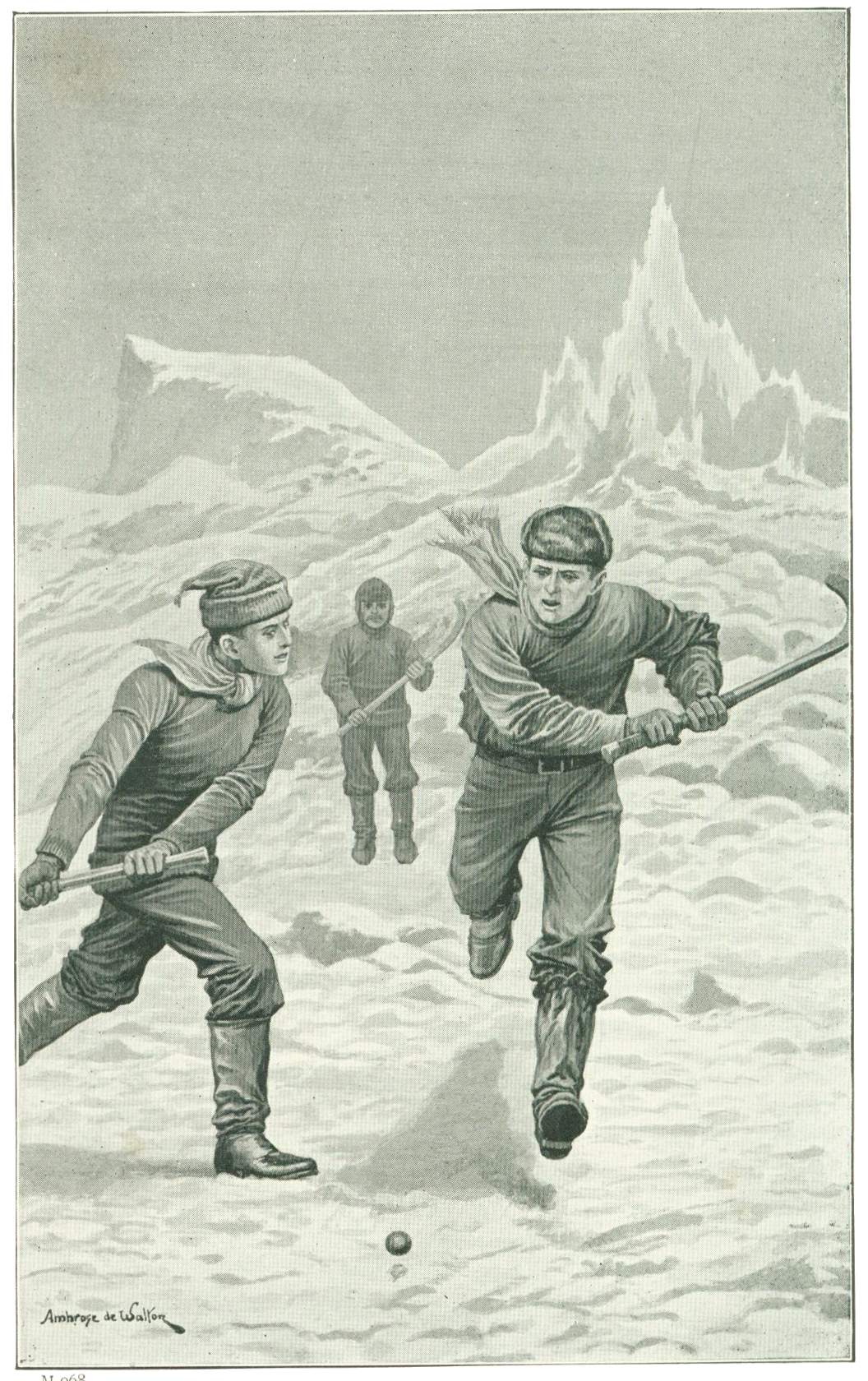
“She is bound to be,” said Captain Mayne Brace, a day or two before the
good ship Walrus reached Kerguelen. “Bound to be, Mr. Armstrong. She
is the better craft of the two, you know.”
He was talking to Ingomar and Walter, one evening in October, while they
all sat together in the cosy saloon, not a mile away from the stove.
Ingomar and Brace were smoking the pipe of peace, and sipping their
coffee (which they placed, to keep warm, on top of the stove), between
each longdrawn sip. Walter was reading one of Scott’s novels, or trying
to, for he was listening to the conversation all the same. Charlie was
missing to-night. I rather think he would have been found, if any one
had cared to look for him, forward in the galley, listening to the men’s
yarns, or playing a hornpipe to please them.
“Well, yes, she is bound to be, in the natural course of events,
because, as you say, she has faster sailing qualities, and all that;
but——”
“Ah!” interrupted Mayne Brace, with a smile, and another hearty pull at
his coffee; “we must not think of the ‘might be,’ or the ‘may be.’ Else
we’d go on thinking and get nervous, and end in believing, that because
we did not meet the Sea Elephant somewhere to the east of Dougherty
Islands, she has been taken aback in a squall, and gone down stern
foremost, with all hands. Or that she had, at the very least, broken her
screw.”
“Steward!”
“Ay, ay, sir!”
“Put more coals on the fire.”
“Yes, sir.”
“And just replenish our cups of coffee. Fresh ground, isn’t it?”
“That it be, sir.
“Dumpty always roasts it himself, and I grinds it. A main good hand
Dumpty is, sir, at roasting coffee. A little morsel of lard in the
bottom of the pan to keep the beans from burning, a good clear fire, and
keep them moving and moving; and there you be, sir.”
“Steward!”
“Sir to you again, sir.”
“Ever anybody ask you for a recipe for roasting coffee?”
“Milk and sugar, sir?”
The milk was another invention of the steward. It was a fresh gull’s
egg, beaten and mixed with hot water, and sweetened with pure preserved
milk.
On the whole, everybody did his best on board the old Walrus.
The men forward to-night were very jolly, for, being so near to the end
of their exceedingly long voyage, the captain had spliced the main
brace, that is, he had added one modest glass of rum to their nightly
allowance. I don’t believe in rum myself, but when one is writing a sea
story, one must adhere to the truth. The man who does not face realities
and the naked truth, is like the fabled ostrich that hid its head in the
sand when danger approached.
The men drank “sweethearts and wives,” or “wives and sweethearts,” in
the real good old British fashion. The married men, you know, drank
“wives and sweethearts.” The bachelors, and they were nearly all of
that persuasion, put the “sweethearts” to the front.
They had mixed the grog with a good deal of hot water and sugar to make
it last. But they toasted each other also; and it was, “Here’s to you,
Jack;” or, “Here’s to you, Bill,” or Tom or Joe, as the case might be.
And “We’ve been shipmates now more’n a year, and never a word atween us,
bar a sea-boot now and then.”
And they toasted “The Captain.” “And he is a good fellow,” was the
remark of one sailor, “though a stickler for duty.”
“Ah! Well, Sconce, dooty is dooty all the world. Stick by that, and
we’ll all do well.”
“Dooty,” said another, “is the needle wot points to the Pole, and the
Pole is Heaven itself.”
“Very good sentiment for you, Jack. Here’s to dooty!”
“Now, sir”—this to Charlie—“touch her up, sir. Give us ‘Homeward
Bound,’ and we’ll all chime in, from Dumpty downwards, to the nipper wot
tends the dogs.”
“Homeward Bound” was given with glee; but, of course, it was only a
make-believe, because there wasn’t much home life about Kerguelen.
They sighted the island after passing McDonald and Heard Isles.
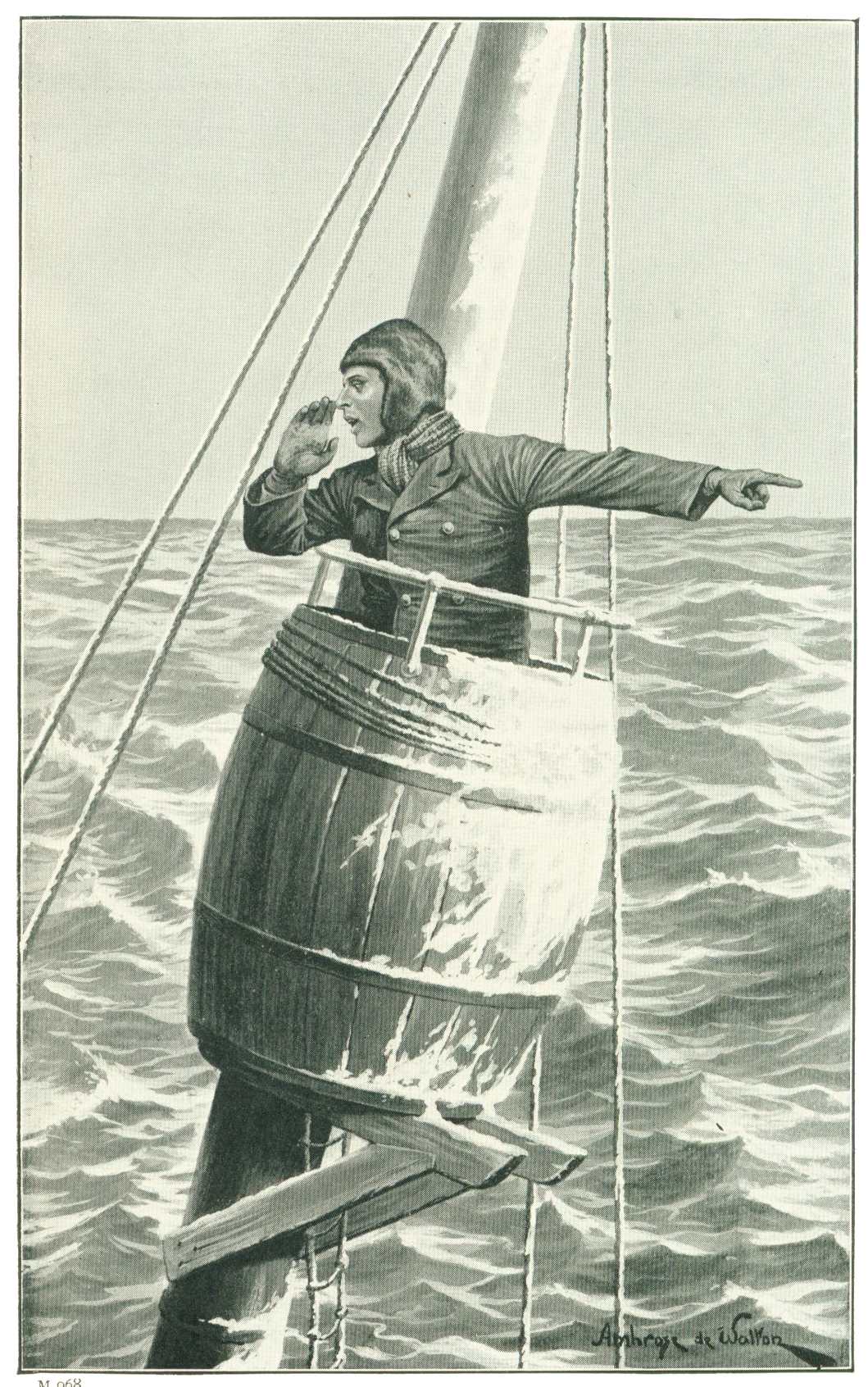
Charlie again. He had been determined to be first to see land.
Before the entrance to the creek or natural harbour, where the men and
animals were, is a spit of rocky land, a rugged kind of breakwater, and
had the Sea Elephant been the first inside, her top-masts would have
shown over this.
But here was never a ship’s mast to be seen.
On the shore, high up on a braeside, was an outlook, and the Walrus’s
people saw both American and British ensigns dipped to welcome the
Walrus.
The Walrus returned the salute.
Then flags of all kinds were set in motion, and the signalmen on board
and on shore were very busy indeed, for a time.
“Yes, all was well, now,” said the signalman on shore, “but two dogs
dead, and one Innuit. Sea Elephant had never been seen.”
The anchor was hardly let go when the officer’s boat was alongside, and
he was heartily welcomed down below to exchange experiences.
He and his men had been very busy all the time, and they were ably
assisted and supported by the kindly Yak-Yaks. He spoke in the very
highest terms of Slap-dash, the chief. In the dreary days of winter,
when the island was deep in snow, snow-shoe expeditions were got up; but
sleighing, especially with the bears, who were better suited to the
rough work, was preferred. The Yak-Yak died of inflammation. One dog
fell over a cliff and was killed at once. The other was found dead. Both
were buried side by side, and cairns mark their resting-place. “There is
a cairn also,” said Slator, “on the poor Yak-Yak. I think we nearly all
dropped some tears at his grave.”
I suppose they did, reader, for in the loneliness of such a place as
this the heart is sometimes very near the throat. Sunshine brings mirth
and happiness, gloom depresses, and there is always a certain amount of
sadness in even the songs of northern nations, such as Iceland,
Scotland, and Norway.
Both Charlie and Walt had some doubt as to how the Yak-Yak dogs would
receive them again. But, accompanied by Ingomar, they boldly marched
some distance into the interior, to the kennels. It was the afternoon of
what had been a glorious day, and they had doffed their fur caps and
coats.
The bears were not at home just then. Both bears and dogs, indeed, had
gone away to roam the wilds nearly every day, but the Bruins, with the
dogs, always came shambling or trotting back at eventide, to sleep and
to eat.
They were away then at this moment, and Slap-dash proposed that, with
the Newfoundlands and pet collie, they should all march forth to meet
them.
Strangely enough, they had a rendezvous on a hill-top, where most of
them met every night, and from this a beaten track to the camp.
To-day several of the dogs were already at the place of meeting, several
were straggling up from seawards, and in front (for no dog was permitted
to walk behind him) was Gruff, with his well-beloved wife Growley.
When within about seventy yards of the place, where Ingomar and the boys
were standing, both stopped short and sniffed the air. Then Growley
gave vent to a half-choked roar of rage, that shook the hills—well, if
it didn’t shake the hills, it shook the hearts of Charlie and Walt.
“Strangers!” Growley seemed to shout. “I’ll tear ’em limb from limb!”
Gruff rounded on her at once, and promptly knocked her down.
Then Gruff came trotting on, and Nora and Nick and the collie ran off to
meet them, our heroes following.
That was a pas de joie, a joy-dance, if ever there was a joy-dance in
this world; and those sceptical creatures, who would class dogs and our
other dumb friends as mere automata, would have been converted on the
spot to the dear old doctrine, that animals have souls, had they but
seen that dance.
It was too absurdly intrinsically droll for description. The other two
bears, Grumpey and Meg, came up and joined, and presently all the rest
of the bonnie dogs.
They went round and round our heroes in a hairy hurricane; they
pretended to worry each other, they barked and roared, and grumbled and
growled, till the boys’ sides were sore with laughing.
Surely such a scene of merriment was never before witnessed, and when
all had quietened down somewhat, they went amicably back to the kennels.
This is not one of Grimms’ fairy tales, mind, rather is it a fairy tale
of science and natural history, and these, readers mine, are all true.
* * * * *
A whole week passed away, but still no Sea Elephant.
Captain Mayne Brace had taken in more coals, and his arrangements were
all complete, so he was becoming impatient; but at long last the ship
hove in sight over the horizon, and the union was complete.
On comparing logs, it was found that they must have passed each other at
night, and had been probably within ten nautical miles of each other.
The bigger ship had taken many observations, and done a much quicker
voyage. But, knowing that he could be at Kerguelen much sooner than the
Walrus, a happy thought had occurred to Captain Bell. He would run up
to the Cape of Good Hope and endeavour to get a cargo of coals.
Although the war was raging, he succeeded, and now these were landed in
case of emergency, each ship just taking enough for the grand new
cruise.
I need hardly say that the meeting between Curtis and Ingomar was most
cordial.
A grand ball was given on shore on the night of re-union.
Sailors are not sailors unless they can have a bit of fun.
It was a ball of a somewhat heterogeneous description, for men waltzed
with men, though Slap-dash did some really graceful movements with Gruff
and the other bears as partners. There were no ladies, you see, but all
the more freedom and merriment.
Yet, stay; I must qualify this statement. The Eskimos, Yaks, Innuits,
Teelies, or any other name you choose to give them, are droll creatures.
They all dress alike in skins, and their faces are all about the same
shape.
Now the very day before the Walrus and Sea Elephant sailed, all
being then on board, except a change of men who were to remain at
Kerguelen for observation duty, Slap-dash came up and saluted Captain
Bell.
“Four of my rascals,” he said, “want to speak to you directly.”
Then the four “rascals” were led up and threw themselves on their faces
before Captain Bell as if they had been worshipping the sun.
“Get up, get up,” said Bell, “and speak like men.”
They arose at once and stood before him, and two took a step in advance
of the other two.
“We not all men-people, sir,” said one.
“We not all men-people,” said the other.
Captain Bell began to frown.
“Dis ees my ole woman-people,” said the first speaker.
“Dis ees my ole mudder-people,” said the other.
“Slap-dash,” cried Bell, “did you know this?”
“Not befo’ dis morning, sah; no, no.”
Captain Bell was puzzled and silent. He addressed Ross, the officer who
had been left in charge at Kerguelen.
“No, sir,” said this gentleman; “I don’t see how we can send them on
shore. We can’t want the whole four. They will pine and die if
separated. That would be a dead certainty.”
“Very dead,” said Bell, smiling.
“Besides, though no one suspected their sex, that one called Sheelah is
an excellent cook, and both are capital nurses. We were sick sometimes.
We had green fever in winter, and certain I am that they nursed us back
to life.”
The carpenter was next called for.
“Carpenter,” said Bell, “a small screen berth will be wanted below in
some corner, a kind of l-l-ladies’ cabin. Do ye hear?”
“Well, sir, I do hear, because I’m not deaf; but I don’t understand.”
“Then just do as you are told, Mr. Inglis.”
“Certainly, sir, certainly.”
So a little privacy was obtained for Sheelah and Taffy, and, as it
turned out afterwards, no one was the loser for the “women-people”
being on board.
Do coming events throw their shadows before?
Perhaps they do. Anyhow, when the two ships looked their last on
Kerguelen—the last for a long time, at all events—there was more
silence on board than is usual with sailors going off to sea.
They knew the dangers they were going to encounter, but they were all
quite acclimatized to the rigorous Antarctic climate by this time, and
there was not a man on board, British or American, who was not prepared
to do his best. Which of us can do more?
The Sea Elephant’s cruise around the great Antarctic continent, and
all her captain and bold men did, and said and saw, would make a book in
itself. That may one day see the light, as well as the adventures of the
men left behind at Kerguelen.
We must now follow our heroes into a country as widely different in
every way as Scotland or England is from the moon.
Now, having been a boy myself, not so very long ago—apparently—and
being still a boy at heart, I know that boys do not as a rule care for
geography. That is because it is taught in a stupidly, awkward way at
schools, a method being adopted which is devoid of all interest. But
never mind, I do wish you for once in a way to take a look at the map
here presented to you. The ships were off south and east from Kerguelen
Isle, and the first port to be struck was Termination Land. It was not
to be the termination of their cruise, however, by a very long way.
Would you be surprised to learn that there are two poles in the south,
and two in the north, the magnetic and real poles.
The real axis, the hub of our “terral” wheel, is the one we have to deal
with.
Here all meridians may be supposed to meet at a point.
There would in reality be no more south for a man standing at this pole.
Let him look in which ever way he liked, to Africa, to South America, or
New Zealand; it would all be north, north, north. No east, no west, just
north.
The Sea Elephant and her sister, the Walrus, were not to be run into
any danger along the coast of Wilkes’ Land, which marvellous line of
shore may be said to stretch from Termination Land and Island, right
away to Ringgold’s Knoll, far, far east. It is, or is supposed to be,
the longest stretch of coast land in, or any way around, the Antarctic.
There is no mistake about this being land, nor that it is indented with
bays and gulphs, just as the west coast of Scotland or Norway is; and
these indentations may really divide the continent in places.
I only want to give you some rough idea of this land coast. Had you then
been able to sail along it many thousands of years ago—and you would
have had to be up very early indeed to do so—before there was any ice
here at all, when the shores were green and forest-clad, the sight you
would have witnessed would have been a very beautiful one indeed! Hills
and vales and mountain land, and probably in the farther interior, vast
sierras, the woods teeming with strange animals; and strange birds would
have been there, too, sailing over the forests, or floating on blue
seas, alive with myriads of fish of various species, many now lost and
gone, others still extant because they have migrated.
But now, though the same formation of surface and contour of hills may
remain, they are all, all snow-clad, and protected seawards by a
barrier, or barriers of ice, of every description, which few mariners
would care to negotiate.
* * * * *
The weather continued favourable, but there were many days of darkness
and gloom; and after Termination Land had been reached, it was not
considered advisable—strong and well fortified though the ships
were—to be among the ice when the shadows of great clouds enveloped the
land, or when storms were threatened. But when the sun shone, and the
ice was open, then they boldly ventured to push their way through,
either under steam, or under sail.
Ice like this closes very suddenly, and if the captain of an exploring
ship is not very clever, he may get caught, and a week’s imprisonment
counts against a ship when making a voyage.
Sailing in a pack like this, a vessel to a landsman would seem to be in
a very dangerous position.
She may be, though no one on board appears to think so. The ice is here,
the ice is there, the ice is all around; flat bergs, like what you meet
in the north; pancake ice, lakes of slush, and those terrible masses, or
square mountains of land-ice—a characteristic feature of this
country—with caved perpendicular sides, striated on the horizontal, or,
if they have been melted by the sun at one side, oblique, and glittering
gorgeously blue, green, or paley white, in the sun’s rays.
But all, big or small, covered with snow, so that their very whiteness
dazzles the eyes. But at this season there were birds everywhere, and
seals of many species. The penguins, I need hardly add, were a very
curious sight, as they stood or staggered about on the low flat bergs.
Our heroes saw some sea-elephants, though I believe these, as a rule,
are far more common to the south of Tierra Del Fuego.
One day, when the ships were pretty close together, and well in through
the ice, the sky cleared far too quickly to please Captain Mayne Brace.
He knew at once that John Frost would have them in his clutches, if they
did not soon beat a retreat.
So he signalled to his consort, and both vessels quickly had their heads
turned to the north.
They might have found themselves clear in a few hours had it not
suddenly come on to blow from the cold and icy south.
The ice began to pack.
Steam was got up with the greatest despatch, and nearly all sail taken
in. Luckily there was no swell, else there would have been pressure
enough to have thrown both vessels on their beam-ends on a floe.
The Sea Elephant was leading, and by-and-by the Walrus managed to
creep right into her wake. This was an advantage for a time. A south
wind, even with a clear sky, would naturally open the ice, but there was
some demon current working underneath that they could not account for;
and while they were still two miles from clear and open water, they
found themselves rapidly becoming part and parcel of the pack.
Break the ice, did you say? I should smile. You may get steam machinery
to smash bay-ice, or splinter pancake, but not your solid, heavy pieces.
Oh no! So men who have inventions of this sort should sell them to
farmers at home to break up their mill dams in winter.
Then came a battle ’twixt men and ice. Men with their cunning, ice with
its force of movement, slow but sure.
Both ships got closer together, the Sea Elephant leading, all hands
that could be spared from both ships, over the side in front of the
foremost.
Armed with great poles, they moved the bergs on every side.
It was bitterly cold work, and the pieces moved but slowly.
Under all the pressure of steam she could produce without risk, aided by
the men over the side, the Sea Elephant forged her way slowly, fathom
by fathom, indeed, but after a time that to our heroes seemed
interminable, her jib-boom hung over the black water.[D]
Then came the scramble to get inboard, and though their fingers were
about as hard as boards, and some had frozen faces, in less than ten
minutes all hands were once more on their respective decks.
Sail was once more set, fires were banked—save the coals they must—and
away they went, right merrily, to the east again, the wind well on the
starboard beam.
Although the men had raised a cheer when the ships were quite out of
that ugly pack, there was no fear in any breast.
“Would there have been much danger if we had been beset in there,
uncle?” Charlie ventured to ask the captain, at supper.
“A fig for the danger, boy. We’ll never be out of that, but we came to
find the South Pole, or get somewhere near it.”
Ingomar smiled.
“Well, then, Hans, we have come to make a big record.”
“That will beat all creation, captain.”
“Yes, beat all creation, and it would have been misfortune, to say the
least of it, to have got beset. That’s all. Yes, thanks, steward, I’ll
have another slice.”
* * * * *
The two ships stood steadily onwards now, day after day, sailing
whenever they could, steaming only when obliged to, for the economy of
coal had to be studied, and that, too, most carefully.
Captain Bell, of the Sea Elephant, came now to be recognized as head
of the expedition, though on every occasion that was deemed important a
council was called and the opinions of all officers taken.
He was now always called The Admiral, but not to his face. He was none
too fond of fine titles.
And the Sea Elephant was called the Flag Ship, for short.
One day, when in the neighbourhood of the Knoll, the Admiral signalled
to the Walrus, that as they would soon round Wilkes’ Land and stand
down south, it would be best for all hands to bend their cold-weather
gear.
In shore English that would signify, give out the supplies of winter
clothing.
As it turned out, this was very excellent advice indeed.
The Eskimos had their supply first and foremost, and this they had made
themselves, under the supervision of Slap-dash, and from seal-skins with
the hair on.
Slap-dash assured Captain Bell that there was nothing so good for
keeping out the cold, and his words turned out to be true. Most,
however, of the sailors and their officers still stuck to flannel and
fur.
Both Charlie and Walter had a very great desire to see the inside of a
real ice-cave. These caves look like archways, or the openings into
tunnels, and are formed by the dash of the waves on huge bergs of
land-ice, or even in the sides of the ice-barrier itself.
They had their desire fulfilled one day, while the ships lay almost
motionless on the dark water.
There wasn’t a breath of wind, nor was there any fog. And the surveyors
were engaged very busily indeed, in taking soundings, and bringing up
specimens of the mud or clay at the bottom for examination.
Fires were banked, but the ships were at no great distance from a lofty
ice-wall, at the foot of which were several caves.
They rowed on shore at sunset.
And the appearance of that sunset was in itself a sight to behold!
The sun was sinking slowly down to the north of west, and in a cloudless
sky. It seemed a larger sun than our young heroes had ever yet beheld,
and cast its reflection on the heaving waves ’twixt boat and horizon, in
a very remarkable way; for although the sheen was bright, it was not
dazzling. Nor was the sun itself. But nearer to the spot where our
heroes stood, on the field of level ice betwixt them and the ice-caves,
were many shades of opal and pearl.
“We must be moving,” said Ingomar, “at last, boys, or we will not get
home to-night.”
“Oh!” cried Walter, “I wouldn’t mind staying here all night to look at
the sky.”
“Nor I,” said Charlie. “I’d like to sleep in the snow. Nothing could
harm us except the frost, and we should be in our sleeping-bags, so that
couldn’t hurt much.”
“There are no snakes here, anyhow.” This from “wise Walter,” as Charlie
sometimes called him chaffingly.
“No, Walt; and no burglars, either.”
There was one thing to be said for the dogs, Nick and Nora and Wallace.
They had long ago fully made up their minds to enjoy themselves to the
fullest extent, whenever they had the chance.
They were tearing round and round on the ice-floe at this moment,
wriggling and jumping and playing at leap-frog, while Nick would pause
every moment to fill his mouth with snow and fling it over his
neighbour’s shoulders.
The boys must have just one more look at that sky before they entered
the ice-cave.
Lo! what a change. The sun was all but down, and sea and sky had changed
to orange, deep and charming. The very snow was orange.
But judge of their disappointment when they entered the first cave and
found that all was pitch dark.
“Oh, what a shame!” cried Walt, impatiently. “We did expect to see
something real splendid.”
Ingomar laughed.
“You are snow-blind, boys, just for the moment. If you’d come when I
told you, when the sun was still above the horizon, you would have had a
daylight view.
“The sun can’t be expected to stay for you. He has to rise and shine on
other seas, if not on other lands.”
But when their eyes became more accustomed to the twilight, they could
see that they were in a vast vaulted cave, solid ice and snow beneath
them, and strange uncanny shapes sparkling in the semi-darkness beyond.
Three men had accompanied Ingomar and the boys, and one was carrying a
bag.
“Be cautious how you move, lads, else one of you may go through into the
sea, and never be seen again.”
“But the ice feels very strong.”
“Yes; it is perhaps a foot thick, and that is strong enough for
anything. But there are ‘pussy-holes’ here and there, up through which
seals crawl to sleep, and on these the ice is very thin.”
Just as he spoke, there was a sudden and angry roar heard ahead of them,
where something black and big reared itself, and two fierce eyes glared
at the intruders.
The boys clutched each other in superstitious fear, and stepped quickly
back.
It was only a large seal, however, but so quickly did it retreat that
Ingomar had not the slightest idea what species it was.
I may say for the seals here in the Antarctic, which number four or five
species, that though in the breeding season they have certain habitats,
after that happy time is over they are free to wander where they please,
and often turn up in strange places. It is the same with Arctic seals.
An eared seal, whose fur has been much sought after, is now, I think,
almost extinct, owing to the murderous greed of the sealer. I think it
would be well if there were a close season for all species. But this is
a digression. Let us return to the cave.
The somewhat mysterious bag carried into the cave was now opened, and
Ingomar, bending down, extracted some of what he termed theatrical
properties therefrom.
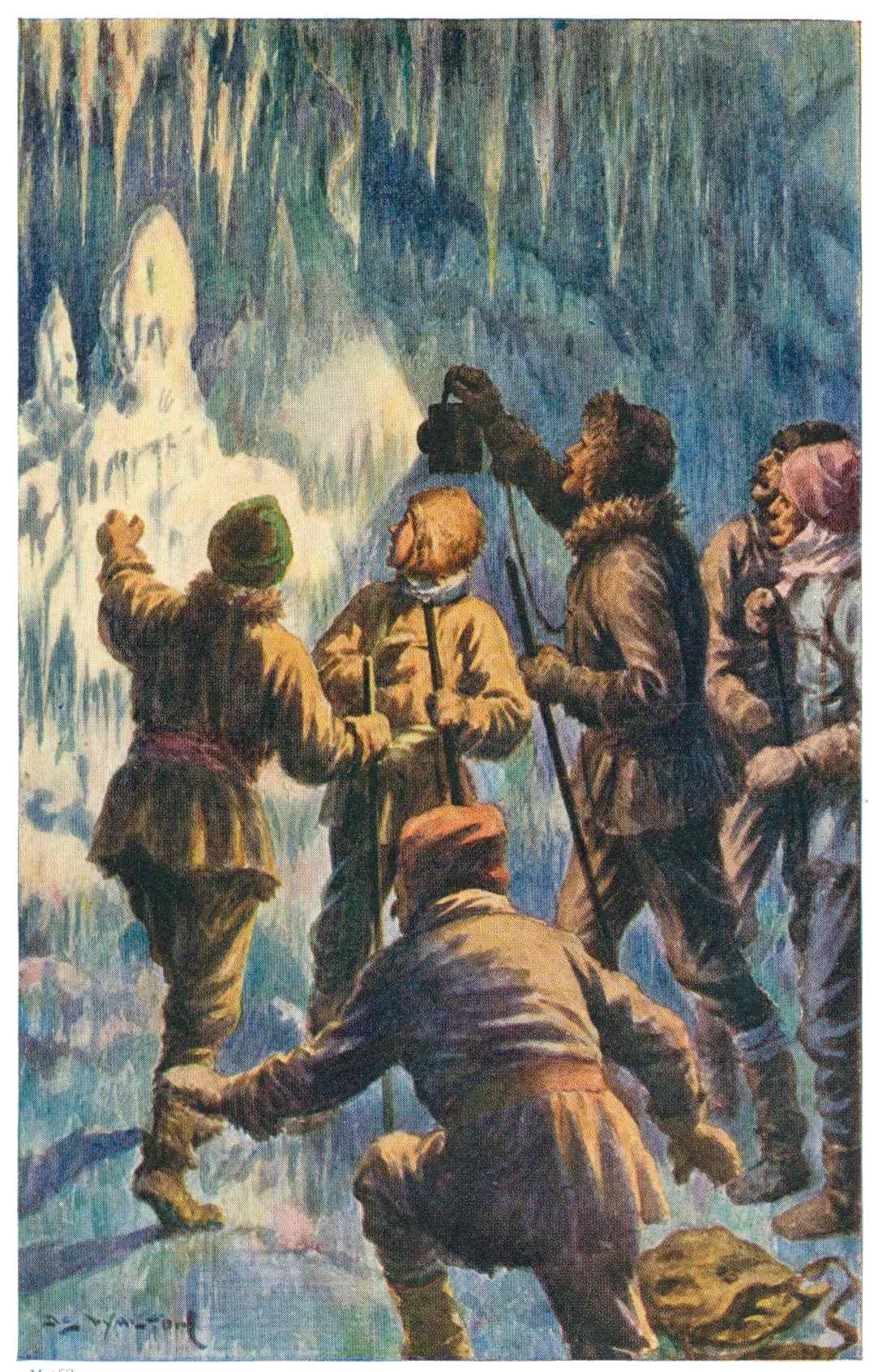
Next moment, on the touch of a button, the whole of this cave was filled
with dazzling light.
What a sight!
“Oh—h—h!”
That was all our boys could say for a moment or two.
No stalactite cave probably ever rivalled the beauty of this.
And here were stalactites, too, in the form of depending icicles,
dozens, scores, hundreds of them, and, seen by the electric light, they
emitted all the colours of the rainbow.
They walked cautiously on and on a long way into the bowels of this
mighty cavern, watching the floor for pussy-holes.
No one could even guess where the seal had gone.
“Well,” said Charlie, as they came at last to the end of the
ocean-hollowed cave, “I should really have expected to find mermaids
here.”
“Now,” said Ingomar, “one more transformation scene, or perhaps two, and
then the pantomime is over.”
As he spoke he touched a spring, and, wonderful to say, the cave was
illuminated with brightest crimson, then with orange and red again. So
on to the pure white light, and in this they found their way to the
mouth of the cave, and made their exit and presently their way to the
boats.
“We’ve seen a sight,” said Ingomar, “that is surely worth coming to the
Antarctic to look upon.”
“Yes,” said Charlie, thoughtfully.
“Oh,” cried Walt, “will you do it again some time?”
Ingomar laughed.
“It all depends,” he said.
A beautiful night now. They must have been a full hour in that cave and
didn’t mark time.
The moon had arisen, stars were bright and sparkled in the sea.
It was a night for thought more than talking, and no one did talk.
Nothing indeed was heard, save the chunk-chunk, chunkitty-chunk of oars
in rowlocks, until the boat grated against the ship’s side.
“Wherever have you been, boys?” said Mayne Brace. “I was just going to
sound the syren to say supper was ready.”
“Ah, Captain Brace, we’ve had a wonderful time of it, all among the
mermaids, though at first we saw a terrible apparition.
“But really, sir, the shriek of your hooter would have dispelled all the
romance and mystery. Only I’m hungry now. Aren’t you, lads?”
“Rather,” said Charlie; and Walter nodded and smiled.
Come to think of it, there is no country in the world like the Antarctic
for making people hungry. If we could send off our dyspeptic millions
there, they would all come back with appetites which would speedily put
up the price of meat.
* * * * *
I think it really was very good of Ingomar to put himself about in
pleasing the boys, which he did in every way he could and at every
opportunity.
Older people than he would say that he was not much past his own
boyhood, being only about three and twenty. But listen, lads, I myself
and many others are believers in young blood. Youth has spirit, dash,
and go.
At the University, in which I was reared and nurtured, no student
considered himself a boy at seventeen. If you had called me a boy in
those days, you would have had to strip, and then you would have had to
depend a good deal on your muscle and science to get yourself out of the
scrape. I’m not going to preach. That isn’t my form, but if a lad of
seventeen doesn’t begin to look ahead and find out that he wasn’t put
into this world just for the fun of the thing, then, bother me, if I
think he’ll ever be a real man. So at twenty-three, the ages of both
Ingomar and Lieutenant Curtis, the mind should be fairly moulded.
As for Curtis, I never met a sailor of greater promise, from a really
scientific point of view. Naturalist, meteorologist, hydrographist
(photographist, too, if there be science in that), and any number of
other “ists” thrown in to make up the weight.
Bold and determined was he, too. He liked to get to the bottom of
things, just as with his newest dredging machines and sounding gear he
liked to get in touch with the bottom of the sea, whether it were but a
few fathoms deep, or miles.
Ingomar was a splendid setting off to him. Curtis, with his spare body,
his extreme vitality, his noble mind and grasp of soul. Ingomar, with
his splendid physique and king-like form. But Ingomar knew the rudiments
of most sciences, and he had the rare gift of picking up just the main
points of a subject. Hide a few small nuggets of gold in a gravel heap,
and Ingomar would soon have found them for you, and wouldn’t have
bothered much about the gravel. That’s the sort of man Ingomar was. With
all this there was a deal of romance in his character, and he had one
set purpose in this expedition, which, if he could but fulfil, he felt
would make his austere father proud of him.
Curtis and he were nearly always together during the thorough
exploration—from a scientist’s and surveyor’s point of view—of that
great tract of water far inside the Antarctic circle called Ross’s Sea.
The mariners of old did not take much time to study science. It was the
surface of the sea they dealt with, and the land around it.
After passing Ringgolds Knoll, vide map, you will steer east and
south, and after Cape Adare is passed, south into this sea, and its
simplest exploration would take months.
It has Victoria Land on the right, a land of wondrous interest, a land
of fire in the frozen ocean, land of volcanoes, extinct and extant, of
awful icebergs, of more terrible, yet beautiful ice-barriers, and in
summer a land of birds in millions.
To explore and survey this sea was one of the chief objects of the
voyage.
And now that they had reached Cape Adare, they set about the work in
good earnest.
I think you know that Charlie was a boy of many fads—that is the low
name for his studies, perhaps—for Charlie’s fads were a step or two
above keeping rabbits and guinea-pigs. We have seen how when at sea he
used to delight to swing away aloft in the crow’s-nest, and all the
marvels he saw from that eyrie of his would, if described in print, fill
a biggish book. There was poetry and romance, too, in his life in the
nest, and I’m not sure that his thoughts did not take a nobler turn, and
that up there at night, swinging among the stars and planets, as one
might say, he did not believe himself to be nearer to God—the God of
infinity, mind you, not of this insignificant earth alone.
Anyhow, when he used to come down of a night, after a spell up yonder,
his eyes had a happier look, and his face seemed to shine, while his
thoughts seemed far away.
He was a harder student than Walter, though had you asked Captain Mayne
Brace, he would have told you straight that the latter might possibly
make the better sailor, as sailors go nowadays.
“But, bless you, sir,” Brace would have added, “your smutty, rattling
steamships, all bustle and filth, have almost frightened good old
Neptune off his own blue throne.”
Well, anyhow, now that work had begun in earnest, Charlie was never
tired of studying every new instrument used on board the ship and on
shore. That was his new fad. The more he studied geology and
meteorology, for instance, the more he wanted to. Had he possessed fifty
minds, fifty storehouses for information, Charlie would have set about
filling them.
“Look at that,” Charlie said, exultantly, to Walter one day.
“Well, what is it? A bit of black greyish stone with some spangles in
it.”
“That’s granite.”
“I didn’t say it wasn’t.”
Walter was in a teasing mood that day.
“And this?”
“Some exceedingly black and dirty clay.”
“No; but books both, or rather pages from the great Book of Nature.
“All scientists in the present age,” added Charlie, “are busy in their
own particular branch, and in writing or building chapters of that Book,
and when they have finished their works, these chapters will be pieced
together, and then we’ll have the story of the world.”
“Charlie,” cried Walt, “come down off there. I hate your giving yourself
side. I hate science as much as I hate lawyers’ musty old parchments.
Climb down off your high horse. The sunlit surface of the sea is good
enough for me; the earth’s crust is strong enough to walk on, and I
don’t want to go down in under, nor back to the realms of millions of
years ago. Are you aware we are going to have young seal’s liver and
bacon for luncheon?”
Nick and Nora came bounding up at this moment. Collie wasn’t far behind,
with his bright eyes and bonnie wise face, and next moment the whole
five were united in a daft and delightful game of romps.
And the liver and bacon were excellent.
Yes, everybody was busy. From the captains themselves down to Jack and
Gill, the Shetland ponies, and the little mongrel seal that the boys had
made a pet of.
The Eskimo dogs had got their summer clothes on; the Eskimos themselves,
especially Slap-dash, were very lively. The bears wanted to go on prowl
at once. Gruff, Grumpey, Growley, and Meg were excited by the shimmer of
the snow. It reminded them of their dear native land.
Sheelah and Taffy were exceedingly gay and droll. But they were useful.
When they had some lessons in cooking, Sheelah excelled the cook, and
Dr. Wright turned Taffy into a really good and practical nurse.
The ships were just as one at present. But a camp was being formed on
shore in a ravine betwixt two hills to the north of Mount Murchison, so
the forces would soon be divided.
A whole month was to be spent in this camp making preparations for the
grand dash into the interior.
This was imperative; both Curtis and Dr. Wright insisted on it.
These officers had to consider what men and animals were to be included
in the land expeditionary force. Oh, it wasn’t to be all fun, I do
assure you.
There was an excellent landing here, for they had found a fiord, a deep
arm of the sea, that the scientists believed would be more open as
summer advanced, and form an excellent harbour where the Walrus could
lie in open water as the base of the undertaking, and if ice-bound in
autumn, it would be but pancake—so they thought—through which they
could saw their way to clear water.
As for the Sea Elephant, she would remain at sea and continue to
explore.
Ingomar was not certain in his own mind whether he had not been guilty
of an act of cruelty in bringing the Shetland ponies into Polar waters.
They had been on shore many times, it is true, and had never been a day
ailing; but, on the whole, they had not had very much exercise.
Well, the camp here was commenced. It was to be only a trial one, for
those whom Ingomar and his brave companions should leave behind there
when they made their dash, would live on board ship.
Everything to be taken into the interior was to be light, but strong;
and during their many months of camping out here, they would doubtless
gain experience of what would be wanted.
There were sledges of “burden and baggage,” that were to be drawn by the
bears, under the care of Slap-dash; the Shetland ponies, with a good
man, would greatly assist the heavy work. The dog-sledges would be
driven by some of Slap-dash’s men. These sleighs would carry light
baggage and camp-gear. They were called the “dash-aways.”
The whole was put under the charge of Dr. Wright. He was a hardy, bold
fellow, and determined to make all the rest like him.
“I’ll make you all athletes before you start,” he said; “every man Jack
of you. And you won’t need any dumb-bells or chest-developers either.”
“They shall all do as you tell them,” said Lieutenant Curtis. “They
shall, indeed, doctor.”
“By Gordon!” cried Wright, flinging his brawny right arm straight out
from the shoulder, as only a good pugilist can. “And don’t you say
‘they’ again, old man, Curtis. Say ‘we will do all that you tell us,
doctor.’ ’Cause I’m your medical manager. Just you look after your
meteorological apparatus—your lenses, your magnetic machinery, your
anemometers, your thingummyometers, and all the rest of your
paraphernalia, and leave all other matters to me—Dr. Wright of Edinboro
toon.”
“Bravo, my friend!” cried Ingomar, coming up at the time. “Just you keep
Curtis under and well in hand, Wright. Curtis would kick over the traces
if Curtis could, you bet.”
So Dr. Wright proclaimed martial law; and soon the portable bungalow and
the tents were up and ready.
There is a lot to be done in camps even by the seashore in old England,
and in regularity alone, combined with method, lies their comfort.
Taffy was the good doctor’s loblolly boy. In her care were the medicine
wallet and surgical instruments. But the doctor had also taught her the
bugle-calls, for Wright himself was a musician and a volunteer officer
at home. She was also cook’s assistant, Sheelah being cook supreme.
Taffy and Sheelah slept together in one bag. These were excellent bags,
too. Wright and Slap-dash had spent a good deal of time over their
making. You popped in or wriggled in, and when your head was easy,
simply drew the lid over your head. No fear of smothering in your own
carbonic acid in ordinary weather. Taffy sounded the first bugle at 6
a.m., or, in easier language, four bells; and if some one wasn’t astir
five minutes after, that “some one” heard of it. You had just five
minutes, or, say six, to rub your eyes and say your prayers, then you
began to kick yourself clear of the bag and commence ablutions
forthwith.
The doctor insisted upon these being conducted secundum artem and in a
perfect way.
There was no hot water, and there was no cold, but there were snow and
an easily dissolvable soap, and towels galore. Your very face would
shine after this, and your spirits rise.
Then exercise for half an hour. Walking, running, leaping, or dancing,
or boxing, or fencing.
The doctor had an eagle eye, and no one must shirk this.
The breakfast bugle went at seven, “Too—too—tootitty—tootitty—too.”
Taffy had splendid lungs.
Every one was hungry, and the food was satisfying, if not over-refined.
After a rest, the day’s work was begun. At first the packing and
surveying of the sledge contents and baggage generally were almost
exercise enough till dinner-time. They were kept hard at this every
forenoon till every one knew the duty perfectly, and could have told
where everything was packed and how to get at it without the slightest
confusion.
This was the drill for three or four days, and once a week after this.
The dogs and bears were very tractable, and evinced no inclination at
present to go far from camp. But Gruff and his ursine companions soon
came to think penguin food the best they ever tasted. They stalked the
birds and they stalked seals just as they did in their own Northern
home.
The boys and Ingomar did pretty much as they pleased all the afternoon,
and Curtis was busy almost from morn till night with his studies.
The ponies did not at all object to go on a “cruise” with Charlie, Walt,
and the pet Newfoundlands and Collie, away up through the rough ice in
the glen or valley, up and up to a smooth, white, all-too-breezy
tableland which stretched in a westerly and southerly direction as far
as they could see.
Oh, the delightfulness of their first bareback ride across this snowy
plain! Blue, blue the sky, and speckled with fleecelets and feathers;
bright the sun at one moment, clouded the next; to the left,
Ben-Murchison; far, far to the left, Ben-Sabine, sullenly smoking, his
black, bare head silhouetted against the sky. Keen the air. Had to ride
with gloves and masks. Cared nothing for that. Knapsacks crammed with
biscuits for dogs and ponies, and pork sandwiches for themselves. I
don’t think boys were ever more happy, and I’m sure they didn’t draw
rein till they had cantered and galloped nine good miles.
“Make a note of this, Walt, old man. We’ve forgotten to bring our
compasses.”
So they had.
It didn’t seem to trouble them much, however. They threw themselves down
on their backs to enjoy a sun-bath before luncheon. The dogs, too, lay
down to chew snow, and the ponies began to graze upon it, if that isn’t
an Irish bull.
The ponies had already been taught to come to whistle, and to do many
pretty tricks. A Shetland pony can be largely evoluted. I have had them
beg like dogs. These did; and they also took bits of biscuits from the
boys’ lips, and took their fur caps off. This last was a coaxy kind of
trick. The ponies improved upon it to-day, though, by running off with
them to present to Nick and Nora.
Nick and Nora, caps in mouth, with Wallace at their side, went racing
round and round like circus horses, Charlie and Walt, bareheaded, in the
centre. Cold work standing thus, but the lads’ faces were all aglow now,
and they cared not.
Then that simple luncheon. Dry biscuits and pony “bix” galore, cold
coffee, and more snow. The coffee was frozen in scales, so they had to
put the flasks into their bosoms before they could shake it out, a few
brown scales at a time, to eat off their palms.
A white spot on Walter’s face!
“Rub it out,” said Charlie, and put his finger on it, for Walt felt
nothing.
Rubbed out with snow.
Remount, and a slower ride back to camp in time for tea.
And weren’t they hungry, too! This was only the first of many such
scampers.
That great snowy tableland came now to be the regular exercising ground
for all the animals.
A squad of men were first requisitioned from the ships to do some work
in the glen.
Not navy work, but navvy work. They were set to form a better road up
to the tableland by levering the big blocks out of the way, and
sledgehammering the smaller. It was by no means a difficult task, and
was completed in a day and a half, with the exception of one great
fellow of a berg, which they didn’t know how to tackle; but MacDonald,
captain of explosives, came to the rescue, and in less than an hour he
had literally blown it to smithereens.
The roar of that explosion reverberated from the hills here and there
for many seconds after.
The seals on the ice raised themselves to listen, and the penguins
looked up in the air as ducks do in a thunderstorm.
The road was complete.
Ingomar and Slap-dash wondered if the bears had forgotten their cunning.
They came to whistle as the dogs did. The dogs were told go about their
business and not hustle. Their time would come next.
Gruff and his wife seemed puzzled at first. But soon they remembered
things, and when they were put to the very heaviest sledge of all and
harnessed, Gruff yawned and gaped, and finally knocked Slap-dash down.
But it was done merely as a matter of form; a blow, in Pickwickian
sense, meant for a caress. Slap-dash only laughed, and put a handful of
snow on Gruff’s nose.
Then he mounted. No whip, only his voice. The bears went away as easily
with their load as you or I could with an empty barrow.
The boys rode behind, then came Ingomar and Curtis in furs, with poles
in their hands, with their snow-shoes over their shoulders; and half a
dozen Yak-Yaks brought up the rear.
Snow-shoes were put on by the infantry when the tableland was gained.
After this it was all plain sailing.
When tired of talking, Ingomar and Curtis started a song—a song to suit
the pace, but one with melody in it, and the boys joined in the chorus.
This was only breaking the ice (figuratively), for before the two hours’
drag was over, many such were sung.
Luncheon, as before, on the snow.
Bears had frozen seal and biscuits, the Yak-Yaks had the same, the
white men a nice luncheon, and all had coffee or snow, as they chose.
The boys had snow to-day.
“Don’t spare it, lads,” cried Ingomar; “there’s plenty more in the
larder.”
After the post-prandial pipes, Curtis got up and drew out his note-book.
Everything was unpacked, seen to, and once more placed in order.
It was a most pleasant outing; all hands confessed that this was true
enjoyment, and not roughing it. Gypsying, picnicking—call it what you
please, but just add the words, “jolly good fun.”
The dogs had their trial next day, a whole pack of them; and the trial,
twenty miles, was done in half the time, only they did not have the same
great load.
Funnily enough, Wallace the collie took entire charge of this pack, for
as soon as the Yak dogs were in-sledged, he took up his position to the
right, and barked encouragingly all the way.
He was first on the tableland, barking down at them, and on the snow,
when they seemed to flag a little, he swept round and round. Humpty
Dumpty was driving, but he needed no whip, for Collie at once singled
out the dog that was in fault, and gave him a sharp nip.
Grumpey and Meg submitted with a less easy grace, and required a good
deal of reminding. When touched smartly on the nose with the whip, they
shook their heads, and I’m afraid they made use of some terrible
swear-words; but as they did so in the Russian or Ursine language,
nobody was supposed to know what they said.
When they were well off and away on the tableland, Grumpey appeared to
say to his wife—
“Meg,” said he, “I think we might cut some capers now.”
“If you say we might,” replied his wife, “then, of course, we might.”
“Stand on your hind legs, then.”
Grumpey threw himself on his haunches, and Meg followed suit.
Swish round their noses came the whip, and down they went again on all
fours, talking much worse Russian.
“Mr. Slap-dash,” Collie appeared to say, “this is a somewhat peculiar
case. Leniency is thrown away on Grumpey. I’ll ride him as postillion.”
He suited action to these identical words, at all events, and leapt
nimbly on great Grumpey’s back.
Grumpey did not feel Collie’s weight, of course, but he heard him
barking, and he felt his sharp teeth in his off ear whenever he
attempted to misconduct himself.
Collie really made a splendid postillion.
* * * * *
The boys themselves broke the ponies in to harness. A task of no small
difficulty, for they had never been used to this. Of all horses in the
world for cussedness, as the Yankees call it, a Shetland pony is the
worst, if not broken in early.
They are so lovable and beautiful, too, and Jack and Gill had developed
coats on them like a Skye-terrier. They could hardly see out of their
natural face-protectors, but so bonnie and wicked was the morsel of eye
one could see, that, instead of talking cross to them, the lads would
often laugh and kiss their noses.
Finally the ponies succumbed to kisses, caresses, and bits of biscuit
and sugar.
For love can conquer even a Shetland pony.
The month’s training that Dr. Wright gave his merry men was no sham one.
It was often carried out under considerable difficulties, too. For even
in summer the weather is most unsettled. One year of open ice does not
always follow another. There is the same uncertainty as regards the
weather from day to day or week to week.
There were days when, owing to fogs or mists, though it was getting on
now for mid-summer, hardly anything could be seen. One could hear the
cries and screaming, or grunting, of the birds afar off, the splash of
seals taking the water, or the whale in search of food, blowing off
steam, but be unable to distinguish one tent from the other, while the
Eskimo dogs loomed through the semi-darkness like bears, and the
Shetland ponies took on the form of elephants, bar the trunks, and even
Humpty Dumpty, for the time being, might have been mistaken for a giant
in furs.
No matter, men and beasts must be hardened, and things went on as
before.
When sledges did get lost in the fog high up, and across the plain, they
had to feel their way as best they could, with the help of the
pocket-compass.
The sledge parties were kept two days instead of one on the interior
ice, and slept, of course, in their bags. No matter how high the wind or
wild the weather, into those bags they must go. They were usually
two-men bags, and these are the most comfortable.
Charlie and Walt could have knocked down a Patagonian before that month
was over.
Here is an incident worth relating. One bitterly cold night, shortly
after a couple of two-men bags were put down—Ingomar, by the way, had a
bag for himself, and Curtis always found room for Collie in his—the
boys stood talking to Dr. Wright for a few minutes. When he and Walt
went to retire, lo, here was Nick in one bag, and Nora in another.
“Pray don’t turn me out,” pleaded Nick.
“Nor me,” whimpered Nora.
So Charlie blew up his air-pillow, and crept in beside Nick, and Walt
shared his bag with Nora. When Dr. Wright came out to look for his, he
was one to the bad, and had to bend a fresh one.
But the dogs never stirred nor talked in their sleep, and so the boys
heard nothing till Taffy’s bugle rang merrily out on the morning breeze.
The dogs ever after this persisted in being bagged. They looked upon it
as their right.
When Dr. Wright was appealed to, he said, as the dogs were clean and
comfortable, there could be no harm. He left it to themselves—to the
boys he meant, not the dogs.
But during the dash into the interior, and all that followed, having the
dogs bagged was found to be a good plan, because a Newfoundland or
Collie dog gets massed with ice and snow, and, if lying out, he might
perish. Anyhow, he would be frozen to the ground, and it would be found
impossible to prise him up without great pain, danger, and loss of coat.
For bad weather these three pet dogs had well-made waterproofs, which
covered even the heads, leaving room for the ears to come out.
Strange to say, a dog’s nose never gets frozen, and the hair between the
well-soled pads prevents frost-bite.
In the snow this hair gets “balled” with hard snow, and cripples the
poor fellow, so he comes wisely to his master to have the balls broken
off, and is very grateful.
During the journey, Slap-dash came ingeniously to the dogs’ relief, and
made them leggings.
A Newfoundland in seal-skin breeches would seem a curious sight to some.
Well, laugh if you like, reader, but there they were.
Several men failed to pass the doctor’s examination after the month, and
yet they were men fit for any condition of climate, perhaps, save that
with which our heroes were now quite prepared to do battle.
A month is certainly not a long time in which to train in athletics, but
it must be remembered that those whom Dr. Wright had chosen had been fit
and well at the time they commenced to train.
So strong and willing were their hearts, that it was no unusual thing
for some of them to lie down naked of a morning at the ablution hour
before breakfast, and roll in the snow, or be covered over for half a
minute by their comrades. This is really not such a terrible ordeal as
you lads who hug the fire and live in stuffy rooms might imagine. The
snow is often warmer than the air around it.
There was a dinner on board the Sea Elephant on the night before
Curtis and his crew of sledgelings, as he called them, departed on their
long and marvellous inland tour. But there was no boisterous merriment
thereat, and no wine was permitted, no splicing of the main-brace.
Every one of the sledgelings wrote a letter, or letters, to the old
country. These were to be taken by the Sea Elephant to New Zealand,
and posted there.
It is needless to say that Curtis wrote to Marie, and so did Ingomar.
Ingomar wrote also a most filial letter to his father and mother. No
bombast about it, and no boasting about what they were going to do. They
were simply going into the interior in the direction of the South Pole.
They could not reach that, he said, but they wanted to winter just as
near it as possible, and, if possible, break the world’s record, as
every American and British subject had the right at least to try to do.
That was about all.
Ingomar’s heart was a brave one. There was sentiment, romance, and love
too, in it, but no such thing as hysteria. Yet was there moisture in his
eyes as he closed and sealed his letters and placed them in the bag.
Next morning farewells were said almost in silence, and these heroes of
the wild Antarctic prepared to mount. Perhaps Dr. Wright was trying to
encourage a little merriment, or a laugh at least, when he said—
“You haven’t forgotten the salt, have you, Curtis?”
“No, Wright,” returned Curtis. “Are you sure you have stowed away your
gum-lancet?”
A minute after this, the land expedition had started. Cheer after cheer
rent the morning sky, the guns of the Walrus and Sea Elephant fired
one last salute, then all was still and silent.
Commander Curtis, as we may now call him, wanted to do as much as
possible every fine day.
And this was one. For on that vast upland of snow they managed to put
five and twenty statute miles between them and the ships, before the
final halt was called for dinner, rest, and sleep.
This was almost a record day.
A day free from hitch or even adventure of any kind.
The sun never set now, but, just as it does in Greenland North or in
Baffin’s Bay, went round and round, higher up at midday, a bright and
burning silver shield, lower at midnight, and a trifle more dim or
yellow.
Storms are frequent, even in summer, in this region; but there are a
very large number of sunny days.
The scenery has a character entirely its own, and a charm which no one
can adequately describe in words. You must have the scene before you in
reality before you can realize the charm.
The order to-night was early to bed—or, rather, early to bags, for the
first part of next day was to be spent in ascending a hill at the foot
of which they were now pitched.
Curtis’s intention was not only to take the usual observations, but, as
far as possible, his bearings for the journey of the day.
In such a country as this they could hardly expect to travel as crows
fly. The easiest road would be the shortest.
They were in bags by nine, and asleep almost immediately. With the
exception of the slight noise bears make in their sleep, there was
nothing here to disturb them, and they were far enough away from the
hill-foot to fear a falling avalanche. The stillness of such a region as
this is appalling. On a windless night you almost fear to speak aloud.
At four o’clock next morning, Taffy awoke Curtis quietly, and he was
soon ready. Sheelah, too, was up, and warming coffee essence, which,
with fresh eggs beaten up, and condensed milk, and biscuit, made a good
breakfast for so early an hour.
Ingomar shared, and Collie also.
These were the only three who were to ascend the hill, which, though
only about 1500 feet high, would permit them to have a view, not only
seawards, but on every side, to a great distance.
The difficulty of ascent was by no means great, yet both men, though
armed with their poles, were considerably pumped before they stood on
the peak, or rather lay down on it, and gazed around them.
The air was colder here, and there was a breeze of wind, cold enough for
anything. Curtis’s observations were quickly taken, and his bearings
too, and it was soon noticed that there was at least one other pleasant
day’s work before them.
It was a mountainous land, and, far to east, to west, and to south even,
“hills on hills successive piled.” They noticed, too, that many of these
were evidently volcanic.
“You see, Ingomar,” said Curtis, almost solemnly, “the great war ’twixt
fire and snow is still raging.”
“Which shall win?”
“Ah, my friend, we are young, but we know which will win. It is a sad
thought that, in time to come, the snow of the south and the north, and
the ice will extend and extend until they meet, blotting out all life in
their marvellous circular tract, until the most minute forms thereof do
vanish and perish.”
“And then?”
“Seas dry, globe cooled to its centre, the snow, the moisture, and ice
itself extinct, the fires of even the interior gone for ever. Cracked
and crevassed, we shall roll, a dead planet, round the sun, a moon to
it, perhaps, until this world burst into pieces and fall upon other
planets in cosmic dust.”
Ingomar was silent, and looked somewhat sad. He knew his friend was
clever, and a student of nature in its widest sense, but he hardly
expected to find in him a philosophic pessimist.
“And then?” said Ingomar, almost sadly. “And then, my friend?”
Curtis’s face sparkled with happiness and enthusiasm almost instantly.
“And then, Ingomar? Away with thoughts of gloom, millions and billions
of years of sleep are but as our puny seven hours, and the same God, the
Good, the Eternal, Who awoke us at first, can and will awake us again to
the brightness of another day.
“Look around you,” he said, with outstretched arm. “Look at the beauty
before and beneath us.”
There were tears in the young fellow’s eyes.
Ingomar had never seen him so strangely emotional before.
“Brother Ingomar,” he said, “I’m going to hope and to trust.”
“And so am I, brother Curtis.”
Then, hand in hand, on that brilliant peak they stood together in
silence.
And what a scene it was too.
Down below to the left was the still slumbering camp; the middle
distance was the eternal snow guarded by its hills, then came the
sea-beach, shingly now. They could even see their ships, next the dark
blue sea dotted or flecked with the white bergs big and small.
But on that sea-beach, when they drew it a little nearer by means of
their telescopes, what a scene of life and love and happiness!
The denizens of air and sea were all awake and busy. They could see
seals diving and swimming or basking in the sun, flocks of bright-winged
gulls, and penguins bustling about in every direction.
There was nothing but joy yonder. No attempt to solve the infinite, or
pluck from Heaven its greatest secrets.
Yonder was contentment unalloyed.
And there was sunshine over all; it glimmered in the sea in radiance
sublime, it spangled the snow and seemed to turn it into diamonds, it
filled earth and air, and best of all it filled the hearts of the lonely
beholders, till they were fain to smile at their recent gloom.
“A glorious scene, Curtis!”
“A glorious scene, Ingomar! That is our last look at the sea for a time,
but not for ever. Oh, no, not for ever!”
Then down they came from the mount, with faces a-shine in the gladsome
air.
* * * * *
That day’s journey was scarcely so long. The sun was resplendent, and at
the evening meal every one was happy and cheerful. Nay, but hopeful in
the extreme.
“I drink your healths in coffee, gentlemen, and may the united British
and American flags float in the future over every land and sea in all
the world. We’re bound for the end of the world, the place where people
jump off, you know, and I am not so very sure we shan’t eventually reach
it. But we mean to return without jumping off.”
And every one only spoke the feelings that were within him.
Coffee generally makes people wakeful. It does not if taken in the
Arctic or Antarctic. It makes one contented and happy, and even if drunk
last thing at night in this pure life-giving air, you get sleepy as
soon as you have wriggled into your bag, and doze off almost, though not
quite, before you have said your prayers. Still you have no fear.
Somehow there seems to be a protecting Power around you.
“Oh, watch ye well by daylight,
For angels watch at night.”
* * * * *
Before ten days of travel had been accomplished the country had grown
very wild indeed, the mountains high and rugged, some volcanic, while
many of the valleys they felt they must negotiate were in places half
choked with ice-boulders.
They seemed indeed to be glaciers that had been shaken and shattered by
earthquake or volcanic force. But this was merely conjecture. At all
events it made the progress extremely slow and hard.
The sledges had often to be unpacked and the parcels carried on the
ponies’ backs and on those of the good Yak-Yaks quite over the
obstructions. The animals of course had little difficulty in getting
over the obstacles, but often it fell to the lot of the men to lift and
carry the empty sledges.
In clear weather, and it was mostly clear, the plan of getting high up
on to some hill was constantly adopted, in order to find out the most
likely route.
This was not an agreeable duty, wild and weird although the scenery
was. But it was one that usually fell to the lot of Slap-dash himself
and one of his men.
Those Eskimos never tired.
Everything considered, they had kept their straight course with very few
détours indeed, and, in ten days’ time, had made the very excellent
record of a hundred and seventy miles.
Then came a wild blizzard from the south, with sheets of driving snow.
They found shelter behind a friendly precipice, creeping as closely
together—men and beasts—as possible, for warmth and protection. The
storm, which at times blew with hurricane force, delayed the advance for
four and twenty hours.
Most of the time was spent in bag.
Honest MacDonald — Captain X—— —pooh-poohed the blast. He would not
turn into his bag.
“It’s a bit kittle storm,” he admitted; “but, losh! lads, I’ve seen mony
a waur in the Hielan’ hills, when tending my father’s bits of sheepies.”
MacDonald had Bobbie Burns’s poems to comfort him, and he drank coffee
and spun yarns the whole day long. He was a rare hand at telling a
story—especially a fish story—but they couldn’t have been all true.
He generally ended every yarn with the words, “But that’s nothing. I’ll
gi’e ye anither.”
And each fresh story had a broader base than the previous. Not that they
were based on the solid truth.
That day he put a climax to his yarns by telling his listeners seriously
that, one morning in the Arctic regions, while on shore in Yak Land, he
found a stranded whale. He was looking at it when, “without a moment’s
warning, the sky became overcast, and a blizzard, boys, ten times wilder
than this, came on to blow.
“A blizzard,” he said, “that would have killed a regiment of Gordon
Highlanders!”
“And how did you escape?”
“Crept into the whale’s mouth, of course, and quickly too. But the
beggar wasna dead ava. The jaws closed, and I was a prisoner.
“I didn’t know what to dae, gintlemen; and I was getting short o’
breath, and expectin’ every minute the brute would wriggle off, as he
was sure to do at high water.
“I was in despair, boys, I can tell ye.”
“I should think so,” said Charlie.
“Suddenly,” said MacDonald, without moving a muscle, “I mindit me that I
had a packet o’ a terribly strong explosive in my pouch.
“To think was to act.
“I quickly stuck the long fuze, and raxed[E] my hand wi’ the parcel as
far as I could down the awful beast’s gullet.
“Nane ower soon, I can assure you.
“The beast was tickled a bit when I lichtit the fuse, and made at once
for the water.
“Whizz—bang! and the whole top of his head was blown off, and I walked
on shore!”
“And you weren’t hurt, Mac?”
“Weel, no, mon, but I must alloo I was a wee bit shaken.”
* * * * *
Slap-dash was early to the hill next morning. The weather was as bright
and fine as if blizzard had never been blowing.
When he came down his somewhat dirty face was sparkling with joy.
“As far as I can see, sah, top ob dis valley, she is one big big, long
long, sea ob snow.”
This was indeed glorious news.
And this tableland, when they got up to it, was found to stretch on for
probably twenty miles or more, and Slap-dash was not likely to make a
mistake in a matter of this kind.
Merrily they marched on this morning; Ingomar and the rest of the white
men—Eskimos are not black, however, when washed—beguiling the way with
cheerful conversation and with many a song, in the choruses of which
even Dumpty and the Yaks joined.
This was a little Republic, a Republic on the march; and although every
respect was paid by the men to their officers and superiors, there was
far more real communion than on ordinary occasions; so, on the road, or
squatting around in a circle of an evening, the simple sailors were
invited to sing and yarn, and they cheerfully responded.
MacDonald was not only the best yarn-spinner but the best singer in the
pack. Scottish songs, of course; and what nation has sweeter or more
heroic melodies than green Caledonia? But it was strange to hear the
rough doric voice raised here in this wild land of snow and ice, whether
in love lilts, such as “Annie Laurie,” or in those more than martial
songs, which so often led the sons of the heather to death or victory in
far-off foreign lands.
MacDonald’s was a voice that seemed to stir the heart-blood of even
Gruff. Hear him to-day, for instance, while the great caravan of daring
explorers was making its swift but almost silent passage over the
tableland, and close to the hills—
“There is many a man of the Cameron clan
That has followed his chief to the field,
And sworn to protect him or die by his side,
For a Cameron never can yield.”
And big, burly MacDonald swung his arm out towards the everlasting
hills as he sang the next verse—
“I hear the pibroch sounding, sounding,
Deep o’er yon mountains and glens,
While quick springing footsteps are trampling the heath,
’Tis the march of the Cameron men.”
This was a record day, in every sense of the word—a record in its
sunshine, its warmth, its joyfulness, and its mileage covered. Fancy,
thirty miles with all those burdens!
* * * * *
Another fortnight and over has passed and gone, and the scene is changed
somewhat. A fortnight of almost forced marches, of toils and struggles
with nature, most bravely and pluckily borne by all hands. Indeed, there
had been an utter absence of selfishness. Every one in sunshine, storm,
or tempest, seemed to think of others all the time, and not of himself.
But it had been hard work; oh, ever so hard and toilsome.
And now a camp must be formed, and a hut built—a huge, square igloo,
built of blocks of snow or ice in a corner of a glen they had found well
sheltered from the chilly southern blasts, on somewhat raised ground,
too, so that even a snow blizzard would be little likely to bury them
alive. But the construction of the igloo, and the storage of the food
for men and beasts, was now to be left to the charge of our heroes,
Charlie, Walter, Wright, and MacDonald; for Ingomar, with Curtis and
Slap-dash, were to push on now in the lightest and fastest dog-sledges
as near to the actual South Pole as it was prudent to get.
The summer is all too brief at the best, and there was not a single day
to lose.
They had a good man in Dr. Wright. His Arctic experiences had taught him
many a lesson, and he was little likely to make a mistake in anything
that concerned the health or feeding of the men and animals under him.
A word about the food supplies. The feeding of the bears and ponies had,
before starting, been Wright’s greatest concern, and many an experiment
he had made.
All food was to be in the condensed and preserved form, and the
biscuits, which had been prepared especially before leaving Britain,
contained the best essence of beef. These for dogs, bears, and men.
Those for the ponies were simple.
Being so far from their base, the ships near the sea of Ross, they could
expect no succour or assistance of any kind; but with the immense
dragging power at his command, Dr. Wright had carefully computed that a
six months’ supply could be taken at least. In addition to this, they
had frozen seal beef for the bears, when doing the heaviest work, and on
this, with a biscuit or two a day, they had been hitherto fed. We very
naturally believe that bears, being so very large, require a large
amount to eat. This is a great mistake. There is no animal I know of
who, in proportion to his size, eats less, unless it be the Eskimo dog.
Both dogs and bears, in winter, can subsist on hardly anything, provided
they have a large amount of sleep.
And now that they had safely reached this far south, and the really
heavy work was over, Dr. Wright had a comparatively easy mind. Yet he
himself would always superintend the serving-out of the stores, and the
feeding of his camp, in the most economical way, and on a scientific
basis.
It is this very food difficulty, I believe, and this alone, which
prevents the brave hearts of Britain and America from hoisting their
flags at the North Pole.
That is going to be reached, and don’t forget what I say, reader. And
I think—I will not say I fear—that the Stars and Stripes will float
there in the Northless Land before the British.
I call the Arctic Pole the Northless Land, boys, because there the
meridians or parallels of longitude all meet at point, and parallels of
latitude all begin. There is no longer any east, west, nor north, to the
man at the Pole, whose name, I am told, is Cameron. I suppose Cameron’s
house is like John o’ Groat’s—a round one. Figuratively speaking,
everything is beneath him, and from whichever window he looks he is
looking due south. If Cameron has a bit of a garden encircling his
house, which, being a Scotsman, he is bound to have, to grow a few
potatoes and a bit of kail in, then every time he walks round this
garden he walks round the earth, and it would be the same at the South
Pole, only vice versâ, as a glance at the map will show you. All
meridians point due north, as I said before.
It was in the first week of January that Ingomar and Curtis started to
make their last record.
Its success would depend in a great measure on how provisions held out.
But they had good hopes, good spirits and health; and the dogs, even
honest Wallace, had never been in better form, nor fitter.
The instruments which Curtis loaded up were few enough, however, to make
observations. But the most important one was the camera, for by turning
this twice or thrice daily back upon the scenery they had passed
through, they would be enabled to have a pictorial guide back again. The
light is not very good in these regions, but it would serve anyhow to
give them the outlines, and these would be enough.
“Good-bye, boys. Good-bye. It won’t be for long.”
That was all.
They went away seemingly with light hearts. Yet Charlie and Walter gazed
sadly after them, as long as they could be seen.
Then slowly, and in silence, with Nick and Nora by their sides, they
returned to camp.
We find our Expedition to South Polar regions now cut up into four
divisions, though I know, as if by instinct, that the hearts of my
readers are in the highlands of the far interior with my chief heroes.
We are at liberty to have a look, however, at the doings of the ships
themselves, just for a minute or two, before wrapping our furs still
closer around us, and returning to Ingomar and Curtis, or our people in
camp.
It must not be thought, therefore, that the officers of the Walrus and
Sea Elephant were otherwise than busy.
While the weather was still open, therefore, and the sea and shores
free, in a measure, from ice, Captain Mayne Brace came out of his creek,
or harbour, and commenced a scientific voyage once more along the shores
of Victoria Land; while Captain Bell, with Milton, the old mate of the
Walrus, was first to explore Ross’s sea to the south and east, and
afterwards make the best of his way to New Zealand, taking with him the
few invalids there were, and the letters. He was to return with extra
provisions, extra stores, and more coals.
Of coals there could not be too much. Coals mean heat and power, and
therefore life itself.
His reappearance in Bell’s Sound, as the well-sheltered little creek,
which the Walrus had chosen as her Antarctic home, had been named,
would be awaited with a very great deal of anxiety indeed.
THE MARVELS OF THE ANTARCTIC.
Boys of an inquiring turn of mind will read the following brief notes
with interest, I feel certain. And I rejoice to say that, among my
hundreds of thousands of young British readers, there is a very large
number who prefer the solid and lasting to the romantic and ephemeral.
We all love heroes, and delight in their deeds of derring-do, but we all
want to know a little about the world we live in.
I must refer you to books for the history and adventures of the chief
heroes of the Antarctic. Sir James Clark Ross, who sailed about in these
regions as far back as 1840 and forward, was certainly a hero in every
sense of the word, and considering that he had neither proper
instruments for scientific observation, nor steam-power, his brave deeds
and discoveries are truly marvellous. The great Ross sea to the East of
Victoria Land is named after him, is a monument indeed, which while the
world lasts can never be destroyed, to British pluck and endurance. His
was, however, a voyage of research with the view of finding out the
Magnetic Pole, which, no schoolboy need be reminded, is different from
the true axis of the earth—the centre line from south to north round
which the world revolves, as does a wheel upon its axle.
Do I make this sufficiently clear to you? The axis or axle poles are the
rotation poles, but the magnetic poles do not, as I said, coincide. This
world itself, therefore, is just a gigantic spherical magnet. At these
poles the dipping-needle stands vertical. The discovery of these poles,
of course, enables us to correct our navigation charts, but as the
magnetic forces are not constant, the more closely they are studied the
better.
Enough of that, which is a long and, I fear, a dry subject.
Mount Erebus and Mount Terror lie at the southernmost and westernmost
end of Ross’s great sea. They are still active volcanoes, standing over
twelve and ten thousand feet respectively above the sea’s level.
Along the base of Ross’s sea runs a gigantic barrier of ice, hundreds of
feet high, which seems to tell the pigmy man that thus far may he come,
but no further. Within the next hundred years, however, that pigmy
means to wrench most of its secrets from Nature.
We all owe much to the cruise of the gallant Belgica, in 1898-1900;
she reached a southern latitude of about 78° or over.
It is far more easy to reach to high latitudes in the north owing to the
comparative mildness of the climate.
The southern summer is shorter and colder than that at the North Pole.
Well, we know a little about the whereabouts of the Magnetic Pole, but
the vast interior is still a sealed book.
The climatology of the Antarctic is marvellous, and very puzzling.
During the summer, for example, in which we now find our Walrus
friends sailing about, the days were often very mild, down along the
coast, with its bare brown, black, and yellow earth peeping through the
snow, its occasional avalanches of snow, and its sudden transitions from
sunshine and warmth to snow-fogs, snow-squalls, and a temperature
running down to zero, or below it.
The winds are, to a great extent, accountable for this.
But from the very start of the sledge expedition, or as soon as they got
high up on the great tableland of snow, there was little really mild
weather, and, despite the sunshine, the surface seldom, if ever, got
soft.
The currents are another marvellous study; that is, if they can be
studied, which they never can be until stations of observation are
established all round the so-called Antarctic continent.
The volcanoes are numerous. As I said before, in these regions the great
war between the ice above and the fire beneath the earth’s crust is
still going on, and will doubtless go on for millions of years, unless
this globe of ours comes into collision with some invisible wandering
world—then the heat evolved will melt the two, and creation, as far as
these are concerned, will have to commence all over again.
But other marvels have yet to be revealed to us. We want to know
something of the buried earth’s crust in these Antarctic regions. We
want to find out if possible what species of plants and flowers grew
here when the equatorial belt was an uncrossable band of flaming heat;
we would like to know something of its buried forests, and even of the
extinct animals that roamed therein, in the shape perhaps of dragons
fifty to a hundred feet long which inhabited its lakes and its caves on
mountain slopes.
There were such creatures, doubtless, at a time long long agone, when
this world was almost entirely peopled by monsters which are now
relegated, too thoughtlessly, to the realms of the mythological.
Have I given you some food for thought, lads?
If I have, I am exceedingly glad, and so I close this short chapter at
once.
I was obliged to belay my jawing tackle, as sailors say, in that last
chapter, and to cut short my yarn, else my subject, which is to me a
most interesting one, might have led me to forget poor lonesome Curtis
and Ingomar, sledging, ski-ing, and toiling on and on across bitter
untrodden tracks to plant the British and American flags further south
on solid land than ever they have been hoisted before.
The same plan was adopted as before, of climbing hills every day to plan
out the next day’s journey.
The same method, too, of feeding dogs and men. Just enough to work upon,
and no more. For they must keep food enough to get home on—back to
Dr. Wright’s camp, I mean—or they would have to kill a dog and eat it.
The “road” was devious enough and toilsome in the extreme for the first
week, after which they gradually got into higher regions with fewer
mountains, though mostly volcanic, some emitting clouds of rolling
smoke, which would have been pillars of fire by night had the sun gone
down.
It would be impossible to describe the character and appearance of the
scenery without illustrations. I only wish you to understand that if you
place on your table a lot of limpet shells, and call them mountains and
the spaces between glens or valleys, you have no more idea of this
territory than you have of the surface of the moon. Such mountains as
they beheld, I believe, are not to be seen in any other country in the
world. There were cone-shaped hills, it is true, and rolling brae lands;
but there were those, too, of every shape you could imagine. It was
evident to Ingomar even, that the gigantic forces of nature had been at
war here for ages and ages, terrible earthquakes, awful explosions,
volcanic eruptions, such as not even the people of Iceland ever
experienced in the awful days and weeks of darkness long ago.
See yonder half mountain. It stands there in its somewhat solitary
grandeur in a plain of snow, as evenly cut down the centre as you see a
cheese. Where is the other half? What force divided it? None can answer
that. Here, again, is a kind of chaotic heap of hills. That nearest to
the plane is a gigantic cliff fully one thousand feet in height, and
over the ridge of this a stream must have at one time dashed. Here it
is still, a motionless cataract of ice!
And many miles farther on, and nearer to this Pole, is a marvellous
monument. You could not call it a hill, it is an almost square slab,
like an old-fashioned tombstone, about fifty yards from back to front, a
thousand yards wide, and about two thousand feet in height.
It looks as if a piece of ground as big as an ordinary English field had
been thrown up and left standing on end. Explain it who can. I cannot.
And here is an almost circular lake of great extent, in configuration
not unlike Loch Ness in Scotland, with mountains rising up from its
banks in the same wild way, all ice, all snow, a frozen river leading in
and out of it and more than one frozen cataract.
Even Curtis, with all his science, felt puzzled, and could only reply to
Ingomar’s queries by taking photographic snap-shots everywhere around
him.
Perhaps our heroes were favoured during this dash towards the Pole with
exceptionally fine weather, but the storms they did encounter were
certainly most trying and severe. It was well for the dogs during those
blizzards that snow fell and was blown or heaped over them—the Eskimo
dog can live under snow as long as a Highland wether can—else their
poor coats would have been frozen to the ground.
From this elevated region the land began to sink gradually, the track
became easier, the mountains less high.
Then, one morning, shortly after starting, they came suddenly to cliffs
or braes that led sheer down many hundred feet to a sea!
Curtis looked at Ingomar, who could only reply by smiling.
Do not mistake me, this was a frozen ocean, and a rough one too.
Descending by what they called a footpath, for want of a better name,
the sledges remaining behind, accompanied only by the collie Wallace,
they walked a good mile into or across this strange ocean.
The ice was examined, here and there wherever possible, and except on
the top of the rugged bergs, which was melted and re-frozen snow, it was
everywhere found to be green and salt.
Not far inland was a high hill. This was limpet shaped, and coned at
the top—an extinct volcano, in fact, but with its crater still
unfilled, showing that it still retained heat.
This our heroes climbed with great perseverance and difficulty.
Then, aided by their telescopes, they turned their attention to the
south.
Before starting to climb this hill, Curtis quietly surveyed it, and
made its height out to be about 1800 feet.
While he was taking his angles, Ingomar just as quietly brought out a
strange-looking flag from under the sledge baggage, and with it a pole.
From the great height at which they now stood the visible horizon would
be about forty-eight miles, and looking southwards, eastwards, or
westwards nothing was visible except this cold rough sea of ice.
The finger of time had touched it, and lo! for uncounted ages all had
been solid and still.
It was the burial-place of the Past. And yet this marvellous ocean had
once glimmered blue and beautiful in the sunshine, life had been in its
waters, and life in the dead and frozen hill, from which our heroes now
were looking down.
Some such thoughts as these must have been passing through their minds
at this supreme moment.
Their faces, however, were grave almost to sadness, and neither said a
word for at least a minute.
Then Curtis turned to Ingomar, and hand met hand once more in loving
clasp.
“Brother,” he said simply, “we have made our record, we must now go
‘home.’”
“We have made our record,” replied Ingomar; “we are standing further
south, and nearer to yonder Pole, than man ever stood before, and I
think our record proves, or seems to me to prove, that this is the end
of the ‘Antarctic continent,’ that a sea of ice alone sweeps round the
Pole, for not in the furthest distance can we see a single
mountain-peak.
“Brother Curtis,” he added, “how do you feel about it?”
Curtis smiled.
“To tell you the truth, my friend, I feel no positive inclination to
toss my cap in the air. Do you?”
“No, I feel no over-brimming of enthusiasm in my heart or eyes.”
“Well, Ingomar, though you and I are both but young, with the world
still before us——”
“Stay!” cried Ingomar, laughing a little now. “You say the world is
still before us. Don’t you think that the world is really all behind
us—that we are now at the other end of it?”
“We are young, my friend; but, nevertheless, it must seem, even to us,
at this our moment of victory, that exaltation of spirits does not, as a
rule, crown real success.”
“You are right. All is change in this world, and happiness lies only in
onwardness.
‘Man never is, but always to be blest.’
“Happiness lies in onwardness, in forwardness, in action, in the doing
of a work and not in its completion.”
“Just for all the world, Ingomar, like the boy who sets out to scamper
half a mile over field and moor to find the cup of gold at the point of
the rainbow. The glory of the coloured arch makes him so happy all the
while till it vanishes, but he returns disappointed because he has not
found the cup of gold at the spot where he made certain it lay.”
“But now, away with all thoughts of sadness. I think we’ve made a
noble record, so let us sing your national hymn, then plant our flag.”
“We’ll sing both,” said Curtis, lifting his cap; “but you first, lad,
you first.”
The American National Anthem was sung in fine form, and after they had
raised the united standard—Stars and Stripes and Union Jack—and given
three cheers thereto, still with bared heads in that zero air they sang
God save the Queen, for our dear old Empress was then alive—
“God save our gracious Queen,
Long may Victoria reign,
God save the Queen.
Send her victorious,
Happy and glorious,
Long to reign over us,
God save the Queen.”
As if by mutual consent, they paused for a few minutes to gaze once
more, and for the last time, on their new country—on the cold and
silent land and sea.
Their own country! Well, they seemed to have conquered it, but it was
God’s country—the country of the Power which is working out the destiny
of this world, and every planet and sun-star we see around us in the
solemnity of a winter’s night—He has placed the finger of death upon
this Great White Land, and it lies sealed in eternal snows. Ah! no,
though, not eternal!
There will come a time when all will be changed, for matter cannot die.
How silent! It is a silence that eternals the very heart, and takes
possession of the soul.
Not a sound to be heard! Yes, for up the mountain-side comes now the
joyous bark of honest Collie.
And so, the flag being planted, Ingomar and Curtis came slowly down the
hill.
They had made their record.
There was much talk of home to-night, between Curtis and Ingomar. The
former told his friend all about his English roof-tree, and cheerfully
of his doings while living there as a boy, all his sports, and fun, and
play, and his practical jokes on the old gardener. About the horses his
father rode to the hounds, and about the hounds themselves. There had
only been two in the family, two children, I mean, and sister had a pony
as well as he, and, oh! the glorious scampers they had had over his
father’s wide and beautiful estate, which usually ended, he said, in
getting into grief or trouble.
But father was dead, and mother and sister too, and although the land
was now his, somehow he did not care to go back and live there. It would
be so sad and lonesome. It was grief that had caused him to work so
hard, and to take to the study of the sciences, even when but a small
cadet on board the old Britannia.
“For study, my friend, will kill care, or lessen it. Is it not so,
Ingomar?”
“And grief is the parent of Fame, often enough, Curtis.”
“I got away on long leave to travel on a semi-scientific expedition with
some geologists, and you know it was there I met your beautiful sister.
I wonder, brother, if we three shall ever meet again—Marie, you, and
I.”
“I’ll tell you,” said Ingomar,
“‘When the hurly-burly’s done,
When the battle’s lost and won.’
And now to bag, my boy, for the hurly-burly must begin in earnest
to-morrow.”
* * * * *
It was snowing fast next day when they turned their backs on the great
Antarctic sea of ice, and began to retrace their steps back to the camp,
where they had left their companions.
No snow nor tempest must bar their progress now, if they would return
before their food stores were finished.
Somehow going back is a less exciting experience than going forward with
an object in view. The object is gained, and one must think of something
else to keep one’s spirits up.
* * * * *
Even in the absence of their friends, Ingomar and Lieutenant Curtis,
during the month of January and the first two weeks of February, the
lads, Charlie and Walter, found something to do. It is good old Watts, I
believe, who tells us that—
“The devil still some mischief finds
For idle hands to do.”
But, like brave British boys, they did not mean to wait for the devil to
suggest anything. They had brought some books with them, it is true, but
their muscles needed exercise, their joints needed lubricants to keep
them in health.
So on every available day, every day, indeed, on which a bird could have
flown, had there been any birds here, they were off, after breakfast,
either on a sleighing trip or a scamper on snow-shoes, accompanied by
Nora and Nick.
Gruff and Growley sometimes took it into their wise heads to make two of
the party, and Grumpey with Meg would come shuffling up behind,
accompanied by their own particular pets, the three Yak dogs that had
slept in their den at sea.
They used to return hungry as hunters to the modest midday dinner.
The ponies were never forgotten, we may be sure. It was felt to be a
sacred duty to take them out twice a day.
But this was not all, for something, I know not what, had induced the
boys to bring with them in the sledge-baggage not only a supply of
hockey sticks and balls, but two footballs as well. And so a game of
footer was carried on right merrily when weather permitted, halfway down
the glen, where the snow was level and hard.
The sailors enjoyed this immensely, so, too, did the Eskimos. So, for
the matter of that, did Nick and Nora, although they introduced some new
features into the game, which never before had been dreamt of.
Never mind, it was the best of fun. So, too, was hockey. Here, although
the dogs took good care not to mingle in a close tussle, they hung round
on the outskirts, and pinched the ball and retrieved it.
Anxiety and melancholy began to take possession of the hearts of the
expedition, after the time had long gone past wherein Curtis and Ingomar
ought to have returned.
The weather was getting very inclement, too. Short, wild storms were
becoming more and more frequent, and wind blowing at the rate of ninety
miles an hour, breaking the falling snow into suffocating ice-dust.
On such days, hardly even the dogs dared to show face outside. To go
beyond the threshold of the igloo gave one a touch of asthma. For the
summer was waning, and, as usual, winding up with short snaps of storm
and tempest.
The sun was getting very near to the horizon now, at midnight, and soon
would set.
Why came they not? Would they never return?
Hoping against hope, Captain X. proposed giving the men some solid work
to do.
Tools of excavation or digging had been brought out, for Curtis meant to
try to make an opening in some hillside for the purpose of studying
geology.
“Why not make use of these now, while we all await in such suspense?
Men,” he added, “it’ll keep the fingers of us from gettin’ frozen, and
better a blister than a frost-bite.”
Dr. Wright readily gave his consent.
Now, right across the glen, not more than three-quarters of a mile
distant, rose a rounded, but somewhat cliffy hill. There was a
tantalizing piece of glacier, part ice, part snow, hanging over one
cliff, in the shape of a waterfall, though it did not reach quite to the
bottom.
Mac was itching to blast it, and lay open a portion at least of the
hillside.
And so one day he set to work, and busy picks and shovels soon excavated
a hole big enough to admit and bury the explosive.
It was to be fired by electricity from a safe distance, and all hands
were there to look on.
It was great fun for the boys. They both liked Mac, and when, with a
kindly twinkle in his blue eyes, he turned round and said, “Now, which
of you boys will touch the button and fire the mine?” both said “Oh!”
and their faces beamed.
“I won’t,” said Charlie, “because Walt is six weeks younger.”
“Brave boy. Well, Walt, you.”
And Walt took the thing in hand at once. The explosion that followed was
a terrible one; the sky was filled with smoke, and dust, and débris,
and the dull roar seemed to shake the hills on every side.
When the hillside was thus exposed, every one was puzzled to observe
something dark at the foot of it, which resembled the entrance to a
cave.
A strong accumulator for electric light had been brought by Curtis, in
case it might be needed, and next day, when the cave had had time to
ventilate itself from the outside, Mac, Dr. Wright, and the two boys
ventured half-fearfully inside.
Here was a cavern, indeed, and one of immense size. It had never been
made by human hands, that was certain. The light was turned on the walls
and floor in every direction. All were black and bare, but dry.
The mystery lay in the fact, that on touching the floor it was found to
be warm. And yet the rocks around were certainly not igneous.
And there was another mystery; on bending down and applying the ear to
the floor, a distinct murmuring sound could be heard.
“If it’s no fire,” said Mac, “it must be steam, and that is the short
and the long of it.
“And,” he added, “if we have to stay here for many months mair, what a
comfortable bield[F] for baith man and beast this cave will mak.”
But there was still a third mystery, for far away at the other end lay a
dark pile, and, on advancing and turning the light on this, Mac, sturdy
though he was, staggered back in fear and dread.
“God save us a’!” he cried; “that’s the banes (bones) o’ some awfu’
defunct dragons that must hae roamed the woods and forest here millions
and millions of years ago!”
“I think,” said Dr. Wright, “we had better not touch them till Mr.
Curtis arrives.”
“Lord love you!” cried honest Mac. “I wadna’ touch them wi’ the tae o’
ma beet (toe of my boot).”
Another week passed away, and so wearily, for there were no signs of the
return of the wanderers.
The weather began now to get most inclement, and so it was resolved to
remove everything into the cave they had so providentially discovered.
This took some time.
But though there was ample room for even the bears, neither they nor the
Yak dogs would enter. They preferred the old camp and the snow.
“I dinna wonder,” said Mac, “at their no likin’ to come in here, for,
gweed save us, doctor, it looks an awfu’ uncanny place.”
Another week of weary suspense, then, one morning, in rushed Slap-dash
himself. He could only say hurriedly that the sledge team was within
five miles, but dogs and men were too exhausted to come further.
* * * * *
Curtis and Ingomar were brought in that forenoon. The meeting was a very
joyful one, although Dr. Wright at once forbade all talking for the time
being.
He then put them all on the sick list, and in three days’ time they were
able to talk, though but feebly, and tell of their sufferings and
dangers. How, when they could not have been more than two days’ journey
from the camp, they were overwhelmed by a sudden and fearful storm in
which one dog was killed. How nearly all the meagre remainder of
biscuits was destroyed, how they struggled on and on, too weak, almost,
to wish to live, the poor dogs lying down almost at every mile, for
their feet were swollen and bleeding, and even when they did move, it
was with listless, hanging heads, for they seemed to have abandoned all
hope. How they (Curtis and Ingomar) took to their snow-shoes, although
their limbs were hot and swollen, and their faces blistered. How they
lost the road, for the photographs were now of no use, and at last lay
down among the dogs to die.
Oh, it was a pitiful story, but a record of sufferings borne manfully
and uncomplainingly, for they had done their best, and were leaving the
rest to God.
“No,” said Ingomar; “we felt no pain of any kind, not even cold, when we
fell, rather than lay down. Drowsy, though; yes, very drowsy, and I knew
the drowsiness was that of death. The last thing I remember was poor
Wallace licking my cheek. But for that dog and Slap-dash we should have
been buried in the snow. But cheerily does it, Curtis, old man. We have
more harm yet to do, if we can only get back home to do it.”
The dogs were soon themselves again, and fit for anything; but another
fortnight elapsed before Curtis and Ingomar were strong enough to take
much interest in anything.
One day Dr. Wright proclaimed them quite out of danger. They had only to
eat, and so an extra allowance of good things was given them, and they
grew well after this, as if by magic.
There could be no thought of returning, however, to the seashore now,
until winter was past. If they could but live through it. An ugly
little “if” that.
“It won’t be half so bad as we think,” said Macdonald, cheerily. “We’ve
plenty to eat, though we might dae wi’ a drap mair whisky.
“I dinna believe half what I read about the rigours o’ the Antarctic
winter, only you sair-footit Englishmen are brocht up to be frichtened
at a pickle snaw. Noo, if I had you in the Hielans——”
“Hush, hush! Mac,” cried Curtis, laughing. “Don’t give us any more
Hielans just at present”—it was at breakfast. “Listen, old man, our
provisions will last us through the remains of the autumn, and through
the darkness of the long winter, till the sun comes out again; but we
must work now while it is called to-day, and I am going to examine these
wonderful bones of yours this very forenoon.”
“My bones! What’s the matter wi’ my bones? I’ve Hielan’ bones and
Hielan’ blood, and if——”
“I know, Mac, I know. But I mean that heap!”
“I’ll tak’ naething to do wi’t. It’s hardly canny to bide (stay) in the
same room wi’ such an awful cairn. But to touch them—Ugh!”
But the men were not so superstitious, and heavy though they were, soon
had most of them carried out to the light, and, under Curtis’s
direction, they were arranged to form complete skeletons.
Even this young scientist himself was a little puzzled until he had
examined the strata of the cave, for what had been bones originally were
now petrified, or turned into stone by the drip of water containing
silicates, etc., from above.
The monsters had belonged to ages long past, when the now snow-capped
Antarctic continent was a world of life and wild beauty. The biggest
skeleton was sixty-four feet long, and with terrible jaws and teeth.
They were evidently saurians of a prehistoric period, with the bodies of
gigantic snakes, and the flippers of seals to enable them to seek their
prey in the water as well as on the dry land.
A mystery of the past! They were carefully restored, but some day will
doubtless be seen in one of the great museums of Paris or London.
But autumn was now far advanced, and it was not without some degree of
uncertainty that Curtis himself looked forward to the long dark night of
winter.
It would not be far wrong to say that for the next month or six weeks,
ere the sun went finally down, Hope sustained the hearts of our heroes
almost as much as did the food they ate.
That there was a bad time before them they seemed to feel. Coming events
cast their shadows before. But they wanted to have the shadow over and
done with, and come to the dark stern reality itself.
They meant to make a bold stand for life anyhow.
Moreover, the behaviour of the Yak-Yaks themselves gave them additional
courage. They pooh-poohed the winter darkness. Sheelah and Taffy were
quite gay now, and made every one who heard them talk, more happy. Their
own tongue is singularly sweet and labial, but even their broken English
sounded musical.
“Fo’ de cold and de dark I no care—Pah!” cried Sheelah, snapping her
eyes.
The younger Taffy waxed even sentimental over the thoughts of the
winter.
“The col’ plenty much I lub,” she said, “and de night, oh, I lubs plenty
much mo’.”
And these two strange little women went about all day long, humming
little songs to themselves, but working as hard as honey-bees.
As the days grew shorter and shorter, the scenery in fine weather grew
more mysterious, the hills and the snow assumed tints, ay, and strong
colours, that were often magically beautiful.
Cold as it now was, it was a positive delight for our heroes to get away
some distance from the cave-camp, and behold a sunset or a sunrise. Oh,
you didn’t require to get up at all early now, reader, to see a sunrise.
Will the day ever come, I wonder, when the artist will be able, in
colours, to interpret the descriptions which the author and student of
nature try to depict?
Till then, much, so very much, must be left to the imagination.
* * * * *
No one in this country, probably, has ever seen a vermilion sun. But
this is what greeted the eyes of our heroes on one of the last, short
days of autumn.
A sun that you could gaze at unflinchingly, for it was rayless, gaze at
and wonder.
In all their difficulties the boys appealed to Curtis, for whom, young
though he was, they had the very highest respect. On this occasion,
however, he owned up, as young folks say, that he was a little puzzled,
for there was neither fog nor haze upon the earth, whatever there might
be very high up. But yonder was the sun all day long, figuratively
speaking, turned to blood.
Mac averred that it wasna canny, and that something was sure to follow.
Well, night followed, anyhow, and a long and dreary one it was, with
ne’er a star, although the sky, to all appearance, was cloudless.
About this time it was noticed that the bears got altogether more
friendly together. Gruff no longer kept Growley in his corner, and he
ceased to show his affection to his “sonsy” wife; I mean he whacked her
no more.
For a whole week they were ravenously hungry, and one night they stole
more of the frozen seal-flesh, and devoured it, than would have served
to feed the dogs for a fortnight.
They were missing that night.
Poor Gruff, and Growley, and Grumpey, and Meg. I am indeed sorry to let
them pass out of my story, but they never came again.
Whither they had wandered is, of course, mere surmise, but, owing to the
disappearance of the seal-meat, I think there is little doubt that they
had found a cave and hidden themselves there to hibernate till spring.
Perhaps (quien sabe?) they will live in the Antarctic regions, and,
in future, bears may become a by no means uncommon feature of the
scenery.
The sun set for the very last time in a splendour of cloudscape that
seemed almost supernatural and divine.
There was twilight after this, but soon even that was lost to view.
Then came frequent storms of such violence that, but for the shelter of
that mysterious cave—“the Cave of Dead Bones,” as Mac called it—it is
doubtful whether the whole expedition would not have perished.
While these storms raged the winds were cold, cruel, merciless. No one
could withstand their vehemence. They were more bearable when they
brought snow—snow or the thin snowflakes turned into ice-dust, powdered
by wrathful and venomous wind. This snow was swept wildly past the
cave’s front, which was well barricaded; but wherever it was given leave
to rest it lay in “wreaths,” like storm-waves of ocean or Atlantic
breakers on a beach, if you could imagine these suddenly solidified by
the finger of death, and motionless, “wreaths” big enough to have
covered a cathedral.
Battling with such winds is out of the question. You get angry, excited
with the unequal contest; your brain is filled with blood, and tears of
vexation roll over the cheeks. Then it is nothing unusual for men so
exposed to drop suddenly dead.
I must confess to you that my young heroes, Charlie and Walter, lost
heart and courage whenever those awful storms began to howl and yell
without; and but for the cheerful voices of Sheelah and Taffy, whom in
the cave they could not see, they would have succumbed entirely.
Luckily the gales and snow-blizzards did not last very long. Seldom more
than a day, and when the wind went down, and moon and stars, or the
Aurora and stars, shed their wonder-light over the scenery, the boys
were once more happy and gay.
On the days—strange to say days when all was night—when the
temperature fell to 20° and 30° below zero, cold was not complained of,
but zero itself, with the wind-fiend raging, was misery that cannot be
described.
Dr. Wright did everything a brave doctor could do to keep his people in
health and fit. Curtis was no longer commander save in name. He had to
cave in to the doctor, and do all he was bidden.
MacDonald told his queerest stories after dinner, and sang his love
lilts as heartsomely as do the blackbirds in early spring.
Everybody had come to look upon Mac as a brick, and his cheerful Doric
voice even in the dark was delightful to listen to. He used to “bag the
boys” at night, as he termed it, Charlie with Nick, and Walter with
Nora. “Bag them” snugly, too. He was like a mother to them. Of course
all hands turned in very early, and as Curtis’s bag (and Collie’s) and
also Dr. Wright’s were close to Mac’s and the boys’, the Yak-dogs
filling up the intervals or lying round the sides, Mac could lie and
yarn, or even sing, to all hands for two hours at a stretch. The British
sailors were not far away in their bags, and they could listen too.
There is no seaman in the world like our handy man the British, and
through all that long and trying Antarctic night these good fellows,
though I have said little about them, behaved like heroes.
All kinds of games could still be carried on in the light, but sleighing
was discontinued.
In these regions it is just after turning in that one feels most cold,
but any such course as warm drinks or nightcaps (drinkable, I mean)
would make matters worse.
Slap-dash and his people used often to worship the moon, just as they
had the sun. The sun may be the god of these poor souls, but the moon is
his high priest, and the Aurora are his angels.
Well, a religion of any sort is better than none.
Once when the moon was about three days old she took on a strange but
most lovely appearance. The stars, except the highest, which were
exceedingly brilliant, burned somewhat less brightly at the time. But it
was towards the moon all eyes turned.
It was, if I may so describe it, a kind of rainbow moon. The outer arc
was of the deepest orange colour, the next and largest arc was pale
yellow, but brilliant, then an arc of radiant sea-green, while inside
all was an arc of pale but indescribably beautiful mauve.
Hitherto the boys and Ingomar himself had believed, or been taught to
believe, that the Aurora Borealis, or Northern Lights, with their
fringe-like bands of opal, pink, or green, were far more lovely than the
Southern magnetic lights, the Aurora Australis.
During their sojourn in the Antarctic they had time to alter their
opinion.
I feel it is presumption on my part to attempt to describe a display of
this Aurora, because I shall hardly succeed in making myself understood.
Just imagine, if you can, a wide and wondrous arch, stretching from east
to west, and nearly halfway up the sky, more rounded than a rainbow, its
ends apparently within a few feet of the snow-field.
At first the arch resembled a vast chain, every link of which was a ring
of brightest gold, each link overlapping its neighbour to about one-half
its extent, but all turbulent, all a-quiver! But lo! as one gazed on it,
strangely fascinated, the rings, though still linked together, turned
half-edge-on towards the right. Then from each ring, as a spherical
base, was suddenly thrown out a triangle of glittering, darting,
quivering, golden light.
But speedily is the apex of each triangle extended zenithwards, and
broadened out, till it resembles a brush. The rings get smaller and
smaller beneath, until they are but bright points of light like heads of
comets; in very truth, there is now a broad archway of comets, heads
downward towards the snow.
But listen. While the heads of these comets retain the brightness of
stars of gold, the extended brushes, or tails, are now bunches of
rainbow-coloured, flickering, dancing, darting light.
It is a bewildering sight, and it is hard to believe it real.
Gradually the tails get shorter, become once more the apexes of
spherical triangles, and dance, and disappear, the chain of golden rings
becoming once more visible as before.
All beneath this archway is a dark-blue sky, in which stars shine, and
the rest of the firmament is quite unaffected, though the mountains and
snow-clad valley borrow the colour and add to the bewildering grandeur
of the most marvellous transformation scene the world can ever witness.
I fear I have failed to give my youthful readers an adequate conception
of the Aurora. I feared I should fail before I commenced. But
Britons—and I am one—should never funk, and I have done my best.
* * * * *
It is strange, and sadly strange, that, although Dr. Wright and his men
had borne bravely up, throughout the livelong night of the dreary
Antarctic continent, as soon as day returned, revealing blue and ghastly
faces, sickness came.
This is no place in which to inquire into the cause of this sickness;
suffice it to say that it came, and the men, hitherto brave and hearty,
began to droop and shiver.
An optimist at most times, and ever ready to look upon the bright side
of circumstances, the doctor himself began now to fear the worst.
Long before my own experiences of Arctic life, there used to be in Polar
regions a disease called the black death.
Whether or not the illness that now attacked this little camp of heroes
was a species of that ailment, I am not prepared to say.
I hate to have too much gloom in my stories, or I could describe the
symptoms so graphically that you would shudder.
Suffice it to know that, though there were no unsightly swellings, and
though the faces of the sufferers retained even their complacency when
fits of shivering and cramp abated, they were melancholy and sad sights
until they either recovered or died.
Let me say at once that though both Charlie and Walter were ill a few
days, owing to the resiliency of youth they were not stricken down, and
speedily recovered so far as to be able to assist the truly sick.
It need not be said that Dr. Wright did all that any medical man could
have done. Just one or two of the Eskimos collapsed utterly, and died on
the third day. They were buried not far off in the snow. Two days after
a sailor followed them to the snow-field. He did not say much, even at
the worst, and finally he simply fell asleep. Only one out of the four
other men attacked recovered, and this was far more from good management
and the kindly nursing of Sheelah and Taffy than from medicine. In fact,
though wine did good when the patient was at the lowest ebb, and helped
him to fight his way round the corner to restoration, medicine was for
the most part useless.
Curtis was early down, and, strangely enough, considering how truly
brave he was, his spirits drooped to zero, and he gave up hope of
himself from the first.
Ingomar nursed his dear friend indefatigably, and when, overcome with
fatigue, he dropped off to sleep, either Sheelah or Taffy was always
sitting by his brother when he awoke.
I cannot really testify in strong enough language to the marvellous
qualities of those gentle little Yak women as sick nurses.
We may laugh at such people, ah! curious though their customs be, and
droll their manners, they are our sisters before God.
Slap-dash remained his old self.
Let me cut this all short by saying that of all the crew of brave men,
only twelve remained to take the road back to the seashore.
Perhaps as sad a case as any was that of poor MacDonald, who had been so
long the life and soul of all the camp.
When Dr. Wright told the boys that he could only last a few hours, and
that they must go and see him now, they summoned courage enough to have
the interview.
They behaved splendidly in his presence, but as soon as they went into
the open air again they both utterly broke down and wept, until their
hearts appeared almost bursting.
“It does seem hard, does it not, Walter?” Charlie managed to say.
“Always so kind and good,” said Walter.
“Ay, ay, and I never knew I loved him half so much till now.”
* * * * *
Mac, once the hardy, resolute Scot, passed away that same day.
In the semi-darkness of the cave Ingomar was kneeling by his side and
holding his hand.
He had lived a Scot; he died a Scot.
Ingomar thought he had fallen into a slumber, so quiet did he lie. But
he spoke at last, though with feeble, faltering voice.
“It’s you, isn’t it, Ingomar?”
“I’m here, dear Mac.”
“Well, I—I know I’m dying. I wouldn’t care—but mother——”
“What can I do to ease your mind?”
“She kens I love her—I’ve been single for her sake. Promise to get all
I’ve saved, Ingomar. Her dear auld-farrent[G] letters and my bank-book
are a’ in my box. Ingomar—you—promise?”
“Most sacredly.”
“God love you! She’ll no be lang ahint (behind) her laddie.”
He lay still a little while, and he spoke but once again—repeating a
verse of the 23rd Psalm.
“‘Yea, though I walk thro’ death’s dark veil,
Yet will I fear none ill;
For Thou art with me;
And Thy rod and staff me comfort still.’
“Is that the Aurora? Ingomar, tell me. Oh, how bright and
how—joyful—Father——”
He was gone!
He had seen the Aurora; but it was the morning dawn of a happier life.
Six weeks after this, and when the captain of the Walrus had given the
explorers up for lost, after searching the snows in vain, for winter
storms had obliterated every track, ten men with two dog-sledges
suddenly appeared above Glen Bell on the ridge of the great tableland.
They rested there.
They knew they were seen.
In the stillness of the early summer’s morning they could hear the wild
shouts of greeting that arose from their shipmates.
And you may easily guess that assistance was speedily on its way to the
top of the valley.
I leave you to guess also the kind of welcome accorded to men and dogs.
Why, Slap-dash himself came in for hugging, and Wallace hugged every one
indiscriminately all round. Dr. Wright, Ingomar, Curtis, and the boys
were all sadly worn and sallow. They had but little life in them. Even
their courage appeared to have left them. They smiled, it is true, but
it was the smile of sickly old men.
When they were helped on board at last, and had a little food and wine,
they begged for a bath and to be shaved. After this, and dressed in
fresh clothing, they were in some measure restored.
Captain Bell and the other officers of the Sea Elephant had come on
board, and to them Ingomar, who was stronger than the rest, told the sad
story of their terrible hardships, and their struggle to reach the
ships. When he spoke of poor MacDonald, there was not an eye in the room
that was not dimmed with tears.
But there! I myself must pull up. I would not have my very last chapter
dimmed with sorrow.
Suffice it to say that not only these five real heroes, but the
Yak-Yaks, including Slap-dash and Sheelah and Taffy, were in a month’s
time their old selves again.
Of the animals, strange to say the Shetland ponies, Jack and Gill, had
been least affected, while Wallace had returned hungry, Nick and Nora
standing by delightedly as he ate the food prepared for him. The
Newfoundland, as soon as he had finished, proposed a romp round the
decks. Wallace tried, but soon lay down to rest and pant.
“Another day, I hope,” the honest Collie appealed, “but somehow I feel a
little tired.”
When the good old Walrus was sawn out of her quarters and got into
blue water again, with all and everything on board, and when the Sea
Elephant lay quiet and still on the calm blue sea, a dinner was given
on board the flagship.
The blessing asked by good Captain Walt was a prayer of thanks to the
Almighty Power that had guided them through their trials, through
sickness, danger, and difficulty.
I think all hands, fore and aft, who partook in the festivities, were
just a little great-hearted at first, but all sadness was soon
dispelled.
They had all done their duties bravely and well, as British and American
sailors and soldiers always do.
So upon the whole a very happy evening was spent, the thought that next
day they would bear up once more for the shores of Merrie
England—England, home, and beauty—put life and spirit in them, and
they retired at last, happy and hopeful.
I don’t think that any one on board the Walrus or Sea Elephant is
ever likely to forget the sweetness of that Antarctic summer
morning—the morning of the start. The sea with its beauty-tints of opal
and blue, a sea studded with the snow-white of tiny bergs, the great
mountains towering skywards, and the world, the marvellous world, of
bird-life.
Do you know that, great though their sufferings and hardships had been,
every one looked back to the scene of their adventures with just a
little feeling akin to sorrow!
Up steam!
Round go the screws, churning up a frothy white wake, slowly move the
ships away, slowly, and apparently reluctantly.
But, in a few hours’ time, those sturdy ships are merrily bobbing and
curtseying to each advancing wave, as if they really know that, at long,
long last, they are homeward bound.
And now nothing reigns aboard, fore or aft, except happiness and general
jollity, in which even the dogs themselves take part.
Homeward bound! Hurrah!
* * * * *
When, in about two months’ time, the Walrus and Sea Elephant came
quietly to anchor inside the breakwater of Plymouth, people gazed and
wondered what these two strange ships could be.
But when the truth was rumoured abroad that they were the Antarctic
voyagers, the wild welcome they received was enough to have turned the
heads of any sailors on this earth.
* * * * *
Parting!
Yes, parting, yet parting—every one assured his shipmates—to meet
again and talk over old times.
The boys, Charlie and Walter, going off to their “uncle’s” home.
Dr. Wright to duties elsewhere.
The scientists to London.
Slap-dash and his dogs and Yak-Yaks, including faithful Sheelah and
Taffy, to London, with the scientists.
The boys got all the three dogs, and happy enough the dear fellows
seemed to get on shore again.
Parting! Ah, yes, it is a sad word, and so I leave it.
* * * * *
Ingomar, the prodigal son, returned to his home.
“Can you forgive me now, father?” he said, after he had embraced his
mother and sister.
“Bosh, boy!” cried the old man. “Go and sit down.” But there were tears
in his eyes nevertheless.
Curtis was here, too.
Curtis came home to find he had succeeded to a baronetcy and another
large estate. But this would not have stirred his spirits in the least
had not Marie greeted him so joyously.
He used to call her his Marie. In six weeks’ time she was his Marie in
reality.
They were married.
Ingomar says he will never marry. I simply smile.
He is owner, anyhow, of one of the most splendid yachts ever built in
America or England.
No ’long-shore yacht. Not built for racing or speed, but comfort,
pleasure, and beauty. Curtis has left the service. The yacht takes very
long, delightful cruises, but wherever she goes with Ingomar, her
master, both Arnold Curtis and his sweet wife go along as well.
My story is ended, my tale is told. I have only to say “Good-bye, my boy
reader, and God be with us all.”
I trust and hope we’ll meet again another day.
Typographical errors corrected by the etext transcriber:
first disovered=> first discovered {pg 162}
shout of the b’s’n’s=> shout of the bo’s’n’s {pg 139}