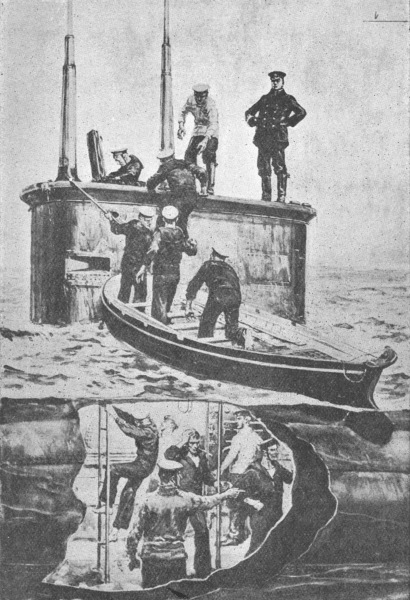
“The Lilies of France and our own Red Rose
Are twined in a coronal now:
At War’s bloody bridal it glitters and glows
On Liberty’s beautiful brow.”
Gerald Massey.
In his despatch to Lord Kitchener, dated September
7th, Sir John French tells of the four-days’
battle at Mons, and traces his masterly,
triumphant retreat, in the face of irresistible odds,
to Maubeuge, to Cambrai, to Le Cateau, to
Landrecies, and so almost to within sight of the
walls of Paris. He pays a glowing tribute to the
magnificent fighting spirit of the officers and men
who carried out these stupendous movements with
such complete success, but at present it is to the
men themselves you must turn again for detailed
information of the horrors and heroisms, the
grim and glorious hours that darkened and
lightened through those tumultuous days. “What
we did in that three weeks English people at
home will never know,” writes Private J. Harris,
of the Worcestershire Regiment: “We were
marching and fighting day and night for three
weeks without a break.”
On Sunday, 23rd, at Mons, we rose at four
a.m. and marched out 1,100 strong. We took
up ground on the extreme flank of the British
force. Immediately we started to entrench
ourselves, and to the good trench work we did
we put down our freedom from casualty. Later
in the day a hellish tornado of shell swept over
us, and with this introduction to war we received
our baptism of fire. We were lining the Mons
road, and immediately in our front and to our
rear were woods. In the rear wood was stationed
a battery of R.F.A. The German artillery is
wonderful. The first shot generally found us, and
to me it looked as if the ranges had been carefully
taken beforehand. However, our own gunners
were better, and they hammered and battered
the Germans all the day long.
They were at least three to our one, and
our artillery could not be in fifty places at once,
so we just had to stick it. The German infantry
are bad skirmishers and rotten shots, and they
were simply mowed down in batches by our chaps.
They came in companies of, I should say, 150
men in file five deep, and we simply rained bullets
at them the live-long day. At about five p.m.
the Germans in the left front of us retired, and
we saw no more of them.
The Royal Irish Regiment had had an awful
smashing earlier on, as also had the Middlesex,
and our company were ordered to go along the
road as reinforcements. The one and a half mile
seemed a thousand. Stormed at all the way, we
kept on, and no one was hit until we came to a
white house which stood in a clearing. Immediately
the officer passed the gap hell was let loose
on us, but we got across safely, and I was the only
one wounded, and that was with a ricochet
shrapnel bullet in the right knee.
I knew nothing about it until an hour after,
when I had it pointed out to me. I dug it out
with a knife. We passed dead civilians, some
women, and a little boy with his thigh shattered
by a bullet. Poor wee fellow. He lay all the
time on his face, and some man of the Irish was
looking after him, and trying to make him comfortable.
The devils shelled the hospital and
killed the wounded, despite a huge Red Cross
flag flying over it.
When we got to the Royal Irish Regiment’s
trenches the scene was terrible. They were
having dinner when the Germans opened on
them, and their dead and wounded were lying
all around. Beyond a go at some German
cavalry, the day drew in, and darkness saw us on
the retreat. The regiment lost one officer and
one man dead, one officer and some men severely
wounded.
We kept up this sort of game (fighting by
day and retiring by night) until we got to Cambrai,
on Tuesday night. I dare not mention that place
and close my eyes. God, it was awful. Avalanche
followed avalanche of fresh German troops, but
the boys stuck to it, and we managed to retire
to Ham without any molestation. Cambrai was
the biggest battle fought. Out of all the glorious
regiment of 1,100 men only five officers and 170
of the men answered the roll-call next day.
Thank God, I was one of them.
Of course, there may be a number who got
separated from the battalion through various
causes, and some wounded who escaped. I hope
so because of the heavy hearts at home. I saw
the South Lancs, and they were terribly cut up,
only a remnant left of the regiment.
* * * * *
I know that you will all excuse me for not
receiving a letter from me this long time, but
I hope that you will excuse me. Don’t, whatever
you do at home, don’t worry about me. If
I just thought that you won’t worry at home I
shall be all right. You know, mother, I know
more about war this time than I did last, and
the conditions also. It’s all right when you
know the ropes, and my African experiences are
serving me in good stead here, so I hope and
trust that you at home are not worrying about
me; time enough to worry when there is cause.
Well, I hope and trust all are well at home, as
it is hell out here. Up to this affair I thought
that the Germans were a civilised race of people,
but they are nothing but savages; niggers
would not do what they do. Just fancy mounting
maxim guns on ambulance wagons bearing the
Red Cross, cutting the right hand off prisoners
and turning them loose afterwards minus a
hand. By jingo, mother, the boys (our boys)
are absolutely all in. We did give the Boers
a chance now and again, but these devils we
don’t give them a cat in hell chance; we’re
playing the game to the finish. I would not
care to write so much, as I had better tell you
when I come home. The Boer War was a tame
affair. We are moving off again to-night. I
don’t know where, and we don’t care either;
it’s a do to a finish this time. I hope you got
my postcards from Rouen in France, as there
was some doubt as to whether they would let
them through or not. I will write home as opportunity
occurs, and I hope you won’t worry
about me, because you all know at home that
I shall always be where I’m wanted, and my
duty every time, so don’t worry. Tell anyone
who enquires I am O.K., lost a bit of weight
perhaps, but not the worse so far, and above
all don’t believe all you see in the papers, as
they know practically nothing, as everything is
done under sealed orders, which never leak out.
We are not even allowed to say in our letters
where we are, as they are opened and read by
the captain before they leave here, so you can
judge for yourselves how things are. And I
might say, mother, that we are very busy.
* * * * *
The fighting lately has been hot all round, and
the French have had much harder than us in
some places, but they’re sticking at it manfully,
and they deserve to win a victory that will wipe
the Germans off the map. The French make a
lot of us in camp, and when we pass each other in
the field, no matter how busy the Frenchman may
be, they give us hearty cheers to encourage us
on our way. There’s plenty of friendly rivalry
between us when there’s hard fighting to be done,
and when we do get there before the French
they don’t grudge us our luck. They’re good
sports right through to the core, and the British
soldier asks nothing better from allies in the
field.
* * * * *
We left our landing place for the front, on
the Tuesday, and got there on Saturday night.
The Germans had just reached Liège then, and
we got into action on the Sunday morning. The
first thing we did was to blow up a bridge to
stop the Germans from crossing. Then we
came into action behind a lot of houses attached
to the main street. We were there about ten
minutes, when the houses started to fall around
us. The poor people were buried alive. I saw
poor children getting knocked down by bursting
shells.
The next move was to advance across where
there was a Red Cross Hospital. They dropped
shells from airships and fired on it until the place
was burnt down to the ground. Then they got
a big plan on to retire and let the French get
behind them. We retired eight miles, but we
had to fight until we were forced to move again.
We got as far as Le Cateau on Tuesday night.
We camped there until two o’clock next morning.
Then we all heard there was a big fight coming
off, so we all got together and cleared the field
for action.... (The letter mentions the
numbers of men engaged, and states that the
Germans were in the proportion of three to one.)
... We cut them down like rats. We could
see them coming on us in heaps, and dropping
like hail. The Colonel passed along the line,
and said, “Stick it, boys.”
I tell you, mother, it was awful to see your
own comrades dropping down—some getting their
heads blown off, and others their legs and arms. I
was fighting with my shirt off. A piece of shell
went right through my shirt at the back and never
touched me. It stuck into a bag of earth which
we put between the wheels to stop bullets.
We were there all busy fighting when an airship
came right over the line and dropped a bomb,
which caused a terrible lot of smoke. Of course,
that gave the Germans our range. Then the shells
were dropping on us thick. We looked across the
line and saw the German guns coming towards us.
We turned our two centre guns on them, and sent
them yards in the air. I reckon I saw one German
go quite twenty yards in the air.
Just after that a shell burst right over our gun.
That one got me out of action. I had to get off
the field the best way I could. The bullets were
going all around me on the way off; you see they
got completely around us, I went about two
miles, and met a Red Cross cart. I was taken to
St. Quentin’s Hospital. We were shelled out of
there about two in the morning, and then taken
in a train, and taken down to a plain near Rouen.
Next morning we were put in a ship for dear
old England.
* * * * *
I was in three engagements, Mons, Landrecies,
and Cambrai, but the worst of all was Mons. It
was on Sunday, the 23rd of August, and I shall
never forget the date. They were easily twenty-five
to one, and we eventually had to retreat with
just over a thousand casualties, but heavens, they
must have had a jolly sight more. At Landrecies,
where we arrived at 7.30, we thought we were
going to have a night’s rest, though we were wet
through and no change, but we hadn’t been there
long before they (the Germans) started firing;
they seemed to be in every place we went to. The
only thing we heard then was, “turn out at once.”
It was about 10.15 when we turned out, and the
Colonel’s orders were that we had to take a bridge
if every man was killed. (I thought that sounded
a wee bit healthy.) I had my last drink out of
a dirty glass of beer. I says, “good health Billy,”
and off we went with bayonets fixed.
On our way to the bridge we met the regiment
who had tried and failed, bringing back its
wounded and killed in scores. (I thought more
encouragement for the corps.) I was carrying my
pal, the rifle, with my right hand. Well, we got
near the bridge and found out from our scouts
that there were 10,000 German troops on each
side of the bridge and we were 1,300 strong.
(More encouragement.) So we lined a long
hedge about two yards apart so as to make a
long line and harder for them to hit. We lay
here till daybreak just before 4 a.m., and we
could hear them talking all night about 300 yards
away. We could see them quite clearly by this
time; so we started to fire and rolled them over
by dozens. It wasn’t long, though, before the
bullets were whizzing past my ears on each side,
and I began to get my head lower and lower
till I think I should have buried it in the mud
if it had got much lower. Their superior numbers
began to tell and we had to retire as fast
as we could. I couldn’t go fast enough with my
pack on (it weighs 84 lbs.), so I threw it away as
did hundreds more, and I finished bridge-taking
with my old pal only (the rifle).
* * * * *
29th August, 1914.
For the last week or ten days we have been
fighting hard and are now for one day resting.
Altogether, during five days and five nights, I got
six hours’ sleep, and so am rather weary. However,
bullets and a real enemy are a wonderful
stimulant, and I feel as fit as anything. Do all
of you write as often as possible, and send me
some newspapers. It does not matter whether
there is any news—the sight of a letter from home
is very cheering.
All our men are somewhat fatigued, but are
very keen and full of fight. My regiment has
had a bad time, and I am dreadfully afraid that
they have been badly cut up, although I can
as yet get no details. They were caught in a
village by Germans in the houses, who had
managed to get there by wearing our uniforms.
Never again shall I respect the Germans, or any
of them I may meet. They have no code of
honour, and there have been several cases of their
wearing French and British uniforms, which is,
of course, against the Geneva Convention.
The weather is good, for which we are
thankful.
Everything is so peaceful now, and it is such
a perfect day that were it not for the continuous
growl of the guns, which never cease, one would
hardly believe one was in the midst of a huge
war.
* * * * *
German airships we seldom see now, though
we used to have them every day over our heads.
They are finding the French more than a match
for them, and they most likely prefer to rely on
their ordinary spies, of whom they have thousands.
They are found often among the men engaged
for transport work, but they are such clumsy
bunglers that they give themselves away sooner
or later. Some of us who haven’t the heart to
drown a cat never turn a hair when we see these
scum shot, for they richly deserve what they get
and a soldier’s death is too good for them.
* * * * *
We have had three engagements with the
Germans since I arrived, and I came out quite
unhurt. The two first were fought on Sunday
and Monday following. You see I cannot give
date or place. Secrecy is our motto re war
and movement of troops for international purposes,
etc. Our third engagement was nearly
fatal. We arrived at the town of ——, very
much fatigued, and fully intending to have a
good rest. It was a fine town, about as big
as Newry, but more compact, with many fine
buildings. We were just about five minutes
billeted in the various houses, and just stretching
our weary legs, when an officer came running in,
shouting “The Germans are upon us; outside
everyone.” We came out, magazine loaded,
bayonets fixed, and eager to get a good bayonet
fight with them. It appears they do not like it.
But we found none. They had not yet arrived.
It was 10 p.m. before they did so. In the meantime
the poor people were leaving the town in
crowds, with as much goods and chattels as they
could carry away, and it was well for them, too.
It was a dark night when we formed up in the
streets, and the lamps but dimly burned. The
noises of rifles and field guns were terrific. We
rushed to the heads of the various streets, where
our German foe would advance. Our Field
Artillery and the Coldstream Guards went out
to delay their advance whilst we stripped off
our coats and commenced to tear up the square
setts, gather carts—in fact, everything that would
build a barricade to keep back our numerous
German foe, and we did so under perfect showers
of shrapnel shell that struck and fell around us,
and struck the houses about us, but we were
undaunted, and so succeeded. Firing ceased,
and we advanced out towards the Coldstream
Guards’ position. They had given them a good
fight, but many of them lay for ever silent upon
the ground. The Germans would not advance
upon us, so we retired.
* * * * *
Our company were reserves, and came under
fire about noon. We were in a ditch—as we
thought safe—when “Ping! ping!” came the
bullets, and off we shot across the open, under a
railway embankment. On the way we passed
four artillery horses shot dead with shrapnel.
Then we took up a position on a hillside, when
round the corner, 700 yards away, came a German
maxim gun. They were busy getting it ready
for firing on us, and we were firing at them, when
our artillery—which was only half a mile away—sent
two shots and blew up the gun and all the
men. Then we cleared off and marched till
twelve midnight. Up again at two and off for
what was called a rest camp. Still wet clothes,
and filthy; had no boots off for days. Instead
of “rest” camp we marched nearly thirty miles,
arriving at 8 p.m. Here I had a good meal of
jam, cheese, and bread—first bite of bread for
days.
Next day we were up before daylight and
taking up position. We dug trenches, and were
fired on before we had finished. We were at the
back—a sort of last firing line. So we lay down
in the trench, and waited. Shrapnel and lyddite
were flying round us like hail, and our gunners
were firing too. Such a noise! Just like thunder!
Well, we stuck out as long as we could when we
got the order to retire. However I came safely
away goodness knows.
I picked up my gun and ran up the hill
and dropped on one side of the road to rest. Then
I had to get across the road, so got up and was
half-way across when a shell burst and knocked
me flat on my face. It must have fused at the
wrong time, as I got only a cut on my thumb
from a fragment. Then I got across and dropped
in a trench where a fellow was lying dead. I
stayed there only a minute, and then ran off
over the hill and safe. The bullets were flying
in all directions and shells were bursting four at
a time. South Africa was nothing compared to
this.
I had had no sleep for nights, so decided to
go back to a little village we had just passed,
where I sat on a doorstep till I fell asleep, and
woke up one hour later wet through and chilled
to the bone. It was still dark when I got back
to where I left our regiment, and they were off.
So I trekked away alone, and got on the wrong
road.
About nine in the morning I came across
some transport, and rode along with stragglers
of other regiments to a camp. There were about
sixty of us, and we went to a large camp, about
2,000 of us—all lost. There I came across Guy
Jessop of Huddersfield, who was also lost, and
was glad to meet a pal. We had a walk in the
town together, and called in a café. We had
some coffee and rum (Guy paid, as I had no
money). I played the piano and sang “Mrs.
Hullaby.” Lucky job they could not understand
English, or they would have been shocked.
* * * * *
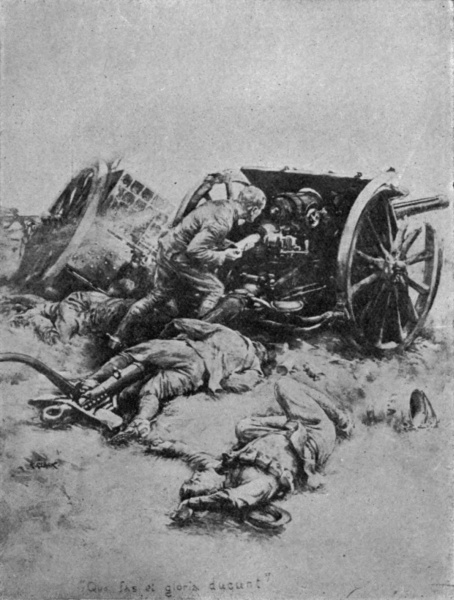
Drawn by Christopher Clark.
Copyright of The Sphere.
How the Royal Field Artillery Fight.
We landed at Havre, and travelled up
country. We were under fire for about twenty
minutes on the first day, and the shells were
bursting like rain all around us. We got away
with only one horse killed. It was marvellous.
We are continually under fire by day and travelling
by night. It is awful to hear the artillery
booming death night and day. We were fighting
day and night for three days. The slaughter was
terrible. I took a dispatch across the battlefield
when the Germans were retiring, and I passed
their trenches. The dead were piled up in the
trenches about ten deep, and there were trenches
seven miles long. It was terrible to see. We
are collecting the three cavalry brigades together
at the present moment for a massive charge. I
am writing this in the saddle. I may get through
this again. One bullet penetrated my horse’s
neck and another one went through the saddle.
I have had a sword-thrust through my sleeve.
So I am getting on well.
* * * * *
Dear Dad.—Just got yours of the 13th inst.
Battling yesterday and the day before. I had
a pal killed in another battery—five bullets in
him. I have just seen the first Sausage-maker
prisoner in hands of some infantry. They had
the greatest difficulty in stopping the French
populace from knifing him. The German shrapnel
is very dangerous stuff, having high explosive
in it. It bursts backwards, and so nullifies our
frontal shield. No more time or news.
August 29th.
The boom of French guns is now in full
swing, and we are standing easy for the moment.
Did you get my other letter three days back?
Just after I had finished it, we had the alarm,
which proved false, but that night Germans
marched into the town, thinking we had left it.
So they say! A gruff German voice answered
a challenge, and 15 rounds rapid fire from rifles
and maxims behind the main road barricade,
laid out every man. Eight hundred were picked
up next morning in this one street.
An R.E. told me on the canal bridge a maxim
fired 9,000 rounds and laid out another 1,000.
The first Germans arriving in one end of this
town were in French uniforms. Luckily, those
in the rear were seen and fired on, stampeding
the ammunition mules, scattering the “Sausages,”
who were almost laid out in a few rounds of fire.
Lots of “espions” here, male and female. I
have hardly seen a German, except prisoners.
Poor Soames, of the 20th Hussars, was sparrowed
first fight. W. Silvertop (20th Hussars) is hard
at it “biffing” Sausages, and a N.C.O.,
yesterday, who had lost the Regiment, told
me 48 hours ago he was well.
“Cigs.” all arrived, and saved my life, also
load of chocolate. Screaming women rush everywhere
during conflicts howling “Trahie,” “Perdue,”
“Sauve qui peut.” One of “D” battery,
R.H.A., N.C.O., told us they had mowed “Sausage-makers”
down for ten minutes in one action as
hard as they could load and still they came in
masses, till at last the shrieking men ran all ways,
not knowing where, leaving heaps of semi-moving
remnants on the ground.
Our crowd, having so far escaped untouched,
are very lucky. Several Brigades have had the
devil’s own hail of shot over them. Please
send me some newspapers sometimes, as we have
not seen one since I left, bar some old French
Petit Parisiens.
The Scots Greys from York and the 12th
Lancers did great work yesterday on hostile
cavalry, and about wiped out those opposed to
them. The “Guardies” are in great form.
Very little sleep nowadays, up at dawn almost
always, very often before that hour.
A German regiment, dressed in English
uniforms, the other day billetted with an English
regiment (at the other end of the town), and
when the latter marched out they were about
broken up by maxim fire from the bedroom
windows. A German force arrived elsewhere, the
Berkshire regiment were on guard, and the
former, in French uniforms, called out from the
wire entanglements that they waited to interview
the C.O. A major went forward who spoke
French, and was shot down immediately. This
sort of thing is of daily occurrence, and only makes
matters worse for the “Sausage-makers” when
our infantry get into them.
* * * * *
I got a nasty hit with a shell on the thick
of the leg. The Germans caught us napping on
Wednesday, and what slaughter! It was horrible
to witness. The Germans came along the village,
killing the poor women and children and burning
all the houses. Our division could not hold
out. We were expecting the French troops to
meet us, but they were two days late. Our
battery had a lucky escape of being cut up. We
entrenched our guns to come into action next
day, but somehow or other we cleared out, and
had only gone ten minutes before the place was
blown up.
The officer in charge of my section had his head
blown off. I was carried off under heavy fire
on a fellow’s back, and it is to him I owe my life.
It was a long way to hospital, shells bursting all
round us. We dropped behind some corn stacks,
then on we went again. I had no sooner got
bandaged up when a chap came galloping up
and said the Germans were in sight. I was the
second last man to leave the hospital, and ten
minutes later it was blown up. You cannot
imagine what things were like. The women and
children of England can think themselves lucky,
for the poor women here had to walk from village
to village, young children in their arms. It
touched my heart to see the sight. The Germans
did not use rifles, but big guns, against our
infantry’s rifles. They are most brutal, killing all
wounded in a most horrible fashion.
* * * * *
The Germans let all hell loose on us in their
mad attempt to crush us and so win their way
to Paris. They didn’t succeed, and they won’t
succeed. I saw one ghastly affair. A German
cavalry division was pursuing our retiring infantry
when we were let loose on them. When
they saw us coming they turned and fled, at
least all but one, who came rushing at us with
his lance at the charge. I caught hold of his horse,
which was half mad with terror, and my chum
was going to run the rider through when he
noticed the awful glaze in his eyes and we saw
that the poor devil was dead.
* * * * *
I am writing this on a leaf out of a field service
pocket-book, as notepaper and envelopes are very
scarce, and we are not allowed to send picture
postcards of places as they give away where
we are. Well, this is a lovely country. The
climate suits me very well. Everything grows
like mad here. It is rather like Ireland, only
ten times as rich. All that I have seen yet—and
that is a good lot—is far and away better
than the best part of the county Limerick. I
think it would be a pleasure to farm here.
At the present time I am billeted in a farmhouse.
I sleep in their best bed-room—that is
when I can go to bed at all—and they give me
home-made cider, cognac, and coffee, apples,
plums, etc., and lovely home-made cheese for
nothing, though they need not supply any food,
as the rations are served out by the regiment
every day.
’Tis great fun trying to talk French to them
and I am picking it up gradually. It is wonderful
how words and sentences that I learned at school
come back to me now, and I can generally make
myself understood all right. It is an awful pity
to see this beautiful country spoiled by war, and
it is no wonder the people are so eager to fight
for it. I don’t think there is a single house
that has not sent out one or more men to fight
with the French Army, and their mothers, sisters,
wives, etc., are very proud of it. There are
two gone out of this house.
* * * * *
I am very sorry, but I don’t know for sure
about your Joe. You see, although he was in the
same company as me, he was not in the same
section. I only wish he had been. The last
I saw of him was when we were in the firing line
making trenches for ourselves. He was about
600 yards behind us, smoking, and I waved to
him. Then all of a sudden we had to get down
in our trenches, for bullets started coming over
our heads, and shells dropped around us.
We were fighting twelve hours when I got one
in the back from a shell. After that I knew
no more until I found myself in hospital, and I
asked one of our chaps how our company went
on, and he told me there were only seventeen
of us left out of 210. I hope Joe is among them.
You will get to know in the papers in a bit when
they call the roll.
So cheer up and don’t be downhearted, for if
Joe is killed he has died a soldier of honour on
the field. Excuse writing, as I am a bit shaky,
and I hope to God Joe is safe, for both your
sakes.
* * * * *
I am in hospital, having been sent home from
France, wounded in my left hand. I have got one
shrapnel bullet right through my hand, and another
through my middle finger against the top
joint. I was wounded at Cambrai last Wednesday.
I have been in four hospitals in France, but
had to be removed on account of the Germans
firing on the hospitals. I do not think much of
them, for if it was not for their artillery they would
be wiped out in quick time. No doubt our losses
are great, but theirs are far more. The famous
cavalry of theirs, the Uhlans, are getting cut up
terribly. All that have been captured have said
that they are short of food. I must say we have
had plenty to eat. I was near Mons a week last
Saturday and we were attacked the same day.
We have been on the retire ever since last Wednesday,
when I got wounded, but we shall soon be
advancing, for they will never reach Paris. I
am very pleased to see that the Germans are being
forced back by the Russians. I hope they will
serve Berlin the same as the Germans have done
to Belgium. The 9th Brigade was cut up badly;
in fact, my Division was, but more are wounded
than killed. There are 1,000 wounded in this
hospital alone, without other hospitals. I must
say that I am in good health. My hand is
giving me pain, but I do not mind that. I only
had four days’ fighting, but it was hard work
while it lasted. The Germans, although four to
one, could not break through our lines, and they
must have lost thousands, as our artillery and
infantry mowed them down like sheep. Their
rifle fire took no effect at all. All our wounds
were done by shrapnel. My hand is not healing
at all, but I must be patient and give it time.
The French and Belgian people were very kind to
us and gave us anything we wanted.
* * * * *
There was a young French girl helping to
bandage us up. How she stood it I don’t know.
There were some awful sights, but she never
quailed—just a sweet, sad smile for everyone.
If ever anyone deserved a front seat in Heaven,
this young angel does. God bless her. She
has the prayers and the love of the remnants
of our division. All the French people are
wonderfully generous. They gave us anything
and everything. You simply cannot help loving
them, especially the children.
* * * * *
Of my company only 10 were unhit. I saw a
handful of Irishmen throw themselves in front
of a regiment of cavalry who were trying to cut
off a battery of horse artillery. It was one of
the finest deeds I ever saw. Not one of the poor
lads got away alive, but they made the German
devils pay in kind, and, anyhow, the artillery
got away to account for many more Germans.
Every man of us made a vow to avenge the
fallen Irishmen, and if the German cavalrymen
concerned were made the targets of every British
rifleman and gunner they had themselves to
thank. Later they were fully avenged by their
own comrades, who lay in wait for the German
cavalrymen. The Irish lads went at them
with the bayonet when they least expected it,
and the Germans were a sorry sight. Some of
them howled for mercy, but I don’t think they
got it. In war mercy is only for the merciful.
* * * * *
I shall never forget this lot. Men fell dead
just like sheep. Our regiment was first in the
firing line, and we were simply cut up. Very few
escaped, so I think I was very lucky, for I was
nearly half-a-mile creeping over nothing but dead
men. In the trenches, bullets and shells came
down on us like rain. We even had to lift dead
men up and get under them for safety.
When we got the order to retire an officer was
just giving the order to charge when he was
struck dead, and it is a good job we didn’t charge,
or we would have all been killed. I passed a
lot of my chums dead, but I didn’t see Fred
Atkinson (a friend of the family).
* * * * *
Have you ever seen a little man fighting a
great, big, hulking giant who keeps on forcing
the little chap about the place until the giant
tires himself out, and then the little one, who
has kept his wind, knocks him over? That’s
how the fighting round here strikes me. We
are dancing about round the big German army,
but our turn will come.
Last Sunday we had prayers with shells bursting
all around us, but the service was finished
before it was necessary for us to grapple with
the enemy. The only thing objectionable I have
seen is the robbing of our dead and wounded by
German ghouls. In such cases no quarter is
given, and, indeed, is never expected.
* * * * *
I am the only one left out of my battery; we
were blown to pieces by the enemy on Wednesday
at Le Cateau. We have been out here twenty-eight
days all told, and have been through the
five engagements. I have nothing; only the
jacket I stand up in—no boots or putties, as I
was left for dead. But my horse was shot, and
not me. He laid down on me. They had to
cut my boots, etc., off to get me from under
my horse.
* * * * *
I did not get hit at Mons. I got through it all
right. We encountered the Germans on Sunday
at Mons, and fought on till Monday night. It
was on the retreat from Mons that I was caught.
They had about one hundred guns playing on us
all the time we were retiring. We had a battery
of artillery with us. They were all blown to
pieces, men and guns and all. It was a most
sorrowful sight to see the guns wiped out, and
the gunners and men lying around them. The
whole plain was strewn with dead and wounded.
I hope my eyes will never look on anything so
horrid again. Our section brought in six prisoners,
all wounded, and they told us we had slain
hundreds of them. We captured a German spy;
he was dressed in a Scotsman’s uniform, and
was knocking around our camp, but we were a
bit too quick for him. I think the hardest battles
are fought; the German cannot stand it much
longer, his food supply is getting done.
* * * * *
Last night the enemy made an attempt to get
through to our base in armed motors. Myself
and two other motor-cyclists were sent out to
look for them. It was a pitch-black night, with
a thick fog. One of our men got in touch with
them, and was pursued. He made for a bridge
which had been mined by the engineers, and that
was the end of the Germans.... The German
artillery is rotten. Last Saturday three batteries
bombarded an entrenched British battalion for
two hours, and only seven men were killed.
The noise was simply deafening, but so little
effect had the fire that the men shouted with
laughter, and held their caps up on the end of
their rifles to give the German gunners a bit of
encouragement.
This is really the best summer holiday I have
had for a long time.
* * * * *
It’s very jolly in camp in spite of all the
drawbacks of active service, and we have lively
times when the Germans aren’t hanging around
to pay their respects. It’s a fine sight to see
us on the march, swinging along the roads as
happy as schoolboys, and singing all the old
songs we can think of. The tunes are sometimes
a bit out, but nobody minds so long as we’re
happy. As we pass through the villages the
French come out to cheer us and bring us food
and fruit. Cigarettes we get more of than we
know what to do with. Some of them are
rotten, so we save them for the German prisoners,
who would smoke anything they can lay their
hands on. Flowers also we get plenty of, and
we are having the time of our lives.
* * * * *
If the French people were mad about us before
we were on trial, they are absolutely crazy
over us now when we have sort of justified our
existence. In the towns we pass through we
are received with so much demonstration that I
fancy the French soldiers must be jealous. The
people don’t seem to have eyes for anybody but
us, and they do all they can to make us comfortable.
They give us the best they can lay
hold of, but that’s not much after the Germans
have been around collaring all they could. It’s
the spirit that means so much to us, and even
though it was only an odd cup of water they
brought us we would be grateful. Most of us
are glad to feel that we are fighting for a nation
worth fighting for, and after our experience there
can be no question of trouble between us and
France in the future.
We lost terribly in the retreat from Mons, of
which you have heard by now, but artillery
always stands to lose in retreats, because we play
such a big part in getting the other men away
and we quite made up our minds that we would
have to pay forfeit then. Without boasting, I
can say that it was the way the guns were handled
that made it so easy for our lads to get out of
the German trap. There was once or twice when
it looked as though it were all up with us, and
some of our chaps were fair down in the mouth
over it; but I think now they didn’t make
sufficient allowance for the steadiness of all arms
of our service; and, between ourselves, I think
they had got the usual notions about the splendid
soldiering qualities of the German army. They
know better now, and though it’s bad to get
chesty about that sort of thing, we are all pretty
confident that with a sporting chance we stand
to win all the time.
* * * * *
It’s tired we all were when we got through
that week of fighting and marching from Mons;
but after we’d had a taste of rest for a day or
two, by the saints, we were ready for the ugly
Germans again, and we’ve been busy ever since
drilling holes in them big enough to let out the
bad that’s in them. You wouldn’t believe the
way they have burned and destroyed the holy
churches everywhere they went, and there’s
many an Irish lad betwixt here and the frontier
has registered a vow that he will not rest content
till he’s paid off that score against the men who
would lay hands on God’s altars.
* * * * *
We see more Germans than you could count
in the day, but they are now very funky about it,
and they will never wait for a personal interview
with one of our men, especially if he has a lance
or a bayonet handy, and naturally you don’t go
out German-hunting without something of the
kind with you, if only just for luck. When they
must face us they usually get stuck away somewhere
where they are protected by more guns
than you ever set eyes on, and likewise crowds
of machine guns of the Maxim pattern, mounted
on motors. These are not now so troublesome,
for they are easy to spot out in the open, and
our marksmen quickly pick off the men serving
them, so the Germans are getting a bit shy
about displaying them. Something we heard the
other day has put new life into us; not that
we were downhearted before, but what I mean
shows that we are going to have all we wished
for very soon, and though we can’t tell you more
you may be sure that we are going on well.
* * * * *
I am still living, though a bit knocked about.
I got a birthday present from the Kaiser. I
was wounded on the 23rd. So it was a near
thing, was it not? I got your letter at a place
called Moroilles, in France, about five miles from
Landrecies, where our troops have retired.
On Sunday, 23rd, we had rifle inspection at
11 a.m., and were ordered to fall in for bathing
parade at 11.30. While we were waiting for
another company to return from the river the
Germans commenced to shell the town. We
fell in about 1.0 p.m., an hour and a half afterwards,
to go to the scene of the attack. Shells
were bursting in the streets as we went. We
crossed a bridge over the canal under artillery
fire, and stood doing nothing behind a mill on
the bank for some time.
Then someone cried out that the Germans were
advancing along the canal bank, and our company
were ordered to go along. We thought we
were going to check the Germans, but we found
out afterwards that a company of our own regiment
were in position further along on the opposite
side of the canal, and we were being sent out to
reinforce them.
There was no means of crossing the canal at
that point, so it was an impossibility. As soon
as we started to move we were spotted by the
Germans, who opened fire with their guns at about
five hundred yards with shrapnel, and the scene
that followed beggars description. Several of
us were laid full length behind a wooden fence
about half an inch thick. The German shells
burst about three yards in front of it. It was
blown to splinters in about ten minutes. None
of us expected to get out alive.
They kept us there about an hour before they
gave us the word to retire. I had just turned
round to go back when I stopped one. It hits
you with an awful thump, and I thought it had
caught me at the bottom of the spine, as it
numbed my legs for about half an hour.
When I found I could not walk I gave it up.
Just after, I got my first view of the Germans.
They were coming out of a wood about 400 yards
away all in a heap together, so I thought as I
was done for I would get a bit of my own back,
and I started pumping a bit of lead into them.
I stuck there for about three-quarters of an
hour, and fired all my own ammunition and a lot
belonging to two more wounded men who were
close to me—about 300 rounds altogether, and
as it was such a good target I guess I accounted
for a good lot of them.
Then I suddenly discovered I could walk,
and so I set off to get back. I had to walk about
150 yards in the open, with shrapnel bursting
around me all the way, but somehow or other I
got back without catching another. It was
more than I expected, I can assure you, and I
laughed when I got in the shelter of the mill
again.
I was very sorry to have to leave the other
chaps who were wounded, but as I could only
just limp along I could not help them in any way.
They were brought in later by stretcher bearers.
A man who was at Paardeburg and Magersfontein,
in South Africa, said they were nothing
to what we got that Sunday. Out of 240 men
of my company only about twenty were uninjured.
* * * * *
I found myself mixed up with a French
regiment on the right. I wanted to go forward
with them, but the officer in charge shook his
head and smiled, “They will spot you in your
khaki and put you out in no time,” he said in
English; “make your way to the left; you’ll
find your fellows on that hill.” I watched the
regiment till it disappeared; then I made my
way across a field and up a big avenue of trees.
The shells were whistling overhead, but there
was nothing to be afraid of. Halfway up the
avenue there was a German lancer officer lying
dead by the side of the road. How he got there
was a mystery, because we had seen no cavalry.
But there he lay, and someone had crossed his
hands on his breast, and put a little celluloid
crucifix in his hands. Over his face was a beautiful
little handkerchief—a lady’s—with lace
edging. It was a bit of a mystery, because there
wasn’t a lady for miles that I knew of.
* * * * *
We met the Germans at Landrecies on Sunday.
We had a fifteen-hour battle. It was
terrible. There were 120,000 Germans and only
20,000 of us, but our men fought well. We blew
up six bridges. Laid our charges in the afternoon,
and the whole time we were doing it were not
hit. After we had got everything ready we got
back into cover and waited until 1.30 on Monday
morning, until our troops had got back over the
river, and then we blew up the bridges. We
retired about thirty miles. The town where we
stopped on Sunday was a beautiful place, but the
Germans destroyed it. Close to where I was a
church had been used as a hospital, and our
wounded were coming by the dozens. But,
terrible to say, the Germans blew the place up.
They have no pity. They kill our wounded and
drive the people before them.
* * * * *
We were laying our gun cotton—ten of us
were the last to leave, and the Germans stopped
us. We had to run for it down the main street
of the town of Landrecies, and, being dark, we
could not see where we were going. We got
caught in some telegraph wires which had been
put across the street. We had to cut them away
with our bayonets. On Monday morning, when
things were quieter, we went nearly into the
German lines. We could hear them giving orders.
Our job was to put barbed wire across the road.
I was thankful to get out of it. We could see
the Germans burning their dead. They must
have lost a few thousand men, as our troops
simply mowed them down.
I saw one sergeant kill fourteen Germans, one
after the other. They came up in fifties, all in a
cluster, and you couldn’t help hitting them.
They were only 400 yards from us all day on
Sunday. They are very cruel. Our people used
a church for a hospital, and it was filled with our
wounded, but the place was shelled and knocked
down. They stabbed a good many of our men
while lying on the battlefield. They have no
respect for the Red Cross. To see women and
children driven from home and walking the roads
is terrible—old men and women just the same.
At the town where we were we got cut off from
our people—eighteen of us—and the houses were
being toppled over by the German artillery.
The people clung around us, asking us to stay
with them, but it was no good. When we left,
the town was in flames. But our men did fight
well. You never saw anything so cool in your
life. Anyone would have thought it was a football
match, for they were joking and laughing
with one another.
* * * * *
While flying over Boulogne at a height of
3,000 feet, something went wrong with the
machine, and the engine stopped. The officer
said, “Baker, our time has come. Be brave,
and die like a man. Good-bye,” and shook hands
with me. I shall always remember the ten
minutes that followed. The next I remembered
was that I was in a barn. I was removed to
Boulogne, and afterwards to Netheravon, being
conveyed from Southampton by motor ambulance.
* * * * *
The Germans are good and bad as fighters,
but mostly bad so far as I have seen. They are
nearly all long distance champions in the fighting
line, and won’t come too near unless they are
made to. Yesterday we had a whole day of it
in the trenches, with the Germans firing away
at us all the time. It began just after breakfast,
and we were without food of any kind until we
had what you might call a dainty afternoon tea
in the trenches under shell fire. The mugs were
passed round with the biscuits and the “bully”
as best they could by the mess orderlies, but it
was hard work getting through without getting
more than we wanted of lead rations. My next-door
neighbour, so to speak, got a shrapnel bullet
in his tin mug, and another two doors off had
his biscuit shot out of his hand when he was fool
enough to hold it up to show it to a chum in the
next trench.
We are ready for anything that comes our
way, and nothing would please us better than a
good big stand-up fight with the Germans on any
ground they please. We are all getting used to
the hard work of active service, and you very
seldom hear complaints from anybody. The
grousers, who are to be found in nearly every
regiment, seem to be on holiday for the war.
* * * * *
Our part in the fighting was limited almost
entirely to covering the retreat by a steady rifle
fire from hastily-prepared trenches. We were
thrown out along an extended front, and instructed
to hold our ground until the retiring
troops were signalled safe in the next position
allotted them. When this was done our turn
came, and we retired to a new position, our place
being taken by the light cavalry, who kept the
Germans in check as long as they could and then
fell back in their turn. The Germans made some
rather tricky moves in the hope of cutting us off
while we were on this dangerous duty, but our
flanks were protected by cavalry, French and
English, and they did not get very far without
having to fight. When they found the slightest
show of resistance they retreated, and tried to
find an easier way of getting in at us. The staff
were well pleased with the way we carried out the
duty given to us, and we were told that it had
saved our Army from very serious loss at one
critical point. We put in some wonderfully
effective shooting in the trenches, and the men
find it is much easier making good hits on active
service than at manœuvres. The Germans seemed
to think at first that we were as poor shots as they
are, and they were awfully sick when they had to
face our deadly fire for the first time.
* * * * *
We are off again, this time with some of the
French, and it’s enough to give you fits to hear
the Frenchmen trying to pick up the words of
“Cheer Boys, Cheer,” which we sing with great go
on the march. They haven’t any notion of what
the words mean, but they can tell from our manner
that they mean we’re in good heart, and that’s
infectious here. We lost our colonel and four
other officers in our fight on Tuesday. It was
the hottest thing we were ever in. The colonel
was struck down when he was giving us the last
word of advice before we threw ourselves on the
enemy. We avenged him in fine style. His loss
was a great blow to us, for he was very popular.
It’s always the best officers, somehow, that get
hit the first, and there’s not a man in the regiment
who wouldn’t have given his life for him. He
was keen on discipline, but soldiers don’t think
any less of officers who are that. The German
officers are a rum lot. They don’t seem in too
great a hurry to expose their precious carcasses,
and so they “lead” from the rear all the time.
We see to it that they don’t benefit much by that,
you may be sure, and when it’s at all possible we
shoot at the skulking officers. That probably
accounts for the high death rate among German
officers. They seem terribly keen on pushing
their men forward into posts of danger, but they
are not so keen in leading the way, except in
retreat, when they are well to the fore. Our
cavalry are up to that little dodge, and so, when
they are riding out to intercept retreating
Germans, they always give special attention to the
officers.
* * * * *
The Germans in front of us are about done
for, and that’s the truth of it. They have got
about as much fighting as humans can stand,
and it is about time they realised it. I don’t
agree with those who think this war is going to
last for a long time. The pace we go at on both
sides is too hot, and flesh and blood won’t stand
it for long. My impression is that there will be a
sudden collapse of the Germans that will astonish
everybody at home; but we are not leaving
much to chance, and we do all we can to hasten
the collapse. The Germans aren’t really cut
out for this sort of work. They are proper
bullies, who get on finely when everybody’s
lying bleeding at their feet, but they can’t
manage at all when they have to stand up to men
who can give them more than they bargain for.
* * * * *
We are now getting into our stride and
beginning to get a little of our own back out of
the Germans. They don’t like it at all now
that we are nearer to them in numbers, and
their men all look like so many “Weary Willies”;
they are so tired. You might say they have got
“that tired feeling” bad, and so they have.
Some of them just drop into our arms when we
call on them to surrender as though it were the
thing they’d been waiting for all their lives.
One chap who knows a little English told
us he was never more pleased to see the English
uniform in all his life before, for he was about fed
up with marching and fighting in the inhuman
way the German officers expect their men to go
on. When we took him to camp he lay down
and slept like a log for hours; he was so done
up.
That’s typical of the Germans now, and it
looks as though the Kaiser were going to have
to pay a big price for taxing his men so terribly.
You can’t help being sorry for the poor fellows.
They all say they were told when setting out
that it would be child’s play beating us, as our
army was the poorest stuff in the world. Those
who had had experience in England didn’t take
that in altogether, but the country yokels and
those who had never been outside their own
towns believed it until they had a taste of our
fighting quality, and then they laughed with the
other side of their faces.
That’s the Germans all over, to “kid” themselves
into the belief that they have got a soft
thing, and then when they find it’s too hard, to
run away from it. Our lads have made up their
minds to give them no rest once we get on to
them, and they’ll get as much of the British
Army as they can stand, and maybe a little more.
The French are greatly pleased with the show
we made in the field, and are in much better
spirits than they were.
* * * * *
All our men—in fact, the whole British Army—are
as fit as a fiddle, and the lads are as keen
as mustard. There is no holding them back.
At Mons we were under General Chetwode, and
horses and men positively flew at the Germans,
cutting through much heavier mounts and heavier
men than ours. The yelling and the dash of the
Lancers and Dragoon Guards was a thing never
to be forgotten. We lost very heavily at Mons,
and it is a marvel how some of our fellows pulled
through and positively frightened the enemy.
We did some terrible execution, and our wrists
were feeling the strain of heavy riding before
sunset. With our tunics unbuttoned, we had
the full use of our right arm for attack and
defence.
After Mons I went with a small party scouting,
and we again engaged about twenty cavalry,
cut off from their main body. We killed nine,
wounded six, and gave chase to the remaining
five, who, in rejoining their unit, nearly were
the means of trapping us. However, our men
dispersed and hid in a wood until they fell in with
a squadron of the ——, and so reached camp in
safety. After that a smart young corporal
accompanied me to reconnoitre, and we went
too far ahead, and were cut off in a part of the
country thick with Uhlans. As we rode in the
direction of —— two wounded men were limping
along, both with legs damaged, one from the
Middlesex and the other Lancashire Fusiliers,
and so we took them up.
Corporal Watherston took one behind his
saddle and I took the other. The men were
hungry, and tattered to shreds with fighting, but
in fine spirits. We soon came across a small
village, and I found the curé a grand sportsman
and full of pluck and hospitality. He seemed
charmed to find a friend who was English, and
told me that the Germans were dressed in the
uniforms of British soldiers, which they took
from the dead and from prisoners in order to
deceive French villagers, who in many places
in that district had welcomed these wolves in
sheep’s clothing. We were warned that the
enemy would be sure to track us up to the village.
The curé said he could hide the two wounded men
in the crypt of his church and put up beds for
them. It has a secret trapdoor, and was an
ancient treasure-house of a feudal lord, whose
castle we saw in ruins at the top of the hill close by.
Then he hid away our saddlery and uniforms
in the roof of a barn, and insisted upon our making
a rest-chamber of the tower of his church, which
was approached by a ladder, which we were to
pull up to the belfry as soon as we got there.
He smuggled in wine and meat and bread and
cakes, fruit and cigarettes, with plenty of bedding
pulled up by a rope. We slept soundly, and the
owls seemed the only other tenants, who resented
our intrusion. No troops passed through the
village that night. In the morning the curé
came round at six o’clock, and we heard him say
Mass. After that we let down the ladder, and
he came up with delicious hot chocolate and a
basket of rolls and butter.
Our horses he had placed in different stables
a mile apart, and put French “fittings” on them,
so as to deceive the enemy. He thinks we are
well away from the main body of the German
army moving in the direction of Paris, but will
not hear of our leaving here for at least three days.
But I cried, “Curé, we are deserters!” The old
man wept and said, “Deserters, no, no—saviours,
saviours; you have rescued France from the
torments of slavery.”
However, we have now secured complete
disguises as French cultivateurs—baggy corderoy
trousers, blue shirts, boots, stockings, belt, hat,
cravat, everything to match—and as we have not
shaved for two weeks, and are bronzed with the
sun, I think that the corporal and myself can pass
anywhere as French peasants, if only he will
leave all the talking to me.
The two wounded soldiers don’t wish us to
leave them, because I am interpreter, and not a
soul speaks English in the village. So we have
explained to the curé that we shall stay here until
our comrades are able to walk, and then the party
of four will push our way out somewhere on horseback
and get to the coast. The sacristan at once
offered to be our guide, and it is arranged that
we take a carrier’s wagon which travels in this
district and drive our own horses in it, and pick
up two additional mounts at a larger village on
the way to the coast.
We must get back as soon as ever we can.
Nothing could be kinder than the people here,
but this is not what we came to France for, and
hanging about in a French village is not exactly
what a soldier calls “cricket.”
You cannot imagine how complete the
Germans are in the matter of rapid transport.
Large automobiles, such as the railway companies
have for towns round Harrogate and Scarborough,
built like char-à-bancs, carry the soldiers in
batches of fifty, so that they are as fresh as paint
when they get to the front. But in point of
numbers I think one of our side is a fair match
for four of the enemy. I hope that the British
public are beginning to understand what this
war means. The German is not a toy terrier,
but a bloodhound absolutely thirsty for blood.
* * * * *
At Sea.
Just a line to let you know that we are
landing outside ——. They kept us without
any knowledge of how and where we were going
till the last moment. I am quite well and extra
specially fit. It is good fun on a troopship,
and we are going to have a nice little holiday
on the Continent. I’ll be able to “swank French”
when I come back. I’ll write a good long letter
when I settle down. I’m writing this at tea time
just before we land. I have got two very nice
chums, Jack Wright, the footballer, who has
seen service before, and Billy Caughey, both of
Belfast.
In France.
I am writing this note while on outpost
duty. I can’t say where we are, or anything
like that, but I am in the best of health and
enjoying the life. I am getting a fine hand at
French. There is plenty of food and the people
are all very nice. It’s great fun trying to understand
them. Plenty of fruit here, pears and
apples galore, and as for bread big long rolls and
rings of it, and all very cheap. When you happen
to be riding through a town the people give you
cigarettes, fruit, chocolates, and cider.
If you are all extra good I’ll bring you home
a pet German. How is Home Rule getting on?
Send me a paper, but I don’t know when I’ll
get it or you’ll get this. I suppose the papers are
full of this ruction. I can write no more as I’ll
soon have to go on guard.
* * * * *
How serious the situation is here it is hard
for you to realize in London. We may be encircled
at any moment by these hordes of savages.
Such murderous cruelty has never been seen in
the annals of war. The Turks and the Bulgarians
were no worse. It is the rule to fire on ambulances
and slaughter the wounded. I know it from eye-witnesses.
The Germans are drunk with savagery.
It is an orgy of the basest cruelty. They are
rushing Paris at all costs, squandering their men
recklessly in overwhelming numbers. Our troops
are submerged and can only retreat, fighting
desperately, but the spirit of our soldiers is
splendid. All the wounded I have seen laugh
and joke over their wounds and are burning to
have another go at the barbarians. Victory is
certain. But what disastrous changes shall we
know before it comes. I am prepared for the
worst—another month of hopeless struggle
perhaps. But we will light to the last man. The
tide will turn, and then—woe to them. I know
you will stand by us in the cause of civilization,
common honest truth till the bitter end. But
if you want to help us you must hasten.
* * * * *
I wish you would try to make the people
in England understand that they should be
most exceedingly thankful that they are living
on an island and not in the midst of the
dreadful things which are happening on the Continent.
Do enforce upon the public that England
must fight this thing out, and must conquer
even if it has to spend the blood of its young men
like water. It will be far better that every family
throughout England should have to sorrow for
one of its members than that England should
have to go through similar ordeals to those which
Continental countries are suffering.
The sight of old women and men fleeing
from village to village; young mothers with
babies in arms, with their few personal effects
on their backs, or in some more fortunate cases
with their goods and chattels surrounding the
aged grandmother stowed away in an old farm
cart, drawn by a nag too venerable to be of
service to the State; this is what one has seen
daily. Picture to yourself our night marches
with the burning villages on all sides set fire
to by German shells—and the Germans have
been rather careless whether their shells struck
fortified and defended positions, or open ones.
In some cases the fires were caused intentionally
by marauding patrols.
Do not imagine that things are not going
well with us. We are all satisfied and confident
of the end; but at the same time the only possible
end can be gained by sacrifice on the part
of those at home only. All is well with me
personally; I have a busy time, but it is most
interesting work.
(1) At Salisbury.
A non-commissioned officer of the Royal Field
Artillery, invalided home with shrapnel wounds
in the thigh, from which he hopes soon to recover,
has given this vivid description of his
experiences at the front after passing north of
Amiens, to a Daily Telegraph correspondent:
Pushing forward from our rest camp, covering
from twenty to thirty miles a day, with the
infantry marching in front and cavalry protecting
us on either flank, we received information
that we were within a few hours’ march of
the enemy. Needless to say, this put us on
the alert. There was no funk about us, for we
were all anxious to have a go at the Germans,
about whom we had heard such tales of cruelty
that it made our blood run cold.
Our orders were to load with case shot, for
fear of cavalry attack, as shrapnel is of little
use against mounted troops. The order was
soon obeyed, and after passing the day on the
road, we moved across country north of ——,
where the infantry took up a strong position.
We saw the French troops on our right as we
moved up to gun positions which our battery
commanders had selected in advance. It was
Sunday morning when the attack came, and the
sun had already lit up the beautiful country,
and as I looked across at the villages which
lay below in the valley with their silent belfries
I thought of my home on the Cotswolds and of
the bells ringing for morning service. I pictured
dad and my sister Nell going to church.
It was, however, no time for sentiment, for
gallopers soon brought the news that the enemy
was advancing, and that a cavalry attack might
be expected at any moment. Infantry had
entrenched themselves along our front, and
there was a strong body posted on our flanks
and rear. These became engaged first with a
large body of Uhlans, who endeavoured to take
them by surprise, the front rank rushing forward
with the lance and the rear using the sword.
We were on slightly higher ground, and
could see the combat, which appeared to be
going in our favour. Our men stuck to their
ground and shot and bayonetted the Uhlans, who,
after ten minutes’ fight, made off, but, sad to
say, a dreadful fusilade of shrapnel and Maxim
fire followed immediately, and our guns also
came under fire. To this we readily replied,
and must have done some execution, especially
to the large masses of infantry that were advancing
about a mile away.
We got a favourable “bracket” at once, so
our Major said, and we worked our guns for all
we were worth, altering fuses and the ranging
of our guns as the Germans came nearer. Shells
fell fast around us, some ricocheted, and passed
overhead without bursting, ploughing the ground
up in our rear, but not a few exploded, and made
many casualties. Three of my gun detachment
fell with shrapnel bullets, but still we kept the
guns going, the officers giving a hand.
At one time we came under the fire of the
enemy’s machine guns, but two of our 18-pounders
put them out of action after a few rounds. The
order came at length to retire so as to get a more
favourable position, but our drivers failed to
bring back all the gun teams, only sufficient to
horse four of the guns. The remainder of the
animals had been terribly mutilated. These
were limbered up, the remainder being for a time
protected by the infantry. The Gordons and
Middlesex were in the shelter trenches on our
left, and the latter regiment was said at one
time to be almost overwhelmed, but aid came,
and the masses of Prussian infantry were beaten
off.
Still, there was terrible slaughter on both
sides, and the dead lay in long burrows on the
turf. We should have lost our guns to the
Uhlans if the infantry had not persevered with
the rifle, picking off the cavalry at 800 yards.
It was grand shooting. In the afternoon
we slackened fire, as also did the Germans; in
fact, we did but little from our new gun positions,
as we were destined to cover the retreat of the
infantry later on.
As the wounded were brought to the rear
we heard of the deeds of heroism from the men
of the Royal Army Medical Corps in the fighting
line—how an officer stood over the body of a
private who had previously saved his life until
he had spent his last shot from his revolver, and
then fell seriously wounded, to be avenged the
next moment by a burly sergeant who plunged
his bayonet into the Prussian.
In the ranks of the South Lancashire Regiment,
from what has been heard, many deserve
the Distinguished Conduct Medal, if not the
V.C., for the manner in which they charged
masses of German infantry through the village
to our front. Uhlans got round behind them,
but they did not flinch, although serious gaps
were made in their ranks.
A non-commissioned officer of the Medicals
related how he saw a party of Fusiliers rush to
the aid of their Maxim gun party when Uhlans
swept down on them from behind a wood. They
accounted for over twenty and lost but one man.
At night we were ordered to move on again,
and we marched south-west in the direction of
——, covering twenty miles in the darkness.
Our unhorsed guns were got through by splitting
up our teams, and with the help of the
brawny arms of the infantry.
The enemy were aware of our retreat, and
kept up an incessant fire, bringing searchlights
to the aid of their gunners. The moon slightly
favoured us, and, with the help of local guides,
we found our way. I heard of the brilliant work
performed by our battalions, who kept the enemy
at bay whilst we withdrew all our vehicles, and
we gunners felt proud of them. They kept the
enemy busy by counter-attack, and made it
impossible to get round us.
Next morning the enemy were again in the
field endeavouring to force our left flank. Field-Marshal
Sir John French, whom we saw early in
the day, was, however, equal to the occasion, and
so manœuvred his troops that we occupied a
position from which the Germans could not
dislodge us. The artillery kept up long-range
fire, and that is how I received my wound.
Within a few minutes first aid was rendered, and
I was put in an ambulance and taken off with
other wounded to a field hospital, where I met
with every attention.
(2) At the London Hospital.
By a Daily Telegraph correspondent.
A description of a thrilling fight in the air,
which had a dramatic climax, was given to
Queen Alexandra when her Majesty paid a visit
to the London Hospital.
Among the wounded soldiers there is a private
of the Royal Engineers, who was himself witness
of the incident.
He said that following a very hard fight on
the day before, he was lying on the ground with
his regiment, resting. Suddenly a German
aeroplane hove in sight. It flew right over the
British troops, and commenced to signal their
position to the German camp.
A minute later, amid intense excitement of
the troops, two aeroplanes, with English and
French pilots, rose into the air from the British
rear. Ascending with great rapidity, they made
for the German aeroplane, with the intention of
attacking it.
At first some of our men, who were very much
on the alert, fired by mistake at the French
aeroplane. Luckily, their shots went wide.
Then the troops lay still, and with breathless
interest watched the attempts of the French
and British aviators to outmanœuvre their
opponent, and to cut off his retreat. After a
little time the Franco-British airmen abandoned
this attempt, and then the Englishman and the
German began to fly upwards, in the evident
desire to obtain a more favourable position for
shooting down from above. Owing to the
protection afforded by the machine, it would have
been of little use for one aviator to fire at his
opponent from below. Once a higher altitude
was attained, the opportunity for effective aim
would be much greater.
Up and up circled the two airmen, till their
machines could barely be distinguished from
the ground. They were almost out of sight
when the soldiers saw that the British aviator
was above his opponent. Then the faint sound
of a shot came down from the sky, and instantly
the German aeroplane began to descend, vol-planing
in graceful fashion. Apparently it was
under the most perfect control. On reaching
the earth the machine landed with no great
shock, ran a short distance along the ground, and
then stopped.
Rushing to the spot, the British soldiers found,
to their amazement, that the pilot was dead.
So fortunate had been the aim of the Englishman
that he had shot the German through the head.
In his dying moments the latter had started to
descend, and when he reached the earth his hands
still firmly gripped the controls.
The aeroplane was absolutely undamaged, and
was appropriated by the British aviators.
(3) From a “Daily Telegraph” correspondent at Rouen:
It was known that there were British wounded
in Rouen—I had even spoken to one of them in
the streets—but how was one to see them?
The police commissaire sent me to his central
colleague, who sent me on to the état major, who
was anxious to send me back to him, but finally
suggested that I should see the military commissary
at one of the stations. He was courteous,
but very firm—the authorisation I asked for
could not be, and was not, granted to anyone.
At the headquarters of the British General Staff
the same answer in even less ambiguous terms.
It was then that Privates X., Y., Z. came to
my aid. Private Z. had a request to make of me.
It was that I should see to it that the black
retriever of his regiment now at the front should
be photographed, and that the photograph should
appear in The Daily Telegraph. Private Z. had
a temperature of 102·5, and looked it, but he was
not worrying about that. He was worrying
about the photograph of the regimental retriever,
which I understood him to say, though dates
make it almost incredible, had gone through the
Boer campaign, and had not yet had his photograph
in the papers. So I met by appointment
Privates X., Y., and Z. outside the Hospice
Général of Rouen, and by them was franked in
to the hospital, where a few dozen of our wounded
were sunning themselves. It was just time, and
no more, as orders had been received a few
minutes before that the British wounded were
to be transferred from Rouen to London, for
something grave was afoot.
“Do you want to get back to England?”
someone called out to a soldier whose arm was
in a sling, and the whole sleeve of whose jacket
had been ripped by the fragment of a shell.
“Not I,” he shouted; “I want to go to the
front again and get my sleeve back, and something
more.”
I managed to speak with two or three of the
wounded as they were getting ready for the
start. One of them, an artilleryman, had been
injured by his horses falling on him at Ligny,
I guessed it was—only guessed, for Tommy
charges a French word as bravely and much less
successfully than he charges the enemy. It was
the same story that one hears from all, of a heroic
struggle against overwhelming odds. “They
were ten to one against us, in my opinion,” he
said. “They were all over us. Their artillery
found the range by means of aeroplanes. The
shell fire was terrible.”
He says that it was very accurate, but that
fortunately the quality of the shells is not up
to that of the shooting. My informant’s division
held out for twenty-four hours against the overwhelming
odds. Then, when the Germans had
managed to get a battery into action behind,
they retired during the night of Wednesday,
steadily and in excellent order, keeping the
German pursuit at bay. The next man I spoke
to really spoke to me. He was anxious to tell his
story.
“I have been in the thick of it,” he said; “in
the very thick of it. I was one of the chauffeurs
in the service of the British General Staff.”
He told me that he was not a Regular soldier,
but a volunteer from the Automobile Club, an
American who had become a naturalised English
citizen, and had once been a journalist. His own
injury, a burnt arm, was from a back-fire, but
his escape from the German bullets had been
almost miraculous. Three staff officers, one after
another, had been hit in the body of the car behind
him. This is his story:
“On Friday, the 25th, the British were just
outside Le Cateau. On Saturday morning the
approach of the Germans in force was signalled.
On Sunday morning at daybreak a German
aeroplane flew over our lines, and, although fired
at by the aeroplane gun mounted in the car, and
received with volleys from the troops, managed
to rejoin its lines. Twenty minutes later the
German artillery opened fire with accuracy.
The aeroplane, as so often, had done its work
as range-finder. For twelve hours the cannonade
went on. Then the British forces retreated six
miles. On Monday morning the bombardment
began again, and at two that afternoon the German
forces entered Le Cateau from which the English
had retired. Many of the houses were in flames.
The Germans, who had ruthlessly bayonetted
our wounded if they moved so much as a finger
as they lay on the ground, were guilty of brutal
conduct when they entered the city.
“On Tuesday, the British, who had retired to
Landrecies, were again attacked by the Germans.
They believed, wrongly, that on their right was
a supporting French force. The range was again
found by aeroplane, and the British were compelled
to evacuate. That was on Tuesday. The
British troops had been fighting steadily for four
days, but their morale and their spirits had not
suffered.”
As I write, a detachment of the R.A.M.C. is
filing past, and people have risen from their chairs
and are cheering and saluting. Half an hour ago
Engineers passed with their pontoons decorated
with flowers and greenery. The men had flowers
in their caps, and even the horses were flower-decked.
Tommy Atkins has the completest
faith in his leaders and in himself. He quite
realises the necessity for secrecy of operations in
modern warfare. Of course, he has his own
theories. This is one of them textually:
“The Germans are simply walking into it.
Of course, we have had losses, but that was
part of the plan—the sprat to catch the whale.
They are going to find themselves in a square
between four allied armies, and then,”—so far
Private X., but here Private Y. broke in cheerfully:
“And then they will be electrocuted.”
And at this moment it begins to look as if—apart
from that detail of the square of four
armies—Privates X. and Y. had known what
they were talking about; for some few days
ago the great retreat came to an abrupt end,
the British and French forces carrying out
General Joffre’s carefully laid plan of campaign,
turned their defensive movement into a combined
attack, the Germans fell back before them
and are still retiring. They marched through
Belgium into France with heavy fighting and
appalling losses, only to be held in check at the
right place and time and beaten back by the
road they had come, when Paris seemed almost
at their mercy. But that retirement is another
story.