Brother Basil and Tomaso of Padua sat in the
glass-house crypt, with an oaken chest heavily bound
with iron between them. It had been brought in, and
the ropes about it loosened, by sweating varlets who
looked with awe at the crucibles, retorts, mortars, braziers,
furnaces, beakers and other paraphernalia of what they believed
to be alchemy. They had not agreed about the contents
of that coffer. Samkin held that it was too heavy to
be anything but gold. Hob maintained that if these wise
men could make gold there was no point in sending them a
chest full. Tom Dowgate ended the argument by inquiring
which of them had ever handled gold enough to judge its
weight, and reminding them of the weight of a millstone when
tugged up hill.
It was gold, however. When doors were bolted and windows
shuttered the two philosophers remained silent for a
few moments, Tomaso stroking his white beard, Brother Basil
fingering his rosary. Then the Paduan reached forward and
tilted back the lid. Under a layer of parchment, leather and
tow scraps used for packing, the bezants lay snug and orderly
beneath, shining significantly in the light of the bronze lamp.
There was coin enough in that chest to turn the scale, perhaps,
in the next war in Christendom,—so the Chancellor had said
when he saw it go.
Brother Basil weighed one of the bright new-minted pieces
on his finger-end, thoughtfully.
“I wonder what this bit of metal will do in England,” he
mused. “Strange—that a thing so easily destroyed should
have such power over the hearts of men.”
“It is like a Devil,” said the unperturbed physician. “He
does not come inside a man’s heart unless he is invited. Gold
as you will employ it means the upbuilding of those crafts
that make men—not serfs. We shall make our treasure instead
of hiring troopers to steal it, if your schools prosper.”
Brother Basil sighed. “I hope so. It is hard to see pages
of priceless wisdom, scribed and illumined by loving and
patient labor, scattered to the winds in the sack of a town.
It made my soul ache to hear the monks of Ireland speak
of the past. I believe that the King means to protect the
Irish Abbeys, but this is a hard age for a peacemaker.”
“The Plantagenets were never scantly supplied with
brains,” observed Tomaso dryly. “I think, myself, that the
King will use the sword only to enforce the law, and that
the robber barons are going to have a sad time of it henceforth.
Perhaps Henry is more in tune with the age than you
think. Frederick Barbarossa is coming to grips with the Lombard
cities, and it will be mailed knight against Commune this
time. Meanwhile, let us get to work.”
The gold was unpacked and hidden safely in the hollow
of the wall behind the turning stone. When the younger
men arrived the chest was carried up the narrow stair and
refilled with various precious or fragile things which it was
well to have out of the way. The furnaces were set alight and
the working day began.
A fairy spell seemed to possess the fires and the crucibles.
Brother Basil, working at a medallion of enamel, gave a delighted
exclamation as he held up the finished work. The red
roses of Saint Dorothea were like elfin blossoms.
“The saint herself might have come from Alexandria to
help us,” he said.
Guy, who never spared trouble, had been finishing a chalice
begun before his recent journey to the south. Even the critical
eye of the Abbot found no flaw in its beauty. The little
group of artists had worked free from the Oriental stiffness
and unreality of their first models. Their designs were conventional,
but the working out was like the quaintly formal
primness of wild flowers in garlands. The traditional shape
might be much the same, but there was a living freshness and
grace, a richness of color and strength of line, which were an
improvement on the model.
Alan, who seldom talked of an idea until he had tried it
out, betook himself to a corner and began doing odd things
with his blowpipe. The others went to work on a reliquary,
and paid no attention to him until their work was well under
way. Then there was a chorus of admiration. The sheet of
glass just ready for the annealing was of the true heavenly
azure that Brother Basil had tried in vain to get.
“You kept the rule, I hope?” inquired the monk with some
anxiety. “We cannot lose that glass now that we have it.”
Alan shifted from one foot to the other. “It wasn’t my
rule,—that is, not all of it,” he answered bluntly. “I read a
part on this torn page here, and it seemed to me that I might
work out the rest by this,” he showed a chalked formula on
the wall. “I tried it, and it came right.”
Tomaso caught up the scrap of parchment. “What?” he
said sharply. “Where did this come from?”
It was a piece that had been used for the packing of the
gold. Parchment was not cheap, and all the bits had been
swept into a basket. Although covered with writing, they
could be scraped clean and used again. The Paduan bent
over the rubbish and picked out fragment after fragment,
comparing them with keen interest.
“No harm is done,” he said as he met Alan’s troubled gaze,
“there may be something else worth keeping here. At any
rate you shall make more blue glass. Keep the formula safe
and secret.”
There are days in all men’s work which are remembered
while memory endures—hours when the inspiration of a new
thought is like a song of gladness, and the mind forgets the
drag of past failure. The little group in the Abbey glass-house
and the adjoining rooms where the goldsmiths worked, were
possessed by this mood of delight. The chalice that Guy
had finished, the deep azure glass and the reliquary represented
more real achievement than they had to show for any day in
the past six months. There was just the difference that separates
the perfect from the not quite perfect. Their dreams
were coming true.
The young men walked over the fields to supper at the
Abbey farm, as usual, and Dame Cicely, as usual, stood in the
door to greet them.
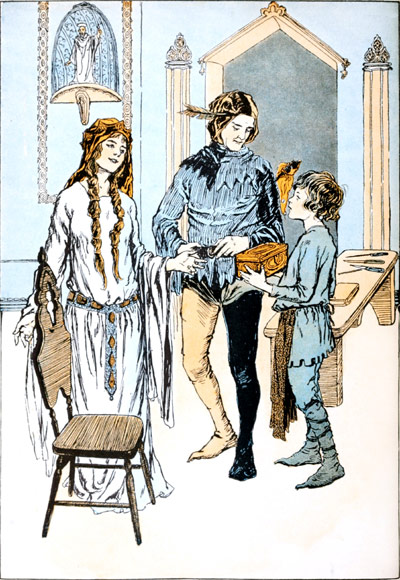
 “‘AND THERE GOES WHAT WOULD SEAT THE KING OF ENGLAND ON
THE THRONE OF THE CÆSARS,’ QUOTH TOMASO”—Page 291
“‘AND THERE GOES WHAT WOULD SEAT THE KING OF ENGLAND ON
THE THRONE OF THE CÆSARS,’ QUOTH TOMASO”—Page 291
“How goes the work, lads?” she asked, and then caught
Alan by the shoulder, crying, “No need to answer. I know
by the face on thee. What hast been doing to make it shine
so?”
“Only finished a piece o’ work, mother,” said Padraig with
a grin. “It takes some men a long time to do that. If they
would bide just this side of a masterpiece they’d save ’emselves
trouble. But they will spend all their force on the last step.”
“Aye,” said Alan, “better leap clean over the Strid while
you’re about it.”
And for once Padraig had no more to say.
Oddly enough Brother Basil also thought of the Strid that
night—the deep and dangerous whirlpool in the grim North
Country had haunted him ever since he saw it. He and
Tomaso came back, after dark, to the crypt, and spread out
the torn manuscripts by the light of two flambeaux in the
wall. None of the pages were whole, and the script was in
Latin, Arabic, Greek and Italian, and not all in the same
handwriting. Both believed that in searching the heap for
secrets of their arts they had stumbled on something dangerous.
“I believe I know where these came from,” Tomaso said,
when they had patched together three or four pages. “They
are part of the scripts of Archiater of Byzantium, who was
taken for a wizard in Goslar ten years ago. I thought that all
his books were burned. There was talk enough about it.”
“But what are these prescriptions?” asked the monk, puzzled.
“You would know by this time,” said the Paduan grimly,
“if that flame-crested imp of yours, Padraig, had been the one
to experiment. By following the directions on this bit of
vellum he might have blown us all into the other world.
Luckily only three of these formulæ are of that nature. The
others are quite safe for your young disciples to play with.
But these we will keep to ourselves.” He laid a stained
brownish piece of sheepskin apart from the others and two
smaller ones beside it. “These are directions for the manufacture
of aqua regia, Spanish gold, and something which
Archiater called Apples of Sodom. Of a certainty they are
fruit of the Tree of Knowledge, those apples.”
Brother Basil had lost color. This really was a trifle too
near necromancy to be pleasant. Spanish gold was a Saracen
invention, said to be made of most unholy materials, and
he had heard of a wizard being carried bodily off on the wind
after dealing in the others.
“We will carry on our experiments,” Tomaso continued,
“in the cellars of my tower, if you please. The young ones
will be only too glad to be rid of us. If any one meddled
here we should risk all we have done and the lives of our
pupils. If we make any blunders working by ourselves—well—I
sometimes think that I have lived a long time already.”
The disciples were too well trained to ask any questions,
but they were somewhat mystified by the proceedings which
ensued. An underground chamber straitly walled in with
masonry was fitted up, and the smells that clung to the garments
of Brother Basil when he emerged were more like brimstone
than anything else. Tomaso was never seen at all.
Meanwhile the newly discovered formulæ for glass and enamel
work had been turned over to the workers in the glass-house,
with permission to buy whatever material was needed. Padraig
and Guy went to London, and came back with precious
packets of rare gums, dyes, minerals, oils and salts, not to be
found or made at the Abbey.
Meanwhile the monk and the physician worked with absorbed
intentness at their crucibles and stills. There was a
slight explosion one evening, and a country lout of the neighborhood
told of it. Next day a neighboring farmer ventured
to ask Padraig what was going on in the ruined tower.
“Why,” said Padraig soberly, “we are raising a brood of
hobgoblins for the King. Did ye not know?”
The making of sulphuric acid, nitric acid and their compounds
would have been risky business in any age, with the
primitive apparatus that the two investigators had. They
were furthermore made cautious by the fact that they did not
know what might happen if they made the least error. It was
midnight after a long and nerve-racking day when they became
satisfied that they had the secrets of at least three perilous
mixtures in the hollow of their hands.
“I think the King would give seven such chests as the
one he sent, if he knew what we know,” said Brother Basil
musingly.
“He has the value of that chest already, in the rose window
and the great window, the monstrance, the chalice and the
cups,” Tomaso answered, his sense of money values undimmed.
“They are as good in their way as Limoges itself can do.”
“I wish that we had tidings from London,” said the monk
thoughtfully. “If Lombardy loses in this war the Emperor
will not stop there. He has said that he will obey no Pope
on earth, only Saint Peter and the others in heaven. He is
neither to hold nor to bind, that man.”
“Henry does not want to fight—that is certain,” said Tomaso.
“He desires only to keep for his children what he has
already—Anjou, Normandy, Aquitaine; and most of all England.
It would take a greater than the Conqueror to rob the
Plantagenets of this kingdom.”
“What do you think will happen in Lombardy?” asked the
other.
“The League of Lombard cities will fight to the death,”
said Tomaso quietly. “The Communes are fighting for their
lives, and cornered wolves are fierce. Neither Sicily nor
France is on Frederick’s side, although they may be, if he
wins. If he can get Henry the Lion of Saxony to fight under
his banner, it may turn the scale.”
“And Henry the Lion married our Henry’s daughter Matilda,”
said Brother Basil. Tomaso nodded.
“Without Saxony,” the Paduan added, “I know that not
more than two thousand men will follow Barbarossa into
Italy, and not more than half are mailed knights. The Lombard
army is more or less light cavalry and infantry. Here
in this cellar we have such weapons as no King has dreamed
of—blazing leaping serpents, metal-devouring and poison-breathing
spirits, pomegranates full of the seeds of destruction.
These—in the hands of the Communes——”
“Would turn Christendom into the kingdom of Satan,”
said Brother Basil as the physician paused. “If we were to
give the secret to Henry’s clerks, or even if we ourselves
handled the work in London Tower, how long would it be
before treachery or thievery carried it overseas? Are we to
spread ruin over the world?”
“I thought you would see it as I did,” said Tomaso smiling.
The ground vibrated to the tread of hoofs, and a horn
sounded outside the window.
“That is Ranulph,” said Tomaso. “I thought he might
come to-night. He will have news.”
As Ranulph came up the path, travel-dusty and weary,
lights twinkled out in the Abbey and the Abbey Farm.
“The Emperor has lost,” said the troubadour. “There
was a battle at Legnano, and the German knights scattered
the Italian cavalry at the first onset, but when they met the
infantry massed about the Carocchio they broke. The Emperor
was wounded and fled. Without Henry of Saxony the
battle was lost before it began. They say that there will be
a treaty at Venice. The Communes have won.”
“Come here, my son,” said Tomaso, turning back into the
tower. “We have found an armory of new and deadly weapons.
You have heard of Archiater’s apples? We can make
them. Shall we give the Plantagenets to eat of the Tree of
Knowledge?”
Ranulph’s eyes darkened and narrowed. His quick mind
leaped forward to the consequences of such a revelation.
“No,” he answered. “Too much evil ambition lives among
Normans. It might be safe with the King—and maybe with
Richard, for he loves chivalry and knightly honor—but John
loves nothing but his own will. Let us have peace in Christendom
while we can.”
“Shall we burn the parchment then?” asked Brother Basil.
“Nay—keep it in cipher. Let a few trusted men know the
key.”
“We will trust our lads,” Brother Basil said. “Let us ask
them.”
Alan and Padraig, Wilfrid, Guy, and David, came up
the path. Brother Basil explained the discovery. They had
already heard the news of the Lombard victory from Giovanni,
who had ridden with the troubadour and stopped at the Abbey
Farm.
“What shall we do with these mysteries?” Tomaso asked,
holding out one of the deadly little grenades. “You must
remember that some one else may find out the secret without
our help. It is true that the man who did would risk being
burned for a wizard in some places; still, there is little that
men will not dare in the search for knowledge.”
“Let them find it out then,” spoke Padraig in sudden heat.
“We have had enough of war in our time. Let us kill this
cockatrice in the egg.”
“These would pay some debts,”—Alan’s hard young North-country
face grew stern. He was thinking of tales which
Angelo had told him in his boyhood.
“God can pay debts without money,” said Brother Basil
gently.
“We are not ready,” Guy averred. “We need time to train
men and to let the land breathe. After that it may be safe
to use the secret—not now.”
“That cat’s best in a sack,” David commented shrewdly.
“Padraig is right,” said Wilfrid. “We have had enough
of war in our time. We will keep this monster prisoned.”
They came to an agreement. Padraig was to make copies in
cipher of the formulæ. After ten years, or on his deathbed
should he die within that time, each might give the master-words
and the rules to some comrade who could be trusted.
They were all to swear never to use their knowledge for gain,
or ambition, or vanity, but for the good of their craft, the
glory of God and the honor of the land.
“Before we destroy that which we have made,” said Brother
Basil, “we will show you in part what it can do.”
Metals dissolved like wet salt. Wood and leather were
bitten through as by gnawing rats. A fire was kindled on the
old tower, and a cone-like swarm of giant wasps of fire went
spluttering and boiling up into the darkness. The apples of
Sodom were planted under a troublesome ledge of rock, and
reduced it to rubble.
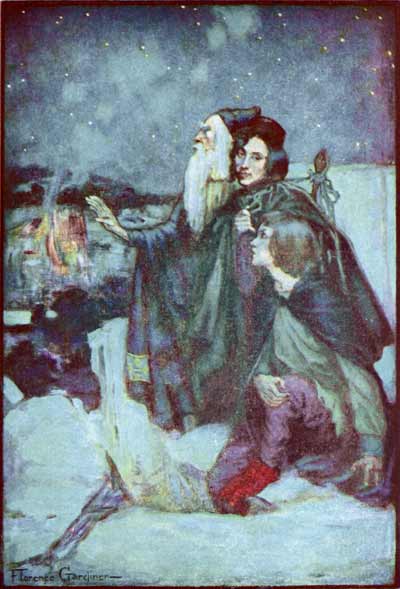
“And there goes what would seat the King of England on
the throne of the Cæsars,” quoth Tomaso. The last wavering
flare was dying into the night, and he stood with Ranulph
and Padraig on the top of the tower, under the stars.
“He might have sat there before, if he had chosen,” mused
Ranulph. Padraig was silent. Matteo had fallen beside the
Carocchio, and his heart was sad.
Tomaso laid a hand on Ranulph’s shoulder.
“An empire is a forest of slow nurture, beloved of my soul,”
he said gently, “and it does—not—grow—by—conflagrations.”
Transcriber’s Notes:
The following corrections have been made:
On page 46/47 two paragraphs were joined together.
(He answered, a trifle defiantly, “Perhaps I do.)
On page 239 the quotation marks were moved from the end of
the stanza to the beginning of the next, (Take a chance for
Belphoebe’s fame!) (“They live in Valhalla).
Spelling and pagenumbers in the Tables of Contents and
Illustrations, and in the captions, have been corrected to
match the rest of the book.
Otherwise the original has been preserved, including
archaic, unusual and inconsistent spelling, especially in
the poems, and inconsistent hyphenation.