VOLNA was thoroughly at home in the saddle,
and it was easy to see that she had been
accustomed to horses all her life. She had a perfect
seat; and that firm hand and control which
bring out the best there is in a horse and make him
understand that the master is up.
It was delightful to watch her; and as we kept
at it in that first rattling stretch, I believe that in
the sheer exhilaration of the ride, we forgot everything,
even the unwelcome appearance of the police
agent from Bratinsk.
But neither the pace nor the oblivion could last
for ever, and when we drew rein at the foot of a
hill we came back to a recollection of the load of
our worries.
“Wasn’t that glorious?” she cried, her cheeks
glowing, and her eyes shining, as she stretched
forward and patted her horse’s neck.
“You ride magnificently. How you would
enjoy a run with the hounds in England!”
“I have read about it. I love horses. I can
keep in the saddle all day. I have done it at home.”
Then her face clouded. “How selfish! I had almost
forgotten,” she added.
“We are doing all we can,” I replied. “Are you
sure that the man you saw was that police agent?”
“Could I forget him?”
“You don’t think he saw us?”
“No. He was talking very earnestly to some one.
But I recognized him instantly.”
“I’d give something to know what brought him
to Pulta.”
“He was following us, surely.”
“We must hope not. If Michel did his work
properly, my horse with your uncle’s coat will have
been found a good many miles on the other side of
Bratinsk; and his men should be hunting for
us there. But I can’t say I like the look of the
thing.”
“What shall we do?”
“We’d better try and think what he’ll do. I
had intended to take the hint which the man at
Pulta dropped, to ride to Solden, and take the train
from there. But if the other man picks up our
trail there, he’ll set the wires going and we shall
find some one waiting for us at Solden.”
“How far is it to Cracow? Could we ride all
the way? I could ride all day and all night too, if
necessary, as long as the horses will last out.”
“We don’t know the road. I don’t even know
where we are now. When you saw that man, I just
rattled off at hazard. I know Cracow is pretty well
west of Pulta, a little bit south too, and I guess
we are on the right road. I am accustomed to take
long rides and besides having a fairly good bump of
location, always carry this;” and I showed her a
small compass on my watch chain.
“I always ride by the sun, but then I know the
country round Warsaw for ever so many miles.”
“We should be in a pretty pickle if we were
lost,” said I.
“The pickle would be much hotter if it was a
police preserve.”
“By Jove, it would. And the worst of it is that
if that fellow hears of us at Pulta, he’ll know the
names we’ve taken.”
“Poor Bob, I’m getting him into very troubled
waters.”
“It’s not Bob or Peggy I’m thinking of, it’s
Volna, and Volna’s mother. Cracow seems a
mighty hard place to reach; but I’m going to get
there somehow.”
I was silent for a while thinking over the problem.
Volna’s suggestion was the best if we could do it—to
ride all the way to Cracow. But it was no light
undertaking. If I had known the way, I should not
have hesitated; but the days were short and
although the sun was shining brightly enough then,
the weather looked as though it were going to
change. It was warmer; and when a spell of frost
breaks in that country, it generally indicates that
rain or snow is coming. To be lost in a rain or
snow storm would be a very ugly development indeed.
There was moreover the awkward question
whether we were likely to be pursued. On the
other hand to stop at Solden appeared to be even
more risky.
Seeing me thus thoughtful, Volna broke in.
“You are not going to keep anything from me, are
you. Don’t do that, please? Do you think that
man is likely to ride after us from Pulta?”
“That was just in my mind. I should say it will
depend upon how soon he learns anything about us.
He is more likely to trust to the wires.”
“It’s getting very exciting. He may telegraph
ahead and have people sent out to stop us. I suppose
I ought not to say so, but I am beginning to
feel a sort of keen enjoyment.”
“I have made up my mind. We’ll stick to the
horses and avoid the trains. But we’ll try and
mislead any one who may follow us.”
We had already passed several people on the road.
I stopped the next comer.
“Is this the road to Solden?” I asked the man,
evidently a farmer.
“Yes, one of them.”
“Straight road?”
“As straight as roads are in these parts,” he
replied, with a grin.
“I mean do I have to turn to the left or right?”
“You’ll be turning most of the time. You’re
from Pulta, aren’t you?”
“It’s not where I’m from but where I’m going
that concerns me.”
“All right. I know the lady’s horse;” and on he
drove without any more.
“Everybody seems to know everybody else’s
horse about here,” I said. “If it weren’t awkward
it would be comical. We’ll ride on and try the next
man.”
The next was another farmer. A surly Russian
who understood Polish with difficulty and spoke it
unintelligibly. So I thanked him and rode on no
wiser.
Three or four miles later brought us to a village.
“Had we not better get some food here?” asked
Volna. “I will go and buy it, and perhaps can find
out at the same time what road we ought to take.”
So we dismounted, and I waited with the horses.
Presently a priest came by, and bade me good-day
with a smile.
“You have a picturesque place here, Father,” I
said. “What is it called?”
“Kervatje,” he answered, and we began to talk.
I learnt that his name was Father Ambrose, and
after some while he asked, “You are a foreigner?”
“An Englishman. My sister is with me. We
were going to Solden, but I fear have lost the way.”
“Oh, no. Solden lies across the hills there. A
rough road but fairly direct. The only point of
difficulty is just over the brow of the hill where the
road forks. Take that to the right or you will go
astray and might find yourselves in Cracow, after
some forty miles or so, that is——” and he smiled
pleasantly.
“I’ll remember what you said,” I replied, “and
am much obliged to you.”
“It is a pleasure. I have been in England; and
speak English a little. But I read much.” We
then chatted about London and the incidents of his
visit until Volna came up.
“My sister,” I said. As he greeted her I saw
him start and look very closely at her.
“How do you do?” he said in English, to her
complete discomfiture, holding out his hand. I
read her signals of distress and sailed in to the
rescue.
“My sister is unfortunately dumb,” I said.
“How sad,” he exclaimed, throwing up his
hands. Then he looked puzzled. “She bears a
remarkable resemblance to a very beautiful woman
whom I knew in the long ago. Twenty years and
more. She is a Pole, and is now the Countess Drakona.
How very strange.”
“Yes, these chance likenesses are very extraordinary,”
I said, gravely. “Come, Peggy, we
must get on,” I added to Volna, in English, and
put her in the saddle again.
“How very sad,” he repeated, mournfully.
“And yet how clever of her to be able to make herself
understood in buying things.”
“The education of the dumb in England is almost
perfect. Signs are their language, you know,”
I replied, as I shook hands with him and mounted.
He looked after us very thoughtfully, and when
presently I turned, he waved his hand to me and I
saw him walk a few paces and then enter the shop
where Volna had made her purchases.
“I think we’ll rattle on again for a bit. He’s
going to find out that yours is a singular form of
aphasia, and only affects your knowledge of English.
Perhaps he’ll class it as a case for the scientists;
but more likely as one of suspicious ignorance.”
“Who can he be?” asked Volna.
“He gave me his name as Father Ambrose.”
“I have heard my mother speak of him.”
“He spoke of her as a very beautiful woman.”
“And she is still beautiful.”
“And he said how closely you resembled
her.”
Volna laughed. “Bob mustn’t be conventional.
That’s a sort of ball-room dandy’s speech. And no
brother talks like it.”
“Brothers don’t always say all they think.”
“But they keep their thoughts to themselves.”
“I know what I think about my sister,” said I.
She smiled again, and glanced at me. “Don’t
you think I bought a huge parcel, Bob?”
“If we eat all that, it will last us farther than
Cracow. But I know what it means generally, when
a girl goes shopping.”
“Yes, she thinks of things that are necessary.
There are loaves in there for the horses.”
“I never thought of them,” I admitted.
“One of us must think sensibly,” she retorted.
“True for you. But did you find out anything
about the road to Solden?”
“No. A woman served me, and she knew nothing.”
“Well, I found out from the priest. At the top
of the hill yonder the road forks and that to the
left will take us to Cracow, forty miles.”
“I wonder what he is thinking now he knows I
am no mute.”
“Men make all sorts of mistakes, and I shouldn’t
be in the least surprised if he believes we are just—running
away together.”
“Bob! How ridiculous!” she cried, with a
merry laugh, her cheeks aflush. “Let us get on;”
and she shook the reins, and dashed on ahead from
me.
When we reached the forked roads at the top of
the hill I glanced at my watch. It was nearly half-past
three, and we had still forty miles to cover on
an unknown road; it had taken us some three hours
to do about twenty miles in daylight with the horses
fresh—how long would they take to finish the journey
mostly in the dark? I shook my head dubiously
over the sum.
“We’ll ride on a couple of miles or so and then
find a spot for our picnic; but we can’t spare more
than half an hour at the outside.”
Black bread, sausage, and village cheese do not
make an epicurean lunch; but Volna and I had rich
hunger sauce, and were more than satisfied. We
fed the horses while we were eating, to save time,
and in half an hour we were ready for the road
again. There was no longer any doubt that the
weather was going to change. As we mounted
there were very ominous banks of dark sullen
clouds. Rain or snow would fall within a few
hours: but I could only hope it would be rain.
“I fancy we’ve shaken off any pursuit even if
any one started out to follow us,” I said.
“We are going to have some weather, too, that
will help us. I hope Bob doesn’t mind riding in
the wet.”
“You guessed the thought in my mind, eh?”
“No. I’m used to reading weather signs. The
rain never hurts me. I’ve been out for hours in it.
But we shan’t have much for an hour or two, you’ll
find.”
“We’d better make the most of our time then.”
We rode as fast as we dared push the horses in
view of the distance to be covered. I eased my
animal up the hills, and now and again took a spell
of half a mile or so on foot; but despite this, I was
concerned to find that before we had covered
another twenty miles he began to show signs of
fatigue.
Then the storm burst upon us. It was rain, not
snow; but rain in almost tropical force. It would
not have been so bad, had we known the road; but
we had already had to stop several times to make
sure we were going right.
For two hours we plodded through a pelting
storm until I was drenched and feared that Volna
must be in the same condition.
“I wouldn’t care if I could see,” she said once.
It was pitch dark, and we could only go at a walking
pace.
“I shouldn’t care if you were not wet,” I answered,
“though I confess I’d like to know where
we are.”
“I am not very wet,” she said. “My fur cloak
protects me. We shall get somewhere in the end.”
“In England we have a civilized habit of putting
up sign posts,” I grumbled, as we came to another
forked road and I was at a loss which to choose.
“All the roads seem to be twins in this place.”
Which way to choose I could not even guess. I
tried to judge which was the better road; but both
appeared equally bad.
“Let the horses decide,” said Volna.
“Yours is the fresher of the two, and better able
to use his instinct.”
“Yours is much keener to get to a stable,” she
laughed.
I walked mine back a little distance and then
gave him his head. He walked deliberately to the
side of the road, and began to crop the grass.
Volna tried hers then; and he went as far as the
fork where he waited for the other to join him.
Then they both moved on to the left.
“So be it,” said I, and we let them go as they
would.
“It’s not raining so fast,” declared Volna, presently.
“Shall we draw up under a tree and give
them the rest of the bread?”
“It’ll be nice soft food,” I laughed.
“I can wring my cloak, too, and ease the weight
from my horse a little.”
We pulled up under a tree and gave the horses
the bread, munching a crust ourselves, and making
the best of things. Volna’s pluck was inextinguishable;
and she laughed and joked over her plight as
she wrung out the wet.
I struck a match and looked at my watch, and
was startled to find it was nearly ten o’clock.
I told Volna and we started again. The rain was
much less and the darkness had lifted somewhat;
but I led my horse now instead of riding.
Presently I felt the road getting suspiciously soft
and grassy, and some minutes afterwards I stumbled
up against a gate which blocked the way and led
into a wood.
There was nothing for it but to go back to the
forked road. To make matters worse, the rain
started again and came pouring down even more
violently than before.
Nor was that the worst. We got off the road
again, and once more were brought to a standstill
by a gate.
“It looks as though we were lost,” I said.
“We’ve about reached the bottom of our troubles,
I should think,” replied Volna, still cheery. “But
if the chance offered, I should like to put off the rest
of the ride till daylight. And look, there’s a
light.” She pointed to it gleefully, away to our
left.
We made our way to it with trouble, and found
that it came from the lower window of a small
house.
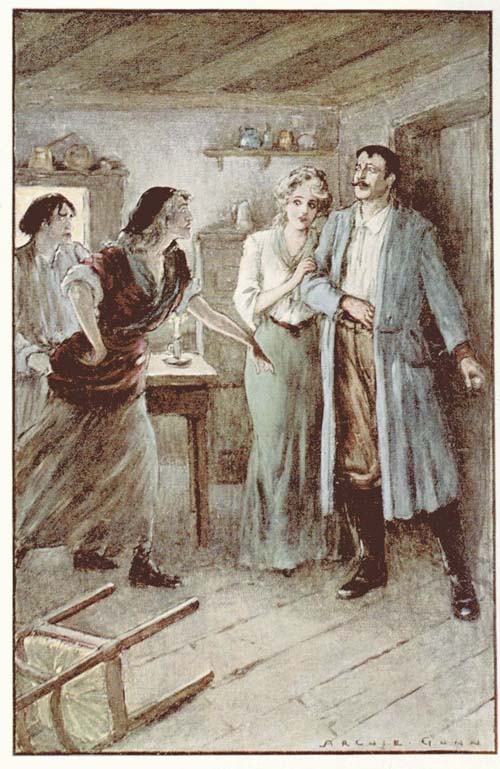
I rapped at the door; and the light was instantly
extinguished.
I had to knock again twice, and then a window
above was opened, and a woman put her head out.
“Who are you, and what do you want? Are
you the police?”
“Police? No. We have lost our way, and want
shelter.”
“There’s no one in the house but me. How
many are you?”
“Two. Myself and my sister. We can pay you
well.”
She drew her head in for a minute, and then
looked out again and said. “Are you sure you’re
only two? Let’s see you.” We stood back that
she could do so. “I’ll come down,” she said.
When she opened the door the light she held
revealed to me one of the most forbidding faces I
have ever seen on a woman’s shoulders.
“You’ve got horses, have you? You must stall
them in the shed.”
She handed me a lantern, and Volna came with
me. When we had fumbled our way to the shed,
and tied the horses up, giving them some hay we
found in the place, we went back to the house.
She admitted us without more delay and as soon
as we were inside, locked and bolted the door. “A
lone woman needs to be careful,” she said in explanation,
as she led us into a room at the side
where a fire was burning.
Two glasses and a spirit bottle were on the table,
and a smell of rank tobacco smoke hung about the
place.
Volna went in first, and the woman, having placed
the light upon the table, stood holding the door for
us to pass.
“We are much obliged to you,” I said, and as I
turned to her I caught sight of a man’s face peering
through the half closed door of a dark room across
the passage.
“I’ll do my best for you,” she answered. “Dry
yourselves by the fire. I’ll be back in a moment.”
With that she went out, and I heard her turn the
key softly upon us.
It might mean nothing; but—well, I did not tell
Volna.