| Approaching Marin's Shores |
Frontispiece |
| Title sketch |
1 |
| One of the Commodious Ferry-boats |
1 |
| The Ferry Landing |
2 |
| Main Street, Sausalito |
3 |
| Sausalito Residences |
4 |
| The Club House, Sausalito |
5 |
| The Son of the Renowned Captain |
7 |
| A Typical Roadway |
8 |
| A Reminder of Rhineland |
9 |
| A Hillside Road |
10 |
| Hillside Gardening |
11 |
| O'Connell's Seat |
12 |
| Daniel O'Connell |
13 |
| A Windblown Tree |
14 |
| Fissures of the Cliffs |
15 |
| Nearing the Point |
16 |
| Fishing Boats |
17 |
| The Derrick Wharf |
19 |
| Point Bonita Lighthouse |
20 |
| Overlooking the Fog |
21 |
| The First Fog Signal |
22 |
| Angel Island |
23 |
| The Departing Day |
23 |
| Mt. Tamalpais from Mill Valley |
25 |
| The Powerhouse |
27 |
| An Electric Train |
27 |
| A Relic of the Past |
28 |
| Mill Valley Depot |
29 |
| The Three Wells |
30 |
| The Cascade |
30 |
| The Old Mill |
31 |
| Like the Mikado's Realm |
33 |
| A Reminder of the Toriis |
34 |
| Some of the Quaint Lamps |
35 |
| The Dining-room at Miyajima |
35 |
| A Creek in Summer |
36 |
| In the Hayfield |
36 |
| "The Outdoor-Art Club" |
37 |
| What the Club is Trying to Prevent |
38 |
| The Mountain Train |
39 |
| Through the Redwoods |
39 |
| Turning the Innumerable Curves |
40 |
| From the Crest of Mt. Tamalpais |
41 |
| The Marine Observatory |
43 |
| The Tavern |
43 |
| The Bow-Knot |
44 |
| A Wireless Telegraphy Station |
45 |
| The Bolinas Stage |
46 |
| Bolinas Bay |
46 |
| A Glimpse of Bolinas |
47 |
| Flag Staff Inn |
48 |
| Sand Dunes |
49 |
| The Breakers |
49 |
| The Oil Well |
50 |
| Where Don Gregorio Died |
50 |
| Thad Welch's Cabin |
51 |
| Duxbury Reef |
53 |
| The Lone Tree |
54 |
| Thad Welch at Work |
54 |
| Among the Redwoods |
55 |
| Primal Solitudes |
56 |
| In the Canyon |
57 |
| Angel Island from the Mainland |
58 |
| The Tiburon Depot |
59 |
| "The Tropic Bird" |
60 |
| In the Cove |
61 |
| Belvedere |
63 |
| An Artistic Church |
64 |
| Unloading Codfish |
65 |
| Drying Codfish |
66 |
| San Quentin |
67 |
| Point San Quentin as seen from Mt. Tamalpais |
68 |
| Lagunitas, San Rafael's Water Supply |
69 |
| Trolling on the Lake |
70 |
| A Marin Landscape. (From the original by Thad Welch) |
71 |
| Mt. Tamalpais from Ross Valley |
73 |
| A Home in Ross Valley |
74 |
| A Shaded Avenue |
75 |
| Dress Parade, Hitchcock Military Academy |
76 |
| Theological Seminary, San Anselmo |
77 |
| Dominican Convent |
77 |
| Court House, San Rafael |
78 |
| Escalle Vineyard and Winery |
79 |
| "Fairhills" |
81 |
| Fourth Street, San Rafael |
82 |
| Entrance to Hotel Rafael |
83 |
| Hotel Rafael |
83 |
| The Late Owner of the Olompali |
84 |
| The Last of the Race |
85 |
| A Wood Interior |
87 |
| Summer in the Redwoods |
87 |
| A Charming Drive |
88 |
| Browsing |
89 |
| A Characteristic Stream |
90 |
| Relics from a Shell Mound |
91 |
| Haying Time |
92 |
| Apple Picking in Marin |
93 |
| Cheese Industry |
95 |
| Young Heron |
96 |
| On the Marsh |
97 |
| R. H. Hotaling's Residence on "Sleepy Hollow Ranch" |
98 |
| The Taxidermist of Marin |
99 |
| A Quail's Nest |
100 |
| A Humming Bird's Nest |
101 |
| Little Songsters |
101 |
| A Sportsman |
102 |
| Near to Nature's Heart |
103 |
| A Bend in the Road |
105 |
| One of the Sparkling Lakes |
106 |
| Shafter Lake |
107 |
| On the Shore of Shafter Lake |
108 |
| Entering Bear Valley |
109 |
| The Country Club |
109 |
| Among the Ferns |
110 |
| At the Trough |
111 |
| Nearing Tomales Bay |
113 |
| Tomales Bay |
114 |
| Church of the Assumption, Tomales |
115 |
| Feeding Time |
116 |
| Chicken Ranches in Marin |
117 |
| Defacing Nature |
119 |
| Dairying on the Edge of the Pacific |
120 |
| In the Pasture |
121 |
| Going Home |
122 |
| A Marin Ranch |
123 |
| Sir Francis Drake |
125 |
| A Bay of Solitude |
126 |
| Drake's Bay |
127 |
| A Bit of Rocky Shore |
128 |
| Marin Cows |
129 |
| Drake's Cross |
131 |
| A Rugged Coast Line |
132 |
| Point Reyes |
133 |
| Point Reyes Life Saving Station |
134 |
| Plowing in October |
135 |
| "The Warrior Queen" |
137 |
| The Lighthouse |
138 |
| Cloud-Hosts |
138 |
| Where the Waves Break |
139 |
| The Glory of the Dying Day |
140 |

In Tamal Land
To the average tourist there are few states in the Union
which offer more attractions than California.
Though its mild climate, fertile valleys, and scenic
beauties are counted among its chief assets, still they are not
its sole possessions, for, linked to the present great commercial
activity of the Pacific Coast is a chain of picturesque events,
clustered about its birth and infancy, which lends to the whole
a peculiar charm, giving it a distinct individuality.
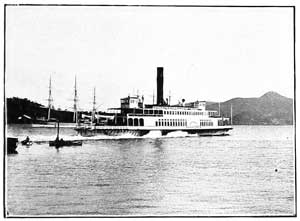
One of the Commodious Ferry Boats.
While the footsteps of the Spaniards grow fainter and
fainter as they glide away into the corridors of time, and their
traces become gradually assimilated by the progressive and oft-times
aggressive Yankee, nevertheless the echoes from that
former non-progressive splendor float back to us, and history re-animates
the
old adobes,
breathing into
a few secluded
valleys
the spirit of
the past.
As the seat
of historic interest,
Monterey
has received
more
homage than any other county on the Slope. Tourists flock to
pay court to her old landmarks, writers eagerly pore over her
time-worn archives, and the wielders of the brush have congregated
in such numbers as to form an artists' colony. Though
Monterey is undoubtedly justified in carrying off the palm for
her many attractions, yet it is but fair that she should divide
the honors of the past with her sister counties, being content to
reign as Sovereign of the Coast.
Skirting the Northern end of San Francisco Bay is one of
the smallest and most picturesque counties of California.
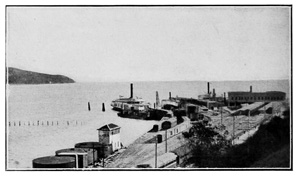
The Ferry Landing.
As a tiny gem in a coronet appears insignificant when contrasted
with the other stones in point of size, but when viewed
alone is admired for the diversity of its coloring and rare
quality, so Marin, when measured by acres, appears insignificant,
but when estimated by the beauty and diversity of its
scenery stands unique, apart, alone.
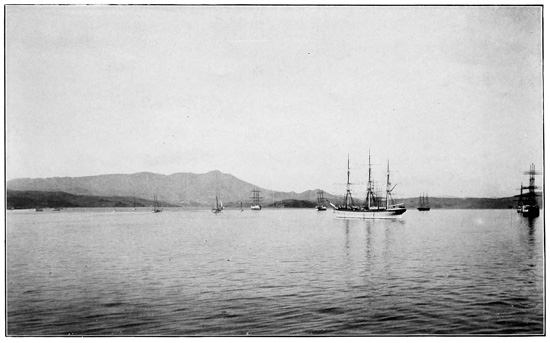
As we approach Marin's shores, after a half hour's ride
across the Bay on a commodious modern ferry-boat, our first
thought on nearing the land is its remarkable similarity to an
Italian settlement. For surely this town, situated on the steep
hillside, is a counterpart of many an Italian hamlet, which,
clinging to some abrupt cliff or bluff, seems to defy nature by
its occupancy.
The clear blue of the California sky overhead but added
to the illusion, although upon closer approach it was gradually
dispelled by the modern American houses in place of quaint
Italian structures.
Leaving the Depot we passed an attractive little park, well
kept and gay with flowers, and a walk of a few moments
brought us to the most historic part of Sausalito.
Though not in the section designated "old Sausalito," still
it is the oldest in memories, for it was here that John Read,
the first English-speaking settler in the County, came in 1826,
erecting near the beach a crude board house. While waiting
for a land grant from the Mexican Government, Read lived
here.
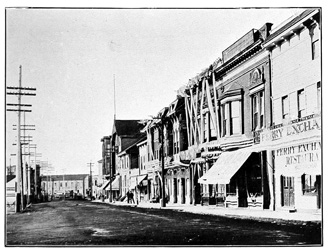
Main Street, Sausalito.
Being of an ingenious turn of mind and having a practical
nautical knowledge, Read set about constructing a sail boat,
which he subsequently plied between Sausalito and San Francisco,
carrying passengers. This was the first ferry boat on
the Bay and when we contrast the little sailboat making its
periodical trips across a solitary Bay with the present ferry
craft, passing on their route ships from every quarter of the
globe, a mere three score of years seems short for such a
change, and proves what can be accomplished by Anglo-Saxon
energy and enterprise.
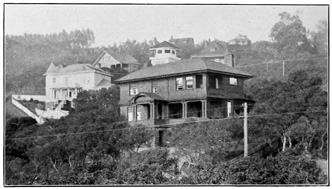
Sausalito Residences.
Upon receiving his grant for the Rancho Corte Madera del
Presidio, lying north of Sausalito, Mr. Read moved there in
1834.
A few hundred yards back from the beach, in what is now
called "Wildwood Glen," was the first adobe house built in
Sausalito. Only a few stones now mark the spot on which it
stood, and a solitary pear-tree, gnarled and knotted with age
stands a living witness of peace and plenty and decay. For it
was in the bountiful days preceding the great influx into
California by the Americans that Captain William Antonio
Richardson, an Englishman but lately arrived on a whaling
vessel from "the Downs," made application, and was given a
grant to the Sausalito Rancho by the Mexican Government. He
soon began building his adobe house and with the aid of the
Indians it was rapidly completed. In the spring of 1836 he
brought his beautiful young wife, formerly the Senorita Maria
Antonia Martinez, to their new abode.
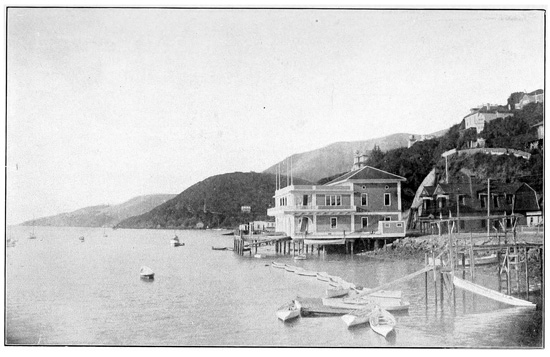
The Club House, Sausalito.
The Senora Maria Antonio was the daughter of Ygnacio
Martinez, for whom the present town of that name in Contra
Costa County was called.
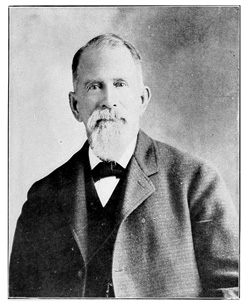
The Son of the Renowned Captain.
Of all the
dreams of
happiness
and love
that filled
the minds of
the youthful
pair on that
fair spring
morning, as
in a small
boat they
were rowed
across the
Bay, by Indians,
to
their new
home, we can
not judge,
but I am sure
their dreams,
however fond, were realized, for it is recorded somewhere
that joy and peace reigned supreme in the little adobe.
However this may be, a young orchard was set out, cattle
were bought and tended and the Senora's clever hands soon
had the walls laden with the sweetest of Castilian roses. A
stream flowed by the house on its way to the Bay, and on
many a bright morning the Indian women of the household
might be seen bending low over the stones washing the family
linen. The stream has long since disappeared, as also the
remnant of the race that washed in its waters—one through
an unaccountable law of nature, the other through the rapacious
greed and oppression of the Anglo-Saxon race.
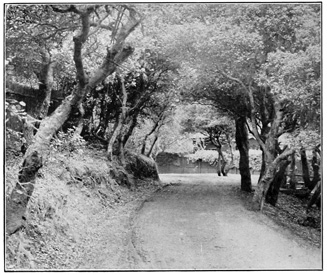
A Typical Roadway.
Owing to the abundance of pure, fresh water found on the
Sausalito Rancho it was shipped to Yerba Buena and the
Presidio. The water was conducted by spouts to the beach,
thence into a tank on a scow, which conveyed it across the
Bay. This mode of supplying San Francisco with water
lasted for some time, until with the increase of population this
primitive means was abandoned.
A tule boat operated by Indians regularly crossed the
Bay for the mail, many of the Indians evincing considerable
skill in navigation under the tutelage of their able master.
Standing beside a heap of stones—historic stones because
the sole remnant of this abode of the past—my glance wandered
to the blue water of the Bay which laps the edge of the glen
and stretches over to the distant hills which descend in gentle
undulations to this beautiful shimmering sheet of blue. And
this Bay, too, speaks of the second settler of Marin, for it
bears his name.
As my glance now fell on the enchanting little glen with its
tangled woodland and steep declivities, and then to the fair
stretches of land that
lay beyond, a sigh of
sadness escaped from
me unawares. I thought
how all this lovely region,
this Rancho Sausalito,
comprising 19,500
acres, as varied and
beautiful as ever nature
put her seal to,
this land, which rightfully
belonged to Richardson
and his descendants,
had been
appropriated by others
through pretext of law
and what not, until the
heirs of the pioneer can
call but a small building
lot their own. Thus
we ever find that
"man's inhumanity to man makes countless thousands mourn."
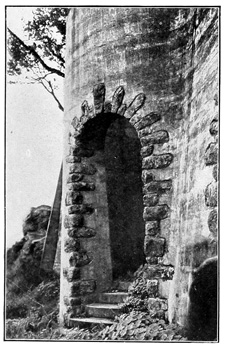
A Reminder of Rhineland.
But the son of the renowned Captain, a hale, hearty old
gentleman, with a pleasant Spanish accent, speaks with calm
equanimity of their loss of fortune, showing not a vestige of
ill-will toward the transgressors, and practicing in full the true
Christian spirit so often lauded but rarely seen.
"Sometimes, it is true, it makes me sad," he once replied, in
answer to my queries, "to think of all the Rancho being gone.
As a boy I used to ride, chasing the cattle, climbing the steep
mountain sides followed by our vaqueros ... and how wild it
was then and so beautiful—so beautiful!" Thus the heir to
all these acres would extol their beauty without more reproach
than that it sometimes made him sad.
Ascending the glen by a winding country road, shadowed
by trees and shrubs, it was not long before we reached a small,
low shingled cottage nestled deep in the shade of tall bays
and buckeyes. A neat sign over the door bearing the inscription
"O'Connell Glen," met our gaze, and then we knew that
this little cottage, with its wealth of solitude and humble exterior,
was the former home of the poet, Daniel O'Connell. For
it was in this rural retreat that O'Connell, with his family,
spent many busy, imaginative years.
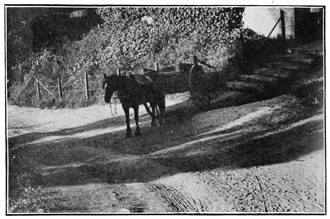
A Hillside Road.
A bohemian of the truest kind, he delighted in what Marin
had to offer. With a stout stick, and accompanied by his
daughters, he would often be seen sallying forth from his rustic
lodge to tramp over hills and through canyons, exploring the
apparently inaccessible, viewing and absorbing the wondrous
beauty of woodland fastnesses, airy heights, and rugged cliffs.
Feeling the very pulse of nature, his poems were the embodiment
of all he had seen and felt, delighting the reader with their subtle
charm and graceful imagery, which were peculiarly the
author's own.
Leaving his favorite retreat and last abode, for it was here
in 1899 that the poet breathed his last, a short walk around the
bend of the hill brought us to another spot, sacred to the
memory of the poet. This is the O'Connell monument which,
as the inscription tells us, was erected by his sorrowing friends.
The monument is in the form of a granite seat, some fifteen
feet in length, fashioned in a graceful, curving crescent. Placed
on the bank above the roadway, it is surrounded by great masses
of bright-colored flowers, and approached by a few stone steps.
The floor is of small, inlaid stones, in the center of which a three-leaf
Shamrock proclaims the nationality of the poet.
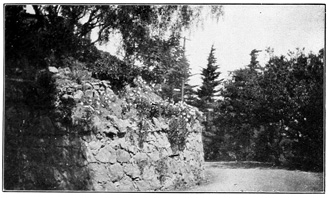
Hillside Gardening.
Besides the name he made for himself, O'Connell came of
illustrious ancestors, being the son of a distinguished lawyer,
Charles O'Connell, and grand-nephew of the great Irish patriot,
Daniel O'Connell.
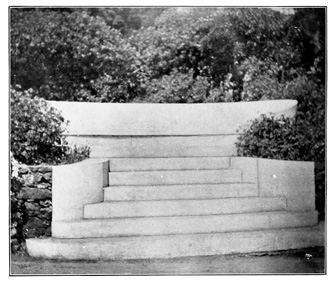
O'Connell's Seat.
On the back of the seat are inscribed these lines, written by
the poet but ten days before his fatal illness, and prophetic of
the long journey he was so soon to take, where, away from the
cares and turmoil of this world, his soul could solve its
remaining problems:
I have a Castle of Silence, flanked by a lofty keep,
And across the drawbridge lieth the lovely chamber of sleep;
Its walls are draped in legends woven in threads of gold.
Legends beloved in dreamland, in the tranquil days of old.
Here lies the Princess sleeping in the palace, solemn and still,
And knight and countess slumber; and even the noisy rill
That flowed by the ancient tower, has passed on its way to the sea,
And the deer are asleep in the forest, and the birds are asleep in the tree.
And I in my Castle of Silence, in my chamber of sleep, lie down.
Like the far-off murmur of forests come the turbulent echoes of town.
And the wrangling tongues about me have now no power to keep
My soul from the solace exceeding the blessed Nirvana of sleep.
Lower the portcullis softly, sentries, placed on the wall;
Let shadows of quiet and silence on all my palace fall;
Softly draw the curtains.... Let the world labor and weep—
My soul is safe environed by the walls of my chamber of sleep.
Turning from these verses to rest on the granite seat, we
were confronted with a view of surpassing loveliness. Our
attention had been so engrossed in examining this monument
to genius that, until then, we had failed to perceive the
commanding situation it held.
Below us stretched the peaceful waters of the Bay; on the
left Angel Island
and the Berkeley
hills, with old Diablo
dimly seen in the
distance; in front,
Alcatraz with its
warlike aspect lay
basking in the sun;
while to the right
the City, with its
many hills and pall
of smoke, could be
plainly discerned.
Truly a fitting spot
for this memorial to
genius.
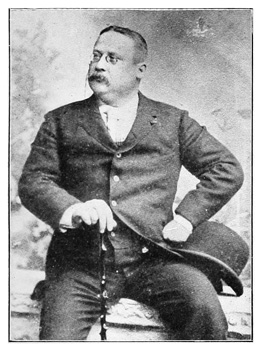
Daniel O'Connell.
Another attractive
feature of Sausalito,
besides its superb
marine view, is its
abundance of flowers. These not only grow in thick
profusion in the quaint hillside gardens, but are planted
beside the roadways, covering many an erstwhile bare
and unsightly bank with trailing vines, gay nasturtiums
and bright geraniums. There is something in the spirit
of this hillside gardening, this planting of sweet blossoms
for the public at large, that is very appealing in these days of
monopolistic greed, when everything that is worth while has a
fence around it. Thus it is refreshing to find a little spot in this
dollar-mad America where the citizens disinterestedly beautify
the public streets for the enjoyment of each passer-by.
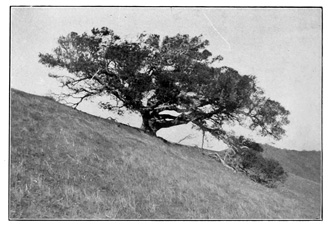
A Wind-Blown Tree.
Owing to the hilly surface of Sausalito, driving is rather a
precarious enjoyment, but there is one drive which, with its superb
marine vistas, amply compensates for the apparent lack
of level roads. With the intention of taking this drive we
procured a team and were soon driven rapidly along the
boulevard skirting the water front, past the San Francisco
Yacht Club, with its medley of white sailboats and smaller
craft bobbing about in the water, and then through old Sausalito
nestled in the gulch. Thence ascending the hill, the
road wound around bend after bend with the Bay ever below
us at a distance of a few hundred feet.
Arriving at a small, shingled lodge beside a gate through
which we passed into the reservation, we soon came upon the
Fort Baker Barracks in the hollow of the hills. It seems as if
Nature, in anticipation of man's conflict with his brother man,
had formed these hills on purpose for a fortification, so well
adapted do they seem for their present use.
Beyond the Barracks, at the base of a cliff, we spied some
small, white buildings clustered on the rocks extending out into
the water. This proved to be Lime Point, and the buildings we
were approaching belong to the Government, constituting a
lighthouse- and fog-signal station. We found it to be one of the
many smaller stations that are distributed along the Coast.
There is a diminutive white light, and a steam fog whistle is
kept ever ready to send out its note of warning at the slightest
approach of the milky vapor which is a terror to the seamen.
Lime Point is directly opposite Fort Point, the distance
being but seven-eighths of a mile, and forms the Northern point
of Golden Gate Strait. While the view from these rocks is
expansive, still it could not be called commanding, as the
Point is too near the sea level to give the height and majesty
requisite for an enchanting
ocean vista.
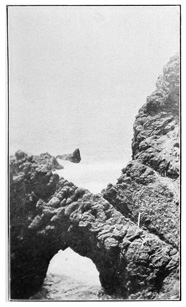
Fissures of the Cliffs.
As a pass is required
before one can go
through the reservation
we retraced our steps to
the Barracks and upon
receiving the passport
from the Sergeant Major,
proceeded on our way
up the steep, winding
road which leads out of
the Valley. Reaching
the summit, the road
continues its circuitous
route; now in sight
of the Bay and City, and
again in among the bare,
rolling hills.
While descending into
a little valley we were
stopped by a number of heavily laden teams, lined up in the
middle of the road. Before we could question as to the delay,
a volley of shots rang out, resounding again and again in the
silent canyons, and a flapping red flag near by plainly denoted
that the soldiers were engaged in target practice.
In reply to our query as to the length of time we should be
required to halt, a soldier on the team in front informed us that
sometimes one had to wait an hour or an hour and a half. Other
teams having lined up behind, a retreat was impossible, and the
prospect of a long wait in the hot sun was not very agreeable.
We learned that a new barracks was in the course of construction
below, in the valley at the head of the Rodeo Lagoon,
and these teams were laden with provisions for the men
stationed there.
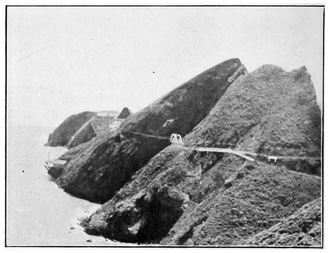
Nearing the Point.
Just as we had composed ourselves for the inevitable,
a brisk waving of red flags was seen in the Valley, followed by
the moving of the cavalcade in front; and, much to our satisfaction,
we soon left our pessimistic informer far in the rear.
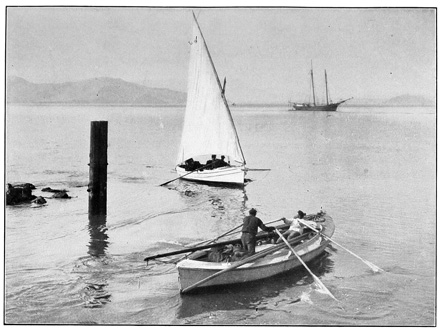
Fishing Boats.
On the most southerly point of Marin a narrow rocky neck
of land extends some distance into the Ocean. At the base are
jagged rocks over which the sea surges ceaselessly, cutting arches
and miniature caves in the fissures of the cliffs. From this
rocky headland, which formerly was a menace and terror to
navigators, now streams a steady light, and the point erstwhile
spelling destruction now proves a blessing to vessels which are
guided safely into port by the aid of its welcome light.
This is Point Bonita and the Bonita Light, which, as we approached,
stood out clear in the afternoon sun.
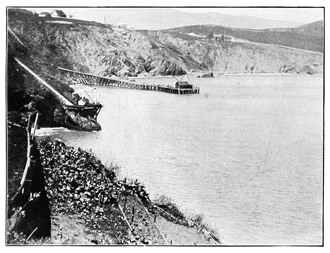
The Derrick Wharf.
Stopping at the lighthouse keeper's dwelling, we proceeded
on foot to the Point, accompanied by the keeper. Pausing in
the narrow pathway, he drew our attention to a small derrick-wharf
for the tender, at the base of the steep cliff on which
we stood. This he explained was where the boat, which touches
here three times a week, lands provisions, oil, and fuel.
"But, how," I asked in astonishment as I gazed down the
dizzy depth, "do you get them up here?"
"Oh, that is very simply done," he responded; "we start
up the engine and they are hauled up the bluff on a tram."
Owing to the perilous windings of the path around an
almost perpendicular cliff a small tunnel has been cut through
the solid rock. As we emerged from this tunnel the Lighthouse
confronted us only a few yards away.
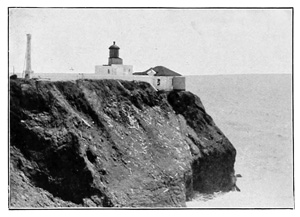
Point Bonita Lighthouse.
The tower containing the light is a square, brick structure
twenty-one feet in height, situated at the edge of the Point
at an elevation
of
one hundred
and
twenty-four
feet.
The Bonita
Light,
although
of second-class
rating,
is so
advantageously
situated that its fixed, white rays are visible seventeen
miles at sea.
The first lighthouse was established here in 1855, the light
being placed in the picturesque old tower still standing higher
up on an adjoining promontory and now serving as a day
signal. The location was unsurpassed, they say, in clear
weather; but when the fog rolled in it was quickly seen that
a great mistake had been made in elevating the lamp, for
often when the light was entirely obscured by a fog bank,
the bluff below would be quite clear, so in 1877 the light was
removed to its present location.
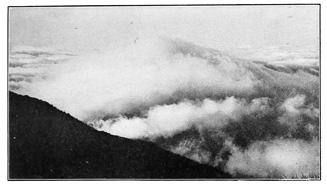
Overlooking the Fog.
An old gun, now rusty, lying beside its gun-carriage on
the bluff, was the first fog signal established on the Pacific
Coast by the government. In foggy weather it was discharged
every hour and a half during day and night.
When we contrast the present steam sirens, blowing five
blasts every thirty-five seconds, with the former primitive
means, we realize a little what scientists and inventors have
been doing these fifty years.
The genial keeper, who is a second cousin of the late Colonel
Robert G. Ingersoll, showed us every nook and cranny in the
place, from the boilers, the lamp, and its appurtenances down
to the neat store-rooms and paint lockers.
Though I have visited many fog-stations before, this one
surpassed all others in its perfect order and scrupulous cleanliness,
reminding one of a well regulated ship. So exactly was
every corner and space utilized, that, as Dickens once remarked
of a steam-packet, "everything was something else
than what it pretended to be."
All the appliances of the Station are in duplicate. Thus,
if one siren becomes disabled, another immediately takes its
place; so with the boilers, etc.
Retracing our steps to the mainland, we noted on the edge
of the cliff near the keeper's dwelling the life-saving station
whose crew do much effective work about these jagged headlands.
Bidding good-bye to the keeper, we turned our backs
on Bonita and started homeward. We had been so engrossed
with the Point and its environs as to be unconscious of the
flight of time, and, noting with surprise the waning afternoon,
we urged our horses to a brisk pace and sped rapidly
along the elevated roadway.
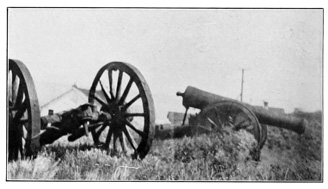
The First Fog Signal.
The sun was slowly approaching the edge of the horizon,
and Bonita, still visible in the West, stood out a silhouette
against a brilliant sky. At its feet lay outstretched the gorgeously
illumined sea; some fleecy golden cloudlets, floating
over the Gate, seemed a soft shower of petals from the State's
fair emblem; while the mellow light of the departing day
still rested lovingly on the loftiest hilltops, and over on the
city side occasional windows reflected his glory, as with a
spot of glistening gold. To the southward the blue misty
tones of the Santa Cruz Mountains began to merge into their
robes of approaching night.
Suddenly out upon the still air rang a deep boom! boom!
Angel Island was rendering her last tribute to the god of day.
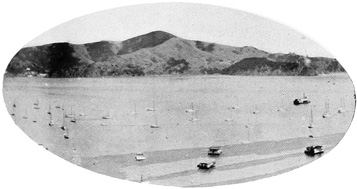
Angel Island.
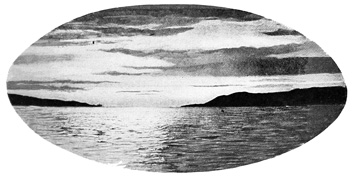
The Departing Day.
Then there came to me those beautiful lines of our own
poet, Lowell Otus Reese:
A touch of night on the hill-tops gray;
A dusky hush on the quivering Bay;
A calm moon mounting the silent East—
White slave the day-god has released;
Small, scattered clouds
That seemed to wait
Like sheets of fire
O'er the Golden Gate.
And under Bonita, growing dim,
With a seeming pause on the ocean's rim,
Like a weary lab'rer, sinks the sun
To the booming crash of the sunset gun.
All over the long slopes grown with green,
With the white tents scattering in between,
The flickering camp-fires start to glow
In the groves of the fair Presidio;
While the solemn chord
Of the evening hymn
Rolls over the Bay
Through the twilight dim
As the flag comes down to an anthem grand,
The brave, old song of our native land,
And Angel Isle, when the song is done,
Booms out "Amen!" with its sunset gun.
Although Marin County was first opened up by the advent
of the North Pacific Coast Railroad in 1875, it was not until
the transfer to the North Shore that the road was operated in
its present modern system.
With the exception of the extreme North and East where
the trains are run by steam, the County is traversed by well
appointed electric trains which combine easy riding with quick
transit.
This was the first electric line in California to be operated by
the third rail system, and it has proved satisfactory in every detail.
Owing to the danger of contact with the third rail, the
road is fenced on both sides, and the rail is concealed at stations.
At the head of Richardson's Bay, and but a short distance
from Mill Valley, is situated the North Shore Powerhouse.
Here the power, which is transmitted from Colgate, over 150
miles away, is stored. Should there be any accident and stoppage
to the power, electricity is generated at the Powerhouse
by steam, which is always kept in readiness.
As I gazed at the three switches, each in its separate vault
(in order to be kept fire-proof) it was difficult to realize that
in the small wires I beheld were centered power to operate
trains, illuminate and run machinery and countless other
utilities.
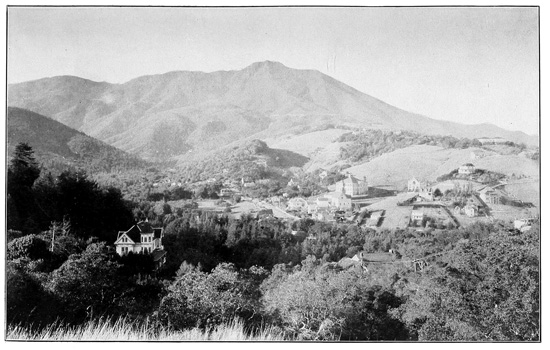
Mt. Tamalpais From Mill Valley.
As this, the greatest motive power in the world to-day,
was long unknown except as an element of destruction, until
the man came who harnessed the lightning and made it do
man's work, so there are still undoubtedly other forces of nature
which but await the master mind to discover their utility.
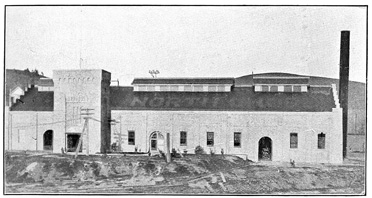
The Powerhouse.
A short distance west of the Powerhouse, on a slightly
elevated mound, is an old orchard whose gnarled trees have
sheltered for a generation and more the yellow adobe walls
of the first settler of Marin.
But the elements of nature with relentless fingers
have played about this relic of the past, until but a small vestige
is left to remind us of what has been.
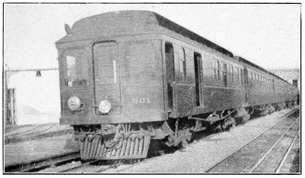
An Electric Train.
When a grant to the Corte Madera del Presidio Rancho was
given to John Read he began building his home, and in order
to construct a large, commodious adobe, he erected a sawmill
in the vicinity, and there the lumber for his home was whipsawed.
Thus, it is this mill, which is still standing in undisturbed
repose these many years, which gave the surrounding valley
its name.
Read had barely finished his adobe when he died, and the
place subsequently passed into the hands of the boldest bandit
of Marin.
The terror of the surrounding counties—whose very name
sent a chill even to the bravest heart—was Barnardino Garcia,
otherwise called "Three-fingered Jack." He possessed all the
daring and bravery of a dauntless marauder, and the anecdotes
of his bloody adventures form many a weird and ghostly tale
when told by the flickering firelight of a winter's night, sending
the listener to bed inwardly quaking, with eyes peering into
dark corners.
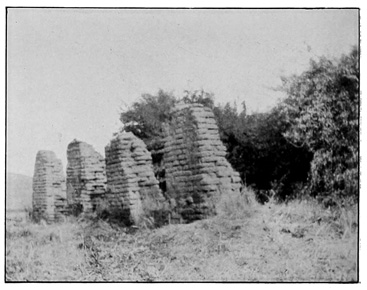
A Relic of the Past.
The most widely known of his crimes was committed
shortly after the raising of the Bear Flag at Sonoma, which
proclaimed the Golden West to be the Republic of California.
The Bear Flag party being short of ammunition and a
rumor gaining circulation to the effect that General Vallejo
had a cache of powder stored on the Sotoyome Rancho near
the present town of Healdsburg, it was decided to send men
to procure some. Cowie and Fowler volunteered to go,
although the journey was known to be a perilous one; but the
need was great, and these pioneers considered it no risk.
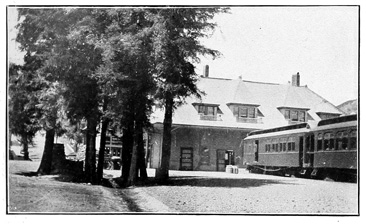
Mill Valley Depot.
They were warned, however, to avoid the way through
Santa Rosa, and to confine their paths to the hills out of the
ken of Garcia and his band.
Whether the Americans failed to heed the warning, or
whether Garcia's men discovered them in the hills, will never
be known. They were taken prisoners, under a pledge that
their lives would be spared, but were finally murdered with
great cruelty.
When Cowie and Fowler did not return to Sonoma within
a reasonable time, great anxiety was felt in the little garrison.
Finally a searching party was sent out, but it soon returned
with news of the murder.
The Bear
Flag leaders
swore
revenge on
the murderers,
and
eventually
captured a
number of
Garcia's
band, although
he
himself escaped.
A fugitive from justice, he journeyed south, becoming
lieutenant to the famous desperado, Joaquin Murietta, only
to be subsequently shot
in 1853 by Captain
Harry Love's Rangers.
His hand of three fingers
was sent as a trophy to
the commandant.
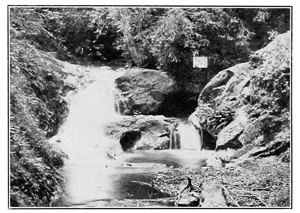
The Three Wells.
Thus ended the career
of this bold adventurer.
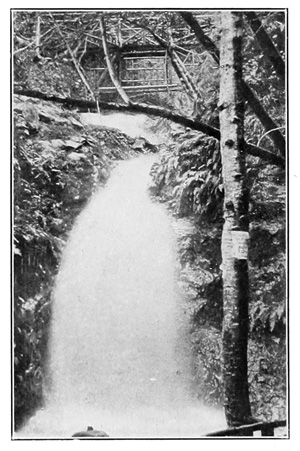
The Cascade.
Though there are
many towns in Marin
which command a more
expansive vista, and
offer by their marine
situation greater diversity
in out-door sports,
still Mill Valley, nestling
at the base of Tamalpais,
has proved a delightful
summer retreat and
home center; for, dotted in the wooded canyons, beside the
streams, or in some sunny exposure may be found many
artistic dwellings which, while possessing the advantages of the
country, are within easy access of the city.
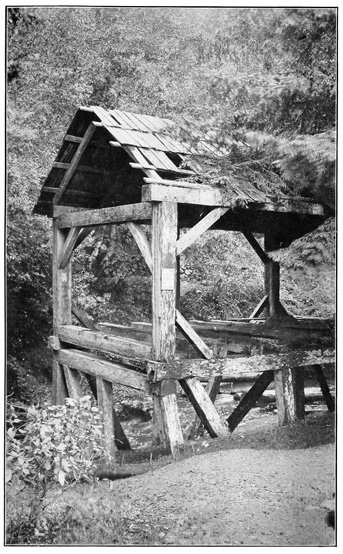
The Old Mill.
The most notable among the attractive residences is the
home of Mr. George T. Marsh.
Stepping within the odd wooden gate, which reminds one
of the "Toriis," or sacred gates of Nikko, the stranger feels
that he has indeed touched a fairy wand, and been transported
to the heart of the Mikado's realm.
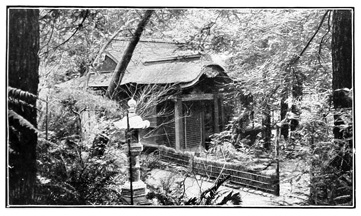
Like the Mikado's Realm.
Liquid streams, spanned by fantastic miniature bridges on
whose banks dwarf shrubs of various kind abound; fish ponds
and islands; quaint metal lamps beside the roadway on their
low posts, that are unique by daylight and when lit add all the
witchery and charm of the floral isle; these and numerous
other features of the Orient come unexpectedly upon the
enchanted visitor, until he forgets the busy commercial activity
of the outer world, and is in fancy again wandering in the
grand old dreamy groves of Miyajima.
Another spot deserving the attention of the visitor is the
quaint Club-House of the Out-Door Art Club. This Club has
been organized by the ladies of Mill Valley for the purpose
of preserving the natural beauties of the town and vicinity
and staying, if possible, the hand of those primitive beings
who, with ruthless vandalism, cut down and otherwise destroy
the most prized of our rural possessions, our noble trees.
Much credit is due these energetic ladies in their worthy
endeavor to teach those who have "eyes that see not" the
wondrous beauties of Nature.
Besides its own unique features, the chief attraction which
draws to this little burg tourists and travelers from all parts,
as by a magnet, is the fact that it is the starting point of the
Mill Valley and Mt. Tamalpais Scenic Railway.
Leaving the station, the mountain train winds through
redwood groves, beside streams and pools, passing on its
route the Hotel Blithedale, founded many years ago by Dr.
Cushing as a sanitarium, so propitious to health is this sheltered,
sunny exposure.
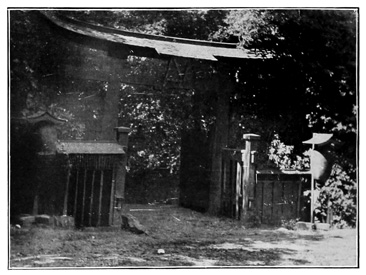
A Reminder of the Toriis.
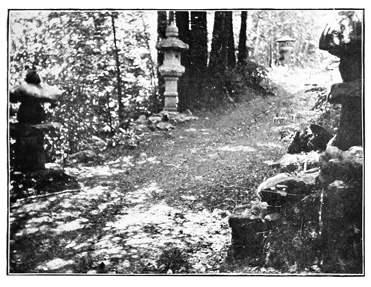
Some of the Quaint Lamps.
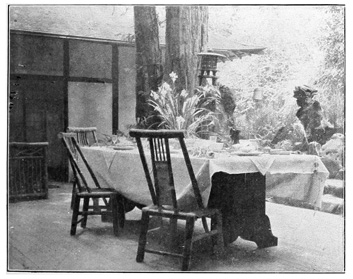
The Dining Room at Miyajima.
The train is operated by a steam-traction engine which
combines the ordinary cog system with an additional contrivance
appropriate for turning curves. As the train gradually
climbs in its serpentine route, and chaparral takes the place of
redwood, the country below begins to unfold; towns appear
in miniature, and hills which on close approach have
distinct characteristics now merge into one another, forming
an unbroken mass which stretches west to the Pacific,
on whose sapphire bosom may frequently be seen the dim
outline of the Farallon Islands, while to the southward Point
San Pedro and the City are visible, and San Francisco Bay
with intricate windings can be seen to join San Pablo and
Suisun bays on the east.
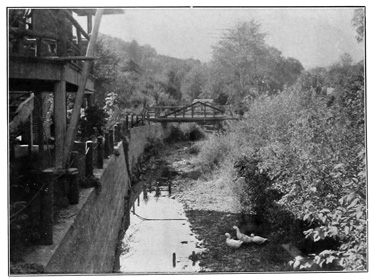
A Creek in Summer.
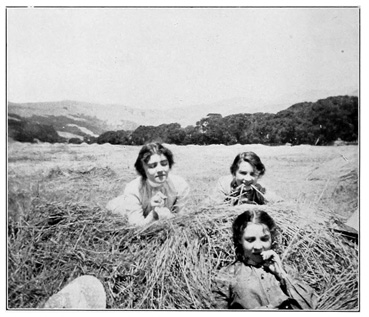
In the Hay Field.
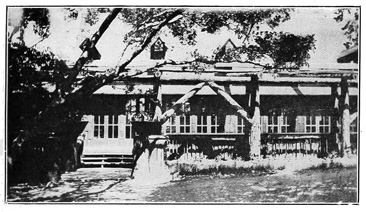
The Out-door Art Club.
It requires many trips to fully appreciate and comprehend
the marvelous diversity of views spread before one, while
the variety of superb effects to be witnessed from this mountain
cannot be found in a single visit.
To watch the wonderful radiance of sunrise when Apollo
mounts in his chariot of fire above the Berkeley hills, or to
see a billowy floor of fog, outspread before one, obscuring
the lower world and leaving naught save this mountain peak
unwrapped by the fog-mantle; and then to witness the pale
light of the moon marking a silver pathway on the Bay, and
casting grotesque shadows on the landscape; and these are but
a few of the beauties garnered here.
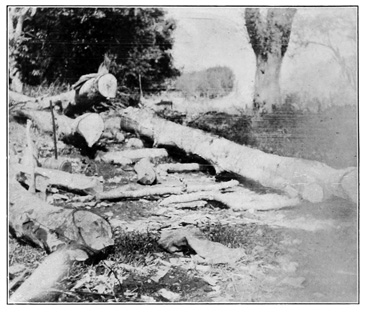
What the Club is Trying to Prevent.
The road which is known as "the crookedest in the world,"
turns innumerable sharp curves, finally twisting into a double
bow-knot and, extricating itself, continues winding its way
up, stopping a few moments at West Point, where passengers
for Bolinas take the stage.
Arriving at the railroad's destination, the Tavern, the
passengers alight to luncheon in its well-appointed dining-room,
or lounge on the spacious veranda, enjoying at ease the
superb views revealed below.
But if the traveller be something of a pedestrian he will
take the zigzag, cleated steps which lead from the Tavern
to the top.
Here the San Francisco
Examiner's Marine
Observatory is located,
whose telescope
is said to sight ships
seventy miles at sea.
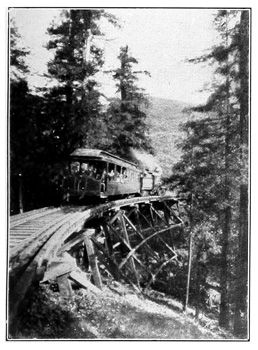
The Mountain Train.
But this is not the
only walk on the Mountain.
Many trails wind
about its sides disclosing
shady nooks, a delightful
cool spring and
countless other surprises,
which are easily
reached owing to the
guidance of artistic
little signs which appear
at short distances
apart, while location rods are placed at intervals on the path
circling the Mountain, enabling the visitor to find the various
points of interest without any difficulty.
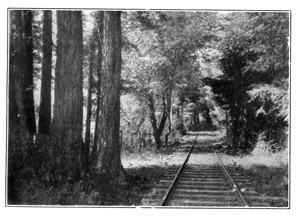
Through the Redwoods.
A few hundred feet from the Tavern is located a Government
Weather
Bureau,
and in its
proximity
is to be
placed the
seismograph
now
being
made in
Strasburg,
Germany,
by order of the Weather Bureau Department in Washington.
The instrument is said to be on a more elaborate
plan than any in this country except the one in Washington,
D. C., of which this will be a counterpart. Some time
is required for its completion, so, presumably it will not be
installed and ready to receive earthquakes until early next
year.
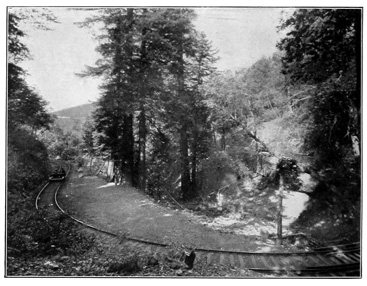
Turning Innumerable Curves.
Descending the mountain on the train to West Point, we
alighted and after lunching at the Inn, mounted the stage
which was bound for Bolinas.
The air on these mountain slopes is most exhilarating,
and as we sped along down the gradually descending roadway,
the breath of azaleas was wafted on the breeze from the
canyons, while at each bend of the road the salt zephyrs from
the Ocean became more perceptible.
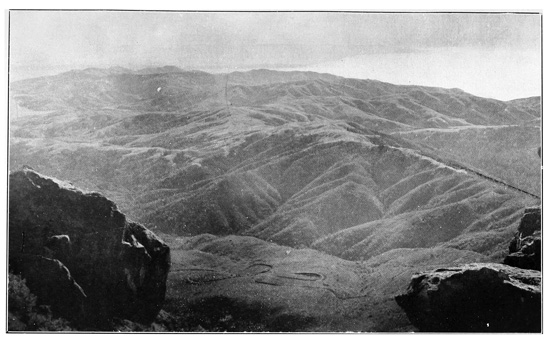
From the Crest of Mt. Tamalpais.
Leaving the Monarch of Marin we soon came in sight of
the white sand-spit with Dipsea, the new resort on the beach,
and the glorious Pacific stretching thousands of miles beyond
the horizon.
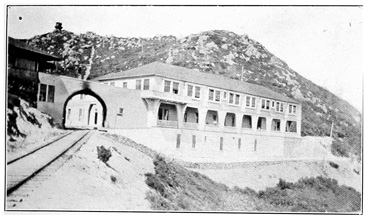
The Tavern.
Alighting from the stage we embarked in a steam-launch
which glided rapidly across the Bolinas Lagoon. Steep,
massive hills encircle the Lagoon on the right, while on the
left, becoming more apparent at each glide of the launch, lies
Bolinas, the town, and our destination.
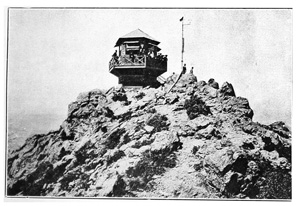
The Marine Observatory.
Owing to its small size and remote location we
expected
the usual
hardships
which accrue
from
a country
hotel and
its numerous
incongruities;
imagine
our surprise
therefore, when arriving at this little town, which is a
stranger as yet to railroads, to find a cozy hostelry awaiting us.
Though unpretentious in appearance, the Flag Staff Inn
proved as orderly and neat as
any of its English prototypes.
Whether it was due to the landlord's
being a Briton or not, I
can not say, but there was undoubtedly
an English atmosphere
about the place, and if
honest Mrs. Lupin or Mark
Tapley had issued from the
porch to welcome us, I should
not have been in the least surprised.
West of the little settlement
of Bolinas a neck of land extends
for a mile and a half out
into the Ocean, the top forming
a mesa. Owing to the fogs
abounding in this region, it is
green almost the entire year and
makes splendid grazing, as in
fact does all the land in the
vicinity.
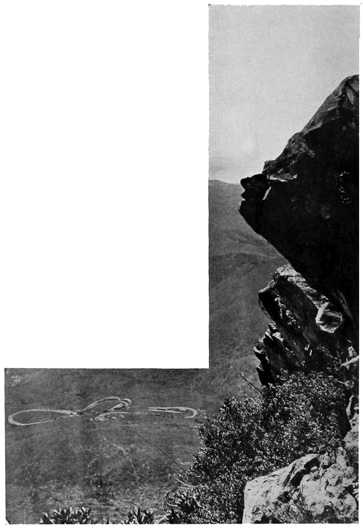
The Bow-Knot.
At the end of the mesa, some oil prospecting was being
done, and at the time of our visit there was one shaft sunk.
Although there are numerous deposits of oil to be found in
and about these cliffs, the output thus far has not exceeded
a barrel a day. Yet who can tell what rich veins may lie
beneath this mesa.
On Duxbury Reef, a succession of small rocks extending
farther out into the ocean, there is said to be found at low
tide gas escaping from the rocks, which, being ignited occasionally
by
fishermen,
does not become
extinguished
until
the tide rises.
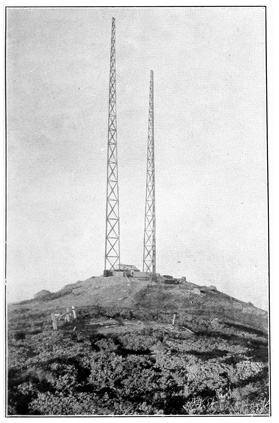
A Wireless Telegraph Station.
At the
other extremity
of
the town is
to me the
most interesting
section
of Bolinas,
for it
was here
that the first
settlement
was made.
The name
Bolinas—then
spelled
Baulinas—is
believed by
some to
signify
stormy
and untamed,
while others
accredit
it to
be the
name of
an Indian
girl.
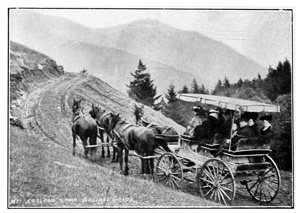
The Bolinas Stage.
Which is
correct
may never
be ascertained. Either is probable; owing to its situation
"stormy" may well apply, and as the Tamal Indians formerly
inhabited this region, and in fact spread over the entire
County, the last theory is equally feasible. To my mind they
are both correct, for might it not have been named for an
Indian maiden called Bolinas, whose nature was as stormy
and untamed as the tempests which often surge about these
headlands?
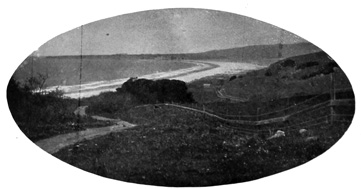
Bolinas Bay.
This Rancho Bolinas first belonged to Rafael Garcia, who
disposed of the grant to his brother-in-law, Gregorio Briones,
of whom tradition says there were few so honest, upright and
brave as this dignified son of Spain, who died respected and
beloved by all who knew him.
It was in the days before the "Gringo" came, when peace
and plenty reigned throughout this land, and hospitality was
proverbial to every household, that Gregorio Briones settled
in Bolinas.
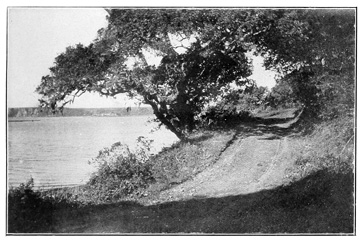
A Glimpse of Bolinas.
To be a skillful horseman and expert vaquero was all that
was then required, for as cattle could live and thrive all the
year round on the hills, there was no necessity for making hay
for winter feed, or building stables for winter shelter; therefore,
with little labor requisite, the natural consequence was
the easy, careless life led by the Californians. Thus their
spare energies were devoted to horse-racing, dancing, gambling,
and kindred amusements.
Horses roamed the hills untethered and a caballero's first
occupation in the morning was to catch a horse, saddle and
bridle it, and either use or keep it tied up at his door during
the day, ready for use at any moment, as both young and
old rarely went from one house to another, no matter how
short the distance, except on horseback.
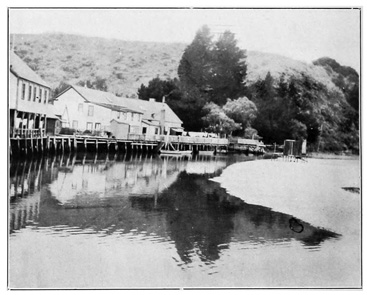
Flag Staff Inn.
As to the riders themselves, there were probably no better
horsemen in the world than the native Californians.
On a fair spring morning in the month of May, 1850, a
single horse, with two riders, might have been seen threading
its way up the steep mountain trail leading from Bolinas to
San Rafael. The bright, girlish face of the first rider peered
wistfully from beneath the soft folds of her mantilla, while
the young caballero, on the crupper behind, whispered to her
in those sweet, melodious tones unheard save from a liquid
Spanish tongue. Of the purport of their whispers we can but
judge, for on arriving at the Mission they were greeted by a
joyous peal of wedding bells.
The groom was Francisco Sebrean, the bride the beautiful
Senorita Maria Briones, daughter of the pioneer. This was
the first marriage in Bolinas and the celebration which followed
their return to the Rancho was the most notable ever witnessed
in that region. Dancing, feasting, music and gayety continued
until the gray dawn appeared to touch the surrounding hilltops
and proclaim
the approach
of another
day.
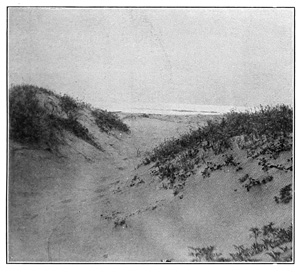
Sand Dunes.
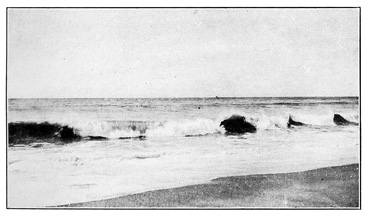
The Breakers.
Stopping at
the home of
the only remaining
daughter of
Don Briones,
now a dignified,
delightful,
old lady,
with the
charming
manners and
graces of a true descendant of old Spain, we procured directions
and soon found the oldest house in Bolinas. Although this
was not the first built there,
it is the oldest standing, and
was occupied by the Briones
family, Don Gregorio dying
many years ago, while his
wife, the Senora Briones,
lived there until 1903, reaching
her one hundred and
seventh birthday—which
goes to prove that it is the
simple, natural life which
begets old age.
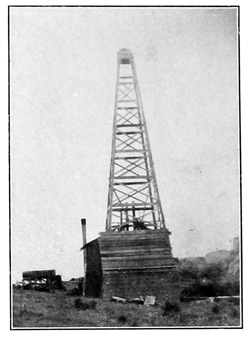
The Oil Well.
If one is a good pedestrian
and has a desire to get
acquainted with nature untamed
"without her hair
combed" he should take the
Lone Tree Trail leading from Bolinas over the hills, through
the canyons and along the ridges back to the starting point,
Mill Valley.
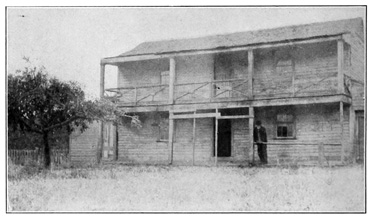
Where Don Gregorio Died.
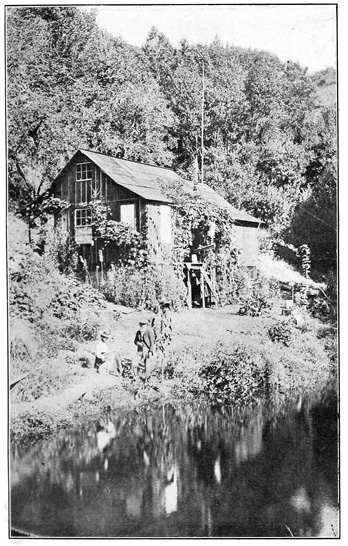
Thad Welch's Cabin.
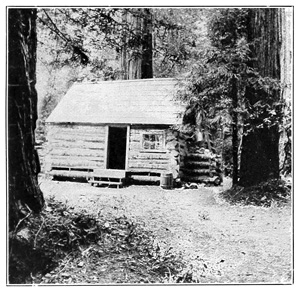
In a little "Steep Ravine" amid the high hills, and but
a short distance from the Ocean and Bolinas, stands the solitary
cabin of the man who by the magic of his brush first
awoke the outer world to a realization of the beauties and
possibilities of this region.
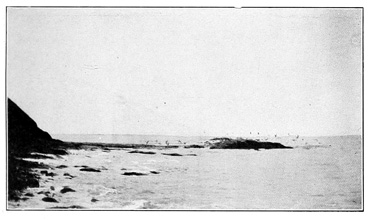
Duxbury Reef.
With the hand of a master, Thad Welch caught the rare
effects abounding here, which have delighted and won the
admiration of all nature-lovers, and linked his name inseparably
with Marin. While at present residing in another
portion of the County, the cabin which he formerly occupied
here is in a state of neglect, but while his little abode may
perish, his pictures will live and be cherished in the ages
yet to come.
Some distance from the Steep Ravine the trail descends
an abrupt, wooded hillside, at the foot of which lies the Redwood
Canyon. For this forest of giant redwoods, comprising
six hundred acres, negotiations were pending toward making
it a national reserve, but the efforts proved unsuccessful. Though
of smaller dimensions than the Calaveras Big Trees, these
redwoods gain by beauty of situation what they lack in size.
The Canyon runs diagonally
with the sea coast and
has its rise in one of Tamalpais'
western ribs, from
which a railroad similar to
the Mount Tamalpais Railway
is under course of construction,
connecting the
Mountain with the Canyon.
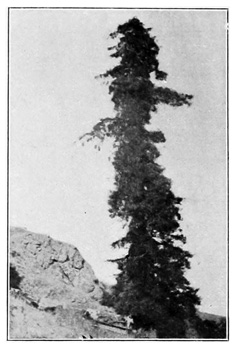
The Lone Tree.
Its present owners,
Messrs. Kent & Cushing,
intend to erect a hotel at
the terminus of the new
road, and the building, on
which it is said will be expended
some fifty or sixty
thousand dollars, will be
a fully
equipped,
sumptuous
modern
hostelry.
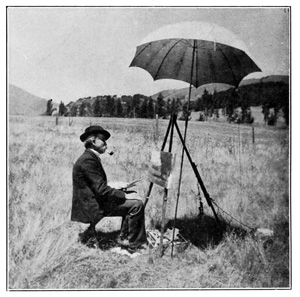
Thad Welch at Work.
It is to
be hoped
that the
march of
civilization,
which
so often
leaves nature's
handiwork
crushed,
broken and
even obliterated, will spare this grand, majestic forest in which
beauty now reigns supreme.
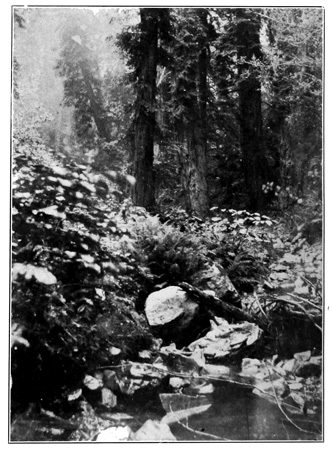
Bending low over the little stream which winds through this
canyon huge sprays of azaleas filled the air with their delicate
perfume; on the banks lacy wood warriors and the hardy
sword-ferns mingled in graceful profusion, while the flickering
sunlight filtering aslant through the tree tops fell on the transparent
hazel leaves lending a soft, green glint to a neighboring
pool which rippled every now and then by the action of numerous
trout
catching flies
on its surface.
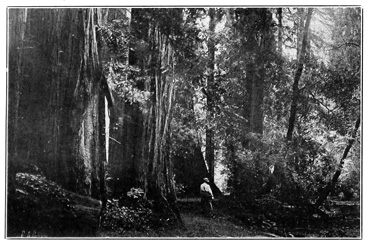
Among the Redwoods.
Wandering
beneath these
perennial
columns,
these huge
monoliths of
whose birth
there is no
record, one
feels as if
treading the
grandest of
cathedral
aisles, and that in truth "The groves were God's first temples"
and "Solitude is the veritable audience chamber of the
Creator."
No echo follows our footsteps on the soft needles and oxalis
and save for the murmuring of the little stream and the occasional
calling of a mourning dove in the tree tops above there is
no sound. Here, alone in these solitudes, the higher self—the
soul—strikes off its shackles, and expands to the very infinitude
of things, through nature to the Infinite.
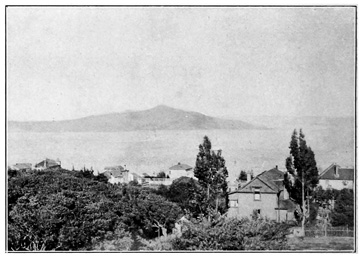
Near the southeastern shores of Marin lies the largest and
most picturesque of the three islands which adorn San Francisco
Bay. Though lawfully a portion of Marin County, Angel
Island, separated from the mainland by Raccoon Straits, besides
being set aside as a Government reserve, is therefore seldom
classed with the County, and usually ranks with her sister
islands, Alcatraz and Yerba Buena.
Primal Solitudes.
But a sketch of Marin, however cursory, would be incomplete
without her southern isle, for besides the United States
Barracks, situated on the western part of the Island, there is
located in a northern cove the Federal quarantine station, that
most necessary adjunct of San Francisco, which prevents contagion
by quenching the pestilence often brought to our shores
from the Orient and South American ports.
Besides its present significance the Island has another and
far older claim on our attention.
In the summer of 1775, Juan de Ayala, a lieutenant of the
Royal Spanish Navy, was given a commission from Junipero
Serra and Bucareli, the Mexican Viceroy, to proceed to "the
arm of the sea" lying north of Monterey, which had been
twice viewed by the padres from the land, to ascertain if it were
a canal or bay, and make a survey of it.
Pursuant to these instructions Ayala cautiously crept up
the Coast and on the ninth day sighted the narrow passage which
is now known the world over as the Golden Gate.
In the Canyon.
A crude launch was sent to explore the opening, which was
found to be deep and without obstructions. By the time the
launch returned it had grown dark, nevertheless Ayala headed
for the Bay and on the night of August 5, 1775, the San Carlos
sailed in through the Strait, the first ship that ever passed the
pillared passage or entered what is now known as the Bay of
San Francisco.
Having entered safely, Ayala moored his vessel just inside
the Bay, and the next morning, looking around him, selected an
island not far from the entrance as a convenient spot to make his
headquarters.
Angel Island from the Mainland.
Upon examination, he found a suitable place for mooring
his vessel, also wood and water in abundance. This Island
was then named Nuestra Senora de Los Angeles, the appellation
which it still bears, though shortened to Angel
Island.
On the mainland, directly across from the Island, lies
Tiburon, the ferry and terminus of the California Northwestern
Railroad. Besides the Company's shops, Tiburon consists
mainly of stores—in short all that is included in the usual
"Water Front."
The most interesting object in Tiburon is on the road between
that place and Belvedere. This is none other than the remains
of a remarkable old hulk, now beached and converted into a
habitation. Besides its unique appearance, there is an interesting
tale connected with the Tropic Bird which is something
like the following:
"Early in the year 1850 the good ship, Tropic Bird, Captain
Homans skipper, set sail from Gloucester, Mass., with a cargo
of general produce bound for the Golden Gate. On board was
a mixed crew, seafaring men and land lubbers, all having but
one hope, one idea—the far-famed gold fields of California.
A good true ship was the Tropic Bird and a good true man
her skipper, who had with him his brother.
"One day is very much like another on a long ocean voyage,—when
the wind holds good and the weather is fair; but
there came a time when ominous murmurings, gathering force
each day, the echo of a mutinous discontent, reached the quick
ears of the young Captain and his brother.
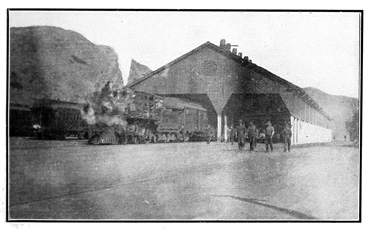
The Tiburon Depot.
"The cargo was a valuable one. They were on the high
seas. If the crew stood together against the two men they were
as nothing in their hands.
"One night the cloud burst, there was a loud cry from the
first mate, and in a second every one was in the scrimmage.
"The Captain rushed on deck. Though light, he was strong
and a famous wrestler. As soon as he appeared he was pounced
upon by the leader of the mutiny, called Dutch Dick, a big,
heavy, slouching fellow. With almost superhuman strength the
gallant Captain disarmed and stunned his foe after a heavy
tussle.
"Men were moaning, yelling, dying on all sides, when suddenly
above this howling, cursing, blood-thirsty mob, there was a
bright, piercing flash, the sharp battalion crack, crack of
thunder.
"The storm was on them. No time now for murder and
rapine. It was a battle against the elements. The Captain was
up roaring orders to his men. Those who could, obeyed and
worked with a will in the common danger.
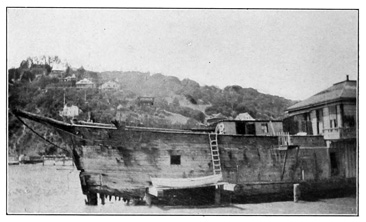
"The Tropic Bird."
"Battered, tempest-torn, thrown hither and thither, a mere
cockle shell in the hands of God's elements, the staunch ship,
skilfully handled by her skipper, just managed to reach the
Golden Gate.
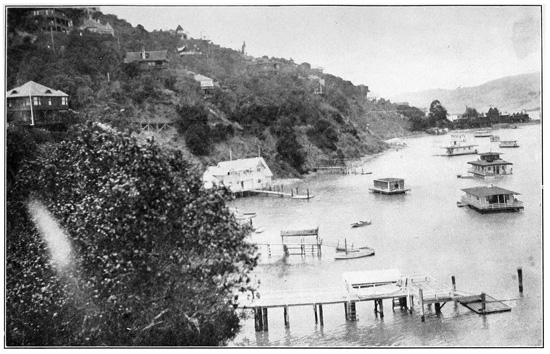
In the Cove.
"Water-logged and mauled, the gallant Tropic Bird was
then unfit to further cope with the elements, and, after being
converted into a boarding house at the foot of Telegraph Hill
by her courageous Captain, she was later sold and beached at
Tiburon, where she now rests, her labors o'er, a worthy ship
with a peaceful, useful old age."
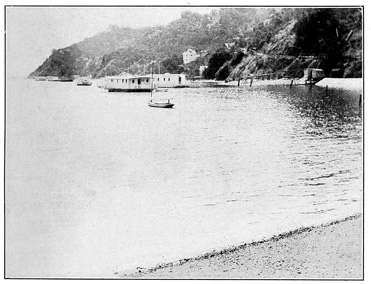
Belvedere.
Belvedere—beautiful Belvedere it is called, and with justice,
too; for who could view this thickly wooded hillside with its
charming villas without exclaiming Beautiful! These villas are
interspersed with graceful irregularity amid their leafy setting;
the sparkling water at their feet, gay in summer, with
house-boats, launches, yachts and other craft is resonant
of one theme, united in one chord—the care-free, happy,
guileless merriment which does more to erase the worry lines
begotten of cities than all the lotions ever prepared. And
this, in truth, is the veritable home of the sportsman, for across
the cove on the Tiburon side is situated the Corinthian Yacht
Club, famous in yachting annals.
However gay this little cove may appear by day it is by
the pale light of the moon that Belvedere, like Venice, is
at her best; for the harsher lines of fact are mellowed, and
imagination gives the floating habitations a fairy aspect, while
the strains of the military band from the Island but lend to
the fantasy.
On the opposite
side of Belvedere
is situated
one of the
most prosperous
industries conducted
in Marin
County.
Nestling at
the base of the
cliffs on an extensive
wharf
built for the
purpose are the
buildings of the
Union Fish
Company. The
Company has
several fishing
stations in
Alaska, the
most extensive
of which are on the Shumagin and Popof Islands. A schooner
plying between the stations and this port brings the fish direct
to the fishery, where they are prepared for use.
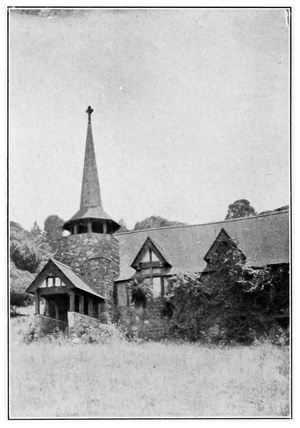
An Artistic Church.
At the time of our visit, the schooner, which had arrived
but a few days previously, was unloading and we were thus
fortunate enough to see the evolution of the codfish from the
time it leaves the hold of the ship until it is packed in neat
boxes ready for shipment.
There were four hundred tons, or one hundred and seventy
thousand fish on the vessel. When one thinks that each fish
is caught by hook and line, the amount of work represented
seems enormous, but this is a mere bagatelle compared to the
process following.
On leaving the hold they are first thrown into vats of brine
for rinsing, then loaded on small cars operated on a track and
run into the building; from thence they are laid on immense
racks in the sun to dry. If not for immediate shipment they
are stored in huge vats of brine.
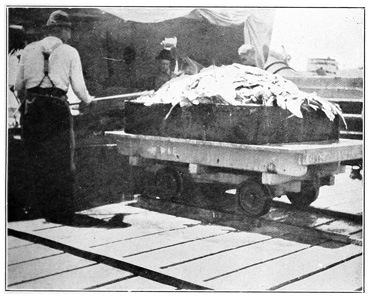
Unloading Codfish.
In one large room there were many men at long tables,
engaged in skinning and boning the fish, and the celerity and
skill with which this was accomplished are marvelous to watch.
The refuse, which formerly was discarded as being useless, is now
utilized, the bones being made into a fertilizer, while the skins
are used for glue.
There are seventy-five men employed in this establishment,
and the order and cleanliness of the place testify to its able
management.
Owing to the inclemency of the weather during the winter
months, a steam-drying apparatus was in the course of construction
by which the fish can be dried with safety in the
rainy season.
Leaving Tiburon, a short ride on the California Northwestern
Railway brought us to Greenbrae, a small station, uninteresting
in itself and unimportant save as the place from which
is reached that huge institution known as the state prison, San
Quentin.
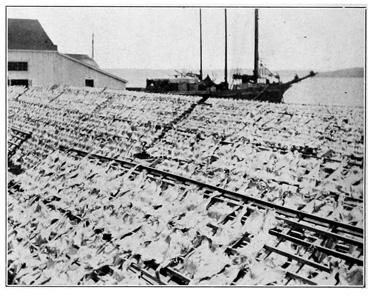
Drying Codfish.
Situated on Point San Quentin, which extends into upper
San Francisco Bay, with round guard towers perched on the
hill overlooking it, and a twenty-foot wall enclosing its eight
acres, the prison would seem impregnable and unpropitious
for an outbreak.
The high somber buildings, which are of red brick, have been
added to and remodeled at intervals without any given plan,
and thus they form an irregular mass, interspersed with paved
courts and narrow cells.
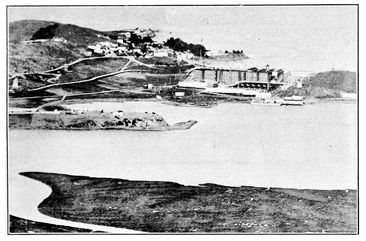
San Quentin.
A large, square plot is devoted to grass and flowers and
lends a cheering tone to the grim structures surrounding it.
One of these, a tall edifice with a succession of iron doors
opening on to small, long balconies, reached by narrow steps, is
called the Tanks.
The average cell in this building is eight by twelve feet in
dimensions. In each of these five men are stowed—one could not
say accommodated for the narrow bunks placed in tiers, with a
still narrower passageway between, vividly suggested the over-crowded
lodging houses of Mulberry Bend, which Jacob Riis's
perseverance eradicated.
In other buildings are cells, each of which is thirty by twenty-seven
feet, which contain twenty-six men, and one cell, of thirty-six
by twenty-one feet, lodges forty-eight convicts.
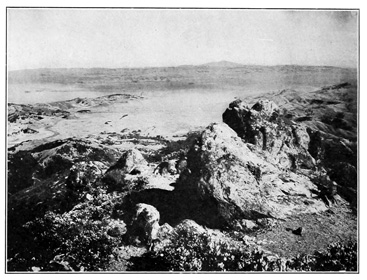
Point San Quentin, as Seen from Mt. Tamalpais.
Though the system of ventilation is by means of flues
attached to the ceiling and door, still these rooms, in which are
herded individuals of all ages and classes, must become exceedingly
foul and unhealthful; while the opportunity which this
congregate system affords the prisoners for concocting plots
and outbreaks is undeniably assured.
Of the prison industries the jute mill is of sole importance
to the outer world; all other products being consumed there.
Some eight hundred convicts labor at the mill, and five million
sacks are annually sent from the prison.
There are paint and tin shops which supply all the tin-cups,
hand basins, pails, etc., used in the institution; tailor shops in
which are made all the clothes; carpenter shops for repairing
and furniture, while sixty pairs of shoes are turned out each
week from the boot shop. In the machine shops where are manufactured
all the needles used in sewing the jute bags half a
dozen excellent sewing machines were recently made.
The extensive laundry where numerous Chinese convicts
are employed, is only one of the many evidences of cleanliness
witnessed in this institution, where order and system are apparent
to even the casual observer. But however orderly, systematic
and cleanly a prison may be kept, that is only one means
toward eliminating crime; for so long as we continue in
our congregate system of indiscriminate herding together of
all classes of offenders so long will our penitentiaries be hot-houses
for fostering crime. Instead of eliminating, we confirm;
instead of inciting decency and self-respect, we incite indecency
and rebellion.
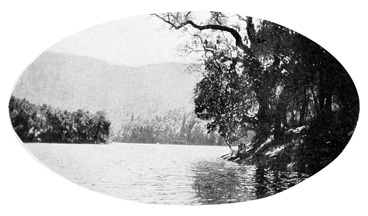
Lagunitas, San Rafael's Water Supply.
At the time of our visit there were in San Quentin about
a dozen lads, the youngest but fourteen years of age, imprisoned
on charges of murder, who, had it not been for the supervision of
Warden Tompkins, would have been placed with the confirmed,
hardened criminals.
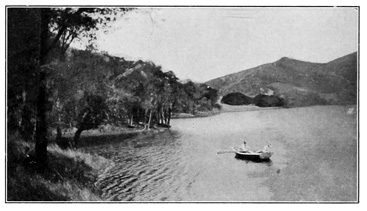
Trolling on the Lake.
The State makes no provision for these offenders, and, unless
as in this instance they are separated by the individual action of
the Warden, they would ere now be proficient in the lore of crime.
Crime is contagious, because thought is contagious.
By this it is not meant that you and I, if we mix with criminals,
will become criminally inclined; because our ego—or
soul—not having any prenatal defect or susceptibility to crime
will be unresponsive to its influence.
But to a criminal, whether he be a first offender or not, the
pernicious, indiscriminate companionship of fellow convicts who
suggest crime in its various distorted shapes to his abnormal, defective
mind, will plant seed-thoughts which thus sown thrive
and grow until we have the confirmed criminal.
If a criminal is so receptive to suggestions of evil, and his
criminal capacity is so strengthened and fixed by the ideas and
emotions that he entertains, would not counter-suggestions have
just as potent an effect on the individual?
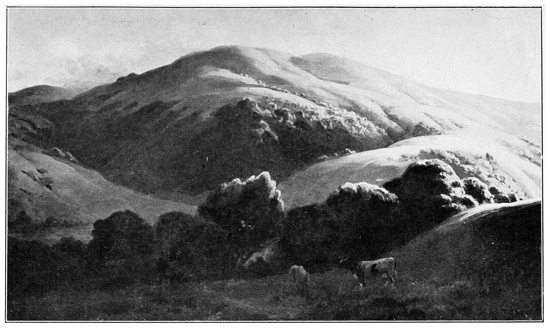
A Marin Landscape.
(From the Original by Thad Welch.)
If, through
the channels
of thought,
he is susceptible
to maleficent
influences
will he
not be equally
responsive,
through the
same medium,
to the
beneficial?
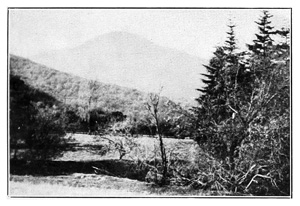
Mt. Tamalpais from Ross Valley.
Granting this to be true, would it not be well to surround
the convict with all that stands for advancement, and through
intelligent education and suggestion awaken the latent good
which is in each individual, no matter how dormant and perverted
it may be?
By education is not meant the rudimentary school education,
for many criminals are proficient in that, but the far more
important study of self-respect, honesty, veracity, industry,
unselfishness, and an appreciation and proper use of the things
that are.
Methinks if with the contemplated enlargement to the prison
an educative, segregative, industrial system similar to that
adopted with such marked success in the Elmira Reformatory,
New York, were inculcated in our state prison there would be
less "recedivists"—fewer many-term offenders—and the fifteen
thousand dollars which it costs the State monthly to conduct
a prison would not be devoted to confirming criminals.
Although Marin County is sparsely populated, owing to its
large tracts of hilly surface and consequent non-agricultural
facilities, still the towns within its borders are of average population,
the largest, San Rafael, comprising five thousand inhabitants.
Besides being the county seat, San Rafael has the distinction
of having once been a mission settlement, and though the church
has long since mingled with the dust, the memory of its bygone
glory clings like the lichen of the remaining pear trees to the
spot which knew it in its prime; when to the clanging of the
mellow toned Spanish bells, the neofites, the children of the
soil, would kneel in meek devotion before the sacred altar
whose fires, like their lives, have long been quenched but appear
again, let us hope, in their successive higher spheres.
Except in memories San Rafael is essentially modern.
The factory and the loom form no part of its existence, and
with the exception of two brick kilns and a planing mill on
the outskirts, the town is without industries.
Therefore, sheltered as it is by beautiful rolling hills on
three sides, with a mild climate and not even a street-car, as yet,
to disturb the stillness, San Rafael, like Ross Valley, is considered
an ideal spot for homes.
Besides its handsome residences and long shaded avenues,
which afford much enjoyment for driving, San Rafael is noted
for its excellent schools.
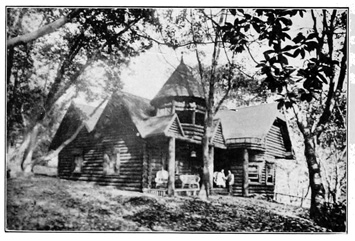
A Home in Ross Valley.
These not only consist of the splendid public schools, but
of private institutions, notably the Hitchcock and Mt. Tamalpais
Military Academies for boys, and the excellent Dominican Convent
for girls, besides the St. Vincent and Presbyterian orphan
asylums in the vicinity procure for the town the name of an
educational center.
A short time ago, Mr. Andrew Carnegie donated to Marin's
county seat the sum of twenty-five thousand dollars for a public
library, the plans of which are now under consideration.
That her residents are not less generous than the famous
philanthropist was forcibly shown on April 29, 1905, when Mr.
and Mrs. John F. Boyd transferred to the town some seventy
acres for a memorial park. The occasion of its dedication was
marked by able addresses from the "Wizard of the Plant
World," Mr. Luther Burbank, United States Judge W. W.
Morrow, and Judge Thomas J. Lennon.
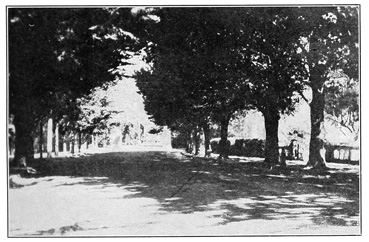
A Shaded Avenue.
Abounding in natural verdure, artistically embellished and
converted into a perpetual pleasure ground, the Boyd
Memorial Park seems a fitting testimonial to the memory of
the sons of its donators.
While noted as an educational center, San Rafael also has
the unique distinction of being the Gretna Green of the Coast;
and the blushing brides and happy grooms united here exceed
in numbers those from the erstwhile famous European village.
To this charming little northern settlement from all the surrounding
counties and various parts of the state they come to
plight their troth, averaging, it is said, five a day; "and the best
and most remarkable part of it all is," Marin's genial Judge
informed me, "they turn out all right," and, really, I suppose
he ought to know.
Notable among the many charming residences in San Rafael
is Fairhills, a summer home of Mr. A. W. Foster.
It is surrounded by a stately garden where the choicest
plants abound in graceful profusion, blending one with another
in a perfect harmony of colors, while the majestic trees, spreading
a deep shade over the sloping velvety lawn, are reminiscent
of a Warwickshire landscape.
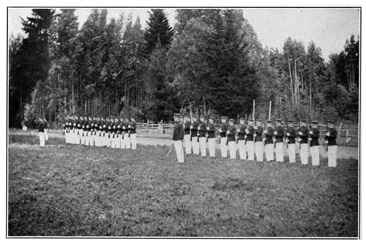
Dress Parade, Hitchcock Military Academy.
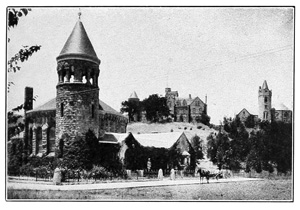
Theological Seminary, San Anselmo.
To the
westward,
wooded
hills—truly
fair
hills—with
their
ever
changing,
hazy tones,
are visible
from the
spacious
veranda, and the perpetual calmness and majesty of their lofty
slopes would seem to impart some of themselves to the beholder,
for, as Rousseau says, "Our meditations gain a character of
sublimity and grandeur proportioned to the objects around us."
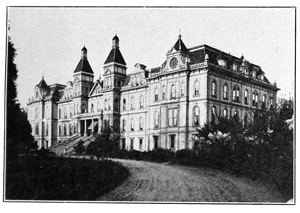
Dominican Convent.
Although essentially a resident settlement, the tourist will
find ample accommodations at Hotel Rafael, sometimes called
the "Del Monte of the North." Though of smaller dimensions,
and with less sumptuous appointments and surroundings than
the southern hostelry, Hotel Rafael, within easy access of the
City, is
more convenient
for those
who enjoy
the country,
yet
never
leave their
business
for its
sake.
While the Assyrians, Babylonians, Greeks and later Gauls
and Romans were weaving the first few threads of our planet's
history in the old world, the aborigines of America roamed our
trackless, primeval forests, boundless save for two shimmering
oceans and a blue canopy overhead.
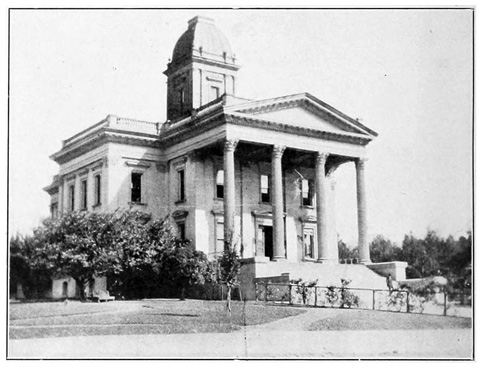
Court House, San Rafael.
Fearless, they plunged into the thickets, swam the streams,
hunted game, caught the bear and bison, trapped the fowl, and
dauntlessly lived on in fear of neither nature, beast nor man—primitive—just
a savage, but possessing the fundamental requisites
from which all civilizations, sects, isms, or communities
have been evolved—a human being with a soul.
Therefore the red man is to America what the cave man is
to Europe—the father of his country.
In the history of our State the aborigines played an all-important
part, as the founding of the missions by the Friars
was with the avowed intention of reclaiming these children of
the wilderness, to teach them civilization.
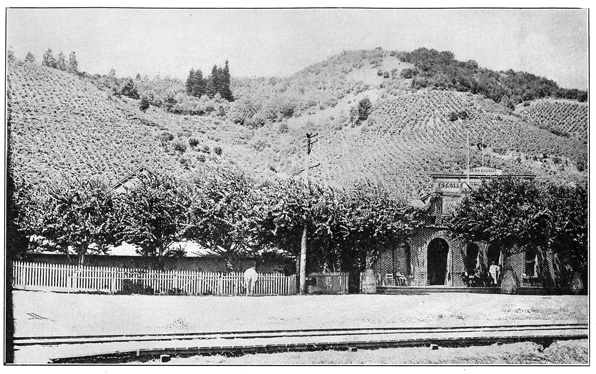
Escalle Vineyard and Winery.
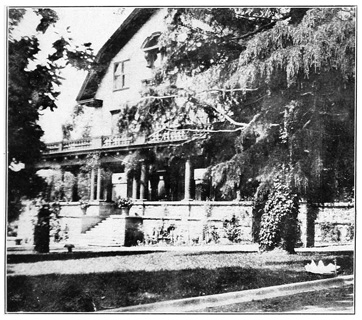
"Fairhills."
The first mention made of the Indians in Marin County is
found in an old legend which states that about the time of the
erection of the Mission at San Francisco a party of Spaniards
crossed the Straits at what is now known as Lime Point and
traveled northward. It was late in the season, and they found
no streams of running water until they arrived at Olompali,
so named from a great and powerful tribe of Indians who dwelt
at this place, the Olompalis. Here they were kindly received
by the natives, and all their wants were supplied as far as it lay
in their power. The party was so well entertained that the leaders
decided to remain a fortnight and recruit their horses and
become thoroughly rested, preparatory to proceeding on their
arduous journey. In return for the kindness received, they
taught the Indians how to make adobe brick and construct a
house.
That history corroborates this legend is shown in an old
chronicle by the biographer of Junipero Serra, Father Palou,
which says that "in 1776, after the Presidio and before the
Mission (in San Francisco) were established, an exploration of
the interior was organized as usual by sea (the bay), and land."
Thus, in the northeast corner of the County, near Novato,
was built the first adobe house north of San Francisco Bay,
on the Olompali Rancho, owned by the late Dr. Burdell.
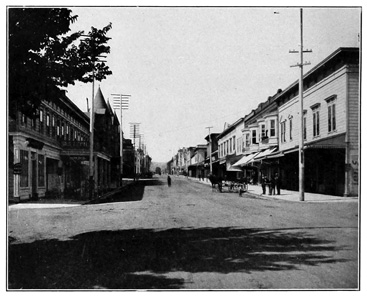
Fourth Street, San Rafael.
The first adobe has long since disappeared, the last mention
found of it being a remark of General Vallejo's when, some
thirty years ago, on passing the Olompali Rancho and pointing to
a crumbling adobe he remarked to a companion, "That is over a
hundred years old."
But the adobe that concerns us, the long, low, rambling adobe,
is still standing in good condition and occupied by Dr. Burdell's
family. This
was supposedly
the second
built and
is accredited to
have been constructed
by the
last chief of
the tribe, Camillo
Ynitia.
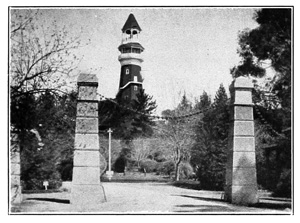
Entrance to Hotel Rafael.
Camillo, after
obtaining
three successive patents for the Rancho, first from Spain, then
from Mexico, and lastly from the United States, sold it for five
thousand dollars, which he was believed to have buried in the
vicinity. Refusing to divide the proceeds of the Rancho, and
furthermore to disclose the spot where the gold was buried,
Camillo was subsequently murdered by his brother.
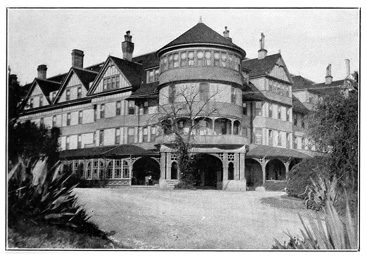
Hotel Rafael.
The Olompali Rancho is beautifully situated, lying as it does
at the base of Mt. Olompali which is believed to be an extinct
volcano.
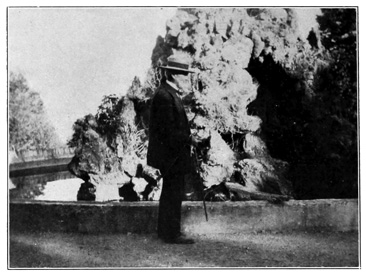
The Late Owner of the Olompali.
Mortars found five feet under ground in the river bed,
together with sand, mud, gravel, pebbles, and cement strata
on the mountain side, testify to volcanic action.
From this mountain which formerly, in unknown ages
emitted hot, sulphuric gases from its bosom, now runs a clear
and limpid stream, a perpetual penance to nature for the havoc
it once wrought.
When the Spaniards first visited the County, there were
said to be thirty distinct tribes of Indians, each with its separate
chief; while their language or dialect differed materially.
That they lived on mussels, sturgeon, and game from the
marshes, is evidenced by the remains found in the huge shell
mounds distributed throughout the County.
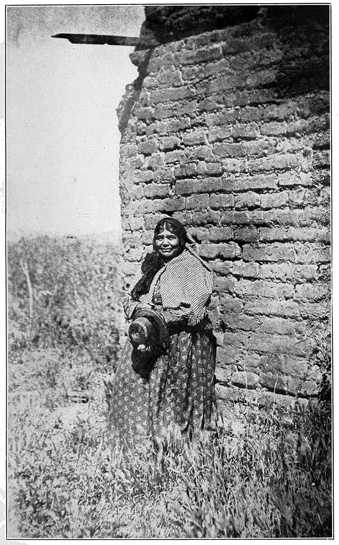
The Last of the Race.
What these mounds are and how they became so, is merely
a matter of conjecture, although the scientists of the University
of California and
Stanford are revealing
additional clues
from time to time as
new deposits are discovered.
A Wood Interior.
In the Marin
mounds have been
found mortars and
pestles, queer old
pipes, beads of wampum,
oyster picks,
skulls, and in many
instances entire skeletons,
while the
arrow-points testify to certain warlike propensities, although
on the whole they were said to be peaceful tribes.
Summer in the Redwoods.
The bows which they used with such celerity and skill were
uniquely fashioned; the cord consisting of the nerves taken from
a deer's back. The Marin Indians and in fact all the California
tribes, dwelt in small huts built of willows with tules or rushes,
and formed by taking a few poles, placing them in a circle,
and finally weaving them together to a conical point, giving,
when completed, the appearance of inverted baskets.
They were usually constructed on the banks of streams, and,
being small, were easily warmed in winter.
The aborigines' knowledge of the proper treatment of disease
was very limited. Roots and herbs were sometimes used
as remedies
but the
"sweat-house"
(temescal)
was the
principal
reliance in
desperate
cases.
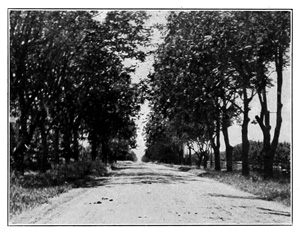
A Charming Drive.
One of
these sweat-houses
was
found on
the Nicasio
Rancheria, just over the Olompali Mountains.
It consisted of a large circular excavation, covered with a
roof of boughs, plastered with mud, having a hole on one side
for an entrance, another in the roof to serve as a chimney.
A fire having been lit in the center, the sick were placed
there to undergo a sweat bath for many hours, to be succeeded
by a plunge in the ice-cold waters of a neighboring stream.
This treatment was their cure-all, and whether it killed or
relieved the patient depended upon the nature of his disease
and his constitution.
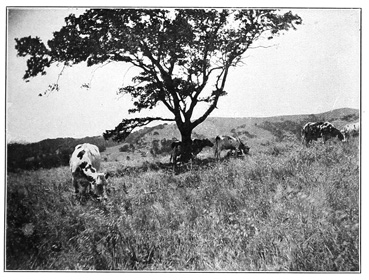
Browsing.
It seems but fitting that this County, which formerly was a
favorite rendezvous of the Indians, should derive its name from
a famous chief of the Lacatuit Indians, who frequented the
southern part of the Peninsula.
Between the years 1815 and 1824 Chief Marin, aided by his
people, is said to have vanquished the Spaniards in several skirmishes
for supremacy. Being finally captured by his enemies,
and making his escape, Marin took shelter on a tiny island in
upper San Francisco Bay. This island being subsequently called
after him, communicated its name to the adjacent mainland.
Falling into the hands of his foes a second time, he barely
escaped being put to death through the interference of the
priests at the Mission San Rafael.
While surveying the County several years ago, Mr. Jacob
Leese had with him as assistants the old Indian chief, Marin,
and some of his followers. It became necessary for the surveyor
to establish an initial point on the top of Mt. Tamalpais,
and he wished Marin and some others to go up with him. To
this they made strong objections, stating that the top of the
Mountain was inhabited by evil spirits, and no one could go up
there and come back alive. After vainly trying to persuade them
to accompany him, Mr. Leese, finally decided to go up alone,
which he did, the Indians
prophesying that
they never expected to
see him again.
On reaching the top
and accomplishing his
purpose, he was puzzled
to know how he could
convince the redskins of
having reached the summit.
To do this he
placed a large limb
across an old dead tree,
thus forming a cross
which could be seen in
the Valley below. He
then descended and
directed the attention of
the Indians to the cross.
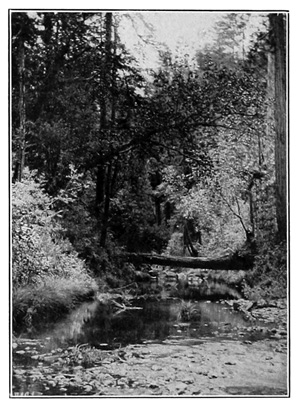
A Characteristic Stream.
Prior to this, Marin had been considered by his followers
as the bravest man in the world. He therefore found that it
would never do for him to be afraid to attempt what a white
man had accomplished.
Marin then determined, against the most earnest entreaties
of his men, to go up where the white man had been. Tearing
himself from his men he ascended the Mountain alone and
when there had to study how he should convince his followers
of the fact.
Unwinding his outer blanket he suspended it on the arm
of Mr. Leese's cross, having done which, he descended the
Mountain.
On seeing him without his garment, his followers concluded
that he had been robbed by the Devil himself; but pointing
out to them his blanket waving upon the cross, much joy
was expressed over his restoration to them as the bravest of
the brave.
The foregoing tale is only one of many which illustrate the
profound superstitions prevailing among the Indians.
Certain rocks and mountains were regarded as sacred, while
the grizzly was held in superstitious awe, nothing inducing
them to eat its flesh.
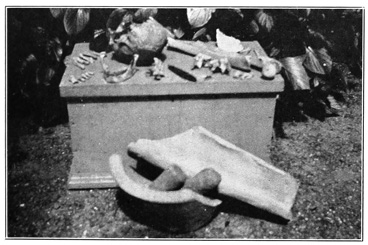
Relics From a Shell Mound.
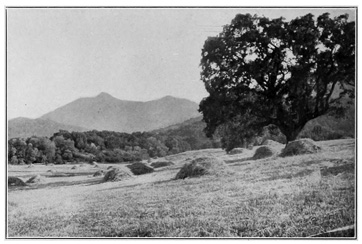
Haying Time.
The idea of a future state was universal among the California
Indians, for as they expressed it, "as the moon died and came
to life again so man came to life after death," and they believed
that "the hearts of good chiefs went up to the sky and
were changed into stars to keep watch over their tribes on earth."
A short distance from the Olompali Rancho is Novato, a small
town which until a few years ago possessed the largest apple
orchard in the world.
At the present time the New York and the Novato French
cheese factories are its only noteworthy industries. The latter,
which is representative of a thriving, modern cheese-factory, is
conveniently located beside the California Northwestern Railway
on whose cars the local shipments are made twice each day.
But this local trade is by no means the factory's sole outlet,
for besides supplying the Coast and the East as far as Iowa
(where another branch is located), cheese is exported to the
Hawaiian Islands, Japan, China and other foreign countries.
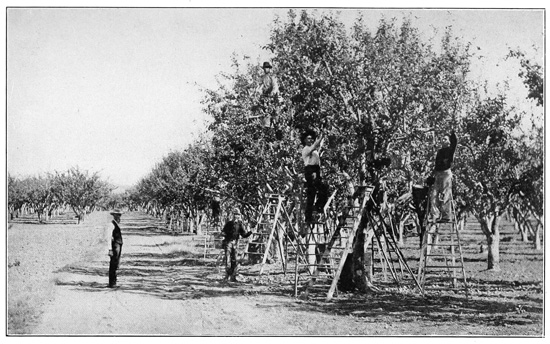
Apple Picking in Marin.
In this unpretentious building, in which but twelve men are
employed, fifty thousand five-pound cases of cheese are manufactured
a year, or a little more than four thousand (cases) a
month. In the spring from twelve hundred to fourteen hundred
pounds of cheese are manufactured each day.
Besides its famous Circle Brand Breakfast Cheese, the Novato
French Cheese Factory manufactures large quantities of Fromage
de Brie, Neufch, Sierra, Fromage de Chanembert, Schlosskase
and Kummelkase.
On a tiny island amid the marshes in this, the extreme northeastern
corner of Marin, is located the Miramonte Club. A
sportsman's club in every particular, it is very advantageously
situated, for around these northern marshes the game is very
plentiful and the sportsman is usually rewarded for his labor.
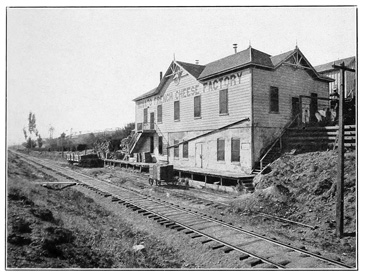
Cheese Industry.
Besides the fowl for the larder, there are many other birds
about the marshes. In summer redwinged blackbirds, each with
its scarlet shoulder-patch, may frequently be seen, while the
herons with their long, ungainly legs are often visible wading
in the pools, or standing on some lonely reef, like solitary sentinels.
In the winter, great flocks of little sandpipers frequent this
region; their white breasts gleaming in the sun in the course
of their graceful evolutions. Then there are the slender beaked
curlews which, like the heron, wade about the pools in search
of food.
In the fall and winter the salt-water marshes have a peculiar
charm not only for the sportsmen who delight in the abounding
bird-life, but for the humble excursionists who, gunless, admire
the marvelous diversity of coloring displayed in the grotesquely
shaped marshland.
For no other weed, grass or vine assumes a greater variety
of tints than the marsh vegetation, which from the dull russet
of summer changes to a combination of olive, purple, magenta,
copper, and violet, so harmoniously blended that, besides charming
the observer, it lures many a local artist from his studio in
town.
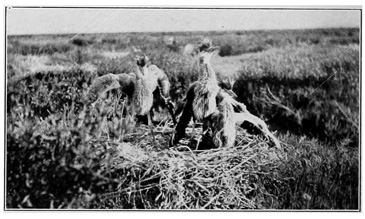
Young Herons.
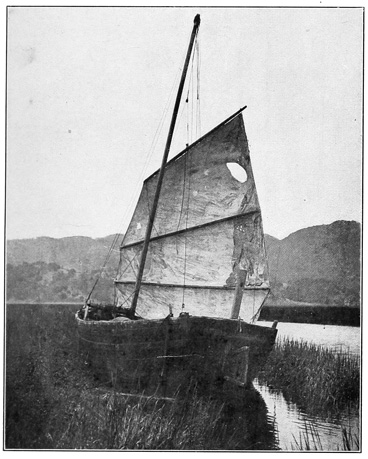
On the Marsh.
In Marin the feathered songsters hold a unique place, for,
as the county is sparsely populated, possessing many wild,
secluded valleys, and unnumbered rolling hills covered with
virgin forests, it is but natural that the birds should congregate
in great numbers, reveling in the solitude which man invariably
destroys.
If the traveler is interested in these woodland tenants, and
would learn something of their haunts and life, he should visit
one who knows them as Thoreau knew all the wild and untamed
things of nature.
A short distance from Fairfax the San Geronimo Valley,
nestling among the hills, is a fitting location for this naturalist
and bird-lover.
Though a taxidermist of much skill, Mr. Charles Allen is more
widely known among ornithologists by that little fairy creature
which makes its appearance in the early spring, known as
Allen's Hummingbird.
Although similar in point of size, it is in its coloring that
Allen's Hummer may be distinguished from other hummingbirds,
for its green back, ruffus-tail, streaked with black, dark-wings
and ruffus head, easily separate it from other varieties.
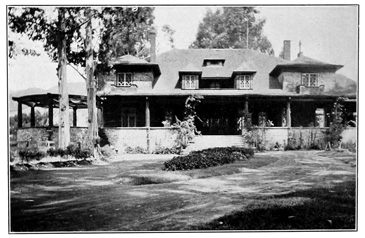
R. H. Hotaling's Residence on "Sleepy Hollow Ranch."
To a reflective mind there is no time of the year more joyous
than spring. All nature seems gay and full of promise. Hope
is vibrant in the air, and enters into the nature of the receptive
man through more senses than science has yet named or discovered—an
unnamed sense which is neither sight, nor sound,
nor touch, nor intuition, a vibrant unseen force which is current
throughout the universe, connecting man, unknowingly, to
every tree, shrub, and atom. Thus, in the spring one feels that:
"There's a chorus in the valleys and an anthem on the hills
There's an echo from the music which our inner being thrills
Till we long to journey outward where no other foot has trod,
And join in the song of worship at the shrine of Nature's God."
Spring is synonymous with the return of the birds, and their
blythe little
songs are but
another
promise of
hope and expectation.
Following
close upon
the return of
Allen's
Hummingbird
is the
little piliolated
warbler
with his
green back,
pale, sulphur
yellow
breast, and
tiny "pee
wit" call.
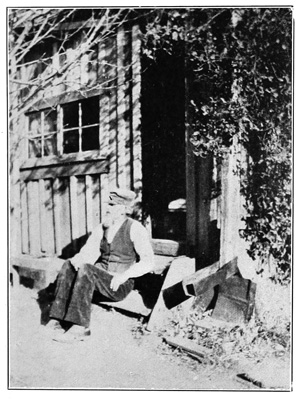
The Taxidermist of Marin.
When the climbing roses are becoming gay with blossoms,
our old friends, the linnets, returning from their winter's
sojourn in lower California, begin to build their nests.
A walk in the woods in the early morning or evening will
acquaint one with another spring bird, Vaux's Swift, invariably
seen about the streams.
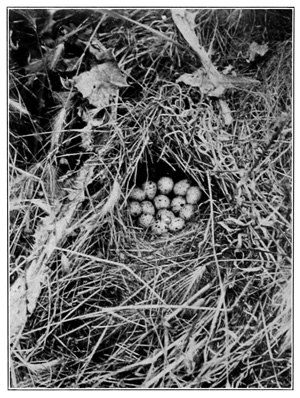
A Quail's Nest.
In our hasty glimpse of the birds, it is impossible to enumerate
all the feathered flock, and the renewal of a few old acquaintances
will have to suffice. A very characteristic summer inhabitant
of Marin's woodlands is the Red Shafted Flicker, a
large bird,
conspicuous
when flying
for its gay
plumage, and
often seen
about the
stumps of
rotten trees,
in the holes
of which
it makes
its nest.
While strolling
in the
woods we are
often startled
by a sharp
rat-tat-tat on
a neighboring
alder,
and on close
approach a flutter of wings
discloses a black-and-white
creature with a dash of
scarlet on his head. This is
Harris's Woodpecker which
makes the silent woods resound
to its noisy rapping. A
harsh, squawking call, a swift
flight of blue wings, and an
ensuing, noisy chatter announce
the saucy California
jay—the least lovable to my
mind of all the California
birds. He is the Rockefeller
of the bird-world, consuming and destroying the eggs of
his fellow birds, leaving destruction and ruin in his wake
in the shape of desolate, broken nests. A pleasing contrast to
this sharp,
unruly
bird, is the
large,
beautiful
orange
mottled
Bullock's
Oriole,
who fills
the air
near sundown,
with
his rich,
melodious warble, which he repeats with never-tiring zeal.
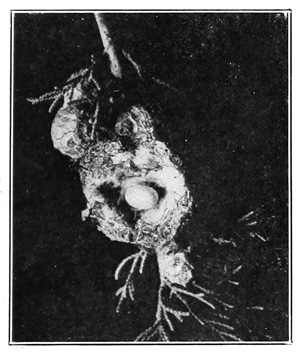
A Humming Bird's Nest.
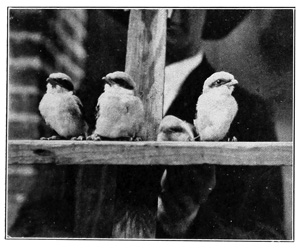
Little Songsters.
Of the fall birds, the crows and Brewer's Blackbirds are
the most notable. Though the former are with us the entire
year, it is in the fall, in flocking time, that their loud caw-caw-caw
is heard as
in bands they
circle above
the tree-tops;
while Brewer's
Blackbirds,
sleek,
glossy fellows,
after
foraging
throughout
the day in
the valleys,
soar to some
huge dead
pine tree and
chatter
through the
twilight
hours, flying
when night arrives, with one accord, to a patch of tules in some
pond where they settle for the night.
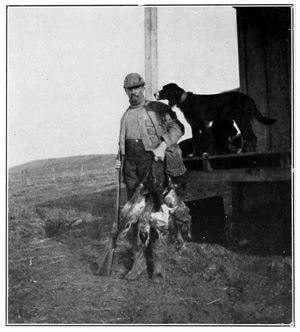
A Sportsman.
Of the non-migrating birds, the little dark brown Wren Tit,
inhabitant of thickets; the dull gray and white Titmouse, frequenter
of oaks; the friendly little California Chickadee; not
to mention the great horned Owls with their deep hoo-hoo-hoo,
the barn-owls with their treble screech, and lastly the beautiful
oft-abused Quail, are but a few of the interesting native inhabitants
of Marin.
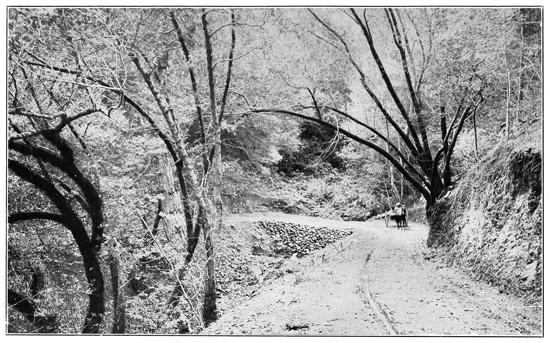
Near to Nature's Heart.
Owing to the widely scattered population in the northern
part of Marin County, this section is consequently more wild
and natural in appearance than the southern half.
Lying at the base of a range of high hills which slope somewhat
abruptly to the Ocean are the most interesting natural
phenomena in this region. This is a chain of sparkling lakes,
three in number, which at first view on descending the precipitous
roadway seem to be connected with the Ocean so near its
edge do they appear.
Upon close approach, however, we discovered them to be
of fresh water and at an elevation of nine hundred
feet above
sea level, but
their close
proximity to
the Ocean
and the cavernous
inlets
opening from
the sea would
intimate their
former connection.
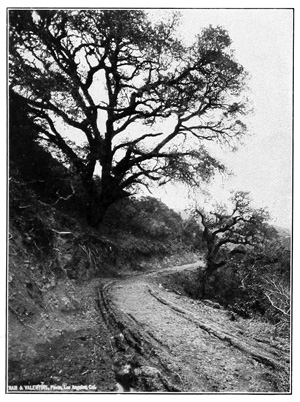
A Bend in The Road.
On the
shore of the
largest of
these, Shafter
Lake, is
located, amid
the luxuriant
copse wood,
the Point
Reyes Sportsmen's
Club House. As the lakes are stocked with black bass,
land-locked salmon, and various kinds of trout the angler
is a familiar figure in the vicinity; and the abounding deer,
quail, ducks, and snipe, attract the huntsman, while the beauty
of these unique lakes and their picturesque environs, though
little known to the general public, induce many a local pedestrian
to take the twelve-mile tramp from Olema, through the
forests over the steep ridges and down among the chemisal
and sagebrush to this Ocean retreat.
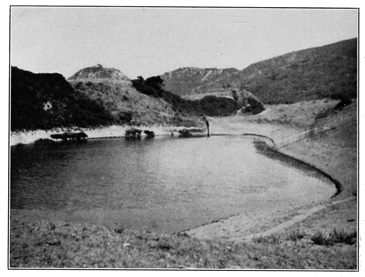
One of the Sparkling Lakes.
Some four miles northwest of the lakes a narrow valley,
lined by massive barren hills, winds its way to the Pacific.
Mammoth oaks adorn its wild and tangled glades, huge redwoods
lift their lofty tops to the sky, while ferns and trailing
vines festoon the banks and rocks with such luxuriance that the
whole seems a riot of contending greens.
Winding in and out like a silver thread among the stately
trees and saplings is a little stream which fills the air with
freshness and the cadence of a song, while hanging in fantastic,
airy festoons from the trees which look in consequence like
bearded Druids, covering trunks and branches, spreading its
delicate traceries on the rocks, and abounding on every conceivable
object are such masses of vari-colored moss that one
would feign exclaim, "Surely this should be called Moss, not
Bear Valley!" for while the latter roving inhabitants have long
since disappeared, the former is and no doubt will remain, in
evidence until the forest is no more.
It is necessary to see this Valley in order to comprehend its
beauty.
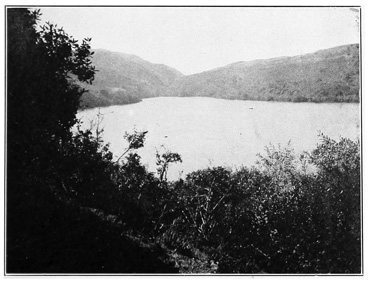
Shafter Lake.
One can drive through its cool depths on a finely graded road
amid thousands of majestic trees, while here and there an open
space reveals the sunlight and the blue sky overhead in contrast
with the dim, uncertain light pervading its woodland
stretches.
No lover of the beautiful can regret a jaunt to this delightful
spot, for the charm and witchery of its unique beauty remain in
the memory long after the excursion is a thing of the past; even
as the perfume of a rose remains after the flower has faded.
The sole habitation in Bear Valley, located in a charming
sunny exposure with imposing trees and garden surrounding it,
is the Country Club, famous in local circles.
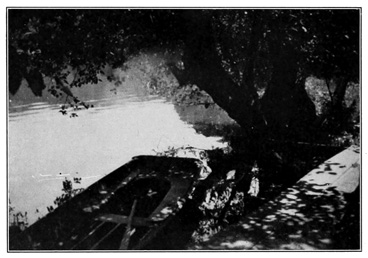
On the Shore of Shafter Lake.
The deep baying of hounds from its extensive kennels
forms the only discordant note in the Valley, reminding one
that even near to nature's heart man's inherent primitiveness
asserts itself. If, when wandering in these woodland
fastnesses, he (man) would hunt the wild creatures with a camera
it would require greater patience, skill and acumen
than making
the ground
wet with the
blood of
fawns and
quail.
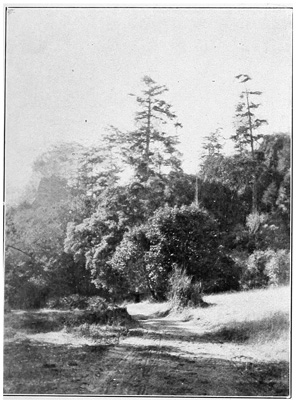
Entering Bear Valley.
But "civilization
has
ever developed the
physical and
the intellectual
at the
expense of
the psychic,
the humane,
and the spiritual."
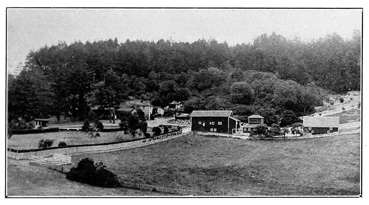
The Country Club.
Notwithstanding
its
small area,
numerable
excursions
offer themselves to the ambitious tourist in Marin, while the
diversity of its surface and climate, and the ease with which one
can explore its remaining primeval stretches, make this tiny
northern peninsula a necessary adjunct to San Francisco,
which, with its ever-increasing population, needs an outlet for
recreation, relaxation, and repose.
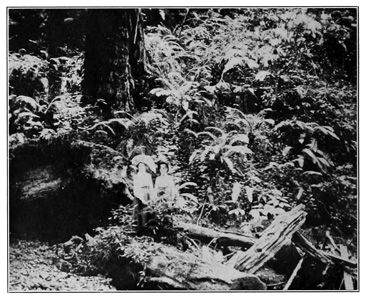
Among the Ferns.
Moreover, as the other Bay counties are less rugged in
formation, more inhabited, and consequently more conventional
in appearance, true nature-lovers find an outing in
Marin a solace and an inspiration.
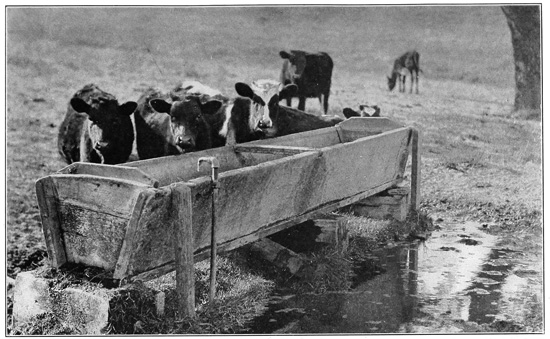
At the Trough.
A short distance from Bear Valley the road, after passing
a stretch of low marsh-land covered with tules, reeds, and
willows, comes suddenly to a sheet of water which at first
sight appears to be an inland lake, so peaceful and protected
are its waters.
This is none other than Tomales Bay—a long, narrow inlet
from the Ocean.
At the base of the range of lofty hills which shelter it
on the west is situated Inverness, the location of the tract of
three thousand and three hundred acres which was recently
sold, constituting, it is said, the largest single transaction in
suburban lands ever made in this part of California, or in
fact anywhere else in this State. It involved over half a
million dollars, and is reputed to be the beginning of a new
movement in Marin.
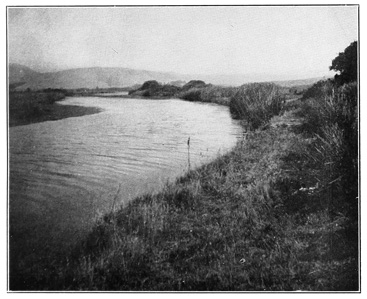
Nearing Tomales Bay.
The land is to be divided for summer homes and cottages;
and as the nearest station is Point Reyes, it is planned to operate
a ferry across Tomales Bay, which would shorten the
distance to the railroad where a new station is to be erected.
Extensive plans are also on foot to extend the electric road
from its present northern terminus at Fairfax to Inverness,
and once that is accomplished, the new summer resort and
suburban town will be brought within a little more than an
hour's ride of San Francisco.
Besides its many rural attractions there are more than
six miles of sand beach at Inverness, and the tide on going
out exposes the sand to the sun, which warms the
water on its return, and insures delightful bathing during the
summer.
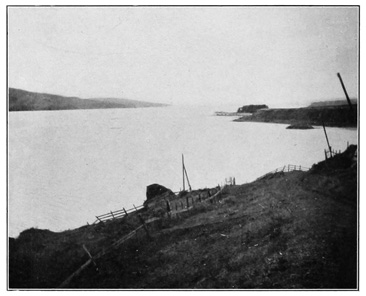
Tomales Bay.
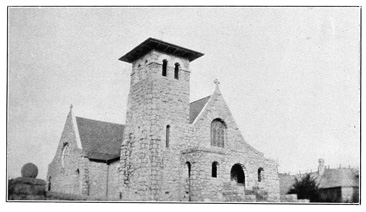
Church of the Assumption, Tomales.
Unlike many of the counties of California, Marin, during
the gold period, attracted very little attention among the miners.
Her chief, and, in fact, only industry in those days was the
raising of stock. About the year 1860 the people in the
northern part of the County, especially in the Tomales district,
located on the eastern part of upper Tomales Bay, began
growing potatoes with such successful results that the County
soon gained the name of an unusually fertile potato-raising
region.
Although stock, potato-raising, and dairying are still continued
in a small degree in the vicinity of Tomales, the chicken
industry is gradually superseding them, and the success
attending this latest departure portends well for the future
of this section.
The small ranches, which formerly were most all incumbered
with one or more mortgages, are now being cleared, and
the general aspect for the small rancher is greatly improved.
Poultry raising as conducted under the present modern system
is vastly superior to anything of its kind in former years.
Some idea of the dimensions of this industry were gained
during a recent visit made by the author to one of these modern
poultry farms. The ranch was of average size, and in the neat
yards inclosed by high wire fences I saw some thirteen hundred
laying hens, while eight hundred pullets for the market,
all graded as to age, were in various yards.
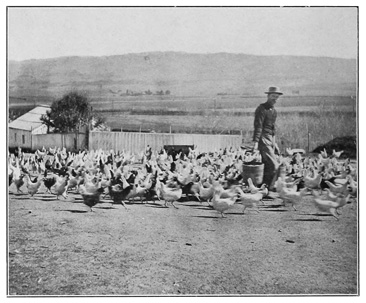
Feeding Time.
From this ranch between five and six cases of eggs are
shipped every week, each case containing thirty-six dozen;
averaging two hundred and seventy-five cases or thirty thousand
eggs per year.
In the laying season over seven hundred eggs are gathered
daily.
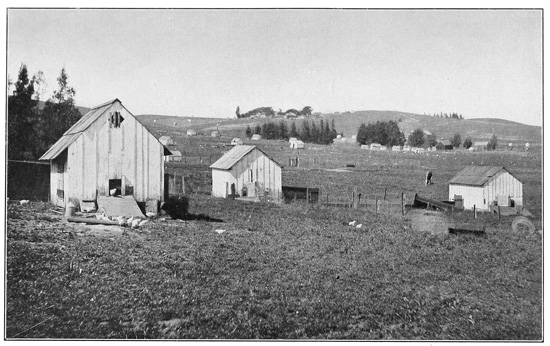
Chicken Ranches in Marin.
The multitudinous, airy, white-washed hen houses in the
numerous, cleanly, sunny inclosures; the fields of grain raised
for the fowls' consumption; the incubator room and the adjoining
brooder; the granary, from which at stated periods the
food is measured, are all adjuncts of the modern poultry ranch.
It is interesting to watch the great flocks of fowl, all
snowy white (the white leghorn being preferred), darting
noisily toward the attendant as he enters their enclosure at
feeding-time, and the
ensuing scramble for
wheat, and the continuous
pick-pick-pick verily
make the hen a definition
for perpetual
motion—in feeding-time,
at least.
As but five acres of
ground are necessary to
carry on successfully a
moderate size chicken
ranch, it may be seen
how with less outlay
and incident expenses
the small rancher can
make better profits in
this industry than in
dairying.
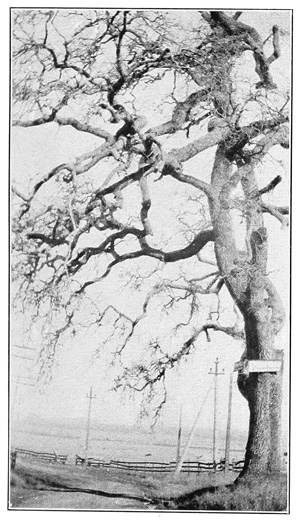
Defacing Nature.
West of Tomales Bay
a long narrow neck of
land stretches far out
into the Pacific. Though
somewhat barren in appearance, owing to the dearth of trees
and the abundance of low, tangled sagebrush, the fact that
grass grows the entire year on its slopes makes Point Reyes
the famous dairying center of Marin.
Ever since the early eighties dairying has been the leading
industry of the County, and, although carried on in all sections
of Marin, it is on Point Reyes that it assumes the most extensive
proportions.
The ranches there are larger in extent, all owned by one
person, namely Mr. Webb Howard, and are rented yearly by
the tenants, the cattle being included with the land.
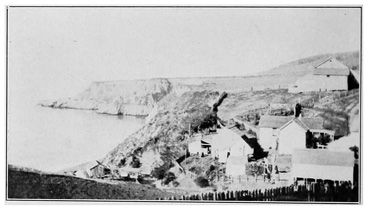
Dairying on the Edge of the Pacific.
The average ranch on the Point contains about fourteen
hundred and fifty acres and one hundred and eighty cows;
the old stock being replenished as required.
Great quantities of butter are shipped by schooner and
rail to the City where it finds a ready market, as the Marin
County butter is known to be of a superior quality.
A trip to the Point by carriage cannot be made under
two days at the shortest, and as hotels and inns are unknown
in this region, the traveler is obliged to solicit shelter for the
night from one of the ranch houses which are scattered at
wide intervals.
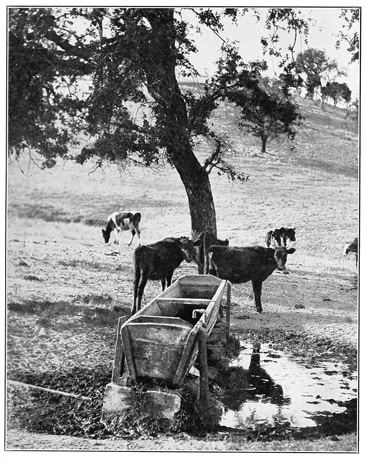
In the Pasture.
There are few places, save Ireland, where hospitality, the
real whole-souled, hearty, genuine hospitality, is so dispensed
without question to the stranger as in this tiny northwest
corner of Marin.
Though loath to intrude, the hearty reception tendered
and the ensuing civilities received convince the wayfarer of
his welcome, and have earned a reputation for these good
people rivaling in proportion the Emerald Isle itself.
After spending the night at one of these ranches we proceeded
on the following morning to the most interesting,
fascinating, and historical sheet of water in Marin County.
In 1577, Sir Francis, then only Captain, Drake, already distinguished
as an experienced navigator, fitted out, with the
pecuniary aid of the court, a buccaneering expedition against
the Spaniards.
After reaching the Pacific and intercepting several privateers,
he bethought himself of another object, that of finding
the much-talked-of northern passage from the Pacific to the
Atlantic.
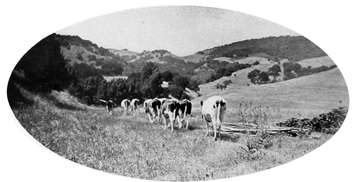
Going Home.
If he could discover this passage, he would not only perform
a notable service to his country, but would have a comparatively
short and safe voyage homeward. But after a
run of nearly two months, he experienced such bitterly cold
weather, his people suffered so severely, and his heavily-laden
ship leaked so badly, that he deemed it prudent to abandon
any further search for a northern strait; and accordingly running
down the Coast in search of a stopping place, he passed
the long, projecting promontory of Point Reyes, and under its
lee discovered "a convenient and fit harbor" in which he
anchored on June 17th, 1579. At this place, which is now known
as Drake's Bay, he remained thirty-six days. During that
period, which was required to thoroughly repair and refit his
vessel, he had a number of interviews, and some remarkable
intercourse with the natives.
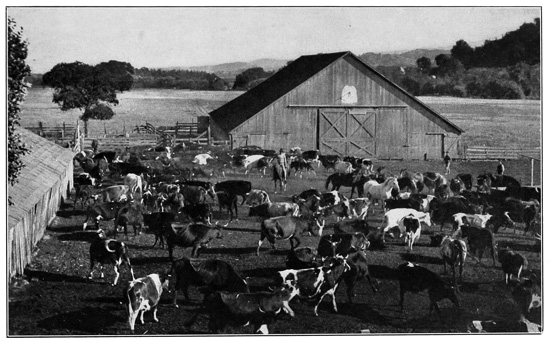
A Marin Ranch.
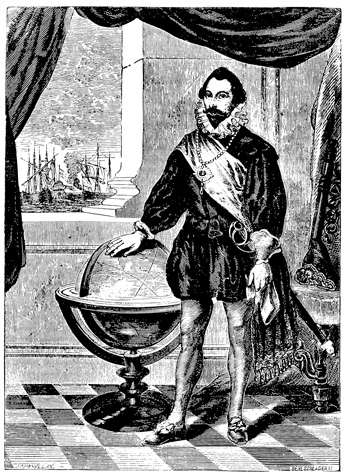
Sir Francis Drake.—From an old English Painting.
Upon sailing into the harbor he found a wild, desolate
looking beach; but the next day Indians appeared in considerable
numbers. One of them paddled out in a canoe to
within hailing distance of the ship, where he made a long
oration, accompanied by violent gestures, after which he
returned to the shore. Approaching the ship a second time in the
same manner, he brought with him a head-dress of black feathers
tastefully arranged, and a small basket, neatly woven, filled with
an herb called "tabah." These he delivered to the English, and
with the exception of a hat could not be induced to accept any
of the presents offered him in return.
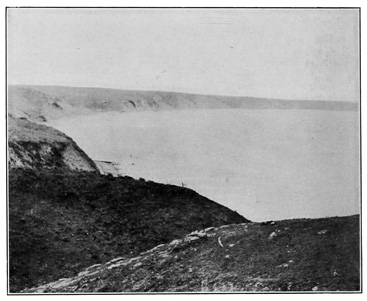
A Bay of Solitude.
All his actions, as well as of the people on shore, indicated
respect and deference for the English, as if they were a
superior race of beings.
In the course of a few days Drake, having carefully surveyed
the place, brought his ship to anchor near the shore
and landed his men with arms and provisions to set up tents
and build a barricade. The Indians at this collected on the
neighboring hills and looked down with wonder and amazement,
so much so, that the English supposed themselves taken
for gods; a supposition which proved correct, for, descending,
the male Indians brought ornaments, net-work, quivers,
skins, etc., intended for offerings, while the women performed
divers wild and violent dances, in which many of the participants
were cut and wounded.
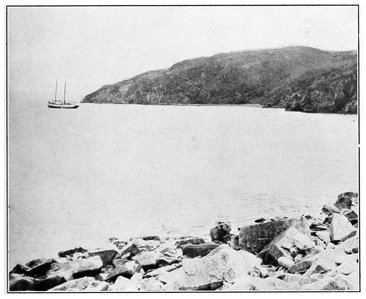
Drake's Bay.
In order to prevent a repetition of this gruesome spectacle,
Drake ordered religious services to be performed in their
presence, thus indicating that they too were but creatures
of a God above.
After prayers, psalms were sung which especially attracted
the attention of the Indians.
Music was a language they could understand, being a universal
language intelligible to every human heart; and they were
so delighted
that at
every
pause they
testified
their
pleasure.
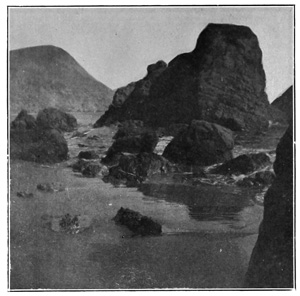
A Bit of Rocky Shore.
The business
of
repairing
and refitting
the
vessel being
at
length finished,
the
cargo re-embarked
and the
peaceful character of the Indians being now so well understood
that no trouble from them was apprehended, Drake, with a
number of his crew made a short excursion inland, which being
necessarily made on foot extended but a few miles, and did not
afford any wide or distant view; and the English, like the Spaniards
under Cabrillo, though within less than a day's travel of
the most spacious and magnificent bay in the world, had no
idea of its existence.
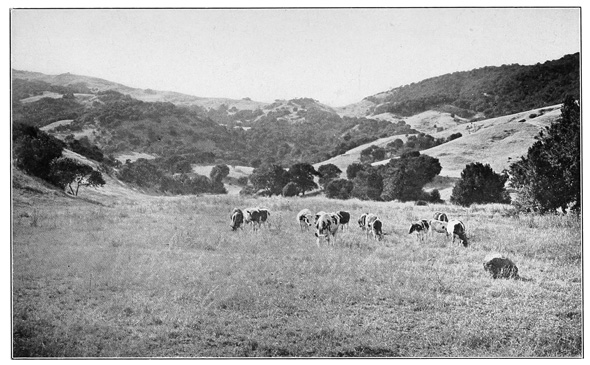
Marin Cows.
When ready to sail, Drake erected, by way of monument
and memorial of his having been there and taken possession
of the country, a large post, firmly planted, upon which he
caused to be nailed a plate of brass engraven with the name
of the English Queen, the day and date of his arrival, the
voluntary submission of the inhabitants to English sovereignty,
and beneath all, his own name. Fastened to the plate was
an English sixpence of recent coinage, so placed as to exhibit
Her Majesty's likeness.
All of which goes to prove that Drake supposed himself to
be the discoverer of this region, and was not aware that
thirty-six years previously the Spaniards had passed the same
Coast and anticipated him.
Having found no northern passage to the Atlantic, and
making up his mind that if one existed it was too far north
to be practical, Drake returned by the route pointed out by
Magellan in his circumnavigation of the globe.
On July 23d, after many ceremonies of a religious character,
and taking an appropriate
farewell of the sorrowful
natives, he stood out to sea.
As his ship lessened in the
distance, following the sun
over the trackless waste of
waters, the Indians ran to the
tops of their hills to keep it
in view as long as possible,
and lighted fires, which indicated,
long after they themselves
could be distinguished
from the vessel, that they
were still watchful, and
doubtless turning their straining
eyes toward the departing
strangers.
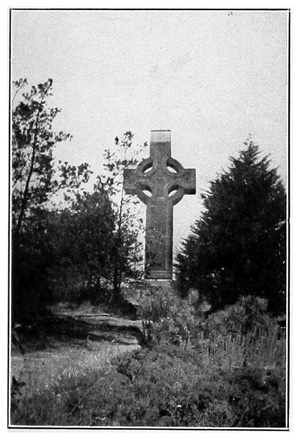
Drake's Cross.
The waves of three centuries have lapped these shores; countless
storms have swept over the promontories, and many tempests
have grappled with its cliffs since the year when Sir
Francis first dropped anchor in the Bay which ultimately bore
his name.
Time has made few changes in this Ocean inlet, as man
has practically shunned it; for excepting a small cabin on the
beach, no habitation meets the eye. The schooner which touches
there three times a week to load with butter is the only keel
that rides its waves, and the aspect of the lofty white cliffs
which encircle this Bay of Solitude are unaltered since the time
when, attracting the English navigator to their shores, they
received, because of their resemblance to his native cliffs of
Dover, the appellation New Albion.
It seems unjust and absurd that on the shores of this Bay,
which was the theater of Drake's actions in our State, no post,
stone or monument is placed whereon to commemorate his
landing, or inform the traveler of the history enacted there;
while in Golden Gate Park on a mound which his eyes never
saw, on soil which his feet never trod, a lofty granite cross rears
its solid strength in his commemoration; an illustration of the
inconsistencies of man.
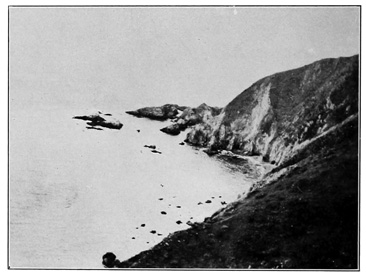
A Rugged Coast Line.
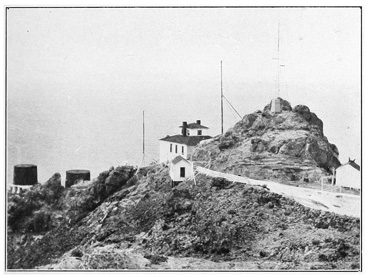
Point Reyes.
Point Reyes should be called the home of the meadowlark
for, while found in other parts of the County, it is on this
northern point that the larks congregate in such numbers that
the air is always vibrant with their cheerful, happy songs.
Perched on the lichen-covered fences, these large, plump,
yellow-breasted fellows are invariably heard warbling their
rich, mellow notes with untiring energy, and making, to my
mind, the sweetest and most enchanting of all music.
There is perhaps no more dangerous and uninviting extent
of coast line from Oregon to Mexico than that extending from
Point Reyes northward to the mouth of Tomales Bay.
To go ashore at any point along this line is to go to certain
destruction, and the fact of its proximity to the harbor of San
Francisco renders it doubly dangerous, as vessels have gone
hard ashore under full sail, little dreaming that danger was
near and thinking that they were heading for the Golden Gate.
Since the establishment, on the extreme point, of the lighthouse
in 1870, there have been few wrecks compared with
former years, while those imperiled on the Coast receive assistance
from the brave crew of the life-saving station located on
the beach.
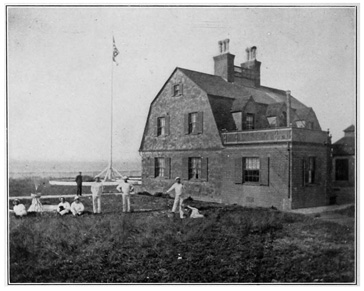
Point Reyes Life-Saving Station.
Near the close of a very murky, foggy day, in August, 1875,
a sailing vessel, the Warrior Queen, bound from Auckland, New
Zealand, to San Francisco, went ashore on the beach, about three
miles north of the Point.
The sky had been so overcast with fog that her officers
had not been able to take any observations for ten days and
their "dead-reckoning" showed them to be many miles at sea.
Suddenly they found themselves in the breakers going
ashore on a sand beach and by immediately casting anchor, the
vessel was held from going hard ashore, although she was later
driven far upon the beach.
The men embarked in three boats and put to sea rather than
try to effect a landing in the surf, and reached San Francisco
safely the following day.
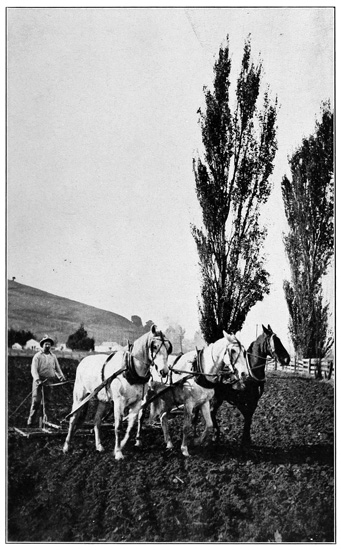
Plowing in October.
When the Warrior
Queen was discovered
by the settlers the
next morning after
she struck, there was
consequently no sign
of life on board, and
it became a matter of
conjecture to those
who had assembled
on the beach as to
what had become of
the crew.
It was decided to
go on board and discover,
if possible,
something to show the
fate of the men, but
the difficulty which
confronted them was
how to communicate
with the ship.
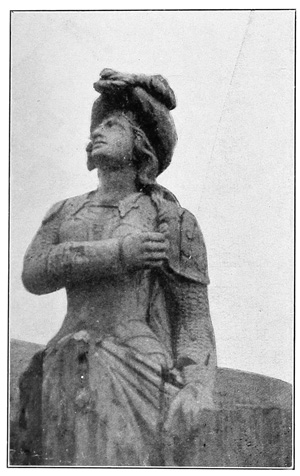
"The Warrior Queen."
At last, Mr. Henry Claussen, a sea-faring man of much
experience (who still lives with his family on the Point), volunteered
to swim out to the vessel and take a line on board
with him. He performed the daring feat and was rewarded
by finding that all books and instruments were gone, hence
he knew that the men had put to sea.
On a ranch but a short distance from the light-house the only
known relic of the wreck remains. This is none other than
the Warrior Queen herself-the figure-head of the vessel. Clad
in a suit of mail, a shield clenched tightly to her side, with head
upraised in proud defiance, the Warrior Queen seems still to
send a challenge to the elements; but now her battle is for life
itself—against rain and wind and the decay of time.
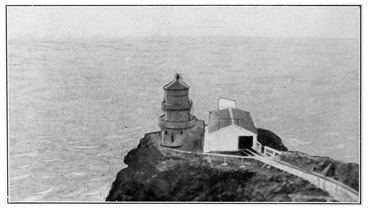
The Lighthouse.
While prolific in legends and memories, history is not the
only vivifying current in Marin, and though linked inseparably
with the past, she is not a worn and decrepit matron relying
on artifice solely to revive her charms, but a young and vigorous
maiden, in whom the ambitions, powers, and possibilities
are all centered but untried.
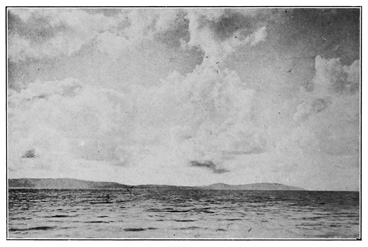
Cloud-Hosts.
That a new era is awakening for this region is without doubt.
Large tracts of land formerly held intact are now being divided
into building lots, and the rapidity with which these are selling
portends a rapidly increasing population.
Various railroads are contending for rights of way, and
countless rumors are in circulation, any of which means a
changed aspect for the County.
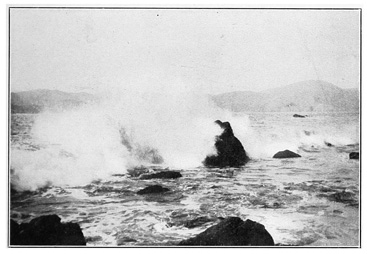
Where the Waves Break.
The Marin Terminal is constructing a route from Petaluma
to Point San Pedro, and two railroad companies have filed
articles of incorporation for the avowed purpose of making
some points on Marin's shore the land terminus for railroads
from San Francisco to points in the northern part of the State.
The recent purchase of Silva Island, in Richardson's Bay,
by the officials of the Western Pacific gives credence to a rumor
that, a long wharf being constructed from this Island, the company
would institute a terminus there.
The facilities which this County offers for a railroad center
are undeniable; while the monopolistic control of the surrounding
Bay terminals renders another railroad outlet a practical
necessity, and its adjacency to San Francisco and the excellent
harbors which skirt its shores make Marin a natural and practical
center.
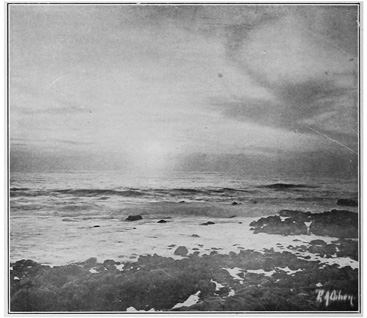
The Glory of the Dying Day.
Without doubt the ensuing years will witness many radical
changes for this northern peninsula.
With the increase in population there is every probability
that a connection from Point San Pedro across to the Belt Line
on the Contra Costa shore will be consummated, linking the
Bay counties by a boat ride of scarce fifteen minutes.
The new coaling station which the Government will erect
at California City, a small place near Tiburon, is another enterprise
in the County, which will call for the expenditure
of more than three hundred and fifty thousand dollars. It is
said that the Bureau of Equipment of the Navy Department has
already signed with a New York firm to begin on this.
Having reached the limits of Marin's enterprises, and territory,
Point Reyes, from which westward stretches an apparent
infinitude of sea, to where the sun, now dipping on the verge of
the horizon, casts its refulgent beams, I gazed backward on
Marin which lay behind me glowing in the glory of the dying day.
The indented shore, on whose cliffs nature has hung no
tapestry of verdure, now enshrouded in the lambent haze, no
longer looked as if composed of material objects, but rather
like its luminous wraith emerging from the sea. And as the
mists of evening veiled it gradually from my view I murmured:
"There is a future as well as a past for this little County,
a future not painted in the dim tints of the fading day, but in
the bright, glorious radiance of the expectant morrow."