On the north-western shores of Australia, between
Cossack township and Port Darwin, lies a strip of
coastline which has not yet received much attention
from the outside world. This is the pearling-grounds
of the Nor'-West, and the lordly pioneers who rule
there hope that their preserves may long continue to
be neglected by the check-suited globe-trotter. The
headquarters of the pearling industry is at Broome, the
landing station of one of the Australian cable systems.
Broome, when the fleet is in port, has a population of
about 1,500, which is made up of 200 white men, 800
Malays, 100 Japanese, and the same number of what
are termed Manilamen, the remainder being a heterogeneous
lot of aborigines, coolies, Kanakas, and specimens
of almost every other race on earth. When the pearlers
are out, however, the town is practically deserted.
Dampier was the first European to skirt this coast, but
it was long after his advent that it became famous for
its pearl-shell deposits, although, even before the great
explorer's time, it was probably known to the aborigines,
who until recently were in the habit of gathering for food
the bivalves that the monsoon storms threw up on the
beach. But since the days of Dampier many changes
have occurred on these desolate shores, and it is even
doubtful if the coast has the same configuration now as
it had then. While the eastern states of Australia were
still struggling for existence, the fierce Malay pirates
reigned here, and indeed it is only lately that it has been
freed from all suspicion in that respect, although the
pirates may not always have been the Malays. The
early sea-rovers were not long in finding out that it
would pay them to give some attention to the treasures
of the sea, and it is probably owing to their efforts that
Roebuck Bay and the Ninety-Mile beach came into prominence
as pearling-grounds. From that time up to about
twenty years ago these individuals worked the shores and
shallows by various methods peculiar to themselves, the
chief consisting of forcing the unfortunate aborigines to
dive for the shells while they merely extracted the
pearls.
This system ceased suddenly so far as the power of the
Malays was concerned; for towards the end of the 'Seventies
some colonial adventurers sailed up the coast from
Fremantle, and although little is officially known as to
what then transpired, pearling shortly afterwards became
a recognised profession among our colonial cousins.
Some of those pioneers are still engaged in the trade, and
many strange stories are told of their doings before the
light of civilisation, in the shape of telegraphic communication,
was let in upon their coast.
At present, taken as they stand, the pearlers of the
Nor'-West are one of the wealthiest bodies of men in the
world. They are certainly one of the most daring and
most hospitable, and do not hesitate to share their wealth
with any unlucky comrades. The methods in vogue now
are much different from those employed twenty years
ago. Beach-combing and enforced labour have given
place to specially-designed luggers, profit-sharing systems,
and the most modern diving-dresses, although among the
South Pacific Islands beach-combing is still another name
for piracy and slave-raiding. Strangely enough, the
pearls do not now form the chief support of the industry.
Nevertheless, some are frequently found worth £100 and
upwards, and many of a value of £10, while from that
sum downwards to 1s. for a thousand the pearls are very
plentiful. The shell, however, is now the backbone of
the industry. It is valued at from £100 to £180 per ton,
and finds ready sale through Singapore agencies of London
firms at anything between those prices.
The pearler of the present day is a Briton in every
sense of the word, and takes great care to impress that
fact upon all who visit his domain. He usually owns the
lugger he commands, but in some cases he has only a
share in it and its profits, the real owner being a speculative
gentleman who resides in his schooner and pays only
occasional visits to the various luggers under his flag.
In some of these deputy-managed craft the only qualification
necessary to obtain the position of skipper or
commander is that of being a white man and not a
German; but when the master pearler goes to the
British port of Singapore he is invariably forced to
"come down a bit," and do his business with the
prosperous and well-satisfied sons of the Fatherland.
Pearling is chiefly carried on in what are termed
"proved grounds"; but if a good haul be made at any
time the pearler is not averse to prospecting for new
grounds (waters). As a rule the commander is the only
white man on board the lugger. The crew is composed
of Malays and coolies, but the diver is always an intelligent
Manilaman or Filipino, who receives a small
commission on the results of his work. The depth at
which the shell is found is now about sixteen fathoms.
Of course shallower ledges are still worked, but it is
considered that they are almost exhausted, and few
pearlers waste time over them. In working, the diver
is lowered over the gunwale by means of a winch, or
in some cases dropped over unceremoniously by two of
the Malay crew, and another two pump air down to him.
These people are always quarrelling among themselves,
and consequently the diver runs many risks he does not
at the time know of, unless he guesses what is happening
above when he experiences the sensations attending the
stoppage of his air supply. He is accustomed to such
trifles, however, and being more or less a fatalist,
probably wonders what the men at the pumps are
quarrelling about, and in a disinterested sort of way
speculates on which of his two pumpsmen will prove
the weaker, and accordingly feed the sharks with him.
Notwithstanding the uncertainty of life, he gathers all
the shells within his limited range of vision, and when—if
not too late—the men aloft stop fighting, he is hauled
to the gunwale, where he is relieved of his spoil and
dropped over again.
The shells are found in patches, and when one deposit
is exhausted—or perhaps before, for the vessel is drifting
all the time—the diver moves on to the next, crashing
through dense forests of coral and other strange submarine
growths en route, and frequently having to cut the fearful
coiling creepers from his person. Often, too, he is precipitated
into a deep, dark chasm of unknown extent. In
such moments the diver's sole idea is to preserve his
balance, for he is really but a feather-weight in the water
at the sixteen-fathom level, and in due time he is safely
hauled across the gulf, when, if he has not retained a
vertical position, or if his line has not been kept taut
overhead, he is dragged head-first through any vegetation
or oozy slime that may lie in his path. When he
regains his equilibrium, he once more turns his attention
to the oyster-beds.
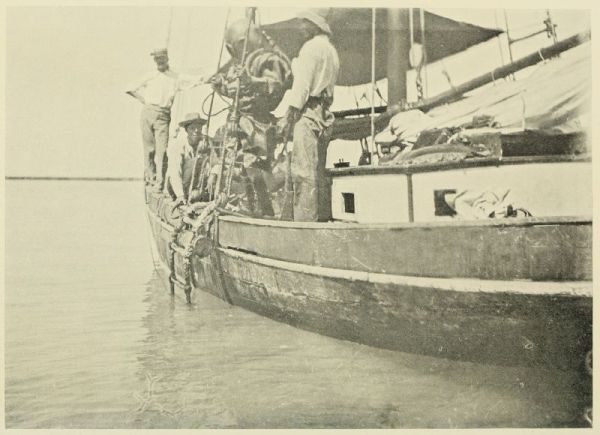 |
|
Ready to go Down.
|
Meanwhile the lugger drifts erratically over the surface
of the ocean. An evil-eyed Malay may be asleep by the
tiller, and the white commander will likewise be serenely
indifferent to his surroundings, unless the thought strikes
him that the quality of the last case of whisky he had
was not in accordance with the labels on the bottles or
the price he paid, in which event he will probably be
making things lively among the crew, and the profits
of the trip will increase in proportion. Every fifteen
minutes or so the diver comes up for a "blow." If the
shells are plentiful he may send them up in a net
between times; but, as a rule, there are a few yards
separating the shells of any size, and it is not often that
he cannot bring them all aloft with him. A "blow" to
this individual means being suspended over the gunwale
with his helmet unscrewed for such time as the lugger
may take to sail to the next known patch, after which he
is allowed to drop again.
When a full cargo of shell has been obtained, the
lugger's course is shaped towards Broome, where the
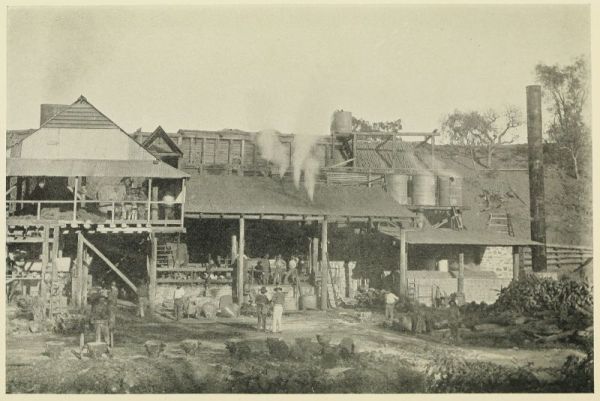
molluscs are opened in sheds erected for the purpose.
In the cases of the pearlers who possess several luggers
a schooner is sent round periodically to collect the shell
from the smaller craft, thus saving the latter a journey
which they are ill able to accomplish, owing to their
peculiar design and extremely small freeboard. The
process of opening is sometimes carried on while the
schooner sails for Broome; but, as most of the pearler
kings make their homes on board these vessels now, and
do not care to suffer the attending unpleasantness, the
system is fast dying out, and the schooner, in turn,
discharges at the Broome opening-sheds.
The methods of opening are many. In the early days
the shells were torn apart with a knife or any other convenient
weapon, and if no pearls rewarded a brief search,
the carcass of the oyster was scooped out and left to rot
on the sand until a merciful monsoon tide caused its
removal. Lately, however, the pearlers have copied the
plan of the Chinese beachcombers of the Archipelago,
and a simpler system could not well be devised. The
shells are laid on a slightly-inclined bench, at the lowest
edge of which is a carefully-constructed ledge containing
some water in the angle formed. After two days in this
position the oyster "gapes" and "spits out" the pearl—if
any—which, of course, rolls down the bench until it is
caught in the angle, from where it is gathered by the
attendant Japanese or coolies. The number of pearls
obtained in this way is about 30 per cent. greater than
was formerly the case by the forcible method, and it is
therefore evident that the hasty pearlers must have lost
a considerable amount through their carelessness and the
incompleteness of their method of extraction. As said
before, the pearls do not now form the chief part of the
business; nevertheless there are usually a fair number in
the shells discharged from one schooner. When the
pearls have been collected the molluscs are cleaned out
from the shells and either buried or otherwise destroyed,
their late casings being stored to await shipment. The
chief opening establishments are owned by a London
syndicate of jewellers, who employ in their service as
many aborigines, coolies, and Japanese as may care to
offer themselves. This syndicate is always willing to
purchase "on chance" any shipment of shell that may
come into port, and have a large fleet of their own
luggers constantly on the waters during the season. As
might be expected, this organised company is not liked
by the independent pearlers, who—rightly or not—imagine
that a monopoly of the trade is the real object
in view. To such an extent is this rivalry carried that,
notwithstanding the fact that Messrs. S. & Co. have
special facilities for shipping, and will pay full Singapore
prices for all shells sold to them, the pearlers, unless
temporarily financially embarrassed, will have nothing to
do with them, and prefer to pay the expense of shipping
their own shell to Singapore by some of the Holt Line of
steamers, which call regularly in at Broome for that purpose
while en route from Fremantle to the great Oriental
metropolis.
During the monsoon season the pearling fleet shelters
in Roebuck Bay, on the shores of which Broome stands,
and then that wicked and evil-smelling township wakens
up from its sleep. Its drinking saloons are crowded with
black, yellow, and white humanity; the joss-houses are
filled with maddened nondescripts; and the far-seeing
abilities and correct judgment of the man who designed
the prison to hold the entire population becomes apparent.
Unfortunately there are some renegade whites who run
gambling-hells; but, in justice to Britons at large, it
should be stated that these men are mostly mongrel
foreigners. The master pearlers, as a rule, do not frequent
these places, preferring the narrower but healthier
confines of their own vessels to that of the filthy,
mosquito-infested town; but if any do go ashore, they
all meet in a saloon owned by a gentleman with a very
Highland name and dusky countenance, or in the cable-house,
where fortunes may be gambled away in a night.
These men are indifferent to this matter. Money, to
most of them, has no attractions, and if they were
denied the excitement of being alternately worth a fair
fortune and without a sixpence in their possession they
would probably die of ennui. But some of the pearlers—indeed,
the majority—are made of sterner stuff; they
still retain memories of lands where green vegetation
and flowing streams of crystal water take the place of
hideous mangrove swamps and parching deserts, and
their efforts are all made in the hope that some day the
results will enable them to return to those lands. These
men only come into Broome when in need of stores, and,
after landing their crews, spend the "off" season in
some of the numerous bays and inlets farther north,
occasionally finding rich patches in those sheltered
sounds capable of being worked at all seasons.
It matters little on this coast what the original temperament
of any person may have been, the influence
of his surroundings soon has its effect upon him and
makes him like his fellows. With the pearlers this
takes the form of a feeling of reckless indifference, and
a stranger suddenly thrown among them sees much to
interest and amuse him in the incongruities brought
about by this state of affairs.
When I visited this quarter I was not aware that
there was any special industry carried on; in fact, I
did not even know that a township existed between
Roebourne and Derby until one evening the ss. Nemesis
sailed into Roebuck Bay, and the skipper calmly announced
that I would require to go ashore and await the
next steamer, as he was going no farther. I was booked
to London, viâ Singapore, but I had expected to be
dumped ashore somewhere, as the Nemesis was not the
regular connecting steamer, and I had taken it chiefly
with the desire to get away from plague-stricken
Fremantle, to which city I had come round from
Northern Queensland.
"All right, captain," I said; "but you might give me
my bearings first."
"Go straight ahead from the jetty until you see the cable
station, then starboard hard, and you are into Roderick's
Hotel. Drinks don't cost more than a shilling there."
"Thanks. But what is the name of the port? I
presume we are still in Australia?"
"We are. This is Broome, the headquarters of the
pearling fleet, and the hottest hole on earth."
"Oh, I think I'll survive till the Australind comes
along," I said, as indifferently as I could; and, after
seeing my baggage on shore, I followed out the captain's
directions, and finally entered a well-lit saloon, in which
the strains of a gramaphone were evidently causing
much appreciation. No one seemed to notice me as
I made my way forward. All the occupants were
clustered round the gramaphone and indulging in various
comments as to the correctness of the song it was
giving forth. There were about ten men in the party,
all of whom were white. Some were garbed in the most
approved London clubland fashion, while others were
very scantily clad indeed; but the careless manner in
which handfuls of sovereigns were occasionally flung
down on the counter showed that money at least was not
much of a consideration with any of them.
"Hallo, boys! here's a stranger," suddenly cried one,
seeing me looking on interestedly, and instantly a general
move was made in my direction.
"Name it, boss," spoke the bar-tender, coming
forward; "that is, if you is not an S—— 's man."
"What will happen if I am?" I inquired, slightly
curious to know what an S—— 's man was.
"You'll get fired; that's all——"
"Shut up, Bob," reproved a tall, broad-shouldered
man. "This is the master-pearlers' club," he continued,
addressing me, "and as a stranger you are very welcome
to whatever it affords."
"Thank you, but I understood that this was Roderick's
Hotel?"
"Same thing," laughed several of the men. "Who
sent you here?"
"Captain Lawrence of the Nemesis."
"Then it's all O.K. He is one of us," said the first
speaker. "You will be my guest to-night, after which
we will consider what is best to do with you."
"Gently there; I am a Britisher, and quite able to look
after myself."
"You can bet, my boy, that we're all coloured red here,
but of course if you don't wish——"
"You are needing a spell south, Wilcox," interrupted
another gentleman. "You don't give the stranger half a
chance. We are pearlers," he continued, turning to me.
"This is the off season, and as hell is let loose in this
town when the fleet is at home, we arrange to look after
any white stranger that may be cast upon these shores.
Listen! There's the Malays' infernal racket starting
now. I shouldn't wonder but they will have a fight with
the aborigines before morning."
"I see I have made a mistake, then, gentlemen," I said,
"in coming here, but I assure you that it was not from
choice I came."
"Oh, don't let that trouble you. We are very glad to
have you. But you can now understand why we reserve
this hotel for our own use. We don't all necessarily
make beasts of ourselves, although you see us here. Some
of us, it is true, have a failing that way, and there are
others over in the cable shanty now going it pretty stiff;
we therefore make it a point that a dozen of us come here
every night to look after any of the boys who may take
more stagger-juice than they can carry; but allow me to
introduce the company. This is Alf Chambers. Here is
Sam Wilcox—Moore—Macpherson—Edward Wilson,
commonly known as Dandy Dick—Will Biddles—Gordon,
of G.B. diving-dress fame, and, the finest gentleman on
the Australian coast, Gentleman James——"
"What about yourself, Cap?" spoke the last-named,
waving his hand deprecatingly at the compliment.
"Me? Oh, I forgot. I am Biddles. You may have
heard of me down in Perth?"
"I believe I have," I answered. "You are the man
whom the American skipper mistook for a pirate, and
who, up in King Sound——"
"I see you have my history all right, lad; but there
goes the dinner-gong, so come along and sample Broome
fare."
In the company of the light-hearted pearlers the time
passed very quickly. It transpired that I had known in
Queensland some of their comrades who had drifted down
country from the Gulf pearling-grounds, and being well
accustomed to meeting all sorts of people, I readily
grasped the little peculiarities of my hosts, and soon
became on the best of terms with them all.
"I think we'll go now, boys," said Wilcox, some time
about midnight. "You fellows that are sober can see after
the other boys, and we two will get aboard the Thetis."
"Why, don't you stay here?" I cried.
"Not likely. There wouldn't be an ounce of blood left
in us by morning. The mosquitoes here are A 1; but can
you swim?"
"A little. Why?"
"Because I expect you will have to. You see we don't
care to give the mob a chance of going aboard while we
are on shore; so we never use our dinghys."
"Oh, how about your clothes?"
"Leave them on the jetty. I always send the cook
round for them in the morning."
I did not answer; I recognised that I was again among
a strange people. We were now threading our way
among the coolies' huts and shanties towards the beach.
The moon was shining brightly, thus enabling us to jump
over several forms which were huddled up in various
positions across our path without disturbing them.
"These people would stick a knife in a man for his
bootlaces," my companion remarked; "but luckily they
are always too drunk to stand."
"But if you treated them fairly might there not be
better results?"
"Look here, my lad, you've still got some of the old
country notions about you. You can't treat the Malays
as you do white men. They do not understand what
gratitude means. Great Southern Cross! don't you
know the history of this coast? Haven't you heard of
poor Woods? He was going to reform everything.
Gave the beggars a share of the profits, and wages
besides. First thing we knew was when his Chinese
cook rushed into Roderick's one night and told some of
us that Woods's crew had mutinied because of their
tinned dog being off colour—as if it ever was anything
else."
"And what was the result?"
"Oh, they killed Woods and threw his body into the
sea, and then sailed for Java. The cook jumped overboard
and swam ashore, and that's how we knew. The
Dutchmen chased them up and sent them back from
Surabaya in chains, and we hung them."
"These men were Malays?"
"Yes, but the half-castes and aborigines are just as
bad. Take the case of Dr. Vines, for instance; they
murdered him because he couldn't give them what he
hadn't got himself. And then there was Captain Skinner;
but you'll not sleep if I tell you any more. Yonder is my
craft. Get ready."
Wilcox discarded his coat as he spoke and plunged into
the inviting waters, and somewhat dubiously I followed;
for although my garments were of the usual Siamese silk
variety, and therefore did not greatly impede my movements,
I could not help wondering what would happen if
there were any sharks about. As I struggled after Wilcox
this thought kept recurring to me in spite of all my
attempts to convince myself that there could be no such
creatures there, and just when I had almost succeeded
in believing that such might somehow be the case, I
suddenly remembered that I had been watching these
very monsters playing around the Nemesis all that
afternoon.
"What about sharks?" I gasped, as the stern light of
the Thetis shone out ahead.
"They're too well fed here to trouble about white
men," came the reply, and I had to satisfy myself with
the hope that the sharks would be able to distinguish
without personal investigation that I was of the fortunate
colour. We reached the schooner without mishap, however,
and scrambled over its stern by means of a friendly
rope, and soon after I was asleep in what might have
been a comfortable berth but for the presence of some
hundreds of other occupants of divers kinds.
Next morning I found my baggage and the clothes I
had thrown off in the cabin beside me, and on going out
on deck had my first view of Broome by daylight. It was
not much to look at. There were some tents, two or three
dozen "humpies" and "wind-breaks," and about twelve
galvanised-iron structures, of which the jail, the cable
station, Gummows' and Roderick's Hotels, were the most
conspicuous. The Nemesis had sailed away south again
during the night, and there was no sign of life anywhere.
During the day—by way of a treat—Wilcox and some
others took me to inspect "their prison," in which they
had evidently great pride; but I could not work up any
enthusiasm over the sight of a score of miserable wretches
chained together by the ankles.
"These are the murderers of old Smith," remarked one
of my companions. "They turned on him because he
plugged one of them with a '44,' one day when he was
drunk, up in King Sound."
"We're keeping them here until we can get an
executioner," added the jailer, "but it's spoiling the trade
of the town; every one is afraid of getting drunk, as they
might then be induced to take the job on."
I was glad when we left the place, and, eager to obtain
information of a more pleasant kind, I asked to be shown
the opening sheds.
"Well, you are a strange fellow!" was Wilcox's only
comment as he led the way thither, and as we neared the
shell-strewn benches I began to understand the meaning
of his words, and signified that, after all, I thought I
would rather not go farther.
"They do smell a bit strong," laughed my friend;
"but we're not near enough yet, and the wind is not off
the proper quarter to give a Broome appetiser. But
there's Biddles semaphoring for us to dine with him in
the club; let's get along."
Several days passed agreeably enough to me among
these free-hearted Britons; but in time I began to calculate
when the next steamer would be due. "I fear
there's no steamer coming into Broome for two months,
my boy," said Captain Biddles, when I asked him, and a
visit to the cable station confirmed his fears; for, when
the obliging officials there wired to Fremantle, they
received the reply that the ss. Australind would miss
Broome and call instead at Derby, on the head of King
Sound.
"Then I will have to cross country to Derby," I said.
"I suppose that is easy enough; the telegraph line runs
all the way?"
"Oh, it's about as easy as going to heaven!" answered
Biddles. "The aborigines are very considerate between
here and Derby—they always kill you before they make
a dinner out of you. But are you sure you can't stay
here?"
"It is four years since I was north of the equator," I
said, "and I have a strong desire to cross it as soon as
possible."
"In that case, I suppose you will have to go. Wish I
could myself."
"Why can't you? You are rich enough now, surely?"
"Ha, ha! Imagine old Biddles going back to civilisation!
Why, man, they would—— Well, well; never
mind. Here's the boys coming. We'll see what can
be done."
That evening I was informed that the Bessie Fraser
was to sail north to King Sound in the morning with
stores for George Hobart's schooners. I could go with
it, and Hobart would find some means of landing me
at Derby. This arrangement, the pearlers assured me,
was not made in my behalf, as the Bessie Fraser would
have to sail in any case. Thus it came about that
next morning I parted with my kindly friends, and in
company with Harry Quin, the skipper, six Malays
for a crew, a Chinese cook, and a Manilaman diver,
rounded the long, sandy point and headed northwards.
After lunch, the captain announced his intention of
having a sleep if I didn't mind, and, thinking that he
would require to be on the watch during the night, which
would certainly be stormy, I said that I could easily
pass the time looking round, and, in an endeavour to do
so, soon after entered into conversation with the cook.
"Is it going to be rough to-night, John?" I said, by
way of introduction, watching him as he went through
some mysterious performances necessary for the preparation
of our next meal.
"Velly. Me no need make breakfast. Captain sick.
No want any."
"What! The captain sick? What do you mean?"
"Huh! Him no sail man. Him only gole' glabber;
no know nothing 'bout sea. D——" John disappeared
as he gave vent to his last exclamation, and, turning
round, I saw that Aguinili, the diver and sarang, was
approaching.
"Good day, sir," he said, in excellent English.
"Good day, Aguinili. You have given Ah Sing a
fright."
"He gabble gabble all day when captain not well."
"Great Scot! What is wrong? The captain was all
right half an hour ago."
"Yes, but we are round the head now, and the
monsoon is on. I come speak with you, for to-night
I have only one man to steer with me; the rest no
good. I come ask will you take helm for time to-night,
else we must go back?"
I was certainly surprised at Aguinili's words, but,
grasping their import, I at once signified that I would
willingly take a watch, and following him aft, I was
made acquainted with the little peculiarities of the
schooner in regards to her steering.
"Malay bad man—you no trust him," remarked
Aguinili. "No let them know captain not well?"
"Never fear!" I answered; "I have sailed with
their kind before. But call me when you want me,
for I cannot navigate by the stars as you do, so I must
hunt up a chart and get out my own instruments."
At that moment Ah Sing came aft and informed me
that the captain desired my presence, so, making my
way to his stuffy cabin, I soon stood beside him. He
was lying in his bunk reading, but as I entered he cast
aside the book and said, "I say, mate, ye needn't give
me away more than ye can help."
"Why, what's the matter?"
"Nothing, so long as I lie on my back; but this
darned motion doesn't agree with me in any other
position."
"Do you mean to say——?"
"That I is no sailor? You struck the bull first shot.
I ain't. I is a gold-miner, and got stranded in Broome
after making a pile on the Marble Bar fields, an' losing
it down in Roebourne. Lord knows how I got here,
but old Wilcox got me this billet with Hobart, 'cause
I could swear at the nigs better than any man he
knowed. I know nothing about navigation except what
a bushman knows, and here I is at sea entirely."
"But have you never had any accidents?"
"Oh, there have been some narrow squeaks, but that
chap Aguinili is a smart fellow; he manages somehow,
and I swears at—— Lor'! but I is bad. Oh!—--"
"You'll be all right soon," I said sympathisingly, as
I left him. He was the best example of a bluffer I had
ever come across, but he had the true grit of the sons
of the Southern Cross, and as he knew nothing of
navigation, he got along wonderfully well by leaving
everything to fate and Aguinili.
It was a very rough night, but the Bessie Fraser
weathered it all right, thanks to the skilful handling
of the sarang. Next evening we entered King Sound,
and by seven o'clock were safely moored alongside the
schooner Electron, George Hobart's headquarters.
This gentleman was a very superior person to those
usually met in such latitudes; he was of a scientific
turn of mind, and had designed many strange appliances
which were the wonder and admiration of the pearling
fraternity.
"You have just arrived in time to witness the trial
of my new dress," were almost his first words to me;
and after dinner, in answer to my inquiry, he proceeded
to explain wherein his dress differed from others, and
to point out its anticipated advantages. "Sixteen
fathoms is the greatest depth at which we can work
with the old dress, you know," he said, "and even at
that a diver can only last out three seasons."
"Well, what's the odds?" interrupted Quin; "they're
cheap, ain't they? and there's any amount where they
come from."
"That may be; but this dress is designed to give the
diver a longer lease of life, and also to enable him to
stand a good two or three fathoms more pressure. I
have just got down a new G.B. dress from Singapore,
and I intend to try mine alongside it to-morrow."
I did not then know what a G.B. dress was, but
not wishing to display my ignorance, I did not inquire,
and during the evening's conversation I gathered that
it was the invention of two Glasgow engineers, who
had designed it to allow of greater depths being explored.
In the morning all hands began to prepare for the
trials, and after breakfast Aguinili, as the most
experienced diver, was lowered from the derrick in the
G.B. dress, and Jim Mackenzie, the Electron's chief
officer, was also weighted and dropped over in Hobart's.
"Isn't there a nigger handy to go down in the old
dress now?" asked Quin, kicking over a helmet. "I'll
go two to one on it yet."
"The water is too deep here," answered Hobart.
"No man could bottom in the old dress."
"I'll go," said the intrepid Quin, "and chance it."
"No. Hallo! Mackenzie is down. Great heavens!
The pumps are not working." Hobart sprang to the
pumps, and threw the two Malay operators across the
deck, then, assisted by Quin and myself, began pumping
furiously. It was useless. The pumps were not drawing
air. The perspiration burst out over my face as I
realised the position that poor Mackenzie was in. Quin
swore, and then rushed to the winch, where the crew,
in answer to Hobart's signal, were already hauling in.
In less time than it takes to tell the diver was above
the surface, and in another second his helmet was
unscrewed.
"Poor old Mac," said Quin, as the limp form was
removed from its cage; "I always reckoned that he
would peg out before me."
"Wrong again, Quin," feebly murmured Mackenzie.
"You won't be mate of the Electron this trip—— But
I say, there's shells down there as big as a table, and
they are packed like peas."
"Never mind them at present, Mac," spoke Hobart.
"We're glad to see you all right again; but what
happened to the dress——?"
"The dress is all right, but the beggars must have
stopped pumping while I was sinking, and when they
started again I fancy the check-valve would not work."
"Ah! then we burst the connection on deck when
we rushed to the pumps. That means my dress won't
do for twenty fathoms at any rate. Hallo! there's
Aguinili's signal. Haul away. Why, it is shell, and
look at the size."
In answer to the diver's signal the men had hauled
up his shell-net, and when it appeared above the waters
the size of the shells had drawn forth an exclamation
of surprise from all. Soon after Aguinili himself came
up laden with the spoil of the nineteen-fathom ledge,
and when he was brought on deck and his helmet
removed he told a wonderful story of the wealth of
the deep deposits, which hitherto no man had seen.
"Shell plenty. No need move away; fill net all time
same place. Good shell for pearl, I know that, for
I see sea-snake feed much. I go down again quick."
"No, no, Aguinili," cried Hobart, handing him a glass
of spirits. "We have plenty of time for that. Have
the shell been moving much?"
"No. Shells grow there. No currents; no monsoons;
deep, deep coral bottom. No shell on sixteen-fathom
bottom here."
"Well, gentlemen," finally said Hobart, "we have
seen the result of the G.B. comes out first. I will cable
to Singapore to send down some more of them, and I
will see that Gentleman James, Captain Biddies, and
the others get to know of its good points. Who knows
what fortunes we may now obtain from these deep
neglected sounds."
Two hours afterwards the Electron was sailing down
King Sound towards the Indian Ocean, and on my
venturing to ask where we were bound for, Hobart
informed me that he had received word from Derby that
the bubonic plague had broken out afresh in Fremantle,
and it was therefore obvious that the Australind would
not now call at the northern port; for if she did so she
would assuredly be quarantined at Singapore through
not having been sufficient time at sea since leaving
Australian waters.
"We are going to put you on board now," he added,
"and Mackenzie is going up to Raffles with you to see
about the new dresses. Meanwhile the men are opening
the shells from the deep level, and I hope that we will
find a memento to give you of your visit to this coast."
Early in the afternoon a long hanging cloud of black
smoke became visible away on the southern horizon,
and knowing that it must be issuing from the funnels
of the Australind or the Adelaide Steamship Co.'s trader
Albany, we steered out to investigate, and, if need be,
to intercept. It proved to be the former vessel, and
in due course she answered our signal and hove to.
"Well, goodbye then, lad. I hope you will come
back to this coast when you are tired of the old country,"
were Hobart's parting words as Mackenzie and I
clambered up the sides of the Australind.
"If you see a lugger cheap at Singapore you might
buy it for me," cried Quin, throwing me a miner's
gold-bag; "and, I say, you might send me the second
part of the book you gave me to read when we were
coming up through the monsoon on the Bessie. I am
darned curious to know the wind-up."
"And here's a pair of the deep shells; take care of
them," cried Hobart, fastening a couple into the sling
in which my baggage was being hoisted.
Three days after landing at Singapore I bought a
small lugger for Quin, and sent back the balance of his
money, and a complete copy of the "Pilgrim's Progress"
(which was the book requested) with Mackenzie, who
also undertook to see about the lugger going south.
Four days later, while tossing in the bay of Bengal
on the ss. Ballarat, I began to rearrange my belongings
so that they might be readily transferred to the
connecting P. and O. mail steamer Himalaya at Colombo.
In doing so I chanced to open my shells and found
therein two magnificent pearls, and a note which read:
"Please accept one of the enclosed from me. The other
is from Aguinili, who has asked me to offer it to you
in kind remembrance."
The Gresham Press,
UNWIN BROTHERS, LIMITED,
WOKING AND LONDON.
|
Siberia:
|
A Record of Travel, Climbing, and Exploration.
|
By SAMUEL TURNER, F.R.G.S.
|
WITH A PREFACE BY BARON HEYKING.
|
With more than 100 Illustrations, and with 2 Maps.
|
Demy 8vo, cloth, 21/-net.
|
The materials for this book were gathered during a journey in
Siberia in 1903. Helped by over 100 merchants (Siberian,
Russian, Danish and English) the writer was able to collect much
information, and observe the present social and industrial condition
of the country. The trade and country life of the mixed races of
Siberia is described, and valuable information is given about their
chief industry (dairy produce), which goes far to dissipate the
common idea that Siberia is snow-bound, and to show that it is now
one of the leading agricultural countries in the world.
The author describes his unaccompanied climbs in the mountains
which he discovered in the Kutunski Belki range in the Altai, about
800 miles off the Great Siberian Railway line from a point about
2,500 miles beyond Moscow. He made a winter journey of 1,600
miles on sledge, drosky, and horseback, 250 miles of this journey
being through country which has never been penetrated by any
other European even in summer. He also describes 40 miles of
what was probably the most difficult winter exploration that has
ever been undertaken, proving that even the rigour of a Siberian
winter cannot keep a true mountaineer from scaling unknown peaks.
The volume is elaborately illustrated from photographs by the
author.
"To the trader and to the explorer, and to many who are neither, but who
love to read books of travel and to venture in imagination into wild places of the
earth, this book is heartily to be commended. It is lively, entertaining, instructive.
It throws fresh light on the Empire of the Czars. Above all, it is a
record of British pluck."—Scotsman.
John Chinaman at Home
|
|
By the Rev. E. J. HARDY,
|
Author of "How to be Happy though Married"; lately Chaplain
to H.M. Forces in Hong Kong.
|
With 36 Illustrations. Demy 8vo, cloth, 10/6 net.
|
|
|
CONTENTS.
|
Hong Kong; Tientsin and Peking; Canton; On the
West River; Swatow, Amoy, Foochow; Up the Yangtze;
Village Life; Topsy-turvy; Some Chinese Characteristics;
Chinese Food; Medicine and Surgery; Chinese Clothes;
Houses and Gardens; Chinese Servants; Betrothal and
Marriage; Death and Burial; Mourning; Education in
China; Boys in China; Girls and Women; Chinese Manners;
Government in China; Punishments; Chinese Soldiers; The
Religions of China; Outside and Inside a Temple; New
Year's Day; Monks and Priests; Spirits; Feng shiu and
other Superstitions; Missionaries; as the Chinese See Us.
The reader will not be bored with politics or the "future
of China," for the book only treats of the common every-day
things of the Chinese which seem so peculiar to us. These
are described and, when possible, explained. Anecdotes are
freely used to illustrate.
Demy 8vo, cloth, 21/-
|
Somerset House, Past and
Present
|
By RAYMOND NEEDHAM and
ALEXANDER WEBSTER.
|
With Photogravure Frontispiece and many Illustrations.
|
This book deals with the history of Somerset House from
its foundation by the Lord Protector in 1547 to the
present day. It is as far as possible a continuous record of the
events which in times gone by gathered illustrious personages
within the walls of the old palace and made it a centre of
English social life. For two centuries Somerset House was the
home of Queens and Princesses; it was associated with the
stalwart Protestants of the Reformation and the intriguing
Catholics of the Revolution; it has passed through greater
vicissitudes than almost any other secular edifice in London.
The modern building housed the early exhibitions of the Royal
Academy of Arts, a Naval Museum, the Royal and other learned
Societies, until, within the last fifty years, it was given over to
its present occupants and the matter-of-fact romance of the
Imperial Revenue. The history includes the story of King's
College, which since its inauguration has occupied a building
erected on the eastern edge of the site, and designed to
harmonise with the main structure. The volume is illustrated
by reproductions of rare old prints and a fine series of modern
photographs.
Demy 8vo, cloth, 10/6 net.
|
The Age of the Earth, and
other Geological Studies
|
By W. J. SOLLAS, LL.D., D.Sc., F.R,S.
|
Professor of Geology in the University of Oxford
|
Illustrated.
|
This volume, while written by one of the foremost of
English geologists, will be found interesting and attractive
by the reader who has no special knowledge of the science.
The essay which gives the book its title sets forth the bearing of
the doctrine of evolution on geological speculation, and particularly
on the vexed question of our planet's antiquity. The
subjects of the other studies include the following: The Figure
of the Earth, and the Origin of the Ocean; Geologies and
Deluges; the Volcanoes of the Lipari Isles; the History and
Structure of a Coral Reef; the Origin and Formation of Flints;
the Evolution of Freshwater Animals; and the Influence of
Oxford on Geology.
"They range over a great variety of subjects, including many which are
of sufficiently wide interest to bring the geologist into sympathetic touch with
the general reader. What educated man can fail to be interested in such
subjects, for instance, as the age of the earth, the building of coral islands,
the cause of volcanic action, or the Deluge? Of all these matters the
Professor discourses pleasantly and well, writing with command of much
scientific learning, yet always readably, sometimes with brilliancy of diction,
and occasionally with a touch of humour."—Athenæum.
|
Six Standard Works.
|
|
COMPLETE POPULAR EDITIONS. ILLUSTRATED.
|
|
Large Crown 8vo, Cloth. Price 2/6 net.
|
|
The Life of Richard Cobden.
By John Morley.
|
"One of the most important and interesting works of its class in the
English language,"—Daily Chronicle.
|
The Life and Times of Savonarola.
By Professor Pasquale Villari.
|
"The most interesting religious biography that we know of in modern
times. It is difficult to speak of its merits without seeming exaggeration."—Spectator.
|
The Life and Times of Machiavelli.
By Professor Pasquale Villari.
|
"Machiavelli is represented for all time in the pages of Villari."—Guardian.
|
The Lives of Robert and Mary Moffat.
By John Smith Moffat.
|
"A loving record of a noble life, which has left the world a lesson for
all time of the power of earnest labour and simple faith."—Daily Chronicle.
|
The History of Florence.
By Professor Pasquale Villari.
|
"This volume is indeed worthy of the reputation of its author.... We
feel very grateful to him for having given us the most concise, and at the
same time perhaps the most complete constitutional history that has yet
appeared of the first two centuries of the Florentine Republic."—Speaker.
|
English Wayfaring Life in the
Middle Ages (XIVth Century).
By J. J. Jusserand, French Ambassador at Washington
|
"One of those enchanting volumes which only Frenchmen have the gift
of writing. Buy it if you are wise, and keep it as a joy for ever."—Dr
Augustus Jessopp in the Nineteenth Century.
|
|
T. FISHER UNWIN, Publisher
1, Adelphi Terrace, London, W.C.
|
|
Standard Works.
|
|
COMPLETE POPULAR EDITIONS. ILLUSTRATED
|
|
Large Crown 8vo, Cloth. Price 2/6 net.
|
|
Lord Beaconsfield: A Biography.
By T. P. O'Connor
|
"Clever and brilliant.... Worth reading by everybody who either
admires or hates his subject."—Guardian
"A slashing and vastly interesting book."—Pall Mall Gazette.
|
Rome and Pompeii. Archæological
Rambles.
By Gaston Boissier.
|
"M. Gaston Boissier is one of the few living archæologists who can
make the dead bones of the past live again. While his researches show
the accuracy and thoroughness which we associate with German scholarship,
he has a gift of exposition which is wholly French. We can
imagine therefore, no better handbook for traveller or archæologist than
this one.—Daily Mail.
|
Holyoake: Sixty Years of an Agitator's Life.
By George Jacob Holyoake.
|
"A valuable contribution to the political, social, intellectual, and even
revolutionary history of our time."—Times.
"The book is full of interest; it produces a vivid, personal impression, it
contains contemporary notes on men and women of the century, it has
shrewd and vigorous sentences, and illustrates our own progress in
civilising thought."—Spectator.
|
Sir Walter Raleigh.
By Major Martin A. S. Hume.
|
"An admirable book which ought to be read by every one who takes
any interest in things that ought to interest all—the building of the
Empire and the men who built it. There is not a dull page in it, and with
his skilful telling of it, the story of Raleigh's life and of his times reads
like a romance."—Pall Mall Gazette.
|
|
T. FISHER UNWIN, Publisher
1, Adelphi Terrace, London, W.C.
|
|
The Mermaid Series.
|
|
THE BEST PLAYS OF THE OLD DRAMATISTS.
|
|
Literal Reproductions of the Old Text.
|
Printed on thin Paper. Small Crown 8vo, each Volume containing about
500 Pages and an Etched Frontispiece.
|
Cloth, 2s. 6d. net. Leather, 3s. 6d. net.
|
|
|
The Best Plays of Christopher Marlowe. Edited, with Critical
Memoir and Notes, by Havelock Ellis; and containing a
General Introduction to the Series by John Addington Symonds.
|
|
The Best Plays of Thomas Otway. Introduction and Notes by the
Hon. Roden Noel.
|
|
The Complete Plays of William Congreve. Edited by Alex. C
Ewald.
|
|
The Complete Plays of Richard Steele. Edited, with Introduction
and Notes, by G. A. Aitken.
|
|
The Best Plays of Ben Jonson. Edited, with Introduction and Notes,
by Brinsley Nicholson and C. H. Herford. 3 vols.
|
|
The Best Plays of James Shirley. With Introduction by Edmund
Gosse.
|
|
The Best Plays of Thomas Shadwell. Edited by George Saintsbury.
|
|
The Complete Plays of William Wycherley. Edited, with Introduction
and Notes, by W. C. Ward.
|
|
The Best Plays of John Ford. Edited by Havelock Ellis.
|
|
The Best Plays of Webster and Tourneur. With an Introduction
and Notes, by John Addington Symonds.
|
|
The Best Plays of Thomas Heywood. Edited by A. W. Verity.
With Introduction by J. A. Symonds.
|
|
The Best Plays of John Dryden. Edited by George Saintsbury.
2 vols.
|
|
The Best Plays of Thomas Middleton. With an Introduction by
Algernon Charles Swinburne. 2 vols.
|
|
Nero and other Plays. Edited by H. P. Horne, Arthur Symons,
A. W. Verity, and H. Ellis.
|
|
The Best Plays of Thomas Dekker. Notes by Ernest Rhys.
|
|
The Best Plays of Philip Massinger. With Critical and Biographical
Essays and Notes by Arthur Symons. 2 vols.
|
|
The Best Plays of Beaumont and Fletcher. With Introduction and
Notes by T. St Loe Strachey. 2 vols.
|
|
The Best Plays of George Chapman. Edited by William Lyon
Phelps.
|
The Select Plays of Sir John Vanbrugh. Edited, with an Introduction
and Notes, by A. E. H. Swain.
|
THE TIMES, 20th November 1903, in a Review of a column and a quarter, says—
|
"Mr Fisher Unwin is re-issuing his 'Mermaid Series' of Old Dramatists in a very
attractive form. The volumes are light in the hand and will go easily into the pocket;
they are printed in clear type on thin paper; ideal companions for the student who
seeks his pleasure where the Saint found it, 'in angulo cum libello.'"
|
THE PALL MALL GAZETTE says—
|
"It is impossible to let the completion of this reissue go by without congratulating
every one concerned, including the reader, on the possibility of obtaining the cream of
England's dramatic literature in this convenient form."
|
|
T. Fisher Unwin, Publisher, 1, Adelphi Terrace, London, W.C.
|
|
T. FISHER UNWIN, Publisher,
|
|
|
THE ADVENTURE SERIES
|
|
POPULAR RE-ISSUE.
|
Each large crown 8vo, fully illustrated. Popular re-issue,
3s. 6d. per vol.
|
|
|
1. ADVENTURES OF A YOUNGER SON.
By Edward
J. Trelawney. Introduction by Edward Garnett.
|
|
2. MADAGASCAR;
or, Robert Drury's Journal during his
Captivity on that Island. Preface and Notes by Captain
S. P. Oliver, R.A..
|
|
3. MEMOIRS OF THE EXTRAORDINARY MILITARY
CAREER OF JOHN SHIPP..
|
|
4. THE BUCCANEERS AND MAROONERS OF
AMERICA.
Edited and Illustrated by Howard Pyle.
|
|
5. THE LOG OF A JACK TAR:
Being the Life of James
Choyce, Master Mariner. Edited by Commander V. Lovett
Cameron.
|
|
6. FERDINAND MENDEZ PINTO, THE PORTUGUESE
ADVENTURER.
New Edition. Annotated
by Prof. A. Vambéry.
|
|
7. ADVENTURES OF A BLOCKADE RUNNER.
By
William Watson.
Illustrated by Arthur Byng, R.N.
|
|
8. THE LIFE AND ADVENTURES OF JAMES
BECKWOURTH,
Mountaineer, Scout, Pioneer, and Chief
of Crow Nation Indians. Edited by Chas. G. Leland.
|
|
9. A PARTICULAR ACCOUNT OF THE EUROPEAN
MILITARY ADVENTURERS OF HINDUSTAN.
Compiled by Henry Compton.
|
|
10. THE MEMOIRS AND TRAVELS OF COUNT DE
BENYOWSKY
in Siberia, Kamdchatka, Japan, the Linkiu
Islands, and Formosa. Edited by Captain S. P. Oliver, R.A.
|
|
11. A MASTER MARINER:
The Life of Captain Robert W.
Eastwick. Edited by Herbert Compton.
|
|
12. KOLOKOTRONES: KLEPHT AND WARRIOR.
Translated from the Greek by Mrs. Edmonds. Introduction
by M. Gennadius.
|
|
|
1, Adelphi Terrace, London, W.C.
|
Minor printer errors and inconsistencies have been silently corrected.