On the evening before we expected to reach the banks of the Ogowai, I
and Chaka were lying, tired and weary, under a large tree, while our
captors were busily employed in building the camp. Suddenly some of the
men who were away cutting branches and grass to make huts came rushing
in, saying that a large party of Adiana were upon us. Instantly a panic
seized all the party, and hastily snatching up their weapons they rushed
away into the jungle, leaving Chaka and myself behind.
The idea that we were about to be released gave Chaka and myself new
life. Getting on our feet we cried out at the top of our voices, to let
the new-comers know that we were still alive.
Soon we saw them advancing towards us, and heard their shouts and cries.
We thought that in another two or three minutes we should be released
from the torture which the logs were causing us. Soon we could recognize
their faces, and I was astonished to see that they were headed by Dala.
I augured ill from this, more especially as I could soon see that he was
accompanied by his own friends, and by a party from a village near
Karema’s which was considered as his special property.
Instead of releasing me, Dala stood over me and said, “Franki, you will
never see your people, nor will you ever go back to pour poison into the
ears of Karema.”
I protested I had never done him any harm, and that all my wish was to
get home to my own country as soon as possible. He would not listen to
me, but gave orders for a call to be beaten on his drums which would
tell the runaways that his intentions were peaceful and not warlike.
We soon heard their shouts, and a parley was carried on for some time
between Dala and their leaders at the top of their voices. Soon they all
came back into camp, laughing, singing, and talking, on the best of
terms with the Adiana, whom Chaka and I had fondly hoped had come to
rescue us.
After a time a man came and, striking me across the face with a strip of
hippopotamus hide, so as to bring blood, told me to accompany him to
where the chief of our captors and Dala were sitting on a log near a
fire. I got up and followed, and when I got near, Dala, with much coarse
language, told me to listen to what he had to say. First he summed up a
number of imaginary injuries which he said I had done him, and accused
me of having always poisoned Karema’s mind
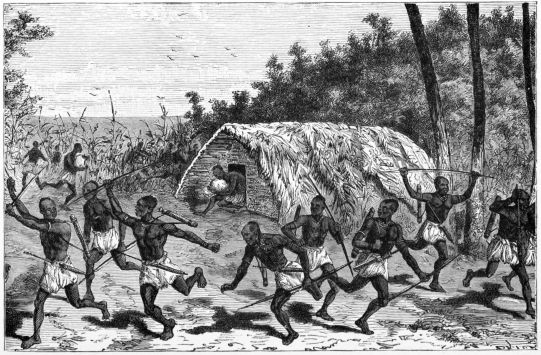
PANIC OF THE BALABA.
Page 175.
against him—which was totally untrue—and next of not having obeyed
Karema’s orders in returning at the proper time, and thereby having
caused the death of Fumo and Wanda.
I tried to speak and defend myself, but he said I had the tongue of a
serpent and should never again poison the ears of Karema. Raising his
spear, I thought he was about to strike me dead, when his companion,
whose name I learned was Kifura, prevented him. Dala said, “It is well;
let him live; but I will do worse than kill him;” and then addressing me
said, “Franki, the English are in the river and waiting for you. Hararu
has sent canoes to take you to your own people.”
A rush of thankfulness went through my whole being, and I cared not for
pains nor logs nor any discomforts, and said, “O Dala, take me, take me
quickly, that I may go to my own people; and when I reach them I will
give you many things—guns, powder, beads, cloth—all that you wish
shall be yours.”
“Listen to his words,” said Dala. “A slave, a dog promises me guns; he
promises me cloth. Know that if all that white men make in their country
were given me I would not take you to the English ship, for I hate you.”
I fell on my knees and, weeping and crying, implored this hard-hearted
savage to have pity on me. I pointed out how Karema could not possibly
make me his heir if I left the country, and I promised that not one
word would I say of his present behaviour; but all without effect, and
again he raised his spear as if to kill me, but again Kifura stopped
him.
“Listen, Dala of the Adiana,” said Kifura. “Why should you kill this
white man? Mine he is, and mine he will continue; if you kill him, my
words will go to Karema, and you will never be chief in his place. Take
counsel with me and be wise. The men who are with you, will their words
be as your words?”
“Truly, what I say they say. They are my own, and their lives are in my
hands.”
“Take wisdom in your hands, and return to Karema and say unto him, ‘I
have found the place where Franki was, but he was dead when we came; and
I followed after other people, for I found the traces of many men, and I
found that one other of our people—he who is even now a prisoner—was
with them, and I came and found him in their hands, and they released
him.’ Go your way with this man, and the English will give you guns for
having gone after this white man.”
“But, Kifura, this slave, this Chaka, is a friend of Franki’s, and he
will say unto Karema that Franki lives. I will kill him, and his tongue
will be silent.”
“Stay your hand, Dala. While the man lives he may work, and I can use
him. Let him remain, and say that he also is dead.”
“Surely, Kifura, the life of this slave is nothing to me; but he may
come back and make me a liar before Karema.”
“No, Dala, he shall never come back. They who fall into the hands of
Kifura never escape.”
“Then let him live; but this Franki, let me slay him, for while he lives
I shall not have peace.”
“No, he may not be slain; for never before has Kifura had a white man in
his hands. And when I go to my own people they will say Kifura is indeed
a warrior; the women will dance, and they shall sing that there is no
man among the Balaba like unto him, for never before has a man of the
Balaba brought a white man as a slave.”
There was a further discussion between these two worthies as to the
question of my being killed. At last it was settled that Chaka and I
were to remain in the hands of the Balaba, and that Dala was to return
to Karema and say we both were dead. In consideration of Dala foregoing
his wish to murder me he was to be given a canoe to return down the
river in, which he could say he had captured from the Balaba in fight.
I was ordered to return to where Chaka was lying, and I told him of the
conversation between Dala and Kifura.
“Oh that I were free,” said he, “that I might kill him and die. He is a
dog, and the son of a dog. But, Franki, while Chaka is with you he will
be your slave, and what service he can render you he will render.”
It was long ere I could close my eyes in sleep, for I was tortured by
despair at my evil fortune and the thought that if I had not
disregarded Karema’s desires I might even now have been among my own
people and probably with my own father and brother. At last I was
exhausted by the very violence of my emotions, and fell into a deep and
dreamless sleep, from which I was awakened by a great noise and
shouting.
I raised myself up to see what was the cause, and I found the whole camp
in commotion. On looking for Chaka I found that he was no longer by my
side. After a bit I heard a piercing shriek, as if some one was killed.
I tried to drag myself towards the noise, for I feared that my faithful
companion was the victim; but I was soon seized upon by two men and
dragged before Kifura. By his side lay the dead body of Dala, with a
knife in its breast; and close by the corpse of Chaka, riddled with
spears.
Kifura gave orders for me to have, in addition to the log on my ankle, a
slave-fork put round my neck and my hands lashed behind my back.
While his orders were being carried out I gathered what had occurred. I
found that Chaka, notwithstanding the encumbrance of the log on his leg,
had managed to creep close to where Dala was sleeping, and drawing the
latter’s knife from his girdle had driven it into his heart. As he rose
to do so the light of a neighbouring fire fell on him, and one of the
Balaba seeing what he was doing, raised an alarm. Before Chaka could get
a dozen feet from the body of his victim he was speared to death.
The men who had followed Dala were now furious for my death, but Kifura
would not give me up to them. The day breaking shortly after, the Balaba
and Adiana separated—the latter returning to their own village, and the
Balaba making their way to the Ogowai.
I dragged my weary steps along as best I could, every symptom of
flagging being rewarded with a lash from a hippopotamus-hide whip; but
at last I stumbled and fell, and was powerless to rise again. Flogging
and burning with hot coals were resorted to by my savage captors in
order to force me on my feet again; but I was so thoroughly weary and
sick of life that nothing could induce me to stir. At last Kifura,
fearing that I would die, gave orders to have the log and slave-fork
taken off me, and then he and his followers tried again to force me on
my feet. But hoping that they might kill me, I stubbornly refused to
move. At last a pole about eight or nine feet long was cut from a
neighbouring tree, and having lashed me tightly to it with strips of
bark and hide, four men were told off to carry me.
They had no more mercy than if I had been totally destitute of feeling.
They bumped me against trees, dragged me through thorns, and hauled me
over fallen trunks, bruising me all over and tearing nearly all the skin
off my body. At the same time flies, stinging ants, and other noisome
insects, attracted by my sores, fattened on my blood and clustered so
thickly round my eyes that I thought I should have been blinded. When I
felt myself thrown down like a log in the bottom of a leaky canoe I
thought I had undergone the extremity of torture, and that though I was
trampled on by the people crowding on board, and had all sorts of things
flung on me, I might now have comparative rest and peace. I was fated to
find that I had still more exquisite agony to endure; for though the
water in the bottom of the canoe was cool, and the abominable insect
pests had left, my lashings became tightened by the wet and cut into me
like lines of fire; my limbs and body swelled; one lashing round my neck
almost throttled me, so that every breath I drew was torture, and
another across my forehead seemed to be eating in to my very brain.
I felt that it was impossible to endure such intensity of pain and still
to exist, and I begged and prayed to be released. For some time my
entreaties were unheeded; but at last Kifura, fearing that I should die,
and that he would be deprived of the triumph of bringing a live white
man as a prisoner into his country, gave orders for my lashings to be
cut. I felt instant relief, even though I was so stiff and helpless that
I was unable to sit up, and had to continue lying in the bottom of the
canoe, kicked, trampled, and spat upon by its other occupants.
All day long we paddled up the river, and at night camped on its bank,
the canoes being hauled up on shore. Rejoicing in being close to their
own homes, the Balaba, notwithstanding the fatigues of the day, sang
and danced round huge fires nearly the livelong night. To my fevered
imagination they seemed like a company of demons rejoicing over the
pains of some condemned soul.
In the morning we were early under way again. About eight o’clock,
judging by the height of the sun, I heard the sound of rushing water,
and presently the canoes put into the bank. All the men went ashore and
began stripping the bark from trees and twisting it into ropes. From
their conversation I gathered that we were at the foot of some rapids up
which it was necessary to haul the canoes.
Unable to walk, I managed to sit up and look about me, and I could see
that our numbers had been largely increased. There were many women whom
I had not previously seen among the party, so I supposed that we could
not be far from the end of the journey.
At first I did not attract much attention, but some of the women coming
down to the canoes with bundles of rope noticed me, and cried out that
there was a white man. I was soon surrounded by a crowd, who pulled my
hair, looked into my eyes, examined my toes and fingers, and shouted and
screamed with wonder at the whiteness of my skin, or rather at such
portions of it as remained light-coloured. I was so grimed with dirt and
tanned with the sun and weather that I doubt if any Englishman would
from my appearance have owned me as a fellow-countryman.
I tried to appeal to them to do something to relieve my sufferings; but
they only laughed at my speaking, as if I were a strange species of ape,
until one old woman came down bending under a heavy load of twisted
bark.
When this good old woman saw me she rebuked the crowd of gapers who were
standing around, saying—
“Is he not a man, and suffers pain like us? Go, get leaves and get drink
for him.”
Getting into the canoe, she seated herself by my side, and began to bind
up the worst of my wounds with plantain leaves, which she arranged as
deftly as any member of the College of Surgeons would have done a
bandage.
I felt instant relief from her services, and when she gave me a bowl of
fresh plantain wine which one of the other women brought her, I began to
have hope once more. Whilst she was busied about me Kifura came to see
what she was doing, and rebuked her for wasting her time about a slave
and a prisoner.
She answered: “O Kifura! he is a slave and a prisoner, it is true; but
even slaves and prisoners have feelings, and die like other men; and
this man is a white man. Now when Kifura comes to-night to his home,
people at the dance will say there is no chief like Kifura, who has
brought a white man to Kitaka; and words will go to all that Kifura has
a white man at Kitaka, and people will come from all places to see him,
and say that Kifura is indeed a big chief. But if he die, it is
finished, and people will say that the words of Kifura are emptiness,
and that he is no better than another.”
Kifura was somewhat convinced by her arguments, and told her she might
continue her care of me; but that, if I escaped, her life would be the
forfeit. Having obtained permission to attend on me, the old woman,
whose name she told me was Teta, managed to rig up a place so that I
could sit up in the canoe. Having done all she could for my comfort, she
said that I would have to remain in it while it was hauled up the
rapids, for it would be impossible for me to climb the hills, and that
in the evening when we arrived at Kitaka she would take me to her own
hut and tend me as if I were a son.
The canoes were now cleared of their contents, and only three men left
in each canoe to manage them and fend them off rocks and snags while
they were hauled up the rapids by the ropes which all hands had been
busy preparing.
Shoving off from the shore we pushed round a small point and came full
in sight of the rapids. I confess as I saw what was before us I did not
care about making the ascent in the helpless condition in which I was;
for the waters were rushing down at an angle of sixty degrees with the
horizon, and huge and ugly rocks showed their heads above the surface,
the foam flying wildly round them.
One by one the canoes were brought out of the still water, where they
had been made fast to long ropes which were manned by men on shore and
on the rocks above. Even before they commenced the actual ascent they
were knocked about in the Witches’ Caldron into which the waters fell,
as if they were certain to be swamped or capsized. The canoe in which I
was a helpless passenger was the last to make the journey, so I had lots
of time to contemplate the risks that we were about to undergo. The
first canoe went safely through the boiling and seething water at the
foot of the rapids, and was dragged to the ascent. At the commencement
she dipped her bow and shipped a huge quantity of water; but recovering
herself it went flying out over her stern, washing out a quantity of
small articles which their owners had been too lazy or careless to
remove. I at once saw that if the same thing happened to ours I myself
should be washed out and drowned to a certainty.
My kind old woman Teta was standing on the bank near me. I called to her
and told her of my fears. She laughed, and comforted me like a wayward
child, and tried to persuade me that it was impossible; but at last she
yielded to my persuasions, and taking off a cloth she wore she passed it
behind my back and under my armpits, and knotted it securely to a piece
of wood running across the canoe.
By the time she had finished a great shout announced the safe arrival of
the first canoe at the summit of the rapids; and the ropes were brought
down
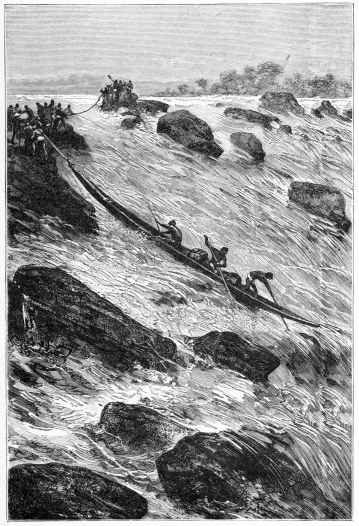
ASCENDING THE RAPIDS.
Page 188.
again and made fast to the second canoe. I could see, as the ascent
commenced, that she made a dip like her predecessor, and was very glad
that Teta had consented to lash me. Having nothing else to attend to, I
now watched the ascent most carefully, and could see that it was with
the utmost difficulty the men inside kept her from being smashed on the
rocks, and that she often came perilously near capsizing; but she too
was got up in safety, so was the third canoe, and then it came to our
turn to make the ascent.
I did not feel very comfortable as we were dragged through the broken
water, which flew into the canoe until she was half full. As we made the
dip and drive into the rapids at their foot, the water struck me with
such force as to knock all the breath out of my body; but the send we
gave as the canoe recovered herself sent all flying out over the stern
and left her nearly free.
I watched as we made our slow and perilous ascent, sometimes not going
ahead an inch, and sometimes even receding and coming dangerously close
to the rocks,—the men in the canoe with me exerting their utmost
strength and skill to prevent her being stove in.
After a bit I saw we were getting more to the middle of the rapids than
the other canoes had done, and that the rope from the shore was singing
like a harpstring as the water struck against us. I do not know why it
was, but one knot about a couple of fathoms from the canoe seemed to
have a peculiar fascination for me, and I soon saw that it was giving.
The men in the canoe saw this too, and shouted with all their strength
for their friends on shore and on the rocks to ease us down again so as
to secure it afresh; but the noise of the rapids drowned their voices,
and their cries being understood to be cries of encouragement, the men
manning the ropes hauled away all the more vigorously.
The spare ends of the knot grew shorter and shorter, and it became a
question whether the knot would hold out or slip before we arrived at
the top of the rapids. Slowly we made our way, and were almost in
safety, when a log coming down the river struck against the bow of the
canoe. This extra strain was too much for the knot, and it slipped.
Instantly the canoe swung out against the rocks and hung below one of
them, with the water rushing over her, half capsized, and then the three
men who formed her crew were thrown out into the rapids. I was in a most
perilous position, half suffocated by the water tearing over me, and
expecting every moment that the other rope would be cut through by the
rocks against which it was grinding, and that I and the canoe would be
dashed to pieces. I could do nothing to help myself; and there I hung in
the canoe for a time which seemed to me an eternity, only waiting for
the end.
I had entirely given myself up for lost, and was trying to frame a
prayer imploring forgiveness for my sins, when I felt that the grating
of the rope over the rocks, which was causing the whole canoe to
vibrate, had ceased. Then I felt myself being again hauled through the
water, sometimes under and sometimes above water, the canoe rolling over
and over as we were hauled over the edge of the rapids.
Just at the last moment I received a blow on my head which stunned me,
whether from a piece of wood or a rock I know not. When I recovered
consciousness I found myself lying on a rock with old Teta bending over
me and bathing my forehead. As I opened my eyes she bade me be of good
cheer, as I had a strong fetich and the river could not kill me. I do
not know that I felt much comfort from her assurance, for I thought if
the future had as much suffering in store for me as the past, death
would be a merciful release to me. She told me the three men who had
been in the canoe with me were all drowned, and I could not help feeling
how fate seemed to be against all those who were in any danger with me.
First Fumo, then Wanda, then Chaka and Dala, and now these three Balaba,
all dead, but I, who had undergone more perils than all of them, was
still alive.
As I was thinking of this a feeling of thankfulness to God for my
preservation took the place of despondency, and aided by Teta I sat up
and looked round. I saw that the rapids up which we had been dragged
were only a portion of the ascent which had to be made; for on the other
side of a pool of still water were a series of vertical falls about
twenty feet high, and men were busy hauling the canoes over the rocks
that divided them.
I was now put in another canoe and paddled across the pool, with my head
resting in Teta’s lap, who had now removed the cloth with which she had
tied me into the canoe, and which had formed the principal portion of
her dress. Under her direction I was carefully carried up the rocks, and
put into another canoe, in which we soon reached Kifura’s village, the
principal village among the Balaba.
Here Teta carried me to her own hut, where she nursed and tended me
carefully. Though my recovery was slow and tedious, I was at length
restored to health and strength. As soon as I was able to go about I
turned all my attention to get away and, if possible, descend the river
and again get in communication with my friends Karema, Tom, and Jack
Sprat. I found, however, that my every movement was so jealously watched
that it was impossible to think of getting away; and when I confided my
intentions to Teta she said it would be no good trying to escape, but I
had much better sit down quietly where I was and trust that in time
Kifura would let me go.
I asked if there was any chance of people coming up to the Balaba to
trade. She said they never allowed people living below the rapids to
come above them, and by that means they managed to keep the whole trade
of the river in their own hands.
I saw several parties sent away down the river with
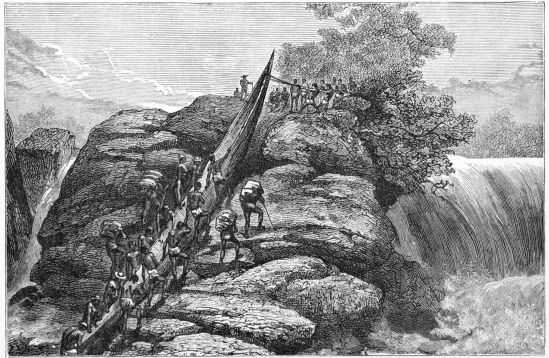
SURMOUNTING THE FALLS OF THE OGOWAI.
Page 193.
slaves and ivory, and endeavoured by most lavish promises of reward to
induce the men forming them to convey the news to Karema that I was
still alive; but my doing so only resulted in a closer guard being kept
on my actions, and my being removed from Teta’s guardianship and put to
lodge in a hut close by Kifura’s, where I was never left alone for a
moment. During the period of my stay with the Balaba I was never
ill-treated, being regarded as a sort of sacred being. I was amply
supplied with food and cloth. With the cloth I managed to make myself
clothes after the European fashion, which were so much admired that I
was constantly employed as tailor for Kifura and his principal men.
Having a sufficiency of food and drink, I gradually sank into an
apathetic condition, and did not care for more than the occurrences of
the day, and I quite lost my reckoning of the lapse of time. From this
state I was at last aroused by the following incidents.
Kifura and the Balaba were constantly engaged in war with some of the
neighbouring tribes in search of ivory and slaves; and in one of these
many of the Balaba were slain, and Kifura himself was taken prisoner.
The news of his defeat and capture was brought in by a fetichman, who
was instructed to ask for a large quantity of cloth, beads, and other
goods for his ransom.
A council of the elders was summoned to discuss the matter, and,
attracted by the noise, I went and listened to the discussion. As soon
as the fetichman saw me he asked from whence I had come, and what a
white man was doing in Kifura’s village. When he was told I was Kifura’s
white man, he said it could not be endured that Kifura should have a
white man while those who had conquered him had none; but if I were
given over to him, Kifura and his fellow-prisoners would be liberated
without any further payment.
Now that the novelty of my presence had worn off, the elders did not
attach any great importance to my possession, and gladly accepted the
offer. Next day a party of men set off, taking me with them to the place
where the exchange was to be made. Before leaving I was permitted to say
farewell to my kind protectress Teta, who wept at losing me, and said
that her husband and children being dead I had been to her in the place
of a son. Opening a bark box which contained her choicest treasures, she
took from it a string of beads to which hung the polished base of a
sea-shell, and this she said had come into her husband’s hands from a
man who travelled almost to the world’s end, and would protect me from
many dangers.
I myself felt greatly at parting from my benefactress, and I think it no
shame to my manhood to own that I shed many and bitter tears when my
escort dragged me from her and forced me to commence my march.
My new masters lived beyond the sources of the Ogowai, and our march to
their country was long and wearisome. I was not unkindly treated, but
only carefully watched to prevent my escaping. When we arrived I found
the village of the chief was situated on a river called the Alima,
which, I heard, after many days’ journey fell into a great river where
the people traded with the white man.


