WINELAND THE GOOD, THE FORTUNATE ISLES, AND THE DISCOVERY OF AMERICA
The oldest authorities on Wineland
Icelandic literature contains many remarkable statements about countries
to the south-west or south of the Greenland settlements. They are called:
“Helluland” (i.e., slate- or stone-land), “Markland” (i.e., wood-land),
“Furðustrandir” (i.e., marvel-strands), and “Vínland” (also written
“Vindland” or “Vinland”). Yet another, which lay to the west of Ireland,
was called “Hvítramanna-land” (i.e., the white men’s land). Even if
certain of these countries are legendary, as will presently be shown, it
must be regarded as a fact that in any case the Greenlanders and
Icelanders reached some of them, which lay on the north-eastern coast of
America; and they thus discovered the continent of North America, besides
Greenland, about five hundred years before Cabot (and Columbus).
While Helluland, Markland and Furðustrandir are first mentioned in
authorities of the thirteenth century, “Vinland” occurs already in Adam of
Bremen, about 1070 (see above, pp. 195 ff.). Afterwards the name occurs in
Icelandic literature: first in Are Frode’s “Islendingabók,” about 1130,
where we are only told that in Greenland traces were found of the same
kind of people as “inhabited Wineland” (“Vínland hefer bygt”; see above,
p. 260); it is next mentioned together with Hvítramanna-land in the
“Landnámabók,” where it may have been taken from Are Frode, as the
latter’s uncle, Thorkel Gellisson, is given as the authority. It has been
thought that the original statement was contained in a lost work of Are’s;
in any case it must belong to the period before his death in 1148. We are
only told that Hvítramanna-land lay to the west in the ocean near
Vin(d)land; but the passage is important, because, as will be discussed
later, it clearly shows that the statements about Wineland in the oldest
Icelandic authorities were derived from Ireland. The next mention of
Wineland is in “Kristni-saga” (before 1245) and “Heimskringla,” where it
is only said that Leif the Lucky found Wineland the Good. It should be
remarked that while thus in the oldest authorities Wineland is only
mentioned casually and in passing, it is not until we come to the Saga of
Eric the Red, of the thirteenth century, and the Flateyjarbók’s
“Grönlendinga-þáttr,” of the fourteenth, that we find any description of
the country, and of voyages to it and to Helluland and Markland. But two
verses, reproduced in the first of these sagas, are certainly considerably
older than the saga itself; and they speak of the country where there was
wine to drink instead of water, and of Furðustrandir where they boil
whales’ flesh.
It may be added that in the “Eyrbyggja-saga” (of about 1250) it is
said that “Snorre went with Karlsevne to Wineland the Good, and when
they fought with the Skrælings there in Wineland, Snorre’s son
Thorbrand fell in the fight.” In the “Grettis-saga” (about 1290),
Thorhall Gamlason, one of those who took part in this expedition, is
called “Vindlendingr” or “Viðlendingr” (which should doubtless be
“Vinlendingr” in each case). If we add to this that in the Icelandic
geography which is known from various MSS. of the fourteenth and
fifteenth centuries, but which is attributed in part (although hardly
the section about Greenland, Wineland, etc.) to Abbot Nikulás Bergsson
of Thverá (ob. 1159), Helluland, Markland and Vinland are mentioned as
lying to the south of Greenland (see later), then we shall have given
all the certain ancient authorities in which Wineland occurs [cf. G.
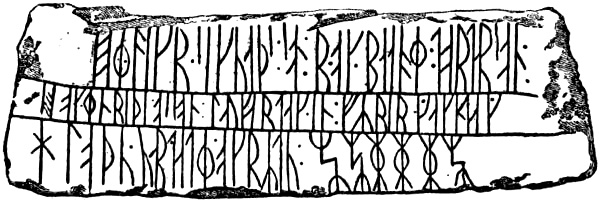
Storm, 1887, pp. 10 ff.]; but possibly the runic stone from Ringerike
is to be added (see later).
The formation of the saga
Before I recapitulate the most important features of these voyages, as
they are described more particularly in the Saga of Eric the Red, I must
premise that I look upon the narratives somewhat in the light of
historical romances, founded upon legend and more or less uncertain
traditions. Gustav Storm in his critical review of the Wineland voyages
[1887] has separated the older authorities, which he regarded as
altogether trustworthy, from the later narratives in the Flateyjarbók’s
“Grönlendinga-þáttr,” which he thought were to be rejected. The last-named
was written about 1387, while Eric the Red’s Saga, which we are to regard
as trustworthy, must according to Storm have been written between 1270 and
1300.[292] The accounts of the discovery of Wineland and of the voyages
thither are very conflicting in these two authorities; while the latter
has only two voyages (after the discovery), the former has divided them
into five; while one mentions Leif Ericson as the discoverer of the
country, the other gives Bjarne Herjulfsson, and so on. We are led to ask
whether it is reasonable to suppose that the traditions should have been
handed down by word of mouth in such a remarkably unaltered and
uncorrupted state during the first 250 or 300 years, when they have been
transformed and confused to such an extent scarcely a hundred years later.
This must rather prove that there was no fixed tradition, but that the
tales became split up into more and more varying forms. Perhaps it will be
answered that the Saga of Eric the Red was composed in the golden age of
saga-writing, whereas the Flateyjarbók belongs to the period of
decline.[293] But it cannot be psychologically probable that human nature
in Iceland should suddenly have undergone so great a change, that while
the saga-tellers of the fourteenth century were disposed to invent
romances, they should not have had any tendency thereto throughout the
three preceding centuries. It is particularly natural that many
alterations and additions should be made when, as here, the narratives are
concerned with distant waters which lay so far out of the ordinary course
of voyages, and which for a long time had ceased to be known in Iceland
when the sagas were put into writing. Features belonging to the
description of other quarters of the globe were also inserted. Tales which
in this way live in oral tradition and gradually develop into sagas,
without any written word to support them, and to some extent even without
any known localities to which they can be attached, are to be regarded as
living organisms dependent on accidental influence, which absorb into
themselves any suitable material as they may find it; a resemblance of
name between persons may thus contribute, or a similarity of situations,
or events which bear the same foreign stamp. The narratives of the
Wineland voyages exhibit, as we shall see, sure traces of influences of
this kind.
Leif Ericson
In the year 999, according to the saga, Leif, the son of Eric the Red,
sailed from Greenland to Norway. This is the first time we hear of so long
a sea-voyage being attempted,[294] and it shows in any case that this long
passage was not unknown to the Icelanders and Norwegians. Formerly the
passage to Greenland had been by way of Iceland, thence to the east coast
of Greenland, southwards along the coast, and round Hvarf. But capable
seamen like the intrepid Leif thought they could avoid so many changes of
course and arrive in Norway by sailing due east from the southern point of
Greenland. Thereby Leif Ericson becomes the personification of the first
ocean-voyager in history, who deliberately and with a settled plan steered
straight across the open Atlantic, without seeking to avail himself of
harbours on the way. It also appears clearly enough from the sailing
directions for navigation of northern waters, which have come down to us,
that voyages were made across the ocean direct from Norway to Greenland.
It must be remembered that the compass was unknown, and that all the ships
of that time were without fixed decks. This was an exploit equal to the
greatest in history; it is the beginning of ocean voyages.

From an Icelandic MS. (Jónsbók), sixteenth century
Leif’s plan of reaching Norway direct was not wholly successful according
to the saga; he was driven out of his course to the Hebrides. They stayed
there till late in the summer, waiting for a fair wind. Leif there fell in
love with a woman of high lineage, Thorgunna. When he sailed she begged to
be allowed to go with him; but Leif answered that he would not carry off a
woman of her lineage in a strange country, when he had so few men with
him. It was of no avail that she told him she was with child, and the
child was his. He gave her a gold ring, a Greenland mantle of frieze, and
a belt of walrus ivory, and sailed away from the Hebrides with his men and
arrived in Norway in the autumn (999). Leif became Olaf Tryggvason’s man,
and spent the winter at Nidaros. He adopted Christianity and promised the
king to try to introduce the faith into Greenland. For this purpose he was
given a priest when he sailed. In the spring, as soon as he was ready, he
set out again to sail straight across the Atlantic to Greenland. It has
undoubtedly been thought that he chose the course between the Faroes (61°
50′ N. lat.) and Shetland (60° 50′ N. lat.) to reach Cape Farewell, and
afterwards this became the usual course for the voyage from Norway to
Greenland. But he was driven out of his course, and
“for a long time drifted about in the sea, and came upon countries of
which before he had no suspicion. There were self-sown wheat-fields,
and vines grew there; there were also the trees that are called
‘masur’ (‘mǫsurr’),[295] and of all these they had some specimens
(some trees so large that they were laid in houses” [i.e., used as
house-beams]).
This land was “Vínland hit Góða.” As it was assumed that the wild vine
(Vitis vulpina) grew in America as far north as 45° N. lat. and along the
east coast, the historians have thought to find in this a proof that Leif
Ericson must have been on the coast of America south of this latitude;
but, as we shall see later, these features—the self-sown wheat-fields,
the vines and the lofty trees—are probably borrowed from elsewhere.
“On his homeward voyage Leif found some men on a wreck, and took them
home with him and gave them all shelter for the winter. He showed so
much nobility and goodness, he introduced Christianity into the
country, and he rescued the men; he was then called ‘Leifr hinn
Heppni’ [the Lucky]. Leif came to land in Eric’s fjord, and went home
to Brattalid; there they received him well.” This was the same autumn
[1000].
So concise is the narrative of the voyage by which the first discovery of
America by Europeans is said to have been made.[296]
Thorstein Ericson
Curiously enough, the saga tells us nothing more of Leif as a sailor. He
appears after this to have lived in peace in Greenland, and he took over
Brattalid after his father’s death. On the other hand, we hear that his
brother Thorstein made an attempt to find Wineland, which Leif had
discovered. After Leif’s return home “there was much talk that they ought
to seek the land that Leif had found. The leader was Thorstein Ericson, a
good man, and wise, and friendly.” We hear earlier in the saga, where
Leif’s voyage to Norway is related, that both of Eric’s sons “were capable
men; Thorstein was at home with his father, and there was not a man in
Greenland who was thought to be so manly as he.” We hear nothing about
Leif’s taking part in the new voyage; it looks as if it had been
Thorstein’s turn to go abroad. But
“Eric was asked, and they trusted in his good fortune and foresight
being greatest. He was against it, but did not say no, as his friends
exhorted him so to it. They therefore fitted out the ship which
Thorbjörn [Vivilsson] had brought out to Greenland;[297] and twenty
men were chosen for it; they took little goods with them, but more
arms and provisions. The morning that Eric left home, he took a little
chest, and therein was gold and silver; he hid this property and then
went on his way; but when he had gone a little distance he fell from
his horse, broke his ribs and hurt his shoulder, and said, ‘Ah yes!’
After this accident he sent word to his wife that she should take up
the property that he had hidden; he had now, said he, been punished
for hiding it. Then they sailed out of Eric’s fjord with gladness, and
thought well of their prospects. They drifted about the sea for a long
time and did not arrive where they desired. They came in sight of
Iceland, and they had also birds from Ireland; their ship was carried
eastwards over the ocean. They came back in the autumn and were then
weary and very worn. And they came in the late autumn to Eric’s fjord.
Then said Eric: ‘In the summer we sailed from the fjords more
light-hearted than we now are, and yet we now have good reason to be
so.’ Thorstein said: ‘It would be a worthy deed to take charge of the
men who are homeless, and to provide them with lodging.’ Eric
answered: ‘Thy words shall be followed.’ All those who had no other
place of abode were now allowed to accompany Eric and Thorstein.
Afterwards they took land and went home.”
In the autumn (1001) Thorstein celebrated his marriage with Thorbjörm
Vivilsson’s daughter Gudrid, at Brattalid, and it “went off well.” They
afterwards went home to Thorstein’s property on the Lysefjord, which was
the southernmost fjord in the Western Settlement; probably that which is
now called Fiskerfjord (near Fiskernes) in about 63° N. lat. There
Thorstein died during the winter of an illness (scurvy ?) which put an end
to many on the property, and Gudrid next summer returned to Eric, who
received her well. Her father died also, and she inherited all his
property.
Karlsevne in Greenland
That autumn (1002) Thorfinn Karlsevne came from Iceland to Eric’s fjord in
Greenland, with one ship and forty men. He was on a trading voyage, and
was looked upon as a skilful sailor and merchant, was of good family and
rich in goods. Together with him was Snorre Thorbrandsson. Another ship,
with Bjarne Grimolfsson and Thorhall Gamlason and a crew likewise of forty
men, had accompanied them from Iceland.
“Eric rode to the ships, and others of the men of the country, and
there was a friendly agreement between them. The captains bade Eric
take what he wished of the cargo. But Eric in return showed great
generosity, in that he invited both these crews home to spend the
winter at Brattalid. This the merchants accepted and went with Eric.”
“The merchants were well content in Eric’s house that winter, but when
Yule was drawing nigh, Eric began to be less cheerful than was his
wont.” When Karlsevne asked: “Is there anything that oppresses thee,
Eric?” and tried to find out the reason of his being so dispirited, it
came out that it was because he had nothing for the Yule-brew; and it
would be said that his guests had never had a worse Yule than with
him. Karlsevne thought there was no difficulty about that; they had
malt, and meal, and corn in the ships, and thereof, said he, “thou
shalt have all thou desirest, and make such a feast as thy generosity
demands.” Eric accepted this. “The Yule banquet was prepared, and it
was so magnificent that men thought they had scarcely ever seen so
fine a feast.”
Even if the tale is unhistorical, it gives a glimpse of the life and the
hard conditions in Greenland; they only had grain occasionally when a ship
arrived; for the most part they lived on what they caught, and when that
failed, as we are told was the case in 999, there was famine. But to be
without the Yule-brew was a misfortune to an Icelander; nevertheless we
learn from the Foster-brothers’ Saga that “Yule-drink was rare in
Greenland,” and that a man might become famous by holding a feast, as did
Thorkel, the grandson of Eric the Red, in 1026.
After Yule, Karlsevne was married to Eric’s daughter-in-law, Gudrid.
“The feast was then prolonged, and the marriage was celebrated. There
was great merry-making at Brattalid that winter; there was much
playing at draughts, and making mirth with tales and much else to
divert the company.”
From an Icelandic MS. (Jónsbók), fifteenth century
Karlsevne’s voyage to Wineland
There was a good deal of talk about going to look for Wineland the Good,
and it was said that it might be a fertile country. The result was that
Karlsevne and Snorre got their ship ready to search for Wineland in the
summer. Bjarne and Thorhall also joined the expedition with their ship and
the crew that had accompanied them. Besides these, there came on a third
ship a man named Thorvard—married to Eric the Red’s illegitimate daughter
Freydis, who also went—and Thorhall, nicknamed Veidemand (the Hunter).
“He had been on hunting expeditions with Eric for many summers and was
a man of many crafts. Thorhall was a big man, dark and troll-like; he
was well on in years, obstinate, silent and reserved in everyday life,
but crafty and slanderous, ever rejoicing in evil. He had had little
to do with the faith since it came to Greenland. Thorhall had little
friendship for his fellow men, yet Eric had long associated with him.
He was in the same ship with Thorvald and Thorvard, because he had
wide knowledge of the uninhabited regions. They had the ship that
Thorbjörn [Vivilsson] had brought out to Greenland [and that Thorstein
Ericson had used for his unlucky voyage two years before]. Most of
those on board that ship were Greenlanders. On their ships there were
altogether forty men over a hundred.”[298]
Eric the Red and Leif were doubtless supposed to have assisted both
actively and with advice during the fitting-out, even though they would
not take part in the voyage. It is mentioned later that they gave
Karlsevne two Scottish runners that Leif had received from King Olaf
Tryggvason.
The three ships sailed first “to the Western Settlement and thence to
Bjarneyjar” (the Bear Islands).[299] The most natural explanation of the
saga making them begin their expedition by sailing in this direction (to
the north-west and north)—whereas the land they were in search of lay to
the south-west or south—may be that the Icelandic saga-writer (of the
thirteenth century), ignorant of the geography of Greenland, assumed that
the Western Settlement must lie due west of the Eastern; and as the
voyagers were to look for countries in the south-west, he has made them
begin by proceeding to the farthest point he had heard of on this coast,
Bjarneyjar, so that they might have a prospect of better luck than
Thorstein, who had sailed out from Eric’s fjord. When it is said that
Thorhall the Hunter accompanied Eric’s son and son-in-law because of his
wide knowledge of the uninhabited regions, it must be the regions beyond
the Western Settlement that are meant, and the saga-writer must have
thought that these extended westward or in the direction of the new
countries. It must also be remembered that in the spring and early summer
there is frequently drift-ice off the Eastern Settlement, from Cape
Farewell for a good way north-westward along the coast. The course would
then naturally lie to the north-west of this ice—that is, towards the
Western Settlement. But it may also be supposed that they had to begin by
going northward to get seals and provision themselves with food and oil
(fuel), which might be necessary for a long and unknown voyage. This
explanation is, however, less probable.
From Bjarneyjar they put to sea with a north wind. They were at sea,
according to the saga, for two “dœgr.”[300]
“There they found land, and rowed along it in boats, and examined the
country, and found there [on the shore] many flat stones so large
that two men might easily lie stretched upon them sole to sole. There
were many white foxes there.[301] They gave the land a name and called
it ‘Helluland.’”
It may be the coast of Labrador that is here intended, and not Baffin
Land, since the statement that they sailed thither with a north wind must
doubtless imply that the coast lay more or less in a southerly and not in
a westerly direction from Bjarneyjar. From Helluland
“they sailed for two ‘dœgr’ towards the south-east and south, and
then a land lay before them, and upon it were great forests and many
beasts. An island lay to the south-east off the land, and there they
found a polar bear,[302] and they called the island ‘Bjarney’; but the
country they called ‘Markland’ [i.e., Wood-land] on account of the
forest.”
The name Markland suits Newfoundland best; it had forests down to the
sea-shore when it was rediscovered about 1500, and even later.
When they had once more sailed for
“two ‘dœgr’ they sighted land and sailed under the land. There was
a promontory where they first came. They cruised along the shore,
which they kept to starboard [i.e., to the west]. It was without
harbours and there were long strands and stretches of sand. They went
ashore in boats, and found there on the promontory a ship’s keel, and
called it ‘Kjalarnes’ [i.e., Keel-ness]; they also gave the strands a
name and called them ‘Furðustrandir’ [i.e., the marvel-strands or the
wonderful, strange strands], because it took a long time to sail past
them.”[303]
This may apply, as Storm points out, to the eastern side of Cape Breton
Island; but in that case they must have steered west-south-west from the
south-eastern promontory of Markland (Newfoundland). Kjalarnes must then
be Cape Breton itself. That they should have found a ship’s keel there
sounds strange; if this is not an invention we must suppose that it was
driven ashore from a wreck; no doubt it happened often enough that vessels
were lost on the voyage to Greenland. When Eric, according to the
Landnámabók, sailed with twenty-five ships, many of them were lost.
Wreckage would be carried by the currents from Greenland into the Labrador
current, and by this southward past Markland. But it is more probable that
the origin of the name was entirely different; that, for example, the
promontory had the shape of a ship’s keel, and that the account of the
keel found has been developed much later.[304] This is confirmed by the
fact that the “Grönlendinga-þáttr” gives a wholly different explanation of
the name from that in Eric’s Saga.
South of Furðustrandir “the land was indented by bays (‘vágskorit’),
and they steered the ships into a bay.” Here they landed the two Scots
(the man “Haki” and the woman “Hekja”) whom Karlsevne had received
from Leif and Eric, and who ran faster than deer. They “bade them run
southward and examine the condition of the country, and return before
three ‘dœgr’ were past. They had such garments as they called
‘kiafal’ [or ‘biafal’]; it was made so that there was a hood above,
and it [i.e., ‘the kiafal’] was open at the sides, and without
sleeves, and caught up between the legs, fastened there with a button
and a loop; otherwise they were bare. They cast anchor and lay there a
while; and when three days were past they came running down from the
land, and one of them had grapes in his hand, the other self-sown
wheat. Karlsevne said that they seemed to have found a fertile
country.”
They then sailed on until they came to a fjord, into which they steered
the ships.
“There was an island outside, and round the island strong currents.
They called it ‘Straumsey.’ There were so many birds there that one
could hardly put one’s foot between the eggs. They held on up the
fjord, and called it ‘Straumsfjord,’ and unloaded the ships and
established themselves there. They had with them all kinds of cattle,
and sought to make use of the land. There were mountains there, and
fair was the prospect. They did nothing else but search out the land.
There was much grass. They stayed there the winter, and it was very
long; but they had not taken thought of anything, and were short of
food, and their catch decreased. Then they went out to the island,
expecting that there they might find some fishing or something might
drift up [i.e., a whale be driven ashore ?]. There was, however,
little to be caught for food, but their cattle throve there. Then they
made vows to God that He might send them something to eat; but no
answer came so quickly as they had hoped.” The heathen Thorhall the
Hunter then disappeared for three “dœgr,” and doubtless held secret
conjurations with the red-bearded One (i.e., Thor). A little later a
whale was driven ashore, and they ate of it, but were all sick. When
they found out how things were with Thorhall and Thor, “they cast it
out over the cliff and prayed to God for mercy. They then made a catch
of fish, and there was no lack of food. In the spring [1004] they
entered Straumsfjord and had catches from both lands [i.e., both sides
of the fjord], hunting on the mainland, eggs on the island, and fish
in the sea.”
This description gives a good insight both into the Norsemen’s manner of
equipping themselves for voyages to unknown countries, and into their
superstition.
It looks as if a dissension now arose between the wayward Thorhall the
Hunter and the rest, since he wanted to look for Wineland to the north of
Furðustrandir, beyond Kjalarnes.
“But Karlsevne wished to go south along the coast and eastward. He
thought the land became broader the farther south it bore;[305] but
it seemed to him most expedient to try both ways” [i.e., both south and north].
Thorhall then parted from them; but there were no more than nine men in
his company. Perhaps they were desirous of going home; for from an old
lay, which the saga attributes to Thorhall, it appears that he was
discontented with the whole stay there: he abuses the country, where the
warriors had promised him the best of drinks, but where wine never touched
his lips, and he had to take a bucket himself and fetch water to drink.
And before they hoisted sail Thorhall quoth this lay:
“Let us go homeward,
where we shall find fellow-countrymen:
let us with our ship seek
the broad ways of the sea,
while the hopeful
warriors (those who praise
the land) on Furðustrandir
stay and boil whales’ flesh.”
“Then they parted [from Karlsevne, who had accompanied them out] and
sailed north of Furðustrandir and Kjalarnes, and then tried to beat
westward. Then the westerly storm caught them and they drifted to
Ireland, and there they were made slaves and ill-treated. There
Thorhall lost his life, as merchants have reported.”
The last statement shows that according to Icelandic geographical ideas
the country round Kjalarnes lay directly opposite Ireland and in the same
latitude.
Karlsevne, with Snorre, Bjarne, and the rest, left Straumsfjord and sailed
southward along the coast [1004].
“They sailed a long time and until they came to a river, which flowed
down from the interior into a lake and thence into the sea. There were
great sandbanks before the mouth of the river, and it could only be
entered at high water. Karlsevne and his people then sailed to the
mouth of the river and called the country ‘Hóp’ [i.e., a small closed
bay]. There they found self-sown wheat-fields, where the land was
low, but vines wherever they saw heights (‘en vínviðr allt þar sem
holta kendi’). Every beck (‘lökr’) was full of fish. They dug trenches
on the shore below high-water mark, and when the tide went out there
were halibuts in the trenches. In the forest there was a great
quantity of beasts of all kinds. They were there half a month amusing
themselves, and suspecting nothing. They had their cattle with them.
But early one morning, when they looked about them, they saw nine
hide-boats (‘huðkeipa’), and wooden poles were being waved on the
ships [i.e., the hide-boats], and they made a noise like
threshing-flails and went the way of the sun. Karlsevne’s men took
this to be a token of peace and bore a white shield towards them. Then
the strangers rowed towards them, and wondered, and came ashore. They
were small [or black ?][306] men, and ugly, and they had ugly hair on
their heads; their eyes were big, and they were broad across the
cheeks. And they stayed there awhile, and wondered, then rowed away
and went south of the headland.”
This then would be the description of the first meeting in history between
Europeans and the natives of America. With all its brevity it gives an
excellent picture; but whether we can accept it is doubtful. As we shall
see later, the Norsemen probably did meet with Indians; but the
description of the latter’s appearance must necessarily have been coloured
more and more by greater familiarity with the Skrælings of Greenland when
the sagas were put into writing. The big eyes will not suit either of
them, and are rather to be regarded as an attribute of trolls and
underground beings; gnomes and old fairy men have big, watery eyes. The
ugly hair is also an attribute of the underground beings.
“Karlsevne and his men had built their houses above the lake, some
nearer, some farther off. Now they stayed there that winter. No snow
fell at all, and all the cattle were out at pasture. But when spring
came they saw early one morning a number of hide-boats rowing from the
south past the headland, so many that it seemed as if the sea had been
sown with coal in front of the bay, and they waved wooden poles on
every boat. Then they set up shields and held a market, and the people
wanted most to buy red cloth; they also wanted to buy swords and
spears, but this was forbidden by Karlsevne and Snorre.” The
Skrælings[307] gave them untanned skins in exchange for the cloth, and
trade was proceeding briskly, until “an ox, which Karlsevne had, ran
out of the wood and began to bellow. The Skrælings were scared and ran
to their boats (keipana) and rowed south along the shore. After that
they did not see them for three weeks. But when that time was past,
they saw a great multitude of Skræling boats coming from the south, as
though driven on by a stream. Then all the wooden poles were waved
against the sun (‘rangsölis,’ wither-shins), and all the Skrælings
howled loudly. Then Karlsevne and his men took red shields and bore
them towards them. The Skrælings leapt from their boats and then they
made towards each other and fought; there was a hot exchange of
missiles. The Skrælings also had catapults (‘valslongur’). Karlsevne
and his men saw that the Skrælings hoisted up on a pole a great ball
(‘knottr’) about as large as a sheep’s paunch, and seeming blue[308]
in colour, and slung it from the pole up on to the land over
Karlsevne’s people, and it made an ugly noise when it came down. At
this great terror smote Karlsevne and his people, so that they had no
thought but of getting away and up the river, for it seemed to them
that the Skrælings were assailing them on all sides; and they did not
halt until they had reached certain crags. There they made a stout
resistance. Freydis came out and saw that they were giving way. She
cried out: ‘Wherefore do ye run away from such wretches, ye gallant
men? I thought it likely that ye could slaughter them like cattle, and
had I but arms I believe I should fight better than any of you.’ None
heeded what she said. Freydis tried to go with them, but she fell
behind, for she was with child. She nevertheless followed them into
the wood, but the Skrælings came after her. She found before her a
dead man, Thorbrand Snorrason, and a flat stone (‘hellustein’) was
fixed in the head of him. His sword lay unsheathed by him, and she
took it up to defend herself with it. Then the Skrælings came at her.
She takes her breasts out of her sark and whets the sword on them. At
that the Skrælings are afraid and run away back to their boats, and go
off. Karlsevne and his men meet her and praise her happy device. Two
men of Karlsevne’s fell, and four of the Skrælings; but nevertheless
Karlsevne had suffered defeat. They now go to their houses, bind up
their wounds, and consider what swarm of people it was that came
against them from the land. It seemed to them now that there could
have been no more than those who came from the boats, and that the
other people must have been glamour. The Skrælings also found a dead
man, and an axe lay beside him; one of them took up the axe and struck
at a tree, and so one after another, and it seemed to delight them
that it bit so well. Then one took and smote a stone with it; but when
the axe broke, he thought it was of no use, if it did not stand
against stone, and he cast it from him.”
“Karlsevne and his men now thought they could see that although the
land was fertile, they would always have trouble and disquiet with the
people who dwelt there before. Then they prepared to set out, and
intended to go to their own country. They sailed northward and found
five Skrælings sleeping in fur jerkins (‘skinnhjúpum’), and they had
with them kegs with deer’s marrow mixed with blood. They thought they
could understand that they were outlaws; they killed them. Then they
found a headland and a multitude of deer, and the headland looked like
a crust of dried dung, from the deer lying there at night. Now they
came back to Straumsfjord, and there was abundance of everything. It
is reported by some that Bjarne and Gudrid remained behind there, and
a hundred men with them, and did not go farther; but they say that
Karlsevne and Snorre went southward with forty men and were no longer
at Hóp than barely two months, and came back the same summer.”
From an Icelandic MS. (Jónsbók), fourteenth century
Karlsevne went with one ship to search for Thorhall the Hunter. He sailed
to the north of Kjalarnes, westwards, and south along the shore (Storm
thought on the eastern side of Cape Breton Island to the northern side of
Nova Scotia), and they found a river running from east to west into the
sea.
Here Thorvald Ericson was shot one morning from the shore with an
arrow which they thought came from a Uniped [legendary creature with
one foot] whom they pursued but did not catch. The arrow struck
Thorvald in the small intestines. He drew it out, saying: “There is
fat in the bowels; a good land have we found, but it is doubtful
whether we shall enjoy it.” Thorvald died of this wound a little
later. “They then sailed away northward again and thought they sighted
‘Einfötinga-land’ [the Land of Unipeds]. They would no longer risk the
lives of their men,” and “they went back and stayed in Straumsfjord
the third winter. Then the men became very weary [so that they fell
into disagreement]; those who were wifeless quarrelled with those who
had wives.”[309]
The fourth summer [1006] they sailed from Wineland with a south wind and
came to Markland.
There they found five Skrælings, and caught of them two boys, while
the grown-up ones, a bearded man and two women, “escaped and sank into
the earth. The boys they took with them and taught them their
language, and they were baptized. They called their mother ‘Vætilldi’
and their father ‘Vægi.’ They said that kings governed in
Skrælinga-land; one of them was called ‘Avalldamon,’ the other
‘Valldidida.’ They said that there were no houses, and the people lay
in rock-shelters or caves. They said there was another great country
over against their country, and men went about there in white clothing
and cried aloud, and carried poles before them, to which strips were
fastened. This is thought to be ‘Hvitramanna-land’ [i.e., the white
men’s land] or Great-Ireland.” Then Karlsevne and his men came to
Greenland and stayed the winter with Eric the Red [1006-1007].
“But Bjarne Grimolfsson [on the other ship] was carried out into the
Irish Ocean [the Atlantic between Markland and Ireland] and they came
into the maggot-sea (‘maðk-sjá’); they did not know of it until the
ship was worm-eaten under them,” and ready to sink. “They had a
long-boat (‘eptirbát’) that was coated with seal-tar, and men say that
the sea-maggot will not eat wood that is coated with seal-tar.” “But
when they tried it, the boat would not hold more than half the ship’s
company.” They all wanted to go in it; but Bjarne then proposed that
they should decide who should go in the boat by casting lots and not
by precedence, and this was agreed to. The lots fell so that Bjarne
was amongst those who were to go in the boat. “When they were in it, a
young Icelander, who had accompanied Bjarne from home, said: ‘Dost
thou think, Bjarne, to part from me here?’ Bjarne answers: ‘So it must
be.’ He says: ‘This was not thy promise when I came with thee from
Iceland....’ Bjarne answers: ‘Nor shall it be so; go thou in the boat,
but I must go in the ship, since I see that thy life is so dear to
thee.’ Bjarne then went on board the ship, and this man in the boat,
and they kept on their course until they came to Dyflinar [Dublin] in
Ireland, and there told this tale. But most men believe that Bjarne
and his companions lost their lives in the maggot-sea, since they were
not heard of again.”
Thorfinn Karlsevne returned in the following summer (1007) to Iceland with
Gudrid and their son Snorre, who was born at Straumsfjord in Wineland the
first winter they were there. Karlsevne afterwards lived in Iceland.
The composite and legendary character of the whole saga
If we now review critically the Saga of Eric the Red and the whole of this
tale of Karlsevne’s voyage, together with the other accounts of Wineland
voyages, we shall find one feature after another that is legendary or that
must have been borrowed from elsewhere. If we examine first of all the
relation of the various authorities to the events they narrate, we must be
struck by the fact that in the oldest authorities, such as the Landnáma,
Eric the Red has only two sons, Leif and Thorstein, whereas in Eric’s
Saga and in the “Grönlendinga-þáttr,” for the sake of the trilogy of
legend, he has begotten three sons, besides an illegitimate daughter. In
the oldest MS., Hauk’s Landnámabók, Leif is only mentioned in one place,
and nothing more is said of him than that he was Eric’s son and inherited
Brattalid from his father; he is not given the nickname “heppni” (the
lucky), and it is not mentioned that he had discovered Wineland, nor that
he had introduced Christianity. In the Sturlubók he is again mentioned in
one place as the son of Tjodhild and Eric, and there has the nickname “en
hepni”; but neither is there here any mention of the discovery of Wineland
or the introduction of Christianity [cf. Landnámabók, ed. F. Jónsson,
1900, pp. 35, 156, 165]. As this passage is not found in Hauk’s Landnáma,
it may be an addition in the later MS., which was wanting in the original
Landnámabók. In the great saga of St. Olaf[310] (chapter 70)—where King
Olaf asks the Icelander Thorarinn Nevjolfsson to take the blind king Rörek
to Greenland to “Leif Ericson”—the latter again is not called the Lucky,
nor is Wineland or its discovery mentioned. This saga was written,
according to the editors, about 1230. As neither this nickname nor the
tales of Leif’s discovery of Wineland are found earlier than in the
Kristni-saga and Heimskringla, it looks as if these features did not
appear till later. There is a similar state of things with regard to the
mention of Thorfinn Karlsevne; only in one passage in Hauk’s Landnáma is
it mentioned that he found “Vin(d)land hit Góða”; but as this does not
occur in the Sturlubók, it may be an addition due to Hauk Erlendsson, who
regarded Thorfinn as his ancestor. The silence of the oldest authorities
on the voyages to Wineland becomes still more striking when we compare
with it the fact that the Landnámabók contains statements (with careful
citation of authorities, showing that they are derived from Are Frode
himself) about Are Mársson, his voyage to Hvítramanna-land, and his stay
there, which have generally been regarded as far less authentic than the
tales of the Wineland voyages. If Are Mársson’s voyage is a myth, then one
would be still more inclined to regard the latter as such. The objection
that it would have been beside the plan of the brief and concise earlier
works (Íslendingabók and Landnámabók) to include these things, scarcely
holds good. If Are has room in the Íslendingabók for a comparatively
detailed account of the discovery, naming and natives of Greenland, and
further for a description of the introduction of Christianity into
Iceland; if the Landnámabók also gives details, derived, as we have said,
from him, of Are Mársson’s voyage to Hvítramanna-land, then it is
difficult to understand why neither Are Frode nor the authors of the
Landnámabók, when mentioning Eric the Red and Leif, should have found room
for a line about Leif’s having discovered Wineland and Christianised
Greenland—two not unimportant pieces of information—if they had known of
it. At any rate, the Christianising of Greenland must have been of
interest to the priest Are and to the priest-taught authors of
Landnámabók. This silence is therefore suspicious.
The personal names in the Saga of Eric the Red are also striking. With the
exception of Eric himself, his wife Tjodhild and his son Leif, and a few
other names in the first part, which is taken almost in its entirety from
the Landnámabók, almost all the names belonging to this saga are connected
with those of heathen gods, especially Thor. Eric has got a third son,
Thorvald, who is not mentioned in Landnáma, besides his daughter Freydis,
and his son-in-law Thorvard. The name Freydis is only known from this one
woman in the whole of Icelandic literature, and several names in Norse
literature compounded of Frey- seem, according to Lind,[311] to belong to
myths (e.g., Freygarðr, Freysteinn and Freybjǫrn). Other names
connected with the Wineland voyages in this saga are: Thor-björn Vivilsson
(his brother was named Thor-geir and his daughter’s foster-father Orm
Thor-geirsson) came to Thor-kjell of Herjolfsnes, where the prophetess was
called Thor-björg. Leif’s woman in the Hebrides was called Thor-gunna, and
their illegitimate son Thor-gils. Thor-stein Ericson had a property
together with another Thor-stein in Lysefjord.[312] We have further
Thor-finn Karlsevne (son of Thord and Thor-unn), Snorre Thor-brandsson,
Thor-hall Gamlason, Thor-hall Veidemand (who also had dealings with the
red-bearded Thor), and Thor-brand Snorrason who was killed. An exception,
besides Bjarne Grimolfsson (and the runners Haki and Hekja; see below), is
Thorfinn Karlsevne’s wife Guðriðr,[313] daughter of Thorbjörn Vivilsson,
and mother of Snorre. But perhaps one can guess why she is given this name
if one reads through the description of the remarkable scene of
soothsaying—at Thorkjell’s house on Herjolfsnes—between the fair Gudrid,
who sang with such a beautiful voice, and the heathen sorceress Thorbjörg,
where the former as a Christian woman refuses to sing the heathen charms
“Varðlokur,” as the sorceress asks her to do. These numerous
Thor-names—with the two women’s names, the powerful Freydis and the fair
Gudrid—which are attributed to a time when heathendom and Christianity
were struggling for the mastery (cf. the tale of Thorhall the Hunter and
the whale), have in themselves an air of myth and invention. To this must
be added mythical descriptions like those of the prophetess of
Herjolfsnes, the ghosts at Lysefjord the winter Thorstein Ericson died,
and others.
The Saga of Eric the Red tells of two voyages in search of Wineland, after
Leif’s accidental discovery of the country. The first is Thorstein
Ericson’s unfortunate expedition, when they did not find the favoured
Wineland, but were driven eastward into the ocean towards Iceland and
Ireland. In the Irish tale of Brandan (“Imram Brenaind,” of the eleventh
century), Brandan first makes an unsuccessful voyage to find the promised
land, and arrives, it seems, most probably in the east of the ocean,
somewhere about Brittany (cf. Vita S. Brandani; and Machutus’s voyage);
but he then makes a fresh voyage in which he finally reaches the land he
is in search of [cf. Zimmer, 1889, pp. 135 ff.]. This similarity with the
Irish legend is doubtless not very great, but perhaps it deserves to be
included with many others to be mentioned later.
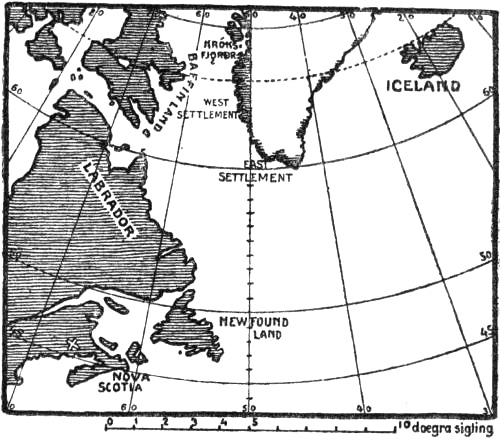
The relative distances between the countries. The scale
gives “dœgr’s”
sailing (== 2 degrees of latitude), according to the
“Rymbegla.”
A white cross marks the valley of the St. John
If we now pass to the tale itself of Karlsevne’s voyage, we have already
seen (p. 321) that its beginning with the journey to the Western
Settlement is doubtful; next, the feature of his sailing to three
different countries in turn (Helluland, Markland and Furðustrandir), with
the same number of days’ sail between each, must be taken directly from
the fairy tales.[314] Such a voyage is in itself improbable; in the saga
the countries are evidently imagined as islands or peninsulas, but nothing
corresponding to this is to be found on the coast of America. It is
inconceivable that a discoverer of Labrador and of the coast to the south
of it should have divided this into several countries; it was not till
long after the rediscovery of Newfoundland and Labrador that the sound
between them was found. If we suppose that Karlsevne was making southward
and came first to Labrador (== Helluland ?), with a coast extending
south-eastward, it is against common sense that he should voluntarily
have lost sight of this coast and put to sea again in an easterly
direction, and then sight fresh land to the south of him two days later;
on the other hand, this is the usual mode of presentment in fairy tales
and myth. But let us suppose now that he did nevertheless arrive in this
way at Newfoundland (== Markland ?), and then again put to sea instead of
following the coast, how could he know that this time instead of sailing
eastward he was to take a westward course? But this he must have done, for
otherwise he could not have reached Cape Breton or Nova Scotia; and he
must have got there, if we are to make anything out of the story. The
distances given, of two “dœgr’s” sail to each of the countries, as
remarked on p. 322, are also foreign to reality.[315] This part of the
description has therefore an altogether artificial look. It reminds one
forcibly of many of the old Irish legendary tales of wonderful voyages; in
particular the commencement of one of the oldest and most important may be
mentioned: “Imram Maelduin” (the tale of Maelduin’s voyage), which is
known in MSS. of the end of the eleventh century and later, but which was
probably to a great extent first written down in the seventh, or at the
latest in the eighth century [cf. Zimmer, 1889, p. 289].
When Maelduin and his companions put to sea from Ireland in a coracle
with three hides (while Karlsevne has three ships), they came first to
two small islands (while Karlsevne came to Bjarneyjar). After this for
three days and three nights the Irishmen came upon no land; “on the
morning of the third day” they heard the waves breaking on a beach,
but when daylight came and they approached the land, swarms of ants,
as large as foals, came down to the beach and showed a desire to eat
them and the boat (these are the gold-digging ants of Indo-Greek
legend). This land is the parallel to Helluland, where there were a
number of arctic foxes (cf. the description of the arrival there, p.
323).—After having fled thence for three days and three nights, the
Irishmen heard “on the morning of the third day” the waves breaking on
a beach, and when daylight came they saw a great, lofty island with
terraces around it and rows of trees, on which there were many large
birds; they ate their fill of these and took some of them in the boat.
This island might correspond to the wooded Markland, with its many
animals, where Karlsevne and his people killed a bear.—After another
three days and three nights at sea, the Irish voyagers “on the morning
of the fourth day” saw a great sandy island; on approaching the shore
they saw there a fabulous beast like a horse with dog’s paws and
claws. For fear of the beast they rowed away without landing. This
great sandy island may be compared with Furðustrandir, where there
were no harbours and it was difficult to land.—The Irishmen then
travelled “for a long time” before they came to a large, flat island,
where two men landed to examine the island, which they found to be
large and broad, and they saw marks of horses’ hoofs as large as a
ship’s sail, and nutshells as large as “cōedi” (a measure of
capacity ?), and traces of many human beings. This bears a resemblance
to Karlsevne’s having “a long way” to sail along Furðustrandir before
he came to a bay, where the two Scots went ashore to examine the
country, were absent three days, and found grapes and wheat.—After
that the Irishmen travelled for a week, in hunger and thirst, until
they came to a great, lofty island, with a great house on the beach,
with two doors, “one towards the plain on the island and one towards
the sea”; and through the latter the waves of the sea threw salmon
into the middle of the house. They found decorated couches and crystal
goblets with good drink in the house, but no human being, and they
took meat and drink and thanked God. Karlsevne proceeded from the bay
and came to Straumsey, which was thick with birds and eggs, and to
Straumsfjord, where they established themselves (i.e., built houses).
And there were mountains and a fair prospect and high grass; and they
had catches from two sides, “hunting on the land, and eggs and fish
from the sea”; and where, to begin with, they did nothing but make
themselves acquainted with the land.—From the island with the house
Maelduin and his men travelled about “for a long time,” hungry and
without food, until they found an island which was encompassed by a
great cliff (“alt mor impi”). There was a very thin and tall tree
there; Maelduin caught a branch of it in his hand as they passed by;
for three days and three nights the branch was in his hand, while the
boat was sailing past the cliff, and on the third day there were three
apples at the end of the branch (cf. Karlsevne’s runners who returned
after three days with grapes and wheat in their hands), on which they
lived for forty days. Karlsevne and his men suffered great want during
the winter at Straumsfjord; and from that place, where they lived on
land in houses, they sailed “for a long time” before they came to the
country with the self-sown wheat and vines, where there were great
sandbanks off the mouth of the river, so that they had a difficulty in
landing.
It is striking that in the voyage of Maelduin, the distance is only given
as three days’ and three nights’ sail in the case of the three first
passages to the three successive islands, after the first two small
islands, while between the later islands we are told that they sailed “a
long way,” “for a week,” “for a long time,” etc.; just as in the Saga of
Eric the Red, where, after Bjarneyjar, they sail for two “dœgr” to each
of the three lands in turn, and then they had “a long way” to sail along
Furðustrandir, to a bay, after which “they went on their way” to
Straumsfjord, and thence they went “for a long time” to Wineland, etc. I
do not venture to assert that there was a direct connection between the
two productions, for that there are perhaps too many dissimilarities; but
they seem in any case to have their roots in one and the same cycle of
ideas, and the original legend certainly reached Iceland in the shape of
oral narrative.
The number three plays an important part in Eric’s Saga. Three voyages
are made to or in search of Wineland, Karlsevne has three ships, three
countries are visited in turn, three winters are spent away (as with
Eric the Red on his first voyage to Greenland, but there this was due
to his exile), they meet with the Skrælings three times, three men
fall (two in the fight with the Skrælings, and afterwards Thorvald
Ericson)—just as Maelduin (and also Brandan) loses three men—the
expedition finally resolves itself into three separate homeward
voyages, Thorhall the Hunter’s, Karlsevne’s and Bjarne Grimolfsson’s,
etc. etc.[316] In the Irish legends and tales, e.g., those of Maelduin
or of the Ua Corra, the repetition of the number three is even more
conspicuous.
We may regard it as another feature of fairy tale that Eric the Red
has three sons who set out one after another, first Leif, then
Thorstein, and lastly Thorvald, who finds the land and takes part in
the attempt to settle it. But this feature is not conspicuous enough
to allow of our attaching much importance to it, especially as here it
is the first son who is the lucky one, while it is not so in fairy
tale.
Sweet dew and manna
In Leif’s voyage in the “Grönlendinga-þáttr” (which voyage partly
corresponds to Karlsevne’s), when they came to a country south-west of
Markland, they landed on an island, to the north of the country,
“looked around them in fair weather, and found that there was dew on
the grass, and it happened that they touched the grass with their
hands and put them in their mouths, and they thought they had never
tasted anything so sweet as it was.”
This reminds one forcibly of Moses’ manna in the wilderness, which
appeared like dew [Exodus xvi. 14]. In the Old Norwegian free rendering of
the Old Testament, called “Stjórn,”[317] of about 1300, therefore much
earlier than the “Grönlendinga-þáttr,” the account of this says that dew
came from heaven round the whole camp, “it stuck like slime on the hands
as soon as they touched it” ... “they found that it was sweet as honey in
taste....” But here again we come in contact with Irish legendary ideas.
In the tale of the Navigation of the Sons of Ua Corra (of the twelfth
century) the voyagers come to an island with a beautiful and wonderful
plain covered with trees, full of honey, and a grass-green glade in the
middle with a glorious lake of agreeable taste. Later on they come to
another marvellous island, with splendid green grass, and honeydew lay on
the grass [cf. Zimmer, 1889, pp. 194, 195].
Furðustrandir
The name “Furðustrandir” (marvel-strands), as we shall see later (p. 357),
may come from the “Tírib Ingnad” (lands of marvel) and “Trág Mór” (great
strand) of Irish legend, far in the western ocean.
Mythical figures: the Scottish runners
When Karlsevne arrived off Furðustrandir he sent out his two Scottish
runners, the man “Haki” and the woman “Hekja,” and told them to run
southwards and examine the condition of the country and come back in three
days. This is evidently another legendary trait; and equally so the
circumstance that King Olaf had given these runners to Leif and told him
“to make use of them if he had need of speed, for they were swifter than
deer.” We know of many such features in fairy tale and myth. Then, after
the traditional three days, the man and woman come running from the
interior of the country, one with grapes, the other with self-sown wheat
in their hands. We are tempted to think of the spies Moses sent into
Canaan, with orders to spy out the land, whether it was fat or lean, and
who came back with a vine-branch and a cluster of grapes, which they had
cut in the vale of Eshcol (i.e., the vale of grapes).[318]
But there are other remarkable points about this legend. Professor Moltke
Moe has called my attention to a striking resemblance between it and the
legends of the two runners or spies who accompanied Sinclair’s march
through Norway in 1612. They are called “wind-runners” or “bloodhounds,”
or again “weather-calves” or “wind-calves”; others called them “Wild
Turks.”
“They were ugly folk enough. Sinklar used them to run before and
search out news; in the evening they came back with their reports.
They were swifter in running than the stag; it is said that the flesh
was cut out of their thighs and the thick of their calves. It is also
said that they could follow men’s tracks.”[319]
We are told elsewhere that “these ‘Ver-Kalvann’ (‘wind-calves’) were
more active than farm-dogs, swift as lightning, and did not look like
folk. The flesh was cut out of the thick of their calves, their thighs
and buttocks; their nostrils were also slit up. People thought this
was done to them to make them so much lighter to run around, and every
one was more frightened of them than of the Scots themselves. They
could get the scent of folk a long way off and could kill a man before
he could blow his nose: they dashed up the back and broke the necks of
folk.”[320]
The trait that the wind-runners “did not look like folk” is expressed in
another form in H. P. S. Krag’s notes; he thinks that they
“were nothing else but Sinclair’s bloodhounds, which we may assume
both from the description and from its being related of the one that
was shot at Ödegaard that it ran about the field and barked.”
Something similar also occurs about the runners in Wineland in a late form
of the legend of Karlsevne’s voyage, where we read that
“he sailed from Greenland south-westward until the condition of the
country got better and better; he found and visited many places that
have never been found since; he found also some Skrælings; these
people are called in some books Lapps. In one place he got two
creatures (‘skepnur’) more like apes than men, whom he called Hake and
Hekja; they ran as fast as greyhounds and had few clothes.” [MS. A.
M., old no. 77oc, new no. 1892, 3; cf. Rafn: “Antiquitates Americanæ,”
1837, p. 196.]
It may be mentioned in addition that in the Flateyjarbók’s saga of the
Wineland voyages no runners appear, but on the other hand, in the tale of
Leif’s voyage, which has features in common with Karlsevne’s, there is a
“Southman” (“suðrmaðr,” most frequently used of Germans)[321] of
the name
of “Tyrker,” who was the first to find the wild vine in the woods (like
Karlsevne’s runners) and intoxicated himself by eating the grapes.[322] As
Moltke Moe observes, there is a remarkable resemblance between the rare
name Tyrker and the fact that Sinclair’s runners were called Wild Turks.
Both in the legend of Karlsevne and in that of Sinclair the two runners
are connected with Scots or Scotland. One is therefore inclined to suppose
that some piece of Celtic folklore is the common source of both. Now there
is a Scottish mythical creature called a “water-calf”; and the
unintelligible Norwegian name “weather-calf” or “wind-calf” (“veirkalv”)
may well be thought a corruption of this. It is true that this creature
inhabits lakes, but it also goes upon dry land, and has fabulous speed and
the power of scenting things far off. It can also transform itself into
different shapes, but always preserves something of its animal form.
That the runners in Eric’s Saga have become a man and woman may be due to
a natural connection with Thor’s swift-footed companions, Tjalve and
Röskva. But there seems here to be another possible connection, which
Moltke Moe has suggested to me. The strange garment they wore is called in
one MS. “kiafal” and in another “biafal.” No word completely corresponding
to this is known in Celtic; but there is a modern Irish word “cabhail”
(pronounced “caval” == “a body of a shirt”), which shows so much
similarity both in meaning and sound that there seems undoubtedly to be a
connection here. That “caval,” corrupted to “kiafal” (through the
influence of similar-sounding names ?), has been transformed into “biafal”
may be due to the influence of the Norse “bjalfi” or “bjalbi” (== a fur
garment without sleeves). As their costume plays such an important part in
the description of the runners, and special stress is laid upon the Celtic
word for it, it is probable that this word was originally used as a name
for the runners themselves—in legend and epic poetry there are many
examples of people being named from their dress. But gradually the Celtic
word used as a name has been replaced by the corresponding Old Norse
“hakull” (or “hokull” == sleeveless cloak open at the sides; cf.
“messe-hagel,” chasuble) and its feminine derivative “hekla” (==
sleeveless cloak, with or without a hood). The use of these two words of
masculine and feminine gender may be due to conceptions of them as man and
woman, derived from Tjalve and Röskva. In course of time it was natural
that a personal name formed from the costume, like Hakull, should easily
be replaced by a real man’s name of similar sound, like “Haki,” specially
known in legend and epic poetry as a name of sea-kings, berserkers and
troll-children. Then “Hekja” was derived from “Haki,” in the same way as
“Hekla” from “Hakull.” Hekja as a name is not met with elsewhere.[323]
That the whole of this story of the runners in the Saga of Eric the Red
has been borrowed from elsewhere appears also from its being badly fitted
in; for the narrative of the saga continues without taking any notice of
the finding of the sure tokens of Wineland: the self-sown wheat and the
vine; and in the following spring there is even a dispute as to the
direction in which the country is to be sought. Furthermore, after the
discoveries of the runners Karlsevne continues to sail southward, at
first, the same autumn, to Straumsfjord, and then still farther south the
following summer, before he arrives at the country of the wheat and grapes
that the runners had reached in a day and a half in a roadless land.
Mythical figures: Thorhall and Tyrker
The description of the stay in Straumsfjord also contains purely mythical
features, such as Thorhall the Hunter’s being absent for the stereotyped
three days (“dœgr”), and having, when they find him, practised magic
arts with the Red-Beard (Thor), as the result of which a whale is driven
ashore (see p. 325). There is further a striking resemblance between the
description of Thorhall’s state when found and that of Tyrker after he had
eaten the grapes. When, in Eric’s Saga, they sought and found Thorhall on
a steep mountain crag,
“he lay gazing up into the air with wide-open mouth and nostrils,
scratching and pinching himself and muttering something. They asked
why he lay there. He answered that that did not concern anybody, and
told them not to meddle with it; he had for the most part lived so,
said he, that they had no need to trouble about him. They asked him to
come home with them, and he did so.”
In the Flateyjarbók’s “Grönlendinga-þáttr” Tyrker was lost in the woods,
and when Leif and his men went in search and found him again, he too
behaved strangely.
“First he spoke for a long time in ‘þýrsku,’ and rolled his eyes many
ways and twisted his mouth; but they could not make out what he said.
After a while he said in Norse: I did not go much farther, and yet I
have a new discovery to tell of; I have found vines and grapes
(‘vínvið ok vínber’).”
This shows how features taken from legends originally altogether different
are mingled together in these sagas, in order to fill out the description;
and it shows too how the same tale may take entirely different forms. Of
Tyrker we hear further that “he was ‘brattleitr’ (with a flat face and
abrupt forehead), had fugitive eyes, was freckled (‘smáskitligr’) in the
face, small of stature and puny, but skilful in all kinds of dexterity.”
Thorhall, on the other hand, “was tall of stature, dark and troll-like,”
etc. (see p. 320), but he was also master of many crafts, was well
acquainted with the uninhabited regions, and altogether had qualities
different from most people. Both had long been with Eric the Red. There
can scarcely be a doubt that these two legendary figures, perhaps
originally derived from wholly different spheres, have been blended
together.
The stranded whale
The whale that is driven ashore and that they feed on resembles the great
fish that is cast ashore and that the Irish saint Brandan and his
companions live on in the tale of his wonderful voyage (see below). This
resemblance is confirmed by the statement in the Icelandic story that no
one knew what kind of whale it was, not even Karlsevne, who had great
experience of whales. There are, of course, no whales on the north-eastern
coast of America that are not also found on the coasts of Greenland and
Iceland; the incident therefore appears fictitious. The great whale in the
legend of Brandan, on the other hand, is a fabulous monster. There is this
distinction, it is true, that Karlsevne’s people fall ill from eating the
whale,[324] while it saves the lives of the Irish voyagers; but in both
cases it is driven ashore after God, or a god, has been invoked in their
need, and disappears again immediately (in the tale of Brandan it is
devoured by wild beasts; in the saga it is thrown over the cliff). This
difference can easily be explained by the whale in the Norse story having
been sent by a heathen god, so that it was sacrilege to eat of it. In the
tale of Brandan the whale is perhaps derived from Oriental legends [cf. De
Goeje, 1891, p. 63]; it may, however, be a common northern feature.
Eggs in the autumn and egg-gathering
When it is stated of Straumsfjord that there were places where eggs could
be gathered, and of Straumsey that “there were so many birds that one
could scarcely put one’s foot down between the eggs,” this is evidently an
entirely northern feature, brought in to decorate the tale, and brought in
so infelicitously that they are made to find all this mass of eggs there
in the autumn (!) when they arrive. If Straumsfjord was in Nova Scotia
there could not be eider-ducks nor gulls either[325] in sufficient number
to form breeding-grounds of importance, and among sea-birds one would be
more inclined to think of terns, as Professor R. Collett has suggested to
me. As the coast is not described as one with steep cliffs, and there is
mention of stepping between the eggs, auks, guillemots and similar
sea-birds are out of the question, even if they occurred so far south.
Wineland the equivalent of Fortunate Isles
But then comes the most important part of the saga, the description of the
country itself, where grew self-sown fields of wheat, and vines on the
hills, where no snow fell and the cattle were out the whole winter, where
the streams and the sea teemed with fish and the woods were full of deer.
Isidore says [in the “Etymologiarum,” xiv. 6, 8] of the Fortunate Isles:
“The Insulæ Fortunatæ denote by their name that they produce all good
things, as though fortunate (‘felices’) and blessed with fertility of
vegetation. For of their own nature they are rich in valuable fruits
(‘poma,’ literally tree-fruit or apples). The mountain-ridges are
clothed with self-grown (‘fortuites’) vines, and cornfields (‘messis’
== that which is to be cut) and vegetables are common as grass [i.e.,
grow wild like grass, are self-sown]; thence comes the error of the
heathen, and that profane poetry regarded them as Paradise. They lie
in the ocean on the left side of Mauritania [Morocco] nearest to the
setting sun, and they are divided from one another by sea that lies
between.” He also mentions the Gorgades, and the Hesperides.
These ideas of the Fortunate Isles were widely current in the Middle Ages.
In the English work, “Polychronicon,” by Ranulph Higden, of the fourteenth
century, Isidore’s description took the following form:
“A good climate have the Insulæ Fortunatæ that lie in the western
ocean, which were regarded by the heathen as Paradise by reason of the
fertility of the soil and of the temperate climate. For there the
mountain ridges are clothed with self-grown vines, and cornfields and
vegetables are common as grass [i.e., grow wild]. Consequently they
are called on account of the rich vegetation ‘Fortunatæ,’ that is to
say, ‘felices’ [happy, fertile], for there are trees that grow as high
as 140 feet....”
The resemblance between this description and that of Wineland is so close
that it cannot be explained away as fortuitous; the most prominent
features are common to both: the self-sown cornfields, the self-grown
vines on the hills, and the lofty trees (cf. Pliny, below, p. 348), which
are already present in the narrative of Leif’s voyage (see above, p. 317).
If we go back to antiquity and examine the general ideas of the Fortunate
Land or the Fortunate Isles out in the ocean in the west, we find yet more
points of resemblance. Diodorus [v. 19, 20] describes a land opposite
Africa, in the middle of the Atlantic Ocean, as fertile and mountainous,
but also to a large extent flat. (Wineland also had hills and lowlands.)
It invites to amusements and delights.[326] The mountainous country has
thick forests and all kinds of fruitful trees, and many streams; there is
excellent hunting with game of all sorts, big and small, and the sea is
full of fish (precisely as Wineland). Moreover, the air is extremely mild
(as in Wineland), and there is plenty of fruit the whole year round, etc.
The land was not known in former times, but some Phœnicians on a voyage
along the African coast were overtaken by a storm, were driven about the
ocean for many days, until they came thither (like Leif).
It is said of Wineland, in the Saga of Eric the Red, that “no snow at all
fell there, and the cattle were out (in winter) and fed themselves,” and
in the Flateyjarbók we read that “there was no frost in the winter, and
the grass withered little.” These, we see, are pure impossibilities. As
early as the Odyssey [iv. 566] it is said of the Elysian Fields in the
west on the borders of the earth:
“There is never snow, never winter nor storm, nor streaming rain,
But Ocean ever sends forth the light breath of the west wind
To bring refreshment to men.”
In the early civilisation of Babylon and Egypt this fortunate land seems
to have been imagined as lying in the direction of the rising sun; but the
ideas are always the same. An ancient Egyptian myth puts “Aalu” or “Hotep”
(== place of food, land of eating), which is the abode of bliss and
fortune, far in the east, where light conquers darkness.
“Both texts and pictures bear witness to the beauty which pervades
this abode of life; it was a Paradise as splendid as could be
imagined, ‘the store-house of the great god’; where ‘the corn grows
seven cubits high.’ It was a land of eternal life; there, according to
the oldest Egyptian texts, the god of light, and with him the
departed, acquire strength to renew themselves and to arise from the
dead.”[327]
In the same colours as these the Odyssey describes many fortunate lands
and islands, such as the nymph Calypso’s beautiful island Ogygia, far in
the west of the ocean; and again “Scheria’s delightful island” [vii. 79
ff.], where the Phæacians, “a people as happy as gods,” dwell “far away
amid the splashing waves of the ocean,” where the mild west wind, both
winter and summer, ever causes the fruit-trees and vines to blossom and
bear fruit, and where all kinds of herbs grow all the year round (remark
the similarity with Isidore’s description). The fortunate isle of Syria,
far in the western ocean, is also mentioned [xv. 402],
“North of Ortygia, towards the region where the sun sets;
Rich in oxen and sheep, and clothed with vines and wheat,”
where the people live free from want and sickness. These are the same
ideas which were afterwards transferred to the legend of the Hyperboreans
(cf. pp. 15 ff.).[328] It is natural that among the Greeks wine and the
vine took a prominent place in these descriptions. In post-Homeric times
the “Isles of the Blest” (Μακάρων
νῆσοι) are described by Hesiod
(and subsequently by Pindar) as lying in the western ocean—
“there they live free from care in the Isles of the Blest, by the
deep-flowing Ocean, the fortunate heroes to whom the earth gives
honey-sweet fruits three times a year.”
It is these ideas—perhaps originally derived from the Orient—that have
developed into the Insulæ Fortunatæ.
These islands are described by many writers of later antiquity. Pliny says
[Nat. Hist., vi. 32 (37)] that according to some authors there lie to the
west of Africa
“the Fortunate Isles and many others, whose number and distance are
likewise given by Sebosus. According to him the distance of the island
of Junonia from Gades is 750,000 paces; it is an equal distance from
this island westward to Pluvialia and Capraria. In Pluvialia there is
said to be no water but that which the rain brings. 250,000 paces
south-west of it and over against the left side of Mauritania
[Morocco] lie the Fortunate Isles, of which one is called Invallis on
account of its elevated form, the other Planaria on account of its
flatness. Invallis has a circumference of 300,000 paces, and the trees
on it are said to attain a height of 140 feet.”
But as usual Pliny uncritically confuses statements from various sources,
and he here adds information collected by the African king Juba about the
Fortunate Isles. According to this they were six in number: Ombrios, two
islands of Junonia, besides Capraria, Nivaria, and Canaria, so called from
the many large dogs there, of which two were brought to Juba. Solinus
mentions in one place [c. 23, 10] that there are three Fortunatæ Insulæ,
but in another place [c. 56] he gives Juba’s statement from Pliny. That
these islands were located to the west of Africa is certainly due to the
Phœnicians’ and Carthaginians’ knowledge of the Canary Islands, and
Ptolemy also places them here (see above, p. 117). Strabo [i. 3] thinks
that the Isles of the Blest lay west of the extremity of Maurusia
(Morocco), in the region where the ends of Maurusia and Iberia meet. Their
name shows that they lie near to the holy region (i.e., the Elysian
Fields).
In his biography of the eminent Roman general Sertorius (“imperator” in
Spain for several years, died in 72 B.C.), Plutarch also mentions the
Isles of the Blest. He tells us that when Sertorius landed as an exile on
the south-west coast of Spain (Andalusia),
“he found there some sailors newly arrived from the Atlantic Isles.
These are two in number, separated only by a narrow strait, and they
are 10,000 stadia (1000 geographical miles) from the African coast.
They are called the ‘Isles of the Blest.’ Rain seldom falls there, and
when it does so, it is in moderation; but they usually have mild
winds, which spread such abundance of dew that the soil is not only
good for sowing and planting, but produces of itself the most
excellent fruit, and in such abundance that the inhabitants have
nothing else to do but to abandon themselves to the enjoyment of
repose. The air is always fresh and wholesome, through the favourable
temperature of the seasons and their imperceptible transition.... So
that it is generally assumed, even among the barbarians, that these
are the Elysian Fields and the habitations of the blest, which Homer
has described with all the magic of poetry. When Sertorius heard of
these marvels he had a strong desire to settle in these islands, where
he might live in perfect peace and far from the evils of tyranny and
war.”
But this remarkable man soon had fresh warlike under-takings to think
about, so that he never went there. It appears too from the fragments that
have come down to us of Sallust’s Histories[329] that Sertorius did not
visit these islands, but only wished to do so. In fragment 102 we read:
“It is related that he undertook a voyage far out into the ocean,” and
Maurenbrecher adds that a scholium to Horace [Epod. 16, 42] says: “The
ocean wherein are the Insulæ Fortunatæ, to which Sallust in his
Histories says that Sertorius wished to retire when he had been
vanquished.”
But in L. Annæus Florus, who lived under Hadrian (117-138 A.D.), we read
[iii. 22]:[330]
“An exile and a wanderer on account of his banishment, this man [i.e.,
Sertorius] of the greatest but most fatal qualities filled seas and
lands with his misfortunes: now in Africa, now in the Balearic Isles
he sought fortune, was sent out into the ocean and reached the
Fortunate Isles: finally he raised Spain to conflict.”
It thus appears that by Florus’s time the idea had shaped itself that
Sertorius really had sought and found these islands; which, besides, in
part at all events, were thought to be the same as those said to have been
already discovered by the Carthaginian Hanno on the west coast of Africa
about 500 B.C.
Of great interest is the description which Horace gives in his Epodes
[xvi. 39 ff.] of the Fortunate Isles in the ocean, though he does not
mention them by name. He exhorts the Romans, who were suffering from the
civil wars, to abandon the coast of Italy (the Etruscan coast) and sail
thither, away from all their miseries. Lord Lytton[331] gave the following
metrical translation of the poem:
Ye in whom manhood lives, cease woman wailings,
Wing the sail far beyond Etruscan shores.
Lo! where awaits an all-circumfluent ocean—
Fields, the Blest Fields we seek, the Golden Isles
Where teems a land that never knows the ploughshare—
Where, never needing pruner, laughs the vine—
Where the dusk fig adorns the stem it springs from,
And the glad olive ne’er its pledge belies—
There from the creviced ilex wells the honey;
There, down the hillside bounding light, the rills
Dance with free foot, whose fall is heard in music;
There, without call, the she-goat yields her milk,
And back to browse, with unexhausted udders,
Wanders the friendly flock; no hungry bear
Growls round the sheepfold in the starry gloaming,
Nor high with rippling vipers heaves the soil.
These, and yet more of marvel, shall we witness,
We, for felicity reserved; how ne’er
Dark Eurus sweeps the fields with flooding rain-storm,
Nor rich seeds parch within the sweltering glebe.
Either extreme the King of Heaven has tempered.
Thither ne’er rowed the oar of Argonaut,
The impure Colchian never there had footing.
There Sidon’s trader brought no lust of gain;
No weary toil there anchored with Ulysses;
Sickness is known not; on the tender lamb
No ray falls baneful from one star in heaven.
When Jove’s decree alloyed the golden age,
He kept these shores for one pure race secreted;
For all beside the golden age grew brass
Till the last centuries hardened to the iron,
Whence to the pure in heart a glad escape,
By favour of my prophet-strain is given.
Rendered into prose, Horace’s poem will run somewhat as follows:
“Ye who have manliness, away with effeminate grief, and fly beyond the
Etruscan shore. There awaits us the all-circumfluent ocean: Let us
steer towards fields, happy fields and rich islands, where the
untilled earth gives corn every year, and the vine uncut [i.e.,
unpruned, growing wild] continually flourishes, and the
never-failing branch of the olive-tree blossoms forth, and the fig
adorns its tree, honey flows from the hollow ilex, the light stream
bounds down from the high mountain on murmuring foot,” etc.
We thus find here in Horace precisely the same ideas of the Elysian Fields
or the Fortunate Isles that occur later in Isidore and in the saga’s
description of the fortunate Wineland; especially striking are the
expressions about the corn that each year grows wild (on the unploughed
earth) and the wild vine which continually yields fruit (blossoms,
“floret”).
These myths of the Fortunate Isles—originally derived from
conceptions of the happy existence of the elect after death (in the
Elysian Fields), for which reason they were called by the Greeks the
Isles of the Blest—have also, of course, been blended with Indian
myths of “Uttara Kuru.” Among the Greeks they were sometimes the
subject of humorous productions; several such of the fifth century
B.C. are preserved in Athenæus. Thus Teleclides says: “Mortals live
there peacefully and free from fear and sickness, and all that they
need offers itself spontaneously. The gutter flows with wine, wheat
and barley bread fight before the mouths of the people for the favour
of being swallowed, the fish come into the house, offer themselves and
serve themselves up, a stream of soup bears warm pieces of meat on its
waves,” etc. Cf. also Lucian’s description of the Isle of the Blest in
Vera Historia (second century A.D.): “The vines bear fruit twelve
times a year ... instead of wheat the ears put forth little loaves
like sponges,” etc. [Wieland, 1789, iv. p. 196].
Schlaraffenland and Fyldeholm
In the Middle Ages the tale of the land of desire was widespread: in
Spain it took the name of “Tierra del Pipiripáo” or “Dorado” (the land
of gold), or again “La Isla de Jauja,” said to have been discovered by
the ship of General Don Fernando. In it are costly foods, rich stuffs
and cloths in the fields and on the trees, lakes and rivers of Malmsey
and other wines, springs of brandy, pools of lemonade, a mountain of
cheese, another of snow, which cools one in summer and warms in
winter, etc. In the Germanic countries this took the form of the
legend of Schlaraffenland.[332] This mythical country has in Norway
become “Fyldeholmen” (i.e., the island of drinking),[333] which shows
that to the Norwegians of later days wine or spirits were the most
important feature in the description of the land of desire, as the
wine was to the ancient Norsemen in the conception of Wineland.
To sum up, it appears to me clear that the saga’s description of Wineland
must in its essential features be derived from the myth of the Insulæ
Fortunatæ. The representations of it might be taken directly from Isidore,
who was much read in the Middle Ages, certainly in Iceland (where a
partial translation of his work was made) and in Norway (he is often
quoted in the “King’s Mirror”), or orally from other old authorities, who
gave still more detailed descriptions of these islands. But the difficulty
is that the name of Wineland, connected with the ideas of the self-grown
vine and the unsown wheat, is already found in Adam of Bremen (circa 1070,
see above, pp. 195 ff.). We might therefore suppose that it was his mention
of the country which formed the basis of the Icelandic representation of
it, although his fourth book (the description of the isles of the North)
seems otherwise to have been little known in the North at that time; but
here again the difficulty presents itself that the later description, that
of the saga, is more developed and includes several features which agree
with the classical conceptions, but which are not yet found in Adam of
Bremen. I think therefore that the matter may stand thus, that “Vínland
hit Góða” was the Norsemen’s name for “Insulæ Fortunatæ,” and was in a way
a translation thereof; and oral tales about the country—based on Isidore
and later on other sources as well—may have formed the foundation of the
statements both in Adam and in Icelandic literature. In the latter, then,
an ever-increasing number of features from the classical conceptions have
crystallised upon the nucleus, when once it was formed, especially through
the clerical, classically educated saga-writers.
Irish happy lands and Wineland
As Norway, and still more Iceland (cf. pp. 167, 258), were closely
connected in ancient days with Ireland, and as Norse literature in many
ways shows traces of Irish influence, one is disposed to think that the
ideas of Wineland may first have reached Iceland from that quarter. This
exactly agrees with what was said at the beginning of this chapter, that
the statements (in the Landnámabók) from the oldest Icelandic source, Are
Frode, point directly to Ireland as the birthplace of the first reports of
Wineland. We read in the Landnámabók:
“Hvítramanna-land, which some call ‘Irland hit Mikla’ [Ireland the
Great], lies westward in the ocean near Wineland (Vindland) the Good.
It is reckoned six ‘dœgr’s’ sail from Ireland.”
Nothing more is said about Wineland.[334] As it is added that Are
Mársson’s voyage to Hvítramanna-land
“was first related
by Ravn ‘Hlymreks-farer,’ who had long been at Limerick in Ireland,”
we see that Ravn, who was an Icelandic sailor of the beginning of the
eleventh century, must have heard of both Hvítramanna-land and Wineland in
Ireland, since otherwise he could not have known that one lay near the
other.[335] But as Hvítramanna-land or “Great Ireland” is an Irish
mythical country (see later), it becomes probable that Wineland the Good,
at any rate in this connection, was one likewise. The old Irish legends
mention many such fortunate islands in the western ocean, which have
similar names, and which to a large extent are derived from the classical
myths of the Elysian Fields and the Insulæ Fortunatæ. Voyages to them form
prominent features of most of the Irish tales and legends. In the heathen
tale of the Voyage of Bran (“Echtra Brain maic Febail,” preserved in
fifteenth and fourteenth century copies of a work of the eleventh century,
but perhaps originally written down in the seventh century)[336] there are
descriptions of: “Emain” or “Tír na-m-Ban” (the land of women), with
thousands of amorous women and maidens, and “without care, without death,
without any sickness or infirmity” (where Bran and his men live
sumptuously each with his woman);[337] “Aircthech” (== the beautiful
land); “Ciuin” (== the mild land), with riches and treasures of all
colours, where one listens to lovely music, and drinks the most delicious
wine; “Mag Mon” (== the plain of sports); “Imchiuin” (== the very mild
land); “Mag Mell” (== the happy plain, the Elysium of the Irish), which
is described as lying beneath the sea, where without sin, without crime,
men and loving women sit under a bush at the finest sports, with the
noblest wine, where there is a splendid wood with flowers and fruits and
golden leaves, and the true scent of the vine; there is also “Inis Subai”
(the isle of gladness), where all the people do nothing but laugh.[338] It
is said in the same tale that “there are thrice fifty distant islands in
the ocean to the west of us, each of them twice or thrice as large as
Erin.”
That western happy lands in the Irish legends (even in the Christian
“Imram Maelduin”) should often be depicted as the Land of Women (“Tír
na-m-Ban”) or Land of Virgins (“Tír na-n-Ingen”), with amorously longing
women, might be thought to have some connection with Mahomet’s Paradise
and the Houris; but the erotically sensuous element is everywhere so
prominent in mediæval Irish literature that this feature may be a genuine
Irish one.[339] It must, by the way, be this “Tír na-n-Ingen” that we
meet with again in the Faroese lay “Gongu-Rólv’s kvæði,” where the giant
from Trollebotten carries Rolv to “Möyaland” (cf. Småmöyaland); there Rolv
slept three nights with the fair “Lindin mjá” (== the slender lime-tree,
i.e., maid), and on the third night she lost her virginity. But the other
maidens all want to see him, they all want to torment him, some want to
throw him into the sea,
“Summar vildu hann á gálgan föra
summar ríva hans hár,
uttan frúgvin Lindin mjá,
hon fellir fyri hann tár.” |
|
Some would carry him to the gallows,
some would tear his hair,
except the damsel Lindin the slender,
she shed tears for him. |
She sends for the bird “Skúgv,” which carries him on its back for seven
days and six nights across the sea to the highest mountain in Trondhjem.
[Cf. Hammershaimb, 1855, pp. 138 ff.]
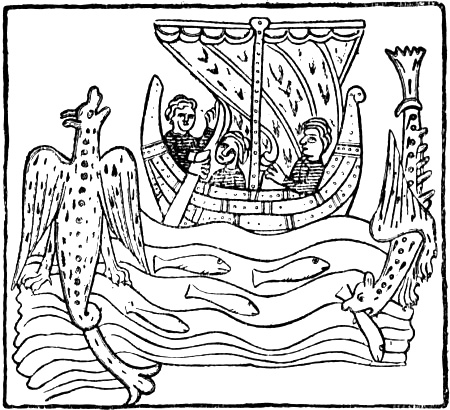
From a MS. of the thirteenth century (Royal Library, Copenhagen)
The “Promised Land” (“Tír Tairngiri”) with the “Happy Plain” (“Mag
Mell”)[340] became in the Christian Irish legends the earthly Paradise,
“Terra Repromissionis Sanctorum” (the land of promise of the saints).
Other names for the happy land or happy isles in the west are: “Hy
Breasail” (== the fortunate isle), “Tír na-m-Beo” (== the land of the
living), “Tír na-n-Óg” (== the land of youth), “Tír na-m-Buadha” (== the
land of virtues), “Hy na-Beatha” (== the isle of life). The happy isle of
“Hy Breasail,” which was thought to be inhabited by living people, was
also frequently called the “Great Land” (which when translated into Old
Norse might become “Víðland”); just as the “Land of the Living,” where
there were only enticing women and maidens, and neither death nor sin nor
offence, was called the “Great Strand” (“Trág Mór”).[341] There is also
mention of “Tír n-Ingnad” (land of marvels) and “Tírib Ingnad” (lands of
marvels). This Irish series of names and conceptions for the same
wonderful land (or strand) may well be thought to have been the origin of
the name “Furðustrandir.”[342] The Irish often imagined their Promised
Land, with “Mag Mell” and also the land of women, as the sunken land
under the sea (cf. p. 355), and called it “Tír fo-Thuin” (== the land
under the wave).
Brandan’s Grape-Island
It is not surprising that a name like “Vínland hit Góða” should have
developed from such a world of ideas as this. But Moltke Moe has drawn my
attention to yet another remarkable agreement, in the Grape-Island
(“Insula Uvarum”), one of the fortunate isles visited by the Irish saint
Brandan. In the Latin “Navigatio Sancti Brandani”—a description of
Brandan’s seven years’ sea voyage in search of the “Promised Land”—it is
related that one day a mighty bird came flying to Brandan and the brethren
who were with him in the coracle; it had a branch in its beak with a bunch
of grapes of unexampled size and redness[343] [cf. Numbers xiii. 23],[344]
and it dropped the branch into the lap of the man of God. The grapes were
as large as apples, and they lived on them for twelve days.
“Three days afterwards they reached the island; it was covered with
the thickest forests of vines, which bore grapes with such incredible
fertility that all the trees were bent to the earth; all with the same
fruit and the same colour; not a tree was unfruitful, and there were
none found there of any other sort.”
Then this man of God goes ashore and explores the island, while the
brethren wait in the boat (like Karlsevne and his men waiting for the
runners), until he comes back to them bringing samples of the fruits of
the island (as the runners brought with them samples of the products of
Wineland). He says: “Come ashore and set up the tent, and regale
yourselves with the excellent fruits of this land, which the Lord has
shown us.” For forty days they lived well on the grapes, and when they
left they loaded the boat with as many of them as it would hold, exactly
like Leif in the “Grönlendinga-þáttr,” who loaded the ship’s boat with
grapes when they left Wineland; and like Thorvald at the same place, who
collected grapes and vines for a cargo [cf. “Grönl. hist. Mind.,” i. pp.
222, 230].
The river at Hóp and the Styx
The fortunate island on which the monk Mernoc lived (at the beginning of
the “Navigatio”) was called “Insula Deliciosa.” The great river that
Brandan found in the Terra Repromissionis, and that ran through the middle
of the island, may be compared to the stream that Karlsevne found at Hóp
in Wineland, which fell into a lake and thence into the sea, and where
they entered the mouth of the river. But the river which divided the Terra
Repromissionis, and which Brandan could not cross, was evidently
originally the river of death, Styx or Acheron in Greek mythology
(“Gjǫll” in Norse mythology). One might be tempted to suppose that, in
the same way as the whole description of Wineland has been dechristianised
from the Terra Repromissionis, the realistic, and therefore often
rationalising, Icelanders have transformed the river in the Promised Land,
the ancient river of death, into the stream at Hóp.
Other passages also of the descriptions of the Wineland voyages present
similarities with Brandan’s voyage; and similar resemblances are found
with other Irish legends, so many, in fact, that they cannot be explained
as coincidences. The “Navigatio Sancti Brandani” was written in the
eleventh century, or in any case before 1100[345] (but parts of the legend
of Brandan may belong to the seventh and eighth centuries). The work was
widely diffused in Europe in the twelfth century, and was also well known
in Iceland; we still possess an Old Norse translation of parts of it in
the “Heilagra Manna sǫgur” [edited by Unger, Christiania, 1877, i.].
Through oral narratives the mythical features which are included in this
legend have evidently helped to form the tradition of the Wineland
voyages.
Wine-fruit and wine in Irish legend
In the tale of the voyage of Maelduin and his companions (“Imram
Maelduin,” see above, p. 336),[346] it is related that they came to an
island where there were many trees, like willow or hazel, with wonderful
fruit like apples, or wine-fruit, with a thick, large shell; its juice had
so intoxicating an effect that Maelduin slept for a day and a night after
having drunk it; and when he awoke, he told his companions to collect as
much as they could of it, for the world had never produced anything so
lovely. They then filled all their vessels with the juice, which they
pressed out of the fruit, and left the island. They mixed the juice with
water to mitigate its intoxicating and soporific effect, as it was so
powerful.[347] This reminds us of Tyrker in the “Grönlendinga-þáttr,” who
gets drunk from eating the grapes he found.[348]
Wine is, moreover, a prominent feature in many of the Irish legends of
sea-voyages. The voyagers often find intoxicating drinks, which make
them sleep for several days, and they are often tormented by burning
thirst and come to islands with springs that give a marvellously
quickening drink. In the tale of the voyage of the three sons of Ua
Corra (twelfth century ?) they arrive at an island where a stream of
wine flows through a forest of oaks, which glitters enticingly with
juicy fruits. They ate of the apples, drank a little of the stream of
wine, and were immediately satisfied and felt neither wounds nor
sickness any more. In the tale of Maelduin there is an island with
soil as white as a feather and with a spring which on Wednesdays and
Fridays gives whey or water, on Sundays and the days of martyrs good
milk, but on the days of the Apostles, of Mary and of John the
Baptist, and on the great festivals it gives ale and wine [cf. Zimmer,
1889, pp. 163, 189].
Resemblances to Lucian
Brandan’s Grape-island, Maelduin who intoxicates himself by eating the
wine-fruit, and the stream of wine flowing through the oak forest, all
bear a remarkable resemblance to what the Greek sophist and satirist
Lucian (second century A.D.) relates in his fables in the “Vera
Historia” about the seafarers who came to a lofty wooded island. As
they wandered through the woods they came to a river, which instead of
water ran with wine, like Chios wine. In many places it was broad and
deep enough to be navigable, and it had its source in many great
vines, which hung full of grapes. In the river were fish of the colour
and taste of wine. They swallowed some so greedily that they became
thoroughly intoxicated. But afterwards they had the idea of mixing
these wine-fish with water-fish, whereby they lost the too-powerful
taste of wine and were a good dish. After wading through the river of
wine they came upon some remarkable vines, the upper part of which
were like well-developed women down to the belt. Their fingers ran out
into twigs full of grapes, their heads were covered with
vine-branches, leaves and grapes, instead of hair. “The ladies kissed
us on the mouth,” says Lucian, “but those who were kissed became drunk
on the spot and reeled. Only their fruit they would not allow us to
take, and they cried out in pain if we plucked a grape or two off
them. On the other hand, some of them showed a desire to pair with us,
but two of my companions who complied with them had to pay dearly for
it; for ... they grew together with them in such a way that they
became one stem with common roots.” After this strange experience the
voyagers filled their empty barrels partly with ordinary water, partly
with wine from the river, and on the following morning they left the
island. In the Isle of the Blest, at which they afterwards arrived,
there were, in addition to many rivers of water, of honey, of
sweet-scented essences and of oil, seven rivers of milk and eight of
wine. We even find a parallel in Lucian to Maelduin’s white island
with the springs of milk and wine, as the travellers come to a sea of
milk, where there was a great island of cheese, covered with vines
full of grapes; but these yielded milk instead of wine [cf. Wieland,
1789, iv. pp. 150 ff., 188 f., 196]. A direct literary connection
between Lucian and the Irish myths can hardly be probable, as he is
not thought to have been known in Western Europe before the fourteenth
century; but he was much read in Eastern Europe, and oral tales
founded on his stories may have reached the Irish. The resemblances
are so pronounced and so numerous that it does not seem very probable
that they should be wholly accidental. Such an oral connection might,
for instance, have been brought about by the Scandinavians, who had
much intercourse with Miklagard (Byzantium), or by the Arabs, who in
fact preserved a great part of Greek literature, and who were in
constant communication both with Celts and with Scandinavians.
Connection of the Brandan legend with northern waters
That a mythical island like the Isle of Grapes—or perhaps others as well,
such as the “Insula Deliciosa”—might be the origin of the “Vinland hit
Góða” of the Icelanders, to which one sailed from Greenland (and of Adam
of Bremen’s Winland), appears natural also from the fact that many of the
islands and tracts that are mentioned in the “Navigatio,” and that for the
most part are also mentioned in the older tale of Maelduin, are
undoubtedly connected with northern and western waters. That this must be
so is easily understood when one considers the voyages of Irish monks to
the Faroes and Iceland. The Sheep Island, which was full of sheep, and
where Brandan obtained his paschal lamb, must be the Faroes, where the
sheep are mentioned even by Dicuil (see p. 163), just as the island with
the many birds also reminds us of Dicuil’s account of these islands; the
island on the borders of Hell, whose steep cliffs were black as coal,
where one of Brandan’s monks, when he set foot ashore, was instantly
seized and burnt by demons, and which at their departure they saw covered
with fire and flames, may have some connection with Iceland.[349] But it
also bears some resemblance to the Hell Island that Lucian’s voyagers
come to, surrounded by steep cliffs, where there were stinking fumes of
asphalt, sulphur, pitch, and roasted human beings. When Brandan arrives at
the curdled sea (“mare quasi coagulatum”), and has to sail through
darkness before he comes to the Land of Happiness, or when we hear of a
thick fog like a wall about the kingdom of Manannan, we again think of the
northern regions where the Liver Sea lay, and where Adam of Bremen had his
dark or mist-filled sea.
Classical roots of the Brandan legend
While thus many features connect the legend of Brandan with northern
waters, it has, on the other hand—like many other Irish myths—its
roots far down in the mythical conceptions of the classics. Above all,
Brandan’s Paradise or “Promised Land of the Saints,” Terra
Repromissionis Sanctorum, is nothing but the Greeks’ Isles of the
Blest, blended with ideas from the Bible. As shown by Zimmer [1889,
pp. 328 ff.], the Imram Maelduin (which to a large extent forms the
foundation of the Navigatio St. Brandani) and other Irish tales of
sea-voyages have great similarity to Virgil’s Æneid, and are composed
on its model. We have already said that Brandan’s Grape-island may
have some connection with Lucian. From him is possibly also derived
Brandan’s great whale, “Iasconicus,” on whose back they live and
celebrate Easter. But similar big fishes are known from old Indian
legends, from the legends about Alexander, etc. It may also be
mentioned that in the Breton legend corresponding to Brandan’s, that
of St. Machutus (written down by Bili, deacon at Aleth, ninth
century), the latter and Brandan came to an island where they find the
dead giant “Mildu,” whom Machutus awakens and baptizes and who, wading
through the sea, tries to draw their ship to the Paradise-island of
“Yma,” which he says is surrounded by a wall of shining gold, like a
mirror, without any visible entrance. But a storm raises the sea and
bursts the cable by which he is towing them. Humboldt already saw in
this giant the god Cronos, who, according to Plutarch, lay sleeping on
an island in the Cronian Sea to the north-west of Ogygia, which lay
five days’ voyage to the west of Britain (see above, p. 156). It is
probably the same giant who in the tale of Brandan written in Irish
(“Imram Brenaind”) has become a beautiful maiden, whiter than snow or
sea-spray; but a hundred feet high, nine feet across between the
breasts, and with a middle finger seven feet long. She is lying
lifeless, killed by a spear through the shoulder; but Brandan awakens
and baptizes her. She belongs to the sea-people, who are awaiting
redemption. As, in answer to Brandan’s question, she prefers going
straight to heaven to living, she dies again immediately without a
sigh after taking the sacrament [cf. Schirmer, 1888, pp. 30, 72;
Zimmer, 1889, p. 136; De Goeje, 1891, p. 69]. This maiden is evidently
connected with the supernaturally beautiful, big, and white king’s
daughter from the Land of Virgins (“Tír na-n-Ingen”) who seeks the
protection of Finn MacCumaill, and who is also pierced by a spear [cf.
Zimmer, 1889, pp. 269, 325]. Thus do mythical beings transform
themselves till they become unrecognisable. The same woman is found
again in Iceland as late as the seventeenth century.[350]
The Brandan legend and Norse literature
In many of its features the Brandan legend, or similar Irish legends,
may be shown to have had influence on Norse literature. The theft of
the neck-chain (or bridle ?) by one of the brethren, who comes to
grief thereby, in the Navigatio and in other Irish tales, is found
again, as Moltke Moe points out to me, in the story of Thorkel Adelfar
in Saxo Grammaticus, as a theft of jewels and of a cloak, through
which the thieves also come to grief. The great fish (whale)
“Iasconicus,” of which Brandan relates that it tries in vain to bite
its own tail, is evidently the Midgardsworm of Norse literature. In
the same way the little, apparently innocent, but supernatural cat in
the “Imram Maelduin” which suddenly destroys the man who steals the
neck-chain may be connected with the cat that Thor tries to lift in
Utgard. It is doubtless the same little cat that three young priests
took with them on their voyage in another Irish legend [in the Book of
Leinster, of the beginning of the twelfth century]. In the “Imram
Brenaind” this little cat they took with them has grown into a monkey
as large as a young ox, which swims after Brandan’s boat and wants to
swallow it [cf. Zimmer, 1889, p. 139]. Again, quite recently Von Sydow
[1910, pp. 65 ff.] has shown that the Snorra-Edda’s myth of Thor’s
journey to Utgard is based on Irish myths and tales.
The happy land in the west known in Northern Europe
Legends of a happy land or an island far over the sea towards the sunset
were evidently widely diffused in Northern Europe in those days, outside
Ireland. In Anglo-Saxon literature there is a dialogue between Adrianus
and Ritheus (probably of the tenth century), where we read:
“Tell me where the sun shines at night.”... “I tell you in three
places: first in the belly of the whale that is called ‘Leuiathan’;
and the second season it shines in Hell; and the third season it
shines upon the island that is called ‘Glið,’ and there the souls of
holy men repose till doomsday.”[351]
This Glið (i.e., the glittering land) is evidently the Land of the Blest,
Brandan’s Terra Repromissionis, that lies in dazzling sunshine, after one
has passed through darkness and mist; but whether the myth reached the
Anglo-Saxons from the Irish seems doubtful.
Pseudo-Gildas’s description (twelfth century) of the isle of “Avallon”
(the apple-island of Welsh myth) is also of interest; it is connected with
exactly the same ideas as the Irish happy isles:
“A remarkable island is surrounded by the ocean, full of all good
things; no thief, no robber, no enemy pursues one there; no violence,
no winter, no summer rages immoderately; peace, concord, spring last
eternally, neither flower nor lily is wanting, nor rose nor violet;
the apple-tree bears flowers and fruit on the selfsame branch; there
without stain youths dwell with their maidens, there is no old age and
no oppressive sickness, no sorrow, all is full of joy.”[352]
The name of Wineland derived from Ireland
It results, then, from what has here been quoted, that a Grape-island
(“Insula Uvarum”) makes its appearance in Irish literature in the eleventh
century, at about the same time when Adam of Bremen mentions, from Danish
informants, an island called “Winland.” Of the same century again is the
Norwegian runic stone from Hönen in Ringerike, on which, as we shall see
later, Wineland is possibly mentioned (?) From the form of the runes, S.
Bugge ascribes it to the first half of the eleventh century, hardly older,
though it may be later. “Insula Uvarum” translated into the Old Norse
language could not very well become anything but Vínland (or Víney), since
Vínberjarey or Vínberjarland would not sound well. We thus have the
remarkable circumstance that an island with the same name and the same
properties makes its appearance almost simultaneously in Ireland and in
Denmark (and possibly also in Norway). That these Wine-islands or
Winelands should have originated entirely independently of one another, in
countries which had such close intellectual connection, would be a
coincidence of the kind that one cannot very well assume, since it must be
regarded as more probable that there was a connection. But Brandan’s
Grape-island can scarcely be derived from a Wineland discovered by the
Norsemen, since, as has been mentioned, the wine and wine-fruit play such
a prominent part in the older Irish legends, and the ancient tale of Bran
(“Echtra Brain”) describes the Irish Elysium (“Mag Mell”) as a land with
magnificent woods and the true scent of the vine, etc. (see p. 355). In
the next place, as has been mentioned, Brandan’s Grape-island bears a
resemblance to Lucian’s Grape-island; but as Lucian’s descriptions seem
also to have influenced, among others, the tale of the intoxicating
wine-fruit in the “Imram Maelduin,” it looks as though Lucian’s stories
had reached Ireland (e.g., by Scandinavian travellers or through Arabs ?)
long before the Navigatio Brandani was written. As thus the Irish
wine-island cannot well be due to a Norse discovery, it becomes probable
that Adam’s name Winland (as well as the possible Norwegian name) was
originally derived from Ireland, and that it reached the northern
countries orally. If the Danes did not get the name from the Norwegians
they may have brought it themselves, as they also had direct communication
with Ireland.[353] This conclusion, that the name of Wineland came from
Ireland, is again strengthened from an entirely different quarter, namely,
the Landnámabók, where it is said that Great-Ireland lay near Wineland. As
suggested on p. 354, this shows that the Icelanders must have heard both
lands spoken of in Ireland. As Ravn Hlymreks-farer is given as the
original authority, and after him Thorfinn, earl of Orkney (ob. circa
1064), this may have been at the beginning of the eleventh century; but as
the statement came finally from Thorkel Gellisson (and consequently was
written down by Are Frode) it may also have been in the second half of
that century. In this way we seem to have a natural explanation of the
simultaneous appearance of the name in the North.[354]
As the statement in the Landnáma is due to Thorkel Gellisson, it is
doubtless most probable that the Wineland that is mentioned for the first
time in Icelandic literature in a gloss in Are Frode’s Íslendingabók also
has Thorkel (who is mentioned immediately afterwards) for its authority
(cf. p. 258), although the sentence might be by Are himself. Thorkel may
have heard of this Wineland in Greenland; but it is more likely to be the
country he heard of in connection with the mythical Hvítramanna-land from
Ireland, and he may have heard that there were said to dwell there wights
(or trolls) that were called Skrælings. Two possibilities suggest
themselves: either this Wineland with its Skrælings was nothing but the
well-known mythical land with its mythical people, which required no
further description. It cannot be objected that the sober, critical Are
would not have mentioned a mythical country in this way; for, if he was
capable of believing in a Hvítramanna-land, he could also believe in such
a Wineland. Or, on the other hand, it was a land which had actually been
discovered and to which the name of the mythical country had been
transferred. The latter hypothesis might be strengthened by other things
that point to the Greenlanders having really found land in the west. But,
on the other hand, if a country actually discovered is meant, it is
curious that neither Are nor the Landnáma makes any mention of the
discovery, whereas the discovery of Greenland is related at some length,
and also that of Hvítramanna-land. Again, when Eric the Red came to
Greenland, such a land had in any case not been discovered, so that it
could not have been he who named the Eskimo after the inhabitants of that
land, whereas Are might readily suppose that he had taken the name of
Skrælings from the people of the mythical country; thus Are’s words, as
they now stand, would have a clearer meaning.
It may also be worth mentioning that in the only passage of the Sturlubók
where Wineland is alluded to, it is called “Irland et Goda.” This has
generally been regarded as a copyist’s error; but that it was due to
misreading of an indistinctly written “Vinland” is not likely; it might
rather be due to a careless repetition, since “Irland et Mikla” is
mentioned just before. This is most probable. It may, however, be supposed
that it is not an error, and that just as the latter is an alternative
name for Hvítramanna-land, so “Irland et Góða” may be a corresponding
alternative name for Wineland, which was situated near it. We should thus
again be led to Ireland as the home of the name. In any case the
uncertainty which prevails in the versions of the name of Wineland given
in the oldest authorities is striking (as discussed in the last note).
Nothing of the same sort occurs in the transmission of other geographical
names, and a form such as Vindland in Hauk’s Landnáma cannot be explained
as merely a copyist’s error. Again, Eric’s Saga in the Hauksbók has the
name correctly, although this saga as well as the Landnáma was to a great
extent copied by Hauk Erlendsson himself. This may point to the form
Vindland having occurred in the original from which the Landnáma was
copied. This discloses uncertainty in the very reading of the name, and it
seems also to point to its having been a mythical country and not the name
of a known land that had been discovered.
Landit Góða, Fairyland
To any one who is familiar with Norse place-names, the addition “hit góða”
to Wineland must appear foreign and unusual. It is otherwise only known in
the northern countries from the name “Landegode” (originally “Landit
Góða”) on the coast of Norway, for an island west of Bodö. The same name
was also used (and is still used in Stad and Herö) for Svinöi, a little
island off Sunnmör, and for Jomfruland (south of Langesund). It has been
generally taken for a so-called tabu-name;[355] but the explanation
suggested to me by Moltke Moe seems more probable, that it was a
designation of fairylands, which lay out in the ocean, and which were
thought to sink into the sea as one approached them. The above-mentioned
Norwegian islands would quite answer to such conceptions, especially when
they loom up and seem larger, and all three islands were formerly
fairylands (“huldrelande”). The original germ of the belief in fairies
(“huldrer”) is the worship of the departed. “Hulder” means “hidden” (i.e.,
the hidden people). Fairylands are therefore the islands of the hidden, or
of the departed, and these again are the Fortunate Isles or the Isles of
the Blest. A parallel to this is that “Hades” in Greek means the
invisible. And, as we have seen (p. 356), the nymph Calypso (== the hidden
one) answers to our “hulder.” When Bran, in the Irish legend alluded to,
meets on the sea Manannán mac Lir (i.e., son of the Sea), king of the
sea-people, lord of the land of the dead, he tells Bran that without being
able to see it he is sailing over Mag Mell (the happy plain), where happy
people are sitting drinking wine, and where there is a splendid forest
with vines, etc.; and the Irish happy land “Tír fo-Thuin” is, as we have
said (p. 358), the land under the wave. The lands or islands of the
departed in course of time became the habitations of the invisible ones
(spirits), of those who possess more than human wisdom, and have a
specially favourable lot; by this means the idea of a fortunate land with
favoured conditions, far surpassing the ordinary lot of men, became more
and more emphasised. This development may be followed both with regard to
classical ideas of the Fortunate Islands and to Norse conceptions of
fairylands.
That the Greeks connected the happy land with the hidden people who move
upon the sea may perhaps be concluded even from the Odyssey’s description
of the Phæacians, who dwelt in the happy land, the glorious Scheria, far
in the western ocean (see above, p. 347). That they may be compared with
our fairies (“huldrefolk”) appears perhaps from the name itself, which may
come from φαιός (== dark) and mean “dark man,” “the hidden man”
[cf. Welcker, 1833, p. 231].[356] They sail at night, always shrouded in
clouds and darkness, in boats as swift “as wings and the thoughts of men”
[Od. vii. 35 f.]. The “huldrefolk” also travel by night (cf. p. 378). In
Ireland and in Iceland the way to fairyland is through darkness and mist,
or sea or water [cf. Gröndal, 1863, pp. 25, 38]; and it is the same in
Nordland. A blending of the fairies (“síd”-people) and the inhabitants of
the happy land or promised land is particularly observable in the Irish
legends [cf. Zimmer, 1889, pp. 276 f.]. The people of the “síd” dwell
partly in grave-mounds (and are thus like our “haugebonde,” or mound-elf),
they may also live in happy lands far west in the sea or under the sea,
and are thus sea-elves, but on the whole they most resemble our
“huldrefolk.” The “síd”-woman entices men like our “hulder”; in the tale
of “Condla Ruad” [Connla the Fair; cf. Zimmer, 1889, p. 262] she comes
from the Land of the Living (“Tír na-m-Beó”), far across the sea, and
entices Connla to go with her in a glass boat to the “Great Strand,” where
there only were women and maidens. This Irish paradise of women out in the
ocean has, as we have said (p. 355), much in common with the German
Venusberg, and with the invisible country of our “huldrefolk.” But the
“huldrefolk” dwell now in mountains and woods, now on islands in the sea
or under the sea. As will be seen, the ideas of the Fortunate Isles or of
the Promised Land and those of fairyland thus often coincide. It may be
added that among many peoples the souls of the dead are carried across the
sea in a boat or ship to a land in the west.
This is evidently connected with the river of death, Styx, Acheron or
Cocytus, of the Greeks, over which Charon ferried the souls to the
lower regions in a narrow two-oared boat. Procopius [De bello Goth.,
iv. 20] relates that according to legends he himself heard from the
natives, all the souls of the departed are carried every night at
midnight from the coast of Germania to the island of Brittia (i.e.,
Britain) which lies over against the mouth of the Rhine between
Britannia (i.e., Brittany) and Thule (Scandinavia). He whose turn it
is among the dwellers on the coast to be ferryman hears at midnight a
knocking at his door and a muffled voice. He goes down to the beach,
sees there an empty, strange boat, into which he gets and begins to
row. He then notices that the boat is filled so that the gunwale is
only a finger’s breadth above the water, but he sees nothing. As soon
as he arrives at the opposite shore, he notices that the boat is
suddenly emptied, but still he sees no one, and only hears a voice
announcing the names and rank of the arrivals. The invisible souls,
who always move in silence, answer to the elves.
In many ways the connection between the dead and the sea is apparent.
Balder’s body was laid in a ship on which a pyre was kindled, and it
was abandoned to the currents of the sea. The body of the hero Scild
in the lay of Beowulf was borne upon a ship, which was carried away by
the sea, no one knows whither. Fiosi in Njál’s Saga has himself
carried on board a ship and abandoned to the sea, and afterwards the
ship is not heard of again, etc.[357]
That the fairylands should be called “Landit Góða” may be due to their
exceeding fertility (cf. the huldreland’s waving cornfields); but it may
also, as Moltke Moe has pointed out, have a natural connection with the
tendency the Germanic peoples in ancient times seem to have had of
attaching the idea of “good” to the fairies and the dead. In Nordland the
“huldrefolk” are called “godvetter” (“good wights”) [cf. I. Aasen]; this
among the Lapps has become “gúvitter,” “gufihter,” “gufittarak,” etc., as
a name for supernatural beings underground or in the sea;[358] the Swedes
in North Sweden use the word “goveiter.” The mound-elf (“haugebonden”),
Old Norse “haugbui” (the dweller in the mound), who was the ancestor of
the clan, or the representative of the departed generations, is called in
Nordland “godbonden.”[359]
The underground people are called in Iceland “ljúflingar,” in German
“die guten Leute,” in English-speaking Ireland, Scotland and the Isle
of Man “the good people,” “good neighbours,” or “the men of
peace.”[360] In Highland Gaelic they are called “daoine sith,” in
Welsh “dynion mad.” In Swedish and Danish we have the designation
“nisse god-dreng” (“nisse good boy”) or “goda-nisse,” in Norwegian
“go-granne” (“good neighbour”); (in Danish also “kære granne,” “dear
neighbour”); in German “Guter (or lieber) Nachbar,” or “Gutgesell” is
used of a goblin; in Thuringia “Gütchen,” “Gütel”; in the Netherlands
“goede Kind,” and in England “Robin Goodfellow.”
That the epithet “good” applied to supernatural beings, especially
underground ones, is so widely spread, even among the Lapps, shows it to
have been common early in the Middle Ages.
It is of minor interest in this connection to inquire what the origin
of the epithet may have been. We might suppose that it was the thought
of the departed as the happy, blest people; but on the other hand it
may have been fear; it may have been sought to conciliate them by
giving them pet-names, for the same reason that thunder is called in
Swedish “gobon” (godbonden), “gofar,” “gogubben,” “gomor,” “goa” (goa
går),[361] which is also Norwegian.
“Hit góða” is the altogether good, the perfect, therefore the fortunate
land. When the legend of the “Insulæ Fortunatæ” and of the Irish happy
lands—one of which was the sunken fairyland “Tír fo-Thuin,” the land
under-wave—reached the North, it was quite natural that the Northerners
should translate the name by one well known to them, “Landit Góða”
(fairyland, the land of the unseen); indeed, the name of Insulæ Fortunatæ
could not well have been translated in any other way. But as wine was so
conspicuous a feature in the description of this southern land of myth,
both in Isidore and among the Irish, and as wine more than any other
feature was symbolical of the idea of happiness, it is natural, as we have
seen, that the Northerners came very soon to call this country, like
Brandan’s Grape-island, “Vínland”; thus “Vínland hit Góða” may have arisen
by a combination of “Vínland” and “Landit góða,” to distinguish it from
the native “Landit Góða,” the fairyland of the Norwegians. A combination
of “hit góða” with a proper name is otherwise unknown, and thus points to
“Landit Góða” as the original form.[362]
Laudatory names for fairyland
Moltke Moe has given me an example from Gotland of a fairyland having
received a laudatory name answering to Wineland, in that the popular
fairyland “Sjóhaj” or “Flåjgland,” out at sea, is called
Smörland.[363] Sjóhaj is a mirage on the sea; and “Flåjgland” comes
from “fljuga,” to fly, i.e., that which drifts about, floating land.
It now only means looming, but it may originally have been fairyland,
and it is evident that it is here described as particularly fertile.
With “Smörland” may be compared Norwegian place-names compounded with
“smör”: “Smörtue,” “Smörberg,” “Smörklepp.” O. Rygh includes these
among “Laudatory names ... which accentuate good qualities of the
property or of the place.”[364] Similarly in the place-names of
Shetland: “Smerrin” (== “smjǫr-vin,” fat, fertile pasture),
“Smernadal” (== “smjǫr-vinjar-dalr,” valley with fat pasture), “de
Smerr-meadow” (== originally: “smjor-eng” or “smjǫr-vin”), “de
Smerwel-park” (probably == “smjor-vollr”), “de Smorli” (probably ==
“smjor-hlið”). J. Jakobsen [1902, p. 166] says that “‘smer(r)’ (Old
Norse ‘smjǫr’ or ‘smœr,’ Norwegian ‘smör,’ butter) means here
fertility, good pasture, in the same way as in Norwegian names of
which the first syllable is ‘smör.’” With this may be compared the
fact that even in early times the word “smör” was used to denote a fat
land, as when Thorolf in the saga said that “it dripped butter from
every blade of grass in the land they had found” (i.e., Iceland, see
above, p. 257, cf. also “smjǫr-tisdagr” == “Fat Tuesday,” “Mardi
gras”). That the fairylands were connected with fertility appears
also from a Northern legend. Nordfuglöi, to the north of Karlsöi, was
once a troll-island, hidden under the sea and invisible to men, thus a
“huldre” island. But then certain troll-hags betook themselves to
towing it to land; a Lapp hag who happened to cast her eye through the
door-opening saw them come rowing with the island, so that the spray
dashed over it, and cried: “Oh, what a good ‘food-land’ we have now
got!” And thereupon the island stopped at the mouth of the sea, where
it now is.[365] The fertility of fairyland is doubtless also expressed
in the incident of the sow that finds it (see later), usually having a
litter there. Its fertility appears again, perhaps, in H. Ström’s
[1766, p. 436] mention of “Buskholm” (i.e., Bush-island) in Herö
(Sunnmör), which was inhabited by underground beings and protected,
therefore wholly overgrown with trees and bushes. The Icelandic
elfland “is delightful, covered with beautiful forests and sweet
smelling flowers” [cf. Gröndal, 1863, p. 25], and the Irish is the
same.
Floating islands
Legends of islands and countries that disappeared or moved, like the
fairylands, are widely diffused. To begin with, the Delos (cf. δηλόω,
become visible) of the Greeks floated about in the sea for a
long time, as described by Callimachus [v.]; now the island was found,
now it was away again, until it was fixed among the Cyclades. Ireland,
which also at a very early time was the holy island (cf. p. 38),
floated about in the sea at the time of the Flood. Lucas Debes [1673,
pp. 19 ff.] relates that “at various times a floating island is said
to have been seen” among the Faroes; but no one can reach it. “The
inhabitants also tell a fable of Svinöe,[366] how that in the
beginning it was a floating island: and they think that if one could
come to this island, which is often seen, and throw steel upon it, it
would stand still.... Many things are related of such floating
islands, and some think that they exist in nature.” Debes does not
believe it. “If this was not described of the properties of various
islands, I should say that it was icebergs, which come floating from
Greenland: and if that be not so, then I firmly believe that it is
phantoms and witchcraft of the Devil, who in himself is a thousandfold
craftsman.” Erich Pontoppidan [1753, ii. p. 346] defends the devil and
protests against this view of Debes, that it is “phantasmata and
sorcery of the devil,” and says: “But as, according to the wholesome
rule, we ought to give the Devil his due, I think that the devil who
in haste makes floating islands is none other than that Kraken, which
some seamen also call ‘Söe-Draulen,’ that is, the sea troll.”
Of Svinöi in the Faroes precisely the same legend exists as of similar
islands in Norway (see p. 378), that they came “up,” or became
visible, through a sow upon which steel had been bound [cf.
Hammershaimb, 1891, p. 362].
In many places there are such disappearing islands. Honorius
Augustodunensis makes some remarkable statements in his work “De
imagine mundi” [i. 36], of about 1125. After mentioning the Balearic
Isles and the Gorgades, he says: “By the side of them [lie] the
Hesperides, so called from the town of Hesperia. There is abundance of
sheep with white wool, which is excellent for dyeing purple. Therefore
the legend says that these islands have golden apples (‘mala’). For
‘miclon’ [error for ‘malon’] means sheep in Greek.[367] To these
islands belonged the great island which according to the tale of Plato
sank with its inhabitants, and which exceeded Africa and Europe in
extent, where the curdled sea (‘Concretum Mare’) now is.... There lies
also in the Ocean an island which is called the Lost (‘Perdita’); in
charm and all kinds of fertility it far surpasses every other land,
but it is unknown to men. Now and again it may be found by chance; but
if one seeks for it, it cannot be found, and therefore it is called
‘the Lost.’ Men say that it was this island that Brandanus came to.”
It is of special interest that thus as early as that time a
disappearing island occurred near the Fortunate Isles.
Columbus says in his diary that the inhabitants of Ferro and Gomera
(Canary Isles) assert that every year they see land to the west.
Afterwards expeditions were even sent out to search for it. The
Dutchman Van Linschoten speaks in 1589 of this beautiful lost land
under the name of “San Borondon” (St. Brandan), a hundred leagues to
the west of the Canaries. Its inhabitants are said to be Christians,
but it is not known of what nation they are, or what language they
speak;[368] the Spaniards of the Canaries have made many vain attempts
to find it. The same island, which sometimes shows itself near the
Canaries, but withdraws when one tries to approach it, still lives in
Spanish folk-lore under the name of “San Morondon.”[369]
On the coast of the English Channel sailors have stories of floating
islands, which many of them have seen with their own eyes. They always
fly before ships, and one can never land there. They are drawn along
by the devil, who compels the souls of drowned men who have deserved
Hell and are damned, to stay there till the Day of Judgment. On some
of them the roar of a terrible beast is heard; and sailors look upon
the meeting with such an island as a sinister warning.[370]
Curiously enough, there is said to be a myth of “a floating island”
among the Iroquois Indians. In their mythology the earth is due to the
Indian ruler of a great island which floats in space, and where there
is eternal peace. In its abundance there are no burdens to bear, in
its fertility all want is for ever precluded. Death never comes to its
eternal quietude—and no desire, no sorrow, no pain disturbs its
peace.[371] These ideas remind one strikingly of the Isles of the
Blest, and are probably derived from European influence in recent
times. Again, at Boston, in America, there is found a myth of an
enchanted green land out in the sea to the east; it flies when one
approaches, and no white man can reach this island, which is called
“the island that flies.” An Indian, the last of his tribe, saw it a
few times before his death, and set out in his canoe to row, as he
said, to the isle of happy spirits. He disappeared in a storm the like
of which had never been known, and after this the enchanted island was
never seen again [cf. Sébillot, 1886, p. 349].
Even the Chinese have legends of the Isles of the Blest, which lie 700
miles from the Celestial Kingdom out in the Yellow Sea, and gleam in
everlasting beauty, everlasting spring and everlasting gladness. The
wizard Sun-Tshe is said once to have extorted from a good spirit the
secret of their situation, and revealed the great mystery to the
emperor Tshe-Huan-Ti (219 B.C.). Then the noblest youths and the most
beautiful maidens of the Celestial Kingdom set out to search for
Paradise, and lo! it suddenly rose above the distant horizon, wrapped
in roseate glow. But a terrible storm drove the longing voyagers away
with cruel violence, and since then no human eye has seen the Isles of
the Blest [after Paul d’Enjoy, in “La Revue”].[372]
This is the same conception of the floating mirage that we meet with
again in the Norse term “Villuland” (from “villa” == illusion, mirage,
glamour), which is found, for instance, in Björn Jónsson of Skardsá
applied to the fabulous country of Frisland (south of Iceland); it is
called in one MS. “Villi-Skotland,” which is probably the mythical
“Irland it Mikla” (Great-Ireland), since the Irish were called Scots.
Are Mársson, according to the Landnáma, reached this “Villuland” and
stayed there. It is remarkable that his mother Katla, according to the
Icelandic legend in the poem “Kǫtlu-draumr” (Katla’s dream), was
stolen by an elf-man, who kept her for four nights.[373] It may be
this circumstance that led to its being Are who found the elf-country
to the west of Ireland, although it is true that according to the
Kǫtlu-draumr it was his one-year-older brother Kar who was the
offspring of the four nights; but the elf-man had asked that his son
should be called Are.
Fairylands which rise and fall
There are many such fairylands along the coast of Norway, which used
to rise up from the sea at night, but sank in the daytime.[374] If one
could bring fire or steel upon them, then the spell was broken and
they remained up; but the huldrefolk avenged themselves on the person
who did this, and he was turned to stone; therefore it was usually
accomplished by domestic animals which swam across to these islands.
Many of them have come up in this way, and for this reason they
frequently bear the names of animals. The most probable explanation is
doubtless that they were originally given the names of animals from a
similarity in shape, or some other reason; and the myth is a later
interpretation of the name. It was often a pig, preferably a sow, that
had acquired the habit of swimming over to the fairyland, and it
frequently had litters there; the people of the farm, who noticed that
it occasionally stayed away, bound steel upon it, and the island was
hindered from sinking; “therefore such fairy islands are often called
Svinöi.” In this way Svinöi in Brönöi (in Nordland, Norway) came up,
as well as Svinöi in the Faroes, and doubtless it was the same with
Svinöi or Landegode in Sunnmör. It was also through a sow that Tautra,
in Trondhjemsfjord, was raised, besides Jomfruland, and the
north-western part of Andöi (in Vesterålen). Nay, even Oland in
Limfjord (Jutland) became visible through a sow with steel bound on
it, which had a litter. Other islands, like Vega and Sölen, were
raised by a horse or an ox, etc. Gotland was also a fairyland, but it
stayed up through a man bringing fire to it.[375] Some fairy islands
lie so far out at sea that no domestic animal has been able to swim
over to them, and therefore they have not yet come up; such are
Utröst, west of Lofoten, Sandflesa, west of Trænen, Utvega, west of
Vega, Hillerei-öi, and Ytter-Sklinna, in Nordre Trondhjems Amt, and
hidden fairylands off Utsire, off Lister, and to the south-west of
Jomfruland.[376]
It is interesting that the notion of a sow being the cause of people
coming into possession of fertile islands can also be illustrated from
mediæval England. William of Malmesbury relates in his “De antiquitate
Glastoniensis ecclesiæ” [cap. 1 and 2], which belongs to the twelfth
century before 1143, that Glasteing “... went in search of his sow as
far as Wellis, and followed her from Wellis by a difficult and boggy
path, that is called ‘Sugewege,’ that is to say, ‘the sow’s way’; at
last he found her occupied in suckling her young beneath the
apple-tree beside the church of which we are speaking; from this are
derived the names that have come down to our time, that the apples of
this tree are called ‘ealdcyrcenes epple,’ that is to say, ‘the apples
of the old church,’ and the sow ‘ealdcyrce suge.’ While other sows
have four feet, this one, strangely enough, has eight. This Glasteing,
then, who came to this island and saw that it was flowing with all
good things, brought all his family and established himself there and
dwelt there all his life. This place is said to be populated from his
offspring and the race that sprang from him. This is taken from the
ancient writings of the Britons.
“Of various names for this island. This island, then, was first called
by the Britons ‘Ynisgwtrin’; later, when the Angles subdued the
island, the name was translated into their language as ‘Glastynbury’
or Glasteing’s town, he of whom we have been speaking. The island also
bears the famous name of ‘Avallonia.’ The origin of this word is the
following: as we have related, Glasteing found his sow under an
apple-tree by the old church; therefore he called ... the island in
his language ‘Avallonia,’ that is ‘The isle of apples’ (for ‘avalla’
in British means ‘poma’ in Latin).... Or else the island has its name
from a certain Avalloc, who is said to have dwelt here with his
daughters on account of the solitude of the place.”[377]
This Somerset sow with its young and with eight legs, like Sleipner,
must be Norse. The Norse myth of the sow must have found a favourable
soil among the Celts, as according to the ideas of Celtic mythology
the pig was a sacred animal in the religion of the Druids, specially
connected with Ceridwen, the goddess of the lower world. The Celts
must have heard of the pig that by the help of steel causes fairylands
to remain visible; but regarded this as being connected with the
animal’s sacred properties. It cannot have been an originally Celtic
conception, otherwise we should meet with it in other Celtic legends.
Moreover the island in this case is not invisible, nor has the sow any
steel upon her; these are features that have been lost in
transmission. On the other hand the incident of the sow becoming
pregnant in the newly found land has been preserved.
In the ocean to the west of Ireland there lay, as already mentioned
(p. 354), many enchanted islands. They are in part derived from
classical and oriental myths; but the native fairies (the síd-people)
and fairylands have been introduced here also (p. 371). Even in the
lakes of Ireland there are hidden islands, marvellously fertile with
beautiful flowers.[378] Giraldus Cambrensis (twelfth century) says
that on clear days an island appeared to the west of Ireland, but
vanished when people approached it. At last some came within bowshot,
and one of the sailors shot a red-hot arrow on to it, and the island
then remained fixed. The happy island “O’Brasil” (“Hy-Breasail,” see
p. 357) west of Ireland appears above the sea once in every seventh
year—“on the edge of the azure sea ...” and it would stay up if any
one could cast fire upon it.[379]
It is no doubt possible that myths of “villulands” or “huldrelands” far
away in the sea may have arisen in various places independently of one
another;[380] they may easily be suggested by mirage or other natural
phenomena, and ideas about happiness are universal among men. But through
many of these myths may be traced features so similar that we can discern
a connection with certainty and can draw conclusions as to a common origin
of the same conceptions.
The epithet “the Lucky”
That Leif of all others, the discoverer of the fortunate land, should have
received the unusual surname of “hinn Heppni” (the Lucky) is also
striking. There is only one other man in the sagas who is called thus:
Hǫgni hinn Heppni, and he belongs to the period of the Iceland
land-taking, but is only mentioned in a pedigree. Just as according to
ancient Greek ideas and in the oldest Irish legends it was only vouchsafed
to the chosen of the gods or of fortune to reach Elysium or the isle of
the happy ones, so Leif, who according to tradition was the apostle of
Christianity in Greenland, must have been regarded by the Christians of
Iceland as the favourite of God or of destiny, to whom it was ordained to
see the land of fortune. It is just this idea of the chosen of fate that
lies in the words “happ” and “heppinn.” That the name has such an origin
is also rendered probable by the fact that the saga-tellers were evidently
not clear as to the reason of Leif’s being so called, and it is sometimes
represented as due to his having saved the shipwrecked crew (cf. pp. 270,
317), which is meaningless, since in that case it would be the rescued and
not Leif who were lucky, and moreover rescue of shipwrecked sailors must
have been an everyday affair. The saga-writers therefore knew that Leif
had this surname, but the reason for it had in course of time been
forgotten.
An interesting parallel to “Leifr hinn Heppni” has been brought to my
notice by Moltke Moe in the Nordland “Lykk-Anders,” the name of the lucky
brother who came to the fairyland Sandflesa, off Trænen in Helgeland.[381]
It is important that this epithet of Lucky is thus only known in Norway in
connection with fairyland.[382] That the underground people, “huldrefolk,”
bring luck appears also in other superstitions.[383] He who is born with
the cap of victory (Glückshaube, -helm, sigurkull, holyhow), which often
seems to have the same effect as the fairy hat, is predestined to fortune
and prosperity, like a Sunday child.
Another possible parallel to the lucky name is the monk “Felix” (i.e.,
happy, corresponding to “heppinn”) who occurs in widely diffused mediæval
legends. He has a foretaste of the joys of heaven through hearing a bird
of paradise; he thinks that only a few hours have passed, from morning to
midday, while he is listening to it in rapture, though in reality a
hundred years have gone by.[384] Moltke Moe considers it probable that in
this case the name Felix may be due to a Germanic conception of the lucky
one.
Moltke Moe sees another parallel—a literary one, to be sure—to Leif
the Lucky and Lykk-Anders in the Olaf Ásteson of the “Draumkvæde”
(Dream-Lay) which he explains as “Ástsonr” == the son of love, God’s
beloved son. He is so called because he is so beloved that God has
given him a glimpse of the future, so that he sees behind the gate of
death.[385]
All this, therefore, points in the same direction.
The oldest authority, Adam of Bremen, untrustworthy
Even Adam of Bremen’s brief mention of Wineland (cf. pp. 195, 197) bears
evident traces of being untrustworthy; thus he says that the self-grown
vines in Wineland “give the noblest wine.” Even if wine could be produced
from the small wild grapes, it would scarcely be noble, and who should
have made it? It is not very likely that the Icelanders and Greenlanders
who discovered the country had any idea of making wine. If we except this
fable of the wine, and the name itself, which seems to be derived from
Ireland (cf. p. 366), but may have been confused with the name of
Finland[386] (cf. p. 198), then Adam’s statements about Wineland correspond
entirely to Isidore’s description of the Insulæ Fortunatæ, and contain
nothing new. Adam’s statement that the island was discovered by many
(“multis”) does not agree with the Saga of Eric the Red, which only knows
of two voyages thither, but agrees better with its being a well-known
mythical country, to which many mythical voyages had been made, or with
its being Finmark.[386] Although it may be uncertain whether Adam thought
the ice- and mist-filled sea lay beyond Wineland (cf. p. 199), this bears
a remarkable resemblance to similar Arab myths of islands that lay near
the “Dark Sea” in the west (cf. chapter xiii.); while in any case it shows
how myth is introduced into his description of distant regions, and there
also he places the mythical abyss of the sea. If one reads through the
conclusion of his account (pp. 192 ff.), it will be seen how he takes
pains to get a gradual increase of the fabulous: first Iceland with the
black inflammable ice and the “simple” communistic inhabitants; then,
opposite to the mountains of Svedia, Greenland, with predatory inhabitants
who turn blue-green in the face from the sea-water; then Halagland, which
is made into an island in the ocean, and which is called holy on account
of the midnight sun, of which he gives erroneous information taken from
older authors (cf. p. 194, note 2); then Wineland (the Fortunate Isles),
with Isidore’s self-grown vines and unsown corn; and then finally he
reaches the highest pitch (unless in Harold’s voyage to the abyss of the
sea) in the tale of the Frisian noblemen’s voyage to the North Pole, which
does not contain a feature that is not borrowed from fables and myths (cf.
chapter xii.); now this expedition started from Bremen, where he lived;
and he mentions two archbishops as his authorities for it. When we find
that all these statements about the northern islands and countries, both
before and after the mention of Wineland, are more or less fables or
plagiarisms; when we further see what he was capable of relating about
countries that lay nearer, and about which he might easily have obtained
information—for instance, his Land of Women on the Baltic, to which he
transfers the Amazons and Cynocephali of the Greeks (cf. p. 187), and his
Wizzi or Albanians or Alanians (sic) with battle-array of dogs (!) in
Russia [iv. 19][387]—is it credible that what he says about the most
distant country, Wineland, should form the only exception in this
concatenation of fable and reminiscence, and suddenly be genuine and not
borrowed from Isidore, to whom it bears such a striking resemblance? It
must be more probable that he had heard a name, Wineland, perhaps confused
with Finland, and in the belief that this meant the land of wine, he
then, quite in harmony with what he has done in other places (cf.
Kvænland), transferred thereto Isidore’s description of the “Insulæ
Fortunatæ.”
When therefore Norsemen (like a Leif Ericson) really found new countries
in the west, precisely in the quarter where the mythical “Vínland hit
Góða” (or “Insulæ Fortunatæ”) should be according to Irish legend, this
was simply a proof that the country did exist; and the tales and ideas
about it were transferred to the newly discovered land.
END OF VOL. I.
PRINTED BY
BALLANTYNE & COMPANY LTD
TAVISTOCK ST. COVENT GARDEN
LONDON
INDEX
Aasen, I., i. 352; ii. 9
Abalus, Island of, i. 70, 71, 72, 73, 118, 365
Ablabius, i. 129, 142, 144, 155
Abû Hâmid, ii. 145, 146
Abyss, at the edge of the world, i. 12, 84, 157-9, 195, 199; ii. 150, 154, 240
Adam of Bremen, i. 21, 59, 84, 112, 135, 159, 179, 182, 183, 184-202, 204, 206, 229, 252, 258, 303, 312, 353, 362, 363, 365, 367, 382-4; ii. 2, 11, 26, 29, 31, 32, 58, 63, 64, 65, 101, 143, 147-54, 165, 168, 177, 192, 214, 224, 237, 238, 240, 243, 278, 284
“Adogit,” Northern people, i. 131-3, 143, 194
Ææa, Isle of, i. 13
Ælian, i. 12, 16, 17
Æningia, i. 101, 104
Æstii (see Esthonians)
Æthicus Istricus, i. 154-5, 187, 188
“Ætternis stapi” (the tribal cliff), i. 18-9
Africa, Supposed connection with Wineland, i. 326; ii. 1-2, 29, 61, 240, 248, 280
Agathemerus, i. 44
Agricola, i. 107-8, 117
Agrippa, i. 97, 106
Ahlenius, K., i. 43, 93, 104, 112, 131
Aithanarit, i. 144, 153, 154
Alani, i. 188, 383
Albertus Magnus, ii. 158, 163, 178, 234
Albi, mappamundi at, ii. 183
Albion (see Britain), i. 38, 39, 117
Aleutians, ii. 69, 71
Alexander the Great, i. 19, 182, 363; ii. 57, 206, 207, 213
Alexander VI., Pope, Letter from, on Greenland (1492-3), ii. 106, 121-2
Alexander, Sir William, ii. 3
Alfred, King, i. 104, 160, 169-81, 204, 252; ii. 156, 243
Al-Gazâl, voyage to the land of the Magǵûs, ii. 200-2
Algonkin tradition, ii. 7-8, 93;
lacrosse among, ii. 40
Alociæ, i. 118, 119, 132
Amalcium (northern sea), i. 98-9, 105
Amazons, i. 20, 87, 88, 112, 114, 150, 154, 159, 160, 186, 187, 189, 198, 356, 383; ii. 64, 188, 197, 206, 209, 214
Amber, i. 14, 19, 22, 23, 27, 31-4, 70, 71, 72, 96, 101, 106, 109-10; ii. 207
Amdrup, Captain, i. 290
America, discovered by the Norsemen, i. 234, 248, 312; ii. 22, 61, 63
Ammianus Marcellinus, i. 44, 123
Anaxagoras, i. 12
Anaximander of Miletus, i. 11
Anaximenes, i. 11, 128
Angles, i. 180
Anglo-Portuguese expeditions of 1501, ii. 331-2, 357;
of 1502, ii. 332-4;
of 1503, ii. 334-5;
of 1504, ii. 335
Angmagsalik, Greenland, i. 261, 263, 282, 290, 291; ii. 73
“Anostos,” The gulf, i. 17, 158; ii. 150, 240
Ants, fabulous, i. 154, 336; ii. 197
Apollo, worshipped among the Hyperboreans, i. 16, 18, 19
Apollonius of Rhodes, i. 19, 44
Appulus, Guillelmus, ii. 162
Arabs, i. 362, 366; ii. 57;
their trade with North Russia, ii. 143-7, 194;
their culture, ii. 194-5;
possible exchange of ideas with the Irish, ii. 207;
Arab geographers, ii. 194-214
Arab myths, i. 382; ii. 10, 51, 197, 206-8, 213-4;
affinity to Irish, ii. 207
Arctic, origin of the word, i. 8;
Arctic Circle, i. 53, 55-7, 62, 76, 117
Arctic Ocean, Voyages in, i. 287; ii. 177 (see also Polar Sea)
Are Frode (Islendingabók), i. 165-6, 201, 253-4, 257, 258-60, 312, 313, 331, 332, 353, 354, 366, 367, 368; ii. 11, 16, 26, 58, 60, 77-8, 82, 86, 91
Are Mársson, voyage to Hvítramannaland, i. 331-2, 353-4, 377; ii. 42, 43, 46, 50
Argippæans, i. 23, 88, 114, 155
Arimaspians, i. 16, 19, 98
Arimphæi, i. 88; ii. 188
Aristarchus of Samos, i. 47, 77
Aristeas of Proconnesus, i. 19
Aristotle, i. 28, 40, 41, 44, 76, 182; ii. 48, 194
Arnbjörn Austman, lost in Greenland, i. 283
Arngrim Jónsson, i. 263; ii. 79
“Arochi” (or “Arothi”; see Harudes), i. 136, 148
Asbjörnsen, i. 381
Askeladden, Tale of, i. 341
Assaf Hebræus, ii. 200
Assyria, supposed communication with the North, i. 35, 36
“Astingi,” or “Hazdingi” (Haddingjar, Hallinger), i. 104
Athenæus, i. 46, 351
Atlamál en grœnlenzku, i. 273
Atlantic Ocean, i. 10, 39, 40, 77, 78, 252, 315, 316, 346; ii. 154, 293, 307, 308
Atlantis, i. 376; ii. 293
Aubert, Karl, ii. 253
“Augandzi,” i. 136
Austlid, Andreas, i. 340
Avallon, Isle of, i. 72, 365-6, 379; ii. 20
d’Avezac, M. P., i. 362; ii. 216, 290
Avienus, Rufus Festus, i. 37-42, 68, 83, 123, 128, 130
Aviones, i. 95, 118
Ayala, Pedro de, adjunct to the Spanish Ambassador in London, ii. 295, 297, 298, 299, 301, 310, 311, 324, 325-6
Azores, discovered, ii. 292;
expeditions from, ii. 293, 345, 346, 347
“Bacallaos,” name for Newfoundland, ii. 329, 337, 339
Bacon, Roger, ii. 215, 249
Baffin Land, i. 322, 323; ii. 41
Baffin’s Bay, i. 248, 250, 304, 305, 308, 309; ii. 41, 72
Bahlûl, Ibn al-, ii. 197
Balcia, Island of, i. 71, 72, 99, 100, 101, 185
Balder, i. 372
Baltic, amber from, i. 14, 22, 32, 34, 35, 96;
ancient names for, and ideas of, i. 93, 99, 100, 105, 109, 121, 131, 167, 169, 185; ii. 210, 211, 219;
representation of in mediæval cartography, ii. 219, 224, 227, 257, 269, 284, 286;
overland communication with the Black Sea, i. 244; ii. 199
Basilia, island, i. 70, 71, 99
Basques, as whalers, ii. 159-62
Bastarni (Bastarnæ), i. 111, 112, 113, 114
Batûta, Ibn, ii. 144, 145
Baumgartner, A., i. 193
Baumstark, A., i. 113
Baunonia, Island of, i. 70, 98
Bavarian geographer, The, i. 167
Bayeux tapestry, i. 239, 248, 249; ii. 237, 239
Bears, Polar, i. 191, 192, 323; ii. 72, 112, 177, 191
Beatus map, i. 198, 199; ii. 184, 185-6
Beauvois, E., ii. 40, 90
Beazley, C. R., ii. 215, 295
Bede, i. 151, 184, 193, 194, 199; ii. 20, 156
Behaim, Martin, ii. 86, 287-9, 359, 372
Beheim, Michel, i. 226; ii. 85, 86, 111, 117, 144, 270
Belcæ, or “Belgæ,” i. 89, 92
Benedikson, E., i. 59
Beormas, i. 171, 173-5, 214, 218, 219, 222; ii. 135 (see also Bjarmas)
Beowulf, i. 234, 372
Bérard, V., i. 348, 371, 379
Bergen, ii. 80, 120, 122, 125, 157, 169, 178, 210, 220, 221, 222, 260, 261, 264, 265, 266, 281, 286
Berger, H., i. 11, 12, 43, 75
“Bergos,” island, i. 106, 107
Bering Strait, i. 212, 223; ii. 68, 69, 84
Berneker, Prof., ii. 175-6
“Berricen” (or “Nerigon”), i. 53, 57-8, 106, 107
Bethmann and Waitz, i. 139
Bexell, ii. 56
Bianco, Andrea, map of Europe (1436), ii. 267, 282
Bible, The, i. 125, 126, 153, 184, 338, 358, 363; ii. 45, 46, 184, 185
Birds, used to find position at sea, i. 250-1, 257, 318
Bîrûnî, ii. 199, 200
Bishops of Greenland, i. 273, 283; ii. 29, 30-1, 98-9, 106, 108, 113-4, 121, 122, 134
Biskupa Sögur, i. 284; ii. 8
Bjarmas (see also Beormas), ii. 135-40, 167
Bjarmeland (Northern Russia), i. 173-5, 288; ii. 135-42, 154, 164, 165, 166, 168, 172, 237, 268;
“Farther Bjarmeland,” ii. 165-6
Bjarne Grimolfsson, Wineland voyager, i. 319, 320, 326, 329, 330; ii. 20
Bjarne Herjulfsson, traditional discoverer of Wineland, i. 314, 317, 334; ii. 21
Bjarneyjar (Bear-islands), Greenland, i. 301, 302, 304, 321, 322, 323, 335, 336
Björn Breidvikingekjæmpe, i. 360; ii. 49-50, 53, 54, 56
Björn Einarsson Jorsalafarer, ii. 82, 106, 112, 113
Björn Jónsson of Skardsá (Annals of Greenland), i. 263, 282-3, 288, 292, 295, 299, 301, 308, 309, 321, 377; ii. 35, 37, 82, 83, 239
Björn Thorleifsson, shipwrecked in Greenland, ii. 82
Björnbo, Dr. A. A., i. 200, 201, 202, 297; ii. 2, 31, 32, 116, 123, 127, 132, 147, 154, 193, 220, 221, 223, 224, 225, 226, 233, 234, 240, 249, 250, 253, 261, 262, 264, 273, 277, 278, 281, 283, 284, 287, 289, 332, 353, 368, 369, 370, 374, 375
Björnbo and Petersen, i. 226; ii. 85, 123, 124, 127, 219, 231, 234, 249, 250, 252, 253, 254, 255, 256, 258, 262, 263, 267, 273, 275, 277, 377
Bláserkr (Greenland), i. 267, 291-6
Blom, O., ii. 8
Boas, F., ii. 69, 70
Boats of hides (coracles, &c.), in the Œstrymnides, i. 38, 39;
Scythians, Saxons, &c., i. 154, 242;
Greenlanders’, i. 305;
Irish, ii. 92;
Skrælings’, in Wineland, i. 327; ii. 10, 19;
in Trondhjem cathedral, ii. 85, 89, 117, 269, 270;
in Irish tales, i. 336; ii. 20;
in Newfoundland (?), ii. 367;
Eskimo, see Kayaks and Women’s Boats
Bobé, Louis, ii. 126
Borderie, A. de la, i. 234
Borgia mappamundi, ii. 284-5
Bornholm, i. 169, 180; ii. 204, 265
Bothnia, Gulf of, i. 169, 187; ii. 269;
in mediæval cartography, ii. 219
“Boti,” i. 87
Bran, Voyage of, i. 198, 354, 356, 365, 370; ii. 56
Brandan, Legend of, i. 281-2, 334, 337, 344, 345, 358-364, 366, 376; ii. 9, 10, 13, 18, 19, 43-5, 50, 51, 61, 64, 75, 151, 206, 214, 228-9, 234
Brattalid, in Greenland, i. 268, 270, 271, 275, 317, 319, 320, 331
Brauns, D., i. 377; ii. 56
“Brazil,” Isle of (Hy Breasail, O’Brazil, &c.), i. 3, 357, 379; ii. 30, 228-30, 279, 294-5, 318;
expeditions to find, ii. 294-5, 301, 325
Breda, O. J., ii. 31
Brenner, O., i. 58
Brinck (Descriptio Loufodiæ), i. 378
Bristol, trade with Iceland, ii. 119, 279, 293;
Norwegians living at, ii. 119, 180;
expeditions sent out from, ii. 294-5, 298, 301, 304, 325, 326, 327, 330, 331
Britain, i. 193, 234, 240, 241;
visited by Pytheas, i. 49, 50-3;
Cæsar on, i. 79-80;
Mela on, i. 97;
Pliny on, ii. 106;
Ptolemy on, i. 117;
in mediæval cartography, ii. 220, 227
Brittany, cromlechs in, i. 22;
tin in, i. 23, 26, 27, 29-31, 38-42
Broch, Prof. Olaf, ii. 142, 175, 176
Brögger, A. W., i. 14
Brönlund, Jörgen, i. 2-3
Bruun, D., i. 164, 270, 271, 274, 275
Bugge, Prof. A., i. 136, 137, 138, 146, 163, 164, 166, 170, 173, 234, 245, 246, 258, 297, 304; ii. 7, 55, 80, 168, 201
Bugge, Sophus, i. 93, 94, 103, 132, 134, 135, 136, 138, 146, 148, 207, 273; ii. 27, 28, 175
Bulgarians of the Volga, ii. 142-5, 195, 200, 210
Bunbury, E. H., i. 30, 107
“Burgundians” (== Bornholmers ?), i. 169, 180
Burrough, Stephen, ii. 173
Cabot, John, i. 3, 115, 312; ii. 130, 295-330, 333, 343, 374, 377;
settles at Bristol, ii. 297;
voyage of 1496, ii. 299-301;
voyage of 1497, ii. 301-23;
voyage of 1498, ii. 311, 324-8, 349;
his discovery premature, ii. 343
Cabot, Sebastian, ii. 129, 130, 295-6, 299, 301-2, 308, 319, 326, 329, 330, 332, 333, 336-43;
reported voyage of 1508-9, ii. 336-40;
doubtful voyage of 1516 or 1517, ii. 340-2;
his credibility, ii. 296, 298, 303, 329, 338-40;
map of 1544, attributed to, ii. 303, 309, 310, 314-5, 319-20
Cæsar, C. Julius, i. 39, 40, 79-80, 92, 242
Callegari, G. V., i. 43, 58, 59
Callimachus, i. 375
Callisthenes (Pseudo-), ii. 213, 234
Calypso, i. 347, 355, 370; ii. 43
“Cananei,” i. 154-5
Canary Isles, i. 117, 348-50, 362, 376; ii. 2
Canerio map (1502-07), ii. 368
Cannibalism, among the Irish, Scythians, Celts, Iberians, i. 81;
Issedonians, i. 81;
Massagetæ, i. 81, 148;
in Scandinavia, i. 149
Cantino, Alberto, his map of 1502, ii. 316, 350-1, 355, 361, 362, 364, 365, 368-74;
his letter of Oct. 1501, ii. 349-52, 360, 361, 362, 363, 367, 372
Canto, Ernesto do, ii. 331
Cape Breton, i. 324, 329, 335; ii. 309, 312, 314, 315, 316, 317, 319, 321, 322;
John Cabot’s probable landfall in 1497, ii. 314-15
Capella, Marcianus, i. 123, 126, 184, 188, 195, 197, 334
Carignano, Giovanni da, compass-chart by, ii. 220-2, 227, 235
“Carte Pisane,” ii. 220
Carthage, Sea-power of, i. 45, 75
Caspian Sea, i. 10, 74, 76, 122; ii. 142, 183, 195, 197, 213
Cassiodorus, i. 120, 128-30, 132, 137, 138, 142, 154, 155, 203
Cassiterides, i. 23, 24, 25, 27-9, 89; ii. 47, 48
Catalan Atlas, mappamundi of 1375, ii. 233, 266, 292
Catalan compass-chart at Florence, ii. 231, 232-3, 235
Catalan compass-chart (15th century) at Milan, ii. 279, 280
Catalan sailors and cartographers (see Compass-charts), ii. 217
Catapult, used by the Skrælings, i. 327; ii. 6-8, 92
Cattegat, The, i. 93, 100, 101, 102, 105, 169, 180
“Cauo de Ynglaterra” on La Cosa’s map, ii. 314-5, 317, 321-2;
probably Cape Breton, ii. 314;
or Cape Race (?), ii. 321-2
Celts, i. 19, 41, 42, 68, 81, 208;
early Celtic settlement of the Faroes, i. 162-4;
of Iceland, i. 167, 258;
possible Celtic population in Scandinavia, i. 210;
mythology of the, i. 379
Chaldeans, i. 8, 47
Chancellor, Richard, ii. 135
Chinese myths of fortunate isles, i. 377; ii. 213
Christ, The White, ii. 44, 45, 46
Christ, Wilhelm, i. 14, 37
Christianity introduced in Iceland, i. 260, 332;
introduced in Greenland, i. 270, 272, 357, 332, 380;
decline of, in Greenland, ii. 38, 100-2, 106, 113, 121
Christian IV. of Denmark, ii. 124, 178
Christiern I. of Denmark, ii. 119, 125, 127, 128, 132, 133, 134, 345
Chukches, i. 212
Church, ii. 301
Cimbri, i. 14, 21, 82, 85, 91, 94, 99, 100, 101, 118, 145
Cimmerians, i. 13, 14, 21, 79, 145
Circumnavigation, Idea of, i. 77, 79; ii. 271, 291-3, 296-7
Clavering, ii. 73
Clavus, Claudius, i. 226, 303; ii. 11, 17, 85, 86, 89, 117, 248-76, 284;
his Nancy map and text, ii. 249, 250, 253, 255-69;
his later map and Vienna text, ii. 250, 251, 252-3, 254, 265-76;
his methods, ii. 252-3, 259-61;
his influence on cartography, ii. 276-9, 335, 368, 369, 370, 371
Cleomedes, i. 44, 52, 53, 55, 57, 134
Codanovia, island, i. 91, 93-4, 103
Codanus, bay, i. 90-5, 101, 102, 103, 105, 118
Collett, Prof. R., i. 345; ii. 91
Collinson, R., ii. 129
Columbus, i. 3, 77, 79, 115, 116, 312, 376; ii. 291, 292, 293, 294, 295, 296, 297, 300, 307, 310, 325
Compass, Introduction of, i. 248; ii. 169, 214, 215-6;
variation of, ii. 217, 307-8, 370-1
Compass-charts, ii. 215-36, 265, 279, 280, 282, 308, 313;
development of, ii. 215-8;
limits of, ii. 218
Congealed or curdled sea, beyond Thule, i. 65-9, 70, 100, 106, 121, 165, 181, 195, 363, 376; ii. 149, 200, 231
Connla the Fair, Tale of, i. 371
Contarini, G., ii. 303, 336, 337, 338, 342, 343
Converse, Harriet Maxwell, i. 377
Cornwall, Tin in, i. 23, 29, 31
Corte-Real, Gaspar, ii. 130, 328, 330, 331, 332, 347-53, 354, 357, 358-66, 373;
letters patent to (1500), ii. 347;
voyage of 1500, ii. 360;
voyage of 1501, ii. 347-53, 360-75;
his fate, ii. 353, 375;
his discoveries, ii. 354-5, 362, 364
Corte-Real, João Vaz, unhistorical expedition attributed to, ii. 359
Corte-Real, Miguel, ii. 353, 360, 361;
letters patent to, ii. 353, 355, 376;
voyage of 1502 or 1503, ii. 353, 376;
probably reached Newfoundland, ii. 376;
his fate, ii. 376
Corte-Real, Vasqueanes, refused leave to search for his brothers, ii. 377
Corte-Real, Vasqueanes IV., reported expedition of, in 1574, ii. 378
Cosa, Juan de la, map by, ii. 302, 309-18, 321, 374;
represents Cabot’s discoveries of 1497, ii. 311-2
Cosmas Indicopleustes, i. 126, 127, 128; ii. 183
Costa, B. T. de, ii. 129, 214
“Cottoniana” mappamundi, i. 180, 182, 183; ii. 192-3, 208, 220, 284
Cottonian Chronicle, ii. 303, 324, 326
Crassus, Publius, visits the Cassiterides, i. 27
Crates of Mallus, i. 44, 78-9
Croker, T. Crofton, i. 379
Cromlechs, Distribution of, i. 22, 239
Cronium, Mare, i. 65, 100, 106, 121, 182, 363, 376
Crops, in Thule, i. 63;
in Britain, i. 63;
in Greenland, i. 277
Cuno, J. G., i. 59
Cwên-sæ̂, i. 169
Cyclopes, i. 189, 196; ii. 10, 147, 148, 238
Cylipenus, i. 101, 104, 105
Cynocephali, i. 154-5, 159, 187, 189, 198, 383
Cystophora cristata (bladder-nose seal), i. 276, 286
Daae, L., i. 226; ii. 125, 129
Dalorto (or Dulcert), Angellino, ii. 226-30;
his map of 1325, ii. 177, 219, 226, 229, 235, 236;
his map of 1339 (Dulcert), ii. 229, 230, 235, 265, 266
Damastes of Sigeum, i. 16
Danes, i. 94, 121, 136, 139, 142, 143, 145, 146, 153, 167, 169, 180, 188, 245; ii. 115, 161
Darkness, Sea of, i. 40-1, 192, 195, 199, 363, 382; ii. 149, 204, 206, 212
Dauciones, i. 120, 121
Davis Strait, i. 269
Dawson, S. E., ii. 295, 307, 319, 321
Debes, Lucas, i. 375
Delisle, L., ii. 161
Delos, i. 375
Delphi, i. 18, 19
Democritus, i. 127
Denmark, i. 82, 94, 180, 185, 234; ii. 179, 201, 204, 205, 208, 237;
called “Dacia” on mediæval maps, ii. 188, 190, 222, 225;
representation of, in mediæval cartography, ii. 219, 225, 235, 250, 286
Denys, Nicolas, ii. 3
Desimoni, C., ii. 325
Deslien’s map of 1541, ii. 322
Detlefsen, D., i. 43, 70, 71, 72, 83, 84, 85, 93, 97, 99, 102, 119
Dicæarchus, i. 44, 73
Dicuil, i. 58, 160, 162-7, 252, 362; ii. 43, 51, 229
Dihya, Ibn, ii. 200-1, 209
Dimashqî, ii. 212-3
Diodorus Siculus, i. 23, 29-30, 44, 50, 51, 52, 58, 63, 71, 80, 87, 90, 346; ii. 48
Dionysius Periegetes, i. 114-5, 123, 356; ii. 47, 48, 192
Dipylon vases, i. 236-7
Disappearing (fairy) islands, i. 370, 378-9; ii. 213
Disc, Doctrine of the earth as a, i. 8, 12, 126, 127, 153, 198; ii. 182
Disco Bay, Greenland, i. 298, 300, 301, 302, 306, 307; ii. 72
“Dœgr” (== half a 24 hours’ day), used as a measure of distance, i. 287, 310, 322, 335; ii. 166, 169, 170, 171
Dogs as draught-animals, ii. 69, 72, 145, 146
Down Islands (Duneyiar), i. 285, 286
Dozy, R., ii. 55, 200, 201
Dozy and de Goeje, ii. 51, 204
Drapers’ Company, Protest of, against Sebastian Cabot, ii. 302, 330, 338, 342
Draumkvæde, i. 367, 381
Driftwood, in Greenland, i. 299, 305, 307, 308; ii. 37, 96
Drusus (The elder Germanicus), i. 83
“Dumna,” island, i. 106, 117; ii. 257
Dumont d’Urville, i. 376
Dvina, river, i. 173, 174, 222; ii. 135, 136, 137, 142, 146, 164, 176
Eastern Settlement of Greenland, i. 263, 265, 267, 271, 272, 274, 275, 276, 296, 301, 302, 307, 310, 311, 321; ii. 71, 82, 90, 107, 108, 112, 116;
decline of, ii. 95-100, 102
Ebstorf map, i. 102, 191; ii. 187
Edda, The older (poetic), i. 273
Edda, the younger (Snorra-Edda), i. 273, 298, 304, 342, 364
Eden, Richard, ii. 341
Edrisi, i. 182, 382; ii. 51-53, 202-8, 209, 210, 216;
his map, ii. 192, 203, 208, 220, 284
Egede, Hans, ii. 40, 41, 74, 101, 104, 105, 106
Egil Skallagrimsson’s Saga, i. 175, 218
Egyptian myths, i. 347
Einar Sokkason, i. 283, 294
Einar Thorgeirsson, lost in Greenland, i. 284
Einhard, i. 167, 179, 180, 185
Elk (achlis), i. 105, 191
Elymus arenarius (lyme-grass), ii. 5
Elysian Fields, i. 347, 349, 351
Empedocles, i. 12, 127
England (see Britain), Arab geographers on, ii. 204, 211;
maritime enterprise of, ii. 180, 294-5, 343;
in mediæval cartography, ii. 218
English State document (1575) on North-West Passage, ii. 129-30, 132
“Engronelant,” ii. 277, 279, 373
d’Enjoy, Paul, i. 377
Eratosthenes of Cyrene, i. 20, 29, 44, 47, 52, 55, 61, 73, 75-7, 78, 82, 115; ii. 292
Eric Blood-Axe, ii. 136
Eric of Pomerania, ii. 118, 119
Eric the Red, i. 252, 256, 259, 262, 280, 288, 293, 318-21, 324, 330, 337, 344, 368; ii. 22, 77, 88;
discovers Greenland, i. 260, 263, 266-70
Eric the Red, Saga of, i. 260, 266, 273, 291, 292, 293, 296, 310, 313, 314, 318, 322, 331, 332-5, 337, 338, 342, 343, 367, 382; ii. 4, 6, 8, 10, 11, 14, 15, 22, 23, 24, 42, 43, 50, 59, 61, 89, 91, 206;
its value as a historical document, ii. 62
Eric’s fjord (Greenland), i. 267, 268, 271, 275, 317, 318, 319, 321; ii. 112
Eric Upsi, bishop of Greenland, ii. 29-31
Eridanus, river, i. 31, 32, 34, 42
Eruli, i. 21, 94, 136, 137-8, 139-49, 153, 235, 245
Erythea, i. 9
Erythræan Sea, i. 10
Eskimo, i. 19, 51, 150, 212, 215, 216, 223, 231-2, 260, 298, 306, 307, 308, 309, 310, 368; ii. 10, 12, 16, 17, 19, 66-94, 102-6, 107, 111-2, 113-6, 333, 366-7;
fairy-tales and legends of, ii. 8, 105, 115;
ball-game among, ii. 40-1;
distribution of, ii. 66-74;
racial characteristics of, ii. 67-8;
their culture, ii. 68-9, 91-2;
Norse settlers absorbed by, ii. 100, 102-105, 106, 107-11, 117;
unwarlike nature of, ii. 114, 115-6
Esthonians (Æstii, Osti), Esthonia, i. 69, 72, 104, 109, 131, 167, 169, 170, 181, 186; ii. 205
“Estotiland,” fictitious northern country, ii. 131
Eudoxus, i. 46
Eyrbyggja-saga, i. 313, 376; ii. 42, 46, 48, 50
Fabricius, A., ii. 55
Fabyan, Robert, Chronicle (quoted by Hakluyt), ii. 303, 324, 326, 333
Fadhlân, Ibn, ii. 143
Fairies, Names for, i. 372-3
Fairylands, Irish, i. 357, 370-1, 379; ii. 60;
Norwegian, i. 369-70, 378; ii. 60, 213;
laudatory names for, i. 374;
characteristics of, i. 375-9; ii. 213-4
Faqîh, Ibn al-, ii. 197
Farewell, Cape, i. 261, 267, 280, 282, 284, 288, 291, 295, 307, 316; ii. 73
Faroes, The, i. 254, 255, 257, 316, 324, 362; ii. 51, 229, 262;
discovered by the Irish, i. 162-4, 233;
Irish monks expelled from, i. 252, 253;
early Celtic population in, i. 164, 253
Felix, The monk, in mediæval legend, i. 381
Fenni (Finns), i. 109, 112, 113, 114, 120, 149, 203
Ferdinand and Isabella of Spain, letter from, ii. 300
Fernald, M. L., ii. 3, 5-6
Fernandez, João (called “Lavorador”), ii. 331-2, 356;
letters patent to (1499), ii. 346, 356;
probably sighted Greenland (1500), ii. 356, 357, 375;
took part in Bristol expedition (1501), ii. 331, 356, 357;
Greenland (Labrador) named after him, ii. 358
Filastre, Cardinal, ii. 249-50, 278
Finland (see Kvænland), i. 206, 209, 210, 214;
the name confused with Vinland, i. 198, 382; ii. 31, 191;
and with Finmark, i. 382; ii. 191, 205;
in mediæval cartography, ii. 224
Finmark, i. 61, 173, 175, 177, 191, 198, 204, 210, 213, 220, 222, 225; ii. 86, 141, 163, 164, 172, 178, 179, 205, 211, 237;
the name confused with Finland, i. 382; ii. 32, 191, 205;
in mediæval cartography, ii. 221
“Finn,” The name, i. 198, 205-7, 210
“Finnaithæ” (Finnédi, Finvedi) (see Finns), i. 135, 137, 189, 198, 203, 204, 206, 382
Finn mac Cumhaill, i. 363; ii. 45
Finns, i. 109, 112, 113, 114, 120, 135, 136, 137, 149, 171, 173-8, 189, 198, 203-32, 382; ii. 68, 143;
Horned Finns, ii. 167
“Finns,” in southern Scandinavia, i. 103, 203, 205, 206-11; ii. 159
Finn’s booths (Finnsbuðir), in Greenland, i. 283, 296, 305
“Finnur hinn Friði,” Faroese lay of, ii. 33-4
Fisher, J., ii. 33, 121, 229, 249, 276, 277, 278, 279, 281
Fischer, M. P., ii. 161
Fischer, Theobald, ii. 216, 220, 230, 234
Fishing Lapps, i. 204, 205, 207, 218, 221, 223-32
Flateyjarbók, i. 254, 283, 313, 304, 317, 318, 324, 329, 331, 334, 338, 340, 343, 344, 359, 360; ii. 4, 14, 15, 18, 21, 22, 23, 25, 59, 61
Fletcher, Giles, i. 226
Floamanna-Saga, i. 280, 281; ii. 46, 81
Floating islands, Legends of, i. 375-7; ii. 213-4
Floki Vilgerdarson, sails to Iceland, i. 255, 257, 269
Florus, L. Annæus, i. 350
Forbiger, A., i. 58, 102
Forster, i. 179
Fortunate Isles (Insulæ Fortunatæ), i. 117, 198, 334, 345-53, 367, 370, 372, 373, 382-4; ii. 1-6, 24, 31, 42, 55, 59-61, 64, 191, 228, 280, 304
Fortunate Lake, Irish myth of, ii. 229-30
Foster-Brothers’ Saga, i. 276, 320; ii. 9, 18
Frähn, C. M., ii. 143, 145
Franks Casket, The, i. 176
Freydis, daughter of Eric the Red, i. 320, 328, 332, 333; ii. 11, 51
Friesland, Frisians, i. 95, 153, 205
Friis, J. A., i. 372
Friis, Peder Claussön, i. 224, 227-9, 232, 369; ii. 153, 158, 178, 268
Frisian noblemen’s polar expedition, i. 195-6, 200, 383; ii. 147-8
Frisius, Gemma, ii. 129, 132
Frisland, fabulous island south of Iceland, i. 377; ii. 131
Fritzner, ii. 9
Furðustrandir, i. 273, 312, 313, 322, 323, 324, 325, 326, 334, 336, 337, 339, 357; ii. 24, 36
Fyldeholm (island of drinking), i. 352
Gadir (Gadeira, Gades, Cadiz), i. 24, 27, 28, 30, 36, 37, 66, 79
Galvano, Antonio, ii. 336, 337, 338, 354, 364, 376
Gandvik (the White Sea), i. 218-9, 228; ii. 136-8, 164, 223, 237, 239
Gardar, discoverer of Iceland, i. 255-7, 263
Garðar, Greenland, i. 272, 273, 275, 311; ii. 106, 107, 108, 121, 122
“Gautigoth” (see Goths), i. 135
Gautrek’s Saga, i. 18-9
Geelmuyden, Prof. H., i. 52, 54, 311; ii. 23
Geijer, E. G., i. 60, 102, 111, 131, 205, 207
Gellir Thorkelsson, i. 366
Genoese mappamundi (1447 or 1457), ii. 278, 286, 287
Geminus of Rhodes, i. 43, 44, 53, 54, 57, 63, 64
Geographia Universalis, i. 382; ii. 32, 177, 188-91, 220, 227, 339
Gepidæ, i. 139, 142, 153
Gerfalcons, Island or land of, ii. 208, 227, 266, 289
Germania, i. 69, 71, 73, 87, 90, 95, 101, 108-14, 154, 169;
Roman campaigns in, i. 81, 83, 85, 97
Germanicus, The younger, i. 83
Germanus, Nicolaus, ii. 251, 276-9, 288, 290, 373
Germany, coast of, in mediæval cartography, ii. 219, 257
Gesta Francorum, i. 234
Gilbert, Sir Humphrey, ii. 340
Gildas, i. 234, 364
Ginnungagap, i. 12, 84, 158; ii. 35, 150, 154, 239-41
Giraldus Cambrensis, i. 379; ii. 151, 220, 245
Gisle Oddsson’s Annals, ii. 82, 100-2, 109
Gissur Einarsson, Bishop, i. 285
Gjessing, H., ii. 31
Glæsaria, island, i. 101, 106
Glastonbury, Legend of sow at, i. 378-9
“Gli,” mythical island, i. 364
Globes, used by the Greeks, i. 78;
introduced by Toscanelli, ii. 287;
Behaim’s, ii. 287-9;
Laon globe, ii. 290;
used by Columbus, ii. 287;
and Cabot, ii. 304, 306
Gnomon, The, i. 11, 45-6
Godthaab, Greenland, i. 271, 304, 307, 321; ii. 73, 74
Goe, month of, i. 264, 265
Goeje, M. de, i. 344, 362; ii. 51, 194, 197, 198
Goes, Damiam de, ii. 354, 366, 376, 377
Gokstad ship, i. 246
Gomara, Francesco Lopez de, ii. 129, 130, 131, 336, 337, 354, 364
Gongu-Rólv’s kvæði, i. 356
Göta river, i. 131; ii. 190, 205
Göter (Gauter), i. 120, 135, 141, 144, 147; ii. 190
Goths (Gytoni, Gythones, Getæ), i. 14, 21, 71, 120, 129, 130, 135, 137, 139, 145, 147, 153; ii. 143, 190
Gotland, i. 121, 180, 378; ii. 125, 237;
in mediæval cartography, ii. 219, 221, 224, 233, 265
Gourmont, Hieronymus, map of Iceland, ii. 122-3, 127
Graah, Captain, i. 297; ii. 104
Grail, Legends of the, i. 382
Grampus, i. 50-1
Granii, i. 136
Grape Island (Insula Uvarum), i. 358, 361, 363, 365, 366
Greenland, i. 184, 192, 194, 197, 199, 200, 201, 215, 223, 252, 315-21, 322; ii. 1, 5, 12, 25, 36, 38, 40-2, 66-94, 95-134, 167, 169, 177, 244, 345, 366;
Eskimo of, ii. 71-5;
discovered and settled by Norwegians, i. 258-78;
estimated population of settlements, i. 272;
conditions of life in i. 274-8, 319; ii. 96-7;
voyages along the coasts of, i. 279-311;
glaciers (inland ice) of, i. 288-95, 301, 308; ii. 246-7;
decline of Norse settlements in, ii. 90, 95-100;
last voyage to (from Norway), ii. 117;
last ship from, ii. 118;
geographical ideas of, ii. 237-40, 246-8, 254-5, 259-62, 270-6, 278, 279, 280;
east coast of, i. 271-2, 279-96, 308; ii. 168, 170, 171, 238;
uninhabited parts (ubygder) of, i. 279-311, 320, 321; ii. 28, 166, 172;
sixteenth-century discovery of, ii. 315, 332, 335, 352, 363, 364, 375;
called Labrador, ii. 129, 132, 133, 315, 335, 353;
in sixteenth-century maps, ii. 368-75
Gregory of Tours i. 234
“Greipar,” in Greenland, i. 298, 299, 300-1, 304
Grettis-saga, i. 313, 367
Griffins, i. 19, 254; ii. 263
Grim Kamban, i. 253
Grimm, J., i. 18, 94, 95, 355, 372; ii. 45, 56
Grimm, W., i. 373
Grip, Carsten, letter to Christiern III., ii. 126-8
Gripla, i. 288; ii. 35-6, 237, 239, 241
Gröndal, B., i. 371, 375
Grönlands historiske Mindesmærker, i. 262, 263, 271, 281, 282, 283, 284, 285, 288, 292, 294, 295, 296, 297, 298, 299, 300, 301, 302, 304, 305, 311, 333, 359, 377; ii. 1, 9, 14, 17, 22, 25, 31, 35, 46, 79, 82, 86, 100, 102, 106, 108, 112, 113, 117, 119, 120, 125, 127, 172, 237, 278
Grönlendinga-þáttr (see Flateyjarbók)
Groth, Th., ii. 103
Grottasongr, i. 159
Gudleif’ Gudlaugsson, story of his voyage, ii. 49-50, 53-4;
compared with Leif Ericson, ii. 50-1
Gudmund Arason’s Saga, i. 284
Gudmundsson, Jón, map by, ii. 34, 241
Gudmundsson, V., ii. 25
Gudrid, wife of Karlsevne, i. 318, 319, 320, 321, 329, 330, 333; ii. 14-5, 51
Guichot y Sierra, A., i. 376
Gulathings Law, ii. 140
Gulf Stream, i. 251; ii. 54
Gunnbjörnskerries, i. 256, 261-4, 267, 280; ii. 276
Gunnbjörn Ulfsson, i. 256, 261-4, 267, 280, 296
Gustafson, Prof. G., i. 237, 240
Gutæ, i. 120
Guta-saga, i. 378
Gutones (see Goths), i. 70, 71, 72, 72, 93
Gytoni (see Goths), i. 71
Hægstad, Prof. M., ii. 242
Hægstad and Torp (Gamal-norsk Ordbog), ii. 9
Hæmodæ (“Acmodæ,” “Hæcmodæ”), i. 90, 106
“Hafsbotn” (the Polar Sea), i. 283, 303; ii. 137, 151, 165, 166, 167, 168, 171, 172, 237, 240
Hakluyt. R., i. 226; ii. 129, 132, 152, 261, 319, 321, 326, 333
Håkon Håkonsson’s Saga, i. 299; ii. 139, 141
Halichoerus grypus (grey seal), i. 217; ii. 91, 155
Halli Geit, Tale of, ii. 239
Hallinger, i. 104, 247
Hallstatt, i. 24, 36
Hâlogaland (Hålogaland, Hâlogi, Halgoland, Halagland, Halogia, Helgeland), i. 61, 62, 64, 132, 135, 138, 175, 179, 194, 197, 200, 231, 247, 264, 381, 383; ii. 64, 137, 139, 140, 142, 165, 168, 172;
in mediæval cartography, ii. 227, 236
Halsingia, or Alsingia, i. 104
Hamberg, Axel, ii. 69
Hammershaimb, V. U., i. 356, 375; ii. 33
Hamy, ii. 220, 223, 229, 230, 234
Hanno, i. 37, 88, 350; ii. 45
Hans (John), king of Denmark, ii. 125, 128
Hanseatic League, ii. 99, 119, 125, 179, 218
Hansen, Dr. A. M., i. 149, 192, 206, 207, 208, 218, 221, 222, 228, 229, 230, 236-7, 239
Harold Fairhair, i. 253-4, 255, 258
Harold Gråfeld, ii. 136, 153, 154
Harold Hardråde, i. 185, 195, 201, 283, 383; ii. 147, 199;
his voyage in the Polar Sea, i. 195; ii. 148-54
Harpoons, i. 214-7, 277; ii. 145-6, 156-63
Harrisse, Henry, ii. 132, 230, 293, 294, 295, 296, 297, 300, 302, 303, 304, 305, 309, 314, 315, 319, 320, 326, 327, 329, 331, 332, 333, 334, 336, 341, 347, 348, 349, 353, 358, 359, 360, 365, 374
Harudes (Charydes, Charudes, Horder), i. 85, 118, 136, 143, 148, 246
Hauksbók, i. 188, 251, 256, 257, 261, 262, 264, 268, 286, 291, 293, 308, 309, 322, 327, 331, 333, 353, 367, 369; ii. 10, 11, 166, 169, 172, 216, 261
Hebrides (Ebudes, Hebudes), i. 57, 90, 106, 117, 123, 158, 159, 160, 161, 234, 273, 316; ii. 151, 200
Hecatæus of Abdera, i. 8, 9, 10, 15, 16, 98
Heffermehl, A. V., ii. 242
Heiberg, Prof. J., i. 219, 220
Heimskringla, i. 270, 313, 331; ii. 59, 137, 171, 239
Heiner, i. 138
Heinrich of Mainz, map by, ii. 185, 187
Helge Bograngsson, killed in Bjarmeland, ii. 139-40
Heligoland, i. 197
Helland, A., i. 226, 231, 369, 372, 373, 378, 381; ii. 46, 152, 177, 228
Helluland, i. 312, 313, 322, 323, 334, 336, 357; ii. 1, 23, 35-6, 61, 237
Helm, O., i. 14
Helsingland, Helsingers, i. 189; ii. 237
Henry V. of England, ii. 119
Henry VI. of England, ii. 119
Henry VII. of England, ii. 130, 298, 299, 302, 303, 322, 324, 326, 327, 331, 332, 333, 334, 337, 338, 340
Henry VIII. of England, ii. 319, 330, 334, 338, 341, 342, 343
Heraclitus, i. 12
“Herbrestr” (war-crash), ii. 8-9
Hereford map, i. 91, 92, 102, 154, 157, 190; ii. 186, 187
Hergt, G., i. 43, 51, 60, 65, 66, 67, 71, 72
Herla, mythical king of Britain, ii. 76
Hermiones, i. 91, 104
Hermits, in Irish legends, ii. 19, 43-6, 50
Herodotus, i. 9, 12, 20, 23, 24, 27, 31-2, 46, 76, 78, 81, 88, 114, 148, 155, 156, 161, 187
Hertzberg, Ebbe, ii. 38, 39, 40, 61, 93
Hesiod, i. 9, 11, 18, 42, 84, 348
Hesperides, i. 9, 161, 334, 345, 376; ii. 2, 61
Heyman, i. 342; ii. 8
Hielmqvist, Th., i. 381
Hieronymus, i. 151, 154
Higden, Ranulph (Polychronicon), i. 346, 382; ii. 31-2, 288-92, 220;
his mappamundi, ii. 188, 189, 192
Hilleviones, i. 101, 104, 121
Himilco’s voyage, i. 29, 36-41, 68, 83
Himinrað (Hunenrioth, &c.), mountain in Greenland, i. 302-4; ii. 108
Hipparchus, i. 44, 47, 52, 56, 57, 73, 77-8, 87, 116; ii. 197
Hippocrates, i. 13, 88
Hippopods, i. 91
Hirri, i. 101
Historia Norwegiæ, i. 204, 229, 252, 255, 256, 257, 298; ii. 1, 2, 17, 29, 61, 79, 87, 88, 135, 151, 167, 168, 172, 222, 227, 235, 239, 240, 280
Hjorleif, settles in Iceland with Ingolf, i. 166, 252, 254, 255
Hoegh, K., ii. 31
Hoffmann, W. J., ii. 39, 40
Hofmann, C., i. 59
Holand, H. R., ii. 31
Holberg, Ludvig, ii. 118
Holm, G. F., i. 271, 274
Holz, G., i. 85, 102
Homer, i. 8, 10-11, 13, 14, 25, 33, 77, 78, 196, 347, 348, 371; ii. 53, 54, 160
Homeyer, C. G., i. 214
Hönen, Ringerike, Runic stone from, ii. 27-9, 58
Honorius Augustodunensis, i. 375
Honorius, Julius, i. 123; ii. 183
Horace, i. 349, 350-1
Horaisan, Japanese fortunate isle, ii. 56-7, 213
Horder (see Harudes), i. 85, 118, 136, 138, 143, 147, 209, 246
Horn, Georg, (Ulysses peregrinans), ii. 132, 133
Horses, Swedish, i. 135;
in Greenland, i. 276
Hrabanus Maurus, i. 159, 167, 184
“Huldrefolk” (Norwegian fairies), i. 355, 356, 370-3, 381; ii. 12, 60
“Huldrelands” (see Fairylands)
Humboldt, i. 363
Huns, i. 188
Hvarf point, in Greenland, i. 263, 267, 269, 279, 288, 290, 292, 294, 295, 303, 310, 315; ii. 169, 171, 261
Hvergelmer, i. 158, 159
Hvítramanna-land (the White Men’s Land), i. 312, 313, 330, 353, 366, 368, 376; ii. 2, 19, 42-56, 60, 61, 92;
called Great Ireland, i. 330, 353, 366; ii. 42, 48;
Are Mársson’s voyage to, i. 331-2, 353-4; ii. 42, 46, 50
Hvitserk glacier, in Greenland, i. 283, 286, 288, 291, 292, 294-5, 303; ii. 122, 123, 124, 127, 128
Hyperboreans, i. 13, 15-21, 79, 81, 88, 89, 98, 128, 187, 188, 348; ii. 188
Iberians, in British Isles, i. 26;
in Brittany, i. 30;
cannibalism among, i. 81
Ibrâhîm ibn Ja’qûb, i. 187
Iceland, i. 181-4, 192, 193-4, 197, 201, 248, 251, 262, 263, 267, 278, 285, 286, 289, 295, 305, 308, 324, 337, 353, 362, 374; ii. 43, 49, 102, 112, 169, 170, 191, 211, 242, 244, 245, 281;
discovered by Irish monks, i. 59, 164-7, 233, 258;
identified with Thule, i. 59-60, 164, 193;
fables of ice in, i. 181, 183-4, 193; ii. 191;
Norwegian settlement of, i. 252-8;
called “Gardarsholm,” i. 255;
called “Snowland,” i. 255;
in mediæval cartography, ii. 225, 230, 231, 250, 262, 275, 279, 284, 286
Icelandic Annals (Islandske Annaler), i. 282, 284, 285, 305; ii. 25, 29, 36, 37, 82, 88, 99, 111, 112, 117, 118, 166, 172
Ictis, i. 29
“Illa verde,” on fifteenth and sixteenth century maps, ii. 279-81, 294, 318
Indian myths, i. 19, 92, 351, 356, 363; ii. 57, 213, 214
Indiana, North American, i. 327, 377; ii. 7, 12, 16, 23, 25, 68, 69, 90, 92, 93, 334, 367;
lacrosse among, ii. 39-41, 93
Ingævones, i. 101
Ingimund Thorgeirsson, lost in Greenland, i. 284
Ingolf Arnarson, first Norse settler in Iceland, i. 252, 253, 254, 255, 257, 267
Ingolf’s Fjeld, Greenland, i. 291, 293, 294, 296
Ingram, Dr., i. 179
Ireland (Hierne, Hibernia, Juverna, Ivernia, Ibernia), i. 38, 57, 80, 81, 90, 117, 179, 192, 234, 253, 326; ii. 201, 211, 244, 245;
connection with Iceland, i. 167, 258, 353;
whaling in, ii. 156
Irgens, O., i. 248, 250
Irish monks, i, 162-7, 362; ii. 43;
(“Papar”) in Iceland, i. 254, 258; ii. 77, 78
Irish myths, i. 281-2, 334, 336-9, 353-64, 370, 371; ii. 18, 19, 20, 43-5, 50, 53-4, 56, 60-1, 206, 207, 228-9, 234
Iroquois myth of floating island, i. 377
Isachsen, G., i. 300, 304, 306; ii. 168, 171
Isidorus Hispalensis, i. 44, 102, 151, 159, 160, 167, 184, 187, 345, 346, 347, 352, 353, 367, 382-4; ii. 2, 3-4, 58, 59, 64, 75, 183, 184, 185, 189, 247
Isles of the Blest, The, i. 9, 84, 348, 349, 351, 363, 370; ii. 59
Issedonians, i. 16, 19, 81
Italian sailors and cartographers (see Compass-charts), ii. 217
Itinéraire Brugeois, ii. 250, 256, 262, 263, 272
Itineraries, Roman, i. 116, 123, 153
Ivar Bárdsson’s description of Greenland, i. 262-3, 290, 292, 295, 302, 304; ii. 82, 87, 88, 102, 106, 107-11, 126, 166, 171, 241, 256, 261, 276
Ivar Bodde, probable author of the King’s Mirror, ii. 242
Jacob, G., i. 187, 284; ii. 145, 157, 202
Jakobsen, Dr. J., i. 163, 293, 374
Jan Mayen, i. 287; ii. 168, 169, 171
Japanese myth, ii. 56-8, 213
Jaqût, ii. 143, 144
Jaubert, P. A., ii. 204
Jenkinson, Anthony, ii. 152
Jensen, A. S., ii. 104
Jomard, ii. 220, 229
Jones Sound, i. 304, 306
Jónsbók, Icelandic MS., i. 316, 320, 329; ii. 24
Jónsson, Finnur, i. 166, 198, 256, 258, 260, 262, 265, 266, 273, 301, 305, 314, 331, 367; ii. 79, 107, 108, 167, 237
Jordanes, i. 104, 120, 129-38, 142, 143, 144, 145, 147, 148, 149, 153, 154, 155, 194, 203, 206; ii. 211
Jörgensen, N. P., i. 272, 274-5
Jotunheim, i. 303; ii. 147, 172, 238
Jovius, Paulus, ii. 111
Joyce, P. W., i. 360, 379
Julianehaab, Greenland, i. 267, 271, 274
Jutland, i. 69, 71, 72, 82, 85, 93, 94, 101, 102, 105, 117, 139, 144, 143, 147, 169, 180, 185, 246; ii. 192;
in mediæval cartography, ii. 219, 224, 225, 235, 257, 265
Kähler, F., i. 43, 68
Kandalaks, river and gulf, i. 174, 218-9, 222
Kara Sea, i. 212
Karelians (Kirjals), Karelia, i. 175, 218, 219, 220, 222, 223; ii. 85, 137, 140, 146, 167, 173, 174;
“Kareli infideles,” ii. 85, 117, 224, 225, 255, 262, 270, 271, 272
Karlsevne, Thorfinn, i. 260, 313, 318, 319, 331, 333, 336, 346, 354; ii. 14, 15, 18, 23, 25, 65;
voyage to Wineland, i. 320-30, 334-45;
battle with the Skrælings, i. 328; ii. 6-11
“Kassiteros,” Derivation of, i. 25-6
Kayaks, Eskimo, ii. 10, 68, 70, 72, 74, 85, 91, 92, 127, 270
Kemble, John M., i. 364
Kensington stone, Minnesota, ii. 31
Keyser, R., i. 58, 59, 60, 65, 93, 99, 104, 105, 107
Khordâḏbah, Ibn, ii. 195, 196-7
Kiær, A., ii. 63
Kingigtorsuak, Runic stone from, i. 297; ii. 84
King map (circa 1502), ii. 331, 354, 355, 358, 364, 373, 374
Kings Mirror, The, (Konungs-Skuggsjá), i. 3, 272-3, 277, 279-80, 300, 352; ii. 1, 2, 29, 87, 88, 95, 96, 98, 155, 157, 172, 193, 234, 242-8;
authorship of, ii. 242
Kjær, A., i. 324
Kjalarnes, i. 322, 323, 324, 325, 326, 329; ii. 23
Kjelmö, archæological find from, i. 212-9, 224
Kjölen range, i. 102, 224; ii. 222
Kleiven, Ivar, i. 340
“Knarren,” Royal trading ship to Greenland, ii. 38, 98-9, 106, 122
Knattleikr, Norse ball-game, ii. 38-9, 61, 93;
similar to lacrosse, ii. 39
“Kobandoi” (Cobandi), i. 93-4, 118
Koch, J., i. 156
Kohl, J. G., ii. 148, 340, 353
Kohlmann, P. W., i. 194
Koht, H., i. 247; ii. 43
Kola peninsula, i. 173, 174, 217, 223; ii. 135, 142, 165, 176
Koren-Wiberg, Christian, ii. 80
Krabbo, Hermann, i. 202
Krag, H. P. S., i. 340
Kraken, sea monster, i. 375; ii. 234, 244
Kretschmer, K., i. 10, 12, 14, 74, 78; ii. 215, 222, 223, 226, 228, 229, 230, 282, 284, 294, 313, 353
Kristensen, W. Brede, i. 347
Kristni-saga, i. 313, 331, 367; ii. 59
Kröksfjarðarheiðr (Greenland), i. 267, 299, 300-1, 304, 306, 308, 309, 310; ii. 72, 83, 88
Kulhwch and Olwen, Tale of, i. 342; ii. 8
Kunstmann, F., ii. 229, 378
“Kunstmann, No. 2,” Italian mappamundi, ii. 374
Kvænland (Cvenland, Cwênland; Finland), i. 155, 170, 175, 178, 198;
the name mistaken for “Land of Women,” i. 112, 186-7, 383; ii. 64, 214, 237
Kvæns (see Finns), Cwênas, i. 178, 191, 206, 207, 220, 223; ii. 137, 141, 167;
their name confused with “cyon” (dog), i. 155, 188
Labrador, i. 322, 323, 334, 335; ii. 5, 23, 41, 68, 105, 106, 131, 133, 308, 314, 335, 338, 352, 358, 364, 370;
== Greenland, ii. 129, 132, 133, 315, 331, 335;
the name of, ii. 331-2, 357-8
Lacrosse, ii. 38-41;
perhaps derived from Norsemen, ii. 40
Lactantius, i. 127
Læstrygons, i. 13, 78
Läffler, Prof. L. F., i. 132, 134, 136, 297; ii. 63
“Lageniensis,” i. 357, 379; ii. 228
Lagnus, bay, i. 101, 105
Lambert map, ii. 188, 259
Lampros, S. P., ii. 281
Landa-Rolf, i. 285-6
Landegode (Landit Góða), island off Bodō, Norway, i. 369-70, 372, 373, 374; ii. 60
Landnámabók, i. 166, 251, 255, 256, 258, 260, 261, 266, 273, 288, 291, 293, 313, 324, 330, 332, 353, 366, 367, 368, 369, 377; ii. 21, 42, 58, 60, 62, 166, 168, 169, 170, 172
Langebek, i. 179
Langobards, i. 138, 139, 155, 156, 159
Laon globe, ii. 290
Lappenberg, I. M., i. 193, 195, 303
Lapps, i. 61, 113, 150, 171, 173, 177, 190, 191, 203-8, 218, 220, 224-32, 372; ii. 76, 135, 164, 168, 175, 178;
their magic, i. 191, 204, 219, 227, 229; ii. 32, 77, 136, 137;
their archery, i. 227-30;
their languages, i. 228-9
Lascaris, Cananos, travels in the North, ii. 281
Las Casas, ii. 214
Latitude, calculation of, i. 46-8, 64, 76, 78, 116-7; ii. 22, 260, 307;
scale of, on Ptolemy’s and other maps, ii. 259, 260-1, 264, 274-5
Latris, island, i. 101, 105
Laurentius Kálfsson’s saga, ii. 8
Leardus, Johannes, mappamundi by, ii. 282
L’Ecuy globe (or Rouen globe), ii. 129, 131-2
Leem, K., ii. 178, 191
Leif Ericson, i. 270, 313, 314, 315-8, 321, 331, 332, 338, 339, 343, 346, 359, 380, 384; ii. 4, 21, 22, 25, 50, 51, 59, 65;
called “the Lucky,” i. 270, 313, 317, 331;
meaning of the name, i. 380-2;
discovers Wineland the Good, i. 313, 317, 332;
rescues the shipwrecked crew, i. 317;
introduces Christianity, i. 317, 332, 380
Lelewel, J., ii. 131, 203, 278, 282, 284, 286
Leucippus, i. 12, 127
Liebrecht, F., ii. 228
Ligurians, i. 41, 42, 114
Lik-Lodin, i. 282-3
Lillienskiold, Hans Hansen, i. 177
Lind, E. H., i. 332
“Liver Sea” (Lebermeer), i. 69, 181, 363; ii. 20, 51, 231
Lok, Michael, Map of 1582, ii. 130, 321, 323
Lönborg, S. E., i. 102, 112, 131, 135, 156, 174, 180, 193, 197; ii. 150
Longest day, calculation of, ii. 52, 54
Lot, F., i. 357, 379
Loth, J., i. 342
Lucian, i. 352, 355, 356, 360, 361, 363, 366, 376; ii. 54, 150
Lugii (Vandal tribe), i. 247
“Lycko-Pār” (“Lykke-Per”), i. 381
“Lykk-Anders,” Tale of, i. 381
Lyschander (Grönlands Chronica), ii. 101, 102, 111
Lytton, Lord, i. 350
Machutus, St., Voyage of, i. 334, 354, 363
Macrobius, i. 123, 126, 184; ii. 182, 193, 247
Maelduin, Voyage of, i. 336-7, 338, 355, 356, 358, 360, 361, 362, 363, 364, 366; ii. 9, 18, 45, 150
Maelstrom, Legends of the, i. 157-9; ii. 138, 150-3, 241
Mæotides, i. 88
Mæotis Palus (Sea of Azov), i. 89; ii. 199, 211, 283, 284
Maggiolo, map by (1527), ii. 321, 335, 358, 359
“Mag Mell” (the happy plain), i. 355, 357, 365, 370
Magnaghi, A., ii. 227, 230
Magnus Barfot’s Saga, i. 197
Magnussen, Finn, ii. 102
Maǵûs, Arab name for Northern Vikings, ii. 55, 196, 200, 201, 209, 210
Maine, coast of, ii. 316, 317
Mair, G., i. 35, 36, 37, 43, 47, 59
Manannán mac Lir, i. 363, 370; ii. 45
Mandeville, Sir John, ii. 271, 292
Manna, i. 338
Mannhardt, W., i. 365
Manuel, King of Portugal, ii. 346, 347, 352, 353, 375, 376, 377, 378
Mapes, Walter, ii. 75-6
Maps (see also Compass-charts), earliest Greek, i. 11, 76, 77, 78; ii. 182;
Ptolemy’s, i. 116-22;
wheel-maps, i. 151; ii. 183-8, 193, 218, 222;
T- and OT-maps, i. 151; ii. 183-4, 193;
Arab maps, ii. 203;
15th century mappemundi, ii. 281-7
Marcianus of Heraclea, i. 123
Margaret, Queen of Denmark, Norway and Sweden, ii. 118, 132
Marinus of Tyre, i. 115, 116, 121, 122; ii. 194, 249
Markham, Sir C. R., i. 43, 58, 64; ii. 295, 336, 373
Markland, i. 299, 305, 307, 312, 313, 322, 323, 324, 329, 334, 335, 336, 338; ii. 1, 19, 22, 23, 36, 37, 42, 61, 92-93, 96, 229, 279;
ship from M. reaches Iceland, ii. 22, 25, 36-8, 61, 229
Martellus, Henricus, ii. 276, 279
Martyr, Peter, ii. 303, 330, 336, 337, 338, 339, 342
Marx, F., i. 37
Massagetæ, i. 81, 148; ii. 188
Massalia, i. 31, 42, 43, 45, 46, 47, 48, 67, 70
Mas’ûdî, ii. 198-9, 207
Matthew Paris, ii. 281
Matthias, Franz, i. 36, 43
Maurenbrecher, B., i. 349
Maurer, K., i. 265; ii. 9
Mauro, Fra, map by, ii. 177, 278, 285, 286
Medici Atlas (1351), i. 362; ii. 229, 234-6, 236, 240, 255, 256, 257, 258, 259, 260, 261, 262, 263, 264, 265, 272-6
Mehren, A. F., ii. 143, 145, 212
Meissner, R., i. 255
Mela, Pomponius, i. 15, 19, 28, 38, 44, 55, 63, 72, 75, 85-96, 97, 101, 103, 114, 118, 131, 144, 155; ii. 32, 192, 208
Melville Bay, i. 305, 310
Mercator, Gerard, ii. 261;
his map of 1569, ii. 130
Meregarto, i. 69, 181-4, 193, 252; ii. 51
Mevenklint (Kolbeins-ey), i. 264, 286, 287; ii. 166, 169, 170, 172
Meyer, Kuno, i. 198, 354
Michelsen, A. L. J., i. 214
Midgards-worm, i. 364; ii. 234
Mid-glacier (Miðjǫkull), Greenland, i. 267, 288, 290, 293, 294, 295
Midnight sun (long summer day and winter night in the North), i. 14, 45, 53-4, 62, 79, 92, 98, 106, 131, 133-4, 140, 157, 165, 193, 194, 309-11; ii. 144, 190, 212, 281
Mikhow, Andrei, ii. 163, 173, 174
Mikkola, Prof., ii. 175
Miller, K., i. 77, 87, 90, 109, 115, 123, 150, 152, 180, 182; ii. 185, 186, 187, 192, 193, 223, 226, 282, 284
Modena compass-chart, ii. 230-1, 235, 266, 282
Moe, Prof. Moltke, i. 69, 247, 304, 332, 341, 342, 352, 358, 364, 366, 370, 372, 373, 374, 378, 379, 381; ii. 8, 11, 15, 16, 20, 33, 44, 45, 46, 51, 56, 75, 147, 213, 228, 242, 245
Mommsen, T., i. 57, 123, 129, 136, 137, 193; ii. 143
Monopoly of trade with Greenland, ii. 98, 118-9, 179-80;
with Finmark, ii. 179
Montelius, O., i. 239, 241
“Moorbrücken,” i. 36
Mordvins, ii. 142, 143, 199
Morimarusa, i. 99, 100, 105; ii. 58
Moskenström (Lofoten), i. 158; ii. 152-3, 154, 241
“Mǫsurr” (masur), wood from Wineland, i. 317; ii. 5, 25
Much, R., i. 93, 94, 95, 99, 110, 112, 119, 120, 246, 247
Müllenhoff, K., i. 37, 38, 41, 42, 43, 56, 57, 59, 60, 61, 65, 83, 85, 92, 93, 102, 103, 110, 111, 112, 113, 114, 120, 128, 132, 134, 136, 137, 145, 206, 207, 234, 235, 246, 247
Müllenhoff and Scherer, i. 181
Müller, I., i. 83
Müller, S., i. 22
Munch, P.A., i. 50, 132, 134, 136, 146, 179, 180, 205, 246, 247, 258, 331; ii. 154
Muratori, ii. 162
Murman coast, i. 212; ii. 173, 176, 269
Mylius-Erichsen, i. 2, 3
Naddodd Viking, i. 255-7
Nansen, F., First Crossing of Greenland, i. 281, 293
Nansen, F., Eskimo Life, ii. 72, 73, 105
Narwhale, i. 300, 303
Natives of North America, brought to England in 1501 or 1502, ii. 333;
probably Eskimo, ii. 334;
brought to Lisbon by Corte-Real’s expedition, ii. 348, 349, 351-2, 366-7;
perhaps Eskimo, ii. 367
Negri, Francesco, i. 226
Nepos, Cornelius, i. 87
Nestor’s Russian Chronicle, ii. 143
Newfoundland, i. 248, 322, 323, 324, 334, 335; ii. 23, 91, 308, 309, 312, 313, 314, 315, 317, 318, 321, 322, 329, 335, 337, 355, 362, 363, 364, 376;
discovery of, by Corte-Real, ii. 330, 354, 355, 362;
on 16th century maps, ii. 370-5;
fisheries of, ii. 330-1, 378;
called Terra de Corte-Real, ii. 354, 355, 376, 378
Newfoundland Banks, ii. 154, 309, 318, 363
New Land (Nyaland), i. 285-6
Nicholas V., Pope, Letter to, on Greenland, ii. 17, 86, 112, 116, 256, 270, 288, 366;
Letter from, on Greenland (1448), ii. 113-5, 278
Nicholas of Lynn, ii. 86, 151, 153, 214, 249, 256, 261, 270, 289
Nicolayssen, O., i. 375
Nielsen, Prof. Konrad, i. 219, 223; ii. 175
Nielsen, Prof. Yngvar, i. 369; ii. 29, 39, 90, 92, 154
Niese, B., i. 14
Nikulás Bergsson, Abbot, of Thverâ, (Icelandic geographical work), i. 198, 313; ii. 1, 2, 237, 256
Nilsson, Sven, i. 35, 60, 205
“Nisse,” Scandinavian fairy, i. 373, 381; ii. 15
Njál’s Saga, i. 372
Noel, S. B. J., ii. 160, 173
“Nordbotn,” (Norderbondt, Nordhindh Bondh, Nordenbodhn), the Polar Sea, i. 303, 304; ii. 171, 256, 259, 267, 268, 269
Nordenskiöld, A. E., i. 226; ii. 32, 220, 223, 229, 230, 234, 249, 250, 266, 282, 285, 357
Norðrsetur (Greenland), i. 267, 296, 298-307, 308, 309, 300; ii. 83, 88
Norðrsetudrápa, i. 273, 298
Normans, i. 145, 146, 153, 188, 234; ii. 159-62, 200-2
North Cape, i. 171, 172, 174; ii. 124
North Pole, whirlpool at, i. 159;
land at, ii. 239, 263, 272
North Sea, amber from, i. 14, 32, 34, 35
North-West Passage, i. 115; ii. 129, 130, 378
Norway, i. 58, 60-5, 147, 253, 292, 316, 324, 353; ii. 98-100, 169, 170, 204, 237;
the name of, i. 107, 179;
Jordanes on, i. 136-8;
Solinus MSS. on, i. 161;
Ottar on, i. 170-1, 175-80;
Adam of Bremen on, i. 188, 190-2, 194, 200;
anthropological characteristics in, i. 209-10;
fairylands in, i. 369-70;
whaling in, ii. 155-9;
Edrisi on, ii. 205;
Shîrazî on, ii. 211;
in mediæval cartography, ii. 219, 221, 225, 227, 230, 235-6, 257, 258-61, 265-9, 286
Norwegian seafaring, i. 62, 221, 223, 224, 233-5, 246-52, 287; ii. 135, 140;
decline of, ii. 179-81
Nova Scotia, i. 329, 335, 345; ii. 3, 5, 90, 91, 309, 314-6, 321;
probably discovered by John Cabot, ii. 314-6
Novaya Zemlya, i. 212, 248; ii. 165, 166, 173, 238
Novilara, Carvings on grave-stone at, i. 238, 239
Novgorod, ii. 140, 142
Nydam, Boat from, i. 110, 238, 241, 244, 246
Oceanus, i. 8, 9, 10, 11, 16, 79, 192, 198, 199, 200, 201; ii. 1, 154, 182, 198, 200, 204, 239, 248
Ochon, King of the Eruli, i. 141, 148
Odysseus, i. 13, 78; ii. 53, 54
“Œcumene” (the habitable world), i. 8, 10, 12, 45, 55, 76, 78, 79, 81, 82, 115, 121, 198; ii. 182, 217
Œneæ, or Œonæ (egg-eaters), i. 91, 92, 95, 131, 155
Œstrymnides, i. 28, 37-41;
== Cassiterides, i. 39
Ogygia, i. 182, 347, 355, 363; ii. 43
Olaf the Saint, i. 331; ii. 49, 50, 171
Olaf Tryggvason, i. 270, 316, 321, 339; ii. 50
Olaus Magnus, i. 205, 211, 228; ii. 17, 89, 111, 123, 124, 125, 127, 128, 129, 131, 139, 141, 152, 163, 173, 178
Oliveriana map (circa 1503), ii. 358, 369, 370, 374-5
Olrik, Axel, ii. 252, 253
Olsen, Gunnar, i. 377
Olsen, Prof. Magnus, i. 228, 219, 246, 297
Omar al ’Udhri, i. 284; ii. 156
Ongania (reproductions of maps), ii. 221, 234, 278, 282, 287
Oppert, J., i. 35
Orcades, i. 57, 90, 106, 107, 117, 123, 130, 160, 161, 192, 199, 200; ii. 186, 192, 200
Ordericus Vitalis, i. 382; ii. 31
“Orkan” (or “Orkas”), i. 50-3, 58, 90
Orkneys, i. 52-3, 90, 107, 113, 117, 192, 195, 258; ii. 55, 148;
in mediæval cartography, ii. 219, 228
Orosius, Paulus, i. 38, 44, 123, 151, 169, 184; ii. 183, 192, 193
Oseberg ship, i. 246, 247
Ostiæi, i. 69, 72
Ostiimans (Ostimnians), i. 38, 69, 72
Ost-sæ̂, i. 169
Ostyaks, i. 207; ii. 147
Ottar (Ohthere), i. 170-80, 204, 211, 213, 214, 218, 220, 225, 230, 231, 247; ii. 135-6, 142, 156, 159, 164, 173, 243
Panoti (long-eared), i. 92
Paris, Gaston, i. 359
Parmenides of Elea, i. 12, 123; ii. 182
Pasqualigo, Lorenzo, ii. 301, 302, 303, 312, 314, 316, 317
Pasqualigo, Pietro, Venetian Minister at Lisbon, ii. 347-9, 355, 360, 361, 362, 363, 365, 367, 372
Paulus Warnefridi, i. 136, 139, 155-60, 184, 187, 196, 203, 284; ii. 147, 148, 150, 153
Pechora, river, ii. 144, 146, 147, 173
Pedo, Albinovanus, i. 82-4; ii. 148
“Perdita” (the Lost Isle), i. 376; ii. 213
Permians, i. 174
Peschel, Johannes, i. 352; ii. 147
Peucini, i. 111, 112, 113, 114
Peyrere (Relation du Groënland), ii. 120
Phæacians, i. 347, 371, 378; ii. 53, 54
Philemon, i. 99, 100
Phoca fœtida, i. 177
Phoca grœnlandica (saddleback seal), i. 217, 276
Phoca vitulina, i. 217
Phœnicians, i. 24, 25, 27, 30, 33, 34-6, 40, 41, 99, 233, 249, 346, 349, 362, 376
Pilestrina, map of 1511, attributed to, ii. 374, 376, 377
Pindar, i. 18, 348
Pining, Didrik, ii. 123-9, 133, 345
Pistorius, ii. 173
Pizigano map (1367), ii. 229, 230, 236
Plato, ii. 46, 293
Pliny, i. 15, 19, 20, 26, 28, 30, 33, 37, 38, 44, 52, 53, 55, 57, 58, 65, 70, 71, 72, 75, 84, 85, 87, 93, 96-107, 118, 121, 123, 126, 134, 155, 162, 185, 334, 348, 349, 362, 376; ii. 48, 55, 59, 214
Plutarch, i. 156, 182, 187, 349, 363, 376; ii. 43
Polar Sea, i. 169, 172, 195-6, 213, 283, 303; ii. 145, 164, 165, 166, 171, 173, 174, 176, 177, 238
Polo, Marco, ii. 288, 289
Polus (equinoctial dial), i. 46, 48
Polybius, i. 43, 44, 45, 52, 56, 66, 67, 73, 74, 78, 80; ii. 160
Pontoppidan, Erich, i. 375
Porthan, H. G., i. 179
Portolani, ii. 216
Portuguese adventurers, Arab tale of, ii. 51-5
Portuguese chart of about 1520, at Munich, ii. 353, 354, 355, 356
Portuguese, maritime enterprise of, ii. 292-3, 345, 377
Posidonius, i. 14, 23, 27, 52, 79, 115; ii. 292, 297
Pothorst, associate of Pining, ii. 123-9, 133, 345
Priscianus Cæsariensis, i. 123
Procopius, i. 60, 94, 132, 134, 138, 139-50, 154, 194, 203, 372
Promised Land (see Tír Tairngiri and Terra Repromissionis)
Provisioning of Viking ships, i. 268-9
Psalter map, ii. 187, 188
Ptolemy, i. 26, 38, 44, 72, 75, 76, 79, 93, 99, 102, 111, 112, 115-22, 128, 130, 131, 132, 142, 143, 144, 246, 349; ii. 182, 194, 195, 197, 206, 208, 210, 211, 212, 220, 236, 249, 250, 254, 255, 256, 257, 258, 259, 260, 261, 262, 263, 264, 265, 266, 267, 275, 277, 278, 279, 280, 292
Puebla, Ruy Gonzales de, Spanish Ambassador to Henry VII., ii. 300, 324, 325
Pullè and Longhena, ii. 230
Purchas his Pilgrimes, ii. 126
Pygmies, ii. 17, 75, 76, 85, 86, 111, 117, 206, 255, 263, 269, 270
Pythagoras, i. 11, 12
Pytheas, i. 2, 29, 38, 41, 43-73, 74, 75, 77, 78, 80, 81, 82, 90, 92, 97, 100, 106, 116, 165, 172, 193, 234, 246;
date of his voyage, i. 44;
his astronomical measurements, i. 45;
his ship, i. 48;
in Britain, i. 50;
in Thule, i. 53;
on the sea beyond Thule, i. 65;
voyage along the coast of Germania, i. 69
Qazwînî, i. 187, 284; ii. 57, 144, 156, 202, 209-11, 234
Qodâma, ii. 198
Querini’s travels in Norway (1432), ii. 177, 286
Qvigstad, J. K., i. 173, 220, 221, 226, 228, 229, 372; ii. 210
Rafn, C., i. 304, 340; ii. 31, 33, 193
Ragnaricii (see Ranrike), i. 136
Râkâ, island in Arab myth, ii. 207-8
Ramusio, G. B., ii. 298, 303, 337, 338, 339, 340, 341, 354, 364
Ranii, i. 136, 137
Ranisch, W., i. 18
Ranrike, i. 136
Rask, R., i. 179
Raumarici (see Romerike), i. 136
Ravenna geographer, The, i. 144, 152-4, 203
Ravenstein, E. G., ii. 287, 289
Ravn Hlymreks-farer, i. 354, 366
Reeves, A. M., i. 267, 322; ii. 30
Reinach, S., i. 26, 27
Reindeer, i. 175, 176, 191, 204, 212, 217, 226, 227, 230, 276, 277
Reindeer-Lapps, i. 61, 190, 204, 205, 207, 218, 220-32; ii. 269
Reinel, Pedro, map by, ii. 321, 322, 358, 364, 370, 371, 374, 376, 377
Rheims mappamundi in MS. of Mela, ii. 282-3
Rhipæan, or Riphæan, Mountains, i. 13, 16, 79, 81, 88, 89, 98, 101, 128, 189, 190, 191, 194, 200; ii. 223
Riant, Paul, ii. 55
Ribero, Diego, map of 1529, ii. 315, 335, 356, 357, 359
Rietz, i. 373
Rimbertus, i. 167
Rink, H., ii. 8, 69, 70, 71, 106
Rock-carvings, Scandinavian, i. 236-41, 245
Rodulf, Norwegian king, i. 129, 132, 135, 136, 137, 138, 139, 143, 147
Roger II., Norman king of Sicily, ii. 202, 203
Rohde, E., ii. 57, 58, 234
Rök-stone, The, i. 138, 148
Rolf of Raudesand, i. 264, 315
Romerike, i. 136
Romsdal, i. 136, 137, 147
Rördan, Holger (Monumenta Historiæ Danicæ), ii. 129
Ross, H., i. 341, 352; ii. 13, 171
Rudimentum Novitiorum, Map in, ii. 32;
geography in, ii. 189
Rûm (Eastern and Central Europe), ii. 197, 209, 211
Rûs (Scandinavians in Russia), ii. 196, 197, 198, 199
Rusbeas, or Rubeas, promontory, i. 99-100, 102
Russia (see also Bjarmeland), i. 185, 187, 188, 191, 214, 383; ii. 141, 143, 164, 174, 195, 196, 197, 206
Ruste, Ibn, ii. 146, 198
Ruysch’s map (1508), i. 262; ii, 289
Rydberg, Viktor, i. 156, 158
Ryger (Ruger, Rugii), i. 136, 138, 147, 179, 209, 246
Rygh, K., i. 173, 304, 323, 324, 369
Rygh, O., i. 304, 324, 374; ii. 211
Rymbegla, i. 188, 249, 287, 322, 335; ii. 11, 167, 170, 239, 240, 256, 260, 263, 264, 271, 272
Sabalingii, i. 72, 118
Sævo, Mons, (or Suevus), i. 85, 101, 102
Sa’id, Ibn, ii. 177, 208-9
Sailing-directions, Icelandic, i. 262, 285, 288, 290; ii. 166, 168-71, 261
St. John, Island of, on sixteenth-century maps, ii. 320-1, 377
St. John, Valley of, New Brunswick, i. 335; ii. 3, 5
St. Lawrence, Gulf of, ii. 68
Sallust, i. 349; ii. 183, 186;
“Sallust map” at Geneva, ii. 282, 283
Samoyeds, i. 212, 223; ii. 143, 146, 175
Samson Fagre’s Saga, ii. 172
Sanali (long-eared), i. 91, 92
San-Marte, i. 365
Santa Cruz, Alonso de, ii. 332
Sanudo, Marino, ii. 222-5, 227, 262, 272, 282
Sargasso Sea, i. 40
Sarmatia, Sarmatians (Slavs), i. 87, 91, 95, 97, 101, 109, 113, 120, 170
Sars, J. E., i. 234, 258
Säve, P. A., i. 374
Savolotchie (the country on the Dvina), ii. 141-2
Saxo Grammaticus, i. 193, 206, 355, 364; ii. 101, 147, 165-6, 221, 222-3, 224, 227, 238, 242, 258, 259, 263
Saxons, i. 145, 153, 154, 180, 235, 242, 245
“Scadinavia,” or “Scatinavia,” i. 93, 101, 102-4, 105, 155, 156
“Scandia” (“Scandza”), i. 102-4, 106, 107, 119, 120, 130-1, 136, 142-4, 153, 155; ii. 254, 257
Scandinavia, regarded as a peninsula, i. 185; ii. 222;
as an island, ii. 186, 188, 225;
representation of, in mediæval cartography, ii. 221-5, 227, 234-6, 250, 258-69, 285, 286;
geography of, in Northern writers, ii. 237-9
Schafarik, i. 185
Schanz, M., i. 83
Schiern, F., i. 191
Schirmer, G., ii. 44
Schlaraffenland, i. 352
Schliemann, H., i. 24
Schönnerböl, ii. 152, 153
Schoolcraft, H. R., ii. 7
Schrader, O., i. 24, 34, 36
Schröder, C., i. 360; ii. 9, 19, 43, 44, 50
Schübeler, Prof., ii. 5
Schuchhardt, C., i. 14
Schultz-Lorentzen, ii. 73
Sciringesheal (Skiringssal), i. 179, 247
Scirri (Skirer), i. 101, 179, 247
Scisco, Dr. L. D., ii. 43
Scolvus, Johannes, ii. 129-33
Scotland, i. 161; ii. 204;
Pytheas in, i. 53-6;
in mediæval cartography, ii. 221, 257
Scottish runners, Karlsevne’s, i. 321, 324-5, 337, 339-43; ii. 65
Scythia, Scythians, i. 13, 16, 19, 20, 23, 69, 70, 71, 81, 85, 87, 88, 89, 95, 97, 98, 99, 101, 114, 153, 154, 185, 187
Sealand, i. 93, 94, 103, 105, 138;
in mediæval cartography, ii. 219, 254, 255, 257, 265
Seals, Sealing, i. 177, 216-9, 224, 276-8, 286-7, 299, 300; ii. 72, 91, 97, 155, 156, 165, 173, 243
“Sea-lung,” i. 66-7
Sébillot, P., i. 377
Seippel, Prof. Alexander, ii. 143, 196, 197, 198, 199, 200, 202, 203, 204, 205, 208, 210, 211
Seleucus, i. 77
Semnones, i. 85
Sena, island off Brittany, i. 29, 356; ii. 32, 47
Seneca, i. 82, 84
Seres, Serica (China), ii. 262, 271
“Sermende” (== Sarmatians ?), i. 170
Sertorius, i. 349-50
Setälä, Prof. E., i. 219; ii. 175
Seven Cities, Isle of the, ii. 293, 295, 304, 325
Seven Sleepers, Legend of the, i. 20, 156, 284
Severianus, i. 127
Shetland Isles, i. 52-3, 57, 58, 67, 90, 106, 107, 117, 161, 163, 179, 192, 234, 257, 292, 374; ii. 207;
in mediæval cartography, ii. 219, 228, 266
Ship-burials, i. 239, 241
Ships, Egyptian, i. 7, 23, 235, 237, 242, 243;
Greek, i. 48-9, 235, 237, 242, 243, 245;
Phœnician, i. 35, 237, 243, 245;
early Scandinavian, i. 110, 236-44;
Viking, i. 236, 238, 241, 242, 243, 246-7;
in Greenland, i. 305
Shîrazî, ii. 211-2
“Síd” (Irish fairies), i. 356, 371; ii. 16, 20, 45-6, 60
Sigurd Stefansson’s map of the North, ii. 7
Simonssön, Jón, i. 227
Sinclair, Legends of, in Norway, i. 339-41
Sindbad, i. 159; ii. 57, 234
Siret, L., i. 22, 24, 29
Sitones, i. 111-2
Skaði, Norse goddess, i. 103, 207
Skáld-Helga Rimur, i. 298-9, 300
Skåne, i. 72, 103, 104, 180;
in mediæval cartography, ii. 221, 222, 235, 257, 258, 267, 285
Skaw, The, i. 85, 100, 105, 186; ii. 204
Ski-running, i. 149, 157, 158, 203, 223; ii. 139
Skolte-Lapps, i. 214, 220, 231
Skrælings, in Greenland, i. 260, 298, 308, 312, 327; ii. 17, 77-90, 101, 108, 111, 117;
in Wineland, i. 260, 312, 313, 327-30, 368; ii. 6-11, 26, 60, 90-3, 206, 208;
in Markland, i. 329; ii. 15, 19, 20, 92-3;
in Helluland, ii. 35;
originally mythical beings, ii. 11-20, 26, 60, 75-6;
meaning of the word, ii. 13;
called Pygmæi, ii. 12, 17, 75, 270
Skridfinns (Screrefennæ, Scrithifini, Rerefeni, Scritobini, Scride-Finnas, Scritefini), i. 131-2, 140, 143, 144, 149-50, 153-4, 156-7, 170, 189, 191, 194, 198, 203-8, 210, 221, 222, 223, 382; ii. 139, 192
Skull-measurements, of Scandinavians, i. 209, 211;
of Lapps, i. 219-20;
of Eskimo, ii. 67
Slavs (see also Sarmatians), i. 167, 188, 208, 209, 210; ii. 142, 143, 197, 198
Sleswick, i. 70, 72, 101, 119, 179, 180; ii. 202, 204
Sluggish sea, outside the Pillars of Hercules, and in the North, i. 38, 40-1, 68, 83, 100, 108, 112-3, 130, 165
Smith Sound, i. 304, 306; ii. 71, 72, 73, 74
“Smörland” as a name for fairyland, i. 374
Snæbjörn, Galti, i. 264, 280
Snæfell (Greenland), i. 267, 308, 310
Snæfellsnes (Iceland), i. 257, 262, 267, 288, 290, 293, 294, 295
Snedgus and Mac Riagail, Voyage of, ii. 53-4
Snorre Sturlason, i. 270, 273; ii. 18, 64, 137, 239
Snorre Thorbrandsson, Wineland voyager, i. 313, 319, 320, 326, 327, 333
Söderberg, Prof. Sven, on Wineland, ii. 63-5
Solberg, Dr. O., i. 213, 214, 217, 219, 230, 306; ii. 72, 73, 103
Soleri map (1385), ii. 229
Solinus, C. Julius, i. 52, 55, 57, 64, 66, 99, 123, 126, 151, 160, 184, 189, 193, 348
Soncino, Raimondo di, Milanese Minister in London, ii. 296-7, 298, 301, 302, 303-5, 306, 307, 308, 309, 312, 314, 316, 323
Sörensen, S. A., i. 179
Spain, tin in, i. 23, 31;
suggested origin of the name of, i. 380;
Viking raids in, ii. 199, 200
Spherical form of the earth, Doctrine of, i. 11, 97, 126, 127, 151, 194, 199; ii. 185, 247
Spies, in land of Canaan, i. 339
Spitzbergen, i. 248; ii. 165, 168, 170, 172, 173, 179, 238
Steensby, H. P., ii. 69, 70
Steenstrup, Japetus, i. 172
Steenstrup, Johannes, ii. 161, 162
Stenkyrka (Gotland), Stone from, i. 239, 243
Stjórn (Norwegian version of Old Testament), i. 338; ii. 4
Stokes, Whitley, i. 357
Storm, Gustav, i. 132, 174, 196, 218, 228, 254, 255, 260, 284, 285, 292, 301, 305, 313, 314, 317, 321, 322, 324, 329, 333, 369; ii. 1, 2, 3, 7, 11, 14, 17, 19, 22, 23, 25, 27, 29, 30, 35, 36, 43, 47, 48, 75, 79, 82, 86, 90, 93, 99, 100, 101, 107, 111, 112, 114, 117, 118, 121, 122, 124, 129, 131, 136, 137, 141, 147, 150, 153, 158, 167, 168, 229, 235, 237, 240, 242, 249, 250, 256, 257, 258, 262, 267, 268, 270, 272, 279, 289, 294
Stow, John, Chronicle, ii. 333
Strabo, i. 14, 15, 20, 23, 24, 27, 28, 38, 42, 43, 44, 45, 50, 52, 53, 55, 56, 57, 61, 63, 64, 65, 66, 67, 69, 70, 72, 73, 74, 75, 76, 77, 80-2, 87, 111, 112, 161, 187, 349; ii. 47, 75, 160, 201
Straumsfjord (Wineland), i. 325, 326, 329, 330, 337, 343, 345
Ström, Han (Description of Söndmör), i. 370, 375
Strong Men, Island of, ii. 43, 46, 50, 61
Sturlubók, i. 255, 256, 257, 261, 262, 293, 331, 354, 367, 368; ii. 169, 261
Styx, i. 359, 372
“Suehans” (see Svear), i. 135, 137
Sueones (see Svear), i. 188-9
“Suetidi,” i. 136, 137
Suevi (Suebi), i. 87, 108-9
Suhm (Historie af Danmark), ii. 154
Suiones (see Svear), i. 110-2, 236, 238, 244, 245
Sun-dial, i. 46-7
Sun’s altitude, measurement of, i. 249, 250, 309-11; ii. 307
Svalbard (Spitzbergen ?), ii. 165, 166-73, 238
Svear (Swedes, Suiones, Suehans, Sveones, Sueones), i. 110-2, 135, 137, 167, 170, 188-9; ii. 190
Svein Estridsson, King of Denmark, i. 184, 188, 189, 195, 201, 383; ii. 148
Sverdrup, Otto, i. 306; ii. 70, 71
Sviatoi Nos, promontory, i. 171, 174; ii. 136, 138, 140, 155
Svinöi, name of island off Sunnmör, i. 369-70, 378;
island off Nordland, i. 378;
island in the Faroes, i. 375, 378;
probable origin of the name, i. 378
Sweden, i. 71, 101, 112, 134-5, 178, 187, 188-9, 210, 381, 383; ii. 190, 205, 237;
in mediæval cartography, ii. 219, 221, 222, 223
Swedes (see Svear and Göter)
Swedish legends and fairy-tales, ii. 55-6
Sydow, C. W. von, i. 342, 364
Tacitus, i. 69, 71, 83, 95, 104, 107-14, 131, 144, 149, 150, 203, 236, 238, 244, 245; ii. 47
Tanais (the Don), i. 66, 70, 78, 88, 151; ii. 186
Tarducci, F., ii. 295, 304, 319
Tarsis (Tarshish, Tartessos), i. 24, 28, 31, 38
Tartarus, i. 11, 68, 158; ii. 150, 240
Tartûshi, at-, i. 187; ii. 202
Tastris, promontory, i. 101, 105
Terfinnas, i. 171, 173-5, 204, 213, 218; ii. 146
“Terra del Rey de portuguall” on Cantino map, ii. 352, 363, 372;
== Newfoundland, ii. 363, 370
“Terra Repromissionis Sanctorum,” i. 357, 358, 359, 363, 364; ii. 19, 228
Teutones, i. 70, 72, 91, 93, 94
Thalbitzer, W., ii. 19, 67, 70, 73, 88, 90, 93
Thales of Miletus, i. 12, 33, 34, 47
Theodoric, King of the Goths, i. 128, 129, 136, 137, 138, 147
Theopompus, i. 12, 16, 17, 355
Thietmar of Merseburg, i. 229
Thomsen, V., ii. 175, 198, 199
Thor, i. 325, 333, 341, 343, 364;
“Thor-” names, i. 332-3; ii. 51
Thorbjörn Vivilsson, i. 318, 319, 320, 332
Thorbrand Snorrason, killed in Wineland, i. 313, 328, 333; ii. 10
Thore Hund’s expedition to Bjarmeland, ii. 137-8
Thorfinn, Earl of Orkney, i. 354; ii. 50
Thorgils Orrabeinsfostre, sails to Greenland, i. 280-2; ii. 81, 89
Thorgunna, Leif’s mistress, i. 316, 333
Thorhall Gamlason, Wineland voyager, i. 313, 319, 320, 333, 367
Thorhall the Hunter, i. 296, 320, 321, 325-6, 329, 333, 338, 343-4; ii. 24
Thorkel Gellisson, i. 253, 258, 260, 313, 354, 366, 367, 368; ii. 42
Thormod Kolbrunarskald, i. 276; ii. 18
Thorne, Robert, ii. 324, 341;
map by, 334, 335
Thoroddssen, Th., i. 262; ii. 225
Thorolf Kveldulfsson, i. 175, 231
Thorolf Smör, i. 257, 374
Thorsdrápa, i. 219
Thorstein Ericson, i. 249, 317-9, 320, 321, 331, 333;
attempts to find Wineland, i. 318
Thorvald Ericson, i. 318, 320, 329, 332; ii. 4, 13, 17-8
Thorvard, Wineland voyager, i. 320, 332
Three Brethren, Strait of the, ii. 130, 133
Thue, H. J., i. 60
Thule (Tyle, Thyle, Ultima Tile, &c.), i. 123, 134, 147; ii. 75, 149, 188, 192, 197, 198, 200;
visited by Pytheas, i. 53-64;
derivation of, i. 58-9;
== Norway, i. 60;
Mela on, i. 92;
Pliny on, i. 106;
Tacitus, i. 108;
Ptolemy, i. 117, 120, 121;
Jordanes, i. 130;
Procopius, i. 140-4;
Solinus MSS., i. 160-1;
Adam of Bremen, i. 193-4;
Dicuil on (== Iceland), i. 164-7;
Tjodrik Monk (== Iceland), i. 254;
Historia Norwegiæ (== Iceland), i. 255;
in mediæval cartography, ii. 219, 228, 257, 266, 268, 269
Thyssagetæ, i. 88
Tides, on W. coast of France, i. 40;
observed by Pytheas, i. 50;
on coast of N. America, ii. 316
Timæus, i. 44, 51, 70, 71
Tin in ancient times, i. 23-31;
derivation of Greek, Celtic and Latin words for, i. 25-7;
tin-trade in southern Britain, i. 68
“Tír fo-Thuin” (Land under Wave), i. 358, 370, 373
“Tír Mor” (The Great Land), i. 357, 367; ii. 48
“Tír na Fer Finn” (the White Men’s Land), ii. 44
“Tír na m-Ban” (Land of Women), i. 354, 355
“Tír na m-Beo” (Land of the Living), i. 357, 371
“Tír na n-Ingen” (Land of Virgins), i. 355, 356, 363; ii. 45
“Tír na n-Og” (Land of Youth), i. 357
“Tír Tairngiri” (Promised Land), i. 357; ii. 228
Tjodhild, wife of Eric the Red, i. 267, 270, 318, 331
Tjodrik Monk, i. 166, 254, 255, 256, 257
Toby, Maurice, Bristol chronicle, ii. 302, 305-6
Torfæus, Tormodus, ii. 7, 32, 34, 154, 241
Torlacius (Gudbrand Torlaksson), ii. 241
Torp, Prof. Alf, i. 25, 26, 27, 58, 59, 94, 107, 148, 181, 183, 210, 304, 361, 371; ii. 13, 14, 228
Toscanelli, ii. 287, 292, 296, 372
Trade-routes to the North in ancient times, i. 14, 21-2, 28, 31, 36, 75, 96
“Trág Mór” (the Great Strand), i. 339, 357, 371; ii. 48
Triads, in legend, i. 337-8; ii. 6
Triquetrum (regula Ptolemaica), i. 47
Trolls, attributes of, i. 327, 344; ii. 10, 14-6, 19, 76
Trondhjem, i. 192; ii. 85, 117, 177, 205, 227, 235, 264, 265, 266, 267, 268, 269, 270
Troy, Bronze in, i. 24, 25
Turcæ, i. 88
Tylor, E. B., i. 380
Tyrker (in Wineland story), i. 341, 343-4, 360; ii. 4
Ua Corra, Navigation of the Sons of, i. 338-9, 355, 361; ii. 20
Unger, C. R., i. 331, 338, 360
Unipeds (Einfötingar, Ymantopodes), i. 189, 329; ii. 11, 13, 17, 263
Urus (aurochs), i. 191
“Uttara Kuru,” i. 19, 351
Vandals, i. 247
Vangensten, O., i. 226; ii. 85, 111, 233, 268, 286
Van Linschoten, i. 376
Varanger Fjord, i. 213, 214, 217, 219, 220; ii. 178, 210-11
Varangians’ Sea (see Warank), ii. 210, 211, 212, 213
Vardöhus fortress, ii. 126, 127, 141
Varzuga, river, i. 174; ii. 135
Vaux, C. de, ii. 213
Velleius, i. 85
Venedi (Wends), i. 101, 113
Vener, Lake, i. 131; ii. 266
Veneti, i. 39, 40, 242
Venusberg myth, i. 355, 371
Verrazano’s map of 1529, ii. 335
Vesconte, Perrinus, map of 1327, ii. 229;
atlas of 1321, ii. 230
Vesconte, Pietro, ii. 222-5, 230, 255, 257, 258, 259, 276, 282, 283, 284, 285
Vigfússon, Gudbrand, i. 258, 314
Viking expeditions, the earliest, i. 234-5;
in Spain, ii. 200
Vikings, origin of the name, i. 244, 245
Viladeste, Mecia de, compass-chart of 1413, ii. 234
“Villuland” (Norse land of glamour), i. 377; ii. 206
Vincent of Beauvais, ii. 158
Vine, Wild, (Vitus vulpina), in N. America, i. 317; ii. 3-4
“Vinili,” i. 136
“Vinoviloth,” i. 136, 203
Virgil, i. 130, 157, 159, 363
Vistula, i. 71, 75, 95, 96, 101, 104, 119, 120, 121, 130, 131, 181
Vogel, i. 235
Volga, ii. 142, 143, 144, 146, 197
Voyage of 1267, to the north of Baffin’s Bay, i. 250, 307-11; ii. 82, 83, 88
Wackernagel, W., ii. 32, 189
Walkendorf, Archbishop Eric, ii. 86, 112, 117, 163, 174
Walrus, ii. 112, 155, 163, 165, 243;
hunting, i. 172, 176-8, 212, 216, 221, 276-8, 287, 300; ii. 72, 163-4, 173-8;
tusks, i. 172, 176, 192, 212, 217, 277, 300, 303; ii. 163, 174;
hide for ropes, i. 172, 176, 212, 277, 303; ii. 164, 178
Walsperger, Andreas, mappamundi by, ii. 283, 284, 286
Warank, Varyag, Varangi (Arab, Russian and Greek name for Scandinavians), ii. 196, 199, 200, 210-1
Wattenzone, Die, i. 68
Welcher, F. G., i. 371
Wends, i. 101, 113, 169, 180
Western Settlement of Greenland, i. 266, 271, 272, 300, 301, 302, 307, 311, 321, 322, 334; ii. 71, 90;
decline of, ii. 95-100, 102, 106, 107-111;
visit of Ivar Bárdsson to, ii. 108
West-sæ̂, i. 169, 170
Whales, Whaling, i. 251; ii. 145, 173;
in Bay of Biscay, i. 39; ii. 159, 161;
in Normandy, ii. 159, 161;
Norwegian, i. 172; ii. 155-9, 178, 243;
in Greenland, i. 276, 277; ii. 72;
in Ireland, ii. 156;
in the Mediterranean, ii. 162;
in legend, i. 325-6, 344, 363, 364; ii. 213, 234
Whirlpools (see Maelstrom)
White Men’s Land, The (see Hvítra-manna-land, and Tír na Fer Finn)
White Sea, i. 169, 171, 172, 174, 175, 218-9, 222; ii. 135-42, 164, 173, 179, 237
Wichmann, Prof., i. 219
Wîdsîð, i. 234
Wieland, C. M., i. 352, 362; ii. 54, 150
Wieser, von, ii. 249
Wiklund, K. B., i. 112; ii. 175
“Wildlappenland,” i. 226; ii. 256, 263, 268;
“Wildlappmanni,” ii. 269, 270
Wilhelmi, ii. 366
Wille, Prof. N., ii. 3
William of Malmesbury, i. 378
Wilse, J. N., i. 352
Wineland (Vínland, Vinland, Vindland, Winland, Wyntlandia, etc.), i. 184, 195, 196-8, 201, 249, 260, 273, 312-84; ii. 1-65, 90-3, 110, 154, 188, 190-1, 228, 239, 240, 293, 294, 304;
called “the Good,” i. 313, 353, 369, 373; ii. 60;
vines and wheat in, i. 195, 197-8, 317, 325, 326-7, 345-53, 382-3; ii. 3-6, 59;
== the Fortunate Isles, i. 345-53, 382-4; ii. 1-2, 61;
authorities for the Wineland voyages, i. 312-3;
discovered by Leif Ericson, i. 317;
Karlsevne’s voyage, i. 320-30;
Irish origin of ideas of, i. 167, 258, 353-69; ii. 60;
the name of, i. 353, 367; ii. 61;
summary of conclusions on, ii. 58-62
Winge, Herluf, i. 275
Winship, G. P., ii. 295, 305, 319, 320, 324, 326, 333, 336, 340, 341, 342
“Wîsu” (or “Isû”), Arabic name for a people in North Russia, ii. 143-6, 200, 270
Wizzi, i. 188, 383; ii. 64, 143
Wolf, Jens Lauritzön, i. 364
Wolfenbüttel, Portuguese 16th century map at, ii. 331, 332, 335, 356
Women, Land of (Terra Feminarum), on the Baltic, i. 186-7, 383; ii. 214
Women’s boats (umiaks), Eskimo, ii. 19, 70, 72, 74, 85, 92, 269, 270
Wonders, Book of (Arabic), ii. 207, 213-4
Worcester, Willemus de, ii. 294
Wulfstan, i. 104, 180
Wuttke, H., i. 154
Wytfliet, Cornelius, ii. 131
Xamati, i. 88
Xenophon of Lampsacus, i. 71, 99, 100
Yâǵûǵ and Mâǵûǵ, ii. 144, 212, 213
Ynglinga Saga, i. 135
York, Cape, i. 306; ii. 71
Yugrians, ii. 173, 174, 200
Zarncke, ii. 242
Zeno map, ii. 131, 132
Zeuss, K., i. 112, 120, 145, 234, 235
Ziegler, Jacob, i. 294; ii. 17, 86, 106, 111, 127, 128
Zimmer, H., i. 234, 281, 334, 336, 339, 354, 355, 356, 357, 358, 360, 361, 363, 364, 371; ii. 9, 10, 20, 44, 45, 53, 54, 150, 151
Zizania aquatica (wild rice), in N. America, ii. 5
Zones, Doctrine of, i. 12, 76, 86, 123; ii. 182, 193, 247
Footnotes:
[1] Hecatæus of Miletus (549-after 486 B.C.) was the best-known geographer
of the Ionian school. He made a map of the world, and summarised the
contemporary Greek ideas of geography.
[2] Cf. Kretschmer, 1892, pp. 41-42.
[3] Berger, 1894, p. 13.
[4] Men like Empedocles, Leucippus, Heraclitus, Anaxagoras, and even
Herodotus entertained the naive view that the earth was a disc.
[5] Cf. Kretschmer, 1892, p. 99; Berger ii., 1889, p. 36.
[6] Cf. Theopompus (about 340 B.C.) in Ælian, “Varia,” iii. c. 18.
[7] The celebrated physician Hippocrates (470-364 B.C.) makes Scythia
extend on the north to the Rhipæan Mountains, which stretch far enough to
be just below the Great Bear. From them comes the north wind, which
therefore does not blow farther north, so that there must be a milder
climate where the Hyperboreans dwell. The Rhipæan Mountains had become
altogether mythical, but seem often to have been connected with the Ural
and placed north of Scythia; sometimes also they were connected with the
Alps, or with the mountains farther east.
[8] The Cimmerians of the Odyssey (xi. 14) are undoubtedly the same as the
historical Cimmerians of the districts north of the Black Sea, who made
several inroads into Asia Minor in the eighth century, and whose name was
long preserved in the Cimmerian Bosphorus. Cf. Niese, 1882, p. 224, and K.
Kretschmer, 1892, p. 7. W. Christ [1866, pp. 131-132] connects the name
with the Cimbri of Jutland, whose name is alleged to have been somewhat
modified under the influence of the Phœnician “kamar,” dark, which may
be doubtful; but Posidonius seems to have been the first to take Cimmerii
and Cimbri for the same name [cf. Strabo, vii. 293], and there is nothing
improbable in the supposition that the wandering Cimbri may have reached
the Black Sea and been the same people as the Cimmerians, who were
remarkable just in the same way for their migrations. Similarly, we find
the Goths both on the shores of the Baltic and by the Black Sea, where we
first meet with them in literature.
[9] O. Helm of Danzig has shown by chemical analysis that the amber of the
Mycenæ beads contains 8 per cent. of succinic acid, and is thus similar to
that found on the Baltic and the North Sea, and unlike all known amber
from districts farther south, Sicily, Upper Italy or elsewhere. Cf.
Schuchhardt, 1890, p. 223, f., and Kretschmer, 1892, p. 10.
[10] “The Times” of Sept. 28, 1909, pp. 9-10. A. W. Brögger [1909, p. 239]
mentions a find from a grave at Corinth of six necklaces of amber, of the
neolithic period, which is preserved in the Museum für Völkerkunde at
Berlin. Brögger informs me that nothing has been published about this
find, which was bought in 1877 from Prof. Aus’m Weerth of Kessenich, near
Bonn. Prof. Schaafhausen briefly mentioned it at the congress at Stockholm
in 1874 [Congrès internat. d’anthrop. et d’archéol. de Stockholm, Compte
rendu, 1874, ii. p. 816]. Assuming that this is Baltic or North Sea amber,
it points to an intercourse of even far greater antiquity, which is also
probable.
[11] Strabo, vii. 295.
[12] Damastes of Sigeum (about 450 B.C., and contemporary with Herodotus)
says that “beyond the Scythians dwell the Issedonians, beyond these again
the Arimaspians, and beyond them are the Rhipæan Mountains, from which the
north wind blows, and which are never free from snow. On the other side of
the mountains are the Hyperboreans who spread down to the sea.”
[13] Since the form of the sphere was the most perfect according to the
opinion of the Pythagoreans.
[14] It was, moreover, a common belief in mediæval times that people who
were connected with the other world could not be killed by iron.
[15] “Hyperboreans” are first mentioned in certain poems doubtfully
attributed to Hesiod, but which can scarcely be later than the 7th century
B.C. The full development of the myth is first found in Pindar (about 470
B.C.); but his Hyperboreans cannot be considered as dwelling especially in
the north; their home, to which “the strange path could be found neither
by sea nor by land,” lay rather beyond the sea in the far west, and
thither came Perseus borne by wings on his way to Medusa.
[16] This idea can be traced back to Delphi, where any one who had
incurred the god’s displeasure was thrown from a cliff. Something similar
happened at the annual festivals of Apollo at Leucas, where he who was
chosen as a victim to ward off evil threw himself from the Leucadian rock
into the sea. It is true that all sorts of feathers and birds were
fastened to the victims to act as a parachute, and after their fall they
were rescued by boats and taken beyond the frontier, as bearers of a
curse. According to some it was the priests themselves who made this leap.
Among the Germanic peoples, if we may believe “Gautrek’s Saga” [cf. J.
Grimm, 1854, p. 486; Ranisch, 1900, p. lxxvii. f.], there existed the
custom that the elders of the tribe, when tired of life, used to cast
themselves down from a high crag, called “ætternis stapi” (the tribal
cliff), so as to die without sickness and go to Odin. As a reward for
faithful service the head of the house took his thrall with him in the
leap, so that he too might come thither. After Skapnartungr had divided
the inheritance, he and his wife were conducted to the cliff by their
children, and they went joyfully to Odin. This reminds one strongly of the
happy Hyperboreans. Thietmar of Merseburg (about A.D. 1000) has a similar
legend about the tribal cliff. It is probable that the Germanic peoples in
very early times, like other peoples—the Eskimo, for example—may have
had the custom of taking the lives of the old and useless, or that these
may have taken their own lives, by throwing themselves into the sea, for
instance, as occurs among the Eskimo. On the other hand, it seems very
doubtful that there should have been such tribal cliffs; and it is more
probable that this legend is of literary origin and derived from the
cliffs of Delphi and Leucas, which through the Hyperborean legend came
down to the Roman authors Mela and Pliny, and from them was handed on to
the writers of the Middle Ages and to the scribe of the “Gautrek Saga.” It
has been thought that many such “ätte-stupar” can be pointed out in
southern Sweden, but they seem all to be of recent date, and may have been
suggested by this saga.
[17] These may be the architectonical figures on the roof of the temple of
Delphi, transferred to the North together with the Hyperboreans. At Delphi
they were no doubt regarded as guardians of the temple’s treasures.
[18] This idea has been explained as being derived from stories of people
dressed in breeches of goats’ skin.
[19] Strabo [iii. 147] and Diodorus [v. 38], following Posidonius, mention
these three districts as the places where tin was found.
[20] In the three districts named tin oxide (SnO2) occurs in lodes in
the solid rock, as well as (sometimes in conjunction with gold and silver)
in the gravel or sand of streams, and it was certainly in the latter form
that tin was first extracted, after its discovery by some accident or
other.
[21] It is possible, of course, that the first bronze, like silk, may have
reached the people of the Orient and Egypt from China, without their
knowing from whence it was originally derived. Bronze articles have been
found at Troy which may indicate a connection with China, and it has even
been asserted that Chinese characters have been found there [cf.
Schliemann, 1881, p. 519]. Tin is also known to occur in Persia, but it
has not been ascertained that it was worked there in ancient times. Strabo
[xv. 724] says, however, that the Drangæ in Drangiana, near the Indus,
“suffer from want of wine, but tin occurs with them.” Tin is found in the
Fichtelgebirge, and it has been thought possible to identify prehistoric
tin-mines there [cf. O. Schrader, 1901, article “Zinn”].
[22] The Phœnicians’ “Tarsis” (or Tarshish), rich in silver, called by
the Greeks “Tartessos,” was on the south-west coast of Spain between the
Pillars of Hercules and the Guadiana. About 1100 B.C. Tyre established
there the colony “Gadir” (i.e., “fortress”), called by the Greeks
“Gadeira,” and by the Romans “Gades” (now Cadiz).
[23] Cf. S. Reinach, 1892, p. 277. In Breton tin is called “sten,” a name
which is certainly not borrowed from the Latin “stannum,” as Reinach
thinks; according to the above-quoted opinion of Professor Torp we must
believe that the borrowing has been in the opposite direction.
[24] The explanation of this statement may be that Crassus sailed to the
Cassiterides from the mouth of the Garonne, up which river the route ran
to Narbo. What is alluded to here would then be the sea-passage from the
Garonne.
[25] Pliny [xxxiv. 162] mentions the tinning of copper objects as a
Gaulish invention.
[26] Strabo’s repeated statement [ii. 120 and 175] that the Cassiterides
lay north of the land of the Artabri [north-west Spain] also points
decisively to Brittany. The idea must be derived from Eratosthenes, who
borrowed from Pytheas, and the latter placed Cabæum, the promontory of
Brittany, farther west than Cape Finisterre. Diodorus [v. 38] says that
the islands lay opposite Iberia in the Ocean. That they are always
mentioned in connection with the Artabri or north-west Spain shows that
the voyage to them was made from that country.
[27] Georg Mair [1899, p. 20, f.] has allowed himself to be led astray by
Sven Nilsson’s fanciful pictures [1862, 1865] into regarding it as a
historical fact that the Phœnicians had permanent colonies in Skane and
regular communication with Scandinavia, even so far north as the Lofoten
isles, whose rich fisheries are supposed to have attracted them.
[28] In a translation of the cuneiform inscription on the obelisk of the
Assyrian king Asurnasirabal (885-860 B.C.) the Assyriologist J. Oppert has
the following remarkable passage, which is taken as referring to this
king’s great predecessor Tiglath Pileser I., of about 1100 B.C.: “In the
seas of the trade-winds his fleets fished for pearls, in the seas where
the pole-star stands in the zenith they fished for the saffron which
attracts.” [Cf. Schweiger-Lerchenfeld, 1898, p. 141.] Oppert has since
altered the latter part of his translation to “fished for that which looks
like copper.” Both interpretations might mean amber, and if the
translation were correct this inscription would furnish a remarkable piece
of evidence for direct communication between Assyria and the Baltic as
early as the ninth century B.C., and in that case we might suppose it
established by means of the Phœnicians. But unfortunately another
eminent Assyriologist, Professor Schrader, has disputed the correctness of
the translation given above, which he thinks is the result of a false
reading of the inscription. According to Schrader there is no mention of
pearls, or amber, or fleets, or pole-star, or zenith; the whole refers
merely to this ancient king’s hunting in the mountains of Assyria which
took place “in the days when the star Sukud shone, gleaming like bronze.”
[Cf. Verhandl. d. Berliner Gesellsch. f. Anthrop. Ethnol. u. Urgesch,
1885, pp. 65, 66, 306, 372; and Mair, 1903, p. 47.] The last
interpretation is undeniably more probable than the first, and it may well
be thought that the bronze-coloured star which shone may have been Venus.
[29] That amber may have followed this route in early times is made
probable by the finds of ornaments of amber in graves of the Bronze Age
(Halstatt period) in the Caucasus, at Koban and Samthavro.
[30] Franz Mathias [1902, p. 73] draws attention to the statement of Von
Alten [“Die Bohlwege im Gebiet der Ems und Weser,” p. 40 and Pl. V.; this
paper has not been accessible to me] that in 1818 there was found a piece
of amber with a Phœnician inscription on one of the oldest and
deepest-lying bog causeways (“Moorbrücken”) on the prehistoric trade-route
from the district of the Weser and Ems to the Rhine. As one would expect
amber to be carried from the countries in the north-east towards the
south, and not in the reverse direction, this find, if properly
authenticated, might show that there were Phœnicians on the coast to
the north. But the piece, if it be Phœnician, may also have come from
the south by chance.
[31] See on this subject specially Müllenhoff, 1870, i. pp. 73-203. Also
W. Christ, 1866; Marx, 1895; G. Mair, 1899; and others.
[32] This epithet, which constantly recurs when Ireland is mentioned, may
perhaps in ancient times be due to the resemblance between the Greek words
“hieros” (holy) and “Hierne” (Ireland), which latter may be derived from
the native name of the island, “Erin.” In later times, of course, it is
due to Ireland’s early conversion to Christianity and its monastic system.
[33] In spite of Müllenhoff’s contrary view [1870, p. 92], it does not
appear to me altogether impossible that it may have arisen through a
corruption of the name of the people whom Pytheas calls “Ostimians” or
“Ostimnians,” and which in some manuscripts of Strabo [iv. 195] also takes
the forms “Osismians” [cf. also Mela, iii. 2, 7; Pliny, iv. 32; Ptolemy,
ii. 8, 5; Orosius, 6, 8] and “Ostidamnians” [i. 64], and who lived in
Brittany.
[34] In Cæsar’s description [B.G., iii. 13] of the ships of the Veneti it
is also stated that “the keels were somewhat flatter than in our ships,
whereby they were better able to cope with the shallows and the falling
tides.”
[35] It has been alleged as a proof that the Phœnicians really knew of
the Sargasso Sea that Sargasso weed is mentioned by Theophrastus
[“Historia Plantarum,” iv. 6, 4], but I have not been able to find
anything of the sort in this author; nor can I find any statement in
Aristotle [Miral. Auscult.] which can be thus interpreted, as some have
thought.
[36] Lycaon was the father of Callisto, and the latter became a she-bear
and was placed among the stars as the constellation of the Great Bear. At
the axis of Lycaon means, therefore, in the north.
[37] As to Pytheas, see in particular: Müllenhoff, 1870, pp. 211 f.;
Berger, iii., 1891, pp. 1 f.; Hergt, 1893; Markham, 1893; Ahlenius, 1894;
Matthias, 1901; Kähler, 1903; Detlefsen, 1904; Callegari, 1904; Mair,
1906.
[38] The principal authorities on Pytheas are: Strabo (1st century A.D.),
who did not know his original works, but quotes for the most part from
Polybius (2nd century B.C.), who was very hostile to Pytheas, and from
Erastosthenes, Hipparchus, and Timæus. Pliny has derived much information
from Pytheas, though he does not know him directly, but chiefly through
Timæus, Isidorus of Charax, who again knew him through Erastosthenes, &c.
Diodorus Siculus (1st century B.C.) knows him chiefly through Timæus.
Geminus of Rhodes (1st century B.C.), who has a quotation from him,
possibly knew his original work, “On the Ocean,” but he may have quoted
from Crates of Mallus. Solinus (3rd century A.D.), who has much
information about Pytheas, knows him chiefly through Pliny and Timæus.
Further second-hand quotations and pieces of information derived from
Pytheas occur in Pomponius Mela (1st century A.D.), Cleomedes (2nd century
A.D.), Ptolemy (3rd century A.D.), Agathemerus (3rd century A.D.),
scholiasts on Apollonius of Rhodes, Ammianus Marcellinus (4th century
A.D.), Orosius (5th century A.D.), Isidorus Hispaliensis (7th century
A.D.), and others.
[39] A “gnomon” was the pillar or projection which cast the shadow on the
various Greek forms of sun-dial. In the case mentioned above the gnomon
was a vertical column raised on a plane. By measuring the length of the
shadow at the solstice, Pytheas found that it was 41⅘ : 120 or
209⁄600
the height of the column. According to that the altitude of the sun was
70° 47′ 50″. From this must be deducted the obliquity of the ecliptic,
which was at that time 23° 44′ 40″, and the semi-diameter of the sun
(16′), as the shadow is not determined by the sun’s centre but by its
upper edge, besides the refraction, which however is unimportant. When the
equatorial altitude thus arrived at is deducted from 90°, we get the
latitude of Massalia as 43° 13′ N. The new observatory of Marseilles is at
43° 18′ 19″; but it lies some distance to the north of the ancient city,
where Pytheas’s gnomon probably stood in the market-place. It will be seen
that this is an accuracy of measurement which was not surpassed until very
much later times.
[40] It has been supposed that these three stars were β of the
Little Bear, α and κ of Draco. The pole was at
that time far from the present pole-star, and nearer to β of
the Little Bear.
[41] Both “gnomon” and “polus” are mentioned as early as Herodotus; and
Athenæus [v. 42] describes the polus in the library on board the ship
“Hiero” which was built by Archimedes.
[42] It is not probable that Pytheas divided the earth’s circumference
into degrees. Even Eratosthenes (275-194 B.C.) still divided the
circumference of the earth into sixty parts, each equal to 4200 stadia,
and the division into degrees was first universally employed by
Hipparchus. But Aristarchus of Samos, and perhaps even Thales, had already
learnt that the sun’s diameter was 2 × 360 or 720 times contained in the
circle described by them. It is possible that they originally had this
from the Chaldæans.
[43] When it is brought forward as a proof of Pytheas having made such
angle-measurements [cf. Mair, 1906, p. 28], that Hipparchus is said to
have given the sun’s height (in cubits) above the horizon at the winter
solstice for three different places in north-west Europe [cf. Strabo, ii.
75], it must be remembered that if these altitudes were direct
measurements by Pytheas himself, he must have been at each of these three
places at the winter solstice, that is to say, in three different winters,
where he found that in one place the sun stood six cubits, in another four
cubits, and in the third less than three cubits above the horizon. This is
improbable, and it is more reasonable to suppose that these altitudes are
the result of calculations either by Pytheas himself or by Hipparchus from
his data.
[44] In Diodorus it is called Orkan, but this may be the accusative of
Orkas, as in later writers, also in Ptolemy (Müllenhoff, 1870, p. 377,
thinks that Orkan is the real form), and from which the name Orcades has
been formed for the group of islands immediately to the north. Orkneyar or
Orkneys certainly comes from the same word, which must presumably be of
Celtic origin. P. A. Munch [1852, pp. 44-46] thought that the name came
from the Gaelic word “orc” for the grampus (the specific name of which in
Latin was therefore “Delphinus orca,” now called “Orca gladiator”). This
species of whale is common on the coasts of Norway, the Shetlands and
Orkneys, the Færoes and farther west. It usually swims in schools, and is
the great whale’s deadliest enemy, attacking it in numbers and cutting
blubber out of its sides. The Eskimo in Greenland assert that it is
sometimes dangerous to kayaks; I myself have only once seen a grampus
attack a boat; but in any case it is a species which easily draws
attention to itself wherever it appears.
[45] Allowing for the greater bays, and putting a degree of latitude at
700 stadia, the sides of Great Britain are about 4000, 7800 and 12,000
stadia; altogether 23,800 stadia, or about 2375 miles.
[46] Strabo erred just as much on his side in making the circumference of
Britain much too small.
[47] Cf. Hergt, 1893, p. 44. This hypothesis is supported by the round
numbers which answer to 7½, 15, and 20 days’ sail.
[48] The Greeks divided the day into twelve hours at all times of the
year; it was thus only at the equinoxes, when the day was really twelve
hours long, that the hours were of the same length as ours. These are,
therefore, called equinoctial hours.
[49] A similar statement in Cleomedes [i. 7], after Eratosthenes and
Posidonius [i. 10], may also be derived from Pytheas: “the longest day in
Britain has eighteen hours.”
[50] If we assume that the length of the day was found by a theoretical
calculation of the time between the rising and setting of the sun’s centre
above the horizon, without taking account of refraction, then a longest
day of nineteen hours answers to 60° 52′ N. lat.; but if we suppose that
the length of the day was found by direct observation and was calculated
from the first appearance of the sun’s limb in the morning until its final
disappearance in the evening, then horizontal refraction will be of
importance (besides having to take the sun’s semi-diameter into account),
and a longest day of nineteen hours then answers to 59° 59′ N. lat. Now
the Shetland Isles lie between 59° 51′ and 60° 51′ N. lat.; while the
northern point of the Orkneys lies in 59° 23′ N. lat., and has a longest
day, theoretically of 18 hours 27 minutes, and actually of 18 hours 36
minutes. A longest day of 18 hours answers theoretically to 57° 59′,
actually to fully 57° N. lat. Professor H. Geelmuyden has had the kindness
to work out several of these calculations for me. Hipparchus said that at
the winter solstice the sun attained to a height of less than three cubits
above the horizon in the regions where the longest day was of nineteen
hours. If we take one cubit as equal to two degrees these regions will
then lie north of 60° N. lat.
[51] It may be possible, as many think, that it was the Shetlands that he
called Orkan (or Orkas); but the more reliable of the known quotations
from him seem rather to show that it was really the northernmost point of
Britain, or the neighbouring Orkneys that were thus called by him, and
have thenceforward been known by that name; while it is later authors who
have extended the name also to Shetland. If this supposition be correct:
that the islands north of Britain mentioned by Pliny [Nat. Hist. iv. 104]
are originally derived from Pytheas, which may be doubtful, and that
Berricen (or Nerigon) is Mainland of Shetland, then Orkan cannot apply to
these. But, as we shall see later, it is very doubtful what Pliny’s
islands may have been originally.
[52] Cf. Strabo [ii. 114] and Cleomedes [i. 7]. The Arctic Circle (or
Circle of the Bear) was, as already mentioned, the circle round the
celestial pole which formed the limit of the continuously visible
(circumpolar) stars, and it had been given this name because in Asia Minor
(and Greece) it ran through the Great Bear (Arctus). Its distance in
degrees from the north celestial pole is equal to the latitude of the
place of observation, and consequently increases as one goes farther
north. At the polar circle, as mentioned above, it coincides with the
Tropic of Cancer, and at the North Pole with the Equator. Cleomedes has
also the remarkable statement that the latitude for a summer day of one
month in length runs through Thule.
[53] It may be thought that Pytheas is merely relating a legend current
among the barbarians that the sun went to its resting-place during the
night, a myth which is moreover almost universal. But it seems more
probable that as an astronomer he had something else in his mind. If he
had had the two points accurately indicated to him, where the sun set and
rose on the shortest night of the year, he must easily have been able, by
measuring the angle between them, to ascertain how long the sun was down.
[54] These figures are kindly supplied by Professor H. Geelmuyden.
[55] According to existing MSS. of Solinus [c. 22] it was five days’ sail
to Thule from the Orcades, which must here be Shetland, and which are
mentioned as the second station on the way to Thule; the Ebudes (Hebrides)
were the first station. Mommsen [1895, p. 219] regards the passage as
corrupt, and considers it a later interpolation of between the 7th and 9th
centuries.
[56] Cf. Brenner, 1877, pp. 32, 98.
[57] Cf. Keyser (1839), 1868, p. 92.
[58] If we were able to make out the etymological origin of the name
Thule, it would perhaps give us some indication of where we ought to look
for the country. But the various attempts that have been made to solve
this riddle have been without success. It has been asserted by several
authors that it comes from an old Gothic word “tiele,” or “tiule,” which
is said to mean limit [cf. Forbiger, 1842, iii. p. 312], or an Old Saxon
word “thyle,” “thul,” “tell” (or “tell,” “till,” “tiul”), said to mean
the same [cf. Markham, 1893, p. 519; and Callegari, 1904, p. 47]; but
Professor Alf Torp, whom I have consulted, says that no such word can be
found in either of these languages. The word has been further erroneously
connected with the name Telemarken, which accordingly would mean
borderland, but which in reality must be derived from the Norwegian word
“tele,” Old Norse “þeli,” frozen earth, and it is by no means impossible
that Thule should be a Greek corruption of such a word. E. Benedikson has
supposed that Thule might come from a Gallic word “houl,” for sun [cf.
Callegari, 1904, p. 47], which with a preposition “de” (or other prefix)
might have been thus corrupted in Greek; but Professor Torp informs me in
a letter that no such Gallic word exists, though there is a Cymric “haul,”
“which in Gallic of that time must have sounded approximately ‘hâvel,’”
and it “is quite impossible that a preposition or prefix ‘de’ could have
coalesced with initial ‘h’ so as to result in anything like Thule.” The
Irish “temel” (Cymric “tywyll”) for dark, which has also been tried
[Keyser, 1839, p. 397; 1868, p. 166], or “tawel” for silent, still
[Müllenhoff, 1870, i, p. 408], are of no more use, according to Torp,
since both words at that time had “m,” which has later become “w.” The
only Celtic root which in his opinion might be thought of is “‘tel’ (==
raise, raise oneself), to which the Irish ‘telach’ and ‘tulach’ (== a
height, mound); but this does not seem very appropriate. The Germanic form
of this root is ‘thel’ (modification ‘thul’); but in Germanic this is not
applied to soil or land which rises. I cannot find anything else, either
in Celtic or Germanic; it is thus impossible for me to decide to which of
the languages the word may belong; I can only say that the Greek θ
(th) rather points to Germanic. For no Celtic word begins with an
aspirate, whereas Germanic, as you know, has transmutation of consonants
(Indo-germanic ‘t’ to ‘th,’ etc.), and it is not impossible that this
sound-change goes as far back as the time of Pytheas.” Professor Torp has
further drawn my attention to the fact that from the above-mentioned
“thel,” raise oneself, is formed the Old Norse “þollr,” tree (cf.
“þǫll” == fir-tree), which in early times was “þull” as radical form.
There might be a bare possibility of Thule being connected with this word.
If it should appear, as hinted here, that the word Thule is of Germanic
origin, then the probability of the country lying outside the British
Isles would be greatly strengthened; for Britain and the Scottish Islands
were at that time not yet inhabited by a Germanic race, and the native
Celts can only have known a Germanic name for a country from its own
Germanic inhabitants. This land farther north must then be Norway.
It has been pointed out [cf. Cuno, 1871, i. p. 102; Mair, 1899, p. 15]
that the name Thule reminds one of “Tyle,” the capital of the Celtic
colony which was established in Thrace in the 3rd century B.C. But we know
nothing of the origin of this latter name, and here again there is the
difficulty that it begins with “t” and not “th.”
It may be further mentioned that C. Hofmann [1865, p. 17] has suggested
that Thule may come from such a name as “Thumla,” which in the Upsala Edda
[ii. 492] is the name of an unknown island, but which was also the name of
an island at the mouth of the Göta river (cf. Thumlaheide in Hising). He
thinks that a Greek could not pronounce such a combination of sounds as
“ml” (μλ), but would pronounce it as “l” (λ). The word
would therefore become “Thula,” or according to the usual form of the
declension “Thule.” Meanwhile we know of no name resembling Thumla for any
district which Pytheas could have reached from Britain.
[59] That Thule was Norway or Scandinavia was assumed as early as
Procopius. In the last century this view was supported by Geijer, 1825;
Sven Nilsson, 1837; R. Keyser, 1839; Petersen; H. J. Thue, 1843, and
others. In recent years it has been especially maintained by Hergt, 1893.
[60] Müllenhoff’s reasons for supposing that Thule cannot have been Norway
are of little weight, and in part disclose an imperfect knowledge of the
conditions. That Pytheas, if he came to Norway, must have found new
species of animals and new races of men, especially the Lapps with their
reindeer, which, according to Müllenhoff, he evidently did not find, is,
for instance, an untenable assertion; for in the first place it is very
uncertain whether the reindeer-Lapps had reached Norway so early as that
time, since they appear to be a comparatively late immigration. In the
second place, if they were really already living in Finmarken and the
northern part of Helgeland (Hálogaland), it is unreasonable to suppose
that a seafarer who went along the coast as far as to the neighbourhood of
the Arctic Circle should have met with these Lapps. Finally, it is
impossible to take it for granted that Pytheas did not mention all the
things that are not to be found in the chance quotations of later writers.
[61] The Arctic Circle at that time lay in 66° 15′ 20″. If we put the
horizontal refraction plus the sun’s semi-diameter at 50′ in round
figures, then the upper edge of the sun would be visible at midnight at
the summer solstice a little north of 65° 25′.
[62] Cf. Markham, 1893. If the longest day of the year is given in the
different authorities (Strabo, Geminus, etc.) at various places as
seventeen, eighteen, nineteen hours, etc., after the statements of
Pytheas, it must not, of course, be assumed that Pytheas was at each of
these places precisely on Midsummer Day. It was only one of the Greek
methods of indicating the latitude of places.
[63] The origin of this name for the northernmost or outer sea, which
occurs in several authors, is somewhat uncertain. It is usually supposed
[cf. Hergt, 1893, p. 71] that it comes from the Greek god “Cronos” (Latin
“Saturn”). R. Keyser [1839, p. 396, 1868, p. 165] thought (after Toland in
1725) that it was of Celtic origin and cognate with the Welsh “croni,” to
collect together; “Muir-croinn” was supposed still to be Irish for the
Polar Sea, and to have some such meaning as the curdled sea; but no such
word is to be found in Irish or Old Irish [cf. Müllenhoff, 1870, p. 415].
[64] Hergt [1893, p. 71] lays stress on the use of “ultra” here and not
“trans,” and thinks that this does not indicate an immediate connection
with Thule, but that we must rather suppose an intervening space (?).
[65] Perhaps it is worth while to remark in this connection that on its
second occurrence in the quotation the word is simply “lung” and not
“sea-lung.” If this is not to be looked upon merely as an abbreviation, it
may indicate that the writer was really thinking of a bodily lung [cf.
Hergt, 1893, p. 74].
[66] It has occurred that drift-ice has been brought as far as the
neighbourhood of Shetland by the East-Icelandic Polar current; but this is
so entirely exceptional that it cannot be argued that Pytheas might have
seen drift-ice there.
[67] It is difficult to understand how he was able to converse with the
natives; but probably he took interpreters with him. In the south of
England, for instance, he may have found people who had come in contact
through the tin-trade with the Mediterranean peoples and understood their
languages, and who could thus act as interpreters with the Celts. It would
not be so easy with the Germanic people of Thule. But in Scotland he may
have found Celts who understood the speech of Thule, and who could act as
interpreters through the more southern Celtic people.
[68] It has already been mentioned that Avienus ascribes even to Himilco
some similar ideas of the extreme parts of the ocean; and that Aristotle
thought that the sea beyond the Pillars of Hercules was muddy and shallow
and little stirred by the winds.
[69] According to a communication from Professor Moltke Moe.
[70] It has been supposed by some that this name, which may remind one of
the “Æstii” (Esthonians) mentioned by Tacitus, is really a clerical error
for “Ostimii.”
[71] The more usual spelling “Mentonomon” (after some MSS.) can hardly be
right [cf. Detlefsen, 1904, p. 9]. The name may be connected with the
Frisian “meden” (Old Frisian “mede” or “medu,” English “meadow”) for
low-lying, swampy pasture, and in that case would suit the German North
Sea coast well, between the Rhine and Sleswick-Holstein.
[72] The name may have some connection with those of Habel and Appeland
among the Halligen Islands on the west coast of Sleswick [cf. Detlefsen,
1904, p. 60]. It also has some resemblance to “Sabalingii,” which is given
by Ptolemy as the name of a tribe in Jutland. The name Abalus (Greek,
Abalos) has a remarkable likeness to Avalon (the apple-island) of Welsh
folk-lore, and it is possibly originally the same word (?).
[73] As to what we know of the work of this important geographer see in
particular Berger [1880].
[74] According to Eratosthenes’ accurate calculation the Arctic Circle lay
in 66° 9′ N. lat.
[75] Cf. Strabo, i. 63, ii. 114. More accurately it should be 37,400
stadia.
[76] Cf. Strabo, i. 5-6. Seleucus of Selucia on the Tigris lived in the
middle of the 2nd century B.C., and was one of the few who (like
Aristarchus of Samos, c. 260 B.C.) held the doctrine of the earth’s
rotation and movement round the sun.
[77] Herodotus [iv. 26] says of the Issedonians in Scythia that “when a
man’s father dies, all the relatives bring cattle; and when they have
slain them as a sacrifice and cut the flesh in pieces, they also cut up
their host’s deceased father; then they mix all the flesh together and
serve it for the meal; but the head they decorate with gold, after having
taken the hair off and washed it; and afterwards they treat it as an idol
and bring offerings to it every year.” Such a cannibal custom, if it
really existed, may have been connected with religious ideas. But
Herodotus [i. 216] attributes to the Massagetæ the following still more
horrible custom: “when a man grows very old, all his relatives assemble
and slay him, and together with him several kinds of cattle; then they
boil the flesh and hold a banquet. This is accounted among them the
happiest end.”
[78] Cf. M. Schanz: “Geschichte der Römischen Literatur,” ii. p. 241,
1899; in I. Müller: “Handb. Klass. Altert.-Wiss.,” bd. viii. See also
Müllenhoff, iv., 1900, p. 47.
[79] Cf. Detlefsen, 1897, p. 197; 1904, p. 45. By his voyage in 12 B.C.
with his fleet along the coast of the North Sea from the mouth of the
Rhine and the Zuyder Zee to the mouth of the Ems, Drusus won fame as the
first general who had sailed in the North Sea. The Romans, of course, were
not great seafarers.
[80] The MSS. have “flamine” (winds); but it has been thought that
“flumine” (streams) gives a better meaning [cf. Detlefsen, 1897, p. 198].
“Flamine” (winds) might, however, suit the ideas of the earth’s limits
(cf. the description of Himilco’s voyage in Avienus, see above, p. 37).
[81] The text has here “alium liberis (or ‘libris’) intactum quærimus
orbem,” which might be: “towards another world untouched by books,” that
is, of which no book has said anything. As such an expression is quite at
variance with the generally pompous style of the poem, Detlefsen [1897, p.
200, 1904, p. 47] has thought that “libris” here was “libra” == “libella,”
that is, the level used by builders, with two legs and a plumb hanging in
the middle, and the meaning would then be that this part of the earth’s
circumference was not touched by the plumb of the level, but that the
latter was obliquely inclined over the abyss at the end of the world. This
explanation seems to make Pedo’s poem even more artificial than it is, and
Detlefsen appears to think [1897, p. 200] that the builder’s level is used
to find perpendicular lines, instead of horizontal. It is probable,
however, that such an idea of a gulf or abyss at the end of the world was
current at that time, as it was much later (cf. Adam of Bremen, and also
the Ginnungagap of the Norsemen), even if it does not appear in this poem.
It might be thought that “libris” was here used in the sense of
sounding-lead, so that the meaning would be, “untouched by soundings,” in
other words, a sea where no soundings had been made; but this meaning of
“libris” would be unusual, and besides one would then expect some word for
sea, and not “orbem.”
[82] I cannot, with Detlefsen [1904, p. 48], find anything in this
expression to show that Augustus gives the Greeks the credit for having
penetrated beyond the Cimbrian Cape earlier.
[83] Cf. Müllenhoff, ii., 1887, p. 285, and iv., 1900, p. 45; Holz, 1894,
p. 23; Detlefsen, 1904, p. 47.
[84] K. Miller [vi., 1898, p. 105] proposes to read “Gotorum rex” (the
king of the Goths) instead of the “Botorum rex” of the MSS. The last name
is otherwise unknown, and has also been read “Boiorum.” Pliny, who has the
same story almost word for word [Nat. Hist., ii. c. 67, 170] says that the
same Celer had the Indians from the king of the Suevi.
[85] This was a common idea among the Greeks about the Amazons [cf.
Hippocrates, Περι ἀερων, etc., c. 17; Strabo, xi. 504; Diodorus,
ii. 45]; it has even been sought to derive the name itself from this,
since “mazos” (μαζός) means breast, and “a” (α) is the
negative particle; this would therefore be “without breasts.” But other
explanations of the origin of the name have been given, e.g., that they
were not suckled at the breast. It is possible that the name meant
something quite different, but that owing to its resemblance to the Greek
word for breast it gave rise to the legend, and not vice versa. In Latin
the Amazons were sometimes called “Unimammia” (one-breasted), but in Greek
art they were always represented with well-developed breasts. Hippocrates
says that the right breasts of the Scythian women were burned off by the
mother with a special bronze instrument, while the girls were quite small,
because “then the breast ceased to grow, and all force and development
were transmitted to the right shoulder and the arm.”
[86] Cf. Herodotus, iv. cc. 116, 117.
[87] Cf. Herodotus, iv. c. 22.
[88] These are Herodotus’s “Argippæi” or “Argimpæi” [iv. c. 23], who lived
in tents of felt in winter. They were bald, whereas those of Mela go
bare-headed.
[89] To understand [like K. Miller, vi., 1898, p. 105] “vectæ” as the name
of an island (“Vectis” == the Isle of Wight) seems in itself somewhat
improbable, and is moreover excluded by Mela’s rhetorical style, which
demands a clause following Hæmodæ to balance that attached to Orcades just
before.
[90] These “Belgæ” are, of course, the same as the “Belcæ” already
mentioned by Mela as the Scythian people in the northernmost part of
Scythia (see above, p. 89). What people is meant is uncertain.
[91] Sophus Bugge [1904, pp. 156 f.] thinks that Codanus may come from an
Old Norse word “Kōð,” which meant a shallow fjord or a shallow place in
the water (equivalent to old Indian “gādhá-m”) and which according to
him is akin to the root “Kað” in some Norwegian place-names. “Codanus
sinus” (“Kōda,” accus. “Kōdan”) is then the shallow sea, or
Cattegat, especially near the Belts. “Codan-ovia” is the island in
“Kōdan.” Müllenhoff [1887, ii. p. 284] and Much [1893, p. 207] have
connected “Codanus” with Old High German “quoden” (== femina, interior
pars coxæ) from the same root as the Anglo-Saxon “codd” (== serpent, sack,
bag), Middle Low German “koder” (== belly, abdomen), Old Norse “koðri” (==
scrotum). It would then mean a sack-inlet or sack-bay, equal to the
Frisian “Jâde,” or else a narrower inlet to an extended bay of the sea
(the Baltic ?). The explanation does not seem quite natural. R. Keyser
[1868, p. 82] derives the name from “Godanus,” i.e., the Gothic, although
the Goths at that time were usually called “Gutones” by the Romans.
Ahlenius’s suggestion [1900, p. 24] that Codanus might be an old copyist’s
error for “Toutonos” (Teutons), because one MS. reads Thodanus, does not
sound probable. Detlefsen [1904, p. 31] thinks that the name Codanus is
preserved in Katte(n)-gat, which would mean the inlet (gat) to Codanus,
which would then come to include the whole of the Baltic. If Bugge’s
explanation given above is correct, it might however mean the shallow gat
or inlet.
[92] Professor Alf Torp calls my attention to R. Much’s [1895, p. 37]
explanation of “Kobandoi” as a Germanic “*Kōwandōz,” a derivation
from the word cow. This should therefore be divided “Kōw-and-,” where
“and” is a suffix, and the meaning would be a cow-people.
[93] I have proposed this explanation to Professor Alf Torp; he finds that
it “might indeed be possible, but not altogether probable.”
[94] It has been sought to derive “Daner” from an original Germanic word,
equivalent to Anglo-Saxon “denu” (Gothic “*danei”) and “dene” for dale,
and its meaning has been thought to be “dwellers in dales or lowlands”
[cf. Much, 1895, p. 40; S. Bugge, 1890, p. 236].
[95] That they lived in the sea or bay must, of course, mean that they
lived on islands; and the northern part of Jutland, north of the Limfiord,
was probably looked upon as an island; but the Cimbrian Promontory is not
mentioned; it occurs first in Pliny. The Germanic form of the name,
“himbrōz,” perhaps still survives in the Danish district of Himmerland,
the old Himbersyssel, with the town of Aalborg [cf. Much, 1905, p. 100].
[96] There is a resemblance of name which may be more than accidental
between Mela’s “Œneæ,” or Pliny’s “Œonæ,” and Tacitus’s “Aviones”
[“Germania,” c. 40], who lived on the islands of North Frisia and the
neighbouring coast. “Aviones” evidently comes from a Germanic “*awjonez,”
Gothic “*aujans,” Old High German “ouwon” (cf. Old Norse “ey,” Old High
German “ouwa” for island), which means islanders. In the Anglo-Saxon poem
“Widsid” they are called “eowe” or “eowan” [cf. Grimm, 1880, p. 330 (472),
Much, 1893, p. 195; 1905, p. 101]. It is possible that the Greeks, on
hearing the Germanic name, connected it with the Greek word “Œonæ” (==
egg-eaters), and thereby the whole idea of egg-eating may have arisen,
without anything having been related about it.
[97] To this it might be objected that he ought in that case to have
obtained much information also about the interior of Scythia and Sarmatia;
but in the first place this is not certain, as the special goal of the
merchants was the amber countries, and they would therefore keep to the
known routes and travel rapidly through—and in the second, Pliny actually
mentions a good many tribes in the interior. He says, it is true [iv. 26,
91], of Agrippa’s estimate of the size of Sarmatia and Scythia, that he
considers such estimates too uncertain in these parts of the earth; but to
conclude from this, as Detlefsen [1904, p. 34] has done, that Pliny’s
Greek authorities cannot have received their information by the land
route, seems to me unreasonable, since Pliny perhaps did not even know how
his authorities had obtained their knowledge.
[98] This river is not mentioned elsewhere and must be invented, Hecatæus
of Abdera (circa 300 B.C.) having imagined that it rose in mountains of
this name in the interior of Asia and fell into the northern ocean.
[99] This is certainly wrong. The name “Amalcium” cannot come from any
northern language, but must come from the Greek “malkios” (μάλκιος),
which means “stiffening,” “freezing”; “a” must here be an
emphatic particle.
[100] This Greek is given as an authority in several passages of Pliny; he
is also mentioned by Ptolemy, but is not otherwise known. He may have
lived about 100 B.C. [cf. Detlefsen, 1904, pp. 23-25].
[101] On account of the syllable “rus,” which is found in Phœnician
names (e.g., Rusazus, Ruscino, Ruspino) and which means headland, cape, it
has been sought to derive it from the Semitic; but Detlefsen [1904, p. 24]
thinks it more reasonable to suppose it Germanic. Not the smallest trace
of Phœnician names has been found in the north. R. Keyser [1868, p.
165] thinks the name, which he reads “Rubeas,” “is without doubt the Welsh
‘rhybyz’” (rhybudd == sign, warning); but the word cannot have had this
form in Pliny’s time.
[102] The name may be either Celtic or Old Germanic. In Celtic “mori,”
Irish “muir,” Cymric “môr,” is sea; but R. Much [1893, p. 220] thinks that
Germanic “mari” and Gothic “marei” (German “Meer,” Latin “mare”) may also
have been pronounced formerly with “o.” “Marusa” is related to Irish
“marb,” Cymric “marw” for dead; but according to Much it may be of
Germanic origin and have had the form “*marusaz” (cf. “*marwaz”) with the
meaning of motionless, lifeless. “Morimarusa” would thus be the
“motionless sea,” which reminds one of Pytheas’s kindred ideas of the
sluggish, congealed sea (“mare pigrum, prope immotum mare”). If the name
is of Germanic origin, this does not debar its being derived from Pytheas
(and taken from him by Philemon); he may have got it from Norway. If
Rusbeas is southern Norway, this would point in the same direction. But it
is doubtless more reasonable to suppose that the name is derived from the
Cimbri, who are mentioned in connection with it, while Pliny does not
mention any people in Norway.
[103] Hergt [1893, p. 40] thinks that “Morimarusa” would be the Baltic
(and the Cattegat), which was called dead because it had no tides and was
frozen in winter. “Rusbeas” would thus be the point of the Skaw. In this
way he has two names for the Baltic, and two, if not three, for the Skaw.
This interpretation seems to be even less consistent than that given
above. Pliny in another passage mentions (see pp. 65, 106) that the sea
called “Cronium” was a day’s sail beyond Thule, which lay to the north of
Britain and within the Arctic Circle. This in itself makes it difficult
for Cronium to begin at Lindesnes, but if it has to begin at Skagen, and
thus be the Skagerak, it becomes still worse.
[104] This must come from an Old Germanic word “*glez,” Anglo-Saxon
“glær,” for amber. It is the same word as the Norwegian “glas” or Danish
“glar,” which has come to mean glass.
[105] The origin of the name “Sævo” cannot be determined with certainty.
Forbiger [1848, iii. p. 237] thinks it is Kjölen, and asserts that it is a
Norwegian name which is still found in the form of “Seve,” ridge; but no
such name is known in Norway. It seems possible that the name may be
connected with the Gothic “saivs” for sea (cf. Old Norse “sær”); but it
may also be supposed to have arisen from a corruption of “svevus”; in any
case it was so regarded in the Middle Ages. Solinus says [c. 20, 1],
following Pliny, that “Mons Sævo ... forms the commencement of Germany,”
but Isidore Hispalensis says that “Suevus Mons” forms the north-east
boundary of Germany, and on the Hereford Map (about 1280) a mountain
chain, “Mons Sueuus,” runs in north-east Germany to a bay of the sea
called “Sinus Germanicus,” which may be the Baltic. On the Ebstorf map
(1284) “Mons Suevus” has followed the Suevi southwards to Swabia. It is
also possible that Ptolemy’s mountain chain “Syēba” (Σύηβα,
vi. c. 14) in northernmost Asia (62° N. lat.) has something to do with
Pliny’s “Sævo.” There has been much guessing as to where the latter is to
be sought: some [cf. Detlefsen, 1904, p. 28] think it was Kjölen, although
it is quite incomprehensible how this far northern range could be
connected with Codanus; others [cf. Lönborg, 1897, p. 20] that it was in
Mecklenburg or Pomerania or even in Jutland [Geijer, 1825, p. 77], where
no mountain is to be found, least of all an immense one (“inmensus”).
Pliny’s words could be most simply connected with the Norwegian mountains
[cf. Holz, 1894, p. 25]. It may indeed be supposed, as Müllenhoff [iv.,
1900, p. 600] thinks, that the men of Augustus’s fleet, in 5 A.D., may
have seen in the Cattegat or heard of the “Sea-mountains” of the
Scandinavian (or rather, Swedish) coast, “*Saivabergo” or
“*Saivagabërgia,” which rose up over the sea, and the same of which became
in Latin “Mons Sævo”; but perhaps it is just as reasonable to suppose that
the information may be derived from the Germans of Jutland, who had
communication with Norway and knew its high mountainous country, and that
therefore it did not originate with the low west coast of Sweden.
[106] One might be tempted to connect the name “Scadinavia” with the old
Norse goddess Skade or Skaði, who was of Finnish race; she was
black-haired, lived in the mountains in the interior of the country, and
was amongst other things the goddess of ski-running. The name Scadinavia
would then be of Finnish origin. This derivation has also been put forward
[cf. Müllenhoff, ii., 1887, pp. 55 f., 357 f.]. The termination “avi,”
“avia,” must then be the same as “ovia” (see p. 94). This explanation
would take for granted an original non-Germanic, so-called “Finnish”
population in south Sweden (which does not appear impossible; see below);
but it will then be difficult to explain why the name should have survived
only in the most southern part, Skåne. Sophus Bugge [1896, p. 424] thought
that “Scadinavia” (later “Scadanavia”) is related to the common Norwegian
place-name “Skǫðvin” or Sköien (“vin” == pasture) and may come from a
lost Old Norse word “*skaða” (old Slavonic “skotŭ”) for cattle.
“Skǫðvin” would then be cattle-pasture. From “*skaða” the word
“*skaðanaz” may be regularly derived, with the meaning of herdsman; and
“Skadan-avia” or “Skadinavia” will be herdsman’s pastures, since the
termination “avia” may have the same meaning as the German “Au” or “Aue”
(good pasture, meadow). The Old Norse “Skáney” (“Skáni,” now “Skåne”)
would then come from Skaðney, where the “ð” has been dropped as in many
similar instances. Bugge himself afterwards [1904, p. 156] rejected this
explanation and derived “Scadinavia” from the same word as “Codanus” (see
p. 93), taking it to mean the island or coast-land by “Kōdan,” which
has had a prefixed “s,” while the long “o” has been changed into short
“a.” This explanation may be very doubtful. In many parts of Norway a name
“Skåney” is known, which comes from “skán” (meaning crust), and it may
therefore not be improbable that the Swedish “Skáney” or Skåne is the same
name.
[107] Ahlenius [1900, p. 31] has tried to explain the name as a copyist’s
error for “Æstingia,” which he connects with the “Æstii” (Esthonians) of
Tacitus; but the people would then have been called Æstingii rather than
Æstii. One might then be more inclined to think of Jordanes’ “Astingi” or
“Hazdingi,” the same as the Old Norse Haddingjar (Hallinger).
[108] R. Keyser [1868, p. 89] explains the name as the same as in the Old
Norse name for a people, “Kylpingar,” in northern Russia, neighbours of
the Finns. He thinks that there may have been an Old Norse name
“Kylpinga-botn” for the Baltic; but it is not likely that this word
Kylpingar existed at that time.
[109] Keyser [1868, p. 80] derives the word from Gothic “lagus”
(corresponding to Old Norse “logr”) for sea.
[110] The same islands which are here spoken of as British, have been
previously referred to (see above, p. 101) by Pliny as Germanic, or rather
as a single island with the name “Glæsaria.” This is another proof of how
he draws directly from various sources without even taking the trouble to
harmonise the statements. In this case he has probably found the islands
mentioned in connection with facts about Britain, or a journey to that
country. And it may be supposed that the original source is Pytheas.
[111] In his ignorance of astronomy Pliny adds that “this is said to
continue alternately for six months.”
[112] Some MSS. read “Vergos.”
[113] Tacitus, “Agricola,” c. 10; see also c. 38. Cf. also Bunbury, 1883,
ii. p. 342.
[114] Tacitus, “Agricola,” c. 28.
[115] Here Tacitus is mistaken, as amber was extensively employed for
amulets and ornaments even in the Stone Age (see above, p. 32).
[116] Much [1905, p. 133] connects the name with “ge-swio” == “related by
marriage.” It may be just as reasonable to suppose that the name means
“burners” (“svier”), since they cleared the land by setting fire to the
forests [cf. Müllenhoff, iv., 1900, p. 499].
[117] Cf. Müllenhoff, iv., 1900, p. 502.
[118] This might be thought to show that arms of metal, especially of
iron, were still rarities in Scandinavia, which only rich and powerful
chiefs could obtain, and this might agree with the statement about the
esteem in which wealth was held among this particular people. But perhaps
the more probable explanation is that the idea may have arisen through
foreign merchants (South Germans or Romans) having been present at the
great annual “things” and fairs at some well-known temple, e.g., Upsala
[cf. Müllenhoff, 1900, p. 503], where for the sake of peace and on account
of the sacredness of the spot it was forbidden to carry arms, and where
arms were therefore left in a special “weapon-house,” like those which
were later attached to churches in Norway, and there guarded by a thrall.
The foreigners may have seen this without understanding its meaning, and
Tacitus may have given his own explanation.
[119] The name “Sitones” reminds one forcibly of the “Sidones” mentioned
by Strabo and Ptolemy [cf. Geijer, 1825, p. 82]; but the difficulty is
that Strabo includes the latter among the Bastarni, with the Peucini who
lived on the north and east of the Carpathians and therefore far to the
south of the Baltic [cf. Ahlenius, 1900, p. 36]. Ptolemy’s “Sidones” also
lived in the neighbourhood of the Carpathians, and to the north of them.
But it is nevertheless possible that Tacitus may have heard a similar word
and confused it with this name, or he may have heard a story of a reigning
woman or queen among Strabo’s Sidones, somewhere north of the Carpathians,
and thought that anything so unheard of could only be found in the
farthest north. It is also to be noted that Tacitus himself mentions
“Peucini” or “Bastarnæ” as neighbours of the “Fenni” (Finns), and
therefore inhabiting some distant tract bordering on the unknown in the
north-east; on the other hand he does not mention the Sidones in this
connection, though they are spoken of in conjunction with the Bastarnæ
both by Strabo before him and by Ptolemy after him. Add to this the
similarity of names between Sitones and Suiones, and it seems likely that
he thought they must be near one another. Müllenhoff [ii., 1887, p. 9]
supposes that the word “Sitones” may have been an appellative which has
been mistaken for the name of a people, and he connects it with Gothic
“*sitans,” Old Norse “*setar,” from the same root as the Norwegian “sitte”
(to sit, occupy). If this is correct we might suppose it to be used in the
sense of colonists (cf. Norwegian “opsitter”). Much [1905, p. 31] suggests
that perhaps it may be derived from Old Norse “siða” == to practise
witchcraft (cf. “seid”), and mean sorcerers. On the “Sidones” cf. Much,
1893, pp. 135, 187, 188; Müllenhoff, 1887, pp. 109, 325.
[120] Wiklund [1895, pp. 103-117] thinks that the “Kvæns” in north Sweden
were not Finns, but colonists from Svearike (middle Sweden).
[121] Cf. Zeuss, 1837, p. 157; Müllenhoff, ii., 1887, p. 10.
[122] Cf. Lönborg, 1897, p. 136; Ahlenius, 1900, p. 37.
[123] Cf. Baumstark, 1880, p. 329; Müllenhoff, iv., 1900, p. 516.
[124] Many of his place-names in Ireland especially point to frequent
communication, probably due to trade, between this island and the
continent, perhaps with Gaul.
[125] Much [1895, a, p. 34] thinks that the “Alociæ” may have been some
small rocky islands which have now disappeared. Upon them he supposes
there may have been colonies of auks, which have given them their name, as
in Gothic, for instance, they may have been called “*alakô.” The
hypothesis is improbable; even if any such rocky islets had been washed
away by the sea they must have left behind submerged rocks, and none such
are known in the sea off Jutland.
[126] Macrobius’s division of the earth into zones after Parmenides with
an equatorial ocean like Mela, in graphic representation, had great
influence during the Middle Ages.
[127] Similar conceptions are to be found in Avienus (“Ora Maritima,” vv.,
644-663), and are derived from ancient Greek geographers (Anaximenes, cf.
Müllenhoff, i., 1870, p. 77).
[128] This description would best suit the Baltic (and the Belts) as
forming the eastern side of Scandza; but the term inland sea (“lacus”)
does not agree well with Scandza being an island and lying just opposite
the Vistula, which “with its three mouths discharged itself into the
Ocean”; and in the rear of the Vidivarii at the mouths of the Vistula
“dwelt likewise on the Ocean the Æstii, that very peace-loving people” [v.
36, cf. Tacitus]. Besides which Jordanes’ Germanic Ocean may be the
Baltic, although his very obscure description may equally well suit the
North Sea, or both together. The supposition that the great inland sea and
the River Vagi might be Lake Ladoga and the Neva [cf. Geijer, 1825, p.
100] or Lake Vener and the Göta River [cf. Lönborg, 1897, p. 25, and
Ahlenius, 1900, p. 44] does not agree with the description of Jordanes,
which distinctly asserts that it lay on the east side of Scandza in
contradistinction to the immense ocean on the west and north. The fact
must be that Jordanes had very obscure ideas on this point, and this has
made his description confusing.
[129] These small islands have been taken to be the Danish islands [cf.
Ahlenius, 1900, p. 43]; but as we hear in immediate connection with them
of severe cold and of the wolves losing their eyes on crossing the frozen
sea (“congelato mari”), our thoughts are led farther north and we would be
inclined to take them for the Åland islands.
[130] This reminds us of Mela’s statement respecting the Œneans, who
lived on fen-fowl’s eggs (see above, pp. 91, 95).
[131] And or Amd was used formerly not only for the island of And (Andö),
but for a great part of Vesterålen and Hinnö.
[132] I will mention as yet another possibility a corruption of Ptolemy’s
islands, the “Alociæ,” which lay at the extreme north of his map, north of
the Cimbrian Chersonese and farther north than the island of Scandia (see
above, pp. 119 f.). A Greek capital lambda, Λ, may easily be
mistaken for a capital delta, Δ, especially in maps, and in
such corrupted form may have been transferred to Roman maps, and thence
have been used for the name of a people who were said to live specially
far north. Läffler [1894, p. 4] thinks that “Adogit” was a Lappish people,
and that the name certainly cannot be of Scandinavian-Germanic origin, but
he does not say why.
[133] Cleomedes says that the summer day in Thule lasted a month, while
the astronomically ignorant Pliny puts it at six months.
[134] As to these tribal names see especially Läffler [1894, 1907] and
Sophus Bugge [1907], besides P. A. Munch [1852], Müllenhoff [1887], and
others.
[135] The origin of the word “sappherinas” is uncertain. Lönborg [1897, p.
26] proposes that it may have meant deep sapphire blue, and have been used
of the skins of blue foxes. Probably it is rather a northern word, not
Germanic, but either Slavonic or Finnish (?).
[136] Müllenhoff, Mommsen, Läffler, and others think that the “mitiores”
(milder) of the MSS. may be an error for “minores” (smaller), which gives
better sense, in contradistinction to the “Suetidi” who come just after
and were taller than all the rest. Sophus Bugge proposes that “mitissimi”
and “mitiores” may be errors for “minutissime” and “minutiores,” and that
it should therefore be translated “the very small Finns who are smaller
than all the other, etc.” [cf. also A. Bugge, 1906, p. 18]; but the
necessity for so great a change is doubtful [cf. Läffler, 1907, p. 109].
[137] S. Bugge thought [1907, p. 101] at one time that these might be
people of Gond or Gand, i.e., Höiland, south of Stavanger, but afterwards
changed this view [cf. 1910, p. 97].
[138] Jordanes, who was a Goth, had even less reason for glorifying the
Northmen at the expense of the Germans or Goths.
[139] Cf. Mommsen, 1882, p. 154; A. Bugge, 1906, pp. 21, 33 f.
[140] This is certainly incorrect; probably they came from the north and
established themselves near the Danube in the neighbourhood of the
Langobards.
[141] Paulus Warnefridi gives a mythical account of the cause of the war
and of the battle and death of king Rodulf [Bethmann and Waitz, 1878, pp.
57 ff.]; the fight and king Rodulf are also referred to in the “Origo
Gentes Langobardorum” (of about 807). In both these works it is stated
that it was the Langobards (and not the Eruli) who had lived in this
country (by the Danube ?) in peace for three years.
[142] It is probable that the mention of the tribes in Jordanes is taken
from two different sources; for he begins by saying that Ptolemy only has
the names of seven, without mentioning any of these, and later on he gives
a whole series of others, which may have been added from another author
who supplemented the one from whom the mention of Ptolemy is taken.
[143] Jordanes here repeats Ptolemy, from whom the name of Scandza, ==
Scandia, is taken (and the statement as to the shape of the island ?),
while Procopius has nothing about it.
[144] The name appears in the runic inscriptions to be often a designation
of the author of the inscription. Sophus Bugge thought that the Eruli had
obtained their knowledge of runes from the Goths, and that they kept them
a secret (this reappears in the word “run” itself, which means secret),
especially in the leading families, who turned them to account. During
their centuries of roving life they carried the knowledge of runes with
them to various parts of Denmark, Sweden and Norway. In this way the
uniformity of language in the inscriptions from widely separated places
may also be explained.
[145] It appears to have been a general custom among the Germans to put
old people to death (cf. p. 18). Herodotus [i. 216] relates of the
Massagetæ, who may have been a Germanic tribe, that “when any one has
grown very old all his relatives come together and slaughter him, and with
him other small cattle; they then cook the flesh and hold a banquet. This
is considered by them the happiest end. But they do not eat one who dies
of sickness, but bury him underground, and lament that he did not live to
be slaughtered.”
[146] This widespread form of anthropophagy is due to the superstition
that by eating something of another, beast or man, or particular parts,
e.g., the heart (cf. Sigurd Favnesbane), one acquired the peculiar
properties of the other, such as strength, courage, goodness, etc. It is
thus a similar idea to that in the Christian sacrament.
[147] They were also called O T maps; O T being the initials of Orbis
Terrarum.
[148] Cf. Wuttke, 1854.
[149] The text has “ovium” (== sheep), but this is doubtless a copyist’s
error for “ovum” (== egg). This may remind us of the Œonæ of Mela and
Pliny, who lived on the eggs of fen-fowl (see above, p. 92).
[150] Cf. the “Origo Gentis Langobardorum” (of the second half of the
seventh century), where the “Winnilians,” who were later called
Langobards, live originally on an island called “Scadanan,” or in another
MS. “Scadan.” The latter name, with the addition of a Germanic word for
meadow or island, might become Scadanau, Scadanauge, or Scadanovia. Cf.
also Fredegar Scholasticus’s abbreviated history after Gregory of Tours,
where it is related that the Langobards originated in “Schatanavia,” or in
one MS. “Schatanagia.”
[151] It is difficult to understand how Paulus has managed to transfer the
legend to the North. It might be thought that the idea, which already
appears in Herodotus, that the people of the North sleep for the six
winter months (see p. 20), is connected with it. Plutarch [“De defectu
oraculorum,” c. 18] relates that in the ocean beyond Britain there was
according to the statement of Demetrius an island “where Cronos was
imprisoned and guarded, while he slept, by Briareus. For sleep had been
used as a bond, and there were many spirits about him as companions and
servants.” According to another passage in Plutarch [“De facie in orbe
Lunæ,” 941] this island was north-west of the isle of Ogygia, which was
five days’ sail west of Britain. It is possible that this myth of the
sleeping Cronos has also helped to locate the legend of the Seven Sleepers
on the north-west coast of Europe. Viktor Rydberg [1886, i. pp. 529 ff.]
thought that the legend and its localisation in the North might be
connected with Mimer’s seven sons, who in the Vǫlospǫ’s description
(st. 45) of Ragnarok were to spring up at the sound of the horn Gjallar,
after having lain asleep for long ages. But this interpretation of the
strophe: “Leika Mims synir” is improbable.
[152] In other MSS. Scridowinni and Scritofinni, etc.
[153] According to the “Grottasǫngr,” Mysing carried off the quern and
the two female thralls, Fenja and Menja, on his ship and bade them grind
salt, and they ground until the ship sank (according to some MSS. it was
in the Pentland Firth), and there was afterwards a whirlpool in the sea,
where the water falls into the hole in the quern. Thus the sea became
salt. This is the same legend which is repeated in the tale of the mill
which grinds at the bottom of the sea.
[154] As will be mentioned later, the islands were possibly inhabited by
Celts before the arrival of the monks. In that case the latter must
doubtless have visited them with the additional object of spreading
Christianity.
[155] It has also been translated: “two rows of oars,” which is
improbable.
[156] Some writers have thought that they might be the Shetlands; but this
seems less probable.
[157] Cf. A. Bugge, 1905, pp. 55 f. Several names of fishing-banks, which
A. Bugge gives from Dr. Jakobsen, are also of interest. Off Sandey is a
fishing-bank called “Knokkur” (or “á Knokki”), and one of the same name
lies west of Syd-Straumsey. West of Sudrey is a fishing-place called
“Knokkarnir.” The fishing-banks are called after the landmarks; “cnoc” is
Celtic for hill, and must have been the name of the heights that formed
landmarks for the fishing-places in question; on land these names have
given way to more modern Norse ones, but have held their own out to sea.
A. Bugge thinks that the Celtic place-names may be due to Norwegians who
before they came to the Faroes had lived with Irish-speaking people in the
Scottish islands or in Ireland; but it nevertheless seems very improbable
that they should have used a foreign language to give names to their new
home. A more natural explanation is that they had the names from the
earlier Celtic inhabitants, whether these were only the Irish monks, or
whether there were others. Names of islands and hills are usually among
the most ancient of place-names.
[158] Cf. Landnáma, Prologue. Further on in the Landnáma places are
frequently mentioned where priests had formerly lived, and where in
consequence heathens dared not settle.
[159] It is explicable that places and estates may be called after the
personal names of Irish land-takers; but it is more difficult to
understand how the Norwegians should have come by Celtic names, derived
from appellatives, for mountains, fjords, and rivers—which are everywhere
among the earliest of place-names—if the Celts had not been there before
they came. Among such place-names of Celtic origin, or which indicate a
Celtic population, may be mentioned: “Dímunarvág, Dimunar-klakkar” (an
inlet and two rocky islets in Breidifjord); “Dímon,” in many places as the
name of a ridge, a mountain, and an islet; “Katanes”; “Katadalr”;
“Kúðafljót,” the name of a confluence of several rivers into a large piece
of water, in Vester-Skaftarfells district, from Irish “cud” (== head).
“Minþakseyrr” is mentioned above. Further, there are many names after
Irishmen: a river “Irá,” two places “Iragerði,” a channel into Hvammsfjord
“Irska leið,” “Irsku búðir,” a hill “Irski hóll,” besides
“Vestmanna-eyjar,” etc.
[160] The “Ost-sæ̂” is the southern and western part of the Baltic with
the Cattegat and a part of the Skagerak, as distinguished from the sea to
the west of Jutland (the land of the South Danes), which is “the arm of
the sea which lies round the country of Britain.” The sea west of Norway
he also calls the “West-sæ̂.” As the Ost-sæ̂ is called an arm of the
sea, it might be urged that King Alfred therefore regarded Scandinavia as
a peninsula; but we see that he also calls the sea round Britain, which he
knew better, an arm of the sea.
[161] In another passage somewhat later he says that “no men [i.e.,
Norsemen, Norwegian chiefs] lived to the north of him.” This may have been
somewhere about Malangen or Senjen, which archæological remains show to
have formed the approximate northern boundary of fixed Norwegian
habitation at that time. Norwegians may have lived here and there farther
north to about Loppen [cf. A. Bugge, 1908, pp. 407 ff.]; but Ottar
doubtless means that no nobles or people of importance lived to the north
of him.
[162] It may be explained that the Lapps are called “Finns,” both in Old
Norse and modern Norwegian. As it is not absolutely certain to what race
these ancient “Finns” belonged, it has been thought best to retain Ottar’s
name for them here.
[163] It is clear Ottar reckoned north and south according to the
direction of the land, and not according to the meridian; this is a common
habit among coast-dwellers who live on a coast that lies approximately
north and south. Ottar’s north is consequently nearly north-east.
[164] This would be, according to the number of days’ sail given, about
midway between Malangen and the North Cape, that is, about Loppen.
[165] That is to say, made a bay of the sea into the land. Ottar has now
reached the North Cape.
[166] This was at the entrance to the White Sea, near Sviatoi Nos, or a
little farther south-east. If Ottar took as much as six days on the voyage
from Malangen to the North Cape, but only four from the North Cape to the
entrance to the White Sea, which is nearly double the distance, this may
possibly be explained by his sailing the first part within the skerries,
among islands, thus making the distance longer and stopping oftener, while
on the latter part of the voyage, where there are no islands, he may have
sailed much faster with open sea and a favourable wind, and have had less
temptation to stop.
[167] The most reasonable way of reading this last much-contested
statement is to take “of them” as referring to the walruses, which were
seven cubits long, and to understand the sentence about the Norwegian
whales, which are larger, as an inserted parenthesis [cf. Japetus
Steenstrup, 1889]; for it is impossible that six men could kill sixty
large whales in two days, and the sobriety of Ottar’s narrative makes it
very improbable that he made boasts of this sort. King Alfred evidently
did not grasp the essential difference between walrus and whale. Another
explanation might be that these sixty were a school of a smaller species
of whale, which were caught by nets in a fjord, so that King Alfred has
only confused their size with that of the larger whales of which he had
also heard Ottar speak. An attempt has been made to save the sense by
proposing that instead of “with six others” we should read “with six
harpoons” (“syx asum”) or “with six ships” (“syx ascum”); but even if such
an emendation were permissible, it does not make the statement more
credible. What should Ottar do with sixty large whales, even if he could
catch them? It must have been the blubber and the flesh that he wanted,
but he and his men could not deal with that quantity of blubber and flesh
in weeks, to say nothing of two days. Even a large whaling station at the
present time, with machinery and a large staff of workmen, would have all
it could do to deal with sixty large whales (“forty-eight” or “fifty”
cubits long) before they became putrid, if they were all caught in two
days.
[168] Cf. G. Storm, 1894, p. 95. S. E. Lönborg’s reasons [1897, p. 37] for
rejecting Storm’s view and maintaining the Dvina as the river in question
have little weight. Lönborg examines the statements of direction, south,
north, etc., as though King Alfred and Ottar had had a map and a modern
compass before them during the description. He has not remarked that Ottar
has merely confined himself to the chief points of the compass, north,
east, and south, and that he has not even halved them; how otherwise
should we explain, for instance, that he sailed “due north along the
coast” from Senjen to the North Cape? This course is no less incorrect
than his sailing due south, for example, from Sviatoi Nos to the Varzuga.
To one sailing along a coast, especially if it is unknown, the
circumstance that one is following the land is far more important than the
alterations of course that one makes owing to the sinuosities of the
coast. The statement that they had the uninhabited land to starboard all
the way is consequently not to be got over.
[169] His own words, that he did not know whether the land (at Sviatoi
Nos) turned towards the south, or whether the sea made a bay into the
land, show also that Ottar cannot have sailed across the White Sea and
discovered the land on the other side.
[170] Alfred’s word “Beormas” is perhaps linguistically of the same origin
as “Perm” or “Perem,” which the Russians, at any rate in later times,
apply to another Finno-Ugrian people, the Permians, of Kama in north
Russia [cf. Storm, 1894, p. 96].
[171] “Rosmal” comes from Old Norse “rosm-hvalr”—horse-whale, of the same
meaning therefore as “hval-ross.”
[172] Sciringesheal had a king’s house and a well-known temple; it may
have been situated on the Viksfjord, east of Larvik, where the name
Kaupang (i.e., “kjöpstad” == market town) still preserves its memory [cf.
Munch, 1852, pp. 377, 380]. Possibly the name may be connected with the
Germanic tribe of “Skirer,” who are mentioned on the shores of the Baltic,
near the Ruger (or Ryger). Connected with Sciringesheal was a kingdom in
South Jutland, with the port of “Sliesthorp” (mentioned by Einhard about
804), “Sliaswic” [Ansgarii Vita, c. 24] or “Slesvik,” also called
“Heidaby.” It is possible that Sciringesheal may have been originally
founded by Skirer who had immigrated from South Jutland (?). Another
hypothesis has been put forward by S. A. Sörensen, who thinks that
Sciringesheal may be a translation into Norse of “baptisterium” (“skíra”
== to baptize); and that the place was situated near Sandefjord. In that
case we should look for a church rather than a heathen temple, and we
should have to suppose that attempts had been made to introduce
Christianity even before Ottar’s time.
[173] Dr. Ingram, in 1807, and Rask [1815, p. 48] propose to read
“Isaland” (i.e., Iceland, which was discovered by the Norsemen just at
this time), but this does not improve the sense. Besides which, the form
“Isaland” for Iceland is not known, and it would mean the land of “ices”
and not of ice. That the true Ireland should be intended would seem to
betray greater geographical ignorance than we are disposed to attribute to
Ottar or Alfred. Alfred himself mentions “Ibernia” or “Igbernia” (i.e.,
Ireland) as lying west of Britain, and says that “we call it Scotland.” He
does not use the name Ireland elsewhere; but here he is quoting Ottar, and
the latter may possibly have meant Scotland (?) [cf. Langebek, Porthan and
Forster], which was colonised by Irishmen, although it would then be
difficult to understand the reference which follows to islands lying
“between Iraland and this country” (i.e., Britain). Meanwhile it must be
remembered that it was not unusual at that time to place Ireland to the
north of Britain (cf. later Adam of Bremen), and there may here be a
confusion of this sort. The simplest supposition would be to take
“Iraland” for Shetland; but it is difficult to understand how the islands
could have received such a designation.
[174] So far as I can discover this is the first time this name for Norway
occurs in literature. Lönborg [1897, p. 142] is consequently incorrect in
saying that the name “Norvegia” first occurs in the eleventh century.
[175] Einhard calls it “Sinlendi,” and it was a part of South Jutland or
Sleswick [cf. Munch, 1852, p. 378].
[176] “Dęnemearc” is mentioned by Alfred for the first time in
literature.
[177] Professor Alf Torp has kindly given me a [Norwegian] translation of
the poem.
[178] It may be of interest in this connection to remind the reader that
Plutarch [“De facie in orbe Lunæ,” 941] mentions that the island of Ogygia
lay five days’ sail west of Britain, and that upon one of the islands in
the north-west lay Cronos imprisoned (cf. above, p. 156), for which reason
the sea was called Cronium. According to the statements of the barbarians
“the great continent [i.e., that which lies beyond the ocean, cf. above,
p. 16] by which the great ocean is enclosed in a circle” lies nearer to
these islands, “but from Ogygia it is about five thousand stadia when one
travels with rowing-boats; for the sea is heavy to pass through, and muddy
on account of the many currents; but the great land sends out the streams
and they stir up the mud, and the sea is heavy and earthy, for which
reason it is held to be curdled.” These are similar conceptions to those
we have already found in Aristotle’s Meteorologica (cf. above, p. 41), and
Plutarch is also inclined to place this sluggish sea towards the
north-west. Moreover, it seems as though the ancients imagined the
stiffened sea (usually in connection with darkness) everywhere on the
outer limits of the world. Curtius (of the time of Augustus) in a speech
makes Alexander’s soldiers (when they try to force him to turn back) use
such expressions as that this leads to nowhere, all was covered with
darkness and a motionless sea, and dying Nature disappears. Similar
conceptions of a curdled and stinking sea and an ocean of darkness near
the outer limits of the world are also found in Arabic literature [cf.
Edrisi, 1154 A.D.].
[179] On maps the name possibly appears earlier. On an English map of the
world (Cottoniana), possibly of the close of the tenth century (992-994),
there is an “Island” (see p. 183); but the possibility is not excluded
that the existing copy of this map may be later, and may have taken some
names from Adam of Bremen [cf. K. Miller, iii. 1895, p. 37].
[180] This name appears here for the first time in literature (cf.
“Balcia” in Pliny, pp. 71, 99, above). It has also been sought to derive
it from the Old Prussian (Lettish and Lithuanian) “baltas,” white; it
would then mean the white sea, and the name would be due to the sandy
coasts of the south-east [cf. Schafarik, Slav. Alt., i. pp. 451 ff.].
[181] We may compare with this the tale of the Arab author Qazwînî, of the
thirteenth century [cf. G. Jacob, 1896, pp. 9, 37]: “The City of Women is
a great city with a wide territory on an island in the western ocean.
At-Tartûshî says: its inhabitants are women, over whom men have no
authority. They ride horses, and themselves wage war. They show great
bravery in conflict. They have also slaves. Every slave in turn visits his
mistress at night, remains with her all night, rises at dawn, and goes out
secretly at daybreak. If then one of them gives birth to a boy she kills
him on the spot; but if a girl she lets her live. At-Tartûshî says: the
City of Women is a fact of which there is no doubt.” This, as we see, is
an adaptation of the Greek legend of the Amazons, and of the Scythian
women who had children by their slaves [cf. Herodotus, vi. 1]. As a
similar story of the City of Women, “west of the Russians,” is attributed
to the Jew Ibrâhîm ibn Ja’qûb (of the tenth century), which he says he had
from the emperor Otto (the Great), it probably dates from the tenth
century. Jacob thinks the legend here was due to the name of Magdeburg,
which was translated “civitas virginum”; but as the women lived in an
island in the ocean it is more probable that it may be derived from
Kvænland. Similar legends seem to have been common in the Middle Ages, and
occur in many authors. (Cf. Paulus Warnefridi, above, p. 160). Isidore is
said to have made Sweden the original home of the Amazons.
[182] Cf. Plutarch, Thes. 26; Strabo, xi. 504; and others.
[183] Adam’s statement (immediately afterwards in the same section) that
the land of the Alani or Wizzi was defended by an army of dogs, must be
due to a similar misinterpretation of the name “Huns.”
[184] This passage is undoubtedly taken from Solinus, and we see how
Magister Adam confuses together what he has heard and what he finds in
classical authors.
[185] It seems very probable, as Mr. F. Schiern [1873, s. 13] suggests,
that this conception of even the noblest men (nobilissimi homines) being
herdsmen may be due to a misunderstanding of the old Norse word
“fehirðir,” which might mean herdsman, but was also the usual word for
treasurer, especially the king’s treasurer.
[186] This description refers, probably, to the Lapps and their magic
arts.
[187] This must be another misunderstanding of tales about Kvæns, whom
Adam took for women.
[188] These skin-clad hunters, who spoke a language unintelligible to the
Norwegians, were certainly Lapps.
[189] It might be thought that “uri” was here a corruption for “lutræ”
(otters); but as “uri” is found in two passages without making sense in
its proper meaning, aurochs, it may also be supposed that it is here used
as a name for walrus, as proposed by A. M. Hansen; and then the last
sentence will be quite simple, that the white bear lives under water like
the walrus. The confusion may have arisen through a belief that the tusks
of the walrus were aurochs’ horns. The horns in the picture of the “Urus”
on the Ebstorf map (1284) are very like walrus tusks. But it is striking
that the common land bear is not mentioned, while the white bear is spoken
of. As the latter seldom comes to Finmark, its mention points to the
Norwegians having hunted it in the Polar Sea; if it be not due to the
connection of Norway with Iceland and Greenland, but as these lands are
mentioned separately this seems less probable.
[190] This idea may possibly be due on the one hand to the mist, which may
have been regarded as brought about by heat; for in a scholium (possibly
by Adam himself, or not much later) we read: “By Iceland is the Ice Sea,
and it is boiling and shrouded in mist (‘caligans’).” On the other hand it
may be due to statements about volcanoes and boiling springs which have
been confused with it. The black colour and dryness of the ice may be due
to confusion with lava or with floating pumice-stone in the sea, and
statements about the lignite of Iceland (“surtarbrand”) may also have
given rise to this idea [cf. Baumgartner, 1902, p. 503]. Lönborg’s
suggestion [1897, p. 165] that it may be due to driftwood is less
probable. Compare also the idea in the “Meregarto” (above, p. 181) of the
ice as hard as crystal, which is heated. In two MSS. of Solinus, of which
the oldest is of the twelfth century [cf. Mommsen’s edition of Solinus,
1895, pp. xxxiv., xxxvii., 236; Lappenberg, 1838, pp. 887 f.], there is an
addition about the northern islands in which we read of Iceland: “Yslande.
The sea-ice on this island ignites itself on collision, and when it is
ignited it burns like wood. These people also are good Christians, but in
winter they dare not leave their underground holes on account of the
terrible cold. For if they go out they are smitten by such severe cold
that they lose their colour like lepers and swell up. If by chance they
blow their nose, it comes off and they throw it away with what they have
blown out.” This passage cannot be derived from Adam of Bremen (nor has it
any resemblance to the Meregarto); it may indicate that similar ideas of
the ice of Iceland were current at that time. Saxo’s remarkable allusion
to this ice (in the introduction to his work) also shows that it was
connected with much superstition.
[191] The woods consisted then as now solely of birch-trees, which were
however larger at that time.
[192] In a scholium, possibly by Adam himself, there is this correction:
“According to what others report, Halagland is the extreme part of Norway,
which borders on the Skridfinns and is inaccessible by reason of the
forbidding mountains and the harshness of the cold.”
[193] This statement that the summer day and the winter night were of the
same length cannot here, any more than in Jordanes and Procopius, be due
to direct observation on the part of Northerners, but must be an echo of
classical astronomical speculations (cf. above, pp. 134, 144). It is
strange, too, that while in Jordanes (and Procopius) the length of the
summer day and winter night was forty days (among the “Adogit” in
Hálogaland), it is here given as fourteen days in Hálogaland. Possibly the
number fourteen may be due to a confusion or a copyist’s error for forty.
[194] Probably Adam has taken this explanation from Bede [cf. Kohlmann,
1908, pp. 45 ff.].
[195] This passage, from “Beyond this island,” is not found in all the
MSS., whence Lappenberg [1876, p. xvii.] thinks it is a later
addition—but by Adam himself, as the style resembles his. To this latter
reason it may be objected that when Adam mentions Harold Hardråde earlier
in his work, he is disposed to disparage him, which is not the case here.
But since he does not disparage him either in his mention of the Baltic
voyage (see p. 185), this is of little importance.
[196] While this sheet is in the press I happen to see that the same
opinion has been advanced, almost in the same words, by Sven Lönborg
[1897, p. 168].
[197] Adam’s idea of Hálogaland (Halagland) as an island may be due to its
similarity of sound to the “Heiligland” (Heligoland) mentioned by him. As
one of these lands was an island it must have been easy to suppose that
the other was one also. The interpretation of the name as meaning holy may
come from the same source. Heiligland was regarded as holy on account of
the monastery established there. A corresponding name, “Eyin Helga,” is
applied in the sagas to two islands: Helgeö in Mjösen, and the well-known
Iona in the Hebrides [Magnus Barfot’s Saga, cap. 10]. The latter was holy
on account of Columcille’s church.
[198] See note 2, p. 197.
[199] Adam did not apparently know the name “Finn,” he only mentions
Finnédi and Scritefini. It might then seem natural that he should intermix
the names Vinland and Finland, and believing that this Fin- or Vin- had
something to do with Wine, he may have applied to this land Isidore’s
description of the Fortunate Isles, in a similar manner as he applied the
Greek story about the Amazons to Kvænland with the Cynocephali, etc.
[200] S. Bugge has since maintained the probability that the name “Skaði”
is of Germanic origin.
[201] We shall not here enter into the difficult question of the blond
short-skulls, as it has no bearing on our argument.
[202] It might, for instance, be supposed that the Ryger and Horder, who
came from north-eastern Germania, were already mixed with short-skulled
Slavs before their immigration to western Norway.
[203] Among the known brachycephalic peoples of Europe we have the Celts
and the western Slavs, Poles, Czecks, etc. These are linguistically far
apart, but it is a question whether the brachycephalic element in both is
not originally the same. It must be borne in mind that, at the remote
period of which we are now speaking, the linguistic difference between
them was certainly small, and for that matter it is of little importance
from which of them the first immigration into Scandinavia came.
[204] As Professor Alf Torp has pointed out to me, the word “Fin” must, on
account of the Germanic mutation of sounds, be expected to have sounded
something like “Pen” at that remote time. “Pen” in Celtic means head, and
it is not altogether impossible that such a word might have been
transformed into a national name.
[205] Cf. O. Solberg, 1909. The particulars here given of this remarkable
find are for the most part taken from Solberg’s interesting paper, the
proofs of which he has allowed me to see. He has also been kind enough to
give me an opportunity of examining the objects.
[206] Lapps belonging to the Greek Church, who live in a Russian enclave
on the Pasvik, Varanger Fjord. (Tr.)
[207] Curiously enough, no bones of the great bearded seal (Phoca barbata)
are mentioned; but its absence may perhaps be accidental.
[208] In a grave in North Varanger some fragments were found, probably of
walrus-tusk [cf. Solberg, 1909, p. 93].
[209] Professor G. Storm [1894, s. 97] and others have thought that the
Karelian-Finnish name “Kantalaksi” (“Kandalaks”) and “Kantalahti” for the
north-western bay of the White Sea, and the town at its inner end, may be
a corrupted translation of the Norwegian name “Gandvik” for the White Sea,
as “kanta” (“kanda”) might be the Finnish-Karelian pronunciation of the
Norwegian “gand,” and the Finnish-Karelian “lahti” or “laksi” has the same
meaning as the Norwegian “vik” (bay). Dr. Hansen, considering this
explanation probable, takes it as proof that the Karelians must have come
to the region later than the Norwegians, and later than the Beormas of
Ottar’s time. But if the Karelians had immigrated thither after the
Norwegians had given it this name, it would be equally incomprehensible
that they should not have taken their place-names from the settled Beormas
instead of from the casually visiting Norwegians. Storm’s explanation of
the name “Kandalaks” is, however, in my opinion highly improbable; the
casually visiting Norwegians cannot possibly have given the settled
Beormas or Karelians the name of their own home. It is then, according to
my view, much more probable that the Norwegian “Gandvik” is some kind of
“popular etymological” translation of “Kantalaksi,” which must then be a
name of Finnish-Karelian origin. I have asked Professor Konrad Nielsen, of
Christiania, about this, and he has also discussed the question with
Professor E. Setälä, and Professor Wichmann, of Helsingfors. All three are
of my opinion. The meaning of “Kantalaksi” (or “Kannanlaksi,” from an
older word “Kanðanlaksi,” where the first part is genitive) seems to
Nielsen to be quite certain: “kanta” (genitive, “kannan”) is heel, basis.
The name should, according to Setälä, be translated, “the broad bay.” The
Norwegians must consequently have corrupted the first part of the name in
a “popular etymological” manner to their “gand” (which means sorcery), and
the latter part of the name they have translated by “vik” (bay). The name
“Gandvik” may already have been known in Norway in the tenth century, as
it is mentioned by the heathen skald, Eilif Gudrunsson, in Thorsdrápa.
This seems to prove that the Beormas of the tenth century (and then
evidently also of Ottar’s time) were Karelians, using the Karelian name
“Kantalaksi” for the White Sea. This name consequently leads to
conclusions contrary to those of Dr. Hansen, and it goes against the
correctness of his views.
[210] Dr. Hansen seeks to explain the difficulty that the Beormas near the
Dvina, according to the name of the goddess “Jomale” in the tale of Tore
Hund’s journey to Beormaland, must have spoken Karelian, by supposing that
the Beormas on the Dvina and those on the Gulf of Kandalaks were two
entirely different peoples, although in the old narratives no support for
such an assertion is to be found. Besides, we have above found evidence
that the Beormas at Kandalaks also spoke Karelian, because this name is a
Karelian word, which was used already in the tenth century.
[211] Cf. Björnbo and Petersen, 1904, p. 178. In Michel Beheim’s travels
in Norway in 1450 “Wild lapen” are also mentioned, cf. Vangensten, 1908,
pp. 17, 30 f.
[212] Hakluyt: “The Principal Navigations, etc.” (1903), iii. p. 404.
[213] Gustav Storm [1881, p. 407] altered “some” to “none,” evidently
thinking it would make better sense of this obscure passage; following him
therefore Magnus Olsen, J. Qvigstad and A. M. Hansen have recently
discussed the passage as though it read: “which none can understand.” It
appears to me that “which some [i.e., a few] can understand” gives clearer
sense.
[214] This passage seems somewhat confused and it is difficult to find a
logical connection in it. The first part is simple; most of the Sea Finns
(Fishing Lapps) speak Norwegian, but badly. Among themselves and with the
Mountain Finns (Reindeer Lapps) they do not use this, but their own
language. The language of the latter people must consequently have been
the same, unless we are to make the improbable assumption that the Fishing
Lapps had a language different from that of the Reindeer Lapps, which the
latter however had learned, although they are still in our time very bad
linguists, and speak imperfect Norwegian. So far there cannot be much
doubt of the meaning, but it is different when we come to the statement
that they had more languages than one, and that of “their languages they
have however another to use among themselves.” It seems to me that the
certain examples mentioned by Qvigstad [1909] of the Lapps having been in
the habit of inventing jargons at the beginning of the eighteenth century
give a natural explanation of this passage [cf. also Magnus Olsen, 1909].
A. M. Hansen’s interpretation [1907 and 1909], that the original
mother-tongue of the Fishing Lapps (called by him “Skridfinnish”), which
was quite different from that which they spoke with the Reindeer Lapps, is
here meant, cannot be reconciled with the words of the text, for in that
case they must have had two mother-tongues; it is expressly said that the
second language was “their own,” which they spoke among themselves; if it
was only the language of the Reindeer Lapps, then it was precisely not
their own, nor would they have any reason to speak it among themselves. I
understand the passage thus: “of their [own] language they have also
another [i.e., another form, variant, or jargon] to use among themselves,
which [only] some [of them] can understand.” But how it should result from
this that “it is certain that they have nine languages” is difficult to
explain; for even if we assume with Hansen that nine is an error for
three, it does not improve matters; for in any case they did not use all
three languages, including Norwegian, “among themselves.” It is probable
enough, as indeed both Hansen and Magnus Olsen have assumed, that there is
a reference here to the magic arts of the Lapps; and we must then suppose
that this mention of the nine languages was an expression commonly
understood at the time, which did not require further explanation, to be
compared with the nine tongue-roots of the poisonous serpent [cf. M.
Olsen, 1909, p. 91]. Nine was a sacred number in heathen times, cf. Adam
of Bremen’s tale of the festivals of the gods every ninth year at Upsala,
where nine males of every living thing were offered, etc. Thietmar of
Merseburg mentions the sacrificial festival which was held every ninth
year at midwinter at Leire, etc.
[215] Remark the resemblance between this passage and the mention of the
Lapps in the “Historia Norvegiæ” (above, p. 204).
[216] Ottar’s statement that he owned 600 reindeer is, as pointed out by
O. Solberg [1909, p. 127], evidence against the correctness of A. M.
Hansen’s assumption that the Finns mentioned by Ottar had learned to keep
reindeer by imitating the Norwegian’s cattle-keeping, and that they kept
their reindeer on the mountain pastures in summer, but collected them
together for driving home in winter; it would have been a difficult matter
to manage several hundred reindeer in this fashion, unless they were
divided up into so many small herds that we cannot suppose them all to
have been the property of one man. Large herds of many deer must have been
half wild and have been kept in a similar way to the Reindeer Lapps’
reindeer now.
[217] Gregory of Tours; “Gesta Francorum”; the Anglo-Saxon poems “Beowulf”
and “Wîdsîð,” etc.
[218] Zeuss, 1837, p. 501; Müllenhoff, 1889, pp. 18 f., 95 f.; A. Bugge,
1905, pp. 10 f.
[219] Cf. H. Zimmer [1891, 1893, p. 223] and A. Bugge [1905, pp. 11 f.].
In a life of St. Gildas, on an island off the Welsh coast [“Vita Gildæ,
auctore Carodoco Lancarbanensi,” p. 109], we read that he was plundered by
pirates from the Orcades islands, who must be supposed to have been
Norwegian Vikings. This is said to have taken place in the sixth century,
but the MS. dates from the twelfth. The island of Sark, east of Guernsey,
was laid waste by the Normans, according to the “Miracula Sancti
Maglorii,” cap. 5. [A. de la Borderie, “Histoire de Bretagne,” Critique
des Sources, iii. 13, p. 236.] This part of the “Miracula” was composed,
according to Borderie, before 851; but even in the saint’s lifetime (sixth
century) the “Miracula” places an attack by the “Normans” (cap. 2). It has
been suggested [cf. Vogel, “Die Normannen und das Fränkische Reich,” 1896,
p. 353] that this might refer to Saxon pirates; but doubtless incorrectly.
[220] Cf. Zeuss, 1837, pp. 477 f.; Müllenhoff, 1889, p. 19.
[221] What an enormous time such a development requires is demonstrated by
the history of the rudder. The most ancient Egyptian boats were evidently
steered by two big oars aft, one on each side. These oars were later, in
Egyptian and Greek ships, transformed into two rudders or rudder oars, one
on each side aft (see illustrations, pp. 7, 23, 35, 48). On the Viking
ships we find only one of these rudders on the starboard side, but fixed
exactly in the same way. Then at last, towards the end of the Middle Ages,
the rudder was moved to the stern-post. But the rudder of the boats of
Northern Norway has still a “styrvold” (instead of an ordinary tiller),
which is a remnant of the rudder of the Viking ships.
[222] The types of Scandinavian craft it most reminds one of are the fjord
and Nordland “jagt,” in western and northern Norway, and the “pram,” which
is now in use in south-eastern Norway. It is conceivable that it
represents an ancient boat type resembling the form of the “jagt.”
[223] Professor Gustafson informed me that in the summer of 1909 he saw in
a megalithic grave in Ireland a representation of a ship, which might have
some resemblance to a Scandinavian rock-carving; but he regarded this as
very uncertain.
[224] Professor G. Gustafson has in recent years examined and figured many
Norwegian rock-carvings for the University of Christiania. The
illustration reproduced here (p. 237) is from a photograph which he has
kindly communicated to me.
[225] The Viking ships had, however, only one rudder on the starboard
side, while the ancient Egyptian, Phœnician and Greek ships had two
rudders, one on each side.
[226] But “Viking” is also explained as derived from a Celtic word, and is
said to mean warrior [cf. A. Bugge].
[227] Cf. P. A. Munch, i., 1852; Müllenhoff, ii., 1887, p. 66; iv., 1900,
pp. 121, 467, 493, etc.; Much, 1905, pp. 124, 135; Magnus Olsen, 1905, p.
22; A. Bugge, 1906, p. 20.
[228] H. Koht [1908] has suggested the possibility that the name
“Hålöiger” (Háleygir) from Hålogaland (Northern Norway) may be the same as
the Vandal tribe Lugii, which about the year 100 inhabited the region
between the upper course of the Elbe and Oder. With the prefix “há” they
are distinguished as the high Lugii. Moltke Moe thinks that “Hallinger” or
“Haddingjar” may come from another Vandal tribe, the “Hasdingi” (Gothic
“Hazdiggôs”), which had its name from the Gothic “*hazds,” long hair [cf.
Müllenhoff, iv., 1900, p. 487; Much, 1905, p. 127]. It may also be
possible that the name of Skiringssal in Vestfold was connected with the
Sciri in eastern Germany [cf. Munch, 1852].
[229] O. Irgens [1904] thinks the Norwegians may have had the compass very
early (lodestone on a straw or a strip of wood floating on water in a
bowl), perhaps even in the eleventh century; indeed, he considers it not
impossible that the lodestone may have been brought to the North even much
earlier than this by Arab traders. But the expression often used in the
sagas that they drifted about the sea in thick and hazy weather (without
seeing the heavenly bodies), and did not know where they were, seems to
contradict this.
[230] O. Irgens [1904] has suggested the possibility that they might
measure the length of the shadow of the gunwale by marks on the thwart,
and determine when the boat lay on an even keel by a bowl of water, and
that thus they might obtain a not untrustworthy measurement of the sun’s
altitude even at sea. He further supposed that the Norwegians might have
become acquainted with the hour-glass from Southern Europe or from the
plundering of monasteries, and that thus they were able to measure the
length of the day approximately at sea. But no statements are known that
could prove this.
[231] Presuming that King Alfred’s “Iraland” is not an error for “Isaland”
and does not mean Iceland (see p. 179).
[232] The priest Ari Thorgilsson, commonly called Ari hinn Fróði or Are
Frode (i.e., the learned), lived from 1068 to 1148.
[233] G. Storm, “Monumenta Historica Norvegiæ,” 1880, pp. 8 f.
[234] R. Meissner [1902, pp. 43 f.] thinks it was written between 1260 and
1264.
[235] The original Landnámabók, which was the source of both Styrmir’s and
Sturle’s versions, must have been written at the beginning of the
thirteenth century.
[236] Cf. Vigfússon, 1856, i. p. 186; P. A. Munch, 1860; J. E. Sars, 1877,
i. p. 213; A. Bugge 1905, pp. 377 ff. Finnur Jónsson, 1894, ii. p. 188, is
against this view.
[237] Thus the Norsemen settled in Greenland are always described in the
Icelandic sagas, while the Eskimo are called Skrælings.
[238] Opinions have been divided as to the origin of this name; but there
can be no doubt that the word is Germanic, and is the same as the modern
Norwegian word “skrælling,” which denotes a poor, weak, puny creature.
[239] This took place, according to Are Frode’s own statements, in the
year 1000.
[240] It seems possible that this note may refer to an island which
appeared in 1422 south-west of Reykjarnes, and later again disappeared
[cf. Th. Thoroddsen, 1897, i. pp. 89 f.].
[241] See “Grönlands historiske Mindesmærker,” iii. p. 250; F. Jónsson,
1899, p. 322.
[242] Instead of the words “very slightly ...” some MSS. have: “but then
steer south-west.”
[243] Both Snæbjörn and Rolf had to fly from Iceland for homicide. Rolf
and Styrbjörn fell in blood-feud when they returned.
[244] Goe began about February 21. What is here related would thus show
that it was not till after that time that mild weather began, so that the
snow melted and there was water on the stick that stuck out through the
aperture.
[245] It was, perhaps, not altogether by chance that Eric was supposed to
have sailed west from this point, as Gunnbjörn’s brother, Grimkell, lived
on the outer side of Snæfellsnes; and it may have been on a voyage thither
that Gunnbjörn was thought to have been driven westward [cf. Reeves, 1895,
p. 166].
[246] Snæfell lay far north on the west coast of Greenland. A Snæfell far
north is also mentioned in connection with the Nordrsetu voyages (see
later); it lay north of Króksfjardarheidr; but whether it is the same as
that here mentioned is uncertain.
[247] In the Eastern Settlement there was a Ravnsfjord (Hrafnsfjörðr),
which is probably the same as that intended here, as it is compared with
Eiriksfjord.
[248] The above is for the most part a translation from Hauk’s
Landnámabók.
[249] We know little of how the ancient Scandinavians were able to provide
themselves on their long voyages with food that would keep; they used salt
meat, and it is probable that when they were laid up for the winter they
often died of scurvy, as indeed is indicated by the narratives. Meat and
fish they could doubtless often obtain fresh by hunting and fishing; for
grain products they were in a worse position; these can never have been
abundant in Iceland, and they certainly had no opportunity of carrying a
large provision with them; but as a rule they can scarcely have got on
altogether without hydro-carbons, which are considered necessary for the
healthy nourishment of a European. Milk may have afforded a sufficient
compensation, and in fact we see that they usually took cattle with them.
In the narrative of Ravna-Floki’s voyage to Iceland it is expressly said
that the cattle died during the winter (see above, p. 257), and it must
have been for this reason that they thought they must go home again the
next summer, which shows how important it was. Probably Eric also took
cattle with him on his first voyage to Greenland, and thus he was obliged
before all to find a more permanent place of abode on the shores of the
fjords where there was grazing for the cattle; but it is likely that he
lived principally by sealing and fishing. In that case he must have been a
very capable fisherman.
[250] Edda Snorra Sturlusonar, i. pp. 686, 688, Hafniæ, 1848.
[251] If the Gunnbjörnskerries lay on the east coast, then Gunnbjörn
Ulfsson was the first to reach it; but, as has been pointed out above (p.
261), they are more likely to have been near Cape Farewell, assuming the
voyage to be historical.
[252] This incident is obviously connected with Irish legends, with which
that same saga shows other points of resemblance. We read in the
Floamanna-saga [cf. “Grönl. hist. Mind.,” ii. p. 118]: “They were then
much exhausted by thirst; but water was nowhere in the neighbourhood. Then
said Starkad: I have heard it said that when their lives were at stake men
have mingled sea-water and urine. They then took the baler, ... made this
mixture, and asked Thorgils for leave to drink it. He said it might indeed
be excused, but would not either forbid it or permit it. But as they were
about to drink, Thorgils ordered them to give him the baler, saying that
he wished to say a spell over their drink [or: speak over the bowl]. He
received it and said: Thou most foul beast, that delayest our voyage, thou
shalt not be the cause that I or others drink our own evacuation! At that
moment a bird, resembling a young auk, flew away from the boat, screaming.
Thorgils thereupon emptied the baler overboard. They then row on and see
running water, and take of it what they want; and it was late in the day.
This bird flew northwards from the boat. Thorgils said: Late has this bird
left us, and I would that it may take all the devilry with it; but we must
rejoice that it did not accomplish its desire.”
In Brandan’s first voyage, in the Irish tale, “Betha Brenainn,” etc., or
“Imram Brenaind” (of about the twelfth century; cf. Zimmer, 1889, pp. 137,
319), the seafarers one day suffered such thirst that they were near to
death. They then saw glorious jets of water falling from a cliff. His
companions asked Brandan whether they might drink of the water. He advised
them first to say a blessing over it; but when this was done, the jets
stopped running, and they saw the devil, who was letting the water out of
himself, and killing those who drank of it. The sea closed over the devil,
in order that thenceforth he might do no more evil to any one. The
similarities are striking: both are perishing of thirst and about to drink
urine, the Icelanders their own, the Irish the devil’s. They ask their
leaders—the Icelanders Thorgils, the Irish Brandan—whether they may
drink it. In both cases the leaders require a prayer to be said over it.
Thereupon in both cases they see the devil: the Icelanders in the form of
a bird that screams and finally leaves them to trouble them no more, and
the Irish in the form of the devil himself, who is passing water, and
disappears into the sea to do no more evil. The Icelandic tale is to some
extent disconnected and incomprehensible, but is explained by being
compared with the Irish; one thus sees how there may originally have been
a connection between the bird (the Evil One) and the drink, which is
otherwise obscure. The Icelandic account may have arisen by a distortion
and adaptation, due to oral transmission, of the Irish legend.
[253] Cf. “Grönl. hist. Mind.,” ii. p. 656.
[254] Cf. “Grönl. hist. Mind.,” ii. p. 662.
[255] Ibid. pp. 684 ff.
[256] According to the “Islandske Annaler” [pp. 121, 181, 477] it was in
1200, therefore eleven years later, not fourteen; it is there related
merely that Ingimund the priest was found uncorrupted in the uninhabited
region, but the other six are not mentioned.
[257] I.e., wax tablets to write on.
[258] The Arab Qazwînî (thirteenth century) tells a story, after Omar al
’Udhri (eleventh century), of a cave in the west where lie four dead men
uncorrupted [cf. G. Jacob, 1892, p. 168].
[259] Cf. “Islandske Annaler,” edited by G. Storm, 1888, pp. 50, 70, 142,
196, 337, 383.
[260] Cf. G. Storm’s arguments to this effect, 1888a, pp. 263 ff.; 1887,
pp. 71 f.
[261] It is true that in Bishop Gissur Einarsson’s (bishop from 1541 to
1548) copy-book there is an addition to the ancient sailing directions for
Greenland that “experienced men have said that one must sail south-west to
New Land (Nyaland) from the Krysuvik mountains” (on the Reykjanes
peninsula) [see “Grönl. hist. Mind.,” iii. p. 215; and G. Storm, “Hist.
Tidskr.,” 1888, p. 264]; but it is impossible to attach much weight to a
statement of direction in a tradition 260 years old; it may easily have
been altered or “improved” by later misconceptions.
[262] “Grönl. hist. Mind.,” iii. pp. 222-224.
[263] As we have said, they can scarcely have known anything of the coast
to the north of this, which runs in a more northerly direction.
[264] Cf. G. Storm, 1891, p. 71; “Grönl. hist. Mind.,” i. p. 361.
[265] The mathematician and cosmographer Jacob Ziegler (ob. 1549) in his
work “Scondia” (printed at Strasburg, 1536) placed the promontory of
Hvítserk (“Hvetsarg promontorium”) in 67° N. lat. [cf. “Grönl. hist.
Mind.,” iii. pp. 500, 503]. This may be the usual confusion with Bláserk.
It happens to be by no means ill suited to Ingolf’s Fjeld, which lies in
66° 25′ N. lat.
[266] In the Walkendorff additions to Ivar Bárdsson’s description of
Greenland it is called Hvítserk, which may be a confusion with Bláserk;
the passage continues: “And it is credibly reported that it is not thirty
sea-leagues to land, in whichever direction one would go, whether to
Greenland or to Iceland” [see “Grönl. hist. Mind.,” iii. p. 491]. The
distance here given is remarkably correct. In Björn Jónsson’s “Grönlands
Annaler” (written before 1646) it is related that “Sira Einar Snorrason,”
priest of Stadarstad, near Snæfellsnes (he became priest there in 1502),
owned a large twelve-oared boat, which, with a cargo of dried cod, was
carried away from Öndverdarnes (the western point of Snæfellsnes) “and
drifted out to sea, so that they saw both the glaciers, as Gunnbjörn had
done formerly, both Snæfells glacier and Bláserk in Greenland; they had
thus come near to Eric’s course (‘Eiriksstefnu’)” [“Grönl. hist. Mind.,”
i. p. 123]. Here, then, we have the same idea that both glaciers can be
seen simultaneously, as is also found in Björn’s work with reference to
Gunnbjörn Ulfsson’s voyage (see above, p. 263).
[267] Cf. “Grönl. hist. Mind.,” iii. p. 843. Captain Graah brought the
stone to Denmark in 1824.
[268] In a paper read before the Archæological Society at Stockholm, March
13, 1905. Cf. “Svenska Dagbladet,” March 14, 1905. I owe this reference to
Professor Magnus Olsen.
[269] Cf. A. Bugge, 1898, p. 506. By a printer’s error, seventeenth
century is given instead of fourteenth.
[270] See also the 5th and 6th cantos of the same poem, “Grönl. hist.
Mind.,” ii. pp. 522 ff., for the voyage to Greipar and its being the
resort of outlaws.
[271] Captain Isachsen [1907] has attached much weight to this expression
(which he translates from “Grönl. hist. Mind.” by “long and dangerous
sea-route”; but the original is “mikit og lángt sjóleiði”) in order to
prove that the Nordrsetur must lie far north. But it is seen from the text
itself that this idea of a long sea voyage is taken from the Skáld-Helga
lay (where also similar expressions are used), which is of late origin,
and consequently an untrustworthy base for such conclusions. Moreover,
according to the lay itself, Skald-Helge belonged probably to the Eastern
Settlement, and thence to Holstensborg, 67° N. lat., was a long voyage.
[272] This is obviously an error for “bygðar sporðr” (end of the inhabited
country), as in the “Skáld-Helga Rimur” (see above, p. 298).
[273] “Greipar,” plural of “Greip,” would mean literally the grip or
interval between the fingers, but it may also be used of mountain ravines.
The name seems to point to a particularly rugged or fjord-indented coast,
and would be appropriate to the whole country north of Straumsfjord, for
instance about Holstensborg, in about 67°.
[274] “Króksfjarðar-heiðr” would literally mean the flat, waste mountain
tract (“heiðr”) by the crooked fjord, Kroksfjord. The latter name would be
very appropriate to Disco Bay and Vaigat. The flat plateaux of basalt,
which form Disco on one side, and the Nugsuak Peninsula on the other side
of Vaigat, might be called “heiðr.”
[275] Cf. “Grönl. hist. Mind.,” iii. p. 226; F. Jónsson, 1899, p. 319.
[276] Perhaps these names of fjords were so indistinct in the original MS.
that Björn Jónsson could not read them, and therefore inserted these words
(cf. “Grönl. hist. Mind.,” iii. p. 233).
[277] The name of this island is left blank, and was doubtless illegible
in the original.
[278] So the mountain is called in an Icelandic translation, and this form
may be nearest to the name in the original Norwegian text. In the various
Danish MSS. the mountain is called “Hemeuell Radszfielt” (oldest MS.),
“Hammelrads Fjeld,” “Himmelradsfjeld,” etc. In a MS. which is otherwise
considered trustworthy, it is called “Hemelrachs Fjeld,” and this has been
frequently supposed to mean the heaven-reaching mountain [cf. “Grönl.
hist. Mind.,” iii. p. 259]. As will be mentioned later, the real name of
the mountain was possibly “Himinroð” (flushing of the sky), or perhaps
“Himinrǫð” (wall of heaven, i.e., wall reaching towards heaven).
[279] The words in parenthesis are in German, and are certainly an
explanation added later. XIII. is evidently an error for XIIII.
[280] It is also possible that it means whales from which “tauer” or ropes
are obtained, i.e., the walrus; the ropes of walrus-hide being so very
valuable.
[281] One might then suppose that “Hunenrioth” was connected with the
Norwegian word “hun” for a giant (sometimes used in our day for the Evil
One). The name might then be applied to the mythical Risaland or
Jotunheim, in the Polar Sea, north-east of Greenland; but it would then be
difficult to explain the meaning of the latter part of the name, -rioth.
[282] Professor Moltke Moe has suggested to me this explanation of the
name. One might also suppose it to mean the western land of sunset, that
is, America, but it would be unlike the Scandinavians to use such a name
for a country. There is a possibility that it was connected with “rǫð”
(gen. “raðar,” a ridge of land) and meant the ridge or wall of heaven,
i.e., reaching toward heaven. It is, perhaps, less probable that “-rioth”
or “-rað” came from a word of two syllables like “roða” (a rod, later a
cross, Anglo-Saxon “rod,” modern English “rood”) or the poetical word
“róði” (wind, storm). In O. Rygh: “Norske Gaardnavne,” xvi. Nordlands Amt
[ed. K. Rygh, 1905, p. 334], there is the name of an estate “Himmelstein”
(in Busknes), which in 1567 was written “Himmelstand,” “Himmelstaa” [from
1610 on == “sten”]. K. Rygh remarks of this: “Himmel occurs occasionally
in names of mountains: thus, a little farther north we have the lofty
Himmeltinder on the border of Busknes and Borge. One is disposed to regard
this name as similar to the Danish Himmelbjerg, meaning a very high
mountain....” Professor Torp has mentioned to me the similarity of name
with the giant Hymer’s ox “Himinhrjotr” in the Snorra-Edda; but it is
difficult to think that a mountain should have been called after the
proper name of an animal.
[283] Rafn, in “Grönl. hist. Mind.,” iii. pp. 881-885, commits the
absurdity of separating these two places by the whole of Baffin’s Bay, in
spite of their being mentioned together in the old accounts under the
common designation of “Nordrsetur.” He puts “Greipar” in about 67° N.
lat., but makes Króksfjardarheidr into Lancaster Sound, 74° N. lat., on
the other side of the ice-blocked Baffin’s Bay.
[284] Cf. “Islandske Annaler,” ed. Storm, p. 120, etc.; “Grönl. hist.
Mind.,” ii. pp. 754, 762. As is pointed out by Finnur Jónsson [1893, p.
539], most of the coffins found in graves in Greenland are fastened
together with wooden nails. We are also told how all the iron spikes and
nails were carefully taken out of a stranded Norwegian ship (about 1129).
[285] Since this chapter was written a few years ago, an excellent
treatise by O. Solberg on the Greenland Eskimo in prehistoric times has
appeared [1907]. The author has here reached conclusions similar to the
above as regards the northward extension of the Nordrsetu voyages; but he
proposes to place Kroksfjord south of Disco Bay, since he does not think
the Greenlanders came across the Eskimo who lived there. I do not consider
this view justified; on the contrary, it seems to me probable (as will be
mentioned later) that the Greenlanders had intercourse with the Eskimo.
[286] Otto Sverdrup found on two small islands in Jones Sound several
groups of three stones, evidently set up by human hands as shelters for
sitting eider-ducks, similar to those with which he was acquainted in the
north of Norway. Whether these stone shelters were very ancient could not
be determined. Captain Isachsen [1907] thinks they may be due to the
ancient Scandinavians of the Greenland settlements, and sees in them
possible evidence of Jones Sound having been Kroksfjord. But too much
importance must not be attached to this: no other sign of Europeans having
stayed in Jones Sound was discovered, whereas there were many signs of
Eskimo. Unless we are to believe that the latter set up the stones for
some purpose or other, it is just as likely that they may have been placed
there by chance hunters in recent times as that they were due to the
ancient Norsemen.
[287] As these pieces of driftwood must have been carried by the East
Greenland Polar Current, this seems to show that there were already Eskimo
on the east coast of Greenland at that time. As they are spoken of as
something remarkable, the pieces, with wedges of tusk and bone, cannot
have been due to Norsemen, either in Greenland or Iceland. Their being
shaped with “hatchets” or “adzes” (i.e., Eskimo tools) was looked upon as
strange.
[288] This passage seems obscure, and there may be some error or
misunderstanding on the part of the various copyists. But as it now
stands, it may be best taken to mean that all known land and all the known
glaciers had disappeared beneath the horizon; but that the “jökull” (i.e.,
snow-field or inland ice) which they saw to landward extended southward
along the coast as far as they could see. The expression “to the south of
them” is not, of course, to be interpreted as meaning due south of the
spot where they were, but rather as southward along the coast, from the
part off which they lay; this is confirmed by the addition “as far as they
could see,” which can only refer to a coast along which they were looking
southward.
[289] The text has three “dœgr” (and one long day’s rowing), that is,
three times twelve hours; but in this case it seems most natural to
suppose that days are meant, and that they put in to shore at night.
[290] The text says that these islands were to the south of “Snæfell”; but
where this was we do not know. In the Saga of Eric the Red we read that in
the third summer Eric (see above, p. 267) “went as far north as ‘Snæfell’
and into ‘Hrafns-fjord.’” Whether this was the same Snæfell is uncertain,
but quite possible; while Hrafns-fjord (Ravnsfjord) is most probably to be
regarded as the Hrafnsfjord that lay in the Eastern Settlement, near
Hvarf.
[291] Cf. “Grönl. hist. Mind.,” iii. p. 885.
[292] Finnur Jónsson [1901, ii. p. 648] thinks it was written about 1200.
[293] Gudbrand Vigfusson [1878, i. pp. lix. f.] thinks that Eric the Red’s
Saga and the Flateyjarbók’s “Grönlendinga-þáttr” are derived, in complete
independence of one another, from oral traditions, which were different in
the west, at Breidafjord, where the former was written, and in the north,
from whence the latter is derived.
[294] We cannot here take any account of Rolf Raudesand’s having come to
Norway on his return from Greenland (see p. 264); for even if this were
historical, which is doubtful, and even if it be referred to a date
anterior to Leif’s voyage, which is not certain either, he was driven
there accidentally instead of to Iceland.
[295] “M surr” (properly “valbirch”) was probably a veined tree, like
“valbjerk,” which was regarded as valuable material. “Valbjerk” is birch
grown in a special way so that it becomes twisted and gnarled in
structure. It is still much used in Norway, e.g., for knife-handles.
[296] I do not mention here the fourteenth-century tale (in the
Flateyjarbók) of Bjarne Herjulfsson’s discovery of Wineland as early as
985, since, as G. Storm has shown, this account hardly represents the
tradition which in earlier times was most current in Iceland.
[297] Thorbjörn Vivilsson came from Iceland to Greenland in 999, the same
summer that Leif sailed to Norway. His daughter was Gudrid, afterwards
married to Thorstein Ericson. The exact statement as to which ship was
used on this occasion, and as to those which were used later on Thorfinn
Karlsevne’s expedition, shows how few ships there were in Greenland (and
Iceland), and in what esteem the men were held who owned them. The Saga of
Eric the Red seems to assume that Leif’s ship was no longer very fit for
sea after his last voyage, as we hear no more about it. This may perhaps
be regarded as the reason for his not going again, if indeed there be any
other reason than the patchwork character of the saga. In the
Flateyjarbók, on the other hand, we are told that it was Leif’s ship, and
not Thorbjörn Vivilsson’s, that was used first by Thorvald and afterwards
by Thorstein.
[298] If the “great hundred” is meant, this will be 160 men.
[299] From the context it would seem probable that these islands, or this
island (?), lay in the Western Settlement. If they had been near
Lysefjord, Karlsevne, as Storm points out, might be supposed to go there
first because his wife, Gudrid, had inherited property there from
Thorstein, and there might be much to fetch thence. But the name
Bjarneyjar itself points rather to some place farther north, since the
southern part of the Western Settlement (the Godthaab district) must have
been then, as now, that part of the coast where bears were scarcest. In
Björn Jónsson’s “Gronlandiæ vetus Chorographia” a “Biarney” (or “-eyiar”)
is mentioned, to which it was twelve days’ rowing from Lysefjord [cf.
above, p. 301], and as they are the only islands (or island ?) of this
name mentioned on the west coast of Greenland, there is much in favour of
their being the place here alluded to.
[300] “Dœgr” was half a twenty-four hours’ day [cf. Rymbegla]; but
whether twelve hours or twenty-four, the distance, like those given later,
is impossible. They cannot have sailed from Greenland to Labrador, or even
if it was Baffin Land they made, in two days of twelve hours, and scarcely
in two of twenty-four. According to the MS. in the Hauksbók “they sailed
thence [i.e., from Bjarneyjar] two half-days [i.e., twenty-four hours in
all] to the south. Then they sighted land.” It might be supposed that this
should be taken to mean that the difference in latitude between this land
and their starting-point was equivalent to two half-days’ sail. It is true
that we read in the “Rymbegla” [1780, p. 482] there are two dozen
sea-leagues, or two degrees of latitude, in a “‘dœgr’s’ sailing,” and
two “dœgr” would therefore be four degrees; but when we see later that
from this first land they found to Markland (Newfoundland ?) was also only
two half-days’ sail, then these distances become altogether impossible
[cf. G. Storm, 1888, pp. 32-34; Reeves, 1895, p. 173]. Reeves proposes
that “tvau” might be an error for “siau” (i.e., seven; but in the MS. of
the Hauksbók we have “two” in numerals: II). It is probable that this
repetition of the same distance, two “dœgr’s” sail, in the case of each
of the three new countries, has nothing to do with reality; it reminds us
so much of the stereotyped legendary style that we are inclined to believe
it to be borrowed from this. Storm thinks that as Iceland was supposed to
lie in the same latitude as the Western Settlement, and Wineland in the
same latitude as Ireland, there would naturally be the same distance
between the Western Settlement and Wineland as between Iceland and
Ireland, and the latter was put at five (or three ?) “dœgr.” However,
it is not five, but six “dœgr” between Bjarneyjar and Furðustrandir,
according to the Saga of Eric the Red [cf. Storm’s ed., 1891, p. 32]. In
the copy in the Hauksbók, it is true, the distance is given as two
“dœgr” between Bjarneyjar and Helluland, two “dœgr” between this and
Markland, and “thence they sailed south along the coast a long way and
came to a promontory ...”; but this circumstance, that the distance is not
given the third time, again inclines one to think of the fairy-tale, and
here again there is no statement that the distance was five “dœgr” from
the Western Settlement to Kjalarnes.
[301] The arctic fox is common in Labrador, but also in the northern
peninsula of Newfoundland.
[302] Polar bears come on the drift-ice to the north and east coasts of
Newfoundland, but not farther south.
[303] The name comes from “furða.” (warning, marvel, terror); “furðu”
(gen. sing.) placed before adjectives and adverbs has the meaning of
extremely (“furðu góðr” == extremely good). As “Furðustjarna” (the
wonder-star) surpassed the others in size and brilliance, these strands
may be supposed to surpass others in length, and thus to be endless; but
it is doubtless more likely that it means marvel-strands, where there were
marvels and wonderful things. In Örskog, Sunnmöre, Norway, there is a
place-name “Fúrstranda” (with long, closed “u”). K. Rygh [Norske
Gaardnavne, xiii., 1908, p. 155] remarks: “The first syllable must be the
tree-name “fura” [fir], though the pronunciation with a long, closed ‘u’
is strange....”
[304] In the Faroes (Kodlafjord in Straumsey) there is a “Kjal(ar)nes,”
the origin of which is attributed to a man’s name: “Kjölur á Nesi” [J.
Jakobsen, 1898, p. 147]; but it is more probable that the name of the ness
is the original one, and that the legend of Kjölur is later. As to
place-names ending in “-nes,” O. Rygh [Norske Gaardnavne, Forord og
Indledning, 1898, p. 68] says: “Frequently the first part of the name is a
word signifying natural conditions on or about the promontory.... Very
often the first part has reference to the form of the promontory, its
outline, greater or less height, length, etc.... Personal names are not
usual in these combinations.” In Norway names beginning with “Kjöl-”
(“-nes,” “-berg,” “-stad,” “-set,” etc.) are very common; they may either
come from the man’s name “Þjóðlfr” (which now often has the sound of
“Kjölv,” “Kjöl,” or “Kjöle”), or from the Old Norse poetical word “kjóll,”
m., “ship,” or from “kjǫlr” (gen. “kjalar”), “keel of a vessel, and
hence, mountain-ridge” [cf. O. Rygh, Norske Gaardnavne, i., 1897, p. 269;
iv. 2, ed. A. Kjær, 1902, p. 57; vi. ed. A. Kjær, p. 237; xiii. ed. K.
Rygh, 1908, p. 344]. Our Kjalarnes above must undoubtedly be derived from
the last. In Tanen, east of Berlevåg, there is a “Kjölnes”; in Iceland,
just north of Reykjavik, outside Faxafjord, there is a “Kjalarnes.”
[305] This idea, that the land became broader towards the south, and the
coast there turned eastward, must be the same that we meet with again in
Icelandic geographies of the fourteenth and fifteenth centuries, where
Wineland is thought to be connected with Africa (see later).
[306] “Svart” (i.e., black-haired and black-eyed) is the reading of
Hauksbók, but the other MS. has “small.”
[307] The word “Skrælingar” here occurs for the first time in this saga,
and seems to be used as a familiar designation for the natives, which did
not require further explanation; of this more later.
[308] Blue (blá) perhaps means rather dark or black in colour (cf.
“Blue-men” for negroes), and is often used of something uncanny or
troll-like.
[309] Nothing of the kind is related in the “Grönlendinga-þáttr”; where,
however, we are told of the first winter of Karlsevne’s voyage that the
cattle pastured upon the land, “but the males (‘graðfe’) soon became
difficult to manage and troublesome.”
[310] Ed. by P. Munch and C. R. Unger, Christiania, 1853, p. 75.
[311] E. H. Lind: Norsk-Isländska dopnamn, p. 283. I owe it to Moltke Moe
that my attention was drawn to this feature of the numerous heathen names.
[312] His wife is called “Sigríðr,” which is thus an exception; but in the
Grönlendinga-þáttr she is called “Grímhildr,” so that her name is
uncertain. There is also mentioned a thrall “Garði,” but being a thrall
perhaps he could not have the name of a god.
[313] It is very curious that in the chapter-heading in the Hauksbók she
is called “Þuriðr,” but in the text “Guðriðr” [cf. Storm, 1891, p. 23;
“Grönl. hist. Mind.,” i. p. 392].
[314] It is perhaps more than a coincidence that in the classical legends
there were three groups of islands, the Gorgades, the Hesperides and the
Insulæ Fortunatæ, to the west of Africa. Marcianus Capella says that it
was two days’ sail to the Gorgades, then came the Hesperides, and besides
the Insulæ Fortunatæ. Pliny also has two days to the Gorgades; beyond them
there were two Hesperides; he mentions also that it was two days’ sail to
the Hesperian Æthiopians, etc. In the Flateyjarbók’s description of Bjarne
Herjolfsson’s voyage, which is still more purely fairy-tale, he sails for
two days from the first land he found (== Wineland) to the second (==
Markland), then three days to the third (== Helluland) and finally four
days to Greenland.
[315] If we assume that a “dœgr’s” sailing is equal to two degrees of
latitude or 120 nautical miles (twenty-four ancient sea-leagues), then, as
shown on the map above, it will be about four dœgr’s sail from
Greenland to the nearest part of Labrador (not two). From Bjarneyjar to
Markland should be four dœgr according to the saga; but the map shows
that it is between eight and ten dœgr from the Western Settlement
along the coast of Labrador to Newfoundland. On the other hand, between
Newfoundland and Cape Breton two dœgr’s sail will suit better.
[316] One must, of course, be cautious of seeing myth in all such
trilogies. As warning examples may be mentioned, that the Norwegians
settled in Hjaltland (Shetland), Orkney, and the Suderöer (Hebrides); they
discover the Faroes, thence Iceland, and then Greenland, in the same way
as they are said from the last-named to have discovered Helluland,
Markland and Wineland. On the east coast of Greenland there were three
glaciers, etc. But in Eric’s Saga the triads are so numerous and sometimes
so peculiar, and the saga proves to be made up to such an extent of loans,
that one is disposed to regard the number three as derived from mythical
poetry.
[317] Cf. Unger’s edition, Christiania, 1862, p. 292.
[318] Cf. also Joshua’s two spies, who by the advice of Rahab the harlot
concealed themselves in the mountains for three days, after which they
descended and came to Joshua.
[319] Cf. Andreas Austlid: “Sinklar-soga,” p. 21 (Oslo, 1899). H. P. S.
Krag: “Sagn samlede i Gudbrandsdalen on slaget ved Kringlen den 26de
august 1612,” p. 19 (Kristiania, 1838).
[320] Ivar Kleiven: “I gamle Daagaa, Forteljingo og Bygda-Minne fraa
Vaagaa,” p. 63 (Kristiania, 1907).
[321] We are told that he talked in “þýrsku.” Similarity of sound may here
raise the question whether he was not originally supposed to be a Turk
(cf. the Wild Turks above), to which the name itself would point.
[322] It is noteworthy that we are told of this Tyrker that he was
“brattleitr” (i.e. with a flat, abrupt face); this is the only passage in
Old Norse literature where this rare expression is used. The only context
in which Moltke Moe has found it used in our time is in connection with
the tale of the youngest son (Askeladden) in Sætersdal [cf. also H. Ross],
where it is said that “Oskefis was also brasslaitte” (Ross thinks it means
here “stiff in his bearing, full of self-esteem, self-sufficient”). Can it
be merely a coincidence that this rare word is used of none other than the
fairy-tale hero who is favoured by fortune, and of the lucky finder of the
wild grapes, by eating which he intoxicates himself?
[323] Professor Moltke Moe has called my attention to resemblances to
these runners in the Welsh tale of “Kulhwch and Olwen.” In this there
occur two swift-footed knights, and Queen Gwenhwyvar’s two servants
(Yskyrdav and Yscudydd) “as swift as thought,” and finally Arthur’s
wonderfully swift hound “Cavall” (in older MSS. “Cabal”) [cf. Heyman,
“Mabinogion,” 1906, pp. 80, 82, 101, 103; J. Loth, “Les Mabinogion,” i.
and ii.]. Of Tjalve it is related in the Snorra-Edda that he was
“fóthvatastr” (the swiftest), and in Utgard he ran a race with thought
(Hugi). This trait is Irish, as will be shown by Von Sydow [1910]. It
resembles the two servants (“swift as thought”) in the Welsh legend. The
runners in the Saga of Eric the Red are also Celtic, and this in itself
points to a connection.
[324] In the “Grönlendinga-þáttr” the whale they found was both large and
good; they cut it in pieces, and “they had no lack of food.”
[325] According to information given by Professor R. Collett, the Larus
argentatus is the only species of gull that occurs in Nova Scotia in
sufficiently large numbers to make it seem probable that it might breed
extensively on an island. Can it be possible that these close-lying eggs
are derived from the white and red “scaltæ” (?) which covered the
Anchorites’ Isle in the Navigatio Brandani (see below, p. 360)?
[326] Cf. Karlsevne’s people, who on arrival rested for half a month and
amused themselves.
[327] W. Brede Kristensen: “Een of twe boomen in het Paradijsverhaal.”
Theologisch Tijdschrift, 1908, p. 218.
[328] Of less importance in this connection is the question how far these
names of islands in the Odyssey were originally connected with islands in
the Mediterranean [cf. V. Bérard, 1902, i.]; in the description in the
poem they have in any case become wholly mythical.
[329] C. Sallusti Crispi Historiarum Reliquiæ. Ed. Bertoldus
Maurenbrecher, Lipsiæ, 1891, pp. 43 f.
[330] L. Annæus Florus, Epitome rerum Romanum, ex editione J. Fr. Fischeri
Londini, 1822. Vol. i. pp. 278 f.
[331] Lytton: The Odes and Epodes of Horace. London, 1869.
[332] Cf. Johannes Peschel, 1878. Moltke Moe has called my attention to
this essay, but, as he says, Peschel is certainly wrong in assuming that
ancient notions like that of Schlaraffenland are the originals from which
the ideas of the happy abodes of the departed, the Isles of the Blest (the
Elysian Fields), have been developed. The reverse is, of course, the case.
[333] Cf. J. N. Wilse: “Beskrivelse over Spydeberg Præstegjæld.”
Christiania, 1779-1780. In the appended Norwegian vocabulary, p. xiii.:
Fyldeholmen == Schlarafenland. I. Aasen [1873] has “Fylleholm” in the
phrase “go to Fylleholm” (== go on a drinking bout), from Sogn, and other
places. This may be derived from the same mythical country. H. Ross [1895]
gives “Fylleholm” from Smålenene. From this it looks as if the idea was
widely spread in Norway.
[334] In Hauk’s Landnámabók Vin(d)land is mentioned in one other passage
[cap. 175], in connection with Karlsevne, who is said to have discovered
it; but nothing is said about this in the Sturlubók, and it may be a later
addition (cf. p. 331).
[335] Ravn told the story to Thorfinn, Earl of Orkney (ob. circa 1064),
who in turn told it to some Icelanders, and from them it reached Thorkel
Gellisson, Are Frode’s uncle.
[336] Cf. Zimmer, 1889, pp. 257, 261; Kuno Meyer, 1895, i.
[337] This is evidently the land that in the Christian Breton legend of
St. Machutus (ninth century) has become the paradisiacal island of “Yma,”
inhabited by heavenly angels.
[338] In the Christian Irish legend “Imram Maelduin,” the voyagers arrive
at two islands, that of the lamenting people with complaining voices, and
that of the laughing people. The same two islands are mentioned in the
Navigation of the Sons of O’Corry, “Imram Curaig Ua Corra” [cf. Zimmer,
1889, pp. 160, 171, 188, 189]. They are evidently connected with Greek
conceptions, as we find them in Theopompus, of the rivers Hedone and Lype
in the distant land of Meropis (see above, p. 17; cf. also the springs of
voluptuousness and laughter in Lucian’s Isle of Bliss in the Vera
Historia). There may further be a connection with the island of the
lamenting people in the statement of Saxo Grammaticus, in the introduction
to his Danish history, that it was thought that in the noise of the
drift-ice against the coast of Iceland the lamenting voices of lost souls
could be heard, condemned to expiate their sins in that bitter cold.
[339] These Irish ideas of a happy land of women have, it may be remarked,
many points of resemblance with our Norwegian belief in fairies (“hulder”)
and with the German Venusberg myth, since the “hulder,” like Frau Venus,
originally Frau Holle or Holda [cf. J. Grimm, 1876, ii. p. 780], kidnaps
and seduces men, and keeps them with her for a long time; but the sensual
element is more subdued and less prominent in the Germanic myths. It may
seem probable that the Irish land of women also has some connection with
the amorous, beautiful-haired nymph Calypso’s island of Ogygia, far off in
the sea, in the Odyssey [v. 135 ff.; vii. 254 ff.]. Just as the men in the
Irish legends neither grow older nor die when they come to the land of
women, and as the queen of the country will not let the men go again (cf.
Maelduin), so Calypso wished to keep her Odysseus, and to make him “an
immortal man, ever young to eternity.” In a similar way the men who come
to the “hulder” in the mountain do not grow old, and they seem to have
even greater difficulty in getting out again than kidnapped women. (It is
a common feature that they do not grow older, or that a long time passes
without their noticing it in the intoxication of pleasure. Lucian also
relates that those who come to his Isle of Bliss grow no older than they
are when they come.) Odysseus longs for his home, like one of Bran’s men
(and like Maelduin’s men, the kidnapped men in the German myths, etc.),
and at last receives permission to go, like Bran. Calypso means “the
hidden one” (from καλύπτω == hide by enveloping) and thus answers
to our “hulder” (== the hidden one, cf. “hulda,” something which covers,
conceals, envelops), and the German Frau Holle or Holda (== “hulder”).
They are precisely the same beings as the Irish “síd”—people, who are
also invisible, and the women in “Tír na-m-Ban,” the island in or under
the sea precisely like our “huldreland” (see later).
It may further be supposed that there is some connection between the ideas
which appear in certain Irish legends of the land of virgins—where there
are no men, and the virgins have to go to the neighbouring land of men
(“Tír na-Fer”) to be married [cf. Zimmer, 1889, p. 269]—and the
conceptions of Sena, the Celtic island of priestesses or women, off the
coast of Brittany, where according to Dionysius Periegetes there were
Bacchantes who held nightly orgies, but where no men might come, and the
women therefore (like the Amazons) had to visit the men on the
neighbouring coast, and return after having had intercourse with them.
Similar ideas of islands with women and men separated occur already in old
Indian legends.
[340] Cf. Zimmer, 1889, p. 287; Whitley Stokes, Revue Celtique, xv. Paris
1894, pp. 437 f.; F. Lot, Romania, xxvii. 1898, p. 559.
[341] Cf. “Lageniensis,” 1870, p. 116; Zimmer, 1889, pp. 263, 279.
[342] It is stated in an Irish legend that the hero Ciaban went as an
exile to “Trág in-Chairn” (the strand of cairns) [cf. Zimmer, 1889, p.
271]. This might remind us of Helluland (?).
[343] In the tale of Maelduin’s voyage, which is older than the
“Navigatio” (see above, p. 336), there occurs a similar mighty bird
bringing a branch with fruit like grapes, possessing marvellous
properties; but there is no grape-island [cf. Zimmer, 1889, p. 169].
[344] In the Latin translation of the Bible in use at that time, the
Vulgate [Num. xiii. 24 f.], the passage runs: “And they came to the valley
of grapes, cut a branch with its cluster of grapes, and two men carried it
upon a staff. They also took away pomegranates and figs from this place,
which is called Nehel-escol, that is, the valley of grapes, because the
children of Israel brought grapes from thence.”
[345] In France a poem on Brandan of as early as 1125, founded on the
“Navigatio,” is known, dedicated to Queen Aélis of Louvain; cf. Gaston
Paris: La Littérature Française en Moyen Age, Paris, 1888, p. 214.
[346] The Irish made a distinction in their tales of voyages between
“Imram,” which was a voluntary journey, and “Longes,” which was an
involuntary one, usually due to banishment. In Icelandic literature there
seems to be no such distinction, but the voyages are often due to outlawry
for manslaughter or some other reason; cf. Ganger-Rolf’s voyage, Ingolf’s
and Hjorleif’s voyage to Iceland, Snæbjörn Galti’s and Rolf of Raudesand’s
voyage to the Gunnbjörnskerries, Eric the Red’s voyage with his father
from Norway, and afterwards from Iceland, etc. Björn Breidvikingekjæmpe
was also obliged to leave Iceland on account of his illicit love for
Snorre Gode’s sister. This agreement may, of course, be accidental, but
together with the many other resemblances between Irish and Icelandic
literature, it may nevertheless be worth mentioning.
[347] Cf. Zimmer, 1889, p. 168; Joyce, 1879, p. 156.
[348] To these wine-fruits in the “Imram Maelduin” correspond, perhaps,
the white and purple-red “scaltæ,” which in the “Navigatio Brandani” cover
the low island, bare of trees, called the “Strong Men’s Island” [Schröder,
1871, p. 24]. Brandan pressed one of the red ones, “as large as a ball,”
and got a pound of juice, on which he and his brethren lived for twelve
days. It might be supposed that these white and red “scaltæ” from the flat
ocean-island were connected with Lucian’s water-fishes (which seem to have
been white) and wine-fishes (which had the purple colour of wine) (see
above). The meaning of “scaltæ” (“scaltis”) is uncertain. Schröder says
“sea-snails”; Professor Alf Torp thinks it may be a Celtic word, and
mentions as a possibility “scalt” (== “cleft”). In that case it might be a
mussel, which is “cleft” in two shells.
[349] D’Avezac’s hypothesis [1845, p. 9] that it might be an echo of
Teneriffe [cf. also De Goeje, 1891, p. 61], which in mediæval maps was
called “Isola dell’ Inferno,” is untenable, since the Phœnicians’
knowledge of the Canaries had long been forgotten at that time, and it was
only after their rediscovery by the Italians, about 1300, that Teneriffe
was called on the Medici map of 1351 “Isola dell’ Inferno.” In classical
literature there is no indication that any of the Canaries was regarded as
volcanic; on the contrary, Pliny’s “Nivaria” (i.e., the snow-island) seems
to be Teneriffe with snow on the summit.
[350] Jens Lauritzön Wolf’s Norrigia Illustrata, 1651.
[351] Cf. John M. Kemble: The Dialogue of Salomon and Saturnus, London,
1448, p. 198. Moltke Moe also called my attention to this remarkable
passage.
[352] W. Mannhardt: Germanische Mythen, Berlin, 1858, pp. 460 f. Cf. “Vita
Merlini,” the verses on the “Insula pomorum, qvæ Fortunata vocatur” (the
apple-island which is called Fortunate) [San-Marte, 1853, pp. 299, 329].
“Avallon” has a remarkable resemblance in sound to Pytheas’s amber-island
“Abalus” (p. 70).
[353] Since the above was printed in the Norwegian edition of this book,
Professor Moltke Moe has called my attention to the fact that, according
to Icelandic sources, the Icelandic chief Gellir Thorkelsson, grandfather
of Are Frode, died at Roskilde, in Denmark, in 1073, after having been
prostrated there for a long time. He was then on his way home from a
pilgrimage to Rome. Adam’s book was written between 1072 and 1075, and he
had received the statements about Wineland from Danes of rank. The
coincidence here is so remarkable that there must probably be a
connection. It is Gellir Thorkelsson’s son, Thorkel Gellisson, who is
given as the authority for the first mention of Wineland in Icelandic
literature, and according to Landnámabók he seems to have got his
information from Ireland through other Icelanders.
[354] It is not, however, quite certain that “Vínland” (with a long “í”)
was the original form of the name, though this is probable, as it occurs
thus in the MSS. that have come down to us of the two oldest authorities:
Adam of Bremen (“Winland”) and Are Frode’s Íslendingabók (“Vinland”). But
it cannot be entirely ignored that in the oldest Icelandic MSS.—and the
oldest authorities after Are and Adam—it is called: in Hauk’s Landnámabók
“Vindland hit goða” (in the two passages where it is mentioned), in the
Sturlubók “Irland et goda,” in the Kristni-saga (before 1245) probably
“Vindland hit goða” [cf. F. Jónsson, Hauksbók, 1892, p. 141], and in the
Grettis-saga (about 1290, but the MS. dates from the fifteenth century)
Thorhall Gamlason, who sailed with Karlsevne, is called in one place a
“Vindlendingr” and in another a “Viðlendingr.” It is striking that the
name should so often be written incorrectly; there must have been some
uncertainty in its interpretation. Another thing is that in none of these
oldest sources is there any mention of wine, except in Adam of Bremen, who
repeats Isidore, and after him it is only when we come to the Saga of Eric
the Red that “Vinland” with its wine is met with. It might therefore be
supposed that the name was originally something different. The
Greenlanders might, for instance, have discovered a land with trees in the
west and called it “Viðland” (== tree-land). Influenced by myths of the
Irish “Great Land” (“Tír Mór”), this might become “Viðland” (== the great
land, p. 357): but this again through the ideas of wine (from the
Fortunate Isles), as in Adam of Bremen, might become “Vínland.” We have a
parallel to such a change of sound in the conversion of “viðbein” (==
collar-bone) into “vinbein.” A form like “Vindland” may have arisen
through confusion of the two forms we have given, or again with the name
of Vendland. A name compounded of the ancient word “vin” (== pasture) is
scarcely credible, since the word went out of use before the eleventh
century; besides, one would then have to expect the form “Vinjarland.” In
Are Frode’s work, which we only know from late copies (of the seventeenth
century), the original name might easily have been altered in agreement
with later interpretation. But it is nevertheless most probable that
“Vinland” was the original form, and that the variants are due to
uncertainty. It may, however, well be supposed that there were two forms
of the name, in the same way as, for instance, the “Draumkvæde” is also
called the “Draug-kvæde”; or that several names may have fused to become
one, similarity of sound and character being the deciding factor.
[355] Cf. Peder Claussön Friis, Storm’s edition, 1881, p. 298; A. Helland,
Nordlands Amt, 1907, i. p. 59, ii. pp. 467 f. Yngvar Nielsen [1905] has
remarked the resemblance between the epithet “hit Góða,” applied to
Wineland, and the name Landegode in Norway; but following Peder Claussön
he regards this as a tabu-name. K. Rygh [Norske Gaardnavne, xvi. Nordl.
Amt, 1905, p. 201] thinks that P. Claussön’s explanation of the name of
Jomfruland is right in all three cases, that “Norwegian seamen ‘from some
superstition and fear’ did not call it by the name of Jomfruland, which
was already common at that time, while under sail, until they had passed
it.” “It is, or at any rate has been, a common superstition among sailors
and fishermen that various things were not to be called by their usual
names while they were at sea, presumably a relic of heathen belief in evil
spirits, whose power it was hoped to avoid by not calling their attention
by mentioning themselves or objects with which their evil designs were
connected, while it was hoped to be able to conciliate them by using
flattering names instead of the proper ones. The three islands are all so
situated in the fairway that they must have been unusually dangerous for
coasting traffic in former times.” Hans Ström in his Description of
Söndmör [Sorö, 1766, ii. p. 441] thought, however, that “Landegod” in
Sunnmör was so called because it was the first land one made after passing
Stad; and “Svinö” he thought was so called because pigs were turned out
there to feed, especially in former times (see below, p. 378); he gives in
addition the name Storskjær for the island.
[356] V. Bérard’s explanation [1902, i. p. 579] that Phæacians
(Φαιάκες) means Leucadians, the white people, and comes from the Semitic
“Beakim” (from “b.e.q.” “to be white”) does not seem convincing. Professor
A. Torp finds the explanation given above more probable.
[357] Cf. J. Grimm, D. M., ii. 1876, pp. 692 ff., iii. 1878, pp. 248 f.
[358] Cf. J. A. Friis: Ordbog for det lappiske Sprog, Christiania, 1887,
p. 254; J. Qvigstad, 1893, p. 182; Moltke Moe’s communications in A.
Helland: Finmarkens Amt, 1905, vol. ii. p. 261.
[359] Cf. Moltke Moe’s communications in A. Helland: Nordlands Amt, 1907,
vol. ii. p. 430.
[360] Cf. W. Grimm, Kleinere Schriften, i. p. 468.
[361] Rietz: Svensk Dialekt-Lexikon, 1867.
[362] It may also be worth mentioning that just as there is a Björnö
(Björnö Lighthouse) near Landegode off Bodö, so is there mention of a
Bjarn-ey near Markland on the way to “Vinland hit Góða.” This may, of
course, be purely a coincidence; but on the other hand there may be some
connection.
[363] Cf. P. A. Säve: Hafvets och Fiskarens Sagor, spridda drag ur
Gotlands Odlingssaga och Strandallmogens Lif. Visby, 1880.
[364] Norske Gaardnavne. Forord og Indledning. 1898, p. 39.
[365] O. Nicolayssen: Fra Nordlands Fortid. Kristiania, 1889, pp. 30 ff.
[366] Remark that thus in the Faroes Svinöi is also a fairy island, as in
Sunnmör and at Brönöi in Norway.
[367] This astonishing etymological explanation of the ancient
Phœnician legendary islands of the Hesperides is evidently due to a
confusion of Brandan’s sheep-island with Pliny’s statements [Nat. Hist.,
vi. 36] about the purple islands off Africa (near the Hesperides) which
King Juba was said to have discovered, and where he learned dyeing with
Gætulian purple. The idea that the sunken land Atlantis was where the
“Concretum Mare” now is may be connected with the Greek myth which appears
in Plutarch (see above, pp. 156 and 182) of Cronos lying imprisoned in
sleep on an island in the north-west in the Cronian Sea (== “Mare
Concretum”), where also the great continent was, and where the sea was
heavy and thick.
[368] This is the same myth as that of Hvítramanna-land in the Eyrbyggja
Saga; see later.
[369] Cf. A. Guichot y Sierra, 1884, i. p. 296; Dumont d’Urville: Voyage
autour du monde, i. p. 27. The same idea that the island withdraws when
one tries to approach it appears also in Lucian’s description (in the Vera
Historia) of the Isle of Dreams.
[370] Cf. P. Sébillot, 1886, p. 348.
[371] Cf. Harriet Maxwell Converse: Iroquois Myths and Legends. Education
Department Bulletin, No. 437, Albany, N.Y., December 1908, pp. 31 f.
[372] My attention has been drawn to this by Mr. Gunnar Olsen. Similar
myths are found in Japan [cf. D. Brauns, Japanische Märchen und Sagen,
1885, pp. 146 ff.].
[373] Grönl. hist. Mind., i. pp. 144 f., 157 ff.
[374] This belongs to the same cycle of ideas as that of the dead rising
from their graves or from the lower regions at night, but being obliged to
go down again at dawn, or of trolls having to conceal themselves before
the sun rises. In the same way, too, the fallen Helge Hundingsbane comes
to Sigrun and sleeps with her in the mound; but when the flush of day
comes he has to ride back to the west of “Vindhjelms” bridge, before
Salgovne awakes. It has been pointed out above (p. 371) that the Phæacians
of the Odyssey sail at night.
[375] According to the “Guta-saga” of the thirteenth century.
[376] Cf. Moltke Moe’s communications in A. Helland, Nordlands Amt, 1907,
ii. pp. 512 ff. In Brinck’s Descriptio Loufodiæ [1676, p. ii] it is stated
that the mythical land of Utröst in Nordland was called “Huldeland.”
[377] Cf. F. Lot, “Romania,” 1898, p. 530. Moltke Moe has also
communicated to me this curious tale.
[378] Cf. P. Crofton Croker, 1828, ii. p. 259 f.
[379] Cf. “Lageniensis,” 1870, pp. 114 ff., 294; Joyce, 1879, p. 408. V.
Bérard [1902, i. p. 286] explains the Roman name “Ispania” (Spain) as
coming from a Semitic (Phœnician) root “sapan” (== hide, cover)
denoting “the isle of the hidden one,” which he thinks originally meant
Calypso’s isle; this he seeks to locate on the African coast near
Gibraltar. The explanation seems very doubtful; but if there be anything
in it, it is remarkable that Spain, the land rich in silver and gold,
should have a name that recalls the huldre-lands (lands of the hidden
ones).
[380] Cf. E. B. Tylor: Primitive Culture, 1891, ii. pp. 63 ff.
[381] Asbjörnsen: Huldre-Eventyr og Folke-Sagn, 3rd ed., pp. 343 ff.;
“Tufte-folket på Sandflæsen.” Cf. also Moltke Moe’s note in A. Helland:
Nordlands Amt, i. pp. 519 f.
[382] The name of “Lycko-Pär” in Sweden for one who “has luck” [Th.
Hielmqvist, Fornamn och Familjenamn med sekundär användning i Nysvenskan,
Lund, 1903, p. 267] has come from the Danish “Lykke-Per,” which is a
purely literary production, and does not concern us here.
[383] In Norway the “nisse” brings luck. “Lycko-nisse” in Småland (Sweden)
is a “luck-bringing brownie. Also used occasionally of little friendly
children” [Th. Hielmqvist, 1903, p. 224].
[384] Cf. Moltke Moe’s communications in A. Helland: Nordlands Amt, 1907,
ii. pp. 596 f.
[385] Conceptions of a somewhat similar nature appear in the legends of
Arthur, where only the pure, or innocent, are permitted to see the Holy
Grail.
[386] The names Finmark (the land of the Finns or Lapps) and Finland were
often confused in the Middle Ages (cf. Geographia Universalis, Eulogium,
Polychronicon, Edrisi), and the latter again with Wineland (cf. Ordericus
Vitalis, Polychronicon). It should be remarked that Adam does not know the
name “Finn,” but only “Finnédi” and “Scritefini.”
[387] It must be remembered that Kvænland (Woman-land), like Norway and
“the island of Halagland” (!), were neighbouring countries to Sweden,
where King Svein had lived for twelve years, the same who is supposed to
have told Adam so much about the countries of the North; and between
Sweden and Russia (Gardarike) there was also active communication at that
time.