When great Glūskap, lord of men and beasts, had brought order out of the
chaos in which the world was at the beginning, he called together the
animals and assigned to each the position he should hold in the future.
To some he gave the water, to others the land, and to others wings to
fly through the air. Over each tribe he appointed a leader called K’chī,
the Great One. These could command help or power from others called
their poohegans.
In some animals Glūskap found a fierceness, which, when combined with
size and strength, would make them dangerous for Indians to encounter.
To this class belonged Mīko, the Squirrel,—at that time as large as a
wolf.
Therefore Glūskap stroked him on the back until he became the size that
he now is.
This humbled the proud Mīko, who had been so vain of his appearance, and
so boastful of his strength, that he would scratch down the trees which
happened to be in his way.
But, as a compensation, Glūskap told him that he could now climb higher
and travel faster than before, besides which he could at times have
wings to suit the situation.
Mīko was comforted, and concluded to travel and become acquainted with
the world of Nature.
“K’chī Megūsawess,” the Martin, taught him the language of other
animals, to enable him to keep out of danger, and Mūinsq’, Mistress
Bear, Glūskap’s adopted grandmother, gave him the Law, with much good
advice; for all Bears are wise, and she was wisest of them all. She
said:—
“You must never speak in praise of yourself, but pay attention to all
that is said to you.
“Always control your temper; and, when enraged, say, chim, chim,
chim,[26] over and over, as fast as you can, until your anger is over.
“The Law is: ‘Mind your own business.’
“Do this and you will be wise and wealthy.”
Mīko then started out on his travels, but had not gone far when he
remembered a bird named “Laffy Latwin,”[27] whose home in a tall
birch-tree was his especial envy.
He said to himself: “Now is my chance to try the wings of ‘Set-cāto,’
the Flying Squirrel,” and at once he half climbed, half flew, up the
tree, where he found Laffy Latwin still at home.
Laffy Latwin was always good-natured; and all the little birds as well
as insects visited his abode. The little worms too would crawl up the
birch-tree to see their friend. He sang the vesper song every night, as
a signal to them all to go to sleep. When he sings:
“Woffy[28] Latwin, Laffy Latwin, wickīūtūwit,”
he shuts his eyes for the night; and all the little birds are silent
until his voice is again heard in the morning, when all awake, for they
know that another day has dawned.
When Mīko, who now styled himself Set-cāto, reached the home of Laffy
Latwin, he said:—
“How long have you lived in this tree?”
“Ever since your great grandfather, ‘K’chī Mūsos,’ was born in that
hollow cedar-tree which you just left,” replied Laffy Latwin.
“How long do you mean to stay here?”
“As long as this tree lasts. When this one is gone, I will move to
another,” replied Laffy Latwin.
But Mīko, or Set-cāto, as we must now call him, had never before been so
high above the ground; and though the home of Laffy Latwin was cold and
damp, he was greatly pleased with the situation, and wished to build a
house for himself in the very same hole, so he said:
“My friend, you have lived here long enough. You had better move out,
and let me move in.”
Laffy Latwin was troubled, yet he answered in his usual good-natured
way:—
“M’Quensis [my grandchild], I cannot go. If I were to move away, all my
friends would miss me. They could not hear my song as well from any
other tree. Besides, you are young, and are nimbler than I; you can
build your house almost anywhere.”
This opposition only made Set-cāto more desirous of carrying out his
purpose. The old spirit of dominion was aroused within him, and though
his great strength was gone, his teeth were unchanged. He at once began
to gnaw off the limb on which Laffy Latwin’s house stood.
On a neighboring tree lived a tribe of “Ām-wessok,” or Hornets, all
warriors, male and female alike. They were always in training; and their
glittering armor, with its yellow stripes, shone in the sunlight like
tiny sparks, as they flew among the leaves.
They had been watching the movements of Set-cāto all the morning, and
when they saw that he meant mischief, the whole tribe, as one man,
darted from their tree, alighting on his back, and stinging him until he
fell to the ground almost dead.
The news soon spread throughout the Squirrel tribe; the flying, the
gray, the striped, and the red squirrels hastened to his rescue. They
held a council, and resolved that Laffy Latwin must be removed, even if
they had to kill him.
They all marched to the foot of the birch-tree, but found that the only
way to reach him was from the trunk of the tree. Meantime the Hornets
had summoned their friends, the Black Flies, the Midges, and
Mosquitoes.
When the chief of the Squirrels gave orders for the battle to begin, his
followers made a rush for the tree, but only a few could go up at once;
and the Bees, Flies, and Midges would strike them with sharp spears,
forcing the Squirrels to retreat before they were half-way up.
Thus the battle went on until sunset. Up to this time, Laffy Latwin had
been absolutely silent; he knew his situation, and saw all that was
going on; but he had faith that his little warriors would defend him, so
he sang his evening song as usual:—
“Woffy Latwin, Laffy Latwin, wickīūtūwit.”
Instantly both armies obeyed the call, and went to their respective
wigwams to rest for the night.
Next day, the leaders decided to fight again. The Squirrel chief said to
his men: “We must be more cautious and less fierce. If we can only touch
Laffy Latwin before he sings ‘Woffy Latwin,’ we shall win; but if we
fail to reach him before then, we may as well yield.”
Both armies fought more desperately than ever. The Flies had to sharpen
their spears, and many were killed on both sides; yet the battle went on
all that day.
The Squirrels found it impossible to reach the home of Laffy Latwin, and
when the evening song:—
“Woffy Latwin, Laffy Latwin, wicklootoowit,”
was again heard, they agreed to retire and leave him forever in peace.
Mīko now had time for reflection; and remembered that he had already
broken the Law, as given him by Mūinsq’, the old Law Maker. This was a
bad beginning for getting wealthy and wise.
When his wounds were healed, he once more set out on his travels, hoping
to gain from the experiences he had had as Set-cāto.
He met many of his tribe, hard at work, and content with their changed
condition; but he could not rest until he reached the Witch Mountain,
the home of Mawquejess, the Great Eater, of whom Mūinsq’ had told him.
On reaching it, he noticed a number of narrow paths, trodden by many
feet; yet seeing no one, and night coming on, he crawled into a hollow
cedar which stood near a large rock, and soon fell asleep.
He was awakened by a loud purring; and he knew that “Alnūset,” the Black
Cat, must be camping close by. At first Mīko was frightened; but his
fear soon turned to wonder what could bring Alnūset, so near to the home
of his greatest enemy; for though Chī-gau-gawk, the Great Crow, steals
the game from Black Cat’s “ketīgnul,” or wooden dead-fall trap, yet
Mawquejess is worse, for he watches until the wigwam is empty, then
enters and eats all he can find, for his appetite is never satisfied.
Mīko’s curiosity was aroused; and, the morning being cloudy, and his
lodgings very comfortable, he decided to stay where he was and watch the
course of events.
Soon he saw that Alnūset had a friend with him, “Mātigwess,” the Rabbit,
a hunter of the same metal; and he heard Black Cat say:
“This will be a good day for hunting. Stormy days are best for such
work.”
Mātigwess replied: “I will set the trap. You can go up the mountain and
hunt for big game.”
Mīko thought to himself: “I can see them from here, no matter where they
go. It is growing too cold to venture out.” He watched their movements,
and saw that they must be very hungry, and game scarce.
At last Alnūset came across a big Bear, at which he aimed; but the
Frost had got into his bow, it snapped and broke as he bent it.
The Bear was too big for him to attack with his tomahawk, so he returned
discouraged to the Big Rock.
This Rock resembled a human face, and the moss which grew on the top
looked like long hair, so Mīko was not surprised to hear Alnūset address
it as: “Mūs mī,” my grandfather.
“Mūs mī, if you have any pity for your grandchildren, sing one of your
magic songs to call the animals together.”
At this the stony old man began to sing, and Birds, Moose, Deer, and
Bear, as well as friend Mātigwess, came hurrying to hear the song.
Now Mātigwess is unlike Alnūset in that he carries two bows and three
sets of arrows; and he at once began his deadly work, killing Moose,
Deer, and Bear on every hand, Alnūset dragging them to his camp as
quickly as he could.
The hungry and mischievous Mawquejess was watching him, and when Alnūset
went for a fresh load, he would rush in and eat until he was over-full.
Mīko, from his hole in the tree, saw this thief at work; but he dared
say nothing, and there were so many dead animals piled together that he
thought the two hunters would never miss what Mawquejess ate.
But Mawquejess could not be content to let well enough alone. He went up
to the Rock in his turn, and, imitating the voice of Alnūset, said:—
“Mūs mī, if you feel a spark of pity for your children, you will sing a
song and call your animals together.”
So the old man again broke into song, and all the animals that lay dead,
slain by Mātigwess, came to life and stood around the Rock, now
listening to his weird song. When the song ceased, each went his way
once more.
When Alnūset and Mātigwess reached the wigwam, they found all their game
gone, and saw nothing but tracks and prints of large moccasins. By this
they knew that this was one of the tricks of Mawquejess.
They were disgusted and depressed; but they cooked and ate what bones
and bits were left from the previous day. Night coming on, they did not
hear the songs of the goblins as usual, nothing but the howl of wolves
following the bloody tracks.
Next morning Mātigwess, who was the more powerful in magic of the two,
said to Alnūset: “I had a dream last night, and our Grandfather of the
Mountain[29] told me that Mawquejess had tricked him into singing, and
also said: ‘Mawquejess will visit your camp to-day while you are away!’ ”
“Very well,” said Alnūset, “then he will not go away. We will fight, and
kill him if we can.”
“No, do you go down the river and look to the trap,” said Mātigwess. “If
there should be any danger, you will hear from me.”
So Alnūset set out at once; and Mātigwess cut down a hollow tree, the
very one in which Mīko lay, and placed it on the fire for a backlog. He
then put out the fire, so that there should be no smoke from the wigwam,
and it might seem deserted. He also set a snare for Mawquejess, by
bending down two large tree forks and fastening them in place with a
twisted birch withe.
This done, he crawled into the hollow log to await the coming of
Mawquejess. Poor Mīko, meantime, had taken refuge under some old roots.
They had not long to wait for Mawquejess, who was soon heard stealing
cautiously along, examining everything suspiciously. He spied Mīko, and
asked him where the two hunters were; but Mīko replied: “I saw them
early this morning going towards the mountain.”
He did not add, as he might truthfully have done: “One of them came
back, hoping to catch you.”
Mawquejess directed Mīko to keep watch, and warn him if he saw them
returning. He then put his head into the wigwam, saw that the fire had
gone out, and that there was only some dried meat hanging on poles; but
this gave him courage to enter, for his appetite was keen this cold
morning.
He found that his body was too big to go through the small door of the
wigwam, so he took the hatchet which he always carries and began to chop
a larger entrance. In cutting away the sticks, he cut the withes that
fastened the snare, thus making it useless.
This alarmed Mātigwess, who had hoped to see him caught in the snare,
and then kill him with his bow and arrow.
After working for several hours, Mawquejess got into the wigwam, seized
the fattest piece of venison, and making a fire, began to cook it.
Mātigwess in the hollow log could bear the heat no longer. When his long
tail began to scorch, he sprang out. Mawquejess caught him by the tail,
and strove to hold him in the fire; but the tail broke off close to the
body,[30] and Mātigwess escaped.
He found Mīko, and sent him to tell Alnūset that Mawquejess was in the
wigwam devouring everything. He was nearly maddened by the loss of his
dear tail, and he sang a magic song with great energy:—
“Bem yak, bem yak, bem yak—bes’m etch kīmek ipp Sānetch.”[31]
This song caused a sudden snow squall, and the woods were filled with
the flakes. Each flake concealed a tiny Rabbit, to whom their chief
cried out:—
“Yoat elguen” (Come this way).
All the snowflakes came toward Mātigwess, and by the time Alnūset
reached the wigwam, the little Rabbits were stabbing and choking
Mawquejess, who began to beg for his life, when he felt them cut off his
feet.
The Rabbit chief said: “Yes, he is harmless now; we will spare his
life,” and turning to Alnūset, he asked what should be done with him.
Alnūset advised them to bind him with strong withes, and tie him to the
corner of the wigwam, adding, loud enough for Mawquejess to hear:
“He will make good bait for our traps when we need to use him;” and
Alnūset purred, with long purrs, and swinging his tail from side to
side, looked out of the corners of his eyes, expecting the others to
enjoy what he thought a very good joke; but Mātigwess, with the loss of
his tail, was in no humor for joking.
He sang his song for the snowflakes to disappear, and the snow at once
ceased to fall.
The game had all been frightened away, and nothing was to be heard but
the howl of wolves.
Mātigwess was very hungry, and the young tender leaf shoots, offered by
Mīko from his storehouse, did not satisfy him.
The weather had grown very cold; all the brooks were frozen over, and as
the Beaver, Muskrat, and other water animals could not come out to
feed, their traps were useless, therefore Alnūset’s joke fell short of
the mark.
Mīko did not care for meat himself; but he suggested to the friends:
“You might kill Mawquejess and catch a Wolf, with his carcass for bait.”
Mātigwess raised his tomahawk to strike; but Mawquejess cried out:—
“Don’t kill me! Take me to the lake, and cut six big holes in the ice. I
may help you yet.”
His enemies thought that he might be a good fisherman; and as they knew
nothing about such work, they decided to try his plan.
They put him on a toboggan, hauled him to the lake, and cut the six
holes, as he ordered. Then Mawquejess began to whistle and call. Foam
and bubbles could be seen through the holes in the ice, and soon Kiūnik,
the Otters, poked out their heads, holding fish in their mouths.
Alnūset and Mātigwess now thought better of their foe, and when they had
enough fish, they loaded the toboggan and hauled it back to the wigwam,
with Mawquejess on top. They all spent a very happy evening together,
and became good friends, although Mātigwess could never again have a
long tail. When the weather grew warmer, Mīko grew tired of hearing them
tell of their hair-breadth adventures, and escapes from witches and
goblins.
He left them, congratulating himself that this time he had broken no
law, quite forgetting that he had failed to “mind his own business” and
had incurred the ill-will of Mawquejess.
The trees were putting forth buds, the young roots of the seedlings were
sweet and tender, and Mīko, having laid off his heaviest fur coat,
looked often in little pools of water left by the spring rains.
He never felt better in his life; and when he came upon a council held
by m’téūlins, or animals having magic powers, he entered the circle
unnoticed, feeling himself the equal of any of them.
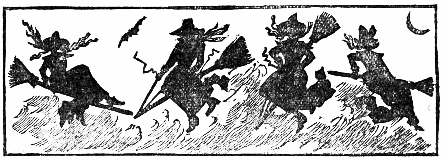
The council had met to consider how they might destroy “K’chī Molsom,”
the Great Wolf, who lived with the Great Bat, “K’chī Medsk’weges,” on a
large island which none dared visit for fear of the Great Wolf. Mīko
remembered the Wolf as an old enemy, and hoped to see him slain. He
chattered approval to all that was said. On one occasion, all the
witches met in council to see what they could do to conquer the Wolf;
how they might contrive to kill him.
K’chī Quēnocktsh, the Big Turtle, made the first speech. Said he: “The
only way we can kill K’chī Molsom is to dig a passage under the water to
the island, then dig a big hole right under his wigwam, fill the hole
with sharp sticks and stones; then we will dig out the rest of the
ground. The wigwam will fall, and the Great Wolf will be dashed in
pieces on the sticks and stones.”
The witches thought this idea a good one, but felt that the Wolf had
such power that whoever stepped upon the island would perish.
K’chī Atōsis, the Great Snake, spoke next: “My opinion,” said he, “is
that all the witches who can fly should go there some dark night, fly
down the smokehole, bind him with strong withes before he can fight, and
bring him out where all may enjoy seeing him put to death.”
Next spoke the Alligator: “The only way to kill the Great Wolf is to lie
in wait for him on the other island. When he is hungry, he will go there
to catch seals; and we will send our best warriors and capture him
alive.”
Now the Wolf knew that they had evil designs upon him, and sent the Bat
to watch, and to listen to what they had to say, and so was prepared for
them.
The chief of the witches, a hairless bear, then said: “I have listened
to all your plans, and think all good; but the first one suits me best.
We will get ‘K’chī Pā-pā-kā-quā-hā,’ the Great Woodpecker, and Moskwe,
the Wood Worm, to do the work.”
So all the woodpeckers and all the worms set to work to dig the passage.
The Great Wolf knew all that was going on, and sent the Bat every night
to see what progress they made.
He ordered his troops, the Ants, to prepare flint and punk,
Chū-gā-gā-sīq’,—yellow rotten wood found in hollow trees.[32]
The Ants went to work and filled the wigwam with punk, the Bat,
meantime, going every few moments to watch the enemy’s progress. At last
he said that they had landed on the island.
The Wolf ordered everything to be removed from the wigwam,—his bows,
arrows, stone axes, spears, pipes, and the paddles of his great stone
canoe,—then he took the flint and set fire to the punk inside the
wigwam.
The Ants had also filled the mouth of the passage on the mainland with
punk, so that all the witches who went to see the killing of K’chī
Molsom might not escape but perish.
When all was ready, Woodpecker gave the signal, and the wigwam fell into
the hole, to be sure; but the blaze soon filled the passage and all
their hiding-places with fire and smoke.
The witches, vainly hoping to escape, ran to the mouth of the passage on
the mainland, but found it also stopped with fire; and they were all
burned to death.[33]
K’chī Molsom took all his men and his goods in his stone canoe, and went
to the next island, where they built a strong wigwam and thenceforth
lived, more powerful and more to be dreaded than before, fighting many
battles with the spirits of the water.