“THE cheque for the payment of the Creole was filled up and handed
over, the agent giving a formal receipt and possession of the vessel,
and undertaking to sign the necessary papers as soon as they could be
drawn out.
“You are evidently lucky about ships,” William Martyn said as he left
the agent’s office with Horace. “You have got a little wonder in the
Surf, and there is no doubt about the Creole being a bargain. When
the war was going on she would have been snapped up at double the
price, and would have been cheap at that. Now the first thing to do is
to get first and second mates. Directly I have got them I can put a
gang of riggers on board. I will go to the Naval Club, and see the
list of the officers on board the ships here. I am pretty sure to know
some of them, and shall find out from them whether there are any of my
old messmates down here. If they don’t know of any, we might hear of
men to suit at the Club. There are always plenty of men here and at
Portsmouth waiting about on the chance of meeting some officer they
have served under and getting him to put in a word for them at the
Admiralty.”
“I will walk down with you to the Club, but I won’t go in with you;
one is only in the way when people who know each other are talking.
And besides, Martyn, don’t you think before you do anything you ought
to see about your clothes?”
“Of course I ought; I never gave the matter a thought before. But I
certainly could not put my foot on the quarter-deck of one of His
Majesty’s ships in this turn-out. No. The first thing to do is to drop
into my father’s agent to draw some money. Then I will go into a
slop-shop and get a suit. I know a place where they keep really decent
togs. A man often has to join in a hurry, and wants a fit-out at half
an hour’s notice. Then I can order the rest of the things at the
tailor’s I used to get my clothes from. ’Pon my word, now you speak of
it, I am ashamed to be going out in these things. They were an old
suit that I put on when bad weather set in, and they have shrunk so
that the sleeves don’t come half-way down to the wrists, and the
trousers are up to the ankles. As a master’s mate it didn’t matter so
very much, for masters’ mates are very often out at elbows, but as
commander of the Creole it is a different thing altogether.”
Martyn was lucky in picking up the undress uniform of a lieutenant
that just fitted him.
“I can let you have it at that price, because I got it a bargain,” the
man said. “The owner came in here a few weeks ago with a man beside
him. He had just come down to join his ship, which was to sail in a
few hours, and as he stepped off the coach was served with a writ by a
Jew he had borrowed money of two or three years before. It was only a
few pounds, but to make up the sum he had to sell some of his things,
and this suit was among them.”
“And nicely you ground him down in the price, I have no doubt,” Martyn
growled. “However, I have got the benefit of it. Now, Horace, I can
show at the Club. Just take your knife out and cut this strap off the
shoulder. I can’t go about as a full-fledged lieutenant, though I have
passed.”
They were walking up the main street when a voice exclaimed:
“Hullo, Martyn! is that you?” and a young officer shook him warmly by
the hand.
“Why, Dacent, this is luck. I am glad to see you indeed. It is three
years since we ran against each other last; five since we served
together in the Nonpareil. What are you doing?”
“I am third in the flagship here. What are you doing? I met O’Connor
the other day; he told me he had run across you at Malta, and that you
had gone into the merchant service like so many other of our old
friends.”
“That was so, Dacent. It was of no use kicking my heels on shore when
I hadn’t the ghost of a chance of getting appointed to a ship. So I
had to swallow my pride and ship in a merchantman. We were wrecked at
the back of the Wight in the storm last week, and I have had the luck
to get a fresh appointment, and that is what I am here for. I was just
on my way to the Club to see if I could find any of my old chums. You
are just the fellow to help me. But first let me introduce Mr.
Beveridge. He is the son of my owner. Half an hour ago he completed
the purchase of the craft that I am to command. She is a beauty. I
don’t know whether you know her. She is called the Creole, a
schooner of a hundred and fifty tons. She is lying up the river.”
“I know her well enough,” Dacent said, as he shook hands with Horace.
“She was brought in here the week after I joined. I thought she was as
pretty a looking craft as I ever set eyes on. I congratulate you, old
fellow. There are not many things that you won’t be able to show your
heels to. But what line is she going to be in? She would make a fine
craft for the Levant trade.”
“That is just where we are going, Dacent, but not to trade. I will
tell you what we are going to do, but it must be kept dark. I don’t
know whether they might not look upon it as a breach of the neutrality
laws. Mr. Beveridge is an enthusiast for the cause of Greece, and we
are going to take out a cargo of guns and ammunition, and then we
shall hoist the Greek flag, and do a little fighting on our own
account with the Turks as a Greek privateer.”
“By Jove, I envy you, Martyn. That is a thousand times better than
sticking in Plymouth Sound with nothing to do but to see the men
holy-stone the deck, and fetching and carrying messages. Now, what is
it I can do for you?”
“Well, in the first place, I want a couple of officers; for choice, I
would have one who has passed, and could take the command in case
anything happened to me. I don’t care whether the second is a mate or
a midshipman who has pretty nearly served his time.”
“I know just the man for you, for your first. There is Miller—you
remember him?”
“Of course; I was with him in the Minerva frigate in the West
Indies. He was a capital fellow. Is he to be had?”
“Yes; I saw him only yesterday. He has been two years out of a berth,
and no chance of getting a ship, and he was looking out for a berth on
board a merchantman, but he had not heard of one when I saw him. He
gave me his address; here it is—the Anchor Inn; it is a little place
not far from the dock gates. I expect Jim has no money to spare. His
father is a clergyman near Falmouth. I asked him why he didn’t look
for a ship there. He laughed, and said he didn’t mind shipping into
the merchant service anywhere else; but he shouldn’t like to do it so
near home, after swaggering about there in the king’s uniform.”
“I will go down at once. It is just one o’clock, and we are likely to
catch him in.”
“Well, will you and your friend dine with me at the Club at six
o’clock, Martyn? We can chat there better than we can on board, and we
have lots to tell each other since we last parted.”
The invitation was accepted, and then Martyn and Horace set off to
find the Anchor.
“There is one thing I have not asked you,” the former said, as they
went along. “How about prize-money, because you know that makes a good
deal of difference. I don’t suppose there will be much to be got,
because there are not many craft flying the Turkish flag, and the seas
will be swarming with Greek craft who are half-pirates even in time of
peace. Still we may capture a Turkish man-of-war brig or something of
that sort, and she may have treasure on board such as pay for the
troops. I suppose we should share according to the ordinary privateer
scale.”
“Certainly,” Horace said. “My father has no idea of making money by
the thing, and I can certainly promise that he will agree to the usual
scale whatever it is.”
“That is right. I thought that it would be so, and, indeed, although
officers might go without, you would hardly get men to risk their
lives unless there was a chance of prize-money.”
“It would not be fair to ask them to do so,” Horace said. “Of course
that would be understood. All these sort of arrangements are in your
hands. My father particularly said so; he really knows nothing about
these matters. You must make all these arrangements just as if you
were the owner, and please arrange what you consider liberal terms to
everyone. My father has made up his mind to spend a certain sum of
money which he has long laid by for the purpose, and I am sure we are
more likely to succeed in helping the Greeks if everyone on board is
quite contented and happy. Oh, there is the Inn; I won’t go in with
you. You had much better talk it over with him by yourself.”
Ten minutes later Martyn came out with a short square-built young
fellow of about his own age, with a good-humoured merry face, which
was at present beaming with satisfaction.
“That is all settled,” Martyn said. “Mr. Beveridge, let me introduce
to you Mr. James Miller, first lieutenant of your father’s schooner,
the Creole.”
“It is a perfect godsend,” Miller said, as he shook hands with Horace.
“I began to despair of getting a ship here, and I am precious glad now
I didn’t, for I should have been mad if I had met Martyn, and found I
had missed this chance. It will be glorious fun, and it looked as if
one were never going to have a chance of that sort of thing again.”
“And he knows of a young fellow who will suit us for our second,”
Martyn said, “Jack Tarleton. He was with us in the Minerva. I
remember him only as a jolly little mid. I had just passed then, and
he was the youngest; but he lives close to Miller, and he says he has
grown up into a fine young fellow. He is about nineteen now. He has
not passed yet, for he was laid on the shelf four months before his
time was up, and not having passed, of course he is even worse off
than either of us. Not that it matters so much to him, for his father
has an estate; but as Jack is the second son, and loves his
profession, he is so anxious to be afloat again that he told Miller
the other day he would ship before the mast if he could not get a
berth before long. Miller will write to him this afternoon, and he
will be here to-morrow night or next morning. I have asked him to come
round and have lunch with us at the Falcon. Mr. Beveridge and his
father sail with us, Miller, in the double capacity, as I understand,
of owners and fighting men.”
Horace laughed. “In the first place, I am not going to be called Mr.
Beveridge or Mr. Anything,” he said. “I shall be regarded as a sort of
third officer, and do my work regularly while we are at sea. I know a
little about sailing already,” he said to Miller, “so I sha’n’t be
quite a green hand.”
“No, indeed,” Martyn said. “Horace, if I am to call him so, has got a
fifteen-ton yacht I picked up for him, and a first-rate little craft
she is. He went out in a big gale last winter, and rescued the crew of
a wreck, the Celadon.”
“I saw it in the paper,” Miller said warmly, “and thought what a
plucky thing it was. That is capital. Then you will be like one of
ourselves. Well, what are you going to do first, Martyn?”
“First we are going to lunch. Then you will write your letter to
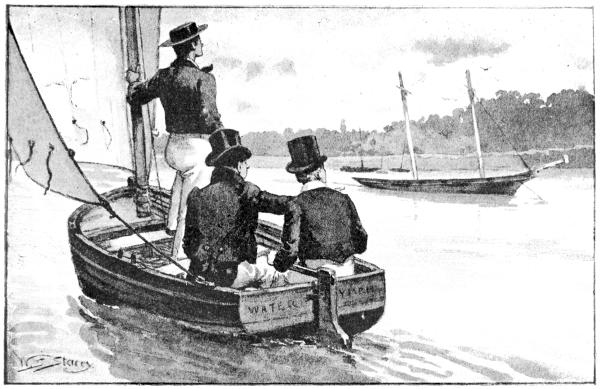
Tarleton and post it. After that we will charter a boat and go up and
look at the Creole again. You haven’t seen her yet, and we haven’t
seen her since the purchase was concluded, and a craft always looks
different when you know she is yours. After making an overhaul we will
go ashore to the nearest yard and arrange for her to be docked, and
her bottom cleaned and scrubbed; I expect it wants it pretty badly.
That will be enough for to-day. As soon as she is in the water again
we will set a gang of riggers at work. I shall take charge of that
part of the business, and I will leave it to you to hunt up a crew. We
have got a boatswain. At least I have no doubt we have.”
“How many men are you going to take, Martyn?”
“She mounts four guns each side and a long Tom—I don’t know what the
metal is yet—and she is heavily sparred. Of course she hasn’t got her
topmasts in place, but her masts are very long, and I have no doubt
she shows a good spread of sail; those craft always do. We shall want
a strong crew, for, if we fight at all, it will be against craft a
good deal bigger than ourselves. There is any amount of room on the
main deck, where they carried the slaves. Of course we needn’t settle
at present, but I should say we ought to carry from forty to fifty
men.”
“I think we ought certainly to have a strong crew,” Horace said, “so
as to be able to land a strong party if we wanted to; the extra
expense would be of no consequence.”
“We must pick our men, Miller—smart active fellows, and, of course,
men-of-war’s for choice. If we can’t get enough here, we will sail her
round to Portsmouth and fill up there. There ought to be plenty of
prime seamen to be had. They would jump at the chance of sailing in
such a craft as ours.”
Miller was delighted with the ship, and they now especially examined
the cabin arrangements. The saloon ran across the stern of the ship.
It was handsomely fitted up in mahogany. Leading off this, on the port
side, was a large cabin that had evidently been the captain’s. This,
of course, would be Mr. Beveridge’s. On the starboard side were three
cabins. Next to these was the steward’s pantry and cabin; and facing
this, on the port side, two other state-rooms.
“It could not have been better if it had been built for us,” Miller
said. “There are three cabins on the starboard side. Horace will take
one of the three, I suppose, and that will leave a spare cabin in case
we take a passenger we are likely to want.”
“What are you thinking of, Miller?”
“I was thinking that as we are going to fight, it is not by any means
impossible that some of us or the men may be wounded.”
“I should certainly say it was quite possible,” Martyn laughed.
“Well, you see as long as it is only a clip from a cutlass or a flesh
wound through the arm, I fancy we might patch it up between us with a
bit of plaster and a bandage; but if it comes to an amputation or
getting a bullet out of the body, or anything of that sort, who is
going to do it?”
“By Jove! you are right, Miller. I had not thought of that. I am
afraid we shall have to take a surgeon with us. It would never do to
go into action in the Levant, where there is no chance of finding an
English doctor, without having at least a surgeon’s-mate on board.”
“Of course not,” Horace agreed; “that is an absolute necessity. Will
you see about it at once, please.”
“There is no difficulty in getting surgeons,” Martyn said. “Of course
young fellows who have just done walking hospitals are as plentiful as
peas; but we had better get hold of a man who has been knocking about
for a few years in the navy, and who has had some experience in
gunshot wounds. There must be plenty of good men about, for they have
suffered just as we have by the reduction. I will speak to Dacent
about it this evening, and get him to ask one of the naval surgeons
here if he knows a man. One or other of them is almost sure to do so.
Well, the spare cabin will be for him. So now we are fixed
completely.”
“We shall have to take off a little bit from the main deck, because my
father’s two Greeks will certainly come with us. Only one can sleep in
the steward’s cabin, so we shall want a small cabin for the other and
a place for cooking. They are first-rate cooks, both of them; and I
expect they will undertake the cooking altogether for us.”
“That can very easily be managed,” Martyn said. “We can knock a door
through this bulkhead, and run another bulkhead up across the deck,
seven or eight feet farther forward. I have not forgotten that Greek’s
cooking; and if we live on board this craft as you did on the Surf,
I can tell you, Miller, we needn’t envy an admiral.”
“Well, I like a good dinner, I must own, Martyn, though I can do with
salt-horse if necessary.”
“But are you sure, Horace,” Martyn said, “that your father wouldn’t
prefer having the cabin astern all to yourselves? When we are about it
we could put the bulkhead farther forward, and make a ward-room for
us.”
“No, I am sure he would not wish that,” Horace said. “I will write to
him when we get ashore and ask him; but I am sure he would find it
more pleasant our being all together, and it would be much better for
him than being by himself. My father is a great scholar,” he explained
to Miller, “and is always poring over books. I am sure it will do him
a lot of good getting away from them altogether and being with people.
Besides, that private cabin of his is a good size, and there will be
plenty of room for him to have a table and an easy-chair in it
whenever he is disposed to shut himself up. However, I will hear what
he says.”
After leaving the ship a visit was paid to one of the shipbuilding
yards, and arrangements made for the Creole to be brought into dock
at high-tide. On getting back to the inn Horace wrote to his father on
the various questions that had arisen, and then to Marco, telling him
to come over by coach, and to bring Tom Burdett with him. They then
went to dine at the club with Dacent, who entered with great zest into
their arrangements.
“I can’t tell you what is your best way of setting about getting the
arms; but I should say go to Durncombe’s. They are by far the largest
ship-chandlers here, and I should say that they could supply anything
from an anchor to a tallow-dip. They must have fitted out innumerable
privateers, and bought up the stores of as many prizes. They may not
be able to supply you with as many small-arms as you want; but if you
give them an order for a thousand cannon, I have not a doubt they
could execute it in twenty-four hours, and that at the price of old
iron. As to the muskets, they could no doubt collect a big lot here,
and get more still from Portsmouth. Those of course would be
principally ship’s muskets, no longer wanted or taken from prizes. I
don’t suppose they would get enough, and of course you would want
them in fair condition; but they would put advertisements for them in
the Birmingham papers, or, likely enough, would know firms in
Birmingham who had bought up muskets sold out of the army.”
“What do they buy them for?” Horace asked.
“Oh, they contract for the supply of those South American States, for
trade in Africa and the East, or for the supply of the armies of
native princes in India. I think, if I were you, I would not go to him
direct, but would get the agent you got the Creole from to undertake
it, and get the terms settled. He would get them a good bit cheaper
than you could.”
“No doubt he would,” Martyn agreed, “especially if we agreed to pay
him so much for getting it, instead of so much commission. When a man
gets a commission he has no interest in keeping the price down; just
the contrary. I will ask him casually, to begin with, what is the cost
of muskets in fair condition, and at what price we could pick up
guns—say six, eight, and twelve pounders—complete, with carriages.”
“I don’t know about the carriages, Martyn; but I know the guns fetch
less by a good bit than their weight of old iron. They cost more to
break up, in fact, than they are worth; and they are using them for
posts, and things of that sort, for the sake of getting rid of them. I
should say that you could get a couple of hundred guns of those sizes
to-morrow for a pound apiece, and I believe that you might almost get
them for the trouble of carting away, for they are simply so much
lumber. Powder is a glut in the market too. I should say hundreds of
tons have been emptied into the sea in this port alone, for when the
merchant skippers found they no longer required to carry it, it was
cheaper for them to throw it overboard than to get rid of it in any
other way.”
When they returned to the Falcon that evening they found Miller had
shifted his quarters there from the little inn in which he had been
staying, and two days later Jack Tarleton also arrived there. He was a
good-looking young fellow, nearly six feet in height, slight at
present, but likely to fill out, with a somewhat quiet manner, but, as
Horace soon found, a quick appreciation of the humorous side of things
and a good deal of quiet fun. On the same day Marco arrived with Tom
Burdett, who was delighted when Horace disclosed the project to him.
“I should think I would like to go, Mr. Horace. Why, bless you, I have
been feeling almost as if I was rusting out at Seaport, except when
you were at home. Why, it will be like giving one a fresh lease of
life to get at one’s own work again.”
He was at once installed on board the Creole, which on that day had
been let out of the dock again with her copper scrubbed until it shone
like gold. Miller had as yet had no time to see about the men, and Tom
at once undertook this part of the business.
“I know every tavern down by the waterside and the places where men
are likely to be found. I will soon pick you up some prime hands. If I
can’t get enough of them here, I will take a run to Bristol. There is
a big trade there, and there will be plenty of men-of-war’s-men to be
had for the asking for such a job as this.”
“How about Seaport, Tom?” Horace asked.
“Well, we will take Dick; but there are not many I would care about
having from there. They are good enough in their fishing-boats, but I
would rather have men who are accustomed to bigger craft. Besides,
though fishermen are good sailors in some ways, they are not
accustomed to discipline, and are always slovenly in their way of
doing things. Besides, if I persuaded young fellows to come from
there, and any of them got killed, their fathers and mothers would
look black at me when I got back. No, I don’t think I will have anyone
but Dick.”
By this time a letter had come from Mr. Beveridge in answer to
Horace’s letter.
“I quite agree with you,” he said, “that the officers should be paid
fairly. I see that, as you say, it is not a thing that you could very
well arrange with them. Will you tell Mr. Martyn, from me, that the
terms I propose are twenty guineas a month for him, eighteen for the
second officer, and fifteen for the third; and that, in case of any of
them losing a limb or being disabled, I shall settle upon them a
pension the same as that to which they would have been entitled at
their rank in the navy in the same case. The ship appears to me to be
wonderfully cheap. I knew nothing about it, but quite expected that it
would cost three times as much. Certainly I should not wish for them
to have a separate cabin. It will be much more pleasant for me, if not
disagreeable to them, for us to live together. As for what you say
about prize-money, tell Mr. Martyn to arrange as he proposes,
according to the ordinary usage in privateers. It is a matter to which
I have given no thought, but he shall give me the particulars when we
meet. As you know, I have no intention of making profit out of the
enterprise.”
Two days later Martyn told Horace that Dacent had introduced him to
one of the surgeons, who knew a young doctor who would, he thought,
suit. “His name is Macfarlane; he is, of course, a Scotchman—most of
the naval doctors are either Irish or Scotch. He sailed with him as
surgeon’s-mate in a large frigate, where they had a good deal of
experience in wounds, and he has a high idea of his skill. He is a
very quiet sort of fellow, but a pleasant messmate. He has been full
surgeon for some time now. His ship was paid off a fortnight ago, and
the man who told me of him had a letter from him a few days since,
saying that, as he had no interest he thought that he had but little
chance of getting afloat again, and asking him to let him know if he
heard of any opening, either ashore or in an Indiaman. He thought he
would suit us very well, so I said that I would speak to you about
it.”
“I should think that will be just the thing, Martyn.”
“Very well, then, I will see the surgeon to-morrow, and get him to
write and offer him the berth at the regular naval rate of pay. Of
course we sha’n’t want him to join till we are ready to sail.”
Some days later a reply was received, accepting the berth.
For the next fortnight work proceeded rapidly. Stores of all kinds for
the voyage were brought on board and stowed away. Sixty cannon were
stowed down in the hold, with thirty carriages for them, the latter
taking up too much room to be carried for the whole of the guns. Eight
twelve-pounders, in place of the eight-pounders before carried by her,
and a long eighteen-pounder were placed in the hold in readiness to
mount on deck when they reached the Levant. The riggers and painters
had finished their work, the decks had been planed and holy-stoned
until they were spotlessly white, and the tall spars and gear were all
in their place. The guns had cost only about as much as Miller had
said, and they could have obtained any number at the same price. The
agent had made a contract with the ship’s chandlers for five thousand
muskets complete with bayonets, in good order, and delivered on board,
at ten shillings each. Some five hundred of these had been collected,
and—after passing muster, by an armourer sergeant Martyn engaged for
the purpose—put on board. The rest were to be sent by canal from
Birmingham to Liverpool, and thence shipped round to Plymouth. Five
tons of gunpowder in barrels, twenty tons of shot for the cannon, and
two hundred thousand rounds of ammunition for the muskets were also
arranged for. These were to be shipped at the last moment from
magazines at the mouth of the Sound.
Below, everything had been done to make the cabins as comfortable as
possible, and Dacent declared that she was altogether too neat and
comfortable for anything but an admiral’s yacht. Tom Burdett had
picked up at Plymouth twenty-five smart sailors, all of whom had
served in king’s ships; and then, going to Bristol, had brought as
many more from there. Uniforms, closely resembling those of men-of-war
sailors, had been served out to them, but instead of the straw hat
they wore red woollen caps. The officers had only to exchange their
navy buttons for others with an anchor to be complete; Horace had
donned similar attire.
It was just three weeks after Horace left home that he wrote to his
father saying that all was now in readiness, and that they could sail
within an hour of his arrival. They were at once going out to take
their powder on board, and would remain at anchor off the magazines,
and that he himself should be at the Falcon when it was time for the
first coach to arrive after the receipt of his letter, and should
remain there until his father came. Mr. Macfarlane, the surgeon,
arrived by the coach that evening, and was put down at the Falcon.
Martyn and Horace went out when they heard the coach stop.
“That is the doctor, for a guinea,” Martyn said, as a tall bony man
climbed down from the roof, and began very carefully to look after his
luggage.
“I think you must be Doctor Macfarlane?” he said, going up to him. “My
name is Martyn.”
“I am very glad to see you, Captain Martyn,” the doctor said; “I take
it as a sign that I shall have a pleasant time that my commander
should meet me as I get off the coach.”
“I am captain only by courtesy, and shall hardly consider that I have
got my brevet rank till we hoist the flag to-morrow. This is Mr.
Beveridge, the owner’s son, he will sail with us as third officer. I
have ordered a room for you, doctor. Boots will carry your things up.”
“Thank you; I will see to them myself, and join you in the
coffee-room. I am not fond of trusting to other folk;” and he followed
the servant upstairs with his baggage.
Martyn laughed as he went into the coffee-room with Horace. “Cautious
you see, Horace, and right enough to be so; I think we shall like him.
There is a pleasant tone in his voice, and I have no doubt he will
turn out a good fellow, though, perhaps, rather a character.”
The doctor soon came down.
“Eh, man,” he said, “but it is weary work sitting with your legs
doubled up all those hours on a coach. Four-and-twenty hours it is
since I got up at Salisbury. And so, Mr. Beveridge, we are going out
to fight for the Greeks. I misdoubt, sir, if they will do much
fighting for themselves. I was three years east of Malta. There is
good in them, we may take it that there is good in them, but it is
very difficult to get at; at least that was my experience.”
“They have not had much chance, I think, doctor, so far.”
“And how large is your ship, Captain Martyn?” the doctor said,
changing the subject suddenly.
“They call her a hundred and fifty, but she has a light draft of water
and would not carry that, yet she has excellent accommodation below,
as you will say when you see her to-morrow.”
The conversation then turned on naval matters, and the stations and
ships that both Martyn and the doctor knew; and when they separated
for the evening Martyn and Horace agreed that the doctor was likely to
be a pleasant acquisition to their party.
Marco had been intrusted with the entire charge of laying in stores
for the cabin, and these had arrived in such profusion that Will
Martyn had demanded whether he was victualling the ship with cabin
stores for a voyage round the world.
It had been given out that the ship was bound for Lisbon, but the news
of her destination had gradually leaked out, although pains had been
taken to get the military stores on board as quietly as possible.
Sympathy with Greece was general, however, and although the young
officers were quietly joked by their naval acquaintances as to their
cargo for Portugal, no official inquiries were made on the subject.
“I sha’n’t be sorry, Horace,” Will Martyn said, as they were rowed off
in the gig for the last time before getting up anchor, “when we get
some of our heavy stuff out of her. One way or another she will have a
hundred and twenty tons of stuff on board when we have taken in our
powder, and though I don’t at all say that she will be overladen she
will be a foot too low in the water to please me, and she wouldn’t be
able to do her best if she were chased in her present trim.”
“The little difference in speed won’t matter much on our way out,”
Horace said.
“No, not as to time, of course, a day more or less is no matter;
still, one always likes to get all one can out of one’s ship, Horace,
and it is a triumph to slip past other craft. If you have a slow craft
you don’t mind whether other things leave you behind in an hour or two
hours; you jog along and you don’t worry about it; you are like a man
driving a heavy cart. But when you are in a crack schooner you are
like a man on the road with a fast horse and a light gig, you expect
to go past other things, and you like to do it in good style.”
“Well, nothing will beat her in looks, I think, Will.”
“No, that is quite certain. She is a picture.”
Everything was done on board the Creole in man-of-war fashion.
Tarleton stood at the top of the ladder to receive the captain as he
came on board. He touched his cap to Martyn, who touched his in
return.
“Everything ready for getting under weigh, Mr. Tarleton?”
“Everything quite ready, sir.”
“Then shorten the chain a bit; man the capstan.”
Jack Tarleton gave the order. Tom Burdett’s boatswain’s whistle rang
out loudly; the capstan-bars were already fixed, and a dozen men ran
merrily round with it till the whistle sounded again.
“The anchor is short, sir,” Tarleton sang out to Martyn.
“Very well, leave her so, Mr. Tarleton. Will you make sail, Mr.
Miller?”
The orders were given, the mainsail, foresail, and fore-staysail
hoisted, and the jibs run out on the bowsprit. As soon as the
halliards were belayed and coiled down, the capstan-bars were manned
again, and the anchor weighed. The tide had just turned to run out,
there was a gentle breeze blowing, and as the two jibs were run up the
Creole began to steal through the water.
“Port your helm!” Martyn said to the man at the wheel; “let her come
round easy. Slack off the main-sheet; that will do now. Get her
topsails on her, Mr. Miller.”
Horace looked up with a feeling of pride and delight at the cloud of
white sail and at the smart active crew, all in duck trousers, blue
shirts, and red caps. Once out of the river the sheets were hauled in,
the yards of the fore-topsail were braced as much fore and aft as they
would stand, and the Creole turned her head seaward, looking, as
Martyn said, almost into the wind’s eye. The red ensign was flying
from the peak of the mainsail, and from the mast-head a long pennant
bearing her name.
“She is slipping through the water rarely, Miller,” Will Martyn said,
as he looked over the side.
“Yes, she is going six knots through it, and that, considering how
close-hauled she is and that the wind is light, is wonderful.”
“She would go a good knot faster,” Martyn said, “if she had fifty tons
of that stuff out of her. Those slavers know how to build, and no
mistake, and I don’t think they ever turned out a better craft than
this.”
It was not until late in the afternoon that the Creole dropped
anchor off the magazine, where she was to take in her powder, as
Martyn ran her out twenty miles to sea and back again to stretch her
ropes and, as he said, let things shape down a bit. When the trip was
over there was not a man on board but was in the state of the highest
satisfaction with the craft. Both close-hauled on the way out and free
on her return they had passed several vessels almost as if these had
been standing still, going three feet to their two; and although there
was but little sea on, there was enough to satisfy them that she had
no lack of buoyancy, even in her present trim.
As soon as the anchor was down and the sails stowed Marco announced
that dinner was ready, for all had been too much interested in the
behaviour of the schooner to think of going down for lunch. It was the
first meal that they had taken on board beyond a crust of bread and
cheese in the middle of the day, and as they sat down, Will Martyn
taking the head of the table, Horace, as his father’s representative,
facing him, and the others at the sides, Miller said with a laugh, as
he looked at the appointments, all of which had been sent over from
the house two days before by Zaimes: “This is rather a contrast,
Martyn, to the cockpit of a man-of-war.”
“Rather. I never did dine with an admiral, but this is the sort of
thing that I have always fancied it would be if it had entered into
the head of one to invite me. What do you think, Tarleton?”
“I feel shy at present, sir, and as if I oughtn’t to speak till spoken
to.”
“You will be spoken to pretty sharply if you say ‘sir’ down below. On
deck, as we agreed, we would have things in man-of-war fashion; but we
are not going to have anything of that sort when we are below
together.”
The dinner was an excellent one, and though the expectations of Miller
and Tarleton had been raised by Martyn’s encomiums of the Greek’s
cooking they were far surpassed by the reality. “It is a dinner fit
for a king,” Martyn said when the cloth was cleared away and a
decanter of port placed on the table.
“There is one misfortune in it. If this sort of thing is going to last
we shall never be fit for service in an ordinary craft again, we shall
become Sybarites. Is this the sort of dinner you always have at home,
Horace?”
“About the same, I think,” Horace laughed. “My father takes no
exercise and has not much appetite, and I think he likes nice things;
and it is one of the Greek’s great aims in life to tempt him to eat.
We always have a very good cook, but Zaimes insists on having a few
little things of his own cooking on the table, and as he is generally
at war with the cook, and they leave in consequence about every three
or four months, he often has the dinner altogether in his hands till a
fresh one arrives, and I am amused sometimes to see how Zaimes fidgets
when my father, which is often the case, is so occupied with his own
thoughts that he eats mechanically and does not notice what is before
him. Zaimes stands it for a minute or two and then asks some question
or makes some observation that calls my father’s attention back to
what he is doing. They have both been with him for two-and-twenty
years and are devoted to him. They are hardly like English servants,
and talk to him in a way English servants would not think of doing.
They are always perfectly respectful, you know, but they regard
themselves, as he regards them, as friends as well as servants.”
“Well, gentlemen, we will drink the usual toast, ‘The King, God bless
him;’ that is duty. Now fill up again, here is ‘Success to the
Creole.’” When the toast was drank Martyn went on:
“How did your father pick them up, Horace?”
“It was just after he went out to Greece, which was directly after he
left college. He was at Samos, and got leave from the Turkish governor
to visit the prison. In one of the cells were Zaimes and Marco, who
was then a boy about sixteen. They were condemned to death; they had
been smuggling, and a Turkish boat had overhauled them. They had
resisted. Four of the men with them had been killed in the fight, and
several of the Turks. These two had been both severely wounded and
made prisoners. My father was new to that sort of thing then. After he
had been a year or two in Greece he knew that it would take a king’s
fortune to buy out all the prisoners in the Turkish jails, but being
only out there a month or two he was touched at the sight of the two
prisoners. They were both very handsome, though, of course, pale and
pulled down by their wounds and imprisonment, and Zaimes, who was the
spokesman, had that courteous gentle manner that my father says all
the Greeks have when they are not excited.”
“At any rate he was very much interested and went off to the governor
again, and the Turk was glad enough for a bribe of a hundred pounds to
give him an order for the release of the two prisoners, on condition
that they were to be let out after dark and at once put on board a
craft that was sailing at daybreak next morning. My father went with
them, and after that they absolutely refused to leave him, and
travelled with him in Greece for some time and fought very pluckily
when some Klepts once tried to carry him away into the mountains. Then
he bought a small craft and established his head-quarters at Mitylene,
and for a year lived there and cruised about the islands. When he came
home he offered the felucca to them, but they refused to take it, and
begged so hard for him to take them home with him that he agreed to do
so, and they have proved invaluable to him ever since.”
“Your father is lucky in having got hold of two such men,” Martyn
said. “I believe the lower order of Greeks are fine fellows in their
way. They are quarrelsome and passionate, no doubt, and apt to whip
out their knives at the smallest provocation, and there is no trade
they take so kindly to as that of a bandit; otherwise I believe they
are honest hardworking fellows. But as for the upper class of Greeks,
the less I have to do with them the better. When they get a chance
they grind down their countrymen a deal worse than the Turks do. They
are slippery customers and no mistake. I would rather take a Turk’s
simple word than a solemn oath from a Greek.”
“No; veracity is hardly one of their conspicuous virtues,” the doctor
put in quietly. “I take it that the ancients were so accustomed to
swear by their gods, even after they had ceased to believe in them,
that they came to consider that an oath by them was not binding, and
so got into the way of lying generally, and their descendants have
never amended their ways in that particular since. On more than one
occasion, when there was trouble between our sailors and the Greeks, I
attended their courts, and for good downright hard swearing I never
heard them approached. I don’t wonder that the Turks refuse to allow
Christians to give evidence in their courts. We shall see when we get
out, but I have grave doubts whether there has been any revolution at
all, and whether it is not a got-up thing altogether, just to see
what the rest of the world says to it.”
The others laughed.
“There is one thing, doctor,” Miller said; “we have heard from
Europeans who are out there of what has been done, it does not come
from the Greeks only.”
“That is a confirmation, certainly, but it is well known that
travellers’ tales must always be received with caution. It has been so
since the days of Herodotus. When a man gets away from his own country
he is apt to get a certain looseness of the tongue. We will wait until
we get out there before we form any strong opinion about it.”
By this time they had finished their coffee, and Martyn, rising, said:
“Mr. Tarleton, I shall be glad if you will go along the main-deck and
see that the men are making themselves comfortable; to-morrow we will
divide them into watches and tell them off to their stations and get
things into working order.”
Accordingly, in the morning the crew were divided into two watches,
and the boat’s crews told off, and then the work of getting the powder
and small ammunition on board began; the latter did not take long, as
it was already in a flat into which it had been discharged three days
before from the coaster that had brought it from Liverpool. The flat
had therefore only to be towed alongside and the cases swung on board
and lowered into a portion of the hold that had been divided off from
the rest by thick bulkheads to form a magazine. The ammunition and
powder were all on board and stowed away, the ship was washed down,
and the men piped to dinner by eight bells. The officers went down and
divided the men into messes, examined the food, and saw that
everything was comfortable.
“More room here than there was on board the Surf, Dick,” Horace said
as he stopped a moment on his rounds to speak to the young sailor.
“Yes, sir, one can stand upright here. But the Surf was a good boat
too.”
After dinner the men were told off to their various duties and divided
into crews for the guns, when these should be in place. The first
lieutenant (for it was agreed that they should be called lieutenants
and not mates) and Horace took the starboard watch, Tarleton and the
boatswain the port watch. The men were formed up, inspected, and put
through cutlass drill for an hour, after which the watches by turns
were exercised in setting sail, reefing, lowering, and furling, so
that each man should know his place and duty. Then they were
dismissed.
“They will be a first-rate crew when they have worked together for a
few days,” Martyn said. “I could not wish for a smarter set of men. If
we meet anything about our own size I shall have no fear of giving a
good account of her. I have no opinion whatever of the Turks as
sailors; they are good soldiers, and have always proved themselves so,
but more lubberly sailors never went to sea.”
“Well, we are not likely to meet anything else,” Horace said.
“I don’t know, lad. The Greeks at the best of times are pirates at
heart, and just at present they are not at all likely to be particular
who they lay hands on. I saw in the paper only yesterday, they had
attacked and plundered an Austrian craft, and it is probable that they
may have done the same to a dozen others, only as a rule they scuttle
any ship they may seize and nothing is ever known about her. Ships
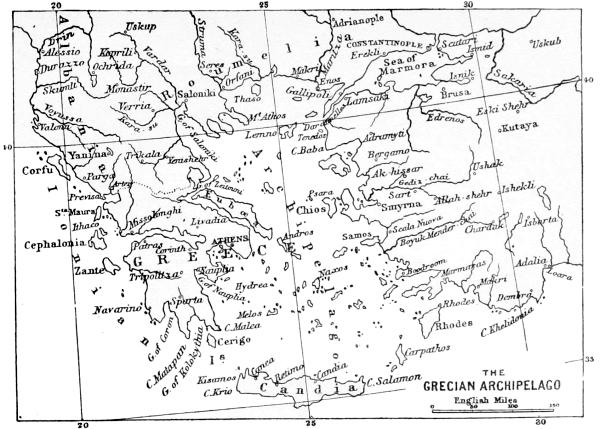
can’t be too careful when they are in Greek waters, and a vessel
wrecked on any of the islands is looked upon as a lawful prize. There
is no fear of our being taken by surprise by the Turks, but I shall
take precious good care that we are never caught napping when we are
anchored anywhere in the Greek Archipelago. After dinner, Horace, I
will go ashore with you in the gig. I don’t think it likely your
father will be down by the night coach, as he would only get your
letter this morning, but he may come; at any rate you have got to wait
now at the Falcon till he turns up.”