One of the never-failing attractions of the Tōkyō stage is the performance, by
the famous Kikugorō and his company, of the Botan-Dōrō, or
“Peony-Lantern.” This weird play, of which the scenes are laid in
the middle of the last century, is the dramatization of a romance by the
novelist Encho, written in colloquial Japanese, and purely Japanese in local
color, though inspired by a Chinese tale. I went to see the play; and Kikugorō
made me familiar with a new variety of the pleasure of fear. “Why not
give English readers the ghostly part of the story?”—asked a friend
who guides me betimes through the mazes of Eastern philosophy. “It would
serve to explain some popular ideas of the supernatural which Western people
know very little about. And I could help you with the translation.”
I gladly accepted the suggestion; and we composed the following summary of the
more extraordinary portion of Enchō’s romance. Here and there we found it
necessary to condense the original narrative; and we tried to keep close to the
text only in the conversational passages,—some of which happen to possess
a particular quality of psychological interest.
—This is the story of the Ghosts in the Romance of the
Peony-Lantern:—
There once lived in the district of Ushigomé, in Yedo, a
hatamoto[1]
called Iijima Heizayémon, whose only daughter, Tsuyu, was beautiful as her
name, which signifies “Morning Dew.” Iijima took a second wife when
his daughter was about sixteen; and, finding that O-Tsuyu could not be happy
with her mother-in-law, he had a pretty villa built for the girl at Yanagijima,
as a separate residence, and gave her an excellent maidservant, called O-Yoné,
to wait upon her.
O-Tsuyu lived happily enough in her new home until one day when the family
physician, Yamamoto Shijō, paid her a visit in company with a young samurai
named Hagiwara Shinzaburō, who resided in the Nedzu quarter. Shinzaburō was an
unusually handsome lad, and very gentle; and the two young people fell in love
with each other at sight. Even before the brief visit was over, they
contrived,—unheard by the old doctor,—to pledge themselves to each
other for life. And, at parting, O-Tsuyu whispered to the
youth,—“Remember! If you do not come to see me again, I shall
certainly die!”
Shinzaburō never forgot those words; and he was only too eager to see more of
O-Tsuyu. But etiquette forbade him to make the visit alone: he was obliged to
wait for some other chance to accompany the doctor, who had promised to take
him to the villa a second time. Unfortunately the old man did not keep this
promise. He had perceived the sudden affection of O-Tsuyu; and he feared that
her father would hold him responsible for any serious results. Iijima
Heizayémon had a reputation for cutting off heads. And the more Shijō thought
about the possible consequences of his introduction of Shinzaburō at the Iijima
villa, the more he became afraid. Therefore he purposely abstained from calling
upon his young friend.
Months passed; and O-Tsuyu, little imagining the true cause of
Shinzaburō’s neglect, believed that her love had been scorned. Then she
pined away, and died. Soon afterwards, the faithful servant O-Yoné also died,
through grief at the loss of her mistress; and the two were buried side by side
in the cemetery of Shin-Banzui-In,—a temple which still stands in the
neighborhood of Dango-Zaka, where the famous chrysanthemum-shows are yearly
held.
Shinzaburō knew nothing of what had happened; but his disappointment and his
anxiety had resulted in a prolonged illness. He was slowly recovering, but
still very weak, when he unexpectedly received another visit from Yamamoto
Shijō. The old man made a number of plausible excuses for his apparent neglect.
Shinzaburō said to him:—“I have been sick ever since the beginning
of spring;—even now I cannot eat anything…. Was it not rather unkind of
you never to call? I thought that we were to make another visit together to the
house of the Lady Iijima; and I wanted to take to her some little present as a
return for our kind reception. Of course I could not go by myself.”
Shijō gravely responded,—“I am very sorry to tell you that the
young lady is dead!”
“Dead!” repeated Shinzaburō, turning white,—“did you
say that she is dead?”
The doctor remained silent for a moment, as if collecting himself: then he
resumed, in the quick light tone of a man resolved not to take trouble
seriously:—
“My great mistake was in having introduced you to her; for it seems that
she fell in love with you at once. I am afraid that you must have said
something to encourage this affection—when you were in that little room
together. At all events, I saw how she felt towards you; and then I became
uneasy,—fearing that her father might come to hear of the matter, and lay
the whole blame upon me. So—to be quite frank with you,—I decided
that it would be better not to call upon you; and I purposely stayed away for a
long time. But, only a few days ago, happening to visit Iijima’s house, I
heard, to my great surprise, that his daughter had died, and that her servant
O-Yoné had also died. Then, remembering all that had taken place, I knew that
the young lady must have died of love for you…. [Laughing] Ah, you are
really a sinful fellow! Yes, you are! [Laughing] Isn’t it a sin to
have been born so handsome that the girls die for love of you?[2]
[Seriously] Well, we must leave the dead to the dead. It is no use to
talk further about the matter;—all that you now can do for her is to
repeat the Nembutsu[3]….
Good-bye.”
And the old man retired hastily,—anxious to avoid further converse about
the painful event for which he felt himself to have been unwittingly
responsible.
Shinzaburō long remained stupefied with grief by the news of O-Tsuyu’s
death. But as soon as he found himself again able to think clearly, he
inscribed the dead girl’s name upon a mortuary tablet, and placed the
tablet in the Buddhist shrine of his house, and set offerings before it, and
recited prayers. Every day thereafter he presented offerings, and repeated the
Nembutsu; and the memory of O-Tsuyu was never absent from his thought.
Nothing occurred to change the monotony of his solitude before the time of the
Bon,—the great Festival of the Dead,—which begins upon the
thirteenth day of the seventh month. Then he decorated his house, and prepared
everything for the festival;—hanging out the lanterns that guide the
returning spirits, and setting the food of ghosts on the shōryōdana, or
Shelf of Souls. And on the first evening of the Bon, after sun-down, he kindled
a small lamp before the tablet of O-Tsuyu, and lighted the lanterns.
The night was clear, with a great moon,—and windless, and very warm.
Shinzaburō sought the coolness of his veranda. Clad only in a light
summer-robe, he sat there thinking, dreaming, sorrowing;—sometimes
fanning himself; sometimes making a little smoke to drive the mosquitoes away.
Everything was quiet. It was a lonesome neighborhood, and there were few
passers-by. He could hear only the soft rushing of a neighboring stream, and
the shrilling of night-insects.
But all at once this stillness was broken by a sound of women’s
geta[4]
approaching—kara-kon, kara-kon;—and the sound drew nearer and
nearer, quickly, till it reached the live-hedge surrounding the garden. Then
Shinzaburö, feeling curious, stood on tiptoe, so as to look over the hedge; and
he saw two women passing. One, who was carrying a beautiful lantern decorated
with peony-flowers,[5]
appeared to be a servant;—the other was a slender girl of about
seventeen, wearing a long-sleeved robe embroidered with designs of
autumn-blossoms. Almost at the same instant both women turned their faces
toward Shinzaburō;—and to his utter astonishment, he recognized O-Tsuyu
and her servant O-Yoné.
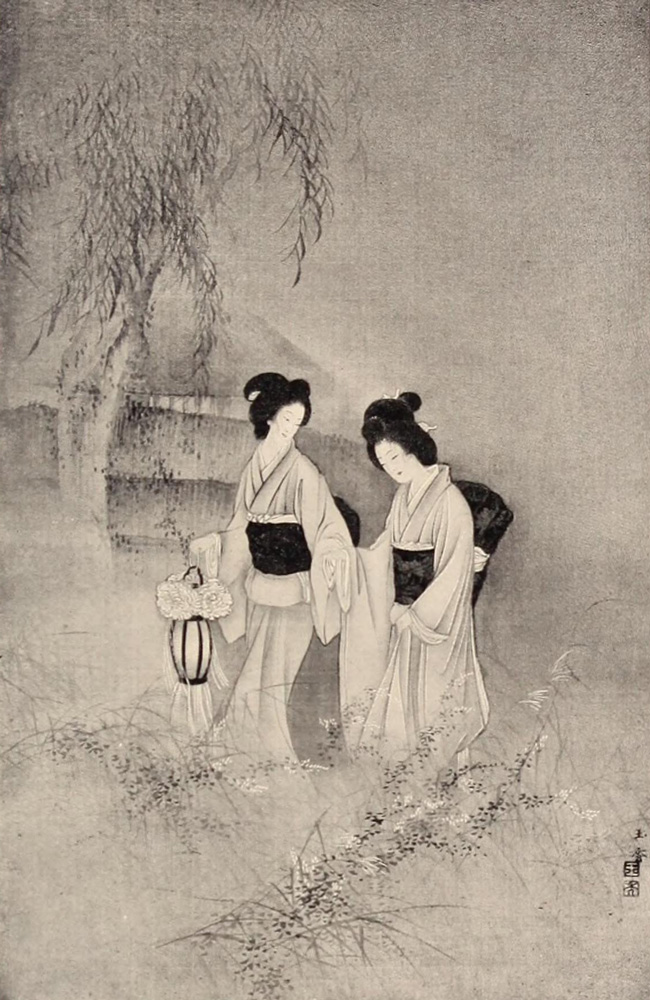
The Peony Lantern
They stopped immediately; and the girl cried out,—“Oh, how
strange!… Hagiwara Sama!”
Shinzaburō simultaneously called to the maid:—“O-Yoné! Ah, you are
O-Yoné!—I remember you very well.”
“Hagiwara Sama!” exclaimed O-Yoné in a tone of supreme amazement.
“Never could I have believed it possible!… Sir, we were told that you had
died.”
“How extraordinary!” cried Shinzaburō. “Why, I was told that
both of you were dead!”
“Ah, what a hateful story!” returned O-Yoné. “Why repeat such
unlucky words?… Who told you?”
“Please to come in,” said Shinzaburō;—“here we can talk
better. The garden-gate is open.”
So they entered, and exchanged greeting; and when Shinzaburō had made them
comfortable, he said:—
“I trust that you will pardon my discourtesy in not having called upon
you for so long a time. But Shijō, the doctor, about a month ago, told me that
you had both died.”
“So it was he who told you?” exclaimed O-Yoné. “It was very
wicked of him to say such a thing. Well, it was also Shijō who told us that
you were dead. I think that he wanted to deceive you,—which was
not a difficult thing to do, because you are so confiding and trustful.
Possibly my mistress betrayed her liking for you in some words which found
their way to her father’s ears; and, in that case, O-Kuni—the new
wife—might have planned to make the doctor tell you that we were dead, so
as to bring about a separation. Anyhow, when my mistress heard that you had
died, she wanted to cut off her hair immediately, and to become a nun. But I
was able to prevent her from cutting off her hair; and I persuaded her at last
to become a nun only in her heart. Afterwards her father wished her to marry a
certain young man; and she refused. Then there was a great deal of
trouble,—chiefly caused by O-Kuni;—and we went away from the villa,
and found a very small house in Yanaka-no-Sasaki. There we are now just barely
able to live, by doing a little private work…. My mistress has been constantly
repeating the Nembutsu for your sake. To-day, being the first day of the
Bon, we went to visit the temples; and we were on our way home—thus
late—when this strange meeting happened.”
“Oh, how extraordinary!” cried Shinzaburō. “Can it be
true?-or is it only a dream? Here I, too, have been constantly reciting the
Nembutsu before a tablet with her name upon it! Look!” And he
showed them O-Tsuyu’s tablet in its place upon the Shelf of Souls.
“We are more than grateful for your kind remembrance,” returned
O-Yoné, smiling…. “Now as for my mistress,”—she continued,
turning towards O-Tsuyu, who had all the while remained demure and silent,
half-hiding her face with her sleeve,—“as for my mistress, she
actually says that she would not mind being disowned by her father for the time
of seven existences,[6]
or even being killed by him, for your sake! Come! will you not allow her to
stay here to-night?”
Shinzaburō turned pale for joy. He answered in a voice trembling with
emotion:—
“Please remain; but do not speak loud—because there is a
troublesome fellow living close by,—a ninsomi[7]
called Hakuōdō Yusai, who tells peoples fortunes by looking at their faces. He
is inclined to be curious; and it is better that he should not know.”
The two women remained that night in the house of the young samurai, and
returned to their own home a little before daybreak. And after that night they
came every nighht for seven nights,—whether the weather were foul or
fair,—always at the same hour. And Shinzaburō became more and more
attached to the girl; and the twain were fettered, each to each, by that bond
of illusion which is stronger than bands of iron.
Now there was a man called Tomozō, who lived in a small cottage adjoining
Shinzaburō’s residence, Tomozō and his wife O-Miné were both employed by
Shinzaburō as servants. Both seemed to be devoted to their young master; and by
his help they were able to live in comparative comfort.
One night, at a very late hour, Tomozō heard the voice of a woman in his
master’s apartment; and this made him uneasy. He feared that Shinzaburō,
being very gentle and affectionate, might be made the dupe of some cunning
wanton,—in which event the domestics would be the first to suffer. He
therefore resolved to watch; and on the following night he stole on tiptoe to
Shinzaburō’s dwelling, and looked through a chink in one of the sliding
shutters. By the glow of a night-lantern within the sleeping-room, he was able
to perceive that his master and a strange woman were talking together under the
mosquito-net. At first he could not see the woman distinctly. Her back was
turned to him;—he only observed that she was very slim, and that she
appeared to be very young,—judging from the fashion of her dress and
hair.[8]
Putting his ear to the chink, he could hear the conversation plainly. The woman
said:—
“And if I should be disowned by my father, would you then let me come and
live with you?”
Shinzaburō answered:—
“Most assuredly I would—nay, I should be glad of the chance. But
there is no reason to fear that you will ever be disowned by your father; for
you are his only daughter, and he loves you very much. What I do fear is that
some day we shall be cruelly separated.”
She responded softly:—
“Never, never could I even think of accepting any other man for my
husband. Even if our secret were to become known, and my father were to kill me
for what I have done, still—after death itself—I could never cease
to think of you. And I am now quite sure that you yourself would not be able to
live very long without me.”… Then clinging closely to him, with her lips
at his neck, she caressed him; and he returned her caresses.
Tomozō wondered as he listened,—because the language of the woman was not
the language of a common woman, but the language of a lady of rank.[9]
Then he determined at all hazards to get one glimpse of her face; and he crept
round the house, backwards and forwards, peering through every crack and chink.
And at last he was able to see;—but therewith an icy trembling seized
him; and the hair of his head stood up.
For the face was the face of a woman long dead,—and the fingers caressing
were fingers of naked bone,—and of the body below the waist there was not
anything: it melted off into thinnest trailing shadow. Where the eyes of the
lover deluded saw youth and grace and beauty, there appeared to the eyes of the
watcher horror only, and the emptiness of death. Simultaneously another
woman’s figure, and a weirder, rose up from within the chamber, and
swiftly made toward the watcher, as if discerning his presence. Then, in
uttermost terror, he fled to the dwelling of Hakuōdō Yusai, and, knocking
frantically at the doors, succeeded in arousing him.
Hakuōdō Yusai, the ninsomi, was a very old man; but in his time he had
travelled much, and he had heard and seen so many things that he could not be
easily surprised. Yet the story of the terrified Tomozō both alarmed and amazed
him. He had read in ancient Chinese books of love between the living and the
dead; but he had never believed it possible. Now, however, he felt convinced
that the statement of Tomozō was not a falsehood, and that something very
strange was really going on in the house of Hagiwara. Should the truth prove to
be what Tomozō imagined, then the young samurai was a doomed man.
“If the woman be a ghost,”—said Yusai to the frightened
servant, “—if the woman be a ghost, your master must die very
soon,—unless something extraordinary can be done to save him. And if the
woman be a ghost, the signs of death will appear upon his face. For the spirit
of the living is yōki, and pure;—the spirit of the dead is
inki, and unclean: the one is Positive, the other Negative. He whose
bride is a ghost cannot live. Even though in his blood there existed the force
of a life of one hundred years, that force must quickly perish…. Still, I shall
do all that I can to save Hagiwara Sama. And in the meantime, Tomozō, say
nothing to any other person,—not even to your wife,—about this
matter. At sunrise I shall call upon your master.”
When questioned next morning by Yusai, Shinzaburō at first attempted to deny
that any women had been visiting the house; but finding this artless policy of
no avail, and perceiving that the old man’s purpose was altogether
unselfish, he was finally persuaded to acknowledge what had really occurred,
and to give his reasons for wishing to keep the matter a secret. As for the
lady Iijima, he intended, he said, to make her his wife as soon as possible.
“Oh, madness!” cried Yusai,—losing all patience in the
intensity of his alarm. “Know, sir, that the people who have been coming
here, night after night, are dead! Some frightful delusion is upon you!… Why,
the simple fact that you long supposed O-Tsuyu to be dead, and repeated the
Nembutsu for her, and made offerings before her tablet, is itself the
proof!… The lips of the dead have touched you!—the hands of the dead have
caressed you!… Even at this moment I see in your face the signs of
death—and you will not believe!… Listen to me now, sir,—I beg of
you,—if you wish to save yourself: otherwise you have less than twenty
days to live. They told you—those people—that they were residing in
the district of Shitaya, in Yanaka-no-Sasaki. Did you ever visit them at that
place? No!—of course you did not! Then go to-day,—as soon as you
can,—to Yanaka-no-Sasaki, and try to find their home!…”
And having uttered this counsel with the most vehement earnestness, Hakuōdō
Yusai abruptly took his departure.
Shinzaburō, startled though not convinced, resolved after a moment’s
reflection to follow the advice of the ninsomi, and to go to Shitaya. It
was yet early in the morning when he reached the quarter of Yanaka-no-Sasaki,
and began his search for the dwelling of O-Tsuyu. He went through every street
and side-street, read all the names inscribed at the various entrances, and
made inquiries whenever an opportunity presented itself. But he could not find
anything resembling the little house mentioned by O-Yoné; and none of the
people whom he questioned knew of any house in the quarter inhabited by two
single women. Feeling at last certain that further research would be useless,
he turned homeward by the shortest way, which happened to lead through the
grounds of the temple Shin-Banzui-In.
Suddenly his attention was attracted by two new tombs, placed side by side, at
the rear of the temple. One was a common tomb, such as might have been erected
for a person of humble rank: the other was a large and handsome monument; and
hanging before it was a beautiful peony-lantern, which had probably been left
there at the time of the Festival of the Dead. Shinzaburō remembered that the
peony-lantern carried by O-Yoné was exactly similar; and the coincidence
impressed him as strange. He looked again at the tombs; but the tombs explained
nothing. Neither bore any personal name,—only the Buddhist kaimyō,
or posthumous appellation. Then he determined to seek information at the
temple. An acolyte stated, in reply to his questions, that the large tomb had
been recently erected for the daughter of Iijima Heizayémon, the
hatamoto of Ushigomé; and that the small tomb next to it was that of her
servant O-Yoné, who had died of grief soon after the young lady’s
funeral.
Immediately to Shinzaburö’s memory there recurred, with another and
sinister meaning, the words of O-Yoné:—“We went away, and found
a very small house in Yanaka-no-Sasaki. There we are now just barely able to
live—by doing a little private work….” Here was indeed the very
small house,—and in Yanaka-no-Sasaki. But the little private
work…?
Terror-stricken, the samurai hastened with all speed to the house of Yusai, and
begged for his counsel and assistance. But Yusai declared himself unable to be
of any aid in such a case. All that he could do was to send Shinzaburō to the
high-priest Ryōseki, of Shin-Banzui-In, with a letter praying for immediate
religious help.
The high-priest Ryōseki was a learned and a holy man. By spiritual vision he
was able to know the secret of any sorrow, and the nature of the karma that had
caused it. He heard unmoved the story of Shinzaburō, and said to him:—
“A very great danger now threatens you, because of an error committed in
one of your former states of existence. The karma that binds you to the dead is
very strong; but if I tried to explain its character, you would not be able to
understand. I shall therefore tell you only this,—that the dead person
has no desire to injure you out of hate, feels no enmity towards you: she is
influenced, on the contrary, by the most passionate affection for you. Probably
the girl has been in love with you from a time long preceding your present
life,—from a time of not less than three or four past existences; and it
would seem that, although necessarily changing her form and condition at each
succeeding birth, she has not been able to cease from following after you.
Therefore it will not be an easy thing to escape from her influence…. But now I
am going to lend you this powerful mamori.[10]
It is a pure gold image of that Buddha called the Sea-Sounding
Tathâgata—Kai-On-Nyōrai,—because his preaching of the Law sounds
through the world like the sound of the sea. And this little image is
especially a
shiryō-yoké,[11]—which
protects the living from the dead. This you must wear, in its covering, next to
your body,—under the girdle…. Besides, I shall presently perform in the
temple, a segaki-service[12]
for the repose of the troubled spirit…. And here is a holy sutra, called
Ubō-Darani-Kyō, or “Treasure-Raining Sûtra”[13]
you must be careful to recite it every night in your house—without fail….
Furthermore I shall give you this package of
o-fuda;[14]—you
must paste one of them over every opening of your house,—no matter how
small. If you do this, the power of the holy texts will prevent the dead from
entering. But—whatever may happen—do not fail to recite the
sutra.”
Shinzaburō humbly thanked the high-priest; and then, taking with him the image,
the sutra, and the bundle of sacred texts, he made all haste to reach his home
before the hour of sunset.
With Yusai’s advice and help, Shinzaburō was able before dark to fix the
holy texts over all the apertures of his dwelling. Then the ninsomi
returned to his own house,—leaving the youth alone.
Night came, warm and clear. Shinzaburō made fast the doors, bound the precious
amulet about his waist, entered his mosquito-net, and by the glow of a
night-lantern began to recite the Ubō-Darani-Kyō. For a long time he
chanted the words, comprehending little of their meaning;—then he tried
to obtain some rest. But his mind was still too much disturbed by the strange
events of the day. Midnight passed; and no sleep came to him. At last he heard
the boom of the great temple-bell of Dentsu-In announcing the eighth
hour.[15]
It ceased; and Shinzaburō suddenly heard the sound of geta approaching
from the old direction,—but this time more slowly: karan-koron,
karan-koron! At once a cold sweat broke over his forehead. Opening the
sutra hastily, with trembling hand, he began again to recite it aloud. The
steps came nearer and nearer,—reached the live hedge,—stopped!
Then, strange to say, Shinzaburō felt unable to remain under his mosquito-net:
something stronger even than his fear impelled him to look; and, instead of
continuing to recite the Ubō-Darani-Kyō, he foolishly approached the
shutters, and through a chink peered out into the night. Before the house he
saw O-Tsuyu standing, and O-Yoné with the peony-lantern; and both of them were
gazing at the Buddhist texts pasted above the entrance. Never before—not
even in what time she lived—had O-Tsuyu appeared so beautiful; and
Shinzaburō felt his heart drawn towards her with a power almost resistless. But
the terror of death and the terror of the unknown restrained; and there went on
within him such a struggle between his love and his fear that he became as one
suffering in the body the pains of the Shō-netsu hell.[16]
Presently he heard the voice of the maid-servant, saying:—
“My dear mistress, there is no way to enter. The heart of Hagiwara Sama
must have changed. For the promise that he made last night has been broken; and
the doors have been made fast to keep us out…. We cannot go in to-night…. It
will be wiser for you to make up your mind not to think any more about him,
because his feeling towards you has certainly changed. It is evident that he
does not want to see you. So it will be better not to give yourself any more
trouble for the sake of a man whose heart is so unkind.”
But the girl answered, weeping:—
“Oh, to think that this could happen after the pledges which we made to
each other!… Often I was told that the heart of a man changes as quickly as the
sky of autumn;—yet surely the heart of Hagiwara Sama cannot be so cruel
that he should really intend to exclude me in this way!… Dear Yone, please find
some means of taking me to him…. Unless you do, I will never, never go home
again.”
Thus she continued to plead, veiling her face with her long sleeves,—and
very beautiful she looked, and very touching; but the fear of death was strong
upon her lover.
O-Yoné at last made answer,—“My dear young lady, why will you
trouble your mind about a man who seems to be so cruel?… Well, let us see if
there be no way to enter at the back of the house: come with me!”
And taking O-Tsuyu by the hand, she led her away toward the rear of the
dwelling; and there the two disappeared as suddenly as the light disappears
when the flame of a lamp is blown out.
Night after night the shadows came at the Hour of the Ox; and nightly
Shinzaburō heard the weeping of O-Tsuyu. Yet he believed himself
saved,—little imagining that his doom had already been decided by the
character of his dependents.
Tomozō had promised Yusai never to speak to any other person—not even to
O-Miné—of the strange events that were taking place. But Tomozō was not
long suffered by the haunters to rest in peace. Night after night O-Yoné
entered into his dwelling, and roused him from his sleep, and asked him to
remove the o-fuda placed over one very small window at the back of his
master’s house. And Tomozō, out of fear, as often promised her to take
away the o-fuda before the next sundown; but never by day could he make
up his mind to remove it,—believing that evil was intended to Shinzaburō.
At last, in a night of storm, O-Yoné startled him from slumber with a cry of
reproach, and stooped above his pillow, and said to him: “Have a care how
you trifle with us! If, by to-morrow night, you do not take away that text, you
shall learn how I can hate!” And she made her face so frightful as she
spoke that Tomozō nearly died of terror.
O-Miné, the wife of Tomozō, had never till then known of these visits: even to
her husband they had seemed like bad dreams. But on this particular night it
chanced that, waking suddenly, she heard the voice of a woman talking to
Tomozō. Almost in the same moment the talk-ing ceased; and when O-Miné looked
about her, she saw, by the light of the night-lamp, only her
husband,—shuddering and white with fear. The stranger was gone; the doors
were fast: it seemed impossible that anybody could have entered. Nevertheless
the jealousy of the wife had been aroused; and she began to chide and to
question Tomozō in such a manner that he thought himself obliged to betray the
secret, and to explain the terrible dilemma in which he had been placed.
Then the passion of O-Miné yielded to wonder and alarm; but she was a subtle
woman, and she devised immediately a plan to save her husband by the sacrifice
of her master. And she gave Tomozō a cunning counsel,—telling him to make
conditions with the dead.
They came again on the following night at the Hour of the Ox; and O-Miné hid
herself on hearing the sound of their coming,—karan-koron,
karan-koron! But Tomozō went out to meet them in the dark, and even found
courage to say to them what his wife had told him to say:—
“It is true that I deserve your blame;—but I had no wish to cause
you anger. The reason that the o-fuda has not been taken away is that my
wife and I are able to live only by the help of Hagiwara Sama, and that we
cannot expose him to any danger without bringing misfortune upon ourselves. But
if we could obtain the sum of a hundred ryō in gold, we should be able
to please you, because we should then need no help from anybody. Therefore if
you will give us a hundred ryō, I can take the o-fuda away
without being afraid of losing our only means of support.”
When he had uttered these words, O-Yoné and O-Tsuyu looked at each other in
silence for a moment. Then O-Yoné said:—
“Mistress, I told you that it was not right to trouble this man,
—as we have no just cause of ill will against him. But it is certainly
useless to fret yourself about Hagiwara Sama, because his heart has changed
towards you. Now once again, my dear young lady, let me beg you not to think
any more about him!”
But O-Tsuyu, weeping, made answer:—
“Dear Yone, whatever may happen, I cannot possibly keep myself from
thinking about him! You know that you can get a hundred ryō to have the
o-fuda taken off…. Only once more, I pray, dear Yone!—only once
more bring me face to face with Hagiwara Sama,—I beseech you!” And
hiding her face with her sleeve, she thus continued to plead.
“Oh! why will you ask me to do these things?” responded O-Yoné.
“You know very well that I have no money. But since you will persist in
this whim of yours, in spite of all that I can say, I suppose that I must try
to find the money somehow, and to bring it here to-morrow night….” Then,
turning to the faithless Tomozō, she said:—“Tomozō, I must tell you
that Hagiwara Sama now wears upon his body a mamori called by the name
of Kai-On-Nyōrai, and that so long as he wears it we cannot approach
him. So you will have to get that mamori away from him, by some means or
other, as well as to remove the o-fuda.”
Tomozō feebly made answer:—
“That also I can do, if you will promise to bring me the hundred
ryō.”
“Well, mistress,” said O-Yoné, “you will wait,—will you
not,—until to-morrow night?”
“Oh, dear Yoné!” sobbed the other,—“have we to go back
to-night again without seeing Hagiwara Sama? Ah! it is cruel!”
And the shadow of the mistress, weeping, was led away by the shadow of the
maid.
Another day went, and another night came, and the dead came with it. But this
time no lamentation was heard without the house of Hagiwara; for the faithless
servant found his reward at the Hour of the Ox, and removed the o-fuda.
Moreover he had been able, while his master was at the bath, to steal from its
case the golden mamori, and to substitute for it an image of copper; and
he had buried the Kai-On-Nyōrai in a desolate field. So the visitants
found nothing to oppose their entering. Veiling their faces with their sleeves
they rose and passed, like a streaming of vapor, into the little window from
over which the holy text had been torn away. But what happened thereafter
within the house Tomozō never knew.
The sun was high before he ventured again to approach his master’s
dwelling, and to knock upon the sliding-doors. For the first time in years he
obtained no response; and the silence made him afraid. Repeatedly he called,
and received no answer. Then, aided by O-Miné, he succeeded in effecting an
entrance and making his way alone to the sleeping-room, where he called again
in vain. He rolled back the rumbling shutters to admit the light; but still
within the house there was no stir. At last he dared to lift a corner of the
mosquito-net. But no sooner had he looked beneath than he fled from the house,
with a cry of horror.
Shinzaburō was dead—hideously dead;—and his face was the face of a
man who had died in the uttermost agony of fear;—and lying beside him in
the bed were the bones of a woman! And the bones of the arms, and the bones of
the hands, clung fast about his neck.
Hakuōdō Yusai, the fortune-teller, went to view the corpse at the prayer of the
faithless Tomozō. The old man was terrified and astonished at the spectacle,
but looked about him with a keen eye. He soon perceived that the o-fuda
had been taken from the little window at the back of the house; and on
searching the body of Shinzaburō, he discovered that the golden mamori
had been taken from its wrapping, and a copper image of Fudō put in place of
it. He suspected Tomozō of the theft; but the whole occurrence was so very
extraordinary that he thought it prudent to consult with the priest Ryōseki
before taking further action. Therefore, after having made a careful
examination of the premises, he betook himself to the temple Shin-Banzui-In, as
quickly as his aged limbs could bear him.
Ryōseki, without waiting to hear the purpose of the old man’s visit, at
once invited him into a private apartment.
“You know that you are always welcome here,” said Ryōseki.
“Please seat yourself at ease…. Well, I am sorry to tell you that
Hagiwara Sama is dead.”
Yusai wonderingly exclaimed:—“Yes, he is dead;—but how did
you learn of it?”
The priest responded:—
“Hagiwara Sama was suffering from the results of an evil karma; and his
attendant was a bad man. What happened to Hagiwara Sama was
unavoidable;—his destiny had been determined from a time long before his
last birth. It will be better for you not to let your mind be troubled by this
event.”
Yusai said:—
“I have heard that a priest of pure life may gain power to see into the
future for a hundred years; but truly this is the first time in my existence
that I have had proof of such power…. Still, there is another matter about
which I am very anxious….”
“You mean,” interrupted Ryōseki, “the stealing of the holy
mamori, the Kai-On-Nyōrai. But you must not give yourself any
concern about that. The image has been buried in a field; and it will be found
there and returned to me during the eighth month of the coming year. So please
do not be anxious about it.”
More and more amazed, the old ninsomi ventured to observe:—
“I have studied the In-Yō,[17]
and the science of divination; and I make my living by telling peoples’
fortunes;—but I cannot possibly understand how you know these
things.”
Ryōseki answered gravely:—
“Never mind how I happen to know them…. I now want to speak to you about
Hagiwara’s funeral. The House of Hagiwara has its own family-cemetery, of
course; but to bury him there would not be proper. He must be buried beside
O-Tsuyu, the Lady Iijima; for his karma-relation to her was a very deep one.
And it is but right that you should erect a tomb for him at your own cost,
because you have been indebted to him for many favors.”
Thus it came to pass that Shinzaburō was buried beside O-Tsuyu, in the cemetery
of Shin-Banzui-In, in Yanaka-no-Sasaki.
—Here ends the story of the Ghosts in the Romance of the
Peony-Lantern.—
My friend asked me whether the story had interested me; and I answered by
telling him that I wanted to go to the cemetery of Shin-Banzui-In,—so as
to realize more definitely the local color of the author’s studies.
“I shall go with you at once,” he said. “But what did you
think of the personages?”
“To Western thinking,” I made answer, “Shinzaburō is a
despicable creature. I have been mentally comparing him with the true lovers of
our old ballad-literature. They were only too glad to follow a dead sweetheart
into the grave; and nevertheless, being Christians, they believed that they had
only one human life to enjoy in this world. But Shinzaburō was a
Buddhist,—with a million lives behind him and a million lives before him;
and he was too selfish to give up even one miserable existence for the sake of
the girl that came back to him from the dead. Then he was even more cowardly
than selfish. Although a samurai by birth and training, he had to beg a priest
to save him from ghosts. In every way he proved himself contemptible; and
O-Tsuyu did quite right in choking him to death.”
“From the Japanese point of view, likewise,” my friend responded,
“Shinzaburō is rather contemptible. But the use of this weak character
helped the author to develop incidents that could not otherwise, perhaps, have
been so effectively managed. To my thinking, the only attractive character in
the story is that of O-Yoné: type of the old-time loyal and loving
servant,—intelligent, shrewd, full of resource,—faithful not only
unto death, but beyond death…. Well, let us go to Shin-Banzui-In.”
We found the temple uninteresting, and the cemetery an abomination of
desolation. Spaces once occupied by graves had been turned into potato-patches.
Between were tombs leaning at all angles out of the perpendicular, tablets made
illegible by scurf, empty pedestals, shattered water-tanks, and statues of
Buddhas without heads or hands. Recent rains had soaked the black
soil,—leaving here and there small pools of slime about which swarms of
tiny frogs were hopping. Everything—excepting the
potato-patches—seemed to have been neglected for years. In a shed just
within the gate, we observed a woman cooking; and my companion presumed to ask
her if she knew anything about the tombs described in the Romance of the
Peony-Lantern.
“Ah! the tombs of O-Tsuyu and O-Yoné?” she responded,
smiling;—“you will find them near the end of the first row at the
back of the temple—next to the statue of Jizo.”
Surprises of this kind I had met with elsewhere in Japan.
We picked our way between the rain-pools and between the green ridges of young
potatoes,—whose roots were doubtless feeding on the sub-stance of many
another O-Tsuyu and O-Yoné;—and we reached at last two lichen-eaten tombs
of which the inscriptions seemed almost obliterated. Beside the larger tomb was
a statue of Jizo, with a broken nose.
“The characters are not easy to make out,” said my
friend—“but wait!”…. He drew from his sleeve a sheet of soft
white paper, laid it over the inscription, and began to rub the paper with a
lump of clay. As he did so, the characters appeared in white on the blackened
surface.
“Eleventh day, third month—Rat, Elder Brother, Fire—Sixth
year of Horéki [A. D. 1756].’… This would seem to be the grave of
some innkeeper of Nedzu, named Kichibei. Let us see what is on the other
monument.”
With a fresh sheet of paper he presently brought out the text of a kaimyō, and
read,—
“En-myō-In, Hō-yō-I-tei-ken-shi,
Hō-ni’:—‘Nun-of-the-Law, Illustrious, Pure-of-heart-and-will,
Famed-in-the-Law,—inhabiting the
Mansion-of-the-Preaching-of-Wonder.’…. The grave of some Buddhist
nun.”
“What utter humbug!” I exclaimed. “That woman was only making
fun of us.”
“Now,” my friend protested, “you are unjust to the, woman!
You came here because you wanted a sensation; and she tried her very best to
please you. You did not suppose that ghost-story was true, did you?”
![[Illustration]](https://openoldbooks.sgp1.digitaloceanspaces.com/books/in-ghostly-japan/images/cover.jpg)


