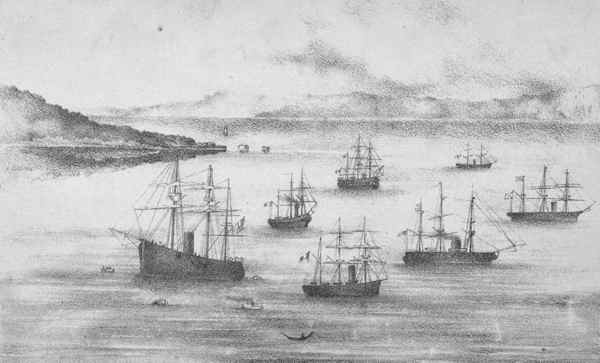
"Each earing to its cringle first they bend—
The reef-band then along the yard extend;
The circling earings round th' extremes entwin'd,
By outer and by inner turns they bind;
The reeflines next from hand to hand received,
Through eyelet-holes and roban legs were reeved;
The folding reefs in plaits unrolled they lay,
Extend the worming lines and ends belay."
|
THE NEW REGIME.—SOMETHING ABOUT SAIGON.—THE
FIRST CRUISE OF THE CHINA SQUADRON.—AN ALARM
OF FIRE!—ARRIVAL OF THE "FLYING" SQUADRON.
Sunday, January 2nd.—For some time past we have
been exercised to know how we could best signify
to the admiral our appreciation of his many kindnesses
to us during the time we have served under him.
His approaching promotion gave us the desired opportunity,
and it was decided that the most fitting present
would be a silk flag of the largest size, to be hoisted at
the main on that auspicious occasion. With this end in
view we had purchased some 130 yards of silk at Nagasaki,
which had been made up on board so quietly that few
even of those most interested in it knew of its progress.
To day he was to hoist his flag as full admiral for the
first time; and on this morning a deputation of the ship's
company awaited on him in his cabin to make the presentation.
The captain, in a few suitable words, having
introduced the representatives, and the admiral having
responded to their presentation address in simple, unaffected,
heartfelt language, the flag was soon fluttering in
lazy folds aloft, to be saluted at "eight bells" by the shore
battery and foreign men-of-war in harbour. A most
innocent thing that flag, and scarcely could we conceive
that it was destined to become the occasion of newspaper
paragraphs, parliamentary questionings, admiralty minutes,
and that sort of thing, but it was so to be. By one of the
regulations of the service no officer may receive presents
or testimonials from his men—hence the correspondence.
It is, however, satisfactory to know that in the present
instance the admiralty allowed the admiral to retain our
flag.
January 7th.—To-day's mail proved a complete hoax.
By it we were speedily to be relieved—so said all our
private letters, so corroborated the officers, and even the
admiral seemed to give a certain amount of credence to
the rumour. But need I say it was a chimera. The
papers are to blame for all this; for they stated that
Admiral Willes had inspected the "Swiftsure" and had
found her in every way fit for his flag-ship. This was all
true; but what wasn't, was—that she is to come out to
relieve us.
February 16th.—A month since—and if anyone had
asked us where we should be bound when next we slipped
from the buoy, we should have answered with a joyful
"homeward!" To-day we know better. We are speeding
Singapore-ward, it is true, but not to meet our relief.
The voyage into those torrid seas was not momentous,
and a week afterwards we lay alongside the coaling jetty
before spoken of.
And now we became aware that quite an unexpected
and perhaps in some respects—judging from after experience—not
altogether a welcome change was about to
be made in our executive. The admiral, of course, leaves
under any circumstances; but, further, the captain, commander,
and staff-commander were to be superseded, their
reliefs being already on the passage out. In addition, the
chaplain and Mr. Clarke were to leave, though at their
own request.
By the mail of the 26th the first instalment of our fresh
officers arrived. These were the admiral, G. O. Willes, of
Devonport dockyard celebrity and traditionally known to
us; the commander, nephew to the admiral; and the flag
lieutenant.
February 28th.—So quietly, that the majority of us
scarce knew of it, the admiral left to-day for England, and
with him the good wishes of everybody on the lower deck.
With the hauling down of the flag at the main, and its
re-hoisting at the fore, a new departure in the conduct of
the fleet on the China station was inaugurated. Henceforth
a season of activity, seasoned with salt junk, is to be
the order of the day.
After a short cruise with the squadron in Singapore
waters, during which period the "Tyne" arrived with our
new captain, and having bid good-bye to Captain Cleveland,
we stood away for Hong Kong, encountering such heavy
weather on the passage that we were compelled to put
into Saigon for coal.
The anchorage to seaward of Saigon—which town is
the French capital of Gambodin, part of the kingdom of
Anam, and situated some miles up the river Dong-nai—is
Cape St. James, where we brought up until the tide should
suit for the river passage. In the first watch we commenced
to go up the river by the light of a brilliant moon,
which, however, did not allow us to judge of the beauties
of what is really a beautiful river. By the following morning
we had arrived off the town; and what a surprise it
was to see a popular European town in such a situation,
well laid out, clean, and—well, thoroughly French. The
river here is so narrow, and yet of so even a depth, that,
in turning, our dolphin striker was buried in the foliage
on the one bank and our stern almost touching the opposite
one. The town is seemingly built on a well-drained
swamp or marsh, and consequently lies very low, in fact,
from our topgallant forecastle we could command a pretty
general view of the whole of it. Ashore the place is just
as pretty as it looks from the ship. It is almost a miniature
of Paris. A great cathedral, Notre Dame—an exact
model of that on the island in the Seine; a palace for the
governor, which might well accommodate an emperor;
streets with Parisian names; boulevards and champs, all
bearing the well-known nomenclature of the gay capital;
cafés, hotels, all remind one of the Paris of Dumas'
charming novels. It is the boulevards, streets, and promenades,
planted with trees, which make Saigon so beautiful,
so cool, and so refreshing towards the evening even
in a temperature where to live is a punishment. It is not
until sunset that we see anything of the French population,—then,
indeed, the cafés and restaurants are in full
swing, and gay with music and laughter. These places of
refreshment are generally al fresco; and as each tiny pure
white marble table is presided over by pretty wholesome-looking
French girls and matrons, we must have less
impressionable hearts than sailors are known to possess if
we can pass so much mischief by unnoticed, so courteous
as these demoiselles are too.
The native population is Anamese, a race something
like the Chinese in feature, but differing from them slightly
in dress. They do not shave the head, but gather all
their hair into a knot at the top, which—in the case of
the females—they decorate with rolls of brilliantly
colored silks, generally scarlet or emerald green. The
dress of the ladies is far more graceful than that of their
"celestial" sisters, for though they wear the indispensable
trousers, yet that masculine garment is hid by a long sack-like
robe, something after the style of a priest's toga, of—in
nearly every case—emerald-green silk, a color which
seems to harmonise well with their complexion. The
men wear a similar garment of black silk.
Their walk is peculiar. They go barefoot, and strut,
rather than walk, without bending the knee, with chest
and stomach pompously projected. From this gait results
a certain balancing of the body and a movement to the
hips, which gives to the women a bold, and to the men
a pretentious air. Most of the women hide their faces
when a stranger heaves in sight; but it must not be
supposed from this that they are either modest or retiring,
on the contrary, for young girls and women yield their
persons indiscriminately to men until they are married:
before that they are at liberty to do as they please, and
do not, in consequence, lose the respect of their fellows.
In fact, I am given to understand, most strangers find the
advances of the fair sex rather embarrassing.
At the landing place, and thronging the fine bronze
statute of Admiral Genouilly, the hero of Saigon, an
immense crowd had gathered to witness the embarkation
of the governor, on a visit to our admiral. His barge is
a splendidly got up affair. A large boat of native build,
painted and gilded till one could scarcely look on it, and
rowed by fourteen French seamen standing, clothed in
spotless white, with broad crimson sashes around their
waists. This equipage had such a holiday look about it,
that one of our fellows irreverently asked if "Sanger's
circus was coming!"
Only a day at Saigon, and off again. Instead of shaping
course direct for Hong Kong we hugged the coast of
Cochin China, thinking thus to cheat the monsoon. In
this we were mistaken, for the wind and sea proved so
strong that lower yards and topmasts had to be struck.
Thus it was not until the 25th, and after hard steaming,
that we reached Hong Kong.
April 16th.—To-day, William Edwards, second captain
of the main top, died in hospital of a complication of
debilitating complaints.
April 21st—Started on our yearly trip. Between Hong
Kong and Amoy we encountered a series of baffling fogs,
compelling us to anchor for days at a stretch. One clear
day the "Lapwing" passed, bound for Hong Kong. She
had recently been in collision with a Chinese merchant
steamer, and inflicted such telling damage on the latter
that now her bones lie rotting at the bottom of the
Formosa channel.
At Amoy we found the first division of the cruising
squadron at anchor, under the command of Captain East,
of the "Comus." From Hong Kong here they had
been under the convoy of the admiral, who had, to use
an expression of one of the interested, given them a
thorough "shaking up," especially in the night watches.
Before sailing the "kit" of our late deceased shipmate
was disposed of at a public auction, and realised the sum
of £25. This, together with a general subscription,
allowed us to send the comfortable sum of £100 to his
widow. It is at these sales that one sees the sailor come
out in—what shall I say, a new character? Well, in a
way, yes; for he certainly exhibits a carefulness of thought
and an enlargement of the organ of feeling, for which the
world would scarce give him credit perhaps. I have often
thought it the most beautiful trait in an otherwise rough
and crude nature. Let it but be known that a poor
woman is left helpless to struggle through a hard and
selfish world, may-be children to add to her difficulties,
then you shall see that the sailor's heart is in the right
place; then all private animosity against the deceased
is swallowed up in the "charity which is kind."
The ancient Romans were not more eager to obtain a
memento of dead Cæsar than they for some article of the
deceased's clothing; not so much for the sake of the
thing itself, but simply that, by the purchase of it, they
may exercise their generosity, by giving for it, perhaps,
four times its value.
We have orders to cruise to Chefoo under sail. Fancy
an iron-clad making a passage under canvas! With the
"Iron Duke's" usual luck we encountered either boisterous
head winds or flat calms all the way, compelling us
to reef our canvas or to endure the tantalizing and
provoking agony of witnessing our sails hang in
picturesque, but useless, festoons up and down the masts.
For ten days we scarce saw the sun; for ten days the
sextants lay idle. When at length the sun did condescend
to slash the sky with his hopeful beams, we found we had
made the satisfactory average of ten miles a day. Our
potatoes, too,—that self-provided esculent upon which
sailors depend so much, and without which the admiralty
allowance assumes such skeleton proportions—now began
to fail us. As it was useless to attempt to reach Chefoo
under sail alone, steam was got up, and we managed to
make the harbour on June 6th.
Here again we picked up the squadron and the admiral,
the former of whom had been lying idle for fourteen days,
eating of the fat of the land, whilst we, like certain
ruminants, have been consuming our own fat, for want of
more natural food.
On the 11th, the squadron departed for evolutions in
the gulf of Pe-chili, outside, the admiral accompanying
to put them through a little practice.
Whilst at Chefoo, this time, we became acquainted with
the ladies and gentlemen of the China Inland Mission,
of whom Mr. Judd is the pastor. These toilers in God's
vineyard, for the better carrying out of their work, adopt
the Chinese national dress. The ladies are young, seemingly,
for such work, but possess unbounded enthusiasm.
Their visits to the ships were frequent, but not the less
welcome in consequence; and long before we left we had
got to look upon them as very dear friends. On one
occasion they provided a temperance entertainment for as
many as could come in the Seamen's Hall, on shore—a
real floral fête, where the fair English faces of the ladies
seemed to vie with the lovely blossoms around. There
were many in that audience who went there under the
impression of being bored, but who, long before the
proceedings had finished, declared they had not enjoyed
so pleasant an evening since leaving home. That was it,
these kind Christian friends made that gathering so home-like,
that one could scarce fail to be happy. For a few
short hours only we rough sailors were permitted to enjoy
the refined and cultured society of our generous friends,
and it is to be hoped we came out the purer for the
contact.
June 24th—The sweetest pleasure has its after-pang;
the most beautiful rose its latent thorn. So, too, I see, is
it with those who undertake to narrate facts. This day
marks the loss of another shipmate, from one of those
suddenly awful deaths to which the sailor is, above all
other men, perhaps, ever liable. One of our boys,
William Edwards, whilst at work on the main crosstrees,
fell to the deck, sustaining such fearful injuries that he
died a few moments afterwards. We buried him in the
little cemetery on shore, where an unpretending gothic
cross now records the simple fact that a sailor has died.
After all, our ship is not entirely useless; so thinks the
admiral, for he left orders that we were to repair to
Wosung to fill up with provisions for the squadron, and
from thence to proceed to Nagasaki to await their
arrival; a feat we performed, I believe, to his entire
satisfaction.
Another of our old officers left us here to take command
of the "Lapwing," her captain having shot himself in
consequence of the decision of the court against him in
the affair of the late collision. Much regret was felt at
losing Mr. Haygarth—about the last of the executive
officers who commissioned us.
Sometime after the sailing of the squadron, we left, with
the "Zephyr" in company, to rejoin the admiral in
Posiette Bay, Siberia. But the little ship being minus
several sheets of copper, we put in at the island of Tsu-sima
to allow her effective repairs.
August 7th.—And now we may be said to form a
component part of the squadron; henceforth, the ships
are to follow our lead, for the St. George's cross once
more flutters from our fore-royal mast head.
Posiette is certainly a magnificent anchorage, capable
of accommodating many fleets. All around richly clothed
hills, admirably suited for grazing and agricultural purposes,
shelter the great sheet of water from all winds.
Nature, however, seems to hold undivided sway on those
still, solemn hills, or those broad glassy plains; for not
an animal nor house to betray the presence of the
universal devastator can be seen, though I hear that
only a short distance over the hills several thousands of
Russian soldiers are under canvas, pending the conclusion
of negociations with China, relative to Kashgar.
August 11th.—At noon the squadron, comprising the
following ships: "Iron Duke," "Comus," "Encounter,"
"Curaçoa," "Pegasus," "Albatross," "Zephyr," and
"Vigilant," were signalled to get under sail, except our
ship, the "Zephyr," and the "Vigilant." Unfortunately
for the accomplishment of this evolution, the wind, after
holding out hopes that it would last all day, with the
force of the morning fell light just as the ships had
tripped their anchors. The little "Zephyr," in this
emergency, proved of invaluable service. She was here,
there, and everywhere to the rescue of her great sisters,
which could not be induced anyhow to come to the wind.
We were over four hours clearing the harbour, and even
then steam had to be got up for the purpose.
Next day we reached Vladivostock, anchoring in a
semicircle in front of the town. Scarce had our anchor
left the bows when another of our young lads, William
McGill, was suddenly ushered into that unknown world
that lies beyond. Whilst uncovering the mizen gaff, he
lost his hold, fell, and was so shattered that he died ere
he could be borne below. He lies in the Russian
cemetery on shore, a wild, neglected, "God's acre,"
without any pretensions to the sanctity usual to such
places. Another of the "Iron Duke's" crosses, of stout
old English oak, also marks this spot.
I must now request the reader to take a leap with
me—permissible enough to book writers, though scarcely
possible to pedestrians. You are now in the straits
of Tsugar, and near the scene of our former misadventure.
Before you are the ships of the squadron
drawn up in line for a race—no, not all, for the
"Mosquito" parted company during the night through
stress of weather. The breeze is now blowing at force
eight; or, as we should say, "slashing." During the night
we had met with a few casualties to our sails, but so slight
were they that in the morning we were able to take our
place among the coursers, as judge, referee, and starter.
At this moment the admiral signals "chase to windward."
What takes place now is a pretty sight. Clouds of snowy
balloon-like canvas spring, as if by magic, to masts and
yards, straining and bellying out with tremendous effort.
The steel corvettes were able to carry all plain sail with
impunity. Not so with the "Encounter," however, for she
is obliged to take a reef in her topsails and to furl her
royals, a proceeding which does not lessen her chance of
coming in first in the slightest, for she is known to be such
a good sailer, that a few yards of canvas, more or less,
does not affect her much. Away they go, listing over
under the strong pressure, and rising and falling in all the
majesty of ships of war. The "Pegasus" now shoots
ahead, bidding fair to overhaul the corvettes, but her
ambition is speedily curbed by the springing of her main-topsail
yard. Placed hors de combat, she drops astern
to shift her wounded spar. Many little accidents such as
this, calling for prompt seamanship, occurred during the
forenoon, and hence the value of such trials of speed.
For eight hours the squadron disported themselves in
this manner, when the "Encounter" was declared the
winner by 400 yards. At the moment of shortening sail,
our lame duck, the "Mosquito," hove in sight astern, in
a sad plight, as is usual with lame ducks. She had lost
her fore-topmast and jib-boom during the night, off
O'Kosiri. She was at once signalled to repair to
Hakodadi with all speed, to effect repairs.
By the time the race was finished we were broad off
Hakodadi, on the opposite side of the strait, but as it was
not intended to push on until next day, easy sail was kept
on until daylight.
September 7th.—At daybreak a man-of-war, with the
Japanese royal standard at the main—sky blue, with a
white chrysanthemum in the centre—was observed
making out of Hakodadi. Our larger ships at once
saluted, the smaller ones lowering their upper sails at the
same time. Subsequently we fell in with a Japanese
squadron, all with royal flags displayed. They were in
attendance on the mikado, who is now on a tour of his
empire.
By the evening we had arrived and anchored in a double
line, at right angles with the town.
We have, doubtless, all seen, heard, or read of the
various devices adopted by the different peoples of the
globe in the capture of the finny tribe, from our own
familiar hook and line to the Chinaman's trained cormorant
or the Chenook Indian's tame seal. These are all
good in their way, only they involve a great loss of time
and require no end of patience. But the method illustrated
to us the morning after our arrival, besides being a
more certain is also less cruel than anything else in the
shape of fishing I have yet seen. Observing a vast quantity
of fish disporting themselves near the ship, our
experimental torpedo officer armed himself with a small
torpedo, pulled himself into their midst, quietly dropped
the missile overboard, and pulled away again. The beautiful
unsuspecting creatures still played on, unconscious
of the doom that awaited them. The effect on firing the
torpedo was terrible: for a space of 150 yards all around,
the surface was like one mass of silver, from the closely-packed
and upturned bellies of a species of pilchard.
The slaughter was complete—not a fish moved after the
awful stun it had received. Boats from the squadron
were signalled to gather up the slain, which will perhaps
convey a pretty fair idea of their number.
Of late the admiral's barge has been attracting much
attention by her sailing qualities. She has been taken in
hand by the same energetic officer previously alluded to,
who has altered the service rig, and provided a new set of
sails, more suited in every way to develop the boat's
qualities. We had not long to wait for a challenge, for
the "Comus'" people, ever jealous in all such matters,
offered to match their sailing pinnace against her. The
challenge was accepted, and bets were concluded in the
customary manner. The admiral, in particular, was
especially pleased to think that, at last, he would have an
opportunity of verifying his remarks about his boat; for
he has reiterated again and again that, in his opinion, the
boat wanted only proper handling to go. Well, as you
know the race came off, and as you may also remember
the "Comus'" boat was beat—in common phrase—"all
to smash."
September 15th.—Southward once again. It was
intended to call in at Yamada on the way down, but
by some unaccountable reason we overshot the mark
and found ourselves in Kama-ichi instead. The mistake
was, of course, speedily discovered; the squadron hove
around and headed north for Yamada.
Next we put in to Sendai bay, a commodious anchorage,
but very much exposed seaward from its broad and unprotected
mouth. Great rollers and heavy swells come
thundering in with nearly all winds.
Previous to leaving, the admiral conveyed his intention
that certain ships would prepare to take the others in tow.
Acting on this the "Curaçoa" took us and the
"Mosquito;" the "Comus," the "Albatross" and
"Zephyr;" and the "Swift," the "Lily." Thus we
started, and under these conditions logged five knots, and
all went merry until the sky began to frown, and displayed
evident signs of bad temper. Half a gale blew,
ships still towing, but cutting a violent caper because their
freedom of action was curtailed. With the night the wind
increased to a full gale, and as the ships were making the
most frantic efforts to free themselves from the imprisoning
hawsers, and likely to become bad friends over the job,
signal was made to cast off. Now in her impatience the
"Mosquito" was not content to wait until we gave her
her freedom, but proceeded to wrest herself free by pulling
one arm of our main bitts clean off to the deck.
Annoying, was it not? But this is a quality generally
conceded to mosquitoes I believe. The squadron now
re-formed under reefed canvas, and though we could see
scarcely 400 yards ahead, from the obscurity of the
weather, we managed to reel off eight and a half knots,
the "Duke" of course under steam.
Very cold and bleak blew the ice-cold breath of Fusi
this morning as we headed into the bay of Yedo.
Contrary to all our expectations, instead of making our
way at once to Yokohama we turned aside, and anchored
at the naval arsenal of Yokusuka, on the opposite side of
the bay, presumably for the purpose of making the ships
presentable to the argus-eyed naval critics in Yokohama.
On the 24th we slipped across in gallant style, and confessedly
in first-rate order and trim. Even the "Yanks"
conceded this, with a rider, of course, to the effect that
they "guess'd" the "Alert"—did'nt they mean the
"Palos," I wonder—"would knock saucepans out of the
whole bilin'." On account of the great number of men-of-war
already at anchor we had to take up stations
as most convenient. As the flagship's anchor dropped, a
signal from main, mizen, and yard-arms, drew the attention
of the squadron. This great display of fluttering pennants
and parti-colored squares conveys to the initiated the
following sentence: "cruise at an end; satisfactory to
both officers and men."
September 28th.—Before the dispersal of the ships to
their winter quarters, and as a pleasant finale to an
unpleasant cruise a regatta, under the sole patronage of
the admiral and officers, was to be held on this and the
two succeeding days. The two first days were allotted to
the pulling contests, the third day to the sailing boats.
Of the pulling races it will, perhaps, suffice to say that
they were contested in the usual close and lusty manner.
The morn of the third day came in most auspiciously,
so far as the wind was concerned; but by mid-day heavy
rain clouds began to darken the weather horizon, and by
their aspect, threatened to mar the pleasure of the proceedings.
The race, however, had started long before
this. More than ordinary excitement was felt concerning
it, as the prize was to be a splendid silver cup, presented
by the admiral, and which he hoped—which we too
hoped, nay, confidently expected—would be won by his
own boat. So beyond question it would had the breeze
held. But it didn't, it fell to a flat calm, with not a breath
to ripple the harbour's glassy surface. In some manner
to wipe out their late defeat, and by a persistency really
most laudable, the "Comus'" men rolled their pinnace
all around the course, and ended by winning the cup.
Some idea of the labour entailed on her crew may be
formed from the time at which they were at it. At 10 a.m.
the boats started, and it was not until 5 p.m. the race
finished; the crews being all this time without a drop of
water, and under a vertical sun.
October 9th.—We are now in Nagasaki and about to
go in dry dock on the morrow.
If we had previously made up our minds to any
enjoyment in Japan's westernmost port we were doomed
to disappointment, for we had not been an hour in the
bay before alarming accounts reached us of the prevalence
of a most virulent cholera on shore. Leave is of course
out of the question—provoking, to say the least of it, in
lovely Nagasaki. The captain at once issued a memo.,
couched in terms which ought to have appealed to each
man's common sense, and containing the most accurate
information with regard to the epidemic. In the face of
all this, and notwithstanding the British consul's statistics,
our men would not believe in the urgency of the case at
all; and several, despite all that could be urged against it
crossed over to the town.
The days in dock were not, however, allowed to pass
altogether unpleasantly or devoid of interest, for the
officers—no whit better off than we in the matter of
leave—recognising the necessity of making an effort to divert
ennui, and to set an example of cheerfulness under
depressing circumstances, got up a series of athletic sports
on the limited space afforded by the dock. It will suffice
to notice a few of the leading items in our highly amusing
programme, for amusing it really was from beginning to
end, exemplifying to the letter the committee's motto,
"fun, not dollars," though dollars were not lacking.
The sports commenced at 1 p.m. on the 13th, with a
closely contested flat race of 100 yards. A sack race
which followed was, of course, rare fun, though not to
some who took the most active part in it, for I am afraid
one's nose coming in contact with hard gravel is anything
but fun to the owner of such organ. The jockey race
which came next must be noticed as exhibiting steeds in
entirely a new light. In the present instance, they so far
threw aside the nature of the equine race that, they
selected for themselves jockeys from the arms of fearful
Japanese mothers, who had come to see the fun. Clearly,
as the referees decided, this class of jockey did not come
within the scope of the programme.
But one of the most entertaining items was the obstacle
race, and considering, as I said before, the small space at
the committee's command, several severe obstacles had
been placed in the way of the competitors. Eighteen
entered for this race. First, half a pound of pudding,
minus anything oleaginous, and a basin of water was
administered to each. At a given signal the "gorging"
commenced. He who first got outside his "duff and
water" started, and so on with the next. One would scarce
believe with what incredible rapidity that pudding was
metamorphosed. The next obstacle to be surmounted
was a huge balk of timber raised at the ends, about a
foot off the ground, under which the coursers were compelled
to crawl. A row of eighteen barrels, with the ends
knocked out, came next; then a climb up slack ropes,
and over a transverse bar; and finally another balk of
timber—if anything less than a foot off the ground—under
which they had to squeeze and wriggle in the best
manner possible.
As a finale to our excellent programme, the most amusing
and entertaining thing of all was yet to be carried
out. A stunsail boom had been rigged out over the
caisson, and rendered extremely fit for pedestrianism by
plentiful libations of slush and soft soap. At the extreme
end a basket containing, in the words of the programme,
"a little pig" was slung. About thirty men stood to the
front, as would-be possessors of "porcus." Each of the
thirty, as valiant heroes as ever trod a plank or fisted
handspike, tried and failed—and tried again with a like
unsatisfactory result. Piggy still lay nestled in his swinging
stye. True, once or twice he had cocked out his
head with an enquiring squeal as the pole now and then
received an extra hard shake, making the foundations of
his house rather insecure. The affair was at length
decided in an unlooked-for manner. As the thirty could
not get the pork out, the latter took the initiative and got
out himself—of course falling overboard, where he was
secured by an amphibious sailor below.
As the time anticipated had not been consumed in the
pork affair, a tug-of-war between the fore and aft men was
decided on; and as it is a generally understood thing
that our men can pull on occasions, a four-and-half hemp
hawser was hauled to the front, experience having proved
that ropes of lesser diameter are like as much tow in their
hands. As no prize could be conveniently awarded
for this, about six dollars' worth of that ambiguous compound,
known as gingerbread, was supplied and laid on a
piece of canvas in a formidable heap within view of the
antagonists, with the intention that the winners might
regale themselves afterwards. But this highly laudable
and very proper intention was frustrated, for the losers happening
to be nearest the heap took base advantage of their
proximity to pillage the store, which, by the aid of a score
or so of Japanese imps, in all manners of reversible attitudes
in the crowd, they managed to raze to its foundations.
So ended one of the most enjoyable days of the commission.
By the way I must not omit to mention that the
ubiquitous "Aunt Sally," of immortal memory, was
present on the occasion, and contributed the usual amount
of sport.
October 14th.—By midnight, all hands having relegated
themselves to the close embraces of the sleepy god, a
terrible din and an unusual alarm was circulated throughout
the ship. At first, in our semi-wakeful state, and
before we could adjust our ideas, we had the most confused
notions of what was the matter. Most thought that
the shores under the ship's bottom had carried away, and
that we had fallen over on our bilge; and, strange to say,
in our imaginary terror our eyes seemed to convey that
impression. The ominous word "fire!" followed by the
maddening unmusical efforts of a crazed bell, reduced
all this din and uncertainty to a logical something. But
where was it? What was on fire, the ship? Fortunately
no; but a fire so close to the ship that she was in imminent
danger of taking the flames every minute. Ahead
of us, and within a biscuit's throw of our flying boom, a
long shed containing kerosene and other inflammables
had taken fire, but how does not so clearly appear. But
that doesn't matter. In a moment there was a general
conflagration. It burst out with sudden and alarming
fierceness, threatening speedily to overwhelm the whole
yard.
Our captain's first consideration was the safety of his
ship. To this end the dock was flooded, and pumps rigged
on board in readiness for any possible eventuality; for,
though we were not in immediate contact with the danger,
yet it was so unpleasantly hot on our top-gallant forecastle,
and such quantities of sparks and lumps of burning wood
were so constantly lodging on our tarry ropes and rigging,
that there was no saying how soon we too might add to
the general glare.
The means for putting out fires in Japan are, as everybody
knows, of the most simple and primitive kind. But
simple and ineffective as their method is, we were compelled
to adopt it until there should be a sufficiency of
water in the dock to enable us to work our pumps. One
would have thought that in a Government yard like
this the machinery for pumping out the dock might have
been utilized for such a purpose. Possibly if fires were
of less frequent occurrence amongst the Japanese this
plan might be considered.
After the ship had been attended to we next turned our
attention to the fire. From the first we saw it was useless
to attempt its subjugation, even had we the ordinary
appliances at hand, so our efforts were mainly directed to
the prevention of its spreading to another shed standing
near, containing vitriol, and to the preservation of a stack
of huge balks of timber, adjoining the burning shed. We
succeeded in the former, but the timber proved too
cumbrous to be interfered with, and it was not until four
o'clock in the morning that the fire was got under—or
rather, burnt itself out is, I suppose, the more correct
expression. After a good hour and half's delay a Japanese
fire brigade arrived on the scene. The appearance of
this body of men was such that they claim a few words of
description. They were attired in tight-fitting blue garments,
and mushroom-shaped hats of bamboo, with each
an umbrella over his shoulder, the use of which will
become apparent directly. Before the cortege marched a
man blowing a large conch, which emitted, not "the
murmur of the shell," but a much more ear-splitting
music. Next to him came a personage bearing the insignia—I
suppose we must term it—of the brigade. This
affair reminded me of nothing at home so much as the
stall or stand of the itinerant vendor of boot and corset
laces in our streets, the laces in this case being represented
by strips of gilded leather, and surmounted by a ball, on
which was traced a great character in gold, signifying fire,
in the language of the children of the "rising sun."
Then followed their box-like engine, borne on bamboos
across the shoulders of the main body. Notwithstanding
the ludicrousness of the whole cavalcade, the men set to
work most energetically, and displayed that dash and
intrepidity of conduct for which the Japanese are famed,
and which must eventually raise them to the dominance
of the peoples of the far east. Right into the midst of
the fire dashed these fellows, their only shelter from the
fierce glare being the before-mentioned umbrellas. These
frail shades, though made only of paper, seemed to
answer the purpose admirably.
October 26th.—Left for Wosung, anchoring in the
Yang-tsze, after a quick run of four days across the
Yellow Sea. We are to await here the arrival of the
flying squadron. Meanwhile an opportunity was given
us of visiting the great European metropolis of China.
The "Foxhound" was ordered down from Shanghai, and
converted into a passenger steamer, for the benefit of our
ship's company. Shanghai at this time offered plenty of
scope for enjoyment to sailors. The city is divided into
three principal parts or "concessions"—English, French,
and American—the English being far more extensive
than the other two combined, and much more beautiful,
with clean broad streets, houses like palaces, and shops
which would do no discredit to Regent street or the
Strand. The great attraction was the races, held outside
the city, on the Nankin Road, near which is an extensive
race-course.
Of the native city—well—perhaps the less said the
better. It is full of the foulest filth and abominations in
which it is possible for even a Chinaman to exist. I will
not afflict my readers with a description of its horrors;
it would scarcely be fit reading for our friends. Fever
and plague are ever rife within the city gates, a fact so
well established that the European residents never visit
this quarter. We had not been warned of this, however,
and the result was that some of our men, who had
weakened their systems with poisonous liquor, fell victims
to some disease very like cholera, which in two cases
proved fatal within twenty-four hours. I trust these
awfully terrible examples were not without their lesson to
us. (Shipmates, there is a higher aspiration within the
reach of every sailor than that of blindly devoting himself
to the service of the "boozy" god, a self-immolation
which leaves no enjoyment—no healthy enjoyment, I
mean—to its devotees. It must be, and I know it is so,
that every one such feels ashamed of himself afterwards,
and calls himself by hard but honest adjectives when the
"bad head" period comes on.) I am thankful to state
that our other cases recovered, though not until almost
all hope had well-nigh gone.
November 22nd.—To-day the long-expected flying
squadron arrived, and took up positions ahead of us.
The following ships comprised it—"Inconstant" (flag),
"Bacchante," "Cleopatra," "Tourmaline," and "Carysfort."
For days past much activity has existed amongst the
junk fleet in this neighbourhood. Dozens of these trim-built
and picturesque-looking craft have lately accumulated
here to give the princes a proper reception. Day after
day they have duly gone through some extraordinary and
to us meaningless evolutions, all flags, gongs, yells, and
gunpowder.
November 24th.—Leaving the squadron to the joy and
festivities of Shanghai, once more we head for Hong
Kong. We thought then it was for the last time; but
hopes have been shattered so frequently of late that we
were not prepared to bet on it.
Whilst at anchor, awaiting the tide to cross the outer
bar, our attendant pilot boat came to grief under our
bows. Everybody who knows anything of Chinese
rivers—of the Yangtsze in particular—will have often
remarked how great a velocity the current attains at near
low water, making boating alongside a ship an almost
impossible and extremely hazardous proceeding. The
water hisses, seethes, and boils past the sides as if the
ship was under weigh in a heavy sea; thus when the
little vessel reached our bows there was nothing to save
her. Fortunately she came down upon us in such a
manner that she escaped with the loss of mainmast and
sail, whilst a little damage was done to our head-gear
in the scrimmage.
November 30th.—Again the well-known rig of the
Canton fishing junks heaves in sight, and ere long the
equally well-known outline of Victoria Peak, the most
welcome sight on the station, after all said and done. In
a few hours that prince of bumboat men, old Attam, had
paid us a visit, giving us a kindly welcome, with his
good-tempered, ever-smiling, and flat celestial face.
December 20th.—To-day at noon the flying squadron
came in from the northward. Their arrival was awaited
by eager and expectant crowds thronging the shore, in
anticipation of witnessing the landing of the young royal
middies. In this they were disappointed. The same
absence of ceremony and reserve was to be observed
here, with respect to the queen's grandsons, as was
recently followed out in Shanghai, and which gave so
much umbrage to the residents of that city. It was soon
officially known that whilst staying at Hong Kong, the
princes would be publicly recognised simply as "mids."
The Europeans and other foreign residents were quite
prepared to do the honors handsomely, had things been
ordered differently. These shortcomings were however
amply compensated for by the magnificence of the
Chinamen. It did not signify to them as to how the
princes were to be treated; to them they were the queen's
grandsons, midshipmen or not.
The two nights immediately preceding Christmas Day
were devoted to the grandest display of fireworks and
illuminations I have ever witnessed, and which, possibly,
few men see but once in a lifetime. All accounts of
China agree that in the pyrotechnic art the Chinese stand
alone, unequalled.
We have all, no doubt, been struck when reading of
the wonderful changes of form assumed by their fireworks
in the air. This, like many other descriptions about this
people, is rather misleading. What actually does take
place I will endeavour to show; only bear in mind the
most perfect description must fall far short of the startling
reality.
In the present instance two skeleton, tower-like structures
of bamboo were erected in the soldiers' drill
ground, and within this simple framework all the business
was to be transacted. Seats for the accommodation of
the governor and other high functionaries, and for the
leading Chinese, were set up at a convenient distance,
whilst the respectable public were permitted within the
enclosure. For several hours before dusk, relays of
coolies had been bearing into the open space curious-looking
balls of wicker, innocent of anything like the
gorgeous things they really were. At sunset the programme
opened. One of the balls was hoisted to the
top of a tower, and set fire to in its ascent, so that by the
time it had reached its highest altitude it was all one
blaze. But behold the change! so sudden and brilliant
that a shout expressive of admiration was involuntarily
sent up by the sea of faces around. In place of the
homogenous ball, hundreds of small figures of mandarins
and ladies, some seated at tables, some riding on mules,
others playing at shuttlecock or flying kites, and all
clothed in the most beautiful garments, and around which
innumerable squibs were hissing and cracking, revealed
themselves to our astonished gaze. Another change!
The human element disappears. Birds and flowers, with
swarms of brilliant butterflies flitting amongst them, and
alighting on their gorgeous petals, the light all the time
ever-changing and varying in color. These in their
turn disappear, and a grand pagoda suddenly drops, as
from the skies, out of the burning mass, its different
storys all distinctly marked by parti-colored lamps,
whilst little rockets are continually going off at all its
windows. What, not finished yet? No; exit pagoda,
enter a royal crown, dominating the Prince of Wales'
feathers, with the initials "A V" and "G" underneath.
Bear in mind all these changes emanated from the same
ball, which was but one of scores such, and all different.
Each ball generally wound up in one tremendous report,
and a rocket, which shot far into the night, and whose
sparks, scintillating for awhile in space, rivalled in
brilliancy the tints of the stars.
This was but the first part of the entertainment; a far
prettier was yet to come. Starting from the various
Chinese guilds, and uniting in front of the governor's
house, a grand procession, over a mile long, commenced
the perambulation of the streets of the city. Each man
bore on his shoulders exaggerated representations of all
the domestic and food animals used in the Chinese
menage, principally fish, fowls, and pigs, constructed of
bamboo framework covered with tinted gauze, and illumined
from within by colored candles. Illuminated
shops, trophies, interiors, representations in character
from the sacred books, the figures being real and resplendent
in the most beautiful silks, were amongst the most
important objects in the ceremonial. Bands of music—save the mark!—filled
up the intervals. Towards the
end of the procession came two dragons—a gold one and
a silver one—of such a length that each required somewhere
about thirty pairs of bearers. They were divided
into sections, to every one of which a pair of men was
attached, illumined from within, and covered with a rich
scaled brocade, in which the bearers themselves were also
enveloped, their legs and feet appearing from underneath
like the legs of a huge centipede.
Whilst on the subject of dragons I may just mention a
curious ceremony I witnessed, during the earlier part of
the day, in connection with one of these—the gold one—in
the present ceremonial. The occasion was the instillation
of life into the legendary monster. He was conducted
by his bearers to the largest temple in the city, where a
yellow-robed bonze was in waiting to receive him. On
the huge head being brought to the door the farce commenced.
Taking a live cock in his hand, the priest
pricked its comb in three several places, and with the
blood proceeded to mix some vermilion paint, in a small
china vessel. With this pigment he now described three
cabalistic signs on a piece of yellow paper, which he stuck
on the monster's forehead, at the same time touching
with his brush the eyes, the cavernous jaws, and horrible
fangs of the animal. This completes the business, and
the dragon proceeds on its sinuous way amidst the
howling and contortions of a superstitious and excited
mob.
It is not to be supposed that the flying squadron
could be permitted to leave for England without the
usual challenges for boating contests being thrown out.
We, of course, came in for the lion's share of their
attacks. A match was pulled, in which our green galley
came in the victor; then a second, in which the
"Bacchante's" cutter beat our crack boat. This unexpected
defeat set our men on their metal, in fact raised a
bit of a storm in the lower deck, so that dollars were
freely tendered towards a high stake to pull them again.
But the "Bacchante" wanted not our two hundred
dollars. "They had beat us," they said, "and to their
entire satisfaction; what more could they desire?" The
"Tourmaline's" men appeared highly delighted at our
defeat. On a black board, fixed up in their fore-rigging,
they had written, "'Iron Duke' no can do 'Bacchante.'"
This was met by a counter taunt from us, "'Iron Duke'
can do 'Bacchante'—200 dollars." I am inclined to the
belief that had the "Dukes" and "Tourmalines" met on
shore that night there would have been work for the
doctors.