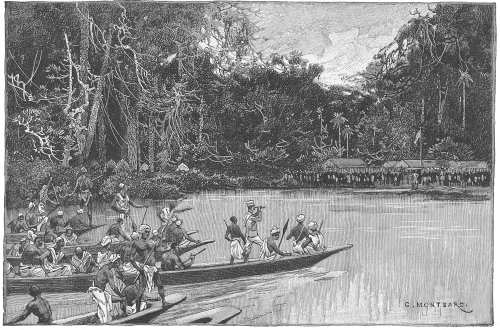
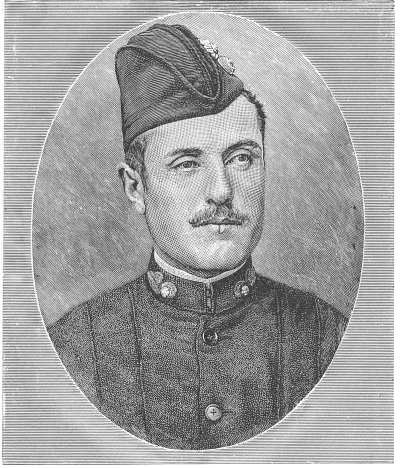
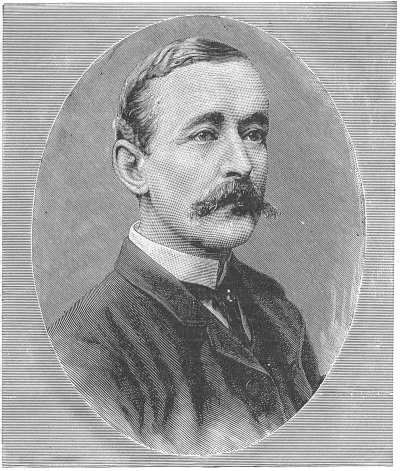
In the country of the Balessé—Their houses and clearings—Natives
of Bukiri—The first village of dwarfs—Our rate of progress
increased—The road from Mambungu's—Halts at East and West
Indékaru—A little storm between "Three o'clock" and Khamis—We
reach Ibwiri—Khamis and the "vile Zanzibaris"—The Ibwiri
clearing—Plentiful provisions—The state of my men; and what
they had recently gone through—Khamis and party explore the
neighbourhood—And return with a flock of goats—Khamis
captures Boryo, but is released—Jephson returns from the relief
of Captain Nelson—Departure of Khamis and the Manyuema—Memorandum
of charges against Messrs. Kilonga-Longa & Co. of
Ipoto—Suicide of Simba—Sali's reflections on the same—Lieutenant
Stairs reconnoitres—Muster and re-organisation at Ibwiri—Improved
condition of the men—Boryo's village—Balessé customs—East
Indenduru—We reach the outskirts of the forest—Mount
Pisgah—The village of Iyugu—Heaven's light at last! The beautiful
grass-land—We drop across an ancient crone—Indésura and its
products—Juma's capture—The Ituri river again—We emerge upon
a rolling plain—And forage in some villages—The mode of hut
construction—The district of the Babusessé—Our Mbiri captives—Natives
attack the camp—The course of the Ituri—The natives of
Abunguma—Our fare since leaving Ibwiri—Mazamboni's Peak—The
east Ituri—A mass of plantations—Demonstration by the natives—Our
camp on the crest of Nzera-Kum—"Be strong and of a good
courage"—Friendly intercourse with the natives—We are compelled
to disperse them—Peace arranged—Arms of the Bandussuma.
1887.
Oct. 28.
Yumbu.
We marched for two hours to Yumbu, and in four and
a quarter hours on the following day to Busindi.
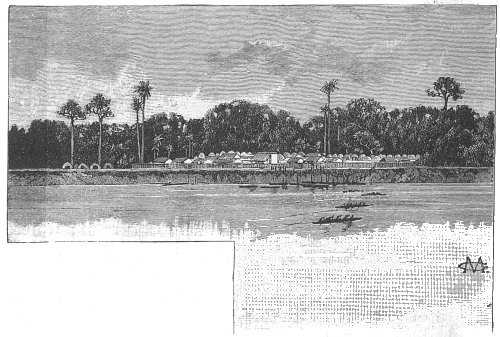
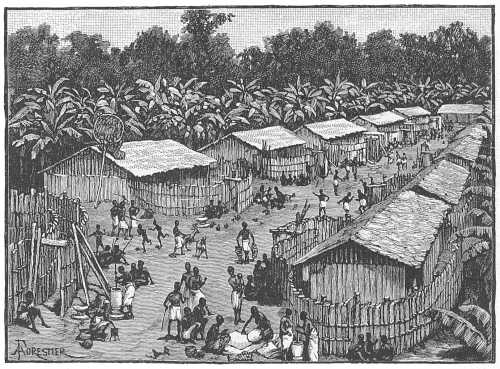
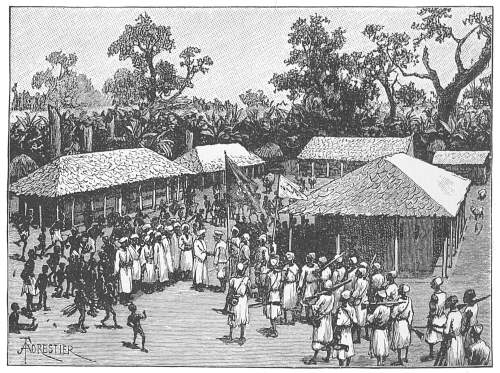
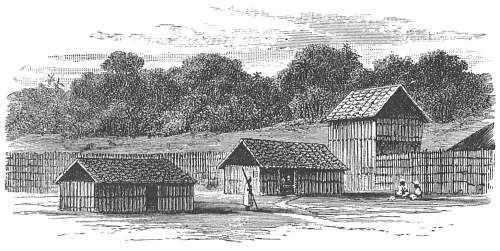
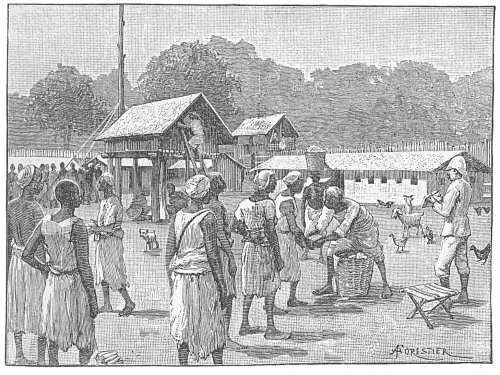
We were now in the country of the Balessé. The architecture
was peculiar. Its peculiarity consisted in a long
street flanked by a long low wooden building, or rather
planked building, on either side, 200, 300, or 400 feet
long. At first sight one of these villages appeared like
a long gable-roofed structure sawn in exact half along
the ridge of the roof, and as if each half house had been
removed backward for a distance of 20 or 30 feet, and
1887.
Oct. 29.
Busindi.
then along the inner sides been boarded up, and pierced
with low doors, to obtain entrance into independent
apartments. The light wood of the Rubiacæ affords good
material for this kind of house. A sizeable tree, 1 foot
18 inches, or 2 feet in diameter, is felled, and the log is
cut into short pieces from four to six feet in length;
the pieces are easily split by hard wedges, and with
their small neat adzes they contrive to shape the plank
smooth, tolerably even, and square. They are generally
an inch or an inch and a quarter thick. For what is
called the ceiling or inner boarding, the boards are
thinner and narrower. When a sufficient number of
boards and planks are ready, the inner ceiling is lashed
to the uprights, frequently in as neat a fashion as a
carpenter's apprentice might do it with saw, nails and
hammer; on the outer side of the uprights are lashed
the thicker planks, or broad slabs, the hollow between
the inner and outer frame is then stuffed with the
phrynia, or banana leaves. The wall facing the street
may be 9 feet high, the back wall facing the forest or
clearing is 4 or 4½ feet high, the width of the house
varies from 7 to 10 feet. Altogether it is a comfortable
and snug mode of building, rather dangerous in case of
fire, but very defensible, with trifling labour.
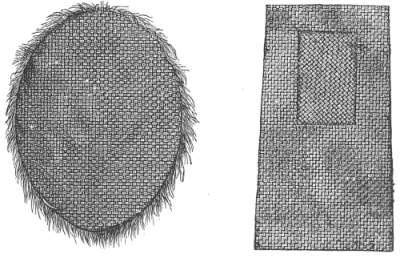
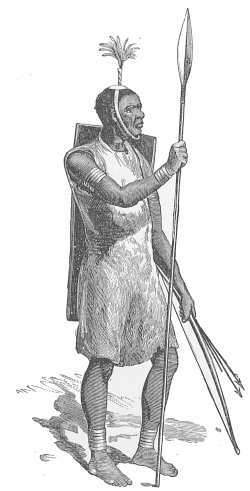
SHIELDS OF THE BALESSÉ.
1887.
Oct. 29.
Busindi.
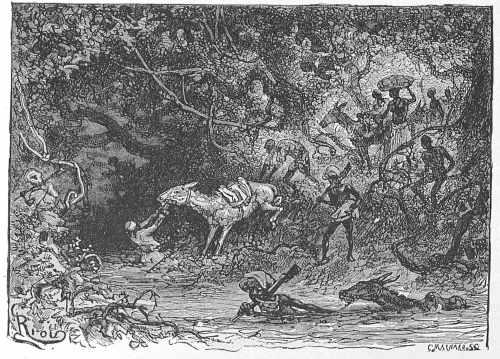
Another peculiarity of the Balessé is the condition of
their clearings, and some of these are very extensive,
quite a mile and a half in diameter, and the whole
strewn with the relics, débris, and timber of the primeval
forest. Indeed I cannot compare a Balessé clearing to
anything better than a mighty abattis surrounding the
principal village, and over this abattis the traveller has
to find his way. As one steps out of the shadow of the
forest, the path is at first, may be, along the trunk of a
great tree for 100 feet, it then turns at right angles
along a great branch a few feet; he takes a few paces
on the soil, then finds himself in front of a massive
prostrate tree-stem 3 feet in diameter or so; he climbs
over that, and presently finds himself facing the out-spreading
limbs of another giant, amongst which he
must creep, and twist, and crawl to get footing on
a branch, then from the branch to the trunk, he takes
a half turn to the right, walks along the tree from which,
increasing in thickness, he must soon climb on top of
another that has fallen across and atop of it, when after
taking a half-turn to the left, he must follow, ascending
it until he is 20 feet above the ground. When
he has got among the branches at this dizzy height,
he needs judgment, and to be proof against nervousness.
After tender, delicate balancing, he places his
foot on a branch—at last descends cautiously along
the steep slope until he is 6 feet from the ground
from which he must jump on to another tapering
branch, and follow that to another height of 20 feet,
then along the monster tree, then down to the ground;
and so on for hours, the hot, burning sun, and the close,
steamy atmosphere of the clearing forcing the perspiration
in streams from his body. I have narrowly escaped
death three times during these frightful gymnastic
exercises. One man died where he fell. Several men were
frightfully bruised. Yet it is not so dangerous with the
naked feet, but with boots in the early morning, before
the dew is dried, or after a rain, or when the advance-guard
has smeared the timber with a greasy clay, I
have had six falls in an hour. The village stands in the
1887.
Oct. 29.
Busindi.
centre. We have often congratulated ourselves on coming
to a clearing at the near approach to camping-time, but it
has frequently occupied us one hour and a half to reach
the village. It is a most curious sight to see a caravan
laden with heavy burdens walking over this wreck of a
forest, and timbered clearing. Streams, swamps, watercourses,
ditches are often twenty to twenty-five feet
below a tapering slippery tree, which crosses them
bridge-like. Some men are falling, some are tottering,
one or two have already fallen, some are twenty feet
above the ground, others are on the ground creeping
under logs. Many are wandering among a maze of
branches, thirty or more may be standing on one delicate
and straight shaft, a few may be posted like sentries on
a branch, perplexed which way to move. All this,
however, is made much harder, and more dangerous,
when, from a hundred points, the deadly arrows are
flying from concealed natives, which, thank Heaven,
were not common. We have been too cautious for that
kind of work to happen often, though we have seldom
been able to leave one of these awful clearings without
having some man's foot skewered, or some one lamed.
On the 29th we marched to Bukiri or Myyulus, a
distance of nine miles in six hours.
A few natives having been tormented and persecuted
to submission to the Manyuema, greeted us with cries
of "Bodo! Bodo! Ulenda! Ulenda!"; greetings which
they accompanied with a flinging motion of the hand,
as though they jerked "Away! away!"
The chief was styled Mwani. They wore much
polished ironwork, rings, bells, and anklets, and appeared
to be partial to many leglets made of calamus fibre, and
armlets of the same material, after the manner of
Karagwé and Uhha. They cultivate maize, beans,
plantains, and bananas, tobacco, sweet potatoes, yams,
brinjalls, melons, gourds. Their goats are fine, and of
good size. Fowls are plentiful, but fresh eggs are rare.
Among some of these villages there is generally a
dome hut of ample size, after the manner of Unyoro,
with double porches.
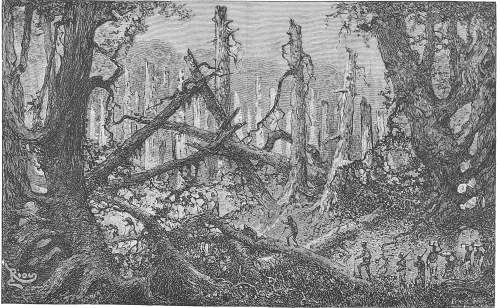
GYMNASTICS IN A FOREST CLEARING.
1887.
Oct. 30.
Busindi.
The following day we halted, during which the Manyuema
guides took particular care to show our people
that they should have no doubt of their contempt for
them. They would not allow them to trade with the
natives for fear some desirable article would be lost to
themselves, they also vociferated at them loudly if they
were seen proceeding to the clearing to cut plantains.
As I told them, they did not advance in their favour in
the least by abandoning the whites, and turning a deaf
ear to our adjurations to be manly and faithful. A
word, or even a defiant look, was visited with a sharp
cut on the naked body with a rattan from slave boys of
the six Manyuema guides with us. What awful oaths of
vengeance were uttered for all these indignities they
suffered!
On the 31st we came across the first village of Dwarfs,
and, during the day, across several empty settlements
belonging to them. We marched nine miles in five and
a quarter hours, and camped in a dwarf's village in the
woods.
Stealing continued steadily. On examining the
pouches, there was one cartridge out of three pouches.
The cartridges were lost, of course! Hilallah, a boy of
sixteen, deserted back to Ipoto with my cartridge pouch,
and thirty cartridges in it. A man who carried my
satchel ran away with seventy-five Winchester cartridges.
The next day we entered the extensive clearing and
large settlement of Mambungu's or Nebassé.
Khamis, the chief of the guides, left Ipoto on
the 31st, and arrived at this place with seven men,
according to agreement with Ismaili, my Manyuema
brother.
The track which we followed has enabled us to
increase our rate of progress per hour. Along the river
bank, by dint of continued work, and devoting seven,
eight, nine hours—sometimes ten hours—we could
travel from 3 to 7 miles. We were now enabled to
make 1½ to 1-3/4, and even 2 miles per hour; but the
pace was still retarded by roots, stumps, climbers,
1887.
Nov. 1.
Mambungu's.
llianes, convolvuli, skewers, and a multitude of
streams, and green-scummed sinks. We could rarely
proceed a clear hundred yards without being ordered
to halt by the pioneers.
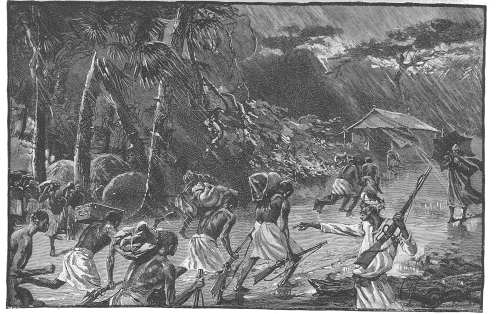
Each day towards evening the clouds gathered, the
thunder reverberated with awful sounds through the
echoing forest; lightning darted hither and thither,
daily severing some tree-top, or splitting a mighty
patriarch from crown to base, or blasting some stately
and kingly tree; and the rain fell with a drowning
plenty which chilled and depressed us greatly in our
poor blooded and anæmic state. But during the march,
Providence was gracious; the sun shone, and streamed
in million beams of soft light through the woods, which
brightened our feelings, and caused the aisles and
corridors of the woods to be of Divine beauty, converted
the graceful thin tree-shafts into marbly-grey pillars,
and the dew and rain-drops into sparkling brilliants;
cheered the invisible birds to pour out, with spirit, their
varied repertory of songs; inspired parrot flocks to vent
gleeful screams and whistlings; roused hosts of
monkeys to exert their wildest antics; while now and
then some deep, bass roar in far-away recesses indicated
a family of soko or chimpanzees enjoying some savage
sport.
The road from Mambungu's, eastward, was full of torments,
fears, and anxieties. Never were such a series of
clearings as those around Mambungu, and the neighbouring
settlement of Njalis. The trees were of the largest
size, and timber enough had been cut to build a navy;
and these lay, in all imaginable confusion, tree upon tree,
log above log, branches rising in hills above hills; and
amongst all this wild ruin of woods grew in profusion
upon profusion bananas, plantains, vines, parasites;
ivy-like plants, palms, calamus, convolvuli, etc., through
which the poor column had to burrow, struggle, and
sweat, while creeping, crawling, and climbing, in,
through, and over obstacles and entanglements that
baffle description.
On the 4th November we were 13-3/4 miles from
1887.
Nov. 4.
Ndugubisha.
Mambungu's in the settlement of Ndugubisha, having
passed, in the interval, through five deserted forest
villages of pigmies.On this day I came near smiling—for
I fancied I observed the dawn of happier days foretold
by Uledi. Each member of the caravan received
one ear of corn, and 15 plantains as rations.
Fifteen plantains and one ear of corn make a royal
ration compared to two ears of corn, or a handful of
berries, or a dozen fungus. It was not calculated, however,
to make men too cheerful, though our people were
naturally light-hearted and gay.
"But never mind, my boys," I said, as I doled the
spare diet to the hungry creatures; "the morning is
breaking; a week more, and then you shall see the end
of your troubles."
Verbal reply was not given to me; only a wan smile
lightened the famine-sharpened features. Our officers
had borne these privations with the spirit ascribed by
Cæsar to Antony, and as well as though they were to
the manner born. They fed on the flat wood beans of the
forest, on the acid wild fruit and strange fungus, with the
smiling content of Sybarites at a feast. Yet one of them
paid £1,000 for this poor privilege, and came near being
thought too dainty for rough African life. They had
been a living example to our dark followers, many of
whom had probably been encouraged to strive for
existence by the bright, hopeful looks our officers wore
under our many unhappy afflictions.
On the following day we crossed the watershed
between the Ihuru and Ituri rivers, and we now
plunged into cool streams flowing to leftward, or towards
the Ihuru. Hills rose to the right and left in wooded
and ridgy mounts, and after a march of nine and
three-quarter miles, we halted for the night at West
Indékaru, at the base of a hill whose top rose 600 feet
above the village. Another short march brought us to
a village perched half-way up a tall mount, which may
be designated as East Indékaru, and by aneroid we were
4,097 feet above the ocean. From this village we
enjoyed a first view of our surroundings. Instead of
1887.
Nov. 5.
Indékaru.
crawling like mighty bipeds in the twilight, 30 fathoms
below the level of the white light of the day, compelled
to recognize our littleness, by comparison with the giant
columns and tall pillar-like shafts that rose by millions
around us, we now stood on the crest of a cleared mount,
to look upon the leafy world below us. One almost
felt as if walking over the rolling plain of leafage was
possible, so compact and unbroken was the expanse,
extending to a lovely pale blueness as the eyesight
followed it to the furthest limits of distinctness—away,
far away to an unknown distance the forest tops spread
round about a variegated green of plushy texture, broad
red patches of tree flowering, and rich russety circles of
leaves, not unfrequent. How one envied the smooth,
easy flight of the kites and white-collared eagles, sailing
gracefully without let or hindrance through the calm
atmosphere! Ah! that we had the wings of kites, that
we might fly and be at rest from these incorrigibly
wicked Manyuema! Whose wish was that? Indeed, I
think we all of us shared it, more or less.
On the 7th, while we halted on the mount, the
Manyuema monopolizing the village, and our men in the
bush, unworthy to be near their nobility, there was a
little storm between Saat Tato (Three o'clock), the
hunter, and Khamis, the chief of the Manyuema guides.
It threatened, from the sound of words, to explode hurtfully
at one time. Khamis slapped him in the face.
Both were tall men, but Saat Tato was two inches taller,
a good soldier, who had seen service in Madagascar and
with Sultan Barghash as a sergeant, but who, from his
habits of getting drunk by the third hour of each day,
was nicknamed "Three o'clock," and dismissed. He was
an excellent man, faithful, strong, obedient, and an
unerring shot. Given the benefits of twenty-five pounds
of food, Saat Tato, at a hint, would have smilingly taken
hold of Khamis, and snapped his vertebrae across his
knee with the ease that he would have broken a spear
staff. I observed Saat Tato closely, for it must be
remembered that it had become fully impressed on my
mind that my men were quite too broken-spirited. Saat
1887.
Nov. 7.
Indékaru.
Tato looked at him a second severely; then, lifting his
forefinger, said to Khamis, "It is well, but I should like
to see you repeat that blow a little time hence, after I
have a little food in me, and filled this stomach of mine.
Strike me again, do; I can bear it."
Advancing, and touching Khamis on the shoulder, I
said, "Khamis, do not do that again. I do not allow
even my officers to strike my men like that."
The ill-humour was increasing, and, little as the
Manyuema imagined, they were assisting me to restore
the spirit of the Zanzibaris by their cruelty. There
were signs that the Christians would prevail after all.
The mutual affection expressed between the Moslem co-religionists
at the altar of which our men were ready to
sacrifice our lives and liberties and their own freedom,
had been cooled by the cruelty, perverseness, and
niggardliness of the Manyuema. All we had to do was
to watch it, bear patiently, and be ready.
To our great comfort Khamis confessed that West
Indékaru was the utmost limit of his master Ismaili's
territory.
We, however, were not to part from him until we
reached Ibwiri.
We marched eleven miles on the 8th of November
through a much more open forest, and we could see further
into the interior. The road was better, so much so that
our rate of marching increased to two miles per hour.
The gritty and loamy soil had absorbed the rain, and
walking became pleasant. The llianes were not so
riotously abundant, only a strong creeper now and then
requiring severance. At several places there were
granite outcroppings of a colossal size, which were a
novelty and added a kind of romantic and picturesque
interest to the woods, darkly suggestive of gitanos,
bandits, or pigmies.
A march of nine and a half miles on the 9th of
November took us to a Pigmies' camp. Until noon a
mist had hung over the land. Towards the latter
part of the tramp we passed through several lately
deserted villages of the dwarfs, and across eight streams.
1887.
Nov. 9.
Indékaru.
Khamis, the guide, and his followers, and about half-a-dozen
of the pioneers proceeded to Ibwiri, which was
only one and a half mile distant, and on the next day
we joined them. This was one of the richest and finest
clearings we had seen since leaving Yambuya, though
had the Expedition been despatched eight months earlier,
we should have found scores in the same prosperous
condition. Here was a clearing three miles in diameter
abounding in native produce, and hitherto unvisited by
the Manyuema. Almost every plantain stalk bore an
enormous branch of fruit, with from fifty to one hundred
and forty plantains attached. Some specimens of this
fruit were twenty-two inches long, two and a half inches
in diameter, and nearly eight inches round, large enough
to furnish Saat Tato the hunter, with his long desired
full meal. There was an odour of ripe fruit pervading
the air, and as we climbed over the logs and felt our
way gingerly along the prostrate timber, I was often
asked by the delighted people to note the bunches of
mellow fruit hanging temptingly before their eyes.
Before reaching the village Murabo, a Zanzibari headman,
whispered to me that there were five villages in
Ibwiri, and that each hut in every village was more than
a fourth full of Indian corn, but that Khamis and his
Manyuema had been storing corn in their own huts,
which, according to right of preemption, they had
reserved for themselves.
On entering the street of the village, Khamis met me
with the usual complaints about the wickedness of the
"vile Zanzibaris." Looking down on the ground I saw
many a trail of corn which went to corroborate Murabo's
story, and as Khamis proposed that the Expedition should
occupy the western half of the village, and he and his
fifteen Manyuema would occupy the eastern half, I
ventured to demur to the proposition on the ground
that as we had departed out of his master's territory we
claimed all the land to the eastward, and would in
future dispense with any suggestion as to what we
should do, and that furthermore not a grain of corn,
nor plantain, banana, or any other native product in the
1887.
Nov. 10.
Ibwiri.
land would leave the country without my permission.
He was told, no people on earth could have borne so
uncomplainingly such shames, affronts, and insults as had
been put upon the Zanzibaris, and that in future they
should be permitted to resent all such injuries as they best
knew how. Khamis assented submissively to all this.
The first thing after storing goods, and distributing
the men to their quarters, was to give fifty ears of corn
per man, and to arrange with the natives as to our future
conduct towards one another.
Within an hour it was agreed that the western half of
the Ibwiri clearing should be granted to us for foraging;
that the eastern half, from a certain stream, should be
the reserve of the natives. Khamis, the Manyuema, was
also induced to enter into the pact. In return for a
packet of brass rods, Boryo, the principal chief of the
Balessé of the district, presented us with five fowls and
a goat.
This was a great day. Since August 31st not one
follower of the Expedition had enjoyed a full meal, but
now bananas, plantains ripe and green, potatoes, herbs,
yams, beans, sugar-cane, corn, melons in such quantities
were given them that were they so many elephants they
could not have exhausted the stock provided for them in
less than ten days. They could gratify to the full the
appetite so long stinted and starved.
As we were compelled to wait for Mr. Jephson and some
sixty Zanzibaris—forty of the relief party, boat's crew,
and convalescents from Ipoto—the good effect of this
abundance would be visible in a few clays. It was also
one of those settlements we had been anxiously searching
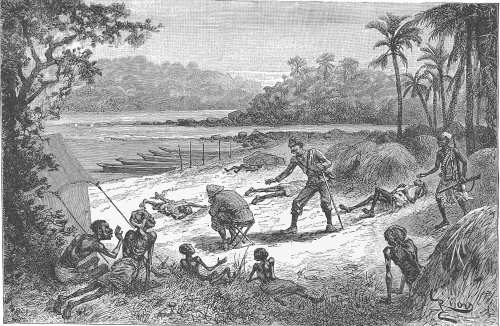
for as a recuperating station. On this date the men
were hideous to look upon, because of their gaunt nakedness.
They were naked, for they had stripped themselves
to obtain food from the slaves of the Manyuema at
Ugarrowwa's and Ipoto; of flesh they had none, for they
had been reduced to bones by seventy-three days of
famine and thirteen days of absolute want; of strength
they had but little, and they were ill-favoured in every
respect; their native colour of oiled bronze had become
1887.
Nov. 10.
Ibwiri.
a mixture of grimy black and wood ashes; their
rolling eyes betrayed signs of disease, impure blood, and
indurated livers; that beautiful contour of body, and
graceful and delicate outlines of muscles—alas, alas!—were
all gone. They more befitted a charnel-house
than a camp of men bound to continually wear fighting
accoutrements.
Khamis, the Manyuema guide, offered the next morning
to proceed east to search out the road from Ibwiri, for,
as he informed me, Boryo, the chief, had told him of a
grass-land being not many days off. He thought that
with a few of Boryo's natives, and thirty of our riflemen,
he could discover something of interest. Calling Boryo
to me, he confirmed, as well as we could understand him,
that from a place called Mandé, which he said was only
two days' good marching—say forty miles—the grass-land
could be seen; that herds of cattle came in such
numbers to the Ituri river to drink that the river
"swelled up." All this chimed with my eager desire to
know how far we were from the open country, and as
Boryo said he was willing to furnish guides, I called for
volunteers. Twenty-eight men came forward, to my
surprise, as willing and as eager for new adventures as
though they had been revelling in plenty for the last few
months. Khamis and his party departed shortly after.
Despite strict prohibition to touch anything on the
native reservation of Ibwiri, one of our raiders paid it a
visit, and captured nineteen fowls, two of which he had
already despatched, the remaining seventeen he had
decapitated, but our detectives pounced upon him and
his stock, as he and his chum were debating what they
should do with the feathers. The flesh and bones did
not promise to be any trouble to them. Close by them
two men had despatched an entire goat, excepting the
head! These facts serve to illustrate the boundless
capacity of Zanzibari stomachs.
The natives of Ibwiri had behaved most handsomely,
and personally I felt a sense of shame at the ingratitude
of my followers. The chief and his family were living
with us, and exchanged their greetings of "Bodo, Bodo,
1887.
Nov. 10.
Ibwiri.
ulenda, ulenda," half-a-dozen times a day. Yet our men
had undergone such extremes of wretchedness during
the last two and a half months that we might have well
anticipated some excesses would be committed upon the
first opportunity. No other body of men in the wide
world that I am acquainted with could have borne such
a period of hunger so meekly, so resignedly. Not a
grain or a bit of human food discoverable anywhere,
their comrades dying at every camp, or falling dead
along the track, others less patient plunging into the
depths of the wilderness maddened by hunger, leaving
them to fare as they might under the burdens of war-munitions,
and baggage. Goaded by the protracted
hunger, and fierce despair, and loss of trust in their
officers, they might have seized their Remingtons and,
by one volley, have slain their white chiefs, and fed on
them, and shaken off power, and, in a moment, the clutch
of authority which, so far as they knew, was only dragging
them down to certain doom.
While I pitied the natives who had lost their property
when they least deserved it, I could not remove from my
memory that extended fast in the area of desolation and
forest wilderness stretching between the Basopo Rapids
and Ibwiri, on the edge of which we were even now
located, or their patient obedience—thefts and small
practices notwithstanding, their unfaltering fidelity,
their kindness to us while we were starving, in bestowing
upon us the choicest and finest of the wild
fruit they had discovered, and their altogether courageous
bearing and noble hopefulness during the terrible days
of adversity; all these virtues must needs extenuate
their offences, and it was best to await fulness and reflection
to assist us in reclaiming them into tractableness and
good order. Every mile or two almost of that hungry
forest solitude between the Ihuru and Ituri confluence
and Ipoto had been marked by the dead bodies of their
comrades; there they lay fast mildewing and rotting in
the silent gloom, and, but for the fidelity of the survivors,
none of those capable of giving intelligent testimony of
the stern trials endured during September, October, and
1887.
Nov. 10.
Ibwiri.
the half of November, would have lived to relate the sad
and sorrowful details.
The more experience and insight I obtain into human
nature, the more convinced do I become that the greater
portion of a man is purely animal. Fully and regularly
fed, he is a being capable of being coaxed or coerced to
exertion of any kind, love and fear sway him easily, he
is not averse to labour however severe; but when starved
it is well to keep in mind the motto "Cave Canem," for
a starving lion over a raw morsel of beef is not so
ferocious or so ready to take offence. Rigid discipline,
daily burdens, and endless marching into regions of
which they were perfectly ignorant, never seemed to gall
our men much when their stomachs were pampered, and
abundant provender for their digestive organs were
provided; but even hanging unto death was only a
temporary damper to their inclination to excessive mischief
when pinched with hunger. The aborigines also of
Ibwiri surrounded by plenty are mild and meek enough
through pure sleekness, but the dwarfish nomads of the
forest are, I am told, as fierce as beasts of prey, and
fight till their quivers are empty.
I received word on the 12th that Khamis, the
Manyuema who was supposed to have gone for my
gratification to explore the country ahead, and to make
friends with the aid of the natives, had, owing to
perverseness, been unable to accomplish his mission;
that he was greatly disappointed, and that he had been
attacked by the natives of East Ibwiri and had lost two
men. I sent word to him to return.
The fleas of Ibwiri became so intolerable that in order
to obtain rest, I had to set my tent in the open street.
On the 13th of November, while taking an inspection
of the village camp, and examining into the condition of
the men, I was amazed at the busy scene of eating I
beheld. Almost every man was engaged in pounding
corn, reducing dried bananas into flour, or grinding
mouthfuls of food with their fine teeth, making amends
for the compulsory fast of September, October and
November.
1887.
Nov. 14.
Ibwiri.
Khamis returned on the 14th with a large flock of
goats obtained from somewhere. He was gracious
enough to allow us sixteen head. This inclined us to
suspect that the real object of his design was not to
explore but to extend the conquests of his master, Ismaili,
farther east through our assistance, and to reduce the
natives of Ibwiri into the same state of poverty as the
neighbourhood of Ipoto, for instance. But though
Khamis possessed force sufficient to have accomplished
even this last, the silly fellow's greed caused him to
behave with such reckless disregard of the poisoned
shafts of the natives that he lost three of his men. It
seems that as soon as a flock of goats was sighted,
Khamis forgot his design to explore, urged his Manyuema
to their capture, and retained our people by him. Our
men by these tactics returned uninjured without having
been engaged in this disgraceful action. Then, as
Khamis was returning to our village, mourning the loss
of three of his most active comrades, he suddenly met
Boryo, the Chief of East Ibwiri, and without a word
made him a prisoner. Before reporting to me, Khamis,
on arrival, ordered his men to strangle the chief in
revenge for the death of his men. Happening to hear
of it, I sent a guard to take him by force out of Khamis'
hands, and placed him in a hut out of harm's way, and
bade Boryo rest quiet until Khamis had departed.
We luxuriated during our days of rest. There had
been discovered such an abundance of food that we
might safely have rested six months without fear of
starving. We enjoyed ripe plantains made into puddings
with goats' milk; fritters, patties and bread, sweet
potatoes, manioc, yams, herbs, fowls and goat meat
without stint. On the evening of this day the menu
for dinner was—
Kid soup.
Roast leg of kid, and baked sweet potatoes.
Boiled sweet manioc.
Fried bananas.
Sweet cake of ripe plantain.
Plantain fritters.
Goats' milk.
1887.
Nov. 14.
Ibwiri.
Already I noted a change in the appearance of ourselves
and followers. There was certainly more noise,
and once or twice I heard an attempt at singing, but as
there was a well recognised flaw in the voice, it was
postponed to another day.
At 3 P.M. of the 16th Mr. Jephson appeared, having
performed his mission of relief most brilliantly. As
will be seen by Mr. Jephson's letter descriptive of
his success, he had been able to proceed to the relief of
Captain Nelson, and to return with him to Ipoto within
seven days, after a journey of about a hundred miles.
Judging from Captain Nelson's letter, he seemed to have
been delivered out of his terrible position to fall into a
similar desperate strait in the midst of the plenty of Ipoto.
The next day Khamis and his Manyuema returned
homeward without taking leave. I despatched a letter
to the officers at Ipoto, sent Khamis' ivory and a present
of cloth with it to Indékaru, whence the Manyuema
might be able to obtain assistance from their own natives.
I was never so dissatisfied with myself as when I was
compelled to treat these men thus so kindly, and to
allow them to depart without even the small satisfaction
of expressing my private opinion of Manyuema in general
and of the gang at Ipoto in particular. At all points I
was worsted; they compelled a generous treatment from
me, and finally trapped me into the obligation of being
the carrier of their stolen ivory.
Yet I felt grateful to them somewhat that they had
not taken greater advantage of my position. With
Captain Nelson and Dr. Parke and about thirty men in
their power, they might have compelled a thousand concessions
from me, which happily they did not. I hoped
that after a season of forbearance divine justice would
see fit to place me in more independent circumstances.
When the Doctor and Nelson and their sick men were
recovered and in my camp, and the 116 loads and boat
left at Ipoto been conveyed away, then, and not till then,
would I be able to cast up accounts, and demand a peremptory
and final settlement. The charges were written
plainly and fairly, as a memorandum.
1887.
Nov. 17.
Ibwiri.
Messrs. Kilonga Longa and Co., Ipoto.
To Mr. Stanley, officers and men of the E. P. R. Expedition,
November 17th, 1887.
|
|
Dr. |
| To |
having caused the starvation to death between the
Lenda River and Ibwiri of 67 men: because we had
crossed that river with 271 men—and in camp with
those due here shortly there were only 175, and 28
inclusive of Captain Nelson and Dr. Parke—therefore
loss of men.
|
67 |
| To |
27 men at Ipoto too feeble to travel, many of whom
will not recover.
|
|
| To |
spearing to death Mufta Mazinga. |
1 |
| To |
flogging one man to death. |
1 |
| To |
flogging Ami, a Zanzibari, 200 lashes. |
|
| To |
attempting to starve Captain Nelson and Dr. Parke. |
|
| To |
instigating robbery of two boxes of ammunition. |
|
| To |
receiving thirty stolen Remington rifles. |
|
| To |
various oppressions of Zanzibaris. |
|
| To |
compelling Sarboko to work as their slave. |
|
| To |
various insults to Captain Nelson and Dr. Parke. |
|
| To |
devastating 44,000 square miles of territory. |
|
| To |
butchery of several thousands of natives. |
|
| To |
enslaving several hundreds of women and children. |
|
| To |
theft of 200 tusks of ivory between May, 1887, and
October, 1887.
|
|
| To |
many murders, raids, crimes, devastations past, present
and prospective.
|
|
|
To deaths of Zanzibaris |
69 |
|
To mischiefs incalculable! |
|
During the afternoon of the 17th we experienced
once again the evils attending our connection with the
Manyuema. All Ibwiri and neighbouring districts were
in arms against us. The first declaration of their
hostilities took place when a man named Simba proceeded
to the stream close to the camp to draw water,
and received an arrow in the abdomen. Realizing from
our anxious faces the fatal nature of the wound, he cried
out his "Buryani brothers!" and soon after, being taken
into his hut, loaded a Remington rifle near him, and
made a ghastly wreck of features that were once jovial,
and not uncomely.
The reflections of the Zanzibaris on the suicide were
curious, and best expressed by Sali, the tent boy.
"Think of it, Simba! a poor devil owning nothing in
the world, without anything or anybody dear to him,
neither name, place, property, or honour, to commit
1887.
Nov. 17.
Ibwiri.
suicide! Were he a rich Arab now, a merchant Hindu,
a captain of soldiers, a governor of a district, or a white
man who had suffered misfortune, or had been the victim
of dishonour or shame, yea, I could understand the
spirit of the suicide; but this Simba, who was no better
than a slave, an outcast of Unyanyembé, without friends
on the face of the earth, save the few poor things in his
own mess in this camp, to go and kill himself like a man
of wealth! Faugh! pitch him into the wilderness, and
let him rot! What right has he to the honour of a
shroud and a burial?" This was the sentiment of the
men who were once his comrades—though not so
forcibly expressed as was done by little Sali in his fierce
indignation at the man's presumption.
Early on this morning Lieutenant Stairs and thirty-six
rifles were despatched to make a reconnaissance eastward
under the guidance of Boryo, and a young Manyuema
volunteer, as we had yet a few days to wait for
the arrival of several convalescents who, wearied of the
cruelties practised at Ipoto on them, preferred death
on the road to the horrible servitude of the Manyuema
slaves.
On the 19th Uledi, the coxswain of the Advance with
his boat's crew, arrived, reporting that there were fifteen
convalescents on the way. By night they were in the
camp.
On the 21st the reconnoitering party under Lieutenant
Stairs returned, Boryo still accompanying them; nothing
new about the grass land had been obtained, but they
reported a tolerably good path leading steadily eastward,
which was as comforting news as we could expect.
On the 23rd, the last day of our stay at Ibwiri, there
was a muster and reorganization:—
| No. 1 company, Jephson |
80 |
men. |
| No. 2 company, Stairs |
76 |
" |
| Soudanese |
5 |
" |
| Cooks |
3 |
" |
| Boys |
6 |
" |
| Europeans |
4 |
" |
| Manyuema guide |
1 |
" |
| |
175 |
" |
1887.
Nov. 23.
Ibwiri.
Inclusive of Captain Nelson and Dr. Parke there were
twenty-eight at Ipoto; we had left to recuperate at
Ugarrowwa's fifty-six. Some from Nelson's starvation
camp under Umari, the headman, probably ten, might
return; so that we reckoned the number of the advance
column to be 268 still living out of 389 men who had
departed from Yambuya 139 days previously, and put
down our loss at 111. We were greatly mistaken,
however, for by this date many of the sick at Ugarrowwa's
had died, and the condition of the sick at Ipoto was
deplorable.
Since our arrival at Ibwiri the majority of our followers
had gained weight of body at the rate of a pound per
day. Some were positively huge in girth; their eyes
had become lustrous, and their skins glossy like oiled
bronze. For the last three nights they had ventured
upon songs; they hummed their tunes as they pounded
their corn; they sang as they gazed at the moon at
night after their evening meal. Frequently a hearty laugh
had been heard. In the afternoon of this day a sparring
match took place between two young fellows, and a good
deal of severe thumping was exchanged; they were
always "spinning yarns" to interested listeners. Life
had come back by leaps and bounds. Brooding over
skeletons and death, and musing on distant friends in
their far-away island, had been abandoned for hopeful
chat over the future, about the not far distant grass
land with its rolling savannahs, and green champaigns,
abounding in fat cattle; and they dwelt unctuously on
full udders and massive humps, and heavy tails of sheep,
and granaries of millet and sesame, pots of zogga, pombe,
or some other delectable stimulant, and the Lake Haven,
where the white man's steamers were at anchor, appeared
distinctly in their visions.
They all now desired the march, for the halt had been
quite sufficient. There were twenty perhaps to whom
another fortnight's rest was necessary, but they all
appeared to me to have begun recovery, and, provided
food was abundant, their marching without loads would
not be hurtful.
1887.
Nov. 24.
Ibwiri.
At dawn of the bright and sunny day, 24th of November,
the Soudanese trumpeter blew the signal with such
cheery strains that found a ready response from every
man. The men shouted their "Ready, aye ready,
Master!" in a manner that more reminded me of former
expeditions, than of any day we had known on this.
There was no need of the officers becoming exasperated
at delays of laggards and the unwilling; there was not
a malingerer in the camp. Every face was lit up with
hopefulness. A prospective abundance of good cheer
invited them on. For two days ahead, the path was known
by those of the reconnaissance, and the members of the
party had, like Caleb and Joshua, expatiated upon the
immense and pendent clusters of plantains effusing
delicious odours of ripeness, and upon the garden plots of
potatoes, and waving fields of maize, &c. Therefore, for
once, we were relieved from the anxiety as to who should
take this load, or that box; there was no searching
about for the carriers, no expostulations nor threats,
but the men literally leaped to the goods pile, fought
for the loads, and laughed with joy; and the officers
faces wore grateful smiles, and expressed perfect contentment
with events.
We filed out of the village, a column of the happiest
fellows alive. The accursed Manyuema were behind us,
and in our front rose in our imaginations vivid pictures
of pastoral lands, and a great lake on whose shores we
were to be greeted by a grateful Pasha, and a no less
grateful army of men.
In forty-five minutes we arrived at Boryo's village
(the chief had been released the day before), a long,
orderly arrangement of a street 33 feet wide, flanked
by four low blocks of buildings 400 yards in length.
According to the doors we judged that fifty-two families
had formed Boryo's particular community. The chief's
house was recognized by an immense slab of wood four
feet wide and six feet long, and two inches thick; its
doorway being cut out of this in a diamond figure.
The height of the broad eaves was 10 feet above the
ground, and the houses were 10 feet in width. The
1887.
Nov. 24.
Ibwiri.
eaves projected 30 inches in front, and 2 feet over the
back walls. Outside of the village extended, over level
and high ground, the fields, gardens, and plantations,
banked all round by the untouched forest, which looked
dark, ominous, and unwelcome. Altogether Boryo's village
was the neatest and most comfortable we had seen
throughout the valley of the Aruwimi. One hundred
yards from the western end ran a perennial and clear
stream, which abounded with fish of the silurus kind.
After a short halt we resumed the journey, and
entered the forest. Four miles beyond Boryo's we
passed over a swamp, which was very favourable to fine
growths of the Raphia palm, and soon after lunched.
In the afternoon I undertook, as an experiment, to
count my paces for an hour, and to measure a space of
200 yards, to find the number of inches to a pace, and
found that the average rate in a fair track through the
forest was 4800 paces of 26 inches long = 3470 yards
per hour. At 3 o'clock we camped in an extensive
pigmies' village. The site commanded four several
roads, leading to villages. There is no doubt it was a
favourite spot, for the village common was well tamped
and adapted for sport, gossip, and meetings. The bush
around the camp was quite undisturbed.
On the 25th, after 8¼ miles march, we reached
Indémwani. Our track led along the water-parting
between the Ituri and Ihuru rivers. The village was of
oval shape, similar in architecture to Boryo's. A wealth
of plantains surrounded it, and Indian corn, tobacco,
beans, and tomatoes were plentiful. In passing through
the clearing, over a fearful confusion of logs, one of our
men toppled over, and fell and broke his neck.
From Indémwani we moved on the 26th to West
Indenduru, through a most humid land. Streams were
crossed at every mile; moss, wet and dripping, clothed
stems from base to top. Even shrubs and vines were
covered with it.
A peculiarity of this day's march was a broad highway,
cut and cleared for 3 miles through the undergrowth,
which was terminated by a large village of the pigmies,
1887.
Nov. 26.
Indenduru.
but recently vacated. There were ninety-two huts,
which we may take to represent ninety-two families, or
thereabouts. There was one hut more pretentious than
the others, which possibly was the chief's house. We
had seen now about twenty villages of the forest pigmies,
but as yet we had only viewed the pretty little woman
at Ugarrowwa—the miniature Hebé.
Lieutenant Stairs, during his reconnaissance from
Ibwiri, had reached West Indenduru, and had left the
village standing; but because he had occupied it, the
natives had set fire to it after his departure. We observed
also that the Balessé seldom ate of the produce of a field
twice, and that a plantain grove, after bearing fruit once,
is abandoned for another; and a corn plot, after being
tilled, sown, and harvested, is left to revert to wilderness.
They appear to be continually planting bananas
and preparing ground for corn, which accounted for the
immense clearings we had passed, and for the thousands
of trees that littered the ground in one great ruin. For
the bananas or plantains, they simply cut down the
underwood and plant the young bulbs in a shallow hole,
with sufficient earth to keep it upright. They then cut
the forest down, and let the trees lie where they fall.
In six months the Musa bulbs have thriven wonderfully
under shade and among roots and débris, and grown to
8 feet in height; within a year they have borne fruit.
The Indian corn or maize requires sunshine. The trees
are cut down well above the buttress, by building scaffolds
10, 15, or even 20 feet high. The logs are cut up, and
either split for slabs or lining for the inner and outer
walls of their huts, or scooped out for troughs for the
manufacture of plantain wine. The branches are piled
around the plot to rot; they do not burn them, because
that would impoverish the soil, and as the surface is rich
in humus, it would burn down to the clay.
Considering what great labour is involved in the
clearing of a portion of primeval forest, we were tempted
to regard the Balessé as very foolish in burning their
villages for such a trivial cause as one night's occupation
of them by strangers; but it is an instance of the
1887.
Nov. 26.
Indenduru.
obstinate sullenness of these people. Boryo's village,
for instance, could scarcely be constructed under a
twelvemonth. The population of the largest village we
saw could not exceed 600 souls; but while we wonder
at their prejudices, we must award credit to them for
great industry and unlimited patience to produce such
splendid results as we observed.
East Indenduru was also an exceedingly well-built
village, and extremely clean, though the houses within
swarmed with vermin. The street, however, was too
narrow for the height of the buildings, and a fire occurring
in the night might easily have consumed half the inhabitants.
For the huts were higher than at Boryo's, and as
the buildings were a few hundred yards in length, and had
only one principal exit at the eastern end, the danger of
a fire was such that we did not occupy it without having
taken many precautions to avoid a possible disaster in
what appeared to be a perfect trap.
Field-beans, of a dark variety, were gathered by the
bushel, and our men revelled in the juice of the sugar-cane.
We were now in S. Lat. 1° 22½' and south of the
watershed, all streams flowing towards the Ituri.
On the 28th we halted in East Indenduru, and sent
three separate reconnoitering parties to obtain a knowledge
of the general direction of the routes leading out of the
settlement. We had tested the task of forming our own
track through the forest long enough, and having discovered
one which had been of such service to us, we
were loth to revert to the tedious labour of travelling
through jungles and undergrowth again.
Jephson's party proceeded S.S.E., and finally S., and
at noon turned back to report. This road would not do
for us. Rashid's party took one leading E.N.E., and
finally north, through two small villages, one path returning
southerly, another going north-easterly. Continuing
his explorations along the latter, he came to a native
camp. There was a slight skirmish; the natives fled, and
he obtained a prize of nine fat goats, only five of which
they brought to camp. This road would not suit us either.
1887.
Nov. 28.
Indenduru.
A third search party was led by a famous scout, who
discovered one path heading easterly. We resolved to
adopt this.
On the 29th we left Indenduru and journeyed to
Indepessu by noon, and in the afternoon sheered by a
northerly path to the settlement of the Baburu, having
accomplished a distance of ten miles in five hours, which
was exceedingly fair walking.
On the next morning, after a march of an hour and a
half along a tolerably good path, we emerged in front of an
extensive clearing of about 240 acres. The trees were but
recently cut. This marked the advent of a powerful tribe,
or a late removal to new ground of old settlers of some
numerical force, resolved upon securing many creature
comforts. A captive woman of the Waburu led the way
through the middle of this wide abattis, the very sight
of which was appalling. An hour later we had crossed
this, not without bruised shins and much trembling,
and the path then led up an easy ascent up a prolonged
span of a hill. The hollows on either side of it showed
prodigious groves of plantains and many gardens, ill-kept,
devoted to herbs and gourds. Within thirty minutes
from the summit of the ascent we had reached an altitude
that promised to give us shortly a more extended view
than any we had been lately accustomed to, and we
pressed gladly upwards, and soon entered a series of
villages that followed the slope. A village of these parts
always gave us a highway well trodden, from forty to
sixty feet wide; in a series of this type of villages we
should soon be able to pace a mile. We had passed
through several fine separate long blocks of low structures,
when the foremost of the advance guard was seen
running swiftly down to meet me. He asked me to look
towards the sunrise, and, turning my eyes in that
direction, they were met by the gratifying sight of a
fairly varied scene of pasture-land and forest, of level
champaigns and grassy slopes of valleys and hills,
rocky knolls and softly rounded eminences, a veritable
"land of hills and valleys, that drinketh the rain of
heaven." That the open country was well watered was
1887.
Nov. 30.
Bakwuru.
indicated by the many irregular lines of woods which
marked the courses of the streams, and by the clumps of
trees, whose crowns just rose above their sloping banks.
The great forest in which we had been so long buried,
and whose limits were in view, appeared to continue intact
and unbroken to the N.E., but to the E. of it was
an altogether different region of grassy meads and plains
and hills, freely sprinkled with groves, clusters, and thin
lines of trees up to certain ranges of hills that bounded
the vision, and at whose base I knew must be the goal
whither we had for months desired to reach.
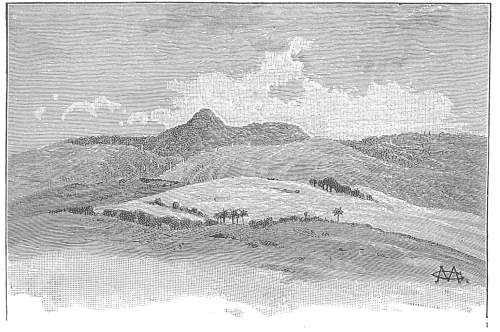
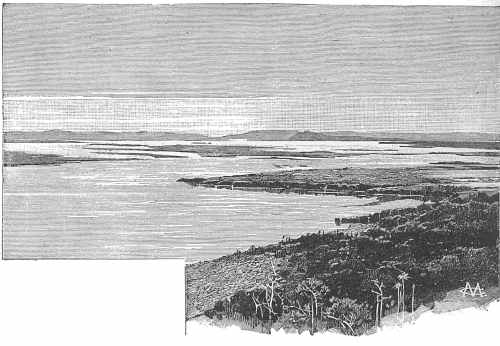
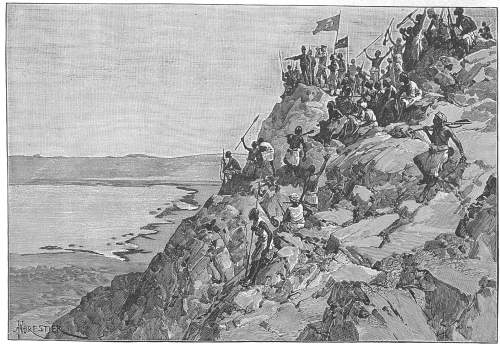
VIEW OF MOUNT PISGAH FROM THE EASTWARD.
This, then, was the long promised view and the long
expected exit out of gloom! Therefore I called the tall
peak terminating the forested ridge, of which the spur
whereon we stood was a part, and that rose two miles E.
of us to a height of 4600 feet above the sea, Pisgah,—Mount
Pisgah,—because, after 156 days of twilight in
the primeval forest, we had first viewed the desired
pasturelands of Equatoria.
The men crowded up the slope eagerly with inquiring
open-eyed looks, which, before they worded their thoughts,
we knew meant "Is it true? Is it no hoax? Can it be
1887.
Nov. 30.
Bakwuru.
possible that we are near the end of this forest hell?"
They were convinced themselves in a few moments after
they had dropped their burdens, and regarded the view
with wondering and delighted surprise.
"Aye, friends, it is true. By the mercy of God we are
well nigh the end of our prison and dungeon!" They
held their hands far out yearningly towards the superb
land, and each looked up to the bright blue heaven in
grateful worship, and after they had gazed as though
fascinated, they recovered themselves with a deep sigh,
and as they turned their heads, lo! the sable forest heaved
away to the infinity of the west, and they shook their
clenched hands at it with gestures of defiance and hate.
Feverish from sudden exaltation, they apostrophised it for
its cruelty to themselves and their kinsmen; they compared
it to Hell, they accused it of the murder of one
hundred of their comrades, they called it the wilderness
of fungi and wood-beans; but the great forest which lay
vast as a continent before them, and drowsy, like a great
beast, with monstrous fur thinly veiled by vaporous exhalations,
answered not a word, but rested in its infinite
sullenness, remorseless and implacable as ever.
From S.E. to S. extended a range of mountains between
6,000 and 7,000 feet above the sea. One woman
captive indicated S.E. as our future direction to the great
water that "rolled incessantly on the shore with a booming
noise, lifting and driving the sand before it," but as
we were in S. Lat. 1°. 22', on the same parallel as Kavalli,
our objective point, I preferred aiming east, straight towards
it.
Old Boryo, chief of Ibwiri, had drawn with his hand a
semicircle from S.E. to N.W. as the course of the Ituri
River, and said that the river rose from a plain at the foot
of a great hill, or a range of hills. To the S.E. of Pisgah
we could see no plain, but a deep wooded valley, and unless
our eyes deceived us, the forest seemed to ascend up the
slopes of the range as far as its summits. Five months
of travel in one continuous forest was surely experience
enough; a change would therefore be agreeable, even if
we varied but our hardships. This was another reason
1887.
Nov. 30.
Bakwuru.
why I proposed to decline all advice upon the proper
path leading to the "great water."
In the village of the Bakwuru, in which we now prepared
to encamp, we found sleeveless vests of thick buffalo
hide, which our men secured, as fitting armour against
the arrows of the tribes of the grass land.
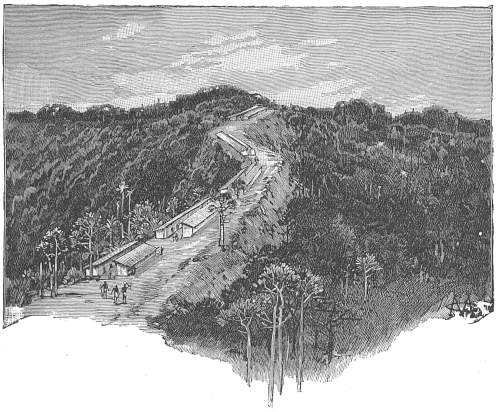
VILLAGES OF THE BAKWURU ON A SPUR OF PISGAH.
On the 1st of December we retraced our steps down
the spur, and then struck along a track running easterly.
In a short time we ascended another spur leading up to
a terrace below Pisgah peak, where we obtained the
highest reading of the aneroid that we had yet reached.
We then followed a path leading from the terrace down
another spur to the average level. A number of well-defined
and trodden roads were crossed, but our path
seemed to increase in importance until, at 11.15 A.M., we
entered the large village of Iyugu, which, of course, was
quite deserted, so quickly do the natives of the forest
seem to be apprised of new arrivals. The street of this
village was forty feet wide.
1887.
Dec. 1.
Bakwuru.
We observed a considerable dryness in the woods between
Pisgah base and Iyugu, which was a great change
from that excessive humidity felt and seen between
Indenduru and Ibwiri. The fallen forest leaves had a
slightly crispy look about them and crackled under our
feet, and the track, though still in primeval shade, had
somewhat of the dusty appearance of a village street.
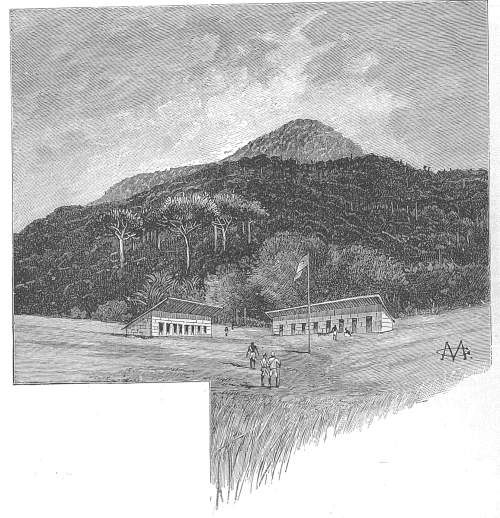
A VILLAGE AT THE BASE OF PISGAH.
Alter the noon halt we made a
two hours' march to a small village
consisting of three conical huts, near
which we camped. Though we had travelled over ten
miles we might have been hundreds of miles yet from
the open country for all we could gather from our
surroundings. For they were, as usual, of tall dense
woods, of true tropic character, dark, sombrous and
high, bound one to the other with creepers and vines,
and a thick undergrowth throve under the shades.
1887.
Dec. 1.
Bakwuru.
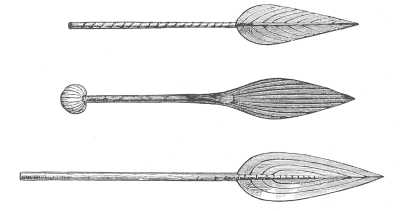
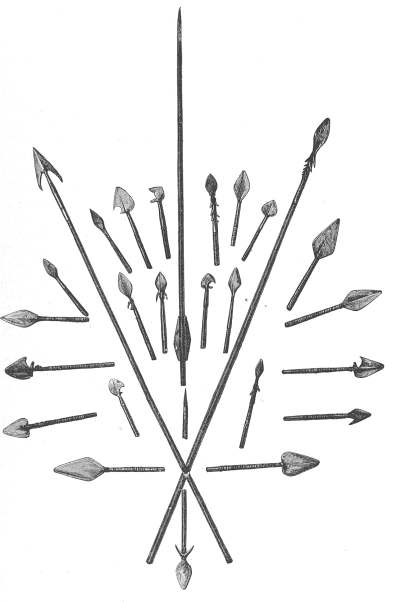
We, however, picked up a strange arrow in one of
the huts, which differed greatly from any we had
as yet seen. It was twenty-eight inches in length,
and its point was spear-shaped,and three inches
long. Its shaft was a light reed cane, beautifully and
finely notched for decoration, a thin triangular-shaped
piece of kid leather directed
the arrow, instead of a leaf
or a piece of black cloth as
hitherto. A quiver full of
forest-tribe arrows was also
found, and they were twenty
inches long, and each arrowhead
differed from the other,
though each was murderously
sharp and barbed.
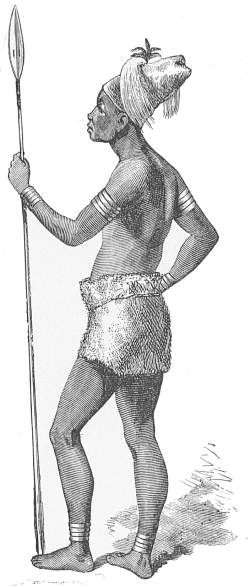
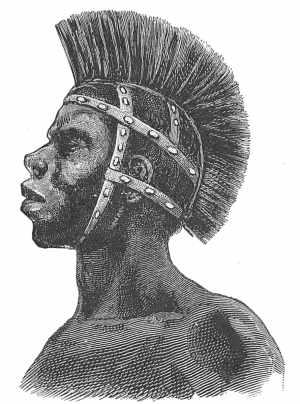
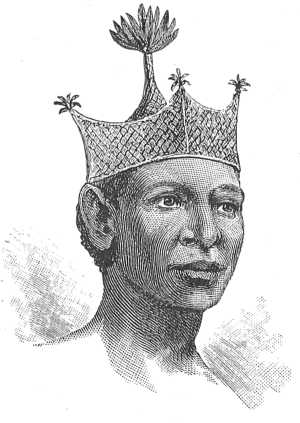
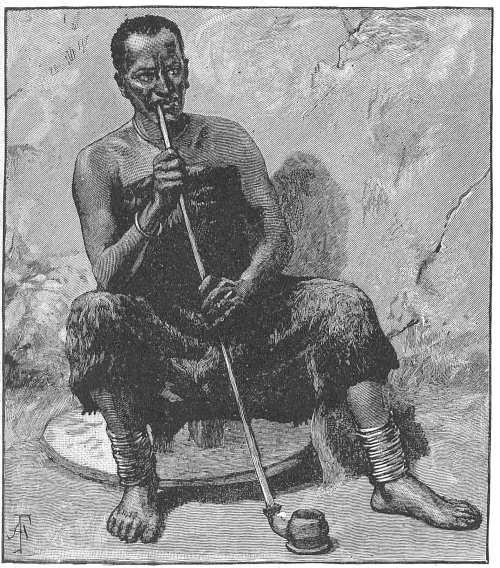
CHIEF OF THE IYUGU.
On the 2nd of December,
soon after leaving the camp,
we lost the native road, and
had to pick our way amongst
a perplexing number of buffalo
and elephant tracks. A stupid
fellow, who had been out
wandering, had informed us
that he had reached the plain
the night before, and that he
could easily guide us to it.
Trusting in him, we soon lost
all signs of a track, and began
a crooked and erratic course
through the woods, as in times
past. After nearly three
hours' travelling N. by E. we
stumbled upon a village, whose conical roofs were
thatched with grass. This was a grand discovery, and
was hailed with cheers. One fellow literally rushed to
the grass and kissed it lovingly. Already there were
two characteristics of pasture-land before us, the cone
hut and the grass thatch. We halted for a noon rest,
and a few young men took advantage of it to explore,
1887.
Dec. 2.
Indésura.
and before the halting-time was expired brought to us
a bunch of green grass, which was hailed with devout
raptures, as Noah and his family may have hailed the
kindly dove with the olive branch. However, they
reported that the way they had followed led to a swamp,
and swamps being a horror to a laden caravan, our
afternoon march was made in a S.S.E. direction, which
in ninety minutes brought us to Indésura, another
village, or rather a district, consisting of several small
settlements of cone huts thatched with grass. Here
we halted.
Having occasion to repair a roof a man mounted to
the top of a house, and looking round languidly was
presently seen to lift his hand to his eyes and gaze
earnestly. He then roared out loud enough for the
entire village to hear, "I see the grass-land. Oh, but
we are close to it!"
"Nay," said one in reply, mockingly, "don't you also
see the lake, and the steamer, and that Pasha whom we
seek?"
Most of us were, however, stirred by the news, and
three men climbed up to the roofs with the activity
of wild cats, others climbed to the tops of trees, while a
daring young fellow climbed one which would have
tasked a monkey almost, and a chorus of exclamations
rose, "Aye, verily, it is the truth of God, the open land
is close to us, and we knew it not! Why, it is merely
an arrow's flight distant! Ah, when we reach it, farewell
to darkness and blindness."
As a man went to draw water from the stream, close
by, an ancient crone stepped out of the bush, and the
man dropped his water-pot and seized her. She being vigorous
and obstinate, like most of her sex just
previous to dotage, made a vigorous defence for her
liberty. A Countess of Salisbury could not have been
more resolute, but the man possessed superior strength
and craft and hauled her into camp. By dint of smiles
and coaxing and obsequiously filling a long pipe for her,
we learned that we were in Indésura, that the people
were called Wanya-Sura, that the villagers quenched
1887.
Dec. 4.
Indésura.
their thirst with the waters of the Ituri. "The Ituri?"
"Ay, the Ituri; this stream close by;" that many days
east of us was a great broad river, ever so much
broader than the Ituri, with canoes as wide as a house
(ten feet) which would carry six people (sic); that a
few days north there was a mighty tribe called the
Banzanza, and east of them another people called the
Bakandi, and both of these tribes possessed numerous
herds of cattle, and were very valorous and warlike, and
who were rich in cattle, cowries, and brass wire.
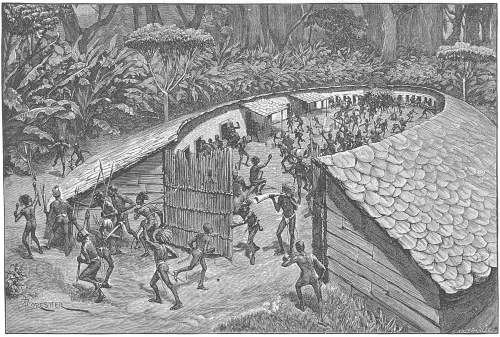
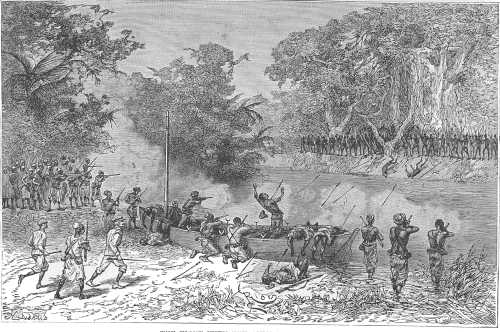
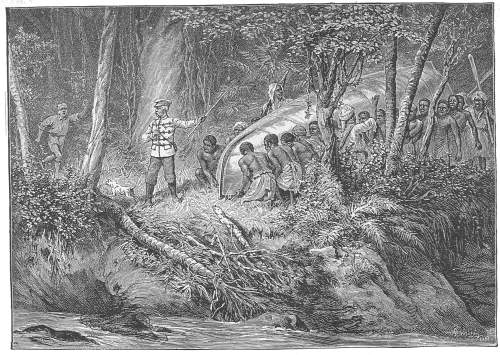
IYUGU; A CALL TO ARMS.
Our ancient captive, who was somewhat peculiar for
her taste in personal decoration by having a wooden
disk of the size of an ulster button intruded into the
centre of her upper lip, was now seized with another fit
of obstinacy and scowled malignantly at all of us except
at a bashful smooth-faced youth upon whom she
apparently doted, but the foolish youth ascribed the
ugliness of agedness to witchcraft, and fled from her.
Indésura—and, as we discovered later, all the villages
situated on the edge of the forest—was remarkable for
the variety and excellent quality of its products. Mostly
all the huts contained large baskets of superior tobacco
weighing from twenty to fifty pounds each, such quantities,
indeed, that every smoker in the camp obtained
from five to ten pounds. The crone called it "Taba;" in
Ibwiri it was called Tabo. Owing to the imperfect drying
it is not fragrant, but it is extremely smokable.
Fifty pipefuls a day of it would not produce so much
effect on the nerves as one of the article known as
Cavendish. But here and there among the leaves there
were a few of rich brown colour, slightly spotted with
nitre which produced a different effect. Two of our
officers experimented on a pipeful of this, which they
deemed to be superior, and were inconceivably wretched
in consequence. When, however, these leaves are picked
out, the tobacco is mild and innocuous, as may be
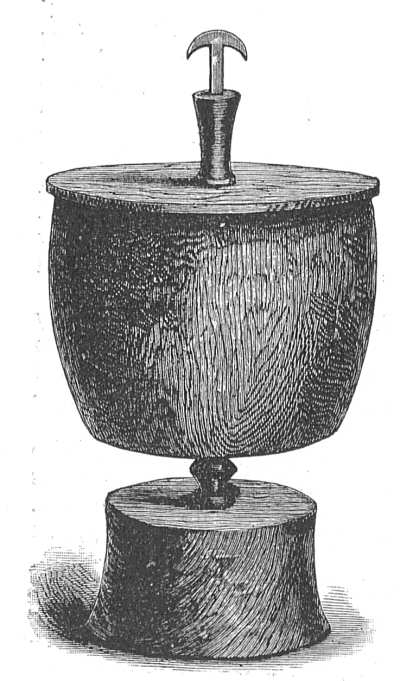
judged by the half-pint pipe-bowls peculiar to this
region. In every district near the grass-land the plant
is abundantly cultivated, for the purpose of commerce
with the herdsmen of the plains in exchange for meat.
1887.
Dec. 4.
Indésura.
The castor-oil plant was also extensively cultivated.
Requiring a supply of castor-oil as medicine, the beans
were roasted, and then pounded in a wooden mortar, and
we expressed a fair quantity, which proved very effective.
We also required a supply for rifles, and their mechanisms,
and the men prepared a supply for anointing their
bodies—an operation which made them appear fresh,
clean, and vigorous.
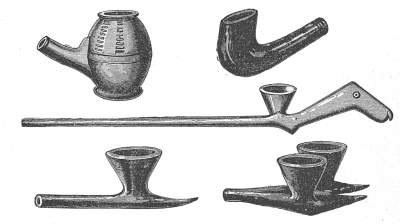
PIPES.
Having discovered that four of our scouts were
strangely absent, I despatched Rashid bin Omar and
twenty men in search of them. They were discovered
and brought to us next morning, and to my surprise the
four absentees, led by the incorrigible Juma Waziri, were
driving a flock of twenty fine goats, which the chief
scout had captured by a ruse. I had often been tempted
to sacrifice Juma for the benefit of others, but the rogue
always appeared with such an inoffensive, and crave-your-humble-pardon
kind of face, which could not be
resisted. He was of a handsome Abyssinian type, but the
hypocrisy on his features marred their natural beauty.
A Mhuma, Masai, Mtaturu, or Galla must have meat,
even more so than the Englishman. It is an article of
faith with him, that life is not worth living without an
occasional taste of beef. I therefore warned Juma again,
and consoled myself with the reflection, that his career
1887.
Dec. 4.
Indésura.
as a scout could only be for a brief time, and that he
would surely meet natives of craft and courage equal to
his own some day.
We had made an ineffectual start on this day, had
actually left the village a few hundred yards when we
were stopped by the depth of a river forty yards wide
and with a current of two and a half miles an hour.
The old crone called this the Ituri. Marvelling that
between Ipoto and Ibwiri a river 400 yards wide could
be narrowed to such a narrow stream, we had returned
to Indésura for a day's halt, and I had immediately after
sent Lieutenant Stairs and Mr. Jephson with sufficient
escort back along yesterday's path to find a ford across
the Ituri.
At 4 P.M. both officers returned to report a successful
discovery of a ford a mile and a half higher up the
stream, and that they had set foot upon the grass-land,
in proof of which they held a bunch of fine young
succulent grass. Meantime, Uledi and his party had
also found another ford waist deep, still nearer
Indésura.
On the evening of this day a happier community of
men did not exist on the face of the round earth than
those who rejoiced in the camp of Indésura. On the
morrow they were to bid farewell to the forest. The
green grassy region of which we had dreamed in our
dark hours, when slumbering heavily from exhaustion of
body and prostration from hunger during the days of
starvation, was close at hand. Their pots contained
generous supplies of juicy meat; in the messes
were roast and boiled fowls, corn mush, plantain flour
porridge, and ripe bananas. No wonder they were now
exuberantly happy, and all except ten or twelve men
were in finer condition than when they had embarked so
hopefully for the journey in the port of Zanzibar.
On the 4th of December we filed out of Indésura and
proceeded to the ford. It was waist deep, and at this
place fifty yards wide. Two of the aneroids indicated
an altitude of 3050 feet above the ocean—1850 feet
higher than the level of the river at the landing-place of
1887.
Dec. 4.
Grass Land.
Yambuya, and 2000 feet higher than the Congo at
Stanley Pool.
From the Ituri we entered a narrow belt of tall timber
on its left bank, and, after waiting for the column to cross,
marched on, led by Mr. Mounteney Jephson along a broad
elephant track for about 600 yards, and then, to our
undisguised joy, emerged upon a rolling plain, green as
an English lawn, into broadest, sweetest daylight, and
warm and glorious sunshine, to inhale the pure air
with an uncontrollable rapture. Judging of the feelings
of others by my own, we felt as if we had thrown all age
and a score of years away, as we stepped with invigorated
limbs upon the soft sward of young grass. We strode
forward at a pace most unusual, and finally, unable to
suppress our emotions, the whole caravan broke into a
run. Every man's heart seemed enlarged and lifted up
with boyish gladness. The blue heaven above us never
seemed so spacious, lofty, pure, and serene as at this
moment. We gazed at the sun itself undaunted by its
glowing brightness. The young grass, only a month
since the burning of the old, was caressed by a bland,
soft breeze, and turned itself about as if to show us its
lovely shades of tender green. Birds, so long estranged
from us, sailed and soared through the lucent atmosphere;
antelopes and elands stood on a grassy eminence gazing
and wondering, and then bounded upward and halted
snorting their surprise, to which our own was equal;
buffaloes lifted their heads in amazement at the intruders
on their silent domain, heaved their bulky forms, and
trooped away to a safer distance. A hundred square
miles of glorious country opened to our view—apparently
deserted—for we had not as yet been able to search out
the fine details of it. Leagues upon leagues of bright
green pasture land undulated in gentle waves, intersected
by narrow winding lines of umbrageous trees that filled
the hollows, scores of gentle hills studded with dark
clumps of thicket, graced here and there by a stately
tree, lorded it over level breadths of pasture and softly
sloping champaigns; and far away to the east rose some
frowning ranges of mountains beyond which we were
1887.
Dec. 4.
Grass Land.
certain slept in its deep gulf the blue Albert. Until
breathlessness forced a halt, the caravan had sped on the
double-quick—for this was also a pleasure that had been
long deferred.
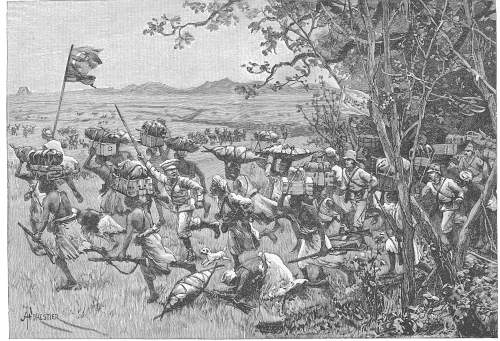
EMERGING FROM THE FOREST.
Then we halted on the crest of a commanding hill to
drink the beauty of a scene to which we knew no
rival, which had been the subject of our thoughts and
dreams for months, and now we were made "glad according
to the days wherein we had been afflicted and
the period wherein we had seen evil." Every face gloated
over the beauty of the landscape and reflected the secret
pleasure of the heart. The men were radiant with the
fulfilment of dear desires. Distrust and sullenness were
now utterly banished. We were like men out of durance
and the dungeon free and unfettered, having exchanged
foulness and damp for sweetness and purity, darkness
and gloom for divine light and wholesome air. Our
eyes followed the obscure track, roved over the pasture
hillocks, great and small, every bosky islet and swarded
level around it, along the irregularities of the forest line
that rose darkly funereal behind us, advancing here,
receding there, yonder assuming a bay-like canoe, here
a cape-like point. The mind grasped the minutest
peculiarity around as quick as vision, to cling to it for
many, many years. A score of years hence, if we live so
long, let but allusion be made to this happy hour when
every soul trembled with joy, and praise rose spontaneously
on every lip, and we shall be able to map the
whole with precision and fidelity.
After examining the contour of the new region before
us with the practical view of laying a course free from
river or swamp, I led the Expedition N.N.E. to a rocky
knoll which was about four miles from us, in order to
strike the southern base of a certain hilly range that
ran E. by S. from the knoll. I imagined we should
then be able to travel over upland, trending easterly,
without much inconvenience.
We reached the base of the rock-heap that stood about
300 feet above the valley to our right, then perceiving
that the obscure game track we had followed had developed
1887.
Dec. 4.
Grass Land.
into a native highway running N.E., we struck
across the grassy upland to retain our hold upon the
crown we had gained, the short young grass enabling us
to do so without fatigue. But near noon the tall unburnt
grass of last season interrupted our too-easy advance
with its tangle of robust stalks of close growth; but we
bore on until 12.30, and after an hour of serious exercise
halted by the side of a crystal stream for refreshments.
In the afternoon we breasted the opposing grassy
slope, and, after an hour and a half of rapid pacing, selected
a camp near the junction of two streams, which flowed
south-easterly. Relieved from their burdens, a few tireless
fellows set out to forage in some villages we had observed
far below our line of march in the valley. The suddenness
of their descent among the natives provided them
with a rich store of fowls, sugar-cane, and ripe branches
of bananas. They brought us specimens of the weapons
of this new land: several long bows and lengthy arrows;
shields of a heavy rectangular form, formed of a double
row of tough rods crossed, and tightly bound together
with fibre and smeared with some gummy substance.
They presented very neat workmanship, and were altogether
impenetrable to arrows or spears. Besides shields
the natives wore vests of buffalo hide, which appeared to
be quite impervious to pistol shots.
Our course as far as the rocky knoll already described
was nearly parallel with the edge of the forest, our path
varying in distance from it from a half mile to a mile
and a half. As a sea or a lake indents its shore, so
appeared the view of the line of forest.
The trend of the Ituri that we had crossed, which we
must call West Ituri, was E.S.E.. I should have estimated
the source of the river to have been distant from
the crossing about 25 geographical miles N.N.W.
On the next day we advanced up a long slope of short
grass land, and on the crest halted to arrange the
column with more order, lest we might be suddenly
confronted by an overwhelming force, for we were as
yet ignorant of the land, its people, and the habits of
those among whom we had dropped so suddenly.
1887.
Dec. 4.
Grass Land.
Marching forward we chose a slight track that followed
the crest leading E. by S., but soon all traces of it were
lost. However, we were on a commanding upland, and
a score of miles were visible to us in any direction out
of which we might select any course. A village was in
view N.E. of us, and to it we directed our steps, that
we might avail ourselves of a path, for the closely-packed
acreages of reedy cane and fifteen-feet-high grass,
that we stumbled upon occasionally, were as bad as the
undergrowth of the jungle. The very tallest and
rankest grass impeded us, and prevented rapid advance.
We crossed jungly gullies, on whose muddy ground were
impressed the feet of lions and leopards, and finally
entered a tract of acacia thorn, which was a sore annoyance,
and out of this last we emerged into the
millet fields of Mbiri. In a few seconds the natives
were warned of our approach, and fled instinctively, and,
Parthian-like, shot their long arrows. The scouts dashed
across every obstacle, and seized a young woman and a
lad of twelve, who were the means of instructing our
poor ignorance. No long conversation could be maintained
with them, owing to our very imperfect knowledge
of any dialect spoken near this region, but a few names
of nouns assisted by gestures brought out the fact that
we were in the district of Mbiri, that the main road
easterly would take us to the Babusessé country, that
beyond them lay the Abunguma, all of which naturally
we heard with supreme indifference. What did such
names convey to dull senses and blank minds? They
had never heard of Shakespeare, Milton, or even of Her
Majesty the Queen.
"Had any of them heard of Muta, or Luta Nzige?"
A shake of the head.
"Of Unyoro?"
"Unyoro? Yes. Unyoro lies a great way off,"
pointing east.
"Of a great water near Unyoro?"
"The Ituri, you mean?"
"No, wider; ever so much wider than the Ituri—as
wide as all this plain."
1887.
Dec. 5.
Babusessé.
But instead of confining themselves to monosyllables,
which we might easily have understood, the wretched
woman and boy, anxious to convey too much information,
smothered comprehension by voluble talk in their
dialect, and so perplexed us that we had recourse to
silence and patience. They would show us the way to
Babusessé at least.
The mode of hut construction is similar to that seen
all over East and Central Africa. It is the most
popular. A cone roof occupies two-thirds of the height;
one-third is devoted to the height of the walls. Huts
of this pattern, scattered amongst the banana groves, are
found every few dozen yards. Paths lead from one to the
other, and are most baffling to the stranger, who without
a local guide must necessarily go astray. To every
group of huts there are attached outhouses for cooking
sheds, for gossip, to store fuel, and doing chores; also
circular grass-walled and thatched little granaries raised
a foot or so above the ground as protection against
vermin and damp.
Our people obtained a large quantity of ripe plantains
and ripe bananas, out of which the aborigines
manufacture an intoxicating wine called marwa. A few
goats were also added to our flock, and about a dozen
fowls were taken. All else were left untouched according
to custom, and we resumed our journey.
The path was well trodden. Traffic and travel had
tamped it hard and smooth. It led S.E. by E. up and
down grassy hills and vales. Near noon we halted for
refreshments, shaded by fine woods, and close by
boomed a loud cataract of the Ituri, we were told.
This was rather puzzling. We could not understand
how the Ituri, which we had forded the day before,
could be roaring over precipices and terraces at this
high altitude, and after we had purposely struck away
from its valley to avoid it.
A march of an hour and a half in the afternoon,
apparently not very far from the river, brought us
to the populous district of the Babusessé. The banana
plantations were very extensive, reminding me of
1887.
Dec. 5.
Babusessé.
Uganda, and their deep shades covered a multitude of
huts. Fields of millet and sesame, plots of sweet
potatoes, occupied the outskirts of these plantations,
and there was ample evidence round about that the
land was thickly peopled and industriously cultivated.
Before entering the banana shades we repaired our
ranks, and marched in more compact order. A strong
body of men armed with Winchesters formed the
advance guard; a similar number of men armed with
Remingtons, under the command of Stairs, closed the
rear of the column. But however well cautioned the
men were against breaking
rank, no sooner had the
advance guard passed safely
through a dangerous locality
than the main body invariably
despatched scores
of looters into huts and
granaries to hunt up booty
and fowls, bananas, goats,
sugar-cane, and trivial articles
of no earthly use.
These plantations hid a
large number of natives,
who permitted the advance
to pass because their files
were unbroken, and their
eyes on the watch, but those
straggling looters soon gave the aborigines the opportunity.
Some arrows flew well aimed; one pinned a
man's arm to his side, another glancing from a rib
admonished its owner of his folly. A volley from rifles
drove the men away from their covert without harm
to any of them.
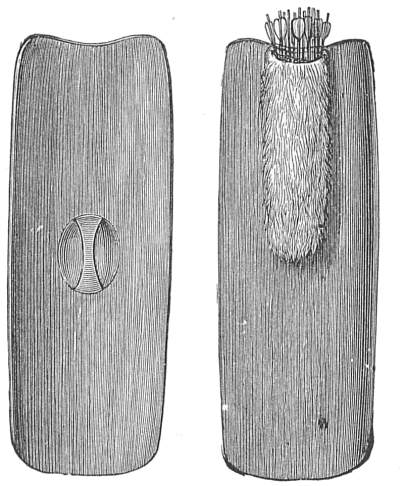
SHIELDS OF BABUSESSÉ.
At the easternmost settlement we camped. There
were only two large conical huts and other outhouses in
it, and around these the huts for the night were arranged
hastily, put up with banana leaves sufficient to
shed rain and dew.
At dusk I called the captives to me again, and attempted,
1887.
Dec. 5.
Babusessé.
during half an hour, to gain a lucid answer to
the question as to whether there was a great body of
water or great river east of us. When one of the headmen
who were assisting us demanded to know which was
the largest Nyanza, that of Unyoro, or that of Uganda—
"Nyanza!" cried the native boy—"Nyanza? Ay,
the Nyanza lies this way" (pointing east) "and extends
that way" (north-east) "a long distance;" and when
asked how many "sleeps" intervened between the Babusessé,
held up three fingers on his dexter hand, and
answered "three."
It was now dark, and we were suddenly startled by a
shriek of pain, and a sequent yell singularly weird, and
with a note of triumph in it, and in the silence that
followed we heard the hurtling of arrows through the
banana leaves above our heads.
"Put out the fires! Keep cool. Where are the
sentries? Why are they not at their posts?" were the
next words uttered.
The natives had stolen on us at the very hour when
the camp was least watched, for it was supper-time, and
the guards, except on unusual occasions, were permitted
to feed before going out on guard duty for the night.
We soon ascertained that one arrow had penetrated the
thigh of a man named Salim to the depth of four inches,
another had pierced the roast leg of a kid before the fire,
several others had perforated banana stalks. Salim, after
a little coaxing, bravely drew out the shaft until the
barbed point was seen, when, with a wrench, I extracted
it with a pair of pincers. Eucalyptine was then applied
to the wound, and the man was sent to his quarters.
Half an hour later, all the guards being now on duty,
however, the natives essayed another quarter of the
camp, but the rifle-shots rang out quickly in reply, and
there was a scamper and a rustle heard. In the distance
we heard two rifles fired, and an agonised cry, by which
we knew that there were some of our incorrigible looters
abroad.
Our force was weak enough, in all conscience, not in
numbers, but in real strength, for defence and capacity
1887.
Dec. 5.
Babusessé.
for bearing ammunition, and these wanderers were always
a source of great anxiety to me. It was useless to reason
and expostulate; only downright severity restrained
them, and as yet, so fresh were we from the horrors
of the forest, that I had not the moral courage to
apply the screw of discipline; but when I assumed
mildness, their own heedless imprudence incurred punishments
far more severe than any of us would ever have
thought of inflicting.
A heavy rain fell on us during the night, which
detained us next morning until eight o'clock. I employed
the time in extracting something intelligible
respecting the character of the natives in front, but we
were all so profoundly ignorant of the language that we
could make but little headway. In the endeavour to
make herself clear, the woman drew on the ground a
sketch of the course of the Ituri. This illustrated one of
the strangest facts in African geography that one could
imagine. The river was represented as going up to the
crest of the watershed, flowing steeply upward parallel
with Lake Albert, and finally lifting itself over to be
precipitated into the Nyanza! Stupefied by what she
said, I kept her by me as we marched out of camp into
the open. From the crown of a hill she pointed out,
half a mile below, the Ituri River flowing eastward. The
stretch in view was an east by south course.
Now here was a deep puzzle. We had crossed from
the right bank to the left bank of the Ituri two days
previously, in N. Lat. 1° 24': we were now in N. Lat.
1° 28'. Yet the Ituri we saw flowed E. by S. and
E.S.S., and my route to Kavalli was obviously south of
east.
I declined to perplex myself any more with the
problem, or in trying to understand what the woman
meant, that the river we had ascended for 600 miles
from the Congo flowed to the Nyanza. The only
solution possible was that there were two Ituris, one
flowing to the Congo, the other into the Nile basin;
but both she and her brother stoutly maintained that
there was only one Ituri.
1887.
Dec. 5.
Babusessé.
We continued on our journey, following a path which
dipped down into the valley. We presently stood on
the banks of the stream, and the solution was at hand.
It was the main Ituri River, flowing south of west! We
are all wise after the event.
There was a clumsy, misshapen canoe in the river,
and as Saat Tato was an expert canoeist, he was
detailed to ferry the caravan over for a reward of
20 dollars. The river was 125 yards broad, about seven
feet average depth, with a current of two knots. It
was a cataract of this stream whose low thunder we
had heard near Mbiri.
The natives of Abunguma, on the left side of the
river, watched our operations from a hill-top a mile
off, with an air of confidence which seemed to say,
"All right, friends. When you are through, you will
have to reckon with us." Nothing could be done in
such an open land as this without "all the world
knowing it." The Abunguma shook their spears bravely
at us; the Babusessé occupied every prominent point
on the right side of the river. It appeared once or
twice as if our manhood was about to be tested on an
important scale. There was the comfort, however, that,
knowing the natives to be alert and active, we could
not be surprised on a pasture slope where the grass
around the camp was but three inches high.
Since we had entered Ibwiri we had fared luxuriously—for
Africa. We had enjoyed meat and milk daily.
We had lived on fowls, young and dried beans, sugar-cane,
sweet potatoes, yams, colocassia, tomatoes, brinjalls,
melons, plantains, and bananas. On the people the
effect was wonderful. They were men in every respect
superior both in body and spirit to the gaunt and craven
wretches whom the Arab slaves of Ipoto scourged and
speared without more than a mild protest. On the
whites also the effect had been most beneficial. Though
spare, we were no longer meagre and haggard; a little
wine would have completed the cure.
A gentle grassy slope, on the next morning, took us,
in the course of an hour, to the crown of one of those
1887.
Dec. 5.
Babusessé.
long undulations so characteristic of this region. It
furnished us with another all-round view peculiarly
interesting to us. Our intended direction was southeast,
as we were bearing for a high conical peak at
the end of a range of grass-covered mountains, which
afterwards became known to us as Mazamboni's Peak.
We dipped down into delightful vales, watered by cool
and clear brooks. Close to these were small clusters of
native homesteads, with their fields of unripe sorghum,
sweet potato, and sugar-cane patches, &c. But the
homesteads were all abandoned, and their owners were
observing us from the sky-line of every superior hill.
Finally we passed an empty cattle zeriba, the sight of
which was loudly cheered, and cries of "Ay, the master
is right, and every word comes to pass. First will come
the grass-land, then the cattle with brave men to defend
them, then hills, then the Nyanza, and lastly the white
man. The grass-land we have seen, here is the cattle
yard, yonder are the mountains, the brave men and the
Nyanza and the white man we shall yet see, please
God."
We bore on our way to a valley through which
another river rushed and roared. On our left was a rugged
line of rocks that rose in huge and detached masses, on
the top of which a dozen men might be seated comfortably.
Connecting these huge rock masses was a lower
line of rocks, more uniform, forming the bare spine
of a ridge. At some places we passed so close to the
base of this hill that we were within easy stone's throw
of the summits. But though we were prepared for a
demonstration, the natives remained singularly quiet.
The path we followed halted at a suspension bridge
across a third "Ituri," which had better be distinguished
as East Ituri to prevent misunderstanding. This last
river was thirty yards wide, deep and swift as a rapid.
Spanned by a bridge of such fragile make that we could
only pass one at a time in safety, it required one
hundred and twenty seconds for a single person to cross
the ninety-feet span, and the caravan was not on the
other side entirely before 6 P.M. As the crossing was in
1887.
Dec. 6.
Ituri
River.
a position of great disadvantage, riflemen had been on
the look-out all day.
In the afternoon we saw a fine black cow and her calf
issue out of a defile in the rocky ridge just described,
and clamours of "Beef, beef—ay, beef, how are you?
we have not seen you since we were young!" rose loud.
The Abunguma had hidden their cattle among the rocky
hills, and these specimens had probably been refractory.
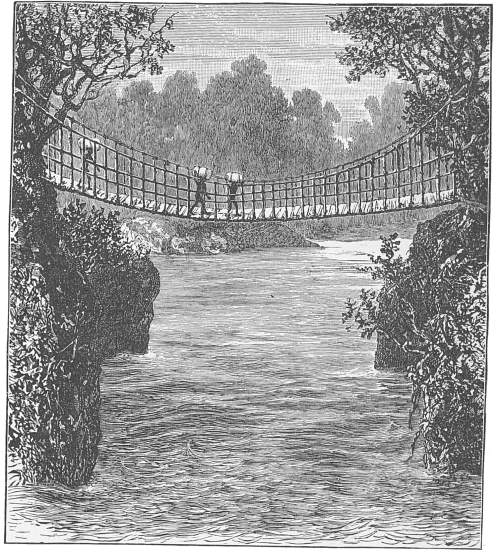
SUSPENSION BRIDGE ACROSS THE E. ITURI.
Leaving the picturesque valley of East Ituri on the
8th, we ascended an easy slope to the top of a hill where
we obtained a long view of the crooked and narrow
valley of the East Ituri, and were able to observe that
it came from an east-south-east direction. Shortly after,
1887.
Dec. 8.
Undussuma.
something more like a plain opened before us, extending
over a score of miles to the south, bordered on the north
by the stony ridge and valley we had just left behind,
while to the eastward rose Mazamboni's mountain range,
whose northern end, conspicuous by the tall peak, was
our present objective point.
At 9.30 A.M. we had approached several miles nearer
this mountain range, and before descending into the
valley of a streamlet flowing northward, we observed
with wonder that the whole intervening space as far as
the mountains was one mass of plantations, indicative of
a powerful population. Here then, we thought, "will
be the tug of war. The Abunguma have left their
settlements in order to join this numerous tribe, and
meet us with a fitting reception." No more populous
settlements had been seen since we had departed from
Bangala on the Congo. A suspicion that these were
among the confederation of tribes who hemmed in the
poor anxious governor of Equatoria also crept into our
minds, as we looked upon this huge display of numbers
and evidence of wealth and security.
With the view of not provoking the natives, and of
preventing the incorrigible looters of the column from
the commission of mischief, we took a south-east track
to skirt the district. We were able to steer our course
between the plantations, so that no cover was afforded to
an enemy. At 11.30 we had reached the eastern extremity
of the district, and then rested for the noon halt
and refreshment, under the shadow of a tree whose
branches rustled before a strong cool breeze from the
Nyanza.
Resuming the march at 1 P.M. we entered the depths
of banana plantations, marvelling at the great industry
evinced, and the neatness of the cultivated plots. The
conical homesteads were large and partitioned within, as
we observed while passing through a few open doorways,
by screens of cane grass. Every village was cleanly
swept, as though they had been specially prepared for
guests. Each banana stalk was loaded with bananas,
the potato fields were extensive, the millet fields stretched
1887.
Dec. 8.
Undussuma.
away on either side by hundreds of acres, and the many
granaries that had lately been erected manifested expectations
of a bountiful harvest.
We finally emerged from the corn-fields without being
once annoyed. We thought the natives had been cowed
by exaggerated reports of our power, or they had been
disconcerted by our cautious manœuvre of leaving a fair
open margin between the line of march and the groves;
but much to our surprise we encountered no opposition,
though large masses of the aborigines covered the
eminences bordering our route.
The broad and well-trodden path towards the mountains
which we were now rapidly approaching bisected an
almost level plain, three miles wide, rich with pasture
grass in flower. The Eastern Ituri was not far off on
our left flank, and on the other side of it another
populous settlement was in view.
At 3 P.M. we arrived at the base of the Mountain of
the Peak. Many of its highest points were crowned
with clusters of huts. The cotes of the natives were in
the folds of the mountain fronting us. The people
gathered in large groups on the nearest summits, and
when we were near enough the shouts of defiance were
uttered with loud and strident voices. We estimated
the average height of the hills nearest to us at about
800 feet above the plain, and as the slopes were particularly
steep we judged their distance to be between
800 and 1000 yards from us.
Much to our pleasure and relief the path, instead of
ascending those steep slopes, skirted their base, and
turned east, pursuing the direction we wished being
now in, North Lat. 1° 25' 30". A valley unfolded to
our view as we rounded the corner of the Peak Range,
with a breadth of one to two miles wide, which was
clothed with luxuriant sorghum ripening for the sickle.
On our right, rising immediately above us, was the north
side of Mazamboni's range; to our left, the ground,
hidden by crops of grain, sloped gradually to a rapid
branch of the East Ituri, and beyond it rose, an
easy slope to a broad horse-shoe shaped grassy
1887.
Dec. 8.
Undussuma.
ridge, studded with homesteads, green with millet and
corn, and rich in banana groves. One sweeping view of
our surroundings impressed us with the prosperity of the
tribe.
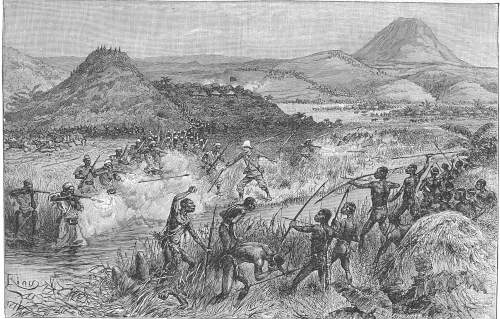
OUR FIRST EXPERIENCES WITH MAZAMBONI'S PEOPLE.
VIEW FROM NZERA KUM HILL.
On entering this rich crop-bearing valley a chorus of
war-cries pealing menacingly above our heads caused us
to look up. The groups had already become more
numerous, until there were probably 300 warriors with
shield, spear, and bow, shaking their flashing weapons,
gesturing with shield and spear, crying wrathfully at us
in some language. Waxing more ungovernable in action
they made a demonstration to descend; they altered
their intentions, returned to the summit, and kept pace
with us—we along the base, they along the crest of the
fore hills, snarling and yelling, shouting and threatening,
which we took to be expressive of hate to us, and
encouragement to those in the valley.
Issuing out of the first series of cornfields, we heard
the war-cries of the valley natives, and comprehended
that they were taking position in favourable localities—the
hill natives warning and guiding them. It was now
near 4 P.M., a time to pick out camp, to make ready for
the night in the midst of a population overwhelming in
its numbers. Fortunately, close at hand rose the steep
hill of Nzera-Kum with a spur, whose level top rose a
hundred feet above the general face of the valley. It
stood like an islet in the valley, distant from the river
500 yards, and from the base of Mazamboni's range
200 yards. From the crest of Nzera-Kum we could
command a view east and west of all the northern face
of the high range, and away over the summit lines of
the horse-shoe ridge, across the Ituri branch. Fifty rifles
could hold a camp on such a position against a thousand.
We hurried up towards it, the warriors on the range
slopes converging downward as if divining our intentions;
a mass of noisy belligerents hastening towards the line
of march from the river banks. The scouts in the
advance fired a few solitary shots to clear the front, and
we succeeded in reaching the islet hill and scrambled up.
The loads were thrown down, a few picked skirmishers
1887.
Dec. 8.
Undussuma.
were ordered to either flank of the column to assist the
rear-guard, others were directed to form a zeriba around
the crown of the spur; a body of thirty men was sent
to secure water from the river. In half an hour the
column was safe on the hill, the zeriba was near completion,
there was water for the thirsty, and we had a
few minutes to draw breath and to observe from our
commanding elevation what were our surroundings.
The bird's-eye view was not a bit encouraging. About
fifty villages were sprinkled through the valley; plantation
after plantation, field after field, village after
village met our vision in every direction. What lay
on the mountains we did not know. The swarms
of lusty-voiced natives on the slopes now numbered
over 800. The air seemed filled with the uproar of the
shouts.
The mountaineers appeared disposed to try conclusions
at once. We were fatigued with the march of 13 miles;
the hot sun and weight of burdens had weakened the
physical powers of the men. Some of the best, however,
were picked out and sent to meet the mountaineers,
while we stood and watched to weigh the temper of our
opponents. Four of the scouts were foremost. An
equal number of the mountaineers, not a whit loth for
the encounter, bounded gallantly to meet them. They
intuitively felt that the courage of our four men was
not of the highest order. They approached to within
100 yards of them, and prepared their bows against the
rifles. Our men delivered their fire harmlessly, and
then backed; the mountaineers advanced, with fingers
on their bow-strings. Our four men fled, while a
hundred voices from our camp, looking down upon the
scene, execrated them. This was a bad beginning for
our side; the natives accepted it as a favourable omen
to them, and yelled triumphantly. To check this glow,
our riflemen sought cover, and seriously annoyed the
natives. Some at the extremity of the hill of Nzera-Kum
did execution among the mountaineers on the slope of
the range opposite, at 400 yards distance; others crept
down into the valley towards the river, and obtained a
1887.
Dec. 8.
Undussuma.
triumph for us; others, again, working round the base
of Nzera-Kum, effected a diversion in our favour. Saat
Tato, our hunter, carried away a cow from her owners,
and we thus obtained a taste of beef after eleven months'
abstinence. As night fell, natives and strangers sought
their respective quarters, both anticipating a busy day
on the morrow.
Before turning in for the night, I resumed my reading
of the Bible as usual. I had already read the book
through from beginning to end once, and was now
at Deuteronomy for the second reading, and I came
unto the verse wherein Moses exhorts Joshua in those
fine lines, "Be strong and of a good courage; fear not,
nor be afraid of them: for the Lord thy God, He it is
that doth go with thee; He will not fail thee, nor
forsake thee."
I continued my reading, and at the end of the chapter
closed the book, and from Moses my mind travelled at
once to Mazamboni. Was it great fatigue, incipient
ague, or an admonitory symptom of ailment, or a shade
of spiteful feeling against our cowardly four, and a
vague sense of distrust that at some critical time my
loons would fly? We certainly were in the presence of
people very different from the forest natives. In
open our men had not been tested as they were to-day,
and what my officers and self had seen of them was not
encouraging. At any rate, my mind was occupied
with a keener sense of the danger incurred by us in
adventuring with such a small force of cowardly porters
to confront the tribes of the grass land than I remember
it on any previous occasion. It seemed to me now that
I had a more thorough grasp of what might be expected.
Whether it followed a larger visual view of land and
population, or that I was impressed by the volume of
human voices, whose uproar yet seemed to sound in my
ears, I know not. But a voice appeared to say, "Be
strong and of a good courage: fear not, nor be afraid
of them." I could almost have sworn I heard the voice.
I began to argue with it. Why do you adjure me to
abandon the Mission? I cannot run if I would. To
1887.
Dec. 8.
Undussuma.
retreat would be far more fatal than advance; therefore
your encouragement is unnecessary. It replied, nevertheless,
"Be strong and of a good courage. Advance,
and be confident, for I will give this people and this
land unto thee. I will not fail thee nor forsake thee;
fear not, nor be dismayed."
Still—all this in strict confidence—before I slept
I may add that though I certainly never felt fitter for
a fight, it struck me, that both sides were remarkably
foolish, and about to engage in what I conceived to
be an unnecessary contest. We did not know even the
name of the land or of the people, and they were equally
ignorant of our name and of our purpose and motives.
I sketched out my plans for the morrow, adjured the
sentries to keep strict watch, and in sleep became soon
oblivious of this Mazamboni—lord of the mountains
and plains.
December 9th was a halt. In the morning we completed
our thorn-bush fence, distributed cartridges, and
examined rifles. By 9 o'clock the chill of early day
retired before the warmth of a hot sun, and shortly after
the natives mustered in imposing numbers. War-horns,
with the weird notes heard in Usoga and Uganda in
1875, sounded the gathering, and over twenty drums
boomed from each mountain top. There were shouts
and cries flying in currents from mountain to valley,
and back again, for we were quite surrounded. About
11 a.m. some few natives descended close enough for
one Fetteh, a man of Unyoro, to distinguish what was
said, and he exchanged a hot abuse with them, until
there was quite a wordy war. Hearing that one of our
people understood the language, I directed the wrathful
tongues in the interests of peace, and a more amicable
language resulted.
"We on our side," was said, "only fight in defence.
You assail us while quietly passing through the land.
Would it not be better to talk to each other, and try to
understand one another first, and then, if we cannot
agree, fight."
"True, those are wise words," a man replied. "Tell
1887.
Dec. 9.
Undussuma.
us who you are. Where you are from, and where you
are going."
"We are of Zanzibar, from the sea, and our chief is a
white man. We are bound for the Nyanza of Unyoro."
"If you have a white man with you, let us see him,
and we shall believe you."
Lieutenant Stairs promptly stepped out of the zeriba
and was introduced by Fetteh.
"Now you tell us who you are," said Fetteh. "What
land is this? Who is your chief? And how far is the
Nyanza?"
"This land is Undussuma, the chief is Mazamboni.
We are Wazamboni. The Ruweru (Nyanza) is reached
in two days. It will take you five days. It lies east.
There is only one road, and you cannot miss it."
This began the exchange of friendly intercourse.
Strangerhood was broken. We then learned that there
were two chiefs in Undussuma, one of whom would not
be averse to peace, and exchange of friendly gifts, if it
were agreeable to us. We gladly assented, and several
hours were passed without a hostile cry being heard, or
a shot fired, except at the river, the natives on whose
shores were obstinate, and declined listening to anything
but war proposals.
In the afternoon a message came from Mazamboni
saying he would like to see the pattern and quality of
our monies. We sent two yards of scarlet uniform cloth,
and a dozen brass rods, and a promise was given that
early next morning the chief himself would appear and
go through the ceremony of brotherhood with me.
The next day we were refreshed after an undisturbed
night, and fondly indulged in anticipations that in a few
hours, perhaps, our camp would be filled with friendly
natives. We had been requested not to depart until a
return gift should arrive from Mazamboni. We accordingly
had resolved on another day's halt. The morning
was still raw and cold, for we were 4,235 feet above the
sea. A mist covered the tall mountain tops, and a
slight drizzle had set in, which excused our friends from
a too early appearance; but at the third hour the mist
1887.
Dec. 10.
Undussuma.
cleared away, and the outline of the entire range was
clear against a pale blue sky. Lieutenant Stairs, Mr.
Jephson, and myself, were out at the extreme west end
of the spur enjoying the splendid view, admiring the
scenery, and wondering when such a beautiful land
would become the homesteads of civilized settlers.
Stairs thought that it resembled New Zealand, and said
that he would not mind possessing a ranche here. He
actually went so far as to locate it, and pointed out the
most desirable spot. "On that little hill I would build
my house"—"Shebang" he called it. I wonder if that
is a New Zealand term for a villa—"There I would herd
my cattle; my sheep could browse on the mountain
slope behind, and——"
But meantime the natives had appeared on the crests
of the mountain in lengthy columns, converging towards
a common centre—a butt end of a truncated hill—a
thousand yards in an air line from where we stood, and
a voice like that of a mob orator, clear and harmonious,
broke on our ear. It proceeded from a man who, with
a few companions, had descended to about 300 feet
above the valley. He was ten minutes speaking, and
Fetteh had been brought to listen and translate.
Fetteh said that he commanded peace in the name of
the king; but strange to say, no sooner had the man
concluded his speech than loud, responsive yells rose
from the valley in a hideous and savage clamour, and
then from every mountain top, and from the slopes
there was a re-echo of the savage outburst.
We surmised that such forceful yelling could not
signal a peace, but rather war; and in order to make
sure, sent Fetteh down into the valley below the speaker
to ask him. The replies from the natives left us no
room to doubt. The two sounds—Kanwana, "peace,"
and Kurwana, "war," were so similar that they had occasioned
Fetteh's error.
"We do not want your friendship," they cried. "We
are coming down to you shortly to drive you out of
your camp with our herdsmen's staffs." And a
treacherous fellow, who had crawled under cover of low
1887.
Dec. 10.
Undussuma.
bush, came near causing us a severe loss—our interpreter
especially having an exceedingly narrow escape. Fetteh
picked up the arrows and brought them to us, and
delivered his news.
There was then no alternative but to inflict an exemplary
lesson upon them; and we prepared to carry it
out without losing a moment of time, and with the
utmost vigour, unless checked by proffers of amity.
The companies were mustered, and fifty rifles were led
out by Lieutenant Stairs towards those obstinate and
fierce fellows on the other side of the Ituri branch. A
party of thirty rifles were sent under Mr. Jephson to
skirmish up the slopes to the left; and twenty picked men
were sent with Uledi to make a demonstration to the right.
Rashid was ordered with ten men to the top of Nzera-Kum
to guard against surprise from that quarter.
Jephson and Uledi would be marching to their positions
unobserved by the mountaineers, because the crowns of
the forehills would obstruct the view, and would approach
to them within 200 yards without being seen,
while Lieutenant Stairs' company, being further out in
the valley, would absorb their attention.
In a few minutes Stairs' company was hotly engaged.
The natives received our men with cool determination
for a few minutes, and shot their arrows in literal showers;
but the Lieutenant, perceiving that their coolness rose
from the knowledge that there was a considerable stream
intervening between them and his company, cheered his
men to charge across the river. His men obeyed him,
and as they ascended the opposite bank opened a
withering fire which in a few seconds broke up the nest
of refractory and turbulent fellows who had cried out so
loudly for war. The village was taken with a rush and
the banana plantations scoured. The natives broke out
into the open on a run, and fled far northward.
Lieutenant Stairs then collected his men, set fire to the
village, and proceeded to the assault of other settlements,
rattling volleys from the company announcing the
resistance they met.
Meanwhile, Uledi's party of chosen men had discovered
1887.
Dec. 10.
Undussuma.
a path leading up the mountain along a spur, and after
ascending 500 feet, led his men up into view on the
right flank of the mob observing and cheering their
countrymen in the valley. The Winchesters were worked
most handsomely. At the same time Mr. Jephson's
party came out of the left ravine, and together they had
such a disastrous effect on the nerves of the natives that
they fled furiously up the slopes, Uledi and his men
chasing them.
Mr. Jephson, after seeing them in full flight,
faced eastward, and pushed on for two miles, clearing
every inhabitant out. By 1 P.M. all our men were
in camp, with only one man slightly wounded. Every
man had behaved wonderfully well; even the four
cowards, who had been marked men, had distinguished
themselves.
At 2 p.m., the natives in the valley having returned,
each party was despatched once again. Stairs led his
men across the Ituri branch, and followed the running
fugitives far northward, then veered sharply round to
join Jephson, who had continued his way eastward.
Uledi's scouts were sent up to the very summit of
the mountain range; but on observing the immense
number of homesteads that dotted it, he prudently
halted.
Until the afternoon the contest continued; the natives
were constantly on the run, charging or retreating. By
evening not one was in sight, and the silence around
our camp was significant of the day's doings. The
inhabitants were on the mountains or far removed eastward
and northward. In the valley around us there
was not a hut left standing to be a cover during the
night. The lesson, we felt, was not completed. We
should have to return by that route. In the natural
course of things, if we met many tribes of the quality of
this, we should lose many men, and if we left them in
the least doubt of our ability to protect ourselves, we
should have to repeat our day's work. It was, therefore,
far more merciful to finish the affair thoroughly before
leaving a tribe in unwhipped insolence in our rear.
1887.
Dec. 10.
Undussuma.
The natives must have entertained an idea that we
could not fight outside our bush fence, which accounts
for their tall talk of driving us out with sticks, and that
they were safe on the mountains. We were compelled
to root out the idea that they could harm us in any
way.
A cow neglected by her owner was burnt in one of
the villages close by, and furnished us with a second
limited ration of roast beef.
On the 11th it rained again during the early morning,
which kept us indoors until 10 A.M. Some natives
having then come out to demonstrate their hostility on
the mountains, Stairs, Jephson and Uledi
led their men up the mountain slopes in
three separate small columns to the attack,
and made a successful tour among their
stronghold. A small flock of goats was
captured, and distributed to the men, and
our experiences of this day satisfied the
natives that they had nothing to gain by
fighting.
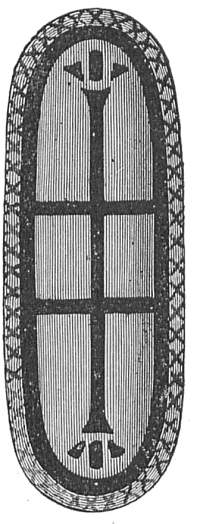
SHIELD OF THE EDGE OF THE PLAINS.
At one time it appeared as
day would end with reconciliation, for a
native stood on a high hill above our
position after all had reached camp, and
announced that he had been sent by
Mazamboni to say that he received our
gifts, but that he had been prevented from
visiting us according to promise by the
clamour of his young men, who insisted on fighting.
But now, as many of them had been killed, he was
ready to pay tribute, and be a true friend in future.
We replied that we were agreeable to peace and friendship
with them, but as they had mocked us, kept our
peace presents, and then scornfully called us women,
they must purchase peace with cattle or goats, and if
they held up grass in their hands they could approach
without fear.
It should be mentioned that when the warriors descended
the mountain slopes for the fight, every little
1887.
Dec. 11.
Undussuma.
squad of men was accompanied by a large hound, of
somewhat slender build, but courageous, and prompt to
attack.
The arms of the Wazamboni consisted of long bows
five and a half feet long, and arrows twenty-eight
inches long, besides a long sharp spear. Their shields
were long and narrow generally, but there were many of
the true Uganda type. The arrows were cruelly barbed,
and the spear was similar to that of Karagwé, Uhha,
Urundi, and Ihangiro.
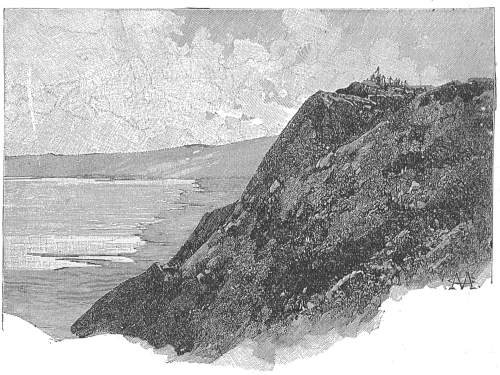
VIEW OF THE SOUTH END OF ALBERT NYANZA. (See page 306.)