Hôtel de France, Blois, September 11th.
This has been a golden day of pure delight,
with a brilliant sunshine from early morn to
dewy eve, and a cool, refreshing air, an altogether
ideal day for our prolonged visitations
among the châteaux around Blois! Lydia and
I went to the little Protestant church with Miss
Cassandra this morning, as a salve to our consciences,
Archie says, in view of the giddy
round of pleasure that we had planned for the
afternoon. He and Walter tried to beguile
Lydia from our side, to spend the morning in
roaming about Blois with them; but she is a
loyal little soul and resisted all their blandishments
with sweet steadfastness, saying that
after following the Huguenots through all the
miseries that were heaped upon them, the least
that we can do is to honor their memories in
their chapel here at Blois.
Archie says that we are quite right and that
this sentiment is praiseworthy; but that as he
and Walter were unable to honor these heroic
souls in their own language, to attend such a
service would be a mockery.
"Yes," Walter added, "it would seem like
a bit of play-acting to sit there in church, like
two whited sepulchres, trying to look as if we
understood when we should not know six words
of what was being said."
Miss Cassandra, being accustomed to religious
service where not a word is spoken in
any language, naturally does not think much
of these arguments; but having a strong liking
for my two men she is quite willing to excuse
them from accompanying us to the chapel. Nor
do I wonder that they are glad to have a fine
morning in which to roam about this interesting
old town together, and to give zest and point
to their rambles, M. La Tour has told them of
an ancient coin associated with the history of
Blois. This coin is said to be the oldest document
in existence on, or in, which the name of
Blois is inscribed, it also bears the name of
the officer of the mint at Blois at the time of
its issue, far back in history. Of course Walter
and Archie are very anxious to see this ancient
coin, and M. La Tour has given them a letter
of introduction to the man who has charge of
it, which he assured them would admit them to
a view of it Sundays or holidays, or any time
in the day or night.
We enjoyed the service in the little church,
where we heard a really eloquent discourse
from an old pasteur with the most beautiful,
benevolent face that you can imagine. We are
quite sure that this handsome, venerable clergyman
comes from a long line of heroic Huguenot
ancestors, and Miss Cassandra says that she
did not mind so much not understanding what
he said, as she was quite sure that it was all
to edification, which she evidently does not
always feel with regard to the long tales that
the guides spin off for us, and in truth Lydia
and I have tripped them up more than twice in
their history. We returned to the hotel quite
enthusiastic about the chapel and its pastor,
and Miss Cassandra is already planning some
benevolent scheme to help the evidently
struggling congregation. If her means were
equal to her charitable intent, what would she
not do for the benefit of mankind in all quarters
of the globe? Walter and Archie were so impressed
by her description of "the venerable
descendant of a long line of massacred Huguenots"
that they have made substantial acknowledgments
to be sent by Lydia and myself to
the patrons of the little chapel.
The idea of visiting three châteaux in one
afternoon was rather appalling at first; but
the afternoon was long, beginning soon after
our twelve o'clock déjeuner, and the roads are
fine for motoring in this level country. Our
way lay for some miles by Loire, first on one
bank and then on the other. This flat country,
with its wide reaches of meadow land and
distant horizon lines, has a charm of its own,
its restfulness suits the drowsy autumn days,
and no trees could be better fitted to border
these roadsides and river banks than the tall
slim Lombardy poplars, with their odd bunches
of foliage atop like the plumes and pompons
on soldiers' caps. Down by some of the streams
large white poplars have spread out their
branches, making coverts from the sunshine
for man and beast. On these poplars we
noticed what looked like huge green nests.
"Are they crows' nests?" we asked, as there
seem to be no end of crows all about here.
"No, not for the corbeaux," said the chauffeur,
shaking his head and looking fairly
puzzled, as he explained with some elaboration
that this was a parasitic plant which drew its
nourishment from various trees, and that later
in the season white, waxlike berries would
appear upon it.
"It is the mistletoe!" exclaimed Lydia, joyously,
as if meeting an old friend in a strange
land, and as she was, as usual, conducting the
general information course, she asked the
chauffeur if it was not used for decoration at
Christmas and the New Year, being hung where
lovers were likely to pass, a custom derived
from the rites of the ancient Druids. The
chauffeur was evidently unacquainted with the
ways of the Druids, his studies in folk lore
not having been extensive; but the bit about
the lovers he understood, and in that curious
way, that has so often surprised us, perhaps
by a certain mental telepathy, he suddenly
understood, slapped his hand upon his knee,
and exclaimed, "Yes, yes, Mademoiselle, it is
the same thing, le mis-le-toe, le gui."
So it is le gui, that we see on so many trees,
and this man, evidently of the soil, as he knows
all about the products here, tells us that it
grows upon pear, apple and other trees and is
cut off and sent in great quantities to the large
towns for holiday celebrations.
From the level landscape with low-lying
meadows and fields of turnips in which men
and women were at work, we suddenly saw the
great round towers of Chaumont rising from
among the trees of a well-wooded ridge. Like
Langeais, Chaumont is a strong fortress of the
middle ages, dark and lowering at a first view,
but with much beauty in its hillside park and
gardens. We crossed a creaking, swaying suspension
bridge, one is always crossing bridges
here, as the Loire winds itself around these
châteaux as if it delighted to encircle them in
its shining arms.
The best view of the château is from this
bridge, which connects the villages of Chaumont
and Onzain. From this coign of vantage it
rises before us, crowning the hill-crest with
its many towers and dominating the little village
at its feet and the broad river. The Loire
is twice as wide here as at Blois, its surface
broken up by many sand bars and stretches of
pebbly beach, such brilliantly colored pebbles
as we used to see in Northern Italy, when the
rivers were low as these are here to-day. Much
the same view is this as John Evelyn's first
sight of Chaumont, on a May day long ago:
"We took boate," wrote Evelyn, "passing by
Chaumont, a proud castle on the left hand;
before it a small island deliciously shaded with
tall trees." As we motored through the village
street, whose houses run parallel with the river,
we noticed that the town seemed to be en fête.
The outside of the little church was decorated
with banners, lanterns and flowers, while within
it was so filled to overflowing with villagers,
and small maidens in white frocks and pink
and blue sashes, that we could scarcely get our
noses within the doorway. The village was
celebrating some church festival, the chauffeur
told us; but we stupidly forget which saint
was being honored, perhaps because the remainder
of the afternoon was spent among
those who had small claim to saint-hood, and
then as Miss Cassandra says, "There are so
many of these saints, how can we ever keep
track of them all?"
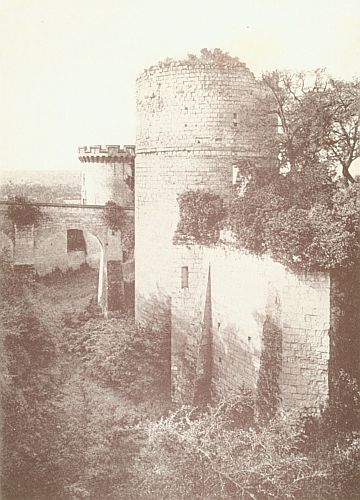
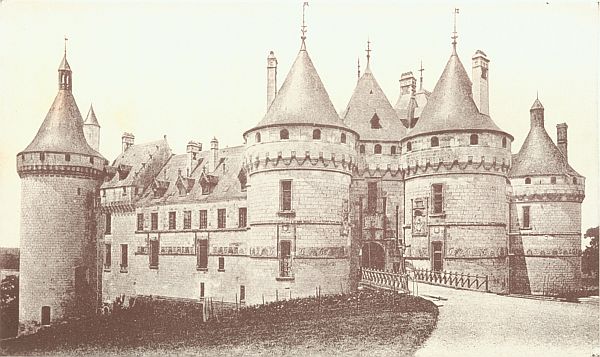 Château of Chaumont: the Loire on the Left
"And it is so much easier to remember the
sinners," Walter adds, "because there is
always something doing among them."
Leaving the auto in the village, we climbed
up to the castle by a steep and narrow path
and entered the great doorway where the moat
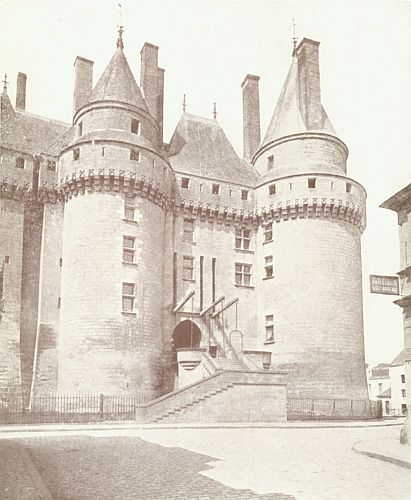
and drawbridge between the huge round
towers again reminded us of Langeais. Over
this entrance are the graven initials of Louis
and Anne of Brittany, the arms of George of
Amboise with his cardinal's hat, and the double
C's of Charles of Chaumont and his wife,
Catherine of Chauvigny. Here also are some
scattered D's which stand for Diane of Poitiers,
who consented to accept this château when
Catherine offered her a Hobson's choice of
Chaumont or nothing. We were especially interested
in a rich frieze in which were intertwined
the double C's and the odd device of
the burning mountain, "Chaud-mont," from
which, it is said, the name of the château was
derived. As Chaumont is still inhabited, we
were not shown the whole of the castle, but
fortunately for us the suite of historic rooms
was on view. Here again we came upon associations
with the dreadful Catherine, whose
bedroom and furniture are shown to visitors.
Whether or not these articles are genuine, and
grave doubts are thrown upon their authenticity,
they are very handsome and of the
proper period. The tapestries in these rooms
are all old and charming in color, of old rose
and pink. A description which I came across
in a delightful book by Mr. Theodore A. Cook,
which M. La Tour brought us from his mother's
library, gives a better idea of this tapestry
than any words of mine: "Beside the door a
blinded Love with rose-red wings and quiver
walks on the flushing paths, surrounded by
strange scrolls and mutilated fragments of old
verses; upon the wall in front are ladies with
their squires attending, clad all in pink and
playing mandolins, while by the stream that
courses through the flowery meadows small
rosy children feed the water birds, that seem
to blush with pleasure beneath the willow
boughs of faded red."
Next to the so-called room of Catherine de
Médicis is the chamber attributed to Ruggieri,
the chosen aide and abettor of her schemes,
which apartment very properly communicates
with a private stairway leading to the platform
of the tower which is said to have been used by
him as an observatory. Whether or not
Catherine ever inhabited these rooms, and we
know that she never lived for any length of
time at Chaumont, I must confess that seeing
them thus conveniently placed for plotting and
adventure, they impressed us even more than
her secret stairways and poison cupboards at
Blois. This may have been because these rooms
are small and dark and dreary, Ruggieri's
being in one of the corner towers, with small
windows cut in the wall, which is over two
metres in thickness. From whatever reason,
these apartments are the most weird and
ghostly that we have seen, fitted up as they
are with many memorials of Catherine, and two
portraits of her, one in a rich costume, an extinguisher
gown with pink underskirt and wide
full sleeves bordered with a band of fur,
each one as large as an ordinary muff. There
is also a portrait of Ruggieri here, whose dark,
sinister face adds much to the grewsomeness
of the room, and standing here we could readily
imagine the scene, described by a chronicler of
the time, when the Queen sought Ruggieri here
among his philters, minerals, foreign instruments,
parchments and maps of the heavens,
to consult him about the future of her offspring.
This was soon after the death of Henry II,
when the young King's health had begun to
break down. When the Queen desired to be
shown the horoscopes of her children, by some
skillful arrangement of mirrors the astrologer
made her four sons to pass before her, each in
turn wearing crowns for a brief period; but all
dying young and without heirs, each figure was
to turn around as many times as the number of
years he was to live. Poor Francis appeared,
wan and sickly, and before he had made an entire
circle he passed out of sight, from which
the Queen knew that the young King would die
before the year was out, which, as we know,
came true, as did some of the other prognostications.
What must have filled to the brim the
cup of misery which this ambitious, disappointed
woman had held to her lips, was to see
the rival of her sons, the bitterly hated Henry
of Navarre, following their shadows upon the
mirror and making over twenty turns, which
meant that he would reign in France for twenty
years, or more. By whatever means the
astrologer accomplished these predictions, the
remarkable thing about them is that the account
of this interview at Chaumont was written
during the reign of Henry III, before some of
them had been fulfilled. Catherine, firmly believing
in Ruggieri's prognostications, left the
château a sadder if not a wiser woman.
The rooms of Catherine communicate
directly with the chapel, where there is a most
realistic picture of The Last Judgment, and
her book of the hours lies open on her prie dieu
as if she had just finished her devotions. For
good and sufficient reasons, we do not think
of this Queen at prayer as readily as we figure
her taking part in affairs of state, plotting for
the destruction of her enemies and trying to
hoodwink the Huguenots and Leaguers in turn.
"And yet," as Walter reminds us, "Catherine
was extremely devout, with all her deviltry."
You may remember a portrait of her in
fine enamel at the Louvre, which represents
Catherine kneeling before an altar, her hands
devoutly clasped, and as if to give point to
the time-honored adage "handsome is that
handsome does," the Queen's face, in this
enamel, possesses some claim to good looks.
M. La Tour has been telling us of some old
papers, recently brought to light, which prove
that Catherine, during the babyhood of her
children, was an anxious and watchful mother.
She seems to have written careful and minute
directions regarding the food and clothing of
her little ones, in one instance directing that
her son Henry should not be encouraged to
eat largely, adding, like any wise mother of
to-day, "I am of opinion that my children are
rather ill from being too fat than too thin."
The evidence of this opinion is borne out by
Clouet's drawings of the chubby face of Henry
and the fat, heavy cheeks of Francis II, both
in their babyhood. It was little Francis, an
unassertive prince in after years, who at the
age of two insisted upon discarding his petticoats,
upon which the King, when consulted
upon this important question, wrote to the
governor of the royal nursery, "It is right
indeed that my son should wear breeches if he
asks for them; for I do not doubt that he
knows perfectly well what is needful."
These intimate details of the youth of the
royal children, trifling as they are, add a human
interest to the figures of Henry II and Catherine,
whom we only think of as sweeping through
these châteaux in form and state, and raise a
question as to whether, after all, this cruel
Queen had not a heart somewhere tucked away
under her jewelled bodice.
Chaumont has many associations earlier
than the days of Catherine, reaching back to
Charles of Amboise, who built much of the
château, and to his father Georges, one of the
chief ministers of Louis XII. It is said that
Georges of Amboise used his tact and influence
to gain the papal bull necessary for the King's
divorce from Jeanne of France, which was
brought to Chinon by Cæsar Borgia, with great
state and ceremony. It was this same papal
envoy who brought Georges d'Amboise his
cardinal's hat. Unscrupulous as he may have
been in some instances, Cardinal d'Amboise
seems to have been, in the main, a wise and
judicious minister and helped Louis to institute
many important reforms.
The romance of Chaumont is its association
with the knightly figure of Henri Coiffier de
Ruzé, Marquis de Cinq Mars. The opening
scene of De Vigny's novel rises before us, as
we pass through the rooms of Chaumont. The
young Marquis was about to set forth upon his
ill-fated journey into the great world, and the
members of his family were gathered together
for a solemn, farewell meal. De Vigny represents
the poor youth neglecting his dinner, and
even indifferent to his mother's sorrow over his
departure in his desire to meet the beautiful
eyes of Marie de Gonzague, who was seated at
the other end of the table, from whom he was
soon to part forever. It was by a lattice window
in the rez-de-chaussée of the western tower
that Cinq-Mars found Marie waiting for him,
when he retraced his steps and came back at
midnight for a last word with her. We looked
in vain for the window by which the lovers
swore eternal fidelity to their love and to each
other; but the château has doubtless undergone
some changes since those early days, although
it looks so ancient. Lydia and I were wishing
for a copy of Cinq-Mars in order to follow the
young Marquis through his sad and singular
experience at Loudun, his meeting with his
old friend De Thou, his brilliant exploit at
Perpignan, his rapid preferment at court, and—just
here Walter called us from our rapid
review of the career of Cinq-Mars to show us
a head of Benjamin Franklin in terra cotta.
This excellent low relief of Franklin is in a
case with a number of other medallions, made
by an Italian, Nini, whom the owner of
Chaumont brought here in the hope of turning
to account some clay found on the estate. This
admirable medallion excited the two antiquarians
of the party more than anything we have
seen here, even more than the weird sky parlor
of Ruggieri. Walter is wondering whether this
is not the medallion about which Dr. Franklin
wrote to his daughter soon after his arrival at
Passy, as the first of its kind made in France.
This idea seems more probable, in view of the
fact that the same M. Le Ray, who owned
Chaumont at that time, was Franklin's host at
Passy for nine years. All of which, as Walter
says, makes it more than likely that the old
philosopher came to Chaumont to have his portrait
modelled by Nini, especially as his relations
with the master of Chaumont were of the
most friendly nature. The old potteries in
which the Italian artist worked have long since
been turned into stables and a riding school.
Another familiar and even more recent
figure associated with Chaumont is Madame
de Staël, who took refuge here, while reading
the proofs of her work upon Germany, Chaumont
being the requisite forty leagues from
Paris. M. Le Ray and his family, with whom
Madame de Staël was upon the most intimate
terms, were in America at this time. Here in the
old château the De Staëls lived for some time,
the authoress working in peace and quietness
upon her great work. When M. Le Ray and
his family returned to Chaumont, although
hospitably invited to remain at the château,
Madame de Staël insisted upon removing with
her family to a villa in the neighborhood, which
was placed at her disposal by M. de Salaberry.
At this place, called Fossé, Madame de Staël
welcomed Madame Récamier and other friends,
and with the charming French trait of making
the most of the joys of the hour, she wrote
with enthusiasm of the happy days that she
passed near her friends at Chaumont. Even
if the old Vendean soldier, the châtelain of
Fossé, took little care of his estate, she said
that his constant kindness made everything
easy and his original turn of mind made everything
amusing. "No sooner had we arrived,"
wrote Madame de Staël, "than an Italian
musician whom I had with me, to give lessons
to my daughter, began to play the guitar. My
daughter accompanied on the harp the sweet
voice of my fair friend, Madame Récamier; the
peasants assembled below the windows astonished
to find this colony of troubadours who
came to enliven the solitude of their master. It
was there that I passed my last days in France,
with a few friends whose memories are cherished
in my heart. Surely this reunion so
intimate, this solitary sojourn, this delightful
dalliance with the fine arts could hurt no one."
Charming, innocent, pastoral seems this
life, as Madame de Staël described it, and yet
even such simple pleasures as these she was
not allowed to enjoy, for during a brief visit
to the home of M. de Montmorency, an attempt
was made to seize her manuscripts, which her
children had fortunately put in a place of
safety; her book was suppressed and she was
ordered to leave France within three days.
When Madame de Staël asked why she was
treated with such harshness by the government
and why her book was censured, the
answer given under the signature of the ministry
plainly stated that the head and front of
her offending consisted in her not having mentioned
the Emperor in her last work. It is
difficult to believe that a man who could do
such great things as Napoleon could be so small
as to follow this brilliant woman with bitter,
relentless hatred, because she failed to burn
incense at his shrine.
Although we were not given the freedom
of the grounds, we were shown the beautiful
court of honor with its one fine tree, a cedar
of Lebanon which spreads its branches quite
close to the chapel walls. There is an old
Italian well in this court, with low reliefs
carved upon its sides, and graceful ornaments
of wrought iron above the sweep. We pictured
to ourselves the Marquis de Cinq Mars and
Marie de Gonzague meeting in this court, under
the friendly branches of the great cedar, and
so with a tender thought for these hapless old-time
lovers, we turned away from Chaumont.
Still musing and dreaming over its numerous
and varied associations, we motored along
toward Cheverny. This was an afternoon in
which to dream,—the air was full of a delicious
drowsy autumnal warmth, and a soft haze hung
over the Loire and its tributaries. Involuntarily
our thoughts turn back to the time when
the kings and nobles of France made their
stately progress along these same roads, many
of them Roman roads, for the great road-builders
were all over this country as in England.
Upon these highways over which we
speed along in an auto, great lumbering stage
coaches once made their way, and in the fields,
as to-day, were the toilers, the husband and
wife, as in the Angelus of Millet. For an
instant they would look up from their work
to see what all the racket was about, and take
a momentary interest in the gilded coaches, the
gay outriders, the richly caparisoned horses,
and all the pomp and circumstance of royalty.
If near the highway, they would catch a fleeting
glimpse of the beautiful face of some royal
or noble dame, and seeing only the rich brocade
of her gown, the jewels upon her breast and
the gay feathers and flowers in her hat, they
would turn back to their toil with a half-formulated
wonder why life was a holiday to these
favored ones and only bitter toil and hardship
to nous autres. Thomas Jefferson's proposition,
that all men are created free and equal,
would have shocked these simple souls as it
would their lords and masters, and yet a seed
of thought was slumbering in their slow minds,
germinating for a future awakening, a small
seed that was destined to become a thousand in
the sad and terrible reprisals of the French
Revolution. To these starved peasants luxury
stood for happiness, never themselves knowing
the satisfaction of a full comfortable meal, it
would have been impossible to make them believe
that this outward show and splendor did
not mean that these men and women, who rolled
along in coaches and fed sumptuously every
day, were the supremely blessed of the earth.
And yet along these roads passed the coaches
of the heavy hearted as well as of the gay.
By much the same way that we are going
journeyed the unhappy Princess Joanne when
her husband, Louis XII, was minded to put her
away to give place to a more ambitious marriage.
Another royal lady to whom a crown
brought naught but sorrow and disappointment
was the gentle Louise de Vandemont-Lorraine,
wife of Henry III, who fared this way to the
home of her widowhood at Chenonceaux, and
by much the same route passed Marie de
Médicis when she fled from Blois and found
refuge and aid at Loches.
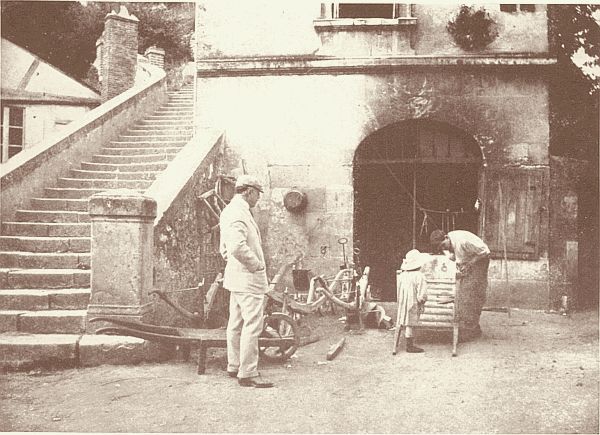
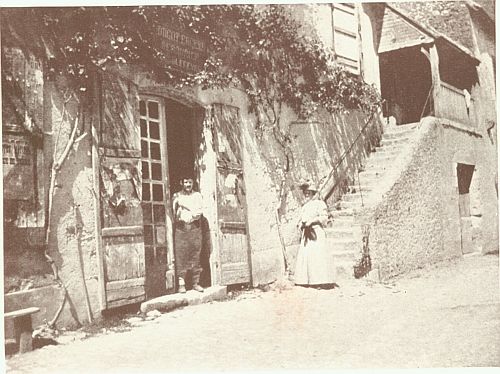 Smithy near Gate of Cheverny
As Cheverny and Chaumont are not far
apart, we were aroused from our reflections by
a sudden stop at a little smithy near the gates
of the park. A most charming little smithy is
this, with a niched saint on the outside, vines
clambering all over the wall, and a picturesque
outside staircase with a little balcony above.
The blacksmith, himself, as he stood framed in
by the doorway, made a picture that we thought
well worth taking. Unfortunately the saint in
the niche could not come in, as it was some
distance from the door, but just at the right
moment Lydia, quite unconsciously, stepped
before the lens, and near the stone stairway
which she had been examining.
"Far better than a saint!" said Archie
under his breath, and then aloud, "Keep still,
Miss Mott, the blacksmith will stay, I am sure,
as he looks as if he had been built into that
door."
I think we shall be able to send you a photograph
of our little smithy, and perhaps one of
the church across the road, which is quaint
and interesting, with its timbered verandas
(one cannot, by any stretch of courtesy, call
them cloisters) and something like a lych-gate
at the entrance. Within are some marbles and
memorial tablets of the Hurault family. It
seems that the Huraults owned the Seignory
of Cheverny as long ago as the fourteenth century,
"before we Americans were discovered,"
as Miss Cassandra says. Early in the sixteenth
century, one Raoul Hurault built a château
here, of which little or nothing is left. The
present château was built by a later Hurault,
in 1634, and, after passing through several
hands, it was bought, in 1825, by the Marchioness
Hurault de Vibraye, and being thus returned
to the family of the original owners, is
still in their possession. A wonderful tale was
this for American ears!
Cheverny, with its well wooded park, and its
avenue six kilometres in length, is a noble
domain; but the outside of the château,
although its architecture has been highly
praised, did not impress us particularly. This
may be because the mansion is situated on a
level sweep of lawn, laid out after the English
style, instead of crowning a great bluff like
Blois, Amboise and Chaumont. The interior
of Cheverny leaves nothing to be desired. It
is elegant, aristocratic, and yet most delightfully
homelike, with its spacious hall, richly
decorated royal bedroom, and salon as livable
as an English drawing room, with books,
magazines and writing materials scattered over
the centre table. On the panelled walls are
gathered together a goodly and graceful company
of noble lords and beautiful ladies, among
them a fine full-length portrait of Philippe
Hurault, Count de Cheverny, Chancellor of
Finance under Henry IV, and opposite him his
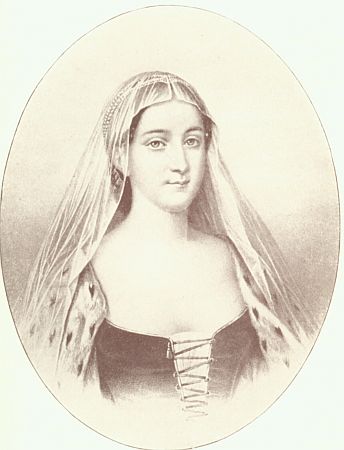
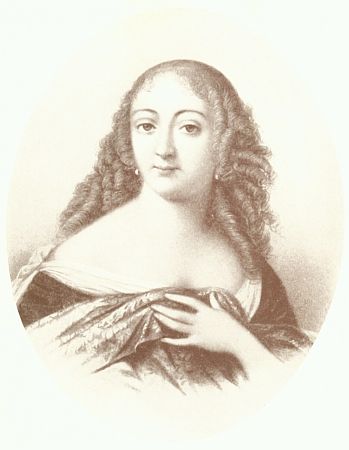
beautiful and stately wife, Anne de Thou, Dame
de Cheverny, in a gown of black velvet garnished
with rich lace. This noble lady was
related, in some way, to the gallant young De
Thou who perished on the scaffold with his
friend Cinq Mars. Over the chimney-place is
a charming portrait by Mignard of the daughter,
or daughter-in-law, of Anne de Thou,
Marie Johanne de Saumery, Marquise de Montglat,
Countess de Cheverny. The subject of
this lovely portrait bears with distinction her
long array of cumbersome titles, while the airy
grace of the figure and the innocent sweetness
of the rounded girlish face are irresistibly
attractive. Above the chimney-place, in which
this portrait is set in the white wainscot, is the
monogram (HV) which one finds all over the
château, a proof that this ancient family is
légitimiste to the core, and devoutly loyal to
whatever is left of the ancient line of the Bourbons.
In the salle à manger, the monogram of
the last Henry of this royal house is especially
conspicuous. We were puzzling over the name
of the pretender of to-day when the guide informed
our ignorance, with a most superior
manner of knowing it all and wondering that
we did not know it also. From what he gave
forth in rapid French with many gestures, we
gathered that on the death of the Comte de
Paris his eldest son, Philippe Robert, Duc
d'Orléans, became heir to the house of Bourbon,
founded in 886 by Robert le Fort, with
the title Philippe VII. The Duc de Bourdeaux,
always known as the Comte de Chambord after
he became owner of the château of the same
name, was heir to the throne, through the elder
branch of the house, that is, as the grandson
and eldest descendant of Charles X, the last of
the elder branch that reigned in France. Some
little time before his death, the Comte de Chambord
was reconciled to the younger or Orleans
branch, which had usurped the throne after
the expulsion of Charles X. By this act the
Comte de Paris was recognized as the
legitimate successor to the throne. The present
Duke of Orleans, should the monarchy be
restored, would rule as Philippe VII. The
Comte de Chambord took the title Henri V,
as the next Henri after the king of Navarre,
Henri IV. The Comte de Chambord bequeathed
the Château of Chambord, which was his personal
property, to his kinsman, the Duke de
Parme, who was a Bourbon of the Spanish
line, being the descendant of the grandson of
Louis XIV, who was elected to the Spanish
throne in 1700. From the pride with which this
information was communicated we realized that
this very superior gardien was, like the noble
master and mistress of Cheverny, legitimist to
the ends of his fingers.
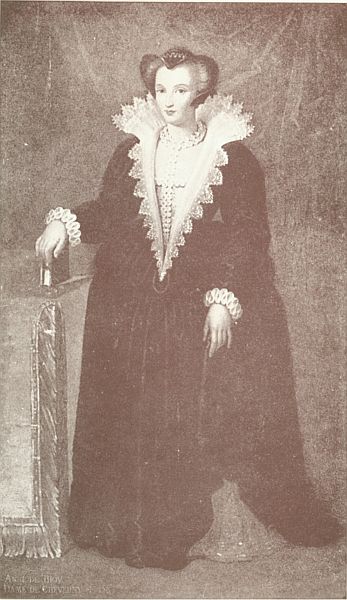 Neurdein Freres, Photo.
Anne de Thou, Dame de Cheverny
While listening to this genealogical disquisition
our eyes turned to a most attractive
looking tea table which was set forth with
superb silver, and thin slices of bread and butter
and cake. With appetites sharpened by
our long ride through the fresh air, I fear that
we all gazed longingly at that tempting regale,
and for Miss Cassandra, Lydia and I positively
trembled. With her strong feeling that the world
was made for herself and those whom she loves,
it would not have surprised us to see the good
lady sit down at this hospitable looking table
and invite the rest of the party to join her.
Lydia adroitly led the conversation toward
Chambord and the afternoon tea which our
chauffeur had promised us there, adding, gracefully,
"It is very kind of the Marquise to allow
us to go through her beautiful château while the
family is in residence." "Yes," assented Miss
Cassandra, "but how much more hospitable if
she would invite us to drink tea with her!"
After admiring the beautifully decorated ceiling
and the handsome leather hangings, we left
the dining room and its temptations for what
was a much greater attraction to the men of
the party, the fine suits of armor in the Salle
des Gardes.
Although Cheverny cherishes its Bourbon
traditions, like the proverbially happy nation
and happy woman it has no history to speak
of, having even escaped the rigors of the
French Revolution. In the past, as to-day, this
château seems to have been a homelike and
peaceful abode, its long façade and pavilions
having looked down through many centuries
upon a smiling garden and a vast lawn, which
shut it in from the world beyond even more
effectually than its great gates.
From Cheverny our way lay across a stretch
of open, level country and then through the
forest of Chambord, which includes 11,000
acres of woodland. By the time we reached
the château, we were, as Miss Cassandra expresses
it in classic phrase, "faint yet pursuing"
for lack of the refreshment to which
we were not made welcome at Cheverny. Our
chauffeur, being accustomed to famished pilgrims,
conducted us at once to a garden café
quite near the château, from whence we could
study its long façade while enjoying our tea
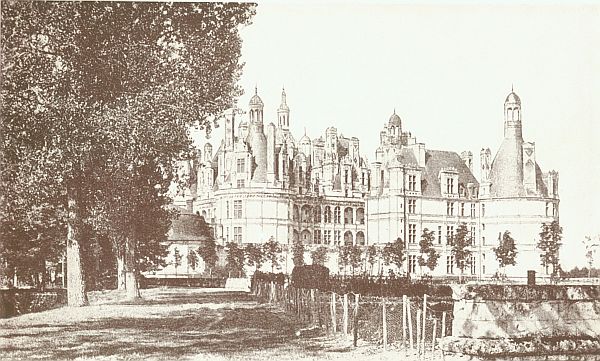
and pâtisserie. And what a huge monument is
this château of Chambord to the effete monarchy
of France, built up from the life-blood
and toil of thousands! It impressed us as more
brutally rich and splendid than any of the
palaces that we had seen, rising as it does in
its great bulk so unexpectedly from the dead
level of the sandy plain, with no especial
reason for its existence except the will of a
powerful sovereign. It is not strange that the
salamander of Francis I appears upon so many
of the châteaux of France, for to this art-loving,
luxurious, and débonnaire King she owes Chambord,
Fontainebleau, St. Germain and the
smaller châteaux of Azay-le-Rideau, Anet and
Villers-Cotterets. Although Francis I brought
from Italy, to beautify his palaces, Leonardo
Da Vinci, Primaticcio, Benvenuto Cellini,
Florentin Rosso and other foreign artists, it
has been decided by those who know more
about the matter than we do, that Chambord
owes more to its first architect, Maître Pierre
le Nepvue, dit Trinqueau, than to anyone else.
It seemed to us that this master hand was
happier in the construction of Chenonceaux,
Blois and some of the other châteaux of France,
than here at Chambord, but this is a matter of
individual taste. Vast, palatial, magnificent
Chambord certainly is, and much more attractive
on the north façade, where the château is
reflected in the waters of the Cosson, than from
the café where we were seated. The long line
of buildings in the south front is somewhat
monotonous, even broken as it is by the several
towers, and the great central lantern, which
appears to the best advantage from this side.
Rich as is all the ornamentation of Chambord,
it is skyward that it breaks forth into the
greatest exuberance of Renaissance decoration.
We reached the central lantern, with the single
fleur-de-lis atop, by one of the remarkable
staircases for which the palaces of Francis I
are so famous. This staircase, which is formed
by two spirals starting from different points,
and winding about the same hollow shaft in the
centre, is so constructed that persons can go
up and down without meeting. Mr. Henry
James considered this double staircase "a truly
majestic joke," but in days when courts lived
and moved and had their being in intrigues,
schemes and plots, it doubtless had its uses.
Mademoiselle de Montpensier gives in her
diary an amusing account of her first
acquaintance with this double stairway. She
came, when a child, to Chambord to visit her
father, Gaston, Duke of Orleans, who stood at
the top of the stairs to receive her, and called
to her to come to him. As she flew up one
flight her agile parent ran down the other;
upon which the little girl gave chase, only to
find that when she had gained the bottom he
was at the top. "Monsieur," she said,
"laughed heartily to see me run so fast in the
hope of catching him, and I was glad to see
Monsieur so well amused."
Having reached the central lantern we
found ourselves upon a flat roof, surrounded
by a perfectly bewildering maze of peaks,
pinnacles, lanterns, chimneys and spires, which
constitute what our guide is pleased to call the
ensemble de la toiture. This vast terrace, which
covers the main building of the palace, is one
of the architectural marvels of France. Here
it seems as if the architect had allowed himself
unlimited freedom in decoration, in which he
was aided by such artists as Jean Goujon and
Cousin, who zealously worked upon the ornamentation
of these bell turrets, balconies
and towers, as if to prove the sincerity
and beauty of French art. This luxuriant
flowing forth, in stone carving, of foliage,
flower, boss and emblem, has resulted in an
ensemble of indescribable charm, the dazzling
light stone of Bourré, of which the château is
built, lending itself harmoniously to the elaborate
Renaissance decoration.
It was of Jean Goujon, whose exquisite work
we see now and again in these châteaux, that
some writer has said, that the muse of Ronsard
whispered in the ear of the French sculptor,
and thus Goujon's masterpieces were poems of
Ronsard translated in marble. It is a rather
pretty fancy, but Lydia and I cannot remember
its author. Walter says that he can understand
why the Counts of Blois built their castle
here, as this place seems to have formed part
of a system of fortresses which guarded the
Loire, making it possible, in the time of Charles
VII, for Joan of Arc to move her army up the
river to Orleans; but why Francis should
have transformed this old castle into a palace
is not so easy to understand. When so many
more attractive sites were to be found, it
seems strange that he should have chosen
this sandy flat upon the border of what was
then the sad and barren Solange. One reason
given is that the country about Chambord was
rich in game, and we know that Francis was
an inveterate hunter; another theory is that a
charming woman, the Comtesse de Thoury, one
of the early loves of the King, had a manor
in the neighborhood.
"Both excellent reasons!" exclaimed
Archie, "Dame Quickly is evidently an apt student
of human nature."
These various surmises and bits of information
were poured into our ears by the guide, a
plump and merry soul, whom Archie at once
dubbed Dame Quickly. As she conducted us
from room to room, she turned to me and,
with a flash of her black eyes, exclaimed, "If
these walls could speak, what tales they could
tell!" adding that, for her part, she believed
that the King came here for the hunting, the
Comtesse de Thoury having been a love of his
youth, and, with a knowing shake of her head,
"You know, Mesdames, how short is the
memory of man for an early love, especially a
king's memory, when another is always to
be found to take the vacant place." When we
explained this philosophic reflection upon their
sex to the men of the party, they declared that
an unfair advantage was being taken by this
facetious dame, simply because they were not
able to answer back and vindicate the eternal
fidelity of man. Then, as if divining what
was being said, through her quick woman's
instinct, she drew us toward a window in the
study of Francis I and showed us these lines
scratched upon one of the panes:
Souvent femme varie;
Mal habile qui s'y fie.
Some discredit is thrown upon the authenticity
of these lines, and if Francis wrote them
in his old age, his point of view must have
greatly changed since his earlier days, when he
so gaily and gallantly said that a court without
ladies was a year without spring and a spring
without roses. Francis spent much of his time
in his later years at Chambord, his chief solace
being the companionship of his lovely sister,
Marguerite, Queen of Navarre, the author of
the Heptameron, whose beauty and intellect
were the inspiration of many French poets.
One of the pleasing sides of the character
of the King was his devoted affection for this
sister, with whom he had spent a happy youth
at Amboise, and she, loving him beyond any
other being, wrote verses to express her grief
when they were separated. A varied, many-sided,
personality was Francis I, and with all
his faults possessed of a charm of his own, and
a taste in the fine arts that added much to the
beauty of his kingdom. Something of this we
said to Dame Quickly, who replied, with another
wise shake of her head, "The history of
Francis is a wonderful history, Mesdames,
made up of many things. There is always state
policy, and religion, et un peu les femmes," the
knowing look and shrug with which this bit of
wisdom was communicated is simply untranslatable.
Only a few of the 365 rooms of Chambord
are furnished; we were shown the bedroom
of the late Comte de Chambord, a ghostly
apartment, it seemed to us in the fading daylight,
the bed hung with elaborate tapestries,
the work of the loyal hands of the ladies of
Poitou. Miss Cassandra asked the guide if
she would not be afraid to sleep in this dismal
chamber. "No," she answered, "there are no
revenants here, the great people who lived
here do not walk, they had such an active
life with their hunting and fêtes that they are
content to rest quietly in their beds."
We passed through the council chamber of
the château, where there are more tapestries,
these presented by the loyal inhabitants of
Blois and the Limousin districts, and here also
is a quite useless throne donated by some
devoted legitimists. In the chapel, we were
shown some tapestry worked by Madame
Royale, during her imprisonment in the
Temple, that daughter of Marie Antoinette
who alone survived her unfortunate family and
as Duchesse d'Angoulême lived to quite an
advanced age.
The fast-fading daylight made it impossible
to see many of the portraits in the great reception
room; among them we noticed two portraits
of Anne of Austria, and a Van Loo of the
beautiful unloved Queen of Louis XV, Marie
Leczinska. In this picture she appears so
graceful and charming that one wonders how
the King could have been insensible to her
attractions; but one need never be surprised
at the vagaries of royalty, and it is not to be
expected that diplomatic alliances should be
happy.
What interested the men of the party
especially, was the little light wagon in which,
we were told, the owner of Chambord, the Duc
de Parme, went a hunting with that good
legitimist, the Master of Cheverny.
"I am glad," said Walter, "that the noble
Duke has a neighbor of the same stripe to go
a hunting with him, the grandeur of this great
palace without a friendly neighbor to come in
and take a hand at cards or crack a joke with
him, would be simply appalling."
"The idea of jokes in this vast mausoleum
of departed grandeur!" exclaimed Miss Cassandra.
"It would be like dancing in a
cemetery. Do ask that lively black-eyed dame
how many there are in family when the owners
are at home."
"Monsieur le Duc has twenty-two children,"
was the reply. "He lives in Italy, but comes
here sometimes for the hunting."[B]
"And does he bring his family with him?"
"Pas tout le monde at the same time,
Madame, although we have enough rooms for
them all."
Laughing over this ready rejoinder, we
parted from our merry cicerone with exchanges
of compliments and a clink of silver. I am
quite sure that Walter and Archie gave her
the fee twice over because of her beaux yeux
and her merry wit.
It is late, and I am tired after the grande
tournée, as they call our afternoon trip here,
and Walter reminds me
"That the best of all ways
To lengthen our days
Is not to steal a few hours from the night, my dear."
 Neurdein Freres, Photo.