I have sat in the top of a tree in the middle of a herd a quarter of
a mile from a native village in Uganda in a last desperate effort to
inspect the two hundred and fifty elephants which had been chevying me
about so fast that I had not had a chance to see whether there were
any desirable specimens among them or not. I have spent a day and a
night in the Budongo Forest in the middle of a herd of seven hundred
elephants. I have stood on an ant-hill awaiting the rush of eleven
elephants which had got my wind and were determined to get me. I have
spent a day following and fighting an old bull which took twenty-five
shots of our elephant rifles before he succumbed. And once also I had
such close contact with an old bull up on the slopes of Mt. Kenia that
I had to save myself from being gored by grabbing his tusks with my
hands and swinging in between them.
I have spent many months studying elephants in Africa—on the plains,
in the forests, in the bamboo, up on the mountains. I have watched
them in herds and singly, studied their paths, their feeding grounds,
everything about them I could, and I have come to the conclusion that
of all the wild animals on this earth now, the African elephant is
the most fascinating, and that man, for all the thousands of years he
has known of elephants, knows mighty little about him. I am speaking
only of the African elephant. He has not been domesticated as his
Indian cousin has. The two are different in size and different in shape
and different in habits. The low point of an African elephant's back
line is the highest point of that of the Indian elephant. The African
elephant's ears and tusks are larger, and his tusks usually spread
wider at the points instead of coming together. Unless one studies him
in his native haunts, one cannot get to know him. His disposition is
held to be wilder than that of the Indian elephant, but the infrequency
of his appearance in circuses and in zoölogical parks may be attributed
to the ease with which tamed elephants may be obtained from India
rather than to a difference of temper in the two beasts. An African
elephant at Washington and one in the Bronx zoölogical park are the
only ones I know of in this country, and no animal in captivity can
give one more than a slight idea of his natural habits in his jungle
home.
Very few people have studied African elephants in the field.
Ninety-five per cent. of those who have followed them have been purely
hunters and their desire has been, not to study, but to shoot—to see
the elephant the shortest possible time. Time to judge the ivories and
get a bead on the brain was all that they wanted. Of other elephant
knowledge all that they needed was the simple facts of how to follow
and find them. The comparatively few men who have tried to study
the elephant have not gained as much knowledge as one would imagine,
because without trying it one cannot realize how extremely difficult it
is to study the live African elephant.
For example, as I said before, I spent a day with seven hundred
elephants in the Budongo Forest, but although I heard them all the time
and was very acutely conscious that they were near me, I do not believe
that I actually had my eyes on an elephant more than half an hour, all
told, during the day. It happened this way.
One night about dark, after a week or two of hunting, we heard the
squeal of an elephant while we were sitting at dinner. A little later
there were more squeals and occasional trumpeting—more and more,
clearer and clearer—and by the time we had finished dinner the noise
was only a mile or so away. It was a continuous row which suggested a
tremendous herd. We went to bed early with elephants getting closer to
camp all of the time. There is little danger of elephants attacking a
camp, and, as there is no way to study them at night, about the only
thing left to do was to go to bed and get in good shape for the next
day. Along about midnight Mrs. Akeley came over to my tent and said
that she had loaded my guns and that they were all ready. She could
not sleep; so she went out to sit by the fire. The elephants were then
within a hundred yards of our tents and there was a continuous roar
made up of trumpetings, squealing, and the crashing of bushes and trees.
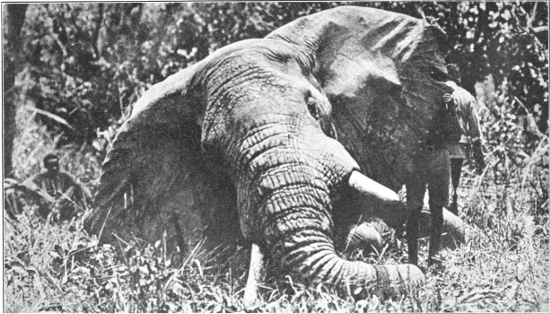
A BIG SPECIMEN IN THE FIELD
To photograph, measure, and skin an animal the size of this one
requires eight or ten hours of work
even with the assistance of forty
or fifty negro boys
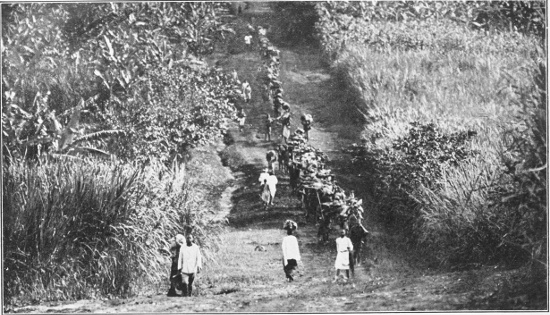
MR. AKELEY'S SAFARI LADEN WITH ELEPHANT SKINS
I got up in the morning and had breakfast before daybreak. The
elephants had moved on down the edge of the forest. What had been a
jungle of high grass and bush the day before was trampled flat. There
were at least seven hundred elephants in the herd—government officials
had counted them on the previous day as they came down. I followed
the trails to the edge of the forest but saw none. I started back to
cross a little nullah (a dry water course), but felt suspicious and
decided to look the situation over a little more closely. I ran up on
a sloping rock and, almost under me on the other side, I saw the back
of a large elephant. Over to one side there was another one, beyond
that another, and then I realized that the little nullah through
which I had planned to pass was very well sprinkled with them. I backed
off and went up to a higher rock to one side. Elephants were drifting
into the forest from all directions. The sun was just coming up over
the hills and was shining upon the forest, which sparkled in the
sunlight—morning greetings to the forest people. The monkeys greeted
one another with barks and coughs. Everything was waking up—it was
a busy day. There was not a breath of air. I had gone back a million
years; the birds were calling back and forth, the monkeys were calling
to one another, a troop of chimpanzees in the open screamed, and their
shouts were answered from another group inside the forest. All the
forest life was awake and moving about as that huge herd of elephants,
singly and in groups, flowed into the forest from the plain. There was
one continuous roar of noise, all the wild life joining, but above it
all were the crashing of trees and the squealing of the elephants as
they moved into the forest on a front at least a mile wide. It was the
biggest show I ever saw in Africa.
Then an old cow just at the edge of the forest suddenly got my wind,
and wheeling about, she let out a scream. Instantly every sound
ceased, everything was quiet. The monkeys, the birds—all the wild
life—stopped their racket; the elephants stood still, listening
and waiting. For a moment I was dazed. The thought came through my
mind—"What does it all mean? Have I been dreaming?" But soon I heard
the rustling of the trees as though a great storm were coming. There
was no movement of the air, but there was the sound of a wind storm
going through a forest. It gradually died away, and I realized that the
elephants had made it as they moved off. It was the rustling of the dry
leaves on the ground under their feet and the rubbing of their bodies
through the dried foliage of the forest. I never heard a noise like
that made by elephants—before or since. The conditions were unique,
for everything was thoroughly parched, and there had not even been a
dew. Ordinarily, if there is any moisture, elephants when warned can
travel through a forest without the slightest noise. In spite of their
great bulk they are as silent and sometimes as hard to see in their
country as a jack rabbit is in his. I remember on one occasion being so
close to an old cow in the jungle that I could hear the rumbling of her
stomach, and yet when she realized my presence the rumbling ceased,
as it always does when they are suspicious, and she left the clump of
growth she was in without my hearing a sound.
But going back to the big herd. From the time I had seen the first
elephant until the last of them disappeared in the forest it had been
perhaps fifteen minutes—fifteen minutes in which to see the sight of a
lifetime, a thing to go to Africa a dozen times to get one glimpse of.
But what did I learn about the habits of the elephant in that fifteen
minutes? A little perhaps but not much. It takes a long time and much
patience to get at all intimate with old Tembo, as the Swahilis call
him, on his native soil.
After the herd disappeared in the forest I watched for ten or fifteen
minutes and heard the squeal of the elephants and the noise of the
monkeys again. Their suspicions were over. I followed into the forest
where the trails showed me that they had broken up into small bands. I
followed along on the trail of one of these bands until I got a glimpse
of an elephant about fifty yards ahead of me in the trail. You don't
see a whole elephant in the forest. What you do see is just a glimpse
of hide or tusk or trunk through the trees. And if you want to get this
glimpse without disturbing him you must do your glimpsing from down the
wind.
There was a little open space ahead of the group I was following.
I worked around until I got to a place where I could see them as
they passed through this open space. They were moving along slowly,
feeding. Two or three came out into the opening, then they became
suspicious and wheeled into the forest again. I followed cautiously.
I had gone only a short distance when I saw a very young calf about
twenty yards ahead of me. As I halted, the mother came trotting back
down the trail looking for the baby. I froze to the side of a tree
with my gun ready. She came to the baby and turning, boosted it along
with her trunk after the rest of the herd. I followed along after
them into an opening where I found them rounded up in a patch of
burned-over ground. They were milling around in a rather compact mass
seemingly preparing for defence. I could not see very plainly, for a
cloud of dust rose from the burned ground as they shuffled about. I
stood watching them a little time and suddenly caught sight of a fine
tusk—an old bull and just what I wanted for the group I was working
on for the Museum of Natural History. I ran up behind a bush at the
edge of the clearing and peeked through it. There, not more than twenty
yards from me, was my bull, partially exposed and partially covered
by the other animals. I could not get a shot at his brain as he was
standing, but the foreleg on my side was forward exposing his side so
that I had a good shot at his heart—a shot I had never made before.
The heart is eighteen or twenty inches long and perhaps a foot up and
down—a good mark in size if one's guess at its location is accurate.
If you can hit an elephant's vertebræ and break his back you can kill
him. You can kill him by hitting his heart, or by hitting his brain. If
you hit him anywhere else you are not likely to hurt him much and the
brain and heart shots are the only safe bets. I fired at his heart with
both barrels and then grabbed my other gun from the gun boy, ready for
their rush, but the whole herd, including the old bull, made off in the
other direction, raising a cloud of dust. I ran around and climbed an
ant-hill four or five feet high to keep them in sight.
When I caught sight of them they had gone about fifty yards and had
stopped. And then I did learn something about elephants. My old bull
was down on the ground on his side. Around him were ten or twelve other
elephants trying desperately with their trunks and tusks to get him
on his feet again. They were doing their best to rescue their wounded
comrade. They moved his great bulk fifteen or twenty feet in their
efforts, but were unable to get him up. I don't know of any other big
animals that will do this. I had heard stories that elephants had the
chivalry to stick by their wounded and help them, but I was never sure
myself until I had actually seen this instance. Some time later Major
Harrison, a very experienced elephant hunter and a keen observer,
told me of an even more remarkable instance that he had seen. He was
shooting in the Congo and came upon four big bulls. One he killed and
another he wounded. The wounded one went down but the two survivors
helped him regain his feet, and with one on each side helping him the
three moved off. Although Major Harrison followed the rest of the day
he was not able to catch up with them.
I did not see the end of their efforts to raise the bull I had shot,
for those that were not helping him began to circle about with their
ears out to hear anything of their enemy and with their trunks up
feeling for my wind. They were moving in ever-increasing circles which
threatened to envelop my ant-hill, and I beat a hasty retreat. Not long
after they evidently were convinced that the bull was dead and all
together they moved away. I then went to the body. He was dead, but
as we approached there was a reflex action which twitched his trunk
from time to time. This frightened the gun boys so that I went up and
slapped the elephant's eye, the customary test, and as there was no
reaction the boys were convinced. When I looked the carcass over I
was disappointed to find that only one of his tusks was big and well
developed. The other was smaller, and out of shape from an injury;
consequently I decided not to take him for the museum group. He was,
however, a good deal of a temptation, for he was one of the largest
elephants I had ever seen, measuring eleven feet four inches to the
top of his shoulders, and the circumference of his front foot was
sixty-seven and a half inches. To the best of my knowledge this is a
record size by about four inches. I did not even skin him but contented
myself with taking his tusks, which I sold for nearly $500 without even
going down to Nairobi.
The phenomenon of elephants helping each other when wounded is not
general by any means. Only a few days after shooting the big bull I
had an instance of elephants abandoning one of their number that was
wounded and not very badly wounded, either.
I had gone into the forest again, and had come upon another bunch in
very thick country. I could only get little glimpses of a patch of hide
or ivory once in a while. After working along with them for a while in
the hope of getting into more open ground I tried the experiment of
beating on the tree trunks with sticks. This was new to them as it was
to me. I felt sure it would make them run but I wasn't sure whether
they would go toward it or away from it. Happily they bolted from
the forest into the high grass, grumbling all the while. I followed
as closely as I dared until finally, in hope of getting a view over
the top of the high grass, I started to climb a tree. Just then they
rushed back into the forest, fortunately to one side of me. I thought
it was time to quit, so we started back to camp. At that moment I heard
another group of elephants. They were coming out of the forest into the
grass. I climbed up an ant-hill where I could see them as they passed
over a ridge. There were eleven of them and not a specimen that I
wanted among them. I stood watching to see what would happen next. They
were about three hundred yards away when they got my wind. Back they
came, rumbling, trumpeting, and squealing. I knew that I had trouble on
my hands. The only thing for me to do was to stick, for if I got down
in the tall grass I couldn't see anything at all. They came up over a
hill, but they were not coming straight toward me and it looked as if
they would pass me at forty or fifty yards; but, unfortunately, the
cow in front saw me standing in full view on my ant-hill pedestal. They
turned straight at me. When the leading cow was as close as I wanted
her to get—about twenty-five yards—I fired. She hesitated but again
surged on with the others. A second shot knocked her down. The rest
surged past her, turned, smelled of her, and ran off into the forest.
After a few minutes she got upon her feet and rather groggily went off
after them.
Elephants have the reputation of having very bad eyesight. I personally
am of the opinion that their sight is pretty good, but on this subject,
as on most others about elephants, information is neither complete nor
accurate. But my experience makes me think that they can see pretty
well. In this case the cow that saw me was only about fifty yards away,
but at another time on the Uasin Gishu Plateau an elephant herd charged
me from 250 yards with the wind from them to me. The behaviour of this
particular herd gave me a clue to their reputation for bad eyesight.
The elephant is not afraid of any animal except man, and consequently
he is not on the alert for moving objects as are animals that are
hunted. Neither does he eat other animals, so he is not interested in
their movements as a hunter. In fact, he isn't normally particularly
interested in moving objects at all. He pays no attention. When we
first came up with this herd on the Uasin Gishu Plateau we could move
around within fifty yards of them without attracting their attention.
However, after they got our wind and recognized us as enemies, they
were able to see us at a distance of 250 yards, and charge us.
But however good the elephant's sight, it is nothing in comparison with
his smelling ability. An elephant's trunk is probably the best smelling
apparatus in the world, and he depends on his sense of smell more than
on any other sense. When he is at all suspicious he moves his trunk
around in every direction so that he catches the slightest taint in the
air, from whichever way it comes. I have often seen elephants, when
disturbed, with their trunks high in air reaching all around for my
wind. I likewise, on one occasion, had an intimate view of a very quiet
smelling operation by which an old cow escaped me. I was on an elephant
path one day on Mt. Kenia looking for an elephant I had heard, when my
gun-bearer gripped my shoulder and pointed into the forest. I looked
and looked but could see nothing but the trees. Finally I noticed that
one of the trees diminished in size toward the ground and I recognized
an elephant's trunk. My eyes followed it down. At the very tip it was
curled back, and this curled-back part, with the nostrils distended,
was moving slowly from side to side quietly fishing for my wind. She
was waiting concealed beside the trail to pick me up as I came along.
She was no more than forty feet away, but when she decided to give up
and moved away, I could not hear her going although it was a dense
forest and she was accompanied by two youngsters. Very often in the
forest where there is very little air stirring it is hard to tell the
direction of the wind. I used to light wax taper matches as tests, for
they could be struck without any noise and the flame would show the
direction of the slightest breath of air.
In many other ways besides its smelling ability the elephant's trunk is
the most extraordinary part of this most extraordinary animal. A man's
arm has a more or less universal joint at the shoulder. The elephant's
trunk is absolutely flexible at every point. It can turn in any
direction and in whatever position it is, and has tremendous strength.
There is no bone in it, of course, but it is constructed of interwoven
muscle and sinew so tough that one can hardly cut it with a knife. An
elephant can shoot a stream of water out of it that would put out a
fire; lift a tree trunk weighing a ton and throw it easily; or it is
delicate enough to pull a blade of grass with. He drinks with it, feeds
himself with it, smells with it, works with it, and at times fights
with it. Incidentally, a mouse that endeavoured to frighten an elephant
by the traditional nursery rhyme method of running up his trunk would
be blown into the next county. There is nothing else like an elephant's
trunk on earth.
And for that matter, there is nothing else like the elephant. He has
come down to us through the ages, surviving the conditions which killed
off his earlier contemporaries, and he now adapts himself perfectly to
more different conditions than any other animal in Africa.
He can eat anything that is green or ever has been green, just so long
as there is enough of it. He can get his water from the aloe plants on
the arid plains, or dig a well in the sand of a dry river bed with his
trunk and fore feet, and drink there, or he is equally at home living
half in the swamps of better-watered regions. He is at home on the
low, hot plains of the seacoast at the equator or on the cool slopes
of Kenia and Elgon. So far as I know, he suffers from no contagious
diseases and has no enemies except man. There are elephants on Kenia
that have never lain down for a hundred years. Some of the plains
elephants do rest lying down, but no one ever saw a Kenia elephant
lying down or any evidence that he does lie down to rest. The elephant
is a good traveller. On good ground a good horse can outrun him, but on
bad ground the horse would have no chance, and there are few animals
that can cover more ground in a day than an elephant. And in spite of
his appearance, he can turn with surprising agility and move through
the forest as quietly as a rabbit.
An elephant's foot is almost as remarkable as his trunk. In the first
place, his foot is encased in a baglike skin with a heavy padded
bottom, with some of the characteristics of an anti-skid tire. An
elephant walks on his toes. His toes form the front part of his foot
and the bones of his foot run not only back but up. Underneath these
bones at the back of his foot is a gelatine-like substance, which is
a much more effective shock absorber than rubber heels or any other
device. One of the curious things about this kind of a foot is that it
swells out when the weight is on it and contracts when the weight is
removed. As a consequence an elephant may sink four feet into a swamp
but the minute he begins to lift his legs, his feet will contract and
come out of the hole they have made without suction. The elephant's
leg, being practically a perpendicular shaft, requires less muscular
effort for him to stand than it does for ordinary animals. This is one
of the reasons why he can go for a century without lying down.
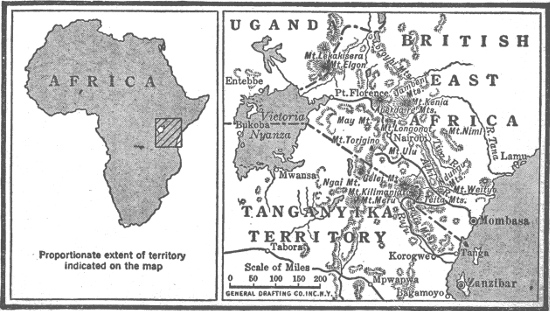
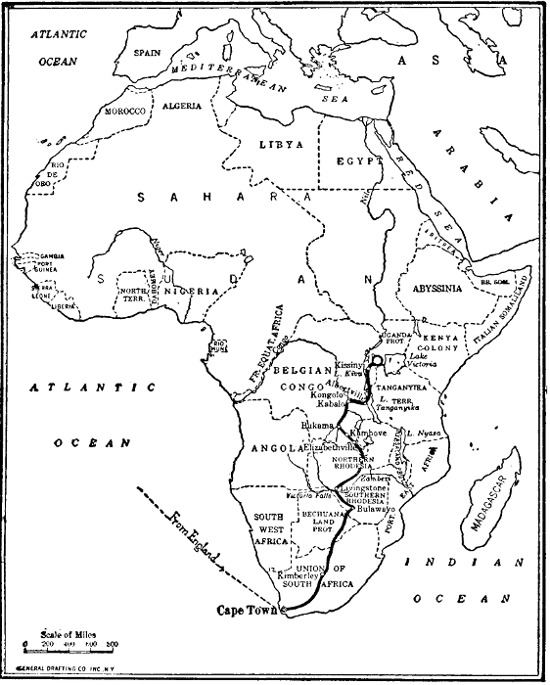
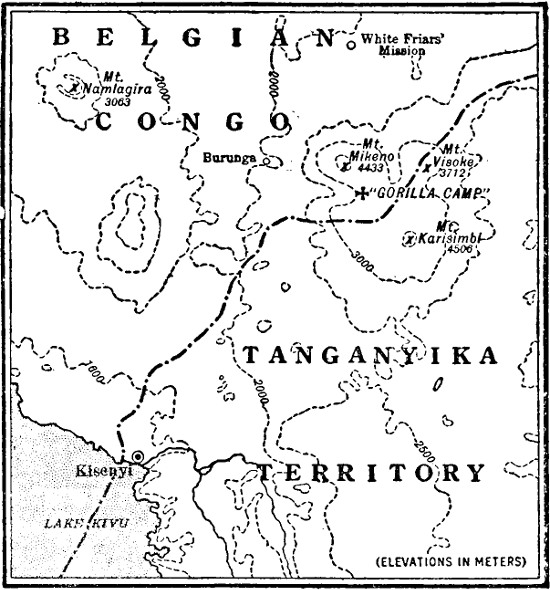
A map of the elephant country showing Mt. Elgon and Mt.
Kenia, on whose slopes Mr. Akeley has hunted elephants. It was on
Mt.
Kenia that Mr. Akeley was mauled by an old bull
A country that elephants have long inhabited takes on some of the
particular interest of the animals themselves. I believe that before
the white man came to East Africa the elephant was nearly as much a
plains animal as a forest animal, but he now tends to stay in the
forests where the risk is not so great. On the plains there are no
elephant paths now, if there ever were, for in open country elephants
do not go in single file. But in the forests there are elephant paths
everywhere. In fact, if it were not for the elephant paths travel in
the forest would be almost impossible, and above the forests in the
bamboo country this is equally true. One travels practically all the
time on their trails and they go everywhere except in the tree ferns.
Tree fern patches are not very extensive, but I have never seen an
elephant track or an elephant in them. The elephants are constantly
changing the paths for various reasons; among others, because the
natives are in the habit of digging elephant pits in the trails. But
there are some trails that have evidently been used for centuries. One
time we had followed a band of elephants on the Aberdare Plateau and
had devilled them until they began to travel away. We followed until
the trail led through a pass in the mountains and we realized that they
were going into a different region altogether. That trail in the pass
was a little wider than an elephant's foot and worn six inches deep in
the solid rock. It must have taken hundreds of years for the shuffling
of elephants to wear that rock away.
At another place on Kenia I found an elephant passage of a stream
where the trail was twenty feet wide. Single paths came in from
many directions on one side of the stream and joined in this great
boulevard, which crossed the stream and broke up again on the other
side into the single paths radiating again in every direction. In
many places where the topography of the ground is such that there is
only one place for a trail there will be unmistakable evidence that
the trails have stayed in the same place many years—such as trees
rubbed half in two by the constant passing of the animals or damp rocks
polished by the caress of their trunks. And along all the trails, old
and new, are elephant signs, footprints, dung, and gobs of chewed wood
and bark from which they have extracted the juices before spitting them
out.
But finding the elephants is not so frequent or easy as the
multiplicity of the signs would indicate. One reason is that the signs
of elephants—tracks, rubbed trees, and so forth—are more or less
enduring, many of them being very plain in places where the elephants
have not been for months or even years. If, however, you come on fresh
elephant tracks, not more than a day old, you can usually catch up
with the elephants, for as they feed along through the country they
do not go fast. Only if they are making a trek from one region to
another it may take much longer to catch them.
Once up with an elephant, if you are shooting, you are pretty sure
that, even if he is charging you, a bullet from an elephant gun,
hitting him in the head, will stop him even if it does not hit him
in a vital spot. Moreover, if you stop the leader of a bunch that is
charging you, the bunch will stop. I never heard of a case in which
the leader of an elephant charge was stopped and the others kept on,
and I doubt if we ever will hear of such a thing, for if it does
happen there won't be any one to tell about it. It is unusual for an
elephant to keep on after being hit even if the hit does not knock him
down. The old cow that charged me at the head of ten others was rather
the exception to this rule, for after my first shot stopped her she
came on again until my second shot knocked her down. But I had one
experience that was entirely at variance with this rule. One old bull
took thirteen shots from my rifle and about as many from Mrs. Akeley's
before he was content either to die or run away.
In Uganda, after six months in the up-country after elephants, we
decided to go down to the Uasin Gishu Plateau for lion spearing, for
the rainy season was beginning and the vegetation growing so thick
that elephant hunting was getting very difficult. On the way down we
came one morning upon the fresh trail of a herd of elephants. We
followed for about two hours in a high bush country over which were
scattered clumps of trees. Finally we came upon the elephants at the
time of their mid-day siesta. The middle of the day is the quietest
time of the twenty-four hours with elephants. If they are in a herd,
they will bunch together in the shade. They do not stand absolutely
still, but mill about very slowly, changing positions in the bunch but
not leaving. They are neither feeding nor travelling but, as nearly as
they ever do, resting. I even saw a young bull once rest his tusks in
the crotch of a tree during this resting period. We got up to within
twenty-five yards of them behind some bushes down the wind. We finally
decided upon one of the bulls as the target. Mrs. Akeley studied
carefully and shot. The bull went down, apparently dead. Ordinarily, we
should rush in for a finishing shot, but in this case the rest of the
herd did not make off promptly, so we stood still. When they did go off
we started toward the apparently dead animal. As we did so, he got upon
his feet and, in spite of a volley from us, kept on after the herd. We
followed, and after half an hour's travel we caught sight of him again.
We kept along behind him, looking for a place where we could swing out
to one side and get abreast to fire a finishing shot at him. He was
moving slowly and groggily. It was hard to move anywhere except in his
trail without making a noise, and I suddenly discovered that the trail
was turning so that the wind was from us to him.
Immediately we swung off to one side, but it was too late. I didn't
see him when he got our wind but I knew perfectly he had it for
there was the sudden crash of his wheel in the bushes and a scream.
An elephant's scream is loud and shrill and piercing. And it is
terrifying, too—at least to any one who knows elephants—for it means
an angry animal and usually a charge. Then came a series of grunts and
rumblings. A second or two later he came in sight, his ears spread out
twelve feet from tip to tip, his trunk up and jerking fiercely from
side to side. There is no way of describing how big an elephant looks
under these conditions, or the speed at which he comes. At about thirty
yards I shot, but he took it. He stopped, seemingly puzzled but unhurt.
I shot the second barrel and looked for my other gun which was thirty
feet behind me. The boy ran up with it and I emptied both barrels into
the elephant's head, and still he took it like a sand hill. In the
meanwhile, Mrs. Akeley had been firing, too. And then he turned and
went off again. I went back to Mrs. Akeley. Everything that I knew
about elephant shooting had failed to apply in this case. I had stopped
him with one shot. That was normal enough. But then I had put three
carefully aimed shots into his head at short range, any one of which
should have killed him. And he had taken them with only a slight flinch
and then had gone off. I felt completely helpless. Turning to Mrs.
Akeley, I said:
"This elephant is pretty well shot up, and perhaps we had better wait
for developments."
She said: "No, we started it; so let's finish it."
I agreed as we reloaded, and we were about to start following when his
screaming, grunting, roaring attack began again. Exactly the same thing
happened as the first time except that this time Mrs. Akeley, the boy,
and I were all together. We fired as we had before. He stopped with
the first shot and took all the others standing, finally turning and
retreating again. Apparently our shots had no effect except to make
him stop and think. I was sick of it, for maybe next time he wouldn't
stop and evidently we couldn't knock him down. We had about finished
reloading when we heard him once more. There was nothing to do but
stand the charge, for to run was fatal. So we waited. There was an
appreciable time when I could hear his onrush but couldn't see him.
Then I caught sight of him. He wasn't coming straight for us, but was
charging at a point thirty yards to one side of us and thrashing back
and forth a great branch of tree in his trunk. Why his charge was so
misdirected I didn't know, but I was profoundly grateful. As he ran I
had a good brain shot from the side. I fired, and he fell stone dead.
With the greatest sense of relief in the world I went over to him. As I
stood by the carcass I felt very small indeed. Mrs. Akeley sat down and
drew a long breath before she spoke.
"I want to go home," she said at last, "and keep house for the rest of
my life."
Then I heard a commotion in the bush in front of the dead elephant and
as I looked up a black boy carrying a cringing monkey appeared. Only
the boy wasn't black. He was scared to an ashen colour and he was
still trembling, and the monkey was as frightened as the boy. It was J.
T. Jr., Mrs. Akeley's pet monkey, and Alli, the monkey's nurse. They
had followed to see the sport without our knowledge, and they had drawn
the elephant's last charge.
This experience with an animal that continued to make charge after
charge was new to me. It has never happened again and I hope never
will, but it shows that with elephants it isn't safe to depend on any
fixed rule, for elephants vary as much as people do. This one was the
heaviest-skulled elephant I ever saw, and the shots that I had fired
would have killed any ordinary animal. But in his case all but the last
shot had been stopped by bone.
I couldn't measure his height, but I measured his ear as one indication
of his size. It was the biggest I ever heard of. And his tusks
were good sized—80 pounds. He was a very big animal, but his foot
measurement was not so large as the big bull of the Budongo Forest.
Later I made a dining table of his ear, supporting it on three tusks
for legs. With the wooden border it was eight feet long and seated
eight people very comfortably.
Most wild animals, if they smell man and have an opportunity to get
away, make the most of it. Even a mother with young will usually try to
escape trouble rather than bring it on, although, of course, they are
quickest to fight. But elephants are not always in this category. In
the open it has been my experience that they would rather leave than
provoke a fight; if you hunt elephants in the forest, you are quite
likely to find that two can play the hunting game, and find yourself
pretty actively hunted by the elephants. If the elephants after you are
making a noise, it gives you a good chance. When they silently wait for
you, the game is much more dangerous.
The old bull, who is in the centre of the elephant group in the Museum
of Natural History now, tried to get me by this silent method. I was
out on a trail and I saw that a big bunch of animals were near. I
wasn't following any particular trail for they had moved about so that
signs were everywhere and much confused. Finally I came to a gully. It
wasn't very broad or very deep, but the trail I was on turned up it to
where a crossing could be made on the level. The forest here was high
and very thick, and consequently it was quite dark. As I looked up the
trail I saw a group of big shapes through the branches. I thought they
were elephants and peered carefully at them, but they turned out to be
boulders. A minute later I saw across the gully another similar group
of boulders, but as I peered at them I saw through a little opening
in the leaves, plain and unmistakable, an elephant's tusk. I watched
it carefully. It moved a little, and behind it I caught a glimpse of
the other tusk. They were big, and I decided that he would do for my
group. I couldn't get a glimpse of his eye or anything to sight by,
so I carefully calculated where his brain ought to be from the place
where his tusk entered his head, and fired. Then there was the riot of
an elephant herd suddenly starting. A few seconds later there was a
crash. "He's down," I thought, and Bill, the gun boy, and I ran over to
the place where the animals had been. We followed their tracks a little
way and found where one of the elephants had been down, but he had
recovered and gone on. However, he had evidently gone off by himself
when he got up, for while the others had gone down an old trail he had
gone straight through the jungle, breaking a new way as he went. With
Bill in the lead, we pushed along behind him. It was a curious trail,
for it went straight ahead without deviation as if it had been laid by
compass. One hour went by and then another. We had settled down for a
long trek. The going wasn't very good and the forest was so thick
that we could not see in any direction. We were pushing along in this
fashion when, with a crash and a squeal, an elephant burst across our
path within fifteen feet of us. It was absolutely without warning, and
had the charge been straight on us we could hardly have escaped. As
it was, I fired two hurried shots as he disappeared in the growth on
the opposite side of the trail. The old devil had grown tired of being
hunted and had doubled back on his own trail to wait for us. He had
been absolutely silent. We hadn't heard a thing, and his plan failed,
I think, only because the growth was so thick that he charged us on
scent or sound without being able to see us. I heard him go through the
forest a way and then stop. I followed until I found a place a little
more open than the rest, and with this between me and the trees he was
in I waited. I could hear him grumbling in there from time to time.
I didn't expect him to last much longer so I got my lunch and ate it
while I listened and watched. I had just finished and had a puff or two
on my pipe when he let out another squeal and charged. He evidently had
moved around until he had wind of me. I didn't see him but I heard him,
and grabbing the gun I stood ready. But he didn't come. Instead I heard
the breaking of the bushes as he collapsed. His last effort had been
too much for him.
The efforts of the next elephant who tried the quiet waiting game on me
were almost too much for me.
We had just come down from the ice fields seventeen thousand feet up on
the summit of Mt. Kenia, overlord of the game regions of British East
Africa, and had come out of the forest directly south of the pinnacle
and within two or three miles of an old camping ground in the temperate
climate, five or six thousand feet above sea level, where we had camped
five years before and again one year before. Instead of going on around
toward the west to the base camp we decided to stop here and have the
base camp brought up to us. Mrs. Akeley was tired, so she said she
would stay at the camp and rest; and I decided to take advantage of the
time it would take to bring up the base camp to go back into the bamboo
and get some forest photographs.
There was perfectly good elephant country around our camp but I wanted
to go back up where the forests stop and the bamboo flourishes, because
it was a bamboo setting that I had selected for the group of elephants
I was then working on for the African Hall in the American Museum of
Natural History. I started out with four days' rations, gun boys,
porters, camera men, and so forth—fifteen men in all. The second day
out brought me to about nine thousand feet above sea level where the
bamboo began. Following a well-worn elephant trail in search of this
photographic material, I ran on to a trail of three old bulls. The
tracks were old—probably as much as four days—but the size was so
unusual that I decided to postpone the photography and follow them. I
did not expect to have to catch up their four days' travel, for I hoped
that they would be feeding in the neighbourhood and that the trail I
was on would cross a fresher trail made in their wanderings around for
food. I had run upon their tracks first about noon. I followed until
dark without finding any fresher signs. The next morning we started out
at daybreak and finally entered an opening such as elephants use as a
feeding ground. It is their custom to mill around in these openings,
eating the vegetation and trampling it down until it offers little
more, and then move on. In six months or so it will be grown up again
eight or ten feet high and they are very apt to revisit it and go
through the same process again. Soon after we entered this opening I
came suddenly upon fresh tracks of the elephants I had been following.
Not only were the tracks fresh but the droppings were still steaming
and I knew that the animals were not far away; certainly they had been
there not more than an hour before. I followed the trail amongst
the low bush in the opening but it merely wandered about repeatedly
bringing me back to the place where I had first seen the fresh tracks,
and I realized that I might do this indefinitely without getting closer
to the elephants. I decided to go outside the opening and circle around
it to see if I could find the trail of my bulls as they entered the
forest. This opening was at the point on the mountain where the forest
proper and the bamboos merged. I followed an elephant path out of
the opening on the bamboo side and had gone but a little way when I
discovered fresh signs of my three bulls, who had evidently left the
opening by the same path that I was following, and at about the same
time I heard the crackling of bamboo ahead, probably about two hundred
yards away. This was the signal for preparation for the final stalk.
I stood for a moment watching one of the trackers going up the trail to
a point where it turned at right angles in the direction of the sounds
I had heard. There he stopped at rest, having indicated to me by signs
that they had gone in that direction. I turned my back to the trail,
watching the porters select a place to lay down their loads amidst a
clump of large trees that would afford some protection in case of a
stampede in their direction. The gun boys came forward presenting the
guns for inspection. I took the gun from the second boy, sending him
back with the porters. After examining this gun I gave it to the first
boy and took his. When I had examined this I leaned it against my
body while I chafed my hands which were numb from the cold mists of
the morning, knowing that I might soon need a supple trigger finger.
During this time the first gun boy was taking the cartridges, one by
one, from his bandoleer and holding them up for my inspection—the
ordinary precaution to insure that all the ammunition was the right
kind, and an important insurance, because only a full steel-jacketed
bullet will penetrate an elephant's head. While still warming my hands,
inspecting the cartridges, and standing with the gun leaning against my
stomach, I was suddenly conscious that an elephant was almost on top
of me. I have no knowledge of how the warning came. I have no mental
record of hearing him, seeing him, or of any warning from the gun boy
who faced me and who must have seen the elephant as he came down on me
from behind. There must have been some definite signal, but it was not
recorded in my mind. I only know that as I picked up my gun and wheeled
about I tried to shove the safety catch forward. It refused to budge,
and I remember the thought that perhaps I had left the catch forward
when I inspected the gun and that if not I must pull the triggers hard
enough to fire the gun anyway. This is an impossibility, but I remember
distinctly the determination to do it, for the all-powerful impulse in
my mind was that I must shoot instantly. Then something happened that
dazed me. I don't know whether I shot or not. My next mental record
is of a tusk right at my chest. I grabbed it with my left hand, the
other one with my right hand, and swinging in between them went to
the ground on my back. This swinging in between the tusks was purely
automatic. It was the result of many a time on the trails imagining
myself caught by an elephant's rush and planning what I would do, and
a very profitable planning, too; for I am convinced that if a man
imagines such a crisis and plans what he would do, he will, when the
occasion occurs, automatically do what he planned. Anyway, I firmly
believe that my imaginings along the trail saved my life.
He drove his tusks into the ground on either side of me, his curled-up
trunk against my chest. I had a realization that I was being crushed,
and as I looked into one wicked little eye above me I knew I could
expect no mercy from it. This thought was perfectly clear and
definite in my mind. I heard a wheezy grunt as he plunged down and
then—oblivion.
The thing that dazed me was a blow from the elephant's trunk as he
swung it down to curl it back out of harm's way. It broke my nose and
tore my cheek open to the teeth. Had it been an intentional blow it
would have killed me instantly. The part of the trunk that scraped off
most of my face was the heavy bristles on the knuckle-like corrugations
of the skin of the under side.
When he surged down on me, his big tusks evidently struck something in
the ground that stopped them. Of course my body offered practically
no resistance to his weight, and I should have been crushed as thin
as a wafer if his tusks hadn't met that resistance—stone, root, or
something—underground. He seems to have thought me dead for he left
me—by some good fortune not stepping on me—and charged off after
the boys. I never got much information out of the boys as to what
did happen, for they were not proud of their part in the adventure.
However, there were plenty of signs that the elephant had run out into
the open space again and charged all over it; so it is reasonable to
assume that they had scattered through it like a covey of quail and
that he had trampled it down trying to find the men whose tracks and
wind filled the neighbourhood.
Usually, when an elephant kills a man, it will return to its victim
and gore him again, or trample him, or pull his legs or arms off with
its trunk. I knew of one case where a man's porters brought in his arm
which the elephant that had killed him had pulled off his body and left
lying on the ground. In my case, happily, the elephant for some reason
did not come back. I lay unconscious for four or five hours. In the
meanwhile, when they found the coast was clear, the porters and gun
boys returned and made camp, intending, no doubt, to keep guard over
my body until Mrs. Akeley, to whom they had sent word, could reach me.
They did not, however, touch me, for they believed that I was dead,
and neither the Swahili Mohammedans nor the Kikuyus will touch a dead
man. So they built a fire and huddled around it and I lay unconscious
in the cold mountain rain at a little distance, with my body crushed
and my face torn open. About five o'clock I came to in a dazed way
and was vaguely conscious of seeing a fire. I shouted, and a little
later I felt myself being carried by the shoulders and legs. Later
again I had a lucid spell and realized that I was lying in one of the
porter's tents, and I got clarity of mind enough to ask where my wife
was. The boys answered that she was back in camp. That brought the
events back to me, how I had left her at camp, found the trail of the
three old bulls, followed them and, finally, how I was knocked out.
I was entirely helpless. I could move neither my arms nor legs and I
reached the conclusion that my back was broken. I could not move, but
I felt no pain whatever. However, my coldness and numbness brought to
my mind a bottle of cocktails, and I ordered one of the boys to bring
it to me. My powers of resistance must have been very low, for he
poured all there was in the bottle down my throat. In the intervals of
consciousness, also, I got them to give me hot bovril—a British beef
tea—and quinine. The result of all this was that the cold and numbness
left me. I moved my arms. The movement brought pain, but I evidently
wasn't entirely paralyzed. I moved my toes, then my feet, then my legs.
"Why," I thought in some surprise, "my back isn't broken at all!" So
before I dropped off again for the night I knew that I had some chance
of recovery. The first time I regained consciousness in the morning,
I felt that Mrs. Akeley was around. I asked the boys if she had come.
They said no, and I told them to fire my gun every fifteen minutes.
Then I dropped off into unconsciousness again and awoke to see her
sitting by me on the ground.
When the elephant got me, the boys had sent two runners to tell Mrs.
Akeley. They arrived about six in the evening. It was our custom when
separated to send notes to each other, or at least messages. When these
boys came on to say that an elephant had got me, and when she found
that there was no word from me, it looked bad. Mrs. Akeley sent word to
the nearest government post for a doctor and started her preparations
to come to me that night. She had to go after her guides, even into
the huts of a native village, for they did not want to start at night.
Finally, about midnight, she got under way. She pushed along with all
speed until about daybreak, when the guides confessed that they were
lost. At this juncture she was sitting on a log, trying to think what
to do next. And then she heard my gun. She answered, but it was more
than an hour before the sounds of her smaller rifle reached our camp.
And about an hour after the boys heard her gun she arrived.
She asked me how I was, and I said that I was all right. I noticed
a peculiar expression on her face. If I had had a looking glass, I
should probably have understood it better. One eye was closed and the
forehead over it skinned. My nose was broken and my cheek cut so that
it hung down, exposing my teeth. I was dirty all over, and from time
to time spit blood from the hemorrhages inside. Altogether, I was an
unlovely subject and looked hardly worth saving. But I did get entirely
over it all, although it took me three months in bed. The thing that
was serious was that the elephant had crushed several of my ribs into
my lungs, and these internal injuries took a long time to heal. As a
matter of fact, I don't suppose I would have pulled through even with
Mrs. Akeley's care if it hadn't been for a Scotch medical missionary
who nearly ran himself to death coming to my rescue. He had been in the
country only a little while and perhaps this explains his coming so
fast when news reached him of a man who had been mauled by an elephant.
The chief medical officer at Fort Hall, knowing better what elephant
mauling usually meant, came, but he didn't hurry. I saw him later and
he apologized, but I felt no grievance. I understood the situation.
Usually when an elephant gets a man a doctor can't do anything for him.
But this isn't always so. Some months later I sat down in the hotel
at Nairobi with three other men, who like myself had been caught by
elephants and had lived to tell the tale. An elephant caught Black in
his trunk, and threw him into a bush that broke his fall. The elephant
followed him and stepped on him, the bush this time forming a cushion
that saved him, and although the elephant returned two or three times
to give him a final punch, he was not killed. However, he was badly
broken up.
Outram and a companion approached an elephant that was shot and down,
when the animal suddenly rose, grabbed Outram in his trunk and threw
him. The elephant followed him, but Outram scrambled into the grass
while the elephant trampled his pith helmet into the ground, whereupon
Outram got right under the elephant's tail and stuck to this position
while the elephant turned circles trying to find him, until, becoming
faint from his injuries, Outram dived into the grass at one side.
Outram's companion by this time got back into the game and killed the
elephant.
Hutchinson's story I have forgotten a little now, but I remember that
he said the elephant caught him, brushed the ground with him, and then
threw him. The elephant followed him and Hutchinson put off fate a few
seconds by somehow getting amongst the elephant's legs. The respite
was enough, for the gun boy, by this time, began firing and drove the
elephant off.
In all of these cases, unlike mine, the elephants had used their trunks
to pick up their victims and to throw them, and they had intended
finishing them by trampling on them. This use of the trunk seems more
common than the charge with the tusks that had so nearly finished
me. Up in Somaliland Dudo Muhammud, my gun boy, showed me the spot
where he had seen an elephant kill an Italian prince. The elephant
picked the prince up in his trunk and beat him against his tusks, the
prince, meanwhile, futilely beating the elephant's head with his fists.
Then the elephant threw him upon the ground, walked on him, and then
squatted on him, rubbing back and forth until he had rubbed his body
into the ground.
But elephants do use their tusks and use them with terrible effect.
About the time we were in the Budongo Forest, Mr. and Mrs. Longdon were
across Lake Albert in the Belgian Congo. One day Longdon shot a bull
elephant and stood watching the herd disappear, when a cow came down
from behind, unheard and unseen, ran her tusk clear through him and,
with a toss of her head, threw him into the bush and went on. Longdon
lived four days.
But although the elephant is a terrible fighter in his own defence
when attacked by man, that is not his chief characteristic. The things
that stick in my mind are his sagacity, his versatility, and a certain
comradeship which I have never noticed to the same degree in other
animals. I like to think of the picture of the two old bulls helping
along their comrade wounded by Major Harrison's gun; to think of
several instances I have seen of a phenomenon, which I am sure is not
accidental, when the young and husky elephants formed the outer ring
of a group protecting the older ones from the scented danger. I like
to think back to the day I saw the group of baby elephants playing
with a great ball of baked dirt two and a half feet in diameter which,
in their playing, they rolled for more than half a mile, and the
playfulness with which this same group teased the babies of a herd of
buffalo until the cow buffaloes chased them off. I think, too, of the
extraordinary fact that I have never heard or seen African elephants
fighting each other. They have no enemy but man and are at peace
amongst themselves.
It is my friend the elephant that I hope to perpetuate in the central
group in the Roosevelt African Hall as it is now planned for the
American Museum of Natural History—a hall with groups of African
animal skins mounted on sculptured bodies, with backgrounds painted
from the country itself. In this, which we hope will be an everlasting
monument to the Africa that was, the Africa that is now fast
disappearing, I hope to place the elephant group on a pedestal in the
centre of the hall—the rightful place for the first animal of them all.
And it may not be many years before such museum exhibits are the only
remaining records of my jungle friends. As civilization advances in
Africa, the extinction of the elephant is being accomplished slowly but
quite as surely as that of the American buffalo two generations ago. It
is probably not true that the African elephant cannot be domesticated.
In fact, somewhere in the Congo is a farm where fifty tame elephants,
just as amenable as those in India, are at work. But taming elephants
is not a sound proposition economically. Elephant farming is a prince's
game, and Africa has no princes to play it. An elephant requires
hundreds of acres of land, infinitely more than cattle and sheep and
the other domesticated animals. So it is that as man moves on the land,
the elephant must move off.
Moreover, African settlers are making every effort to hasten the
process. Wherever the elephants refuse to be confined to their
bailiwicks and annoy the natives by raiding their farms, the Government
has appointed official elephant killers. The South African elephant
in the Addoo bush was condemned to be exterminated several years ago.
Here, however, the hunters sent into the bush to kill them off found
the elephant too much for them and finally gave up the attempt. Now
they are being shot only as they come out to molest the natives,
with the result that they are able to persist in the bush in limited
numbers. Uganda also has official elephant killers wherever the
elephants make trouble in the natives' gardens. In British East Africa
and in Tanganyika a similar situation exists. The game must eventually
disappear as the country is settled, and with it will be wiped out the
charm of Africa.
We had heard much of Ruindi Plains in the Belgian Congo as the
wonderful game country that it no doubt used to be. To me it seems
avast graveyard. There, too, commercialism has played its part in
exterminating the animals and, while we found two or three species
of antelope and many lions, other large game is very rare. I suppose
that the Ruindi Valley was discovered among the last of the great game
pockets and that ivory poachers are responsible for the disappearance
of much of the other game as well as of the elephant. The forested
valley, which I went through for perhaps ten miles, carried every
evidence of having been a wonderful game country in the past, but
only a pitiful remnant of the splendid animals who once made it their
home remains. Along great elephant boulevards, all overgrown, weaving
through the forest, one may occasionally track a single elephant or a
small band. A small herd of buffalo grazes where a few years ago there
were great numbers.
In our journey north from Cape Town by rail we saw not a single head of
game until we reached the Lualaba River, and during the five days that
we spent going down that river we saw only a few antelope, perhaps a
half dozen elephants and, as I remember it, two or three hippopotami.
On the entire journey to within fifty miles of Lake Edward and in all
our hunting we found signs of only a few small bands of elephants. Men
have spoken of darkest Africa, but the dark chapters of African history
are only now being written by the inroads of civilization.