I often wish that an old beaver neighbor of mine would write the story
of his life. Most of the time for eighteen years his mud hut was among
the lilies of Lily Lake, Estes Park, Colorado. He lived through many
wilderness dangers, escaped the strategy of trappers, and survived the
dangerous changes that come in with the home-builder. His life was
long, stirring, and adventurous. If, in the first chapter of his
life-story, he could record some of the strong, thrilling experiences
which his ancestors must have related to him, his book would be all
the better.
“Flat-top,” my beaver neighbor, was a pioneer and a colony-founder. It
is probable that he was born in a beaver house on Wind River, and it
is likely that he spent the first six years of his life along this
crag and aspen bordered mountain stream. The first time I saw him he
was leading an emigrant party out of this stream’s steep-walled upper
course. He and his party settled, or rather resettled, Lily Lake.
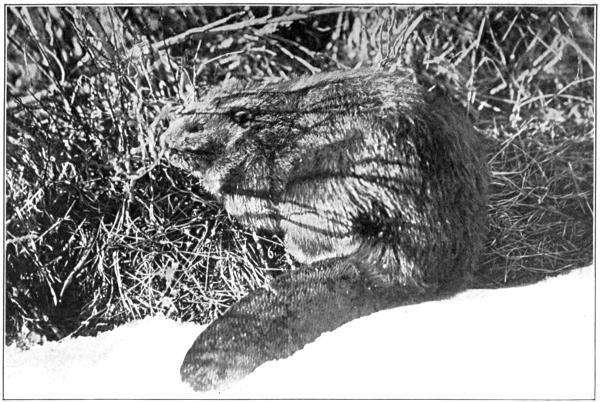
Flat-top was the name I gave him because of his straight back. In most
beaver the shoulders swell plumply above the back line after the
outline of the grizzly bear. Along with this peculiarity, which
enabled me to be certain of his presence, was another. This was his
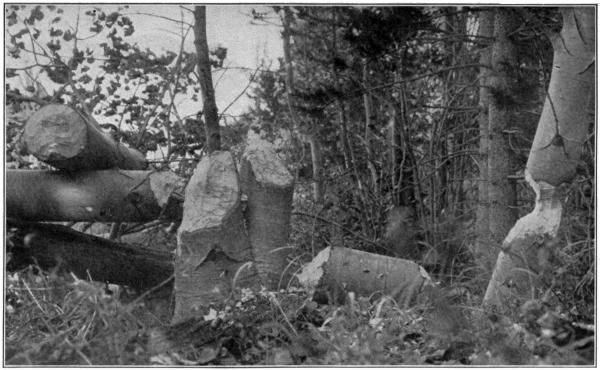
habit of gnawing trees off close to the earth when he felled them. The
finding of an occasional low-cut stump assured me of his presence
during the periods I failed to see him.
The first beaver settlement in the lake appears to have been made in
the early seventies, long before Flat-top was born, by a pair of
beaver who were full of the pioneer spirit. These settlers apparently
were the sole survivors of a large party of emigrants who tried to
climb the rugged mountains to the lake, having been driven from their
homes by encroaching human settlers. After a long, tedious journey,
full of hardships and dangers, they climbed into the lake that was to
them, for years, a real promised land.
Driven from Willow Creek, they set off upstream in search of a new
home, probably without knowing of Lily Lake, which was five miles
distant and two thousand feet up a steep, rocky mountain. These
pilgrims had traveled only a little way upstream when they found
themselves the greater portion of the time out of water. This was only
a brook at its best and in most places it was such a shallow, tiny
streamlet that in it they could not dive beyond the reach of enemies
or even completely cool themselves. In stretches the water spread
thinly over a grassy flat or a smooth granite slope; again it was lost
in the gravel; or, murmuring faintly, pursued its way out of sight
beneath piles of boulder,—marbles shaped by the Ice King. Much of the
time they were compelled to travel upon land exposed to their enemies.
Water-holes in which they could escape and rest were long distances
apart.
This plodding, perilous five-mile journey which the beaver made up the
mountain to the lake would be easy and care-free for an animal with
the physical make-up of a bear or a wolf, but with the beaver it is
not surprising that only two of the emigrants survived this supreme
trial and escaped the numerous dangers of the pilgrimage.
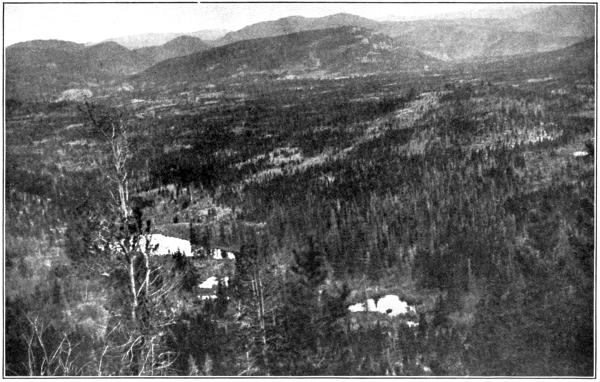
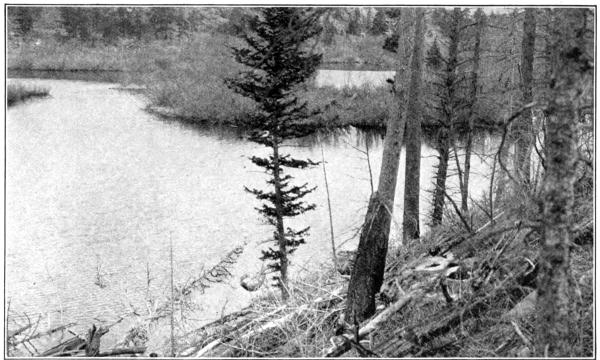
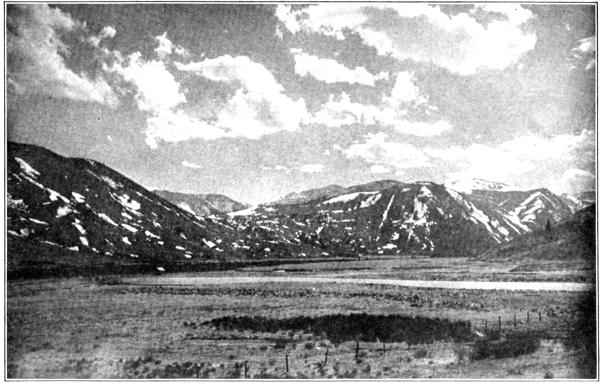
Lily Lake is a shallow, rounded lily garden that reposes in a glacier
meadow at an altitude of nine thousand feet; its golden pond-lilies
often dance among reflected snowy peaks, while over it the granite
crags of Lily Mountain rise several hundred feet. A few low, sedgy,
grassy acres border half the shore, while along the remainder are
crags, aspen groves, willow-clumps, and scattered pines. Its waters
come from springs in its western margin and overflow across a low
grassy bar on its curving eastern shore.
It was autumn when these beaver pioneers came to Lily Lake’s primitive
and poetic border. The large green leaves of the pond-lily rested upon
the water, while from the long green stems had fallen the sculptured
petals of gold; the willows were wearing leaves of brown and bronze,
and the yellow tremulous robes of the aspens glowed in the golden
sunlight.
These fur-clad pioneers made a dugout—a hole in the bank—and busily
gathered winter food until stopped by frost and snow; then, almost
care-free, they dozed away the windy winter days while the lake was
held in waveless ice beneath the drifting snow.
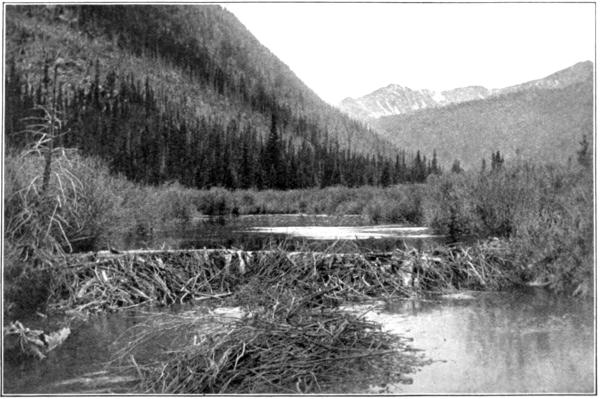
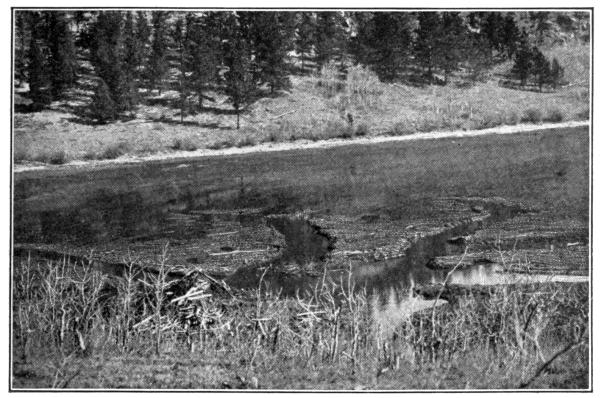
The next summer a house was built in the lily pads near the shore.
Here a number of children were born during the few tranquil years that
followed. These times came to an end one bright midsummer day. Lord
Dunraven had a ditch cut in the outlet rim of the lake with the
intention of draining it that his fish ponds, several miles below in
his Estes Park game-preserve, might have water. A drouth had prevailed
for several months, and a new water-supply must be had or the fish
ponds would go dry. The water poured forth through the ditch, and the
days of the colony appeared to be numbered.
A beaver must have water for safety and for the ease of movement of
himself and his supplies. He is skillful in maintaining a dam and in
regulating the water-supply; these two things require much of his
time. In Lily Lake the dam and the water question had been so nicely
controlled by nature that with these the colonists had had nothing to
do. However, they still knew how to build dams, and water-control had
not become a lost art. The morning after the completion of the
drainage ditch, a man was sent up to the lake to find out why the
water was not coming down. A short time after the ditch-diggers had
departed, the lowering water had aroused the beaver, who had promptly
placed a dam in the mouth of the ditch. The man removed this dam and
went down to report. The beaver speedily replaced it. Thrice did the
man return and destroy their dam, but thrice did the beaver promptly
restore it.
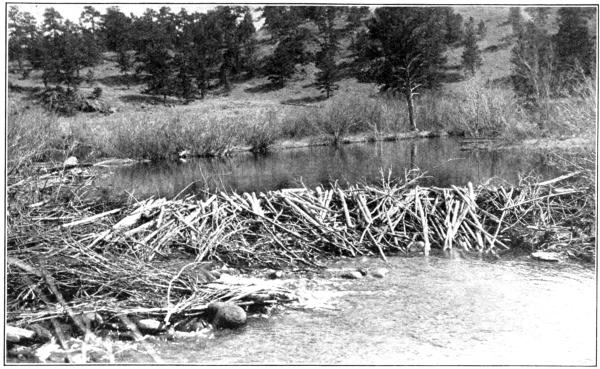
The dam-material used in obstructing the ditch consisted chiefly of
the peeled sticks from which the beaver had eaten the bark in winter;
along with these were mud and grass. The fourth time that the ditch
guard returned, he threw away all the material in the dam and then set
some steel traps in the water by the mouth of the ditch. The first two
beaver who came to reblockade the ditch were caught in these traps and
drowned while struggling to free themselves. Other beaver heroically
continued the work that these had begun. The cutting down of saplings
and the procuring of new material made their work slow, very slow,
in the face of the swiftly escaping water; when the ditch was at last
obstructed, a part of the material which formed this new dam consisted
of the traps and the dead bodies of the two beaver who had bravely
perished while trying to save the colony.
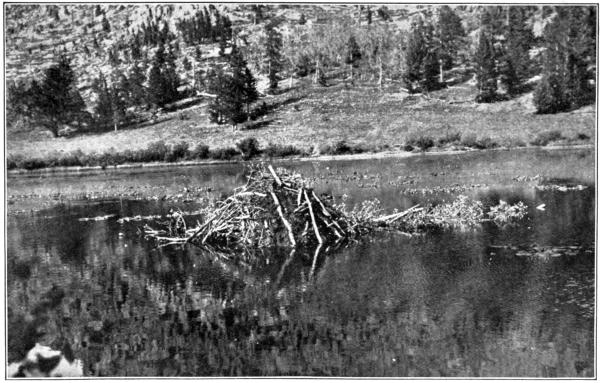
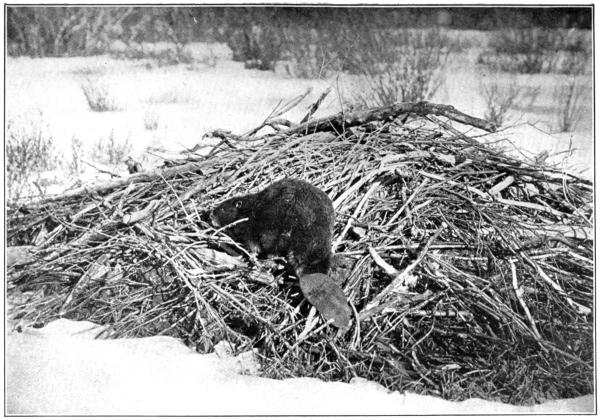
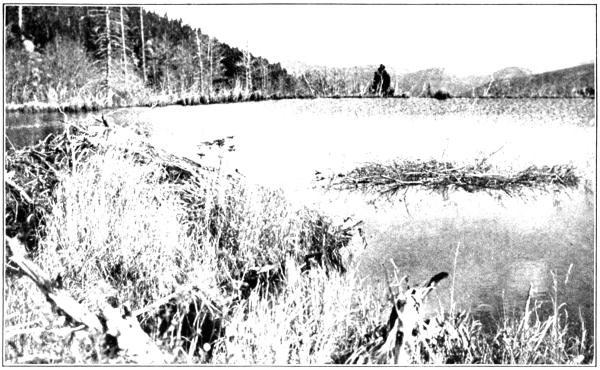
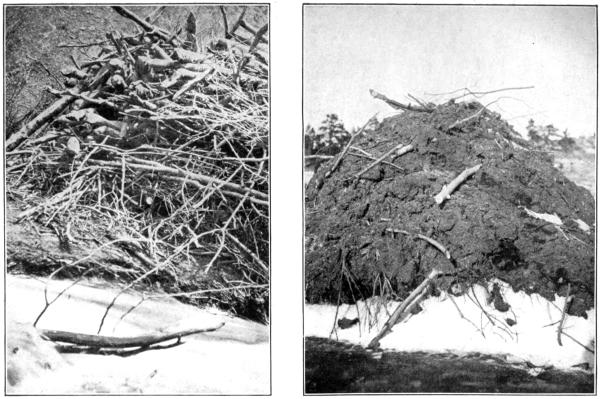
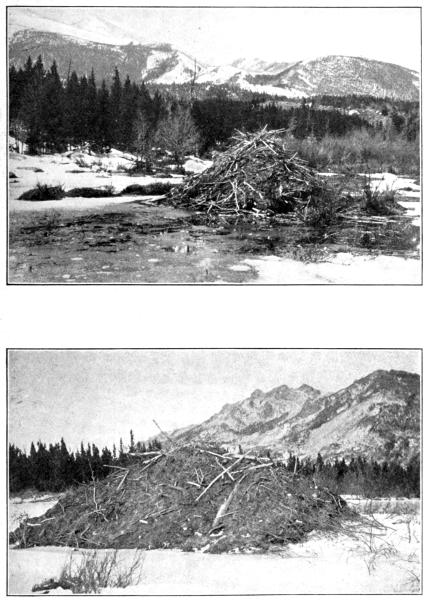
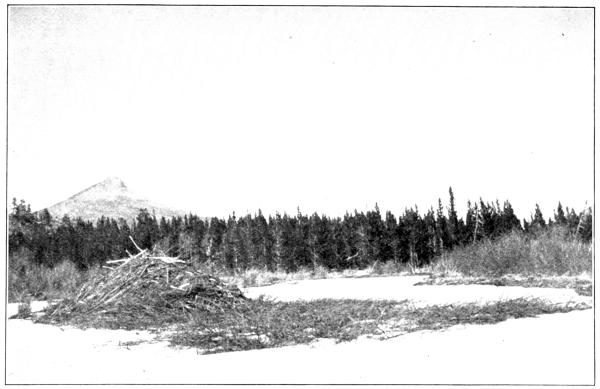
HOUSE IN LILY LAKE
The ditch guard returned with a rifle, and came to stay. The first
beaver to come within range was shot. The guard again removed the dam,
made a fire about twenty feet from the ditch, and planned to spend the
night on guard, rifle in hand. Toward morning he became drowsy, sat
down by the fire, heard the air in the pines at his back, watched the
star-sown water, and finally fell asleep. While he thus slept, with
his rifle across his lap, the beaver placed another—their
last—obstruction before the outrushing water.
On awakening, the sleeper tore out the dam and stood guard over the
ditch. All that afternoon a number of beaver hovered about, watching
for an opportunity to stop the water again. Their opportunity never
came, and three who ventured too near the rifleman gave up their
lives,—reddening the clear water with their life-blood in vain.
The lake was drained, and the colonists abandoned their homes. One
night, a few days after the final attempt to blockade the ditch, an
unwilling beaver emigrant party climbed silently out of the uncovered
entrance of their house and made their way quietly, slowly, beneath
the stars, across the mountain, descending thence to Wind River, where
they founded a new colony.
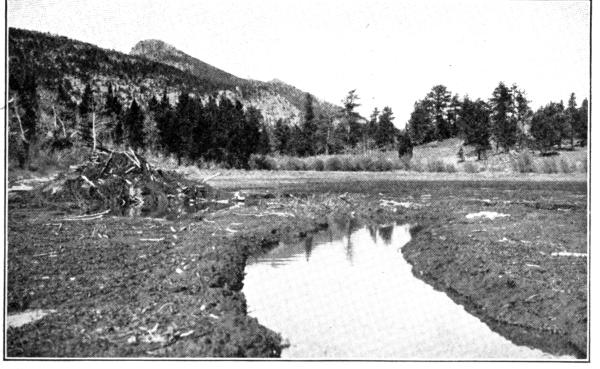
Winter came to the old lake-bed, and the lily roots froze and died.
The beaver houses rapidly crumbled, and for a few years the
picturesque ruins of the beaver settlement, like many a settlement
abandoned by man, stood pathetically in the midst of wilderness
desolation. Slowly the water rose to its old level in the lake, as the
outlet ditch gradually filled with swelling turf and drifting sticks
and trash. Then the lilies came back with rafts of green and boats of
gold to enliven this lakelet of repose.
One autumn morning, while returning to my cabin after a night near the
stars on Lily Mountain, I paused on a crag to watch the changing
morning light down Wind River Cañon. While thus engaged, Flat-top and
a party of colonists came along a game trail within a few yards of me,
evidently bound for the lake, which was only a short distance away. I
silently followed them. This was my introduction to Flat-top.
On the shore these seven adventurers paused for a moment to behold the
scene, or, possibly, to dream of empire; then they waddled out into
the water and made a circuit of the lake. Probably Flat-top had been
here before as an explorer. Within two hours after their arrival these
colonists began building for a permanent settlement.
It was late to begin winter preparation. The clean, white aspens had
shed their golden leaves and stood waiting to welcome the snows. This
lateness may account for the makeshift of a hut which the colonists
constructed. This was built against the bank with only one edge in the
water; the entrance to it was a twelve-foot tunnel that ended in the
lake-bottom where the water was two feet deep.
The beaver were collecting green aspen and willow cuttings in the
water by the tunnel-entrance when the lake froze over. Fortunately for
the colonists, with their scanty supply of food, the winter was a
short one, and by the first of April they were able to dig the roots
of water plants along the shallow shore where the ice had melted. One
settler succumbed during the winter, but by summer the others had
commenced work on a permanent house, which was completed before
harvest time.
I had a few glimpses of the harvest-gathering and occasionally saw
Flat-top. One evening, while watching the harvesters, I saw three new
workers. Three emigrants—from somewhere—had joined the colonists. A
total of fifteen, five of whom were youngsters, went into winter
quarters,—a large, comfortable house, a goodly supply of food, and a
location off the track of trappers. The cold, white days promised only
peace. But an unpreventable catastrophe came before the winter was
half over.
One night a high wind began to bombard the ice-bound lake with heavy
blasts. The force of these intermittent gales suggested that the wind
was trying to dislodge the entire ice covering of the lake; and indeed
that very nearly happened.
Before the crisis came, I went to the lake, believing it to be the
best place to witness the full effects of this most enthusiastic wind.
Across the ice the gale boomed, roaring in the restraining forest
beyond. These broken rushes set the ice vibrating and the water
rolling and swelling beneath. During one of these blasts the swelling
water burst the ice explosively upward in a fractured ridge entirely
across the lake. In the next few minutes the entire surface broke up,
and the wind began to drive the cakes upon the windward shore.
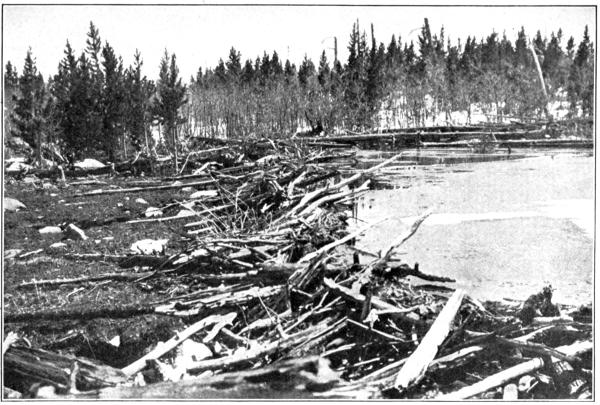
A large flatboat cake was swept against the beaver house, sheared it
off on the water-line, and overturned the conelike top into the lake.
The beaver took refuge in the tunnel which ran beneath the
lake-bottom. This proved a death-trap, for its shore end above the
water-line was clogged with ice. As the lake had swelled and surged
beneath the beating of the wind, the water had gushed out and streamed
back into the tunnel again and again, until ice formed in and closed
the outer entrance. Against this ice four beaver were smothered or
drowned. I surmised the tragedy but was helpless to prevent it.
Meanwhile the others doubled back and took refuge upon the ruined
stump of their home. From a clump of near-by pines I watched this wild
drama.
Less than half an hour after the house was wrecked, these indomitable
animals began to rebuild it. Lashed by icy waves, beaten by the wind,
half-coated with ice, these home-loving people strove to rebuild their
home. Mud was brought from the bottom of the pond and piled upon the
shattered foundation. This mud set—froze—almost instantly on being
placed. They worked desperately, and from time to time I caught sight
of Flat-top. Toward evening it appeared possible that the house might
be restored, but, just as darkness was falling, a roaring gust struck
the lake and a great swell threw the new part into the water.
The colonists gave up the hopeless task and that night fled down the
mountain. Two were killed before they had gone a quarter of a mile.
Along the trail were three other red smears upon the crusted snow;
each told of a death and a feast upon the wintry mountainside among
the solemn pines. Flat-top with five others finally gained the Wind
River Colony, from which he had led his emigrants two years before.
One day the following June, while examining the lilies in the lake, I
came upon a low, freshly cut stump;—Flat-top had returned. A number
of colonists were with him and all had come to stay.
All sizable aspen that were within a few yards of the water had been
cut away, but at the southwest corner of the lake, about sixty feet
from the shore, was an aspen thicket. Flat-top and his fellow workers
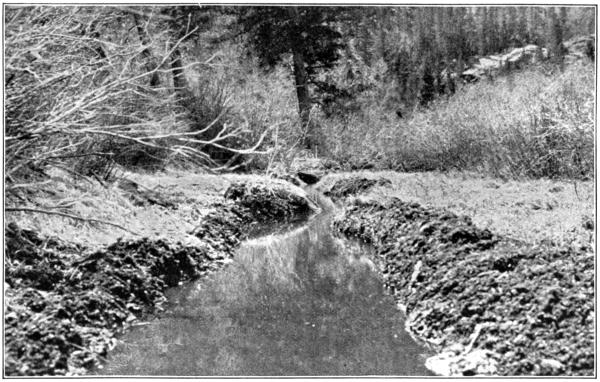
cut a canal from the lake through a low, sedgy flat into this aspen
thicket. The canal was straight, about fourteen inches deep and
twenty-six inches wide. Its walls were smoothly cut and most of the
excavated material was piled evenly on one side of the canal and about
eight inches from it. It had an angular, mechanical appearance, and
suggested the work not of a beaver, but of man, and that of a very
careful man too.
Down this canal the colonists floated the timbers used in building
their two houses. On the completion of the houses, the home-builders
returned to the grove and procured winter supplies. In most cases the
small aspen were floated to the pile between the houses with an adept
skill, without severing the trunk or cutting off a single limb.
The colonists had a few years of ideal beaver life. One summer I came
upon Flat-top and a few other beaver by the brook that drains the
lake, and at a point about half a mile below its outlet. It was along
this brook that Flat-top’s intrepid ancestors had painfully climbed to
establish the first settlement in the lake. Commonly each summer
several beaver descended the mountain and spent a few weeks of
vacation along Wind River. Invariably they returned before the end of
August; and autumn harvest-gathering usually began shortly after their
return.
Year after year the regularly equipped trappers passed the lake
without stopping. The houses did not show distinctly from the trail,
and the trappers did not know that there were beaver in this place.
But this peaceful, populous lake was not forever to remain immune
from the wiles of man, and one day it was planted with that barbaric,
cruel torture-machine, the steel trap.
A cultured consumptive, who had returned temporarily to nature, was
boarding at a ranch house several miles away. While out riding he
discovered the colony and at once resolved to depopulate it. The
beaver ignored his array of traps until he enlisted the services of an
old trapper, whose skill sent most of the beaver to their death before
the sepia-colored catkins appeared upon the aspens. Flat-top escaped.
The ruinous raid of the trappers was followed by a dry season, and
during the drouth a rancher down the mountain came up prospecting for
water. He cut a ditch in the outlet ridge of the lake, and out gushed
the water. He started home in a cheerful mood, but long before he
arrived, the “first engineers” had blocked his ditch. During the next
few days and nights the rancher made many trips from his house to the
lake, and when he was not in the ditch, swearing, and opening it, the
beaver were in it shutting off the water.
From time to time I dropped around to see the struggle, one day coming
upon the scene while the beaver were completing a blockade. For a time
the beaver hesitated; then they partly resumed operations and carried
material to the spot, but without showing themselves entirely above
water. When it appeared that they must have enough to complete the
blockade, I advanced a trifle nearer so as to have a good view while
they placed the accumulated material. For a time not a beaver showed
himself. By and by an aged one climbed out of the water, pretending
not to notice me, and deliberately piled things right and left until
he had completed the ditch-damming to his satisfaction. This act was
audacious and truly heroic. The hero was Flat-top.
In this contest with the rancher, the beaver persisted and worked so
effectively that they at last won and saved their homes, in the face
of what appeared to be an unconquerable opposition.
A little while after this incident, a home-seeker came along, and,
liking the place, built a cabin in a clump of pines close to the
southern shore. Though he was a gray old man without a family, I
imagined he would exterminate the beaver and looked upon him with a
lack of neighborly feeling.
Several months went by, and I had failed to call upon him, but one day
while passing I heard him order a trapper off the place. This order
was accompanied by so strong a declaration of principles—together
with a humane plea for the life of every wild animal—that I made
haste to call that evening.
One afternoon in a pine thicket, close to the lake-shore, I came upon
two gray wolves, both devouring beaver, which had met their death
while harvesting aspens for winter. The following spring I had a more
delightful glimpse of life in the wilds. Within fifty feet of the
lake-shore stood a large pine stump that rose about ten feet from the
ground. Feeling that I should escape notice if I sat still on the top,
I climbed up. Though it was mid-forenoon, the beaver came out of the
lake and wandered about nibbling here and there at the few green
plants of early spring. They did not detect me. They actually appeared
to enjoy themselves. This is the only time that I ever saw a beaver
fully at ease and apparently happy on land. In the midst of their
pleasures, a flock of mountain sheep came along and mingled with them.
The beaver paused and stared; now and then a sheep would momentarily
stare at a beaver, or sniff the air as though he did not quite like
beaver odor. In less than a minute the flock moved on, but just as
they started, a beaver passed in front of the lead ram, who made a
playful pretense of a butt at him; to this the beaver paid not the
slightest heed.
During the homesteader’s second summer he concluded to raise the
outlet ridge, deepen the water, and make a fish pond of the lake.
Being poor, he worked alone with wheelbarrow and shovel. The beaver
evidently watched the progress of the work, and each morning their
fresh footprints showed in the newly piled earth. Shortly before the
dam was completed, the homesteader was called away for a few days, and
on his return he was astonished to find that the beaver had completed
his dam! The part made by the beaver suited him as to height and
length, so he covered it over with earth and allowed it to remain.
His work in turn was inspected and apparently approved by the beaver.
How long does a beaver live? Trappers say from fifteen to fifty years.
I had glimpses of Flat-top through eighteen years, and he must have
been not less than four years of age when I first met him. This would
make his age twenty-two years; but he may have been six years of
age—he looked it—the morning he first led emigrants into Lily Lake;
and he may have lived a few years after I saw him last. But only the
chosen few among the beaver can succeed in living as long as Flat-top.
The last time I saw him was the day he dared me and blockaded the
drain ditch and stopped the outrushing water.
Flat-top has vanished, and the kind old homesteader has gone to his
last long sleep; but the lake still remains, and still there stands a
beaver house among the pond-lilies.