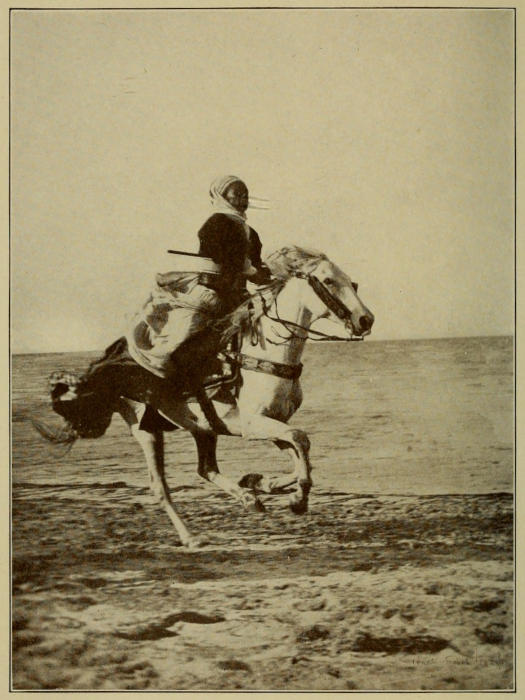
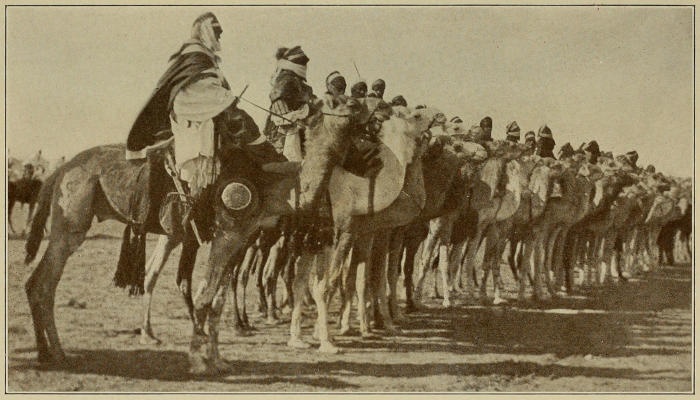
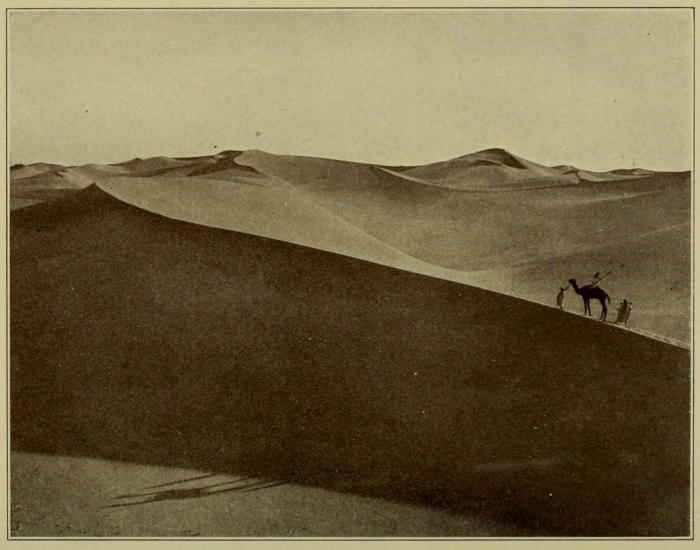
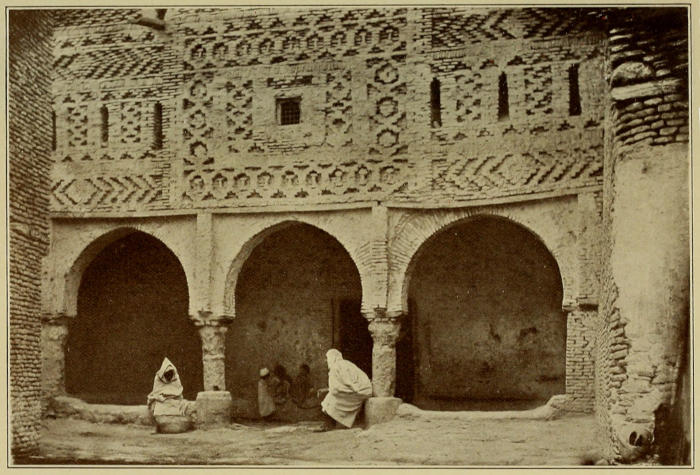
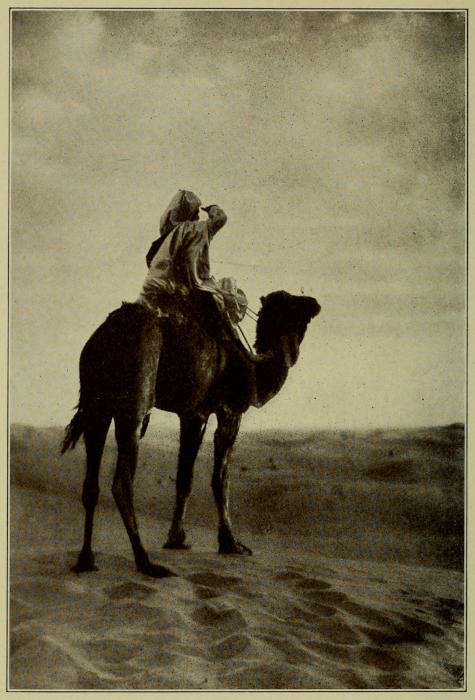
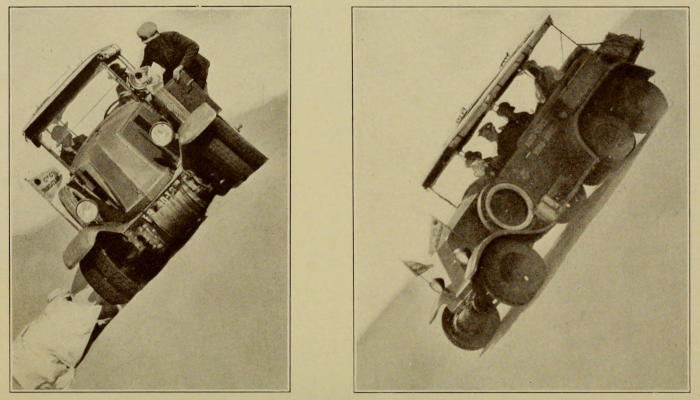
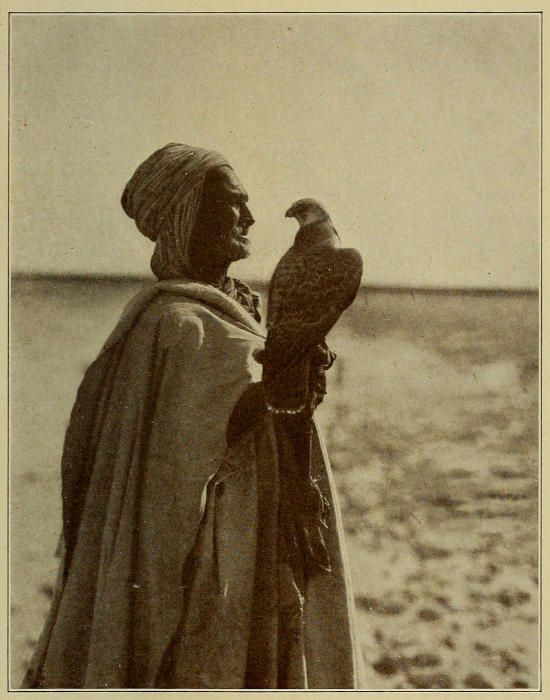
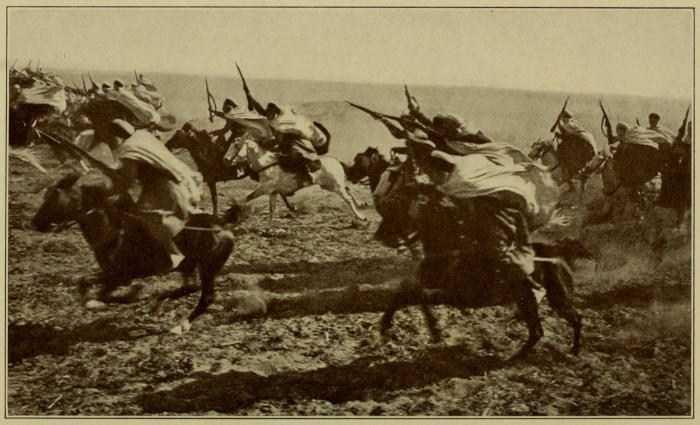
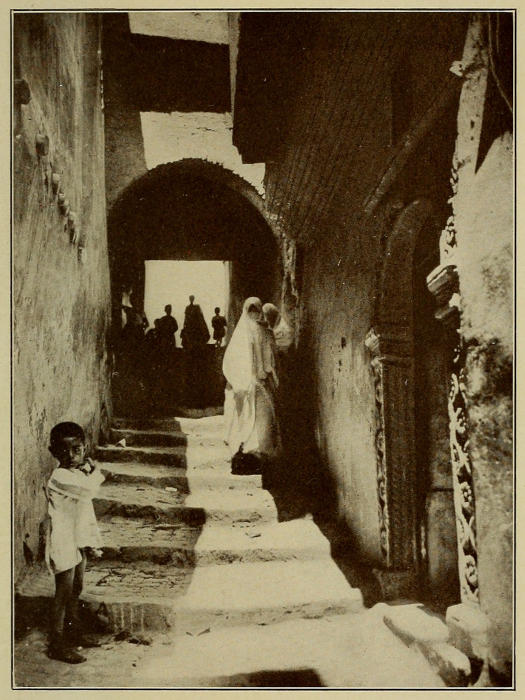
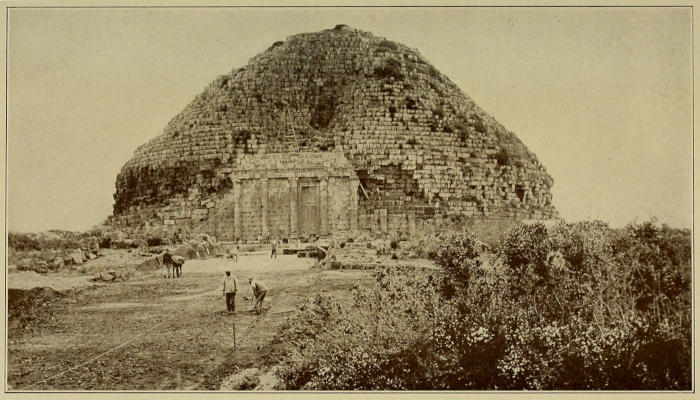
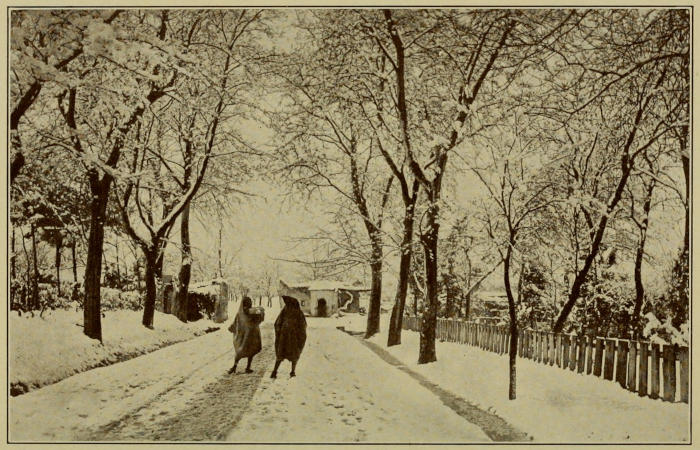
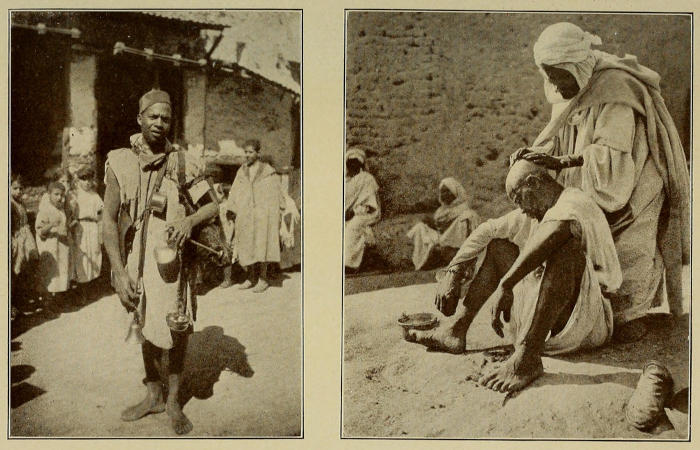
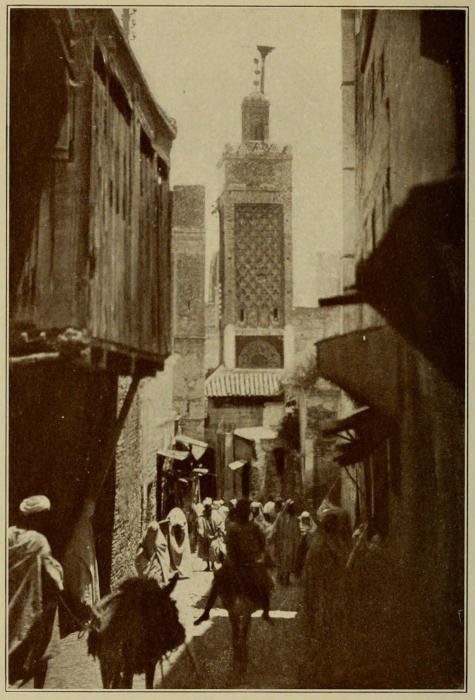
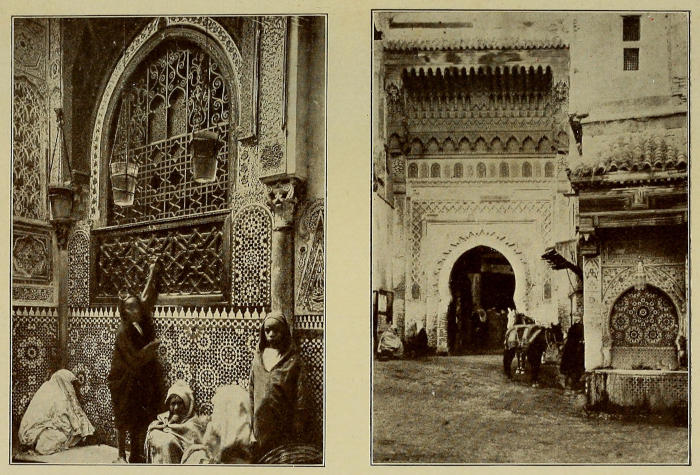
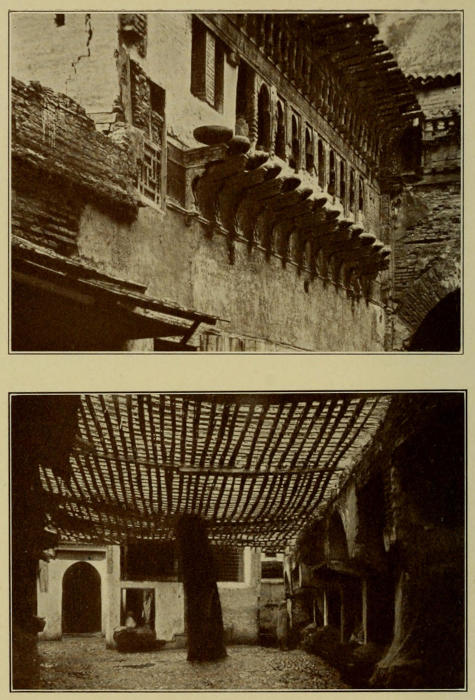
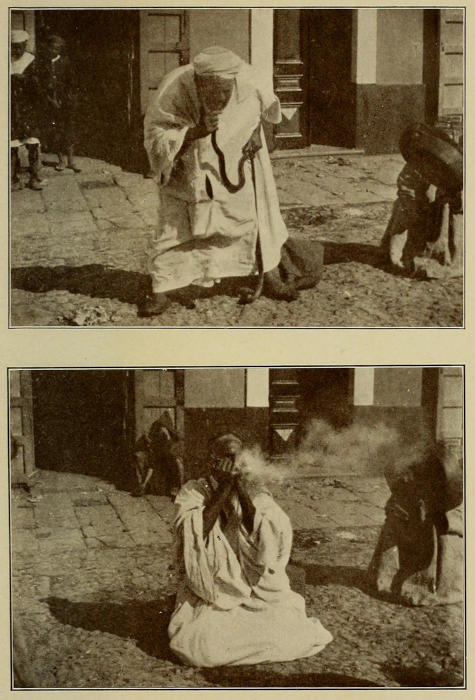
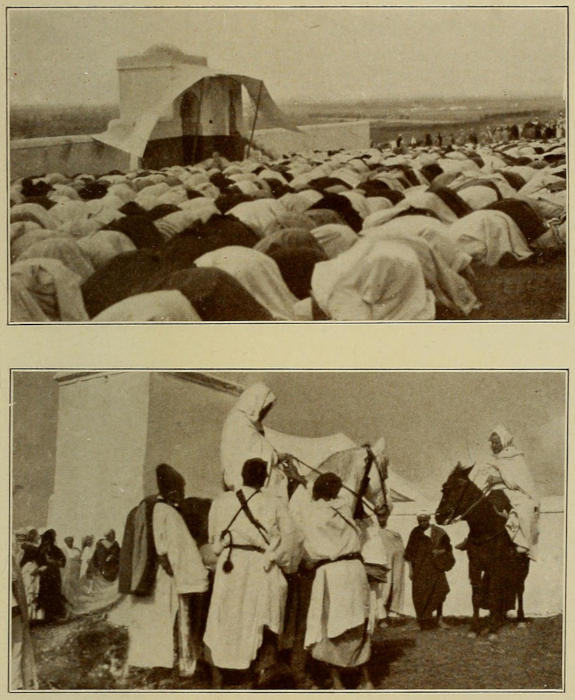
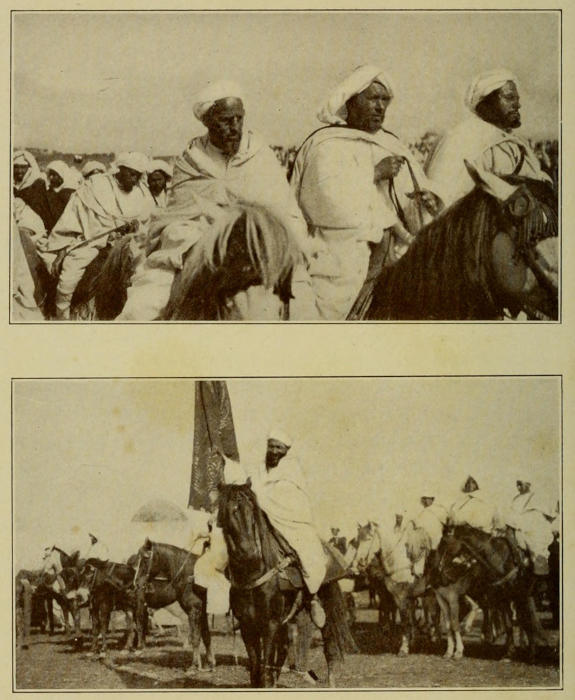
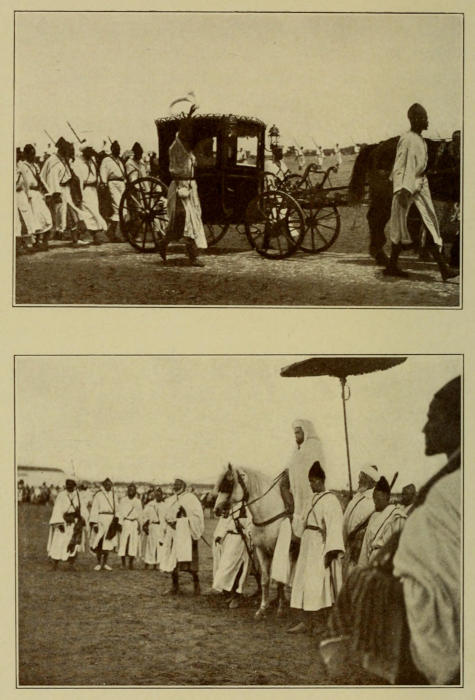
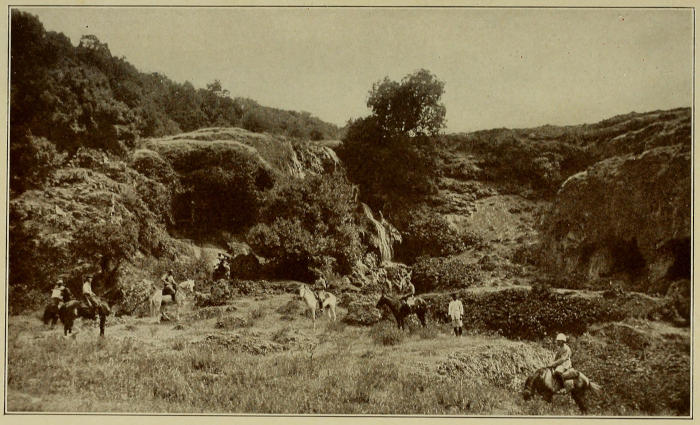
There is no finer light-horseman on earth than the spahi—a cow-puncher, a
Cossack, an Indian brave, and a Bedouin warrior combined
IN BARBARY
TUNISIA, ALGERIA, MOROCCO
AND THE SAHARA
BY
E. ALEXANDER POWELL
With Eighty-six Illustrations
from Photographs and Two Maps
PUBLISHED BY THE CENTURY CO.
NEW YORK LONDON
Copyright, 1926, by The Century Co.
PRINTED IN U. S. A.
To
My Daughter
BETTIE
In memory of the days
when we rode across
the desert
FOREWORD
Unlike most of my preceding volumes, this book
deals with countries which are comparatively near
to home. Tunisia, Algeria, Morocco—which we know
collectively as Barbary—lie at the very door of Europe;
their principal ports are scarcely more than overnight
from Naples, Barcelona, and Marseilles; scores of tourist
steamers drop anchor in their harbors every winter, and
they are visited by increasing numbers of Americans each
year. Yet it is a curious fact, and one difficult to explain,
that the popular misconceptions regarding these easily
accessible lands are even more glaring than those in respect
to far remoter regions which the white man penetrates
at every risk.
The truth of the matter is that most Americans, and
most Europeans too for that matter, think of Barbary
in terms of the corsairs, the Garden of Allah, the dancing-girls
of the Ouled-Naïl, the Foreign Legion, Raisuli and
Perdicaris, the squalor and confusion of Europeanized
Tangier, the Riff and Abd-el-Krim, the luxurious resort
hotels of Algiers, the Street of the Perfume-Sellers in
Tunis, Moroccan leather-work, camels, tiled gateways, the
utterly impossible sheikhs described by Mrs. Hull and
interpreted by Hollywood, and the sand-dunes so frequently
pictured in the “National Geographic Magazine.”
With our unfortunate propensity for generalizing, we have
assumed that these high spots were typical of Barbary,
thus forming a mental picture which is as fantastic as it is
inaccurate.
For example, we speak of the inhabitants of North
Africa as Arabs, who in reality are only a minority,
the bulk of the population being composed of Berbers,
the earliest known possessors of the soil, who still
hold the highlands which stretch from the borders of
Egypt to the shores of the Atlantic, from the sands of the
Mediterranean to those of the Sahara, that vast extent of
territory to which we have given their name, Barbary.
We think of the Berbers as crude and uncultured, as
barbaric, bloodthirsty, and backward as were the American
Indians. Yet before America was so much as heard
of, they, not the Arabs or the Saracens, had raised at
Granada and Seville those glorious buildings which are
among the architectural triumphs of the world.
Because of their sun-tanned skins, and recalling, perhaps,
the old term “blackamoor,” we assume that the
Berbers are a colored race and are astounded when we
are told that they are of pure Caucasian stock, racially
as white as ourselves.
Because it is in Africa we take it for granted that
Barbary swelters in a torrid climate, whereas it is a cold
country with a hot sun. In Algeria the week after Easter
I have seen snow several inches deep, and the mountains
to the south of Marrákesh are topped with snow nearly
the whole year round.
Most of us think of Morocco as a treeless, semi-arid,
almost level land, yet it has vast forests of oak and pine,
several rivers comparable with the Thames or the Hudson,
and in the spring its prairies and hill-slopes are carpeted
with countless varieties of wild flowers. Far from
being level, it is a highly mountainous country; the Moroccan
Atlas has a greater average height than the Alps,
and at least one of its peaks is higher than any mountain
in the United States outside of Alaska.
We ourselves went to war in ’98 to end the intolerable
rule of Spain in the Western Hemisphere, yet the propaganda
skilfully disseminated from Madrid and Paris has
blinded us to the fact that Abd-el-Krim and his mountaineers
of the Riff were fighting for precisely the same
reason for which the Cubans fought—to throw off the
yoke of Spanish tyranny and cruelty.
Because in the geographies of our school-days large
portions of North Africa were painted a speckled yellow,
and because of the pictures of sand-dunes reproduced
in certain magazines, we habitually picture the
Sahara as a trackless waste of orange sand, on which
grows no living thing, little realizing that it is broken
by mile-high mountain ranges and dotted with oases,
some of them as large as a New England State, which
support thousands of inhabitants and millions of date-palms.
Basing our idea on motion-pictures made in Hollywood,
and on novels of the desert school of fiction, we imagine
sheikhs—and for heaven’s sake pronounce it
shakes instead of sheeks!—as romantic, picturesque, debonair
gentlemen with chivalrous instincts and charming
manners, whereas candor compels me to assert that most
of them are blackguardly ruffians, lustful, cruel, vindictive,
ignorant, debased, as filthy of mind as of body.
We have long accepted as gospel the assertion that the
British are the only really successful colonizers in the
world; the French colonial we have pictured as a miserable
being who spends his days in a hammock, sipping
absinthe, reading “La Vie Parisienne,” and counting
the hours until he can return to la belle France. Yet, in
the space of a single generation, these miserable and inefficient
beings have in Africa alone conquered and consolidated
and civilized a colonial empire greater in area
than the United States and all of its possessions put together.
And, finally, we cling to the delusion that Barbary,
though doubtless colorful and picturesque, is deficient in
monuments of historical or architectural interest, and
that the facilities provided for the comfort of the traveler
are limited and somewhat crude. Let me remark, by way
of answering this objection, that Tunisia is as thickly
strewn with Roman ruins as Italy itself; that the scenery
of the Grand Kabylia and the High Atlas is as impressive
as any in Switzerland; that the mosques and towers
and palaces of Morocco were built by the same race
which raised the Alhambra and the Alcázar; that the
network of motor-roads which cover Barbary compare very
favorably with the best highways we have in the United
States; and that the hotels which have sprung up all the
way from Tunis to Marrákesh are not far removed in
luxury from the great tourist hostelries of Florida and
California.
Extremely misleading too have been the pictures of
political conditions in North Africa as drawn by certain
members of self-styled “American missions,” who have
visited the country at the invitation of the government,
have been dazzled by fêtes and flatteries, and have swallowed
the propaganda assiduously fed them by their
hosts. I yield to none in my admiration for what France
has achieved in North Africa, but to assert, as have certain
American visitors, that the natives are contented
with French rule and would give their life’s blood to defend
it is to take wholly unjustifiable liberties with the
truth.
It is to correct the current misapprehensions in regard
to Barbary, some of which are alluded to above, that I
have written this book.
I am perfectly aware that the countries to which the following
pages are devoted have been treated of many times,
and that my pages contain nothing that is startling, little
that is really new. But I can at least make this claim for
my book, that it is the only one, so far as I am aware, which
brings the whole of French North Africa, its history,
peoples, customs, places of interest, resources, and politics,
between two covers. During my last two or three
visits to Barbary I have been struck by the lack of such
a book, and I have designed this one to fill a needed want.
Though I have used my last African journey, which
occupied the winter, spring, and early summer of 1925,
as a thread on which to string the incidents and impressions
recorded in the ensuing chapters, it should be explained
that much of my information was gathered during
earlier visits, dating back to the early years of the present
century. Hence I am in a position to make comparisons.
For it has been my great good fortune to have seen the
preliminary sketches as well as the completed picture. I
was in the Sahara when it was still “the Last Frontier”;
I knew Morocco as it was a decade before the white helmets
came.
While having no desire to trespass on the field of
Messrs. Baedeker, Murray, and Cook, I have nevertheless
attempted to produce a volume which will be
of real service to the casual traveler by incorporating
definite information as to routes, hotels, and general travel
conditions and by calling to his attention places which,
though not always mentioned in the guide-books, are well
worth seeing. I have also sketched the natural resources
of the various regions and have endeavored to
acquaint my readers with the highly involved political
situations which exist in all of them. It may be said,
by way of criticism, that my pages are overburdened
with historical matter, but without the background of the
Punic settlements, the Roman, Vandal, Byzantine, and
Arab invasions, and the activities of the corsairs, it is
impossible to understand Barbary as it is under the
French.
It may also be assumed by some that, as I was afforded
numerous facilities by the French authorities, this book
is a reflection of the French view. I would remind such
critics that the remoter districts of North Africa are still
in military occupation, forbidden to the casual traveler,
and that they may be visited with the permission of the
French military authorities or not at all. Though such
permission was promptly granted whenever I requested it,
and though French officials of all grades went out of their
way to show me courtesies and extend assistance, my judgment
has not been affected by the consideration I received,
nor my views biased, as the following pages will testify.
To much that the French have accomplished in North
Africa I raise my hat in respect and admiration; of other
phases of their policy I do not approve. In both cases I
have spoken my mind freely. My opinions may not be
worth much, but at least they are my own.
E. Alexander Powell.
Sugar Hill,
New Hampshire,
August, 1926.
ACKNOWLEDGMENT
The journey described in the following pages was first
suggested to me by a dear and deeply lamented
friend, the late Hugues Le Roux, senator of France and a
noted African explorer, who had taken an active and
highly helpful interest in my preceding expeditions into
the Dark Continent. Through the kindness of Senator
Le Roux and of his charming American wife I met at their
dinner-table many persons, some of them high in the
French political world, who were of immense assistance to
me.
M. Albert Sarraut, then minister of the colonies, and
General Nollet, at the time minister of war, placed at my
disposal all the facilities of their departments of the government.
M. Jean Jules Jusserand, former French ambassador
to the United States; his successor at the Washington
embassy, M. Berenger; the Hon. Myron T. Herrick,
American ambassador to France; Christian Gross, Esq.,
secretary of the American embassy in Paris; M. Marcel
Knecht, the famous editor and publicist; M. Joseph Perret,
director of the French Government Tourist Information
Office in New York; and my old friend, James Hazen Hyde,
Esq., all aided me with valuable advice and letters of introduction.
In Tunisia my path was made pleasant by the French
resident-general, M. Lucien Saint; in Algeria by the governor-general,
M. Théodore Steeg; and in Morocco by the
resident-general, Marshal Lyautey. General Vicomte de
Chambrun, commanding the French troops in Fez, from
whom I have always received the warmest of welcomes upon
my visits to that city; General Daugan, commanding the
forces in Southern Morocco; Colonel Paul Azan, commanding
at Tlemcen, in Algeria; and Vicomte Louis de Trémaudan,
of the civil administration at Marrákesh, were all
largely responsible for the pleasure and interest of my
journey by making it possible for me to visit districts not as
a rule open to Europeans. It was my great good fortune
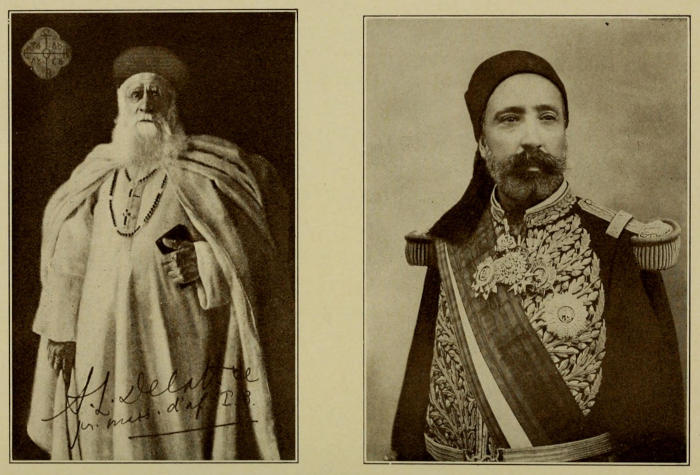
to have as my guide to the ruins of Carthage the Rev.
Father Delattre of the Order of the White Fathers, who
is one of the foremost archæologists in the world; while
Miss Sophie Denison, who has been a medical missionary
in Morocco for a third of a century, was of great assistance
to me in Fez. Two voyages on the S.S. La France were
made delightful by the thoughtfulness of her commander,
Captain Blancart, and the second captain, M. Vogel. In
fact, throughout a journey of nearly fifteen thousand miles
we were shown unfailing hospitality and kindness by every
official with whom we came in contact, from his Imperial
Majesty the sultan of Morocco, who received me in audience
in his palace at Marrákesh, to subalterns in command of
lonely desert outposts.
That the long journey, much of it in desert regions, was
so replete with material comforts, was due to the great
kindness of M. Jean dal Piaz, president of the Compagnie
Générale Transatlantique, and to his able assistants, M.
Maurice Tillier, director-general of the company in Paris;
M. Robert Hallot, Chef du Services des Auto-Circuits
Nord-Africains, and M. Georges Paignon, manager of the
North African Tours Department in New York, who
generously placed at my disposal all the facilities of their
vast organization. It will be noted that in the following
pages I have repeatedly called attention to the services
provided for the traveler in North Africa by the
“Transat.” Not to mention the part played by this company
in the opening up of Barbary would be equivalent to
ignoring the work of Fred Harvey and the Santa Fé in
the development of the American West.
I also welcome this opportunity of acknowledging my
indebtedness to C. F. and L. S. Grant, authors of “African
Shores of the Mediterranean”; to L. March Phillips, Esq.,
author of “In the Desert”; to Norman Douglas, Esq.,
author of “Fountains in the Sand”; to Frances E. Nesbitt,
author of “Algeria and Tunisia”; to Charles Thomas-Stanford,
Esq., author of “About Algeria”; to the late
Budgett Meakin, Esq., author of “Life in Morocco”; and
to Sir Harry H. Johnston, Frank E. Cana, Esq., and Edward
Heawood, Esq., authors of monographs in the “Encyclopædia
Britannica” on Tunisia, Algeria, and the Sahara
respectively. From all of the above works I have obtained
historic and economic data and many valuable suggestions.
And East and West, the wander-thirst that will not let me be.
The wander-thirst is like the drug-habit. Once you acquire
it you are done for. It will never let you rest.
There is no mistaking its symptoms: a hatred of the prosaic,
the routine, and the humdrum; an aversion to staying
long in one place; an insatiable craving to move on, move
on—to see what lies beyond yonder range of hills, around
that next bend in the road.
It is as persistent as it is insidious. There comes the
stage when you think that you are cured of it. You delude
yourself into believing that you have had enough of
discomforts and privations and that it is high time you
settled down and had a home. You weigh the respective
merits, as a place of residence, of Long Island and Southern
California; you even consult an architect and subscribe
to “House and Garden” and “Country Life.”
But one day you casually pick up a list of steamer sailings,
or stumble on your battered luggage plastered over
with foreign labels, or whiff some exotic smell which brings
back memories of the hot lands (there is no sense which
stimulates the memory like that of smell), or see a vessel
outward bound, or idly open a map, whereupon the old
craving suddenly grips you like an African fever, and,
almost before you realize it, you are on the out-trail once
again.
The symptoms usually recur with the approach of winter,
when the northern days grow short and gloomy, when
the shop-windows are filled with fur coats and mufflers
and galoshes, when the wind howls mournfully beneath the
eaves o’ nights. But the attacks which are hardest to resist
come in the early spring, when the snow has disappeared,
and the smell of fresh earth is in the air, and the
country-side is already green in spots. That is the time
when it is most difficult to control one’s restless feet.
For a quarter of a century the urge of spring had perennially
sent me packing to the Far Places. But when I
came up from Equatoria, after a year spent beneath the
shadow of the Line, I said to myself that I was through
with wandering as a vocation—that I was going back to
my own country and my own people and on an elm-shaded
street in some tranquil community buy me a long, low,
rambling house—a white house with broad, hospitable
porches and green blinds. I had carefully planned it all
out on the long African marches or during sleepless nights
beneath the Southern Cross. I would join the local golf-club,
and amuse myself with my horses and my dogs and
my books, and keep my house filled with friends over the
week-ends, and even go into politics in a mild way, perhaps.
In fact, I proposed to do all the sensible, prosaic
things for which I had never had the time before.
But, before sailing for America to put these laudable
resolutions into effect, I met at a Paris dinner-table the
gentleman who was at that time charged with the conduct
of France’s colonial affairs. We had much in common, it
developed, for he too had been on those distant seaboards
of the world where the Gallic empire-builders are creating
a new and greater France. Lingering over the coffee
and cigars we talked shop—the future of Indo-China,
Madagascar’s need of harbors, Miquelon and its fisheries,
the Syrian mandate, the control of sleeping-sickness in the
Congo, cotton-growing in the country round Lake Tchad.
“Why don’t you round out your survey of our possessions,”
the minister suggested, “by taking a look at what
we’ve accomplished in North Africa?”
“The North African tour?” I asked, laughing. “Algiers,
Constantine, and Tunis, with a side-trip to the
Garden of Allah? Thank you, no. After what I’ve seen
I’m afraid that I’d find that sort of thing pretty tame.
Besides, I’ve already been to North Africa any number
of times. I once spent a winter in Tunisia, and
Algeria and I was in Morocco back in the bad old days
when unsuccessful pretenders to the Shereefian throne
were carried about the country in iron cages lashed to the
backs of camels.”
“I’ll wager that I can name some places in North
Africa that you haven’t seen,” the tempter said persuasively.
“How about a visit to Djerba—the island of
the lotus-eaters, you know—and the desert sky-scrapers of
Medenine and the troglodyte dwellings of the Matmata
Plateau? Then you could push down into the Sahara,
cross the sand-dunes of the Grand Erg by twelve-wheeler
to Ouargla and Ghardaia, keep on to the Figuig Oasis,
and so over the Atlas into Morocco.”
“Yes,” I remarked speculatively, “if I were going to
do it at all I should certainly include Morocco. There are
some parts of it which I have never seen, and it has
rather worried me. I’ve always had a hankering to have
a look at some of those kasbahs in the High Atlas, where
the grand caïds live like the marauding barons of the
Middle Ages, I am told. And, while I was about it, I
should like to get into the forbidden Sus, and even to see
a bit of Mauretania and the masked Touareg, perhaps.”
“That can all be arranged quite easily,” the minister
assured me. “If you decide to go, I’ll write to Marshal
Lyautey, who runs the show for us in Morocco, and instruct
the officers commanding in the Saharan military
provinces to give you every assistance.”
“Suppose we have a look at the map,” I suggested, half
capitulating. (I could feel the old familiar symptoms coming
on; already my feet were growing restless.)
We appealed to our host, who led us into his library and
on the table spread a large-scale map labeled “Afrique du
Nord Française.” There they lay before me, tempting
as jewels, those glowing lands of sun and sand, of Arab,
Berber, and Moor, of mosque and minaret. Set in the
Mediterranean shore-line like great fragments of colored
mosaic were the Barbary States—Tunisia, Algeria, Morocco.
Below them, sweeping southward to the Great Bend
of the Niger and the swamps around Lake Tchad, was the
yellow expanse of the Sahara, crisscrossed with the thin
black lines which I knew for caravan-routes and sprinkled
with the patches of green which stand for palm-shaded
oases. And far to the westward, where Africa almost
rubs shoulders with South America, lay Mauretania, land
of the Blue-Veiled Silent Ones, The Forgotten of God.
Now I maintain that it is as unfair to unroll a map
before a man who is striving to overcome the wander-thirst
as it is to offer cocaine to a reformed drug-addict.
For how, I ask you, could one be expected to resist the lure
of those magic names—Kairouan, Gafsa, Touggourt, Ghardaia,
Laghouat, Sidi-bel-Abbès, Oujda, Fez, Mequinez,
Mazagan, Mogador, Agadir? At sight of them my resolutions
crumbled like Mexican adobe. Almost before I realized
it my carefully made plans had been tossed into the
discard, and instead of poring over plans and specifications
with an architect I was overhauling my travel-gear and
ordering riding-breeches from my tailor and making inquiries
about the sailing-dates from Marseilles.
Yes, it was the map that was my undoing, for
I never see a map but I’m away
On all the errands that I long to do,
Up all the rivers that are painted blue,
And all the ranges that are painted gray,
And into those pale spaces where they say,
“Unknown”....
There are three routes from France to French North
Africa, and they are all served by the steamers of the
Compagnie Générale Transatlantique, or, as it is better
known to Americans, the French Line. The first is from
Bordeaux to Casablanca, the chief seaport of Morocco; a
four-day voyage, this, half of it in the Bay of Biscay.
Speaking for myself, I have never found that ill-reputed
body of water anything save smooth, but doubtless that
has been my good fortune. The second route is from
Marseilles to Algiers by the Mediterranean greyhounds,
swift, luxurious vessels which make the crossing in something
under four-and-twenty hours, so that you have
scarcely said good-by to Europe before you are being
greeted by Africa. The third route, and the one which we
took, is from Marseilles to Tunis—a two days’ voyage if
the steamer is not detained at Bizerta.
Of course there are other roads to Africa; roads which are
more picturesque and interesting, perhaps, provided that
speed and comfort are not essential. Thus one may travel
by the Sud Express from Paris to Algeciras, a charming
little Spanish coast-town across the bay from Gibraltar,
whence small and rather dirty vessels cross the straits
thrice weekly to Tangier in Morocco. The chief objection
to this way is that, in order to reach French Morocco and
the main lines of travel, it is necessary to traverse the
Spanish zone by motor-car, a somewhat arduous trip and
one which has heretofore been subject to interruption because
of the troubles in the Riff.
There is an even more out-of-the-ordinary route to Barbary,
but it is uncertain and in parts exceedingly uncomfortable,
so, unless the traveler is prepared to put up with
delays and discomforts, I cannot recommend it. This is
by the fortnightly Italian boat from Syracuse, in Sicily, to
Tripoli and thence by narrow-gage railway along the coast
of Tripolitania to the present end-of-steel at Zuara. Here,
by making arrangements well in advance, it is usually
possible to obtain a motor-car for the two-hundred-mile
journey across the desert to the French rail-head at Gabés,
in southern Tunisia.
In deciding to enter Barbary through the Tunisian gateway
we were influenced by reasons historical, climatical,
and sentimental. To the historically minded traveler the
east-to-west journey is more satisfying than the reverse
route because, going westward, he follows the march of
history, the hoof-prints of the Islamic invaders who,
sweeping out of Asia behind their horsetail standards, carried
fire and sword and the green banner of the Prophet
along the northern shores of Africa until, halted by the
Atlantic, they swung northward into Spain. To travel in
the opposite direction would be equivalent to reading history
backward.
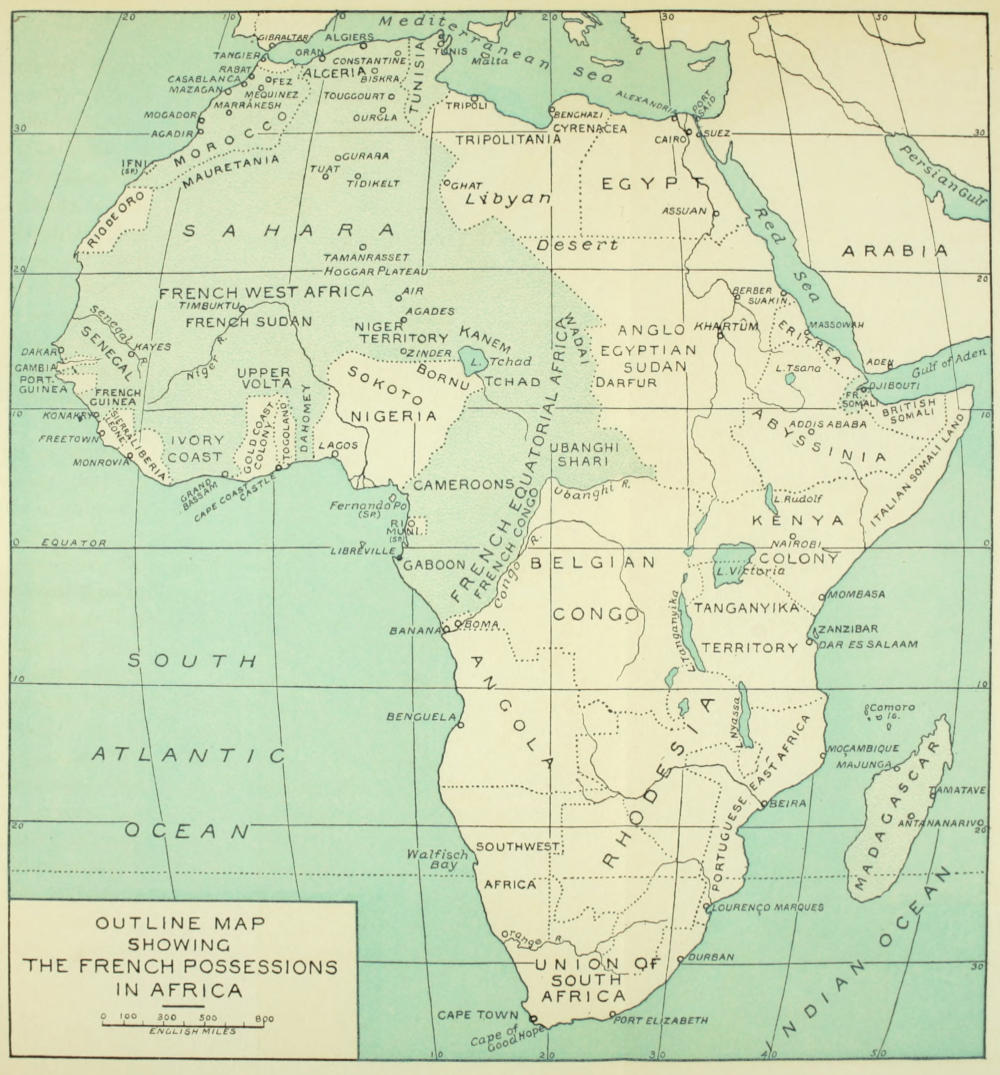
OUTLINE MAP SHOWING THE FRENCH POSSESSIONS IN AFRICA
Again, should you go to Barbary, as we did, in the late
winter, the weather is more likely to be favorable in
Tunisia than in Morocco, where cold, rain, and mud
usually prevail until well into the spring. If, moreover,
you purpose striking southward from Tunis into the desert,
it is well to get that portion of the journey over with
before spring is too far advanced, as after mid-April the
heat becomes intolerable in the Sahara and the sirocco
season begins.
From the dramatic point of view, as well, it is infinitely
preferable to follow the journeying sun, for, whereas Tunisia
is as civilized and well-behaved as Egypt, Morocco,
save in spots, remains not far removed from barbarism, so
that the peoples, customs, and scenes, instead of decreasing
in novelty and interest as you press westward, become
increasingly romantic and strange.
In making preparations for a journey in Barbary one
should never lose sight of the fact that North Africa is a
cold country with a hot sun. Most people, I find, labor
under the delusion that Africa is synonymous with heat.
This is due, I imagine, to our careless habit of generalization,
of taking things for granted. Just as Canada was
given a wholly undeserved reputation for frigidity by
Kipling’s “Our Lady of the Snows,” so the pictures of
sun-scorched deserts made so familiar by steamship-lines
and tourist-companies have led to the assumption that
every African country has, perforce, a torrid climate.
Such misconceptions would be less general if people were
more prone to consult the family atlas. There they would
see that Tunis is on the same parallel as the city of Washington
and that Algeria and Tunisia correspond in latitude
to Virginia and North Carolina. The truth of the matter
is that in the countries lying along Africa’s Mediterranean
seaboard there are few evenings between November and
May when a warm overcoat will be found uncomfortable,
and even far south in the desert in the late spring I have
shivered beneath three heavy blankets.
Yet an astonishingly large proportion of American visitors
to North Africa appear to be wholly ignorant of the
climatic conditions which prevail in that region. Staying
in Biskra while we were there was a motion-picture company
from California. While “on location” the actors
wore pith helmets and white drill riding-breeches and
shirts open at the neck and the other garments associated
in the popular mind with life in the tropics, but, once the
day’s filming was over, they wrapped themselves in
sweaters, overcoats, and mufflers and huddled, shivering,
about the open fire in their hotel. Those who saw that
picture on the screen—it was called “Burning Sands” if
I remember rightly—little dreamed that the actors who
made it spoke their lines through chattering teeth and
gesticulated with hands blue from cold.
There is one other popular misconception about North
Africa which might as well be corrected now as later on.
Save in the extreme south, Tunisia, Algeria, and Morocco
are not flat, desert-like countries, as is frequently assumed.
On the contrary, they are distinctly rugged and in parts
extremely mountainous. Perhaps it will astonish some of
my readers to be told that the High Atlas has a greater
average height than the Alps and that at least one of the
Moroccan peaks is higher than any mountain in the United
States outside of Alaska. Though the Algerian ranges of
the Atlas are not so lofty as those further to the westward,
I have seen several inches of snow on the passes of the
Grande Kabylie a few days before Easter.
I always like sailing from Marseilles. Perhaps it is because
I have set out from there on so many long and fascinating
journeys, but to me it has always been, along with
Constantinople and Port Said and Singapore and Panama,
a gateway to adventure.
On those sparkling blue-and-gold mornings for which
the Côte d’Azur is famous I like to sit over my coffee beneath
the striped awning of one of the restaurants along
the Cannebière and watch the human panorama unroll itself
before my eyes. Here one sees picturesque types from
the Near, the Middle, and the Farther East; representatives
of all of France’s far-flung colonial possessions. The
gaunt, stooped man with the yellowed skin and tired eyes,
in his buttonhole the red rosette of the Legion d’Honneur,
is a colonial administrator, home on a much-needed and all
too brief leave of absence from some God-forsaken outpost
of empire in Syria, Somaliland, Madagascar, Indo-China.
Here is a group of zouaves, boisterous, sun-bronzed fellows
in tasseled fezzes and baggy scarlet trousers, fresh from
service with the Army of Africa, who ogle every pretty
girl they pass and pause for a round of drinks at every
café. Tunisian marchands des tapis, gaudily colored rugs
draped over their shoulders, shuffle along in heelless yellow
slippers, urging their wares upon the patrons of the sidewalk
restaurants until the exasperated waiters harshly
order them away. A trio of bearded, grave-faced men,
very dignified and aloof in their white hoods and flowing
white burnouses, pace by unhurriedly, concealing their
wonder at the unaccustomed scenes behind masks of Oriental
imperturbability; they are powerful caïds from one of
the Saharan provinces, visiting France for the first time
as guests of the Republic. Down the center of the street,
under the watchful eye of a grizzled sergeant, briskly
marches a platoon of down-at-heel, out-at-elbow nondescripts—recruits
for the Foreign Legion, with five years of
iron discipline and heartbreaking desert service before
them. Sauntering along beside a pretty woman is an officer
of chasseurs d’Afrique, a light-opera figure in his flaring
scarlet breeches, wasp-waisted sky-blue jacket, and
képi piped with gold and silver braid. Staring with
childlike curiosity at the displays in the shop-windows are
yellow men from Annam, brown men from Tripolitania
and the Red Sea countries, black men from the Ivory Coast
and Senegal. Hulking negro stevedores rub shoulders
with greasy, furtive-eyed seamen from Levantine coasters
and Lascar stewards from the P. & O. boats in the harbor.
Zigzagging along the pavement, arm in arm, comes a row
of rollicking sailors from the fleet, scarlet pompoms on
their rakishly tilted caps and the roll of the sea in their
gait. And everywhere, seated at the café tables, mingling
with the moving throng, are the filles de joie, the ladies
of easy virtue, bold-eyed and carmine-cheeked, who find in
the streets of the great seaport a happy hunting-ground.
When in Marseilles I like to make a little pilgrimage by
funicular to Notre Dame de la Garde, the church of those
who go down to the sea in ships, and, strolling through its
dim, hushed transepts, to read the inscriptions, some naïve,
some pathetic, on the hundreds of votive tablets placed
there in gratitude and thanksgiving by those who have
been saved from storm and shipwreck. I like to dine in
the quaint little restaurants which fringe the waterfront
on the delicacies for which Marseilles is famous—langouste,
homard, crab, scallops, oysters, fish, and, of
course, bouillebaisse. But particularly I like to stroll
along the edge of the harbor, with its forest of masts and
funnels, and watch the ships, flying the flags of many nations,
coming from or setting forth for strange, far-off,
outlandish ports on all the Seven Seas.
The short winter’s day was drawing to a close when the
Duc d’Aumale nosed her way cautiously between the
arms of the Marseilles breakwater and lifted to a choppy
sea. From her lofty pinnacle above the city Our Lady on
Guard seemed to bid us a benign farewell. Atop the
cliffs off our port bow the Corniche Road twisted and
wound and doubled upon itself like an uncoiled lariat
tossed carelessly upon the ground. Further to the north,
the peaks of the Maritime Alps reared themselves majestically
skyward, purple-cloaked and ermine-caped. To
starboard rose the rocky islet, crowned by the grim
Château d’If, where Monte Cristo sought to ease his
solitude by proclaiming, “The world is mine!” And
before us, its foam-flecked surface turned to a field of
dancing gold by the westering sun, stretched the Mediterranean—the
road to Africa.
Ah, “outward bound!” The words beget
A dream of mosque and minaret
And golden dalliance
In orange gardens redolent
Of nights of stars and wonderment.
“Down Channel!”—down the foam-besprent
Blue highway to Romance.
CHAPTER II THE GATE TO BARBARY
Bizerta, the great naval base and fortress on the
northern coast of Tunisia, is a French pistol aimed
straight at the head of Italy—or perhaps it would be a
closer simile to say the toe. It commands the narrowest
part of the Mediterranean, where the Middle Sea contracts
to a width of less than four score miles. In fact,
were the French to mount on Cape Bon a gun having the
range of the one with which, in the spring of 1917, the
Germans shelled Paris, they could drop their projectiles on
the shores of Sicily.
It will be remembered that when, in 1881, the bey of
Tunis was forced to acquiesce in a French protectorate, the
most violent resentment was aroused in Italy, which had
long regarded Tunisia, with its large Italian population,
as within her own sphere of influence and was only awaiting
a propitious moment and a plausible pretext to bring
that country under the rule of Rome. Even to-day, indeed,
after more than a third of a century of French
occupation, Mussolini and his fellow-imperialists regard
Tunisia as a sort of African terra irredenta, which, when
a favorable opportunity offers, they purpose to “redeem.”
So, when the French began the construction of an impregnable
stronghold at Bizerta in 1890, they made no
secret of the fact that it was intended as a warning to
Italy that the tricolor which had been raised over Tunisia
nine years before would not be hauled down, and as a reminder
to Britain that, Gibraltar, Malta, and the Canal
notwithstanding, the Mediterranean was not a British lake.
During recent years the French government has poured
out money like water in the development of Bizerta until
to-day it is one of the strongest fortresses in the world.
The Lake of Bizerta, which forms the inner harbor, accessible
through the outer harbor and a canal, is nine miles
from the sea and contains fifty square miles of anchorage
for the largest vessels. A great arsenal has been created at
Sidi Abdallah, at the southeastern extremity of the lake,
with dry-docks for repairing the largest battle-ships,
wharves, workshops, and warehouses, while at Ferryville,
a few years ago a sandy waste, a modern town with well-built
dwellings for the thousands of laborers employed in
the dockyard has sprung up as though at the wave of a
magician’s wand. Barracks have been built for the housing
of the garrison, and the muzzles of long-range guns
peer menacingly from the elaborate chain of fortifications
which encircle the approaches to the harbor and the
town. If, as has been hinted, Mussolini occasionally turns
an acquisitive eye toward Tunisia, he should not overlook
Bizerta. It would be a hard nut to crack.
My daughter, Bettie, had never been to Africa before,
and so, when the steamer docked at Bizerta, she was naturally
eager to go ashore and see the sights despite my
warning that it was a colorless, uninteresting town, and
that, as her first glimpse of Africa, it would be a disappointment.
Now it is a curious fact that new-comers to
a country frequently have more thrilling experiences in
the first few hours of their visit than befall old-timers in
a lifetime. For example, Sir Theodore Cook, editor of
the “Field,” once told me that during his first day in
New York, while drinking a glass of beer in a saloon in
Park Row, the glass was shattered in his hand by a gangster’s
bullet intended for the bartender.
It was a Sunday morning when we went ashore at
Bizerta, and the town was as peaceful as a rural community
in France. But as we were strolling through the
tortuous byways of the picturesque Andalusian quarter—founded
by the Moors driven from Spain—a pistol barked
in a doorway, and the report was echoed by a woman’s
scream. French gendarmes, native goumiers, and military
police came on the run, followed, it seemed, by half the
population of the town. In less time than it takes to tell
about it the narrow thoroughfare was packed from wall
to wall with an excited mob.
“What’s the trouble?” I inquired of a zouave who
emerged from the press about the doorway.
“N’importe, m’sieur. N’importe,” he answered, shrugging
his shoulders. “A rascally Senegalese has just murdered
an Arab woman.”
“And you told me,” my daughter said reproachfully,
“that I wouldn’t find Bizerta interesting!”
The dense gray fog, which had hung like a pall over the
wintry Mediterranean since shortly after our departure
from Marseilles, abruptly lifted as we left Bizerta, and
thence onward to La Goulette the Tunisian coast unrolled
its panorama bright and clear under the February sunshine.
As I leaned on the rail, my glasses trained upon
the shore-line, which slipped past as on a motion-picture
screen, a White Father emerged from the smoke-room and
joined me.
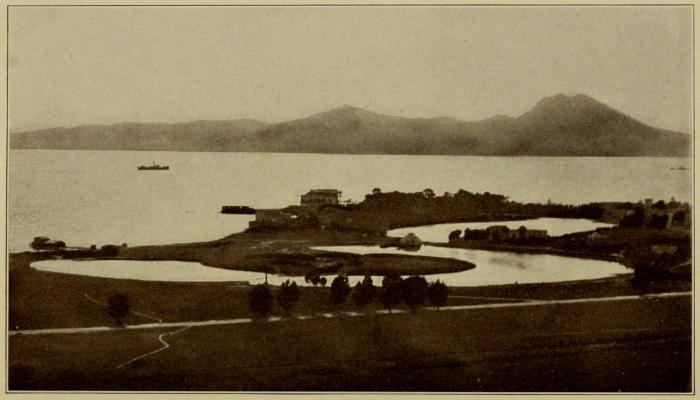
LO, ALL THE POMP OF YESTERDAY....
“Delenda est Carthago!” cried Marcus Cato, and so efficiently was his
command carried out that two small lagoons—the one at the left
corresponding to the ancient military harbour, the other to the commercial
port—are almost all that remain of the great city founded by Dido
Shortly he tapped me upon the shoulder.
“Look, my son! Look! Over there....”
With my glasses I followed the direction of his outstretched
finger. But all that I could discern was a
range of distant violet mountains and in the middle foreground,
rising somewhat abruptly from the plain which
sloped down to meet the shingled strand, a low, isolated
hill. Its lower slopes were clothed with vegetation—fields
of barley, vineyards, patches of cactus—broken here and
there by what appeared to be huge rubbish-heaps and excavation
mounds. Higher up, amid dark clumps of
cypress-trees, I could make out some scattered, white-walled
buildings, one of them, judging from the gilded
cross which surmounted it, a church. At the foot of the
hill, near the margin of the sea, the sun was reflected
dazzlingly from the surface of two small, curiously shaped
ponds.
“Delenda est Carthago,” quoted the priest.
“There is all that remains,” he continued, “of what
was once the most famous and powerful city in the
world. The horseshoe-shaped lagoon with the island in
its center is a vestige of Hamilcar’s military harbor, where
the war-galleys were moored. On the summit of yonder
hill Dido’s palace is believed to have stood. On that narrow
neck of land to the eastward the army of Regulus
was annihilated by the Carthaginians under Xanthippus,
and there, a century later, the victorious forces of Scipio
Africanus pitched their camp. The white chapel atop the
plateau marks the spot where St. Louis died while leading
the Last Crusade.”
It was as though he had uttered an incantation. At his
words the scene seemed to change before my eyes as one
stereopticon picture dissolves into another. The fog-banks
which had lifted were the mists of centuries. Now
I was looking down the vista of the ages. In my mind’s
eye a mighty, glittering metropolis crowned that green
and russet hill. A hot African sun beat down upon its
massive ramparts, upon the gilded roofs of its towers and
temples, upon its marble palaces and porphyry colonnades.
Brazen chariots tore through its narrow, teeming
streets; squadrons of horsemen maneuvered on the plain;
elephants with jeweled trappings rocked and rolled along.
The smoke of sacrificial fires rose from the altar before
the great temple, where stood the statue of the horned god
Baal. Relieving the masses of masonry here and there
were patches of verdure, the sacred groves dedicated to
the worship of the goddess Tanith. A vessel with billowing
sails of Tyrian purple slipped along the shore. Out
from the harbor-mouth shot a file of lean, long triremes,
ostrich-feathers of foam curling from their bows as they
leaped forward at the urge of the triple banks of oars. I
was looking on the city which had been mistress of the
Mediterranean for upward of half a thousand years;
whose argosies had explored the unknown coasts of Africa
and Gaul and Spain, venturing even beyond the Pillars
of Hercules in their quest of the Hesperides; the city
whose name is still synonymous with pomp and pride and
power—Carthage, which had disputed the Empire of the
World with Rome!
But the vision faded as abruptly as it had appeared
when a French destroyer, inky clouds belching from her
slanting funnels, fled across our bows. A sea-plane,
bands of the tricolor painted on its under wings, went
booming overhead. Fishing-craft with ruddy lateen sails
appeared, swarthy, red-fezzed fishermen hauling at the
nets. A puffing tugboat bustled officiously alongside, and
the pilot nimbly climbed the swaying ladder. Bells
jangled in the engine-room. And the Duc d’Aumale,
slowed to half-speed, swept past the thickets of bristling
masts which fringe the wharves of La Goulette and entered
the throat of the buoyed channel which leads
through the shallow lake of El Bahira to Tunis.
Though a seaport, Tunis, it should be understood, is not
on the sea itself but some seven miles inland. The Tunisian
capital occupies a most peculiar site, being built
upon the narrow isthmus which separates the stagnant
waters of El Bahira, “the little sea,” from the salt lagoon
of Sebkhet es Sedjoumi. Notwithstanding the fact
that, next to Algiers, Tunis is the largest and most important
city in French Africa, it is only within recent
years that it has been directly accessible to ocean-going
vessels.
The project of creating a port at the very doors of
Tunis was first entertained by the late bey, who in 1880
granted a concession for the purpose, but with the reorganization
of the country after the French occupation
the contract was canceled. Some years later, however, the
enterprise was revived, the task of constructing the harbor,
and of connecting it with the sea by dredging a canal,
seven miles in length, through El Bahira, being undertaken
by a French company.
With the completion of the port and the canal, La
Goulette—or Goletta, as the English call it—lost its
former importance, declining from a busy harbor, its
roadsteads crowded with the ships of many nations, to a
sleepy fishing-village. During the summer months, however,
it regains a certain measure of its old-time activity,
its population being almost doubled by the Tunisians who,
unable to get away to Europe, go there for the sea-bathing
and the breezes. Though La Goulette is of yesterday, its
Venetian charm happily remains undimmed. Its houses,
built with the stones of ancient Carthage, have been mellowed
by time and the sun to ivory and terra-cotta; a reminder
of its tumultuous past is provided by the fortress
of Barbarossa, from which thousands of Christians taken
captive by the red-bearded corsair were released when
Charles V carried it by storm in 1535; the encircling
waters of the Mediterranean and El Bahira are of a glorious
blue, flotillas of fishing-barks with painted sails dot
its placid surface and flocks of pink flamingos stalk
sedately along its shores.
Darkness was close at hand when we steamed past La
Goulette, and the purple African night had descended
upon the land when we entered the harbor of Tunis.
Dimly the old, old city loomed before us, its proportions
clearly defined by twinkling street-lamps which grew
fainter as they climbed the hill surmounted by the kasbah
and the palace of the bey; while in the foreground danced
the reflection of the riding-lights of the vessels in the
harbor. I have always maintained that there are certain
cities at which, in order to obtain the full flavor of their
mystery and charm, one should arrive after nightfall, and
Tunis is one of them.
While the steamer was being warped with aggravating
deliberation into her berth, I looked down from the rail
upon the picturesque scene and gave a sigh of contentment.
It was good to sniff again the smell of Africa, to
be back in the Orient once more. I breathed deep of the
soft night air, laden with the fragrance of orange-blossoms,
jasmine, and bougainvillea. After the glare of the
sea, my eyes were rested by the dim outlines of the buildings,
garish enough by day but of ivory and amber loveliness
when bathed in the light of the moon. I reveled in
the color and picturesqueness of the throng waiting on
the wharf below.
Ranged along the edge of the quay, very gorgeous and
self-important in their gold-laced jackets and voluminous
trousers, were the dragomans and runners from the various
hotels and tourist-agencies; alert, energetic fellows,
speaking a smattering of many tongues, who spend their
lives on steamship-wharves and railway-station platforms,
welcoming the arriving and speeding the parting guest.
Beyond them was a little group of wealthy young Tunisians,
in immaculately ironed tarbooshes and spotless burnouses
of the most delicate colors, one of them with a
crimson blossom worn behind his ear, come to welcome
some friend returning from Paris or Monte Carlo. A pair
of bearded, hawk-nosed spahis paced slowly up and down,
their enormous white turbans bound with ropes of
camel’s-hair, long scarlet cloaks hanging to their booted
and spurred heels. And well at the back, kept in their
place by the whip of a native goumier, was a vociferous
throng of Arab and negro porters, shouting and gesticulating
for the first chance to make a franc by carrying
ashore our luggage, and waiting, like sprinters on the
mark, for the lowering of the gang-plank to storm the
ship as their ancestors, the Barbary pirates, did of old.
Drawn up beside the customs shed was a powerful car
of American make with a uniformed kavass from the residency
and an alert-faced chauffeur in trim gray whipcord
standing beside it.
“For Colonel Powell?” I asked the chauffeur in
French as we set foot ashore.
“Yes, sir,” was the reply, in the unmistakable nasal
twang of New England. “But you needn’t speak to me
in French unless you want to. My name is Harvey Wilson
and I’m from Providence, Rhode Island.”
Wilson, it developed, was a former member of the A.
E. F. Instead of returning to America with his regiment
after the Armistice, he had married a French girl and
settled in Algiers as a motor mechanic and chauffeur. He
drove us for upward of six thousand kilometers over desert
roads, mountain roads, and across regions where there
were no roads worthy of the name whatsoever. He had a
profound knowledge of the idiosyncrasies of a motor;
under the most trying conditions he never lost his patience
or his temper; and his unfailing good humor won
him the friendship of Europeans, Arabs, Berbers, and
Moors alike. When we parted, months later, on the frontier
of Morocco, I told him that it would give me genuine
pleasure to recommend him to any one who contemplated
motoring in North Africa, and I am now keeping that
promise.
Mrs. Powell and I had been in Africa so many times
that for us the drive through the brilliantly lighted streets
to the hotel held little novelty. Our chief concern was
whether we should find awaiting us a room with bath, for
the hotels of Tunis are limited in number—the good
hotels, I mean—and during the tourist season they are
always overcrowded, so that it is the part of prudence to
reserve one’s accommodations well in advance.
But my daughter Bettie was fascinated by the unfamiliar
street scenes: the ceaseless stream of men wearing
every form of head-covering—hats, helmets, hoods, tarbooshes,
turbans; the stately Arabs, the elders looking for
all the world like Old-Testament patriarchs; the bare-legged
Berber porters in ragged garments of coarse brown camel’s-hair,
sacks drawn over their heads to be used as sun-shades
or overcoats according to the weather; the gaudily
uniformed soldiers of the Beylical Guard, who might have
stepped straight from a comic-opera chorus; the veiled
women slipping silently along like sheeted ghosts; the
groups of natives squatted about their cooking-pots, from
which strange smells assailed the nostrils; the files of
swaying, supercilious camels laden with the products of
the South; the droves of patient little asses trotting demurely
along beneath enormous burdens; the high whitewashed
walls of the houses, broken by mysterious latticed
windows, from which the eyes of unseen, jealously
guarded women were peering down, no doubt; the fleeting
glimpses caught through doors ajar of Oriental courtyards
filled with color—to her this was one of the Thousand and
One Nights. Ah, me ... what wouldn’t I give to again
be seeing Africa for the first time through the eyes of
youth!
Notwithstanding the French occupation, Tunis remains
distinctly Oriental. The town is like a veiled woman of
the harem wearing a pair of European shoes, incongruous
and clumsy. And it is the shoes which the visitor arriving
by sea sees first. For the district bordering on the
harbor is Italian—an unlovely, odoriferous neighborhood
of mean streets lined with squalid hovels where dwell some
fifty thousand Sicilians and Maltese, who outnumber the
French by more than two to one—while the quarter bisected
by the Avenue Jules Ferry is characteristically
French, with spacious, tree-planted boulevards, enticing
shops, banks, theaters, cinemas, and electric tram-cars.
This really imposing thoroughfare, with its fine stores
and crowded open-air cafés, might be, indeed, a sort of
continuation of the Cannebière in Marseilles interrupted
by the Mediterranean. Its principal mercantile establishment,
the Petit Louvre, is a creditable imitation of the
mammoth Magazins du Louvre in Paris, with which, incidentally,
most American women appear to be better acquainted
than they are with the palace of the same name
on the other side of the Rue de Rivoli. But all this, I repeat,
is only that portion of Tunis revealed below the hem
of her enveloping Eastern garments. The old Tunis, with
its mosques and palaces, its labyrinth of bazaars rising
gradually to the kasbah, is as Oriental as the Baghdad of
Harun-al-Rashid.
Most Europeans seem to be under the impression that
Tunis is a modern city—modern, at least, in comparison
with Carthage. As a matter of fact, however, Tunis (or
Thines, as it was originally known) had probably been in
existence for some three or four hundred years when the
fugitive Dido landed on the shores of the Gulf of Tunis
and on the little hill of Byrsa founded Carthage. This
view is accepted by no less an authority than the historian
Freeman. But for centuries Tunis was overshadowed and
eclipsed by the magnificence of her younger sister, sinking
to the position of a poor relation, a country cousin, a
mere dependency. Yet she had her revenge. Not only
has she outlived her haughty neighbor, but she has incorporated
her very bones, for there is hardly a column or
capital in Tunis which is not of Carthaginian origin.
Here, indeed, we see a ghost of Carthage, for the native
city must very closely resemble what the commercial quarter
of Carthage was five-and-twenty centuries ago.
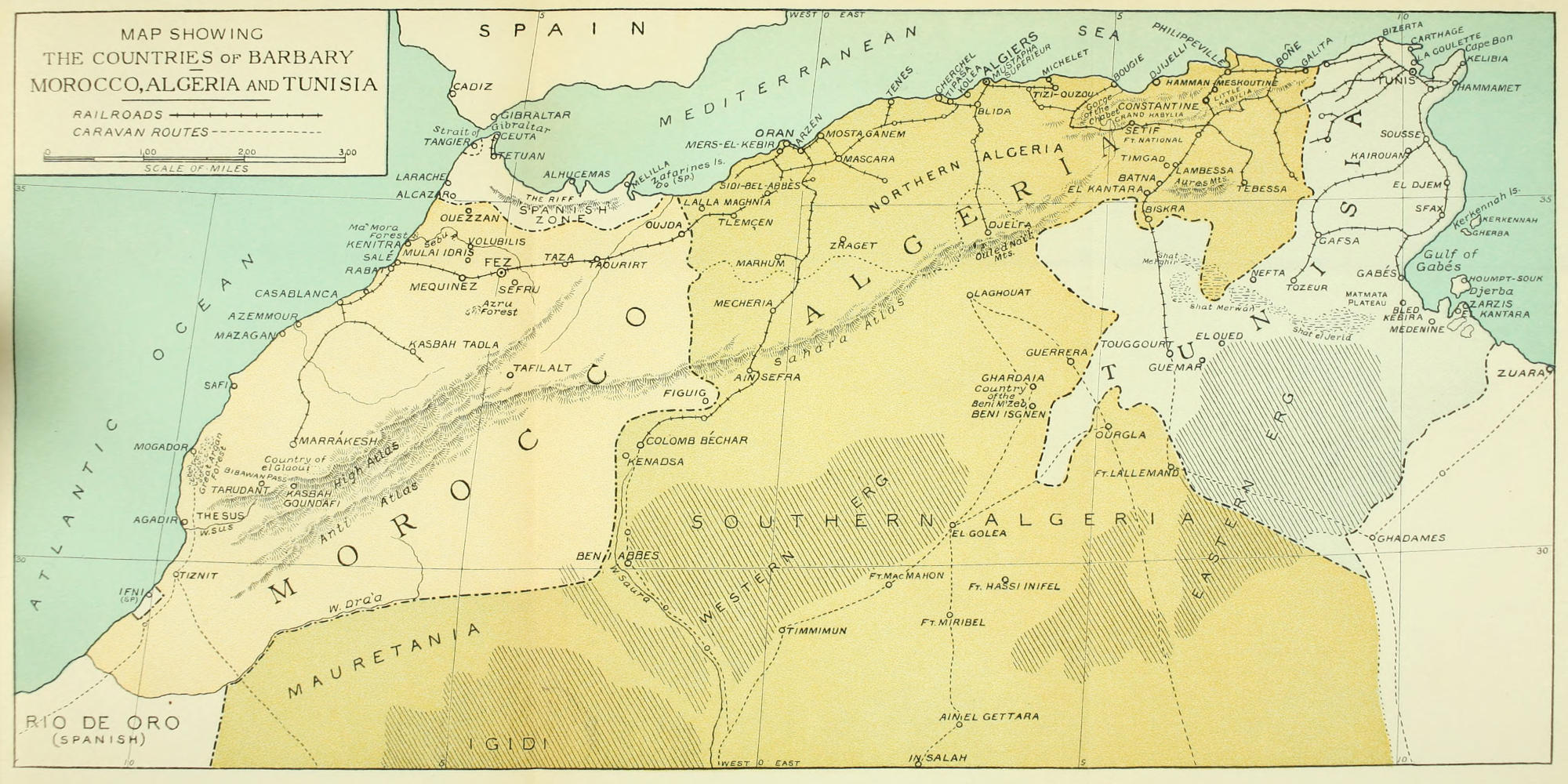
MAP SHOWING THE COUNTRIES OF BARBARY
MOROCCO, ALGERIA AND TUNISIA
The car came gently to a halt before the Hotel Majestic,
a spacious hostelry whose architect had sought,
without conspicuous success, to graft the Moorish style
on the European. An Arab chasseur in red and gold
flung open the door. A swarm of servants in green
baize aprons hurled themselves upon our luggage. We
were greeted by the director, a suave Frenchman, who
might have been an undertaker, judging from his somber
garments and excessive dignity. Rooms had been reserved
for us by the residency, he said. I remarked that I hoped
that we were to have a bath. Mais certainement, un grand
bain—un bain de luxe. Would we ascend and view it? We
crowded, the four of us, into an ascenseur which could not
possibly have been intended to carry more than two, and
the Arab lift-boy squeezed himself in after us. It creaked,
groaned, hesitated, almost stopped, but finally drew level
with the floor which was its destination. I gave a sigh of
relief, as I always do upon completing an ascent in a
French elevator. We were ushered down an echoing,
marble-paved corridor, chilly as a tomb, to our rooms.
Mrs. Powell tried the hot-water faucet and inquired about
the voltage for her electric curling-iron. I sent the maid
scurrying for extra blankets and softer pillows, and ordered
a drink of Scotch. But my daughter Bettie stood on
the balcony in the moonlight, looking out upon the white
city and inhaling the subtle fragrance of the orange-blossoms.
You see, she had never been in Africa before.
CHAPTER III THE FACTORY OF STRANGE ODORS
The extraordinary success which has marked the rule
of the French in North Africa is in large measure
attributable to their policy of scrupulously refraining
from encroachment on native life. Instead of being ruthlessly
mutilated to make way for boulevards and plazas,
as Baghdad and Delhi have been by the British, the old
cities have been left intact; and the French quarters, with
their public buildings, theaters, shops, and restaurants,
have grown up outside the walls; so that the Europeans
and the natives really dwell apart, which is best for them
both.
The happy results of this policy are particularly noticeable
in Tunis, where the French have made no attempt to
modernize the ancient city, the Medina, access to which
is gained from the European quarter through the old
water-gate, Bab-el-Bahar, now known as the Porte de
France. Though electric tramways encircle the city and
run far into the suburbs—the service between Tunis and
Carthage, I might remark in passing, is surpassed only
by that between Yokohama and Tokio—all proposals to
disfigure the picturesque native quarter have met with a
stern refusal from the authorities. Street-names, lighting,
and sanitation have been introduced, however, and
the old town itself is incredibly clean for an Eastern city;
cleaner by far than many cities in Italy and Spain. In
fact, Tunis merits the title of “The White,” which it has
so long enjoyed, almost as much by virtue of its astonishing
cleanliness as because of its snowy buildings, which
mount, tier above tier, to the citadel, like “a burnous with
the Kasbah for a hood.”
In these Moslem lands, where religious fanaticism goes
hand in hand with suspicion of the foreigner, the French
have had to exercise the utmost tact in effecting even
the most urgent sanitary reforms. M. Jusserand, for
years French ambassador to the United States, once told
me that, when he was chief of the Tunisian Bureau of the
Ministry of Foreign Affairs, the city of Tunis was threatened
by an epidemic because the bodies in the local cemeteries
were too near the surface. Instead of arbitrarily
ordering the graves to be deepened, an action which inevitably
would have aroused native resentment and perhaps
have precipitated serious troubles, the French resident-general
sent a politely worded message to the chief
cadi, the head of the Moslem religious community, inquiring
whether the depth of graves was specified in the Koran.
He was informed that, according to Koranic law, graves
must be deep enough to cover a standing man to his
shoulders. Thus scripturally fortified, the resident-general
called the attention of the chief cadi to the failure of the
Tunisians to abide by the tenets of their own religion,
whereupon the natives lost no time in deepening the graves
themselves.
The principal approach to the old city is through the
Avenue Jules Ferry, a wide and handsome boulevard
lined on either side with shops, banks, cafés, and theaters
and having a sort of park running down the center.
With its broad pavements, its fine trees, its beds of brilliant
flowers, and its throngs of promenaders, it is strongly
reminiscent of the Rambla in Barcelona. It terminates
in the Place de la Résidence, a spacious plaza flanked on
one side by the cathedral, a conspicuous building of dubious
architectural merit which is the seat of the primate
of all Africa, and on the other by the palace of the French
resident-general, so that the representatives of church and
state directly face each other. The residency is a low, unpretentious
building with fine gardens, before whose
gilded gates pace sentries in the brilliant uniform of the
Garde Beylicale. Forming a continuation of the Avenue
Jules Ferry is the shorter and narrower Avenue de
France, which terminates at the Bab-el-Bahar, the entrance
to the Medina, or old town. Though the Medina
was formerly encircled by walls, these have in large part
disappeared, leaving the gates of the city isolated, like
those of Paris.
To pass through the Bab-el-Bahar is to enter another
world, to go back into history for a thousand years, to
step from the Europe of to-day straight into the Orient
of the Middle Ages. I can recall few, if any, places where
so abrupt a change takes place within a few paces, where
the contrast is so startling. The gate, in itself quite unimposing,
opens upon a kaleidoscope of color, a chaos
of confusion, a pandemonium of noise. Here wheeled
traffic virtually ceases, not because it is forbidden but because
it is impracticable by reason of the extremely narrow
and densely crowded streets. Here the raucous honk
of motor-cars is replaced by the imperative “Barek
balek!” (take care!) of Arab muleteers. Here, instead
of carts and camions, the draft work is performed by files
of mangy, moth-eaten camels, as far removed from the
graceful méhari of the desert folk as a work-horse is from
a thoroughbred; by droves of diminutive donkeys, blue
beads festooned around their necks for superstitious reasons,
their ears and tails alone visible beneath their enormous
burdens; and by brawny porters, twin brothers to
the hamals of Turkish cities, who stagger along beneath
bales and boxes which would cause an American express-man
to go on strike were he asked to handle them, but
which they seem to carry with comparatively little effort
by means of a rope passed round the forehead, like the
tump-line of an Indian guide. I saw one of these fellows,
a bare-armed, bare-legged Hercules, walk off quite matter-of-factly
with a grand piano on his back.
Guides, touts, and Jewish shopkeepers do their utmost
to ruin the visitor’s enjoyment by their incessant importunities
and whines. “Good morning, meester....
Good morning, madame.... How are you?... Look
here.... I show you sometheeng ... sometheeng ver’
fine ... ver’ cheap ... no charge ... you come in
quite free ... you not buy anything unless you wish....
No, sare, I not damn nuisance.... I ver’ honest
fellow....” Cringing, impudent, and furtive-eyed,
they are as pertinacious as flies and as irritating as fleas,
the only wonder being that they are not occasionally murdered
by Europeans who have been exasperated beyond
endurance. On one occasion I saw a Frenchman kick one
of these parasites the entire length of a souk, and I felt
like shaking hands with him as a public benefactor.
Now and then a gorgeously appareled caïd, a figure out
of the Arabian Nights, clatters through the narrow streets
astride a snorting Arab, negro slaves trotting at his stirrups.
Snake-charmers, fire-eaters, story-tellers, do their
hackneyed stuff in the open spaces before the city gates,
surrounded by spectators packed four-deep who applaud
the performances with the naïveté of children. The faithful
squat beside the fountains of the mosques, bathing their
hands and feet and rinsing their mouths in running water,
as the Koran prescribes, before entering the sanctuaries to
prostrate themselves in prayer with their faces toward the
Holy Places. Occasionally one sees a wild-looking scarecrow
of a figure, a holy man from the desert, caked with
filth, his hair and beard matted, his patchwork rags of
many colors, beseeching the passers-by in a shrill whine
for alms in the name of Allah the Compassionate, the
Merciful—and cursing them with enviable fluency if his
importunities go unheeded.
The most characteristic and interesting feature of Tunis
is the souks, or covered bazaars. Nowhere in the Nearer
East are there any souks which can equal them; for in
Constantinople, by virtue of the Angora government’s
passion for westernizing everything Turkish, the men have
been compelled to discard their turbans and tarbooshes for
hats and caps and the women to doff their mystery-suggestive
veils, more’s the pity! The bazaars of Cairo are not
only deficient in architectural merit but, particularly during
the tourist season, are not much better than the Oriental
section of an exposition. In Damascus the bazaar
buildings resembled railway-stations even before French
shells laid in ruins the Street Which Is Called Straight.
Indeed, one would need to go as far eastward as Tehran or
Ispahan to find souks which can compare with those of
Tunis in extent, beauty, color, and picturesqueness.
The bazaar quarter of Tunis is, as it were, a whole city
under one roof—a city teeming with Oriental life; carrying
on its trade in the traditional Eastern fashion; transacting
its business without tables or chairs in doorless,
windowless stalls, raised three or four feet above the
ground and most of them only a few yards square, which
their owners close at night by means of stoutly built, gaily
painted shutters. In these recesses the merchants sit cross-legged,
like so many Buddhas, with their merchandise
spread about them, dozing, smoking, sipping black coffee,
and gossiping with their neighbors.
The souks of Tunis cover an enormous area. They consist
of a labyrinth of narrow, tortuous, wholly irregular
streets, lanes, alleys, and passages; some of them vaulted,
lighted only by shafts of sunlight falling through square
apertures overhead; others roofed with sloping planks, uneven
and rotting with age but highly picturesque, their
gaping crevices permitting the street below to be flooded
with sunshine or with rain. But most fascinating of all,
at least in clement weather, are those bazaar lanes which
are shielded from the elements only by vine-covered trellises,
like pergolas, the sunlight, sifted and softened by the
leaves, casting shadows of lace-like delicacy upon the worn,
uneven pavement.
Each of the trades has its own souk, and each souk has
its own distinctive character. Thus one street is devoted to
perfumes, another to shoes, a third to jewelry, a fourth to
saddlery, and so on; an arrangement which tends to make
shopping easy, as the visitor in quest of a particular article
is enabled to compare prices and quality and, not infrequently,
to play off one merchant against another. Some
of the souks contain only goods for sale, but most of them
are workshops as well, the goods being made by native artisans
on the premises. Here, if you require an article of
special design, the merchant does not tell you that he will
“order it from the factory,” but instead he cuts it, or
carves it, or paints it on the spot and under your supervision.
They are as enchanting as they are bewildering,
these Tunisian souks—a source of unending novelty, a
panorama of pure color, the dusky light which prevails
beneath the vaulted roofs serving to harmonize the tints,
to soften the harsher outlines, to fill the dark recesses with
mystery.
And everywhere is the loot of Carthage. Those fluted
marble columns, now striped in green and scarlet, like
sticks of peppermint candy, may once have supported the
roof of Dido’s palace. Those exquisitely sculptured capitals,
their delicate tracery all but concealed beneath repeated
coatings of whitewash, were in all likelihood executed
by Phenician workmen, dead these twenty centuries
and more, for the temple of the goddess Tanith. Yonder
slab of polished stone, on which the shoemaker is seated,
quite possibly stood in ancient times before the statue of
the great god Baal, dripping with the blood of human sacrifices.
Who knows?
On a first visit to the souks it seems impossible to think
of finding one’s way unguided through this bewildering
network of narrow, winding thoroughfares, this human
rabbit-warren. Here, as in the even more extensive and
confusing bazaars of Tehran, I felt like taking a ball of
string along and unwinding it behind me, like an explorer
of a subterranean cavern, so that I might find my way
back to my starting-point again. But after a time the
general topography becomes clear, and then it is easy to
wander in and out at will, with the assurance that confusion,
or even a total loss of bearings, means nothing
worse than an extra turn or two and then the sight of some
unmistakable landmark, such as the green sarcophagus
which all but blocks the narrow way through the street of
the leather-workers. It is the coffin of a marabout—an
itinerant holy man—set there to confer a special blessing
on the souks by its presence. It is painted a vivid green,
ornamented with designs in red and yellow, and the
garments of the endless stream of humanity which pushes
past it have put a high polish on its edges. Personally,
were I a merchant, I should not care to have a coffin resting
permanently at the front door of my business premises,
but the Tunisians seem to regard it very much as Grant’s
Tomb is regarded by the dwellers on Riverside Drive.
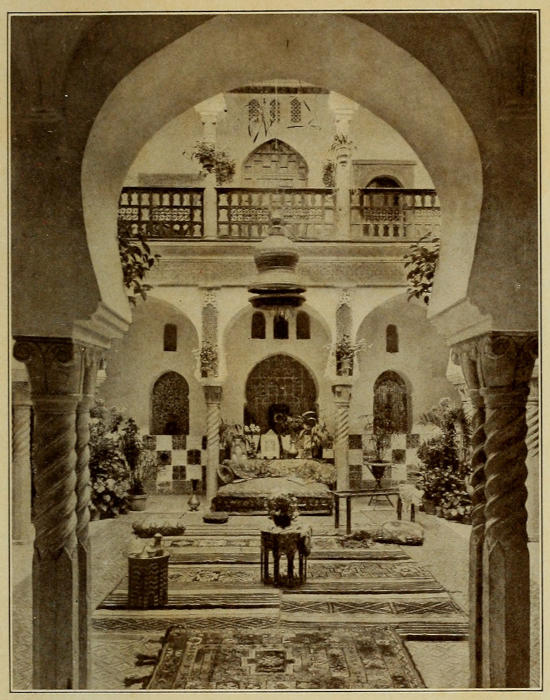
HERE SCHEHERAZADE MIGHT HAVE TOLD HER TALES
Seated cross-legged on the cushion-piled divan, with silken carpets at her
feet, soft music of flute and viol floating down from the balcony, the air heavy
with the fragrance of flowers and incense, black slaves to wait upon her, and
guardian eunuchs at the gate
Sooner or later every visitor to Tunis finds his way, or
is led by his guide, to the Souk-el-Attarin, the street of the
perfume-sellers. Architecturally, this is one of the finest
bazaars in the city and probably one of the oldest. From
its hole-in-the-wall shops drift the scents of all the world—attar
of roses and ambergris, musk and incense, violet
and orange-flower, jasmine and lily-of-the-valley. Before
the shops stand sacks stuffed with the dried leaves of aromatic
plants from which is made the incense used in the
mosques and the henna with which the native beauties
redden their hair and their finger-tips and the soles of
their feet, for even the veiled women of the East are addicted
to the use of war-paint.
The scents are very powerful, and for toilet purposes
must be largely diluted with alcohol. Nor are they by any
means inexpensive, even according to American standards,
a tiny vial of certain of the rarer essences frequently costing
several hundred francs. They are sold in slender,
fragile bottles, charmingly decorated with gold and color,
but, unfortunately, their glass stoppers rarely fit, and, as
my wife and daughter learned by costly experience, the
scent will evaporate unless the stopper is replaced with a
cork. Here one’s nostrils are assailed not only by the old
familiar perfumes but by the strange scents characteristic
of the East—musk, amber, incense, attar of roses, and, of
course, the celebrated parfum du bey. The last-named
is the royal scent, a composite essence, the odor of which
is alleged to change from hour to hour and which is unobtainable,
at least in theory, save by those connected with
the court or who are honored by the bey.
The perfume-sellers are the aristocrats of the souks,
claiming to be descended from the Moors who were expelled
from Spain and to possess the keys of the Andalusian
castles owned by their ancestors. Be this as it may,
they are very haughty and condescending, deeming it
vastly beneath their dignity to haggle with their customers
or to solicit the patronage of the passers-by. In fact, these
small, luxuriously furnished shops, with their silken cushions,
their seven-branched candlesticks, their array of slim,
glass-stoppered bottles inscribed in gilt with mysterious
Arab characters, and the hint of incense in the air, resemble
shrines of Venus rather than places of business,
the sleek, urbane proprietors exhibiting their wares with
the reverence of officiating priests.
Here the purchase of scent is not a commercial transaction
but a ceremony. The customer is seated upon a divan,
piled high with cushions, and the turbaned merchant
takes his place behind a table, on which are laid out fantastically
shaped vials and vessels, like a sorcerer about to
begin his mystic rites. The perfumes sold here, remember,
are not the ordinary scents of commerce with which we
Westerns are familiar, but concentrated quintessences, the
merest drop of which upon a handkerchief or glove or
sleeve confers a fragrance which will last for days. A
silent-footed attendant serves tiny cups of coffee, thick,
sweet, and black as molasses, and scented cigarettes. A
charcoal brazier is smoldering in the corner, and from it
rises a faint suspicion of incense. Daintily opening with
delicate, tapering fingers the glass-stoppered bottles ranged
before him, the perfume wizard runs through the whole
gamut of odors; he plays upon the sensitive olfactory
nerves as a great musician plays upon an organ. For, of
all the senses, that of smell is most closely associated with
remembrance. It can recreate a vanished vision on the
human motion-picture screen we call the mind. It can
arouse the emotions—pain, pleasure, passion, longing, sadness—and
fan into flame the embers of the past. It can
bring back, as at the wave of a magician’s wand, the
thoughts and scenes of far away and long ago.
Perhaps I myself am more susceptible than most to the
effect of perfumes ... I do not know. But the scent of
roses brings back with overwhelming vividness the loveliness
of a Capri rose-garden where I wandered with Her
in the fragrance and the moonlight, long, oh, long ago.
The redolence of cedar, and I see in my mind’s eye a carpenter’s
shop which I passed daily when I lived in Syria,
with the white-turbaned, patriarchal carpenter working at
his bench amid a litter of shavings, and camels, laden with
logs from the Cedars of Lebanon, kneeling patiently at the
door. Sandalwood conjures up a vision of Indian temples,
with shafts of sunlight striking through the murky interiors
to be reflected by brazen buddhas, inscrutable of face;
of twilight on the Ganges at Benares; of the pink palaces
and towers of Jaipur. Geranium, heliotrope, lemon verbena—these
show me once again the stately, white-pillared
house in which I was born, with my grandmother bending
lovingly over the flowers in her old-fashioned garden,
the stretches of close-cropped greensward, the leaves of the
old, old elms whispering ever so gently in the summer
breeze.
Because I am a collector of weapons and curios in a
modest way, and because I positively revel in colors, I lose
no time when in Tunis in making my way to the Souk des
Etoffes. To my way of thinking it is one of the most
fascinating streets in the world, its tiny shops literally
filled to overflowing with silks, damasks, velvets, brocades,
embroideries, of every tone and texture—turquoise blue,
pale green, amethyst, ruby red, old rose, burnt orange,
purple, magenta, vermilion, saffron yellow—the fruit of
looms all the way from India to Morocco. Stacked high
are piles of carpets from Anatolia, Kurdistan, Daghestan,
Persia, Afghanistan, Kairouan; the last-named a Tunisian
product, surprisingly cheap but well worth buying, for it
is as thick and soft as a fur rug, in lovely, mellow shades
of ivory, red, and brown.
These Tunisian rug-merchants are past masters in the
fine art of salesmanship; they will fling a silken carpet into
the air with the hand of a magician and permit it to settle
gradually upon the floor, not flat but in little hills and valleys
of rich, tempting colors, the folds serving to reveal
the intricacy of the design and accentuating the silky
sheen.
I have no slightest intention of purchasing a carpet, no
place to use one if I had it, but, for the sake of politeness,
I feel constrained to ask its price.
“Twelve hundred pounds,” says the merchant, without
batting an eyelash.
“Trop cher,” I remark, as though buying six-thousand-dollar
carpets was with me an everyday affair.
CHURCH AND STATE IN TUNISIA
Father Delattre, in charge of the excavations at Carthage
H. H. Sidi Mohamed el Habib, Bey of Tunis
The merchant shrugs his shoulders as though pitying my
ignorance of values. It is a very fine carpet, he assures
me earnestly, very old, very rare. The “ivory” in it is
quite exceptional. Only last week he sold a pair of such
carpets to the American millionaire, Meester Otto Kahn.
By way of convincing me he displays the New York banker’s
visiting-card.
“But I am not a millionaire,” I explain.
“Monsieur is pleased to jest with me,” says the
merchant flatteringly. “Is he not an American?”
Realizing that to deny the imputation is worse than useless,
I turn my attention to the other objects in the
crowded little room—silver-mounted rifles with enormously
long barrels, their stocks inlaid with ivory, mother-of-pearl,
or turquoise matrix; poignards with jewel-studded
hilts; exquisitely damascened simitars, their
curved blades inscribed with verses from the Koran;
Saracenic helmets with hoods of chain-mail; exquisite embroideries
worked by the deft fingers of harem women;
quaint pieces of enamel jewelry out of the Grande Kabylie;
miniatures on ivory of ferocious-looking, fiercely mustached
beys and pashas, their turbans the size of sofa-cushions;
strings of perfectly matched amber beads, as
large as cherries and as red.
These things fascinate me, not only on account of their
intrinsic beauty but because they stand for romance and
adventure. The diamond-studded hilt of that simitar
hanging on the wall may once have lain in the palm of Barbarossa
and run with Christian blood. It pleases me to
imagine that Scheherazade wound that gold-and-silver girdle
about her slender, supple form. It is within the bounds
of possibility, at least, that the strand of pearls glowing
against its velvet background belonged to a Spanish donna
before it was torn from her white neck by the hand of a
corsair chief. Who shall say with certainty that yonder
gold-damascened casque did not once rest on the head of
Saladin?
So I spend my money recklessly, for I revel in the possession
of such things. True, they will find a resting-place
for the present in an American museum, but some day, I
trust, when I am old and the wander-fever does not surge
so fiercely in my veins, I shall bring them together under
a roof of my own and beguile the long winter evenings in
their contemplation and in the memories which they evoke.
Doubtless more foreign money is spent in the Souk des
Selliers—the saddlers’ bazaar—than in any other of the
Tunisian souks. Not on saddles, however, but on the innumerable
other articles manufactured from the vividly
tinted leathers—sofa-cushions, pocketbooks, purses, portfolios,
cigarette-cases, and the embroidered sacks which
every Tunisian carries slung over his shoulder by a silken
cord. For though it may be difficult to make a silk purse
from a sow’s ear (even though silk stockings are commonly
made from tree-bark), these Tunisian leather-workers produce
the most fascinating things imaginable from the skin
of a goat. Perhaps I should remark parenthetically, however,
for the benefit of those purposing to visit Morocco,
that the leather-goods of Tunis are far inferior in color,
design, and workmanship to those of Fez and Marrákesh.
But the saddlery of Tunis is unequaled throughout
North Africa, a veritable Tunisian saddle being as highly
prized by an Arab as a Whippey is by an English hunting
man. The city has been celebrated for its horse-gear ever
since the Middle Ages, when caravans from Timbuktu, Darfur,
and the Sudan brought slaves, gold, gum, ivory, and
ostrich-feathers and took back costumes, embroideries,
arms, and saddlery. And even to-day the merchants of
the Souk des Selliers supply their wares to customers as
far afield as Morocco, Algeria, Tripolitania, and the Saharan
hinterland. For, like the American cow-puncher,
the Arab loves his horse and is fond of displaying him to
the best advantage, always being ready to lavish his money
on richly ornamented and expensive trappings.
The Arab saddles, which are usually of scarlet leather
embroidered with ornate designs worked in vividly colored
silks, are immensely heavy, cumbersome affairs, so thick
that the rider is perched several inches above the horse’s
back, and so broad in the seat that it is torture for a European
to sit them. The shovel-like stirrups are often of
silver damascened in gold, their sharp edges being used
by the rider in lieu of rowels. The housings used by the
wealthy caïds and pashas are generally of velvet stiff with
gold and silver bullion and in some cases ornamented with
leopard-skin. In fact, the leopard-skin holsters on the
state saddle of a maréchal de France are undoubtedly of
African origin; a reminder, no doubt, of Napoleon’s Egyptian
campaign.
A sort of by-product of the Souk des Selliers are the
enormous hats of woven grass, somewhat resembling Mexican
sombreros, which are to be seen throughout Tunisia
when the weather becomes really hot. They have huge
crowns, thus permitting them to be worn over the turban,
and, though very heavy, are as supple as Panamas. It is
their extreme flexibility, in fact, which brings them to the
saddlers’ bazaar, for before they can be worn the flappy
brims must be stiffened by four leaf-shaped pieces of
leather, which are dyed and embroidered to suit the fancy
of the customers. They are fitted with a sliding chin-strap,
which can be loosened so that the hat may lie on
the back when not needed as a protection from the sun.
In Tunis itself one sees these gargantuan hats only rarely,
but during the hot season they are worn universally by the
Arabs of the hinterland. Thus panoplied, on their little
wiry horses, when seen from a distance they bear a striking
resemblance to Mexican vaqueros.
Speaking of hats reminds me that the national head-dress
of Tunis is not the high, cylindrical tarboosh of
Egypt, nor the lower, more tapering fez which formerly
proclaimed the Turk, but a round-topped affair of soft red
felt, somewhat akin to a skullcap, known as a chéchia.
They are provided with thick blue tassels, and wound
about them, so as to conceal all save the top, is a snowy
scarf. The making of chéchias was formerly an important
industry of Tunis, but in recent years it has declined, as
they can be manufactured more cheaply in England and
Germany. A curious circumstance, is it not, that the decree
of the Turkish government prohibiting fezzes should
have brought hardship to hundreds of Manchester workmen?
It goes to prove how closely the countries of the
modern world are bound together economically.
The Souk-el-Blagdjia, the shoemakers’ bazaar, is a long
narrow, winding thoroughfare somewhat reminiscent of
the Street of the Shoemakers in Athens. It possesses no
architectural attractions, but the dyed goatskins hung up
before the shops form charming bits of color. Here are
made the soft, heelless slippers of lemon or pomegranate
color which the natives wear and which the Arab keeps on
so easily, to the mystification of Europeans; of course it
is only by shuffling that they can be kept from falling off.
To see an Arab shuffling along in his saffron-colored slippers
is to realize the true significance of the term “slipshod,”
for they are utterly incompatible with energy or
haste.
Leaving the bazaars by the Bab Souika, one finds himself
in the narrow Rue Halfaouine. This thoroughfare
might more appropriately be called the Street of the Barbers,
for in no other city have I ever seen so many tonsorial
establishments in so short a distance. This multiplicity of
barber-shops is explainable, perhaps, by the fact that Tunisian
barbers do not confine themselves to the duties customarily
associated with that calling, but are likewise
manicurists, pedicurists, dentists, and, on occasion,
surgeons. They stand ready alike to trim your beard,
to shave your head—taking care of course, should you be
a Moslem, to leave the little topknot whereby, on the Judgment
Day, the faithful may be jerked to heaven—to manicure
your hands, to care for your feet, to extract your
teeth, to cup or bleed you, and to perform any other minor
operation. In warm weather all of these are performed in
the publicity of the open street, thus giving the barber a
better opportunity to gossip with his friends and providing
entertainment for the passers-by. By way of giving confidence
to his prospective victims and for purposes of advertising,
the barber sometimes has before his place of
business two glass show-cases lined with velvet. One is
filled with the molars, canines, incisors, and bicuspids
which he has extracted. In the other, arranged like a
collection of white and yellow butterflies, are neatly
mounted rows of corns!
CHAPTER IV MID PLEASURES AND PALACES
From the Porte de France, where Europe comes to an
abrupt end and the Orient dramatically begins, the
walls and roofs of Old Tunis rise like terraces, one above
the other, to the Kasbah, which, as in the case of all Oriental
citadels, occupies the highest point, so that in the event
of a revolt its guns may sweep the city. In the days when
Tunis was a corsair stronghold, its swift-sailing galleys the
terror of the Mediterranean, the Kasbah was the seat of
power, its massive ramparts inclosing the palaces of the
beys, the barracks of the Janizaries, and the bagnios in
which were confined the Christian slaves. To-day, however,
there is little about the Kasbah to suggest its one-time
importance, for only the exterior wall remains, and
the old buildings have disappeared to make room for the
casernes in which are housed the troops of the French
garrison.
Yet few areas of like size in the world have witnessed so
much bloodshed, cruelty, and suffering. At the height of
the pirate power the Christian captives in Tunis alone
numbered upward of ten thousand; they were treated like
wild beasts; worked like draft-animals, and sold like cattle
to the highest bidder. But they had their revenge, for
when, in July, 1535, the Spaniards under Charles V besieged
Tunis, the Christian slaves confined in the citadel
suddenly rose in revolt, massacred their guards, and
helped to secure the victory of the emperor.
This reverse was very far from crushing the power of
the corsair chiefs, however, and a few years later found
them again ravaging the seaboards of Italy, France, and
Spain, exacting tribute from every seafaring nation. Even
the European coastwise traffic was not immune. In the
closing years of the sixteenth century a young Frenchman
of a religious turn of mind, while voyaging from Marseilles
to Narbonne, was captured by the corsairs, taken to Tunis,
and sold at public auction. His heart stirred with pity by
the sufferings which he witnessed during his two years of
captivity in the city, he dedicated the remainder of his
life to ameliorating the wretched lot of Christian captives
and galley-slaves. In recognition of the great services
which he rendered to suffering humanity, he was canonized
by the Church of Rome, being known to history as St. Vincent
de Paul.
Though vanished are its glories, the Kasbah is well
worth visiting if for no other purpose than to view the
superb panorama commanded by its ramparts. Seen under
the morning sun, the Tunisian capital is a pearl-white
city, though its whiteness is relieved from monotony and
glare by numerous patches of green—the palms and
orange-trees in the gardens of the Dar-el-Bey, the shade-trees
along the Avenue Jules Ferry, the Avenue de France,
and other thoroughfares, and the blue-green tiles used so
effectively in the decoration of the mosques, particularly
on their domes and pointed minarets.
The view from the Kasbah, especially in the late
afternoon, when the shadows begin to lengthen and the
fort-crowned hills which encircle the city are tinged with
coral, is one never to be forgotten. To the southward, an
opal imbedded in green velvet, lies the salt lake, Sebkhet-es-Sedjoumi.
Two or three miles to the west the white
palace of the Bardo rises from a sea of verdure. To the
northward, beyond the Park of the Belvedere, with its
sweeping drives and charming Moorish pavilions, the fir-clad
peaks of Djebel Merkez and Djebel Ahmar rear themselves
against the African sky. Eastward, across the turquoise-colored,
flamingo-haunted lagoon of El Bahira, bask
in the sunshine the ivory buildings of La Goulette; while
somewhat more to the north, beyond the rose-brown arches
of the Roman aqueduct, are the slopes on which Carthage
once stood so proudly, the whole dominated by the twin
peaks of Bou-Kornein.
Descending from the heights of the Kasbah, a few hundred
paces bring us to the town palace of the rulers of
Tunisia, the Dar-el-Bey, now seldom used as a royal residence
save during the month of Ramadan, for during the
rest of the year the bey dwells at his suburban palace of
La Marsa, on the sea-shore beyond Cape Carthage. The
interior of the Dar-el-Bey is an unhappy combination of
Oriental taste and European tawdriness. Though some
of the reception-rooms and the private apartments of the
bey are as fine as anything in the Alcázar or the Alhambra,
their walls done in tiles of exquisite design and color,
their ceilings decorated with the delicately chiseled, lace-like
plaster-work called nuksh hadida, the state apartments
present a painful contrast, having been perpetrated in the
early years of the Victorian epoch, when Turkey-red carpets,
crimson brocade hangings, ornate crystal chandeliers,
and an excessive use of gilt were considered the acme of
richness and good taste.
THIRTEEN CENTURIES LOOK DOWN UPON YOU
From the lofty minaret of the Djamaa-es-Zeitoun, the largest mosque
in Tunis, which was already hoary with antiquity
when Columbus sailed into the West
Save, as I have already remarked, during the fasting
month of Ramadan, when he finds his city palace more
convenient for participating in the numerous religious
ceremonies, the present ruler visits the Dar-el-Bey only
once or twice a week for the transaction of official business
and to sit in judgment on criminals. For, though
the regency is French in pretty much everything but name,
it has been deemed wise to maintain the fiction of Tunisian
independence by permitting the bey a good deal of latitude
so far as the punishment of his own subjects is concerned;
his ideas of justice (la justice du bey it is called,
in contradistinction to la justice française) usually working
out in a fashion truly Oriental.
In Tunisia all death sentences must be confirmed by the
bey in person, the condemned man being brought before
him as he sits on his great gilt and velvet throne in the
Hall of Judgment. Until quite recent years the condemned
were put to death in the grounds of the Bardo, a hanging
being one of the sights offered to European visitors,
but of late this barbarous custom has fallen into desuetude,
executions usually being carried out in the barrack-yard
of the Beylical Guard at La Marsa.
In the days of the present ruler’s father the murderer
was suddenly brought face to face with the members of his
victim’s family in the presence of the bey, for such things
are always done dramatically in the East. The bey then
inquired of the family if they insisted on the murderer
paying the death penalty, or if they were willing to accept
blood-money, a sum equivalent to one hundred and
forty dollars, which in theory was paid by the murderer to
the relatives of the deceased as a sort of indemnity if he
was permitted to escape with his life. If, however, he did
not possess so large a sum, as was frequently the case, the
bey made it up out of his private purse. Nine times out of
ten, if the victim was a woman, the blood-money was
promptly accepted—and praise be to Allah for getting it!—for
in Africa women are plentiful but gold is scarce. In
case the blood-money was accepted the murderer’s sentence
was commuted to imprisonment for twelve months and
twenty-seven days (which is a considerably severer punishment
than murderers usually receive in certain American
cities; say, Chicago), though I have never been able to
ascertain the reason for adding the odd twenty-seven days.
But it may have been that the victim was an only son,
or the father of a large family, or a person of political importance,
in which case the relatives invariably demanded
the extreme penalty of the law.
“Do you insist on his blood?” inquired the bey, a
portly, easy-going Oriental who was known to have a
marked aversion to taking human life, even in the case
of murderers.
“We do, your Highness,” the spokesman of the family
would reply, salaaming until his chéchia tassel swept the
ground.
“Be it so,” said the bey, shrugging his shoulders. “I
call upon you to bear witness that I am innocent of his
death. May Allah the Compassionate have mercy upon
him! Turn him toward the gate of the Bardo,” which
last is the local euphemism for, “Take him out and hang
him.”
The Palace of the Bardo, a short distance to the north
of the city, is the Tunisian Windsor, though nowadays it
is seldom if ever occupied. Formerly the winter residence
of the sovereign, it is the center of a congeries of villas,
kiosks, pavilions, offices, barracks, and stables, which are
grouped helter-skelter in the inconsequential Oriental fashion,
without the slightest regard to harmony, order, or convenience.
Though the French destroyed the fortifications
which originally surrounded it, there is much that is majestic
and beautiful about the place, its white walls, marble
terraces, and fluted columns rising from well-kept lawns
and hedged gardens ablaze with flowers.
The Bardo is divided into three parts: the private apartments
of the bey, which, though almost never used, are as
rigidly closed to the public as the dwelling of any other
Moslem gentleman; the state apartments, which he occasionally
uses instead of those in the town palace, the Dar-el-Bey,
for holding courts of justice, official audiences, and
receptions; and the Alaoui Museum.
Access to the Bardo is gained by the Staircase of the
Lions, which is flanked on either side by numerous undersized
and not at all imposing marble images of the Felis leo,
couchant, rampant, and in attitudes suggestive of a well-trained
poodle asking for a biscuit. Yet the general effect
is pleasing, for the slender columns with their carved
capitals are beautifully proportioned, and the Moorish
ceilings, strongly reminiscent of those in the Alhambra at
Granada, are superb.
Through porch and patio floored and colonnaded with
white marble and paneled with glorious old tiles arabesqued
in soft yellow, peacock green, and Persian blue,
we enter a typical Oriental palace, with guards in tawdry
uniforms dozing in the corners and with the atmosphere of
a somewhat garish stage-setting. A purely Oriental interior
is nearly always pleasing, for your Arab’s sense of
the beautiful is generally well developed. But once Europe
is permitted to intrude, everything is spoiled, for the
Oriental’s taste in regard to things European is quite
untutored and garish. Cut-glass chandeliers, gilt clocks,
oil paintings, and Louis Seize furniture are as absurd and
out of the picture when introduced into a room with marble
floors, tiled walls, and exquisitely fretted Moorish ceilings
as were the horrible “Turkish corners” found in
nearly every American home a generation ago.
The principal state apartments of the Bardo are the
Throne Room, the Hall of Justice, and the Salle des Glaces,
so named, I suppose, from its mammoth crystal chandeliers.
The last named is just such a room as may be found
in almost any European palace, the walls lined with life-size
paintings of Louis Philippe, Napoleon III, Victor
Emmanuel of Italy—the first of the name, I mean—an
incredibly ugly man with a pug-nose and enormous mustachios,
Francis Joseph as a youth in a white uniform so
tight at the waist as to suggest the use of corsets, and, of
course, a whole portrait-gallery of the beys who have
reigned in Tunisia ever since the Cretan adventurer, Hussein
ben Ali, made himself master of the country at the
beginning of the eighteenth century. The pictures of the
present bey, Sidi Mohamed el Habib, and of his immediate
predecessor on the throne, Sidi Mohamed En Naceur
Bacha, show dignified, intelligent, amiable looking
men; but the earlier rulers, with their fierce, dark faces,
glowering from beneath enormous turbans, suggest the
pirates that they were.
Adjoining the state apartments, in the rooms formerly
occupied by the women of the royal harem, has been gathered
a remarkable collection of antiquities and of Moorish
and Arabic work under the name of the Musée Alaoui.
As this is not intended to be a guide-book to Tunis, I have
no intention of trespassing on the field of Herr Baedeker
and Messrs. Thomas Cook & Son by enumerating the many
beautiful and interesting objects—sculptures, faiences,
arms, glassware, terra-cotta—which the museum contains,
though passing mention should be made of its collection
of ancient mosaics, which is one of the finest in existence.
Occupying nearly half of the floor of the great hall, an
apartment sixty feet in length, is an enormous mosaic in
almost perfect preservation, “The Triumph of Neptune,”
found at Sousse; while set in the walls are mosaics brought
from various other parts of the regency—pagan mosaics
from Zaghouan; representations of a circus from Gafsa;
a mosaic unearthed at Tabarca depicting a Roman farm;
and numerous other scenes. From these the visitor possessed
of a little imagination can obtain a very graphic
conception of the domestic life, recreations, and religious
observances of North Africa under the Romans. What a
pity, I thought, that these mosaics cannot be seen by the
youth who is struggling with high school and college
Latin! Then he would realize that the ancients were not
the unreal, stilted figures portrayed in our dry-as-dust
text-books, but that they lived and loved and fought and
played games and went to circuses very much as we do, the
chief difference being that they wore togas instead of
trousers and shouted, “To the lions with the Christians!”
instead of, “Kill the umpire!” But one of these days,
perhaps, we shall teach Latin more intelligently.
A GATE TO BARBARY
To pass through the Bab Souika, in Tunis, is to enter another world, to go
back into history for a thousand years; its ancient portals frame a fascinating
picture of the Djamaa Sidi Mahrez, which suggests, without actually resembling,
Santa Sophia in Constantinople
When the French occupied Tunisia they announced that
they would respect the religious prejudices of the Moslems
in those cities whose inhabitants offered no resistance.
Kairouan, the holy city of Africa, in sanctity inferior only
to Mecca itself, disregarded this ultimatum, which explains
why unbelievers have the privilege of entering its mosques
and other sacred buildings. But the people of Tunis did
not actively oppose the occupation and consequently its
mosques and marabouts’ tombs, its Moslem schools and
cemeteries, may not be polluted by infidel feet. In thus
excluding from their places of worship the adherents of
other faiths, the Moslems have the coöperation of the
French authorities, the doors of the mosques bearing a
warning printed in four languages: “Reservé au culte
mussulman. Entrée interdite.”
To disregard this injunction, either by attempting to
enter a mosque or to gain a surreptitious glimpse of its
interior from without, is to invite serious trouble. Religious
fanaticism runs high in Tunisia, and, even if the
intruder escaped serious injury at the hands of infuriated
natives, he would almost certainly feel the heavy hand
of the French law; for the French have spared no effort
to gain the friendship and confidence of the native population,
and they have no intention of permitting the amicable
relations which exist between the races to be endangered
by the inquisitiveness of some irresponsible
European.
Yet there are certain high points in the city accessible
to Christians, from which, by not making themselves conspicuous,
they can look down unmolested upon some of the
mosques, catching distant glimpses of their marble-paved
courts and richly tiled cloisters. There are one or two
such spots in the Souk-des-Attarins, for example, from
which can be seen the central court of the Djamaa-es-Zeitouna,
or Mosque of the Olive Tree, the largest sanctuary
in the city. From the lofty minaret of this venerable edifice
close on thirteen centuries look down upon you, for it
dates from the end of the seventh century, though its
marble columns, spoils from Carthage, are at least a thousand
years older. Like most of the great mosques of Islam,
it is also a college, where several hundred Moslem youths
receive instruction in literature, philosophy, mathematics,
history, and religion.
On the birthday of the Prophet—June 7, according to
the Roman calendar—the bey goes in state to the Great
Mosque. On this occasion the souks unbar their gates at
night and are ablaze with lights from end to end, and the
effect is magical. By day the souks of Tunis are only
narrow passages with holes in their vaulted roofs, through
which the sun pours down on the flagged, uneven pavement.
But on the Night of the Prophet they are turned
into fairy-land, for hanging from the roofs are cut-glass
chandeliers aflame with candles, supplemented by thousands
and thousands of diminutive oil-lamps with glass
shades of every hue, while the fronts of the shops are concealed
beneath priceless silken carpets and wonderful old
brocades and embroideries, so that the narrow, tunnel-like
lanes are aglow with light and color. The painters have
been busy too, the vaultings, pillars, and carven capitals
being vivified by the lavish application of vermilion and
emerald green; and set before the stalls on either side
are rows of richly upholstered divans and benches, piled
high with silken pillows, for the use of the merchants
and their friends and the musicians whom they have
hired. The covered ways resound to the throbbing of
string and reed instruments, the chanting of priests, the
shrill appeals of holy men and mendicants, and the deep,
low hum of countless voices. The approach of the bey is
heralded by a fanfare of trumpets and the wild, barbaric
strains of a native military band, and, as he passes along
the street, guarded by twin files of the Garde Beylicale in
their picturesque uniform and followed by a throng of
staff-officers, religious dignitaries, and officials, the spectators
salaam to the ground, costly rugs are thrown down
for him to walk upon, and the flowers which the natives
wear behind their ears are cast beneath the feet of this
portly, gray-bearded, benevolent-looking old gentleman,
his blue uniform glittering with stars and crosses, who is
venerated by his subjects as the descendant of the Prophet,
the Shadow of God on Earth.
On the northern fringe of the bazaars, hard by the Bab
Souika, rises the Djamaa Sidi Mahrez, a renowned saint of
the fifth century of the Mohammedan calendar, whose
tomb makes it a sanctuary for debtors. The mosque, which
is the largest in the city, was built in the seventeenth century,
having been designed by a French architect taken
prisoner by the corsairs. This explains, no doubt, why it
is so radically different in plan and general design from
the other mosques of Tunis, the great central dome, surrounded
by several smaller cupolas, suggesting, if not actually
resembling, Santa Sophia in Constantinople. At
twilight, when its domes, their outlines softened by an
amethyst and violet sky, are transformed by the westering
sun into great globes of rosy coral, the beauty of effect is
positively startling. There are certain scenes—the Grand
Cañon of the Colorado, the Taj Mahal by moonlight, sunset
on the Upper Congo—which, by reason of their surpassing
loveliness, are indelibly engraved upon the tablets
of my memory, and the Mosque of Sidi Mahrez at nightfall
is one of them.
Among the innumerable types forming the river of humanity
which flows continually through the streets of
Tunis, the women, whether Moslem or Jewish, are among
the strangest and certainly are the most curiosity-provoking.
Unlike the custom prevailing in other Islamic lands,
where the women are usually veiled only to the eyes, the
faces of the Moslem women of Tunisia are entirely covered
with tightly drawn veils, usually black, but quite frequently
blue, bright pink, or saffron yellow, so that they
appear to be wearing the cheap cotton masks with which
their sisters across the Mediterranean conceal their faces
during the gaieties of carnival-time. They flit like apparitions
between the high, blind walls or peer down from the
latticed windows of the harems in which they are immured,
as much prisoners as the Man in the Iron Mask.
One wonders how much longer the women of North Africa
will endure this intolerable tyranny; how many years must
pass before, following the example of their Turkish sisters,
they will refuse any longer to hide their pretty faces, to
stay within their prisons, on days when the sun is shining
and the sky is blue.
Even more fantastic of costume are the Jewish women,
of whom one sees great numbers, for nearly one third of
the city’s population is of the Hebrew faith. Though some
of the young Jewish girls are quite slim and very pretty,
with satiny skins, carmine lips, and lustrous, heavily-fringed
eyes, most of the older women are of an enormous
stoutness, their excess avoirdupois accentuated rather than
camouflaged by their voluminous mantles and baggy pantaloons.
Veritable mountains of flesh, they go waddling
along on absurdly small and high-heeled slippers, only half
as long as their feet, which go flap-flap-flap upon the pavement
as they roll by like full-rigged sailing-ships wallowing
in a heavy sea.
Many of the Jewish women still wear, set well at the
back of the head, the old-fashioned pointed head-dress,
shaped somewhat like a dunce’s cap, which bears a close
resemblance to the “steeple-horn” hats worn by European
women of rank in the Middle Ages. From the point of
this depends a white silk haik which envelops the whole
figure, a form of head-gear still further reminiscent of that
worn by the great ladies of medieval Europe. Less frequently
one sees the tight-fitting trousers or drawers,
which have now been quite generally discarded in favor
of the more comfortable if less picturesque pantaloons
worn by Moslem women. These nether garments are cut
somewhat like riding-breeches save that they fit more
tightly to the leg, which is invariably a fat one, so
that the effect is comic rather than alluring, particularly
as the costume is usually completed by a short, loose, elaborately
embroidered garment such as women wear when
combing their hair. When arrayed in this costume a Jewish
woman looks for all the world as though she had rushed
from her boudoir at an alarm of fire without pausing to
put on her skirt or take off her dressing-jacket.
On Fridays, and on the last day of the month, the Jews
of Tunis make an excursion to the Jewish cemetery, which
is about a mile and a half outside the town, to visit the
graves of their relatives and to lament over the dear departed.
For they believe that on those days the spirits of
the dead revisit the earth, and hence their weekly visit
to the cemetery to keep them company. On either side of
the dusty, unshaded avenue which bisects the cemetery are
acres of white marble slabs, raised a foot or so above the
ground. They are all of the same shape and size, and all
on the same level, so that they form what amounts to a
vast marble pavement, which beneath the sun becomes as
hot as the top of a stove. Seated cross-legged on this terrace
are groups of portly Jewesses, their white haiks, supported
by their pointed bonnets, giving them the appearance
of so many cone-shaped tents. And when they rock
themselves back and forth, prostrating their corpulent
figures in what would appear to be an utter abandonment
to anguish, they look like a whole encampment swaying
in a heavy wind. It does not take the visitor long to
realize, however, that these ostentatious genuflections and
lamentations are largely a shibboleth, a simulation of
sorrow, being no more indicative of real grief than the
behavior of the mourners at the Wailing Place in
Jerusalem.
Speaking of cemeteries reminds me that no American
should leave Tunis without paying a visit to the little Protestant
cemetery of St. George, now disused, which lies
just within the inner city walls, here demolished, not far
from the Bab Cartagena. It is a spot which holds poignant
memories for every man and woman who speaks the English
tongue, for here was buried John Howard Payne,
author of “Home, Sweet Home,” who died at Tunis in
1852 while serving as American consul. Thirty years later
the body was disinterred and removed to America, but the
spot is marked by a cenotaph similar to that erected over
the poet’s present burial place in Washington. As you
stand there in the tranquillity of that forgotten back-water,
with the teeming Eastern city flowing all around, it
is not difficult to picture the longing for a cleaner, greener
land of the lonely man who so truly voiced the thoughts of
other homesick exiles when he wrote those immortal lines:
Mid pleasures and palaces though I may roam,
Wherever I wander there’s no place like Home.
CHAPTER V CARTHAGO DELETA EST
Close on eight-and-twenty centuries ago (in 846 B.C.
according to one historian) a young Phenician princess
fled from her native country, Sidon, after abetting her
brother in the murder of her husband, and, putting half
the length of the Mediterranean between her and her pursuers,
beached her purple-sailed galley on the shores of
Africa, not far from the promontory which to-day we call
Cape Bon. Her given name was Elissa, so tradition tells
us, but she is better known as Dido—“the fugitive”—and
from her day down to this a girl who indulges in capers of
which her family do not approve is said to be cutting up
didos.
Now it should be clearly understood that this region was
already in a fairly civilized state when Dido landed on its
coast, for Phenician adventurers, sailing westward in quest
of the Hesperides, had established themselves there nearly
four centuries earlier and had founded cities—Cambē, on
the very site afterward occupied by Carthage; Outih, or
Utica; Hadrumetum, later known as Sousse; Hippo Zarytus,
the modern Bizerta; and Thines, which to-day we
know as Tunis. So the fugitive princess and her followers,
instead of being pioneers in an unknown land, found themselves
hospitably received by settlers of their own race and
by their ruler, King Iarbas, who quickly became a suitor
for the young widow’s hand.
But she had had enough of matrimony, and, denying his
pleadings to share his throne, she set about building a
kingdom of her own. She chose for the site of her future
capital a low hill beside the sea-shore, looking down upon
a little sheltered bay, and guilefully induced its Berber
owners to sell her as much land as could be covered by the
hide of a bull. Thereupon—and for the sake of her reputation
the less said about the ethics of the transaction the
better—she proceeded to cut the hide into a long and narrow
strip, as sometimes, for amusement, one strives to see
how long a paring can be obtained from an apple. With
the lengthy strand of rawhide thus ingeniously obtained,
she inclosed an area of sufficient size on which to build
her city, which, it is to be assumed, was in the beginning a
mere collection of wattle-and-daub huts. At first the
settlement was known as Byrsa (the name means bull’s
hide), but later it took the name of Carthage, or Karthadasht,
“the New City” in the Phenician tongue.
So much for the legendary version, which Virgil gave to
the world in the Æneid and which has been so expanded
and embroidered in the centuries which have intervened
that even the men of science have been unable to determine
with any certainty where the fable ends and history begins.
We have grown so accustomed to referring to the inhabitants
of the city traditionally founded by Dido as
Carthaginians or Phenicians that it is difficult to realize
that the name by which they called themselves was neither
of these, but Canaanite—a lowlander, a man of the plains.
The Greeks gave the country at the eastern end of the
Mediterranean, from which these people came the name of
Phœnike, the Land of Purple—so called, no doubt, from
the purple dyes for which the Tyrians were famous; the
Romans in their turn corrupted the name into Pœni; yet
well into the Christian era the farmers of Libya, which
roughly corresponded to the Tunisia of to-day, were wont
to speak of themselves as being of the land of Canaan.[1]
The Carthaginians, be it understood, never fought if
they could help it. Essentially a commercial-minded, luxury-loving
people, they had no lust for empire, save that
of the sea, mastery of which insured them control of the
ports and markets which were necessary to their commercial
supremacy. But as the city grew in wealth, power,
and population, territorial expansion became imperative,
and they pressed forward gradually until they occupied,
more or less completely, a territory roughly corresponding
to modern Tunisia plus the Algerian department of Constantine.
This gradual expansion of Carthage’s sphere
of influence was effected not so much by the sword, however,
as by treaty with the warlike native tribes, from
which she recruited her armies of mercenaries. Even in
Carthage itself, whose inhabitants at one period numbered
close to three quarters of a million, but a small minority
of the population was of pure Phenician stock, the bulk of
the people consisting of the native Libyans with a sprinkling
of half-castes, negro slaves, and traders of all races.
The Carthaginians might be said, indeed, to have occupied
a position somewhat analogous to that held by the French
in the Tunisia of to-day.
The government of Carthage was a pure oligarchy, in
which none save the old Punic families had any voice.
All powers of government, legislative, executive, and judicial,
were vested in the Council of One Hundred, whose
decrees were carried out by officials known as “suffetes.”
As these offices were for sale, the oligarchy eventually degenerated
into a plutocracy, corrupt, vulgar, arrogant, and
heartless, in which political dominance was exercised by
one or another of the great families, as was the case in
medieval Italy.
Save in the single field of agriculture, which they developed
scientifically and with remarkable success, the
Carthaginians have to their credit no achievements in
science, literature, or art, even their architecture showing
the effect of Greek and Egyptian influence. As has been
said, they were first, last, and always traders, money-makers,
possessing to an exceptional degree that Semitic
aptitude for business and banking which has made the
Jews the financiers of the world.
The religion of the Carthaginians was characterized by
cruelty and lust. The state religion, the established
church, as it were, was based on the worship of the deity
called Eschmoun, identified by the Romans with their god
of healing, Æsculapius, whose chief sanctuary was within
a vast inclosure, half-temple and half-fortress, on the brow
of the Byrsa Hill, from which an imposing flight of marble
steps led down into the city. But there were other gods as
well, the most venerated being Hammon and Tanith.
That fear of their anger and faith in their power—they
could hardly have inspired affection—was deeply implanted
in the hearts of the common people is indicated by
the fact that, whereas the worship of Eschmoun virtually
ended with Punic Carthage, the other two not only survived
the destruction of the city by the Romans, but, under
the names of Saturn and Ceres, their cult was adopted, developed,
and disseminated by the conquerors.
They were always dark and terrible, these gods of Carthage,
worshiped with bestial and bloody rites which had
their beginnings in the very dawn of time. Of his priests
Hammon demanded the sacrifice of their manhood; of her
priestesses Tanith required the sacrifice of their chastity.
Though there can be little doubt that both had temples
within the confines of the city itself, the principal sanctuary
of Hammon was set in the saddle formed by the twin
peaks of Bou-Kornein, which are clearly visible some miles
to the southward, beyond the lagoon of El Bahira. It was
in this macabre setting, consisting in all probability of little
more than a sacred grove within an inclosure, that there
took place the awfulest rites of all, the human sacrifices.
Here the victims of Baal, who comprised not only slaves
and prisoners of war but children of the most aristocratic
families in Carthage—usually girls of marriageable age—were
laid naked upon the brazen arms of the god to be
roasted alive, their bodies dropping thence into a fiery furnace.
Though we know that the worship of Hammon and
Tanith was characterized by rituals so hideous and obscene
as to stagger the imagination, their details—and it is well
that it is so—can only be conjectured. Small wonder that
the superstitious Arabs shun the slopes of Bou-Kornein
after nightfall, asserting that the lonely spot is cursed with
the evil deeds which were performed there, and that with
the coming of darkness can be heard the shrieks of tortured
men and maidens, can be seen the dull glow of the fires
on the altar of the unclean god.
The Carthaginians first came into armed collision with
their historic enemies, the Romans, 264 years before the
Crucifixion. For nearly two centuries Carthage had been
undisputed Mistress of the Mediterranean, dominant in
the East and so supreme in the West that her ambassadors
told the Romans that they might not even wash their
hands in the sea without her permission. Her empire
stretched from end to end of the Middle Sea: North Africa
was fringed with her outposts and trading-stations; the
south of Spain owed her fealty; her rule was accepted in
Sardinia, the west of Sicily, Malta, the Balearic Islands.
But she was as an idol of brass with feet of clay; the
foundations of her supremacy were rotten, for they rested
upon her sea-power only. And history has shown, over
and over again, that no nation can endure unless it can
make its might felt upon the land. The Carthaginians, as
has been said, were not a fighting race, so that when Carthage
needed troops she had to recruit them from the warlike
and barbarous Berber tribes which surrounded her. It
is said that when Hamilcar Barca landed in Spain at the
beginning of the Second Punic War he had not a single
Carthaginian soldier in the ranks of his army, the officers
of his general staff alone being Carthaginians. And, as
Carthage discovered to her cost, it is not safe for a nation
to trust to the very uncertain loyalty of a mercenary
army.
In 264 B.C. began the series of tragic events known to
history as the three Punic wars, which lasted 120 years,
cost millions of lives, and terminated with the capture and
destruction of Carthage by the younger Scipio, who left
not one stone of the famous city resting on another.
As I have already remarked, Carthage’s supremacy
rested on her sea-power, and her sea-power, in turn, rested
on her vast armada of triremes—galleys with three banks
of oars, each manned by ten soldiers and 130 rowers, the
latter being slaves who never left the benches to which
they were chained. It has been estimated that the average
length of a trireme was about 130 feet, or approximately
that of a small destroyer. The naval tactics of the Carthaginians,
be it understood, consisted in sinking the enemy by
ramming, not in boarding and hand-to-hand fighting. Now
they turned their attention to the development of a much
larger class of fighting ship, the quinquereme, its five banks
of oars manned by 300 rowers, and each carrying about
twenty marines. The Romans improved on this, however,
for they not only copied the quinqueremes, but they fitted
them with gangways which could be lowered upon contact
with an enemy vessel, so as to permit the complement of
120 legionaries which each Roman war craft carried to
gain access to the adversary’s decks. Relying on this combatant
superiority of six to one, they endeavored always to
get alongside and board the enemy by means of the “flying-bridges”;
with the Romans, as with Nelson and John
Paul Jones, it was always, “Broadside to broadside!
Boarders up and away!”
The first sea-battle under these new conditions was
fought off Lipara in 260 B.C. and ended in complete disaster
for the Romans, their admiral and his entire squadron
being captured. But shortly thereafter the fortunes of
war were reversed, for in a second encounter, near Palermo,
fifty Carthaginian vessels were captured or sunk.
Four years later, off Agrigentum, was fought one of the
greatest sea-battles of all time, in which upward of three
hundred thousand men were engaged and in which nearly
a hundred Carthaginian galleys, together with a like number
of Roman, went down. Though the Carthaginian fleet
was only temporarily put out of action, the Romans were
enabled to bring their transports in safety across the narrow
seas and to effect a landing on the eastern side of Cape
Bon, their army under Marcus Attilius Regulus capturing
Tunis and menacing Carthage itself. But the Carthaginians
summoned to their aid the renowned Spartan general,
Xanthippus, thanks to whose brilliant leadership the invaders
were all but exterminated, Regulus himself being
taken prisoner.
The Romans having been repulsed, the Carthaginians
now carried the war into Sicily. The long series of reverses
suffered by the Africans in this campaign, which
lasted nine years, were somewhat alleviated by the genius
of Hamilcar Barca, then a youth in his early twenties,
who, had he been adequately supported, might have made
by sea that attack on Rome which his son, Hannibal, was
forced to attempt a quarter of a century later by the long
and perilous overland route through Spain and across
the Alps. But after the great Roman sea-victory at Ægusa
the Carthaginians instructed Hamilcar to make peace on
the best terms he could obtain. And onerous indeed were
these terms. By them Carthage was compelled to evacuate
Sicily, Sardinia, and Malta and to pay an indemnity of
thirty-two hundred talents—about six millions of dollars.
Thus ended, in 241 B.C., the First Punic War, which
had dragged along for three-and-twenty years, greatly
to the disadvantage of Carthage. She had lost the most
important of her insular possessions; the Mediterranean
was no longer a Carthaginian lake, a mare clausum; and
her prestige as a naval power had been irretrievably
shattered.
They were always poor losers, the Carthaginians, and
so, despite the brilliant generalship of Hamilcar, when he
returned to Carthage he was deprived of his command,
which was given to his bitterest rival, Hanno. But, knowing
the temper of his people, it is to be presumed that the
famous leader did not complain, for he doubtless considered
himself lucky to escape crucifixion, the fate usually
awarded to defeated generals according to the pleasant
custom of the Carthaginians. Their ingratitude quickly
brought its own reward, however, for, within a few months
after the disastrous end of her struggle with Rome, Carthage
was called upon to suppress the revolt of her mercenary
and barbarian allies. This bloody business, which
lasted from 240 to 237 B.C., was precipitated by Hanno’s
refusal to give the returned troops their pay, which was
greatly in arrears. The conflict which followed was known
as the War of the Mercenaries, or as the Truceless War, for
no quarter was asked or given.
The mutinous mercenaries were now joined by hordes of
barbarians from the hinterland, who saw in Carthage’s enfeebled
condition an opportunity to overwhelm and loot
the richest and most luxurious city in the world. From
every quarter of North Africa they came, drawn by the
prospects of rapine and plunder as buzzards are attracted
by a dying animal. An unforgettable picture of the assembling
of these Barbarian hordes has been given us by
Flaubert in his “Salammbô”:
Nomads from the table-lands of Barca, bandits from Cape Pluscus
and the promontory of Dernah, from Phazzana and Marmarica,
they had crossed the desert, drinking at the brackish wells walled
in with camels’ bones; the Zuacces, with their covering of ostrich-feathers,
had come on quadrigæ; the Garamantains, masked with
black veils, rode behind on their painted mares; others were mounted
on asses, onagers, zebras, and buffaloes; while some dragged after
them the roofs of their sloop-shaped huts together with their families
and idols. There were Ammonians, with limbs wrinkled by
the hot water of the springs; Ataranians, who curse the sun; Troglodytes,
who bury their dead with laughter beneath branches of
trees; and the hideous Auseans, who eat grasshoppers; the Achyrmachidæ,
who eat lice; and the vermilion-painted Gysantians, who
eat apes.
THEY SPEND THEIR HOLIDAYS AMONG THE DEAD
On Saturdays the Jewish women of Tunis visit the cemetery
And on Fridays the Moslem women do the same
Because of the stubbornness and incapacity of Hanno,
disaster followed on disaster. Tunis was taken by the
mutineers, and Carthage was threatened. At length the
situation became so critical that Hanno was superseded
and the command restored to Hamilcar, who, enlisting the
aid of the Numidian sheikhs, drove the mercenaries back
into the mountains to the east of Bou-Kornein, eventually
hemming them in a narrow pass known as the Defile of the
Hatchet. Here forty thousand of them were trapped like
wolves, encircled by a ring of unrelenting steel. When
their food was exhausted they warded off starvation for a
time by eating their dead and their prisoners. But even
cannibalism could not save them, and in the end the mutineers,
too weak to offer further resistance, were trampled
by the ponderous feet of Hamilcar’s war-elephants until
all that remained of them was chunks of bloody pulp.
In the very nature of things, a peace made after so inconclusive
a struggle as the First Punic War could not endure,
for the Carthaginians still despised the Romans and
thought only of obtaining revenge. Thus it came about
that only three years after the conclusion of hostilities an
expeditionary force under Hamilcar Barca landed in
Spain with the avowed purpose of checking Roman penetration
of the peninsula and of building up there an empire
which should more than compensate Carthage for the
insular territories which she had lost.
In nine years Hamilcar brought under Carthaginian
rule all the country south of the Tagus; then—229 B.C.—he
fell in battle. He was succeeded by his son-in-law, Hasdrubal,
who continued the course of conquest until, eight
years after the death of Hamilcar, he met his own end by
the knife of an assassin. Thereupon the command passed
to Hamilcar’s son, Hannibal, then only twenty-six years of
age. I doubt not that when the youngster was advanced to
the supreme command the graybeards of the general staff
shook their heads dismally, and said, “Too young; too
young,” and prophesied failure and disaster. For how
could they have dreamed that, when history should grant
him the justice of perspective, this youthful Carthaginian
would be recognized as one of the greatest captains of all
time? For, in the whole history of the world, there have
been only two other men—Alexander the Great and Napoleon—who
approached him in military and administrative
genius.
As a boy of nine, before the altar of the gods, Hannibal
had taken an oath of undying hatred for Rome. And this
oath he now proceeded to fulfil. Just as Sherman broke
the heart of the Confederacy by his March to the Sea, so
Hannibal determined to smash the power of Rome by
carrying the war into the enemy’s territory, by sweeping
across Italy itself. So audacious a plan of campaign depended
for its success upon the rapidity with which it
was executed. The Romans must be paralyzed by the
speed of his advance. They must know of his coming only
when they heard the trample of his elephants and saw the
sun glinting on his spear-heads. What he planned was, in
short, a great raid through Spain and Gaul and so down
the whole length of the Italian peninsula, capturing Rome
itself, if that were possible, and, if it were not, joining
hands with Carthage across the narrow seas.
Intrusting the command of the troops he left in occupation
of Spain to his brother, Hannibal left New Carthage
(Carthagena), which had been founded by his father
some years before, and, late in the May of 218 B.C., set out
with an army of ninety thousand men and a great number
of elephants, on one of the most daring enterprises recorded
in military history. Crossing the Pyrenees, and
evading the Roman army which had been set to watch the
mouth of the Rhone, he made friends with the Gauls and
pressed on unhindered to the foot of the Alps. Though the
savage Alpine winter, with its deep snow and bitter cold,
was already at hand, though the barbarians hung on his
flanks like ravening wolves, and though his losses in men
and animals from exposure were enormous, he crossed into
Italy by the Pass of the Great St. Bernard, as it is known
to-day, cutting his way through the snow-drifts and splitting
the rocks which impeded the passage of his wagon-trains
with vinegar, for, be it remembered, he had to
make his own roads as he advanced. In the words of Napoleon,
“Hannibal forced the Alps; I turned them.”
Smashing Scipio on the Ticinus and Sempronius on the
Trebua, he went into winter quarters on the Upper Po,
where he contracted the ophthalmia which cost him an eye.
In the following spring he resumed his southward march,
annihilating the army with which the consul Flaminius
sought to check him. Rome he did not venture to attack,
deeming his decimated force too weak to justify the venture,
and therein he committed his fatal error. But at
Cannæ, on the second of August, 216 B.C., he turned suddenly
upon Quintus Fabius Maximus, who had closed in
upon his rear, and out of a Roman army numbering seventy-six
thousand men, seventy thousand perished in the
awful slaughter. Again the road to Rome was open to
Hannibal, but without the reinforcements which he had
asked from Carthage, he did not dare to attack, though
he once stood within three miles of the city’s walls. For
thirteen years he held his ground in southern Italy, winning
victories of which he was too weak to take advantage
and straining his eyes seaward in quest of the troop-laden
galleys which never came.
But, while Hannibal was being kept at bay near Capua,
the arms of Rome had not been idle elsewhere. Under
Publius Scipio—who in later years was destined to gain
imperishable fame as Scipio Africanus—a Roman army
had invaded Spain and, defeating the small Carthaginian
force which garrisoned the peninsula, had undone all the
work that Hamilcar, Hasdrubal, and Hannibal had accomplished.
Crossing over into Africa, Scipio sought to form an alliance
with Syphax, king of the Massæsylians, whose capital
was Cirta, the modern Constantine. But, thanks to the
influence of his beautiful Carthaginian wife, Sophonisba,
daughter of Hasdrubal Giscon (whom Scipio had defeated
in Spain), Syphax remained faithful to Carthage. Sophonisba’s
marriage to Syphax, however, cost Carthage the
allegiance of another great Numidian chieftain, Masinissa,
to whom she had been betrothed. Piqued by this rejection,
the haughty Berber deserted Carthage, for which he had
always fought, and became the stanch ally of Rome. Yet
how strangely does history reverse itself! For some years
later, when the kingdom of Syphax, who had been defeated
and had died in captivity, had been given to Masinissa by
the Romans, and that chieftain came riding into his new
capital, Cirta, in triumph, there was the widowed Sophonisba,
beautiful as ever, awaiting him at the entrance to the
citadel. The lovely creature threw herself at the feet of
the conqueror and begged with tears in her eyes that she
be not handed over to her hereditary enemies, the Romans.
So he married her, for he loved her still and doubted not
that she would be safe under his protection. But when
Scipio heard of it he bitterly upbraided Masinissa for having
betrayed his Roman allies by marrying a Carthaginian.
More, he demanded Sophonisba’s surrender, for he
wanted her to grace his triumph when he returned to
Rome. Whereupon Masinissa, who dared not keep her yet
would not give her up to the Romans, escaped the dilemma
by sending her poison. By drinking it Sophonisba saved
herself from dishonor and degradation, her husband from
humiliation, and the Roman Republic from an embarrassing
situation.
But I am getting ahead of my story. So let us go back
to the autumn of 206 B.C., when Scipio, having returned to
Italy, persuaded the Senate to let him carry the war into
Italy, the dwindling forces of Hannibal, who had been callously
abandoned by Carthage, still being held at bay near
Capua. Landing near Utica, Scipio was joined by his new
ally, Masinissa, their combined forces making a night attack
upon the camps of Hasdrubal and Syphax and burning
them both. Two decisive battles followed. Syphax, as has
already been mentioned, was utterly defeated and taken
prisoner and his kingdom handed over to his rival, Masinissa.
The Carthaginians, their capital invested, sued for
peace. The terms imposed by Scipio were amazing in their
moderation: Spain, already lost, and the Balearic Islands
were to be formally ceded to Rome; the transfer of Syphax’s
kingdom to Masinissa was to be recognized; all vessels
of war, save ten, were to be surrendered; and an
indemnity of five thousand talents—not far from ten millions
of dollars—was to be paid the conquerors. These
terms, which deprived Carthage of her battle-fleet and her
remaining overseas possessions and exacted a huge indemnity,
are strongly reminiscent of those which were imposed
two thousand years later at Versailles upon the Germans.
The envoys of Carthage formally accepted the terms and
an armistice was declared while they were being ratified by
the two governments. Then, too late, Carthage repented
her desertion of the one man who might have saved her
and recalled Hannibal from Italy. When the hero of a
hundred battles landed at Leptis with the remnant of his
ever-victorious army, the hopes of the mercurial Carthaginians
revived. The terms of peace which they had just
accepted were brazenly repudiated. Hannibal, though disheartened
and disillusioned, did his best to save a cause
which was already lost and which did not deserve saving.
Gathering an army consisting mainly of raw levies and
undisciplined mercenaries, he met Scipio in battle at Zama,
five days’ march to the west of Carthage, in the spring of
202 B.C. But Hannibal’s green troops were unable to withstand
the assault of the Roman shock-battalions, and
his defeat—the first he had ever known—was utter and
complete. With a handful of followers he escaped to
Carthage and advised the Council of One Hundred to make
the best terms it could with the thoroughly exasperated
Romans.
The conditions now imposed by the victors were far
more humiliating than the original ones. In addition to
the former demands the Carthaginians were required to
pay an annual tribute of two hundred talents for a period
of fifty years; they were not to wage war outside of Africa;
and in Africa they were not to make war without the
permission of Rome, or of Rome’s allies, and then only
within Carthaginian territory. By the acceptance of these
terms, which left the once haughty Mistress of the Seas
little more than a Roman protectorate, there ended in 201
B.C., after seventeen years’ duration, the Second Punic
War.
Just as, centuries later, the Allies believed that they had
permanently crippled Germany by the terms imposed on
her at Versailles, so the Romans congratulated themselves
on having crushed their rival forever. But their gratulations
were premature. Relieved of the burden of maintaining
great military and naval establishments, free to
devote themselves to the profitable pursuits of peace, the
Carthaginians proceeded to come back with a rapidity
which amazed and alarmed the Romans. Under the wise
administration of Hannibal, Carthage set its house in
order, reorganized its finances, suppressed its political
abuses, and paid off in less than half the allotted time the
enormous war indemnity which had been imposed upon it.
Ere long the anxiety of the Romans turned to something
not far removed from panic. Though Hannibal had scrupulously
observed the terms of peace, with such a man at
liberty, Rome could not sleep o’ nights and the Senate peremptorily
demanded his surrender. Carthage was powerless
to refuse the demand; so Hannibal, who had no illusions
as to the fate his malignant and unchivalrous enemies,
smarting from their long series of defeats at his
hands, had in store for him, fled from the city which he
had served so long and brilliantly and to whose arms he
had brought imperishable fame. At first the illustrious
fugitive sought refuge on the Kerkenna Islands, off the
eastern coast of Tunisia, near the modern Sfax; but, when
the long arm of Rome reached out to pluck him thence, he
again sought safety in flight, this time to Asia Minor,
where he found a welcome at the court of King Prusias of
Bithynia. But even there he was not safe from the hatred
of Rome, and in 183 B.C., rather than bring disaster on
those who had befriended him, the great captain died in
exile by his own hand.
Though Rome and Carthage remained outwardly at
peace for fifty years, Carthage, in spite of the numerous
restrictions with which her rival sought to cripple her, so
waxed in prosperity and wealth that the Roman leaders,
despairing of wresting from her commercial supremacy,
determined on her destruction. This ruthless decision
was inspired by both jealousy and fear, and, in some
measure at least, by the eloquence of the celebrated orator
Marcus Cato, who, as chairman of a commission sent to
Carthage to settle a boundary question, had been so impressed
by what he saw there that thenceforward he devoted
himself to inflaming the passions of his countrymen
against Carthage. It is said that after his return from
Africa he never failed to conclude a speech with the impassioned
declaration, “Delenda est Carthago!”—“Carthage
must be wiped out!”
History has shown that, when one power has determined
to attack another, it has never been found difficult
to invent a plausible pretext. In this instance, however,
no pretext was necessary; in deliberately forcing war upon
a people with whom she was at peace, and who wished to
remain at peace, Rome was scourged by the lashes of those
terrible sisters, Hatred, Jealousy, and Fear. No demands,
no ultimatum, no declaration of war preceded the outbreak
of hostilities, the news that the Roman fleet was approaching
being the first intimation the Carthaginians had that
they were again to undergo the horrors of war. The expedition
landed unopposed at Utica in 149 B.C., where the
Roman commander was waited upon by peace commissioners
sent by Carthage to learn the city’s fate. They
were informed that peace terms would not even be discussed
until the complete disarmament of the city had been
effected. Whereupon all military and naval stores, all
arms and armor, whether owned privately or by the state,
even the insignificant remnant of the once all-powerful
fleet, were surrendered.
Now that the city was apparently helpless, and even a
semblance of resistance was out of the question, the Roman
commander informed the Carthaginian envoys of the brutal
sentence which had been passed by the Senate and
which he had been ordered to carry out. Carthage was to
be utterly destroyed! But the Romans had made one serious
miscalculation; they had failed to take into account
the fighting spirit which can be aroused in the most unwarlike
of peoples, as in the most timid of animals, when
driven to desperation. In fact, the Roman ultimatum had
precisely the opposite effect to that which was intended,
for, instead of paralyzing the Carthaginians with fear, it
fanned their smoldering resentment into a fierce flame of
heroism; it inspired them with a determination to sell their
city and their lives at a price which would stagger Rome.
Now it must be kept in mind that, though the Carthaginians
had surrendered their arms and engines of war, there
remained intact the remarkable system of defenses which
made Carthage the most strongly fortified city of its time.
The city, whose population at this period numbered something
over seven hundred thousand, was built upon a fan-shaped
peninsula surrounded on three sides by water, the
handle of the fan corresponding to the narrow isthmus,
barely three miles in width, which afforded communication
with the mainland. The sea-front, naturally precipitous,
was rendered virtually impregnable by massive ramparts,
while across the neck of the isthmus, so as to afford protection
by an attack from land, ran a tremendous wall,
thirty-three feet in thickness and forty-five feet high,
broken at frequent intervals by lofty towers from which a
withering cross-fire could be brought to bear upon besiegers.
That they had surrendered their catapults—the heavy
artillery of the ancients—did not weaken the determination
of the Carthaginians to defend their beloved city to
the bitter end. With beams obtained by tearing down public
buildings, they hastily constructed new engines of war; to
provide the ropes for these, the women (since this was before
the vogue of the boyish bob) sacrificed their hair; for
ammunition they tore up the great stones which paved the
Forum. So, when the Romans jauntily advanced to take
possession of a presumably defenseless city, they found
the Carthaginians prepared for a last desperate stand, a
hopeless but heroic defense whose epic story was destined
to reverberate down the endless corridors of time.
The Roman commander, belatedly realizing how formidable
had become the undertaking on which he had embarked
so confidently, sat down before the city walls. For
two long years the siege dragged on, the occasional attacks
delivered by the Romans doing more harm to the
besiegers than to the besieged. But Rome’s determination
to end for good and all the threat offered by her great rival
never wavered, and in 147 B.C. she intrusted the command
of her armies in Africa to her most brilliant general, Scipio
Africanus the Younger, then only thirty-seven. Scipio
was quick to realize that his most powerful ally in the taking
of the city was famine. Up to this time the Carthaginians
had succeeded in obtaining supplies both by sea and
by land, but Scipio now proceeded to build across the neck
of the isthmus a great fortification which effectually cut
off the city’s communications on the land side. His next
step was to block the entrance to the commercial and military
harbors by throwing across the entrance to the little
bay on which they opened a gigantic jetty of hewn stones,
thus making impossible relief from the sea. Then, the
enemy completely hemmed in, he sat himself down and
waited with such patience as he could summon for famine
to do its ghastly work. So passed the terrible winter of
147-6 B.C. When, early in the spring, Scipio renewed his
attacks, he was confronted by an enemy gaunt with hunger
and decimated by disease but indomitable still.
Every stronghold, no matter how formidable its defenses,
has its weak point, and Carthage’s, as Scipio discovered,
was at the entrance to its harbors. This, he decided,
must be his immediate objective; here he determined
to deliver his grand assault. So, utilizing the jetty which
he had built, he poured his storm-battalions of seasoned
legionaries upon the breakwater and so by the harbor-mouth
into the edge of the city itself. Hurling his troops
forward in the mass formations for which the Romans were
famous, gaining ground foot by foot and then only by
sheer weight of numbers, he slowly drove the defenders
back upon the Cothon, or military harbor. This also he
stormed, and that night his weary legionaries bivouacked
in the Forum, within the innermost of the city’s triple
walls.
From the Forum to the foot of the precipitous Byrsa Hill,
from the brow of which the citadel frowned down upon the
city, is barely a quarter of a mile, yet so desperate was
the house-to-house fighting in the maze of narrow alleys
and crowded, high-walled buildings which formed the
lower town, so frenzied the resistance of the Carthaginians,
that it took the Romans six terrible days to cover that short
distance.
Street fighting is always a savage business; in this labyrinth
of lanes and passages and culs-de-sac it was terrible
beyond description. Quarter was neither asked nor given.
Women and children were slaughtered as remorselessly as
the men. The streets were carpeted with dead and dying;
their entrances were barricaded with cadavers; the pavements
were slippery with blood; the waters of the harbor
and the bay beyond were reddened by the sanguinary torrent
which descended from the city’s gutters. Huge paving-stones,
hurled by the improvised Carthaginian catapults,
crashed into the Roman ranks, crushing their victims
into masses of reeking, quivering flesh which resembled
nothing human. War-elephants, trumpeting with
rage and fear, tore through the teeming thoroughfares,
trampling the soldiers underfoot or dashing their brains
out against the walls of the buildings. From the housetops
disheveled, wild-eyed women poured molten pitch
upon the attackers, who shrieked in agony as the flesh
was scalded from their bones. Other women, armed with
knives, slipped from their hiding-places as the storming-columns
passed to cut the throats of the wounded and to
hideously mutilate them. Men fought breast to breast with
swords and daggers and battle-axes and spears, and when
these were shattered they used their naked hands, gouging
their enemies’ eyeballs from their sockets, tearing out their
throats, even biting each other to death like famished
wolves.
Hanging low over the stricken city was a dark pall of
dust and smoke, beneath which the grim specters of lust
and hatred went about their dreadful work. Women were
raped in the presence of their dying husbands. Children
were transfixed with spears or torn asunder before their
mothers’ eyes. The priests were murdered on their own
altars and sobbed out their lives at the feet of their gods.
Houses were sacked and set aflame. The barbarian allies
of the Romans, with their braided hair and painted bodies,
flitted through the inferno, intent on loot and rapine, like
creatures escaped from the Pit.
The din of battle was terrific; the deep-throated roar of
the charging legionaries, the answering war-cries of the defenders,
the shrieks and groans of the wounded, the shrill
imprecations of frenzied women, the wailing of terrified
children, the trumpeting of the war-elephants, the clash
and clang of metal, the thunderous concussion of the catapult
stones, the twang of bowstrings, the whine of arrows,
the sickening plunk as they sank in human flesh—all these
combined to make a hurricane of horrors, a very hell of
sound.
Then, at last, came a pause in the slaughter, but not until
the proudest city in the world had been transformed
into a shambles, a human abattoir. Hasdrubal, the Carthaginian
commander, agreed to surrender on the sole condition
that the lives of the survivors should be spared.
Scipio accepted, and fifty thousand half-naked, starving
wretches—all that were left alive out of the city’s seven
hundred thousand—emerged from the citadel to claim such
mercy as the blood-drunk victors might show. They were
sent to Rome in chains and sold in the market-place as
slaves. But nine hundred fighting-men, deserters to whom
Scipio sternly refused amnesty, barricaded themselves in
the great temple and, setting it on fire, perished in the
flames. With them died Hasdrubal’s wife and children,
Hasdrubal himself, a prisoner of the Romans, being an eye-witness
of their heroic end.
The work of Scipio was accomplished, and he returned to
Rome. When consulted by the Senate as to the future of
Carthage he declined to express an opinion, though he is
said to have opposed the wanton destruction of what remained
of the city. But the Romans closed their ears to
the counsels of moderation and reason. Too proud to admit
it, they knew in their hearts that fear would haunt
them as long as one stone of Carthage remained upon
another. It was decreed, therefore, that the city should be
razed to the ground, the ruins plowed under, and a solemn
curse laid upon any one who should venture to build upon
or cultivate the site. Ten commissioners were appointed
to execute the decree. But they were forestalled in this
final act of spite and hatred, in their craving to wreak
vengeance on a corpse, for when the residents of the suburb
of Megara learned that the obliteration of the city
had been determined upon they themselves set the torch
to what remained. The conflagration raged for seventeen
days, and when at last it died for want of something further
to consume the once-proud Empress of the Seas lay in
ashes. Cato’s demand had been complied with. Carthago
deleta est.
But the site of Carthage was too important to remain
unoccupied for long, or to be permitted to fall into other
and perhaps hostile hands, and, within less than a quarter
of a century of its destruction by Scipio, Caius Gracchus
was despatched with six thousand settlers to establish
there a Roman colony. The project failed to meet with
success, however—perhaps the curse of Rome was still in
working order—and, though Julius Cæsar, sleeping on the
Byrsa for a night after the battle of Thapsus, dreamed of
rebuilding the city, the work was not undertaken until
Augustus had ascended the imperial throne.
Then arose upon the Punic ruins a great metropolis
which took rank as the third city in the Roman Empire,
rivaling in her opulence and glory Antioch, Alexandria,
even Rome herself. The new Carthage was richer, more
beautiful, more luxurious than the old, the repository of
the arts of Greece and the sciences of Rome, and the cradle
of early Christianity. Whereas the Phenicians had sought
merely to produce an effect of massive weight, the architecture
of the Roman city was characterized by beauty of
outline and an almost unequaled wealth of sculptural detail
and richness of decoration. During the second century
A.D., Carthage, its material prosperity now greater than
ever, was the scene of the persecution and martyrdom of
thousands of Christians, even women of the noblest birth,
such as Perpetua and Felicitas, being devoured in its amphitheater
by the lions.
Notwithstanding the immense importance of Carthage,
the Romans, curiously enough, made but little attempt to
expand their African frontiers, their trans-Mediterranean
territory at this period consisting of little more than that
portion of the modern Tunisia which lies to the east of a
line drawn from Tabarca to Sfax. This formed the Provincia
Africa, and it was from this little triangle of land
that the whole of the vast continent took its name.
But the haughty spirit and iron will of the Romans were
broken by Alaric the Goth, who sacked Rome in 410, so
that the empire was already tottering to its fall when the
terrible Genseric, deformed in body and in mind, crossed
the Straits of Gibraltar with his barbarian hordes, swept
like a cyclone along the northern shore of Africa, took
Carthage in 439, and made it a Vandal stronghold. But
the African empire which the Vandals had built in a day
perished in a night; for less than a century later, in 533 to
be exact, the barbarians were defeated and Carthage occupied
by a Byzantine army under the leadership of the famous
soldier Belisarius—or Beli-tzar, the White Prince, to
give him his proper name. Within three months of his
landing Belisarius was able to send word to his master
Justinian, at Constantinople, that the Provincia Africa
was once more a part of the empire of Rome.
For a hundred years the Greek emperors kept a precarious
hold on what is now Tunisia; then the flood of
Arab conquest broke upon the shores of North Africa, Roman
civilization was swept away along with Christianity,
the priests were murdered on their own altars, the crescent
replaced the cross above such towns as were permitted to
remain standing, and Carthage was stormed by Hassan,
who laid the afflicted city in ruins for a second time, everything
that was left above ground being carried away to be
used in the reconstruction and adornment of Tunis, Kairouan,
and other Arab cities. Thenceforward Carthage was
to be but a quarry for Arab and European builders, the
Genoese sailors boasting that they never returned from an
African voyage without a ballast of Carthaginian marbles,
great quantities of which, it is said, were utilized in the construction
of the cathedral of Pisa. Only once more does
Carthage make its bow to history, when Louis IX of
France, leading the Last Crusade, died from the plague
while encamped upon its site.
For upward of twelve hundred years Tunisia suffered
under Arab barbarity and misrule, and the shores of the
Western Mediterranean from Arab depredations. Then
the troop-laden transports of a regenerated France
dropped anchor off La Goulette, and the harassed, war-torn
country entered on a new era of civilization and prosperity
under the tricolor.
All this is history, of course, and to my readers doubtless
already familiar, but I offer no apologies for repeating
it here, because, without the background of the Punic
Wars, of the Roman, Vandal, and Byzantine occupations,
and the Moslem conquest, it is impossible to realize the
tremendous significance of that sun-drenched hill-slope,
littered with heaps of débris and dotted with excavation
mounds, strewn with the rubble of crumbling walls and
shattered marbles, where the Mistress of the Mediterranean
once sat enthroned in her pomp of pride and power.
CHAPTER VI ASHES OF EMPIRE
Just as we make the mistake of studying geography
with the aid of large-scale maps, so we are prone
to use a magnifying-glass in the study of ancient history.
We envision the classic sites as being far larger than they
really were because we see them through the eyes of the
classical writers. To the stages on which the ancients
enacted those mighty dramas, which shook the world and
shaped the course of history, we have attributed a spaciousness
they did not possess. We think of them in the
terms of our own far-flung, mushroom cities, we measure
them by modern municipal standards, when, as a matter
of fact, they were comparatively insignificant in extent
according to present-day ideas. Compared to Greater
London, with its area of seven hundred square miles, or
to New York, with its three hundred, the famous cities of
antiquity—Troy, Tyre, Jerusalem, Nineveh, Palmyra,
Babylon, Athens, Rome—would be reckoned to-day as little
more than medium-sized communities and classified as
cities of the second and third class by the Post Office Department
at Washington.
And Carthage, despite her wealth and world-power, was
no exception, for the Empress of the Seas never had as
great a population as has Baltimore, and her area, as delimited
by the city walls, probably did not equal that of
Camden, New Jersey. The city, as has been said in the
preceding chapter, stood on the outer edge of a small, fan-shaped
peninsula bounded on the north by a large salt
lake, the Sebkha en Rouan, on the east and southeast by
the Gulf of Tunis, and on the south and southwest by the
lagoon of El Bahira; while on the west a narrow isthmus,
barely two miles in width, afforded communication with
the mainland. The entire area of this peninsula does not
exceed half a hundred square miles, if that, and considerably
less than a fourth of this was contained within the
ramparts, which are said to have measured twelve and a
half miles in circumference.
Of none of the famous cities of antiquity do we possess
a more careful description than that which Appian has
given us of Carthage as she stood at the outbreak of the
Third Punic War. In its wealth of facts and figures it is
worthy of Herr Baedeker himself.
The side of the city toward the isthmus was defended
by a wall forty-five feet in height (Diodorus says sixty)
and thirty-three in thickness, interrupted at intervals of
two hundred yards by lofty towers; the “topless towers,”
no doubt, for which the city was famous. The seemingly
unnecessary thickness of these tremendous ramparts is
explained by the fact that they were hollow and contained
four floors of rooms or casemates. On the ground floor
were stables for three hundred elephants; on the second,
stalls for four thousand cavalry-horses, together with
space for the storage of vast quantities of fodder; while in
the two upper stories were quartered twenty-four thousand
fighting-men, who had with them supplies sufficient
to last through a siege of several years’ duration. This
single landward wall was, in short, a great fortress, containing
more men and animals than are comprised in two
modern army divisions.
Carthage within the walls—I am referring, of course,
to the Punic city—consisted of three distinct districts.
Atop of a small hill, six hundred feet in height, from
which it dominated the entire city, stood a vast walled inclosure,
half-citadel, half-temple, known as the Byrsa.
From this, three broad thoroughfares and an imposing
flight of marble steps led down to the Cothon, or military
harbor, which lent its name to the entire mercantile quarter
of the city. To the northward, climbing part way up
the mountain slopes, lay the vast suburb of Megara, where
the wealthy merchants had their villas.
Perhaps the most singular features of the most singular
and interesting city of its time were the two great harbors,
both artificial, which together covered an area of seventy
acres. The outer, or commercial, harbor, a long quadrilateral
in shape, had direct access to the sea, or rather to a
sheltered bay, by a canal, the entrance to which was closed
by enormous chains. From the commercial harbor another
cutting led into the Cothon, or naval port, which
was circular and fringed by 220 slips, each large enough
to accommodate a war-galley. Flanking the entrances
to these slips were massive Ionic columns, the effect produced
being that of a vast circular arcade. In the center
of the Cothon, connected with the shore by a narrow jetty,
was a small round island, on which stood the Admiralty
Palace, surmounted by a lofty lookout tower from which
the grand admiral could obtain an unobstructed view of
the harbors, the city, and the sea. At the back of the slips
lay arsenals, storehouses, workshops, and the barracks of
the marines and galley-slaves, the whole encircled by a wall
so high that no inquisitive eye in the outer harbor or in the
city could see what was going on within. In these two
great harbors were respectively fitted out the argosies
which made Carthage the greatest commercial power of
her time and the armadas which threatened Rome with destruction.
When, in the seventh century, Carthage was
destroyed by the Arabs under Hassan, he filled up the
harbors for fear the city should rise from its ruins to rival
his capital at Tunis. In recent years, under the direction
of French archæologists, they have been dug out, but only
in part, so that to-day the sites, but not the size, of the
original ports are indicated by two insignificant-looking
ponds.
THE CITY OF THE MOLE-MEN
Far to the south, where the Tunisian Sahel runs down to meet the sands of the Sahara, is the Matmata Plateau, a lofty ridge
of limestone rock honeycombed by the dwellings of a forgotten folk who have led a troglodyte existence since the world was young
A few paces to the west of the Cothon, between it and
the Byrsa, lay the Agora, or Forum, within whose precincts
the legionaries of Scipio bivouacked on the night
preceding his final onslaught on the city. It was one of
the most important public buildings of Carthage, frequented
by orators, politicians, merchants, and bankers;
a combination, as it were, of the House of Representatives,
the New York City Hall, the Law Courts, and the Stock
Exchange. In its spacious colonnaded courtyard were
crucified the admirals and generals who, in accordance
with Carthaginian custom, paid the price of defeat with
their lives. From his lofty watch-tower in the Cothon the
grand admiral could look down upon the scene, could see
quite plainly the stark figure of his unfortunate predecessor
gasping out his life upon the cross.
In the Forum, under Roman rule, numerous Christian
martyrs died by torture, though the great amphitheater
was probably the scene of the wholesale executions of the
followers of the Nazarene which took place in the third century
of the Christian era. And from the Forum started
the great trade-routes which led into the far interior.
Now it should be clearly understood that the meager
remains which the archæologists have thus far unearthed
on the site of Carthage are almost wholly Roman or Byzantine,
and that, barring a number of archaic Phenician
tombs, some enormous blocks of stone which were probably
used in the construction of the Admiralty Palace,
and a miscellaneous collection of objects—vases, votive
tablets, inscriptions, utensils, sacred images, fragments of
sculptures—which have been brought together and arranged
by the White Fathers in the little museum they
have established on the Byrsa, almost nothing which can
positively be identified with the Punic city has been found.
This is scarcely a matter for surprise, however, when it is
remembered that the Carthage of the Phenicians was literally
wiped out—not merely laid in ruins, you understand,
but the ruins plowed under—upward of two thousand
years ago, and that the great Roman city which later rose
upon the site was in its turn razed to the ground, so that
the remnants of Punic civilization must be buried under
many feet of débris, earth, and ashes.
These russet hill-slopes, patched with grass and
sprinkled with wild flowers, present, indeed, an epitome
of human history, for they have been built upon, over and
over and over again, by Phenicians, Romans, Vandals,
Greeks, Arabs, Spaniards, Turks, and French. To drive
a shaft straight downward through this blood-drenched
soil to a depth of, say, a hundred feet, would be equivalent
to retracing the march of mankind for three thousand
years—from the Tunisia of the French to the Karthadasht
of Queen Dido.
It was a perfect spring morning—one of those mornings
when one congratulates one’s self on being alive—when
we motored out to Carthage. Fleecy clouds drifted lazily
across the sky, like newly washed sheep browzing on a hillside
pasture. Under the brilliant African sun the placid
surface of the Mediterranean gleamed and glittered as
though strewn with diamonds. The weather was warm,
but not too warm for comfort, and the gentle land-breeze
brought to us the fragrance of the wild flowers which
lay in bands of the most vivid colors—scarlet, purple,
bright blue, yellow—across the lower slopes of the encircling
ranges.
It is rather less than a dozen miles from Tunis to Carthage,
and during nearly the whole distance the road runs
within sight of the great Roman aqueduct, whose rose-brown
arches stride in an undeviating line across the
plain. This titanic work was constructed by the Emperor
Hadrian at a time when the country was threatened by a
devastating drought in order to bring water to Carthage
from Zaghouan, eighty miles away. Some idea of the immensity
of the undertaking may be gained from the fact
that it delivered six million gallons a day, part of the way
by means of underground canals, and over the intervening
valleys by thousands of magnificent arches, hundreds of
which are still standing. The aqueduct was destroyed by
the Vandals, who appear always to have justified the modern
significance of their name; was restored by the Byzantines;
was again destroyed by the Spaniards; and in
1859 was rebuilt by the reigning bey in order to supply
Tunis, as well as Carthage and the other suburbs, with
pure water. Though iron pipes were used to replace the
arches which had been demolished, the Roman route was
followed, and wherever possible the European builders
utilized the ancient masonry channels constructed by Hadrian’s
engineers. They built well, the Romans. I wonder
if two thousand years hence the Croton Aqueduct will
be utilized in some form to supply water to New York.
Of all the famous sites of antiquity, save only Troy
(and I speak as one who has seen all, or nearly all, of
them), Carthage is at first view the most disappointing.
It is not difficult to identify the principal features at Nineveh
and of Babylon, both of which probably antedated
the Phenician city by many centuries; but of Carthage
literally nothing remains above the level of the ground,
its obliteration having been so methodically carried out,
first by Scipio and then by Hassan, that it is only within
very recent years that the archæologists have succeeded in
obtaining even a general idea of the ground-plan.
Particularly disappointing is the Byrsa, the six-hundred-foot
hill on which stood the citadel and the great
temple of Eschmoun. Instead of being an abrupt, clearly
defined eminence, like those on which the Italian hill-towns
stand, it gives the impression, when approached
from the land side, of being not much more than a low
ridge topped by a rather insignificant knoll, so gradual
is the ascent from the plain. Its seaward face, however,
falls away quite abruptly.
Looking down from the summit of the Byrsa, one’s attention
is immediately attracted by two small, curiously
shaped ponds which lie within a few yards of the shore.
Seen from above, they bear a striking resemblance to a
sickle, the elongated lagoon corresponding to the handle of
the implement and the crescent-shaped one to the blade.
And, in a manner of speaking, a sickle, is what they were;
the sickle with which the Carthaginians reaped the sea-trade
of the world and all but mowed down the Roman
sea-power. For the larger of the two ponds is the sole
remaining vestige of Carthage’s great commercial harbor;
the smaller, of the naval port, or Cothon.
It requires a sturdy and well-oiled imagination, however,
to recreate on the grassy shores of these two insignificant
ponds the wharves, slips, dockyards, workshops, storehouses,
walls, and watch-towers which made this now tranquil
spot the greatest naval base of ancient times; to
realize that this was once the emporium of all the sea-borne
trade of the world from Syria to Cornwall; that here
were launched those terrible war-galleys, with their
brazen prows and bristling banks of oars, which enabled
the Carthaginians to keep the Mediterranean for centuries
a Punic lake. But cross by the narrow isthmus to the
little island—an island no longer—on which the Admiralty
Palace stood, and look down into the great pit dug by
the excavators, and any lingering doubts you may have as
to the authenticity of the site will disappear; for on the
huge hewn blocks which lie tumbled pell-mell in the bottom
of the cavity is still plainly discernible the Tanith in red
paint which was the Punic sign manual and crest.
Of the excavated, or partly excavated, remains of Roman
Carthage, the most interesting are the Odéon, the Amphitheater,
and the Circus. The Odéon, or opera-house, a
semicircular building with a roof, was erected in A.D. 204,
when the Carthaginians obtained permission to hold the
Pythian Games. Little of it now remains, but its ruins
have yielded two of the finest statues yet unearthed at
Carthage, those of Juno Regia and Venus.
The Amphitheater, judging from what is left of it, must
have been a structure of enormous size—it measured a
fifth of a mile in circumference—and of extreme magnificence,
for it was built when Rome was intoxicated by her
wealth and power. Here, during those blood-drenched
years when pagan Rome sought vainly to stamp out the
steadily spreading cult founded by the Man of Nazareth,
that “white-robed multitude” of martyrs died horribly—some
on the cross, some at the stake, others by the claws
and fangs of snarling beasts. How little could their executioners
have dreamed that, in the fullness of time, one of
the dungeons in which the martyrs awaited death would
be transformed into a Christian chapel dedicated to two
of the most illustrious of them, the twenty-two-year-old
Perpetua, who, accompanied by her friend Felicitas, left
her parents and her baby-in-arms behind, and walked unafraid
into the arena to meet the lions! No wonder that
Tertullian of Carthage wrote, “The blood of the martyrs
is the seed of the church.” For the simple, loving faith
preached by the humble peasant of Judea has spread
around the world and is to-day a living force, while the
men who sought to stamp it out are remembered only by
virtue of that fact.
Doubtless because of its tragic associations with the
early days of Christianity, more excavating work has been
done in the Amphitheater than anywhere else in Carthage;
the dens for the wild beasts, the dungeons in which were
confined the Christians who were sentenced to fight them,
and a portion of the vast arena in which these dreadful
ordeals took place have been laid bare. They were terribly
unequal, those combats between naked men and
savage animals, but, despite the fearful odds, a Christian
occasionally emerged from them alive, as is testified
by the inscription found upon a marble column in one of
the subterranean chambers, probably a dungeon. It was
scratched with some sharp instrument—perhaps the point
of a sword—and consists of the single pregnant word,
“Evasi”—“I have escaped.”
The Circus, of which only the outline remains, was an
enormous structure, twenty-three hundred feet in length
and accommodating nearly a quarter of a million spectators.
The Yale Bowl, the Harvard Stadium, the stands at
the Polo Grounds, are insignificant in comparison. In the
Circus were held the chariot-races to which the Carthaginians
were as whole-heartedly devoted as Americans are to
baseball; for if a passion for racing was ingrained in the
character of the European Romans, even more was such
the case with the peoples of their African possessions,
where the love of horses was indigenous.
The colorful and stirring scenes presented by these great
race-meetings need not be left to the imagination, for
they are illustrated with a wealth of detail in the mosaics
which have been brought together in the Musée Alaoui at
the Palace of the Bardo, and are described at great length
by the writers of the period. How thoroughly human, how
like a similar event to-day, is the description given us by
Ovid, who relates how he took a girl to the races, how he
shielded her face from the sun with his race-card, how he
admired the shapeliness of her leg, and how he wished that
he might see more.
The racing world was divided into four great parties or
factions: the Reds, the Whites, the Greens, and the Blues.
The members of each party regarded those of the others
with deep-seated animosity and suspicion, and, when they
eventually developed into political factions, their rivalries
shook the Roman world. Four chariots, each of one color
and each drawn by four horses, raced in a heat. The “racing
silks” of the charioteers consisted of round vizorless
caps with floating ribbons and cloth jerkins in the colors of
the faction for which they drove. Round their bodies were
tied the ends of the reins, an arrangement which added
greatly to the excitement of the races by insuring the death
of any one who was thrown, for no Roman holiday was
considered complete without its quota of fatal accidents.
Down the middle of the elliptical course ran the spina,
a marble barrier 330 yards in length, adorned with statues,
carvings, and columns. At either end of the spina stood
the metæ, the turning-points for the chariots; on these
were placed marble dolphins and eggs, seven of each, corresponding
in number with the laps of the race, one being
removed by the attendants as each circuit was completed,
very much as signals are hoisted for the information of
the spectators at the conclusion of each lap of an automobile
race. Judging by this, and by the length of the
spina, each heat must have been close to three miles in
length.
The charioteers received from their enthusiastic adherents
the admiration and adulation which is to-day accorded
to a famous baseball player, a champion prize-fighter,
or, in Spain, to a successful matador. Though they
did not earn as much, perhaps, as a Babe Ruth, a Jack
Dempsey, a Red Grange, or even a Tod Sloan, they were
lavishly rewarded according to the standards of the time;
for it is recorded that in ten years an African driver
named Crescens won prizes totaling upward of a million
and a half sesterces, or about seventy-one thousand dollars
in our money. And one of the handsomest residences unearthed
at Carthage is that of Scorpianus, one of the most
famous charioteers of his time.
HOMES OF THE TROGLODYTES
The dwellings of the Matmata mole-men at Bled-Kebira consist of vaulted rooms
hewn from the living rock, even the bed being one with the floor
The windowless rooms open upon a court or well, the bottom of which is a
score or so of feet beneath the surface of the earth, thus providing the troglodytes
with light and air
The Carthaginians were confirmed gamblers, and enormous
sums were frequently wagered on the outcome of a
chariot-race. This, as might have been expected, gave rise
to the bitterest jealousy between the adherents of the various
factions and to demonstrations of hostility toward a
charioteer who was a favorite in the betting. Many curious
exemplifications of this spiteful spirit may be seen on
the tabulæ execrationis which have been discovered at
Carthage. These, as the name implies, were tablets, usually
thin sheets of lead, on which were scratched execrations or
curses directed against those to whom the authors wished
evil. In order that they might speedily gain the attention
of the gods of the underworld to whom they were addressed,
they were either tied by leathern thongs to the
gravestones in the cemeteries, or dropped down the funnel
with which each grave was provided so that libations could
reach the ashes of the dead. Of the thousands of such
tablets, dealing with matters of love, lust, war, politics,
and sport, which have been found in the cemeteries of
Carthage, one of the most interesting, as it is one of the
most venomous, runs, in part, as follows:
I invoke Thee, by the Great Names, to bind fast every limb
and every nerve of Biktorikos, whom Earth, the Mother of every
living soul, brought forth, the Charioteer of the Blues, and his
horses which he is about to drive.... Bind fast their legs that
they may not be able to start or to bound or to run. Blind their
eyes that they may not see. Rack their hearts and their souls that
they may not breathe.... Bind fast the legs and hands and head
and heart of Biktorikos, Charioteer of the Blues, to-morrow, and
his horses which he is about to drive.... Again I adjure Thee by
the God of Heaven above Who sitteth upon the Cherubim, Who
divided the Earth and severed the Sea, Iao, Abrico, Arbathiao,
Sabao, Adonai, to bind fast Biktorikos, Charioteer of the Blues, and
the horses which he is about to drive ... to-morrow in the Circus.
Now! Now! Quickly! Quickly!
As a really polished and comprehensive example of high-class
cursing, I don’t know of anything which can compare
with that effort unless it is the outburst of the exasperated
golfer, who, after spending ten strokes in a sand-bunker,
damned “everything over a minute old and an inch high.”
It is a curious and disappointing fact that the largest
and most conspicuous monument on the site of Carthage,
the Cathedral of St. Louis, is not even remotely associated
with the great city of antiquity, but was erected during the
eighties to commemorate the achievements of a French
king, Louis IX, who, as has been remarked elsewhere, died
in 1270 of the plague when encamped on the Byrsa plateau
while leading the eighth and last crusade. Louis who was
canonized in the fullness of time, sleeps in the church
of Monreale, above Palermo, but some relics of the royal
crusader have been brought from Sicily and enshrined in
the cathedral which bears his name. Not far away a small
and unimposing chapel, not much better than the koubba
of some Arab marabout, built by Louis Philippe in 1841,
marks the spot where the monarch actually expired while
murmuring the words, “Jerusalem ... Jerusalem....”
But in a tomb under the high altar of the cathedral
rests the body of another fighter for the Faith, who, though
as yet uncanonized, deserves sainthood if the word has any
meaning. I refer to Charles Martial Allemand Lavigerie,
cardinal-archbishop of Carthage and Algeria, primate of
all Africa, superior of the Order of White Fathers, successor
to the see of St. Cyprian, who at Algiers, in 1892,
hung up his red hat forever. Of all that remarkable company
of courageous men who have entered the Dark Continent
on missions of exploration, civilization, colonization,
or proselytism, none rendered a greater service to suffering
humanity than this devoted missionary-statesman. He
founded the Pères Blancs, that remarkable order of African
missionaries whose humanitarian activities extend
from Morocco to Mozambique; in his relentless war against
the slave-trade he established a chain of missions right
across the Sahara and the Sudan; his tactful and statesmanlike
handling of native problems so raised the prestige
of France in North Africa as to draw from Gambetta the
celebrated declaration, “L’anticlericalisme n’est pas un
article d’exportation.” Though he has been dead these
thirty years and more, the name of Cardinal Lavigerie is
still one to conjure with among those strange and barbarous
peoples who inhabit that vast region which stretches
from the Mediterranean to the Congo, from the Atlantic
to the Nile.
The scientific researches on the site of Carthage, though
under the official supervision of the Department of Antiquities
and Arts of the beylical government, are being
mainly conducted by a small group of White Fathers under
the personal direction of the celebrated archæologist
and explorer, Père Delattre. With his powerful frame, his
ruddy cheeks, his twinkling eyes, and snowy, patriarchal
beard, Father Delattre is one of the most picturesque and
interesting figures whom I met in Africa. In accordance
with the highly sensible custom of the order, he wears a
modified form of the native costume—a flowing burnous
of creamy white and the red chéchia with its long blue
tassel—so that he resembles a jolly old Moslem mollah
rather than a Christian priest. An octogenarian, he is
as robust and agile as most men of half his years, and I
must confess that as he strode across the rugged terrain
where the work of excavation is being carried on it taxed
my endurance to keep pace with him.
Father Delattre’s chief interest is the Lavigerie
Museum, housed in a modest building on the Byrsa, where,
thanks to his indefatigable effort, there has been brought
together an absolutely unique collection of columns, statues,
sarcophagi, mosaics, amphoræ, stellæ, inscriptions,
bas-reliefs, jewelry, and utensils of various kinds illustrative
of the various phases of the city’s long and varied
history. Here, brought from the early Punic tombs behind
the Byrsa, are tear-glasses of Phenician glass, fragile
and iridescent as the wing of a butterfly, in which the
great ladies of Dido’s time carried their cosmetics just
as American women carry “compacts” to-day. In this
glass case is a necklace of as exquisite design and workmanship
as anything that Tiffany or Cartier could show;
perhaps—who knows?—it once encircled the white neck of
Sophonisba. Over there is an extraordinary collection of
lamps, the finest and most complete in existence: cheap
little lamps of terra-cotta which gleamed from the windows
of humble dwellings; elaborately carved lamps which shone
on the sumptuous dinner-tables of great nobles and rich
merchants; lamps of porphyry and marble which guttered
on the altars of the gods. And there are thousands and
thousands of bas-reliefs and inscriptions, on which appear
such familiar religious symbols as the fish, the lamb, the
anchor, and the crown, associated with the worship, persecution,
and martyrdom of the early Christians.
THE VOICE FROM THE MINARET
As the sun sinks behind the rim of the Sahara the shrill voice of the
muezzin quavers across the housetops and palm-groves in the call to
evening prayer, the Moslem profession of faith—Ash hadu illa illaha
ill Allah, wa ash haduinna Mohammed an rasool Allah....
The most interesting objects in the museum, however,
according to my way of thinking, are three or four sarcophagi,
some of them dating back to seven hundred years
before the Christian era, which have been brought here
from the ancient tombs. Their immense significance to the
student of history lies not so much in their great age, or
in the tolerable state of preservation of the bodies which
they contain, but rather in the recumbent figures of the
dead which are carved upon the lids and which enable us to
know how they looked in life. For, as careful comparison
with the bodies has shown, they are unquestionably portraits
of the deceased. One of them represents a priest
of Eschmoun, a man with serene and dignified features, an
abundance of curling hair, luxuriant mustaches and beard.
So benign is his expression that it is difficult to conceive of
him as having laid the quivering bodies of little children
on the brazen, white-hot arms of Baal. Another, judging
by the richness of the dress and the extreme refinement
of the features, is evidently that of a lady of the aristocracy,
her hair combed back from her brow and braided into
two long plaits which fall down to frame her face, her
slender figure clad in a girdled robe of some soft, diaphanous
material which sweeps down in stately lines to her little
sandaled feet, half concealing, half revealing, her exquisitely
proportioned figure. A third, which has been identified
as that of a priestess of Tanith and is the finest of all,
shows a grandly modeled woman in the prime of life clad
in a semi-transparent garment of rose-color. In one hand
she holds a dove, in the other a bowl of offerings; the Egyptian
head-dress which enframes her graciously beautiful
face is surmounted by a vulture, the symbol of Isis. They
must have been, on the whole, a fine-looking race, these people
of Punic Carthage, the innate dignity which stamps
their faces causing one to overlook the over-prominent
Semitic noses and the sensual Eastern lips.
Throughout our visit to Carthage we had been pestered
almost beyond endurance by a horde of Arab ragamuffins
who clamorously besought us to purchase coins of bronze
and silver of whose authenticity I was more than a little
doubtful, but which they claimed to have picked up on the
site. One of these importunate youngsters, bolder than
his fellows, followed us into the museum garden. I was
about to purchase his wares in order to get rid of him
when Father Delattre intervened.
“Would you care,” he asked, “to have a genuine Carthaginian
coin?”
I assured him earnestly that few things would give me
greater satisfaction, whereupon he presented me with a
sesterce of the Roman period bearing on its face in high
relief a portrayal of a chariot drawn by four horses; one
of the very sesterces, it pleases me to think, which were
flung into the arena of the Circus to reward the famous
charioteer Scorpianus, the Pop Geers of his time. I carry
it in my purse, along with a coin of Alexander the Great
which I picked up in Macedonia, and another, minted during
the reign of Nebuchadnezzar, which I acquired in
Babylon. They serve to remind me, these tiny pieces of
silver, that there have been other civilizations than those
epitomized by Fifth Avenue and Piccadilly and the Rue
de la Paix; that there were great cities, mighty empires,
culture, luxury, in those dim and far-off days when history
was beginning and the world was very young.
Before he would say good-by Father Delattre insisted
on presenting us with his picture, to obtain which he ran
as nimbly as a boy up the steep Byrsa Hill on which the
monastery of the Pères Blancs stands. With my fountain-pen
he wrote his name across it; then we shook hands
with the grand old man and stepped into the waiting car.
“Just a moment,” I said to Harvey, as we breasted the
brow of the plateau and the road to Tunis unrolled its
twenty kilometers like a lariat tossed idly upon the ground.
“Stop the car. I wish to take a final look.”
Standing in the tonneau, I looked down upon that
stage on which has been enacted so much of the history
of the world—the little bay where Dido landed; the harbor
in which the galleys of Hamilcar were moored; the slopes
up which the legionaries of Scipio fought their bloody
way; the site of the Amphitheater in which the martyrs
died; the traces of the Forum which was turned into a
stable by Genseric’s Vandal horsemen; the rolling plain
across which surged behind their green standards the
Moslem hordes of Hassan; the little knoll on which St.
Louis pitched his final camp.... “Sic transit gloria
mundi,” I thought.
But my reflections were rudely interrupted as, with a
great wheezing and puffing, a little covered motor-van
came rocking toward us. It was driven by a fresh-faced,
blue-eyed youngster in khaki trousers and a flannel shirt,
bare of head and neck and arm. Beside him on the narrow
seat sat two other youngsters similarly clad. They waved
their hands in friendly fashion and shouted greetings to
us in our own language. As the car plunged past on its
way to Carthage we could see the legend, painted in staring
black on its gray sides:
Department of Archæology
Carthaginian Section
University of Michigan
Ann Arbor, U. S. A.
CHAPTER VII TO KAIROUAN THE HOLY
It is a fortunate circumstance for foreigners of an inquiring
turn of mind that the French occupation of
Tunisia met with armed resistance from the fanatical inhabitants
of Kairouan. Had they peacefully accepted the
protectorate, the beautiful and highly interesting religious
sanctuaries of the Holy City of Africa would be rigidly
closed to unbelievers, as is the case in all the other cities
of the regency. But they did resist and were punished in
a fashion peculiarly humiliating to the proud spirit of
the Moslem by having their sacred places thrown open to
the inspection of infidels, Kairouan being the only place
in all of French North Africa where non-Moslems enjoy
this privilege.
Personally, I always feel a sense of embarrassment upon
entering a mosque; to do so is an affront, whether intentional
or not, to another people’s religion. To see hordes
of tourists, guide-book in hand, camera under the arm,
over-size slippers flapping from their heels, shuffling about
an edifice where men are engaged in their devotions, peering
inquisitively into venerated shrines, commenting in
audible whispers on the genuflections of the pious, always
strikes me as a rather sorry spectacle, a breach of good
manners and good taste. Were a party of Moslem visitors
to enter a Christian place of worship and behave precisely
as I have seen Christian tourists conduct themselves in
Moslem mosques in Egypt and Turkey, a scandalized sexton
would promptly ask them to leave, if, indeed, no worse
befell them.
As the motor goes it is about six score miles, over a
tolerably smooth highway, from Tunis to Kairouan, the
route which we followed being the one taken thirteen hundred
years before by the Arab invaders of Tunisia, though
in the opposite direction. It has been in turn a highway
of history, a course of conquest, a path of piety, a trail of
torture, a thoroughfare of travel, a track of trade, a route
of romance, this great trunk-road which leads from the
Mediterranean to the desert. It has shaken to the ponderous
tread of Carthaginian elephants, has been rutted
by the tires of Roman chariots, has felt the padded feet of
Numidian camels, has been trampled by the hoofs of
Arab chargers, has known Berber slippers and Byzantine
sandals, the calloused soles of monks and friars, the
spurred heels of knights and men-at-arms, the dragging
footsteps of slaves and captives, the measured tramp of
modern soldiery. He who can travel that road without
being stirred by thoughts of the mighty events which have
taken place along it has no poetry or imagination in his
soul; the only thing that would give pause to such a person
is the upraised hand of a traffic-cop.
Strange figures flit past us in endless panorama as the
big car hurtles southward, its siren roaring a hoarse warning.
A group of Berber women, their garments of home-dyed
blue cut in graceful, classic lines, their foreheads tattooed
with the cross which is a reminder that the natives
of this country were once Christians. A wealthy Arab,
wrapped in a burnous of palest blue, astride a handsome
mule with gold-incrusted saddle-cloth and scarlet leather
trappings. A party of desert nomads, lean, hawk-nosed
men, their mouths and nostrils swathed in blue veils
against the suffocating dust, rock by atop of camels, driving
before them a herd of other, camels, destined for the
Tunis market. Close to the road a peasant is tilling his
fields with a yoke of snow-white oxen, his plow an iron-shod
beam of wood, as in the days of Abraham. On yonder hillside
a slim, dark-eyed Bedouin girl tends her flock of
painted sheep. We roar through straggling, mud-walled
hamlets, before whose coffee-houses lounge turbaned, white-robed
sheikhs—bearded, patriarchal figures who might have
stepped straight from the pages of the Old Testament.
Droves of produce-laden donkeys scatter suddenly at the
sound of our horn, the cursing muleteers sometimes throwing
the stubborn little animals bodily into the ditch to give
us room. We pass a compact column of khaki-clad, dust-caked
tirailleurs, rifles bristling on their shoulders, sweating
beneath their packs, foot-slogging over Africa. Herds
of foul-smelling goats kick up tornadoes of yellow dust
as they stampede across the plain. We take the narrow
bridges, spanning the deep gorges which the mountain
streams have gashed as with a knife in the soft soil, like a
frightened cat on the top of a back-yard fence. And away
to the southward, in the far blue distance, towering above
Tunisia, rise the wild crags of the Djebel Zaghouan.
For hour after hour we traverse waterless and treeless
wastes, their yellow-brown expanses broken here and there
by patches of bright green where peasant farmers are
striving to wring a meager living from the arid soil. The
hills which fringe the horizon have been stripped of their
forest clothing by fire and wanton destruction, and now
they rise, naked and grim, against the hot blue sky. It
is hard to conjure up a picture of those golden days when
to Horace an African farm was a synonym for boundless
fertility, luxury, and wealth; or to accept the assertions of
the early chroniclers that, before the Arabs laid the country
bare, one could ride from Tripoli to the Atlantic with
trees to shade him all the way.
Yet, if the ancient writers are to be believed, what is
now an exception must have been at one period the rule.
Vast areas of plain and mountain, now destitute of tree
or shrub, must have been green with forest or jungle.
Great numbers of savage beasts once roamed a region
which to-day can show no wild animals save prowling jackals
and occasional gazelles. From the Tunisian forests
came the wild beasts which were used not only in the
arenas of Roman Africa but in the Colosseum of Rome itself.
Elephants roamed the land in herds and were used
as the first wave of attack by the Carthaginian armies; it
is recorded that Juba lost the Battle of Thapsus because
his war-elephants, recently captured in the forests, were
untrained. The Roman mosaics preserved in the museums
at Sousse and the Palace of the Bardo depict hunting
scenes in which the game were lions, tigers, leopards, deer,
and wild boar. In “Salammbô” Flaubert tells us how the
mutinous mercenaries, marching upon Carthage, found the
road through Sicca Veneria (the modern Kef) lined with
crosses bearing crucified lions.
Insufficient rainfall, a scarcity of springs and streams—these
always have been and always will be the chief problems
of the Tunisian farmer. The soil itself, even the sand
of the Sahara, is amazingly fertile; make no mistake about
that. All that it needs is water to cause it to blossom
like the rose. This difficulty the Romans overcame with
astonishing energy, patience, and success, as is attested by
the ruined waterworks which to-day strew not only the
plains but the high, desolate plateaus. They did in Africa
two thousand years ago what we are doing to-day in New
Mexico and Arizona, transforming deserts into gardens by
the miracle of water. Not a gallon of the precious fluid
was permitted to go to waste. Every stream was dammed
at frequent intervals, just as we have dammed the Colorado,
the Rio Grande, and the Gila, the water thus impounded
being distributed by a vast network of canals and
aqueducts. Every farmstead had its wells and tanks, every
city and town its elaborate water-system.
The land thus systematically watered was cultivated
with a science and thoroughness which many of our own
farmers might profitably emulate to-day. Horses and cattle,
sheep and goats, found rough but ample pasturage
upon the hills. Vineyards covered the lower slopes with
their ordered rows. Figs, dates, apricots, and pomegranates
flourished in the warmer districts. In the spring the
alluvial plains became a sea of waving grain, which was
produced in such quantities that Tunisia became the granary
of Italy, and it was commonly said that he who held
Africa could starve Rome.
Nestling in the shadow of the rugged Djebel Zaghouan,
from whose summit, forty-two hundred feet in height, can
be obtained a view which embraces half Tunisia, is the unkempt
little village of Zaghouan. One’s first impression
is of a pleasant, restful place, for in the outskirts are many
gardens, and the air is heavy with the fragrance of roses,
lilies, violets, and orange-blossoms; but the town itself,
dirty, unpaved, and squalid, reeks with odors of quite a
different kind. Zaghouan is the Danbury of Tunisia, having
a virtual monopoly of the manufacture of chéchias, the
tasseled caps of red felt which are the universal head-gear
of the natives. A mile or so above the town are the
ruins of the Nymphea, the colonnaded temple built by the
Romans over the famous spring which eighteen hundred
years ago supplied Carthage with water as it now does
Tunis. Here commenced that remarkable system of conduits
and aqueducts, constructed in the reign of Hadrian,
whose mammoth arches still march across the Carthaginian
plain.
Another hour or so of dusty motoring, and the domes
and minarets and turreted ramparts of the Holy City
rise to view. What induced the Arab conquerors to choose
such a site for their capital and chief sanctuary passes the
comprehension, for Kairouan lies in the middle of a
dreary, waterless expanse, thirty-odd miles from the sea
and even farther from the mountains, without an adequate
water-supply or natural resources, swept by cold winds in
winter and scorched by the pitiless summer sun. It does
not even have military strength to recommend it, for it
has never withstood a siege successfully, having been taken
and retaken at least a dozen times. Though it is on the
road to nowhere, so far as its geographical situation is
concerned, the followers of Mohammed regard it as a half-way
stop on the road to heaven, seven pilgrimages to Kairouan
being deemed equivalent to a hadj to Mecca itself.
A distinctly medieval appearance is lent the city by its
massive crenelated wall, pierced by five gates and broken
by numerous bastions and towers. The essentially religious
character of the place is immediately made apparent
by its most fantastic sky-line, which is broken by the
domes and minarets of the hundred or more zaouias and
mosques, the whole dominated by the enormous tower of
the Djamaa Sidi Okba, which, visible for many miles,
rears itself skyward like a great brown finger pointing to
heaven.
Bear with me for a single paragraph while I give a
thumb-nail sketch of Kairouan’s history, which is the
history of Arab rule in North Africa. Twelve years, then,
after the camel-driver of Mecca who became the Prophet
had gone to join the houris in the Moslem paradise, his
son-in-law Othman ibn Affan (his son-in-law twice over, in
fact, for he had married two of Mohammed’s daughters)
was elected Khalifa, or Successor. To him fell the congenial
task of carrying on the work of invasion and conquest
which had been prosecuted with such success by the
preceding khalifas, Abou Bekr and Omar, who, having subjugated
the decaying empires of Byzantium and Persia,
had turned their attention to the Maghreb—“the West.”
When, in 644, Othman assumed the green mantle of the
Prophet, Egypt had already been conquered by the Arab
armies under Amr ibn al Asi, who, by way of celebrating
his victory, destroyed the Alexandrine library, which contained
the finest collection of books and manuscripts in
the world. He gave as a reason for this utterly inexcusable
act of vandalism—an act which at one stroke wiped out
unique and authentic records of the ancient world covering
many hundreds of years—the naïve explanation, “If
these books contradict the Koran, they are false; if they
agree with it, they are useless.” In the year of Othman’s
succession, Amr ibn al Asi occupied Tripolitania, and three
years later the Arab hosts poured through the south of
Tunisia into Ifrikya and drove out the Byzantines. The
administration of the new province was intrusted by the
khalifa to that fiercest of all Moslem warriors, Okba ibn
Nafi, better known as Sidi Okba, who, in the year 670,
founded the city of Kairouan, which became in time the
capital of all the Moslem possessions in the Maghreb, and,
by virtue of the sanctity conferred upon the place by the
saints who were buried there, a religious focus which drew
pilgrims all the way from Egypt to Morocco.
By getting an early start from Tunis, one can lunch at
Kairouan, spend the afternoon in visiting the principal
mosques, and sleep that night in the really comfortable
hostelry at Sousse. For the casual traveler this is perhaps
the best plan, for the accommodations at Kairouan,
though tolerable enough, are remarkable neither for cleanliness
nor comfort, the Hôtel Splendide—named with a
singular lack of appropriateness—being one of those cold,
gloomy little hotels, so common in North Africa, where
the sheets, table-cloths, and napkins are always damp, and
where, between courses, the guest produces a fictitious
warmth by sitting on his hands.
To visit the mosques of Kairouan an order is required
from the controleur civil—a mere formality. That, together
with a pair of red slippers large enough to pull
over one’s shoes, and a handful of small coins with which
to reward the numerous attachés of the ecclesiastical buildings
and to bestow on the holy men and mendicants who
crouch at their entrances, and we are all set for a tour
of the sacred city.
On arriving in Rome for the first time, one’s footsteps
turn instinctively in the direction of St. Peter’s; the visitor
to Kairouan makes directly for the Great Mosque, the
Djamaa Sidi Okba. As befits the premier sanctuary of
Africa, it is of enormous size, covering an area of three
acres. Next to nothing of the original structure remains,
however, for it has been rebuilt four times, that which
we now see dating from the early part of the ninth century.
Just as the Campanile at Venice overshadows and
dwarfs those two most beautiful buildings, St. Mark’s
and the Doge’s Palace, so the tremendous height and bulk
of the square minaret of the Great Mosque reduces the
lovely cloistered building at its feet to comparative insignificance.
As is the case with most of the famous sanctuaries
of Islam, the mosque is built about an enormous
court, surrounded by a very imposing double colonnade,
paved with marble, and provided with fountains in which,
as prescribed by the Koran, the pious must bathe their
faces, hands, and feet before entering the place of worship.
Rising from the center of the court is an ancient
stone sun-dial. As the hour of prayer approaches a venerable
employee of the mosque intently watches the creeping
shadow, and from the summit of the lofty tower
another attendant watches him. When the edge of the
shadow touches the proper meridian, the man by the sun-dial
abruptly raises his arm, like a semaphore, whereupon
a large white flag is broken out from the gallows-like staff
on the tower, and the musical drone of the muezzin floats
out across the city summoning the faithful to prayer:
“Ash hadu illa ill Allah, wa ash hadu inna Mohammed
an rasool Allah!”
Though the exterior of the Great Mosque leaves much
to be desired from an architectural point of view, the
interior, with its maze of horseshoe arches supported on
a forest of marble and porphyry columns, is a very miracle
of form and color. At the end of the central nave, orientated,
of course, toward Mecca, is the mihrab, or sacred
niche, flanked by two magnificent columns of variegated
marble from Cæsarea in Algeria, which, it is said, one of
the Byzantine emperors offered to buy for their weight in
gold. The mihrab is lined with glorious old tiles in the
“lost shade” of Persian blue, brought from Baghdad by
one of the princes of the Aghleb dynasty, who contributed
them to the mosque, along with the rare Eastern woods
which form the mimbar, or pulpit, as an act of penance
for having defiled the sacred precincts by a drunken
orgy. The endless vistas of columns and arches; the rich,
mellow tints of the tiles, woods, and marbles; the soft light
which filters in through the colored glass of the windows
in the great dome—these combine to produce an effect of
beauty, dignity, and solemnity unsurpassed by any religious
edifice in the world.
Very imposing, with its five great domes, is the Djamaa
Amor Abbada, or, as it is better known, the Mosque of
the Saber. A purely modern structure, with an interior
which has little to recommend it, it takes its name from
the enormous saber, as long as a man and almost as heavy,
which hangs against the mimbar as a reminder, I suppose,
that Islam is a religion of the sword. It is venerated as
the work of the founder of the mosque, Amor Abbada, an
illiterate blacksmith saint, who, doubtless bored to extinction
by the austere life expected of a marabout, amused
himself by forging these huge clumsy swords. Another of
his efforts took the form of a great pipe, fully five feet in
length and painted a vivid green, which, so the attendant
gravely informed us, the saint was wont to smoke. When
my daughter flippantly remarked that it must have required
two strong men to hold it and a five-pound sack
of Bull Durham to fill its capacious bowl, the priest replied
reprovingly that Amor Abbada was a giant and that
such things were trifles to him. Which serves as an illustration
of how quickly legends grow in the credulous and
superstitious East, for Amor Abbada, far from being a
figure of remote antiquity, died only a few years before
the outbreak of our Civil War. As a matter of fact, it has
never been very difficult to acquire sainthood in Moslem
countries; almost any one can do it who has a well-developed
sense of the dramatic.
By far the most interesting and important of all the
religious edifices of Kairouan is the Djamaa Sidi Sahab,
more usually referred to as the Mosque of the Barber. In
it rests, within a richly decorated catafalque, the body of
Sidi Sahab (the Companion), or, to give him his own
sonorous name, Abou-Zamat Obeid Allah ibn Adam el Beloui,
who earned his title by being one of the original ten
disciples of Mohammed. Mortally wounded during the
storming of Sbeitla in 656, he found his last resting-place
in the soil of Kairouan. The frequently repeated assertion
that El Beloui was the Prophet’s barber is absurd, as every
student of Islamic history knows, for his nearest approach
to the tonsorial trade was in shearing off the heads of unbelievers
when he took part in the conquest of Egypt and
the invasion of Ifrikya. Here is how the ridiculous legend
arose. (It is Mr. Cyril Fletcher Grant who tells the
story.) At the last solemn interview when the Prophet
bade farewell to his Sahabs—his Knights of the Round
Table—he gave El Beloui three hairs from his beard, that
by them he might be recognized on the Day of Judgment.
El Beloui directed that the precious relics should be buried
with him, one to be laid on his lips, one on his heart, and
one under his right arm, in token that his eloquence, his
love, and his strength had all been devoted to the service
of his adored master. And, as his reward for a loyalty
which reached beyond the grave, he is to-day referred to as
a barber!
“But,” exclaimed the American flapper whom we met
in the hotel in Kairouan and to whom I repeated the
story of El Beloui, “I always supposed that the mosque
was named after the Barber of Seville. I thought he was
one of those Moors who were driven out of Spain by Queen
Elizabeth. But history is so hard to remember, isn’t it?”
The architectural glories of the Djamaa Sidi Sahab I
shall leave to those who are better qualified than I am to
describe them, and lead you straight through the bewildering
series of tiled atria, colonnaded courts, and marble
cloisters to the holy of holies itself, the shrine in which
the Companion lies sleeping. He rests beneath a splendid
catafalque covered, as is the Moslem custom, with magnificent
shawls, brocades, and embroideries. Crossing the
floor one’s slippered feet sink deeply into the soft mellow-toned
carpets with which it is overlaid, and for the manufacture
of which Kairouan is famous. The tomb is surrounded
with an elaborately wrought iron grille on which
tiny lamps, ostrich-eggs, glass balls, and little sacks of
earth from the sacred soil of Mecca have been hung by the
pious. From above droop, in folds of red and green, dozens
of religious banners, sent by the rich and powerful from
all corners of the Moslem world in tribute to this great
Islamic hero.
The sun, a dazzling sphere of reddish gold, was sinking
behind the Djebel Zaghouan when we left the Holy City
by its eastern gate and took the road to Sousse. The multitude
of towers and minarets and domes which proclaim
afar the city’s sacred character rose, as though hewn from
amethyst and coral, against the painted sky. To our ears,
borne faintly on the night breeze, came the Angelus of
Islam, the muezzin’s quavering call to evening prayer.
Though the regency of Tunisia barely exceeds in area
the State of New York, it has an amazing variety of
scenery, soil, and climate for so small a country. I can
recall no other region where one can see so many of North
Africa’s physiographical characteristics in so brief a time.
In a journey no longer than from Albany to Buffalo, a
journey which can be made quite comfortably by motor-car
between dawn and dark of a single day, the traveler
can see the sun rise out of the Mediterranean from the
heights of Carthage; traverse a highly cultivated country-side
checkered with prosperous farms and thriving
gardens; plunge into great forests of cork and oak and
pine; follow through leafy glens and rocky gorges the
course of a river longer than the Hudson; climb a mountain
range whose peaks tower for a mile into the blue; drop
down upon treeless steppes carpeted with fields of grain;
whirl through endless orchards of olive, fig, and orange;
and dine on a desert oasis, amid a grove of date-palms,
while the sun sinks behind the Saharan sand-dunes.
THE MARABOUT IN THE DESERT
A straggling, low, white building—the burial-place and shrine of some
long-dead holy man—a mysterious green door, a plastered dome, a solitary
palm-tree, the brooding desert all around, and the heavens aflame with
the unforgettable glory of an African sunset
Tunisia may be divided into five districts, each having its
distinctive topography, climate, and products. In the extreme
north, in that little triangle formed by the Tunisian
Atlas, the frontiers of Algeria, and the sea, is a
mountainous, well-watered region with fertile, highly cultivated
valleys and, on the slopes of the mountains, great
forests of cork and pine. The northeastern corner of the
regency, including the peninsula of Cape Bon, the country
around Tunis, and the Carthaginian plain, has a soil and
climate peculiarly adapted to the growing of citrus fruits—the
land of the orange and the lemon. Extending from
the Atlas southward to the fringes of the desert are the
grain lands of Tunisia—a bleak, treeless, monotonous expanse
of high plateaus and rolling steppes, normally arid
but fertile under irrigation, known as the Tell. Lying to
the east of the Tell, bordering the eastern coast of the
regency from the Gulf of Hammamet to the Gulf of Gabés,
is a slender strip of well-watered, highly fertile land, nowhere
much over a dozen miles in width, called the Sahel.
And far to the south, below both the Tell and the Sahel,
That narrow strip of herbage strown, between the desert and the sown,
are the sand-dunes, shats, and oases of the Tunisian
Sahara.
Of these five districts, the most important from an agricultural
point of view is the Sahel. This narrow coastal
plain, whose chef-lieu is Sousse, is a region of almost inexhaustible
productiveness, a fat land, a land of live stock,
grain, fruit, and vine. For ages past the rich earth has
been washed down from the hills to collect along the shore
in deep layers of alluvial soil, which, scratched and
watered, becomes a Garden of the Lord.
That portion of the Sahel in the vicinity of Sousse is one
vast forest of olive-trees. For miles we motored between
the ordered gray-green rows, the trees so old, so bent, so
gnarled, so twisted, that they might well have been planted
by the Romans. Nor, indeed, is that at all improbable, for
olive-trees frequently attain enormous age. In the Garden
of Gethsemane, above Jerusalem, the monks reverently
point out two venerable olive-trees beneath which, they assert,
Christ was accustomed to converse with His disciples.
Sousse, the second most important city of Tunisia, is a
charming place. Its buildings, white as though cut from
chalk, are set on the slopes of a natural amphitheater which
rises quite sharply from the harbor, so that, seen from the
sea, it bears a certain resemblance to Algiers. The Hadrumetum
of the ancients, it was already old when Dido
ruled at Carthage; it was hoary with antiquity when London
was a cluster of wattle huts inhabited by painted savages,
when Paris had yet to be founded amid the swamps
beside the Seine. In the beginning a Phenician commercial
outpost, established by merchants trading out of Tyre,
it become a Roman colony under Trajan and so remained
until the second century of the Empire, when the Vandals
came. But the Vandals were driven out by Belisarius the
Byzantine; and the Byzantines, in their turn, gave way
before the fierce onslaught of the Arab hosts; whereupon
the crescent replaced the cross, its churches were destroyed
or converted into mosques, the Citadel was renamed the
Kasbah, and Sousse became a corsair stronghold, one of its
rulers being the terrible Dragut, the most feared sea-rover
of his time.
At Sousse, as elsewhere in French North Africa, the
modern city, the European quarter, has sprung up outside
the walls of the old town. And in no other African city
that I know is the contrast thus presented so striking. La
ville française, with its broad boulevards and double rows
of shade-trees, its banks, consulates, hotels, churches, brasseries,
cinemas, and ornate public buildings, its numerous
little parks and its inevitable Grande Place, is just such a
provincial town as may be found by the dozen in the south
of France. But stroll through one of the ancient gateways
which give access to the Arab city, and you step
backward a thousand years, for crowded within the bastioned
and crenelated ramparts is a tangle of tortuous
lanes and dim bazaars lined by hole-in-the-wall shops (here
not a figure of speech, for many of them are actually
built in the wall itself), while, high above the noisy, noisome
town, rise, slender, serene, and snowy, the minarets
of the Great Mosque and the frowning battlements of the
Kasbah.
One of the most conspicuous buildings of the old town is
the Ksar-er-Rabit, originally a Byzantine stronghold, but
upon the Moslem conquest transformed into a rabit, one
of the military outposts, half-monastery and half-fortress,
established by the Arabs along the frontiers of their far-flung
empire. These rabits were garrisoned by a sect of
militant monks, somewhat akin to the Knights Templars,
known as Mirabits, who were praying when they were not
fighting, and from their name was derived the word marabout—a
religious ascetic, a fakir, a holy man.
The traveler in Tunisia cannot but be impressed by the
evidences which he sees on every hand of the enormous population
and amazing prosperity of this region under the
Romans. The whole country-side is strewn with reminders
of this vanished civilization, for Byzacium, as the Romans
called this region, supported a numerous agricultural population
and was dotted with flourishing cities and towns.
Everywhere rise the ruins of cities, buildings, aqueducts,
and arches, monuments, monoliths, and heaps of sculptured
stones. Yet, despite these indisputable proofs of a
one-time wealth and greatness, it is difficult, nay, almost
impossible, to realize that dense forests once spread themselves
over yonder naked hills, that great cities stood on
their flanks, and that from these arid steppes came the
grain which fed the mouths of Rome.
Of all the monuments of this departed glory, the most
impressive, the most astounding, is the amphitheater at
Thysdrus, or, to give it its Arab name, El Djem. Set in a
solitude of orange sand, where the Sahel runs out in the
Sahara, it is one of the most remarkable structures that I
have ever seen. It rises from a shallow, saucer-like depression
in the plain, as grandly as the pyramids at Gizeh, as
abruptly as the walls of the Grand Cañon. As we topped
a rise in the road we could see its towering, rose-brown
walls, honeycombed with arches, twenty kilometers away.
From a distance it is profoundly imposing; close at
hand it is positively overwhelming. The grandest Roman
monument in all Africa, it is perhaps the best preserved
building of its kind in the world, scarcely inferior to
the Colosseum at Rome. There is nothing to compare with
it in the monumental architecture of modern times. It is
so large that it completely conceals the native town which
lies behind it. Though used by the Arabs for centuries as
a quarry, it was so colossal, so strongly built, as to defy
their attempts at destruction. The achievement of building
it is the more astounding when one realizes that the
stones used in this mountain of masonry were hauled by
gangs of slaves and teams of elephants and yokes of oxen,
over roads specially constructed for the purpose, from
quarries twenty miles away. The mere sight of that tremendous
structure, rising solitary, majestic, and time-defying
from the lonely plain, does more than all the histories
ever written to impress one with the might of Rome.
Of Thysdrus, the splendid city which once stood upon
the site of El Djem and which gave to Rome three emperors
named Gordian, nothing remains save the amphitheater
and some stones and marbles built into the wretched native
dwellings. The construction of the amphitheater is attributed
to Gordian the Elder, who sat on the imperial throne
in the first half of the third century A.D. During the blood-stained
years which followed its erection its arena was the
scene of the torture and martyrdom of thousands of Christians;
the dungeons in which the condemned were confined
and the dens of the wild beasts may still be seen.
Perhaps the most dramatic chapter in the long history of
the great building took place, however, shortly after the
Arab invasion, when the Berbers, under the leadership of
Koceila, rose in revolt against their Moslem conquerors.
When, toward the close of the seventh century, Koceila fell
in battle on the Medjerda, his place was taken by a remarkable
woman, an African Joan of Arc, known to history
as El Kahena, the Priestess, for her real name is unknown.
Convinced that the Arabs were fighting only for booty,
she met and defeated them in a great battle near Gabés
and then proceeded to lay desolate the whole Sahel, razing
the cities, destroying the water-systems, burning the
forests and the orchards. But in 703, realizing that a further
prosecution of the war was hopeless, she intrenched
herself in the amphitheater of El Djem. Here she sustained
a long siege, but, driven by starvation to lead a forlorn
hope, she was killed in battle, her head being sent to
the khalifa as a sign that Berber resistance to Arab rule
was at an end.
IN THE LAND OF POLYGAMY AND PASSION
The heroine of Mrs. Hull’s novel ran away with
an Arab sheikh. Would you care to run away
with this one?
But this beauty of the harem, though only her
lustrous and provocative eyes show above her veil, is
undeniably alluring
It is a little over two score miles from El Djem to Sfax,
and, providing you have sufficient horse-power under the
hood of your motor, you can cover the distance in as many
minutes, for the road, like all of those which the French
have constructed in Tunisia, must have been laid out by
the simple method of laying a ruler down on the map and
drawing perfectly straight lines from town to town. It utterly
ignores such things as grades and contours, sometimes
driving straight ahead for twenty kilometers at a stretch.
There was no traffic to speak of, and, once clear of the
town, Harvey pressed his foot hard upon the gas. The big
car leaped forward like a thoroughbred at the raising of
the starting-gate. As we topped the rises in the road its
wheels seemed to leave the ground completely; it was like
taking off in an airplane. With horn a-blare we went
booming down into little valleys, sky-hooting across narrow
bridges, and roaring up the opposite slopes. The
country-side became a blur of green and brown. The
white kilometer-posts seemed as close together as the beads
of a necklace. The telegraph-poles slid past like the palings
in a picket-fence. The needle on the dial of the
speedometer rose to seventy ... eighty ... ninety ...
one hundred kilometers.... Africa was slipping away
beneath us at the rate of sixty miles an hour.
CHAPTER VIII TROGLODYTES AND LOTUS-EATERS
The white city which the Carthaginians built on the
northern shores of the Gulf of Gabés was called Taparura
by the Romans, but its Arab conquerors, finding
that the fakous (cucumber) grew there in great abundance,
changed its name to Sfax. It may strike a European
as somewhat curious to name a large and flourishing
city after a vegetable, but that is because the European
fails to realize what a gift from heaven a cool and juicy
cucumber is to a parched and dusty land. In Mesopotamia
cucumbers are sold everywhere and munched like apples,
while in the desert they are considered a rare luxury, being
regarded by the Arabs very much as we regard hothouse
grapes and alligator-pears. Indeed, I have always
maintained that, when I was captured by the Bedouins on
the Upper Euphrates in 1920, it was the basket of cucumbers
I presented to the sheikh which effected my release.
Though named for a vegetable, Sfax does not vegetate.
On the contrary, it is one of the most up-and-doing places
in Tunisia, its eighty thousand inhabitants, of whom six
thousand are Europeans, driving a prosperous trade in
fruit, cattle, olive-oil, wool, and sponges. The Arab town,
surrounded by a crenelated wall and dominated by the
lofty tower of an ancient mosque, is noisy, busy, and dirty;
but the European quarter is characterized by broad, scrupulously
clean streets, a spacious tree-planted square, and
new and handsome public buildings, including a really fine
hôtel de ville and a municipal theater, all built, appropriately
enough, in the modified Moorish style of architecture
which the French have used so successfully throughout
North Africa.
The people of Sfax are as justly proud of their water-system
as are the inhabitants of Poland Springs. In addition
to two enormous reservoirs or fesquias, owned by the
municipality and supplied with water from the wells of
Sidi Salah, ten miles away, there is, just outside the town,
a large walled inclosure containing five or six hundred
bottle-shaped reservoirs called nasrias, given by wealthy
Arabs to the town. These cisterns are maintained by the
municipality, and the water is supplied to those who prefer
it to that from Sidi Salah.
Sfax is the most important olive-growing center in Tunisia,
for the beylical government has wisely encouraged
the industry by liberal concessions, and it is estimated
that there are upward of a million and a half olive-trees
in bearing on the Bokaat-el-Beida plateau. What with its
countless olive-groves and oil-presses, its almond-orchards,
cucumber-gardens, henna-plantations, soap-factories, and
sponge-fisheries, this remote African city plays a not unimportant
part in supplying toilet accessories to the bath-rooms
and beauty-parlors of the world. Its name might
appropriately be changed to Cosmétiqueville.
ONE OF THE MOST AMAZING RUINS IN THE WORLD
Is the great amphitheater at El Djem—the Thysdrus of the ancients—in
southern Tunisia; in size and magnificence scarcely inferior to the
Colosseum at Rome, it rises solitary and with startling abruptness
from the expanse of yellow desert
Instead of wearing the flowing burnous which is the universal
costume of the natives elsewhere in the regency, the
Arabs of Sfax are distinguished by their short, hooded
jackets of dark brown, hand-woven wool or camel’s-hair
elaborately worked with light brown embroidery. These,
with the troops of the garrison—officers of chasseurs d’Afrique
in tight-waisted sky-blue tunics and enormously
baggy scarlet trousers; spahis with great crimson capes,
their enormous turbans bound with agals of camel’s-hair;
black tirailleurs from Senegal whose high tarbooshes, trim
uniforms, and smartly wound puttees are all of khaki—to
say nothing of the strange desert types who drift in
from the Saharian provinces and Tripolitania, lend to the
streets and souks of Sfax a diversity and color not found
in the more northerly cities of the regency.
A few hours by native sailing-boat off this storied coast
are the Kerkenna Islands, Chergui and Gharbi, which in
ancient times were joined by a bridge whose traces are
still visible, but now separated by a channel of considerable
width. They are interesting to every student of ancient
history because of their tragic associations, for it was here
that the fugitive Hannibal, seeking to escape the wrath of
Rome, found refuge for a time, and from here that he fled
to Asia Minor. The Kerkennas were the home, in later
years, of another illustrious exile, that Sempronius Gracchus
who dared to lift his eyes to Julia, daughter of the
Emperor Augustus, and paid for his presumption with
banishment and eventually with his life. But the Kerkennas,
despite their hectic past, are to-day a pleasant,
friendly, dolce far niente spot, the islanders, a mixture of
many nationalities, being engaged in sponge-fishing and
the manufacture of an inferior but very potent variety of
date brandy.
Sfax is the “farthest south” for most visitors to Tunisia,
but we kept on along the edges of the gulf to Gabés, which
is the starting-point for those, prepared to put up with
discomforts if not actual hardships, who wish to visit the
cliff-dwellings of Matmata, the rhorfas of Medenine, the
island of Djerba, and the military provinces which adjoin
the Tripolitanian frontier. Though so difficult of access,
so far removed from the beaten paths of travel, as to be
rarely visited by Europeans, these regions are by long
odds the strangest and most interesting in Tunisia, if not,
indeed, in all North Africa. Not to see the underground
city of Bled Kebira and the desert sky-scrapers of Medenine
is to miss two of the most extraordinary communities
on earth.
Gabés, the Tacape of the Romans, is to France’s Saharan
frontier what Fort Leavenworth was to our own frontier
in its wild and woolly days. In the edge of the desert, close
to the borders of Tripolitania, it is the most important
military outpost in the South, a large garrison being maintained
there to hold in check the lawless nomad tribes. The
town itself is wholly without interest, merely a collection
of mud houses set in a large oasis amid a forest of palms.
But the Hôtel de l’Oasis, run by a stout and jovial Frenchwoman,
was tolerably comfortable, and the cuisine was
surprisingly good, considering the difficulties of obtaining
supplies, provided one did not object to the use of
goat’s milk and butter, whose rancid taste and revolting
odor I myself detest.
The officers and men of the garrison are saved from
ennui by the constant drills and occasional punitive expeditions
which form the life of frontier posts; they have their
little cercles, where they hold occasional dances; twice
weekly, in the dusty jardin public, the band of the tirailleurs
plays the latest pieces from Paris; and on the beach,
about a mile away, a ramshackle pavilion and a string of
unpainted shacks, called by courtesy cabines des bains,
make a pathetic attempt to bring to the frontier the distractions
of Dinard and Deauville; but I felt sorry for
the handful of Frenchwomen who had accompanied their
soldier husbands into exile and who were dragging out an
inconceivably dreary and monotonous existence in this
lonely spot. I have always maintained that, whether in
Africa, India, or the Philippines, it is the women who
are the real builders of empire. They spend their lives
far from home and friends, often separated for years
from their children, yet they serve their countries no less
faithfully than the men, but, unlike the men, without the
stimulus of recognition or reward.
Along with their other legends and superstitions, the
ancients had a vague tradition of a curious, semi-mythical
people, dwelling in an inaccessible region near the Syrtes,
who made their homes in the bowels of the earth. They
were said to live upon the flesh of snakes and lizards, to
practise customs strange beyond belief, and to speak some
outlandish language which Herodotus compared to the
cry of a bat. As Africa was gradually opened up to civilization
these fantastic tales were set down as unfounded
myths and were accounted but examples of the folk-lore
which accumulates about a mysterious and unknown land.
But there the scientists were wrong. For when, in 1869,
the first French columns penetrated the great mountain
ranges to the southwest of Gabés in their initial attempts
to conquer the Sahara, they found the Troglodytes of the
ancient tales in the strange inhabitants of the Matmata
Plateau.
The Matmata region consists of an isolated, winding,
highly mountainous ridge, with numerous rocky spurs, upward
of a hundred and twenty-five miles in length. Commencing
a score of miles or so to the south of Gabés, it
winds southward and eastward across the desert like an
enormous snake. On the backbone of this ridge, a quarter
of a mile above sea-level, is a vast upland plain completely
hemmed in by mountain peaks. Here, in a region of appalling
loneliness and desolation, cut off from the outer world
by leagues of mountain land and desert, is the home of
the Troglodytes, among the strangest of the strange peoples
who inhabit this earth.
Provided your car is powerful enough to negotiate the
precipitous ascents, and you are prepared to sacrifice its
tires and springs, the Troglodyte capital, Bled Kebira,
can be reached from Gabés in a long and exceedingly arduous
half-day. But this means getting started at the
crack of dawn. Until the foot of the mountains is reached
the going is good enough, the road zigzagging in long
salients across a dusty russet plain. An hour or so of
rapid traveling amid clouds of suffocating dust, and then,
reaching the foot-hills, the ascent begins. As the car pants
upward, the terrain steadily becomes more stoney and
broken, the country-side more desolate and forbidding.
One moment the tires are gashed by beds of knife-sharp
flints; the next they sink deep into patches of yellow sand.
The way is not only steep and rough but very narrow, so
narrow in places that there is scarcely room between the
outer wheels and the edge of the sheer precipice for a
starved cat to pass. Barring occasional patches of barley
or small groves of discouraged-looking olive-trees, there is
no vegetation, and the mountain slopes are as barren as
the walls of the Grand Cañon. No people, no houses, no
animals, unless we except a few stray goats, are to be seen.
Solitude and desolation reign supreme.
MEDENINE, THE STRANGEST CITY IN THE WORLD
The rhorfa look like enormous sewer-pipes of grayish concrete stacked in
tiers. Windowless, and with doors no larger than those of dog-kennels, they
are admirably suited for defence
The doors of these primordial apartment-houses are reached by small stepping-stones
projecting from the face of the building; note the keyholes beside
the doors
Now the ascent becomes so steep that Harvey is compelled
to stop at frequent intervals to cool his engine. The
rapid reports of the exhaust echo in the still mountain
air like the clatter of a machine-gun. Still the interminable
trail leads on, dropping down into the beds of dried-up
rivers, crossing by narrow bridges the arroyos cut in
the soil by smaller torrents, crawling cautiously around
rocky shoulders, skirting the brinks of chasms whose walls
drop away from our wheels half a hundred fathoms sheer,
scaling the face of towering cliffs by a series of narrow
shelves hewn from the living rock, but climbing, climbing,
always climbing, that portion of the road which is yet to be
traversed unwinding itself before us like an endless yellow
ribbon as it reaches toward the higher levels. It seems as
though we would never reach our destination; but at long
last, topping a final rise, we debouch upon a lofty table-land,
sprinkled with palms and sparsely covered with ill-nourished
grass, with the great peaks of the Djebel Matmata
rising in a rocky rampart all around. Bled Kebira, the
largest of the troglodyte towns, is on the plateau, just
ahead, but to reach the far older and fortified village of
Gelaa Matmata, now deserted, we must leave the car and
climb another half a thousand feet or so, for it is perched
on the very summit of the mountain. Even when we gain
this fortress in the clouds there is no sign of human habitation,
barring a few fortifications, now in ruins, but the
flanks of the mountains are pitted with what appear to be
the entrances to gigantic rabbit-burrows, which are in
reality the doorways to the former homes of the cave-dwellers.
Though the Matmatas are unquestionably of pure Berber
stock, a fine, upstanding people possessed of extraordinary
tenacity and courage, their origin is lost in the
mists of antiquity. They themselves claim to have been
led to this mountain refuge by that remarkable woman,
El Kahena, the African Joan of Arc already mentioned,
who made her last desperate stand at El Djem after defying
for years the Arab invaders of her country. That the
Matmatas were originally lowlanders, pasturing their
flocks and tending their olive-trees on the rich plains bordering
the Syrtes, there is good reason to believe. But,
constantly harassed by bands of Arab raiders from Tripolitania
and the desert, who burned their towns, drove
off their flocks, and killed those whom they did not carry
into slavery, the Berbers realized that their only hope of
existence lay in seeking refuge amid the wild fastnesses
of the Matmata Mountains. Here, within sight of the fertile
plains which they had been forced to abandon, they
intrenched themselves, and, resisting all attacks of their
enemies, succeeded in eking out a precarious existence for
centuries, though how they managed to obtain sufficient
food remains a mystery. As the years passed, however,
they grew weary of their enforced seclusion upon the
mountain-top; so, coming to terms with their hereditary
enemies, the nomad tribes, they abandoned Gelaa Matmata
and descended to the arable plateau, five hundred feet or
so lower down, where, in the soft, porous soil, half-clay,
half-sandstone, which forms the sides of the hills, they
built, or, rather dug themselves, the present town of Bled
Kebira.
They continued to live in their subterranean dwellings
partly because they had become accustomed to them, no
doubt, but primarily because they were still necessary as
a defense against marauding bands, for it was not until
the French bayonets came that this much persecuted people
acquired even a speaking acquaintance with peace and
security. Now, their stronghold on the mountain-top long
since abandoned, the Matmatas have their chef-lieu at Bled
Kebira, where some twelve thousand of them live like
moles beneath the surface of the earth. Though Bled Kebira
has a population equal to that of many an American
community holding a city charter, there is nothing to suggest
its presence, for a small, whitewashed mosque and
the caserne occupied by a handful of French troops are
the only structures above ground.
The troglodyte dwellings of Bled Kebira are extremely
difficult to describe because I can think of nothing which
will serve as a satisfactory basis of comparison. The
method of digging one of these ghars, as they are called,
is as follows. Selecting a site where the soil is firm and
where there is good drainage, the home-builder proceeds
to sink a shaft, perhaps twenty feet square and from twenty
to thirty feet deep. The bottom of this shaft is leveled
off and forms a patio or courtyard. The next step is to
excavate the rooms, the doors of which open on the shaft;
some are on the same level as the courtyard, others are
higher up and reached by ropes. Finally, a tunnel, sometimes
several hundred feet in length, is driven from the
courtyard to the surface of the earth, its entrance, usually
in a cranny of the hills, secured against intruders by a
stoutly timbered door with enormous hinges of hand-wrought
iron. Some of these massive doors, like the dwellings
to which they gave admittance, were quite obviously of
enormous age, possibly a thousand years or more.
The rooms, generally of good size, with vaulted ceilings,
were astonishingly neat and clean, their walls whitewashed
and decorated with primitive designs in vivid colors; the
scanty furniture—beds, tables, and divans—cut from the
rock itself. The disadvantage of this is that the furniture
cannot be moved, but it has its compensation in the fact
that dust cannot be swept, and refractory collar-buttons
cannot be lost, under pieces of furniture which rise solidly
from the floor, of which, indeed, they are a part. In one
dwelling which we visited, that of the sheikh, the bed,
which was about the size of a billiard-table, had been
plastered over and the plaster whitewashed, and the whitewash,
in turn, had been rudely frescoed in brilliant reds
and greens. Ranged along one side of the kitchen, which
was separated from the bedroom only by a calico curtain,
stood great jars of pottery, recalling those in which the
Forty Thieves were boiled alive, but here used for such
prosaic purposes as the storage of water, olive-oil, and
wine.
Though from the open patios, which served as stable-yards
for camels, donkeys, goats, sheep, and chickens, a
stench rose to high heaven, we were impressed with the
scrupulous cleanliness which characterized the interiors of
these underground dwellings: the earthen floors had been
scrubbed and sanded; the beds were made up with spotless
linen; the copper cooking-utensils hanging on the walls
had been scoured until they shone like mirrors. Despite
the fact that many of these troglodyte dwellings are thirty
feet or more below the level of the ground, I should imagine
that in dry weather they must be quite comfortable
to live in—indifferently lighted, perhaps, but cool in summer
and quite immune from the chilling winter winds.
But I must confess that I should not care to live in one
during the rainy season—and when it rains in Tunisia, it
rains—for, though there is a certain amount of drainage,
I could see no reason why a really torrential downpour
would not transform the central courtyard, which is really
nothing but a large well, into a cistern.
THE SUN-GOD PAINTS HIS PICTURE IN THE WEST
Have you ever seen a Saharan sunset? No? Then you have missed the
sublimest spectacle that nature has to offer. On the palette of the sky the
Almighty mixes His colors with a beauty of effect which is positively
overwhelming—but, like all really beautiful things, it is of brief duration
In their stooped shoulders and prematurely wrinkled
faces the Matmatam women show the effects of their bitter
struggle for existence; but some of the young girls were
really lovely, with slim, supple figures, clear olive skins,
and large, lustrous eyes. At the house of the sheikh, with
whom the guide we had brought from Gabés was acquainted,
we found his wives and numerous children assembled
in the courtyard to greet us; but in most of the
other dwellings the women fled into their burrows on our
approach and remained concealed until my departure,
though, once I had left, they were shyly eager to welcome
my wife and daughter, crowding about them, fingering
their clothes, and asking innumerable questions.
I had rather expected that the Matmata dwellings would
contain some specimens of indigenous art, such as one
finds among other very ancient peoples, as, for example,
the Hopi. Yet, so far as I could discover, the Troglodytes
possess no art of their own. The walls of the tunnel-like
entrance to one of their houses, it is true, were decorated
with a sort of dado of colored hand-prints, easily recognizable,
however, as the hand of Fatima, daughter of the
Prophet, and hence an Arab form of decoration. The
people seem to have an innate if quite undeveloped love
for the beautiful, however, as is evidenced by the pride
with which they display the paltry trinkets—bits of the
cheap pottery common in North Tunisia, gaudy lithographs
of Turkish origin, empty wine-bottles with flowers
stuck in the necks, looking-glasses, cracked pieces of European
chinaware, in one case a tin which had contained a
well-known smoking-mixture—which are objets d’art to
them. These things are not beautiful, it is true, but many
of the objects which we treasure because of their rarity are
not beautiful either.
A funeral was held in Bled Kebira while we were there,
but on account of the presence of numerous women, and
of the fact that the Matmatas object to having their religious
ceremonies witnessed by non-Moslems, we could
view it only from a distance. The services were conducted
in one of the larger ghars, and at their conclusion the
coffin, borne on the shoulders of several men, was carried
through the winding tunnel to the open air and thence up
a precipitous foot-path to the little unkempt cemetery,
where deceased Matmatas are laid to rest beneath far less
soil than they are accustomed to live under when alive.
It was one of the most bizarre spectacles I have ever witnessed:
the multitude of white-veiled, white-robed figures
issuing in seemingly endless procession from a black hole
in the ground, their voices raised in a plaintive, barbaric
chant.
“It reminds me,” said Mrs. Powell, “of Doré’s picture
of the Day of Judgment, when the sheeted dead arise from
their graves.”
Just then there came from the French caserne on the hill
the shrill notes of a bugle sounding the noon mess-call.
“Yes,” remarked my daughter, “and there goes Gabriel’s
horn!”
Midway between the eastern slopes of the Matmata
Plateau and the coast, close to the Tripolitanian border,
is Medenine. It is one of the most extraordinary places
in the world; I know of nothing even remotely like it.
Here too the inhabitants are troglodytes, if by troglodytes
are meant those who creep into holes, which is the classic
definition. But, whereas the troglodytes of Matmata lives
in holes beneath the ground, those of Medenine have their
holes above it, in what might be termed desert apartment-houses,
four, five, occasionally even six stories in height.
Medenine lies in a shallow depression in the desert,
and you come upon it quite unexpectedly as you top a rise
in the yellow plain. A curiously uncanny sensation is
produced by the first sight of this most amazing city. You
rub your eyes and wonder if you are not the victim of a
hallucination. You feel that you are very near to the beginning
of things. Mark Twain’s Connecticut Yankee was
transported to the Age of Chivalry. But here you are
back in the Age of Stone.
The town consists of some two thousand dwellings called
rhorfa, which rise from the ground as abruptly as the
chimney of a factory. These dwellings are not detached,
as in most communities, but are closely packed together in
rows and squares. It is next to impossible to find words
which will adequately describe them, for, as human habitations,
they are absolutely unique. Seen from a distance,
they look as much as anything else like enormous sewer-pipes
of grayish concrete, ten feet in diameter, a few
ranged in rows on the ground, but most of them stacked in
tiers which in some cases rise to a height of half a hundred
feet.
Though there is no intercommunication, they are built
side by side, their walls touching, so that a row of them
looks like a series of inverted U’s—⋂⋂⋂⋂⋂⋂⋂⋂⋂⋂⋂⋂
But superimposed on the first row is a second, and
on the second row a third, some of those primordial
apartment-houses rising to a height of five, and, in a few
cases, six stories, with a hundred or more rooms. Perhaps
they might best be compared to the tiers of burial vaults
which are to be seen in certain Italian campi-santi or, better
still, to the cells of a honeycomb.
The walls, of enormously thick rubble roughly plastered
over with a sort of adobe, are windowless, each rhorfa obtaining
light and air only through the single narrow
doorway, not much larger than that of a dog-kennel, about
two feet wide and three and a half feet high, or just large
enough to permit a man to squeeze through if he enters on
his hands and knees. The doors are of wood very stoutly
built and secured by enormous wooden bolts. To the
right of the door, some two or three feet from it, is the keyhole,
which consists of an aperture in the wall just large
enough to permit a man to insert his arm. When a troglodyte
leaves home his method of locking up the house is a
most curious and ingenious one. His key consists of a
piece of wood two or three feet long, its end fitted with
pegs which exactly correspond in size, number, and position
with holes sunk in the end of the bolt. When he is
ready to leave he pulls the door to from the outside; then,
inserting his arm in the keyhole, he gropes about until the
pegs on the key drop into the holes in the bolt, which are
spaced differently on each lock, the bolt thus being drawn
forward to lock the door, or pushed back to unlock it. The
system, though clumsy, is much more effective than it
sounds, for the bolt is too far from the opening to permit
of its being reached save with the key, and, unless the
holes in the one exactly correspond with the pegs on the
other, there is no way to gain admittance except by breaking
the door down. His door locked, the householder
slings his enormous key, as large and heavy as a policeman’s
night-stick, over his shoulder by a leathern thong.
He is not likely to lose it, or to forget it, and in it he has
a formidable weapon. In Medenine, as has been remarked,
we are very near the beginning of things, for this is the
“key of the house of David,” which Isaiah saw resting on
the shoulder of Eliakim, that, in the quaint phraseology of
the Scriptures, “he shall open, and none shall shut; and
he shall shut, and none shall open.”
Even when a Medenine householder returns home completely
soused, to put it inelegantly, he has no difficulty in
finding his keyhole, which is so large that he could scarcely
miss it. But to find the stairs, and, once they are found, to
avoid falling down them, is quite another matter, for
reaching the door of one of these troglodyte apartments is
as hazardous a performance as entering an upper-story
window of an American hotel by means of a fireman’s
scaling-ladder. Occasionally, but not often, these lofty
dwellings are reached by flights of rude stone stairs, extremely
steep and narrow and perilously slippery in wet
weather. But in most cases the inhabitants have to climb
up and down by means of small stones, barely large enough
to afford a foothold, which project a few inches from the
face of the house. A monkey would experience no difficulty
whatsoever in gaining the top floor of one of these
singular houses, and neither would an experienced mountain-climber
provided he was accustomed to rock-work, but
it required all my strength and agility to reach a fifth-floor
doorway, and even then I had several narrow escapes from
very nasty falls. How a troglodyte who has imbibed
over-freely of palm wine manages to get home at all is a
mystery, for some of the doors are fifty feet above the
ground, and, if his foot slipped, there would be “more
work for the undertaker, another little job for the casket-maker.”
What, you may ask, is the raison d’être of these extraordinary
habitations? The best reason in the world—self-protection.
For it has always been a savage, untamed
region, here along the Libyan border, and life was one desperate,
unending struggle for existence until the white helmets
came. There was, it is to be presumed, a semblance
of law and order under the stern rule of Rome, but when
the Roman power collapsed the land was overrun by the
Vandals, and after them by the Arabs, and in the wake of
Arabs came veiled raiders from the desert and loot-hungry
corsairs from the coast. Hence it was essential that the
inhabitants devise a form of dwelling which could be successfully
defended against marauders, no matter how
numerous or how well armed. And the rhorfa answered
the purpose admirably, for, being built of masonry, they
cannot be burned down; the walls are of such thickness as
to be proof against anything short of shell-fire; they are
so arranged in squares and rows that a withering cross-fire
can be brought to bear upon assailants; and they are
easy to defend, for the ground floors are used only as granaries
and storehouses, and the householder, living high
above the ground, has only to shoot down through his keyhole,
or to batter out the brains of the first enemy who
attempts to enter, in the unlikely event that the stout door
should be broken in.
Not far from Medenine is the smaller community of
Metameur, which is a fortress rather than a village. Here
all the houses are built in the form of a hollow square, inclosing
a spacious courtyard, from which they rise to a
height of five or six stories. As has already been mentioned,
none of the houses have windows, and so the outside
of the square is merely a blank wall of rough stone
covered with cement, too lofty to be scaled and too thick
to be breached except by modern artillery. In the center
of the courtyard is a well, which insures the inhabitants of
a water-supply should they be besieged. Access to the
courtyard is gained through a tunnel-shaped entrance, so
low that one has to crawl through it almost on all fours.
But once inside the inhabitants were perfectly secure,
as long as their food and water held out, for there
was no means by which an enemy could dislodge them.
To me these troglodyte towns were particularly interesting
because they illustrate how, even in a region wholly
destitute of natural defenses, a primitive but ingenious
people can protect themselves when dire necessity compels.
As, even to-day, the southern marches of Tunisia are
not wholly immune from attacks by bands of raiders
from the desert, Medenine is garrisoned by a considerable
force of méharistes, tirailleurs, spahis, and chasseurs
d’Afrique, whose trim white barracks are in the outskirts
of the town. Rising beyond the squat, vault-like
rows of rhorfa, perhaps the most primitive dwellings in
the world, and in striking contrast to them, are the slender
masts and cobweb-like aërials of the military radio station—the
last word in twentieth-century civilization.
Circumstances made it necessary for us to lunch at
Medenine. It was the last place on earth where I should
have expected to get a decent meal, for the single European
café in the town was at first sight anything but appetizing.
But appearances are sometimes deceiving, for, as it turned
out, the proprietor had once been a chef in a famous Paris
restaurant, and he set before us one of the best-cooked
déjeuners that we had in Africa. My recollections of it
are particularly vivid because for the modest sum of ninety
cents I obtained a bottle of fine old Château Yquem!
In pushing so far southward into Tunisia we had a
double-barreled motive: to see the troglodyte communities
which I have just described, and to visit Djerba, the
Island of the Lotus-Eaters. This fabled isle, so alluringly
described in the Odyssey, was known to those mariners of
ancient Greece who ventured beyond the rim of their world
before the dawn of history, and the reports which they
brought back served as foundation for the epic tales of
Jason and Ulysses. There the Argonauts dwelt for a time
in happy idleness; there they ate of the lotus and the sweet
fruit of the date-palm; there they found a land where it
was always afternoon and life passed like a dream.
Djerba, which in ancient times was connected with the
mainland by a causeway, lies within cannon-shot of the
Tunisian coast. It can be reached in a few hours from
Gabés by a coasting-steamer, small and none too clean; but
we chose the longer and more interesting land route,
through Medenine and Zarzis, once an important seaport
of the Romans, to the tip of the peninsula, whence there is
a ferry service across the narrow strait, here barely four
miles wide, to El Kantara.
The French resident-general at Tunis had notified the
controleur civil at Houmt-Souk, the island capital, of our
intended visit, and had obtained the promise of a launch to
take us across the strait to El Kantara and a motor-car to
take us across the island. But when we arrived at the
place of embarkation, marked only by a police post and a
small stone pier, no sign of a launch was to be seen. After
several hours spent in fruitless attempts to reach Houmt-Souk
by telephone, we arranged to be ferried across to
El Kantara by an Arab boatman, a swarthy, black-browed
ruffian who, if appearances count for anything, must have
been descended from the pirates who once terrorized this
coast. Judging from the price demanded, I had assumed
that we were chartering the whole boat, a broad-bowed,
clumsy craft with an enormous lateen-sail, but, once we
had paid our passage-money, the skipper insisted on taking
aboard not only a varied assortment of lousy native passengers
but donkeys, goats, sheep, chickens, even a camel,
as well, crowding them in until the boat looked—and
smelled—like Noah’s famous vessel. But eventually the
tawny lateen-sail was hoisted with much shouting and we
got under way, a leaning boat on the tranquil turquoise
waters, with a palm-fringed strip of shore to lead us on.
As a matter of fact, we could almost have walked across,
for the water of the strait is very shallow, and the stones
of the great Roman causeway which once connected the
island with the mainland were plainly visible, a foot or so
beneath the surface.
We landed at El Kantara (the name means “bridge”),
the ancient Meninx. Once a magnificent city, as attested
by the sculptured stones, broken columns, and fragments
of marble sarcophagi which still strew the site, it is now a
mere cluster of mud hovels inhabited by native sponge-fishers,
the sole Europeans in the place being the French
douanier and his young and pretty wife. The controleur
civil had telephoned from Houmt-Souk that a car had been
sent for us, but as it had not shown up and as it was now
long past noon and breakfast ancient history, the douanier
took pity on us and invited us into his little house, bringing
out for our entertainment a plate of biscuits and a bottle
of the rather pungent cordial called Cap Corse. When
at last the car sent by the controleur made its appearance—it
belonged, as might have been expected, to the ubiquitous
Ford family of Detroit—the plate had been emptied,
the bottle had been drained, and the hospitality of our
host and hostess had been strained to the breaking-point, I
fear.
It is about five-and-twenty kilometers across the island,
the smooth white road skirting the edges of venerable olive-groves
or running between the walls of prosperous farms.
I had expected to find a rugged land, with lofty peaks and
brawling streams and leafy glens and lush green valleys,
for Homer speaks of the “three mountain peaks” and the
“gleaming river” and the high cascades of “downward
smoke”; but there was not a hill or valley worthy of the
name; not a single stream of any sort, let alone a river;
nor was there a mountain anywhere in sight. Physiographically,
Djerba is, as might be expected, merely a continuation
of the mainland, but, unlike the mainland, every
foot of its gently rolling surface has been irrigated and
cultivated and fertilized until its naturally arid soil has attained
an amazing degree of productiveness. Numerous
palms give it a semi-tropical appearance; the fields are
carpeted with wild flowers; the climate is delightful; and
the vast groves of old, old olive-trees provide ample shade;
so it is easy to understand how the Hellenic mariners, coming
here from the bleaker shores of the Ægean, thought it
was a paradise indeed.
The villages are immaculately neat and clean; the little
white-walled houses rise from blazing gardens whose fragrance
fills the air; the fortified farmsteads, built for defense,
are cultivated with meticulous care; half a million
olive-trees and three times that number of palms cover the
island with a sea of verdure; and in the spring, when we
were there, the poppies overlaid as with a scarlet mantle
the green of the sprouting grain. Barring only central
Morocco, I have never seen any country where wild flowers
grow in such amazing variety and profusion. During a
brief halt while our driver was changing tires Mrs. Powell
gathered specimens of twenty different kinds in half as
many minutes. In places they were so thickly intermingled
that the country-side seemed to be covered with
a gorgeous Oriental rug.
The islanders are a simple, friendly folk, willing, industrious,
and hospitable. They have numerous industries,
including sponge-fishing, the making of oil, the manufacture
of a kind of white pottery, and the weaving of the
silk and woolen tissues known as burnous stuffs, though
agriculture is their chief pursuit. There are few evidences
of poverty, the inhabitants being, on the whole, extremely
prosperous, with quite a sprinkling of men who, according
to island standards at least, are wealthy. In dress they are
distinctive from their fellows of the mainland, the men
wearing the short brown coats of loosely woven homespun
which, being characteristic of the island, are called djerbas:
the short but extremely baggy Cretan trousers, so loose in
the seat that it is often used for carrying groceries, chickens,
and other objects; the whole being topped off by the
jaunty Tunisian chéchia with its long blue tassel. The
women, when at work, wear dresses of blue cotton and
broad-brimmed hats of braided straw with enormously
high crowns, so that, seen from a little distance, they look
like Chinese coolies. They are of Berber stock and commonly
speak a Berber idiom, though the use of Arabic is
rapidly increasing. Curiously enough—for in most things
they are tolerant and easy-going—the islanders are Wahabis,
the most fanatical of the various sects of Moslems.
The Puritans of Islam, they practise a faith of the utmost
austerity: they frown on all forms of religious pomp and
circumstance; their places of worship are of the simplest
character, destitute of all decoration; and they carry their
insistence on “the only God” so far as to deny divinity to
Mohammed.
Djerba has a large and prosperous Jewish population,
Hara Srira, a little town in the center of the island, having
been a place of pilgrimage for pious Jews for untold centuries.
In the middle of the town is the synagogue, a very
ancient building, its interior being most curiously decorated
in marbles of various colors, crude but interesting tiles, and
carved and painted wood. The chief rabbi, a white-bearded
patriarch in flowing robes who might have posed for a
portrait of Moses, met us at the door and conducted us
through the semi-darkness of the nave to a sort of sacristy
at the back of the high altar, where he proudly displayed
the ancient manuscripts and massive silver plate which are
the synagogue’s chief treasures. He showed me one splendid
volume, a copy of the Talmud, I believe, its cover
studded with semiprecious stones, which had been in this
same synagogue for close on fifteen hundred years; others
of the sacred manuscripts were engrossed on long rolls of
vellum which were contained in cylindrical cases of silver,
curiously chased and wrought. Across the street from the
synagogue is the pilgrims’ house, a kind of religious hostelry,
like those common in medieval Europe, containing
hundreds of small rooms, not much more than cells, opening
on a spacious inner court. Here, packed in like sardines,
a dozen or more to a room, are lodged the thousands
of pilgrims who, during the season of the pilgrimage, flock
to Djerba not only from Tunisia and Tripolitania but from
all of the Mediterranean countries. I once had the unforgettable
experience of crossing the Mediterranean on a ship
loaded with Russian pilgrims bound for Jerusalem, so I
had no difficulty in imagining what the hostel at Hara
Srira must be like—and smell like!—when, in the heat of
an African summer, it is packed to the doors with the
pious but unwashed.
Houmt-Souk, the island capital, is a charming, restful
little town with fine, broad streets, white houses embowered
in flowers, and a jardin public where a French horticultural
expert does interesting things with shrubs and
trees. On the beach, not far away, stands an old fort, a
relic of the Spanish power, built some two hundred years
before Columbus sailed westward out of Palos, with carronades
still frowning from its bastions. But the rule of the
Dons in Djerba came to a bloody end in 1560, when a Turkish
squadron under Piali Pasha and the corsair Dragut
annihilated the Spanish fleet and took the Spanish fort,
along with five thousand prisoners. They were massacred
to the last man, and with their bones was raised a great
mound, twenty feet in height, Skull Fort, it was called,
which stood nigh the beach until the middle of the last
century, when it was pulled down at the instance of the
Christian community and the bones given decent interment
in the Catholic cemetery.
The single inn boasted by Houmt-Souk is quite impossible,
but we were befriended by fortune in the persons of
the controleur civil and his charming wife, who took compassion
on us and invited us to stay at the residency. After
dinner the caïd, who is the head of the Moslem community,
the mayor, the doctor, and a few others dropped in for
bridge, followed by music and dancing. The caïd, a
swarthy, portly, black-mustached Arab in fez, dinner-coat,
scarlet sash, and baggy Turkish trousers, was a most picturesque
figure, somewhat reminiscent of one of the characters
in Anthony Hope’s “Phroso.” He had been to Paris, could
converse entertainingly on many subjects, and played a
brilliant game of bridge, as I discovered when he bid six
spades against my five no trumps—and made it.
I had not forgotten that we had come to Djerba because
of its renown as the home of the Lotophagi, and I had
determined to do a little lotus-eating myself, provided, of
course, I could get some lotus. To leave Djerba without
tasting its lotus would be equivalent, it seemed to me, to
visiting Astrakhan without trying its caviar or Mocha without
sampling its coffee. But getting the lotus was not so
simple a matter as I had assumed. Neither the douanier at
El Kantara nor the man who drove the car nor the landlady
of the inn had so much as heard of it. The controleur
ventured the opinion that the lotus described by Homer
was nothing more or less than the date, which here grows
in great profusion, and cited several authorities in support
of his contention. The doctor reminded us that the lotus
of the Egyptians was a variety of water-lily, and that there
were no water-lilies in Djerba for the excellent reason that
there was no water in which to grow them. But the caïd
maintained that the ancients had reference to a prickly
shrub, indigenous to the island, known to botanists as
Zizyphus Lotus, but locally as jujubier, from whose sweet-tasting
fruit the natives have been accustomed from
time out of mind to ferment a highly intoxicating drink.
He promised, moreover, to procure me a sample of
it, and the following day he kept his word. A single draft
of that fiery liquor did more than all the Homeric verse
I ever read to give me an understanding of the strange actions
attributed to Ulysses. No wonder that he forgot his
friends in Hellas, that he lost all ambition to go back and
build up ruined Troy, after having had a dozen gourds or
so of that prehistoric white mule. All he wanted to do was
to stretch himself in the shade of a palm and sleep it off.
Instead of returning to the Tunisian mainland as we had
come, we chose another route, motoring to Adjim, on the
southern coast of the island, and crossing thence by sailing-boat
to Djorf. It was a holiday, and our fellow-passengers
had evidently imbibed too freely of the juice of the lotus,
for they were boisterous when we started, and when, half-way
across, the skipper attempted to collect their fares,
they became threatening and abusive. The argument culminated
in a fair imitation of an old-time sea-battle—just
such an episode, I imagine, as Ulysses and his companions
would have loved—the shipmaster and his sailors beating
the obstreperous passengers over the head with the oars,
while the cargo of braying donkeys, bleating sheep, and
cackling fowls contributed to the confusion. It was most
entertaining for a time, for no one offered to molest us, but
the boat was small and laden to the water’s edge, the wind
was rising, and the sea, like the passengers, was beginning
to get distinctly rough. Under the circumstances, I was
glad to see Harvey and the faithful Cadillac awaiting us on
the shore.
CHAPTER IX ACROSS THE SHATS TO THE SANDY SEA
To one who has been brought up in the belief that
cleanliness is next to godliness, the most unpleasant
feature of desert travel is the lack of facilities for bathing.
You never appreciate the luxury of a tub, soap, and an unlimited
supply of warm water until you find yourself in a
hot and dusty land where they are unobtainable. The
Compagnie Générale Transatlantique—or, as it is usually
referred to in North Africa, the “Transat”—has supplied
this need in the score or more of admirably equipped hotels
which it has established along the main routes of travel,
but, once you leave the beaten paths, a bath-tub, or the
water with which to fill it, is as unobtainable as ice in
Hades. In the Hôtel de l’Oasis at Gabés, and again at the
residency at Houmt-Souk, we had been provided with
large, circular receptacles of tin into which the Arab servants
had poured an inch or so of tepid water, but these
extremely sketchy ablutions had about as much resemblance
to a real bath as the shivering damsel depicted in “September
Morn” has to the surf-riders at Waikiki. So when
I learned that the hot springs of El Hamma, a little oasis
town on the route to Tozeur, had been famous as a bathing-resort
ever since Roman times, I insisted that we spend the
night there instead of at Gabés.
LIKE FEATHERED BONNETS ON THE HEADS OF A SAVAGE ARMY
The date-palms rise against the sky line. An oasis is not necessarily a
well, a patch of grass, and a palm on either hand, as the novelists and
the motion-picture makers would have you believe. Some of the Saharan
oases are hundreds of square miles in extent, supporting thousands of
people and hundreds of thousands of date-palms
Though spring was now well advanced, and though we
were in the edge of the Sahara itself, it was a cold gray
day when we set out for El Hamma, and the biting, dust-laden
wind which swept across the steppes struck through
our heavy rugs and greatcoats and chilled us to the marrow.
Shivering, I thought wryly of our friends at home who
were doubtless picturing us as sweltering beneath the torrid
sun of Africa. Why the Transat considers it worth its
while to operate a rest-house at so remote a spot as El
Hamma, where European visitors are few and far between,
I cannot imagine. But there it was, a Mexican-like, one-story
structure of adobe, quite unprepossessing as to its
exterior but really charming within, its patio or inner
courtyard inclosed by a sort of cloister with Moorish columns
from which opened the rooms. In the center of
the courtyard there was a small pool and fountain, flanked
by palm-trees; and later on, when the weather became
warmer, there would be a profusion of flowers. The place
was in charge of a Frenchman who had received his culinary
training in a Paris restaurant, an exiled Boniface
whose sole object in life appeared to be to make his rare
guests comfortable and contented. The sight of European
faces and the sound of European voices must have been
very welcome to him, for he was the only white man in the
town.
The hammam, we learned, was about half a mile away,
on the other side of the village. Guided by a domestic
from the rest-house, we lost no time in starting thither,
for we were tired, chilled, and thickly veneered with desert
dust and looked forward eagerly to the luxury of immersing
ourselves to the chin in steaming water. Remembering
its fame under the Romans, I had pictured in my mind’s
eye a rather imposing place, with comfortable dressing-rooms
and, no doubt, a series of marble pools and steam-rooms
such as one finds in native bathing establishments of
the better class throughout the East. A rickety wooden
door in a high mud wall was unlocked by an Arab attendant,
who ushered us into a spacious inclosure, nearly the
whole of which was occupied by a stone-bordered tank.
Everything was in the state of untidiness and disrepair
characteristic of Arab countries. The tank was filled with
boiling water, it is true, from which rose clouds of steam,
but its surface was covered with a thick green scum, and
the place reeked with the noxious fumes of sulphur. The
“dressing-rooms” consisted of a series of cubicles, floored
with stone and thatched with palm-fronds and so cold and
cheerless that the mere thought of disrobing in them made
me shiver. Though, as it happened, no one was using the
hammam at the time, the bathing was, I gathered, extremely
mixed, Europeans and natives, any one, in fact,
who could afford to pay the fee of a few francs, mingling in
the pool in a state of complete nudity. I have spent too
much of my life in frontier regions to be finical, but one
has to draw the line somewhere. Our decision to abandon
the idea of bathing was hastened when we saw three large
gray water-rats furtively emerge from one of the dressing-rooms.
This was, we learned, the bathing-establishment de luxe
of El Hamma, patronized only by the wealthier natives; the
general run of Arabs utilize the numerous hot streams
which meander in all directions through the town. These
streams are supplied by springs which gush from sandy hillocks,
and almost all of them are at a very hot temperature,
often at the boiling-point. As in the case of the other
hot springs found throughout Tunisia, most of them have
medicinal properties and are said to be highly efficacious
in the treatment of certain ailments, a fact which explains,
no doubt, the Roman settlements in remote parts of the
country, for, particularly during the luxurious and dissolute
days of the empire, the Romans, as is well known,
were subject to gout, rheumatism, eczema, and syphilitic
diseases. The Arabs, who are extremely superstitious, assert
that the springs of El Hamma were originally cold
and devoid of medicinal properties, but that a beneficent
marabout, a holy man of exceptional sanctity, was persuaded
to spit into them one day, whereupon they became
hot and mineralized!
In places the streams have eroded narrow gulches in the
soft soil, and these the natives have here and there roofed
over with palm-branches and matting so as to afford a
measure of privacy, of which, however, they did not appear
to avail themselves, for on every hand we encountered Arab
men and boys splashing about and soaping themselves in
the steaming waters, stark naked but quite unashamed. In
a somewhat more secluded spot, where one of the streams
broadened out into a fair-sized pool, was a bath reserved
for the other sex, its banks dotted with women and girls in
various stages of dishabille. Despite all that has been written
about the excessive modesty of Moslem women-folk,
who, when on the street, swathe themselves in shapeless
garments and cover their faces to the eyes, the slim brown
maidens of El Hamma disrobed themselves before us with
utter unconcern, displaying their charms with as little reserve
as the show-girls in Earl Carroll’s “Vanities.” Some
of the younger ones were as graceful as the bronzes in a
museum, with slim rounded bodies and firm pointed
breasts, their clear olive skins suffused with pink and as
smooth and lustrous as satin. They completely ignored
our presence, disporting themselves in the pool with the
abandon of water-nymphs, until I indiscreetly unslung my
camera, whereupon a Cerberus in the person of a wrinkled
crone suddenly appeared with a cudgel and, loosing a torrent
of shrill Arabic invective, drove us away. Perhaps
I am mistaken, but it struck me that the nymphs were sorry
to see us go.
Dinner was awaiting us when we returned to the rest-house.
It was a meal which prompted me to raise my hat,
metaphorically speaking, to the genius and organization of
the Transat, which feeds and lodges the traveler along the
fringe of the Sahara as efficiently as Fred Harvey does
along the line of the Santa Fé. We had vegetable soup,
and fish fresh-caught in the Gulf of Gabés, and roast lamb
(which is to all Moslem lands what roast beef is to England),
and a crisp green salad, and for dessert such a soufflé
as only a French chef can produce, the whole topped off by
a cobwebbed bottle of Mouton Rothschild and the syrup-like
Arab coffee. Then we huddled about a meager wood
fire—for wood is a luxury which must be use sparingly in
the desert—to smoke and sip our liqueurs and peruse two-months-old
copies of “L’Illustration” and “Le Rire” until
it was decently late enough to go to bed.
The bedrooms were as damp and chilly as a refrigerator,
but, having in mind the tragic experience of three Americans
at this same rest-house some weeks before, we did not
insist on any attempt to heat them. The Americans in
question had, despite the warnings of the Arab servants,
ordered no less than four charcoal braziers lighted in their
room. Then, in order still further to raise the temperature,
for it was a bitterly cold night, they had proceeded to close
all the doors and windows, thereby transforming the room
into what very nearly proved to be a lethal chamber. When
their chauffeur sought to arouse them the following morning
there was no response. The door was broken down,
and the travelers were found unconscious in their beds,
overcome by the charcoal fumes and at the point of death
from asphyxiation.
THE FANTASTIC DWELLINGS OF MECHOUNECH
Rise like Chinese pagodas above the pools and palm-trees of an oasis in the
Tunisian Sahara
We breakfasted by candle-light and then set off into the
chilly dawn. Harvey had urged on us the wisdom of
starting early, for the way to Tozeur lies across the salt
lakes of the Djerid, a dismal and treacherous morass which
is none too safe by day and exceedingly perilous after
nightfall. These salt lakes form one of the most singular
features of the Tunisian Sahara, stretching in a charm
which has only two short breaks right across the southern
end of the regency from the Gulf of Gabés to the frontier
of Algeria, which they penetrate for a considerable distance.
They are called by the French (with their usual
inaccuracy of spelling and pronunciation) chotts, whereas
the word should really be the Arabic shat, the native term
for a broad canal, a lake, an estuary. Strictly speaking,
however, the shats are not lakes at all at the present day,
but shallow depressions, some feet below sea-level, which
during more than half the year are expanses of dried mud
thickly incrusted with white salt, this saline veneer giving
them at a little distance the appearance of broad sheets
of ice or water. During the winter, however, when the
effect of the rare rains is felt, the shats frequently contain
several feet of water, which, by liquefying the mud into
a quicksand, makes them quite impassable for man or
beast. But during the other seven months of the year they
can be crossed on foot or horseback, and, when the sun has
baked the surface to a sufficient hardness, a motor-car may
venture on them with reasonable safety.
Even during the dry months, however, the shats are exceedingly
treacherous; surfaces which give every indication
of solidity at a few yards’ distance are often but thin
crusts which will give way without the slightest warning
beneath the weight of animals or men, precipitating them
into a sea of slime from which escape is frequently impossible.
One hears innumerable stories of the tragedies
which have been enacted in the shats. “A caravan of
ours,” relates one Arab writer, “had to cross the shat one
day; it was composed of a thousand baggage-camels. Unfortunately
one of the beasts strayed from the path, and
all the others followed it. Nothing in the world could be
swifter than the manner in which the crust yielded and
engulfed them; then it became like what it was before, as if
the thousand camels had never existed.”
It seems probable that at no very distant period, as time
is measured by geologists, the shats formed an arm of the
Mediterranean, for, as has already been remarked, they are
several feet below its level, and shell-fossils in great quantities
have been found in them. Unfed by tributary rivers,
this inlet gradually contracted and silted up. Meantime
the sand-banks extended across its mouth until they joined,
whereupon, cut off altogether from the sea, the waters rapidly
evaporated under the fierce African sun, leaving the
chain of saucer-like depressions which we see to-day. Confirmation
of this theory is found in the legend which exists
among the desert tribes, of a sea, with ports and ships,
which once stretched across the northern end of the Sahara
from the shores of the Syrtes to the foot of the Aurés; this
Arab legend is corroborated by Greek myth; and support
is lent to both by the findings of the scientists.
By some authorities this one-time Saharan sea has been
identified with the semi-mythical Lake Tritonis, in whose
foul depths dwelt the old sea-god Triton, who, it will be
remembered, befriended Jason and his Argonauts. According
to Greek mythology, the Argo, while on her homeward
voyage from Colchis, was driven south by unfavorable
winds to the coast of Libya, the little vessel eventually
becoming entangled in the ooze of an inland sea. Here the
Hellenic adventurers were entertained for a time by certain
alluring nymphs of the neighborhood—ancestresses, no
doubt, of those whom I saw disporting themselves in the
pool at El Hamma—but were rescued by Triton, the patron
deity of seafarers, who guided them to the open sea again.
Merely a fable, you say? Well, perhaps. But don’t be
too certain. For, when you stop to think about it, there is
nothing inherently improbable in the narrative that has
been handed down to us of the wanderings of a Hellenic
sea-adventurer named Jason, who, with an equally adventurous
crew, set out from Greece in quest of gold (the
ancients were accustomed to gather alluvial gold in sheep-skins;
hence, the Golden Fleece), just as the Argonauts
of a later day set out for the gold-fields of California.
Their frail craft driven from its course by a Mediterranean
norther, the exhausted mariners eagerly availed themselves
of the shelter offered by an arm of the sea which opened
from the Syrtis Minor, now known as the Gulf of Gabés;
but the waters grew shallower as they sailed eastward, the
sand-bars more frequent, and finally the Argo went hard
and fast aground. This much being admitted, surely it is
quite within the bounds of probability that some wild-looking
native fisherman, bearing the three-pronged fish-spear,
or trident, which has always been associated with the
sea-god, and which is commonly used in those parts to-day,
offered his services as a pilot and helped them out of their
difficulties. The truth of the matter is that most of the
Greek myths, when stripped of the fanciful embroideries
with which seamen of all periods have been prone to embellish
their tales, will be found to have a very substantial
substratum of fact.
Those of the elder generation will doubtless recall the
scheme, widely discussed in the early eighties, which was
deceptively styled “the flooding of the Sahara.” Its
author, Colonel François Roudaire, maintained that, by
connecting the shats with the Mediterranean at a point a
few miles to the north of Gabés, it would be possible to create
an inland sea with an average depth of seventy-eight
feet and an area of more than three thousand square miles,
or nearly twice the size of Great Salt Lake in Utah. Ferdinand
de Lesseps reported favorably on the proposed enterprise,
which was based on the following facts. The Gulf
of Gabés is separated by a sandy ridge one hundred and
fifty feet high and thirteen miles across from the Shat-el-Fejej,
a depression which extends into the Shat-el-Djerid
which in its turn is separated by a still narrower ridge
from the Shat Gharsa. The Shat Gharsa is succeeded westward
by a chain of smaller depressions, and beyond them
lies the Shat Melrir, whose northwestern end is not far
from the Algerian town of Biskra. Were these shats
connected and flooded, the Algerian hinterland would be
brought into direct communication with the sea. De
Lesseps estimated that the work could be completed in five
years’ time at a cost of about thirty million dollars, and on
the strength of this a company was formed to carry the project
out. But with the death of Colonel Roudaire and the
odium attaching to all enterprises with which de Lesseps
was associated as a result of the Panama scandals, the
scheme fell into abeyance. The company became simply
an agricultural concern, devoting its energies to the creation
of oases by the sinking of artesian wells. In view,
however, of the pronounced interest which the French are
now taking in the development of their North African possessions,
a revival of the enterprise may be looked for in
the not far distant future, and the lost sea the Argo sailed
long, long ago may again become a fact.
We sighted the shats when about a half-day out from
El Hamma, whence our way had led across a most dismal
and depressing land, sans inhabitants and sans vegetation.
The stony plain which we have been traversing since daybreak
now broke away in a long, irregular slant, sloping
down to the banks of what appeared to be a broad river
of ice. The illusion was perfect. Even in the Syrian Desert,
famous for its mirages, I have never seen anything so
deceiving. Sweeping in either direction in spacious curves
to the horizon, its level surface twinkling and flashing in
the sunlight until one is blinded by the glare, this amazing
phenomenon looks for all the world like a mighty frozen
river winding out of the nowhere into the unknown. The
brooding silence, the utter solitude, the ancient myths associated
with it, the feeling of eeriness and oppression—all
these served to recall that other mystery-enshrouded region
described by Matthew Arnold:
Where Alph, the sacred river, ran
From caverns measureless to man
Down to a sunless sea.
As we rolled cautiously out upon the surface of the
shats the illusion of an ice-field gradually disappeared, and
I would have taken an oath that we were approaching a
broad sheet of water. Even Harvey was deceived and apprehensive,
speculating uneasily on its probable depth and
on whether we should be able to get through. Yet, like the
lake-mirages of Arabia, the water seemed always to keep
just ahead of us, receding as we advanced, tantalizingly
beckoning us on. That others had preceded us across the
shats was evidenced by the numerous imprints of camels’
feet in the yielding soil, and by the stakes with which the
méharistes of the Camel Corps had marked the route.
These we followed meticulously, as, in the Alps, one follows
the red-painted stones which show the way across a glacier.
Nor was it reassuring to note here and there the tracks of
animals which had strayed from the beaten path; as there
were no return tracks, it was to be assumed that they had
been engulfed in the hungry quicksands. To venture upon
the shats with so heavy a car as ours involved, as I knew
full well, a certain measure of risk, and I experienced a distinct
feeling of relief when we gained the other side.
Now we were in the Djerid, as the Arabs call the oasis-sprinkled
region immediately to the south of the shats.
Djerid is the Arabic for palm-frond, and, inferentially, for
palm-grove, the name being given to this tract of sand because
of the numerous oases which dot it, in the words of
some old writer, like the spots on a leopard’s skin. To those
who have obtained their ideas of the desert from motion-pictures
(made in California) and certain popular but
quite inaccurate works of fiction, the word “oasis” conveys
a picture of a small patch of vegetation, some scattered
clumps of palm-trees, a limpid pool, and, perhaps, a few
striped Arab tents, the whole surrounded by a sea of yellow
sand. The description is accurate enough as far as it goes,
perhaps, but it should be understood that oases are not
necessarily of small area. Many of them, on the contrary,
are of the size of American counties, with numerous villages,
extensive systems of lakes and streams, and vast forests
of date-palms. Indeed, some of the great oases of the
Inner Sahara, such as Gourara, Tuat, Tafilet, Tidikelt, and
Timbuktu, are as large as the State of Rhode Island and
support considerable populations, both sedentary and floating,
for the larger oases are nearly always important centers
of the caravan trade.
Our immediate objective, our jumping-off place for the
country of the great dunes, was Tozeur, a sand-locked oasis
town built on the narrow isthmus which separates the
Shat-el-Djerid from the Shat Gharsa. Tozeur is one of the
most beautiful, prosperous, and interesting oases in the
Tunisian Sahara, its ten score springs supplying a perfect
network of streams, rivulets, and irrigation canals, which
in turn support upward of half a million date-palms.
Seven little villages nestle amid this palm-forest, the tops
of the trees, when seen from a little distance peeping above
the intervening sand-dunes, looking like feathered bonnets
on the heads of a savage army.
Though a site so lavishly supplied with water, and commanding
the great trade-routes from Carthage and Cirta
to the south, must have been occupied and cultivated since
the very earliest times, the origin of Tozeur is hidden behind
the misty curtains of antiquity. It was evidently a
place of considerable importance in the days of Ptolemy,
who calls it Tisouros; in the depths of its palm-groves one
is shown the remains of what was once a Roman watch-tower,
later a Byzantine campanile, then a Moslem minaret,
and is now a crumbling ruin; it was the scene of many
bloody and stirring incidents during the Fatimite wars of
the ninth and tenth centuries; in 1068 the Arab geographer
Bekri wrote that almost every day caravans of a
thousand camels or more left Tozeur laden with dates.
Then, for eight hundred years, it seems to have dropped
from sight, “the world forgetting and by the world forgot.”
But now it is coming into its own again. Already a
narrow-gage railway has been pushed southward, across the
steppes, across the shats, through Gafsa and Metaloui, and
now the hoot of the tin-pot, ten-mile-an-hour locomotive is
echoed by the palm-groves of Tozeur. In preparation for
the expected tide of tourist travel the Transat has erected
in the edge of the oasis a fine modern hotel, with French-made
furniture, and porcelain bath-tubs with hot and cold
running water, and excellent table d’hôte meals, and a spacious
terrace where in the evenings the guests may lounge
in deep cane chairs over their coffee, listening to native
music and gazing dreamily into the brooding, star-lit desert.
And from here set out the great Renault twelve-wheelers,
which churn their way across the sandy sea to Touggourt,
to Ourgla, to Ghardaia, and beyond. A few more years,
a very few, and Tozeur, so long a wild and woolly frontier
town, will be as sophisticated—and as spoiled—as Biskra.
I think I have already remarked that Tozeur has upward
of half a million date-palms, most of them of the deglat
variety, whose luscious, semi-transparent, amber-colored
fruit melts in the mouth like so much honey. These date-palms
form a veritable forest, along whose paths you may
wander for hours and never weary of its beauty. And in
your ears is always the pleasant sound of running water.
Overhead the palm-tops interlace to form a continuous canopy
of glossy green, through whose interstices the sun
sifts to carpet the ground with shadows as delicate as
lace. Beneath the palms, peach and apricot and almond
trees blossom in pink and snowy clouds, and the brown
earth beneath is thickly inlaid with the green patina
of gardens and little patches of sprouting grain; for land is
so scarce and valuable in the oases that every foot is cultivated
with almost pathetic care, the owners grudging
even the narrow paths which separate their holdings.
THE FORGOTTEN OF GOD
A harka of the terrible masked Touareg—“the Blue-Veiled Silent Ones”—who
have terrorized the Sahara as the Sioux terrorized the Western plains
Quite unforgettable is the memory of my first excursion
into the green depths of Tozeur. All about me the stately
date-palms rose in a wilderness of vertical lines. Fascinating
brooks gurgled across my path to lose themselves amid
the trees. The air was heavy with the fragrance of peach
and orange blossoms. Toiling amid the groves were
bronzed, bare-limbed, brawny men in snowy turbans.
Groups of tattooed women in flowing garments of blue
homespun shuffled by, baskets of produce balanced on their
heads, their heavy necklaces and anklets tinkling. Bathing
in a secluded pool were some naked nut-brown maids who,
uttering cries of feigned dismay, fled precipitately at our
approach. From the leafy depths beyond came the plaintive
strains of some reed instrument. My guide said that
it was an Arab boy tootling on a native flute. But I knew
better. The music I heard came from the Pipes of Pan.
CHAPTER X THE CONQUEST OF THE SAHARA
The ring of colonies, regencies, protectorates, spheres
of influence, military districts, and mandated territories
which comprise France’s colonial empire on the continent
of Africa have the Sahara for their core. Their front
windows overlook the Mediterranean and the Atlantic, the
Senegal, the Niger, and the Congo, but in every case their
back doors open upon the desert. The linking of these distant
and disconnected possessions, which have so long
beckoned to each other across the enormous gulf, is, then,
the ultimate aim of the French empire-builders; and every
move which France has made on the checker-board of
Africa during the last half-century or more has had in view
such a consolidation. In other words, it has long since
been realized by the government at Paris that the Sahara
must be made a means of communication rather than of
obstruction if the republic’s vast holdings in the Dark
Continent are to be an empire in anything save name.
No nation was ever confronted with a task of such titanic
dimensions nor one calling for such patience, energy, and
courage; not England in India, nor Russia in Siberia, nor
the United States beyond the Mississippi. But the reward
is commensurate with the task, for if France succeeds in
subjugating the Sahara, and thereby bringing into easy
communication with each other those of her possessions
which abut upon it, she will have created a continuous and
homogeneous overseas domain, approximately equivalent
in area to the continent of Europe, sweeping almost without
a break from the Mediterranean to the Gulf of Guinea
and the Congo, from the Atlantic to the valley of the Nile.
Though the French had established themselves at the
mouth of the Senegal about the same time that the Dutch
founded their colony of New Netherland at the mouth
of the Hudson, it was not until the middle of the nineteenth
century that they awoke to a realization of the opportunities
which awaited them across the Middle Sea.
The first step on the road to empire was the conquest of
Algeria, which may be said to have been concluded by the
submission of Abd-el-Kader in 1847. But even then France
did not become alive to her imperial destiny, the colonization
of the newly acquired territory across the Mediterranean
at first appearing as little more than a means toward
the extinction of pauperism in the mother-country. Not
until the tribes of the Oued Rir rose in revolt was France
introduced to the desert. Laghouat was seized by a flying
column in 1852. The tricolor was raised over Ourgla the
following year. In 1854 the victory of Meggarine brought
about the submission of Touggourt. As the frontier had
now been pushed nearly four hundred miles south of the
Mediterranean, the work of sinking wells to revive certain
of the decaying oases was immediately undertaken and met
with conspicuous success. France was beginning to get acquainted
with the desert, which was found to be not quite
the utter void that had been supposed. In some parts
oases dotted its surface, and its surface was crisscrossed
by the routes of caravans, which in the old days had carried
on a thriving trade between the Sudan and the cities
of the Barbary Coast. Frenchmen of enterprise and vision
began to see that the Sahara offered possibilities after all,
and steps were taken toward a still wider occupation.
This movement was temporarily halted by the disastrous
war with Prussia and the collapse of the Second Empire,
but the echoes of the Commune had scarcely died away
before the empire-builders were again at work, building
up in Africa a new and greater France. In 1873 General
Gallifet entered El Golea. And in 1881 the proclamation
of a protectorate over Tunisia, which Italy had earmarked
for her own, gave the world its first hint of the scope of
France’s African ambitions.
Meantime a similar spirit of expansion was manifesting
itself along the southern borders of the future colonial
empire. Guinea and the Ivory Coast had been annexed in
1843. The expeditions of Savargnan de Brazza in the late
seventies and early eighties won for France the vast territory
which is now known as French Equatorial Africa.
In 1887 the Binger expedition gave a decided stimulus to
French enterprise in West Africa by linking together the
hinterlands of Senegambia and the Ivory Coast. French
gunboats were a-prowl up the Niger and the Senegal
seeking further opportunities to plant the tricolor.
Thenceforward the occupation of the interior was swift
and uninterrupted, a long series of expeditions pushing the
French frontiers northward and eastward until they occupied
the whole bend of the Niger and flowed around
the British colony of Nigeria to join, at Lake Tchad, with
the French Congo advancing from the south. From all
sides the French colonies, north, west, and south, were
pushing forward in a simultaneous advance. The foundations
of this vast colonial structure having thus been completed,
the corner-stone was officially laid in 1890, when,
by the signing of the Anglo-French Convention, England
formally recognized France’s claim to all that portion of
the Sahara lying between the Algerian-Tunisian frontiers
on the north and a line drawn from Say, a town on the
Niger, to Lake Tchad on the south. When, by this treaty,
France secured her claim to the Sahara, Lord Salisbury
remarked dryly that “the French cock seems to enjoy
scratching in the sand.”
THE SANDY SEA
In parts, but not throughout, the Sahara resembles a frozen ocean, its
tremendous billows of gray-white sand seemingly arrested in the very act
of breaking. But by far the greater part is not sandy at all; rather, a
series of undulating steppes, strewn with broken stone, dotted with oases,
and broken by numerous mountain chains, some of which are upward of a
mile in height
Though the territory lying within the great bend of
the Niger, embraced in what is now the French Sudan,
was occupied in 1893, and though two years later the tricolor
was hoisted over the mud-walled citadel of Timbuktu,
the great caravan-center and trade-mart of the
south, it was not until the very close of the nineteenth
century that the central Sahara was crossed by Europeans.
This remarkable journey was made by Fernand Foureau,
the greatest of all the long line of French African explorers,
who, setting out from Algeria with a small military
escort, succeeded in reaching Zinder, an important
trade center on the Nigerian frontier, in November, 1899.
Foureau’s achievement was of immense value to France,
not merely because it demonstrated that the desert could be
crossed from one edge to the other, but because it proved
the truth of the explorer’s oft-repeated assertion that the
first step in the conquest and pacification of the Sahara
was to break the power of the great Touareg confederation.
These robber tribes occupying the oases which
stretch from Ghadames in the east to Tuat in the west,
formed a cordon which stretched right across the desert
south of Algeria, completely masking the southern frontiers
of that colony. The Touareg were to the central
Sahara what the Sioux and the Apaches were to our
Western plains. From their inaccessible strongholds amid
the hills and oases of the mid-desert, they kept watch upon
the trade-routes, levied blackmail upon or plundered caravans,
murdered explorers and pioneers, sacked frontier
towns, and preyed on the trans-Saharan trade as the Barbary
corsairs had preyed on the Mediterranean merchantmen.
Consequently the Sahara was in a constant state
of turmoil and insecurity; theft, pillage, and massacre
were so common as scarcely to evoke comment. Armed to
the teeth, mounted on their swift méhari, bands of these
masked riders would wipe out a whole caravan or swoop
down upon some defenseless oasis-town, regaining their
distant desert strongholds long before a force could be organized
to pursue them. Fearless, arrogant, treacherous,
and inhumanly cruel, the only law they recognized was
that of superior force. Until the great robber confederation
was smashed France could not hope to solve the Saharan
question. “You will never traverse the Touareg
country,” Foureau said in one of his reports, “with any
kind of security except by depending on force and by establishing
all along the route well-manned positions, the
garrisons of which will police the road throughout. This
you will have to do if you wish to open up communications
between the Sudan and Algeria.”
The government at Paris accepted his advice and proceeded
to the task with the utmost energy. A battalion
of the Foreign Legion, transformed into mounted infantry
by mounting the men on mules, formed one of the
flying columns. Other punitive expeditions were composed
of native troops, who were provided with méhari as speedy
as the racing dromedaries ridden by the Touareg themselves,
and accompanied by batteries of light mountain-guns.
For, when the French once determine to do a thing,
they usually do it well. From the outposts in Algeria, in
Senegal, in the Sudan, the columns pressed forward relentlessly
into the sandy wastes. The attacking hordes of
tribesmen were mowed down by the withering fire of rifles
and machine-guns; the strongholds which the Touareg
had deemed impregnable hastily capitulated when they
heard the terrifying whine and crash of the French shells.
Soon the redoubtable Touareg confederacy was completely
subjugated, its principal centers were occupied in force,
a highly efficient police force was recruited from the tribesmen
themselves—just as Porfirio Díaz recruited his famous
rurales nacionales from outlaws and bandits—and travel
was made possible, if not altogether safe, from one border
of the Sahara to the other.
Shortly after France’s African empire had been completely
reorganized in 1902, the effective area of French
control in the western Sahara was increased to the extent
of some 150,000 square miles by inducing the Moorish
emirs of the Adrar, a fertile but sparsely inhabited region
lying to the north of the Senegal, between the sand-wastes
of El Juf and the Atlantic, to place themselves under the
direct supervision of French officials. In the following
year these regions were consolidated into a single territory
to which was given the historic name of Mauretania.
France set the capstone to her African empire on March
30, 1912, when His Shereefian Majesty the Sultan Mulai
Yusef, in his palace at Fez, set his signature to the document
which formally accepted a French protectorate over
Morocco. By that single stroke of the pen was added to
the overseas dominions under the tricolor a territory larger
than France itself. Be it clearly understood, that the
control of Morocco was as vital a fact in the French
scheme for acquiring the hegemony of Northwest Africa
as the annexation of California was to the dominance of
the North American continent by the United States.
France’s style was cramped, to make use of a popular
expression, as long as Morocco remained independent.
Had the Shereefian Empire been a strong, well-governed
country, the situation would have been different; but it
was, on the contrary, a hotbed of disorder, unrest, intrigue,
and corruption. To have attempted the pacification
of the Sahara and the reëstablishment of the old
trade-routes, with the hinterland of Morocco offering a secure
refuge and recruiting-ground for all the lawless and
unruly elements of desert life, would have been to court
endless difficulties if not to invite complete disaster. For
centuries Morocco had been a thorn in the flesh of all those
European nations having political interest in Africa;
this source of irritation and infection must be got rid of
if France’s elaborate and carefully worked out plans for
the consolidation of her African possessions were to succeed.
That her action was justified has been proved beyond
cavil by the striking success which has marked her
administration of Morocco during the past dozen years.
The most recent additions to France’s African domain
were acquired at the close of the World War, when Germany
unconditionally surrendered her overseas possessions
to the Allies. When the spoils of war came to be apportioned,
France obtained control of about two thirds of
the former German colony of Togo, and nearly the whole
of Cameroon (both of which adjoined her possessions on
the Gulf of Guinea), under mandates granted by the
League of Nations.
Omitting the little enclave of French Somaliland on the
East Coast and the great island colony of Madagascar,
France’s African empire to-day consists of Tunisia, Algeria,
Morocco, French West Africa (comprising the colonies
of Senegal, French Guinea, the Ivory Coast, Dahomey,
the French Sudan, and the Upper Volta, and the
civil territories of Mauretania and the Niger), French
Equatorial Africa (in which are embraced the colonies of
Gabun, Middle Congo, Ubanghi-Shari, and Tchad), and
the mandated territories of Togo and Cameroon.
Every step in France’s African policy during the last
half-century has been as carefully considered as the moves
in a championship chess-game. The ultimate effect on the
grand plan of every military movement, every expedition,
every rectification of a frontier, every treaty, has been
meticulously weighed and pondered in advance. They
have all been parts of a sagacious and brilliantly executed
scheme; nothing has been left to chance. There has been
none of the “muddling through” which characterized the
British policy in South Africa; little of the stupidity and
blundering which marked our winning of the West. The
French conquest has been marred by no petty or selfish or
contradictory aims; it has been hampered by no irresolution,
no moving forward and then turning back; energy in
one quarter has not been counteracted by indifference in
another; patriotism has not been subordinated to politics.
Since the conquest of Algeria, moreover, France’s course
of empire in Africa has been obstructed by no great colonial
wars and few wars of any kind; she has had no
Indian Mutinies, no Adowas, no Omdurmans, no Modder
Rivers. Wherever possible she has employed a process of
pacific penetration—winning the confidence of the tribes
instead of threatening them, granting broad measures of
autonomy to the great sheikhs and the grand caïds, flattering
their vanity with salutes, rewards, and decorations.
The social gulf which separates the British officials in
Egypt, the Sudan, and India from the native chieftains is
unknown in French Africa, for the French tolerate neither
racial discrimination nor the color-line.
Everywhere—north, south, and west—the advance has
been gradual and general. The black-coated cabinet ministers
in Paris, the administrators in the various colonial
capitals, and the helmeted pioneers scattered along the
frontiers have worked toward a common end, the pioneers
keeping their superiors constantly informed of every fluctuation
in local conditions and native sentiment, just as the
intelligence officers of an army in the field relay the information
they have gathered to the high command. Let it be
added that no nation has been more faithfully served by its
explorers and pioneers than France. Henri Duveyrier, the
first of the French explorers, whose great journey into the
Sahara dates from 1859; Victor Largeau, who reached
Ghadames in 1875; Savargnan de Brazza, whose name will
always be linked with the creation of the French Congo;
General Faidherbe, founder of the French Sudan; General
Dodds, conqueror of Dahomey; Montiel, who won for
France the great country around Lake Tchad; Fernand
Foureau, the hero of the march to Zinder—these, and
many like them, were to French Africa what Lewis,
Clarke, Boone, Crockett, and Frémont were to our own
frontier. But of the intrepid company of French explorers
who have carried the tricolor into the darkest corners
of the Dark Continent, Africa has taken a heavy toll.
Joubert and Dourneaux-Duperré were assassinated near
Ghadames; Lieutenant Palet was murdered at Gurara;
Camille Douls laid down his life for France at Tidikelt;
the expedition led by Colonel Flatters was ambushed by
Touareg in the central Sahara and wiped out to the last
man; Louis Say, Lieutenant Lamy, Brière de l’Isle all
died by Touareg spear; Coppolani was killed by tribesmen
in the conquest of Mauretania; Colonel Bonnier was slain
at the taking of Timbuktu. Such is the price of empire.
The most gallant and dramatic figure in all this company
of courageous men is, however, the least known to fame.
I refer to Vicomte Charles de Foucauld—“de Foucauld
of the Sahara” as he was known—who left among the wild
tribes of the desert a name which has already passed into
tradition. A son of the nobility, he lost his parents when
he was six and was brought up by his uncle, an old colonel
of engineers, from whom he got a taste for the classics.
When he left school, while still in his teens, young de
Foucauld was a confirmed atheist, a fact which is of special
significance in view of his end. Joining a hussar regiment,
he saw active service in Algeria, an experience which left
him with a deep affection for the common soldier, an affection
which his troopers warmly returned. Fighting against
the Arabs had imbued him with a keen desire to make a
study of the race, and with this in view he obtained leave of
absence for the purpose of making a journey into the interior
of Morocco, which was then a forbidden country to
Europeans. Disguise of some sort was imperative, so,
deciding to go as a Jew, he applied himself to the study
of Hebrew as well as Arabic. He went in rags and barefoot,
apparently the poorest of the poor, and was often insulted
and stoned; but he always carried in the palm of
his left hand a tiny writing-tablet on which he surreptitiously
noted all the features of the country or took compass
bearings. When he returned to civilization after nearly
a year spent in the unknown he had more than doubled
the length of routes known and surveyed in the Shereefian
Empire and brought back other topographical data of immense
military value.
Some years after his return from Morocco de
Foucauld embraced Christianity and became a devout
Catholic, eventually resigning from the army in order to
become a Trappist monk, a member of that sternly penitential
missionary order which devotes itself to the salvation
of the heathen. As a monk he lived for a time in Asia
Minor, two days’ march from Alexandretta. After spending
two years in the study of theology at Rome, he resolved,
while in Nazareth, to become a hermit priest. For the
field of his labors he chose the Moroccan Sahara, one of the
most savage regions in all Africa, as it was one of the
least known. His first post was at Beni Abbés, a desert
town in the edge of the Grand Erg Occidental, four hundred
miles to the southeast of Fez. Here he purchased a
few acres of palm-sprinkled sand and built a mud-walled
chapel in which he slept. He lived on coarse barley bread,
a few dried dates, and “desert tea,” a beverage made from
an herb. No European willingly ate twice at his board,
and even the negroes whom he redeemed from slavery,
though eager to work for him, found his fare too slim. He
made no formal conversions, but both French soldiers and
natives swarmed about him, knowing that he always stood
ready to aid them with money or advice. On one occasion
his little church was attended by General (afterward Marshal)
Lyautey, who wrote: “A plank was the altar. The
decorations were a calico sheet with the picture of Christ
on it; two candlesticks on the altar. Very well. I never
heard Mass as Father de Foucauld said it. I could have
believed myself in the Thebaid. It is one of the things
in my life which have moved me most.”
In the spring of 1905 de Foucauld set out on a still more
extended journey among the Touareg, eventually establishing
himself at Tamanrasset, a village of twenty hearths in
the very heart of the Sahara, midway between In Salah
and Timbuktu. Here he was alone among the veiled
Touareg, “the Forgotten of God,” hundreds of miles from
the nearest white man. The place he chose for himself was
perhaps the loneliest and most dangerous ever occupied
for any length of time by a European. Though the
Touareg are suspicious and savagely intolerant of others,
the lone priest so completely won their confidence and
friendship that in 1913 he took with him to Paris the son
of their sheikh.
Then came 1914—“l’année terrible.” The outbreak of
the Great War found de Foucauld back among the veiled
tribesmen, and although he burned to go to the front as a
chaplain or stretcher-bearer, his ecclesiastical superiors
urged him to stay at his post, advice which was strongly
seconded by the French military authorities, who were well
aware that German emissaries were at work stirring up
discontent among the tribes of the hinterland. In December,
1916, a Touareg war-party, whooped on by the enemy,
decided that de Foucauld would be a valuable hostage and
laid plans to attack the mission station, which had been
transformed into a rude fort. A traitor gave them the
password, the gate was opened, and the Blue-Veiled Ones
poured in. The hermit was overpowered, bound hand and
foot, and propped against a wall while the place was
looted of such poor things as it contained. While the plundering
was in progress two natives whom de Foucauld had
befriended approached to offer him a word of cheer.
Whereupon a blood-drunk Touareg put the muzzle of his
rifle to the priest’s head and pulled the trigger. In the
words of Mr. Stephen Gwynn, his biographer: “There
was no cry or word; gradually the corpse sank down. He
had had his will; for many passages in his journals and his
letters prove that he aspired to death by violence. That
he should have been betrayed would undoubtedly to his
strange nature have been welcome; it completed that imitation
of Christ which was his life’s work. Soldier and
Frenchman, he died uncertain of the war’s issue; Christian
priest among the unbelievers, he died without converts
made. Yet assuredly he was in his heart convinced that by
such means he might make ready the way for others, and
he asked no more, he refused to desire more.”
He was buried beneath the shadow of the little church
which he had built, in the heart of that Sahara which he
knew and loved so well. To paraphrase the lines of
Matthew Arnold:
Far hence he lies,
Near some lone desert town,
And on his grave, with shining eyes,
The southern stars look down.
To those observers who may have thought that France’s
policy in North Africa is inspired solely by the hope of
adding to the military power of the republic, one of de
Foucauld’s letters, as quoted by Mr. Gwynn, cannot fail
to be of extraordinary interest. It was written only six
months before his murder at Tamanrasset.
My thought is that if the Moslems of our Colonial Empire in
the North of Africa are not gradually, gently, little by little, converted,
there will be a national movement like that in Turkey. An
intellectual élite will form itself in the big towns, trained in the
French fashion, but French neither in mind nor heart, lacking all
Moslem faith, but keeping the name of it to be able to influence
the masses, who remain ignorant of us, alienated from us by their
priests and by our contact with them, too often very unfit to create
affection. In the long run the élite will use Islam as a lever to raise
the masses against us. The population is now about thirty millions;
thanks to peace, it will double in fifty years. It will have railways,
all the plant of civilization, and will have been trained by us to the use
of our arms. If we have not made Frenchmen of these people, they
will drive us out. The only way for them to become French is by
becoming Christians.
It would be interesting to know to what extent this
strange, wonderful son of France represented the feelings
of France as a whole.
After perusing the long list of those who have paid the
price of empire with their lives, the thoughtful man may
ask whether the reward has justified the sacrifice. The
atlas gives the answer. Glance at a map of, say, 1880,
and you will find the extent of French occupation marked
by a few wedges driven into the coast-line of Northwest
Africa, while as for the Sahara, it is merely an expanse of
speckled yellow labeled “Unexplored.” But unfold a map
of to-day and we find that, barring Libya, Liberia, and a
few British and Spanish enclaves along the West Coast, the
whole of that portion of Africa lying between the Mediterranean
and the Congo, between the Atlantic and the
valley of the Nile, is tinted the same color, is overshadowed
by the same flag, is ruled by the same nation—and
that nation is France. It is one of the most astounding
achievements in the history of the world, this building of
a colossal empire from savagery and sand.
Were a map of Africa to be superimposed on a map of
North America it would be found that in area and dimensions
the Sahara Desert very closely corresponds to the
United States. Yet it is a singular fact that more misconceptions
exist in regard to this vast region, the fringes
of which are visited annually by thousands of tourists, than
about almost any area on the face of the globe. Doubtless
because the makers of maps were so long accustomed
to painting the Sahara a speckled yellow, ninety-nine persons
out of every hundred visualize it as an illimitable
stretch of sun-scorched sand, flat as a floor, quite incapable
of supporting life, and utterly destitute of vegetation. Nothing
could be farther from the truth.
The impression of flatness is an optical illusion. Were a
region that is as rugged as, say, New England to be completely
stripped of its cities, villages, and farmsteads, its
forests, lakes, and streams, its trees and grass, I imagine
that, despite the pronounced irregularity of its surface,
it would appear to one traveling across it to be a dead flat
plain. So it is with the Sahara. In reality it is not flat at
all. It has its mountains, its valleys, and its plains. Topographically
speaking, it is a region of the most varied
surface and irregular relief, broken by lofty table-lands
and deep depressions, massive buttes and fantastic crags,
vast steppes covered with water-worn pebbles and loose
stones, cañons winding between precipitous walls, seas
of shifting yellow sand and oases green with forests of
date-palms and other fruit-trees. Its surface is still further
diversified by numerous and extensive mountain ranges,
at least one of which, the Ahaggar, has an area greater
than the Alps and several peaks higher than any in the
United States east of the Rockies. Yet the children in our
public schools are still taught that the Sahara is nothing
but a waste of sand, flat as a school-room floor!
From this it will be seen that the Sahara has the makings
of much picturesque and interesting scenery if it were
properly upholstered. Its deadly monotony is due to a lack
of diversity in color rather than to a lack of diversity in
surface. The mountains, the plateaus, the crags, and the
cañons are all there, but there is nothing to bring them
out, to emphasize their presence. Since there is in that
vast spaciousness nothing with which to compare them,
they appear insignificant, hardly noticeable. Another
thing. We of more favored lands are accustomed to
what might be described as vertical scenery—trees, crops,
church-spires, houses, fences—whereas the scenery of the
desert is wholly horizontal. This still further makes for
monotony, so, instead of examining the physical features
of the country, the eye becomes wearied and is always looking
off toward the horizon.
I trust that I have now made it amply clear that the
popular conception of the Sahara as an expanse of sand—a
conception which motion-pictures and novels of desert
life, as well as the illustrations in the popular magazines,
have done much to foster—is quite erroneous. There are
broad stretches of sand, it is true, the most extensive being
the Igidi of Mauretania, the Grand Erg Occidental to
the south of Algeria, and the Grand Erg Oriental to the
south of Tunisia; but the actual area of pure sand is relatively
small, covering only about one tenth of the Sahara’s
surface.
The remaining nine tenths of the desert consist of stony,
wind-swept plateaus, known as hammada, vast tracts
strewn with water-worn pebbles, called serir, and scattered
highland regions. Of the latter the most extensive is the
Ahaggar, or Hoggar Plateau, which lies in the center of
the Sahara, nine hundred miles due south from Algiers.
Covering an area considerably greater than that of the
Swiss, French, Italian, and Austrian Alps put together,
this mass of mountains is dominated by two great peaks,
Hikena and Watellen, whose summits during five months
of the year are covered with snow. To the northeast of the
Ahaggar is the Tasili Plateau, and directly to the east,
forming the southwestern boundary of Italian Libya,
stretch the Tummo or War Mountains. In the extreme
east, near the frontier of the Anglo-Egyptian Sudan, is the
great table-land of Tibesti, with an average height of nearly
a mile and a half above sea-level, the volcanic cone of
Tussid rising eighty-eight hundred feet into the African
blue. On the east and south the highlands of Tibesti run
down to connect with the lower ranges of Ennedi and
Borku, which merge, in turn, into the rich plains of Darfur
and Wadai. In addition to the plateaus and ranges
mentioned, there are several disconnected mountain masses,
such as the rugged region in Mauretania known as the
Adrar of the Iforas, and, to the north of the Nigerian
frontier, the Hills of Air.
The country of the sand-dunes, which has provided so
many fiction writers and motion-picture directors with
highly romantic settings, consists of a broad belt which,
starting on the Atlantic seaboard, in the vicinity of Cape
Blanco, sweeps in a great arc northward and eastward,
completely masking the southern frontiers of Morocco,
Algeria, and Tunisia, to the shores of the Gulf of Gabés.
That portion of this sand-belt which stretches from the
Senegal River to the Moroccan Atlas is generally referred
to as the Igidi (the Berber word for sand-dunes); then,
to the south of Algeria, comes the region known as the
Grand Erg Occidental, separated by a narrow valley at
El Golea from the Grand Erg Oriental, which sweeps right
across the southern end of Tunisia. The Igidi and the
Ergs can best be described as sandy oceans—the simile has
been used many times before but I cannot think of a
better—with waves of sand instead of water. The dunes
of the Eastern Erg, which range in height from sixty to
three hundred feet or more, lie in long parallel rows, with
a gradual slope to windward and an abrupt descent to
leeward, so that, particularly in the gray mists of early
morning or at nightfall, they present a striking resemblance
to a stormy sea. Generally speaking, the dunes
maintain a state of comparative permanency, certain of the
larger ones having been given names of their own, though
it is by no means unusual for their contours to change
almost beyond recognition in a single night under the influence
of the wind. The oft-told tales of caravans and
armies engulfed in the moving sands may be set down as
imaginary, however, save, perhaps, in some instances in
the Libyan Desert, where such tragic episodes are known
to have occurred.
The investigations of French geologists have completely
disproved the theory that the Sahara represents the dried-up
bed of what was once a vast inland sea and that its
dunes are composed of sand left there at that period. It
appears, on the contrary, that the sand, instead of having
been deposited by the sea, comes from the stony plateaus
of the hammada. The soft Cretaceous sandstone, heated
by the sun until it is as hot as the top of a stove, is suddenly
chilled at night by rapid radiation. The rock, fractured
by the abrupt change from heat to cold, disintegrates;
and the sand thus produced, sifted and
drifted by the wind, takes the form of dunes. The slightest
breeze is enough to make the desert smoke with dust,
while a strong wind produces a weird singing of the sands,
a peculiarly eery sound which indicates that the dunes
themselves are shifting.
The loose particles of sand which cover wide tracts of
the Sahara are a cause of acute discomfort not only to the
countries lying along the whole north coast of Africa but
even to those on the opposite side of the Mediterranean,
for the sand-laden wind from the Sahara, known in southern
Europe as the sirocco and in Egypt as the khamsin
(because during the spring it blows at intervals for about
fifty days) frequently affects regions a thousand miles
away, covering them with fine red dust.
Though to all intents and purposes waterless so far as
rivers are concerned, the Sahara is thickly sprinkled with
fertile spots, varying in area from a few acres to hundreds
of square miles, where the water comes to the surface in the
form of springs or is found in shallow wells. Thanks to
the enterprise of the French government and the ability
of French engineers, these oases have been greatly expanded
during recent years, for experiments have proved
that an unlimited supply of aërated water is obtainable
from the great reservoirs which underlie the Sahara by the
sinking of artesian wells, water generally being found at
a maximum depth of two hundred feet. When one is in the
midst of the desert, surrounded by blinding white sand-dunes
which support no living thing, the very idea of
water seems absurd and its existence impossibly remote, yet
it is often only a few yards beneath one’s feet. In this
fact of a secret water-supply lies the hope of the regeneration
of parts at least of the Sahara, for, once it has been
introduced to water, this seemingly hopeless region will
blossom like the rose.
With the desert we are accustomed to associate the date-palm,
of which there are upward of four million in the
Algerian oases alone, and without which life in the Sahara
would be virtually impossible; for they provide the
natives not only with food, but with shelter, fuel, timber,
building-materials, and even clothing. But do not get the
idea that the soil of the oases is capable of supporting
palms alone, for apples, peaches, oranges, lemons, figs,
pomegranates, grapes, wheat, barley, and rice are all commonly
and successfully grown. So comparatively limited
are these areas of great richness and fertility, however, so
precious is the land, that it is cultivated with almost pathetic
care, the natives grudging even the narrow foot-paths
which separate their holdings from those of their neighbors.
Yet dates are, and always have been, so much the
staple of food and commerce in the Sahara that, instead of
computing the size of a village by the number of its inhabitants,
it is always spoken of as having so many date-palms.
BASKING IN THE BLINDING SUNLIGHT OF THE TUNISIAN SAHARA
Is Tozeur, a picturesque and very ancient town, long the starting-point
of the caravans bound for Libya and Lake Tchad, and now the stepping-off
place of travelers across the Grand Erg; it is noted for its arcaded
houses, whose arches and highly decorative brick-work façades are
supported by columns looted from Roman ruins
The eventual conquest of the desert depends not on the
success of military expeditions, the establishment of trade-routes,
and the building of railways, but rather on the expansion
of the present oases and the creation of new ones.
Pacification depends on fertilization. The Touareg and
Arab nomads will be a source of trouble as long as they
can find refuge in the desert, but, like the Indians of our
own West, whom they so greatly resemble, they must
eventually give way before the steadily advancing line of
cultivation, either betaking themselves to remoter regions
of the continent or becoming agriculturists themselves.
What it comes to, as Mr. L. March Phillips has so aptly put
it,[2] is this: the tribes can only be subdued by subduing the
desert; the desert can only be subdued by planting oases;
and oases can only be planted by sinking wells. When all
is said and done, it is not the soldiers but the well-drillers
who are the real conquerors of the Sahara.
The French conquest of North Africa has shifted the
southern frontier of Europe from the shores of the Mediterranean
to the fringes of the Sahara. No longer is the
sea a barrier between the continents; it has become a link.
It may lash itself into a rage, but its rage is jeered at by
the cable, the radio, the airplane, and the great steamers.
The desert is now the true divide. And deeper and deeper
into the desert the French outposts are being pushed, for
the indomitable spirit of adventure—the spirit which led
King Louis and his Crusaders to the Holy Land, Champlain
to Canada and La Salle down the Mississippi, the
armies of Napoleon to the Pyramids, which took Foureau
down to Zinder, and de Brazza up the Congo, and Marchand
to Fashoda—still runs hot and strong in the blood of
France. Everywhere the Touareg raiders are being halted
by the harsh “Qui vive?” of the French videttes. French
well-drillers and agricultural experts are at work all the
way from Libya to the Atlantic. The tribes of the far
interior are becoming accustomed to the drone of the airplane
and the panting of the motor-car. Twin lines of
steel and festoons of copper wire have been flung far into
the central wastes. The radio operators of Algeria gossip
with their fellows at Lake Tchad and Timbuktu. France
is striding southward in seven-league boots, carrying
the frontier of civilization with her as she goes. In a
much nearer future than most people dream of, her
southern boundary will not be the Mediterranean, nor yet
the Sahara, but the Equator.
CHAPTER XI THE LAST HOME OF MYSTERY
Tozeur, the ancient oasis town on the northern edge
of the Grand Erg Oriental, is the jumping-off place
for the desert; from here we were to plunge into the real
Sahara. It was the end of the line, so far as Harvey and
the Cadillac were concerned, and the day after our arrival
he headed north again on the long detour, via Tunis and
Constantine, to Biskra, in southern Algeria, where he was
to await our arrival.
For our journey across the trackless sand-wastes of the
Grand Erg, where travel is entirely by compass and the
sun, the officials of the Transat had placed at our disposal
one of the curious twelve-wheelers designed by Renault,
the great French automobile manufacturer, to solve the
problem of transportation in the desert. The huge, cumbersome-looking
vehicle, which in general appearance is a
cross between a five-ton truck, a military reconnaissance
car, and an overgrown station-wagon, deserves a paragraph
or so of description, for it gives promise of playing
as important a rôle in the conquest of the Sahara as the
prairie-schooner did in the opening up of the American
West.
Surprisingly enough, it is not of excessive horse-power—only
about 18 H.P., I believe, according to European
rating, though more than double that by American
methods of computation. Its limited horse-power, which
appeared, however, to be amply sufficient for the purpose,
is compensated for by special gearing, the car having six
forward speeds and four in reverse. It is provided, moreover,
with six pairs of twin wheels—that is, twelve in
all—all six pairs being geared to the engine on the principle
of the four-wheel drive used by certain American
truck manufacturers. The wheels are fitted with enormous
balloon-tires, studded with copper rivets as a protection
against the flinty stones with which great areas
of the desert are strewn, and inflated to a pressure of
less than twenty pounds, thus obtaining a maximum of
traction in the yielding sand.
The body, which is very stoutly built, resembles those of
the reconnaissance cars used by staff-officers during the
World War, its four leather-covered arm-chairs, and the
broad seat which extends right across the rear of the tonneau,
providing accommodation for five passengers in addition
to the chauffeur and the native guide. Great speed
could hardly be looked for in a vehicle of this type; over a
smooth, hard surface eighteen to twenty miles an hour is
the maximum, while in the dune country, where any speed
at all is out of the question, eighty miles is considered a
good day’s run.
Perhaps the most novel feature of this sand-wagon,
however, is the highly ingenious device which has been contrived
for enabling it to extricate itself from cups or
pockets in the dunes, where the ascent is so steep and the
surface so soft that it is impossible to obtain traction.
This device consists of a metal hoisting-drum, about the
size of a nail-keg, which is fixed between the forward
springs just in front of the axle. Wound on this drum,
which is operated by the engine, are some fifty feet of
stout steel cable. When, as not infrequently happens, the
car slides down into one of the craterlike cavities formed
by the dunes and is unable to climb out because of lack of
traction, the steel cable is unwound, carried up the slopes,
and attached to a sort of steel anchor, which is driven deep
into the sand. The driver then throws in the clutch, the
drum revolves, winding up the cable, and the car lifts
itself out of trouble by its own boot-straps, as it were.
THE ROAD TO TIMBUKTU
It is close on two thousand miles from the Mediterranean to the mysterious
city on the Niger, and caravans spend three months upon the way, but already
the motor-car has cut the journey down to two weeks. In a day now not far
away the caravan will be as extinct as the prairie-schooner
The chauffeurs of these desert-going cars are carefully
chosen for their skill as drivers, their mechanical ability,
and their endurance, most of them having served as airplane
pilots or mechanicians during the war. Accompanying
each car is an Arab guide who is presumed to be
thoroughly familiar with the baffling topography of the
regions to be traversed, though even the most experienced
frequently encounter difficulty in getting their bearings,
so completely is the aspect of the dunes changed by a
violent sand-storm. In order to provide against emergencies,
each car carries a tightly rolled tent on the roof
and a week’s supply of emergency provisions.
The cars originally used for the conquest of the Sahara
were of quite a different type than the Renault. They
were ten horse-power machines designed by André Citroen,
the Henry Ford of France, and, in addition to the regular
front wheels, were equipped with caterpillar treads, similar
to those used on tanks and farm tractors. During the
winter of 1922-23 a fleet of these cars crossed from Touggourt
to Timbuktu, making the two-thousand-mile journey
in twenty days. In October, 1924, a second Citroen expedition
of eight cars traversed Africa from Algeria to the
Great Lakes, where it divided, one group going on to
Madagascar and another keeping southward to the Cape.
The latter journey of fifteen thousand miles occupied nine
months. Though it is generally admitted, I believe, that
the tractor type of machine is able to negotiate country
which would be quite impassable for the twelve-wheeler,
it cannot attain the speed of the latter, its accommodations
for passengers are far less commodious and comfortable,
and, on account of the sharp stones which strew vast
stretches of the central Sahara, its rubber-shod treads
are quickly cut to pieces and cannot be replaced as readily
as tires.
It is a far cry from the Chamber of Deputies in Paris to
the Sahara, yet the repercussion of political feuds in the
one are sometimes felt in the other. This close relation
between politics and private enterprise in France was
strikingly illustrated by a recent episode, which aroused
considerable speculation at the time, but of which, so far
as I am aware, the inside story has never been published.
It will be recalled, perhaps, that during the early months
of 1925 the American and European newspapers devoted
considerable space to accounts of the automobile service
which M. Citroen was about to establish between Algeria
and Timbuktu. It was announced that preliminary expeditions
sent out by the millionaire manufacturer had
surveyed a route across the desert; that at frequent intervals
along this route rest-houses, provided with all the
comforts demanded by present-day travelers, had been
erected; that a great fleet of tractors had been assembled
at one of the rail-heads in southern Algeria; and that, for
the equivalent of twenty-five hundred dollars, the tourist
in search of novelty and adventure could purchase a
round-trip ticket, rooms and meals included, from the
French capital to the mysterious city on the Niger. In
order to give the enterprise the necessary éclat, it was to
be inaugurated by a distinguished party, including the
King of the Belgians and Marshal Pétain. Then, only a
few days before the date set for departure, the project was
suddenly abandoned, the reason given being that the War
Office had notified the promoters that the route was unsafe
and that it was impossible to guarantee adequate military
protection.
That, at least, was the ostensible reason. But the real
cause for the abandonment of this highly picturesque project
was not so much military as political. Citroen, one of
the richest men in France, was allied with the political
party then in the saddle. His great rival, Renault, was a
stanch supporter of the opposition. But on the very eve
of the departure of the inaugural expedition there occurred
one of those sudden political crises so frequent in
France; the government was overturned and the opposition
came into power. Citroen suddenly found himself
with the outs and Renault with the ins. A day or so later
the new minister of war sent word to M. Citroen that because
of trouble among the tribes conditions in the desert
were insecure and that the government could not assume
responsibility for the safety of the expedition. M. Citroen
took the hint. He knew when he was beaten. The invitations
to the distinguished guests were canceled; the chain
of rest-houses which had been erected right across the Sahara
were stripped of their furnishings and abandoned;
hundreds of employees were recalled; the tractors were
ordered to Oran, where they are now rusting in a storage
warehouse; and an investment of more than fifteen million
francs was written off. Political jealousy, the curse of
France, had, for a time at least, turned back the hands
of progress in the Sahara.
Though the Citroen project was, in its inception, a publicity
stunt, a money-making scheme, its success indubitably
would have proved the first step in the realization of
a great imperial dream. For, as I have sought to point
out in the preceding chapter, the consolidation into an
empire of France’s scattered possessions in North, West,
and Central Africa must hinge, when all is said and done,
on the establishment of direct and rapid communications
between them. Let us take a concrete case by way of illustration.
The distance from Algiers to Timbuktu as the
motor goes is, in round figures, two thousand miles. But
the distance between the same points by the only route
now open to travelers—Algiers-Marseilles-Dakar by
steamer, Dakar-Kayes-Bamaku by rail, and Bamaku-Timbuktu
by river-boat and launch—is upward of four thousand
miles.
CROSSING THE SAND-DUNES OF THE GRAND ERG BY MOTOR
Combines the thrills of riding a roller-coaster at Coney Island,
tobogganing on the Cresta Run at St.-Moritz, and descending
Pike’s Peak in a car without brakes. The cars are specially built
Renaults with twelve wheels arranged in six sets of two wheels each.
The picture at the left shows what happens when the sand begins to
slide. Between the front wheels of the car is slung a revolving drum
wound with a steel cable, which is used to get the car out of trouble
when the pitch is too steep to afford traction
Not until its sprawling bulk has been fettered by some
regular means of communication can the Sahara be considered
as effectually subdued. There has been much talk
from time to time of a trans-Saharan railway from the
rail-head at Colomb-Béchar in Southern Algeria to Timbuktu,
whence one branch would continue southward to
link up with the Ivory Coast system, while another would
swing sharply westward to Dakar, on the coast of Senegal,
and a third branch might be pushed eastward to the Lake
Tchad country. The chief advocates of such a scheme are
the French imperialists and military authorities, who see in
such a railway a means of rushing vast numbers of black
troops from the trans-Saharan territories to the aid of
the mother-country in the event of another war. Personally,
however, I do not look for this ambitious project to
be realized until some time in the distant future. True,
there are no insurmountable obstacles from the engineering
point of view, as preliminary surveys have shown, but
there are numerous objections. First of all, of course,
comes the question of cost, which would necessarily be
enormous—an expense which France, in her present impoverished
condition, is quite unable to bear. Serious difficulties
would be encountered in finding sufficient labor
and in providing adequate supplies of water and fuel. It
is generally admitted that it would be extremely difficult,
if not impossible, effectively to protect a desert railway
of such length from attacks by Touareg tribes. Such
a system could not hope to be self-supporting, for the
length of haul would be enormous; most of the country
through which it would run is uninhabited and unproductive;
and there would be almost nothing in the way
of freight or passengers to be picked up along the route.
Moreover it is becoming a grave question among authorities
on transportation whether, even under the most favorable
circumstances, railways can successfully compete
with motor routes, the initial cost of which is far less, and
which can be operated far more economically. The truth
of the matter is that the recent conquest of the desert by
the motor-car has been a serious blow to the project for
a trans-Saharan railway, and I am inclined to believe that
passengers and goods will be borne across the Great Sands
on rubber instead of rails for many years to come. I doubt
not that the desert motor service projected by M. Citroen
will shortly be revived, either by himself or others, and
that, in a much nearer future than most people suppose,
it will be as simple a matter to cross the Sahara to Timbuktu
by automobile as it has become to cross the Syrian
Desert to Baghdad.
When that day comes—and I repeat that it is not far
distant—the merchants of Nigeria and the Sudan will run
up to Algiers, or even to Paris, to do their buying, just
as Mid-West merchants go to New York; the sons of the
great Mohammedan chieftains of Darfur and Wadai will
be sent to the Moslem universities of Fez and Tunis as
the sons of Western ranch-owners are sent to Yale and
Harvard; the products of French Equatorial Africa—the
greatest untapped reservoir of raw materials on the
continent—will go rolling northward to the factories of
Europe in a steady stream, while the manufactured goods
of Europe and North Africa will find their way in ever-increasing
quantities to the rich markets of the South.
Caravans of motor-buses, doing their twenty miles an hour,
will bear merchants, drummers, students, soldiers, scientists,
officials, tourists, across the great divide. The
road is perhaps the most effective agency of civilization.
As Mr. Hilaire Belloc has so admirably put it: “More than
rivers and more than mountain chains, roads have moulded
the political groupings of men. The Alps with a mule-track
across them are less of a barrier than fifteen miles of
forest or rough land separating one from that track.”
The sun was but a slender crimson arc above the horizon
when we set out from Tozeur in the twelve-wheeler to push
southward into what some one has aptly termed “the last
home of mystery.” The early morning is always cold in
the Sahara, and even our Arab guide shivered beneath the
folds of his camel’s-hair burnous. For the first few miles
our route led us across a rocky, stone-strewn plain, the big
car rumbling and shaking like a motor-truck. Then, topping
a rise in the hammada, we beheld the sand-dunes.
Silent, mysterious, forbidding, they reared themselves
across our path, their flanks as trackless, as destitute of
vegetation, as the polar snows. I don’t know how high
they were, for everything is enormously magnified in the
clear air of the desert, but they seemed appalling as they
rose abruptly from that bleak, monotonous expanse. As
for climbing them in a motor-car, I should as soon have
thought of driving up the side of the Great Pyramid. But
I leaned back in my snug, leather-cushioned seat unconcernedly,
confident that the chauffeur, a veteran at the
business, knew a way to circumvent them.
But instead of making a detour, as I momentarily expected,
he held his course straight for the largest dune.
It grew larger as we drew near until it loomed above us
like the Equitable Building. Still we kept on at steadily
increasing speed. The man must have gone daft, I
thought. We had at the wheel a lunatic. For anything on
wheels to attempt that towering wall of sand was as crazy
a performance, it seemed to me, as Don Quixote’s encounter
with the windmill. We charged it like a tank
attacking the Hindenburg Line. The lower slopes we took
with a rush and a roar; then came a perceptible slackening
of speed as we lost momentum. With a clash of gears the
chauffeur went into second speed, then third ... fourth
... fifth. The exhaust barked like a machine-gun. The big
car reared itself up until it seemed to be standing on its
stern. I felt the seat tilting under me, as one does when
an airplane goes into a steep climb. We went into sixth
speed. The staccato crackle of the exhaust changed into a
sustained roar. The sandy slopes slipped by us slower
and slower—ten ... eight ... six miles an hour. Would
we make it? Would the power hold out? By way of answering
my unvoiced question the chauffeur jammed his
foot hard upon the throttle, the car flung itself forward in
a final surge of power—and we were at the top.
My sensation of relief died half born, however, for,
though we were on the summit of the ridge, our front
wheels rested upon the brink of a sandy precipice which
seemed to drop away a hundred fathoms sheer. If the ascent
of the windward slope had seemed perilous, the descent
of this all but perpendicular leeward slope would, I
felt certain, inevitably end in disaster. Yet to back down
the declivity we had just ascended with so much effort was
out of the question, while the space at the top was too narrow
to permit of turning around. But our pilot showed no
signs of perturbation. Nonchalantly lighting a cigarette, he
shifted into lowest gear and gently nosed the cumbersome
machine over the brink. The little flags out front, then the
hood, seemed suddenly to drop out of sight, and I was
thrown forward with great abruptness to find myself looking
down upon the top of the driver’s head. Do you know
the sensation of diving in an airplane? Well, it was like
that, only more so. I would have sworn that no wheeled
vehicle ever built could have descended that declivity and
remained right side up at the bottom. But this one did.
Indeed, it seemed entirely to defy the law of gravitation. If
the ascent had been exciting, the descent was paralyzing. We
went down with a rush and a roar, choked and blinded by
the whirling sand, at a speed so terrific that it literally
took the breath away. I gripped the sides of the seat until
my fingers ached. You can see their imprints sunk in
the steel arms to-day! Half-way down the driver shut off
his power, and from there on we coasted. I glanced at
the speedometer. The needle showed 130 kilometers an
hour!
When we ran out upon the floor of the narrow valley
which separated the range of dunes we had just crossed
from the next one, I tapped the driver on the shoulder.
“Stop a moment,” I said.
“What is the matter?” asked my wife, as I started to
clamber down. “Are you going to take a picture?”
“No,” I told her. “I am going to take my hat off to
the car.”
TO PROVE THAT WE WERE REALLY THERE
Our camp in the Sahara. By day it was as hot as the stoke-hole of an
oil-tanker in the Red Sea in midsummer, but with the setting of the sun
the mercury frequently fell sixty degrees and we shivered beneath our
heavy blankets
Thenceforward, for hundreds of miles, we zigzagged,
now up, now down, through a bewilderment of dunes, a
hopeless confusion of sand hills and ridges, valleys and
hollows, which stretched away on one hand to meet the
mountains of the Aurés and on the other to vanish in the
vast spaces of the mid-Sahara. It was like motoring over
an unending succession of very steeply pitched and lofty
roofs, roaring up one side, pausing for an instant on the
ridge-pole, and then hurtling down the other. Under the
midday sun the dunes were as dazzling as snow, and a few
chimneys here and there were all that was needed to make
me feel like an up-to-the-minute Santa Claus. Though
tremendously exhilarating, it was also extremely fatiguing,
for the constant swaying and pitching of the car like a
small boat in a heavy sea, the necessity of hanging on for
dear life, put a severe strain on every bone and muscle in
the body. When we camped that night I ached as I have
ached but once before, at the end of my first long camel-ride
in Arabia.
Only once did we encounter serious trouble. We had
charged an exceptionally steep dune, and, unable to arrest
the momentum of the car when we gained the top, had
hurtled down the reverse slope to find ourselves imprisoned
in a deep pocket, or hollow, in the sands. The dunes rose
so precipitously on every hand that there was no space in
which to get a flying start. It looked to me as though we
were going to have an opportunity to qualify as Shriners
by a long, long march over the hot sands, for the nearest
human habitation, so our Arab guide informed us, was a
hundred kilometers away. But as soon as the chauffeur
realized the hopelessness of trying to extricate the car by
ordinary methods, he resorted to the windlass contrivance
I have already described, which hauled us out of trouble as
easily and almost as quickly as a steam-winch hoists cargo
out of the hold of a steamer.
Though I indulged in a good deal of speculation as to
the height of the dunes, I was unable to estimate their
altitude with any degree of accuracy, for there was absolutely
nothing with which to compare them. We saw a few
quite imposing hills, which in certain localities would be
called mountains, and which, so the guide told us, enjoyed
names of their own; but, generally speaking, I imagine
that the dunes are by no means as high as they appear in
that wonderfully clear air—probably not much over four
hundred or five hundred feet as a rule, though I have
since been told that some of them are six hundred feet in
height, which is considerably higher than the Washington
Monument.
Because, in our school geographies, the deserts were invariably
tinted saffron, we have become accustomed to
speak of them as “yellow.” But the Sahara, though
frequently tawny in spots, runs through the whole gamut
of colors. In the early morning it is a dirty bluish gray, of
much the same tone as the refuse from a soda-ash manufactory;
but as the sun rises it becomes a dazzling white,
like drifted snow, so glaring that the eyes must be protected
with tinted glasses. Under certain atmospheric
conditions, however, I have seen the outcropping rocks of
the hammada become as red as the walls of the Grand
Cañon. But the desert assumes its loveliest tints with the
approach of nightfall, when it gradually changes from
white to vivid orange, to blue, to amethyst, to deepest purple.
Then, when the stars come out, it changes to gray
again, an indescribably soft and misty gray, like smoky
chiffon over silver tissue.
Far from being monotonous, the dunes present an infinite
variety of form, their sweep of line and beauty of
contour being in singular harmony with the wild, free life
of the desert. I have remarked before that they can best
be likened to a sea, for the wind which blows almost incessantly
across these wastes has left the sand in waves
and combers, arrested in the very act of breaking and
stricken into immobility and deathly silence. But when
the wind rises to a gale this paralyzed sea suddenly comes
to life, for the dunes begin to move, or, as the Arabs term
it, to “walk.” The word is highly descriptive, for the
whispering of the sand as it tumbles along, and the rapid
changes which take place in the shape of the drifts, their
crests melting and smoking in the wind, give the impression
that the whole landscape is in motion. When the
dunes walk in good earnest, as in the case of a real sand-storm,
nothing can arrest them. Whipped by a roaring
wind, the sand rises in suffocating clouds; the sun is obscured;
the hot blue sky changes to a murky red, then to
an angry purple; the landscape is completely blotted out;
it is impossible to see objects a hundred yards away; a
sullen twilight descends upon the land, enshrouding it in
gloom; the dunes heave and crumple; the surface of the
earth flits past dizzily, as in a motion-picture taken from
a moving train. It is one of the most curious, and at the
same time one of the most terrifying, spectacles that Africa
has to offer.
The second night out from Tozeur we experienced a
sand-storm. I have seen far more violent ones in the
Sudan and in Northern Arabia, but it was exciting enough
while it lasted. During the late afternoon menacing purple
clouds had been piling up along the southern horizon.
As darkness fell the gentle breeze which had been blowing
throughout the day suddenly died down, to be succeeded
by an oppressive hush, like that which in Mexico generally
precedes an earthquake. On the desert a great silence
fell, deathly and oppressive. Then, without the
slightest warning, came the wind, a veritable hurricane,
driving the sand before it as chaff is scattered by the propeller
of an airplane. The flying particles cut our faces
like driven sleet. Our skins felt as though they had been
rubbed with emery-paper. The stars were obscured; the
purple velvet sky deepened to the blackness of ink. The
tent-pegs had been too firmly anchored to be torn out,
but the canvas billowed like the sails of a racing-yacht;
the guy-ropes hummed like bowstrings. The air was dense
with driven sand; though we wrapped our heads in
blankets, the dust filled our eyes, our ears, our nostrils,
producing a sensation not far removed from suffocation.
The palm-trees of the little oasis where we were encamped
bent before the blast until their plumed tops swept the
ground. From the darkness came eery shrieks and wails—the
cries, so say the superstitious Arabs, of the malignant
afrits who let loose the sand-storms. Earth and sky seemed
to mingle in a chaos of confusion, a pandemonium of sound.
Then the wind subsided as abruptly as it had arisen, leaving
a thick veneer of red-brown dust on everything. The
air became fresh and clear again. The palm-fronds stirred
ever so slightly in the gentle night breeze. One by one the
stars came out, as at nightfall the lights are turned on in
a great city. Peace and utter silence descended on the
desert. The Sahara slept once more.
A LANDMARK FOR THOSE WHO NAVIGATE THE SEA OF SAND
In order to prevent caravans from losing their way in the sandy waste,
the French have marked the great trade-routes across the Sahara at
ten-kilometer intervals with lofty towers of stone; the curious
superstructure atop the bassourab, or camel-tent in which
the women travel, enables the tribe or caravan to be identified from
afar
But the morning light revealed an astounding transformation.
The whole landscape had been remade. Nothing
was the same. Hills stood where hollows had been before,
and ridges had been replaced by rifts. Even our Arab
guide, who knew the desert as a housewife knows her
kitchen, seemed to have difficulty in orienting himself
and stood for some minutes alternately glancing at the
sun and studying the transformed terrain. For the first
time I understood how it was possible for caravans to lose
their way when overwhelmed by a sand-storm and to perish
in this dreadful land from thirst and exhaustion.
In order to lessen the chance of such disasters, however,
the French government has undertaken the task of marking
the main trade-routes across the desert with lofty signal-towers
of stone, some of them fifty feet in height. Set on
the highest eminences, about ten kilometers apart, they
rear themselves above the sandy sea like lighthouses along
a perilous coast. In places we could see them, through
the glasses, rising at intervals across the desert, marking
the courses of the great trade-tracks which run down to
Tchad, to Zinder, and to Timbuktu.
Nefta, reputed to be the most beautiful oasis in all of
Saharan Africa, lies almost athwart the Tunisian-Algerian
frontier, and our driver insisted that it would be a thousand
pities if we did not make the short detour necessary
to visit it and to view its famous sunken gardens.
The oasis occupies the bed of what was presumably once a
small lake, and from the summit of the arid sand-hills
with which it is ringed about we looked down into a circular
vale so dense with verdure, so thickly set with palm and
fruit trees, that it well deserves the name which the French
have given it of la corbeille. The floor of the oasis is so
much lower than the level of the encircling desert that,
standing as we were on the rim of the depression, we were
above the tops of the tallest palms. Here, in this sheltered
spot, the deglat-nour date, the most delicious in the world,
grows in supreme luxuriance, “its feet in the water and
its head in the fires of heaven.” For the date-palm has
this singular and apparently contradictory characteristic:
it demands moisture but cannot stand rain. Those unfortunates
who know the date only when it has been dried
and pressed into a sugary viscous mass, covered with flies
in a grocer’s window, can hardly imagine how luscious is
the semi-transparent amber-colored fruit when eaten,
fresh from the tree, beside one of the purling streams which
meander through the green gardens of Nefta. It is an
enchanting.spot, is Nefta, and I should have liked to dally
there for several days, but the desert was calling and I had
to go.
A quarter of a mile outside the wretched, mud-walled little
town of El Oued, the Transat, we found, had established
a semi-permanent camp in a sort of amphitheater formed
by the sand-dunes. There was a spacious dining-tent before
which had been laid out a sort of flowerless garden
composed, appropriately enough, of hundreds of empty
wine-bottles, up-ended and planted in geometric designs in
the sand. Hard by was another tent, for lounging purposes,
provided with comfortable cane chairs and lined
with bright-colored native hangings; while at the back,
ranged in a semicircle, were a dozen or more small sleeping-tents
for the use of travelers and their servants. The encampment
was in charge of a genial old Kabyle from the
mountains of Algeria, whose astonishing proficiency in
numerous European tongues had been acquired, so he explained,
during a lengthy engagement with Buffalo Bill’s
Wild West Show and Congress of Rough Riders of the
World. Though he was well on in years and held a responsible
position, I think that the old warrior secretly hankered
for the blare of brass bands, the roar of cheering
crowds, and life under the “big top.”
After quite an excellent dinner, considering the remoteness
of the place and the limitations imposed on culinary
efforts, we ranged our chairs around the camp-fire—a
mighty roarer fed with palm-logs the length of a man—and
the ex-rough rider put on a very creditable variety
show with local talent for our entertainment. The program
opened with a plaintive Bedouin love-song by the
camp cook, an Arab from the Tunisian Sahel. His two
assistants, one of them a really remarkable ventriloquist,
gave an extemporized skit which must have been highly
amusing, judging from the roars of laughter with which
it was greeted by the native onlookers. Four Arabs, armed
with sword and spear, then gave a kind of war-dance, during
the course of which they became so excited that I
feared they would turn the farce into reality and do each
other bodily harm. The program was concluded by a quartet
of local prostitutes, unveiled, tattooed, and festooned
with jewelry, who performed the strange and sensuous
dances of the desert folk to the wail of flutes and the boom
of tom-toms. The brooding desert, gray white beneath the
stars; the purple velvet sky; the ghostly sand-hills; the
little circle of natives, so closely cloaked and hooded that
only their eyes were visible, squatting on the ground; and
the slim, supple bodies of the dancing-girls twisting and
swaying in the light of the leaping flames—all these combined
to form a scene which is etched deeply on the tablets
of my memory.
Because of the rapid radiation which takes place at
nightfall, the temperature in the desert is subject to almost
unbelievably sudden and extreme variations. This characteristic
of the Saharan climate was particularly noticeable
at El Oued, the thermometer registering a drop of
nearly sixty degrees in not much over an hour. During
the day the heat in the little hollow where our tents were
pitched was so intense that we fairly gasped for breath;
the stray currents of air which occasionally reached us,
far from affording relief, were like blasts from the open
door of a furnace; before the sun was an hour high the
mercury climbed to 120 and stayed there; to stay within
one’s tent was to invite suffocation, to stay without, where
a thermometer probably would have registered 150, was to
be broiled alive. Yet the sun had scarcely disappeared below
the horizon ere we were shivering beneath our greatcoats,
and that night I slept under three heavy blankets—and
suffered acutely from the cold! That is why the
climate of the Sahara must be treated with profound respect
by Europeans, for exposure to the sudden chill which
comes at sunset is frequently as deadly as exposure to the
sun itself.
Oued is the Arabic word for river, and, when applied to
a village or locality, presupposes the presence of a stream.
I saw nothing about El Oued which even remotely suggested
the proximity of water, however, until, climbing one
morning to the summit of the range of sand-dunes which
encircled the camp, I looked down upon a dozen acres or so
of as prosperous looking a fruit-orchard as I have ever
seen. I rubbed my eyes incredulously, so astonishing was
it to see this patch of brilliant green set down in the heart
of that arid, sun-scorched, apparently hopeless waste. Yet
there it was, with its ordered rows of fruit-trees—pears,
apples, peaches, apricots, figs, pomegranates—in full blossom;
its long trellises of grapes, the stems of the vines as
large as a man’s wrist; its ranks of towering date-palms
with their huge clusters of rapidly ripening fruit; and, in
the heart of it all, a really charming little bungalow embowered
in flowers and vines. The place was, I learned,
the property of a prosperous and progressive Arab, who
had obtained an unlimited supply of pure water by sinking
a number of artesian wells to a depth of not much
over a hundred feet. El Oued was appropriately named
after all, it seemed, for the river was there, even though it
was below the surface. But the anxieties of a Saharan
husbandman are not ended once he has obtained an adequate
and assured supply of water, for he must still guard
his hard-won area of fertility against the stealthy encroachments
of the shifting sands, which can be held at bay only
by maintaining along the edge of the oasis a sand-break
composed of certain trees, shrubs, and grasses. And, if
prosperity is to be maintained, that barrier must be
guarded as vigilantly as a Hollander guards his dikes. For
the desert, like the sea, never becomes discouraged, never
gives in; you can never say that you have conquered it.
It can be held in check only by unceasing vigilance.
THE SHRINE IN THE SANDS
Si Sayah Laroussi, Grand Marabout of the Tidjania, welcomes us to his
palace in Guemar
Caïds of the Tidjania in the courtyard of the mosque at Guemar
Some hours after leaving El Oued we sighted across the
dunes the walls of a small desert town called Guemar, the
site of an important zaouia of one of the numerous sects
of Islam and the seat of a powerful marabout. The term
“marabout,” it should be explained, is of the widest application,
and takes in every man who in any way devotes himself
to religion, from dignified officials of the church to the
demented creatures, clad in filthy rags, who frequent the
bazaars and the courtyards of the mosques, eking out an
existence on the alms they solicit from the charitable.
Throughout North Africa the marabouts enjoy extraordinary
influence, political as well as religious, being venerated
as living saints and harkened to as prophets, soothsayers,
and mediators. They are generously supported by alms,
are listened to with awe by the ignorant and with respect
by the enlightened, and are invariably consulted in family
disputes, intertribal quarrels, and other matters of consequence
or inconsequence. On the death of a marabout his
sanctity is transferred to his tomb (also called a marabout),
which frequently becomes a place of pilgrimage for
the pious. The marabouts whom one sees shuffling about
the streets of North African cities are generally mere charlatans,
who have adopted a life of piety as the easiest
means of gaining a living; but these should not be confounded
with the great marabouts, some of whom, such as
the Senussi, the head of the powerful secret fraternity
whose headquarters are at Jarabub in Tripolitania, are extremely
able men and exercise enormous influence in the
Moslem world. The French, whose whole policy in Africa
is based on winning the confidence and friendship of the
natives, have never made the mistake of underestimating
the power of the great marabouts, but, on the contrary,
treat them with marked respect and frequently bestow on
them honors and decorations.
When our driver learned that we contemplated passing
through Guemar without stopping, he ventured to express
polite but unmistakable disapproval. To do so, it seemed,
would be to commit an unpardonable breach of etiquette.
“All strangers passing through the town must visit the
grand marabout,” he informed us. “It is the custom.”
I still demurred, but the chauffeur was insistent.
“He has given orders that all visitors must see him; he
expects it.”
Realizing that the man was evidently under orders to
do nothing which might offend so powerful a chieftain, I
consented to pay my respects.
Si Sayah Laroussi, who, according to the legend on his
visiting-card, is grand marabout of the Tidjania, chevalier
of the Legion of Honor, and commander of the Order of
Nichan Iftikhar, is a very important person indeed in the
northeastern Sahara, exercising political as well as religious
authority. His residence, which fronts on a spacious
square in the center of the town, is a substantial whitewashed
building in the Moorish style, the entrance, with
its horseshoe arches and bands of vividly colored tiles, being
faintly suggestive of some of the palaces in Fez and
Marrákesh. Si Sayah, an impressive and colorful figure
in his vivid green turban, his caftan of pale pink silk, and
his snowy burnous, on the breast of which gleamed the
cross of the Legion of Honor, received us with some show
of ceremony, surrounded by the officials of his miniature
court, in the audience-chamber, a finely proportioned room
whose decorations combined Oriental taste with European
tawdriness.
After serving us with Arab coffee, some native cakes
made from sickly sweet almond paste, and cigarettes, and
displaying with much pride a series of photographs of
Mecca, to which he had made the haj, Si Sayah conducted
us through the gardens, which contained several gazelles
and a flock of pink-legged flamingos, to the really impressive
mosque which was being erected over the tomb of the
late grand marabout, who, if I mistake not, was our host’s
father. I was particularly interested in the architecture of
the marabout (I am referring now to the building, not to
the man), for its doorways, instead of having the Moorish
horseshoe arches which are characteristic of religious edifices
in French North Africa, were high and rectangular,
with a curious serrated border, suggesting, without actually
resembling, the doorways of the Temple at Karnak, in
Upper Egypt. Upon my expressing surprise that a town as
small as Guemar could afford so large and beautiful a place
of worship, Si Sayah explained that the funds for its erection
had been subscribed by the pious throughout North
Africa, adding that generous contributions had been made
even by unbelievers. Taking the hint, I begged the privilege
of making a modest donation to the building-fund,
which was promptly accepted in the name of Allah.
As we were saying our farewells I asked Si Sayah’s permission
to take his picture, explaining that I wished to
use it in my next book. This so gratified him that he
urged us to remain in Guemar as his guests for a few days
and join him on a hunting expedition, adding that he had
the finest falcons and Salukis in North Africa. The Saluki,
or gazelle hound (the French erroneously call them
sloughi), is, I should perhaps explain, peculiar to the Sahara
and Arabia, where the type has been carefully bred
for sport by the great sheikhs for generations, some of
these dogs having pedigrees which run back for a thousand
years. Though of sturdier build, the Saluki bears a strong
resemblance to the Russian borzoi. They locate their
quarry not by smell but by sight, amazing tales being
related of their sagacity, speed, and endurance. Falconry,
like coursing, has been practised in Barbary for ages, the
nomad tribes of the Sahara having developed a very large
type of falcon—possibly a species of eagle—which is
flown at partridges, wild fowl, cranes, bustards, and even
gazelles. To gallop across the desert as the guest of the
grand marabout of the Tidjania “astride a steed of the
Prophet’s breed,” with a hooded falcon on my wrist, and
a pack of lean gazelle hounds racing on before, would have
provided me with material for many a dinner-table story,
but time pressed, and I felt compelled reluctantly to decline
the tempting invitation.
The mud-brown walls of Guemar lay far behind when we
saw approaching us across the desert a rolling cloud of
yellow dust.
“Une caravane?” I asked our Arab guide.
With his hand he shaded his keen eyes against the intolerable
sun-glare, then shook his head.
“Non, m’sieu’,” he answered. “Les méharistes.”
A moment later there emerged from the enveloping dust-cloud
a long line of grim fantastic figures, mounted not
upon the lumbering dromedaries of commerce but astride
the lean gray racing-camels called méhari by the desert
folk. At the head of the column rode a slim, sun-bronzed
young Frenchman in the uniform of a captain of chasseurs
d’Afrique. As the cavalcade swept by us at a brisk trot,
saddles creaking, accoutrements clanking, carbines thudding
in their buckets, I noted that the riders were veiled
like women, their faces muffled to the eyes with dark blue
scarfs. By these I knew them for masked Touareg;
raiders and robbers no longer, however, but camel cavalry,
méharistes, in the service of the republic. Unlike the ordinary
Arab, who invariably wears white, their gandourahs
were somber in color—dark blue or black—and girt about
with broad belts of camel’s-hair. The black lithams, or
face-cloths—which, by the way, are worn not for purposes
of disguise but in order to protect the throat and nose
from the sand—permitted nothing save the fierce smoldering
eyes of their wearers to be seen. Perhaps it was their
reputation for cruelty, perhaps it was their black masks
and somber apparel, but there was something awesome and
impressive about these veiled riders and the stealthy, quiet
tread of the great beasts they bestrode, as they sped southward
into the infinite spaces of the desert. Possessed of a
skill in desert-craft and tracking equaled only by the American
Indian, mounted on their wonderful running-camels,
capable of covering enormous distances in a day, these
“People of the Veil,” some of them at least, have accepted
the pay of France and are bringing security to the caravan-routes
and the desert towns which they terrorized so long.
They have not yet beaten their long, two-edged swords into
plowshares, it is true, but they have turned them into
policemen’s batons; and a policeman is a sure indication
that civilization is not far away.
CHAPTER XII DOWN TO THE LAND OF THE MOZABITES
Linked to Biskra and civilization by the slender
thread of steel which the French have thrown across
some two hundred kilometers of dusty desert, Touggourt,
the dark-green mass of its palm-groves floating betwixt
the sky and the tossing dunes, suggested a boat moored to
the shore by a long hawser. Cut that hawser, and Touggourt
would, you feel, drift away upon the sea of sand,
for it is the southernmost rail-head in the Algerine Sahara.
Until very recent years Touggourt was to all intents and
purposes an island, a port of call for caravans plying between
Algeria and the Niger territories, to be reached only
by a five days’ voyage on a swaying “ship of the desert.”
But with the completion of the railway its age-long isolation
has become a thing of the past, and it is visited each
winter by an increasing number of hardy tourists, who,
foregoing for a time the bath-tubs, table-d’hôtes, and gaming-tables
of Biskra, summon up the courage to brave the
hardships of the eight-hour journey by narrow-gage railway
in order that they may send picture post-cards to their
friends at home from what it pleases them to term “the
heart of the desert.”
When I first went to Algeria, more than twenty years
ago, the journey to Touggourt was a real adventure, to be
undertaken only with the consent of the French military
authorities and with an adequate escort from the Camel
Corps. The oasis was as remote from the beaten paths of
travel as Baghdad, or Addis Ababa, or Khiva. But to-day
it is only an excursion, to be made by unaccompanied
women in comparative comfort and perfect safety. That
is what comes from civilization. It is ruining the world for
those of an adventurous turn of mind. The motor-car has
crossed the Desert of Gobi to Urga; the mysterious mountains
of Abyssinia resound to the hoot of the locomotive;
seats in the Cairo-Baghdad mail-planes are booked for
months in advance; the radio has become a commonplace to
the sophisticated savages of the Upper Congo; motor-buses
rumble through the jungles of Cambodia; Cooks sell
through tickets, meals and rooms included, from Cairo to
the Cape. For the Outer Lands are almost all exploited;
the work of the pioneer and the frontiersman is nearly
finished, and in a few more years, a very few, we shall see
their like no more.
Forming a lofty hedge of green between the mud-brown
town and the encircling desert is a vast forest of date-palms—nearly
a quarter of a million of them—whose
amazing luxuriance is due to the fact that Touggourt lies
in the valley of the Oued Rir, the largest of that system
of unseen rivers which drain the southern slopes of the
Aurés and which has rewarded the efforts of the well-drillers
with a supply of artesian water that has made this
one of the most fertile and prosperous regions in the whole
Sahara.
THE SAND-STORM
Whipped by a roaring wind, the sand rises in suffocating clouds; the
sun is obscured; the hot blue sky changes to a murky red, then to an
angry purple; a sullen twilight descends upon the land; the crests of
the dunes melt and smoke, giving the impression that the whole landscape
is in motion
From an architectural point of view, Touggourt is one of
the most curious towns in Africa, the labyrinthine native
quarter being penetrated by long, dim tunnels, just large
enough to permit the passage of camels, and running beneath
the houses themselves. In places the walls of these
subterranean passageways are honeycombed with little
booths and shops, just as in New York establishments of a
more pretentious order open on the subway. The houses,
their walls unwhitewashed and unpierced by windows, are
built of blocks of sun-dried mud, wisps of the straw used in
their manufacture still protruding from them, with domed
roofs of the same material. Seen from the top of one of the
numerous minarets, the maze of tortuous lanes and alleys,
the black mouths of the tunnels, the hundreds of earth-brown
domes, and the mud walls, of the same monotonous
color, give the impression that one has wandered into a
town inhabited by some gigantic species of mole.
The native town is indescribably filthy, unkempt, and
foul of smell, its streets littered with refuse, swarming with
whining mendicants, scrofulous children, and great numbers
of savage yellow dogs. But the French quarter is very
neat and clean, with broad sandy streets lined by double
rows of palm-trees; the inevitable Grande Place, deep in
dust and with rather discouraged-looking vegetation; a
sprinkling of European cafés and trading-establishments;
and two hotels; a well-appointed and comfortable one operated
by the Transat and a considerably less pretentious
establishment called the Oued Rir.
For the blasé tourist, fresh from the casinos, dance-halls,
and cafés chantants of Biskra, Touggourt holds few attractions,
though one may take some really delightful rides
through the extensive date plantations, the most fascinating
vistas unfolding themselves at every turn of the road.
The horses, however, far from being the beautiful Arab
steeds of which the poets sing, are poor gaunt creatures,
hard of gait and mouth, while the high, broad-seated native
saddles, with their small stirrups and short leathers, might
have been used with great effectiveness as instruments of
torture by the Spanish Inquisition.
It so happened that we found ourselves in Touggourt in
the fasting month of Ramadan, when no devout Mohammedan
permits either food or water to pass his lips between
sunrise and sunset for a period of thirty days. When the
shadows began to lengthen with the approach of nightfall,
we were wont to climb to the lofty platform atop the minaret
of a disused mosque, from which could be obtained a
superb view of the whole oasis and the adjacent desert.
Just as the upper edge of the blood-red sun coincided with
the western sky-line, an ancient field-piece, posted in the
square below, crashed in smoke and flame. As the reverberations
died away the white figures of the muezzins appeared
on the balconies of their minarets, as the little
figures pop out of Swiss clocks when they strike the hour,
and over the waiting city rolled the high-pitched call to
evening prayer: “Al-lah-hu il Al-lah ... Al-lah Ak-bar!”
At the eagerly awaited signal the covers were tossed from
the steaming cooking-pots, the sellers of cous-cous and
sweetmeats were suddenly besieged by clamorous customers,
and the entire population of Touggourt fell to with knives
and fingers, ravenous after the day-long fast.
My daughter is passionately fond of animals, so, when
she came upon two Arabs boys tormenting a desert fox
cub which they had captured, she became its owner for a
small consideration. It was an amusing little creature, as
soft and furry as a chow puppy, and quickly became domesticated,
following her about on a string. She announced
at dinner that she intended taking it back to America with
her, remarking that as a pet a Saharan fox would be much
more chic than a sheep-dog or a Pomeranian. I did not
attempt to dissuade her; I knew better. She retired happily,
with the cub, a pile of blankets, and a bowl of milk.
But when she appeared for breakfast it was obvious that
she had passed a restless night.
“I didn’t sleep a wink,” she greeted us. “That fox is
the most exasperating creature I have ever seen. He kept
me awake until long after midnight with his barking. I
fed him some milk, and he went to sleep for a time, but a
little later I heard a noise under the bed. He was busy
chewing the toes of my best dancing-slippers. I put him
back in the blankets and tried to snatch a little sleep, but
when I woke up he was gone. After looking everywhere
for him, I finally found him hidden under the bath-tub.
I’m through. A bull terrier for mine. It may not be as
romantic as a Saharan fox, but it couldn’t possibly be as
troublesome.”
One afternoon, for want of something better to do, we
rode out to Temacin, a pretty little oasis, fifteen miles to
the south of Touggourt, with white houses peering out from
amid the palm-groves and the inevitable marabout’s tomb.
Though it was an insufferably hot day, with the mercury
hovering around 120 in the sun, the first two or three miles
were delightful, for the road led through the date plantations,
with the great leaves forming a canopy of green overhead
and in our ears the pleasant sound of running water.
But when we debouched upon the desert, to strike one of the
seven main caravan-routes which cross the Sahara, it seemed
as though we were riding upon the top of a stove at white
heat and that we would be broiled alive.
The great trade-track on which we now found ourselves
was very wide, a broad swath trodden below the level of
the desert by the heart-shaped pads of the camels which
have followed it since long before recorded history began.
When half-way to Temacin we met a caravan coming up
from the south; five months out of Timbuktu, our guide
informed us after a brief colloquy with the leader; an
endless file of men and animals plodding slowly across the
burning waste. Some of the camels bore huge, round,
tent-like arrangements, called bassourabs, in the privacy of
which the women rode, protected alike from the sun and
from the eyes of men. Atop of the bassourabs were curious
wooden frameworks, six or eight feet high, resembling
the lattice masts of battle-ships or miniature Eiffel Towers.
The tops of these towers must have been fully sixteen
feet above the ground, and from them fluttered colored
rags or streamers, which were visible long before the camels
themselves had appeared above the sky-line. I could
not even hazard a guess as to their use, but the guide informed
us that they were for purposes of identification,
like the numerals at the bows of a destroyer or the emblems
painted on the under wings of a battle-plane. His
French was very sketchy, but, as nearly as I could make
out, every tribe, or every caravan—I am not certain
which—can be recognized by the shape of its camel-towers
and by the color of the rags which flutter from them.
This is a wise precaution, for in the vast stretches of the
Sahara, where life is none too safe at best, it is essential
that the leader of a great convoy, responsible for hundreds
of lives and millions of francs’ worth of merchandise,
should be able to determine before they come within rifle-shot
whether those he sees approaching are enemies or
friends.
THE SPORT OF KINGS
In the Barbary of to-day, as in medieval Europe, the great lords a-hunting
go with horse and hawk and hound. Some of the falcons, probably a species of
eagle, are powerful enough to bring down gazelles
When Nature fashioned the camel she must have had the
peculiar requirements of the Arab in mind, for without
the ungainly beast life in the desert would be impossible.
It frequently attains an age of fifty years; it is capable
of carrying a burden weighing up to half a ton, though
six hundred pounds is usually the maximum; because of
the structure of its stomach it can, as every one knows, go
without water for several days on end; it finds ample
pasturage in regions where a horse would die from starvation;
and the fleet méhari, or racing-camels, such as
are used by the Touareg, can, when pushed, cover incredible
distances without resting. Indeed, it is no exaggeration
to say that, were it not for the camel, vast tracts
on the maps of Africa and Asia would still be labeled
“unexplored.”
The term “camel,” strictly speaking, should be used
to designate only the single-humped dromedary of Africa,
Arabia, and India, though it is also frequently applied
to the two-humped Bactrian species found in Central Asia.
Though motion-picture producers frequently use animals
of both species in the same scenes, this is an amusing solecism,
for their habitats are as widely separated as those
of the bison and the buffalo. Of the Arabian camel
there are almost as many breeds as there are of the horse;
the clumsy, lumbering, moth-eaten beasts of burden made
familiar to stay-at-home Americans by the circus have
about the same relation to the slim, graceful, cream-colored
méhari as a draft-horse has to a thoroughbred.
On desert journeys camels are expected to carry their
loads about twenty-five miles a day for three days without
drinking, being watered, however, on the fourth; but
an animal of the fleeter breeds will carry its rider fifty
miles a day for five days without water; while a Bedouin
whom I once employed to carry an urgent message for me
in Arabia covered 120 miles of desert in about eighteen
hours.
The training of the camel as a beast of burden begins in
its fourth year, when it is taught to kneel or rise at a
given signal, and is gradually accustomed to bear increasing
loads, which, in the case of exceptionally sturdy animals,
sometimes weigh a thousand pounds. When too
heavily laden, however, the camel, which can be as stubborn
as a mule, refuses to rise—it was the last straw, you remember,
which broke the camel’s back—but on the march it
is exceedingly patient, yielding beneath its burden only to
die. When relieved from its load it does not, like other
animals, seek the shade, but prefers to kneel beside its
burden in the full glare of the sun, seeming actually to
enjoy the red-hot sand, a peculiarity which it shares only
with the salamander. Overtaken by a sand-storm, the
camel kneels with its back to the wind, and, stretching its
long neck flat upon the ground, closes its eyes and nostrils
and remains to all intents and purposes inanimate until
the storm has passed, while its driver, muffled in his burnous,
crouches in the lee of the beast, whose great hump
affords some measure of protection from the blast.
The camel is the only animal in the world that provides
its owner with transportation, food, drink, clothing, shelter,
and fuel. The flesh of the young camel, particularly
the fat of the hump, is considered a great delicacy, though
camels are rarely slaughtered for eating purposes save on
occasions of ceremony. The Arabs either drink its milk or
curdle, strain, and press it into small balls, which are dried
in the sun and provide a sour but sustaining beverage
when crushed and mixed with water. Its long hair is
made into the garments with which the folk of the desert
clothe themselves, the carpets on which they sleep, and
occasionally into tents, though goat’s-hair is more commonly
used for the latter purpose; while the hide is
tanned into an extremely durable leather. In those regions
where wood is unobtainable, the camel’s dung is used for
fuel, and from it the Arabs of Upper Egypt and the Sudan
extract sal ammoniac for export. Given a camel and a
date-palm, the desert holds no terrors for the Arab.
Though classified as a domestic animal, the camel is by
nature a wild and savage beast. During the rutting-season
male camels become exceedingly dangerous, evincing
their anger by a curious bubbling sound, half-snarl, half-roar,
engaging in fierce struggles with other males, and
frequently attacking their drivers. Once, while crossing
the Syrian Hamad, I saw a camel almost sever the arm of
an Arab who had incautiously approached it; and on
another occasion, in Mesopotamia, I was called upon to
treat a Bedouin whose whole face had literally been smashed
flat by a blow from the foot of an infuriated camel.
A great deal of sentimental nonsense has been written
about the camel, which, as a matter of fact, is the stupidest,
the most ungrateful, and the most ill-tempered of all domesticated
animals. “If,” says Sir Francis Palgrave,
“docile means stupid, well and good; in such a case the
camel is the very model of docility. But if the epithet is
intended to designate an animal that takes an interest in
its rider so far as a beast can, that in some way understands
his intentions, or shares them in a subordinate fashion,
that obeys from a sort of submissive or half-fellow-feeling
with his master, like the horse or the elephant, then I
say that the camel is by no means docile—very much the
contrary. He takes no heed of his rider, pays no attention
whether he be on his back or not, walks straight on when
once set a-going, merely because he is too stupid to turn
aside, and then should some tempting thorn or green branch
allure him out of the path, continues to walk on in the new
direction simply because he is too dull to turn back into
the right road. In a word, he is from first to last an undomesticated
and savage animal rendered serviceable by
stupidity alone, without much skill on his master’s part,
or any coöperation on his own, save that of an extreme
passiveness. Neither attachment nor even habit impresses
him; never tame, though not wide-awake enough to be
exactly wild.”
In the desert, about two hundred and fifty kilometers
east-southeast of Touggourt, lies a group of seven small
oases, the largest of which is Ghardaia. This archipelago
is the home of a confederation of Berber tribes known as
Mozabites, or the Beni-M’zab, to give them their proper
name. The Mozabites, who number only about forty thousand,
are not Arabs, but one of the ancient Berber races
which lived in North Africa long before the Arabs came.
Nearly all of them read and write Arabic, but in conversing
among themselves they employ the Zenata dialect of the
Berber tongue, for which, in common with the other
branches of the old Berber stock, such as the Riffi and the
Kabyles, there survives no written form. Though Moslems
they belong to a sect of extreme dissenters, branches of
which are also found in Oman and Zanzibar, being shunned
by orthodox Mohammedans as the worst of heretics. Their
creed is based on the precepts of Abdallah-ibn-Ibad, the
assassin of Ali, the son-in-law of the Prophet, and hence
the traditional hatred in which they are held by the conventional
followers of the faith, who refer to them as
Khammes, “the Fifth,” because they are outside the four
great branches of Islam. In their form of government,
their extreme austerity of life, and their intolerance of
other beliefs, as well as in their energy, industry, and commercial
integrity, they strongly resemble the Puritans who
settled on the shores of New England three hundred years
ago. Like the Puritans, they went into exile in a remote
land for the sake of their faith, while still another point
of resemblance is found in their form of government, which
is by a body of elders, called the Assembly. The laws promulgated
by this body are as strict and as rigidly enforced
as were the Blue Laws of early New England, a Mozabite
found guilty of drinking wine or coffee, of smoking, or of
frequenting houses of ill fame being punished by flogging.
THE CITY OF THE MOZABITES
Narrow lanes between high walls ... dim, covered passageways, inviting
in their comparative coolness ... souks teeming with half the races
of North Africa ... black shadows falling on orange sand ... a huge,
fantastic minaret dominating all ... such is Ghardaia, the capital of
the Berber confederation of the Beni-Mzab
The most direct route from Touggourt to the country of
the Beni-M’zab lies straight across the desert, via Guerrara,
which is also a Mozabite community; but should you be
traveling by twelve-wheeler, in which case a few score
miles or less do not greatly matter, it will repay you to take
the somewhat longer road through Wargla—or Ourgla, as
the French spell it—which, barring breakdowns and sand-storms,
can be reached from Touggourt quite easily in a
day.
Ourgla, said to be the oldest town in the Sahara, has a
curiously medieval aspect, due, no doubt, to its being
encircled by a massive wall pierced by six bastion-flanked
gates. For centuries it was independent, a sort of Saharan
counterpart of the free cities of the Hanseatic League; but,
unable successfully to resist the aggressions of the desert
tribes, it eventually was driven to seek the protection of
the sultans of Morocco. Moorish protection proved but
nominal, however, and about the middle of the last century
Ourgla was occupied by the forces of France’s Arab allies,
though French authority was not effectively established in
the oasis until 1872, since when it has been an important
outpost on the Algerine frontier and a base for military
operations against the Touareg. In the old, bad days,
Ourgla was a thriving trade mart on the trans-Saharan
route to the Niger countries, its slave-market crowded with
blacks brought from Central Africa and with buyers from
all parts of Barbary, but its importance rapidly declined
upon France’s suppression of the trade in “black ivory.”
In recent years, however, it has regained a considerable
measure of its ancient prosperity through the efforts of
the French engineers, who, by sinking numerous wells,
have expanded the area and enormously increased the
fertility of the oasis.
Ghardaia, the Mozabite capital, lies about a hundred
miles to the northwest of Ourgla, in the middle of the
Wadi M’zab, nearly eighteen hundred feet above the level
of the sea. It is one of the most picturesque towns in the
entire Sahara, its square, flat-topped houses, which are
built on the flanks of a hill, rising in terraces, one above
another, so that the place bears a certain resemblance to the
New Mexican pyramid-pueblo of Taos. Crowning the hill
is the kasbah, an ancient fortress with enormously thick
ramparts, above which, like a slim white finger pointing toward
heaven, soars the tapering minaret of the Grand
Mosque. It is a profoundly impressive thing, this minaret,
unusual in shape and clearly visible from every quarter of
the city and from far off in the desert, as it rises in lonely
majesty against the hot blue sky.
Unlike most Saharan towns, whose houses are built of
sun-dried mud-blocks, the buildings of Ourgla are substantially
constructed from sandstone. They are, as a rule, of
a blinding whiteness, by reason of repeated applications of
lime-wash, but the dazzling monotony is broken here and
there by house-owners, more original-minded than their
neighbors, who have painted their dwellings lemon yellow,
pale pink, cobalt blue. Wandering through the narrow,
tortuous lanes, one frequently notices, pressed into the
plaster above the lintels of the doors, the imprint of a hand
painted in red or blue; this represents the hand of Fatima,
the daughter of the Prophet, an emblem which is supposed
to bring good luck to the household, like the horseshoe in
Occidental countries.
Ghardaia is divided by walls into three districts: the
eastern quarter belongs to the Jews, of whom there are
several hundred families in the town; the western is occupied
by the Metabia, an Arab tribe from the Djebel Amur;
while the central quarter, which contains the kasbah and
the Grand Mosque, is the home of the ruling race, the
Beni-M’zab, to whom the gardens also belong. The Jews
and the Arabs are regarded by the Mozabites as inferior
peoples and have virtually no voice in the affairs of the
community, the government of which, as I have already
remarked, is directed by an assembly composed of Mozabite
elders.
Of all the Berber tribes the Mozabites have remained the
freest from foreign admixture, their persistent refusal to
have social intercourse with other tribes having produced
so pronounced a type that even a Mozabite child is recognizable
at a glance. They are usually of small and wiry
figure, with very short necks, high, somewhat rounded
shoulders, and under-developed legs which are frequently
bowed. They are further distinguished from their Arab
neighbors by flat faces, short noses, thick lips, and pale,
almost sallow, skins, while one not infrequently sees a Mozabite
with the red beard and blue or gray eyes which Genseric
and his Vandal hordes left as a reminder of their
visit to Berber Africa.
Unlike the Arabs, whose burnouses are invariably white
or a dirty brown, the Mozabites array themselves in garments
of many colors. The dress of the common people
consists of a sleeveless woolen shirt, as short and full as
kilts, called gandourah, with tassels of camel’s-hair hanging
from their broad belts, their lower faces concealed by
loosely bound haiks, a necessary precaution in that torrid
country. The costumes of the emirs, caïds, and sheikhs are
frequently of exceeding richness, however, their enormous
turbans, containing yards and yards of fine material, bound
with agals of gold thread; their high, soft boots of scarlet
Moroccan leather; their delicately colored silk gandourahs
girt with broad, silver-studded belts from which protrude
the ivory and gold-inlaid hilts of a miniature armory of
weapons. As they sweep by astride their splendidly caparisoned
horses they seem to have ridden straight out of
the pages of the Arabian Nights.
While wholly lacking the cleanliness, the sociability, and
the charm of manner of the Arabs, the Mozabites far surpass
them in industry, in commercial enterprise, and in
dependability, their integrity being proverbial in matters
where money is concerned. It is said of them, as it is of
the Montenegrins, that their word, once given, is never
broken, and that they will die rather than betray a trust.
In consequence of this enviable reputation, though they are
detested by the Arabs for religious reasons, the Arabs will
unhesitatingly intrust them with their last franc.
A warlike tribe, one of the last to submit to France, most
of them have now settled down as peaceful and prosperous
agriculturists, cultivators of dates and breeders of live
stock, though their other industries have not been neglected,
the burnouses and carpets manufactured in the M’zab finding
ready purchasers throughout North Africa. Industrious
and enterprising, as successful at money-making as the
Armenians or the Jews—it is said that a Jew has to work
with his hands in the M’zab—they are prone to seek their
fortunes outside their native land, finding ready employment
in the cities along the Barbary coast all the way from
Tangier to Tripoli, where many of them occupy positions
of trust and responsibility in banks and mercantile houses
or are engaged in businesses of their own. The men usually
leave home to engage in commercial pursuits as soon as
they attain their majority; but, once they have succeeded
in amassing what passes for a fortune among the desert
folk, they return to their wives and families in the M’zab,
where they settle down to enjoy the fruits of their labors,
while the eldest son goes north in turn to carry on his
father’s business.
FAR HENCE, IN SOME LONE DESERT TOWN
White-robed Arabs squat patiently in the sun-baked market-place; the
mud-walled houses radiate heat like a red-hot stove; rising above the
low, flat roofs and the fringe of date-palms is the inevitable
minaret from which the muezzin drones his call to prayer
So strict are the rules of the caste that any intercourse
with non-Mozabites, save in the way of trade, is rigorously
forbidden; nor may a Mozabite take his wife, or a child
under ten years, away from his own country; nor may he
marry elsewhere for any reason whatsoever. Those of other
cults, including orthodox Moslems, may not set foot within
Mozabite places of worship, while Beni-Isguen, the holy
city of the Mozabites, not far from Ghardaia, is held in such
sanctity that no outlander, none but a born Mozabite, is
permitted to sleep in it. Until the French intervened, the
Mozabites refused to bury any member of their sect, no
matter where he died, except in the sacred soil of the
homeland, the bodies of those who died abroad being kept
by their relatives or friends until there came an opportunity
to ship them by caravan to the M’zab. The Arabs will
tell you that, until the French authorities put an end to the
practice for sanitary reasons, there was a corpse in the
back room of every Mozabite shop in Biskra.
The market-place of Ghardaia, a great sun-baked square
surrounded by whitewashed arcades, and packed with men
and animals, is one of the most interesting spots in all North
Africa, for to it are drawn caravans, merchants, and traders
from all the countries bordering on the Sahara to dispose
of their peculiar wares. Here come fat, greasy Jewish merchants
to tempt the spendthrift, splendor-loving Arabs with
the magnificent red saddlery manufactured in the souks of
Tunis; commerçants from Oran and Algiers to purchase
dates for the European market; furtive, shifty-eyed Moorish
gun-runners, who, evading the desert patrols, have
slipped through the passes of the Atlas with cases of rifles
and ammunition concealed beneath bales of innocent merchandise;
smart-looking cavalry officers in quest of horses
for the Algerian remount stations; sun-darkened men who
have come with caravans of salt from the far-off Hills of
Air; masked Touareg with their brindled, white, or piebald
camels, and, occasionally, a rare and valuable beast of
the tawny reddish-buff variety, so prized for speed and endurance;
hawk-nosed Arab horse-dealers from the Ziban
and the slopes of the High Atlas; wild-looking shepherds
of the Fringe, driving great flocks of sheep, their wool dyed
in various vivid colors for purposes of identification; ubiquitous
Levantines from the littoral, hawking the tawdry
European articles which the desert people prize; and, mingling
with these men of business, stalwart Senegalese
tirailleurs; swaggering goumiers in enormous turbans and
voluminous blue cloaks; hard-eyed soldiers of the Foreign
Legion, whose pipe-clayed helmets and linen uniforms
seem several sizes too large for them; dignified, richly
appareled emirs from regions as widely separated as
Tibesti and Mauretania; marabouts, clothed in rags and
sanctity, pleading for alms; negro clowns from the Sudan,
drums slung about their necks and ostrich-plumes in their
fuzzy hair, who have accompanied some caravan across
the dreary desert miles; dervishes, snake-charmers, sand-diviners,
story-tellers ... all these, and many more, make
of Ghardaia’s market-place a panorama of Saharan life
inconceivably rich in interest, variety, and color.
Upon leaving the capital of the Mozabites, two routes
offer themselves to the traveler bound for Algeria. If impatient
for the food, the music, and the lights of the hotels
of Mustapha Supérieur, he had best turn straight northward,
through Laghouat, a prosperous border town of some
size but no particular interest, to Djelfa, the southern terminus
of the railway to Algiers. Djelfa, by the way, is the
best starting-point for an excursion into the mountains of
the Ouled-Naïl, the home of that highland clan from whose
dusky, dashing daughters are recruited half the prostitutes
and dancing-girls of French North Africa. Time permitting,
I should have liked to visit these ladies of easy
virtue on their native heath, but I knew that Harvey and
the Cadillac had been for some days at Biskra and that
awaiting us beyond the Atlas were peoples and places
equally colorful and strange. So, bidding farewell to the
Mozabites, we mounted our twelve-wheeled Pegasus and,
turning our back upon Ghardaia and its tall white tower,
purred out across the desert toward the dawn.
CHAPTER XIII BISKRA, DEMI-MONDAINE OF THE DESERT
Facing each other, though separated by four thousand
miles of African desert, jungle, and veldt, stand two
of the most significant and inspiring statues in the world.
From a little triangle of green set in the middle of the
Rue Berthe, the principal street of Biskra, rises in marble
the commanding figure of a priest, a bearded, vigorous,
eagle-eyed man in the flowing vestments and pointed miter
of an archbishop, who holds a primate’s cross aloft in one
hand and with the other confers an apostolic benediction as
he strides southward into Africa. Charles Martial Allemand
Lavigerie was the priest’s name, cardinal-archbishop
of Carthage and Algeria, primate of All Africa, founder of
the Order of the White Fathers. His fairness, tact, and
statesmanship in handling thorny native questions won
for France the confidence and friendship of the warlike
border tribes; he was largely instrumental in putting an
end to the trans-Saharan slave-trade; and he and his
Pères Blancs did more than all the French military
leaders put together to carry the tricolor beyond the Great
Sahara.
THE START FROM TOUGGOURT
Mrs. Powell embarks on a ship of the desert
But Miss Powell prefers her Arab steed
At the other end of the continent, in Bulawayo, in the
dusty, sun-baked thoroughfare known as Main Street,
stands another statue—the bronze image of a short, thick-set,
carelessly clad man, his hands clasped behind him, his
feet planted firmly apart, as he stares in profound meditation
northward over Africa. The name of the dreamer
was Cecil John Rhodes, and in his vision he saw twin lines
of steel stretching from the Cape of Good Hope straight
away to the shores of the Mediterranean; a railway, to use
his own words, “cutting Africa through the center and
picking up trade all the way.” Though the stupendous
project which he envisioned is yet to be completed, it is due
to him, more than to any single individual, that the eastern
and southern portions of the map of Africa are painted red.
No two men were ever more unlike than Lavigerie and
Rhodes. Both empire-builders, both apostles of civilization,
one gained his ends by tactfulness, the other by ruthlessness;
one stood for the mission-station, the other for the
machine-gun; one relied on the power of prayer and proselytism,
the other on the pick and the pound sterling. The
Pères Blancs organized by Lavigerie carried the cross and
the tricolor southward to the Ubanghi; the engineers employed
by Rhodes carried the railway and the Union Jack
northward to the Congo. As far as the poles apart in character
and methods, they yet had this in common: both were
inspired by deep patriotism, both were possessed of boundless
imagination and inexhaustible enthusiasm. Between
them they opened up a continent to civilization.
Whoever had the placing of the great missionary-statesman’s
statue in Biskra must have known the man. For the
eyes gaze eagerly out into the clean, wind-swept spaces of
the desert, while the back is turned in contempt and aversion
upon the gaming-houses, the dance-halls, and the
brothels of the town. Perhaps because they are so avid for
the extremely dubious entertainments which the place has
to offer, the thousands of tourists who flock to Biskra every
winter find time to bestow on the rapt white figure no
more than a cursory glance. To most of these the name
of Lavigerie means less than nothing, whereas that of
Robert Hichens is familiar to them all!
In the old days, before the railway and the tourists came,
before Hichens wrote “The Garden of Allah,” Biskra was
no better and no worse than other desert towns. But the
hordes of winter visitors which soon began to descend upon
the place clamored for the Oriental forms of entertainment
which the English author painted so alluringly, and these
the avaricious Arabs, who always have an eye out for the
main chance, were only too willing to provide, so that to-day
Biskra spreads before her guests every form of vice
to be found in Europe, and some varieties of which Europe
never dreamed. Sensual, provocative, hot with desire,
painted of face and barbaric of attire, she beckons from
beneath her palm-trees, a demi-mondaine of the desert, a
siren of the sands.
Biskra is the capital of the Ziban, or the country of the
Zab, a people of mixed Arab and Berber stock, whose villages
of sun-hardened mud, nestling amid groves of date-palms
and fruit-trees and waving fields of grain, dot that
portion of the desert lying between the Shat Melrir and the
southern slopes of the Aurés. The water which keeps the
oasis green, except a certain amount from wells, all comes
from a single stream, the Oued Biskra, which, coming down
through the Gorge of El Kantara, forty miles to the north,
carries the melting snows of the Atlas to the Sahara and
finally drops from sight amid the sands. Biskra itself
consists of half a dozen villages, separated by large
plantations of palm and olive trees, scattered through an
oasis three miles in length by less than a mile in breadth.
The native houses are of the usual Saharan type, earth-brown,
thick-walled, and flat of roof; but dwelling in
black tents along the outer edges of the oasis is a considerable
transient population—nomads who have come in from
the outer desert to refit themselves for another voyage, for
Biskra is, in its way, as much a port as Algiers.
Strongly garrisoned and further strengthened by the
fort of St. Germain, Biskra is a place of great strategic
importance; the end of one of the fingers, as it were, with
which France maintains her grip on the desert. Colomb-Béchar,
the present terminus of the railway running south
from Oran, is another. So are Gabés, and Tozeur, and
Touggourt. Thanks to the chain of outposts which she has
flung along the southern frontiers of Barbary from Libya
to the Atlantic, France’s hold on the desert is now tolerably
secure, but the French have not been lulled into a feeling
of false security. They are fully alive to the possibility of
one of those general conflagrations which sweep across these
fiery regions with the suddenness and violence of a sand-storm,
as is denoted by the significant number of uniforms—legionaries,
tirailleurs, colonial infantry, spahis, méharistes,
chasseurs d’Afrique—which fill the streets of Biskra
with color. They are firemen, ever on the alert for an
alarm.
The foreign settlement of Biskra, la ville européene, is
toward the northern end of the oasis. Barring the Arabs
and the camels, it does not differ materially from scores
of other winter resorts in the south of France. In the center
of the town is a beautiful public garden on which front
cafés, restaurants, and small arcaded shops for the sale of
post-cards, photographs, native curios, and European
goods. Set well back from the broad, rather dusty main
thoroughfare, the Rue Berthe, are several luxurious hotels,
a pretentious casino in pseudo-Moorish style, where visitors
may dance, drink, and engage in various games of chance,
and numerous white villas embowered in flowering vines
and surrounded by gorgeous gardens. During the season
the town is gay with color and music and laughter. Long
strings of stately camels stalk slowly through the crowded
streets; on the pavements before the native coffee-houses
groups of turbaned Arabs chat and smoke; hiverneurs from
America and half the European countries lounge on the
terraces of the hotels, lean over the green tables of the
casino, or rub shoulders in the curio-shops; young men and
girls in vivid sport-clothes dash madly about the tennis-courts
or canter by on well-groomed ponies; lovely ladies,
gowned in the height of the Paris fashion, saunter beside
cavalry officers gorgeous in wasp-waisted jackets of sky
blue and scarlet riding-breeches; from the cafés arabes come
strains of the weird and plaintive music the desert people
love; in the afternoons the band of the tirailleurs plays
Sousa marches and Irving Berlin jazz in the public gardens.
In the crystal clearness of its air, the vivid blueness of its
skies, the brilliancy of its sunlight, and the unbroken sweep
of the encircling desert, Biskra reminds one of an Upper
Nile town, such as Luxor, if one can imagine Luxor without
the river and without the temples at Thebes. From
November to April its climate is, generally speaking, delightful,
but in the summer the thermometer often registers
110 in the shade during the day and 90 at night, though
the absence of humidity makes even such excessive heat endurable.
Yet Biskra can hardly be recommended for those
who are actually ill, for its glorious winter climate is
marred by high, bitterly cold winds which frequently bring
the mercury down to the freezing-point and cause the
shivering tourists to curse the person who assured them
that the Sahara and heat are synonymous.
THE STRANGE CAPITAL OF A STRANGE PEOPLE
Chalk-white beneath the sun of Africa, the square, flat-roofed buildings
of Ghardaia, the city of the Beni-Mzab, a Berber tribe of the Algerian
Sahara, rise in terraces, like those of the pyramid-pueblo at Taos, to
the kasbah, above whose massive walls the minaret of the Great Mosque
soars skyward, like a finger pointing toward heaven
I find it somewhat difficult to analyze the charm of
Biskra. That it has great charm is undeniable, but its
charm does not lie altogether in the brilliance of its sunshine,
the richness of its colors, or the novelty of its setting.
It has no monopoly of these. I think that its peculiar appeal
is to be found, rather, in its innate barbarism, for,
beneath its thin coating of civilization, it is African to the
core. This may seem rather far-fetched when one remembers
that it is reached from the north by comfortable trains
with wagons-lits and dining-cars; that its larger hotels
compare very favorably with the great hostelries of Florida
and the Riviera; that its casino is crowded nightly with
men and women in evening-dress risking their money at
petits chevaux or roulette. Yet the barbaric note is never
wholly absent; it rings more shrill by force of contrast; one
has the uneasy feeling that the veneer of civilization is none
too thick, that one is walking on a perilously thin crust.
The caravans which slip in so silently from the great wastes
and steal out again with equal mysteriousness bound for
God knows where; the hooded figures which crouch motionless
in the dimly lit interiors of the native cafés; the tattooed
harlots who flaunt themselves in the narrow streets
of the Ouled-Naïl quarter; the wild-looking, sullen-eyed
men from the depths of the desert who furtively whisper
together in the market-place; the momentary flash of a
steel blade as a burnous is carelessly thrown back; the eery
wail of flutes and the muffled throb of drums; the moonlight
gleaming on the bayonets of night patrols—all these combine
to remind us that we are in Africa, a tiny island of
white men amid a sea of mysterious, fanatical, menacing
brown ones; and that out there in the brooding desert,
under cover of the darkness, who knows what ominous
plans are hatching. As in other places on the edge of the
unknown, one is constantly oppressed by an undefinable
sense of lurking peril, the uneasy feeling that something
is about to happen.
Biskra, as every reader of modern fiction knows, is the
Beni-Mora of Robert Hichens’s “Garden of Allah,” and to
leave there without visiting the gardens of the Villa Landon
which the novelist so graphically describes would be as
unthinkable as to leave Versailles without seeing the Trianon.
For the setting of his story Hichens chose the beautiful
estate of Count Landon, a French nobleman who has
devoted his life to a study of Arab life, which lies in the
extreme outskirts of the oasis, on the very margin of the
desert, its walls rising abruptly from the illimitable sea of
sand.
The creators of northern gardens strive primarily for
color; here, amid the glare of the sun and the desert, the
chief object sought is shade. Almost wholly absent are the
velvety stretches of close-cropped lawn, the brilliant “flower-beds,”
the formal avenues and exactly trimmed hedges
to which we are accustomed. There are flowers, of course—great
clumps of geranium, hedges of red and white
hibiscus, cascades of bougainvillea, purple and crimson,
clambering roses, and unfamiliar plants and vines with
gorgeous blooms—but instead of being set out in formal
rows or geometrical designs, as European gardeners are so
fond of doing, they peep out unexpectedly from amid a
bewildering tangle of bamboos, palms of every known
variety, and citrus-trees, for in that fierce heat they can
exist only by taking advantage of the shade. Winding
through the wilderness of verdure go broad white walks,
stamped and rolled until they are as smooth as asphalt and
then sprinkled with a thin layer of sand. Everywhere
bare-legged Arab gardeners are at work preserving the
immaculate tidiness of the gardens. So conscientious are
they that a footprint on the sanded walks is instantly
erased, not a dead leaf is to be seen.
Entering the cool green tunnels from the intolerable
glare and heat of the sun, hearing the pleasant splash and
gurgle of water coursing through the network of leafy
channels, lounging beneath pergolas smothered in jasmine
and bougainvillea, or from the outer promenade gazing
across the illimitable sea of sand whose yellow waves break
impotently against the retaining-walls of the garden, one
marvels at the miracle which has wrought such surpassing
beauty from a region so discouraging. Nowhere else have
I seen such bold and successful defiance of the desert; here
“the wilderness becomes like Eden, and the desert like the
garden of the Lord.” The wonder and fascination of the
place grow on the visitor hour by hour.
Hidden away in the heart of the gardens is the
owner’s villa, a rambling, one-story building which lays no
claim to architectural pretensions. The interior is a curious
mélange of Moorish and mid-Victorian, the Oriental
rugs and hangings, the marbles and paintings, the ornate
crystal chandeliers, the broad divans piled high with embroidered
cushions, the Empire tables and over-stuffed
chairs upholstered in brocaded satin combining the unbridled
opulence of the East with the dignity and restraint
of the West. Not far away is a charming little pavilion,
furnished in the Oriental style, where Count Landon takes
his guests after dinner for coffee and cigarettes.
Reclining on a grassy bank before the pavilion was an
Arab in a plum-colored burnous, a scarlet hibiscus-blossom
thrust behind his ear, pensively engaged in the extraction
of mournful music from a flute. We did not need to be told
that this was the Larbi described by Hichens. He is a born
actor and, if the stories one hears are to be believed, he
has been highly successful in capitalizing the fame brought
him by the book, for every English and American visitor to
the gardens asks to see him and for the plaintive love-airs
which he draws from his little reed rewards him generously.
In a charming glade beside a vine-clad kiosk we found
another Arab, who offered, for a small consideration, to tell
our fortunes in the sand. Ordinarily I should have passed
him by, but the atmosphere of the Jardin Landon encourages
such tomfoolery, and, at my daughter’s insistence, I
told him to try his hand at prophecy. Drawing the hood
of his burnous over his head, he spread white sand evenly
upon the ground, traced cabalistic designs in it with a
pointed stick, blew upon it, and, after a few moments spent
in scrutinizing the result, informed me that I was about to
undertake a long journey—a safe prophecy under the circumstances
and, as it happened, a correct one. He did not
prove such a good guesser in my daughter’s case, however,
for, after the customary shibboleth, he announced that she
was being pursued by a tall dark man who came from out of
the South. This had the effect of shaking our confidence in
the infallibility of the sand-diviner, for the youth who had
pursued her across half North Africa in his big Minerva was
a Belgian nobleman, short, fair-haired, and blond!
The gardens of the Villa Landon are intensely theatrical
and one always has the feeling that he has inadvertently
wandered upon a stage set for a play, which, to my way
of thinking, adds enormously to their charm. They evidently
did not make the same appeal to all my country-people
that they did to me, however, for, while seated
beneath a pergola, I heard a voice, with the unmistakable
accent of the Middle West, coming from beyond the screen
of shrubbery.
“This ain’t half bad,” the unseen speaker remarked condescendingly,
“but saay, you just oughta see our back yard
in Topeka when the sunflowers and the hollyhocks are
out.”
DESERT DAMSELS, OLD AND YOUNG
In the mountains of southernmost Algeria dwell the Ouled-Naïl, a tribe
which supplies the dancing-girls for half North Africa. When in their
early teens they are charming, with soft brown skins and sparkling eyes,
but the life soon coarsens and hardens them, and by the time they have
reached their twenties the merry eyes are cold and calculating and the
smiling lips are tight and grim
In the desert, a dozen miles southeast of Biskra, is the
town of Sidi Okba, the religious center, as Biskra is the
commercial capital, of the Ziban. It owes its sanctity,
which draws pilgrims from all parts of Moslem Africa, to
the fact that its great mosque contains the tomb of Okba
ibn Nefi, the soldier-saint of Islam, who, in the first century
of the Hegira, conquered Africa from the Red Sea to
the Atlantic and fell in battle with the Berbers near this
place in A.D. 682.
It took the Atlantic Ocean to check Okba’s furious onsweep
to the West. When he reached its shores he is said
to have spurred his horse girth-deep into its waters and,
raising his simitar to heaven, exclaimed, “Great God, if
my course were not stopped by that sea I would still go
on to the unknown kingdoms of the West, preaching the
unity of Thy holy name and putting to the sword the rebellious
nations who worship any other god than Thee!”
He was a mighty soldier, and, had it not been for the providential
interposition of the Atlantic, America might be
Mohammedan to-day.
The last chapter of Okba’s stormy life was marked by
one of those chivalrous episodes so common in Arab chronicles.
While he was meditating on some plan for circumventing
the Atlantic, the Berber tribes he had conquered
on his westward march were rising in his rear. Finding
his position hopeless, he sent for one of his chiefs, a man
whom he had imprisoned for attempting to incite a mutiny
in the army. Okba released him and advised him to fly
while there was yet time. But the mutineer replied that he
preferred to die by his leader’s side. So, embracing as
friends, they drew their simitars, broke the scabbards, and
turned to face the onslaught of the foe, falling at last,
back to back, amid a ring of the Berbers they had slain.
To-day the great conqueror lies buried, not far from
where he made his gallant final stand, beneath a splendid
shrine within the precincts of the imposing mosque which
bears his name. Carved on the sepulcher in Cufic characters
is the simple but pregnant inscription: “This is the
tomb of Okba, son of Nefi. May God have mercy upon
him.” No older Arabic structure is known to exist in
Africa.
In the minds of the tourist, Biskra is always associated
with the women of the Ouled-Naïl, those dusky damsels of
easy virtue who perform their strange sensual dances and
ply their age-old trade in the cafés and brothels which line
the narrow, dim-lit thoroughfare named, perhaps with a
touch of sarcasm, the Rue Sainte. They are the daughters
of a tribe which inhabits the mountains of the Ouled-Naïl,
a wild, inaccessible, almost unexplored range which
stretches from the western end of the Ziban to the vicinity
of Djelfa.
From earliest childhood they are trained for a life of
immorality very much as a promising colt is trained for the
race-course. A girl is scarcely out of her cradle before,
under the tutelage of her mother, who has herself been a
danseuse in her time, she begins the arduous course of gymnastics
and muscle training which is the foundation of
their suggestive danses du ventre. Morning, noon, and
night, day after day, year after year, the muscles of her
chest, her back, her hips, her thighs, her abdomen are developed
and suppled and trained until they will respond
to her wishes as readily as her slender, henna-stained fingers.
Her lustrous blue-black hair is brushed and combed
and oiled and brushed again; she is taught to play the
hautboy, the zither, and the flute and to sing the haunting
love-songs of the desert people; to make the thick black
native coffee and with inimitable dexterity to roll a cigarette.
By the time she has entered her teens she is ready to
make her début in the dance-hall of some Algerian town, a
mistress of all the peculiar arts and accomplishments which
make the successful courtezan.
After half a dozen years or so of a life which knows
no moral scruples, during which she carefully hoards the
money bestowed on her by her admirers, she returns, a-clank
with gold pieces and jewelry, to the mud-walled
mountain village from which she came, to marry some
well-to-do man of the tribe and to bear him children, who,
if they are boys, will perhaps don the scarlet burnous and
white turban of the spahis and serve in the armies of
France, or, if they are girls, will live the life of their
mother all over again. The profession is, in fact, a hereditary
one, which a very large proportion of the women
of the tribe pursue without the slightest blemish to their
reputations. It is an extraordinary custom, and one to
which no other country, so far as I am aware, offers a
parallel, for whereas the geishas of Japan, the nautches
of India, and the ghawazi of Egypt are but classes, the
Ouled-Naïl are a race, as distinct in features and characteristics
as the Touareg, the Kabyles, or the Riffi.[3]
European writers have been prone to envelop these
demi-mondaines of the desert in a rosy veil of romance,
which is, however, not wholly justified by the facts. Many
of them, as I have just said, after earning their dowries in
the dance-halls, return to their people in the mountains,
marry a respectable young man of the tribe, and ever
after lead strictly moral lives; but others, judging from
their appearances, have been in no great hurry to reform
and settle down.
The Ouled-Naïl, be it understood, are not common to
Biskra alone, for they frequently make their way to
Constantine and to Algiers, yes, and to Tunis in the east
and to Tangier in the west, for they appear to be as popular
with the Berbers and the Moors as with the Arabs.
Though some of the younger ones are really pretty in a
dark, barbaric fashion, with slim, supple bodies, hands
and feet that are small and perfectly molded, piquant
features, and eyes as large and lustrous as those of a gazelle,
their beauty is evanescent, and by the time they
have reached their early twenties they have become
painted, leering harridans with mouths like steel traps
and steely, calculating eyes. Yet, even after their youthful
bloom has vanished, their dances continue to arouse
the ardor of their native admirers, they are sometimes the
objects of extraordinary munificence, and they often provoke
furious jealousies which flare up in violent quarrels
and not infrequently terminate in bloodshed and death.
That is why the Rue Sainte echoes throughout the night
to the measured tramp of tirailleur patrols.
The cafés maures which are the scene of the Ouled-Naïl
dances are for the most part resorts of the most unsavory
description, low-ceilinged, dimly lighted, and foul with
smoke. The dancers give their performance on a small
raised platform to the shrill of reeds, the clash of cymbals,
and the incessant throb of drums played by Arab or negro
musicians who squat in a semicircle on the earthen floor.
There is no fixed charge for admission, but during the
frequent intermissions one of the music-makers, or, perhaps,
a dancing-girl herself, will pass among the spectators
soliciting contributions.
In their dress, if in little else, the Ouled-Naïl have nothing
in common with the Jewish and Moresque courtezans
who on the stages of certain extremely disreputable dance-halls
in the kasbah quarter of Algiers prance in a state of
almost complete nudity for the delectation of visitors from
the tourist steamers. Their costumes would, on the contrary,
be considered actually prudish by the patrons of the
Winter Garden and the Vanities, for, barring the exposure
of a narrow band of flesh around the waist, they are so
completely enveloped in loose flowing garments that virtually
nothing of their figures can be seen. Past mistresses
in the art of seduction, they have learned that sexual
passion is aroused by suggestion rather than by revelation.
The excessive modesty of their costumes is more than
counterbalanced, however, by the licentiousness of their
dances, which are the very essence of Oriental depravity,
an unrestrained appeal to sexual desire. Yet every night
the dance-halls of the Rue Sainte are crowded to the doors
with European tourists—sober, self-respecting business
men, staid matrons, yes, and young, carefully reared girls
who view the scene in embarrassed fascination, only half
comprehending what the dances mean.
In a narrow street at the back of the Rue Sainte is a
zaouia where those visitors whose curiosity is strong
enough to overcome their feelings of horror and repulsion
may witness the terrible rites of the Aïssaoua sect. This
fanatical order of dervishes takes its name from the Marabout
Aïssa, a native of Morocco. Lost in the desert, he
would have perished from starvation, so the tradition goes,
had not the miraculous powers with which he was endowed
enabled him to sustain himself on such unusual forms of
food as fire, snakes, scorpions, and the spiny leaves of the
prickly pear. The members of the sect imitate him, or pretend
to imitate him to this day, even improving upon the
traditional performances of their founder by eating broken
glass, driving knives and skewers through their flesh, and
undergoing other self-inflicted tortures. Whether the alleged
“holy men” who stage their revolting performance
nightly in the back street of Biskra are actually members of
the Aïssaoua order is open to some question; certainly their
exhibition is mere child’s play to some that I have seen in
Inner Asia. Yet they are hideous and disgusting enough,
heaven knows, and one wonders how Europeans, particularly
European women, can sit through them. Numbers
do, however, and become so fascinated that they forget to
be horrified or to feel sick until they get home.
The performance takes place in a long, low room, its
atmosphere heavy with tobacco-smoke, the fumes of incense,
the reek of lamps, and the odor of human perspiration.
Ranged against the walls are wooden benches for the accommodation
of the European spectators, most of whom appear
distinctly ill at ease and rather white about the gills,
while the native onlookers seat themselves cross-legged on
the floor. At the far end of the room are gathered the performers:
some hollow-eyed, lean-framed, wild-looking fanatics
of the true dervish stamp; others unbalanced, half-crazy
individuals such as are to be found about the
mosques and bazaars of every Moslem city; the rest perfectly
normal men—butchers, porters, scavengers, and the
like—who are always willing to endure a little pain for
the sake of profit. These last are indubitably impostors;
but of the others it is hard to determine just where religious
frenzy ends and simulation begins. Music, if such
it can be called, is provided by a trio of negro drummers,
who thump their barbaric instruments—roum, roum,
roum ... roum, roum, roum ... roum, roum, roum—until
the fetid air of the place pulses with the sound.
The performance is in charge of a marabout, a dignified,
patriarchal-looking Arab in a high thimble-shaped
turban and a burnous of brown camel’s-hair, who acts as
a sort of stage-director. Calling up the performers, one
by one, he enfolds each in his arms and makes a few passes
about him, whereupon the dervishes and the demented
proceed to work themselves into an authentic frenzy of
religious exaltation, rolling their eyeballs in their sockets,
foaming at the lips, twitching their limbs, and shaking as
though afflicted with palsy, while their confederates, employed
for the occasion, imitate them with an attempt at
realism which is not wholly convincing. Faster and faster
the frenzied figures reel about the room, louder and faster
throb the drums, while the “Al-lah! Al-lah! Al-lah!” of the
native spectators, who rock themselves backward and forward
in time with the chant, adds to the infernal din.
A few minutes of this and, at a signal from the marabout,
the racket ceases as abruptly as it began. A word
from the leader, and there staggers into the center of the
circle a wild-looking, long-haired figure clad only in a
breech-clout; his eyes are glazed, and he is thin to the point
of emaciation. From a brazier he lifts between his thumb
and forefinger a glowing coal the size of a large marble,
places it upon his tongue, swallows it as though it were a
bon-bon. In the air is the horrid odor of burning flesh; an
American spectator gives an exclamation of disgust; a
woman utters a faint scream; the natives emit a long-drawn
“Ah-h-h” of gratification.
The next number on the program was even more revolting.
A pseudo-dervish, who by day is a street-sweeper in
the Rue Berthe, so I was informed, plunged his hand into
a basket and withdrew a live green snake, perhaps eighteen
inches long. The silence in the room was so intense that
we could hear the serpent hissing. Holding the wriggling
thing firmly, he inserted its head into his mouth ... his
throat worked convulsively for a moment ... and it was
gone! The florid American beside me mopped his forehead
with a handkerchief. There was a little commotion
among the spectators gathered near the door; the woman
who had screamed was going out.
Now came the apogee of the evening’s entertainment.
This time the actor was no neophyte but a real dyed-in-the-wool
fanatic such as I had seen in the dervish monasteries
of Anatolia and Persia. Him I recognized as the
real thing. His eyes glowed with the fires of fanaticism,
his nostrils quivered like a race-horse’s, little streams of
saliva trickled from the outer corners of his lips. It was
plain that he was at the very height of religious frenzy; a
man in that condition might do anything to himself—or
to others. But when the marabout made a few passes
about him and whispered in his ear he quieted like an excited
dog which hears its master’s voice. From the folds
of his garments the marabout produced a number of steel
skewers, about the length of hat-pins. Opening his mouth,
the dervish drove one of the steels through the fleshy part of
his cheek until a good four inches of it protruded from his
face. A second skewer he forced through the muscles of
his upper arm; a third through his thigh; two more
through his breasts. In scarcely more time than it takes to
tell about it the man was a human pin-cushion. Little
rivulets of blood, welling from the wounds, coursed down
his naked body to form a crimson pool upon the floor. By
now the other performers and the native spectators had
worked themselves up to a very high pitch of excitement.
“Al-lah! Al-lah! Al-lah!” they howled, rocking like automatons
and beating themselves upon the breast. The drums
boomed and thundered until it seemed as though the wave
of sound would lift the roof.
WHAT THE PIOUS MOSLEM EXPECTS TO FIND IN PARADISE
Some of the maidens, particularly in the South, are very lovely, with
slim, supple, full-breasted figures, and skins of brown satin shot with
rose, and blue-black hair, and lustrous, seductive eyes. But the Moors
prefer them fat, and unless nature provides them with the desired
embonpoint they are systematically stuffed like Strasbourg geese until
they are waddling mountains of flesh
The dervish wrenched out the skewers and dropped, panting,
on a mat. Two superbly developed negroes, all but
naked, took his place. Beneath the light from the guttering
lamps their brown-black skins gleamed like bronzes in
a museum. They approached each other on all fours,
crouching, circling, snarling, purring. This was the panther
dance, an all too realistic representation of the amorous
relations of two great jungle cats. Now the religious
ecstasy which had provided a pretext for the preceding
performances was at an end; this was sheer animalism,
frankly obscene and wholly unashamed.
“I’ve had enough of this,” I said to my companion. “I
think that I’ll go back to the hotel and take a bath and try
to feel clean again.”
We went out into the soft African night. As we strode
northward through the Rue Berthe toward the European
quarter we could hear behind us the clash of cymbals and
the wail of reeds from the cafés where the Ouled-Naïl
were dancing, the throbbing of the negro drums. But
from the desert a clean and gentle wind was blowing, and
the stars shone very bright.
CHAPTER XIV FRONTIERS OF ROME
Some one has not inaptly compared the Barbary States—Tunisia,
Algeria, and Morocco—to an overseas cap
perched jauntily on the bald head of Africa. This picturesque
simile has, moreover, some scientific justification,
for geological authorities have frequently advanced the interesting
theory that when the world was young this region,
which has a compacted and clearly defined physical
system of its own, was not a part of Africa at all, but, cut
off from that continent by an ocean which covered what we
now know as the Sahara, formed a great peninsula attached
to Europe by the isthmus which at one time unquestionably
spanned the present Straits of Gibraltar. Not
being a geologist, I am incompetent to pass an opinion on
this theory, but its plausibility must be apparent to any
one familiar with the topography of North Africa.
Barbary—I am here employing the term to designate the
region lying between the Mediterranean and the main
range of the Atlas—may be divided into two zones, wholly
dissimilar from each other in character. Skirting the coast
is a broad band of mountainous but, on the whole, fertile
country, sprinkled with populous cities, watered by numerous
streams, rich in forests and valleys, known as the
Tell—the Arabic for “hill.” Behind the Tell, stretching
southward to the barrier formed by the Great Atlas, is a
region of lofty table-lands, or steppes, having an average
elevation of three thousand feet, bleak and desolate in appearance,
with a climate very different from the sunny
warmth of the littoral, but providing fine grazing lands for
cattle and bountiful crops of esparto grass and grain. Beyond
the Atlas there occurs a still more sudden and startling
change, as, descending its steep southern slopes, we
come out upon the Sahara.
In many respects the country lying to the north of the
Atlas belongs, as Mr. L. March Phillips has pointed out,[4]
more to the European than to the African system. It is
distinctly European in aspect, in its variety of hills and
valleys and rivers; it is European in its fertility, in its
olive-groves and vineyards, its waving fields of grain, its
forests of oak and pine; and it is European in climate, in
the temperateness of its heat, which is no greater than
that of southern Italy, and in the comparative abundance
of its rainfall. The mighty barrier of the Great Atlas cuts
it off completely from the Sahara, on which it seems to
turn its back, while it faces the Mediterranean and the
company of northern nations to which it feels related.
Only when you have crossed the Atlas, when the verdure-clothed
mountains and pleasant valleys give way to naked
plains of sand, the pine-forests to occasional palm-groves,
the houses of brick and stone to mud hovels and goat’s-hair
tents, the settled agricultural population to nomadic
sheep and camel-raisers, the light skins of the Berbers to
the black ones of the negroes and the brown ones of the
Arabs, do you fully realize that you are in Africa. And
when, conversely, you turn your back upon the desert and
emerge from the narrow defile of El Kantara upon the
Algerian table-lands, you have the feeling that you are
back in Europe again.
On leaving Biskra we headed straight north across the
desert for El Kantara, forty miles away. Here the lofty
wall of the Aurés is riven by a deep and narrow gorge, just
wide enough to let the road, the railway, and the little
rushing river through. It is called by the Arabs Foum-es-Sahara,
the Mouth of the Sahara; but to us, coming up
from the south, it was the gateway to the Tell. At the
southern entrance to the gorge is the little oasis of El
Kantara, which derives its name from a Roman bridge,
much restored by the third Napoleon, for this was the site
of Calcius Herculis, a fortress-town on Rome’s African
frontier. Nestling amid the palm-groves of the oasis, or
perched on the crags which mark the entrance to the pass,
are three small villages, the Red, the Black, and the White,
so named by the imaginative Arabs from the color of the
bricks with which they are built, or, to be more exact, from
the respective shades which they assume at sunrise and
sunset.
When Nature planned the Foum-es-Sahara she was in
a dramatic mood; a more fitting, a more impressive, or a
more romantic gateway to the desert could scarcely be
imagined. The gorge itself is so narrow that there is
barely room for the road and the railway above and for
the river beneath. Its perpendicular walls of red and yellow
rock have been carved by wind-blown sand into the
most curious and fantastic shapes—spires, pinnacles, gargoyles,
flying-buttresses—one great monolith which rises
abruptly from the flank of the Aurés bearing a striking
resemblance to a medieval castle, with towers, battlements,
and keep. But the most impressive view of the Foum-es-Sahara
is to be had at nightfall, when that face of the
Aurés which rises precipitously from the desert is transformed
by the westering sun into a rampart of ruddy
coral in the center of which yawns a mysterious purple
aperture—the mouth of the pass itself. A caravan entering
it seems to be swallowed up by the earth.
A SAHARAN MARKET-PLACE
The souks of the towns along the desert’s fringe are cross-sections of North
African life, for to them come buyers of horses, camels, wool, and leather from
the cities of the littoral, and caravans laden with the strange products of the
Sudan and the Congo, of Lake Tchad and Timbuktu
We lunched at Batna, a thoroughly Europeanized little
town of low buildings and wide streets, which holds little
of either interest or amusement. Commanding the pass
at El Kantara, through which from time immemorial the
desert tribes have invaded the settled regions of the Tell,
it is a place of great strategic importance and has a large
garrison, housed in casernes which are the most conspicuous
buildings in the town. Batna is of interest to the
tourist only because it is there that he turns sharply to the
eastward on the ancient military road which leads to Lambessa,
Timgad, Tebessa, and the other garrison towns
which marked the line of Rome’s southern frontier.
Set on the slopes of the Aurés, three thousand feet above
the sea, Timgad may be reached by motor-car from Batna,
some thirty miles away, within the hour, the road passing
within sight of the ruins of Lambessa. In Roman times
Lambessa was an important military outpost, the headquarters
of the Third Augustan Legion; but, with the exception
of the Prætorium, a massive foursquare building
which rises in lonely dignity from amid the crumbled masonry
and toppled columns of what was once the Forum,
its ruins are scarcely worth the prolonged attention of any
one who is not an archæologist, particularly as such picturesqueness
as they possess is marred by the proximity
of a huge military prison.
A few miles more, across a bleak and treeless plain waist-high
in ripening grain, and Timgad comes in view. A
whole hillside is thickly strewn with the white bones of
the city, which was built in the reign of Trajan, during
the first quarter of the second century by the soldiers of
the Third Legion, then stationed at Tebessa. From the
inscriptions found in the Forum, Colonia Marciana Trajana
Thamugas, as it was called, appears to have been
founded thirty-six years after Rome burned to the strains
of Nero’s fiddle and to have been completed in seventeen
years. With the lesson of the great fire fresh in their
minds, and with a determination to avoid such disastrous
conflagrations, its architects built with almost unnecessary
solidity, and, as a further precaution, saw to it that all the
more important buildings should have a clear space all
around them. Never very large, the town was yet of great
importance strategically, having been garrisoned by the
Thirtieth Ulpian Legion, composed of veterans who had
served in Trajan’s campaigns against the Parthians.
Though Timgad has frequently been compared to Pompeii,
which had been destroyed two decades before the
other was begun, the two had as little in common as Palm
Beach and Omaha. One was a lath and plaster city of pleasure;
the other was a substantially built frontier town devoted
to military purposes and to trade. While, like all
Romans, the sturdy colonists who formed the population
of Thamugas demanded a certain measure of magnificence,
they could not be expected to rival the rich and
luxury-loving Pompeians. Consequently, the statues
which have been unearthed are not of the highest order,
and the little museum contains few of the exquisite bronzes,
pieces of jewelry, and frescos such as have been found
in the ruins on the slopes of Vesuvius, but the excavators
have laid bare some of the finest mosaics in existence, many
of them in a perfect state of preservation.
For the first two hundred years or so of its existence
Thamugas appears to have enjoyed a peaceful and highly
prosperous existence, being one of the chief strongholds
of Christianity in North Africa, but this happy state of
affairs was rudely interrupted in the fourth century by
the Donatists, fanatical schismatics who by their persecutions
of the orthodox precipitated a religious struggle
which wrecked Rome’s African empire. Occupied in the
following century by the Vandals, its importance rapidly
declined, and when, in 535, the Byzantine general, Solomon,
drew rein before its gates, he found it in ruins, the
Berbers from the neighboring mountains having destroyed
it in order that it might not be used as a base of military
operations against them. Though rebuilt and repopulated,
it did not much longer endure, passing from history in the
seventh century, when, during the great Arab invasion, it
was stormed, sacked, and burned. For twelve hundred
years it lay neglected and almost forgotten, but in 1880 its
systematic exploration and excavation was undertaken by
the Service des Monuments Historiques of the Algerian
government, though even to-day, after nearly fifty years
of laborious effort, nearly two thirds of the city remain
unearthed.
The attraction of Timgad lies less in its turbulent history,
however, than in the beauty of its ruins, considerable
portions of which, thanks to the French excavators, now lie
open like a book, from which even the casual visitor may obtain
a graphic idea of what life was like in a frontier town
of Roman Africa. Like all Roman camps, Thamugas was
divided into four parts by two main streets—the Cardo
Maximus and the Decumanus Maximus—which intersected
at right angles, their pavements still showing the ruts of
chariot wheels. At the junction of these thoroughfares was
situated what would to-day be termed a municipal center,
consisting of the Forum, the Theater, and other public
buildings, which, judging from their remains, must have
formed a group at once beautiful and imposing.
The Forum, a spacious and stately building with the
same dimensions as those of the Pantheon at Rome, was
originally surrounded by a double row of marble columns,
forty-five feet in height, some of which are still standing.
Here was the principal rendezvous of the people of Thamugas,
for the Forum was a place for the transaction of
mercantile, political, and judicial business as well as a
public promenade; a combination, as it were, of a stock-exchange,
a city hall, a law-court, a convention building,
and a public plaza. On one side the merchants and
bankers discussed commerce and finance; on the other the
judges dispensed justice; at the far end was a rostrum
from which officials, politicians, and others who possessed
“the gift of gab” read official communications, delivered
funeral elegies, or thundered political orations.
That even the Africa of those far-off days had its Andrew
Carnegies is shown by an inscription which was
found in fragments during the excavation of a building,
the nature of which was uncertain, not far from the
Forum. When the fragments had been pieced together the
inscription read: “Out of the funds bequeathed by Marcus
Julius Flavus Rogatianus, of senatorial memory, by
his will to the colony of Thamugas his mother city, the
erection of a library has been completed at a cost of four
hundred thousand sesterces, under the direction of the
city authorities.” It has been estimated by some one of
a mathematical turn of mind that the shelves of the library
which this Roman philanthropist gave to his home town
contained upward of twenty-three thousand volumes—not
books in our sense of the word, of course, but papyrus rolls
inclosed in metal cylinders, which looked not unlike the
music-rolls for a player-piano.
THE GLORY THAT WAS ROME
When men who had witnessed the Crucifixion were still living, there
arose on the northern slopes of the Aurés, in southern Algeria, a
splendid city, an outpost of the empire of Rome. Thamugas its builders
called it; Timgad it is called to-day. For the most part it lies in
ruins, but the great triumphal arch still stands, but little changed
since it was raised by order of Trajan nearly nineteen centuries ago
Thamugas had all the usual features of a Roman city
and some which other Roman cities had not. They must
have been a scrupulously clean people, the Thamugundi,
for the remains of thirteen great public bath-houses have
already been uncovered, together with the complicated underground
arrangements for distributing heat to the various
rooms, while even the dwellings of persons of comparatively
modest means were provided with bathing facilities
of astonishing luxury and completeness. The auditorium
of the Theater held nearly four thousand persons,
which suggests that Thamugas must have been a good
“show town,” for the only playhouse in America with such
a seating capacity is the New York Hippodrome. And it
is an interesting commentary on modern progress that this
frontier town of nineteen hundred years ago was far better
provided with sanitary arrangements than are most
of the cities of present-day Italy; in fact, the “comfort-stations”
behind the Forum might serve as models for
municipal planning commissions.
Beyond the Forum, astride the Decumanus Maximus, is
the splendid Arch of Trajan, the outstanding feature of
the whole city and the finest structure of its kind in Africa.
In a state of almost perfect preservation, it rears itself in
solitary grandeur above the stones of the ruined city. The
arch is of pure white sandstone, its three openings flanked
by fluted columns of colored marble. Set on a little eminence,
as is the Arc de Triomphe in Paris, it can be seen
from every quarter of the city—a thing of surpassing
majesty and beauty against that hot blue sky.
But the thing that appealed to me most in Timgad was
an inscription cut deep into a stone set between two columns
of the Forum:
Venari
Lavari
Ludere
Ridere
Occest
Vivere
To Hunt
To Bathe
To Play
To Laugh
That Is
To Live
The dour-minded have seized upon this pleasing little
inscription to point a moral, to illustrate the laxity, the
unworthy ideals which prevailed among the Romans during
the empire’s decadence and decline. But to me it
bespeaks a joyousness, a candid love of harmless pleasures
which in this strenuous age, when mere wealth is the chief
goal, is most refreshing.
To most visitors, I suppose, Timgad is merely a picturesque
and interesting ruin, but to my way of thinking
it appeals less to the eye than to the imagination. It is a
token of the dim and distant past. It brings to us across a
chasm of close on two thousand years a message from a
civilization not materially different from our own. It
serves to remind us that the power and wealth and progress
of which we are so prone to boast were to be found
here on the edge of the desert when white man’s America
was yet unborn; that the mighty nation which stretches
from the Atlantic to the Pacific had a parallel in another
nation which stretched from the Sahara to Scotland. Yet
Thamugas, be it remembered, was never a Roman city of
the first rank. Its architectural splendors notwithstanding,
it was but a border town. It stood on the very frontier
of an empire whose greatness is vividly illustrated by
the fact that Septimius Severus, during whose reign Thamugas
attained its greatest prosperity, was born in Africa
and died at York.
Every traveler in India seeks so to time his visit to
Agra that he may view the Taj Mahal by moonlight. The
same should be done in the case of Timgad, and the visitor
who does so will be richly repaid for his trouble—provided,
of course, he has any imagination in his soul. Nor
will he suffer any discomfort by doing so, for hard by
the entrance to the ruins is a modest but well-kept hotel
where he can obtain a clean and comfortable bed; or, if
he prefers, he can dine there leisurely, spend the evening
amid the ruins, and then motor back to Batna, which is
but an hour away.
By day Timgad is only an interesting skeleton, but its
bones become reclothed with flesh under the magic of the
moon. Along the Decumanus marble columns rise again in
stately rows; the flagstones of the Cardo resound once
more to the clatter of hoofs and the rumble of chariot-wheels;
the Forum becomes peopled with the white-clad
forms of merchants and orators and statesmen; fires glow
on the altars of Jupiter Capitolinus; from atrium and
loggia float the sound of music and women’s laughter;
along the narrow byways flit barbarians from the outer
desert in paint and feathers; through the central opening
of the great arch, dimly outlined against the stars, tramps
in measured cadence a column of ghostly soldiery in the
bronze helmets and leathern jerkins of the Thirtieth Legion
... Thamugas lives once more!
There is nothing very remarkable about the first part
of the journey from Batna to Constantine, though the
white road which smoked with dust beneath the tires of
our Cadillac was, I recalled, the same highway which,
twenty centuries before, the Roman legions trod. About
half-way to Constantine, however, near two salt lakes
which were alive with flamingos and other wild fowl, the
road passes within sight of a large and curious sepulchral
monument called the Medrassen, which resembles the so-called
Tomb of the Christian Woman at Kolea, near Algiers,
though it is somewhat smaller and considerably
older. The Medrassen, which is sixty feet high, consists
of a truncated cone encircled by sixty Doric columns, the
whole standing on a cylindrical base 196 feet in diameter.
Though its age, origin, and purpose were long matters
for dispute among archæologists, recent investigations
have confirmed the theory that it was the burial-place of
one of the Numidian kings, perhaps of Masinissa, in which
case it must have been erected about a century and a half
before the Crucifixion.
Of all the cities I have seen in my peregrinations up and
down the globe, none can boast a setting so romantic, a
situation so utterly amazing, as Constantine. Nature must
have intended it for a fortress, else she would not have
guarded it with walls a thousand feet in height nor have
encircled it on three sides with a moat which takes the
form of a stupendous chasm, leaving the fourth side connected
with the surrounding country only by a narrow
isthmus. Constantine’s extraordinary aspect is due to the
erosion of the soft limestone rock on which it stands by
the River Rummel, which, roaring down from the heights
of the Aurés, sweeps around three sides of the city through
a deep and narrow C-shaped gorge, the sheer walls of which
are at one point only fifteen feet apart. The lofty plateau-peninsula
thus created is about a thousand yards
square and so crowded with houses that many of them
overhang the brink of the giddy abyss, their hold on the
rock being so precarious that it seems as though a heavy
wind would blow them off. But the grandeur of the gorge
and the immense height of its walls dwarf the works of
man into insignificance; the effect produced by this amazing
pedestal of rock holding aloft a city is so overwhelming
in its majesty and impressiveness that one scarcely
notices the houses clinging to its brow or the river tumbling
at its feet.
The Rummel, sweeping down from the sunny country-side
to the south, from the grain-fields and olive-groves,
from the wooded hill-slopes and the snowy peaks beyond,
plunges suddenly into the shadows of the huge vertical
cliffs which gird the town to thunder beneath a series of
enormous natural arches or to lose itself for a time in
gloomy bat-infested caverns, only to emerge into the dazzling
sunlight again hundreds of yards further on, finally
flinging itself recklessly over a lofty precipice, amid a
smother of spray and spume, into the lovely valley below,
down which it meanders, subdued and placid now, on its
long journey through the Djurjuras to the sea.
From the town it is difficult and dangerous to peer into
the depths, for the overhanging cliffs are exceedingly
slippery and treacherous, as more than one Arab has discovered
at the cost of his life, though hasheesh addicts will
frequently descend these same precipices at the imminent
risk of breaking their necks in order to enjoy the forbidden
drug without interference from the police. On the
other side, however, the gorge is followed for its entire
length of the Corniche Road, a superb example of highway
engineering, here consisting of a narrow shelf blasted
from the living rock, there supported above the giddy
chasm on buttresses of masonry, in places built around the
rocky shoulders of the gorge, in others tunneled through
them.
Deep down in the gorge itself winds and climbs the
chemin des touristes, a narrow foot-path consisting for the
most part of an interminable series of steep stone staircases
or creaking iron bridges bolted to the face of the
rock. Countless giddy steps, slippery with moss and dampness,
lead down, down, down to the dark waters of the Rummel,
which race madly between the grim, forbidding walls
or swirl in seething caldrons as though stirred by a titanic
unseen spoon. Turning up-stream, the way leads
beneath four natural arches, none of them less than 400
feet in height (the celebrated Natural Bridge in Virginia
is only 215); through dim and awesome caverns, strongly
reminiscent of the Mammoth Cave of Kentucky, where the
water forms black pools on the rocky floor and great bats
flap overhead; and so into the deepest part of the gorge,
where the walls rise sheer for a thousand feet on either
hand. From here the sky is but a narrow jagged strip of
vivid blue, infinitely remote; the girders of the great iron
bridge which the French have thrown across the chasm at a
point called El Kantara seem no larger than gossamer
strands; of the city itself no sign is to be seen. Continuing
to work our way around the base of the tremendous rock
on which the city perches, we emerge at length, after two
hours of arduous walking and climbing, into a gradually expanding
valley, its steep, stone-strewn slopes dotted with
stunted palms, aloes, and crimson poppies, and bathed
in blinding sunshine.
The history of Constantine is in large measure the history
of all North Africa. Originally called Cirta (the
Phenician word for city), it was in ancient times the capital
of Numidia and the seat of the Massylian kings, who
first fought for Rome against Carthage and later for themselves
against Rome. It attained its greatest prosperity
about two centuries before the beginning of the Christian
era, when it was able to place in the field an army of thirty
thousand men, though no traces are now left of the splendid
palace of Syphax, or of the stately buildings erected
by his successful rival, Masinissa—whose wife, Sophonisba,
it will be remembered, committed suicide shortly
after her marriage rather than fall into the hands of the
Romans; by Masinissa’s son, Micipisa; and by his grandson,
Jugurtha, who led the Numidians in a revolt against Rome,
was defeated, was led in chains behind the chariot of his
conqueror, Marius, and died in “the bath of ice” in the
subterranean prison beneath the Capitol. Roman rule
left a deeper impress on the ancient city; but, barring the
remains of the old bridge, dating from the time of the
Emperor Constantine, the five remaining arches of the
aqueduct built during the reign of Justinian, and numerous
fragments of sculptures and inscriptions, little is left
of the flourishing colony, founded by Julius Cæsar, which
the Romans called Cirta Sittianorum.
Ruined in the wars which during the fourth century
rent the Roman Empire, Cirta was rebuilt by Constantine,
who gave it his own name. The religious struggles between
the orthodox Christians and the Donatist schismatics did
no material harm to Constantine, though they tore Roman
Africa to shreds. The city escaped capture by the Vandals,
but upon the Mohammedan conquest it was looted of
its ancient treasures by successive Arab dynasties, such
monuments of antiquity as escaped destruction at their
hands being finally swept away by “municipal improvements”
under the French régime. Through the long centuries
when Arab rule lay like a blight upon the land,
the history of Constantine is enveloped in darkness, rent,
however, by occasional lightning-flashes of siege, assault,
capture, and recapture, for it is said to have been besieged
eighty times. Yet, despite its reputation for turbulence, it
retained sufficient prosperity to attract merchants from
Genoa, Pisa, and Venice, who were always willing to take
a chance where there was a prospect of gain.
At the beginning of the sixteenth century Spain and
Turkey, then at the height of their power, drove out the
decaying Arab dynasties which had ruled in North Africa
for five hundred years and divided between themselves
the empire of the Mediterranean. The Spaniards occupied
the African coast as far eastward as Oran, while Tunisia
and virtually the whole of Algeria were seized by three
enterprising Turkish sea-rovers, Arouj, Isaak, and Khizr
(or Khair-ed-Din), better known as the Barbarossa
brothers, the nickname being given to the family because
of their red beards. Khair-ed-Din took Algiers and so
firmly established himself in middle and eastern Barbary
that he was made beylerbey of Africa by the Sultan Selim.
Recognizing that he who would rule Algeria must hold
the rock-girt Constantine, Khair-ed-Din captured it and
lost it and captured it again. For upward of three hundred
years the star-and-crescent standard of the Turks
flaunted above the heights of Constantine, which became
under their rule the seat of a bey, subordinate to the dey
of Algiers. The job of ruling Constantine was not a
healthy one, however, for during the first three decades of
the nineteenth century twenty of its beys died with their
slippers on, by the sword, poison, or the bowstring.
THE CITY OF THE PRECIPICES
Constantine is said to have withstood eighty sieges, and no wonder, for
it stands on a rocky plateau, cut off from the surrounding country on
all sides save one by the tremendous ravine in places a thousand feet
in depth, cut by the Rummel in the limestone rock
In 1826 the ruling bey, Hadji Ahmed, led a revolt
against the dey of Algiers and proclaimed the independence
of Constantine, but when the French invaded the
country ten years later he made common cause with his
former suzerain against the unbeliever. Upon the fall of
Algiers Hadji Ahmed fled to Constantine, raised an army
of Kabyles, and defied the French to dislodge him from
his precipice-bordered stronghold. In 1836 Marshal Clausel
advanced on the city with an army of eight thousand
men. He attempted to storm it under cover of
night by way of the old Roman bridge at El Kantara but
was repulsed with great loss and fell back with his beaten
army to Bône. But in the following year a stronger force
under General Damrémont approached the town by the
connecting western isthmus. To the French summons to
surrender Hadji Ahmed sent the curt response, “He who
would be master of Constantine must cut the throat of the
last of its defenders.” During the course of the siege which
followed, General Damrémont and his second in command
General Perrégaux, were killed side by side while directing
the operations from an exposed position, whereupon the
command was assumed by Marshal Valée, who, in spite of
enormous losses, carried the town by storm. In their efforts
to evade capture, hundreds of Kabyles sought to
lower themselves down the cliffs by ropes, but the ropes
broke and the fugitives met their deaths on the rocks a
thousand feet below. Hadji Ahmed evaded capture, however,
and for eleven years defied the French from his
stronghold in the Aurés Mountains, but he accepted the
rule of France in 1848 and passed to the Moslem paradise
two years later. With the unfurling of the tricolor on the
heights of Constantine the turbulence and bloodshed which
had marked the city’s history all down the ages came to
an end. Numidians, Romans, Byzantines, Arabs, Berbers,
Turks, all tried to hold it and failed. But French for
three quarters of a century it has been, and French it
promises to remain.
Its towering heights crowded with palaces, temples, villas,
and triumphal arches, dazzlingly white under the blazing
African sun, Constantine must have presented a spectacle
of surpassing beauty in Roman times. Yet astonishingly
few mementos of its former grandeur remain; for,
during the years immediately following the French occupation,
the military authorities took no interest in preserving
the monuments of the city’s colorful and hectic past,
which were ruthlessly destroyed to make way for municipal
buildings in the ornate style of the Second Empire,
for huge and hideous barracks of red brick, for a whole
system of streets and parks and plazas, and for the
railway. The greatest vandalism was the destruction of
the magnificent triumphal arch erected by one of the Roman
emperors; but temples, colonnades, and baths were all
swept away by the army engineers in their mania for
“modern improvements.” Even the splendid bridge,
built during the reign of Constantine, which stood intact
until 1857, when two of its arches fell, instead of being
restored was battered down by artillery and replaced with
a hideous structure of iron. A curious commentary on our
boasted modern civilization, is it not, that seventy-five
years of peace have destroyed wantonly what was spared
by two thousand years of warfare?
Of the public buildings, the most noteworthy is the
palace built about 1830 by Ahmed Pasha, the last of the
beys, which is one of the finest examples of modern Moorish
architecture in existence. In its construction the Turks
followed their customary method of tearing down other
buildings in order to obtain fine old tiles and beautiful
carvings, and by looting the Roman ruins which dot the
country-side of their columns, capitals, and marbles. Its
exterior, as in the case of so many Oriental buildings, is
gloomy and forbidding, but within is a series of sun-drenched
courtyards, flagged with marble, filled with
orange and lemon trees, and surrounded by cloisters, their
carven arches supported by fluted columns in porphyry of
many colors, where the bey and his concubines were wont
to pass the heat of the day. On the walls of the cloisters
which border the central patio, is a series of naïve and
crudely executed paintings of land battles and naval engagements,
in which, of course, the Turks are depicted
as uniformly victorious. They are said to be the work
of an Italian shoemaker who, taken prisoner by the Barbary
corsairs, painted them as the price of his freedom.
Mellowed by time, the general effect of the pictures is not
unpleasing, but it is to be hoped that upon his release the
cobbler-artist stuck to shoemaking.
The gardens of the palace—which is now the residence
of the French general who commands the garrison—more
nearly approach those so glowingly described in Eastern
poems than any others I have ever seen; for their lofty
walls completely shut out the dust and turmoil of the
city; the only sound is the gentle splash of water in the
marble fountains; the sun, sifting through the foliage of
the orange-trees, falls on the marble pavement in patterns
of lace-like delicacy; and the air is fragrant with the scent
of many flowers.
But when the shadows of night have settled down upon
them I wonder if they are not haunted by the wraiths of
the wretched Christian women who were torn from their
homes and families by the corsairs and brought here to
gratify the lust of the bey; if white figures do not flit
distractedly through the cloisters or down the lanes of
orange-trees; if from yonder latticed balcony do not come
strains of ghostly music made by the flutes and fiddles of
the poor blinded musicians whose eyes were torn out by
order of the tyrant in order that they might not look upon
the unveiled loveliness of the dancers for whom they
played.
With what terrible memories are they filled, these enchanted
gardens! They have looked on countless scenes
of misery and horror, resounded to the shrieks of tortured
men and outraged women, witnessed the dying struggles
of captives who perished by poison, strangulation,
or the knife. And all this, remember, was not in the
dim and distant past but within memory of men who are
still alive. Some of the tales of those days are incredible
in their ferocious cruelty. Such is the story of the beautiful
white concubine, who, having displeased her lord and
master, was hurled by his orders over the cliffs of Sidi
Rechad. Miraculously saved from death when her garments
caught on a jutting rock, she was rescued with the utmost
difficulty only to meet a still more hellish end at the hands
of the bey’s torturers.
The remaining sights of Constantine which would appeal
to the casual traveler are not numerous and can be visited
quite easily in a single day. From the northwestern angle
of the plateau rises the kasbah, or citadel, now used as barracks
and military hospital; a massive structure dating
from Roman times and preserving in its more modern
portions numerous remains of other Roman edifices. The
Great Mosque, or, as it is called by the natives, the Djamaa-el-Kebir,
occupies the site of what was probably an ancient
pantheon; like other Moslem places of worship in
Algeria it is inaccessible to unbelievers. Hard by the palace,
facing on a spacious square, stands the cathedral,
formerly a mosque bearing the romantic name of Suk-er-Rezel,
Market of the Gazelles, but now known as the
Church of Our Lady of the Seven Sorrows. In the Mairie,
a pretentious and highly ornate building decorated in
beautiful native marbles and containing some interesting
paintings of the military operations which ended in the
capture of the city by the French, is a small and mediocre
museum, its shelves and cases crowded with the usual collection
of coins, vases, inscriptions, and fragments of sculpture.
It is well worth visiting, however, for the sake of one
real gem—a superbly executed statuette of a winged victory,
twenty-three inches in height, which was discovered
by excavators beneath the kasbah. Some hundreds of feet
beneath the Hôtel de Paris, accessible by numerous flights
of steep and slippery stone steps, is a very remarkable
grotto, one of a series of caves and passageways which
honeycomb the rock on which the city stands, and which,
in the old days, were used by the inhabitants as storehouses
and places of concealment.
The Arab town, or such part of it as has not been
swept away by the march of progress, is tucked away behind
a fringe of modern buildings, which is, perhaps, as
well, for it reeks with noisome smells and possesses no
architectural merits whatsoever. Its streets are steep and
tortuous, the upper floors of the houses being built out on
supports which look like inverted steps, thus bringing
them so close together that their owners can almost shake
hands from their second-story windows across the intervening
thoroughfare. Here and there, set into the masonry,
one recognizes a column, a capital, or a slab of marble
looted from some Roman building, but, generally speaking,
the quartier indigène is squalid and uninteresting.
The souks, though far smaller than those of Tunis and
Algiers, are not materially different from the bazaars of
other North African cities, the turbaned merchants sitting
somnolently before little open-fronted booths whose interiors
are stacked high with merchandise; while artisans,
too poor to be lethargic, industriously ply their trades
wherever they can find elbow-room and space for a work-bench.
It is a busy place, is Constantine, the shopping
center of the extensive province which bears its name, and
widely known for the manufacture of the richly decorated
saddlery affected by the Arab horsemen, for the embossing
and engraving of copper and brass utensils, and for the
weaving of the haiks and burnouses which form such important
articles of native dress, and of other garments,
called gandourahs, the best of which are made partly of
wool and partly of silk.
The best way to obtain an idea of Constantine life is
to take a seat before one of the numerous cafés which front
upon the Place de la Brèche—so named from the breach
that was here made in the walls by the French storming
battalions in ’37—and over an apéritif watch the motley
throng. Here East and West meet and mingle on equal
terms, for the population of the city is about equally divided
between natives and Europeans. French officers
rub shoulders with Arab sheikhs; Greek and Maltese
traders haggle with Berber farmers and Kabyle mountaineers;
Catholic priests nod to Moslem mollahs and Jewish
rabbis; fashionably clad women from the Paris boulevards
glance askance at veiled women from the Turkish harems:
white troopers of the chasseurs d’Afrique joke with tall
black tirailleurs from the banks of the Niger.
The Jews of Constantine, who number several thousand,
are the finest specimens of their race to be found in the
entire East, showing a breeding and refinement rarely
found among their coreligionists of the littoral. The Jewesses—many
of whom, particularly the young girls, are
strikingly handsome, with fine features and clear olive skins—retain
their distinctive and highly picturesque costume,
characterized by richly embroidered gowns of plush or
velvet, gaily colored shawls, and, as might be expected,
enormous quantities of heavy, ornate jewelry, which jingles
at every movement of the wearer like the pole-chains of a
four-in-hand. The older women wear a most curious and
striking head-dress, consisting of a gilt-spangled veil surmounted
by a high, pointed cone of velvet, in shape somewhat
like a dunce’s cap, which, in the case of the rich, is
held in place by massive golden chains. The girls and the
younger married women, however, have modified this
rather trying form of head-gear into a jaunty sort of bonnet,
usually of pink, pale-blue, or emerald-green velvet,
which they wear tilted rakishly above their raven locks in
a fashion which is both coquettish and becoming.
One of the finest views of Constantine is to be had from
the terrace of the Hôtel Transatlantique, a new and charmingly
designed hostelry standing amid lawns and rose-gardens
on a plateau to the northeast of the city, from
which it is separated by the gorge of the Rummel. To sit
at déjeuner in a perfectly appointed dining-room, surrounded
by all the comforts and luxuries of the Ritz, looking
out across the tremendous abyss to the white city
perched upon its mighty rock, is to enjoy an experience
which even the most blasé traveler does not soon forget.
There are other hotels, it is true, whose windows command
views of entrancing beauty—Bertolini’s in Naples, or the
Villa Serbelloni above Bellagio, come to mind—but whereas
from them one is gazing upon scenery only, he who peers
across the gorge at Constantine is viewing history—he is
looking across the yawning gulf of Time.
A two hours’ run by motor to the north of Constantine,
along the route nationale, which leads to the coast and
Philippeville, brings us to one of the wonders of North
Africa, the hot springs of Hammam Meskoutine. They rise
amid clouds of smoke and steam from a rocky plateau
set in a region of soft outlines, a land of wooded hills
and leafy glens and lush green pastures, suggestive of ancient
Greece in its peaceful loveliness and sylvan charm.
The water, which has a temperature of more than 200
degrees Fahrenheit, comes bubbling up through the gray
crust to fall into numerous natural basins, in which it
deposits thick layers of carbonate of lime, so that they
look like enormous wash-bowls of creamy white porcelain.
These pools the Arabs of the neighborhood use as open-air
kitchens, boiling their eggs in them and cooking their
vegetables; while strangers come from afar to drink and
bathe in the healing waters, whose medicinal properties
have been celebrated since Roman times.
The numerous rivulets which drain the pools meander
across the plateau to unite in a stream of considerable volume
which plunges over a series of rocky terraces of many
colors—ocher yellow, orange, russet, red, pink, and green—into
the sylvan valley two hundred feet below. The
water, as it falls, leaves on the terraces a thick coating of
lime, very much as in winter the cliffs at Niagara are
coated with ice, the effect thus produced being that of a
petrified cascade of cream. The sediment thrown up by
the innumerable geysers at the foot of the cascade has in
the course of centuries risen and hardened into a great
number of gigantic, fantastically shaped limestone cones,
or stalagmites, some of them nearly forty feet in height,
which rise like gray ghosts from the plain. Some of the
cones are quite bare, but on others sufficient earth has accumulated
to provide a root-hold for a great variety of
shrubs, grasses, and ferns. One group, distinguished by
the size and the peculiar shape of its stalagmites, holds
such terrors for the superstitious Arabs that they refuse to
approach it after nightfall, holding that its waters are accursed—whence
the name Hamman Meskoutine, Accursed
Baths.
A savage place, as holy and enchanted
As e’er beneath a waning moon was haunted
By woman wailing for her demon lover!
And from this chasm, with ceaseless turmoil seething,
As if this earth in short thick pants was breathing,
A mighty fountain momently was forced....
Back of the superstitions which cling to Hammam Meskoutine
is a curious legend. There once lived on this spot,
so the natives tell you, a young Arab sheikh named Ali,
who was so jealous of his beautiful sister, Ourida, that,
rather than see her in the arms of another, he determined
to wed her himself. The elders of the tribe, scandalized
by the contemplated incest, made violent protest, whereupon
Ali had them beheaded before his tent. The wedding
day arrived, guests came from afar to attend the nuptials,
the festivities were about to begin, when suddenly
the judgment of an outraged Allah descended upon the
guilty pair; fire burst from the earth, the streams became
filled with boiling water, a great cloud of smoke
and steam descended upon the scene, and, when it subsided,
lo and behold, the whole wedding party had been
turned into stone! Perhaps, with the skepticism of the
West, you may be led to question the truth of the tale,
whereupon the Arabs will point out to you the two great
cones, which, they will assure you soberly, are All and
Ourida petrified, while the smaller cones scattered over
the plain are the heads of the decapitated elders. With
the proof of the story there before your eyes, there is nothing
more to be said.
CHAPTER XV THE GRAND KABYLIA
“Travel,” Madame de Pompadour once remarked
petulantly to her friend Louis XV, “is the saddest
of all pleasures.” And, with two thousand miles of
African desert and upland behind you, it will not be
surprising if you are of the great courtezan’s way of
thinking by the time you have arrived at Setif, a busy but
colorless and uninteresting town some hours to the west of
Constantine. If by now you have reached that stage of
physical weariness and mental boredom which led a companion
of mine to observe upon gaining the summit of
the Grand St. Bernard, “Why, my dear fellow, there’s
nothing to see here but scenery,” then I should strongly
advise you to continue westward by the route nationale
which leads across the Chaine-des-Bibans to Algiers; and
on the evening of the second day after leaving Constantine
you will be seated in evening dress at a perfectly appointed
table in one of the great tourist hostelries which
crown the heights of Mustapha Supérieur, with the lights
of the Algerian capital twinkling at your feet and the
boulevards of Paris only eight-and-forty hours away.
But, if you can stand a few additional days of traveling,
I hope for your own sake that at Setif you will turn
your car north instead of west, taking the wonderful road
which runs through the Chabet Pass to the shores of the
Mediterranean and Bougie and thence into the highlands
of the Grand Kabylia. Unless you do this you will miss
some of the grandest scenery the world has to offer, your
friends in Algiers will listen to your explanations with
ill-concealed astonishment, and you will regret it all your
life. I am not urging you to make this detour, you understand;
I am merely suggesting it. What? You are willing
to follow my advice? Good! Let’s go!
For the first thirty miles after leaving Setif you will be
disappointed, for the road runs between endless fields of
grain. But upon crossing a chain of hills, from which we
obtain a splendid view of the mighty range we are about
to penetrate, the road drops rapidly to Kherrata and the
little river which has worn for itself a narrow passage—the
gorge of Chabet-el-Akhira—through the Djurjuras,
which rear themselves in a tremendous rampart, in places
seven thousand feet in height, between us and the coast.
Immediately after leaving Kherrata the road plunges
suddenly into the mouth of the gorge, which is about
four miles in length. The valley contracts until it becomes
so narrow that one can toss a stone across it; the river,
pent in between its walls of rock, rushes like a mill-race;
the road alternately creeps along a narrow shelf cut in the
face of the overhanging cliff, is borne by lofty arches
above the rushing torrent, or by means of tunnels pierces
the obstructing masses of rock. In places the precipice
drops a thousand feet sheer to the river; at others one
looks up between the narrow walls to peaks which tower
nearly a mile and a half into the blue. Tributary streams
come roaring down through leafy glens to hurl themselves
over the edge of the abyss into the river below amid a
smother of spray and spume. Yawning in the mountain-side
are mouths of black, mysterious caverns. Troops of
Barbary apes leap from crag to crag, or, looking down
like gargoyles from the heights, chatter excitedly at the
passer-by. Even this road has echoed to the tramp of the
legions. Mr. Hilaire Belloc tells of a French general who,
during the campaign against the Kabyles, succeeded in leading
his column through the defile, which up to that time
had been considered impassable even for an Arab on foot.
Justifiably proud of the achievement, he sent a detail to
inscribe a record of it on the face of the cliff. A few hours
later the men returned to report that there appeared to be
lettering on the cliff already. Upon examination the time-worn
inscription read, “Legio III Augusta.”
After about four miles the gorge begins to widen, its
walls become less abrupt, the mountains give way to hills
covered with forests of oak and cork trees, and we emerge
from the gloom of the defile into a lovely mountain valley
drenched in the spring sunshine. So on down the ever-broadening
valley, with occasional glimpses of the azure
sea ahead, until, at a point about twenty-five miles east of
Bougie, we reach the Mediterranean. For a time the road
stays inland, traversing the rich coastal plains which lie
between the mountains and the sea; but as we approach
Bougie the increasingly mountainous nature of the country
forces it to the very edge of the lofty cliffs which line
the shore, along which it runs in an endless succession of
curves and zigzags, contorting itself into S’s, U’s, and Z’s.
In places, where the spurs of the mountains run down to
the sea in precipitous headlands, the French engineers
have jeered at Nature’s attempt to obstruct the road by
carrying it on a narrow shelf blasted in the face of the
sheer rock, so that the motorist has the somewhat alarming
sensation of driving along a slender ribbon slung between
sea and sky. Up and down it winds, round capes, promontories,
bays, and inlets; it is flung across gorges on
bridges as massively constructed as Roman aqueducts;
sometimes it is tunneled, and one emerges from the semi-darkness
upon views of bright blue sea and bright green
mountain-slopes which are dreams of loveliness.
The African Corniche, as that portion of the coastal
highway between Djidjelli and Bougie is called, fully
equals, if it does not surpass, the famous road of the same
name along the Riviera. I believe, indeed, that the day is
not far distant when this strip of the Algerian littoral will
rival the Côte d’Azur as a resort for winter tourists. It
has a better winter climate than the Riviera; it is almost
immune from the cold winds which at times set Cannes,
Nice, and Monte Carlo a-shiver; it is surrounded, east,
south, and west, by scenery incomparably grander than
any in the Maritime Alps; its vegetation is richer and
more varied, with more suggestion of the tropical, than
that on the other side of the Mediterranean; hundreds of
miles of splendid highway are open to the motorist—east
to Tunisia, west to Morocco, south to the Sahara; it is no
further from Bougie to Algiers than it is from Nice to
Marseilles; and Algiers, thanks to the rapides of the P. L.
M. and the swift steamers of the Compagnie Générale
Transatlantique, has become only a step from Paris.
Dredge the spacious harbor of Bougie to a depth which
would permit the entrance of the great tourist steamers;
erect a casino and a good hotel or two; line the sandy beach
below the town with bathing-cabins, and the Kabyle Coast
would ere many years, if I am not mistaken, put the Blue
Coast out of business. For, apart from its innumerable
natural attractions, it offers to the tourist a romantic and
irresistible appeal, the lure of Africa.
Bougie, which is the natural seaport of Kabylia, is
superbly situated on the slopes of Mount Guraya, which are
so steep that the red-roofed, white-walled buildings of the
town seem in imminent danger of sliding into the sea.
Many of its streets, in fact, are too precipitous for vehicular
traffic, being ascended, as in the case of certain Italian
towns, by long flights of stairs. There is a theatrical air
about the place, roofed with rose-red tiles and smothered
in crimson bougainvillea, as it rises, tier on tier, above a
U-shaped harbor on whose ultramarine waters ride at
anchor vessels which bear beneath their sterns the names of
half the ports along the Mediterranean, fishing-craft with
hibiscus-colored lateen-sails, a French destroyer, slim and
gray. Frowning on the heights above the town is an ancient
Spanish fortress whose crumbling, mellow-tinted
walls might have been built from papier-mâché by a designer
of stage-scenery. At its back rises the great rock of
Guraya, topped by a shrine which is a place of pilgrimage
for pious Moslems; while behind that in turn tower skyward
the mighty peaks of Babor and Tababort, dominating
and dwarfing all else. As I breakfasted on the lofty, rose-embowered
balcony of my hotel, the ruined corsair castle
clinging to the hillside just above me, the red-and-white
town sprawling at my feet, and the sun-flecked, bright blue
sea as a back-drop, I always had the feeling that I was
in a box at the theater, and that shortly the orchestra
would strike up and a chorus of pirates and peasant maidens
would come prancing out upon the stage.
Skirting the edge of the precipitous headland on which
Bougie stands, or hewn from its face, is the finest cliff
walk I have ever seen; a narrow foot-path, nearly four
miles long and in places barely a yard in width, every turn
of which reveals a view of sea or mountains which causes
one to gasp with admiration and awe. The Strandweg at
Abbazia, the pergola-covered walk of the Cappuccini-Convento
above Amalfi, the path which borders the cliffs
of Anacapri, all these are very lovely in their way;
but I, who have seen most of the sights this world has to
offer, assure you that none of them can compare in grandeur
and beauty with Bougie’s promenade.
Bougie—which, because of its trade in wax, is said
to have given the French their word for candle—is a place
of great antiquity, probably owing its origin to the Carthaginians.
Phenicians, Romans, Vandals, Byzantines,
Berbers, Arabs, Spaniards, Turks, and French—it has
been occupied by them all in turn, and all have left their
impress on its architecture, its customs, or the faces of its
inhabitants. Upon the collapse of the Carthaginian power
it became a Roman stronghold, and extensive remains of
Roman masonry are still to be seen amid the olive-trees.
During the reign of En-Nasr, the most powerful of the
Berber dynasty of Hammad, it attained a high degree of
civilization, being the greatest commercial center on the
North African coast. As early as 1068 the heliograph
was here in common use: by means of special towers,
provided with mirrors, messages were flashed for great
distances along the coast. During the twelfth and thirteenth
centuries rich Genoese and Venetian merchants
erected numerous fine buildings in the city, leaving so
deep an impress that the place is more Italian than
French to-day. Toward the close of the fifteenth century
Bougie passed under the dominion of the Hafsides,
whose empire extended from Tripolitania to the borders
of Morocco, but in the fifteenth century it was seized
by the Barbary corsairs, who used it as a base from
which to harry the commerce of the Mediterranean. So
heavy were the losses inflicted by the corsairs on the sea-trade
of Spain that in 1510 Ferdinand V sent a squadron
under Don Pedro Navarro to capture Bougie, and Spanish
it remained for nearly two score years. The Spaniards
built the great citadel that still looks down upon the town,
which they succeeded in holding against two attacks by
the Barbarossa brothers, only to have it wrested from
them in 1555 by Salah Reis, the pirate-pasha of Algiers.
Thenceforth until the landing of the French in 1833 the
Turkish standard flew over the heights of Bougie, the
town, which once boasted one hundred thousand inhabitants,
rapidly falling into decay under the blight of Ottoman
rule.
Forming the background of the rich coastal plain which
stretches westward from Bougie is the great Djurjura
range, its lofty peaks, some of them nearly a mile and a
half in height, inclosing the highland regions known as the
Lesser and the Grand Kabylia, with which for grandeur
of scenery no other part of Algeria can compare. It
is a wild and rugged country, a land of towering, snow-capped
mountains and secluded valleys, of overhanging
crags and leafy glens, of black forests and bright-blue
rivers, of yawning chasms and dizzy precipices and sparkling
waterfalls, a bright red village perched on the top of
every peak and hill. “If all the artists in the world came
to Kabylia,” writes one enthusiastic traveler, “there would
be enough subjects to keep them busy for a year.”
A branch of that fierce and rugged Berber race which
has occupied North Africa since history began, the Kabyles,
despite a history of foreign conquest—Phenician,
Greek, Roman, Vandal, Arab, and French—have preserved
to an astonishing degree the physical characteristics of
their race, its language and its customs. The Arabization
of the Kabyles is limited to little beyond their conversion
to Islam, for, instead of amalgamating with the Arab invaders,
they retreated to their mountain strongholds,
where they maintained their independence until taught
by the French that undisciplined men armed with swords
and flintlocks, no matter how courageous individually, cannot
stand for long against repeating-rifles and field-guns.
Though the Kabyles, like the Arabs, are a “white” race,
centuries of exposure to sun and wind have darkened
their skins to the color of a much-used saddle. As a rule,
however, they have brown hair and eyes, but blue-eyed
blonds are sometimes found among those of purer stock
and red or tawny beards are not infrequent. While most
Kabyles are able to speak Arabic, those who dwell in the
remote fastnesses of the Djurjuras cling tenaciously to
various local forms of the ancient Berber tongue; it is
a singular fact that in spite of the thousands of years during
which these people have dwelt in isolation—or, perhaps,
by reason of that fact—their dialects vary but slightly
from the long-extinct Hamitic language from which they
are all derived. As in the case of the Mozabites, the Kabyles
have no alphabet, their legends, sagas, verses, and
folk-songs being handed down by word of mouth, usually by
priests or by the professional story-tellers who are found
in every village. Of the numerous Berber dialects spoken
in Kabylia, the most widely used is the Zouave; whence
the term “zouaves,” at one time applied to Kabyles who
enlisted in the French army, but now used to designate
four infantry regiments, wearing the tasseled cap and
baggy trousers of the mountaineers, which, though stationed
in Africa, are composed entirely of Europeans.
The Kabyles profess to be Mohammedans of the Sunnite
branch of Islam, but they are a source of scandalization
to their Arab coreligionists by reason of their laxity in religious
matters, their failure to obey the precepts of the
Koran. They observe Sunday instead of Friday as their
day of prayer; they eat the meat of the wild boar and
drink a highly potent brandy made from figs, though the
use of pork and alcohol is strictly forbidden to all True
Believers; they honor the fast of Ramadan in the breach
rather than in the observance and seldom take the trouble
to perform the ablutions required of good Mohammedans;
and, though tattooing is prohibited by Koranic laws, all
the women have a cross tattooed in dark blue on the forehead
between the eyebrows, and most of the men bear the
same symbol on the arm or the palm of the hand—a survival,
it is asserted by some, of the days when North Africa
was Christian and the cross was a token which exempted
its wearer from certain forms of taxation.
Alert, energetic, and enterprising, the Kabyle is immensely
superior to the Arab in industry, as he is in honesty,
reliability, and intelligence. He gives the impression,
in short, of being, as he is, the descendant of men who
have lived in sturdy independence, self-respecting, self-reliant,
and self-governing. That he makes one of the
finest soldiers in the world the French discovered to their
cost during the great Kabylian revolt in 1871; indeed, he
has never been fully subjugated, regarding with contemptuous
indifference the grim French fort which now frowns
down upon his villages from the mountains. The Kabyle
is frequently found far afield—serving in the armies of
France (on the battle-fields of the World War the Kabyle
battalions covered themselves with German blood and
glory), as a workman in the cities along the littoral, as a
field-laborer in the Tell, as an itinerant trader or peddler
laboriously earning the wherewithal to buy a bit of land
and build himself a home in his native village. In their
social tendencies the Kabyles are distinctly communistic;
property is often owned by the family in common, and a
man can call upon his fellow-villagers for assistance under
certain circumstances, such as tilling a field or building a
house. The Kabyle’s village is his state, the government
being vested in an assembly composed of all adult males,
the poorest inhabitants having as great a voice in village
affairs as the richest. Kabylia consists, in short, of a great
number of town democracies, each absolutely independent
so far as its internal affairs are concerned, loosely bound
together in a sort of confederation.
The Kabyle woman enjoys a vastly better social position
than her Arab sister, being permitted far more power
and treated with more consideration. True, her husband
buys her as he would a cow and can dismiss her whenever
it so pleases him; she performs most of the heavy work
about the house and farm; and when she is old, particularly
if she has not borne a male child, she is frequently
abandoned. But she has a voice in public affairs; she
manages the household; she has a right to the money she
earns; she goes unveiled; and in time of war she has frequently
fought in battle beside her husband. The Kabyle
pays his wife the compliment of remaining monogamous,
and female saints are held in the highest veneration. When
young the Kabyle women are usually strikingly pretty
and graceful, and when they are old they rarely become
the mountains of flesh one sees waddling through the
streets of Arab communities, perhaps because hard work
keeps them thin, perhaps because fat women are not popular
in Kabylia.
“UL-L-L-L-L-ALL-AH!”
The spahis do not charge in line, like European cavalry, but every man
for himself, as fast as his horse can put hoof to ground, the riders
firing from the saddle
It is a half-day’s motor run, shortened by fine roads
and enchanting scenery, from Bougie to Tizi-Ouzou—a
fascinating name, isn’t it?—the capital of Kabylia, where
begins the wonderful military highway, built by the
French engineers, which leads to Fort National and to
Michelet, the latter a charming little mountain village in
the heart of the Djurjuras. Up and ever upward winds
the road, now taking the steep ascent in a series of long
zigzags, sometimes circumventing a particularly steep
mountain by climbing it in endless spirals, again doubling
back upon itself in perfect hair-pin turns, each of which
discloses a panorama of breath-taking beauty and grandeur.
Honesty compels me to admit, however, that it is not
a road which a timid passenger or an inexperienced driver
will thoroughly enjoy, for it is very steep, in places none
too wide, and bordered by numerous giddy precipices, so
that to negotiate it without disaster requires a cool head,
good brakes, and a skilful hand on the wheel. Under Harvey’s
experienced guidance, however, the big Cadillac
skimmed up it like a swallow, though he had the paralyzing
habit, acquired during the war, of charging the V-shaped
corners at full speed and, when disaster seemed
inevitable, suddenly jamming on the brakes, thus permitting
the rear end of the car to skid around. This method
doubtless saved time, but it was trying on the nerves and
the tires.
Three hours of steady climbing from Tizi-Ouzou brought
us to Fort National, a French stronghold, grim and formidable,
erected after the revolt of ’71 as “a sword in the
heart of Kabylia.” Perched on a mountain-top, from
which it dominates a vast area of mountain and valley,
it serves as a silent reminder to the warlike Kabyles of
the power of France. Barring a quaint walled village,
entered through a medieval gateway, there is little of interest
there, however, and, pausing only long enough to
view the superb panorama commanded by the ramparts
of the citadel, we continued onward and upward to Michelet—an
Alpine hamlet set down in Africa. Here the Transatlantique
people have built a delightful little hotel—just
the sort of place you dream of after a long, cold drive
but seldom find—with great open fires and capacious
leathern chairs and cozy, well-heated, chintz-hung bedrooms.
Though it was late in April when we were there,
the ground was white from a light fall of snow, and the
chill mountain air pierced to the bone, but such minor
discomforts were instantly forgotten at sight of logs
crackling on an open hearth and, standing, on a table, a
brown pinch-bottle whose label bore a once-familiar name.
When we awoke in the morning the mountains were
covered by so dense a mist that it was impossible to discern
an object a hundred feet away, but before we had
finished our café au lait the mist had lifted like the curtain
of a theater to reveal a scene which fairly took the
breath away. The terrace on which we stood fell sharply
away in a series of steep, sometimes precipitous, hill-slopes,
and, dotted with red-roofed Kabyle villages, broken here
and there by groves of olive, fig, and pine, to a long and
narrow valley, lush with grass, through which meandered
a lovely bright-blue stream. Beyond the little river the
slopes again rose skyward until the grass was lost in
a bank of stunted pines and the pines ran out in bare
blue rock. For a time the ultimate heights were veiled
in clouds of pale gray chiffon, but as the mist slowly
rose peak upon peak was revealed—one of them, Lalla
Kedija, upward of seventy-five hundred feet in height—each
with a little village perched on its summit like a small
red bonnet. Beyond the nearer mountains the higher
peaks of the Djurjuras reared themselves against the
cloudless sky in lonely majesty, wrapped in robes of green
and crowned with snow.
From a distance the Kabyle villages are as fascinating
as those imaginary fantastic hill-towns which Maxfield
Parrish was wont to paint, but if you object to filth,
squalor, and unmentionable stenches you should view them
from afar. Seen close at hand their fascination quickly
vanishes, and they prove to be but clusters of wretched
hovels, one side of each dwelling—usually the better—devoted
to the stabling of sheep and cattle, the other occupied
by their owners. As the winters are bitterly cold in Kabylia,
and as the houses are quite unheated, the close proximity
of the live stock has certain advantages, however, for the
heat from the crowded stables keeps the temperature in the
rest of the house slightly above freezing, and, should the
cold become unbearable, the family can always go in and
sleep amid the animals! In some villages, I was told, the
natives spend the winter nights in vaults beneath their
houses, taking the sheep down with them to serve as living
comforters. Most of the houses are of rough, flat stones,
the crevices filled with mortar made from clay and cow-dung;
they are usually chimneyless—for the cooking is
done over primitive ovens in the open air—and sometimes
windowless as well, for of what use are windows to an illiterate
household save to admit undesired fresh air?
It was noticeable, however, that even the poorest villages
were surrounded by well-cultivated fields and thriving
orchards, for the Kabyles are highly successful agriculturists
in spite of the discouraging nature of their country
and the fact that they are handicapped by implements of
the most primitive description. In arts and crafts they are
not proficient, though an exception should be made in
the case of the Kabyle jewelry, of which I saw some beautiful
specimens, fashioned from silver and set with brightly
colored native stones and colored enamels. The really fine
pieces are becoming extremely scarce, however, the best examples,
as is the case with Venetian glass, Turkish carpets,
and Persian shawls, being found in the smart shops of the
larger cities more readily than in the remote villages where
they are made.
The lives led by the Kabyles of the mountains are but
little different from those led by their remote ancestors,
the original inhabitants of North Africa, untold centuries
ago. They till their fields with plows identical with those
depicted in the drawings of ancient Egypt. Grain is
trodden out by oxen to be stored in osier baskets or in
curiously shaped granaries of clay. The wheat is ground,
as in Old-Testament times, between an upper and a nether
millstone, turned by blindfolded donkeys plodding patiently
round and round. The mountaineers extract the oil
from their olives by means of clumsy presses of a model
which was old when Moses was a boy. Fires are kindled
by the aid of flint and steel. Their foot-gear is made from
home-tanned cowhide. The cloth from which their garments
are made is woven by hand, the manufacture of
woolen stuffs being one of the chief occupations of the
women when they are not milking the cows and goats,
hoeing the gardens, cooking the meals, bringing water on
their heads from the nearest stream, or helping to cultivate
the rocky hillsides while yoked with a donkey or an ox to
the plow. As might be expected, the life these people lead
has set its imprint on their faces; there is something in the
isolation, the loneliness, the drudgery, the unending struggle
for existence, that makes them grave and melancholy
and taciturn. In Kabylia one has the feeling that somehow
he is very far from modern civilization, not merely in miles
but in years—that he has dropped back through the ages
to the very Dawn of Time.
CHAPTER XVI THE CAPITAL OF THE CORSAIRS
If you are of an imaginative and romantic turn of mind,
if you have thought of Algiers as the Pirate City, the
haunt of the Barbary rovers and the capital of the deys,
rather than as a pleasant winter-resort, an African edition
of Nice or Cannes, then you should by all means approach
it for the first time from the sea, preferably at dawn, when
the sun comes up like thunder from behind the purple
mountains beyond the bright blue bay, gilding the spires
and minarets and turning to mellowed ivory the crowded
whitewashed buildings which rise, tier on tier, from the
water’s edge to the citadel which crowns the lofty hill on
which the city stands. Seen thus, the Algerine capital is
but little changed from those distant days when the red-bearded
sea-rover whom we call Barbarossa came sailing
out of the east to make it the seat of pirate power; when
its harbor sheltered the swift galleys of the corsair fleet;
when thousands of Christian slaves labored in chains within
its walls; and when its very name spelled terror to the
seamen of every country in Christendom.
But on coming down from the heights of the Grand
Kabylia, as we did, the approach to Algiers is extremely
disappointing, for the road, which is of rough pavé, crossed
and recrossed by tracks on which clatter hooting electric
trams, leads through the sordid and unlovely suburb of
Mustapha Inférieur, a noisy industrial district teeming
with foundries, factories, belching chimneys, and monotonous
rows of workmen’s dwellings. It is the difference
between approaching New York by sea or entering it
through Harlem.
Viewed from the deck of a steamer some distance out
from shore, Algiers seems to be a great triangle of dazzling
white framed in vivid green, the quays forming the
base of the triangle and the kasbah its apex, with the verdure-clad
hill-slopes of the Sahel for a background. For
sheer loveliness its only rival among the seaports of the
Nearer East is Constantinople, which is in a class by itself.
But, as in the case of all Oriental cities, distance
lends enchantment, for, as the steamer draws nearer, what
had appeared from a distance to be wholly picturesque becomes
in part prosaic, the modern French town, built on
the level ground beside the sea-shore, masking to a considerable
extent the ancient city of the deys, which climbs
the steep hill behind the European quarter to the kasbah,
or citadel, four hundred feet above the waters of the harbor.
Upon disembarking one has the uneasy feeling that
somehow he has made a mistake, that he is not in Africa
after all, for the streets and buildings which confront him
are all aggressively modern, without a trace of that colorful
Orientalism which the posters and pamphlets of the tourist
companies had led him to expect. On the quays are the
landing-stages, the custom-house, and the railway station,
while, lined up outside, are taxicabs, private motor-cars,
and luxurious motor-buses belonging to the various hotels.
We are in Africa, at the gateway to the Magic East, yet a
camel would be as much out of the picture here as at the
Grand Central Terminal in New York. Forty feet above
the quays, supported by a series of massive arches of masonry
and reached by means of ramps, is the imposing
Boulevard de la République, bordered on the landward
side by rows of arcaded office-buildings and on the seaward
side by a fine promenade, which forms a great balcony
as it were, nearly three quarters of a mile in length,
overhanging the Mediterranean.
A block or so back from the sea-front are the principal
business streets of the city—broad, tree-shaded thoroughfares,
crowded with tram-cars, motors, and carriages and
lined with department-stores which are branches of the
great establishments in Paris, specialty shops of every
description, steamship agencies, consulates, news-stands
(Sunday’s Paris newspapers are sold on Monday afternoon
in Algiers), restaurants, cafés, and cinemas advertising
the latest films of Douglas Fairbanks, William S.
Hart, and Charlie Chaplin. Barring the red tarbooshes
of the Arabs, almost the only Oriental note is provided
by the post-office, a new and imposing structure in neo-Moorish
style, for throughout Africa the French have had
the good taste to use a modified native style in the erection
of public buildings instead of reproducing the monotonous
ugliness of the Second Empire.
ALGIERS, THE CAPITAL OF THE CORSAIRS
In the harbor behind the Penon, where fishing-craft
and merchant vessels now swing at their anchors,
the pirate galleys lay
The Kasbah, at the top of the town, has not greatly
changed since it was the palace of Barbarossa and resounded
to the groans of Christian slaves
But behind the screen formed by the modern buildings
of the French city, where the hillside begins its steep ascent,
lies the picturesque Arab quarter, a labyrinth of
narrow, tortuous lanes, alleys, and culs-de-sac, turning and
twisting like so many snakes. These thoroughfares are
made to appear even narrower than they are by the peculiar
architecture of the houses, whose second floors,
supported on cedar poles, extend over the street until they
almost touch, the space between being so narrow that it
would seem as though a householder, by leaning from his
second-story window, could shake hands with his opposite
neighbor. A visit to the quartier arabe leaves one breathless—breathless
because you hold your breath in order to
avoid inhaling the stenches which rise to heaven; breathless
because all the streets are in effect staircases, the longest,
the Rue de la Kasbah, which leads from the harbor
to the citadel, having 497 uneven stone steps. I know,
because I counted them. The streets being so steep and
narrow, there are, of course, no carts, carriages, cars, nor
camels; all burdens are transported by porters or donkeys,
and he who desires to explore the native town must walk,
or rather, climb, which is good for the figure but hard on
the lungs. Up and down these narrow ways moves an
endless procession of colorful and interesting figures—Arabs
in turbans and tarbooshes, brawny, big-muscled
stevedores with bare legs and arms, spahis in crimson
cloaks, gabardined Jews with patriarchal beards, shifty-eyed
Levantines, French soldiers, caps cocked rakishly and
about their middles broad red sashes, priests of the missionary
orders in white cassocks and shovel-hats, veiled
Moslem women, slipping along between the high walls like
sheeted ghosts, and swarms of dirty, noisy, half-naked
youngsters who thrive amid the filth of the gutters and importune
the visitor for “Un sou, m’sieu.... Donnez-moi
un sou!” It is not so easy for a stranger to lose his way
in this maze of narrow streets as one might suppose, for
he has only to keep ascending and he will eventually reach
the kasbah, the old Turkish fortress which commands the
town, while, descending, he will sooner or later find himself
in the European quarter and civilization again.
The houses, built of stone and whitewashed and re-whitewashed
continually, are square, flat-topped buildings,
windowless save for a few narrow slits protected by iron
bars or gratings. Occasionally a fine gateway breaks the
surface of the walls, and, should the door be ajar, one
may catch a fleeting glimpse of a marble-paved and colonnaded
patio filled with sunlight, flowers, and palms.
Thus encloistered, the Arab women spend their eventless
days, the monotony of existence broken only by occasional
shopping expeditions or the weekly visit to the cemetery.
What takes place behind those mysterious green doors is a
popular subject for speculation, but I imagine that the
life within is not greatly different from that of Occidental
households. Now and then one hears strange tales of European
women, wandering alone through the dim and narrow
streets, who have been seized and dragged within, to be
heard from never more. Most of these stories are pure inventions,
told by a dragoman or guide to whet the curiosity
of the tourist; but that does not mean that it is wholly safe
for foreign women to visit the native quarter unaccompanied,
particularly toward nightfall, for the streets are
none too well policed, and, even should a European woman
disappear, it is extremely doubtful whether the French
authorities would dare to institute a house-to-house search
for her, for an Arab’s harem is sacred, and to invade it
for any reason whatsoever might well entail consequences
of the gravest character.
But the Oriental life is slowly dying out; the quaint
charm of the East is giving way to the hurly-burly of
Western civilization. The tide of modernization is gradually
but inexorably engulfing the hill on which what is
left of the old pirate city stands. The ancient walls are
gone, the gates also; most of the old minarets have disappeared.
The palace of the deys has become barracks for
French soldiers, and the last time I was there the newly
washed uniforms of the troops were flapping on a line
within sight of the pavilion where the last of the corsair
rulers slapped the face of a French consul with his fan.
Of the numerous mosques, none of which may be entered
by non-Moslems, perhaps the most picturesque is that of
Sidi Abd er Rahman, whose venerated tomb is within its
precincts. Facing on the Rue de la Marine is the Great
Mosque, the Djamaa el Kebir, distinguished by its magnificent
colonnade. It is said to be the oldest in Algiers,
an inscription on the pulpit showing that it existed in
1018. In the Place du Gouvernement is the new Mosque,
which was built in 1660 in the form of a Greek cross according
to designs drawn by a European architect who
had been captured by the corsairs and enslaved.
Though the almost total absence of any really fine examples
of native art and architecture is due in part to
centuries of warfare and the destruction caused by successive
bombardments, it should be remembered that, even
during the great days of Islam, Algiers was never, culturally
speaking, of much importance. Such love of beauty
as the Algerines possessed was fully satisfied by a beautiful
woman; the building of a galley was far more important
to them than the building of a mosque; the Christian
captives who received the most consideration were not
artists and architects but gunsmiths, ship-carpenters,
and stone-masons; they carved their history with the
sword rather than with the chisel.
Unlike most cities of Barbary, Algiers is lacking in
historic background. In Roman times, it is true, there
stood on what is now the city’s waterfront a small town
called Icosium, but it was presumably a place of little consequence,
for it is seldom mentioned in history. The present
city was founded by the Arabs about the middle of the
tenth century, but it remained comparatively unimportant
until the expulsion of the Moors from Spain in 1492, when
large numbers of them settled here and adopted the profession
of piracy with the double motive of profit and revenge.
From that period dates Algiers’s importance as
the chief stronghold of the Barbary pirates. Thenceforward,
for nearly three hundred and fifty years, its harbor
afforded shelter to the corsair fleets that terrorized both
shores of the Mediterranean, ravaged the Atlantic coast
of Spain, sacked Baltimore in Ireland, and even carried
their depredations as far westward as the Canaries and as
far northward as Iceland.
The amazing rise to power of the Algerine pirates may
be said to have commenced with the struggle for the possession
of the Penon, a small island, connected with the
mainland by a mole, which provided a place of refuge for
the corsair fleet and to-day forms the inner harbor of the
great modern port. After their occupation of Oran and
other towns on the coast of Africa, the Spaniards
seized and fortified this island and held it for nearly twenty
years, its position athwart the entrance to the roadstead
enabling them to hamper, if not actually to control, the
movements of the Algerine fleets. But in 1516 the emir
of Algiers, Selim bin Teumi, growing weary of Spanish
interference with the pleasant and profitable game of
piracy, sought the aid of the celebrated Turkish sea-rovers,
Arouj and Khair-ed-Din, better known as the Barbarossa
brothers. They accepted the invitation promptly, and it
was a sad day for Selim bin Teumi when they did, for
scarcely had Arouj set foot in Algiers before he caused the
emir to be assassinated and himself took possession of the
city. After the death of Arouj in an obscure fight near
Oujda, his brother Khair-ed-Din took up the reins of power
at Algiers, and, in order to bolster up his position, offered
the city to Selim I, sultan of Turkey, who accepted the offer
and named Khair-ed-Din his viceroy, or capitan-pasha.
Thus began the Turkish domination of Algeria, which
lasted for upward of three hundred years and brought
worries and woes innumerable to Europe.
Now that he had the might of the Ottoman Empire behind
him, Khair-ed-Din turned his attention to the Spanish
garrison on the Penon. Bringing up heavy artillery,
he subjected the fortress to fifteen days of intensive bombardment,
and, when all save a handful of the garrison
had been killed, carried it by storm. The Spanish commander
Martin Vagas, taken prisoner, was offered his
choice between death or conversion to Islam. Being a
stout son of the church as well as a gallant soldier, he
chose the former, whereupon he was sentenced to die by
flogging, and his dead body was dragged through the
streets, cut into pieces, and thrown into the sea.
With the double-barreled idea of preventing any repetition
of the Spanish occupation and of providing a securer
harbor for his fleet, Khair-ed-Din conceived the idea of
connecting the Penon with the city by means of a huge
mole. For those days it was a herculean undertaking, but
an ample supply of forced labor was at hand in the corsairs’
Christian captives, thirty thousand of whom were employed
at the task, while an inexhaustible mine of building-materials
was provided by the ruins of the old Roman
city of Rusgania. The work was completed in three years,
and thenceforward for more than three centuries the corsair
fleets found refuge within, safe from the storms of the
Mediterranean and the attacks of the enemies; for Khair-ed-Din
mounted heavy batteries on the Penon and in 1544
erected a lofty lighthouse to guide his home-bound rovers.
The present great harbor, covering 222 acres, was commenced
by the French in 1836—the first time blocks of
concrete were used in such an operation.
From about 1518 until 1587, Algiers was the capital of
the beylerbeys, the Turkish viceroys of North Africa,
whose rule extended over Tripolitania, Tunisia, and Algeria.
From 1587 until 1659 the Barbary states were
governed by Turkish pashas, sent from Constantinople
for terms of three years; but in 1659 a military revolt in
Algiers put an end to this system of government, reduced
the pashas to nonentities, and greatly weakened the Turkish
power in Africa. From 1659 onward the Barbary
states, though still nominally parts of the Ottoman Empire,
were in fact anarchical pirate republics which chose
their own rulers, supported themselves by plunder, and
made their own treaties—which they rarely observed.
During the first of these three periods, as David Hannay
has pointed out, the beylerbeys were admirals of the sultan
commanding great fleets and conducting serious naval
operations for political ends, for at that time, it should be
remembered, under the reign of Suleiman the Magnificent,
the Ottoman Empire was at the zenith of its power and
glory, Turkish rule extending from Germany to Zanzibar,
from Persia to the borders of Morocco. The beylerbeys
were slave-hunters, and their methods were ferocious, but
the reader should be reminded that their Christian enemies
were neither more chivalrous nor more humane.
Plunder, however, was the sole object of the pashas who
succeeded them after 1587—plunder of all who went upon
the sea and of the native tribes on land. The maritime
side of this wholesale and systematic brigandage was conducted
by the captains, or reises, who formed a sort of
guild, a veritable pirates’ union. Cruisers were fitted out
by capitalists, just as privateers were fitted out by private
parties, both in the North and the South, during the Civil
War, each being commanded by a reis. Most of the ships
were built at Bougie, the timber being obtained from the
forests of the adjacent hinterland. Ten per cent of the
value of the prizes was paid to the Turkish ruler—variously
known as pasha, agha, bey, or dey—of the Barbary
state from which they came.
Until the seventeenth century the corsairs used galleys,
long single-decked vessels propelled by fifty or more oars,
the rowers being prisoners of war who were chained to the
sweeps, sometimes even when their vessel was in harbor.
The Algerines were eventually taught the superiority of
sailing-ships, however, by a Flemish renegade named Simon
Danser, and among them for a time was an English gentleman
adventurer of the distinguished Buckinghamshire
family of Verney—the original, perhaps, of Rafael Sabatini’s
“Sea Hawk.” Though the fleets put into commission
at Algiers were so much the most formidable that the
name of Algerine became a synonym for Barbary pirate;
the same lucrative trade was carried on, though on a
smaller scale, from Tripoli and Tunis, as well as from
various Moroccan seaports, the most notorious being Salé,
which gave its name to the Sallee rovers. The introduction
of sailing-vessels enabled the pirates greatly to extend
the theater of their operations. The galleys, being unfit
for the high seas, were confined to the Mediterranean
coasts, but the sailing-ships passed through the Straits
of Gibraltar and ranged far into the Atlantic, burning
seaports in the Canaries, harrying the western seaboard
of Spain; and in 1631 two private crews under the command
of Murad Reis, a native of Flanders, landed at
Baltimore in Ireland and carried off its inhabitants, who
were sold into slavery in Algiers.
The first half of the seventeenth century was the heyday
of the Barbary pirates. More than twenty thousand captives
were said to be imprisoned in Algiers alone. Those
possessed of property could redeem themselves, but the
poor were sold at auction like cattle, though occasionally
their masters would give them their freedom upon their professing
Mohammedanism. But thousands died from fever,
from exhaustion, or under the lash. The women were less
fortunate: they were taken into the harems and became concubines
of their masters. A long list might be compiled
of persons—not only Italians, French, and Spaniards, but
English, Dutch, and German travelers in the South—who
were captives for a time in Barbary. Don Miguel de Cervantes,
the author of “Don Quixote,” and his brother Rodrigo
were captured by Barbary corsairs in 1575 off Marseilles
and taken as prisoners to Algiers. As the letters
found upon the former were taken to prove that he was a
man of importance and in a position to pay a high ransom,
he was put under special surveillance. Their father made
every effort to effect their release, but the money which he
sent to Algiers by two priests of the Order of Mercy was
sufficient only to ransom Rodrigo. Miguel and his companions
in misery made several daring efforts to escape,
which were, however, invariably discovered or betrayed,
whereupon he always chivalrously took the blame upon
himself, being sentenced on one of these occasions to two
thousand strokes of the lash; but the Turkish viceroy remitted
the sentence, which was tantamount to death, and
thereby rendered an inestimable service to literature. In
1580, just as Cervantes was being sent to Constantinople,
two Trinitarian monks arrived in Algiers and effected his
release by paying a ransom of two hundred gold ducats—equivalent
to about a thousand dollars—not a high price,
it would seem, for one of the greatest writers of all time.
Speaking of authors, it will be recalled that Defoe’s immortal
hero, Robinson Crusoe, before setting out on his
voyage to the South Seas, was captured by a Sallee rover
and worked as a slave in Barbary—an incident which was
probably founded on one of the adventures of Alexander
Selkirk.
VEILED WOMEN SLIP LIKE SHEETED GHOSTS
Through the dim and narrow streets, flanked by high, blank walls, of the
corsair capital
When a prize was brought into Algiers the captives were
required to declare their quality and condition, and a
flagging memory was revived by a taste of the bastinado.
The dey selected one prisoner in ten for himself, his preference
being generally for skilled workmen and, of course,
for young and beautiful women. The others were sold by
public auction in the slave-market for the benefit of the
owners of the galleys and their crews. Incredible as it may
seem, the European powers tacitly accepted this piracy and
slave-hunting by maintaining consuls at Algiers, through
whose agency those of the captives whose friends could find
the ransoms demanded were, after much delay, released,
though it is said that they had to pay for the water they
drank at the public fountains during their incarceration.
Perhaps the most successful agency for the release of
Christian captives, however, was the religious order of
Trinitarians, or Redemptionists, as they are now called,
who collected vast sums of money for the purpose, and,
when other means failed, offered themselves in exchange
for Christian captives.
Though for three hundred years and more the most
powerful states of Europe paid tribute to the corsairs and
tolerated their insults, they had only themselves to blame,
for the continuance of African piracy was wholly due
to European jealousies. France openly encouraged them
during her long, fierce rivalry with Spain; and when she
had no further need of them they were supported against
her by England and Holland. Indeed, British statesmen of
the eighteenth century saw no shame in asserting that Barbary
piracy was deserving of British encouragement because
it served to check the competition of Britain’s
Mediterranean rivals in the carrying trade. (Which serves
to remind us that even to-day British public men are supporting
the opium trade with China for equally sordid
reasons.) Yet, in view of the weakness of their fleets as
compared with those of the European powers, it remains a
matter for profound astonishment that the corsairs succeeded
in playing their great game of bluff so long. When
William Eaton, the American consul at Tunis, who himself
in later years smashed the power of the Tripolitan pirates
by his amazing desert march on Derna,[5] was sent in 1799
to negotiate a treaty with the dey of Algiers, he wrote,
“Can any man believe that this elevated brute has seven
kings of Europe, two Republics, and a Continent tributary
to him, when his whole naval force is not equal to two line-of-battle
ships?”
But, though the various powers were ready enough to
tolerate piracy when it affected their rivals, their complaisance
quickly disappeared when it affected themselves. In
1655, as a result of repeated attacks on British shipping,
Admiral Robert Blake was ordered to teach the corsairs respect
for the British flag, which he did by administering
a sound thrashing to the Tunisians. During the reign of
Charles II a long series of expeditions against the pirates
was undertaken by the British fleet, sometimes single-handed,
sometimes in coöperation with the Dutch. In 1682
and again in 1683 the French fleet bombarded Algiers, and
on the second occasion the Algerines repaid the little pleasantry
by blowing the French consul from the mouth of a
gun. In 1804 the United States took a hand in the game by
sending a squadron under Commodore Preble to the
Mediterranean. During a naval demonstration against
Tripoli the frigate Philadelphia went aground in the harbor
and was captured by the corsairs, but was burned a few
days later, under the very guns of the city, by a daring
expedition led by gallant young Stephen Decatur, who
subsequently commanded with marked success all the
American naval operations against the cities of the Pirate
Coast.
When the dove of peace settled upon European soil after
Waterloo, it was generally agreed that the time had arrived
to bring the activities of the corsairs to an end. Accordingly,
at the Congress of Vienna, Great Britain was delegated
by the other powers to clean up the Barbary Coast,
and in 1816 Lord Exmouth was ordered to exact promises
of good behavior from the bey of Tunis and the dey of
Algiers at the mouths of his guns. The negotiations proceeded
amicably enough, but scarcely had they been concluded
before a number of British subjects were attacked
and brutally ill-treated by the pirates of Bône, whereupon
the British government sent Exmouth back to exact reparation,
and, acting in conjunction with a Dutch squadron
under Admiral Van de Capellen, he administered a smashing
bombardment to Algiers.
This recalls the romantic attempt at escape of Ida
M’Donnell, the sixteen-year-old daughter of Admiral Ulric,
consul-general of Denmark, and wife of the British
consul at Algiers. When the bombardment was about to
begin, M’Donnell was loaded with chains by order of the
bey and thrown into a dungeon. Mrs. M’Donnell, cutting
off her hair, attempted to reach the British fleet disguised
as a midshipman, carrying on her arm a basket of vegetables
in which her baby was hidden. She was detected and
detained, but the child was sent out to the flag-ship under
a flag of truce with the dey’s compliments.
Though the salutary lesson taught them by Lord Exmouth’s
guns terrified the pirates both of Algiers and of
Tunis into surrendering upward of three thousand captives,
they were not reformed nor were they capable of
reformation. The leopard cannot change its spots. Ere
many months had passed the Algerines were again at their
work of plundering, burning, and slave-hunting, though on
a smaller scale; and in 1824 another British squadron
under Sir Harry Neal had again to bombard Algiers, but
the great pirate city was not thoroughly tamed until its
occupation by the French in 1830.
Through one of those curious anomalies with which the
musty pages of history are enlivened, the result which the
European powers in concert had been unable to accomplish
in spite of three hundred years of outrage and insult was
brought about by the stroke of a fan. The incident which
was destined to have such important consequences for
North Africa and for civilization arose—as modern international
incidents have frequently arisen—from a financial
controversy. During the period of the Directory two
Algerine Jews, Bacri and Burnach, had supplied the
French government with large quantities of grain, but
their claims were repudiated by the succeeding governments
of Bonaparte and the Bourbons. The question of
the debt would not in itself have been sufficient to produce
a rupture, but the dey, Hussein—to whom the Jews had
probably promised a substantial rake-off—pressed the claim
as his own. Exasperated by the numerous delays, he sent
for the French consul, M. Deval, whom he received at the
kasbah in a sort of pavilion. The interview, which was
exceedingly acrimonious, was abruptly terminated when,
giving rein to his passion, the pirate chieftain struck the
French envoy in the face with his fly-flap. France’s retaliation
for this affront was more prompt than vigorous;
it took the form of an ineffectual blockade of the port of
Algiers by a squadron of war-ships. Though this action
inconvenienced it did not particularly worry the dey, who
showed his contempt by firing on La Provence, a vessel
which entered the harbor of Algiers under a flag of truce
in August, 1829. This ended the patience of the French
government, which determined to terminate the intolerable
situation by a punitive expedition, the minister of war,
Marshal de Bourmont, himself taking the command. On
June 14, 1830, the red-trousered battalions disembarked
under cover of the war-ships at Sidi-Ferruch. Five days
later they smashed the enemy at Staoueli. On July 4 the
Fort de l’Empereur was blown up. On the following day
Algiers capitulated, and the pirate standard which had
flaunted so long above the kasbah was replaced by the tricolor.
After terrorizing the Mediterranean and defying
Christendom since the Middle Ages, the Barbary pirates
had come to the end of the road.
Meanwhile the revolution of July, 1830, had broken out
in France. The new government found itself greatly embarrassed
by the situation bequeathed it by the preceding
régime. Parliament, as a whole, was strongly opposed to
the nation’s embarking on an African adventure; but
French troops were, on the other hand, in possession of Algiers,
and popular sentiment—which in France can never
safely be disregarded—was opposed to their withdrawal.
The situation was, in fact, not unlike that which confronted
the American government in 1898, when Admiral Dewey
had captured Manila. The administration at Paris did not
want Algeria, any more than the administration at Washington
wanted the Philippines, but neither of them was in
a position to withdraw its forces. Fearing to arouse the
jealousies of the other powers by following up its conquest,
its freedom of action hampered by its treaty engagements
with England, yet realizing that evacuation would mean a
prompt resumption of piratical activities, the Paris government
determined to pursue a middle course, called restricted
occupation, which consisted merely in occupying
the principal ports and waiting to see what would happen.
The diplomats of the Quai d’Orsay were extricated from
their embarrassing position, however, by the Algerines
themselves, who attacked the French troops and gained
some small successes. This was all that was needed. It
now became necessary to avenge the honor of the flag.
Reinforcements were rushed to Africa, columns were
pushed east, south, and west, and the hinterland was gradually
occupied and pacified. Thus was brought about the
French conquest of Algeria, and, as time went on, of all
North Africa.
Having proceeded thus far with my sketch of the conquest
of Algeria, I might as well round it out here as to
resume it later on. The five years, then, which followed
the capitulation of Algiers were a period of anxiety and
uncertainty for the French, who, undetermined whether to
evacuate or retain the country, remained on the defensive,
their dominion extending over only six coast towns. In
Algiers, Bougie, and Bône their position was tolerably secure,
but along the western littoral, at Mostaganem, Arzeu,
and Oran, they found themselves menaced by a most formidable
adversary in the person of the young Abd-el-Kader,
who had been proclaimed emir at Mascara in 1832,
when only four-and-twenty years of age.
Abd-el-Kader’s family were sherifs, or descendants of the
Prophet, and his father was celebrated throughout North
Africa for his piety and his charity. As a youth he received
the best education attainable by a Moslem of princely
rank, especially in theology and philosophy, in horsemanship
and in other manly exercises. A born leader, a man
of exceptional intelligence, a great soldier, an able administrator,
a brilliant and persuasive orator, a chivalrous
opponent, a skilled swordsman and a fearless horseman,
Abd-el-Kader was one of the most remarkable figures
which Africa, or, indeed, the whole Arab world, has ever
produced. Of him, as of Bayard, it might be said with
entire truth that he was sans peur et sans reproche.
For fifteen years he held in check all the forces which
France, the greatest military power of the time, could
bring against him, treating on terms of equality with the
French government, which maintained representatives at
his court. Undisputed master of the great province of
Oran, he crossed the Shelif in response to the appeal of the
natives of Middle Algeria, who flocked to greet him as
though he were an emperor. He defeated the French on
the banks of the Macta in June, 1835, and then all western
Algeria belonged to him, his possession of it being confirmed
by the Treaty of Tafna, by the terms of which the
French surrendered several important cities in the west
while Abd-el-Kader on his part vaguely recognized French
sovereignty in North Africa.
This was a political as well as a military triumph for the
young leader, who regarded the peace as but a truce which
would give him a breathing-space in which to gain strength
to renew the struggle under more favorable conditions.
The capture of Constantine by the French in 1837, which,
he claimed, was an infraction of the treaty, provided him
with a pretext for reopening hostilities, and two years later
he turned loose his hordes once more. Meanwhile his power
had been steadily increasing. He was amply provided
with materials of war, having magazines and arsenals scattered
through the heart of the Tell. He had a regular
army of ten thousand men, both horse and foot, to say
nothing of the fifty thousand goums—irregular native cavalry—which
the great chieftains brought to his standard.
He was obeyed by a whole hierarchy of khalifas, aghas, and
caïds. And the people, seeing in him not only a champion
of their liberties but a man of transcendent piety, a soldier-saint,
worshiped the ground beneath his charger’s hoofs.
Marshal Valée, who first opposed him, relied on defensive
tactics, but in 1840 the conqueror of Constantine was replaced
by General Bugeaud, who was destined to become
Duke of Isly and a marshal of France. Bugeaud, who was
first, last, and all the time a fighter, lost no time in adopting
the offensive. Increasing the mobility of his troops by
lightening their equipment—which they repaid by affectionately
calling him “Père Bugeaud”—and forming a number
of flying columns, he proceeded to carry the war into the
province of Oran, from which Abd-el-Kader drew his principal
resources. One after another all the strongholds of
the emir were captured and destroyed. In the spring of
1843 the Duc d’Aumale made a successful surprise attack
upon his camp at Tanguin, whereupon the emir retreated
into Morocco and persuaded the Shereefian emperor to become
his ally and declare war on France. Upon Bugeaud’s
great victory at Isly in August, 1844, however, the Moroccan
monarch lost no time in signing a treaty of peace at
Tangier.
But the struggle was not yet at an end. Islam made a
supreme effort in Algeria. The warlike tribes of the hinterland
rose at the voice of a fanatic called Bu-Maza, “the
goat man.” Abd-el-Kader reappeared in Algeria, which
he overran with a rapidity which paralyzed resistance
and baffled pursuit. He smashed the French at Sidi-Brahim,
punished the tribes of the Tell Oranais which had
deserted him, pushed as far eastward as the borders of
the Metija, and even penetrated the Djurjura, where he
sought to arouse the Kabyles. It was the refusal of these
Berber mountaineers to make common cause with the
Arabs against the French which led to his downfall. His
eloquence offended rather than stirred these little democratic
communities; his appeals fell on ears deaf to the
sentiment of the common good. From that time Abd-el-Kader
played a losing game. He again retired into Morocco,
but the sultan, jealous of his popularity with the
people and having no desire to again embroil himself with
the French, drove him out. This was the end. Two days
before the Christmas of 1847, the great Arab leader surrendered
to General Lamoricière on the plains of Sidi-Brahim.
His capitulation marked the end of the period
of the conquest. It is true that the Grand Kabylia had
to be subdued only ten years later, and that terrible insurrections
still had to be quelled. But at the end of the
reign of Louis Philippe the work of laying the foundations
of France’s African empire had been accomplished. All
that was needed was to complete and secure it.
In violation of the solemn pledge that he would be permitted
to take up his residence in Syria or Egypt, on the
strength of which he laid down his arms, Abd-el-Kader and
his family were detained in France for five years, but in
1852 he was released by Napoleon III on taking an oath
never again to disturb Algeria. For a time he made his
home in Brusa, the quaint old town which was once the
capital of Turkey, but later he removed to Damascus. In
July, 1860, when the Moslems of that city, taking advantage
of the Druse revolt, attacked the Christian quarter and
slaughtered more than three thousand Christians, Abd-el-Kader
helped to suppress the outbreak and saved hundreds
of Christian lives. For this the French government,
which had granted the emir a pension of twenty thousand
dollars a year, bestowed on him the grand cross of the
Legion of Honor—the highest distinction in the gift of
France. He visited Paris and London and attended the
Paris Exposition of 1867, where he was acclaimed as a
national hero; when, in 1871, the Algerians again rose in
revolt, he wrote them urging them to accept the rule of
France. In the spring of 1883 he passed from Damascus
to the Moslem Paradise—a gallant soldier, a chivalrous
enemy, and a great gentleman.
Having shown in this rather lengthy historical interlude
how Algiers came to be French, let us return to the city
itself, or rather, to its environs. It is with a distinct
sense of relief that one leaves la ville européene, with its
crowded streets, its garish shops, the clatter and bustle
of traffic over stone-paved thoroughfares, the honking of
motors and the clang of tram-cars, and takes the road
which ascends in long, steep zigzags to the lovely heights of
Mustapha Supérieur and El Biar, where are situated the
great tourist hotels and the enchanting, flower-smothered
villas of the European residents.
It has been said that no one can know how beautiful a
sunset can be unless he has lived in a villa at El Biar with
a terrace facing toward the west. That the view is superb
there can be no denying; it is one of the grandest in the
world, I should say. Rising above the exquisite curve of
the crescent-shaped bay is a long line of mountains, their
peaks usually dim in a mulberry haze or purple and sullen
when shadowed by storm-clouds, but in clear weather
standing out against the soft cerulean sky like cameos.
But the scene, enchanting as it is, attains true majesty
only on those rare occasions when the clouds lift sufficiently
to reveal, behind and beyond the shore range, the mighty
snow-peaks of the Grand Kabylia towering thousands of
feet into the African blue.
The walled gardens of Mustapha Supérieur are places of
sheer delight, heavy with fragrance and aglow with color.
They are crowded with plants and trees of every variety
and clime—palms from the South Seas and Malaysia;
Japanese bamboos, eucalyptus and blue-gums from Australia;
Spanish oranges and lemons; dragon-trees from
China; stately rows of dark Italian cypress; fruit-trees
from the south of France. Splashes of vivid color are provided
by great masses of crimson or magenta bougainvillea,
by clusters of arum-lily, iris, and narcissus. As for roses,
they are everywhere, clambering over the walls, festooning
arbors and summer-houses, forming hedges of pink, yellow,
red, or white. And the ground is covered with a purple
carpet of long-stemmed Algerian violets whose perfume fills
the air.
The suburb of Mustapha takes its name from one of the
deys, who erected the palace now used as the official residence
of the governor-general of Algeria. Few if any of
the world’s rulers can boast such a residence, for it is
built in the colorful Moorish style, rich in marbles, faiences,
and mosaics, and stands amid gardens of fairy-like loveliness
which look down upon the sparkling waters of the
Mediterranean. It did not prove a good investment for
its luxury-loving builder, however, for the vast sums he
squandered on it so angered the Janizaries, whose pay was
perpetually in arrears, as to bring about his disgrace and
death. The ideal time to see the gardens of the palace is
during an evening fête—one of those scented, languorous
African nights when the moon throws a white beam athwart
the darkened waters of the Mediterranean, when the fragrance
of flowers intoxicates the senses, and the air is as
soft as the cheek of a lovely woman. The trees are festooned
with myriads of little colored lights, red, blue, and
white; across the velvet lawns or along the marble terraces
stroll men in brilliant uniforms, and bare-shouldered, bejeweled
women; beneath a clump of palms the red-jacketed
spahi band is softly playing....
If you are interested in seeing what the soil and climate
of Algeria are capable of producing in the way of vernal
loveliness, you should not fail to visit the Jardin d’Essai,
an extremely successful attempt at acclimatization on a
large scale, which was established by the government nearly
a century ago on the flats of Mustapha Inférieur. If you
expect something unusual in landscape gardening, however,
you will be disappointed, for there is nothing here
to compare with the superb effects which have been achieved
at Peradeniya in Ceylon or in those most wonderful of all
tropical gardens at Buitenzorg in Java. But the Jardin
d’Essai has one feature which in itself well repays the
trouble of a visit: a magnificent avenue of India-rubber
trees which have attained gigantic size, in some cases twenty
feet around and three times that in height.
When you have concluded your visit to the Jardin
d’Essai, I hope that you will cross the road to one of the
little open-air native cafés which are set amid groves of
trees above the Mediterranean. You can have tea, or an
ice, or the thick, sweet Arab coffee, but the chief thing is
the view, particularly toward sunset, when from the tables,
as from nowhere else, you can obtain a glimpse of the old
Algiers, the city of the corsairs, the white terraces of the
town glowing like ivory in the soft afternoon light, the
masts of the shipping in the harbor mirrored in the calm
opalescent waters.
On the slopes of Mustapha Supérieur, a few minutes’
walk from the Jardin d’Essai, is the Algerian Museum,
which contains an admirably arranged collection of objects
illustrative of the country’s varied history, including the
flint instruments of primitive man, an assortment of Punic
earthenware from Gouraya, Roman mosaics and sculptures,
and numerous examples of Berber and Arab handicraft. It
is laudably confined, as Mr. Thomas-Stanford remarks, to
Algerian antiquities and native art; unlike so many American
museums, it contains no irrelevant South Sea Island
curios; it has not been used as a receptacle for the rubbish
of the local collector, a dumping-ground for the perplexed
widow and the embarrassed executor.
By far the most interesting object in the museum, though
a very gruesome one, is the plaster cast of a young man,
lying face downward, his hands and feet bound with cords,
his torso arched, his muscles strained in agony. It is not
a cheap replica of some celebrated statue, as most casual
visitors assume, but a life-mask which depicts with ghastly
veracity the agonizing death-struggles of a man who was
buried alive! Were it that and nothing more it would
merely be revolting, but it is in some measure redeemed
from the horrible by its amazing history.
The cast is of the body of San Gerónimo, the discovery
of whose remains in 1853 afforded striking confirmation
of an incident recorded by a Spanish Benedictine monk
named Haedo in an account of Algiers which he had written
nearly two and a half centuries before. According to
the priestly chronicler, a young Arab who had been captured
by the Spaniards about the middle of the sixteenth
century, had embraced Christianity, and had been baptized
with the name of Gerónimo, was recaptured in 1569 by
Algerine pirates and taken to Algiers. That one of their
breed and creed should have become an apostate was an
unforgivable offense in Arab eyes. When threats and
pleadings failed to move him from his adopted faith,
Gerónimo was condemned to death. Bound hand and foot
he was thrown alive into a mold in which a block of concrete
was about to be made and the liquid concrete poured
in upon him. The block containing his body was built into
an angle of the Fort of the Twenty-four Hours, then in
process of construction. Nearly three centuries later, in
1853 to be exact, the fort was demolished by French military
engineers, and in the angle specified by Haedo the
block containing the skeleton of Gerónimo was found. Into
the mold left by the saint’s body liquid plaster of Paris was
run, and a perfect model obtained, showing the agonized
features of the youth, the cords which bound him, and even
the texture of his single garment. This model is now in the
museum. But the block itself, that “noble sepulcher,” as
the old chronicler calls it, has found a fitting shrine in
the cathedral of St. Philippe, where the bones of the Arab
youth who died a Christian martyr and was canonized a
saint rest beneath a marble sarcophagus which bears the
inscription, “Ossa venerabilis servi Dei Geronimo.”
High on the slopes behind Algiers, set on a shoulder of
the Bou Zarea Hills, above a sea of almond-blossoms, is the
church of Notre Dame d’Afrique, to which you should not
fail to make a little pilgrimage, if from no more pious
motive than to enjoy the sublime view. At our feet the
white houses of Algiers run down steeply, like the seats
in the gallery of a theater, to meet the blue waters of the
bay; turning inland we look down upon the beautiful
Valley of the Consuls, the favorite place of residence of
the European representatives at the corsair court and but
little changed since the time of the deys. Perhaps the
most interesting time to visit Notre Dame d’Afrique is
on a Sunday afternoon, when thousands of the pious and
the curious make their way up the steep hill to witness
the poetic ceremony of the blessing of the sea. Amid
a reverent hush a procession of priests and choristers
moves slowly across the terrace to the edge of the cliff,
where, overlooking the Mediterranean, a cross has been
raised to the memory of all those who have been buried in
deep waters. Boyish voices rise in a sweet, shrill chant,
and, after a brief prayer for those who go down to the sea
in ships, the officiating priest sprinkles holy water out
toward the Mediterranean, whose sun-kissed surface
sparkles as though strewn with diamonds.
Within the church, above the high altar, is a statue of
a black Virgin, and over it is the unusual inscription:
“Notre Dame d’Afrique, priez pour nous et pour les
Musulmans.”
It gratified me, that inscription; it bespeaks a tolerance,
a freedom from bigotry, which one likes to associate with
the faith founded by the gentle Man of Nazareth. Why,
the words might have been spoken by Jesus himself!
“Our Lady of Africa, pray for us and for the Mohammedans.”
CHAPTER XVII FOLLOWING THE PIRATE COAST
Bad news greeted us at Algiers. We were to change cars
and drivers, so the officials of the company which had
charge of our transportation informed us. Harvey, the
young New Englander and veteran of the A. E. F., for
whom we had formed a sincere affection, was to return with
the Cadillac to Tunis, and we were to continue our journey
Morocco-ward in a huge black Renault under the guidance
of a youthful French colonial named Tomine, whose
home town was Casablanca. Tomine—whose name we soon
corrupted to Ptomaine—was an easy-going, devil-may-care
lad without the slightest sense of responsibility. A safe
and skilful driver, he was utterly regardless of sign-posts,
which were of no more significance to him than trees or
telegraph-poles. And he had, moreover, an incurable aversion
to making inquiries as to direction and road conditions.
Upon leaving Tlemcen, for example, he took the
wrong roads three times running, following each of them a
dozen miles or more before he was willing to admit that
he might possibly be mistaken. Had I not interfered we
would have ended up in the desert instead of at Oujda,
and as it was we arrived long after midnight, just as the
military authorities were about to send out a searching
expedition on the assumption that we had met with an
accident or had been waylaid by bandits.
THE RESTING-PLACE OF CLEOPATRA’S DAUGHTER
Near Kolea, in northern Algeria, is the Kubr-er-Rumia, the imposing
mausoleum of King Juba II of Mauretania and of his
wife Selene, the daughter of Mark Antony and Cleopatra
There used to be a current saying in the East that the
first thing the British build upon occupying a country is
a custom-house, the first thing that the Germans build is
a fort, and the first thing the French build is a road.
And nowhere have the French been more painstaking or
successful in their road-building than in Algeria. When
they occupied the country in 1830 the interior could not
boast a single road. The splendid Roman highways had
long since disappeared. Wheeled vehicles were unknown
among the Arabs, whose rough and narrow trails permitted
only the passage of horsemen. In the Tell transport was
by mules, in the desert regions by camels.
The French were quick to realize, however, that in a
savage and hostile country, utterly destitute of roads, the
heavily accoutred European troops, accompanied by artillery
and baggage trains, could not hope to approach
the mobility of the Arab light-horsemen. No sooner had the
army landed, therefore, than the military engineers set
about the construction of a great strategic highway system,
which at first only linked the more important coast
cities but was gradually expanded until it now consists
of a main east-and-west artery running right across the
country from Tunisia to Morocco with numerous branches
which stretch southward to the towns along the edge of
the Sahara. These highways, which now have a total
length of nearly thirty-five hundred miles, comprise the
routes nationales, the great state trunk roads, built and
maintained by the government primarily for strategic purposes.
In recent years the government has lent its aid in
the construction of a number of other roads, partly of a
strategic nature but for the most part built with a view
to opening up new regions to commerce and colonization.
These, with the ordinary country roads, make up a total
of something over ten thousand miles, so that to-day there
is not a single town of importance in Algeria which cannot
be reached by motor over hard-surfaced highways.
The routes nationales of Algeria are like those of France
as the latter were before they were ruined by the heavy
traffic of the war: the curves and gradients scientifically
worked out, planted wherever possible with shade-trees,
the distances plainly indicated by kilometer-stones, and
maintained in admirable condition. The Algerian highways
are not so well posted as they might be, though the
motorist rarely has any difficulty in finding his way; but
in Morocco the French have erected the finest road-signs I
have ever seen—great walls of whitewashed concrete, ten
feet in height, with the route-numbers, the names of the
towns, and the distances painted on them in staring black
characters which can be seen a quarter of a mile away.
In this respect, Morocco is far ahead of America. As a
result of the general excellence of the Algerian roads the
shipping of goods by motor-truck has been highly developed,
transportation by roads being in most cases fully
as rapid as by railway and considerably less expensive.
Algeria has, however, an excellent railway system of
twenty-five hundred miles, its well equipped trains provided
with sleeping and dining cars, on which one can
travel in comfort all the way from Tunisia to Morocco, or
from the Algerian coast towns southward to the edges of the
desert; but I should strongly advise the prospective visitor
to North Africa to do most of his traveling by motor-car, for
which the roads, by reason of their open character and
long straight stretches, are admirably adapted, and which,
particularly where the cost is shared among several persons,
is considerably less expensive than the railway, to say
nothing of being infinitely more enjoyable and interesting.
The surface of the main roads is usually excellent, though
not comparable, of course, to the wonderful concrete boulevards
which now cover with a network the United States.
Garages and repair-shops are to be found in all the larger
towns, and the French mechanics are the equal of any
in the world. Gasoline—or pétrol, as the French call it—is
available almost everywhere and is no more expensive
than in France. Algeria is the speedster’s paradise. It
is true that Article 14 of the Règlements contains the provision
that en aucun cas, la vitesse n’excédera celle de 30
kilomètres à l’heure en rase campagne et celle de 20 kilomètres
à l’heure dans les agglomérations, but I have never
heard of this or any other speed-limit being enforced, and
in Algeria such joy-killers as speed-traps and traffic-cops
are as yet unknown. I should advise those who are fond
of stepping on the gas to proceed with extreme caution
through the native villages, however, for the passions of
the Arabs are easily aroused, particularly against Europeans,
and, were a native child to be killed or injured, it
might go hard with those who were responsible for the accident.
Beautifully appointed cars of all the better known
American and European makes, with European drivers,
may be hired very reasonably at Tunis, Algiers, or Oran;
while for those who wish to avoid the expense of a private
car, I can recommend the luxurious motor-buses operated
by the Compagnie Générale Transatlantique. In these
great vehicles every passenger is provided with an arm-chair
as roomy and comfortable as those in Pullman parlor-cars,
nor is he encumbered by luggage, which is carried
in a trailer. While in North Africa I met several Americans
who had brought their own cars from the United
States and were driving them themselves—not so costly a
matter as might be assumed, by the way, for a touring-car
of medium size can be shipped from New York to Algiers
and back again to New York for something under
four hundred dollars. One of my compatriots, a former
ambassador and a gentleman of enormous wealth, was so
delighted with the car and chauffeur he had hired in
Algiers that he insisted on taking both across the Mediterranean
for the sole purpose of motoring the hundred miles
from Marseilles to Monte Carlo! Another American motorist,
whom I met in Fez, was from Kansas City—a real
Middle-Western hustler. He arrived late in the evening,
driving his own car, and departed the following day immediately
after luncheon.
“But aren’t you cutting your stay here rather short?”
I protested. “Fez is a very interesting city.”
“Hell, no!” he exclaimed, tossing his bags into the
tonneau. “I’ve been here all night and half of a day,
haven’t I? I reckon to see the rest of Morocco in about
four days and then spend a fortnight doing western
Europe.”
Two days later we heard that he had been arrested for
speeding on the road to Marrákesh. And I was glad of it.
But he certainly must have been burning up the road to
have been arrested in Morocco!
A score of miles or so beyond Algiers, near the little
village of Kolea, the west-bound traveler comes within
sight of one of the most remarkable sepulchral monuments
in North Africa—the Kubr-er-Rumia, “the grave of the
Roman lady,” as the Arabs call it, though better known
by its French name, Tombeau de la Chrétienne. A huge
circular stone building, surmounted by a pyramid and
supported by sixty Ionic columns, it stands on the summit
of a hill, some little distance from the highway and seven
hundred and fifty feet above the sea. To visit it one must
do a little climbing, but, if you have any imagination in
your soul, it is well worth the trouble, for it is the tomb of
Juba II, who ruled in Mauretania during the latter part
of the first century B.C., and—what is far more important
to most of us—of his wife, the beautiful Selene, daughter
of Mark Antony and of Cleopatra, queen of Egypt. It
is an interesting circumstance that in 1555, when Salah
Reis, the pirate-pasha of Algiers, having use for the stones
which form the mighty sepulcher, set men to tear it down,
big black wasps came swarming from the burial-chambers
within the tomb and stung the vandals to death. How
that must have delighted the imperious and relentless
spirit of Cleopatra!
The Princess Selene presented an embarrassing problem
to the government at Rome, for in her veins flowed the
blood of the Ptolemies, the Cæsars, and possibly of the
Pharaohs, and there were those who would have claimed
for her the succession to the thrones of two great empires.
So, in order to get rid of this potentially troublesome
young person, the Emperor Augustus married her off to
Juba II, a descendant of that Masinissa, king of Numidia,
mentioned in an earlier chapter, who had been a stanch
ally of the Romans in their conflict with Carthage. Crossing
to Africa, the royal pair set about the creation of a
capital on the site of the ancient Punic town of Jol, which
they renamed Julia Cæsarea and which is to-day called
Cherchel, seventy-five miles west of Algiers. Here, where
the wooded hills come down to meet the curving bay, they
raised a noble city, a seat of art and learning and a center
of the best culture of the time. A theater, a hippodrome,
palaces, temples, baths, and villas rose in gleaming marble
upon the hill-slopes above the Mediterranean; and here,
surrounded by artists, scientists, and philosophers, the
daughter of Cleopatra lived with her student husband to
a ripe old age, the two of them being buried, as I have
already remarked, in the Kubr-er-Rumia, the splendid
mausoleum near Kolea. The Arab invaders, the Algerine
pirates, the French army engineers and archæologists, and
the earthquakes have between them left little of the ancient
city standing; but the museum at Cherchel contains some
of the finest statues found in Africa, including the lower
half of an Egyptian god in black basalt, bearing the cartouche
of Thotmes I, which, according to some authorities,
is an indication that there was an Egyptian settlement here
as early as 1500 B.C. Cherchel makes a good midday stopping-place
for west-bound travelers, who may have their
déjeuner on the terrace of the small local hotel, but let me
warn you in advance that the banal modern town contains
no architectural reminders of the great days when it was
the seat of the court of Cleopatra’s daughter.
It is a matter of only about three hours by motor from
Cherchel to Tenes, a charming little seaside community on
the site of the Roman colony of Cartenna. Here the ubiquitous
Compagnie Générale Transatlantique has built the
most enchanting traveler’s rest that I have ever seen in any
country. On the thickly wooded slopes which rise abruptly
from the crescent bay, the company has erected a
score or more of white-walled, red-roofed, deep-verandaed
kiosks, most of them containing two rooms and a bath
and charmingly decorated, inside and out, with vivid tiles
and gaily tinted Arab plaster-work, so that they gleam
like jewels amid the foliage. The rooms are as comfortably
furnished as those of the finest American summer
hotels, and meals are served in a central bungalow. There
is sea-bathing on the sandy beach, a few yards away, and
delightful excursions may be made into the wooded hills
behind the town, or to some ruined Roman tombs in the
neighborhood, but I preferred to lie at ease in a chaise
longue beneath the whispering pines, idly watching the
blue sea at my feet and the hibiscus-colored sails of the
fishing-craft which dotted it. We remained at Tenes only
over the week-end, but I could have spent a fortnight
there most contentedly.
As it is a long day’s run from Tenes to Oran, with nothing
of particular interest to be seen en route, let me suggest
that I beguile the tedium of the journey by telling you
something of this Algerian land across which we have been
motoring for so many days.
To begin with, Algeria is not a colony, strictly speaking,
being regarded, rather, as a part of France. Unlike the
protectorates of Morocco and Tunisia, which are respectively
under the control of the Ministry of War and the
Ministry of Foreign Affairs, and both of which have been
permitted to retain their native rulers and at least a semblance
of native government, Algerian affairs are controlled
by the Ministry of the Interior through a governor-general,
and in the administration of the country the natives
have very little voice. For administrative purposes
the country has been organized in two great divisions—Northern
and Southern Algeria. The Northern Territory,
which, loosely speaking, comprises the coastal plain and
the fertile highland region known as the Tell, is divided
into three departments, Algiers, Oran, and Constantine,
each under a prefect and each sending one senator and
two deputies to the national Parliament in Paris. The
Southern Territory, which comprises the more thinly populated
and less civilized Algerian Sahara, consists of four
military territories, Ain Sefra, Ghardaia, Touggourt, and
the Saharan Oases (Tuat, Gurara, and Tidikelt), each under
a commandant militaire who is usually a general of brigade
or a colonel. The total population of Algeria is now probably
not far from six millions, of whom nearly ten per
cent are Europeans. The franchise is confined to “citizens,”
in which classification are included all Jews and
those natives above the age of twenty-five and monogamous
who served in the Great War, who are landed proprietors
or farmers, who can read and write, or who hold a French
decoration. The balance of the natives, who form nine
tenths of the population, are not “citizens,” however, but
“subjects,” and consequently do not possess the right to
vote.
That this disproportionate system, which grants suffrage
to ten per cent of the population and leaves ninety per
cent of the inhabitants without a voice in governmental
affairs, should be provocative of deep discontent among
the natives is hardly surprising. Far from unifying the
population, it has but served to encourage racial hatred
and political prejudice, for the “citizens,” native and naturalized,
consider themselves immensely superior to the
unfranchised, who bitterly resent the subordinate position
that has been allotted them in the land which their fathers
ruled for twelve hundred years. Looking eastward, the
Algerians see their fellow-Moslems in Tunisia enjoying a
considerable measure of autonomy, somewhat vague and
limited, it is true, but an autonomy of sorts nevertheless.
On the west they see the Moroccans, with whom they are
closely allied racially, religiously, and historically, under
a French protectorate, but a protectorate so mild and beneficent
as to be scarcely felt. The bey of Tunis still sits
on the throne of his fathers in the Palace of the Bardo; the
sultan of Morocco is still the titular head of the Shereefian
Empire; but in Algeria all power is vested in the governor-general,
an alien and a non-Moslem, and the flag which flies
over the country from Lalla Maghnia to the Mjerda is
the flag of France.
The cause of this discrimination must be sought in
history. The French came into Algeria as avenging conquerors
during an age when European nations recognized
only three methods of dealing with native populations:
extinction, expulsion, and repression. At the time of the
conquest France was still swayed by Napoleonic ideals, her
military men were in the saddle, and the numerous native
uprisings, particularly that led by Abd-el-Kader, had convinced
her that she was standing on the crust of a volcano.
Hence, in formulating her Algerian policy, she decided
on repression; she determined to use the mailed fist without
the velvet glove. Everywhere, even on the plains, where
resistance was slight and conquest was easy, the natives
were dispossessed. The land was allotted to Frenchmen
or to those natives, comparatively few in number, who
were able to qualify as French “citizens” and consented
to take the oath of allegiance to France. Those who had
fought for their fatherland, who had resisted the invaders,
were deprived of their property, the villages were depopulated,
broad areas of the country were laid waste.
In the cities the mosques were in many cases desecrated
or handed over to the religious orders to be used for what
the Moslems considered idolatrous worship. Some of them
have never been restored to their owners. The country
was administered—and still is to a large extent—primarily
for the benefit of Frenchmen. Those Algerians only have
prospered who have entered the French army or government
service, and formed affiliations which all but cut
them off from their fellow-countrymen. Though in the
ninety-odd years of her occupation France has gradually
modified her initial policy in Algeria, though she has done
away with many of the injustices to which it inevitably
gave rise, nevertheless there exists among the natives much
lurking resentment, the more dangerous because it is skilfully
concealed.
The cases of Tunisia and Morocco are totally different.
France wore hobnailed boots when she invaded Algeria;
she changed to street shoes, however, ere she set foot on
the soil of Tunisia; but she tiptoed into Morocco in soft-soled
slippers. Tunisia, remember, was not conquered by
force of arms. It was occupied under the terms of a
solemn treaty, without any determined resistance on the
part of the natives; indeed, almost without a blow. Despite
specious assurances to the contrary, however, the French
proceeded to undermine and destroy the power of the
beys, rehabilitating them in name only as their puppets,
a procedure which met with scarcely more opposition than
the British encountered when they dethroned the Burmese
kings. The result is a nominally native administration
upon which is shouldered the blame for failures, and a
masked French direction which assumes the credit for success.
In Tunisia all that was best in Algeria has been
repeated; moreover, native rights and prejudices have been,
on the whole, scrupulously respected, and their mosques
and shrines left unmolested save only in the case of
Kairouan. The immense superiority of the Tunisian policy
over that employed in Algeria is readily apparent to any
one who takes the trouble to examine and compare the two.
The lesson earned in Algeria, and emphasized in Tunisia,
was not forgotten when the French decided to declare a
protectorate over Morocco. Here was a vast empire, with
a large, virile, fanatical, and highly warlike population,
and the French realized from the outset that unless they
trod very cautiously indeed they would find themselves
with a first-class war on their hands. So, though the
tribes which opposed the protectorate had to be subdued
by force of arms, Morocco is subjected to a minimum of
dictatorial control, the French policy in that country being
the last word in “pacific penetration,” as I shall show
further on. In short, France’s policy in North Africa
might be summed up by saying that in Algeria she has
employed repression, in Tunisia conciliation, and in Morocco
persuasion.
The truth of the matter is that, had Algeria been occupied
yesterday, instead of nearly a hundred years ago,
the Algerians would unquestionably enjoy a far greater
measure of liberty than is their present lot. But forms
of government, once established, are not readily changed,
particularly where subject races are involved; and that
of Algeria, as it happens, is a somewhat unfortunate inheritance
from a harsher and less enlightened past.
Most visitors seem to be under the impression that Algeria
is mainly peopled by Arabs, whereas, as a matter of
fact, they form only a small minority of the inhabitants,
seventy-five per cent of whom are Berbers, descendants
of that rugged warlike race who had lived in North Africa
for untold centuries before the Arabs came. As to the
remainder of the population, the so-called Moors, generally
of mixed blood, inhabit the towns and villages along
the sea-coast. Negroes, originally brought from the south
and sold as slaves, are now found chiefly in the larger
cities, where they are employed as laborers and domestic
servants. The Kabyles of the eastern highlands, like the
Touareg of the Sahara, are both branches of the old Berber
stock. The Turks, though for a considerable period
the dominant race, were never very numerous in Algeria,
and most of them were repatriated by the French after the
conquest. The Jews, of whom there are more than seventy
thousand, are in the main descended from those who were
expelled from Cyrenaica in the reign of the Emperor Hadrian,
who fled from the Spanish persecutions, or who were
banished from Italy in 1342. The purely “African” Jew
is now found only in the oases of the M’zab. Mohammedanism
is the nominal religion of all the native races save,
of course, the Jews, but the faith of the Prophet is strictly
observed only by the Arabs.
Ever since the days when what is now Algeria was regarded
as the granary of Rome it has been noted for the
fertility of its soil, so that it is not surprising that more
than two thirds of its inhabitants are engaged in agricultural
pursuits. It should be understood, however, that
the greater part of the country is of limited value for agricultural
purposes, the really profitable farming regions
being confined to a comparatively small area of highly fertile
plains and valleys in the neighborhood of the coast,
which is cultivated scientifically, mainly by Europeans,
and yields good returns in grain-fields and vineyards. The
mountainous northern portion is on the whole better
adapted to grazing and forestry than to agriculture, particularly
as, in spite of the numerous excellent roads built
by the state, large areas of it are still without adequate
means of communication and very difficult of access. Most
of the native inhabitants are, moreover, miserably poor,
eking out a scanty existence by cultivating small olive-groves
and fields of barley or raising herds of sheep and
goats. Under French rule, however, the productiveness
of the country has been enormously increased by the sinking
of artesian wells in districts which required only water
to make them fertile, and by the introduction of scientific
methods and modern machinery, though the employment
of these is largely confined to European settlers, the natives
regarding such innovations with a mixture of
curiosity, skepticism, and sullen apathy.
I have no intention of going into agricultural statistics,
but for the information of those visitors whose curiosity
is not confined to the more exotic aspects of African life,
I might mention that the chief cereal products of Algeria
are wheat, barley, oats, and corn. Flax, silk, and tobacco
are also grown, the cultivation of tobacco being highly remunerative,
though it must be confessed that American
smokers are not likely to find much pleasure in the Algerian
weed. It has been asserted by some enthusiastic writers
that Algeria was the Garden of the Hesperides; certainly
it produces an amazing variety of fruits, including the pear,
apple, peach, apricot, plum, nectarine, pomegranate,
orange, lemon, mandarin, almond, fig, olive, banana, and
date, the deglat-nour of the Algerian Sahara being admittedly
the finest date in the world. The production of
olive-oil is an important industry. A considerable amount
of cotton was grown during the American Civil War, and
small fields are still cultivated in the southern oases, but,
in spite of government encouragement, the industry has
not met with much success. The soil of Algeria is particularly
adapted to the cultivation of the vine. The country,
in the words of an expert sent to report on the subject
by the French government, “can produce an infinite variety
of wines suitable to every constitution and to every
caprice of taste.” Doubtless because of a certain harshness,
a barely perceptible resinous tang, native wines have never
become popular abroad, practically their only foreign
market being found in France. One of the best brands of
Algerian wine is that produced by the Trappist monks on
the battle-field of Staoueli, perhaps because the soil was
enriched by the blood of those who fell there in 1830, as is
declared to be the case with the famous Swiss wine,
Schweitzerblut, which is grown on the battle-field of Morat.
In minerals Algeria is undoubtedly very rich, though
they have not yet received the attention which they deserve.
They are found chiefly in the Department of Constantine,
where iron, lead and zinc, copper, antimony, and
mercury mines are worked with profit. Immense phosphate
beds have been found in several parts of the country,
and petroleum is being produced in small quantities
in the Department of Oran. Algeria has been famous for
its onyx and marbles since the dawn of history, the old
mines, which are found everywhere, having provided the
materials for the beautiful buildings erected by the Romans.
It is believed that the beautifully translucent onyx
marble, delicately clouded with yellow and brown, a
quarry of which was discovered some years ago near Oued
Abdallah, is identical with the “lost” Numidian marble
which was so highly prized by the architects of Carthage
and Rome.
Agriculturally and mineralogically, Algeria, despite a
century of French occupation, is still a land of promise
rather than of fulfilment, but the promise is great and the
achievement already remarkable when it is remembered
that the history of the French occupation has been the history
of a struggle against renascent barbarism.
But it is time that I brought this somewhat pedantic
sketch of the country and its people to an end, for over
there, topping yonder line of hills, are the forts which
guard Oran.
Oran, the second city of Algeria, the capital of a department,
the headquarters of an army division, an important
naval station, and the center of a busy trade, is
built on the steep slopes of the Djebel Murjojo, which rises
to a height of nineteen hundred feet above the pearl-blue
waters of the gulf. The town was originally cut in half by
a deep ravine, or wahran, from which it takes its name, but
this is now largely covered by ramps, boulevards, promenades,
and modern buildings. Oran is frankly modern
and European, the most Oriental building in the city
being the railway-station. Though the city is picturesquely
situated, with some beautiful parks and lovely views, it
is wholly lacking in the color and quaintness which are the
charms of Tunis and Algeria. Perhaps this is due to the
preponderance of Europeans, who, unlike the natives,
dwell in the bustling matter-of-fact present rather than in
the sleepy romantic past. Be this as it may, Oran has the
air of a very busy and highly prosperous boom town, and
the people whom we saw in its restaurants and hotels were
more suggestive of the oil regions of Texas than of a former
pirate stronghold on the coast of Barbary.
In its European population Oran is more than half
Spanish (Cartagena in Spain is only 130 miles away); in
its history it is almost wholly Spanish. Though attempts
have been made to identify it with the Quiza of the Romans,
no Roman remains have been found here, and its
foundation is more properly ascribed to the Andalusian
Arabs who settled here at the beginning of the tenth century
and gave the place its name. Rapidly rising into importance
as a seaport, Oran was taken and retaken, pillaged,
destroyed, and rebuilt by the various conquerors of
northern Africa. In the course of a half-century it changed
hands nine times, attaining its highest prosperity at about
the time Columbus was setting out to discover the Western
World, when it became subject to the sultans of Tlemcen.
The extent of its trade, the magnificence of its mosques,
and the number of its institutions of learning spread the
city’s fame; but wealth and luxury began to sap the energy
of the Oronais, though the rapid decline of the city
was primarily due to the piratical activities of the Moors
expelled from Spain, who from Mers-el-Kebir, a strongly
protected harbor four miles to the west of Oran, waged a
relentless sea-war for booty and revenge against the Dons.
For a number of years the Moors harried the commerce,
ravaged the coasts, and carried off the subjects of King
Ferdinand, but their activities were brought to an abrupt
end by the daring and determination of a churchman,
Cardinal Ximenes de Cisneros, archbishop of Toledo and
inquisitor-general of Spain, who at his own expense
equipped an expedition which in 1505 captured Mers-el-Kebir,
and who four years later himself led a second expedition
which took Oran by storm. This zealous priest,
soldier, and statesman, for he was all three combined, introduced
Africa to the terrors of the Inquisition—its palace
may still be seen in the Place de l’Hôpital of Oran—and
also restored and extended the fortifications, building
on the heights above the town the massive Castle of the
Saints, now replaced by Fort St. Philippe. Oran became
the penal settlement of Spain, but neither the convicts
nor the noblemen in disgrace who were banished thither
seem to have been very rigorously treated, if contemporary
accounts are to be believed.
NO, IT IS NOT ALWAYS HOT IN AFRICA
As is shown by this picture, which was taken in Algeria shortly before Easter
Meanwhile the Turks under the Barbarossas had made
themselves masters of Algeria, having ousted the Spaniards
from all their possessions in Barbary save Oran, which
was now besieged by a formidable force under the powerful
bey of Mascara. The terrible earthquake of 1760, which
killed hundreds of citizens and all but destroyed the town,
provided the Spaniards with an excuse for withdrawing
from a position which had become untenable, and a few
months later the regiments of his Most Catholic Majesty
marched out and the squadrons of Mascara came riding in.
Oran remained the capital of the beys of Mascara for 140
years; but upon the capture of Algiers by France the ruling
bey sent in his submission, and in 1831 the ancient city
was treated to another military triumph and witnessed another
change of masters, as France’s red-trousered soldiery
entered its gates to the blare of bugles and the roll of
drums. That it has prospered mightily under French rule
is shown by the fact that a census taken in 1832 showed
that it had but 388 inhabitants, two thirds of whom were
Jews, whereas its present population is not far from one
hundred and fifty thousand.
Despite its hectic history, there is not much in Oran to
detain the traveler long, for one can visit the kasbah, the
Château Neuf, the Grand Mosque (built with money paid
as ransom for Christian slaves), and such other sights as
the city has to offer, quite easily in a single day. Toward
nightfall I would suggest that you sit for an hour or so
before one of the numerous cafés and over an apéritif
watch the unfolding of the human panorama. Though
few interesting native types are to be seen, the place is
filled with troops—spahis, Turcos, zouaves, tirailleurs légionnaires,
colonial infantry, chasseurs d’Afrique—whose
brilliant uniforms lend pleasing notes of color to the drab
and dusty streets. Though Oran is doubtless well policed,
it has certain districts in which I should not care to
linger after dark, for it struck me that there was an
unusually large rough element in evidence: soldiers who,
judging by the unsteadiness of their gait, had imbibed
too freely in the numerous grog-shops; half-naked negro
stevedores; coal-heavers from the tramp steamers in the
harbor; Spanish speculators in wines and esparto grass;
greasy Jewish traders who supply the wants, legitimate
and otherwise, of the seafaring population; furtive Levantines
with no visible means of support, who looked as
though they would commit any crime for a few dollars;
impudent and precocious Arab newsboys selling the “Echo
d’Oran”; sullen, mysterious Moors in flowing garments;
grimy oil-drillers; boisterous colonials in from their farms
in the back-country for a periodic spree; hard-eyed, highly
painted women of many nationalities but of one profession,
their virtue as easy as an old shoe; some figures
straight from the Bible, others straight from the boulevards.
The hotel, though not a Ritz, was comfortable enough,
and the cuisine excellent, as is always the case when there
is a Frenchman in the kitchen, but the noise which rose
from the cobbled streets put sleep out of the question. I
was glad when morning brought to our windows the sound
of Tomine’s horn, and, after a breakfast of rock-hard
rolls and the execrable mud-colored beverage which the
French insist on calling coffee, we took to the road again.
CHAPTER XVIII THE FOREIGN LEGION
Half a hundred miles southwestward from Oran, set
in the middle of a fertile plain which is traversed by
the Mekerra and overshadowed by the escarpments of
Mount Tessala, is Sidi-bel-Abbès. You will pronounce it as
though it were spelled Sidi-bella-bess, with the accent on
the second part, if you please. This fortified garrison town
is France’s watch-dog, which guards the west, for it occupies
a strategic position of great importance on the
railway from Oran to Colomb-Béchar and within striking
distance both of Morocco and of the desert. The town is
surrounded by a moat and by a tremendous bastioned and
crenelated wall pierced by four gates, named after Oran,
Daia, Mascara, and Tlemcen respectively. Starting from
the gates, two broad streets, shaded by plane-trees, traverse
the town from east to west and from north to south, the
latter thoroughfare forming a dividing line between the
civil and the military quarters.
When we arrived, late in the afternoon, an excellent military
band was playing in the Place Sadi Carnot, and just
beyond, through the bars of great iron gates, we could see
a huge three-story building of ocher-tinted plaster rising
from beyond a vast parade-ground. At first glance it
seemed as though the population of the place was wholly
military, so crowded were the streets and squares with
loitering soldiery—some in the dust-brown khaki of the
tirailleurs, others swaggering along in the scarlet cloaks
and enormous trousers of the spahi cavalry, but by far
the greater number wearing quaint-looking képis with
broad flat leather vizors, and rather slovenly-fitting but
immaculately neat white uniforms with scarlet fourragères
festooned from their left shoulders and broad
blue sashes bound about their middles. Then I suddenly
remembered that I had seen this uniform before—in Morocco
and Madagascar, in the Sudan and Syria and far-off
Indo-China. Yes, and on a score of European battle-fields,
all the way from the North Sea to the Dardanelles,
during the Great War. How could I have forgotten that
Sidi-bel-Abbès is the headquarters and recruit depot of
the Ier régiment étranger, one of the four regiments of that
celebrated corps, composed of adventurous spirits of many
nationalities, known as the Foreign Legion, perhaps the
most famous military body, as it is certainly the most romantic
and picturesque, in the world?
La Légion Etrangère! The very name is a trumpet-call
which stirs the hearts and makes the feet of the young men
restless. Ouida, in “Under Two Flags,” has drawn an imaginative
but somewhat exaggerated picture of the experiences
of a gentleman adventurer in the Legion during
the early days of the occupation, but it has remained for
Percival Christopher Wren, in “Beau Geste,” to portray
the life of a légionnaire with a pen equally facile and colorful
and far more convincing. Nor have most of us forgotten
the gusto with which, as boys at school, we were
wont to declaim the opening lines of “Bingen on the
Rhine”:
A soldier of the Legion lay dying in Algiers,
There was lack of woman’s nursing, there was dearth of woman’s tears;
But a comrade stood beside him, while his life-blood ebbed away,
And bent, with pitying glances, to hear what he might say.
The Foreign Legion is popularly believed to be made up
of broken men who, impelled by misfortune, misdeeds, unrequited
love, or any of the other mishaps of life, have left
their own countries—sometimes quite suddenly, between
two days, and for their countries’ good—and who have
enlisted in the Legion in order to find forgetfulness in action,
or to place themselves beyond the reach of the law,
or because they did not know what else to do with their
lives. They come from all the European nations, from the
Levant, and even representatives of the two Americas may
be found within their ranks, and there are among them
men of gentle birth, upbringing, and education; but I
imagine that a very large proportion of them are simply
penniless and friendless men who see in the Legion an opportunity
of keeping body and soul together and a possibility,
however slim, of rising to a commission by some desperate
deed of derring-do.
The Légion Etrangère is the most rigidly disciplined,
the hardest worked, and the most miserably paid body of
soldiery in the world. Upon enlistment a recruit can give
whatever name he chooses and no questions will be asked,
for the Legion is not interested in the antecedents of its
bleus and makes no effort to ascertain their history or to
penetrate such noms-de-guerre as they may choose to assume.
The term of enlistment is for five years, for service
in Algeria or in any other of the French possessions, and
the pay is a sou a day, which, when the franc stood at par,
meant that a légionnaire received the princely remuneration
of eighteen dollars a year for his services to a grateful
country. A légionnaire can reënlist at the end of five
years, and again at the end of ten, while those who have
spent fifteen years with the colors are eligible for a pension,
which varies according to rank, though there are not
many who live to receive it. A foreigner, on completion of
five years’ service, is entitled to naturalization as a French
citizen.
But, once the engagement volontaire has been signed, the
recruit belongs to the Legion, body and soul, until his term
of enlistment is completed. For a condemned murderer to
escape from the death-house at Sing-Sing were scarcely
more difficult than for a legionary to make good his escape.
Neither wealth, nor political pull, nor social influence, not
the pleadings of his relatives nor the intercession of his ambassador
can effect his discharge. Homesickness, the deadly
monotony of life in garrison towns and desert outposts,
the systematic brutality of the non-commissioned officers—all
these have led légionnaires to make desperate attempts
to escape, but those who have succeeded in evading the long
arm of French military law are pitifully few. Sometimes
the emaciated fugitives are dragged back at the end of a
rope tied to the saddle-bow of an Arab police goumier to
face a term of servitude in the bataillons d’Afrique, the
terrible convict corps of the French army; but more often
their mutilated bodies are found in the desert, where they
have perished from starvation, sunstroke, or Touareg
spear.
Though the officers of the Legion are as fine as any in
the French service, the non-coms, who enjoy a measure of
despotic authority inconceivable in the American and
British armies, are nearly always harsh and tyrannical
and in some cases brutal beyond belief. The légionnaires
have little time for idling. They are worked like galley-slaves
from five in the morning until five in the afternoon,
and though they are permitted a few hours of relaxation
at nightfall, their evenings are usually occupied in
cleaning their kit and accoutrements in preparation for
the morrow. The route-marches to which they are subjected,
under an African sun and over burning sands,
loaded with the excessively heavy equipment of a legionary,
which includes half of a shelter-tent, fire-wood, a
blanket, an overcoat, a spare uniform, emergency rations,
and in the pouches a hundred rounds of ammunition, are
of appalling length, frequently averaging thirty miles a
day. Small wonder that throughout the French army
the Legion is known as the cavalerie à pied!
The mess of the Legion is the most cosmopolitan gathering
on earth. At the long bare boards are seated men who
between them speak half the languages of the world and
represent every grade of society; men who have spent their
lives amid the slums of great cities and others who have
been accustomed to all that goes with evening-dress; men
who have worn the shoulder-straps of the Prussian Guard
and of the Household Cavalry, who have raised their glasses
to the toasts of “Hoch der Kaiser!” and “The King, God
bless him!” Here are men who have plunged on the
wrong horse, who have been short in their mess-accounts,
have been jilted by the girl they loved, have signed to a
check a name that was not their own, or have held one ace
too many. Some of them have known the inside of Schönbrunn
and the Winter Palace, some the inside of Moabit
and Dartmoor. Families and friends are waiting and
watching for some of them; detectives are waiting and
watching for others. Here too are professional soldiers—Germans,
Poles, Russians, Belgians, Italians, Greeks, even
Turks—to whom the end of the Great War meant the loss
of their livelihoods.
In all those distant corners of the world where France is
engaged in “little wars,” the Legion holds the place of
honor—and of death!—on the line of battle. The tunics of
its veterans bear ribbons showing that they have fought
all the way from Tongking to Timbuktu, from the Niger
to the Yser. During the Great War the legionaries, having
no votes, were time after time sacrificed in last stands and
forlorn hopes in order to save their enfranchised and,
therefore, politically influential fellows of the home army.
The appalling sacrifices which they thus made on the altar
of their adopted country were rewarded by authorization
to wear the scarlet fourragère of the Legion of Honor, the
Legion being one of the very few units of the French Army
to win this coveted distinction. Yet, despite its hardships
and perils, or perhaps because of them, it is a real military
school and offers the good soldier frequent chances of promotion,
decoration, and glory. Some of the most famous
soldiers of France have found their marshals’ batons in
the knapsacks of the Legion, and most of the officers of
the Legion have begun their careers in its ranks. I have in
mind the case of one légionnaire, an undergraduate at
Harvard, who enlisted in the Legion at the outbreak of
the Great War and rose to a lieutenancy. After the Armistice
the French government sent him back to Harvard
to complete his education at its expense, with the promise
that upon his graduation he could choose between retiring
with a pension or accepting a captain’s commission.
THE MOROCCAN IS NOT AFRAID OF MEPHITIC MALADIES
The lemonade-seller knows nothing of sanitary
drinking-cups and rarely washes the single bowl
which he uses for all his customers
It would never occur to the barber, who plies his trade in
the open street, to sterilize his tools; to do so would be to
thwart the will of Allah
The story of the French occupation of North Africa is
largely the story of the Legion. During the last hundred
years the legionaries have not only fought the Turks, the
Arabs, the Kabyles, and the Moors, the Touaregs of the
Sahara and the Berbers of the Riff, but throughout Algeria
and Morocco they have built roads and railways, strung
telegraph-wires, helped in the construction of towns, established
outposts, sunk wells in the oases, drained, tilled,
and planted agricultural districts, and policed a region
twice the size of France. To the legionary might aptly
be applied the lines of Kipling:
For there isn’t a thing on the face o’ the earth
The beggar don’t know—nor do ...
You can leave ’im at night on a bald man’s ’ead
To paddle his own canoe.
When history grants it the justice of perspective,
France’s reclamation of North Africa will be recognized as
one of the most remarkable achievements of our time, and
that achievement has been very largely due to the patience,
energy, and courage displayed by the soldiers of the
Foreign Legion. So, as I stood on the parade-ground at
Sidi-bel-Abbès and watched the bronzed battalions swing
past at a quick-step to the lilting music of the Legion’s
splendid band, I thought what a commentary it was on civilization
that so large a share of the great task of redeeming
the Dark Continent from blood, bondage, and barbarism—a
task to which saints and martyrs, cardinals and
emperors, great statesmen and great captains have devoted
their lives—should have been borne by these friendless
men, these soldiers of misfortune, for whom society has no
use and whom it has abandoned to their fate.
Far to the west, beyond Sidi-bel-Abbès and barely two
score miles from the frontier of Morocco, the holy city of
Tlemcen looks down from the slopes of the Lella Setta
Hills toward the shimmering Mediterranean, twenty-five
hundred feet below and thirty miles away. Once a seat of
empire and of learning, a place of such sanctity that it
drew pilgrims from the uttermost corners of the Moslem
world, it has sunk to the status of a third-rate provincial
town, its inhabitants more concerned with cereals than
ideals, more engrossed in the exportation of esparto grass
and olive-oil than in the dissemination of religion and
knowledge.
Pomaria, the Roman town which once occupied a site
near the present city, was so named from the profusion
of fruit-orchards in the neighborhood, and these still exist,
the whole country-side being in the spring a sea of snowy
blossoms. But here, as elsewhere, the invading Vandals
justified the modern implication of their name by ruining
the Roman town, and the Arabs destroyed what little the
Vandals left. For the next six or seven hundred years the
history of Tlemcen is little more than a recital of the various
Berber dynasties by whom it was ruled and who gave
to the city which they rebuilt its present name.
Tlemcen reached the peak of its fame and prosperity in
the thirteenth century under the Abd-el-Wahid sultans, a
dynasty of Zenata Berbers which ruled the greater part of
what is now Algeria and claimed descent from Goliath,
king of the Philistines. At this period the city boasted
125,000 inhabitants, a thriving trade, a brilliant court, and
a powerful army. The Berber rulers encouraged the settlement
of Christians and Jews, as many as five thousand
of the former dwelling peacefully in the city, and the sultan
Yarmorasen had a Christian body-guard. Here died,
in 1494, Boabdil, the last king of Granada, while fighting
for his kinsman, the sultan of Fez. But the roaring trade
which the Tlemcenites carried on with Pisa, Genoa, Catalonia,
and Provence was wrested from them upon the
Spanish conquest of Oran, to which Tlemcen became tributary
for a time. Early in the sixteenth century the town
was held for a few months by the corsair chieftain Arouj
Barbarossa, who, with his usual ferocity, sought to wipe
out the ruling dynasty by causing twenty-two of the Zenata
princes to be drowned in the sahrij, or pool, which was
built by the Moors for naval exhibitions. But Arouj met
his end in a skirmish with the Spaniards near Oujda and
a few years later the town was captured by Salah Reis,
pasha of Algiers, and under Turkish rule it rapidly declined
in importance. In 1835 the Algerian leader, Abd-el-Kader,
sought to reëstablish the ancient empire of Tlemcen,
and, though he was forced to evacuate it upon the
advance of General Clausel, it was restored to him by the
Treaty of Tafna in 1837. Upon the renewal of the war
in 1842, however, it was reoccupied by the French, and
there they have remained ever since. Under their rule the
Meshuar, or citadel, formerly the palace of the sultans of
Tlemcen, was turned into barracks for the troops; the
glorious mosque of Abul Hassan became a museum; the
inevitable system of boulevards was constructed; and the
city was encircled by a wall, for the three ancient lines of
fortification had been in great part destroyed. On a little
knoll, a short distance to the west of the town, the Transat
has built a small but charming hotel in the Indian bungalow
style, where, particularly in the spring, when the
fruit-trees are in blossom, one can spend a few days most
delightfully.
Though not so extensive, the Moorish monuments of
Tlemcen rank in architectural merit with those of Granada,
both having been built, it should be remembered, by
the Almoravide and the Almohade sultans. Of the sixty-four
mosques which existed in the city at the time of the
French conquest, a number have disappeared or fallen into
decay. Of those that remain the most important is the Great
Mosque, the Djamaa-el-Kebir, which was not the creation
of a single person, but grew, like so many of the Gothic
cathedrals, during the reigns of several rulers. The greater
part of the present structure, including the magnificent
minaret, was erected by Yarmorasen, the great Berber
monarch who reigned in Tlemcen in the sixth century after
the Hegira, which, as every one knows, took place in the
year 622 of the Christian era. The minaret, upward of a
hundred feet in height, is adorned with marble columns
and incased in superb mosaics; in the center of the alabaster-paved
inner court stands a fountain of Algerian
onyx, where the pious perform their ablutions before going
in to prayer; and the arches of the interior, which is richly
decorated in the arabesque style, is supported by a forest
of columns—seventy-two in all, to save you counting them.
The beautiful proportions of the arches and columns, the
mellow colorings of the ancient tiles, and the dim religious
light make the Djamaa-el-Kebir one of the most impressive
places of worship in the world.
Close by is the mosque of Abul Hassan, built in 1298
and now transformed into a museum. The exterior has
been materially altered by the French, who have so covered
it with modern tiles as to suggest a hotel bath-room; but the
interior, which has two series of arches resting on alabaster
columns and a ceiling which bears traces of polychromatic
paintings, is charming. The building’s greatest glory, however,
is the mihrab, the holy of holies, the recessed shrine
which indicates the direction of Mecca, and toward which,
consequently, the worshipers turn in prayer. Floored with
glazed and lustrous tiles of great antiquity, gloriously rich
colorings and its walls decorated in stucco-work of arabesque
designs as delicate as the finest lace, and roofed
with a painted and gilt stalactite vault of amazing intricacy,
it has been described as the finest example of Mohammedan
art in existence, and it very probably is. The
surpassing beauty and endless variety of the conventional
patterns which are employed in the decoration of Mohammedan
places of worship is due, it should be remembered,
to the fact that the representation of nature in any form
is absolutely forbidden by the Koran, a restriction which
applies not only to depictions of the human figure, and to
animals or birds, but even to plants and foliage of all kinds.
The only exceptions to this rule are the highly conventionalized
representations of lions in the courts of the Alhambra
and over the gateways of Cairo and Jerusalem. I might
add, parenthetically, that the mihrab, in a more or less conventionalized
form, appears in the patterns of nearly all
Oriental prayer-rugs, which are spread upon the ground so
that the apex of the design points meticulously toward
Mecca.
The status of Tlemcen as a holy city, which still draws
pilgrims not only from North Africa but from all parts of
the Moslem world, is due to its association with the highly
venerated Moorish saint, Sidi Bou Medine, who was born at
Seville in 1126, wandered through the Mediterranean lands
effecting cures and performing reputed miracles, was summoned
to Tlemcen to stand trial on a charge of heresy, and
died within sight of its gates, expressing with his last breath
the wish that he be buried there. So his faithful followers
laid him to rest on a lovely hillside near the little hamlet
of El Eubbad, a mile outside the city, and beside the koubba
which covers his grave they raised a mosque of incomparable
beauty, one of the finest specimens of Moorish architecture
in the whole world of Islam. Its columns are of
many-colored marbles, and stucco lace-work so delicate
that it might have been made under a magnifying-glass
covers the arches which spring upward to the roof. The
lofty portals are incased with ancient Moorish tiles of the
lost luster, and the cedar-wood doors, covered with an intricately
interlaced pattern in bronze, are said to rival
those designed by Ghiberti for the Baptistery in Florence.
A mile and a half to the west of Tlemcen, without the
gate which looks toward Fez, are the extremely picturesque
ruins of Mansoura, a mushroom city of amazing beauty,
solidity, and grandeur, which was built almost overnight by
the Emir Abou Yakoub, sultan of Fez, while engaged in
the siege of Tlemcen. The siege lasted eight years, and the
sultan, who was of a luxury-loving disposition, turned his
camp into a walled city covering two hundred and fifty
acres, complete with the palaces, mosques, baths, barracks,
and other buildings of an imperial residence. He named it
El Mansoura, “the victorious,” but in this he was somewhat
premature, for he was eventually compelled to raise
the siege, though Tlemcen was taken some years later by
his successor, Ali V, the Black Sultan, whereupon Mansoura
was abandoned for good and all. Besides the forty-foot
walls, and the massive towers, and the minaret, which
is more than six score feet in height and one of the finest in
existence, but little remains of this all-of-a-sudden city
which was born on a monarch’s whim. But such portions
as are still standing are very beautiful. Mellowed by time
and weather to a glorious shade of pinkish brown, they
rise in lonely grandeur above the almond-orchards, which,
in the springtime, turn the hill-slopes on which Mansoura
sits into a sea of blossomed snow.
Before taking our departure from Tlemcen, courtesy and
etiquette required me to pay a call on the military governor.
I found his residence with some little difficulty—a modest,
red brick villa with a Senegalese tirailleur pacing up and
down before the gate. My ring was answered by a soldier
servant, and I was shown into a comfortable reception-hall,
from whose walls hung, to my astonishment, an enormous
Harvard banner and the Stars and Stripes. As I was
staring at them curiously, wondering how these familiar
emblems happened to be so prominently displayed in the
quarters of a French officer in this remote Algerian town,
the commandant himself entered the room—a trim, alert,
slenderly built man, the breast of his sky-blue uniform
ablaze with ribbons and in his hand a copy of the “Literary
Digest”! Then I recognized him as Colonel Paul Azan,
the distinguished French officer, wounded at Verdun, who
during the closing years of the World War served as instructor
in military science at Harvard.
He pressed me into a great leather chair, offered me an
excellent cigar, and proceeded to bombard me with questions,
phrased in Back-Bay English, as to conditions and
happenings in the United States. Here we were, gossiping
like two friends of long standing of things four thousand
miles away, our conversation constantly interspersed with
allusions to Commonwealth Avenue, Copley Plaza, or College
Yard, while the bayonet of the Senegalese sentry’s
rifle constantly passed and repassed the window, and, beyond
the olive-groves and almond-orchards of Mansoura,
the distant Moroccan mountains rose in purple majesty
against the African sky.
Azan, it developed, was at the moment occupied with the
equipment and despatch of troops to reinforce the French
armies mobilized along the borders of the Riff, where, if
the reports of the French Intelligence Service were to be believed,
the harkas of Abd-el-Krim were preparing for war.
In fact, a column was leaving for the west by road that
very day. It was composed, so Azan informed me, of complements
of tirailleurs, spahis, chasseurs d’Afrique, infanterie
coloniale, and a battalion of the Foreign Legion.
“Are there any Americans in the régiment étranger at
present?” I inquired.
“Just now,” replied the commandant, “we have only
one of your countrymen. But his is a most interesting
case. Let me tell you about him. He comes from somewhere
in your Middle West, and I gather that his parents
are absurdly rich. In any event, they spoiled him by giving
him far more money than was good for him. Shortly
after graduation—he attended one of the big Eastern
universities—he married a girl of excellent family and they
went to Paris on their wedding trip.
“A few days after their arrival in la ville lumière he ran
across a party of college friends. They decided that they
must celebrate their reunion by making a night of it. They
went to Montmartre. Having come from America, which
is very dry, they decided to make Paris very wet. They
succeeded so well that day was breaking when our young
friend returned to his hotel completely—what do you call
it?—soused. His bride of a week was waiting up for him.
She was a young woman of strong character and not afraid
to speak her mind.
“‘If that’s what you think about me,’ the husband said
when her reproaches ceased for want of breath, ‘I won’t
inflict myself on you any longer.’
“He was very proud and haughty, being still quite
drunk, you see. So he marched out of the room and out of
the hotel. And she was too proud and hurt to call him
back; perhaps she didn’t take his threat very seriously. In
the street he accosted the first agent de police he met and
demanded the way to the nearest recruiting station. The
gendarme, being a patriotic fellow and seeing in our husky
young American fine material for the French army,
bundled him into a taxi and told the chauffeur to drive him
to the Bureau de Recrutement of the Légion Etrangère in
the Rue St. Dominique. Our recruiting officers, particularly
in Paris, are accustomed to strange applicants, and, as our
young friend had no difficulty in passing the physical
examination, he was promptly enlisted.
“A week later he arrived at the recruit depot of the
Legion at Sidi-bel-Abbès, not far from here. He was still
wearing his evening-clothes, though the shirt-front that
had once been so immaculate was rumpled and grimy,
and his clothes appeared to have been slept in, as they had.
In short, he looked considerably the worse for wear. But a
bath, a shave, a close hair-cut, a baggy white uniform with
a broad blue sash ... and, behold, he was a full-fledged
légionnaire!
“That was nearly a year ago,” continued the colonel.
“Our gay young romantic still has a trifle over four years
to serve. Regularly, the first of every month, he receives a
letter from his wife, assuring him that she will be waiting
for him when his term of service is completed, and inclosing
a small sum for wine, tobacco, and similar luxuries. It
is a hard life in the Legion, particularly for a man who has
been spoiled by luxury, but his officers tell me that he is
standing up well under it—‘making good,’ as you say in
the States. When we are through with him I think it is
safe to say that he will be a better man, a better citizen,
and a better husband.”
Two days later, near Oujda, we overtook the régiment
étranger on its way to the fighting in the Riff—a dusty
column of iron-hard, sun-bronzed men, loaded like beasts
of burden, their long overcoats buttoned back from their
knees, their forage-caps pulled low over their eyes against
the blinding sun-glare. As we passed they were roaring
out the marching-song which the Legion sings only when it
is bound for battle. I wondered if my young compatriot,
of whom Azan had spoken, was among these adopted sons
of Madame de la République.
Soldats de la Légion,
De la Légion Etrangère,
N’ayant pas de nation,
La France est votre mère.
CHAPTER XIX THE STRUGGLE FOR POWER IN “THE FARTHEST WEST”
Those who are bored by history might do well to skip
this chapter, for, though I shall do my best to brush
away the accumulated dust of ages, so that the glittering
romance of Morocco’s story may be seen, it is nevertheless
a chronicle of past events rather than an account of present-day
happenings and conditions. But a meal, to have any
nutritive value, cannot consist wholly of sweetmeats; one
must take a certain amount of meat and potato in addition
to the dessert. And precisely the same holds true in the
case of Morocco, for without the background of Moorish
achievement, glory, and misrule, and of the French occupation,
it is utterly impossible to understand the anomalous
situation which exists in Maghreb-el-Aska, the Farthest
West, as the Moroccans themselves call their country, where
the descendant of five-and-thirty emperors still sits in state
beneath the Shereefian umbrella, surrounded by visitors and
eunuchs and concubines and all the pomp and luxury of an
Arabian Nights court, while a quiet Frenchman, in a modest
residency not a stone’s throw from the imperial palace,
speaks with the voice of a ventriloquist and pulls the
strings.
In order that you may have a clear understanding of the
highly involved Moroccan situation, it would be well, it
seems to me, were I to begin by clearing up several popular
misapprehensions.
First of all, then, be it understood that the vast majority
of the people of Morocco are not Moors at all, as most
foreigners carelessly assume, nor are they Arabs. The
very name “Moor” is a European invention, unknown in
Morocco, whose inhabitants should properly be called
Maghribin—that is, the people of Maghreb-el-Aska. The
name that we apply to the country is but a corruption of
that of the southern capital, Marrákesh, through the
Spanish version, Marueccos.
Of the three races which inhabit the empire the most
numerous and important are the aboriginal Berbers, who
were already in possession of the land when the Carthaginians
and the Romans came, and whose blood to
a greater or less extent permeates the whole population.
It was the sturdy Berber soldiery of Carthage which enabled
the queen city of the South to hold at bay for upward
of five centuries her great northern rival; it was an army
of Berbers which, led by Hannibal, conquered Spain, devastated
southern Gaul, crossed the Alps, and swept the
whole length of Italy. It was the Berbers who thrice
conquered Spain—once from the Visigoths and twice from
their less stalwart coreligionists, the Arabs. Again, it was
the Berbers, not the Arabs, who built those two immortal
monuments—the Alhambra in Granada and the Alcázar
in Seville. The popular description of the Moslem rulers
of Spain as Arabs or Saracens (“Easterners”), is quite
erroneous. The people who made themselves masters of
the peninsula were Berbers, although their leaders often
adopted Arabic names along with the religion of the Arabs.
That Morocco, alone among the Barbary nations, should
have succeeded in maintaining its independence for upward
of eleven hundred years, and that in spite of piracy,
brigandage, ferocious cruelty, misrule, and a defiance of
all international obligations, was due in part, it is true,
to the immense strategic importance of its position at the
entrance to the Middle Sea, and to the jealousies among
the European powers which sought its possession; but far
more to its reinforcement by the virile and rugged Berber
stock.
In spite of a history of foreign conquest, the Berber
physical type and the Berber temperament and nationality
have persisted since the Age of Stone. A common mistake
is to regard them, or, indeed, any of the peoples of Morocco,
as a black race, a very common misconception which
owes its origin in part, perhaps, to the old English phrase,
blackamoor; that is, black as a Moor. Racially they are not
black, nor even brown. They are distinctively a white race,
usually with brown and sometimes with blue eyes and not
infrequently with tawny hair and beards, though their
skins have been bronzed by generations of exposure to the
fierce African sun. Their children and those who have
lived in cities might, if clad in European costume, pass
anywhere as Europeans.
It is commonly believed that Morocco was invaded by
a great Arab horde which carried all before it, and that
the Modern Moroccans are descended from these invaders.
This is quite erroneous. It is true that in 682 the country
was invaded by the great Arab conqueror, Sidi Okba,
who gave it its name of Maghreb-el-Aska because it was to
him the Farthest West. Though Sidi Okba’s stay in Morocco
was of brief duration, it was long enough to have a
profound effect on the country’s Berber inhabitants. Yet
the Arabs and the Berbers, with a common religion, a common
government, and with the same tribal groups, have
failed to amalgamate to any great extent, the Arabizing of
the Berbers being limited to little beyond their conversion
to Islam. The Arab, transported to a soil which does not
always suit him, and always a nomad at heart, so far from
thriving, tends to disappear, whereas the Berber becomes
more and more aggressive and yearly increases in numbers,
at present forming at least four fifths of the population of
Morocco. When Arabic is mentioned as the language of
Morocco it is seldom realized how small a proportion of
the country’s inhabitants use it as their mother-tongue.
Berber is the real language of the empire, Arabic that of
its creed and court.
The third race which may be considered native is the
Jewish, consisting of two different branches: those settled
among the Berbers from time immemorial, speaking their
language and in addition Arabic in a hideously corrupted
form; and those expelled from Spain and other European
countries during the Middle Ages, most of whom have got
little farther than the ports. These latter, who usually
speak Spanish and Arabic with equal fluency, are the most
progressive and prosperous of all the inhabitants of Morocco;
they own banks and shops, they lend money at
usurious rates of interest to the less thrifty Berbers and
Arabs, and in their hands is most of the empire’s foreign
trade.
To these white races—Berber, Arab, and Jew—constant
additions of a negro element have been made as a result of
the slave-trade which Morocco until very recently carried
on with the western Sudan. The introduction of negro
slave-girls into Berber and Arab harems has produced a
certain proportion of mulattos, whose dark skins and negroid
features tend to confirm the European visitor in his
misconception that the people of Morocco belong to a non-Caucasian
race.
“But,” you ask, and with good reason, “are there then
no such people as the Moors?” Whether the term Moor
can properly be applied to any race is open to grave question,
for those Moroccans whom the word is used to designate
are ethnically hybrids, with the blood of Berbers,
Arabs, and Spaniards coursing in their veins. Morocco, as
I have already explained, was overrun by the Arabs in the
seventh century, but the subsequent conquest of Spain was
effected chiefly by Berber tribes, which, however, always
had a strong admixture of Arab blood and in most respects
became Arabized. These Arabized Berbers, settling
in the peninsula which they had conquered, became known
to the European nations as Moors. The race was also influenced
considerably by marriage with the natives of Spain—even
to-day the haughtiest of the Spanish grandees
proudly boast of their Moorish blood, just as many of the
great English nobles trace their descent from the Normans
who accompanied William the Conqueror—and when the
Moors were finally expelled from Spain they had become almost
entirely distinct from their Berber kinsfolk, to whom
they were known as Andalusians. While the mountainous
regions of Morocco continued to be occupied almost exclusively
by people of pure Berber stock, their refugee coreligionists
from Spain, the “Moors,” flocked to the coast
towns and the plains of Morocco and Algeria, where their
descendants, usually referred to as Moresques, are readily
distinguishable from the Berbers and the Arabs by their
Spanish features.
Though the sultans never saw fit to order an enumeration
of their subjects, and though, under the French administration,
the occupation of a census-taker would not be a
healthy one in certain districts, the total population of the
empire is estimated at about six millions, including one
hundred thousand Europeans, the majority of whom are
French and Spanish. By way of offering a familiar comparison,
it might be said that Morocco is slightly larger
than Texas in area and slightly less than our six New England
States in point of population.
On those of my readers who have stayed with me thus
far, but who are doubtless impatient to get on to Fez and
Marrákesh, I shall inflict the merest modicum of Moroccan
history—two thousand years of conquest, cruelty, and corruption
compressed into a tabloid, as it were.
We know from ancient records that when the Carthaginians,
those indefatigable sea-traders, first planted their
trading-posts and colonies along this coast, they were opposed
by savage and inhospitable tribesmen, some of whom
dwelt in caves; but the dolmens discovered on Cape Spartel
and the curious megalithic monuments at M’zorah point to
a still earlier race—the men of the Stone Age, perhaps.
At the beginning of the Christian era, and for some centuries
thereafter, the country which we know as Morocco
was the Roman province of Mauretania, its northern portion
crisscrossed by Roman roads and dotted with Roman cities,
the most important of which, perhaps, was Volubilis, the
ruins of which, not far from Mequinez, are now in process
of excavation. In the fifth century Mauretania became subject
to the Vandals, and in the seventh to the Goths, both
of whom, judging by the scarcity of Roman remains, fully
justified their reputations.
The coming of the Arabs under Okba in 682 was of far
greater moment, and instilled in the natives the greed for
conquest, and laid the foundations for their conversion to
Islam. The force of ten thousand Arabs and Egyptians
with whom Tarik, the Berber general who commanded the
Arab armies in North Africa, held the Moroccan side of
the Straits of Gibraltar in 710 was trebled by the recruiting
of Berber mercenaries, his augmented force being
large enough by the following year to permit him to cross
the straits and invade Spain, burning his boats behind
him. By 714 Tarik had pushed as far northward as the
foot of the Pyrenees. In 718 the Moslem invaders, having
subjugated Spain, crossed the mountains into Gaul, but
their triumphal onsweep was arrested by the solid power
of the Franks under Charles Martel, the Hammer of God,
at Poitiers, which might be called the high-water mark of
Islam. While the invasion of Gaul was still in progress,
the Berbers who had settled in northwestern Spain revolted
against their Arab rulers, and in 739 the Berbers
of Morocco followed suit with equal success, throwing off
the Arab yoke and setting up one of their own chieftains,
Maisara, as an independent ruler.
The recorded history of the Moorish Empire does not
really commence, however, until half a century later, when
an Arab missionary, Mulai Idris ben Abdallah, a direct
descendant of the Prophet, a fugitive who had fled from
Arabia during the bloody struggles between the rival
claimants to the caliphate, settled in northern Morocco
and founded a city on a hill within sight of the Roman
ruins of Volubilis. Islam had already been established in
these parts for eighty years, and so Idris, by virtue of the
sanctity attaching to him as a relative of the Prophet, experienced
no great difficulty in uniting the Berbers of the
region into a confederation which was greatly extended
by his son, Idris II, the builder of Fez, which became the
capital of the Idrisi kingdom. Meanwhile there was being
founded in southern Morocco what later grew to be the
kingdom of Marrákesh. Toward the close of the thirteenth
century the kingdoms of Fez and Marrákesh became united
under one ruler, whose successor, after numerous dynastic
changes, Arab and Berber, is the present sultan of Morocco.
The sixteen rulers of the Idrisi line, an Arab dynasty,
controlled northern Morocco for nearly two hundred years,
though they were in part supplanted by the Berber family
of Miknasa in 922 and ousted altogether by another Berber
dynasty, the Maghrawa, in 988. These last were exterminated
in turn by a third Berber dynasty, the Murabti (or
Almoravides, as they are better known), who added the
remainder of Morocco, most of Spain and Portugal, and the
sultanate of Tlemcen to their dominions. Their principal
existing monument is the city of Marrákesh. In 1149 the
Almoravide power was overthrown by the Muwahhadi (Almohades),
another Berber horde. Under them the Moorish
Empire reached its zenith at the close of the twelfth century,
when it included, in addition to Morocco and the
Iberian peninsula, what are now Algeria, Tunisia, and
Tripolitania, its borders extending to the frontiers of
Egypt, which the Moors were prevented from occupying
only by the rise of Saladin. To them we owe the Alcázar,
the Giralda, and the Torre del Oro in Seville, the Hasan
tower at Rabat, the Kutubiya tower at Marrákesh, the castle
of Gibraltar, and a portion at least of the Alhambra at
Granada. Yet before the thirteenth century had reached
the half-way mark the Almohades had been driven out of
Spain and had lost all of their vast empire save what is
now known as Morocco, whence they were finally ousted
by the Marinides—a Spanish corruption of Beni Marin.
The Marinides, Berbers like their predecessors, ruled in
Morocco for something over three hundred years, yet they
have scarcely left a mark upon the country. They were
succeeded by the short-lived dynasty of the Wattasi, the
chief episode of their reign being the expulsion of the Moors
from Spain by the Catholic princes, Boabdil, the last king
of Granada, and his followers taking refuge in Morocco,
where they built themselves the city of Tetuan. The Wattasi
was the last Berber line to reign in Morocco, being succeeded
by the house of Sa’adi, whose members were Sherifs,
or “nobles”—that is, descendants of the Prophet—and
came originally from Arabia. This change of dynasties
took place about the middle of the sixteenth century, and
Morocco, though four fifths of its population is Berber, has
been known as the Shereefian Empire and has been ruled by
Arab sultans ever since.
Under the sway of the Sa’adi the Moorish dominions were
pushed southward to Timbuktu, but the line ran out in
drunkards and degenerates; another Shereefian family, the
Filali of Tafilalt, was then invited to undertake the task of
government and by 1649 they were masters of Fez. The
reign of the Filali, more generally known as the Alides, who
still hold the Shereefian umbrella, the present sultan being
the twentieth of the line, has been, with very few exceptions,
a record of cruelty, tyranny, debauchery, corruption,
and revolution. The most beneficent of them, Mahomet
XVI, had an Englishwoman in his harem, so that his successor,
the wretched Yazid, whose reign was mercifully of
short duration, was English on his mother’s side—a curious
circumstance for an Oriental country. During the reign
of Abd-er-Rahman II occurred the war with France,
brought on by Morocco’s espousal of the cause of Abd-el-Kader,
and as a result of this conflict the Moors renounced
their claims to Tlemcen and France consolidated her Algerian
possessions.
Upon the death of Sultan Hasan in 1894 there came to
the Shereefian throne his son by a Circassian slave-girl:
Abd-el-Aziz IV, then a lad in his teens. The young ruler
showed himself sincerely desirous of bettering the condition
of his distracted country by introducing foreign reforms,
but lack of experience made him an easy prey for schemers
and speculators, who pandered to his worst traits and
squandered his fortune. This aroused the resentment of
his people, and in 1902 the Berber tribes of the Algerian
frontier rose in rebellion under the leadership of a fanatic
named Jelali Zarhoni, popularly known as Bou Hamara,
who claimed to be fighting on behalf of the imprisoned
brother of the sultan. Finding himself powerless to subdue
the rebellion, Abd-el-Aziz borrowed money from France to
reorganize his army, thereby providing the French with an
excuse which they used later on for intervention. To complete
the demoralization of the empire, a local chieftain,
Mulai Ahmed er-Raisuli, made himself master of the
district round Tangier, terrorizing the country-side and
holding even foreigners to ransom. His kidnapping from
Tangier itself of a Greek named Ion Perdicaris, an American
by naturalization, brought from President Roosevelt
the brusque demand for “Perdicaris alive or Raisuli
dead,” a demand which was backed up by an American
naval demonstration in Moroccan waters.
By 1904 the situation in Morocco had become so chaotic
and intolerable that it seemed as though nothing could
prevent intervention by the great powers. Now it should
be kept in mind that the European situation had become
peculiarly delicate at this time as the result of the outbreak
of war between Russia, the ally of France, and
Japan, the ally of Great Britain. But for some time there
had been a movement on both sides of the Channel to
reduce to a minimum the possible causes of conflict between
the two countries, and, largely by reason of the
efforts of King Edward VII, there was signed in London
in April, 1904, a series of agreements between the two
countries which marked the opening of the era of entente
cordiale. Here we are concerned only with the joint declaration
respecting Egypt and Morocco. With regard to
Egypt the French government declared that “they will
not obstruct the action of Great Britain in that country
by asking that a limit of time be fixed for the British
occupation or in any other manner.” The British government,
on its part, announced that “it appertains to France,
more particularly, as a power whose dominions are conterminous
for a great distance with those of Morocco, to
preserve order in that country, and to provide assistance
for the purpose of all administrative, economic, financial,
and military reforms.” It was further agreed that by
virtue of her geographical position, and from her territorial
possessions on the Moorish coast, the interests of
Spain in Morocco should be taken into special consideration,
the government at Paris pledging itself to effect
an understanding with the government at Madrid. By
May day of 1904, therefore, everything was harmoniously
arranged. England was free to continue in occupation of
the Nile country as long as it suited her to do so. France
was free to consolidate her position in North Africa by
making French influence supreme throughout the Shereefian
Empire; an operation which, so the Quai d’Orsay
announced, was to be effected by “pacific penetration,”
but which, as every chancellery in Europe knew full well,
would in fact be effected by penetration with the bayonet.
Spain, which was just beginning to recover from the effects
of her disastrous war with the United States, was to be
appeased with a few all but worthless enclaves along the
Moorish seaboard. Though the Declaration of London
affected six hundred thousand square miles of territory
and twenty millions of human beings, the cynical diplomatists
of Downing Street and the Quai d’Orsay in perfecting
the arrangements for this colossal land-grab deemed
it quite unnecessary to consult the opinions of the peoples
whom it directly affected, the Egyptians and the Moroccans
themselves.
The wheels of the chariot of empire were greased and
it was ready to start on its course of conquest when, early
in 1905, a monkey-wrench was suddenly tossed into the machinery
by a gentleman now known as Mr. William
Hohenzollern. Germany had viewed with jealous eyes the
growing influence of France in Europe, had seen herself
threatened with political isolation by the rapprochement
between France and England, but she had bided her time
until the disasters suffered on the battle-fields of Manchuria
by France’s Russian ally had, by removing the
threat of a Muscovite attack from the rear, led the statesmen
of the Wilhelmstrasse to believe that the hour had
struck for Germany to proclaim herself the arbiter of
European affairs. The Moroccan situation provided them
with the pretext that they needed. Here was Germany’s
opportunity to gain “a place in the sun.” A firm of
German bankers, the Mannesmann Brothers, had obtained
from the sultan mining concessions in the Sus, and to
“protect” them a German gunboat, the Panther, was
rushed to Agadir. Shortly before this the imperial yacht
Hohenzollern had dropped anchor in the roadstead of Tangier,
and the German emperor—“Hadji Guillaume,” as his
Turkish friends flatteringly called him—had gone ashore
for a conference with the representatives of the sultan, assuring
them that Germany would insist on the maintenance
of Morocco’s integrity and on the equality of European
economic and commercial interests in that empire. Germany’s
solicitude for Morocco was, of course, only a pretext
to embarrass France, but it served its purpose, for
Abd-el-Aziz, who had all along protested the right of
France to interfere in Moroccan affairs, was emboldened to
reject the scheme of reforms suggested by the French
government and at the suggestion of the kaiser invited all
the powers to advise him as to the needed improvements
in his administration. To this the French foreign minister,
M. Delcassé, strenuously objected, but the German chancellor,
Prince von Bülow, used such threatening language
that Delcassé resigned from office in order not to plunge
his country into war.
So far German diplomacy had triumphed. Or perhaps
it would be more accurate to say German bluff. The conference
asked for the sultan and instigated by Germany
met in January, 1906, at Algeciras, a little Spanish coast
town across the bay from Gibraltar, where the representatives
of the powers spent the remainder of the winter in
the delicate task of reconciling French claims for predominance
in Morocco with the German demands for
equality for all. The British delegates gave firm support
to their French colleagues, while Germany was stanchly
backed by Austria. The deciding voice was really that
of the United States, which on this occasion took a part
in European affairs for the first time. (It is an interesting
fact that the chief American delegate, Mr. Henry White,
was again one of the representatives of his country at
Versailles, just thirteen years later.) President Roosevelt
once told me that, in his opinion, it was largely the moderating
influence exercised by the United States at Algeciras
which prevented war between Germany and France over
the question of Morocco.
With great difficulty a scheme of reforms was finally
elaborated, but not until France had agreed to a rectification
of the German frontiers in the Cameroons and
Togoland at her expense in return for a free hand in
Morocco. It was eventually agreed that a Moorish gendarmerie
under a Swiss inspector-general should be instituted,
that a state bank should be established for the
protection of foreign loans, that the acquisition of land
around the ports by foreigners should be permitted, that
the authority of the state over the public works and public
services should be recognized, and that the customs administration
should be more efficiently controlled. The pact
containing these provisions, whereby the Moroccans ceased
to be masters in their own house, was signed by the representatives
of the powers in April, 1906, and reluctantly
accepted by the sultan in June.
While the diplomats were wrangling at Algeciras, Morocco,
only thirty miles away, was in a state of chaos. The
weakness of the sultan’s rule was illustrated by Raisuli’s
capture of the British soldier of fortune, Caïd Sir Harry
Maclean, instructor-general of the Moorish army, who,
after seven months in captivity, was ransomed by the
British government for twenty thousand pounds. The
activities of the bandit chieftain, who had long subjected
the northern districts of the empire to a reign of terror,
were brought to an end in 1906, however, by a Franco-Spanish
naval demonstration off Tangier. The murder of a
French physician at Marrákesh in 1907 provoked prompt
retaliation by the French, who occupied the frontier town
of Oujda. In July of the same year the Shawia tribesmen
attacked the European laborers who were employed in improving
the harbor-works of Casablanca and killed nine
of them, whereupon French gunboats bombarded the town,
and it was occupied by French troops, though thousands
of townspeople were killed or wounded before order could
be restored. The vigorous action of France at Casablanca
fanned into flame the smoldering fanaticism and resentment
of the tribes, and for the next year or so the French
were engaged in constant fighting along the border.
While thus engaged on the eastern frontier and the
Atlantic seaboard, France had been giving financial and
moral support to Abd-el-Aziz, whose grasp on the Shereefian
umbrella was threatened by his brother, Mulai Hafid,
who had escaped from prison. Because of his acquiescence
to the French demands and his failure to offer armed
resistance to the foreign invaders, Abd-el-Aziz’s influence
with his people had been steadily waning, and shortly
after the bombardment of Casablanca the ulema of Marrákesh
declared him deposed and Mulai Hafid sultan. There
ensued a year of desultory fighting between the armies of
the two brothers, but in August, 1908, while marching on
Marrákesh, which was the hotbed of the rebellion, Abd-el-Aziz
was defeated and fled for his life, taking refuge
within the French lines. He talked vaguely of renewing
the struggle, but ended by accepting a pension from his
brother and comfortable exile in Tangier, Mulai Hafid
being generally accepted by the Moroccans as their new
ruler.
His rule was scarcely stronger than that of his brother,
however, as was shown by his inability to control the
Berber tribesmen of the Riff, who in July, 1909, killed
a number of European laborers in the vicinity of the
Spanish fortress of Melilla, on the Mediterranean coast
of Morocco. To vindicate her authority Spain sent across
the straits an army of fifty thousand men, thereby embarking
on a war which has cost her thousands of lives
and millions of pesetas, has wrecked such military prestige
as she possessed, and continues in sporadic fashion to this
day.
Though powerless to enforce his will in the Riff, whose
fierce Berber tribesmen have always regarded the Arab
sultans of Morocco as interlopers and usurpers, Mulai
Hafid did succeed in defeating the forces of his former
partizan, Bou Hamara, who was now seeking the throne
for himself, and in capturing that pretender, otherwise
known as El Roghi. Atop of a camel, in an iron cage constructed
for the purpose, so small that he was forced to
assume a cramped position, Bou Hamara was exhibited in
city after city like a wild beast—I was in Morocco at the
time—and finally taken to Fez, where the fiendish tortures
inflicted upon him and his fellow-rebels horrified even the
natives and elicited vigorous protests from the representatives
of the European powers.
By this time it had become obvious to every one that
the intolerable conditions which existed in Morocco could
not long continue. The country was in a state of anarchy.
No European’s life was safe a dozen miles in from the
seaboard. The sultan’s feeble authority was mocked north,
south, east, and west, and a large force of rebellious tribesmen
was mustering in the hills to sweep down upon the
capital city. France’s ambiguous position in Morocco had
by now become unendurable. French citizens were being attacked
and murdered; the Algerian frontier was constantly
being threatened; and a final outburst of affronts and outrages
brought the republic’s patience to an end. In
Morocco France was confronted by much the same problem
which we were called upon to solve four years later in
Mexico, and to restore order she invaded the one just as
we invaded the other. But with this difference: France
coveted the country beyond the Mulwiya and intended to
keep it; we did not covet and had not the slightest intention
of retaining a foot of soil below the Rio Grande.
A French force under General Lyautey, who was destined
to become resident-general in Morocco and a marshal
of France, advanced on Fez; and on March 30, 1912, in
the throne-room of the imperial palace of Bou Djeloud,
surrounded by his white-robed, white-hooded ministers of
state and faced by a little group of French officials and
army officers in brilliant uniforms ablaze with decorations,
Mulai Hafid, with sorrow and reluctance, wrote his sprawling
Arabic signature from right to left across the bottom
of the parchment which the French minister tendered him.
“Inshallah! It is God’s will,” the sultan sighed resignedly
as he laid down the pen.
By signing that treaty Mulai Hafid brought to an end
the independence which Morocco had misused for eleven
hundred years and gave to France an empire.
(A curious circumstance, is it not, that republican
France, whose motto is Liberté, égalité, fraternité, should
have become the most imperialistic of European nations?
In a space of little more than ninety years she has extinguished
the independence, and in some cases exiled the
rulers, of Algeria, Cambodia, Tunisia, Annam, Dahomey,
Madagascar, and Morocco. In every case, it is true,
French rule has brought material benefits to the natives,
but as an English statesman—I think it was Campbell-Bannerman—pithily
remarked, “Most peoples prefer to
be self-governed rather than well governed.”)
The ink on the Treaty of Fez was scarcely dry when the
besieging tribesmen burst into the city and precipitated a
massacre which cost three hundred lives, the murdered
including more than three score Europeans. The fighting
was fiercest in the narrow streets of the old city, where
the French military mission and a company of Senegalese
tirailleurs were beleaguered for some days by the tribesmen.
After a desperate resistance—which is commemorated
by a marble plaque set in the wall of the building—and
after half of the tirailleurs were dead, the survivors
were relieved by a force under Colonel Gouraud, now a
general of division and military governor of Paris, who
commanded the advance-guard of General Lyautey’s column.
While Fez was being subdued another French force
under General Alix crossed the Mulwiya and prepared to
attack Taza, the stronghold commanding the pass which
forms the gateway to eastern Morocco.
By this time the authority of Mulai Hafid had reached
the vanishing-point, for his acceptance of the French protectorate
had convinced his subjects that he had sold his
country to the foreigners. The only course open to him
was abdication, and he took it, being consoled for the loss
of his throne with a lump sum of four hundred thousand
francs and an annual pension of nearly as much more.
In August, 1912, he stepped from the pages of Moorish
history to disappear into the limbo to which so many other
native rulers who had flouted the power of France had
succeeded him, being succeeded by his brother, Mulai
Yusef, the present sultan, an amiable and indolent gentleman
of middle age who takes care to conduct himself as a
well trained puppet should. From his mouth issue the
suave words put into it by the resident-general of France,
and he makes the proper gestures of friendship when the
latter pulls the strings; but what he is thinking deep down
in his Moorish heart is quite another question.
THE RIFF
A grim land, a savage land, with no means of communication save narrow
mountain trails, its gorse-covered slopes and rocky defiles invite
ambushes and sudden onfalls; small wonder that in such a country the
embattled mountaineers of Abd-el-Krim were able to defy the military
might of France and Spain so long
Under the direction of General Lyautey the systematic
pacification of Morocco was vigorously undertaken. In the
autumn of 1912 the harkas of El Hiba were smashed by
the French, and the sultan’s standard—a green triangle
on a scarlet ground—was raised over Marrákesh, the
southern capital. Eighteen months later two French columns,
one advancing eastward from Fez, the other westward
from Oujda, effected a junction at Taza, thereby rendering
secure for road and railway traffic the only practicable
gateway between Algeria and northeastern Morocco. But
the outbreak of the Great War in August, 1914, abruptly
halted the ambitious plans of Lyautey, who was summoned
post-haste to Paris to take the portfolio of minister of
war. At the same time he received orders from the home
government virtually to strip Morocco of European troops,
every bayonet that could be mustered being desperately
needed to protect the motherland.
To most observers it appeared inevitable that the protectorate
must collapse in ruin, and that Morocco,
evacuated by the French garrisons, would relapse into
anarchy and barbarism. But, before he left for Paris,
Lyautey summoned the Grand Caïds—the great native
chieftains who are still all-powerful in the south—to
Rabat. The precise terms of the bargain which he struck
with them may only be surmised, but certain it is that he
did not wave the tricolor and appeal to them on grounds
of sentiment and patriotism, for most of them detested the
French as invaders of their country and dogs of unbelievers.
The shrewd old soldier-statesman, who understood
the complex Moorish character as have few Europeans,
realized that the way to reach the hearts of these
men was through an appeal to their cupidity, by promise
of power and wealth, for your Moroccan always has an eye
out for the main chance. I imagine that he laid all his
cards upon the table, for he is that sort of a man, admitting
to his visitors quite frankly that the bulk of the French
troops were to be withdrawn from the country, leaving the
door wide open for a successful rising.
“If Germany should win this war,” I can picture him as
saying, “nothing is more certain than that the Germans
will annex Morocco; and their form of government will
not be the benevolent protectorate which we French have
given you, either. Ma foi, non! They will rule you with
the iron hand, as they have ruled the natives of Togoland
and the Cameroons, of East and Southwest Africa. They
will enforce their ideas of discipline by wholesale seizures
of property, by fines and floggings and hangings, as is the
German fashion, until you, my brothers, will wish that
Yazid the Bloodthirsty was back on the throne again.
The best way for you to avert such a calamity, which could
end only in your own loss of wealth and power, is to aid
France instead of opposing her. If, with your own harkas,
you will maintain law and order throughout the empire
during the continuance of the war in Europe, protecting
foreigners and upholding the authority of the sultan, I,
speaking in the name of my government will pledge you
that the broad powers you have hitherto enjoyed in your
own territories shall not only be respected and increased,
but that so far as gratitude can be expressed in terms of
gold, your loyalty to France shall be lavishly rewarded.
I have spoken.”
This proposal the great feudal chieftains accepted, and
they faithfully kept their pledges, for throughout the four
years of the great conflict beyond the Mediterranean law
and order were maintained in Morocco by the Moroccans
themselves, and this despite repeated attempts of German
emissaries to instigate revolts and otherwise foment trouble.
Not only this, but two divisions of tirailleurs were recruited
in Morocco and sent to the battle-fields of Europe, where
they were brigaded with American troops under General
Daugan, and whence they returned covered with glory and
wearing two fourragères—the only troops to win such distinction
in the French army.
When, in the summer of 1917, Lyautey returned to Morocco
bearing the baton of a marshal, he found the country,
generally speaking, at peace, though the authority of
France was still very shadowy in certain remote and troublesome
districts beyond the Atlas. That this state of
tranquillity was due to the lavish subsidizing of the native
caïds and pashas, rather than to any deep affection they had
for France, or any overpowering desire for a continuance
of French rule, in no wise detracts from the great credit
due to Marshal Lyautey, who, by his statesmanship, breadth
of vision, sincerity, and knowledge of native character, held
an empire for his country.
In the old, bad days, before the white helmets came, the
form of government of the Empire of Morocco was an
absolute despotism, unrestricted by any laws, civil or religious,
the sultan—who is known to his subjects by the title
of Emir-el-Mumenin, Prince of True Believers—being chief
of the state as well as head of the church. As spiritual
ruler, the sultan stands quite alone, his authority not being
limited, as in most other Moslem countries, by the
ulema—that is, the interpreters of the Koranic law—under
a sheikh-ul-Islam. Since the establishment of the French
protectorate, however, the sultan is required to follow in all
matters the advice of the French resident-general, whose
seat is at Rabat. In deference to native susceptibilities, le
gouvernement chérifien remains, in form at least, substantially
untouched, though the two most important portfolios
are held by Frenchmen, the French resident-general being
also Moroccan minister of foreign affairs, while the officer
commanding the French troops in Morocco is likewise the
Shereefian minister of war. In addition to the grand vizier,
who also holds the portfolio of minister of the interior, the
native members of the government include the ministers of
justice, crown lands, instruction, religious foundations, and
the president of the Shereefian High Court. These deal
with the resident-general through the medium provided by
the Bureau of Native Affairs, which consists of a large number
of under-secretaries and technical advisers—financial,
legal, agricultural, sanitary, and the like—all of whom are
French. The final appeal in all matters relating to Morocco
is not to the Ministry of the Colonies in Paris, as might be
supposed, nor to the Ministry of Foreign Affairs, but to
the Ministry of War, for the administration of the protectorate
remains wholly in the hands of the military. It
is generally assumed, however, that the coming of M. Théodore
Steeg, who became resident-general of Morocco in 1925
upon the retirement of Marshal Lyautey, means that military
control will be replaced as soon as possible by civil
control such as the former represented while governor-general
of Algeria, whose affairs he directed with conspicuous
success.
To save the face of the Moroccans, who are a proud,
high-spirited people, the French have taken great pains
to maintain the polite fiction that Morocco is still a
sovereign state by official reference to it on all occasions as
“the Shereefian Empire”; by requiring that all laws and
decrees shall receive the approval of the sultan, who is
their own passive instrument; by surrounding him with
the pomp and circumstance which Oriental peoples expect
of their rulers; and by permitting him to maintain a miniature,
highly picturesque, and quite innocuous military
establishment in the form of the famous Black Guard, or,
as it is better known, the Garde Chérifienne. The solicitude
displayed in safeguarding the sultan’s prestige, the
constant catering by the French, in superficial matters at
least, to native pride, serve to illustrate France’s administrative
policy in Morocco, which is one of control as opposed
to command, of direction instead of repression, of
the velvet glove rather than the iron hand. The truth of
the matter is that France occupies a highly delicate position
in Morocco; she is seated on a volcano which, though
quiescent, is not extinct; and in order to avoid stirring
it into action she realizes that she must pick her steps with
the utmost care.
In view of the disturbed conditions which still exist in
certain districts, the country is at present divided into
three administrative zones. In the first, military control
has ceased altogether and the civil administration has been
firmly established; in the second, which is in a somewhat
less advanced state, the civil and military authorities work
together; while in the third, which is closed to travelers
and colonists, active military operations are still in progress
and the army is in full control.
The purely domestic affairs of the country are under
the Ministry of the Interior, nominally headed by a vizier,
whose orders are executed among the tribes by caïds and
in the cities by pashas. Criminal cases are now adjudicated
in the French courts, which have set the natives an
example of uprightness and justice undreamed of by them
before; but civil actions are tried by native tribunals, a
pasha sitting in judgment when the cases are of a secular
nature, a cadi when religious questions are involved. The
Jews have their own rabbinical tribunals, immune from
Moslem interference; and the Berber hill tribes, with whose
domestic affairs the French and native authorities alike
wisely refrain from meddling, administer justice according
to their own barbaric ideas and the customs of their
fathers.
Finally there is a corps of controleurs civils whose duty
it is to report on the condition of the country as a whole,
on the crops, the roads, public health, and municipal administration,
on the temper of the natives, the character
and conduct of native officials. But the duties of the controllers
go still further, for they are expected to educate
and guide the native functionaries, to take a lively interest
in agriculture and sanitation, to protect the peasantry
from injustice and oppression, and to propose needed
improvements and reforms. These French controllers are
the eyes and ears of the Ministry of the Interior; they
form what is in effect a bureau of civil intelligence, which
keeps the central Maghzen constantly informed as to all
that is being thought, said, and done in the districts under
civil control, just as the officers of the army intelligence
keep the general staff conversant with conditions in the
regions under military administration.
It should be clearly understood, however, that the control
of the southern districts of the empire remains almost
exclusively in the hands of the Grand Caïds, those great
feudal chieftains who even in the days of Morocco’s independence
never gave to the sultans more than a perfunctory
allegiance and who continue to exercise over their own
half-savage peoples almost as harsh and tyrannical powers
as they did in the worst days of the ancien régime. Such
are El Glaoui, the khalifa of Marrákesh, and his two
powerful colleagues, Mtouggui and Goundafi, overlords
of the High Atlas and the Sus. In theory they are the
khalifas, or viceroys, of the sultan, and are supposed to
carry out his orders, but in reality they are virtually
independent rulers, who regard the puppet-ruler at Rabat
with a contempt which they take little pains to conceal
and who treat on terms of perfect equality with the
French. Their wealth is believed to be enormous; in
their own territories their rule is absolute, and their decrees
are ruthlessly carried out, for they exercise over their
peoples the high justice, the middle, and the low. They
have splendid palaces in the cities, filled with concubines,
slaves, and guards; and in the inaccessible fastnesses of
the High Atlas they have enormous fortress-castles, called
kasbahs, where they dwell in a rude feudal grandeur reminiscent
of medieval Europe. Undisputed lords of the
southern marches, they make and administer their own
laws, collect their own taxes, and maintain their own military
establishments, it being said that between them
they can place in the field an army of fifty thousand well
armed fighting-men. Though on terms of amity with the
French, who have bought their friendship with enormous
subsidies, the Grand Caïds hold the whole Southland in
their hands—and are perfectly aware of their power.
The negotiations between France and Spain as to their
respective rights in Morocco came to an end in the Franco-Spanish
Treaty of Madrid, signed in November, 1912. In
this France acknowledged the right of Spain to certain
spheres of influence in Morocco, the extent of which was
clearly defined. The north Spanish zone, which is the only
one of any importance, political or commercial, consists
of a narrow strip of territory, about two hundred miles in
length, with an average breadth of sixty miles, and having
an area equivalent to that of the State of New Jersey.
It occupies virtually the entire Mediterranean coast of
Morocco and a portion of its Atlantic seaboard, stretching
from the town of Alcázar (Al Kasar) on the west almost
to the Algerian border. Forming the backbone of
this peculiarly desolate and savage region, which is peopled
by highly warlike tribes of Berber mountaineers, is a
range of lofty mountains known as the Riff, which have
been aptly described as Morocco’s balcony overlooking
the Mediterranean. The zone is under the control of a
Spanish high commissioner, being administered—mostly in
theory, however—by a khalifa, or shereefian viceroy,
chosen by the sultan from a choice of two candidates presented
by the government at Madrid.
It was further agreed that, by reason of its immensely
important strategic position on the Straits of Gibraltar,
the city of Tangier and its immediate hinterland, consisting
of 140 square miles, should be internationalized and
its permanent neutrality guaranteed by Great Britain,
France, and Spain. Its administration is carried on, accordingly,
by two bodies: a committee of control and an
international legislative assembly. The former consists
of the eight consuls-general representing the powers, including
the United States, which signed the Act of Algeciras;
the latter of twenty-six members—four French, four
Spanish, three British, and fifteen natives. The convention
forbids the construction of fortifications of any sort,
and the city is well policed by an international gendarmerie,
but foreigners are subject only to their respective
consuls-general, for the powers have refused to abandon
their ancient extraterritorial rights.
Far down the Atlantic coast of Morocco is another Spanish
zone, the little enclave of Ifni, with a population of
some twenty thousand native farmers and fishermen and
an area no larger than that of Rhode Island. Though
ceded to Spain by Morocco in 1860, its occupation has been
purely nominal, the small Spanish garrison having been
exterminated in 1925 by tribesmen from the hinterland.
By the Franco-Spanish agreement of 1912 the frontiers
of Ifni were extended southward along the Moorish coast
to the River Dra’a, where they join up with those of the
large Spanish territory of Rio de Oro, which has an area
of 109,000 square miles but whose utter worthlessness is
emphasized by the paucity of its population, which numbers
less than five hundred souls. Rio de Oro, which is
under the governorship of the Canary Islands but is administered
by a sub-governor residing at Villa Cisneros,
consists of three zones: the colony proper; the protectorate;
and the occupied territory, whose northern boundary
is the Dra’a, which likewise forms the southern boundary
of Morocco, so that Rio de Oro is not within the confines
of the Shereefian Empire.
THE PRICE OF EMPIRE
Riffi bringing their wounded down from the mountains on improvised
stretchers
Blood-stained blankets take the place of Red Cross ambulances in the
roadless Riff
Though France’s active rôle in the Riff was brought to
an end in the spring of 1926 by the submission of the Riffian
chieftain, Abd-el-Krim, the events which have been
occurring in that portion of Morocco during recent years
are of such deep political significance, and so thickly sown
with the seeds of future trouble, as to require more than
perfunctory mention.
Spain’s interests in northern Morocco are of long standing.
Her first foothold on the African mainland was secured
at Melilla, seven score miles to the east of Gibraltar,
which she seized from the Moors two years before Columbus
set sail for the west. In 1580, upon the subjugation of
Portugal by Philip II, Spain obtained possession of Ceuta,
the immensely strong fortress city which crowns the rocky
promontory marking the eastern end of the Strait of Gibraltar,
the two great rocks being known to the ancients as
the Pillars of Hercules. Larache, on the Atlantic coast of
Morocco, was held by the Spaniards throughout the greater
part of the seventeenth century. (Incidentally, tradition
identifies Larache—El Araish, the natives call it—with the
Garden of the Hesperides, ’Arasi being the Arabic for
“pleasure-gardens,” and the “golden apples” being perhaps
the oranges for which the place has long been famous.)
In 1860, Spain seized Tetuan, an important town near the
mouth of the Wadi Martil, forty miles southeast of Tangier.
Between Tetuan and Melilla a Spanish fortress
crowns one of the islands, occupied in 1673, in the fine semicircular
Bay of Alhucemas, which forms the seaward end of
one of the most beautiful valleys in the Riff, and within recent
years the Spaniards have also appropriated the group
of dry and barren islands known as the Zaffarines, or Saffron
Islands, off the eastern extremity of the Spanish zone,
by the seizure of which the French were cleverly forestalled.
Most of these Spanish holdings are utterly worthless,
Ceuta and Melilla alone being worthy of consideration.
As the years passed considerable numbers of Spaniards,
not of the best sort, settled themselves along this littoral,
where they have drifted into a semi-Oriental habit of mind
and body, living more like natives than like Europeans.
Yet they claim Spanish protection, either as subjects or
protégés, and it is the existence of this utterly worthless
element on Moroccan soil, plus certain mining concessions
which Spaniards have obtained from local chiefs, which
have provided the government at Madrid with a pretext
for intervening in Morocco.
But, despite her alleged “interests,” despite the fact that
she has held Melilla for upward of four centuries, Spain
has never succeeded in pushing her effective rule more
than a few miles in from the coast, for, looming like a
purple storm-cloud above the narrow strip of littoral, rise
the mighty mountains of the Riff. During the last century
Spain made repeated attempts to conquer this savage
region, and to impose her rule on its warlike and
independence-loving inhabitants, but always without success.
In 1922, however, the Spaniards made a real effort
to occupy effectively the zone which had been allotted to
them, an army of fifty thousand men being sent to Morocco
for the purpose.
To resist the invaders there now arose in the Riff a very
remarkable man, a tribal chieftain by the name of Abd-el-Krim.
Incensed by the cruelty, corruption, injustice,
and glaring inefficiency which had characterized Spanish
rule along the coast, he raised the standard of revolt and
called upon the people of the Riff to drive the Spaniards
out of the country altogether. Though Spain replied by
pouring troops across the Straits by the tens of thousands,
her military record in Morocco for the next three years was
one of almost uninterrupted defeat, retreat, disaster, and
shame. Not only did a mere handful of Riffi succeed in
resisting all the forces that the government at Madrid could
bring against them, but they steadily drove the invaders
toward the sea, until, by the summer of 1925, the Spaniards
occupied only a few of the coast towns and fortresses,
clinging to these only with the aid of their fleet.
That Abd-el-Krim was more than justified in his revolt
no fair-minded person who is conversant with the facts
can truthfully deny, for the Spaniards had been guilty in
Morocco of exactly the same cruelties and excesses which
had caused them to be driven out of South America at the
beginning of the nineteenth century and out of Cuba, Porto
Rico, and the Philippines at its close. Had Abd-el-Krim
been content to confine his operations to the Spanish zone,
Spain might be without a foot of Moroccan territory, and
he might be sultan of the Riff to-day.
But, elated by his comparatively easy successes over the
Spaniards, he proceeded to turn his attention toward the
south, where the French had pushed their outposts into the
fertile valley of the Ouergha, a region on which the Riffian
leader depended for his supplies. Whether the French
were responsible for precipitating the conflict which ensued
by entering the Riff, or whether the Riffi first invaded
territory under French protection, is open to some question.
In any event, the spring of 1924 found the warriors
of Abd-el-Krim formed in two lines of battle, one facing
the Spaniards on the north, the other confronting the
French on the south. For many months the tide of battle
ran in favor of the Riffi, for the Spaniards were discouraged
by disasters at the front and by political disorders
at home; while the French, who had vastly underestimated
the strength of their enemy, were slow in bringing up sufficient
men and guns.
FROM OUT OF THE UNKNOWN
Strange masked mendicants drift into the Saharan border towns, their progress
marked by the throb of desert drums
Although, by the summer of 1925, the French and Spaniards
had in the field between them a force which probably
exceeded half a million men, under forty generals, two
marshals of France, Lyautey and Pétain, and the Spanish
dictator, Primo de Rivera, the outcome of the campaign,
which had all but bankrupted Spain and was said
to be costing France a million dollars a day, was by no
means certain. In fact, so eager was France for encouragement,
if not for reinforcement, that she accepted the
services of a group of young American aviators who during
the Great War had served with distinction in the
Lafayette Escadrille. As the laws of France do not permit
the enlistment of foreigners in any branch of her army
save the Foreign Legion, the difficulty was solved by forming
the American volunteers into a unit known as the
Shereefian Air Guard and having them take service under
the sultan of Morocco, against whose authority, as nominal
sovereign of the whole empire, the Riffi were technically in
rebellion. That these young Americans, in their thirst for
excitement and adventure, should have seen fit to take
service under an African ruler is surprising enough, but
that they should have bombed and raked with machine-gun
fire the defenseless villages of a people with whom
they had no quarrel, a people who were fighting for independence,
is incomprehensible to those who had been the
first to applaud their achievements in the air during the
Great War. They claimed to be fighting for France, yet
France, with one of the most powerful air forces in the
world, did not need them. In effect, then, they were fighting
to perpetuate the rule in the Riff of Spain, a country
whom the preceding generation of Americans had driven
from her last foothold in the New World because her
tyranny and cruelty stank in the nostrils of decent
men.
By the late winter of 1926 France and Spain, by a lavish
expenditure of their resources, had enveloped the Riff
in a wall of steel, employing every device of scientific warfare
against the embattled tribesmen. Even the Riffi
recognized that further resistance was futile; the tribal
chieftains, either bought up by French and Spanish gold
or to save their skins, began to fall away from Abd-el-Krim,
and before spring had turned to summer that gallant
fighter came riding astride a mule into the French lines.
The authority of his Shereefian Majesty the Prince of
True Believers had been upheld; the tyranny of Spain
in the Riff had been perpetuated; and France had won
what the newspapers of Paris proclaimed une victoire
glorieuse. But I imagine that those who viewed it, as I
did, at close range and through glasses unclouded by rancor
or propaganda, thought it a rather sorry triumph.
Could France acquire the Riff from Spain—as there
is no question that she would like to do—and extend
over that region the just and beneficent rule which
she has given to her own protectorate in Morocco,
there is no doubt that it would be the best thing
for every one concerned, the Riffi themselves included.
And there is good reason to believe that at one period of
the conflict, when the gloom of discouragement and threatened
bankruptcy hung like a cloud over Spain, some such
solution was under serious consideration by the Madrid
government. But it was here that England stepped in.
To France’s present position in Morocco Great Britain
has no objection; indeed, she made it possible through
the pacts she signed in London and at Algeciras. But
to a French Morocco which came down to the shores of
the Mediterranean, particularly to a French Morocco
which included the great fortress at Ceuta, the statesmen
of Downing Street have the most unalterable objections.
Ceuta, as you will see by glancing at the map,
is vis-à-vis to Gibraltar. And Gibraltar, because of recent
developments in warfare—particularly the airplane, the
submarine, poison gas, and long-range guns—is no longer
so impregnable as the British War Office and the Prudential
Insurance Company would like the world to suppose.
Situated on a peninsula, with Spain at its back, it
is cut off from reinforcements save by sea, and it lacks,
moreover, a suitable terrain for the effective use of airplanes.
Ceuta, which is naturally even stronger than the
Rock, and which could be made absolutely impregnable by
military engineers, is on the mainland, with all of Africa
from which to draw supplies and reinforcements, and it
possesses the other military facilities which its great British
rival lacks. In the hands of Spain, a second-rate power
with few colonial ambitions and no navy worthy of the
name, Ceuta is not the slightest menace to Britain. But
let it pass into the possession of France, let it be fortified
and armed by French engineers, let strategic railways be
brought up to its back door and its harbor converted into
a hornets’ nest of submarines ... well, as the English
will tell you, that is quite a different matter. England has
no objection to French colonial schemes in Africa so long
as they do not conflict with her own. But her possession
of Gibraltar and the Canal has made her mistress of the
Mediterranean—and mistress of the Mediterranean she intends
to remain.
The fall of Abd-el-Krim—now an exile in the island of
Réunion—gave birth to the hope, if not the belief, that
Morocco would no longer remain a potential menace to the
peace of Europe; but during the summer of 1926 there
thrust himself upon the stage of North African affairs a
new and highly disturbing figure in the person of the
Italian dictator, Benito Mussolini. Now the fact must not
be lost sight of that Italy has never forgiven France for
forestalling her in Tunisia, with its eighty thousand Italian
inhabitants, nor for the fashion in which Italy has been
systematically ignored in the settlement of questions pertaining
to Northwest Africa. That Italy now purposes
seriously to challenge French dominance of the Mediterranean
there can be but little doubt, for in the air she is
immensely stronger than her rival, she is very nearly as
strong upon the sea, and though she is weaker in land
forces, she is in better financial condition, and she has,
moreover, recently strengthened her position by effecting
with Spain an understanding which, in the opinion of competent
observers, is not far removed from an offensive and
defensive alliance.
France could probably successfully defy Italy alone;
Spain alone would not be a very serious menace to her; but,
with an unreconciled Germany on her flank, it is to be
doubted whether she is in a position to challenge the two
together, for their combined fleets could probably destroy
her lines of communication in the Mediterranean and cut
her off from her sources of man-power and food supply in
North Africa. The government at Paris is perfectly aware,
moreover, that in the event of such a conflict France could
look for no aid from Great Britain, whose interests in the
Mediterranean are confined to insuring the security of her
sea-road to the East.
Just how Italy will set about realizing her African ambitions
remains a matter for anxious speculation, though she
has inserted an entering wedge by demanding a reopening
of the highly delicate Tangier question, which, as every one
conversant with Mediterranean politics knows, is loaded
with high explosive. Whether Mussolini’s plans for
colonial expansion, which he has emphasized over and over
again in his public addresses, will lead to armed conflict
with France is extremely doubtful; but he occupies a very
strong position, not dissimilar to that occupied by the kaiser
at the time of the Algeciras Conference, and he is a past
master at the game of bluff. Certain it is that Il Duce intends,
by hook or crook, to wring from France some sort of
territorial concessions, to obtain for his rejuvenated Italy
a place in the African sun. So, though it has been assumed
by the more sanguine that the dove of peace has settled
permanently on the soil of Morocco, it may prove to be only
a bird of passage.
STRANGE FOLK FROM THE FAR PLACES
A negro clown from the Great Bend of the Niger
A half-demented holy man from the Atlas
CHAPTER XX FROM A FASI HOUSETOP
On passing from one country into another, one instinctively
expects the change in sovereignty to be signalized
by some distinctive and dramatic landmark,
natural or artificial, such as the Statue of Liberty, the
International Bridge across the Rio Grande, the Iron
Gates on the Danube, the Simplon Tunnel, the Pass of
Roncesvalles, or, at the very least, the black and yellow
posts bearing the sign of the double eagle which marked
the Muscovite frontiers in the days of the czars. But there
is nothing distinctive or dramatic about entering Morocco.
A few miles after leaving Lalla Maghnia we saw a red-white-and-blue
striped sentry-box, and, just beyond it, a
small, low, whitewashed building over which flew an unfamiliar
flag, a green triangle on a scarlet ground. Tomine
brought the car to a halt; a native official wearing a
voluminous cape and a fez scrutinized our passports,
glanced perfunctorily at our luggage, then waved us on,
and we shot across a surveyor’s line into the Shereefian
Empire.
Nine miles more brought us into Oujda, an important
garrison town because it guards Morocco’s eastern gate.
Like most frontier cities it is clean, drab, and quite uninteresting,
architecturally at least, for those who dwell in
close proximity to international boundary lines seldom
indulge in buildings of much magnificence, on the theory, I
suppose, that boundaries can be moved by bayonets and
that to-morrow they may find themselves in another country
and under another rule. As history shows, this certainly
holds true of Oujda, which, during the long series
of wars between the sultans of Fez and Tlemcen, changed
hands many times. Still, it is a well kept place, with
broad, tree-planted thoroughfares and substantial public
buildings, which makes on the visitor a favorable if not a
very lasting impression. The Riffian campaign was in
progress when we were there, and the town was so packed
with troops that my memory harked back to the days
of the Great War, the rumble of cannon-wheels and the
measured tramp of troops sounding beneath our windows
all night long.
From Oujda onward to Taourirt, Taza, and Fez the road
was chock-a-block with soldiery—cloaked and turbaned
spahis perched above their wiry little ponies in high-peaked
saddles of red leather; tirailleurs in dust-brown
khaki (did you happen to know that khaki is the
Hindustani word for dust?); infanterie coloniale, bearing
on their collars the anchor which is the distinguishing
badge of the corps; tall, slim riflemen from
Senegal, with the thinnest legs in the world, their black
faces smiling cheerily under their high tarbooshes at the
prospect of fighting; a battalion of the IIme Etranger,
swinging along beneath their heavy packs at a steady three
miles an hour, the sun-bronzed men lustily roaring the
chorus of “La Casquette du Père Bugeaud”; chasseurs
d’Afrique, their small, active horses laden with pretty
much everything save the kitchen stove; battery after
battery of field-artillery, the muzzles of the lean soixante-quinze
hooded with canvas against the day when they
should speak to the Riffi with the voice of France; machine-gun
companies, guns and ammunition neatly packed
on sturdy little mules; génie with picks and shovels
strapped to their knapsacks, ready to build roads, to construct
bridges, or to dig trenches; creaking pontoon-wagons
hauled each by a dozen horses; field-kitchens, steam
rising from the caldrons of soup and coffee; gray staff-cars
filled with officers in pale-blue uniforms and gold-laced
képis; ambulances with staring red crosses painted
on their canvas sides—all these told us that the torrential
winter rains were over and that the big spring push against
the harkas of Abd-el-Krim was about to begin. Though of
this war I was but a spectator, and an unofficial one at
that, it was good to see once more the slanting lines of steel,
to sniff again the smell of sweat-soaked leather, to hear the
bugles go. For he who has once marched with armies never
fully recovers from their spell.
After Oujda the road was paralleled, a little way off, by
the line of narrow-gage railway which links the standard-gage
Algerian system with Fez. The miniature trains were
jammed with troops, and it was noticeable that the fortified
stations were in a state of defense, with sentries posted at
their gates and the muzzles of machine-guns peering from
the loopholes in their walls. If one is willing to put up
with delays and discomforts, it is now feasible to travel by
rail right across Morocco, from the Algerian frontier to Fez
and Casablanca and thence southward to Marrákesh. But
it is not a form of transportation which I should advise at
present. We met two Americans who were traveling in a
Rolls-Royce en prince, sending their maid and valet ahead
by rail so that in each town at which they stopped everything
might be ready for them on their arrival, their tea
waiting, their baths prepared, and fresh clothes laid out.
For the employers it was a most comfortable, nay, luxurious
arrangement, but it was scarcely so enjoyable for the employed.
I asked the valet, an Englishman, how he had
found railway travel in Morocco. He said that, barring
the slowness of the trains, which average about twelve miles
an hour; the crowded condition of the carriages, in which
Moroccans, Algerians, Arabs, Sudanese, Jews, and Europeans
are packed indiscriminately; and such minor discomforts
as poor ventilation, suffocating dust, clouds of
cinders from the engine, and swarms of fleas, it was no
worse than the London tubes on a bank holiday.
Now that the trouble in the Riff is at an end, however,
the French are making rapid strides in the improvement of
the Moroccan railway service, and before this book is off
the press most of the main lines probably will have been
broadened to standard gage, thus permitting the operation
of through trains between points in Tunisia, Algeria, and
Morocco. The distance by rail from the Algerian frontier
to Marrákesh is 614 miles, and at present the journey occupies
about four days, as the trains do not run at night.
But during the summer of 1925 a service of well equipped
rapides was established between Rabat, the seat of government,
and Casablanca, and steps were being taken to extend
it to Marrákesh, the southern capital. The pacification of
the Spanish zone will also permit the completion of the line
to Tangier, which, while providing another means of access
to Morocco, will have the effect of decreasing very materially
the large number of visitors who now enter the country
through Casablanca.
The highway system of Morocco, which is due wholly to
French initiative, though not as extensive as that of Algeria,
is on the whole admirable. Great trunk roads connect
Oujda with Fez, Mequinez, Rabat, Casablanca, and
Marrákesh; and from Marrákesh secondary roads radiate
to the coast towns of Mazagan, Safi, and Mogador, and
across the Atlas to Agadir, the seaport and chef-lieu of the
Sus. From Mequinez a comparatively little used highway
runs south through Azrou to Timhadit, on the Middle Atlas
plateau, where begins the ancient Imperial Road to Tafilalt,
the ancestral home of the shereefian sultans. There is also
a road, none too good, from Mequinez to Tangier, but that
part of it lying within the Spanish zone has hitherto been
none too safe because of the danger of attack by Riffian
tribesmen. The trunk roads of Morocco are paved with
round-headed stones, known as têtes-du-chat, which, while
somewhat rough, obviate the danger of slipping in wet
weather; but the pistes aménagées, a network of which covers
the country, are little better than trails. I have spoken
elsewhere, I believe, of the novel road-signs in Morocco.
These are really sections of whitewashed wall, nearly ten
feet in height and quite indestructible, the names of the
towns, the distances, and direction-signs being visible at a
great distance.
Taza, seventy-five miles to the east of Fez, is a considerable
trading-center and a military post of vital importance,
because it commands the broad pass, through which run
both road and railway, which forms the only entrance from
Algeria to the Land of the Farthest West. It has been a
bone of contention between rival dynasties and factions for
centuries. On the north side of the pass the terrain runs
back in steadily rising foot-hills which thirty miles away
merge into the great range of the Riff; on the south it rises
more abruptly, in a series of terraces which form the buttresses
of the Ghiata mountain group, the home of a warlike
Berber tribe which has long been a source of trouble
and anxiety to the French. This explains why Taza bristles
with guns and bayonets, for once let the fierce Ghiatas
swarm down from their mountain fastnesses to join hands
across the pass with their fellow-Berbers of the Riff and
Morocco’s doorway on the east would be closed.
Built on a series of terraces, which rise to a height of two
thousand feet or more, Taza occupies a peculiarly picturesque
and romantic situation. On a narrow shelf above the
valley, through which run the road, the railway, and the
River Innaouene, is the fortified camp of the French garrison,
with numerous large barracks for the housing of the
troops. Two hundred and fifty feet above this first shelf
rises another, its edges bordered by sheer cliffs, on which
is built the native town, a dirty, ill kept place of narrow
tortuous streets and mud-walled houses, while high above
all, dominating town, camp, and pass alike, is the great
citadel built in the sixteenth century by one of the Abbaside
sultans.
Taza is one of the last places on earth where one would
expect to find a good hotel, so imagine our astonishment
when Tomine swung the car sharply between the gate-posts
of a white-walled compound, swept up a winding drive, and
came to a halt before the door of one of the most charming
little hostelries that we found in all North Africa. Another
example of the Transatlantique’s enterprise, of course.
Though the luncheon hour was long since past, for we
had been delayed by a stretch of atrociously bad road near
Taourirt, we were expected, it seemed, for word of our impending
arrival had been telephoned on from Oujda, and
a delicious déjeuner was on the table. Curious, is it not,
how one remembers a good meal, particularly when it is
unexpected, long after more important things have been
forgotten?
Like many other Oriental cities, Fez from a distance appears
more attractive than it really is. It is beautifully
situated in a deep and winding valley, through which meanders
the little stream known as the Wad Fas, dividing
the city into two parts: El Bali, the old town, and El
Djadid, the new. Up and down the opposing hill-slopes,
which form a natural amphitheater, run massive, crumbling,
pink-brown walls, hoary with antiquity, broken at
frequent intervals by lofty towers and pierced by numerous
imposing gates. Though the grandeur of certain other Eastern
cities is wholly lacking, there is something undeniably
impressive in the sight of that vast expanse of white-walled,
flat-roofed habitations, broken here and there by the tile-incrusted
domes and graceful minarets of the mosques and
bordered by a broad fringe of vivid verdure. In fact, the
whole city is embowered in foliage—a diamond set in jade—for
the flanks of the hills which surround it on all sides
save the south are covered with the bright green foliage of
orange-groves and the gray green of the olive-gardens.
By reason of its peculiar situation, rather than of any
attempt at sanitation on the part of its inhabitants, Fez
has a drainage system superior to that of most Moroccan
towns. When the accumulations of filth become intolerable,
when the stench of garbage grows overpowering, the lids
of the conduits are opened and the ordinary exits closed,
so that the overflowing waters sweep down the steep streets
in a miniature flood and cleanse the pavements. With that
utter disregard of the principles of hygiene so characteristic
of Orientals, the Fasis drink the muddy and contaminated
water of the river in preference to that of the pure springs
which abound in certain quarters of the town. That they
do not perish by the thousands from epidemics is due, I
suppose, to the fact that they have become immune to zymotic
diseases by having defied for generations the elementary
principles of hygiene. The town is by no means free from
malaria and typhoid, however, as is betokened by the unhealthy
pallor of its inhabitants, but sallowness is considered
a mark of distinction by the Fasis, as small moles
are by Frenchwomen, a ruddy complexion being a sign that
its possessor is not of the ancient aristocracy of Fez.
THE PANORAMA OF THE EAST
Slips by in Fez as on a motion-picture screen. One of the busiest marts in
Barbary, and with one of the most fanatic populations, its steep and narrow
thoroughfares are a kaleidoscope of colors, a bedlam of confusion, a chaos of
sights, smells, and sounds
The first stone of the city is supposed to have been laid
in 808 by the son of Mulai Idris, the founder of Moslem
Morocco, whose sacred banners are preserved in the Great
Mosque, whence they are brought out and their folds reverently
kissed by the sultan on the occasion of great religious
festivals. Though the city has a turbulent and bloody history,
having been besieged no less than eight times in the
first five centuries of its existence, it only once knew foreign
masters—when the Turks held it for a short time in
1554—until the coming of the French. The population is
probably not greatly in excess of seventy-five thousand, of
whom perhaps five per cent are Europeans, though it appears
much larger. It is one of the four capitals of the
empire—the others are Mequinez, Marrákesh, and Rabat—and
the sultan usually passes some months there each
year.
Fez, or, more properly, Fas, which is the correct spelling
and pronunciation, means “hoe” in Arabic, but it has also
given its name to the round red cap worn by millions of
Mohammedans, of whose manufacture the city had, until
quite recent years, a virtual monopoly; for it was supposed
that the dye which imparts to these head-coverings their
dull crimson color could be obtained nowhere else. The
dye is obtained from a berry which grows in profusion in
the vicinity, and is also used in coloring the red Moroccan
leather for which the city is famous.
Tomine, as I have already remarked, had no head for
direction, and we circled the whole city three times before
he succeeded in finding the city gate nearest to the Palais
Jamaï, the magnificent palace, formerly the residence of a
rich native dignitary, which the Transatlantique people
have transformed into a most picturesque and luxurious
hotel. The Palais Jamaï is superbly situated, its gorgeously
painted and tiled façade rising above a bewilderment of
marble-paved terraces and orange-planted courtyards from
the steep hill-slope at the extreme eastern end of the winding
valley in which nestles the town. It is at some distance
from the souks and other points of interest, however, and
somewhat difficult of access; and the other Transatlantique
hotel, situated in the very heart of the city, though far
less attractive, would perhaps be more convenient for those
whose visit is limited to a few days.
Because of the narrow and tortuous character of the
streets, it is impossible to reach the Palais Jamaï by car,
which must stop outside the nearest city gate, nearly a
quarter of a mile away, whence the guest perforce makes
his way to the hotel on foot through a bewildering labyrinth
of high-walled, roughly paved, foul-smelling lanes,
courtyards, and passages, followed by a throng of whining
beggars and shrieking children, while a small army of bare-legged
porters descend upon the traveler’s luggage, over
which they wrangle like pirates over booty, each man
eventually bearing a single piece, no matter how small, off
to the hotel on his head. The hotel, while modernly furnished,
is not particularly comfortable as European hostelries
go, for the interior arrangements of a Moorish palace
are not adapted to the requirements of Americans, who
demand an amplitude of bath-rooms, closet space, heat,
air, and light. We, however, being old travelers, gave scant
heed to such minor inconveniences particularly as we found
that the rooms reserved for us had been those formerly occupied
by the pasha’s favorite wife, the door opening upon
a fascinating little walled garden, where all day long the
waters of a marble fountain splashed pleasantly amid
masses of pink and crimson roses and orange-trees heavy
with their golden fruit. In such surroundings, with a
bevy of comely damsels in diaphanous garments to help
while away the hours and negro slaves to supply every
want, one could remain in Fez indefinitely, “the world
forgetting and by the world forgot.”
As this makes no pretensions to be a guide-book, I have
no intention of enumerating at any length the various sights
of Fez, but there are two or three which should on no account
be overlooked. The city’s most important building is,
of course, the Karueein, celebrated as the largest mosque in
Africa, though it is by no means the most magnificent. As
in the case of all the mosques of Morocco, its sacred precincts
may not be profaned by the feet of unbelievers, even
when slipper-shod, but, by refraining from conspicuousness
and by the judicious bestowal of bakshish, one may obtain
glimpses of portions of its interior from the roofs of adjoining
buildings. Because of the vast area which it covers,
the roof, supported by 366 stone pillars, appears very low.
The enormous chandelier which hangs above the central
nave is said to weigh more than three quarters of a ton and
to have upward of half a thousand lights, though they are
very seldom lit, as they require a dozen gallons of oil for a
single filling. Attached to the Karueein mosque is a mederseh,
or college, attended by theological students who come
hither from all parts of North Africa, though in steadily
decreasing numbers. They pay no tuition nor rent, but buy
the keys of the tiny rooms in which they sleep from the
last occupants, selling them again on leaving.
In the early days of Moslem rule in Morocco, Fez was the
seat of learning and the empire’s pride. Its schools of
theology, philosophy, and astronomy enjoyed an enviable
reputation not only throughout the world of Islam but in
southern Europe as well, and were even attended by Christians.
On the expulsion of the Moors from Spain at the
close of the fifteenth century, thousands of refugees flocked
to Fez, bringing with them some knowledge of the arts,
sciences, and industries which had been developed in the
peninsula, and thither also went large numbers of students
to make use of the extensive libraries, which were surpassed
in Africa only by those of Cairo. But its glories were not
of long duration, and though still “the university town”
of Morocco, Fez retains but a shadow of its one-time greatness.
The mosque of Mulai Idris, built by the founder of Fez
about 810, is considered so sacrosanct that before the coming
of the French the streets which approach its entrance
were forbidden to Christians, Jews, or four-footed beasts,
all three being included in the same category. This prohibition
is no longer in force, but the sanctity of the shrine
still draws great crowds of the faithful, whose fanaticism
makes it highly inadvisable for an unbeliever to linger in
the immediate vicinity over long. Across the way is a home
for friendless or impoverished sherifas, as the female descendants
of the Prophet are called.
FORBIDDEN TO ALL SAVE THE FAITHFUL
Built upward of eleven hundred years ago, and famous throughout North
Africa for the beauty of its tiles and carvings, the mosque of Mulai
Idris, in Fez, is considered so sacred that, until the French came,
Christians, Jews, and four-footed animals were not even permitted
to use the streets which approach its entrance
Three minutes walk from the Hôtel Transatlantique—the
one in the town, I mean—is the museum, established by
the French in a former palace. It contains the usual collection
of antiquities, wood-carvings, faiences, plaster-work,
illuminated manuscripts, embroideries, carpets, saddlery,
and arms, and in the courtyard a number of ancient cannon
of all kinds and calibers, Spanish, Portuguese, and
corsair. But the most interesting object in the museum, to
my way of thinking at least, is a stoutly built cage, about
four feet square, of wood and iron. In this cage, scarcely
large enough to contain a good-sized dog, was confined for
a year the pretender, Bou Hamara—“the man on a she-ass”—or
El Roghi, as he was commonly known. Miss
Sophie Denison, an English medical missionary who has
lived in Fez for more than a third of a century, told me
that she witnessed the entry into the city of the
captive atop a swaying camel—a miserable, long-haired,
unkempt, half-starved creature clinging to the bars of his
cage. After being exhibited for weeks in the public
market-place, the wretched man was shot by order of
Mulai Hafid and his body thrown to the sultan’s lions,
which, however, refused to touch it. Of Bou Hamara’s
followers, twenty-four had their hands and feet cut off
by butchers, the occasion being celebrated as a public holiday.
Though the stumps were plunged in boiling fat to
check the bleeding, only one of the victims gratified the
cruelty of the sultan by surviving. You may see him for
yourself, almost any day—a miserable creature, half-man,
half-beast, shambling through the narrow streets or
crouching beside the door of a mosque pleading for alms.
All this, you will bear in mind, was not back in the Dark
Ages, when such tortures were commonplaces, but only a
few years ago—in 1909, to be exact—when William H. Taft
sat in the White House and Andrew Carnegie was preaching
the doctrine of universal peace and brotherhood. That
Bou Hamara’s cage should now be an object of curiosity
in a museum of the very city where it filled its dreadful
purpose less than two decades ago, in itself provides convincing
proof of what the French have done to bring
justice and decency to Morocco.
The souks of Fez, though not so extensive as those of
Tunis or Marrákesh, are places of endless variety, interest,
and delight. Shopping or sight-seeing in the native
city is tiring work, however, for the majority of the streets
are much too narrow to permit the use of cars or carriages
and hence can be visited only afoot or astride a mule.
As the houses are high and in many cases all but meet
above the narrow footways, the latter are often not much
more than damp and gloomy tunnels; but the bazaar
streets are usually shaded by awnings, canopies of palm-leaves,
or growing vines, through which the sunlight sifts
to dapple with ever-changing patterns the worn stone pavement
and the walls of the old, old houses. Most of the
buildings in Fez are built of wooden beams, rough stone,
and plaster, so that the city as a whole does not present
that ruined, half-decayed appearance so common in other
Moorish towns where a sort of stucco made from mud is
the material principally employed.
As is the case in all Oriental cities, the souks of Fez
consist of a labyrinth of exceedingly narrow lanes and
passageways, lined on either side by hole-in-the-wall shops,
most of which are so small that there is no room for customers,
who have to do their bargaining from outside.
Though improved means of communication have deprived
the city of the eminence it once held as the greatest center
of the caravan trade in western Barbary and as a market
for Oriental goods of all kinds, it is still noted for the
manufacture of certain characteristic wares, including
haiks of wool and silk, women’s embroidered sashes, handkerchiefs
of silk and cotton, silk cords and braids, curved
knives with hilts of gold or silver and beautifully damascened
blades, long-barreled Moorish rifles, their stocks inlaid
with ivory or set with semiprecious stones, native
musical instruments, rude painted pottery, hammered
brassware, which, however, cannot compare with that produced
in Damascus, the glazed tiles so universally used in
Moorish architecture, and, of course, innumerable articles—slippers,
book-covers, belts, pouches, saddlery—made
from the celebrated Moroccan leather. This leather is
dyed in every color, though the most satisfactory tints are
yellow, pomegranate, and a gorgeous vermilion, but in
purchasing articles made from it one should be careful
to see that he gets the genuine goatskin instead of split
cowhide. During my stay in Morocco it amused me to
buy a leather cushion-cover in every city which I visited,
all different in color and each bearing in silk embroidery
a design characteristic of the town from which it came.
Few visitors leave Fez without purchasing a pair or more
of the heelless Moorish slippers, but it should be remembered
that only the yellow ones are worn by men, those in
other colors and often gorgeously embroidered in gold or
silver thread being intended for women’s use. Perhaps
the most attractive articles to buy in Fez, and not to be
found elsewhere in Morocco, are the exquisitely hand-tooled
portfolios and book-covers, which in richness of design
and delicacy of workmanship compare very favorably
with the finest work of the Florentine craftsman. Really
fine examples are expensive, it is true, but they are generally
worth the prices demanded, which can, moreover, generally
be reduced if one has the patience and knows how
to bargain. I remember with regret one superb portfolio
for which the maker demanded the equivalent of twenty
dollars. Some months later I saw the same portfolio, or
one identically like it, in Washington, where it was priced
at exactly five times the sum for which I could have bought
it in Fez.
When we were in Fez in 1924, and again in 1925, we
were made to feel very much at home by the warm welcome
which we received from the commander of the French
troops, General Vicomte de Chambrun, a grandson of the
Marquis de Lafayette, and from the general’s American
wife, who is a sister of Nicholas Longworth, speaker of the
House of Representatives. They occupy a charming Moorish
palace, surrounded by lovely gardens; and some of
my pleasantest recollections are of the luncheons and dinners
which we had there, the long table lined by beautifully
gowned women and by officers whose rows of campaign
ribbons showed that they had lived more stories
than Kipling or Conrad could invent. After dinner we
would sit on the terrace beneath the stars, enveloped in
the fragrance of the soft African night, the momentary
flare of a match as some one struck a cigarette serving to
light up the pale-blue uniforms of the men and the white
shoulders of the women. The conversation was more fascinating
than any book of fiction—narratives of adventure
in the world’s dark corners, of skirmishes with the masked
Touareg of the Sahara, of the secret plans of the great
Senussi Brotherhood, of lion-hunts in Somaliland and
tiger-hunts in Cambodia, of life in the penal colonies
of New Caledonia and Devil’s Island, of encounters with
slave-traders and gun-runners, of the plots of German spies
and Moorish rebels and Syrian malcontents and Islamic
emissaries, of broken noblemen who had found refuge in
the Legion and of erring women who had found their
way into Mohammedan harems, of little wars all over the
world which had never found their way into the history-books,
story succeeding story, “Now I remember” following
“That reminds me of,” until the crescent moon swung
low to the morn, and the soldier servants brought our
wraps, and we made our way to the hotel through dark
deserted ways which echoed noisily our footsteps.
IN THE CITY WHICH GAVE THE FEZ ITS NAME
In Fez, high on the wall of an old, old building, is a row of great bronze
gongs whose reverberating tones tell the hours to the people of the ancient
city. One of the most curious clocks in the world
The souks of Fez are covered with strips of matting, or canopies
of palm-leaves, or trellises of vines, through which the sunlight, sifted
and softened, falls in patterns of lace-like delicacy upon the uneven
pavements
Smoking a last cigar at night on the terrace of the
Palais Jamaï, my curiosity was aroused by the shrill, quavering
cries, half-calls, half-chants, which rose at regular
intervals from the sleeping city. At first I assumed that
they came from night-watchmen, making their lonely
rounds, or from a muezzin summoning the faithful to some
form of midnight prayer, but I found on inquiry that they
were the voices of the Companions of the Sick, a most
curious and interesting organization. Long years ago, it
seemed, a pious and wealthy resident of Fez left upon his
death an enormous diamond with a provision in his will
that it be disposed of and the income from the proceeds
used to employ a number of readers with good voices,
who, it was specified, were to chant suras from the Koran
at half-hour intervals throughout the night from the
mederseh so that the sick might have the consolation of
religion. Though I rather imagine that the income from
the sale of the great diamond has long since been exhausted,
the custom has been continued for many years,
and all through the night the voices of the unseen readers
rise from the darkness to remind the ill and wakeful that
they shall attain paradise who believe in Allah and follow
the teachings of his Prophet.
The Companions of the Sick are in reality a Moorish
version of the radio-sets which our Western civilization
has placed in so many hospitals and sick-rooms. It is true
that they refer to God as Allah, and that instead of praising
Christ they extol Mohammed, but the message of consolation,
whether it be chanted from Moroccan housetops
or broadcast from American pulpits, is much the same:
“In the name of God the compassionate! Praise be to
God, the Lord of the worlds, the Sovereign of the day of
judgment! Thee do we worship and of Thee do we beg
assistance. Direct us in the right way; in the way of those
to whom Thou hast been gracious, on whom there is no
wrath, and who go not astray....”
The Palace of Bou Djeloud, in which Sultan Mulai Hafid
signed the treaty accepting a French protectorate over his
country—the room is marked with a tablet suitably inscribed—is
now occupied by the resident-general on his
periodic visits to Fez. It is a low, rambling structure, not
at all imposing; but the carved and gilded ceilings and
the polychrome Moorish decorations of some of the apartments
are very lovely, and the gardens, filled with trees
and flowers and dotted with marble fountains, are places
of walled delight. Like all Moorish dwellings, however,
it is inadequately heated and must be very cold and damp
in winter, when the streets of Fez are sometimes white
with snow. Climatically, Fez is a city of extremes, the
mercury often dropping to far below freezing during the
winter months and in summer occasionally rising to one
hundred or even more. I remember one night in late May
when the thermometer showed a temperature of ninety-three
degrees in our room.
In Fez, as in most Eastern cities, the houses have flat
roofs, which, when the heat of the day has passed, are
favorite gathering-places for the women, this being, indeed,
the only hour of the twenty-four when they are
permitted to appear in the open air unveiled. In consequence
of this custom, the roof is virtually taboo to the
male members of a household, for the dwellings are so
close together that a man could easily see the face of his
neighbor’s wife—a breach of Moslem etiquette not readily
forgiven. In the event that necessary repairs have to be
made to a roof, one of the female members of the family
invariably ascends first and warns her neighbors, whereupon
they disappear from sight until the work is completed
and the man has taken his departure.
To this rule, however, the Palais Jamaï, whose lofty
roofs command an unrivaled view of the town, is for some
reason an exception, presumably on the ground that if its
European guests take it into their heads to go up on the
roof they will probably do it anyway, and that there is no
use in making objections. We always made it a point,
therefore, to ascend to the top of the battlemented tower
which forms a portion of the hotel in order to enjoy
the magnificent panorama to be viewed from there at
close of day, when the last rays of the westering sun
turn the square, dazzlingly white buildings into cubes of
pearl gray faintly tinged with rose. At this hour every
housetop has its little group of women, all clad in their
best and gayest gowns, the splotches of inconceivably vivid
colors—pink, magenta, scarlet, crimson, bright purple,
pomegranate, burnt umber, pale yellow, apple green, turquoise
blue, white and silver, black and gold—when seen
against the background of plastered walls and roofs, looking
like gorgeous nosegays tossed here and there upon a
vast white sheet.
From the shelter afforded by the battlements—for it did
not seem wise to defy Moslem prejudices by displaying
myself in the open—I could see the features of the women
on the adjoining housetops with the aid of my field-glasses
quite distinctly, very much as though I were looking down
from the balcony of a theater at the chorus assembled on
the stage. Most of the women, it must be confessed, were
quite unattractive, and I approved of their wearing veils
when on the street, but some of the younger girls were
really lovely, with peaches-and-cream complexions and
great languishing eyes. There was one in particular, I
remember, a slim and most alluring creature with a
creamy skin and masses of blue-black hair. With her I
carried on a long-distance flirtation for several evenings
running, and there even came a time when she grew bold
enough to beckon to me, but her husband must have become
suspicious, for I saw a man suddenly appear upon the roof
and, seizing her by the wrist, drag her from my sight. I
never caught another glimpse of her. Romance would suggest
that she died by poisoned coffee or the bowstring, but
the truth of the matter probably is that she got off with a
sound spanking. For most Moorish husbands would heartily
applaud the sentiments expressed in the ancient ditty:
A woman, a dog, and a hickory-tree—
The more you beat them the better they be.
Rising above the sea of housetops are scores of lofty
square towers—the minarets of the mosques—the ancient
rose-brown brick of which they are constructed being incrusted
with lustrous tiles in the marvelous “lost” shade
of peacock blue. Five minutes before sunset a large white
flag is broken out from the flag-staff which rises like a
gallows from the summit of each of the minarets as a signal
to the waiting faithful that the mosque is open for
worship, so that for a brief period it looks as though the
whole city were flying flags of truce. Just as the upper arc
of the sun disappears in crimson glory behind the western
hills, there reverberates across the city the sullen boom of
the sunset-gun, whereupon white-robed muezzins appear as
though by magic on the balconies of the minarets, like the
carven figures which pop out of cuckoo-clocks, and intone
in a high, clear key the “Haya alla Salat! Haya alla
Falah!” which is the Moslems’ church-bell.
MOROCCAN VAUDEVILLE
One member of the team entertains his audience by swallowing living serpents—
While his companion awes the credulous onlookers by setting tinder aflame
with his breath
Adjoining the Palais Jamaï was the residence of a
wealthy Moorish pasha, whose numerous wives, daughters,
and concubines always strolled amid the flowers and
orange-trees of the high-walled garden as evening drew
near. From the vantage-point afforded by the roof of the
hotel we could look directly down upon them. Upon sighting
me, or any of the other male guests, they would disappear
into the shrubbery like startled fawns, but when
my daughter waved to them they timidly waved back, the
wordless acquaintance thus begun culminating by their
beckoning her to come down and join them. The following
afternoon she disappeared and did not return until
just before the dinner-hour, when she burst into the room,
her arms filled with flowers, native sweetmeats, and embroideries.
“Where on earth have you been?” Mrs. Powell demanded.
“I’ve been to tea in a Moorish harem,” was the casual
reply, “and I’ve had a wonderful time. The pasha himself
made green mint tea for me, and his wives—at least,
I suppose that they are his wives, for they seemed very
affectionate with him—gave me these embroideries which
they had made themselves, and the cutest little negro slave-girls
passed some sort of perfumed sherbet and all kinds of
sticky candies on big brass trays, and I’m invited to take
tea with them again to-morrow, and to bring you with
me, mother.”
“What did they say about me?” I inquired. “Am I
not invited to the party?”
“You are not,” my daughter replied firmly. “I
couldn’t quite make out what the pasha said about you,
because his French isn’t very good, but he pointed up to
the roof of the hotel and then drew his finger across his
throat, which I interpreted as meaning that you had better
keep out of sight while his wives are walking in the
garden.”
Nearly every one who has remained for any length of
time in Fez will doubtless recall having seen in the streets of
the native city a slight, sweet-faced European woman clad
in the snowy keffieh and burnous of a high-caste Moslem
woman. This is Miss Sophie Denison, an English medical
missionary who has lived in Fez for five-and-thirty years.
In her little home in the crowded districts of the old city
she has a clinic and a dispensary where she treats hundreds
of the poor without charge, and, in cases of serious
illness, visits them in their homes. She is persona gratissima
in every home, be it palace or hovel, in Fez, and she
is probably more closely in touch with native life than
any other European, not even excepting the agents of the
French intelligence service; for, being a woman, she is permitted
to enter the harems, to which male physicians are
refused admittance save in cases of the very gravest illness,
and not always then.
One evening Miss Denison dined with us at the hotel,
and so intensely interesting was her conversation that
midnight had come and gone before we would permit her
to take her departure. Naturally I insisted on accompanying
her home, but she would not hear of it.
“I am perfectly safe in the streets at night,” she explained,
“because every one knows me, but the native city
is not a healthy place for a stranger to be wandering
about alone after nightfall. Besides, as you do not speak
Arabic, you could never find your way back alone through
these tangled alleyways.”
So I accompanied her only to the compound gate and
watched her until her white burnous had become a mere
blur amid the purple shadows cast by the high, mysterious
walls. Such as she, and not the fighting-men, are the real
advance-guards of civilization.
A mile or so without the walls of the Moorish city the
French, as is their custom in all their African possessions,
are building a modern town, so that the two races may live
apart, thus avoiding the unfortunate incidents which are
certain to arise when Europeans and natives live in close
proximity, as, for example, in Cairo. Here, in the ville
moderne as it is called, the civil government is engaged in
laying out broad, tree-planted boulevards, in erecting
blocks of buildings for business purposes and rows of
pleasant little villas, and in installing systems of drainage,
light, and water. They do such things well, the French—not
on such a lavish scale, perhaps, as we have done
them in the Philippines, the Canal Zone, and elsewhere,
but certainly better than anything I have seen in the British
colonies.
A short distance beyond the ville moderne is the great
French military camp, and, beyond that in turn, the broad
expanse of the aviation field, which, when we were there
the last time, was crowded with pursuit and bombing
planes assembled for the campaign in the Riff, Abd-el-Krim’s
advanced-posts being at that time barely twenty-five
miles from the city. Had the Riffian leader succeeded
in reaching Fez—and he came much nearer to doing
so than the French like to admit—there is no telling what
would have happened, for a certain fanatic element, stirred
up by secret emissaries from the Riff, was ripe for trouble,
and the wild mountain tribes on the east were eagerly
awaiting an opportunity to sweep down upon the town,
as they had done a dozen years before. We were reminded
daily of our proximity to the actual battle-line by the
bombing planes which were constantly flying over the city.
Regularly, as we were sitting down to déjeuner on the terrace
of the hotel, a squadron of bombers, their noses pointed
toward the north, their gray wings gleaming like silver
in the sunlight, would go booming overhead to drop the
steel calling-cards of France on Abd-el-Krim, and, before
the salad had been served, we would sight them again,
black specks against the vault of blue, hastening back for
more.
It was our great good fortune to arrive at Fez in time
to witness the remarkable religious ceremony known as the
Great Prayer, which marks the close of the fasting month
of Ramadan. It was held on a broad and grassy plain
a few miles without the walls of the town, which was
crowded with pious and picturesque pilgrims who had come
hither for the occasion from every part of Morocco. Day
broke to reveal gathered on the plain such an assemblage,
at least in point of color, as I have seldom seen. Here were
men representative of every district within the empire, of
every class and condition: fierce-looking tribesmen who had
come down from the hills on horses and others who had come
up from the desert astride of camels; portly townsmen and
horny-handed, sun-bronzed peasants; mullahs in snowy turbans
and hadjis with the green scarfs which show that
their wearers have made the pilgrimage to Mecca; pashas on
curveting chargers, nomad sheikhs on méhari racing camels,
wealthy merchants on richly caparisoned mules, villagers on
donkeys so diminutive that the riders’ feet all but touched
the ground, closely veiled women and children in screaming
calicoes crowded into creaking carts drawn by plodding
oxen; and thousands upon thousands of the poor but pious
plodding along on foot.
THE GREAT PRAYER OUTSIDE OF FEZ
Their faces turned toward Mecca, thousands of pious pilgrims prostrate
themselves in prayer
With Nubian slaves to hold his stirrup, the Khalifa mounts his horse
In the center of the plain had been erected of whitewashed
bricks a sort of pulpit, its mihrab carefully oriented
toward Mecca. This was the focus of the gathering, for
from it the faithful were to be addressed by the khalifa, the
sultan’s brother, and toward it, as though drawn by a magnet,
the dusty thousands made their way, to seat themselves
cross-legged on the acres of grass matting which had
been provided for the purpose, and to await the opening of
the ceremony with true Eastern patience.
After an hour’s wait in the pleasant morning sunshine—a
delay which passed quickly because of the curious and
colorful types to be seen on every hand—there emerged
from the nearest of the city gates a long and glittering
procession, its stately advance across the plain heralded
by a fanfare of trumpets and the boom of cannon. It
was headed by a squadron of chasseurs d’Afrique resplendent
in their sky-blue and scarlet uniforms, for the French
are past masters in the art of flattering their Moslem subjects
by showing their respect for the Mohammedan religion.
After these came a cavalcade of high religious dignitaries,
grave-faced, bearded, patriarchal men in snowy
garments and turbans bound about with green, astride
splendid black mules of the Andalusian breed, which are
smoother of gait and far more costly than horses. Then
a large group of caïds, emirs, sheikhs, and other native
chieftains, their restive, wiry horses magnificently caparisoned,
the bridles of scarlet leather heavy with gold and
silver, the velvet saddle-cloths in some cases sweeping the
ground. Each chieftain was accompanied by a retainer
bearing aloft a great religious banner, the folds of green
or scarlet silk embroidered in gold with suras from the
Koran. A little interval ensued, and then, between double
files of shereefian foot-guards in zouave uniforms of blue,
red, and yellow, came the khalifa himself, brother and
representative of the sultan—a sallow-skinned man with a
thin fringe of beard along the chin, muffled in a hooded
burnous of pale-blue broadcloth and mounted on a cream-colored
Arab stallion. Negro slaves walked, or trotted
rather, at his stirrups, and behind rode a brilliant entourage
of religious and civil functionaries, caïds, pashas,
emirs, sheikhs, cadis, and courtiers, wearing costumes bewildering
in their variety and color.
As the cortège debouched upon the plain, a great horde
of tribal horsemen, who had been massed upon the flanks
of the encircling hills, suddenly set spurs to their horses
and came thundering down the slopes in a torrent of
barbaric color, standing in their stirrups, brandishing
naked simitars and long-barreled rifles, their standards
flapping in the breeze and their burnouses floating out
behind them. As they rode they shouted the resonant,
deep-throated battle-cry of their faith, “Ul-ul-ul-ul-ul-ullah
Akbar-r-r!” which came to our ears like the growing
roar of an advancing sea. It was intended as a purely
peaceful demonstration, a greeting to the head of their
church and state as represented by his khalifa, but there
was something peculiarly significant and subtly menacing
about it to our little group of Europeans, a mere islet of
unbelievers lost in a Moslem sea.
Arriving at the pulpit-shrine which had been erected in
the center of the plain, the khalifa, assisted by his negro
slaves, dismounted, as did the other chiefs and dignitaries,
while the horsemen bearing the standards ranged themselves
in a vast semicircle in the rear, their green and
scarlet bairags, surmounted by the golden crescent, forming
a fitting background for the amazing scene. The services
consisted of an interminable and impassioned sermon
by some high dignitary of the church, corresponding, I
presume, to the Turkish Sheikh-ul-Islam, and a rather brief
address by the khalifa. Then, at a given signal, the whole
vast assemblage—Berbers, Arabs, and Moors, men who had
come from regions as far apart as the Riff and the Sus,
the shores of the Atlantic and the edges of the Great
Sahara, men of many tribes and speaking many tongues,
but all bound together by the ties of a common religion—rose
as one, and, with their faces turned toward the Holy
City, intoned in chorus the tremendously impressive shehada,
the stanzas which constitute the Moslem’s confession
of his faith.... Ash hadu illa illaha ill Allah! Wa ash
hadu inna Mohammed an rasool Allah! As the white-clad
thousands prostrated themselves in prayer, and rose, and
knelt again, their voices rising in deep-throated supplication,
it seemed as though I were looking down the tossing
billows of a mighty sea. And, in fact, I was, for this
mighty concourse represented an arm of that Islamic ocean
which has all but overspread two great continents and
broken upon the shores of a third.
CHAPTER XXI IN THE SHADOW OF THE SHEREEFIAN UMBRELLA
Morocco is unique among the countries of the world
in that it has four capitals—Fez, Mequinez, Marrákesh,
Rabat—and the names of all save the last, which is
the seat of the French administration as well as one of the
imperial residences, are spelled in various ways and have
various pronunciations. Take, for example, the case of
the second city I have mentioned. If you are English you
will call it Meknes; if French, Mekinez; if Spanish, Mequinez;
but the Moroccans themselves speak of it as Miknasa.
Seen from a distance, Mequinez—which is the orthography
which I happen to like best and to which I am
accustomed—gives promise of being an Arabian Nights
sort of city, a place of mystery and enchantment; for
its crumbling walls, mellowed by years and weather to
a lovely reddish brown, broken at frequent intervals by
massive, foursquare towers, and pierced by nine imposing
gates, rise abruptly on the east from the edge of a broad
ravine, which separates the ancient native city from the
modern town which has been erected by the French. Towering
above the flat-roofed houses, like fingers pointing toward
heaven, are numerous beautifully proportioned minarets,
their faces inlaid with mosaics of blue-green-and-yellow
faience tiling; and in the outskirts white palaces
and villas peep coyly from amid the gray green of the
olive-groves and the more vivid foliage of the orange-gardens.
Yet within the walls disappointment awaits the
visitor, for the buildings are, on the whole, quite unimpressive;
there are no mosques which can compare with
those of Tunis, Kairouan, and Tlemcen; and the place is
wholly lacking in the picturesque and colorful street scenes
which constitute the chief charm of Fez. The sights of
Mequinez may, indeed, be numbered on the fingers of a
single hand, the finest of them, perhaps, being the panorama
of the city as viewed from the terrace of the Hôtel
Transatlantique, on the eastern bank of the ravine, in the
early morning or at sunset.
THE HARKAS COME DOWN FROM THE HILLS
Real sheikhs; not the Hollywood kind
The bairaq, or standard, of a Berber tribe
Most of the nine gateways which give access to the
city are quite mediocre; but one, the Bab Bardain, has
some fine old tilings, and the decorations of another, the
Mansour Gate, are superb. The latter, one of the most
imposing city entrances in all Morocco, consists of a colossal
ogive arch flanked by huge square towers into the bases
of which are set marble columns appropriated by the
Moorish builders from the Roman ruins at Volubilis. The
façades of both gate and towers are set with lustrous jade-green
tiles overlaid with amazingly intricate arabesque designs
in blue and yellow, so that the structure, when the
sun strikes upon it, seems to be incrusted with enamel.
On a sort of frieze above the arch a pious Arabic inscription
stands forth in bold black characters. It is just the
sort of a gate from which, to complete the picture, should
come riding Harun al Rashid or Suleiman the Magnificent;
but the first time I set eyes upon it an enormous yellow
autobus, crowded with frowzy-looking native passengers
and piled high with their heterogeneous possessions, was
en panne beneath the arch, defiling the air with the
noxious fumes from its exhaust and completely blocking
traffic.
Five minutes of brisk walking through the narrow,
abominably rough streets of the inner city bring one to
the weed-grown cemetery which contains the venerated
tomb of Mohammed ben Aïssa, patron saint of Mequinez
and founder of that strange mystic fraternity known as
the Aïssaoua, whose members, scattered throughout North
Africa, emphasize their piety by eating broken glass, swallowing
live serpents, gashing themselves with knives, and
indulging in other such-like pleasantries. From the cemetery
the controleur civil, who had constituted himself our
cicerone and guide, conducted us to a salesroom which
has been established by the French for the encouragement
of native handicrafts, where we purchased a few specimens
of Miknasa embroidery and leather-work which were
superior to anything we saw in the extremely mediocre
souks. He also promised to introduce us to a very holy
man, a “living saint,” who has won a great local reputation
by refusing to accept alms, but the saint was not at
home. This was very disappointing, as my acquaintance
with saints is confined to those who have been planted for
some centuries under several feet of earth and marble,
and I certainly had never had the privilege of meeting a
Moslem holy man who not only did not ask for money
but actually declined it when it was offered to him. No
wonder that this unique character enjoyed the honor of
canonization while still living!
The one outstanding feature of Mequinez, however, is
the enormous ruined palace commenced in 1634 by Sultan
Mulai Ismail and never completed, and the adjoining
mosque, which serves as the royal builder’s tomb. Ismail
the Bloodthirsty, as he was dubbed by his terrorized subjects,
was one of the most remarkable figures which the
shereefian dynasties have produced. A man of wonderful
vitality, as was proved by the many hundreds of sons
and countless daughters who were born to him in a harem
surpassing that of Solomon, his reign lasted for five-and-fifty
years, during which his fierce grasp on the empire
never relaxed and his lust for blood and women never
slackened. Having, as he supposed, driven the English
from Tangier, he besieged the Spanish stronghold of Ceuta
for more than a quarter of a century in the hope of driving
the last infidel from the soil of Morocco; but otherwise his
military operations were confined to the extermination of
internal enemies, which he accomplished effectively and
bloodily with the aid of his negro household troops, the
Bokharis—a Moorish version of the Turkish Janizaries—and
of a foreign legion composed of renegade soldiers of
fortune and adventurers from many countries. With his
negro guards and foreign mercenaries ready to execute
unhesitatingly his every behest, Ismail ruled with an iron
and bloody hand an empire which stretched from the
shores of the Mediterranean to Timbuktu and from the
coast of the Atlantic to the frontiers of Egypt.
Perhaps the most picturesque incident in a life which
was filled with wars, intrigues, and amours was Ismail’s
infatuation for the Duchesse de Montpensier, niece of
Louis XIII and cousin of Le Roi Soleil—La Grande
Mademoiselle, as she was called—then at the height of
her fame and loveliness and the greatest catch in Europe.
His interest in the princess was aroused when the French
ambassador at the shereefian court showed him a miniature
of her. Charmed by her delicate and patrician beauty, the
sultan, whose slightest wish was law within his own vast
domains, determined to add her to his matrimonial establishment,
which was at the time somewhat short of blondes.
Even Louis XIV hesitated to antagonize a monarch so
powerful as Ismail by bluntly refusing his request for his
cousin’s hand, while the princess herself, though amused
and doubtless intrigued by the imperial proposal, had no
intention of exchanging the luxuries of the Louvre and
Versailles for the uncertainties of a harem in Barbary.
“Tell your princess,” the sultan instructed the French
ambassador when informed of her misgivings, “that here
in Mequinez I will build her a palace compared with which
your boasted Versailles shall be a pigsty.”
The Prince of True Believers lost no time in making
good his word. Thousands of Christian slaves, captured
by the Sallee rovers, provided the labor; rare marbles
were ready to hand in the ruins of Volubilis a few miles
away; the richly tiled walls and exquisite carvings were executed
by the most skilful Moorish craftsmen. Before the
work was completed, however, Ismail passed to the Moslem
paradise, but the ruins which remain testify to the stupendous
size of the palace which he was erecting for the
Roumi princess who would not have him. The outer walls
of the building, which are twenty-five feet thick and four
miles in circumference, inclose a bewildering congeries of
palaces, kiosks, offices, barracks, passages, courtyards, arcades,
and gardens. Hard by stood the imperial stables,
with accommodations for eleven thousand horses, which
surely would have put the écuries of the king of France to
shame. As for the Grande Mademoiselle, she eventually
married an impecunious young Gascon named de Lazun,
whom she left, however, when, upon his return from the
hunt, he threw himself into a chair and shouted at her,
“Pull off my boots, Louise d’Orléans!”
A mile or so beyond the ruins of Ismail’s palace is a
military school established by the French for native
princes, a sort of miniature West Point, where the sons
of caïds, pashas, emirs, and sheikhs are fitted for commissions
in the army. It is a small but beautifully kept
establishment, though I imagine that those who have slept
on the narrow iron beds allotted to cadets at the great
military university on the Hudson would be somewhat
astonished at the pillow-heaped divans on which the young
nobles rest from their arduous exercises; but the discipline
is very rigid, and those who successfully complete
the course are fully qualified to take their place at the
head of squadrons of spahi cavalry. Connected with the
school is a haras and remount depot, where horses imported
from France, Ireland, and Hungary are crossed
with that hot-blooded desert breed, the Barb, to which
Barbary gave its name. It is interesting to note, by the
way, that a very large proportion of the horses now on
the English turf trace their descent from the Godolphin
Barb, the famous sire which was brought into England
from Morocco during the reign of George II.
Less than an hour by motor-car to the north of Mequinez,
by a steep and winding road which can be perilously
slippery in wet weather, is the ancient and curious town of
Mulai Idris en Zarhon, which might be described as the
Mount Vernon of Morocco in that it is the burial-place of
Mulai Idris ben Abdallah, founder of the Moorish Empire
and first ruler of the shereefian line, around whose highly
venerated shrine the place has grown. Because of its
extreme sanctity, which annually draws thousands of pilgrims
from all corners of the Islamic world, it was forbidden
to unbelievers until the French occupation; and
the only European who is known to have entered its gates
before 1912 was an English traveler, James Jackson, who
managed to pay it a hurried visit in disguise in 1801. It
is one of the most picturesquely situated communities in
all North Africa, its square white buildings, crowded
together and dominated by the shrine of the sultan-saint,
clinging to the precipitous slopes of a spur of the Zarhon
Range, which here runs down into a wild and romantic
glen. The town is walled, and access to it is through an
extremely narrow gate, the last few hundred yards of road
being so extremely steep that I questioned whether even
our powerful Renault would be able to make the grade.
There is little of interest in the place save the shrine itself,
which is considered so sacrosanct that non-Moslems may
not even approach, much less enter it. There are no
Europeans in Mulai Idris, and we did not remain there
very long, for the inhabitants are extremely fanatical, and
the atmosphere was anything but friendly. This attitude
of intolerance was unpleasantly illustrated when, at
a bend in the road, half a mile outside the gate, I ordered
Tomine to stop the car in order that I might obtain a
photograph of the city, which, perched on its lofty crag,
with the purple masses of the Middle Atlas for a background,
looked very lovely in the golden glow of late
afternoon. But a group of natives, who had hurried up
when I unslung my camera, became so menacing that in
order to avert an unpleasant episode I continued on my
way—not, however, until I had surreptitiously snapped a
picture.
Twice yearly, in the spring and in the fall, Mulai Idris
is the scene of great religious festivals, when the town is
thronged with eager pilgrims, many of whom come from
as far away as Turkey and the Red Sea countries. On
these occasions take place the revolting performances of
the Hamadchas, an African order of dervishes, who, after
working themselves into a state of religious frenzy during
which they are supposed to be unconscious of their actions
and insensible to pain, bite off the heads of living serpents,
handle red-hot iron, gash themselves horribly with
knives, and hold glowing coals on their tongues. I have
witnessed similar exhibitions many times during the course
of my wanderings in Western and Middle Asia, but I
remember most distinctly one which I saw a good many
years ago in a small town near Tetuan. After the usual
program had been completed, one of the fanatics, a half-demented
creature with sunken eyes and a great shock
of long hair, whose finger-nails had been permitted to
grow until they were as long and sharp as knife-blades,
took his place in the center of a circle formed by his
rocking, moaning colleagues, and proceeded to pluck the
flesh from his lower legs in chunks until the muscles and
ligaments were laid bare and the bones themselves showed
white and ghastly through the welter of blood and mangled
flesh. At length, weakened by loss of blood, he sank senseless
amid the widening pool of crimson.... It was not
a pleasant sight.
If you visit Mulai Idris you will, of course, keep on to
the ruins of Volubilis, which are barely a mile away, on the
lower slopes of the Djebel Zarhon. Personally—I might
as well confess it frankly—I am rather bored by ruins,
unless, of course, they are on the grand scale, like those of
Carthage or Timgad, where enough remains to give one
an adequate idea of what the living city was like. But
Volubilis, which was the westernmost outpost of the Roman
Empire, demands more of a strain on the imagination, for
here all that remains above ground is a score or so of
shattered marble columns, some stones which are said to
mark the site of the forum, and a massively constructed
triumphal arch, in a fair state of preservation, which was
erected about two centuries after the Crucifixion in honor
of Caracalla, who, you will recall, built a bathing establishment
of imposing size in Rome. The only work of
art of importance thus far unearthed at Volubilis is a
very fine bronze figure of a dog, now kept in the little
museum at the entrance to the ruins.
Mequinez is separated from Rabat, the third of the great
imperial cities, by just a hundred miles of smooth, hard
highway, and Tomine, who was fond of stepping on the
gas whenever I would permit him, covered those hundred
miles in just two hours. One of the pleasant features of
motoring in Morocco is that, once outside the cities, you
can travel as fast as you please, for the great trunk-roads
are nearly straight, there are little traffic and no traffic
cops, and the villages are few and far between.
Long ere the buildings of Rabat came in view we could
see the red-brown bulk of the Borj-el-Hassan, the splendid
but uncompleted tower erected by Sultan Yakub, or El
Mansur, as he is better known, rising from beyond the intervening
plain, its red-brown bulk—for it is a little too
heavy to be truly graceful—silhouetted against the Atlantic’s
shimmering expanse. There it has stood, majestic
and aloof, for upward of seven hundred years, a fitting
monument to the creative genius of those fierce Berber
kings, the Almohades, who, in the Alcázar, the Giralda, and
the Alhambra, left such glorious reminders of their rule
in Spain.
A PLACE OF WALLED DELIGHT
The Blue Garden, at Rabat, whose ancient crenelated ramparts look across
the Bou Ragrag to Salé, the stronghold of the Sallee rovers. But you
should see the garden by moonlight, when the air is heavy with the
fragrance of orange-blossoms and throbs to the music of zither, flute,
and viol
When, in 1184, Yakub el Mansur founded Rabat at that
point on the western seaboard of Morocco where the waters
of the Bou Ragrag enter the Atlantic, Salé, on the opposite
bank of the little river, was already an ancient city and
one of evil repute, notorious throughout the length and
breadth of Christendom as the stronghold of the dreaded
Sallee rovers. Until very recent years Salé was a far
larger town than Rabat, but since Rabat became the seat
of administration of the French protectorate the situation
has been completely reversed, Salé having only about half
as many inhabitants as its younger sister. The combined
populations of the two towns now probably number not
far from seventy-five thousand, ten per cent of whom are
Europeans. Though the French are dredging the bar which
obstructs the mouth of the river and are making other
efforts to improve “the port of the two banks,” it can
never be anything save a third-rate harbor; yet in pirate
days it must have afforded a much safer haven for shipping
than it does at present, or, as is more likely, the bar
permitted the passage of the shallow-draft galleys employed
by the corsairs while proving an insuperable obstacle
to the larger war-vessels which pursued them.
Rabat consists of two parts: the old walled town beside
the sea, whose dilapidated ramparts, now used as
promenades, inclose the kasbah, the souks, and most of
the mosques; and the mushroom modern city which has
sprung up under the ægis of the French on the slopes of
the low hills to the east. By no means rich in historical
monuments, and possessing few really fine examples of
Moorish architecture save the Hassan tower just mentioned,
Rabat nevertheless has a fascination all its own.
Of the palace of Sultan Yakub only the foundations remain,
but its spacious walls inclose an admirably arranged
if small museum and a school of native art, where, under
French supervision, instruction is given in dyeing with
vegetable colors, wood-carving and painting, and illuminating
on vellum—arts for which Rabat was once famous, but
which are now almost lost. Perhaps the most beautiful feature
of the city is the famous Blue Gardens, within the precincts
of the former palace, where flowers in every shade of
blue, from deepest indigo to palest cerulean, form rectangles
of glorious color against the rose-brown tapia of the ancient
walls. Forming a pleasing relief to the prevailing blue of
the blossoms are the broad pathways of rolled red sand, the
effect thus produced being equaled by few formal gardens
in the world and surpassed by none.
A few paces from the Hôtel Transatlantique, by a narrow
lane which winds down between high blank walls
to a mysterious green door, is a little Moorish café, tucked
away on a narrow terrace formed by an angle of the
ancient fortifications, whose ramparts here fall sheer away
to the waters of the Bou Ragrag. It is much frequented
after sunset by natives of the upper class and by Europeans
of discrimination, for its mint tea, thick black coffee,
and meringue-like pastries are the most delicious in all
Morocco; native musicians draw soft, haunting melodies
from instruments of reed and string; and even on the
sultriest nights it is swept by cooling breezes from the
broad Atlantic. Here Romance walks o’ nights, for the
tea-tables are set in bastions from whose embrasures the
culverins of a Moorish despot once defied the sea-power
of England, France, and Spain; across the river, not a
pistol-shot away, is Salé, long the seat of pirate power;
the lean black galleys of the rovers swung at anchor in
the harbor in between; and a few score rods to the west,
where the river broadens out to meet the sea, the great
combers come sweeping in from the Atlantic to break
in foam and thunder on the bar. Scattered here and
there about the gardens, cross-legged on the cushioned
benches, are wealthy Moors, their white garments showing
ghostly in the purple velvet darkness, the dull glow of their
cigarettes lighting up the grave aristocratic faces framed
by the snowy hoods. When the full moon casts a broad bar
of silver athwart the darkened waters, when the palm-fronds
whisper softly in the gentle night breeze, when the
scents of jasmine and orange-blossom rise in waves of
fragrance from the gardens just below, when the African
night throbs to the strains, half plaintive, half barbaric, of
zither, flute, and viol, then this Moorish pleasure-garden
is quite the most enchanting spot I know. Were I a
bridegroom I should take Her there, of all the Lovely
Places, on the honeymoon.
The souks of Rabat, though by no means so extensive
or picturesque as those of Fez and Marrákesh, contain certain
characteristic articles which are not to be found elsewhere,
at least in any variety. Such, for example, are the
Rabat scarfs and curtains—lengths of white and filmy
muslin heavily embroidered at the ends in barbarically
hued silks. Here, too, and nowhere else, is to be had the
carved and painted woodwork for which the city is noted—low
tables, bookcases, wall-shelves, gun-racks, decorated
with elaborate arabesque designs in the mellowed reds,
blues, greens, and yellows employed in the adornment of
Moorish mosques. The carpets of Rabat likewise enjoy a
wide reputation because of the thickness of their pile, the
softness of their colors—usually browns or grays—and
the fact that they are colored with the ancient vegetable
dyes.
On the slopes which rise gently from the landward side
of the native city to the summit of a low range of hills, in
an environ which might be designated for the sake of convenience
as New Rabat, the French have established the seat
of government of the protectorate. Here is the administrative
center of all Morocco, and here the various branches of
government, including the treasury-general and the ministries
of war, agriculture, and public instruction, as well
as the Shereefian Scientific Institute and the Institute of
Higher Moroccan Studies, are housed in brand-new, commodious,
and stately buildings. All these are grouped
about the imposing palace of the French resident-general,
while set on a little knoll, a quarter of a mile away, are
the great white buildings of the imperial palace, one wing
of which contains the offices of the ministry of the interior.
New Rabat is a made-to-order capital, and in building
it the French followed the example of the South Africans
at Pretoria and of the Australians at Yass-Canberra by
starting with the bare site and building from the ground
up. Hence there are none of the ugly and incongruous
buildings which mar the beauty of so many capitals, including
our own. Instead, everything is fresh, harmonious,
and strictly up to date. The dull and depressing style of
architecture which characterizes so many public structures
in France, the rococo ornateness of others, and those fantastic
and atrocious vagaries in which French architects
have indulged along the Riviera are all happily absent
from New Rabat, whose buildings are all in a modified
Moorish style, of reinforced concrete, with white or tinted
walls and tiled roofs. The first impression is that it is
all a trifle too theatrical—a Florida land development
and the Oriental section of a world’s fair combined—but
this is doubtless due to the newness of the place, for it was
not commenced until after the Armistice. With due allowance
made for this, however, the general effect is singularly
pleasing, for the situation, with the Atlantic and
the old walled city in the foreground and with the mulberry
masses of the Middle Atlas looming in the western distance,
is superb; the architecture, though exotic to Western
eyes, is on the whole restrained; the Moorish note which has
been introduced suits the setting and provides the needed
color; and in a few years crudeness will be relieved by
masses of foliage, for the soil responds quickly to hose
and hoe.
Dotting the pleasant slopes beyond the administrative
buildings are numerous charming villas, embowered in
flowers and strongly reminiscent of southern California,
in which the officials of the French administration and
the officers of the garrison dwell. Running through the
town in every direction are broad avenues planted with
young trees which will eventually provide an abundance
of shade; thanks to the lavish use of water and unremitting
care the broad stretches of greensward are able to defy
the fiery African sun; and masses of scarlet geraniums
and purple bougainvillea provide splashes of vivid color.
With its white-walled, red-roofed houses set amid blazing
gardens, with its cypress and eucalyptus trees, with the
sparkling sea in front and the bare brown hills behind,
the residential district of the new city bears a striking
resemblance to Santa Barbara.
Set high on the hillside, dominating all else, is the
French residency, flanked on either side by low, rambling
office buildings, with which it is connected by pergolas
smothered in flowers. It is an enormous structure, somewhat
too suggestive of an exposition building, perhaps, or
of a Florida hotel, but quite imposing and, on the whole,
in excellent taste. The state reception and dining rooms
have some effective mural paintings depicting various
phases of Moroccan scenery and life, as well as a magnificent
collection of Moorish weapons presented by various
caïds and chieftains to the former resident-general, Marshal
Lyautey; the cozy and homelike private apartments,
occupying the upper floors, command entrancing views of
mountain, plain, river, and sea. The residency wholly
lacks the dignity of Malacañan, the palace of the governor-general
of the Philippines in Manila, but it fulfils its purpose
admirably, though I doubt if it impresses very deeply
the descendants of the men who built the Alcázar and the
Alhambra.
Though Sultan Mulai Yusef has palaces in Fez, Mequinez,
and Marrákesh, not to mention numerous kasbahs
in the Atlas, at all of which he stays for longer or shorter
periods each year, his favorite residence is at Rabat, doubtless
because it is there that he receives the flattery so dear
to his Oriental soul, and also, perhaps, at the suggestion of
the French resident-general, who likes to have his imperial
protégé where he can keep a paternal eye on him.
While the sultan, as I have explained in an earlier chapter,
is head of both church and state, his temporal power is
merely nominal under the restrictions imposed by the
French protectorate, whereas his influence as the spiritual
leader of his people, who venerate him as a descendant and
successor of the Prophet, has to be reckoned with. Thus,
while certain of the Berber tribes, including those of the
Riff, steadfastly refuse to recognize his claims to the sultanate
on the ground that he is an Arab and a usurper,
they nevertheless bow to the spiritual authority which he
possesses by virtue of his position as khalif. It is easy
to understand how the spiritual influence exercised by
the sultan-khalif makes him a highly useful instrument of
government in the hands of the French as long as the protectorate
is conducted as it is at present. This explains
why they surround him with all the pomp and ceremony
traditionally associated with the shereefian throne, and
see to it that his prestige, which is vitally essential to the
success of their policy, is scrupulously respected and safeguarded.
When Mulai Yusef moves, as he does frequently, from
one of the imperial residences to another, he travels in
truly Oriental state, accompanied by a vast entourage of
ministers, officials of the court, religious functionaries,
guards, slaves, and concubines. Of the latter he is said
to have upward of half-a-thousand, but he naturally does
not take the whole of his enormous harem establishment
with him—only a favored few. He and his glittering
court are transported in a great number of high-powered,
luxuriously fitted cars, the imperial procession tearing
along at terrific speed between rows of salaaming subjects
while the traffic looks out for itself.
Foreigners can always obtain at least a passing glimpse
of the sultan on the occasions of the three great religious
festivals of the Mohammedan calendar—the birthday of
the Prophet, the Grand and the Lesser Bairam—as well
as every Friday, which is the Moslem day of worship,
when he goes to mosque in state, the one which he usually
attends while in residence at Rabat being only a few hundred
yards from the palace. The ceremony of going to
mosque corresponds to the selamlik of the Turkish sultans,
though it is a tawdry and insignificant affair as compared
with the impressive military spectacle which was staged
weekly at Yildiz Kiosk when Abdul Hamid sat on the
Ottoman throne and Turkey was still Turkey. Nevertheless
it is a picturesque and colorful show, an interesting
survival of the splendor which once surrounded Oriental
rulers but which has now almost disappeared; for King
Fuad of Egypt goes to the weekly prayer in a limousine,
and Mustapha Kemal, the president of Turkey, wears a
bowler-hat and swings a Malacca cane when he attends
mosque, if he attends at all.
But in Morocco the French, in order to enhance the
dignity of their puppet in the eyes of his subjects, signalize
Mulai Yusef’s hebdomadary devotions by a display
which is a cross between a circus procession, a parade of
Shriners, and the Lord Mayor’s Show. The cortège is
headed by a battalion of the famous Black Guard, with its
field music, the gigantic negroes who compose this corps
of household infantry wearing the fantastic uniforms associated
with the zouaves, but with certain embellishments
of their own, including a waistcoat of canary yellow and
a small, tightly rolled turban which looks like something
between a piece of striped peppermint candy and a doughnut.
By way of according equal respect to the two
branches of the dual government, the band plays French
and Moorish airs alternately. Immediately behind the
foot-guards, on gray horses perfectly matched, comes a
squadron of spahis, beturbaned and becloaked, riding beneath
a forest of lances from whose steel-shod tips flutters
a cloud of green and scarlet pennons. Next a string of
magnificent Barb chargers, riderless and richly caparisoned
in trappings of red and gold, each led by a groom in the
livery of the imperial household. Another squadron of
spahis, this time on gleaming bays, and at last, guarded
by slaves and eunuchs, the khalif himself, seated in a miniature
brougham which was presented to one of his predecessors
by Queen Victoria. At the carriage door walks
the imperial almoner, whose business it is to increase the
popularity of his master by distributing alms in the form
of small pieces of silver to the poor who line the route.
Bringing up the rear of the procession is a whole cavalcade
of ministers of state, officials of the household, and
religious dignitaries, some on horses and some astride of
beautiful Andalusian mules, with negro slaves trotting at
their stirrups.
THE PEACE OF ALLAH
Tucked away in a quiet back-water of Rabat, beyond the turmoil of the
bustling city which is the seat of Morocco’s government, a quaint old
mosque, with crumbling, lichen-covered walls and an ancient olive-tree
above its gate, dozes in the sun
After the services in the mosque, which are usually of
brief duration, the sultan makes his selection from the led
horses, whereupon a quartet of brawny Nubians fairly
boost him into the high-peaked scarlet saddle. An attendant
raises above his head the great green umbrella which
is the symbol of the shereefian power, the drummers beat
the prescribed number of ruffles and the long roll, the
buglers sound a fanfare, the native onlookers salaam until
their turbans touch the ground, and his Imperial Majesty
Mulai Yusef, Emperor of Morocco, Prince of True Believers,
Vice-Regent of God on Earth, Grand Cross of the
Legion of Honor, Grand Cross of St. Michael and St.
George, thirty-sixth lineal descendant of Ali, cousin and
son-in-law of the Prophet, rides slowly back to his great
white palace to amuse himself with his wives and his concubines
until another Friday rolls around. And at a desk
in the residency, a quarter of a mile away, a quiet-mannered
Frenchman, who detests ceremony and never puts on a
uniform if he can help it, is directing the affairs of the
empire.
Though there is nothing of particular interest to see
there, one should pay a brief visit to Salé, the ancient corsair
city on the north bank of the Bou Ragrag, directly opposite
Rabat, with which it is connected by a bridge a mile
or so up-river. Its renown is due to its association with
the Sallee rovers (Sallee is the medieval spelling; the English
call the place Salli and the French Salé), who were
even fiercer and more daring than their colleagues of the
Mediterranean. It is well to keep in mind that while, from
the European point of view, the pirates of the Barbary
coast were a set of bloodthirsty robbers, from the standpoint
of the Moors they were pious warriors battling for
the faith, who had volunteered to punish the Nazarenes for
their rejection of the teachings of the Prophet, and, incidentally,
for having ejected their coreligionists from Spain.
The honor in which their memory is held may be better
realized by comparison with that of the Crusaders, in which
the positions were exactly reversed. Nor, despite the
glamour in which we have enveloped the Crusaders as
champions of Christendom, were they appreciably more
chivalrous than the rovers or more humane. Unlike the
buccaneers of the Spanish Main, who fought only for
themselves, the rovers approached as nearly to an organized
navy as anything Morocco ever possessed, and
their vessels were at times fitted out at the expense of the
state, to whom their prizes therefore belonged. Whereas
the corsairs of Algiers and Tunis confined their operations
mainly to the Mediterranean, the sea-adventurers of Sallee
harried the Atlantic coasts of Spain and France and even
ventured as far north as Devon and Cornwall, carrying
off the populations of whole villages.
The rovers attained the zenith of their power in the sixteenth,
seventeenth, and eighteenth centuries, during which
period hundreds of thousands of Christians suffered captivity,
unspeakable tortures, and death in Morocco rather
than abjure their faith, the sole condition on which a measure
of freedom within the empire was offered to them.
All Christendom was horrified by the tales of cruelty and
outrage brought back by captives who had been ransomed
or had managed to escape, and collections were made at
church doors throughout Europe for the purpose of purchasing
the freedom of Christian slaves in Barbary. Frequent
missions for that purpose were undertaken by devoted
members of religious brotherhoods, not a few of
whom themselves became martyrs to the cause. It must be
remembered that the lot of the Christian slave in Morocco
was infinitely worse than that of the negro, who indifferently
embraced Islam, and was at once admitted to equality
in all matters save that of freedom; for the Christians
were generally employed under the lash of the taskmaster
in the construction of fortifications and public buildings—it
might be said that the mortar used in some of the grandest
structures in Morocco was mixed with Christian blood—or
as rowers shackled to the benches of the galleys, thousands
of them dying in their chains. But for those
European women, often of gentle birth, who fell into the
hands of the Moors, was reserved the most awful fate of all.
If, by this time, you have had enough of Barbary, you
may leave us at Rabat and motor northward—a long day’s
journey—to Tangier, whence there is a triweekly service
of small and abominably dirty Spanish steamers to Algeciras.
At present, on account of the somewhat disturbed
condition of the Spanish zone, Tangier is isolated from the
rest of Morocco, but when the Riff has been pacified for
good and all, and when the railway from Tangier to
Rabat is in regular operation, the former city will become
one of the principal gateways to Barbary, being particularly
convenient for those who disembark from the transatlantic
steamers at Gibraltar or who come down from
Spain.
As the seaport nearest to Europe, Tangier was the town
in the empire in which, until the coming of the French, the
effects of progress were most marked; and it is still the
place of residence of the ministers and consuls-general accredited
to the shereefian court by the foreign powers, these
forming the nucleus of a highly cosmopolitan society which
has expanded into an influential community enjoying privileges
and immunities unknown to natives who do not enjoy
foreign protection. Here, by virtue of the rights
conferred by early treaties, foreigners continue to enjoy an
extraterritorial status, as they still do in China and as they
did until very recently in Turkey and Siam. Thus, foreigners
in Tangier who are accused of crimes are tried by
their own ministers or consuls-general; and, if convicted,
they are either confined in consular prisons, or in the case
of serious crimes, sent home to serve out their sentences.
As might be expected, this arrangement has resulted in
some curious situations. They still tell the story over Tangier
dinner-tables of a certain foreign minister—for obvious
reasons I shall not disclose his nationality or name—who
became infatuated with a very beautiful woman, whose
snowy purity, however, was slightly tinged with lavender.
One night the wife of the minister died in great
agony—the result of poison in her coffee, it was said. It
was common knowledge that she had been poisoned by her
husband and his paramour—but who was going to prove
it? And, even if it could be proved, who, pray, was empowered
to try the case? The Moorish courts had no jurisdiction
over foreigners, and the foreign ministers had no
jurisdiction over one another. And the minister in question
could hardly be expected to sit as judge upon himself!
So nothing ever came of the matter, for Tangerine
morals are as easy as an old shoe. Having inherited his
wife’s fortune, the minister promptly married the other
woman and retired from the diplomatic service. The last
I heard of the pair, they were living, outwardly quite
happy, somewhere on the Riviera.
THE SHADOW OF GOD ON EARTH
Surrounded by the Garde Noire, his Shereefian Majesty drives to mosque in a
carriage presented to one of his predecessors by Queen Victoria
Astride a white charger, beneath the green umbrella which is the symbol of
Moorish majesty, the sultan reviews his household troops
Tangier, which has a population of about fifty thousand,
more than half of whom are Christians or Jews,
nestles between two eminences at the head of a spacious
bay, which forms the best harbor in Morocco, though vessels
of any size have to anchor a mile or so offshore and
disembark their passengers in small boats, which in rough
weather is an extremely unpleasant, not to say hazardous,
proceeding. Viewed from the sea, the town presents a
very picturesque appearance, its white houses rising from
the harbor’s edge like linen-covered seats in a theater,
with the citadel, the remains of the mole built by the
British during their occupation in the seventeenth century,
and York Castle to the right, the commercial quarter in
the central valley formed by the two hills, and at the left
the road which runs along the shore to Tetuan, with the
European hotels above and a crescent of sandy beach below.
As in all Eastern towns, the streets are exceedingly
narrow and crooked, lined by cupboards in lieu of shops,
and with cafés, wine-shops, and drinking-dens at almost
every corner, for the foreign population of Tangier has an
unquenchable thirst. Formerly the city was intolerably
filthy, poorly lighted, and none too safe at night; but since
the establishment of an international control, modern sanitary,
water, and lighting systems have been introduced,
and its narrow ways are vigilantly patrolled by an efficient
gendarmarie under French and British officers.
Like the gateways to all barbaric countries—Djibouti,
the port for Abyssinia, is another case in point—Tangier
is a hotbed of plot, conspiracy, intrigue, and gossip, much
frequented by those engaged in shady international transactions
or who otherwise sail close to the wind. In the
old days, when the extradition laws were not recognized
by Morocco, it was a favorite refuge for fugitives from
justice from Europe and the two Americas, the terrace of
the Hotel Cecil being dotted at the tea-hour with beautifully
groomed men and women of the most engaging manners
who had left their own countries under a cloud and
quite abruptly because they had been too quick on the
trigger, because they had signed to checks names that
were not their own, had departed with other people’s
money or other people’s husbands or wives. Here they
dwelt in comfortable if not contented exile, dining at the
legations if they were not too notorious—for a hostess cannot
be unduly exclusive in a place where society is as
limited as in Tangier—playing poker in the cool seclusion
of the Cecil’s card-room, or riding into the back-country
on picnics or pig-sticking expeditions, but ever and anon
turning longing, homesick eyes toward Gibraltar, where
liners from America and England swing at their moorings
beneath the shadow of the Rock. Until very recently, at
least, life in Tangier was seldom dull, being punctuated
by such episodes as the theatrical visit of the kaiser, Raisuli’s
abduction of Ion Perdicaris, numerous naval demonstrations,
and the unofficial negotiations with the envoys
of Abd-el-Krim, while the presence of gun-runners,
smugglers, rebel emissaries, war correspondents, and concession-hunters
lent a pleasant atmosphere of romance and
adventure to the town. But, now that the war in the
Riff has ended and the international status of the town has
been definitely fixed, it is to be presumed that Tangier will
settle down to an uneventful and prosaic existence, dwelling
contentedly enough in the memories of its stirring
past.
If, as I have already remarked, you are weary of African
travel, if you are surfeited with Moors, and mosques,
and minarets, and marabouts, and mosaics, and places
whose names begin with M, then you can board a steamer
at Tangier which will land you a few hours later at Algeciras,
whence the Sud Express will bear you in some
six-and-thirty hours to the boulevards of Paris. But I
trust that you will see fit to stay in my company a little
longer, for I would take you south to Casablanca, the
amazing city into which the French have transformed a
squalid Spanish settlement in less than a decade; to Mazagan
and Mogador and other coast-towns with magic names;
to red Marrákesh; to the country where the Grand Caïds
rule in feudal splendor; to medieval castles tucked away
in the fastnesses of the High Atlas; and over the ranges
to the forbidden Sus.
CHAPTER XXII SOUTH TO THE FORBIDDEN SUS
We Americans pride ourselves on being an exceptionally
well informed people, yet it is curious how
erroneous are the opinions which we hold on many subjects,
and how tenaciously we cling to our misconceptions.
The great majority of our people believe, for example, that
the foreign missionary is a sanctimonious, psalm-singing,
hypocritical individual, with a sun-umbrella under one
arm and a Bible under the other, who seeks to force on
the heathen clothing and Christianity, neither of which
they want, and who is regarded as a meddler and a nuisance
by the officials of the country in which he is stationed.
Another case in point is that of the French colonial,
whom we picture as an unkempt, miserable being his
bare feet thrust into slippers, his soiled white suit several
sizes too large for him, who passes his time sipping absinthe
in a café, perusing “La Vie Parisienne,” and counting
the days until he can return to la belle France. These
are not merely misconceptions; they are caricatures, as
unjust as they are untruthful.
Whenever I hear some one remark, “Well, we must
admit that the British are the only really successful
colonizers,” I feel that I should like to show him Casablanca.
When the French bombarded and occupied it in
1907, Casablanca was a filthy, backward, and ill governed
Moorish coast town with a population of barely twenty
thousand. Yet in less than two decades of French rule its
population has increased more than six hundred per cent,
and it is to-day one of the cleanest, best governed, and
most progressive cities in all Africa.
A REFUGE OF THE ROVERS
The river-mouth at Azemour, on the Atlantic coast of Morocco, where
the corsair galleys lay
Indeed, there are few cities of its size in the United
States which can surpass Casablanca in point of municipal
improvements, for it has miles of broad, paved, tree-planted
streets; thoroughly modern lighting, water, and
sanitary systems; an excellent telephone service; stores
which are counterparts in miniature of the great magasins
in Paris; several luxurious hotels; restaurants whose cuisine
is vastly superior to anything found in most American
cities; a state opera-house; a municipal theater; numerous
beautiful parks; and a whole series of imposing
public buildings in the neo-Moorish style, which is harmonious,
colorful, and pleasing to the eye, if nothing more.
In short, Casablanca epitomizes the great work which the
French have accomplished in Morocco, where they have
hauled the native out of the slough of ignorance, indolence,
and superstition, in which he has been wallowing for
centuries, set him upon his feet, and are teaching him to
become a decent, law-abiding, progressive citizen. What
was formerly an open roadstead, dangerously exposed to
northwest winds, has been transformed by the construction
of a huge breakwater into a safe and spacious harbor
which provides anchorage for vessels of all save the largest
size. There is still noticeable, of course, an air of crudity
and incompleteness, such as is characteristic of all communities
of rapid and sensational growth, notably those in Florida
and along the Pacific coast, for steam-shovels, road-scrapers,
and scaffoldings are much in evidence; streets are
being broadened, straightened, and surfaced; hundreds of
crowded and insanitary native hovels, hotbeds of disease,
have been torn down and the sites not yet reoccupied;
ramshackle Oriental structures still stand cheek by jowl
with steel and concrete office-buildings.
The commercial life of the city focuses in the spacious
square known as the Place de France, from the center
of which rises a lofty Oriental clock-tower. Starting at
the clock-tower, an extremely broad thoroughfare, lined by
banks, steamship agencies, curio shops, restaurants, cafés,
and consulates, runs down to the débarcadère, where passengers
land who arrive by sea. This east and west thoroughfare
divides the commercial city into two sections.
To the north lies the European business quarter, with its
banks, stores, office-buildings, and hotels, nearly all of
modern construction. Immediately to the south, surrounded
by an ancient crenelated wall, are the souks,
which here consist not of covered passageways, as is the
case in most Moroccan cities, but of a tangle of narrow,
crooked, cobble-paved streets, just wide enough for two
carriages to pass, the trash-filled shops being kept for the
most part by Greeks, Syrians, Armenians, and Indians.
Though here are to be found none of the charming examples
of Moorish art which make bazaar-shopping in Fez
and Marrákesh so delightful, the curio dealers, who appear
to have imported their stocks from Japan and Germany,
drive a roaring trade, particularly when war-ships and
tourist-steamers are in the harbor.
At the back of the business quarter is the new town,
devoted in the main to public buildings and apartment-houses,
with numerous pleasant parks and fine, broad
streets. Conspicuous on a busy corner is the new post-office,
an enormous mosque-like building which looks more
like a Moorish place of prayer than a place for handling
letters. On the steps are native letter-writers, ready to
serve the illiterate by writing epistles of love, sympathy,
business, or abuse for a small consideration; while at a
desk just within the door sits a youth speaking a dozen
languages who is supposed to be a human postal-guide,
supplying any information which may be demanded of him—usually
incorrectly. The various bureaus of the local
French administration are pleasantly housed in a long,
low building of white plaster which might have been transported
bodily from southern California; and in the park
close by is a really fine equestrian group, depicting a
French cavalryman grasping the hand of a Moroccan
spahi, which commemorates the aid given to France by
Morocco during the Great War. It is good art, and, what is
more important, it is good diplomacy.
Perhaps the most striking and significant of the reforms
which the French have effected in Casablanca are illustrated
by the lengths to which they have gone in safeguarding
the health of the native in matters concerned
with food and women. The great public market is the
largest, best arranged, and cleanest I have ever seen; for
the noise, odors, dirt, and general confusion which are
such unpleasant features of many of our American market-places,
and of nearly all European, are here wholly absent.
The whole place is as immaculate as the operating-room of
a hospital, and the public health is further safeguarded by
a vigilant corps of sanitary inspectors, who ruthlessly
order into the garbage-pails any tainted meats or over-ripe
fruits and vegetables.
In the northern outskirts of the city is the abattoir,
its tiled decorations giving it a Moorish atmosphere hardly
to be looked for in such a building, which has been constructed
on the most approved lines under the supervision
of slaughter-house experts from Chicago and Kansas City.
I didn’t visit the upper floors, where the killing is carried
on, because in my life I have witnessed more than a
sufficiency of bloody scenes; but the lower floors were
so scrupulously clean, even though it was a busy day,
as the decks of a war-ship. What with the thoroughly
scrubbed concrete floors, and the white tiled walls, and
the neat white smocks of the butchers and their assistants,
it is a place where a beast of any discrimination should
positively enjoy being slaughtered. The animals which
are here transformed with neatness and despatch into
steaks, chops, and cutlets consist of cattle, sheep, and a
few mules and horses. Such few pigs as there are in
Morocco die of disease or old age, never by the knife of the
butcher, for pork is anathema to all Moslems. In the words
of Mr. Armour—or was it Mr. Swift?—every portion of an
animal which enters the Casablanca slaughter-house is utilized
save the squeal; and it would not be surprising were
the French, with their well known reputation for thrift,
to conserve even that in the form of phonograph records!
THE RED CITY
All the buildings of Marrákesh are of a red-brown adobe called
tabiya, so that the city looks like a great pool of coagulated
blood spread upon the russet plain. But beyond the ramparts the
orange-gardens form a broad band of vivid green, and beyond them, a
dozen miles to the southward, the snow-capped peaks of the High Atlas
“stand up like the thrones of kings”
Somewhat further to the east, and more convenient of access
from the town, is a community dedicated to the practice
of the oldest profession in the world. It is what
would be known in America as a “red-light district”—the
quarter of the prostitutes. Instead of attempting to stamp
out vice, which would be utterly impossible in an Oriental
country like Morocco—there is a native proverb to the
effect that the Moorish temperament consists of five parts,
and that four of them are passion—the French have wisely
decided to isolate it and, by official supervision, keep
venereal maladies down to a minimum. Like the Yoshiwara
of Yokohama, the prostitute quarter of Casablanca is a
self-contained community, with its own bazaars for the
sale of food and merchandise, the whole encircled by a wall
with police goumiers at the gate. The “daughters of
pleasure” are of every Mediterranean nationality—Berber,
Arab, Moresque, Ouled-Naïl, Senegalese, Egyptian,
Greek, Spanish, Syrian, even Circassian. You pay your
money and you take your choice, or perhaps it would be
more accurate to say that you make your choice first and
pay the lady afterward. The range is amazing. Every
sensual whim, every national taste, is catered to. Here
you can find mountains of female flesh from the Jewish
quarter of Tunis and visions of slim brown loveliness from
the mountains of the Ouled-Naïl; hard-faced hussies from
Tangier and lustrous-eyed houris from Marrákesh; strapping,
coal-black negresses from the Niger country and
dainty damsels from Mogador and Saffi, their Spanish blood
betraying itself in their pink and olive skins and their bewitching
eyes. It should be understood, of course, that this
quarter is patronized almost wholly by Europeans and
natives of the lower class, particularly by the soldiery, the
more well-to-do finding their lady-loves among the hordes
of French, Spanish, and Italian filles de joie who carry
on their trade within the city. The regulations governing
the quarter are very strict. Each girl is examined at
frequent intervals by a government physician, and, if she
is found to have contracted a venereal disease, her “ticket”—that
is, her license—is taken away from her until she is
cured. The whole town is new from the ground up, the
narrow lanes, whose cobbles are scrubbed until they shine,
being lined with quaint, charmingly decorated little houses,
which might be the studios of artists, with tiled roofs, blue
or bright-green doors, and softly tinted walls of rough-cast
plaster. The French architect whose creation it is evidently
put his heart into the task.
Because of its excellent communications by sea, land, and
air, Casablanca is the commercial, just as Rabat is the
political, capital of Morocco. It is four days from Bordeaux
by the steamers of the Compagnie Générale Transatlantique;
overnight from Tangier and about two and a
half days from Marseilles by the vessels of the Paquet
Line; and it is a port of call for the Belgian mail-boats
which ply between Antwerp and Matadi, in the Congo.
(When Mrs. Powell and I came up from Central Africa
and Senegal in 1925 we disembarked at Casablanca, that
being my third visit to Morocco.) A service of fast trains
is now in operation between Casablanca and Rabat, fifty
miles away; and the narrow-gage line to Marrákesh is
shortly to be standardized, if it has not been done already.
Excellent motor roads run northeast to Rabat, Mequinez,
and Fez; southeast along the coast to Mazagan, Safi, and
Mogador; and south to Marrákesh, which can also be
reached by a longer and poorer but very interesting road
via Kasbah Tadla, which cannot be taken, however, without
special permission from the military authorities. Telephonic
communications with the other cities of Morocco, and
the cable service with France, are good and remarkably inexpensive.
There is also a daily airplane service between
Casablanca and Paris via Málaga and Toulouse, letters
bearing an air-post stamp which are dropped into the box at
the general post-office in Casablanca in the morning being
delivered in Paris on the afternoon of the next day. I forget
the price of an airplane ticket from Casablanca to the
French capital, but, if I remember rightly, it is no more
expensive than first-class travel by train and boat.
Should your stay in Morocco be limited, you had best
take the great trunk highway which runs from Casablanca
almost due south to Marrákesh, a distance of 160 miles;
but, if time is no particular object, and you can spend a
night or so en route, I should advise you to follow the coast
road through Azemour, Mazagan, Safi, and Mogador,
glimpses of these picturesque and interesting cities amply
compensating the traveler for the additional distance and
fatigue.
Azemour, in turn a Carthaginian colony, a Roman outpost,
and a Portuguese trading-station, and containing remains
of all three occupations, lies half a hundred miles to
the southwest of Casablanca and a mile and a half inland,
where the Um-er-Rabi’a, here wide, deep, red, and rapid,
comes swirling down from its birthplace in the High Atlas
to meet its mother, the ocean. The impetuous Um-er-Rabi’a—the
name means Mother of Grass—the second most important
river of Morocco, is as long and wide as the Thames,
but quite unnavigable because of the bar at its mouth and
its numerous waterfalls. Azemour, the Arabic for “wild
olives,” which stands on its southern bank, once marked
the southernmost outpost of the sultanate of Fez, but in
1513 it was captured by the Portuguese; Ferdinand Magellan,
the first circumnavigator of the globe, who was an
officer of the expedition, was wounded during the assault
on the town and lamed for life.
Just beyond, set on the edge of a curving bay, unusual
on this coast, is Mazagan, the port of Marrákesh and the
outlet for the products of the rich region known as the
Dukála. It was built at the beginning of the sixteenth century
by the Portuguese, then at the height of their sea-power,
but they abandoned it to the Moors in 1769, the
settlers moving to Brazil, where they established another
colony, New Mazagan, on the banks of the Pará. The massive
ramparts and crenelated battlements raised by the Portuguese
give to Mazagan a very un-Moorish atmosphere,
which is accentuated during the hot season by the thousands
of Europeans who flock there for the sea bathing, its splendid
plage of pearl-white sand being dotted with hotels,
casinos, bathing-cabins, and gaily colored umbrellas. Incidentally,
Mazagan is noted throughout Morocco for its
oysters, crabs, and lobsters, so those who are fond of seafood
would do well to stop for lunch at one of the restaurants
perched on stilts above the sands.
Next, as we push down the coast, comes Safi, the principal
outlet for central Morocco’s wool and grain. It has no
harbor worthy of the name, vessels being compelled to anchor
in the open roadstead, whence communication with the
shore is very difficult and dangerous when a northwest gale
is blowing. The most conspicuous building in the town, and
the only one worth visiting, is an old palace built by one of
the Filali sultans—I think it was Mohammed XVII—whose
beautifully tiled courtyards justify a brief inspection.
By far the most beautiful and interesting of the Moroccan
coast towns, however, is Mogador, capital of the province
of Háhá. Its dazzlingly white houses, encircled by an
ancient wall, crown a little rocky peninsula jutting into the
sea, which, when the wind comes from certain quarters, almost
turns the place into an island, as in the case of Mont-Saint-Michel.
On the landward side is a broad belt of gray-white
sand-dunes—a miniature Sahara were it not studded
with frequent patches of fragrant broom—and beyond, far
as the eye can see, stretches the green mass of the Great Argan
Forest, a densely wooded area one hundred and fifty
miles long by thirty wide. Approached from this side,
Mogador bursts on the view like a magic city hovering between
sea and sky, which has led the Arabs, with their addiction
for romantic nomenclature, to name it Es-Sueira—the
Picture City. The name by which it is known to Europeans
is a contraction of Sidi M’godol, a local saint who
won a wide reputation by his ascetic piety. It is one of
the cleanest towns in the empire and has one of the best
harbors, driving a profitable trade in almonds, gums, olive-oil,
and goatskins with England, France, and the Canary
Islands. Mogador, in fact, provides a novel and most interesting
gateway to southern Morocco, and one of which
those in quest of the picturesque and unusual might profitably
take advantage, for it has a weekly service of British
cargo steamers, clean and comfortable, coming direct from
London by way of the other Moorish ports.
THE MINARETS OF MARRÁKESH—
Which we were taught in our school-days to call “Morocco City”—are built
for the most part of sun-dried, red-brown bricks and faced with glorious old
tiles. When bathed in the rosy radiance of the westering sun they look like
towers of bright pink coral inlaid with enamels in the colors of a peacock’s tail
From Sidi M’godol’s city we turned sharply inland, the
hood of the Renault now headed toward Marrákesh, due
east and, as the road runs, something over a hundred miles
away. For the first half-dozen miles our way wound amid
a wilderness of sand-hills, their wind-smoothed surfaces
casting an intolerable glare beneath the African sun; and
our minds harked back to when, long weeks before, we had
pitched our tents amid just such dunes in the Grand Erg
Oriental of the Sahara. Here, however, the dunes were of
but brief duration, and then our road plunged abruptly
into the cool green depths of the Great Argan Forest. The
argan, which is found nowhere else in the world, belongs
to the Sapotaceæ family and is a distant cousin of the gutta-percha
tree. Its fruit, which ripens between May and
August, is a nut somewhat resembling an olive and is a
favorite food of camels, mules, goats, sheep, and cattle;
from its kernel the natives extract an oil much used in the
cookery of southern Morocco. But horses, like Europeans,
refuse to touch the fruit in any form because of its nauseous
flavor. Horses are highly intelligent animals.
And so, after a few delightful hours in the forest, and
many hot and tiresome ones upon a dusty plain, dotted
with clusters of conical thatched huts, called nuállas, like
those of Central Africa, each village encircled by a zariba
of thorn-bush to keep off marauders, we topped a little
rise just as the sun was dropping out of sight beyond
the horizon’s rim, and looked down upon red Marrákesh.
There are certain cities which cannot be approached for
the first time by a traveler who has any imagination in
his soul without a feeling of solemnity and deep anticipation.
Such are Rome, Athens, Constantinople, Jerusalem,
Damascus, Baghdad, Samarkand, Delhi, Peking; and to
that list Marrákesh may fittingly be added. The Morocco
City of our childhood, as the school geographies of those
days erroneously called it; built nine hundred years ago by
Yusuf ibn Tashfin and until very recent times all but inaccessible
to unbelievers; the seat of monarchs whose splendors
rivaled those of Harun al Rashid; associated since its
beginning with cruelty and oppression; long notorious as a
center of the slave-trade; its hectic history written with
sword-points dipped in blood; it has ever been a city of
mystery and high romance, beckoning alluringly to the adventurous
traveler.
It lies in the center of a spacious plain—Bled el Hamra,
“the Red”—barely a dozen miles from the underfalls of
the High Atlas, whose mighty ranges sweep round it to
the south and southeast in a tremendous arc, purple-flanked
and topped with snow. As befits an imperial city—for it
is one of the four capitals of the empire—Marrákesh is surrounded
by a lofty wall, broken at regular intervals by
huge square towers, wall and towers alike now crumbling
into ruin. The city is encompassed and interspersed by
luxuriant orange-groves and gorgeous gardens, and both
within and without the walls are numerous broad open
spaces of sun-baked earth, like Indian maidans. Rearing
itself majestically above the expanse of crowded, flat-roofed
houses, few of which are more than two stories in
height, forming a landmark which can be seen from afar,
is the Kutubia tower, a striking memorial of the architectural
genius of the early Moors and one of the most famous
monuments of its kind in the world. Without the town,
forming a broad band of vivid green between it and the
encircling plain, are acres of date-palm groves; hidden
amid the greenery are low-walled gardens from which rises
the fragrance of apricot, pomegranate, and orange blossoms;
little rivulets, grandchildren of the Tensift, meander
amid the stately trees; and from their nests atop the roofs
and walls and towers white storks gaze benevolently down
upon the passer-by.
It is fitting that Marrákesh should be called “the Red,”
for, with the exception of the Kutubia mosque and a certain
gate brought in pieces from Spain, there is not, it is asserted,
a single stone building in the city, and even bricks
are sparingly employed. The almost universal building material
is a rammed concrete of red earth and stone called
tabiya, and consequently everything in the city and its immediate
vicinity—houses, walls, mosques, towers, ramparts,
even the soil itself—is of a deep red-brown hue which
changes beneath the afterglow to a gloriously rich and rosy
shade of coral.
In Marrákesh, as in Fez, the Transatlantique has two
hotels; one in the heart of the city, the other in the southern
outskirts. The former, made over from an old Moorish
palace, leaves much to be desired in the way of comfort, at
least so far as the rooms are concerned; but the latter,
known as the Mamounia Palace, recently completed and
open only during the “high season,” is a really magnificent
establishment, in fact the best application of the Moorish
style to modern purposes that I have seen, which in
beauty of decoration and completeness of equipment is
the equal of any of the great tourist caravansaries of Florida
or California.
The most conspicuous object in the city, dominating and
dwarfing all else, is the splendid minaret of the Kutubia
mosque already mentioned, both it and the similar but inferior
Tower of Hassan at Rabat being of the same type as
the contemporary Giralda at Seville; and, if tradition may
be trusted, the same architect, Jabir, was responsible for
all three. Its massive walls are of hand-hewn stone, mellowed
by time and weather to a lovely shade of terra-cotta;
inlaid in the upper portions of the four façades
are enameled tiles of the “lost” shade of Persian blue,
the equal of which for loveliness of color I have never seen
save only in the Ulug-beg at Samarkand. Its cupola is
thatched with very ancient glazed tiles of a beautiful jade
green; and impaled on the slender spire itself are three
glittering balls that, according to the Moors, are of solid
gold, though the French controleur civil assured me that
they are but gilded copper. The mosque to which the
Kutubia belongs is a large brick structure, the interior
a forest of marble columns, which was built by Abd-el-Mumin,
the first of the Almohade rulers, under whom the
Moorish Empire reached the zenith of its fame and glory
at the close of the twelfth century.
The life of Marrákesh, which has not far from one hundred
and fifty thousand inhabitants, focuses in the great
central market-place, still called the Sinners’ Concourse,
because there, within the memory of men still young, were
held the wholesale executions by which the sultans punished
revolt and put fear into the hearts of their subjects.
It is the scene of that well known painting entitled “The
Justice of the Khalif”—I think it is by Gérôme, but I am
not certain—in which a Moorish ruler is depicted seated on
his white horse, beneath the green umbrella, surrounded by
his viziers, chieftains, and slaves, while stretched in long
rows on the bloodied ground are the headless corpses of
those who dared oppose his will.
WHERE THE HEADS OF REBELS
Provided grisly ornaments for the Aguenaou Gate of Marrákesh in the
not far distant past
To my way of thinking, the souks of Marrákesh, which
comprise the district known as the Kaisariyeh, are the
most interesting in all North Africa, and this despite
the fact that the city, unlike Fez, has only one manufacture
of importance, that of Morocco leather, which is here
dyed in every color of the spectrum and made up into
articles of every conceivable kind. The workmanship is
generally inferior, however, and I should strongly advise
any one in quest of leather goods—pillows, portfolios, and
the like—to visit the studio of a well known French artist
and his charming wife (I forget their names, but every
one knows them) in the little house they have built just
outside the western gate of the town. The house itself
is a gem of modern Moorish domestic architecture; and
the garden, with its masses of brilliant flowers, its pool,
and its kiosks, is a place of sheer delight.
Hard by the street of the leather-merchants, just beyond
the souk where are manufactured the vividly colored cords
of silk or wool used to support the leathern pouches which
all Moors wear slung over their shoulders in lieu of
pockets, is the armorers’ bazaar. Here weapons of every
sort—rifles, pistols, simitars, and daggers—are displayed
in bewildering variety. During a preceding visit to Marrákesh
I had invested somewhat heavily in the short
curved knives, with damascened blades, ivory or jeweled
hilts, and sheaths of embossed silver, which are the favorite
weapons of the Southland. Being a collector of blade weapons,
I am not particularly interested in fire-arms, however,
or was not until a Syrian acquaintance showed me a pair of
long-barreled Moorish rifles which had been offered for
sale that day by a tribal chieftain from the Sus. The barrels
were nearly eight feet in length, bound with countless
bands of hand-wrought silver, each of which was exquisitely
arabesqued or bore an Arabic inscription. The
stock of one was of some rare old wood, incrusted with silver
and inlaid with ivory; the other was even richer, being
set with colored enamels and semiprecious stones. Such
pieces seldom come upon the market, for they were family
heirlooms which had been handed down through many generations.
The asking price was exorbitant, but I was
determined to become their owner even if it necessitated
my returning to America second-class. The negotiations,
conducted by my obliging friend the Syrian, consumed the
better part of a week, but the night before our departure
he brought them to me at our hotel, having succeeded in
beating down their owner to the limit I had fixed. To-day
they repose in a glass case in an American museum,
but of the hundreds who view them daily I suppose there
are few indeed who pause to think of the desperate affrays
in which they spoke with tongues of flame, of the
unbelievers against whom they were leveled, of the turbaned
sheikhs who once bore them on their red saddle-bows
as they rode on their raids across the desert. To the
unimaginative they are, I suppose, but queer old guns.
By reason of its situation at the mouths of the passes
which lead through the Atlas to the Sahara, Marrákesh
was for centuries an important center of the slave-trade,
in fact the greatest market in northwest Africa for the
“black ivory” brought across the desert by caravan from
the Niger country and the Sudan. This accounts, of
course, for the great number of coal-black faces seen in
the city’s streets and for the negroid features of so many
of the southern Moors. With the coming of the French
the open traffic in human beings was perforce abandoned,
but that should not be taken as meaning that slavery in
Morocco no longer exists, for the institution still survives,
though in a restricted and less ostentatious form. Most of
the wealthy Moors own slaves, as do all the great caïds and
pashas, a fact of which the French are perfectly aware,
though for reasons of policy they close their eyes to it.
They have, however, succeeded in effectually breaking up
the trans-Saharan slave-trade, and, with the sealing of
this great source of supply, slaves are becoming increasingly
difficult to secure and have advanced enormously
in price.
There are several dealers in Marrákesh—and the same is
true of Fez—who are always in a position to supply
trusted customers with negro slaves, both male and female,
at a price, though I was told that the Circassian slave-girls,
always at a premium because of their beauty, can no longer
be obtained. The prospective purchaser tells the slave dealer
what he wants, and the latter goes about the business of
supplying his customer’s requirements just as an employment
agency supplies its patrons with domestics. When
I was in Marrákesh in 1925 a French official of the Bureau
Arabe told me that the market price for a young girl of
good physique was about three thousand francs, which
was equivalent to about one hundred and fifty dollars at
the rate of exchange then prevailing. Many American
men, it might be remarked, spend as much as that on one
of their lady-friends in the course of a single evening—and
usually get less value for their money.
Let me make it amply clear, however, that the conditions
described in “Uncle Tom’s Cabin” do not now exist in
Morocco, whatever may once have been the case. A slave
who is dissatisfied with the treatment she (or he) is receiving
can always demand to be sold, and, furthermore,
can refuse to be sold to a prospective purchaser of whom
he does not approve. All this is, of course, very exasperating
to the old-fashioned Moors, who were brought up to
believe, like the planters of the pre-war South, that their
slaves were as much their property as their horses and
their dogs, and that they were at liberty to treat them as
they pleased and to dispose of them as they chose.
“Allah only knows what the world is coming to,” they
complain bitterly, “when a slave-girl begins talking about
her ‘rights’! In our fathers’ time, when a girl talked thus,
she got a touch of the bastinado. Why, if this sort of
thing keeps on, Morocco will soon become as impossible
a country to live in as the country of the Frangi, where,
it is said, a cook actually has the insolence to demand that
she be permitted to go out on Sunday afternoons. By the
beard of the Prophet, we Moors are coming to a pretty
pass when we permit such a state of things!”
THE PUPPET AND THE MAN WHO PULLED THE STRINGS
Marshal Lyautey, formerly French resident-general in Morocco, entertains
Sultan Mulai Yusef at déjeuner
THE EMPIRE BUILDER
Marshal Lyautey, the maker of modern Morocco, and one of the greatest pro
consuls of our time, issues orders to his chief of staff
This seems as good a place as another to speak of the
position occupied by Moorish women. To begin with, it
should be explained that polygamy is by no means as universal
in Morocco, or, for that matter, in any other Oriental
country, as is commonly assumed, for, though a man
may legally have four wives and as many concubines as he
pleases, the size of his harem must of necessity conform
to his financial condition. And, even if a man can afford
to maintain the full quota of wives permitted him by
Koranic law, he generally prefers to spend his substance
on concubines, for these do the work of the house, and, if
they bear their master no children, they may be sold like
any other chattels. Polygamy, generally speaking, is
confined to the rich, or at least the comfortably well-to-do,
for the facility of divorce makes it much cheaper
for a man to change wives frequently than to keep several
at the same time. An American, by way of illustration,
finds it more economical to keep only one motor-car, and
turn it in every year or so for a new one, than to keep his
garage filled with machines which stand idle a large share
of the time. The age-old question of feminine jealousy
also proves a deterrent to the maintenance of large matrimonial
establishments, for a man who does not treat all
of his wives with equal generosity is not likely to lead a
very tranquil domestic life. The sultan, who is said to
have upward of five hundred women in his harem, must
have his troubles!
In Morocco girls frequently marry at ten or twelve, and
a man is looked upon as a confirmed bachelor if he has not
entered the state of matrimony before he is out of his
teens. Old maids are virtually unknown, for a woman,
be she ever so unattractive, is useful for doing the household
chores, though a girl of slender figure stands a far
slimmer chance—if I may be permitted the pun—of making
a good match than does a fat one. For flesh is considered
a prerequisite of feminine beauty in Morocco, and, writers
of fiction to the contrary, a Moor wants no slim and dainty
damsels lying around his harem. To obviate so unfortunate
a physical defect, a young girl, upon approaching the
marriageable age, is, like a Strasbourg goose, subjected to
a systematic course of stuffing. After each meal an ambitious
Moorish mother compels her daughter to swallow a
dozen or so of sausage-shaped boluses compounded of
flour, honey, eggs, and butter, thus producing the corpulency
which the Moors consider essential to a truly lovely
woman. Because of this process of fattening, and of total
lack of exercise, a woman’s avoirdupois increases with her
years, so that by the time she has reached her middle
twenties she is, if Allah has been kind to her, a series of
fleshy billows, waddling and rolling along like a four-master
under full sail.
When a man marries he gives the bride’s father a money
present, but this does not amount to a purchase of the girl,
as some have asserted, for she always brings to her new
home furniture and household utensils worth considerably
more than the bridegroom’s gift, and, in case of divorce,
she retains possession of them. Until a woman becomes a
grandmother—usually at about thirty—and loses her
beauty, she is forbidden to so much as speak to any of the
opposite sex save only her husband, sons, father, and
brothers; even an uncle or a cousin would not dare to
salute her on the street should he be able to recognize her
beneath her swathing of burkha, haik, and barracan. And
the husband who, upon returning home, finds a pair of
women’s slippers outside the anderun, may under no consideration
enter, because he knows that some one else’s
wife or daughter is within.
Thus encloistered, with no outside interests whatsoever
to occupy their minds, it is not surprising that the
thoughts of these prisoners of the harem should turn to
sensual things. Nor should it be assumed that, by reason
of the constant surveillance to which they are subjected,
Moorish women are invariably chaste, for husbands sometimes
are called away, slaves may be bribed or cajoled,
windows may be reached by ladders, and every door has its
key. Where there is a will there is usually a way. The
truth of the matter is, as Mr. Budgett Meakin has remarked,
that nothing short of the unexpurgated edition of
the “Thousand and One Nights” can convey an adequate
idea of what goes on within those whited sepulchers, the
high, blank walls of Moorish homes.
All women save the wives of the rich possess sufficient
skill in sewing or embroidery to be able to support themselves
in case of need, for, strictly speaking, a husband is
required to supply his wife only with a head-kerchief
and slippers. As a rule, Moorish wives have very little
money, and it is a common thing for wives to steal from
their husbands in order to purchase clothes and even
food. Candor compels me to admit, however, that such
incidents are not unheard of in more highly civilized
countries.
In Morocco divorce is a very simple matter—at least
for the husband. When he tires of a wife all he has to
say is, “Woman, I divorce thee! Get thou hence!”
whereupon she has no option but to return to her own
family. In theory, it is true, she may get a divorce from
him, but this is extremely difficult in practice. All women,
divorced or otherwise, are regarded as widows, and may
remarry six months after the death of a husband or three
months after a divorce. The husband may repent and take
his wife back a first and a second time, but after she has
been divorced three times he may not marry her again
until she has been wedded to some one else and divorced.
The Moors, who are an impulsive, hot-tempered race, frequently
divorce their wives on the flimsiest grounds.
For example, when a man swears by the haram—that
is, by the forbidden—and does not fulfil his oath, he has
to divorce his wife. Miss Sophie Denison, the English
medical missionary in Fez of whom I have already
spoken, told me of a young Moor of her acquaintance,
newly wedded and genuinely in love with his wife, who,
while strolling with a friend one day, took his oath over
some trifling matter. Unable to keep his vow, he returned
home and divorced his bride of a few weeks. The
story does not end tragically, however, for when the
prescribed interval had elapsed he remarried her.
A short distance without the splendid Aguenaou Gate
of Marrákesh, one of the finest in all Morocco, are the gardens
of the Aguedal, the pleasure-place of the Moorish sultans.
It is in reality an enormous orchard, two and a
quarter miles long and a mile and a half wide, surrounded
by a lofty, bastioned wall, its fruit-trees—oranges, lemons,
figs, and olives—set out in ordered rows. In the center
is a reservoir, or tank, as it would be called in Persia,
about six hundred feet square and edged with a marble
coping. Toward one end of the inclosure is a second
pool, somewhat larger than the central one. On the edge
of the smaller of the two pools is a Moorish pavilion with
a spacious marble terrace, where, on hot summer evenings,
the women of the imperial harem sometimes come
to bathe and to enjoy the comparative coolness, for during
the summer Marrákesh becomes unendurably hot, the
mercury frequently rising to 110° in the shade. Personally,
I think that the Aguedal is vastly overrated, for,
when we were there, the buildings were in a state of
disrepair, the roads leading through the gardens were
deep in dust, and the lake reflected the scorching rays of
the African sun like a sheet of burnished copper. Toward
nightfall, however, when the heat of the day has passed
and the pavilions and the trees are mirrored in the peacock-tinted
waters, it must be very lovely.
OVERLORDS OF THE SOUTHLAND
In the hot season, when the sand scorches the
feet and the sky is a brazen dome, they wear
atop their turbans enormous hats of straw, their
flopping brims reinforced with strips of colored
leather
The Grand Caïds are modern counterparts of the
feudal barons of the Middle Ages, riding abroad on
splendidly caparisoned horses with hordes of armed
retainers at their heels
Journeying south from Casablanca the observant
traveler can hardly fail to note the steady decrease in
the numbers of French soldiers, until, by the time Marrákesh
is reached, the European fighting-man has almost
disappeared. For, as has been remarked, the whole of
the Southland is under the rule of the Grand Caïds, and
its towns are garrisoned by their own soldiery—ruffianly
looking nondescripts, for the most part, though the well
drilled household troops of El Glaoui, the most powerful
of the native chieftains, wear uniforms which vie in gorgeousness
with those of the Shereefian Guard.
The military forces in Morocco consist normally of
twenty-two regiments of infantry, six regiments of cavalry,
and twelve battalions of artillery, which, with the special
service organizations, give a total of 22,000 French troops
and 47,000 Moroccans. To these must be added a force of
native auxiliary troops, including the Shereefian Guard,
having a strength of approximately 24,000 men, so that
it will be seen that even in peace-time some 93,000 soldiers
are employed to garrison the country, though this number
was trebled, if not quadrupled, during the fighting in the
Riff. Two divisions recruited from native Moroccans
served with marked distinction in the Great War and are
now quartered on the Rhine, where they have been a
cause of much dissension, the Germans claiming that they
are colored troops, to which the French retort that the
Moroccans are Berbers and, therefore, Caucasians. That
France has found in Morocco a valuable source of man-power
goes without saying, and this the French intend
to exploit to the fullest degree; but to assert, as has one
American writer, that “the population of Morocco could
furnish her [France] possibly a million of glad and willing
defenders in case of need” is, of course, absurd. The
total population of French Morocco, as estimated by the
French themselves, is something under five and a half
millions, yet Belgium, with a population nearly half again
as large, even when fighting for her very existence, was
never able to place anything like a million men in the
field. Though such statements are doubtless good propaganda
they are grossly misleading.
Though in Marrákesh there is a French garrison—composed
almost wholly of spahis and Senegalese—and
a considerable staff of army officers and civil officials,
pains are taken to see that the military are in evidence as
little as possible. This is due, no doubt, to a desire to
conciliate El Glaoui, the great overlord of the Southland,
who wields a power which is almost despotic. If a native
jeweler has a gem which he covets, he takes it, and
pays for it or not as he pleases; if he hears of a beautiful
girl, he sends his slaves to her home and without so much
as a by-your-leave has her brought to his harem, and her
family do not dare to voice a protest; if a man defies him
he has him bastinadoed or thrown into the terrible dungeons
of the prison called Hib Misbah; if the tribes under
his jurisdiction revolt, as occasionally happens, he
drowns the rebellion in a sea of blood. Like all great
Moorish gentlemen, El Glaoui is a charming host,
gracious, generous to a fault, and thoughtful of his
guests’ comfort, but there is that in his smoldering eyes
and relentless mouth which warns one that it would not
be safe to cross him.
It may be asked, in this connection, whether the people
of Morocco, as a whole, are really contented under French
rule and desire to see it continued. I do not think so,
though in saying this I realize that I am taking issue
with the opinions so loudly expressed by the members of
several self-styled “American missions,” who have been
invited to Morocco by the French government for purposes
of propaganda and who have been flattered with
free motor trips, reviews, dinners, and decorations. It
is true that the agricultural population of the country is
awakening to a realization that French rule means for
them strict justice and freedom from oppression; the
merchant class views the protectorate with favor because
it spells peace and increased prosperity; the Grand Caïds
will remain loyal to France just so long as they find it
profitable to do so. Yet among the mass of the people,
particularly in the hinterland, there exists, if not actual
discontent, at least a feeling of sullen resentment that the
land of their fathers should be ruled by foreigners and
unbelievers. That the people of Morocco are vastly better
off under the rule of France than they were under
their own sultans, no fair-minded person can deny, but
the same may be said with equal truth of Egypt and the
Philippines, where England and the United States respectively
have conferred enormous benefits on the native
populations. Yet both the Egyptians and the Filipinos
want to rule themselves, and the Moroccans, unless I am
very much mistaken, want the same. For colonial powers
have found, over and over again, that to impose their
rule on native peoples, no matter how just and kindly and
beneficial that rule may be, is to incur, as Kipling puts
it,
The blame of those ye better,
The hate of those ye guard.
Sultan Mulai Yusef was in residence in Marrákesh during
my last visit save one to that city, and through the
courtesy of the French authorities it was arranged that I
should meet him. The audience was to take place in the
imperial palace, a huge, wall-encircled congeries of buildings
near the Aguenaou Gate, at ten o’clock in the morning.
I was accompanied by the Vicomte de Trémaudan, an
official of the French civil administration who had
volunteered to act as interpreter, and by an American
friend.
“The etiquette of the Shereefian court is very strict,”
explained de Trémaudan, “and must be punctiliously observed.
Upon entering his Majesty’s presence we are expected
to stop and bow, to advance a little way and bow
again, and then to move forward a few more paces and
bow a third time.”
“I’ve met quite a number of kings and emperors in my
time,” I remarked, “not to mention a whole raft of shahs
and sultans, and with all of them one bow was quite sufficient;
but if the sultan insists on his guests performing
the Daily Dozen as they approach him, why, I have no
objection.”
Alighting from our car at the entrance to the palace,
where a detachment of the Garde Noire presented arms,
we were conducted by chamberlains through an interminable
series of courtyards, corridors, and anterooms, between
rows of saluting soldiers and salaaming slaves,
emerging at length into a vast marble-paved courtyard
bathed in the hot African sunshine. Assembled on a terrace
at the farther end of the court, and evidently awaiting
us, was a group of white-clad figures, one of them, apparently
a person of importance, standing somewhat in
front of the rest.
MOST PEOPLE THINK OF MOROCCO AS A SEMI-ARID COUNTRY
Yet this cork forest at Ain Leuh is only one of many such within the
empire. Nearly the whole of Morocco is mountainous—one of the Atlas
peaks is higher than any mountain in the United States outside of
Alaska—and many regions are rich in woodlands and streams
“That is the sultan,” whispered de Trémaudan. “Now
don’t forget what I told you about bowing.”
“All right,” I responded. “As citizens of a true
democracy we’ll do our best to make an impression on
royalty. Here goes.... One ... two ... three....”
We stepped out with the precision of Prussian guardsmen.
When half-way down the court de Trémaudan
whispered a word of command, at which we came to a sudden
halt, clicked our heels together, and bowed as a single
man. Ten yards on we repeated the performance. And,
arriving opposite the waiting figure, we did it all over
again. Whereupon a French officer, who had been watching
us with considerable amusement, called out to de
Trémaudan:
“But this isn’t the sultan, mon vieux. This is the master
of ceremonies, who is waiting to conduct you to his
Majesty.”
De Trémaudan’s face turned to the color of the ribbon
which he wore upon his breast, and I felt as once I did
when, taking part in amateur theatricals, I got too far
down-stage and found myself outside the descending curtain.
But I had made all the obeisances I intended to;
I had no more flummeries left in my system; so, when we
were shown into an inner court and from a small pavilion
Mulai Yusef himself advanced to greet us, I bowed with
the respect which is due to the head of any government,
be it Moroccan or American, whereupon the Prince of
True Believers shook me most democratically by the hand
and pressed me into a chair beside him.
I don’t know how old Mulai Yusef is, but I should
guess that he is somewhere in the middle forties, though
it is difficult to tell the age of an Oriental. As might be
expected, he has none of the characteristic features of
the Moor, for he is not a Berber but an Arab. He is a
man of medium height, his portliness emphasized by his
voluminous garments, with a full, almost bloated face,
sleepy-looking, kindly eyes which have a glint of humor
in them, full red lips, a wonderfully clear olive skin,
and, like all Moors of the upper class, a scraggly fringe
of beard along the line of the chin. He wore a djellaba
of some finely woven creamy white material, the hood
of which was drawn up so as to cover his head and partly
shield his features; beneath the hem of his garment
showed slippers of soft yellow leather. About his dress, in
fact, there was nothing whatsoever to distinguish him
from any other Moorish gentleman.
The little kiosk, or pavilion, in which the sultan received
us was exquisitely decorated in the Moorish style,
his Majesty sitting on a broad divan in the native fashion,
though we were provided with incongruous-looking French
chairs upholstered in yellow satin. During the audience,
which lasted perhaps three quarters of an hour, the conversation
touched on many things—the sultan’s hope of some
day visiting the United States (which, I have found, is a
stock remark of monarchs in talking to Americans), the
beneficence of French rule in Morocco, what I had seen in
the empire, and where I was going. All mention of political
questions was noticeably avoided. So innocuous was
the conversation that I had the feeling that I was talking
to a puppet and that I could almost see the French official
who stood in the background dexterously manipulating
the strings. Negro slaves served us with tiny cups of thick
black Arab coffee and Turkish cigarettes; the sultan placed
his hand upon my shoulder in a sort of benediction and
expressed the pious wish that Allah watch over us on our
journey; and we sidled from the presence in what strove
to be a dignified compromise between American informality
and Eastern etiquette.
It was one of those glorious days of blue and gold, so
rarely found anywhere outside of Morocco and southern
California, when we set out from Marrákesh on the last
lap of our long journey, our final objective the forbidden
Sus. The sky was an inverted bowl of bluest Chinese
porcelain, and before us a burnt-umber plain, flat as the
top of a table, stretched away, away, to where the Atlas
Mountains “stand up like the thrones of kings.” As we
left the Red City behind us and took the ancient road by
which conquerors and caravans have come up from the
Sahara since ever time began, I found myself humming
those lines of John McGroarty’s:
All in the golden weather
Forth let us fare to-day;
You and I together
Upon the King’s Highway....
It was late spring, the ideal season in which to see any
country, and the land was as gay with flowers as a woman’s
Easter bonnet. Nowhere else have I seen flowers grow
as they do in Morocco; for, instead of being interspersed,
the various species hold aloof from one another,
each confining itself to certain ground, which gives to
the landscape the appearance of a vast, old-fashioned
coverlet. Dark blue, purple, yellow, white, and scarlet—iris,
bugloss, marigold, lily, and poppy—occurred in
patches of several acres; as we approached the lower
slopes of the mountains whole hills and valleys were blue
with borage and convolvulus. At times the road wound
across a carpet of green and yellow mignonette; at others
it was banked by drifts of asphodel, white lilies, daisies,
lavender, thyme, and broom. On one occasion, while
Tomine was repairing a puncture, Mrs. Powell and my
daughter picked thirty varieties of wild flowers in half
as many minutes. After seeing this amazing floral splendor
one understands whence the Moors obtained the inspiration
for their chromatic art; but, like most really
beautiful things, it is of brief duration, and under the
scorching sun of Africa it soon sinks into the russet monotony
of withered herbage.
It is said that when Sidi Okba made his great march
from the Nile to the Atlantic he and his warriors rode in
the shade of trees all the way. But even if this statement
once were true—and the Arabs are fond of exaggeration—it
is true no longer. Nevertheless, Morocco is by no
means destitute of arboreal beauty. The cork-tree, which
once provided the country with an important industry,
has lost ground enormously, the Moroccans being unable
to keep pace with Portuguese and Spanish competition;
but it is still found in great numbers in the Ma’mora
forest, twenty miles in length, which lies between the
Sebu and the Bou Ragrag, and there is a similar and
even larger forest not far from Mequinez. I have already
spoken of the vast argan forest, nearly five thousand
square miles in extent, to the east of Mogador; while
on the lower slopes of the mountains the mimosa, the
aloe, and the prickly pear are abundant, and higher up
evergreens, pines, and junipers, cypresses and cedars,
clothe the mountain valleys in mantles of vivid green. Of
the individual trees, none is more remarkable than the
arar, a cypress-like tree which is found both in the
Moroccan and the Algerian Atlas. From its beautiful
and enduring timber was built the roof of the famous
cathedral at Cordova; it has been identified with the
citrus-wood of the ancient Romans; and it furnishes a
valuable variety of gum.
THE STRONGHOLD OF THE CAÏD GOUNDAFI, OVERLORD OF THE FORBIDDEN
SUS
The kasbahs of the Grand Caïds, like the castles of the old robber barons,
invariably occupy positions of great natural strength, usually commanding
mountain passes. The massive rose-red walls of the Kasbah Goundafi tower
above the narrow defile in the High Atlas through which runs the trade-route
between Marrákesh and the Sus
For some reason most people think of Morocco as an
extremely hot country, yet, save in the far south, it is not
even a subtropical one, having, in fact, much the same
climate as the lands on the opposite side of the Mediterranean,
to which its flora and its general physical character
bear a striking resemblance. It has been described
as a cold country with a hot sun, and this is true on the
whole, though it is manifestly unsafe to generalize regarding
a region so extensive in area and so varied in
altitude. The coast, shielded by the maritime ranges from
the hot winds of the Sahara and fanned by cool breezes from
the sea, has a climate akin to that of the Riviera, but without
the chilling mistrals and the sudden changes in temperature
which make life on the Côte d’Azur so trying
at times. Inland Morocco becomes extremely disagreeable,
however, during the summer heat and winter rains,
the best times for visiting the interior being from late
September to early December and from the end of April
to mid-June. Like California, it is a country of extremes,
for, looking across the orange-groves from the windows of
my room in Marrákesh, when the thermometer stood at
nearly 100 in the shade, I have seen snow gleaming on the
Atlas, less than a score of miles away.
The Atlas, which forms the backbone of the country,
is known to the Moors as Idráren Dráren—Mountains of
Mountains. And it is appropriately named, for as I have
remarked elsewhere, it has a greater average height than
the Alps, its series of tremendous peaks culminating in
Mount Tinzar, which has an estimated height of fifteen
thousand feet, being higher, therefore, than any peak in
the United States outside of Alaska. The Moroccan Atlas
consists of five distinct ranges varying in length and height
but running more or less parallel to one another. Southernmost
of the five is Djebel Saghru, or Anti-Atlas, which
forms Morocco’s first line of natural defense against the
Sahara. Since the dawn of history caravans of slaves,
spices, ostrich-feathers, ivory, and gold from Central Africa
and the Niger countries have entered Morocco by the
passes of the Anti-Atlas, one of them being a gap barely five
paces in width, the strata of variegated marbles which
form its walls having been polished to a gleaming brilliancy
by the camels and bales of merchandise which have
rubbed against them through countless centuries.
The main range, known as the High Atlas, which we
were now approaching, is by far the longest and loftiest
of the five chains. Its southern flanks, being exposed to
the hot, dry winds of the Sahara, are almost totally destitute
of vegetation; but the slopes facing toward the
north are covered with splendid forests of oak, cedar,
cork, and pine and inclose numerous well watered valleys
of great fertility, in which half-savage Berber tribes,
their miserable villages clinging precariously to the hillsides,
cultivate tiny irrigated fields with the implements
used in the days of Abraham.
For a distance of a hundred miles or more that portion
of the High Atlas lying to the south of Marrákesh is a
huge blank wall, unpierced by any passes practicable
for motor-cars or even caravans; but further to the west
a road of sorts crosses the Bibawan Pass at a height of
4150 feet and drops down into the valley of the upper
Sus; while beyond it the Goundafi Pass, considerably
lower but more rugged and difficult, gives access to the
Susi capital of Tarundant.
Perhaps I have not made it sufficiently clear that our
destination was the valley between the High Atlas and
the Anti-Atlas traversed by the River Sus, from which it
takes its name and whose ever-flowing stream is sufficient
to turn the whole district into a garden. Once an independent
kingdom, peopled by a race of warlike and
highly fanatical Berber mountaineers, believed to be immensely
rich in mines of gold and copper, long closed to
trade by imperial decree, and still too unruly to be
opened to Europeans, the Sus is one of the most inaccessible,
picturesque, and interesting regions in the empire.
Caravans laden with copper-ware, olive-oil, butter,
saffron, wax, goatskins, dates, dried roses, gold-dust—how
their mere enumeration stirs the imagination!—regularly
make the four days’ journey over the rugged
Goundafi Pass from Tarundant to Marrákesh; and a handful
of French officials are now scattered through the district,
which is gradually becoming pacified, but it is still
regarded as unsafe for foreigners and is officially forbidden
to colonists or travelers, permission to visit it
being obtainable only from the French resident-general
at Rabat, who passes the request on to the Grand Caïds who
are the real masters of the country.
It is a region of savagery and grandeur; the soaring,
snow-capped peaks, the ramparts of purple rock, the narrow
roads bordered by dizzy precipices, the dark and
gloomy forests of cypress, pine, and cedar, the leafy
glens, the tumbling streams and sparkling waterfalls, the
stone villages perched each on its mountain-top, all reminded
us of the Grand Kabylia, which the Sus resembles,
though on a vastly greater and more impressive
scale. The Susi, who speak a Berber dialect called
Shillah, are a hard-bitten, wiry race, distinguished in
dress by their short cloaks of a brown and white striped
homespun and by the fact that they do not as a rule wear
turbans. Fierce fighters, shrewd traders, skilled workers
in the copper mined from their native mountains, they
lead hard, squalid, and frugal lives, being prodigal only
in powder and human life.
Now we were in the dominions of the Caïd Goundafi,
the great feudal chieftain who is overlord of the Sus; and
it was thanks to him that, at the request of General Daugan,
the French commander at Marrákesh, our journey
was made not only safe but reasonably comfortable. For
there are no hotels in the Sus, and, unless Gandoufi
makes arrangements for the traveler to be put up at his
kasbahs, one is faced with the alternatives of passing a
sleepless night in a vermin-infested hovel or of making
himself as comfortable as he can in the open.
These kasbahs, which are to be found not only in the
fastnesses of the High Atlas but throughout central and
southern Morocco, are in reality feudal strongholds, half-palace
and half-fortress. They are usually situated far
from the beaten paths of travel, occupying positions of
great natural strength; for, like the French and English
castles of the Middle Ages, they were originally designed
with a view to defense against the incursions of the border
tribes. With their crenelated ramparts and keeps and
bastions, their drawbridges and courtyards, their loopholed
walls and massive towers, they are immensely imposing
and frequently of astounding size, one of those which we
visited bearing a striking resemblance to Windsor Castle.
To emerge from a gloomy defile, whose rocky walls rise
sheer on either hand, and be confronted by one of these
stupendous strongholds frowning down from its lofty site
upon the valley below, produces an impression not far removed
from awe. The traveler has the feeling that he has
been magically transported back into the dim and distant
past, “when knights were bold and barons held their
sway,” the impression of an earlier age being heightened
when he sees a cavalcade of brilliantly garbed horsemen
issuing from the bastioned gate and catches on the battlements
the glint of steel.
A SEAT OF FEUDAL POWER
Hidden away in the remote fastnesses of the High Atlas are the
kasbahs of the Grand Caïds—African counterparts of the
baronial castles of the Middle Ages
And so, following the winding Sus, we swung down
through the green and ever-broadening valley to where, set
on a lofty eminence above the river’s mouth, the white
battlements of Agadir—the Santa Cruz de Berbería of the
Spaniards, the Gate of the Sudan—look out upon the
broad Atlantic. Barbary lay behind us; our long journey
was at an end. As I stood upon the hill-slopes looking
down upon the cluster of square white houses which form
the little town, it struck me that Agadir, remote as it is,
was in a way symbolic of all North Africa. Its Berber
inhabitants converted by the Arabs to Islam, it has been
occupied in turn by Portuguese, by Spaniards, and by
French, yet the Arabs alone have left any lasting impression.
Coveted by the Germans because of its mineral
wealth, it almost precipitated a great European war.
Whether it will remain isolated, barbarous, and forbidden,
or whether it will be opened up to civilization, only the
future can determine. But I was too tired to speculate on
African problems, so I left the Dark Continent to settle
its own troubles and turned my attention to the evening
meal. When darkness had fallen we climbed to the ancient
fort atop the hill, my wife and I, and, ensconcing ourselves
in an angle of the seaward ramparts, gazed out
across the silent, star-lit ocean to where, four thousand
miles away, lay America—and home. At our backs the
ghostly bulk of the High Atlas reared itself skyward in a
mighty and mysterious wall. From somewhere amid the
shadows of the sleeping town below came the throb of
desert drums.
So we sat, just she and I, on the fort,
That crumbling shell of transient power,
While o’erhead the vast armadas of all time went wheeling by
And we watched their flashing signals hour on hour.
A SHORT GLOSSARY OF ARABIC WORDS AND PHRASES COMMONLY USED IN BARBARY
Adar-ya-yan! Command used to bring a camel to its
knees.
Afrit Spirit, ghost.
Agal The cord, commonly of wool but sometimes of gold,
for binding the head-cloth in place.
Ahl Kitab The People of the Book; that is, Christians or
Jews.
Allah God.
Allahu Akbar! God is great!
Andak! Stop! Halt!
Anderun That portion of a house or tent occupied by the
women.
’Arasi Pleasure-gardens.
Aselamu aleikum Greeting to you!
Asha The evening prayer.
Asr The afternoon prayer.
’Atara Sweet-smelling.
Bab Gate.
Barek balek! Look out! Make way!
Bairaq A tribal flag or banner, an ensign of rank.
Barracan Woman’s outer garment.
Barrak To form animals into line or square.
Bassourab The striped, hooped camel-tent, shaped somewhat
like a balloon, in which women travel.
Basha The Arab’s pronunciation of “Pasha,” as there is
no p in the Arabic alphabet.
Bey The hereditary title of the rulers of Tunisia; the
governor of a Turkish province.
Berkouks Pellets of sweetened rice.
Bilhana! Wishing you joy!
Bilshifa! Wishing you health!
Bismillah! In the name of Allah!
Bled Plain.
Bokra To-morrow.
Borj Tower.
Burghal A dish of mince-meat and porridge.
Burkha An outer garment, with slits for the eyes, which
envelops a woman from head to foot.
Burnous A cloak-like garment with a hood attached.
Cadi, or Kadi A judge; a magistrate who tries cases involving
the Koranic law.
Caïd or Kaïd A prince, a governor, a tribal ruler.
Caftan A long gown with sleeves, usually of silk.
Chéchia Tunisian fez.
Cherchem Beans.
Cous-cous A lamb stuffed with almonds and raisins and
roasted whole.
Dahir Decree.
Dar Palace.
Dhuhr The midday prayer.
Diffa A meal, banquet, feast.
Djamaa Mosque.
Djebel A mountain, or range of mountains.
Djemel A baggage camel.
Djerid Palm-frond; also applied to a region in southern
Tunisia.
Djinn An evil spirit.
Douar A large encampment.
Eblis The Moslem infernal regions; hell.
Ekhwan The elders of a tribe.
El The.
Emir A prince, an independent chieftain, a title given to
certain descendants of Mohammed.
Emshi! Go away! Clear out!
Emshi besselema! A farewell salutation, equivalent to
“Good night.”
Erg Sand-dune.
Faddhl To converse, gossip.
Fakous Cucumber.
Fantasia An exhibition of horsemanship and “powder
play,” similar to the Spanish rodeo.
Fatha The opening verse of the Koran.
Fatta A dish of eggs and carrots.
Fedjr The morning prayer.
Feisha An amulet or charm.
Fesquia Reservoir.
Fil-fil The soft boots worn in the desert.
Fondouk or Fondak A cheap inn, a lodging-place for
caravan-men.
Foum Mouth.
Franzawi French, a Frenchman.
Gandoura A long garment, usually of cotton, resembling
a night-gown.
Ghar A subterranean dwelling in the Matmata country.
Giaour An infidel, an unbeliever.
Gibli A sand-laden desert wind.
Girba A water-skin, four usually being carried on each
camel of a caravan.
Goumier or Goum A native policeman, a light horseman;
in Barbary the goumiers form a force of mounted
constabulary.
Hadj A pilgrimage, as to Mecca.
Hadji A pilgrim, distinguished by a green scarf about
his turban when he has made the Mecca pilgrimage.
Haik The combined head-cloth and veil worn by the
desert tribes; also the veil worn by women in the
towns.
Hakim A physician.
Hamad A stony plain, a steppe.
Hamdullilah! It shall be so!
Hamla Baggage camels.
Hamman A bath, a bathing establishment.
Hamra Red.
Haram The forbidden. Synonymous with harem.
Harem The wives and concubines of a Moslem or the
apartments allotted to them. Pronounced ha-réem.
Harka A band of fighting-men, varying in number.
Haya alla Salat! Haya alla Falah! The Moslem call to
prayer.
Hejin A racing-camel.
Hejira Flight; specifically, the flight of Mohammed from
Mecca, September 13, A.D. 622.
Henna, or Hinna A thorn-shrub and the reddish stain
made from it.
Hezaam A woman’s veil.
Houri A nymph of the Mohammedan paradise, a beautiful
and seductive woman.
Imam A priest; also a descendant of Mohammed who exercises
both princely and priestly powers.
Inshallah! The will of God!
Islam The Mohammedan religion; the whole body of Mohammedans,
or the countries which they occupy.
Jalib A well.
Jehad A holy war.
Jellabia A smock-like garment, worn under the burnous.
Ka’aba The great sanctuary at Mecca, the Moslem holy
of holies.
Kadi or Cadi A judge; a magistrate who tries cases involving
the Koranic law.
Kaibabs Bits of mutton roasted on a skewer.
Kaïd or Caïd A prince, a governor, a tribal ruler.
Kantara Bridge.
Kasbah A fortress or castle.
Kasr A castle.
Kahena Priestess.
Keffieh A head-cloth.
Kebir Strong.
Khalif, or Caliph A title of the successors of Mohammed
both as temporal and spiritual rulers; now used by
the sultans of Morocco.
Khalifa A representative or viceroy of the Khalif.
Khallas! It is finished!
Khalouk Rouge.
Khams A charm, usually taking the form of the hand of
Fatima.
Khamsin Fifty; also a sand-laden desert wind which, it is
claimed, blows intermittently for fifty days.
Khoorg A sack or basket used for carrying dates and
fodder on the march.
Khouan A holy man.
Kief halak! How do you do? How are you?
Kohl A preparation of soot used by women to darken the
eyelids.
Koran The Mohammedan Scriptures, containing the professed
revelations to Mohammed.
Koubba A tomb, usually of a holy man; a shrine.
Kubla, or Kibla The point at Mecca toward which Mohammedans
turn in prayer.
Leben Curdled sheep’s, goat’s, or camel’s milk.
Litham The face-cloth, usually blue, worn by Touareg
warriors.
Madresseh or Mederseh Theological school or college,
usually connected with a mosque.
Maghreb, or Moghreb The West.
Magzhen Government, administration.
Mansour Victor, conqueror.
Mansoura The victorious.
Marabout A holy man, a saint. The name is also applied
to a shrine, usually built over a saint’s tomb.
Masjid A mosque, a place of worship.
Mehara A highly bred racing-camel.
Mehari Plural of mehara.
Mehariste A rider of a mehara; that is, a soldier of the
Camel Corps.
Mellah The name applied to the quarter occupied by the
Jews in certain towns.
Mejless A tribal council.
Mektub! It is written!
Meskoutine Accursed.
Mihrab The niche in a mosque indicating the direction
of Mecca.
Mimbar Pulpit.
Mirabit A militant monk; the genesis of marabout.
Mish’ab A camel-stick.
Mogh’reb or Magh’reb The West; also the sunset prayer.
Mou’abbir A pious and learned man.
Muezzin A caller to prayer.
Mullah or Mollah A priest.
Nargileh A pipe, in which the smoke is drawn through
water.
Nasria A bottle-shaped reservoir.
Nazrani A Christian.
Nuálla The conical thatched hut of central Morocco.
Nuksh hadida Moorish sculptured plaster-work.
Nullah A dried up watercourse.
N’zala The square empty place in the center of a village.
Pasha A Turkish title of rank, still used in Algeria and
Morocco.
Quaita A reed instrument, a cross between a whistle and
a flute.
Rabit A monastery fortress.
Rahmat ullahi Allahim! The peace of God be upon him!
Ramadan The ninth month of the Mohammedan calendar;
the great annual fast of the Moslems.
Rezel Gazelle.
Rhorfa A house in Medenine, in southern Tunisia.
Roumi A European, a Christian.
Sahab Companion, particularly of the Prophet.
Sahrij A pool, an artificial lagoon.
Salaam An obeisance; a low bow with the hand on the
forehead.
Salaam aleikum! Greeting to you!
Salaam aleikum was Rahmat Allah! Greeting to you and
the peace of Allah!
Serai A place for keeping wives and concubines; usually
a portion of a palace.
Shaduf The sweep and bucket used to draw water from
a well.
Sharaqua To rise, as the sun; whence Sirocco, a wind
from the east, the desert.
Sharq The East.
Shat or Chott A canal, estuary, salt lake.
Shehada The Moslem profession of faith: Ash hadu illa
illaha ill Allah, wa ash hadu inna Mohammed an rasool
Allah.
Sheikh The chief of a tribe or clan; also the chief magistrate
of a village. Pronounced “shake.”
Sheikh-ul-Islam The highest ecclesiastical authority in
Islam.
Sheitan The Evil One.
Shereef A member of an Arab princely family descended
from Mohammed through his daughter Fatima. It is
one of the titles of the sultan of Morocco, and the term
“shereefian” is applied to his government.
Sherifa A female descendant of Mohammed.
Sidi A lord, a prince.
Sitt A lady.
Sokhab A tiara of small coins worn by desert women, as
the Ouled-Naïl.
Souk A bazaar, a market-place.
Spahi A native cavalryman (Tunisian, Algerian, or Moroccan)
in the French service.
Sura A verse of the Koran.
Taiyib! Well! Good!
Tarboosh A cylindrical cap of red or brown felt, higher
and straighter than the Turkish fez.
Tel A hill.
Tell The name applied to that portion of Barbary lying
between the coastal plains and the high mountains.
Tobh The single garment worn by Arab women of the
poorer classes.
Ulema The official interpreters of the Koranic law.
Vizir, or Wazir A councilor of state; a cabinet minister.
Wadi, or Wad River or small stream. The French spell
it oued.
Wahran A ravine.
Wakf A religious or benevolent foundation.
Wakil A councilor.
Wazir The same as vizir.
Ya Yes.
Zariba A thorny hedge, natural or artificial.
Zawia, or Zaouia A monastery; originally the house of a
religio-military brotherhood.
Zemzimayah A water-bottle.
Zouave A French infantryman wearing a uniform modeled
on the dress of the Zouaoua, a tribe living in the
mountains of the Grand Kabylia.
FOOTNOTES
[1] The historical sketch of Carthage and its people in this chapter
is largely drawn from “African Shores of the Mediterranean,” by
C. F. and L. S. Grant.