During the War of the Revolution, the Albemarle Region, though
threatened with invasion time and again by the British, seldom heard the
tread of the enemy's army, or felt the shock of battle. For this
immunity from the destruction of life and property, such as the citizens
whose homes lay in the path of Cornwallis and Tarleton suffered, this
section of North Carolina is largely indebted to General Isaac Gregory,
one of the bravest officers who ever drew sword in defense of his native
home and country.
Both Pasquotank and Camden claim this gallant officer for their son, and
both have a right to that claim; for the two counties were one until
1777. In that year a petition was presented to the General Assembly by
Joseph Jones, of Pasquotank, from citizens living in what is now Camden
County, that the portion of Pasquotank lying on the northeast bank of
the river should be formed into a separate county, and have a
court-house of its own, in order to do away with the inconvenience the
people of that section suffered in having to cross the river to attend
court, military drills and other public gatherings. The General
Assembly passed an act providing for the erection of a new county, and
this county was named for Charles Pratt, Earl of Camden, a member of
Parliament and Chancellor, who in the stormy days of 1765 worked for the
repeal of the hated Stamp Act, and justice to the Colonies.
Before the long and bloody days of the Revolution proved his worth as a
soldier, Isaac Gregory had won a prominent place in the public affairs
of his county. His name first occurs in the Colonial Records in 1773,
when he was elected sheriff of Pasquotank. In the same year he was
appointed one of the trustees of St. Martin's Chapel in Indian Town,
Currituck County, a settlement whose citizens were many of them to
become honored in the civil and military history of our State.
Ever since the passing of the Stamp Act in 1765, low mutterings of the
storm that was soon to sweep over the country some ten years later had
disturbed the peace of the Thirteen Colonies; and events in North
Carolina showed that this colony was standing shoulder to shoulder with
her American sisters in their endeavor to obtain justice from England.
In 1774, John Harvey's trumpet call to the people of North Carolina to
circumvent Governor Martin's attempt to deprive them of representation
in the Continental Congress at Philadelphia, had resulted in the
convention at New Bern, the first meeting in America at which the
representatives of a colony as a whole had ever gathered in direct
defiance of orders from a Royal Governor.
The next year, in April, Harvey again called a convention of the people
to meet in New Bern. Again Governor Martin was defied; again, the North
Carolinians, taking matters into their own hands, elected delegates to
Philadelphia, and before adjourning, added Carolina's name to the
association of Colonies.
Pasquotank was represented in this convention by Edward Jones, Joseph
Redding, Edward Everigen, John Hearing, and Isaac Gregory. The last
named, being by now an acknowledged leader in his county, was appointed
by this body a member of the Committee of Safety in the Edenton
District.
The path toward separation from the mother country was now being rapidly
trod by the American colonies, though few, as yet, realized whither
their steps were tending. In the vanguard of this march toward liberty
and independence, North Carolina kept a conspicuous place. The Edenton
Tea Party in October, 1774, had proved the mettle of her women. The
farmers of Mecklenburg had struck the first chord in the song of
independence, hardly a note of which had been sounded by the other
colonies. Governor Martin had fled from New Bern, and in August, 1775,
the Hillsboro Convention had organized a temporary form of government,
and had placed at the head of public affairs Cornelius Harnett, who, as
President of the Provincial Council, had more power in the State than is
generally delegated to a governor.
In December, 1775, Lord Dunmore's attempted invasion of the State had
been thwarted, largely by the aid of the Minute Men from Albemarle. Then
came the famous Snow Campaign, in which the militia of the western
counties joined the patriots of South Carolina in defeating the Tories
of that State. And in February, 1776, the important victory at Moore's
Creek Bridge had completely for a time broken the power of the Loyalists
in North Carolina. There was no longer any hope of obtaining justice
from England, nor, after such open and steady rebellion against the
king's officers, civil and military, could there be any hope of
conciliation with the mother country, save on terms too humiliating to
even contemplate.
North Carolina, recognizing these facts, called another convention to
meet at Halifax in April, 1776, and there sounded her defiance as a
State to King and Parliament, and boldly authorized her delegates to
the next Continental Congress at Philadelphia to vote for independence.
The convention then proceeded to make further preparations for the war
which all now felt was inevitable. Pasquotank, in response to the call
immediately issued for more troops, raised two regiments of militia.
Isaac Gregory, who had been appointed Lieutenant-Colonel of the
Pasquotank Militia by the Convention of 1775, was promoted and made
Colonel of the Second Regiment of Pasquotank Militia, the other officers
being Dempsey Burgess, Lieutenant-Colonel, Joshua Campbell, Major, and
Peter Daugé, Second Major.
Independence having been declared by the Continental Congress of 1776,
the thirteen Colonies, now independent States, proceeded to organize a
permanent government within their several borders.
In North Carolina a State convention was called to meet at Halifax in
November, 1776, to frame a constitution for the government of that
State. To this convention Isaac Gregory, Henry Abbott, Devotion Davis,
Dempsey Burgess and Lemuel Burgess were elected to represent Pasquotank,
and Abbott was appointed on the committee to frame the constitution. By
the 18th of December the work was completed and the constitution
adopted, which, with amendments, is still the organic law of the State.
After Clinton's unsuccessful attempt to invade North Carolina in May,
1776, no further effort to place the State under British control was
made until 1780. But during the intervening years the Carolina troops
had not been idle. Their valor had been proved at Brandywine, Germantown
and Stony Point, and during the winter at Valley Forge 1,450 of her
soldiers shared with their comrades from the other States the hunger,
cold and suffering that was the portion of Washington's army throughout
those dreary months. The North Carolina troops had aided in the brave
but unsuccessful attempt to drive the British from Savannah, and 5,000
of her soldiers had been sent to prevent the capture of Charleston; but
the patriot forces had been unable to repulse the invaders. Savannah
fell, then Charleston, and by the last of May, 1780, both Georgia and
South Carolina were in the hands of the enemy, and Cornwallis was
threatening North Carolina.
So great was the blow to the American cause from the loss of these
Southern States, and so great the danger confronting North Carolina,
that Congress ordered DeKalb, of the Continental line with the regulars
from Maryland and Delaware to march to the rescue of the patriots in the
South. General Gates, the reputed victor at Saratoga, was also ordered
South, and put in command of the Southern forces.
For awhile the enemy remained quiet, Cornwallis delaying the devastation
of South Carolina until the maturing crops should be safe. This respite
gave the Carolinians time to collect their forces on the South Carolina
border, in order to drive back the enemy.
Isaac Gregory, who in May, 1779, had been promoted to the office of
Brigadier-General of the Edenton District, on the resignation of John
Pugh Williams, was ordered to join General Caswell in South Carolina. As
soon as he could collect his men, Gregory marched towards the Piedmont
section, on his way to Caswell's army; and by June he was with
Rutherford's Brigade at Yadkin's Ford in Rowan. Near this place the
Tories had collected, some 800 strong; and Rutherford hoped, with
Gregory's aid, to crush them. But to his disappointment, no opportunity
was given, for General Bryan, the Tory leader, hearing of the defeat of
the Loyalists at Ramseur's Mill a few days before, crossed the Yadkin
and united with General MacArthur, whom Cornwallis had sent to Anson
County.
By July 31 Gregory's men, with Rutherford and his brigade, were with
General Caswell at The Cheraws, just across the South Carolina border.
For several weeks there was much suffering among the men on account of
the lack of food, for though corn was plentiful, the rivers were so high
that the mills could not grind the meal.
Lord Rawdon's army was stationed near Camden, South Carolina, and Gates,
who had joined Caswell on August 17, having learned that the British
general was daily expecting a supply of food and stores for his men,
determined to intercept the convoy and capture the supplies for his own
army. In the meantime Cornwallis, unknown to Gates, had joined Lord
Rawdon. Gates, ignorant of this reinforcement of Cornwallis' troops,
marched leisurely towards Camden to capture the coveted stores.
The result of the battle that followed is known only too well. The
American militia, panic-stricken at the furious onslaught of the enemy,
threw down their arms and fled. General Gates, after a vain attempt to
rally his troops, lost courage, and abandoning his forces and his
stores, brought everlasting disgrace upon his name by fleeing in hot
haste from the field.
But the cowardly conduct of Gates and several of the other officers of
the American army, as well as many of the militia, in this disastrous
battle, was offset by the heroism and courage of others; and among
those who won undying fame on that fatal field, none is more worthy of
praise than General Gregory.
Roger Lamb, a British officer, writing an account of the battle, and
speaking of the disgraceful conduct of those officers and men whose
flight from the field brought shame upon the American army, gives this
account of Isaac Gregory's heroic struggle to withstand the enemy at
this bloody field: "In justice to North Carolina, it should be remarked
that General Gregory's brigade acquitted themselves well. They formed on
the left of the Continentals, and kept the field while they had a
cartridge left. Gregory himself was twice wounded by bayonets in
bringing off his men, and many in his brigade had only bayonet wounds."
As to fight hand to hand with bayonets requires far more courage than to
stand at a distance and fire a musket, this account of Gregory and his
troops proves the bravery with which they fought during those terrible
hours. General Gregory's horse was shot from under him while the battle
was raging; and seeing him fall, so sure was the enemy of his death that
Cornwallis in his official report of the battle, gave in his name in the
list of the American officers killed on the field.
Two days after the battle of Camden, the patriots, Shelby, Clarke and
Williams, defeated a band of Tories at Musgrove's Mill in South
Carolina; but hearing of the disaster at Camden, these officers now
withdrew from the State. Sumter's corps, near Rocky Mount, had been put
to flight by Tarleton, Gates had fled the State, and only Davie's men
were left between the army of Cornwallis and Charlotte, North Carolina.
Had the British General pressed on into the State, North Carolina must
have inevitably fallen into the hands of the enemy. But Cornwallis
delayed the invasion for nearly a month, thus giving the Carolinians
time to collect their forces to repel his attempt.
The General Assembly which met in September, 1780, acting upon Governor
Nash's advice, created a Board of War to assist him in conducting the
military affairs of the State. This board now proceeded to put General
Smallwood, of Maryland, in command of all the forces in the State,
giving him authority over all the officers in the Southern army, the
honor being conferred upon him on account of his gallant conduct at
Camden. General Gregory was consequently ordered to hold himself in
readiness to obey General Smallwood's orders, with the other officers in
North Carolina.
The Board of War then proceeded to raise money, arms and men for the
army that would soon be called upon to drive Cornwallis from the State.
Gregory's brigade received $25,000 of the funds raised, and 150 flints
and 15 guns were distributed among his soldiers.
The British now confidently expected that Cornwallis would quickly
subdue North Carolina, then sweep over the State into Virginia. In order
to prevent the Americans from hurrying into that State to join forces
against Cornwallis, General Leslie was ordered from New York to the
Chesapeake, and in October his army was stationed near South Quays in
Virginia, not far from Norfolk.
The presence of Leslie's army so close to the Carolina border caused
much alarm for the safety of the Albemarle section, which for the second
time was in danger of invasion. General Gregory, who after the battle of
Camden had joined Exum and Jarvis in front of Cornwallis, had recently
returned to Albemarle. He was now ordered to take the field against
Leslie, and to prevent him from entering the State. From his camp at
Great Swamp, near North River, he wrote to Governor Nash in November,
1780, reporting the repulse of the enemy. He also warned the Governor
that the British were planning to attack Edenton; and he set forth in
his letter the blow that the capture of this town would be to the
commerce of the State.
General Gregory's post at Great Swamp was no sinecure. He had only about
100 men to withstand Leslie, whose forces at Portsmouth amounted to
nearly 1,000 men. His troops were poorly equipped, half naked, and
ill-fed; and his situation seemed almost desperate. To add to his
troubles, an attempt was made at this time by Colonel Blount, of the
Edenton District, to deprive him of his command. But a Council of State,
held at Camp Norfleet Mills to inquire into the matter, declared that as
Colonel Blount had resigned of his own free will and accord—in favor of
Gregory—he should not now take the command from him.
In spite of the troubles and perplexities that beset Gregory in the fall
of 1780, he bravely held his ground; and by the end of November he wrote
Governor Nash from his camp at North West that the British had abandoned
Portsmouth, and had departed for parts unknown.
While these events were taking place in the East, Cornwallis, whose left
wing under Ferguson had suffered a crushing defeat at King's Mountain,
disappointed at the humbling of the Tories at that battle, had left
North Carolina on October 12th, and returned to South Carolina. The
heavy rains encountered by his army on his retreat caused much sickness
among his men; and himself falling ill, he was obliged to give up his
command temporarily to Lord Rawdon.
General Leslie's destination soon became known. On November 23 he had
abandoned the vicinity of Norfolk, and had sailed to Wilmington, N.C.,
hoping to rouse the Tories in that section; but Lord Rawdon's army being
now in great danger, Leslie was ordered to his assistance, and he
accordingly set out for the British army near Camden. But Southern
Virginia and the Albemarle region were not long to be free from the fear
of invasion, for soon another British army under the command of the
traitor, Benedict Arnold, sailed into Chesapeake Bay, and Gregory was
again sent to keep the enemy in check.
During this campaign a serious charge was brought against Gregory,
which, though soon proved to be wholly unfounded, caused the gallant
officer life-long mortification and distress. The circumstances of this
unfortunate occurrence were as follows:
Captain Stevens, a British officer in Arnold's corps, while sitting idly
by his fire one night, "just for a joke," as he afterwards explained,
wrote two notes to General Gregory, which he intended to destroy, as
they were simply the product of his own imagination, and were never
intended to go out of his hands.
In some unknown way these papers came into the hands of an American
officer, who, deeming from their contents that Gregory was a traitor,
carried them to headquarters. Their purport being made public, even
Gregory's most loyal friends began to look upon him with suspicion and
distrust.
The first of these two notes was as follows:
"General Gregory:
"Your well-formed plans of delivering into the hands of the British
these people now in your command, gives me much pleasure. Your next, I
hope, will mention place of ambuscade, and manner you wish to fall into
my hands."
The second note was equally incriminating:
"General Gregory:
"A Mr. Ventriss was last night made prisoner by three or four of your
people. I only wish to inform you that Ventriss could not help doing
what he did in helping to destroy the logs. I myself delivered him the
order from Colonel Simcox."
Great was the excitement and consternation in Gregory's brigade, and
indeed throughout the American army when these notes were read. Arnold's
treason early in 1780 was still fresh in the minds of all; and it was
natural that the accusation now brought against General Gregory should
find ready and widespread credence. Gregory was arrested and
court-martialed by his own men; but his innocence was soon established,
for as soon as Colonel Stevens heard of the disgrace he had
unintentionally brought upon an innocent man, he hastened to make amends
for his thoughtless act by a full explanation of his part in the affair.
Colonel Parker, a British officer and a friend of Stevens, had been
informed of the writing of the notes, and he now joined Stevens in
furnishing testimony at the trial that fully exonerated the brave
general from the hateful charge. But though friends and brother officers
now crowded around him with sincere and cordial congratulations upon the
happy termination of the affair, and with heartfelt expressions of
regret at the unfortunate occurrence, the brave and gallant officer,
crushed and almost heart-broken at the readiness with which his men and
many of his fellow officers had accepted what seemed proofs of his
guilt, never recovered from the hurt caused by the cruel charge. For
though he nobly put aside his just resentment, and remained at his post
of duty, guarding the Albemarle counties from danger of invasion until
the withdrawal of the British troops from southeastern Virginia removed
the danger, his life was ever afterwards shadowed by the mortification
he had been called upon to undergo.
In February, 1781, the enemy's army in Virginia became such a source of
terror to the people of that section that General Allen Jones was
ordered to reinforce Gregory with troops from the Halifax District. But
later that same month a greater danger confronted the patriot army in
the South, and this order was countermanded. Most of the forces in the
States were now hurried to the aid of General Greene, who had superseded
Gates after the battle of Camden, and was leading Cornwallis an eventful
chase across the Piedmont section of North Carolina. Cornwallis, after
having been reinforced by General Leslie, had planned to invade North
Carolina, conquer that State, march through Virginia and join Clinton in
a fierce onslaught against Washington's army in the North. To foil the
plans of the British officers Greene was concentrating the patriot
troops in the South in the Catawba Valley, and Gregory was left with
only a handful of men to hold the enemy at Norfolk in check.
In June, General Gregory's situation was so desperate that the Assembly
again ordered General Allan Jones to send 400 men from Halifax District
to North West Bridge to reinforce Gregory; and the latter officer was
authorized to draft as many men as possible from the Edenton District.
General Jones informed the Assembly that he would send the troops as
soon as possible, but that Gregory would have to provide arms, as he had
no means of furnishing equipments for them.
Several engagements took place in June between the British and Americans
in the Dismal Swamp region, and in one of them Gregory was repulsed and
driven from his position. But in July he wrote to Colonel Blount
reporting that his losses were trifling, and that he had regained his
old post from the enemy. In August, 1781, a letter from General Gregory
conveyed the joyful tidings that the enemy had evacuated Portsmouth. As
his troops were no longer needed to guard against the danger of invasion
from that direction, and as smallpox had broken out in his camp, General
Gregory now released his men from duty, and they returned to their
homes.
The British army that had just left Portsmouth, was now on its way to
Yorktown, whither Cornwallis, after his fruitless chase of Greene, his
disastrous victory at Guilford Courthouse, and his retreat to
Wilmington, was now directing his army. There on the 19th of October the
famous Battle of Yorktown was fought and Cornwallis and his entire army
forced to surrender.
This battle virtually ended the war; but peace did not come to Carolina
immediately upon the surrender. The Tories in the State kept up a
constant warfare upon their Whig neighbors, and in March, 1782, General
Greene, who not long after the battle of Guilford Courthouse had won a
decisive victory at Eutaw Springs, and was still in South Carolina, sent
the alarming intelligence to the towns on the coast that the British had
sent four vessels from Charleston harbor to plunder and burn New Bern
and Edenton. To meet this unexpected emergency, General Rutherford was
ordered to quell the Tories in the Cape Fear section, who were
terrorizing the people in that region. And in April, 1782, General
Gregory received orders from General Burke to take 500 men to Edenton
for the defense of that town, and to notify Count de Rochambeau as soon
as the enemy should appear in Albemarle Sound. In August no sign of the
British ships had as yet been seen, though the coast towns were still in
daily dread of their arrival. Governor Martin, who had succeeded Burke,
wrote Gregory to purchase whatever number of vessels the Edenton
merchants considered necessary for the protection of the town, to buy
cannon and to draft men to man the boats.
But Edenton was spared the horror of a second raid such as she had
suffered in 1781. In December, 1782, the British army in South
Carolina, which since the battle of Eutaw Springs had been hemmed in at
Charleston by General Greene, finally embarked for England. The ships
that had been keeping the towns near the coast in North Carolina in
terror, departed with them, and the States that had for so many long and
bitter years been engaged in the terrific struggle with England, were
left to enjoy the fruits of their splendid victory without further
molestation from the enemy.
In September, 1783, the Treaty of Peace was signed by Great Britain, and
the United States, separately and individually, were declared to be
"free, sovereign and independent States."
General Gregory's services to his State did not end with the war. Eight
times from 1778 to 1789, we find him representing Camden County in the
State Senate, serving on important committees, and lending the weight of
his influence to every movement tending toward the prosperity and
welfare of the State. In the local affairs of his neighborhood he also
took a prominent part. In 1789 the Currituck Seminary was established at
Indian Town, and Isaac Gregory and his friend and brother officer,
Colonel Peter Daugé, were appointed on the board of trustees of this
school, which for many years was one of the leading educational
institutions of the Albemarle section.
General Gregory lived at the Ferebee place in Camden County in a large
brick house, known then, as now, as Fairfax Hall. The old building is
still standing, a well known landmark in the county.
A letter from James Iredell to his wife, written while this famous North
Carolina judge was a guest at Fairfax, gives a pleasant account of an
evening spent in General Gregory's home with Parson Pettigrew and Gideon
Lamb, and also of the kindness and hospitality of the Camden people.
In volume 2 of the Iredell letters this description of General Gregory's
personal appearance is given:
"A lady, who remembers General Gregory well, says that he was a large,
fine looking man. He was exceedingly polite, had a very grand air, and
in dress was something of a fop." In the same volume the following
interesting account of an incident in the life of the famous General is
found: "General Gregory lived in his latter years so secluded a life and
knew so little of events beyond his own family circle, that he addressed
to a lady, the widow of Governor Stone, a letter making a formal
proposal of marriage, full six months after her death."
General Isaac Gregory was the son of General William Gregory, an officer
who took a prominent part in the French and Indian Wars. He married
Miss Elizabeth Whedbee, and had two children, Sarah and Matilda. Sarah
married Dempsey Burgess, of Camden, and Matilda married a young German,
John Christopher Ehringhaus. Many of the descendants of this brave
Revolutionary officer are living in the Albemarle region to-day, and
claim with pride this ancestor, who, as Captain Ashe in his History of
North Carolina says, "was one of the few who won honor at Camden, and
whose good fame was never tarnished by a single unworthy action."
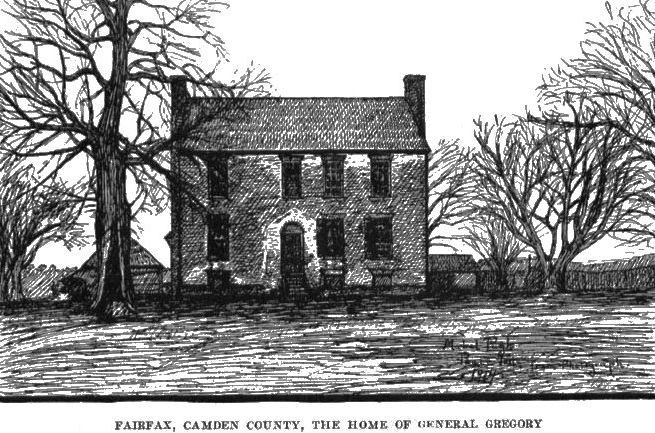
FAIRFAX, CAMDEN COUNTY, THE HOME OF GENERAL GREGORY
The Sir Walter Raleigh Chapter of the Daughters of the Revolution have
within the past year obtained from the United States government a simple
stone which they have had placed to mark the grave of this gallant
officer, who lies buried in the family graveyard at Fairfax.