There are not many portions of the sea-realm
of Oceania, or, indeed, of the whole Southern
Hemisphere, of which the name is so well and the
history so little known as New Caledonia. Throughout
Europe, not excepting even France, it has for
fifty years been the name of a convict station. To
the forçat and the relégué its name meant something
even worse than the traditions of the old galleys
could tell of. It meant banishment over an illimitable
stretch of ocean; and, through the hazes of
distance, the French criminal, caged in the penal
transport, saw horrors unspeakable. To him it
was the Land of the Chain, of the Lash, and the
Guillotine, a hell upon earth, a paradise of Nature
transformed by despotism into an inferno of crime
and cruelty, and, above all, it was the Land of
Banishment. In earlier times it really was something
like what the evadés who had reached
Australia, through a thousand miles of sea-peril
and starvation, described it to be. It will be seen
from the chapters which follow that all this has
long ago been done away with, but even now
the commandants of the various camps are careful
to remind the visitor from the other ends of the
earth, that not the least part of the punishment
of transportation to New Caledonia consists in the
fact of banishment for many years, perhaps for
ever from France.
That is one of the reasons why France will never
make a real living colony out of New Caledonia
until its present criminal and semi-criminal population
has utterly died out—a contingency which is
not likely to come to pass while French rule in the
Pacific endures. The Frenchman cannot colonise,
although, curiously enough, under another flag he
can become a most excellent colonist. Take him
away from France and plant him, as in New
Caledonia, under the tricolour and under the care
of his all too paternal, perhaps it would be more
correct to say maternal government, and, whether
bond or free, he begins to get homesick, and a
homesick man is the last person on earth to begin
colony-making.
Of course, if you take him out in a convict
transport and plant him on an island as a prisoner
you can make a colonist of a sort out of him, and
that is the sort you find in New Caledonia, a human
machine whose initiative, if he ever had any, has
been ground out of him, not so much by prison
discipline, for that, as I shall show, is indulgent to
a degree that would be quite incomprehensible in
England; but, rather, by a rigid system of supervision
which permits him to do nothing for himself, which
provides everything for him from the plough with
which he breaks the virgin soil of his concession to
the prize which he gets for a well-raised crop. Such
a man walks on crutches all his life, and a colonist
on crutches is an entirely hopeless, if not a quite
impossible, person.
An experience of something over forty years
has convinced all the most intelligent students of
the question, that the convict civilisation of New
Caledonia is a dream the realisation of which is
made impossible by the conditions of the system
itself.
During my last conversation with the Director
of the Penal Administration, he asked me what I
thought of the social conditions of the island, and
the possibility of sometime transforming it from
a penal settlement into a free colony? He was
intensely in earnest on the subject. He believed,
or at least he did his best to believe, in the
future of that beautiful native land of his, and
I would have encouraged him in his loyal belief
if I could have done so; but I had seen too
much of real colonisation in many lands to be
able to do that honestly, and so what I told him
was this:
“Noumea is the heart of New Caledonia, as Paris
is the heart of France. The greater part of it is
founded upon what was once a miasmatic swamp,
and, no matter what you do, the poison-germs will
find their way to the surface, and pollute the atmosphere
that you breathe. That is a concrete likeness
of your society. It is based on a substratum of
crime. For forty years the poison-germs of the
mental disease which is called crime have been rising
from your lowest social stratum and permeating
all the others.”
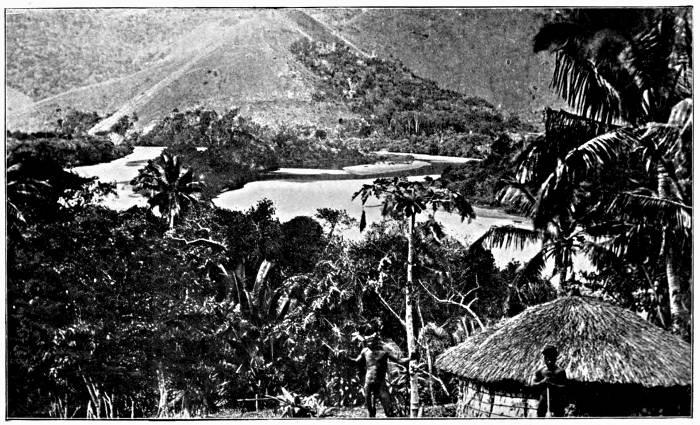
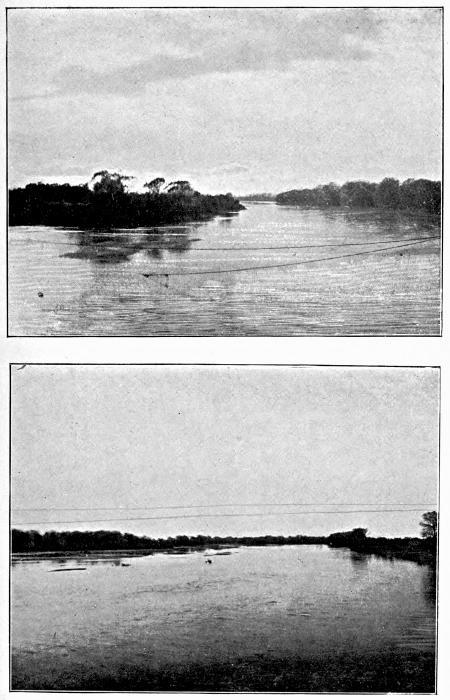
A Lake in the interior of New Caledonia.
He saw the justice of the parallel, and he tacitly
admitted that the source of moral contagion was
every whit as deeply rooted and as irremovable as
the buried swamp that lies deep down beneath the
palms and the flamboyants which shade the squares
and the gardens of Noumea.
In Australia the matter was different. In the bad,
old days men and women were shipped over seas
for offences which would not earn fourteen days’
hard labour now, and the majority of them were
morally and physically sound. Moreover, they were
Anglo-Saxons. They knew how to tackle the
wilderness and subdue it, and when they won their
freedom they mixed freely with freemen, and, in
due course, the wilderness got subdued, and the new
nations got started. That was because there was a
maximum of individual initiative, and a minimum
of government control which made it possible for
the man to work out his own moral and social redemption,
and at the same time to shape a country
for his children to dwell in. When I first went to
Australia as a lad in the deck-house of a limejuicer,
the letters M.L.A. didn’t only mean Member of
the Legislative Assembly. Sometimes they meant
Mustn’t Leave Australia; but to-day the penal
settlements of fifty years ago are federated nations.
Caledonia is still a convict settlement, and such it
must remain until the last drop of convict blood
within its confines solidifies in the veins of its last
dead criminal, or until its moral and social swamp
is drained and purified by more drastic measures
than its present rulers appear to have dreamt of.
For the last decade or so the French Government
has been doing its best to induce French
peasants, artisans, and small tradesmen and manufacturers
to go out to New Caledonia as agricultural
and industrial colonists. It has given them free
passages, land for nothing, free mining concessions,
and even capital to start on, but, in spite all of
these advantages and, perhaps, partly because of
them, free colonisation has not been a success in
New Caledonia. The causes of this failure are not
very far to seek, and some of them are exactly
the same as those which operate against the success
of German colonies.
The first of them is the Functionary. New
Caledonia is perhaps the most over-governed place
in the whole world. The Australian colonies are
beginning to suffer from over-government, the
natural result of a too triumphant democracy, but
there, as elsewhere under the British flag, it is still
possible for the pioneer to fight his own battle for
home and fortune against the Spirit of the Wilderness
with no more governmental interference than
is necessary to enforce obedience to the law. It
doesn’t matter of what nationality he is, he succeeds
or fails by his own strength or weakness.
In a later chapter I shall describe the most
marvellously successful piece of cosmopolitan
colonisation that has ever been accomplished, an
experiment, the success of which completely bears
out all that I am reluctantly obliged to say here
against the French system.
From the moment that the Frenchman, whether
peasant or artisan, leaves his native land to become
a colonist in an oversea French possession he has
a functionary in front of him, one on each hand,
and one behind him. This is to ensure that he
shall go along the dead straight line which governmental
wisdom has drawn for him. The man in
front prevents him going too fast, and the one
behind sees that his footsteps to fortune do not
fall behind the regulation pace. When he lands
in the colony, his first task is to master more or
less imperfectly the vast mass of regulations by
which all his comings and goings are ordered.
Within the sphere of action allotted to him everything
is already cut and dried. To be original is
to transgress the code and to trample on the
official corns of a functionary. Wherefore, he very
soon finds that originality is at a heavy discount,
and a colonist without originality is of about as
much use in a new country as a baby in long
clothes. In fact the baby is a more valuable
citizen, for he may grow into something which
the officially conducted colonist never will.
Then there is that fatal convict question. In
the following pages I have shown that in New
Caledonia there are three classes into which the
criminal population of New Caledonia is rigidly
divided. First, there is the forçat, or convict
proper, the man who has been sentenced to a definite
term of transportation, ranging from eight years
to life. The second class is composed of relégués
who have been banished to New Caledonia for life,
not for any particular crime, but because, by an
accumulation of offences, they have proved themselves
to be hopeless criminals, and therefore unfit
for civilised society and incapable of bearing the
burden of responsibility which is inseparable from
freedom. The third class is composed of the
libérés. We have no counterpart to the libéré in
our criminal system. The nearest English analogue
to him is the convict released on license, but the
only real likeness between them is the fact that
they are both responsible for their movements to
the police.
In New Caledonia the forçat may become a
concessionaire and after that a libéré, or he may
become first a collective and then an individual
libéré. In the former case he is free to hire
himself out for work during the day, but he must
return to sleep in barracks. In the latter he is
absolutely free within the limits of the colony.
Subject to the sanction of the Administration he
may engage in any business he pleases.
Many men in this class have done exceedingly
well for themselves. Others again have returned
to France, of course under government sanction,
to present their petition for “rehabilitation.” If
this is granted they become freemen, their civil
rights are restored to them, and they can either
settle down in France or return to the colony.
As a rule they choose the latter alternative. The
keeper of the canteen where I lived at Prony had
done this, and had won his way back not only
to citizenship, but to universal respect.
The relégué has no such hope. He is banished
for life and remains a well-cared-for slave of the
government for the rest of his days. In some rare
cases he may regain his freedom as a special act of
grace, but his civil rights are never restored to him.
These three classes form the real substrata upon
which the whole social and official fabric of New
Caledonian society rests, and it is into such a soil,
supersaturated with crime, that the French Government
proposes to transplant freemen and women,
and make colonists of them. In other words the
free emigrant to New Caledonia must take his
wife and children across thirteen thousand miles
of ocean and make a home for them in a land
where they will inhale the poison-germs of
villainy with every breath they breathe. Their
servants and their labourers, if they can afford them,
will be thieves, swindlers, and assassins. Their
sons and daughters will have to work with them,
grow up with their children, sit beside them at
school, and perhaps some day intermarry with
them, for all children of convicts born in New
Caledonia are free before the law, and the legal
equals of all other children. It is obvious that
under such conditions, healthy colonisation is about
as impossible as healthy physical life in a colony
of lepers.
Many have tried the experiment and have gone
back to France richer in experience and poorer
in pocket, and with such tales in their mouths
as have justly persuaded their fellow-peasants and
artisans that their hard, clean, thrifty life in France
is infinitely better than State-aided contamination
in New Caledonia.
Lastly, there is what I may call the commercial
reason for failure, which is of course closely
connected with the others. Officialism has strangled
initiative, and crime has poisoned the sources of
social prosperity; wherefore in New Caledonia the
French govern, but they do not develop. Nine-tenths
of the capital invested in the island is in
the hands of British and Australian firms, or is
owned by foreigners who have become naturalised
French subjects. The French have had possession
for half a century of one of the richest islands in
the world, yet I am only telling the bare truth
when I say that a withdrawal of foreign capital
would promptly bring the colony to bankruptcy,
and that the stoppage of the Australian carrying
trade would starve it out in a month. This was
clearly proved by the extremities to which nearly
all the outlying camps were reduced by the
interruption of the Coast Service during the plague
epidemic.
Here, for instance, is one example out of many
which might be quoted of the extraordinary ineptitude
of the French colonial official in matters
of business. An Anglo-French firm located in
Sydney obtained a concession for a term of years
to import corn, grind it, and sell the flour at a
given price, which was about eight shillings per
sack higher than the average of Australian prices.
The government objected to the price, but yielded
on condition that the firm would buy and grind
all the corn raised in the colonies. The firm knew
perfectly well that all Caledonia would not raise
fifty bushels of wheat in as many years, so, of course,
they consented, and for the next ten years or so
the astute partners will go on selling flour to the
government and the citizens at a much higher
price than they could import it for themselves
from Australia.
The whole trade of Noumea, which is the one
trading centre of the island, is practically in English
or Australian hands, although several large firms
trade under French styles. The first essential of
a commercial education in New Caledonia is a
sojourn in Australia, and no French youth has a
chance of a good start in a New Caledonian business
house unless he can speak and write English. In
fact the only people in the colony who do not
speak English are the officials of the Administration
and the military officers.
During the whole of my wanderings through
the convict camps from end to end of the island,
I only found one official who could converse
intelligently in English, and that was the Director
himself; and yet you can go into almost any store
or office in Noumea and get what you want by
asking for it in English.
New Caledonia may, in short, be fairly described
as a French penal colony and a commercial
dependency of Australia.
After a flying visit to Auckland, our old
steam-roller staggered through a southerly
buster into Sydney Heads on Christmas Eve, and
it was then that I began to make acquaintance
with the Microbe of the Black Death.
We had got alongside the wharf at Circular Quay.
On the other side of the jetty a white-painted
Messageries mail-boat was being moored. If
Sydney had only known the terrible cargo which
she carried, Sydney would have seen her sunk
a thousand fathoms deep rather than let her touch
Australian soil. She was the Pacifique, the ship
I was to cross to New Caledonia in, and the Black
Death was a passenger on board her. It was
many days more before I learnt the how and the
why of this—after I had walked in the same streets,
lived in the same houses, and sat at the same table
with the Spectre. I had also seen his material
reality. This was what it looked like.
A lot of little circular globules, flattened in the
centre, some red and some white, were floating
in a greyish-white liquid under the microscope.
Among them were some tiny dark, wriggling things
swimming in the fluid and running their heads
against the edges of the white globules. They
were plague-microbes in blood-serum. If they got
inside the white corpuscles the person to whom that
blood belonged would have a very good chance
of dying the Black Death. If not, he would be
very ill, but would probably live, as I did.
The newspapers had come on board, and I was
having a farewell cocktail in the Doctor’s cabin, a
cosy little snuggery, which by this time contained
many pleasant memories for me.
“There’s bubonic plague at Noumea,” said he;
“and they seem to have it pretty bad, too. Of
course you won’t think of going while anything
like that’s messing around?”
Now I loved the Doctor because, in addition
to his social qualities and medical skill, he possessed
the art of making a cocktail which was an entirely
delightful antidote to his medicine.
I confess that I didn’t like the news, but I
made bold to reply:
“Of course I shall. Do you suppose I’ve come
fifteen thousand miles to get into that place to
be scared by——? Anyhow, I suppose it’s only
among the Kanakas?”
“My dear fellow, bubonic plague’s a mighty
good thing to stop away from,” he said, with
unwonted seriousness.
“And therefore all the more interesting.”
“Well, if you will go, so-long, and don’t get
it. If you do, in a place like that you’ll have
about one chance in five of getting back.”
Ten days afterwards I steamed into the lovely
harbour of Noumea, the Malta of the Pacific, which
England lost by about three hours one morning
nearly fifty years ago. But the adventures of
H.M.S. Dodderer will be a twist in another yarn.
Even if we had not known that the terrible Black
Death had come to Noumea, the least observant
of us would have asked:
“What is the matter with this place?”
A couple of dozen steamers and sailing-ships
were laid up, and a ship out of work is about
as forlorn a spectacle as a deserted workhouse.
The ships that were in work were all flying
Yellow Jack—that spectre in bunting which followed
me across the world till I bade it, I hope, a last
farewell on the quay at Marseilles. Steam-launches,
too, were flying it, dodging backwards and forwards
between the ships and the shore. They were
patrolling to stop all unauthorised communication.
One of them ran alongside. Other boats, containing
friends of passengers, kept at a very respectful
distance.
“Five fresh cases to-day; two deaths, one a
white man,” were almost the first words I heard
at the gangway. Then the Doctor’s words came
home to me in a somewhat chill fashion. At Sydney
it was only the news. This was the ugly reality.
We began to look at each other, and especially
at the people from the shore.
Which of us would be first? You could see
the unspoken question in every one’s eyes. People
who had been friends on the passage didn’t care
to shake hands now. We looked at the lovely
landscape in front of us, the white-walled, grey-roofed
town, nestling under tall, feathery palms,
and the flamboyants blazing with crimson blossom,
at the foot of the densely wooded mountains, and
it seemed strangely out of the order of things
that this demon which has devastated the world
for ages should have chosen so fair a spot from
which to send that dread message forth to men
and doctors:
“I am here, in spite of all your science. Kill
me if you can. Meanwhile, pay me my toll
of life.”
It was dark before we had passed the doctor
and got ashore. The first visible sign of the
terrible presence was a long wall of corrugated iron
cutting off that portion of the town which lies
along the wharves from the rest. There were
openings in this, and each was guarded by a sentry
with fixed bayonet, but more than twenty days
before the Spectre had slipped past the sentries and
slain a white man. Even now it was standing by
the bedside of two white girls.
The Kanakas and Tonkinois didn’t seem to
matter so much. But white people—that was a
family matter to all of us. This seems uncharitable,
but it is none the less true.
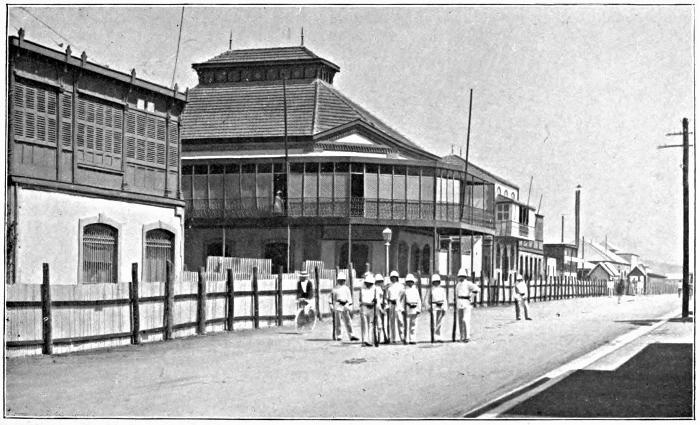
The Plague Area at Noumea. Offices of the Messageries Maritimes, with Sentries in front.
When I found the place that I was to sleep in,
I began to see, or, rather, to smell, the reason why
the Spectre had crossed the barriers. Noumea has
a magnificent water-supply. Fresh water flows
constantly from the mountains down through the
stone channels on each side of the streets; but
its sanitation is about as rudimentary as that of
a Kaffir village.
When I went to bed I shut the long windows
opening on to the balcony to keep the smell out.
I also shut in the heat and some odd millions of
mosquitos, any of which, according to popular belief,
might have had thousands of microbes concealed
about its person. As a matter of fact they hadn’t;
but they got their own work in all the same.
I stood it for nearly an hour, and then I
concluded that even the smell was preferable to
suffocation, so I opened the windows and went out
on the balcony to scratch and say things to the
accompaniment of the song of many vocal insects.
The next morning I went down into the yard to
cool my wounds in a corrugated iron bathroom,
which, with true French colonial forethought, had
been built within two yards of an open cesspool.
A shower-bath in tropical countries is usually a
luxury as well as a necessity. In Noumea it was
only a necessity.
When I set out for my first stroll round Noumea
the morning after my arrival the sun was shining
out of a sky of unflecked blue. A delicious breeze
was flowing down the mountain-sides. The scent
of fruit and flowers was everywhere atoning for
the stench of that backyard. I took in long
breaths of the sweet, soft air, and began to wonder
whether that black Spectre really was haunting
such a paradise as this.
Then I turned into the Place des Cocotiers, which
is to Noumea what the Champs Elysées are to Paris—a
broad square shaded by blazing flamboyants and
flanked by rows of coco-palms. The next moment
I saw a long, four-wheeled, white-curtained vehicle
being driven rapidly through it. It was the
ambulance, and inside it lay some stricken wretch.
Who—yes, who was it? A question of some
significance to one who might have had to say
“here!” to the dread summons before the next
sun rose.
I went under the verandah of the Hotel de
France, which fronts the square, and ordered a
limonade, so that I might ask the news. Yes, it
was the ambulance, and its occupant was one of the
white girls. In three days she was to be the first
white bride of the Black Death. It was rumoured
that there were six new cases that morning, but
the Sanitary Commission very wisely only reported
two “suspected” cases and one death. If they
had told the truth for a few days more there
would have been panic, and panic is the best—or
worst—helpmeet of disease, especially in a place
like Noumea.
From the hotel I wandered along the shady
sidewalks of the broad streets, and presently found
myself in a quarter of the town which looked
as if it had been bombarded. The houses were
wrecked and roofless. Some of them were
smouldering still, and some were cold, skeleton
ruins. It was here that the Black Death had found
its first victims. They were only Kanakas and
Tonkinois, so their families had been cleared out,
and their houses and belongings burnt.
Farther on up the hill leading to the military
reservation I saw all that was left of what had once
been a pretty villa standing in its own grounds, a
garden such as one sees only in the tropics. This
had been the house of the first white victim, a
young fellow of splendid physique, who had fought
the Demon through three weeks of torture, dying
by inches in multiplying horrors unspeakable.
Later on the Demon was more merciful, because
he struck harder and killed quicker. In a few
weeks it was to be a matter of hours rather than
of days.
I learnt afterwards that, although the Sanitary
Commission had burnt the house down, they had
allowed the furniture to be sold by public auction.
The same authority permitted the traveller by sea
to take any sort of luggage he liked on board the
steamer, but would not allow even a package of
clean linen to be forwarded from one port to another
unless it was in the possession of its owner. Nail
it up in a box and it could go, but as personal
effects—no. Later on the Demon took his revenge
for this foolishness. He laid his hands on the
Chief of the Commission, and killed him in thirty-six
hours.
That night I dined at the club, the Cercle de
Noumea, an institution which is devoted to eating
and drinking during the day, and to poker and
baccarat during the night.
There was only one subject of conversation
among the Frenchmen round the long table—la
Peste.
During the plague-time in Bombay it cost drinks
round to mention the word in white society, but
in Noumea every one, doctors and laymen alike,
talked unrestrainedly of it. The doctors told of
the new “cases,” enlarged on symptoms, and
described experiments in detail which made the
laymen mostly sick, and nearly all frightened.
Which is one point of difference between English
and French ways of looking at ugly things.
A day or two after, when the name of the Demon
had become familiar to my ears, and had, therefore,
lost some of its terrors—I suppose I really was
quite as frightened as anybody else—I noticed
that a man feeling furtively under his armpits was
looked at with suspicion, and a man seen limping
in the street was left to walk alone.
One morning I got up feeling rather seedy. It
may have been the mosquitos, or the heat, or the
last French cigar overnight. It is a true saying
that a man who is his own lawyer has a fool for
his client, and that a man who is his own doctor
has a still bigger fool for a patient; but by this
time I had heard enough of la Peste in Noumea
to convince me that I had to take the latter risk
into my own hands. If I had described my
symptoms to a doctor I should have been “under
observation” in the hospital within an hour. After
that the date of my coming out would have been
a very uncertain one, so I smoked the mosquitos
out of my bedroom, took some chlorodyne, and
went to bed. It is bad to take opiates, but it is
a great deal worse to lie awake in a plague-smitten
town and wonder whether or not you’ve got it.
The next day I saw a coffin carried out of a
house. That night the house was pulled down,
and the ruins burnt, but the day after that, as
though in mockery of every precaution taken, the
Demon showed himself in a new and deadlier
form.
A great cleaning-up had been going on all this
time, just as it was in Sydney later on. The
filth-accumulations of years were being cleared out.
A white man, very much down on his luck, took
a job with the Kanakas and convicts who were
cleaning out the basement of a store in which
dead rats had been found. The others had their
mouths and noses covered with cloths steeped in
corrosive sublimate, but he wasn’t afraid of any
blanked plague, and so he went in without.
He happened to stir up some dust out of which
he disinterred the corpse of a rat. He inhaled
some of the dust. The little black wriggly thing
that I had seen under the microscope got into his
lungs, and assisted in the change of the venous
into the arterial blood. In six hours that man
was dead. The pulmonary form of the Black
Death is perhaps the most swiftly killing of all
diseases.
After this the corrugated iron fence round the
wharves came down, and the sentries went back
to barracks. The enemy had passed them, unseen
and unchallenged. Every gust of wind which
raised a cloud of dust in the street might carry
death, and sometimes did.
You might, for example, walk through one of
these clouds on your way to dinner. Your appetite
would not be quite as good as usual. After dinner
you would feel headachy and sick, and, being
disinclined to walk home,—a very bad symptom,
by the way,—you would call a cab and be driven
there. The next day you would have a drive in
the ambulance, after which your fate lay on the
knees of the gods. In the particular case here
referred to the matter was decided in four days.
It was little wonder that the microbe was thriving
apace in this outwardly lovely place, for dirt,
disease, and death are a trinity found ever hand
in hand. Just en passant, I may say here that
my excellent landlady who, I am sorry to say,
died of the plague soon after I left her hospitable
roof, subsequently confided to me that among her
guests there were some who had not had a bath
for three weeks. Of course there was no law to
make them wash, but I think that in a tropical
country in which the Black Death has taken up
its abode the penalty for not bathing, at least once
a day, should be delivery to the tender mercies
of the local fire brigade, with permission to squirt
to taste.
My first official business in the colony was, of
course, to write to the Governor acquainting
him with the fact of my arrival. I did this with
considerable misgivings, for both at Sydney and on
the boat, I had heard the evil rumour that in consequence
of the plague the Government of New
Caledonia had decided to close the prisons. This
meant that the convicts who had been hired out
to work in the mines and elsewhere would be
recalled to the prisons and the camps, and that all
communication would be severed between them
and the outer world until the epidemic was over.
Now I carried credentials from the Ministry of
the Colonies in Paris, which is to New Caledonia
what the Russian Ministry of Justice was to Siberia,
and these, under ordinary circumstances, authorised
me to have every prison door in the island opened
to me. But M. Albert Décrais knew nothing about
the coming visitation when he gave them to me,
and the Governor would have been well within his
powers if he had answered my letter by expressing
“his infinite regret that exceptional circumstances
made it impossible for him to act under the
instructions of the Ministry during the present
disastrous epidemic, etc.”
In this case my mission would have been brought
to nought, and I should have travelled fifteen
thousand miles for the privilege of sojourning an
indefinite time in a plague-stricken town. It was
three days before I got an answer, and during that
time I allayed my anxieties by making a closer
acquaintance with Noumea.
Through the kindness of the Earl of Dunmore,
who was then acting as Administrator of one of the
greatest mining enterprises in New Caledonia, and
a member of the Municipal Council with whom I
had travelled from Sydney, I was made a guest of
the Cercle. Only the most exclusive aristocracy
of Noumea breakfast and dine at home. The rest—officials,
merchants, and professional men—knock
off work at eleven, having begun about six,
breakfast at half-past, and then play or sleep
till three.
At six everything, except the hotels and cafés,
shut up; then comes a drive or a ride, tennis or
a sail in the bay, then dinner, followed by cards and
drinks till midnight—and of such is the daily
life of the capital of New Caledonia. I learnt
afterwards that this delightfully situated little town
is also one of the wickedest spots on earth, but
of that I shall have more to say hereafter.
Socially, Noumea struck me as being somewhat
cramped. Its society is composed of educated,
highly trained, and, in the main, well-mannered
men, living a little life among themselves, and
being crushed into smallness by the very narrowness
of their environment. They were a thousand
miles from anywhere. Their only immediate
connection with the outer world was the cable
to Sydney, controlled by the all-powerful Administration,
which published and suppressed whatever
it pleased.
There were the monthly Messagerie mails, and
a few odd traders, now mostly laid up in the
harbour flying the Yellow Jack. Every night the
same men met and discussed the same subjects,
the chief of which was la Peste. Every day the
same men went to the same duties, the same women
discussed the same gossip and the same scandal.
Every night the same men and women met in the
Place des Cocotiers, under its swaying palms and
flaming flamboyants, and listened to the same music—which,
by the way, they will never listen to
again.
I had gone to Noumea full up to the roots of
my hair with the utterly erroneous notions which
I had picked up from books and conversations.
The books appear to have been written mostly
by returned déportés or communards who had been
banished in ’71 and ’72, and allowed to return
to France after the general amnesty. The people
with whom I had conversed had apparently got
their knowledge from somewhat similar sources,
but all agreed in representing New Caledonia as
a second Tasmania, or Norfolk Island, where all
the uncivilised barbarities of our own transportation
system had been prolonged to the end of the
nineteenth century.
Its population consisted of a vast horde of convicts,
the most abandoned and bloodthirsty wretches
on earth, ground down into hopeless slavery by
the irresistible and unpitying strength of an official
engine called the Penitentiary Administration. The
officials were a set of soulless gaolers in whose
natures every spark of humanity had been quenched
by the performance of their pitiless task. The
surplus of the population consisted of half-tamed
natives and a few thousand libérés, or ticket-of-leave
men, any one of whom would knock you
on the head or stick a knife into you for a couple
of francs.
Finally I was regarded in Paris as rather madder
than the average Englishman for wanting to go
to such a God-forsaken place, being neither a
convict who had to go nor an official who wanted
to earn a comfortable retraite and save up the
wherewithal to purchase rentes on which to spend
the balance of his days in that peace and quiet
which is the domestic heaven to which all good
Frenchmen look forward.
Now this is what I actually saw of convict-life
in Noumea before I had passed the prison gates
for the first time. I had eaten my second dinner
at the Cercle, and Lord Dunmore, taking pity
on my isolation, said:
“The convict-band is playing in the square
to-night, suppose we go and get some seats?”
“The convict what?” I said, harking back
mentally to the rigid English system, and trying
to picture to myself an English convict blowing
a cornet.
“It’s what they call here the Musique de la
Transportation. It’s quite an institution in
Noumea. I don’t suppose there’s anything like
it anywhere else.”
So I went, feeling verily a stranger in a strange
land.
It was an absolutely perfect tropical night. The
moon was getting up over the eastern end of the
Chaine Centrale, a ridge of mountains which runs
through Caledonia from north-east to south-west;
the cafés along the top of the square were glittering
with light; a deliciously cool breeze was blowing
down from the mountains through the trees.
Little groups of people, mostly clad in white,
were sitting on chairs about the lawns, and others
were strolling slowly round and round the square
and across the paths which radiated from the big
kiosk in the centre. There were pretty costumes
and brilliant uniforms, stars and medals and all
the rest of it, and the one finishing tropical touch
that was needful was added by wandering bands
of laughing Kanakas with gaudy waistcloths and
fantastic headgear, big, luminous eyes, and teeth
that gleamed whitely as they laughed.
Saving these last there was nothing that would
have been incongruous with one of those delightful
portions of outdoor Paris where “l’on s’amuse.”
The shadow of the Black Death seemed to have
been lifted for the time, and as for crime and
convicts—well, presently up one of the avenues
through the flamboyants there appeared a line
of grey-clad figures carrying musical instruments.
There were twenty-five of them all told.
They sauntered up to the band-stand laughing
and chatting as though they hadn’t a care in the
wide world. Possibly they had very few; fewer
certainly than the peasant toiling his sixteen hours
a day for a bare living in far-away France.
They were guarded by a very bored-looking
surveillant, who carried in a sling a revolver which
he was not allowed to use unless one of his charges
struck him first!
The gentlemen of the orchestra took their places,
and a short, thick-set man, with a clever, but most
unpleasant face, went into the middle and looked
around with an air of command, which reminded
me oddly of the preliminary gestures of other
conductors of very different orchestras. There was
a little tuning-up, then the conductor tapped his
music-stand, waved his baton of authority, and
forthwith the sweet strains of the Intermezzo from
“Cavalleria Rusticana” began to float out through
the drowsy hush of the tropical evening.
There is really only one word which could
describe the scene, and that is bizarre. Take
five-and-twenty musically inclined convicts out of
an English prison, put them into the Western
Gardens at Earl’s Court on a warm July evening
and you would have something like it, but not
quite. At Earl’s Court the convict-band would
be stared at as a curiosity, but people would
probably keep at a respectful distance from the
band-stand, especially if there was only one tired-looking
warder to keep guard over the musical
criminals.
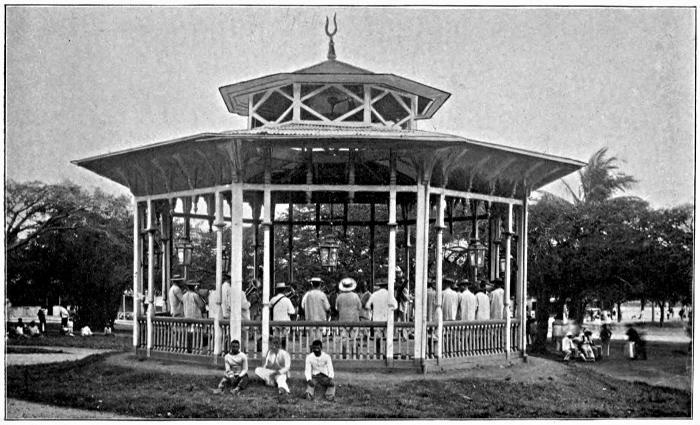
The Convict Band playing in the Kiosk in the Place des Cocotiers, Noumea.
But in Noumea no one, save, perhaps, myself,
looked twice at the enclosure which contained an
amount of assorted villainy and potential violence,
rapine, and sudden death as you could find the
wide world over in a similar space. There were
men from every station of life—soldiers, priests,
lawyers, politicians, financiers, and men who had
once belonged to the Golden Youth of France—inside
the kiosk of the Musique de la
Transportation.
Collectively they had committed every crime,
from forgery to outrages for which civilised speech
has no name. The chef d’orchestre, for example,
was the man who, a few years ago, sent a thrill
of horror through the world by cutting the heart
out of a man whom he believed to be his rival
in his wife’s affections, getting her to cook it
as a sheep’s heart, dining off it with her, and then
telling her what she had been eating. In addition
to being a talented musician he was also a very
clever painter who has won quite a reputation in
the island.
And yet, while this unspeakable scoundrel was
controlling with his baton the flood of sweet sounds
which flowed out from the kiosk over the moonlight-spangled
lawns, the most respectable people
in Noumea were sitting about in chairs smoking
and chatting; young men and maidens were
wandering about among the trees; and little children
were playing round the grassy slope on which
the band-stand stood, taking no more notice of
these human hyenas than if they had been the
most respectable musicians that ever wore long
hair and swallow-tailed coats.
The performance finished, as usual, with “La
Marseillaise.” I stood up and took off my helmet.
Then I put it on again and sat down somewhat
suddenly. Not another person rose; not
another head was uncovered. For all the notice
that was taken of it, the National Hymn of the
Republic might as well have been “Mrs. ’Enery
’Awkins,”—which did not strike me as a particularly
good thing for France generally.
When the performance was over the artists
gathered up their instruments, lolled out on to
the path in front of the kiosk, and shuffled into
a sort of double line. The weary warder counted
them in a languid fashion, right-about-faced them,
and gave the order to march. They shambled
away through the gaily dressed crowds in the
square. No one even turned to look at them,
and I, who had seen a party of English convicts
on their way to work through a public road, ranged
up with their faces to the wall because a break-load
of excursionists was passing by, wondered
greatly.
The Musique de la Transportation is now,
happily for the credit of Noumea, a thing of the
past. The pampered artists got to think themselves
indispensable to the gaiety of the town.
So one night, having collected more surreptitious
coppers than usual, they halted on their way to
barracks, bought wine and brandy, and told the
warder to go and report them if he dared. He
did dare, and the next day the Director of
the Administration published a brief edict which
abolished them as musicians for ever.
The next morning, soon after coffee, a white-helmeted,
gorgeously uniformed gendarme presented
himself at the door of the Hotel Gaquon
with a request to see “Monsieur Griffitte.” An
Englishman or German official would have saluted.
He took his helmet off, bowed, and handed me
a letter from the Governor appointing an interview
for the next day. I went to breakfast at the club
as usual, and before the meal was over I found
that everybody knew of the sending of that letter.
I had been an interloper before, and an Englishman
at that. Now I was a guest, the guest of
the omnipotent Ministry upon whose will the
fate of every official in Caledonia depended.
That was a morning of introductions, and I was
surprised to find how many friends I had in
Noumea.
The Governor’s offices at Noumea are in a
corner of the lovely grounds in the midst of
which his official residence stands. It was a
little, unpretentious, two-storey building, wooden
built, and with a verandah giving on to the
street.
I gave my card to a collarless clerk, who appeared
to be getting very hot over the task of sorting
a few papers. He sent it up to His Excellency,
and asked me “to give myself the trouble to sit
down,” which I did.
Soldiers, civilians, gendarmes, and convict messengers
kept dropping in every now and then to
deliver messages or letters, or have a chat with
somebody by way of beguiling the tedium of official
hours, and then a half-caste boy came down with
my card and requested me to give myself the
further trouble of going upstairs. I don’t know
whether this was another official, but if he was his
uniform consisted of a pair of trousers and a shirt,
a linen jacket which hadn’t seen the laundry for
some time, and a pair of canvas deck-shoes.
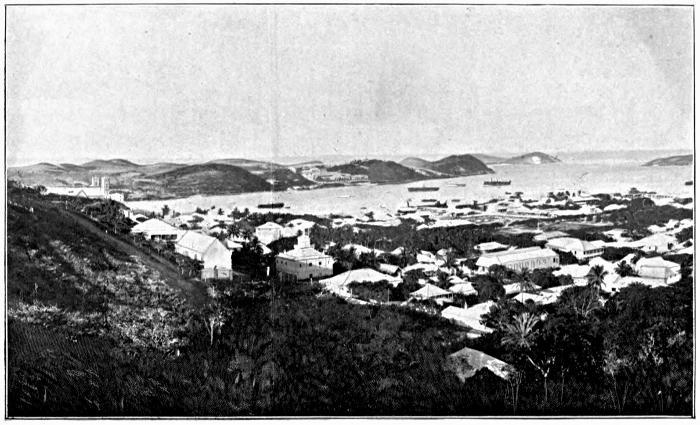
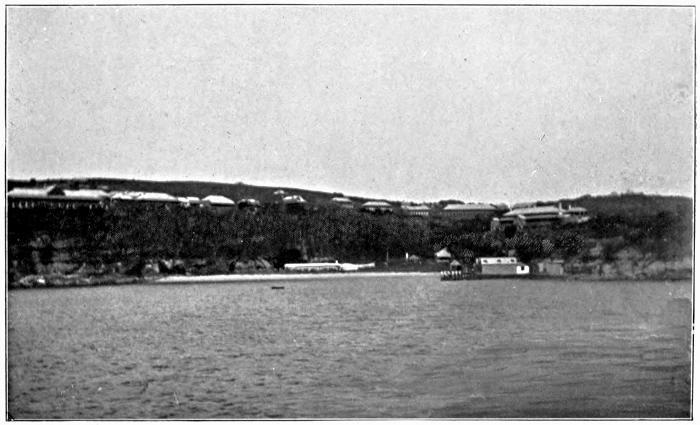
The Town and Harbour of Noumea. Across the bay are the Barracks and the Military Reservation, which no civilian may enter
without authority. On the peninsula to the right are the stations of the libérés collectifs.
I followed him upstairs. He opened the door
without any ceremony, and I found myself in the
presence of the Governor—a man of medium
French height, with a square, close-cropped head,
moustache, and close-clipped beard. If the chin
had matched the forehead it would have been a
strong face, but it did not.
I learnt afterwards that his Excellency Monsieur
Feuillet is a man of decided anti-English tastes;
but for all that he received me very cordially. He
had already received notice of my coming from
the French Government, and expressed himself as
willing to do anything to further my mission. As
a matter of fact, this came to countersigning my
credentials from the Minister of Colonies and
writing a letter to the Director of the Administration.
I then shook hands, and saw Monsieur
Paul Feuillet no more save from a distance.
Then I went to the Direction, and in a few
minutes I was sitting in a half-darkened, comfortable
room, with double doors, through which no
sound could penetrate. This room is the centre
of the system which really controls the destinies
of bond and free throughout New Caledonia. On
the other side of an ample writing-table sat a square-headed,
strong-jawed man of about five-and-thirty,
with close-cropped hair, and moustache and shaven
chin à l’Anglais.
This was M. Edouard Telle, Director of the
Penitentiary Administration for New Caledonia
and Dependencies, the strongest, politest, and most
friendly Frenchman I have ever met.
He is supreme chief of an army of commandants,
surveillants, and jailors, whose duty it is to keep
watch and ward over between ten thousand and
twelve thousand convicts, relégues and libérés—terms
which I have already explained.
He is absolutely independent of the Governor,
who cannot even employ convicts on public works
without his permission. He is responsible to no
one but the Minister of Colonies and the President
of the Republic, and they are many a long thousand
miles away. With the stroke of a pen he could
instantly stop all convict labour throughout the
colony, and so bring its principal industries to a
standstill. It was he, too, and not the Governor,
who could have issued that ukase which would
have closed the prisons and turned my long journey
into a wild-goose chase.
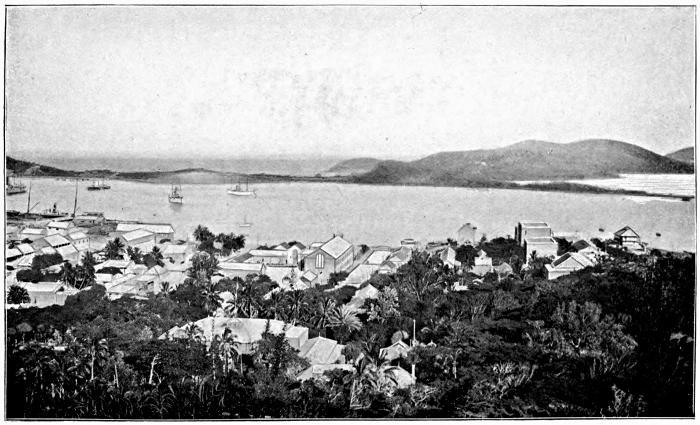
In the Harbour, Noumea.
But, instead of this, he took quite as much
trouble with me as if I had been an inspector
sent out by the French Government, rather than
a wandering Englishman who was only there on
sufferance. He took the utmost pains to find out
exactly what I wanted; he mapped out my journeys
for me; gave me special passes authorising me to
inspect all the prisons and camps en détail—which
is a very different thing to the ordinary, but still
rarely bestowed, visitor’s pass.
He addressed a circular letter to the commandants,
enjoining them to do everything to help me; and,
not content with this, he telegraphed to each prison
and camp so that conveyances might be ready for
me. At the same time, when I suggested fixing
dates, he replied:
“No, Mr. Griffith, go when you please. I wish
you to see the establishments exactly as they are
always, and not as they might be if they were got
ready for you. When you have seen them come
back and tell me what you think of them. From
what you have told me of your English prisons”—this
was at the end of a somewhat long conversation—“your
opinion will be most valuable
to me.”
Then I thanked him, and mentioned the delicate
subject of photographs, and his good nature
and indulgence once move proved equal to the
strain.
“Photograph anything you please,” he said,
“inside or outside the prisons; but I shall ask
you to remember that good English rule of yours
about photographing individual prisoners.”
Of course, I agreed to this, and left the Direction
well at ease and wondering more than ever at the
misconceptions I had managed to form of the
Caledonian prison system. I frankly admit that I
had expected to be received with suspicion and
reserve, perhaps even with hostility.
Instead of this the most powerful man in the
colony had greeted me with perfect cordiality and
frankness, and had taken more trouble to make
my tour a success than I should certainly have
expected a good many English officials to take.
During another interview with M. Telle, before
I had yet seen the inside of a Caledonian prison,
we both managed to astonish each other not a
little. The Director is a criminologist and the son
of a criminologist, who was Director before him,
but he was sufficiently French only to have studied
the continental systems.
Therefore he was about as much surprised when
I told him that the cat and the birch were still
used in English prisons; that English prisoners
ate and slept in absolute solitude and worked in
silence, as I was when he told me that, in this
land of supposed horrors not only had all corporal
punishment been abolished, but that the surveillants
were not permitted even to lay a hand upon a
prisoner, except in actual self-defence; that cells
and silence were only used as punishments; and
when he added that the better-behaved prisoners
might smoke and drink wine, I confess that I
was almost shocked. All this, however, with other
strange things, I was soon to see for myself.
I dined that night, as usual, at the club, in a
more contented frame of mind than heretofore,
for now the omnipotent Administration had spoken,
and I was free of the colony—free to go where
I pleased, to see what I liked, and, within the
limits of the law, do as I liked.
No man might say me nay. All the prison-houses
in the land must give up their secrets to
me. In short, I had in my pocket the keys of
every cell door in New Caledonia.
Under these circumstances I naturally found
things much pleasanter than before. I listened
with equanimity to a local editor’s remarks on the
war news—which he had been spending the day
in mangling—and even the military doctors’ descriptions
of the new plague cases and the ghastly
operations which they had just been performing
with those nail-stained hands of theirs did not
seem quite so loathsome as before.
There was, by the way, another peculiarity of
New Caledonian social life to which I was already
becoming accustomed. There are practically no
free servants in the colony. Male or female, they
are either convicts or ex-convicts, and it was no
uncommon thing to have your knife and fork
laid for you at breakfast or dinner by a hand
which had stuck a knife into somebody else, or
to take your food from hands that had poisoned.
I admit that I did not like the idea at first,
but in time I got accustomed to it, just as I
did later on to being shaved by a most amiable
and accomplished murderer, and having my bed
made up by a lady who had cut her child’s throat.
It is, in fact, the fashion in New Caledonia to
have murderers for servants. As a distinguished
resident said to me:
“You see, the assassins are reliable. They are
the aristocrats of the place. They don’t condescend
to smaller crimes. In fact, they would be absolutely
insulted if they were accused of a theft, at
least, the good murderers would, and as for killing
you, they would never dream of it. Why should
they? Besides, they know perfectly well that
there wouldn’t be the remotest chance of escape
for them.”
This I found afterwards to be the cold-drawn
truth. Fewer after-crimes are committed in New
Caledonia by those who are sent there for assassination
than by minor criminals. Later on I shall
have some curious information to give on this
subject.
Half-past five on a glorious tropical
morning. The sun was still hidden behind
the green, rugged mountains which gained its name
for New Caledonia; but it was still high enough for
the shadows to be melting out of the valleys; for
the grey roofs and white walls of the town to be
glimmering among the dark masses of foliage; and
for the smooth waters of the lovely harbour to light
up with foregleams of the glory of sunrise.
A little beyond the northern end of the plague-infected
area, with its corrugated iron walls and
its white-clad sentries, I found a collection of pretty
buildings, with neat little gardens round them.
They were the offices of the executive police, and
when I had passed through them I found myself
on a short, board, wooden, T-shaped quay—the
Quai de la Transportation—which is used solely
for the purposes of the Administration.
Leading down to this is one of the only two
railways of New Caledonia on which a locomotive
travels. It is quite a toy affair, with a gauge of
about twenty inches, and a length of perhaps five
hundred yards; but the engine puffed around just
as busily, and seemed just as proud of itself, as if
it had been hauling the Empire State Express. It
runs from the wharves to the head of the quay,
and its function just then was carrying ballast for
a new road.
It is a curious fact that the French have had
possession of New Caledonia for nearly half a
century, and yet the only railway by which passengers
can travel is one on which the cars are
drawn by convicts, concerning which more hereafter.
I presented my credentials at the douanerie,
where my cameras were viewed with considerable
suspicion until the all-compelling documents had
been read. After that, I suppose, they would have
almost let me take a Maxim gun on to the island.
Then they were noted and handed back to me with
a polite “Très bien, monsieur. The canot will
start in a quarter of an hour. If you will give
your apparatus to this officer he will see it safe
in the boat.”
A polite surveillant stepped up, touched his
helmet, and took them from me. Then I lit a
pipe and strolled up and down the quay to enjoy
my strange surroundings.
I had seen hundreds of convicts in England
working both within and without the prison walls;
working in grim, joyless silence, surrounded by
equally silent, rifle-armed warders, and never a
prisoner moving without one of these at his heels.
Here it was difficult to believe that I was in
Prisonland at all save that the other occupants of
the quay were wearing two very different uniforms,
and that I was the only one en civile.
The surveillants were dressed in spotless white—the
official washing-bill of New Caledonia must be
something enormous—their white helmets bore a
silver badge, the chief figure in which was a glorified
representation of the now forbidden rod, with
the letters “A. P.” (Administration Pénitentiare).
Their rank was shown by galons, a sort of stripe
worn on the cuff of the left sleeve. This was of
blue cloth with silver braid—the lines of braid
served the same purpose as stripes do with us.
For instance, the French equivalent for “two
stripes” is “à deux galons.”
The uniform of the others was chiefly conspicuous
for its ugliness and utility—a pair of
trousers and a jumper of light grey canvas cloth,
with a vest underneath, and a very broad-brimmed
straw hat, without a ribbon. No convict in
Caledonia is allowed a ribbon on his hat. Some
had stout, undressed brogues, and some were
barefoot. They were without exception extremely
ugly and fairly hearty.
A good many of them were smoking, and this
rather got on my nerves, for I kept on asking
myself what would happen to an English prison
official if he saw a convict take out a cigarette
and go and ask another one for a light? But
here surveillants strolled about puffing their own
cigarettes—making me wonder again what would
happen to an English warder smoking on duty?—and
not worrying particularly over anything.
At the same time, there was no lack of discipline
of its kind, though it was not what we should call
discipline in England. Still, the convicts worked
hard and regularly; harder, indeed, than I have
ever seen English convicts work.
Their task was loading the canots and the steam-launch
with provisions for the great prison on the
other side of the harbour; and they went at it
steadily and in excellent order until it was finished,
scarcely needing a word of direction from the
surveillants.
As I watched them I thought of the quiet-spoken,
square-headed despot with whom I had been talking
a day or two before. These men, like hundreds
of others that I saw, evidently knew him, if only
by repute.
Presently the surveillant who had taken my
cameras came and saluted and told me that the
canot was ready. I got in, and found it manned by
twelve convicts, who were protected by an awning
stretched from stem to stern. They were chatting
and smoking when we got in, and my conductor,
thinking perhaps to impress the Englishman with a
sense of French discipline, ordered them to be silent.
They stopped talking for five minutes while
they got under weigh, then, like a lot of school-boys,
they began again, whereupon the surveillant
rebuked them again. “Silence, je vous dis!”
said he in his most authoritative tone; and they
obliged him more or less for the rest of the passage.
I must say that they rowed very well, and with
a vigour which betokened good nourishment.
They looked at me with smiling curiosity. They
evidently knew pretty well all about me by this
time—Heaven and the mysterious “loi du bagne”
only know how; and I daresay they wondered why
any one should have taken the trouble to come
across the world just to make their acquaintance.
I was received on the quay at Ile Nou by an
officer—a chief warder, as we should call him in
England—who took me to the Commandant’s
house. En route I found that Ile Nou, about
which I had read such terrible stories, is a very
pleasant little settlement, composed of white houses
and shady streets, at the foot of a hill on which
the great prison buildings stand.
In a few minutes another illusion was shattered.
I admit that I expected to find the Commandant
of the greatest prison in Caledonia a semi-military
despot in a braided uniform, boots and spurs, with
a sword, and, possibly, a revolver, to say nothing
of fiercely waxed moustache and imperial.
Instead of this I found a mild-mannered, grey-haired
gentleman of about sixty, clad in a négligé
white suit, with no sign of official rank about him
save a silver-embroidered blue band round the
left cuff of his coat, which reminded me rather
oddly of the band that a British policeman wears
when he is on duty.
He was drinking his early coffee and receiving reports,
which were noted by a convict clerk at another
table. He gave me a cup of coffee, and ordered the
carriage to be got ready. Meanwhile, he dropped
his reports and began to ask me about my journey,
my impressions of New Caledonia, and so on.
Presently a surveillant came in to say that the
carriage was ready. We got in, and a couple
of well-bred, well-fed horses pulled us at a good
pace up the winding road, until our convict driver
halted in front of a big black iron door in a long
white-washed wall. As the Chief Surveillant put
his key into the lock the Commandant said to
me, with a smile:
“You will be the first Englishman who has
ever passed this gate.”
“Mais pardon, Commandant,” said the surveillant,
as he threw the door open. “There have been
two others, but they did not come across the
world to see the prison, and they stayed a good
deal longer than monsieur would care to do.”
“No doubt,” said I; and with that we crossed
the Threshold of Lost Footsteps.
As the door swung to behind me I found myself
in a long rectangular courtyard, one side of which
was almost filled by a row of long, white buildings
fronting endways on to the court, with a door
at the end and small windows along the side.
At the further end, to the right hand, there
was another door in the high, white wall, of
which I was to learn the use later on, for the
quadrangle which we were crossing is to the
convicts of Ile Nou what the Place de la Roquette
was lately to the Parisians—the Field of Blood,
the Place of Execution.
The Commandant apologised for not being able
to invite me to assist at the spectacle, as there
was no patient available. I should see shortly
a forçat awaiting trial for murder, but it would
be some time before he could be tried, and then
there would be the ratification of the sentence.
I should, of course, have assisted at such a
spectacle if it had been possible; but I had the
advantage of hearing a simple, but none the less
graphic, description of an execution at Ile Nou
from the lips of one who had more than once been
an eye-witness of the dread ceremony; and this I
will reproduce hereafter not only because of its
dramatic interest, but because it is so absolutely
different from anything ever heard of in England.
After we had inspected the cases, or dormitories,
where the convicts of the third, or lowest, class sleep
on sloping wooden shelves, with one foot manacled
to an iron bar running the whole length of the
long room, we went through other gates and walls
into the central prison—the Prison Cellulaire—the
heart and centre of the vast organisation.
Here I might have fancied myself in a somewhat
old-fashioned English prison. Here there were
no convicts smoking cigarettes or chatting at
their work while their guardians smoked theirs
and chatted also. The chill of silence cut down
through the warmth of the tropic morning as
the iron gates clashed to, and the heavy bolts
shot back. Underfoot, black stone or cement
pavement; around, white walls and two tiers
of little black doors, the upper fronted by stone
balconies and iron rails.
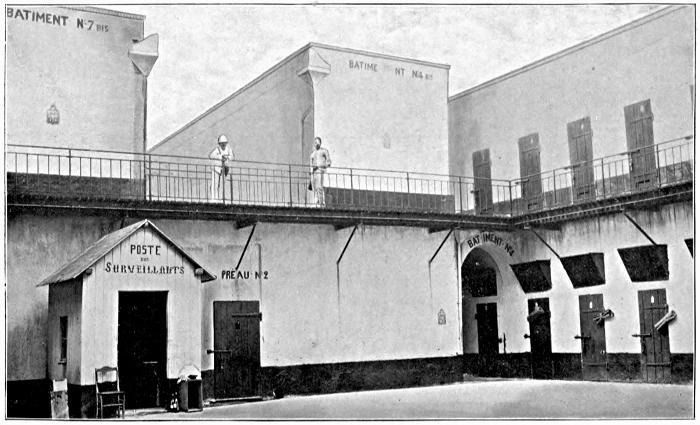
The Inner Court of the Central Prison, Ile Nou. The Cachots Noirs are to the right. The Condemned Cells are in the Upper
Gallery above the Archway.
On the ground floor we went through several
cells into which light as well as air was admitted,
and here I found convicts who had been sentenced
to various terms of hard labour with solitary confinement.
This, with reduction of diet, is the first
degree of punishment inflicted on an idle or disorderly
prisoner. It was about equal to the
ordinary hard labour of English prisons.
Then, after a look into the two little exercise-yards,
we mounted to the second storey. Here
I noticed that the cells had no windows and no
gratings in the doors. Some of them had little
cards affixed to them.
I went and read a couple of these; they contained
the names of the prisoners, their first sentence, their
subsequent offences, and their present sentences.
In these two cases it was “ten years’ solitary
confinement in the dark.” Then I knew that
I was standing in front of the terrible Cachot Noir,
or Black Cell—that engine of mental murder
which the sentimentalism of French deputies, some
of them amnestied communards, has substituted
for the infinitely more merciful lash.
I asked for the doors to be opened. My polite
Commandant demurred for a moment. It was
not réglementaire. The Cachots Noirs were never
opened except at stated intervals,—once every thirty
days, for an hour’s exercise and medical inspection,—but
the wording of my credentials was explicit,
and so the doors were opened.
Out of the corner of one came something in
human shape, crouching forward, rubbing its eyes
and blinking at the unaccustomed light. It had
been three and a half years in that horrible hole,
about three yards long, by one and a half broad.
I gave him a feast of sunshine and outer air by
taking his place for a few minutes.
After the first two or three the minutes
lengthened out into hours. I had absolutely no
sense of sight. I was as blind as though I had
been born without eyes. The blackness seemed
to come down on me like some solid thing and
drive my straining eyes back into my head. It
was literally darkness that could be felt, for I felt it,
and the silence was like the silence of upper space.
When the double doors opened again the rays of
light seemed to strike my eyes like daggers. The
criminal whose place I had taken had a record of
infamy which no printable words could describe,
and yet I confess that I pitied him as he went back
into that living death of darkness and silence.
We went along the galleries, looking into other
cells and at other prisoners, some of whom I was
surprised to find quite cheerful, but they were
new-comers, and perhaps liked the idleness and the
sleep. Then we came to a corridor cut off by a
heavy iron gate. There were six ordinary cells in
this, the cells of the condemned, and it is here that the
last tragedy of the convict’s life on Ile Nou begins.
Let us suppose that, as often happens, there are
four or five men lying in these cells under sentence
of death. The English murderer knows the day
and hour of his doom. These men do not. Every
night they go to sleep not knowing whether or not
it is their last sleep on earth. All they know is
that they are doomed. Then the fiat goes forth
that “Un nommé D.” is to make the final expiation
of his crimes.
That night, when the prison doors are locked,
the parts of the guillotine are brought in through
the door at the end of the great courtyard, and set
up on a platform supported on a stone foundation,
under the supervision of “Monsieur de l’Ile
Nou,” who is always a convict released from his
other duties in consideration of performing the
last functions of the law on his colleagues.
Soon after three the next morning, accompanied
by the Chaplain and the Chief Surveillant, the
Commandant mounts the little hill on which the
central prison stands. The black doors open,
and they ascend to the corridor of the condemned;
a key clicks in the lock, and the bolts rattle back.
You can, perhaps, imagine what that sound
means to A., B., C., and D. Men in their position
do not take much awakening. Perhaps they have
been waiting for this for weeks.
They hear the footsteps coming along the stone-paved
corridor. Which door will they stop at?
Think of the agony of apprehension that is compressed
into those few seconds!
Then the footsteps stop. Three men wipe the
sweat from their brows, and fall back on their plank-beds.
They at least will not die for a day or two
yet. The fourth hears a key rattle into the lock
of his cell door. The door swings open, and the
early morning flows in. “L’un nommé D.” has
already accepted his fate. He is already off his
bed and standing to attention as steadily as he
can. The Commandant says kindly, and, perhaps,
with a check in his voice:
“C’est pour ce matin!”
Then he steps back, and the priest takes his
place. The door is not closed, but the Commandant
and his assistants retire a little out of respect for
the last confidences of the condemned.
Meanwhile “Monsieur de l’Ile Nou” has been
summoned, and, in due course, he takes the chaplain’s
place. He binds his patient’s hands behind his back,
ties his legs so that he can only just walk, and cuts
away the collar of his shirt.
At the same time, other and more picturesque
preparations have been made in the great courtyard.
A company of infantry with loaded rifles and fixed
bayonets have been marched in and surround the
scaffold in hollow square. Almost at the same time
come the Director of the Administration, the Procurator-General,
the Clerk of the Marine Tribunal,
the Court which holds the power of life and death
over the convicts, and a few other officials.
The swift tropical dawn is approaching by this
time. The gates and doors of the prison are thrown
open, and columns of convicts file into the yard,
guarded by surveillants, revolver on hip. They
take their places in ranks inside the hollow square
of soldiers.
The door at the end of the courtyard opens last
of all, and through it comes a little procession
composed of the Commandant, the Chief Surveillant,
the priest, and “Monsieur de l’Ile Nou,” escorting
the principal actor in the scene. The priest
mounts the scaffold with the victim, followed by
the executioner and his assistant; the clerk of the
court reads the verdict and sentence, the Commandant
hands his warrant to the Director and
then he gives the order:
“Uncover and kneel!”
The broad-brimmed hats come off and the grey-clad
ranks sink on their knees around the Altar of
Justice. The living sacrifice is asked if he has
anything to say. He usually makes a short speech
either of exhortation or bravado.
Then, with the assistance of the executioners,
he takes his place on a sloping plank. A roll of
drums rumbles echoing round the white walls.
The plank swings into a horizontal position, the
body is thrust forward till the neck is imprisoned
in the lunette—the little window through which
those who die by French law take their last look
at the world. “Monsieur de l’Ile Nou” touches
a button; then comes the “skirr” of the falling
knife, a sharp thud, and there is one scoundrel
the less on Ile Nou.
After which the comrades of the deceased are
marched back to breakfast, and thence to their
daily tasks.
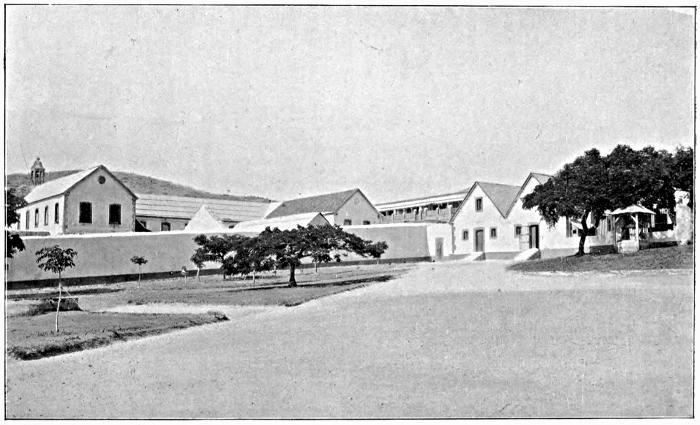
The Central Prison, Ile Nou. In front is the Execution Ground. The Quadrangle is enclosed by a high whitewashed stone wall.
To the left is the Chapel in which the condemned may, if they choose, attend Mass for the last time.
I left the central prison breathing the soft,
sweet air, and looking up at the deep blue
sky with a sudden sensation of thankfulness which
I had never experienced before. In a sense I was
like a man who had been blind and had had his
sight given back to him; and I thought of the
wretches I had left behind me in that high-walled
enclosure and those little black holes built away
into the thick walls which, for so many of them,
were to be tombs of mental death.
We came down the hill to the Pretoire, the
Bureau of Anthropometry. This is the ante-chamber
through which every prisoner must pass
who enters the Prisonland of the South. On the
way the Commandant and I discussed a topic
which I found a favourite one with all the
officials whom I met in Caledonia—the differences
between the French system and our own.
They were quite as much surprised at the rigours
of our system as I at first was at the leniency of
theirs—always saving that horrible Cachot Noir.
We went then, as I did many times afterwards,
with other officials, into matters of diet, hours,
and kinds of labour, detentions, and punishments,
and I succeeded in showing him that the Caledonian
convict was to be envied in every particular by
the English convict, until he came to the threshold
of the dark cell. With us, three days’ dark cell
and bread and water is the maximum punishment.
There it is five years, and sentences may run
consecutively. When the discussion was over the
commandant added an entirely French rider to it:
“But, monsieur, you must remember that this
is not only imprisonment—it is exile. How many
of these poor wretches will ever see France again?
Whereas your criminals, when their sentence is
done, are set free in their native land.”
To which I replied:
“Quite so, and more’s the pity! Every avenue
of honest life is closed to them, and they are
released only to commit more crimes and deserve
another sentence. There your system is better.
You exile them really, but you give them another
home where they have hope. We only exile them
socially, and give them no hope.”
And this brought us to the door of the Pretoire.
It consisted of three apartments, the middle one
was the examination room. To the right hand
was a larger chamber, sometimes used as a judgment
room. To the left was a smaller one, the
walls of which were covered with cabinets containing
the records in duplicate of every criminal that had
landed on Ile Nou. Beyond this there was a
dark-room.
When I had had a general look round and a
chat with the Officer who operated the Bertillon
system, the Commandant asked me if I would care
to go through the mill. To which, not having
been found out so far, I consented.
Thereupon I was delivered over into the hands
of a functionary who had a pair of eyes like visual
gimlets. They bored clean through me every
time he looked at me. I was no longer the
favoured guest of the all-powerful Administration;
I was simply a subject, a thing to be measured, and
weighed, and examined in the most minute detail,
and to have my most trivial characteristics noted
and put down under their proper categories.
He told me to take off my boots and coat. By
rights my socks should have come off also, but
that, although I offered to do it, was dispensed
with. He put me up against a wall, fixed my
head with one hand and pushed my stomach in
with the other, saw that my knees were properly
back against the wall, and lowered the bar on to
my head. Then he moved my head a little to
right and left, and said to the clerk:
“One metre, 816.”
When this was noted down he sat me in a chair.
The seat was longitudinally divided by a ridge;
the back was a measuring scale. Again he took
means to satisfy himself that I was sitting perfectly
straight, and so my sitting height was taken.
Then he got a pair of callipers, and measured
my head in two directions, from back to front
and across, all the time calling out the fatal figures
which, in case of need, would have identified me
among ten million men.
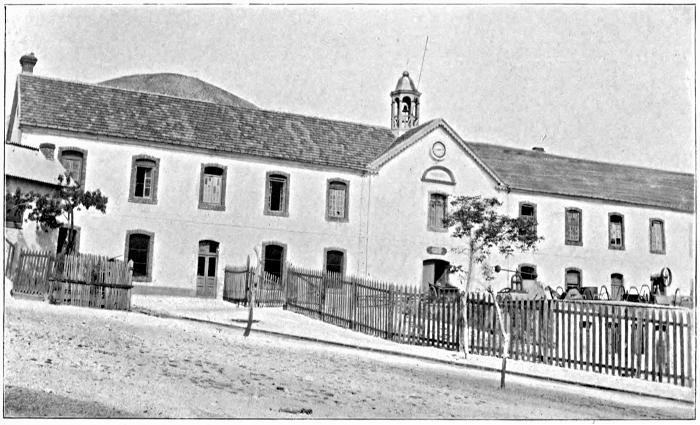
The Bureau of Anthropometry, Ile Nou.
After this he descended to minor matters, ears,
nose, lips, thumb- and finger-joints, eyelids, and so
on. Then he stood me on a box on which was
rudely outlined a human foot. I put my right
foot on this, bent forward, and rested my right
hand on a table, using my left leg and foot to
keep my balance. When I was steady my foot
was measured.
Then I rested my right arm on a table, standing
on one leg the while. It was measured from the
elbow to the point of the middle finger. After
this the prints of my thumb and three fingers
were taken, and duly impressed on the fiche, or
identification card.
Then came the most trying part of the ordeal,
the general observation. I stood to attention in
the middle of the floor. The gimlet-eyed official
walked round me, and looked through and through
me, what time the clerk at the table asked questions
from the schedule he was filling up.
No detail was so minute as to escape those
all-searching eyes. A scar which I had got twenty
years before in a football match, though half hidden
under an eyebrow, was detected, measured, and
noted. The scars of a couple of old knife-stabs
in my left hand, and the trace of a parrot-bite on
one of my fingers—nothing escaped. The colour
of my hair and moustache fell into a certain
category. My eyes were examined, and the colours
of the iris duly placed in their proper category.
By this time I began to feel as though I were
being taken to pieces and examined bit by bit.
It was a sort of mental and physical vivisection
without the knife and the chloroform. Finally,
the gentleman at the desk asked the question,
“Intellectuality?”
“Mediocre,” replied Mr. Gimlet-eyes, with
brutal frankness. Then I laughed, and the Commandant
suggested that I should be photographed.
“Pas artistique, mais exact,” he said, as we went
into the other room.
“And, therefore,” I said, “it will resemble the
remarks of your anthropometric expert. I never
had such an exact account of myself before.
Anthropometry strikes me as being a pretty good
medicine for human vanity.”
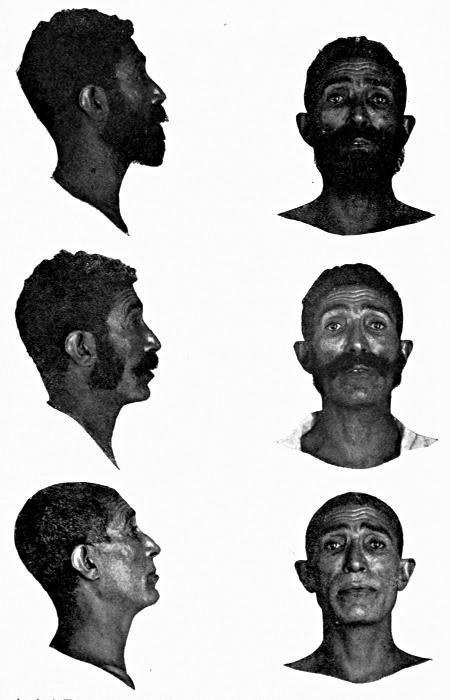
An Arab Type of Convict. A combination of Ideality and Homicidal Mania.
Out of the depth and width of his experience
the Commandant agreed with me, and then I was
photographed. There was no artistic posing or
anything of that sort. I was planted on a chair
with my back straightened up and my head in a
vice such as other photographers were once wont
to torture their victims with. The camera was
brought within three feet of me. I was taken full
face, staring straight into the lens, and then I was
taken en profile. When, many weeks afterwards,
I showed the result to my wife, she was sorry I
ever went; but for all that it’s a good likeness.
By the time the negatives were developed, and
I had satisfied the Commandant that certain black
spots which the pitiless lens had detected under
my skin were the result of a disease I had contracted
years before in South America, and not
premonitory symptoms of the plague, it was
breakfast-time, and I went down to the canteen,
where I found convicts buying wine and cigarettes,
and generally conducting themselves like gentlemen
at large.
I did not see the Commandant again that day,
save for a few minutes after lunch, when he told
me that he had an appointment at the Direction
in Noumea, and placed me in charge of his
lieutenant, the Chief Surveillant. The Chef was
a very jolly fellow, as, indeed, I found most of
these officials to be, and during our drives about
the island, we chatted with the utmost freedom.
As a matter of fact, it was he who gave me the
description of the execution which I reproduced
in the last chapter.
He, too, was entirely of the same opinion as
myself as to the pitiless iniquity of the dark cell;
but he took some pains to point out that it was
not the fault either of the French Government or
of the Administration, but simply of certain
politicians in France who wanted a “cry,” and
got up a crusade among the sentimentalists against
“the brutality of flogging bound and helpless
prisoners far away from all civilised criticism
in New Caledonia.” Some of these men, too, as
I have said, were déportés, or exiled communards
who had been forgiven, and had brought back
batches of stories with them as blood-curdling as
they were mendacious.
“Bien, monsieur,” he said. “You have seen
the Cachot Noir. Now we will go to the
Disciplinary Camp first, because it is on the road,
and then—well, you shall see what the cachot
does, and when you see that I think you will
say the lash is kinder.”
The Disciplinary Camps in New Caledonia have
no counterpart in the English penal system.
“Incorrigibles,” who won’t work, who are insubordinate,
or have a bad influence on their
comrades of the Bagne, are sent into them partly
for punishment and partly for seclusion.
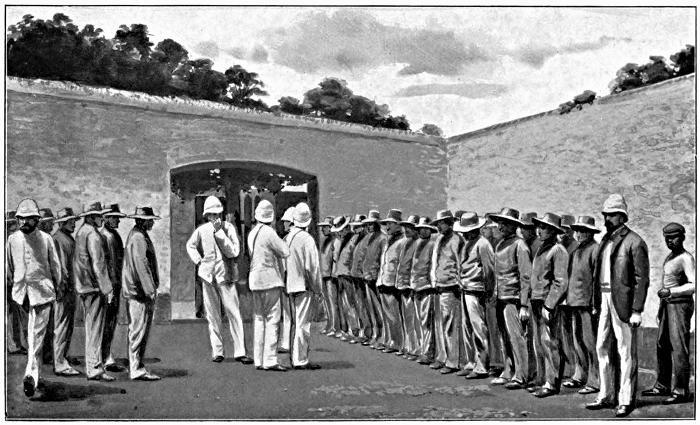
The Courtyard of a Disciplinary Camp, Ile Nou. Inspection at 5 a.m. after breakfast, and before hard labour. To the right
is a Kanaka “Policeman.” The average physique of the Criminals may be seen by comparison with myself, standing in front of
the Kanaka.
They have poorer food and harder work, no
“gratifications” in the way of wine or tobacco,
or other little luxuries. They sleep on plank-beds
with their feet in anklets, and, if they don’t behave
themselves, they are promptly clapped into a cell
for so many days’ solitary confinement on bread and
water. For graver offences they are, of course, sent
back to the central prison as hopeless cases, after
which their own case is usually hopeless for life.
I found several of the men in this camp working
in chains. This was another subject about which
the sentimentalists made a good deal of fuss in
France, but when I saw what the alleged chains
really were, I laughed, and said to my friend
the Chef:
“So that is what you call chains in New
Caledonia, is it? May I have a look at one?”
He beckoned to one of the men to come up,
and this is what I found: There was an iron
band riveted round his right ankle, and to this
was attached a chain which, as nearly as I could
calculate with my hands, weighed about six pounds.
It was as absolutely no inconvenience to its wearer,
when he was either sitting or lying down.
When he was walking or working he tucked the
end in under his belt, and, as far as I could see,
it didn’t make any difference to his walk, save a
little dragging of the foot. In fact, when I asked
him whether it was any trouble to him, he said:
“No, not after a few days. One gets accustomed
to it.”
“Very likely!” I said. “If you got the chains
in an English prison, you would have them on
both legs and arms, and you wouldn’t be able to
take more than a half-stride.”
“Ah, they are brutal, those English!” said
the scoundrel, with a shrug of his shoulders, as
he tucked the end of his chain round his belt
and sauntered away.
The chain is usually a punishment for gross
insubordination or attempted escape. This man,
the Chef told me, had tried three times with the
chain on, and once had used the loose end to
hammer a warder with, for which he got twelve
months’ Cachot Noir and the chain for life—and
a little more, since he would be buried
in it.[2]
Then, after I had made the round of the cells,
I was taken to a very curious punishment-chamber
which is in great vogue in New Caledonia. In
one sense it reminded me of our treadwheel, though
it is not by any means so severe. I have seen
a strong man reduced almost to fainting by fifteen
minutes on a treadwheel. Nothing like this
could happen in the Salle des Pas Perdus, as I
christened the place when its use had been explained
to me.
Here, after a brief and scanty meal at 4.30 a.m.,
the convicts are lined up in a big room, or, rather,
shed, about sixty feet long by forty feet broad.
There is absolutely no furniture in the place,
with the exception of a dozen flat-topped pyramids
of stone placed in straight lines about ten feet
from each side.
If there are twenty-four convicts condemned
to this particular kind of weariness, twenty-four
are taken in, in single file. Then the word
“March!” is given, and they begin. Hour after
hour the dreary round-and-round is continued in
absolute silence. Every half-hour they are allowed
to sit on the pyramids for a couple of minutes,
and then on again. At eleven the bell rings for
soupe, which, in the Camp Disciplinaire, resolves
itself into hot water and fat with a piece of bread.
In the other camps the bell doesn’t go again till
one, but these have only their half-hour, and then
the promenade begins again, and continues till
sunset.
I was assured that those who could stand a
week of this with the chain did feel its weight,
and I don’t wonder at it, for a more miserable,
weary, limping, draggle-footed crowd of scoundrels
I never saw in all my life than I watched that day
perambulating round the Hall of Lost Footsteps.
From here we drove across to the western side
of the island, and presently came to a magnificent
sloping avenue of palm-trees.
“The avenue of the hospital,” said the Chef.
“Now you will see the best and the worst of Ile
Nou.”
And so it was. We drove down the avenue
to a white, heavy stone arch, which reminded me
somewhat quaintly of the entrance gates of some
of the old Spanish haciendas I had seen up-country
in Peru. Inside was a vast, shady garden, brilliant
with flowers whose heavy scent was pleasantly
tempered by the sweet, cool breeze from the Pacific;
for the eastern wall of the whole enclosure was
washed by the emerald waters of the Lagoon.
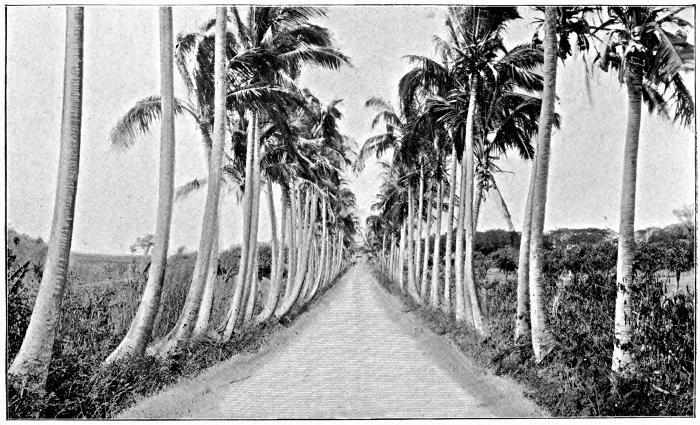
The Avenue of Palms, leading to the Hospital, Ile Nou.
In the midst of this garden stood the hospital,
built in quadrangular form, but with one side of
each “quad” open to the garden. The houses
were raised on stone platforms something like the
stoep of a Dutch house, and over these the roofs
came down in broad verandahs. Grey-clad figures
were sitting or lying about on the flags underneath,
a few reading or doing some trifling work, and
others were wandering about the garden or sleeping
in some shady nook. It was, in short, very different
from the central prison and the disciplinary camp.
I was introduced to the Medical Director, and
he showed me round, omitting one wing, in which
he told me there were a couple of cases of plague.
I happened to know that there were really about
a dozen, so I readily agreed that that part should
be left out.
As prison hospital, it differed very little from
others that I had seen in England. There was
the same neatness and exquisite cleanliness everywhere,
though the wards were somewhat darker,
and therefore cooler, which, with the midday sun
at 106° in the shade, was not a bad thing. All
the nurses were, of course, Sisters of Mercy.[3]
In fact, practically all the nursing in New
Caledonia is done by Sisters, and not a few of
these heroic women had become brides of the
Black Death before I left.
Here, as in all other prison hospitals I have
visited, diet, stimulants, and medicine are absolutely
at the discretion of the Director. No matter
what the cost, the spark of life must be kept alive
as long as possible in the breast of the murderer,
the forger, and the thief, or the criminal whose
light of reason has already been quenched in the
darkness of the Black Cell.
In fact, so careful are the authorities of their
patients’ general health that they give them nothing
in the way of meat but the best beef and mutton
that can be imported from Australia; Caledonian
fed meat is not considered nourishing enough. In
normal times the death-rate of Ile Nou, which is
wholly given over to convict camps, is two or three
per cent. lower than that of the town of Noumea.
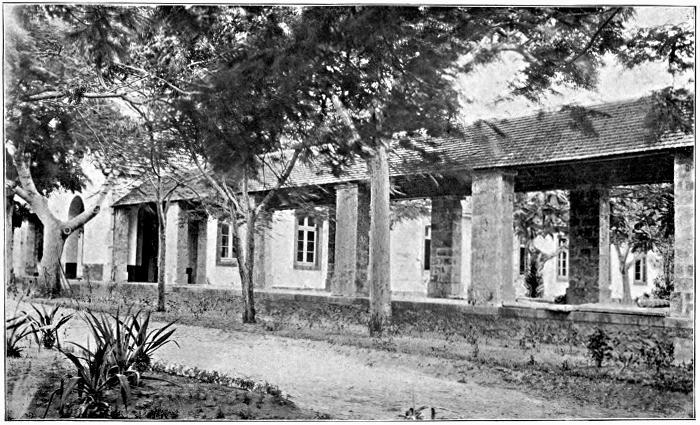
Part of the Hospital Buildings, Ile Nou. The roofed-terrace in front is where the patients take their siesta in the middle of the day.
One of these is attached to each court of the Hospital. Some of the mattresses may be seen to the right.
Then from this little flowery paradise of rest and
quietness we went across the road to another
enclosure in which there were two long, white
buildings, a prison and a row of offices, at right
angles to each other. This was the “bad” side.
On the other there had been invalids and invalid
lunatics; here there were only lunatics, and mostly
dangerous at that—men who, after being criminals,
had become madmen; not like the dwellers in
Broadmoor, who are only criminal because they
are mad.
I once paid a visit to the worst part of the men’s
side at Broadmoor, but I don’t think it was quite
as bad as the long corridor which led through that
gruesome home of madness. On either hand were
heavy black-painted, iron doors, and inside these
a hinged grating through which the prisoner could
be fed.
The cells were about nine feet by six feet.
They had neither furniture nor bedclothes in them.
The furniture would have been smashed up either
in sheer wanton destruction or for use as missiles
to hurl through the grating, and the bedclothes
would have been torn up into strips for hanging
or strangling purposes.
It has been my good or bad luck to see poor
humanity in a good many shapes and guises, but
I never saw such a series of pitiful parodies of
manhood as I saw when those cell doors were
opened.
Some were crouched down in the corners of
their cells, muttering to themselves and picking
the sacking in which they were clothed to pieces,
thread by thread. It was no use giving them
regular prison clothing, for they would pick themselves
naked in a couple of days. Others were
walking up and down the narrow limits of their
cells, staring with horribly vacant eyes at the
roof or the floor, and not taking the slightest
notice of us.
One man was lying down scraping with bleeding
fingers at the black asphalted floor under the
impression that he was burrowing his way to
freedom; others were sitting or lying on the floor
motionless as death; and others sprang at the bars
like wild beasts the moment the door was opened.
But the most horrible sight I saw during that
very bad quarter of an hour was a gaunt-faced,
square-built man of middle-height who got up out
of a corner as his cell door opened, and stood in
the middle facing us.
He never moved a muscle, or winked an eyelid.
His eyes looked at us with the steady, burning
stare of hate and ferocity. His lips were drawn
back from his teeth like the lips of an ape in a
rage, and his hands were half clenched like claws.
The man was simply the incarnation of madness,
savagery, and despair. He had gone mad in the
Black Cell, and the form that his madness had
taken was the belief that nothing would nourish
him but human flesh. Of course he had to be
fed by force.
When we got outside a big warder pulled up
his jumper and showed me the marks of two
rows of human teeth in his side. If another man
hadn’t stunned the poor wretch with the butt of
his revolver he would have bitten the piece clean
out—after which I was glad when the Doctor
suggested that I should go to his quarters and
have a drink with him.
I visited two or three other industrial camps
and the farm-settlements before I left Ile
Nou, but as I had yet to go through the agricultural
portions of the colony it would be no use
taking up space in describing them here.
There are practically no roads to speak of in
New Caledonia outside a short strip of the south-western
coast. In September, 1863, Napoleon
the Little signed the decree which converted the
virgin paradise of New Caledonia into a hell of
vice and misery—a description which is perhaps
somewhat strong, but which history has amply
justified. In the following year the transport
Iphigénie took a cargo of two hundred and forty-eight
galley-slaves from Toulon and landed them
where the town of Noumea now stands. This
consignment was added to by rapidly following
transports, and for thirty years at least the
administration of New Caledonia has had at its
disposal an average of from seven to ten thousand
able-bodied criminals for purposes of general improvement,
and more especially for the preparation
of the colony for that free colonisation which
has been the dream of so many ministers and
governors.
Now the area of New Caledonia is, roughly
speaking, between six thousand and seven thousand
square miles, and after an occupation of nearly
forty years it has barely fifty miles of roads over
which a two-wheeled vehicle can be driven, and
these are only on the south-western side of the
island.
The only one of any consequence is that running
from Noumea to Bouloupari, a distance of about
thirty miles. At Bourail, which is the great
agricultural settlement, there are about twelve miles
of road and a long ago abandoned railway bed.
Between La Foa and Moindou there is another
road about as long; but both are isolated by miles
of mountain and bush from each other and are
therefore of very little general use.
One has only to contrast them with the
magnificent coach roads made in a much shorter
space of time through the far more difficult Blue
Mountain district in New South Wales to see
the tremendous difference between the British and
the French ideas of colonisation, to say nothing of
the railways—two thousand seven hundred miles—and
thirty-three thousand miles of telegraph lines.
The result of this scarcity of roads and absolute
absence of railways is that when you want to go
from anywhere to anywhere else in New Caledonia
you have to take the Service des Côtes, which for
dirt, discomfort, slowness, and total disregard of
the convenience of passengers I can only compare
to the Amalgamated Crawlers presently known as
the South-Eastern and Chatham Railways. Like
them, it is, of course, a monopoly, wherefore if
you don’t like to go by the boats you can either
swim or walk.
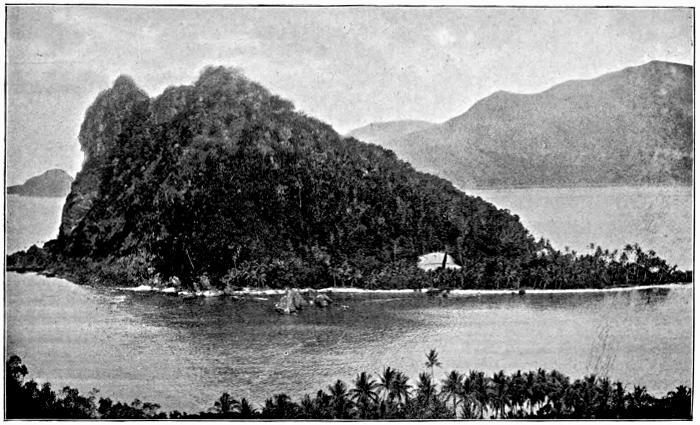
The Island of “Le Sphinx,” one of the tying-up places on the south-west coast of New Caledonia.
The whole of New Caledonia is surrounded by
a double line of exceedingly dangerous reefs, cut
here and there by “passes,” one of which Captain
Cook failed to find, and so lost us one of the richest
islands in the world. The navigable water both
inside and outside the reefs is plentifully dotted with
tiny coral islands and sunken reefs a yard or so
below the surface and always growing, hence
navigation is only possible between sunrise and
sunset. There is only one lighthouse in all
Caledonia.
Thus, when I began to make my arrangements
for going to Bourail, I found that I should have
to be on the wharf at the unholy hour of 4.30 a.m.
I packed my scanty belongings overnight. At 4.15
the cab was at the door. The cochers of Noumea
either work in relays or never go to sleep. I was
just getting awake, and the gorged mosquitoes were
still sleeping. I dressed and drank my coffee to
the accompaniment of considerable language which
greatly amused the copper-skinned damsel who
brought the coffee up. She also never seemed to
sleep.
Somehow I got down to the wharf, and presented
myself at the douannerie with my “Certificat de
Santé,” which I had got from the hospital the
previous evening. The doctor in charge gave me
a look over, and countersigned it. Then I went
with my luggage into an outer chamber. My bag
and camera-cases were squirted with phenic acid
from a machine which looked like a cross between
a garden hose and a bicycle foot-pump. Then I
had to unbutton my jacket, and go through the
same process. The rest of the passengers did the
same, and then we started in a strongly smelling
line for the steamer.
As we went on board we gave up our bills of
health, after which we were not permitted to land
again under penalty of forfeiting the passage and
being disinfected again. Our luggage now bore
yellow labels bearing the legend, “colis désinfecté,”
signed by the medical inspector. These were
passed on to the ships by Kanakas, who freely
went and came, and passed things to and from the
ship without hindrance. As Kanakas are generally
supposed to be much better carriers of the plague
than white people, our own examination and
squirting seemed a trifle superfluous.
The steamer was the St. Antoine, which may
be described as the Campania of the Service des
Côtes. Until I made passages on one of her sister-ships—to
be hereafter anathematised—I didn’t know
how bad a French colonial passenger-boat could be.
Afterwards I looked back to her with profound
regret and a certain amount of respect; wherefore
I will not say all that I thought of her during the
eleven hours that she took to struggle over the
sixty-odd miles from Noumea to Bourail.
There is no landing-place at the port of Bourail,
save for boats, so, after the usual medical inspection
was over and I had made myself known to the
doctor, I went ashore in his boat. The Commandant
was waiting on the shore with his carriage.
I presented my credentials, and then came the usual
consommations, which, being literally interpreted,
is French for mixed drinks, after which we drove
off to the town of Bourail, eight kilometres away.
As we were driving down the tree-arched road
I noticed half a dozen horsewomen seated astride
à la Mexicaine, with gaily coloured skirts flowing
behind.
“Ah,” I said, “do your ladies here ride South
American fashion?”
“My dear sir,” he replied, “those are not ladies.
They are daughters of convicts, born here in Bourail,
and reared under the care of our paternal government!
But that is all stopped now, later on you
will see why.”
“Yes,” I said, “I have heard that you have
given up trying to make good colonists out of
convict stock.”
“Yes,” he replied; “and none too soon, as you
will see.”
From which remark I saw that I had to do with
a sensible man, so I straightway began to win his
good graces by telling him stories of distant lands,
for he was more of a Fleming than a Frenchman,
and was therefore able to rise to the conception
that there are other countries in the world besides
France.
I found Bourail a pretty little township, consisting
of one street and a square, in the midst of which
stood the church, and by dinner-time I found myself
installed in a little hotel which was far cleaner
and more comfortable than anything I had seen in
Noumea, except the club. When I said good-night
to the Commandant, he replied:
“Good-night, and sleep well. You needn’t
trouble to lock your door. We are all criminals
here, but there is no crime.”
Which I subsequently found to be perfectly true.
Everything in New Caledonia begins between
five and half-past, unless you happen to be starting
by a steamer, and then it’s earlier. My visit to
Bourail happened to coincide with a governmental
inspection, and early coffee was ordered for five
o’clock. That meant that one had to get tubbed,
shaved, and dressed, and find one’s boots a little
before five. Bar the Black Death, I disliked New
Caledonia mostly on account of its early hours.
No civilised persons, with the exception of milkmen
and criminals under sentence of death, ought to
be obliged to get up before nine.
Still, there was only one bath in the place, and
I wanted to be first at it, so I left my blind up,
and the sun awoke me.
I got out of bed and went on to the balcony,
and well was I rewarded even for getting up at
such an unrighteous hour. The night before it
had been cloudy and misty, but now I discovered
with my first glance from the verandah that I had
wandered into something very like a paradise.
I saw that Bourail stood on the slope of a range
of hills, and looked out over a fertile valley which
was dominated by a much higher range to the
north-east. The sun wasn’t quite up, and neither
were the officers of the Commission, so I went for
my bath. There were no mosquitos in Bourail
just then, and I had enjoyed for once the luxury
of an undisturbed sleep. The water, coming from
the hills, was delightfully cool, and I came back
feeling, as they say between New York and San
Francisco, real good.
The Commission, for some reason or other, did
not get up before breakfast-time (11.30), and so
we got a good start of them. The Commandant
had the carriage round by six o’clock, and, after
the usual consommations, we got away. It was
a lovely morning, the only one of the sort I saw
in Bourail, for the next day the clouds gathered
and the heavens opened, and down came the floods
and made everything but wading and swimming
impossible; but this was a day of sheer delight
and great interest.
We drove over the scene of a great experiment
which, I fear, is destined to fail badly. The
province of Bourail is the most fertile in all
Caledonia, wherefore in the year 1869 it was
chosen by the paternal French Government as the
Arcadia of the Redeemed Criminal. The Arcadia
is undoubtedly there, the existence of the redeemed
criminal struck me as a little doubtful.
As soon as we got under way I reverted to
the young ladies we had seen on horseback the
evening before.
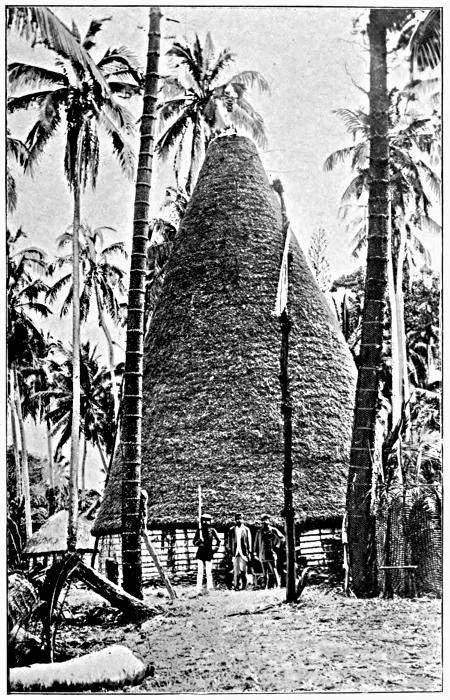
A Native Temple, New Caledonia.
“You shall see the houses of their parents,” said
the Commandant; “and afterwards you will see the
school where the younger ones are being educated.
For example,” he went on, pointing down the
street we were just crossing, “all those shops and
little stores are kept by people who have been
convicts, and most of them are doing a thriving
trade. Yonder,” he said, waving his hand to the
right, “is the convicts’ general store, the Syndicat
de Bourail. It was founded by a convict, the staff
are convicts, and the customers must be convicts.
It is what you would call in English a Convict
Co-operative Store. It is managed by scoundrels
of all kinds, assassins, thieves, forgers, and others.
I have to examine the books every three months,
and there is never a centime wrong. That is more
than most of the great establishments in Sydney
could say, is it not?”
I made a non-committal reply, and said:
“Set a thief to catch a thief, or watch him.”
“Exactly! There is no other business concern
in Caledonia which is managed with such absolute
honesty as this is. I should be sorry for the man
who tried to cheat the management.”
I knew enough of Caledonian society by this
time to see that it would not be good manners to
press the question any further. Afterwards I had
an interview with the manager of the syndicate,
an estimable and excellently conducted forger, who
had gained his rémission and was doing exceedingly
well for himself and his wife, who, I believe, had
blinded somebody with vitriol, and was suspected
of dropping her child into the Seine.
He presented me with a prospectus of the
company, which showed that it had started with a
government loan of a few hundred francs, and now
had a reserve fund of nearly forty thousand francs.
He was a patient, quiet-spoken, hard-working man
who never let a centime go wrong, and increased
his personal profits by selling liquors at the back
door.
Our route lay across the broad valley which is
watered by the River Nera. On either side the
ground rose gently into little hillocks better
described by the French word collines and on each
of these, usually surrounded by a grove of young
palms and a dozen acres or so of vineyards, orchards,
manioc, plantain, or maize, stood a low, broad-verandahed
house, the residence of the redeemed
criminal.
I could well have imagined myself driving
through a thriving little colony of freemen in some
pleasant tropical island upon which the curse of
crime had never descended, and I said so to the
Commandant.
“Yes,” he said, “it looks so, doesn’t it? Now,
you see that house up there to the left, with the
pretty garden in front. The man who owns that
concession was a hopeless scoundrel in France. He
finished up by murdering his wife after he had
lived for years on the wages of her shame. Of
course, the jury found extenuating circumstances.
He was transported for life, behaved himself
excellently, and in about seven years became a
concessionnaire.
“He married a woman who had poisoned her
husband. They have lived quite happily together,
and bring up their children most respectably.”
I was too busy thinking to reply, and he went
on, pointing to the right:
“Then, again, up there to the right—that pretty
house on the hill surrounded by palms. The man
who owns that was once a cashier at the Bank of
France. He was a ‘faussaire de première classe,’
and he swindled the bank out of three millions of
francs before they found him out. He was sent
here for twenty years. After eight he was given a
concession and his wife and family voluntarily came
out to him. You see, nothing was possible for
the wife and children of a convict forger in Paris.
Here they live happily on their little estate. No
one can throw stones at them, and when they die
the estate will belong to their children.”
“That certainly seems an improvement on our
own system,” I said, remembering the piteous
stories I had heard of the wives and families of
English convicts, ruined through no fault of their
own, and with nothing to hope for save the
return of a felon husband and father into a
world where it was almost impossible for him to
live honestly.
“Yes,” he said; “I think so. Now, as we
turn the corner you will see the house of one of
our most successful colonists. There,” he said,
as the wagonette swung round into a delightful
little valley, “that house on the hillside, with the
white fence round it, and the other buildings to
the side. The owner of that place was a thief,
a forger, and an assassin in Paris. He stole some
bonds, and forged the coupons. He gave some
of the money to his mistress, and found her giving
it to some one else, so he stabbed her, and was
sent here for life.
“He got his concession, and married a woman
who had been sent out for infanticide, as most
of them are here. If not that, it is generally
poison. Well, now he is a respectable colonist
and a prosperous farmer. He has about forty
acres of ground well cultivated, as you see. He
has thirty head of cattle and a dozen horses, mares,
and foals, to say nothing of his cocks and hens
and pigs. He supplies nearly the whole of the
district with milk, butter, and eggs, and makes
a profit of several thousand francs a year. I wish
they were all like that!” he concluded, with a
little sigh which meant a good deal.
“I wish we could do something like that with
our hard cases,” I replied, “instead of turning
them out into the streets to commit more crimes
and beget more criminals. We know that crime
is a contagious as well as an hereditary disease,
and we not only allow it to spread, but we even
encourage it as if we liked it.”
“It is a pity,” he said sympathetically, “for you
have plenty of islands where you might have
colonies like this. You do not need to punish
them. Remove them, as you would remove a
cancer or a tumour, and see that they do not
come back. That is all. Society would be better,
and so would they.”
I could not but agree with this since every
turn of the road brought us to fresh proofs of
the present success of the system, and then I
asked again:
“But how do these people get their first start?
One can’t begin farming like this without capital.”
“Oh no,” he said, “the Government does
that. For the first few years, according to the
industry and ability of the settler, these people
cost us about forty pounds a year each, about what
you told me it costs you to keep a criminal in
prison. We give them materials for building
their houses, tools, and agricultural implements,
six months’ provisions, and seed for their first
harvest. After that they are left to themselves.
“If they cannot make their farm pay within
five years or so they lose everything; the children
are sent to the convent, and the husband and
wife must hire themselves out as servants either
to other settlers or to free people. If they do
succeed the land becomes absolutely theirs in ten
years. If they have children they can leave it
to them, or, if they prefer, they can sell it.
“Some, for instance, have got their rehabilitation,
their pardon, and restoration of civil rights.
They have sold their farms and stock and gone
back to France to live comfortably. Their children
are, of course, free, though the parents may not
leave the colony without rehabilitation. After
breakfast I will take you down the street of Bourail,
and introduce you to some who have done well
in trade, and to-morrow or next day you can see
what we do with the children.”
Society in Bourail, although in one sense
fairly homogeneous, is from another point
of view distinctly mixed. Here, for example, are
a few personal items which I picked up during
our stroll down the main and one street of the
village.
First we turned into a little saddler’s shop, the
owner of which once boasted the privilege of
making the harness for Victor Emmanuel’s horses.
Unfortunately his exuberant abilities were not content
even with such distinction as this, and so
he deviated into coining, with the result of hard
labour for life. After a few years his good conduct
gained him a remission of his sentence, and in
due course he became a concessionnaire. His wife,
who joined him after his release, is one of the
aristocrats of this stratum of Bourailian society.
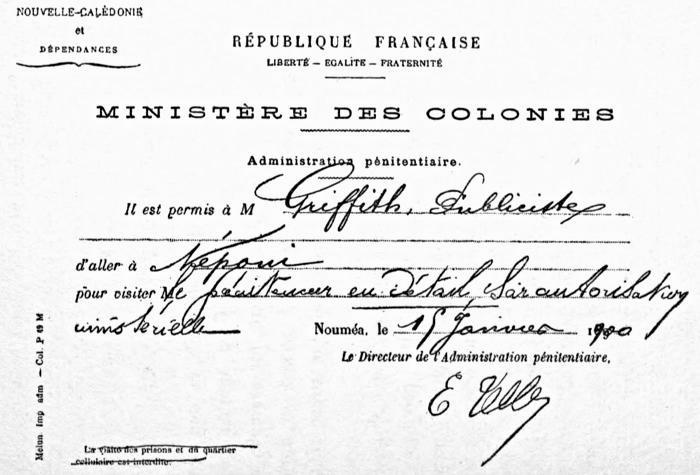
Permit to visit a Prison or Penitentiary Camp en détail. This is the ordinary form; but the Author is the only
Englishman for whom the words in the left-hand corner were crossed out.
There is quite a little romance connected with
this estimable family. When Madame came out
she brought her two daughters with her. Now
the elder of these had been engaged to a young
man employed at the Ministry of Colonies, and
he entered the colonial service by accepting a
clerkship at Noumea. The result was naturally a
meeting, and the fulfilment of the proverb which says
that an old coal is easily rekindled. The engagement
broken off by the conviction was renewed, and
the wedding followed in due course. The second
daughter married a prosperous concessionnaire, and
the ex-coiner, well established, and making plenty
of properly minted money, has the satisfaction of
seeing the second generation of his blood growing
up in peace and plenty about him. Imagine such
a story as this being true of an English coiner!
A little further on, on the left hand side, is
a little lending library, and cabinet de lecture.
This is kept by a very grave and dignified-looking
man, clean-shaven, and keen-featured, and with
the manners of a French Chesterfield. “That
man’s a lawyer,” I said to the Commandant, as
we left the library. “What is he doing here?”
“You are right. At least, he was a lawyer once,
doing well, and married to a very nice woman;
but he chose to make himself a widower, and that’s
why he’s here. The old story, you know.”
Next door was a barber’s shop kept by a most
gentle-handed housebreaker. He calls himself a
“capillary artist,” shaves the officials and gendarmerie,
cuts the hair of the concessionnaires,
and sells perfumes and soaps to their wives and
daughters. He also is doing well.
A few doors away from him a liberé has an
establishment which in a way represents the art
and literature of Bourail. He began with ten
years for forgery and embezzlement. Now he
takes photographs and edits, and, I believe, also
writes the Bourail Indépendent. As a newspaper
for ex-convicts and their keepers, the title struck
me as somewhat humorous.
Nearly all branches of trade were represented in
that little street. But these may be taken as fairly
representative samples of the life-history of those who
run them. First, crime at home; then transportation
and punishment; and then the effort to redeem,
made in perfect good faith by the Government,
and, so far as these particular camps and settlements
are concerned, with distinct success in the present.
Unhappily, however, the Government is finding
out already that free and bond colonists will not
mix. They will not even live side by side, wherefore
either the whole system of concessions must
be given up, or the idea of colonising one of the
richest islands in the world with French peasants,
artisans, and tradesmen must be abandoned.
Later on in the afternoon we visited the Convent,
which is now simply a girls’-school under the charge
of the Sisters of St. Joseph de Cluny. A few years
ago this convent was perhaps the most extraordinary
matrimonial agency that ever existed on the face
of the earth. In those days it was officially styled,
“House of Correction for Females.” The sisters
had charge of between seventy and eighty female
convicts, to some of whom I shall be able to
introduce you later on in the Isle of Pines, and
from among these the bachelor or widower convict,
who had obtained his provisional release and a
concession, was entitled to choose a bride to be his
helpmeet on his new start in life. The method
of courtship was not exactly what we are accustomed
to consider as the fruition of love’s young or even
middle-aged dream.
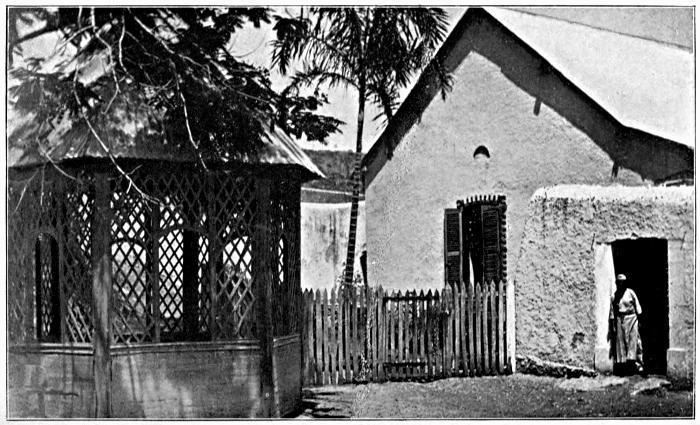
The Kiosk in which the Convict Courtships were conducted at Bourail.
After Mass on a particular Sunday the prospective
bridegroom was introduced to a selection
of marriageable ladies, young and otherwise. Of
beauty there was not much, nor did it count for
much. What the convict-cultivator wanted, as a
rule, was someone who could help him to till his
fields, look after live-stock, and get in his harvests.
When he had made his first selection the lady
was asked if she was agreeable to make his further
acquaintance. As a rule, she consented, because
marriage meant release from durance vile. After
that came the queerest courtship imaginable.
About fifty feet away from the postern door at
the side of the Convent there still stands a little
octagonal kiosk of open trellis-work, which is
completely overlooked by the window of the
Mother Superior’s room. Here each Sunday
afternoon the pair met to get acquainted with each
other and discuss prospects.
Meanwhile the Mother Superior sat at her
window, too far away to be able to hear the soft
nothings which might or might not pass between the
lovers, but near enough to see that both behaved
themselves. Along a path, which cuts the only
approach to the kiosk, a surveillant marched, revolver
on hip and eye on the kiosk ready to respond to
any warning signal from the Mother Superior.
As a rule three Sundays sufficed to bring matters
to a happy consummation. The high contracting
parties declared themselves satisfied with each other,
and the wedding day was fixed, not by themselves,
but by arrangement between those who
had charge of them.
Sometimes as many as a dozen couples would
be turned off together at the mairie, and then in
the little church at the top of the market-place
touching homilies would be delivered by the good
old curé on the obvious subject of repentance and
reform. A sort of general wedding feast was
arranged at the expense of the paternal Government,
and then the wedded assassins, forgers, coiners,
poisoners, and child-murderers went to the homes
in which their new life was to begin.
This is perhaps the most daring experiment
in criminology that has ever been made. The
Administration claimed success for it on the ground
that none of the children of such marriages have
ever been convicted of an offence against the
law. Nevertheless, the Government have most
wisely put a stop to this revolting parody on the
most sacred of human institutions, and now wife-murderers
may no longer marry poisoners or
infanticides with full liberty to reproduce their
species and have them educated by the State, to afterwards
take their place as free citizens of the colony.
The next day we drove out to the College of
the Marist Brothers. It is really a sort of agricultural
school, in which from seventy to eighty sons of
convict parents are taught the rudiments of learning
and religion and the elements of agriculture.
During a conversation with the Brother Superior
I stumbled upon a very curious and entirely
French contradiction. I had noticed that families
in New Caledonia were, as a rule, much larger
than in France, and I asked if these were all the
boys belonging to the concessionnaires of Bourail.
“Oh no!” he replied; “but, then, you see,
we have no power to compel their attendance
here. We can only persuade the parents to
let them come.”
“But,” I said, “I understood that primary
education was compulsory here as it is in France.”
“For the children of free people, yes,” he replied
regretfully, and with a very soft touch of sarcasm,
“but for these, no. The Administration has too
much regard for the sanctity of parental authority.”
When the boys were lined up before us in
the playground I saw about seventy-six separate
and distinct reasons for the abolition of convict
marriages. On every face and form were stamped
the unmistakable brands of criminality, imbecility,
moral crookedness, and general degeneration, not all
on each one, but there were none without some.
Later on I started them racing and wrestling,
scrambling and tree-climbing for pennies. They
behaved just like monkeys with a dash of tiger
in them, and I came away more convinced than
ever that crime is a hereditary disease which can
finally be cured only by the perpetual celibacy of the
criminal. Yet in Bourail it is held for a good thing
and an example of official wisdom that the children
of convicts and of freemen shall sit side by side in
the schools and play together in the playgrounds.
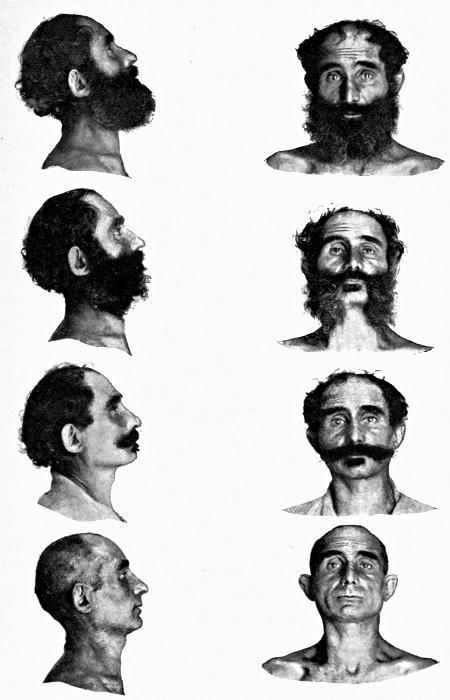
Berezowski, the Polish Anarchist who attempted to murder Napoleon III. and the Tsar
Alexander II. in the Champs Elysées. All Criminals in New Caledonia are photographed
in every possible hirsute disguise; and finally cropped and clean shaven.
By permission of C. Arthur Pearson, Ltd.
On our way home I was introduced to one of
the most picturesque and interesting characters
that I met in the colony. We pulled up at the
top of a hill. On the right hand stood a rude
cabin of mud and wattles thatched with palm-leaves,
and out of this came to greet us a strange, half-savage
figure, long-haired, long-bearded, hairy
almost as a monkey on arms and legs and breast,
but still with mild and intelligent features, and
rather soft brown eyes, in which I soon found the
shifting light of insanity.
Acting on a hint the Commandant had already
given me, I got out and shook hands with this
ragged, shaggy creature, who looked much more
like a man who had been marooned for years on
a far-away Pacific Island, than an inhabitant of
this trim, orderly Penal Settlement. I introduced
myself as a messenger from the Queen of England,
who had come out for the purpose of presenting
her compliments and inquiring after his health.
This was the Pole Berezowski, who more than
thirty years ago fired a couple of shots into the
carriage in which Napoleon III. and Alexander II.
were driving up the Champs Elysées. He is
perfectly harmless and well-behaved; quite contented,
too, living on his little patch and in a
world of dreams, believing that every foreigner
who comes to Bourail is a messenger from some
of the crowned heads of Europe, who has crossed
the world to inquire after his welfare. Through
me he sent a most courteous message to the Queen,
which I did not have the honour of delivering.
That night the storm-clouds came over the
mountains in good earnest, and I was forced to
abandon my intention of returning to Noumea by
road, since the said road would in a few hours be
for the most part a collection of torrents, practically
impassible, to say nothing of the possibility of a
cyclone. There was nothing more to be seen or
done, so I accepted the Commandant’s offer to
drive me back to the port.
On the way he told me an interesting fact
and an anecdote, both of which throw considerable
light upon the convict’s opinion of the settlement
of Bourail.
The fact was this: There are in New Caledonia
a class of convicts who would be hard to find
anywhere else. These are voluntary convicts, and
they are all women. A woman commits a crime
in France and suffers imprisonment for it. On
her release she finds herself, as in England, a social
outcast, with no means of gaining a decent living.
Instead of continuing a career of crime, as is
usually the case here, some of these women will
lay their case before the Correctional Tribunal, and
petition to be transported to New Caledonia, where
they will find themselves in a society which has
no right to point the finger of scorn at them.
As a rule the petition is granted, plus a free
passage, unless the woman has friends who can
pay. Generally the experiment turns out a success.
The woman gets into service or a business, or
perhaps marries a liberé or concessionnaire, and so
wins her way back not only to respectability as
it goes in Caledonia, but sometimes to comfort and
the possession of property which she can leave to
her children.
As a matter of fact, the proprietress of the little
hotel at the port was one of these women. She
had come out with a few hundred francs that her
friends had subscribed. She now owns the hotel,
which does an excellent business, a freehold estate of
thirty or forty acres, and she employs fifteen Kanakas,
half a dozen convicts, and a Chinaman—who is her
husband, and works harder than any of them.
The anecdote hinged somewhat closely on the
fact, and was itself a fact.
There is a weekly market at Bourail, to which
the convict farmers bring their produce and such
cows, horses, calves, etc., as they have to sell.
Every two or three years their industry is stimulated
and rewarded by the holding of an agricultural
exhibition, and, as a rule, the Governor goes over
to distribute the prizes. One of these exhibitions
had been held, I regret to say, a short time before
my arrival, and the Governor who has the work of
colonisation very seriously at heart, made speeches
both appropriate and affecting to the various
winners as they came to receive their prizes.
At length a hoary old scoundrel, who had
developed into a most successful stock-breeder, and
had become quite a man of means, came up to
receive his prizes from his Excellency’s hands.
M. Feuillet, as usual, made a very nice little
speech, congratulating him on the change in his
fortunes, which, by the help of a paternal government,
had transformed him from a common thief
and vagabond to an honest and prosperous owner
of property.
So well did his words go home that there were
tears in the eyes of the reformed reprobate when he
had finished, but there were many lips in the
audience trying hard not to smile when he replied:
“Ah, oui, mon Gouverneur! if I had only
known what good chances an unfortunate man has
here I would have been here ten years before.”
What his Excellency really thought on the subject
is not recorded.
The hotel was crowded that night for the steamer
was to sail for Noumea, as usual, at five o’clock in
the morning; but as Madame was busy she was
kind enough to give up her own chamber to me;
and so I slept comfortably to the accompaniment of
a perfect bombardment of water on the corrugated
iron roof. Others spread themselves on tables and
floors as best they could, and paid for accommodation
all the same.
By four o’clock one of those magical tropic
changes had occurred, and when I turned out the
moon was dropping over the hills to the westward,
and Aurora was hanging like a huge white diamond
in a cloudless eastern sky. The air was sweetly
fresh and cool. There were no mosquitos, and
altogether it was a good thing to be alive, for
the time being at least.
Soon after the little convict camp at the port
woke up. We had our early coffee, with a dash of
something to keep the cold out, and I made an
early breakfast on tinned beef and bread—convict
rations—and both very good for a hungry man.
Then came the news that the steamboat La France
had tied up at another port to the northward
on account of the storm, and would not put in
an appearance until night, which made a day and
another night to wait, as the coast navigation is
only possible in daylight.
I naturally said things about getting up at four
o’clock for nothing more than a day’s compulsory
loafing, but I got through the day somehow with the
aid of some fishing and yarning with the surveillants
and the convicts, one of whom, a very intelligent
Arab, told me, with quiet pride, the story of his
escape from New Caledonia twelve years before.
He had got to Australia in an open boat, with
a pair of oars, the branch of a tree for a mast and
a shirt for a sail. He made his way to Europe,
roamed the Mediterranean as a sailor for nine years,
and then, at Marseilles, he had made friends with
a man who turned out to be a mouchard. This
animal, after worming his secret out of him under
pledge of eternal friendship, earned promotion by
giving him away, and so here he was for life.
He seemed perfectly content, but when I asked
him what he would do with that friend if he had
him in the bush for a few minutes, I was answered
by a gleam of white teeth, a flash of black eyes,
and a shake of the head, which, taken together,
were a good deal more eloquent than words.
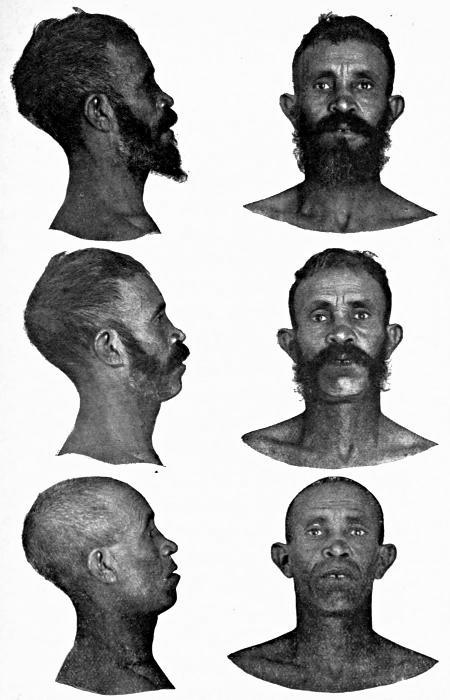
One of the Lowest Types of Criminal Faces. An illustration of the ease with which
it is possible to disguise the chin, typical of moral weakness, and the wild-beast
mouth, which nearly all Criminals have, by means of moustache and beard.
By permission of C. Arthur Pearson, Ltd.
La France turned up that afternoon, so did the
Commission of Inspection from Bourail with several
other passengers. I was told that we should be
crowded, but until I got on board in the dawn
of the next morning I never knew how crowded
a steamer could be.
I had travelled by many crafts under sail and
steam from a south sea island canoe to an Atlantic
greyhound, but never had the Fates shipped me
on board such a craft as La France. She was an
English-built cargo boat, about a hundred and thirty
feet long, with engines which had developed sixty
horse-power over twenty years ago. She had three
cabins on each side of the dog-kennel that was
called the saloon.
If she had been allowed to leave an English port at
all she would have been licensed to carry about eight
passengers aft and twenty on deck. On this passage
she had twelve first-class, about fifteen second, and
between fifty and sixty on deck, including twenty
convicts and relégués on the forecastle, and a dozen
hard cases in chains on the forehatch.
She also carried a menagerie of pigs, goats, sheep,
poultry, geese, and ducks, which wandered at their
own will over the deck-cargo which was piled up
to the tops of her bulwarks. Her quarter-deck
contained about twenty square feet, mostly encumbered
by luggage. The second-class passengers
had to dine here somehow. The first-class dined
in the saloon in relays.
The food was just what a Frenchman would eat
on a Caledonian coast-boat. It was cooked under
indescribable conditions which you couldn’t help
seeing; but for all that the miserable meals were
studiously divided into courses just as they might
have been in the best restaurant in Paris.
Everything was dirty and everything smelt. In
fact the whole ship stank so from stem to stern
that even the keenest nose could not have distinguished
between the smell of fried fish and toasted
cheese. The pervading odours were too strong.
Moreover, nearly every passenger was sick in the
most reckless and inconsiderate fashion; so when
it came to the midday meal I got the maître d’hôtel,
as they called the greasy youth who acted as chief
steward, to give me a bottle of wine, a little tin of
tongue, and some fairly clean biscuits, and with
these I went for’rard on to the forecastle and dined
among the convicts.
The forecastle was high out of the water, and
got all the breeze, and the convicts were clean
because they had to be. I shared my meal and
bread and wine with two or three of them. Then
we had a smoke and a yarn, after which I lay down
among them and went to sleep, and so La France
and her unhappy company struggled and perspired
through the long, hot day back into plague-stricken
Noumea. When I left La France I cursed her
from stem to stern, and truck to kelson. If
language could have sunk a ship she would have
gone down there and then at her moorings; but
my anathemas came back upon my own head, for
the untoward Fates afterwards doomed me to make
three more passages in her.
To get clean and eat a decent dinner at the
Cercle was something of a recompense even for
an all-day passage in La France. But it is not
a very cheerful place to come back to, for the
shadow of the Black Death was growing deeper
and deeper over the town. The plague was worse
than ever. The microbe had eluded the sentries
and got under or over the iron barriers, and was
striking down whites and blacks indiscriminately,
wherefore I concluded that Noumea was a very
good place to get out of, and, as I thought, made my
arrangements for doing so as quickly as possible.
My next expedition was to include the forest
camps to the south-west of the island, and
a visit to the Isle of Pines, an ocean paradise of
which I had read much in the days of my youth;
wherefore I looked forward with some anticipation
to seeing it with the eyes of flesh. There would
be no steamer for three or four days, so the next
day I took a trip over to the Peninsula of Ducos,
to the northward of the bay.
The glory of Ducos as a penal settlement is past.
There are now only a few “politicals,” and traitors,
and convicts condemned a perpétuité; that is to
say, prisoners for life, with no hope of remission or
release. A considerable proportion of them are
in hospital, dragging out the remainder of their
hopeless days, waiting until this or the other disease
gives them final release.
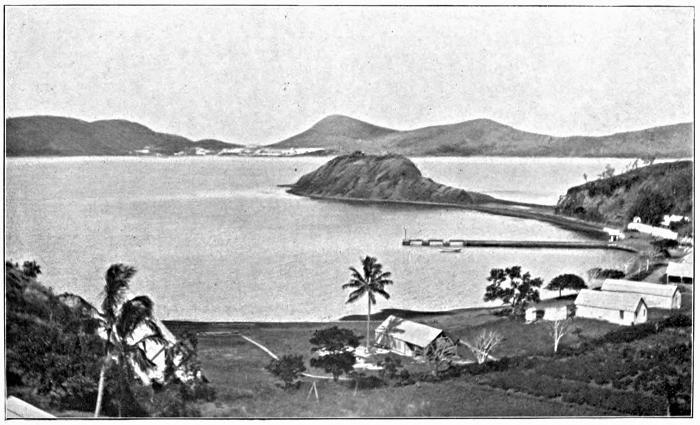
The Peninsula of Ducos. In the background is Ile Nou with the Central Criminal Depôt.
On another part of the peninsula, in a semi-circular
valley, hemmed in by precipitous hills, there
is a piteously forlorn colony, that of the liberés
collectifs; that is to say, convicts who have been
released from prison, but are compelled to live in
one place under supervision. They are mostly men
whose health has broken down under the work of
the bagne, or who have been released on account
of old age.
They live in wretched little cabins on the allotments,
which it is their business to keep in some
sort of cultivation. They have the poor privileges
of growing beards and moustaches if they like, and
of wearing blue dungaree instead of grey, and of
earning a few pence a week by selling their produce
to the Administration.
This is not much, but they are extremely proud
of it, and hold themselves much higher than the
common forçat. They do not consider themselves
prisoners, but only “in the service of the Administration.”
I have seldom, if ever, seen a more
forlorn and hopeless collection of human beings
in all my wanderings.
There was, however, a time when Ducos was one
of the busiest and most important of the New
Caledonian Settlements, for it was here that the
most notorious and most dangerous of the communards
were imprisoned after their suppression in
1872. Here lived Louise Michel, the high-priestess
of anarchy, devoting herself to the care
of the sick and the sorrowing with a self-sacrifice
which rivalled even that of the Sisters of Mercy,
and here, too, Henri Rochefort lived in a tiny
stone house in the midst of what was once a
garden, and the delight of his days of exile.
Louise Michel’s house has disappeared in the
course of improvements. Rochefort’s house is a
roofless ruin in the midst of a jungle which takes a
good deal of getting through. It was from here
that he made his escape with Pain and Humbert
and two other communards in an English cutter,
which may or may not have been in the harbour
for that particular purpose.
One night they did not turn up to muster, but
it was explained that Rochefort and Humbert had
gone fishing, and the others were away on a tour
“with permission.” As they did not return during
the night search-parties were sent out for them.
Meanwhile, they had kept a rendezvous at midnight
with the cutter’s boat and got aboard.
The next day was a dead calm; and, as the cutter
lay helpless at her anchor, the fugitives concealed
themselves about her cargo as best they could.
The hue and cry was out all over the coast, but the
searchers looked everywhere but just the one place
where they were. If the next day had been calm
they must have been caught, for the authorities had
decided on a thorough search of every vessel in the
harbour. Happily for them a breeze sprang up
towards the next morning, and the cutter slipped
quietly out. Once beyond the outward reef the
fugitives were in neutral water, and, being political
prisoners, they could not be brought back.
By daylight the truth was discovered, but pursuit
was impossible. The cutter had got too long a start
for any sailing vessel to overtake her in the light
wind, and the only steamer which the administration
then possessed had gone away to Bourail to
fetch back the Governor’s wife. If it had been in
the harbour that morning, at least one picturesque
career might have been very different. MacMahon
was President at the time, and of all men on earth
he had the most deadly fear of Rochefort, so he
took a blind revenge for his escape by ordering
the Governor to expel every one who was even
suspected of assisting in the escape.
The story was told to me by one who suffered
through this edict quite innocently, and to his
utter ruin. He was then one of the most
prosperous men in Noumea. He owned an hotel
and several stores, and had mail and road-making
contracts with the government. Unhappily, one
of his stores was on the Peninsula of Ducos, and
the man who managed it was reputed to be very
friendly with Rochefort.
This was enough. He was ordered to clear out
to Australia in two months. It was in vain that
he offered himself for trial on the definite charge
of assisting a prisoner to escape. The Governor
and every one else sympathised deeply with him,
but they dare not even be just, and out he had
to go. He is now canteen-keeper on the Isle
of Pines, selling groceries and drink to the officials
and relégués at prices fixed by the government.
He told me this story one night at dinner at his
own table.
The general amnesty of 1880 released Louise
Michel and the rest of those who had survived
the terrible revolt of 1871 from Ducos and the Isle
of Pines.
There are, however, two other celebrities left
on Ducos. One of them is a tall, erect, grizzled
Arab, every inch a chieftain, even in his prison
garb. This is Abu-Mezrag-Mokrani, one of the
leaders of the Kabyle insurrection of 1871, a man
who once had fifteen thousand desert horsemen
at his beck and call. Now he rules a little encampment
in one of the valleys of the peninsula,
containing forty or fifty of his old companions-in-arms,
deported with him after the insurrection was
put down.
When the Kanaka rebellion broke out in New
Caledonia in 1878, Abu-Mezrag volunteered to
lead his men against the rebels in the service of
France. The offer was accepted and the old warriors
of the desert acquitted themselves excellently among
the tree-clad mountains of “La Nouvelle.” When
the rebellion was over a petition for their pardon
was sent to the home government, but the remnant
of them are still cultivating their little patches of
ground on Ducos.
The other surviving celebrity is known in
Caledonia as the Caledonian Dreyfus, and this is
his story:
In 1888 Louis Chatelain was a sous-officier of
the line stationed in Paris. He was dapper,
good-looking, and a delightful talker. He engaged
the affections of a lady whose ideas as to expenditure
were far too expansive to be gratified out of the
pay of a sous-officier. Poor Chatelain got into debt,
mortgaged or sold everything that he had, and
still the lady was unsatisfied. Finally, after certain
recriminations, and when he had given her everything
but his honour, she suggested a means by
which he could make a fortune with very little
trouble. She had, it appears, made the acquaintance
of a gentleman who knew some one connected
with a foreign army, who would give twenty
thousand francs for one of the then new-pattern
Lebel rifles.
He entered into correspondence with the foreign
gentleman, addressing him—c/o the —— Embassy,
Paris. His letters were stopped, opened,
photographed, and sent on. So were the replies.
Then the negotiations were suddenly broken off,
Chatelain was summoned before the military
tribunal and confronted with the pièces de conviction.
He confessed openly, posing as a martyr
to la grande passion—and his sentence was deportation
for life.
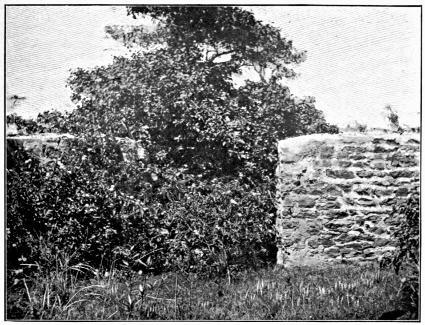
The remains of Henri Rochefort’s House.
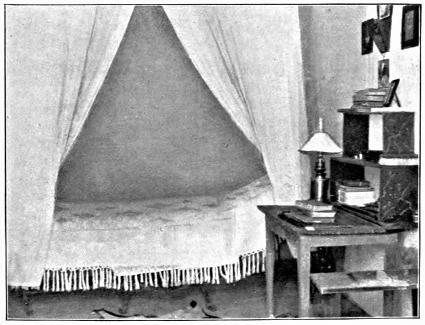
The Bedroom of Louis Chatelain, “The Caledonian Dreyfus” in Ducos. The
photographs on the wall and the one on the table are those of the woman
who ruined him.
When I went into his little sleeping-room at
Ducos, I found on a little table beside his mosquito-curtained
bed, a photograph of a very good-looking
young woman. On the wall above the table there
were two others of the same enchantress, the evil
genius of his life. The moment he fell she
deserted him. Unlike many another Frenchwoman,
who has done so for lover or husband, she did
not follow him across the world to Caledonia, and
yet every night and morning of his life Louis
Chatelain kneels down in front of that table as he
might before an altar, and says his prayers with
his eyes on those photographs.
For the next three or four days after my visit
to the Peninsula of Ducos there was nothing
definite to be learnt about means of transit. In
fact there was nothing certain except the plague—always
that Spectre which seemed to stand at the
end of every pathway. It was really getting quite
monotonous, and I was beginning to wonder
whether I should ever get out of Noumea at all.
Then I began making inquiries as to an over-land
journey through the interior. No, that was
impossible, save at great risk and expense. The
Spectre had jumped the mountains. Huge armies
of rats had appeared in the bush, just as though
some Pied Piper of Hamelin had enticed them
away from the towns into the mountains, and they
were spreading the plague in all directions among
the Kanakas.
It is a curious fact that rats, who of all animals
are the most susceptible to the plague, will migrate
from a plague-stricken town just as they will try
to escape from a sinking ship.
Convicts and Kanakas were dying in unknown
numbers. Camps were being closed, and the rains
were coming on. There was nothing to be seen
or done worth seeing or doing, so I had to content
myself with wandering about Noumea and the
neighbourhood, taking photographs, making acquaintances
with convicts and liberés and getting
stories out of them, wondering the while, as every
one else was doing, what the Spectre was going
to do next.
As far as I was concerned, he did me the unkindest
turn that he could have done, save one.
He infected the only two decent boats on the
Coast Service, and so left me the choice between
voyaging to the Isle of Pines in La France or
stopping where I was.
I had to get to the island somehow, so I chose
La France, and at five o’clock one morning, after
being duly inspected and squirted, I once more
boarded the detestable little hooker.
I thought my first passage in her was bad enough,
but it was nothing to this. She was swarming
with passengers, bond and free, black, white, and
yellow, from end to end. She was loaded literally
down to the deck, and she smelt, if possible, even
stronger than she did before. The worst of this
was that before we got to the Isle of Pines we
had to get outside the reef and into the open water.
I have seen too much of seafaring to be easily
frightened on salt water, but I candidly admit that
I was frightened then. In fact, when we got outside
and she began to feel the swell, I took out my
swimming-jacket and put it on, though, of course
this was a pretty forlorn hope, as the water was
swarming with sharks and the shortest swim would
have been a couple of miles. Still, one always
likes to take the last chance.
Happily, she was English-built, and high in the
bows, so she took nothing but spray over. Two
or three green seas would have swamped her to
a certainty, but they didn’t come, and so in time
we got there.
On board I renewed the acquaintance of the
Commandant of Ile Nou, who was taking his wife
and family to the Isle of Pines, which is to
Caledonia as the Riviera is to Europe. At midday
we stopped at Prony, the headquarters of the forest
camps which I was to visit later on my return;
and we lunched in the saloon with six inches of
water on the floor. That was the first time I ever
saw a steamer baled out with buckets. Still, they
managed to get the water under somehow. There
didn’t appear to be a pump on board.
When we passed the reef, and started on the
sixty-mile run through the open sea, some began
to say their prayers and some said other things,
but in the end we worried through, and just as
the evening star was growing golden in the west
we anchored in the lovely little Bay of Kuto.
Never before had I heard the anchor chain
rumble through the hawse-hole with greater thankfulness
than I did then, and, judging by the limp
and bedraggled look of every one, bond and free,
who went ashore, I don’t think I was alone
in hoping that I had seen the last of La France—which
I hadn’t.
My friend the Commandant introduced me to
his confrère of the Isle of Pines. He was not
particularly sympathetic. I believe I was the only
Englishman who had ever come to the island with
authority to inspect his domains, and he didn’t
take very kindly to the idea. Still, ruler and all
as he was in his own land, the long arm of the
Minister of Colonies reached even to the Isle of
Pines, and, although he did not even offer me
the usual courtesy of a glass of wine, he handed
the credentials back to me, and said:
“Très bien, monsieur! If you will come and
see me at nine o’clock to-morrow morning we
will make arrangements. You will, I think, find
accommodation at the canteen.”
With that I took my leave, and went out into
the darkness to find the canteen and some one to
carry my luggage there. I found a surveillant,
who found a relégué, and he shouldered my bag
and found the canteen, the only semblance of an
hotel on the island.
There, quite unknowingly, I stumbled upon
excellent friends. The canteen-keeper was the
man whose story I told in the last chapter. I
was a stranger from a very strange land. Their
resources are very limited; for communications
with the grand terre were few and far between,
and yet the twenty days that I was compelled
to stop on the Isle of Pines, proved after all
to be the pleasantest time that I had spent in
New Caledonia.
But there was one exception, happily only a
transient experience, yet bad enough in its way.
If the plague was not on board La France it
ought to have been, for never did a fitter nursery
of microbes get afloat, and when I got into the
wretched little bedroom, which was all they could
fix up for me that night, I honestly believed that
the little wriggling devil had got into the white
corpuscles of my blood.
I had all the symptoms with which the conversation
of the doctors at the Cercle in Noumea
had made me only too familiar—headache, stomachache,
nausea, dizziness, aching under the armpits
and in the groins.
Of course, I was about as frightened as an
ordinary person could very well be, a great deal
more so in fact than I had been a few years
before when I first experienced the sensation of
being shot at. It may have been the fright or
the fact, but the glands were swelling.
Then I caught myself repeating fragments of
“Abide with me,” mixed up with Kipling’s “Song
of the Banjo”; and when a lucid interval came
I decided that the case was serious.
I had three things with me which no traveller
in the outlands of the world should be without—quinine,
chlorodyne, and sulpholine lotion. I
took a big dose of quinine, and then one of
chlorodyne. I should be afraid to say how big
they were. Then I soaked four handkerchiefs
in the lotion, put them where they were wanted,
and laid down to speculate as to what would
happen if the microbe had really caught me?
I had an appointment with the Commandant
at nine o’clock the next morning. His house
was more than a mile away. What would happen
if I couldn’t walk in the morning?
I should have to explain matters, if I were
still sane, to the people at the canteen. I had
just come from Noumea, the very centre of the
plague. The inference would be instant. The
military doctor in charge of the hospital would
be sent for, and he would say la Peste. I
should be taken to the hospital, where, a day or
two after, I saw a man suspected of the plague
die of blood-poisoning, and once there—quien sabe?
Thinking this and many other incongruously
mixed-up things, I went to sleep. Probably it
was only a matter of a few minutes altogether.
Nine hours after I woke and thought I was in
heaven. The pains and the deadly fear were
gone. I pulled my watch out from under my
pillow. It was ten minutes to seven. The light
was filtering in through the closely shut persiennes.
The waves on the silver-sanded beach within a
few yards of my bedroom were saying as plainly
and seductively as waves ever said:
“Come and have a dip, and wash all that
plague nonsense out of your head.”
So I got up, opened the window, put on my
deck-shoes, and walked down to the beach.
I could walk! Out of hell I had come back
to earth. A few hours before I had really believed
that the next dawn would be shadowed by the
presence of the Black Death. Now I looked up
at the sapphire sky, and threw my hands above
my head to make sure that the pains in the
armpits were gone. Then I stepped out to the
full length of my stride along the smooth, hard
coral sand, to see if the groins were right.
Having reached a decent distance from the
canteen I rolled into the cool, bright, blue water,
and for half an hour I splashed around—not
daring to go much beyond my depth, because
those same blue waters are often cut by the
black triangle of a shark’s dorsal fin—thinking
how good a thing it was to live instead of dying,
especially in such a paradise as this.
When I paid my official visit after breakfast,
I found M. le Commandant in a more friendly
mood. We exchanged cigarettes and compliments,
and then we had a stroll round the little settlement
of Kuto.
Kuto is most exquisitely situated on a promontory
between two delicious, white-shored, palm-fringed
bays, broken with fantastic, tree-crowned rocks.
Long ago it was the home of the “politicals” and
those soldiers of the Commune who had not been
thought dangerous enough to be put in batches
against a wall and shot. In those days Kuto, so
they told me, might have been taken for a tiny
suburb of Paris. It had a theatre, and a couple
of newspapers, one serious and one humorous.
There were social functions and many gaieties in
the intervals of road-making and barrack-building.
But nowadays all this is changed. The
deportés have gone back to France, and the
relégués have come in their place, which is the
same thing as saying that over this lovely scrap
of earth there has descended the moral night of
incurable crime and hopeless despair. Kuto is
now a silent place of prisons, barracks, and workshops,
inhabited by a few soldiers and officials and
many blue-clad figures with clean-shaven faces,
mostly repulsive to look upon and all stamped
with the seal of stolid despair.
In order that you may understand what manner
of people these were it is necessary to explain the
meaning of the French legal term relégation, since
there is nothing at all corresponding to it in the
English system.
In France, as in all countries, there are criminals
of many kinds and ranks, and of these the French
relégués are the lowest and meanest. I have said
before that in the criminal society of New Caledonia
the assassins, forgers, embezzlers, and what we
should call swell-mobsmen form the aristocracy.
The relégués are the lowest class. They are the
gutter-snipes of crime; the hard cases; the human
refuse beyond all hope of social salvation; mental
and moral derelicts, of no use to themselves or
anybody else.
We have thousands of them in this country,
but we don’t deal as wisely or as humanely with
them as the French do. Our judges and
magistrates send them to prison again and again,
well knowing that they will only come out to
commit more crimes and be sent again to prison,
becoming in the intervals of liberty the wives and
husbands and parents of other criminals.
This is one of the social problems which they
deal with better in France. There is no nonsense
there about a criminal “having paid his debt to
society” when he has served his sentence, and
being, therefore, free to go and commit more
crimes. When a man or woman has committed
a certain number of crimes of the minor sort, or
has been convicted of hopeless immorality or
alcoholism—in other words, when there is reason
to believe that he or she is absolutely unfit to
possess the rights of citizenship—such person may
be, in the last resort, sentenced as in England,
say, to twelve or eighteen months’ hard labour as
punishment for that particular crime.
Now in an English police-court the habitual
criminal might possibly thank the magistrate and
go away to “do it on his head,” but in France
he may hear the fatal words:
“At the expiration of your sentence you will
be placed in relégation.”
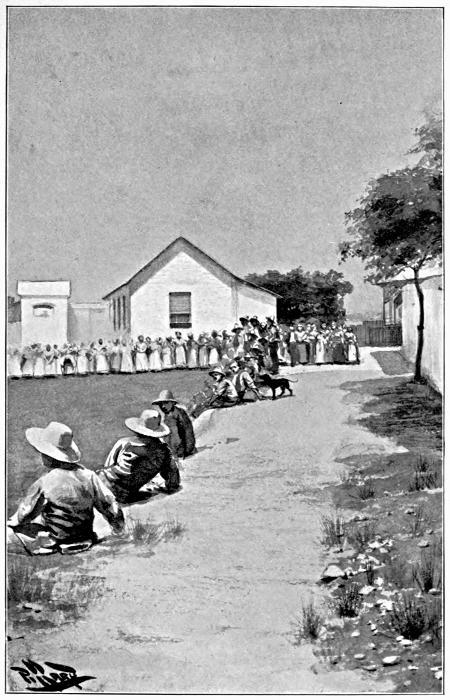
The “Market” in the Convent, Isle of Pines. The Female Réliqués are drawn
up before one of the Prison Buildings. In the foreground are the Kanakas
waiting to sell their fruit and vegetables.
Drawn by Harold Piffard from a photograph.
Of this the meaning is: “You have proved
yourself unfit to live in the society of your fellow-citizens.
Punishment is no warning to you. You
will neither reform yourself nor be reformed; therefore
Society has done with you: you are banished!
You will be fed and clothed and attended when
you are sick. You will have work found for you,
and you will be paid for it. But if you won’t
work there will be the prison and the cell for
you. Now go, and make the best of it.”
The banishment is practically for life. There
are circumstances under which a relégué can win
his release, but there are two things that he can
never do: he can never gain a concession and
marry and settle down on his own property; and
he can never gain restoration of the full rights of
citizenship—both of which, as I have shown, the
forçat can do.
As we drove out through the big gate in the
wall which had been built across the neck of the
peninsula to keep revolting Kanakas out, I remarked
what a pity it was that such a lovely land should
be nothing better than the habitation of scoundrels,
to which the Commandant replied that the island
served the purposes of the Administration very
well, and if the relégués were not there it would
have to be given over to the Kanakas, for free
colonists would not come.
I thought—but, of course, I didn’t say—what
British colonists would have made of such a
paradise—fertile, well-watered, and blest with an
absolutely perfect climate.
The first thing I noticed in the Isle of Pines
was the excellence and extent of the roads. They
are broad, level, and beautifully kept, and, tiny
as the island is, there are many more miles of
them than there are in all New Caledonia. They
were mostly made by the deported communards,
who also built the solid stone prisons, barracks,
hospitals, chapels, and official residences which
seemed to me to be ample for about twice the
present white population of the island, which is
under two thousand, bond and free.
I found very little difference between the
treatment of the relégués and the best class of
convicts, save that they were rather better fed,
and lived in open camps. They slept in hammocks
in common dormitories, and were permitted to
have any little luxuries that they could buy with
their earnings. There were no plank-beds or
chains to be seen in the camps. In fact, they
might just have been ordinary industrial settlements,
save for the blue cotton livery, the bandless
straw hats, and the hang-dog, hopeless faces which
looked out under the brims.
But before our first drive was half over we
passed a big quadrangle of high, white walls, and
over the little black door in front was the word
“Prison” in big black letters.
“That’s for the hard cases, I suppose?” I said
to the Commandant as we passed.
“Yes,” he said; “we will visit it another day,
and you shall see. This is worse than Ile Nou,
you know. There they have the aristocrats.
Here we have the canaille, the sweepings of the
streets. Any one of these animals here would
cut your throat for a few francs if he dare.”
Then I told him what the Commandant of
Bourail had said about locking doors.
He laughed, and said:
“Parfaitement, but you had better lock your
door here, and if you have a revolver put it
under your pillow.”
The advice was well-meant but somewhat superfluous.
The faces I had seen were quite enough.
I soon found that my friend was somewhat of a
cynic and a humorist in his way, for when I
asked him what was the greatest punishment he
could inflict on a recalcitrant relégué, he said:
“Make him work. Look at that gang of men
yonder,” he went on, pointing to the hillside,
which a long row of blue-clad figures was breaking
up with picks and spades. “Every stroke of
the pick is a punishment to those men. They
are wretches whose only idea of life is to get
through it without working. They have been
thieves and swindlers, beggars and souteneurs—everything
that is useless and vile. There is
nothing they have not done to save themselves
from working. Now, you see, we make them
work.”
“And if they won’t?”
“Eh bien! They have stomachs—and soup
and fish and meat and coffee and a drink of
wine now and then, with a cigarette or a pipe,
are better than bread and water, and the open
air in a country like this is better than the black
cell or the quartier disciplinaire, which you will
see later on.”
“In other words,” I said, “you have gone
back to the good old law: If a man will not
work, neither shall he eat. Well, I must admit
that you deal more sensibly with your hopeless
vagabonds than we do with ours.”
“Bien possible,” he said, with some justification,
“you will see that at least we make some use
of them, more than they would in Paris or
London, I think. For instance, this is our farm.”
As he said this we pulled up opposite to a
rustic arch, over which were the words Ferme
Uro.
We went down through a flowery avenue to a
pretty verandahed house almost buried in greenery
and flowers—the home of the Farm Superintendent.
He came out and greeted his territorial lord, and
then we went over the farm.
It was as perfect a specimen of what the French
call petit culture as could be imagined. It was,
in fact, rather a collection of exquisitely kept
vegetable gardens than a farm. Every patch was
irrigated by water from the low hills which run
across the centre of the island. Every kind of
vegetable, tropical and temperate, was under cultivation,
and outside the gardens there were broad
fields of maize and grass pasture.
In one of the fields I saw a long line of women
hoeing the ridges for corn, and at one end of
the line stood a white-clad surveillant, revolver on
hip. For the fiftieth time my English prejudices
were shocked when I learnt that these were a
detachment of the female relégués; and I wondered
what would be thought at home if the lady-guests
at Aylesbury were turned out to work in the
fields under the charge of a male warder. Here
it was quite a matter of course.
“Wait till you have made the acquaintance of
the ladies,” laughed the Commandant, in reply
to a rather injudicious question, “and you will
see that they want some watching.”
From the farm of Uro, after a drink of
delicious milk, which, for some reason or
other, took me back instantly to far-away England,
we went on a few miles along the road to the
ateliers, or workshops, where all kinds of industries,
from boot-making to waggon-building, were being
carried on in a somewhat leisurely style, and under
what seemed to me very slight supervision.
“This is a hard school for them to learn and
us to teach in,” said the Commandant. “The
forçats generally know a trade and are accustomed
to work, if they have not been gentlemen; but
these have been brought up to hate the name of
work. Yet you see we have made something of
them. Everything that is used on the island is
made here. In fact, we make something which
will be used a long way from here.”
I saw this later on during our visit to the prison,
which was too similar to the others to need any
description. About a score of the occupants of
a big shed within the walls were busy plaiting a
long, reedy grass which others, squatted about the
yard, were stripping and preparing for them. They
had to get through so much a day or their rations
were docked. The unhappy wastrels didn’t seem
to like the regime at all, but they worked, if only
for their stomachs’ sake.
When we left the prison we went to a long
shed, where the plaits were being worked up into
matting—miles of it there appeared to be—and
when I asked what it was all for, I learnt that it
was destined to be trodden by the millions of careless
feet which would saunter through the halls
and corridors of the Paris Exhibition.
This was the contribution of this far-away spot
to the great show. Of course, those who were
making it knew what it was for. Perhaps their
thoughts—if they had any by this time, beyond
their daily meat and drink, or any dreams of
delight, beyond the little luxuries that their hard-earned
pence could buy them at the canteen—were
travelling even as they stitched back to the elysium
of crime and idleness which they would never see
again. From what I saw and heard I doubt not
that many a bitter thought was woven in with
the miles of matting which afterwards covered the
exhibition floors.
The next day we went to make the acquaintance
of the lady reléguées, who are accommodated in
the Convent, as it is called, under the charge of
a Mother Superior and six Sisters of St. Joseph,
among whom I was a little surprised to find one
who, learning that I was English, came and greeted
me in a deliciously delicate Irish brogue. She
was an Irish lady who had taken the vows in a
French Convent, and had voluntarily exiled herself
to this far-away foreign land to spend the rest
of her days in a prison. Still, she and her
French sisters appeared to be most cheerfully
contented with their lot.
They had, however, one little trace of feminine
vanity left. They sorely wanted their photographs
taken, and my Irish compatriot wanted it most
of all. It was against the rules not only of the
Administration, but of their order, wherefore the
photographs which I did take of the convent and
its occupants did not turn out successes.
There were one hundred and seventy-six female
reléguées in the Convent just then, mostly healthy,
hearty-looking women of all ages, from twenty
to sixty. Their faces were, if anything, more
repulsive than the men’s. They had committed
almost every possible crime, but most of them
were there for infanticide. I was the first man—not
an official—that they had seen, perhaps, for
a good many years, for there are few visitors
to the Isles of Pines, and fewer still to the
jealously guarded Convent.
A little before dinner that evening I was sitting
under the trees in front of the canteen jotting
down some notes when I heard a voice, with a
suspicion of tears in it, asking whether “monsieur
would speak for a minute with an unfortunate
woman.”
I turned round, and saw the gaunt figure and
unlovely face of Marie, the reléguée housemaid of
the canteen. Here was another human document,
I thought, so I told her to go on.
She was in great trouble, she told me, and as
I was a friend of the Government and of the
Administration I could help her if I would. She
had been released from the Convent to take service
at the canteen, but though she was comfortable,
and had a good master and mistress, her heart was
pining for the society of her husband, who was
working in enforced celibacy in far-away Bourail.
They had been parted for a trifle, and she was sure
that if “Milor” interceded for her with the Director
she would be restored to his longing arms.
When she had finished, I said:
“And what was your husband sent out here
for?”
“Il a éventré un homme,” she murmured.
“And what are you here for?” I continued.
“J’ai tué mon enfant,” she murmured again
as softly as before.
I did not think the reunion desirable, and so
the petition was not presented. Nevertheless, it
would have probably been a very difficult matter
to have convinced that woman that she hadn’t a
perfect right to rejoin her husband, raise a
family, and become with him a landed proprietor.
I learnt afterwards that she had been relegated
to the Isle of Pines for theft aggravated by
assault with a hatchet.
Somehow the food that she handed round the
table at the canteen that night didn’t taste quite
as nice as usual, in spite of the conversation of
Madame Blaise and her two charming daughters,
the elder of whom, though she had never been
farther into the world than Noumea, might, as
far as grace of speech and action went, have just
come out from Paris.
In the course of the next few days I wandered,
sometimes in the Commandant’s carriage and
sometimes afoot, all over the island, and ascended
its only mountain, the Pic ’Nga, on the top of
which there are the foundations of an old fort and
look-out tower, dating back, so they say, to the
old days of the pirates of the southern seas. From
here you can see every bay and inlet round the
coast, and a very lovely picture the verdant island
made, fringed by its circlet of reefs and coral
islets, with their emerald lagoons and white breakers,
and the deep blue of the open ocean beyond.
Another day I went through the native reserve,
and visited the settlement of the Marist Brothers,
a most delightful little nook where the good
brothers lead a contented existence, teaching their
bronze scholars the beauties of the Catholic Faith,
and the beneficence of the good French Government,
which graciously permits them to live in a part
of their own country, and sell their produce to
the officials and such of their prisoners as have
money à prix fixe.
After this I visited the coffee plantation—the
only actually profitable industry in which prisoners
are employed in New Caledonia—the hospitals
and the disciplinary camps, which I found practically
the same as those which I had already seen on the
mainland.
The hospital was, however, an even more delightful
abode of disease and crime than the one
on Ile Nou. It stands well up the hillside behind
the Convent, and the view from its terraces is
one of the most beautiful I have ever seen. With
the exception of the man who died of blood-poisoning
under suspicion of the plague, the
principal disease seemed general decay and old
age. In fact, out of a criminal population of
over twelve hundred, there were only thirty
patients, for which reason the Isle of Pines, with
its perfect climate, reminded me of Mark Twain’s
Californian health resort, which was so healthy that
the inhabitants had to go somewhere else to die.
Later on I saw a much more mournful place than
the hospital. This was the Camp des Impotents.
I don’t think I ever saw a more miserable,
forlorn-looking collection of human beings than I
found here. They were not suffering from any
specific disease, or else, of course, they would
have been in the hospital. They are just mental
and physical derelicts, harmless imbeciles, cripples
incapable of work, and men dying quietly of
old age.
Of course, the camp was exquisitely situated,
and their lot struck me as being, after all, not
a very bad ending to a useless, hopeless life—to
dream away the last years under that lovely sun,
breathing that delicious air, and waiting quietly
for the end without anxiety or care.
The poor wretches looked at me somewhat as
they might have looked at a visitor from some
other world. They had ceased to be criminals
or prisoners. They had no more crime left in
them, and they would not have escaped if they
could, so in their case discipline was relaxed and
I spent a few francs in buying some of the rude
carvings and a few walking-sticks which they had
made out of lianes, the only work with which
they whiled away the long sunny hours. It was
worth twenty times the money to see their feeble,
almost pitiful, delight as they looked at the little
silver coins in their brown, shrivelled hands, and
I really think that some at least of the blessings
which followed me out of the camp were sincere.
But when I said this to the Commandant he only
smiled, and said:
“Perhaps! But no doubt they would like a
visitor from England every day.”
A few days after I had finished my round of
visits to the prison camps I had the privilege
of assisting at a session of the Disciplinary
Commission, a court whose function it is to hear
complaints, grant redresses and privileges, try
offences against the penal regulations, and inflict
punishment. The Commandant is President, ex
officio, and he is assisted by an officer of the
Administration, who is a sort of civil magistrate
and the Conductor of Works. These functionaries
sit at a curved desk on a platform, and here, for
the first time, I took my seat on a judicial bench.
There was a space of about twelve feet between
the end of the platform and the railing which
divided off the rest of the hall. Here the Principal
Surveillant sat at one desk, and opposite to him
on the other side of the room the Greffier or
Clerk of the Court.
The court being a French one, precedence was,
of course, given to the ladies. They were brought
in one by one through a side door between the
railings and the platform. The triviality of their
complaints testified eloquently to the narrowness
of the little lives they led.
One woman accused another of stealing her
needle and thread so as to get her into trouble.
Another wanted three halfpence of her savings,
which she said the Mother Superior was unjustly
keeping from her. A third wanted to know why
she hadn’t had a letter from a friend of hers in
service in Noumea, and was gravely informed that
the plague had seriously interrupted communications
and the letter would probably arrive as soon as
possible. Another had rheumatism, and wanted
to be taken off the field-work; besides, she was
getting too old, she was nearly seventy—and her
request was promptly granted.
Then a few were accused of little acts of idleness
or insubordination or wastefulness. These were
either fined a penny or so, according to the magnitude
of the offence, or dismissed with a caution.
It must not, however, be imagined from this
that the ladies of the relégation at the Isle of Pines
are exactly models of female deportment, for, as
the Commandant told me afterwards, they once
revolted, and before help could be got they had
caught two surveillants, stripped them stark naked,
and made them run the gauntlet of the Convent
between two rows of beautiful palms, after
which they douched them well in a muddy duck-pond.
They were proceeding to treat the good
sisters in the same way when rescue arrived from
Kuto and the other camps.
The male prisoners were a terribly hard-looking
lot. They were brought up in twos and threes—plaintiff,
defendant, and witnesses—and they
accused each other of every sort of crime, from
stealing a bit of bread to attempted murder.
The English axiom about dog eating dog does
not hold good among relégués. They will steal
from each other just as cheerfully as they will
from anybody else, and will descend to any little
meanness to spite each other. Most of the offences
were of the pettiest and meanest kind, such as
stealing each other’s clothes, or food, or tools
and selling them for a penny or so to some one
else who had lost his.
Others were up for being out of bounds after
hours, and I noticed that these nearly all said
they’d been fishing, which was not inappropriate.
During the proceedings I was very much struck
by the appearance of an Arab in the grey uniform
of the quartier disciplinaire. He was a tall, well-built,
handsome fellow of about thirty, with a frank,
open expression and an ever-smiling mouth which
continually showed a magnificent set of teeth.
There was a wonderful difference between him
and his fellow-scoundrels, but I learned afterwards
that he was the biggest scoundrel of the whole lot.
Two or three hundred years ago he would
probably have commanded a fleet of Corsairs, and
made his name a terror from one end of the
Mediterranean to the other. Now, thanks to
changed environment, he was only a deserter and
a common thief who could not even keep his
hands off the property of his fellow-thieves.
The procedure of the Court was quite different
to anything we have in England. The prisoners
were all, as I say, brought up and examined individually
with accusers and witnesses. Then they were
taken away what time the Court deliberated
and fixed the sentence. Then the whole lot were
brought in and ranged up along the two sides
of the room. The greffier called out the names,
and each man stepped forward, heard his sentence,
and was marched out. The Arab took his fifteen
days’ prison with an even jauntier smile than usual.
While this was going on I had been making
a study in criminal physiognomy, and I came to
the conclusion that if forty criminals were taken
at random from English prisons, dressed exactly as
these forty French criminals were, and mixed up
with them, it would be absolutely impossible to
tell which were French and which were English.
There is no nationality in crime. Criminals belong
to a distinct branch of the human family, and the
family likeness among them is unmistakable.
As we were driving back that morning the
Commandant invited me to a picnic which he was
giving in honour of the Commandant of Ile Nou
and myself. Naturally I accepted, and, being on
the subject of pleasure excursions, I said:
“Of course you must have some delightful
yachting and fishing about these lovely bays. I
have been wondering why I haven’t seen any
sailing craft about.”
“That is forbidden,” he said. “No one may
own even a rowing boat without the licence of
the Administration in Noumea, and even then he
would have to give guarantees for its safety. You
see these fellows would think nothing of stealing
a boat and trying to escape in it, and the owner
of the boat would be responsible for any escapes.
Twenty-five of the politicals once managed to make
a big canoe and got away in it, but they were all
drowned or eaten by the sharks. Now all boats,
even the Kanakas’ canoes, have to be kept locked
and chained and guarded from sunset to sunrise.”
This, then, was why these smooth, sunlit waters
were sailless and deserted—another effect of the
curse of Crime on Paradise.
The picnic was a great success, and the Commandant
proved a most excellent host. There
were four wagonette loads of us, with a fair
sprinkling of pretty girls, among whom, of course,
were my host’s daughters. Everybody seemed to
have forgotten for the time that I was an
Englishman, and so I passed a very jolly day.
We camped in a big white stone building which
had once been a gendarmerie barracks, standing
in a delightful valley near to the entrance of
a magnificent limestone cavern. We lunched
sumptuously under the verandah, and I think I
prattled French more volubly than I had ever
done before. Then we went and shot pigeons,
quite half as big again as the English variety, and
splendid eating. The woods of the Isle of Pines
swarmed with them and other feathered game
whose names I don’t remember.
Of course, we wound up with a dance, and
this was the queerest dance I had ever seen. Our
drivers and attendants were, of course, all relégués,
and so were the musicians. One ingenious
scoundrel led the orchestra with a fiddle that he
had made himself, even to the strings and the
bow. It had an excellent tone, and he played it
very well. I wanted to buy it, but he loved it
and wouldn’t sell.
I must say that I pitied these musicians not
a little as I watched them standing in a corner
looking with hungry eyes upon the Forbidden and
the Unattainable as it floated about the room in
dainty light draperies with the arms of other men
about its waist—for the relégué is not like the
forçat. He has no hope of marriage, even with
the meanest of his kind. His sentence includes,
and very wisely too, perpetual celibacy.
All the same, I tried to picture to myself a
picnic, say, at Dartmoor, with a company of English
men and maidens dancing in one of the prison
halls to music made by a convict band!
When the feast was over every bottle, full and
empty, every knife, fork, spoon, plate, cup, and
dish was counted over. The remnants were given
away, but everything else was packed under the
official eye. If the slightest trifle had been overlooked
it would have been immediately stolen.
This is one of the peculiarities of picnicing in
Prisonland.
A few days afterwards my pleasant exile came
to an end. The ungainly form of La France
waddled into the bay, bringing news of the outside
world. The principal items were to the effect
that the plague was increasing merrily in Noumea,
and that the victorious Boers were driving the
British into the sea.
We had quite a sad little supper that night at
the canteen, for I was rapidly becoming quite one
of the family. Still this was the turning-point in
my thirty-thousand-mile journey. At daybreak
the snub nose of La France would point toward
home, and so when I had said good-bye for the
third or fourth time I pulled out across the bay
which lay like a sheet of shimmering silver under
the glorious tropic moon, and boarded the wretched
little hooker for the last time with feelings something
akin to thankfulness.
When many days afterwards, I got back to
Noumea the Director asked me what I thought
of the Isle of Pines.
“If you want my candid opinion,” I said, “I
think it is an earthly paradise which you have
used as a dust-heap to shoot your rubbish on.
If the French Government would give me a
hundred years’ lease of it, with power to do as
I liked as long as I didn’t break the law, I would
find capital enough in England and Australia to
make it the Monte Carlo of the South Pacific.
I’d have everything there that there is at Monte
Carlo, and a couple of fast boats to bring the
people over from Sydney in two days. I’d have
all the wealth and fashion of Australia and a
good many people from Europe there every year.
In fact, your paradise should pay you a million
francs a year and me twenty millions.”
“Ah!” he said, after a few moments of silence.
“That is just like you English. That is enterprise.
Here we only have government.”
New Caledonia is essentially a land of
contrasts, both in scenery and climate, and
when I had left the sunny hills and plains and
the silver-sanded, palm-fringed bays of the Isle
of Pines some fifty miles behind me, I found
myself in a region of enormous forests, clothing
the slopes of rugged mountains running sheer
down to the sea from the clouds which rarely
broke above them.
There were no white beaches here, only boulder-strewn
shores, which were literally, as well as in
the metaphorical sense, iron-bound. Not only the
rocks and the boulders, but the very sands of
the shore themselves were of iron, sometimes pure,
but, as a rule, containing from eighty-five to
ninety per cent. of the metal.
This was Prony, the chief of a cluster of convict
camps scattered about what is literally a land of
wood and iron. The wood is used, the iron is
not. Millions of tons of it are lying round the
shores of one of the finest and safest natural
harbours in the world. A thousand miles away
are the coal-fields of New South Wales. Since
it pays to ship copper and iron from Spain and
even South America to Swansea, one would think
it would pay to ship this to Newcastle. However,
there it lies, waiting, I suppose for some one to
make fortunes out of it, and the energies of the
eight hundred or one thousand relégués are devoted
to hewing timber in the forests, bringing it down
to the shore, and floating it in big barges to
Prony, where there is a finely equipped saw and
planing mill.
The dressed timber is, of course, the property
of the Administration, and is used for building
wharves and jetties. A good deal of it is sold
to the public for building purposes. Some day,
too, there is going to be a real railway in Caledonia,
and then the forest camps of the Baie du Sud
will furnish the sleepers, signal-posts, and platforms.
Meanwhile Prony has a railway all to itself, of
which I shall here give some account.
I was fortunate in making two very pleasant
acquaintances in this out-of-the-way corner of the
world. One was the Commandant, who was quite
the most intelligent and broad-minded man of
his class that I met in Caledonia, and the other
was the Doctor of the port. He was, of course,
a military Doctor, and held the rank of lieutenant
in the army. His official title was “Le Médecin
Major!” He had seen a good deal of the world,
and had visited the United States on a French
warship, and from him I heard the first words of
English that I had heard for nearly three weeks.
The dear little Doctor was proud of his English,
and he had a right to be. Although it was not
very extensive, it was distinctly select. One day
the Commandant referred somewhat slightingly to
it as “son peu d’Anglais”; but perhaps that was
because he couldn’t speak a single word himself.
At any rate, he never tried to.
At Prony, too, I renewed my acquaintance with
the microbe. In fact, the Doctor was there
because of him. One day a coast steamer had
brought some tons of flour for the station, which
depended entirely for its food on Noumea and
Australia. The sacks were stacked under cover
in the Commissariat Department. The little
daughter of the Chief Surveillant got playing
about among these sacks. Some infected rats
had been doing the same a short time before,
and so she got the plague.
The Doctor was telegraphed for to Noumea,
and he came and saved her, and, thanks to his
skill and precautions, that was the only case in
Prony, although we actually had the infection in
the midst of us, and for the fifteen days that I
was tied up there we ate bread made from that
flour!
I often had to pass the sacks, but I did so
at a respectful distance. One morning, however,
I had a bit of a fright. There had been a deluge
of rain all night, and, when I woke, I found a
dead and very wet mouse on my bedroom floor.
What if it had come from those sacks?
I drenched it with corrosive sublimate, and
pitched it carefully out of doors with a stick.
Then I poured petroleum over it and burnt it
and the stick, and there the incident closed.
It always struck me as somewhat of a miracle
that rats did not find those sacks out and spread
the plague broadcast among us. It would have
been a terrible thing in that isolated camp, cut
off from all communication with the world except
the telegraph. Perhaps there were no rats. At
any rate, I never saw any, and felt duly thankful.
There are no roads about Prony, only footpaths,
and not many of these, so we paid our
visits to the camps in steam launches. When it
was fine it was very pleasant work cruising about
the picturesque bays, discoursing the while on
crime, criminals, and colonisation with the intelligent
Commandant, or swopping Anglo-French
jokes and stories with the Doctor, who had a
very pretty wit of his own.
The Commandant was a firm believer in
relegation and transportation generally, but like
every one else, he looked down upon the liberé
and the relégué. According to him a forçat was
worth two liberés, and a liberé was worth a relégué
and a half, if not more. Nevertheless, during my
stay at Prony I saw a squad of relégués working
about as hard as I have ever seen men work.
This was on the railway aforesaid.
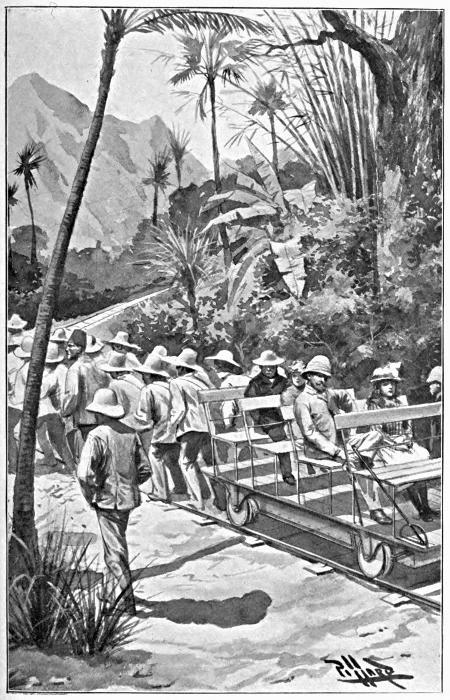
The Convict Railway at Prony.
Drawn by Harold Piffard from a photograph.
We started one morning, as usual, about five
o’clock, and steamed across two or three bays to
the Camp du Nord. In all the other camps
the timber is got down from the hills to the
sea by means of wood-paved slides, which are
quite as much a feature of this part of Caledonia
as the ice-slides are in Norway, but the Camp
du Nord rises to the dignity of a railway on
which that morning I did the most curious bit
of railroading I have ever done.
When we had inspected the camp at the
terminus and, for the Commandant’s sake, I had
duly admired the landing-stage, the trim buildings,
and the gardens in which the flowers and vegetables
were struggling for existence in the burning iron
soil, the State car was brought out for us.
It was a platform on wheels, with four sloping
seats facing backwards. I could see the line twining
away up through the forest, but there was no
engine.
Presently it, or, rather, they, materialised at the
summons of the Chief Surveillant. Fifteen blue-clad
figures, each with a halter and hook-rope
over his shoulder, came out of one of the
dormitories. There was a long chain shackled to
the front of the car. At an order the human
beasts of draught passed the halters over their
heads and hooked on to the chain, seven on each
side and one ahead.
Then the Commandant invited the company
to mount. There were seven of us. The Commandant
had brought his two little girls, and
there were four besides: the Chief Surveillant,
who weighed fifteen stone if he weighed a pound,
the Chief Forester, who weighed a good twelve
stone, and the Doctor and myself, who were comparatively
light weights.
I had often seen convicts harnessed to carts in
England, and, of course, I had ridden many
miles in rickshaws in the East, but this was the
first time I had ever travelled in a car drawn
by human beings who did it because they had
to, and who would have had their food docked
if they had refused to do it, and I confess that I
didn’t exactly like it. Still, I took my place, and
the strange journey began.
At first it didn’t seem very bad, for the line
was almost level, but when we got into the hills
the collar-work began, and our human cattle had
to bend their necks and their backs to it.
The line wound up through cuttings and over
bridges at what seemed to me an ever-increasing
gradient. It was a damp, muggy, tropical morning.
It was not exactly raining, but the moisture soaked
you to the bones for all that, and the leaves and
branches of the vast virgin forest on either hand
shone and dripped as the moisture condensed
on them.
We perspired sitting still and making no more
exertion than was necessary for breathing, so you
can imagine how those poor wretches tugging
at the chains sweated—and, great heavens, how
they stank!—though the most fastidious, under
the circumstances, could hardly blame them for this.
For very shame’s sake I got off and walked
whenever there was an excuse. It made breathing
pleasanter. So did the Doctor, who was a botanist
and found us Venus’ Fly-Traps and other weird
vegetable monsters. The Forester also got off
now and then, not from motives of mercy, but to
point out varieties of timber to the Commandant.
The Chief Surveillant sat tight, probably on account
of his weight, until I wanted to put him into
one of the halters.
But what, though I hardly like to say so, disgusted
me most was the absolute callousness, as it
seemed to me, of the two little girls. Perhaps the
worst of it was that it was absolutely innocent.
They had been born and bred in Prisonland, and
I don’t suppose they really saw any difference
between that sweating, straining, panting team of
human cattle and a team of mules or donkeys.
At last, to my own infinite relief, the journey
was over. What it must have been like to our
team I can only guess from the fact that in a
distance of a little over four miles they had dragged
us up one thousand five hundred feet! It took
an hour and three-quarters to do it. They were
dismissed when we got to the top and allowed
to have a drink—of water.
The Doctor took us back. He understood
the brake, and in consideration for the young
ladies he kept the speed moderate. We got back
in twelve minutes and a half. He said he had
done it in six; but I wasn’t with him then,
and didn’t want to be.
Although forestry is, of course, the same all
the world over, and, therefore, not the sort of
thing to describe here in detail, there were two
other camps that I visited which had interesting
peculiarities of their own. One of these was the
Camp of Bonne Anse, a pretty little spot whence
a very steep and stony path led over a little range
to a promontory called Cap Ndoua, which is the
telegraph station for the Isle of Pines. I don’t
know whether there are any other telegraphic
stations which have neither cables nor wires and
make no use of electricity, but this and the one
on the Isle of Pines were the only ones I have
ever seen.
When I was taken into the operating-room at
Cap Ndoua I saw an apparatus which looked to
me like a gigantic magic-lantern with a telescope
fixed to its side. In the front of the big iron box
there was a huge lens about eighteen inches across,
behind this was another smaller one, and behind
this again a powerful oil lamp, with a movable
screen in front of it, worked with a sort of trigger;
on a table in the corner of the room were the
usual telegraphic transmitters and receivers in connection
with the general telegraphic system to
Noumea and the cable to Sydney.
Every evening at seven, when it is of course
quite dark, the operators go on duty until nine.
If Ndoua has a message to send to the island
the lamp is lit, and the man at the telescope in the
observatory above the hospital on the island sees
a gleam of white light across the forty-six miles
of sea. He lights his lamp, and the preliminary
signal twinkles through the darkness. Then the
shutter begins to work. Short and long flashes
gleam out in quick succession, the dots and dashes
of the Morse system in fact; and so the words
which have come over the wire from Noumea,
or, perhaps, from the uttermost ends of the earth,
are translated into light, and sent through the
darkness with even more than electrical speed.
Saving only fogs, which are not very frequent
in those latitudes, the optic telegraph is just as
reliable as the cable and the wire, and they are
good for any distance up to the range of the
telescope. The apparatus cost about £50 apiece,
while a cable would cost several thousands; and it
struck me that for quick communication between
the mainland and islands or distant light-houses,
the optic telegraph is worthy of a wider use than
it seems to have.
The other visit was to Port Boisé, near to
Cape Queen Charlotte, which is the extreme
north-western point of Caledonia. Port Boisé is,
like so many other of the Caledonian convict
camps, a most beautiful spot. It is fertile, too,
thanks to the existence of ancient bog lands, which
make it possible to temper the heat of the
ferruginous soil, and so skill and patience have
made it a delightful oasis in the midst of the
vast forest and jungle which surround it on all
sides save the one opening to the sea.
These forests and jungles, by the way, are of
somewhat peculiar growth; the timber is mostly
what is called chêne-gomme, and is an apparent
combination of oak- and gum-tree. It is almost
as hard as the iron which is the chief ingredient
in the soil from which it derives its sap, and it
is practically indestructible. As for the jungle, it is
composed of brush and creepers which have the
consistency of wire ropes—a sort of vegetable steel
cable, in fact.
But for me, as an Englishman, the chief interest
in Port Boisé was connected with Cape Queen
Charlotte, and a little island lying about five miles
out to sea, which is called Le Mouillage de Cook—the
Anchorage of Captain Cook. It was here
that the great navigator made perhaps the greatest
mistake of his life. As every one knows, he
discovered and named New Caledonia. He sailed
along its shores, and contented himself with
describing it as an island of lofty mountains
surrounded by reefs which made it inaccessible.
He anchored at a little island, and named the
bold promontory in front of him Cape Queen
Charlotte. He landed here, and, as he says, found
the natives very civil and obliging. It is a million
pities that he did not cultivate their friendship
further, and learn something about their country.
He would not then have described it as “inaccessible”
and “unapproachable.”
Beyond the bay in which his boats landed he
would have found a stretch of open country under
the hills across which his men could have marched
till they discovered what is now the Baie du Sud—another
Sydney Cove in miniature. If he
had only done this, Caledonia, with its enormous
mineral wealth and its magnificent harbours, would
have been British instead of French, a worthy
appanage to that other Empire of the future, the
new-born Commonwealth of Australia.
I discussed this with the Commandant as we
walked back to Bonne Anse, and he told me the
story of how on a much later occasion we also
lost Caledonia.
Once upon a time, a little more than fifty
years ago, there were two frigates lying in Sydney
Harbour—one British and one French. We will
call the British ship H.M.S. Dodderer. She was
commanded by an old woman in naval uniform
who ought to have been superannuated years
before. The Frenchman, as events proved, was
a man of a very different sort.
New Caledonia in those days was a sort of
No-Man’s Land, but there were both Catholic
and Protestant European missionaries working
among the natives. The two warships received
almost simultaneous orders to go and annex the
island. They started the same day. The British
frigate out-sailed the Frenchman, but her captain
had got those fatal words of Captain Cook’s
deep-rooted in his mind, and when he got near
the dreaded reefs he began to take soundings.
The Frenchman went ahead, neck or nothing.
He gambled his ship to win a colony, and, taking
only the most ordinary precautions, he kept on
his course.
By great good luck he struck the broad passage
through the reef which leads to the harbour of
Noumea, and when H.M.S. Dodderer eventually
groped her way in she found the French frigate
at anchor, and the Tricolour flying from a flagstaff
on one of the hills, after which the French
captain politely invited him and his officers to
lunch and to an excursion on French soil; and
here ends a short but exasperating chapter in
our colonial history.
I had been ten days in Prony when we visited
Port Boisé, and each day we had been looking
anxiously for the coming of the steamer which
was to bring us food and me release. Morning
after morning we looked out across the bay to
the two islands which guarded the channel through
which she had to come, but for six more days
never a whiff of smoke drifted across the clear-cut
horizon. Meanwhile, food was running very low,
and we were getting decidedly ennuyés. So one
day, by way of a diversion, the Doctor proposed
that we should break the law and go dynamite-fishing
and shark-slaying.
The fresh meat had given out. Vegetables—far
more important to a Frenchman than to an
Englishman—were nearly a memory. The fruit
supply of the camp was represented by a lime-tree
in the Doctor’s garden, and that grew in imported
soil. No fruit would grow in the iron soil of
Prony. The preserved Australian meat was getting
very low. In short, in a few more days we should
have got within measurable distance of starvation,
and then mutiny; and it was with an idea of
deferring such unpleasant contingencies that the
doctor suggested we should go fishing.
Any change from the monotony of wandering
about the little area walled in by jungle and forest,
impassable by any save those who knew the
Kanaka paths, was welcome, and I began to talk
gladly about rods and line and bait, to which the
doctor replied:
“Oh no, we must work quicker than that.
We shall fish with dynamite! You will see them
come to the bait, and then—pouf!—there breaks
out the waterquake, not earthquake, as you say,
and they are all dead—hundreds! You shall
see sharks, too. Dynamite is good medicine for
them.”
This sounded interesting, and I got up the
next morning about half-past four, more cheerfully
than usual, because, of course, we were going
to start at five o’clock. It was a dull, cloudy,
steamy morning when I went down to the jetty,
and found the big whale-boat manned by six
stalwart Kanakas armed with their throwing-spears,
and the Doctor with a little saloon rifle, and the
Director of Works—the biggest and most English-looking
Frenchman that I met in the colony—with
his pockets full of dynamite.
We first paid a visit to a camp about eight
miles away, taking a contribution of meat and
bread, and the news that the long-expected supplies
had not yet come. Then we shaped our course
for Sharks’ Bay, which proved to be a most
characteristically tropical piece of water. The
dense vegetation not only came down to the
water’s edge, but threw out long, snaky-looking
roots a couple of yards from the shore. It was
among these that the first sport began, because
it was in these oily-looking shallows that the flat
fish were wont to take refuge from the wolves
of the sea.
This was the Kanakas’ part of the sport. We
ran the boat in quietly and four of them went
ashore with their spears. The Director of Works
did the same, and when he had landed I felt
that the Doctor and I were a little farther off
from the razor-edged brink of eternity than when
he was sitting beside us with enough dynamite
in his pockets to blow the boat to matchwood
and ourselves beyond the confines of time.
We amused ourselves by taking potshots at
the black triangles which keenly cut the unrippled
surface of the brown water. As far as
my own experience goes, I don’t think there’s
another piece of water in the world that possesses
as many sharks to the acre as that well-named
bay. Wherever you looked you could see a
black fin cutting the water, and every minute or
so you would see a swirling eddy which meant
that one of the sea-wolves had made a dash at
something, and had either got an instalment of
his breakfast or missed it.
When I was talking this over afterwards with
the Doctor, who was a bit of a naturalist, I
learnt a little more about the doctrine of evolution
and the survival of the fittest than I knew
before. Sharks swarm in the New Caledonian
waters, and the only chance for their victims is
flight; wherefore about the shores of New
Caledonia you find the fastest swimming fish in
the world.
After we had had a few ineffective shots at
dorsal fins, one of our crew said “Ough!” and
pointed to the shore. We pulled in, it being
evident that there was sport afoot. The Kanakas
ashore had been climbing with marvellous agility
over the snaky water-roots of the trees until they
had come to a tiny little cove.
They were leaning over the roots peering down
into the water, motionless as bronze images.
Then one swiftly and silently shinned up a tree
with his spear in his mouth. He got a foot- and
hand-hold. Then with his right hand he
took the spear out of his teeth, balanced it for
a moment, and then down it went like a flash
of lightning.
The next instant there was a terrific commotion
in the water below. Three other spears went
down, and our men laid to their oars and rushed
the boat in. Two of the others jumped into
the water, and the crowd began struggling with
a huge flat-fish, something like an exaggerated
flounder, which was nailed to the bottom by a
couple of spears. When we got him into the
boat, I thought he would have knocked the side
out of it. Subsequently he made good eating
for many hungry convicts.
Meanwhile, the Director had been wandering
about with a cigarette in his mouth and a dynamite
cartridge in his hand, looking for his prey,
which, unobligingly, kept too far out. His turn
was to come later on, when we had pulled across
past the sulphur stream to the mouth of the
river which flows into Sharks’ Bay.
It is a rather curious fact that the waters of
this bay are strongly impregnated with sulphur,
and yet, as I have said, they are literally swarming
with fish. They evidently seemed to like it,
for both the sharks and their victims were thicker
in the neighbourhood of the submarine springs
than they were anywhere else. Wherefore it was
here that we made the best bags.
Our Kanakas seemed to have a faculty of seeing
through the brown water which none of us
possessed. Again and again they located swarms
of fish that we had no notion of. One of them
lay in the bows with his big black eyes seeing
things where we could see nothing, and directing
our course by moving his right or left hand.
Meanwhile the dynamiter stood on the seat
with one foot on the gunwale, puffing at his
cigarette, keeping it in a glow so that he might
light the fuse of his cartridge at it. Presently
there came from the bows a low intense whisper,
“Stop!” The Kanakas use a good deal more
English than French when they’re out sporting.
He got up and pointed to the water about ten
yards ahead, and hissed:
“There, là! plenty! beaucoup!”
The dynamiter took his cigarette from his lips,
blew the ash away, and touched the end of the
fuse with it. Then he pitched his cartridge into
the water about ten yards from the boat. Ten
seconds later a volcano seemed to burst up from
the bottom of the bay, and the boat jumped as
if a whale’s flipper had struck her. The water
ahead boiled up into a little hillock of foam and
dropped again.
Then all about us I saw the water sprinkled
with the white bellies of fish, some quite dead,
and others swimming in a feeble, purposeless sort
of way with their tails. The next moment there
were six big splashes, and I saw six pairs of
brown legs disappearing into the water, after
which heads and arms bobbed up, and it began
to rain fish into the boat.
They ran from eight to eighteen inches in
length, and from two to six pounds in weight,
and so I took some pains to dodge them as
they came flying up out of the water. They
were something like bass, but they had the heads
and tails of mackerel, and they swam like lightning—of
course, before they struck the dynamite.
I have often watched, in clearer waters, the
sharks hunting shoals of them. The Caledonian
shark can get a tremendous speed on him. I
have seen a twelve-footer carried clean out of the
water by the impetus of his rush. But the way
these things dodged them just at the moment that
they turned over to make their grab was simply
marvellous. You would see a shark plunge into
the midst of a swarm of them. The long, blue-grey
body would turn over, the mouth—the
ugliest mouth in all creation—would open, and
the tripled-armed jaws would clash together on
a mouthful of empty water. Every fish had
vanished, and brother shark would give a disgusted
wriggle, and go on the prowl again.
Escapes of this kind were, of course, due to
inherited wisdom, but dynamite was a recent experience,
and the fish fell victims to it through
sheer curiosity. When the cartridge dropped into
the middle of the shoal they naturally scattered
in all directions. Then they came back to see
what had fallen into the water, and after that
came the catastrophe. Those who died were
victims to curiosity. Those who escaped would
probably be about the most scared fish that ever
wagged a fin.
The effect of the dynamite on those who did
not escape was most extraordinary. In every case
the vertebral column was broken just behind the
head, and the heart was as cleanly divided as if
it had been cut with a razor.
When we had our boat about half full we
started in pursuit of bigger game. The shock
of the explosion had startled the sharks, who,
like all bullies, are mostly cowards, and the
Kanakas had kept them away by beating the water
every now and then with their hands in their usual
fashion. So our dripping, laughing crew, sure now
of a splendid feed, pulled merrily down the bay
to a point on which we landed two of them and
the dynamiter. They crept stealthily along the
tangled shore till one of the Kanakas stopped and
pointed to three little black spots on the surface
of a tiny jungle-fringed bay.
The dynamiter took out a cigarette and lit it,
watching the three points the while as they moved
along the oily surface through little eddies made
by the great bodies underneath. Presently they
formed a triangle not many feet apart. Two or
three vigorous whiffs of his cigarette, a touch to
the fuse, and a motion of the hand, a scurry
in the water—and then a muffled bang and an
uprising of muddy water.
We waited a moment or two, and then we could
see something white—three streaks of it—gleaming
through the water, and three livid shapes rose
slowly to the surface, wagging the great tails
which would never send them through the water
again. Their horrible mouths were a little open,
but they would never close fish or man again.
I took the Doctor’s word for it that their necks,
so to speak, were broken, and their hearts split
as those of the smaller fry were; but I didn’t make
any personal investigations, for soon after the
troubling of the waters had subsided there came
swift, swirling rushes from all sides; black fins
cut the water, white bellies gleamed under it,
and then came a clashing of cannibal jaws, a
tugging and a tearing, a silent, horrible contest,
and presently all that was left of those three
sharks was a blood-reddened scum on the surface
of the little leaf-fringed bay.
Our morning’s fishing closed with the slaying
of a shark who fell a victim to his insatiable appetite
just as the smaller fry had done to their curiosity.
When the tragedy was over we pulled out into
the middle of the outer bay and waited until quiet
and confidence was restored among our friends
below. Meanwhile, one of the Kanakas had cut
one of our biggest fish open. The Director put
a dynamite cartridge into it, and then it was tied
up, after which the end of a line was passed through
its gills. When one of the black triangles came
within a few yards of us the Director touched
the end of about six inches of fuse with his cigarette
and dropped it quietly overboard.
Brother Shark didn’t seem to notice the little
fizzy splutter which made this fish different from
all others that he had eaten, or, if he did, he took
no notice of it. He turned over on his side, the
jaws opened, and the fish vanished.
In a few moments and for just an immeasurable
fraction of a second he was the most astounded
shark in the Pacific Ocean. After which came
chaos for him, and a breakfast for his brethren.
The pieces weren’t very big, with the exception
of the head, which, after a bit of a scrimmage,
was carried off by a monster who might have been
his mother-in-law. The rest of the fragments
disappeared in a swirl of bloody froth, and we
went home to breakfast to learn the glad news that
the long-awaited Emily had really left Noumea
at last.
The Emily arrived that evening, and we fed
royally on good fresh Australian beef, fried
fish, and potatoes, and compôte of fruit, followed
by fresh cream cheese, with bread and tinned
butter—as usual, from Australia. In fact, if it
wasn’t for Australia I believe that New Caledonia
would either live on tinned everything or starve,
which is of course a good thing for Sydney and
Newcastle.
The Doctor produced a couple of bottles of
excellent Burgundy from his private cellar, and altogether
we did ourselves exceeding well. The next
morning the Emily sailed, of course, at five o’clock;
but I turned out of bed in the moonlight well
contented, for my last journey but one was over.
The Commandant invited me on to his verandah
for a farewell consommation. After which I went
with the Doctor and the Dynamiter for another
one or two at the canteen. Then we parted
in as friendly a fashion as English and French
ever did.
I was glad to get away, yet I left some regrets
behind me. Though I had come under unpromising
circumstances, every one had made me
welcome, and although my stay had lengthened
into something like a little exile, my visit to the
Land of Wood and Iron had been both pleasant
and profitable.
The Doctor I parted from with real regret.
He was one of the best types of the travelled
French officer and gentleman that I have ever
met. At first his ideas about the Boers were
hopelessly wrong, and that was all there was the
matter with him; but I was the first man he
had ever met who had actually lived among
them, and when I left his views were considerably
altered.
Just before I left, the Director of Posts and
Telegraphs—every official seems to be a director
of something in Caledonia—brought me the first
letters that I had received in Prisonland. They
had been carried by a Kanaka over the mountains
from Noumea, through fifty miles of jungle-paths.
These bush-postmen have never yet been known
to lose a letter. When I asked how much extra
they were paid for work like this I was told
that they were made to do it as a punishment—which
struck me as being entirely French.
The Emily—may her name be blessed!—was
only a steam launch multiplied by two, but she
was clean and sweet, and her nose was pointed
towards home. She towed two lighters loaded
with dressed timber, and she took something like
fifteen hours to do forty-five miles. But that
mattered little. It was a delicious day, and the
scenery along the coast was lovely. Moreover,
you could lie down on her decks without having
to change afterwards and throw your clothes overboard,
and so the long hours passed pleasantly
under the awning.
When at length she had puffed and panted
her way into Noumea, I looked about the harbour
and saw that Yellow Jack was flying more
numerously than ever. The first news I learnt
when I landed was that the plague was a great
deal worse than the papers were allowed to say.
It had begun to jump about all over the town,
just as it did later on in Sydney. The Chief
of the Sanitary Commission had just been struck
down by it.
The first thing I noticed as I drove from the
wharf to my old quarters was the number of
people in mourning. My landlady, who—I dare
say under compulsion—had had her premises
cleaned and disinfected, greeted me with even
more than French effusion. I owed her a long
bill, and she thought I was dead of the plague
in some out-of-the-way spot. She nearly cried for
joy when she saw me. Poor old lady, she was
to be one of the next of the microbe’s victims!
At dinner that night I learnt, to my intense
disgust, that the Messagerie Company and the
Government had established a twelve-days’ quarantine
on a mosquito-haunted islet in the bay for
any one who wanted to travel by the monthly
mail to Sydney. The principal reason for this
was that the Governor was going home and
wanted to be quite certain that no microbes got
on board concealed about the persons of his
fellow-passengers.
From my point of view it amounted to this:
Twelve days on Ile Freycinet, four days’ passage,
and from eight to ten days’ quarantine in Sydney—total
at least twenty-six days for a trip of a
little over a thousand miles.
It had to be avoided somehow, and at the
same time Noumea was getting every day a better
place to get out of. Even Lord Dunmore, who
had stuck to his offices down near the wharves
while his neighbours were running away, and
while the rats, driven out of destroyed buildings,
were coming under his floors to die, at last admitted
that things were serious, and advised me to “get”
as soon as I could.
Fortunately one of the larger coast-boats had
been disinfected and was put on the line again,
and in her I took passage to Pam, at the north-eastern
extremity of the island.
Pam is the port and headquarters of an
immensely rich mining district, the property of
the International Copper Company, of which his
lordship is Administrator. It has been said that
when Nature made New Caledonia she set herself
to dump down as many ores and minerals in as
small a space as possible.
She has certainly succeeded, for there is scarcely a
mineral known to science that is not represented in
greater or less quantities in this wonderful island.
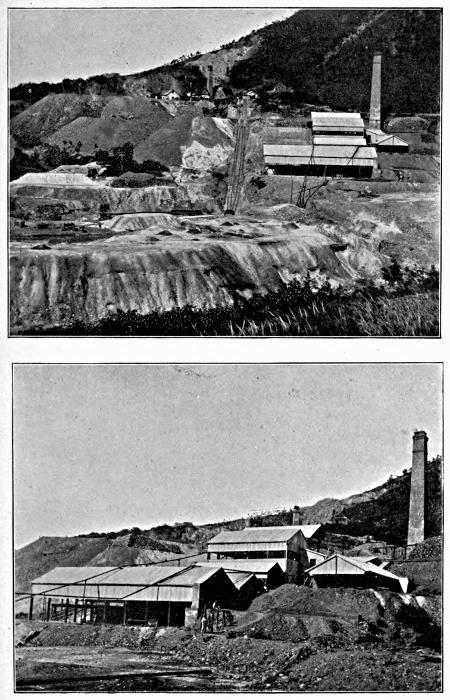
The Mines of the International Copper Co., Pilou, New Caledonia. There is a
greater variety of Metallic Ores within the area shown here than in any
other region in the world.
A very clever and experienced mining expert
once went over from Australia to make a survey
for the International, and after an exhaustive
examination he was shipped to London to make
a personal report to the Board. He knew as
much about mining as any one in the Southern
Hemisphere, but his language and deportment
were those of the bush and the mining camp.
A noble lord asked him if he could give any
estimate of the amount of copper, nickel, cobalt,
iron, silver, gold, etc., that might be found in the
Central Chain, and this was his answer:
“My lord, if you were to take all the ——
minerals there are out of those —— mountains
the —— island would —— well fall to pieces.”
The report was taken as satisfactory.
I brought some specimens away with me which
certainly seem to bear out his estimate. They
were the wonder and envy of several mining
experts in Australia. One of the specimens
weighs about three pounds, and I am told that it
contains about a dozen distinct kinds of minerals.
It didn’t come out of the mine. It was just
chopped off the surface for me with a pickaxe.
The mines are not at Pam. They are at Pilou,
about seven miles up the river. Here, connecting
the principal mining station with the wharf, is
the only other railway in Caledonia, which is
run by steam. It is a narrow gauge and about
five miles long.
That five miles is a journey through purgatory.
The attendant demons are little black and devilishly
businesslike mosquitos. Now, I thought I knew
something about mosquitos. They had lived off
me in many parts of the world from Delagoa
Bay to Panama, and Honolulu to Guayaquil, but
when I got to Pilou I found I hadn’t begun to
learn about them.
The air above the swamp over which the railway
ran was black with them, and their song made
the whole atmosphere vocal. They were all over
us in a moment. They even settled on the boiler
of the engine, and bit it until it whistled in its
agony. We were black with them from head
to foot. Clothing was no protection; and, of
course, ours was pretty thin. They just stood
on their heads and rammed their probosces down
into our flesh, usually along the line of a vein,
and sucked in our life-blood until they were too
gorged to get their blood-pumps out again.
By constant sweeping with green branches we
managed to keep our faces fairly clear, and do
our breathing without swallowing more than a
dozen at a time. Even the Kanakas, who are
not as a rule a favourite article of food with
mosquitos, had to go on swishing themselves with
boughs to keep the little black demons out of
their eyes and nose and mouth and ears.
As for me, I visited the camps and the mines,
and then I fled. I was a sight which my worst
enemy, if I have one, might well have looked
upon with eyes of pity. I had got a touch of
fever, too, in the swamp, and an illness in Pilou
was too terrible for contemplation. I would not
live in the place, rent free and with nothing to do
but fight mosquitos, for a hundred pounds a week.
The unhappy convicts who work the mines
were the most miserable lot I had seen in all
Caledonia. Neither by day nor night have they
any protection from the swarming pests, which,
as one or two of them told me, made their lives
one long misery. They sleep in open barracks
without mosquito curtains over their hammocks,
and by day their tormentors pursue them even
down the shafts of the mine.
It was the same with the officials and their
wives and children. They all looked anæmic, as
though most of the blood had been sucked out
of them. They were worried and nervous. Their
hands had got into a way of moving mechanically
towards their cheeks and necks and foreheads,
the result of long and mostly vain efforts to
squash mosquitos.
When we were going to have a meal a couple
of fire-pots, covered with green boughs, had to
be put into the room until it was full of smoke
and comparatively empty of mosquitos. Then
we went into the smoke, and the fire-pots were
put in the doorway. I wasn’t at Pilou long
enough to get used to being half-cooked myself
while I was eating my dinner, but even the smoke
in your eyes and lungs was a more bearable
affliction than the winged tormentors who seemed
to be a sort of punitive discount on the vast
mineral wealth of Pilou.
No one but very wicked people ought to live
there, and when they die their accounts ought
to be considered squared.
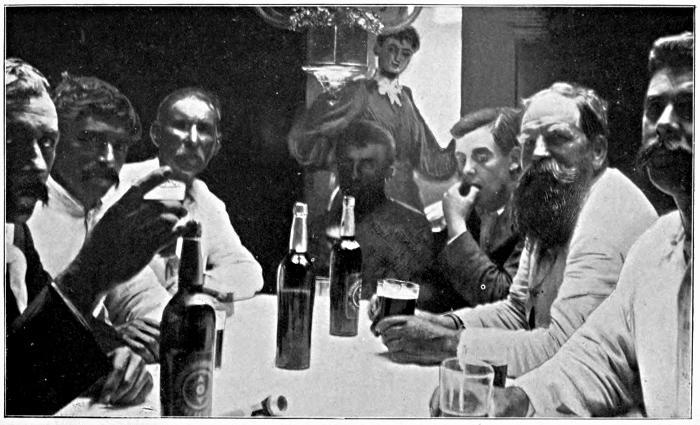
The Saloon of the Ballande liner St. Louis.
With eyes puffed up and almost closed; with
nose and ears and lips about twice their normal
size; with knuckles and wrists swollen and stiff—to
say nothing of a skinful of itching bumps—I
got back to Pam, and on board the cargo boat
on which I had booked a passage in Noumea.
We called her afterwards the Ballande liner
St. Louis. She was an exaggeration of La France,
and belonged to the same distinguished firm.
She was bigger and, if possible, dirtier. She also
smelt more, because there was a larger area for
the smells to spread themselves over.
No provision had been made for the eight
passengers who were doomed to travel by her.
The captain had no money or credit to buy
stores, and when I offered to lend him some,
he declined, in case his owners should hold him
responsible. The result was that the food we
ate on that miserable voyage made me look back
longingly to the days when I had eaten salt
horse and pickled pork in the forecastle of a
black-birder.
The decks were not washed down till the fifth
morning, when we reached Sydney Heads. Then
there was a general clean-up before the Medical
Superintendent came on board, in case a worse
fate than quarantine might await us. Up went
Yellow Jack again, and that afternoon saw us
anchored off the quarantine station at North Head.
I have been in prisons of many sorts, but that
quarantine taught me for the first time what
imprisonment really means. The penalty for
leaving the St. Louis without authority was £300
fine and six months’ hard labour—so there we
were for eight days and nights of about one
hundred and fifty hours each.
On one side there was the quarantine station—about
as beautiful a land and seascape as those
about to die ever took a last look from at earth
and sea and sky.
On the other hand, the varied beauties of
“Our Harbour,” with Manly Beach to the northward,
North Shore with its red-roofed villas
sprinkled among the trees; and, away in the
dim distance, the spires and chimneys of Sydney.
A couple of hours would have taken us to it,
but as we looked at it with longing eyes,
thinking of what a cocktail at the bar of the
Australia Hotel would taste like, it might just
as well have been twenty thousand miles away.
It was during those eight days of mingled
dirt and discomfort, cursing, and cribbage that I
saw as curious a contrast between life and death
as you might search the wide world over for.
On the starboard side, which is the right-hand
side looking forward, lay the route of the
excursion steamers running between Sydney and
Manly Beach.
They came past at all hours of the day, and
they came near enough for us to hear strains
of stringed and wind instruments, which brought
back memories of the dear old Thames with
painful distinctness.
On the port side, with almost equal frequency,
there came a green-painted, white-awninged launch,
flying the Yellow Flag and carrying corpses, “cases,”
and “contacts” from the depôt at Wooloomooloo.
As she rounded into the jetty she whistled. Day
and night for eight days and nights we heard
that whistle—and the meaning of it was usually
death. But you get hardened to all things in
time, and before our durance vile ended we had
got to call her the Cold Meat Boat.
One day the Medical Superintendent of the
station acceded to an urgent request made by
myself and a fellow-passenger. Neither of us
had washed properly for six days, and so, after
a little discussion and many promises, he let us
go ashore that we might enjoy ourselves under
a hose. We douched each other for more than
half an hour, and then we went to stretch ourselves
on the beach—a silver-sanded rock-walled curve,
trodden by many feet which will never tread
earth again.
As we were coming back to the quay to go
on board we heard that never-to-be-forgotten
whistle again, and the green Death Boat swung
round the corner. One of the sanitary police
on the wharf put his hand up and waved us back.
In the stern there were about a dozen people
sitting. Forward there was a long shapeless
bundle lying on a stretcher. It was a case. The
others were “contacts,” friends, lodgers, and
relations who had lived in the same house with
the case. They had come to be isolated for ten
days, so that the microbe of the Black Death
might show whether or not it was in their blood.
They were taken out of the boat first. Their
own feelings didn’t matter, for the Black Spectre
takes no account of human affections, and permits
no other to do so. They were marched away
to the quarters set apart for contacts. No farewells
were permitted, just a look that might be
the last, and that was all.
Then the stretcher with the long bundle on
it was lifted and carried on to the wharf. Meanwhile
the ambulance backed down to the shore-end,
the stretcher was put into it, and it drove away
up through the trees to the hospital. The next
journey of that particular “case” was to the
cemetery four days afterwards.
When we got back to our floating prison I told
the chief engineer what we had seen on shore, and
he said in very epigrammatic French:
“Quite so! What would you? You are a
human being till you take the plague; after that
you are an outcast, a thing separate. You live
and get better; you die and are buried that’s all.”
And, as it happened, the very next day brought
an all-too vivid illustration of the truth of this
saying. About ten in the morning we heard the
“woo-hoo” of the Death Boat’s whistle.
There was only one passenger this time, and
he travelled in a coffin. A common two-wheeled
cart backed down to where the ambulance had
been the day before. The coffin was carried to it
and put in just like any other sort of packing-case
might have been. The driver whipped up his
horse, and we watched the cart with its load
of coffin, corpse, and quicklime, trotting up the
winding road which leads to the burying-ground
of North Head.
I have seen many funerals in a good many places
from Westminster Abbey to Wooloomooloo, but
this one was the simplest and the saddest of
them all.
Away on the other side of the bay, wife and
children, brothers and sisters and friends were
mourning—and there was the indescribable Thing,
which two or three days ago had been a man,
being carted away to be dropped into a twelve-foot
hole in the ground—buried like a dead dog,
because it had died of the Black Death instead of
something else. From which you will see that
the Black Death has terrors for the living even
after it has claimed its dead.
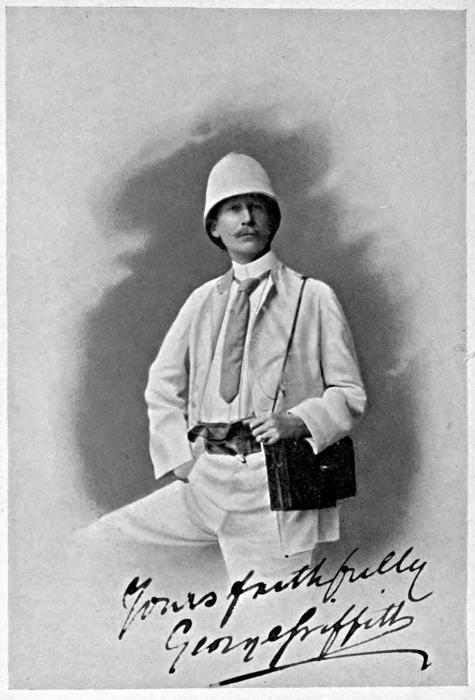
 1901