I PROPOSE TO GO INTO THE FOREST TO HUNT—ROTEMBO
PROMISES ME THREE GIFTS—ROGALA,
THE FAMOUS HUNTER, THE FIRST OF THEM—DESCRIPTION
OF ROGALA—ANDEKKO, THE DOG, THE
SECOND GIFT—NDOVA, THE MONKEY, THE THIRD—HOW
NDOVA WAS CAPTURED AND REARED—I GIVE
ROTEMBO SOME OF MY HAIR.
One day after I had been in the village some time,
being in the house of Rotembo, I said to him:
"I have been with you quite a while, and I wish now
to go far into the forest. I wish you to give me a
man whom you trust, a great hunter, who is not afraid
of danger and who can face with his gun the most
ferocious beasts of the country. He and I will live
together in the forest."
Rotembo looked at me with great astonishment, for
he wondered why I wished to go and live in the forest
by myself with only one man.
He remained silent for a minute or two, thinking
deeply; then he said: "Oguizi, I will give you three
gifts to go with you in the forest."
"What are they?" I asked.
"I will not tell you now," he replied, "but you
will know when they are before you."
Then we separated, I wondering what were to be
the three gifts Rotembo was to give me.
Four days passed by, and on the fifth, while I was
seated by the side of Rotembo, a strange-looking man
came before him, and bending very low took hold of
his foot and said: "To do your bidding your faithful
slave has come."
I looked at the man with great curiosity, and learned
that his name was Rogala and that he was one of the
most famous hunters in the country.
Rogala was of medium height and exceedingly well
proportioned. His legs and arms were very muscular
and as hard as wood. His chest was broad, and his
hands and feet were small,—a very common occurrence
among the people of the forest. His eyes were full
of fire and daring. He had a fighting chin, and he
appeared to be about forty years old. Scars upon one
of his legs told where a leopard had once wounded
him. He wore a huge head-dress of eagle's feathers.
His eyelids were painted red, and a red stripe from
the nose upward divided his forehead in two parts.
The face was painted white, and on each side of the
mouth were two round red spots. He was covered
with mondahs, or charms. One of these protected
him against witchcraft; another made him invulnerable
against bullets, spears, or poisoned arrows—in a word,
every one of them protected him against some evil or
other.
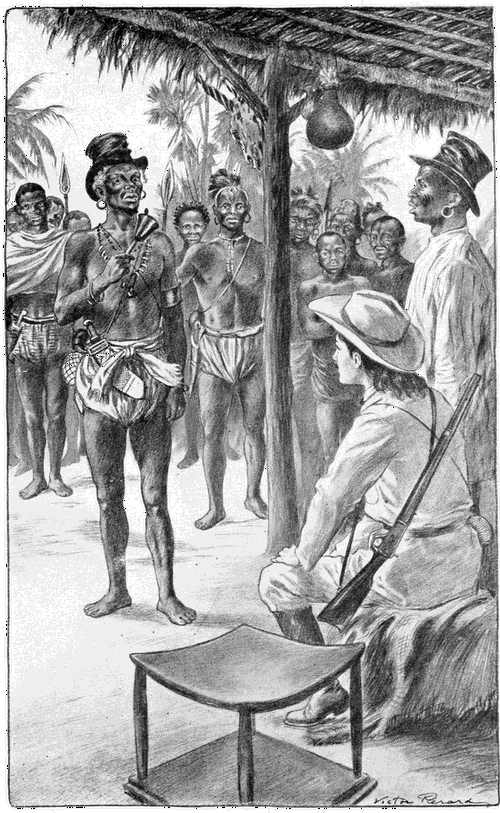
Rotembo said to me: "I can trust Rogala more
than any other man in the country. I bought him
when he was quite young, and he has forgotten
the language of his tribe. He faces without fear the
ngina (gorilla), the elephant, the leopard, and the
fiercest bear of the country. He has killed during
his life more than one hundred elephants and he has
kept all their tails as proofs. The number of hippopotami
that have fallen under his gun is very great;
the necklace I wear round my neck is made of the
canines of some of the leopards he has killed."
I counted forty-eight of them; so Rogala had killed
twelve leopards for the chief's necklace. He himself
wore one with twenty-four canines; so before
me were the witnesses of eighteen leopards that he
had killed.
As I looked at Rogala, I said to myself: "He is
just the kind of man I should like to take into the
forest with me."
"Rogala is one of the three gifts I have promised
you," said Rotembo.
I thanked the chief for the gift of Rogala, whereupon
he said to him: "You know that I have always
treated you well. Several times when I wanted to
marry the daughters of chiefs they said, 'Only upon
one condition can you marry my daughter, and that
is, that you give me Rogala.' I always refused them,
for I would not part with you."
I did not wonder at it, for if Rogala had killed over
one hundred elephants, the barter of their tusks had
brought wealth to Rotembo.
"I have given you to the Oguizi while he is in my
country," continued the chief. "You must take care
of him as you do of me. You must follow him in
the forest. You must sleep by his side. You must
face the wild beasts with him, and show him that
Rogala's heart knows no fear. Put no shame on me
by running away before danger; if you do you might
just as well die in the jaws of a wild beast, for I
myself will kill you. He is my Oguizi, and I love
him. See that he is never hungry or thirsty."
While the chief was talking, Rogala listened reverently.
When Rotembo had done speaking, Rogala
said: "Chief, the best of masters, Rogala always does
what you order him to do. I will do all you say,
and follow the Oguizi wherever he goes, and live with
him in the great forest and hunt with him. I will
take care of him just as if he were my sweetheart."
"Rogala," said I, "I will be your friend. When
we get into the forest, we will be like two men who
are born the same day." Among the Africans of the
great forest, when two men are born the same day,
they are foster brothers.
"Good indeed you are, Oguizi," replied Rogala.
"I will obey you in everything."
Then I presented him with a big hunting-knife,
which pleased him greatly.
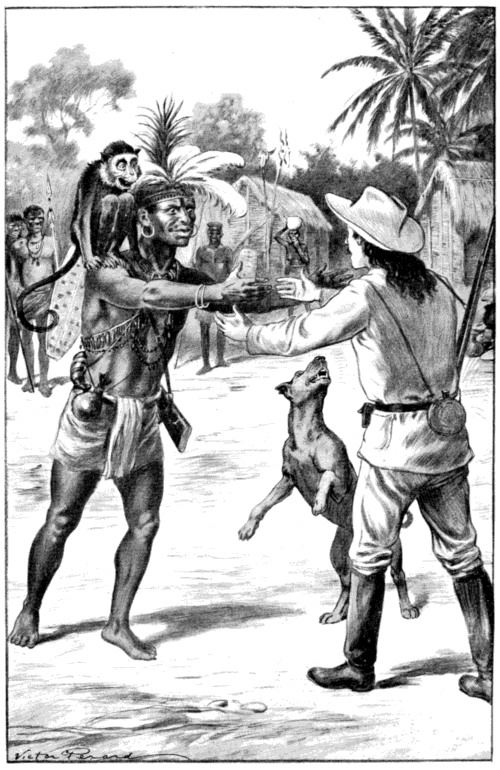
The following day, while I was seated by Rotembo
under the veranda of his house, I saw Rogala coming
towards us. He had with him a very strange-looking
dog.
Rotembo said to me: "Look at this dog. His
name is Andekko. He is fearless and always in the
thick of the fight. He is not afraid of any wild
beast. In war he always warns us of an enemy hiding
in the jungle. He is the best of hunting dogs.
He goes into the forest all alone in search of game,
and will drive the antelope or gazelle up to Rogala
or the hunter he knows, even if it takes him the whole
day to do so. He has captured several young nginas
and nshiegos after their mothers were killed, and gone
into the lair of leopards and killed their young.
The wonder is that he has not been killed by a
gorilla or leopard long before now or been gashed in
two by a boar or disabled by monkeys. Many times
he will prevent you from being hungry while you are
in the forest."
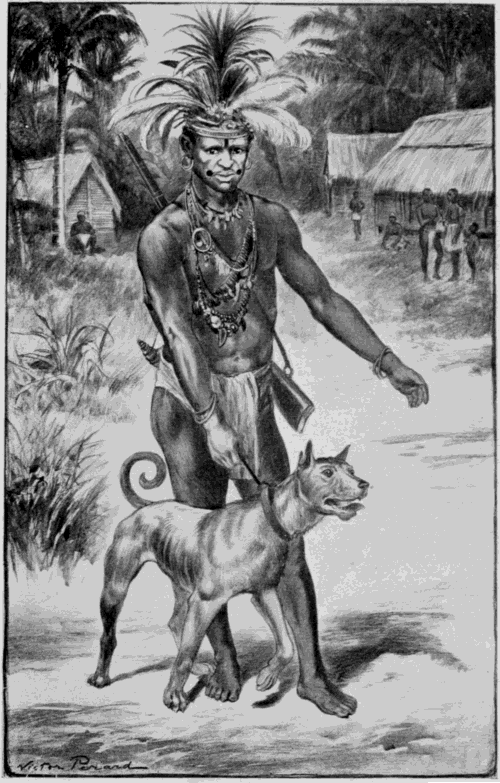
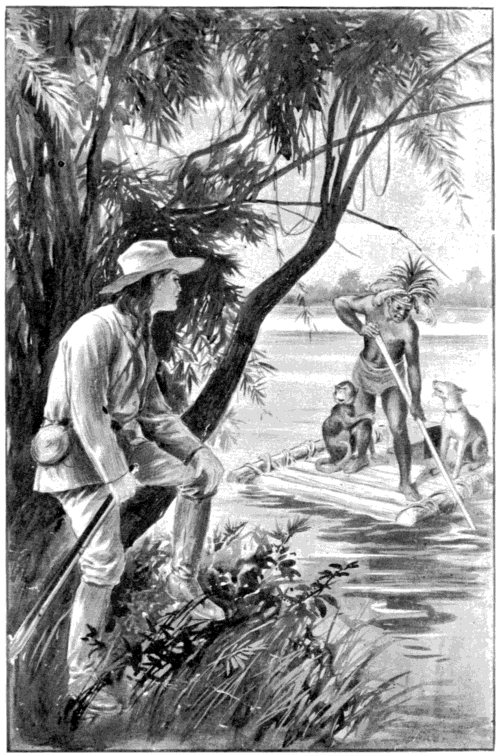
Rogala and Andekko.
I gazed at Andekko with wonder, he looked so
very ugly. He was covered with scars, marks of the
wounds he had received in his conflicts with wild
animals. One of his ears was split in two. His
upper and lower lips were also cut on the left side.
These two wounds had been made by a large monkey,
called a mandril, which often walks on the ground
and had been surprised there by Andekko.
Rotembo, seeing that I was looking at the scars
of Andekko, said: "Oguizi, when wounded, this
dog becomes even fiercer and more courageous than
before. He is famous for his courage."
Andekko belonged to the same family of dogs as
those that had gone gorilla-hunting with me at
King Mombo's plantation. His hair was of yellowish
color, and he had a white spot on his throat. His
tail could not have been more curly, and he was
quite lean; his legs were somewhat long.
Then Rotembo said: "Oguizi, Andekko is the
second gift I promised you."
The next day Rogala came again, but this time with
a monkey called Ndova. He was a fine creature, with
a nice coat of hair and a white nose. The chief, pointing
to the monkey, said: "His name is Ndova, and he
has the intelligence of a man. He goes with Rogala
into the forest. We have given him the name of
Ndova because the species of monkeys to which he
belongs is so called. You will not often be hungry
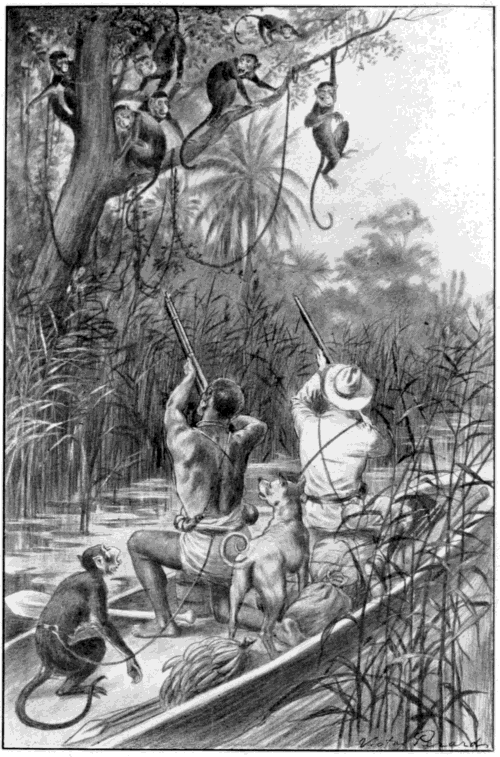
in the forest when Ndova is with you, for he will call
upon other ndovas to come to him while he stands
close to you and Rogala, and when these come you
will shoot them. You will have plenty of monkey
meat to eat. When monkeys are fat," he added,
"they taste fine, especially if they are broiled on a
bright charcoal fire. While living on my plantations,
I often take Ndova with me. He can only call on
his fellow ndovas, for the other species do not understand
his talk.
"There will be days," added Rotembo, "when you
will find no monkeys or other game and hunger will
come upon you. Then Ndova must follow you.
There are many kinds of fruits, berries, and nuts
in the forest; these look very tempting, but several
of them are very poisonous, and people die if they
eat them. So when you see any fruit, berries, or nuts
you do not know, do not eat them until you give
them to Ndova first. If he eats them, these are also
good for you."
"Monkeys never make a mistake; they have a gift
which no man possesses. By the sense of smell they
can tell if a berry, nut, or fruit is poisonous. They
always smell a thing they do not know before eating it,
and when it is poisonous they throw it away. If it
is not poisonous, they give it a bite. In that case
what is good for the monkey is good for the man.
But I must tell you that often the nuts, berries, or
fruits a monkey likes men do not like, for monkeys
and men have not always the same taste."
After hearing the words of Rotembo I looked with
renewed curiosity at Ndova. He was almost as
large as Andekko. His nose was white, which contrasted
strongly with the color of his dark hair tipped
with whitish gray. He had long canine teeth. I was
glad to hear he was gentle, for I should not have liked
to be bitten by him.
"Oguizi, I give you Ndova," Rotembo said. "He
is the third gift I promised you. I think you will
get on well in the forest with Rogala, Andekko,
and Ndova. There are two other of my slaves who
are also great hunters. Their names are Shinshooko
and Alapai. These three men live close together in
the forest and spend their lives in hunting; they
have their families with them.
"I got Ndova in the following manner," he continued.
"I and my slave Rogala were hunting
together near the plantation where you are going.
We were lying in wait for boars, when finally we
heard their grunts. We heard at the same time
the chatter of monkeys above our heads. The boars
came in sight and we fired. Then, to our astonishment,
a little monkey fell from the tree above our
heads. The firing of our guns had frightened his
mother, who dropped him. He did not have the
strength to hold on to the branches. I seized the
little fellow and put him into my bag. The mother
followed all the way back to the plantation, uttering
cries of distress and anger. Sometimes she would
come down to the ground, look at us, and go up
into the trees again. She did not dare to approach
too near us. After coming to the house we fed the
little monkey with the milk of a goat and called
him Ndova. His mother at the same time remained
on a commanding tree close by, calling the little fellow.
Soon she was joined by her mate, who added
his calls to hers. They slept on a tree near the
plantation that night, and we kept the baby in the
house. At daylight the two big monkeys were still
on the same tree, and uttered cries of anguish and
distress, calling for the little fellow, but did not
dare to come down.
"Three days passed and we thought little Ndova's
mother had got tired and gone away for good into the
forest, leaving her offspring to his fate, for we no
longer heard her cries.
"We made a little bed of leaves and used to leave
Ndova upon it in the sun. We had gone into our
huts one afternoon. After a while I came out of the
house and just in time. For Ndova's mother had
apparently been watching from a tree and seeing nobody
had come down and had taken hold of Ndova
and was carrying him away into the forest as fast as
she could. I shouted with all my might, and Ndova
lost his hold and dropped to the ground.
"We went into the forest and made a trap to catch
the mother, and brought the little monkey and put
him in the trap. We were then sure that she would
come and see him and try to get him away. When
everything was ready, we hid and waited. After a
time we saw a monkey quietly coming down a tree.
It was the mother; we recognized her by her white
nose. She uttered a sound of joy as she approached
Ndova. Then she got into the cage, and the trap-door
closed behind her.
"When we came towards the cage, the big monkey
was much frightened. We took the cage with us.
"The mother nursed the little one for over ten
moons (months), and after that she stayed with him
until she died. By that time Ndova could take care
of himself, and had learned the language of the ndova
monkeys from his mother.
"After the death of his mother, Rogala took
Ndova, who had grown fond of him, into the forest
every day, to find food for himself, leading him by a
string. Often the monkeys of his kind would come
around above his head and talk to him, and Ndova
would answer them. After a time Rogala tied a long
rope to Ndova, so that he might go higher up the
trees after fruits. Then came the time when Ndova
could talk very loud and call other ndovas to him,
and Rogala found that Ndova had become very useful.
Rogala, Ndova, and Andekko are now three inseparable
friends. Ndova and Andekko are great chums,
for they love to play together."
I thanked Chief Rotembo for his valuable gifts, and
said that they would be of great service to me, and
promised that when ready to leave the country I
would return Ndova and Andekko to him.
When Rogala heard these words, a broad grin of
satisfaction overspread his face. He was the keeper
of Andekko and Ndova, both of whom were his constant
companions. He was afraid that Rotembo had
given them to me for all time.
I gave a bone to Andekko, who was inclined to
growl at me at first, and a ripe plantain to Ndova, who
gave a peculiar "Oh oh" to show his joy. I found
afterward that Ndova was very fond of ripe plantains
and bananas.
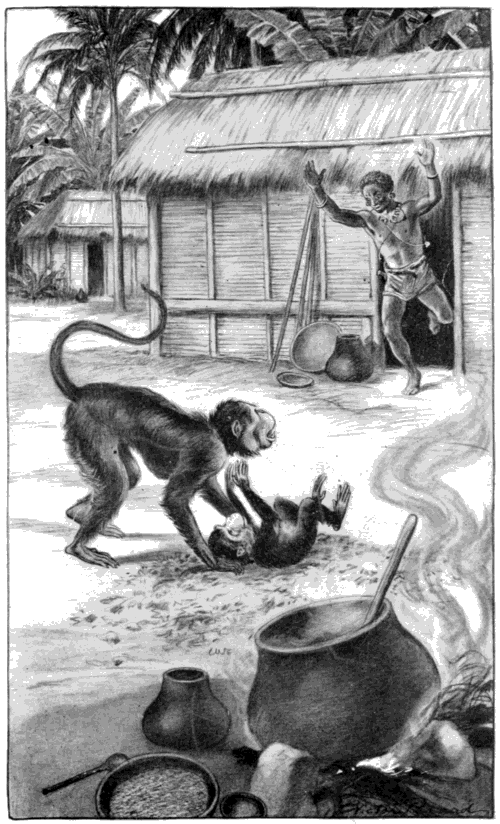
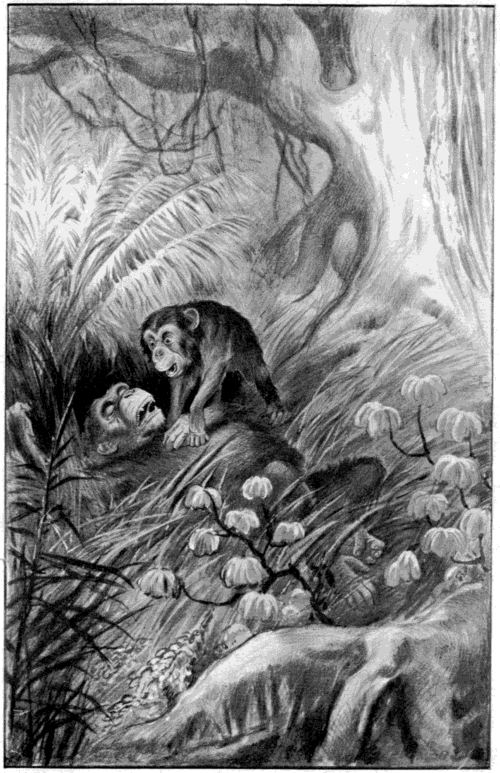
Ndova's mother tries to carry him away into the forest.
"I will feed Ndova and Andekko often," said I
to Rogala, "so that they may get accustomed to
me."
I often think that if it had not been for Andekko
and Ndova I should probably have died of starvation
in the great forest.
A few days afterwards Rotembo came to me and
said: "Oguizi, I want you to give me some of your
hair. I shall consider this the greatest gift that I have
ever received."
My hair had become very long and hung over my
shoulders. I had let it grow, for it excited great
wonder among the natives. It was very black and
silky. So I pulled out half a dozen hairs and presented
them to Rotembo. As soon as he received
the gift, he muttered words I could not understand,
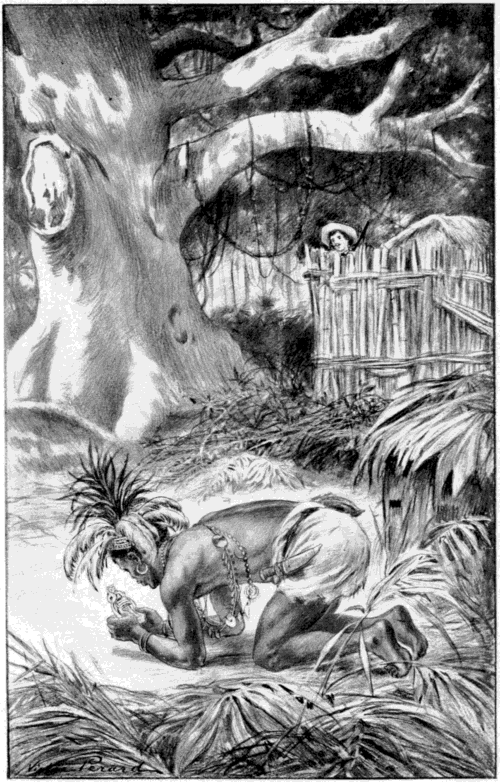
then took his little idol from the bag that always
hung by his side, and wound two of the hairs round
and round its neck. The four others he carefully
put aside in a little wooden box. After this he
looked perfectly happy, and said to me, "Oguizi,
the six long hairs you have given me are more
valuable in my eyes than many tusks of elephants,
brass kettles, wives, or slaves."
I often wished I had had flaxen hair and blue eyes
instead of black hair and hazel eyes, for I should
then have appeared still more wonderful in the eyes
of these wild and savage men.