THE history of mining in Spain would fill a dozen books, each twelve
times as large as the present volume, and even then only the half, if so
much of the story, would be told. It would form a narrative that would
combine tragedy and romance, and present a moral as stern as humanity
has ever been asked to peruse. The mineral wealth of the Peninsula was
responsible for the origination of the African slave trade, for the
demolition of Carthage, for the decline of Rome, for the sacrifice of
lives innumerable, for tortures unspeakable, for crimes that are without
parallel in the annals of the world. In ancient times Spain was ravaged,
plundered, and depopulated to provide Carthage with the spoils that were
to make her the prey of the Romans, who, in their turn, were to be
lulled by wealth and luxury into the deadly sleep of degeneracy that
precedes decay.
It is probable that the beginning of the history of precious metals may
be traced back to India, although it is commonly assigned to Greece
about 900 B.C.; but the earliest specific mention of gold or silver
mining in European history is derived from the story of Cadmus, a
Phoenician, who mined for copper and gold in Thrace in 1594 B.C., or
thereabouts. Jason, another Phoenician, journeyed as far west as
Sardinia in search of precious metals in 1263 B.C.; and it is known that
the Phoenicians were working the gold placers of the Guadalquiver
previous to 1100 B.C. The means of winning the gold—the only mineral
that was exploited in those days—were both limited and arduous, and
some time between 1200 and 500 B.C. (it is impossible to compute the
period more exactly) the auriferous resources of Spain were thought to
be exhausted. The results of Phoenician mining enterprise must have been
considerable, for about B.C. 500 Darius, of Persia, undertook and
successfully executed a military expedition against Phoenicia for the
purpose of acquiring the metallic treasure, which its adventurers had
carried away from Spain. Some portion of this hardly-won stock of
bullion found its way back to Europe some two centuries later when
Alexander the Great plundered Persia.
Spain did not benefit in the slightest degree by the earliest discovery
of her auriferous riches; and when her silver resources were disclosed,
they provided the Carthaginians with a further incentive to pillage and
plunder the country which was cursed by the possession of her coveted
mineral wealth. Between 480 and 206 B.C. the silver mines were worked by
the Carthaginians, who stored their spoil at Carthage against the
coming, in B.C. 146, of the plundering Romans who captured the city,
rifled its treasure houses, and either sold its myriad inhabitants in
the slave markets of Rome, or condemned them to the hideous labour of
the Spanish mines. Spain was to the Ancients what Mexico and Central and
South America became in later ages to Spain—El Dorado, the land of
gold, the richest mining country of the world; and the nearer history of
Mexico and Peru—the fate of its aborigines, the subsequent struggle
among leading nations for the mastery of its precious metals, the
destruction of its soil, the neglect of its agriculture, and the
resultant poverty and decay of its population—is no more than a
repetition of the ancient history of Spain. The aborigines were easily
brought into a state of subjection by the disciplined and well armed
soldiers of Carthage, who reduced them to slavery, and compelled them,
with every accompaniment of savage brutality, to explore and work the
mines.
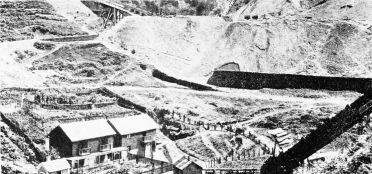
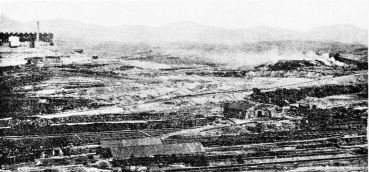
TERMINUS OF THE MINE RAILWAY, RIO TINTO.
“These people,” says Didorus, “though by their labour they enriched
their masters to an almost incredible extent, did it by toiling night
and day in their golden prisons. They were compelled, by the lash, to
work so incessantly that they died of their hardships in the caverns
they had dug. Such as by great vigour of body continued to live, were in
a state of misery which rendered death a preferable fate.” Again
Didorus, in describing the conditions under which mining was carried on
at this period, tells us that infinite numbers of slaves of both sexes
were thrust into the mines, kept at work night and day, and guarded so
strictly as to make escape an impossibility. Naked, maimed, and sick
they laboured on beneath the lash of the brutal overseers without rest
or remission. “Neither the weakness of old age, nor the infirmities of
females,” says this authority, “excuse any from the work, to which all
are driven by blows and cudgels, until borne down by the intolerable
weight of their misery many fell dead in the midst of their insufferable
labours. Deprived of all hope, these miserable creatures expect each day
to be worse than the last! and long for death to end their griefs.”
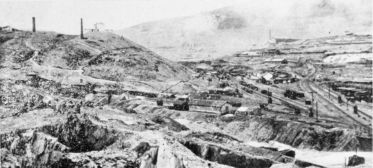
THE CANAL SYSTEM, RIO TINTO.
The mortality among the workers in the mines of Spain at this period
must have been appalling, and the conditions were calculated to decimate
the entire race. Soon it became necessary to recruit the fast thinning
ranks of native labourers with imported workers, and these were brought
in thousands from Africa. Negro slaves had previously been introduced,
to a small extent, into Etruria; but the traffic had not hitherto
attained the gigantic proportion that it was then to assume. Jacob, in
his History of the Precious Metals, says: “This oppression and
exhaustion of the native labourers led to a trade in human beings which
was carried on by the Carthaginians with the interior of Africa, and
supplied to Andalusia the place of those native workmen who had been
destroyed by the excessive toil imposed on them by their Asiatic
intruders. This horrid traffic was extended and continued, and it
augmented the produce of the mines of Spain in such a degree as to have
an influence on the whole commerce of the world at that period. That
influence was continued for upwards of seven hundred years, until the
Government of the Romans, who succeeded the Carthaginians in the mastery
of Spain, had fallen into the hands of the Gothic monarchs.”
The spoils which Phoenicia had won from Spain led to her spoilation by
Darius of Persia, in the fifth century before the Christian era; three
hundred years later the silver hoards of Carthage excited the cupidity
and envy of Rome, and Spain, which provided the booty, was wrested from
the Carthaginians by the armies of the Commonwealth. Up to B.C. 400,
when mining in Spain was reduced to a regular system, and the output was
enormously increased, Carthage was able to utilise her silver in her
Indian trade; but with increasing returns the necessity arose for
establishing other markets for her precious metals. In Carthage and in
Rome the numerary money system still obtained, but about this date the
Carthaginians adopted silver currency and endeavoured, but with little
success, to dispose of their surplus supplies of silver by offering them
in the markets of Rome. But Rome still held to her copper tokens, and
was as yet free from the fatal influence of the mines. “Rome trusted to
itself and its sword,” says Heeren in his Researches, African Nations,
“Carthage to its gold and its mercenaries. The greatness of Rome was
founded upon a rock; that of Carthage upon sand and gold-dust.”
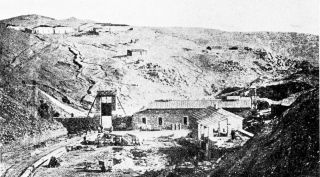
PORTION OF WORKS, AND SAN FERNANDO VILLAGE, HUELVA.
But the increasing volume of the trade of Carthage with the Orient did
not keep pace with her ever-multiplying returns of silver. Carthaginian
silver made its appearance in Italy, and the jealous eye of Rome was led
from Carthaginian silver to Carthage and its hugely profitable Indian
trade. In B.C. 264 began the first Punic War, which cost Carthage the
islands of Sicily, Sardinia, and Corsica—all of them mining
countries—and an indemnity of 1,200 talents of silver. Three years
after Hamilcar Barca, on the plea that the extension of the
Carthaginians’ arms into the interior was necessary in order to make
good the loss of the mineral-producing islands ceded to Italy, conducted
a marauding expedition through Spain. This campaign of conquest and
slaughter culminated in B.C. 219 in the sacking of Saguntum (the modern
Murviedro), a Greek colonial city and furnished Rome with the pretext
for another war against Carthage. In B.C. 269, prior to the first Punic
War, Rome had formally adopted silver as a portion of her monetary
system; and the demand for the metal made it necessary for her to
devise some means for ensuring a larger and more regular supply than she
could obtain from her own mines or by purchase. Italy’s growing commerce
with the Orient, which consumed all the silver at her command, hastened
the means to the end. The capture of Saguntum by the unauthorised
commandoes of Hamilcar Barca was the excuse upon which Rome declared the
second Punic War which, in B.C. 207, ended in the conquest of Spain, and
the final evacuation of the coveted territory by the Carthaginian forces
five years later.
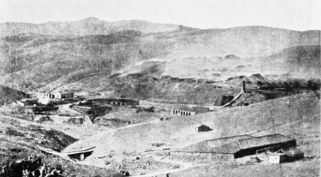
CEMENTATION VATS, HUELVA.
Carthage built her greatness on the spoils wrung from the mines of
Spain, and her fall is directly traceable to the same cause. As
Alexander del Mar says: “They corrupted the Government of Carthage, and
led to the neglect of military discipline and precautions; they
introduced a mercenary and gambling spirit into all enterprises; they
created monopolies of wealth; they impoverished the masses; they
occasioned the abandonment of those industries which had built up the
State, and they eventually so crippled its power, that in the memorable
contests that ensued with Rome for the mastery of these same mines,
Carthage was unable to successfully cope with its more vigorous
adversary.”
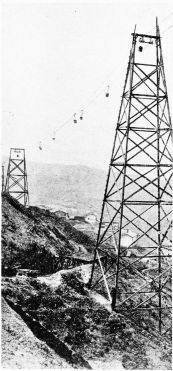
ORCONERA IRON ORE COMPANY, BILBAO.
There is abundant evidence to show that although the Carthaginians were
driven out by the all-conquering Romans, they left with the full
determination to return at some future time, and they took the most
careful precautions to hide their treasures from the eyes of the
invaders. The ancient workings that are attributed to Roman miners are,
in many cases, of Carthaginian origin; for it appears certain that
numbers of these well-developed mines were never discovered by the
Romans. The site of a mine at Córdova, for instance, was indicated by a
series of seven abandoned and rubbish-filled shafts, forming an
irregular row of workings. One or two of these shafts at either end of
the row had been tested without yielding any satisfactory results, and
when the property passed, at a nominal figure, into the hands of English
capitalists the manager received instructions to empty these shafts. He
started at one end and cleared three of the seven holes, only to find
that they stopped suddenly at a few yards from the surface. Then,
following the course that had been taken by the Romans and the more
recent Spanish proprietors, he began at the other end only to find that
the supposed shafts were no more than huge pot holes. Disappointed with
the fruitlessness of his efforts he wired to London, “Have cleared six
holes. No trace of lode.” The answer was instantly returned to the
despondent manager:—“Clear the seventh.” Acting on these instructions
the centre shaft was cleared, and at a little depth he came upon a
massive iron door which proved to be the entrance to the enormous
ancient workings which the Carthaginians had hidden for over two
thousand years by this ingenious device of digging dummy shafts, and so
giving succeeding generations the impression that the mine was a
worthless and abandoned prospect.
In the majority of these ancient workings in the copper mines that I
have inspected, tools of Carthaginian make had been found lying
scattered in the tunnels where the workmen had thrown them when they
made their hurried departure. One has only to glance from those enormous
catacombs to the implements with which the excavations were made to
realise the terrific difficulties of the task and the misery and almost
super-human labour that was involved in its accomplishment. Human blood
was spilt like water to gratify the mineral greed of the Carthaginian
conquerors. When the younger Scipio, carrying the war into the enemy’s
country, sacked and afterwards burned Carthage to the ground, 60,000 of
its citizens were sent to labour as slaves in the Spanish mines of which
they had so recently been the opulent masters.
Before the conclusion of the second Punic war Scipio returned to Rome
with so great a quantity of the precious metals captured by his forces,
that the Roman numerary system was finally abolished, and the complete
establishment of silver currency was effected. But the triumph of Rome
was the beginning of her end. She had crushed her great Carthaginian
rival, and gained her Indian trade; she had extended her possessions to
the Atlantic ocean, and made herself the owner of the greatest mineral
country of the world. But she had transferred to her own shoulders the
curse of Carthage’s decline when she assumed the Carthaginian mantle.
Public and private morality was demoralised by the accumulation of the
treasure in Rome; wealth was the precursor of corruption; and corruption
led to that gross luxury and social and political supineness which
sapped the greatness of the empire.
When the impairment of the stock of silver coins by export to India and
the surrounding countries necessitated larger and regular supplies of
the metal, Rome applied herself to the exploitation of her Spanish mines
with a vigour as great as it was pitiless. The native races and their
erstwhile Carthaginian masters worked side by side, and their ranks were
subsequently swelled by condemned criminals from Italy, and in later
times even by legionary soldiers. Jacob tells us that “the silver
procured by the Romans by these operations must have cost more than its
current worth; and, according to Polybius, the 40,000 workmen who were
constantly employed in the silver mines at New Carthage in Spain
produced only 25,000 drachmas (valued at under £1,000) per diem—a sum
that could scarcely have purchased more than sufficient to keep alive
the miserable beings who were immolated in them. Another reason why
these mines were worked at a loss at this time, if indeed they were, is
supplied by Del Mar, who points out that “when these mines were worked
by the Romans there already existed in their own markets a mass of the
precious metals that had been obtained at a cost which, reckoned in
blood and cruelty, was immeasurable; but which in mere pecuniary outlay
of labour, in killing and sacking, was as nothing. It was against the
competition of this mass of metals, which pecuniarily cost nothing,
that the mine owners had to measure their products in the Roman market;
and it is to be hardly wondered at that they found the industry
unprofitable. The Spaniards subsequently had the same experience in
America, and the Californians and Australians are repeating it at the
present time.
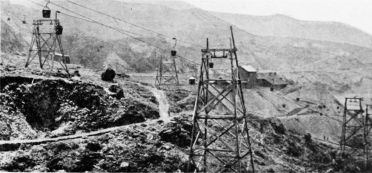
ORCONERA COMPANY’S WORKINGS, BILBAO.
The Romans also worked for gold the sands of the Guadalquiver, Darro and
Duero rivers, but with what results is not known. They also mined for
copper on a large scale, with, it is evident, the most gratifying
success. The mechanical resources at their command were limited, and
there seems no doubt that many rich mines were abandoned for want of
knowledge and the proper appliances with which to treat the ores. In one
instance, that of the Escurial Mines at Escurial, a huge lode carrying
rich copper was broken by a fault, and the Romans made no effort to pick
up the lode again. The present English owners penetrated the fault, and
found the lode of the original dimensions on the other side.
During the eight hundred years that Spain was under Arab domination, the
mines of Sardinia are believed to have been worked by the conquerors,
and they prosecuted their explorations for the precious metals on the
main land with some vigour. Yeats, in his History of Commerce, tells
us that in the eighth century the old silver mines, thought by the
Romans to be exhausted, were made to yield afresh by skilful working;
and the Spanish mines then furnished to the world the chief supplies of
precious metals. The Arabs exported quicksilver to Constantinople, and
it is possible that they extended the industry by opening up new mines.
Spain is so full of metals that, after being explored for centuries, new
mines are constantly being discovered; and perhaps the richest of all
the silver mines—the Hiendelæncina—was opened up in 1843. But what the
Arabs did in the way of discovery we have no means of ascertaining. They
are believed by Jacob to have re-opened the Roman silver mines in the
present French division of the Pyrenees, and to have worked the gold
mines at Lares, the silver mine of Zalamea in Andalusia, and that of
Constantina, near Cazalla. The hills of Jaen, upon which they
principally concentrated their exertions, are pierced with over five
thousand shallow pits, which are estimated to have been the work of five
centuries. Even the approximate amount of the precious metals obtained
as the result of Arab mining in Spain is a matter of the merest
conjecture.
It is curious to note that when Spain was at the zenith of her greatness
the wealth in which she abounded was not the result of the exploitation
of her own vast stores of precious metals, but the fruits of conquest,
bloodshed, and cruelties, similar to those which she had herself
suffered at the hands successively of the Phœnicians, the Carthaginians,
the Romans, and the Arabs. She had seen each succeeding nation of her
despoilers crumble into decay, but she failed to learn the lesson that
their disastrous endings had for her.
In her turn Spain crushed Mexico and Peru, and grew rich and powerful by
tribute and plunder to the neglect of her own resources and her ultimate
temporary ruin and submersion among the nations of Europe. Her own
metallic hoards were passed over—the treasure for which Carthage, and
Rome, and Morroco had fought and bled was neglected; while the methods
of the Roman and the Carthaginian conquerors were being practised upon
the people of the New World. The result is, that while Spain is to-day
recognised as the richest mineral country in Europe, her mineral assets
are in a more backward state of development than those of any other
European country.
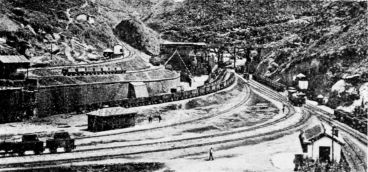
THE RAILWAY SYSTEM, BILBAO.
In the production of copper ore, lead, and quicksilver Spain heads the
list; she is second only to Austria-Hungary in the production of salt
and silver; her tin mines are at present almost untouched; while among
the less important minerals distributed over the Peninsula are
manganese, antimony, cobalt, soda sulphate, sulphate of barium
(barytes), phosphorite, alum, magnesia sulphate, sulphur, kaolin,
lignite. Gold is also found there in payable quantities; coal and cement
of good quality and in enormous deposits are present in the province of
Lerida; while the richness and extent of her iron resources in the
districts round Santander and Bilbao have long been recognised. With all
this vast mineral wealth within her boundaries, Spain should be one of
the richest, rather than one of the poorest of European countries. The
natural conditions are all favourable to the development of the
industry. Labour is cheap and abundant, transport facilities are mostly
good, and the mines are within easy reach of all the important markets
of the world. The working of the mineral resources is carried on under
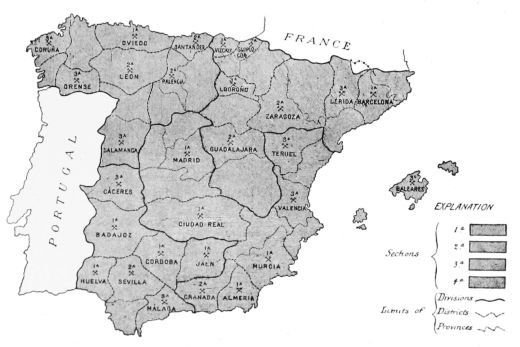
generous and encouraging State regulations. For this purpose the whole
kingdom is divided into three sections, and each of these into four
districts. Each section is under the charge of an inspector-general of
the first class, and each of the districts under an inspector of the
second class. There are no harassing restrictions to hamper the energies
of the mine owner, while the climatic conditions render it possible to
work the majority of the properties all the whole year round.
Yet with all this mineral wealth to hand, only waiting to be
systematically developed to yield immense returns, less than ten per
cent. of the population of Spain are engaged in its mining industries;
and between sixty and seventy per cent. are occupied in various branches
of agriculture, or in pastoral pursuits. The reason is not far to seek.
In many parts the country realises Mr. Stephen Phillips’s dream of that
fair land where
“Trees without care shall blossom, and the fields
Shall without labour unto harvest come.”
The Spanish peasant can tend his land to produce sufficient for his
needs, and allow him to be independent of his fellows. He is more
contented and happier, and his best qualities are more strikingly
evident when he is “on his own” than in the mass. Unregulated labour is
congenial to him, and if his earnings are small, his wants are few.
Agriculture appeals to his temperament and satisfies his needs. Mining,
however, demands capital which he has not got, and experience which he
has no means of acquiring. It is something which he does not understand.
The Spanish noblemen and landed proprietors who own the mines neglect
this source of revenue for another reason. Englishmen, nobles or
commoners, who possess mineral land do not hesitate to turn their
possessions to practical account; but the Spaniard has the greatest
aversion to anything that savours of trade. In England pig-iron is
aristocratic, though tenpenny nails still remain scarcely respectable;
in Spain wholesale and retail are alike beneath the dignity of the
aristocracy.
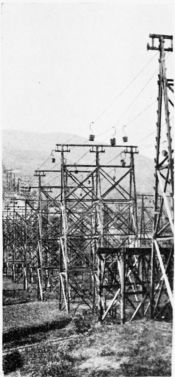
TRANSPORT OF ORE, ARCOCHA, BILBAO.
But, although since the days of the Ancients the minerals of Spain have
not been worked on the same enormous scale that was then adopted, the
industry has never been neglected to the extent that is generally
supposed. The majority of people cherish the delusion that since the
times of the Moors the metallic resources of the Peninsula have not been
exploited, and that the revival of activity that is now being witnessed
is a development of recent months. Nothing could be further from the
truth. That the eyes of English capitalists and investors have only
lately been turned upon this Bonanza is an indisputable fact; but in a
quiet unostentatious way the country has been mined without interruption
for centuries, and fabulous fortunes have been made by a comparatively
small number of people. And this select coterie of millionaire
mine-owners has, for years, managed to disguise the magnitude of its
operations and secure immunity from active competition.
Before the discovery of America thousands of mines were being
energetically exploited in Spain; new mineral discoveries were of daily
occurrence, and Royal Charters were granted by tens of thousands. But
the astounding richness of the mines of Peru and Central America enticed
whole armies of Spanish miners to the new Eldorado, and for a while the
home industry languished. Spain has never since re-attained its
commanding position as a mineral country in the eyes of the world; but
hundreds and hundreds of mines have been and are being worked by small
companies and private individuals, and the returns have been buried from
sight in official statistics and unpublished records. While the general
public were being kept out of the country as the result of this
carefully cultivated policy of suppression of facts, it was inevitable
that the plums should fall into the hands of a few wealthy monopolists.
The small local owners did not stand a chance. If they mined for copper
there was no market for their ore; the fall in the price of tin rendered
that industry for a while unprofitable, and the development of iron
properties necessitated the expenditure of more capital than the Spanish
proprietors could command. And the agents of the mammoth firms, who form
a close corporation for the exploitation of Spain’s mineral resources,
have been up and down the country, inspecting, and acquiring for ready
cash all the most promising properties. There has been no fuss, no
sensation, no publicity, and no incitement to competition. The direct
consequence of this condition of affairs has been to give currency to
all kinds of erroneous impressions with respect to the condition, the
profits, and the prospects of Spanish mining. A general belief has grown
up that the minerals have been largely worked out; that the difficulties
of transport, the vexatious mining regulations, and the paucity of
natural facilities have combined to spoil the industry—fallacies which
have been fostered by those whose interests were best conserved by their
promulgation.
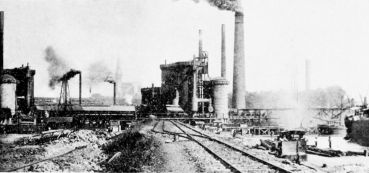
LOS ALTOS HORNOS DEL DISIERTO, BILBAO.
This condition of affairs has obtained very largely in the iron industry
of Northern Spain—an industry that is so widely known that it is
unnecessary here to make more than passing reference to it; but in the
Southern Provinces (principally) of Almeria, Granada, and Murcia, the
iron mines are being developed in the interests of a far larger number
of persons. Both foreign and Spanish capital is invested in the
enterprise, and many of the mines are fully equipped with wire tramways
and American waggons, and the promise of the future of the Southern iron
fields is well on its way to being realised. Foreign capitalists are
embarked in the venture which, until now, has attracted the attention of
few Englishmen; and, indeed, until recently Englishmen have only
possessed a vague idea of the magnitude and richness of Spain’s mineral
deposits. The French people realised it long ago, and attempted, in a
half-hearted and parsimonius manner, to develop them, but with only
indifferent success. Native enterprise proved even less satisfactory,
and the attempt of the Government to work the world-famous Rio Tinto
mines resulted in utter failure, and the sale of the property by public
tender in 1873. The Rio Tinto
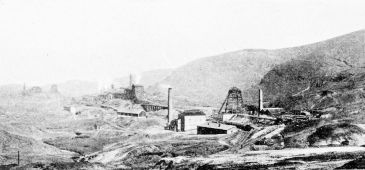
mines, like those of Tharsis, were extensively developed by the Romans,
and so perfect was the smelting process they adopted, that in the heap
of ancient slag on the surface hardly a trace of copper remains. The
Phoenicians and Carthaginians both worked the Rio Tinto property prior
to the advent of the Romans, and their galleries and shafts are found in
every direction and at every depth explored by the Moderns. Especially
on the North lode are found innumerable shafts and vast slag heaps, the
latter testifying to the great extent of their smelting operations. On
this lode are also to be seen the traces, now almost obliterated, of a
Roman town and a Roman cemetery; while upon the summit of the Cerron
Salomon (3,000 feet) are the outlines of a fortified enclosure covering
many acres. From the time when the Roman occupation was broken up by the
inroads of the Visigoths, until the middle of the sixteenth century Rio
Tinto fell into utter oblivion. The Moors apparently never directed
their attention to them. An attempt was made to reopen the mines under
Philip II., but the purpose failed, and for another two centuries the
property remain neglected.
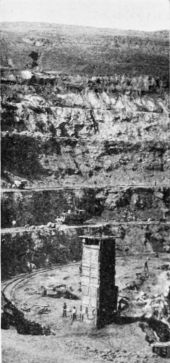
THE LAGO CUTTING, RIO TINTO.
Ultimately they were leased to a Swede named Liebert Wolters in 1725,
and the property reverted to the Crown in 1783. The Government at first
leased the mines, but the wretchedly unsatisfactory result of this
arrangement prompted them for a while to undertake the management. The
loss to the Government was so great that they disposed of the mines in
1872 for £4,000,000 to a group of capitalists, who formed the present
Rio Tinto Company. This company has developed the property on a vast
scale, and in accordance with the dictates of modern science. A railway
line has been constructed to Huelva, a distance of fifty-three miles,
terminating in a pier nearly half-a-mile long in the River Odiel. This
pier consists of two floors, used respectively for loading and
unloading. It has, at some portions of its section, ten lines of railway
abreast and above, and can easily berth five large steamers. The ore for
export is brought from the mines and shot directly into the ships’
holds. The quantity of pyrites extracted in 1901 was 1,928,776 tons, of
which 633,949 tons were exported. The sulphur ore shipped in that year
was 119,683 tons, and 21,100 tons of copper were produced by treatment
at the mines. Of the ore that is not exported a portion is worked up
into copper by the cementation process, and the remainder by smelting.
The sulphur fumes emitted by the roasting, which is a necessary prelude
to parts of the processes, had denuded the surrounding hills of every
vestige of vegetation before the company commenced operations; and the
so-called Hill of the Pines has not borne a tree for thirty or forty
years past.
At the Rio Tinto mines there are nearly fifty miles of railway above
ground and over ten miles underground, all of which are available for
locomotive traffic. The underground workings are all reached by adits or
galleries running in from the hill-side on different levels. Nearly
fifty locomotives are daily employed in these workings, besides those
used for the traffic to Huelva. The original town has been greatly
enlarged, and three or four separate villages have been built by the
company for the housing of their army of workmen, which numbers between
10,000 and 11,000 persons. Stores have been opened to supply the needs
of the workmen, schools have been founded and hospitals built, both at
Huelva and the mines, and forty armed guards, recruited out of the Civil
Guard, are maintained to preserve order and protect property. The
company has also constructed several reservoirs for the storage of
water, which is of such importance in copper mining. The largest of
these, which is about twice the area of the Serpentine, has a depth of
seventy feet, and a capacity of 2,570,000 tons, or 575,000,000 gallons.
These figures convey some impression of the vastness of the undertaking,
but another figure may be added, viz., the revenue of the company, which
last year amounted to upwards of £1,800,000. Of this sum over one and
three-quarter million sterling was profit on sale of produce.
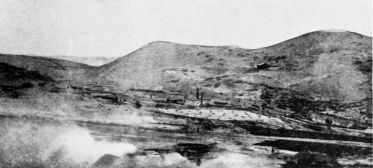
The Tharsis mines, though not such a remarkable proposition as the Rio
Tinto, form a notable property. They appear to have been practically
abandoned from the time of the Roman occupation until 1865, and were not
worked at a profit until they were acquired by the present Scotch
company. Since then, however, an enormous quantity of ore has been
extracted, and last year a total output of some 400,000 tons of metal
returned a profit of over £320,000. The mines are connected by a railway
twenty-eight miles in length with the pier station at Corrales, a short
distance from Huelva, on the opposite bank of the river Odiel. A fine
iron pier, 765 yards long, allows the ore for export to be carried
direct to the ships. The Tharsis mines and the Lagunazo mines are now
yielding considerably smaller returns of copper ore; but at the Calanas
mines the output is steadily increasing, and vigorous exploration work
in this portion of the property has disclosed, in addition to the
already proved resources of ore which can be profitably treated for the
production of copper, a large mass of low-grade ore, which, though
comparatively poor in copper is rich in sulphur.
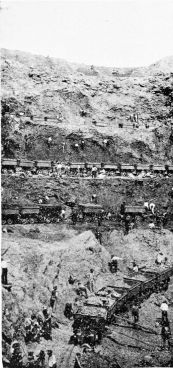
THE LAGO CUTTING, RIO TINTO.
The Rio Tinto and the Tharsis have been rightly regarded as the show
mines of Spain, and the former can, of course, hold its own among the
leading mines of the world; and, if it is unlikely that any other
Spanish property will rival this cupiferous wonder, there are many that,
under proper scientific management, will be found to be as relatively
rich and profitable. What is required in Spain is money for development
and brains to direct the operations. The existence of minerals, and of
copper particularly, has been demonstrated; and now that English capital
is slowly but in steadily increasing amount being invested in these
mines, a tremendous reaction in the industry may confidently be looked
for in this quarter of the globe. Within the past year or two quite a
number of promising properties have been acquired for the English
markets, and in every instance the results of the opening-up work have
more than realised the expectations of the proprietors. The company,
which was formed a short time ago to acquire an extensive property at
Coruña, is regarded by experts as a proposition of the highest
importance. Another company, called the Escurial Copper Mines, is
already working at a profit, and promises to give very large returns for
many years to come. La Recompensa Mines also appear to be rich in
copper, and the ore also contains precious metals, assays giving as much
as 12 ozs. of silver and 9½ dwts. of gold to the ton. An important fact
in connection with all these mines is that they are only distant two
miles from the Escurial Mines; consequently the cost of ore treatment
will be considerably reduced by reason of the proximity of large
smelting works now nearing completion. The latest reports from the
Huercal Copper-cobalt Mines, in the province of Almeria, all tend to
confirm the very high opinion which the English owners formed of their
value at the time they acquired the property; and the English-owned Rio
Rimal Mines in the province of Gerona are putting out very fine copper.
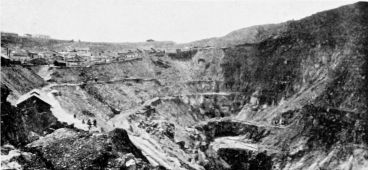
Among the other Spanish mines in which English capital has been
invested—and attention will be mainly confined to these in this
chapter—tin and silver-lead play a prominent part.
Although tin was smelted more than two thousand years ago, and some of
the first ore containing the metal was probably discovered by the
Ancients in that north-westerly province of Hispania, which the Romans
named Gallaeci, Spain is not to-day ranked among the great tin-producing
countries of the world. Pliny refers to Cornish tin, but most of the
metal contained in the ancient bronze weapons and objects must have been
derived from the Spanish mines. The ancient town of Orense, the capital
of the Galician province of the same name, which was founded by the
Romans, and greatly esteemed by them on account of its warm springs, is
the centre of the industry, and the country is scored and bored with
many indications of the enterprise and energy of the ancient miners.
Beariz, a little village in the mountains of Balcovo, is situated on a
hill that is tunnelled with Roman workings in what are probably the
richest tiniferous deposits in the richest tin district in Spain.
Enormous quantities of the mineral must from this mine alone have
rewarded the labours of the pioneers, who were so rudely interrupted by
the invasion of the victorious Visigoths, and no succeeding owners have
mined the property on the same gigantic scale.
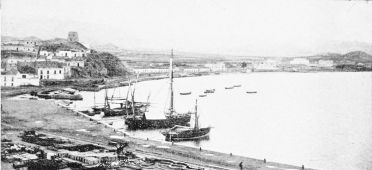
AGUILAS, THE PORT OF ALMERIA.
The tiniferous areas of Spain are enormous; and the alluvial tin-bearing
deposits, which extend for miles, are practically virgin ground. The
Ancients, who worked the tin lodes of Galicia, entirely neglected these
alluvials, and, more remarkable still, they have been neglected by every
succeeding generation ever since. The quartz mining, which entails an
enormous initial outlay in crushing and concentration plant, machinery,
and explosives, was prosecuted to a limited extent until the slump, and
the consequent fall in the price of tin, which caused the operations to
be conducted at a loss. Immediately every tin mine in the country was
shut down—the owners could only afford to work for quick cash profits.
Small private companies are now making large profits from quartz
mining—one company, of which nothing is heard by the general public, is
shipping from thirty to forty tons of tin per month—but alluvial tin
mining in Spain is only in its infancy. There are vast fields of
tin-bearing alluvials that can be treated hydraulically at a cost of 2d.
per ton, and yet there is not a single hydraulic plant, or a solitary
dredger in operation in the country. When these districts are in full
operation, when the tin fields of Beariz, of Arnoya, and Pontevedra and
of Salamanca are being washed on a large scale, as they will be very
shortly now, Spain will be near the head of the list in the production
of tin.
There are two important reasons why tin stands so low in the table of
Spain’s mineral output. In the first place the tiniferous areas are,
comparatively speaking, so few that, although they may yield fortunes to
their exploiters, the country can never compare with Australia and the
United States in the aggregate output. And in the second place, although
the tin is found in such exceeding richness that Señor Alfred Lasala,
the eminent mining authority, reported on the Beariz mines, “It is
almost impossible to cubicate the quantity of tin ore in these
concessions,” yet the properties can only be made to pay when the
mineral stands at a good price in the market. Spanish mine owners have
very strong views upon the absolute necessity of making the mines pay
their own way. The expenditure of capital in properly opening up the
mines, with a view to future regular outputs is never entertained.
“Spend nothing and get all you can without” is the motto they have
adopted. Consequently the amount of development work accomplished on
most locally owned properties is small, unscientific, and frequently
dangerous.
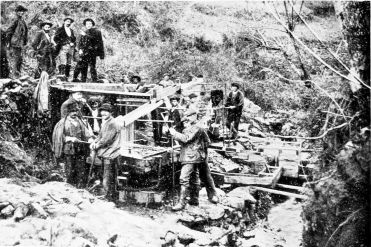
WASHING FOR ALLUVIAL TIN.
The silver mines in the neighbourhood of Jadraque, in the province of
Guadalajara, have supplied all the Spanish silver that has been coined
for generations, and the supply of the metal would appear to be almost
inexhaustible. The principal property in the district, called the
Hiendelæncina, was at one time in the hands of an English company, who
worked it for awhile unsuccessfully, and abandoned it when their
capital was expended. On the advice of the Spanish mine foreman—advice
which had been rejected by the English owners—the work was carried on
by a Frenchman, who acquired the mine for the price of an old song. The
lode was struck, as the foreman had predicted, and at the very spot he
had pointed out; and within a year the lucky French owner had sold the
mine for £160,000 cash.
Silver-lead, although not so widely distributed over Spain as are some
other minerals, is found in no fewer than half-a-dozen provinces; and
the industry is, generally speaking, in a healthy condition. In the case
of the mines of Granada, transport difficulties have had to be overcome;
and in Guadalajara, Murcia and Navarra, the want of capital and the
absence of scientific methods have militated against their progress. The
most favourable conditions for lead mining exist in the provinces of
Badajoz, Jaén, Córdova and Ciudad-Real, where foreign capital has been
more freely invested, and very large profits have already been obtained.
Such astute investors as the Rothschilds are heavily interested in these
latter districts, and of recent months several concessions have been
acquired for the English market and are now being developed with English
capital.
The number of Spanish mines that, having been abandoned by one set of
owners, have been taken over by other persons and profitably exploited,
is extraordinarily large—in fact, it might almost be said that there
are few important properties in the Peninsula that have not changed
hands at least once before enriching their proprietors. The Triumfo
Silver-lead Mine at Córdova is an interesting case in point. So much
fruitless exploration work was done on this mine that the French owners
had come to the conclusion that further endeavours would only be
wasted; but after listening to the combined entreaties of the Spanish
foreman and their French manager, they reluctantly agreed to continue
working for a few more weeks. Before the extension limit had been
reached, an enormous seam of silver-lead had been located; and the
output of the Triumfo to-day is only limited by the market requirements
and the obligations entered into by the company. In La Mancha there is a
silver lead-mine which a French company, after sinking an enormous
amount of working capital and failing to strike the lode, abandoned as a
“duffer.” On the representations of the Spanish mine captain, who never
doubted the existence of the lode at depth, the property was taken over
for a nominal consideration by some Scotch financiers. The Spaniard’s
sanguine predictions were speedily verified; and for the expenditure of
a trifling amount of further capital the Scotch investors acquired a
mine of extraordinary richness, which has been returning them enormous
dividends ever since.
In lead mining, the element of speculation is reduced to a minimum. In
other branches of mining, 60 per cent. of the properties are failures;
in silver-lead mining, 60 per cent. of the properties are successful.
And, in the case of the 40 per cent. of the silver-lead mines that turn
out badly, the explanation is that sufficient preliminary care has not
been bestowed on proving the existence of the lodes before commencing
operations. What may appear to be a lode may prove only a pocket; but
where proper precautions are taken, this risk may be eliminated. The
French engineers largely failed in their mining ventures in Spain for
this very reason. They made haste too quickly, as the Americans say, and
they were not expert economists. Then there is another favourable
element in lead mining—it can be conducted with only a shaft and a
winch—and as soon as the lode is reached, the mine commences to pay. A
very large number of properties are locally owned, and the mines of
Ciudad-Real, Badajoz, Jaén, Córdova, Seville and Almeria supply the
markets of Europe with lead. It is found in large lodes, it is cheaply
worked, and there is a ready market for the produce. It is, therefore, a
branch of mining that commends itself to the fancy of the small
capitalist; while the large capitalist is so eager to secure the ore
that he will even advance money on it before it is taken out of the
mine. The works at Peñarroya, and the smelting firms at Carthagena and
elsewhere, absorb the entire output.
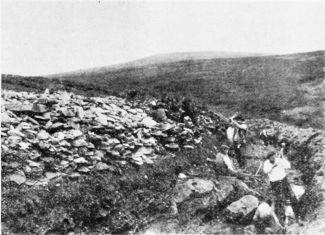
Amongst the important properties may be mentioned the San Antonio, Maria
del Pilar and San Teodoro (situated at Agudo in the Almaden district)
and the San Luis at Piedrabuena in the province of Ciudad-Real, and the
silver-lead mines of Santa Maria, in the province of Badajoz. These
latter mines, which have been proved to a depth of over 700 feet, and
are now fully equipped with machinery, are the properties of the Santa
Maria Mining Company.
There are extensive coal and cement stone mines at Almatret, in the
province of Lerida. The coal or lignite, which is of good quality, is at
present worked, and about eighty tons per day are being shipped. This
will, it is anticipated, be shortly increased to 200 tons per day. The
cement is suitable for constructive work; and experts who have reported
upon the properties have expressed their belief that it will be found to
approximate very closely to the composition required for true Portland
cement. The quantity of cement stones is said to be practically
inexhaustible.
One department of mining enterprise, which has remained unexploited from
the time of the Romans until the last few years, is that of alluvial
gold washing. The Romans washed for gold over a larger area, and on a
much larger scale, than the chroniclers of the times were aware of. Even
Jacob (1831) confessed himself unaware of the extent on which their
operations were conducted, for modern investigation had disclosed that
in the provinces of Lugo, and Orense, and Léon many of the rivers were
washed by them on a scale of almost incomprehensible magnitude. So
profitable must the operations have been that, in one case, the river
Sil was diverged out of its course by means of a cutting made through a
mountain spur in order that the river bed might be exposed for the
precious metal. Considering the primitive means that the Romans
possessed, this must be regarded as a gigantic engineering feat; and it
has been estimated that if 10,000 men had been engaged on the work it
would have taken many years to complete. Before 1100 B.C. the banks of
the Guadalquivir were worked for alluvial gold, and sometime before 500
B.C. the auriferous
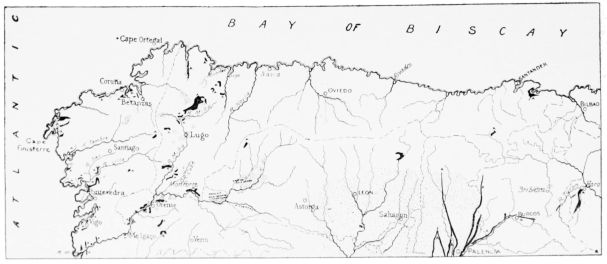
MAP SHOWING ALLUVIAL GOLD DISTRICT IN NORTH-WEST SPAIN.
Parts marked ^ and solid = Alluvial.
Parts marked by dots = Diluvial.
deposits of Spain were believed to be exhausted. But Pliny records that
in 207 B.C., when the second Punic war ended in the Roman conquest of
Spain, “the Asturias, Galicia and Lusitania furnished 2,000 lbs. weight
of gold (4,427 lbs. English weight) annually; but Asturias supplies the
most, nor in any other part of the world during so many ages has so
great a quantity been obtained.”
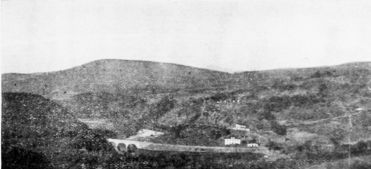
THE OLD GOLD WORKINGS, PARAMO.
In the case of other alluvial properties, water was brought in by the
Ancients from great distances by canals; and at Páramo, in Léon, the
ancient water channels are now used as country roads. Many of these
water-races are so substantially constructed that they could be repaired
at a comparatively small cost. Where these indications of previous
workings are observed, gold has always been found; and in the summer,
when the river channels narrow under the influence of the sun, the banks
of the Ouria, the Navia, the Sil and their tributaries, and all the
considerable rivers of these North-west provinces, are panned by the
country people, who get a very good return on their labours. Yet the
fact remains that while the existence of gold in highly-paying
quantities has been definitely proved, no systematic exploitation of
this rich source of auriferous supply has yet been attempted. In New
Zealand, scores of locally-floated gold dredging companies are reaping
rich and regular returns on a comparatively trifling outlay; in New
South Wales and Victoria, gold dredging has been carried on for years
with most satisfactory results; and in California, alluvial mines worked
by hydraulic sluicing methods give handsome profits from alluvial
carrying only about four grains of gold per cubic metre. Even in
Australia, where the water has to be pumped, the cost of treating the
alluvial does not exceed 6d. per ton.
In Spain, the conditions are immensely more favourable to profitable
working, while the gold-bearing alluvial is very much richer than that
of Australasia or America. The concessions are held direct from the
Spanish Government in perpetuity at a nominal yearly rental. The most
important properties that have as yet been acquired in Spain are
situated in the provinces of Lugo, Orense and Léon; and the nature,
value and depths of the alluvial is practically common to all. The
Romans, with the primitive apparatus that was employed in those days,
could only wash the sands down to the water level; but below the water
level in the rivers is a vast stretch of the rich deposits which have
not yet been touched. Of the thirty-three groups of properties that have
been secured by English capitalists, four are in the province of Léon,
and have a total area of 541 English acres. Of these, the Crones (153½
acres), and the Retorno (129 acres), are situated on the river Sil; and
the Flórez (180 acres), and the Bostarga (79 acres), are both on the
left bank of the river Cabrera. The twelve concessions in the province
of Orense comprise the Baño (190 acres), the Disco (160 acres), the
Alameiro (158½ acres), the Otero (148½ acres), the Casayo (272½ acres),
the Carvalleda (50 acres), the Bacelos (176 acres), the Gateira (233
acres), the Charca (228 acres), the Pedela (67 acres), the Vuelpozo (233
acres), and the Mouchinos (114 acres). All the foregoing properties,
with a combined area of 2,031 acres, are situate on the rivers Sil and
Miño and their tributaries, while the seventeen concessions in the
province of Lugo, which have an aggregate acreage of 2,148 acres, are in
the same geographical district, and are also located on the river Sil,
the river Miño and their
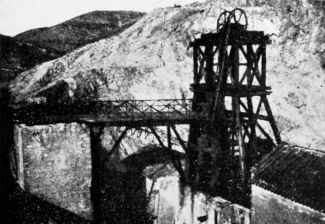
HEAD OF THE SAINTE-BARBE SHAFT, HUELVA.
tributaries. The Lugo groups include the Arenas (203 acres), the
Subieros (121 acres), the Peuadolo (54½ acres), the Coba (74 acres), the
Corrego (74 acres), the Lor (101½ acres), the Lodeiras (196 acres), the
Reineite (79 acres), the Rosio (69 acres), the Baicela (76½ acres), the
Libedo (101½ acres), the Pesquiera (111½ acres), the Alban (116½ acres),
the Lis (109 acres), the Blanca (282½ acres), the Lloris (188 acres),
and the Ramamo (190½ acres). The Páramo Alluvial Gold Mines, in the
province of Léon, on which gold-washing machines are now working, are
giving satisfactory returns. The Kingston Gold Mines in Léon, and the
Moraleja Gold-bearing Alluvial Mines in the neighbouring province of
Orense, are being exploited on a steady scale, with good results.
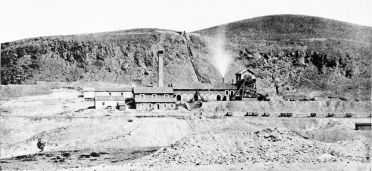
SAN DIONISIO SHAFT, RIO TINTO.
The geological features of all the foregoing groups present an almost
remarkable uniformity. The gold-bearing alluvial deposits cover
practically the whole of the entire area of each concession, and the
depth of the alluvial varies from ten feet, which is the minimum depth
on any of the properties, to twenty-five feet. In cubicating the
alluvial ground available for treatment, one-half may be deducted
(although that is a very high proportion, and one not likely to be
attained), on account of the stones and boulders which may be present in
the earth and sand. The average of the assays made of the alluvial
deposits of all these concessions give a minimum of five dwts. of gold
per cubic yard; but if the return is estimated at only one and a-half
dwts., the facilities for economically working and handling the ore are
so favourable that the profits will be seen to be enormous. The cost of
working the deposits varies from 3½d. to 6d. per cubic yard. The working
of these alluvials is being done by machines, especially adapted for
the purpose, which are capable of treating twenty-five cubic yards of
earth, at a cost of 5s. per day; and give, roughly, a return of £6 per
day per machine. The number of these machines, which cost £25 each, and
can be erected on the spot at a small additional expenditure, can be
increased indefinitely.
When the alluvial is exhausted, by means of these machines, down to
water level, the beds of the rivers will have to be dredged. Up to the
present time these river deposits have not been touched, and they will,
of course, be found to be considerably richer in gold than the exposed
alluvials. By many mining men the result of the dredging operations are
looked to, to complete the revival in Spanish mining that has been so
long coming. It is impossible to contemplate the probable—one might
almost say the assured—return from this dredger mining without a
feeling of amazement that such a source of wealth should have lain so
long untapped. Want of capital in Spain, and want of confidence in the
Spaniards, have hitherto been the chief obstacles to her progress; and
the fact that the country has never become a fashionable mining venue
has also to be taken into consideration in reviewing the causes that
have contributed to its backward position. It is, however, evident to
those who have been much in the country in recent times, that the
long-delayed interest in its mineral resources has set in; and it is
with considerable confidence that one predicts an enormous revival in
the industry as soon as some of these alluvial gold-bearing districts
are systematically exploited, and regular returns are forthcoming. But
the gold quartz mines of Spain are still almost entirely neglected, as
they have been since the days of the Romans; and despite the fact that
there are numberless prospects containing reefs that yield from
half-an-ounce to 1½ ozs. of gold per ton, only two or three companies
are engaged in gold quartz mining in the Peninsula. The miner and the
investor have generally confined their attention to iron, copper, and
lead—metals that occur in huge deposits—and have disregarded the less
assertive tin and gold-bearing alluvials which, when scientifically
developed and economically managed, will give larger returns than any
other mining in the world.
Some of the most prominent and promising of the newly-acquired copper
properties in Spain are those of the Escurial district, of which mention
has been made. Here, at a spot situated within thirty miles of Madrid,
at the end of an hour-and-a-quarter’s train journey, is a district which
promises to take rank among the leading copper-producing areas. Yet
until some two years ago the properties were practically being ruined by
the starvation policy of the Spanish owners, who obtained excellent
results by following the richest of the leaders until a little
expenditure was required to further prosecute the work, and then
abandoned them. The Romans, who would appear from the evidences of their
workings to have been the original miners at Escurial, carried out their
developments on a large scale; and judging from the immensity and
richness of the dumps of ore which they discarded as being too poor to
pay for treatment by the primitive methods at their commands, they must
have won enormous quantities of very high-grade copper ore. These huge
mounds of refuse ore have been assayed to yield about 4 per cent. of
copper; and with the modern system of concentration will all give
profitable returns. Some of the outhouses and walls on the property are
constructed of rich copper ore, and the purplish colour of the loose
stones of the road from Galapagar, and on the other roads about the
property, are everywhere indicative of the presence of the same mineral.
The Romans evidently recognised the value of their mine, for before they
vacated the country they carefully filled in all their workings, and
obliterated every trace of their activity. The openings to the galleries
and the mouths of their shafts were closed up with rubble, but they
could not remove the incriminating dumps—the monuments to their energy
and the witnesses to the richness of the property.
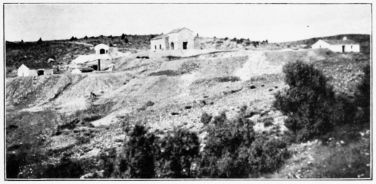
PORTION OF BUILDINGS, ESCURIAL.
The Romans undoubtedly meant, at a more convenient season, to return to
the scene of their labours, as did the Carthaginians and Phœnicians
before them; but the fates which govern nations ruled it otherwise. The
Visigoths succeeded the Romans; and they in their turn were driven out
by the Moors, who dominated the Peninsula for over 800 years. The Moors
have left the marks of their greatness, their industry, and their love
of art over the entire face of the land; but they have contributed
comparatively little to the history of its mining. They certainly did
not undertake systematic researches into the mineral resources of the
country, and as certainly they did not happen upon the copper caverns
which the Ancients had quarried at Escurial.
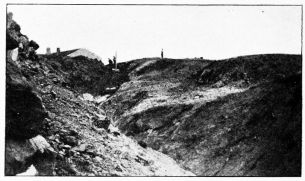
The present proprietary, upon taking possession of the property,
immediately set to work to have the mine cleared, and all the old
workings explored. These operations were attended with many remarkable
discoveries, and it seemed as if everything was revealed which had been
done by the original proprietors. But Señor Bárris, the modern
discoverer of this remarkable property, and a gentleman who combines the
erudition of the scholar with an unsurpassed practical knowledge of
Spanish mining, was not satisfied. He was convinced that there remained
further traces of more recent exploitation to be revealed; so the
research was resumed, with the result that during my visit I paid to the
property in 1902, some additional deeper workings of Spanish origin were
discovered. Only then was Señor Bárris convinced that the end was
reached; but even later, I have since learned, a falling-in in one of
the levels disclosed the existence of further large ancient workings,
and the presence of a mass of magnificent copper ore.
The Spaniards, whoever they were, who had worked the mine for a short
period some (approximately) 300 years ago, had been interrupted in their
labours by the lack of proper machinery, and had abandoned the pursuit.
The walls of the gallery they had excavated had fallen in, rubbish had
blocked up the entrance, and the mine had returned to the condition in
which it had been left by the Roman discoverers. And, curiously enough,
not a single document or record has come to light to reveal the identity
of these disappointed adventurers.
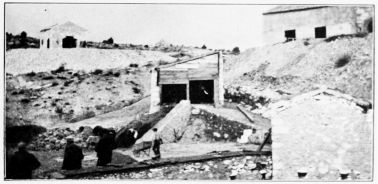
“DOLORES,” “JAIME,” AND MAIN SHAFT, ESCURIAL.
The Escurial district is a network of copper lodes, which curve, and
zig-zag, and bisect one another in an extraordinary fashion, and would
appear to have their origin, or their ending, in a concession known as
the Antigua Pilar—one of four concessions which constitutes the
property of the Escurial Copper Mines, Limited, the principal company in
the neighbourhood. The mines are chiefly in the hands of three
companies—which are known as the Escurial, the Escurial Extended, and
the Georgia Mines and Development Company. The properties owned by the
premier company consists of the Antigua Pilar (103½ acres), the Gloria
(140 acres), the Jaime (49½ acres), and the Ramon (49½ acres). This
group, with a total area of 342½ acres, is held on perpetual tenure from
the Spanish Government, subject only to an annual payment of 6s. 5d. per
claim.
The mines are equi-distant from three railway stations, but Torrelodones
is the most convenient, as it is connected with Galapagar by a good cart
road. From this place, where are situated the Galapagar concentration
works, one travels over an excellent high-road built of stone, all of
which shows traces of copper. The weather is cool, clear, and
invigorating; and the manager of the Escurial Copper Mines, Limited,
informs me that the climate, though hot in summer and very cold in
winter (the mines are about 2,850 feet above the sea level), is
wonderfully healthy. I remarked upon the solidity of the buildings which
serve to protect the openings of the various shafts, and was informed
that such substantial structures were necessary as affording a shade
from the sun in the hot weather and a shelter from the snows in winter.
The Escurial Mines, unlike some others in Spain, are worked all the year
round; and, as many of the miners live on the property, a small barrack
has been constructed of masonry for their accommodation. These
buildings, which are of the most durable kind, having masonry walls
three feet thick and tiled roofs, include, in addition to the men’s
quarters and the manager’s dwelling, offices, &c., a small metallurgical
establishment, large stores for the storage of minerals, for coal, and
wood, and blasting powder, engine houses, and other buildings. “The mine
is our home,” explains one of the old watchmen—a phrase which I take to
be equivalent to the Englishman’s expression: “We’ve come to stay!”
If you happen to entertain any doubts as to the capacity
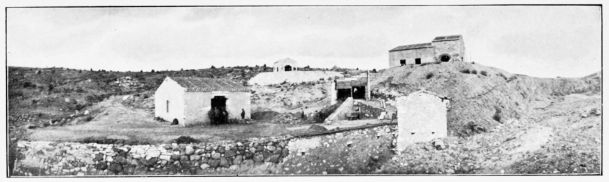
“JAIME,” “DOLORES,” AND MAIN SHAFTS, ESCURIAL COPPER
MINES.
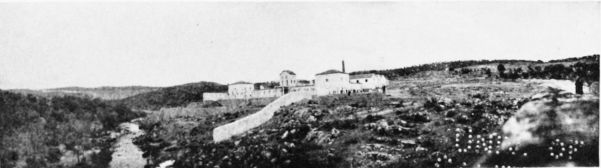
GALAPAGAR SMELTING WORKS, ESCURIAL.
and general excellence of the Spanish miner, I would advise you not to
ventilate your opinion of the subject in the presence of the manager of
the Escurial Mines, or of Señor Bárris, the Company’s local director.
Nor indeed can one be long among these men without recognising their
sterling good qualities. They work well, and they lighten their labours
with an enthusiasm which I have not remarked in any miners outside
Spain. Every man and boy has a personal interest in the mine and its
development; his talk is about its progress and prospects: his joy is a
rich strike or a satisfactory return; his sorrow is a blank day. And
with the characteristic independence of the Spaniard, each man keeps to
his own drive, or shaft, or gallery, which he is convinced is the best,
and richest, and most promising portion of the whole property.
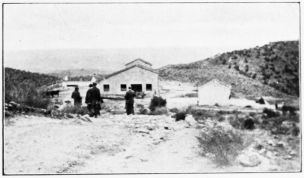
ENGINE HOUSE AND BLACKSMITH’S SHOP, ESCURIAL.
It will be seen from a glance at the accompanying plan that the
northernmost claim, the Ramon, is situated at a little distance from the
rest of the group, and it is here that the principal buildings and
concentration works are located. Two lodes have been proved on this
property. No development work had been done on the Ramon at the time of
my last visit, nearly the whole of the labour having been concentrated
on the Antigua Pilar concession, which carries eight proved reefs, and
is undoubtedly the most valuable claim of the entire group. The
developments on this, and on the adjoining Jaime lease, have
demonstrated that both these claims are of very great value, and the
manager declares in his report that with proper management “they will
yield incalculable profit.”
The Antigua Pilar claim has been exploited in a masterly manner, and the
results reflect the greatest credit upon the management. All the work
proceeds under the unremitting personal supervision of the manager, and
his very full and luminous reports reveal his intimate knowledge of
every detail. “It is a pleasure,” he said to me, “to work such a mine.
Every week brings its work, and the work brings its recompense in the
consistently and thoroughly satisfactory nature of the progress made.
The property has never, as mothers say of good children, given me an
uneasy moment, and I am only too delighted to show visitors over it.” As
we proceed, he explains to me his theory of the property and of its
prospects. The Antigua Pilar he believes to be the centre of a network
of reefs, and the eight lodes he has already proved are only a few that
he expects to discover as the work progresses. “It is a large property,”
he says, “and it must be developed by degrees. I have proved to my
entire satisfaction that the lodes in the Ramon and the Jaime leases
will pay handsomely when we get to work on them. I have also traced two
of the Antigua Pilar reefs into the Gloria lease, and six others are
also making in that direction. This naturally led me to make a special
study of the lodes in Antigua Pilar, and I am convinced that in
formation and structure the reefs are the same in all. Everything
pointed to satisfactory results, and, indeed, the results have exceeded
our expectations.”
In the manager’s office I was permitted to examine the figures and
measurements on which he had based his estimates of the value of the
mine, and they are calculated on so moderate a scale that he is
convinced the net profits will be much greater. To give an idea of the
value and sizes of the lodes on the property, I may mention that by
cubing the lodes of Nos. 2, 3, and 4 on Antigua Pilar alone, and
calculating the yield of copper at the very low return of 5 per cent.
per ton, he estimates the value of the ore at £155,532. By the present
methods of exploitation, the daily output of ore will shortly be twenty
tons per day; and this ore, with proper plant for concentration, could
be brought up to 33 per cent. of copper, worth £16 10s. per ton. The
carbonates of copper which the ore carries could, by proper treatment,
be made to yield from sixty per cent. to eighty per cent. of copper
suitable for smelting. But there is an alternative scheme for the
complete exploitation of the property, by which 100 tons of copper ore,
of a value of £550, could be raised and treated per diem. This plan
would, of course, involve a larger outlay, but it has been forwarded to
London for the consideration of the directors. Such figures and
prospects justify the manager in his high opinion of the mine, which is
shared by the miners and the local shareholders.
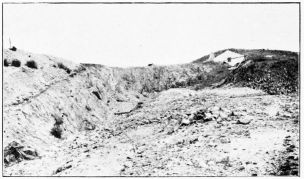
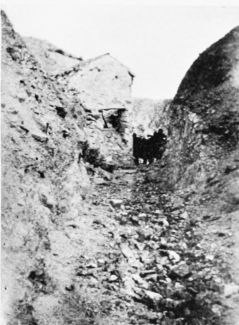
SNAPSHOT SHOWING CUTTING, ESCURIAL.
When I was at Escurial I visited two other groups of properties in the
neighbourhood which had been acquired by British capitalists. The
successful developments in the Escurial property proper—especially on
the Jaime and Antigua Pilar leases—attracted a good deal of attention
to the district, which subsequent prospecting work shows to have been
thoroughly warranted. One of these groups comprises the Recompensa, the
Pepitanga, and the San Antonio leases, which have a combined area of 437
acres. The local theory is that the nature of the country and the
constitution of the lodes is the same throughout the district, and the
work done on these mines bears out that belief. The lodes and veins are
numerous, varying in thickness from seven inches to three feet; and the
ores have yielded, as the result of assays, from eleven per cent. to
thirty per cent. of copper. Seven lodes, which are distinct and well
defined, have been followed for a distance of over 6,000 feet through
the property, and five separate workings have been undertaken to test
the value of the mineral deposits. As the workings are 750 feet above
sea level, at which depths the lodes usually improve, the quantity of
ore in the property must consequently be very considerable. The ore also
yields both silver and gold, but it is not possible to estimate the
profit likely to be made from this source. Only one assay has been made
from this ore, but it disclosed the existence of nearly thirteen ozs. of
silver and over nine dwts. of gold. The other group that is now the
property of English capitalists, consists of five concessions, called
the Clarisa, the Morena, Natividad, Mitry, and the Mercedes, having a
total area of 2,111 acres.
A railway journey of 20 hours’ duration, over three railroad systems,
transports the visitor from Madrid to the little mining town of Huercal
(pronounced Whercal) Overa. We leave the capital by the express train
for Alicante, and travel via Alcázar and Albacete to Chinchilla, which
is reached at some unearthly hour in the middle of the night. From
Chinchilla the line runs through the beautiful province of Murcia to
Lorca, where we change onto a small English railroad which takes us to
Huercal. We had left Madrid in our winter overcoats and rugs; when we
stepped out into the soft sunshine of Almeria we could have dispensed
with our under coats and waistcoats. We are in the land of the spring
roses and early oranges, and the nipping and eager air of the capital is
forgotten. Our visit is regarded by the community with general interest,
for the townsfolk look to El Monte Minado, as the copper mines are
known locally, to make the fortunes of Huercal-Overa. Many of the
leading people here are shareholders in the mines, and all the labour
employed on the property is drawn from the town. There is not a child
in the neighbourhood who is unacquainted with the personality of the
Spanish representative of the English proprietors, who acts as our
cicerone, and the word goes round that he is come to town. The mine
captain, and several prominent people of the district, are at the
station to meet us; and in the sitting-room that has been reserved for
our use in the comfortable hotel we find the table laid, not for dinner,
but
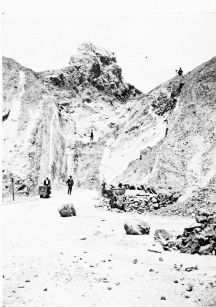
with an array of valuable specimens taken from the mine. Here is copper
in practically every form—green carbonate of copper (malachite), blue
carbonate of copper (azurite), red oxide of copper (cuprite), copper
pyrites (yellow sulphuret of copper), and native copper. Added to this,
the abundant association of cobalt—cobalt steel-gray, and pinkish
purple, like the hue of peach-blossom in colour—and of bright emerald
green tinted nickel, give the specimens an extremely beautiful
appearance. The Monte Minado property comprises a copper hill not
unlike the celebrated Mount Morgan in conformation, and has an area of
111½ acres. There are indications that point to Phœnician industry in
the Huercal Mine, but the traces of later workmanship demonstrate
conclusively that the Romans were the last of the Ancients who exploited
this copper mountain on a large scale. It was the Romans who
obliterated so carefully all traces of their handiwork, and filled up
with rubbish the openings of their levels and other workings.
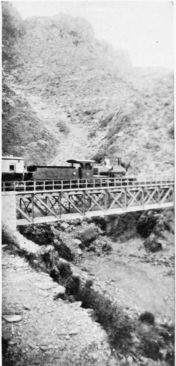
The composition of the mountain, being of volcanic creation, it is a
crumbling conglomerate mass; and unless the galleries are substantially
timbered, the chances of their falling in present an instant danger to
the miners. The men who are employed in the work of clearing the ancient
galleries and putting in new levels have had many narrow escapes from
falling earth. The Spanish mining regulations impose a very high rate of
compensation in the case of accidents which occur in the mines; and as a
doctor, whose duty it is to report on all casualties to the Department
of Mines at Madrid, is attached to every working property, mine owners
are exceptionally careful for the safety of their employées. On one
occasion, when the Spanish representative of the present proprietary was
being conducted by the manager through some new workings, a huge piece
of the country rock fell upon his guide. His head was very luckily
protected by one of the hard pot hats which the underground hands always
wear; and although this helmet was badly dented, it probably saved the
wearer’s life. The visitor was naturally much concerned, but the
manager accepted the mishap with smiling philosophy. “You see,” he
remarked, “I am not meant to be an expense to the owners, just yet.”
The labour of fortifying all the drives, as the work advanced, rendered
exploitation both slow and expensive, while not entirely eliminating the
element of danger from the operations. It was at one time intended to
cut the lode by driving an adit into the mountain at a level of 150 feet
below the ancient workings; but as it was discovered that this adit
would have had to be shored up and cemented like an electric railway
tube, the proposal was abandoned as impracticable. Since then, the
difficulty has been successfully overcome by the adoption of another
policy.
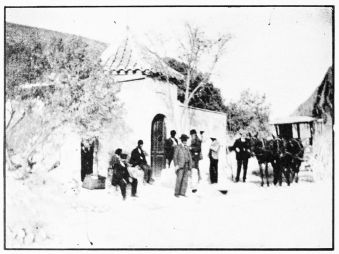
The present leaseholders opened their negotiations for the purchase of
the Huercal Mines on the strength of the mammoth dumps which from a
number of assays made by different firms gave results varying from 5·71
per cent. to 10·40 per cent. of copper, 2·19 per cent. of nickel, and
3·13 per cent. of cobalt. It was argued that even if the mines were
worked out, the dumps alone, if scientifically treated with modern
machinery, would return a handsome profit. But very little exploration
work was required to convince the Englishmen that so far from the
property being exhausted of its mineral treasures, the bulk of the
mineral had been little more than pecked at; and a more comprehensive
system of development disclosed the fact that in El Monte Minado they
had acquired a copper-cobalt mine of extraordinary richness. The
consistent and surprising richness of the dumps in carbonates and copper
pyrites made it abundantly clear that if the Romans, with their
primitive methods and appliances, had regarded this ore as unprofitable
for treatment, they must have found still more valuable deposits to
engage their attention. There could be no other excuse for regarding
five per cent. copper ore as débris. For the first time since the Roman
miners left their Bonanza, the old workings were now cleared and the
mystery was solved. These ancient galleries, as will be seen from the
illustrations, were not driven on any systematic plan, but simply
followed the lodes blindly through all their twists and curves. The idea
of going boldly through the mountain and sweeping all before them does
not appear to have been considered practicable by the Romans; and,
doubtless, the danger of excavating in the soft country rock on a large
scale had also been taken into their calculations. As the workings were
freed from the rubbish that choked every drive and level, further traces
of cobalt and nickel were encountered, and copper in its many beautiful
forms became more abundant, and of richer quality. In the Napoleon
gallery the ore was assayed to yield from 17·17 per cent. to 78·69 per
cent. of copper, and at the extreme end of it was found to be in the
face of a three-foot lode, in which native copper was also discovered.
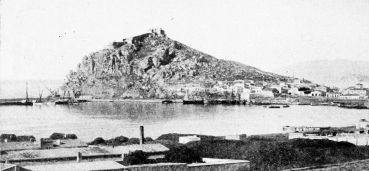
THE CASTLE AND HARBOUR, AGUILAS.
As I follow Señor José Perez, the mine manager, through the old Napoleon
and Esperanza galleries, it is impossible to resist the contagious
enthusiasm with which he describes and exhibits the property. Certainly
there is excuse on every side for their eulogiums. The copper in the
lodes is very plentiful, while in the hanging-wall of the lodes
important veins of pink and black cobalt are frequently to be found, and
at all points where work had been done abundance of ore has been
exposed. I was shown a large caverture, the roof of which is supported
by a single column of ore, which had been left for that purpose by the
Roman excavators. The miners who were clearing the drives at first took
this circular chamber to be a break in the lode; but it is really a
cavern in the walls, and roof of which nearly every variety of copper
ore is to be seen. The spectacle is strikingly beautiful, and to the
geologist it presents a feature of unusual interest. I have examined
many caverns in mines, but this particular example, which has been
christened “The Cathedral,” far exceeds in natural beauty anything of
the kind that I have ever seen.
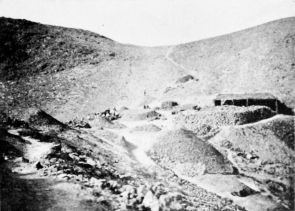
HEAPS OF COPPER ORE, HUERCAL.
A considerable amount of useful development had been accomplished by
clearings and surface cuttings on both sides of the mountain, and these
have been of the greatest importance in the adoption of the latest
scheme for working the mine. In one clearing the outcrop had been
stripped over about 1,100 feet, and by this means the copper and cobalt
lode had been exposed for a distance of 70 feet, and similar work had
been done on the opposite side of the hill. As the result of much
anxious consideration and many discussions it was decided to undertake
the opening up of the mines on a scale which, it is safe to presume, the
Romans never dreamed of, viz., by removing the top of the hill to a
depth of thirty feet, as one scalps an egg. The ancient workings,
situated at a depth of 180 feet from the summit, having been located,
and their dimensions ascertained, the over-burden, which had been found
to be only 30 feet in thickness, will be removed, and from that point
down to 180 feet, where the ancient galleries are situated, is a mass
of copper, cobalt, and nickel ores that will be worked by the
open-cutting process. A trench has been cut from the “Bárris” clearing
connecting with the “Marin” clearing on the other side of the mountain,
and four lines of rails have been constructed to work the ores, which
are loaded up into the trucks and conveyed to the sides of the hill. No
timbering is necessary, shafts and drives are done away with, and all
risks to life are eliminated. The soft nature of the country rock
renders the work, which in quartz would be an impossibility without the
aid of dynamite, a simple pick-and-shovel business, and by this means
the mountain is being gutted at the price of labour and cartage.
The Rio Rimal Mines, in the province of Gerona, are situated close to
the quaint old-world village of San Lorenzo, which stands, surrounded by
its mediæval fortifications, at the foot of a high mountain. Far above
it an ancient watch-tower still looks out over the wide expanse of plain
and valley. It is broken and weather-beaten, but is otherwise as it was
left by the old Moorish warriors who built it. Within a mile or two, on
the east and west, are the comparatively modern fortified places of
Figueras and Rosas. In the municipality of San Lorenzo, at the beginning
of the last century, was a huge Government Arsenal and Smelting Works,
where the metals won from the neighbouring mountains were cast into
cannon, and made into shot and shell. Among the hills are still to be
seen the remains of busy mining camps where hundreds of men were once
engaged in working the mineral deposits. Before Napoleon’s
all-conquering marshals marched across the frontier the Spanish
Government blew up the arsenal, destroyed the smelting works, and
concealed the entrance to the more important workings. Nothing remains
to-day but a few melancholy ruins to show the extent of the former
operations.
The Government factories were never re-constructed. The proximity to the
border, and the exposed nature of the country, combined with the
experience of the then recent events, rendered the situation too
insecure for the purpose, and the arsenals of San Lorenzo were re-built
on more powerfully-protected spots at Ferrol and Carthagena.
Even the massive stone bridge over the river Muga, which was blown up to
impede the passage of the French troops, has never been rebuilt. The
interesting point about all this is the fact that somewhere, close at
hand in the hills, must exist the mineral deposits which fed the
factories before the Peninsula War. The tunnels and workings have been
very effectually concealed—by no means a difficult matter. A few
barrels of gunpowder would have brought down hundreds of tons of rock
and débris over the mouth of the shafts and galleries, and left no trace
of human handiwork. But that these mines are still there, and waiting
only to be re-discovered, is an indisputable fact.
The operations of the Spanish owners on the Rio Rimal property
commenced, as modern engineering science counselled, near the bottom of
the hill, and they put in their galleries and levels to tap at lower
depth the richest portion of the reserves of copper. But work had only
been in progress for about years when the Carlist war broke out. For
seven years operations had to be suspended, and during the whole of that
period the mine was abandoned. When the owners again turned their
attention to the property, it was to find that many parts of their
galleries had caved in, and the mine had become flooded. After a
considerable interval, the worst parts of the galleries were repaired.
The water was pumped out, the level and inclined shaft were cleared, and
work was resumed. The price of copper in 1874 at Swansea was very low,
and the method of inclined shaft workings being very costly, all hope of
continuing to work the property at a profit was extinguished. For thirty
years nothing was done at the mine. In 1898 an endeavour was made by the
present owners to obtain possession of the mines, but it was not until
January, 1902, that work was resumed on the property.
It was then decided that the most profitable course to be adopted was to
concentrate all labour upon the work of repairing and unwatering the
second level, and of driving a further level some ninety or 100 feet
lower down the mountain side. This work was at once put in hand, and the
north-west gallery was driven a distance of 185 feet on the line of the
lode, cutting entirely through the same for the whole distance. In many
places the lode is mineralised for a width of fifteen inches, the ore
assaying thirty-three per cent. copper. In driving this gallery some
splendid copper was obtained. Work on the level has in the meantime been
progressing steadily, although the workmen experienced great difficulty
on account of the hardness of the rock. At the beginning of this drive a
very hard conglomerate was encountered, which resisted all tools. For a
time the formation defied dynamite, and small progress was made until
the sandstone ground was reached. Thereafter work became easier, and
consequently more rapid.
The Buena Presa property, which adjoins the Rio Rimal Mine on the north,
was subsequently acquired, thus increasing the original area by 141
acres. The Rio Rimal lode traverses the adjoining concession for a
distance of about 2,100 feet. It is a strongly-defined masterly lode,
and has every appearance of producing large quantities of mineral when
developed. Judging from the outcrops, it resembles the Rio Rimal lode
in every respect; and although no systematic work has been done upon it,
the probability is that it will be found to be of equal value.
The Coruna Copper Company’s property, which covers an area of 2,540
acres—a tract of country more than six times as large as Hyde Park—is
situated in the mining district of Santiago, and is connected with the
railway, which is about eight miles distant, by a first-class road. The
country in which the concession is situated, consists of a series of low
rolling hills, and the character of the ore, so far as it has yet been
explored by the prospecting operations, is very similar to that produced
by the Rio Tinto and Tharsis Mines. It is a low grade copper ore,
carrying on the average twenty-three per cent. of sulphur, and from two
to three per cent. of copper. No attempt was made by the late owners to
determine by a systematic series of borings the extent over which the
mineral actually exists, or the depth and character of the ore; but the
prospecting work already carried out by the English company, and the
natural outcrops found at many points on the concession, place it, in
the estimation of some mining experts, quite beyond doubt that the mass
of mineral is one of the largest known, extending in one direction for
over two miles, apparently without a break. This preliminary work has
clearly proved the whole of the north-west quarter of the concession;
and taking the outcrops into account, one-half of the whole ground is
assumed to contain mineral. Three shafts and nine trenches are being
sunk, and numerous outcrops have also been located on the concession.
The original estimate of the quantity of mineral was 50,000,000 cubic
metres, equal in round figures to 250,000,000 tons. The most recent
assays indicate a mean of three per cent. copper in the ore. The
prospecting work has in every instance proved the accuracy of original
estimates as to the value of the property, as well as the correctness of
the opinion, that a very large output could be obtained with practically
none of the unproductive development work required in most mining
enterprises. It was recommended that mining operations should be chiefly
“open-cut,” and of the simplest character, the exceptionally favourable
conditions under which the ore exists rendering operations an extremely
easy and inexpensive matter. The property is being opened up on these
lines, and it is considered there will be no difficulty in supplying the
concentrating works with 1,000, 2,000, or even 3,000 tons per day, all
obtained from open cutting.
Fortunately for the present proprietary of the Beariz Mines, the late
owners possessed considerable technical knowledge; and if the property
was not worked extensively by them, the work was prosecuted on right
lines. They overhauled the Roman shafts and put in new galleries; and at
a time when the standard price of metallic tin was £153 a ton the mine
returned the owners a handsome profit. Some years ago, when the mines
were reopened and actively exploited, a large number of hands were
engaged; and although the ore had to be carted by road to Vigo, large
profits were made. Gradually the price of tin dropped, and the profits
shrank until operations could only be conducted at a loss. Then work was
suspended. Since 1878 the Beariz Mines have remained idle, save for the
persistence of the “Tributors,” who have continued to make a livelihood
by washing alluvials.
The three leases that comprise the Beariz group are entitled the
“Esperanza,” the “Federico,” and the “Elena,” and together they have an
area of 450 English acres of tin-bearing ground. Since the mines were
closed down, the railway has been constructed from the port of Vigo to
within twenty miles of the property, and the roads between Beariz and
the railroad are well made and in excellent repair. Señor S. J. Bárris,
who was requested to inspect the properties and report upon them by the
intending purchasers, spent several weeks at Beariz ascertaining the
dimension of the lodes, estimating the extent and value of the alluvial,
and making assays. He traced four distinct lodes on the “Federico”
property, three on the “Esperanza,” and two on the “Elena,” and his
tests proved that the whole of these nine lodes carried rich oxide of
tin (cassiterite), averaging thirty per cent. of the mineral. “I am well
aware,” he wrote, in communicating the results of his examination, “that
the average will appear to be very high, but I would point out that this
is a very exceptional property; in fact, I have inspected almost all the
known tin properties in Spain, and I can say with confidence that,
taking into consideration the numerous lodes and the very rich alluvial
deposits, these Beariz Tin Mines are one of the richest, if not the
richest, mining properties I have ever seen.”
Worked as a quartz mine, as it was worked by the Ancients, the owners
possess in Beariz an asset of proved value, but the property is rendered
the more valuable by the fact that the lodes represent only one portion
of its assets. For, in addition to the quartz lodes, the greater portion
of the 450 acres is composed of tin-bearing ground, almost every yard of
which will pay to work. On one side of the hill a large number of
boulders are present in the alluvial, which reduces its value; but the
major portion of the area is exceptionally free from unbeatable
material, and consists entirely of tiniferous deposits. Tin is found in
the decomposed granite, which is so soft that it can be worked by pick
and shovels. The upper alluvial is about five feet in thickness; but the
depth of the granitic formation, which is very rich in tin, has not yet
been ascertained. It was for this reason that Señor Alfred Lasala, the
leading mining engineer of Orense, reported that it is almost impossible
to cubicate the quantity of tin ore in these concessions; but he added
in his report that “in every shaft and every trench, cutting, or
outcrop, from the highest point down to the bed of the river Beariz,
which runs at a great depth below the workings, the tin ore is found in
remarkable abundance.” Señor Lasala describes the formation of the
Beariz tin deposit as tiniferous granite, concentrated in great masses
of tin mineral, which is intersected by cross lodes of tiniferous,
quartz veins, or stringers, containing the metal in great quantity. Two
samples of earth, that had been washed to remove the mica, tourmaline,
and other principal elements of crystalline formation that are present
in the ore, assayed 62 per cent. and 81 per cent. of tin respectively;
and Señor Bárris estimates that every ton of tin ore, after being
properly concentrated, will assay from 62 to 65 per cent. black tin.
The upper alluvials contain a smaller percentage of tin than is found in
the lower strata, a fact which is explained by the laws of specific
gravity, and by the attention that has been devoted to the surface
ground in times past. The granitic formation, which is practically
virgin ground, is computed to be hundreds of feet in depth, and there is
enough of it on the Beariz property to employ all the energies of the
company for fifty years to come. The whole of this formation is
traversed by innumerable veins of quartz, containing from 15 to 20 per
cent. of tin, which will add enormously to the value of the output.
The Spanish Tin Corporation, which was formed towards the end of 1901,
became the purchasers of 1,361 acres of tin-bearing land in the Arnoya
district of the province of Orense. The Government’s annual publication
of Spanish mining statistics for the year 1900 gives the production of
tin ore for the entire province at 240 tons, and adds, “So far, only one
mine has been producing tin in the province, the ‘Roberto,’ which in
nine month produced 240 tons.” The extent of the concessions, the
richness of the immense tin-bearing alluvial deposits, and the
exceptionally favourable conditions under which they can be worked,
makes the property exceedingly valuable. The whole surface of the
concessions is more or less covered with alluvial soil, with an average
thickness of fully 3¼ feet of tin-bearing ground; and if one-half be
deducted for boulders, surface soil and waste ground, the amount of
block tin is computed at 30,368,365 lbs., and the value at nearly one
million pounds sterling. Practically, it is said, the whole of this vast
quantity of tin can be recovered by simple hydraulic working. In
addition to the alluvial tin-bearing ground there has also to be taken
into consideration the tin contained in the masses of decomposed granite
lodes which traverse the property, and is estimated to contain
60,936,730 lbs. of black tin, of a value of nearly two million pounds.
The revival of the mining industry has spread even to the province of
Salamanca, where, according to the Government report, not a single mine
had been worked during the year 1900. A reference is made, however, to
visits of mining experts to the districts of Valsalabroso, but nothing
is reported as to the result of their inspections. One result, however,
was the acquisition of three properties known as San Antonio, Adela and
San Pablo, having a total area of 437 acres of tin-bearing ground, on
behalf of English capitalists. Three well-defined lodes have been
discovered, and the leases have been specially pegged out to contain
these lodes for a length of 2,500 metres, or about 2,700 yards. Apart
from these lodes, it is stated that the whole of the ground is
sufficiently rich to allow of the alluvial being profitably worked.
Various tests have been made which endorse this view by giving a return
of nineteen pounds of alluvial tin per cubic yard. The company, which
has been formed in London to work the property, has decided to exploit
the alluvial, while development work is being prosecuted on the lodes.
Special tin-washing machines have been sent to the Pontevedra Mines, and
they are now at work and producing tin. Labour is cheap and plentiful,
and transport facilities are very favourable to economic working, while
another important feature is supplied in the close proximity of a
stream, which gives an abundant supply of water for all mining purposes.
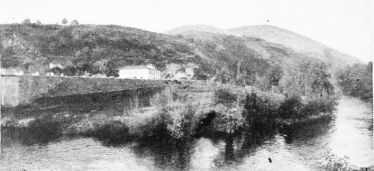
I visited at Paramo, in the province of Léon, an alluvial gold-mining
property, which appeared to possess all the natural advantages for
economical and highly profitable working. This concession consists of an
immense bank of alluvial, over 300 feet in height, and a great plateau,
which has been proved to carry gold wherever tested. The richness of
this plain was evidently fully appreciated in ancient times, and the
remains of gigantic operations can be clearly traced. Water had been
brought in from a great distance by canals; and at the western extremity
of the plain, where it ends suddenly in steep bluffs, two
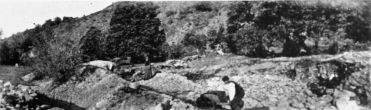
ALLUVIAL GOLD WASHING, PARAMO.
great valleys have been sluiced away. The water channels employed for
this purpose are still visible, and are now used as country roads.
Millions of tons of earth must have been washed here, and with
satisfactory results, even with the imperfect appliances then in use, or
otherwise work on such a gigantic scale would never have been carried
out. On the lower ground, very extensive sluicing operations had also
been carried on in ancient times, and a water-race has been brought from
some three miles away. This water-race could be repaired at little cost,
and sluicing be begun here on a large scale with a very small
expenditure compared with what is usually necessary in such operations.
Along the river, on both sides, are level stretches of alluvial, formed
by the eating away of the higher ground by winter floods, and these
deposits carry gold from the grass-roots down.
The Kingston Gold Mines have acquired four important concessions in the
municipality of Puente de Domingo, Florez, in the province of Léon.
These properties are well situated on the banks of the river Sil and its
tributaries, and are very accessible, being close to the railway station
of Ponferada. The alluvial deposits cover almost the whole of the area
of the concession. The average of the assays made of the alluvial
deposits give five dwts. of gold per cubic yard; but the engineers state
that, taking the average at only one and a-half dwts. per cubic yard,
these properties ought to give a large return per annum.
This is another company that has been formed for the purpose of working
alluvial gold mines in Spain, and there are good indications that their
enterprise will be crowned with success. The two properties known as
Barbantes and Acha, comprising 208 acres in the province of Orense, have
already been tested, with the most satisfactory results. The engineers
have based their calculations on the uniform depths of the deposits of
fifteen feet, but in most places they are far deeper, and it is reported
that nearly the whole of the ground will pay well to work. The tests
have given an average return of five dwts. of gold per cubic yard; but
the facilities for working and handling the ore are so favourable that
if only a quarter of that estimate is realised, the profits of the
company will be enormous.
The Lugo Goldfields, Limited, has acquired three groups of properties in
the province of Lugo (Galicia). These concessions, which are situated on
the main road to Madrid, and twenty-six miles from Lugo, consist of 525
acres of quartz country and alluvial property seventy-five acres in
extent, which contain strong evidences that the Romans, during their
occupation of the Peninsula, washed from it large quantities of alluvial
gold. On the first group, broad gold-bearing quartz reefs, which
increase in width from six feet to twenty-four feet as depth is reached,
have been traced for many miles on each side of the property; and on the
second group the reefs are highly mineralised, and contain gold, silver,
copper, and lead. The reefs are situated in hills rising from 350 feet
to 450 feet above the river-bed, which will enable the ore to be run out
of the galleries by means of trucks on rails, and so save, for some
considerable time at least, the initial outlay and annual expenditure
entailed by the erection and maintenance of pumping and haulage
machinery. In taking the samples of stone for assay, good, bad, and
indifferent stone was included, and the calculations as to the value of
the ore was based on a minimum extraction of five dwts. of gold per ton.
The assays gave returns varying from three dwts. two grs. up to sixteen
dwts. eight grs., and the ore has been tested to be eminently adapted
for concentration. Water, labour, and timber present no difficulties,
and the working of the mines should be carried on at a low cost. It is
estimated that the expense of mining the ore, delivering the
concentrates in Swansea, and paying the charges for treatment there,
will amount to 10s. per ton of ore crude, which means that two and
a-half dwts. of pure ore will pay all expenses.
LAS PALMAS BRIDGE, BADAJOZ.
Among the most important of the silver-lead properties in Spain, mention
has been made to the group in the province of Badajoz that has been
floated in London under the title of the Santa Maria Mining Company,
Limited. This property, which originally consisted of four leases,
having an area of 138 acres, has been since increased to 166 acres, by
the acquisition of the Santa Florentina lease at Mestanza, Puertollano,
in the neighbouring province of Ciudad-Real. So far as the position of
the Santa Maria property is concerned, it could not easily be bettered.
It is only six miles distant from the railway system, with which it is
connected by two good roads, and is situated quite near to the
Rothschilds’ Smelting Works at Peñarroya. Timber is procurable at a
cheap rate from Cuenca and Portugal; there is an abundance of water
obtainable for all mining purposes; while labour, which is obtained from
two villages in the vicinity, is cheap, plentiful, and efficient.
The history of the Santa Maria group presents, as do so many other mines
in Spain, an object lesson in mismanagement and wilful disregard for the
future of the property. It was first opened in 1845 by a Portuguese
Company, and it is abundantly proved from the reports of their
consulting engineer, and from the condition in which the mines was left,
that the work could not have been conducted in a more haphazard and
destructive fashion. No attention was given to exploration or
development work; and, doubtless, acting under peremptory orders, all
labour was concentrated on the extraction of the rich available ore. The
shaft, instead of being perpendicular, was sunk at a vertical angle, and
was so badly timbered that it was always in a dangerous condition. The
galleries, being left without sufficient supports, frequently collapsed,
and work was conducted at imminent risk of life to the miners. The
official figures showing the quantity of ore won by the adoption of
these methods are not available, but the great heaps of débris which
have accumulated show that the amount was something very considerable;
and it was not until 1889, when the policy of ore-grabbing could no
longer be safely proceeded with until money had been spent in repairing
the shaft and the workings, that the mine was abandoned and became
flooded up to the first level.
During this time the Santa Maria lode was worked by its faulty shaft
down to the seventh level, but the dressing of the ore was so defective
that the dumps are found to contain nearly five per cent. of galena.
From this refuse the present management have been obtaining from ten to
twelve tons of “dressed” ore per month, giving fifty-five per cent. of
lead and 600 grammes of silver per ton.
When Señor Villanova purchased the property in 1889 he took from the
first level of the Santa Maria shaft about 100 tons of ore, which gave a
return of seventy-five per cent. of lead and 850 grammes of silver per
ton; and, then, in order to avoid the expense of unwatering the mine and
repairing the shaft, he decided to confine his operations to the San
Juan shaft, upon which little work had been done. The winding engine was
accordingly removed and re-erected at this shaft, which was sunk to a
depth of about 540 feet. Six levels were driven, in each of which the
lode was found to be mineralised throughout. Señor Villanova continued
to work the mine on the principle of making it entirely self-supporting.
No exploration or dead-work was undertaken, and when a fault was
encountered in the eastern levels the pursuit of the vein was abandoned.
This fault has since been cut through in all the levels, and the lode
has in every case been found to continue on the other side. The property
was starved for working capital, no cross-cutting was allowed on account
of the outlay it would involve, and the stoping was only carried on
where the mineral was rich. Yet even under these conditions Señor
Villanova extracted from this shaft alone over 3,000 tons of ore, which
yielded him substantial profits.
When the present company took over the mine they were advised that both
the Santa Maria and the San Juan lodes could be better and more
economically worked by means of the Santa Maria shaft, and they decided
to have this shaft unwatered and put into thorough repair down to the
bottom level. The shaft had to be enlarged and galleries cleared, and
all the workings retimbered. These operations, although vigorously
prosecuted, took longer than was anticipated.
VIEW OF THE CASTLE, PONFERRADA.
Twelve years of neglect had reduced this part of the mine to such a
condition that the task of clearing the congested galleries was not only
difficult but highly dangerous. The timber with which the workings were
fortified was so rotten that the removal of the rubble brought down the
woodwork with it. The old supports had consequently to be replaced by
new timber as the work progressed; and as the galleries were constructed
on a small scale, the want of space rendered it impossible to employ a
large number of hands. At the same time all the buildings and the
masonry work on the property, which had also fallen into decay, were
repaired or rebuilt; the old engine-house at the San Juan shaft was
replaced by a substantial building, tram-lines and trucks were
purchased, the roads were overhauled and repaired, and the property was
completely equipped and put into thorough working order. Yet in spite of
all this dead work, the exploitation of Santa Maria has never been a
severe charge upon the company, for the return of ore per month from the
San Juan lode was sufficient to defray all the expenses incurred in
development, and to return a profit on the mine. During the early part
of last year the Peñarroya works were being rebuilt and enlarged, and
the ore had to be sold at Carthagena; but since the reopening of the
works the whole of the output has been purchased locally, and a
considerable saving has been effected thereby.
It has been already stated that the production of coal in Spain is quite
insignificant in comparison with the extent of the coal-bearing beds
(which are estimated to cover an area of about 3,500 square miles, of
which nearly a third belongs to Oviedo); but the new find of coal
(lignite) and cement stone in the province of Lerida should, and
undoubtedly will, draw attention to this profitable industry. The
Almatret Mines, which have an area of 820 acres, are situated on the
river Elbro, near Fayon, on the main railway from Madrid to Barcelona.
In each of the eight seams, which are distinctly visible on the
property, the lignite is much decomposed, and the outcrops contain a
great deal of gypsum. This has effloresced, and the seams present a very
different appearance from that of lignite. On cutting into the beds,
however, the infiltrations of the gypsum soon disappears. The workings,
which are very limited, had been carried out without any system, and
much of the lignite had been lost in winning. The quality of the lignite
is very satisfactory. It keeps well, and burns with a long flame. Owing
to the exceptional conditions under which these deposits can be
worked—the seams lying horizontally, and being entirely free from water
or deleterious gases—no shafts are required, and the ventilation is a
very simple matter. The question of transport is stated to be the chief
element of a successful exploitation of these mines, and it will be
necessary to construct a light railway to reduce the cost of the present
system. The probable profit on the lignite, according to expert’s
reports, will depend on the ruling price of coal in Spain: this is
determined by that of Cardiff coal and the rate of freight. The
calcareous layers are, in several places, comprised of highly aluminius
and siliceous limestone, forming a natural cement stone. One of the beds
of this material has been exploited in former years for the manufacture
of a cement which was somewhat largely used in Lerida for house
construction, &c. A cement of this quality is highly suited for
constructive work, such as floors, staircases, water tanks, &c., for
which very large quantities are used in Spain. It is not, of course,
equal to a true Portland cement; but when the various layers of cement
stone have been examined and analysed, several of them will be found to
approximate very closely to the composition required for giving the true
Portland cement. The quantity of cement stones which exist on the
property is enormous. In fact, it may be said to be practically
inexhaustible.
I have referred in detail to these Almatret Mines because they
demonstrate the truth of the contention that the coal districts of Spain
are not, as has been erroneously accepted, confined to the province of
Oviedo; although, up to the present, little mining has been done outside
the Asturian coal basin. Even here the rate of progress is lamentably
slow. Lack of capital, which has hitherto retarded the increase of
mechanical facilities and railway construction, is now being overcome,
and it is confidently expected that a material advance is imminent.
Every class of coal is obtainable in this district; and the seams, which
vary from two and a-half feet to over six feet in thickness, are being
worked by galleries in the mountain sides. In only one instance is the
pit system in practice; and the whole of the coal below the level of the
base of the mountain is virgin ground, which will ultimately be
exploited by deep workings. But it is highly improbable that this
profitable industry will be undertaken by the present owners, who, for
want of the necessary capital, will, in a large number of cases, suspend
operations when they have exhausted the coal from their lower galleries.
Valuable concessions will then come into the market at “knock-out”
prices; and if British capitalists desire to be associated with the
highly-promising enterprise, they will have to seize the opportunity
before the French and Belgian investors step in. For, despite their
comparative failure in the past, the French capitalists are more keenly
alive than their English rivals to the enormous possibilities of Spanish
mining, and Spanish money is now coming forward as an earnest of the
rejuvenated spirit of enterprise which careful observers have already
noted in the spirit of the country.
In the foregoing pages I have outlined, in the barest fashion, the
history of the mining industry of Spain from its genesis, and I have
cited instances of modern development with the object of proving that in
Spain of to-day we have at once one of the most backward and most
promising mineral countries in Europe, if not in the world. I have not
attempted to exhaust the list of mines that are in full operation at the
present time, but have contented myself with giving some particulars
about representative properties—properties which, for the most part,
have come under my own immediate notice, and several of which I have
visited more than once. My experience compels me to the conclusion that
Spanish mining offers more and better opportunities for the investment
of British capital than that of any other country with which I am
acquainted, and I treasure the hope that a closer union will be welded
between England and Spain by the common bond of a mutual interest in her
mineral development.
E. Goodman & Son, Phœnix Printing Works, Taunton.