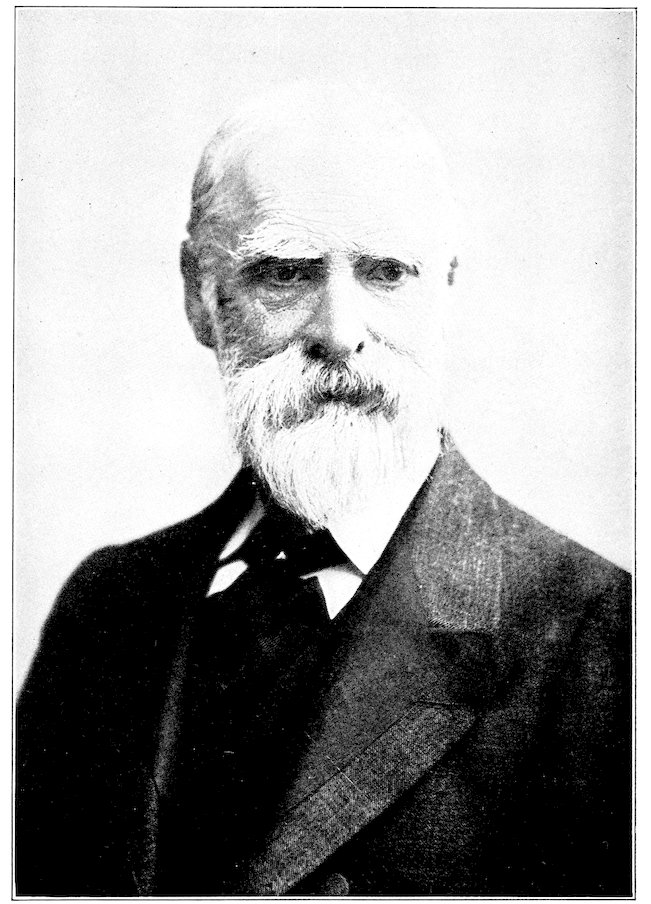
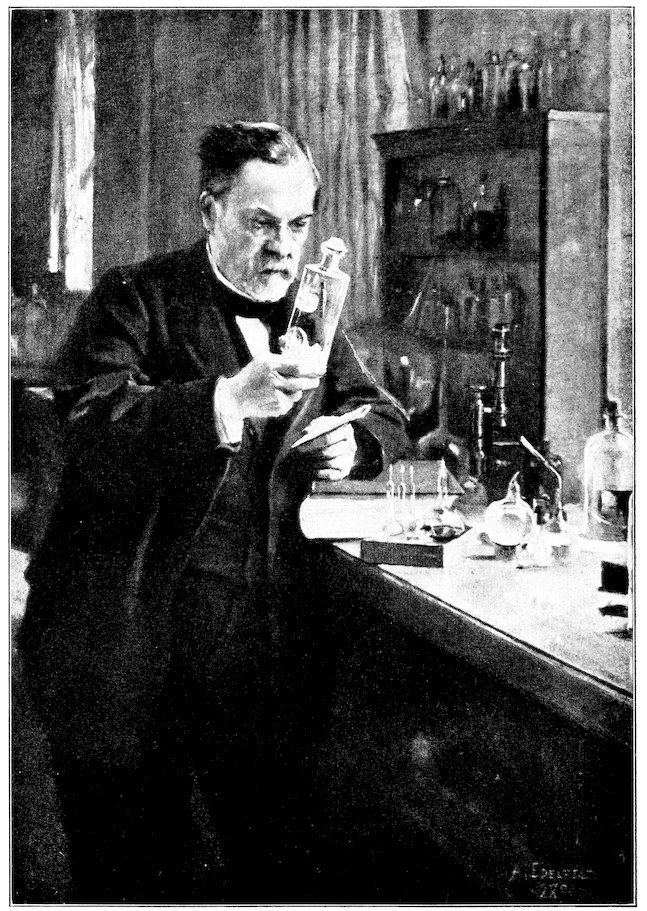
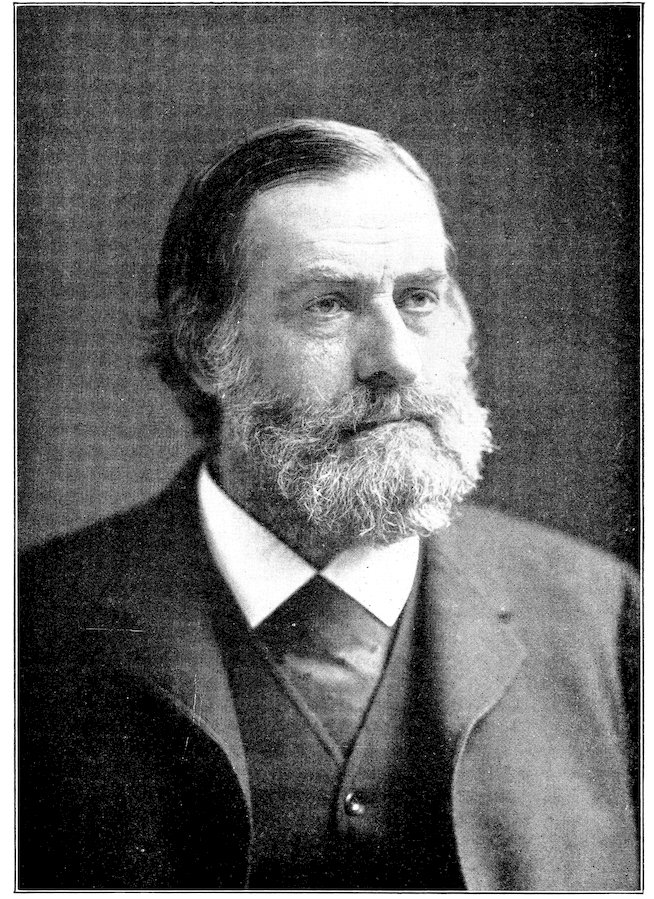
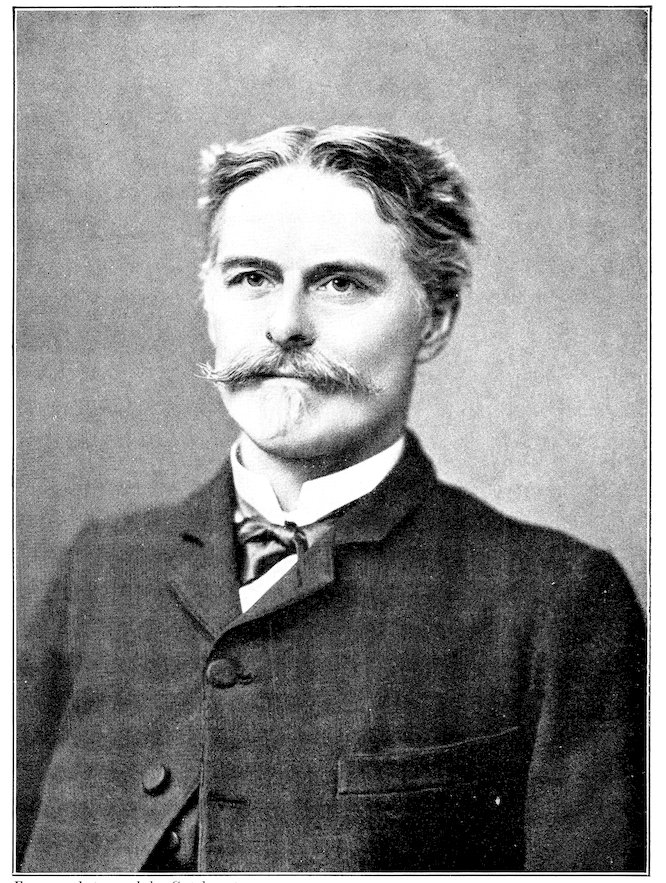
IMPRESSIONS OF GREAT NATURALISTS REMINISCENCES OF DARWIN, HUXLEY, BALFOUR, COPE AND OTHERS
Transcriber’s Note:
New original cover art included with this eBook is granted to the public domain.
BY THE SAME AUTHOR
MEN OF THE OLD STONE AGE
THE ORIGIN AND EVOLUTION OF LIFE
THE AGE OF MAMMALS
EVOLUTION OF MAMMALIAN MOLAR TEETH
FROM THE GREEKS TO DARWIN
EVOLUTION AND RELIGION
HUXLEY AND EDUCATION
IMPRESSIONS OF
GREAT NATURALISTS
BY
HENRY FAIRFIELD OSBORN
RESEARCH PROFESSOR OF ZOOLOGY IN COLUMBIA UNIVERSITY; SENIOR GEOLOGIST IN UNITED STATES GEOLOGICAL SURVEY; PRESIDENT OF THE AMERICAN MUSEUM OF NATURAL HISTORY
ILLUSTRATED WITH PORTRAITS
CHARLES SCRIBNER’S SONS
NEW YORK · LONDON
1924
Copyright, 1913, 1924, by
CHARLES SCRIBNER’S SONS
Copyright, 1909, 1924, by SCIENCE
Copyright, 1896, by GINN and COMPANY
Copyright, 1896, 1909, 1913, 1924, by POPULAR SCIENCE MONTHLY
Printed in the United States of America
vTO
THE MEMORY OF
THE NATURALISTS, EXPLORERS, AND AUTHORS
WHOSE CREATIVE LIVES
ARE BRIEFLY TOUCHED UPON HERE
“... those immortal dead who live again
In minds made better by their presence: live
In pulses stirr’d to generosity,
In deeds of daring rectitude, in scorn
For miserable aims that end with self,
In thoughts sublime that pierce the night like stars,
And with their mild persistence urge man’s search
To vaster issues.”
—George Eliot
AUTOBIOGRAPHIC FOREWORD
vii
There is no joy like the joy of creative
work. To my mind all great men are creative,
and among the greatest men are the creative
naturalists from Aristotle to Darwin, whose
self-effacing lives and enduring works are our
most precious possessions. I like a naturalist
better than a scientist, because there is
less of the ego in him, and in a naturalist
like Darwin the ego entirely disappears and
through his vision we see Nature with the
least human aberration. These “Impressions”
may show the young and aspiring
naturalists of our day that in the highest creative
vision there is the least of self and the
most of Nature. In the twelve lives chosen
from the fifty-seven men and women of whom
I have written,[1] I include Roosevelt, Bryce
and Butler because as intrepid explorers and
observers they show some of the highest qualities
of the naturalist.
I had the good fortune to lead my student
life between 1873 and 1880 under the spiritual,
viiimoral, and intellectual influence of the
great men of the Victorian age, the poets
Wordsworth and Tennyson, as well as the
natural philosophers Wallace, Darwin, Huxley,
and Cope. The scientific thought of the
first half of the nineteenth century was permeated
with the theism of the Special Creation
theory of the universe. In those fateful
days of intellectual doubt between the false
theism of Special Creation and the true theism
of Evolution, I fortunately came under the
influence of a series of broad-minded teachers,
of Arnold Guyot in geology, of James McCosh
in psychology and philosophy, of William M.
Sloane in the philosophy of Kant, of William
H. Welch in anatomy and the study of the
Cell; of each of these incomparable teachers I
like to recall that “I too sat at the feet of
Gamaliel.” McCosh numbered me in his favorite
group of “eager young men” with the
embryonic geologist Scott and the embryonic
philosopher Ormond. Inspired with self-confidence
by him in 1878, I took up original research
in psychology and prepared a questionnaire
on visual memory in co-operation
with Francis Galton, cousin of Charles Darwin,
publishing four psychological papers at
ixthe same time that I was writing my first
palæontological papers on fossil mammals discovered
in the Rocky Mountains in 1877–1878.
This work also fitted me to write, ten years
later, “From the Greeks to Darwin,” my inaugural
lectures in the Columbia University
Professorship of Biology, the first of a series
of volumes which I edited. While McCosh,
to whom I dedicated this philosophical work,
was eager and impetuous and urged the beginning
of observation and research at once,
Arnold Guyot, distinguished in the glaciology
of Switzerland, taught that the way of learning
is long and very arduous. I well recall
the motto he gave me when I was groaning
over the interminable difficulties of preparing
fossils, a motto derived from Hippocrates and
the patient Romans:
Art is long and difficult; criticism is short and easy.
This indeed is the message of Geology to the
student mind and the underlying reason why
Charles Lyell, a geologist, became the master
of Charles Darwin, a biologist. Only from the
eternal truths of the earth’s past history can
the immediate present of Life be understood.
Two of my eager Princeton comrades felt
xthe need of anatomy as much as I did, and
without the aid of a teacher we started the
dissection of a fish, guided by Huxley’s “Comparative
Anatomy of the Vertebrates.” This
laborious work on the porgy was followed by
an anatomical escapade on the limb of Homo
sapiens, part of a human cadaver, in one of
the unused rooms of the Astronomical Observatory
which we converted into a dissecting-room.
The venerable astronomer, Professor
Stephen Alexander, wondered at the
source of the strange odors that filled the observatory,
but never discovered the cause!
These untaught and surreptitious studies in
anatomy led to my coming, in the autumn of
1878, under one of the greatest teachers of
anatomy this country has produced, William
H. Welch, then a junior officer in the Bellevue
Medical College. Fresh from the leading laboratories
of Germany, Welch used the Teutonic
method I had not known before, of introducing
each of his discourses on the various
kinds of cells with an historical review of discovery,
showing how step by step one discovery
in science leads to another. I felt for
the first time the inspiration of the special
virtue of German research, the most thorough
xiand painstaking the world has ever known,
the virtue of grundlichkeit, of going to the
very bottom of things. Thus were drawing
to a close my six American years when the
question of whether I should go to Germany
or to England was decided by a letter from
Kitchen Parker, the distinguished English
comparative anatomist and friend of Huxley,
who personally advised me to go to London
to study under Huxley and to Cambridge to
study under Balfour.
Never shall I forget my first impression of
Francis Maitland Balfour as I met him in the
great court of Trinity College of Cambridge,
in the spring of 1879, to apply for admission
to his course in embryology. At the time he
was twenty-eight years of age and I was
twenty-one. I felt that I was in the presence
of a superior being, of a type to which
I could never possibly attain, and I did not
lose this impression throughout the spring
months in which he lectured on comparative
embryology at Cambridge and in which we
enjoyed many long afternoons of bicycle riding
on the level roads of the Fens. I always
felt that Balfour lived in a higher atmosphere,
in another dimension of intellectual space.
xiiNot that he was aloof—far from it, for he
was always in closest and most generous touch
with the minds of his students; he made you
feel that you had a mind and that your opinion
and observation were of value, although
you knew all the while that your mind was
still embryonic and your opinions of the most
tentative order. His was by far the most balanced
mind among all the English biologists.
He was at the time absorbed in embryology,
which was the reigning biological discipline
of the day. His untimely death in the Swiss
Alps in the year 1882 was a tragic loss, because
English biologic thought soon entered
the long period of confusion and lack of balance
that have characterized it to the present
time. The other great lesson taught by Balfour
was that of the balanced daily life: the
morning lecture and tour of the laboratory,
the five quiet hours devoted to his own writing
and research, the vigorous afternoon exercise,
and the delightful care-free and shop-free
evening. At the time Balfour was turning
out the great volumes of his “Comparative
Embryology,” a monumental work, I asked
him how many hours a day he gave to writing;
he replied: “Never more than five hours.”
xiiiA fresh mind is far more creative than a
jaded mind.
In the autumn of 1879 I moved to London,
which was then in the full and glorious tide
of Victorian life. Not a member had fallen
out of the great ranks. I had the good fortune
to hear in the scientific societies some of
these great men, such as Clark Maxwell in
physics, to meet all the leading biologists except
Wallace, and especially to come under
the commanding personal influence of Huxley.
Huxley especially imparted philosophic
breadth, grasp of the whole subject, the force
and value of expression, the wisdom and perception
that come from survey of a very broad
field, from both the philosophic and the anatomical
standpoint. His sense of humor was
delightful and brightened many of the most
difficult passages in his discourses. By his
way of living and by the unlimited personal
sacrifices he made he taught me that we men
of science must do our part in public education.
To public service Huxley sacrificed his
life, for not long after his great lecture course
of 1879–1880, which I attended and of which
I took the fullest notes, he broke down in
health. When I last met him in Cambridge,
xivat the British Association meeting of 1894,
he shook his head sadly and said: “Osborn,
I no longer can keep up with the progress of
biology.” Soon after his death, in 1895, I
wrote the reminiscences which appear in this
volume without change.
To Huxley I owe the greatest biological
impression that came to me in England,
namely, a few words with Charles Darwin in
Huxley’s laboratory. From the large number
of students working there at the time, Huxley
singled me out, perhaps because I was the
only American, perhaps because of my early
palæontological writing. I realized that I
must make the most of the opportunity, and
for a few moments I gazed steadily into Darwin’s
face and especially into his benevolent
blue eyes, which were almost concealed below
the overhanging brows, eyes that seemed to
have a vision of the entire living world and
that gave one the impression of translucent
truthfulness. In my address at the Darwin
Centenary at Cambridge I endeavored to
convey this profound impression of translucent
truthfulness. Darwin arrived at Evolution
not because he desired to do so, but
because he was forced into it by his own observations
xvof Nature. He came of a long line
of compellingly truthful ancestors, and certainly
“truth, the whole truth, and nothing
but the truth” is a distinctly English and
Scotch trait. In my fifty years’ experience
with scientific men I have found them neither
more nor less truthful than other men, because
truthfulness does not go on all fours
with genius, with powers of observation and
of generalization. Darwin always kept in
the realm of fact; he was equally sincere in
the realm of opinion and of theory. If in the
relatively small part of his life that he devoted
to speculation and to theory his contributions
are less permanent, it is because,
after all, Nature is unreasonable and irrational
in her methods.
On returning to America as a young comparative
anatomist I was privileged to work
as a comrade with men with whom I had
started as a disciple. I became more intimate
than ever with the Scotchman James McCosh
and enjoyed his eager freshness of mind and
desire to gain new ideas. For a gift on his
eightieth birthday his students paraphrased
the lines of Aristophanes: “Honor to the old
man who in the declining vigor of years seeks
xvito learn new subjects and to add to his wisdom.”
I had great reverence for another
Scotchman, James Bryce, with his enthusiasm,
his broad learning and experience, his eager
reception of new ideas, to the very end of his
life; finally, for that very unique Scotchman,
John Muir. From their simple and hardy
mode of living the Scotch contribute to the
students of life enduring impressions of energy,
vigor, youthfulness, and of the most
genial and whole-hearted friendship.
In reprinting these “Impressions,” extending
over a very long period of years, from my
youthful tribute to Balfour in 1883 to those
of John Muir, John Burroughs, Theodore
Roosevelt, and Howard Crosby Butler in the
present decade, may I claim that years of
observation have given me far deeper penetration
into the sources of human character
and personality? This penetration is due to
my studies in heredity and my observations
on the difference in races and racial characteristics,
which, for example, separate the Scotch
from the English and both from the Irish.
Such penetration is carried as far as I am
able to do at present in appreciation of the
xviipeculiar genius of John Muir and of John
Burroughs. In contrasting these two friends
I asked myself the question: “Why are they
so much alike and why so different?” I believe
I have partly answered this question,
but we may go much farther in the sympathetic
biographic analysis of the future.
Since I wrote the first of my biographic
studies, the principal titles of which are included
in the appendix of this volume, I have
been attempting to penetrate into human
nature along a number of paths: first, along
studies of heredity, already alluded to; second,
along studies of the men of the Old Stone Age
and their forebears; third, with the increasing
conviction that our intellectual, moral, and
spiritual reactions are extremely ancient and
that they have been built up not in hundreds
but in thousands—perhaps hundreds of thousands—of
years. It would, however, take me
far beyond the limits of a foreword to enter
upon this deeper interpretation of the impressions
and influences which great minds of great
men of different kinds have exerted upon me.
In these “Impressions” I am not in any
case attempting to portray the whole man,
but only one principal aspect of each life.
xviiiThe nearest approach to a full biographic
treatment is the centenary address on the life
and works of Charles Darwin and the memorial
address on his comrade, Alfred Russel
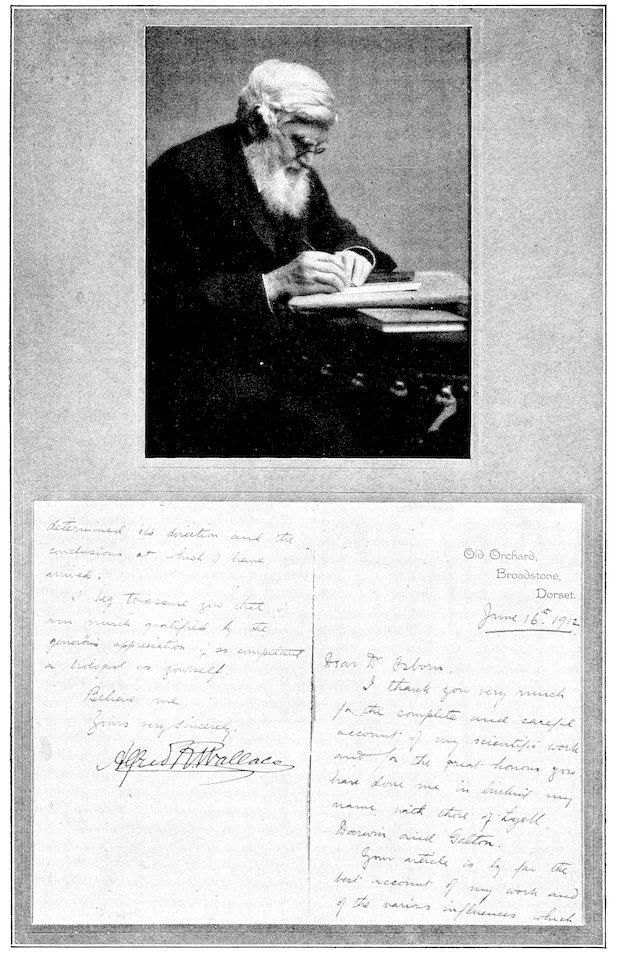
Wallace. It was an appreciation which I received
in a letter from Wallace, reproduced
in facsimile at the beginning of this volume,
also letters from Mrs. Huxley and her son,
from Lady Bryce, and from friends of John
Burroughs and John Muir that first led me to
believe that these biographical sketches would
be helpful to young men and young women
who aspire to greatness along different lines
of intellectual endeavor. I have omitted many
of my biographic essays because I was not
confident that they would be of interest to
laymen as well as to young scientists, to whom
this work is addressed, but I cannot pass by
two of my great palæontological predecessors,
Joseph Leidy and Edward Drinker Cope, because
the resemblances and contrasts between
these two men are especially illuminating in
scientific life.
Cope was certainly the most brilliant creative
mind in comparative anatomy and evolution
that America has produced. Quaker
by birth, he was a fighter by nature, both in
xixtheory and in fact. On one occasion, in the
American Philosophical Society, a difference
of opinion with his friend Persifor Frazer led
to such a violent controversy that the two
scientists retired to the hallway and came to
blows! On the following morning I happened
to meet Cope and could not help remarking
on a blackened eye. “Osborn,” he said,
“don’t look at my eye. If you think my eye
is black, you ought to see Frazer this morning!”
But such differences of opinion did
not sever the lifelong friendship, and when
Cope died Frazer was the first to pay a glowing
tribute to his genius. Cope was not a
single but a multiple personality; he presents
the widest possible contrast to a retiring nature
like that of Alfred Russel Wallace, a
sketch of whom opens this volume. Wallace,
the last survivor of the great trio of British
naturalists of the nineteenth century, survived
by only a few months another member of the
group, Sir Joseph Hooker, who introduced the
famous Darwin-Wallace papers on Natural
Selection to the Linnæan Society in 1858.
Lyell, Darwin, and Wallace were three successive
but closely kindred spirits, whose
work began and ended with what will be
xxknown as the second great epoch of evolutionary
thought, the first being that of the
precursors of Darwin and the third that in
which we live. They established Evolution
through a continued line of attack by precisely
similar methods of observation and
reasoning over an extremely broad field.
As to the closeness of the intellectual sequence
between these three men, those who
know the original edition of the second volume
of Lyell’s “The Principles of Geology,”
published in 1832, must regard it as the second
biologic classic of the century—the first
being Lamarck’s “Philosophie Zoologique,”
of 1809—on which Darwin through his higher
and much more creative vision built up his
“Journal of Researches.” When Lyell faltered
in the application of his own principles Darwin
went on and was followed by Wallace.
The two older men may be considered to have
united in guiding the mind of Wallace, because
the young naturalist, fourteen years the
junior of Darwin, took both “The Principles”
of Lyell and “The Journal” of Darwin with
him on his journey to South America, during
which his career fairly began.
From his record of observations during his
xxilife in the tropics of America and of Asia Wallace
will be remembered not only as one of
the independent discoverers of the theory of
Natural Selection but next to Darwin as one
of the great naturalists of the nineteenth century.
His range and originality are astounding
in these days of specialization. His main
lines of thought, although in many instances
suggested to his mind somewhat suddenly,
were developed and presented in a deliberate
and masterly way through the series of papers
and books extending from 1850 to 1913. The
highest level of his creative life was, however,
reached at the age of thirty-five, when with
Darwin he published his sketch of the theory
of Natural Selection. This outburst of original
thought, on which his reputation will chiefly
rest, came as an almost automatic generalization
from his twelve years in the tropics.
The two most powerful men I have known
intimately were J. Pierpont Morgan and Theodore
Roosevelt. I had the privilege of calling
the former “Uncle Pierpont” and have vivid
recollections of him as he was in 1867, when
I was a boy, and in the last two brilliant
decades of his life. Theodore Roosevelt I
xxiiknew slightly as a boy, as an intimate friend
of my naturalist brother, Frederick, and in
the last two and great decades of his life as
my own friend. Although the man in the
street would say that no two Americans could
be further apart than these two, in many
characteristics they were closely similar. The
outstanding point of likeness was their courage
in facing obstacles, their dominance in
overcoming difficulties of all kinds. There
was no “I can’t” in the vocabulary of either
man; rather “I can and I will.” Close contact
with both of these men enforced the life
motto which became my own: Whatever is
right can be done, and shall be done. Powerful
as both were in leadership, they always
sought the counsel of their friends and were apt
to be governed by it, unless it was the counsel
of timidity or of irresolution. Neither was
dominant in the sense that Woodrow Wilson
was dominant and autistic—to use the
professional phrase. Both won the devoted
friendship and admiration of hundreds of men
and women, and both made many enemies;
through similar virtues Roosevelt became the
opponent of Morgan and Morgan became the
opponent of Roosevelt. Both were intensely
xxiiipatriotic and willing to make any sacrifice,
however great, for their country. Both were
deeply religious and were guided by an unfaltering
faith in Divine Providence. The
most surprising likeness I observed was their
humility; I never saw a trace of conceit in
either Pierpont Morgan or Theodore Roosevelt.
The assurance and self-confidence they
both displayed in critical and commanding
moments were part of the great game of life.
Leaders must have broad shoulders, firm
necks, and confident and determined faces
when the world is full of doubting Thomases,
as it always is. A marked point of likeness
was the power of immediate, almost instantaneous,
decision, which sometimes led both
men astray. Contrasting with their power
of command were their simplicity, their unselfish
devotion to their friends, and their love
of children and fascination for children. Both
had a deep interest in science; with Morgan
it was mathematics, minerals, and gems, and,
in later years, archæology. Natural history
was the first and last love of Theodore Roosevelt,
in all its branches, and special study of
birds and mammals constituted the greatest
pleasure of his life.
xxivIt will surprise many of my readers that I
have instituted such a comparison, that I
have found resemblances amidst the many
violent contrasts in the lives and characters
of these two great Americans. It was the
love of nature and of human nature which
made them alike. Few of us are single in our
personalities; most of us are dual, and the
rare men like Morgan and Roosevelt are multiple.
Among great naturalists Wallace, Darwin,
and Pasteur were men of single natures,
whose whole lives were devoted to single great
purposes, to the attainment of which all other
objects in life gave way. They were neither
combatant nor militant, nor did they ever
seek to force their theories or opinions by
militant methods. They sought seclusion,
avoided public meetings and controversies,
and were astonished by the world-wide acclaim
of their discoveries. It is told of Darwin
that after meeting Gladstone he expressed
surprise that such a very great man had paid
him so much attention. It appears that this
simplicity of life and avoidance of renown are
most favorable to that creative state of mind
which most frequently engenders renown.
On the other hand, Huxley and Cope were,
above all, combatants in the new social and
xxvphilosophical arena of Evolution. Huxley’s
world-wide fame rests partly on his defense
of freedom of thought and of research and on
the brilliance of his rapier-like thrusts at some
of the shams and hypocrisies of the Special
Creation exponents of his day. His genius lay
in polemics, in criticism, in exposition, rather
than in creative discovery and generalization;
it is a striking fact that he did not add a single
new principle to the philosophy of Evolution.
His life was one of enforced activity and public
service, which left him little or no repose
for creative thought, yet he added to anatomy
a number of very important generalizations.
There is no measuring what Huxley might
have done if he had enjoyed the repose that
was granted to Darwin. Cope was, above all,
a creative naturalist of a high order, with a
rapidity and originality of thought almost
without parallel in the history of anatomy;
great generalizations affecting the order and
arrangement of the whole kingdom of backboned
animals arose from his brain, while in
philosophical analysis he was a tyro where
Huxley was a master.
From these impressions of the lives of
many naturalists we see that the naturalist
xxviis animated first of all by the joy of observation,
without initial hope or thought of discovery
but surely in the end leading to discovery;
leading also to creative thought if
observation is pursued with a single eye and
unfaltering purpose, regardless of all obstacles
or dangers and of the greatest impediment
of all, namely, interest in self and in self-advancement.
“The Life and Works of Darwin” was an address
delivered at Columbia University on February 12,
1909, the hundredth anniversary of Darwin’s birth, as
the first of a series of nine lectures on Charles Darwin
and his influence on science. “The Darwin Centenary”
is based on an address in reply to the reception
of delegates at Cambridge. “A Student’s Reminiscences
of Huxley” was a lecture delivered at the
Marine Biological Laboratory of Wood’s Hole in the
summer session of 1895. The address on James Bryce
was delivered at the memorial service to Viscount
Bryce at the Cathedral of St. John the Divine, March
5, 1922. The address on Joseph Leidy was originally
delivered at the Joseph Leidy Centenary, Philadelphia,
December 6, 1923, and was later published in Science.
The article on Howard Crosby Butler was an address
delivered at the Graduate College of Princeton University,
October 31, 1922. This address was afterward
published in the Butler memorial volume by the
Princeton University Press. The chapter on John
Burroughs is an address which was delivered at the
John Burroughs memorial meeting, American Academy
of Arts and Letters, on November 18, 1921.
Other chapters of this book are based on articles
published in the following magazines: Popular Science
Monthly, Science, The Century, The Sierra Club Bulletin.
ALFRED RUSSEL WALLACE
ALFRED RUSSEL WALLACE 1823–1913 — ALFRED RUSSEL WALLACE
1
I never had the pleasure of meeting Wallace, but I felt rewarded
for the time I devoted to the study of his works and the influences
which shaped his great career in preparing this Impression by his
letter of acknowledgment, which is reproduced in facsimile. Wallace
was a great man, although he was overshadowed by a much greater
man, Darwin. The scientific relations of these two men were ideal;
their magnanimity toward each other in the crisis of independent discovery
of the great principle of Natural Selection is one of the noblest
episodes in the history of biology.
3
Nature and nurture conspire to form a
naturalist. Predisposition, an opportune
period, and a happy series of events favored
Alfred Russel Wallace.
Wallace was the son of Thomas Vere Wallace,
of Hanworth, Middlesex, England, and
Mary Anne Grennell, of Hertford. His ancestry
is obscure. On the paternal side he is
probably descended from one of the branches
of Sir William Wallace, the popular national
hero of Scotland, but nothing is known back
of his grandfather, who was probably keeper
of the inn on the estates of the Duke of St.
Albans, of Hanworth. The burial records of
Hanworth mention an Admiral James Wallace.
In his mother’s family on the paternal
side is the name Greenell, of Hertford, probably
the “Greenaile” in 1579, French Huguenot
refugees after the massacre of St. Bartholomew.
Her grandfather was for many years
alderman and twice mayor of Hertford. One
of the Greenells was an architect.
Wallace’s father took up the profession of
the law, but did not continue, and up to his
4marriage lived the life of a fairly well-to-do
middle-class gentleman. After his marriage
he essayed the publishing of two magazines
apparently devoted to art, antiquities and general
literature, which were failures. He then
moved from Marylebone to more rural districts
where living was less expensive, first to
St. Georges, Southwark, and then to Usk,
Monmouthshire. In this village Alfred Russel
Wallace was born on January 8, 1823.
When Wallace was about six years of age the
family moved to Hertford, where his education
was begun in the old grammar school that
dated back to 1617. He left school too young
to begin Greek, but he studied Latin, and next
to Latin grammar the most painful subject
he learned was geography, principally because
of the meaningless way in which it was taught.
During the last year of study at the grammar
school, as the family were then in very straitened
circumstances, he assisted in the teaching
of the younger boys in reading, arithmetic,
and writing.
Wallace considered that his home life in
Hertford was in many ways more educational
than the time spent at school. His father
was a man who enjoyed the pleasure of literature
5and belonged to a book club through
which a constant stream of interesting books
came to the house, from which he read aloud
to the family in the evenings. The father
earned a small income tutoring and as librarian
of a small library, and the son Alfred
spent hours reading there, also.
At the age of thirteen young Wallace left
school, with a view to learning land surveying.
He stayed in London a short time with his
brother John, who was apprenticed to a master
builder, and their evenings were most frequently
spent in the “Hall of Science,” a
kind of mechanics institute for advanced
thinkers among workmen. Here he heard
many lectures by Robert Owen, the founder
of the socialist movement in England, and
took up philosophical reading, beginning with
Paine’s “Age of Reason,” among other books.
In the summer of 1837 he went with his
brother William into Bedfordshire to begin
his education as a land surveyor, and practised
for seven years in various parts of
England and Wales.
After a time it was decided that he should
try to pursue the clock-making business as
well as surveying and general engineering,
6and Wallace considered that this was the first
of several turning-points in his life, because
changes in the business of the clock-making
concern with which he was connected at
Leighton prevented his continuing this work
for more than a short period. He was delighted
to take up again in 1839 the employment
of land surveying because of the opportunities
it afforded for out-of-door life.
While at Neath, in Wales, there was not
much demand for surveying, and Wallace
occupied himself in constructing a rude telescope
with which he was able to observe the
moon and Jupiter’s satellites, and he developed
much interest in studying astronomy
and in the development of astronomical instruments.
But he says that he was chiefly
occupied with what became more and more
the solace and delight of his lonely rambles
among the moors and mountains, namely, his
first introduction to the variety, the beauty
and the mystery of nature as manifested in
the vegetable kingdom.
His earnings were very meagre and he had
little money for the purchase of books. During
the seven years he worked with his brother
he says he “hardly ever had more than a few
7shillings for personal expenses.” It was during
this period, while most occupied out of
doors with the observation and collection of
plants, that he began to write down more or
less systematically his ideas on various subjects
that interested him. His first literary
efforts all bear dates of the autumn and winter
of 1843, when he was between twenty and
twenty-one years of age. One of his first productions
was the rough sketch of a popular
lecture on botany addressed to an audience
supposed to be as ignorant as he was when he
began his observation of the native flowers.
A second of these early lectures was on the
subject “The Advantages of Varied Knowledge,”
which he considered of interest chiefly
as showing the bent of his mind at the time
and indicating a disposition for discursive
reading and study. He also wrote at this
time on the manners and customs of the
Welsh peasantry in Brecknockshire and Glamorganshire,
and put the matter in form for
one of the London magazines, but it was
declined.
These early and serious studies in botany,
continuing for four years, prepared him for
the plant wonders of the tropics. At the
8age of twenty-one he went to London. He
afterward regarded his difficulty in obtaining
employment as a great turning-point in his
career, “for otherwise,” he writes, “it seems
very unlikely that I should ever have undertaken
what at that time seemed rather a wild
scheme, a journey to the almost unknown
forests of the Amazon in order to observe
nature and make a living by collecting.”
In his autobiographic volumes of 1905,
“My Life, a Record of Events and Opinions,”
there is also an interesting sketch of his state
of mind at this time.
I do not think that at this formative period I
could be said to have shown special superiority
in any of the higher mental faculties, but I possessed
a strong desire to know the causes of things,
a great love of beauty in form and color, and a
considerable, but not excessive desire for order
and arrangement in whatever I had to do. If I
had one distinct mental faculty more prominent
than another it was the power of correct reasoning
from a review of the known facts in any case to
the causes or laws which produced them, and also
in detecting fallacies in the reasoning of other
persons.
Elsewhere in his autobiography he observes
that whatever reputation in science, literature
9and thought he may possess is the result
of the organs of comparison, causality and
order, with firmness, acquisitiveness, concentrativeness,
constructiveness and wonder, all
above the average, but none of them excessively
developed, combined with a moderate
faculty of language which
enables me to express my ideas and conclusions in
writing though but imperfectly in speech. I feel,
myself, how curiously and persistently these faculties
have acted in various combinations to determine
my tastes, disposition and actions.
Wallace shared Darwin’s strong sentiment
for justice as between man and man, and
abhorrence of tyranny and unnecessary interference
with the liberty of others. His retiring
disposition enabled him to enjoy long
periods of reflection, receptiveness and solitude,
both at home and in the tropics, out of
which have come the sudden illuminations or
flashes of light leading to the solution of the
problems before him. As to this wonderful
mechanism of induction, Wallace observes:
I have long since come to see that no one deserves
either praise or blame for the ideas that
come to him, but only for the actions resulting
10therefrom. Ideas and beliefs are certainly not
voluntary acts. They come to us—we hardly
know how or whence, and once they have got
possession of us we can not reject or change them
at will.
Apart from Darwin’s education in Christ’s
College, Cambridge, as compared with Wallace’s
self-education, the parallel between his
intellectual tendencies and environment and
those of Charles Darwin is extraordinary.
They enjoyed a similar current of influence
from men, from books and from nature. Thus
the next turning-point in his life was his
meeting with Henry Walter Bates, through
whom he acquired his zest for the wonders of
insect life, which opened for the first time for
him the zoological windows of nature. In a
measure Bates was to Wallace what the Reverend
John S. Henslow had been to Darwin.
It is noteworthy that the greater and most
original part of his direct observations of
nature was upon the adaptations of insects.
Darwin and Wallace fell under the spell of
the same books, first and foremost those of
Lyell, as noted above, then of Humboldt in
his “Personal Narrative” (1814–18), of Robert
Chambers in his “Vestiges of the Natural
11History of Creation” (1844), of Malthus in
his “Essay on the Principle of Population”
(1798).
It was, however, Darwin’s own “Journal of
Researches,” published in 1845, and read by
Wallace at the age of twenty-three, which
determined him to invite Bates to accompany
him on his journey to the Amazon and Rio
Negro, which filled the four years 1848–52.
In this wondrous equatorial expanse, like
Darwin he was profoundly impressed with
the forests, the butterflies and birds, and with
his first meeting with man in an absolute
state of nature. Bates, himself a naturalist
of high order,[2] was closely observing the
mimetic resemblances among insects to animate
and inanimate objects and introducing
Wallace to a field which he subsequently
made his own. Bates remained several years
after Wallace’s departure and published his
classical memoir on mimicry in 1860–61. Wallace’s
own description of his South American
experiences, entitled “Narrative of Travels
on the Amazon,” published in 1853 when he
was thirty years of age, does not display the
12ability of his later writings and shows that his
powers were slowly developing.
His eight years of travel between 1854 and
1862 in the Indo-Malay Islands, the Timor
Group, Celebes, the Moluccas and the Papuan
Group brought his powers to full maturity.
It is apparent that his prolonged observations
on the natives, the forests, the birds and mammals,
and especially on the butterflies and
beetles, were gradually storing his mind for
one of those discharges of generalization which
come so unexpectedly out of the vast accumulation
of facts. “The Malay Archipelago” of
1869, published seven years after the return,
is Wallace’s “journal of researches,” that is,
it is to be compared with Darwin’s great work
of this title. Its fine breadth of treatment in
anthropology, zoology, botany and physiography
gives it a rank second only to Darwin’s
“Journal” in a class of works repeatedly enriched
by British naturalists from the time of
Burchell’s journey in Africa.
Wallace’s first trial at the evolution problem
was his essay sent to the Annals and Magazine
of Natural History in 1855, entitled “On
the Law Which Has Regulated the Introduction
of New Species.” This paper suggested
13the when and where of the occurrence
of new forms, but not the how. He concludes:
It has now been shown, though most briefly and
imperfectly, how the law that “Every species has
come into existence coincident both in time and space
with a preexisting closely allied species,” connects
together and renders intelligible a vast number of
independent and hitherto unexplained facts.
In February, 1858, during a period of intermittent
fever at Ternate, the how arose in
his mind with the recollection of the “Essay”
of Malthus, and there flashed upon him all
the possible effects of the struggle for existence.
Twenty years before the same idea,
under similar circumstances, had come into
the mind of Darwin. The parallel is extraordinary
as shown in the following citations:
DARWIN
WALLACE
14In October, 1838, that is, fifteen months after I had begun my systematic inquiry, I happened to read for amusement, “Malthus on Population,” and being well prepared to appreciate the struggle for existence which everywhere goes on from long-continued observations of the habits of animals and plants, it at once struck me that under these circumstances favorable variations would tend to be preserved, and unfavorable ones to be destroyed. The result of this would be the formation of new species. Here, then, I had at last got a theory by which to work; but I was so anxious to avoid prejudice that I determined not for some time to write even the briefest sketch of it. In June, 1842, I first allowed myself the satisfaction of writing a very brief abstract of my theory in pencil, in thirty-five pages, and this was enlarged during the summer of 1844 into one of 230 pages.—Darwin’s “Autobiography,” Chap. II.
In February, 1858, I was suffering from a rather severe attack of intermittent fever at Ternate, in the Moluccas; and one day, while lying on my bed during the cold fit, wrapped in blankets, though the thermometer was at 88° Fahr., the problem again presented itself to me, and something led me to think of the “positive checks” described by Malthus in his “Essay on Population,” a work I had read several years before, and which had made a deep and permanent impression on my mind. These checks—war, disease, famine and the like—must, it occurred to me, act on animals as well as man. Then I thought of the enormously rapid multiplication of animals, causing these checks to be much more effective in them than in the case of man; and while pondering vaguely on this fact there suddenly flashed upon me the idea of the survival of the fittest—that the individuals removed by these checks must be on the whole inferior to those that survived. In the two hours that elapsed before my ague fit was over, I had thought out almost the whole of the theory; and the same evening I sketched the draft of my paper, and in the two succeeding evenings wrote it out in full, and sent it by the next post to Mr. Darwin.—Wallace’s “My Life,” p. 212.
Darwin had been working upon the verification
of the same idea for twenty years. We
owe to Sir Joseph Hooker and to Lyell the
bringing together of these independent but
strikingly similar manuscripts. The noble
episode which followed of the joint publication
of the discovery was prophetic of the
continued care for truth and carelessness of
self, of the friendship, mutual admiration and
co-operation between these two high-minded
15men, which affords a golden example for our
own and future ages. Each loved his own
creations, yet undervalued his own work;
each accorded enthusiastic praise to the work
of the other.
It is a striking circumstance in the history
of biology that Wallace’s rapidly produced
sketch of 1858 “On the Tendencies of Varieties
to Part Indefinitely from the Original
Type” not only pursues a line of thought
parallel to that of Darwin, except in excluding
the analogy of natural with human selection,
but embodies the permanent substance of the
selection theory as it is today after fifty-four
years of world-wide research. It may be regarded
as his masterpiece. The attempt has
been made by De Vries and others to show
that Wallace in his “Darwinism” of 1889
differed from Darwin on important points,
but whatever may be true of this final modification
of the theory, a very careful comparison
of the Darwin-Wallace sketches of 1858
shows that they both involve the principle of
discontinuity; in fact, fluctuation in the sense
of plus and minus variation was not recognized
at the time; the notion of variation
was that derived directly from field rather
16than from laboratory notes. This is repeatedly
implied in Wallace’s language and especially
in his sketch of 1858:
... there is a general principle in nature
which will cause many varieties to survive the parent
species, and to give rise to successive variations
departing further and further from the original
type, and which also produces, in domesticated
animals, the tendency of varieties to return to
the parent form....
Most or perhaps all the variations from the
typical form of a species must have some definite
effect, however slight, on the habits or capacities
of the individuals. Even a change of color might,
by rendering them more or less distinguishable,
affect their safety; a greater or less development
of hair might modify their habits.... The superior
variety would then alone remain, and on a return
to favorable circumstances would rapidly increase
in numbers and occupy the place of the
extinct species and variety.
The variety would now have replaced the species,
of which it would be a more perfectly developed
and more highly organized form.... Here, then,
we have progression and continued divergence deduced
from the general laws which regulate the
existence of animals in a state of nature, and from
the undisputed fact that varieties do frequently
occur.... Variations in unimportant parts
might also occur, having no perceptible effect on
the life-preserving powers; and the varieties so
furnished might run a course parallel with the
parent species, either giving rise to further variations
17or returning to the former type.... In
the wild animal, on the contrary, all its faculties
and powers being brought into full action for the
necessities of existence, any increase becomes immediately
available, is strengthened by exercise,
and must even slightly modify the food, the habits
and the whole economy of the race. It creates, as
it were, a new animal, one of superior powers, and
which will necessarily increase in numbers and
outlive those inferior to it....
We see, then, that no inferences as to varieties
in a state of nature can be deduced from the observation
of those occurring among domestic animals....
Domestic animals are abnormal, irregular,
artificial; they are subject to varieties which
never occur and never can occur in a state of
nature; their very existence depends altogether
on human care.... An origin such as is here
advocated will also agree with the peculiar character
of the modifications of form and structure
which obtain in organized beings—the many lines
of divergence from a central type, the increasing
efficiency and power of a particular organ through
a succession of allied species, and the remarkable
persistence of unimportant parts, such as color,
texture of plumage and hair, form of horns or
crests, through a series of species differing considerably
in more essential characters.... This
progression, by minute steps, in various directions,
but always checked and balanced by the
necessary conditions, subject to which alone existence
can be preserved, may, it is believed, be
followed out so as to agree with all the phenomena....
18It is true that Wallace subsequently modified
his theory, adopted the selection of plus
and minus fluctuations, and became a determined
opponent of the mutation hypothesis
of De Vries.
The distinctive features of the later development
of the theory in Wallace’s mind were
his more implicit faith in selection, his insistence
on utility or selection value of new or
varying characters, his flat rejection of Lamarckism,
his reliance on spontaneous variations
as supplying all the materials for selection.
This confidence appears in the following
passages from his militant reply in the volume
of 1889 to the critics of Darwinism:
The right or favorable variations are so frequently
present that the unerring power of natural
selection never wants materials to work upon....
Weismann’s theory ... adds greatly to the importance
of natural selection as the one invariable
and ever-present factor in all organic change
and that which can alone have produced the temporary
fixity combined with the secular modification
of species.
The principle of discontinuity is less clearly
brought out than in the first sketch of 1858;
the selection of fluctuation is favorably considered.
19The laws and causes of variation are,
however, assumed rather than taken up as a
subject of inquiry. These opinions of 1889
were the summation of twenty-nine years of
work.
To return to the life-narrative, the autumn
of 1860 found Wallace in the Moluccas reading
the “Origin of Species” through five or
six times, each time with increasing admiration.
A letter of September 1 to his friend
George Silk contains the key to the subsequent
direction of his research, namely, his recognition
of the vast breadth of Darwin’s principles
and his determination to devote his life to
their exposition:
I could never have approached the completeness
of his book, its vast accumulation of evidence, its
overwhelming argument, and its admirable tone
and spirit. I really feel thankful that it has not
been left to me to give the theory to the world.
Mr. Darwin has created a new science and a new
philosophy; and I believe that never has such a
complete illustration of a new branch of human
knowledge been due to the labors and researches
of a single man. Never have such vast masses of
widely scattered and hitherto quite unconnected
facts been combined into a system and brought
to bear upon the establishment of such a grand
and new and simple philosophy.
20The discovery of “Natural Selection” again
turned the course of Wallace’s life. In his
autobiography he writes:
I had, in fact, been bitten with the passion for
species and their description, and if neither Darwin
nor myself had hit upon “natural selection,”
I might have spent the best years of my life in
this comparatively profitless work, but the new
ideas swept all this away.... This outline of
the paper will perhaps enable my readers to understand
the intense interest I felt in working out all
these strange phenomena, and showing how they
could almost all be explained by that law of
“Natural Selection” which Darwin had discovered
many years before, and which I also had been so
fortunate as to hit upon.
The coloring of animals as observed in the
tropics and the Malayan Islands was the subject
in which Wallace made his most extensive
and original contributions to Darwinism.
In his sketch of 1858 he wrote:
Even the peculiar colors of many animals, especially
insects, so closely resembling the soil or the
leaves or the trunks on which they habitually
reside, are explained on the same principle; for
though in the course of ages varieties of many
tints may have occurred, yet those races having
21colors best adapted to concealment from their enemies
would inevitably survive the longest.
Returning from the Archipelago in 1862, he
published in 1864 his pioneer paper, “The
Malayan Papilionidæ or Swallow-tailed Butterflies,
as illustrative of the Theory of Natural
Selection,” in which he at once took rank
beside Bates and Müller as one of the great
contributors to the color characteristics of
animals. We see him step by step developing
the ideas of protective resemblance which
he had fully discussed with Bates, of alluring
and warning colors, and of mimicry, pointing
out the prevalence of mimicry in the female
rather than in the male. The whole series
of phenomena is believed to depend upon
the great principle of the utility of every
character, upon the need of color protection
by almost all animals, and upon the known
fact that no characteristic is so variable as
color, that, therefore, concealment is most
easily obtained by color modification. Protective
resemblance in all its manifold forms
has ever been dominant in his mind as a
greater principle than that of the sexual selection
of color which Darwin favored.
Here may be cited Wallace’s own account
22of his famous observation of mimicry in the
leaf butterfly from his volume of 1869, “The
Malay Archipelago”:
The other species to which I have to direct attention
is the Kallima paralekta, a butterfly of
the same family group as our Purple Emperor, and
of about the same size or larger. Its upper surface
is of a rich purple, variously tinged with ash
color, and across the fore wings there is a broad
bar of deep orange, so that when on the wing it is
very conspicuous. This species was not uncommon
in dry woods and thickets, and I often endeavored
to capture it without success, for after flying
a short distance it would enter a bush among
dry or dead leaves, and however carefully I
crept up to the spot I could never discover it
till it would suddenly start out again and then
disappear in a similar place. At length I was
fortunate enough to see the exact spot where the
butterfly settled, and though I lost sight of it
for some time, I at length discovered that it was
close before my eyes, but that in its position of
repose it so closely resembled a dead leaf attached
to a twig as almost certainly to deceive the eye
even when gazing full upon it. I captured several
specimens on the wing, and was able fully to understand
the way in which this wonderful resemblance
is produced.... All these varied details
combine to produce a disguise that is so complete
and marvellous as to astonish every one who observes
it; and the habits of the insects are such as
to utilize all these peculiarities, and render them
23available in such a manner as to remove all doubt
of the purpose of this singular case of mimicry,
which is undoubtedly a protection to the insect.
In 1867, in a manner which delighted Darwin,
Wallace advanced his provisional solution
of the cause of the gay and even gaudy
colors of caterpillars as warnings of distastefulness.
In 1868 he propounded his explanation
of the colors of nesting birds, that when
both sexes are conspicuously colored, the nest
conceals the sitting bird, but when the male
is conspicuously colored and the nest is open
to view, the female is plainly colored and inconspicuous.
His theory of recognition colors
as of importance in enabling the young birds
and mammals to find their parents was set
forth in 1878, and he came to regard it as of
very great importance.
In “Tropical Nature” (1878) the whole
subject of the colors of animals in relation to
natural and sexual selection is reviewed, and
the general principle is brought out that the
exquisite beauty and variety of insect colors
has not been developed through their own
visual perceptions, but mainly and perhaps
exclusively through those of the higher animals
which prey upon them. This conception
24of color origin, rather than that of the general
influence of solar light and heat or the special
action of any form of environment, leads him
to his functional and biological classification
of the colors of living organisms into five
groups, which forms the foundation of the
modern, more extensive and critical classification
of Poulton. He concluded (p. 172):
We find, then, that neither the general influence
of solar light and heat, nor the special action of
variously tinted rays, are adequate causes for the
wonderful variety, intensity and complexity of the
colors that everywhere meet us in the animal and
vegetable worlds. Let us, therefore, take a wider
view of these colors, grouping them into classes
determined by what we know of their actual
uses or special relations to the habits of their
possessors. This, which may be termed the
functional and biological classification of the colors
of living organisms, seems to be best expressed by
a division into five groups, as follows:
Animals.
1. Protective colors.
2. Warning colors.
a. Of creatures specially protected.
b. Of defenseless creatures mimicking a.
3. Sexual colors.
4. Typical colors.
Plants.
5. Attractive colors.
Twelve years later he devoted four chapters
of his “Darwinism” to the colors of animals
and plants, still maintaining the hypotheses
25of utility, of spontaneous variation and of
selection.
The study of geographic distribution of
animals also sprang from the inspiration of
the Malayan journey and from the suggestiveness
of the eleventh and twelfth chapters
of “The Origin of Species,” which Wallace
determined to work out in an exhaustive manner.
Following the preliminary treatises of
Buffon, of Cuvier and Forbes, and the early
regional classification of Sclater, Wallace takes
rank as the founder of the science of zoogeography
in his two great works, “The Geographical
Distribution of Animals” of 1876, and
“Island Life” of 1881, the latter volume following
the first as the result of four years of
additional thought and research. His early
observations on insular distribution were
sketched out in his article of 1860, “The Zoological
Geography of the Malayan Archipelago.”
Here is his discovery of the Bali-Lombok
boundary line between the Indian and the
Australian zoological regions which has since
been generally known by his name.
In these fundamental geologic and geographic
works Wallace appears as a disciple
26of Lyell in uniformitarianism, and a follower
of Dana as regards the stability and permanence
of continental and oceanic areas, for
which doctrine he advances much original
evidence. He taxes his ingenuity to discover
every possible means of dispersal of animals
and plants other than those which would be
afforded by hypothetical land connections;
he considers every possible cause of extinction
other than those which are sudden or cataclysmal.
The “Island Life” is in itself a great contribution
to zoology and zoogeography, the
starting-point of all modern discussion of insular
faunas and floras. His conservative
theory of dispersal is applied in an original
way to explain the arctic element in the
mountain regions of the tropics, as opposed to
the low-temperature theory of tropical lowlands
during the Glacial Period; his explanation
is founded on known facts as to the dispersal
and distribution of plants and does not
require the extreme changes in the climate of
tropical lowlands during the Glacial Period
on which Darwin founded his interpretation.
The causes and influence of the Glacial Epoch
are discussed in an exposition of Croll’s theory.
27In this connection may be mentioned one of
Wallace’s original geological contributions, in
the article “Glacial Erosions of Lake Basins,”
published in 1893, namely, his theory of
glacial erosion as a means of explaining the
origin of valley lakes of glaciated countries.
The original trend of Wallace’s thought as
to the ascent of man is first shown in the three
anthropological essays of 1864, 1869 and 1870,
which were subsequently collected in the
volume “Contributions to the Theory of
Natural Selection.” This work, published in
1871, includes all his original essays from 1855
to 1869 on selection, on color and human evolution,
which foreshadow the later development
of his speculative philosophy.
A suggestive anthropological contribution
is the article entitled “The Expressiveness of
Speech or Mouth Gesture as a Factor in the
Origin of Language,” in which is developed
the theory of the origin of language in connection
with the motions of the lips, jaws and
tongue. With Wallace also arose the now
widely accepted belief that the Australian
aborigines constitute a low and perhaps primitive
type of the Caucasian race.
In the article of 1864, “The Development
28of Human Races under the Law of Natural
Selection,” Wallace first advanced the hypothesis
which has since proved to be untenable,
that so soon as man learned to use fire and
make tools, to grow food, to domesticate
animals, to use clothing and build houses, the
action of natural selection was diverted from
his body to his mind, and thenceforth his
physical form remained stable, while his mental
faculties improved. His subsequent papers
on human evolution, “The Limits of Natural
Selection as Applied to Man” of 1869, “On
Instinct in Man and Animals” of 1871, mark
the gradual divergence of his views from those
of Darwin, for in his opinion natural selection
is believed to be inadequate to account for
several of the physical as well as psychical
characteristics of man, for example his soft,
sensitive skin, his speech, his color sense, his
mathematical, musical and moral attributes.
He concluded:
The inference I would draw from this class of
phenomena is that a superior intelligence has
guided the development of man in a definite direction,
and for a special purpose, just as man guides
the development of many animal and vegetable
forms.
29It is also prophetic of his later indictments
of the so-called civilization of our times that
we find at the end of the closing pages of “The
Malay Archipelago” the first statement of the
feeling which so many travelers have experienced
from a comparison of the natural and
so-called civilized condition of man that “social
evolution from barbarism to civilization”
has not advanced general human welfare.
These humanitarian and partly socialistic
ideas are developed in a series of recurrent
essays between 1882 and 1903, including “The
Nationalization of Land” and “Studies Scientific
and Social.”
He returned to this subject in what we believe
to be his last published essay, namely,
his “Social Environment and Moral Progress”
of 1913, wherein he considers the so-called
“feministic” movement and future of
woman:
The foregoing statement of the effect of established
natural laws, if allowed free play under
rational conditions of civilization, clearly indicates
that the position of woman in the not distant
future will be far higher and more important
than any which has been claimed for or by her
in the past.
While she will be conceded full political and
30social rights on an equality with men, she will be
placed in a position of responsibility and power
which will render her his superior, since the future
moral progress of the race will so largely depend
upon her free choice in marriage. As time goes on,
and she acquires more and more economic independence,
that alone will give her an effective choice
which she has never had before. But this choice
will be further strengthened by the fact that, with
ever-increasing approach to equality of opportunity
for every child born in our country, that terrible
excess of male deaths, in boyhood and early manhood
especially due to various preventable causes,
will disappear, and change the present majority
of women to a majority of men. This will lead to
a greater rivalry for wives, and will give to women
the power of rejecting all the lower types of character
among their suitors.
It will be their special duty so to mould public
opinion, through home training and social influence,
as to render the women of the future the
regenerators of the entire human race.
In closing this review of a great life, we cannot
refrain from reflecting on the pendulum
of scientific opinion. The discovery of a great
truth such as the law of selection is always
followed by an over-valuation, from which
there is certain to be a reaction. We are in
the midst of such a reaction at the present
time, in which the Darwin-Wallace theory of
natural selection is less appreciated than it
31will be in the future when there comes a fresh
readjustment of scientific values.
It is well to remember that we may not
estimate either the man of science or his conclusions
as of our own period, but must project
ourselves in imagination into the beginnings
of his thought and into the travails of
his mind, considering how much larger he
was than the men about him, how far he was
an innovator, breaking away from the traditions
of his times, how far his direct observations
apart from theory are true and permanent,
and how far his theories have contributed
to the great stream of biological thought.
Our perspective has covered a long, honorable
span of sixty-five years into the beginnings
of the thinking life of a natural philosopher
whose last volume, “The World of
Life,” of the year 1911, gives as clear a portrayal
of his final opinions as that which his
first essay of 1858 portrays of his early
opinions.
We follow the cycle of his reflection beginning
with “adaptation” as the great mystery
to be solved; in the middle and sanguine
period of life, “adaptation” is regarded as
fully explained by natural selection; in the
32closing and conservative period of life “adaptation”
is again regarded in some of its phases
as entirely beyond human powers of interpretation,
not only in the evolution of the
mental and spiritual nature of man, but in
such marvellous manifestations as the scales
of butterflies or the wings of birds.
From our own intellectual experience we
may sympathize with the rebound of maturity
from the buoyant confidence of the young
man of thirty-five who finds in natural selection
the entire solution of the problem of
fitness which has vexed the mind and aroused
the scientific curiosity of man since the time
of Empedocles. We have ourselves experienced
a loss of confidence with advancing
years, an increasing humility in the face of
transformations which become more and more
mysterious the more we study them, although
we may not join with this master in his appeal
to an organizing and directing supernatural
principle. Younger men than Wallace, both
among the zoologists and philosophers of our
own time, are giving a somewhat similar metaphysical
solution of the eternal problem of
adaptation, which still baffles and transcends
our powers of experiment and of reasoning.
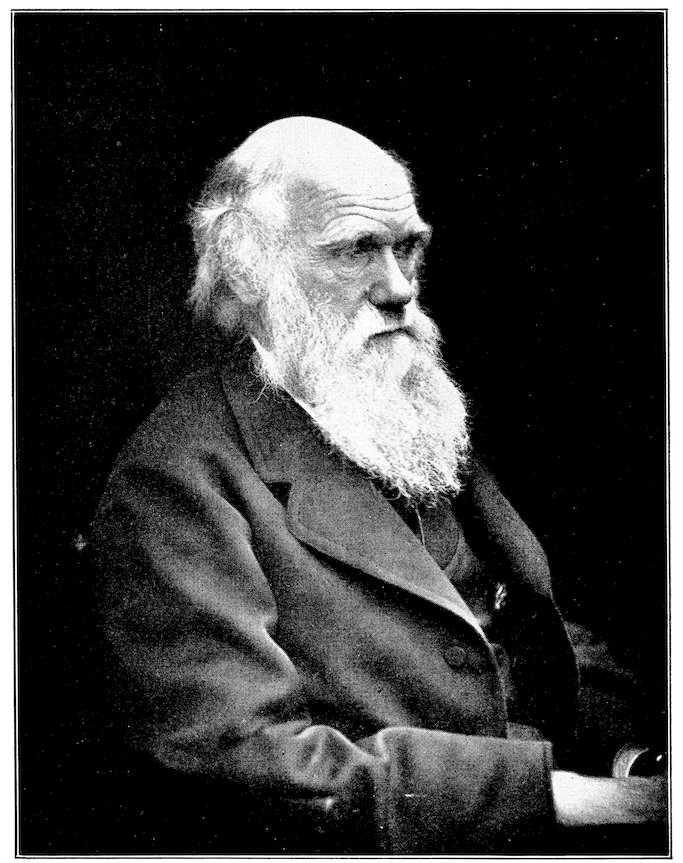
Photographed by his son, Leonard Darwin
CHARLES DARWIN
CHARLES DARWIN 1809–1882 — LIFE AND WORKS OF DARWIN — I — II — III — IV — V — THE DARWIN CENTENARY AT CAMBRIDGE
33
I met Darwin in Huxley’s laboratory and my impression of his
personality is described in the address on the Life and Works of
Darwin, which was delivered at Columbia University on the hundredth
anniversary of his birth, as an introduction to a series of nine
lectures on Charles Darwin and his influence in science. The fact
that Lincoln and Darwin were born on the same day, February 12,
1809, brought together these two great men, so widely different in
their vocations, so similar in their reverence for the truth, in their
simplicity and directness of life.
The address at the Darwin Centenary at Cambridge was delivered
at the request of my American colleagues, in reply to the reception of
the delegates. It was strictly limited as to time, presenting the
problem of speaking of Darwin to the men who knew him personally,
who recalled almost every detail of his life—to sum up in comparatively
few words the outstanding facts of his influence. The form of
this address is therefore quite in contrast to the preceding tribute,
which was without time limitation.
35
Columbia University is celebrating
the hundredth anniversary of the
birth of Darwin, the fiftieth anniversary of
the publication of the “Origin of Species.”
In the year 1809 many illustrious men[3] were
born, among them Darwin and Lincoln, one
hundred years ago today, February 12. So
widely different in their lives, Darwin and
Lincoln were yet alike in simplicity of character
and of language, in love of truth, in abhorrence
of slavery, and especially in unconsciousness
of their power. Both were at a
loss to understand their influence over other
men. “I am nothing and truth is everything,”
once wrote Lincoln. In concluding his autobiography
Darwin wrote:
With such moderate abilities as I possess, it is
truly surprising that I should have influenced to a
considerable extent the belief of scientific men on
some important points. My success as a man of
science has been determined as far as I can judge,
by complex and diversified mental qualities and
36conditions. Of these, the most important have
been the love of science, unbounded patience in
long reflecting over any subject, industry in observing
and collecting facts, a fair share of invention
as well as of common sense.
Lincoln’s greatest single act was his death-blow
to slavery. Man had been fighting for
centuries for freedom, in labor, in government,
in religion, and in mind. It is certainly
notable that the final victory for bodily liberty
was won during the very years which
witnessed the final emancipation of the mind.
I do not see that Darwin’s supreme service to
his fellow men was his demonstration of evolution—man
could have lived on quite as
happily and perhaps more morally under the
old notion that he was specially made in the
image of his Maker. Darwin’s supreme service
was that he won for man absolute freedom
in the study of the laws of nature; he
literally fulfilled the saying of St. John, “Ye
shall know the truth, and the truth shall
make you free.”
When we look back upon the very recent
years of 1858–59, the years of revolution, we
see that we were far from free either to study
nature or reason about it. Our intellectual
37chains were from the forges of theology both
catholic and protestant. The Bible was read
as a revelation of physical law rather than as
an epic of righteousness and spiritual law.
Theology while in power was itself in a most
critical position, in a cul-de-sac of antagonism
to reason and common sense, and this despite
the warnings of Augustine and of Bacon. As
early as the fifth century the wise theologian
of Numidia had said:
Leave questions of the earth and the sky and
the other elements of this world to reasoning and
observation. Perceiving that you are as far from
the truth as the east from the west the man of
science will scarce restrain his laughter.
Similarly, the great founder of the inductive
method observed:
Do not excite the laughter of men of science
through an absurd mixture of matters human and
divine. Do not commit the consummate folly
of building a system of natural philosophy on the
first chapter of Genesis or on the Book of Job.
It is difficult for the college student in this
day of liberty, if not of license, to realize that,
in the words of Lowell:
We breathe cheaply in the common air thoughts
that great hearts once broke for.
38When, in 1844, Darwin communicated to
the botanist Hooker under promise of secrecy
his outline of evolution, he well knew the opprobrium
it would bring, for he subsequently
added (1846):
When my notes are published I shall fall infinitely
low in the opinion of all sound naturalists,
so this is my prospect for the future.
From the borders of Poland in 1543, or
just three centuries earlier, Copernicus had
published his “Revolutions of the Heavenly
Bodies” and thus fired the first shot in a
three hundred years’ war for freedom to observe
nature. In 1611 the telescope of Galileo
demonstrated the truth of the Copernican law
that the earth moves around the sun; and
the most impressive object today in Florence
is the model of the finger of this great astronomer
as he held it up before the examiners of
the Inquisition, with the words, “It still
moves.”
As time advanced the prison gave way to
the milder but effective weapons of ostracism
and loss of position. In biology Linnæus,
Buffon, Lamarck, St. Hilaire, in turn discovered
the evidences of evolution, but felt
39the penalty and either recanted or suffered
loss of position. The cause of supernaturalism
had never seemed stronger than in 1857;
the masterly works of Paley and Whewell
had appeared; the great series of Bridgewater
Treatises to demonstrate the wisdom and
goodness of God in the special creation of
adaptations had just been closed; men of
rare ability, Cuvier, Owen, Lyell and Agassiz,
were on the side of special creation; yet at
the very time this whole system of natural
philosophy was rotten at the foundation because
it was not the work of free observation.
Where his great predecessors Buffon and
Lamarck had failed, Darwin won through his
unparalleled genius as an observer and reasoner,
through the absolutely irresistible force
of the facts he had assembled and through
the simplicity of his presentation. Lacking
the literary graces of his grandfather, Erasmus
Darwin, and the obscurity of Spencer,
Darwin was understood by every one as every
one could understand Lincoln. It is true the
cause was immediately championed by able
men, but victory was gained not by the vehement
and radical Haeckel nor yet by the masterly
fighter Huxley, but through the resistless
40power of the truth as Darwin saw it and
presented it. It was not a denial, as had been
the great sceptical movement of the end of
the eighteenth century, but an affirmation.
Darwin was not destroying but building; yet
at the time good and honest men trembled as
if passing through an earthquake, for in the
whole history of human thought there had
been no such cataclysm.
In what he achieved Darwin is so entirely
alone that his place in the history of ideas is
next to Aristotle, the great Greek biologist
and philosopher who preceded him by over
two thousand years.
The biographers of Lincoln are at a loss to
explain his greatness through heredity. Darwin
belonged to an able family, and his ancestors
are singularly prophetic of his career. He
was near of kin to Francis Galton, who shares
with Weismann the leadership in the study
of heredity during the nineteenth century.
By a happy combination of all the best traits
of the best of his ancestors coupled with the
no less happy omission of other traits, Darwin
was a far greater man than any of his
41forebears. Kindliness, truthfulness and love
of nature were part of his birthright. From
his grandfather Erasmus, Charles may have
inherited especially his vividness of imagination
and his strong tendency to generalize.
Countless hypotheses flitted through his
mind. “Without speculation there is no
good and original observation,” he wrote to
Wallace. Still more interesting is the fact
that the inheritance of his grandfather’s tendency
toward speculation took the direction
of evolution, for before the close of the eighteenth
century Erasmus Darwin gave the
world in poetical form his belief in a complete
evolutionary system as well as the first clear
exposition of what is now known as the Lamarckian
hypothesis. But in the grandson
hypotheses were constantly held in check by
the determination to put each to the severe
test of observation. Darwin speaks of his
father, Robert, as the most acute observer he
ever saw, and attributes to him his intense
desire to understand the reasons of things;
from him came caution and conservatism.
He says in his “Autobiography”:
I have steadily endeavored to keep my mind
free so as to give up any hypothesis (however
42much beloved), and I cannot resist forming one on
every subject, as soon as facts are shown to be
opposed to it.
If the “poet is born not made,” the man of
science is surely both born and made. Rare
as was Darwin’s genius, it was not more rare
than the wonderful succession of outward
events which shaped his life. It is true that
Darwin believed with his cousin Francis Galton
that education and environment produce
only a small effect upon the mind of any one,
but Darwin underestimated the force of his
educational advantages just as he underestimated
his own powers, and this because he
thought only of his book and classroom life
at school, at Edinburgh and at Cambridge,
and not of his broader life. It was true in
1817, as today, that few teachers teach and
few educators educate. It is true that those
were the dull days of classical and mathematical
drill. Yet look at the roster of Cambridge
and see the men it produced. From Darwin’s
regular college work he may have gained but
little, yet he was all the while enjoying an exceptional
training. Step by step he was made
a strong man by a mental guidance which is
without parallel, by the precepts and example
43of his father, for whom he held the greatest
reverence, by his reading of the poetry of
Shakespeare, Wordsworth, Coleridge and Milton,
and the scientific prose of Paley, Herschel
and Humboldt, by the subtle scholarly influences
of old Cambridge, by the scientific inspiration
and advice of Henslow, by the masterful
inductive influence of the geologist
Lyell, and by the great nature panorama of
the voyage of the Beagle.
The college mates of Darwin saw more
truly than he himself what the old university
was doing for him. Professor Poulton of
Oxford believes that the kind of life which so
favored Darwin’s mind has largely disappeared
in English universities, especially under
the sharp system of competitive examinations;
yet this is still more truly the atmosphere
of old Cambridge today than of any of
our American colleges. It would be an interesting
subject to debate whether we could
nurture such a man; whether a Darwin, were
he entered at a Columbia, a Harvard, a
Princeton, could develop mentally as Charles
Darwin did at Cambridge in 1828. I believe
that conditions for the favorable nurture of
such a mind are not with us. They are repose,
44time for continuous thought, respect for
the man of brains and of individuality and of
such peculiar tastes as Darwin displayed in
his avidity for collecting beetles, freedom from
mental convention, general sympathy for nature,
and, above all, ardor in the world of ideas.
If the genial mind cannot find the kindred
mind it cannot develop. Many American
school and college men are laughed out of the
finest promptings of their natures. In short,
I believe our intellectual environment would
be distinctly against a young Darwin today.
Thus event after event in Darwin’s life was
singularly propitious. None but a Darwin
would have reflected these events as he did,
but grand and rare they certainly were.
At the age of nineteen he entered Christ’s
of Cambridge, the small college which two
hundred years before had sheltered John Milton,
the great poet of “Paradise Lost,” the
epic of the special creation theory which it
was Darwin’s destiny to destroy. His passion
for sport, shooting, hunting, cross-country
riding, his genial enjoyment of friends of
his own age, did not prevent delightful excursions
with older men. He was known as
“the man who walks with Henslow”; and
45close personal intercourse with this learned
and genial botanist (Reverend Wm. C. Henslow)
affected him more than any other feature
of his college life. After graduation this personal
association extended through Henslow
to the geologist Sedgwick, who prepared him
for the next step in his career. It was Henslow
who secured for him his place on the exploring
ship Beagle and the voyage round the
world (1831–1836), by far the most important
experience in his life.
No graduate course in any university can
compare for a moment with the glorious
vision which passed before young Darwin on
the Beagle, but here again fortune smiled upon
him, for this vision required the very scientific
spirit and point of view which came to
him through the reading of the “Principles of
Geology” of Lyell, the masterly teacher of
the uniformitarian doctrine of Hutton. That
nature worked slowly in past as in present
time and that the interpretation of the past is
through observation of the present gave the
note of Darwin’s larger and more original
interpretation, because the slow evolution
which Lyell piously restricted to geology and
the surface of the earth Darwin extended to
46biology and all living beings. If during the
voyage Lyell’s arguments convinced Darwin
of the permanence of species, Lyell’s way of
looking at nature also gave him the means of
seeing that species are not permanent. In
his own words, he “saw through Lyell’s eyes,”
and with the admiration of others always so
characteristic of him his tribute to Lyell is
without reserve. The second edition of “The
Journal” is dedicated:
With grateful pleasure as an acknowledgment
that the chief part of whatever scientific merit
this Journal and the other works of the author may
possess has been derived from studying the well-known
and admirable “Principles of Geology.”
The five years of the voyage filled the
twenty-second to twenty-seventh years of
Darwin’s life, the period now ordinarily given
to professional studies. In reading the simple
but fascinating “Journal,” which stands
quite by itself in literature, we see how Darwin
through his own genius and through the
methods successively impressed upon him by
his father, by Henslow, by Sedgwick and by
Lyell was unconsciously preparing his mind
for the “Origin of Species” and the “Descent
of Man,” the two most influential books of
47science which have ever appeared. From the
islands of the Atlantic and the Pacific we follow
his delightful comments on animals and
plants of all kinds on sea and land, through
forests, pampas and steppes, up the dry slopes
of the Andes, along the salt lakes and deserts
of Chili and of Australia. The dense forests
of Brazil, pendant with orchids and gay with
butterflies, contrast with those of Terra del
Fuego and of Tahiti, and with the deforested
Cape de Verde Islands. On these islands, the
first he visits, he is enormously impressed by
the superiority of Lyell’s method. He visits
other islands of all kinds, inhabited and uninhabited,
the non-volcanic St. Paul’s rocks,
half-submerged volcanic cones, coral reefs and
islands of the south Pacific. He observes live
glaciers, as well as the contrasting action of
active and of dead volcanoes. Along the rivers
of Patagonia he unearths great extinct or fossil
mammals; in Peru he studies the extinct
races of man; the aborigines of Terra del
Fuego and of Patagonia make the most profound
impression upon his mind. In brief,
he sees the great drama of nature in all its
lesser scenes and in all its grander acts. He
begins the voyage a firm believer in the fixity
48of species, but doubts begin to enter his mind
when in the sands of the pampas of South
America he perceives that the extinct forms
are partly ancestral to the living, and when on
the isolated Galapagos Islands he finds the
life is not that of a special creation but that
detached from the continent of South America
six hundred miles distant.
Darwin says:
I owe to the voyage the first real training and
education of my mind. That my mind had developed
is rendered probable by my father’s first
exclamation on my return, “why the shape of his
head is quite altered.”
Soon after Darwin’s return he moved to
London for the two most active years of his
life, to care for his collections and to write up
his observations. At this moment came the
third of the great turning-points in his life,
which as a mysteriously disguised blessing was
brought about through ill health. In London
he was entering official duties and public
scientific service which would undoubtedly
have increased and interfered more and more
seriously with his work. We can only count
49it as one of the most fortunate circumstances
in the history of science that Darwin at the
age of thirty-three was forced to leave London
and to move to Down. Here for forty
years he never knew for one day the health of
an ordinary man; his life was one long struggle
against the strain of sickness. But unrealized
by him there was the compensation of a
mind undisturbed by the constant interruption
of outside affairs, such interruption as
killed Huxley and is killing so many fine and
ambitious men today. When I saw Huxley
and Darwin side by side in 1879, the one only
fifty-four, the other seventy, the younger man
looked by far the more careworn of the two.
Huxley, the strong man, broke down mentally
at fifty-six; Darwin, the invalid, was vigorous
mentally at seventy-two.
Darwin’s writings fall into three grand
series. In the nine years after he returned
from the voyage, or between his twenty-seventh
and thirty-sixth years, Darwin wrote
the first series, including his pre-evolutionary
geological and zoological works, his “Coral
Reefs” (1842), his “Zoology and Geology of
the Voyage of the Beagle” (1844–1846), his
“Journal of Researches,” the popular narrative
50of his voyage (1845). Darwin’s ill health
thereafter shut him off from geology, although
his last volume, “The Earthworm,” was in a
sense geological.
It is characteristic of the life of every great
man that his genius and his own self-analysis
instinctively guide him to discover his mental
needs.
Until the age of forty-five Darwin in his
own opinion had not completed his education,
in the sense that education is a broad and
exact training. He now proceeded to fill the
one gap in his training by devoting the eight
years of his life between thirty-seven and
forty-five to a most laborious research upon
the barnacles, or Cirripedia. This gave him
the key to the principles of the natural or adaptively
branching and divergent arrangement
of animals through the laws of descent as set
forth in the “Origin,” which he certainly
could not have secured in any other way.
The value he placed on his work on the barnacles
is of especial import today when systematic
work is so lightly esteemed by many
biologists, young and old. Darwin subsequently,
in the words of Hooker, “recognized
three stages in his career as a biologist, the
51mere collector at Cambridge, the collector and
observer on the Beagle and for some years
afterwards, and the trained naturalist after,
and only after, the Cirripede work.”
Long before this, however, at the age of
twenty-eight, Darwin had begun his career
as a Darwinian. In July, 1837, he began his
notes on the transmutation of species, based
on purely Baconian principles, on the rigid
collection of facts which would bear in any
way on the variations of animals and plants
under domestication and in nature. Rare as
was his reasoning power, his powers of observation
were of a still more distinct order. He
persistently and doggedly followed every clew;
he noticed little things which escaped others;
he always noted exceptions and at once jotted
down facts opposed to his theories. On the
voyage the marvellous adaptations of animals
and plants had been his greatest puzzle. Fifteen
months later, in October, 1838, in reading
the work of Malthus, on “Population,”
there flashed across his mind the threefold
clew of the struggle for existence, of constant
variability, and of the selection of variations
which happen to be adaptive.
The three memorable features of Darwin’s
52greatest work, “The Origin of Species,” are,
that he was twenty-one years in preparing it,
that, although by 1844 he was a strongly convinced
evolutionist and natural selectionist,
he kept on with his observations for fifteen
years, and the volume even then would have
been still longer postponed but for a wonderful
coincidence, which constitutes the third
and not the least memorable feature. This
coincidence was that Wallace had also become
an evolutionist and had also discovered
the principle of natural selection through the
reading of the same essay of Malthus. It is
further remarkable that of all persons Wallace
selected Darwin as the one to whom to
send his paper. It was then through the persuasion
of the great botanist Hooker, who had
known Darwin’s views for thirteen years, that
these independent discoveries were published
jointly on July 1, 1858. All the finest points
of Darwin’s personal character were displayed
at this time; in fact, the entire Darwin-Wallace
history up to and including Wallace’s
noble and self-depreciatory tribute to
Darwin on July 1 of last summer, is one of
the brightest chapters in the history of science.
Wallace himself pointed out the very important
53distinction that while the theories contained
in the two papers published fifty years
ago were nearly identical, Wallace had deliberated
only three days after coming across the
passage in Malthus, while Darwin had deliberated
for fifteen years. He modestly declared
that the respective credit should be in
the ratio of fifteen years to three days.
Several months past the age of fifty Darwin
published his epoch-making work (November,
1859), and despite ill health, between fifty
and seventy-three he produced the nine great
volumes which expand and illustrate the
views expressed in “The Origin of Species.”
A parallel to this remarkable late productiveness
is that of Kant, who also put forth
his greatest work after fifty. Let those past
the five decades take heart, for it appears that
while there are inborn differences between
men in this regard, imagination, observation,
reasoning and production do not necessarily
dim with age. Darwin’s mind remained
young and plastic to the end; his latest and
one of his most characteristic works, “The
Formation of Vegetable Mould through the
Action of Earth Worms,” was published at
the age of seventy-two, after forty-four years
54of observation. It contained another and
perhaps the most extreme demonstration of
Lyell’s principle that vast changes in nature
are brought about by the slow operation of
infinitesimal causes.
Three of Darwin’s succeeding volumes are
a filling out of the “Origin.” “The Variation
of Animals and Plants under Domestication”
(two volumes, 1868) presents the entire fabric
of the notes begun twenty-one years before on
the transmutation of species. “The Descent
of Man” (1871) was another logical outcome
of the “Origin,” yet it was only faintly adumbrated
by a single allusion in that work to
the fact that the transmutation of species
necessarily led to the evolution of man. The
“Descent” marks the third of the great dates
in the history of thought, as the “Origin”
marks the second, because it is the final step
in the development of ideas which began
with Copernicus in 1543. The world-wide
sensation, the mighty storm produced by this
bold climax of Darwin’s work, is so fresh in
the memory of all that a mere allusion suffices.
The evolutionary or genetic basis for modern
psychology as stated in “The Descent of
Man” was given still more concrete form in
55Darwin’s succeeding and most delightful volume,
“The Expression of the Emotions”
(1872).
The knowledge of zoology and anatomy
displayed in these four evolutionary volumes
came from direct observation, vast and systematic
reading and note-taking from the
simple materials which Darwin could collect
at Down. Always penetrating as these observations
are, they are still, in my opinion,
surpassed in beauty and ingenuity by his
marvellous work on plants, published between
1862 and 1880. Here the principles of co-adaptation
of plants and insects in cross- and
self-fertilization, in climbing plants and insectivorous
plants, in forms of flowers, in
movements of plants, are all brought forth in
support of the theory of natural selection and
the operation of unknown laws. Darwin’s
most precise observations and some of his
most brilliant discoveries recorded in these
volumes laid the foundations of modern experimental
botany.
Of his method Darwin writes:
From my early youth I had the strongest desire
to understand or explain whatever I observed,
that is, to group facts under some general laws.
56My mind seems to have become a kind of machine
for grinding general laws out of large collections
of facts.
The only work which Darwin wrote deductively
was his “Coral Reefs.” Every other
volume came through the inductive-deductive
process, that is, through an early assemblage
of facts followed by a series of trial
hypotheses, each of which was rigidly tested
by additional facts. The most central of
these trial hypotheses was that of the building
up of adaptations through the selection of the
single adaptive variation out of the many
fortuitous variations, and this Darwin was
unable to rigidly test by facts but was obliged
to leave for verification or disproof by work
after him.
On December 8, 1879, when Darwin was in
his seventieth year and I in my twenty-second,
I had the rare privilege of meeting
him and looking steadily in his face during a
few moments’ conversation. It was in Huxley’s
laboratory, and I was at the time working
upon the anatomy of the Crustacea. The
entry in my journal is as follows:
57This is a red letter day for me. As I was leaning
over my lobster (Homarus vulgaris) this morning,
cutting away at the brain, I raised my head and
looked up to see Huxley and Darwin passing by me.
I believe I never shall see two such great naturalists
together again. I went on apparently with
skill, really hacking my brain away, and cast an
occasional glance at the great old gray-haired man.
I was startled, so unexpected was it, by Huxley
speaking to me and introducing me to Darwin as
“an American who has already done some good
palæontological work on the other side of the
water.” I gave Darwin’s hand a tremendous
squeeze (for I never shall shake it again) and said,
without intending, in an almost reverential tone,
“I am very glad to meet you.” He stands much
taller than Huxley, has a very ruddy face, with
benevolent blue eyes and overhanging eyebrows.
His beard is quite long and perfectly white and his
hair falls partly over a low forehead. His features
are not good. My general impression of his face
is very pleasant. He smiled broadly, said something
about a hope that Marsh with his students
would not be hindered in his work, and Huxley,
saying “I must not let you talk too much,”
hurried him on into the next room.
I may add, as distinctly recorded in my
memory, that the impression of Darwin’s
bluish-gray eyes, deep-set under the overhanging
brows, was that they were the eyes of
a man who could survey all nature.
58Another memory of interest is that the
instant Huxley closed the door I was mobbed
as the “lucky American” by the ninety less
fortunate students of Great Britain and other
countries.
Huxley’s solicitude for Darwin’s strength
was characteristic of him. He often alluded
to himself as “Darwin’s bull dog.”
I have already stated that of the two men
Darwin gave the impression of enjoying the
better health. Huxley was then sixteen years
the younger, yet the burdens and strain of
London life made him look less young and
hale. In this connection an earlier jotting
from the same laboratory is as follows:
Huxley comes in as the clock strikes and begins
to lecture at once, almost before it ceases. He
looks old and somewhat broken, his eyes deeply
sunken, but is a lecturer as strong as he ever
could have been. His language is very simple too.
Darwin passed away in the year 1882, at
the age of seventy-three. Out of the simple
and quiet life at Down he had sent forth the
great upheaval and revolution.
On this centenary when we are honoring
59Darwin, many may ask, exactly what is
Darwinism? Failure to know leads some to
doubt, others to predict a decline, especially
where “the wish is father to the thought.”
Nothing could be less true than to say that
there is the least abatement in the force of
the main teaching of this great leader, namely,
of the evolutionary law of the universe. The
vitality of this idea is shown by its invasion
of the physical world. Again, Darwinism is
the sum of Darwin’s observations on earth
structure, on plants, animals and man. This
vast body of truth and of interpretation still
so far surpasses that brought forward by any
other observer of nature, and these facts and
interpretations are so far confirmed that they
have become the very foundation-stones of
modern biology and geology. Finally, looking
at Darwinism as the sum of his generalizations
as to the processes of evolution we
again find a vast body of well-established
laws which are also daily becoming more
evident. As to the laws of evolution, there is
no single biological principle more absolutely
proved by the study of living and extinct
things since Darwin’s time than the broad
law of natural selection: certainly the fittest
60survive and reproduce their kind, the fittest
of every degree, all classes, orders, genera,
species, individuals and even the fittest organs
and fittest separate parts of organs.
Darwin still gives us the only explanation
which has ever been suggested of hundreds
of thousands of adaptations of which neither
Buffon’s view of direct effect of environment
nor Lamarck’s view of the inheritance of
bodily modifications even approaches an explanation
worthy to be considered. Take the
egg of the murre or guillemot, which is so
much larger at one end than the other that it
cannot roll off the cliff on which it is laid, or
the seasonal changes of color in the ptarmigan,
every one of which is protective.
There is some lack of perspective, some egotism,
much one-sidedness in modern criticism.
The very announcement, “Darwin deposed,”
attracts such attention as would the notice
“Mt. Blanc removed”; does it not bespeak
courage to attack a lion even when deceased?
Preoccupation in the study of one great law,
as in the case of Bateson on Mendelism and
De Vries on Mutation, blinds to every other
law. To be dispassionate, let us remember
that Darwin’s hypothesis was framed in 1838,
61seventy-one years ago. Are the two great
Cambridge men, Newton and Darwin, lesser
men because astronomy and biology are progressive
sciences? Secondly, to know your
Darwin you must not judge him by single passages
but by all he wrote. Darwin is not to
be known through the extremes of those of his
followers with whom an hypothesis has become
a creed. Reading him afresh and through and
through we discover that his “variation” and
“variability” are very broad and elastic
terms. Every actual example he cites of his
main hypothesis, such as the speed of the
wolf or the deer, or the long neck of the
giraffe, is a variation both heritable and of
adaptive value.
When we put together all the concrete cases
which he gave to illustrate his views of selection
we see that he includes both continuous
and discontinuous variations, both the shades
of difference of kind and proportion and the
little leaps or saltations from character to
character. For example, certain cases of immunity
to disease are now known to be “unit
characters” in Bateson’s sense, or “mutants”
in the De Vries sense. Darwin repeatedly
referred to immunity as a variation which
62would be preserved by selection. Moreover,
Darwin’s own repeated assertion of his profound
ignorance of the laws of variation certainly
pointed the way to the investigation of
these laws, and it is this very study which is
modifying the applications of his selection
hypothesis.
From first to last Huxley maintained that
it would require many years of study before
naturalists could say whether Darwin had
been led to overestimate the power of natural
selection. Darwin’s mind from first to last
was also open on this point. Through every
edition of the “Origin” we find the passage:
The laws governing the incipient or primordial
variations (unimportant except as the groundwork
for selection to act on and then all important)
I shall discuss under several heads. But I can
come, as you may well believe, to only very partial
and imperfect conclusions.
In 1869 and in the latest edition of the
“Origin” Darwin speaks of “individual differences”
as of paramount importance, but he
illustrates these differences by such instances
as the selection of passenger pigeons with
more powerful wings, or the selection of the
lightest colored birds in deserts.
63There can be no question, however, that
Darwin did love his selection theory and
somewhat overestimated its importance. His
conception of selection in nature may be compared
to a series of concentric circles constantly
narrowing from the largest groups
down to the minutest structures. In the
operations of this intimate circle of minute
variations within organisms he was inclined
to believe two things: first, that the fit or
adaptive always arises out of the accidental,
or that out of large and minute variations
without direction selection brings direction and
fitness; second, as a consistent pupil of Lyell,
he was inclined to believe that the chief
changes in evolution are slow and continuous.
The psychology of Darwin was in a reaction
state from the prevailing false teleology;
he was not expecting that purposive or teleological
or even orthogenetic laws of variation
would be discovered. William James has
thus recently expressed and endorsed the
spirit of Darwinism as a new natural philosophy
in the following words:
It is strange, considering how unanimously our
ancestors felt the force of this argument [that is,
the teleological], to see how little it counts for
64since the triumph of the Darwinian theory. Darwin
opened our minds to the power of the chance-happenings
to bring forth “fit” results if only they
have time to add themselves together. He showed
the enormous waste of nature in producing results
that get destroyed because of their unfitness.
The question before us naturalists today
is whether this non-teleological spirit of Darwinism
as expressed by William James corresponds
with the actual order of evolution in
nature. This really involves the deep-seated
query whether the intimate or minute parts of
living things are operating under natural laws
like non-living things or are really lawless.
Before expressing my individual opinion
based on my own researches of the last twenty
years I may summarize the general modern
dissent: in three points it may be said that
Darwin’s teachings are not accepted today.
First, his slowly developed belief in the
inheritance of bodily modifications and the
provisional “assemblage theory” of heredity
which he called pangenesis has been set aside
for Weismann’s law that heredity lies in the
continuity of a specific heredity plasm, and
for want of evidence of the transmission of
acquired characters.
Second, while his prevailing belief that
65changes in organisms are in the main slow
and continuous is now positively demonstrated
to be correct by the study of descent in fossil
organisms, there is also positive evidence for
the belief which he less strongly entertained
that many changes are discontinuous or mutative,
as held by Bateson and De Vries.
Finally, his belief that out of fortuitous
or undirected variations in minute characters
arise direction, purpose and adaptation
through selection still lacks proof by either
observation or experiment. Fossil and other
descent series entirely unknown in Darwin’s
time prove beyond question that law rather
than chance is prevailing in variation.
What the nature of these laws is it is still
too early to say. Personally I am strongly of
the opinion that the laws of life, like the ultimate
laws of physics, may eventually prove to
be beyond analysis.
To allow myself just one flight of fanciful
statement drawn from personal observation
and reflection I may say there is a likeness
between the unit forces working in a single
organism, both as revealed by the microscope
and in fossil series, and the individual soldiers
composing a giant army. The millions of
66well-ordered activities in the body correspond
with the millions of intelligently trained men
who compose the army; the selection process
or the survival of the fittest is like the competition
between two armies, between the Russian
and Japanese, for example. It is an outward
and visible competition between two
internally prepared and well-ordered hosts of
units and groups of units. Selection is continuously
working upon the army as a whole
and also upon every unit which affects survival—an
immunity unit, an intelligence unit,
a speed unit, a color or group of color units;
just as in the army it is working upon units
of courage, of strategy, of precision of fire, of
endurance, of mass. In this sense it is perfectly
true to say with Darwin “that selection
works upon certain single variations.” It is
not true, or at least it is not shown, that these
variations are a matter of chance; they rather
appear to be a matter of law, as indeed Darwin
foresaw when he stated that he used the
word “chance” merely as a synonym of
“ignorance.”
In the present state of biology we are studying
the behavior of the thousands of parts,
sometimes of blending, sometimes of separate,
67sometimes of paired or triplicate units, which
compose the whole and make up the individual
organism. Natural selection determines which
organism shall win; more than this, it determines
which serviceable activities of each
organism shall win. Here lie the limits of its
power. Selection is not a creative but a judicial
principle. It is one of Darwin’s many
triumphs that he positively demonstrated that
this judicial principle is one of the great factors
of evolution. Then he clearly set our task
before us in pointing out that the unknown
lies in the laws of variation, and a stupendous
task it is. At the same time he left us a legacy
in his inductive and experimental methods
by which we may blaze our trail.
Therefore, in this anniversary year, we do
not see any decline in the force of Darwinism
but rather a renewed stimulus to progressive
search. As Huxley says:
But this one thing is perfectly certain—that is,
it is only by pursuing his method, by that wonderful
single-mindedness, devotion to truth, readiness
to sacrifice all things for the advance of definite
knowledge, that we can hope to come any nearer
than we are at present to the truths which he
struggled to attain.
68
Crossing the Atlantic in honor of Darwin
and rejoicing in the privilege of uniting in
this celebration of his birth, we desire, first of
all, to render our tribute to the University
of Cambridge....
What can we add to the chorus of appreciation
of the great pupil of Christ’s which has
come from college, press and pulpit since the
opening of this anniversary year? Only a
few words of personal impression.
To us, Darwin, more perhaps than any
other naturalist, seems greatest in the union
of a high order of genius with rare simplicity
and transparency of thought. Dwelling on
this lucid quality and on the vast range of his
observation from the most minute to the
grandest relations in nature, does not the
image arise of a perfected optical instrument
in which all personal equation, aberration and
refraction are eliminated and through which,
as it were, we gaze with a new vision into the
marvellous forms and processes of the living
69world? With this wondrous lens our countrymen,
Cope and Marsh, penetrated far deeper
into fossil life than their predecessor Joseph
Leidy, and the arid deserts of the Rocky
Mountain region gave up their petrified dead
as proofs of Darwinism. Through its new
powers Hyatt, Morse, Packard and Brooks
saw far more than their master Louis Agassiz
and drew fresh testimonies of development
from the historic waters of New England.
From the very end of the new world, where
the youthful Darwin received his first impressions
of the mutability of the forms of life, we
enjoy a clearer vision of the ancient life of
Patagonia.
What of Darwin’s future influence?
While it is doubtful if human speculation
about life can ever again be so tangential as
in our pre-Darwinian past of fifty years ago,
it is probable, in fact it is daily becoming
more evident, that the destiny of speculation
is less the tangent than the maze—the maze of
innumerable lesser principles, with as many
prophets calling to us to seek this turning or
that. There are those who in loyal advocacy
of his system feel that we shall not get much
nearer to life than Darwin did, but this is to
70abandon his progressive leadership, for if
ever a master defined the unknown and
pointed the way of investigation, certainly it
was Darwin. In the wonderful round of addresses
in his honor of this Centennial Year
and in the renewed critical study of his life
and writings, the recognition that Darwin
opened the way has come to many with the
force of a fresh discovery. It is true that he
left a system and that he loved it as his own,
but his forceful, self-unsparing and suggestive
criticism show that if he were living in these
days of Waagen, of Weismann, of Mendel and
of De Vries, he would be in the front line of
inquiry, armed with matchless assemblage of
fact, with experiment and verification, and
not least with incomparable candor and good
will. This bequest of a noble method is
hardly less precious than the immortal content
of the “Origin of Species” itself.
From a photograph copyright by Elliott and Fry
THOMAS HENRY HUXLEY
THOMAS HENRY HUXLEY 1825–1895 — A STUDENT’S REMINISCENCES OF HUXLEY
71
To the memory of Balfour and of Huxley, my chief teacher in
comparative anatomy, I dedicated my work, “The Age of Mammals.”
Huxley set forth the logic of Darwin as applied to palæontology.
Only a few men of the last century had the gift of speaking
in clear language both to the learned and unlearned, and the greatest
of these was Huxley. To write both for the man of one’s own
profession and for the layman, to be accurate and abreast of
the specialist who knows a subject as well as or better than you
do, while intelligible to the non-specialist—there is the difficulty.
Many times have I thought how simple it would be to address either
audience separately. Yet I consider it fortunate that both are with
us, because I share Huxley’s confidence in addressing those who are
willing to do a little serious thinking in order to enjoy the vast vistas
of interesting truth which come as the reward of effort. I share also
his conviction that it is the duty of the man of science to devote a
certain part of his time, however absorbed in research he may be, to
an honest attempt to scatter scientific truth.
During the winter of 1879–80 I attended Huxley’s full course of
lectures on Comparative Anatomy and Evolution, which were delivered
in the upper floor of the Royal College of Science. In “A
Student’s Reminiscences of Huxley” I especially attempt to describe
personal impressions which he made upon me as a lecturer and as a
thinker and to record some of the flashes of wit with which he enlivened
his lectures. Although intensely occupied at the time with
a variety of public education matters and with the pressure of literary
and scientific work, Huxley found time, chiefly in his home, to
enter into conversation on the subjects flooding his mind. It was
there that I heard some of the best stories here recorded.
73
By far the larger number of American
students who go abroad pass through
the English Channel, obtain a distant view
of the mother country and, after from one to
three years in Germany, return with an exclusively
German education. Neither England
nor France having been visited, the implication
is that the countries which produced Owen,
Darwin, Huxley and Balfour, or Lamarck, Cuvier,
St. Hilaire and Pasteur have nothing to
offer the American student. This is not the
fact; the fact is that England and France
are a half-century behind Germany in that
kind of university organization which attracts
a foreign student and enables him immediately
to find his level and enter upon his
research. English and French universities
until a very recent date either have been not
so fully prepared or have met the newcomer
with practically insuperable obstacles in the
matter of a degree.
None the less, the student who has not
breasted these obstacles for the compensating
74advantages which the English and French
schools offer has made a serious mistake. He
has brought back not an Old World education,
but an exclusively German education,
with its splendidly sound and unique features
and with many inherent defects. Germany
produces the generals and the rank and file of
the armies of science, but certainly the commanders-in-chief,
in biology at least, have
been Englishmen. If we find the highest
exponents of purely inductive research in
Germany, we certainly find a better union of
the inductive and deductive methods in
France and England. France leads in expression
and style of thought, although, upon
the whole, less sound in substance than Germany.
England and France in her best
period have given us the most far-reaching
and permanent generalizations in biology. It
follows that the American student who can
afford the experience will profit most by placing
himself successively in the scientific atmosphere
of Germany, France, and England.
My own post-graduate education was unfortunately
not of this three-sided type. None
the less, it has always seemed a most fortunate
circumstance that in the spring of 1879
75a letter from the venerable Kitchen Parker
led me to Cambridge and to the great privilege
of sitting under Balfour, the most brilliant
and lovable of men. In the following
autumn Huxley’s lectures upon Comparative
Zoology began in October, and by entering
this course I came to know personally this
great master and through him to enjoy the
rare opportunity of meeting Charles Darwin.
After this experience, which was equally open
to any serious student of biology at that time,
it is natural that I should strongly advise
those of you who are planning your foreign
studies to spend part of your time in England
and endeavor to discern some of the distinctive
qualities of English men of science which
Huxley so nobly illustrated. You will pardon
the personal element in the following recollections
of Huxley as a teacher and the rather
informal review of his life-work.
Huxley as a teacher can never be forgotten
by any of his students. He entered his
lecture-room promptly as the clock was
striking nine, rather quickly and with his
head bent forward “as if oppressive with its
mind.” He usually glanced attention to his
class of about ninety and began speaking
76before he reached his chair. He spoke between
his lips, with perfectly clear analysis,
with thorough interest, and with philosophic
insight which was far above the
average of his students. He used very few
charts, but handled the chalk with great
skill, sketching out the anatomy of an animal
as if it were a transparent object. As in
Darwin’s face, and as in Erasmus Darwin’s,
Buffon’s, and many other anatomists with
a strong sense of form, his eyes were heavily
overhung by a projecting forehead and eyebrows
and seemed at times to look inward.
His lips were firm and closely set, with the
expression of positiveness, and the other
feature which most marked him was the very
heavy mass of hair falling over his forehead,
which he would frequently stroke or toss
back. Occasionally he would lighten up the
monotony of anatomical description by a bit
of humor. I remember one instance which
was probably reminiscent of his famous tilt
with Bishop Wilberforce at the meeting of
the British Association in 1860. Huxley was
describing the mammalian heart and had just
distinguished between the tricuspid valve, on
the right side of the heart, and the bicuspid
77valve, on the left, which you know resembles
a bishop’s mitre, and hence is known as the
mitral valve. He said:
It is not easy to recall on which side these
respective valves are found, but I recommend
this rule: you can easily remember that the mitral
is on the left, because a bishop is never known
to be on the right.
Huxley was the father of modern laboratory
instruction, but in 1879 he was so intensely
engrossed with his own researches
that he very seldom came through the laboratory,
which was ably directed by T. Jeffrey
Parker, assisted by G. B. Howes and W.
Newton Parker, all of whom are now professors,
Howes having succeeded to Huxley’s
chair. Each visit therefore inspired a certain
amount of terror, which was really unwarranted,
for Huxley always spoke in the kindest
tones to his students, although sometimes
he could not resist making fun at their expense.
There was an Irish student who sat
in front of me, whose anatomical drawings
in water-color were certainly most remarkable
productions. Huxley, in turning over
his drawing-book, paused at a large blur
under which was carefully inscribed “sheep’s
78liver” and smilingly said: “I am glad to know
that is a liver; it reminds me as much of
Cologne Cathedral in a fog as of anything I
have ever seen before.” Fortunately the nationality
of the student enabled him to fully
appreciate the humor.
The greatest event in the winter of 1879
was Darwin’s first and only visit to the laboratory.
They came in together, Huxley
leading slowly down the long, narrow room,
pointing out the especial methods of teaching,
which he had originated and which are now
universally adopted in England and in this
country. Darwin was instantly recognized
by the class as he entered and sent a thrill of
curiosity down the room, for no one present
had ever seen him before. There was the
widest possible contrast in the two faces.
Darwin’s grayish-white hair and bushy eyebrows
overshadowed a pair of deeply set blue
eyes, which seemed to image his wonderfully
calm and deep vision of nature and at
the same time to emit benevolence. Huxley’s
piercing black eyes and determined and resolute
face were full of admiration and, at the
same time, protection of his older friend.
He said afterward: “You know, I have to
79take care of him; in fact, I have always
been Darwin’s bulldog,” and this exactly
expressed one of the many relations which
existed so long between the two men.
Huxley was not always fortunate in the
intellectual caliber of the men to whom he
lectured in the Royal College of Science. Many
of the younger generation were studying in
the universities, under Balfour at Cambridge
and under Rolleston at Oxford. However,
Saville Kent, C. Lloyd Morgan, George B.
Howes, T. Jeffrey Parker and W. Newton
Parker are representative biologists who were
directly trained by Huxley. Many others,
not his students, have expressed the deepest
indebtedness to him. Among these especially
are Professor E. Ray Lankester, of Oxford,
and Professor Michael Foster, of Cambridge.
Huxley once said that he had “discovered
Foster.” He not only singled men out, but
knew how to direct and inspire them to investigate
the most pressing problems of the day.
As it was, his thirty-one years of lectures
would have produced a far greater effect if
they had been delivered from an Oxford,
Cambridge or Edinburgh chair. In fact,
Huxley’s whole life would have been different,
80in some ways more effective, in others less so,
if the universities had welcomed the young
genius who was looking for a post and even
cast his eyes toward America in 1850, but in
those early days of classical prestige both
seats of learning were dead to the science
which it was Huxley’s great service in support
of Darwin to place beside physics in
the lead of all others in England. Moreover,
Oxford, if not Cambridge, could not long
have sheltered such a wolf in the fold.
Huxley’s public addresses always gave the
impression of being largely impromptu, but
he once told me: “I always think out carefully
every word I am going to say. There is
no greater danger than the so-called inspiration
of the moment, which leads you to say
something which is not exactly true or which
you would regret afterward. I sometimes
envy your countrymen their readiness and
believe that a native American, if summoned
out of bed at midnight, could step to his
window and speak well upon any subject.”
I told him I feared he had been slightly misinformed;
I feared that many American impromptu
speeches were distinguished more by
a flow of language than of ideas. But Huxley
81was sometimes very impressive when he
did not speak. In 1879 he was strongly advocating
the removal of the Royal School of
Mines from crowded Jermyn street to South
Kensington, a matter which is still being agitated.
At a public dinner given by the alumni
of the school, who were naturally attached
to the old buildings, the chairman was indiscreet
enough to make an attack upon the
policy of removal. He was vigorously applauded,
when, to every one’s consternation,
Huxley, who was sitting at the chairman’s
right, slowly rose, paused a moment, and then
silently skirted the tables and walked out of
the hall. A solemn pall fell over us, which
lasted throughout the dinner, and we were
all glad to find an excuse to leave early.
In personal conversation Huxley was full
of humor and greatly enjoyed stories at his
own expense. Such was the following:
In my early period as a lecturer I had very little
confidence in my general powers, but one thing
I prided myself upon was clearness. I was once
talking of the brain before a large mixed audience
and soon began to feel that no one in the
room understood me. Finally I saw the thoroughly
interested face of a woman auditor and
took consolation in delivering the remainder of
82the lecture directly to her. At the close, my
feeling as to her interest was confirmed when she
came up and asked if she might put one question
upon a single point which she had not quite
understood. “Certainly,” I replied. “Now, Professor,”
she said, “is the cerebellum inside or outside
of the skull?”
A story of his about babies is also characteristic:
When a fond mother calls upon me to admire
her baby I never fail to respond, and, while cooing
appropriately, I take advantage of an opportunity
to gently ascertain whether the soles of
its feet turn in and tend to support my theory
of arboreal descent.
Huxley’s life is as full of suggestion to the
student as were his lectures and his conversation.
It illustrates the force of obtaining a
very broad view of the animal kingdom before
we attempt to enter the plane of higher generalization.
Huxley’s training in embryology,
vertebrate and invertebrate zoology, palæontology,
and geology was not mapped out for
him as for the modern university student.
His prolonged sea voyage gave him time and
material for reflection, and after this he was
led from one subject to another until he obtained
83a grasp of nature as a whole second
only to that of Darwin.
Huxley was born in 1825. Like Goethe, he
inherited from his mother his brilliantly alert
powers of thought, and from his father his
courage and tenacity of purpose, a combination
of qualities which especially fitted him
for the period in which he was to live. There
is nothing striking recorded about his boyhood
as a naturalist. He preferred engineering
but was led into medicine.
At the close of his medical course he secured
a navy medical post upon the Rattlesnake.
This brought with it, as to Darwin,
the training of a four years’ voyage to the
South Seas off eastern Australia and west
Guinea—a more liberal education to a naturalist
than any university affords, even at the
present day. This voyage began at twenty-one,
and he says of it:
But, apart from experience of this kind and
the opportunity afforded for scientific work, to me,
personally, the cruise was extremely valuable. It
was good for me to live under sharp discipline,
to be down on the realities of existence by living
on bare necessities, to find out how extremely
worth living life seemed to be when one woke
from a night’s rest on a soft plank, with the sky
84for a canopy and cocoa and weevily biscuit the
sole prospect for breakfast, and more especially
to learn to work for what I got for myself out of
it. My brother officers were as good as sailors
ought to be and generally are, but naturally they
neither knew nor cared anything about my pursuits,
nor understood why I should be so zealous
in the pursuit of the objects which my friends,
the middies, christened “Buffons,” after the title
conspicuous on a volume of the “Suites à Buffon,”
which stood in a prominent place on my shelf
in the chart room.
As the result of this voyage of four years
numerous papers were sent home to the Linnæan
Society of London, but few were published;
upon his return his first great work,
“Upon the Anatomy and Affinities of the
Medusæ,” was declined for publication by
the Admiralty—a fortunate circumstance, for
it led to his quitting the navy for good and
trusting to his own resources. Upon publication,
this memoir at once established his
scientific reputation at the early age of
twenty-four, just as Richard Owen had won
his spurs by his “Memoir on the Pearly Nautilus.”
In 1852 Huxley’s preference as a
biologist was to turn back to physiology,
which had become the favorite study of his
85medical course. But his fate was to enter
and become distinguished in a widely different
branch, which had as little attraction for
him as for most students of marine life,
namely, palæontology. He says of his sudden
change of base:
At last, in 1854, on the translation of my warm
friend, Edward Forbes, to Edinburgh, Sir Henry
de la Beche, the Director-General of the Geological
Survey, offered me the post Forbes had vacated
of Palæontologist and Lecturer on Natural History.
I refused the former point-blank, and accepted
the latter only provisionally, telling Sir
Henry that I did not care for fossils and that I
should give up natural history as soon as I could
get a physiological post. But I held the office
for thirty-one years, and a large part of my work
has been palæontological.
From this time until 1885 his labors extended
over the widest field of biology and
of philosophy ever covered by any naturalist,
with the single exception of Aristotle.
In philosophy Huxley showed rare critical
and historical power; he made the most exhaustive
study of Hume, but his own philosophical
spirit and temper were more directly
the offspring of Descartes. Some subjects he
mastered, others he merely touched, but
86every subject which he wrote about he illuminated.
Huxley did not discover or first
define protoplasm, but he made it known to
the English-speaking world as the physical
basis of life, recognizing the unity of animal
and plant protoplasm. He cleared up certain
problems among the Protozoa. In 1849 appeared
his great work upon the oceanic Hydrozoa,
and familiarity with these forms
doubtless suggested the brilliant comparison
of the two-layered gastrula to the adult
Hydrozoa. He threw light upon the Tunicata,
describing the endostyle as a universal
feature, but not venturing to raise the Tunicata
to a separate order. He set in order the
cephalopod mollusca, deriving the spiral from
the straight-shelled fossil forms. He contributed
to the Arthropoda; his last word
upon this group being his charming little
volume upon the “Crayfish,” a model of its
kind. But think of the virgin field which
opened up before him among the vertebrata,
when in 1859 he was the first to perceive the
truth of Darwin’s theory of descent! Here
were Cuvier’s and Owen’s vast researches
upon living and extinct forms, a disorderly
chaos of facts waiting for generalization.
87Huxley was the man for the time. He had
already secured a thoroughly philosophical
basis for his comparative osteology by studying
the new embryology of Von Baer, which
Richard Owen had wholly ignored. In 1858
his famous Croonian lecture on the “Theory
of the Vertebrate Skull” gave the death-blow
to Owen’s life-work upon the skull and vertebral
archetype and to the whole system of
mystical and transcendental anatomy; and
now Huxley set to work vigorously to build
out of Owen’s scattered tribes the great limbs
and branches of the vertebrate tree. He set
the fishes and batrachia apart as the Icthyopsidan
branch, the reptiles and birds as the
Sauropsidan in contrast with the Mammalian,
which he derived from a prosauropsidan or
amphibian stem, a theory which with some
modification has received strong recent verification.
Professor Owen, who had held undisputed
sway in England up to 1858, fought nobly for
opinions which had been idolized in the first
half-century, but was routed at every point.
Huxley captured his last fortress when, in
his famous essay of 1865, “Man’s Place in
Nature,” he undermined Owen’s teaching of
88the separate and distinct anatomical position
of man. We can only appreciate Huxley’s
fighting qualities when we see how strongly
Owen was intrenched at the beginning of this
long battle royal; he was director of the
British Museum and occupied other high
posts; he had the strong moral support of
the government and of the royal family, although
these were weak allies in a scientific
encounter.
Huxley’s powers of rapid generalization, of
course, betrayed him frequently; his Bathybius
was a groundless and short-lived hypothesis;
he went far astray in the phylogeny of
the horses. But these and other errors were
far less attributable to defects in his reasoning
powers than to the extraordinarily high
pressure under which he worked for the twenty
years between 1860 and 1880, when duties
upon the Educational Board, upon the Government
Fisheries Commission, and upon Parliamentary
committees crowded upon him.
He had at his command none of the resources
of modern technique. He cut his own sections.
I remember once seeing some of his microscopic
sections. To one of our college junior
students working with a Minot microtome
89Huxley’s sections would have appeared like
translucent beefsteaks—another illustration
that it is not always the section which reveals
the natural law, but the man who looks at
the section.
Huxley was a master not only in the search
for truth but in the way in which he presented
it, both in writing and in speaking. And we
are assured, largely as he was gifted by nature,
his beautifully lucid and interesting style was
partly the result of deliberate hard work. He
was not born to it; some of his early essays
are rather labored; he acquired it. He was
familiar with the best Greek literature and
restudied the language; he pored over Milton
and Carlyle and Mill; he studied the fine old
English of the Bible; he took as especial
models Hume and Hobbes, until finally he
wrote his mother tongue as no other Englishman
wrote it. Take up any one of his
essays, biological, literary, philosophical, you
at once see his central idea and his main purpose,
although he never uses italics or spaced
letters, as many of our German masters do
to relieve the obscurity of their sentences.
We are carried along upon the broad current
of his reasoning without being confused by
90his abundant side illustrations. He gleaned
from the literature of all time until his mind
was stocked with apt similes. Who but Huxley
would have selected the title “Lay Sermons”
for his first volume of addresses; or,
in 1880, twenty-one years after Darwin’s
work appeared, would have entitled his essay
upon the influence of this work “The Coming
of Age of the Origin of Species”? Or to whom
else would it have occurred to repeat over the
grave of Balfour the exquisitely appropriate
lines: “For Lycidas is dead, dead ere his
prime”? Who else could have inveighed thus
against modern specialization:
We are in the case of Tarpeia, who opened the
gates of the Roman citadel to the Sabines and was
crushed by the weight of the reward bestowed
upon her. It has become impossible for any man
to keep pace with the progress of the whole of
any important branch of science. It looks as if
the scientific, like other revolutions, meant to
devour its own children; as if the growth of science
tended to overwhelm its votaries; as if the man
of science of the future were condemned to diminish
into a narrow specialist as time goes on.
It appears to me that the only defense against
this tendency to the degeneration of scientific
workers lies in the organization and extension of
scientific education in such a manner as to secure
91breadth of culture without superficiality; and,
on the other hand, depth and precision of knowledge
without narrowness.
What Haeckel did for evolution in Germany,
Huxley did in England. As the earliest
and most ardent supporter of Darwin and the
theory of descent, it is remarkable that he
never gave an unreserved support to the
theory of natural selection as all-sufficient.
Twenty-five years ago, with his usual penetration
and prophetic insight, he showed that
the problem of variation might, after all, be
the greater problem; and only three years
ago, in his Romanes Lecture, he disappointed
many of the disciples of Darwin by declaring
that natural selection failed to explain the
origin of our moral and ethical nature.
Whether he was right or wrong we will not
stop to discuss, but consider the still more
remarkable conditions of Huxley’s relations
to the theory of evolution. As expositor,
teacher, defender, he was the high priest of
evolution. From the first he saw the strong
and weak points of the special Darwinian
theory; he wrote upon the subject for thirty
years, and yet he never contributed a single
original or novel idea to it; in other words,
92Huxley added vastly to the demonstration,
but never added to the sum of either theory
or working hypothesis, and the contemporary
history of the theory proper could be written
without mentioning his name. This lack
of speculation upon the factors of evolution
was true throughout his whole life; in the
voyage of the Rattlesnake, he says, he did not
even think of the species problem. His last
utterance regarding the causes of evolution
appeared in one of the reviews as a passing
criticism of Weismann’s finished philosophy,
in which he implies that his own philosophy of
the causes of evolution was as far off as ever;
in other words, Huxley never fully made up
his mind or committed himself to any causal
theory of development.
Taking the nineteenth century at large,
outside of our own circles of biology Huxley’s
greatest and most permanent achievement
was his victory for free thought. Personally
we may not be agnostic; we may disagree
with much that he has said and written, but
we must admire Huxley’s valiant services
none the less. A reformer must be an extremist,
and Huxley was often extreme, but he
never said what he did not believe to be true.
93If it is easy for you and for me to say what we
think, in print and out of print now, it is
because of the battles fought by such men as
Huxley and Haeckel. When Huxley began
his great crusade the air was full of religious
intolerance, and, what is quite as bad, scientific
shams. If Huxley had entered the contest
carefully and guardedly, he would have
been lost in the enemies’ ranks, but he struck
right and left with sledge-hammer blows,
whether it was a high dignitary of the church
or of the state. Just before the occasion of
one of his greatest contests, that with Gladstone
in the pages of The Contemporary Review,
Huxley was in Switzerland, completely broken
down in health and suffering from torpidity
of the liver. Gladstone had written one of
his characteristically brilliant articles upon
the close correspondence between the Order
of Creation as revealed in the first chapter of
Genesis and the Order of Evolution as shown
by modern biology. “When this article
reached me,” Huxley told me, “I read it
through and it made me so angry that I
believe it must have acted upon my liver. At
all events, when I finished my reply to Gladstone
I felt better than I had for months past.”
94Huxley’s last public appearance was at the
meeting of the British Association at Oxford
in 1894. He had been very urgently invited to
attend, for, about a third of a century before,
the association had met at Oxford and Huxley
had had his famous encounter with Bishop
Wilberforce. It was felt that the anniversary
would be a historic one and incomplete without
his presence, and so it proved to be.
Huxley’s especial duty was to second the vote
of thanks for the Marquis of Salisbury’s address,
one of the invariable formalities of the
opening meeting of the association. The
meeting proved to be the greatest one in the
history of the association. The Sheldonian
Theatre was packed with one of the most
distinguished scientific audiences ever brought
together, and the address of the Marquis was
worthy of the occasion. The whole tenor of
it was the unknown in science. Passing from
the unsolved problems of astronomy, chemistry
and physics, he came to biology. With
delicate irony he spoke of the “comforting
word, evolution,” and passing to the Weismannian
controversy implied that the diametrically
opposed views so frequently expressed
nowadays threw the whole process
95of evolution into doubt. It was only too
evident that the Marquis himself found no
comfort in evolution and even entertained
a suspicion as to its probability. It was well
worth the whole journey to Oxford to watch
Huxley during this portion of the address.
In his red doctor-of-laws gown, placed upon
his shoulders by the very body of men who
had once referred to him as “a Mr. Huxley,”
he sank deeper into his chair upon the very
front of the platform and restlessly tapped his
foot. His situation was an unenviable one.
He had to thank an ex-Prime Minister of
England and present Chancellor of Oxford
University for an address the sentiments
of which were directly against those he himself
had been maintaining for twenty-five
years. He said afterward that when the
proofs of the Marquis’s address were put in
his hands the day before, he realized that he
had before him a most delicate and difficult
task.
Lord Kelvin (Sir William Thompson), one
of the most distinguished living physicists,
first moved the vote of thanks, but his reception
was nothing to the tremendous applause
which greeted Huxley in the heart of that
96university whose traditional principles he had
so long been opposing. Considerable anxiety
had been felt by his friends lest his voice
would fail to fill the theatre, for it had signally
failed during the Romanes Lecture delivered
in Oxford the year before, but when
Huxley arose he reminded one of a venerable
gladiator returning to the arena after years
of absence. He raised his figure and his voice
to full height, and, with one foot turned over
the edge of the step, veiled an unmistakable
and vigorous protest in the most gracious and
dignified speech of thanks.
Throughout the subsequent special sessions
of this meeting Huxley could not appear. He
gave the impression of being aged, if not infirm,
but no one realized that he had spoken
his last word as champion of the law of evolution.
He soon returned to Eastbourne.
Early in the winter he contracted the grippe,
which passed into pneumonia. He rallied
once or twice, and his last effort to complete a
reply to Balfour’s “Foundations of Belief”
hastened his death, which came upon June
29, 1895, at the age of seventy.
I have endeavored to show in how many
ways Huxley was a model for us of the
97younger generation. In the central hall of
the British Museum of Natural History sits
in marble the life-size figure of Charles Darwin;
upon his right will soon be placed a
beautiful statue of Richard Owen, and I know
that there are many who will enjoy taking
some share in the movement to complete
this group with the noble figure of Thomas
Henry Huxley.
The above Memorial was delivered before the New
York Academy of Sciences November 11, 1895. It
was then revised and delivered as “A Student’s Reminiscences
of Huxley” to the assembly of students
at the Marine Biological Laboratory of Wood’s Hole,
Massachusetts. As printed in this form it was sent
to Leonard Huxley, who wrote the following letter of
acknowledgment:
Charterhouse
Godalming
12 July 1897
Dear Professor Osborn:
I have still to thank you, & that most warmly,
for your admirable “Lecture at Wood’s Hole.”
It is not merely a pleasant reminder of my meeting
with you seven years ago, but one of the very
best memorial sketches of my father which have
yet appeared, & so written as somehow to succeed
in touching one’s personal feelings beyond the
ordinary. Indeed if I had written to you immediately
after my first reading of it, what I wrote
98might have appeared a trifle exaggerated. So you
will forgive my apparent remissness in not acknowledging
the receipt of it before. I do hope
you will allow me to quote from your lecture, in
the Life I am working upon—a long task, of which
I am now somewhere about the middle.
Will you also be kind enough to tell me to what
precisely you refer when you speak of my father’s
forming a wrong generalisation about the phylogeny
of the horse? His views before or after his
American visit of 1876? I do not know enough
of the subject first-hand.
Once more, let me thank you for your dear &
sympathetic piece of work & believe me
Sincerely yours,
(Signed) Leonard Huxley.
FRANCIS MAITLAND BALFOUR
FRANCIS MAITLAND BALFOUR 1851–1882 — FRANCIS MAITLAND BALFOUR
99
To Huxley and to Balfour, younger brother of Arthur Balfour, my
first and most inspiring teacher in comparative embryology, I dedicated
my work, “The Age of Mammals.” Balfour’s genius was
beyond imitation, but his pupils may follow the example of his ardent
enthusiasm and his genial way of living the life of science.
101
About a year ago came the sad news of
the sudden death of Professor Balfour,
of Cambridge. If the loss was felt less severely
in this country than in England it
was only because he had fewer personal
friends here, and to fully understand his
worth one must have known and talked with
him. It is true that it required no unusual
insight to read the fine qualities of the man in
his writings, but none save those who knew
him could appreciate his remarkable personal
attractiveness. Not the least part of the
wonderful work of his short life was that
which he accomplished as a teacher; here, as
everywhere, his personal influence had a large
share, and a sketch of Balfour’s scientific
work would be incomplete without a recognition
of the bearing which his noble character
had upon it.
The meeting of leading biologists to found
the memorial studentship was remarkable in
many ways; rarely have been heard such
words of admiration and love for one man as
102were then expressed for Balfour. Many spoke
at length of the debt Cambridge owed him.
It may be said that he divided with Foster
the honor of giving the great impetus to the
biological movement in the English universities.
What Huxley had done for Foster the
latter did for Balfour, giving him the first
hearty encouragement and support; together
they raised biology from the third to the level
of the first rank of studies at Cambridge,
equalling that held by mathematics. Oxford
soon followed this important movement, trying
to secure Balfour for the professorship
left vacant by the death of Rolleston. His
connection with natural science at Cambridge
was described in warm language by Foster,
his teacher, and by Sedgwick, one of his
pupils; he advanced morphology there by
his brilliant success in teaching and in research.
In teaching he combined manly force with
a delicate regard for the feelings of his pupils.
From the writer’s personal impressions of
him as a lecturer, he did not aim at eloquence,
but to be understood in every step. Rarely
looking at his hearers, he spoke rapidly and
with intense earnestness, crowding a vast
103deal into the hour. The main qualities of
his character shone forth in his lectures:
energy, which he infused into his hearers;
truthfulness, which soon gave implicit confidence
in his statements; modesty and sympathy,
which inspired effort and free exchange
of thought.
Balfour’s love of truth came constantly into
play in his laboratory instruction. While
looking over a student’s shoulder he would
sometimes say with a laugh: “You must interpret
that specimen with the eye of faith”;
but this was very far from being a serious
injunction, for he exacted of his students the
greatest caution in the progress of their microscopic
work. However tempting a certain
interpretation of a specimen might be, Balfour
never accepted it until it rested on the
clearest evidence. An instance of this sort
is recalled which related to the much disputed
origin of a well-known embryonic structure.
A number of sections had been prepared,
seeming to confirm the view which Balfour
himself had advocated some time before; it
required considerable self-control not to attach
a somewhat forced meaning to them.
This was, however, forbidden, and it was not
104until several days afterward that fresh sections
established the fact beyond question.
To Foster, Balfour repaid his student-debt
by extending, in turn, continued encouragement
to others. He did not fear, as many
great teachers have, that joint labor with
his juniors would derogate from his reputation.
His joint articles are numerous; he was
zealous to recognize research done by his
pupils, seeming to be prouder of this than of
his own work. Nothing could be more stimulating
to the young men about him, still
distrustful of their powers, than this generous
co-operation. Is it surprising, then, that
the voluntary attendance upon his lectures
increased in seven years from ten to ninety
and that at the time of his death twenty
students were engaged in difficult research in
his laboratory? Only those who are familiar
by experience with the few incentives among
younger students to the study of biology can
appreciate what these numbers mean.
We need not attempt to give a full list of
Balfour’s writings. They began in 1873, his
twenty-second year, with a few short papers
appearing over Foster’s name and his own in
The Quarterly Journal of Microscopical Science;
105they terminated nine years later with his
fine work upon Peripatus, published posthumously
in the same journal. His extensive intermediate
works, “The Elasmobranch Fishes”
and “Comparative Embryology,” are universally
known.
From the first he devoted himself to embryology.
While this, as among the youngest
of the biological sciences, admits of rapid
work, it is far from admitting rapid generalization.
No other branch of morphology requires
more painstaking; the very materials
one has to study are minute and indefinite,
and two minds will often place different constructions
upon the same specimen. There is
abundant opportunity for scientific guesswork,
with the feeling of security that disproval
will be difficult. Balfour understood
the real value of guessing at truth, but he
always made it very clear to the reader when
he was so doing; his hypotheses were accompanied
by definite statements in which the
reasons pro and con were set forth in all
impartiality to each. Herein lies the chief
charm and merit of his work, its brilliant suggestiveness,
side by side but never in confusion
with well-established facts. Every chapter
106contains half a dozen invitations to other
investigators to prove or disprove certain
provisional statements. Vast as is the information
contained in his “Comparative Embryology,”
Balfour himself appreciated that,
as far as mere facts went, the first volume
would be somewhat out of date before the
second was in press. Not so, however, with
his masterly discussions of these facts, which
are found on every page and the value of
which, to embryologists, cannot be estimated.
Moreover, to his authorship is largely due
the rapidly spreading interest in embryology
in England and America—a branch of science,
it will be remembered, which had previously
been mostly in German hands.
One frequently heard from him his own
very modest opinion of his work; this was
not at all inconsistent with striking independence
and originality of thought and adherence
to his convictions. His modesty added
more to the recognition of his genius than any
assertions of his own could have done. Many
were pressing forward to assert his claims,
and honors were showered upon him in England
and abroad. He was admired and beloved
by all who knew him. In scientific
107discussion he had the rare quality, which
Richard Cobden is said to have possessed, of
remaining on the pleasantest personal terms
with his opponents.
His energy in all matters was great and his
power of writing was unusually rapid; but,
advised by kind friends, he rarely overtaxed
his strength, which was limited. He spent
most of his evenings with his friends, throwing
off from his mind the labors of the day and
talking vivaciously upon the topics of the
time. When the first volume of his “Comparative
Embryology” was being written, he
generally worked but five hours daily, giving
much time to physical exercise, bicycling or
tennis, into which he entered with all the enthusiasm
of his nature. He was courageous
but not reckless, and nothing in his previous
life would lead us to suppose that the mountain
climb which proved fatal was undertaken
in a foolhardy spirit.
Balfour in a few years accomplished the
work of a lifetime. His influence was and is
twofold: first, upon those with whom he
came into personal contact, especially his
scientific associates and students, an influence
which cannot fail to endure (well expressed
108by Professor Kitchen Parker: “I feel that his
presence is still with me; I cannot lose the
sense of his presence”); secondly, the influence
of his scientific work, which for genius,
breadth, and truth can never be surpassed.
May the splendid memorial which has been
raised for him perpetuate his noble example as
a teacher and man of science.
From a photograph by Brown Brothers
JAMES BRYCE
JAMES BRYCE 1838–1922 — JAMES BRYCE
109
I had the privilege of knowing James Bryce for many years and
enjoyed many long and delightful conversations with him. Beyond
all other great men I have known he impressed me as most eager for
broad and deep knowledge both of men and of nature. He gained more
by travel and direct observation than by reading the works of others.
Although an address was carefully thought out, the following was entirely
extemporaneous, because I was suddenly called upon to deliver
it in the pulpit of the Cathedral of St. John the Divine—quite a contrast
to the customary platform of the college and university lecturer!
I felt compelled by the surrounding religious atmosphere to use a
text, which was happily afforded by the choir as it sang Newman’s
beautiful hymn as a processional.
111
I am not permitted to have a text, because
I am not a preacher. As a naturalist,
I am speaking here by invitation of the Bishop
and the Dean of this Cathedral on the life of
James Bryce as a student of man and of nature.
I find in the opening of the beautiful
hymn sung by the choir on entering this
Cathedral the words which I cannot resist
paraphrasing as the central thought of what
I am about to say: Lead, Kindly Light, amid
the encircling confusion.
“Lead, Kindly Light,” was the inner motive
of the life of James Bryce—the kindly
light of the genial nature of a man of faith
and confidence, of a man of rugged resolution
and constant determination, who never faltered
in his efforts, whether it was a physical,
or social, or intellectual, or political problem,
to throw upon it the light of most careful and
thorough examination.
Then another line of the same beautiful
poem of John Henry Newman,
O’er moor and fen, o’er crag and torrent,
112reveals the other aspect of the life of James
Bryce which will impress you if you will
read his four volumes as a traveler and explorer.
When confused by the world and by
the strife of political parties, Bryce would go
off quietly on one of these great journeys of
his, borne by his stout Scotch heart and by
his indomitable energy as a mountain-climber.
Brought up in a climate which brings out the
best qualities in a man—that hardy nursery
of strong Britons; born in northern Ireland,
where the kindly qualities and genial
nature of the Irish blend with the sturdy
persistence of the Scotch, he was equipped
by birth as well as by the early training of
a remarkable father to enter life along many
paths which opened out before him.
Follow him, no doubt somewhat confused,
at the age of thirty-nine, after a period of
political service in Parliament and lectureship
in Oxford University, on that remarkable
journey through and beyond the countries
which he studied in his “Holy Roman Empire,”
into and through Asia Minor, into the
region on the borderland of Armenia, in search
of Mount Ararat, and you observe an event
in his life most typical and characteristic.
113Every one told him it was impossible to ascend
Mount Ararat. One after another the
parties that started with him fell behind, until,
finally, about four or five thousand feet
from the summit, he was entirely alone, and
from that point he pushed on to the hollow
between the twin peaks where the Bible myth
tells us the Ark of Noah rested. He did not
find any traces of the Ark, but he seems to
have found, in that ascent and in the wonderful
survey which the ascent gave him of the
great tides of human history which have
ebbed and flowed around the base of that
mountain, a new and fresh perspective for all
his future historical works. There, also, at
the turning-point in life, when according to
some men the critical age of forty is reached,
James Bryce reversed the natural order of
things, and until the age of eighty-three—during
the latter part of which period I had
the honor of making his acquaintance—became
a younger man, a larger man, a greater
man every year to all those who had the pleasure
and privilege and inspiration of knowing
him.
What a contrast his thoroughness with the
superficiality of other men who have treated
114the same broad periods of human history, of
human activity, and to whom many people
appeal for light and guidance! Wells, writing
his “Outline of History” from his armchair,
guided by the work of all the authors
upon whom he could lay his hand; Bryce,
seeking out the fountains, the origins, the
beginnings of these wonderful movements of
peoples which are summed up in the words
“Human History.” Himself retreading the
paths worn by men for centuries, observing
that wonderful variety of races of men where,
in entering Transcaucasia, he came on the
borders between Turkey and the Russian
Dominions; again, when in South Africa, he
touched the life of the Kaffirs, of the Hottentots,
and of that race of Bushmen which stands
at the very bottom of the human scale; finally,
in South America, at the age of seventy-four,
he entered the intimate life of a people
he had not touched before, of the Spanish,
the Portuguese, the native Indians of the
South American Continent—always traveling
with the same genial attitude, the same kindliness,
the same lack of criticism, which distinguished
his life and writings throughout.
Small wonder that, having as a boy and
115young man been brought up among the British
people, among the Scotch, the Irish, the
English, the Scotch-Irish, who are the fountains
of our own American life, when he came
to America he understood the Americans and
was welcomed as one of us, as a man who
could interpret our life, our institutions, who
could tell us the truth about ourselves without
our being offended, the most difficult message
that any one coming from any other part
of the world can give to the American!
Now we find that Bryce is not dead! James
Bryce is not dead! James Bryce is living!
He will live! Out of his inspiration, from
those penetrating eyes, from that wonderful
intellect, from those profound and unbiassed
and unprejudiced studies, out of the fruits
of years of personal experience, he finally surveys
our American institutions in the last,
and one of the greatest, of his works, “Modern
Democracies.” Nothing could attest the
truthfulness of his nature more clearly than
the fact that the note of that volume is so
different from the note of his early, confident
writings as a young ardent Liberal, almost
Radical. He found in our midst, and in the
new democracies everywhere, so many confusing
116thoughts, so many unexpected counter-currents,
that he comes out, as does every great
and profound student of human life and human
affairs who approaches the matter from
the scientific standpoint of profound knowledge,
with a clear warning of the dangers
which surround us if we do not take heed and
if we lose the art of choosing our leaders, our
spiritual leaders, our intellectual leaders, our
political leaders.
Leadership! Leadership is the last note,
to my mind, of Bryce’s life. He is leading.
He himself will lead because he has become
now, and I believe for all time, the Kindly
Light which will guide us through the interpretation
of our American institutions.
From a painting by A. Edelfelt
LOUIS PASTEUR
LOUIS PASTEUR 1822–1895 — THE NEW ORDER OF SAINTHOOD
117
To my mind Louis Pasteur is the greatest benefactor of mankind
since the time of Jesus Christ, and as he was inspired by religious
sentiment I claim that he should be enrolled among the saints and
enshrined in our cathedrals. It is of this aspect of his life that “The
New Order of Sainthood” deals. Contemplation of this aspect of
his life led me to reflections upon Nature and Religion, in which I
was greatly aided by my previous studies in the natural philosophy of
the Greeks and of Augustine and was guided to the wonderful passages
of Dante in “The Divine Comedy” by Bishop Boyd-Carpenter.
The sequel to this address is to be found in “Evolution and Religion,”
my reply to William Jennings Bryan.
119
Among all the great scientific men
whom the nineteenth century produced
Pasteur ranks supreme as a benefactor
of mankind. He played the original and
creative part in the movement for the prevention
and relief of human suffering which Sir
William Osler has aptly termed “Man’s
Redemption of Man.” It is far under the
truth to say that he has saved more lives than
Napoleon destroyed. In nature he found the
causes of a very large part of human suffering;
in nature he also found the means of
controlling or averting suffering. His attitude
toward his fellow men was one of noble
compassion. His first trial of the hydrophobia
serum with a young sufferer brought to
him, his agony of mind lest the remedy itself
might be the means of causing death, his joy
as the child was restored in perfect health to
its parents, is one of the most beautiful episodes
in human history. As recited by Radot,
“Pasteur was going through a succession of
hopes, fears, anguish, and an ardent yearning
to snatch little Meister from death; he could
120no longer work. At night feverish visions
came to him of this child, whom he had seen
playing in the garden, suffocating in the mad
struggles of hydrophobia, like the dying
child he had seen at the Hôpital Trousseau
in 1880. Vainly his experimental genius assured
him that the virus of that most terrible
of diseases was about to be vanquished, that
humanity was about to be delivered from
this dread horror—his human tenderness
was stronger than all, his accustomed ready
sympathy for the sufferings and anxieties of
others was for the nonce centred in ‘the
dear lad.’...
“Cured from his wounds, delighted with
all he saw, gayly running about as if he had
been in his own Alsatian farm, little Meister,
whose blue eyes now showed neither fear nor
shyness, merrily received the last inoculation;
in the evening, after claiming a kiss from
‘Dear Monsieur Pasteur,’ as he called him,
he went to bed and slept peacefully.”[4]
The life of Pasteur is typical of that of
many students of nature, of less genius, perhaps,
121but of equal devotion and self-sacrifice.
It is interesting to imagine what tributes
might have been rendered to Pasteur if he
had lived in the period of the early saints of
the Church and had won the love of his generation
and the reverence of succeeding generations
by his mighty works. It is interesting
to surmise what would have been the
attitude of the early Church toward such a
benefactor of mankind. Our belief today is
that Pasteur should stand as a symbol of the
profound and intimate relation which must
develop between the study of nature and the
religious life of man, between our present and
future knowledge of nature and the development
of our religious conceptions and beliefs.
In a very beautiful address[5] before the
students of the University of Edinburgh Sir
William Osler opens with the words: “To
man there has been published a triple gospel—of
his soul, of his goods, of his body.”
What is and what shall be the attitude of the
Church toward the gospel of the body, toward
the men who have given us this gospel?
122The question turns our thoughts at once to
the leading and greatest exponent of this
gospel, and backward to the early centuries
of the Church before there had arisen any
divorce between the study of nature and the
matters of the spirit.
We are now in a process of readjustment
between the issues of two lines of thought,
which are almost as old as human history;
between laws derived from nature which
were discovered in the middle of the nineteenth
century as to the origin of man, and
traditional laws which when traced to their
very beginnings we find to have been purely
of human conception. Let us imagine our
descendants three or four hundred years
hence looking back on the spiritual and intellectual
history of man; with larger perspective,
they will separate these two grand
thought-movements:
First, the Oriental movement, marked by
Oriental lack of curiosity about natural law,
a great moral and spiritual movement developing
three thousand years before Christ
along the Nile, the Tigris, and Euphrates, out
of five thousand years of hard human experience,
and expressed in Judea in the faith that
123nature is the continuous handiwork of God,
in a supreme standard of righteousness, the
moral duty being finally summed up in the single
phrase, “Thou shalt love thy neighbor as
thyself.” This was the spiritual redemption
of man, which left the laws of his physical
welfare unknown and uncared for.
The second movement begins six centuries
before Christ in the inquiring mind of the
West, which is always characterized by intense
curiosity about nature. This movement
is the search for natural law. Its rapid
progress among the Greeks terminates with
the fall of Greece. It is expressed in Cato’s
reply to Scipio: “My wisdom consists in the
fact that I follow Nature, the best of guides,
as I would a God and am loyal to her commands.”
After nineteen centuries it revives
with Copernicus and Galileo and culminates in
Darwin. Man is again perceived as a part of
nature; in the study of nature man finds intellectual
delight; in the laws of nature man
finds his physical well-being; man through nature
becomes the redeemer of physical man.
The Augustinian theology was imbued with
a deeply theistic view of nature, a view which
the modern Church professes but does not
124profoundly believe nor live by. As shown by
Aubrey Moore, Augustine was entirely sound
in counselling the entire separation of these
two great lines of thought, the natural and
the spiritual. “It very often happens,” says
Augustine, “that there is some question as to
the earth or the sky, or the other elements of
this world ... respecting which one who is
not a Christian has knowledge derived from
most certain reasoning or observation [that
is, a natural philosopher], and it is very disgraceful
and mischievous and of all things to
be carefully avoided, that a Christian, speaking
of such matters as being according to the
Christian Scriptures, should be heard by an
unbeliever talking such nonsense that the
unbeliever, perceiving him to be as wide from
the mark as east from west, can hardly restrain
himself from laughing.”
Augustine held what may be regarded as
a pristine faith in nature as a manifestation
of the divine. This pristine theistic view is
founded on passages in Genesis, especially
Genesis 2:15 and Genesis 3:19:
And the Lord God took the man, and put him
into the garden of Eden to dress it and to keep
it. (Genesis 2:15.)
125In the sweat of thy face shalt thou eat bread,
till thou return unto the ground; for out of it
wast thou taken: for dust thou art, and unto
dust shalt thou return. (Genesis 3:19.)
These passages show that nature, typified by
the garden, gives man his sustenance, and
yet, as it has to be won by the sweat of the
brow, man’s energy or art must work with
nature. These passages, as Bishop Boyd-Carpenter
observes in his inspiring studies of
Dante, are also the foundation of the famous
lines in the “Divine Comedy” in which the
poet expresses the relation between the theistic
view of nature and scientific or philosophical
inquiry.
The preceding is Cary’s version.[8] Another
version of this passage is that of Longfellow.[9]
“Philosophy,” he said, “to him who heeds it,
Noteth, not only in one place alone,
After what manner Nature takes her course
From Intellect Divine and from its art;
And if thy Physics carefully thou notest,
After not many pages shalt thou find,
That this your art as far as possible
Follows, as the disciple doth the master,
So that your art is, as it were, God’s grandchild.
From these two, if thou bringest to thy mind
Genesis at the beginning, it behooves
Mankind to gain their life, and to advance.”
As Bishop Boyd-Carpenter remarks, Virgil’s
answer to Dante is to this effect: We
learn from philosophy that the operations of
nature proceed directly from God, and those
of art indirectly, because art consists in the
imitation of nature. (“Inferno,” XI, pp.
97–105, Longfellow’s translation.) Again, the
Bible teaches us that it is by these two principles,
127nature and art, that the system of
man’s life should be ordered. (“Inferno,”
XI, pp. 106–108.)
If we are guided by the spirit of Augustine
and of Dante we cannot fail to see that the
Church has passed through a very critical
period of scepticism as regards nature. This
is perhaps an original view of scepticism, but
there is no way of evading its application; if
nature represents the wisdom and goodness
of God, to be blind to its interpretation is a
form of scepticism—devout and well-intentioned
though it may be. Especially the
Roman Church has been led away from its
pristine faith in nature as a manifestation of
the divine, while the Protestant Church, in
consequence of this loss of faith during the
nineteenth century, has suffered a loss of influence
in the world which it will require a
long period to regain. If the laws of nature
are manifestations of the divine power and
wisdom, as we proclaim in our services, the
attitude of the Church toward these laws
should not be hesitant, defensive, or apologetic,
but active, receptive, and aggressive.
Considered in this way, the great scientific
inquiry of the latter half of the nineteenth
128century, so far from being regarded as destructive,
is a constructive, purifying and regenerating
movement; it takes us back to the
lost faith of our fathers, a faith which spiritualized
the Old Testament, a faith which finds
in nature a manifestation of the divine order
of things. Pasteur showed the way to the
physical redemption of man, as Newton had
opened to us the new heavens and Darwin the
new earth. If we were to rewrite the Litany
in the twentieth century, for the passage,
“From plague, pestilence, and famine, good
Lord, deliver us,” we should read, “From ignorance
of Thy Laws and disobedience of Thy
Commands, good Lord, deliver us.”
From the standpoint of this older teaching
of Augustine and Dante the life-work of
Louis Pasteur was more than humanitarian,
it was more than scientific; it was religious.
He regarded natural processes which in their
superficial view appear relentless, cruel, wholly
inexplicable, as part of a possibly beneficent
order of things; he again revealed through
his profound insight, through his unparalleled
toil, discouragement, and even scorn on
the part of his contemporaries, deeper laws,
129which are beneficent, protective, and restorative
in action. He was the evangelist of
Osler’s “third gospel”: “And the third gospel,
the gospel of his body, which brings
man into relation with nature—a true evangelion,
the glad tidings of a conquest beside
which all others sink into insignificance—is
the final conquest of nature, out of which has
come man’s redemption of man....
“If in the memorable phrase of the Greek
philosopher Prodicus, ‘that which benefits
human life is God,’ we may see in this new
gospel a link betwixt us and the crowning
race of those who eye to eye shall look on
knowledge, and in whose hand nature shall
be an open book, an approach to the glorious
day of which Shelley sings so gloriously:
Happiness
And Science dawn though late upon the earth;
Peace cheers the mind, health renovates the frame;
Disease and pleasure cease to mingle here,
Reason and passion cease to combat there,
Whilst mind unfettered o’er the earth extends
Its all-subduing energies, and wields
The sceptre of a vast dominion there.”
Should we not institute a new order of
sainthood for men like Pasteur? Could we
130find one more eminent for consecration,
piety, and service in life and character than
this devout investigator? Entrance to this
order would be granted to those who through
the study of Nature have extended the bounds
of human knowledge, have bestowed incomparable
blessings on the human race, have
relieved human suffering, have saved or prolonged
human life. Would not a statue of
Louis Pasteur in the Cathedral of St. John
the Divine proclaim the faith of the modern
Church that the two great historic movements
of Love and of Knowledge, of the spiritual
and intellectual and the physical well-being
of man, are harmonious parts of a single and
eternal truth? On the base of such a statue
might be inscribed the words written by
Pasteur in the most perplexing period of his
life:
“God grant that by my persevering labors
I may bring a little stone to the
frail and ill-assured edifice of our
knowledge of those deep mysteries of
Life and Death where all our intellects
have so lamentably failed.”
From a photograph by Gutekunst
JOSEPH LEIDY
JOSEPH LEIDY 1823–1891 — JOSEPH LEIDY, FOUNDER OF VERTEBRATE PALÆONTOLOGY IN AMERICA
131
Joseph Leidy may be known as the founder of vertebrate palæontology
in America, since he followed the pioneers in this branch of science,
in which America has become so famous, and since he was succeeded
by Edward Drinker Cope and Othniel Marsh. Leidy and Cope were
the very last representatives in America of the older school of naturalists
and anatomists, who covered a very broad field. They both
covered this field with consummate ability. In studying Leidy’s
life we observe him as a master of detail, whereas Cope was a master
of generalization. Their devotion to the École des Faits rendered
most distinguished service to American science.
133
I ask the indulgence of the members of
this gathering in honor of Joseph Leidy
and fellow workers in the fields of science
if I present what I have to say in an informal
manner, and I trust that you will
not for a moment imagine that, because it is
presented informally, I do not appreciate the
honor conferred upon me in asking me to
speak on this historic occasion in reference
to a man for whom I have such great admiration
as for Joseph Leidy. I shall not repeat
except in a very general way the homage that
was paid to Leidy in the series of important
and penetrating addresses which we have
listened to today, but I shall endeavor to
present a summary, especially along the lines
of palæontology and comparative anatomy,
of some of the distinctive features of his work
in comparison with those of the men who
accompanied and immediately followed him,
134and to show what great results have come
from his efforts as a pioneer and as a founder
of this most interesting and fascinating branch
of science in America.
Leidy started with an entirely new world
of life; he soon learned that he could not
base his study of American fossils on the
work of French palæontologists, for the life
of our western regions was not known in the
Old World. Every specimen represented a
new species or a new genus or a new family,
and in some cases a new order. Never was
there a greater opportunity than was offered
to Leidy in this virgin field of our then virgin
West. Never was a man more ready to grasp
it than that quiet, unpretentious, unassuming,
wonderfully gifted observer of nature. It is
particularly interesting to review his work,
which was written in the exact spirit of Cuvier,
and to see his long record of direct
observation of the entire extinct fauna not
only of the eastern but, especially, of the
great western territories. We find today
how permanent that work was, how little we
have to modify it, how well it stands the test
of time, how accurate are his descriptions,
how perfect his figures and illustrations, and
135how even today they form admirable standards
for all the work that has been done since.
After a continuous series of epoch-making
papers and contributions which he was in
the habit of contributing year after year, in
meeting after meeting of the academy, he
brought his initial work to a climax in 1869
when he published his great monograph, “Extinct
Mammalian Fauna of Nebraska and
Dakota.” That work still ranks in breadth
and accuracy as the finest single contribution
that has been made to vertebrate palæontology
in this country, if not in the world.
Whereas in Leidy we had a man of the
exact observer type, Cope was a man who
loved speculation. If Leidy was the natural
successor of Cuvier, Cope was the natural
successor of Lamarck. Leidy, in his contributions
to the academy, covered the whole
world of nature, from the Protozoa and Infusoria
up to man, and he lived as the last great
naturalist in the world of the old type who
was able by both capacity and training to
cover the whole field of nature. Cope, in
contrast, mastered—and this mastery in itself
was a wonderful achievement—the entire
domain of vertebrates from the fishes up.
136Marsh, with less breadth and less ability,
nevertheless was a palæontologist of a very
high order and had a genius for appreciating
what might be called the most important
thing in science. He always knew where to
explore, where to seek the transition stages,
and he never lost the opportunity to point
out at the earliest possible moment the most
significant fact to be discovered and disseminated.
It is most interesting to contrast the temperament
of these three men, Joseph Leidy,
Edward Drinker Cope, and Othniel Charles
Marsh. They were as different as any three
men could possibly be made, both by nature
and nurture. As Professor Edward Smith
said, in one of his addresses on Leidy, “scientists
are only mortals after all.” Your scientific
genius may hitch up with a star on the
one hand and with an anchor on the other.
Whereas Leidy was essentially a man of peace,
Cope was what might be called a militant
palæontologist. Whereas Leidy’s motto was
peace at any price, Cope’s was war whatever
it cost. I do not know that I can find from
Shakespeare any characterization of Joseph
Leidy, but I think in “Henry IV” there is a
137pretty good characterization of my friend
Edward D. Cope:
I am not yet of Percy’s mind, the Hotspur of the
north; he that kills me some six or seven dozen of
Scots at a breakfast, washes his hands, and
says to his wife, “Fie upon this quiet life! I
want work.”
Perhaps there was a scientific providence
in all this; perhaps such antagonistic spirits
were necessary to enliven and disseminate
interest in this branch of science throughout
the country. This subtle combative quality
in a palæontologist is a strange quality; it is
a strange inversion, because the more ancient
and difficult the study, the more refractory
the fossil, the greater the animation of discussion
regarding its relationships. From this
subtle ferment there arose the famous rivalry
which existed not between Leidy and either
of the others, because it was impossible to
quarrel with Leidy, but between Cope, the
descendant of a Quaker family, and Marsh,
the nephew of a great philanthropist. When
I took up the subject as a young man and
first came to the City of Brotherly Love I
always expected to learn of some fresh discussion,
some recent combat; it was even in
138the shade of the Academy of Natural Sciences
that one found echoes of these convulsive
movements. I remember one day coming
into the dignified halls of the academy and
finding two of the youthful attendants engaged
in hot discussion over a dispute they
had overheard at a meeting of the academy
the night before.
Leidy, after the characterizations that we
have heard of his life from Conklin, Jennings,
Scott and others, occupied a pivotal position,
a very interesting pivotal position. He was
in an intellectual environment and more or
less in a social environment entirely different
from our own. This is very important to
keep in mind in estimating his work. In
spirit he was, I think, a true pre-Darwinian
in the sense of seeking what may be called
facts for Darwin and in the breadth and scope
of his researches. But he lived in an entirely
different intellectual atmosphere from that
which surrounds our scientific world of today;
he was a John the Baptist for Charles
Darwin. We must remember that twelve
years before Darwin brought forth the “Origin
of Species” this young man was beginning
to assemble a mass of data which would have
139been of great value to the great British naturalist.
As shown by Professor Scott, he was
tracing the ancestral lineage of the horse, the
camel, the rhinoceros, the tapir family, the
titanotheres, and last, but not least, the anatomical
forebears of man.
Nevertheless, Leidy was an evolutionist
sub rosa; he was an evolutionist without ever
using the word evolution. There is no doubt
about that when you read a citation from his
writings such as was selected by Professor
Jennings:
The study of the earth’s crust teaches us that
very many species of plants and animals became
extinct at successive periods, while other races
originated to occupy their places. This probably
was the result, in many cases, of a change in exterior
conditions incompatible with the life of certain
species and favorable to the primitive production
of others.... Living beings did not
exist upon the earth prior to their indispensable
conditions of action, but wherever these have been
brought into operation concomitantly, the former
originated.... Of the life, present everywhere
with its indispensable conditions, and coeval in
its origin with them, what was the immediate
cause? It could not have existed upon earth
prior to its essential conditions; and is it, therefore,
the result of these? There appear to be
but trifling steps from the oscillating particles of
140inorganic matter to a bacterium; from this to a
vibrio, thence to a monas, and so gradually up
to the highest orders of life! The most ancient
rocks containing remains of living beings indicate
the contemporaneous existence of the more complex
as well as the simplest of organic forms; but,
nevertheless, life may have been ushered upon
earth, through oceans of the lowest types, long
previously to the deposit of the oldest palæozoic
rocks as known to us.
This really is a sketch in 1847 of environment
and survival such as we now know to
be the actual course of evolution and was
truly anticipatory of modern results, substituting
modern language as we may do for the
quaint phraseology of the period.
On the subject of the evolution of man
especially Leidy certainly had very clear and
positive ideas. He caught from Goethe the
significance of the occasional reversion and
the embryonic suture between the premaxillary
and maxillary bones—constituting a single
bone in the human subject, two bones in
the lower order of mammals. He pointed out
this suture in 1847 in the skull of a native
from one of the Hollander Islands. In 1849
he pointed out the separate embryonic condition
of the intermaxillary bones. In both
141cases, as was his habit, Leidy obviously saw
the significance but, always sticking to facts
and a presentation of facts, he let the matter
rest there. The most pronounced adumbration,
however, of the evolution of man from
the primates is to be found in a citation of
his volume of 1873, a period when the descent
of man was still not recognized:
But little change would be necessary to evolve
from the jawbone and teeth of Notharctus that of
the modern monkey. The same condition that
would lead to the suppression of a first premolar
tooth in continuance would reduce the fangs of
the other premolars to a single one. This change
with the common teeth shortening and the increase
of the depth of the jaw would give the
character of the living South American monkey.
A further reduction would give rise to the condition
of the jaw in the Old World apes and in man.
I do not need to point out that the human
jaw, next to the human forehead, is the most
significant feature in the transformation from
the lower to the higher primates. But some
of those here present may not know that a
monograph has been written by my successor
and colleague, Professor William K. Gregory,
upon the genus Notharctus Leidy. Gregory,
fifty years after this significant passage was
142written by Leidy, chose Notharctus as an
ideal intermediate type to place in a theoretic
ancestral series leading up to man, and in the
beautiful series of preparations which he has
recently completed showing the development
of the human face in all stages from the most
remote ancestral facial type to the modern
human face, Gregory uses Notharctus as the
pivotal point, just as did Leidy fifty years ago.
To return to the matter of Leidy’s intellectual
environment: how much we owe today
to our intellectual environment, how
much we owe to battles which have been
fought and won over insufficient evidence!
Not battles of words, but battles of facts.
Such evidence as that of Notharctus the alert
vision of Leidy detected and put in its proper
place. In those days “mum” was the word
as regards evolution. Neither Cuvier nor
Owen, the British successor of Cuvier, nor
Louis Agassiz, great naturalists all, had accepted
the theory; theologic influence was
still all-powerful. Fortunately for Leidy,
William Jennings Bryan was still in embryo.
Trying to form an historic parallel of William
Jennings Bryan, I think it may be found in
the figure of King Canute sitting with his
143court on the shores of Nature, trying to beat
back the waves of Truth. If Leidy had lived
in the era of Bryan, he undoubtedly would
have been classified with Professor Conklin
and myself—he would have been made with
us a type of a new genus, Anathema maranatha,
in which, according to the zoology of
Bryan, are embraced “tall professors coming
down out of trees who would push good
people not believing in evolution off the sidewalk.”
Leidy would not have been burned
at the stake, only because of legal obstacles.
Similarly, I think that Professor Conklin and
myself owe our lives to the fact that autos
da fé in matters of belief are no longer matters
of common practice in our civilization!
It is perhaps particularly fitting that Professor
Scott and myself were asked to speak
at this centenary, for one reason above others.
We have been the defendants and supporters
of the Leidy tradition. I am not quite sure,
but I doubt if you will find in the writings of
Professor Cope or Professor Marsh a single
allusion to the work of Leidy. I make this
statement subject to verification, but I do
not recall in their writings a single allusion
to the work of Leidy, except a brief tribute
144by Marsh in an early address; the rivalry between
the two men went to such lengths that
in their race with each other Leidy was totally
forgotten. Every new animal that was discovered
was given a new scientific name by
each of them. Notharctus Leidy, for example,
is exactly the same animal as Tomitherium
Cope and Limnotherium Marsh. Thus arose
a trinominal system—three names each for
the Eocene and Oligocene animals—the original
Leidy name and the Cope and Marsh
names. It has been the painful duty of Professor
Scott and myself to devote thirty of
the best years of our lives trying to straighten
out this nomenclatural chaos. Even to this
day we are verifying the observations of
Leidy; we find that he never made an incorrect
observation or published an incorrect
figure; his accuracy in these regards is one of
his greatest and most permanent claims to
immortality as a palæontologist.
I do not know that I altogether agree with
my friend Conklin in his address as to the
relation of extensive and intensive work. If
I understand him aright, he rather implies
that intensive work is an inevitable feature
of modern scientific progress. I would rather
145cite Leidy as an example of a man who pursued
intensive work and extensive work simultaneously
and who had the capacity to
pursue intensive work in several branches of
science, biological and geological, and I would
regard the permanence of Leidy’s work as
largely the result of the state of mind produced
by the breadth of his intensive as well
as of his extensive work. I would like to
leave on your minds my conviction, buttressed
by Leidy’s life, that it will be necessary
even for those of our day to maintain
the Leidy attitude, because, after all, it is in
the single mind that great hypotheses and theories
are generated. The comparative anatomist,
if he dies out, will leave human anatomy impoverished.
Today our students should return
to the Leidy attitude, as Professor Scott
said, of entering palæontology by way of
medicine and base our education in human
anatomy, as Leidy did, on a broad knowledge
of comparative anatomy. This is only one
instance out of very many that might be
given of the legacies of Leidy to us: namely,
that throughout his life his mind had continuously
the intensive as well as the extensive
attitude. He was able to be on the mountain-top
146and then descend into the valley, and
I believe that while some men who pursue
one subject intensively all their lives are
making great discoveries, for example, such
workers as Professor Michelson, whom we
all honor, the chances are that few men can
make great discoveries unless they approach
the subject broadly and work from more than
one angle of thought.
Speaking of immortality, I share rather the
Leidy view than the view of Cope. I wish
it were possible to resurrect Joseph Leidy
and to bring him back into the field of modern
American palæontology. I wish it were
possible to bring him back to life and to have
taken him with me, for example, in a motorcar
across the wastes of Mongolia. I can
imagine the joy with which he would have
welcomed coming upon the remains of the
land dinosaurs, recalling his first description
of a dinosaur in America, in the very heart
of the great Desert of Gobi; and perhaps the
still greater joy with which he would have
greeted one of his titanotheres, one of the
first mammals which he described from Wyoming,
out on a great plain on the border of
the Desert of Gobi.
147The desire for this kind of immortality
reminds me often of the Greek poet:
To live like man and yet like nature to endure,
That double gift, to man and nature both denied,
The Gods alone enjoy.
We are rewriting this beautiful Greek verse
in the immortality of Leidy’s work, and we
are holding up his example for the prevailing
spirit of truthfulness, which is, after all, its
most characteristic single feature. Would that
Leidy and Huxley and Richard Owen and
Cuvier and Marsh and Cope could see the
heights which have been reached in the branch
of science to which they devoted their lives
and fortunes. Leidy’s infant science, in which
it was most hazardous to make predictions,
has now reached the stage which I believe is
the finest in the history of any science—the
stage of prediction—that, as astronomers have
predicted the existence of unknown and unseen
planets, palæontologists can also predict
unknown and unseen forms of life and, moreover,
can point out where they may be found.
Is our palæontological path reaching its
goal? I think not. Its final goal will be
reached when palæontologists are able through
148extensive and intensive methods to join hands
with workers in other biological fields and
when we are able, pursuing our branch in the
Leidy spirit, to bring together into one harmony—the
harmony which certainly exists,
although at present we do not see it—by
bringing together into one harmony the great
underlying principle, the multiple aspects of
which we can sum up in the word “evolution.”
From a photograph by Gutekunst
EDWARD DRINKER COPE
EDWARD DRINKER COPE 1840–1897 — A GREAT NATURALIST
149
Undoubtedly the most brilliant palæontologist of America and one
of the most brilliant scientists America has produced. This biography
fittingly follows that of Joseph Leidy, although there is the greatest
possible contrast between the life and works of the two men:
Cope, brilliant, daring, combative; Leidy, patient, persistent, cautious,
conservative. It was a contrast between the temperamental
Gaelic and the stable Teutonic type. The work of both men will
endure for all time. That of Cope requires constant emendation
and revision, but it leaves a firm and broad foundation for our
knowledge of the evolution of the vertebrata. Leidy was a master
of detail, of accurate description, of finished workmanship, rarely
venturing generalization, but he left a treasure-house of splendidly
collected facts.
The work of Professor Cope began in 1859, a most favorable year,
when comparative anatomy first felt the impetus of Darwin’s
“Origin of Species.” He was then only nineteen, and for thirty-eight
years thereafter his active genius hastened our progress in the
knowledge and classification of all the great divisions of the vertebrata.
He passed away on April 12, 1897, at the age of fifty-seven,
in the full vigor of his intellectual powers, leaving a large part of his
work incomplete. Almost at the last he contributed several reviews
to The American Naturalist, and on the Tuesday preceding his death
he sent to the press the Syllabus of his lectures before the University
of Pennsylvania, containing his latest opinions regarding the arrangement
and evolution of the vertebrata.
151
Edward Drinker Cope was born
in Philadelphia July 28, 1840, of distinguished
American ancestry. His grandfather,
Caleb Cope, was the staunch Quaker
of Lancaster, Pennsylvania, who protected
Major André from mob violence. Thomas
Pim Cope, his grandfather, founded the house
of Cope Brothers, famous in the early mercantile
annals of Philadelphia. His father,
Alfred, the junior member of the firm, was a
man of very active intellect and showed rare
judgment in Edward’s education.
Together the father and son became brisk
investigators, the father stimulating by questions
and by travel the strong love of nature
and of natural objects which the son showed
at an unusually early age. In August, 1857,
they took a sea voyage to Boston, and the
son’s journal is full of drawings of jellyfish,
grampuses, and other natural objects seen by
the way. When eight and a half years old
he made his first visit to the Museum of the
Academy of Natural Sciences, “on the 21st
152day of the 10th Mo., 1848,” as entered in his
journal. He brought away careful drawings,
measurements, and descriptions of several
larger birds, but especially the figure of the
entire skeleton of an ichthyosaur, with this
quaint memorandum: “Two of the sclerotic
plates look at the eye—thee will see these in
it.” At the age of ten he was taken upon a
longer voyage to the West Indies. It is not
improbable that these voyages exerted a
lasting influence upon him.
The principal impression he gave in boyhood
was of incessant activity in mind and
body, of quick and ingenious thought, reaching
in every direction for knowledge, and of
great independence in character and action.
It is evident that he owed far more to the
direct study of nature and to his own impulses
as a young investigator than to the five or
six years of formal education which he received
at school. He was especially fond of
map drawing and of geographical studies.
His natural talent for languages may have
been cultivated in some degree by his tutor,
Dr. Joseph Thomas, an excellent linguist,
editor of a biographical dictionary. Many
of his spare winter hours were passed at the
153Academy of Natural Sciences. After the age
of thirteen the summer intervals of boarding-school
life and later of tutoring were filled
among the woods, fields, and streams of Chester
County, Pennsylvania, where an intimate
knowledge of birds was added to that of batrachians,
reptiles, and insects. He showed
a particular fondness for snakes. One of
these excursions, taken at the age of nineteen,
is described in a letter to his cousin
(dated June 24, 1859), in which, at the close
of a charming description of the botany of
the region, appears his discovery of a new
type:
I traced the stream for a very considerable
distance upon the rocky hillside, my admiration
never ceasing, but I finally turned off into the
woods towards some towering rocks. Here I
actually got to searching for salamanders and was
rewarded by capturing two specimens of species
which I never saw before alive. The first (Spelerpes
longicauda) is a great rarity here. I am
doubtful of its having been previously noted in
Chester County. Its length is 6 inches, of which
its tail forms nearly four. The color is deep
brownish yellow thickly spotted with black, which
becomes confluent on the tail, thus forming bands.
To me a very interesting animal—the type of the
genus Spelerpes, and consequently of the subfamily
154Spelerpinæ, which I attempted to characterize in
a paper published in the Proceedings of the Academy
of Natural Sciences. I send thee a copy, with
the request that thee will neither mention nor
show it,[10] for—however trifling—I would doubtless
be miserably annoyed by some if thee
should. Nobody in this country (or in Europe,
of ours) knows anything about salamanders, but
Professor Baird and thy humble coz., that is, in
some respects. Rusconi, the only man who has
observed their method of reproduction, has written
enough to excite greatly one’s curiosity and
not fully satisfy it. With suitable appliances of
aquariums, etc., I should like to make some
observations. The other salamander I caught
was Plethodon glutinosum—the young—remarkable
for the great number of teeth that lie together
in two patches on the “basisphenoid” bone; about
300 or more.
Another passage gives an insight into his
strong opinion, so often expressed afterward,
as to what constitutes the real pleasures of
life:
Pleasant it is, too, to find one whose admiration
of nature and detail is heightened, not chilled, by
the necessary “investigation”—which, in my humble
opinion, is one of the most useful as well as
pleasing exercises of the intellect, in the circle of
human study. How many are there who are delighted
155with a “fine view,” but who seldom care to
think of the mighty and mysterious agency that
reared the hills, of the wonderful structure and
growth of the forests that crown them, or of the
complicated mechanism of the myriads of higher
organisms that abound everywhere; who would
see but little interesting in a fungus, and who
would shrink with affected horror from a defenseless
toad.
Having passed six summers among the
woods and streams of Chester County, Pennsylvania,
it is not surprising to find him, at
the time this letter was written, perfectly
familiar with the plants, birds, snakes, and
salamanders of eastern Pennsylvania, and
perfectly aware of the rarity of such knowledge.
His range extended with astonishing
rapidity; first among the living reptiles and
amphibians; then among living and palæozoic
fishes; then among the great extinct
reptiles of New Jersey and the Rocky Mountains;
finally among the ancient American
quadrupeds. He acquired in turn a masterly
knowledge of each type. Irreverent toward
old systems, eager and ambitious to replace
them by new ones of his own, with unbounded
powers of hard work, whether in the field or
at his desk, he rapidly became a leading
156spirit among the workers in the great realm of
the backboned creation, both in America
and Europe. While inferior in logic, he
showed Huxley’s unerring vision of the most
distinctive feature in a group of animals, as
well as the broad grasp of Cuvier and of Cuvier’s
famous English disciple, Owen. While
most men of our day are able to specialize
among the details of an order, or at most of
a class, Cope, at the age of thirty-four, had
in his mental horizon at once the five great
classes, although since Owen’s time they had
been greatly expanded by palæontological
discovery. He was thus the last and most
distinguished representative of the old school
of comparative anatomists. His high pressure
of thirty-eight years’ work was not
consistent with excelling accuracy. We have
often to look behind the returns in using
Cope’s work. Yet if it lacks German exactness,
French beauty of presentation, and the
solidity which marks the best English scientific
workmanship, its dominant principles
are sound and its chief anatomical generalizations
will endure longer than those of either
Owen or Cuvier.
With this peculiar fitness for great studies
157came first the glorious opportunity of entering
the unknown western field as a pioneer
with Marsh and Leidy. In 1866 he was the
first to find along the New Jersey coast remains
of the leaping dinosaur, Lælaps aquilunguis,
and he anticipated Huxley in comparing
these reptiles with the birds. In 1871
he extended his explorations westward into
what is now the most arid portion of Kansas,
among the remains of the ancient marine
monsters, the ram-nosed mosasaur and the
sea-serpent, or elasmosaur. Following up the
rapid advance of government exploration in
the Rocky Mountains between 1872 and 1878,
he discovered in New Mexico, Colorado, and
Wyoming the great amphicœlias, the gigantic
camarasaurus, and the frill-necked dinosaur
agathaumas. As a pioneer in exploration
among these giant animals he was obliged to
draw his conclusions largely from fragmentary
and imperfect materials, leaving the field
open to Professor Marsh’s more exhaustive
explorations, which were supported by the
government. Yet Professor Cope illuminated
the incomplete fragments with his reasoning
and his fertile imagination. When a bone
came into his hands, his first step was to
158turn it over and over, to comprehend its form
thoroughly, and to compare it with its nearest
ally, then to throw out a conjecture as to its
uses and its relation to the life economy of
the animal as a whole. One often found him
virtually living in the past, vividly picturing
to himself the muddy shores of the Permian
seas of Texas, where the fin-back lizards
basked, or the great fresh-water expanses of
Wyoming and Montana, where the dinosaurs
wandered. His conclusions as to the habits
and modes of locomotion of these animals,
often so grotesque as to excite laughter, were
suggestive revivals from the vast deeps of
time of the muscular and nervous life which
once impelled the mighty bones. It is fortunate
that some of this imaginative history
has been written down by Mr. Ballou and
that, although physically enfeebled by a mortal
illness, Professor Cope in his last days was
able to convey to Mr. Knight, the artist, his
impressions of how these ancient saurians
lived and moved.
The second feature of his opportunity was,
of course, that this pioneer exploration came
early in the age of Darwinism, when missing
links, not only in human ancestry, but in the
159greater chain of backboned animals, were at
the highest premium. Thus he was fortunate
in recording the discovery in northwestern
New Mexico of by far the oldest quadrupeds
known, in finding among these the most
venerable monkey, in describing to the world
hundreds of links—in fact, whole chains—of
descent between the most ancient quadrupeds
and what we please to call the higher types,
especially the horses, camels, tapirs, dogs, and
cats. He labored successfully to connect the
reptiles with the amphibians and the latter
with the fishes, and was as quick as a flash
to detect in the paper of another author the
oversight of some long-sought link which he
had been awaiting. Thus in losing him we
have lost our ablest and most discerning
critic. No one has made such profuse and
overwhelming demonstration of the actual
historical working of the laws of evolution,
his popular reputation perhaps resting most
widely upon his practical and speculative
studies in evolution.
Many friends in this country and abroad
have spoken of the invigorating nature of
his companionship. A life of intense activity,
harassed for long periods by many difficulties
160and obstacles, many of them of his own making,
was nevertheless wholly without worry,
that destroyer of the mind so common in our
country. His half-century’s enjoyment of
research, extending from his seventh to his
fifty-seventh year, can only be described in
its effects upon him as buoyant; it lifted him
far above disturbance by the ordinary matters
of life, above considerations of physical
comfort and material welfare, and animated
him with a serene confidence in the rewards
which Science extends to her votaries. He
exemplified the truth of the words which
Peacock puts into the meditation of Asterius:
... while science moves on in the calm dignity
of its course, affording to youth delights equally
pure and vivid—to maturity, calm and grateful
occupation—to old age, the most pleasing recollections
and inexhaustible materials of agreeable
and salutary reflection; and while its votary enjoys
the disinterested pleasure of enlarging the
intellect and increasing the comforts of society,
he is himself independent of the caprices of human
intercourse and the accidents of human fortune.
Nature is his great and inexhaustible treasure.
His days are always too short for his enjoyment;
ennui is a stranger to his door. At peace with the
world and with his own mind, he suffices to himself,
makes all around him happy, and the close of
161his pleasing and beneficial existence is the evening
of a beautiful day.
While working at Cope’s museum-residence
at Philadelphia, I have had many queer experiences
in the odd, half-Bohemian restaurants
which the naturalist frequented. The quality
of the meal was a secondary consideration
to him, provided it afforded sufficient brain
fuel. While eating he always relaxed into
pure fun and displayed a large fund of amusing
anecdotes of the experiences, mishaps, and
frailties of scientists, his own as often as those
of others. He worked deliberately and gave
his whole mind to one subject at a time, if
he considered it of special importance, this
power being aided by his remarkable memory
of species and of objects long laid aside for
future reference. In his field exploration his
scientific enthusiasm burned still higher in
pursuit of an unknown type or a missing
link. Neither horses nor men could keep pace
with his indefatigable energy. Heat and alkali-water
were totally disregarded. From
one of his Bitter Creek Desert trips he returned
to Fort Bridger completely exhausted
and for weeks was prostrated with fever.
162Only a short time before his death he laughingly
related that after a solemn warning by
a physician to avoid horse-back riding and
exposure to water, his health had been greatly
improved in the course of a summer by three
hundred miles’ exercise in the saddle in North
Dakota and several weeks’ wading in New
Jersey swamps. His house in Pine Street became
every year a greater curiosity as the
accumulating fossils, books, and pamphlets
outtaxed the shelves and began to thicken
like stratified deposits upon the floor in dust-laden
walls and lanes. Even his sleeping-room
was piled to the ceiling, and he closed
his eyes for the last time while lying upon a
bed surrounded on three sides by the loved
objects of his life-work.
The most conspicuous feature of Cope’s
character from boyhood upward was independence;
this was partly the secret of his
venturesome and successful assaults upon all
traditional but defective systems of classification.
Seldom has a face reflected a character
more fully than that of Professor Cope.
His square and prominent forehead suggested
his vigorous intellect and marvelous memory;
his brilliant eyes were the media of exceptional
keenness of observation; his prominent
163chin was in traditional harmony with his
aggressive spirit. From this rare combination
of qualities so essential to free investigation
sprang his scientific genius, and, with exceptional
facilities of wealth and culture in his
early education, he became a great naturalist—certainly
the greatest America has produced.
As a comparative anatomist he ranks both
in the range and effectiveness of knowledge
and ideas with Cuvier and Owen. When we
consider the short life of some of the favorite
generalizations of these great men he may
well prove to be their superior as a philosophical
anatomist. His work, while inferior
in style of presentation, has another quality,
which distinguishes that of Huxley, namely,
its clear and immediate perception of the most
essential or distinctive features in a group of
animals. As a natural philosopher, while
far less logical than Huxley, he was more
creative and constructive, his metaphysics
ending in theism rather than in agnosticism.
Cope is not to be thought of merely as a
specialist. After Huxley he was the last representative
of the old broad-gauge school of
anatomists, and he is only to be compared
with members of that school. His life-work
164bears the marks of great genius, of solid and
accurate observation as well as of inaccuracy
due to bad logic or haste and overpressure of
work. Although the greater number of his
Natural Orders and Natural Laws will remain
as permanent landmarks in our science,
a large part of his systematic work will require
laborious revision and thus is far from
standing as a model to the young zoologist.
Appreciation of greatness is a mark of the
civilization and culture of a people. Cope’s
monumental work, preserved in thousands of
notes, short papers, and memoirs, and in three
bulky government quartos, constitutes his
assurance of enduring fame. Some of his
countrymen, and even of his fellow workers,
allowed certain of his characteristics to obscure
his stronger side in their estimate of
him and his work, and during his life he received
few of the honors such as foreigners
are wont to bestow upon their countrymen
of note. When we think more deeply of what
really underlies human progress, we realize
that only to a few men with the light of genius
is it given to push the world’s human thought
along, and that Edward Drinker Cope was
one of these men.
From a photograph copyright by Underwood and Underwood
In his early life Roosevelt was a warm friend and companion of
my naturalist brother, Frederick. During the last ten years of his life
I became very intimate with him, especially after the writing of my
“Age of Mammals” in 1910, which he read with ardor. Recalling his
experiences as Police Commissioner of the City of New York, in writing
to me of this book he said he enjoyed comparing certain politicians
with whom he was thrown with the hyænodons and certain less desirable
animal citizens of the Tertiary age! It was perhaps this
running parallel between human nature and animal nature which
grew on his mind and caused him to seek my advice when invited to
prepare and deliver the Romanes Lecture at Oxford, which he entitled
“Biological Analogies in History.” He was more kinds of a
man than any one I have ever known—that is, able in more lines.
In this “Impression” I endeavor to show that the scientific side
of Roosevelt’s life is to be taken seriously; that he had unusual ability
as a naturalist and observer, which would have led to a distinguished
career in science had he not been turned to government.
Above all things he desired to be truthful and strictly accurate, and
he took infinite pains not to exaggerate but to present the real facts.
167
“Do what you can, where you are, with what you have.”
—Roosevelt.
Theodore Roosevelt doubtless inherited
his natural history bent from
his father, who was a founder of the American
Museum of Natural History in the year
1869. I had the good fortune to recall
young Theodore in his boyhood, because of
no life may it more truly be said that “the
child is father of the man.” He was one
of a youthful band of bird-lovers, observers
and collectors, among whom was my brother
Frederick, who came together in the seventies.
While Frederick confined himself to birds,
Theodore was interested also in mammals
and small amphibians, and he came back
from their collecting trips with all kinds of
specimens. Frederick invited Theodore to
collect birds with him in the forests of the
Hudson River highlands, and on one occasion,
when every pocket was full of specimens,
Theodore suddenly discovered what he believed
168to be a new species of frog. Having no
other place for it, he put it on top of his head
and clapped on his hat. Things went very
well until the boys happened to meet the
Honorable Hamilton Fish, then Secretary of
State, taking his dignified afternoon drive
along the Hudson with Mrs. Fish. Of course
both boys doffed their hats, whereupon Theodore’s
frog, tired of confinement, made a
spring forward! That the youthful collector
recovered and replaced the frog as soon as the
Secretary’s carriage was out of sight illustrates
one of Roosevelt’s great characteristics
as a naturalist—to collect at all hazards, at
any amount of personal inconvenience. Like
the young Darwin, who brought back a species
of bug in his mouth because he had no more
space in his pocket, the boy Roosevelt never
let an opportunity pass and finally became one
of the greatest of American collectors. In a
letter to me dated December 9, 1914, he
wrote:
My memory is that I was one of the group who
founded the Linnæan Society, although it was then
a very small society and my part was humble and
inconspicuous. As a boy I worked in the museum
and specifically remember skinning some rather
reddish white-footed mice which I thought were
169golden mice and was much disappointed to find
that they were not. Fred and I worked under
Bell and sometimes visited the museum together
and did work there. Bell’s shop was down town
on Broadway. I remember very well once being
allowed to look over a large number of South
American mice in the museum when I was a
small boy and appealing to Mr. Bickmore to know
how I could get at the relationship of the South
American mice with our northern mice of the same
family. Fred and I did much about the same
kind of work but I was much more interested than
he was in the book part of it.
Roosevelt’s boyish collection of birds led
to his initial training under Bell, a well-known
taxidermist of New York at that time, and,
still more unusual, to his discovery of a new
species of bird and the preparation of his
first scientific paper describing it.[11] This illustrates
another characteristic, which is lacking
in many naturalists, namely, the desire to
publish as promptly as possible and to lose
not a precious moment of time in getting
ready for the next publication. This characteristic
finally made Theodore Roosevelt a
voluminous writer on natural history in the
last two decades of his life. During his ranching
170experience he was constantly observing
the western game mammals and he made extensive
contributions to our knowledge of
their habits and distribution. Birds were his
first love, and by far the most thorough
knowledge which he displayed was in the field
of ornithology; he knew not only the birds
and their songs but also all their scientific
names. Lord Grey, in an address to the Harvard
students, verified this statement of
Roosevelt’s unusual knowledge of birds, British
as well as American. Walking through the
New Forest together they observed upward
of thirty species of birds, each of which Theodore
Roosevelt knew by familiar and scientific
name, recognizing many of them by what
he had read of their songs.
Among extinct animals, in which I am especially
interested, Roosevelt was not an original
observer, but he was a voracious reader
of everything worth while written about them
and soon became extremely well informed.
In this connection I recall an amusing and
characteristic incident. Receiving an invitation
to deliver one of the Romanes Lectures
at Oxford—perhaps the greatest lectureship
of the kind in the world—Roosevelt wrote
171to me, as follows, for advice as to whether he
could do it and should do it:
I have just received from Lord Curzon, the
Chancellor of Oxford, a request to deliver the
Romanes Lecture at any time I see fit. I shall
probably accept for the spring that I get out of
Africa on my way back to the United States. It
seems to me worth while for me to do so. Doesn’t
it seem so to you? It is a lecture which has been
delivered by Gladstone, Huxley, John Morley,
Bryce, and other men of that stamp.
I replied in the affirmative on both questions
and he immediately wrote back that he would
prepare the lecture on condition that I would
read it over and make corrections, since it
was my peculiar field of work. At that time
he was President of the United States, nearing
the end of his term and engaged in a tremendous
struggle with both the Senate and the
House, on which for the time he had apparently
lost his hold. This political preoccupation,
however, did not prevent his preparing
three very important addresses which he had
been asked to deliver, in Berlin, in Paris, and
that above mentioned in Oxford.
In a relatively short time I received the
manuscript of his Romanes Lecture. It was
172full of analogies between the extinct animal
kingdom and the kingdoms and principalities
of the human world, in which he compared
one moribund government in Europe to the
Megatherium and another that had ceased to
progress about three centuries ago to the
Glyptodon! I drew heavy blue pencil lines
across these pages, with the word “omit” in
the margin, and wrote: “I have left out certain
passages that are likely to bring on war
between the United States and the governments
referred to.” It developed later that
the expurgated passages were quite dear to
the author, but in keeping with his character
he thanked me warmly and assured me that
I have profited by your advice to at once change
what I said about the Dutch, Portuguese, and
Spanish, and I think I now have it so that no
legitimate offense can be taken. But you rather
frighten me by speaking of the importance which
you say will be attached to my speech. I am
speaking purely as a layman and as a private
citizen, and when I accepted the invitation it
never occurred to me that any more importance
would be attached to what I said than, for instance,
to what Curzon or Bryce said in their lectures.
Shortly afterward, at a White House luncheon,
I was surprised when President Roosevelt
173informed the entire table that I had been
reviewing his Romanes Lecture and softening
some of his favorite war-provoking passages.
I had already read the manuscript twice, but
I told him I would be glad to look it over again.
I shall never forget his reply; with a broad
sweep of his hand, ending with his fist on the
luncheon table, he said:
No, I am not going to touch that lecture again.
I shall put it away, send it to London, and entirely
dismiss it from my mind until I take the train for
Oxford—that Romanes Lecture is finished!
He kept this resolution and instead of taking
the manuscript of his three great European
addresses with him, as other authors would
have done, he went to Africa with only the
Dark Continent in his mind. This was one
of the secrets of his extraordinary success,
namely, his power to concentrate all his
thought and energy for the time being on a
single object.
Some years after Roosevelt’s return from
Africa and his triumphal tour of Europe, including
the reception at Oxford, in conversation
with the Archbishop of York our talk
turned on Theodore Roosevelt and this Romanes
Lecture of 1910. Said His Grace: “I
174heard Roosevelt, and in the way of grading
which we have at Oxford we agreed to mark
the lecture ‘beta minus’ but the lecturer
‘alpha plus.’ While we felt that the lecture
was not a very great contribution to science we
were sure that the lecturer was a very great
man, to be ranked in the plus A class. After
the lecture Colonel Roosevelt asked me how
I liked it. I may have expressed rather qualified
admiration and seeing my hesitation he
said: ‘Well, that lecture would have been a
great deal stronger had not one of my scientific
friends in America blue-penciled the best
part of it.’”
While perhaps strongest in his knowledge
of birds, Theodore Roosevelt also gained an
extraordinary knowledge of mammals, especially
of North America and of Africa. In
preparing for his African trip he called upon
me for all the books I could supply from the
Osborn Library in the American Museum,
which in many respects is one of the most
complete in the country, if not in the world.
For several weeks he consumed five books a
week, sitting up to the small hours of the
morning to complete his reading or until
Mrs. Roosevelt insisted upon his retiring.
175Thus in the course of a few weeks he had read
all that had been written about the great
mammals of Africa from Sclater to Selous.
He read so rapidly that it did not seem possible
that he could absorb it all, yet when we
gathered at Sagamore Hill to talk over his
expedition—a group of the very best naturalists
familiar with African life whom he could
get together for luncheon—he displayed a
knowledge of the genera and species and of
the precise localities where each might be
found which was equal or superior to that of
any man in the room. To cite only one
instance of his marvelous memory and of his
thoroughness of preparation: a question arose
as to the locality of a particular subspecies,
Grevy’s zebra (Equus grevyi foai). Roosevelt
went to the map, pointed out directly the
particular and only spot where it could be
found and said that he thought the expedition
could not possibly get down in that direction.
Equipped with this knowledge and aided
by three or four exceptional men like Heller
and Akeley, he conducted, under the auspices
of the Smithsonian Institution, by far the
most successful expedition that has ever
penetrated Africa, the chief collections from
176which are now housed in our National Museum
in Washington, a few fine specimens
coming to the American Museum. Not content
with his magazine articles in Scribner’s
about the African trip, Roosevelt set to work
with Heller and wrote one of the finest books
we have, “African Game Trails,” a volume
replete from cover to cover with accurate,
original information—in fact, a real contribution.
Roosevelt’s return from Africa and triumphal
progress through Germany, France,
and England, which reached a climax in the
boisterous welcome he received in the avenues
of New York, left his personality utterly untouched
by a trace of vanity. A few days
afterward, at a very quiet lunch at the Museum,
I spoke of the great opportunity afforded
by the detachment of his life in Africa
to gain a true perspective of his life and
career, such as it is impossible to gain in the
crowded conditions of the modern world. I
shall always remember his gesture and reply.
Partly raising his hands in front of his face,
as if to shut out the inner vision, he said,
“I never want to look at or think about myself.”
177In the many conversations and conferences
which we enjoyed together and in the correspondence
of the succeeding years, the impression
which Roosevelt made upon me was
one of innate modesty, of full consciousness of
the limitations of his powers and of sincere
deference to the opinions of more experienced
men, especially in his own beloved field of
natural history. The same desire to be accurate
and to be right displayed in the preparation
of his Romanes Lecture reappeared from
time to time in the submission of his opinions
and theories to other naturalists.
Perhaps the finest illustration of his lack
of self-deception came out in a private testimonial
dinner given him by his friend Robert
Collier. The dinner was by far the most
brilliant one of the kind I have ever attended;
the guests came from various parts of the
country and included only his warm personal
friends and admirers. When it came Roosevelt’s
turn to speak he leaned forward, resting
both closed hands on the table after the
manner of Clemenceau, and spoke very
quietly, with the utmost simplicity and directness,
expressing with brief candor his own
feelings regarding his reception abroad and
178at home. Briefly rehearsing his experiences
abroad, he said that he was far more gratified
by his reception at home and welcome to
America than by any of the acclamation he
had received abroad. Then, lowering his
voice and his head, he continued:
But, my friends—you all are my friends—I am
not deceived for one moment. I know the American
people; they have a way of erecting a triumphal
arch, and after the Conquering Hero has
passed beneath it he may expect to receive a
shower of bricks on his back at any moment! Yes,
my friends, I am having a bully time. I am
swimming on the very crest of the wave and enjoying
it immensely, but I am not for a moment
deceived; next week or next month I may be
again in the trough of the wave, but I assure you
I shall be swimming just as hard and enjoying
life just as much as I now am.
None of his friends at that time believed
that such a prophecy could possibly be realized,
yet it came true with amazing suddenness.
Within a few weeks his name had apparently
left the headlines for good; it appeared
only in small type in brief paragraphs
on inside pages. To the superficial observer,
to those who did not know the real Roosevelt
and his powers of resilience his career was
ended.
179The lull in publicity gave him the quiet he
needed to devote to three volumes of natural
history and to prepare for his last and altogether
greatest period of exploration. His
manifold ability and the marked characteristics
of his multiple personality came out in
the course of his plans for the great expedition
to South America projected in the spring
of 1913 and executed between October, 1913,
and June, 1914. He had selected an unknown
and particularly dangerous region, where the
native tribes had never been thoroughly
subdued by the Brazilian government. He
marked out this region as his first choice for
a South American expedition. I sent word to
him through our mutual friend, Frank M.
Chapman, that I would never consent to his
going to this particular region under the
American Museum flag, that I would not assume
even part of the responsibility for his
entering such a dangerous country and not
returning alive. With a smile he sent back
to me through Chapman a characteristic
reply:
Tell Osborn I have already lived and enjoyed
as much of life as any nine other men I know;
I have had my full share, and if it is necessary
180for me to leave my bones in South America, I am
quite ready to do so.
Although more prudent plans prevailed
and we finally determined upon a route which
resulted in the discovery of the Rio Roosevelt,
yet the exposure, the excessively moist
climate, the dearth of food, clothing and supplies,
and the malarial infection very nearly
cost Roosevelt his life. There is no doubt
that the hazard of the trip meant nothing
to him. While never reckless, he was absolutely
fearless. His plans were made with
the utmost intelligence and thoroughness, and
with the trained assistance of his son Kermit,
the South American experience and stalwart
courage of George K. Cherrie, and the
devoted companionship of Colonel Candido
Mariano da Silva Rondon and Leo E. Miller,
he led the most important expedition that
has ever gone from North into South America.
As a result of this expedition through Paraguay
and the wilderness of Brazil more than
450 mammal and 1375 bird specimens were
added to the American Museum collections,
in addition to the geographic results, which
aroused such a chorus of discussion and diversity
181of opinion. Roosevelt was so impressed
with the importance of continuing the exploration
that on his return he personally
contributed two thousand dollars from his
literary earnings to send his companion
naturalists back to the field.
An American statesman, who should have
known better, once characterized Roosevelt
as “one who knew a little about more things
than any one else in this country.” This
gives an entirely false impression of Roosevelt’s
mind, which was of quite the contrary
order. What Roosevelt did know in history
and in natural history he knew thoroughly;
he went to the very bottom of things, if
possible, and no one was more conscientious
than he where his knowledge was limited or
merely that of the intelligent layman. His
thorough research in preparing for the African
and South American expeditions was not
that of the amateur or of the sportsman but
of the trained naturalist who desires to learn
as much as possible from previous students
and explorers.
The State of New York will erect a splendid
memorial to Theodore Roosevelt the Naturalist
and Explorer which will perpetuate the
182idealistic and courageous aspects of his character
and life as a naturalist. It will adjoin
the American Museum of Natural History,
which he loved and which inspired him to
the activities of his youth and his mature
years, where he sought the companionship of
men of kindred ambitions and to which he
repaired, in the intervals of politics and of
pressing duties of every kind, for keen and
concentrated discussions on animal coloration,
the geographic distribution of mammals and
birds, the history of human races, evolution
of special groups of animals, and the furtherance
of his expeditions. The memorial will
remind boys and girls of all generations of
Americans of Theodore Roosevelt’s spirit of
self-effacement, of love, of zeal, of fearlessness,
of energy, of intelligence with which
they should approach nature in all of its
wonderful aspects.
JOHN BURROUGHS—JUNE, 1896
THE TWO JOHNS John Burroughs 1837–1919 John Muir 1838–1914 — THE RACIAL SOUL OF JOHN BURROUGHS — JOHN MUIR
183
“The two Johns,” as they were affectionately known by their
comrades on the Harriman Expedition to Alaska, were alike in their
Christian names, in their love of nature, and, to a certain extent,
in their powers of expression, but they were profoundly different in
every other respect. I had the privilege of knowing John Muir
much more intimately than I knew John Burroughs. I learned
through correspondence and through long and intimate conversations
thoroughly to understand his Scotch soul, which had a strong Norse
element in it and a moral fervor drawn from the Bible of the Covenanters.
It is interesting to contrast this Scotch type of soul with
the English type of soul seen in John Burroughs.
I had in mind for some time this idea of the racial soul as something
more profound in its influence than either the racial temperament
or the racial mind. If the body had a long history in the past,
so has the soul of man. In reading Wordsworth’s noble “Ode on the
Intimations of Immortality from Recollections of Early Childhood,”
it flashed across my mind that along an entirely different path I
had reached the same conclusion as Wordsworth: namely, that the
human soul is full of reminiscences and that it responds to conditions
and experiences long bygone.
185
Indelibly stamped on my mind is the
celebration of John Burroughs’s seventy-fifth
birthday in the Bird Hall of the
American Museum of Natural History, when
six hundred children of the New York East
Side schools, Czechs, Hungarians, Poles, Slovaks,
no trace of American stock among
them, came to tell Burroughs how they loved
him and his writings. Twelve bright girls
and boys, each representing a volume of the
edition of his collected works and wearing the
name of the volume suspended in front, came
forward and recited a verse or a bit of prose
from the volume represented. Tears came
into the eyes of “the good gray poet,” Burroughs’s
own designation of Walt Whitman,
as the love and admiration of the spirited
children poured in upon him. The scene reflected
the high purpose of literature, the interpretation
of the spiritual and moral influences
of nature.
With a large following of grown men, a
circle of admirers which included such extremes
186as Henry Ford and Theodore Roosevelt,
Burroughs was preeminently the poet
of the school children of America, his ability
for humanizing his dumb friends of the animal
world having caught the fancy of the
children, thus giving him one of his claims
to immortality in America, if not in other
countries. It was his part in America to
throw the light of nature into the “prison-house,”
to use Wordsworth’s phrase, which
civilization throws around our youth:
Heaven lies about us in our infancy!
Shades of the prison-house begin to close
Upon the growing Boy,
But He beholds the light, and whence it flows,
He sees it in his joy;
The Youth, who daily farther from the east
Must travel, still is Nature’s Priest,
And by the vision splendid
Is on his way attended;
At length the Man perceives it die away,
And fade into the light of common day.
His fellow poet of nature, John Muir,
though in his way a writer of large imagination,
did not humanize his birds and mammals
as Burroughs did—a legitimate means
of charming young and old with the habits
and moralities of animal life, provided one
187makes it clear that it is an interpretation
and an analogy and not a real resemblance
being pictured. Burroughs loved nature of
the East—of New York and New England—as
Muir, his junior by only a year, cast
over us the spell of the Pacific Coast, from
Alaska to southern California, in all its virgin
grandeur. On the voyages to Alaska in
1899 “the two Johns,” as they were affectionately
called by their companions, met
day by day. Alike in their disregard of conventions,
in absent-mindedness in such trivial
matters as clothing and food, and in their
readiness to absorb and to pour out their
nature-philosophy, it would appear that one
steamer was not quite large enough for two
such great men, accustomed as each was, in
his advancing years, to unchecked discourse
and to reverent attention and interest!
In my intimacy with Muir I learned that
his views did not entirely harmonize with
those of Burroughs; the difference was more
or less traceable, I believe, to the Scotch
ancestry of Muir and to his severe and rugged
bringing up as contrasted with the more
equable environment of Burroughs’s youth.
Muir chose for observation those aspects of
188nature which present the greatest obstacles,
glaciers and mountain tops, although he had
tender moments with birds and found a personality
in trees. He wrote about trees as
has no one else in the whole history of trees,
chiefly because he loved them as he loved
men and women, and his powers of expression
were gathered from classic British sources,
such as the King James version of the Bible,
Milton, Shakespeare, and Carlyle, with little
influence from Thoreau and none from Whitman.
In feature and in spirit of the Nordic stock,
with a dash of Celtic temperament, Burroughs
was true to his heredity. From the
paternal side of his ancestry Burroughs received,
according to a close student of his
forebears, his religious and moral nature, his
stubbornness, his persistence, his emotional
tendencies, his love of beauty, his curiosity
as to causes and explanations; these were
the Nordic traits of his pedigree. Of English
ancestry on his mother’s side, he inherited
from the Kelly line, perhaps Celtic, his slight
melancholy and his care-free love of nature.
There are numerous divines on the paternal
Burroughs side, given to Bible reading; on
189the maternal Kelly side are country folk,
lovers of the outdoors, fishermen, foxhunters,
one hermit, and one Bible reader, “Granther
Kelly.” Thus Burroughs’s intellectual and
spiritual pedigree recalls what Goethe says
of his own parents:
To my father I owe my stature,
My impulse to the serious life;
To my mother dear my joyous nature,
My love of story-telling.
At various times in Burroughs’s life one set
of impulses and then another predominated,
but his genius manifested itself in three ways:
first, in the possession of what may be called
the nature supersense, a rare endowment observed
also in Wordsworth, Thoreau, and
Emerson, and recorded by them in some of
their most beautiful sentences:
This is a delicious evening, when the whole
body is one sense, and imbibes delight through
every pore. I go and come with a strange liberty
in nature, a part of itself. (Thoreau: “Walden.”)
... We have crept out of our close and
crowded houses into the night and morning, and
we see what majestic beauties daily wrap us in
their bosom. How willingly we would escape the
barriers which render them comparatively impotent,
escape the sophistication and second thought,
190and suffer nature to entrance us.... These enchantments
are medicinal, they sober and heal
us. (Emerson: “Nature.”)
Mounting toward the upland again, I pause
reverently as the hush and stillness of twilight
come upon the woods. It is the sweetest, ripest
hour of the day. And as the hermit’s evening
hymn goes up from the deep solitude below me,
I experience that serene exaltation of sentiment
of which music, literature, and religion are but
the faint types and symbols. (Burroughs: “In
the Hemlocks.”)
Of the reality of this nature supersense there
is as little doubt as of its rarity.
Burroughs may be called a natural philosopher—a
nature-lover more than a naturalist,
for the latter term is reserved for the few
gifted ones, like Darwin and Fabre. His
powers of original observation of nature were
not great powers such as would entitle him
to be called a great naturalist, but powers of
intimate, truthful, and sympathetic observation
joined with a love of expression that
made him a prolific producer, and that suggested
the title of his first paper, “Expression,”
published in 1860. The naturalist
instinct has certainly been rare among other
poets and men of letters. Emerson’s “Nature,”
published in 1835, might have been
191written at his library table, gazing into the
firelight, although his poems, “May-Day,”
“To the Humble Bee,” “The Rhodora,” and
“Titmouse,” are full of the nature vision.
Maeterlinck’s delightful naturalistic writings
are rather the mastery of the observations of
Fabre than of a single original observation
on his own part. Similarly, the natural philosophy
so beautifully expressed by Tennyson
in 1850 in his “In Memoriam” was drawn
from conversations in a Darwinian club.
Wordsworth was richly endowed with the
nature supersense, perhaps more so than
Burroughs, but he was neither observer, naturalist,
nor natural philosopher; he was preeminently
the spiritual interpreter. On the
other hand, the naturalistic poetry of Erasmus
Darwin at the end of the eighteenth
century, his “Botanic Garden,” his “Loves
of the Plants,” were the rhythmic expression
of original and philosophical thought of a
high order. This is true also of Goethe’s
natural history writings and poetic allusions
to nature which sprang from original work in
botany and anatomy and brought him near
a conception of the theory of evolution a
half-century before Charles Darwin.
192We look to Gilbert White as one of Burroughs’s
prototypes in the union of observation
and expression, to Izaak Walton in the
joy of outdoor life, and especially to the truly
great Americans, Thoreau and Walt Whitman.
That Burroughs fell under Whitman’s influence
very early, his poem “Waiting,” written
at the age of twenty-five, would seem to
indicate.
My own attention, at the age of twenty-two,
was called to Whitman in a memorable
manner, when he was not considered fit reading
for the young. It was in 1879, in the rooms
of Francis Balfour, younger brother of Arthur,
at Cambridge University, where there were
weekly dinners at which one met wits and
celebrities from London and Oxford, as well
as from Cambridge. One evening I was approached
by a tall youth with a handsome
face, long hair, flowing collar, and sensuous
mouth, who began immediately to offer an
opinion of American literature. He said:
“You have no real poets in America. To me
Longfellow, Whittier, and the others are mere
echoes of English singers. You Americans
have only one sweet and true songster, whom
you do not appreciate, and that is Walt
193Whitman.” These words and young Oscar
Wilde’s appearance are indelibly impressed
upon my memory because they first brought
home to me the idea that the all-essential
quality in a writer of eminence is that he must
be of his country, of his soil. This quality,
preeminent in Whitman, was possessed in no
less degree by Burroughs, although Burroughs
was by no means so poetic. Americanism
in Americans is essential for the fundamental
biological reason that our spiritual and intellectual
powers, to reach their highest development,
must react to our own environment and
not to some other distant or bygone environment.
Welcome as British, French, or classical
reactions may be among us, they are
not of our soil.
These are interpretations of Burroughs’s
genius, not explanations; we may examine
and compare him with other men, but we
cannot explain him any more than we can
explain the prehistoric artists of the cave
period. In each case the genius arrives, assumes
leadership, and lifts an entire community
of less gifted souls to a little higher level.
This brings us to the sources of the racial
soul. Why did the soul of John Burroughs
194react throughout his life to the genial conditions
of our East, to its birds and plants and
flowers, to its seasons, to its few retreats
still accessible where Nature has preserved
some of her unrestrained beauty in her contest
with the ruthless destroyer that we call
Civilization? Why was he the poet of our
robins, of our apple-trees, of the beauties of
our forests and farms? Why was he the
ardent and sometimes violent prophet of
conservation?
Whence the poet’s soul, whence the soul
of a race, of a people, of a nation? Have we
not reason to believe that there is a racial soul
as well as a racial mind, a racial system of
morals, a racial anatomy? This is the thought
to which I have been led in trying to penetrate
to the inner meaning of the life and works of
John Burroughs, because, eager as I am about
anatomy, I am far more eager about the origin
and development of the moral, spiritual,
and intellectual nature of man—the mystery
of mysteries in biology at the present time.
When Huxley in his Romanes Lecture held
that Darwinism fails to throw light on the
moral nature of man, he was, in my opinion,
wrong; yet the origin of the anatomy and
195even of the moral nature of man is relatively
simple when compared with the origin of the
spirit and mind of man. The peculiar mystery
about the origin of our spiritual and
intellectual powers is that they appear to
arise before they are needed—they are ready
to play their part before the time and opportunity
arise.
Moreover, we have long since abandoned
Herbert Spencer’s teaching that our spiritual
and intellectual faculties are developed
through the inherited effects of use, and we
now adhere to Weismann’s teaching that the
use or disuse of our spiritual and intellectual
powers has no effect whatever on our offspring,
except in so far as it tends to keep us
in a normal state of mind and health. The
death-blow to Herbert Spencer’s view was
given in the discoveries of prehistoric art
within the last quarter of a century, from
which it appears that a race of men of spiritual
and intellectual powers arose in which the
art spirit had little to do with the struggle for
existence and may have run counter to it, as
it does at the present time. These discoveries
also appear to give pause to the Darwinian
theory of the origin of our spiritual and intellectual
196powers through Natural Selection,
for the periods in man’s history and prehistory
when the artist or the man of letters
has been best fitted to survive have been few
and far between.
Again, this sudden emergence of our spiritual
and intellectual nature from the man of
the environing woods, forests, streams, plains,
and deserts of primeval Asia and Europe
does not favor Bergson’s view of the creative
evolution of an internal spiritual and intellectual
impulse which must flower out in
time, because if Bergson were right we should
have spiritual and intellectual genius appearing
out of season and entirely out of accord
with environment. This is not the case, because
there is always an adjustment, a relation,
between the internal spiritual and intellectual
powers and the external nature of
the time, the beauty or the ugliness, the ease
or the hardship. It is through this reciprocal
relation of the inner man and the environing
world that there are so few misfits. If Bergson
were right, our western world would be
full of disharmonies; we should find Mediterranean
geniuses springing up in Scandinavian
atmospheres, as is never the case. The racial197creative spirit of man always reacts to its
own historic racial environment, into the
remote past.
Our conclusion is that distinctive spiritual
and intellectual powers originate along lines
of slow racial evolution in climate and surroundings
of distinct kinds. In the south
were the Mediterranean lines of migration
along sunny seas, formidable enough in the
winter season, favorable to rapid development
of maritime powers, together with artistic
powers, the Mycenæans, the Phœnicians,
the early Italian races. The Mediterraneans
take nature for granted. In the centre of
Europe were the lines of Alpine or Celtic
invaders, kept entirely away from the sea,
races of agriculturalists and of miners, rich
in mechanical talent, neither adventurous nor
sea-loving. To the north lived a race of hunters,
of seafaring adventurers, resolutely contending
with the forces of nature, fond of the
open, curious and inquisitive about the causes
of things; deliberate in spiritual development,
very gradually they reach the greatest intellectual
heights and depths.
The racial aptitudes in these three environments
of the past twenty thousand years are
198now revealed in anatomy and will be no less
clearly revealed in the predispositions of
morals, of intellect, and of spirit. Here nature,
religion, and beauty, kept apart by the
superficial vision of man in science, theology,
and æsthetics, are one in the eternal vision
and purpose of the Creator. In the marvelous
continuity of heredity a thousand years
are as yesterday.
This is my idea of the origin of the racial
soul, this is my interpretation of Wordsworth’s
immortal lines:
Our birth is but a sleep and a forgetting:
The Soul that rises with us, our life’s Star,
Hath had elsewhere its setting,
And cometh from afar:
Not in entire forgetfulness,
And not in utter nakedness,
But trailing clouds of glory do we come
From God, who is our home.
Burroughs, the poet of today, found himself
at home in the environment of his remote
flint-making ancestors of northern Europe.
The soul that rose with him had its setting
for countless generations in the north; it
came from afar, not in forgetfulness, reflecting
and recalling the northern clouds of
nature’s glory.
JOHN MUIR
199
I believe that John Muir’s name is
destined to be immortal through his
writings on mountains, forests, rivers, meadows
and the sentiment of the animal and
plant life they contain. I believe that no
one else has ever lived with just the same
sentiment toward trees and flowers and the
works of nature in general as that which
John Muir manifested in his life, his conversations
and his writings.
In the splendid journey which I had the
privilege of taking with him to Alaska in
1896 I first became aware of his passionate
love of nature in all its forms and his reverence
for it as the direct handiwork of the
Creator. He retained from his early religious
training under his father this belief, which
is so strongly expressed in the Old Testament,
that all the works of nature are directly the
works of God. In this sense I have never
known any one whose nature-philosophy was
more thoroughly theistic; at the same time
he was a thorough-going evolutionist and
200always delighted in my own evolutionary
studies, which I described to him from time
to time in the course of our journeyings and
conversations.
It was in Alaska that he quoted the lines
from Goethe’s “Wilhelm Meister” which inspired
all his travels:
Keep not standing fixed and rooted,
Briskly venture, briskly roam;
Head and hand, where’er thou foot it,
And stout heart are still at home.
In each land the sun doth visit,
We are gay whate’er betide,
To give room for wandering is it
That the world was made so wide.
Another sentiment of his regarding trees
and flowers always impressed me: that was
his attributing to them a personality, an
individuality, such as we associate with certain
human beings and animals, but rarely
with plants. To him a tree was something
not only to be loved but to be respected and
revered. I well remember his intense indignation
over the proposal by his friend Charles
S. Sargent to substitute the name Magnolia
fœtida for Magnolia grandiflora on the ground
of priority. He quoted Sargent as saying,
“After all, ‘what’s in a name?’” and himself
201as replying, “There is everything in the
name; why inflict upon a beautiful and defenseless
plant for all time the stigma of such
a name as Magnolia fœtida? You yourself
would not like to have your own name changed
from Charles S. Sargent to ‘the malodorous
Sargent.’”
John Muir’s incomparable literary style
did not come to him easily, but as the result
of the most intense effort. I observed his
methods of writing in connection with two
of his books upon which he was engaged during
the years 1911 and 1912. He came to our
home on the Hudson in June, 1911, after the
Yale commencement, where he had received
the degree of LL.D. on June 21. He brought
with him his new silken hood, in which he
said he had looked very grand in the commencement
parade. On Friday, June 21, he
was established in Woodsome Lodge, a log
cabin on a secluded mountain height, to complete
his volume on the Yosemite. Daily he
rose at 4.30 o’clock, and after a simple cup
of coffee labored incessantly on his two books,
“The Yosemite” and “Boyhood and Youth.”
It was very interesting to watch how difficult
it was for him. In my diary of the time I
202find the following notes: “Knowing his beautiful
and easy style it is very interesting to
learn how difficult it is for him; he groans
over his labors, he writes and rewrites and
interpolates. He loves the simplest English
language and admires most of all Carlyle,
Emerson, and Thoreau. He is a very firm
believer in Thoreau and starts my reading
deeply of this author. He also loves his
Bible and is constantly quoting it, as well as
Milton and Burns. In his attitude toward
nature, as well as in his special gifts and abilities,
Muir shares many qualities with Thoreau.
First among these is his mechanical ability,
his fondness for the handling of tools; second,
his close identification with nature; third,
his interpretation of the religious spirit of
nature; fourth, his happiness in solitude with
nature; fifth, his lack of sympathy with
crowds of people; sixth, his intense love of
animals.” Thoreau’s quiet residence at Walden
is to be contrasted with Muir’s world-wide
journeyings from Scotland to Wisconsin;
his penniless journey down the Mississippi to
Louisiana, Florida, across Panama, and northward
into California in its early grandeur;
his establishment of the sawmill, showing
203again his mechanical ability, as a means of
livelihood in the Yosemite; his climbs in
the high Sierras and discovery of still living
glaciers; his eagerness to see the largest
glaciers of Alaska and his several journeys
and sojourns there; his wandering all over
the great western and eastern forests of the
United States; his visits to special forests in
Europe; his world tour, without preconceived
plan, including the wondrous forests of Africa,
Australia, New Zealand and Asia. Finally,
his very last great journey.
When starting out on this South American
journey, from which I among other friends
tried to dissuade him, he often quoted the
phrase, “I never turn back.” Although he
greatly desired to have a comrade on this
journey and often urged me to accompany
him, he finally was compelled to start out
alone, quoting Milton: “I have chosen the
lonely way.” On July 26 I said good-by to
this very dear friend, leaving him to work
on his books and prepare for the long journey
to South America, especially to see the forests
of Araucaria. I know that at this time he
had little intention of going on to Africa. It
was impulse that led him from the east coast
204of South America to take a long northward
journey in order to catch a steamer for the
Cape of Good Hope.
Among the personal characteristics which
stand out like crystal in the minds and hearts
of his friends were his hatred of shams and
his scorn of the conventions of life, his boldness
and fearlessness of attack, well illustrated
in his assault on the despoilers of the Hetch
Hetchy Valley of the Yosemite, whom he
loved to characterize as “thieves and robbers.”
It was a great privilege to be associated with
him in this campaign. But certainly his
chief characteristic was his intimacy with
nature and passionate love of its beauties;
also, I believe, his marvelous insight into the
creative powers of nature, closely interwoven
with his deep religious sentiments and beliefs.
Like John Burroughs in many of his characteristics,
in others he was totally different,
and these differences I attribute to the racial
antecedents of the two men, as studied in the
“Racial Soul of John Burroughs.”
There were published in the New York
Evening Mail some verses by Charles L. Edson
with which I would close this all too brief
tribute:
205John o’ the mountains, wonderful John,
Is past the summit and traveling on:
The turn of the trail on the mountain side,
A smile and “Hail!” where the glaciers slide,
A streak of red where the condors ride,
And John is over the Great Divide.
John o’ the mountains camps to-day
On a level spot by the Milky Way;
And God is telling him how He rolled
The smoking earth from the iron mold,
And hammered the mountains till they were cold,
And planted the Redwood trees of old.
And John o’ the mountains says: “I knew,
And I wanted to grapple the hand o’ you;
And now we’re sure to be friends and chums
And camp together till chaos comes.”
206
HOWARD CROSBY BUTLER
HOWARD CROSBY BUTLER 1872–1922 — HOWARD CROSBY BUTLER, EXPLORER
207
Like Theodore Roosevelt, Butler was a man of many talents and
each talent was in the nature of a surprise to his friends. Under his
extremely quiet and gentle personality lay force of idealism and of
resolution, of courage and persistence which led him to great heights
as investigator, teacher, and explorer. It is in respect to this last
talent only that this “Impression” is written, because I spoke in the
memorial service at Graduate College with others who dwelt on his
other talents. As an archæological explorer Butler showed his resourcefulness
and powers of command in the most remarkable way.
Bedouins, Arabs, native Turks yielded to his quiet and persuasive
power, though he rarely raised his voice above a low monotone.
Again we turn to the language of Dante and of Homer to express
appreciation of this great man.
209
In the “Divine Comedy,” Dante speaks of
Ulysses, of exploration of the western seas
and lands, of braving dangers, of overcoming
obstacles, of offering home, family, friends,
life itself, in the quest of the great unknown,
its wonders, its beauties, its riches.
For two thousand years our ancestors, thus
inspired, were facing the setting sun, until the
whole earth had been encircled by explorers.
Then, only a brief hundred years ago, the indomitable
human spirit turned eastward, toward
the rising sun, the Orient, toward the
buried treasures and past beauties of the very
peoples and civilizations which had been
210pressing westward from the dawn of history.
Led by Layard, Schliemann, Evans, and a
host of others, and chiefly inspired by de
Vogué, Howard Crosby Butler became a crusader
in this eastward tide of exploration.
As a follower in his youthful Princeton days,
and in the broad and deep discipline of his
graduate years, he prepared himself. A short
seven years after graduation, namely, in the
year 1899, we find him in the deserts of north
central Syria in full command—no longer a
follower, but a leader, imaginative, determined,
successful, soon becoming distinguished.
No one of us who knew the gentle
and almost too gentlemanly student of art
and the classics under Marquand and Frothingham
would have divined his latent powers
to command Orientals, whether Arabs, Bedouins,
or Turks. Suaviter in modo, fortiter in
re, he was first trusted, then almost idolized,
by his workmen.
It was the sterling integrity, as well as the
consummate skill, of Butler’s work in Syria
(1899–1909) which led to the highest distinction
ever offered to an American and Christian explorer
by a Mohammedan government, namely,
the unsolicited invitation to enter and
211take command of the excavation of Sardis.
The Turks knew they could trust Butler;
they knew that he was absolutely honorable.
The difficulties of Sardis exploration had
seemed insurmountable to others; the great
period of civilization and culture of Asia
Minor, just older than the Syrian and extending
back to the Lydian and beyond, was
buried fathoms deep. These deeply buried
ruins were to be entered under his brilliant
leadership between 1910 and 1922. His was
the secret of self-forgetfulness in a great cause.
He never spoke to us of himself, always of
the workmen, of the colleagues, of the students,
of the most beloved Alma Mater. He
was driven on, not by ambition, but by love—love
of his fellow men, love of his profession,
love of beauty and truth.
Butler’s genial and idealistic view of life is
reflected in the characters and personalities
which he brought to life, and now that he has
taken his place among the noble shades of the
long period of 600 B. C. to 600 A. D., the
artisans, the architects, the poets, the merchants,
the rulers, the governors, even the
shade of the supreme ruler, Crœsus, will be
grateful to him. We hear them murmuring:
212“We have been charged with a mere love of
gain and of the gold of Pactolus. You have
shown the world that we loved beauty, that
we kept our covenants, that we honored our
deities.” Still more will the shades of ancient
Syria and the shades of honorable men and
women of the early Christian Church, from
its very beginnings beneath the shadows of
the ruined pillars of Sardis to the glorious
temples of Syria, honor and welcome him.
The span of Butler’s life as an explorer was
only twenty-two years; his name and his influence
will endure as many centuries. So in
our bereavement we are consoled by his immortality.
Francis Maitland Balfour, Embryologist. Science,
vol. 2, no. 31, Sept. 7, 1883, pp. 299–301.
Arnold Guyot, Geologist. The Princetonian, vol. 8,
1883–84, p. 308.
Thomas H. Huxley, Biologist.
Memorial address before the Biological Section of
New York Academy of Sciences, Nov. 11, 1895.
Trans. N. Y. Acad. Sci., vol. 15, 1895–96, Sig.
dated Jan. 14, 15, 1896, pp. 40–50. Science, N. S.,
vol. 3, no. 57, Jan. 31, 1896, pp. 147–154.
“A Student’s Reminiscences of Huxley.” Biol.
Lectures, Marine Biol. Lab. of Wood’s Hole.
Ginn & Co., Boston, 1896, pp. 29–42.
G. Brown Goode, Zoologist. “Goode as a Naturalist.”
Address at the G. Brown Goode Memorial
Meeting, U. S. National Museum, February 13.
Science, N. S., vol. 5, no. 114, March 5, 1897,
pp. 373–378.
Edward Drinker Cope, Palæontologist.
Memorial Biography. Science, N. S., vol. 5, no. 123,
May 7, 1897, pp. 705–717.
“A Great Naturalist.” The Century Magazine, vol.
55, no. 1, Nov. 1897, pp. 10–15.
“Life and Works of Cope.” Introduction to Syllabus
of Lectures on the Vertebrata by E. D. Cope.
Univ. of Penn., 1898, pp. iii-xxxv.
“Work in the Mammals.” Address in memory of
E. D. Cope, delivered at the meeting in the hall of
the American Philosophical Society held in Philadelphia
for promoting useful knowledge, Nov. 12,
2141897. Proc. Amer. Phil. Soc. Memorial Volume I,
1900, pp. 296–303.
Henry Filhol, Palæontologist. Science, N. S., vol. 15,
no. 388, June 6, 1902, p. 912.
Karl Alfred Von Zittel, Palæontologist. Science,
N. S., vol. 19, no. 474, Jan. 29, 1904, pp. 186–188.
John Bell Hatcher, Palæontologist. “Explorations
of John Bell Hatcher for the Palæontological Monographs
of the U. S. Geological Survey, together
with a statement of his contributions to American
Geology and Palæontology.” Monographs of the
U. S. Geol. Survey, vol. 49, “The Ceratopsia” by
Hatcher, Marsh, Lull. Washington, 1907, pp. 17–26.
Morris Ketcham Jesup, Administrator.
Science, N. S., vol. 27, no. 684, Feb. 7, 1908, pp. 235–236.
Address of Welcome at commemoration of the founding
of the American Museum of Natural History.
Unveiling of the statue of Morris K. Jesup. Amer.
Mus. Journ., vol. 10, March, 1910, pp. 60–67.
Charles Darwin, Biologist.
“Remarks on Darwin.” The Evening Post, New
York, Feb. 12, 1909, p. 3.
“Darwin Celebrations in the United States.” Nature,
vol. 80, No. 2055, March 18, 1909, pp. 72–73.
“Life and Works of Darwin.” Address delivered
Feb. 12, 1909, at Columbia University on the
hundredth anniversary of Darwin’s birth, Feb. 12,
1809, as the first of a series of nine lectures on
“Charles Darwin and His Influence on Science.”
Pop. Sci. Monthly, vol. 74, no. 4, April, 1909, pp.
313–343.
“Acceptance of the Portrait of Darwin.” Ann.
N. Y. Acad. Sci., vol. 19, no. 1, pt. 1, July 31, 1909,
pp. 21–22.
“The Darwin Centenary.” Address in reply to the
reception of delegates, Cambridge, England, June
21523, 1909. Science, N. S., vol. 30, no. 763, Aug.
13, 1909, pp. 199–200.
John I. Northrop, Zoologist. Introduction to “A
Naturalist in the Bahama Islands.” A memorial
volume. 8vo. Columbia University Press, June
15, 1910, 276 pp.
Alfred Russel Wallace, Naturalist.
“Scientific Worthies.” Nature, vol. 89, no. 2224,
June 13, 1912, pp. 367–370.
“A Great Naturalist.” Amer. Mus. Journ., vol. 13,
no. 8, pp. 331–333.
Joseph Leidy, Anatomist. Biographical Memoir.
Read by title at meeting of National Academy of
Sciences, April 18–20, 1911. Presented to the Academy
at the April Meeting, 1912. Biographical Memoirs
National Acad. of Sciences, part of vol. 7, Feb.,
1913, pp. 339–396.
Louis Pasteur, Bacteriologist. “The New Order of
Sainthood.” The Churchman, vol. 107, no. 15 (whole
no. 3560), April 12, 1913, pp. 474–475. Reprinted
by Charles Scribner’s Sons, 12mo, October, 1913,
17 pp.
Eberhard Frass, Palæontologist. Science, N. S., vol.
41, no. 1059, April 16, 1915, pp. 571–572.
John Muir, Naturalist. Sierra Club Bulletin, vol. 10,
no. 1, January, 1916, pp. 29–32.
Gustav Schwalbe, Anatomist. Science, N. S., vol.
44, no. 1125, July 21, 1916, p. 97.
Joel Asaph Allen, Zoologist.
Foreword to “Autobiographical Notes and a Bibliography
of the Scientific Publications of Joel Asaph
Allen.” Amer. Mus. Nat. Hist. Publ., 8vo, Dec. 26,
1916, xi and 215 pp.
“An Appreciation.” Nat. Hist., vol. 21, pp. 513–515.
William Berryman Scott, Palæontologist. “The
216Work of Professor William Berryman Scott ’77.”
The Princeton Alumni Weekly, vol. 17, no. 10, Dec.
5, 1917, pp. 225–226.
Joseph Hodges Choate, Lawyer. A Tribute from the
Trustees of the American Museum. Mus. Publ.
4to, June 25, 1918, 34 pp.
Theodore Roosevelt, Explorer.
“Colonel Roosevelt.” The (New York) Evening Post,
vol. 118, no. 41, p. 7, Jan. 6, 1919.
“Theodore Roosevelt, Naturalist.” Nat. Hist., vol.
19, no. 1, March 28, 1919, pp. 9–10.
“Roosevelt the Student of Nature.” The New York
Sun, vol. 89, no. 55, Nov. 3, 1921, p. 24.
Samuel Wendell Williston, Palæontologist.
Journ. of Geol., vol. 26, no. 8, Nov.-Dec., 1918, pp.
673–689. Science, N. S., vol. 49, no. 1264, pp.
274–278, March 21, 1919. Bull. Geol. Soc. of Amer.,
vol. 30, pp. 66–76.
“Samuel Wendell Williston—The man and the palæontologist.”
Sigma Xi Quart., vol. 7, no. 1, July
19, 1919, pp. 2–6.
James Bryce, Author. Address on Viscount Bryce
at the Memorial Service in the Cathedral of St.
John the Divine, March 5, 1922.
John Burroughs, Naturalist. “The Racial Soul of
John Burroughs.” Address at the Memorial Meeting
of the American Academy of Arts and Letters,
November 18, 1921.
Howard Crosby Butler, Archæologist. Address at
the Memorial Meeting in Graduate College, Princeton
University, October 21, 1922.
1. The author has written fifty-seven biographic sketches, forty of
which are listed in the appendix of this volume.
2. See his principal work, entitled “Naturalist on the River Amazons,”
2 vols., 8vo, John Murray, London. 1863.
3. Alfred Tennyson, Edgar Allen Poe, Felix Mendelssohn, Oliver
Wendell Holmes, William Ewart Gladstone.
4. Vallery-Radot, René. “The Life of Pasteur.” Translation of
Mrs. R. L. Devonshire. (London, Archibald Constable & Co.,
Ltd., 1906, pp. 416, 417.)
5. Osler, Sir Wm. “Man’s Redemption of Man.” 12mo. (Paul B.
Hoeber, New York.)
6. Aristotle (“Physics,” ii, 2). “Art mimics nature.”
8. “The Vision of Dante Alighieri.” Translated by the Reverend
H. F. Cary. Canto XI, Hell, p. 47. “Dante’s Divine Comedy,” with
an Introduction and Notes by Edmund G. Gardner, M.A. (London,
J. M. Dent & Sons, Ltd. New York, E. P. Dutton & Co.)
9. Longfellow’s Translation, Inf., Vol. XI, pp. 97–108.
10. This passage probably indicates that he was sensitive to being
laughed at for his interest in these animals.
11. “The Smaller Birds of the Adirondacks in Franklin County, New
York” (jointly with H. D. Minot).
12. Dante Alighieri, “Inferno” XXVI, ll. 112–120. Translated by
the Reverend H. F. Cary, A.M.