THE DANCE OF DEATH
Death from a Mauser bullet is less painful than the drawing of a
tooth. Such, at least, appears to be the case, speaking generally from
apparent evidence, without having the opportunity of collecting the
opinions of those who have actually died. In books we have read of
shrieks of expiring agony; but ask those who have been on many
battlefields, and they will not tell you they have heard them. As a
rule a sudden exclamation, "I'm hit!" "My God!" "Damn it!" They look
as if staggering from the blow of a fist rather than that from a tiny
pencil of lead—then a sudden paleness, perhaps a grasping of the
hands occasionally as if to hold on to something, when the
bottom seems to be falling out of all things stable, but generally no
sign of aught else than the dulling of death—dulling to sleep—a
drunken sleep—drunken death it often seems—very commonplace as a
rule. A smile as often as, or oftener than, any sign of pain, but
generally no sign of either. Think of this, mourning mothers of
England. Don't picture your sons as drowning out of the world racked
with the red torture from the bullet's track, but just as dropping off
dully to sleep, most probably with no thought of you or home, without
anxiety or regret. Merciful Mauser! He suffered much more pain when
you brought him long ago to the dentist, and his agony in that
horrible chair was infinitely greater than on his bed on the veldt.
Merciful Mauser be thanked!
The first man I saw badly hit during the war was a Devon at
Elandslaagte, just after they had advanced within rifle-range. He was
shot through the head, and it seemed quite useless for the
bearers to take the trouble of carrying him off the field; yet they
went back looking in vain for a field ambulance. They carried him
instead to the cart belonging to a well-known war correspondent. The
owner had given the driver strict orders to remain where he was until
his return, but the shells were falling around the cart, which, in
fact, seemed to be made a mark of by the Boer gunners—perhaps they
thought it belonged to one of our generals, whom they may have
imagined had taken to driving, like Joubert and some others of theirs.
The arrival of the wounded man was a great godsend to the driver, who
immediately, with the most humane insistence, offered to drive him to
the nearest field hospital. Neither cart nor driver was again seen
until long after the battle was over, about nine o'clock in the
evening. Strange to say, the man recovered from his wound.
In our first engagements there was rather too much anxiety on the part
of a wounded man's comrades to carry him to the rear; but it
did not continue for long. The actuating motive is not always kindness
and humanity, but a desire to get out of danger. It was soon evident
that it was only going from the frying-pan into the fire, as the
danger of walking back carrying a wounded man was immensely greater
than remaining or advancing more or less on one's stomach. Sometimes
it was the unfortunate wounded man who was hit again. Men carrying off
a wounded comrade of course render themselves strictly liable to be
regarded as combatants.
A still more absurd practice was that of sometimes attempting to carry
off the dead during an engagement. An instance of this was seen at
Rietfontein. A couple of men of a Volunteer regiment were coming
across the open ground below the hill under a pretty brisk fire, when
Dr. H——, himself one of the most fearless of men, called out to
them, "S—— has been killed down there; better bring him in." They
turned back immediately, and one of them, J. Gillespie, got
off his horse and lifted the corpse on to the saddle, they holding it
in position by hanging on to a leg on either side, and walked back,
while the bullets were whistling around them, and knocking up little
spurts of dirt on the ground in front of them. It was a most ghastly
sight; the head of the corpse bobbed about with the motion of the
horse, and the lips of the corpse were drawn back in a horrible grin,
as if he were laughing idiotically at them for trying to qualify for a
Victoria Cross with a corpse. I really think they deserved it just as
much as if he had been alive.
A curious thing happened to a horse of one of the men who were
performing this feat. The owner found when he had returned to
Ladysmith that his water-bottle, which was attached to his saddle, had
been perforated by a bullet. Showing it to another in the evening,
they came to the conclusion, from the position of the holes, that it
would be impossible for the holes to be made in the position
they were without wounding the horse. The next day, on examining the
horse, he found a bullet had actually passed through and through him,
and yet apparently he seemed none the worse.
There was another but different instance of a horse carrying a corpse
at the battle of Lombard's Kop. There was no leering and hideous
grinning at us, however, as the rider's head had been blown clean away
by a Boer shell. The 5th Lancers were riding out on our right, when a
single horse came galloping past them, clattering furiously over the
stony veldt. No wonder the men stared; it was a sight to be
remembered. The rider was firmly fixed in the deep cavalry saddle; the
reins tossed loose with the horse's mane, and both hands were clenched
against either side of his breast; and the head was cut off clean at
the shoulders. Perhaps in the spasm of that death-tear the rider had
gripped his horse's sides with his long-spurred heels; perhaps the
horse also was wounded; anyhow, with head down, and wild and terrified
eyes, his shoulders foam-bespewed, he tore past as if in
horror of the ghastly burden he carried.
How wonderfully expressive are the eyes of these cavalry horses at
times! There it seemed sheer horror; but often when wounded they look
towards one with a world of pitiful appeal for relief; in their
dumbness loud-voicedly reproachful against the horrors of war.
Two men being killed on one horse seems rather a tall order, yet it is
perfectly true. It happened at the cavalry charge after Elandslaagte.
Some of the Boers stood their ground with great stubbornness till our
cavalry were only a few yards away. One middle-aged, bearded fellow
stayed just a little too long, and had not time to get to his horse,
which was a few yards away. He scrambled up behind a brother Boer who
was just mounting, but almost immediately the 5th Lancers were upon
them. There was a farrier-corporal, an immensely big, powerful fellow,
who singled them out. They were galloping down a slight
incline as hard as they could get their horse to travel, but their
pursuer was gaining on them at every stride. When he came within
striking distance he jammed his spurs into his big horse, who sprang
forward like a tiger. Weight of man and horse, impetus of gallop and
hill, focused in that bright lance-point held as in a vice. It pierced
the left side of the back of the man behind, and the point came out
through the right side of the man in front, who, with a convulsive
movement, threw up his hands, flinging his rifle in the air. The
Lancer could not withdraw his lance as the men swayed and dropped from
their horse, but galloped on into the gathering darkness punctured
with rifle flashes here and there and flitting forms that might be
friend or foe. This poor fellow was killed a few days after at the
battle of Rietfontein. How heartily the Boers hated these Lancers!
They would have liked so much to have had lances barred as against the
rules of war; and it would certainly have made an immense difference
if our side had succeeded in getting a few more chances,
especially at the commencement of the war, of using the lance.
The natives, numbers of whom were looking on at this battle, were
greatly delighted with the cavalry charge. It seemed to take their
fancy even more than did the artillery. "Great fight, baas—plenty
much blood, plenty much blood," one of them described it. He said he
was crouching down behind a sheltering rock while the Boers were
running away past him, and then "the men with the assegais" came
galloping after them. A Boer without his horse came running along,
and, pulling him out, took his place behind the stone. A soldier
galloped along and called out, "Hallo, Johnny, what are you doing
here? You'll get hurt." Then, catching sight of the Boer, he stuck him
down through the back as he passed. "Ah, baas, great fight—plenty
much blood."
Wounds or death by Mauser bullets, or even by the thrust of a lance,
are not to be compared, from the point of view of their
pain-inflicting possibilities, with what may be done in that
way by the fragment of a shell. That's the thing that hurts. Shell
fire, speaking generally, is the "Bogy of Battle" to those not
accustomed to it. The main purpose it accomplishes is to "establish a
funk." When the actual damage done by shell fire after a battle is
counted up and the number of shells fired, the results are most
surprising. A poet in the Ladysmith Lyre wrote—
"One thing is certain in this town of lies:
If Long Tom hits you on the head you dies."
You do—unquestionably; but perhaps it is worse still to get a piece
of a shell somewhere else. What frightful wounds they make sometimes!
what mangled butchery in their track! See some poor fellow stretched
on the operating-table, stripped for the patching or trimming which
half-helpless surgery can supply. Apart from head and hands, which are
sure to be khaki-colour with dirt caked in with sweat, the average
Tommy usually presents a fine specimen of the human form divine—what
is there finer in the world than the body of a well-shaped,
muscular man? I always prefer the figure of the fighting gladiator to
that of the Apollo Belvedere—and then, when shell fragments tear this
body, it looks like some unspeakably unhallowed sacrilege. The
horribly unlucky way these fragments seem to go in—an uncouth and
butchering way instead of the gentlemanly puncture of the Mauser. One
afternoon a young fellow galloped past me in the main street of
Ladysmith. He had just got opposite the Town Hall hospital, when a
shell from Bulwana burst right under his horse. When the cloud of dust
and smoke cleared away, we found the horse lying on the road
completely disembowelled, and the poor fellow flung on to the
footpath, with a long piece of shell sticking in his side. As he was
taken into the hospital he said, "This means two more Dutchmen
killed." But the wound was obviously fatal; there was no use even in
removing the piece of shell. The clergyman came to him and spoke to
him for some time, and told him that there was no hope of
recovery for him. He seemed to get tired of his ministrations, and
asked them to "send down for my chum." When this chum arrived he was
unable to speak, but just pressed his hand and smiled, and went off
into his death-sleep.
A boy, who could not have been more than seventeen or eighteen, was
lying on the side of the hill with his head on a flat stone. He had
been hit by a piece of shell, and both his legs were broken and
mangled above the knee. He was done for, and his life was only a
matter of lasting some minutes. Another man, wounded somewhere
internally, was lying beside him. There was no sign of pain on the
boy's face; his eyes were closed. He just seemed very tired. Opening
his eyes, he looked downwards intently at his legs, which were lying
at an oblique angle with his body, from where they had been hit. It
looked as if his trousers were the only attachment. As he gazed
intently, a troubled look came over his face, and his wounded comrade
beside him was watching him and saw it. The tired eyes closed
again wearily, and then the wounded man alongside him, cursing with
variegated and rich vocabulary, bent, or half rolled over, and caught
first one boot and then the other, and lifted each leg straight down,
swearing under his breath the while. Then he lay back, swearing at the
blankety blank young blanker, and still watching him. Soon the tired
eyes opened again, and instinctively looked down at his legs. They
seemed to open wider as he looked; then he smiled faintly, thinking he
had been mistaken about them before, and lay back, and the eyes did
not open any more. The fellow beside him chuckled and said to himself,
"Well, I'm damned!" but possibly the Recording Angel has put down a
mark that may help to prevent it.
Times are changed from ages past; there is no longer the mighty "shock
of arms," the pomp and panoply of glorious war. Men fall to the shrill
whisper of a bullet, the sound of which has not time to reach their
ears, fired by an invisible foe. Their death is merely the
quod erat demonstrandum of a mathematical and mechanical
proposition. But with bow and arrow, spear or battle-axe, Mauser or
Lee-Metford, the heart behind the weapon is just the same now as then.
Probably faint hearts fail now as then, just as much—shrink to a
panic that falls on them suddenly as cold mist on mountain-top; and
the stout hearts wait and endure, and perhaps do more of the waiting,
and have to sweat and swear and endure this waiting longer now than
then before the intoxicating delight of active battle finds vent for
their hearts' desire, when, under names like "duty," a monarch's voice
in their souls cries "Havoc," and lets slip the old dogs of savagery
lying low in every man's nature, until the veldt of this new land is
manured, like the juicy battlefields of old, "with carrion men
groaning for burial."
THE AFTERMATH OF WAR
Hot, sweating, dusty, and tired, with no inclination whatever to move
out of camp, everybody would find all the indications of approaching
disease every day if he were only to think of such a thing. The
reading of a liver advertisement in one of the home papers would show
all your symptoms, only they all would be "more so." But every one
knew it was only the climate, the hard work, and sometimes the
indifferent food, and so went on; but a day comes when the food
becomes absolutely distasteful, when the appetite begins to go. A long
day's riding on the veldt should leave one with a voracious appetite
for dinner, but when one comes in and can taste nothing, and
only just lies down dog-tired day after day, then he begins to think
there is something wrong. The idea of going to the doctor is very
distasteful, so he struggles on, hoping to work it off, until one day
he comes very near a collapse, with head swimming and knees groggy,
and then some comrade makes the doctor have a look at him, and his
temperature is perhaps 102 to 104. In Ladysmith it was then a question
of being sent out to Intombi Camp. To most men this seemed like being
exiled to Siberia; but there was no help for it. Comrades said
good-bye when it would have been more cheering to have said au
revoir. The train left for Intombi Hospital Camp at six in the
morning, carrying its load of those who had been wounded in the
previous twenty-four hours, as well as the sick. It was a sad journey
out; men could not help cursing their bad luck and wondering what
would be before them as a result of the journey, wondering if they
should ever rejoin their regiments or if their next journey would not
be back to the cemetery they were now passing on their
right, growing every day more ominously populous. The hospital camp at
Intombi was a collection of tents and large marquees, civilian doctors
attending the Volunteers and Army doctors the Regulars. There was also
a considerable number of the inhabitants of Ladysmith, not alone women
and children, but men. Hence the reason that it got christened Camp
Funk by the inhabitants that remained in the town. Situated on the
flat of the plain, on a level with the river banks, it was by no means
an ideal situation for a fever hospital, but still it was a great
thing to be out of the way of these irregularly dropping shells and to
know one was away from them. "Long Tom," on Bulwana, shook the very
ground when he fired, and, with the other guns there, often got on the
nerves of many of the patients to a trying extent, and the Boers, as a
rule, started firing at sunrise, just about the time when the poor
devil who has tossed and turned through the long hours of the hot
night in fevered restlessness now from sheer exhaustion is
just sinking into sleep, to be startled by the terrific bang above his
head and the rush of the shell, like the tearing of a yacht's
mainsail, as it speeds on its arched course towards the devoted town.
A curious passive fight the patient settles down to, with a fatal
little thermometer keeping score and marking the game—a sort of
tug-of-war between doctors and Disease. The ground is marked in
degrees from 98.4 to 106, the former being normal temperature, the
later the point at which, as a rule, disease wins the game.
Take the case of a fellow the author knows intimately. He had held out
too long without going to hospital, putting down his weakness,
lassitude, and general feeling of extreme cheapness to the climate
instead of the real cause, with the result that he started on the real
struggle with a temperature of 104.8. At the very start Disease had
pulled him over nastily close to his line, and was still pulling him
over, as his temperature was rising point by point. There
are various methods of treatment—with him they fought it with a drug
called phenacetin, and to the lay mind a wonderful drug it appears. It
is not effective with every one. A man in the next bed to him might
have been taking breadcrumbs for all effect it produced. With him,
however, it worked like clockwork. No sooner was a five-grain dose
swallowed than the temperature stopped in its upward course. Then,
gradually, like in a good Turkish bath, the pores of his skin opened,
and a most complete and profuse perspiration ensued, which was allowed
to go on for a couple of hours. Then, with bed and bedclothes
drenched, he lay weak, limp, and feeling like a squeezed sponge, but
with a temperature that shows three degrees marked down towards his
own line. Should there be a nurse available the patient is washed down
and put into fresh clothes and pyjamas; if not, as was most usually
the case, he lies in his sweat, his skin chilling in patches for a
while, and feeling sticky and uncomfortable all over, but
too limp to move. The drug has a strange and wonderfully clearing
effect on the brain. He feels as if all his previous life had been
passed in some land of twilight. Now he lives in a land of glorious
light—light that pervades everything. His eyelids are closed to shut
in the glorious light. He seems to have been sitting in some dark
theatre when the lights have been turned on on a glorious
transformation scene. He has circled the world and seen its loveliest
places, but only now sees how beautiful they were. In Samoa, and the
Pali at Honolulu, he sees the individual leaves shimmering in the
clear air, and then on his quickened consciousness falls a great sense
of the beauty of the world. Separate from the beauty of the world
seems the life on it, and now for the first time his lips are pressed
to her bluest veins. "I want to take your temperature, please," as he
feels the little glass tube at the dry skin of his lips. "105.2," he
hears whispered when it is withdrawn. They think he cannot
hear as he lies motionless with eyes closed. All the three degrees
have been lost, and more—it is a score for Disease. Another dose of
phenacetin—surely all that glorious, untravelled, half-tasted world
is too beautiful and rich with promise to leave, too full of music he
has not heard, too full of pictures he has not seen, too full of
unplucked laurels, of lips unkissed, of sunsets which have not yet
painted the clouds in their setting—above all, along the passed path
of his life are neglected flowers of love lying which he has walked on
with scarce a smile of thanks for the throwers, whose hands, perchance
now withering, he longs to kiss.
Temporarily the thermometer score is favourable to him again, but all
he can do is to lie very still, knowing that every feather-pressure of
strength will be wanted. Lying sideways, as he has been shifted round
by his nurse on the pillow, he hears the pump, pump of his heart. He
never noted that pumping before as he does now—quick and
strenuous it is, but still strong, without the spur of stimulants.
Pump on, old heart, he thought-speaks, and on it pumps through the
long hours of watching and waiting; and he watches as a captain might
watch the pumping of his water-logged ship. He is lucky to have a
heart that works like that. The man beside him was being given brandy
every three hours to help the action of his heart. Another thing he
was lucky in was in being free from headache. A sufferer farther down
from time to time called aloud in agony from the terrible splitting
pains in his head, while his was clear to a supersensitive degree—too
clear and active to allow of sleep—and soon came the time when he
longed with a great yearning for the sleep that would not come. It
seemed cruel and unfair that any beggar, any coolie in the fields, any
convict could have this sleep that was denied him. How he tried to fix
his mind on quiet scenes with the sound of falling water, or the sound
of falling breakers fringing the rocks of perilous seas in
fairy lands forlorn! But sleep would not come; the panorama of the
world spun from scene to scene all the faster as he tossed limply and
wearily. Custos, quid de nocte? How slowly passes the night, and
night sleepless merges into sleepless day, and for a week the struggle
hangs on the winning line of Disease. Each time the thermometer is
drawn from his mouth an ever new-born hope which has risen dies with
the whispered score, but still the heart pumps strenuously, telling of
life and hope the while. On the morning of the sixth day the score is
down a degree. Too good to believe in until confirmed by the midday
record, and then very, very slowly, by fractions of degrees, it shows
less than the record of the previous days. In the cool quietude of
some Continental sculpture gallery—he cannot tell where—he has seen
a statue of Icarus—Icarus just feeling the earth-spurning power of
his new-given wings; Icarus on tip-toe, with head up and godly-moulded
chest and dilated nostrils, drinking in the clear air, and
extended arms towards his new possession of the clouds. The glorious
embodiment of god-like life, earth-spurning, heavens-enjoying—and as
such he feels—he forgets that his frame is a skin-covered skeleton,
that his legs would not bear him upright. He knows only that the
spirit of life has been breathed into him again, and that it is very
good to be alive. The feeling of being "half in love with easeful
death" has passed. The orchestra of life will play for him again. How
irksomely slow the days pass until the score reaches his winning-line
of normal! and in time he sees how easily it might have been
otherwise. His room-mate on his right got delirious, and refused all
nourishment. He struggled violently even against the stimulants
prescribed for him. His nurse would spend half an hour trying to get a
little down. Then he had seen an extreme attempt made to feed him one
night. He was held while a tube was passed through the back of his
nose and so down his throat, but no sooner was it down than
the strength of fever, like that of a maniac, proved too strong for
his nurses; they could no longer hold him. There was a horrible
struggle, with choking coughs and dark blood flowing from his
nostrils, and the brandy was spilt on his face and smarting in his
eyes. He spent days dying, and more rapid and more feeble grew his
pulse, and many times the nurse said there was none perceptible, and
then the life would flicker up again. One morning early a bugle
sounded outside. He said, "I am on outpost duty to-day; I must get up
at once." He half lifted himself in the bed, repeating, "I tell you I
am on outpost duty." The nurse pressed him back gently, and he died.
He seemed to have no friends or relatives, no one who knew anything
about him. There was a letter found in his pocket showing that he had
a mother in a village in Ireland, and that he was her only son.
On the other side of our friend was a poor fellow unceasingly racked
with pain either in head or abdomen. His temperature was not
extremely high, but he seemed to be falling away from the pain of the
poisonous disease. His pulse was weak, and had to be kept going with
constant stimulants. When in the ordinary course of things the disease
should have passed he got a series of rigors and shivering fits about
every third day, with a cold sweat. While the shivering was on him his
temperature would drop to normal or lower, and then bound up to 103 or
104. He had a terrible dread of these fits, and it was pitiful to see
him watching their oncoming. Each one that came left him weaker as it
passed off.
We are coming back to England in a ship laden with the human wreckage
of war—the wounded, the maimed, the sick, who to their graves will
carry the maiming of their sickness. There are, amongst these men,
those who will crawl about the world lop-sided, incomplete cripples,
or those who will be perpetually victims to intermittent or chronic
disease; but there is a worse than any of these disasters to
the victim. The man without a leg can get along with a crutch. We know
one who lost both legs in Egypt who goes about on a little
four-wheeled wooden cart, propelling himself with his hands, and
haunts the precincts of a certain club, where the members, seeing the
badge which he still wears in his cap, often give him enough to get
drunk on. The man who loses his sight from the earth-scattering shell
can at worst carry a label to tell that he was blinded in the war, and
his charitable fellow-countrymen will give him enough to keep him
enjoying life through the channels of the four other senses, and he
will still admit that it is good to be alive. Blindness is bad, but
war deals worse blows than in the eyes. It deals blows under which the
reason itself staggers and is maimed. The lunatic asylum is worse than
the hospital. We are carrying back nine men who have lost their reason
at Magersfontein and other battles; two have been mercifully treated
and have lost it completely—the padded cell must mean a certain
unconsciousness; but the greatest, deepest pity of which the
human heart is capable is called forth by those who are maimed in
mind. Long lucid intervals of perfect sanity give them time to learn
the meaning of the locks and bars. "Yes, I know; I went off my head
after Magersfontein," one poor fellow tells you; another repeatedly
asks, "Will they put me into an asylum when I go home?" What a
home-coming! Sure enough it is to the asylum they are going. They will
be lost to what friends or relatives they have in that oblivion of a
living grave. When their comrades return, not the faintest echo of the
cheering will reach their cells. Men do not like to talk of madness;
they will point with pride and pity to chums and comrades bearing
honourable wounds, but these poor wretches will just disappear, lost
in the great aftermath of war. We still have the expressions
"frightened out of his senses" or "frightened out of his wits," and
here are instances of its actually occurring, the strain on nerves
being more than the brains of these men could stand. Is it
that their nervous organisation has become more highly strung and
bears the strain less sturdily than in times past, or that there is
for some minds a hidden terror in the sightless, invisible death that
whistles over them as they lie belly-pressing the earth in the face of
an unseeable foe? It is not inconceivable that this may have an effect
like some horrible nightmare amid all the glare of daylight on some
minds. The man is held there in terror by the worse terror of running
away; a comrade on his right grows callous by waiting, and to relieve
the wants of nature raises himself up and gets hit; the thirst of
another overcomes him, and he runs to fill his water-bottle and falls;
and all day long, through heat and hunger and thirst, he is held there
in a vice of increasing terror, like a child left in the dark denied
the language of a cry. It takes strong nerves to stand that strain, we
all must admit who have any personal knowledge of what it means; and
what a gathering up of the reins of self-control we often
experience! What wonder, then, that weak nerves cannot stand it, but
sometimes break down under the strain? Such a collapse has a way of
being regarded as the uttermost sign of abject cowardice, which by no
means follows—nervous men are frequently the bravest of the brave.
The refinement of modern shooting-irons seems to call for a certain
corresponding refinement of courage—the cold, steel-like courage that
can stand and wait, and win by the waiting of their stand.
ELANDSLAAGTE
Up before daybreak, but still not early enough, as the Imperial Light
Horse and a battery of Natal Artillery had already gone towards
Elandslaagte, about sixteen miles from here, at three o'clock.
It was bitterly cold when we started, and for a couple of hours of our
journey. About half a mile beyond Modder's Spruit Station we met a man
walking along the road in his socks, carrying a pair of heavy boots.
He told us he had just escaped from the Boers, after having been, with
thirty other miners, their prisoner since Thursday last. His feet were
sore from running in the big boots, and he was nearly exhausted.
The Boers had looted the stores, station, and mining office at
Elandslaagte, and in addition had looted a lot of luggage
taken in the captured train. The evening before he had seen a drunken
Boer strutting about dressed in a suit of evening clothes belonging to
an English officer. There were a lot of low-class Boers amongst the
eight hundred there who spent riotous evenings, getting drunk on the
liquor found in the stores; but others of them seemed decent sort of
farmers, and all the prisoners were very well treated by General Koch,
and were allowed to go about on parole, being merely required to
report themselves once a day.
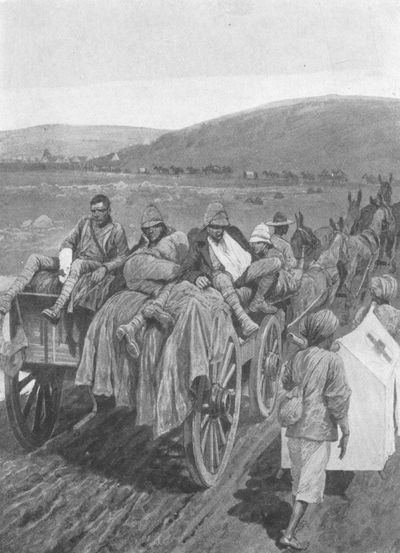
Bringing Wounded Back Into Ladysmith.
We pushed on, and in the distance could hear the report of cannon. We
soon discovered a little artillery duel in progress between the Natal
battery and the Boer guns. The Natals were barking away pluckily, but
quite ineffectually against their very superior opponents, who were
making really excellent practice, and they struck an artillery waggon,
blowing it to pieces, and missed the artillery train by barely twenty
yards, a shell falling on either side of it. It was clear we could
remain here no longer, so the order was given to retire.
The guns limbered up, leaving the shattered wreck of the waggon
behind, and the trains commenced to move back slowly, keeping pace
with the cavalry and artillery. The Boer guns kept firing until out of
range, and then there was a desultory pitter-patter of rifle fire at a
sufficient distance to be completely ineffectual.
We retired back just behind Modder's Spruit Station and rested there.
The sun had now broken through the clouds and poured down hot on the
yellow veldt, where we were. A beautiful scene stretched away before
us. The veldt was not all yellow, but in low-lying places, after the
recent rain, was beginning to be streaked with vivid green. Opposite
us, across the flat or gently undulating veldt in the middle distance,
were hills and kopjes, while beyond, purple under clouds or light blue
in sunshine, rose to the far horizon mountains, pointed, or of that
quite flat-topped shape so characteristic of this country.
No one who has been through this day can ever forget the
beautiful series of military tableaux, the gorgeous colouring, the
constantly varying effects of light and shade, under clear, blue sky,
or when piles of great white cumuli were passing, until, darkening
with the progress of the fight, an unnatural gloom blackened the
heavens, and from the inky clouds torrents of rain poured upon the
combatants. The variety of colour, light, and shade was only equalled
by the variety of the military movements during the day. A complete
series of sketches or photographs would serve for illustrations for a
handbook of modern tactics—the reconnaissance in force in the
morning—engagement—orderly retreat carried out exactly according to
book—march out of main body; advance of main body, cavalry on each
flank, skirmishing outflanking movement on the right, etc., etc., on
to the cavalry charging through and through retreating and beaten
enemy.
At 11.20 two squadrons of cavalry and a battery of artillery arrive,
and shortly after another train full of troops is seen
approaching in the distance.
Chatting with Colonel Chisholme, of the Imperial Light Horse, I was
chaffing him about calling them "light," pointing out a group of
giants standing near him; but he agreed that their hearts were light,
anyhow, whatever their weight might be. He had commenced his military
career when eighteen in the 9th Lancers, and his Imperial Light Horse
was embodied on the 9, 9, 99. He was telling how all the important
dates of his life had a 9 in them, as Major Douglas Haig galloped up
and told him we were going to start. I said, "All these nines clearly
point to your living to ninety-nine." "Oh no," he laughed back,
cheerily, "I don't wish to live to be as old as that." His wish was
gratified.
"Saddle," "Prepare to mount," "Mount." We were going forward again.
At 1.30 we started, after just two hours' rest, in which the main body
had come up, so that our entire force now consisted of the 5th
Lancers, Imperial Light Horse, two field batteries of Royal
Artillery, the Devonshire Regiment, half a battalion of the
Manchester, and half a battalion of the Gordon Highlanders. At 1.55
fire opened from the tops of the line of ridges running parallel to
the railway line, which were all lined with men. Some of the 5th
Lancers have already gone off to the extreme right. At the foot of the
first hill, from which firing proceeds, a squadron of the Border
Mounted Rifles are dismounting, and now two lines of khaki figures are
climbing steadily up the hill. Long before they reach the top the
Boers are seen retiring. They have no idea of making a stand yet, and
as the khaki figures reach the summit the Lancers, sweeping round from
the extreme right flank, join them. During this time the Devons and
Manchesters have been pouring out of the train, and are now crossing
the veldt in dotted lines towards the ridge of hills.
2.15.—Another train now appears, bringing further reinforcements.
2.30.—Quite a hot fire now opens on the extreme left, and
in a few minutes the artillery are ordered forward, and the six guns
pass us at a gallop. They are soon lined up and firing shrapnel at
some Boers, who scurry away over the brow of a kopje. The guns limber
up and jump the railway line—a pretty stiff little obstacle—the
narrow gauge metals being on top of a narrow embankment. Then across a
level field of veldt, and they commence to ascend a slight depression,
which is just behind a shouldering billow of veldt. It is hard work
for the artillery horses over this ground, but it is fine the way they
tug and strain at their work. The officers urge the men to hurry
forward. Already a gun is heard from the Boers. They have opened fire.
Two wheelers of an artillery waggon drop down, apparently dead, from
exhaustion.
I had just been watching their heavy sweating sides and foam-streaming
mouths before they collapsed. Already two spare horses are being
brought round to replace them as we hurry forward.
Now, all of a sudden, things become lively, and do not
slacken again until the finish. No sooner have the first of the
cavalry appeared than the Dutch guns open fire. R-r-r-r rip—a shell
drops amongst the artillery and cavalry just ahead of us. The cavalry
wheel and spread themselves into more open order none too soon, as now
the shells come fast. The Boers have got the range exactly. Bang
bursts a shell amongst the Imperial Light Horse near me. A shell
bursts quite close, and a piece drops between Bennett Burleigh and me.
The life, vigour, and swing of movement of these few minutes when we
first came under fire was magnificent, the cavalry wheeling and
circling, infantry deploying, the rattle of the artillery waggons, the
cracking of the drivers' whips on the backs of the straining,
struggling horses, the rending sound of the shells in the air like the
tearing of a great canvas mainsail; the loud report when a shell
exploded, or the dull thud when they simply buried themselves in the
veldt.
How lucky for us so few of them exploded! There would have
been terrible damage done, especially by the first few shots, when the
cavalry and artillery were massed together. It was now for a while an
artillery duel, but the Devons were quietly getting forward for the
front attack. The cavalry had swung out on the extreme right flank,
and the Manchesters and Gordons were going on to the ridge to take
them on their right flank there, while the Devons went up the face.
The Boers changed their artillery fire from time to time; first it was
at our artillery and cavalry, then into the Devons as they advanced or
as they lay down in the last field of veldt, waiting for the final
charge; and then they sent a few shells into a body of cavalry that
was on our extreme left. The very last shot they fired was a good one,
just when the fight was over, right into our guns.
I saw a little rocky point ahead of me, as if made on purpose for a
war correspondent. By running across some open ground I was
on to it. There was good if not ample cover on the top. It was in the
middle of the angle made by the line of advance of the men along the
ridge and the line of the Devons' main advance, and quite close to the
hill. Stretching away on our left over a level khaki-coloured sloping
field (if I may so call it) of veldt, were the Devons lying behind
ant-hills, placed as if on purpose to give scant but welcome shelter
to troops advancing under fire. The colour-scheme of the whole stretch
was perfect for concealment, and there was Tommy learning more of how
to take advantage of scant cover in this half-hour, under the bitter
pitter-patter of Mauser bullets, than he would learn at home in years
of manœuvres.
That was a trying wait for Mr. Atkins; yet how steadily he stood
it—or not exactly stood it, but crouched it, lay it, or
mother-earth-hugged it! On our right was the level sky-lined hill,
ending in a rounded, precipitous point, on which the Boer guns were
stationed. Under that heavy-hanging bank of clouds, yet just
behind it, a clear steel-like light was showing. Against this, upon
the top of the hill, silhouetted with most delicately accurate
sharpness, were the figures of the Manchesters. The Gordons were in
the same line over the rounded top of the hill. They advanced at a
run, crouched, then swarmed forward again, and again lay low. Then the
little runs became shorter, the rests longer, and the fire hotter and
more continuous. Were they going to take that hill before complete
nightfall, or was it going to be a two-day job, notwithstanding the
five hours' hard fighting we had had already? A man near me said to
me, "Do you hear the steam escaping? I expect it is the Boers letting
it off from the colliery which they took on Thursday." It was the
sound of steam, of escaping steam, right enough, but that sound was
made by bullets. It went on continuously from the time the final
infantry advance took place, and rose in a crescendo of hissing
vehemence as we neared the supreme climax of the struggle.
How eagerly we watched these creeping figures going forward! Would
they succeed? Would they ever reach the point of the hill? How slow it
seemed, but steadily, steadily on along the ridge they went.
Now all the great orchestra of battle was playing—from behind us on
the right our artillery were firing at the hill in advance of the
Manchesters and Gordons—in one minute that I timed with my watch I
counted sixteen discharges. How the shells shrieked and whirled over
us! I found myself somehow humming the "Ride of the Valkyrie," which
these shells had suggested; then the Maxims would play a few bars, or
a sharp volley ring from the left. The rocky kopje was vocal with
rattling echoes, while with piccolo distinctness the air above and
about us sang with the sharp Mauser notes.
It was now a quarter to six. Rapid movements could be seen amongst the
Boers on top of the hill; some were beginning to gallop off, over the
sky line, but others galloped in the opposite direction. Our
artillery fire had now reached a nicety of deadly accuracy. They were
firing impact shells. I had my glasses on one horseman who appeared to
me to be firing from his saddle, and fighting stubbornly. There was no
sign of running away about him. As I looked the figure became a little
cloud of smoke—the smoke cleared—horse nor rider was any longer
there. Chancing to look at another, who was darting about irregularly,
as if confused and not knowing which way to fly, a fountain of smoke
flew up in front of his horse as a shell burst. When the smoke cleared
he and the horse were lying on the ground, and immediately after to a
third exactly the same thing happened.
The crescendo of battle had now reached a climax in a perfect roar of
sound. The bugles sounded the charge. God bless the man that wrote
these heart-cheering notes. Forward—rattling, stumbling, falling over
the rocks, cheering, swearing, forward anyhow—formation be hanged!
How the Devons climbed these rocks! Following in the right of
the Devons' wake, passing their wounded across that slopy field of
veldt, and the flat to the base of the hill, it was a sweating,
breathless climb up; the men were already cheering on the top above my
head. The first sign of mortality on the Boer side I encountered was a
hairy little black pig lying on his side bleeding proverbially—then a
tall Boer lying headlong down the rocks. On the top—what confusion!
Tommy, drunk with delight of battle. Prisoners, wounded, Gordons,
Manchesters, Devons—all mixed inexplicably. A Boer gun still in
position was a centre for gathering. In another place the ground was
strewn with rugs, broken provisions, empty and half-empty bottles,
saddles galore.
"'Av a 'oss, guv'nor, 'av a 'oss?" said a dirty-faced, sweaty, but
generous Tommy to me, as he led a black Boer steed by the bridle. Not
liking to take his capture from him, I went off to where he told me
several were standing, and picked out a likely-looking grey.
Darkness was now rapidly falling. A Tommy came up and led off another
horse.
"I'm taking this for the Colonel; me and the old man don't get on
well. The old buffer is always down on me whenever I takes a drop, but
I'm going to make him a present of a 'oss this night, that I am." He
went off in the darkness, towing the present by the bridle.
At this moment very few officers were at this point of the hill; the
Gordons, for instance, had lost thirteen. I came then upon General
French, who had come along the ridge in the fighting line with the
Manchesters and Gordons, and was glad to have so early a chance of
offering him my heartiest congratulations on the day. The last time I
had met him was when the artillery on both sides were hard at it; he
appeared then more like a man playing a game of chess than a game of
war, and was not too busy to sympathise with me on the badness of the
light when he saw me trying to take snapshots of the Boer
shells bursting amongst the Imperial Light Horse near us.
General French is deservedly very popular with officers, men,
correspondents, and all who meet him, and we were all glad at the
brilliant ending of this hard-fought day.
The 5th Lancers and 5th Dragoon Guards were now pursuing the
retreating Boers. The Dragoons carried lances, which may account for
the credit which was equally due to them with the Lancers being unduly
given to the latter. Another hour or half-hour of light and they would
have played the very mischief with the retreating Boers. The Dragoons
chased them past a Red Cross tent, where a man was waving a Red Cross
flag. They respected those gathered about the tent; but one ruffian,
waiting until they came abreast, shot point-blank at a private. As he
fell dead from the saddle Captain Derbyshire rode at his slayer and
shot him dead with his revolver. A big Dragoon would put his
foot to the back of a Boer and tug to get his lance out. Some of the
Boers stood firing till the cavalry came within twenty yards. The
ground was broken veldt with patches of outcropping stones, which,
added to the fading light, made it terrible ground for charging over.
Already Tommy on top of the hill and down its sides was groping for
the wounded. Tommy had behaved magnificently throughout the long
fight, and now Tommy was finishing the day by behaving well to the
Boer wounded. A rug here and a drink there, and later on the best
place near the camp fire. In the previous five hours, Tommy's respect
for the enemy had risen enormously; now he was treating his wounded
with a rough but genuine kindness positively chivalrous. One might
write for days upon the incidents of this glorious day, into which the
events of a stirring lifetime seem crowded. Our artillery got a good
chance, and showed up magnificently. The dauntless bravery of English
officers we seem to take for granted as a national heritage;
but in something stronger than admiration—in positive love—my heart
goes out to Tommy Atkins—sweating, swearing, grimy, dirty, fearless,
and generous—Tommy is a bit of "all right."
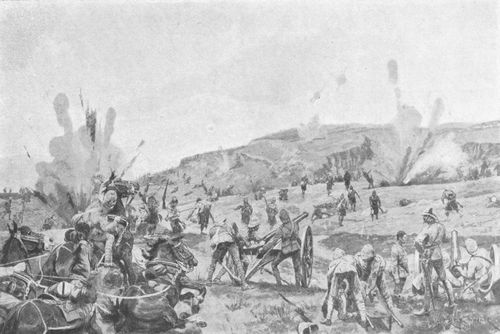
Advance Of The Gordons At Elandslaagte.
A GLIMPSE OF OUR GUNNERS
Go with the gunners if you want stirring scenes of modern war. You
will not, as so often happens when one goes with an infantry regiment,
spend a day lying on your belly in the scorching sun, while the air is
vocal above you with the singing of bullets from an invisible foe,
whose position is vaguely located on some quiet and deserted-looking
kopje in front. Go with the gunners, and every time you go you will
come back with an increased admiration for them. It is impossible to
tell the result of rifle or even Maxim fire unless, as at Omdurman,
the enemy stand up to be massacred; but with the guns you can at least
see where the shells fall or the shrapnel burst. For this reason the
Vickers-Maxim automatic—or pom-pom, as it was christened at
Ladysmith—must be a most delightfully interesting weapon to the
gunner who operates it. Each little shell on impact throws up a small
fountain of smoke as it explodes, so that he sees at once if his fire
is short or too high, and gets his range immediately; then he can
follow cavalry about and tickle them up, or play around a patch of
veldt where he knows the enemy are lying, just as a gardener would
sprinkle with a watering-pot. It is a most demoralising weapon, but
the explosion is so small that it does much less harm than would be
expected.
Let us take a typical day with the gunners. Photographs or
cinematographs are entirely unsatisfactory in giving any idea of the
"movement" of a battery going into action. There is the rattle of the
gun-carriages, like a running accompaniment of rifle fire; the jingle
of the harness; the splendid, strenuous, willing pull of the horses
straining against their collars. They know all about it, these
bright-eyed beasts quivering with life and work, and want no
whip or spur until the work of tugging over the broken ground under a
sweltering sun staggers them under the strain.
There could not have been a more beautiful day than that of
Elandslaagte for watching the gunners in action. Before the main part
of the action was entered on, two batteries were ordered to reply to
some fire coming from the left of our line of advance. They went
forward at the gallop, bounding, jolting, and swaying over the uneven
veldt, and, on a slight rise of ground showing out against the deep
blue background of some hills, unlimbered and opened fire. A few
horsemen were seen galloping over the ridge of a hill in front, and
that was all. Then they limbered up and were ordered across to our
right; a low but steep little embankment of the narrow-gauge railway
was in front of them. It was a pretty sight to see them negotiating
this obstacle—the jolting of the springless wheels up and down the
stony sides and across the rails on top ought to have been
enough to shake the teeth out of the men sitting on the limbers, and
gripping hard to keep their seats. By the way, how loudly the nether
part of a gunner's anatomy must sometimes cry out for a cushion!
No sooner had they got clear of this jump than the Boer guns opened
and began to make excellent practice. How every gunner felt longing to
reply and silence them! Bang, burst, or spinning with whizzing hops,
the shells came dropping in rapid succession. The Boers had been
careful to get the exact range the previous day, and were not now
wasting time or ammunition. Our guns had to go up a sloping depression
at right angles to the Boer fire before getting into a position for
opening. Every instant was of value, as the Boer shells were now
dropping amongst the Imperial Light Horse and the infantry, who were
just beginning to deploy. Under whip and spur they galloped up the
slope—Gad! it was a sight to see how these artillery horses pulled;
there was no taxpayers' money wasted there. One drops down,
and the sharpness with which he is replaced by one of the spare horses
would have drawn ringing rounds of applause at an Islington
tournament. They take up a position at the top of the rising ground,
monopolising the attention of the Boer gunners as they unlimber.
The gunners jump from their seats sharp as sailors, unhook the
limbers, leaving the guns pointed towards the enemy. Then the drivers
trot off about fifteen yards, wheel round, and sit motionless on their
horses, facing the fire. One cannot but admire the courage required to
sit coolly like that with nothing to do but watch the enemy firing
deliberately at them—see the discharge, and then await the arrival of
the shell as it comes whirring and hurtling through the air. With what
critical interest they must watch improvement in the enemy's
shell-bowling! One was forcibly reminded of cricket bowling at
Elandslaagte. Many of the shells did not burst, and those that were
not full-pitched came in the manner of swift bowling along the
rounded, almost flat-topped surface of the rising ground; and
these gunners sat as steady as if they were the wickets just stuck in
the ground, with never a duck of the head or a blink of the eye. The
men working the guns are kept busy all the time, and have no time to
think of or watch the enemy's shells; but the drivers have nothing to
do but wait and watch. The horses, with still heaving foam-streaked
sides, stand panting and tossing their heads. The Boers have got the
position of our batteries accurately, as it must have been previously
obvious that it was the one we would have taken up. Three of the
gunners have already been badly hit; immediately after, with a
terrific crash, a shell hits an ammunition-waggon fair. Those around
hold their breath for a still greater explosion, but, wonderful to
say, the ammunition does not explode. When the dust has cleared,
however, the wheel of the waggon is found smashed to matchwood, and
the vehicle lies helpless and useless on its side. But still steady
as rocks sit the drivers facing the music. This is
courage—the real article—and the market price of this kind of
British pluck is one and twopence a day!
Three days later I was photographing these boys behind their guns on
the hill at Rietfontein, standing just as quietly under a hot rifle
fire at 1200 yards' range, which the enemy kept up persistently,
although we had silenced their guns and actually set fire to a long
line of grass on the hill from which they were firing. An innocent,
harmless-looking hill it seemed, with not a Boer visible on it, yet
the bright summer air simply sang with the notes of Mauser
bullets—clear and musical notes when they pass high overhead, but
with a sharp and bitter ping when they pass close.
But the best sight of all is to see our gunners going out of action.
They go in at a gallop, and retire at a walk. There is something so
delightfully contemptuous of the enemy's marksmanship in this. One day
outside Ladysmith was typical. A couple of batteries went
out with some cavalry for a small reconnaissance in force, located the
Boer gun, and quickly drove the gunners to cover. The vultures had
gathered as usual at the sound of their dinner-gong, but there was no
fight, and soon the guns limbered up, and turned back across the
plain. Immediately the Boer gunners were back at their gun, and,
serving it with wonderful rapidity, sent shell after shell at our
retiring batteries. The first was just short, then the two next went
over; but on they went quietly, never breaking out of the walk. Then a
shell fell between a gun and a limber, and did not burst. The great
vultures wheeled and circled lower, waving their shadows below them on
the parched plain; but there was no dinner for them that day—not even
a horse was hit. And so always, when these field guns stop barking and
limber up, it reminds one of pulling a dog out of a fight by the tail
as they are dragged slowly, as if reluctantly, away; while the drivers
don't bother to look round, and don't look a bit like heroes
full of courage at the magnificent price of one and twopence a day.
Rattle of iron on stones—clear, sharp words of command—clink of
breech action—coldness of iron will warming the steel throat that
voices its thoughts—hard, scientific, inhumanly mechanical; yet there
is a subtle, attractive feeling that draws together the living
elements that serve the gun. I barely escaped being knocked down one
day by an artillery horse galloping furiously over the veldt. He had
got badly torn by a shell; wild with the pain, he raced around until
exhausted, and then, managing to stagger up to a gun, fell dead, with
his head against the trail.
IN THE TENTS OF THE BOERS
Late in the afternoon of a day in the early part of last December I
had ridden out from our lines in Ladysmith towards a certain position
usually occupied by a Boer outpost, trusting by my going out
deliberately and unarmed to get one of the men there to have a talk,
just as one of the Lancers had a few days previously. For some time we
had been on short rations of "copy" as well as food. I rode along the
edge of an empty spruit, into the bed of which my spurs would have
propelled my horse in the unlikely event of a shot being my first
greeting. The spot where I expected to see the outpost was where the
veldt, from being bare, commenced to be thickly covered with mimosa
trees; but there was no one there—no living thing, except a
little springbuck that started up as I arrived, bounding away over the
long tufted grass, its little white rump showing like the flutter of a
girl's petticoat. It stopped and, turning its pretty head, regarded me
with great brown frightened eyes, as if I were the first human
apparition to invade its sylvan solitude. It was clear there were no
Boers immediately about; equally clear that this was a great chance
unexpectedly offered of having a try to get south to Clery's or
Buller's force, and be the first white man to bring the news from
Ladysmith out of the beleaguered town. I was already started on the
shortest route to the Tugela. I went on, and for about a mile no sign
whatever of the enemy, and I thought of the theory more than once put
forward that we were all the time being besieged by a ridiculously
small but extremely mobile force. It was not until I was well in
between Bulwana and Lombard's Kop that I caught sight between the
trees of a laager of miscellaneous tents on the lower slope
of the latter. Dismounting and going cautiously, I passed it and
passed a man cutting wood, who was fortunately too industriously
intent on his work to notice me. Bearing to the right, I was soon
south of Bulwana and past the Boer lines. The rest would be
comparatively easy, as an open stretch of country lay before me, where
darkness would soon give me cover now that I had reached the edge of
the trees. While waiting, I heard a voice behind me shout something in
Dutch. Looking round, I found a Boer covering me with his rifle at ten
yards, and the dream of a journalistic "beat," as they call it in
America, vanished as he escorted me to his field cornet's camp. After
some questioning by the field cornet, they gave me supper of meat,
bread, and coffee—the bread arrived down every morning by train from
Dundee, where it was baked by a Frenchman at what a short time ago had
been our bakery. Then, as we sat round the big tent smoking, I
gradually learned from them the first news of the outer
world and the war, after being five weeks cut off in Ladysmith. As a
running commentary on the news, we drifted into a series of
discussions on the conduct of the war, and the observance of the
usages of war by both armies. Audi alteram partem, and here I was
hearing it with a vengeance. Two-thirds of them spoke English, as
nearly all in this laager were from Heidelberg. They had about five
charges against us of unfair fighting, and there was not the slightest
doubt of their complete conviction that each of these charges was well
founded and true. The worst of it was that in every instance they had
some circumstance, the result of mistake, misconception, or individual
wrongdoing, on which to raise a formidable superstructure of
generalised accusation. "We fired on the Red Cross"—they instanced
Elandslaagte and the battle of Nicholson's Nek; in both instances
their waggons were behind kopjes that our gunners could not possibly
see through. I threw them back their similar offences—the afternoon
of Nicholson's Nek and their firing on the Town Hall
hospital at Ladysmith. In the first instance, they said our waggons
were too far off to be distinguished, which I knew was the case; and
as regards the second, they argued that we had no right to continue to
fly the Red Cross over the Town Hall when they had given us a neutral
hospital camp outside at Intombi. Then had we not a right to fly a Red
Cross over our sick and wounded while they had to wait for the next
morning's train to bring them out to hospital? I urged. "No; put them
in your holes underground," was the reply. We drifted into a
discussion about dum-dum bullets, which they claimed to have found in
our abandoned camp at Dundee, and, from seeing our doolies bearers,
had fully made up their minds that we were using Indian troops against
them. I then let them have it straight about their misuse of the white
flag, which they denied.
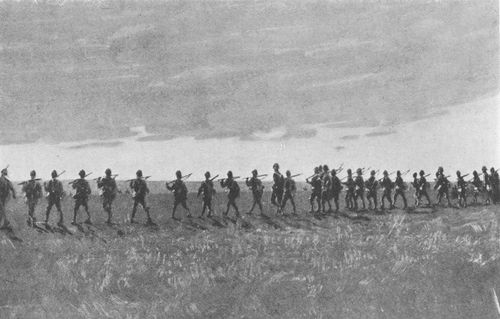
Advance Of The Devons Before The Attack At Elandslaagte.
Every pause in our talk was filled by the sound of deep, loud chanting
coming from a tent hard by. Presently I went out to see them
at their evening service. A big tent was full of men squatting around,
the short twilight was fast darkening into night outside, and the
interior of the tent was lit by two candles stuck in the necks of
bottles. Except a couple of old men, they were all in the prime of
life, and a splendidly strong-looking set of fellows they were. They
sang, without any drawl or nasal intonation, straight out from their
deep chests. The chant rose and fell with a swinging solemnity. There
was little of pleading or supplication in its tones; they were calling
on the God of Battles; the God of the Old Testament rather than the
Preacher of the Sermon on the Mount was He to whom they sang; and
sometimes there was a strain of almost stern demand about it that gave
it more the ring of a war-song than a prayer. Entering the door of
that tent seemed like going into another century. It could not be but
luminously evident to the onlooker that these men were calling on an
unseen Power whose actual existence was as real to their minds
as that of their Mauser rifles stacked around the tent-pole.
One could not help contrasting this obvious sincerity with the
perfunctory church parade on our side, and this religion with that of
two-thirds or three-fourths of our army of careless agnostics. Barring
a very small minority, principally Irishmen, there is no place for
religion in Tommy's intellectual kit. It has just degenerated into
being an old magazine from which he draws his swear-words—a sort of
bandolier of blasphemy. It was hot in that tent, and the sweat made
the foreheads of these deep-voiced choristers shine against the dark
shadows cast behind them on the canvas. It was curious to notice how
the knees and elbows of their clothes showed signs of wear from their
favourite shooting attitude, and there were many with buttons missing
from their waistcoats that had been scraped off by the stones on the
kopjes, or with buttons of different patterns that had evidently been
sewn on by the wearers in place of those worn off. All the Boers
appear to give up shaving when on the warpath, which adds
to the wild picturesqueness of their appearance. I found the hymns
they were singing were old Dutch ones. "We keep this up every night in
camp," one of them said to me, "just the same as at home." When they
had finished, they all lit their pipes, and then I was put through a
catechism, which was the same at every camp or with every group of
Boers I met for the next week. "What did I think of the Boers?" "Did I
not expect to meet a lot of savages?" "Was I not surprised to hear
them speaking English?" And then they were everywhere keen to learn if
we appreciated the way our prisoners were being treated in Pretoria,
and equally curious to know our opinion of how they were fighting. As
I thought the siege of Ladysmith, since they would not assault, had
become dolorously monotonous, I suggested, so that things might be
enlivened a bit, that a race meeting or a football match might be got
up between teams from each army on the neutral ground at
Intombi. The younger men received the idea of a football match with
acclamation. "Ya, goot," said a young giant beside me, rubbing his big
hands enthusiastically, "it will be the greatest football match that
ever was played;" but an old burgher, with his left hand in a sling,
bound up in dirty-looking bandages, interposed: "No; the only game we
like to play now is the one with cannon-balls." No; these dour, stolid
men take their fighting sadly and sternly; there is none of the
"frolic welcome" with which our Irish Tommies, for instance, enjoy
their fighting or endure the waiting for it. When I was a prisoner in
Pretoria they used to keep us awake at night with fireworks after news
such as that of Colenso and Magersfontein, but, except amongst the
young boys, they were not given to exultation over what they had done
or to any boasting. Then they talked about lyddite, and it was quite
clear that it had been a terrible bogy in their minds, and that they
had imagined it was to have an effect like throwing
earthquakes at them, and it was equally evident that the result of
actual experience had fallen short of their apprehensions.
We went out from the stuffy hot tent into the clear sharp air of a
starlight night on the hills, and from a lighted tent, high above us
on the slope of Lombard's Kop, came the chant of a psalm taken up by
many voices outside. "Let God arise, and let His enemies be
scattered," they sang, like Cromwell's soldiers at Dunbar. As I laid
down in the field cornet's tent, with his son, a boy of fifteen, at
one side of me, and a man over sixty on the other, I could not help
thinking of the great tragedy of all that was yet before these people
when they would begin to realise that they called in vain on their
God, that they had no monopoly of the Almighty, that the God of their
fathers fights no longer on the side of the Boers, but on that of the
big battalions. This will be the desolation of downfall.
THE FELLOW THAT FELT AFRAID
He was just a common or garden ordinary sort of chap. He was lying on
hot, pointed, uncomfortable stones through which long tufts of coarse
grass protruded. Drops of sweat were trickling down his face, and his
hands left wet marks where they came into contact with the stock or
barrel of his rifle. With elbows, with chest, with stomach, with legs,
he was trying to press hard against the ground. It is a curious
feeling, that lying down and trying to press against the ground. He
wished to reduce himself to the substance of a postage-stamp. This was
the day of his first fight, but since he had got up everything was
unaccountably unlike his expectation. The reveille had sounded in
the dark at three o'clock in the morning. It was bitterly
cold outside the tents, and his hands trembled as he fumbled with his
putties. He had had a hard struggle to turn out from under that warm
rug where he had been dreaming the real soldier's dream. Detaille's
picture is all rot—the soldier's dream is not the picture of
victorious battalions with banners flying, marching through the
clouds. He had been dreaming of tripe and onions. Visions of past good
meals in comfortable quarters washed down with deep cooling draughts
of bitter floated in procession through sizzling clouds of vapour
smelling of invisible kitchens. As he fumbled with his putties the
rumble of waggons came out of darkness from a road hard by, mingled
with the sharper rattle that tells of the gunners already on the move.
The vague rumours of last night, he felt, were going to shape into the
actuality of fight; but what an hour to go out fighting! Why should
they be hauled out to fight in the dark? Why could not men wait for
light? Wait until the world was aired? He was thirsty and
uncomfortable, with the taste of stale tobacco in his mouth, and
joined in the variegated imprecations muttered by the men when he
found there would be only a few minutes to get anything to eat and no
time for hot coffee. Presently he is a unit in a long snake-like
column of men that winds along the road through the dark into the
unknown. As he plods on he speculates how the fight will start.
Perhaps the kopjes on either side of the road may be already full of
Boers. Perhaps the beginning of the fight will be to find that they
have marched into another ambush. It was a nasty uncomfortable
feeling, that tramping through the darkness into the unknown. He felt
better as the light spread from the eastern hills, and felt
companionship and security in being part and parcel of that great mass
of men that extended before and behind him on the road as far as he
could see. Suddenly there is the boom of a gun, and he comes into
collision with the man in front of him, who has stopped dead
at the sound. A strange tingling feeling goes up his spine. There is a
hush! No one speaks. The whole essence of vitality strains to listen.
A faint whir crescendoes rapidly into the shrill whoop of a
steam-siren, and a great balloon-shaped cloud of smoke and dust has
already arisen from amidst the marching mass of men ahead. There is no
sign whence came the shot. Nothing can be more peaceful-looking than
the shoulders of these hills lying bathed in the quiet morning light.
There is no sign of an enemy. Sharp words of command ring out while
the cloud of smoke and dust is still hanging in the air, and in a
dazed and mechanical way he finds himself deploying over the ground,
which shakes with the gallop of cavalry as they spread out fan-like on
either side of the road. The artillery rattle and jolt over the
stones, and the limbers toss like little punts towed through a choppy
sea. His company advances in extended order across the stony ground
tufted with grass, and are ordered to lie down. The captain
says, "Any men who have got anything to eat, let them eat it now." He
has a piece of bread in his haversack, but feels no inclination to eat
that dry and crumby stuff; but he is thirsty, and takes a long and
deep pull at his water-bottle. The sun has already become very hot.
The artillery has already got into action on the left, and is engaged
in a duel with the Boer gunners. The minutes of waiting seem hours to
him. Then all the men watch with keen interest an officer with a
red-banded German cap galloping towards them. The result of his
arrival is an order for them to advance up the gradual slope of this
rounded hill. Just as he starts there is a light keen whistle in the
air overhead like the call of a bird, then another and another.
Instinctively he feels that these are made by bullets flying overhead.
As he goes on an occasional one rings with a sharp bitterness in its
tone, and he ducks his head as one might duck to the swish of a
riding-whip near the face. They go with knees and backs
bent, and he longs for the order to halt and lie down again. A fellow
drops out alongside of him, but he does not look to see what has
happened—he is afraid to look. Just when they have reached the crest
of the hill, and when the whistling sounds have become more plentiful
than ever, they are ordered to lie down again. Looking through the
streaky stems of grass immediately in front of him, he can see a
similarly shaped hill about 1200 yards away. It looks absolutely
deserted. Nothing moves upon the skyline. Little puffs of smoke
momentarily appear above it, which he knows are caused by the bursting
of our shrapnel. He begins to feel he is really in the fight, but it
is just altogether opposite to what he expects. It is commonplace and
disappointing to a degree. He sees the gunners busy on the left, the
horses standing behind them as if all the whistling sounds are only a
rain-shower. There is a small stone in front of him, just half the
size of his helmet. He knows it is not half big enough to
cover him. All his preconceived ideas of a fight are crumbling away.
Here they are being led out to lie on the grass to be potted at, and
not allowed to reply. But then, as he looks at the opposite hill, he
sees nothing to fire at. A group of red-capped officers walk their
horses along the line left behind them. He recognises the General in
command. They stop, and one of the General's aides-de-camp dismounts
and opens a paper parcel, from which the General takes a sandwich and
bites a big semicircular piece out of it. He finds it hard to realise
that this is a battle and that this is the General commanding. In all
pictures of battles that he has seen from his youth upwards the
General is seated on a horse poised on two legs, and waving a sword or
pointing with a marshal's bâton. And here is a General with a sandwich
with a big bite out of it, who points with the sandwich-hand instead.
And then he begins to wonder, with all this multitudinous whistling,
that nobody seems to be hit. Then the order is given to
advance again. He feels a tremendous disinclination to leave the
stone, and waits to see the other men around him get up. They all get
up except the fellow on his right. Reaching over with his rifle, he
pokes him in the ribs. He then hits him on the shoulder with it.
Thinking he is asleep, he tips off his helmet from behind. His eyes
are quite open; and then, like a douche of cold water, comes the
consciousness that this man is dead. A feeling to get away from that
corpse more than any other brings him amongst his comrades a few yards
in advance, who are already firing and lying flat. He keeps blazing
away mechanically at the innocent-looking hill opposite. His rifle is
hot in his moist hands. An order to "cease fire" is given, and then
there is another long interval of waiting. The whole business seems
waiting. It isn't a bit like a proper sort of fight. There is nobody
to fight; but still the bird-like notes are in the air above, and
bitter little sounds against stones, and tiny little
fountains of dust spurt from the ground around. And then a great
feeling comes to him that he would like to be out of it all. There is
no glory in it. The sun is hotter than he ever felt it before. His
water-bottle is finished, and his mouth is clammy. A young subaltern
with an eye-glass, no end of a toff, walks along the front of the
line, and he watches with interested delight microscopic ducklets of
his head, synchronising with whistles. Just as the toff is opposite
him, he spins round suddenly, exclaiming, "By Jove!" and falls down
like a sack of potatoes all of a heap. He begins to feel a strange
sickness in the stomach, just the same as coming out on the transport.
He feels it coming on. He knows he is going to be sick, and as he is
going to be sick he wants to go away. There is no use in a sick man
remaining in the fighting line. But then he feels as if he were held
down there by the weight of the whirring air. There is no room in it
for him to get up safely. There is no room to go away.
Momentarily the noises increase. Men are firing about him, and he
strains his eyes on the opposite hill to see something to shoot at,
and empties his magazine at what looks like a man but may be a
tree-trunk, and then stops again and gets sick. Another long period of
waiting follows. All the water is gone from his water-bottle; an
intolerable thirst is scorching his throat. He does not reload his
magazine, and makes up his mind to say that his rifle is jammed, so
that he need not go further with any fresh stupid advance that may be
ordered. This is no time to care about what any one may think of him,
it is just too awful for anything.
The ground has ceased trembling with the cavalry, who have dashed to
the front. There is no longer any whizzing in the air. The "cease
fire" is already sounding right along the line. The man who was afraid
stands up with his comrades, who are already on their legs. The old
Colonel trots along the line, mopping his red face with his
handkerchief. "That was a hot business," he says to his
Captain, and calls cheerily to us, "Well done, C Company! You are
damned steady boys under as hot fire as I have ever seen." The man who
was afraid opens his shoulders and pulls out the collar of his tunic
and stoops down to wipe off the cakes of dirty earth that are sticking
to his knees.
THE DANCE OF DEATH IN CHINA
"A wind of blight
From the mysterious far North-west we came,
Our greatness now their veriest babes have learned."
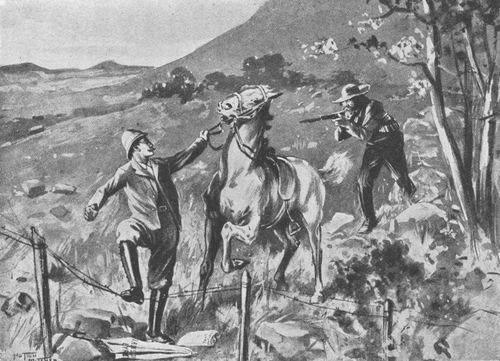
George Lynch Captured By The Boers.
It was the day after Tung-Chow had been occupied by the Allies. I was
riding along a sunken road between the city wall and some high ground
on which houses were built. There was a sheer drop of considerable
height between the walls of the houses and the stony road below. The
shouts of Russians mingling with screams could be heard proceeding
from the houses. At the base of the cliff two Chinese girls were
lying. Their legs were bundled under them in a way that showed they
had jumped from the height above. From their richly embroidered
silken tunics and trousers, their elaborate coiffure, and
their compressed feet, they were evidently ladies. They were moaning
piteously, and one of them appeared to be on the point of death. Their
legs or hips had apparently been broken, or dislocated, by their jump.
As I went towards them, the one who appeared least injured shrank from
me with an expression of loathing and horror until I offered her a
drink out of my water-bottle. Her delicate, childish little hand
trembled violently on mine as she drank eagerly from it. The other was
almost too far gone to swallow. The hoarse cries of the soldiers,
mingled occasionally with a sobbing scream, came from the houses
above, telling what they had tried so desperately to escape from. They
lay there helpless, evidently in excruciating pain, under a brazen sun
that beat down on the deserted dusty road. There was no one within
reach to come to their assistance. And there was nothing for it but to
leave them there, as many under similar circumstances had had to
be left during our previous march of several days. This scene
was typical rather than singular. In a large number of Chinese houses
in the villages we passed through on our way up, at Tung-Chow, and in
Pekin itself, it was no unusual sight to see an entire family lying
dead side by side on the Kang, where they had suffocated themselves,
or to see them suspended from the rafters of their houses, where they
had committed suicide by hanging.
In the burden of corpses which the river Pei-ho carried downwards from
Pekin towards the sea were to be seen the bodies of many Chinese girls
and women. One day I myself counted five. There is no question
whatever that they had committed suicide. And close to Tung-Chow girls
were actually seen walking into the shallow water and deliberately
holding their heads under the surface till they were drowned. Such a
tale seems very terrible. But to any one who had the opportunity of
judging of the conduct of portions of the Allied troops it was not in
the least surprising. Under similar circumstances our
sisters and wives would have done likewise.
The Russians and French carried off the palm for outrages on women
during the original march, and subsequently the Germans similarly
distinguished themselves. This was more particularly the case with
small bodies of men who were detached from the main force. In a
village on the way to Paoting-fu, for instance, through which a body
of Germans had just passed, three girls were taken by our troops out
of a well, into which they had been thrown before the Germans left.
They were still alive. This method of disposing of their victims was
frequently adopted by the soldiers as the safest way of hiding their
misdeeds and escaping the consequences.
News travels fast in China, and in advance of our march the people
seemed to be thoroughly aware of the fate that probably awaited them.
Although nearly the whole population cleared off before our advance,
there were many, especially women, who could not get away,
and who were unable to travel with their tiny compressed feet except
in carts or on the backs of their servants. And it was principally
these who finally, in the last extremity, committed suicide.
As the Chinese have agreed to erect a monument to Baron von Ketteler
in Pekin in commemorative apology for his murder, it appears to me
that there is an opportunity for the Allies to erect one also. It
might be of pure white jade, which the Chinese women love, which in
its translucent depths seems to hold the bright Eastern sunlight with
the detaining lingerage of a caress, and might bear an inscription
saying that it was erected in honour of the memory of the women and
girls of the province of Pechili who had sacrificed their lives to
save their honour.
All the way from the sea to Pekin, and for miles around Pekin itself,
the whole country was deserted by the inhabitants. A wave of fear and
horror preceded the advent of the Allies to such an extent
that hundreds of miles of what was the most thickly populated part of
China was absolutely deserted. After the relief of the Legations, the
people who ventured timorously to return were inspired with fresh fear
owing to the conduct of the Germans, who made up for being late for
the original expedition by availing themselves of every possible
opportunity of starting punitive expeditions on any possible pretence.
Coming at the time of the autumn harvest, the actual loss of money to
the inhabitants has been enormous.
From August to November a great tract of country was left deserted by
the inhabitants, who should have been employed in gathering in the
harvest. When I came down from Pekin in November there was no sign
whatever of life across the plains on either side as far as the eye
could reach. Thousands of acres of millet lay prone on the ground, and
their carefully-tended vegetable gardens were scored with black lines,
showing where the produce had rotted. When the Germans
arrived in September I heard one of their officers saying to Major
Scott, who was in charge of the river station at Tung-Chow, pointing
to the fields of millet which surrounded the camp, "Why don't you burn
down all these crops?" Major Scott replied that, besides not wanting
to make life harder for these unfortunate farmers, they wanted the
fodder for their own cattle. But, as a matter of fact, the destruction
effected by the absence of the people was just as great as if the wish
of that German had been carried out.
In all the discussions of the question of the amount of indemnity we
never hear anything of the amount of counterclaim which the Chinese
might rightfully make against us. The greater part of all this
destruction was absolutely contrary to every rule of civilised
warfare. In a district of about the extent of from London to Oxford
the inhabitants have lost the entire produce of the harvest, all the
villages and towns on either side of the river have been burned, so
that on the march up our path at night was literally
torch-lit with burning villages.
As was natural to expect, and as we have subsequently learned, many of
the inhabitants have been forced by the absolute necessities of
subsistence to band themselves together in companies of brigands,
whose depredations afford a fresh excuse to the Germans for continuing
hostile operations. The losses inflicted on the country in this way
are entirely outside the irreparable losses which were inflicted by
the destruction and despoiling of temples and innumerable works of art
which it will be impossible to replace. As regards these last
outrages, there was no officer in command of any section of the Allies
who personally exerted himself to a greater degree for the
preservation, or at least to prevent the destruction, of the art
heirlooms of the country than did General Sir Alfred Gaselee.
Some curious things happened in his efforts in this direction. On the
Paoting-fu expedition, for instance, when the troops were to
pass in the neighbourhood of the Imperial Tombs, a few British
soldiers were sent on in advance, and quietly informed the custodians
that the Germans were coming. Readily acting on the information, they
removed all the jewels and easily portable valuables from the tombs,
and they were kept concealed in a village on the other side of the
hill under the guard of a few Bengal Lancers until the Germans had
passed. In recognition of this friendly message the Chinese wanted to
make a present of some magnificent strings of pearls to Captain
Maxwell, a nephew of Lord Roberts.
In civilised warfare there is generally some little respect shown for
the priests and places of worship of the conquered people, but here
there was none whatever. Horses were stabled in the temples, and the
art heirlooms of thousands of years of the nation's life to be found
therein were frequently mutilated and destroyed when they were not
stolen. In the street where I lived in Pekin for a whole week were to
be seen, day by day, carts passing backwards and forwards
laden with books which were being brought to be consumed in a huge
fire kept burning in a yard outside the palace wall. Thousands of
books were thus treated, so that the whole street was littered with
their fluttering leaves to such an extent that I could not get my
little Chinese pony to pass there without getting off and leading him,
for he shied continually at the fluttering papers. Day after day this
literary holocaust continued. When the wind was in the direction of my
house a fine black snow kept perpetually falling, and covered the
roofs and courtyards with these ashes of dead thoughts. Hundreds of
the books were written in the quaint characters which showed that they
belonged to, and were written by, Lama priests; many of them had
probably found their way there from the bleak steppes of far Tibet.
They were printed with those wooden blocks by which these barbarians
practised the art of printing for centuries before the time
of Caxton. Many of them also were in manuscript, which must have meant
years of labour, and hand-painted pictures illustrating some were
occasionally to be found. They were all alike consigned to the same
funeral pyre, and thousands of volumes of unascertained, but perhaps
considerable, value were thus lost to the world for ever. As the
bleak, cold winds from the plains swept down the deserted street at
night, and moaned dolorously through the ruined houses, rattling
doors, and flapping paper windows, it lifted these torn book-leaves,
and swirled them round in a fantastic dance of death, until one could
almost imagine one heard the lamentation of the ghosts of their
long-dead authors—priests, hermits, and scholars—mourning over the
ashes of their life-work.
The whole of this campaign is the reverse of flattering to our Western
civilisation. Many of the details of the conduct of the Russian,
French, and German soldiers do not bear publication. But what it
broadly amounts to is the treatment of a venerable
civilisation absolutely foreign to our own as if its members belonged
to a low class of pestiferous beasts whose most desirable fate would
be extermination.
CERTAIN COMPARISONS
After spending five months with the British forces in the early part
of the war in the Transvaal, and then having an opportunity of
campaigning with the allied forces in China, it was extremely
interesting to make comparisons between them. The greater number of
the troops we employed in China were drawn from the Army of India. As
regards the French forces, they, at all events during the original
march to the relief of the Legations, were drawn from the troops which
were stationed at Tonkin. But the French troops that subsequently
arrived direct from France, as well as the German contingent, may
naturally be taken as average samples of their respective armies. It
is true that outside the siege of Tientsin there was very
little serious fighting. The engagements on the march up were not
severe ones, except that outside the eastern gate of Pekin itself. The
action here, however, was entirely confined to the Japanese. If this
campaign did not afford opportunities of observing the various troops
under severe strain of battle, it made up for it in a way by testing
their qualities, resources, and equipment for campaigning under
exceptionally trying circumstances. The weather during August, when
the march for the relief took place, was exceptionally hot, far
surpassing anything that I experienced in South Africa. The roads,
where there were any that might be dignified by that name, were
extremely bad, the dust was intense, the supply of water of the most
inferior quality, and the expedition, not being under the command of
one general, added irksome difficulties by the uncertainty of the
movements of its constituent parts from day to day.
Fighting is not the sole duty of soldiers in the field, and
in almost all their other duties apart from that we had ample and
varied opportunities of contrasting their merits. The Japanese
infantry were a surprise and a revelation to most of the Allies.
Notwithstanding the enormous trouble they have taken with their
cavalry, it is immensely inferior to every other arm of their service.
This is not to be wondered at when we reflect how little the Japanese
are accustomed to horse-riding at home, and what small opportunities
they have of acquiring that knowledge of the management of horses
which comes instinctively to the English groom, to the Irish farmer's
son, or to the field labourer. The defect of a want of efficient
cavalry is with the Japanese largely compensated for by the extreme
mobility of their infantry. They appear to do everything at the
double. All their soldiers seem to be perpetually kept in the best of
hard training. If they have not horses at home, they have plenty of
rickshaw men, who consider thirty to thirty-five miles of
running not an excessive day's work.
Often watching the Japanese manœuvring in the field, it occurred to
me that if the men of her entire army had not served an apprenticeship
between the shafts of the rickshaw, they must at least have passed
through some training equally severe. On the expedition to Pekin they
carried with them a number of light calibre guns, which they pulled
into action, without horses, right into the firing line. In every
detail of their camp equipment, food-supply, and field hospital corps,
there was a neatness of packing and arrangement which apparently
resulted in their carrying all their requirements in about a third
less space than any of the others. The simple fare of the Japanese
soldiers was ideal for campaigning. Broadly speaking, it consists of
rice, with what might be called a flavouring of strong-tasting dried
fish and mysterious brown condiments suggestive of curry. As they have
modelled their fleet on our own, so they have drawn from the
French and German armies a selection of their uniform and equipment.
The colour of their uniform at home is dark blue. But during the
expedition to Pekin their uniform was white, which would have been
murderously conspicuous in operations against any force that was
composed of less bad marksmen than the Chinese. This is now to be
abandoned, and is to be replaced by something in the nature of khaki,
as will be the heavy round German caps by something in the nature of
straw hats or helmets, which will give more protection against the
sun, although not looking so smart.
Although the officers of all the Allies were immensely struck by the
discipline and equipment of the Japanese, close observers were still
more attracted by the underlying soldier spirit which animates them.
An inherent spirit of soldiering seems to possess every little Jap as
a natural heritage. They seem to love fighting for fighting's sake.
They appear to enjoy the whole thing like schoolboys do
their games. They take their killing much more kindly than the others,
and appear to be much more familiarised with the idea that it is part
of the game. Indeed, there is a zest and a verve and go about them
when in action that I have never seen in any other troops. There were
numerous instances in the siege of Tientsin of disregard of death. And
outside the gates of Pekin ten men who were killed in their attempts
to blow it up might apparently have been indefinitely multiplied at
the command of their officers without any danger of faltering. When at
ten o'clock at night they advanced to take the gate by assault which
they had failed to force in the morning, it was immensely attractive
to observe the gaiety, almost amounting to hilarity, with which they
advanced to the attack. All movements such as this they accompany with
singing. And after forcing the gate, when they met with opposition
going along the wall and had to lie down before a hot fire from the
Chinese, who made a final stand about half a mile from the
gate, the Japanese buglers stood up and played some of their quaint
war-songs.
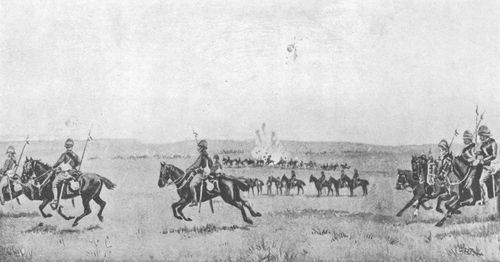
Boer Shell Bursting Among The Lancers At Rietfontein.
At night, in the camps on the way up, what I had mistaken for some
Buddhist evening prayer, when the soldiers tramped round like a human
prayer-wheel, was, I subsequently discovered, the chanting of a
war-song which had been composed by General Fukushima himself.
The interesting thing to observe will be to see how the Japanese
behave when they are getting the worst of it, how they will conduct
themselves when they are outnumbered, or when under the strain of a
losing fight. From a sporting standpoint, I'll be inclined to lay six
to four on a Japanese against a Russian regiment. I met some people on
the way to Pekin who regarded the Russians as the best war soldiers of
the lot. The Russians were intensely like the preconceived idea one is
inclined to form of Russians. Solid, deep-chested, heavy and hardy,
they gave one the idea of big, heavy farm labourers with a
rifle instead of a spade upon their shoulders. They never moved with
anything like the quickness which characterised the Japanese, yet they
plodded on with a dour stubbornness which gave the impression that if
their movements were not quick, they represented a weighty momentum
difficult to arrest. Although uncouth, and frequently savage in their
behaviour, they yielded a child-like, or almost slavish, obedience to
their officers, and on these officers should lie the blame of the
innumerable outrages committed by them, from which they might have
been restrained if kept properly under control.
Of the many tips which one force got from another, the Russians had an
admirable system of carrying with them on the march a sort of
locomotive kitchen, which consisted of a huge cauldron underneath
which was a coal fire. The contents of the cauldron, which appeared to
be the Russian equivalent for Irish stew, were hot and ready for the
men at any halt in the march. How delightful such an
institution would have been to Tommy in the miserably cold hours
between two and four o'clock on the veldt of a South African morning!
As regards the French force on the expedition to Pekin, in discipline
and in equipment and the conduct of the men composing it, it was
absolutely beneath contempt. Unless the art of foraging and looting
can be considered soldier-like qualities, they appeared to me to lack
every one.
I looked forward to seeing great things from the Germans. But I must
say that I was immensely disappointed. As far as parade-ground drill
was concerned they were admirable; as the mechanical and automatic
resultants of the efforts of the drill-sergeant they were possibly
unequalled. But they appeared to be heavy and slow in their movements.
On one little expedition outside Pekin for the purpose of surrounding
a body of Boxers, which was undertaken by a combined force of British,
Americans, Japanese, and Germans, the encircling movement proved a
failure owing to the Germans arriving an hour late at their
appointed position. Discussing the Germans one day with a Japanese
officer, his criticism on them was, "Very good soldiers, but I tink
too much drill drill."
If the Germans suffer from too much mechanical "drill drill," the
Americans certainly suffer from the opposite. Self-reliance,
independence, and individuality of action are all very desirable
qualities, but the Americans suffer immensely from the want of
discipline and drill. Perhaps the democratic feeling of the States
does not lend itself so easily to discipline. Each one of Napoleon's
soldiers was supposed to carry a marshal's bâton in his knapsack. The
American soldier has taken it therefrom, and is rather inclined to be
a marshal unto himself, thinks himself quite as good as his superior
officer, if not better, and, more than any other soldier, is given to
grumbling, and spends a lot of his attention, which should be
concentrated on merely obeying, to expressing his individual opinion.
The United States soldiers are far and away the best fed in
the world. Their standard of comfort, not to say luxury, is immensely
higher, and would be absolutely ruinous in an army the size of any of
those of Europe.
Comparing the various forces—as I had an opportunity of observing
them in China—with those of our own in South Africa, I am filled with
a much higher idea of the latter than before I had such a standard of
comparison. Our army, composed as it is in part of Colonial regiments,
is now a combination of various admirable qualifications. The
resourcefulness and individuality of action, which is the most
admirable thing to be found in the American army, was quite equalled
by men who composed such regiments as the Imperial Light Horse, the
South African Horse, Brabant's Horse, the New Zealanders, and the
Canadians.
The inspiring, ingrained fighting spirit of the Japs is to be found in
the Irish regiments, who are probably the best fighting men in the
world; the chivalrous gallantry of artillery in action,
which Zola wrote of in La Débâcle, I saw in quivering vitality at
Elandslaagte and Rietfontein, and not by the hastening of a step was
the old tradition of our artillery (to go into action at a gallop and
come out at a walk) forgotten in actions outside Ladysmith.
Superior-speaking, long-range critics talk disparagingly of our
soldiers in the Transvaal. Germans talk of how things should have been
done, forgetting that the little expedition they sent out to China was
kept waiting for a month at Tientsin before the men could start for
Paoting-fu, owing to the non-arrival of some essentials of their
equipment.
Far be it from me to think of posing as a military expert or a sort of
composite military attaché to the allied forces. I speak merely as
an observant outsider. In riding to hounds one soon learns the men one
would select to ride against the pick of another pack. One feels in
his "innards" the man he would like to go tiger-shooting with,
although it would be another matter to put down his reasons
in writing, and much more so with soldiers in the field.
From what I have seen in South Africa and China, I feel and know
it—luminously know it in the marrow of my intelligence—that for that
South African job, if it were to be done over again, I would select
the British; that they have done, not alone as well, but better than
any other nation would have done. Many things might have been done
better. But apart from the question of transport, when I saw the
others there were everywhere signs of their probable failures being
infinitely more numerous.
There are only two armies that, granted the possibility of their being
landed in South Africa, could have conceivably tackled the job. These
are the Japanese and the Germans. The Japs would probably have failed
from their want of efficient mounted infantry or cavalry; the
beer-blown Germans would have been worn down by men of better physical
training. The war-knowledgeable brain, looking out through spectacled
eyes, would droop tired in its physical limber until it was
brought on a level with the less scientific but more practical weapon
of the polo-playing, cricketing, footballing British officer.
The Chinese had reached that ideal which we, at the end of the past
century, were making an initial attempt to attain to in the calling
together of the Hague Conference. For they had reached the stage of
advanced development where the pen is really mightier than the
sword—where the highest class in the community is that of the
scholar, the next that of the man who tills the soil, and the last
that of the man whose occupation it is to kill his fellow-man. Thus
the Orientals were naturally at the mercy of the Western countries,
the largest expenditure of whose revenue is absorbed by the cost of
killing-machines and men to work them.
The Chinese have a saying that, as the best iron is not made into
nails, so the best men are not made into soldiers. With our Western
civilisation, the best men and steel and soldiers found them
an easy victim. There are no people in the world who have a higher
regard for abstract justice and right than the Chinese. It is admitted
by every man who has had large commercial dealings with them that
there are no people who have a greater regard for straightforward,
honest dealing. In our dealings with them, as regards this campaign,
right and justice in every case have given place to might.
When the German officer I have referred to above pointed towards the
fields of millet which he wished to have burned, I was strikingly
reminded of a certain mysterious picture which some years ago had been
inspired or drawn by his Emperor and Kaiser. It had been called by
some "The Yellow Peril," and depicts the figure of Germania,
surrounded by the nations of Europe, standing on a pinnacle, and
pointing to a broad plain below traversed by a river, and from the
plain volumes of smoke rose skywards. No one seemed to know quite
definitely what the actual meaning of the picture was. But
since this latest crusade towards Pekin, the real meaning of it is
suggested. In this campaign of revenge, with the Germans as the
leading performers in it, animated and inspired by the speeches of
their Emperor, the picture, now illustrative of recent history, might
bear a more actual meaning.
"And Cæsar's spirit raging for revenge,
With Até by his side, come hot from hell,
Shall in these confines, with a monarch's voice,
Cry 'Havoc!' and let slip the dogs of war,
That this foul deed shall smell above the earth
With carrion men, groaning for burial."
THE CRUCIFIXION OF CHRISTIANITY IN CHINA
It was the garden of the Mission of Peitang. Not a blade of grass was
showing above the ground. The roots of the grass itself had been torn
up, eaten by the last few starving animals within the besieged
compound before they had been killed, and the trees were absolutely
stripped of their bark as high as the beasts could reach. At one side
of the garden a great open crater, fringed with the ruins of
buildings, showed where a mine had exploded. The cross on the
Cathedral hard by was broken, and its Gothic architecture additionally
fretted by the scoring marks of shot and shell. But I think nothing
told more forcibly the tale of the ordeal through which the
garrison had passed than did these gnawed, naked tree-trunks.
I was shown round the day after its relief by one of the Sisters,
which, by the way, was effected by the Japanese, but not until the
third day after the Legations had been relieved, although it was only
twenty minutes' ride distant from them. The Mother Superior,
seventy-four years of age, who had spent thirty-eight years of her
life in Chinese mission work, lay dying—a daughter of Count Barais,
of Château Barais, near Bordeaux. She had belonged to the Order of
Sisters of Charity since her eighteenth year. Three mines had exploded
within the Mission enclosure, and walls and roofs were riddled and lay
tossed about in grotesque confusion. I went into the Cathedral church,
which they were using as a hospital.
Coming from the glare of white light outside, it was some moments
before I could distinguish anything in the gloom within. By
degrees one made out rows of rounded forms of little children lying on
the floor. Above, the stained-glass windows were broken in many
places, and the roof perforated where shells had entered, letting in
shafts of light that fell aslant the gloom. High up on the wall one
lit up a figure of Christ that with bowed head and extended,
nail-pierced hands seemed to point in eloquent silence to the little
suffering children below. The entire floor of the church, even up to
the extinguished lamp of the sanctuary, was occupied with them. In one
explosion alone eighty children were killed, and a still greater
number injured. Many more were ailing for want of sufficient food,
because when the actual relief came they had been reduced to only two
ounces of rice per day, and had but two days' rations left. Other
children, who were helping the nuns, moved noiselessly about among the
prostrate forms. The hushed silence of sanctuary was broken only by
low moaning, or the querulous sobbing of little children
weary with pain. The Sister brought me to see one little mite, whom
she called the "first fruit" of their recommenced labour.
It was a strange story, that of this little child. The French soldiers
who occupied that quarter of the city had come across a house where,
stretched on the kang side by side, were the bodies of all its
occupants. They had committed suicide on the advent of the Allies. As
the soldiers had not time to bury them immediately, intent as they
were on pillaging and looting the neighbourhood, they threw lime on
the bodies. After two days, when they came to throw their remains into
a pit which had been dug for their burial, they found that the
youngest victim was yet alive, and carried her, with her hair still
caked with lime, to the nuns.
In the midst of these ruins these good women, mostly of gentle birth,
were striving to recommence their labours, and nurse, and feed, and
teach the children that remained. But, conversing with them,
one perceived, underlying their heroic resignation, a strain of very
human despondency and disappointment. Their talk here was not of
compensation. It was merely of how they could get their ruined
mission-house fit for work again—the work for which they had left
father and mother and friends, and their homes in far-off France.
It was not quite the same elsewhere, however. There were some
missionaries who appeared to take a different view of the situation.
Already they were lodging claims with their respective Consuls, and in
order to guard themselves against the dilatoriness or uncertainty of
action of their various Governments they were taking measures to
secure immediate compensation.
One reverend gentleman, for instance, was to be seen day after day
holding a sale of loot in a house that he had taken possession of.
Another, an American, was carrying on a similar sale in a palatial
mansion which he had commandeered. The latter was to be seen
surrounded by jade and porcelain vases, costly embroideries from the
spoiled temples, sable cloaks and various other furs, and rows of
Buddhas arranged like wild-fowl in a poulterer's shop. As his stock
became depleted he was in a position to ask any unsatisfied customer
to call in again, as his converts were bringing in fresh supplies of
loot almost every day!
Indeed, not satisfied with the proceeds of his loot sale, this worthy
man was enterprising enough to levy compensation on the Chinese, and,
in addition to recovering the full value of the damage sustained by
his converts, inflicted fines that exceeded that amount—according to
his own admission—by one-third.
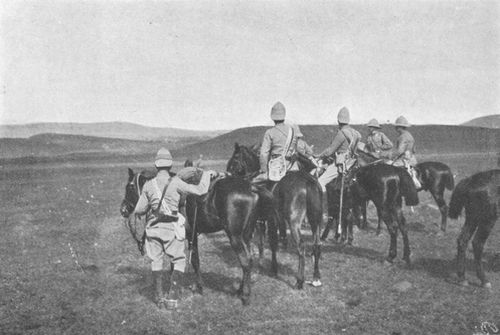
General French And Staff On Black Monday.
There are others who took possession of Chinese houses wholesale, and
found a source of income in letting or leasing them. The fact of their
having a number of converts to support was given by them as a
justification of their actions. Unquestionably they had a large number
more or less dependent upon them, but some other means
might surely have been found. They were very busy in those days. And
perhaps that accounts for their taking no notice of the actions of
various portions of the Allied soldiery. Wholesale robbery, cruelty,
and the raping of women were going on all round; a regular orgy of
rapine surged through the captured city. Yet not one solitary voice of
protest was heard.
It would be gratifying to think that, amidst all these exponents of
the doctrine of the Sermon on the Mount, there was one who called for
mercy on the conquered, or asked that even common humanity should be
shown them, or even reminded the generals of their own rules of war
and fair fighting, or who raised his voice for justice, even if he did
not in compassion. What an opportunity lost, which would not have been
thrown away on the Chinese, of showing in practice what they had been
preaching—"Bless them that curse you, do good to them that hate you,
pray for them that despitefully use you." If, instead of
selling images of Buddha, they had used their influence to preserve
his temples from desecration and defilement, or offered sanctuary to
his priests, it is certain that they would have more materially
furthered the cause they have in hand.
It would be wrong to say that not one solitary voice was raised. 'Tis
true it was not raised by any missionary. But there is a rough-looking
soldier with a strong face that looks as if it had been hewn out of a
block of red sandstone with a blunt hatchet—General Chaffee, of the
United States Army. He would be called in England a "ranker." He, not
content, as Sir Alfred Gaselee was, with keeping his own men from
disgracing their country's flag, wrote a letter of remonstrance to
Count Waldersee, and received a snub in return for an action which,
nevertheless, redounds immensely to his credit.
Christianity in China has received a staggering blow, from which it
will not recover during the lives of the present generation.
Its progress, so far as any one can see, in the immediate future is at
an end. It is even questionable whether it will not be wiped out
altogether in Northern China. The terrible assaults by Boxers will
largely decrease the number of converts. The temporal advantages that
formerly ensued from its profession are now more than counterbalanced
by the hatred and persecution that Christianity entails. The worst
blow it has received has been through the conduct of the Allied
soldiery during the late invasion. These men have crucified it in
China as truly as the soldiers of Pilate did its Founder. And even the
Christian missionaries raised no protest against the crucifixion.
Let us hear what a Chinaman says in a book just published, the author
writing under the name of "Wen Ching." I heard the identical opinions
expressed by many intellectual Chinese.
"For their gifts," he says, "to the West in the shape of
silk, tea, and the magnetic compass, the Chinese have so far in return
received opium, missionaries, and bombardment." "The literati, the
backbone of China ... are not kindly spoken of by missionaries, nor
are they liked by foreigners."
It is only "the lower orders that have always been very susceptible to
the teaching of foreigners. Their ignorance and their poverty furnish
ample reasons for their willingness to join the churches of the
Europeans."
Also "the claims of missionaries to a right of travel and residence in
the interior ... are founded on no higher authority than an
interpolation by a missionary translator into the Chinese text of the
treaty between France and China." That "the disturbance of a local
fengshui by a church spire is considered as much of a grievance as
the erection of a hideous tannery beside Westminster Abbey would be."
He says that "the Christian religion spread chiefly, if not
entirely, among the poorer people, until it was discovered that
political advantages accrued to the convert." For "in many places the
missionary intrudes himself into the Chinese court, and sits beside
the magistrate to hear a case between his convert and a non-Christian
native. The influence of the missionary is very great, and the
official is often pestered and worried by the messengers of the
Gospel." Therefore the Christian converts are voted a "source of
trouble and a nuisance."
Still, in this writer's opinion, "nothing has done so much harm to the
cause of the missionary as this forcing the opium trade on the
people." "If there are honest missionaries," he remarks, "there are
also sincere believers in the ancient faiths of Cathay to resent the
insidious encroachments of blatant foreign priests, who preach to the
heathen the doctrines of self-imposed poverty and mendicancy, and yet
themselves live sumptuously enough in comfortable houses, surrounded
by a wife and a numerous progeny, in the midst of heathen
squalor and misery."
These are just a few extracts from the views of an intelligent
Chinaman as regards the question of missionaries in his country. But
in conversation with others I heard similar opinions more forcibly
put. They point out that the various exponents of Christianity insist
that each alone expounds the right version, which is puzzling to the
Chinese, and that the missionaries actually have not agreed as to the
name of their God, as they use five different characters.
Within the radius of an eighteen-penny cab fare from where I write, I
think there is plenty of spiritually productive work for all the
missionaries in China; work for all the sincere, self-sacrificing
missionaries—and there are still many of them in China—men animated
by the spirit of the Twelve Fishermen, who have not adopted their
profession as a means of livelihood, in addition to a secure income
getting an extra £30 for every baby born in their families. And
within the radius I speak of, they would not first have the
task of weaning the people away from the doctrines of Confucius or
Buddha—"Him all wisest, best, most pitiful, whose lips comfort the
world," which doctrines are the very breathing—the life—of their
social as well as spiritual being. When the Chinese see the German
Emperor using missionaries as live-bait to catch a province, and the
French insisting upon being given another as the price of a few
members of one of those religious orders they have expelled from
France, it is no wonder that from that stricken, bullied, cheated
people the cry goes up to the empty heavens—
"To my own Gods I go.
It may be they shall give me greater ease
Than your cold Christ and tangled Trinities."
EX ORIENTE LUX
What is a barbarian? In many of the Chinese edicts we see the term
perpetually applied to those people outside the Celestial Kingdom, and
to all those who are not Chinese. The Japanese are far too polite to
use such a word. Yet I have spoken to Japanese artists who, in
referring to European taste in Art, used a word equivalent to
barbarous. The average free-born Briton travelling round the world
carries with him, or is supposed to carry with him, his Bible, and a
taste for Bass's beer and beefsteak. According as a country does or
does not possess these essentials, and according as its own attributes
of civilisation are removed from his own standards of perfection,
so does he regard its inhabitants as more or less barbarians.
(I was rather amused watching a play in Tokio once, where the villain
of the piece was a red-whiskered Englishman, in a loud crossbar suit
and a fore-and-aft cap, who was always shown on the stage with half a
dozen bottles of Bass on a table beside him.) When we bear in mind how
much Britishers despise their next-door neighbours across the Channel
for their defective beefsteakiali-ties, it is not surprising that such
a feeling should be greatly intensified when they come in contact with
a civilisation so much more alien and remote from their own as that of
China and Japan. It needs only a quiet observation and the smallest
degree of intellectual elasticity to be forced to the conclusion that
the advantages are not altogether on our side, and that there is great
scope for the East to send social missionaries to the West. Socially,
I think we have far more to learn from them than they have to learn
from us. And, curiously enough, if such a mission were started,
it would not be entirely to teach us new things, but in many
ways it would be recalling us to points which we have hurried away
from in the rapid progress of our material civilisation for the last
couple of hundred years.
The central idea, the social pivot, the focus of the life, of the
civilisation of the East is to be found in their idea of the home. The
home is the centre of gravity of their existence, round which
everything else revolves. In China it is the all-pervading,
all-vivifying idea of social life, of religion, and of government. The
life of the family is not only of to-day, but extends back into a
venerable past, and is the hope and care of the future.
For us, the dead past buries its dead, and the flowers that we lay on
the newly-made grave quickly wither on the freshly-turned clay on
which we have left them—except where the place of natural ones is
taken by those deliciously ironical representations in the shape of
tin—waterproof imitations which save the mourner the
trouble of renewal.
As to the love of the Chinese and Japanese for their children, it has
to be seen to be appreciated. Those wise-eyed little mites, who before
they can walk sit perpetually enthroned upon their mothers' backs
throughout the livelong day, are a source of so much joy and adoration
to their parents that one feels no surprise at not hearing them cry as
other children do. I only recollect hearing a child cry once during a
two months' stay in Japan, and then there was an excuse for its
dolorous plaint, because its mother was shaving its little head with a
blunt razor and no soap. It must be obvious to the student of our
Western civilisation that the cult of family life is on the decline.
The ties and obligations which hold children and parents together are
visibly slackening, and this is the more obvious amongst those nations
which have been taking the lead in the material progress of our time.
Take the United States, for instance. There, up to a certain
point, the father is regarded as the dollar-grinding machine. The
tendency is for both sons and daughters to cast themselves loose from
parental ties, and strike out afresh for themselves. And their parents
are as little responsible for them as they are for the maintenance or
happiness of their parents.
Any one who is familiar with life in the East End of London will
appreciate how little these worn-out toilers, when old age
incapacitates them from work, can rely on being kept out of the Union
by their children. With the experience of nearly two thousand years of
the progress of Christendom, it is not surprising that a short time
ago we should hear the present occupant of the Papal Throne raising
his aged voice to recall the attention of the West to how rapidly the
idea of the family was being lost, as Leo XIII. did in the Encyclical
Address to the Catholic Church on the subject of the Holy Family.
From the more important teaching as regards family life,
these Oriental missionaries might then endeavour to tell us something
of the Fine Arts in the East, and yet more of the spirit which
animates their artists. They would be able to show us that "art for
art's sake" with them is no empty phrase. It would doubtless surprise
many Westerners to know that a Chinese painter would not think of
selling his pictures for money, but paints them for his own pleasure,
and gives his work as presents to his friends, and would no more dream
of selling a picture than an English girl would of selling a kiss.
The Japanese would have a lot to tell us about bringing art, and that
their highest and best art, into the utensils of everyday life, and
that there is nothing demeaning in expending the best work on things
one handles and uses every day. What a lot they would have to tell us
of the cultivation and their love of flowers—a love which seems
instinct in the poorest peasant, and which in the more cultivated
classes is carried to an exquisite degree of refined
development! And again, a Japanese incense party, where different
qualities of delicately aromatic incense are passed round—and the
pastime consists in placing the different qualities in the order of
the beauty of their perfume—would almost suggest that the West had
neglected the cultivation of one of the five senses.
At a dinner-party at a well-known restaurant, the other night, it was
forcibly brought to my mind what a lot they would have to teach us
regarding the enjoyment of such social functions. A perfect din and
rattle of plates and knives filled the air, a mob of undisciplined
servants charged about tumultuously, garish lights lit up vulgar
ornamentation, and one almost had to shout to be heard across the
table, while a band of music outside ineffectually endeavoured to
drown the din within. There were flowers, it is true, but their
profusion was no compensation for an utter lack of artistic
arrangement. But there was a complete absence of that
repose, that restfulness, that calm, which is considered, and justly
considered, amongst Easterns as the essential atmosphere for the
enjoyment of a social repast. The Japanese have raised entertainment
to the level of a fine art. Their tea ceremonies, as we have badly
translated the "Cha'-no-yu," but which might be preferably rendered as
"The Fine Art of Welcome and Hospitality," have been a strong
influence in preventing them from drifting into the meretricious
gaudiness so blatantly en évidence in restaurants like the Carlton,
and minister to that purity and simplicity of taste which is so
characteristic of Japanese art. Five is considered by them the best
number for a dinner-party, as with a larger number separate
conversational groups are apt to be formed. The Japanese gentleman has
rooms specially built for these parties, and rooms only just large
enough to hold his guests comfortably. One scroll is hung in the
kakemono, and in front of it one ornament, and afterwards a solitary
flower. It would be considered by them extremely bad taste
to confuse or dissipate the attention by a variety of ornaments.
A Japanese lady once showed me a photo of the drawing-room at
Sandringham, which greatly amused her, and which she kept as a
curiosity. (She was too polite to say as a curiosity of barbarism.)
But she said, laughing, "Is it not just like a curio-dealer's shop?"
The dinner, which actually precedes the tea-drinking, is served by the
host in person, thus doing away with the intrusion of even their deft
and quiet-moving servants. Every cup, every plate, is an individual
art treasure, from the Godown in which the host's artistic treasures
are kept in a seclusion that his most intimate friends have never
penetrated. They have probably never seen the same picture or the same
ornament twice in the kakemono. From the soft mellow music of the old
gong which summons them to the repast, on through its various stages,
until the rare and beautiful bowl out of which they have had tea is
passed round for appreciative inspection, an air of
refined repose has characterised the whole proceedings.
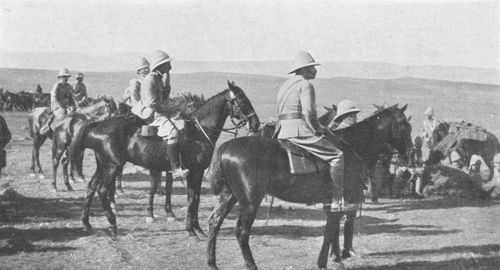
General White And Staff On Black Monday.
These social missionaries might progress from giving us some insight
into these things to the introduction of another institution which
would be an unquestionable advantage to our civilisation—I refer to
the Geisha. Supposing that they were successful in grafting this
Japanese idea, the Western edition would work out somewhat thuswise.
Take, for instance, a bachelor coming up from Oxford or Cambridge, or,
say, a merchant up from Liverpool or Manchester, instead of having a
solitary dinner at his club, if he wished for the relaxation of
vivacious female companionship, he would go to the telephone, and ring
up "Geishas, Limited," and send word that he wanted one, or more, for
dinner that evening. There would in due course, at the restaurant
appointed, appear a girl with the dress, appearance, and manners of a
lady. Whatever her looks might be, whatever her attractions, she would
unfailingly be bright, intelligent, well-mannered, and,
above all, entertaining, for her being entertaining would be her
métier, her occupation, her raison d'être. And, contrary to what
is frequently supposed from a mistaken acquaintance with this Japanese
institution, she would not be in the least facile or accessible. Our
ideas of feminine Japan are too much based on the circumscribed
experiences of holiday travellers, or books of the bad taste of Pierre
Loti's "Madame Chrysanthème." We do not judge the women of England by
Leicester Square, nor of Paris by those of the Moulin Rouge. Amongst
the accomplishments of these Geisha girls music and singing would be
most important. There seems much more refinement and comfort in
bringing the music and singing to you than in going to the singing and
music. A party of men dining together would not be driven to adjourn
to a music-hall after dinner. They could order it as part of the menu.
But these Oriental missionaries, in addition to introducing
such an institution, would have a field for their labours in raising
their clients and customers to the standard of Japanese civilisation
in the enjoyment of it. I present the idea gratis to any enterprising
people who are troubled with the question. What to do with our girls!
But Orientals would have little to teach us in what the Chinese call
"make face," which enters into many of the actions of our daily life
quite as much as it does into theirs. How thankful we should be that
it does not also enter into our religious life! How thoroughly the
Chinese must be impressed with this by their recent experiences of our
Latest Crusaders! I was listening the other day to a gentleman
descanting "on the darkness that enveloped those Pagan barbarians,"
and I was thinking of another darkness or blindness which prevented
the speaker, and many like him, from seeing the least gleam of light
in the East. Yet it does not require much hand-shading of our
intellectual eyes to see ex Oriente Lux.
NIGHT IN THE CITY OF UNREST
"How beautiful is night!
A dewy freshness fills the silent air;
No mist obscures, nor cloud, nor speck, nor stain
Breaks the serene of heaven:
In full-orbed glory, yonder moon divine
Rolls through the dark-blue depths.
Beneath her steady ray
The desert-circle spreads
Like the round ocean, girdled with the sky.
How beautiful is night!"
Night really unrobes her beauty only in silence, the silence of the
desert. Never can I forget nights spent in Western Australia, far
beyond Kalgoorlie, away back in the Never-Never Land, where no rain
falls. That is the land of great thirst, where for hundreds of miles
one sees no living thing, where no birds sing, not even the mournful
call of the jackal echoes across the waste, and not even the
chirping ticking of an insect is to be heard to break the utter
stillness. Gum trees, whose roots strike down a hundred feet for
water, lift up their sparsely-covered branches into the motionless air
above, their tongue-like leaves silently saying "I thirst." In that
stagnant air they remind one of the giant seaweeds that grow in the
depths of the great oceans where the water never moves; and the
silence there is the silence of ocean depths, and so has been from the
beginning. To-day my horse's tracks made five years ago are probably
as fresh as were those which I followed that had been made two years
before that time. It must be experienced to be realised, that dead
silence; when lying on the ground at night the sound of one's
heart-beats or the breathing of one's horse, tethered yards away,
alone tells one that the sense of hearing is not lost. It must be
experienced to be loved, that wonder of a silent world, where the
Spirit of Solitude in his own domain for ever almost palpably seems to
brood with finger on pressed lips. It is the contrast with
the scene that lies below me that forcibly recalls these nights in the
desert. Now, as I write, I am at the Antipodes, and focus points of
contrast in every sense to these scenes; the same moon that shines on
that far-off desert is the only thing in common.
The city of New York is in the form of a wedge, the point of the wedge
being the down-town end, a great black mass that now looks driven into
the moonlit water. Down here, as if with sheer weight of pressure of
crowding humanity, the houses seem driven upward. There being not
enough room on the end of the wedge for the people, they are forced
upwards for room, as one would squeeze paint from an artist's tube.
They rise up in tall, irregular-shaped shafts of various heights, as a
child might stand its long toy bricks on end anyhow. As I write I am
looking down from the thirtieth story of one of the highest, feeling
as if I had been "set on the pinnacle of the Temple" (of Mammon?).
The great city lies below me, but though it is night it does
not appear to lie in repose. If it sleeps, it is a restless, troubled
sleep. The air is vocal with many noises that come up from below as an
exhalation; white flames of steam wave from the tops of buildings
below me. Up here on this giddy height a hot wind of the upper air is
blowing, and a vibrating, murmurous throbbing pulsates through the
building itself. This latter is caused by the elevators, those veins
and arteries of the structure, and their motion must never cease or
else a clot of humanity would be left marooned in the upper storeys.
Across the river on the west side a row of lights are moving in one
direction, and alongside them a row moving in the opposite, like ants
at work. These are the trolly-cars crossing Brooklyn Bridge. North and
south, to the sound of a jangling rattle, the trams on the Elevated
are moving, and along the streets the trolly-cars, with their booming
note, which crescendoes up the scale with increasing speed and
diminuendoes with the slackening of it. Out on the water the
red and green lights of the steamers move about in irregular tracks.
The booming, mournful call of these steamers, like the lowing of a cow
for her lost calf, goes on for ever. There are times in the desert
when the coyote and the jackal are silent; on forlorn coasts in the
hours before the first of dawn the seagulls cease their screaming; but
these voices are never silent, calling, circling, and cawing, calling
around the City of Unrest. Different notes they sound—the angry
scream of the steam siren, the deep boom of the incoming ocean liner,
and the note one hears oftenest—a mournful, lost wail, as of a damned
soul calling out, "Custos, quid de nocte?" "Custos, quid de nocte?"
The feverish hours pass troublously, but there is no response in the
night of the City of Unrest.
Now a great change has come over the scene; the moon has been
curtained off by a heavy mass of clouds, and its light is shut off
from the water. The lights of the city shine out with
increased distinctness; the moonlight that whitened the sides of the
buildings now has left them black masses of vague shadow, and all at
once one gets the impression of looking down into an inverted
firmament studded with countless stars of as various magnitudes as in
the heavens, from the bright electric arc-lights to tiny gaslights;
and from this height of over 400 feet one gets the impression,
familiar to those who have looked at the world from a balloon, that
the rim of the horizon rises all round. "Around the circle of the
desert spreads," but the desert now is of the cloud-covered sky, and
far as the eye can reach are the stars of this great city, and now
through that firmament of stars there is a dark path in an
unilluminated Milky Way which marks the course of the river.
As one looks down from here and listens to the combination of
throbbing sounds that come up from below, there is a certain
impressiveness in the thought of being in the centre of such focused
activity. One seems to be pressing the ear close to the
heart of a great country. I wonder what that other city looked like
from the pinnacle of whose temple He looked down on the other great
cities that had their day? What Carthage looked like? The present
edition of Rome and Paris and London, and Pekin from the Imperial
pagodas on the top of Coal Hill, I have looked down on at night, but
none of them is like this. From the Capitol Rome lies quietly wrapped
in the memories of past greatness; from the hill of Montmartre the
electric lights here and there give suggestive glimpses of the City of
Pleasure. In Pekin, looking across the lotus-pond and the marble
bridges, all that is squalid in the city is shrouded in a veil of
foliage, and above the tops of the trees only what is beautiful
emerges, and the city sleeps in the enjoyment of thoroughly Oriental
repose; and, like a solidly-built, healthy man, London sleeps soundly;
but the strenuous, restless activity of this city can hardly be said
to sleep. I watched it make an attempt at a pause for five
minutes on the day of the President's funeral. At an appointed time
all the street traffic was supposed to stand still. My! what an effort
it was! It was not a real pause; it seemed more like the gasping
holding of the city's breath, holding for these five minutes as if
something were going to burst; and then at the second when the clock
marked the end of the five minutes on went everything spinning with a
feeling of absolute relief. As one looks down from here one cannot
help speculating as to what is to be the future of what lies below. Is
it going to be the greatest city that the world has ever seen—in real
greatness, or only in acute development of material civilisation; and
are the multitudes that populate it going to get more happiness from
the arcs of their little lives than those of Carthage and Rome, or
Pekin, or Babylon, or London? Or are they going at the pace that
kills? Or at least the pace that tires into premature exhaustion?
But leaving these speculations, as it is now one o'clock, I
get into the cage of the elevator and drop down whirring as the floors
toss upwards beyond me—"Down twenty-eight," and we pull up with a
jerk, and a pale-faced man gets in. "Down twelve," and two
tired-looking women and a small boy get on board; and then the floor
on which is a newspaper office, and a crowd is waiting to descend. The
paper is just going to press, and their work is done. And then right
down below the level of the street I go to see the paper actually
printed. Immense rolls of paper are being lowered from the street
level and handled as easily as if they were of no more weight than a
lead pencil, put before machines which devour them to a deafening
noise of machinery. The room reminds one of the lower deck of an
ironclad in action, and the workers there seem fighting for their
lives—fighting against time, fighting against the machine, fighting
against the paper, which would fill up the room if it were left at the
discharging end of the machines without being sent rapidly aloft; and
there on the floor above the men are fighting hand to hand
with great bundles of papers that must be sent out in time for the
morning trains. Outside in the square stand horses sufficient for the
artillery of an army corps awaiting their burdens, and as I go up town
by the surface car, although there is not yet any sign of light, I
pass hundreds of men on their way down town to make an early start in
the battle struggle of a new day in the City of Unrest.
A STREET IN THE CITY OF UNREST
It was a very wonderful sight last night, looking down from that
height at the black pool of New York specked with star-like lights—a
pool of darkness, where three million people slept, or tried to sleep;
but it was like looking into a cup of ink to read destinies. Now,
twelve hours afterwards, let us step down below into the centre of the
city, when the limelight of a glaring, cloudless sun is turned full on
it—when the living microcosm of its active life is thrown on the
magic-lantern screen of our retina. Now we are at the base of these
high buildings, and no city in Europe can show anything like them. It
is difficult to know what to compare them to. We cannot
compare Broadway to an avenue of poplars in stone, for the poplars are
out of proportion to the avenue—far too high and far too irregular.
There is no regular design, no continuous outline; immense, costly,
new, they sprout upwards—sprout as if under the drawing-up power of a
tropical sun, sprout as if fed with the superabundant fecundity of
virgin soil. Unless they were as high, there would not be room for the
people down at this crowded end of the wedge-shaped town. The want of
finality about them is no less apparent in their irregularity of size
than in their sides, generally blank of windows, in expectancy of
buildings going up beside them probably higher still. Some of them are
to be seen with white marble façades crowned with Corinthian
pilasters, and the sides are of red or yellow brick, on which is
probably some huge, ugly advertisement announcing that some fine
five-cent cigar is "generously good," or holding out hope of relief in
the shape of a pill to liver-troubled humanity.
Parenthetically, I may remark that this city is, if anything, rather
worse than London in the way of placards that scar the face of it. The
goblin-like advertisements that spit soap and other things at
unoffending eyes at night in Trafalgar Square are bad enough, but the
advertisements in New York are worse still. There is a fine square
here called Madison, in the centre of which trees rise from
fountain-watered grass, and statued figures of people who were men in
their day and did things, palatial buildings, dignifying commerce,
form the square. Yet while I have been here I have watched, right over
a house on one side of it, a huge white hoarding being erected, and
have watched a great vulgar advertisement of cigarettes being daubed
upon it. A beastly, ugly smear on one of the beauty-spots of the city.
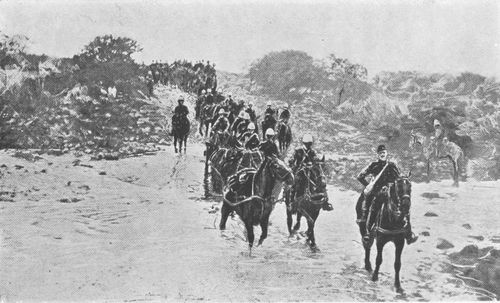
Artillery Crossing A Drift Near Ladysmith.
Bang-bang; bang-bang; bang—loud, insistent; ping-ping—sharp,
piercing; the first from the trolly-car, the second from a
steam-trailing automobile; a booming roar from the ground
accompanying the first, a buzzing rattle the second. Just a block away
a far louder rattle still comes from the elevated railway. Here, down
town, the streets are paved with cobble stones, and the severity of
the climate in the winter is given as the excuse for the irregularity
of the surface. Heavy lorries and wheels of horsed vehicles jangle
over them, but the general uproar is so great that the bells on the
horses' collars are inaudible, and sight is the only sense that makes
their approach perceptible. The stream of trolly-cars passes and
re-passes, perpetually making short pauses for the passengers to nip
in quickly or—get left. Across from where I write is a restaurant
with a legend above it, "Quick Lunch." This, I think, is rather
peculiar to New York; in other cities it would be either "Good Lunch,"
or "Cheap Lunch;" here the attraction is that it is "quick." It is
only necessary to watch the way that the customers hurry in and hurry
out to see the significance of it. The day is not half long
enough for the workers down here, and the work is at such high
pressure that time for feeding can hardly be spared; it is not feeding
or taking a meal, it is just stoking the human engine, and quick
stoking at that.
The streets of London, even in the City, are calm and peaceful in
comparison with those here in New York. The very ground throbs with
vibration, the air throbs with the medley of noises, the buildings
throb with both. It is not quite obvious why the streets should be so
noisy. All the bells and gongs and danger-signals, one would think,
would be equally effectual if they were not so loud, but now the
competition of sounds is so great that any warning must almost be
explosive in its violence to be audible at all. It is no wonder that
we find in this city so many people suffering from nerves; it is quite
surprising the number of men I have met who dare not drink coffee, men
who have had to give up smoking, men and women who were too
nervous to travel in a hansom, and who at frequent intervals have to
retire to the country owing to various kinds of nervous trouble. There
seems to be no question but that this suffering from nervous disorders
is on the increase; it would be surprising if it were otherwise,
considering the pace at which these people live; and when one sees
thin, pallid, spectacle-wearing little children, one sees specimens of
the rising generation who are destined to be still greater sufferers.
As against this, and off-setting it, the taste for outdoor games seems
to be on the increase, and for young business men who have little time
for taking exercise nothing can be more admirable than clubs such as
the athletic and the racquet clubs here, which give opportunities of
taking indoor exercise on a scale unapproached by any similar
institution in London.
When I left London in August and came here, it would be difficult to
determine in which city the streets were more torn up. The
construction of the underground railway here is in evidence all over
the city; explosions from blasting are to be heard at intervals
throughout the day, and in various directions huge caverns yawn, at
the bottom of which hundreds of men and steel drills are hard at work.
I have noticed within the last few years how the power of the street
policeman has increased for regulating traffic. In return for the
potatoes which Ireland originally received from America, she has ever
since been supplying this country with policemen and politicians, and
these former great burly, beltless Milesians now despotically rule the
traffic as effectually as the London bobbies. It is characteristic
that the youngsters about the streets should be keener, sharper, more
active even than the youngsters of London. The lithe, thin,
cigarette-smoking gamins that sell newspapers down town are a study
in themselves as they dart and double through the traffic and the
crowded sidewalks, selling innumerable editions of
voluminous papers throughout the day.
Early in the morning going down town, during the luncheon hour, or
going up town in the evening, one is struck by the enormous number of
women workers who now find employment in this great city—in some
offices hundreds of women, forming almost the entire staff, are
employed. Their competition must make it harder still for the male
clerks. Independent, self-reliant, business-like, a curious type is
being developed of these bread-earners—a type that suggests the
evolution of a neutral sex. Perhaps it is not altogether to be
wondered at, and is only a manifestation of the idea of equality, that
in the down-town cars the man no longer gives up his seat to the woman
who stands holding on to the leather strap over her head in the
crowded car, and does not remove his hat in the elevator when a woman
enters.
Now a black-plumed vehicle comes spinning round the street corner,
followed by three or four carriages with the crape-wearing
drivers: apparently it is only the denseness of the traffic that
prevents the hearse galloping and compels the driver to be content
with a quick trot. Quick lunch, rapid life, fast funeral, devouring
cremation, or else the weary toiler is laid down to have a first try
at a real long sleep in the quivering bosom of the City of Unrest.
A GLIMPSE OF A SOUTHERN CITY
Every variety of climate, pace, and people is to be found in this
great tract of country which has for its flag the Stars and Stripes,
and any variety of taste ought to be capable of being gratified within
its confines. If I were to come to live on this side of the Atlantic I
think I should elect to settle in a Southern city. New York has many
attractions; it has drawn to it, vortex-like, much of the best that is
bright, able, active, powerful, but, vortex-like, the life swirls,
spinning ceaselessly at a terrific rate, in that noisy city of unrest.
Chicago accentuates the worst features of life in New York while
having few of its compensations, and the large cities in the East and
centre are blends of the life of both diluted with dulness. San
Francisco is a thing apart—the air of the Pacific seems to
blow different impulses on the people, and great and glorious air and
climate and scenery are there, bracing with the breeziness of the
West. Florida and the shores of the Gulf of Mexico are too near the
tropics for my taste, tending towards hammock-basking too much.
Give me a Southern city, say in Georgia; and I have one in my mind's
eye. There the people do not live so fast as to have no time to enjoy
their life, while they have all that makes life enjoyable. Successful
effort is my nearest approach to a definition of what constitutes
happiness. There, there is every scope for various effort. The city
and country around are still in process of active growth. "Fecundity"
is writ large across the surface of the State, on fields, in mills, in
mines. All the men are busy the livelong day. Here it is different
from in England; you do not find a large section of men who spend the
day either at various kinds of sport, at cricket, or loitering
listlessly about the clubs. An idle man would be a solitary
of his own sex. But it is not the material conditions that constitute
the chief attraction of life in a Southern city, excellent as they
are; the principal charm of the South is the character of the people
themselves. There is an undefined flavour of old-world politeness and
courtesy perfuming their environment The bow of a Southern gentleman
does not appear to be the jerk of a string-pull; it suggests having
been learned remotely from the bow that brought the sword projecting
through the long coat-tails as the hat was removed from the powdered
wig.
There is an indefinite something that tells one that all these people
have had grandfathers and grandmothers, instead of as in New York,
where the suggestion is that they are the offspring of stock-market
tickers or have been shot into the world through a pneumatic tube.
That almost universal formula in America on a man being introduced
bears here a real significance, "I am glad to meet you, Mr. Blank."
The English equivalent is "How-d-do?" and, although
inarticulate, there is frequently a silent suggestion of the phrase,
"Bored to meet you," "Awfully bored to meet you." In the South they
are glad to meet and welcome the stranger at their gates, and he must
be hard to please if he does not have a good time within them.
The general rule that the men are at work all day has its effect in
various ways on the life of the community. The social life differs
from that of England in many marked features, in none more than in the
part played by the Southern girl. At the first reception given by the
mother of the young débutante, the men of the set in which she is to
move are presented to her, and tacitly it is a presentation to them,
by the mother, of what she holds most tenderly precious; to them, in
trust in their honour, in full confidence in their courtesy, and,
although their hearts are covered with the immaculate shirt-front of
latter-day conventionality, with as full reliance on knightly service
as if that stiff shirt were the armour of the day of
chivalry. This social feature or condition of things strikes me as
especially admirable. It strikes me as so infinitely preferable to the
constant espionage of chaperonage, so much more above board and
honourable towards both the young men and girls alike. They can go
driving, to a theatre—where boxes are much more open and less like
bathing-machines than ours—to lunch in the big club-room—an annexe
to the exclusively male portion to which ladies are admitted—and will
be driven to and from a dance, and will receive afternoon calls
without a chaperon. Results point overwhelmingly to its success from
every point of view. A breach of that code of conduct which needs not
to be written would mean eternal social damnation. It is being
perpetually borne in on me what a much better time the American girl
has than our English sisters, and in many ways she deserves to have it
so. If the man keeps horses and carriages so that he may take her out
for drives in the afternoon, bring her to the theatre, take
her to and from dances, if he keeps her supplied with flowers to an
extent unknown Englandwards, if he is constantly giving dinner-parties
and supper-parties for her, it is because she is worthy of it all and
more.
To begin with, she is never blasée; and, thank goodness, it is not
yet considered in America "good form" to appear blasé, even if one
is not. Being full of interest and constantly au courant with
events, she is always companionable, and is able to talk intelligently
of many things. Being gifted with a heaven-sent sense of humour, she
is never dull; and what closer bond of social sympathy is there than a
sense of humour in common? In conversational fence the thrust and
parry of her play is as quick and keen as her touch is true and light,
and through it all ripples a sunny Southern gaiety that is as fond of
giving pleasure or amusement as she is readily susceptive of either.
But be not tempted in this summer region, O wanderer from the chilly
North, to wear your heart upon your sleeve for the sun to
shine on, or else she will pluck it off, saying, with laughing eyes,
that it is no place for it, and she will put it with a row of probably
half a dozen already on hers, and from time to time she will pick
morsels from it at her pleasure; and the reason that it does not hurt
more is because of the prettiness of her lips.
It is when one meets the mothers of these girls that one sees whence
comes their charm; an old-world queenliness of motherhood, mingling
with warm-hearted cordiality, renders them immediately as lovable as
their daughters.
The billion-dollar trust is very adollarable, and so is the Tobacco
and Standard Oil and the rest; but in the assets of the nation, more
valuable, to my mind, is the heirloom of the tradition of gentle
manners and cordial kindliness held so well in trust by the people of
that city of the South.
THE PENALTY OF THEIR PACE IN THE CITY OF UNREST
A dinner-party at Sherry's—twenty people sat around a table beautiful
with the choicest flowers—the room was full of diners; there was more
noise and clatter than one would hear even in the Carlton or Prince's;
and the Hungarian band was playing—seemed the suitable panting
life-breath of the scene—sensuous a little—strenuous—feverishly
restless. Bright, gay, quick, and keyed loudly in order to be audible,
were the voices of the diners; exchange of repartee, quick as the fire
of a pom-pom, was shot and returned. Well-aimed marksmanship it was,
too—no cartridges wasted. Flash of costly jewels or still brighter
eyes as the shots were sped at marks worth firing at and
well capable of replying. Men who had done things were there: the
senator—a great lawyer—several of America's greatest business men,
and the women who had helped or spurred or hindered them, but who were
all worth working for or helpfully hinderous blast-furnaces to
ambition. But one seat away was a man who was one of the greatest
mine-owners in America, and controlled railways that were connected
and dependent on these mines. Pale and sallow, with sparse hair over
his big bulging forehead, power and decision and resolution were
stamped on every line of his face; a small army of men worked for
him—worked underground or on railroads, or looked to him as the donor
of dividends, the regulator of their incomes, the arbiter of their
financial destinies.
He drank no wine at dinner, yet now and again a curious up-and-down
lifting movement of the table could be traced to one of his knees,
which he kept crossed over the other. He waved away the coffee with
the remark that it was years since he dared indulge in it;
but when, after obviously impatient waiting, the time came when he
might light a long cigar, he puffed out a stream of smoke with a sigh
of relief, and the table was no longer shaken from that on. Presently
some remark drew from him the reply, "No; the most desirable things in
the world are health and sleep. I would give two million dollars to be
able to sleep six hours each night. I would give twice that to be able
to digest a good meal properly. I would give I don't know what to be
able to rest, just rest quietly again."
And the lady next him said: "How well I understand that feeling! I
don't see why we should be compelled to go on, on, on at that pace.
Sometimes now when I have to drive in a cab I can barely keep myself
from shrieking out aloud from sheer nervousness. I have not dined at
home in my own house for three months except once, and that was when,
in reply to a remonstrance to my daughter for going out so much, she
said she would dine at home on Christmas Day. It is this
perpetual rush, I expect, makes us so nervous; but it is so hard to
stop, even when our nerves pay the price."
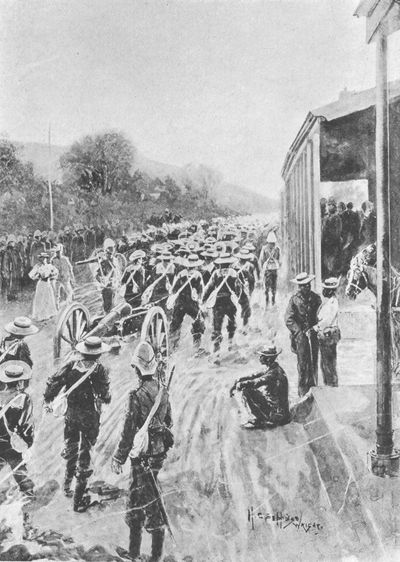
Naval Brigade Passing Through Ladysmith.
Coming out of a newspaper office in New York I happened to meet an old
friend of the Cuban war times. Paler, thinner, and more drawn his face
looked in the V of his turned-up collar than when I had seen him last.
After talking for a few minutes I asked him whither he was going, and
found he was going to take a special kind of bath and rubbing, which
was part of the treatment he was undergoing for the desperate nervous
trouble he was suffering from.
"It is pretty hard lines," said he. "As you know, I never drank, and
took fairly good care of myself. I have not slept more than an hour or
two for the past week."
Then he told me how, going home to Brooklyn a few evenings before, the
nervousness had come so badly on him that he had to hire a
boy to go with him. He could not go across the bridge alone.
"At the present moment," said he, "there are nine men in our office
suffering from the same complaint."
He seemed to think that the treatment was doing little good; that
doctors could do next to nothing.
"Rest, long rest, is what we want, I suppose; but how can a fellow get
rest working in a big newspaper office in this city?"
The Remington machine had been rattling on like a Maxim gun in action,
the operator taking down dictation on to the machine so quickly that
it was almost as good as short-hand. It stopped suddenly, and the
fragile anæmic woman who was working it laid down her hands in her
lap, saying she was afraid she could not continue. In reply to the
question if she was ill she said no—that it was simply she was
nervous. She said she had only just returned from the country, where
she had been resting for a week—a rest that she could ill
afford, but it evidently had not been long enough.
"It is terrible, especially for those who have to keep working for a
living, who have to work on to keep their heads above water."
"I suppose it is the penalty we pay for all this," she said, looking
out from the window at which she sat.
Down far below was one of the busiest squares in New York; a double
line of trolly-cars perpetually running through it that clanged their
bells as they swung around the corner; automobiles that pinged their
warning gongs and darted in and out amongst the stream of traffic
fish-like; labouring horses struggling under heavy loads; the cars
packed with people like cattle, standing up and hanging from the
straps in the roof, toilers coming back from work; the sidewalks
crowded with hurrying people. The seats in the centre of the square
held slouching figures with bent heads, figures of dog-tired
men—dog-tired with work or the looking for it. A sharp insistent
clanging arose above the other sounds like a wailing scream of pain as
an automobile ambulance rushed hospital-wards, carrying off one of
those wounded in the struggle.
No one can quietly watch the seething life of the City of Unrest
without being struck with the prevalence of nervous troubles amongst
the people. Every day one meets instances. "I dare not drink coffee; I
have not drunk it for years," one so often hears—then the piteous
longing for sleep denied. "I am not going to any dances this winter;
my doctor will not allow me, on account of my nerves," one of the most
charming girls in New York said to me a few days ago. The doctors all
declare that this nervousness is alarmingly on the increase, and
throughout every class of the community—from those who work hardest,
through the longest hours, to earn their bread, to those who work at
the pursuit of pleasure—the mad social rush of the Charge
of the Four Hundred. It is obvious that this pace cannot
slacken—every year adds fresh impetus. What will it be in fifty
years—at the end of the century? What will the offspring of these
quivering, twitching, highly strung men and women be like? Quo vadis,
Americane?
Already there are antidotes or remedies for this growing
evil—sanatoria where the worn-out over-worked are compelled to seek
refuge, asylums of repose for those who have long lost the art of
enjoying it. More useful, perhaps, are the facilities for getting
healthy exercise which are offered by athletic clubs, gymnasia, and
the squash courts and tennis courts now being laid out on the tops of
so many of the best houses. But these are only trifling against the
magnitude of the menacing evil. Thousands have not the time to enjoy
them, and must pay the penalty of the pace of their progress in the
City of Unrest.
THE MILLION-MASTER IN THE CITY OF UNREST
Seven-thirty o'clock: the coffee and toast had been placed by the
valet on the table beside his bed; the warm water was already running
into the bath in the adjoining room; three suits of clothes, carefully
brushed and ironed, were laid on the sofa when he was called. He
seemed to be awake all of a sudden—quite awake. As he was called, a
young man came into the room with a bundle of newspapers. "Let me
see," said Mr. X., "I think I can take half an hour extra this
morning—read away;" and then the young man began reading rapidly from
the papers. He had from long training learned to know what interested
the boss, and read selections from one paper after another
which he had previously gone over—some closing prices of particular
stocks first, then some foreign and general news summary, and then X.
asked him to read particulars of what he wanted to learn more about.
After about fifteen minutes he had had enough, and one of his
secretaries, with a bundle of letters in one hand and a notebook in
the other, came in. As he read the letters, X. dictated, or mostly
just indicated, the replies; they were all business letters. Then his
place was taken by another. His letters were mostly invitations,
charitable appeals, letters from his steward and the head of his
stables at Lakewood, from the skipper of his yacht, from dealers who
had pictures that he ought to buy, from the caretaker of his house in
Newport, and letters from house-agents in London about a house he
wanted there for the Coronation. At eight he took his bath, and while
drying and dressing the litany of letters and responses continued,
punctuated at intervals by the bell of the telephone on the
table by his bedside, and so on through the breakfast, now laid in an
adjoining study, until it was time to telephone to the stables for his
automobile. Same telephone message occupied fifteen minutes. Just
before leaving he sent to his wife's room to find out where he was
dining. Madame was being massaged, but sent word that they were giving
a dinner-party at Sherry's, having three boxes at the theatre
afterwards, and that then she expected him to come to the Astorbilts'
ball. Long cigar, fur coat, gloves, and into the automobile, his
secretary sitting beside him, still going through the unfinished
letters.
Three inches of snow had fallen during the night—hard, dry snow, on
which the horses slipped and struggled as it was being beaten flat,
and on which his automobile would have skidded ungovernably if Fifth
Avenue had not been already well sprayed by the sand-sprinklers.
Progress in the upper part of the Avenue was rapid enough; but from
Madison Square slow, halting, and intermittent, horses were
falling in all directions, stopping the surface-cars packed with a
multitude of toilers, all going city-wards; the gong of the automobile
clanged petulantly. Down town the upper altitudes of the sky-scrapers
were lost in a vague mist of swirling snow that eddied through the
chasm-like clefts between them—there were gaps where other gigantic
iron frames were rising up to the rattling Maxim-gun-like sound of the
steam riveters.
At length they arrived at the high pilloried portico of the immense
building in which his office was situated; passing through the
revolving doors—mill-wheels perpetually kept turning by a stream of
humanity—one of a number of elevators brought him to the floor
entirely occupied by his offices. The walls and counters were of white
grey-lined marble; polished mahogany desks and burnished brass
railings glistened everywhere. Through waiting-rooms and offices he
passed to his private office. It was a plain room, richly carpeted,
soft leather chairs, a big table on which were only a few
papers; a telephone stood on the right-hand side of the blotter. There
were some maps on the walls, nothing more. On a mahogany stand against
the wall in the centre of the room, near his desk, stood the ticker,
like a sacred image on a pedestal. Strange little god, mysterious
little oracle—I don't think I would have felt surprised if on
entering he had knelt down before it and said a short prayer. Instead,
he seated himself at his desk and commenced speaking into the
telephone. There was a switch-board of his private exchange outside
the private office which communicated to each of the heads of his
departments. Without the delay of sending or going for them, he spoke
to six or seven one after the other. Then his confidential clerk came
in with a number of papers in his hands. Tickety, tickety, tick, the
oracle was speaking all the time, but he took no notice of its
remarks—still it went on, as if knowing that sooner or later he would
be drawn towards it; and so he was, and passed the tape
through his fingers, pausing here and there; and so throughout the day
that little chattering fetish dominated him and every one that entered
the room. Men came in, and while waiting, or in a pause in
conversation, would be drawn to see what was on its tongue. There is
nothing more striking about business in New York than the ease and
rapidity with which business is carried out. There had been a bad
break in sugar in the morning; X. meant to have some if it came to a
certain figure. All the morning down, down, it toppled. Within a few
seconds of the time a deal was made from the centre of the Stock
Exchange it appeared on the tape in X.'s office. It dropped to his
price. "Now, time this," said he; "1204 I want. Buy me 5000 sugar at
92" (twenty seconds gone). "He has got my message, and I am holding
the wire till I get a reply. Now he has sent it on his private wire to
the Stock Exchange; his own telephone-boy has already his number on
the telegraph-board. If he is not immediately available a
two-dollar broker will execute the order." Here comes the reply: "3000
at 92 was all he could get at the price." (Time, 1 min. 35 sec.) To
those who are used to the aggravating slowness of the telephone in
London, that in New York is a revelation of rapidity, and so much does
it enter into the daily life of the community that it would now give
something like a stroke of paralysis to the City if all the
telephone-wires should be suddenly swept down or the operators
suddenly go on strike.
A lunch at the luxuriously furnished Club situated at the top of the
building, and not such a serious interruption to business, as during
it three messengers come with notes from his office for him. Not much
time to dawdle over lunch, as he had three meetings to preside at
during the afternoon; then up to the Union Club, a few moments' chat
with some friends—change into evening clothes, on to Sherry's—inside
the door of the great restaurant he sees a number of people
he knows. "Hallo, you, with whom are you dining to-night?" "Why, with
you." "Glad of it." Then he sees Mr. Sherry, and finds his table to
see how many he has dining with him. A little late, but radiant in a
Worth gown and wearing black pearls, his wife arrives—it is the first
time he has seen her during the day.
"So sorry to be late, poppa, but that last rubber of bridge was such a
slow one, and I won eight dollars." "Good for you." After dinner he
sits in the back of the box; the play or the plot does not interest
him; his mind is full of more dramatic scenes—plots that, instead of
play, can be made into reality—real live characters that he could
make dance to the music of his millions. Then on to that great ball in
one of the palaces of Fifth Avenue, a palace to which architects,
painters, sculptors, have combined to raise into a dream of luxury
such as Rome never equalled.
Strolling through the picture-gallery with an old friend, she who,
though born to millions, kept fresh that perfume of
womanliness which we call charm: "You look tired to-night," said he.
"No wonder; out every night now for four months; lunches, bridge,
calls, dinners, theatres, suppers, dances, and the treadmill never
stops. I sometimes wish Tom only owned a tiny cottage, and that I had
to cook his dinner for him." "And that you might ask me to dine off
pork and beans." "You, too, look tired, my master of millions." "I
am," said he, "but I am not master of millions, it is the millions who
are my master—slave-masters with many-lashed whip that keep me hourly
toiling in their service, that never let me rest, keep me working and
fighting, and have robbed me of repose, keep a glare of limelight on
my life, and after all can buy so little, not real success (I was
beaten this week by K. in that Union-Pacific deal), not one drop of
blue blood into my veins, not one night of sound delicious sleep, not
one kiss from the lips of love."
THE WOMAN WHO WORKS IN THE CITY OF UNREST
At a quarter to seven the alarm-clock went off next her bed—how she
would have liked to sleep for another hour, or lie warm and cosy under
the clothes! The training in the habit of doing what she did not like
helped her into a little tin bath, and to dress close to the radiator,
as it was a bitterly cold morning. At 7.30 she stepped out into a
snow-covered street and then hurried across Washington-square.
Bitterly cold wind shivered through the white coral-like branches of
the trees. The snow brought out the carving on the Washington Arch;
the snow seemed to suit the whole square, and make it seem still less
a part of the City—the Sleepy Hollow in the City of Unrest,
with the solid big houses around it where ladies and gentlemen lived
who had refused to be hustled into joining in the general dollar
scramble.
In the street on the other side of the square she entered a
restaurant, already full of breakfasters. She sat down at one of the
marble tables with a couple of men she knew, ordered an orange,
coffee, porridge, roll, two eggs—total, thirty cents. Her friends
were in offices down town, one of them not earning as much as she was.
They were comrades, chums, so much that he often borrowed a dollar
from her during those critical days at the month's end.
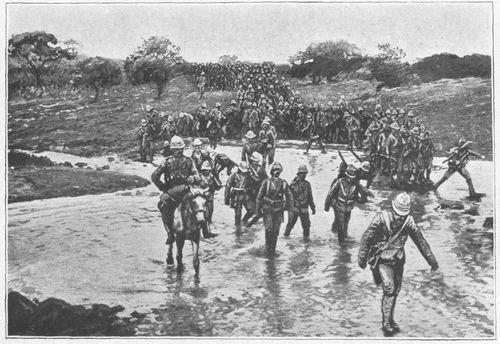
General Yule's Column On The Way To Ladysmith.
Breakfast finished, and a glance at the paper—at least, enough to
read the headings—and then out on Broadway to take the down-town car.
Two passed as she stood at the corner, so packed that there was not
standing-room even on the platform for another; then one stopped from
which a few passengers struggled out, and she got in. All
along the centre of the car men and women were standing, holding on to
the straps, swaying backwards and forwards as the car swooped forward,
and jerking forward every time it stopped. No idea in such a car of
the men sitting down, against whose knees hers rubbed, to get up and
relinquish their seats—why should they? She did not expect it. Was
she not by her very going down town taking the place of a possible man
there? was she not showing that she could do a man's work?
Equality—he might think himself called on to give up his seat to one
of the weaker sex. But there is no sex in the City. Swaying,
squeezing, jostling, twenty minutes of uncomfortable cattle-truck-like
journey brought her to the big office where she worked.
Men do not doff their hats in the down-town elevators which brought her
up to the big office where she was employed, a great room near the top
of one of the high down-town buildings; the windows looked out on the
river, now a white mass of down-flowing ice, through which
the calling steamers worked their way laboriously towards the harbour,
to the Statue of Liberty standing beside what now looked a white
gravel path of entry to the city.
There were about fifty people at work in the room, three-fourths
women, seated at desks and tables, and some occupied the dignified
position of little glass-partitioned rooms. She had one of these to
herself, in which there was also a table for a stenographer. It was a
publishing-house; books, illustrations, manuscripts, were in evidence
everywhere. Near the door was a sort of railed-in pen where men with
bundles of manuscript under their arms were usually to be seen seated,
waiting. Some of these were even shown into her office, and left minus
their bundles, or more often with them. There was a hum of chattering
typewriting machines constantly in the air, like the chirruping of
insects heard from tropical trees. Constantly her telephone rang and
she had to make excursions to the manager's office, and head
printers and printers'-ink-marked men came to her with proof-sheets,
and so on, till 12.30, when she went out to lunch at the women's cafe
and had lunch not unlike her breakfast.
The room was full of girls similarly employed, ten to thirty cents
being the average of their expenditure; all real workers, none of them
the fancy stenographers that their employers frequently take out to
little lunches at the smarter restaurants at safe distance from their
wives up town. They were not a very attractive crowd—thin,
flat-chested, and often anæmic, occasionally with pretty faces, hair,
or eyes; but work, daily work, had left its impress on them all. Some
(their luncheon bills did not exceed ten cents) looked, with their
thin fingers and arms, like human attachments to typewriting machines.
There was a something not in the least mannish, but still not
appealingly womanly, in these self-reliant, quiet business beings. Was
it a sort of neuter gender, a sexless being that was there in course
of development? Somehow, they did not strike one as beings
who would bear and suckle and nurse children. Was this severe struggle
and necessity of existence to eliminate the supreme joy of motherhood
from their lives?
Back to the office, where they joined their fellow men-workers; they
were just fellow-workers, no quarter given or looked for in the
failure to do their work. Some of them earned fine salaries, yet there
seemed a limit-point—thus far and no farther—men were always in the
highest positions. Put it down to tenacity of possession, jealousy,
prejudice—anything but want of perseverance, circumspection,
industry: the obviousness of the fact remains.
Until half-past five her work goes on just the same as before lunch,
and then up town on the elevator. Dry snow is spotting the swirling
wind that eddies round the corners; the sidewalks are thick with
hurrying people; the elevator is packed to the platforms with men and
women tightly crushed together, worse even than coming down. She
dines at a little Italian restaurant, where the proprietor,
his wife, and children personally attend on their customers; it is
known only to a few who mostly know each other—constant
habitués—magazine writers and magazine artists, and miscellaneous,
but interesting, nondescripts; and her dinner, with Italian wine
included, costs forty cents. It is the pleasantest part of the day for
her—men and women of that little writing, artistic, thoughtful, and,
in a way, thoughtless set she had known for years; men who could never
boom themselves or others, or keep up a bluff even enough to advertise
themselves; the slow steps of actual merit made their progress seem
like marking time. Ruggles, commonly known to his friends as
Rembrandt, saw her home—old Ruggles, who painted better pictures than
half the foreigners who came to New York, but who would never be a
prophet in his own country. Nice old boy, Ruggles; but the fire was
burning low in him, its only fuel being the ashes of disappointment.
The sky had cleared, and the moon shone out on the glorious
old square, and red lights suggestive of old port and big wood fires
streaked the silent snow from the windows. "Bully, isn't it?" And the
silent pressure of her arm was affirmative of complete understanding.
Her tiny sitting-room was warm; the cheap eastern rugs and dark green
background of the walls and some clever original sketches, all were in
the harmony of taste that loved restfulness. She lit the gas-stove of
imitation logs; Ruggles wheeled a chair in front of it and filled his
pipe; from his match she glowed a cigarette, and with a great sigh of
relief and tiredness lay back on the sofa.
Then they chatted chum-like of many things. She was doing well—doing
a man's work and getting a man's pay, supporting her mother and the
two younger girls in the country. It was a strain; but is not
successful effort Brian L'Estrange's definition of happiness? So they
chatted on until it was time for Ruggles to go.
"Thank you so much for coming, dear old Ruggles; it is so
lonely when I come back here by myself."
"Why don't you get married?"
"Ah! I don't know. Perhaps I'm getting old working, and the men I
would like to marry don't care for me, and those that would I don't
like. I don't think I want really to marry any one, either."
As he shook hands at the door he said, "You ought to get married,
girlie. What a good, and true, and beautiful mother you would make for
a boy-child!"
The shooting of the door-hasp seemed to let go the flood-gates of her
heart. There was the great longing of her heart—to bear a boy-child.
"For joy that a man is born into the world" seemed vaguely ringing in
her ears. Like a deep-down spring surface-seeking, that old desire
welled up, the perfect reward and crown of valiant womanhood—and she
felt how good and tender and true a mother she could be; and as the
desolation of denial flooded her soul she threw herself on
that sofa made of empty cases, held the cushions to her, and
cried—cried as if her heart would break.
Being independent and alone in her own room, she could cry out her
lone cry without any one interfering with unwelcome comforting. Then,
pale-faced and red-eyed, she got up, the sobs still coming in little
gasps. She looked in the glass as she pushed the black hair back from
her blue-veined forehead. With one of those strange revelations of
reality that come to people in life when in solitude they look at
their own reflection in a mirror—she thought—spoke. "It is too
late—too late—for me to be the mother of a boy-child."
Then she went and set her alarm-clock to a quarter to seven in the
morning.
THE HOU-MEN OF THE DINGY CITY
How they call with different voices, these cities of men—from the
Maxim-gun-like rattle of New York, with its chorus of strenuous
steamers calling from the water, on over the gamut of different
capitals to Tokio, where the city voice is the tinkling of stilted
wooden shoes; not "Twinkle, twinkle, little star," but "Tinkle,
tinkle, little feet," go the small wooden shoes on the wide firmament
of pavement.
Most strident are the American cities; the most sweet-sounding are
those of Japan, except in those few streets raided by tram-cars.
What is the voice of London? Is it not the plod, plod, dumping plod of
the horses' hoofs and the jangling rattle of harness and
bells, which last we hardly hear, so close is the sound to our ears,
like things we cannot see because they are so close to our eyes? As it
is a murmurous and noisy city in comparison with those of Japan, so it
is peaceful and quiet in comparison with Chicago or New York. A friend
of mine from that City of Unrest says that the sound of the London
streets has a soothing, lulling effect on him, and makes him sleepy,
like the sound of falling water.
As I went up to Euston to-day to meet an Oriental visitor, I fell to
speculating how the city might look to him. A very cultured,
intellectual fellow he is, who looks into the backs of the eyes of
things. A Chinaman born, he had been through college in America, and
knew American cities; he had also been studying in Paris, but this was
his first visit to London. A wet, drizzling day was not the most
propitious for his first impressions. Slopping along in a cab through
the muddy streets, as I went under the portico of Euston
Station I was forcefully reminded of one of the big gates of Pekin.
There is a suggestion of the same massiveness; but the massiveness is
only make-face, like the painted cannon on a Chinese city gate. It was
an imposing portico to a shamble of sheds.
The railway terminus is the real gate of the modern city.
Yet what absurdly incongruous things these London city gates are—a
salad jumble of architecture and machinery with a mayonnaise of
train-oil and soot!
As I waited for my friend long trains came rumbling in under a canopy
of smoke that hung about the grim iron rafters of this labyrinth.
Fifteen minutes ago these trains had been spinning along through the
green fields and across the shady lanes of what looked like "Merrie
England," although now shaved down and trimmed to intense
respectability of cultivation. The heavens darkened and the air
thickened as they came close to their journey's end, until they slow
down as if gropingly finding their way into the cavernous
gateway of the great dingy city.
What a strange conglomeration of people was waiting on each platform!
There was a train leaving to catch the steamer for New York, there was
a line of people waiting to take tickets for a close-by station, there
was a line of soldiers waiting to be entrained; an American girl was
standing on an automatic machine, and getting the railway porter to
translate from stones into pounds how much she weighed after her visit
to Europe. A couple of Oriental servants seemed to have lost
themselves in the labyrinthine station, and were wandering round with
Oriental indifference. Porters, with hands and faces and uniforms
toned down to the universal greyness of things, trundled their
hand-lorries to the monotonous calling of "B' your leave, b' your
leave"; and variegated specimens of humanity were looking around after
their luggage as one might imagine disembodied souls looking for
their bodies in the Valley of Jehoshaphat on the Last Day.
There were not a few touches of cosmopolitanism suggestive of that
gathering.
My Oriental alighted from the train. As his Japanese servant was quite
capable of looking after his luggage and bringing it to his hotel, his
master was left free to come right on with me and exercise his
industrious curiosity—a curiosity that seemed never to be surprised
at anything he saw, but took everything as a matter of course. He was
a man of the world in his own estimation. Nevertheless, what an
important part of it he had not yet seen! Was it not a great epoch in
his life, this arrival of his in London?
"This is our North Gate."
"Ah, yes, Hou-Men," he said. "A very dark day, is it not?"
We drove away in a cab under that sepulchral prison-like portico; we
had the glass down, it was raining so hard, and even he, whose
Westernisation was principally confined to New York, noticed
the absurdly asphyxiating arrangement of the London cab, which
hermetically seals its frame-bound occupants. The New Yorkers got
their idea of the cab from us, but they have improved upon the window
by having it slanting outwards, so that, while protecting people from
the rain, it admits air. For Londoners there is no alternative between
spatteration and suffocation. In the New York cabs they can have
shelter and fresh air.
It was not an inspiriting entrance through these first streets outside
Euston into London. The pavement of Melton Street was little better
than that of Pekin, and from each side those dreary-looking small
hotels blinked out of their closed windows on the muddy street as if
wondering when a God-forsaken guest would come and occupy them. And
then on through grimy Gower Street, looking like the empty bottom of a
drained canal.
It's not very inspiriting, this entrance into London from this North
Gate of ours.
The people we passed there were not an interesting lot; they
seemed all to belong to the two-storeyed houses. They were
two-storeyed people, apparently keeping themselves moderately busy
making a moderate amount of money, but hampered in the money-making by
the mud and rain. We passed a little square carpeted with fresh grass,
but the trees on the other side were vague in mist, and the square and
its vegetation gave the suggestion of a tank with seaweeds in it. It
was a day for studying men and women by their umbrellas and boots.
Boots tell confessions for the most Low Church Protestants, and the
umbrellas above them generally corroborate the sins of the boots.
My Oriental friend was gazing out gravely.
It was on a warm evening in a tea-garden that he had talked about his
coming visit to London. I recollect his enthusing over the phrase
"Beneath the rule of men supremely great
The pen is mightier than the sword."
A great motto for a great country, he then said it was. He
professed an anxiety to see or meet some of the great English writers,
our literati, as he called them. He liked the honesty of Englishmen
in business, and wanted to see them at work. He had helped to show me
something of the life of the East—that part of the life most
difficult to see, the life of the home—and in return I promised to
show him something of the life of the West, how and where people work
and play, and pray—when they do so.
"Show me the house of one of your literati if we pass one," he said.
"Is that one, there?" pointing to a gorgeous public-house, as we
passed a street corner.
I saw the probable toppling of an ideal. We passed a couple of
quick-driving vans with a green placard of an evening paper, and I
explained to him what a reading public we were, and how many editions
of the papers were quickly distributed during the afternoon, how the
appetite for them had grown, like the craving for cheap cigarettes, as
a relief from being obliged to inhale pure literary air.
The newspaper habit and the cigarette habit are about on a par after
all.
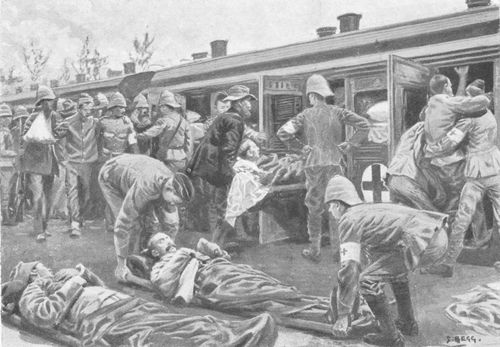
Hospital Train Leaving Ladysmith For Pietermaritzburg.
We passed a church with closed doors, and he seemed surprised. I
explained to him that the churches were open on Sunday, on which day
the more numerous temples of Bacchus were closed for a while.
We reached the Strand, where he was greatly interested in a line of
'buses. "Have you no street cars like in New York?" I submitted that
these were kept on chiefly in order to have a supply of artillery
horses in times of war.
"And have you no high buildings either?"
The explanation of ancient lights and the overhead space wasted in
London was too much to go into. His attention was diverted by a
newspaper placard.
"Ah," said he, "another earthquake, is it not?"
"Collapse of Australia" stared from that vermilion placard. It began
to dawn on me that I had undertaken rather a large order in showing
this Oriental London life.
"And you have not shown me any of your literati yet, or any
of their houses."
We were stopped in a block of omnibuses and cabs. A line of
sandwich-men were straggling along between vehicles and the curb. One
of them stopped just by our cab; the rain was trickling down his nose;
he looked as dismal as the weather. I could not resist the temptation
of explaining that these were some of our literati undergoing
punishment for some of the books or plays they had written. In China
the crime is set forth on a board hung on the neck of the criminal,
called the cangue. It was only a very mild surprise he showed when I
gave him the names of the line of sandwich-men. "How like the head of
your Shakespeare!" he said of one.
We were received at the hotel door by a brass-bound German in the
undress uniform of a British admiral, who pays the hotel £500 for
receiving tips. The rooms and corridors of the big building did not
look hospitably cheering. There were no fires in the grates, because,
being June, the weather ought to have been warm; and the
electric lights were not turned on, because, being daytime, there
ought to have been light. He liked the smoking-room. "It is more like
one of our big tea-houses," he said. "Men do business here," pointing
to a man with a sheaf of papers talking earnestly to another beside
him.
"Yes, that is a company promoter."
"What is a company promoter?"
The nearest definition that occurred was, "A man who sells something
he hasn't got to another who does not want to buy it."
"I think London is a very interesting city," he said.
TIRED
It was the fag end of the week in the Dingy City. A heavy weight of
dusty grey cloud lay oppressively inert, vaguely resting on the house
and tree tops, and underneath the cloud the air seemed stagnantly
confined; in its lowest strata people had been breathing it all
day—all the week, in fact—in and out of their lungs, so that it was
no wonder it felt tired and second-hand and used up.
The air-thirst of their lungs had impelled those who were energetic to
go away to where fresh air was to be breathed; but the very tired, and
those who lacked the energy for initial impetus, remained. The shops
had been closed, and the sunlight beat upon the shuttered
eyelids of their windows on the Phryne side of Piccadilly. By that
hour on Saturday afternoon Regent Street and Piccadilly were wearing
almost a Sunday appearance; Ranelagh and Hurlingham and the new club
at Roehampton were crowded with smart people, and for hours past
trains from Paddington and Waterloo had been carrying thousands of
Panama-hatted, white-trousered men and summer-clad women riverwards.
Though the shops were closed, some belated workers, in ones or twos or
threes, continued to dribble out from their doors.
Going westward, along Piccadilly, a slight, dark-haired young girl
stepped out from one. She was dressed in a thin white blouse that
showed the outline of her arms and shoulders; she did not join the
crowd of others who were scaling the 'buses on the opposite side of
the street, but turned to walk along the pavement parkwards. One fell
to speculating as to why she walked. There was no spring or elasticity
in her step as if she were doing so for the enjoyment of the
exercise. Her feet, in boots with heels slightly rounded on the
outside, seemed to drag on that hot pavement. Possibly the 'bus fare
was an item of consideration, even though she looked as if she had
spent all the morning on her feet in the shop. With thick, dark hair
and good eyes, it would have taken very little aid in the way of dress
to make her appear quite good-looking. As it was, men turned to look
at her as she passed, and one even came across the street, followed,
and leered at her as he came abreast; she held on the even tenor of
her way, taking no notice of them. On, past the clubs, through the
street vocal with the clanking stamp of the horses' hoofs—horses with
shining flanks, who cocked their ears, and tossed their foam-dripping
mouths as they passed the water-trough.
Wooden stands here and there still disfigured some of the house
fronts, and here and there a red pole, looking like a sugar-stick that
a child had been sucking, stood as a memento of one of the
most hideous schemes of tawdry decoration that a civilised city has
ever shown.
At Hyde Park corner she turned in towards the trees, following the
stream-crowd direction of other pedestrians. She stopped near the
railings, watching the procession of carriages going by. A girl, so
like herself that they might almost have been sisters, passed in a
high C-springed carriage. Looking from one to the other, the great
difference made by little things was apparent. An application of
powder-puff to the moist face of the girl at the railings would have
worked improvement; her cotton gloves hung down flaccidly from the
bare hand which held up her skirt; perhaps some such thought as that
of the unfair distribution of C-spring carriages in this world crossed
her mind, as she turned away and languidly continued her journey
westward under the trees.
The seats were full of a heterogeneous collection of people, all more
or less under the drowsy influence of that stagnant air.
Here and there men were to be seen asleep in the chairs. Heads in tall
hats nodded, debarred the luxury enjoyed by those tramps who lay at
full length under the trees on the grass behind. Between those
luxuriating on the grass, men lying in their shirt-sleeves, with heads
a-resting in the laps of tired-faced women, whose children played or
cried noisily around, and those who passed in the procession of
carriages, was the intervening line of people from which all sorts of
specimens could be taken of the great mediocracy of England—those who
could no more afford a carriage than they could afford to lie on the
grass. The men's heads were branded with tall hats, remnants and
summer sales were suggested in the costumes of many of the women; an
occasional glimpse of shoes or hosiery explained why the graceful
holding up of the skirts should be unstudied or unknown on this side
of the Channel. And their gloves were of the same character as the
hose.
Curious specimens were to be found amongst that crowd. A man
passed whom I recollect seeing there as long as I can recollect going
to the park. Go round the world and back, and here one was certain to
find him. I know his income—it is just three hundred a year; except
that his whiskers had got a little whiter, he looked just the same as
usual. The frock-coat he wore I have a sort of suspicion was the same
as I saw on him two years ago. I could swear to the umbrella—at least
the handle, because possibly it had been recovered. The frock-coat
would obviously not see another season—not that it was showing any
tinge of green about the shoulders, far from it. But perhaps it was a
feeling of doubtfulness about the coat, which prompted a startling
departure in his costume. He had gone in for a pair of those yellow,
chamois-coloured gloves which have made their appearance this season.
He sauntered along leisurely, watching the people and the carriages
with apparently the same degree of interest as he had done
for the past ten years. I have heard that long ago he had a good tenor
voice, and he used to speak authoritatively of great singers, when
they really were great singers, not such as now.... I've never seen
him talking to anybody in the park, and I've never seen him smoke; yet
his lips are seldom at rest. They have now got a motion something
between that of a nervous American with a cigar and a cow chewing the
cud. This is the result of the movableness of his artificial teeth.
Perhaps an extra visit to his dentist was an item of expenditure not
to be lightly incurred.
What appeared to be corresponding feminine types were to be seen in
profusion. Women with incomes of one hundred, two hundred, three
hundred a year, women who had passed the age either of matrimony or
naughtiness. What thousands of friendless and lonely people there must
be in this great Dingy City! The class that lies on the grass is more
sociable; they are free from a thousand tyrannies that
oppress the mediocracy.
The face of a woman dressed in black, seated between two children,
seemed familiar; not until she bowed did I recognise her as the wife
of an old friend who had been killed in Ladysmith. She used to be the
prettiest officer's wife of his smart regiment; and from her account
it would have been better if she had not been so pretty, or the
regiment so smart. She was now left with barely his pension for
herself and the two children to live on.... Yet very bravely,
apparently, she had faced the change!
"Oh, I have tried various things for the last couple of years," she
said, "but I am afraid there is nothing I can do. I even tried the
stage for a time." She used to have a good voice. "But the managers
were horrid, and the pay was very small. Then I tried to give music
lessons; but what I got was hardly worth the distances I had to go; so
now I have to settle down to working out daily problems in
domestic economy."
"And all your friends?"
"Oh, they all were very nice and kind; but one cannot go about without
being properly dressed, and when one keeps refusing invitations, one
gradually becomes forgotten in time. I felt rather lonely just now
when I saw the people driving down to Hurlingham. Come along, chicks,
we must be going now. You see," she said, "it is a long 'bus ride to
our little flat."
At the end of the long free seat, beyond where they had been sitting,
was a strange, haggard-looking woman; a pair of cheap cotton gloves
showed her thin white wrists, and her black dress looked dusty and
draggled. She had a strange haunted look on her face, as if she had
left some tragedy behind her at home. Every time a carriage with
scarlet-liveried coachmen passed, she got up and stood on the seat.
Perhaps she had journeyed there to see the Queen. She looked cross and
disappointed each time she stepped down again. On the other
side a couple of girls were discussing those that passed in the
carriages, and speculating as to who they might be. It was interesting
to follow their surmises.
"I think that's Lady X.," one of them said, as a lady, driving a pair
of high-steppers, passed.
But it wasn't. The little fellow sitting beside her glowed with the
importance of proprietorship; but, smart little chap that he was in
Throgmorton Street, he had no idea how many understudies there were to
his part, and did not realise that there are syndicates outside those
of the City.
"What an awfully common-looking woman!" the other said, as an old lady
passed in her carriage behind a sleepy pair of horses, sleepily
driven, the fat pug dog at her feet suffering eclipse by the
jelly-shaking arc of her redundant figure. She happened not to be
common by any means, but one of the brightest and most good-natured
members of one of the oldest and most distinguished families
in England.
"My goodness, isn't that Lord Roberts?" said the other, as a pair of
chestnuts passed, with a rigid and angular lady in the carriage
sitting beside a red-faced, white-moustached little man with his nose
in the air.
It was not Lord Roberts. He really looked much too important for
"Bobs," although he was a military man in a sense, being colonel of a
Volunteer regiment.
And how nasally obviously numerous in the procession was the
proportion of Jews, and the Jewesses whose plumpness seemed the
retribution inflicted by prosperity.
As the smart carriages passed and the high-stepping horses, which were
indeed the exception, for the majority ambled along half somnolent
from careless coachmanship, one sought in vain for some idea of what
they were doing it all for. They did not seem to enjoy it. If they did
not enjoy it, why did they do it? The expression that was common and
universal to almost all was their seriousness. The Volunteer
colonel took himself seriously, as did the fair frailty behind the
high-steppers, no less than the best ladies of the land who seemed to
be doing it as a traditional duty; but each and every one looked so
serious.
How was it that no one seemed to be laughing and enjoying himself out
of all the crowd? The Avenue du Bois de Boulogne seemed to belong to
another planet. The listless languor of these girls did not at least
obviously claim Transatlantic cousinship; the gaiety of a Japanese
street seemed so remote as to belong to a planet of another system;
and the seriousness seemed reflected in the faces of the great
mediocracy sauntering along inside the railings or solemnly seated in
the chairs with their faces turned carriagewards.
Here it did not seem the Dingy City; there was colour enough—bright
splashes of colour, both colour in movement and colour from the
rhododendron bushes, backgrounded with the fresh grass, that an artist
was making a picture of over the way; it was not the Dingy
City here. At least this was an oasis in it. But here, in this oasis,
playground or pleasure-ground, the People of the Serious City was what
was writ on their faces.
Five hours later the park was almost deserted, and the gleam of white
shirt-front or tulle-foam was caught as a closed carriage passed.
The old bachelor was asleep in his chair at an open window looking
across the narrow street at the familiar sooty face of the house
opposite.
"Good-night, Tom; I do hope it will be fine for to-morrow," the
black-haired girl was saying at her door, holding in her hand the new
hat she had been trimming.
The Volunteer colonel was discussing Buller and port across the
glittering dinner-field.
The little fair-haired boy had climbed softly out of his cot, and,
going over to his mother's bed, whispered coaxingly, "Will 'oo
let me sleep with 'oo, mummy?" and when he had nestled his
head on her arm, "Now tell me the story how daddy died," and was
asleep before the familiar story was finished.
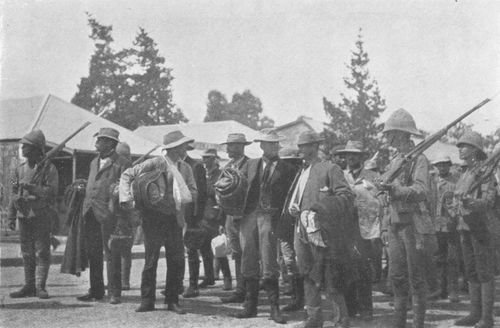
Boer Prisoners.
THE CITY OF DUMB DISTANCES
I am sure there must be many to whom the idea occurs at such times of
the year as this, at the end of the season, when people are scattering
out of London, that friends are leaving whom we would like to have had
the time to have seen before they went. How often, looking over the
pages of one's address book, one says, "I wonder how it is I have not
seen So-and-so for an age," and one feels that people we used to enjoy
meeting, if they do not happen to move in the same orbit of
metropolitan existence, are vanishing from our ken. They are being
lost in the Limbo of long distances. An hour of Underground in very
hot weather may give the remoteness of Styx-ferryage.
It would be nice even to be able to speak to one's friends
who are not conveniently visitable. In other cities this is possible,
but not here. The telephone service of an American town or a Norwegian
village is a thing of which London has never got even sufficient
sample-taste to realise what she is deprived of, or what she ought
very reasonably to demand. There is no reason why London should remain
telephonically deaf and dumb. There is nothing which strikes the
visitor more forcibly, however, than the long-suffering patience of
the Londoner. The exasperatingly slow, inefficient apology for a
telephone service that would not be tolerated anywhere else is good
enough for London. It is no excuse to plead in apology the great size
of the City, when there is the example of New York before one, where
there are more telephones, where they are cheaper, and where the
average time to get into communication with another subscriber appears
to be a third or a fourth of the time taken in London. It is only when
one has had actual experience of a thoroughly telephoned
town that one appreciates the convenience of it. Look what it means
for saving time in shopping, doing business, making appointments, and
speaking to one's friends. "I got a telephone put right into my room
the day I arrived," said an American friend, "but the people I want to
speak to most often don't seem to use them, and it is so darned slow
getting on to those that do that now I am keeping a cab by the day; it
is quicker in the end, and makes me swear less."
It will only be a matter of time, and that not so very far off, when
wireless telegraphy will replace the telephone. The principle of
sending messages in a multiplicity of keys, so that a message sent
will only be received on the instrument keyed for it, has been
established, and only requires practical working out. Until that time
London will probably have to remain as deaf and dumb as it is.
As regards getting from one part to another, it is not a cheerful
thing to contemplate that what should be the most agreeable
way of traversing London—I mean the pathway of the river—should just
now be closed, and while Mr. Yerkes looks out on it from his offices
in the Hotel Cecil, Londoners have to look to him to see if he or
Pierpont Morgan will not open it to them again. What a pleasant
alternative from the asphyxiating Underground or the tortoise-moving
omnibus would not a fast, comfortably fitted line of river steamers
be! It seems inconceivable that, with such a waterway and such
primitive and inadequate alternative means of travel, the people
should stand its being closed. What a great, stimulating, suggestive
pathway it is through the Dingy City! Coming from a dance early the
other morning I walked along the Embankment, to see a carpet of blue
and silver being laid along the river as if by the angels of the dawn;
and at evening in ever-varying schemes of sometimes gorgeous colour a
richer carpet is laid sunsetwards, while the smoke and dust exhalation
of the City is glorified to an incense offering by the
stained rose window to the west. At such times the Dingy City looks
great, robed in vague organ-tones of colour. But you must no longer
walk on that carpet, even though the angels have laid it for you; you
must no longer see your city from that pathway; you must burrow
homewards from your work in a sewer-pipe of stink, and deeper
rabbit-warrens of burrowing are being prepared for you, and you have
no Declaration of Independence that secures to you the undeniable
right to breathe fresh air. Long-suffering, patient Londoner! To whom
does the City belong, and the river? If you reward with honours the
men who make beer or whisky for you, or supply you with cheap tea, or
signalise themselves by successfully struggling against disease, there
ought to be the inducement of honours and reward waiting for the man
or men that would help the millions in their daily struggle with this
plague of long distances. Is there no knight to champion the cause of
the toilers of London and in earnest tackle this dragon
problem of distances? That is left to enterprising Americans who come
over from pure philanthropy (?) to help you. Three years of his life
are spent by the average-lived Londoner in the Underground, who has to
take a daily half-hour's journey in it to get to his business. A man
with an office in the neighbourhood of the Stock Exchange and a
dwelling-house in South Kensington will spend about four or five years
of his life going to and fro. To an extent it is a necessary evil. We
cannot transport ourselves by telegraph, but there are things that the
people of the largest city in the world might reasonably expect. They
might expect to have as good facilities for getting about as the
people of the most progressive cities in the world; they might expect
to have the power to speak when they will with the same quickness,
cheapness, and facility as people of other cities. But there is a dull
feeling of resigned apathy about them. They will not insist on making
any one "get a move on" them to get these things done; will
no more think of hustling themselves than a cab-horse in a growler
hired by the hour.
If London may be considered the head—the brain of the Empire—the
blood-circulation of that brain is surely of vital importance. When
keen competitors seize every time-saving, labour-saving weapon as it
is offered to help them in the conquest of trade, can we afford to do
without them? The business methods of twenty years ago will not do for
to-day, still less will they do for twenty years to come. The methods
which our competitors are practising are what will tell, and they
cannot be imitated and acquired in a hurry when their importance will
become suddenly alarmingly apparent. I think the position is far more
serious than the stay-at-home Englishman realises. Perhaps from these
passing years the future historian will get material for the opening
chapters of his work on "British Trade: its Decline and Fall."
THE LAND OF THE EVENING CALM
It is difficult to think this morning that it was only last evening I
left London. Lying on one's back on a soft carpet of pine spirules on
the slope of the hill, the deep green of the water in the harbour
shows through the pine branches. There is a plumage of bracken around
wonderful green feathers, that are rising on their slender stems from
the thick brown carpet of nature's plush, which hushes one's footsteps
through the wood and makes them noiseless, except when one treads on a
crisp tory top. There is a delightful hush under this cool roof
pillared by the brown tree-trunks, but it is not silence. There is a
soft hum that comes ceaselessly to one's ear, sometimes
anear, sometimes afar, from one knows not where, from bees, perhaps,
busy amongst the hurts or honeysuckle just below. Up above a
wood-pigeon keeps cooing that ceaseless question, or is it a question,
or the plaint call of his pigeon heart for love? or has he lost his
love, and croons a mourning for her? Distinct from and louder than the
murmur of the bees is a rustling of the water from below where the
outgoing tide from the river meets the water of the harbour; and
mingled with that, one can just faintly catch the hushed sound of an
occasional wave on the rocks. It is a holiday with the breakers, and
the sea moves its fringe as gently as if fanning itself to sleep. The
river winds around below, and down to its edge the hills are
tree-covered—not there altogether with pines, but with rounded
luxurious clumps of dark trees, recalling Doré's idea of a
forest—they are exactly Doré's trees. It does not look from here as
if the river went up farther, but around that bend is the deep green
water called Drake's Pool. It was there that Admiral Drake,
outnumbered and chased along the Irish coast by the Spanish fleet, hid
from them. The Spaniards came into the harbour and searched around,
but never thought there was an opening through the trees. And there
Drake waited with his high-pooped ships until they went away. Close to
the trees that grow around the steep margin of the pool and always
darken the green water, even in daytime, fishermen who go there at
night to fish for conger tell that when the moon has been clouded at
midnight they have seen the shapes of queer-looking ships, and on
their high sterns the forms of men in outlandish costumes, sitting
around drinking.
Right on the summit of this hill which commands the harbour is the
Giant's Grave; and à propos of commanding the harbour, Napoleon I.
knew of it, and had a plan for the invasion of Ireland, in which was
included the idea of occupying this hill, from which he could command
from the rear the forts at the harbour's mouth. He would
have planted his guns on the Giant's Grave. We know little of the
history of that giant, except that he carried off the wife of another
giant who lived on the Great Island opposite, and held her here in his
fastness amid the pine trees against all efforts to wrest her from
him. A huge rock that he hurled back in one of these fights is still
to be seen on the shore of Spike Island.
A twittering flutter of white and grey below me a few yards away. It
is a rabbit—and now another. Their ears are cocked, but they do not
appear to notice me in the least. They hop about quite noiselessly on
the brown carpet. The crowing of a cock in the distance seems almost
musical, and there is some insect in the tree above me that appears to
be trying to give an imitation of a telegraph instrument. I wonder
what these rabbits are saying to each other. They seem very alert and
interested. Now a third appears on the scene. Two of them are
beginning to play, at least I thought so at first—and I
feel in this peaceful wood I should have left it at that, but having
to recollect the heading of these chapters I have to record the fact
that they are fighting. I never saw rabbits fight before, but they are
fighting like mad. I now see, in fact, the origin of the expression
making "the fur fly." The third is just skipping around watching
intently with big round eyes and its ears erect—perhaps the third is
timekeeper, or perhaps it is the story of the giants over again. The
new-comer was getting the best of it. I am sorry now that I could not
resist the temptation of taking a shot at them with my fountain pen.
They fled instantly. Perhaps the little rabbit lady is glad—she may
be licking the wounds of her Lancelot in their burrow a few yards away
while he is telling her that he would have beaten the other fellow all
right in the end if that darned fool hadn't thrown his fountain pen,
while she agrees, as she works her little rabbit tongue soothingly,
although privately she has her "doots."
How interesting it would be to be able to study the lives of
all these little people in this wood! There are terrible weasels here
who wage a sanguinary warfare against the rabbits—a guerilla war that
no war correspondent I know of has yet got his pass for. The seagulls
are beginning to talk now in a New York pitch of voice, and one can
get an occasional gleam of their wings through the blue-green pine
branches. I think it is their dinner-time when the tide goes out and
spreads a table-strip of slob for them on the shore.
How thankful we ought to be to have such dear stupid neighbours as the
English, who don't come in hordes of tourists to desecrate this
delightful land! Those who love it with intimacy of knowledge—this
wild coast with its rock fingers stretching into the Atlantic and
harbours around which the trees nestle for shelter from the winter
storms—the ruined castles with empty "magic casements, opening on the
foam of perilous seas, in fairy lands forlorn"—own it still
for their pleasure, moss-grown with history as vivid as the lichens on
its rocks or ruins.
Perhaps from a sense of justice, our neighbours think the invasion of
Cromwell's army was enough, and that we ought to be spared from
something worse, so that the hordes rush off perspiring over the
Continent and elsewhere, and just a few nice people come and come
again to the South of Ireland, and say they like that cordial greeting
that always is waiting for the Englishman personally, who only in the
abstract is disliked. Then the Irish railways and hotel-keepers act in
a very nice and gentlemanly fashion; the former do not force on the
notice of the tourist hordes that a train leaves Euston or Paddington
every evening which would land them here at 10.30 in the morning for a
few shillings. The latter are quite content with the knowledge they
have themselves that they possess now as comfortable and
well-fitted-up hotels as any in the world.
A little old Irish lady was reduced to selling apples in the
street. "Fresh apples, fresh apples!" she would call out; then, to
herself, "I hope no one will hear me."
I do not know, indeed, whether we have to thank most our kind
neighbours or the railway and hotel people for the blessing we enjoy
in this Land of the Evening Calm that still keeps
"A bower quiet for us, and a sleep
Full of sweet dreams, and health, and quiet breathing."
One fills one's lungs with the delicious air, aromatic with pine
perfume, to send it out in a sigh of infinite content.
From across the water comes a sound of music; it is some one playing a
cornet. The air the unseen musician is playing sounds familiar. He is
only practising—learning—— Ye gods! Is there no place where one can
get away from that air? But yet, does not it speak volumes for the
remoteness of this harbourage of repose to realise that the unseen
musician is only now learning "The Honeysuckle and the Bee"?
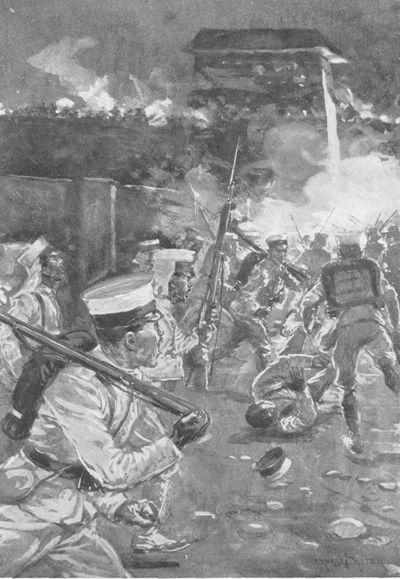
Japs Entering Pekin.
WITH SOME TOILERS OF THE SEA
"Stop makin' a noise wid your face, man, and cook the spuds; 'tis time
for dinner." Thus Tim to Mike, who had been expounding a theory of his
on the wayward habits of mackerel. Tim occasionally comes out with
quaint phrases worthy a wider audience. "Mr. Speaker, the right hon.
member who has just been making a noise with his face on this
amendment"—how would that sound?
There are three men in the boat, not including the writer—Tim, Mike,
and Dennis—engaged in lobster-fishing. They have lived in her now six
weeks from the time they left Baltimore; "doin' purty well, thank
God," they admit. The fishing and the weather and the price all "purty
fair." They get ten shillings a dozen for the lobsters,
small or large, from the cutters that sail along the coast to collect
them and take them to England, and they consider a couple of dozen
lobsters a very good day's fishing. They don't get as good a price in
the middle of the summer, however. They are going to stop the
lobstering just now for the autumn mackerel-fishing, which they hope
will be as good as the mackerel-fishing of last spring, which was the
best for the past four years. The open boat, which they own in
partnership, is a strongly built one about twenty-two feet long, with
a lug and foresail of brown canvas and great flat stones for ballast.
The whole outfit, including the lobster-pots, cost them twenty-five
pounds. The pots have been set and baited with gurnet; during the two
hours' interval we are anchored. A curious thing about the craft is
the galley. On a spar which stretches from the bow to about four feet
up the mast is stretched a piece of brown canvas just forward of the
mast, on a flat stone some lumps of turf are burning, and
under this canvas is spread the straw on which my friends sleep. Mike
is now washing a prodigious quantity of potatoes in a large iron pot,
"a grate crop of praties this year, but the salt water plays the divil
with the keeping av them, like that," and he holds up one with a red
mark on it in his gigantic paw. I kept wondering if they were really
going to eat all these potatoes at one meal. They did, however, washed
down with milk from a big tin jug which they passed around. They make
their own bread or griddle-cake, but that was to be taken with their
tea for breakfast or supper. Tim is a teetotaler, and his two partners
have a limit of three pints (of porter) when they are ashore. They
always go ashore on Sundays, when two of them go to Mass, while the
other minds the boat and the lobsters. Three great, simple, almost
child-like giants they are, yet not without a certain natural
courtesy—a core of genuine politeness within a rough rind.
It was great to see how they made that heavy boat move with
their long oars, coming out of the harbour this morning; and yet they
hardly ever eat any meat. Potatoes and milk are their chief diet; fish
sometimes—"an' thin we has to sample the lobsters sometimes; it
wouldn't do not to sample what we are daling in." They cooked one in
honour of their visitor, who never tasted a better. Then they lit the
pipe, which they smoked in turn, and soon it was time to pick up the
pots. Three lobsters and a crawfish were the haul. What magnificent
colour in the strong yet delicate armour of their shells! Deep blue
shaded into brown, mottled in yellow spots, with deep red at the
joints. They were put into the big basket, which already contained
over three dozen. What a terrible time the poor brutes must have
there! Two or three weeks in this boat, probably the same time in the
tank of the cutter, and a week or two more in another ashore before
they are eaten. I asked if they ever gave them any food, but found
they never did. "One av them dies off an' on, and thin the
others ate him, an' they are always atin' the small claws off each
other." Talk of the lobster blushing because it saw the salad
dressing; but ought it not to make a member of the S.P.C.A. blush to
eat lobster mayonnaise? We set the brown sails to lay the pots again
further along the coast. It is a glorious day, the wavelets dancing on
the surface of the long Atlantic swell that heaves ponderously; for,
as Tim remarked, "the adjacent parish wesht is Ameriky." A glorious
translucent green under the shadow of the leaning sails, and beyond,
under our lee, the line of breakers on the rocks, tapestried in the
rich brown of autumnal seaweed, and above them, in more broken
billows, fields that make the island called "Emerald."
While waiting after laying the pots again, the wind kept freshening,
and heavier clouds in big battalions kept hurrying up from windward.
The trio seem unanimous that we are in for a bit of a blow. Tim says
'tis going to be a nasty night, and we must go in somewhere,
although night is the best time for their fishing. Only one
jack-lobster out of all the pots this time. It was now blowing hard
and beginning to rain, so, with one reef in, we started again. It was
a ripping breeze; I knew of old how quickly the wind can rise along
that coast. The last time I was in Baltimore—picturesque old place,
with its ruined abbey and the memory of the sacking of it by Moorish
pirates, and the carrying-off of the women from only the eighteenth
century back—was when I sailed round in a half-decked 16-footer,
designed by Watson. She was a great little boat, with a ton of lead on
her keel. As I was nearing the harbour just such a breeze sprang up,
and, being single-handed, I could not take in a reef, so had to carry
on; right outside the harbour my foresail carried away, but I got in
all right under the mainsail, and anchored alongside the Baroness
Burdett-Coutts's yacht that was there at the time. I asked Tim about
the money she had lent to the men there for buying
fishing-boats. "Ah, thin, she's a good woman, God bless her; there's
many rich or well-to-do men in Baltimore to-day through the means of
her, an' ivery penny paid back—divil a penny av a bad debt."
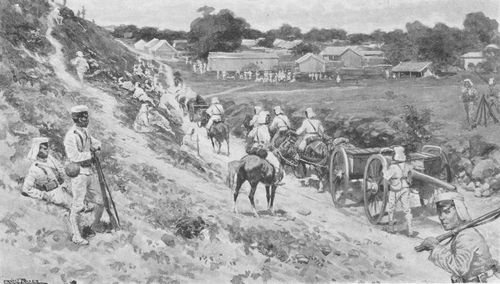
Relief Of Pekin.
The smaller the boat the greater the delight of sailing; you get
closer to things than in big boats. It is part of yourself, half in
the sea and half in the air, and with the sea and breezes you play or
fight. White sails standing patiently upright, waiting, and adown from
over the hills comes along the breath of the wind, breathing across
the mirror; gently, ripplingly, comes the wind to play, and would try
to pass, but you catch it in your white wings—catch it and hold it,
leaning over to its fleeing passage, and press the trembling
tiller-pulse, now throbbing with life, and luff as the boat darts
forward in joy of possession of the wind, but she passes, gently,
gently up again with the tiller till she leaves the sails with the
lingerage of a caress.
But more fun is the fight and tussle in that wonderful
surface fighting-line between sea and wind, which laugh as they fight,
blowing and buffeting, with you between and the little boat-part of
you, now intensely alive and glad like you to be alive, to sing back
to the wind any old song as she passes her fingers through your hair.
One unique sensation of the almost uncanny mingling of the two
elements I can never forget, when once, at daybreak, I went down into
the Cave of the Winds under Niagara Falls; on along the slippery path,
the spray streaming down the oilskins; within a few feet that
shimmering, glistening wall of falling water, the sense of hearing
gone in intoxication, of most musically thunderous noise. One seemed
breathing water, so finely spray-saturated was the air. One seemed to
have passed the portals into a strange, eerie, watery world.
Every moment the wind came up, piping louder and louder, scudding
across the now darkening water. The entrance to Oyster Haven
was only half a mile on. It was too far to go to Kinsale. The Old Head
was invisible in blue-grey mist.
How things find voice in music! I recollect in the climax of the fight
at Elandslaagte, when the uproar of various sounds was simply
terrific, from the shrill treble of the whimpering bullets to the
trumpet-like whoop of the shells as they arched overhead, to alight
with a drum-boom and burst with a cymbal crash; the whole orchestra of
battle was playing—it seemed that everyone must recognise the
air—"The Ride of the Valkyrie;" and now the driving rain and the salt
spindrift, the flapping of the leech of our brown sail, every note of
accompaniment is being given to that great air that runs through
Beethoven's Waldstein Sonata, which the wind is singing louder and
louder. Tim sits up well to windward, the tiller quivering in his
hand, the rain beating on one side of his face, his beard blowing out
from the other. Tim doesn't think what a good model for a Viking he
makes just now. The real actual Viking must have been very
little different in appearance from Tim.
We were not long in making that last half-mile, and dropped anchor
close inshore. At once on doing so the many advantages of the canvas
cabin were apparent. The boat, riding head to wind, made the bow under
the canvas quite snug. Mike blew the bellows on the smouldering sods
of turf which had never quite gone out; it is true the eddying smoke
resulting therefrom was smarting to the eyes, but the resulting hot
tea was compensation. It was useless for me to try to explain that it
would be a real pleasure for me to sleep outside in my
waterproof—that it would make me dream of being outside Santiago in
the trenches, or on the veldt. It was only a matter of which of the
three—who all wanted to—should give up his berth on the straw.
Dennis succeeded eventually. It was a bad night. It was snug and
"comfy" inside on the straw as the boat cradled on the broken
aftermath of swell. The rain played in sheets of notes on
the flapping canvas, and from its edge wraiths of smoke shuddered off
into the darkness; and, dropping off to sleep, I listened to the Storm
moaning the air of the Waldstein to the ear of Beethoven.