HOW WE CROSSED THE GERMAN LINES—THE
CHARGE OF GILOCOURT—THE ESCAPE IN
THE FOREST OF COMPIÈGNE
6th to 10th September, 1914
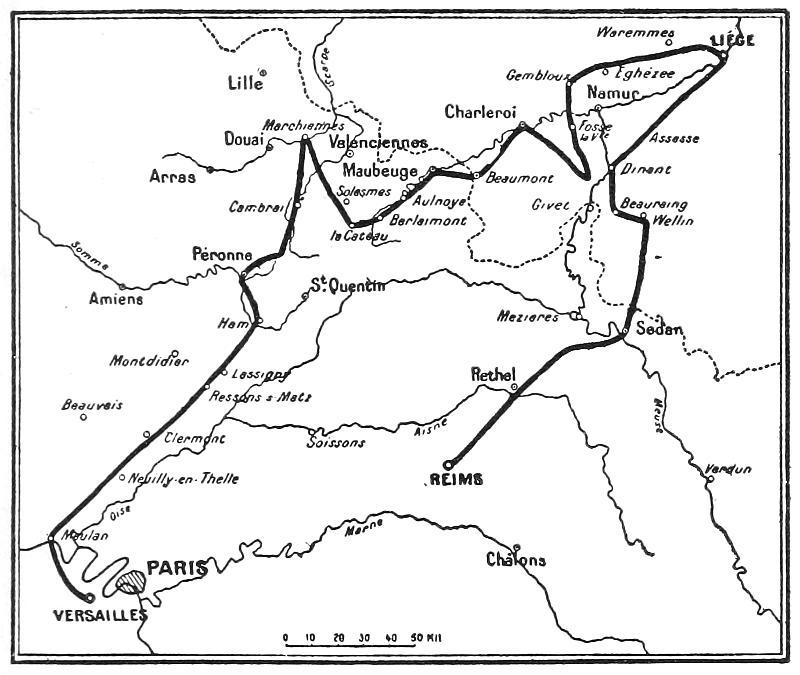
Having left Versailles we arrived at
Saint-Mard on the 6th of September to
find ourselves in the thick of the battle of the
Marne. The struggle extended all around
us, from one horizon to the other, and if it
was incomprehensible to our officers it was still
more so to us private soldiers. In the evening,
from Loges-en-Josas, where we had been
billeted, we heard the guns. Everyone was
sure that Paris would be invested within the
next two days, and then we were suddenly
sent off to be stranded some forty kilomètres
to the north-east of Paris. We were ignorant
of the movements going on, and we were
amazed and quite out of our reckoning,
hardly daring to believe that the enemy, who
the evening before was thought to be at the
gates of Paris, was now in retreat.
For my own part I preserve only a confused
and burning recollection of the days of the
6th and 7th of September, days memorable
amongst all others, since they saw the beginning
of the victorious offensive of the armies
of Maunoury, of Foch, of French and of
Langle de Cary. The heat was suffocating.
The exhausted men, covered with a layer of
black dust adherent from sweat, looked like
devils. The tired horses, no longer off-saddled,
had large open sores on their backs.
The air was burning; thirst was intolerable,
and there was no possibility of procuring a
drop of water. All around us the guns
thundered. The horizon was, as it were,
encircled with a moving line of bursting
shells, and we knew nothing, absolutely
nothing.
In the torrid midday heat we kept advancing,
without knowing where or why. We
passed a disturbed night rolled in our cloaks
in an open field, without rations and already
suffering from hunger. The next day was a
repetition of the last and was passed in the
same hateful state of physical exhaustion
and of moral inquietude. From time to
time, behind some hill, beyond some wood,
quite near, a sudden and violent musketry
fire broke out; the gun fire redoubled in
intensity and we heard the whistle of the
shrapnel passing high over us, and the noise
of the bursting shell. There, we said to
ourselves, is the fighting; there, no, there, and
then there on the left, on the right; it was
everywhere. Repeatedly our column had to
make sudden detours to avoid artillery fire.
Still we knew nothing, and we continued our
march as in a dream, under the scorching
sun, gnawed by hunger, parched with thirst
and so exhausted by fatigue that I could
see my comrades stiffen themselves in the
saddle to prevent themselves from falling.
The sun went down with a splendour that
no one thought of admiring. Little by little,
insensibly, our figures bent forward till they
touched the wallets on our saddles, and we
gave way to a sort of torpor. Then a long
tremor ran along the ranks. Above the
village of Troène we fell into the thick of the
fight. This happened so quickly that I preserve
only a visual image of it. We had
slowly climbed a hill, whose shadow concealed
the setting sun from us. As we came out on
the crest of the hill, we caught a sudden glimpse
of a regiment of chasseurs-à-cheval, silhouetted
in black against the immense red screen of the
sky, charging like a whirlwind, with drawn
sabres.
A “75” gun on our flank fired without
interruption. I can see now a wounded
chasseur who rose from the grass where he
lay almost under the muzzle of the gun, and
who fell back, as if struck by lightning, from
the displacement of air caused by the shell.
A second later nothing was to be seen except
a confused mêlée behind a small wood. The
noise was terrible, and was made up of a
thousand different sounds. An officer of
chasseurs, with a bullet through his chest,
bareheaded, all splashed with blood, came
down the hill leaning on his sword, and
leaving behind him a long trail which reddened
the grass. Then the sun seemed to perish
as the immense uproar died down; all the
noises died away, and we continued our road
in the rapidly falling darkness, having had
a sudden and fugitive vision of one scene
amongst the thousands which compose the
drama of a great battle.
All night we had marched without repose,
without food. In our exhaustion we had
become the spectres of our former selves, and
our hearts were breaking from discouragement.
We did not know that right alongside of us
the most victorious offensive in the history
of the world was commencing. We did not
suspect that, under pressure from General
Maunoury, the German 4th Reserve Corps
was giving way, and that this must assure
the rout and the final defeat of Von Kluck’s
army.
From the 8th we began to play an active
part in the great battle. The 5th Cavalry
Division was ordered to surprise a German
convoy and to seize it. The officers told us of
this mission. At last we were going to do
something; our time of waiting was at an
end, and there was to be no more wandering
about the burnt-up country, devoured by
thirst and discouraged at feeling ourselves
lost and forgotten in the great struggle we
had set our hand to. The convoy would be
four kilomètres long, and we could already
imagine the attack, the taking of the booty.
It was going to be a romantic and amusing
episode, and the dragoons sat up in their
saddles, forgetting their fatigue and their
hunger, and full of joy at the thought of the
promised combat.
In my inner self I could not share the general
enthusiasm; I felt that we had been exactly
marked down by the enemy’s aircraft which
flew over us each moment, insolently bidding
defiance to our rifle and machine-gun fire.
The expedition, however, started off well.
A young dragoon, sent forward as scout,
penetrated into a farm and there found fifteen
Prussian Staff Officers engaged in stuffing
themselves with food. He calmly pointed his
revolver at them and advised them to surrender.
“My regiment will be here directly;
any resistance is useless.” In reality he
had to keep them under the muzzle of his
revolver for a long quarter of an hour, for the
regiment was still far off. A major having
shown signs of moving, the dragoon blew out
his brains at point-blank range, and he succeeded
in keeping them all terrorised until
our arrival. This capture stimulated still
further the general good humour. I can still
see six of the fourteen prisoners file past the
flank of the column, each between two dragoons,
a forage cord tied to the reins of their
horses, and I can see again the cunning and
furious look of a “hauptmann” still bloated
with the feast which we had prevented him
from completing. I remember the gay, frank
laugh of the whole regiment, its light-heartedness
at having laid hands on these fat eaters
of choucroute, who were too astonished even
to be insolent.
A few moments afterwards three German
motor-cars were sighted three hundred mètres
off, going at a prudent pace. At once the
ranks were broken and we galloped furiously
at them, each straining hard to be the first
to get there; but, by quickly reversing their
engines, the three chauffeurs succeeded in
turning and made off at top speed, riddled by
machine-gun fire, but out of range for us.
The last of them, however, was destined to
fall into our hands next morning, having been
damaged by a shot in its petrol tank. We
had to set it on fire so as not to abandon it to
the enemy, who were pressing us on all sides.
Half my regiment was now detached from the
division and charged with the task of capturing,
unaided, the tail of a convoy which
was reputed to have broken down on the road.
At nightfall we entered the forest of Villers-Cotterets,
under the command of Major
Jouillié, and I was assailed by an acute presentiment
of misfortune. I parted from the
other half of the regiment and from the other
regiments of the division with the clear and
irresistible intuition that I would not see them
again for a long time, and shortly afterwards
we melted like shadows under the trees of
the great dark forest.
Then commenced, for me, one of the most
painful episodes of the whole war. The
silence of the forest was lugubrious. A Taube
persisted in flying over us, quite near to the
ground, like a great blackbird. Its shadow
grazed us, one might have said, and nothing
was more harassing and more demoralising
than this enemy that followed us and kept
persistently on our track. At a cross-roads,
as we came out into a large clearing, it let fall
three long coloured smoke balls to signal our
presence to its artillery, which was doubtless
quite near but of whose position we were ignorant.
Then it disappeared with a rapid
flight, and the night fell black as ink around
us.
The voices of the officers seemed grave.
The continual thrusts which the column made,
its returns on its tracks, gave me to understand
that we were groping our way, not knowing
which to take. We descended in double file
a terribly steep narrow path, preceded by the
machine-guns, which had only just room
enough to pass. The soft soil sunk in like a
marsh. Then there was a sudden halt and,
quite near me, I saw the Major’s face, full of
anxiety. Addressing Captain de Tarragon
in a choking voice he said, “The machine-guns
are done for.” The rest of the phrase was
lost, but I heard the words “bogged, engulfed,
impossible to get them out....”
We were ordered to incline, and we climbed
up again to the forest. All the men were
alarmed at the loss of the machine-guns, abandoned
in the marsh, and the face of Desoil,
the non-commissioned officer with the machine-guns,
was heart-breaking. His mouth worked
but no words came.
With this discouragement all of us felt a
renewal of hunger which was painfully acute.
Thirst too burnt our throats, and fatigue
weighed down our exhausted limbs. Ah,
how I envied the horses which nibbled the
leaves and the grass. For two days our
water-bottles had been empty, we had already
finished our reserve rations and this contributed
to the gloom on our faces.
Towards midnight, the village of Bonneuil-en-Valois
was vaguely outlined in the night
at the edge of the forest. The hungry and
tired horses stumbled at each step; almost
all the men were dozing on their wallets, and
we committed the irreparable fault of dismounting
and of sleeping heavily on the
open ground, instead of utilising the cover of
night to join one of the neighbouring divisions
by a forced march. A small post composed
of a corporal and four men was the only guard
for our bivouac. Each of us had passed his
horse’s reins under his arm, and all of us slept,
officers and men alike, like tired brutes.
We did not suspect that our sentinels were
posted hardly three hundred mètres from the
German sentries, who were concealed from us
by a fold in the ground which held a regiment
of Prussian infantry, who had chanced to
get there, within rifle range, just at the same
time as we.
At dawn a neighing horse, some clash of
arms, probably gave away our position, and
the alarm was given in the enemy’s camp,
which was separated from us only by a field
of standing lucerne. The troopers slept on,
and the German scouts crept up, absolutely
invisible.
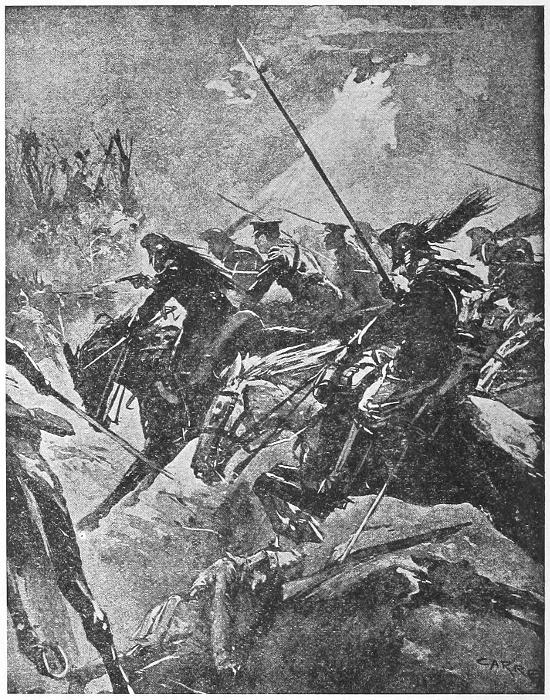
A sudden musketry fire woke us up, and
the German infantry was on us. I cannot
think of these moments without giving credit
to the admirable presence of mind which
saved the situation by the avoidance of all
panic. The horses were not girthed up,
many of the kits had slipped round, reins
were unbuckled; no matter, we had to mount.
I have a crazy recollection of my loose girth,
of my saddle slipping round, of the blanket
which had worked forward on to my horse’s
neck; no matter, “Forward! Forward!” a
second’s delay might be our ruin. A hail of
bullets fell amongst us. Alongside of me,
Alaire, a quite young non-commissioned
officer, was hit in the belly. He was the first
in the regiment whom I had seen fall. God!
what a horrible toss he took, dragged by his
horse, maddened by fear, crying out, “Rolland,
Rolland, don’t abandon me.” Then, in
a last contortion, his foot came out of the
stirrup and he died convulsed by a final
spasm. Near me, the Captain’s orderly gave
a loud shout; horses, mortally wounded,
galloped wildly for some mètres and then
suddenly fell as if pole-axed.
I saw a man who, as if seized with madness,
sent his wounded horse headlong to the
bottom of a ravine and then threw himself
after.
“Forward! Forward!” I followed the
others, who made off towards the village. My
horse trod on a German whose throat, gashed
by a lance thrust, poured out such a stream of
blood that the earth under me was red and
streaming with it. “Forward! Forward!”
We were not going to view them then, these
enemies who killed us without our seeing
them, so hidden were they amongst the grass
that they blended with the soil? Yes we
were though, and suddenly surprise stopped
short the rush of the squadrons. Before
us, some mètres off, and so near that we could
almost touch it with our lances, an aëroplane
got up, like a partridge surprised in a stubble.
A cry of rage burst from every throat. We
tried to charge it with our lances in the air,
but it mocked our efforts, and our rearing
horses were on the spot ten seconds too late.
The enemy seemed also to have flown. All
that remained were two or three grey corpses
that strewed the soil. We trotted into the
village with our heads down, humiliated at
having been fooled like children.
After having passed the first few isolated
farms along our road, an enemy’s section
came for us, exposing themselves entirely this
time, while a line of recumbent skirmishers
fired a volley into us from our right, almost at
point-blank range. There was nothing for
it but to retire, unless we wanted to remain
there as dead men, and at the gallop, the
more so because a machine-gun was riddling
the walls of a farm with little black points.
We passed before it like a whirlwind; and,
happily, its murderous fire was too high to
hit us. I can still recall the sight of an
isolated German, caught between the fire of
his regiment and the charge of our horses.
I turned my head and laughed with joy at
seeing a comrade pierce him with his lance in
passing.
The Germans were all round us, and our
only line of retreat was by the forest, into
which we all plunged in a common rush
without waiting for orders. The forest, at
least, represented safety for the moment.
It was a sanctuary calculated to protect us
from an entire army, until we died of hunger.
For a long time we marched in silence, cutting
across the wood, avoiding the beaten path, for
our intention was to attain the very heart of
the forest, or some impenetrable spot where
we could not be discovered, where we could
regain our breath and where our officers could
deliberate and take a decision. The whole
half-regiment took shelter at last in an immense
ravine, where we were sheltered from
aircraft. We were covered by a thick vault
of leaves in a sort of prehistoric gorge, which
seemed far from all civilisation and lost in an
ocean of verdure, and there we dismounted.
The Major sent patrols to explore the issues
from the forest, and we waited some mortal
hours without daring to raise our voices.
Our situation was almost desperate. For
three days we had touched not a morsel of
bread, not a biscuit, our horses not a handful
of corn. The reserve rations were exhausted;
and the patrols, which came in one after the
other, brought sad news. The Germans were
masters of all the issues from the forest, and
we were taken in a vice, prisoners in this
gulf of trees and reduced to dying of hunger
and thirst. A little way off, the officers—Major
Jouillié, Captain de Salverte, Captain
de Tarragon, Monsieurs Chatelin, Cambacérès,
Roy and de Thézy—deliberated with
glum faces. Each stood near his horse so as
to be able to jump on in case of surprise. In
spite of everything the men’s spirits remained
admirable. All had a jest on their lips,
and the more serious amongst them wrote
a line to their wives or mothers. Leaning
against the trunk of a tree, I scribbled on two
letter-cards, found in my wallets, two short
notes of adieu. The day passed with depressing
slowness.
Towards four o’clock two officers of Uhlans
appeared on a little road which, so to speak,
hung above us. At once all eyes were fixed
on these two thin silhouettes. They advanced,
talking quietly, with their reins loose
on their horses’ necks. How great was the
temptation to shoulder one’s carbine, take
steady aim, feel one’s man at the end of the
muzzle and kill him dead with a ball through
the heart! Everyone understood, however,
that it was necessary to keep quiet and let off
the prey so good a mark was it, for doing so
would have given the alarm and signalised
our presence. Now they were right on us,
so near that we could have touched them,
and yet they did not know that there were
two hundred carbines which could have
knocked them over at point-blank range.
Even now I can distinctly see the face of the
first, as if it were photographed on my brain.
He was quite young, with an eye-glass well
screwed into the eye, his face was red and
insolent, just as the Prussian officer is always
represented. He had a whip under his arm,
and he even had a cigar. Suddenly his face
and that of his companion contracted, as if
confronted by some apparition. This French
regiment must have seemed to them a phantom
of the forest, some impossible and illusory
vision seen in the shadow of the leaves. Their
horses stopped short and, for the space of a
second, their riders looked like two figures in
stone. Then in a flash they understood
and fled at full speed. For an instant we
heard the stones fly under their horses’ shoes,
but the sound grew fainter and fainter, and a
deep silence reigned again.
The alarm had been given, the danger had
still further increased, and, now that our place
of concealment had been discovered, we had
to start off again across the thicket and rock
on our poor done-up horses. On reflecting
over it, my mind refuses to believe that such
a cross-country ride was possible. To throw
the enemy off the scent it was necessary to
pass where no one would have imagined that
a horse could go, and that involved a ride into
the abyss in the deepening night, plunges
into black gulfs, intersected by trunks of
trees, to the foot of which some horsemen and
their horses rolled like broken toys.
I felt my old horse, Teint, curl up and
tremble between my legs. His hair stood on
end and his nostrils opened and shut. On,
on, ever on ... to the very heart of the old
forest, whose most secret solitudes we troubled,
frightening the herds of deer, which fled terrified
before our cavalcade. For a moment
it seemed as if we were at some monstrous
hunt on horseback with men for quarry, and
in spite of myself, a mortal fatigue seized
on me. I shut my eyes and waited for the
“Gone away.” Better it were to be finished
quickly, since the game was lost.
The troops had got mixed and I found myself
again for a moment amongst the 3rd
squadron by the side of Lieutenant Cambacérès,
and we exchanged a few brief words.
Almost timidly, so absurd did the idea appear
that one of us could escape, I asked him to
write a line home if it were my luck to be
done for and if he came out safe. I promised
him the same service, if the rôles were reversed.
To such an extent does gaiety enter
into the composition of our French nature,
we even joked for a few moments and we
shared a last tablet of chocolate, which he had
preserved in his wallet, a service for which
I shall always be grateful to him, for hunger
was causing me insupportable pain. We
were now going at a slow pace over a carpet
of dead leaves, amongst trees which were
singularly thinned out. Our object being to
gain the heart of the forest, we had ended
up by reaching its border, and we remained
glued to the spot, holding our breath at the
sudden vision seen through the branches.
The famous convoys that the division was
out to take were there, in front of us, on a
stretch of some eight kilomètres of road.
Waggons of munitions, provision carts, water-carts,
lorries of all sorts, were moving gaily
along at an easy walk, and the rumbling
noise was continuous.
In the calm of the evening each spoken
word, each order given by the guides came to
us clear and distinct. Then came the last
vehicles, the last country carts, some stragglers
tailing out into a confusion of cyclists and
horsemen; and so the interminable convoy
went on its way. The vehicles at its head
had the appearance of toys on the horizon,
of toys designed with the pen on the gold
of the sky; and the personnel looked like
insects finely traced in the clear atmosphere.
The whole thing went quietly on its way
like a slow caravan. One would have said
that here was a people coming to settle in
conquered country and arriving at the end
of its journey in the peace of a lovely evening.
The same day, at the same moment, General
Foch, pushing the thin end of his wedge between
the armies of Bülow and those of Hausen,
enlarged that fissure which was to prove
fatal to the German army which had almost
arrived at the Marne. The pursuit was
about to begin. These same convoys, whose
peaceful aspect wounded our hearts from the
insolence of their air of possession on French
soil (we were ignorant of course that the
dawn of a great victory was about to break)—these
same convoys, lashed by terror and
by the breath of panic, were going to follow
beaten armies in a headlong and wild retreat,
leaving on the road their waggons and stores.
From this moment a vague hope sprang up
in our hearts and, as is often the case, we
gathered courage when the worst of catastrophes
seemed to be heaping on our heads.
Night fell little by little. It was impossible
to remain where we were. We were well
within the German lines, of this there was
no doubt, since we had the enemy’s troops
behind us, while their convoys were on in
front of us; but, under cover of night we
might attempt a desperate stroke, and anything
was better than dying of hunger.
Towards ten at night our column came bravely
out of the forest—a silent column whose
members looked like phantoms. Cutting
across country, we avoided Haramont, Eméville,
Bonneuil-en-Valois, Morienval. As
night fell a sombre gloom seized on us. All
those silent villages, which we dared not
approach, had a threatening appearance;
lights appeared suddenly, more or less distant;
a succession of luminous points was moving
slowly, like a moving train going slowly. I
was ill at ease, and this was causing me
physical pain; my saddle girth was too loose
and had allowed my horse’s blanket to slip
till it threatened to fall off. No matter, for
nothing in the world would I dismount. It
seemed as if hands came out of the shadows
and stretched forth to seize me. A breath of
superstitious terror blew over us, and, in the
deep surrounding silence, a single persistent
and regular noise made us start with the fear of
the unknown. It was the screech of the owl,
an unnatural cry which seemed like a signal
replied to in the distance; and it made us
shudder. My eyes eagerly searched the
shadow to discover a hidden enemy. Twice
I could have sworn that I saw a group of
German uniforms, two mounted Uhlans, another
on foot; but I mistrusted my eyes,
hallucinations being of common occurrence
at night, and I tried to pluck up courage.
While crossing a road a sudden noise and a
cry of “Help!” rang out, a cry choked with
agony and terror. It came from one of our
men, whose horse had struck into mine and had
rolled into the ditch. I turned and saw in a
flash a brief struggle which the night at once
blotted out. This time I had made no mistake.
There really were two Germans
struggling with our comrade; but I was carried
on by the forward movement, and profound
silence reigned again. If we were surrounded
by enemies, why this conspiracy of silence?
The horrid screech of the owl never ceased,
imparting panic to our disordered imaginations,
making us think that even a catastrophe
was preferable to this maddening
incertitude, to this agony of doubt. During
this time I lived the worst hours of my life.
We advanced, however, marching from west
to east, and soon we entered the great black
mass of the forest of Compiègne, from whence
arose four or five bird-calls as we approached.
No matter; for the second time the forest
represented safety for us, and under the impenetrable
shade of its tall trees we followed
its edge in the direction of Champlieu, sometimes
followed, sometimes preceded by the
hooting which announced, as we learnt later,
our approach and our passage.
At the moment when our agony was at an
end, when hope revived, when, even, certain
men giving way to fatigue had bent down on
to their wallets drunk with sleep,—at that
moment we fell definitely into the mouse-trap
into which the Germans had methodically
decoyed us, and a desperate attack was made
on us from all sides. The drama took place
so rapidly that I can remember only detached
shreds of it. The clouds parted, letting fall a
flood of moonlight; somewhere a cry resounded
in the night, and the black forest seemed to
spit fire. Thousands of brief flashes lit up
each thicket, a hail of bullets thinned the
column, and mingled with this were cries and
a terrible neighing from the horses, some of
which reared, while others lay kicking on the
ground, dragging their riders and their kits
in a spasm of terrible agony. Instinctively
each trooper made a “left turn” and galloped
furiously to get out of range of this murderous
fire which decimated our ranks. In a few
seconds we had put two hundred mètres
between the forest and us, and the two
squadrons rallied under cover of a slight
mist.
As we rode a squadron sergeant-major,
Dangel, gave a groan, as his horse carried
him off after the others. Then I saw him
collapse, pitch forward on his nose on to his
horse’s fore shoulder and fall to the ground,
to be dragged. I leapt from my horse and
managed to disengage his foot. Holding
him in my arms, I begged him to show a little
pluck. “We must clear out of this or we
will be taken prisoners. For God’s sake get
on your horse.” His only response was a
long sigh, then his heavy body collapsed in
my arms, and he dragged me to the ground.
For a second I was perplexed. The others
were far off, and I alone remained behind
with a dying man in my arms, who clasped
me in desperate embrace. At last his arms
let go, and a spasm stretched him dead at
my feet. I laid him piously on the grass
with his face to the sky, and when I had
finished this last duty to a comrade, I raised
my head and saw a whole line of skirmishers
fifty mètres off. For a moment a feeling
possessed me that I could not get away; but,
damme, they were not going to take me alive.
An extraordinary calm came over me.
I remounted slowly, made sure that I had
picked up all four reins and lowered my
lance. Now, by the grace of God ... now
for it. A volley greeted my departure, but
it was written that I was to escape. Several
bullets grazed me, not one hit me. Soon
I was out of range and concealed by a curtain
of fog. I rejoined the two squadrons, many
of whose troopers were without horses. Two
hundred mètres farther on a fresh fusillade
came from the invisible trenches and decimated
our already thinned ranks. Captain
de Tarragon, whose horse had been wounded,
pitched forward and remained pinned under
his horse. I passed by him at the gallop
hardly seeing him, and I heard a shout that
seemed to illumine the very darkness: “Charge,
my lads.” This shout, repeated by all, swelled,
increased and became a savage clamour,
which must have paralysed the enemy, for
the fusillade ceased and cries of “Wer da”
were heard at different points.
Afterwards I shut my eyes and tried to
remember, but for some moments everything
was mixed up. I recall a furious gallop at the
dark holes where the Germans had gone to
earth. A high trench embankment faced us
and my horse got to the other side after a
monstrous scramble. Before me and on my
right and left I saw horses taking complete
somersaults; I could not say whether it lasted
a minute or an hour. The pains and the
privations of the last three days culminated
in a moment of madness. We had to
get through, cost what it might; we had to
bowl over everything, break through everything,
but get through all the same, and our
hot and furious gallop grew faster under the
heedless moon, which bathed the country
with its pale and gentle light. Three times we
charged, three times we charged down on the
obstacle without knowing its nature, until the
remains of the two squadrons found themselves,
breathless, in a little depression at the
edge of a wood, before an impassable wall of
barbed wire.
Impatient voices shouted for wire-cutters,
and during the delay before these were forthcoming,
a few panic-mongers blurted out false
news, which soon circulated and which all
believed: “The enemy is advancing in skirmishing
order.” “We are going to be shot
down at point-blank range,” etc.... Had
the news been true, I would not have given
much for our skins. Huddled together like a
flock of sheep before the gap which some of
our men were exerting themselves to open
up for our passage, a handful of resolute
infantry could have killed every one of us.
At last the gap was made and I descended
a steep slope between the thin stems of the
birches, having been sent forward as scout by
my Major, whom I was never to see again.
Below, a figure in silhouette and bareheaded
was resting on his sword in the middle of a
clearing bathed in moonlight. He watched
me coming, and I was astonished to recognise
in him the officer of my troop. For a brief
moment each had taken the other for an
enemy, and at twenty mètres off we were
each ready to fall on the other. Our mutual
recognition was none the less cordial. M.
Chatelin refused my horse, which I offered
to him, deciding to try to regain our lines on
foot under cover of night (which he did after
having knocked over two German sentries).
He warned me expressly against some skirmishers
concealed in a thicket behind me, and
after a hearty handshake and a “good luck,”
which sounded supremely ironical between
two such isolated individuals, lost in the heart
of German “territory,” I watched his thin
silhouette melt into the darkness.
I made my way back to give an account of
my mission and to tell the Major that this
route was impracticable for the two squadrons.
Above, the plain extended to infinity,
white in the moonlight, with no vestige of a
human being! All that was to be seen were
two horses which galloped wildly to an accompaniment
of clashing stirrups, and the uneasy
neighs of lost animals—that whinny of
the horse which has something so human in
it gave me a shudder. How was it that two
squadrons had had the time, during my brief
absence, to melt and disappear?
What road have they found? Why have
they abandoned me? The terror of desolation
took the place of my former calm. To
die with the others in the midst of a charge
would have been fine; but to feel oneself
lost and alone in all this mystery, in this endless
night, in the midst of thousands of invisible
enemies, was a bit too much. It was
a childish nightmare and, seized with the same
panic as the lost horses, I too spurred mine till
his flanks bled, and I set off straight before me
galloping like a madman. Luck, or perhaps
my horse who scented his stable companions,
brought me all at once to a small contingent
of dragoons,—Captain de Salverte and eleven
men, with whom I joined up. I questioned
the Captain, who could tell me nothing.
He had found himself detached and lost like
me, and he had put himself at our head to try
to get us out of this inextricable position.
We walked on gloomily through a country
cut up by hedges and streams. Shortly, we
found ourselves within a few mètres of an
enemy’s bivouac, the fires of which made the
shadows dance on our drawn faces. A stupid
sentry was warming himself, and had his
back turned to us. What was the good of
struggling? Why cheat oneself with chimerical
illusions? The day would dawn and we
would be ingloriously surprised and sent to
some prisoner’s camp in the centre of Germany,
unless, choosing to die rather than
yield, we kept for ourselves the last shot in
our magazines.
However, we reached the forest. In the
maze of dark paths we lost the Captain and
Sergeant Pathé. With Farrier Sergeant-Major
Delfour, and Sergeant-Major Desoil of the
machine-gun section, nine of us were left,
and we were determined to try a last effort,
spurred by an awakening of that instinct of
self-preservation which stiffens the desire
to live in the very face of death.
Deep in the forest we passed the night concealed
in a thicket, taking pity on our horses,
which would have died had we demanded
a further effort of them. Soon we were overpowered
by sleep, sleep so profound that the
entire German army might have surprised us,
without our raising a little finger to get away.
At daybreak we continued our way, with
stiff and benumbed limbs and soaking clothing.
It was a beautiful autumn day. Wisps of
pink mist wrapped to the tree tops. A large
stag watched our coming with uneasy surprise,
standing in the middle of a paved road
on his slim legs. He disappeared with a
bound into a clump of bushes, whose swaying
branches let fall a shower of silver drops. A
divine peace possessed all space. In a clearing
some thirty loose horses had got together.
The larger number were saddled and carried
the complete equipment of regiments of
dragoons and of chasseurs. The lances lay
on the ground, together with complete sets
of kit and mess tins. Surely the enemy had
not passed this way or he would have laid
hands on all this material so hurriedly abandoned;
and yet no human being was about
who could tell us anything, not even a lost
soldier. There was no one but ourselves and
the immense tranquil forest, gilded by early
autumn, splashed with the dark green of the
oaks and with every shade of colour from
ardent purple to the white leaf of the aspen.
That glorious dawn shone on the greatest
victory the world had ever seen. The battle
was over for the armies of Maunoury, of
French, of Franchet, of d’Estrey, of Foch, and
of Langle de Cary. The pursuit was beginning,
and the whole extent of country, where
we were now wandering, pursued and tracked
like wild beasts, was going to be cleared
within a few hours of the last German who
had sullied its soil.
More than thrice during the morning we
came unexpectedly on German detachments,
isolated parties, lost patrols or stragglers, and
each time we cut across the wood to escape
them at the risk of breaking our necks. Then
we got to a long straight path at the lower end
of which a fine limousine motor-car had been
abandoned, and at the end of the path we
reached a village which appeared to be empty.
We consulted together for a moment, being in
doubt what to do; but all of us were loth to
return to the forest. This was the fifth day
of our fast; so much the worse for us; it was
time to put an end to it, so we made our way
to an abandoned farm. We sheltered there for
two hours, scanning the surrounding country
for signs of life. Everything seemed dead.
We could see no peasant, no civilian, not even
an animal, and this waiting was one torment
the more, but it was to be the last. Not till
ten o’clock, over there, very far off, did I
catch sight of the thin black caterpillar of
a column of soldiers coming our way during
my turn of sentry-go. My heart beat violently,
but I refrained from giving the news
to my comrades from the fear of raising false
hopes. My eyes burnt like flame and my
teeth chattered. If these were Germans the
game was up. If they were French, oh!
then!
I looked, I looked with my eyes pressing
out of my head. At times, as I strained my
eyes, everything grew misty and I could see
nothing; then, a second later, I again found
this growing caterpillar and I began to distinguish
details. There were squadrons of
cavalry, but I could not yet make out the
colour; and my body, from being icy cold,
turned to burning hot. At times I forced
myself not to look. I looked again, counted
twenty, and then devoured space with my
eyes.
A patrol had been detached, and approached
rapidly at the trot; this time I recognised
French Hussars. Then all strength of will,
and all my effort to remain calm disappeared.
I turned my reeling head towards my comrades
and I fell on the grass crying, crying
like a madman, in words without sequence.
The fatigue of these five days without food
or drink, almost without sleep, and the living
in a perpetual nightmare, brought on a
nervous crisis, and my whole body was racked
with spasms. My comrades, not having as
yet understood, looked at me with astonishment.
With a gesture I pointed out the
approaching column, the pale blue of which
contrasted brightly with the gold of the leaves.
All of them, as soon as they had seen it, were
overcome as I had been, each in his own way.
Some burst into brusque convulsive sobs,
others danced, waving their arms like madmen
or rather like poor wretches who have passed
days of suffering and agony on a raft in mid-ocean,
and who suddenly see a ship approaching
to their rescue.