Illustrations of Shakspeare, and of Ancient Manners
Whole book · 50 sections
The cover image was created by the transcriber and is placed in the public domain.
ILLUSTRATIONS
OF
SHAKSPEARE.
Published by T. Tegg Cheapside, Sept.r 1839.
ILLUSTRATIONS OF SHAKSPEARE, AND OF ANCIENT MANNERS: WITH DISSERTATIONS ON THE CLOWNS AND FOOLS OF SHAKSPEARE; ON THE COLLECTION OF POPULAR TALES ENTITLED GESTA ROMANORUM; AND ON THE ENGLISH MORRIS DANCE.
By FRANCIS DOUCE.
THE ENGRAVINGS ON WOOD BY JACKSON.
A NEW EDITION.
LONDON:
PRINTED FOR THOMAS TEGG, CHEAPSIDE;
R. GRIFFIN AND CO., GLASGOW; TEGG AND CO., DUBLIN; ALSO
J. & S. A. TEGG, SYDNEY AND HOBART TOWN.
1839.
PRINTED BY RICHARD KINDER, GREEN ARBOUR COURT, OLD BAILEY.
The practice, and also the necessity of explaining the
writings of Shakspeare, have already been so ably defended
by former commentators, that no other apology
on the part of those who may elect to persevere in
this kind of labour seems to be necessary than with
regard to the qualifications of the writer: but as no
one in this case perhaps ever thought, or at least
should think, himself incompetent to the task assumed
of instructing or amusing others, it may be as well,
on the present occasion, to waive altogether such a
common-place intrusion on the reader's time. It is
enough to state that accident had given birth to a considerable
portion of the following pages, and that design
supplied the rest. The late Mr. Steevens had
already in a manner too careless for his own reputation,
and abundantly too favourable to his friend,
presented to public view such of the author's remarks
as were solely put together for the private use and
consideration of that able critic. The former wish of
their compiler has, with the present opportunity, been
accomplished; that is, some of them withdrawn, and
others, it is hoped, rendered less exceptionable.
The readers of Shakspeare may be properly divided
into three classes. The first, as they travel through
the text, appeal to each explanation of a word or passage
as it occurs. The second read a large portion of
the text, or perhaps the whole, uninterruptedly, and
then consult the notes; and the third reject the illustrations
altogether. Of these the second appear to
be the most rational. The last, with all their affectation,
are probably the least learned, but will undoubtedly
remain so; and it may be justly remarked on this
occasion, in the language of the writer who has best
illustrated the principles of taste, that "the pride of
science is always meek and humble compared with the
pride of ignorance." He, who at this day can entirely
comprehend the writings of Shakspeare without the
aid of a comment, and frequently of laborious illustration,
may be said to possess a degree of inspiration
almost commensurate with that of the great bard himself.
Mr. Steevens has indeed summed up every necessary
argument in his assertion that "if Shakspeare
is worth reading, he is worth explaining; and the researches
used for so valuable and elegant a purpose,
merit the thanks of genius and candour, not the satire
of prejudice and ignorance."
The indefatigable exertions of Messrs. Steevens,
Malone, Tyrwhitt, and Mason, will ever be duly appreciated
by the true and zealous admirers of Shakspeare's
pages. If the name of a celebrated critic and
moralist be not included on this occasion, it is because
he was certainly unskilled in the knowledge of obsolete
customs and expressions. His explanatory notes
therefore are, generally speaking, the most controvertible
of any; but no future editor will discharge his
duty to the public who shall omit a single sentence of
this writer's masterly preface, or of his sound and
tasteful characters of the plays of Shakspeare. Of
all the commentators Dr. Warburton was surely the
worst. His sentiments indeed have been seldom exhibited
in modern editions but for the purpose of confuting
them.
The wide dispersion of those materials which are
essential to the illustration of inquiries like the present,
will necessarily frustrate every endeavour at perfection;
a circumstance that alone should teach every
one discussing these difficult and obscure subjects, to
speak of them with becoming diffidence. The present
writer cannot flatter himself that he has uniformly
paid a strict attention to this rule; the ardour of conjecture
may have sometimes led him, in common with
others, to forget the precepts he had himself laid
down.
It may be thought by some, and even with great
justice, that several of the corrections are trifling and
unimportant; but even these may perhaps be endured
wherever it shall be manifest that their object, and it
is hoped their effect, has been to remove error and
establish truth; a matter undoubtedly of some
consequence in the school of criticism. One design
of this volume has been to augment the knowledge of
our popular customs and antiquities, in which respect
alone the writings of Shakspeare have suggested
better hints, and furnished ampler materials than those
of any one besides. Other digressions too have been
introduced, as it was conceived that they might operate
in diminishing that tedium which usually results
from an attention to matters purely critical; and that
whilst there was almost a certainty of supplying some
amusement, there might even be a chance of conveying
instruction. Sometimes there has been a necessity
for stepping in between two contending critics;
and for showing, as in the case of many other disputes,
that both parties are in the wrong.
Some excuse may seem necessary for obtruding on
the reader so many passages from what Mr. Steevens
has somewhere called "books too mean to be formally
quoted." And yet the wisest among us may be often
benefited by the meanest productions of human intellect,
if, like medicinal poisons, they be administered
with skill. It had escaped the recollection of the
learned and accomplished commentator that he had
himself condescended to examine a multitude of
volumes of the above class, and even to use them with
advantage to his readers in the course of his notes.
With respect to what is often absurdly denominated
black letter learning, the taste which prevails in the
present times for this sort of reading, wherever true
scholarship and a laudable curiosity are found united,
will afford the best reply to the hyper-criticisms and
impotent sarcasms of those who, having from indolence
or ignorance neglected to cultivate so rich a
field of knowledge, exert the whole of their endeavours
to depreciate its value. Are the earlier labours of our
countrymen, and especially the copious stores of information
that enriched the long and flourishing reign of
Elizabeth, to be rejected because they are recorded in
a particular typography?
Others again have complained of the redundancy of
the commentators, and of an affected display of learning
to explain terms and illustrate matters of obvious
and easy comprehension. This may sometimes have
been the case; but it were easier to show that too
little, and not too much, has been attempted on many
of these occasions. An eminent critic has declared
that "if every line of Shakspeare's plays were accompanied
with a comment, every intelligent reader would
be indebted to the industry of him who produced it."
Shakspeare indeed is not more obscure than contemporary
writers; but he is certainly much better worth
illustrating. The above objectors, affectedly zealous
to detect the errors of other men, but more frequently
betraying their own self-sufficiency and over-weening
importance, seem to forget that comments and illustrations
are designed for the more ignorant class of
readers, who are always the most numerous; and that
very few possess the happiness and advantage of being
wise or learned.
It might be thought that in the following pages exemplifications
of the senses of words have been sometimes
unnecessarily introduced where others had already
been given; but this has only been done where the
new ones were deemed of greater force or utility than
the others, or where they were supposed to be really
and intrinsically curious. Some of the notes will require
that the whole of others which they advert to,
should be examined in Mr. Steevens's edition; but
these were not reprinted, as they would have occupied
a space much too unreasonable.
At the end of every play in which a fool or clown is
introduced there will be found particular and discriminative
notice of a character which some may regard
as by no means unworthy of such attention.
The Dissertations which accompany this work will,
it is hoped, not be found misplaced nor altogether
uninteresting. The subject of the first of them, though
often introduced into former notes on the plays of
Shakspeare and other dramatic writers, had been but
partially and imperfectly illustrated. The Gesta Romanorum,
to which The Merchant of Venice has been
so much indebted for the construction of its story,
had, it is true, been already disserted on by Mr. Warton
with his accustomed elegance; but it will be found
that he had by no means exhausted the subject. The
morris dance, so frequently alluded to in our old plays,
seemed to require and deserve additional researches.
This preface shall not be concluded without embracing
the opportunity of submitting a very few hints
to the consideration of all future editors of Shakspeare.
It were much to be wished that the text of an author,
and more especially that of our greatest dramatic writer,
could be altered as seldom as possible by conjectural
emendation, or only where it is manifestly erroneous
from typographical causes. The readers of Dr. Bentley's
notes on Milton will soon be convinced of the
inexpediency of the former of these practices, and of
what little importance are the conjectures of the mere
scholar, when unaccompanied by skill and judgement
to direct them.
As the information on a particular subject has been
hitherto frequently dispersed in separate notes, and
consequently remains imperfect in each of them, would
it not be more desirable to concentrate this scattered
intelligence, or even to reduce it to a new form, to be
referred to whenever necessary?
Although the strict restitution of the old orthography
is not meant to be insisted on, nor would indeed accommodate
the generality of readers, there are many
instances in which it should be stated in the notes;
and such will occur to every skilful editor.
Every word or passage that may be substituted in
the text in the room of others to be found in any of
the old editions should be printed in Italics, and assigned
to its proper owner, with a reason for its preference
to the originals. The mention of variations in
the old copies must of course be left to an editor's
discretion. No disparagement is meant to the memory
or talents of one of the greatest of men, when a protest
is here entered against "the text of Dr. Johnson."
It is to be regretted that all editions of Shakspeare, as
well as of other dramatic writers, have not marginal
references to the acts and scenes of each play. Those
of Bell and Stockdale are, in this respect, preeminently
useful. The time and trouble that would
be saved in consulting them would be very considerable.
The Edition of Shakspeare used in the compilation of this
volume, and to which the pages cited refer, is the last published
by Mr. Steevens himself, in fifteen volumes 8vo, 1793;
but in order to facilitate a reference to most other editions,
the acts and scenes of the plays are specified.
ILLUSTRATIONS OF SHAKSPEARE.
THE TEMPEST. — ACT I. — ACT II. — ACT III. — ACT IV. — ACT V. — THE FOOL. — FOOTNOTES:
Scene 1. Page 9.
Ant. We are merely cheated of our lives——
Mr. Steevens has remarked that merely in this place signifies
absolutely. His interpretation is confirmed by the word merus
in Littelton's dictionary, where it is rendered downright.
Scene 2. Page 10.
Mira. ... a brave vessel, Who had, no doubt, some noble creatures in her.
There is a peculiar propriety in this expression that has
escaped the notice it deserved. Miranda had as yet seen no
other man than her father. She had perceived, but indistinctly,
some living creatures perish in the shipwreck; and she supposes
they might be of her father's species. Thus she afterwards,
when speaking of Ferdinand, calls him noble.
Scene 2. Page 11.
Mira. ... or e'er It should the good ship, &c.
This word should always be written ere, and not ever, nor
contractedly e'er, with which it has no connection. It is pure
Saxon, æꞃ. The corruption in Ecclesiastes cited in the note,
is as old as the time of Henry the Eighth; but in Wicliffe we
have properly "er be to broke the silveren corde," and so it
is given by Chaucer.
Scene 2. Page 20.
Pro. Bore us some leagues to sea; where they prepar'd A rotten carcass of a boat, not rigg'd, Nor tackle, sail, nor mast——
The present note is more particularly offered to the admirers
of ancient romances, and to which class Shakspeare himself,
no doubt, belonged. It is well known that the earliest English
specimen of these singular and fascinating compositions
is the Geste of king Horn, which has been faithfully published
by the late Mr. Ritson, who has given some account of a
French copy in the British Museum. He did not live to
know that another manuscript of this interesting romance, in
the same language, is still remaining in private hands, very
different in substance and construction from the other. One
might almost conclude that some English translation of it
existed in Shakspeare's time, and that he had in the above
passage imitated the following description of the boat in which
Horn and his companions were put by king Rodmund at the
suggestion of Browans,
"Sire, fet il purnez un de vos vielz chalanz Metez icels valez ki jo vei ici estanz Kil naient avirum dunt aseient aidanz Sigle ne guvernad dunt il seint vaianz." l. 58.
That is,
"Sir, said he, take one of your old boats, put into it these varlets whom I
see here; let them have no oars to help them, sail nor rudder to put them
in motion."
Scene 2. Page 26.
Ari. ... sometimes I'd divide And burn in many places; on the top-mast, The yards and bowsprit, would I flame distinctly, Then meet and join——
This is a very elegant description of a meteor well known to
sailors. It has been called by the several names of the fire of
Saint Helen, Saint Elm, Saint Herm, Saint Clare, Saint Peter,
and Saint Nicholas. Whenever it appeared as a single flame it
was supposed by the ancients to be Helena, the sister of Castor
and Pollux, and in this state to bring ill luck, from the calamities
which this lady is known to have caused in the Trojan war.
When it came double it was called Castor and Pollux, and
accounted a good omen. It has been described as a little
blaze of fire, sometimes appearing by night on the tops of
soldiers' lances, or at sea on masts and sail-yards whirling and
leaping in a moment from one place to another. Some have
said, but erroneously, that it never appears but after a
tempest. It is also supposed to lead people to suicide by
drowning.
Further information on the subject may be collected from
Plin. Hist. nat. 1. ii. c. 37. Seneca Quæst. nat. c. 1. Erasm.
Colloq. in naufragio. Schotti. Physica curiosa, p. 1209. Menage
Dict. etym. v. Saint Telme. Cotgrave Dict. v. feu, furole.
Trevoux Dict. v. furole. Lettres de Bergerac, p. 45. Eden's
Hist. of travayle, fo. 432 b. 433 b. Camerarii Horæ subsecivæ
iii. 53. Cambray Voy. dans la Finisterre ii. 296. Swan's
Speculum mundi p. 89. Shakspeare seems to have consulted
Stephen Batman's Golden books of the leaden goddes, who,
speaking of Castor and Pollux, says "they were figured like
two lampes or cresset lightes, one on the toppe of a maste, the
other on the stemme or foreshippe." He adds that if the
light first appears in the stem or foreship and ascends upwards,
it is good luck; if either lights begin at the top-mast,
bowsprit or foreship, and descend towards the sea, it is a sign
of tempest. In taking therefore the latter position, Ariel had
fulfilled the commands of Prospero to raise a storm.
Scene 2. Page 28.
Ari. From the still-vext Bermoothes——
The voyage of Sir George Sommers to the Bermudas in the
year 1609 has been already noticed with a view of ascertaining
the time in which The tempest was written; but the important
particulars of his shipwreck, from which it is exceedingly
probable that the outline of a considerable part of this
play was borrowed, has been unaccountably overlooked. Several
contemporary narratives of the above event were published,
which Shakspeare might have consulted; and the conversation
of the time might have furnished, or at least suggested,
some particulars that are not to be found in any of
the printed accounts. In 1610 Silvester Jourdan, an eyewitness,
published A discovery of the Barmudas, otherwise called
theISLE OF DIVELS: By Sir Thomas Gates, Sir Geo. Sommers,
and Captayne Newport, with divers others. Next followed
Strachey's Proceedings of the English colonie in Virginia
1612, 4to, and some other pamphlets of less moment.
From these accounts it appears that the Bermudas had never
been inhabited, but regarded as under the influence of inchantment;
though an addition to a subsequent edition of Jourdan's
work gravely states that they are not inchanted; that
Sommers's ship had been split between two rocks; that during
his stay on the island several conspiracies had taken place;
and that a sea-monster in shape like a man had been seen, who
had been so called after the monstrous tempests that often
happened at Bermuda. In Stowe's Annals we have also an
account of Sommers's shipwreck, in which this important
passage occurs, "Sir George Sommers sitting at the stearne,
seeing the ship desperate of reliefe, looking every minute
when the ship would sinke, hee espied land, which according
to his and Captaine Newport's opinion, they judged it should
be that dreadfull coast of the Bermodes, which iland were of
all nations said and supposed to bee inchanted and inhabited
with witches and devills, which grew by reason of accustomed
monstrous thunder, storm, and tempest, neere unto those ilands,
also for that the whole coast is so wonderous dangerous of
rockes, that few can approach them, but with unspeakable
hazard of ship-wrack." Now if some of these circumstances
in the shipwreck of Sir George Sommers be considered, it
may possibly turn out that they are "the particular and recent
event which determined Shakspeare to call his play The
tempest,"[1] instead of "the great tempest of 1612," which
has already been supposed to have suggested its name, and
which might have happened after its composition. If this
be the fact the play was written between 1609 and 1614
when it was so illiberally and invidiously alluded to in Ben
Jonson's Bartholomew-fair.
Scene 2. Page 30.
Pro. What is't thou can'st demand?
Ari. ... My liberty.
Pro. Before the time be out? no more.
The spirits or familiars attending on magicians were always
impatient of confinement. Thus we are told that the
spirit Balkin is wearied if the action wherein he is employed
continue longer than an hour; and therefore the magician
must be careful to dismiss him. The form of such a dismission
may be seen in Scot's Discovery of witchcraft, edit. 1665,
folio, p. 228.
Scene 2. Page 35.
Pro. ... My quaint Ariel.
Quaint here means brisk, spruce, dexterous. From the
French cointe.
Scene 2. Page 35.
Cal. As wicked dew as e'er my mother brush'd With raven's feather from unwholsome fen, Drop on you both! a south-west blow on you, And blister you all o'er!
The following passage in Batman uppon Bartholome his
booke De proprietatibus rerum, 1582, folio, will not only
throw considerable light on these lines, but furnish at the
same time grounds for a conjecture that Shakspeare was indebted
to it, with a slight alteration, for the name of Caliban's
mother Sycorax the witch. "The raven is called corvus of
Corax ... it is said that ravens birdes be fed with
deaw of heaven all the time that they have no black feathers
by benefite of age." Lib. xii. c. 10. The same author will
also account for the choice which is made, in the monster's
speech, of the South-west wind. "This Southern wind is hot
and moyst.... Southern winds corrupt and destroy;
they heat and maketh men fall into sicknesse." Lib. xi. c. 3.
It will be seen in the course of these notes that Shakspeare
was extremely well acquainted with this work; and as it is
likely hereafter to form an article in a Shakspearean library,
it may be worth adding that in a private diary written at the
time, the original price of the volume appears to have been
eight shillings.
Scene 2. Page 36.
Pro. ... urchins Shall, for that vast of night that they may work, All exercise on thee.
Although urchins sometimes means hedge-hogs, it is more
probable that in this place they denote fairies or spirits, and that
Mr. Malone is right in the explanation which he has given.
The present writer's former note must therefore be cancelled,
as should, according to his conception, such part of Mr.
Steevens's as relates to the hedge-hog. The same term both
in the next act, and in the Merry Wives of Windsor, is used
in a similar sense.
Mr. Steevens in a note on this word in the last mentioned
play has observed that the primitive sense of urchin is a hedge-hog,
whence it came, says he, to signify any thing dwarfish.
There is however good reason for supposing it of Celtic origin.
Erch in Welsh, is terrible, and urzen, a superior intelligence.
In the Bas Breton language urcha signifies to howl.
"Urthinwad Elgin," says Scot in his Discovery of witchcraft,
p. 224, edit. 1665, "was a spirit in the days of King Solomon,
came over with Julius Cæsar, and remained many hundred
years in Wales, where he got the above name."
The urchin or irchin, in the sense of a hedge-hog, is certainly
derived from the Latin ericeus; and whoever is desirous of
more information concerning the radical of ericeus may be
gratified by consulting Vossius's Etymologicon v. erinaceus.
With respect to the application of urchin to any thing dwarfish,
for we still say a little urchin, this sense of the word seems
to have originated rather from the circumstance of its having
once signified a fairy, who is always supposed to be a diminutive
being, than from the cause assigned by Mr. Steevens.
It is true that in the ensuing act Caliban speaks of Prospero's
spirits as attacking him in the shape of hedge-hogs, for
which another reason will be offered presently; and yet the
word in question is only one out of many used by Shakspeare,
which may be best disposed of by concluding that he designed
they should be taken in both or either of their senses.
In a very rare old collection of songs set to music by John
Bennett, Edward Piers or Peirce, and Thomas Ravenscroft,
composers in the time of Shakspeare, and entitled Hunting,
hawking, dauncing, drinking, enamoring, 4to, no date, there
are, the fairies dance, the elves dance, and the urchins dance.
This is the latter:
"By the moone we sport and play, With the night begins our day; As we friske the dew doth fall, Trip it little urchins all, Lightly as the little bee, Two by two, and three by three, And about goe wee, goe wee."
Scene 2. Page 40.
Cal. It would control my dam's God Setebos.
In Dr. Farmer's note it should have been added that the
passage from Eden's History of travayle was part of Magellan's
Voyage; or in Mr. Tollet's, that Magellan was included
in Eden's collection.
Scene 2. Page 42.
Ari. Those are pearls, that were his eyes.
We had already had this image in King Richard the third,
where Clarence, describing his dream, says:
"... in those holes Where eyes did once inhabit, there were crept (As 'twere in scorn of eyes) reflecting gems."
Scene 2. Page 44.
Mira ... What is't, a spirit? Lord, how it looks about! Believe me, sir, It carries a brave form.
The incident of Miranda's surprise at the first sight of Ferdinand,
and of her falling in love with him, might have been
suggested by some lost translation of the 13th tale in the
Cento novelle antiche, and which is in fact the subject of father
Philip's geese, so admirably told by Boccaccio and Lafontaine.
It seems to have been originally taken from the
life of Saint Barlaam in The golden legend.
Scene 1. Page 54.
Gon. How lush and lusty the grass looks!
Lush, as Mr. Malone observes, has not yet been rightly interpreted.
It is, after all, an old word synonymous with loose.
In the Promptuarium parvulorum 1516, 4to, we find "lushe or
slacke, laxus." The quotation from Golding, who renders
turget by this word, confirms the foregoing definition, and
demonstrates that as applied to grass, it means loose or swollen,
thereby expressing the state of that vegetable when, the
fibres being relaxed, it expands to its fullest growth.
Scene 2. Page 76.
Cal. Sometime like apes, that moe and chatter at me And after bite me; then like hedge-hogs, which Lie tumbling in my barefoot way——
Shakspeare, who seems to have been well acquainted with
Bishop Harsnet's Declaration of Popish impostures, has here
recollected that part of the work where the author, speaking
of the supposed possession of young girls, says, "they make
anticke faces, girn, mow and mop like an ape, tumble like a
hedge-hogge, &c." Another reason for the introduction of
urchins or hedge-hogs into this speech is, that on the first
discovery of the Bermudas, which, as has been already stated,
gave rise in part to this play, they were supposed to be
"haunted as all men know with hogs and hobgoblings." See
Dekkar's Strange horserace, &c. sign. f. 3. b. and Mr. Steevens's
note in p. 28.
Scene 2. Page 77.
Trin. A strange fish! Were I in England now (as once I was) and had
but this fish painted, not a holiday fool there but would give a
piece of silver: there would this monster make a man; any
strange beast there makes a man: when they will not give a
doit to relieve a lame beggar, they will lay out ten to see a
dead Indian.
This speech happily ridicules the mania that appears to
have always existed among our countrymen for beholding
strange sights, however trifling. A contemporary writer and
professor of divinity has been no less severe. Speaking of
the crocodile, he says, "Of late years there hath been brought
into England, the cases or skinnes of such crocodiles to be
seene, and much money given for the sight thereof; the policy
of strangers laugh at our folly, either that we are too
wealthy, or else that we know not how to bestow our money."
Batman uppon Bartholome, fo. 359 b.
Scene 2. Page 82.
Ste. This mooncalf.
The best account of this fabulous substance may be found
in Drayton's poem with that title.
Scene 2. Page 83.
Ste. I was the man in the moon.
This is a very old superstition founded, as Mr. Ritson has
observed, on Numbers xv. 32. See Ancient songs, p. 34. So
far the tradition is still preserved among nurses and schoolboys;
but how the culprit came to be imprisoned in the moon,
has not yet been accounted for. It should seem that he had
not merely gathered sticks on the sabbath, but that he had
stolen what he gathered, as appears from the following lines
in Chaucer's Testament of Creseid, where the poet, describing
the moon, informs us that she had
"On her brest a chorle painted ful even, Bearing a bush of thorns on his backe, Which for his theft might clime no ner the heven."
We are to suppose that he was doomed to perpetual confinement
in this planet, and precluded from every possibility
of inhabiting the mansions of the just. With the Italians
Cain appears to have been the offender, and he is alluded to
in a very extraordinary manner by Dante in the twentieth
canto of the Inferno, where the moon is described by the periphrasis
Caino e le spine. One of the commentators on that
poet says, that this alludes to the popular opinion of Cain
loaded with the bundle of faggots, but how he procured them
we are not informed. The Jews have some Talmudical story
that Jacob is in the moon, and they believe that his face is
visible. The natives of Ceylon, instead of a man, have
placed a hare in the moon; and it is said to have got there
in the following manner. Their great Deity Budha when a
hermit on earth lost himself one day in a forest. After wandering
about in great distress he met a hare, who thus addressed
him: "It is in my power to extricate you from your
difficulty; take the path on your right hand, and it will lead
you out of the forest." "I am greatly obliged to you, Mr.
Hare," said Budha, "but I am unfortunately very poor and
very hungry, and have nothing to offer you in reward for your
kindness." "If you are hungry," returned the hare, "I am
again at your service; make a fire, kill me, roast me, and eat
me." Budha made the fire, and the hare instantly jumped
into it. Budha now exerted his miraculous powers, snatched
the animal from the flames, and threw him into the moon,
where he has ever since remained. This is from the information
of a learned and intelligent French gentleman recently
arrived from Ceylon, who adds that the Cingalese would often
request of him to permit them to look for the hare through
his telescope, and exclaim in raptures, that they saw it. It
is remarkable that the Chinese represent the moon by a rabbit
pounding rice in a mortar. Their mythological moon
Jut-ho is figured by a beautiful young woman with a double
sphere behind her head, and a rabbit at her feet. The period
of this animal's gestation is thirty days; may it not therefore
typify the moon's revolution round the earth?
Scene 2. Page 86.
Cal. Nor scrape-trenchering, nor wash-dish.
Scraping trenchers was likewise a scholastic employment
at college, if we may believe the illiterate parson in the pleasant
comedy of Cornelianum dolium, where speaking of his
haughty treatment of the poor scholars whom he had distanced
in getting possession of a fat living, he says, "Illi inquam,
qui ut mihi narrârunt, quadras adipe illitas deglubere
sunt coacti, quamdiu inter academicas ulnas manent, dapsili
more à me nutriti sunt, saginati imò &c." It was the office
too of apprentices. In The life of a satirical puppy called
Nim, 1657, 12mo, a citizen describes how long "he bore the
water tankard, scrap't trenchers, and made clean shoes."
Scene 1. Page 91.
Fer. This wooden slavery, than I would suffer.
The old copy reads than to suffer, which, however ungrammatical,
is justly maintained by Mr. Malone to be Shakspeare's
language, and ought therefore to be restored. Mr. Steevens
objects on the score of defective metre: but this is not the
case; the metre, however rugged, is certainly perfect.
Scene 1. Page 92.
Mira. I am your wife, if you will marry me; If not, I'll die your maid: to be your fellow You may deny me; but I'll be your servant Whether you will or no.
Mr. Malone has cited a very apposite passage from Catullus,
but Shakspeare had probably on this occasion the pathetic old
poem of The nut-brown maid in his recollection.
Scene 2. Page 94.
Ste. Thy eyes are almost set in thy head.
Trin. Where should they be set else? he were a brave monster
indeed, if they were set in his tail.
The curious reader may nevertheless be gratified with a
ludicrous instance of eyes set in the tail, if he can procure a
sight of the first cut in Caxton's edition of Æsop's fables.
In the mean time he is referred to the genuine chap. xx. of
Planudes's life of that fabulist, which is generally omitted in
the modern editions.
Scene 2. Page 97.
Cal. What a py'd ninny's this? thou scurvy patch!
Dr. Johnson would transfer this speech to Stephano, on
the ground that Caliban could know nothing of the costume
of fools. This objection is fairly removed by Mr. Malone;
besides which it may be remarked that at the end of the play
Caliban specifically calls Trinculo a fool. The modern managers
will perhaps be inclined for the future to dress this
character in the proper habit.
Scene 2. Page 100.
Cal. Will you troll the catch——
Troll is from the French trôler, to lead, draw, or drag, and
this sense particularly applies to a catch, in which one part is
sung after the other, one of the singers leading off. The term
is sometimes used as Mr. Steevens has explained it. Littelton
renders to troll along his words, by volubiliter loqui sive
rotundè. Trolling for fish, is drawing the bait along in the
water, to imitate the swimming of a real fish.
Scene 2. Page 104.
Seb. ... in Arabia There is one tree, the Phœnix' throne, one phœnix At this hour reigning there.
Bartholomæus De propriet. rerum, speaking of Arabia, says,
"there breedeth a birde that is called Phœnix;" and from
what has already been said of this book, it was probably one
of Shakspeare's authorities on the occasion.
Scene 2. Page 106.
Gon. Who would believe that there were mountaineers, Dewlapp'd like bulls, whose throats had hanging at them Wallets of flesh? or that there were such men, Whose heads stood in their breasts?
The "dewlapp'd mountaineers" are shown to have been
borrowed from Maundeville's travels, and the same author
doubtless supplied the other monsters. In the edition printed
by Thomas Este, without date, is the following passage: "In
another ile dwell men that have no heads, and their eyes are
in their shoulders, and their mouth is on their breast." A cut
however which occurs in this place is more to the purpose,
and might have saved our poet the trouble of consulting the
text, for it represents a complete head with eyes, nose, and
mouth, placed on the breast and stomach.
Scene 1. Page 122.
Cer. Hail many-coloured messenger, that ne'er Dost disobey the wife of Jupiter; Who with thy saffron wings upon my flowers Diffusest honey-drops, refreshing showers; And with each end of thy blue bow dost crown My bosky acres——
An elegant expansion of these lines in Phaer's Virgil. Æn.
end of book 4.
"Dame rainbow down therefore with safron wings of dropping showres. Whose face a thousand sundry hewes against the sunne devoures, From heaven descending came——"
Scene 1. Page 131.
Ari. ... so I charm'd their ears, That calf-like, they my lowing follow'd through Tooth'd briers, sharp furzes, pricking goss and thorns Which enter'd their frail skins.
Dr. Johnson has introduced a passage from Drayton's
Nymphidia, as resembling the above description. It is still
more like an incident in the well known story of the friar and
the boy.
"Jacke toke his pype and began to blowe Then the frere, as I trowe, Began to daunce soone; The breres scratched hym in the face And in many another place That the blode brast out, He daunced among thornes thycke In many places they dyde hym prycke, &c."
Scene 1. Page 136.
Cal. And all be turn'd to barnacles, or apes.
Mr. Collins's note, it is presumed, will not be thought
worth retaining in any future edition. His account of the
barnacle is extremely confused and imperfect. He makes
Gerarde responsible for an opinion not his own; he substitutes
the name of Holinshed for that of Harrison, whose
statement is not so ridiculous as Mr. Collins would make it,
and who might certainly have seen the feathers of the barnacles
hanging out of the shells, as the fish barnacle or Lepas
anatifera is undoubtedly furnished with a feathered beard.
The real absurdity was the credulity of Gerarde and Harrison
in supposing that the barnacle goose was really produced from
the shell of the fish. Dr. Bullein not only believed this himself,
but bestows the epithets, ignorant and incredulous on
those who did not; and in the same breath he maintains that
crystal is nothing more than ice. See his Bulwarke of defence,
&c. 1562, Folio, fo. 12. Caliban's barnacle is the
clakis or tree-goose. Every kind of information on the subject
may be found in the Physica curiosa of Gaspar Schot the
Jesuit, who with great industry has collected from a multitude
of authors whatever they had written concerning it. See lib.
ix. c. 22. The works of Pennant and Bewick will supply every
deficiency with respect to rational knowledge.
Scene 1. Page 140.
Pro. Ye elves of hills——
The different species of the fairy tribe are called in the
Northern languages ælfen, elfen, and alpen, words of remote
and uncertain etymology. The Greek ολβιος, felix, is not so
plausible an original as the Teutonic helfen, juvare; because
many of these supernatural beings were supposed to be of a
mischievous nature, but all of them might very properly be
invoked to assist mankind. Some of the northern nations
regarded them as the souls of men who in this world had given
themselves up to corporeal pleasures, and trespasses against
human laws. It was conceived therefore that they were
doomed to wander for a certain time about the earth, and to
be bound in a kind of servitude to mortals. One of their
occupations was that of protecting horses in the stable. See
Olaus Magnus de gentibus septentrionalibus, lib. iii. cap. xi.
It is probable that our fairy system is originally derived from
the Fates, Fauns, Nymphs, Dryads, Deæ matres, &c., of the
ancients, in like manner as other Pagan superstitions were
corruptedly retained after the promulgation of Christianity.
The general stock might have been augmented and improved
by means of the crusades and other causes of intercourse with
the nations of the East.
Scene 1. Page 141.
Pro. ... you demy-puppets, that By moonshine do the green-sour ringlets make, Whereof the ewe not bites——
Green sour, if the genuine reading, should be given, as in
the first folio, without a hyphen; for such a compound epithet
will not elsewhere be easily discovered. Though a real or
supposed acidity in this kind of grass will certainly warrant
the use of sour, it is not improbable that Shakspeare might
have written greensward, i. e. the green surface of the ground,
from the Saxon ꞅƿeaꞃꝺ, skin.
Scene 1. Page 158.
Pro. His mother was a witch; and one so strong That could control the moon.
So in a former scene, Gonzalo had said, "You are gentlemen
of brave mettle; you would lift the moon out of her
sphere, &c." In Adlington's translation of Apuleius 1596,
4to, a book well known to Shakspeare, a marginal note says,
"Witches in old time were supposed to be of such power
that they could pul downe the moone by their inchauntment."
In Fleminge's Virgil's Bucolics is this line, "Charms able are
from heaven high to fetch the moone adowne;" and see
Scot's Discoverie of witchcraft 1584, 4to, pp. 174, 226, 227,
250.
But all the above authorities are from the ancients, the
system of modern witchcraft not affording any similar instances
of its power. The Jesuit Delrio is willing to put up
with any notice of this superstition among heathen writers,
but is extremely indignant to find it mentioned by a Christian;
contending that it exclusively belongs to the ancients.
Disquis. magic. lib. ii. quæst. xi. The following classical
references may not be unacceptable. The earliest on the list
will be that in Aristophanes's Clouds, where Strepsiades proposes
the hiring of a Thessalian witch to bring down the
moon and shut her in a box that he might thus evade paying
his debts by the month.
"Deripere lunam vocibus possum meis." Horat. epod. xvii.
"Et jam luna negat toties descendere cœlo." Propert. II. el. 28.
"Cantus et é curru lunam deducere tentat Et faceret, si non ære repuisa sonent." Tibull. I. el. 8. and see el. 2.
... "Phœbeque serena Non aliter diris verborum obsessa venenis Palluit, et nigris, terrenisque ignibus arsit, Et patitur tantos cantu depressa labores Donec suppositas propior despumet in herbas."[2] Lucan vi.
"Mater erat Mycale; quam deduxisse canendo Sæpe reluctanti constabat cornua lunæ." Ovid. Metam. I. xii.
"Illa reluctantem curru deducere lunam Nititur" Ovid. epist. vi.
"Mulieres etiam lunam deducunt." Petron. Hadrianid. 468.
In the same author the witch Enothea, describing her
power, says, "Lunæ descendit imago, carminibus deducta meis."
p. 489.
It is said that Menanda wrote a play called the Thessalian,
in which were contained the several incantations used by
witches to draw the moon from the heavens.
So when the moon was eclipsed, the Romans supposed it
was from the influence of magical charms; to counteract
which, as well as those already enumerated, they had recourse
to the sound of brazen implements of all kinds. Juvenal alludes
to this practice when he describes his talkative woman.
"... Jam nemo tubas, nemo æra fatiget, Una laboranti poterit succurrere lunæ." Sat. vi. 441.
And see particularly Macrob. Saturna. l. v. c. 19. It is
not improbable that the rattling of the sistrum by the priests
of Isis, or the moon, may be in some way or other connected
with this practice, or have even been its origin.
In proportion to the advance of science, it will, no doubt, be
found that the Greeks and Romans borrowed more than is commonly
imagined from the nations of the East, where the present
practice seems to have been universal. Thus the Chinese believe
that during eclipses of the sun and moon these celestial bodies
are attacked by a great serpent, to drive away which they
strike their gongs or brazen drums; the Turks and even
some of the American Indians entertain the same opinion.
This is perhaps a solution of the common subject on Chinese
porcelain, of a dragon pursuing a ball of fire, the symbol of
the sun. The Hindoos suppose that a serpent, born from
the head of a giant slain by Vishnu, is permitted by that deity
to attack the sun. Krishna the Hindoo sun is sometimes represented
combating this monster, whence the Greek story
of Apollo and the serpent Python may have been derived.
The character of Trinculo, who in the dramatis personæ is
called a jester, is not very well discriminated in the course of
the play itself. As he is only associated with Caliban and the
drunken butler, there was no opportunity of exhibiting him
in the legitimate character of a professed fool; but at the
conclusion of the play it appears that he was in the service of
the king of Naples as well as Stephano. On this account
therefore, and for the reasons already offered in page 20, he
must be regarded as an allowed domestic buffoon, and should
be habited on the stage in the usual manner.
[2] The last line is a good comment on the "lunam despumari" of Apuleius
speaking of the effects of magical mutterings.
TWO GENTLEMEN OF VERONA. — ACT I. — ACT II. — ACT III. — ACT IV. — ACT V. — THE CLOWNS. — FOOTNOTES:
Scene 1. Page 170.
Pro. For I will be thy beadsman, Valentine.
A beadsman is one who offers up prayers to heaven for the
welfare of another. Many of the ancient petitions to great
men were addressed to them by their "poor daily orators
and beadsmen." To count one's beads, means, in the Romish
church, to offer up as many prayers to God and the Virgin
Mary as the priest or some voluntary penance or obligation
shall have enjoined; and that no mistake may happen in the
number, they are reckoned by means of certain balls strung in
a kind of chaplet, and hence in the English language termed
beads, from the Saxon beaꝺ, a prayer. There is much difference
of opinion among ecclesiastical writers as to the origin of
this practice. Some ascribe its invention to Peter the hermit
in the eleventh century, others to Venerable Bede, misled
probably by the affinity of the name. Monsieur Fleury
more rationally conceives it to be not older than the eleventh
century; but the probability is, that it was imported into Europe
by the crusaders, who found it among the Mahometans.
The latter use it wherever their religion has been planted,
and there is even reason for supposing that it originated
among the natives of Hindostan. These chaplets made of
beads are called rosaries when they are used in prayers to the
Virgin. The term bead, as applied to the materials of which
necklaces, &c. are made, seems therefore to have been borrowed
from the chaplet of rosaries in question.
Scene 1. Page 171.
Pro. Over the boots? Nay, give me not the boots.
An allusion, as it is supposed, to the diabolical torture of
the boot. Not a great while before this play was written, it
had been inflicted in the presence of King James on one Dr.
Fian, a supposed wizard, who was charged with raising the
storms that the King encountered in his return from Denmark.
In the very curious pamphlet which contains the account
of this transaction it is stated that "hee was with all convenient
speed, by commandement, convaied againe to the torment
of the bootes, wherein he continued a long time, and
did abide so many blowes in them, that his legges were crushte
and beaten togeather as small as might bee, and the bones
and flesh so brused, that the bloud and marrowe spouted
forth in great abundance, whereby they were made unserviceable
for ever." The unfortunate man was afterwards
burned. But the above instrument of torture was not, as
suggested in one of the notes on this occasion, "used only in
Scotland;" it was known in France, and in all probability
imported from that country. The following representation
of it is copied from Millæus's Praxis criminis persequendi,
Paris, 1541, folio. This instrument of torture continued to
be used in Scotland so late as the end of the 17th century.
See A hind let loose, 1687, 8vo, pp. 186, 198, in the frontispiece
to which work there is an indistinct representation of
the boot. It is said to have been imported from Russia by
a Scotchman. See Maclaurin's Arguments in remarkable
cases, 4to, p. xxxvii.
Scene 1. Page 171.
Val. ... To be In love, where scorn is bought with groans: coy looks, With heart-sore sighs; one fading moment's mirth, With twenty watchful, weary, tedious nights: If haply won, perhaps a hapless gain; If lost, why then a grievous labour won; However, but a folly bought with wit, Or else a wit by folly vanquished.
Thus explained by Dr. Johnson. "This love will end in a
foolish action, to produce which you are long to spend your
wit, or it will end in the loss of your wit, which will be overpowered
by the folly of love;" an explanation that is in part
very questionable. The poet simply means that love itself
is sometimes a foolish object dearly attained in exchange
for reason; at others the human judgment subdued by folly.
He is speaking of love abstractedly, and not alluding to that
of Proteus.
Scene 1. Page 178.
Speed. I thank you, you have testern'd me.
Mr. Holt White's information from a passage in Latimer's
sermons, that the tester was then worth more than six-pence,
is so far correct; but as an inference might be drawn from
the quotation that it was actually worth ten-pence, it becomes
necessary to state that at that time, viz. in 1550, the tester
was worth twelve-pence. It is presumed that no accurate account
of this piece of coin has been hitherto given; and
therefore the following attempt, which has been attended
with no small labour, may not be unacceptable.
The term, variously written, teston, tester, testern, and, in
Twelfth night, testril, is from the French teston, and so called
from the king's head, which first appeared on this coin in
the reign of Louis XII. A. D. 1513, though the Italians seem
previously to have had a coin of the same denomination. In
our own country the name was first applied to the English
shilling (originally coined by Henry the Seventh) at the beginning
of the reign of Henry the Eighth, probably because it
resembled in value the French coin above described; so that
shilling and teston were at that time synonymous terms. Although
the teston underwent several reductions in value, it
appears to have been worth twelve-pence at the beginning of
Edward the Sixth's reign, from three several proclamations
in his second and third years for calling in, and at length annihilating,
this coin, on account of the forgeries that had been
committed; Sir William Sharington having falsified it to the
amount of 12,000l., for which by an express act of parliament
he was attainted of treason. In the above proclamations the
testons are specifically described as "pieces of xiid commonly
called testons;" and in the last of them, the possessors
are allowed twelve-pence apiece on bringing them to
the mint. Sir Henry Spelman, who has asserted in his glossary
that the teston was reduced to nine-pence in the first
year of King Edward, must be mistaken. Stowe more correctly
informs us that on the 9th of July 1551 (the fifth year
of the King's reign), the base shillings of Henry VIII. and
Edward VI. were called down to nine-pence, and on the
17th of August following to six-pence. He afterwards, under
the year 1559, cites a proclamation for reducing it still
lower, viz. to fourpence halfpenny. We must conclude that
it again rose in value as the coin became improved; for it appears
from Twelfth night, Act II. Scene 3, that it was in
Shakspeare's time the same as the six-pence, and it has probably
continued ever since as another name for that coin.
Scene 2. Page 185.
Jul. I see you have a month's mind to them.
There is a great deal of quotation given in the notes, but
nothing after all that amounts to an explanation of the term.
It alludes to the mind or remembrance days of our Popish ancestors.
Persons in their wills often directed that in a
month, or any other specific time, from the day of their decease,
some solemn office for the repose of their souls, as a
mass or dirge, should be performed in the parish church, with
a suitable charity or benevolence on the occasion. Polydore
Vergil has shown that the custom is of Roman origin; and he
seems to speak of the month's mind as a ceremony peculiar
to the English. De rer. invent. lib. vi. c. 10.
Scene 2. Page 201.
Jul. Keep this remembrance for thy Julia's sake. [giving a ring.
Pro. Why then we'll make exchange; here, take you this.
Jul. And seal the bargain with a holy kiss.
This was the mode of plighting troth between lovers in
private. It was sometimes done in the church with great
solemnity, and the service on this occasion is preserved in
some of the old rituals. To the latter ceremony the priest
alludes in Twelfth night, Act V. Scene 1.
"A contract of eternal bond of love Confirm'd by mutual joinder of your hands, Attested by the holy close of lips, Strengthen'd by interchangement of your rings, &c."
Scene 4. Page 210.
Sil. That you are welcome?
Pro. ... No; that you are worthless.
Dr. Johnson has here inserted the particle no, "to fill up
the measure;" but the measure is not defective though the
harmony is. Mr. Steevens, disputing the suggestion of a
brother critic, that worthless might have been designed as a
trisyllable, asks whether worthless in the preceding speech of
Sylvia is a trisyllable? Certainly not; but he should have
remembered the want of uniformity of metre in many words
among the poets of this period. Thus in p. 223, lines 8 and
9, the word fire is alternately used as a monosyllable and dissyllable;
and where the quantity is complete, as in the present
instance, the harmony is often left to shift for itself.
Scene 1. Page 232.
Duke. Why Phaeton, (for thou art Merop's son)
It is far more likely that Shakspeare found this at the end
of the first book of Golding's Ovid's metamorphosis, than in
the authorities referred to in Mr. Steevens's note.
Scene 1. Page 239.
Laun. There; and Saint Nicholas be thy speed.
The true reason why this Saint was chosen to be the patron
of Scholars may be gathered from the following story in his
life, composed in French verse by Maitre Wace, chaplain to
Henry the Second, remaining in manuscript but never printed.
It appears from a passage in Ordericus Vitalis, p. 598, that
the metrical legends of Saints were sung by the Norman minstrels
to the common people.
"Treis clers aloent a escole, Nen frai mie longe parole; Lor ostes par nuit les oscieit, Les cors musca, la ...[3]prenoit Saint Nicolas par Deu le sout, Sempris fut la si cum Deu plut, Les clers al oste demanda, Nes peut muscier einz lui mustra. Seint Nicolas par sa priere Les ames mist el cors ariere. Por ceo qe as clers fist tiel honor Font li clerc feste a icel jor."
That is, "Three scholars were on their way to school, (I
shall not make a long story of it,) their host murdered them
in the night, and hid their bodies; their ... he reserved.
Saint Nicholas was informed of it by God Almighty,
and according to his pleasure went to the place. He demanded
the scholars of the host, who was not able to conceal
them, and therefore showed them to him. Saint Nicholas,
by his prayers, restored the souls to their bodies. Because
he conferred such honour on scholars, they at this day celebrate
a festival."
It is remarkable, that although the above story explains
the common representation of the Saint, with three children
in a tub, it is not to be found in that grand repertory of
Monkish lies, The Golden Legend. It occurs, however, in an
Italian life of Saint Nicholas, printed in 1645, whence it is
extracted into the Gentleman's Magazine for 1777, p. 158.
There is a note by Mr. Whalley on Saint Nicholas's clerks, as
applied to highwaymen, in King Henry the Fourth, part the
first, vol. viii. p. 418, which, though erroneously conceived,
would have been more properly introduced on the present
occasion. Standing where it does, the worthy author is
made responsible for having converted the parish clerks of
London into a nest of thieves, which he certainly never
intended. Those respectable persons, finding that scholars,
more usually termed clerks, had placed themselves under the
patronage of Saint Nicholas, conceived that clerks of any
kind might have the same right, and accordingly took this
saint as their patron; much in the same way as the wool-combers
did Saint Blaise, who was martyred with an instrument
resembling a curry-comb, the nail-makers Saint Clou,
and the booksellers Saint John Port-Latin.
Scene 2. Page 246.
Pro. Especially against his very friend.
Mr. Steevens explains very to be immediate. Is it not
rather true, verus? Thus Massinger calls one of his plays A
very woman. See likewise the beginning of the Nicene creed.
Scene 2. Page 257.
Host. ... the musick likes you not.
i. e. pleases, in which sense it is used by Chaucer. This
is the genuine Saxon meaning of the word, however it might
have been corrupted in early times from its Latin original
licet. In the next speech Julietta plays upon the word.
Scene 2. Page 258.
Sil. What is your will?
Pro. That I may compass yours.
Sil. You have your wish; my will is even this;—
On which Dr. Johnson observes, "The word will is here
ambiguous. He wishes to gain her will; she tells him, if he
wants her will he has it." The learned critic seems to have
mistaken the sense of the word compass, when he says it means
to gain. If it did, his remark would be just. But to compass
in this place signifies, to perform, accomplish, take measures
for doing a thing. Thus in Twelfth night, Act I. Scene 2,
"that were hard to compass;" and in 1 Hen. VI. Act V.
Scene 5, "You judge it impossible to compass wonders."
Accordingly Sylvia proceeds to instruct Proteus how he may
perform her will. Wish and will are here used, as in many
other places, though inaccurately, as synonymous. If however
Shakspeare really designed to make Proteus say that he
was desirous of gaining Sylvia's good will, she must be supposed,
in her reply, purposely to mistake his meaning.
Scene 2. Page 260.
Sil. But since your falshood shall become you well To worship shadows, and adore false shapes.
Dr. Johnson objects to the sense of this passage, and the
other commentators offer conjectural interpretations; yet
surely nothing is more clear than the sense, and even the
grammar may be defended. It is simply, "since your falsehood
shall adapt or render you fit to worship shadows."
Become here answers to the Latin convenire, and is used
according to its genuine Saxon meaning.
Scene 2. Page 260.
Host. By my hallidom, I was fast asleep.
This Mr. Ritson explains, by my holy doom, or sentence at
the resurrection, from the Saxon halɩᵹꝺom; but the word
does not appear to have had such a meaning. It rather signifies
holiness or honesty. It likewise denoted a sacrament, a
sanctuary, relics of saints, or anything holy. It seems in
later times to have been corrupted into holidame, as if it expressed
the holy virgin. Thus we have so help me God and
hollidame. See Bullein's Book of the use of sicke men, 1579, in
folio, fo. 2 b.
Scene 4. Page 270.
Jul. But since she did neglect her looking-glass, And threw her sun-expelling mask away.
It was the fashion at this time for the ladies to wear masks,
which are thus described by the puritanical Stubs in his
Anatomie of abuses, 1595, 4to, p. 59. "When they use to
ride abroad they have masks and visors made of velvet wherewith
they cover all their faces, having holes made in them
against their eyes, whereout they looke. So that if a man
that knew not their guise before, should chaunce to meet one
of them, he would think he met a monster or a Devil, for
face he can shew (see) none, but two broad holes against
their eyes, with glasses in them." More will be said on the
subject of this mode of disguising the female face in a remark
on The merry wives of Windsor, Act IV. Scene 2.
Scene 4. Page 271.
Jul. ... 'twas Ariadne, passioning For Theseus' perjury and unjust flight.
A note is here inserted, "not" says its learned and classical
author, "on the business of Shakspeare," but to introduce a
conjecture relating to one of Guido's paintings commonly
supposed to represent Ariadne as deserted by Theseus and
courted by Bacchus, but which he conceives to have been
intended for Bacchus's desertion of this lady for an Indian
captive. An attentive examination of the print from Guido's
picture will, it is presumed, incline any one to hesitate much
before he shall decide on having discerned any traces of an
Indian princess; and this supposed character may rather
turn out to be Venus introducing the amorous Deity, attended
by his followers, to Ariadne, forlorn and abandoned
by Theseus in the isle of Chios, according to Ovid, or Naxos
according to Lactantius. Nor is the female who accompanies
Bacchus "hanging on his arm," as stated by the critic. It
is impossible likewise to perceive in this figure the modest
looks or demeanour of a female captive, or in the supposed
Bacchus the character of a lover, insulting, according to
Ovid's description, his former mistress by displaying the beauties
of another. Boccaccio has very comically accounted for
Ariadne's desertion by Theseus, and her subsequent transfer
to Bacchus. He supposes the lady to have been too fond of
the juice of the grape, and that on her continuing to indulge
this propensity, she was therefore called the wife of Bacchus.
See Geneal. deor. lib. xi. c. 29.
Scene 4. Page 274.
Jul. Her eyes are grey as glass.
This was in old times the favourite colour of the eyes in
both sexes:
"His eyen are gray as any glasse." Romance of Sir Isenbras.
"Her eyen gray as glas." Romance of Libeaus desconus.
"Les iex vairs et rians com un faucon." Roman de Guerin de Montglaive. MS.
And to come nearer to Shakspeare's time:—In the interlude
of Marie Magdalene, a song in praise of her says, "your
eyes as gray as glasse and right amiable." The French term
ver or vair has induced some of their antiquaries to suppose
that it meant green; but it has been very satisfactorily shown
to signify in general the colour still called by heralds vair.
It is certain however that the French romances and other
authorities allude occasionally to green eyes.
Scene 4. Page 274.
Jul. My substance should be statue in thy stead.
In confirmation of Mr. M. Mason's note, it may be observed
that in the comedy of Cornelianum dolium, Act I.
Scene 5, statua is twice used for a picture. They were synonymous
terms, and sometimes a statue was called a picture.
Thus Stowe, speaking of Elizabeth's funeral, says that when
the people beheld "her statue or picture lying upon the coffin"
there was a general sighing, &c. Annals, p. 815, edit.
1631. In the glossary to Speght's Chaucer, 1598, statue is
explained picture; and in one of the inventories of King
Henry the Eighth's furniture at Greenwich, several pictures
of earth are mentioned. These were busts in terra cotta like
those still remaining in Wolsey's palace at Hampton Court.
Scene 1. Page 276.
Egl. That Silvia at Patrick's cell should meet me.
The old copy reads "at friar Patrick's cell," which Mr.
Steevens calls a redundance, justifying his alteration by a
passage in the next scene, where "At Patrick's cell" occurs.
But the old reading is right, and should not have been disturbed,
there being no redundance when it is judiciously read.
Silvia is often used as a dissyllable, and must here be read
elliptically. Besides, we had "friar Patrick's cell" before
in p. 263.
Scene 4. Page 280.
Val. And to the nightingale's complaining notes Tune my distresses, and record my woes.
It has been already observed that this term refers to the
singing of birds. It should have been added that it was
formed from the recorder, a sort of flute by which they were
taught to sing.
Scene 4. Page 286.
Jul. How oft hast thou with perjury cleft the root?
The speech had been begun with a metaphor from archery,
and is here continued in the same strain. To cleave the pin,
was to break the nail which attached the mark to the butt.
Scene 4. Page 290.
Mr. Ritson's reply to Mr. Tyrwhitt.
However ingenious and even just the system in this reply
may be, it is evident that Shakspeare was not governed by it;
but, on the contrary, that he has taken the liberties pointed
out by Mr. Tyrwhitt. The proof is, 1. From the circumstance
that none of Shakspeare's contemporaries have used similar
words in such a protracted form. 2. Because he has used
other words in the same manner which are not reducible to
Mr. Ritson's system; such as country, assembly, &c. He
never troubled himself about establishing a canon of which
he was, in all likelihood, altogether ignorant; but occasionally
took such liberties as his verses required. This is clearly
manifested by his various use, in many instances, of the selfsame
words.
The character of Speed is that of a shrewd witty servant.
Launce is something different, exhibiting a mixture of archness
and rustic simplicity. There is no allusion to dress, nor any
other circumstance, that marks either of them as the domestic
fool or jester.
MERRY WIVES OF WINDSOR. — ACT I. — ACT II. — ACT III. — ACT IV. — ACT V.
Scene 1. Page 309.
Slen. She has brown hair, and speaks small like a woman.
It may be doubted whether the real humour of this speech
has been pointed out. Does it not consist in Slender's characterizing
Ann Page by a property belonging to himself,
and which renders him ridiculous? The audience would naturally
smile at hearing him deliver the speech in an effeminate
tone of voice.
Scene 1. Page 314.
Fal. But not kiss'd your keeper's daughter.
This has the appearance of a fragment of some old ballad.
Scene 1. Page 317.
Pist. He hears with ears.
Eva. The tevil and his tarn! what phrase is this, he hears with ear? Why it is affectations.
If, according to Mr. Henderson, Sir Hugh be justified in
his censure of this phrase as a pleonasm, we must also censure
the parson in his turn for having forgot that the common
prayer would have furnished an example of Pistol's language.
See also Jerem. xxvi. 11.
Scene 1. Page 317.
Slen. Seven groats in mill-sixpences, and two Edward shovel-boards that cost me two shillings and twopence apiece.
These sixpences were coined in 1561, and are the first
milled money used in this kingdom. The invention is due
to the French, and was introduced here by a native of France,
who misapplied his talents by private coining, and suffered
the penalty of the law. That seven groats could be lost in
sixpences must be placed to the account of Master Slender's
simplicity of wit.
With respect to the Edward shovel-boards:—Mr. Malone's
inference from the reading in the old quarto that "Slender
means the broad shilling of one of our kings," is sufficiently
maintained by the other notes; but that it was the shilling
of Edward the Sixth there is no doubt, no other Edward
having coined such a piece of money. It still remains to explain
how these shillings could have cost Master Slender two
and twopence apiece; because, if Dr. Farmer's quotation
from Folkes had gone far enough, it would have appeared
that the thick shillings mentioned by that writer were pattern-pieces,
even originally of great rarity, and never in circulation.
Folkes could have seen very few of such pieces, and it would
be extremely difficult at present to find a single one; whereas
the common shillings of Edward the Sixth remain in great
numbers. We must suppose then that the shillings purchased
of the miller had been hoarded by him, and were in
high preservation, and heavier than those which had been
worn in circulation. These would consequently be of greater
importance to a nice player at the game of shovel-board, and
induce him, especially if an opulent man, to procure them at
a price far beyond their original value.
Scene 1. Page 321.
Bard. ... And so conclusions pass'd the careires.
We are told that this is a technical term in the manege;
but no explanation is given. It was the same as running a
career, or galloping a horse violently backwards and forwards,
stopping him suddenly at the end of the career;
"which career the more seldom it be used and with the lesse
fury, the better mouth shall your horse have," says Master
Blundeville in his Arte of ryding, b. l. 4to, where there is a
whole chapter on the subject, as well as in "The art of riding,"
translated by Thomas Bedingfield from the Italian of Claudio
Corte, 1584, 4to.
Scene 1. Page 325.
Slen. I hope upon familiarity will grow more contempt.
This is no more than a perversion of the common proverb,
Familiarity breeds contempt. Slender's school learning had
furnished him on the occasion. The phrase is still used in
copy-books for children.
Scene 1. Page 327.
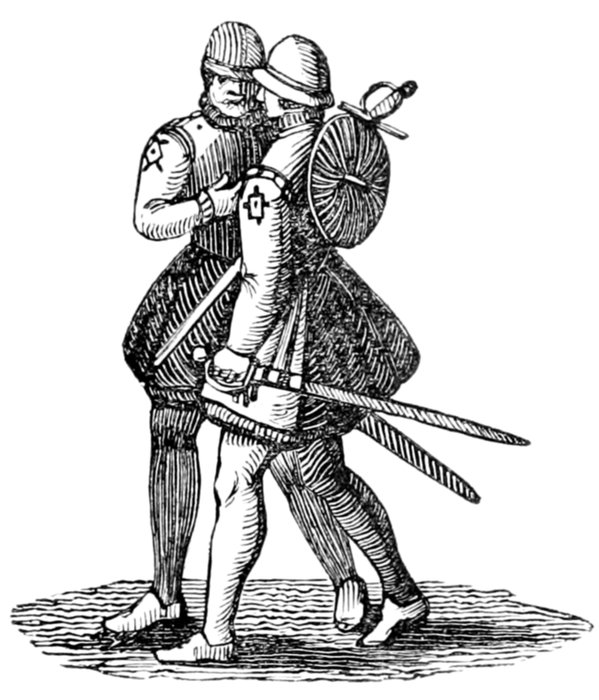
Slen. I bruis'd my shin the other day with playing at sword and dagger with a master of fence.
"Master of defence, on the present occasion, does not
simply mean a professor of the art of fencing, but a person
who had taken his master's degree in it," says Mr. Steevens,
whose readers are under great obligations to him for pointing
out one of the greatest curiosities extant on the ancient
science of defence, in support of his position. Yet it may
be doubted whether the expression master of defence does not
very often, and even on the present occasion, signify merely
a professor of the art. Numerous authorities might be adduced
on this side of the question, but perhaps a single one
that is apposite may suffice. In Eden's History of travayle,
1577, 4to, speaking of Calecut in the East Indies, he says,
"they have in the citie certayne maisters of fence that teach
them how to use the swoord, &c." The original Latin from
which Eden translates has lanista. Now it is not to be presumed
that the last-mentioned maisters of fence had taken
any degree. It must be owned that the evidence of the
manuscript cited by Mr. Steevens goes very far to show that
none were allowed to practise as professors who had not
taken a degree in some fencing school; an honour once conferred
by king Edward the Sixth, and generally granted,
though not till after many years' experience, by one who was
himself a master. Yet a person who had only a provost's degree
might be allowed to teach, and he would be termed a
master of defence.
Scene 3. Page 330.
Host. What says my bully-rook?
Messrs. Steevens and Whalley maintain that the above term
(a cant one) derives its origin from the rook in the game of
chess; but it is very improbable that that noble game, never
the amusement of gamblers, should have been ransacked on
this occasion. It means a hectoring, cheating sharper, as appears
from A new dictionary of the terms of the canting crew,
no date, 12mo, and from the lines prefixed to The compleat
gamester, 1680, 12mo, in both which places it is spelt bully-rock.
Nor is Mr. Whalley correct in stating that rock and
not rook is the true name of the chess piece, if he mean that
it is equivalent to the Latin rupes.
Scene 3. Page 333.
Pist. O base Gongarian wight!
It is already shown that this is the same as Hungarian. It
simply means a gipsy. The parts of Europe in which it is
supposed that the gipsies originally appeared were Hungary
and Bohemia. In Act IV. Scene 5, of this play, the host in
the like cant language calls Simple a Bohemian Tartar; and
Munster in his Cosmography informs us that the Germans
denominated the gipsies Tartars.
Scene 3. Page 333.
Fal. I am glad I am so acquit of this tinder box.
There is a great deal of humour in this appellation. Falstaff
alludes to Pistol's rubicund nose, which, like the above
utensil, carried fire in it.
Scene 3. Page 333.
Pist. Young ravens must have food.
Either Shakspeare or the adage, if it be one, has borrowed
from scripture. See Psalm cxlvii. 9. or Job xxxviii. 41.
Scene 3. Page 337. Note 4.
To the instances adduced by Mr. Steevens in this note, of
particular phrases in old theatrical characters, may be added
that of Murley in Sir John Oldcastle, who is continually prefacing
his speeches with "fye paltry, paltry, in and out, to
and fro upon occasion." This practice has been revived in
our modern comedies.
Scene 4. Page 347.
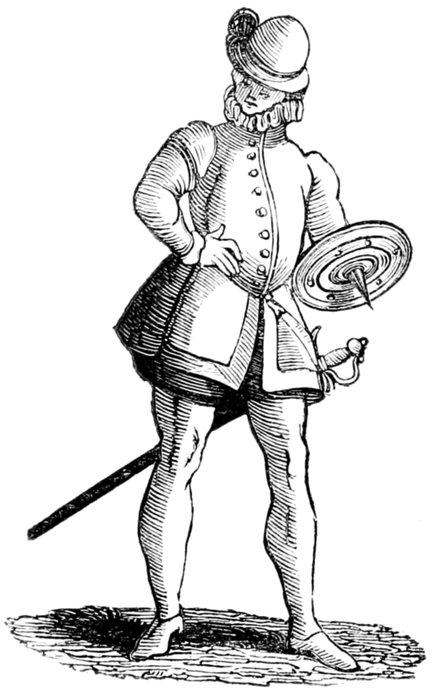
Caius. You are John Rugby, and you are Jack Rugby: come take-a your rapier, and come after my heel to de court.
It was the custom, in Shakspeare's time, for physicians to
be attended by their servants when visiting their patients.
This appears from the second part of Stubs's Anatomie of
abuses, sign. H. 4 b., where, speaking of physicians, he says,
"For now they ruffle it out in silckes and velvets, with their
men attending upon them, whereas many a poor man (God
wot) smarteth for it." Servants also carried their masters'
rapiers: "Yf a man can place a dysh, fyll a boule and carrie
his maister's rapier, what more is or can be required at his
handes?"—Markham's Health to the gentlemanly profession of
a serving-man, sign. F. 3.
Scene 1. Page 357.
Mrs. Ford. ... to the tune of Green sleeves.
Another ballad with this title, and which has an equally
good claim to be the one alluded to as those already quoted,
may be seen in Mr. Ellis's elegant Specimens of the early
English poets, vol. iii. p. 327, edit. 1801.
Scene 1. Page 358.
Mrs. Page. ... for sure, unless he knew some strain in me that I know not myself——
The note seem to have wrested from this word its plain
and obvious meaning of turn, humour, tendency, in which it
is often used by Shakspeare.
Scene 1. Page 359.
Pist. Hope is a curtail dog in some affairs.
A curtail or curtal dog is placed by Howel in the vocabulary
at the end of his Dictionary of four languages among
hunting-dogs, and is defined to be a dog without a tail good
for any service. Yet we are not to suppose that the word
uniformly signifies an animal with its tail cut off. It is in
fact derived from tailler court, and applied to any animals
that are defective, man not excepted. Thus in Greene's Quip
for an upstart courtier, a collier is made to say, "I am made
a curtall: for the pillory hath eaten off both my eares,"
sign. E. 2. Nashe, in his Prayse of the red herring, speaks
of the "curtaild skinclipping pagans." fo. 20. Dr. Stukeley,
in a manuscript note in his copy of Robin Hood's garland,
states that "the curtal fryer of Fountain's abby is Cordelier,
from the cord or rope which they wore round their wast, to
whip themselves with. They were of the Franciscan order."
But this is a mistake; and the opinion of Staveley much more
probable, who, in chap. xxv. of his Romish horseleech, says,
that in some countries where the Franciscan friars, conformably
to the injunction of their founder, wore short habits,
the order was presently contemned and derided, and men
called them curtailed friars.
Scene 2. Page 360.
Ford. Love my wife?
Pist. With liver burning hot.
It is here observed by Mr. Steevens, and elsewhere by Dr.
Johnson, that the liver was anciently supposed to be the
inspirer of amorous passions, and the seat of love. In conformity
with this opinion, we are told in the English translation
of Bartholomæus De proprietatibus rerum, lib. v. cap. 39,
that "the lyver is the place of voluptuousnesse and lyking
of the flesh;" and again, "the liver is a member, hot, &c."
There is some reason for thinking that the idea was borrowed
from the Arabian physicians, or at least adopted by them;
for in the Turkish tales, an amorous tailor is made to address
his wife by the titles of "thou corner of my liver, and soul of
my life!" and in another place the king of Syria, who had
sustained a temporary privation of his mistress, is said to
have had "his liver, which had been burnt up by the loss of
her, cooled and refreshed at the sight of her." In Twelfth
night, Fabian, speaking of Olivia's supposed letter to Malvolio,
says, "This wins him, liver and all."
Scene 2. Page 367, 368.
Page. I have heard the Frenchman hath good skill in his rapier.
Shal. In these times you stand on distance, your passes stoccadoes
and I know not what. I have seen the time with my
long sword I would have made you four tall fellows skip
like rats.
The notes on these speeches are at variance on a supposed
anachronism committed by Shakspeare in introducing the
rapier in the time of Henry the Fourth. The same weapon is
likewise found in Richard II. Act IV. Scene 1, where the
controversy is renewed; and therefore it will be proper in
considering this question to state the evidence and arguments
in both places. It is maintained on one side that the rapier
was not used in England before the reign of Elizabeth; and
in support of this opinion a passage from Carleton's Thankful
remembrance of God's mercy is offered; which, being
only a second-hand and inaccurate statement from Darcie's
Annals of Elizabeth, is not deserving of further notice.
Darcie himself informs us that one Rowland York (who appears
to have betrayed Deventer to the Spaniards in 1587)
was the first that brought into England "that wicked and
pernicious fashion to fight in the fields in duels with a rapier
called a tucke onely for the thrust, &c." On this passage it
may be remarked, that the rapier is not generally spoken of,
but only a particular sort, the tucke for the thrust. On the
same side Stowe is next cited, who mentions that the mode
of fighting with the sword and buckler was frequent with all
men till that of the rapier and dagger took place, when suddenly
the general quarrel of fighting abated, which began about
the 20th of Elizabeth (1578). Now here the date seems
rather applicable to the cessation of the very popular combats
with sword and buckler, and the substitution only, and,
as it will presently appear, the revival of the rapier and dagger,
as a more limited manner of fighting, from its superior
danger. There is another passage in Stowe, p. 869, which
not being already cited, and throwing some light on the
nature of the rapier, may deserve notice. The historian relates
that "Shortly after (referring to the 12th or 13th year
of Elizabeth) began long tucks and long rapiers, and he was
held the greatest gallant that had the deepest ruffe and
longest rapier: the offence to the eye of the one, and the
hurt unto the life of the subject that came by the other,
caused her majesty to make proclamation against them both,
and to place selected grave citizens at every gate to cut the
ruffes, and breake the rapiers points of all passengers that
exceeded a yeard in length of their rapiers, and a nayle of a
yeard in depth of their ruffes." But this is likewise no evidence
in favour of the general introduction of the rapier in
the reign of Elizabeth, as Stowe merely refers to the long
foining or thrusting rapier. The last quotation on this side of
the question is from Bulleine's Dialogue between soarnesse and
chirurgi, 1579, where the long foining rapier is also mentioned
as "a new kind of instrument to let blood withall."
On the opposite side, Mr. Ritson produces a quotation
from Nashe's Life of Jacke Wilton, who lived in the reign of
Henry the Eighth, to show that rapiers were used at that
period. This sort of evidence might appear, on a first view,
inadmissible, on the ground that Nashe had committed an
error, very common with Shakspeare, in ascribing a custom
of his own time to a preceding one, if it were not supported
by the manuscript cited by Mr. Steevens in vol. iii. p. 327,
in which, but not in the quotation from it, it appears that the
rapier actually was in use in the time of Henry the Eighth;
and therefore it is impossible to decide that this weapon,
which, with its name, we received from the French, might
not have been known as early as the reign of Henry the
Fourth, or even of Richard the Second. Shallow's ridicule
of passes and stoccadoes seems more objectionable, and may
possibly deserve the appellation of anachronism. It is not a
little remarkable that the rapier was an article of exportation
from this country in Cromwell's time. See Oliverian acts,
A.D. 1657.
Scene 1. Page 369.
Ford. Though Page be a secure fool, and stands so firmly on his
wife's frailty, yet I cannot put off my opinion so easily:
she was in his company, &c.
This speech is surely not so obscure as the notes seem to
consider it. Ford says that Page makes a firm stand with
respect to, or on the question of, his wife's frailty. What follows
better deserves explanation, because the grammatical
construction of the last sentence is, that Page's wife was in
Falstaff's company; whereas Ford means to say, "I cannot
put off my opinion, i. e. of my own wife, so easily; as she was
in Falstaff's company," &c. The emphasis should be laid on
the words his and my, and then the whole will be far more
intelligible.
Scene 2. Page 375.
Fal. Your cat-a-mountain looks.
A term borrowed from the Spaniards, who call the wild
cat gato-montes.
Scene 2. Page 375.
Fal. Your red lattice phrases.
Mr. Steevens, speaking of this external mark of an alehouse,
says, "Hence the present chequers." But in reality
the lattice is the younger of the two, as the reference in the
note to the Pompeii plate in Archæologia demonstrates. Although
the Romans were not acquainted with the game of
chess, they certainly were with such a one as required a
board with squares; and in all probability this sign of a house
of entertainment where table games were played, has been
handed down to us from the ancients. The resemblance of
lattice work, or laths crossing each other, to a chess or backgammon
board, might induce some ignorant painters to exhibit
the former; but the chequers have once more reassumed
their station. Nor was red always the colour; for, in the
cant language of jolly fellows, a red or blue lattice was termed
a free school for all comers. See Heywood's Philocothonista,
1635, 4to.
Scene 2. Page 376.
Quick. There is one mistress Ford, sir:—I pray come a little nearer
this ways:—I myself dwell with master Doctor Caius.
Fal. Well, on: mistress Ford, you say——
Is it not more natural that Falstaff should, in this first instance,
repeat the dame's own words, and say, "Well, one
mistress Ford, you say."
Scene 2. Page 389.
Ford. ... an Irishman with my aqua vitæ bottle——
Irish aqua vitæ was certainly usquebaugh, and not brandy,
as Mr. Malone has observed; but Ford is here speaking of
English aqua vitæ, which was very different from the other so
called from the Irish words uisge, aqua, and beatha, vita.
That the curious reader may judge for himself, and at the
same time be furnished with the means of indulging any wish
that he may have for tasting the respective sorts in their genuine
form, the following receipts for making them are subjoined:—The
first is from a manuscript monkish common-place
book, written about the reign of Henry the Sixth.
"For to make water of lyff, that ys clepyd aqua vitæ. Take
and fylle thy violle fulle of lyes of stronge vine, and put
therto these powdrys. First powder of canel, powder of
clowes, powdyr of gyngevir, powdyr of notemugys, powder
of galyngale and powdyr of quibibis, poudyr of greyn de
parys, poudyr of longe pepyr, powdyr of blacke pepir, carewey,
cirmowitteyn, comyn, fenyl, smallache, persile, sawge,
myntys, rewe, calamente, origaun, one ounce or more or
lesse as ye lykyth; stampe hem a lytill for it will be bettyr,
and put hem to these powdrys, than set thy glas on the fyre
set on the hovel and kepe it wel that the eyre come not owte
and set ther undyr a viole and kepe the watyr." The next is
from Cogan's Haven of health, 1612, 4to, chap. 222. "To
make aqua vitæ. Take of strong ale, or strong wine, or the
lees of strong wine and ale together, a gallon or two as you
please, and take half a pound or more of good liquorice, and
as much annise seedes; scrape off the bark from the liquorice,
and cut it into thin slices, and punne the annise grosse, and
steepe altogether close covered twelve houres, then distill it
with a limbecke or serpentine. And of every gallon of the
liquor you may draw a quart of reasonable good aqua vitæ,
that is of two galons two quarts. But see that your fire be
temperate, and that the heade of your limbecke bee kept colde
continually with fresh water, and that the bottome of your
limbecke bee fast luted with rye dough, that no ayre issue
out. The best ale to make aqua vitæ of, is to be made of
wheate malte, and the next of cleane barley malte, and the
best wine for that purpose is sacke." The last is a receipt
for making "Usquebath, or Irish aqua vitæ. To every gallon
of good aqua composita, put two ounces of chosen liquorice
bruised and cut into small peeces, but first cleansed
from all his filth, and two ounces of annis seedes that are
cleane and bruised; let them macerate five or six days in a
wodden vessell, stopping the same close, and then draw off
as much as will runne cleere, dissolving in that cleere aqua
vitæ five or sixe spoonefulls of the best malassoes you can
get: Spanish cute if you can get it, is thought better than
malassoes: then put this into another vessell, and after three
or foure dayes (the more the better) when the liquor hath
fined itselfe, you maie use the same: some adde dates and
raisins of the sun to this receipt; those grounds which remaine
you maie redistill and make more aqua composita of
them, and of that aqua composita you maie make more usquebath."—Plat's
Delightes for ladies, 1611, 24to. It is to be
observed, that aqua composita is wine of any kind distilled
with spices and sweet herbs. Brandy, or burnt wine, seems
first to occur in Skinner's Etymologicon, 1671, under the name
of Brandewin, from the Dutch or German, and soon after in
its present form; yet aqua vitæ was continued a long while
afterwards.
Scene 3. Page 395.
Host. Cry'd game, said I well?
The evidence, and indeed the sense, in favour of the phrase
to cry aim, preponderates so greatly, that one cannot hesitate
in discarding the nonsensical expression of cry'd game,
which derives not the least support from any of Mr. Steevens's
quotations. The probability is very great that there was an
error of the press, and that the words should have been
printed according to the orthography of the time, "Cry'd I
ayme, said I well?" A g might easily have crept in instead
of a y.
Scene 1. Page 398.
Sim. Marry, sir, the city-ward——
"The old editions read pittie-ward, the modern editors
pitty-wary," says Mr. Steevens, who in this edition has abandoned
the best part of a former note where he had proposed
to read petty-ward, which is the right word, and of the same
import as the old one. That such a word formerly existed is
demonstrable from its still remaining as a proper name, and
near Wimbledon is a wood so called, probably from the
owner. Mr. Steevens mistakes in supposing ward to mean
towards in this instance, where it is put for the division of a
city; nor does his quotation from William of Worcester
assist him. The via de Petty and the Pyttey gate might be
named after the hundred of Pyttey in Somersetshire. In
Lyne's Map of Cambridge, 1574, we find the petticurie.
Scene 1. Page 399.
Evans. I will knog his urinals about his knave's costard——
This utensil was the usual concomitant of physicians in
former times, as appears from most of the frontispieces to
old medical books and other ancient prints.
Scene 2. Page 410.
Host. ... he smells April and May.
The same as if he had said he smells of youth and courtship,
symbolized by these months, the former of which in old
calendars is described in these lines:
"The next vi yere maketh foure and twenty, And fygured is to joly Apryll; That tyme of pleasures man hath moost plenty Fresshe and lovyng his lustes to fulfyll——"
and the latter in the following:
"As in the month of Maye all thyng is in myght, So at xxx yeres man is in chyef lykyng; Pleasaunt and lusty, to every mannes syght, In beaute and strength to women pleasyng."
Scene 2. Page 412.
Host. I will to my honest knight Falstaff, and drink canary with him.
Ford. I think I shall drink-in pipe-wine first with him; I'll make him dance.
It may be doubted whether the exact meaning of this
cluster of puns has already been given. Mr. Tyrwhitt says
he cannot understand the phrase to drink in pipe-wine, and
suggests that Shakspeare might have written horn-pipe wine.
Now Ford terms canary pipe-wine, both because the canary
dance is performed to a tabor and pipe, and because the canary
bird is said to pipe his tunes. Ford is speaking of Falstaff,
not of Page, as Mr. Tyrwhitt's note implies when it refers to
horns. He says he will make him pipe and dance too.
Scene 3. Page 414.
Mrs. Ford. How now, my eyas-musket?
There was no reason for disturbing the etymology of this
word given by Dr. Warburton, by substituting that of Dame
Juliana Bernes, which for ingenuity and veracity may be well
classed with many of those in Isidore of Seville, or The golden
legend. Take an example from the latter. "Felix is sayd of
fero fers, that is to saye, to bere, and of this word lis, litis,
whiche is as moche to say as stryfe, for he bare stryfe for the
fayth of our lorde." Turberville tells us that "the first name
and terme that they bestowe on a falcon is an eyesse, and this
name doth laste as long as she is in the eyrie and for that she
is taken from the eyrie." This is almost as bad as the lady
abbess's account. Eyrie is simply the nest or eggery, and
has no connexion with the name of the bird. Eyas or nias,
is a term borrowed from the French niais, which means any
young bird in the nest, avis in nido. It is the first of five
several names by which a falcon is called during its first year.
The best account of this bird is in La fauconnerie de Charles
d'Arcussa de Capre, seigneur d'Esparron, 1643, 4to. A musket
is a sparrow-hawk, and is derived from the French mouchet,
and the latter probably from musca, on account of its diminutive
form. The humour therefore lies in comparing the
page to a young male sparrow-hawk, an emblem of his tender
years and activity.
Scene 2. Page 448.
Mrs. Ford. ... and her muffler too.
It would oppress the reader by citing authorities to prove
that the muffler was a contrivance of various kinds to conceal
a part of the face, and that even a mask was occasionally so
denominated. From an examination of several ancient prints
and paintings, it appears that when the muffler was made of
linen, it only covered the lower part of the face; such it was
in the present instance, for the old woman of Brentford would
not want to conceal her eyes. It is otherwise in King Henry V.
Act III. Scene 1, where Fortune's blindness is described, and
there a linen bandage would be meant, but perhaps not very
correctly called a muffler. The term is connected with the
old French musser or muçer, to hide, or with amuseler, to
cover the museau or mufle, a word which has been indiscriminately
used for the mouth, nose, and even the whole of the
face; hence our muzzle. It was enacted by a Scotish statute
in 1457, that "na woman cum to kirk, nor mercat, with her
face mussaled or covered that scho may not be kend." Notwithstanding
this interposition of the legislature, says Mr.
Warton, the ladies of Scotland continued muzzled during
three reigns; and he cites Sir David Lyndsay's poem In contemptioun
of syde taillis, in which the author advises the king
to issue a proclamation that the women should show their
faces as they did in France. Hist. of Eng. poetry, ii. 324.
The annexed cuts exhibit different sorts of mufflers. The
first and third figures are copied from Jost Amman's Theatrum
mulierum, Francof. 1586, 4to; the second, from Speed's
Map of England, is the costume of an English countrywoman
in the reign of James I.; the fourth is from an old German
print; and the others from Weigel's Habitus præcipuorum
populorum, Nuremb. 1577, folio; a work which, for the beauty
of the wood-cuts, has never been surpassed.
In the reign of Charles I. the ladies wore masks which
covered the eye-brows and nose, holes being left for the eyes.
Sometimes, but not always, the mouth was covered, and the
chin guarded with a sort of muffler then called a chin-cloth;
these were chiefly used to keep off the sun. See Hollar's
print of Winter. The velvet masks probably came from
France, as they are mentioned in the Book of values of merchandize
imported, under the administration of Oliver Cromwell.
There was another sort called visard masks, that covered
all the face, having holes only for the eyes, a case for the nose,
and a slit for the mouth. They were easily disengaged, being
held in the teeth by means of a round bead fastened in the
inside. These masks were usually made of leather, covered
with black velvet. Randle Holme, from whose Academy of
armory, book iii. c. 5, their description is extracted, adds, that
the devil invented them, and that none about court except
w——s, bawds, and the devil's imps, used them, being
ashamed to show their faces.
Scene 2. Page 450.
Page. Why this passes!——
The word had been already explained by Warburton in
p. 329. Page, astonished at Ford's conduct, says it exceeds
every thing. Such is the sense in the New Testament, "the
love of Christ, which passeth knowledge," Ephes. iii. 19.
The French often use passer in the same manner; and in
Hamlet we have this expression, "I have that within which
passeth show."
Scene 2. Page 452.
Ford. ... his wife's leman.
Mr. Steevens derives it from the Dutch, a language whence
we have borrowed few, if any words. The term is of Saxon
origin, and leveman can be traced to an Anglo-Norman period.
This was afterwards contracted into leman. The etymology
is perhaps from leoꝼe, amabilis, and man, homo. The latter
in Saxon denoted both man and woman; so that leman was
formerly applied to both sexes as a person beloved.
Scene 2. Page 455.
Mrs. Page. ... in the way of waste——
This expression is from the same law manufactory referred
to by Mr. Ritson in the preceding note. The incident in the
present scene, of Falstaff's threshing in the habit of a woman,
might have been suggested by the story of the beaten and
contented cuckold in Boccaccio's Decameron, day 7. ver. 7.
Scene 5. Page 466.
Simp. Pray you, sir, was't not the wise woman of Brentford?
Mr. Steevens cites Judges v. 29, on this occasion: but the
wise ladies there were of a very different character from the
old woman of Brentford, even according to the Hebrew
text: see the Vulgate and Septuagint versions, where the
expression is still more remote. The subject of these wise
women will be resumed in a note on Twelfth night, Act III.
Scene 4.
Scene 1. Page 475.
Fal. Hold up your head, and mince.
The word is properly explained by Mr. Steevens. Thus
in Isaiah iii. 16, "walking and mincing as they go." Wicliffe
has "with their feet in curious goyng;" and Tindale, "tryppyng
so nicely with their feet." To mince is likewise to
walk in a stately, or, as Littelton expresses it, Junonian step.
Scene 2. Page 477.
Slen. I come to her in white, and cry mum, she cries, budget.
The word mumbudget, here divided, is used by Nashe in
his Have with you to Saffron Walden, where, speaking of
Gabriel Harvey, he says, "no villaine, no atheist, no murderer,
but hee hath likened me too, for no other reason in the
earth, but because I would not let him go beyond me, or be
won to put my finger in my mouth and crie mumbudget when he
had baffuld mee in print throughout England." To play
mumbudget, is rendered demeurer court, ne sonner mot, in
Sherwood's English and French dictionary, 1632, folio.
Mumchance is silence; and a mummery was a silent masquerade.
Mumbudget may be silence in a budget, a something
closed or stopped up, Fr. bouché.
Scene 4. Page 479.
Mrs. Page.... hard by Herne's oak——
The tree in Windsor forest referred to in Mr. Steevens's
note, was said, on newspaper authority in 1795, to have been
cut down by his majesty's order, on account of its being
totally decayed.
Scene 5. Page 490.
Pist.Vile worm!
Old copy vild, which Mr. Malone shows to have been the
old pronunciation. It may be added that it is likewise the
modern in some of the provinces.
Scene 5. Page 492.
[Stage direction.] "During this song, the fairies pinch Falstaff."
In the old collection of songs already cited in p. 7, there
is one entitled "The fayries daunce," which bearing some
resemblance to that by Shakspeare, may be entitled to the
reader's notice:
"Dare you haunt our hallowed greene? None but fayries here are seene. Downe and sleepe, Wake and weepe, Pinch him black, and pinch him blew, That seekes to steale a lover true. When you come to heare us sing, Or to tread our fayrie ring, Pinch him black, and pinch him blew, O thus our nayles shall handle you."
Scene 5. Page 500.
Page. What cannot be eschew'd must be embrac'd.
This is either a proverbial saying now lost, or borrowed
from one of the following, "What cannot be altered must
be borne not blamed;" "What cannot be cured must be endured."
TWELFTH NIGHT. — ACT I. — ACT II. — ACT III. — ACT IV. — ACT V. — THE CLOWN. — FOOTNOTES:
Scene 1. Page 8.
Duke. How will she love, when the rich golden shaft Hath kill'd the flock of all affections else That live in her.
This golden shaft was supplied either from a description of
Cupid in Sidney's Arcadia, book ii., or from Ovid's Metamorphoses,
translated by Golding, 4to, fo. 8, where, speaking
of Cupid's arrows, he says,
"That causeth love is all of golde with point full sharp and bright. That chaseth love, is blunt, whose steele with leaden head is dight."
Milton seems to have forgotten that Love had only one
shaft of gold. See Parad. Lost, iv. 1. 763.
Scene 2. Page 11.
Cap. ... she hath abjur'd the company And sight of men.
This necessary and justifiable change in the ordo verborum
from the reading in the old copy, and to which Mr. Steevens
lays claim, had been already made by Sir Thomas Hanmer.
Scene 3. Page 21.
Sir To. ... Wherefore have these gifts a curtain before them? are they like to take dust, like mistress Mall's picture?
Mr. Malone's conjecture that curtains were at this time
frequently hung before pictures of value, is further supported
in Scene 5 of this Act, where Olivia, in unveiling her face,
mentions the practice. In Deloney's Pleasant history of
Jack of Newbery, printed before 1597, it is recorded that "in
a faire large parlour, which was wainscotted round about,
Jacke of Newbery had fifteene faire pictures hanging, which
were covered with curtaines of greene silke, frienged with gold,
which he would often shew to his friends and servants."
Scene 3. Page 23.
Sir And. Taurus? that's sides and heart.
Sir To. No, sir, it is legs and thighs.
Both the knights are wrong in their astrology, according
to the almanacs of the time, which make Taurus govern the
neck and throat. Their ignorance is perhaps intentional.
Scene 5. Page 31.
Sir To. ... How now, sot?
There is great humour in this ambiguous word, which applies
equally to the fool and the knight himself, in his drunken
condition.
Scene 3. Page 51.
Clown. How now, my hearts? Did you never see the picture of we three?
The original picture, or sign as it sometimes was, seems to
have been two fools. Thus in Shirley's Bird in cage, Morello,
who counterfeits a fool, says, "We be three of old, without
exception to your lordship, only with this difference, I
am the wisest fool." In Day's comedy of Law tricks, 1608,
Jul. says, "appoint the place prest." To which Em. answers,
"At the three fools." Sometimes, as Mr. Henley has stated,
it was two asses. Thus in Beaumont and Fletcher's Queen
of Corinth, Act III. Scene 1,
"Nean. He is another ass, he says, I believe him.
Uncle.We be three, heroical prince.
Nean. Nay then we must have the picture of 'em, and the word nos sumus."
Scene 3. Page. 53.
Clo. I did impeticos thy gratility.
This is undoubtedly the true reading, for the reason assigned
by Mr. Malone. From the discordant notes on the
passage, a question has arisen whether the fool means to say
that he had put the six-pence into his own petticoats, or given
it to his petticoat companion, his leman. Mr. Steevens has
observed that "petticoats were not always a part of the
dress of fools, though they were of idiots;" and on this assertion,
coupled with another by Dr. Johnson, that "fools
were kept in long coats to which the allusion is made," Mr.
Ritson maintains that "it is a very gross mistake to imagine
that this character (i. e. our clown's) was habited like an idiot."
Now it is very certain, that although the idiot fools were
generally dressed in petticoats, the allowed fool was occasionally
habited in like manner, as is shown more at large in
another part of this volume; which circumstance, though it
may strengthen the opinion that the clown has alluded to his
own dress, by no means decides the above question, which
remains very equally balanced.
Scene 3. Page 63.
Sir To. Dost thou think because thou art virtuous, there shall beno more cakes and ale?
The holiday cakes referred to in Mr. Letherland's note
were the yule or Christmas cakes; those on the lying-in of
the Virgin; cross-buns, and twelfth cakes. Mr. Lysons, in
his account of Twickenham, mentions an ancient custom of
dividing two great cakes in the church on Easter-day among
the young people. This was regarded as a superstitious relic;
and it was ordered by the parliament in 1645, that the parishioners
should forbear that custom, and instead thereof buy
loaves of bread for the poor of the parish.
Scene 4. Page 70.
Duke. And the free maids that weave their threads with bones.
The private memoirs of Peter the wild boy, if they could
be disclosed, would afford the best comment on the above
disputed epithet, as applied to the websters in question.
Scene 4. Page 71.
Clo. And in sad cypress let me be laid.
Mr. Steevens has in this edition cancelled a brother commentator's
note, which ought on every account to have been
retained, and has himself attempted to show that a shroud
and not a coffin of cypress or cyprus is intended. It is no
easy matter, from the ambiguity of the word, to decide the
question. The cypress tree was used by the ancients for
funeral purposes, and dedicated to Pluto. As it was not
liable to perish from rottenness, it appears to have been used
for coffins. See Mr. Gough's Introduction to Sepulchral
monuments, p. lxvi. In Quarles's Argalus and Parthenia,
book iii., a knight is introduced, whose
"... horse was black as jet, His furniture was round about beset With branches, slipt from the sad cypresse tree."
In further behalf of the wood, it may be worth remarking
that the expression laid seems more applicable to a coffin
than to a shroud, in which a party may with greater propriety
be said to be wrapped; and also that the shroud is afterwards
expressly mentioned by itself. It is nevertheless very certain
that the fine linen called Cyprus, perhaps from being originally
manufactured in the island of that name, was used for
shrouds. In the churchwardens' accounts of St. Mary's,
Cambridge, mention is made of a sypyrs kyrcher belonging to
the cross. In this instance there being the figure of a dead
body on the cross, the cyprus was designed as a shroud.
Scene 5. Page 88.
Mal. By my life, this is my lady's hand: these be her very C's, her U's, and her T's, and thus makes she her great P's.
Mr. Ritson having with great probability supplied the
whole direction of the letter, there seems to be no foundation
left for Blackstone's conjecture. Malvolio had no motive for
any coarse allusion. With respect to the instance of the
letter in All's well that ends well not being recited literally
by Helen, it must be recollected that there was no reason for
making her do so, as she talks in blank verse; and it would
therefore have been improper that she should have given
more than the substance of the letter.
Scene 5. Page 93.
Mal. ... and wish'd to see thee cross-gartered.
Of this fashion but few vestiges remain; a circumstance
the more remarkable, as it must have been at one time extremely
common among the beaux in Elizabeth's reign. In
the English edition of Junius's Nomenclator, 1585, 12mo,
mention is made of "hose garters, going acrosse, or over-thwart,
both above and below the knee." In the old comedy
of The two angrie women of Abingdon, 1599, 4to, a serving-man
is thus described:
"... hee's a fine neate fellow, A spruce slave, I warrant ye, he'ele have His cruell garters crosse about the knee."
Scene 5. Page 94.
Mal. I will be point-de-vice [device].
As the instances of this expression are of rare occurrence,
those which follow are offered as likely to be useful to the
author of any future work that may resemble the well-planned,
but unfinished glossary of obsolete and provincial words
by the late Dr. Boucher. In the interlude of The nature of
the four elements, Sensuality, one of the dramatis personæ,
promises a banquet
"Of metys that be most delycate, Which shall be in a chamber feyre Replete with sote and fragrāt eyre Prepared poynt-deryse."
In Newes from the North, 1579, 4to, mention is made of
"costly banqueting houses, galleries, bowling-allees, straunge
toies of point-devise and woorkmanship," sign. G. In an old
and very rare satirical poem against married ladies, entitled,
The proude wyves paternoster that wold go gaye, and undyd her
husbande and went her waye, 1560, 4to, one of the gossips recommends
her companion to wear
"Rybandes of sylke that be full longe and large, With tryangles trymly made poyntdevyse."
Some further account of this piece may not be unacceptable.
It is described in Laneham's Letter from Killingworth
as forming part of Captain Cox the mason's curious
library. In the appendix to Baker's Biographia dramatica,
p. 433, a play under the same title is mentioned as entered
on the Stationers' books in 1559; but from the correspondence
in the date, it was, most likely, the present work, which
cannot be regarded as a dramatic one. It describes the hypocritical
behaviour of women at church, who, instead of attending
to their devotions, are more anxious to show their
gay apparel. One of these, observing a neighbour much
better clothed than herself, begins her paternoster, wherein
she complains of her husband's restrictions, and prays that
she may be enabled to dress as gaily as the rest of her acquaintance.
She afterwards enters into conversation with a
female gossip, by whose mischievous instigation she is seduced
to rebel against her husband's authority. In consequence
of this, the poor man is first entreated, next threatened,
and finally ruined. The author of this poem is not the
first who has irreligiously made use of the present vehicle of
his satire. One of the old Norman minstrels had preceded
him in The usurer's paternoster, which Mons. Le Grand has
inserted among his entertaining fabliaux, and at the same
time described some other similar compositions.
But to return to point-device:—There was no occasion for
separating the two last syllables of this term, as in the quotation
from Mr. Steevens's text, nor is it done when it occurs
elsewhere in his edition. It has been properly stated that
point-device signifies exact, nicely finical; but nothing has
been offered concerning the etymology, except that we got
the expression from the French. It has in fact been supplied
from the labours of the needle. Poinet in the French language
denotes a stitch; devisé any thing invented, disposed, or
arranged. Point-devisé was therefore a particular sort of patterned
lace worked with the needle; and the term point-lace
is still familiar to every female. They had likewise their
point-coupé, point-compté, dentelle au point devant l'aiguille,
&c., &c. The various kinds of needle-work practised by our
indefatigable grandmothers, if enumerated, would astonish
even the most industrious of our modern ladies. Many
curious books of patterns for lace and all sorts of needle-work
were formerly published, some of which are worth
pointing out to the curious collector. The earliest on the list
is an Italian book under the title of Esemplario di lavori:
dove le tenere fanciulle & altre donne nobile potranno facilmente
imparare il modo & ordine di lavorare, cusire, raccamare,
& finalmente far tutte quelle gentillezze & lodevili opere,
le quali pò fare una donna virtuosa con laco in mano, con li
suoi compasse & misure. Vinegia, per Nicolo D'Aristotile
detto Zoppino, MDXXIX. 8vo. The next that occurs was
likewise set forth by an Italian, and entitled, Les singuliers
et nouveaux pourtraicts du seigneur Federic de Vinciolo Venitien,
pour toutes sortes d'ouvrages de lingerie. Paris, 1588,
4to. It is dedicated to the queen of France, and had been
already twice published. In 1599 a second part came out,
which is much more difficult to be met with than the former,
and sometimes contains a neat portrait, by Gaultier, of Catherine
de Bourbon, the sister of Henry the Fourth. The
next is Nouveaux pourtraicts de point coupé et dantelles en
petite moyenne et grande forme, nouvellement inventez et mis
en lumiere. Imprimé à Montbeliard, 1598, 4to. It has an
address to the ladies, and a poem exhorting young damsels to
be industrious; but the author's name does not appear.
Vincentio's work was published in England, and printed by
John Wolf, under the title of New and singular patternes and
workes of linnen, serving for paternes to make all sortes of
lace, edginges and cut-workes. Newly invented for the profite
and contentment of ladies, gentilwomen, and others that are
desireous of this art. 1591, 4to. He seems also to have
printed it with a French title. We have then another English
book of which this is the title: Here foloweth certaine
Patternes of Cut-workes: newly invented and never published
before. Also sundry sortes of spots, as flowers, birdes and
fishes, &c. and will fitly serve to be wrought, some with gould,
some with silke, and some with crewell in coullers: or otherwise
at your pleasure. And never but once published before.
Printed by Rich. Shorleyker. No date, in oblong 4to. And,
lastly, another oblong quarto entitled The needles excellency,
a new booke wherin are divers admirable workes wrought with
the needle. Newly invented and cut in copper for the pleasure
and profit of the industrious. Printed for James Boler, &c.
1640. Beneath this title is a neat engraving of three ladies
in a flower garden, under the names of Wisdom, Industrie,
and Follie. Prefixed to the patterns are sundry poems in
commendation of the needle, and describing the characters of
ladies who have been eminent for their skill in needle-work,
among whom are Queen Elizabeth and the Countess of Pembroke.
These poems were composed by John Taylor the
water poet. It appears that the work had gone through
twelve impressions, and yet a copy is now scarcely to be met
with. This may be accounted for by supposing that such
books were generally cut to pieces, and used by women to
work upon or transfer to their samplers. From the dress of
a lady and gentleman on one of the patterns in the last mentioned
book, it appears to have been originally published in
the reign of James the First. All the others are embellished
with a multitude of patterns elegantly cut in wood, several of
which are eminently conspicuous for their taste and beauty.
It is therefore apparent that the expression point-devise
became applicable, in a secondary sense, to whatever was uncommonly
exact, or constructed with the nicety and precision
of stitches made or devised by the needle.
Scene 1. Page 97.
Vio. Dost thou live by thy tabor?
This instrument is found in the hands of fools long before
the time of Shakspeare. With respect to the sign of the
tabor mentioned in the notes, it might, as stated, have been
the designation of a musick shop; but that it was the sign of
an eating-house kept by Tarleton is a mistake into which a
learned commentator has been inadvertently betrayed. It
appears from Tarleton's Jests, 1611, 4to, that he kept a tavern
in Gracious [Gracechurch] street, at the sign of the Saba.
This is the person who in our modern bibles is called the queen
of Sheba, and the sign has been corrupted into that of the
bell-savage, as may be gathered from the inedited metrical
romance of Alexander, supposed to have been written at the
beginning of the fourteenth century by Adam Davie, who, in
describing the countries visited by his hero, mentions that of
Macropy (the Macropii of Pliny), and adds,
"In heore[4] lond is a cité On of the noblest in Christianté[5]; Hit hotith[6]Sabba in langage. Thennes cam Sibely savage, Of al theo world theo fairest quene, To Jerusalem, Salamon to seone[7] For hire fairhed[8], and for hire love, Salamon forsok his God above."
Sibely savage, as a proper name, is another perversion of
si belle sauvage; and though the lady was supposed to have
come from the remotest parts of Africa, and might have been
as black as a Negro, we are not now to dispute the superlative
beauty of the mistress of Salomon, here converted into a
Savage. It must be admitted that the queen of Sheba was as
well adapted to a sign as the wise men of the East, afterwards
metamorphosed into the three kings of Cologne.
Mr. Pegge, in his Anecdotes of the English language,
p. 291, informs us that a friend had seen a lease of the Bell
Savage inn to Isabella Savage; "which," says he, "overthrows
the conjectures about a bell and a savage, la belle
sauvage, &c." It is probable that the learned writer's friend
was in some way or other deceived. The date of the instrument
is not mentioned; and if the above name really appeared
in the lease, it might have been an accidental circumstance
at a period not very distant. Mr. Pegge was likewise not
aware that the same sign, corrupted in like manner, was used
on the continent.
Scene 2. Page 109.
Sir To. Go write it in a martial hand; be curst and brief.
Of the latter sentence Dr. Johnson has not given the exact
explanation. It alludes to the proverb, "A curst cur must
be tied short."
Scene 4. Page 120.
Sir To. What, man! defy the Devil: consider, he's an enemy to mankind.
It was very much the practice with old writers, both French
and English, to call the Devil, the enemy, by way of pre-eminence,
founded perhaps on the words of Christ in Luke x.
19. Thus at the beginning of the Roman de Merlin, MS.
"Mult fu iriez li anemis quant nre sires ot este en anfer;"
and see other examples in Barbasan's glossary to the Ordene
de chevalerie, 1759, 12mo, in v. Anemi. The cause of the
Devil's wrath in the above instance, was the liberation of
Adam, Noah, and many other saints and patriarchs from the
purgatorial torments which they had endured. In a most
curious description of hell in Examples howe mortall synne
maketh the synners inobedyentes to have many paynes and
doloures within the fyre of hell, b. l. no date, 12mo, the Devil
is thus referred to: "Come than after me, and I shal shewe
unto the the ryght cursed enemye of humayne lygnage." And
again, "About the enemy there were so many devyls and of
cursed and myserable soules that no man myght beleve that
of all the worlde from the begynnynge myght be yssued and
brought forth so many soules." Sometimes he was called
the enemy of hell, as in Larke's Boke of wisdome, b. l. no date,
12mo, where it is said that "the enemye of hell ought to be
doubted of every wise man." This note may serve also
in further explanation of the line in Macbeth, Act III.
Scene 1,
"Given to the common enemy of man."
It is remarkable that the Devil should be likewise called the
enemy of mankind in the East. See Gladwin's Persian moon-shee,
part ii. p. 23.
Scene 4. Page 120.
Fab. Carry his water to the wise woman.
Here may be a direct allusion to one of the two ladies of
this description mentioned in the following passage from
Heywood's play of The wise woman of Hogsdon; "You have
heard of Mother Notingham, who for her time was prettily
well skill'd in casting of waters: and after her, Mother
Bombye." The latter is sometimes alluded to by Gerarde the
Herbalist, who, speaking of the properties of vervain, says,
"you must observe mother Bumbies rules to take just so many
knots or sprigs, and no more, least it fall out so that it do
you no good, if you catch no harme by it." Historie of plants,
p. 581.
Lilly's comedy of Mother Bombie is well known. The
several occupations of these impostors are thus described in
the above play by Heywood: "Let me see how many trades
have I to live by: First, I am a wise-woman, and a fortuneteller,
and under that I deale in physicke and forespeaking, in
palmistry, and recovering of things lost. Next, I undertake
to cure madd folkes. Then I keepe gentlewomen lodgers, to
furnish such chambers as I let out by the night: Then I am
provided for bringing young wenches to bed; and, for a need,
you see I can play the match-maker. Shee that is but one,
and professeth so many, may well be tearmed a wise-woman,
if there bee any." Such another character was Julian of
Brentford, mentioned in the Merry wives of Windsor. These
persons were sometimes called cunning and looming women.
Scene 4. Page 121.
Sir To. Come, we'll have him in a dark room, and bound. My niece is already in the belief that he is mad.
The reason for putting Malvolio into a dark room was to
make him believe that he was mad; for a madhouse seems
formerly to have been called a dark-house. In the next act
Malvolio says, "Good Sir Topas, do not think I am mad,
they have laid me here in hideous darkness." And again, "I
say this house is dark." In Act V. he asks, "Why have you
suffer'd me to be imprison'd, kept in a dark-house?" In As
you like it, Act III. Scene 1, Rosalind says that "love is a
madness, and deserves as well a dark-house and a whip, as
madmen do." Edward Blount, in the second dedication to
his Hospitall of incurable fooles, 1600, 4to, a translation from
the Italian, requests of the person whom he addresses to
take on him the office of patron or treasurer to the hospital;
and that if any desperate censurer shall stab him for assigning
his office or place, he presently take him into the dark
ward: and in the same work, certain idle fools are consigned
to the darksome guesthouse of their madness.
Scene 4. Page 124.
Oli. I have said too much unto a heart of stone, and laid mine honour too unchary on't.
This is the reading of the old copy, which has been unnecessarily
disturbed at Theobald's suggestion by substituting
out. It might be urged that laying honour out is but an awkward
phrase. The old text simply means, I have placed my
honour too incautiously upon a heart of stone. The preceding
note had shown that adjectives are often used adverbially
by Shakspeare.
Scene 4. Page 127.
Sir To. He is a knight, dubb'd with unhack'd rapier, and on carpet consideration.
The original word is unhatch'd, and if any alteration be admitted
it should be an hatch'd, for the first reason assigned
in Mr. Malone's ingenious note. Sir Toby says that his brother
knight was no hero dubbed in the field of battle, but a
carpet knight made at home in time of peace with a sword of
ceremony richly gilt or engraved. In Don Quixote, the damsel
whom Sancho finds wandering in the streets of Barataria
disguised as a man, is furnished with "a very faire hatched
dagger," chap. 49 of Shelton's translation. In The tragical
history of Jetzer, 1683, 18mo, mention is made of "a sword
richly hatcht with silver." Thus much in support of the
above slight alteration of the old reading. The second conjecture
of Mr. Malone, that unhatcht might have been used in
the sense of unhack'd, deserves much attention; but there
was no necessity for introducing the latter word into the text.
To hatch a sword has been thought to signify to engrave it;
but it appears from Holme's Academy of armory, B. iii.
p. 91, that "hatching, is to silver or gild the hilt and pomell
of a sword or hanger."
With respect to carpet knights, they were sometimes called
knights of the green cloth. For this information we are
also indebted to Holme, who, in his above cited work, B. iii.
p. 57, informs us that "all such as have studied law, physic,
or any other arts and sciences whereby they have become famous
and serviceable to the court, city, or state, and thereby
have merited honour, worship, or dignity, from the sovereign
and fountain of honour; if it be the King's pleasure to knight
any such persons, seeing they are not knighted as soldiers,
they are not therefore to use the horseman's title or spurs;
they are only termed simply miles et milites, knights of the
carpet or knights of the green cloth, to distinguish them from
knights that are dubbed as soldiers in the field; though in
these our days they are created or dubbed with the like ceremony
as the others are, by the stroak of a naked sword upon
their shoulder, with the words, Rise up Sir T. A. knight."
Scene 1. Page 136.
Clo. I am afraid this great lubber the world will prove a cockney.
A typographical corruption seems to have crept into this
place from similitude of sound; but a very slight alteration
will restore the sense. The clown is speaking of vent as an
affected word; and we should therefore read "this great lubberly
word will prove a cockney," i. e. will turn out to be
cockney language.
Scene 2. Page 140.
Clo. For as the old hermit of Prague——
Not the celebrated heresiarch Jerome of Prague, but another
of that name born likewise at Prague, and called the hermit
of Camaldoli in Tuscany.
Scene 2. Page 141.
Clo. Say'st thou that house is dark?
This Mr. Malone conceives to be a pompous appellation for
the small room in which Malvolio was confined; but it seems
to be merely the designation of a madhouse. See the preceding
note on Act III. Scene 4, p. 121.
Scene 1. Page 157.
Priest. A contract of eternal bond of love Confirm'd by mutual joinder of your hands, Attested by the holy close of lips, Strengthened by interchangement of your rings; And all the ceremony of this compact Seal'd in my function, by my testimony.
It will be necessary, for the better illustration of these
lines, to connect them with what Olivia had said to Sebastian
at the end of the preceding act:
"Now go with me, and with this holy man, Into the chantry by: there before him And underneath that consecrated roof Plight me the full assurance of your faith; That my most jealous and too doubtful soul May live at peace. He shall conceal it Whiles you are willing it shall come to note; What time we will our celebration keep According to my birth."
Now the whole has been hitherto regarded as relating to
an actual marriage that had been solemnized between the
parties; whereas it is manifest that nothing more is meant
than a betrothing, affiancing or promise of future marriage, anciently
distinguished by the name of espousals, a term which
was for a long time confounded with matrimony, and at length
came exclusively to denote it. The form of betrothing at
church in this country, has not been handed down to us in
any of its ancient ecclesiastical service books; but it is to be
remembered that Shakspeare is here making use of foreign
materials, and the ceremony is preserved in a few of the
French and Italian rituals.
The custom of betrothing appears to have been known in
ancient times to almost all the civilized nations among whom
marriage was considered as a sacred engagement. Our northern
ancestors were well acquainted with it. With them
the process was as follows: 1. Procatio, or wooing. 2. Impetratio,
or demanding of the parents or guardian. 3. The conditions
of the contract. All these were sealed by joining the
right hands, by a certain form of words, and a confirmation
before witnesses. The length of the time between espousals
and marriage was uncertain, and governed by the convenience
of the parties; it generally extended to a few months. Sometimes
in cases of necessity, such as the parties living in different
countries, and where the interference of proxies had
been necessary, the time was protracted to three years. The
contract of the affiancing party was called handsaul; (whence
our hansel) of the agreeing party, handfastening. See Thorlacius
De borealium veterum matrimonio, 1785, 4to, pp. 33,
42. Vincent de Beauvais, a writer of the 13th century, in his
Speculum historiale, lib. ix. c. 70, has defined espousals to be
a contract of future marriage, made either by a simple promise,
by earnest or security given, by a ring, or by an oath.
During the same period, and the following centuries, we may
trace several other modes of betrothing, some of which it may
be worth while to describe more at large.
I. The interchangement of rings.—Thus in Chaucer's
Troilus and Creseide, book 3.
"Sone after this they spake of sondry things As fill to purpose of this aventure, And playing enterchaungeden her rings Of which I can not tellen no scripture. But well I wot, a broche of gold and assure In which a rubie set was like an herte Creseide him yave, and stacke it on his sherte."
When espousals took place at church, rings were also interchanged.
According to the ritual of the Greek church,
the priest first placed the rings on the fingers of the parties,
who afterwards exchanged them. Sometimes the man only
gave a ring. In the life of Saint Leobard, who is said to have
flourished about the year 580, written by Gregory of Tours
he gives a ring, a kiss, and a pair of shoes to his affianced.
The ring and shoes were a symbol of securing the lady's
hands and feet in the trammels of conjugal obedience; but
the ring of itself was sufficient to confirm the contract. In
The miracles of the Virgin Mary, compiled in the twelfth
century by a French monk, there is a story of a young man
who, falling in love with an image of the Virgin, inadvertently
placed on one of its fingers a ring which he had received from
his mistress, accompanying the gift with the most tender language
of respect and affection. A miracle instantly took
place, and the ring remained immoveable. The young man,
greatly alarmed for the consequences of his rashness, consulted
his friends, who advised him by all means to devote
himself entirely to the service of the Madonna. His love for
his former mistress prevailing over their remonstrances: he
married her; but on the wedding night the newly-betrothed
lady appeared to him, and urged her claim with so many
dreadful menaces that the poor man felt himself compelled
to abandon his bride, and that very night to retire privately
to a hermitage, where he became a monk for the rest of his
life. This story has been translated by Mons. Le Grand in
his entertaining collection of fabliaux, where the ring is called
a marriage ring: but this is probably a mistake in the translator,
as appears from several copies of the above Miracles
that have been consulted. The giving of rings was likewise
a pledge of love in cases where no marriage could possibly
happen. In The lay of Equitan, a married woman and her
gallant exchange rings,
"Par lur anels sentresaísirent Lur fiaunce sentreplevirent."
In a romance written by Raimond Vidal, a Provençal poet
of the thirteenth century, a knight devotes himself to the
service of a lady, who promises him a kiss in a year's time
when she shall be married. They ratify the contract by an
exchange of rings. Mr. Steevens has on the present occasion
introduced a note, wherein a ludicrous superstition is mentioned,
in order to prove that "in our ancient marriage ceremony,
the man received as well as gave a ring." But the
passage which he cites from Lupton is wrongly translated
from Mizaldus, who only speaks of the marriage ring: and
so it is in Scott's Discovery of witchcraft, fo. 82. edit. 1584,
4to, where a similar receipt is given. Mr. Steevens was indeed
convinced of this by the author of these observations,
and in a note on All's well that ends well has retracted his
opinion. No instance has occurred where rings were interchanged
at a marriage.
II. The kiss that was mutually given. When this ceremony
took place at church, the lady of course withdrew the
veil which was usually worn on the occasion; when in private,
the drinking of healths generally followed.
III. The joining of hands. This is often alluded to by
Shakspeare himself. See a note in the Winter's tale, p. 17,
Steevens's edition, 1793.
IV. The testimony of witnesses. That of the priest alone
was generally sufficient, though we often find many other
persons attending the ceremony. The words "there before
him," and "he shall conceal it," in Olivia's speech, sufficiently
demonstrate that betrothing and not marriage is intended;
for in the latter the presence of the priest alone would
not have sufficed. In later times, espousals in the church
were often prohibited in France, because instances frequently
occurred where the parties, relying on the testimony of the
priest, scrupled not to live together as man and wife;
which gave rise to much scandal and disorder. Excesses
were likewise often committed by the celebration of espousals
in taverns and alehouses, and some of the synodal
decrees expressly enjoin that the parties shall not get drunk
on these occasions.
The ceremony, generally speaking, was performed by the
priest demanding of the parties if they had entered into a
contract with any other person, or made a vow of chastity or
religion; whether they had acted for each other, or for any
child they might have had, in the capacity of godfather or
godmother, or whether they had committed incontinence
with any near relation of the other party; but the latter
questions might be dispensed with at the discretion of the
priest. Then this oath was administered—"You swear by
God and his holy saints herein and by all the saints of Paradise,
that you will take this woman whose name is N. to wife
within forty days, if holy church will permit." The priest
then joined their hands, and said,—"And thus you affiance
yourselves;" to which the parties answered,—"Yes, sir."
They then received a suitable exhortation on the nature and
design of marriage, and an injunction to live piously and
chastely until that event should take place. They were not
permitted, at least by the church, to reside in the same house,
but were nevertheless regarded as man and wife independently
of the usual privileges: and this will account for
Olivia's calling Cesario "husband;" and when she speaks of
"keeping celebration according to her birth," it alludes to
future marriage. This took place in a reasonable time after
betrothing, but was seldom protracted in modern times beyond
forty days. So in Measure for measure, Claudio calls
Julietta his wife, and says he got possession of her bed upon
a true contract. The duke likewise, in addressing Mariana
who had been affianced to Angelo, says, "he is your husband
on a pre-contract."
Before we quit the subject, it may be necessary to observe
that betrothing was not an essential preliminary to marriage,
but might be dispensed with. The practice in this respect
varied in different times and places. The desuetude of espousals
in England seems to have given rise to the action at
law for damages on breach of promise of marriage. And thus
much may suffice for a general idea of this ancient custom;
the legal niceties must be sought for in the works of the
civilians.
Scene 1. Page 159.
Sir To. Then he's a rogue. After a passy-measure, or a pavin, I hate a drunken rogue.
Florio, in his Italian dictionary, 1598, has "passamezzo, a
passameasure in dancing, a cinque pace;" and although the
English word is corrupt, the other contributes to show a
part, at least, of the figure of this dance, which is said to
have consisted in making several steps round the ball-room
and then crossing it in the middle. Brantôme calls it "le
pazzameno d'Italie," and it appears to have been more particularly
used by the Venetians. It was much in vogue with
us during Shakspeare's time, as well as the Pavan; and both
were imported either from France, Spain, or Italy. In a book
of instructions for the lute, translated from the French by J.
Alford, 1568, 4to, there are two passameze tunes printed in
letters according to the lute notation.
As to the Pavan, there is some doubt whether it originally
belongs to Spain or Italy. Spanish pavans are certainly mentioned
by Ben Jonson in the Alchymist, and by Brantôme in
his Dames illustres, who adds that he had seen it danced by
Francis I. and his sister, the celebrated Margaret of Navarre,
and also by Mary Queen of Scots. There is good reason,
however, for thinking the term is Italian, and derived from
the city of Padua, where the dance is said to have been invented.
Massa Gallesi, a civilian of the sixteenth century,
calls it saltatio Paduana. In a catalogue of books that were
exposed to sale at Frankfort fair, from 1564 to 1592, the following
are mentioned: "Chorearum molliorum collectanea
omnis fere generis tripudia complectens, utpote Padoanas, passemezos,
allemandas, galliardas, branles, et id genus alia, tam
vivæ voci quam instrumentis musicis accommodata. Antverpiæ,
1583, 4to." "Cantiones Italicæ quas Paduana Itali
vocant, quatuor vocum. Venetiis, 1565, 4to." "Sixti Kargen,
renovata cythara, hoc est, novi et commodissimi exercendæ
cytharæ modi, constantes cantionibus musicis, passomezo,
podoanis, gaillardis, Alemanicis et aliis ejusmodi pulchris
exemplis, ad tabulaturam communem redactis. Argentorati,
1575, et Moguntiæ, 1569, folio." In Alford's Instructions
for the lute, above mentioned, there is a Paduane and a Pavane.
Randle Holme, in his Academy of armory, 1688, folio,
book iii. c. 3, speaking of the Pavan as a tune, describes it
as "the height of composition made only to delight the ear:
be it of 2, 3, 4, 5, or 6 parts [it] doth commonly consist of
three straines, each straine to be played twice over." In an
old MS. collection of lessons for the virginals, there is one
called "Dr. Bull's melancholy pavin." Mr. Tyrwhitt, therefore,
is right in supposing that a jovial blade like Sir Toby
would be naturally averse to these grave dances, and the dullness
of the tunes belonging to them.
Scene 1. Page 162.
Duke. One face, one voice, one habit and two persons; A natural perspective, that is, and is not.
The several kinds of perspective glasses that were used in
Shakspeare's time, may be found collected together in Scot's
Discoverie of witchcraft, 1584, 4to, book xiii. ch. 19. They
cannot be exceeded in number by any modern optician's
shop in England. Among these, that alluded to by the Duke
is thus described: "There be glasses also wherein one man
may see another man's image, and not his own." It is to
be observed that a perspective formerly meant a glass that
assisted the sight in any way.
Scene 1. Page 169.
Mal. And made the most notorious geck, and gull.
Dr. Johnson rightly explains geck, a fool. It is so in all
the Northern languages. In Saxon, ᵹæc is a cuckow, whence
gouk, gawk, and gawky. Mr. Steevens's quotations seem to
exhibit the word in another sense, viz. a mock or mockery.
The clown in this play is a domestic or hired fool, in the
service of Olivia. He is specifically termed "an allowed
fool," and "Feste the jester, a fool that the lady Olivia's
father took much delight in." Malvolio likewise speaks of
him as "a set fool." Of his dress it is impossible to speak
correctly. If the fool's expression, "I will impeticoat thy
gratility," be the original language, he must have been habited
accordingly. Mr. Ritson has asserted that he has neither
coxcomb nor bauble, deducing his argument from the want
of any allusion to them. Yet such an omission may be a
very fallacious guide in judging of the habit of this character
on the stage. It must, however, be admitted, that where
this happens there can be no clue as to the precise manner
in which the fool was dressed.
[5] The mention of the region of Christianity is a whimsical anachronism
as connected with the story of Alexander; but we must do our author the
justice to admit that in his time the Ethiopians were Christians.
MEASURE FOR MEASURE. — ACT I. — ACT II. — ACT III. — ACT IV. — ACT V. — THE CLOWN. — ON THE STORY AND CONSTRUCTION OF MEASURE FOR MEASURE. — FOOTNOTES:
Scene 1. Page 180.
Duke. ... Then no more remains, But that to your sufficiency, as your worth is able, And let them work.
Sufficiency is, no doubt, ability, and not authority, as Warburton
conceives; and this shows that there is an omission
in the speech of what the duke would have added concerning
the authority which he meant to delegate. The most
rational addition is that suggested by Mr. Tyrwhitt. It is
remarkable that Dr. Johnson should contend for the introduction
of a line of thirteen syllables!
Scene 1. Page 186.
Duke.Mortality and mercy in Vienna Live in thy tongue and heart.
That is, "I delegate to thy tongue the power of pronouncing
sentence of death, and to thy heart the privilege of
exercising mercy." These are words of great import, and
ought to be made clear, as on them depends the chief incident
of the play.
Scene 2. Page 191.
Lucio. Behold, behold, &c.
This speech should have been given to the first gentleman,
in order to correspond with the note, which is probably
right.
Scene 2. Page 191.
Lucio. A French crown more.
The quotations already given sufficiently exemplify the
meaning; yet that which follows being remarkably illustrative,
is offered in addition. "More seeming friendship [is]
to be had in an house of transgression for a French crown,
though it be a bald one, than at Belinsgate for a boxe o'
th'eare." Vox graculi, or Jack Dawe's prognostication, 1623, 4to,
p. 60.
Scene 2. Page 192.
I. Gent. How now, which of your hips has the most profound
sciatica?
A most appropriate question to the bawd. The author of
the facetious Latin comedy of Cornelianum dolium has named
one of Cornelius's strumpets Sciatica. She thus speaks of herself;
"In lectulo meo ægrè me vertere potui; podagram, chiragram,
et hip-agram (si ita dicere liceat) nocte quotidie sensi."
Scene 2. Page 195.
Bawd. What's to do here, Thomas Tapster?
Why does she call the clown by this name, when it appears
from his own showing that his name was Pompey? Perhaps
she is only quoting some old saying or ballad.
Scene 3. Page 201.
Claud. ... for in her youth There is a prone and speechless dialect.
One of the old significations of this word appears to have
been easily moving, which is evidently the sense required in
this place. See Cotgrave's Dictionary, in prone.
Scene 4. Page 203.
Duke. Where youth and cost and witless bravery keeps.
Mr. Reed's explanation of this word as used for dwells, is
confirmed by another passage in this play, Act IV. Scene 1.
"... a breath thou art That dost this habitation where thou keep'st Hourly afflict."
Scene 5. Page 208.
Lucio.For that, which if myself might be his judge, He should receive his punishment in thanks.
It has been conceived that there is here a transposition at
the press for "that for which." The emendation is more
grammatical than harmonious; but the expression is quite in
Shakspeare's manner. A few pages further on we have this
similar phraseology:
"Whether you had not sometime in your life Err'd in this point which now you censure him."
Scene 5. Page 211.
Lucio. Your brother and his lover.
This term was applied to the female sex not only in Shakspeare's
time, but even to a very late period. Lady Wortley
Montagu in a letter to her husband, speaking of a young
girl who forbade the bans of marriage at Huntingdon, calls
her lover. See her works, vol. i. p. 238.
Scene 1. Page 216.
Escal. Let us be keen, and rather cut a little Than fall and bruise to death.
On the very plausible authority of a passage in As you like
it, where the executioner is said to "fall his axe," the present
metaphor has been supposed to refer also to the punishment
of decapitation. If it be so, there is a manifest impropriety
in the expression "cut a little," as we are not to imagine that
Escalus would intend to chop off a criminal's hand, or to deprive
him of his ears; both modes of punishment, which
though frequently practised in the reign of Elizabeth, seem
exclusively adapted to a community of barbarians. May not
the metaphor be rather borrowed from the cutting down of
timber, and Escalus mean to say, "Is it not better to lop off
a few branches, than to fall the whole tree?"
Scene 1. Page 217.
Ang. The jury, passing on the prisoner's life May, in the sworn twelve, have a thief or two, &c.
We have here one of Shakspeare's trips; an English jury
in a German court of justice.
Scene 1. Page 223.
Clo. Your honours have seen such dishes; they are not China
dishes, but very good dishes.
We must not conclude with Mr Steevens that a China dish
was such an uncommon thing in the age of Shakspeare. In
the first act of Massinger's Renegado, this article is mentioned,
together with crystal glasses and pictures, as composing
the furniture of a broker's shop; and it appears from
other authorities that China dishes were used at banquets.
During the reign of Elizabeth several Spanish carracks were
taken, a part of whose cargoes was China ware of porcelaine.
The recent seizure by Philip II. of Portugal and its colonies
led to this sort of commerce in the East Indies. In Minsheu's
Spanish dialogues, 1623, folio, p. 12, China mettall is
explained to be "the fine dishes of earth painted, such as are
brought from Venice." It is very probable that we had this
commodity by means of our traffic with Italy, which also
supplied the term porcelaine. China ware was so called from
its resemblance to the polished exterior of the concha Veneris
or some other similar shell, which, for reasons that cannot
here be given, was called porcellana. The curious reader may
find a clue by consulting Florio's Italian dictionary, 1598,
under the word porcile. In the time of Cromwell a duty of
twenty shillings was paid on every dozen China dishes under
a quart, and of sixty on those of a quart and upwards. See
Oliverian acts, A. D. 1657.
Scene 2. Page 238.
Isab. ... spare him, spare him; He's not prepar'd for death! Even for our kitchens We kill the fowl of season.
She means "not before it is in season; not prematurely,
as you would kill my brother."
Scene 2. Page 240.
Isab. Could great men thunder As Jove himself does, Jove would ne'er be quiet, For ev'ry pelting petty officer Would use his heaven for thunder; nothing but thunder.
This fine sentiment, which nevertheless contains a very
obvious fault in the mode of expressing it, appears to have
been suggested by the following lines in Ovid's Tristia, lib. ii.,
that Shakspeare might have read in Churchyard's translation:
"Si quoties peccant homines sua fulmina mittat Jupiter, exiguo tempore inermis erit."
Scene 2. Page 240.
Isab.. Merciful heaven! Thou rather with thy sharp and sulphurous bolt Split'st the unwedgeable and gnarled oak, Than the soft myrtle.
There is much affinity between the above lines and these
in Persius, sat. ii.:
"Ignovisse putas, quia, cum tonat, ocyus ilex Sulfure discutitur sacro, quam tuque domusque?"
But although there were two or three editions of that author
published in England in the reign of Elizabeth, he does not
appear to have been then translated.
Scene 2. Page 243.
Isab. ... prayers from preserved souls, From fasting maids, whose minds are dedicate To nothing temporal.
Here is no metaphor from preserved fruits, as Warburton
fancifully conceives. Preserved is used in its common and
obvious acceptation. Isabella alludes to the prayers of her
fellow nuns in addition to her own.
Scene 2. Page 246.
Ang. O cunning enemy, that, to catch a saint, With saints dost bait thy hook!
Enemy is here used for the Devil. See before in p. 62,
63.
Scene 4. Page 260.
Isab. ... Sir, believe this, I had rather give my body than my soul.
It is Isabella's purpose to give an evasive or ambiguous
answer to Angelo's strange question, and she accordingly
does so. Or, if it have any meaning, it may be "I would
even consent to your terms if I could save my soul, or if my
soul did not thereby incur perdition."
Scene 1. Page 272.
Duke. ... merely thou art Death's fool; For him thou labour'st by thy flight to shun, And yet run'st toward him still.
And in Pericles, Act III. Scene 2, "to please the fool and
death." One note may serve for both these passages.
Dr. Warburton had conceived an allusion in the first
speech to certain characters of death and the fool in the old
moralities, in which, most unquestionably, they are not to be
found, at least, in any which now remain. It is in this place
that the latter part of Mr. Steevens's note on the passage in
Pericles should have been introduced, with the following additional
circumstances that had probably escaped the learned
commentator's recollection; that his informant concerning
the skeleton character at the fair remembered also to have
seen another personage in the habit of a fool: and that arriving
when the performances at the booth were finished for
the evening, he could not succeed in procuring a repetition of
the piece, losing thereby the means of all further information
on the subject. It is therefore probable that the remainder
of Dr. Warburton's note is correct, although he may have
erred in his designation of this mummery. What connection
the subject in question has with the old initial letter of death
and the fool, and the dance of death, is shown in a note to
Love's labour lost, vol. v. p. 316, and in another on the passage
in Pericles, both of which should have been incorporated with
the present.
Mr. Ritson, in correcting a remark made by the ingenious
continuator of Ben Jonson's Sad shepherd, has inaccurately
stated that the figures in the initial letter were "actually
copied from the margin of an old missal." The letter that
occurs in Stowe's Survey of London, edit. 1618, 4to, is only
an enlarged but imperfect copy from another belonging to a
regular dance of death used as initials by some of the Basil
printers in the sixteenth century, and which, from the extraordinary
skill that accompanies their execution, will ever rank
amongst the finest efforts in the art of engraving on blocks
of wood or metal. Most of the subjects in this dance of
death have undoubtedly been supplied by that curious pageant
of mortality which, during the middle ages, was so
great a favourite as to be perpetually exhibited to the people
either in the sculpture and painting of ecclesiastical buildings,
or in the books adapted to the service of the church: yet
some of them but ill accord with those serious ideas which
the nature of the subject is calculated to inspire. In these
the artist has indulged a vein of broad and satirical humour
which was not wholly reserved for the caricaturists of modern
times; and in one or two instances he has even overleaped
the bounds of decency. The letter in Stowe's Survey is
the only one that appears to have been imitated from the
above alphabet; and as it throws some light on that part of
the Duke's speech which occasioned the present note, it is
here very accurately copied. It is to be remembered that in
most of the old dances of death the subject of the fool is introduced:
and it is, on the whole, extremely probable that
some such representation might have suggested the image before
us.
Scene 1. Page 285.
Claud. ... and the delighted spirit To bathe in fiery floods, or to reside In thrilling regions of thick-ribbed ice; To be imprison'd in the viewless winds, And blown with restless violence round about The pendant world; or to be worse than worst Of those that lawless and incertain thoughts Imagine howling!——
It is difficult to decide whether Shakspeare is here alluding
to the pains of hell or purgatory. May not the whole be a
mere poetical rhapsody originating in the recollection of what
he had read in books of Catholic divinity? for it is very certain
that some of these were extremely familiar to him. Among
them he might have seen a compilation on the pains of hell,
entitled Examples howe mortall synne maketh the synners inobedyentes
to have many paynes and dolours within the fyre of
hell; black letter, no date, 12mo, and chiefly extracted from
that once popular work, the Sermones discipuli, which contains
at the end a promptuary of examples for the use of
preachers. From this little volume it may be worth while to
select the following passage, as according in some degree with
the matter of Claudio's speech:—"he tolde that he sawe in
hell a torment of an yzye ponde where the soules the whiche
therin were tormented cryed so horryble that they were herde
unto heven," sign. B. iij. "And the sayde beest was upon
a ponde full of strong yse, the which beest devoured the
soules within his wombe in suche maner that they became as
unto nothynge by the tormentes that they suffred. Afterwarde
he put them out of his wombe within the yse of the
sayde ponde," sign. G. iij. "The caytyve was in syke wyse,
for she myght not helpe herself, the whiche herde terryble
cryes and howlynges of soules," sign. H. And again, "And
the devyll was bounde by every joynture of all his membres
with great chaynes of yron and of copre brennyng. And of
great torment and vehement woodnes whereof he was full he
turned hym from the one syde unto the other, and stretched
out his handes in the multytude of the sayde soules, and toke
them, and strayned them in lykewyse as men may do a
clustre of grapes in theyr handes for to make the wyne come
forth. And in such maner he strayned them that he eyther
brake theyr heedes, or theyr fete, or handes, or some other
membres. Afterward he syghed and blewe and dysperpeled the
sayde soules into many of the tormentes of the fyre of hell,"
sign. H. iiij.
The following lines from the sixth book of Phaer's Virgil
might have furnished some materials on the occasion:
"... some hie in ayer doth hang in pinnes Some fleeting ben in floods, and deepe in gulfes themselves they tier Till sinnes away be washt, or clensed cleer with purgin fire."
In the old legend of Saint Patrick's purgatory mention is
made of a lake of ice and snow, into which persons were
plunged up to their necks; and in the Shepherd's calendar,
chap, xviii. there is a description of hell as "the rewarde of
them that kepen the X comaundements of the Devyll," in
in which these lines occur:
"... a great froste in a water rounes And after a bytter wynde comes Whiche gothe through the soules with yre; Fendes with pokes pulle theyr flesshe ysondre, They fyght and curse, and eche on other wonder."
Chaucer, in his Assemblie of foules, has given an abridgement
of Cicero's dream of Scipio; and speaking of souls in
hell, he says:
"And breakers of the lawe, sothe to saine And likerous folke, after that they been dede Shull whirle about the world alway in paine Till many a world be passed."
It was not until the seventh century that the doctrine of
purgatory was confirmed, when "they held that departed
souls expiated their sins by baths, ice, hanging in the air, &c.,"
says a curious writer on this subject. See Douglas's Vitis
degeneris, 1668, 12mo, p. 77.
With respect to the much contested and obscure expression
of bathing the delighted spirit in fiery floods, Milton appears
to have felt less difficulty in its construction than we do at
present; for he certainly remembered it when he made Comus
say,
"... one sip of this Will bathe the drooping spirits in delight Beyond the bliss of dreams."
Scene 2. Page 295.
Elb. Bless you good father friar.
Duke. And you good brother father.
Mr. Tyrwhitt remarks that father friar is a blunder, and
so indeed the Duke from his answer seems to consider it.
Yet friars have often been addressed in this way; and a few
pages further Escalus calls the Duke father, who had just
been introduced to him as a friar. The Duke, indeed, soon
after uses the term brother when speaking of himself. Whilst
the passage quoted by Mr. Steevens gives support to Mr.
Tyrwhitt's observation that friar is a corruption of the French
frere, it seems to disprove his assertion that Elbow's phrase
is erroneous.
Scene 2. Page 298.
Lucio. What, is there none of Pygmalion's images, newly made woman,
to be had now, for putting the hand in the pocket, and
extracting it clutch'd?
None of the explanations of this speech are satisfactory,
but least of all such part of a note by the author of these remarks,
as refers to the picklock, which has been better accounted
for by Mr. Ritson. It is probable, after all, that
Lucio simply means to ask the clown if he has no newly-coined
money wherewith to bribe the officers of justice, alluding
to the portrait of the queen.
Scene 2. Page 308.
Escal. This would make mercy swear and play the tyrant.
The old belief certainly was that tyrants in general swore
lustily; but here seems to be a particular allusion to the
character of Herod, in the mystery of The slaughter of the
innocents, formerly acted by the city companies in their pageants,
and of which those for Chester and Coventry are
still preserved in the British Museum. In this curious specimen
of our early drama, Herod is made to swear by Mahound,
by cockes blood, &c. He is uniformly in a passion throughout
the piece; and this, according to the stage direction, "Here
Erode ragis," is exemplified by some extraordinary gesticulation.
See the notes of Messrs. Steevens and Malone on
a passage in Hamlet, Act III. Scene 2.
Scene 2. Page 310.
Duke. ... and now is he resolved to die.
Mr. Reed has certainly adduced an instance which proves
that resolved occasionally means satisfied, and we still talk of
resolving difficulties, or a question in arithmetic; but in the
passage before us it seems rather to signify resolute, firm, determined.
Thus the allegorical romance of Le chevalier deliberé
was translated into English in the reign of Queen Elizabeth,
under the title of The resolved gentleman; and into
Spanish by that of Il cavalero determinado.
Scene 1. Page 318.
Isab. And that I have possess'd him.
In the same sense Shylock says
"I have possess'd your grace of what I purpose."
It were better that Shakspeare should be thus made his
own commentator where it can be done, than that he should
be explained by quotations from other authors.
Scene 1. Page 319.
Duke. ... volumes of report Run with these false and most contrarious quests Upon thy doings.
It is presumed that the sense of messengers annexed to this
word by Mr. Ritson cannot be maintained, but that the very
line he refers to establishes it to be searches, inquiries. Mr.
Malone's note is, of the others, the most satisfactory. The
Duke alludes to the false and various conclusions that result
from investigating the actions of men high in office. There
is an old pamphlet with the whimsical title of Jacke of Dover,
his quest of inquiry, or his privy search for the veriest foole in
England, 1604, 4to.
Scene 1. Page 321.
Duke. Sith that the justice of your title to him Doth flourish the deceit.
That is, decorate an action that would otherwise seem ugly.
Two metaphors have already been suggested; a third remains
to be stated. Flourish may, perhaps, allude to the
ornaments that embellish the ancient as well as modern books
of penmanship. There are no finer specimens of beautiful
writing extant than some of the reign of Elizabeth, who herself
wrote a very elegant Italian hand in the early part of her
life.
Scene 2. Page 322.
Prov. ... and your deliverance with an unpitied whipping; for
you have been a notorious bawd.
Mr. Steevens makes unpitied, unmerciful; it is rather a
whipping that none shall pity, for the reason that immediately
follows.
Scene 2. Page 334.
Prov. Pardon me, good father, it is against my oath.
This is a very different provost from one of whom Fabian
in his Chronicle, p. 187, relates the following story: "In the
thyrde yere of the reigne of this Philip, the provost of Paris,
having in his prison a Picard, a man of greate riches, whiche
for felony or like crime, was judged to be hanged. The sayde
provost for great benefit to him done and payment of great
summes by the sayd Pycard, tooke an other poore innocent
man, and put him to death, in steede of the sayd Pycarde.
Of the whiche offence whan due proofe of it was made before
the kynges counsayle, the sayde provoste for the same dede
was put unto like judgement."
Scene 3. Page 335.
Clo. First, here's young master Rash, he's in for a commodity of brown paper and old ginger.
The nefarious practice of lending young men money in the
shape of goods which are afterwards sold at a great loss, appears
to have been more prevalent in the reign of Elizabeth
than even at present. It is very strongly marked in Lodge's
Looking glasse for London and Englande, 1598, where a usurer
being very urgent for the repayment of his debt is thus answered,
"I pray you, sir, consider that my losse was great
by the commoditie I tooke up; you know, sir, I borrowed
of you forty pounds, whereof I had ten pounds in money, and
thirtie pounds in lute strings, which when I came to sell againe,
I could get but five pounds for them, so had I, sir, but fifteene
pounds for my fortie: In consideration of this ill bargaine, I
pray you, sir, give me a month longer." But this sort of usury
is much older than Shakspeare's time, and is thus curiously
described in one of the sermons of Father Maillard, a celebrated
preacher at Paris at the end of the fifteenth century, and whose
style very much resembles that of John Whitfield. "Quidam
indigens pecunia venit ad thesaurarium supra quem fuerunt
assignata mille scuta; dicit thesaurarius, Ego dabo tibi, sed
pro nunc non habeo argentum; sed expectes usque ad quindecim
dies. Pauper dicit, Non possum expectare; respondet
thesaurarius, Dabo tibi unam partem in argento et alia in
mercantiis: et illud quod valebit centum scuta, faciet valere
ducenta. Hic est usura palliata." Sermo in feriam, iiii. de
passione.
Scene 3. Page 337.
Clo. ... ginger was not much in request, for the old women
were all dead.
This spice was formerly held in very great repute, and especially
among elderly persons. Sir Thomas Elyot in his
Castle of health, 1580, 12mo, says, it comforts the head and
stomach, and being green and well confectioned, quickens
remembrance, if it be taken in a morning fasting. Henry
Buttes, who wrote a whimsical book entitled Dyet's dry dinner,
1599, 12mo, speaks much in its praise, and says that being
condite with honey it "warmes olde mens bellyes." In Ben
Jonson's masque of The metamorphosed gipsies, a country
wench laments the being robbed of "a dainty race of ginger;"
and in the old play of The famous victories of Henry
the fifth, a clown charges a thief with having "taken the
great race of ginger, that bouncing Besse with the jolly buttocks
should have had." In Beaumont and Fletcher's Knight
of the burning pestle, the citizen's wife gives a man who had
been soundly beaten some green ginger to comfort him.
Ginger was used likewise to spice ale. In Lodge's Looking
glasse for London and England, the clown says, "Ile tell you,
sir, if you did taste of the ale, all Ninivie hath not such a
cup of ale, it floures in the cup, sir, by my troth I spent eleven
pence, besides three rases of ginger." The numerous
virtues of this root are likewise detailed in Vennor's Via
recta ad vitam longam.
Scene 3. Page 342.
Prov. One Ragozine, a most notorious pirate.
Some attempt to elucidate this name has been made in the
first note to the Merchant of Venice, into which it is rather
improperly introduced. Mr. Heath had supposed that Ragozine
was put for Ragusan, i. e. a native of the city of Ragusa
on the gulf of Venice, famous for its trading vessels; but it
was incumbent on that gentleman to have shown that the inhabitants
of the above city were pirates. This however would
have been extremely difficult, if not impossible; for, on the
contrary, Rycaut, in his State of the Ottoman empire, has
expressly declared that the Ragusans never offered injury;
but that, on receiving any, they very patiently supported it.
Wherever Shakspeare met with the name of Ragozine, it
should seem to be a metathesis of the French Argousin, or
the Italian Argosino, i. e. an officer or lieutenant on board a
galley; and, as Menage conjectures, a corruption of the
Spanish Alguasil. See Carpentier, Suppl. ad gloss. Dufresne,
under the word Argoisillo.
Scene 1. Page 358.
Isab. ... but let your reason serve To make the truth appear, where it seems hid; And hide the false, seems true.
The apparent difficulty in the last line proceeds from its
elliptical construction; yet the meaning is sufficiently obvious.
Isabella requests of the Duke to exert his reason to
discover truth where it seems hid, and to suppress falsehood
where it has the semblance of truth. Hide is, doubtless,
a licentious word, but was used for the reason suggested by
Mr. Malone.
Scene 1. Page 375.
Lucio. Show your sheep-biting face, and be hang'd an hour.
There would have been little reason for dissenting from
Mr. Henley's ingenious note, in which he supposes that this
expression refers to the pillory, but for the subsequent remark
by Lucio, "this may prove worse than hanging." It seems
therefore more probable that "hang'd an hour" alludes to the
time usually allotted for torturing the miserable object of
the barbarous punishment by suspension, which is justly
execrated by Randle Holme as "a dog's death," and always
excites in the spectator a strange mixture of ludicrous and
shocking sensations. It dishonours the living more than it
degrades the criminal. The Turkish bowstring were much
less offensive to the feelings of humanity: but the more
solemn and decorous infliction of death, (if inflicted it must
be,) would, as in military cases, be the stroke of the bullet,
provided such a measure could be adopted without offending
the soldier's honour. The pre-eminent mercy of the English
law disdains to augment the horrors of premature dissolution
by personal pain and torture; its object is to prevent or
diminish the commission of the crime. On this principle,
one could wish that, on the close of the usual necessary and
consolatory preparation for death, some mode of stupefying
the offender were adopted; that no sensation of torture on
his part might be felt, nor any other on that of the spectator,
than a satisfaction that the sentence of the law had been
fulfilled. For this digression no apology can be necessary.
As to Mr. Daines Barrington's supposition, that "the criminal
was suspended in the air by the collistrigium or stretch-neck,"
a very little reflection will suffice to show that it is
founded in error. Such a process would in half an hour's
time most effectually prevent a repetition of the ceremony.
The collistrigium was so called from the stretching out or
projection of the neck through a hole made in the pillory for
that purpose, or through an iron collar or carcan that was
sometimes attached to the pillar itself. No punishment has
been inflicted in so many different ways as that of the pillory;
and therefore the following varieties of it have been thought
worth exhibiting.
The first is from a manuscript of the Chronicle of Saint
Denis, in the British Museum, Bibl. Reg. 16. G. vi. It was
written in the thirteenth century. The second occurs in a
manuscript of Froissart, preserved in the same collection.
The third is copied from a print in Comenius's Orbis pictus,
and furnishes a specimen of the carcan, the woman being
confined to the pillar by an iron ring or collar. The fourth
is from a table of the standard of ancient weights and measures
in the exchequer, and shows the mode of punishing
a forestaller or regrator in the time of Henry the
Seventh. The fifth exhibits Robert Ockam in the pillory
for perjury. The fact happened in the reign of Henry the
Eighth, but the cut is copied from Fox's Martyrs, published
long afterwards. The sixth and last figure represents an
ancient pillory that formerly stood in the market-place of the
village of Paulmy in Touraine. It is copied from a view of the
castle of Paulmy in Belleforest's Cosmographie universelle, 1575,
folio. Not long since there was remaining in the Section
des halles at Paris an old hexangular building of stone, with
open Gothic windows, through which appeared an iron circle
or carcan, with holes for placing the hands and necks of
several persons at the same time, in like manner as in the
first and last figures. There is an engraving of it in Millin's
Antiquités nationales, tom. iii. no. 34.
Scene 1. Page 378.
Duke. Being criminal in double violation Of sacred chastity, and of promise-breach.
Mr. Malone thinks double refers to Angelo's conduct to
Mariana and Isabel; but surely, however inaccurate the expression,
it alludes to Angelo's double misconduct to Isabella,
in having attempted her chastity, and violated his promise
with respect to her brother. Thus in Promos and Cassandra:
"Thou wycked man, might it not thee suffice By worse than force to spoyle her chastitie, But heaping sinne on sinne against thy othe, Hast cruelly her brother done to death."
In Cinthio Giraldi's novel, it is "Vous avez commis deux
crimes fort grans, l'un d'avoir diffamé cette jeune femme, par
telle tromperie que l'on peut dire que vous l'avez forcée:
l'autre d'avoir fait mourir son frere contre la foy à elle donnée."
Transl. by Chappuys, 1584.
Scene 1. Page 385.
Duke. Thy slanders I forgive; and therewithal Remit thy other forfeits: Take him to prison.
Mr. Steevens has refined too much in supposing this word
to mean carnal offences. It is simply penalties. The Duke
remits all Lucio's offences except the injury done to the
woman, and he is ordered to remain in prison until he marry
her. Forfeit was also used in the French sense of the word,
crime, transgression.
The clown in this play officiates as the tapster of a brothel;
whence it has been concluded that he is not a domestic fool,
nor ought to appear in the dress of that character. A little
consideration will serve to show that the opinion is erroneous,
that this clown is altogether a domestic fool, and that he
should be habited accordingly. In Act II. Scene 1, Escalus
calls him a tedious fool, and Iniquity, a name for one of the
old stage buffoons. He tells him that he will have him whipt,
a punishment that was very often inflicted on fools. In Timon
of Athens we have a strumpet's fool, and a similar character
is mentioned in the first speech in Antony and Cleopatra. But
if any one should still entertain a doubt on the subject, he
may receive the most complete satisfaction by an attentive
examination of ancient prints, many of which will furnish
instances of the common use of the domestic fool in brothels.
In Twelfth Night, Act IV. Scene 1, Sebastian mistakes the
clown for such a character as that before us, and calls him a
foolish Greek, a term that is very happily explained by Dr.
Warburton, whose note both communicates and receives support
on the present occasion.
Three sources whence the plot of this play might have been
extracted, have already been mentioned, viz. Whetstone's
Heptameron, 1582, 4to; his Promos and Cassandra, 1578, 4to;
and novel 5, decad. 8, in Cinthio Giraldi. It is probable that
the general outline of the story is founded on fact, as it is
related, with some variety of circumstance, by several writers,
and appears to have been very popular. It has therefore
been thought worth while to point out the following works
in which it occurs.
In Lipsii Monita et exempla politica, Antverp. 1613, 4to,
cap. viii. Charles the bold duke of Burgundy causes one of
his noblemen to be put to death for offending in the manner
that Angelo would have done; but he is first compelled to
marry the lady. This story has been copied from Lipsius
into Wanley's Wonders of the little world, book iii. ch. 29,
edit. 1678, folio; and from Wanley into that favourite little
chap book, Burton's Unparalleled varieties, p. 42. See likewise
The spectator, No. 491. This event was made the subject
of a French play by Antoine Maréchal, called Le jugement
équitable de Charles le hardy, 1646, 4to. Here the offender
is called Rodolph governor of Maestrick, and by theatrical
licence turns out to be the duke's own son. Another similar
story of Charles's upright judgment may be found in the
third volume of Goulart's Thrésor d'histoires admirables, 1628,
8vo, p. 373.
Much about the time when the above events are supposed
to have happened, Olivier le Dain, for his wickedness surnamed
the Devil, originally the barber, and afterwards the
favourite of Louis XI., is said to have committed a similar
offence, for which he was deservedly hanged. See Godefroy's
edition of the Memoirs of Philip de Comines, Brussels,
1723, 8vo, tom. v. p. 55.
At the end of Belleforest's translation of Bandello's novels,
there are three additional of his own invention. The first of
these relates to a captain, who, having seduced the wife of
one of his soldiers under a promise to save the life of her
husband, exhibited him soon afterwards through the window
of his apartment suspended on a gibbet. His commander,
the marshal de Brissac, after compelling him to marry the
widow, adjudges him to death. The striking similitude of
a part of this story to what Mr. Hume has related of colonel
Kirke, will present itself to every reader, and perhaps induce
some to think with Mr. Ritson, (however they will
differ in his mode of expressing the sentiment,) that Mr.
Hume's narration is "an impudent and barefaced lie." See
The quip modest, p. 30. A defence also of Kirke may be
seen in the Monthly magazine, vol. ii. p. 544. Yet though
we may be inclined to adopt this side of the question, it will
only serve to diminish, in a single instance, the atrocities of
that sanguinary monster.
In Lupton's Siuqila. Too good to be true, 1580, 4to, there
is a long story of a woman, who, her husband having slain
his adversary in a duel, goes to the judge for the purpose of
prevailing on him to remit the sentence of the law. He obtains
of her, in the first place, a large sum of money, and
afterwards the reluctant prostitution of her person, under a
solemn promise to save her husband. The rest, as in Belleforest's
novel.
In vol. i. of Goulart's Thrésor d'histoires admirables, above
cited, there are two stories on this subject. The first, in
p. 300, is of a citizen of Como in Italy, who in 1547 was
detained prisoner by a Spanish captain on a charge of murder.
The wife pleads for him as before, and obtains a promise of
favour on the same terms. The husband recommends her
compliance, after which the Spaniard beheads him. Complaint
is made to the Duke of Ferrara, who compels the captain
to marry the widow, and then orders him to be hanged.
The other, in p. 304, is of a provost named La Vouste, whose
conduct resembles that of the other villain's, with this addition;
he says to the woman, "I promised to restore your
husband; I have not kept him, here he is." No punishment
is inflicted on this fellow.
The last example to be mentioned on this occasion occurs
in Cooke's Vindication of the professors and profession of the
law, 1646, 4to, p. 61. During the wars between Charles the
Fifth and Francis the First, one Raynucio had been imprisoned
at Milan for betraying a fort to the French. His
wife petitions the governor Don Garcias in his favour, who
refuses to listen but on dishonourable terms, which are
indignantly rejected. The husband, like Claudio in Measure
for measure, at first commends the magnanimity of his wife,
and submits to his sentence; but when the time for his
execution approaches, his courage fails him, and he prevails
on his wife to acquiesce in the governor's demands. A sum
of ten thousand crowns is likewise extorted from the unhappy
woman, and she receives in return the dead body of her husband.
The Duke of Ferrara, Hercules of Este, who was
general for the Emperor, is informed of the circumstance.
He first persuades the governor to marry the lady, and then
orders him to be beheaded.
Towards the conclusion of this play Dr. Johnson has
observed, that "every reader feels some indignation when he
finds Angelo spared." This remark is rigorously just, and
calculated to satisfy those moralists who would have preferred
the catastrophe in some of the preceding stories. But in
the construction of a play theatrical effect was to be attended
to; on which ground alone the poet may be defended. The
other charge against him in Dr. Johnson's note is doubtless
unfounded, and even laboriously strained. Shakspeare has
been likewise hastily censured by a female writer of great
ingenuity, for almost every supposed deviation from the plot
of Cinthio's novel, and even for adhering to it in sparing
Angelo.[9] It might however be contended, that, if our author
really used this novel,[10] he has, with some exceptions, exerted
a considerable degree of skill and contrivance in his alterations;
and that he has consequently furnished a rich and
diversified repast for his readers, instead of serving up the
simple story in the shape of such a tragedy as might have
suited a Greek audience, but certainly would not have pleased
an English one in his time. In the novel, the sister, when
she solicits mercy for her brother's murderer and her own
seducer, (in the play Angelo is neither but in intention,)
justly urges that excess of justice becomes cruelty. He therefore
who would refuse mercy to Angelo for an intentional
offence, has no right to censure him for severity to Claudio
who had committed a real one. In the novel, the sister is
actually seduced, and her brother murdered; and yet she
pleads for the offender. In the play, though Isabella believes
her brother to be dead, she reconciles herself to the sad event,
inasmuch as she knows that he suffered by course of law, as
well as by the cruelty of Angelo, from whose iniquity she
herself has happily escaped. She is stimulated to solicit this
man's life, from the suggestion and situation of her friend the
innocent Mariana, who would have felt more distress from
the death of Angelo, than the other parties discontent from
his acquittal. The female critic has likewise observed that
"Measure for measure ought not to be the title, since justice
is not the virtue it inculcates." But surely, if Angelo had
died, it would have been outmeasuring measure; as it is, the
administration of justice is duly balanced, and both he and
Claudio are equally punished in imagination. The Duke too,
who knew all the circumstances, deserves credit for some
ingenuity in his arrangements to protect the innocent, and,
if not rigidly to punish the guilty, at least to save a sinner.
Nor will any one contend that Angelo has escaped punishment:
the agonizing state of uncertainty in which he long
remained after the mock sentence, the bitter reproof of his
colleague, and the still severer language of the Duke, will,
it is to be hoped, conduce to satisfy every feeling and humane
spectator of this fine play, that the poet has done enough to
content even the rigorous moralist, and to exemplify, in his
own divine words, that "earthly power doth then seem likest
heaven's, when mercy seasons justice."
[9] Dr. Johnson in his dedication to the above lady's work, speaking of
Shakspeare, says, "he lived in an age when the minds of his auditors were
not accustomed to balance probabilities, or to examine nicely the proportion
between causes and effects. It was sufficient to recommend a story that it
was far removed from common life, that its changes were frequent, and its
close pathetic." How much at variance is all this with the sentiments that
follow on our play, and how it serves to mark the folly and absurdity of
hireling dedications!
[10] It may well be doubted whether Shakspeare ever saw the story as related
by Cinthio. There was not, as far as we know at present, any English translation
of it in his time. He might indeed have seen the French version by
Gabriel Chappuys, printed at Paris, 1583, 8vo; but it is certain that his
chief model for the plot was the old play of Promos and Cassandra, a circumstance
unknown to Mrs. Lenox. All must admit that the mode of saving
the deputy's life is much better managed by Shakspeare than by Whetstone.
MUCH ADO ABOUT NOTHING. — ACT I. — ACT II. — ACT III. — ACT IV. — ACT V.
Scene 1. Page 395.
Enter Leonato....
This is the name of the injured lady's father in the novel of
Belleforest which Mr. Steevens supposes to have furnished
the plot of the play; a circumstance that tends very much to
prove the justness of that gentleman's opinion.
Scene 1. Page 396.
Mess. Without a badge of bitterness.
See a future note on The taming of the shrew, Act IV.
Scene 1.
Scene 1. Page 397.
Beat. He set up his bills here in Messina.
This mode of expression will admit of a little more illustration
than it has already received. The practice to which
it refers was calculated to advertise the public of any matters
which concerned itself or the party whose bills were set up;
and it is the more necessary to state this, because the passages
which have been used in explanation might induce the
reader to suppose that challenges and prize-fightings were the
exclusive objects of these bills. This however was not the
case. In Northbrooke's Treatise against dicing, dauncing,
vaine plaies, &c., 1579, 4to, a work much resembling that extremely
curious volume Stubbes's Anatomie of abuses, we are
told that they used "to set up their billes upon postes certain
dayes before, to admonish the people to make resort unto
their theatres, that they may thereby be the better furnished,
and the people prepared to fill their purses with their treasures."
In the play of Histriomastix, a man is introduced
setting up text billes for playes; and William Rankins, another
puritanical writer against plays, which he calls the instruments
of Satan, in his Mirrour of monsters, 1587, 4to, p. 6,
says, that "players by sticking of their bils in London, defile
the streetes with their infectious filthines." Mountebanks
likewise set up their bills. "Upon this scaffold also might
bee mounted a number of quacksalving emperickes, who arriving
in some country towne, clap up their terrible billes in
the market place, and filling the paper with such horrible
names of diseases, as if every disease were a divell, and that
they could conjure them out of any towne at their pleasure."
Dekkar's Villanies discovered by lanthorne and candle-light, &c.,
1616, 4to, sign. H. Again, in Tales and quick answeres,
printed by Berthelette, b. l. n. d. 4to, a man having lost his
purse in London "sette up bylles in divers places that if any
man of the cyte had founde the purse and woulde brynge it
agayn to him he shulde have welle for his laboure. A gentyllman
of the Temple wrote under one of the byls howe the
man shulde come to his chambers and told where." It appears
from a very rare little piece entitled Questions of profitable
and pleasant concernings talked of by two olde seniors,
&c., 1594, 4to, that Saint Paul's was a place in which these
bills or advertisements were posted up. Thomas Nashe in
his Pierce Pennilesse his supplication to the divell, 1595, 4to,
sign. E. speaks of the "maisterlessemen that set up theyr
bills in Paules for services, and such as paste up their papers
on every post, for arithmetique and writing schooles:"
we may therefore suppose that several of the walks about
Saint Paul's cathedral then resembled the present Royal Exchange
with respect to the business that was there transacted;
and it appears indeed, from many allusions in our old plays,
to have been as well the resort of the idle, as the busy. The
phrase of setting up bills continued long after the time of
Shakspeare and is used in a translation of Suetonius published
in 1677, 8vo, p. 227.
Scene 1. Page 399.
Beat. ... challenged him at the bird-bolt.
In further exemplification of this sort of arrow, the following
representations have been collected. A very sagacious
modern editor of King James's Christ's kirk on the green has
stated that the line "the bolt flew o'er the bire" is a metaphor
of a thunderbolt flying over the cowhouse!
Scene 1. Page 412.
Bene. Prove that ever I lose more blood with love, &c.
There is a covert allusion in this speech that will not admit
of a particular explanation. Debauchees imagine that
wine recruits the loss of animal spirits. Love is used here in
its very worst sense, and the whole is extremely gross and
indelicate.
Scene 1. Page 429.
Beat. ... that I had my good wit out of the hundred merry tales.
From the unfortunate loss of these Merry tales, a doubt has
arisen from whence they were translated, it being pretty clear
that they were not originally written in English. Two authorities
have been produced on this occasion, the Cent
nouvelles nouvelles, and the Decameron of Boccaccio.
Mr. Steevens is an advocate for the first of these, and refers
to an edition of them mentioned by Ames. This, it is
to be presumed, is the Hundred merry tales noticed under the
article for James Roberts. To this opinion an objection has
been taken by Mr. Ritson, on the ground that many of the
tales in the Cent nouvelles nouvelles are "very tragical, and
none of them calculated to furnish a lady with good wit."
Now it appears that out of these hundred stories only five are
tragical, viz. novels 32, 47, 55, 56, and 98. In the old editions
they are entitled Comptes plaisans et recreatiz pour deviser
en toutes compaignies, and Moult plaisans á raconter par
maniere de joyeuseté.
Mr. Reed has "but little doubt that Boccace's Decameron
was the book here alluded to." If this gentleman's quotation
from Guazzo's Civile conversation, 1586, be meant to establish
the existence of the above work in an English dress
it certainly falls short of the purpose; because it is no more
than a translation of an author, who is speaking of the original
Decameron. But there is a more forcible objection to Mr.
Reed's opinion, which is, that the first complete English translation
of Boccaccio's novels was not published till 1620, and
after Shakspeare's death. The dedication states indeed, that
many of the tales had long since been published; but this may
allude to those which had appeared in Painter's Palace of
pleasure, or in some other similar work not now remaining.
There are likewise two or three of Boccaccio's novels in Tarlton's
Newes out of purgatory, which might be alluded to in
the above dedication, if the work which now remains under
the date of 1630 was really printed in 1589, as may be suspected
from a license granted to Thomas Gubbin. There
seems to have been some prior attempt to publish the Decameron
in English, but it was "recalled by my Lord of
Canterbury's commands." See a note by Mr. Steevens prefixed
to The two gentlemen of Verona. There is a remarkable
fact however that deserves to be mentioned in this place,
which is, that in the proem to Sacchetti's Novelle, written
about the year 1360, it appears that Boccaccio's novels had
been then translated into English, not a single vestige of
which translation is elsewhere to be traced.
A third work that may appear to possess some right to
assert its claim on the present occasion is the Cento novelle
antiche, which might have been translated before or in Shakspeare's
time, as it has been already shown in a note on the
story of Twelfth night that he had probably seen the 13th
novel in that collection. It may likewise be worth mentioning
that Nashe in his Pappe with an hatchet, speaks of a book
then coming out under the title of A hundred merrie tales, in
which Martin Marprelate, i. e. John Penry, and his friends
were to be satirized.
On the whole, the evidence seems to preponderate in favour
of the Cent nouvelles nouvelles. As the greatest portion
of this work consists of merry stories, there is no impropriety
in calling it The hundred merry tales; the term hundred being
part of the original title, and the epithet merry in all probability
an addition for the purpose of designating the general
quality of the stories. The Decameron of Boccaccio, which
contains more tragical subjects than the other, is called in the
English translation A hundredPLEASANTnovels.
Whatever the hundred merry tales really were, we find them
in existence so late as 1659, and the entire loss of them to
the present age might have been occasioned by the devastation
in the great fire of London.
Scene 1. Page 432.
Bene. Come, will you go with me?
Claud. Whither?
Bene. Even to the next willow, about your own business, Count. What fashion will you wear the garland of?
It was the custom for those who were forsaken in love to
wear willow garlands. This tree might have been chosen as
the symbol of sadness from the verse in psalm 137, "We
hanged our harps upon the willows, in the midst thereof;"
or else from a coincidence between the weeping willow and
falling tears. Another reason has been assigned. The Agnus
castus or vitex, was supposed by the ancients to promote
chastity, "and the willow being of a much like nature," says
an old writer, "it is yet a custom that he which is deprived
of his love must wear a willow garland." Swan's Speculum
mundi, chap. 6. sect. 4. edit. 1635. Bona, the sister of the
king of France, on receiving news of Edward the Fourth's
marriage with Elizabeth Grey, exclaims, "In hope he'll
prove a widower shortly, I'll wear a willow garland for his
sake." See Henry the Sixth, part iii. and Desdemona's willow
song in Othello, Act IV. Two more ballads of a similar
nature may be found in Playford's Select ayres, 1659, folio,
pp. 19, 21.
Scene 1. Page 438.
Beat. Civil as an orange, and something of that jealous complexion.
This reading of the older copy has been judiciously
preferred to a jealous complexion. Yellow is an epithet
often applied to jealousy by the old writers. In The merry
wives of Windsor, Nym says he will possess Ford with yellowness.
Shakspeare more usually terms it green-eyed.
Scene 3. Page 447.
Bene. ... now will he lie ten nights awake, carving the fashion of
a new doublet.
The print in Borde of the Englishman with a pair of
shears, seems to have been borrowed from some Italian or
other foreign picture in ridicule of our countrymen's folly.
Coryat, in his Crudities, p. 260, has this remark; "we weare
more phantasticall fashions than any nation under the sunne
doth, the French onely excepted; which hath given occasion
both to the Venetian and other Italians to brand the Englishman
with a notable marke of levity, by painting him starke
naked with a paire of shears in his hand, making his fashion
of attire according to the vaine invention of his braine-sicke
head, not to comelinesse and decorum." Purchas, in his
Pilgrim, 1619, 8vo, speaks of "a naked man with sheeres in
one hand and cloth in the other," as a general emblem of
fashion. Many other allusions to such a figure might be
cited, but it was not peculiar to the English. In La geographie
Françoise, by P. Du Val d'Abbeville, 1663, 12mo, the author,
speaking of the Frenchman's versatility in dress, adds, "dans
la peinture des nations on met pres de luy le cizeau."
The inconstancy of our own countrymen in the article of
dress is described in the following verses from John Halle's
Courte of vertue, 1565, 12mo.
"As fast as God's word one synne doth blame They devyse other as yll as the same, And this varietie of Englyshe folke, Dothe cause all wyse people us for to mocke.
For all discrete nations under the sonne, Do use at thys day as they fyrst begonne: And never doo change, but styll do frequent, Theyr old guyse, what ever fond folkes do invent.
But we here in England lyke fooles and apes, Do by our vayne fangles deserve mocks and japes, For all kynde of countreys dooe us deryde, In no constant custome sythe we abyde For we never knowe howe in our aray, We may in fyrme fashion stedfastly stay."
Randle Holme complained that in his time (1680) Englishmen
were as changeable as the moon in their dress, "in
which respect," says he, "we are termed the Frenchmen's
apes, imitating them in all their fantastick devised fashions of
garbs." Acad. of armory, book iii. ch. 5.
Scene 3. Page 452.
Claud.Stalk on, stalk on, the fowl sits.
It has been already shown that the stalking bull was equally
common with the stalking horse. It was sometimes used for
decoying partridges into a tunnelling net, or cage of net work,
in the form of a tun, with doors. The process is described
at large, with a print, in Willughby's Ornithology, 1678,
folio, p. 34, where an account is also given of the stalking-horse,
ox, stag, &c.
Howel in his Vocabulary, sect. xxxv. seems to have mistaken
the tun or net into which the birds were driven, for
the stalking bull itself. Sometimes, as in hunting the wolf, an
artificial bush and a wooden screen were used to stalk with.
See Clamorgan, Chasse du loup, 1595, 4to, p. 29.
Scene 3. Page 455.
Leon. She tore the letter into a thousand halfpence.
Mr. Theobald explains this "into a thousand pieces of
the same bigness," as if Beatrice had torn the letter by rule
and compass. Mr. Steevens more properly supposes halfpence
to mean small pieces; but his note would have been
less imperfect if he had added that the halfpence of Elizabeth
were of silver, and about the size of a modern silver penny.
Scene 1. Page 469.
D. Pedro. ... the little hangman dare not shoot at him.
Dr. Farmer has illustrated this term by citing a passage
from Sidney's Arcadia; but he has omitted a previous description
in which Cupid is metamorphosed into a strange old
monster, sitting on a gallows with a crown of laurel in one
hand, and a purse of money in the other, as if he would persuade
folks by these allurements to hang themselves. It is
certainly possible that this might have been Shakspeare's
prototype; we should otherwise have supposed that he had
called Cupid a hangman metaphorically, from the remedy
sometimes adopted by desparing lovers.
Scene 4. Page 488.
Marg. Clap us into light o'love.
When Margaret adds that this tune "goes without a burden,"
she does not mean that it never had words to it, but
only that it wanted a very common appendage to the ballads
of that time. The name itself may be illustrated by the following
extract from The glasse of man's follie, 1615, 4to.
"There be wealthy houswives, and good house-keepers that
use no starch, but faire water: their linnen is white, and they
looke more Christian-like in small ruffes, then Light of love
lookes in her great starched ruffs, looke she never so hie, with
eye-lids awrye." This anonymous work is written much in
the manner of Stubbes's Anatomie of abuses, and for the same
purpose.
Scene 1. Page 510.
Bene. Tarry, sweet Beatrice.
Beat.I am gone, though I am here. There is no love in you—Nay, I pray you let me go.
Though three explanations have been already offered, there
is room for further conjecture. From the latter words of
Beatrice it is clear that Benedick had stopped her from going.
She may therefore intend to say that notwithstanding she is
detained by force, she is in reality absent; her heart is no
longer Benedick's.
Scene 1. Page 524.
Leon. His May of youth, and bloom of lustyhood.
An allusion to these lines in the old calendars that describe
the state of man:
"As in the month of Maye all thyng is in myght So at xxx yeres man is in chyef lykyng. Pleasaunt and lusty, to every mannes syght In beaute and strength, to women pleasyng."
In the Notbrowne mayde we have the expression lusty May.
Capel's edit. p. 6. Roger Ascham, speaking of young men,
says; "It availeth not to see them well taught in yong
yeares, and after when they come to lust and youthfull dayes,
to give them licence to live as they lust themselves." Scholemaster,
1571, fo. 13. See a former note in p. 45.
Scene 1. Page 529.
Claud. If he be, [angry] he knows how to turn his girdle.
Mr. Holt White's ingenious note may be supported by the
following passage in Carew's Survey of Cornwall, 1602, 4to.
p. 76: the author is speaking of wrestling. "This hath also
his lawes, of taking hold onely above girdle, wearing a girdle
to take hold by, playing three pulles, for tryall of the mastery,
&c."
Scene 4. Page 554.
Bene. Prince, thou art sad; get thee a wife, get thee a wife; there
is no staff more reverend than one tipp'd with horn.
In this comparison the prince is the staff, and the question
is what sort of a one is here alluded to. Messrs. Steevens,
Reed, and Malone, conceive it to be the staff used in
the ancient trial by wager of battle; but this seems to have
but small claim to be entitled reverend. On the contrary, as
the combatants were of the meaner class of people, who were
not allowed to make use of edged weapons, the higher ranks
usually deciding the business by hired champions, it cannot
well be maintained that much, if any, reverence belongs to
such a staff. It is possible, therefore, that Shakspeare, whose
allusions to archery are almost as frequent as they are to
cuckoldom, might refer to the bowstaff, which was usually
tipped with a piece of horn at each end, to make such a notch
for the string as would not wear, and at the same time to
strengthen the bow, and prevent the extremities from breaking.
It is equally possible that the walking-sticks or staves
used by elderly people might be intended, which were often
headed or tipped with a cross piece of horn, or sometimes
amber. They seem to have been imitated from the crutched
sticks, or potences, as they were called, used by the friars,
and by them borrowed from the celebrated tau of St. Anthony.
Thus in The Canterbury tales, the Sompnour describes one of
his friars as having "a scrippe and tipped staf," and he adds
that
"His felaw had a staf tipped with horn."
In these instances the epithet reverend is much more appropriate
than in the others.
Mrs. Lenox, assuming, with the same inaccuracy as had
been manifested in her critique on Measure for measure, that
Shakspeare borrowed his plot from Ariosto, proceeds to censure
him for "poverty of invention, want of judgment, and
wild conceits," deducing all her reasoning from false premises.
This is certainly but a bad method of illustrating Shakspeare.
MIDSUMMER NIGHT'S DREAM. — ACT I. — ACT II. — ACT III. — ACT V. — FOOTNOTES:
Scene 1. Page 6.
Ege. Happy be Theseus, our renowned duke.
This is in reality no "misapplication of a modern title," as
Mr. Steevens conceived, but a legitimate use of the word in
its primitive Latin sense of leader; and so it is often used in
the Bible. Not so the instance adduced of sheriffs of the
provinces, which might have been avoided in our printed
bibles. Wicliffe had most properly used prefectis. Shakspeare
might have found Duke Theseus in the book of Troy,
or in Turbervile's Ovid's Epistles. See the argument to that
of Phædra to Hippolytus.
Scene 1. Page 9.
The. You can endure the livery of a nun, For aye to be in shady cloister mew'd.
The threatening to make a nun of poor Hermia is as whimsical
an anachronism as any in Shakspeare.
Scene 1. Page 13.
Lys. Making it momentany as a sound.
Momentany and momentary were indiscriminately used in
Shakspeare's time. The former corresponds with the French
momentaine.
Scene 1. Page 30.
Fai. And I serve the fairy queen, To dew her orbs upon the green.
Mr. Steevens in the happy and elegant remark at the end
of his note on the last line, has made a slight mistake in substituting
Puck for the fairy. When the damsels of old
gathered the May dew on the grass, and which they made use
of to improve their complexions, they left undisturbed such
of it as they perceived on the fairy-rings; apprehensive that
the fairies should in revenge destroy their beauty. Nor was
it reckoned safe to put the foot within the rings, lest they
should be liable to the fairies' power.
Scene 1. Page 32.
Puck. But they do square.
Dr. Johnson has very justly observed that to square here is
to quarrel. In investigating the reason, we must previously
take it for granted that our verb to quarrel is from the French
quereller, or perhaps both from the common source, the Latin
querela. Blackstone has remarked that the glaziers use the
words square and quarrel as synonymous terms for a pane of
glass, and he might have added for the instrument with which
they cut it. This, he says, is somewhat whimsical; but had
he been acquainted with the reason, he might have been disposed
to waive his opinion, at least on the present occasion.
The glazier's instrument is a diamond, usually cut into such a
square form as the supposed diamonds on the French and English
cards, in the former of which it is still properly called
carreau, from its original. This was the square iron head of
the arrow used for the cross-bow. In English it was called a
quarrel, and hence the glazier's diamond and the pane of glass
have received their names of square and quarrel. Now we
may suppose without straining the point very violently, that
these words being evidently synonymous in one sense, have
corruptedly become so in another; and that the verb to square,
which correctly and metaphorically, even at this time, signifies
to agree or accord, has been carelessly and ignorantly wrested
from its true sense, and from frequent use become a legitimate
word. The French have avoided this error, and to express
a meaning very similar to that of to quarrel or dispute,
make use of the word contrecarrer.
Scene 1. Page 37.
Puck. The wisest aunt telling the saddest tale, Sometime for three-foot stool mistaketh me; Then slip I from her bum, down-topples she.
The celebrated duchess of Newcastle, in a poem of some
fancy, entitled The queen of fairies, makes Puck or hobgoblin
the queen of fairies' fool, and alludes to the above prank in
the following lines:
"The goodwife sad squats down upon a stool, Not at all thinking it was Hob the fool, And frowning sits, then Hob gives her a slip, And down she falls, whereby she hurts her hip."
The above dame is a farmer's wife who has been scolding
because she was unable to procure any butter or cheese, and
at Puck's holding up the hens' rumps to prevent their laying
eggs too fast.
With respect to the word aunt, it has been usually derived
from the French tante; but the original Norman term is ante.
See examples in Carpentier Suppl. ad Ducang. v. avuncula.
So the author of the old and excellent farce of Maistre Patelin,
"Vostre belle ante, mourut-elle?"
Scene 2. Page 39.
Enter Oberon and Titania.
Mr. Tyrwhitt's remark that the Pluto and Proserpine of
Chaucer were the true progenitors of Oberon and Titania,
may be perfectly true; but the name of Oberon as king of
the fairies, must have been exceedingly well known from the
romance of Huon of Bourdeaux, in which this Oberon makes
a very conspicuous figure.
Scene 2. Page 41.
Tita. Met we on hill, in dale, forest or mead, By paved fountain.
Milton, doubtless, had these lines in recollection when he
wrote,
"To hill or valley, fountain or fresh shade." Par. lost, b. v. l. 203.
Scene 2. Page 41.
Tita.To dance our ringlets to the whistling wind.
An allusion to what the country people call fairy rings,
which they suppose to be the tracks of the dances of those
diminutive beings.
Scene 2. Page 43.
Tita. The nine mens morris is fill'd up with mud.
This game was sometimes called the nine mens merrils, from
merelles or mereaux, an ancient French word for the jettons
or counters, with which it was played. The other term morris
is probably a corruption suggested by the sort of dance which
in the progress of the game the counters performed. In the
French merelles each party had three counters only, which
were to be placed in a line in order to win the game. It appears
to have been the Tremerel mentioned in an old fabliau.
See Le Grand Fabliaux et contes, tom. ii. p. 208.
Dr. Hyde thinks the morris or merrils was known during
the time that the Normans continued in possession of England,
and that the name was afterwards corrupted into three
mens morals, or nine mens morals. If this be true, the conversion
of morals into morris, a term so very familiar to the
country people, was extremely natural. The doctor adds,
that it was likewise called nine-penny, or nine-pin miracle,
three-penny morris, five-penny morris, nine-penny morris, or
three-pin, five-pin, and nine-pin morris, all corruptions of
three-pin, &c. merels. Hyde Hist. Nerdiludii, p. 202.
Scene 2. Page 44.
Tita. The human mortals want their winter here.
In the controversy respecting the immortality of fairies,
Mr. Ritson's ingenious and decisive reply in his Quip modest
ought on every account to have been introduced. A few
pages further Titania evidently alludes to the immortality of
fairies, when, speaking of the changeling's mother, she says,
"but she, being mortal, of that boy did die." Spenser's fairy
system and his pedigree were allegorical, invented by himself,
and not coinciding with the popular superstitions on the subject.
Human mortals is merely a pleonasm, and neither put
in opposition to fairy mortals, according to Mr. Steevens,
nor to human immortals, according to Ritson; it is simply the
language of a fairy speaking of men.
A posthumous note by Mr. Steevens has not contributed
to strengthen his former arguments, as the authors therein
mentioned do not, strictly speaking, allude to the sort of
fairies in question, but to spirits, devils, and angels. Shakspeare,
however, would certainly be more influenced by popular
opinion than by the dreams of the casuists. There is a
curious instance of the nature of fairies, according to the belief
of more ancient times, in the romance of Lancelot of the lake.
"En celui temps," (the author is speaking of the days of king
Arthur,) "estoient appellees faees toutes selles qui sentremettoient
denchantemens et de charmes, et moult en estoit
pour lors principalement en la Grande Bretaigne, et savoient
la force et la vertu des paroles, des pierres, et des herbes,
parquoy elles estoient tenues en jeunesse et en beaulte, et en
grandes richesses comme elles devisoient." This perpetual
youth and beauty cannot well be separated from a state of
immortality. Nor would it be difficult to controvert the
sentiments of those who have maintained the mortality of
devils, by means of authorities as valid as their own. The
above interesting romance will furnish one at least that may
not be unacceptable. Speaking of the birth of the prophet
and enchanter Merlin, it informs us that his mother would
not consent to the embraces of any man who should be visible;
and therefore it was by some means ordained that a
devil should be her lover. When he approached her, to use
the words of the romance, "la damoiselle le tasta et sentit
quil avoit le corps moult bien fait; non pourtant les dyables
n'ont ne corps ne membres que l'en puisse veoir ne toucher,
car spirituelle chose ne peut estre touchée, et tous diables sont
choses spirituelles." The fruit of this amour was Merlin;
but he, being born of woman, was but a semi-devil, and subject
to mortality. A damsel with whom he had fallen in love,
prevailed on him to disclose some of his magical arts to her,
by means of which she deceived him, and preserved her chastity
by casting him into a deep sleep whenever he importuned her.
The romance adds, "si le decevoit ainsi pource qu'il estoit
mortel; mais s'il eust este du tout dyable, elle ne l'eust peu
decepvoir; car ung dyable ne peut dormir."
Scene 2. Page 45.
Tita. Therefore the moon, the governess of floods, Pale in her anger, washes all the air, That rheumatic diseases do abound.
Thus in Newton's Direction for the health of magistrates
and studentes, 1574, 12mo, we are told that "the moone is ladie
of moysture;" and in Hamlet, Act I. Scene 1, she is called
"the moist star." In Bartholomæus De propriet. rerum, by
Batman, lib. 8. c. 29, the moon is described to be "mother
of all humours, minister and lady of the sea." But in Lydgate's
prologue to his Storie of Thebes, there are two lines
which Shakspeare seems closely to have imitated;
"Of Lucina the moone, moist and pale, That many showre fro heaven made availe."
The same mode of expression occurs in Parkes's Curtaine
drawer of the world, 1612, 4to, p. 48: "the centinels of the
season ordained to marke the queen of floods how she lends
her borrowed light." This book deserves to be noticed for
the good sense which it contains, and the merit of some occasional
pieces of poetry.
Scene 2. Page 50.
Obe. I do but beg a little changeling boy To be my henchman.
Of all the opinions concerning the origin of this word, that
of Sir William Spelman alone can be maintained. If instead
of deriving it from the German, he had stated that it
came to us through the Saxon Henᵹeꞅꞇ, a horse, his information
had been more correct. Although in more modern
times the pages or henchmen might have walked on foot, it
is very certain that they were originally horsemen, according
to the term. Thus in Chaucer's Floure and the leafe:
"And every knight had after him riding Three henshmen, on him awaiting."
If the old orthography henxmen had not been unfortunately
disturbed, we should have heard nothing of the conjectures
about haunch and haunch-men.
Scene 2. Page 58.
Enter Demetrius, Helena following him.
However forward and indecorous the conduct of Helena in
pursuing Demetrius may appear to modern readers, such examples
are very frequent in old romances of chivalry, wherein
Shakspeare was undoubtedly well read. The beautiful ballad
of the Nut-brown maid might have been more immediately
in his recollection, many parts of this scene having a very
strong resemblance to it.
Scene 2. Page 61.
Hel. I'll follow thee, and make a heaven of hell.
Imitated by Milton:
"The mind is its own place, and in itself Can make a heav'n of hell, a hell of heaven." Par. lost, b. i. l. 254.
Scene 2. Page 62.
Obe. Quite overcanopied with lush woodbine.
See what has been already said on this word in p. 8; the
meaning is the same as there. Theobald's amendment from
luscious was probably in conformity with that passage; and
the printers of the old editions not comprehending the meaning
of lush, which even in their time was an antiquated word,
ignorantly, as well as unharmoniously, substituted luscious.
Scene 3. Page 68.
Her. ... in human modesty Such separation, as, may well be said, Becomes a virtuous bachelor and a maid.
That is, "let there be such separation," &c. A comma
should be placed after modesty.
Scene 1. Page 77.
Quin. When you have spoken your speech, enter into that brake.
It is submitted that brake cannot in this instance signify a
large extent of ground, overgrown with furze, but merely the
hawthorn bush or tyring-house as Quince had already called
it.
Scene 1. Page 83.
Bot. Nay I can gleek upon occasion.
Again, in Romeo and Juliet, Act IV. Scene 5:
"1. Mus. What will you give us?
Pet. No money, on my faith; but the gleek."
On which consult Mr. Steevens's posthumous note in Mr.
Reed's last edition.
Mr. Pope had justly remarked that to gleek is to scoff. In
some of the notes on this word it has been supposed to be
connected with the card game of gleek; but it was not recollected
that the Saxon language supplied the term Glɩᵹ, ludibrium,
and doubtless a corresponding verb. Thus glee signifies
mirth and jocularity; and gleeman or gligman, a minstrel
or joculator. Gleek was therefore used to express a stronger
sort of joke, a scoffing. It does not appear that the phrase
to give the gleek was ever introduced in the above game, which
was borrowed by us from the French, and derived from an
original of very different import from the word in question.
Scene 1. Page 84.
Tita. And light them at the fiery glow-worms eyes.
Dr. Johnson's objection to the word eyes, has been very
skilfully removed by Mr. Monck Mason; but this gentleman
appears to have misconceived the meaning of Shakspeare's
most appropriate epithet of ineffectual, in the passage from
Hamlet. The glow-worm's fire was ineffectual only at the
approach of morn, in like manner as the light of a candle
would be at mid-day.
Scene 1. Page 88.
Obe. What night-rule now about this haunted grove?
Mr. Steevens has properly explained night-rule. Rule in
this word has the same meaning as in the Christmas lord of
mis-rule, and is a corruption of revel, formerly written reuel.
Scene 2. Page 89.
Puck. An ass's nowl I fixed on his head.
The receipt for making a man resemble an ass, already
given in a former note, must give place to the following in
Scot's Discoverie of witchcraft, b. 13. c. xix. "Cutt off the
head of a horsse or an asse (before they be dead), otherwise
the vertue or strength thereof will be the lesse effectuall, and
make an earthern vessell of fit capacitie to conteine the same,
and let it be filled with the oile and fat thereof; cover it close,
and dawbe it over with lome: let it boile over a soft fier three
daies continuallie, that the flesh boiled may run into oile, so
as the bare bones may be seene: beate the haire into powder,
and mingle the same with the oile; and annoint the
heads of the standers by, and they shall seem to have horsses
or asses heads."
Scene 2. Page 95.
Obe. All fancy-sick she is, and pale of cheer.
Mr. Steevens deduces this word from the Italian cara; but
it is from the old French chere, face. Lydgate finishes the
prologue to his Storie of Thebes with these lines:
"And as I coud, with a pale cheare, My tale I gan anone, as ye shall heare."
Scene 2. Page 103.
Hel. So with two seeming bodies, but one heart; Two of the first, like coats in heraldry, Due but to one, and crowned with one crest.
It may be doubted whether this passage has been rightly
explained, and whether the commentators have not given
Shakspeare credit for more skill in heraldry than he really
possessed, or at least than he intended to exhibit on the present
occasion. Helen says, "we had two seeming bodies,
but only one heart." She then exemplifies her position by a
simile—"we had two of the first, i. e. bodies, like the double
coats in heraldry that belong to man and wife as one person,
but which, like our single heart, have but one crest."
Scene 2. Page 112.
Puck. And yonder shines Aurora's harbinger, At whose approach, ghosts, wandering here and there, Troop home to church-yards.
Aurora's harbinger is Lucifer, the morning star.
"Now the bright morning star, day's harbinger, Comes dancing from the East——"[11]
It was the popular belief that ghosts retired at the approach
of day. Thus the spirit of Hamlet's father exclaims,
"But soft, methinks I scent the morning air."
In further illustration see a subsequent note on Hamlet,
Act I. Scene 1.
Scene 2. Page 117.
Hel. And, sleep, that sometime shuts up sorrow's eye.
Again, in Macbeth:
"Sleep, that knits up the ravell'd sleave of care."
Scene 1. Page 145.
Philost. ... I have heard it over, And it is nothing, nothing in the world; Unless you can find sport in their intents, Extremely stretch'd, and conn'd with cruel pain, To do you service.
Dr. Johnson suspects a line to be lost, as he "knows not
what it is to stretch and con an intent;" but it is surely not
intents that are stretch'd and conn'd but the play, of which
Philostrate is speaking. If the line
"Unless you can find sport, &c."
were printed in a parenthesis, all would be right. Mr. Steevens,
not perceiving this, has endeavoured to wrest from the
word intents, its plain and usual meaning, and would unnecessarily
convert it to attention, which might undoubtedly
be stretch'd, but could not well be conn'd.
Scene 1. Page 148.
Philost. The prologue is addrest.
We have borrowed this sense of the word (ready) from
the French adressé.
Scene 1. Page 157.
Moon. This lantern doth the horned moon present.
But why horned? He evidently refers to the materials of
which the lantern was made.
Scene 2. Page 168.
Puck. By the triple Hecat's team.
By this team is meant the chariot of the moon, said to be
drawn by two horses, the one black, the other white. It is
probable that Shakspeare might have consulted some translation
of Boccaccio's Genealogy of the gods, which, as has been
already remarked, appears to have occasionally supplied him
with his mythological information. As this is the first time
we meet with the name of Hecate in our author, it may be
proper to notice the error he has committed in making it a
word of two syllables, which he has done in several other
places, though in one (viz. I. Henry Sixth, if he wrote that
play) it is rightly made a trisyllable:
"I speak not to that railing Hĕcătē." Act III. Scene 2.
His contemporaries have usually given it properly. Thus
Spenser in the Fairy queen,
"As Hĕcătē, in whose almighty hand." B. vii. Canto 6.
Ben Jonson has, of course, always been correct. Mr.
Malone observes, in a note on Macbeth, Act III. Scene 5,
that Marlowe, though a scholar, has used the word Hecate as
a dissyllable. It may be added that Middelton and Golding
have done the same; the latter in his translation of Ovid,
book vii. has used it in both ways.
Scene 2. Page 168.
Puck. I am sent with broom before, To sweep the dust behind the door.
In confirmation of Dr. Johnson's remark that fairies delight
in cleanliness, two other poems shall be quoted. The first
is the Fairy queen, printed in Percy's Ancient Ballads, iii.
207, edit. 1775.
"But if the house be swept, And from uncleanness kept, We praise the household maid," &c.
The other is the Fairies farewell, by Bishop Corbet, printed
also in Percy's collection, iii. 210, from his Poetica stromata,
1648, 18mo. It is also in a preceding edition of the bishop's
poems, 1647, 18mo.
"Farewell rewards and fairies! Good housewives now may say; For now foule sluts in dairies Doe fare as well as they: And though they sweepe their hearths no less Than mayds were wont to doe, Yet who of late for cleanliness Finds sixepence in her shoe?"
Scene 2. Page 170.
Obe. To the best bride bed will we, Which by us shall blessed be.
Mr. Steevens remarks that the ceremony of blessing the
bed was observed at the marriage of a princess. It was used
at all marriages. This was the form, copied from the Manual
for the use of Salisbury. "Nocte vero sequente cum
sponsus et sponsa ad lectum pervenerint, accedat sacerdos et
benedicat thalamum, dicens: Benedic, Domine, thalamum
istum et omnes habitantes in eo; ut in tua pace consistant,
et in tua voluntate permaneant: et in amore tuo vivant
et senescant et multiplicentur in longitudine dierum. Per
Dominum.—Item benedictio super lectum. Benedic, Domine,
hoc cubiculum, respice, quinon dormis neque dormitas.
Qui custodis Israel, custodi famulos tuos in hoc lecto quiescentes
ab omnibus fantasmaticis demonum illusionibus: custodi
eos vigilantes ut in preceptis tuis meditentur dormientes,
et te per soporem sentiant: ut hic et ubique defensionis tuæ
muniantur auxilio. Per Dominum.—Deinde fiat benedictio
super eos in lecto tantum cum Oremus. Benedicat Deus
corpora vestra et animas vestras; et det super vos benedictionem
sicut benedixit Abraham, Isaac, et Jacob, Amen.—His
peractis aspergat eos aqua benedicta, et sic discedat et
dimittat eos in pace." We may observe on this strange
ceremony, that the purity of modern times stands not in need
of these holy aspersions to lull the senses and dissipate the
illusions of the Devil. The married couple would, no doubt,
rejoice when the benediction was ended. In the French romance
of Melusine, the bishop who marries her to Raymondin
blesses the nuptial bed. The ceremony is there represented
in a very ancient cut, of which a copy is subjoined.
The good prelate is sprinkling the parties with holy water.
Sometimes during the benediction the married couple only
sat upon the bed; but they generally received a portion of
consecrated bread and wine. It is recorded in France, that
on frequent occasions the priest was improperly detained till
the hour of midnight, whilst the wedding guests rioted in the
luxuries of the table, and made use of language that was extremely
offensive to the clergy, and injurious to the salvation
of the parties. It was therefore, in the year 1577, ordained
by Pierre de Gondi, archbishop of Paris, that the ceremony
of blessing the nuptial bed should for the future be performed
in the day time, or at least before supper, and in the presence
only of the bride and bridegroom, and of their nearest relations.
There is a singularity in this cut which may well excuse
a short digression. This is the horned head-dress of the bride,
a fashion that prevailed in England during the reign of Henry
the Sixth, and for a short time afterwards. Lydgate has left
us an unpublished ditty, in which he complains of it. As it
is, like most of his other poetry, very dull and very tedious,
a couple of stanzas may suffice; each concludes with a line
to recommend the casting away of these horns.
"Clerkys recorde by gret auctorite, Hornys were yove to beestys for diffence; A thyng contrary to femynyte To be made sturdy of resistence. But arche wyves egre in ther violence, Fers as tygre for to make affray, They have despyt and ageyn conscience Lyst nat of pryde ther hornys cast away.
Noble pryncessys, this litel shoort ditee Rewdly compiled lat it be noon offence To your womanly merciful pitie, Thouh it be rad in your audience; Peysed ech thyng in your just advertence, So it be no displesaunce to your pay, Undir support of your patience Yevyth example hornys to cast away." Harl. MS. No. 2255.
In France, this part of female dress was a frequent subject
of clerical reprehension. Nicholas de Claminges, a doctor
of the Sorbonne, and contemporary with Lydgate, compares
it to the horns of oxen. "Tenduntur hinc et inde mira et
inaudita deformitate gemina cornua bipedali prope intervallo
à se distantia, majorique latitudine caput fœmineum diffundunt
quam bubalinum longitudine distenditur. Auro ac gemmis
omnia rutilant. Stibio et cerusa pinguntur facies; patent
colla; nudantur pectora." Nicolai de Clemangiis opera,
Lugd. Batavor. 1613, 4to, p. 144. And again, in his letters,
"quid de cornibus et caudis loquar, quas illic jam vulgo matronæ
gestant, qua in re naturam videntur humanam reliquisse,
bestialemque sibi ultro adscivisse. Adde quod in
effigie cornutæ fœminæ Diabolus plerumque pingitur." We
cannot but admire the pious writer's ingenuity in the latter
declaration, and how well it was calculated to terrify the ladies
out of this preposterous fashion.
Scene 2. Page 171.
Obe. With this field-dew consecrate Every fairy take his gait; And each several chamber bless, Through this palace with sweet peace.
Thus in the Merry wives of Windsor, Act V. Scene 5:
"Search Windsor castle, elves, within and out: Strew good luck, ouphes, on every sacred room."
In the first line of Oberon's speech there seems to be a
covert satire against holy water. Whilst the popular confidence
in the power of fairies existed, they had obtained the
credit of occasionally performing much good service to mankind;
and the great influence which they possessed gave so
much offence to the holy monks and friars, that they determined
to exert all their power to expel the above imaginary
beings from the minds of the people, by taking the office of
the fairies' benedictions entirely into their own hands. Of
this we have a curious proof in the beginning of Chaucer's
admirable tale of the Wife of Bath:
"I speke of many hundred yeres ago; But now can no man see non elves mo, For now the grete charitee and prayeres Of limitoures and other holy freres That serchen every land and every streme. As thikke as motes in the sonne beme, Blissing halles, chambres, kichenes, and boures, Citees and burghes, castles highe and toures, Thropes and bernes, shepenes and dairies, This maketh that ther ben no faeries: For ther as wont to walken was an elf, Ther walketh now the limitour himself."
The other quotation from Chaucer, which Mr. Steevens
has given, is not to the present purpose. The fairies' blessing
was to bring peace upon the house of Theseus; the night-spell
in the Miller's tale, is pronounced against the influence
of elves, and those demons, or evil spirits, that were supposed
to occasion the night-mare, and other nocturnal illusions.
As this is a subject that has never been professedly handled,
it may be worth while to bring together a few facts that relate
to it; to do it ample justice would require an express dissertation.
A belief in the influence of evil spirits has been common
to all nations, and in the remotest periods of the human history.
The gross superstitions of the middle ages, which even
exceeded those in Pagan times, had given birth to a variety
of imaginary beings, who were supposed to be perpetually
occupied in doing mischief to mankind. The chief of these
were the Incubus, or night-mare, and certain fairies of a malignant
nature. It therefore became necessary to check and
counteract their operations by spells, charms, and invocations
to saints. Some of these have been preserved. The lines
given to Mad Tom in Lear, beginning
"Saint Withold footed thrice the wold,"
is one of them; and in the notes belonging to it, as well as in
those by Mr. Tyrwhitt on the Canterbury tales, vol. iv. 242,
others have been collected. To these may be added the following
in Cartwright's play of The Ordinary, Act III.
Scene 1:
"Saint Francis, and Saint Benedight, Blesse this house from wicked wight, From the night-mare and the goblin, That is hight good fellow Robin. Keep it from all evil spirits, Fayries, weezels, rats and ferrets, From curfew time To the next prime."
This indeed may be rather considered as satirical, but it is
a parody on those which were genuine. Sinclair, in his Satan's
invisible world discovered, informs us that "At night, in the
time of popery, when folks went to bed, they believed the repetition
of this following prayer was effectual to preserve them
from danger, and the house too."
"Who sains the house the night, They that sains it ilka night. Saint Bryde and her brate, Saint Colme and his hat, Saint Michael and his spear, Keep this house from the weir; From running thief, And burning thief; And from an ill Rea, That be the gate can gae; And from an ill weight, That be the gate can light Nine reeds about the house; Keep it all the night, What is that, what I see So red, so bright, beyond the sea? 'Tis he was pierc'd through the hands, Through the feet, through the throat, Through the tongue; Through the liver and the lung. Well is them that well may Fast on Good-friday."
As darkness was supposed to be more immediately adapted
to the machinations of these malicious spirits, it was natural
that, on retiring to rest, certain prayers should be chosen to
deprecate their influence, which was often regarded as of a
particular kind. To this Imogen alludes when she exclaims,
"To your protection I commend me, Gods! From fairies, and the tempters of the night Guard me, beseech ye!" Cymbeline, Act II. Scene 2.
So Banquo in Macbeth:
"Restrain in me the cursed thoughts that nature Gives way to in repose."
An ancient hymn by Saint Ambrose goes to the same
point:
"Procul recedant somnia Et noctium phantasmata: Hostemque nostrum comprime Ne polluantur corpora."
The demon who was supposed to have particular influence
in these nocturnal illusions, was Asmodeus, the lame devil of
whom Mons. Le Sage has made such admirable use. In expelling
him, the sign of the cross was most efficacious; a
very old practice on similar occasions, as we learn from the
following lines in Prudentius:—
"Fac, cum vocante somno Castum petis cubile Frontem, locumque cordis Crucis figura signes. Crux pellit omne crimen, Fugunt crucem tenebræ: Tali dicata signo Mens fluctuare nescit. Procul, ô procul vagantum Portenta somniorum, Procul esto pervicaci Præstigiator astu."
Relics of saints, images of the holy Virgin, sanctified
girdles, and a variety of other amulets were resorted to on
the same occasion, exhibiting a lamentable proof of the imbecility
of human nature.
Scene 2. Page 172.
Puck.Give me your hands, if we be friends.
Thus in the epilogue to Stubbes's excellent play of Senile
odium,
"... jam vestræ quid valeant manus Nimis velim experiri: ab illis enim vapulare, munus erit."
[11] It has not been recollected to what poet these lines belong.
LOVE'S LABOUR'S LOST — ACT I. — ACT II. — ACT III. — ACT IV. — ACT V. — THE CLOWN.
Scene 1. Page 181.
King. Let fame, that all hunt after in their lives, Live register'd upon our brazen tombs.
It was the fashion in Shakspeare's time, and had been so
from the thirteenth century, to ornament the tombs of eminent
persons with figures and inscriptions on plates of brass:
to these the allusion seems rather to be made, than to monuments
that were entirely of brass, such being of very rare
occurrence.
Scene 1. Page 182.
Long. Fat paunches have lean pates.
From the Latin pinguis venter non gignit sensum tenuem.
See Ray's Proverbs. The rest of Longaville's speech, "and
dainty bits," &c. merely repeats the same sentiment for the
sake of a rhime.
Scene 1. Page 183.
Biron. If study's gain be thus, and this be so.
Mr. Ritson would read, If study's gain be this. There is no
occasion for any change. Thus means after this manner; but
the poet would not write this, in order to avoid a cacophony.
Scene 1. Page 191.
King. This child of fancy, that Armado hight, For interim to our studies shall relate, In high-horn words, the worth of many a knight From tawny Spain, lost in the world's debate.
The context seems to indicate that child of fancy is here
used precisely in the sense in which Milton applied it to
Shakspeare, from whom he probably borrowed it. The
meaning of this controverted speech may be as follows:
"this child of invention shall relate to us, in his bombastic
language, the worthy deeds of many a Spanish knight which
are now forgotten amidst those topics that engage the attention
of mankind." The expression tawny Spain may refer to
the Moors in that country; for although they had been expelled
from thence almost a century before the time of Shakspeare,
it was allowable on the present occasion to refer to
the period when they flourished in Spain; or he might only
copy what he found in the original story of the play.
Scene 2. Page 198.
Arm. Why, sadness is one and the self same thing, dear imp.
This word, which is well explained by Mr. Ritson, was
often, as in the present instance, used to pages. Thus Urquhart
in his Discovery of a jewel, &c. p. 133, calls a person
of this description "a hopeful youth and tender imp of great
expectation."
Scene 2. Page 200.
Moth ... the dancing horse will tell you.
The best account of Banks and his famous horse Morocco
is to be found in the notes to a French translation of Apuleius's
Golden ass by Jean de Montlyard, Sieur de Melleray,
counsellor to the Prince of Condé. This work was first
printed in 1602, 8vo, and several times afterwards. The
author himself had seen the horse, whose master he calls a
Scotishman, at Paris, where he was exhibited in 1601, at the
Golden Lion, Rue Saint Jaques. He is described as a
middle-sized bay English gelding, about 14 years old. A few
quotations from the work itself may not be unacceptable.
"Son maistre l'appelle Moraco.... Nous avons
vu son maistre l'interroger combien de francs vaut l'escu: et
luy, donner trois fois du pied en terre. Mais chose plus
estrange, parce que l'escu d'or sol et de poids vaut encor
maintenant au mois de Mars 1601, plus que trois francs:
l'Escossois luy demanda combien de sols valoit cest escu
outre les trois francs; et Moraco frappa quatre coups, pour
denoter les quatre sols que vaut lescu de surcroist." In
which remark the counsellor shows himself less sagacious
than the horse he is describing. He proceeds: "Après un
infinité de tours de passe-passe, il luy fait danser les Canaries
avec beaucoup d'art et de dexterité." The rest of the numerous
tricks performed by this animal are much the same
as those practised by the horses educated under the ingenious
Mr. Astley. We also learn from this French work, that the
magistrates, conceiving that all this could not be done without
the aid of magic, had some time before imprisoned the
master, and put the horse under sequestration; but having
since discovered that every thing was effected by mere art and
the making of signs, they had liberated the parties and permitted
an exhibition. The Scotchman had undertaken to
teach any horse the same tricks in a twelvemonth. It is said
that both the horse and his master were afterwards burned at
Rome as magicians; nor is this the only instance of the kind.
In a little book entitled Le diable bossu, Nancy, 1708, 18mo,
there is an obscure allusion to an English horse, whose master
had taught him to know the cards, and which was burned
alive at Lisbon in 1707; and Mr. Granger, in his Biographical
history of England, vol. iii. p. 164, edit. 1779, has informed
us that within his remembrance a horse which had been
taught to perform several tricks was, with his owner, put into
the Inquisition. The author of the life of Mal Cutpurse,
1662, 12mo, mentions her "fellow humourist Banks the
vintner in Cheapside, who taught his horse to dance and
shooed him with silver." In the eighth book of Markham's
Cavalarice or the English horseman, 1607, 4to, there is a
chapter "how a horse may be taught to doe and tricke done
by Bankes his curtall." It is extremely curious, and towards
the end throws light upon the second line of Bastard's epigram
quoted by Mr. Steevens.
Scene 2. Page 203.
Arm.Green, indeed, is the colour of lovers.
Green eyes, jealousy, and the willow, have been mentioned
as the subjects of this allusion; but it is, perhaps, to melancholy,
the frequent concomitant of love. Thus in Twelfth
night, "And with a green and yellow melancholy;" certainly
in that instance, the effect of love.
Scene 2. Page 206.
Dull. She is allowed for the day-woman.
See more on the word dey in Mr. Tyrwhitt's edition of
The Canterbury tales, iii. 287, who supposes that a dey originally
meant a day labourer, however it came afterwards to be
applied to the dairy: yet this conjecture must give way to
Dr. Johnson's statement that day is an old word for milk.
The doctor has not indeed produced any authority, and the
original Saxon word seems lost; but in the Swedish language,
which bears the greatest affinity to our own of any
other, as far as regards the Teutonic part of it, dia signifies
to milk, and deie, in Polish, the same. Die, in Danish, is the
breast. The nearest Saxon word that remains is diende,
sucklings; and there can be no doubt that we have the term
in question from some of our northern ancestors. The dey
or dairy maid is mentioned in the old statutes that relate to
working people; and in that of 12 Ric. II. the annual wages
of this person are settled at six shillings.
Scene 1. Page 221.
Prin. Good wits will be jangling: but gentles agree.
These alliterative and anapæstic lines are in the manner of
Tusser, who has many such; for example,
"At Christmas of Christ many carols we sing."
It will be admitted that the construction of this sort of
verse is rather less adapted to a court than a cottage; but it is
presumed that none will be inclined to find Shakspeare guilty
of such poetry, which a good deal resembles the halfpenny
book style of
"Here's N. with a nag that is prancing with pride, And O. with an owl hooping close by his side."
Scene 1. Page 222.
Bovet. His heart like an agate with your print impressed.
An allusion either to the figures of the human face often
found in agates and other stones, or to an engraved gem.
Scene 1. Page 225.
Moth. Master, will you win your love with a French brawl.
The word brawl in its signification of a dance is from the
French branle, indicating a shaking or swinging motion. The
following accounts of this dance may be found more intelligible
than that cited from Marston. It was performed by
several persons uniting hands in a circle, and giving each
other continual shakes, the steps changing with the tune.
It usually consisted of three pas and a pied-joint, to the
time of four strokes of the bow; which being repeated was
termed a double brawl. With this dance balls were usually
opened. Le branle du bouquet is thus described in Deux dialogues
du nouveau langage François, Italianizé, &c. Anvers,
1579, 24mo:—"Un des gentilhommes et une des dames,
estans les premiers en la danse, laissent les autres (qui cependant
continuent la danse) et se mettans dedans la dicte
compagnie, vont baisans par ordre toutes les personnes qui y
sont: à sçavoir le gentil-homme les dames, et la dame les
gentils-hommes. Puis ayans achevé leurs baisemens, au lieu
qu'ils estoyent les premiers en la danse, se mettent les derniers.
Et ceste façon de faire se continue par le gentilhomme
et la dame qui sont les plus prochains, jusques à ce qu'on
vienne aux derniers."—P. 385. It is probably to this dance
that the puritan Stubbes alludes in the following words:
"for what clipping, what culling, what kissing and bussing,
what smouching and slabbering one of another: what filthy groping
and unclean handling is not practised every where in these
dauncings? Yea the very deed and action itselfe which I
will not name for offending chaste eares, shall bee purtrayed
and shadowed foorth in their bawdy gestures of one to
another."—Anatomie of abuses, p. 114, edit. 1595, 4to. And
John Northbrooke, another writer ejusdem farinæ, in his invective
called A treatise wherein dicing, dauncing, vaine plaies
or enterludes, &c. 1579, 4to, exclaims that "the Pagans were
better and more sad than wee be, they never knewe this newe
fashion of dauncing of ours, and uncleanely handling and groping,
and kissings, and a very kindling of lechery: whereto
serveth all that bassing, as were pigeons the birdes of Venus?"
And again; "they daunce with disordinate gestures, and with
monstrous thumping of the feete, to pleasant soundes, to wanton
songues, to dishonest verses, maidens and matrons are
groped and handled with unchaste hands, and kissed and dishonestly
embraced," fo. 64, 66. Amidst a great variety of
brawls mentioned in the very curious treatise on dancing by
Thoinot Arbeau, entitled Orchesographie, Lengres, 1588, 4to,
there is a Scotish brawl, with the music, which is here given
as a specimen of an old Scotish tune.
The facetious macaronic poet Antony Sablon, or de Arena,
whose work Camden says he "kept as a jewel," has left the
following description of a brawl:—
Modus dansandi branlos.
"Ipse modis branlos debes dansare duobus, Simplos et duplos usus habere solet. Sed branlos duplos, passus tibi quinque laborent. Tres fac avantum, sed reculando duos, Quattuor in mensura ictus marchabis eundo, Atque retornando quattuor ipse dabis."
This dance continued in fashion in our own country so late
as the year 1693, when Playford published a book of tunes
in which a brawl composed by Mons. Paisable occurs; and
see many of the little French pieces in the Theatre de la foire,
1721.
Scene 1. Page 225.
Moth.Canary it with your feet.
The canary was another very favourite dance. In the
translation of Leo's Description of Africa, by Pory, 1600,
folio, there is an additional account of the Canary islands, in
which the author, speaking of the inhabitants, says, "They
were and are at this day delighted with a kind of dance which
they use also in Spain, and in other places, and because it
took originall from thence, it is called the Canaries." Thoinot
Arbeau likewise mentions this opinion, but is himself, in
common with some others, inclined to think that the dance
originated from a ballet composed for a masquerade, in which
the performers were habited as kings and queens of Morocco,
or as savages with feathers of different colours. He then describes
it as follows:—A lady is taken out by a gentleman,
and after dancing together to the cadences of the proper air, he
leads her to the end of the hall; this done he retreats back to
the original spot, always looking at the lady. Then he makes
up to her again, with certain steps, and retreats as before.
His partner performs the same ceremony, which is several
times repeated by both parties, with various strange fantastic
steps, very much in the savage style. This dance was sometimes
accompanied by the castagnets. The following Canary
tune is from Arbeau.
Scene 1. Page 236.
Cost. Guerdon,—O sweet guerdon!
Mr. Steevens deduces this word from the middle age Latin
regardum. It is presumed that few, if any, words are derived
from the Latin of that period, which itself was rather
corrupted by the introduction of terms from the living languages
of Europe Latinized by the Monkish writers. Guerdon,
as used by us, is immediately from the French: not
equivalent, as some have imagined, with don de guerre, but
formed from the Teutonic werd or wurth, i. e. price, value.
Scene 1. Page 237.
Biron. This wimpled, whining, purblind, wayward boy.
If, as Mr. Steevens observes, the advocates for Shakspeare's
learning, on a presumption that he might have been acquainted
with the Roman flammeum, or seen the celebrated
gem of the marriage of Cupid and Psyche, had applauded
the choice of his epithet, it is certain they would have shown
very little skill or critical judgment on the occasion. By
wimpled, Shakspeare means no more than that Cupid was
hood-winked, alluding to the usual representation in paintings
where he is exhibited with a bandage over his eyes. It
may be observed here that the blindness of the God of love
is not warranted by the authority of any ancient classic
author, but appears to have been the invention of some
writer of the middle ages; not improbably Boccaccio, who in
his Genealogy of the Gods gives the following account:
"Oculos autem illi fascia tegunt, ut advertamus amantes
ignorare quo tendant; nulla eorum esse indicia, nullæ rerum
distinctiones, sed sola passione duci."—Lib. ix. c. 4.
The oldest English writer who has noticed the blindness of
love is Chaucer, in his translation of the Roman de la rose:
"The God of love, blind as stone."
But this line is not in the French original. Shakspeare
himself has well accounted for Cupid's blindness:
"Love looks not with the eyes, but with the mind, And therefore is wing'd Cupid painted blind." M. N. Dream, Act I. Scene 1.
Scene 1. Page 240.
Biron. And I to be a corporal of the field.
Dr. Farmer's quotation of the line from Ben Jonson,
"As corporal of the field, maestro del campo," has the appearance,
without perhaps the intention, of suggesting that
these officers were the same: this, however, was not the fact.
In Styward's Pathway to martiall discipline, 1581, 4to, there
is a chapter on the office of maister of the campe, and another
on the electing and office of the foure corporalls of the fields;
from which it appears that "two of the latter were appointed
for placing and ordering of shot, and the other two for embattailing
of the pikes and billes, who according to their
worthinesse, if death hapneth, are to succeede the great
sergeant or sergeant major."
Scene 1. Page 241.
Biron. ... like a German clock.
Such part of Mr. Steevens's note as relates to the invention
of clocks may, in a future edition, be rendered more
correct by consulting Beckman's History of inventions. It is
certain that we had clocks in England before the reign of
Elizabeth; but they were not in general use till that time,
when most, if not all, of them were imported from Germany.
These clocks resembled what are still made for the use of the
lower classes of people by several ingenious Germans established
in London.
Scene 1. Page 242.
Biron. Some men must love my lady, and some Joan.
Alluding to the homely proverb, "Joan's as good as my
lady in the dark:" and in Markham's Health to the gentlemanly
profession of serving men, sign. I. 3, we have, "What
hath Joan to do with my lady?"
Scene 1. Page 243.
Prin. ... my friend, where is the bush That we must stand and play the murderer in?
The practice of ladies shooting at deer in this passage alluded
to, is of great antiquity, as may be collected from
Strutt's Sports and pastimes of the people of England, p. 9.
The old romances abound with such incidents; but one of
the most diverting is recorded in The history of prince Arthur,
part 3, chap. cxxiv. where a lady huntress wounds Sir
Lancelot of the Lake, instead of a deer, in a manner most
"comically tragical."
Scene 1. Page 246.
Cost. God-dig-you-den all.
"A corruption," says Mr. Malone very justly, "of God
give you good even." Howel, at the end of his Parley of
the beasts, has an advertisement relating to orthography, in
which, after giving several examples that the French do not
speak as they write, he observes that "the English come not
short of him (the Frenchman); for whereas he writes, God
give you good evening, he often saies, Godi, godin." But the
whole of what Howel has said on this subject is unfairly pillaged
from Claude de Sainliens, or, as he chose to call himself
in this country, Hollyband; who after very successfully retorting
a charge made by the English, that Frenchmen do
not sound their words as they spell them, is nevertheless
content to admit that his countrymen do sometimes err, as
when they say avoo disné, for avez vous disné? See his
treatise De pronuntiatione linguæ Gallicæ, Lond. 1580, 12mo,
p. 81. This person was a teacher of languages in London,
and wrote several ingenious works, among which is the first
French and English dictionary, 1580, and 1593, 4to; afterwards
much amplified by Randle Cotgrave, and by him rendered
the best repertory of old French that is extant. It is
in other respects an extremely valuable work.
Scene 1. Page 49.
Bovet. A phantasm, a Monarcho.
Another trait of this person's character is preserved in
Scot's Discoverie of witchcraft, edit. 1584, p. 54, where,
speaking of the influence of melancholy on the imagination,
he says, "the Italian, whom we call here in England the
Monarch, was possessed of the like spirit or conceipt." This
conceit was, that all the ships which came into port belonged
to him.
Scene 2. Page 526.
Enter Holofernes.
A part of Mr. Steevens's note requires the following correction:—Florio's
First fruites were printed in 1578, 4to, by
Thomas Dawson. In 1598 he dedicated his Italian and English
dictionary to Roger Earl of Rutland, Henry Earl of
Southampton, and Lucy Countess of Bedford. As to the
edition of 1595, mentioned by Mr. Steevens, does it really
exist, or has not too much confidence been placed in the elegant
but inaccurate historian of English poetry? See vol. iii.
p. 465, note (h).
It is possible, as Mr. Steevens has remarked, that Shakspeare
might have found Diana's title of Dictynna in Golding's
Ovid; but there is reason for supposing that he
had seen an English translation of Boccaccio's Genealogy of
the Gods, though we have it not at present. E. Kerke, in his
notes on Spenser's Shepherd's calendar, quotes this work;
yet he might have used the original. From the same source
it was possible for Shakspeare to have acquired the present
information, as well as what other mythology he stood in
need of. The Latin dictionaries of Eliot and Cooper would
likewise supply him with similar materials.
Scene 3. Page 274.
Biron. Thou mak'st the triumviry, the corner-cap of society, The shape of love's Tyburn that hangs up simplicity.
An allusion to the gallows of the time, which was occasionally
triangular. Such a one is seen in some of the cuts to the
first edition of Holinshed's Chronicle, and in other ancient
prints.
Scene 3. Page 276.
Biron. By earth she is but corporal; there you lie.
This is Theobald's alteration from the old reading, which
was, "She is not, Corporal, there you lie," and has been
adopted by the modern editors from its apparent ingenuity.
A little attention may serve to show that no change was necessary,
and that the original text should be restored. Theobald
says that Dumain had no post in the army, and asks
what wit there is in calling him corporal. The answer is, As
much as there had already been in Biron's calling himself a
corporal of Cupid's field; a title equally appropriate to Dumain
on the present occasion. To render the matter still
clearer, it may be observed that Biron does not give the lie to
Dumain's assertion that his mistress was a divinity, as presumed
by the amended reading, but to that of her being the
wonder of a mortal eye. Dumain is answered sentence by
sentence.
Scene 3. Page 276.
Dum. Her amber hairs for foul have amber coted.
Mr. Steevens's explanation of coted, and of the whole line, is
inadmissible. Foulness or cloudiness is no criterion of the
beauty of amber. Mr. Malone has partly explained coted, by
marked, but has apparently missed the sense of it here when
he adds written down. Mr. Mason has given the true construction
of the line, but he mistakes the meaning of coted,
which, after all, merely signifies to mark or note. The word
is from the French coter, which, in like manner as Mr. Malone
has well observed of the English term, is the old orthography
of quoter. The grammatical construction is, "her
amber hairs have marked or shown that [real] amber is foul
in comparison of themselves."
Scene. 3. Page 291.
Long. Some tricks, some quillets, how to cheat the Devil.
The objection to Warburton's derivation of quillet from the
French is, that there is no such term in the language: nor is
it exclusively applicable to law-chicane, though generally so
used by Shakspeare. It strictly means a subtilty, and seems
to have originated among the schoolmen of the middle ages,
by whom it was called a quidlibet. They had likewise their
quodlibets and their quiddities. From the schoolmen these
terms were properly enough transferred to the lawyers.
Hamlet says, "Why may not that be the scull of a lawyer?
where be his quiddits now, his quillets, his cases, his tenures
and his tricks?" The conjectures of Peck, and after him of
Dr. Grey in a note to Hudibras, seem to merit but little
attention.
Scene 3. Page 294.
Biron. Still climbing trees in the Hesperides.
An error is here laid to Shakspeare's charge, of which he is
not perhaps guilty. The expression trees in the Hesperides
must be regarded as elliptical, and signifies trees in the gardens
of the Hesperides. Shakspeare is seldom wrong in his
mythology, and, if he had doubted on the present occasion,
the dictionaries of Eliot or Cooper would have supplied him
with the necessary information. The first quotation in the
note from Greene, is equally elliptical; for this writer was
too good a scholar to have committed the mistake ascribed
to Shakspeare: so that the passage, instead of convicting the
latter, does in reality support him. As to the other quotation
from Orpheus and Eurydice, the learned critic himself
lays but little stress on it; or indeed might, on reconsideration,
be disposed to think the expression correct. It would
not be difficult to trace instances in modern authors of the
use of Hesperides for gardens of the Hesperides. See Lempriere's
excellent classical dictionary, edit. 1792, 8vo.
Scene 1. Page 302.
Hol. His humour is lofty, his discourse peremptory, his tongue filed.—
Mr Steevens has remarked that Chaucer, Skelton, and
Spenser are frequent in their use of this phrase, but he has
offered no explanation. It signifies polished language; thus
Turbervile, in his translation of Ovid's epistles, makes Phyllis
say to her lover—
"Thy many smooth and filed wordes Did purchase credites place."
Scene 1. Page 306.
Arm. ... a sweet touch, a quick venew of wit.
The cut and thrust notes on this occasion exhibit a complete
match between the two great Shakspearean maisters of
defence. "A venew," says Mr. Steevens, "is the technical
term for a bout (or set-to, as he had before called it in vol. iii.
p. 317,) at the fencing school." On the other hand, Mr.
Malone maintains that "a venue is not a bout at fencing, but
a hit;" and his opponent retorts on the ground of positiveness
of denial. As the present writer has himself been an amateur
and practitioner of the noble science of defence, he undertakes
on this occasion the office of umpire between the sturdy
combatants.
The quotations adduced on either side are not calculated to
ascertain the clear and genuine sense of the word venew, and
it is therefore necessary to seek for more decisive evidence
respecting its meaning. Howel in his Lexicon tetraglotton,
1660, mentions "a veny in fencing; venue, touche, toca;"
and afterwards more fully in his vocabulary, sect. xxxii. "A
foin, veny, or stoccado; la botta; la touche, le coup." In Sir
John Harrington's Life of Dr. Still, is the following expression,
"he would not sticke to warne them in the arguments
to take heede to their answers, like a perfect fencer that will
tell afore-hand in which button he will give the venew."
Nugæ antiquæ, vol. ii. p. 158, edit. 1804, by Park. In Ben
Jonson's Every man in his humour, Act I. Scene 5, Bobadil,
in answer to Master Matthew's request for one venue,
says, "Venue! fie: most gross denomination as ever I heard;
O, the stoccata, while you live, sir, note that." On this passage,
Mr. Reed, in a note on the play of The widow's tears, Dodsley's
Old plays, vol. vi. 152, observes that "the word appears
to have been out of fashion with the fantastic gallants of the
time very early." Its occurrence however so late as the time
in which Howel's dictionary was published seems to render this
ingenious remark very questionable, and suggests another explanation
of Bobadil's wish to change the word, namely, his
coxcombly preference of the terms of the Spanish and Italian
schools of fencing to those used in the English, which, it is
presumed, were more immediately borrowed from our Gallic
neighbours. That the terms stoccado and imbrocato denoted
a hit or thrust, may be collected from many passages in Vincent
Saviolo's Use of the rapier and dagger, 1595, 4to; and
in Florio's Italian dictionary, 1598, folio, stoccata is rendered,
a foyne, a thrust given in fence; and tocco, a venie at
fence, a hit. All the above circumstances considered, one
should feel inclined to adjudge the palm of victory to Mr.
Malone.
It is however remarkable enough that Mr. Steevens is accidentally
right in defining a venew a bout, without being
aware of the signification of the latter word. Florio renders
botta, a blowe, a stroake. In the best of all the ancient French
treatises on the art of fencing, entitled Traicté sur l'espée
seule, mere de toutes armes, &c., by Henry De Sainct Didier,
Paris, 1573, 4to, it is said, "bottes en Napollitain, vaut autant
à dire, que coups en François." He then mentions five sorts of
bottes, viz. maindrette, renverse, fendante, estoccade, and imbroucade.
Nevertheless the word bout had been used in the
sense of a set-to in Shakspeare's time. In The first part of
King Henry the Sixth, Act I. Scene 5, Talbot says to the
Pucelle, "I'll have a bout with thee." It retained, however,
its original meaning long afterwards. Howel, and Sherwood
likewise in his English dictionary at the end of Cotgrave
have "a boute, coup," and so it is defined by Skinner: but
the following passage from the account given by Sir Thomas
Urquhart in his singular book entitled A discovery of a most
exquisite jewel found in the kennel of Worcester streets, &c.
1652, 12mo, of the combat between the admirable Crichton
and the celebrated Mantuan duellist, will put the matter
beyond all doubt. "Then was it that to vindicate the reputation
of the duke's family and to expiate the blood of the
three vanquished gentlemen, he alonged a stoccade de pied
ferme; then recoyling, he advanced another thrust, and
lodged it home; after which retiring again, his right foot did
beat the cadence of the blow that pierced the belly of this
Italian, whose heart and throat being hit with the two former
stroaks, these three franch bouts given in upon the back of
other ... by them he was to be made a sacrifice
of atonement for the slaughter of the three aforesaid gentlemen
who were wounded in the very same parts of their bodies
by other such three venees as these." The same mode
of expression is also used by the same writer in a subsequent
account of a duel between Francis Sinclair, a natural son of
the Earl of Caithness, and a German, at Vienna; where it
was agreed that he who should give the other the first three
bouts, should have a pair of golden spurs, in the event of
which combat Sinclair "gave in two venees more than he was
obliged to."
On the whole therefore it appears that venew and bout
equally denote a hit in fencing; that both Mr. Steevens and
Mr. Malone are right in this respect; but that the former
gentleman is inaccurate in supposing a venew to mean a set-to,
and the latter equally so in asserting that "a venew is not a
bout."
Scene 1. Page 311.
Dull. I will play on the tabor to the worthies, and let them dance the hay.
This dance was borrowed by us from the French. It is
classed among the brawls in Thoinot Arbeau's Orchesographie,
already mentioned in page 135.
Scene 2. Page 312.
Ros. For he hath been five thousand years a boy.
Kath. Ay, and a shrewd unhappy gallows too.
This description of Cupid is borrowed from some lines in
Sidney's Arcadia, B. ii. See them already quoted on another
occasion by Dr. Farmer in Much ado about nothing, Act III.
Scene 2.
Scene 2. Page 316.
Ros. That he should be my fool, and I his fate.
Dr. Warburton's conclusion that fate here signifies death
is not satisfactory. Death would be an awkward character
for Rosaline to assume, but that of dame fortune infinitely
more natural.
It must be owned that destiny and fortune are, strictly
speaking, very different characters; yet they have sometimes
been confounded. Even Pindar, as Pausanias observes, has
made fortune one of the Parcæ. In Julius Cæsar, the expression,
"he is but fortune's knave," seems to resemble the
present, and to mean, "he is the servant of fortune and bound
to obey her." Shakspeare is very fond of alluding to the
mockery of fortune. Thus we have
"O I am fortune's fool." Romeo and Juliet.
"Ye fools of fortune." Timon of Athens.
"I am the natural fool of fortune." King Lear.
In the last of which passages a pointed allusion is made to
the idiot fool. Sir J. Suckling uses the same expression in
his play of The goblins; and Hamlet speaks of "the fools of
nature," precisely in the same sense.
Scene 2. Page 327.
Bovet. Fleeter than arrows, bullets, wind, thought, swifter things.
The word bullets is doubtless an interpolation in the manuscript
by some ignorant person who thought it more appropriate
than arrows, on account of the substitution of fire-arms
for archery. It might very properly be omitted in the text,
without any diminution of editorial accuracy.
Scene 2. Page 330.
Bovet. Fair ladies mask'd are roses in their bud; Dismask'd their damask sweet commixture shown, Are angels vailing clouds, or roses blown.
Of the several explanations here offered of vailing, Dr.
Johnson's is the best. The poet compares a lady unmasking
to an angel dispelling the clouds in his descent from heaven
to earth. The term is from the old French avaler to put or
let down; the true etymology of which appears in the phrase
à mont et à val, from top to bottom, from mountain to valley,
which very often occurs in old romances. In that of the
Saint Graal, MS. we have "et avalerent aval le vessel." In
Spenser's Shepherd's calendar, under January, "By that the
welked Phœbus gan availe."
Scene 2. Page 339.
Biron.Three pil'd hyperboles.
So in Fennor's Compter's commonwealth, 1617, 4to, p. 14,
we have "three pil'd, huge Basilisco oaths, that would have
torne a roring-boyes eares in a thousand shatters."
Scene 2. Page 345.
Cost. You cannot beg us, sir.
It has been already stated that it was not the next relation
only who begged the wardship of idiots in order to obtain
possession of their property, but any person who could make
interest with the sovereign to whom the legal guardianship
belongs. Frequent allusions to this practice occur in the old
comedies. In illustration of it, Mr. Ritson has given a
curious story, which, as it is mutilated in the authority which
he has used, is here subjoined from a more original source, a
collection of tales, &c., compiled about the time of Charles the
First, preserved among the Harleian MSS. in the British
Museum, No. 6395. "The Lord North begg'd old Bladwell
for a foole (though he could never prove him so), and having
him in his custodie as a lunaticke, he carried him to a gentleman's
house, one day, that was his neighbour. The L.
North and the gentleman retir'd awhile to private discourse,
and left Bladwell in the dining roome, which was hung with
a faire hanging; Bladwell walking up and downe, and viewing
the imagerie, spyed a foole at last in the hanging, and without
delay drawes his knife, flyes at the foole, cutts him cleane out,
and layes him on the floore; my L. and the gentl. coming in
againe, and finding the tapestrie thus defac'd, he ask'd Bladwell
what he meant by such a rude uncivill act; he answered
Sr. be content, I have rather done you a courtesie than a
wrong, for if ever my L. N. had seene the foole there, he
would have begg'd him, and so you might have lost your
whole suite." The same story, but without the parties' names,
is related in Fuller's Holy state, p. 182. Powel, in his Attourney's
academy, 1630, 4to, says, "I shall neede to give you
this monitorie instruction touching an ideot; that you be
assured that yourselfe is somewhat the wiser man before you
goe about to beg him, or else never meddle with him at all,
lest you chance to play at handy-dandy, which is the guardian
or which is the foole? and the case alter, è converso, ad
conversum." In A treatise of taxes, 1667, 4to, p. 43, there is
the following passage: "Now because the world abounds with
this kind of fools, (Lottery fools,) it is not fit that every man
that will may cheat every man that would be cheated; but it
is rather ordained that the sovereign should have the guardianship
of these fools, or that some favourite should beg the
sovereign's right of taking advantage of such men's folly, even as
in the case of lunatics and ideots." To this practice too,
Butler alludes, in Hudibras, part iii. canto I, l. 590.
"Beg one another idiot To guardians, ere they are begot."
Mr. Justice Blackstone, in treating of idiots, has spoken of
it; and adds in a note, that the king's power of delegating the
custody of them to some subject who has interest enough on
the occasion, has of late been very rarely exerted.
Scene 2. Page 350.
Biron. The Pedant, the Braggart, the Hedge-priest, the Fool And the boy:— Abate a throw at novum; and the whole world again, Cannot prick out five such, take each one in his vein.
The game of novum or novem, here alluded to, requires
further illustration to render the whole of the above passage
intelligible. It is therefore necessary to state that it was
properly called novum quinque, from the two principal throws
of the dice, nine and five; and then Biron's meaning becomes
perfectly clear, according to the reading of the old
editions. The above game was called in French quinquenove,
and is said to have been invented in Flanders.
Scene 2. Page 351.
Pageant of the nine worthies.
The genuine worthies were Joshua, David, Judas Maccabeus,
Hector, Alexander, Julius Cæsar, Arthur, Charlemagne,
and Godfrey of Bulloigne, or sometimes in his room Guy of
Warwick. Why Shakspeare, in the five of them only whom
he has introduced by name, has included Hercules and Pompey,
remains to be accounted for. It was a great pity to omit,
on this occasion, the very curious specimen of an ancient
pageant given by Mr. Ritson, who, in stating that nothing of
the kind had ever appeared in print, seems to have forgotten
the pageants of Dekker, Middleton, and others, a list of
which may be found in Baker's Biographia dramatica, vol. ii.
270.
Scene 2. Page 353.
Biron. Your nose smells no, in this, most tender smelling knight.
He is addressing, or rather ridiculing Alexander. Plutarch
in his life of that hero relates, on the authority of Aristoxenus,
that his skin "had a marvellous good savour, and that his
breath was very sweet, in so much that his body had so sweet
a smell of itselfe that all the apparell he wore next unto his
body, tooke thereof a passing delightfull savour, as if it had
been perfumed." This Shakspeare had read in Sir Thomas
North's translation.
Scene 2. Page 353.
Cost. Your lion, that holds his poll-ax sitting, &c.
The clown's Cloacinian allusion to the arms of Alexander
is a wilful blunder, for the purpose of introducing his subsequent
joke about Ajax. These are the arms themselves
copied from the Roman des neuf preux, Abbeville, 1487, folio,
showing that the chair is not a chaise-perçée.
The modern patent Bramahs were in Shakspeare's time
called Ajaxes. Thus in The hospitall of incurable fooles, 1600,
4to, fo. 7: "Whoever saw so many odd mechanicks as are
at this day, who not with a geometricall spirite like Archimedes,
but even with arte surpassing the profoundest Cabalistes,
who instead of a pigeon loft, place in the garrets of
houses, portable and commodious Ajaxes." The marginal explanation
comes closer to the point. Again, "the Romans
might well be numbered amongst those three-elbowed fooles
in adoring Stercutio for a God, shamefully constituting him
a patron and protector of Ajax and his commodities," fo. 6.
Scene 2. Page 360.
Cost. I will not fight with a pole, like a northern man.
On this passage Dr. Farmer says, "Vir borealis, a clown,
See glossary to Urry's Chaucer." The Doctor's notes are
generally clear and instructive, but in this instance he is obscure.
It is presumed that he intends to refer the reader to
the word borel in Urry's glossary, where it is properly explained
a clown. Whether borel be derived from borealis
may be questioned; but Shakspeare in all probability was
unacquainted with this word and its etymology. Does he
not refer to the particular use of the quarter staff in the Northern
counties?
Scene 2. Page 367.
Prin. As bombast, and as lining to the time.
Bombast is from the Italian bombagia, which signifies all
sorts of cotton wool. Hence the stuff called bombasine. The
cotton put into ink was called bombase. "Need you any
inke and bombase?" Hollyband's Italian schole-maister, 1579,
12mo, sign. E. 3.
The clown in this play is a mere country fellow. The
term fool applied to him in Act V. Scene 2, means nothing
more than a silly fellow. He has not sufficient simplicity for
a natural fool, nor wit enough for an artificial one.
It will probably be discovered at some future time that
this play was borrowed from a French novel. The dramatis
personæ in a great measure demonstrate this, as well as a
palpable Gallicism in Act IV. Scene 1, viz. the terming a letter
a capon.
MERCHANT OF VENICE. — ACT I. — ACT II. — ACT III. — ACT IV. — ACT V. — THE CLOWN. — ON THE SOURCES FROM WHICH THE STORY OF THIS PLAY HAS BEEN DERIVED. — STORY OF THE CASKETS. — THE BOND STORY. — FOOTNOTES:
Scene 1. Page 397.
Salar. There, where your argosies, with portly sail Like signiors and rich burghers of the flood, Or as it were the Pageants of the sea, Do overpeer the petty traffickers.
Argosies are properly defined to be "ships of great burthen,"
and so they are described almost wherever they are
mentioned. Mr. Steevens has quoted Rycaut's Maxims of
Turkish polity, to show that the term originated in a corruption
of Ragosies, i. e. ships of Ragusa. However specious
this may appear, it is to be observed that Rycaut, a writer at
the end of the seventeenth century, only states it as a matter
of report, not as a fact; and he seems to have followed the
slight authority of Roberts's Marchant's map of commerce. If
any instance shall be produced of the use of such a word as
ragosie, the objection must be given up. In the mean time
it may be permitted to hazard another opinion, which is,
that the word in question derives its origin from the famous
ship Argo: and indeed Shakspeare himself appears to have
hinted as much; for the story of Jason is twice adverted to
in the course of this play. On one of these occasions Gratiano
certainly alludes to Antonio's argosie when he says,
"We are the Jasons, we have won the fleece." Act III. Scene 2.
Gregory of Tours has more than once made use of Argis
to express a ship generally. With respect to Ragozine, it
has been contended in a former note, page 89, that this
name ought not to have been introduced in the discussion of
the present subject.
Mr. Steevens remarks that both ancient and modern editors
have hitherto been content to read "burghers on the flood;"
and, on the authority of a line in which we have "burghers
of a city," he has substituted "burghers of the flood." He
might have been less inclined to this new reading, had he
recollected that the "signiors and rich burghers on the flood"
are the Venetians, who may well be said to live on the sea.
It would be difficult to discover who are the signiors and
burghers of the flood, unless they be whales and porpoises.
In calling argosies the pageants of the sea, Shakspeare
alludes to those enormous machines, in the shapes of castles,
dragons, ships, giants, &c., that were drawn about the streets
in the ancient shows or pageants, and which often constituted
the most important part of them.
Scene 1. Page 399.
Salan. Now, by two-headed Janus.
Dr. Warburton's note may well be spared in all future
editions. If Shakspeare have shown a knowledge of the
antique, which he might have obtained from his dictionary at
school, the Doctor has, unluckily, on this occasion proved
himself less profound in it than Shakspeare, or he would not
have ventured to assert that the heads of Janus were those
of Pan and Bacchus, Saturn and Apollo, &c. It is presumed
that these heads will continue to perplex the learned for many
generations.
Scene 2. Page 410.
Por. If a throstle sing.
Notwithstanding the apparent difference in opinion between
Messrs. Steevens and Malone respecting this bird, they
are both right. The throstle is only a variety of the thrush,
as will be seen by consulting Mr. Pennant's Account of
English birds. In The new general history of birds, 1745,
12mo, there is an account of "the song-thrush, or throstle;"
and see Randle Holme's Academy of armory, book ii. ch. 12,
no. lxxiii.
Scene 3. Page 413.
Enter Shylock.
His stage dress should be a scarlet hat lined with black
taffeta. This is the manner in which the Jews of Venice
were formerly distinguished. See Saint Didier Histoire de
Venise. In the year 1581 they wore red caps for distinction's
sake, as appears from Hakluyt's Voyages, p. 179, edit. 1589.
Lord Verulam, in his Essay on usury, speaking of the witty
invectives that men have made against usury, states one of
them to be "that usurers should have orange-tawny bonnets,
because they do Judaize."
Scene 3. Page 414.
Shy. He lends out money gratis, and brings down The rate of usance here with us in Venice.
"It is almost incredyble what gaine the Venetians receive
by the usury of the Jewes, both pryvately and in common.
For in everye citee the Jewes kepe open shops of usurie,
taking gaiges of ordinarie for xv in the hundred by the yere;
and if at the yeres ende the gaige be not redemed, it is forfeite,
or at the least dooen away to a great disadvantage: by
reason whereof the Jewes are out of measure wealthie in those
parties."—Thomas's Historye of Italye, 1561, 4to, fo. 77.
Scene 3. Page 416.
Shy. He stuck them up before the fulsome ewes.
Fulsome has, doubtless, the same signification as the preceding
epithet rank, the physical reason for its application
being very generally known. "Ικτιδος pellis. Proverbium
apud Germanos in vilissimum quodque et maxime fœtidum
scortum. Nam Ictis, id est sylvestris mustela cum graviter
exarserit, male olet." Erasmi Adagia. Spenser makes one
of his shepherds speak thus of a kid:
"The blossoms of lust to bud did beginne And spring forth ranckly under his chinne."
Fulsome is from the Gothic fuls, i. e. foul, fœtid. That it
sometimes had another root, viz. full, is manifest from the
line in Golding's Ovid, whose expression "fulsome dugs"
is in the original "pleno ubere," but is of no service on the
present occasion, though quoted by Mr. Steevens.
Scene 3. Page 418.
Shy. About my money and my usances.
Mr. Steevens asserts that use and usance anciently signified
usury, but both his quotations show the contrary. Mr.
Ritson very properly asks whether Mr. Steevens is not mistaken;
and Mr. Reed, maintaining that he is right, adduces
a passage which proves him to be wrong. A gentleman, says
Wylson, borrowed 1000 pounds, running still upon usury and
double usury. "The merchants termyng it usance and double
usance, by a more clenly name," i. e. interest, till he owed the
usurer five thousand pounds, &c. The sense was obscured
by the omission of an important comma after the word name.
Mr. Malone's note was quite adequate to the purpose of explanation.
Scene 3. Page 421.
Shy. ... seal me there Your single bond; and in a merry sport, If you repay me not, &c.
Thus in the ballad of Gernutus:
"But we will have a merry jeast For to be talked long; You shall make me a bond, quoth he. That shall be large and strong."
Scene 1. Page 423.
Mor. But let us make incision for your love, To prove whose blood is reddest, his, or mine.
Dr. Johnson's observation that "red blood is a traditionary
sign of courage" derives support from our English Pliny,
Bartholomew Glantville, who says, after Isidorus, "Reed
clothes ben layed upon deed men in remembrance of theyr
hardynes and boldnes, whyle they were in theyr bloudde."
On which his commentator Batman remarks: "It appereth
in the time of the Saxons that the manner over their dead
was a red cloath, as we now use black. The red of valiauncie,
and that was over kings, lords, knights and valyaunt souldiours."
Scene 2. Page 426.
Laun. Do not run; scorn running with thy heels.
Mr. Steevens calls this absurdity, and introduces a brother
critic, Sir Hugh Evans, who had maintained that "he hears
with ears" was affectations: both the parties had forgotten
their Bible. As to the proposed alteration "withe thy heels,"
it might be asked, who ever heard of a person binding his own
heels to prevent running? Mr. Malone has well defended
the consistency of Launcelot's speech. It may be added
that in King Richard II. Act V. Scene 3, we have "kneel
upon my knees."
Scene 2. Page 427.
Laun. Well, my conscience says—Launcelot, budge not; budge, says the fiend; budge not, says my conscience.
It is not improbable that this curious struggle between
Launcelot's conscience and the fiend might have been suggested
by some well-known story in Shakspeare's time,
grafted on the following Monkish fable. It occurs in a collection
of apologues that remain only in manuscript, and have
been severally ascribed to Hugo of Saint Victor, and Odo de
Sheriton or Shirton, an English Cistercian Monk of the 12th
century. "Multi sunt sicut mulier delicata et pigra. Talis
vero mulier dum jacet mane in lecto et audit pulsari ad
missam, cogitat secum quod vadat ad missam. Et cum caro,
quæ pigra est, timet frigus, respondet et dicit, Quare ires ita
mane, nonne scis quod clerici pulsant campanas propter oblationes?
dormi adhuc; et sic transit pars diei. Postea
iterum conscientia pungit eam quod vadat ad missam. Sed
caro respondet, et dicit, Quare ires tu tam cito ad ecclesiam?
certè tu destrueres corpus tuum si ita manè surrexeris, et hoc
Deus non vult ut homo destruat seipsum; ergo quiesce et
dormi. Et transit alia pars diei. Iterum conscientia pungit
eam quod vadat ad ecclesiam; sed caro dicit, Ut quid ires
tam cito? Ego bene scio quod talis vicina tua nondum
vadit ad ecclesiam; dormi parum adhuc. Et sic transit alia
pars diei. Postea pungit eam conscientia; sed caro dicit,
Non oportet quod adhuc vadas, quia sacerdos est curialis et
bene expectabit te; attende et dormi. Et sic dormiendo
transit tempus. Et tamen ad ultimum verecundia tacita
atque coacta, surgit et vadit ad ecclesiam, et invenit portas
clausas." Then follows the moral of the fable, in which the
church is repentance, the bells the preachers. The lazy flesh
prevails over conscience, till, on the approach of death, fear
dictates the sending for the priest. An imperfect confession
of sins takes place; the party dies, and the miserable soul
finds the gates of heaven shut.
Scene 5. Page 443.
Shy. The patch is kind enough.
It has been supposed that this term originated from the
name of a fool belonging to Cardinal Wolsey, and that his
parti-coloured dress was given to him in allusion to his name.
The objection to this is, that the motley habit worn by fools
is much older than the time of Wolsey. Again, it appears
that Patch was an appellation given not to one fool only that
belonged to Wolsey. There is an epigram by Heywood, entitled
A saying of Patch my Lord Cardinal's foole; but in
the epigram itself he is twice called Sexten, which was his
real name. In a manuscript life of Wolsey, by his gentleman
usher Cavendish, there is a story of another fool belonging
to the Cardinal, and presented by him to the King. A marginal
note states that "this foole was callid Master Williames,
owtherwise called Patch."[12] In Heylin's History of the reformation,
mention is made of another fool called Patch, belonging
to Elizabeth. But the name is even older than
Wolsey's time; for in some household accounts of Henry
the Seventh, there are payments to a fool who is named
Pechie, and Packye. It seems therefore more probable on
the whole that fools were nick-named Patch from their dress;
unless there happen to be a nearer affinity to the Italian
pazzo, a word that has all the appearance of a descent from
fatuus. This was the opinion of Mr. Tyrwhitt in a note on
A midsummer night's dream, Act III. Scene 2. But although
in the above instance, as well as in a multitude of others, a
patch denotes a fool or simpleton, and, by corruption, a clown,
it seems to have been occasionally used in the sense of any
low or mean person. Thus in the passage in A midsummer
night's dream just referred to, Puck calls Bottom and his
companions a crew of patches, rude mechanicals, certainly
not meaning to compare them to pampered and sleek buffoons.
Whether in this sense the term have a simple reference
to that class of people whose clothes might be pieced
or patched with rags; or whether it is derived from the Saxon
verb pæcan, to deceive by false appearances, as suggested by
the acute and ingenious author of The diversions of Purley,
must be left to the reader's own discernment.
Scene 7. Page 450.
Mor. ... They have in England A coin that bears the figure of an Angel Stamped in gold; but that's insculp'd upon; But here an angel in a golden bed Lies all within.
To insculp, as Mr. Steevens has observed, means to engrave,
but is here put in opposition to it, and simply denotes to
carve in relief. The angel on the coin was raised; on the
casket indented. The word insculp was however formerly
used with great latitude of meaning. Shakspeare might have
caught it from the casket story in the Gesta Romanorum,
where it is rightly used: "the third vessell was made of lead,
and thereupon was insculpt this posey, &c."
Scene 7. Page 450.
Mor.Gilded tombs do worms infold.
The old editions read gilded timber; and however specious
the alteration in the text, on the ground of redundancy of
measure or defect in grammar, it might have been dispensed
with. To infold is to inwrap or contain any thing; and therefore,
unless we conclude that do is an error of the press for
doth, we must adopt the other sense, however ungrammatically
expressed, and suppose the sentiment to be, that timber
though fenced or protected with gilding in still liable to the
worm's invasion. The lines cited by Mr. Steevens from the
Arcadia supports the original reading, as do the following
from Silvester's Works, edit. 1633, p. 649:
"Wealth on a cottage can a palace build, New paint old walls, and rotten timber guild."
Scene 8. Page 453.
Salar. And for the Jew's bond, which he hath of me, Let it not enter in your mind of love.
Dr. Johnson suspects a corruption. Mr. Langton would
place a comma after mind. The expression seems equivalent
to a loving or affectionate mind, a mind made up of love.
Scene 9. Page 458.
Ar. What's here? the portrait of a blinking ideot, Presenting me a schedule.
This idea suggests the story of a Jew apothecary, who, to
ridicule the Mayersbachs of his time, placed in the front of
his shop the figure of a grinning fool holding out an urinal.
See Pancirollus De rebus deperditis, lib. ii. tit. 1.
Scene 1. Page 465.
Shy. It was my turquoise.
If the reason last assigned in Mr. Steevens's note for the
value which Shylock professes for the turquoise be entitled
to any preference, the information whereon it rests must be
referred to the right owner, who is Anselm de Boot, Nicols
being only the translator of his work.
Scene 2. Page 469.
Por. ... he makes a swan-like end. Fading in musick.
That the swan uttered musical sounds at the approach of
death was credited by Plato, Chrysippus, Aristotle, Euripides,
Philostratus, Cicero, Seneca, and Martial. Pliny, Ælian,
and Athenæus, among the ancients, and Sir Thomas More,
among the moderns, treat this opinion as a vulgar error.
Luther believed in it. See his Colloquia, par. 2, p. 125, edit.
1571, 8vo. Our countryman Bartholomew Glantville thus
mentions the singing of the swan: "And whan she shal dye
and that a fether is pyght in the brayn, then she syngethe,
as Ambrose sayth," De propr. rer. 1. xii. c. 11. Monsieur
Morin has written a dissertation on this subject in vol. v. of
the Mem. de l'acad. des inscript. There are likewise some
curious remarks on it in Weston's Specimens of the conformity
of the European languages with the Oriental, p. 135; in
Seelen Miscellanea, tom. i. 298; and in Pinkerton's Recollections
of Paris, ii. 336.
Scene 2. Page 472.
Bass. Nor none of thee, thou pale and common drudge 'Tween man and man.
The greatest part of the current coin being of silver, this
metal is here emphatically called the common drudge in the
more frequent transactions among men.
Scene 2. Page 472.
Bass. Thy plainness moves me more than eloquence.
However elegant this emendation by Dr. Warburton, it
must yield to the decisive reasoning of Dr. Farmer and Mr.
Malone, in favour of paleness, which ought to have been
adopted in the text.
Scene 2. Page 474.
Bass. Fair Portia's counterfeit?
A further illustration occurs in the beginning of Lilie's
dedication to his Euphues, "Parasius drawing the counterfeit
of Hellen, made the attire of her head loose." In Littelton's
English and Latin dictionary, we have "A counterfeit of a
picture, ectypum."
Scene 2. Page 480.
Gra. We are the Jasons, we have won the fleece.
The meaning is "Antonio with his argosie is not the successful
Jason; we are the persons who have won the fleece."
See the note in p. 153.
Scene 2. Page 480.
Por. ... else nothing in the world Could turn so much the constitution Of any constant man.
This word occasionally signified grave, as in the present
instance. In Withall's Shorte dictionarie, 1599, 4to, fo. 105,
we have "sadde, grave, constant,—gravis." So in Twelfth
night, when Malvolio is under confinement, he says, "I am
no more mad than you are; make the trial of it in any constant
question."
Scene 1. Page 501.
Shy. Why he a swollen bagpipe.
We have here one of the too frequent instances of conjectural
readings; but it is to be hoped that all future editors
will restore the original woollen, after weighing not only what
has been already urged in its support, but the additional and
accurate testimony of Dr. Leyden, who in his edition of The
complaynt of Scotland, p. 149, informs us that the Lowland
bagpipe commonly had the bag or sack covered with woollen
cloth of a green colour, a practice which, he adds, prevailed
in the northern counties of England.
Scene 1. Page 506.
Bass. Why dost thou whet thy knife so earnestly?
This incident occurs in the ballad of Gernutus, whence
there is reason to suppose it was borrowed. In 1597 was
acted at Cambridge a Latin play called Machiavellus, in which
there is a Jew, but very unlike Shylock. He is a shrewd
intriguing fellow of considerable humour, who, to obtain possession
of a girl, puts a number of tricks on the Machiavel
of the piece, and generally outwits him. In one scene he
overhears his rival despairing of success with the father of
his mistress, and expressing a wish that he had some instrument
wherewith to put an end to his misery. On this he
lays a knife in his way, but first takes care to whet it. To
The merchant of Venice or to Gernutus the Latin play was
indebted. If to the former, then Shakspeare's play must
have been acted before 1597; if to the latter, it strengthens
the above conjecture that he borrowed from the ballad.
Should Gosson's Jew shown at the Bull ever make its appearance,
all would be set right.
Scene 1. Page 507.
Gra. And, whilst thou lay'st in thy unhallow'd dam.
Is not this a very common misprint for lay'dst, where the
preterite is intended?
Scene 1. Page 509.
Por. But mercy is above this scepter'd sway, It is enthroned in the hearts of kings, It is an attribute to God himself, And earthly power doth then show likest God's When mercy seasons justice.
This beautiful sentiment accords very much with the following
speech made by Sir James Melvil to the queen of
Scots, and printed in his Memoirs, p. 149, edit. 1752, 8vo.
These, however, were not published till a considerable time
after his death. "For as princes are called divine persons,
so no prince can pretend to this title, but he who draws near
the nature of God by godliness and good government, being
slow to vengeance, and ready to forgive."
Scene 1. Page 518.
Gra. Had I been judge thou should'st have had ten more To bring thee to the gallows.
We had already had an English trial by jury at Vienna.
See p. 78. Here we have one at Venice.
Scene 1. Page 523.
Lor. Stood Dido with a willow in her hand.
On this passage Mr. Steevens founds an argument that
Shakspeare was no reader of the classics. It is true that no
classical authority for the above circumstance relating to
Dido can be found, and that other instances of our poet's
errors in classical matters might be adduced; but this will
not prove his ignorance of Greek and Roman writers. On
the contrary, do not the numerous quotations from them in
the notes of his commentators afford sufficient testimony that
he had read many ancient authors through the medium of
English translations? If this had not been the case, to what
end has the useful and interesting list of such translations
been drawn up and published by the above learned critic?
Wherever Shakspeare met with the image in question, it has
reference to the popular superstitions relating to the willow,
which will be more fully illustrated in some remarks on a
passage in Othello.
Scene 1. Page 529.
Lor. You shall perceive them make a mutual stand, Their savage eyes turn'd to a modest gaze.
This is spoken of young colts, but the speech is only a
poetical amplification of a phrase that seems more properly
to belong to deer. In the Noble arte of venerie or hunting,
ascribed to Turbervile, the author or translator, speaking of
the hart, says, "when he stayeth to looke at any thing, then
he standeth at gaze;" and again, "he loveth to hear instruments
and assureth himselfe when he heareth a flute or any
other sweete noyse. He marvelleth at all things, and taketh
pleasure to gaze at them." See likewise Holland's translation
of Pliny, tom. i. p. 213.
Scene 1. Page 530.
Lor. The man that hath no musick in himself, Nor is not mov'd with concord of sweet sounds, Is fit for treasons, stratagems, and spoils; The motions of his spirit, &c.
Had the sentiments in the note on this passage been expressed
by Dr. Johnson, disorganized as he was for the enjoyment
of music, it would not have been matter to wonder
at: but that such a man as Mr. Steevens, whose ordinary
speech was melody, and whose correct and elegant ear for
poetical concord is so frequently manifested in the course of
his Shakspearean labours, should have shown himself a very
Timon in music, can only be accounted for by supposing
that he regarded the speech in question as a libel on his
great colleague's organization. He has here assumed a task,
which Dr. Johnson would for obvious reasons have declined;
and with the feeble aid of an illiberal passage from Lord
Chesterfield's Letters, has most disingenuously endeavoured
to cast an odium on a science which from its intimate and
natural connexion with poetry and painting, deserves the
highest attention and respect. He that is happily qualified to
appreciate the better parts of music, will never seek them in
the society so emphatically reprobated by the noble lord, nor
altogether in the way he recommends. He will not lend an
ear to the vulgarity and tumultuous roar of the tavern catch,
or the delusive sounds of martial clangour; but he will enjoy
this heavenly gift, this exquisite and soul-delighting sensation,
in the temples of his God, or in the peaceful circles of
domestic happiness: he will pursue the blessings and advantages
of it with ardour, and turn aside from its abuses.
The quotation which Mr. Steevens has given from Peacham,
is in reality an encomium on music as practised in the time of
Shakspeare. It indicates that gentlemen then associated with
their equals only in the pursuit of this innocent recreation;
and the same writer would have furnished many other observations
that tend to place the science of music in an amiable,
or at least in a harmless point of view. Mr. Steevens might
have also recollected that Cicero has called it "Stabilem
thesaurum, qui mores instituit, componitque, ac mollit irarum
ardores." It will be readily conceded that Shakspeare has
overcharged the speech before us, and that it by no means
follows that a man who is unmusical must be a traitor, a Machiavel,
a robber; or that he is deserving of no confidence.
This, however, is all that should have occupied the commentator's
notice; and herein his castigation would have been
really meritorious. The Italians too have a proverb that is
equally reprehensible: "Whom God loves not, that man
loves not music." Let such extravagancies be consigned to
the censure they deserve!
Scene 1. Page 542.
Gra. ... The first intergatory That my Nerissa shall besworn on——
This word being nothing more than a contraction of interrogatory,
should be elliptically printed, inter'gatory.
There is not a single circumstance through the whole of
this play which constitutes Lancelot an allowed fool or jester;
and yet there is some reason for supposing that Shakspeare
intended him as such, from his being called a patch, a fool of
Hagar's offspring, and in one place the fool. It is not reasonable,
however, to conclude that a person like Shylock
would entertain a domestic of this description; and it is possible
that the foregoing terms may be merely designed as synonymous
with the appellation of clown, as in Love's labour's
lost. On the whole, we have here a proof that Shakspeare
has not observed that nice discrimination of character in his
clowns for which some have given him credit.
The present subject, notwithstanding it has been already
discussed with considerable labour and ingenuity, may still
be said to rest in much obscurity. This has partly arisen
from some confusion in the mode of stating the information
conveyed in the several notes wherein it has been discussed.
To render this position the more intelligible, it will be necessary
to say a few words on each commentator's opinion: and first
on that of Dr. Farmer. He states that the story was taken
from an old translation of the Gesta Romanorum, first printed
by Wynkyn de Worde; and that Shakspeare has closely copied
some of the language. The Doctor's use of the word
story is not consistent with his usual accuracy, because, in
what follows, he speaks only of the incident of the caskets,
which forms in reality but a part of the story. It is much to
be wished, for reasons which will hereafter appear, that Dr.
Farmer had been more particular in his account of the edition
of the Gesta Romanorum which he says was printed by Wynkyn
de Worde, none such having, after much inquiry, been discovered;
and it is to be feared that he had trusted to a previous
statement of his friend the accomplished and elegant
historian of English poetry, whose accuracy is unhappily
known to have been by no means commensurate with his
taste. The Doctor's assertion, that Shakspeare "closely copied
some of the language," cannot be maintained until it be
first ascertained if any use had been made of the Gesta Romanorum
by the author of the old play of the Jew, mentioned
by Gosson, and also in what particulars Shakspeare followed
him. It is proper to take notice in this place of the mistake
that has been committed by those who speak of Shakspeare's
imitations of the sources of this play, and who forget that one
on the same subject had already appeared, and which might
have furnished him with the whole of the plot. It is however
probable that he improved it by means of other novels,
as will be seen hereafter.
The next critic to be noticed is the truly learned and judicious
Mr. Tyrwhitt. He informs us that the two principal
incidents of this play occur in the Gesta Romanorum, and
produces some extracts from a Latin manuscript of that work
in the British museum. Admitting that the incident of the
caskets might have been taken from the English Gesta Romanorum,
as mentioned by Dr. Farmer, he cautiously gives it as
his opinion that both the stories in the Gesta Romanorum
quoted by himself are the remote originals of Shakspeare's
play; for he had also forgotten the elder drama mentioned by
Gosson. He thinks, however, that the bond story might
have come to Shakspeare from the Pecorone, but suspects on
the whole that he followed some hitherto unknown novelist,
who had saved him the trouble of working up the two stories
into one. Aware also that Shakspeare's small acquaintance
with the Latin language would scarcely enable him to consult
the manuscript Gesta Romanorum, he has very properly used
the expression remote originals; and the rather, because he
had probably examined the printed English editions without
finding the story of the bond, which would hardly have escaped
the diligent researches of Dr. Farmer, had it really been there.
The fact however is, that the bond story did exist in English
long before Shakspeare's time, and it is extremely probable
that the original author of the Jew used some English Gesta
Romanorum for the whole of his plot. There is more stress
to be laid on this opinion so far as it regards the original
dramatist, because it seems most probable that Shakspeare,
on account of the closer resemblance of the story in the
Pecorone to his incident of the bond, had, with great advantage,
made use of some translation of it now irrecoverably lost.
For this reason, with all due respect for Mr. Tyrwhitt's
opinion, it is improbable that Shakspeare followed some unknown
novelist who had saved him the trouble of working up
the two stories into one; unless it be conceded that such
person was the author of the elder play.
The last opinion to be noticed is that of Dr. Johnson; and
he remarks that the modern translator of the Pecorone thought
the incident of the caskets was borrowed from Boccaccio. This
shall be examined presently. The Doctor thinks, however,
that Shakspeare had some other novel in view, a conjecture
which Mr. Malone very properly supports by a reference to
Dr. Farmer's note.
In offering some additional observations on the stories that
are connected with the Merchant of Venice, it will be necessary,
for the purpose of avoiding confusion, to speak separately
of the two main incidents on which that play is constructed.
The novel of Boccaccio that has been cited on this occasion,
together with some other tales that resemble it, have,
it is conceived, no manner of connexion with the play. The
curious reader will find one of these stories, and perhaps the
most ancient of them, in the lives of Barlaam and Josaphat,
as related in the Golden legend, though compiled at a period
much anterior to that amusing work. Another is in Gower's
Confessio amantis, fo. 96, edit. 1532; and a third in the same
work, fo. 96, verso. The latter has been related in a more
ample and ingenious manner in the Cento novelle antiche,
nov. 65.
In chap. 109 of the Latin printed copy of the Gesta Romanorum,
a very different work from that referred to by Dr.
Farmer and Mr. Tyrwhitt, there is the following story: A
smith had lost a chest of money, which being carried by the
sea to the shores of a distant country, was taken up by an
inn-keeper, who, not suspecting that it contained any thing,
threw it carelessly aside. Having occasion one day for some
fuel to warm his guests, he broke up the chest, and finding
the money, laid it by safely, till some one should arrive to
claim it. The smith soon afterwards appeared; and having
publicly declared his loss, the inn-keeper resolved to ascertain
if it were the will of Providence that he should make restitution.
He therefore caused three pasties to be made; the
first he filled with earth, the second with dead men's bones,
and the third with money. He then invited the smith to
dinner, and gave him the choice of the pasties. The smith
fixed on those with the earth and bones, and relinquished
the other. The host now concluded that it was not the will
of Heaven that he should restore the money; he therefore
called in the blind and the lame, opened the other pasty in
their presence, and divided the treasure between them.
But the work to which the play stands immediately indebted,
is a Gesta Romanorum in English, never printed in
Latin, and of which the earliest edition that could be procured
on the present occasion was printed by Thomas Est,
in 1595, 12mo, and several times afterwards. The latter part
only of the 32nd history has been used. This has already
been given in English by Dr. Farmer, and in Latin by Mr.
Tyrwhitt. It has undoubtedly furnished the author of the
play with the incident of the caskets; but he has transposed
the mottoes of the gold and silver ones, and substituted
another for that of lead.
The character of Leti as an historian warrants an opinion
that his story is a mere fabrication, grafted on one of those
that he had met with on the same subject. The tale itself is
most probably of Eastern origin. Besides that given by Mr.
Malone from Ensign Munro's manuscript, a similar one is
related in Gladwin's Persian Moonshee, story 13; and another
likewise from an oriental source, in the British magazine for
1800, page 159.
In Tyron, Recueil de plusieures plaisantes nouvelles, &c.,
Anvers, 1590, 18mo, a Christian borrows 500 ducats of a
Jew at Constantinople, on condition of paying two ounces of
flesh for usury. At the expiration of the term the Christian
refuses to pay more than the principal. The matter is
brought before the Emperor Solyman, who orders a razor to
be brought, and admonishes the Jew not to cut off more or
less than the two ounces on pain of death. The Jew gives
up the point. The same story occurs in Roger Bontemps en
belle humeur; in the Tresor des recreations, Douay, 1625,
18mo, p. 27; in Doctæ nugæ Gaudensij Jocosi, 1713, 12mo,
p. 23; in the Courier facetieux, Lyon, 1650, 8vo, p. 109; in
the Chasse ennuy, Paris, 1645, 18mo, p. 49; in Corrozet
Divers propos memorables, &c., 1557, 12mo, p. 77, of which
work there is an English translation under the title of
Memorable conceits of divers noble and famous personages of
Christendome, &c., 1602, 24mo; in Apophthegmes, ou La recreation
de la jeunesse, p. 155. It agrees also with the story
related by Gracian in his Hero. See Steevens's Shakspeare,
V. 515.
It has been imitated by Antony Munday in his Astræpho,
being the third part of Zelauto, or The fountaine of fame,
1580, 4to. This writer had found it in Silvayn's Orator,
which, as we have already seen, he translated. Instead of
the cutting off a pound of flesh, it is agreed that one of
the party's eyes shall be pulled out. Besides the ballad of
Gernutus the Jew of Venice, printed in Dr. Percy's Reliques,
there is another less ancient, under the title of The cruel Jew's
garland, in which the story is varied, and with some ingenuity.
A part of the novel in the Pecorone is most likely of
Oriental origin, and might have been transmitted to Ser
Giovanni from the same source that supplied Boccaccio and
many of the French minstrels with their stories, viz. the
crusades.
As the Bond Story in the Gesta Romanorum is not known
to exist at present in any printed edition, though it might in
Shakspeare's time, and as the Latin original mentioned by
Mr. Tyrwhitt has never been printed, it is therefore offered
to the reader's notice, and will afford besides an interesting
specimen of ancient English. It occurs in a manuscript
preserved in the Harleian collection, No. 7333, written in the
reign of Henry the Sixth. The language is of the same period.
"Selestinus reignid a wyse emperoure in Rome, and he
had a faire dowter; and in his tyme ther was a knyᵹte that
lovid this dowter, but he thowte in himselfe that he dud al
in veyne, for he thouᵹt as forsothe that the emperoure
wolde not late him to have hir, for he was unworthi therto;
nevertheles he thought yf he myght be any wey have love of
the damiselle it were inowe to me. He yede ofte tyme to
the damisell and aspied hir wille; and she said to him ayene
that he travaylid al in veyne, for trowist thow, quod she,
with thi deseyvable of faire wordes to begile me? Nay sir,
be my soule, hit shal not be so. Thenne saide the kniᵹte,
What shal I yeve to the and late me lye by the a nyght?
Not thowh thou woldest yeve me an C marke of florens, quod
she, thou shalt not lye by me a nyght. Then hit shal be as
thou wilte, quod he. What dude he but purveyde him of so
muche mony, s. an C. marke of floreyns, and yaf hir.
Whenne nyght come the kniᵹte enterid into the bed of the
mayde, and anoon he was aslepe, and she dude of hir harnes,
and come and laye downe by him. So the kniᵹte laye slepynge
al the nyght. On the morow she ros, and did on hir clothis,
and wishe hir hondes. And the kniᵹte awoke of his slepe,
and thenne he said, Come hedir to me that I may do my wille
with the. Nay, by the helth of my fadir, that wolle I not,
quod she; for frende, I do the no wronge. Thow accordiste
with me that I shulde lye with the al nyght, and so it is
idon; for I lay by the al nyght, and thou sleptest and
preferdest me no solace, and therrfore blame thi selfe, and
not me. And the kniᵹte was hevy, and seide, What shal
I yeve to the and lete me lygge by the another nyght? As
much, quod she, as thou did afor, and no lesse. I assente,
seide he. And the kniᵹte yede and solde alle his movable
goodes, and made redy an C. marke of floreynse. But se
now a marvelouse case; for right as hit was the furste nyght,
so hit was in the secounde. Thenne the kniᵹte mervaylid mor
thanne man may suppose, and hevy he was, and saide, Allas,
for now have I spend al my godes withoute spede; and therfore
thow I shulle dye therefor I woll make another ende, how
moch shall I yeve the, and late us be togeder the thirde
nyght, quod the kniᵹte to the damisell. Sothely, she saide,
yf thou have me, as thou paide afore, fiat voluntas tua. I
assent, quod he, thou shalte have thin askynge and thi wille.
The kniᵹte yede into fer contree, til he come to a grete citee,
in the whiche wer many marchaunts and many philesophers,
amonge the wiche was master Virgile the philesopher. Then
the kniᵹte yede to a grete marchaunt, and saide, I have
[nede] of monye, and yf thou wolt lende me an C marke
unto a certeyne day, I wolle ley to the al my londes undir this
conducion that if I holde not my day thow shalt have my
londes for evere. Thenne seyde the marchaunt, Der frend,
I sette not so muche be thi londes, but yf thow wolt make
this covenaunt, that I shal sey to the, I wolle fulfill thi wille.
This saide he I am redy to do thi wille, yf thou wolt do my
petucion. Thenne, seide he, when this covenaunt is made
that I shalle seye unto the, thenne I shalle fulfille thyne askynge;
and the covenaunt shalle be this, that thou make to
me a charter of thine owne blood, in conducion that yf thowe
kepe not thi day of payment, hit shalle be lefulle to me for
to draw awey alle the flesh of thi body froo the bone with a
sharp swerde, and yf thow wolt assent herto, I shalle fulfille
thi wille. The kniᵹte lovid the damisell so moch that he
grauntid al this, and made a charter of his owne bloode, and
selid it, and after the selyng this marchaunt toke him the
money that he askid. When he had the moneye, he thoute
to him selfe, yf I gete my wylle by this moneye, I am but
dede; nay, nay, it may not be so. When he harde tell of
the grete name of maister Virgile, he yede to him, and seide,
Gode sir, I have previ counseill to speke a twene us too, and
I beseche yow of your wise counseill in this cas. Sey on,
quod Virgile, and I shalle telle the aftir my discrecion. Sir, I
love the dowter of the emperoure more than ye wolle trowe,
and I accordid with her for a certen sum of money. I have
be disceyvid two nyghts in swiche maner; and tolde alle the
cas as welle as he coude, and sir nowe I have borowed of a
marchaunt so much moneye for the same cas to be fulfillid,
and undir this conducion, that yf I holde not my day of
payment, hit shalle thenne be lefulle to him to helde of alle
the skynne of my body with his swerde, and then I am but
dede, and therfor sir, I am com to you to have counsaill and
wyt how I may bothe have helpe ayenste swiche a parill, and
also to have the love of that lovely lady. Thou hast made a
lewde covenaunt, seide Virgile, for as a man bindithe him with
his owne wille, right so he shall be servid be lawe of the emperoure;
and therefore thou shalt do wysely for to kepe the
day of thi payment alle things lefte. And towchinge the
damesell I shall yeve the a tale of truthe. Bitwene her shete
and her coverlyte of hir bed is a letter of swiche vertu, that
whoso ever gothe with hir to bed, he shall anon falle into a
dede slepe; and he shalle not wake til time that hit be put
awey: and therfor when thou comest to hir bed, seche a
twene the shete and the coverlyte, and thow shalt fynde the
letter; and when thow hast founde hit caste hit fer from the
bedde, and then entre into the bed, for thou shalte not slepe
til tyme that thow haste doon thi wille with the damiselle, and
that shalle torne to the gret honour and joye. The kniᵹte toke
his leve at Virgile, and thonkid him moche of his hie counseill
and yede to the damysell, and yafe hir the monye. When
nyᵹt come the kniᵹt enterid the chaumber, and preveli putte
his honde bitwene the coverlite and the shete, and there he
fonde the letter; and whenne he hadde hit he caste hit fer fro
the bedde, and lay downe and feynid as he hadde islepte, and
thenne the damiselle knowing that he had yslepte as he dude
afor, she caste of hir clothis, and went to bedde. Anon the
kniᵹte sette hande to hir as is the maner of bed, and she perceyved
that, and prayd him of grace, and to save hir maydinhede,
and I shall dobble al the monye that thow hast yevin
to me and yeve it to the....
And aftur he lovid hir so muche that he drow so moche to
hir compane that he forᵹate the marchaunt and the day of
payment was passid by the space of xiiii dayes. And as he
lay in a certen nyght in his bed, hit come to his mynde the
day that he made to the marchaunt, and alle his bowells wer
storid therewithe, and thenne said to her, Alas woman that
ever I saw the, for I am but dede. I borowed for thi love
swiche a some of mony for to pay at a certeyne day bi this
conducion, that yf I pay not at my day he shall have full
power for to hilde of the fleshe of my body without contradiccion;
and now my day is passid fourtenyte ago, so hih I
sette myn hert in the. Then seide she, Sorowithe not so
moche, gothe to him, and debbelithe the mony to him, and
yf he wolle not, aske howe moche he wolle have, and I shalle
paye it. Tho was the kniᵹte comfortid. He yede to the
citee, and there he mette with the marchaunt in the stret, and
lowly he saluid him. Tho saide the marchaunt, So sey I
not to the. Thenne seyde the kniᵹte, Sir, for the trespas
that I have made ayenste youre convencion I wolle dowble
the payment. Naye seide the marchaunt, that spake we not
of, I wolle have right as thou dudest bynde the to me. Aske
of me, quod the knight, as much mony as thou wolte, and
thowe shalt be paide for my trespas. It is veyne that thow
spekist, quod the marchaunt, for thowhe thou geve to me al
the gode of thi citee, I wolle have the covenaunt I holde,
and non othere wolle I have of the than as the charter
asselid makith mencioun of; and anon he made the kniᵹt
to be itake and lad to the castell, and sette him in a safe
ward, abyding the justice. When the juge was come and
satte in the dome, the kniᵹt come to barr among other
prisoners, and the marchaunt shewid his lettire afor the
juge. Anoon as the juge sawe there his owne dede, he
said to alle that stode aboute, Sirs, ye know welle it is the law
of the emperour that yf enye man bynde him by his owne
freewille he shal resseyve as he servithe, and therefore this
marchaunt shalle have covenaunt as lawe wolle. Now in al
this tyme the damysell his love had sent kniᵹts for to aspie
and enquer how the law was pursued ayenst him, and whenne
she harde telle that the lawe passid ayenst him, she kytte of
al the longe her of hir hede, and cladde hir in precious clothing
like to a man, and yede to the palys there as hir lemon
was to be demyd, and saluyd the justice, and all they trowid
that she had be a kniᵹte; and the juge enquerid of what
contree she was, and what she had to do ther. She said, I
am a kniᵹte, and come of fer contree, and her tithings that
there is a kniᵹte amonge yowe that shuld be demid to dethe
for an obligacion that he made to a marchaunt, and therefor I
am come to deliver him. Thenne the juge said, It is lawe of
the emperoure that who so ever byndethe him with his owne
propre wille and consent withoute enye constraynynge he
shulde be servid so ayene. When the damisell harde this
she turnid to the marchaunt and saide, Der frende, what
profite is it to the that this kniᵹte that stondithe her redy to
the dome be slayne? it wer [better] to the to have monye
than to have him slayne. Thou spekest al in veyne, quod
the marchaunt, for withoute doute I wolle have the lawe sithe
he bonde him so frely, and therefor he shalle have noon other
grace than lawe wolle, for he come to me, and I not to him.
I desirid him not thereto ayenste his wille. Thenne saide
she, I praye the howe moche shall I yeve to have my petucion?
I shalle yeve the thi monye double, and yf that be not
plesynge to the, aske of me what thou wolte, and Thou shalt
have. Then saide he, thow harde me never seye but that I
wolde have my covenaunte kept. Sothely, seyde she, and
thou shalt trowe me afor your [you] sir juge, and afor yowe
alle, I sey now sir juge ywithe a right wisdome of that that I
shal seye to yowe; ye have ihard howe moche I have proferid
this marchaunt for the lyf of this kniᵹte, and he forsakithe
all, and askithe the lawe, and that likith me moche; and
therfore lordinges that beye her, herithe me what I shalle
seye. Ye knowithe welle that the kniᵹt bonde him never by
letter but that the marchaunt shulde have power to kutte his
fleshe fro the boons, but there was no covenaunt made of
sheding of blode, thereof was nothing ispoke, and therefor late
him set hond on him anoon, and yf he shede ony bloode with
his shavinge of the fleshe forsothe then shalle the kynge have
goode lawe upon him. And when the marchaunt harde this
he said, Yef me my monye, and I foryeve my accion. Fforsothe,
quod she, thou shalt not have oo penye, for afor al this
companye I proferid to the al that I myght, and thou forsoke
hit, and saydist with a lowde wyse, I shalle have my covenaunte;
and therfor do thi beste with him, but loke that
thow shede no blode I charge the; for it is not thin, ne no
covenaunt was thereof. Thenne the marchaunt seynge this
yede away confus. And so was the Kniᵹt's lyf savid, and no
penye ipayde. And she yede home ayene, and dude of that
clothinge, and clothid hit as she was afor like to a woman.
And the kniᵹte yede home ayene, and the damisell turnid and
met him, and askid howe he had ispedde, as thowhe she had
not knowen therof. A, lady, quod he, this day was I in
poynt to be dede for thy love, but as I was in point to be
dampned, there come in sodeynlye a knite, a fair and well
ishape, the whiche I saw never afor, and he delivirid me by
his exellent wisdom bothe from dethe and eke from payment
of moneye. Thenne were thowhe, quod she, unkynde that
woldest nat bidde that kniᵹte to mete, that so faire had savid
the. He aunswerde therto, and saide that he come sodeinly
and sodenly yede. Thenne seide she, Knowiste thow him if
thou seye him? Yee, quod he, right wele. She yede up and
cladde hir as she dide afore, and then she yede forthe. And
the kniᵹte knew her thenne wele, and for joye fel doune upon
hire, and said, Blessid be thow, and the houre in the whiche
I fyrste knew the. And he wepte, and aftir he weddid hir
and livid and deyde in the service of God, and yelde to God
goode sowlis."
On the whole, then, it is conceived that the outline of the
bond story is of Oriental origin;[13] that the author of the old
play of The Jew, and Shakspeare in his Merchant of Venice,
have not confined themselves to one source only in the construction
of their plot; but that the Pecorone, the Gesta
Romanorum, and perhaps the old Ballad of Gernutus, have
been respectively resorted to. It is however most probable
that the original play was indebted chiefly, if not altogether,
to the Gesta Romanorum, which contained both the main
incidents; and that Shakspeare expanded and improved them,
partly from his own genius, and partly, as to the bond, from
the Pecorone, where the coincidences are too manifest to leave
any doubt. Thus, the scene being laid at Venice; the residence
of the lady at Belmont; the introduction of a person
bound for the principal; the double infraction of the bond,
viz., the taking more or less than a pound of flesh and the
shedding of blood, together with the after-incident of the
ring, are common to the novel and the play. The whetting
of the knife might perhaps have been taken from the Ballad
of Gernutus. Shakspeare was likewise indebted to an authority
that could not have occurred to the original author of the
play in an English form; this was, Silvayn's Orator, as translated
by Munday. From that work Shylock's reasoning
before the senate is evidently borrowed; but at the same time
it has been most skilfully improved.
The frequent allusions to the different Gesta Romanorum
may have excited a wish to be more familiarly acquainted
with that singular and interesting work; but as the discussion
of the subject in this place would have augmented the tediousness
of the note, it has been thought better to make the
attempt in a separate dissertation, where it is hoped that any
obscurity in the preceding remarks will be removed.
It is much to be lamented that this exquisitely beautiful
drama can neither be read nor performed, without exciting
in every humane and liberal mind an abhorrence of its professed
design to vilify an ancient and respectable, but persecuted,
nation. It should be remembered that contempt and
intolerance must naturally excite hatred; that to provoke revenge
is, in fact, to become responsible for the crimes it may
occasion; that to those who would degrade and oppress us,
it is but justice to oppose craft; and that nature has supplied
even the brute creation with the means of resisting persecution.
It will be readily conceded that there happily exist
in the present moment but few remains of the illiberal prejudices
complained of, the asperity of which has been greatly
mitigated by the laudable and successful exertions of a modern
dramatic writer, to whom the Jewish people are under the
highest obligations.
[12] It may be worth remarking that the historian Stowe has made great
use of this curious and valuable Life of Wolsey, without naming the author.
It has been several times printed, but the manuscript copies have greatly
the advantage in fullness and accuracy.
[13] If the horrible incident of the cutting off the flesh had not occurred in
the several Oriental stories that have been mentioned, one should have
supposed that it had been suggested by that atrocious decemviral law of the
Twelve Tables, which empowered a creditor to mangle the living body of
his debtor without fear of punishment for cutting more or less than the
magistrate allowed. For the honour of the Roman law, it is not recorded
that the above inhuman decree was ever enforced.
AS YOU LIKE IT. — ACT I. — ACT II. — ACT III. — ACT IV. — ACT V. — THE CLOWN. — FOOTNOTES:
Scene 2. Page 16.
Cel. This is not fortune's work neither, but nature's, who perceiving our natural wits too dull to reason of such Goddesses, hath sent this natural for our whetstone.
It must be observed that Touchstone is here called a natural
merely for the sake of alliteration and a punning jingle of
words; for he is undoubtedly an artificial fool.
Scene 2. Page 29.
Le Beau. More suits you to conceive, than me to speak of.
The old copy had, than I. These grammatical errors in
the use of the personal pronoun should either be uniformly
corrected or left entirely to themselves. Mr. Steevens in
p. 9, note 7, seems to regard them as the anomalies of the
play-house editors; but Mr. Malone, probably with more
reason, is inclined to place them to the author's own account.
If the present correction by Mr. Rowe be retained
in future editions, we ought not to find such expressions as
"hates nothing more than he," p. 14; "no child but I,"
p. 15, and who for whom perpetually.
Scene 1. Page 37.
Duke S. Which like the toad, ugly and venomous, Wears yet a precious jewel in his head.
What that stone which many people suppose to come
from the head of a toad really was, would be no easy task
at present to determine. Various conjectures have made it
the bsatrachites, chelonites, brontia, ceraunia, glossopetra, &c.
Neither is it certain that the text alludes to a stone; for Gesner
informs us that in his time, and in England more particularly,
the common people made superstitious uses of a real jewel
that always could be found in a toad's head, viz., its forehead
bone. To obtain this they severed the animal in two parts,
and exposed it to be devoured by ants; by which means it
presently became a skeleton. The above author carefully
distinguishes this bone from the toadstone, and from Pliny's
bone mentioned in Mr. Steevens's note. He has likewise
with great industry, as on all occasions, collected much that
relates to the subject of the toadstone. See his work De quadrup.
ovipar. p. 65. It must be owned that better naturalists
than Shakspeare believed in the common accounts of the
toadstone. Batman in his edition to the article relating to
the botrax or rubeta in Bartholomæus De propr. rerum, informs
us that "some toads that breed in Italy and about
Naples, have in their heads a stone called a crapo, of bignes
like a big peach, but flat, of colour gray, with a browne spot
in the midst said to be of vertue. In times past they were
much worne, and used in ringes, as the forewarning against
venime." Another learned divine who is often very witty,
but on this occasion perfectly grave, has told us that "some
report that the toad before her death sucks up (if not prevented
with sudden surprisal) the precious stone (as yet but a jelly)
in her head, grudging mankind the good thereof."—Fuller's
Church history, p. 151. In a medical work too we are informed
that "in the head of a greate tode there is a stone,
which stone being stampt and geven to the pacyent to drinke
in warme wine, maketh him to pise the stone out incontinent,"
&c.—Lloyd's Treasure of helth, pr. by Copland, n. d. 12mo.
The notion of jewels in the heads of animals is very widely
spread. Mr. Wilkins has informed us that it is a vulgar
notion in India that some species of serpents have precious
stones in their heads. Hectopades, p. 302. The best account
of the different sorts of toadstones, so far as regards the illustration
of the above superstitious notions, is in Topsell's
History of serpents, 1608, folio, p. 188.
Scene 1. Page 39.
1. Lord. To the which place a poor sequester'd stag Did come to languish ... ... and the big round tears Cours'd one another down his innocent nose In piteous chase.
The stag is said to possess a very large secretion of tears.
"When the hart is arered, he fleethe to a ryver or ponde,
and roreth cryeth and wepeth when he is take."—Bartholomæus
De propriet. rerum, 1. xviii. c. 30. Batman, in his
commentary on that work, adds, from Gesner, that "when
the hart is sick and hath eaten many serpents for his recoverie,
he is brought unto so great a heate, that he hasteth to the
water, and their covereth his body unto the very eares and
eyes, at which time distilleth many teares from which the
[Bezoar] stone is gendered," &c. The translator of The
noble arte of Venerie makes the hart thus address the hunter:
"O cruell, be content, to take in worth my teares, Which growe to gumme, and fall from me; content thee with my heares, Content thee with my hornes, which every yeare I mew, Since all these three make medicines, some sicknesse to eschew. My teares congeal'd to gumme, by peeces from me fall, And thee preserve from pestilence, in pomander or ball. Such wholesome teares shedde I, when thou pursewest me so."
Compare also Virgil's description of the wounded stag in
the seventh book of the Æneid.
Scene 2. Page 43.
Duke. And let not search and inquisition quail To bring again these foolish runaways.
"To quail," says Mr. Steevens, "is to faint, to sink into
dejection;" and so it certainly is, but not in this instance;
for neither search nor inquisition could very well faint or become
dejected. They might indeed slacken, relax, or diminish,
and such is really the present meaning of the word. Thus
"Hunger cureth love, for love quaileth when good cheare
faileth."—The choise of change, 1585, 4to, sign. L. i. To
quail is also used in the several senses of to sink, abate,
deaden, enfeeble, press down, and oppress; all of which might
be exemplified from the writings of authors contemporary
with Shakspeare, and some of them from his own. It seems
to be a modification of to quell, i. e. to destroy altogether, to
kill, from the Saxon cƿellan.
Scene 2. Page 54.
Jaq. But that they call compliment, is like the encounter of two dog-apes.
Bartholomæus, speaking of apes, says, "some be called
cenophe; and be lyke to an hounde in the face, and in the
body lyke to an ape."—Lib. xviii. c. 96.
Scene 5. Page 55.
Jaq. Ducdáme, ducdáme, ducdáme.
The stanza which the facetious old squire sang before Dr.
Farmer has occurred in the following shape; but where is
the Œdipus who shall unfold the connexion of either with
Jaques's song?
"O damy what makes my ducks to die? What can ail them, Oh! They eat their victuals and down they lie, What can ail them, Oh!"
Scene 7. Page 66.
Jaq. ... All the world's a stage, And all the men and women merely players.
Mr. Steevens refers to the totus mundus exerceat histrioniam
of Petronius, with whom probably the sentiment originated;
but this author had not been translated in Shakspeare's time.
The play of Damon and Pythias, which Mr. Malone has cited,
might have furnished the observation. There are likewise
two other probable sources that are worthy of notice on this
occasion. The first is Withal's Short dictionarie in Latine
and English, several times printed in the reign of Elizabeth,
where in fo. 69 of the edit. 1599, is the following passage:
"This life is a certain enterlude or plaie. The world is a
stage full of chang everie way, everie man is a plaier." The
other is Pettie's translation of Guazzo's Civile conversation,
1586, 4to, where one of the parties introduces the saying of
some philosopher "that this world was a stage, we the players
which present the comedie." Shakspeare had himself used
nearly the same language in the first act of The merchant of
Venice:
"I hold the world, but as the world, Gratiano, A stage, where every man must play a part."
A portion of Jaques's speech has been imitated in some lines
by Thomas Heywood among the commendatory verses prefixed
to his Actors vindication, 1658, 4to:
"The world 's a theater, the earth a stage, Which God and nature doth with actors fill; All men have parts, and each man acts his own," &c.
Scene 7. Page 66.
Jaq. And one man in his time plays many parts, His acts being seven ages.
A print of the seven ages of men like those referred to by
Messrs. Henley and Steevens may be seen in Comenius's
Orbis pictus, tit. xxxvii., in which are found the infant, the boy,
and the decrepid old man: the rest of Shakspeare's characters
seem to be of his own invention. There is a division of the
seven ages of man in Arnolde's Chronicle, fo. lix. verso,
agreeing, except in the arrangement of years, with that given
by Mr. Malone from The treasury of ancient and modern
times.
Scene 7. Page 69.
Jaq.Sans teeth, sans eyes, sans taste, sans every thing.
This word, introduced into our language as early as the
time of Chaucer, has sometimes received on the stage a
French pronunciation, which in the time of Shakspeare it
certainly had not. The old orthography will serve to verify
this position:
"I none dislike, I fancie some, But yet of all the rest, Sance envie, let my verdite passe, Lord Buckhurst is the best." Turbervile's verses before his
Tragical tales, 1587, 4to.
Scene 2. Page 82.
Ros. I'll graff it with you, and then I shall graff it with a medlar:
then it will be the earliest fruit in the country, for you'll be
rotten ere you be half ripe, and that's the right virtue of the
medlar.
On this Mr. Steevens observes that Shakspeare had little
knowledge of gardening, the medlar being one of the latest
fruits, and uneatable till the end of November. But is not
the charge, at least in this instance, unfounded; and has not
the learned commentator misunderstood the poet's meaning?
It is well known that the medlar is only edible when apparently
rotten. This is what Shakspeare calls its right virtue.
If a fruit be fit to be eaten when rotten and before it be ripe,
it may in one sense be termed the earliest. The inaccuracy
seems to be in making the medlar rotten before it is ripe, the
rottenness being, as it is conceived, the ripeness.
Scene 2. Page 93.
Orl. I pray you, mar no more of my verses with reading them ill-favouredly.
This very much resembles the sed male cum recitas, incipit
esse tuum, in one of Martial's epigrams, lib. i. ep. 39, of which
the following translation was made by Timothy Kendall, in
his Flowers of epigrammes, 1577, 12mo:
"The booke which thou doest read, it is Frende Fidentinus myne; But when thou ill doest read it, then Beginns it to bee thyne."
Scene 4. Page 111.
Cel. He hath bought a pair of cast lips of Diana: a nun of winter's
sisterhood kisses not more religiously; the very ice of chastity
is in them.
Theobald explains cast lips "a pair left off by Diana."
It is not easy to conceive how the goddess could leave off her
lips; or how, being left off, Orlando could purchase them.
Celia seems rather to allude to a statue cast in plaister or metal,
the lips of which might well be said to possess the ice of
chastity.
As to the "nun of winter's sisterhood," Warburton might
have contented himself with censuring the dullness of Theobald.
His own sisterhoods of the seasons are by much too refined
and pedantic, and in every respect objectionable.
Shakspeare poetically feigns a new order of nuns, most appropriate
to his subject, and wholly devoid of obscurity.
Scene 5. Page 115.
Sil. ... The common executioner Falls not the axe upon the humbled neck.
There is no doubt that the expression to fall the axe may
with propriety refer to the usual mode of decapitation; but if
it could be shown that in the reign of Elizabeth this punishment
was inflicted in England by an instrument resembling
the French guillotine, which though merciful in the discharge
of its office, has justly excited abhorrence from the number
of innocent victims that have suffered by it, the expression
would perhaps seem rather more appropriate. Among the cuts
to the first edition of Holinshed's chronicle such a machine is
twice introduced; and as it does not appear that in either instance
there was any cause for the particular use of it, we
may reasonably infer that it was at least sometimes adopted.
Every one has heard of the Halifax gibbet, which was just
such another instrument, and certainly introduced into that
town, for reasons that do not appear, long before the time in
which Holinshed was printed. It is said that the Earl of
Morton, the Scotish regent, saw it at Halifax, and that he introduced
it into Scotland, where it was used for a considerable
time afterwards.[14] In that country it was called the maiden,
and Morton himself actually suffered by it, when condemned
as an accomplice in the murder of Lord Darnley. In the
best edition of Holinshed, Thynne's continuation of Hector
Boethius's history is printed, in which there is an account of
the conference between the Earl and the Ministers of Edinburgh,
under the title of The examination and answers of the
Earl of Morton before his death, but after his condemnation.
Thynne seems to say that the above account was delivered over
to him, but he has omitted to state the particulars. In a manuscript
of this conference, written at the time, and in the possession
of the author of these observations, it is called The
some of all the conferrence that was betweene the Earle Morton
and John Dury and Mr. Walker the same daye that he
suffered which was the 2 June 1581, and differs in several
places from the other. In both, at the end, there is an account
of the Earl's last moments, in which it is stated (the
MS. being here quoted) that he "layde his head under the
axe, his handes being unbounde, Mr. Walker cried in his
eare, Lord Jesus receive thy spirite, he saide Jesus receive
my sowle, which wordes he was speaking while the axe fell
on his necke." This extract would alone be sufficient to decide
on the mode in which Morton was beheaded; but in the
MS. there is a neat drawing of the machine itself, resembling
the cut in the earliest edition of Holinshed, except that in
the latter the axe is suspended to the top of the frame by a
string which the executioner cuts with a knife, whilst in the
other, a peg, to which the string is attached, is drawn out of
one of the sides.
It may be worth adding that in King Henry VI. part 2,
Eleanor says to her husband the duke of Gloucester,
"But be thou mild, and blush not at my shame, Nor stir at nothing, till the axe of death Hang over thee——"
Scene 5. Page 118.
Ros. ... What though you have more beauty (As by my faith, I see no more in you Than without candle may go dark to bed)
The old copy reads no beauty. Mr. Malone substitutes mo,
i. e. more, and supports his alteration by making Rosalind
allow that Phœbe had more beauty than her lover; but she
soon afterwards asserts the contrary in the most positive
terms. The omission of the disputed monosyllable, which in
the old copy might have caught the compositor's eye in the
ensuing line and occasioned the mistake, will certainly correct
the present redundancy in the line, and perhaps restore the
author's original language. As in the next line appears to
have the power of though; a word that could not be used on
account of its introduction in the preceding line.
Scene 1. Page 130.
Ros. I will laugh like a hyen, and that when thou art inclined to sleep.
"He commeth to houses by night, and feineth mannes voyce
as he maye," &c.—Bartholomæus De propriet. rer. lib. xviii.
c. 61. De Hiena.
Scene 3. Page 142.
Oli ... for 'tis The royal disposition of that beast, To prey on nothing that doth seem as dead.
This property of the lion, whether true or false, was acknowledged
by our forefathers. Thus in "The choise of change
containing the divinitie, philosophie, and poetrie," &c., 1585,
4to, a work evidently constructed on the model of the Welsh
triads, we find the following passage: "three things shew that
there is a great clemencie in lions; they will not hurt them
that lie groveling," &c. Bartholomæus says, "their mercie
is known by many and oft ensamples: for they spare them
that lye on the ground." Shakspeare again alludes to the
lion's generosity in Troilus and Cressida, Act V. Scene 3:
"Brother, you have a vice of mercy in you Which better fits a lion than a man."
Scene 2. Page 152.
Ros. By my life, I do; which I tender dearly, though I say I am a magician.
Of the two constructions of this speech, that by Mr. Steevens
seems deserving of the preference; but the grounds on
which it stands require examination. A statute against
witchcraft was made in the first year of king James. Now
if, as Dr. Warburton conceives, it is to this that Rosalind
alludes, the play must have been written after 1603. Mr.
Malone, whose opinion is supported by very solid reasons,
thinks it was written in 1600; and therefore to reconcile the
explanation given by Mr. Steevens, we must suppose that
the foregoing allusion is to some prior statutes of Henry the
Eighth and Elizabeth, which punished those who practised
witchcraft with death.
Scene 2. Page 154.
Ros. I will satisfy you if ever I satisfy'd man.
The context seems to require that we should read satisfy;
and it was the genius of Shakspeare's age to write so.
Touchstone is the domestic fool of Frederick the duke's
brother, and belongs to the class of witty or allowed fools.
He is threatened with the whip, a mode of chastisement which
was often inflicted on this motley personage. His dress
should be a party-coloured garment. He should occasionally
carry a bauble in his hand, and wear asses' ears to his hood,
which is probably the head dress intended by Shakspeare,
there being no allusion whatever to a cock's head or comb.
The three-cornered hat which Touchstone is made to wear on
the modern stage is an innovation, and totally unconnected
with the genuine costume of the domestic fool.
[14] See Hume's hist. of the houses of Douglas and Angus, 1644, folio,
p. 356. There are good reasons for supposing that the instrument in question
was invented in Germany.
ALL'S WELL THAT ENDS WELL. — ACT I. — ACT II. — ACT III. — ACT IV. — ACT V. — THE CLOWN.
In the dramatis personæ of this play the "gentle astringer"
is omitted, who, though he says but little, has a better claim
to be inserted than Violenta, who says nothing. Mr. Steevens
remarks that her name was borrowed from an old metrical
history entitled Didaco and Violenta; but Shakspeare more
probably saw it in the running title of Painter's Palace of
pleasure, whence he got his plot of this play, and where the
above history occurs in prose. The title is borrowed from a
proverbial saying much older than the time of Shakspeare.
Knyghton has preserved some of the speeches of Jack Straw
and his brother insurgents; and in that of Jack Carter we
have this expression: for if the ende be wele than is alle wele.
The orations of these heroes were made up of proverbial
saws, a proof of the great influence they must have had with
the common people. See the Decem scriptores by Twysden,
col. 2637.
Scene 1. Page 187.
Laf. A fistula, my Lord.
What Mr. Steevens calls the inelegance of the king's disorder
is not to be placed to Shakspeare's account; for it is
specifically mentioned both in Painter's story of Giletta, and
in Boccaccio himself. It is singular that the learned critic
should not have remembered this.
Scene 1. Page 188.
Count. Where an unclean mind carries virtuous qualities, there commendations
go with pity; they are virtues and traitors
too.
The explanations of this speech appear to be too refined;
and Dr. Warburton's, as usual, particularly so. The meaning
is simply this:—where strong and useful talents are combined
with an evil disposition, we feel regret even in commending
them; because, in such a mind, however good in themselves,
their use and application are always to be suspected.
Scene 3. Page 217.
Clo. A prophet I madam.
A reconsideration of these words have suggested the necessity
of cancelling both the notes, for the clown is not a
natural, but an artificial fool.
Scene 3. Page 224.
Hel. Indeed, my mother! or were you both our mothers.
This strange and faulty language deserved notice. It
should have been, or were you so to both.
Scene 1. Page 234.
Ber. I shall stay here the forehorse to a smock Creaking my shoes on the plain masonry Till honour be brought up, and no sword worn, But one to dance with.
He means that he shall remain at home to lead out ladies
in the dance, till honour, &c. In Titus Andronicus, Act II.
Scene 1, Demetrius speaks of a dancing rapier. The custom
of wearing swords in the dancing schools is exemplified in
a curious story related in Newes from the North, 1579, 4to,
where "Pierce Plowman sheweth how his neighbour and
hee went to the tavern and to the dauncing schoole and what
hapned there," in these words: "Now was there one man
of our company that was as deaf as a doore naile. When we
were come into the schoole; the musitions were playing and
one dauncing of a galiard, and even at our entring hee was
beginning a trick as I remember of sixteens or seventeens, I
doo not very wel remember, but wunderfully hee leaped,
flung and took on, which the deaf man beholding, and not
hearing any noyse of the musick, thought verily that hee had
been stark mad and out of his wit, and of pure pittie and
compassion ran to him and caught him in his armes and
held him hard and fast. The dauncer not knowing his good
meaning, and taking it to the wurst, and having a dagger drew
it out, and smot the man a great blowe upon the hed, and
brake his hed very sore." Another illustration of the subject
is too interesting from the picture of ancient manners
which it exhibits to stand in need of any apology for its insertion.
It is from Stafforde's Briefe conceipt of English
pollicy, 1581, 4to. "I thinke wee were as much dread or more
of our enemies, when our gentlemen went simply and our
serving men plainely, without cuts or gards, bearing their
heavy swordes and buckelers on their thighes insted of cuts
and gardes and light daunsing swordes; and when they rode
carrying good speares in theyr hands in stede of white rods,
which they cary now more like ladies or gentlewomen then
men; all which delicacyes maketh our men cleane effeminate
and without strength."
Scene 2. Page 249.
Clo. As Tib's rush for Tom's forefinger.
The covert allusion mentioned by Mr. Ritson is, in all
probability, the right solution of this passage; but the practice
of marrying with a rush ring may admit of some additional
remarks. Sir John Hawkins had already, in a very
curious and interesting note, illustrated the subject; and it
must appear very extraordinary that one of the subsequent
notes should question the practice of marrying with a rush
ring, on the grounds that no authority had been produced in
support of it. This must therefore be explained. The fact
is, that the author of the doubts had never seen Sir John
Hawkins's entire note, which had originally appeared in the
edition of 1778, but was injudiciously suppressed in that of
1785. In the edition of 1790 there is only a brief and general
statement of Sir John's opinion, and this led to the doubts
expressed. In 1793 Mr. Steevens restores a note which he
had already cancelled, and with all its authorities before him,
permits them to be questioned; but there are many who will
comprehend his motive.
The information from Du Breul (not Breval, as misprinted)
Theâtre des antiquitez de Paris. 1612. 4to, is worth stating
more at large. The author tells us that in the official court
of the church of Saint Marinus, those who have lived unchastely
are conducted to the church by two officers, in case
they refuse to go of their own accord, and there married by
the curate with a rush ring. They are likewise enjoined to
live in peace and friendship, thereby to preserve the honour
of their friends and relations, and their own souls from the
danger they had incurred. This is only practised where no
other method of saving the honour of the parties and their
connexions can be devised. A modern French writer remarks
on this ceremony; "pour faire observer, sans doute,
au mari, combien etoit fragile la vertu de celle qu'il choisissait."
With respect to the constitutions of the bishop of Salisbury
in 1217, which forbid the putting of rush rings on
women's fingers, there seems to be an error in the reason for
this prohibition as stated by Sir John Hawkins, but for which
he is not perhaps responsible. He says it is insinuated by
the bishop, "that there were some people weak enough to
believe, that what was thus done in jest, was a real marriage."
The original words, as in Spelman's councils, are these: "ne
dum jocari se putat, honoribus matrimonialibus se abstringat."
Now unless we read "adstringat" there is a difficulty in
making sense of the passage, which seems to mean, least,
whilst he thinks he is only practising a joke, he may be tying
himself in the matrimonial noose. It is to be observed that
this consequence was not limited to the deception of putting
a rush ring only on the woman's finger, but any ring whatever,
whether of vile or of precious materials.
In Greene's Menaphon is this passage: "Well, 'twas a
good worlde when such simplicitie was used, sayes the old
women of our time, when a ring of a rush would tie as much
love together as a gimmon of golde." But rush rings were
sometimes innocently used. Thus in Spenser's Shepherds
calendar, eclog. xi. mention is made of "the knotted rush
rings, and gilt rosemaree" of the deceased shepherdess.
Again in Fletcher's Two noble kinsmen, Act iv.;
"... Rings she made Of rushes that grew by, and to 'em spoke The prettiest posies: thus our true love's ty'd; This you may loose, not me; and many a one."
Tib and Tom were names for any low or vulgar persons,
and they are usually mentioned together in the same manner
as Jack and Gill, &c. In the morality of Like will to like
quoth the devil to the collier, Nicholas Newfangle says,
"By the mas for thee he is so fit a mate As Tom and Tib for Kit and Kate."
In the old song of The shepheard's holyday, we have,
"Jetting Gill, Jumping Will, O'r the floore will have their measure; Kit and Kate There will waite, Tib and Tom will take their pleasure."
Thomas Drant in his translation of Horace's Arte of
poetrye, 1567, 4to, has Englished fricti ciceris et nucis
emptor, by Tom and Tib, &c.; and in A satyr against Satyrs,
or St. Peter's vision transubstantiated, 1680, 4to, are these
lines:
"O' th same bead-string with fryar hang'd a nun, What, would not you have Tib to follow Tom?"
Scene 3. Page 257.
Hel. To each of you one fair and virtuous mistress Fall, when love please! marry to each, but one!
Mr. Tyrwhitt regards the latter exclamation as ludicrous,
in consequence of Helena's limitation of one mistress to each
lord, and would therefore give it to Parolles. Mr. Mason,
on the contrary, is of opinion that the words but one, mean
except one; that the person excepted is Bertram, whose mistress
Helena hoped she herself should be; and that she
makes the exception out of modesty, as otherwise it would
extend to herself. Of these two opinions the first is the
most probable, deriving considerable support from the one in
the preceding line; for if Shakspeare had meant except one,
he would have written "a fair and virtuous mistress." Helena's
exception as stated by Mr. Mason might indeed have been
made on the score of modesty so far as regarded her beauty;
but she could not with propriety admit that she had no
virtue.
Scene 3. Page 257.
Laf. I'd give bay Curtal.
Mr. Steevens should have added that this was a proper
name for a horse, as well as an appellation for a dock'd one.
"Their knavery is on this manner; they have always good
geldings and trusty, which they can make curtailes when they
list, and againe set too large tailes, hanging to the fetlockes at
their pleasure."—Martin Marhall's apologie to the belman of
London, 1610, sign. G. Curtail is not from cur and tail, as
stated in some dictionaries, but from the French tailler
court.
Scene 6. Page 298.
2. Lord. If you give him not John Drum's entertainment.
The meaning of this phrase has been very well ascertained,
but its origin remains to be traced. Is it a metaphor borrowed
from the beating of a drum, or does it allude to the
drumming a person out of a regiment? There can be no
reference to a real person, because in many old writers we
find both Jack and Tom Drum.
Scene 3. Page 323.
1. Lord.Hoodman comes!
An allusion to the game of blindman's buff, formerly
called hoodman blind.
Scene 3. Page 326.
Par. He was whipp'd for getting the sheriff's fool with child.
Mr. Ritson will not admit this to be a fool kept by the
sheriff for diversion, but supposes her one of those idiots
whose care, as he says, devolved on the sheriff when they
had not been begged of the king on account of the value of
their lands. Now if this was the law, the sheriff must have
usually had more than one idiot in his custody; and had
Shakspeare alluded to one of these persons, he would not
have chosen so definite an expression as that in question; he
would rather have said, "a sheriff's fool." Female idiots were
retained in families for diversion as well as male, though not
so commonly; and there would be as much reason to expect
one of the former in the sheriffs household as in that of any
other person. It is not impossible that our author might
have in view some real event that had just happened.
Scene 3. Page 327.
Ber. I know his brains are forfeit to the next tile that falls.
In Whitney's Emblems, a book certainly known to Shakspeare,
there is a story of three women who threw dice to
ascertain which of them should first die. She who lost
affected to laugh at the decrees of fate, when a tile suddenly
falling, put an end to her existence.
Scene 3. Page 329.
Par. ... a dangerous and lascivious boy, who is a whale to virginity.
This is an allusion to the story of Andromeda in old prints,
where the monster is very frequently represented as a whale.
Scene 3. Page 333.
Par. For a quart d'ecu he will sell the fee simple of his salvation.
The quart d'ecu, or as it was sometimes written cardecue,
was a French piece of money first coined in the reign of
Henry III. It was the fourth part of the gold crown, and
worth fifteen sols. It is a fact not generally known, that
many foreign coins were current at this time in England;
some English coins were likewise circulated on the continent.
The French crown and its parts passed by weight only.
Scene 4. Page 339.
Hel. All's well that ends well: still the fine's a crown.
In King Henry VI. part 2. Act V. we have "la fin couronne
les œuvres." Both phrases are from the Latin finis coronat
opus. In this sense we still use the expression to crown, for
to finish or make perfect. Coronidem imponere is a metaphor
well known to the ancients, and supposed to have originated
from the practice of finishing buildings by placing a crown
at their top as an ornament; and for this reason the words
crown, top and head are become synonymous in most languages.
There is reason for believing that the ancients placed a
crescent at the beginning, and a crown, or some ornament
that resembled it, at the end of their books. In support of
the first usage we have a poem by Ausonius entitled CORONIS
which begins in this manner:
"Quos legis à prima deductos menide libri."
And of the other, these lines in Martial, lib. x. ep. 1:
The mark which was used in later times for the coronis has
been preserved in the etymologies of Isidore, lib. i. c. 20.
It is this,
; and in some manuscripts of that writer
and
.
In other places it has these forms,
.
Scene 5. Page 343.
Clo. But sure, he is the prince of the world.
The Devil is often called so by Saint John.
Scene 2. Page 349.
Par. Good Monsieur Lavatch.
"This," says Mr Steevens, "is an undoubted and perhaps
irremediable corruption of some French word." Yet the
name is obviously La vache, which, whether really belonging
to the clown or not, seems well adapted to such a character.
Scene 2. Page 351.
Clo. Here is a pur of fortune's sir, or of fortune's cat.
The text is perfectly intelligible, and requires no conjectural
amendment. The clown calls Parolles's letter a pur;
because, like the purring of the sycophant cat, it was calculated
to procure favour and protection.
He is a domestic fool of the same kind as Touchstone.
TAMING OF THE SHREW. — INDUCTION. — ACT I. — ACT II. — ACT III. — ACT IV.
Scene 1. Page 386.
Sly. Therefore, paucas pallabris.
Perhaps these words are part of an old Spanish proverb,
corresponding with the Portuguese, "A o hom entendedor
poucas palavras," i. e. to an intelligent man, few words.
Most of the modern European languages have a proverb like
our "word to the wise." In Ben Jonson's Masque of Augures,
Vangoose is made to exclaim "hochos-pochos, paucos palabros."
Scene 1. Page 394.
Lord. And when he says he is ——, say that he dreams.
Of the various modes of filling up this blank suggested in
the notes, that of Dr. Johnson, who would insert sly, is the
most probable. Mr. Steevens asks, "how should the Lord
know the beggar's name to be Sly?" This is very true;
yet Shakspeare might as well forget himself in this place as
he certainly did a few pages afterwards, where he makes the
Lord's servant talk of Cicely Hacket, &c.
Scene 1. Page 414.
Kath. I pray you, sir, is it your will To make a stale of me amongst these mates.
She means to say, "do you intend to make a strumpet of
me among these companions?" but the expression seems to
have been suggested by the chess-term of stale mate, which is
used when the game is ended by the king being alone and
unchecked, and then forced into a situation from which he is
unable to move without going into check. This is a dishonourable
termination to the adversary, who thereby loses the
game. Thus in Lord Verulam's twelfth essay, "They stand
still like a stale at chess, where it is no mate, but yet the
game cannot stir."
Scene 2. Page 427.
Pet. Be she as foul as was Florentius' love.
Dr. Farmer's note might have been omitted, as it refers to
a story which has no manner of connection with that to
which Petruchio alludes.
Scene 2. Page 436.
Pet. Tush, tush, fear boys with bugs.
To fear is to frighten. In Mathews's Bible, psalm xci.
v. 5, is thus rendered: "Thou shalt not nede to be afraied for
any bugs by night." In the Hebrew it is "terror of the
night;" a curious passage, evidently alluding to that horrible
sensation the night-mare, which in all ages has been regarded
as the operation of evil spirits. Thus much seemed necessary
in explanation or defence of the above most excellent old
translation, which we have retained with very little change in
the language; for the expression, from its influence on a
modern ear, might have been liable to a very ludicrous construction.
The word bug is originally Celtic, bŵg, a ghost
or goblin, and hence bug-bear, boggerd, bogle, boggy-bo, and
perhaps pug, an old name for the Devil. Boggy-bo seems to
signify the spirit Bo, and has been thought, with some probability,
to refer to a warrior of that name, the son of Odin,
and of great celebrity among the ancient Danes and Norwegians.
His name is said to have struck his enemies with
terror, and might have been used by the nurses of those
times to frighten children, as that of Marlborough was in
France on the same occasion. It is remarkable that the Italian
women use bau bau, for this purpose, and the French
ba-bo. It should seem as if bug had been metaphorically applied
to the cimex, that insect being in all respects a terror of
the night. Nor was the word used in this sense till late in the
seventeenth century, the old names for the house bug being,
wall-louse, wig-louse, chinch, punie, and puneez; the two last
from the French.
Scene 1. Page 442.
Kath. And, for your love to her, lead apes in hell.
It is perhaps an ill-natured, though a very common, presumption,
that the single state of old maids originates either
in prudery or in real aversion to the male sex, and that consequently
they deserve some kind of punishment in the next
world. It is therefore not a matter of wonder that some of
our waggish forefathers, impressed with this idea, should have
maintained that these obdurate damsels would be condemned
to lead apes in the inferior regions, instead, as Mr. Steevens
has ingeniously suggested, of children; or perhaps with a view
to compel them to bestow such attention on these deformed
animals as they had formerly denied to men. So in Rabelais'
hell, Alexander the great is condemned, for his ambition, to
mend old stockings, and Cleopatra, for her pride, to cry
onions.
It is said that homicides and adulterers were in ancient
times compelled by way of punishment to lead an ape by the
neck, with their mouths affixed in a very unseemly manner
to the animal's tail. The fact is mentioned in the early Latin
dictionary entitled Vocabularius breviloquus, and in the Catholicon
of Johannes Januensis, both printed at the end of the
fifteenth century, under the article anulus. It is added, that
the above punishment being found too opprobrious was commuted
for wearing a ring on the finger, which the higher
classes caused to be made of gold or silver; and this is further
stated to have been the reason why the general practice of
wearing rings declined. After all it may be a mere fabrication
for the purpose of introducing an etymology of the word
annulus, that cannot here be repeated.
Scene 1. Page 450.
Hor. And, twangling Jack.
It is the author's desire to withdraw a former note on this
passage, which, as well as a few others of a confidential nature,
was not intended for publication. To twangle means to make
any sharp shrill noise on a stringed instrument, as a bad
player would do. A Jack denotes a low or mean person, and
is occasionally used as a term of reproach. Thus Horatio
is afterwards called "swearing Jack." Twangling Jack may
sometimes allude to that little machine in harpsichords and
spinnets in which the quill is placed that strikes the wires.
The jangling Jack mentioned in Mr. Steevens's note is not
connected with the other. He is a mere prating fellow.
Thus in Drant's translation of Horace's ninth satire, 1567, 4to:
"A prater shal becom his death, Therefore, let him alwayes, If he be wise, shun jangling jackes, After his youthful dayes."
Scene 1. Page 461.
Gre. My hangings all of Tyrian tapestry.
Whether the purple of Tyre be here alluded to is doubtful.
There is a Turkish city of some celebrity in Natolia called
Tiria, where, according to the account of Paul Lucas, carpets
are manufactured; and in the Comedy of errors, Act IV.
Scene 1, mention is made of Turkish tapestry.
Scene 1. Page 470.
Luc. ... for, but I be deceiv'd.
Mr. Malone has well explained this word as meaning unless,
in which sense it is often used by Shakspeare. It is the
Saxon buꞇon, nisi. Sometimes it was used with if, as "I
wol breake thy heed but if thou get the hense;" from Terence's
"Diminuam ego tibi caput, nisi abis," Udall's Floures from
Latine, 1533, 12mo.
Scene 2. Page 487.
Pet. Go to the feast, revel and domineer.
So in Tarlton's Jests, "T. having been domineering very
late at night with two of his friends." In these instances to
domineer is to bluster.
Scene 2. Page 487.
Pet. She is my goods, my chattels; she is my house, My houshold stuff, my field, my barn, My horse, my ox, my ass, my any thing.
In the anonymous play of A knacke to knowe a knave, 1594,
one of the old men says, "My house? why, 'tis my goods,
my wyfe, my land, my horse, my ass, or any thing that is his."
If Mr. Malone's conjecture respecting the date of The taming
of the shrew be well founded, it is difficult to say whether
Shakspeare is the borrower, in this instance, or not.
Scene 1. Page 494.
Cru. ... their blue coats brushed——
Thus in Nashe's Have with you to Saffron Walden, or Gabriell
Harvey's hunt is up, when this foul-mouth'd writer has
accused his adversary Harvey of defrauding Wolfe his printer
of thirty-six pounds, he adds, that he borrowed of him a
blue coat for his man; "and yet Wolfe did not so much as
brush it, when he lent it him, or presse out the print where
the badge had been." In another place, alluding to the same
transaction, he states that Wolfe "lent him one of his prentises
for a serving creature to grace him, clapping an old blue
coate on his backe, which was one of my Lord of Harford's
liveries (he pulling the badge off)."
The practice of giving liveries to menial servants has not
originated in modern times. It is mentioned in some of the
statutes made in the reign of Richard the Second. In that
of Edward the Fourth the terms livery and badge appear to
have been synonymous, the former having no doubt been
borrowed from the French language, and signifying a thing
delivered. The badge consisted of the master's device, crest,
or arms, on a separate piece of cloth, or sometimes silver, in
the form of a shield, fastened to the left sleeve. Greene, in
his Quip for an upstart courtier, speaking of some serving men,
says, "their cognizance, as I remember, was a peacocke without
a tayle." In queen Elizabeth's time the nobility gave
silver badges, as appears from Hentzner's Travels, p. 156,
edit. Norimb. 1612, 4to. "Angli magnifici domi forisque
magna assectantium famulorum agmini secum trahunt, quibus
in sinistro brachio scuta ex argento facta appendunt." But
this foolish extravagance was not limited to persons of high
rank. Fynes Moryson, speaking of the English apparel, informs
us that "the servants of gentlemen were wont to weare
blew coates, with their masters badge of silver on the left
sleeve, but now they most commonly weare clokes garded
with lace, all the servants of one family wearing the same
liverie for colour and ornament:" we are therefore to suppose
that the sleeve badge was left off in the reign of James I.
Yet the badge was at one time so general an accompaniment
to a blue coat, that when any thing wanted its usual appendage,
it was proverbially said to be like a blue coat without a
badge.
The custom of clothing persons in liveries and badges was
not confined to menial servants. Another class of men called
retainers, who appear to have been of no small importance
among our ancestors, were habited in a similar manner.
They were a sort of servants, not residing in the master's
house like other menial domestics, but attending occasionally
for the purpose of ostentation, and retained by the annual
donation of a livery consisting of a hat or hood, a badge, and
a suit of clothes. As they were frequently kept for the purpose
of maintaining quarrels and committing other excesses,
it became necessary to impose heavy penalties on the offenders,
both masters and retainers. In process of time they
were licensed. Strype complains of the too great indulgence
of queen Mary in this respect. "She granted," says he,
"more by half in her short five years than her sister and
successor in thirteen. For in all that time there were but
fifteen licenses of retainer granted, whereas queen Mary had
granted nine and thirty. She was more liberal also in yielding
the number of retainers to each person, which sometimes
amounted to two hundred. Whereas Q. Elizabeth never
yielded above an hundred to any person of the greatest
quality, and that rarely too. But Bishop Gardiner began
that ill example, who retained two hundred men: whereas
under Q. Elizabeth the Duke of Norfolk retained but an
hundred; and Parker, archbishop of Canterbury, but forty."
He has added a list of the persons to whom Mary granted
licenses, and the number of persons retained. Eccl. memorials,
iii. 479.
Nor did these retainers always consist of men of low condition.
The entertaining author of a book entitled A health
to the gentlemanly profession of serving men, or the serving
man's comfort, 1598, 4to, (to whom these notes have occasionally
been indebted, and who with good reason is supposed
to have been Jervis Markham,) has certainly alluded to them
in the following curious passage, wherein he is consoling the
objects of his labour: "Amongst what sort of people should
then this serving man be sought for? Even the duke's sonne
preferred page to the prince, the earles seconde sonne attendant
upon the duke, the knights seconde sonne the earles
servant, the esquires sonne to weare the knightes lyverie, and
the gentlemans sonne the esquiers serving man: Yea I know
at this day, gentlemen younger brothers, that weares their
elder brothers blew coate and badge, attending him with as
reverend regard and duetifull obedience, as if he were their
prince or soveraigne." Let us congratulate ourselves that
we no longer endure such insolent aggressions, the result of
family pride and ignorance, and which had been too often permitted
to degrade the natural liberties and independence of
mankind. The excellent old ballad of Times alteration, has
the following illustrative stanza of the coats and badges in
question:
"The nobles of our land Were much delighted then, To have at their command A crew of lusty men; Which by their coats were known Of tawny, red or blue, With crests on their sleeves shown, When this old cap was new."
Before we dismiss the present subject, it will be necessary
to observe that the badge occurs in all the old representations
of posts or messengers. On the latter of these characters it
may be seen in the 52nd plate of Mr. Strutt's first volume of
The dress and habits of the people of England, where, as in
the most ancient instances, the badge is affixed to the girdle;
but it is often seen on the shoulder, and even on the hat or
cap. These figures extend as far back as the thirteenth century,
and many old German engravings exhibit both the characters
with a badge that has sometimes the device or arms
of the town to which the post belongs. He has generally a
spear in his hand, not only for personal security, but for repelling
any nuisance that might interrupt his progress.
Among ourselves the remains of the ancient badge are still
preserved in the dresses of porters, firemen, and watermen,
and perhaps in the shoulder-knots of footmen. The blue
coat and badge still remain with the parish and hospital
boys. The following figure of a person of a higher class
with a badge, is copied from the view of Windsor in Braunii
civitates orbis terrarum, 1573.
Scene 1. Page 496.
Pet. Where be these knaves? what no man at door.
Although door might in the middle of a line be pronounced
as a dissyllable, it is submitted that it cannot, with any propriety,
at the end. It were better to suppose an omission at
the press, and read "at the door."
Scene 2. Page 506.
Tra. That teacheth tricks eleven and twenty long.
We have here a very uncommon and perhaps unique expression;
but it seems to mean no more than that the tricks
were of an extraordinary kind. Eleven and twenty is the
same as eleven score, which signified a great length or number
as applied to the exertions of a few or even of a single person.
Thus in the old ballad of The low country soldier,
"Myself and seven more We fought eleven score."
Scene 3. Page 513.
Kath. Why then the beef, and let the mustard rest, &c.
This part of the dialogue was in all probability suggested
by the following whimsical story in Wits, fittes and fancies,
1595, 4to:—"A clowne having surfeited of beefe, and being
therewith extreame sicke, vow'd never whiles he liv'd to eat
beefe more, if it pleas'd God he might escape for that once:
Shortlie after having his perfect health again, he would needs
have eaten beefe, and his sister putting him in mind of his
vow, hee answered: True (sister) not without mustard (good
L.) not without mustard." This is not the only use that
Shakespeare has made of this curious book, which was, in
part, translated from a Spanish work, entitled La floresta
Spagnola, by Anthony Copley, who was the author of a poem
printed at the end, called Love's owle: In dialogue-wise betweene
love and an olde man. Of this poem Copley thus
speaks in his dedication: "As for my Loves owle, I am content
that Momus turne it to a tennis-ball if he can, and
bandy it quite away: namelie, I desire M. Daniel, M. Spencer,
and other the Prime Poets of our time, to pardon it with as
easie a frowne as they please, for that I give them to understand,
that an Universitie Muse never pend it, though humbly
devoted thereunto."
Scene 3. Page 514.
Pet. And all my pains is sorted to no proof.
This is explained by Dr. Johnson, "and all my labour has
proved nothing." It rather means, "all my labour is adapted
to no approof," or "I have taken all this pains without approbation."
Approof is used by Shakspeare in this sense, and
should be here printed with an apostrophe, 'proof.
Scene 4. Page 529.
Bion. Take your assurance of her cum privilegio ad imprimendum solum.
This is not the only instance in which our poet has
borrowed his broad metaphors from the typographical art.
In The winter's tale, Act V. Scene 1, we have, "Your
mother was most true to wedlock, prince; for she did print
your royal father off, conceiving you."
To the stories already mentioned in the notes to this play
as resembling that of the induction, the following are to be
added:—1. The sleeper awakened, in the Arabian nights.
This is probably the original of all the rest. 2. A similar incident
in the story of Xailoun in the Continuation of the Arabian
nights. 3. In The apophthegms of King James, King
Charles, the marquess of Worcester, &c., 1658, 12mo, there is
the story of an old bachelor named Thomas Deputy, who at
the marriage of Edward Lord Herbert taking a fancy to one
of the bride's waiting-maids, was persuaded by the old Marquess
of Worcester to marry her at the same time. Thomas,
being overpowered on this occasion with the joy he felt from
the liberal donations of the noble assistants at the wedding,
and also with the good wine that was freely circulated, became
altogether incapable of consummating his marriage;
and the Marquess, after relating to the company "the story
of the begger who was made to believe he did but dream of
the happiness that was really acted," determined to make the
experiment in the person of old Thomas, and accordingly
ordered that he "should be disrobed of his new wedding
garment, the rest of his fine cloaths taken from him, and
himself carried unto his old lodging in the porter's lodge, and
his wife to respite the solemnization of the marriage bed untill
his comportment should deserve so fair an admission:
which was done accordingly. The next morning made the
experiment to answer the height of all their expectations;
for news was brought unto the Marquesse, all the rest of the
lords and ladies standing by, that Thom. took all yesterdayes
work but for a dream, or at least seemed to do so, to humour
the fancy." 4. Winstanley, in his Historical rarities, 1684,
8vo, has a story of Aladine the Persian, called the old man
of the mountain, who built a magnificent palace near a city
called Mulebet, and filled it with every sort of luxury and
delight. "Hither he brought all the lusty youths he could
light on, casting them into prison, where they endured much
sorrow and woe. And when he thought good, he caused a
certain drink to be given them, which cast them into a dead
sleep: then he caused them to be carried into divers chambers
of the said palaces, where they saw the things aforesaid
as soon as they awaked; each of them having those damsels
to minister meats and excellent drinks, and all varieties of
pleasures to them, insomuch, that the fools thought themselves
to be in paradise indeed. Having enjoyed this happiness a
whole day, they were in a like sleep conveyed to their irons
again; after which, he caused them to be brought into his presence,
and questioned where they had been; which answered,
by your grace, in paradise, and recounted all the particulars before
mentioned." Winstanley has also given the story of
Philip duke of Burgundy. 5. A similar incident in the penny
history of The frolicksome courtier and the jovial tinker.
The author of the story in the Tatler might have used a
novel in the Piacevoli notti of Straparola, nott. 8, fab. 2. and
the outline of the Taming of the shrew may be found in a
Spanish work entitled El conde Lucanor, 1643, 4to, composed
by Don Juan Manuel, nephew to Ferdinand the fourth
king of Castile.
The character of Petruchio bears some resemblance to that
of Pisardo in Straparola's Novels, night 8, fab. 7.
WINTER'S TALE. — ACT I. — ACT II. — ACT III. — ACT IV. — ACT V. — THE CLOWN.
Scene 2. Page 27.
Leon. And his pond fish'd by his next neighbour.
This is not the only gross and offensive metaphor of the kind
that our poet has used. In Measure for measure, we have
"groping for trouts in a peculiar river."
Scene 2. Page 30.
Leon. ... I have trusted thee Camillo, With all the nearest things to my heart—— ... wherein, priest-like thou Hast cleans'd my bosom.
So in Macbeth we have,
"Cleanse the stuff'd bosom of that perilous stuff, Which weighs upon the heart."
Scene 2. Page 39.
Cam. ... If I could find example Of thousands that had struck anointed kings And flourish'd after, I'd not do't.
If, as Mr. Blackstone supposes, this be an allusion to the
death of the queen of Scots, it exhibits Shakspeare in the
character of a cringing flatterer accommodating himself to existing
circumstances, and is moreover an extremely severe
one. But the perpetrator of that atrocious murder did flourish
many years afterwards. May it not rather be designed
as a compliment to King James on his escape from the Gowrie
conspiracy, an event often brought to the people's recollection
during his reign, from the day on which it happened
being made a day of thanksgiving? See Osborne's traditional
memoyres, and the almanacks of the time under the 5th of
August.
Scene 2. Page 41.
Pol. In whose success we are gentle.
So in Act V. Scene 2, the old shepherd says, "we must be
gentle now we are gentlemen." What our ancestors conceived
to be the true definition of a gentleman may be seen
at large in The booke of honor and armes, 1594, 4to, book iii.
In Morgan's Sphere of gentry, the silly author has gravely
stated that Jesus Christ was a gentleman and bore arms. Of
the latter assertion he has given no proof, though he might
have adduced a sort of armorial bearing made up from the
implements of the passion, and often exhibited as such in
some of the horæ and other service books of the church, before
the reformation. Such a coat of arms was likewise used
as a stamp on the covers of old books, with the motto REDEMPTORISMUNDI ARMA. Gentle gentlemen is an alliteration
that is very frequent in writers of the age of Shakspeare. In
the preface to Gerard Leigh's Accedence of armorie, 1597, 4to,
three sorts of ungentiles are described, "the first whereof are
gentle ungentle. Such be they as wil rather sweare armes
then beare armes. Who of negligence stop mustard pots
with their fathers pedegrees, or otherwise abuse them. The
second sort are ungentle gentlemen, who being enhaunced to
honor by their fathers, on whom (though it were to their owne
worship) yet can they not keepe so much money from the dice,
as to make worshipful obsequies for their sad fathers with any
point of armory. The third sort, and worst of all, are neither
gentle ungentle, or ungentle gentile, but verie stubble curs,
and be neither doers, sufferers, or wel speakers of honors tokens."
Scene 2. Page 42.
Cam. I am appointed him to murder you.
"i. e." says Mr. Steevens, "I am the person appointed
to murder you." This is certainly the meaning, but the
grammatical construction is, "I am appointed the person to
murder you." The lines quoted from King Henry VI. are
ungrammatical, and not, as is conceived, an exemplification
of the foregoing passage.
Scene 2. Page 42.
Pol. ... and my name Be yok'd with his that did betray the best.
Mr. Henderson's conjecture that Judas is here meant is
certainly well founded. A clause in the sentence against excommunicated
persons was, "let them have part with Judas
that betrayed Christ. Amen;" and this is here imitated.
Scene 3. Page 73.
Leon. And lozel, thou art worthy to be hang'd.
The derivation of lozel cited from Verstegan is arbitrary,
and deduced from a mere resemblance of sound. The word
has been apparently corrupted from the Saxon lorel, used by
Chaucer for a worthless fellow. See Mr. Tyrwhitt's glossary.
The corruption may have originated in the similitude of the
letters r and z in ancient manuscripts.
Scene 2. Page 82.
Her. ... since he came, With what encounter so uncurrent I Have strain'd to appear thus.
Dr. Johnson, not understanding these lines, "with the
licence of all editors," pronounces them unintelligible. However
strange the language may appear in the mouth of a lady,
there is hardly a doubt that it is a metaphor taken from
tilting. Hermione means to say, I appeal to your own conscience
whether since Polixenes came, I have made any violent
or irregular encounter unlike that of a fair courser; or, in
plainer terms, whether I have deviated from the paths of
honour and forcibly obtruded myself on this tribunal. Those
who made an encounter at justs were called runners; and
were said, occasionally, to run foul. This may serve to explain
what is meant by uncurrent.
Scene 2. Page 107.
Aut. When daffodils begin to peer, &c.
Mr. Steevens, to give himself an opportunity of introducing
a neat retort on an attack which his favourite author had
sustained, has quoted a remark by Dr. Burney that Autolycus
"is the true ancient minstrel, as described in the old
fabliaux." With great deference to this learned and elegant
writer, the observation is inaccurate. Autolycus has nothing
in common with the character of a minstrel but the singing
of a song or two. He is a mere rogue, assuming various
shapes, and is specifically called so in the dramatis personæ; but
it will not surely be contended that all rogues were minstrels,
because a cruel and illiberal statute has made all minstrels
rogues. It is true that Autolycus declares he had been an
ape-bearer; but this was no part of the minstrel profession
in Shakspeare's time, though it had been so formerly. As
this circumstance however has not been noticed, or at least
very slightly, by any of the writers on the subject of the
ancient minstrels, it may be worth while to exhibit the following
curious story from the second book of The dialogues
of Saint Gregory, who lived in the sixth century. At the
celebration of the feast of Saint Proculus the martyr, a
nobleman named Fortunatus having prevailed on Bishop
Boniface to eat with him after celebrating the service of the
day, it happened that before the holy prelate had pronounced
the usual benediction at table, a minstrel leading an ape and
playing on a cymbal arrived. This very much discomposed
the good bishop, who exclaimed, Alas! alas! the wretched
man is dead; behold, I have not yet opened my lips to
praise God, and he is here with his ape and playing on his
instrument. He then desired the servants to carry some
victuals to the unhappy man, which when he had eaten, a
stone fell from the house top and killed him.
Scene 2. Page 109.
Aut. The lark that tirra-lirra chants.
The tire-lire was not, it seems, peculiar to the lark. In
Skelton's Colin Cloute we have,
"... howe Cupide shaked His darte and bente hys bowe, For to shote a crowe, At her tyrly tyrlowe."
And in one of the Coventry pageants there is the following
old song sung by the shepherds at the birth of Christ, which
is further remarkable for its use of the very uncommon word
endenes, from the Saxon enꝺenehꞅꞇ, the last.
"As I out rode this endenes night, Of three joli shepherds I sawe a syght, And all aboute there fold a stare shone bright: They sang terli terlow, So mereli the sheppards there pipes can blow."
Scene 2. Page 111.
Aut. My father named me Autolycus, &c.
It is necessary on this occasion to lay before the reader
Dr. Warburton's own words. "Mr. Theobald says, the allusion
is unquestionably to Ovid. He is mistaken. Not only the
allusion, but the whole speech is taken from Lucian, who
appears to have been one of our poet's favourite authors, as
may be collected from several places of his works. It is from
his discourse on judicial astrology, where Autolycus talks much
in the same manner, &c."
Now if any one will take the trouble of comparing what
Ovid and Lucian have respectively said concerning Autolycus,
he will, it is presumed, be altogether disposed to give
the preference to Theobald's opinion. Dr. Warburton must
have been exclusively fortunate in discovering that the whole
speech is taken from Lucian; that he was one of our poet's
favourite authors; and that, in the dialogue alluded to, Autolycus
talks much in the same manner. He must have used
some edition of Lucian's works vastly preferable to those
which now remain. The reader will be pleased to consult
the eleventh book of Ovid's Metamorphoses, in the translation
(if he have it) by Golding.
Scene 2. Page 113.
Clown. ... three-man songmen all.
"They have also Cornish three-mens songs, cunningly contrived
for the ditty, and pleasantly for the note." Carew's
Survey of Cornwall, fo. 72.
Scene 2. Page 113.
Clown. ... but one Puritan amongst them, and he sings psalms to hornpipes.
An allusion to a practice, common at this time among the
Puritans, of burlesquing the plein chant of the Papists, by
adapting vulgar and ludicrous music to psalms and pious
compositions.
Scene 3. Page 123.
Per. For you there's rosemary, and rue; Grace and remembrance be to you both.
The following lines are from a song entitled, A nosegaie
alwaies sweet for lovers to send for tokens of love at newyere's
tide, or for fairings, as they in their minds shall be disposed to
write, printed in Robinson's Handefull of pleasant delites,
1584, 16mo:—
"Rosemarie is for remembrance, Betweene us daie and night, Wishing that I might alwaies have You present in my sight."
This plant, as being thought to strengthen the memory,
was therefore given to friends, as in the present instance.
See Parkinson's Flower garden, p. 426. Thus Ophelia says
to her brother, "There's rosemary; that's for remembrance,
pray you, love, remember." The reason for calling rue herb
of grace is best explained in the notes on a subsequent speech
of Ophelia. See vol. xv. p. 276.
Scene 3. Page 124.
Per. ... and streak'd gilliflowers, Which some call nature's bastards: of that kind Our rustick garden's barren; and I care not To get slips of them.
Pol. Wherefore, gentle maiden, Do you neglect them?
Per. For I have heard it said, There is an art which in their piedness, shares With great creating nature.
The solution of the riddle in these lines that has embarrassed
Mr. Steevens is probably this: the gilly-flower
or carnation is streaked, as every one knows, with white and
red. In this respect it is a proper emblem of a painted or
immodest woman, and therefore Perdita declines to meddle
with it. She connects the gardener's art of varying the
colours of the above flowers with the art of painting the face,
a fashion very prevalent in Shakspeare's time. This conclusion
is justified by what she says in her next speech but one.
Scene 3. Page 126.
Per. The marigold, that goes to bed with the sun And with him rises weeping.
"So upon occasions past, David found it true that he
should not have bene heretofore at any time, and therefore
professeth, that, for the time to come, he would be no marigold-servant
of God, to open with the sun, and shut with the
dewe."—Prime's Consolations of David applied to Queene
Elizabeth: in a sermon preached in Oxford the 17 of November,
1588, 12mo. Lord Howard, in his Defensative against
the poyson of supposed prophecies, 1583, 4to, says that "the
marie-golde dooth close and open with the sunne, &c."
Scene 3. Page 131.
Per. ... I'll swear for 'em.
Dr. Johnson would transfer this speech to the king, and
Mr. Ritson would read "swear for one," or at least have
some alteration; but in reality no change is necessary. Florizel
had just said, "so turtles pair that never mean to part,"
on which Perdita very naturally observes, "I'll swear for
'em." This is no more than a common phrase of acquiescence,
as we likewise say, "I'll warrant you."
Scene 3. Page 137.
Aut. ... poking-sticks of steel.
To Mr. Steevens's curious note on these implements for
stiffening the ruffs formerly worn by persons of both sexes,
it may be worth adding that this fashion being carried to a
great extremity, became the subject of many satirical prints.
One of the oldest was engraved in 1580, by Matthias Quad,
and represents the Devil's ruff-shop, he being called the
kragen-setzer or ruff-setter. A young gallant has brought his
mistress to have her ruff set. The Devil is engaged in this
operation whilst an assistant is heating fresh poking-sticks in
a brasier. Another print of this sort by Galle, is copied
from a design by Martin de Vos, and entitled Diaboli partus
superbia. It has this inscription relating to the poking-sticks:
"Avec ces fers chauds qu'on vous icy appreste, En enfer
puny seras, O layde beste." Other prints represent several
monkeys habited in ruffs, and busily employed in poking
and starching them, &c.
Scene 3. Page 138.
Clown.Clamour your tongues, and not a word more.
The word is difficult, and, it is feared, likely to afford nothing
but conjecture.
Dr. Warburton asserts that the phrase is from ringing;
that to clamour bells is to repeat the stroke quicker than before,
previously to ceasing them. On the contrary, Dr. Grey
maintains that to clamour bells is a continued ringing, and
Mr. Malone, with great probability, suspects that what Warburton
has said is gratis dictum. Dr. Johnson says that
"to clam a bell is to cover the clapper with felt, which drowns
the blow, and hinders the sound;" and Mr. Nicholls, that a
good clam is a peal of all the bells at once. According to the
treatise on ringing in The school of recreation, 1684, 12mo,
"clamming is when each concord strikes together, which
being done true, the 8 will strike but as four bells, and make
a melodious harmony." The accounts of bell-clamming are
therefore so discordant that it seems but fair to give up entirely
this sense of the word.
The clown evidently wishes to keep the damsels' tongues
from wagging. Now to clam, clem, or cleam are provincial
words, signifying to glue together or fasten with glue, and,
metonymically, to starve by contraction. Thus,
"... my entrails Are clam'd with keeping a continual fast." Massinger's Roman actor.
And we still use clammy, for sticking together. All the
Northern languages have an equivalent term. The Germans
have klemmen, to tie, and in the old Icelandic we find
klæmman in the same sense. Ihre, Lexicon Suio-Goth. In
Saxon clam, ligamen, clæmɩnᵹ, a stiffening. Somner Gloss.
Littelton has to clamm, or hunger-starve, and Rider to clamme,
to stop. The latter is indeed more to the present purpose
than any or all of the others: because by supposing, what is
extremely probable, an error of the press, all will be set right.
On the other hand, clamour is the reverse of what is required.
Thus in Macbeth, Act II. Scene 3, we have, "The obscure
bird clamour'd the live-long night," and we are not to suppose
that Shakspeare could have used the same word in
senses so extremely opposite.
Scene 3. Page 148.
Re-enter servant, with twelve rusticks habited like satyrs. They dance,
and then exeunt.
In the old collection of songs set by Thomas Ravenscroft
and others, already quoted in p. 11, there is one called The
satyres daunce. It is for four voices, and as follows:—
"Round a round, a rounda, keepe your ring To the glorious sunne we sing; Hoe, hoe!
He that weares the flaming rayes, And the imperiall crowne of bayes, Him, with him, with shoutes and songs we praise. Hoe, hoe!
That in his bountee would vouchsafe to grace The humble sylvanes and their shaggy race."
Scene 3. Page 154.
Shep. Some hangman must put on my shroud, and lay me Where no priest shovels in dust.
i. e. I must be buried as a common malefactor, out of the
pale of consecrated ground, and without the usual rites of the
dead; a whimsical anachronism, when it is considered that
the old shepherd was a Pagan, a worshipper of Jupiter and
Apollo. But Shakspeare seldom cares about blending the
manners of distant ages.
Dr. Farmer has remarked that the priest's office above
mentioned might be remembered in Shakspeare's time, which
is very probable: the mention of it here is one of the
numerous instances of his intimate acquaintance with the
ceremonies of the Romish church. Before the introduction
of the new form of burial service by Edward the Sixth, it was
the custom for the priest to throw earth on the body in the
form of a cross, and then to sprinkle it with holy water; but
this was not done in pronouncing the words earth to earth,
according to a learned commentator: that part of the ceremony
was postponed till after a psalm had been sung, the
body being previously covered up. An antiphone next
followed; and then the priest said these words: "I commend
thy soul to God the father omnipotent: earth to earth,
ashes to ashes, dust to dust," &c.
Scene 1. Page 182.
Flo. ... Good my lord, She came from Libya.
Perdita is here transformed into a Moor; and although
this play among others affords the most unequivocal proofs
of Shakspeare's want of skill in the science of geography, it
is at least possible that an error of the press has substituted
Libya for Lydia or Lycia.
Scene 2. Page 194.
Clown.Give me the lie, do; and try whether I am not now a gentleman born.
This is a satire on certain ridiculous punctilios very much
in use at this time. Thus in The booke of honor and armes,
1590, 4to, "In saying a gentleman borne, we meane he must
be descended from three degrees of gentry, both on the
mother's and father's side." The same work has many
particulars relating to the circumstances in which the giving
the lie is to be resented. See likewise Vincent Saviolo On
honor and honorable quarrels, book ii.
He is a mere country booby.
The observation by Dr. Warburton, that The winter's tale
with all its absurdities is very entertaining, though stated by
Dr. Johnson to be just, must be allowed at the same time to
be extremely frigid. In point of fine writing it may be ranked
among Shakspeare's best efforts. The absurdities pointed at
by Warburton, together with the whimsical anachronisms of
Whitson pastorals, Christian burial, an emperor of Russia,
and an Italian painter of the fifteenth century, are no real
drawbacks on the superlative merits of this charming drama.
The character of Perdita will remain for ages unrivalled; for
where shall such language be found as she is made to utter?
COMEDY OF ERRORS. — ACT II. — ACT III. — ACT IV.
Scene 1. Page 228.
Dro. E. Will you come home? quoth I; my gold, quoth he.
The word home, which the metre requires, is said to have
been suggested by Capell, but it had been already adopted
by Sir Thomas Hanmer.
Scene 2. Page 234.
Ant. S. If you will jest with me, know my aspéct.
Mr. Steevens explains this, study my countenance. It seems
rather to be an astrological phrase, and to mean, ascertain
whether my aspect be malignant or benign. He had just before
mentioned the sun. Thus in 1 Henry IV. Act I. Scene 1,
"Malevolent to you in all aspécts."
Scene 2. Page 241.
Adr. Thou art an elm my husband, I a vine; If aught possess thee from me, it is dross, Usurping Ivy, briar or idle moss.
So in A midsummer night's dream, Act IV. Scene 1, "The
female ivy so enrings the barky fingers of the elm." There
is something extremely beautiful in making the vine the lawful
spouse of the elm, and the parasite plants here named its
concubines.
Sir J. Hawkins would derive mome from the French momon,
the challenge at dice made by a mummer or silent person
disguised in masquerade. It more probably came to us
from one of those similar words that are found in many languages
signifying something foolish. Momar is used by Plautus
for a fool, whence the French mommeur. The Greeks too
had μομος and μορμος in the same sense.
Scene 2. Page 257.
Ant. S. Less in your knowledge and your grace, you show not, Than our earth's wonder, more than earth divine.
This play abounds so much in anachronisms, that there
will be no impropriety in supposing the above simile to have
been designed as a compliment to the reigning sovereign.
Pronounced with emphasis, it would not fail to make a due
impression on the audience.
Scene 3. Page 280.
Dro. S. What, have you got the picture of old Adam new apparell'd?
Here seems to be an allusion to some well-known contemporary
painting, perhaps of a sign. "Adam whom God dyd
fyrst create, made the fyrst lether coates for himself and his
wyfe Eve our old mother, leavyng thereby a patron to al his
posterite of that crafte." Polydore Vergil de rer. invent.
translated by Langley, fo. lxix. Similar instances had before
occurred in the picture of we three, and Mistress Mall.
MACBETH. — ACT I. — ACT II. — ACT III. — ACT IV. — ACT V.
Scene 1. Page 327.
All.Paddock calls.
Mr. Steevens has remarked that "in Shakspeare a paddock
certainly means a toad." Indeed it properly does everywhere;
and when applied to the frog, seems either to have been mistakenly
used, or to have signified the rubeta or rana bufo, a
frog of a venomous kind. The word comes to us from the
Saxon Paꝺa, and a toad is still called by a similar term in
most of the Teutonic languages. It may be likewise observed
that witches have nothing to do with frogs, an animal always
regarded as perfectly harmless, though perhaps not more so
in reality than the unjustly persecuted toad.
Scene 2. Page 331.
Sold. And fortune on his damned quarrel smiling.
The old copy has quarry, which Dr. Johnson has changed
to quarrel, a reading that had already been adopted by Hanmer.
Chance may hereafter determine that quarry was an
occasional mode of orthography, euphoniæ gratiâ, as we find
perrie for perril. See Howard's Defensative against the poyson
of supposed prophesies, 1583, 4to, sig. A iij. The word
too which expresses a square-headed arrow and a pane of
glass is written both quarry and quarrel.
Scene 2. Page 335.
Dun. Dismay'd not this Our captains, Macbeth and Banquo?
Sold. Yes.
Mr. Steevens, adverting to the apparent defect of metre in
the last line, concludes that some word has been omitted in
the old copy; and Hanmer reads, brave Macbeth, &c. No
other change is necessary than in orthography; for Shakspeare
had, no doubt, written capitaynes, a common mode of
spelling the word in his time; and the fault lay either in the
printer or transcriber for the press.
Scene 2. Page 339.
Rosse. Till that Bellona's bridegroom, lapt in proof.
Shakspeare is here accused of ignorantly making Bellona
wife to the God of war; but, strictly speaking, this is not
the case. He has not called Macbeth, to whom he alludes,
the God of war; and there seems no great impropriety in
poetically supposing that a warlike hero might be newly married
to the Goddess of war. Mr. Steevens's objection appears
to have been founded on a conclusion that Shakspeare
meant to compare Macbeth to Mars, and that of the other
learned and ingenious critic, on the impropriety of considering
Bellona as a married goddess.
Scene 3. Page 341.
1. Witch.Aroint thee witch!
The reference to Hearne's print from an old calendar, in
his edition of Fordun, is very appositely introduced by Dr.
Johnson in illustration of aroint; but his explanation of the
print is in many respects erroneous. He is particularly mistaken
in supposing it to represent Saint Patrick visiting hell;
for it is manifestly the very trite subject of Christ delivering
souls from purgatory, often painted by Albert Durer and
other ancient artists. The Doctor neglected to examine not
only the inscription on the print, but Hearne's own account
of it; and his eye having accidentally caught the name of
Saint Patrick, of whom Hearne had been speaking, his imagination
suggested the common story of the visit to purgatory
(not hell). There is no doubt that aroint signifies away!
run! and that it is of Saxon origin. The original Saxon verb
has not been preserved in any other way, but the glossaries
supply ryne for running; and in the old Islandic, runka
signifies to agitate, to move. Mr. Grose is certainly wrong in
his explanation of the proverb, "Rynt you witch! quoth
Besse Locket to her mother," when he says it means "by
your leave, stand handsomely." See his Provincial glossary.
Scene 3. Page 353.
Ban. Or have we eaten of the insane root, That takes the reason prisoner?
Mr. Steevens conceives that hemlock is the root in question;
whilst Mr. Malone, after noticing the trouble which the commentators
have given themselves, introduces a quotation from
Plutarch's life of Antony, ("which," says he, "our author
must have diligently read,") that leads him to conclude the
name to have been unknown even to Shakspeare himself.
There is however another book which has in the course of
these notes been shown to have been also read and even
studied by the poet, and wherein, it is presumed, he actually
found the name of the above root. This will appear from
the following passage: "Henbane ... is called Insana,
mad, for the use thereof is perillous; for if it be eate or
dronke, it breedeth madnesse, or slow lykenesse of sleepe.
Therefore this hearb is called commonly Mirilidium, for it
taketh away wit and reason." Batman Uppon Bartholome de
propriet. rerum, lib. xvii. ch. 87.
Scene 5. Page 373.
Atten. One of my fellows had the speed of him; Who almost dead for breath, had scarcely more Than would make up his message.
Lady M. Give him tending, He brings great news. The raven himself is hoarse That croaks the fatal entrance of Duncan.
The last lines may appear less difficult, if the reader will
suppose that at the moment in which the attendant finishes
his speech, the raven's voice is heard on the battlements of
the castle; when Lady Macbeth, adverting to the situation
in which the messenger had just been described, most naturally
exclaims, "the raven himself is hoarse," &c. Entrance
must be here pronounced as a trisyllable, which is better than
to read Dŭncān.
Scene 5. Page 374.
Lady M. Under my battlements. Come come you spirits.
The second come has been added by Mr. Steevens. On
this it may be permitted to remark, that although Shakspeare's
versification is unquestionably more smooth and melodious
than that of most of his contemporaries, he has on many
occasions exhibited more carelessness in this respect than
can well be accounted for, unless by supposing the errors to
belong to the printers or editors. If the above line was defective,
many others of similar construction are still equally
so; as for example, this in p. 378,
"This ignorant present, and I feel now,"
which Mr. Steevens strangely maintains to be complete,
though undoubtedly as discordant to the ear as the other.
Both, strictly speaking, have the full number of syllables; a
mode of construction which it is to be feared our elder poets
regarded as sufficient in general to give perfection to a line.
Scene 6. Page 384.
Dun. We cours'd him at the heels, and had a purpose To be his purveyor.
The duty of the purveyor, an officer belonging to the court,
was to make a general provision for the royal household. It
was the office also of this person to travel before the king
whenever he made his progresses to different parts of the
realm, and to see that every thing was duly provided. The
right of purveyance and pre-emption having become extremely
oppressive to the subject, was included, among other
objects of regulation, under the stat. of 12 Car. II.
Scene 7. Page 395.
Lady M. But screw your courage to the sticking-place.
Mr. Steevens has suggested two metaphors, neither of
which seems to advance the explanation. If it could be
shown that the stop of a pile-driver, or the bed of a violin
peg were ever called sticking-places, one might indeed suspect
a miserable pun: but it is submitted that all the metaphor
lies in the screwing. Another learned commentator states that
Davenant misunderstood the sense when he supposed that
stabbing is alluded to; and yet there are grounds for thinking
his opinion correct. Lady Macbeth, after remarking that
the enterprise would not fail if her husband would but exert
his courage to the commission of the murder, proceeds to suggest
the particular manner in which it was to be accomplished.
In short, if there be a metaphor, abstractedly considered, it
signifies nothing; for what would be the use of Macbeth's
courage, if, according to Mr. Steevens, it were to remain fast
in that sticking-place from which it was not to move? The
Scots have a proverb, "Sticking goes not by strength, but by
guiding of the gooly," i. e. the knife.
Scene 1. Page 401.
Ban. This diamond he greets your wife withal, By the name of most kind hostess; and shut up In measureless content.
As the last sentence stands, it is at once ungrammatical
and obscure; and neither Mr. Steevens's construction of
shut up in the sense of to conclude, as referring to the speaker,
nor Hanmer's reading and is shut up, as connected with
Duncan, will render it intelligible. It should seem as if
Banquo meant to say that the king was immured in happiness;
but then it is obvious that some preceding words have
been lost.
Scene 3. Page 428.
Enter Macduff.
Duff in the Erse language signifies a captain; Macduff,
the son of a captain.
Scene 3. Page 433.
Macd. Shake off this downy sleep, death's counterfeit.
This simile has been elsewhere used by Shakspeare. Thus
in Cymbeline, he calls sleep the ape of death. In A midsummer
night's dream, he has death counterfeiting sleep. It
might indeed from its extreme obviousness have occurred to
writers of weaker imagination than our poet; yet as he is
known to have borrowed so much, it is not impossible that
he might in this instance have been indebted to Marlow's
translation of a line in Ovid's Elegies, book ii. el. 9:
"Foole what is sleepe, but image of cold death?"
or to another version of the same line in Cardanus's Comfort:
"Is not our sleepe (O foole) of death an image playne?"
Whoever will take the trouble of reading over the whole of
Cardanus's second book as translated by Bedingfield, and
printed by T. Marshe, 1576, 4to, will soon be convinced that
it had been perused by Shakspeare.
Scene 3. Page 438.
Macb. ... their daggers Unmannerly breech'd with gore.
Mr. Steevens's explanation must be objected to. Finding
that the lower end of a cannon is called its breech, he concludes
that the hilt or handle of a dagger must be here intended
by the like appellation. But is not this literally to
mistake the top for the bottom? It is conceived that the
present expression, though in itself something unmannerly,
simply means covered as with breeches. The idea, uncouth
and perhaps inaccurate as it is, might have been suggested
from the resemblance of daggers to the legs and thighs of a
man. The sentiments of Dr. Farmer on this, as on all occasions,
are ingenious, and deserving of the highest respect;
but it is hardly possible that Shakspeare could have been deceived
in the way he states. To give colour to his opinion,
he is obliged in his quotation from Erondell's French garden
to print the word master's as a genitive case singular, in order
to apply the pronoun their to daggers; but without the aid
of the French text, the word their is in the original equally
applicable to masters. Indeed the subsequent mention of
stockings, hose and garters, would have satisfied a person of
much less penetration than Shakspeare, that breeches were
there intended as an article of dress.
The above conjecture that the term breech'd might signify
cover'd, suggests the mention of a circumstance from which it
may on the whole be thought to derive support.
It is well known that some ridicule has been cast on one
of our translations of the Bible from the Genevan French
edition, on account of the following words, "And they sewed
fig-tree leaves together and made themselves breeches," Gen.
iii. 7; whence it has been called the Breeches Bible, and
sometimes sold for a high price. It is generally conceived
that this peculiarity belongs exclusively to the above Bible,
but it is a mistake. The Saxon version by Ælfric has
⁊ ꞅɩƿoꝺon ꝼɩcleaꝼ ⁊ ƿoꞃhꞇon hɩm ƿæꝺbꞃec, and sewed fig-leaves
and worked themWEED-BREECH, or cloaths for the breech.
Wicliffe also translates "and maden hem breechis;" and
it is singular that Littelton in his excellent dictionary explains
perizomata, the word used in the Vulgate, by breeches.
In the manuscript French translation of Petrus Comestor's
commentary on the Bible, made by Guiars des Moulins in
the thirteenth century, we have "couvertures tout autressint
comme unnes petites braies."
Scene 4. Page 476.
Macb. ... Get thee gone; to-morrow We'll hear, ourselves again.
i. e. when I have recovered from my fit, and am once more
myself. It is an ablative absolute. Ourselves is much more
properly used than ourself, the modern language of royalty.
Scene 4. Page 482.
Macb. If trembling I inhibit thee, protest me The baby of girl.
Every partaker of the rational Diversions of Purley will
here call to mind what has been advanced on the subject of
this difficult and much contested passage; but with all the
respect and admiration that are due to their profound and ingenious
writer, will he feel himself altogether satisfied? It
were to be wished that not only the above grammarian but
another gentleman not less eminently qualified to illustrate
any subject he undertakes, had favoured us with some example
of the neutral use of inhabit in the sense of to house or
remain at home. Until this be done, or even then, it may be
boldly said, and without much difficulty maintained, that inhibit,
in point of meaning, was Shakspeare's word. Nor is it
a paradox to affirm that inhabit, the original reading, is also
right; because this may be only one of the numerous instances
during the former unsettled state of orthography,
where the same word has been spelled in different ways.
Mr. Malone has already supplied instances of inhabit for inhibit
in a passage from All's well that ends well, in all the
folios except the first, and another from Stowe's Survey of
London. In the edition of the Shepherd's calendar, printed
without date by Wynkyn de Worde in 4to, there is this
sentence in chap. xxi.: "Correccyon is for to inhabyte &
defende by the bridle of reason all errowres," &c. Later
editions have inhibit. Are we then to suppose that all these
examples are typographical mistakes, rather than a varied orthography?
The difficulty remains to extract a sense from inhibit
adapted to the occasion. Mr. Steevens has justly said, "to
inhibit is to forbid;" but this cannot be the present signification.
A man cannot well be said to forbid another who has
challenged him. He might indeed keep back or hesitate in
such a case, which is the neutral sense now offered, but it
must be confessed with nearly the same diffidence in its
accuracy which has been expressed as to that of the others.
With respect to the punctuation, it is conceived, that considering
the mode in which these plays were published, the
authority of Shakspeare is almost out of the question; and
therefore a judicious modern editor is entitled to use a great
deal of discretion in corrections of this kind. In the present
instance there is no great objection to the old pointing, though
the comma should seem better after "inhibit," and may
render the line more emphatic. "If trembling, I keep back,
then protest me," &c. After all, this is one of the many
instances in which the real meaning of the author cannot be
satisfactorily obtained.
Scene 5. Page 490.
Enter Hecate.
Mr. Tollett has already vindicated Shakspeare from the
supposed impropriety of introducing Hecate among modern
witches. The fact seems to be, that acquainted, as he has
elsewhere shown himself to have been, with the classical
connection which this deity had with witchcraft, but knowing
also, as Mr. Tollett's quotation from Scot indicates, that
Diana was the name by which she was invoked in modern
times, he has preferred the former rather than the latter name
of the goddess, for reasons that were best known to himself.
That there existed during the middle ages numerous
superstitions relating to a connection that witches were
imagined to have had with Diana, it will be no difficult task
to prove. From an ecclesiastical statute, promulgated during
the reign of Louis II., king of France, it appears that certain
mischievous women professed their belief in that goddess,
obeying her as their mistress; and that accompanied by her
and a great multitude of other females, they travelled over
immense spaces of the earth at midnight, mounted upon
various animals. Many other ecclesiastical regulations, and
some of the councils, notice these superstitions, and denounce
very severe vengeance against those persons who were thought
to practise them. In one we find the following declaration:
"Nulla mulier se nocturnis equitare cum Diana dea Paganorum,
vel cum Herodiade seu Benzoria et innumera mulierum
multitudine profiteatur; hæc enim dæmoniaca est illusio."—Ducange,
Gloss. v. Diana. These witches sometimes assembled
at the river Jordan, the favourite spot of Diana or
Herodias. The Jesuit Delrio very gravely denies the possibility
of the above pranks, remarking that there is in reality
no Diana, and that Herodias the dancer, whom he here confounds
with her daughter, is at present in hell. Disquisit.
magic. lib. ii. quæst. 16. Eccard, in his preface to Leibnitz's
Collectanea etymologica, relates that in a journey through
Misnia in Saxony, he discovered traces of the German Hecate
among the peasants in their frauholde or frau faute, i. e.
lady fate. John Herold or Herolt, a German friar of the
fifteenth century, in one of his Sermons exclaims against those
"qui deam, quam quidam Dianam nominant, in vulgari die
fraurve unhold dicunt cum suo exercitu ambulare."—Sermones
discipuli, serm. xi. He states this practice to have taken place
at Christmas time. See likewise Carpentier Suppl. ad
Ducangii glossar. v. holda. His majesty King James the
First, author of that most sapient work entitled Dæmonologie,
informs his readers that the spirits whom the gentiles
called Diana and her wandering court, were known among
his countrymen by the name of pharie. Other appellations
of this personage are likewise to be met with, as Hera, Nicneven,
and Dame Habunde; all as the chief or queen of the
witches, whom she generally accompanied in their nocturnal
dances and excursions through the air.
For the name of Herodias it is not easy to account. It
may not be deemed a very extravagant conjecture, that the
common people had converted Herod's wife into a witch
from their abhorrence of her cruelty towards Saint John
the Baptist; for the old mysteries have preserved to us the
indignant manner in which they treated Pontius Pilate. The
circumstance too of her daughter's dancing, compared with
the predilection of witches for that amusement, might contribute
to the idea. The learned Schiller thinks that Herodias
was the same as Juno. He founds this opinion on the testimony
of Gobelinus Persona, a Monk of Paderborn in the
fifteenth century, who in his general history of the world had
asserted that the Saxons worshipped Juno under the Greek
name of Hera, and that the common people still believed in
the flight of the lady Hera through the air about the time of
Christmas; a superstition which seems to have been derived
from an older notion, that Juno presided over that element.
Ducange imagined he had found the name in Hera Diana;
but he has not brought forward any instance of the use of
such an expression. With respect to Benzoria or Bensozia,
very little is known. Carpentier, in his Supplement to
Ducange's glossary, conjectures that she was designed for the
daughter of Herodias, and to assist in the magic dances. It
is not improbable that this character is in some way or other
connected with the Irish Banshee or Benshi, a kind of fairy.
In these subjects we can perceive many corruptions which it
is impossible to account for.
Dr. Leyden, in p. 318 of the glossary to his edition of
The complaynt of Scotland, mentions the "gyre carling, the
queen of fairies, the great hag Hecate, or mother witch of
peasants," and cites Polwart's Flyting of Montgomery for
"Nicneven and her nymphs." In the fragment of an old
Scotish poem in Lord Hyndford's manuscript, in strict conformity
with what has been just advanced concerning Juno,
she is termed "quene of Jowis." See Ancient Scot. poems,
1768, p. 231.
As Dame Habunde or Abunde has been classed among the
names given to the president of the witches, it becomes necessary
to take some further notice of her, though a character
of an opposite description to those already mentioned. She
appears to have been the genuine queen of fairies, and of a
most innocuous and benevolent disposition, bestowing happiness
and abundance on all her votaries. In the passage
before mentioned in Gobelinus Persona, Hera is spoken of
as conferring temporal abundance; and although she is represented
as flying through the air, it is not by night, nor
accompanied by others. Ducange has therefore improperly
assimilated her to Diana and her tribe of mischief, and of
course his etymology of Herodias is rendered very improbable.
In an ancient fabliau by Haisiau, never entirely printed, Dame
Abunde is thus introduced:
"Ceste richesce nus abonde Nos lavon de par Dame Avonde."
She is also mentioned in the works of William Auvergne,
bishop of Paris, in the fourteenth century, as a spirit enriching
the houses that she visited. Delrio adds, that on her
coming with the rest of the good ladies, the superstitious old
women used to provide plenty of victuals for them, leaving all
the dishes and wine-vessels uncovered to prevent any obstruction
to their getting at the food, and expecting on the occasion
nothing but plenty and prosperity. See Disquisit. magic. 1. ii.
quæst. 27. sect. 2. In the life of Saint Germain, bishop of
Auxerre, we find these dames paying their respects to the
holy man; and as the story is misrepresented in its most material
part by Caxton's translation of the Golden legend, it shall
be given from a valuable manuscript of the same work much
older than his time. "Narratio. In a tyme he was herboured
in a place wher men made redy the borde for to go to
dyner aftir he had soupid, and he was gretli merveiled, and
asked for whom the borde was sette aᵹen; and thei seide for
the good women that walke by nyᵹte; and than Seinte Germayne
ordeyned that nyᵹte to be waked. And than at a certeyn
hour gret multitude of feendis come to the borde in
liknesse of men and of women. And than Germayn
comaundid him that thei shold not passe thens, and than he
awoke al the meyne, and asked yf thei knewe eny of thoo
persones, and they seide that thei wer her neyᵹebores, and
than he sente to her housis, and thei wer alle founde in bedde,
and than thei alle had gret merveile and thouᵹte wel that thei
were feendis that had so longe scorned hem."
The Samogitæ, a people formerly inhabiting the shores of
the Baltic, and who remained idolaters so late as the fifteenth
century, believed in the existence of a sort of demi-fairies
about a palm high, with beards, whom they called Kaukie.
To these little beings they made an offering of all kinds of
food to avert their displeasure. They likewise invoked a deity
called Putscet to send them the Barstuccæ to live with them
and make them fortunate. To effect this, they placed every
night in the barn a table covered with bread, butter, cheese,
and ale; and if these were taken away before morning, they
looked for good fortune, but if left, for nothing but ill
luck. See Lasicius De diis Samagitarum, 1615, 4to, pp. 51,
55. A similar superstition prevailed in England, and is thus
recorded in Browne's Britannia's pastorals, book i. song 2.
"Within one of these rounds was to be seene A hillocke rise, where oft the Fairie queene At twy-light sate, and did command her elves To pinch those maids that had not swept their shelves: And further, if by maidens oversight, Within doores water were not brought at night; Or if they spread no table, set no bread, They should have nips from toe unto the head: And for the maid that had perform'd each thing, She in the water-paile bad leave a ring."
Mr. Bell, in his Description of the condition and manners
of the Irish peasantry, relates that the fairies or good people
were supposed to enter habitations after the family retired to
rest, to indulge in sportive gambols, and particularly to wash
themselves in clean water; but if there were no water in the
house, to play some mischievous tricks in revenge.
Fairies were also, from their supposed place of residence,
denominated waternymphs, in the Teutonic languages, wasserfrauwen,
wassernixen, nocka, necker, and nicker, terms, excepting
the first, manifestly connected with the Scotish nicneven,
and most probably with our old nick. Very great confusion
seems to have arisen in the change of sex and appellation
among these supernatural beings. This may have been
occasioned by the numerous Pagan superstitions to which the
common people were still attached long after the promulgation
of Christianity, as well as from their excessive ignorance
and credulity, which led them to convert the deities of the
heathens into phantoms of their own creation. Thus Diana and
Minerva were degraded into witches, and Mercury became the
prince of fairies. Neptune was metamorphosed into a water-fairy,
of whom a most curious account is preserved in the Otia
imperii of Gervase of Tilbury, published in Leibnitz's Scriptores
rerum Brunsvic. p. 980, and partly copied into Mr. Tyrwhitt's
edition of Chaucer's Canterbury tales, vol. iv. 268. It
seems probable that the name of Neptune is merely disguised
in the Scotish Nicneven. Some of the Teutonic glossaries render
the word necker by dæmon aquaticus, Neptunus. A further
account of him may be found in Wormii Monumenta Danica,
p. 17, and in Keysler Antiquitat. select. septentr. p. 261, where
the etymology of necker, viz. from the Latin necare, strengthens
the preceding conjecture as to that of Nicneven, and resolves it
into the destroying or dæmoniacal Neptune. The reader may
likewise consult Wachter's German glossary under the word
necker, where it would have been of some use to the learned author
to have known that this mischievous fairy was remarkable
for drowning people, and was called Nocka, the Danish term,
as he states on another occasion, for suffocating. Nor would
the contrast of character between this being and the beneficent
queen of fairy amount to any solid objection against the proposed
etymology. Whoever may attempt an investigation of
the fairy system will be sure of finding the greatest disorder
and confusion; nor is it possible at this time to offer any
reason that will be quite satisfactory why different qualities
were ascribed to beings of similar names by different people.
We must rest contented with possession of the fact. Thus
Dame Abunde has been made to preside over the white
nymphs, white ladies, or witte wyven, who all appear to have
been of a mischievous disposition, committing nocturnal depredations
on men and cattle, but more particularly on pregnant
women and infants, whom they shut up in their subterraneous
abodes, from which groans and lamentations, and
occasionally melodious sounds were often heard to issue. See
Kempius De orig. Frisiæ, p. 341. Ben Jonson in his Sad
shepherd makes the white faies to reside in stocks of trees.
But let us now return from this digression to the subject
of Hecate or Diana. Under the reign of Hadrian, Saint
Taurinus is said to have converted the inhabitants of Evreux
in Normandy to the Christian faith, but this was not accomplished
until the Devil had been fairly expelled from Diana's
temple in the above city. For this purpose, he was with
great solemnity enjoined to appear in the presence of all the
people, who, as heathens, were extremely terrified, especially
as the evil spirit came forth under the form of an Ethiopian,
dark as soot, with a long beard, and fire issuing from his
mouth. An angel then tied his hands behind him and led
him away. This dæmon is believed still to remain at Evreux,
frequently appearing to the inhabitants, but is said to be perfectly
harmless. He is called Goblin by the common people,
who believe that he is restrained from mischief by the merits
of Saint Taurinus. The reason why he was not at once consigned
to the infernal regions, is, that at the command of the
holy bishop he assisted in destroying the idols of the city;
but he is supposed to have received sufficient punishment
in beholding those persons in a state of salvation, whom
during his power he had insultingly regarded as his victims.
See Ordericus Vitalis, p. 555. In England it appears that
the common people not only feared Diana as a witch, but
that they had on many occasions paid her reverential honours
as a goddess. This is confirmed by the remains of such
animals as were used in her sacrifices, and also by her own
images found on rebuilding Saint Paul's cathedral. These
have been particularly described in Dr. Woodward's letter
to Sir Christopher Wren in the eighth volume of Leland's
Itinerary; from which circumstance the doctor very
plausibly inferred that a Roman temple of Diana had been
formerly erected on this spot. There is preserved a most
curious sermon by Saint Maximus bishop of Turin in the
fifth century, replete with the superstitions that existed in
his time relating to the worship of Diana; nor can it be controverted
that she was equally reverenced in this country long
after the introduction of Christianity, when we find from the
testimony of Richard Sporling, a Monk of Westminster in
1450, and a diligent collector of ancient materials, that during
the persecution of Diocletian the inhabitants of London
sacrificed to Diana, whilst those of Thorney, now Westminster,
were offering incense to Apollo. Sir William Dugdale
records that a commutation grant was made in the reign of
Edward I., by Sir William Le Baud, to the dean and canons
of Saint Paul, of a doe in winter on the day of the saint's
conversion, and of a fat buck in summer on that of his commemoration,
to be offered at the high altar, and distributed
among the canons. To this ceremony Erasmus has alluded
in his book De ratione concionandi, when he describes the
custom which the Londoners had of going in procession to
St. Paul's cathedral with a deer's head fixed upon a spear, accompanied
with men blowing hunting-horns. Mr. Strype
likewise, in his Ecclesiastical memorials, vol. iii. p. 378, has
preserved a notice of the custom as practised in Queen Mary's
time, with this addition, that the priest of every parish in
the city arrayed in his cope, and the bishop of London in
his mitre, assisted on the occasion. Camden had likewise
seen it when a boy, and had heard that the canons of the
cathedral attended in their sacred vestments, wearing garlands
of flowers on their heads. As to Mr. Selden's witty conceit
on the subject, which bishop Gibson inclines to adopt, it is
enough to allude to it, being most certainly unworthy of a
serious confutation.
Some of the above remarks have been offered as hints only
for a more ample investigation of the fairy superstitions of
the middle ages, so far as they are connected with the religion
of the ancient Romans; a subject of intrinsic curiosity, and
well deserving the attention of those who may feel interest
in the history of the human mind.
Scene 1. Page 497.
1. Witch. Thrice the brinded cat hath mew'd.
Dr. Warburton has adduced classical authority for the
connexion between Hecate and this animal, with a view to
trace the reason why it was the agent and favourite of modern
witches. It may be added, that among the Egyptians the
cat was sacred to Isis or the Moon, their Hecate or Diana,
and accordingly worshipped with great honour. Many cat
idols are still preserved in the cabinets of the curious, and
the sistrum or rattle used by the priests of Isis is generally
ornamented with the figure of a cat with a crescent on its
head. We know also that the Egyptians typified the Moon
by this animal, as the Chinese and some of the people of
India do now by the rabbit; but the cause is as likely to remain
a mystery as their hieroglyphic mode of writing. Some
of the ancients have amused themselves with guessing at the
reason. They have supposed that the cat became fat or lean
with the increase or wane of the Moon; that it usually
brought forth as many young as there are days in a lunar
period; and that the pupils of its eyes dilated or contracted
according to the changes of the planet.
Scene 1. Page 503.
3. Witch. ... slips of yew.
The reason for introducing this tree is, that it was reckoned
poisonous. See Batman Uppon Bartholome, 1. xvii. c. 161.
Scene 1. Page 505.
Macb. Though you untie the winds, and let them fight Against the churches.
The influence of witches over the winds had been already
discussed by Mr. Steevens in a former note on Act I. Scene 3,
and it might be well supposed that their formidable power
would be occasionally directed by these mischievous beings
against religious edifices. It is therefore by no means improbable
that in order to counteract this imaginary danger,
the superstitious caution of our ancestors might have planted
the yew-tree in their church-yards, preferring this tree not
only on account of its vigour as an evergreen, but as independently
connected, in some now forgotten manner, with the
influence of evil powers. Accordingly in a statute made in
the latter part of the reign of Edward I., to prevent rectors
from cutting down trees in church-yards, we find the following
passage: "verum arbores ipsæ, propter ventorum impetus
ne ecclesiis noceant, sæpe plantantur." This is at least
sufficient for the purpose of disproving what has been so often
asserted respecting the plantation of yews in church-yards
for the purpose of making bows; for although these weapons
were sometimes made of English yew, the more common
materials employed were elm and hazel, either on account
of the comparative scarcity of English yew, or more probably
from its inadequacy, in point of toughness, for constructing
such bows as our robust and skilful archers were famed for
using. Indeed modern experience has proved the truth of
the latter supposition; and therefore, whenever yew was used
for making the best sort of bows, it was of foreign growth:
many of our ancient statutes very carefully provide for the
importation of that commodity, which appears to have been
chiefly Italian, with other merchandise.
Scene 1. Page 506.
1. Witch. ... grease that's sweaten From the murderer's gibbet.
Apuleius in describing the process used by the witch, Milo's
wife, for transforming herself into a bird, says that "she cut
the lumps of flesh of such as were hanged." See Adlington's
translation, p. 49, edit. 1596, 4to, a book certainly used by
Shakspeare on other occasions.
Scene 3. Page 540.
Rosse. ... to relate the manner, Were, on the quarry of these murder'd deer, To add the death of you.
"Quarry," says Mr. Steevens, "is a term used both in
hunting and falconry. In both sports it means the game after
it is killed." So far this is just, and serves partly to explain
the passage before us, as well as this in Coriolanus, Act I.
Scene 1:
"And let me use my sword, I'd make a quarry With thousands of these quarter'd slaves, as high As I could pitch my lance."
What follows respecting the etymology of the word may
not appear quite so correct. Mr. Steevens cites the MS.
Mayster of game, in which the old English term querre is
used for the square spot wherein the dead game was deposited.
It is simply the French carré, but not, as Mr. Steevens
conceived, the origin of quarry. It is necessary to state that
quarry not only signified the game that was killed, but, in
falconry, the bird that was pursued or sought after. The
same term is used to express the flight of the hawk after its
prey. In these senses it is probable that the word has been
formed from the French querir, to seek after, and that the game
sought after would be called in that language querie, whence
our English quarrie, the old and correct orthography. The
more modern French term in falconry for pursuing the game
is charrier. See René François, Essay des merveilles de
nature, 1626, 4to, p. 48.
It is conceived therefore that in both the passages in
Shakspeare quarry signifies the spot or square in which the
heaps of dead game were placed. Not so in the quotation
from Massinger's Guardian; for there quarry is evidently
the bird pursued to death.
Scene 5. Page 570.
Macb. The way to dusty death.
Perhaps no quotation can be better calculated to show the
propriety of this epithet than the following grand lines in
The vision of Pierce Plowman, a work which Shakspeare
might have seen:
"Death came drivynge after, and all to dust pashed Kynges and kaysers, knightes and popes."
Scriptural language and a passage in the burial service
might have likewise suggested the epithet.
KING JOHN. — ACT I. — ACT II. — ACT III. — ACT IV. — ACT V.
This braggadocio character must have been very popular,
as his oaths became proverbial. Thus in Fennor's Compter's
commonwealth, 1617, 4to, we have, "three-pil'd, huge Basilisco
oaths that would have torn a roring-boyes eares in a
thousand shatters."
Scene 1. Page 39.
Ell. His mother shames him so, poor boy, he weeps.
Const. Now shame upon you, whether she does, or no!
Mr. Ritson proposes to read, whether he does or no! i. e.
whether he weeps or not; and he adds that Constance, so far
from admitting, expressly denies that she shames him. It
may be answered, that this reading is equally objectionable;
for Constance admits also that her son wept. In either case
there is ambiguity; but the words as they stand are infinitely
more natural, and even defensible, according to common
usage.
Scene 1. Page 44.
K. John. Have brought a countercheck before your gates.
Mr. Steevens thinks this one of the old terms used at
chess, but none such occurs in any of the treatises on that
game. It is presumed to be simply a military word. Thus
the Bastard afterwards asks, "shall a silken wanton brave
our fields and find no check?" and we still say, "the enemy
has received a check."
Scene 1. Page 47.
K. Phi. Command the rest to stand.—God, and our right!
An English motto is here improperly put into the mouth
of a Frenchman. Richard the First is said to have originally
used DIEU ET MON DROIT.
Scene 2. Page 64.
K. Phi. ... Young princes close your hands
Aust.And your lips too; for, I am well assur'd, That I did so, when I was first assur'd.
The kiss was a part of the ceremony of affiancing. Thus
in Twelfth night:
"A contract of eternal bond of love, Attested by the holy close of lips."
In former times there was no vulgarity in this word, as the
two first quotations by Mr Steevens demonstrate; but he is
peculiarly unfortunate in his last example, which may without
detriment be omitted in future editions. The singular
vulgarity of Stanihurst's language cannot with propriety be
used to exemplify the undegraded use of any word whatever.
No further proof of the justice of this remark is necessary
than the mention of his "dandiprat cockney Cupido," or the
"blubbering Andromache," whom he describes as "stuttering
and stammering to fumble out an answer to her sweeting delicat
Hector;" and numerous expressions of a similar nature
occur in his eccentric translation of the pure and elegant Virgil.
To buss is either from the French baiser, or from some
radical word common to both languages, and was formerly
written bass. Thus Stanihurst, whom it may be allowable to
quote on this occasion;
"That when Queen Dido shall col thee and smacklye bebasse thee:"
And the duke of Orleans, in one of his love poems written
in the time of King Henry the Fifth;
"Lend me your praty mouth madame I wis dere hart to basse it swete."
Scene 4. Page 115.
Pand. No natural exhalation in the sky, No scape of nature, no distempered day, No common wind, no customed event, But they will pluck away his natural cause, And call them meteors, prodigies and signs, Abortives, presages, and tongues of heaven.
The old copy reads scope of nature. The alteration was
made by Pope, and plausibly commented on by Warburton,
who seems to have influenced Mr. Malone to adopt it. The
speaker's design is to show that all the common effects of nature
which he mentions would be perverted by the people;
but an escape of nature would be very properly deemed an
abortive. The original reading is therefore correct; nor could
an apter word have been selected. Thus in King Henry the
Fourth, Part I.:
"And curbs himself even of his natural scope."
Scene 2. Page 128.
Pemb. If what in rest you have, in right you hold.
Mr. Steevens would read wrest, which he explains to be
violence. But surely "the murmuring lips of discontent"
would not insinuate that John was an usurper; because the
subsequent words, "in right you hold," would then be contradictory.
One could not say, "if, being an usurper, you
reign by right." The construction may therefore be more
simple: "If the power you now possess in quiet be held by
right, why should your fears," &c. The explanation given by
Mr. Malone might have sufficed.
Scene 2. Page 137.
K. John. It is the curse of kings to be attended By slaves that take their humours for a warrant To break within the bloody house of life.
Mr. Malone ingeniously conceives this to be a covert
apology for Elizabeth's conduct to the queen of Scots; yet
it may be doubted whether any such apology would be
thought necessary during the life of Elizabeth. May it not
rather allude to the death of the earl of Essex? If this conjecture
be well founded, it will serve to ascertain the date of
the composition of the play, and to show that Meres had
mistaken the older piece for Shakspeare's.
Scene 2. Page 139.
K. John. Or turn'd an eye of doubt upon my face, As bid me tell my tale in express words.
And, and or, have been proposed instead of as, but without
necessity. The words are elliptical in Shakspeare's manner,
and only mean, "or turn'd such an eye of doubt as bid
me," &c.
Scene 3. Page 142.
Sal. Two long days journey lords, or e'er we meet.
Dr. Percy has judiciously remarked that ever or e'er in this
phrase is a useless augmentative, or being of itself equivalent
to before. The corruption is not much older than Shakspeare's
time. In some of the editions of Cranmer's Bible,
Ecclesiastes xii. 6 is rendered, "Or ever the silver lace be
taken away, and or ever the golden well be broken." In
others the second ever is omitted. Wicliffe's translation, an
invaluable monument of our language, has it, "er be to
broke the silveren corde," &c. This is pure Saxon æꞃ or eꞃ;
and so is our modern ere, often erroneously spelled e'er, as a
supposed contraction of ever. Yet in Chaucer's time it had
become or;
"For, par amour, I loved hir first or thou."
Knight's tale, v. 1155.
though some copies, both manuscript and printed, read er
in this place as well as in others. Mr. Steevens seems properly
to object to the orthography of ore.
Scene 1. Page 155.
Bast. Away then, with good courage; yet I know, Our party may well meet a prouder foe.
Mr. Steevens has noticed Dr. Johnson's misconception of
this passage; yet it may be doubted whether he has sufficiently
simplified the meaning, which is, "yet I know that our
party is fully competent to engage a more valiant foe."
Prouder has in this place the signification of the old French
word preux.
KING RICHARD II. — ACT III.
Scene 2. Page 272.
K. Rich. That when the searching eye of heaven is hid Behind the globe, and lights the lower world.
The slight but necessary emendation of and for that ascribed
to Johnson, had already been made by Hanmer. Lower
world simply means lower hemisphere.
Scene 2. Page 279.
K. Rich. Our lands, our lives, and all are Bolingbroke's, And nothing can we call our own, but death.
This resembles Wolsey's speech;
"To the last penny 'tis the king's; my robe And my integrity to heav'n, is all I dare now call my own."
Scene 2. Page 279.
K. Rich. And that small model of the barren earth.
Model or module, for they were the same in Shakspeare's
time, seems to mean in this place, a measure, portion, or
quantity.
Scene 2. Page 280.
K. Rich. ... For within the hollow crown That rounds the mortal temples of a king Keeps death his court; and there the antick sits, Scoffing his state, and grinning at his pomp.
Some part of this fine description might have been suggested
from the seventh print in the Imagines mortis, a celebrated
series of wooden cuts which have been improperly
attributed to Holbein. It is probable that Shakspeare might
have seen some spurious edition of this work; for the great
scarcity of the original in this country in former times is apparent,
when Hollar could not procure the use of it for his
copy of the dance of death. This note, which more properly
belongs to the present place, had been inadvertently inserted
in the first part of Henry the Sixth. See Act IV. Scene 7, in
Mr. Steevens's edition.
Scene 3. Page 283.
North. Your grace mistakes me; only to be brief Left I his title out.
York. The time hath been, Would you have been so brief with him, he would Have been so brief with you, to shorten you, For taking so the head, your whole head's length.
"To take the head," says Dr. Johnson, "is to act without
restraint; to take undue liberties." It is presumed it rather
means to take away or omit the sovereign's chief and usual
title; a construction which considerably augments the play
on words that is here intended.
KING HENRY IV. PART I. — ACT I. — ACT II. — ACT III. — ACT IV. — ACT V. — FOOTNOTES:
Scene 1. Page 357.
K. Hen. To be commenced in stronds afar remote.
This antiquated word, signifying shores, seems to have been
entitled to some notice by the editors, as it cannot be familiar
to every reader. We have now, perhaps accidentally, restored
the original Saxon ꞅꞇꞃanꝺ.
Scene 1. Page 357.
K. Hen. No more the thirsty Erinnys of this soil Shall daub her lips with her own childrens blood.
The original reads entrance, which is supported by Mr.
Malone and also by Mr. Ritson, to whose authorities might
be added the line in Spenser's Shepherds calendar;
"Quenching the gasping furrowes thirst with rayne."
The present reading was ingeniously suggested by Mr.
Mason, and has been adopted by Mr. Steevens, who, vigorously
maintaining its propriety, throws the gauntlet of
defiance to all adversaries: but let us not be appalled!
To the assertion that a just and striking personification is
all that is wanted on this emergency, the answer is, that we
have it already. Soil is personified; they are her lips, and
her children that are alluded to. With respect to Erinnys,
notwithstanding the examples of typographical errors that
are adduced, it is highly improbable that it should have been
mistaken for entrance, a word which has three letters that are
wanting in the other. Again, are the instances common, or
rather do they exist at all, where the capital letter of a proper
name has been lost in a corruption? And, lastly, to turn
in part Mr. Steevens's own words against himself, it is not
probable that Shakspeare would have "opened his play with
a speech, the fifth line of which is obscure enough to demand
a series of comments thrice as long as the dialogue to which
it is appended;" or, it may be added, which contained a
name of such unfrequent occurrence, and certainly unintelligible
to the greatest part of the audience.
It is often expected, though perhaps rather unreasonably,
that where an opinion is controverted, a better should be substituted;
yet it does seem just that something at least, in
value equal or nearly so, should be produced, and on this
ground the following new reading is very diffidently offered:
"No more the thirsty entrails of this soil."
In Titus Andronicus we have the expression, "the ragged
entrails of this pit." And in the Third part of King Henry VI.,
"What, hath thy fiery heart so parch'd thine entrails?"
Nothing that has been here advanced is calculated to maintain
that the name of Erinnys must have been obscure to
Shakspeare. One or two quotations have been already given
from authorities that might have supplied him, to which the
following shall now be added:
"Erinnis rage is growen so fel and fearce." Last part of the mirour for magistrates,
1578, fo. 153.
"On me, ye swarth Erinnyes, fling the flames." Turbervile's Ovid's epistles,
sign. K. ij.
Scene 2. Page 367.
Fal. ... not by Phœbus,—he, that wandering knight so fair.
Falstaff, with great propriety, according to vulgar astronomy,
calls the sun a wandering knight, and by this expression
evidently alludes to some hero of romance. Now though
the knight of the sun mentioned by Mr. Steevens, was doubtless
a great wanderer, he was not more so than others of his
profession; and therefore it is possible that Falstaff may refer
to another person particularly known by the name of the
wandering knight, and the hero of a spiritual romance translated
in Shakspeare's time from the French by William Goodyeare,
under the last-named title. It may be worth mentioning
that in all probability John Bunyan used this work in the
composition of his Pilgrim's progress.
Scene 2. Page 376.
Fal. 'S blood, I am as melancholy as a gib cat.
Captain Grose in his Dictionary of the vulgar tongue informs
us that a gib cat is so called from Gilbert, the northern
name for a he cat; and this is corroborated by the manner in
which Chaucer has used the word in question;
"I mean but gyle, and follow that, For right no more than Gibbe our cat That awaiteth mice and rattes to killen." Rom. of the rose.
The original French has "dam Thibert le chas," which
proves that Gib was a proper name in Chaucer's time, whatever
change it may have since undergone in its feline application.
We see too the reason why a gib is a male cat. The melancholy
of this animal has been sufficiently explained. Another
quality belonging to him is thus ironically mentioned in the
anonymous play of The politick whore, 1680; "as modest as
a gib-cat at midnight."
Scene 2. Page 381.
Poins. What says sir John Sack-and-sugar?
In aid of Mr. Malone's conjecture that sack was so called
as being a dry wine, vin sec, it may be remarked that the old
orthography was secke and not sack. Dr. Boorde in his
Regimente of health, 1562, 12mo, calls it so. In Hollyband's
French schoolemaister, 1619, 12mo, we have "secke, du vin
sec." Again, "Some of you chaplaines, get my lorde a cup
of secke, to comfort his spirites." Ponet's Treatise of politike
power, 1556, 12mo; and Cotgrave in his Dictionary, makes
sack to be vin sec. This plausible etymology might have been
wholly relied on, if an ingenious female traveller in speaking
of the Tatar koumis, a preparation of mare's milk, had not
informed us that she could not choose to partake of it out of
the goatskin sacks in which it is carried "as the Spaniards,"
says she, "do their wine; which, by the by, is a practice so
common in Spain, as to give the name of sack to a species of
sweet wine once highly prized in Great Britain."—Guthrie's
Tour through the Crimea, 1802, 4to, page 229. More stress
is to be laid on this matter from a remarkable coincidence
mentioned by Isidore of Seville, in his Etymologies, book iii.
ch. 4, where he states saccatum to be a liquor made from
water and the dregs of wine passed through a sack. See
also Ducange Gloss. v. Saccatum, and Carpentier's supplement,
v. Saquatum.
Whatever has been said in the course of the scattered notes
concerning Falstaff's sack is so confused and contradictory,
that it will be the duty of a future editor, either to concentrate
them for the purpose of enabling the reader to deduce
his own inference; or, rejecting them altogether in their
present form, to extract from the materials they supply, the
best opinion he may be able to form. There are two principal
questions on the subject: 1. Whether sack was known
in this country in the time of Henry the Fourth? 2. Whether
it was a dry or a sweet wine when this play was written?
The first is very easily solved; for there appears to be no
mention of it till the 23rd year of Henry the Eighth, when a
regulation was made that no malmseys, romineis, sackes nor
other sweet wines, should be sold for more than three-pence
a quart. The other question is full of difficulties, and the
evidence relating to it very contradictory. We see it was a
sweet wine before Shakspeare's time, a circumstance that may
be noticed as adverse to the etymology of sec. But if it was
sweet, whence the use of sugar, which we do not find to have
been added to other sweet wines? The testimony of Dr.
Venner proves that sack was drunk either with or without
sugar, according to the palate. The quality of this wine,
originally sweet and luscious, might have undergone a change,
or else some other Spanish wine less saccharine in its nature
might have obtained the name of sack.
Scene 2. Page 385.
Poins. ... and sirrah, I have cases of buckram, &c.
Mr. Malone has in this and some other places maintained
that sirrah was not used as a term of disrespect in Shakspeare's
time; but the learned commentator would probably
have revised his opinion had he recollected the quarrel between
Vernon and Basset in the first part of Henry the Sixth,
where, in the most opprobrious manner, sirrah is answered
by villain. It seems to have been used much in the same
way as at present, sometimes expressing anger and contempt,
yet more frequently in a milder way when addressed to children
and servants. It was even applied to women.
Scene 3. Page 399.
Hot. And if the Devil come and roar for them.
This line would be highly relished by an audience accustomed
in Shakspeare's time to "Satan's chaunt," on some
of the minor stages. On the theatrical roaring of the Devil,
see the notes of Messrs. Steevens and Malone in King Henry
V. Act IV.
Scene 3. Page 403.
Wor. As to o'er-walk a current, roaring loud, On the unsteadfast footing of a spear.
He seems to allude to the practice of making a bridge by
means of a sword or a spear sometimes adopted by the heroes
of ancient chivalry. See Lancelot of the lake, and other similar
romances. Such an incident is represented on an ivory chest
engraved in the first volume of Mr. Carter's Specimens of
ancient sculpture and painting.
Scene 3. Page 407.
Hot. And that same sword-and-buckler prince of Wales.
To convey to the reader a complete idea of a sword-and-buckler
man of Shakspeare's time, the following print of a
young Englishman is exhibited. It is taken from the collection
of dresses designed by Titian, and said to have been
engraved on wood by his brother Cesar Vecelli, the editor of
which remarks that the English youths then made great use
of the sword and buckler. A similar figure occurs in the
frontispiece to Cranmer's Bible, designed by Holbein, which
has been most unfaithfully copied in Lewis's History of the
translations of the bible. Mr. Strutt has given more correct
copies of the man with the buckler in his Manners and customs
of the inhabitants of England, vol. iii. pl. xii. and in his
Dress and habits of the people of England, pl. cxxxviii.
The subject receives much illustration from a passage in
Stowe's chronicle, p. 869, edit. 1634: "Untill about the twelfe
or thirteenth yeere of Queene Elizabeth the auncient English
fight of sword and buckler was onely had in use: the bucklers
then being but a foote broad, with a pike of foure or five
inches long. Then they began to make them full halfe ell
broad with sharpe pikes ten or twelve inches long wherewith
they meant either to breake the swords of their enemies,
if it hit upon the pike, or els suddenly to run within them
and stabbe, and thrust their buckler with the pike, into the
face, arme or body of their adversary; but this continued
not long. Every haberdasher then sold bucklers." The
above historian had, no doubt, good authority for what he
says respecting the length of the pike; but it is certain that in
the eighth year of Elizabeth a proclamation was issued by
which no person was permitted to wear any sword or rapier
that should exceed the length of one yard and half a quarter
in the blade, nor any dagger above the length of twelve inches
in the blade, nor any buckler with a point or pike exceeding
the length of two inches. The mode of wearing the buckler
at the back may be seen in the cut p. 209.
Scene 3. Page 407.
Hot. I'd have him poison'd with a pot of ale.
Mr. Steevens suggests that this speech has reference to the
prince of Wales's pot companions, and Dr. Grey to the manner
of King John's death. It will indeed suit either of those
circumstances. But this remark has been principally made
for the purpose of correcting an error of long standing with
respect to what has been generally called Caxton's chronicle.
Dr. Grey, relying perhaps on Bale or Nicolson, has inaccurately
cited Caxton's Fructus temporum for the account of
King John's death; yet this work was never printed by Caxton
under that title. It was professedly compiled by a
schoolmaster of Saint Alban's, and originally printed in that
city in 1483. In this form it is properly called The Saint
Alban's chronicle, and is in fact a republication of one attributed
to Caxton, with some additions at the beginning and end.
The original often occurs in manuscript both in French and
English; and, from the evidence of an ancient note in one
copy preserved among the Harleian manuscripts, appears to
have been composed by a monk of Glastonbury, named
Douglas, who in the early part of it has copied Geoffrey of
Monmouth. This work has been commonly ascribed to
Caxton, and is often cited, even by old writers, under the
name of his chronicle, though he only made a trifling addition
by a continuation to his own time. It is likewise supposed
to have been originally printed by him, but this is in
all probability a mistake; for there is an edition undoubtedly
printed by William Machlinia without date, which had escaped
the observation of the correct and industrious Herbert. The
type is the same as that used in the Speculum Christiani. This
is presumed to be the prior edition which is spoken of in the
prologue to that which Caxton printed in 1480, and there is no
proof whatever that he printed any edition before that year.
Scene 3. Page 436.
Lady Per. Of basilisks, of cannon, culverin.
In the note we are only told that "a basilisk is a cannon of
a particular kind." It is well known that there was a serpent
so called, perhaps an imaginary one; and this animal with
others of a like nature being sculptured on the ancient pieces
of artillery, supplied them with the various appellations of
serpentines, culverines, (from the French couleuvre,) flying
dragons, &c. Of these the basilisk was the largest. It was
sometimes called a double culverine, and was much used about
the middle of the sixteenth century, especially by the Turks.
It must have been of a prodigious size, as it carried a ball of
near two hundred pounds weight. Coryat mentions that he
saw in the citadel of Milan "an exceeding huge basiliske
which was so great that it would easily contayne the body of
a very corpulent man."—Crudities, p. 104, quarto edition.
Father Maffei, in his History of the Indies, relates that
Badur, king of Cambay, had at the siege of Chitor four
basilisks of so large a size that each was drawn by a hundred
yoke of oxen, so that the ground trembled beneath them.
Scene 3. Page 438.
Lady Per. In faith I'll break thy little finger, Harry.
This "token of amorous dalliance" is more particularly
exemplified in an ancient song, entitled Beware my lyttyl
fynger, reprinted by Mr. Ritson from Sir John Hawkins's
History of music.
As the learned historian has not stated whence he procured
this piece, it may be worth adding that it occurs in a small
oblong quarto volume of songs with music, printed, according
to appearance, by Wynkyn de Worde, in 1530; but as it
varies in some instances from the reading in Sir John's work
it is possible that he might have used some other authority.
Scene 4. Page 442.
P. Hen. I am no proud Jack, like Falstaff; but a Corinthian, a lad of mettle.
The celebrity of Lais, the Corinthian courtezan, is said to
have occasioned the proverb cited in Mr. Steevens's note,
because from the extravagance of the lady's demands every
one could not afford to go to Corinth, which, says Taverner,
in his Proverbs or adagies of Erasmus, 1569, 12mo, is of like
sense with our English proverb, Every man may not be a lord.
We are told by Strabo that the temple of Venus at Corinth
was furnished with a thousand young girls who performed
the rites of the goddess. In short, that city appears to have
been so notorious for its luxury, that ancient writers are full
of allusions on this subject. See particularly Aristophanes's
Plutus, Act I. Scene 2, and Saint Paul's first epistle to the
Corinthians, ch. v. verse 1. This may serve to explain why
wenchers were called Corinthians.
Scene 4. Page 444.
Fran. Anon, anon, sir.
This was the coming, sir, of the waiters in Shakspeare's
time. In Summer's last will and testament, Harvest says,
"Why, friend, I am no tapster to say, anon, anon, sir."
Scene 4. Page 461.
P. Hen. Thou knotty-pated fool.
Although it certainly stands thus in the old copy, the word
should be changed without scruple to nott-pated, i. e. polled
or cropped. The prince had a little before bestowed the
same epithet on the drawer. In this place it may refer to
the practice of nicking or cropping naturals.
Scene 4. Page 461.
Fal. What upon compulsion? No; were I at the strappado, or all the racks in the world, I would not tell you on compulsion.
As the strappado has been elsewhere improperly defined
"a chastisement by blows," under an idea that a strap was
used on the occasion, it may be necessary to take further
notice of it on this occasion. It was a military punishment,
by which the unfortunate sufferer was most inhumanly tortured
in the following manner:—a rope being fastened under
his arms, he was drawn up by a pulley to the top of a high
beam, and then suddenly let down with a jerk. The consequence
usually was a dislocation of the shoulder blade. Representations
of this nefarious process may be seen in
Breughel's print of The punishments of the law; in one of
Gerini's fine Views of Florence, and in Callot's Miseries of
war. The term is evidently taken from the Italian strappare,
to pull or draw with violence. At Paris there was a spot
called l'estrapade in the fauxbourg St. Jaques, where soldiers
received this punishment. The machine, whence the place
took its name, remained fixed like a perpetual gallows.
Scene 4. Page 468.
Fal. ... he of Wales, that gave Amaimon the bastinado.
Amaimon, king of the East, was one of the principal devils
who might be bound or restrained from doing hurt from the
third hour till noon, and from the ninth hour till evening.
See Scot's Discovery of witchcraft, B. xv. ch. 3.
Scene 1. Page 487.
Glen. The front of heaven was full of fiery shapes Of burning cressets.
A cresset light was the same as a beacon light, but occasionally
portable. It consisted of a wreathed rope smeared
with pitch and placed in a cage of iron like a trivet, which was
suspended on pivots in a kind of fork. The light sometimes
issued from a hollow pan filled with combustibles. The term
is not, as Hanmer and others have stated, from the French
croissette, a little cross, but rather from croiset, a cruet or
earthen pot; yet as the French language furnishes no similar
word for the cresset itself, we might prefer a different etymology.
Our Saxon glossaries afford no equivalent term,
but it may perhaps exhibit a Teutonic origin in the German
kerze, a light or candle, or even in the French cierge, from
cereus, because the original materials were of wax. Stowe
the historian has left us some account of the marching
watches that formerly paraded many of the streets of London,
in which he says that "the whole way ordered for this watch
extended to two thousand three hundred taylors yards of
assize, for the furniture wherof with lights there were appointed
seven hundred cressets, five hundred of them being
found by the companies, the other two hundred by the chamber
of London. Besides the which lights every constable in
London, in number more than two hundred and forty, had his
cresset, the charge of every cresset was in light two shillings
fourepence, and every cresset had two men, one to beare or
hold it, another to beare a bagge with light, and to serve it:
so that the poore men pertaining to the cressets, taking wages,
besides that every one had a strawne hat, with a badge painted,
and his breakfast in the morning, amounted in number to
almost two thousand."—Survay of London, 1618, 4to, p. 160.
The following representations of ancient cressets have been
collected from various prints and drawings.
Scene 1. Page 492.
Hot. And cuts me from the best of all my land, A huge half-moon, a monstrous cantle.
The word in its strict sense, signifies a small piece of any
thing, but here a portion or parcel. The French have chanteau
and chantel, from the Latin quantulum.
Scene 1. Page 494.
Glen. ... I framed to the harp Many an English ditty, lovely well, And gave the tongue a helpful ornament, A virtue that was never seen in you.
"Glendower means," says Mr. Ritson, "that he graced
his own tongue with the art of singing." This is surely wrong.
The meaning is, that, by setting the English ditties to Welsh
music, he had embellished the language in a manner that
Hotspur had never done, the roughness of his speech affording
neither poetry nor music. Tongue was rightly explained
by Dr. Johnson, the English language.
Scene 1. Page 499.
Mort. ... that pretty Welsh Which thou pourest down from these swelling heavens I am too perfect in; and but for shame, In such a parley would I answer thee.
According to Mr. Steevens, swelling heavens are prominent
lips. Are they not eyes swollen with tears? Glendower had
just said that his daughter wept; and Mortimer tells his
wife that he would answer the melting language of her eyes,
if it were not for shame.
Scene 2. Page 508.
P. Hen. By smiling pick-thanks.
A pick-thank is one who gathers or collects favour, thanks,
or applause, by means of flattery. "Cave ne falsam gratiam
studes inire." Terence; which is thus Englished by Udall
in his Floures for Latine spekynge, 1533, 12mo, fo. 137:—"Beware
that thou desire not to pyke or to have a thanke of
me undeserved."
Scene 3. Page 522.
Fal. I never see thy face, but I think upon hell-fire.
Falstaff's wit at the expense of poor Bardolph's ruby face
is inexhaustible. The same subject is treated with considerable
humour in the following passage in Melton's Astrologaster,
1620, 4to: "But that which most grieves me, is, most
of the varlets belonging to the citie colledges (I meane both
the prodigious compters) have fierie red faces, that they cannot
put a cup of Nippitato to their snowts, but with the extreme
heat that doth glow from them, they make it cry hisse
again, as if there were a gadd of burning steele flung into the
pot," &c.
Scene 3. Page 528.
Fal. There's no more truth in thee, than in a drawn fox.
The quotation from Olaus Magnus does not support Mr.
Steevens's assertion that the fox when drawn out of his hole
was supposed to counterfeit death; for it is stated by that
writer, and indeed by others, that he uses this device when
hungry, to attract the birds, who mistake him for carrion.
The following passage from Turbervile's Noble arte of venery
or hunting is offered, but with no great confidence, as a possible
illustration of the phrase in question: "Foxes which
have been beaten have this subtletie, to drawe unto the largest
part of the burrow where three or foure angles meete together,
and there to stand at baye with the terriers, to the ende
they may afterwardes shift and goe to which chamber they
list."
Scene 3. Page 535.
P. Hen. Go bear this letter to lord John of Lancaster, &c.
The first seven lines of this speech are undoubtedly prose,
and should be so printed, like the preceding speeches of the
Prince. No correct ear will ever receive them as blank verse,
notwithstanding the efforts that have been or shall be made
to convert them into metre.
Scene 1. Page 543.
Ver. All plum'd like estridges, that wing the wind Bated like eagles having lately bath'd:
The evident corruption or mutilation in these lines, has
rendered any attempt to explain them a task of great difficulty.
It will be necessary in the first place to ascertain
the exact sense of the word estridge; and although it is admitted
that the ostrich was occasionally so denominated by
our old writers, it is by no means certain that this bird is
meant in the present instance. It may seem a very obvious
comparison between the feathers of a crested helmet and
those of the ostrich; and had the expression plum'd like estridges
stood singly, no doubt whatever could have arisen.
It is what follows that occasions the difficulty.
The old copies read, with the wind: now if the ostrich had
been here alluded to, the conjectural substitution of wing
would have been absolutely requisite; but the line which follows
cannot by any possible construction be made to apply to
that bird. It relates altogether to falconry, a sport to which
Shakspeare is perpetually referring. Throughout the many
observations on these difficult lines, it has been quite overlooked
that estridge signifies a goshawk. In this sense the
word is used in Antony and Cleopatra, Act III. Scene 2:
"And in that mood [of fury] the dove will peck the estridge."
There is likewise a similar passage in the third part of
King Henry VI., which may serve as a commentary on the
above line:
"So cowards fight, when they can fly no further; So doves do peck the faulcon's piercing talons."
It would be absurd to talk of a dove pecking an ostrich;
the allusion is to the practice of flying falcons at pigeons.
Thus Golding in his translation of Ovid's metamorphoses,
fo. 9:
"With flittering feather sielie doves so from the gosshawk flie."
The manor of Radeclyve in Nottinghamshire was held by
the service of "mewing a goshawk;" in the original charter,
"mutandi unum estricium" In the romance of Guy earl of
Warwick we have,
"Estrich falcons, of great mounde."
Falconers are often called ostregers and ostringers in the
old books of falconry, and elsewhere. Estridge for ostrich or
ostridge is a corrupt spelling that crept into the language at
the commencement of Queen Elizabeth's reign, and it appears
that after that period the two words were very often confounded
together, and used one for the other.
The explanation of to bate, as cited from Minsheu in one of
the notes, cannot apply to ostriches, though it does, very properly,
to a bird of prey like the falcon.
After all, there is certainly a line lost, as Mr. Malone has
very justly and ingeniously conjectured; but the place should
rather seem to have been after the word bath'd, than before.
The sense of the old copies, as to what remains, will then be
tolerably perspicuous:
"All plum'd like estridges, that with the wind
Bated, like eagles having lately bath'd
* * * * * * *"
i. e. plumed like falcons, which, their feathers being ruffled
with the wind, like eagles that have recently bathed, make a
violent fluttering noise; the words in Italics being here conjecturally
offered as something like the sense of the omitted
line.
Scene 1. Page 546.
Ver. I saw young Harry with his beaver on.
There are two other passages in Shakspeare's plays that relate
to the beaver, which it will be best to insert here for the purpose
of avoiding confusion, and to afford likewise the means of
assembling together the various and discordant opinions of
the commentators. These are, 1. in King Henry IV. Part II.
Act IV. Scene 1, "their beavers down;" and 2. in Hamlet,
Act I. Scene 2, "he wore his beaver up."
In the first of these passages Dr. Warburton would read
with his beaver up; and he remarks that "the beaver is only
the visiere of the helmet, which, let down, covers the face.
When the soldier was not upon action, he wore it up, so that
his face might be seen, but when upon [in] action, it was
let down to cover and secure the face." All this is correct,
except that the beaver is certainly not the visor.
Dr. Johnson says, "there is no need of all this note; for
beaver may be a helmet." This too is very just; the beaver,
a part only of the helmet strictly speaking, is frequently used
to express a helmet generally. Thus, in the first scene of the
third part of King Henry VI., "I cleft his beaver with a
downright blow." The latter part of the doctor's note was
unnecessary, and its inference apparently wrong.
Mr. Malone remarks that "Dr. Warburton seems not to
have observed, that Vernon only says, he saw young Harry,
not that he saw his face." But surely, Dr Warburton having
contended for the reading beaver up, could not have misconceived
Vernon's meaning as above.
Dr. Lort contents himself with distinguishing and explaining
the beaver and visor. He is however wrong in stating
that the beaver was let down to enable the wearer to drink.
Mr. Malone's second note relating to Hamlet, will be considered
in the third passage.
In the second passage, Mr. Malone remarks that the beaver
"is confounded both here and in Hamlet with visor, or used
for helmet in general," but that "Shakspeare is not answerable
for any confusion on this subject, as he used beaver in the
same sense in which it was used by all his contemporaries."
The latter part of this note applies very justly to the first
passage, beaver on, where it is used generally for a helmet, but
not to the present; beavers down being perfectly accurate.
It is submitted that the former part of the note, which relates
to a supposed confusion both here and in Hamlet between
beaver and visor, is not quite accurate, as may hereafter
appear.
In the third passage Mr. Malone says, "though beaver
properly signified that part of the helmet which was let down,
to enable the wearer to drink, Shakspeare always uses the
word as denoting that part of the helmet which, when raised
up, exposed the face of the wearer; and such was the popular
signification of the word in his time. In Bullokar's English
expositor, 8vo, 1616, beaver is defined thus:—'In armour it
signifies that part of the helmet which may be lifted up to
take the breath more freely.'" On this passage Mr. Malone
had also before remarked that Shakspeare confounded the
beaver and visor; for in Hamlet Horatio says that he saw the
old king's face, because he wore his beaver up; and yet the
learned commentator inadvertently quotes Bullokar's definition,
which is adverse to his own opinion. Another observation
that suggests itself on Mr. Malone's note on Hamlet is,
that Shakspeare does not always use beaver to denote that
part of the helmet which, when raised up, exposed the face of
the wearer; because we have just seen that he sometimes, as
other writers do, applies it to the whole of the helmet.
And lastly, as to preceding notes; the present writer had,
in defending Shakspeare's accuracy, expressed himself in
most faulty and inaccurate terms, when he said that "the
beaver was as often made to lift up as to let down." A great
deal of confusion has arisen from the want of due attention
to these words.
There is a chance that the reader, unless he have paid
more attention to what has already been stated than it perhaps
deserves, may have got into a labyrinth; from which it
shall be the endeavour of the rest of this note to extricate
him.
In the first place, no want of accuracy whatever is imputable
to Shakspeare.
The beaver of a helmet is frequently used by writers, improperly
enough, to express the helmet itself. It is in reality
the lower part of it, adapted to the purpose of giving the
wearer an opportunity of taking breath when oppressed with
heat, or, without putting off the helmet, of taking his repast.
As it was raised up for this purpose, it could of course be let
down again; but it could not be let down on either of the
before-mentioned occasions. The visiere or visor was another
moveable part in the front of a helmet, and placed above the
beaver in order to protect the upper part of the face; and
being perforated with many holes, afforded the wearer an
opportunity of discerning objects: and thence its name. It
was made also to lift up when the party either wanted more
air, or was desirous of seeing more distinctly. It was perhaps
never down but in actual combat; whilst the beaver would
be thrown up or kept down at the wearer's discretion, without
much difference, except that in battle it would be closed, and
at meals, or for additional coolness, thrown up. In short,
the visor or beaver could only be let down after they had been
already lifted up; and when a writer speaks of their being
down, it is generally meant that the helmet is closed.
To exemplify the above remarks, correct representations
of a real helmet and its parts are here given. See likewise
Grose's Treatise on ancient armour, plates 10, 26, 30.
Fig. 1. The helmet closed.
Fig. 2. The visor thrown up, the beaver down.
Fig. 3. The visor and beaver thrown up.
Fig. 4. The visor detached.
Fig. 5. The beaver detached.
Scene 1. Page 567.
P. Hen. Of fickle changelings, and poor discontents, Which gape and rub the elbow, at the news Of hurly burly innovation.
The itching of the elbow, according to popular belief, denoted
an approaching change of some kind or other.
Scene 4. Page 587.
Hot. ... and life time's fool.
Mr. Steevens could not very easily have supported his
opinion, that the allusion here is to the fool in the ancient
farces, or in the representations called the Dance of death;
a character which has been altogether misconceived in the
course of the annotations on Shakspeare. Dr. Johnson's interpretation
is much more natural and intelligible, and the
allusion is certainly to the common or domestic fool, who
was retained for the express purpose of affording sport to his
still more foolish employers. In this sense our author uses
death's fool, fortune's fool, and fate's fool.
Scene 5. Page 589.
P. Hen.Embowel'd will I see thee by and by.
An ingenious commentator on Mr. Mason's supplement to
Dr. Johnson's dictionary, (see the Monthly magazine, vol. xii.
p. 299,) has disputed the usual sense of embowel'd in this
speech, on the ground that the prince would not be guilty of
such brutality as to see Falstaff eviscerated; and he therefore
contends that the meaning is, put into the bowels of the earth.
But surely the prince designs no more than that Falstaff's
body shall be embalmed in the usual manner. When the
knight rises, he exclaims, "if thou embowel me to day, I'll
give you leave to powder me, and eat me to-morrow," evidently
alluding to the practice of evisceration and subsequent
treatment of a dead body by strewing aromatics over it for
preservation. If the body were to be put into the bowels of
the earth, as the commentator contends, Falstaff's "eat me
to-morrow" would manifestly be an absurd expression. That
the present writer may not be suspected of plagiarism on this
occasion, he feels himself obliged to lay claim to the above
opinion in answer to the commentator, as it appeared in the
before-mentioned periodical publication.
But the following curious extract from the arraignment of
Hugh Le Despenser, the favourite of Edward II., will set
the question at rest for ever: "Hugh contraytour este trove,
par quoy vous agardent touz lez bonez gentz de realme,
meyndrez et greyndres, ryches et povrez par comun assent,
que vous come larone estes trove, par quey vous serrez
pendue. Et contreytour estez trove, par quey vous serrez
treynez[15] et quarterecez, et envoye parmy le realme. Et
pur ceo que vous fuistez utlage par nostre seignour le
roy et par commune assent, et estez revenue en courte
sanz garrant, vous serrez decollez. Et pur ceo que vous
abbestatez et procurastez discorde entre nostre seignour le
roy et la royne et lez altrez del realme, si serret enbouelleez,
et puis ils serront ars. Retrayez vous traytour, tyrant reneyee,
si alez vostre juyse prendre. Traytour malveys et attaynte."
In English. "Hugh Le Despencer, you have been found an
arch-traitor, for which cause all good people of the realm,
great and small, rich and poor, by common consent, award
you a convicted felon; therefore you shall be hanged. And
forasmuch as you have been found a traitor, you shall be
drawn and quartered, and [your limbs] dispersed throughout
the kingdom. And having been outlawed by our lord the
king, and by common assent, you have unwarrantably returned
into court; and therefore you shall be beheaded.
And because you have procured and abetted discord between
our lord the king, and the queen, and others of the realm, you
shall be embowelled, and [your bowels] afterwards burnt. Begone
traitorous renegade tyrant, and await the execution of
your sentence. Wicked and attainted traitor!"—Knighton,
inter Historiæ Anglicanæ decem scriptores, col. 2549.
The author of Aulicus coquinariæ, 1650, speaking of the
opening of King James the First's body, has these words:
"The next day was solemnly appointed for imbowelling the
corps, in the presence of some of the counsell, all the physicians,
chirurgions, apothecaries, and the Palsgrave's physician."
We got this word from the old French eboeler, the orthography
of which at once declares its meaning. With us
it might perhaps be more properly written ebowel, if the ear
were not likely to be offended by the change.
Foote has borrowed some hints from Falstaff's speeches,
in his admirably drawn character of Mother Cole. Among
others take the following:—"Now am I, if a man should
speak truly, little better than one of the wicked. I must give
over this life, and I will give it over." He immediately
changes his praying into pursetaking. See particularly the
beginning of the third scene in the third act. Our English
Aristophanes seems to have been likewise indebted to a story
related in Lord Bacon's Apophthegms, of an old bawd who on
her death-bed was interrogated by a customer whether a wench
whom she had provided for him was in all respects as she had
promised; to which she answered, that she was; and further
left it to him to judge with what comfort and confidence she
could expect to meet her Saviour, if she should leave the world
with a lie in her mouth.
[15] This word may serve to correct a mistake in a note in King Richard III.,
Act V. Scene 2, by Dr. Johnson, who had supposed that drawn was the
same as exenterated.
KING HENRY IV. PART II. — ACT I. — ACT II. — ACT III. — ACT IV. — ACT V.
Scene 1. Page 11.
Tra. Up to the rowel head.
Dr. Johnson had either forgotten the precise meaning of
the word rowel, or has made choice of inaccurate language in
applying it to the single spiked spur which he had seen in old
prints. The former signifies the moveable spiked wheel at
the end of a spur, such as was actually used in the time of
Henry the Fourth, and long before the other was laid aside.
Shakspeare certainly meant the spur of his own time.
Scene 1. Page 13.
North. Even such a man so faint so spiritless, So dull, so dead in look, so woe-begone, Drew Priam's curtain in the dead of night, &c.
Dr. Bentley's proposed substitution of Ucalegon for woe-begone,
is a most striking example of the uselessness of learning
when unaccompanied with judgment to direct it. Where
too had the doctor found that Ucalegon drew Priam's curtain?
and, it may be added, where did Shakspeare find that any
one did so? It is not very uncommon for our poet to forget
his reading, and make events change places. Thus a little
further on, he has confounded Althea's firebrand with Hecuba's;
and it is not improbable that in the present instance
he might have misapplied the vision of Hector to Æneas so
finely described in the second book of the Æneid.
Scene 3. Page 46.
Hast. The duke of Lancaster and Westmorland.
Mr. Malone's note on this anachronism would be more
perfect if this slight addition were made to it, "and then not
duke of Lancaster but of Bedford." Mr. Ritson seems to
have traced the source of Shakspeare's error in calling prince
John of Lancaster duke of Lancaster, in Stowe's Annales; but
he has omitted to remark that even then Shakspeare had forgotten
that prince John was not the second son of Henry the
Fourth. The blunder of the industrious historian is unaccountable.
See the seal of Henry the Fifth as prince of Wales
and duke of Lancaster in Sandford's Genealogical history.
Scene 1. Page 49.
Host. A hundred mark is a long loan for a poor lone woman to bear.
The old copy reads long one, and the above alteration has,
on the suggestion of Theobald, been very improperly and
unnecessarily made. The hostess means to say that a hundred
mark is a long mark, that is score, reckoning, for her to
bear. The use of mark in the singular number in familiar
language admits very well of this equivoque.
Scene 2. Page 64.
Page. Marry, my Lord, Althea dream'd she was delivered of a firebrand.
Dr. Johnson has properly noticed the error concerning
Althea's firebrand. This mythological fable is accurately
alluded to in 2 Henry VI. Act I. Scene 1; a circumstance
that may perhaps furnish an additional argument, though a
slight one, that that play was not written by Shakspeare.
Scene 4. Page 91.
Pist. Have we not Hiren here.
The notes on this expression have left it a matter of doubt
whether Pistol is speaking of his sword or of a woman; but
the fact is, after all, that the word Hiren was purposely designed
by the author to be ambiguous, though used by Pistol
with reference only to his sword. When the hostess replies,
"There's none such here, do you think I would deny her?"
she evidently conceives that he is calling for some wench.
Pistol, not regarding her blunder, continues to handle his sword,
and in his next speech reads the motto on it—SI FORTUNAME TORMENTA, SPERATO ME CONTENTA. It is to be observed
that most of the ancient swords had inscriptions on
them, and there is no doubt that if diligent search were made,
the one before us, in a less corrupted state, would be found.
In the mean time the reader is presented with the figure of
an old French rapier, in the author's possession, on which
these lines are engraved: SI FORTUNE ME TOURMENTEL'ESPERANCE ME CONTENTE.
In further illustration, the following story from Wits, fits
and fancies, 1614, 4to, is added:—"Haniball Gonsaga being
in the low countries overthrowne from his horse by an
English captaine, and commanded to yeeld himselfe prisoner:
kist his sword and gave it the Englishman saying: Si fortuna
me tormenta, il speranza me contenta." Part of this story
had already been quoted by Dr. Farmer, but not for a similar
purpose.
Scene 4. Page 94.
Fal. Quoit him down, Bardolph, like a shove-groat shilling.
Mr. Steevens supposes the shove-groat shilling to have
been used in the game of shovel-board, by which he seems to
infer that the games of shove-groat and shovel-board were the
same; but this is apparently a mistake. The former was invented
during the reign of Henry the Eighth; for in the
statutes of his 33rd year, chap. ix., it is called a new game. It
was also known by the several appellations of slide-groat,
slide-board, slide-thrift, and slip-thrift, the first of which was
probably adopted from the game being originally played with
the silver groats of the time, then nearly as large as modern
shillings. When the broad shillings of Edward the Sixth
were coined, they were substituted for the groats in this game,
and used also at that of shovel-board, which seems to have
been only a variation of the other on a larger scale. Nothing
has occurred to carry it beyond the time of Henry the Eighth;
and from the want of such a term as a shovel-groat, it is probably
not older than the reign of Edward the Sixth, who first
coined the shilling piece. Shovel-board is already too well
known to require any description of it in this place; but of
the other little seems recorded, or not sufficient to discover
the manner in which it was played. Holinshed, or rather
Stanihurst, in his history of Ireland, speaking of a mandate
for the execution of the Earl of Kildare in the reign of Henry
the Eighth, says, that "one night when the lieutenant and
he for their disport were playing at slidegrote or shofleboorde,
sodainly commeth from the Cardinall (Wolsey) a mandatum to
execute Kyldare on the morrow. The earle marking the
lieutenant's deepe sigh, By S. Bryde, Lieutenant, quoth he,
there is some made game in that scrole; but fall how it will,
this throwe is for a huddle." Here the writer has either confounded
the two games, or might only mean to state that the
Earl was playing at one or the other of them. Rice the
puritan, in his Invective against vices, black letter, no date,
12mo, speaks of "paysed [weighed] groates to plaie at slip-thrifte;"
and in another place he asks whether God sent
Adam into Paradise to play at it. There is a modern game
called Justice Jervis, which is supposed by Mr. Strutt, who
has described it at large, to bear some resemblance to shove-groat.
See his Sports and pastimes, p. 225.
Scene 4. Page 94.
Pist. Why then let grievous, ghastly, gaping wounds Untwine the sisters three. Come Atropos, I say!
This is manifestly in ridicule of Sackvile's Complaynt of
Henry Duke of Buckingham, in The mirour for magistrates:
"Where eke my graundsire, Duke of Buckingham Was wounded sore, and hardly scapt untane. But what may boote to stay the sisters three? When Atropos perforce will cut the thred." Stanzas 5 and 6.
Scene 4. Page 96.
Page. The musick is come, sir.
Fal. Let them play;—play, sirs.
This music was, in all probability, that belonging to one of
those dances called passameasures; and it appears to have
afterwards travelled by some means or other to Barbadoes:
for Ligon, in his entertaining account of that island, where
he was in 1647, tells us that he heard it played there by an
old fellow. Ligon, no doubt, remembered it on the stage,
and it is very likely to have been the original music of Shakspeare's
time; but the above writer has very ignorantly supposed
it to have been "a tune in great esteem in Harry the
Fourth's dayes."
Scene 4. Page 98.
Fal. Drinks off candles ends for flap-dragons; and rides the wild mare with the boys.
A flap-dragon is a sport among choice spirits, by putting
nuts or raisins into a bowl of brandy, which being set on fire, the
nuts are snatched out hastily and swallowed, the party usually
burning his mouth and fingers. In this way men formerly
drank healths to their mistresses. It is likewise a Christmas
gambol among young people, at which, instead of brandy,
spirits of wine are used. It is sometimes called slap-dragon
and snap-dragon. In The laws of drinking, 1617, 12mo, p. 147,
a person is said to be "as familiar as slap-dragons with
the Flemming."
Riding the wild mare, is another name for the childish sport
of see-saw, or what the French call bascule and balançoire.
Scene 4. Page 100.
Fal. ... and breeds no bate with telling of discreet stories.
Dr. Warburton would most unnecessarily read indiscreet.
Mr. Steevens supposes that "by discreet stories is meant
what suspicious masters and mistresses of families would call
prudential information; i. e. what ought to be known, and yet
is disgraceful to the teller." But Poins, of whom Falstaff is
speaking, had no masters or mistresses; and if it be recollected
with what sort of companions he was likely to associate,
Falstaff's meaning will appear to be, that he excites no censure
for telling them modest stories; or in plain English, that he tells
them nothing but immodest ones.
Scene 4. Page 102.
Fal. What stuff wilt have a kirtle of?
Notwithstanding this word has excited as much conjecture
as almost any other in the language, it will still admit of discussion.
Kirtel is pure Saxon, and signifies, generally, a
covering, i. e. over all the other garments; in which sense it
will always be found to have been [properly] used. In Littelton's
Dictionary it is Latinized supparum. See likewise Ducange's
Glossary, and a multitude of other authorities.
Hence probably covercle. From the circumstance of its occurring
as often in the sense of a long as of a short garment,
it is more probable that the root of the word should denote
that which covers, simply, than something that is short, curtus.
In one of the notes, Cotgrave is cited as making kirtle
and petticoat synonymous; but this definition is at variance
with the line in the comedy of Ignoramus,
"Gownos, silkcotos, kirtellos et peticotos."
It is admitted, however, that this word has been used with
great latitude of meaning. Randle Holme makes it the same
with the apron.
Scene 4. Page 104.
Fal. Ha! a bastard son of the king's?—And art not thou Poins his brother?
Mr. Ritson explains this the brother of Poins. But where
is the use of asking the prince such a question? It must be
remembered that the prince and Poins have just made their
appearance, and Falstaff has a question for each. The sense
therefore is, "Art not thou Poins, the brother of this bastard?"
Scene 2. Page 135.
Bull. ... here is four Harry ten shillings in French crowns for you.
This is an anachronism; there were no coins of ten shillings
value in the reign of Henry the Fourth. Shakspeare's Harry
ten shillings were those of Henry the Seventh or Eighth, but
he thought these might do for any other Harry.
Scene 2. Page 140.
Shal. I was then Sir Dagonet in Arthur's show.
The question whether Shallow represented Sir Dagonet at
Mile-end green, or Clement's inn, although it has been maintained
on either side with great plausibility, must ever remain
undecided; but Mr. Malone's acute and ingenious conjecture
that Arthur's show was an exhibition of archery, and not an
interlude, will no longer admit of any doubt. The truth of both
these positions will appear from the following circumstances:
In 1682 there was published "A remembrance of the worthy
show and shooting by the Duke of Shoreditch and his associates
the worshipful citizens of London upon Tuesday the 17th
of September 1583, set forth according to the truth thereof to
the everlasting honour of the game of shooting in the long
bow. By W. M." in p. 40 of which book is this passage:
"The prince of famous memory King Henry the Eighth,
having red in the chronicles of England, and seen in his own
time how armies mixed with good archers have evermore so
galled the enemy, that it hath been great cause of the victory,
he being one day at Mile-end when prince Arthur and his
knights were there shooting did greatly commend the game,
and allowed thereof, lauding them to their encouragement."
One should be very much inclined to suppose this decisive of
the first question, and that these shows were usually held at
Mile-end; but this is by no means the case. The work proceeds
to state that King Henry the Eighth, keeping at one
time a princely court at Windsor, caused sundry matches to
be made concerning shooting with the long bow; at which
one Barlo, who belonged to his majesty's guard, remaining
to shoot, the king said to him, "Win thou all, and thou shalt
be duke over all archers." Barlo drew his bow and won the
match; whereat the king being pleased, commended him for
his good archery; and the man dwelling in Shoreditch, the
king named him Duke of Shoreditch. One of the successors
to this duke appointed a show on the 17th of September 1583,
to be held in Smithfield and other parts of the city, which is
here very circumstantially described; and among many other
curious particulars it is mentioned that the citizens and inhabitants
of Fleetbridge, &c. followed with a show worth beholding
of seemly archers; "then the odd devise of Saint
Clements parish, which but ten days before had made the
same show in their own parish, in setting up the queen's majesties
stake in Holborn fields, which stakemaster Knevit,
one of the gentlemen of her majesties chamber, gave unto
them at his cost and charges; and a gunn worth three pound,
made of gold, to be given unto him that best deserved it by
shooting in a peece at the mark which was set up on purpose
at Saint Jame's wall." This however was not solely a shooting
with fire-arms, but also with bows: for in the account of
the show itself, which immediately follows, men bearing
"shields and shafts" are mentioned, and "a worthy show of
archers following." In the continuation of the description of
the Smithfield show, mention is made of "the baron Stirrop,
whose costly stake will be in memorys after he is dead, now
standing at Mile-end;" and again, "And this one thing is
worthy of memory: that upon the day of Prince Arthur's
shooting, which was five weeks before this show, the duke,
willing to beautifie the same in some seemly sort, sent a buck
of that season by the marquess Barlo, (the name of this person
was kept up long after his decease,) accompanied with
many goldsmiths, who coming in satten dublets and chains
of gold about their bodies, with horns at their backs, did all
the way wind their horns, and presented the same to prince
Arthur, who was at his tent, which was at Mile-end-green."
We see therefore that Shakspeare having both these shows
in his recollection, has made Shallow, a talkative simpleton,
refer to them indistinctly, and that probably by design, and
with a due attention to the nature of his character. What
Shallow afterwards says about the management of the little
quiver fellow's piece, or caliver, will not weigh in either scale;
because in all these shows there were musketeers. In that
at Smithfield the feryers marched, consisting of "one hundred
handsome fellowes with calivers on their necks, all trimly
decked with white feathers in their hats." Maister Thomas
Smith, who in Mr. Malone's note is said to have personated
Prince Arthur, was "chiefe customer to her majesty in the
port of London;" and to him Richard Robinson, a translator
of several books in the reign of Elizabeth, dedicated his
Auncient order, societie and unitie laudable of Prince Arthure
and his knightly armory of the round table, with a threefold
assertion frendly in favour and furtherance of English archery
at this day, 1583, 4to. Such part of this work as regards
Prince Arthur is chiefly a translation from the French, being
a description of the arms of the knights of the round table;
the rest is a panegyric in verse by Robinson himself in praise
of archery. It appears from the dedication that King Henry
VIII. confirmed by charter to the citizens of London, the
"famous order of knightes of prince Arthur's round table or
society: like as in his life time when he sawe a good archer
in deede, he chose him and ordained such a one for a knight
of the same order." Hearne says this book was so scarce in
his time that he could never get a copy of it. See preface to
Leland's Collectanea, p. liii.
Whatever part Sir Dagonet took in this show would doubtless
be borrowed from Mallory's romance of the Mort Arture,
which had been compiled in the reign of Henry VII. What
there occurs relating to Sir Dagonet was extracted from the
excellent and ancient story of Tristan de Leonnois, in which
Dagonet is represented as the fool of king Arthur. He is
sometimes dressed up in armour and set on to attack the
knights of Cornwall, who are uniformly described as cowards.
It once happened that a certain knight, who for a particular
reason had been called Sir Cotte mal taillée by Sir Kay, king
Arthur's seneschal, was, at the instance of Sir Kay, attacked
by poor Dagonet; but the latter was very soon made to
repent of his rashness and thrown over his horse's crupper.
On another occasion Tristan himself, in the disguise of a
fool, handles Sir Dagonet very roughly; but he, regardless
of these tricks of fortune, is afterwards persuaded to attack
Mark the king of Cornwall, who is in reality a coward of the
first magnitude. Mark, supposing him to be Lancelot of the
lake, runs away, and is pursued by the other; but the
persons who had set on Sir Dagonet, becoming apprehensive
for the consequences, followed them, as "they would not,"
says the romance, "for no good, that Sir Dagonet were hurt;
for king Arthur loved him passing well, and made him knight
with his owne hands." King Mark at length meets with
another knight, who, perceiving his cowardice, attacks Dagonet
and tumbles him from his horse.
In the romance of Sir Perceval li Gallois, Kay, the seneschal
of Arthur, being offended with Dagonet for insinuating that
he was not the most valorous of knights, kicks him into the
fire. So much for the hero personated by Master Justice
Shallow.
Scene 2. Page 146.
Fal. ... this Vice's dagger——
To each of the proposed etymologies of Vice in the note
there seem to be solid objections.
Hanmer's derivation from the French visdase, is unsupported
by any thing like authority. This word occurs in no
ancient French writer as a theatrical character, and has only
been used by modern ones in the sense of ass or fool, and
then probably by corruption; there being good reason to
suppose that it was originally a very obscene expression. It
is seldom, if ever, that an English term is made up from a
French one, unless the thing itself so expressed be likewise
borrowed; and it is certain that in the old French moralities
and comedies there is no character similar to the Vice.
Mr. Warton says it is an abbreviation of device, because in
the old dramatical shows this character was nothing more
than a puppet moved by machinery, and then originally called
a device. But where is the proof of these assertions, and
why should one puppet in particular be termed a device? As
to what he states concerning the name of the smith's machine,
the answer is, that it is immediately derived from the French
vis, a screw, and neither probably from device; for the
machine in question is not more a device than many other
mechanical contrivances. Mr. Warton has likewise informed
us that the vice had appeared as a puppet before he was introduced
into the early comedies; but it would be no easy
task to maintain such an opinion. Nor is it by any means
clear that Hamlet, in calling his uncle a vice, means to compare
him to a puppet or factitious image of majesty; but
rather simply to a buffoon, or, as he afterwards expresses it,
a king of shreds and patches. The puppet shows had, probably,
kings as well as vices in their dramas; and Hamlet might as
well have called his uncle at once, a puppet king.
What Mr. Steevens has said on this subject in a note to
Twelfth night, vol. iv. 146, deserves a little more consideration.
He states, but without having favoured us with proof, that
the vice was always acted in a mask; herein probably recollecting
that of the modern Harlequin, the illegitimate successor
to the old vice. But the mask of the former could
have nothing to do with that of the latter, if he really wore
any. Admitting however that he might, it is improbable that
he should take his name from such a circumstance; and even
then, it would be unnecessary to resort, with Mr. Steevens,
to the French word vis, which, by the bye, never signified a
mask, when our own visard, i. e. a covering for the visage,
would have suited much better.
A successful investigation of the origin and peculiarities of
this singular theatrical personage would be a subject of extreme
curiosity. The etymology of the word itself is all that
we have here to attend to; and when the vicious qualities
annexed to the names of the above character in our old dramas,
together with the mischievous nature of his general
conduct and deportment, be considered, there will scarcely
remain a doubt that the word in question must be taken in its
literal and common acceptation. It may be worth while just
to state some of these curious appellations, such as shift,
ambidexter, sin, fraud, vanity, covetousness, iniquity, prodigality,
infidelity, inclination; and many others that are either
entirely lost, or still lurk amidst the impenetrable stores of
our ancient dramatic compositions.
Scene 3. Page 174.
Cole. I am a knight, sir; and my name is Colevile of the dale.
"At the king's coming to Durham, the Lord Hastings, Sir
John Colevile of the dale, &c., being convicted of the conspiracy,
were there beheaded."—Holinshed, p. 530.
The above quotation has not been appositely made by Mr.
Steevens. It appears very soon afterwards in this scene that
Colevile and his confederates were sent by prince John to
York to be beheaded.
It is to be observed that there are two accounts of the termination
of the archbishop of York's conspiracy, both of which
are given by Holinshed, who likewise states that on the archbishop
and the earl marshal's submission to the king and
to his son prince John, there present, "their troupes skaled
and fledde their wayes, but being pursued, many were taken,
many slain, &c., the archbishop and earl marshal were brought
to Pomfret to the king, who from thence went to Yorke
whyther the prisoners were also brought and there beheaded."
It is this account that Shakspeare has followed, but with
some variation; for the names of Hastings and Colevile are
not mentioned among those who were so beheaded at York.
Mr. Ritson, in an additional note, says it is not clear that
Hastings and Colevile were taken prisoners in this battle;
meaning, it is presumed, the skirmishes with "the scattered
stray" whom prince John had ordered to be pursued, including
Hastings and Colevile. It is however quite clear from
the testimony of the parliament rolls, that they were taken
prisoners in their flight from Topcliffe, on the borders of Galtree
forest, where they had made head against the king's
army, and were dispersed by prince John and the earl of
Westmoreland.
Scene 3. Page 176.
Fal. ... if you do not all shew like gilt two-pences to me——
He means to say, "you will seem no more in comparison
to me than a gilt twopence does to a coin of real gold." It
was the practice to gild the smaller pieces of silver coin in
the reign of Elizabeth.
Scene 3. Page 178.
Fal. ... 'twere better than your dukedom.
Mr. Ritson justly observes that prince John had no dukedom,
and in a former note pointed out a passage in Stowe's
annals which had misled Shakspeare. The annalist repeated
his error, strange as it is, in the account of the conspiracy.
Holinshed always names prince John properly.
Scene 1. Page 207.
Shal. By cock and pye, sir, you shall not away to night.
This oath has been supposed to refer to the sacred name,
and to that service book of the Romish church which in
England, before the reformation, was denominated a pie; but
it is improbable that a volume with which the common
people would scarcely be acquainted, and exclusively intended
for the use of the clergy, could have suggested a popular adjuration.
It will, no doubt, be recollected, that in the days of ancient
chivalry it was the practice to make solemn vows or engagements
for the performance of some considerable enterprise.
This ceremony was usually performed during some grand feast
or entertainment, at which a roasted peacock or pheasant,
being served up by ladies in a dish of gold or silver, was thus
presented to each knight, who then made the particular vow
which he had chosen, with great solemnity. When this custom
had fallen into disuse, the peacock nevertheless continued
to be a favourite dish, and was introduced on the table in a
pie, the head, with gilded beak, being proudly elevated above
the crust, and the splendid tail expanded. Other birds of
smaller value were introduced in the same manner, and the
recollection of the old peacock vows might occasion the less
serious, or even burlesque, imitation of swearing not only by
the bird itself but also by the pie; and hence probably the
oath by cock and pie, for the use of which no very old authority
can be found. The vow to the peacock had even got into
the mouths of such as had no pretensions to knighthood.
Thus in The merchant's second tale, or the history of Beryn,
the host is made to say,
"I make a vowe to the pecock there shal wake a foul mist."
There is an alehouse sign of the cock and magpie, which
seems a corruption of the peacock pie. Although the latter
still preserved its genuine appellation of the cock and pie, the
magic art of modern painters would not fail to produce a
metamorphosis like that which we have witnessed on many
other occasions.
Scene 1. Page 211.
Fal. ... if to his men, I would curry with Master Shallow——
To curry is the same as to curry favour, to flatter, to please.
To curry, in its genuine acceptation, is, as every one knows,
to rub or dress leather, in French courroyer, from cuir; and
in this sense it was applied to rubbing down a horse's hide, a
process that conveys a sensation of pleasure to the animal.
The rest of the phrase is corrupt, as will appear from the
ancient orthography, which is, to curry favel. Thus in the
old story How a merchande dyd hys wyfe betray, we have,
"There sche currayed favell well;"
and in the prologue to The merchant's tale of Beryn, in Urry's
Chaucer, p. 597,
"As though he had lerned cury favel of some old frere."
Now the name of Favel was anciently given to yellow-coloured
horses, in like manner as Bayard, Blanchard, and Lyard were
to brown, white, or gray. One of Richard the First's horses
was so called, as we learn from Robert of Brunne's Chronicle,
p. 175:
"Sithen at Japhet [Jaffa] was slayn fauvelle his stede, The romance tellis grete pas ther of his douhty dede:"
and see Warton's Hist. of Engl. poetry, vol. i. p. 161. It
must be obvious, therefore, that the phrase to curry favel was
a metaphorical expression adopted from the stable.
Puttenham informs us that moderation of words tending
to flattery, or soothing, or excusing, is expressed by the figure
paradiastole, "which therefore," says he, "nothing improperly
we call curry favell, as when we make the best of a thing,"
&c.—Arte of English poesie, p. 154. There is likewise a proverb,
"He that will in court dwell, must needes currie fabel;"
the meaning of which was not well understood, even in the
time of Elizabeth; for Taverner speaking of it says, "Ye shal
understand that fabel is an olde Englishe worde, and signified
as much as favour doth now a dayes."—Proverbes or adagies
gathered out of the Chiliades of Erasmus, 1569, 18mo, fo. 44.
Much about this time began the corruption from favel to
favour, of which an example may be seen in Forrest's translation
of Isocrates, 1580, 4to, fo. 23.
It is necessary to add that favel is also an old word that expresses
deceit, from the French favele, fabula; and is so used
by Skelton: but this will not invalidate the foregoing etymology.
As to Skinner's derivation of curry favour from the
French querir faveur,—if an equivalent phrase had existed in
the French language, it might at least have been plausible:
but there is no instance of cury, or rather curray, the proper
word, being used alone in the sense of to seek; nor does it
appear from ancient authority that favel ever denoted favour.
Scene 2. Page 217.
Ch. Just. And struck me in my very seat of justice.
In a note on this passage, the anachronism of continuing
Gascoine chief justice in the reign of Henry the Fifth has
been adverted to. The fault is properly to be ascribed to the
author of the old play of Henry the Fifth, from which Shakspeare
inadvertently adopted it.
Scene 3. Page 229.
Sil. And dub me knight.
The following addition to the ceremony of dubbing topers
knights on their knees in Shakspeare's time, from a contemporary
pamphlet, may not be unacceptable: "The divell will suffer
no dissensions amongst them untill they have executed his
wil in the deepest degree of drinking, and made their sacrifice
unto him, and most commonly that is done upon their knees
being bare. The prophaneness whereof is most lamentable and
detestable, being duely considered by a Christian, to think that
that member of the body which is appointed for the service of
God is too often abused with the adoration of a harlot, or a
base drunkard, as I myself have been (and to my griefe of
conscience) may now say have in presence, yea and amongst
others, been an actor in the business, when upon our knees,
after healthes to many private punkes, a health have been
drunke to all the whoores in the world."—Young's England's
bane, or the description of drunkennesse, 1617, quarto.
Scene 4. Page 238.
Dol. You blue-bottle rogue.
This allusion to the dress of the beadle is further confirmed
by the two beadles in blew gownes who are introduced in the
fourth act of the old play of Promos and Cassandra, which at
the same time furnishes additional illustration of Mr. Steevens's
remark on the strumpet's dress, as Polina is there
exhibited doing penance in a blue habit.
Scene 5. Page 241.
1. Groom. More rushes, more rushes.
Dr. Bullein, who speaks much in general commendation of
the rush for its utility, informs us, that "rushes that grow
upon dry groundes be good to strew in halles, chambers and
galleries, to walke upon, defending apparell, as traynes of
gownes and kertles from dust. Rushes be olde courtiers, and
when they be nothing worth, then they be cast out of the
doores; so be many that do treade upon them."—Bulwarke
of defence, 1579, fol. 21. The length of the kirtle is here
ascertained, and Mr. Malone's account of it in this respect
fully confirmed. See his note in Act II. Scene 4, of this
play.
Scene 5. Page 248.
Ch. Just. Go, carry Sir John Falstaff to the Fleet.
Every body will agree with Dr. Johnson in the impropriety
of Falstaff's cruel and unnecessary commitment to prison.
The king had already given him a fit admonition as to his
future conduct, and banished him to a proper distance from
the court. We must suppose therefore that the chief justice
had far exceeded his royal master's commands on this occasion,
or that the king had repented of his lenity. The latter
circumstance would indeed augur but unfavourably of the
sovereign's future regard to justice; for had he not himself
been a partaker, and consequently an encourager, of Falstaff's
excesses? On the stage this scene may very well be spared.
The audience will be better pleased at the poor knight's
retiring with his companions under the impression that the
king's behaviour to him has been necessarily disguised. No
one will wish to see him punished.
KING HENRY V. — ACT I. — ACT II. — ACT III. — ACT IV. — ACT V.
Page 263.
Chorus. O for a muse of fire, &c.
"This," says Dr. Warburton, "goes upon the notion of
the Peripatetic system, which imagines several heavens, one
above another; the last and highest of which was one of fire."
We have here one of the very best specimens of the doctor's
flights of fancy. Shakspeare, in all probability, knew nothing
of the Peripatetic philosophy; he simply wishes for poetic
fire, and a due portion of inventive genius. The other explanation
by Dr. Johnson seems likewise too refined.
Page 264.
Chorus. ... Can this cock-pit hold The vasty fields of France? or may we cram Within this wooden O, the very casques That did affright the air at Agincourt?
Dr. Johnson has elsewhere remarked that Shakspeare was
fully sensible of the absurdity of showing battles on the
theatre, which, says he, is never done but tragedy becomes a
farce. The whole of this chorus receives considerable illustration
from a passage in Sir Philip Sidney's Defence of poesie,
where, speaking of the inartificial management of time and
place in the theatres of his time, he thus proceeds: "where
you shall have Asia of the one side and Affricke of the other,
and so many other under-kingdoms, that the player when he
comes in, must ever begin with telling where hee is, or else
the tale will not be conceived. Now shall you have three
ladies walke to gather flowers, and then we must beleeve the
stage to bee a garden. By and by we heare newes of shipwracke
in the same place, then we are too blame if we accept
it not for a rocke. Upon the backe of that comes out a
hidious monster with fire and smoke, and then the miserable
beholders are bound to take it for a cave: while in the meane
time two armies flie in, represented with foure swordes and
bucklers, and then what hard hart will not receive it for a
pitched field? Now of time they are much more liberal. For
ordinarie it is that two young princes fall in love, and after
many traverses she is got with child, delivered of a faire
boy; he is lost, groweth a man, falleth in love, and is ready
to get another child; and all this in two houres space: which
how absurd it is in sence, even sence may imagine: and art
hath taught, and all ancient examples justified, and at this
day the ordinary players in Italie will not erre in." These
remarks might with great propriety be applied to the play
before us, to the Winter's tale, to Pericles, and some others
of Shakspeare's dramas. In France, the contemporary playwrights
were commonly more observant of the unities, though
many charges to the contrary might be brought against them.
Scene 2. Page 277.
K. Hen. Therefore take heed how you impawn our person, How you awake the sleeping sword of war.
Dr. Johnson would read your person, and then explain it,
"take heed how you pledge your honour, &c. in support of
bad advice." The archbishop might indeed pledge his opinion
in this case; but person must in all events belong to the king.
It was he who had the prerogative of making war; and as the
impawning of a thing is generally attended with a risk of its
future loss, so the king may here allude to the danger of his
own person, which, from the practice at that time of sovereigns
to engage in battle, might not be inconsiderable.
Scene 2. Page 281.
Cant. ... Also king Lewis the tenth.
Shakspeare having here adopted Holinshed's error in
substituting Lewis the Tenth for Lewis the Ninth, Mr. Malone
has faithfully discharged his editorial duty in permitting it to
remain. It was sufficient to point out the mistake in a note;
and therefore Mr. Ritson's genealogy, designed to vindicate
the text, but manifestly erroneous, should be omitted.
Scene 2. Page 291.
Cant. They have a king, and officers of sorts.
Sorts, if the true reading, rather means portions or companies,
than of different kinds, according to Mr. Steevens; and
such is the sense of the word in Mr. Reed's quotation,
"drummes and sortes of musicke," though adduced in support
of Mr. Steevens. In that much disputed verse 13 of the
68th psalm, the Greek word cleros, very strangely introduced
into the Vulgate translation, is rendered by Wicliffe sortis;
and in another old translation, lottes.
Scene 2. Page 295.
K. Hen. ... or else our grave Like Turkish mute, shall have a tongueless mouth, Not worship'd with a waxen epitaph.
The question is whether paper, the reading of the quarto,
or waxen of the folio, should be adopted. Mr. Malone very
justly remarks that the passage has been misunderstood, and,
not finding any construction of waxen that agrees with the
sense required, seems disposed to give the preference to paper
of which epithet he has offered a very ingenious explanation.
The alteration in the folio was doubtless occasioned by some
dissatisfaction with the former word, and made with a view to
improvement: but no satisfactory meaning can be gathered
from the term waxen, as connected with the noun wax; and
the passages adduced by Mr. Steevens afford a sense entirely
opposite to what is required. It seems to have been forgotten
that waxen is the participle to wax, to grow, to increase, to
expand. Thus in Hamlet, Act I. Scene 3, we have,
"... but as this temple waxes, The inward service of the mind and soul Grows wide withall——"
In A Mids. N. Dream, Act II. Scene 1,
"And then the whole quire hold their lips and loffe, And waxen in their mirth——"
In Titus Andronicus, Act III. Scene 1,
"Who marks the waxing tide grow wave by wave."
A waxen epitaph may be therefore a long or protracted one,
such as a king would expect.
Scene 2. Page 298.
K. Hen. Tell him he hath made a match with such a wrangler, That all the courts of France will be disturb'd With chaces.
Dr. Johnson informs us that chace is a term at tennis. It
is often, not always, necessary to know more of a term than
that it belongs to some particular science. A chace at tennis
then is that spot where a ball falls, beyond which the adversary
must strike his ball to gain a point or chace. At lawn
tennis it is the spot where the ball leaves off rolling. We see
therefore why the king has called himself a wrangler.
Page 304.
Chor. And by their hands this grace of kings must die (If hell and treason hold their promises,) Ere he take ship for France, and in Southampton. Linger your patience on; and well digest The abuse of distance, while we force a play. The sum is paid; the traitors are agreed; The king is set from London; and the scene Is now transported, gentles, to Southampton.
An unnecessary transposition of these most plain and intelligible
lines has been offered by Dr. Johnson, on his supposition
that every one who reads them "looks about for a
meaning which he cannot find." In confirmation of their
original arrangement, we learn from Stowe and Holinshed,
the historians whom Shakspeare followed, and Dr. Johnson
perhaps never thought worth consulting, that the plot against
the king was laid by the conspirators at Southampton: a circumstance
that is weakened, if not altogether cancelled, by
the proposed alteration. See a speech by King Henry in the
ensuing act.
Scene 1. Page 314.
Pist. No; to the spital go, And from the powdering tub of infamy Fetch forth the lazar kite of Cressid's kind Doll Tear-sheet, she by name——
This alludes to the punishment of Cressida for her falsehood
to Troilus. She was afflicted with the leprosy, "like a
Lazarous" and sent to the "spittel hous." See Chaucer's
Testament of Creseide.
Scene 2. Page 324.
K. Hen. If that same dæmon, that hath gull'd thee thus, Should with his lion gait walk the whole world——
This very uncommon comparison of the devil to a lion
seems to have been suggested by 1 Pet. v. 8. "The devil as
a roaring lion walketh about, seeking whom he may devour."
Scene 3. Page 329.
Quick. 'A made a finer end, and went away, an it had been any christom child.
It was the ancient practice at baptism not only to use
water, but oil, which from the Greek was denominated chrism,
whence the name of the chrisome or white cloth in question.
The priest first made the sign of the cross with the holy oil
on the child's breast and between the shoulders, saying, "I
anoint thee with the oil of health, in Christ Jesus our lord,
that thou mayest inherit eternal life. Amen." After the
usual immersion in water, he made another cross on its head
with the oil. Then the chrisome was put on, the priest
asking at the same time the child's name, and saying, "Receive
this white, pure and holy vestment which thou shalt
wear before the tribunal of our lord Jesus Christ that thou
mayest inherit eternal life. Amen." This chrisome might
be used a second time on a similar occasion, and then it was
not to be applied to any common use, but brought back and
deposited in the church. The chrisome was an emblem of
the Christian purity communicated by baptism, and which it
was expected the party should maintain during life; and it
might also, as Ducange conjectures, have been used for the
purpose of preventing the oil from running off. It was sometimes
ornamented with a sort of crown worked in crimson
thread, alluding to the passion of Christ, and the crown
or reward of eternal life obtained by his sacrifice. It was
to be worn seven days, being taken off on the eighth, as
symbolical of the seven ages of man's life; or, according
to others, of the passage from the sabbath of mortal life
to that of eternity. It was also thought to refer to the
influence of the seven planets. The above ceremony took
place before the reformation; afterwards several changes were
made. The use of oil was omitted, and the chrisome worn by
the child till the mother's purification by the ceremony of
churching, when it was returned to the church. If the child
died before the latter rite, it was buried in the chrisome;
and this is probably the reason why children were called
chrisoms in the bills of mortality. Dame Quickly simply
compares the manner of Falstaff's exit to that of a young
infant.
Scene 5. Page 369.
Bour. They bid us—to the English dancing schools, And teach lavoltas high, and swift corantoes.
The lavolta, as the name implies, is of Italian origin. The
man turns the woman round several times, and then assists
her in making a high spring or cabriole. This dance passed
from Italy into Provence and the rest of France, and thence
into England. Monsieur Bodin, an advocate in the parliament
of Paris, and a very savage and credulous writer on
demonology, has gravely ascribed its importation from Italy
into France, to the power of witches. The naiveté with
which that part of the lavolta which concerns the management
of the lady in making the volta is described by Thoinot
Arbeau, an author already quoted, is extremely well worth
transcribing, particularly as the book is seldom to be met
with. "Quand vouldrez torner, laissés libre la main gaulche
de la damoiselle, et gettés vostre bras gaulche sur son dos, en
la prenant et serrant de vostre main gaulche par le faulx du
corps au dessus de sa hanche droicte, et en mesme instant
getterez vostre main droicte au dessoubz de son busq pour
layder à saulter quand la pousserez devant vous avec vostre
cuisse gaulche: Elle de sa part mettra sa main droicte sur
vostre dos, ou sur vostre collet, et mettra sa main gaulche
sur sa cuisse pour tenir ferme sa cotte ou sa robbe, affin que
cueillant le vent, elle ne monstre sa chemise ou sa cuisse nue:
Ce fait vous ferez par ensemble les tours de la volte, comme
cy dessus a esté dit: Et après avoir tournoyé par tant de
cadances qu'il vous plaira, restituerez la damoiselle en sa
place, ou elle sentira (quelque bonne contenance qu'elle face)
son cerveau esbranlé, plain de vertigues et tornoyements de
teste, et vous n'en aurez peult estre pas moins: Je vous
laisse à considerer si cest chose bien seante à une jeusne fille
de faire de grands pas et ouvertures de jambes: et si en ceste
volte l'honneur et la santé y sont pas hazardez et interessez."
And again: "Si vous voulez une aultre fois dancer la volte à
main droicte, vous fauldra mettre vostre main droicte sur le
doz de la damoiselle, et la main gaulche soubz son busq, et
en la poussant de la cuisse droicte soubz la fesse, torner le
revers de la tabulature cy dessus. Et nottez qu'il y a dexterité
à empoigner et serrer contre vous la damoiselle, car il
faut ce faire en deux mesures ternaires, desmarchant sur la
premiere mésure pour vous planter devant elle, et sur la fin
de la deuxieme mésure, luy mettant l'une des mains sur la
hanche, et l'aultre soubs le busq pour à la troisième mésure
commencer à torner selon les pas contenus en la tabulature."
Scene 6. Page 379.
Pist. Die and be damn'd; and figo for thy friendship.
The practice of thrusting out the thumb between the first
and second fingers to express the feelings of insult and contempt
has prevailed very generally among the nations of
Europe, and for many ages been denominated making the fig,
or described at least by some equivalent expression. There
is good reason for believing that it was known to the ancient
Romans. Winckelman in his letter from Herculaneum has
described a bronze satyr as actually making the fig with his
fingers, and such a character is among the engravings in the
king of Naples's magnificent publication on the antiquities
of the above city. The upper part of a similar bronze in a
private collection is here copied in the last figure below. It
is more likely that making the fig was borrowed from this
Roman custom, than from another with which it has been
sometimes confounded. This is the infamis digitus of
Persius; or the thrusting out the middle finger, on that
account called verpus. In many private as well as public collections
of Roman antiquities there are still preserved certain
figures in bronze, ivory, coral, and other materials, of the
following forms.
These however are well known to have been used as
amulets against fascination in general, but more particularly
against that of the evil eye. They are sometimes accompanied
with the common symbol of Priapus, but often consist
of it exclusively. The connexion which this phallic
figure had with the above-mentioned superstition is known
to every classical reader. The introduction of the crescent
or moon is not so easily explained. If these amulets were
borrowed from the Egyptians, as some have supposed, the
crescent may denote the influence of Isis or Venus, and the
two symbols united may represent nature, or what the Hindus
intend by their sacred Lingam: but every thing on
this subject must be conjectural, the very essence of it being
mysterious.
The Italian fica seems more intimately and etymologically
connected with the obscure disease known to the Romans by
the name of ficus; a term, with its appendages, rather to be
conceived than fully explained in this place. It has afforded
matter for some of Martial's Epigrams. In one of these he
thus dashes his mirth against an unlucky sinner:
"Gestari junctis nisi desinis, Ædyle, capris, Qui modo ficus eras, jam caprificus eris." lib. iv. ep. 52.
In another he instructs those who delight in the chase how
to avoid this affliction:
"Stragula succincti venator sume veredi: Nam solet a nudo surgere ficus equo." lib. xiv. ep. 86.
And lastly, he thus expresses himself immediately to the
present purpose:
"Ut pueros emeret Labienus, vendidit hortos: Nil nisi ficetum nunc Labienus habet." lib. xii. ep. 32.
No one who has lived among Italians will fail to perceive
the force of these quotations as applied to the feelings excited
by this most offensive gesticulation, which is justly
held in the greatest abhorrence. Whether it be abstractedly
a symbol of the ficus itself, and, in the use, connected with
the very worst of its causes; whether it be the genuine remains
of a custom actually known among the Romans; or
whether a corruption of the infamis digitus, must be left to
every one's own determination. The complicated ambiguity
of the word fica must be likewise attended to; and whoever
is at a loss on this occasion may consult the early Italian
dictionaries.
The author of these remarks, pursuing the opinions of
others, had already offered another explanation, viz. the story
of the Milanese revolt against the Emperor Frederick Barbarossa.
This he desires to withdraw, as resting on the very
weak authority of Albert Crantz, a credulous, and comparatively
modern, historian; neither is it probable that an incident
so local would have spread so widely throughout Europe.
Again, whoever will take the trouble of comparing the Hebrew
word techor with the story itself, will feel very much inclined
to reject the whole as a fabrication.
The earliest Italian authority for the use of this phrase is
the Inferno of Dante. In the twenty-fifth canto are the following
lines:
"Al fine delle sue parole, il ladro Le mani alzò, con ambeduo le fiche Gridando: togli Dio, ch'a te le squadro."
The miscreant who utters this blasphemy, refines on the
gesticulation, and doubles the measure of it. It is also to
be found in Sacchetti's hundred and fifteenth novel, and in
the Cento novelle antiche, nov. 55.
Villani, in his Chronicle, relates that in 1228 the inhabitants
of Carmignano insulted the Florentines by setting up a
statue on a rock with the hand making the fig, and turned
towards the city of Florence. Pope Paul II. made a law
against this insult, which punished the offending party by a
fine of twenty soldi.
In France the use of it may be traced to a very early period.
It occurs in a satire by Guyot de Provins, a poet of the
twelfth century. The Spaniards, in all
probability, got it from the Romans. They
use the phrase higa para vos as a term of
contemptuous insult and also as a spell
against the consequences of satirical applause.
See Menckenii dissertationes, p. 52.
Amulets against fascination, or the evil eye,
are still used in Spain by women and children,
precisely in the same manner as
formerly among the Romans. These are
made of ivory, but more frequently of jet.
A figure of one of the latter, from an
original, is here exhibited.
It furnishes a very extraordinary combination of subjects:
figures of the holy Virgin and the infant Jesus; the manus
lasciva or phallic hand; and a lunar crescent. It is indeed
an obvious remnant of the ancient Roman amulet, the potency
of which is strengthened by the addition of a Christian
mystery. These things are said to be sometimes met with
in nunneries, but the use which is there made of them does
not seem generally known. One of these modern hands, well
carved in ivory, and converted to the purpose of a snuff-box,
was lately picked up by a curious traveller in Russia.
A very learned Spaniard, Ramirez de Prado, the author of
a commentary on Martial and other ingenious works, adopting
the opinion of Doctor Francis Penna Castellon, has fallen
into a strange error respecting the etymology of higa. Speaking
of it as well known among the Spanish women and children,
he derives the name from iynx, the bird called the
wryneck, concerning which the ancients had certain superstitions.
From the Pharmaceutria of Theocritus, it appears
to have been regarded as a love philtre. The similitude of
sound has doubtless contributed to this error. See Laurentij
Ramirez de Prado ΠΕΝΤΗΚΟΝΤΑΡΧΟΣ, 1612, 4to, p. 248.
The Germans, the Dutch, and perhaps other Northern nations,
possess equivalent terms; and it is remarkable that in
those languages the signification of the Roman ficus, as a
disease, has been preserved. How the phrase of making the
fig first came into the English language does not appear; it
may perhaps be found only in translation. The Saxons had
a term for the ficus, which they called ꝼɩc-aðle. With us
the expression has happily dwindled altogether into a more
innocent meaning. Not to care a fig for one, literally applies
to the fruit so called, according to modern acceptation. In
this sense it is sometimes used by Shakspeare, who makes
Pistol say, "A fico for the phrase."—M. Wives of Windsor.
"And figo for thy friendship."—Henry the Fifth. Again, in
the Second Part of Henry the Sixth, we have, "A fig for
Peter." And in Othello, "Virtue? a fig!" In the Second
Part of Henry the Fourth, Pistol says,
"When Pistol lies do this; and fig me, like The bragging Spaniard."
Here the phrase seems accompanied by some kind of
gesticulation, which might either be the thrusting out of the
thumb, or the putting of it into the mouth so as to press out
the cheek, another mode of insult that perhaps originally alluded
to the ficus, by presenting something like its form.
Thus in Lodge's Wit's miserie, "Behold I see contempt
marching forth, giving mee the fico with his thombe in his
mouth."
In the present play, ancient Pistol, after spurting out his
"figo for thy friendship," as if he were not satisfied with the
measure of the contempt expressed, more emphatically adds,
"the fig of Spain." This undoubtedly alludes to the poisoned
figs mentioned in Mr. Steevens's note, because the quartos
read, "the fig of Spain within thy jaw," and "the fig within
thy bowels and thy dirty maw." Or, as in many other instances,
the allusion may be twofold; for the Spanish fig, as
a term of contempt only, must have been very familiar in
England in Shakspeare's time, otherwise the translator of
Della Casa's Galateo would not, in the passage cited by Mr.
Reed, have used such an expression, when it was neither in
his original nor in Dante; a very strong circumstance in favour
of Mr. Reed's opinion.
On the whole, there is no other way of extricating ourselves
from the difficulties and ambiguities that attend the present
subject, than by supposing some little confusion of ideas in
our poet's mind, a weakness not more uncommon with him
than with many of his commentators. Or, his phraseology
might have been inaccurate; and it is to be feared that too
much time and conjecture have been frequently expended on
passages originally faulty, and which it might have been
sufficient to have stated as such, to the exclusion of further
comment or useless explanation.
Page 399.
Cho. The armourers accomplishing the knights, With busy hammers closing rivets up.
This does not solely refer to the business of rivetting the
plate armour before it was put on, but as to the part when it was
on. Thus the top of the cuirass had a little projecting bit
of iron, that passed through a hole pierced through the bottom
of the casque. When both were put on, the smith or
armourer presented himself, with his rivetting hammer, to
close the rivet up, so that the party's head should remain
steady notwithstanding the force of any blow that might be
given on the cuirass or helmet. This custom more particularly
prevailed in tournaments. See Varietés historiques,
1752, 12mo, tom. ii. p. 73.
Scene 2. Page 424.
Grand. Their horsemen sit like fixed candlesticks, With torch-staves in their hands.
This fashion is of great antiquity, being mentioned in
Homer's description of the palace of Alcinous. Odys. book 7.
"Youths forg'd of gold, at every table there, Stood holding flaming torches, that in night Gave through the house, each honour'd guest his light."
It is likewise thus alluded to in Lucretius, lib. ii.
"Si non aurea sunt juvenum simulacra per ædeis Lampadas igniferas manibus retinentia dextris, Lumina nocturnis epulis ut suppeditentur."
The practice might originate in a supposed indelicacy of
placing candlesticks on a table. Gregory of Tours relates a
story of a French nobleman named Rauching, who disgraced
himself by an act of wanton and excessive cruelty. When a
servant held a candle before him at his supper, he made him
uncover his legs, and drop the burning wax on them; if the
man offered to move, the cruel master was ready with his
sword to run him through; and the more the unfortunate
sufferer lamented, the more his persecutor convulsed himself
with savage laughter. Gregor. Turon. Hist. lib. v. cap. 3.
The favourite forms of these inanimate candle-holders were
those of armed warriors. Sometimes they were hairy savages,
a fool kneeling on one knee, &c.
Scene 4. Page 439.
Pist. Quality, call you me?—Construe me, art thou a gentleman?
The old copy reads qualitee, calmie custure me, and has
been corrected or rather corrupted anew into its present form.
The proposed reading of Mr. Malone deserves a decided preference,
as founded on the ingenious conjecture that Pistol is
quoting, as he has elsewhere done, the fragment of an old
ballad. It is exceedingly probable that, whenever chance shall
disclose this ballad, we shall find in it this whole line,
"Calen, o custure me, art thou a gentleman."
Calen may be some proper name; the ballad itself may be
provincial, and custure the representative of construe. Nothing
is more probable than that calmie should be a misprint
of calen o.
Scene 4. Page 441.
Fr. Sol. ... ayez pitié de moy!
Pist.Moy shall not serve, I will have forty moys.
Fr. Sol. O pardonnez moy!
Pist. Say'st thou me so? is that a ton of moys?
Dr. Johnson says that "moy is a piece of money, whence
moi-d'or, or moi of gold." But where had the doctor made
this discovery? His etymology of moidor is certainly incorrect.
Moidore is an English corruption of the Portuguese
moeda d'ouro, i. e. money of gold; but there were no moidores
in the time of Shakspeare.
We are therefore still to seek for Pistol's moy. Now a
moyos or moy was a measure of corn; in French muy or muid,
Lat. modius, a bushel. It appears that 27 moys were equal
to a last or two tons. To understand this more fully, the
curious reader may consult Malyne's Lex mercatoria, 1622,
p. 45, and Roberts's Marchant's Mapp of commerce, 1638,
chap. 272.
Scene 4. Page 442.
Fr. Sol. Est il impossible d'eschapper la force de ton bras?
Pist.Brass, cur. Thou damned and luxurious mountain goat, Offer'st me brass.
A question having arisen concerning the pronunciation of
the French word bras in the time of Shakspeare, it was observed
in a former note that some remarks by the Rev. Mr.
Bowle, in another place, had contributed at least to leave the
matter open to discussion. That gentleman has certainly
offered some evidence from Pasquier, that in the middle of
words the s was pronounced where now it is silent; but on
the other hand there is positive proof that the contrary practice
prevailed in 1572, when De la Ramée published his
French grammar. At page 19, he says, "Premierement nous
sommes prodigues en lescripture de s, sans la prononcer
comme en maistre, mesler, oster, soustenir." This writer has
expatiated on the difficulty which foreigners have in pronouncing
the French language on account of its orthography,
and offered a new mode by which it may be avoided. In the
course of this specimen, he has, fortunately for the present
occasion, printed the word bras without the s, (see p. 61,) and
thereby supplied the means of deciding the present question,
which, after all, was scarcely worth a controversy. Whoever
wrote this dialogue was unacquainted with the true pronunciation
of the French language, as Mr. Malone has already
remarked, and framed Pistol's reply accordingly. In Eliot's
Orthoepia Gallica, 1593, 4to, mentioned in Dr. Farmer's note,
there is a passage which seems to have escaped the doctor's
notice. In page 61, the author directs the sentence "vous
avez un bras de fer," to be pronounced "voo-za-ve-zewn bra
de fer."
Scene 5. Page 448.
Bour. Let him go hence, and with his cap in hand, Like a base pander, hold the chamber door, &c.
This is an allusion to the conduct of Pandarus when he
introduced Troilus to his niece Cressida's chamber. See the
story as related by Chaucer.
Page 470.
Chor. ... Like a mighty whiffler, 'fore the king Seems to prepare his way.
Some errors have crept into the remarks on this word
which require correction. It is by no means, as Hanmer had
conceived, a corruption from the French huissier. He was
apparently misled by the resemblance which the office of a
whiffler bore in modern times to that of an usher. The term
is undoubtedly borrowed from whiffle, another name for a fife
or small flute; for whifflers were originally those who preceded
armies or processions as fifers or pipers. Representations
of them occur among the prints of the magnificent
triumph of Maximilian I. In a note on Othello, Act III.
Scene 2, Mr. Warton had supposed that whiffler came from
what he calls "the old French viffleur;" but it is presumed
that that language does not supply any such word, and that
the use of it in the quotation from Rymer's fœdera is nothing
more than a vitiated orthography. In process of time the
term whiffler, which had always been used in the sense of a
fifer, came to signify any person who went before in a procession.
Minsheu, in his Dictionary, 1617, defines him to
be a club or staff-bearer. Sometimes the whifflers carried
white staves, as in the annual feast of the printers, founders,
and ink-makers, so curiously described in Randle Holme's
Academy of armory, book iii. ch. 3, where one of them is
stated to have carried in his right hand a great bowl of white
wine and sugar. Another mistake occurs in Mr. Warton's
note, when he says, that "by degrees the word whiffler hence
acquired the metaphorical meaning which it at present obtains
in common speech, and became an appellation of contempt."
This is by no means the case, for whiffler, in its
sense of a babbler, trifler, or versatile person, is pure Saxon,
ƿæꝼleꞃe, blatero.
KING HENRY VI. PART I. — ACT I. — ACT III. — ACT V.
Scene 1. Page 506.
Bed. And with them scourge the bad revolting stars, That have consented unto Henry's death.
IT is conceived that most readers, after perusing the several
notes on these lines, will be of opinion that some further
elucidation is necessary. The first attempt should be to ascertain
the respective significations of the words concent and
consent, which can only be effected by an attention to their
Latin etymology.
Concent, in its simple and primitive acceptation, is nothing
more than a singing together harmoniously; but because in
such harmony there is an agreement of sounds, the word was
sometimes metaphorically used to express concord or agreement
generally. Consent never means union of sounds, but
agreement generally, or an union of sense or opinion. Cicero
has most carefully distinguished them when he says, "Ubi
enim perspecta vis est rationis ejus qua causæ rerum atque
exitus cognoscuntur, mirus quidam omnium quasi consensus
doctrinarum, concentusque reperitur."—De oratore, lib. iii.
Among English writers, the similitude in sound and an inattention
to orthography have contributed to their common
and promiscuous use.
Mr. Steevens inclines to the meaning above given of concent,
and yet he adopts consent in his text; nor are his instances
uniform. Thus in the quotation from Cicero De nat.
deorum, concentus simply means concord or agreement. In
the passage from Milton, consent evidently denotes the same
thing. The rest of his quotations relate to musical concent.
Mr. Mason, in his own words, assents to Mr. Steevens's
explanation; yet his instances are all unfortunately calculated
to illustrate the other sense of barely agreeing.
The books of Elizabeth's time indiscriminately use both
modes of orthography. Thus we have, "Broughton's concent
of Scripture," for consent; though, as is shown already,
either will serve for agreement.
In the two passages cited by Mr. Steevens from Spenser,
the orthography varies, though the meaning is evidently the
same, i. e. musical concent. His expectations will be often
disappointed who shall seek an exact meaning from some
particular mode of orthography in ancient writers. There
does not perhaps exist a more fallible rule; and it was reserved
for the superior accuracy of modern times to affix any
thing like uniformity of spelling, and consequently of sense,
to our language.
It is impossible at this time to collect precisely what the
author of the lines in question intended. The only guide we
have is the passage quoted by Mr. Malone from another
part of this play, "You all consented unto Salisbury's death."
Yet, had the poet written concented, the sense in both places
might be, you all acted in concert, or jointly in unison, to accomplish
the death, &c. This accords with the following passage
in Pericles, Act I. Scene 1:—
"The Senate house of planets all did sit To knit in her their best perfections."
An opportunity here presents itself of remarking how
injudiciously we have discarded the more expressive and
legitimate term consort, as a company of musicians playing
together, for the new-fangled Italian concert. The other
would be vulgar to a modern ear, and is now marked in our
dictionaries as a corrupt spelling.
Scene 1. Page 584.
May. The bishop's and the duke of Gloster's men, Forbidden late to carry any weapon, Have fill'd their pockets full of pebble stones, &c.
This fact is borrowed, with some variation, from Stowe or
Fabian. "Men being forbidden to bring swords or other
weapons, brought great battes and staves on their neckes;
and when those weapons were inhibited them, they took stones
and plomets of lead, &c."
Scene 1. Page 587.
War. Sweet king!—the bishop hath a kindly gird.
Mr. Steevens has on this occasion, for the sake of the last
word, introduced two notes which might very well have been
spared. There is no doubt that Warwick means to say that
the young king has given Winchester a gentle reproof. This
is the plain and obvious meaning of gird. Dr. Johnson is
wide, very wide, of the mark.
Scene 3. Page 645.
Puc. You speedy helpers, that are substitutes Under the lordly monarch of the north, Appear.
The monarch of the North was Zimimar, one of the four
principal devils invoked by witches. The others were, Amaimon
king of the East, Gorson king of the South, and Goap
king of the West. Under these devil kings were devil marquesses,
dukes, prelates, knights, presidents and earls. They
are all enumerated, from Wier De præstigiis dæmonum, in
Scot's Discoverie of witchcraft, book xv. c. 2 and 3.
KING HENRY VI. PART II. — ACT I. — ACT II. — ACT III. — ACT IV. — FOOTNOTES:
Scene 2. Page 20.
Duch. With Margery Jourdain, the cunning witch.
It appears from Rymer's Fœdera, vol. x. p. 505, that in the
tenth year of King Henry the Sixth, Margery Jourdemayn,
John Virley clerk, and friar John Ashwell, were, on the ninth
of May 1433, brought from Windsor by the constable of the
castle, to which they had been committed for sorcery, before
the council at Westminster, and afterwards, by an order of
council, delivered into the custody of the Lord Chancellor.
The same day it was ordered by the lords of council that
whenever the said Virley and Ashwell should find security
for their good behaviour they should be set at liberty, and in
like manner that Jourdemayn should be discharged on her
husband's finding security. This woman was afterwards
burned in Smithfield, as stated in the play and also in the
chronicles.
Scene 3. Page 64.
Pet. Here Robin, an if I die, I give thee my apron.
Minsheu and others conceived that this word was derived
from afore one, an etymology that perfectly accords with the
burlesque manner of Dean Swift. It has been also deduced
from the Greek words προ and περι; the Latin porro and
operio, &c. &c. Skinner, with more plausibility, has suggested
the Saxon aꝼoꞃan. After all, an apron is no more than a corruption
of a napron, the old and genuine orthography. Thus
in The mery adventure of the pardonere and tapstere:
"... and therwith to wepe She made, and with her napron feir and white ywash She wypid soft hir eyen for teris that she outlash As grete as any mylstone——" Urry's Chaucer, p. 594.
We have borrowed the word from the old French naperon,
a large cloth. See Carpentier Suppl. ad Cangium, v. Naperii.
So napkin, which has perplexed our dictionary-makers, is only
a little cloth, from nappe.
Scene 3. Page 66.
Hor. Hold Peter, hold; I confess treason. [Dies.
The real names of these combatants were John Daveys and
William Catour, as appears from the original precept to the
sheriffs still remaining in the Exchequer, commanding them
to prepare the barriers in Smithfield for the combat. The
names of the sheriffs were Godfrey Boloyne and Robert
Horne; and the latter, which occurs in the page of Fabian's
chronicle that records the duel, might have suggested the
name of Horner to Shakspeare. Stowe is the only historian
who has preserved the servant's name, which was David.
Annexed to the before mentioned precept is the account of
expenses incurred on this occasion, duly returned into the
Exchequer. From this it further appears that the erection
of the barriers, the combat itself, and the subsequent execution
of the armourer, occupied the space of six or seven
days; that the barriers had been brought to Smithfield in a
cart from Westminster; that a large quantity of sand and
gravel was consumed on the occasion, and that the place of
battle was strewed with rushes. Mr. Steevens has inferred
from the above record that the armourer was not killed by
his opponent, but worsted, and immediately afterwards hanged.
This, however, is in direct contradiction to all the historians
that have mentioned the circumstance, who, though they
differ in some particulars, are certainly agreed as to the death
of the accused by the hands of his servant. Halle's words
are, "whose body was drawen to Tyborn and there hanged
and beheaded;" a mode of expression which, though ambiguous,
seems rather to refer to the previous death of the party.
Fabian, Grafton, Stowe, and Holinshed, state that he was
slain. It is possible that Mr. Steevens, in making the above
inference, conceived that because the man was hanged he must
necessarily have been alive at the time of his execution: but
the mercy of the law on this occasion certainly made no such
distinction; and the dead body of the vanquished was equally
adjudged to the punishment of a convicted traitor, in order
that his posterity might participate in his infamy. Indeed,
the record itself seems decisive; for it states that the dead
man was watched after the battle was done, and this probably
means before it was conveyed to Tyborn for execution and
decapitation. The same rule was observed in cases of appeal
for murder, as we learn from the laws or assizes of Jerusalem
made there in the fourteenth century; by which he that was
slain or vanquished from cowardice in the field of battle, was
adjudged to be drawn and hanged; his horse and arms being
given to the constable. See Thaumassiere Assises de Jerusalem,
ch. 104, and Selden's Duello, p. 30. The hanging and
beheading were confined to cases of murder and treason; in
a simple affair of arms the vanquished party was only disarmed
and led forth ignominiously from the lists.
Since this note was written, the whole of the curious record
in the Exchequer has been printed in Mr. Nicholls's valuable
and interesting work entitled, "Illustrations of the manners
and expences of antient times in England", 1797, 4to. As intimately
connected with the present subject, the following
extract cannot fail of being acceptable. It is taken from
Gaguin, Gestes Romains, printed at Paris by Ant. Verard,
without date, in folio, a volume of extreme rarity, and is
part of the ceremony of an appeal for treason as regulated by
Thomas Duke of Gloucester, high constable to Richard the
Second. "Et si la dicte bataille est cause de traison, celluy
qui est vaincu et desconfit sera desarmé dedans les lices, et
par le commandement du conestable sera mis en un cornet
et en reprehencion de luy sera traisné hors avec chevaulx du
lieu mesme ou il est ainsi desarmé parmy les lices jusques au
lieu de justice, ou sera decolé ou pendu selon lusaige du pays,
laquelle chose appartient au mareschal veoir par fournir par
son office, et le mettre a execution," fo. 148:—that is, "If
the said battle be on account of treason, he that is vanquished
and discomfited shall be disarmed within the lists, and by the
authority of the constable put into a little cart; then having
received a proper reprimand he shall be drawn by horses
from the spot where he has been disarmed, through the lists,
to the place of public execution, and there hanged or beheaded
according to the custom of the country: which matter the
marshal, by virtue of his office, is to see performed and
executed."
Scene 1. Page 74.
Suf. I think, I should have told your grace's tale.
On this expression Dr. Johnson remarks that "majesty
was not the settled title till the time of King James the First."
In a note to vol. i. p. 97, of the lives of Leland, Hearne, and
Wood, it is said that our kings had not the title of majesty in
the reign of Henry the Eighth; and another note in Dr.
Warburton's edition of the Dunciad, b. iv. l. 176, states that
James was the first who assumed the title of sacred majesty;
all which information is unsupported by authority.
On the other hand, Camden more correctly says, that
"majesty came hither in the time of King Henry the Eighth,
as sacred majesty lately in our memory."—Remains concerning
Britain, p. 198, edit. 1674, 8vo. Selden, referring to this
passage, wishes it to be understood so far as it relates to the
title being "commonly in use and properly to the king
applied," because he adduces an instance of the use of majesty
so early as the reign of Henry the Second. In a letter
from queen Elizabeth to Edward the Sixth, she signs "Your
majesties humble sister," and addresses it "To the kinges
most excellent majestie."—Harl. MS. No. 6986. In the same
volume is a most extraordinary letter in Italian to Elizabeth,
beginning, "Serenissima et sacratissima maesta," which
shows that Camden, who wrote what he says above early in
1603, must rather refer to Elizabeth than James the First.
The use of majesty is ascribed by the learned authors of
the Nouveau traité de diplomatique to Gondemar king of the
Visigoths, and to the kings of Lorraine in the seventh century;
but in France it is not traceable before the year 1360,
about which time Raoul de Presle, in the dedication to his
translation of Saint Augustin De civitate Dei, thus addresses
Charles the Fifth: "si supplie à vostre royalle majesté." It
was however but sparingly used till the reign of Louis XI.
In the treaty of Créssy the emperor Charles V. is called imperial
majesty, and Francis I. royal majesty. In that of
Château Cambresis, Henry II. is entitled most christian majesty,
and Philip II. catholic majesty. Pasquier has some
very curious remarks in reprobation of the use of majesty.
See Recherches de la France, liv. viii. ch. 5.
Both Camden and Selden agree that the title of Grace
began about the time of Henry the Fourth, and of excellent
Grace under Henry the Sixth.
Scene 1. Page 91.
York. ... I have seen him Caper upright like a wild Mórisco, Shaking the bloody darts as he his bells.
However just Dr. Johnson's explanation of Morisco may
be in an etymological point of view, it is at least doubtful
whether it mean in this place a real or even personated Moor.
Nothing more may be intended than simply a performer in a
morris dance. It may be likewise doubted whether in the
English morris dance, a single Moorish character was ever
introduced. The quotation from Junius is extremely perplexing;
yet it must be remembered that he was a foreigner,
and speaking perhaps conjecturally.
Scene 2. Page 96.
K. Hen. ... Come, basilisk, And kill the innocent gazer with thy sight.
Bartholomæus, with whom it has been shown that Shakspeare
was well acquainted, speaking of the basilisk or cockatrice,
says, "In his sight no fowle nor birde passeth harmelesse,
and though he be farre from the foule, yet it is burnt
and devoured by his mouth.... Plinius also sayth
there is a wilde beast called Catobletas [which is] great noyeng
to mankinde: for all that see his eyen should dye anone,
and the same kinde hath the cockatrice."—De propriet. rer.
lib. xviii. c. 16. The same property is also mentioned by
Pliny of the basilisk, but Holland's translation was not
printed till after this play was written. It is true that if
Shakspeare did not write the lines in question, the original
author might have used a Latin Pliny.
Scene 2. Page 103.
War. Oft have I seen a timely-parted ghost.
It has been very plausibly suggested that timely-parted signifies
in proper time, as opposed to timeless; yet in this place
it seems to mean early, recently, newly. Thus in Macbeth,
Act II. Scene 3,
"He did command me to call timely on him."
Again, in The unfaithful lover's garland,
"Says he, I'll rise; says she, I scorn To be so timely parted."
Porter, in his comedy of the Two angry women of Abingdon,
1599, 4to, seems to have had Warwick's speech in view
when he wrote these lines:
"Oft have I heard a timely married girl That newly left to call her mother mam, &c."
Scene 2. Page 105.
War. But see, his face is black and full of blood.
The accounts given by the English historians of the Duke
of Gloucester's death are very discordant and unsatisfactory.
They relate that he was smothered between feather-beds;
that he was found dead in his bed; that a red hot spit was
thrust through him; and that he died of grief. There is
another account of this event, which, as it seems to have been
quite unnoticed in our histories, and may deserve as much attention
as either of the foregoing, shall here be given.
George Chastellain, a celebrated soldier, poet, and historian,
was by birth a Flemming, and is said to have been in
the service of Philip duke of Burgundy. He travelled into
various countries, and wrote an account of what he had seen,
under the title of The wonderful occurrences of his time.
Speaking of his visit to England, he says,
"Passant par Angleterre Ie veis en grant tourment Les seigneurs de la terre S'entretuer forment Avec un tel deluge Qui cueurs esbahissoit Que a peine y eut refuge Ou mort n'apparoissoit. Ung nouveau roy creerent Par despiteux vouloir Le viel en debouterent Et son legitime hoir Qui fuytif alla prendre Descosse le garand, De tous siécles le mendre Et le plus tollerant."
This alludes to the flight of Henry the Sixth into Scotland.
In another place he speaks as an eye witness of the death of
duke Humphrey, and relates that he was strangled in a cask
of wine, adding also the reason,
"Par fortune senestre Veiz a l'oeil vifvement Le grant duc de Clocestre Meurdrir piteusement En vin plein une cuve Failloit que estranglé fust, Cuydant par celle estuve, Que la mort ny parut."
What credit he may deserve may be worth the inquiry of
some future historian. His work in general will strike every
reader as a strange mixture of veracity and credulity.
The above singular mode of inflicting death seems to have
prevailed about this time; for we find not long afterwards
another instance of it in the execution of George duke of
Clarence, who, as is generally agreed, was drowned in a butt
of Malmsey wine. He appears to have chosen the manner
of his death, on which Mr. Hume makes the following observation:
"A whimsical choice, which implies that he had an
extraordinary passion for that liquor."[16] It should rather be
inferred that the punishment in question was more frequent
than is commonly known, and made use of for culprits of
rank and eminence when dispatched in secret. Jean Molinet,
the continuator of the above work of Chastellain, has thus
described this event:
"Jay veu duc de Clarence Bouté en une tour Qui queroit apparence De regner a son tour; De mort preadvisee Le roy le feist noyer Dedans mallevoisee Pour le moins ennuyer."
Scene 2. Page 116.
Q. Mar. Away! though parting be a fretful corrosive.
A learned commentator has stated that this word was
generally written corsive in Shakspeare's time, and he has
indeed proved that it was so written sometimes. The fact is,
it was written as at present in prose, and in poetry either way,
as occasion required. Thus Drant in his translation of
Horace's satyres, 1566, 4to:
"Wote you not why? corrosyve style Is corsey to the eye."
In the text it should be printed cor'sive.
Scene 3. Page 116.
K. Hen. O beat away the busy meddling fiend That lays strong siege unto this wretch's soul.
It was the belief of our pious ancestors, that when a man was
on his death-bed the devil or his agents attended in the hope
of getting possession of the soul, if it should happen that the
party died without receiving the sacrament of the eucharist,
or without confessing his sins. Accordingly in the ancient
representations of this subject, and more particularly in those
which occur in such printed services of the church as contain
the vigils or office of the dead, these busy meddling fiends
appear, and with great anxiety besiege the dying man; but
on the approach of the priest and his attendants, they betray
symptoms of horrible despair at their impending discomfiture.
In an ancient manuscript book of devotions, written in
the reign of Henry the Sixth, there is a prayer addressed to
Saint George, with the following very singular passage:
"Judge for me whan the moste hedyous and damnable dragons
of helle shall be redy to take my poore soule and
engloute it in to theyr infernall belyes."
Shakspeare, who in many instances has proved himself to
have been well acquainted with the forms and ceremonies of
the Romish church, has, without doubt, on the present occasion
availed himself of the above opinion. Whether this
had happened to that pre-eminent painter, who, among the
numerous monuments of his excellence that have immortalized
himself and done honour to his country, has depicted the last
moments of Cardinal Beaufort with all the powers of his
art, cannot now be easily ascertained. He has been censured
for personifying the fiend, on the supposition that the poet's
language is merely figurative; with what justice this note may
perhaps assist in deciding. Some might disapprove the renovation
of Popish ideas; whilst others, more attentive to
ancient costume, and regardless of popular or other prejudices,
might be disposed to defend the painter on the ground
of strict adherence to the manners of the times.
The reader may not be displeased at being introduced to a
more intimate acquaintance with the ancient mode of representing
a dying man as above referred to. It is copied from
a print in a later edition of the Ars moriendi, one of those
books on which the citizens of Haarlem found their claim to
the invention of printing; whereas it is in fact no more than
a collection of wooden engravings made for pious purposes,
and explained by writing cut on the same blocks, and by no
means a real specimen of the above art. To this is added
another exhibition of the same subject, but very superior in
point of art. It is copied from an engraving in wood by an
unknown artist of considerable merit; and from the striking
resemblance which it bears to the picture of our great painter
above alluded to, much cannot be hazarded in supposing that
he might have taken some hints from it, as it is well known
that he collected many prints with the view of making such
use of preceding excellence as the most exalted genius will
ever condescend to do.
The Greeks, when persons were dying, drove away evil
spirits by placing at the door branches of bramble or buckthorn.
They likewise made a noise by beating brazen vessels
for the same purpose.
Scene 2. Page 139.
Cade. ... the three-hoop'd pot shall have ten hoops.
The note here is not sufficiently explanatory. The old
drinking pots, being of wood, were bound together, as barrels
are, with hoops; whence they were called hoops. Cade promises
that every can which now had three hoops shall be
increased in size so as to require ten. What follows in the
notes about "burning of cans," does not appear to relate to
the subject.
Scene 2. Page 140.
Smith. The clerk of Chatham.
This person is a nonentity in history, and in all probability
a character invented by the writer of the play. It is presumed
that few will be inclined to agree with Mr. Ritson in
supposing him to have been Thomas Bayly, a necromancer at
Whitechapel, and Cade's bosom friend.
Scene 7. Page 161.
Cade. Then break into his son in law's house, Sir James Cromer.
Mr. Ritson cites William of Worcester to show that this
sheriff's name was William. The author of the play, if
wrong, may be justified by the examples of Halle, Grafton,
Stowe, in his early editions, and Holinshed, who call him
James. Fabian, as if doubtful, leaves a blank for Crowmer's
Christian name. As to the fact itself, the evidence of William
of Worcester, a contemporary writer, is entitled to the
preference. Fuller's list of the sheriffs of Kent likewise
makes the name William.
Scene 10. Page 173.
Cade. I think this word sallet was born to do me good: for many a
time, but for a sallet, my brain-pan had been cleft with a
brown bill.
The notes on this occasion may admit of correction as
well as curtailment. It is possible that we have borrowed
sallet from the French salade, in the sense of a helmet: but
the original word is the old Teutonic schale, which signifies
generally a covering. Hence shell, scale, scull, shield, &c.
Wicliffe does not use brain-pan for scull, in Judges ix. 53,
as Mr. Whalley supposes, but brain, simply.
[16] One should almost suppose that the historian had recollected Cyrano
de Bergerac's dream of a visit to the infernal regions, where he saw the
Duke of Clarence, "who," says he, "voluntarily drowned himself in a barrel
of Malmsey, seeking for Diogenes, in hopes of getting half his tub to
lodge in."
KING HENRY VI. PART III. — ACT I. — ACT III. — ACT IV. — ACT V.
Scene 1. Page 223.
Exe. Here comes the queen whose looks bewray her anger.
Although the word bewray has received very proper illustration
on the present and other occasions, it remains to observe
that its simple and original meaning was to discover or
disclose; that it has been confounded with betray, which is
used, though not exclusively, for to discover for bad or
treacherous purposes, a sense in which bewray is never properly
found. Of this position take the following proof: "If you
do so, saide the other, then you ought to let me knowe what
so ever you know your selfe: unlesse you thinke that yourself
will bewray yourself, except you doubt yourself will deceive
yourself, and unlesse you thinke that yourself will betray
your self."—Lupton's Siuqila, 1580, 4to, sign. L 4. b.
Scene 1. Page 224.
Q. Mar.Rather than made that savage duke thine heir.
The note which follows Mr. Steevens's was not inadvertently
introduced by that gentleman, though it certainly
should not have been retained as the text now stands.
Scene 4. Page 242.
Q. Mar. [Putting a paper crown on his head.]
Mr. Ritson has not shown, as he conceived he had, that
the preceding commentator was certainly mistaken: for the
author of the play, if he be accountable for the stage direction,
could not have "followed history with the utmost precision,"
when he makes queen Margaret put a paper crown
on York's head; whereas Holinshed, the black-letter chronicler
whom Mr. Ritson should have first consulted, and who
only follows Whethamstede, relates that a garland of bulrushes
was placed on York's head; which was afterwards stricken off
and presented to the queen. Nor is there historical evidence
that the queen herself put on the crown. Shakspeare has
continued the same error in King Richard the Third, where
he makes Gloucester say to queen Margaret,
"The curse my noble father laid on thee When thou didst crown his noble brows with paper."
He was therefore, in this instance, misled by the author of
King Henry the Sixth; or he must have written the queen's
speech himself.
Scene 4. Page 244.
York. Whose tongue more poisons than the adder's tooth.
Again in Cymbeline, Act III. Scene 4;
"Whose tongue outvenoms all the worms of Nile."
Scene 2. Page 310.
L. Grey. But, mighty lord, this merry inclination Accords not with the sadness of my suit.
The following is offered as a very select instance of the use
of sadness for seriousness. It is from Tom Coriat's speech
that he made to a Mahometan who had called him an infidel.
"But I pray thee tell me thou Mahometan, dost thou in
sadness call me Giaur? That I doe, quoth he. Then quoth
I, in very sober sadness I retort that shameful word in thy
throate."
Scene 2. Page 314.
Glo. Like to a chaos, or an unlick'd bear-whelp.
The common opinion which Dr. Johnson mentions of the
bear bringing forth unformed lumps of animated flesh, and
afterwards licking them into proper shape, has been very
properly exposed and confuted by Sir Thomas Brown in his
Enquiries into vulgar errors, book iii. ch. 6. His adversary
Ross, in his Arcana microcosmi, p. 115, has attempted a solution
of this matter, by stating it as a fact that bears bring
forth their young deformed and mis-shapen, by reason of the
thick membrane in which they are wrapped, that is, covered
over with a mucous and phlegmatick matter. This, he says,
the dam contracts in the winter time, by lying in hollow
caves without motion, so that to the eye the cub appears
like an unformed lump. The above mucilage is afterwards
licked away by the dam, and the membrane broken, whereby
that which before seemed to be unformed appears now in its
right shape. And this, he contends, against Dr. Brown, is
all that the ancients meant. See more on the subject of the
old opinion in Bartholomæus De proprietat. rerum, lib. xviii.
c. 112.
Scene 7. Page 359.
Glo. For many men that stumble at the threshold.
To understand this phrase rightly, it must be remembered
that some of the old thresholds or steps under the door, were,
like the hearths, raised a little, so that a person might stumble
over them unless proper care was taken. A very whimsical
reason for this practice is given in a curious little tract by
Sir Balthazar Gerbier, entitled, Councel and advice to all
builders, 1663, 24mo, in these words, "A good surveyour
shuns also the ordering of doores with stumbling-block-thresholds,
though our forefathers affected them, perchance
to perpetuate the antient custome of bridegroomes, when
formerly at their return from church [they] did use to lift
up their bride, and to knock their head against that of the
doore, for a remembrance, that they were not to passe the
threshold of their house without their leave."
Scene 7. Page 403.
Clar. What will your grace have done with Margaret? Reignier her father, to the king of France Hath pawn'd the Sicils and Jerusalem, And hither have they sent it for her ransom.
Unless there be some omission in this speech, it must
either be regarded as improperly elliptical, or as ungrammatical.
It refers to the sum of money borrowed by Margaret's
father, which is mentioned by the French historians to have
been fifty thousand crowns. The author of the play followed
Holinshed.
The right accentuation of Hĕcătē, as well as the proper
description of Althea's torch, which Shakspeare, in King
Henry the Fourth, had misrepresented, are additional arguments
that he did not write the whole of these plays; but
that they were composed by some person who had more
classical knowledge, but infinitely less genius than our
author.
KING RICHARD III. — ACT I. — ACT II. — ACT III. — ACT IV. — ACT V. — FOOTNOTES:
Scene 1. Page 461.
Glo.He capers nimbly in a lady's chamber To the lascivious pleasing of a lute.
The question with Dr. Johnson is, whether it be war that
capers, or York; and he justly remarks that if the latter, the
antecedent is at an almost forgotten distance. The amorous
temper of Edward the Fourth is well known; and there
cannot be a doubt that by the lascivious pleasing of a lute, he
is directly alluded to. The subsequent description likewise
that Richard gives of himself is in comparison with the king.
Dr. Johnson thought the image of war capering poetical; yet
it is not easy to conceive how grimvisag'd war could caper in
a lady's chamber.
Scene 1. Page 462.
Glo. Cheated of feature by dissembling nature.
The poet by this expression seems to mean no more than
that nature had made for Richard features unlike those of
other men. To dissemble, both here and in the passage
quoted from King John, signifies the reverse of to resemble,
in its active sense, and is not used as dissimulare in Latin.
Scene 3. Page 540.
2 Cit. Ill news by'r lady; seldom comes the better.
Well might the author of the book quoted by Mr. Reed
say "that proverb indeed is auncient," as will appear from
the following curious account of its origin extracted from a
manuscript collection of stories compiled about the time of
king Henry the Third:—
"Quidam abbas dedit monachis suis tria fercula. Dixerunt
monachi, Iste parum dat nobis. Rogemus Deum ut
cito moriatur. Et sive ex hac causa, sive ex alia, mortuus est.
Substitutus est alius, qui eis tamen dedit duo fercula. Irati
monachi contristati dixerunt, Nunc magis est orandum, quia
unum ferculum subtractum est, Deus subtrahat ei vitam suam.
Tandem mortuus est. Substitutus est tertius, qui duo fercula
subtraxit. Irati monachi dixerunt, Iste pessimus est
inter omnes, quia fame nos interficit; rogemus Deum quod
cito moriatur. Dixit unus monachus, Rogo Deum quod det
ei vitam longam, et manu teneat eum nobis. Alii admirati
querebant quare hoc diceret; qui ait, Vide quod primus fuit
malus, secundus pejor, iste pessimus; timeo quod cum mortuus
fuerit alius pejor succedet, qui penitus nos fame perimet.
Unde solet dici, Seilde comed se betere."
Scene 4. Page 546.
Q. Eliz. A parlous boy.
"Parlous," says Mr. Steevens, "is keen, shrewd." Mr.
Ritson is of a different opinion, and thinks it a corruption of
perilous, dangerous. Both parties are right; but it is probably
used here as perilous, in like manner as the nurse in
Romeo and Juliet talks of "a parlous knock," and as it is
also to be taken in A midsummer night's dream, where Mr.
Steevens had properly explained it; and the instance which
he has given on the present occasion does, in fact, corroborate
his former note. Parlous is likewise made synonymous with
shrewd by Littelton. See his Latin dict. v. importunus. In
Middleton's play of The changeling, we have "a parlous
fool," i. e. shrewd, "he must sit in the fourth form at least."
Yet a few pages further the same word is as clearly used for
perilous. After all there is little or no difference in the senses
of it, for in shrewdness there is certainly peril. He that
meets with a shrew, may well be said to be in danger. Some
might think that this word is the same as talkative, in which
case it must have been borrowed from the French; but that
language does not furnish an adjective of the kind. The
original corruption was perlious. Thus in an unpublished
work by William of Nassyngton, a poet of the fifteenth century,
who wrote on the Lord's prayer, &c., we have, "Methinks
this maner is perlious."
Scene 1. Page 561.
York. Uncle, my brother mocks both you and me; Because that I am little, like an ape, He thinks that you should bear me on your shoulders.
Mr. M. Mason contends that this is simply an allusion to
Richard's deformity, and is not inclined to admit the propriety
of Dr. Johnson's supposition that York means to call
his uncle a bear. From a quotation given by the former
gentleman, it is clear that Shakspeare, when alluding to
Richard's deformity, mentions his back; and it is therefore
probable that he would have used the same term in the present
instance, had he adverted to the duke's shape. For this
reason Dr. Johnson's opinion seems preferable; yet something
more might have been intended. The practice of keeping
apes or domestic monkeys was formerly much more common
than at present. Many old prints and paintings corroborate
this observation,[17] and in some the monkey appears
chained to a large globe or roller of wood, which, whilst it
permitted the animal to shift his situation, prevented him
from making his escape. It is almost unnecessary to add
that the monkey, as the intimate companion of the domestic
fool, would often get upon his shoulders. There is a fine
picture, by Holbein, of Henry the Eighth and some of his
family, which by favour of his majesty now decorates the
meeting room of the Society of Antiquaries. In it is an admirable
portrait of Will Somers, the king's fool, with a monkey
clinging to his neck, and apparently occupied in rendering
his friend William a very essential piece of service,
wherein this animal is remarkably dexterous, the fool reclining
his head in a manner that indicates his sense of the obligation.
York may therefore mean to call his uncle a fool, and
this, after all, may be the scorn that Buckingham afterwards
refers to.
Every one is acquainted with the propensity of the monkey
to climbing upon other animals. Gervase Markham in his
Cavalerice, a treatise on horsemanship, already referred to,
devotes a chapter to inform his readers "how a horse may
be taught to doe any tricke done by Bankes his curtall," in
which he says, "I will shew you by the example of two or
three trickes, how you shall make your horse to doe any other
action as well as any dog or ape whatsoever, except it be
leaping upon your shoulders." The curious reader may find
more illustration of the subject in the specimen of Dr.
Boucher's Supplement to Johnson's dictionary, article ape; but
the learned and ingenious author was certainly mistaken in
supposing that fools carried the representations of apes on
their shoulders, and probably in what he says concerning the
origin of the phrase of putting an ape in a man's hood.
Scene 2. Page 621.
K. Rich. Because that like a Jack, thou keep'st the stroke.
At Horsham church, in Sussex, there was a figure dressed
in scarlet and gold, that struck the quarters. He was called
Jack o' the clock-house. The French term for this kind of
automaton is jaquemar, the etymology of which is very
fanciful and uncertain.
Scene 1. Page 660.
Buck.Holy king Henry——
This epithet is not applied without good reason. King
Henry the Sixth, though never actually canonized, was regarded
as a saint, and miracles were supposed to have been
performed by him. In some of our church service-books
before the Reformation, there are prayers which are said to
have been of his composition, and one in particular that is
addressed to him is entitled, "A prayer to holy king Henry."
Scene 3. Page 665.
K. Rich. Besides, the king's name is a tower of strength.
Borrowed from Proverbs, xviii. v. 10. "The name of the
Lord is a strong tower."
Scene 3. Page 667.
Cate. ... It's supper time, my lord; It's nine o'clock.
"A supper at so late an hour as nine o'clock in the year
1485," says Mr. Steevens, "would have been a prodigy."
It certainly would, and even at the time when this play was
written, the period to which the criticism more justly belongs.
In either instance there was a reason for preferring the text
of the quarto copy, and yet the unnecessary alteration is retained.
Scene 3. Page 688.
K. Rich. This and Saint George to boot.
Dr. Johnson is undoubtedly right against both his opponents,
one of whom has adduced the phrase St. George to
borrow, unintentionally in support of him. To borrow is no
more a verb than to boot; it means as a pledge or security,
borrow being the Saxon term for a pledge. The phrase is an
invocation to the saint to act as a protector. Saint George
to thrive is evidently a misconceived paraphrase of the old
mode of expression, by improperly changing the substantive
to a verb. Holinshed, in the speech of Richard before the
battle, introduces "St. George to borrowe."
Scene 3. Page 690.
K. Rich. Long kept in Bretagne at our mother's cost.
It has already been stated by Dr. Farmer that the mistake
here of mother for brother must be placed to the account of
the book which Shakspeare followed, viz. Holinshed's chronicle;
but the doctor has omitted to notice that in the first
edition of Holinshed the word is rightly printed brother. It
is no otherwise worth while to mention this fact, than that
it points out the particular edition of the above historian
which Shakspeare used. Nothing can be more judicious nor
decisive than Mr. Malone's argument for retaining the historical
errors of Shakspeare, and Mr. Ritson's desire of changing
the text does not correspond with those principles of accuracy
on which he laid so much stress.
Scene 3. Page 691.
K. Rich. A milksop, &c.
This is from Holinshed, "To begyn with the earle of Richmonde
capitayne of this rebellion, he is a Welsh milksoppe,"
&c.
[17] See the fine frontispiece by Coriolano to Vesalius's Anatomy.
KING HENRY VIII. — ACT I. — ACT II. — ACT III. — ACT V.
Scene 1. Page 21.
Buck. ... but this top-proud fellow (Whom from the flow of gall I name not, but From sincere motions)
Dr. Johnson explains sincere motions to be honest indignation;
and, for name not, would substitute blame not. But
is not the following the plain sense, without any alteration?
"this top-proud fellow, whom I call so, not from an excess
of bitterness, but from a genuine impulse of the mind."
Scene 1. Page 26.
Buck. I am the shadow of poor Buckingham, Whose figure even this instant cloud puts on, By dark'ning my clear sun.
It is no easy matter on some occasions to comprehend the
precise meaning of Shakspeare's metaphors, which are often
careless and confused; and of this position the present lines
are, doubtless, an example. We have here a double comparison.
Buckingham is first made to say that he is but a
shadow; in other terms, a dead man. He then adverts to the
sudden cloud of misfortune that overwhelms him, and, like a
shadow, obscures his prosperity.
Scene 3. Page 42.
Cham. Is it possible the spells of France should juggle Men into such strange mysteries?
Dr. Johnson's explanation is much too fanciful. Mysteries
are arts, and here artificial fashions.
Scene 2. Page 71.
Nor. I'll venture one heave at him.
The first folio reads "I'll venture one; have at him," and
this, except as to the punctuation, is right. Have at you was
a common phrase; it is used by Surrey in the ensuing act,
and afterwards by Cromwell.
Scene 2. Page 73.
Cam. ... which so griev'd him, [Doctor Pace] That he ran mad and died.
This is from Holinshed. "Aboute this time the king received
into favor doctor Stephen Gardiner, whose service he
used in matters of great secrecie and weighte, admitting
him in the room of Doctor Pace, the which being continually
abrode in ambassades, and the same oftentymes not much
necessarie, by the Cardinalles appointment, at length he toke
such greefe therwith, that he fell out of his right wittes."
Scene 3. Page 75.
Anne. ... 'tis a sufferance panging As soul and body's severing.
Of the parallel passages already cited, this is not the least
so, from Measure for measure;
"... in corporal sufferance feels a pang as great As when a giant dies."
Scene 4. Page 98.
[they rise to depart.
Mr. Ridley's note is very judiciously introduced to get rid
of the interpolated stage direction inserted by some of the
editors, and to account for the king's apostrophe to Cranmer.
He might have adduced an earlier exemplification of his remark
from the ensuing scene, where Norfolk asks, when
Cranmer returns? The archbishop of Canterbury, who attends
the procession to Blackfriars, was William Warham.
Scene 2. Page 112.
Suf. ... I persuade me, from her Will fall some blessing to this land, which shall In it be memoriz'd.
This is, no doubt, a compliment to queen Elizabeth.
Scene 2. Page 126.
Sur. ... I'll startle you Worse than the sacring bell, when the brown wench Lay kissing in your arms, lord cardinal.
Was there any Skeltonical tradition to this effect in Shakspeare's
time, or has he only taken a hint from one of the articles
against Wolsey, which is conceived in the following
terms? "Also the said Lord Cardinall did call before him
Sir John Stanly knight which had taken a farm by Covent
seal of the Abbot of Chester and afterwards by his power and
might contrary to right committed the said Sir John Stanly
to the prison of Fleet by the space of a year unto such time
as he compelled the said Sir John to release his Covent seal
to one Leghe of Adlington, which married one Lark's daughter,
which woman the said Lord Cardinall kept, and had with
her two children," &c.
Scene 2. Page 127.
Sur. First, that, without the king's assent, or knowledge, You wrought to be a legate; by which power You maim'd the jurisdiction of all bishops.
We have here in substance the first of the articles exhibited
by the lords of the privy council and two of the judges
against Wolsey. They had been unfaithfully recorded in
some of our histories, but were at length printed by Lord
Coke from the originals in his fourth Institute, chap. 8.
Scene 2. Page 127.
Nor. Then, that, in all you writ to Rome, or else To foreign princes, Ego et rex meus Was still inscrib'd; in which you brought the king To be your servant.
The nature of this supposed offence has been apparently
misconceived by Shakspeare and others whom he might have
followed. The original article against Wolsey, states, that
"the Lord Cardinall of his presumptuous mind, in divers and
many of his letters and instructions sent out of this realme to
outward parts had joyned himself with your Grace, as in saying
and writing, The king and I would ye should do thus. The king
and I doe give unto you our hearty thankes. Whereby it is
apparent that he used himself more like a fellow to your
Highnes, then like a subject." Wolsey's crime therefore
was not in degrading the king beneath himself, but in assuming
a degree of consequence that seemed to place him on
a level with his sovereign. The offensive language when put
into Latin would be more striking and apt to deceive; but
the idiom of the language required the above arrangement of
the words.
Scene 2. Page 128.
Suf. Then that without the knowledge Either of king or council, when you went Ambassador to the emperor, you made bold To carry into Flanders the great seal.
Sur. Item, you sent a large commission To Gregory de Cassalis, to conclude, Without the king's will, or the state's allowance, A league between his highness and Ferrara.
Both these charges seem included in the third article.
"Also the said Lord Cardinall being your ambassador in
France, sent a commission to Sir Gregory de Cassalis under
your great seale in your grace's name to conclude a treaty of
amity with the Duke of Ferrara, without any commandment
or warrant of your highnes, nor your said highnesse advertised
or made privy to the same."
Scene 2. Page 129.
Suf. That out of mere ambition you have caus'd Your holy hat to be stamp'd on the king's coin.
An absurd and frivolous allegation against the unfortunate
Cardinal, being the substance of the fortieth article. The
episcopal privileges of coining money had been long established,
and were conceded in this reign to Bainbrigge and
Lee the predecessor and successor of Wolsey, as well as to
the archbishops of Canterbury, Warham and Cranmer. But
the great offence was placing the Cardinal's hat under the
king's arms, "which like deed," says the article, "hath not
been seen to be done by any subject within your realm before
this time." It may be asked how could it, Wolsey being the
only English cardinal to whom the privilege of striking money
had been granted? Nor could there be any substantial reason
for regarding the cardinal's hat as more offensive than the
bishop's mitre, which had already appeared on the coins of
Durham.
Scene 2. Page 129.
Suf. Lord Cardinal, the king's further pleasure is,— Because all those things, you have done of late By your power legatine within this kingdom, Fall into the compass of a præmunire,— That therefore such a writ be sued against you.
The poet was under the necessity of introducing the
præmunire immediately after the articles; but we learn from
Cavendish that "Maister Cromwell inveighed against the byll
of articles with such wittie persuasions and depe reasons that
the same could take none effect. Then were his enemyes constrained
to indite him in aPREMUNIRE," &c.
Scene 2. Page 131.
Wol. And when he falls, he falls like Lucifer.
Manifestly borrowed from that fine passage in Isaiah, xiv.
ver. 12: "How art thou fallen from heaven, O Lucifer, son
of the morning!"
Scene 2. Page 135.
Wol. And sleep in dull cold marble.
Mr. Gray seems to have remembered this line in his
elegy,—
"Or flattery sooth the dull cold ear of death."
Scene 2. Page 137.
Wol. Had I but serv'd my God with half the zeal I serv'd my king, he would not in mine age Have left me naked to mine enemies.
Dr. Johnson remarks, that "this sentence was really uttered
by Wolsey." The substance of it certainly was. The
words themselves have been preserved in the valuable Life
of Wolsey by George Cavendish his gentleman usher, which
Shakspeare might have used either in Stowe's chronicle or in
manuscript; for several copies are still remaining that were
transcribed in the reign of Elizabeth. Mr. Malone has
already taken due notice of their very superior value, and of
the omissions and interpolations in the printed editions. In
the latter, the work has been abridged of many details of
great curiosity with respect to the manners of the times. A
new and correct edition would be well deserving of the patronage
of an enlightened public. The real words uttered
by Wolsey were these; "Yf I hadd served God as diligently
as I have done the kinge, he wolde not have geven me over
in my graye heares."
Scene 3. Page 193.
Man. ... and hit that woman, who cry'd out, Clubs!
It has been observed, in illustration of this practice of
crying out clubs, that it was usually adopted in any quarrel or
tumult in the streets; but it remains to point out the persons
that were so called, because the watchmen's weapon was the
bill. Stowe informs us, that "when prentizes and journeymen
attended upon their masters and mistresses in the night,
they went before them carrying a lanthorne and candle in
their hands, and a great long club on their neckes."—Annales,
p. 1040, edit. 1631. The frequency of this exclamation in
nocturnal quarrels might in process of time adapt the expression
to general occasion.
Scene 4. Page 199.
It is submitted that the stage exhibition of Elizabeth's
christening should be conducted according to the curious and
circumstantial details of the manner in which it was really
performed, to be found in Halle's Chronicle, and copied from
him by Stowe into his Annales.
TROILUS AND CRESSIDA. — PROLOGUE. — ACT I. — ACT II. — ACT III. — ACT IV. — ACT V. — ON THE STORY OF THIS PLAY.
... Priam's six-gated city.
In this, as well as in Dr. Farmer's subsequent note, it might
have been better to have quoted Caxton's translation of the
Recuyles or destruction of Troy, instead of Lydgate. In the
edition of 1607 of the former work, which, in all probability,
is that used by the author of the play, the gates of Troy are
thus named; Dardan, Timbria, Helias, Chetas, Troyen, Antenorides.
These are nearer to the text than those in the other
quotation from Lydgate, whose work the author does not
seem to have consulted. Should the curious reader be desirous
of seeing the manner in which Troy was formerly represented,
he may be gratified by an inspection of it in its
full glory; the gates inscribed with their names, and fortified
with portcullises, in the edition of Jaques Milot's Mystere de
la destruction de Troye, Lyon, 1544, folio; or in Raoul le
Fevre's Recueil des hystoires Troyennes, Lyon, 1510, folio.
This was also a favourite subject in old tapestry, a very fine
and ancient specimen of which remained a long time in the
painted chamber that separates the two houses of parliament,
till it was removed during the repairs of Saint Stephen's
chapel for the accommodation of the Irish members. A copy
of it was fortunately taken by that ingenious artist, Mr. John
Carter, draughtsman to the Society of Antiquaries.
Scene 1. Page 223.
Tro. Thou lay'st in every gash that love hath given me The knife that made it.
When poets speak of the wounds inflicted by love, they
generally make the instrument to be an arrow; how a knife
came here to be introduced is not easy to account for. Is it
possible that our author has transposed the old saying that a
knife cuts love?
Scene 3. Page 245.
Nest. ... and, anon, behold The strong-ribb'd bark through liquid mountains cut, Bounding between the two moist elements, Like Perseus' horse.
Mr. Steevens, admitting the curiosity of his colleague's
note on this passage, is unwilling to allow that its design to
prove the horse of Perseus a ship, and not an animal, has
been accomplished. The learned editor observes, that "Shakspeare
would not have contented himself with merely comparing
one ship to another;" and that "unallegorized Pegasus
might be fairly stiled Perseus' horse, because the heroism
of Perseus had given him existence." That one thing is
compared to another which resembles it, can surely be no
solid objection to the justice of a comparison; and though
the birth of the unallegorized Pegasus was doubtless the result
of Perseus's bravery in conquering Medusa, it was incumbent
on the objector to have demonstrated how this horse
of Perseus had "bounded between two moist elements," to
have made good the poet's comparison. There can be no
doubt that the author of the simile has alluded to the fact
concerning the ship Pegasus adduced by Mr. Malone; and
every thing leads to the supposition that he used the authority
of Caxton's Troy book, though, as will be seen presently,
that was not the most ancient of the kind.
It is undoubtedly a well justified poetical license to compare
a ship to a horse, on account of its speed. In the
translation of an old Celtic ballad called The maid's tragedy,
the monarch who pursues the flying damsel is sometimes said
to traverse the waves on an enchanted steed; "which," say
the Edinburgh reviewers, "probably arises from some equivocal
expression in the original, as the Scalds term a ship the
rider, and sometimes the horse of the ocean."—Edinb. review,
1805, p. 439.
Mr. Malone has stated in the beginning of his valuable
note, that "we nowhere hear of Perseus's horse;" and that
"Pegasus was the property not of Perseus but of Bellerophon."
This is not quite accurate. It is certain that Ovid has not
mounted Perseus on any horse in his combat with the monster
which was to devour Andromeda; and therefore it is matter
of wonder that the mythological dictionary of Chompré, and
particularly that most excellent one by Lempriere, should
positively affirm that he has. This error has been likewise
adopted by other writers. But though classic authority be
wanting that Perseus made use of a horse, Boccaccio, in his
Genealogia Deorum, lib. xii. c. 25, has quoted Lactantius as
saying, that when Perseus undertook his expedition against
Gorgon, at the instance of king Polydectus, he was accompanied
by the winged horse Pegasus, but not that he used
him in delivering Andromeda. Boccaccio adds that others
were of opinion that he had a ship called Pegasus. The
liberties which the old French translators of Ovid's Metamorphoses
have taken, and their interpolations, are unaccountable.
Some have caused Perseus at the instant of his birth,
to bestride Pegasus, and travel away to Helicon. In the cuts
to many of the early editions of Ovid, the designers have
not only placed him on Pegasus in the adventure with Andromeda,
but even in his attack upon Atlas. These facts
may serve to account for the multiplied errors of artists, who,
neglecting to consult proper authorities, have trusted to the
erroneous examples of their predecessors. Achilles Tatius,
in his third book of The loves of Clitophon and Leucippe, has
described a picture of Perseus delivering Andromeda, in which
he is made to descend by means of wings to his feet; and
another on the same subject is spoken of by Lucian in his
description of a house. In neither of these is there any
mention of a horse.
Scene 1. Page 276.
Ther. ... an assinego may tutor thee.
Some doubt having arisen whether an assinego is an ass or
an ass-driver, the following passages from Ligon's History of
Barbadoes, 1673, will serve to decide the question in favour
of the four-legged animal; and demonstrate at the same time
that the above term is not exclusively applied to a male ass,
as Mr. Ritson had supposed. "We found it was far better
for a man that had money, goods, or credit, to purchase a
plantation there ready furnish'd, and stockt with servants,
slaves, horses, cattle, assinigoes, camels, &c." And again,
"And though I found at Barbadoes some who had musical
minds; yet I found others, whose souls were so fixt upon,
and so riveted to the earth, and the profits that arise out of
it, as their souls were lifted no higher; and those men think,
and have been heard to say, that three whip-sawes going all
at once in a frame or pit, is the best and sweetest musick
that can enter their ears; and to hear a cow of their own
low, or an assinigo bray, no sound can please them better."—pp.
22, 107.
Scene 3. Page 309.
Ulyss. Praise him that got thee, she that gave thee suck.
This ungrammatical line, though perhaps the property of
Shakspeare, might as well be corrected.
Scene 3. Page 309.
Ulyss. Let Mars divide eternity in twain And give him half.
How Mars was to accomplish this the metaphysicians must
decide. The idea is an odd compound of grandeur and absurdity.
It might have turned to some account in the hands
of the ingenious Edgworths.
Scene 2. Page 329.
Cres. ... For to be wise, and love, Exceeds man's might; that dwells with gods above.
If this be Shakspeare's, he got it from Taverner's translation
of Publius Syrus, at the end of Catonis disticha, 1553,
12mo, where it stands thus, "To be in love and to be wyse
is scarce graunted to God. It is not one man's propertie
both to love and also to be of a sounde mynde."
Scene 2. Page 333.
Pan. ... let all pitiful goers-between be call'd to the world's
end after my name, call them all Pandars.
Although the above is, no doubt, the real etymology of the
word pandar, the original use of it does not rest with Shakspeare.
An earlier instance occurs in Gabriel Harvey's
Pierce's supererogation, 1593, 4to, in which "the pandars
stew" is mentioned. All other derivations must be rejected,
because the term occurs in no language but our own. Nashe,
in his Have with you to Saffron Walden, has most extravagantly
deduced it from Pandora; and he adds that Sir Philip Sidney
fetches it from Plautus. In Sir Philip's Defence of poesie,
the author, speaking of Terence's Gnatho and Chaucer's
Pandar, says, "we now use their names to signifie their
trades."
Scene 3. Page 338.
Cal. ... But this Antenor I know is such a wrest in their affairs.
If a former explanation should be thought to stand in need
of further authority, the following may suffice.
In A treatise between trouth and information, by W. Cornishe,
printed among the works of Skelton, are these lines:
"A harpe geveth sounde as it is sette, The harper may wrest it untunablye; A harper with his wrest may tune the harpe wrong, Mystunyng of an instrument shal hurt a true songe."
The same instrument was used for tuning other stringed
instruments, as appears from the same poem:
"The claricord hath a tunely kynde, As the wyre is wrested hye and lowe; So it turnyth to the players mynde, For as it is wrested so must it nedes showe, Any instrument mystunyd shall hurt a trew song, Yet blame not the claricord the wrester doth wrong."
Again,
"With golden strings such harmonie His harpe so sweet did wrest; That he reliev'd his phrenesie Whom wicked sprites possest." Archb. Parker's Psalter, sign. B. 1. b.
In King James's edict against combats, &c., p. 45, is this
passage, "this small instrument the tongue being kept in
tune by the wrest of awe," &c.
And in Swetnam's Arraignment of women, 1615, 4to, "They
are always tempering their wits, as fidlers do their strings,
who wrest them so high, that many times they stretch them
beyond time, tune, and reason."
Scene 5. Page 383.
Ulyss. ... set them down For sluttish spoils of opportunity, And daughters of the game.
This expression seems borrowed from the maister of the
game, the ancient title of the king's game-keeper. There was
also a treatise on hunting, so called, which Shakspeare had
often read of, or might perhaps have seen.
Scene 3. Page 425.
Tro. Brother, you have a vice of mercy in you Which better fits a lion than a man.
The author of this play, in his account of the death of
Hector, has undoubtedly departed from his original; and, as
it should seem, without necessity. Mr. Steevens, on this
occasion, takes notice of Lydgate's vehement reprehension of
Homer's praise of Achilles, and of his gross violation of the
characters drawn by the Grecian poet; but he has censured
the wrong person. Lydgate has only followed his predecessor
Guido of Colonna, who, (or perhaps the original writer
Benoit de Saint More,) adopting the statement in the prologue
to Dares Phrygius, appears to regard the latter as a
more correct and veracious historian than Homer.
Scene 9. Page 451.
Pan. Some galled goose of Winchester would hiss.
If Mr. Mason had accidentally consulted the English part
of Littelton's excellent dictionary, he would not have doubted
that "any symptom of the venereal disease was called a
Winchester goose."
Of Lollius, the supposed inventor of this story, it will become
every one to speak with diffidence. Until something
decisive relating to him shall occur, it is better to conclude
with Mr. Tyrwhitt, that Chaucer borrowed the greatest part
of his admirable story from Boccaccio's Philostrato; and
that he either invented the rest altogether, or obtained it from
some completer copy of the Philostrato than that which we
now possess. What Dryden has said of Lollius is entirely
destitute of proof, and appears to be nothing more than an inference
from Chaucer's own expressions.
It would be a matter of extreme difficulty to ascertain, with
any sort of precision, when and in what manner the story of
Troilus and Cressida first made its appearance. Whether
the author of the Philostrato was the first who detailed it so
minutely as it is there found, remains to be decided; but it
is certain that so much of it as relates to the departure of
Cressida from Troy, and her subsequent amour with Diomed,
did exist long before the time of Boccaccio. The work in
which it is most known at present is the Troy book of Guido
of Colonna, composed in 1287, and, as he states, from Dares
Phrygius, and Dictys Cretensis, neither of whom mentions
the name of Cressida. Mr. Tyrwhitt, as it has eventually
proved, had, with his usual penetration and critical acuteness,
suspected that Guido's Dares was in reality an old
Norman French poet named Benoit de Saint More, who
wrote in the reign of our Henry the Second, and who himself
made use of Dares. This work seems to be the earliest
authority now remaining. The task which Mr. Tyrwhitt
had declined, has on this occasion been submitted to; and
the comparison has shown that Guido, whose performance
had long been regarded as original, has only translated the
Norman writer into Latin. It is most probable that he
found Benoit's work when he came into England, as he is
recorded to have done; and that pursuing a practice too
prevalent in the middle ages, he dishonestly suppressed the
mention of his real original. What has been advanced
by Mr. Warton and some other writers respecting an old
French romance under the name of Troilus and Cressida,
will not carry the story a moment higher; because this
French romance is in fact nothing more than a much later
performance, about the year 1400, compiled by Pierre de
Beauvau from the Philostrato itself. This has been strangely
confounded with several other French works on the Troy
story related with great variety of circumstance, all or most
of which were modelled on that of Guido of Colonna or his
original; citing, as they had done, the supposititious histories
of Dictys and Dares. It is worth while to embrace this
opportunity of mentioning, for the first time, that there is a
prose French version of Benoit's metrical romance; but when
made, or by whom, does not appear in a MS. of it transcribed
at Verona in 1320.
Lydgate professedly followed Guido of Colonna, occasionally
making use of and citing other authorities. In a
short time afterwards Raoul le Fevre compiled from various
materials his Recueil des histoires de Troye, which was translated
into English and published by Caxton; but neither of
these authors has given more of the story of Troilus and
Cressida than any of the other romances on the war of Troy;
Lydgate contenting himself with referring to Chaucer. Of
Raoul le Fevre's work, often printed, there is a fine MS. in
the British museum, Bibl. Reg. 17, E. II., under the title of
Hercules, that must have belonged to Edward the Fourth,
in which Raoul's name is entirely and unaccountably suppressed.
The above may serve as a slight sketch of the
romances on the history of the wars of Troy; to describe
them all particularly would fill a volume.
It remains to inquire concerning the materials that were
used in the construction of this play. Mr. Steevens informs
us that Shakspeare received the greatest part of them from
the Troy book of Lydgate. It is presumed that the learned
commentator would have been nearer the fact had he substituted
the Troy book or recueyl translated by Caxton from
Raoul le Fevre; which, together with a translation of Homer,
supplied the incidents of the Trojan war. Lydgate's work
was becoming obsolete, whilst the other was at this time in
the prime of its vigour. From its first publication to the
year 1619, it had passed through six editions, and continued
to be popular even in the eighteenth century. Mr. Steevens
is still less accurate in stating Le Fevre's work to be a translation
from Guido of Colonna; for it is only in the latter
part that he has made any use of him. Yet Guido actually
had a French Translator before the time of Raoul: which
translation, though never printed, is remaining in MS. under
the whimsical title of "La vie de la piteuse destruction de la
noble et supellative cité de Troye le grant. Translatée en
Francois lan MCCCLXXX;" and at the end it is called "Listoire
tres plaisant de la destruction de Troye la grant."
Such part of our play as relates to the loves of Troilus and
Cressida was most probably taken from Chaucer, as no other
work, accessible to Shakspeare, could have supplied him
with what was necessary.
TIMON OF ATHENS. — ACT I. — ACT IV. — ACT V. — THE FOOL.
Scene 1. Page 481.
Enter Apemantus.
"See this character of a cynic finely drawn by Lucian in
his Auction of the philosophers; and how well Shakspeare has
copied it," says Dr. Warburton; who took it for granted that
our author could read Lucian out of English. Until this can
be proved, or that any English translation of the above piece
existed in Shakspeare's time, we are at liberty to doubt how
far Apemantus is a copy from Lucian, or rather to believe
that he is a highly finished portrait after a very slight
sketch by Plutarch.
Scene 3. Page 587.
Tim. She, [her] whom the spital-house and ulcerous sores Would cast the gorge at, this embalms and spices To the April day again.
It had been better to have withdrawn Dr. Johnson's note,
for he has entirely misconceived the meaning of this part of
Timon's speech. He has mistaken the person who was to be
embalmed to the April day again, and supposed, without reason,
that the wedding day is here called April or fools day.
Mr. Tollett has already corrected the first of these errors, and
properly explained the April day to mean the freshness of
youth. See a description of April from an old calendar in
p. 45. The word day in this instance is equivalent with
time.
Scene 3. Page 593.
Tim. To the tub-fast and the diet.
What this diet was may be seen at large in Dr. Bullein's
Bulwarke of defence, fo. 57 b. and in his Booke of compoundes,
fo. 42, 43.
In a former note a conclusion was too hastily drawn, concerning
the origin of Cornelius's tub. It was stated that it
took its name from the hero of Randolph's pleasant comedy
of Cornelianum dolium; but the term is much older, being
mentioned in Lodge's Wit's miserie, 1599, 4to, sig. F iiij b.
Its origin therefore remains in a state of uncertainty; for
what Davenant has left us in his Platonick lover can only be
regarded as a piece of pleasantry.
Sciolt. As for Diogenes that fasted much, and took his habitation
in a tub, to make the world believe he lov'd a strict and
severe life, he took the diet, sir, and in that very tub swet
for the French disease.
Fred. And some unlearned apothecary since, mistaking 's name,
called it Cornelius tub.
Act iii.
There is yet another passage which may be worth inserting,
as it throws a gleam of light on this obscure term. It is from
The law of drinking, 1617, 12mo, p. 55. "Like ivie they
cling close about Cornelius' bulke; till sleepe surprize them,
oblivion divide them, and brave Cornelius guide them to his
tub."
Scene 3. Page 624.
Tim. The sea's a thief, whose liquid surge resolves The moon into salt tears.
Some difficulty has arisen in the course of the notes on this
passage to account for the manner in which the sea could despoil
the moon of its moisture and change it into saline tears.
It has been judiciously remarked by one of the commentators,
that we are not to attend on these occasions merely to philosophical
truth, but to consider what might have been the
received or vulgar notions of the time: yet no example of
such notions applicable to the present occasion has been produced.
The following may perhaps serve to supply this defect,
and to establish at the same time the genuineness of the
text: "The moone gathereth deawe in the aire, for she
printeth the vertue of hir moysture in the aire, and chaungeth
the ayre in a manner that is unseene, and breedeth and gendereth
deawe in the utter part thereof."—Bartholomæus De
propriet. rerum, lib. viii, c. 29.
Scene 5. Page 658.
Alcib. Here lies a wretched corse, &c.
There is a fourth epitaph on Timon, which is scarcely worth
mentioning, but as it perhaps completes the list, and might
even, as well as that in Kendal and Painter, have suggested
the slight alteration made by Shakspeare. It is in Pettie's
translation of Guazzo's Civile conversation, 1586, 4to, fo. 5,
as follows:
"Here doe I lie, ne am the same I heretofore was wont to bee; Thou reader never aske my name, A wretched end God send to thee."
The fool in this play is a very obscure and insignificant
character. Dr. Johnson's conjecture that he belongs to one
of Alcibiades's mistresses is extremely probable. Many ancient
prints conduce to show that women of this description
were attended by buffoons; and there is good reason for
supposing, partly from the same kind of evidence, that in most
brothels such characters were maintained to amuse the guests
by their broad jokes and seasonable antics. In Measure for
measure we have such a person, who is also a tapster; and in
Antony and Cleopatra, Act I. Scene 1, we hear of a strumpet's
fool.
The dress, in the present instance, should be a party-coloured
garment, with a hood and asses' ears, and a cock's
comb. He might also carry a bauble.
CORIOLANUS. — ACT I. — ACT II. — ACT IV.
Scene 1. Page 12.
Men. Even to the court, the heart,—to the seat o' the brain.
Mr. Malone has most ingeniously shown that the heart here
signifies the seat of the brain, that is, of the understanding;
and this is conformable to the old philosophy. Thus our
English Pliny, Bartholomew Glanville, informs us, from
Aristotle, that the substance of the brain being cold, it is
placed before the well of heat, which is, the heart; and that
small veins proceed from the heart, of which is made a marvellous
caul wherein the brain is wrapped. De propr. rerum,
lib. v. c. 3. On this ground, the heart has been very appositely
made the seat of reason; and accordingly in another
place, Glanville tells us that in the heart is "all business and
knowing."
If the above able commentator be right in his chronology
of this play, and there appears to be no reason for doubting
that he is so, the present lines must have been imitated by
a contemporary writer of great ability and poetical talents,
though undeservedly obscure. This is W. Parkes, who calls
himself a student of Barnard's inn. In his work entitled
The curtaine-drawer of the world, 1612, 4to, he has two passages
which bear so strong a resemblance, that a mere coincidence
of thought is entirely out of the question. This is the
first, in p. 6: "If any vice arise from the court, as from the
head, it immediately discends to the cittie, as the heart, from
thence drawes downe to the country, as the heele: and so like
an endlesse issue or theame, runs through the whole land."
The other is in p. 13: "For whereas that member was
ordained for a light and window, and as a true interpreter
to expresse and expound the consultations, and councels,
and purposes of that hidden dumbe and secret privy-councellour
that sits within the throne and breast and bosome of every
living man, it many times doth belye, and forge, and flatter,
and speaks then most faire when the deepest deceit and
treachery is intended: not the foot, nor the finger, nor the
whole hand: no not the whole body, nor all the members
thereof, either severally, by themselves, or joyntly together
(this one onely excepted) that doth so stretch, and draw, and
finger, and fold and unfold this curtaine or canopy to the daily
use and deceit of itselfe and others, as it alone doth."
It is rather extraordinary that none of Shakspeare's commentators
should have noticed the skilful manner in which
he has diversified and expanded the well known apologue of
the belly and the members, the origin of which it may be neither
unentertaining nor unprofitable to investigate, as well as the
manner in which it has been used, and by whom.
The composition has been generally ascribed to Menenius
Agrippa; but as it occurs in a very ancient collection of
Æsopian fables, there may be as much reason for supposing
it the invention of Æsop as there is for making him the parent
of many others. The first person who has introduced Menenius
as reciting this fable is Dionysius of Halicarnassus,
book 6. Then follow Livy, lib. 2; Plutarch, in the life of
Coriolanus; Florus, lib. 1. cap. 23; each of whom gives it
in his own manner. During the middle ages there appeared
a collection of Latin fables in hexameter verse, that has
agitated the opinions of the learned to little purpose in their
endeavours to ascertain the real name of the compiler or versifier.
He has been called Romulus, Accius and Salo. Nor
is the time when he lived at all known. These fables are
sometimes called anonymous, and have been published in
various forms. An excellent edition by Nilant appeared in
1709, 12mo. Many of them were translated into French
verse in the eleventh century by a French lady who calls herself
Marie de France, in which form they have been happily
preserved with many others extremely curious composed by
the same ingenious person, on whose life and writings a most
valuable memoir has been communicated to the Society of
Antiquaries, by the author's truly learned and amiable friend
the Abbé Gervase de la Rue, professor of history in the
university of Caen. William Herman of Gouda, in Holland,
reduced them into Latin prose about the year 1500, omitting
some, and adding others. The works of Romulus and Herman
of Gouda, have been published in a great variety of
forms and languages, and constitute the set of Æsopian
fables which commences with that of the cock and the precious
stone; in all which the apologue of the belly and the members
is to be found, and sometimes with considerable variation.
What Camden has given is from John of Salisbury, who wrote
in the reign of Henry the Second, and professes to have received
it from Pope Hadrian IV. See his Polycraticon, sive de nugis
curialium, 1. vi. c. 24. Camden has omitted the latter part;
and the learned reader will do well to consult the original,
where he will find some verses by Q. Serenus Sammonicus,
a physician in the reign of Caracalla, that allude to the fable.
John of Salisbury has himself composed two hundred Latin
lines De membris conspirantibus, which are in the first edition
of his Polycraticon printed at Brussels, without date, about
1470. These were reprinted by Andreas Rivinus at Leipsic,
1655, 8vo; and likewise at the end of the fourth volume of
Fabricius's Bibliotheca mediæ et infinæ ætatis, Hamburg, 1735,
8vo. They are, most probably, the lines which are called in
Sinner's catalogue of the MSS. at Berne, "Carmen Ovidii de
altercatione ventris et artuum," vol. iii. p. 116. Nor was this
fable unknown in the Eastern world. Syntipas, a Persian
fabulist, has placed it in his work, published, for the first time,
from a MS. at Moscow, by Matthæus. Lips. 1781, 8vo.
Lafontaine has related it in his own inimitable manner; and
lastly, the editor of Baskerville and Dodsley's Æsop has given
it in a style not inferior perhaps to that of any of his predecessors.
Scene 4. Page 35.
Mar. All the contagion of the south light on you.
See the note on Caliban's similar wish, "A south-west
blow on you," p. 5.
Scene 1. Page 77.
Bru. The napless vesture of humility.
"The players read the Naples," says Mr. Steevens; but
the players are right, and the fault was with the printer in
giving the word with a capital letter. The termination less
in old books is very frequently spelled with a single s; so that
Mr. Rowe's change scarcely deserves the name of a correction.
Scene 1. Page 159.
Cor. I shall be lov'd when I am lack'd.
Thus Cæsar in Antony and Cleopatra, Act I. Scene 4,
"And the ebb'd man comes dear'd by being lack'd." We
have still preserved this proverbial saying in another form.
Mother Cole says, "When people are miss'd, then they are
mourn'd." It is, in fact, Horace's "extinctus amabitur
idem."
JULIUS CÆSAR. — ACT I. — ACT II. — ACT III.
Scene 2. Page 254.
Cas. Now is it Rome indeed, and room enough.
This jingle of words is deserving of notice on no other account
than as it shows the pronunciation of Rome in Shakspeare's
time.
Scene 3. Page 266.
Cas. Why old men fools, and children calculate.
In this manner has the former punctuation of the line,
which had a comma after men, been disturbed at the suggestion
of Sir W. Blackstone, and thereby rendered extremely
uncouth if not unintelligible. He observes that there is no
prodigy in old men's calculating from their past experience;
but the poet means old dotards in a second state of childhood.
With the supposed power of divination in fools, few
are unacquainted. He that happens to be so may consult the
popular history of Nixon, the Cheshire prophet.
Scene 2. Page 299.
Cal. When beggars die, there are no comets seen; The heavens themselves blaze forth the death of princes.
This might have been suggested by what Suetonius has
related of the blazing star which appeared for seven days
together, during the celebration of games instituted by Augustus
in honour of Julius. The common people believed
that this comet indicated his reception among the gods;
and not only his statues were accordingly
ornamented with its figure, but medals were
struck on which it was represented. One
of these, struck by Augustus, is here exhibited.
Pliny relates that a comet appeared before the death of
Claudius, lib. ii. c. 25; and Geffrey of Monmouth speaks of
one that preceded the death of Aurelius Ambrosius; but the
comets would have appeared though the men had not died,
and the men would not have lived longer had the comets
never been seen.
Scene 2. Page 300.
Ser. Plucking the entrails of an offering forth They could not find a heart within the beast.
Cæs. The gods do this in shame of cowardice: Cæsar should be a beast without a heart, If he should stay at home to day, for fear.
Dr. Johnson remarks on this occasion, that "the ancients
did not place courage in the heart." He had forgotten his
classics strangely.
"Nunc animis opus, Ænea, nunc pectore firmo." Æn. vi. 261.
"... Juvenes, fortissima frustra Pectora——." Æn. ii. 263.
"... Teucrûm minantur inertia corda." Æn. ix. 55.
"... excute, dicens, Corde metum——" Ovid. Metam. lib. iii. 689.
"Corda pavent comitum, mihi mens interrita mansit." Ovid. Metam. lib. xv. 514.
"Cor pavet admonitu temeratæ sanguine noctis." Ovid. Epist. xiv. 16.
"Nescio quæ pavidum frigora pectus habent." Ovid. Epist. xix. 192.
Scene 1. Page 329.
Ant. ... for mine eyes, Seeing those beads of sorrow stand in thine, Began to water.
We have a similar expression in The tempest, Act V.
Scene 1, where Prospero says,
"Holy Gonzalo, honourable man, Mine eyes even sociable to the shew of thine, Fall fellowly drops."
ANTONY AND CLEOPATRA. — ACT I. — ACT II. — ACT III. — ACT IV. — THE CLOWN.
Scene 1. Page 410.
Ant. Let Rome in Tiber melt! and the wide arch Of the rang'd empire fall! Here is my space.
As range signifies compass, extent, so the verb seems to be
used, rather licentiously, in the present instance, in the sense
of spread, extended. It may be doubted, at least, whether
there be any allusion to a triumphal arch, as Dr. Warburton
supposed, or even of a fabric standing on pillars, according
to Dr. Johnson. The wide arch may refer to the vast concave
of the Roman world, its wide domains covered by the
arch of heaven, which has been beautifully styled by some
oriental writer "the star-built arch of heaven." See The tales
of Inatulla by Dow, vol. i. p. 78.
Scene 3. Page 440.
Cleo. O my oblivion is a very Antony And I am all forgotten.
She compares her memory to Antony, and says she is
treacherously abandoned and neglected by both. Mr. Steevens's
explanation of the first line is satisfactory; but one
cannot well agree with him or Mason, that "I am all forgotten"
can possibly mean, "I forget myself, or every thing."
Scene 4. Page 490.
Ant. ... and his quails Ever beat mine, inhoop'd at odds.
It may be doubted whether quail-fighting was practised in
Shakspeare's time, though Dr. Farmer appears to have thought
so; but when our poet speaks of their being inhoop'd, he
might suppose that Cæsar's or Antony's quails, which he
found in Plutarch, were trained to battle like game cocks in a
ring or circle. Hanmer plausibly reads incoop'd, but no
change is necessary.
Quail combats were well known among the ancients, and
especially at Athens. Julius Pollux relates that a circle was
made in which the birds were placed, and he whose quail was
driven out of this circle lost the stake, which was sometimes
money, and occasionally the quails themselves. Another
practice was to produce one of these birds, which being first
smitten or filliped with the middle finger, a feather was then
plucked from its head: if the quail bore this operation without
flinching, his master gained the stake, but lost it if he
ran away. The Chinese have been always extremely fond of
quail-fighting, as appears from most of the accounts of that
people, and particularly in Mr. Bell's excellent relation of his
travels to China, where the reader will find much curious
matter on the subject. See vol. i. p. 424, edit.. in 8vo. We
are told by Mr. Marsden that the Sumatrans likewise use
these birds in the manner of game cocks. The annexed copy
from an elegant Chinese miniature painting represents some
ladies engaged at this amusement, where the quails are actually
inhoop'd.
Scene 5. Page 493.
Char. ... 'Twas merry, when You wager'd on your angling; when your diver Did hang a salt-fish on his hook, which he With fervency drew up.
This incident, which, as Mr. Steevens has already remarked,
was borrowed from Plutarch, probably suggested a story
related by Nashe, "of a scholler in Cambridge, that standing
angling on the towne bridge there, as the country people on
the market day passed by, secretly bayted his hooke wyth a
red herring wyth a bell about the necke, and so conveying it
into the water that no man perceived it, all on the sodayn,
when he had a competent throng gathered about hym, up he
twicht it agayne, and layd it openly before them, whereat the
gaping rurall fooles, driven into no lesse admiration than the
common people about London some few yeares since were
at the bubbling of Moore-ditch, sware by their christendomes
that as many dayes and yeeres as they had lived, they never
saw such a myracle of a red herring taken in the fresh water
before."—Lenten stuffe, or praise of the red herring, 1599, 4to,
p. 60. But Cleopatra's trick was of a different nature. Antony
had fished unsuccessfully in her presence, and she had laughed
at him. The next time therefore he directed the boatman to
dive under the water and attach a fish to his hook. The
queen perceived the stratagem, but affecting not to notice it,
congratulated him on his success. Another time, however,
she determined to laugh at him once more, and gave orders
to her own people to get the start of his divers, and put some
dried salt-fish on his hook.
Scene 5. Page 499.
Cleo. Some innocents 'scape not the thunder bolt.
This alludes to a superstitious notion among the ancients,
that they who were stricken with lightning were honoured by
Jupiter, and therefore to be accounted holy. Their bodies
were supposed not to putrify; and after having been shown
for a certain time to the people, were not burned in the usual
manner, but buried on the spot where the lightning fell, and
a monument erected over them. Some, however, held a contrary
opinion. See the various notes on the line in Persius,
"Triste jaces lucis, evitandumque bidental," Sat. ii.
The ground also that had been smitten by a thunderbolt was
accounted sacred, and afterwards inclosed: nor did any one
presume to walk on it. This we learn from Festus, "fulguritum,
id quod est fulmine ictum; qui locus statim fieri
putabatur religiosus, quod eum Deus sibi dicasse videretur."
These places were therefore consecrated to the gods, and
could not in future become the property of any one.
Scene 7. Page 512.
2. Ser. I had as lief have a reed that will do me no service, as a
partizan I could not heave.
Dr. Johnson says the partizan is a pike, and so say many
of our dictionaries; but it was in reality a weapon between a
pike and a halbert. Not being so long as the former, it was
made use of in trenches, in mounting a breach, and in attacking
or defending a lodgment; on all which occasions the
pike would have been unmanageable. Its upper extremity
resembled that of a halbert, but was longer and broader. In
more modern times it wanted the cutting axe which belongs
to the halbert, though in that used by the old Switzers and
Germans it seems to have had it. The etymology of the
word has been much controverted, but appears to lie between
the Latin pertica and the German bart, an axe, whence bardike,
a little axe. Shakspeare himself has distinguished it
from the pike, "Let us make him with our pikes and partizans
a grave."—Cymbeline, Act IV. Scene 2.
Scene 7. Page 518.
Eno. Drink thou; increase the reels.
Here is some corruption, and unless it was originally revels,
the sense is irretrievable. In all events Mr. Steevens has
erred in saying that "reel was not, in our author's time, employed
to signify a dance." The following passage in a book
with which the learned editor was well acquainted, and which
had escaped his excellent memory, proves the contrary:—"Agnis
Tompson was after brought againe before the king's
majestie and confessed that upon the night of Allhollon even
last, she was accompanied with a great many witches to the
number of two hundreth; and that all they together went by
sea each one in a riddle or cive, and went in the same very
substantially with flaggons of wine making merrie and drinking
by the waye in the same riddles or cives, to the kerke of
North Barrick in Lowthian, and that after they had landed,
tooke hands on the land, and daunced this reill or short daunce,
singing all with one voice,
'Commer goe ye before, commer goe ye, Gif ye will not goe before, commer let me.'
At which time she confessed, that Geilles Duncane did goe
before them playing this reill or daunce upon a small trump,
call a Jewes trump, untill they entered into the kerk of North
Barrick."—Newes from Scotland declaring the damnable life
and death of doctor Fian, a notable sorcerer, who was burned
at Edenbrough in January last, 1591, sign. B iij.
Scene 6. Page 543.
Cæs. ... The wife of Antony Should have an army for an usher.
An usher is a person who introduces others ceremoniously,
though originally a door-keeper, from the French huissier,
and that from huis, ostium. This is no otherwise worth the
mention, than to mark the corrupt orthography of the word,
which ought to be written husher. Thus Spencer,
"A gentle husher, vanitie by name, Made roome, and passage for them did prepare." Fairy queen, B. i. Canto 4, st. 13.
Cavendish, the servant of Cardinal Wolsey, speaking of his
master's arrest by the Earl of Northumberland, says, "he
toke the Earle by the hande, and led him in to his bedchamber.
And they being there all alone, save onely I who kept
the dore according to my dutye, being gentleman ussher, &c."—Life
of Wolsey, MS.
Scene 6. Page 544.
Cæs. ... and have prevented The ostent of our love.
Mr. Steevens, in claiming the merit of this necessary change
from ostentation, had forgotten that it had been already made
by Sir Thomas Hanmer.
Scene 6. Page 544.
Cæs. ... Which soon he granted, Being an obstruct 'tween his lust and him.
The change was made by Dr. Warburton from abstract,
which he declares to be absurd; but, as an eminent critic
has remarked, it has been made very unnecessarily. The
canon somewhere laid down, viz. that where the old text is
capable of a meaning, no alteration should be hazarded, ought
to have been observed in this instance. The sense is obviously,
"Octavia drew away or abstracted Cleopatra from
Antony," and she might therefore be very properly called, in
Shakspeare's bold language, an abstract.
Another reason for retaining the old reading is, that, generally
speaking, Dr. Warburton's emendations are inadmissible.
Scene 11. Page 587.
Ant. If from the field I shall return once more To kiss these lips, I will appear in blood— I will be treble-sinew'd, hearted, breath'd, And fight maliciously: for when mine hours Were nice and lucky, men did ransom lives Of me for jests——
The word nice, sometimes used by Shakspeare in a sense
bordering on that of amorous or wanton, seems in the present
instance to have precisely that meaning. Antony says that
his former luxurious hours with Cleopatra were fortunate to
those who asked his favours, but that now he will appear in
blood. The historian Stowe, in recording an accident that
happened to one Mary Breame in the year 1583, says that
she "had beene accused by her husband to bee a nice woman
of her body." We have also an old play entitled The nice
wanton.
Scene 11. Page 589.
Eno. ... and in that mood, The dove will peck the estridge.
1. Sold. ... so bad a prayer Was never yet for sleeping.
2. Sold. Go we to him.
In the old copy sleep. The alteration is by Mr. Steevens,
and, as he says, for the sake of measure; but that was already
complete. The harmony is certainly improved, as the accent
is to be laid on to in the ensuing line.
Scene 12. Page 624.
Ant. My good knave, Eros, now thy captain is Even such a body: here I am Antony; Yet cannot hold this visible shape, my knave. I made these wars for Egypt; and the queen,— Whose heart, I thought, I had, for she had mine; ... she, Eros, has Pack'd cards with Cæsar, and false play'd my glory Unto an enemy's triumph.
One should really suppose that Shakspeare had written this
speech just after having lost a game at cards, and before the
manner in which it had been played was out of his mind. Dr.
Warburton's explanation is too superficial to merit the commendation
which Dr. Johnson has bestowed on it. That of
Mr. Malone is much more judicious and satisfactory; but it
has not been perceived that a marked and particular allusion
is intended. This is to the old card game of trump, which
bore a very strong resemblance to our modern whist. It was
played by two against two, and sometimes by three against
three. It is thus mentioned in Gammer Gurton's needle,
Act II. Scene 2: "We be fast set at trump man, hard by
the fire;" and like wise in Dekkar's Belman of London, among
other card games. In Eliot's Fruits for the French, 1593,
p. 53, it is called "a verie common alehouse game in England;"
and Rice, in his Invective against vices, 12mo, b. l. n. d.
but printed before 1600, speaking of sharpers' tricks at cards,
mentions "renouncyng the trompe and comming in againe."
The Italians call it triomphetto; see Florio's dictionary. In
Capitolo's poem on Primero, another card game, 1526, 8vo,
it is called trionfi, and consigned to the peasants. Minsheu,
in his Spanish dialogues, p. 25, makes it a game for old men.
We, in all probability, received it from the French triomphe,
which occurs in Rabelais as one of Gargantua's games. The
term indicates a winning or triumphant card; and therefore
there can be no pretence for deriving it from tromper, whatever
Ben Jonson might have thought to the contrary, who, in
reality, seems only to indulge in a pun upon the word.
Scene 12. Page 627.
Ant. I will o'ertake thee, Cleopatra, and Weep for my pardon. So it must be, for now All length is torture.
Mr. Steevens suspects that the author wrote life; surely
without reason. Length is extension or protraction of life.
He is a mere country fellow; but Shakspeare, in compliance
with the usual expectations of the audience, has bestowed
on him a due portion of wit and satire.
CYMBELINE. — ACT I. — ACT II. — ACT III. — ACT IV. — ON THE STORY OF THIS PLAY.
Scene 2. Page 18.
Imo. ... he is A man worth any woman; overbuys me Almost the sum he pays.
This has already been so ingeniously interpreted, that there
is considerable hazard in the offer of any other conjecture on
the subject; yet, may not Imogen mean, "the possession of
me is much too dearly bought by the banishment to which you
sentence him; he has almost nothing for so large a price."
Scene 5. Page 27.
Enter Philario, Iachimo, &c.
Mr. Malone having shown that this name is borrowed from
the Italian Giacomo, it should be printed Jachimo, in order to
prevent any mistake in the pronunciation.
Scene 2. Page 65.
Imo. From fairies and the tempters of the night, Guard me, beseech ye!
The frequent mention of the lark, especially among our
older poets, has been already exemplified in a variety of corresponding
passages with the above, which either Shakspeare
might have imitated, or which are imitations from him. To
these the following may be added:—
"On morowe tho the dai sprong And the larke bigan her song." Romance of Sir Oluel. MS.
"Even at the twelyght in the dawnynge Whan the larke of custome gynneth synge For to salue in her heavenly laye The lusty goddesse of the morowe graye." Lydgate's Sege of Troye, B. i.
"Whan the larke messager of day Of custome aye Aurora doth salue, With sondry notes hir sorowe to transmue, Or Phebus ryse to joye and gladnesse." Lydgate's Sege of Troye, B. iii.
"Upsprang the golden candle matutyne, With cleir depurit bemys chrystallyne, Glading the mirry fowlis in thair nest: Or Phebus was in purpour kaip revest Upsprang the lark, the hevene's mynstral syne In may intill a morrow mirth fullest." Dunbar's Golden terge.
"With merry note her loud salutes the mounting lark." Spenser's Fairy queen, B. I. Canto xi. st. 51.
"Early, cheerful, mounting lark, Light's gentle usher, morning's clerk, In merry notes delighting; Stint awhile thy song, and hark, And learn my new inditing.
"Bear up this hymn, to heav'n it bear E'en up to heav'n, and sing it there," &c. Davies's Acrostick hymns, 1599.
"... and then my state, (Like to the lark, at break of day arising From sullen earth) sings hymns at heaven's gate." Shakspeare's 29th Sonnet.
"The larke that left her food, her nest, her yong, And early mounting, first with her sweet song Saluted heaven." Niccolls's London Artillery, 1616, 4to.
"And the lark from out the furrow, Soars upright on matin wings, And at the gate of heaven sings." Penshurst. In Dodsley's collection, vol. iv.
Scene 4. Page 88.
Iach. The roof o' the chamber With golden cherubims is fretted; her andirons (I had forgot them) were two winking Cupids Of silver, each on one foot standing, nicely Depending on their brands.
Mr. Steevens calls the golden cherubims a tawdry image,
and proceeds, justly enough, to ridicule an idle representation
of the heavenly choirs; but the poet must be cleared from
any imputation of blame. He is not accountable for the
fashions or follies of his age, and has, in this instance, given
a faithful description of the mode in which the rooms in
great houses were sometimes ornamented. That brands were
those parts of the andirons which supported the wood, according
to Mr. Whalley, remains to be proved. The Cupids
would not lean or hang over these bars, but rather stand with
their faces turned from them, and opposite to the spectator.
The brands are more likely to have been the inverted torches
mentioned by Mr. Steevens.
Scene 5. Page 94.
Post. Me of my lawful pleasure she restrain'd, And pray'd me, oft, forbearance: did it With a pudency so rosy, &c.
A useless note on this speech, which would make our poet
equally vulgar and obscene, when he was expressing a sentiment
of the most refined delicacy, may be well dispensed
with in any future edition.
Scene 1. Page 99.
Cym. Our ancestor was that Mulmutius, which Ordain'd our laws ... ... Mulmutius, Who was the first of Britain, &c.
The judicious and necessary omission of the words "made
our laws," after the second Mulmutius, originally belongs to
Sir Thomas Hanmer, who would have deserved more thanks
from his readers for his regulations of Shakspeare's metre, if
they had not been too frequently made without a proper regard
to the accuracy of the text.
Scene 1. Page 100.
Cym. Thy Cæsar knighted me.
Although our old writers frequently make mention of
Roman knights, that is, military chieftains, it is very much to
be apprehended that the present expression must be regarded
as a downright anachronism, as well as another similar passage,
in p. 213, where Cymbeline addresses Belarius and his
sons: "Bow your knees; arise my knights of the battle, &c."
The word knight was formerly used with great latitude.
Dr. Bullein calls Dioscorides "that olde famous Egyptian
knyghte."
Scene 2. Page 105.
Imo. (Some griefs are med'cinable;) that is one of them, For it doth physick love;——
The whole of this should be included in the parenthesis,
as in Mr. Malone's edition. No reason has been assigned
by Mr. Steevens for the variation, which may be an error of
the press.
Scene 3. Page 117.
Bel. ... Euriphile, Thou wast their nurse——
The above name might have been borrowed from the story
of Amphiaraus and Eriphile, in Pettie's Petite palace, 1598,
4to.
Scene 4. Page 120.
Pis. ... whose tongue Outvenoms all the worms of Nile.
So in the anonymous play of Wily beguilde,
"Whose tongue more venom than the serpent's sting."
It is difficult to say which is the imitation.
Scene 2. Page 154.
Gui. But his neat cookery.
This speech has exercised the talents of a certain ingenious
female illustrator of Shakspeare, who has endeavoured to
ridicule the character of Imogen, and indeed the whole of the
play. She degrades our heroine into a mere kitchen wench,
and adverts to what she calls her œconomical education. Now
what is this but to expose her own ignorance of ancient manners?
If she had missed the advantage of qualifying herself
as a commentator on Shakspeare's plots by a perusal of our
old romances, she ought at least to have remembered, what
every well informed woman of the present age is acquainted
with, the education of the princesses in Homer's Odyssey.
It is idle to attempt to judge of ancient simplicity by a mere
knowledge of modern manners; and such fastidious critics
had better close the book of Shakspeare for ever. In another
part of her critique on this play, she condemns the giving of
the drug to Imogen which Pisanio had received from the
queen, from an idea that he was sufficiently warned of its
soporific quality; and she positively states that the physician
had, by a whisper, informed Pisanio of its property; not one
word of which is to be found in Shakspeare. So much for
the criticism and accuracy of a work to which Dr. Johnson
condescended to write a dedication. He has likewise too
often confided in its opinions in the course of several of his
remarks on Shakspeare's plays.
Scene 2. Page 156.
Clo. Know'st me not by my clothes?
Gui.No, nor thy tailor, rascal.
Mr. Steevens's correct ear has on this, perhaps single, occasion
been deceived. He objects to the negation no, as
"at once superfluous and injurious to the metre;" yet it is
impossible to read the line harmoniously without it. Nor
does it constitute the superfluity of the metre, which has,
exclusively, two redundant syllables. If any alteration were
allowable, it might be the following:—
"Know'st not my clothes? No, nor thy tailor, rascal."
Scene 2. Page 164.
Bel. O thou goddess, Thou divine nature, how thyself thou blazon'st——
This judicious emendation from thou thyself, &c., claimed
by one learned gentleman and adopted by another, is the
original property of Sir Thomas Hanmer.
Scene 2. Page 168.
Gui. With female fairies will his tomb be haunted.
i. e. harmless and protecting spirits, not fairies of a mischievous
nature.
Scene 2. Page 169.
Gui. And worms will not come to thee.
Mr. Steevens imputes great violence to this change of person,
and would read "come to him;" but there is no impropriety
in Guiderius's sudden address to the body itself. It
might indeed be ascribed to our author's careless manner, of
which an instance like the present occurs at the beginning of
the next act, where Posthumus says,
"... you married ones, If each of you would take this course, how many Must murder wives much better than themselves."
Scene 2. Page 169.
Arv. ... the ruddock would, With charitable bill,—bring thee all this; Yea and furr'd moss besides, when flowers are none To winter-ground thy corse.
The question made by Dr. Percy, whether the notion of
the redbreast covering dead bodies be older than the celebrated
ballad of the babes of the wood, has been satisfactorily answered
in the affirmative by Mr. Reed's note. In Dekker's
Villanies discovered by lanthorn and candle light, 1616, 4to, it
is said, "They that cheere up a prisoner but with their sight,
are Robin red breasts that bring strawes in their bils to cover
a dead man in extremitie." See chap. xv.
With respect to winter-ground; until some other example
of the use of this word be produced, there will be no impropriety
in offering a substitute in winter-green, that is, "to preserve
thy tomb green with moss in the winter season, when
there will be no flowers wherewith to deck it." Such a verb
might have been suggested to Shakspeare, who often coins in
this way, by the plant winter-green, the pyrola.
Ruddock was the Saxon name ꞃuꝺꝺuc, for the redbreast,
and long continued to be so. In Bullokar's Æsop, 1585,
12mo, there is a fable "Of a fowlor and the bird cale'd
Robin-red-brest," which concludes in these words: "Then
the fowlor, hop of-taking many being lost, when it waz now
tym too-rest, drawing the netz, he cauht only on Robin-ruddok,
which being unhappy [unlucky] had abydd stil in the
shrap."
Scene 2. Page 175.
Imo. 'Od's pittikins!
Mr. Steevens's derivation from God's my pity, is not quite
correct. It is rather from God's pity, diminutively used by
the addition of kin. In this manner we have 'od's bodikins.
For the plot of Cymbeline, Shakspeare has been almost
exclusively indebted to Boccaccio's novel of Bernabo Lomellin,
Day 2, novel 9, as Mr. Malone has proved beyond the
possibility of doubt. Unless we suppose, what is not probable,
that Shakspeare was acquainted with the Italian language, or
that he had heard the above novel read by some person in
English, a difficulty arises in accounting for the manner in
which he got access to it. The earliest English translation of
the whole of the Decameron was first printed in 1620, by Isaac
Jaggard, in folio, and in two parts, the first of which was republished
under the title of The modell of wit, mirth, eloquence,
and conversation, framed in ten days of an hundred curious
pieces, by seven honourable ladies, and three noble gentlemen,
preserved to posterity by the renowned John Boccacio, the first
refiner of Italian prose, and now translated into English, 1625,
in folio. See more on this subject in a preceding note, p. 102.
Had Shakspeare been intimately acquainted with Boccaccio's
Decameron, one should have expected that he would have
made considerable use of that work; but this is the only play
in which the most material part of the plot has been extracted
from it. There are indeed one or two instances in which a
very slight use has been made of it, but then evidently
through the medium of an English translation. Is it not
possible that our author might have known French enough to
have occasionally read the Decameron in that language?
TITUS ANDRONICUS. — ACT II. — ACT III. — ACT IV. — ACT V. — THE CLOWN.
Scene 1. Page 276.
Aar. And faster bound to Aaron's charming eyes.
He is not here commending the beauty of his eyes, but adverting
to their power of fascination. This was anciently
supposed a peculiar quality of the eye, and many remedies or
amulets were used to charm away its power.
Scene 3. Page 287.
Tam. While hounds, and horns, and sweet melodious birds, Be unto us, as is a nurse's song Of lullaby, to bring her babe asleep.
We have here a curious lullaby note, which, as well as the
present, may possibly have a drowsy effect on all readers
but staunch antiquaries and etymologists. For the benefit
therefore of the latter it may be observed, that Dr. Johnson
is probably mistaken in supposing that the nurse's word by
signifies sleep, otherwise than as a contraction of lullaby. It
is to be wished that Mr. Holt White had favoured us with
some proof that to lull originally signified to sleep, and that
its present sense, to compose to sleep by a pleasing sound, is
but a secondary one, retained after the primitive import had
become obsolete. The same ingenious critic proceeds to state
that by means house, and therefore lullaby is to go to house or
cradle. There is so much plausibility in this conjecture that
it is almost a pity to be obliged to dissent from it. Though
it cannot be disputed that by signifies a dwelling, it is presumed
that this sense is as unconnected with the word in
question as Dr. Johnson's sleep. It would be a hopeless
task to trace the origin of the northern verb to lull, which
means to sing gently; but it is evidently connected with the
Greek λαλεω, loquor, or λαλλη, the sound made by the beach
at sea. Thus much is certain, that the Roman nurses used
the word lalla to quiet their children, and that they feigned a
deity called Lallus, whom they invoked on that occasion; the
lullaby or tune itself was called by the same name. As lallare
meant to sing lalla, to lull might in like manner denote
the singing of the nurse's lullaby to induce the child to sleep.
Thus in an ancient carol composed in the fifteenth century,
and preserved among the Sloane MSS. No. 2593:
"che song a slepe wt. her lullynge here dere sone our savyoure."
In another old ballad printed by Mr. Ritson in his Ancient
songs, p. 198, the burden is "lully, lully, lullaby, lullyby,
sweete baby, &c.;" from which it seems probable that lullaby
is only a comparatively modern contraction of lully baby, the
first word being the legitimate offspring of the Roman lalla. In
another of these pieces still more ancient, and printed in the
same collection, we have, "lullay, lullow, lully, bewy, lulla
baw baw." The welsh appear to have been famous for their
lullaby songs. Jones, in his Arte and science of preserving
bodie and soule, 1579, 4to, says, "The best nurses, but especially
the trim and skilfull Welch women, doe use to sing
some preaty sonets, wherwith their copious tong is plentifully
stoared of divers pretie tunes and pleasaunt ditties, that
the children disquieted might be brought to reste: but translated
never so well, they want their grace in Englishe, for
lacke of proper words: so that I will omit them, as I wishe
they would theyr lascivious Dymes, wanton Lullies, and
amorous Englins."
Mr. White, in reviewing his opinion of the etymology of
good-by, will perhaps incline to think it a contraction, when
properly written good b'ye, of God be with you, and not "may
your house prosper!"
To add to the stock of our old lullaby songs, two are here
subjoined. The first is from a pageant of The slaughter of the
innocents, acted at Coventry in the reign of Henry the Eighth,
by the taylors and shearers of that city, and most obligingly
communicated by Mr. Sharpe. The other is from the curious
volume of songs mentioned before in p. 262. Both exhibit the
simplicity of ancient manners.
"Lully, lulla, thou littell tine childe, By by lully lullay, Lully lullay thou littell tyne child, By by lully lullay.
O sisters too, how may we do, For to preserve this day This pore yongling, for whom we do singe By by lully lullay.
Herod the king, in his raging, Chargid he hath this day; His men of might, in his owne sight, All yonge children to slay.
That wo is me, pore child for thee, And ever morne and say; For thi parting, nether say nor sing, By by lully lullay."
*****
"By by lullaby Rockyd I my chyld In a drē late as I lay Me thought I hard a maydyn say And spak thes wordys mylde, My lytil sone with the I play And ever she song by lullay. Thus rockyd she hyr chyld By by lullabi, Rockid I my child by by. Then merveld I ryght sore of thys A mayde to have a chyld I wys, By by lullay. Thus rockyd she her chyld By by lullaby, rockyd I my chyld." Finis.
Scene 3. Page 290.
Tam. O'ercome with moss and baleful misletoe.
This epithet is extremely appropriate either conformably
to an ancient, but erroneous, opinion, that the berries of the
misletoe were poisonous; or on account of the use made of
this plant by the Druids during their detestable human sacrifices.
Scene 1. Page 305.
Tit. Speak my Lavinia, what accursed hand Hath made thee handless in thy father's sight?
Dr. Warburton says, "we should read spight;" but there
is no reason for a change for the worse. Titus had made no
attempt to prevent the mutilation of his unhappy daughter,
nor had it taken place in despite, i. e. contempt or hatred of
him.
Scene 3. Page 338.
Tit. And sith there is no justice in earth nor hell, We will solicit heaven, and move the Gods.
Notwithstanding the difference in arrangement, it will
hardly be questioned that the author is here indebted to
Virgil's
"Flectere si nequeo superos, Acheronta movebo."
This may be added to the list of classical allusions at the end
of the play.
Scene 1. Page 351.
Aar. An idiot holds his bauble for a God, And keeps the oath which by that God he swears.
Even though the bauble here mentioned had been actually
of that kind which is alluded to in the course of a note in
All's well that ends well, Act IV., his imagination would be
deemed not a little fanciful, who would connect it with the
object of the singular oath in Genesis xxiv. 9. There cannot
however be a doubt that Aaron refers to that sort of bauble
or sceptre which was usually carried in the hand by natural
idiots and allowed jesters, and by which, it may be supposed,
they would sometimes swear. The resemblance which it
bore to an image or idol suggested the poet's comparison.
Scene 2. Page 363.
Tit. So, now bring them in, for I will play the cook.
This redundant line ought to be thus arranged and
printed:
So, Now bring them in, for I will play the cook.
Scene 3. Page 364.
Mar. Rome's emperor, and nephew, break the parle.
Dr. Johnson makes the sense "begin the parley." Is it
not rather "break off this sort of discourse!"? for Lucius
and Saturninus had already begun the parley by sparring language:
to prevent the continuance of it Marcus interferes,
by declaring that their quarrels must be adjusted by gentle
words.
Throughout this play the name Andrŏnĭcus is improperly
accented. It should have been Andronīcus.
He is nothing more than a shrewd rustic, performing the
office of a messenger.
PERICLES. — ACT I. — ACT II. — ACT III. — ACT IV. — ACT V. — THE CLOWN. — ON THE STORY OF PERICLES. — MANUSCRIPTS. — PRINTED COPIES. — FOOTNOTES:
Page 388.
Pentapolis.]
"This," says Mr. Steevens, "is an imaginary city, and its
name might have been borrowed from some romance. We
meet, indeed, in history with Pentapolitana regio, a country
in Africa, and from thence perhaps some novelist furnished
the sounding title of Pentapolis," &c. But there was no absolute
reason for supposing it a city in this play, as Gower in
the Confessio amantis had done, a circumstance which had
probably misled Mr. Steevens. In the original Latin romance
of Apollonius Tyrius, it is most accurately called Pentapolis
Cyrenorum, and was, as both Strabo and Ptolemy inform us,
a district of Cyrenaica in Africa, comprising five cities, of
which Cyrene was one.
Gower. To sing a song of old was sung.
The editor, having very properly adopted Mr. Malone's
amendment in the text, has forgotten to mention that the
former reading was that old, and the note is consequently rendered
obscure.
Scene 1. Page 397.
Per. See where she comes, apparell'd like the spring, Graces her subjects, and her thoughts the king Of every virtue——
A transposition of spring and king has been suggested, but
on no solid foundation; nor, it is presumed, is the passage
incurably depraved, or even any change necessary. Mr. Steevens
asks, "With what propriety can a lady's thoughts be
styled the king of every virtue?" For this the poet must
answer, who evidently designed an antithesis in king and
subjects.
Scene 1. Page 402.
Ant. Read the conclusion then; Which read and not expounded, 'tis decreed, As these before thee, thou thyself shalt bleed.
Conclusion, which formerly signified a trial or experiment,
is here put for riddle, itself a trial of skill. The practice of
proposing such riddles, with the penalty for not expounding
them, is borrowed from ancient romances. In that of Tristan
de Leonnois, there is a giant who detains all passengers that
he meets, and puts them to the test of unfolding a riddle.
If they fail, he kills them. A hero at length presents himself,
who, after explaining the riddle, proposes one in his turn;
the giant not being able to expound it, is himself put to
death. The construction of these riddles is the same as that
in the play, as will appear from the following specimen:—
"Je d'un arbre jouy jadis Que j'aimois mieux que paradis; C'est arbre bel fruict m'apporta Que sa grand' beauté m'entorta Tellement que la fleur en pris: Et puis du fruist tant je mespris Qu'a le manger fu irrité. Dy moy du cas la verité, La me disant la vie auras; Si non sois seur que tu mourras."
Scene 1. Page 402.
Daugh.In all save that, may'st thou prove prosperous!
This reading has been adopted in preference to that of the
old copy, which was, of all said yet; and in support of it
Mr. Mason has offered the following argument.
She cannot wish him more prosperous in expounding the
riddle than those who had preceded him; because his success
would cause the publication of her own shame. Feeling a regard
for the prince, she deprecates his fate, and wishes he may
not succeed in solving the riddle; but that his failure may be
attended with prosperous consequences. Now she must have
very well known that the failure in question could be attended
with no other consequences than the forfeiture of his life, a
condition that had been just before expressly declared. Nor
was such a wish on the part of the lady likely to operate
as an inducement to the prince to try his chance. The words
"save that" appear to have no regular antecedent. Would
it not therefore be more charitable towards the lady to suppose
that her mind revolted at the guilty situation she was
placed in; and that a sudden affection for the prince, and a
desire to be honourably united to such a man, might take
possession of her mind, and induce her to wish, according to
a sense which may be extracted from the old reading, that, as
to all which had been uttered, he might prove successful? It
should be remembered too, that this idea corresponds entirely
with the character of the princess in Gower. Should this
interpretation be thought just, the present speech must be
supposed to be privately addressed to the prince.
Scene 1. Page 410.
Per. ... for wisdom sees, those men Blush not in actions blacker than the night, Will shun no course to keep them from the light.
The old reading was show no course, which is equivalent
with take no means; and the construction is, "they who blush
not for bad actions will take no means to conceal them."
Scene 2. Page 413.
Per. Let none disturb us: why this charge of thoughts?
Both the old editions have change, which, as Mr. Mason
has shown, may very well stand; and even the redundant
word should, in the old copies, might be retained without
diminishing the harmony of the line. The sense would then
be, "Let none disturb us: why should this change of sentiment
[disturb us]?"
Scene 4. Page 426.
Cle. If heaven slumber while their creatures want, They may awake their helps to comfort them.
As these lines stand they are ungrammatical. The original
reading was, no doubt, if the Gods slumber, which was altered
by the licencer of the press. This should either be restored,
or the whole rendered correct.
Page 438.
Gow. ... what shall be next, Pardon old Gower; this longs the text.
Which Mr. Steevens thus explains: "Excuse old Gower
from telling you what follows. The very text to it has proved
of too considerable a length already." But has he not missed
the meaning of this elliptical mode of expression, which seems
to be, "Excuse old Gower from relating what follows; this
belongs to the text, i. e. the play itself, not to me the commentator?"
In the third Act he uses a similar speech,
"I will relate; action may Conveniently the rest convey."
Longs should be printed 'longs, as we have 'lated for belated
in Macbeth, Act. III. Scene 3.
Scene 1. Page 450.
Per. ... I yet am unprovided Of a pair of bases.
These were a sort of petticoat that hung down to the knees,
and were suggested by the Roman military dress, in which
they seem to have been separate and parallel slips of cloth or
leather. Gayton in his Festivous notes on Don Quixote, p. 218,
says, that "all heroick persons are pictured in bases and buskins."
In the celebrated story of Friar John and Friar Richard,
as related in Heywood's History of women, p. 253, the skirts
of the armed friar's gown are made to serve as bases. At the
justs that were held in honour of Queen Catherine in the
second year of Henry VIII., some of the knights had "their
basses and trappers of cloth of golde, every of them his name
embroudered on his basse and trapper."—Halle's Chronicle.
But here the term seems applied to the furniture of the
horses. The bases appear to have been made of various
materials. If in tilting they fell to the ground, the heralds
claimed them as a fee, unless redeemed by money; this indeed
was the case with respect to any piece of armour that happened
to be detached from the owner. Sometimes bases denoted
the hose merely; as in the comedy of Lingua, 1607,
where Auditus, one of the characters, is dressed in "a cloth
of silver mantle upon a pair of sattin bases." In Rider's
Latin Dictionary, 1659, bases are rendered palliolum curtum.
The term seems to have been borrowed from the French,
who at a very early period used bache for a woman's petticoat.—See
Carpentier Glossar. medii ævi.
Scene 2. Page 454.
Thaisa. And his device, a wreath of chivalry The word, Me pompæ provexit apex.
Pompæ, and not Pompei, is undoubtedly the true word;
and the whole of Mr. Steevens's reasoning in favour of the
latter is at once disposed of by referring to the work which
appears to have furnished the author of the play with this
and the two subsequent devices of the knights. It is a scarce
little volume entitled, The heroicall devises of M. Claudius
Paradin canon of Beaujeu, whereunto are added the lord Gabriel
Symeon's and others. Translated out of Latin into English,
by P. S. 1591, 24mo. The sixth device, from its peculiar reference
to the situation of Pericles, may perhaps have been
altered from one in the same collection used by Diana of
Poictiers. It is a green branch issuing from a tomb with the
motto SOLA VIVIT IN ILLO. The following are what have
been immediately borrowed from Paradin; but it is also proper
to state that the torch and the hand issuing from a cloud
are to be found in Whitney's Emblems, 1586, 4to. As they
are all more elegantly engraved in the original editions of
Paradin and Symeon than in the English book above mentioned,
the copies here given have been made from the former.
Scene 2. Page 498.
1. Gent. Or tie my treasure up in silken bags, To please the fool and death.
The notes on this passage having got into some little
confusion by the introduction of the lines in Measure for
measure which relate to the fool and death and the supplemental
remarks on it, it will be necessary in all future editions
to keep them separate, as it seems almost certain that
they have no connection with each other.
Cerimon in most express terms declares that he feels
more real satisfaction in his liberal employment as a physician,
than he should in the uncertain pursuit of honour, or
in the mere accumulation of wealth; which would assimilate
him to a miser, the result of whose labour is merely to entertain
the fool and death. But how was such amusement as
this to affect those personages in the other instance, where
the vain attempts of a fool to escape the jaws of his adversary
form the whole of the subject? The allusion therefore is to
some such print as Mr. Steevens happily remembered to have
seen, in which death plunders the miser of his money bags,
whilst the fool is grinning at the process. It may be presumed
that these subjects were common in Shakspeare's time.
They might have ornamented the poor man's cottage in the
shape of rude prints, or have been introduced into halfpenny
ballads long since consigned to oblivion. The miser is at all
times fair game; and to prove that this is not a chimerical
opinion, and at the same time to show the extensive range of
this popular subject, a few prints of the kind shall be mentioned.
1. Death and the two misers, by Michael Pregel.
2. An old couple counting their money, death and two devils
attending, a mezzotint by Vander Bruggen. 3. A similar
mezzotint by Meheux without the devils. 4. An old print
on a single sheet of a dance of death, on which both the
miser and the fool are exhibited in the clutches of the grim
monarch.
The rear may be closed with the same subject as represented
in the various dances of death that still remain. Nor
should it be concluded that because these prints exhibit no
fool to grin at the impending scene, others might not have
done so. The satirical introduction of this character on
many occasions supports the probability that they did. Thus
in a painting of the school of Holbein, an old man makes
love to a girl, attended by a fool and death, to show, in the
first instance, the folly of the thing, and in the next, its consequences.
It is unnecessary to pursue the argument, as
every print of the above kind that may in future occur, will
itself speak much more forcibly than any thing which can
here be added.
Scene 3. Page 539.
The two last lines in the quotation from The wife for a
month should be printed thus:
Hung up my picture in a market place, And sold me to vile bawds.
Scene 3. Page 540.
Bawd. ... to scatter his crowns in the sun.
"There is here," says Mr. Malone, "perhaps, some allusion
to the lues venerea, though the words French crowns
in their literal acceptation were certainly also in Boult's
thoughts." Mr. Mason sees no allusion whatever to the
above disease. That a French crown did signify the lues
venerea cannot be doubted; but Mr. Mason's difference of
opinion might be further supported by reflecting that if the
Frenchman came to renovate[18] his malady, he could not well
be said to scatter it. It must therefore be inferred that he
was to scatter nothing but his money. As Mr. Mason has
not favoured us with an explanation of the coins in question,
it is necessary to state that they were crowns of the sun
specifically so called, écus du soleil; and in this instance, for
the sake of antithesis, termed crowns in the sun. They were
of gold, originally coined by Louis XI. Their name was
derived from the mint mark of a sun; and they were current
in this kingdom by weight, in the same manner as certain
English coins were in France.
Scene 3. Page 541.
Boult. ... we should lodge them with this sign.
This sign is properly referred by Mr. Malone to the
person of Marina, and cannot, for the reasons in the last
note, allude to the sun, according to Mr. Mason's second explanation.
Nor is this gentleman's argument supported by
the instance adduced of the sun having been used as the
sign of a brothel. It was by no means exclusively, or even
particularly so. The following passage from Dekker's Villanies
discovered, or the belman's night walks, may throw some
light on the subject before us. "He saw the doores of notorious
carted bawdes (like hell gates) stand night and day
wide open, with a paire of harlots in taffata gownes (like two
painted posts) garnishing out those doores, being better to
the house then a double signe."
Scene 6. Page 567.
Mar. Thou 'rt the damn'd door-keeper to every coystrel That hither comes enquiring for his tib.
Mr. Malone thinks Tib a contraction of Tabitha; but quære
if not of Isabel? In all events it was a name given to any
lewd woman. In Pasquil's mad cappe, 1626, 4to, an excellent
satire, mention is made of a tinker and his tibbe. Why
this name was exclusively applied to a loose woman, or how
it got into the game of gleek, does not appear.
Scene 3. Page 607.
Per. Heav'ns make a star of him!
So in 1 Henry VI. Act I.
"A far more glorious star thy soul will make Than Julius Cæsar——"
This notion is borrowed from the ancients, who expressed
their mode of conferring divine honours and immortality on
men, by placing them among the stars. Thus on a medal
of Hadrian the adopted son of Trajan and Plotina, the
divinity of his parents is expressed by placing a star over
their heads; and in like manner the consecration medals of
Faustina the elder exhibit her on an eagle, her head surrounded
with stars. Other similar medals have the moon
and stars; and some of Faustina the younger the inscription
SIDERIBVS RECEPTA.
Although Boult, the servant to the pandar and his wife, is
not termed a clown in the dramatis personæ, it should seem
that he has an equal claim to the appellation with several
other low characters that have been introduced into plays for
the purpose of amusing the audience. He bears some
affinity to the tapster in Measure for measure; but there is
nothing that immediately constitutes him the jester to a
brothel. See what has been said on such a character in the
article relating to the clown in Measure for measure.
As the very great popularity of this play in former times may
be supposed to have originated rather from the interest which
the story, replete with incident, must have excited, than from
any intrinsic merit as a dramatic composition, it may be
worth while, and even interesting to many, to give the subject
more ample discussion. To trace it beyond the period
in which the favourite romance of Apollonius Tyrius was composed,
would be a vain attempt. That was the probable
original; but of its author nothing decisive has been discovered.
The following circumstance, however, has led to a
conjecture concerning him, which shall be stated with as much
brevity as possible. When Tarsia, the Marina of Pericles,
has finished the song which she addresses to her unknown
father Apollonius, she receives from him a hundred pieces
of gold, with a command to leave him. Athenagoras, the
Lysimachus of Pericles, afterwards meets her, gives her two
hundred pieces, and prevails on her to make another effort
to sooth the melancholy of Apollonius. She returns to him,
requests permission to renew their conversation, and insists
on his taking back his money, unless he can expound certain
riddles which she proceeds to state. Now these riddles,
three in number, are to be found in a work entitled Symposii
ænigmata. The original editor of this book, Pierre Pithou,
thought fit, without the smallest authority, to entitle the supposed
author Cælius Firmianus Symposius. Heuman, a
subsequent editor, placing implicit confidence in this name,
maintained that this person could be no other than the
celebrated father of the church Cælius Firmianus Lactantius;
for having found that he had written a work, now lost, under
the title of Symposium, he concluded that the name of Symposius,
which occurs at the beginning of the ænigmas, was
a mistake, and that he had therefore proved his point. But
this futile reasoning was easily subverted by the superior
critical talents of the truly learned Fabricius, who demonstrated
the impossibility of such an error, and that Heuman
had even misconceived the meaning of the word Symposium,
which could not apply to a work like the ænigmas. Besides,
the evidence of Saint Jerome remained to show that the
symposium was not written, like the ænigmas, in hexameter
verses. Lactantius is therefore out of the question; and
though there is no immediate proof respecting the time in
which Symposius lived, it appears that it must have been
before the eighth century, as bishop Aldhelm, who died in
709, quotes the ænigmas as composed by Symposius the poet.
This, and many other circumstances, sufficiently identify him
against the ill-founded assertions of Heuman, who regarded
him as a nonentity. Aldhelm himself wrote ænigmas so
much in the manner of Symposius, that one might reasonably
enough infer there was no great difference in their respective
ages. The learned Barthius (see his Adversaria, lib. lviii.
c. 1.), fully persuaded of the reality of Symposius, and acquainted
with the occurrence of the riddles in the history of
Apollonius Tyrius, concluded, with other learned men, that
Symposius wrote the latter; and he justly terms the author
dulcis scriptor et eruditus, as will be evident to any one who
will take the trouble of reading it in Velser's edition, which
is printed from a better manuscript than those used in the
Gesta Romanorum. If, as Velser maintains, and Barthius
admits, it was originally written in Greek, a difficulty arises
with respect to Symposius, unless he be regarded as the
translator. But, to say the truth, there does not appear to
be any solid reason for supposing him the author, or even
translator. It is not very probable that in either character
he would have introduced his own matter from another work;
and therefore, until some more fortunate discovery shall
occur, the romance of Apollonius Tyrius must remain anonymous.
With respect to the language in which it was composed,
Velser was of opinion, from certain Græco-Latin words
which it contains, that this was Greek, and he speaks rather
obscurely of a manuscript of it in that language at Constantinople.
He seems to think that the translator was a Christian,
living about the period of the decline of the Roman empire.
Barthius conceived him to have been a monk of the
sixth century. The Saxon translation mentioned in Wanley's
list of manuscripts, and now in Bennett College, Cambridge,
is doubtless from the Latin, and is alone a sufficient testimony
of the antiquity of the work. At what time it was made
must be left to the decision of those who are critically skilled
in the Saxon language. One Constantine is said to have
translated it into modern Greek verse about the year 1500;
and this is probably the manuscript mentioned in Dufresne's
index of authors, and afterwards printed at Venice in 1563.
Mr. Tyrwhitt has observed that Velser was not aware of its
having been already published in the Gesta Romanorum; and
it may be added that it had been printed separately at Augsburg
in 1471; perhaps as early as in the Gesta Romanorum;
a fact that cannot well be ascertained, because there are editions
of the latter without date which might have been printed
before. Mr. Warton has committed a slight mistake in supposing
that Alamannus Rinucinus made a Latin translation
corrected by Beroaldus about the year 1520.[19] Vossius, whom
he had misconceived, was speaking of a translation of Philostratus's
life of Apollonius Tyaneus. What Mr. Malone
has said of the English translations precludes the necessity
of any further notice of them; but with respect to that
gentleman's supposition, that there might have been an early
prose translation from the Gesta Romanorum, in which the
name of Apollonius was changed to Pericles, it becomes necessary
to state that there are very good reasons for concluding
that the story of Apollonius Tyrius, from the Gesta Romanorum,
never was translated into English; and even that the
Gesta Romanorum in question did not appear in our language
till the beginning of the eighteenth century, and then but a
small portion of it.[20] The name of Pericles has been very
well accounted for by Mr. Steevens.
To render this article as complete as possible, and to facilitate
the reference to a story once so celebrated, a list of the
various manuscripts and printed copies is subjoined.
Those in Latin are, two in Bennett Coll. Cambridge; see
Nasmith's Catal. Nos. cccxviii. ccccli.—Two in the Bodleian
libr. Nos. 2435, 2540; see Catal. MSS. Angliæ, pp. 125, 134.
Mr. Warton mentions a third, in H. E. Poetry, vol. i. p. 350,
note h. A fourth is in the same library among Archb. Laud's
MSS. No. 1302, Catal. MSS. Angliæ, p. 70; on what authority
this is said to have been translated from the Greek, remains
to be examined.
In Magdal. Coll. Ox. No. 2191, Catal. MSS. Angliæ, p. 72.—In
Vossius's collection, No. 2409, Catal. MSS. Angliæ,
p. 64.—In the Norfolk collection, now in the library of the
Royal Society, No. 3181, Catal. MSS. Angliæ, p. 80.—Two
in the Sloanian library; see Ascough's Catal. p. 854.—Two
in the Vatican. See Montfaucon Bibl. bibliothecarum, i. 20,
Nos. 275, 284.—In the Medicean library, Montfaucon Bibl.
bibl. i. 372, No. xl.—In the royal library at Paris; Montfaucon
Bibl. bibl. ii. 756, No. 5251.
A Saxon translation. Bennett Coll. Camb. See Nasmith's
Catal. No. cci. and Wanley, Libror. vett. septentrional. catal.
apud Hickesij Thesaur. p. 146.
A French translation is among the royal MSS. in the British
museum, 20 c. ii. evidently made from the Latin about the
15th century.
A fragment in old English verse, probably by Thomas
Vicary of Wimborn minster in Dorsetshire, on the story of
Apollonius Tyrius, was in the possession of the late reverend
and learned Dr. Farmer of Cambridge. See it noticed
in the present vol. of Mr. Steevens's Shakspeare, pp. 381,
609.
Apollonii Tyrii historia, no date, but before 1500, 8vo.
The same published by Velser, 1595, 4to.
In modern Greek verse. Venice, 1563, 1601, 1696, 8vo.
In Italian rime. Venice, 1486, and without place, 1489,
4to.
In Italian prose, reformed; and published for the benefit of
the common people, per piacer del popolo, Milan, 1492, 4to.
In Spanish, in the Patrañas of Juan Timoneda, Alcala,
1576, and Bilbao, 1580, 8vo. This translation may be presumed
to have been made from the Gesta Romanorum, as
other stories from it are in the same work.
In German, Augsburg, 1471, folio, and 1476, 4to.
In Dutch, Delft, 1493, 4to.
In French, b. l. Geneva, 4to, n. d. Again, transl. by Gilles
Corrozet, Paris, 1530, 8vo. Again, Amst. 1710, Paris, 1711,
12mo, modernized by M. Le Brun. It is abridged in Melanges
tirées d'une grande bibliotheque, vol. lxiv. p. 265. It is
also among the Hist. tragiques de Belleforest, tom. vii. 1604,
12mo.
In Engl. transl. by Rob. Copland from the French, and
printed by Wynkyn de Worde, 1510.
The patterne of painful adventures &c. that befell unto
PrinceAppolonius, &c. translated by T. Twine, 1607,
Originally published by W. Howe, 1576.
In Gower's Confessio amantis, 1483, 1532, and 1554, folio,
from Godfrey of Viterbo.
In the Pantheon or universal chronicle of Godfrey of
Viterbo, compiled in Latin in the 12th century. First printed
at Basil, 1569, folio, and afterwards in Pistorius's collection
of German historians.
And lastly, in most of the editions of the Gesta Romanorum,
in which it makes the 153rd chapter. In comparing this with
Velser's work, it will be perceived that it is the same, making
allowance for the usual difference of manuscripts. In short,
there is but one story.
A few years after the publication of this play, there appeared
on the French stage a tragi-comedy on the same story,
entitled Les heureuses infortunes. It is in two parts, each of
five acts, and composed by Francois Bernier de la Brousse.
It might be worth while to examine whether he had made
any use of the English Pericles.
However unworthy of Shakspeare's pen this drama, as an
entire composition, may be considered, many will be of
opinion that it contains more that he might have written than
either Love's labour's lost, or All's well that ends well.
[18] It is necessary that the reader should review Mr. Malone's preceding
and satisfactory note.
[20] See the subsequent Dissertation on the Gesta Romanorum.
KING LEAR. — ACT I. — ACT II. — ACT III. — ACT IV. — THE FOOL. — ON THE STORY OF THIS PLAY. — FOOTNOTES:
Scene 1. Page 11.
Cor. ... I am sure, my love's More richer than my tongue.
Dr. Warburton would have it their tongue, meaning her
sisters', which would be very good sense. Dr. Johnson is
content with the present reading, but gives no explanation.
Cordelia means to say, "My love is greater than my powers
of language can express." In like manner she soon afterwards
says, "I cannot heave my heart into my mouth."
Scene 1. Page 12.
Lear. Nothing can come of nothing.
In the fourth Scene of this Act, Lear uses the same expression
in answer to the fool, who had asked him if he could
"make no use of nothing." For this ancient saying of one of
the philosophers, Shakspeare might have been indebted to
the following passage in The prayse of nothing, by E. D. 1585,
4to. "The prophane antiquitie therefore, unlesse by casuall
meanes, entreated little hereof, as of that which by their rule,
that nihil ex nihilo fit, conteined not matter of profit or commendation:
for which those philosophers hunted, as ambicious
men for dominion and empire."
Scene 4. Page 60.
Fool. That such a king should play bo-peep.
Mr. Steevens remarks that little more of this game than its
mere denomination remains. He had forgotten the amusements
of his nursery. In Sherwood's Dictionary it is defined,
"Jeu d'enfant; ou (plustost) des nourrices aux petits enfans;
se cachans le visage et puis se monstrant." The Italians say
far bau bau, or baco baco, and bauccare; which shows that
there must at some time or other have been a connexion between
the nurse's terriculamentum, the boggle or buggy bo,
and the present expression. See the note in p. 202. Minsheu's
derivation of bo-peep from the noise which chickens
make when they come out of the shell, is more whimsical than
just.
Scene 4. Page 65.
Lear. Lear's shadow?
We are told that "the folio has given these words to the
fool." And so they certainly should be, without the mark of
interrogation. They are of no use whatever in Lear's speech;
and without this arrangement, the fool's next words, "which
they will make an obedient father," are unintelligible. It
will likewise dispose of Mr. Steevens's subsequent charge
against Shakspeare, of inattention to the rules of grammar.
Scene 2. Page 92.
Kent. I'll make a sop o' the moonshine of you.
It is certain that an equivoque is here intended by an
allusion to the old dish of eggs in moonshine, which was eggs
broken and boiled in salad oil till the yolks became hard.
They were eaten with slices of onions fried in oil, butter, verjuice,
nutmeg and salt.
Scene 3. Page 109.
Edg. Pins, wooden pricks, &c.
Rightly explained skewers. Greene, in his admirable satire,
A quip for an upstart courtier, speaking of the tricks played
by the butchers in his time, makes one of his characters exclaim,
"I pray you, goodman Kilcalfe, have you not your
artificial knaveries to set out your meate with pricks?" The
brewers and bakers come in also for their share of abuse.
Scene 3. Page 110.
Edgar. Poor Turlygood!
Warburton would read Turlupin, and Hanmer Turluru;
but there is a better reason for rejecting both these terms
than for preferring either; viz. that Turlygood is the corrupted
word in our language. The Turlupins were a fanatical sect
that overran France, Italy, and Germany, in the thirteenth
and fourteenth centuries. They were at first known by the
names of Beghards or Beghins, and brethren and sisters of the
free spirit. Their manners and appearance exhibited the
strongest indications of lunacy and distraction. The common
people alone called them Turlupins; a name which, though
it has excited much doubt and controversy, seems obviously
to be connected with the wolvish howlings which these people
in all probability would make when influenced by their religious
ravings. Their subsequent appellation of the fraternity
of poor men might have been the cause why the wandering
rogues called Bedlam beggars, and one of whom Edgar
personates, assumed or obtained the title of Turlupins or Turlygoods,
especially if their mode of asking alms was accompanied
by the gesticulations of madmen. Turlupino and Turluru
are old Italian terms for a fool or madman; and the
Flemings had a proverb, As unfortunate as Turlupin and his
children.
Scene 4. Page 113.
Lear. To do upon respect such violent outrage.
Explained by Dr. Johnson, "to violate the character of a
messenger from the king." It is rather "to do outrage to
that respect which is due to the king." This, in part, agrees
with the ensuing note.
Scene 4. Page 114.
Kent. They summon'd up their meiny.
Meiny, signifying a family, household, or retinue of servants,
is certainly from the French meinie, or, as it was anciently
and more properly written, mesnie; which word has been regarded,
with great probability, by a celebrated French glossarist
and antiquary, as equivalent with mesonie or maisonie,
from maison: in modern French ménage. See glossary to
Villehardouin, edit. 1657, folio.
Mr. Holt White has cited Dryden's line,
"The many rend the skies with loud applause,"
as supplying the use of many in Kent's sense of train or retinue.
With great deference, the word is quite unconnected
with meiny, and simply denotes any multitude or collection of
people. It is not only used at present in its common adjective
form for several, divers, multi, but even substantively:
for in the Northern parts of England they still say a many,
and a many people, i. e. of people. In this sense it is never
found in the French language; but we have received it directly,
as an adjective, from the Saxon manɩ manɩᵹ, and as a
substantive from menɩu, mænɩᵹeo, menɩᵹo, &c. &c.; for in
that language the word is found written not less than
twenty different ways. It is the same as the Latin manus.
Horace uses manus poetarum; and Quintilian oratorum ingens
manus. It does not appear that the Saxons used many for
a family or household.
Scene 4. Page 121.
Fool. Cry to it nuncle, as the cockney did to the eels.
The difficulties that have attended all inquiries concerning
this term, have been not a little augmented by an expectation
of finding an uniformity which it does not possess, and by not
reflecting that it is in reality susceptible of very different explanations.
There is hardly a doubt that it originates in an Utopian region
of indolence and luxury, formerly denominated the
country of cocaigne,[21] which, as some have thought, was intimately
connected with the art of cookery; whilst others,
with equal plausibility, relate that the little pellets of woad, a
commodity in which Languedoc was remarkably fertile, being
called by the above name, the province itself acquired the appellation
of the kingdom of cocaigne or of plenty, where the
inhabitants lived in the utmost happiness, and exempt from
every sort of care and anxiety. Hence the name came to be
applied to any rich country. Boileau calls Paris un pays de
cocagne. The French have likewise some theatrical pieces
under this title. The Italians have many allusions to it; and
there is said to be a small district between Rome and Loretto
so called from its cheapness and fertility. With us the lines
cited by Camden in his Britannia, vol. i. col. 451,
"Were I in my castle of Bungey Upon the river of Waveney I would ne care for the king of Cockeney,"
whencesoever they come, indicate that London was formerly
known by this satirical name; and hence a Londoner came to
be called a cockney. The French have an equivalent word,
coqueliner, to pamper, cherish, or dandle, whence our cocker.
From the above circumstances it is probable that a cockney
became at length a term of contempt; one of the earliest
proofs of which is Chaucer's use of it in the Reve's tale,
v. 4206: "I shall be halden a daffe or a cokenay." In the
Promptuarium parvulorum, 1516, 4to, it is explained to be a
term of derision. In Shakspeare's time it signified a child
tenderly brought up, a dearling, a wanton. See Barret's
Alvearie; and a little before it had been used in a bad sense,
from an obvious corruption. See Hulæt's Abcedarium, 1552,
folio. In this place too Mr. Steevens's quotations from
Meres and Deckar might be introduced.
The next sense in which cockney was used seems to be
conveyed in the line cited by Mr. Tyrwhitt from Pierce
Plowman's Visions:
"And yet I say by my soule I have no salt bacon, Ne no cokeney by Christe coloppes to make:"
as well as in those from the tournament of Tottenham;
"At that feast were they served in rich array, Every five and five had a cokeney:"
where in both instances, with deference to the respectable authorities
of Dr. Percy and Mr. Tyrwhitt, it signifies a little
cock. In the latter quotation it might mean a peacock, a
favourite dish among our ancestors; and this conjecture is
countenanced by the words served in rich array. This mode
of forming a diminutive with respect to animals is not unfrequent.
Thus in the Canterbury tales, l. 3267: "She was a
primerole, a piggesnie." And here again some apology may
be necessary for differing from Mr. Tyrwhitt, who supposes
that Chaucer "meant no more than ocellus, the eyes of that
animal being remarkably small, and the Romans using oculus
as a term of endearment." But the objection to this ingenious
explanation is, that nie cannot well be put for eye; that
in this case the word would have been pigseye, and that it is
rather formed from the A. S. pɩᵹa, a girl. See Lye's Saxon
dict. Similar words were afterwards constructed, but without
due regard to the above etymology. For example, "Prythee
sweet birdsnye, be content."—Davenport's City night
cap, Act III. Scene 1. "Jella, why frownst thou? say sweet
biddiesnie?"—Davies's Scourge of folly. "Ay birdsneys,
she's a quean."—Shadwell's Virtuoso, Act III. And in Congreve's
Old bachelor, Fondlewife calls his mate cockey.
It is observable that in all the above instances these appellations
are only used to females. It is not improbable
therefore, that, in an abstract sense, cockney might sometimes
be used in speaking to male children as a term of endearment;
and it may be necessary to make this remark here,
for the purpose of anticipating any suggestion that it is connected
with the present subject.
It remains only to notice the cockneys or sugar pellet
which Mr. Steevens's old lady remembered to have eaten in
her childhood. The French formerly used a kind of perfumed
pastry made of the powdered Iris flower, sugar, musk,
and rose-water; these were called pastilles; and from the similitude
of the word to pastel, or the Languedoc woad mentioned
at the beginning of this note as the produce of the pays
de cocagne, it is not improbable that some latent affinity may
exist. The animal involved in the English term might indeed
be thought sufficient to indicate the form. Had the old
lady, happily for us, described the shape of these comfits, and
which motives of delicacy might have prevented, we could
possibly have traced them from our Gallic neighbours in another
descent of a very singular nature. The following extract
from Legrand's Vie privée des Francois, tom. ii. p. 268, will
explain this: "Croira-t-on qu'il a existé en France un tems
ou l'on a donné aux menues pâtisseries de table les formes les
plus obscenes, et les noms les plus infâmes? Croira-t-on que
cet incroyable excés de depravation a duré plus de deux
siécles? Aussi sont ce moins les noms de ces pâtisseries
qu'il faut blâmer que les formes qu'on leur donnait. Champier,
apres avoir décrit les differentes pâtisseries usitées de son
temps, dit, Quædam pudenda muliebria, aliæ virilia (si diis
placet) representant. Sunt quos c... saccharatos
appellitent. Adeò degeneravere boni mores, ut etiam Christianis
obscœna et pudenda in cibis placeant."
Minsheu's tale of the cock neighing, and Casaubon's derivation
of cockney from οικογενης, i. e. domi natus, may
serve to increase those smiles of compassion which it is to be
feared some of the present remarks may have already excited.
It is worth remarking, although not immediately connected
with the present subject, that in the Celtic languages coeg, and
kok, signified anything foolish or good for nothing. They
seem connected with the radical word for a cuckow, a silly
bird, which has thus transmitted its appellation to persons of
a similar nature. See the words cog in the Welsh dictionaries,
and cok in Pryce's Cornish vocabulary. In the North
they call the cuckow a gowk, whence genkit, foolish, and
gawky. Our term cokes, for a fool, is of the same family, and,
perhaps, cuckold.
Scene 4. Page 132.
Lear. Thou art a boil.
The note on this word states that it was written byle in the
old copies, which all the modern editors have too strictly
followed; that the mistake arose from the word boil being
often pronounced as if written bile; and that in the folio we
find in Coriolanus the same false spelling as here.—But this
charge against the editors seems to have originated in a misconception.
The ancient and true orthography is byle and
bile, and such was the common pronunciation. The modern
boyl and boil are corruptions. Thus in the Promptuarium
parvulorum, 1516, we have "Byle sore,—Pustula." In
Mathews's bible, 1551, "Satan smote Job with marvelous
soore byles." In Whetstone's Mirour for magestrates of cyties,
1584, 4to, "Dicyng houses are of the substance of other
buildinges, but within are the botches and byles of abhomination."
Bile is pure Saxon, and is so given in most of the old
dictionaries.
Scene 4. Page 135.
Lear. ... but this heart Shall break into a hundred thousand flaws.
On the word flaws we have the following note: "A flaw,
signifying a crack or other similar imperfection; our author,
with his accustomed license, uses the word here for a small
broken particle. So again in the fifth Act,
'... but his flaw'd heart Burst smilingly.'"
Now there is some reason for supposing that flaw might
signify a fragment in Shakspeare's time, as well as a mere
crack; because among the Saxons it certainly had that
meaning, as may be seen in Somner's Diction. Saxon. voce
ꝼloh. It is to be observed that the quartos read flowes, approaching
nearer to the original. In the above quotation
flaw'd seems to be used in the modern sense.
Scene 2. Page 147.
Fool. Marry, here's grace, and a cod-piece; that's a wise man and a fool.
Shakspeare has with some humour applied the above name
to the fool, who, for obvious reasons, was usually provided
with this unseemly part of dress in a more remarkable
manner than other persons. To the custom Gayton thus
alludes, when speaking of the decline of the stage: "No fooles
with Harry codpieces appeare."—Festivous notes upon Don
Quixote, p. 270.
Scene 2. Page 150.
Fool. No hereticks burn'd but wenches suitors.
Dr. Johnson has very well explained why wenches suitors
were burned; but Mr. Steevens's quotation from Isaiah iii.
24, "—and burning instead of beauty," has not been applied
on this occasion with his usual discernment. Not to mention
the improbability that the burning in question should
have existed in the time of Isaiah, the expression itself is
involved in the deepest obscurity. Saint Jerome has entirely
omitted it; and if the Hebrew word, which in some translations
has been rendered adustio, be susceptible of any fair
meaning, it is that of shrivelled or dried up by heat. It is,
therefore, in the bishop's bible and some foreign translations
paraphrastically given, "and for their bewty witherednesse
and sunne burning." The manuscript regulations for the
stews in Southwark, printed but abridged in Stowe's Annals,
would have furnished the learned commentator with a far
more apposite illustration. In these it is said, "no stewholder
shall keep any woman that hath the perilous infirmity
of burning."
Scene 4. Page 160.
Edg.Pillicock sat on pillicock's hill.
In the metrical romance of Sir Gawain and Sir Galaron,
there is this line,
"His polemous with pelicocus were poudred to pay." Pinkerton's Scotish poems, vol. iii. 214.
In the comedy of Ignoramus by Ruggles, Act III. Scene 6,
Cupes talks of "quimbiblos, indenturas, pilicoccos, calimancas;"
where it is perhaps a new-fangled term for any kind of
stuff or cloth. There is an attempt to explain the word in
Warner's Letter to Garrick, p. 30; but whoever would be
certain of finding the exact meaning, may consult, besides the
article in Minsheu, 9299, the following books: Durfey's
Pills to purge melancholy, iv. 311.—The Nightingale, (a collection
of songs) 1738, p. 380.—Lyndsay's Works, as edited
by Mr. Chalmers, ii. 145, and the excellent glossary.—Florio's
Italian dictionary, 1611, under the articles piviolo,
and rozzone.
Scene 4. Page 162.
Edg. Keep thy pen from lenders books.
When spendthrifts and distressed persons resorted to
usurers or tradesmen for the purpose of raising money by
means of shop-goods or brown paper commodities, they usually
entered their promissory notes or other similar obligations
in books kept for that purpose. It is to this practice that
Edgar alludes.
In Lodge's Looking-glasse for London and Englande, 1598,
4to, a usurer says to a gentleman, "I have thy hand set to
my book that thou received'st fortie pounds of me in money."
To which the other answers, "It was your device, to colour
the statute, but your conscience knowes what I had." Parke,
in his Curtaine-drawer of the world, speaking of a country
gentleman, alludes to the extravagance of his back, which had
got him into the mercer's book.
Scene 4. Page 163.
Edg. ... ha, no nonny.
This was the burden of many old songs. One of these,
being connected with Mr. Henley's curious note, is here presented
to the reader. It is taken from a scarce collection,
entitled Melismata. Musicall phansies, fitting the court, citie
and countrey humours, To 3, 4, and 5 voyces, 1611, 4to. In
Playford's Musical companion, p. 55, the words are set to a
different tune.
E that will an Ale-house keepe must have three things in store, a Chamber and a feather Bed, a Chimney and a hey no-ny no-ny hay no-ny no-ny, hey nony no, hey nony no, hey nony no.
Scene 4. Page 164.
Lear. ... unaccommodated man is no more but such a poor, bare, forked animal as thou art.
Forked is a very strange epithet, but must be taken literally.
See a note by Mr. Steevens in Act IV. Scene 6, of
this play. The Chinese in their written language represent
a man by the following character.
Scene 6. Page 176.
Fool. He's mad that trusts in the tameness of a wolf, a horse's health, a boy's love, or a whore's oath.
Though health will certainly do, it has probably been substituted
for heels, by some person who regarded it as an improved
reading. There are several proverbs of this kind.
That in the text has not been found elsewhere, and may be
the invention of Shakspeare. The Italians say, Of a woman
beware before, of a mule beware behind, and of a monk beware
on all sides; the French, Beware of a bull's front, of a mule's
hinder parts, and of all sides of a woman. In Samuel Rowland's
excellent and amusing work, entitled The choice of
change, containing the triplicity of divinitie, philosophie, and
poetrie, 1585, 4to, we meet with this proverbial saying,
"Trust not 3 thinges, dogs teeth, horses feete, womens protestations."
Scene 6. Page 184.
Edg. Poor Tom, thy horn is dry.
On this speech Dr. Johnson has remarked that men who
begged under pretence of lunacy, used formerly to carry a
horn and blow it through the streets. To account for Edgar's
horn being dry, we must likewise suppose that the lunatics in
question made use of this utensil to drink out of, which seems
preferable to the opinion of Mr. Steevens, that these words
are "a proverbial expression, introduced when a man has nothing
further to offer, when he has said all he has to say,"
the learned commentator not having adduced any example of
its use. An opportunity here presents itself of suggesting a
more correct mode of exhibiting the theatrical dress of Poor
Tom than we usually see, on the authority of Randle Holme
in his most curious and useful work The academy of armory,
book III. ch. iii. p. 161, where he says that the Bedlam
has "a long staff and a cow or ox-horn by his side; his
cloathing fantastic and ridiculous; for being a madman, he is
madly decked and dressed all over with rubins, feathers, cuttings
of cloth, and what not, to make him seem a madman or
one distracted, when he is no other than a dissembling
knave." It is said that about the year 1760 a poor idiot called
Cude Yeddy, went about the streets of Hawick in Scotland
habited much in the above manner, and rattling a cow's
horn against his teeth. Something like this costume may be
seen in the portrait of that precious knave Mull'd Sack, who
carries a drinking horn on his staff. See Caulfield's Portraits,
memoirs, and characters of remarkable persons, vol. ii.
Scene 2. Page 209.
Ale. Humanity must perforce prey on itself, Like monsters of the deep.
"Fishes," says Dr. Johnson, "are the only animals that
are known to prey upon their own species." But Shakspeare
did not mean to insinuate this; for he has elsewhere spoken
of "cannibals that each other eat." He only wanted a comparison.
Many of the insect tribes prey on their own
species, as spiders, scorpions, beetles, earwigs, blattæ, &c.
Scene 4. Page 233.
Lear. That fellow handles his bow like a crow keeper.
The notes on this passage serve only to identify the character
of a crow-keeper; but the comparison still remains to
be explained. On this occasion we must consult our sole
preceptor in the manly and too much neglected science of
archery, the venerable Ascham. In speaking of awkward
shooters he says, "Another coureth downe and layeth out
his buttockes, as thoughe hee should shoote at crowes."
Scene 4. Page 234.
Lear. O well-flown bird!
The notes are at variance as to whether Lear allude to
archery or falconry. Certainly to the latter. In an old song
on hawking, set for four voices by Thomas Ravenscroft, O
well flown is a frequent address to the hawk.
Scene 4. Page 239.
Lear. Hark, in thine ear: change places: and handy-dandy, which is the justice, which is the thief?
Mr. Malone's explanation of this children's sport is confirmed
by the following extract from A free discourse touching
the murmurers of the tymes, MS. "They hould safe your
childrens patrymony, and play with your majestie as men
play with little children at handye dandye, which hand will you
have, when they are disposed to keep any thinge from them."
The above discourse is a very bold and libellous address to
King James I. on his pacific character, written, anonymously,
with great powers of composition.
Scene 4. Page 240.
Lear. There thou might'st behold the great image of authority: a dog's obey'd in office.—— Thou rascal beadle, hold thy bloody hand: Why dost thou lash that whore? Strip thine own back; Thou hotly lust'st to use her in that kind, For which thou whip'st her. The usurer hangs the cozener. Through tatter'd clothes small vices do appear: Robes and furr'd gowns hide all.
This admirable speech has a remarkable coincidence with
the following passage from "Parke's Curtaine-drawer of the
world," 1612, 4to, p. 16, a work of very considerable merit.
"The potency and power of magnificence and greatnesse
dare looke sinne openly in the face in the very market place,
and the eye of authority never takes notice thereof: the
poore harlot must be stript and whipt for the crime that the
courtly wanton and the citie-sinner ruffle out, and passe over
and glory in, and account as nothing. The poore thiefe is
hanged many times that hath stolne but the prise of a dinner,
when sometimes hee that robbes both church and commonwealth
is seene to ride on his footecloth." If this book
was written according to its date, and Mr. Malone be right as
to that of Lear, a fact which is not meant to be controverted,
the merit of originality will rest with Shakspeare.
Scene 4. Page 241.
Edg. O, matter and impertinency mix'd.
This word was not used in its modern and corrupted sense
of sauciness or intrusion, but merely to express something not
belonging to the subject. Thus, an old collection of domestic
recipes, &c., entitled, The treasurie of commodious conceits,
1594, is said to be "not impertinent for every good huswife
to use in her house amongst her own familie." It does not
seem to have been used in the sense of rude or unmannerly
till the middle of the seventeenth century; nor in that of
saucy till a considerable time afterwards.
Scene 4. Page 241.
Lear. ... we came crying hither. Thou know'st, the first time that we smell the air, We wawl and cry:——
Evidently taken from Pliny as translated by Philemon
Holland. "Man alone, poor wretch [nature] hath laid all
naked upon the bare earth, even on his birth day to cry and
wrawle presently from the very first houre that he is borne
into this world."—Proeme to book 7.
The fool in this play is the genuine domestic buffoon: but
notwithstanding his sarcastical flashes of wit, for which we
must give the poet credit, and ascribe them in some degree
to what is called stage effect, he is a mere natural with a considerable
share of cunning. Thus Edgar calls him an innocent,
and every one will immediately distinguish him from
such a character as Touchstone. His dress on the stage
should be parti-coloured; his hood crested either with a
cock's comb, to which he often alludes, or with the cock's
head and neck. His bauble should have a head like his own
with a grinning countenance, for the purpose of exciting
mirth in those to whom he occasionally presents it.
The kindness which Lear manifests towards his fool, and
the latter's extreme familiarity with his master in the midst
of the most poignant grief and affliction, may excite surprise
in those who are not intimately acquainted with the simple
manners of our forefathers. An almost contemporary writer
has preserved to us a curious anecdote of William duke of
Normandy, afterwards William I. of England, whose life was
saved by the attachment and address of his fool. An ancient
Flemish chronicle among the royal MSS. in the British Museum,
16, F. iii., commences with the exile of Salvard lord of
Roussillon and his family from Burgundy. In passing through
a forest they are attacked by a cruel giant, who kills Salvard
and several of his people; his wife Emergard and a few others
only escaping. This scene the illuminator of the manuscript,
which is of the fifteenth century, has chosen to exhibit.
He has represented Emergard as driven away in a covered
cart or waggon by one of the servants. She is attended by
a female, and in the front of the cart is placed her fool, with
a countenance expressive of the utmost alarm at the impending
danger. Nor would it be difficult to adduce, if necessary,
similar instances of the reciprocal affection between these
singular personages and those who retained them.
To the account already given of the materials which Shakspeare
used, nothing perhaps of any moment can be added;
but for the sake of rendering this article more complete, it
may be worth while to add that the unpublished Latin Gesta
Romanorum contains the history of Lear and his daughters
under different names, and with some little variety of circumstance.
As it is not tedious, and has never been printed, at
least as far as we know at present, it is here subjoined in its
English form. The manuscript used on this occasion is No.
7333, in the Harleian collection.
"Theodosius regned, a wys emperour in the cite of Rome
and myghti he was of power; the whiche emperour had thre
doughters. So hit liked to this emperour to knowe which of
his doughters lovid him best. And tho he seid to the eldest
doughter, how moche lovist thou me? fforsoth, quod she,
more than I do myself, therfore, quod he, thou shalt be hily
avaunsed, and maried her to a riche and myghti kyng. Tho
he cam to the secund, and seid to her, doughter, how moche
lovist thou me? As moche forsoth, she seid, as I do myself.
So the emperour maried her to a duc. And tho he seid to
the thrid doughter, how moche lovist thou me? fforsoth,
quod she, as moche as ye beth worthi, and no more. Tho
seid the emperour, doughter, sith thou lovist me no more,
thou shalt not be maried so richely as thi susters beth. And
tho he maried her to an erle. Aftir this it happid that the
emperour held bataile ayend the king of Egypt. And the
kyng drove the emperour oute of the empire, in so moche
that the emperour had no place to abide ynne. So he wrote
lettres ensealed with his ryng to his first doughter that seid
that she lovid him more than herself, for to pray her of
socouryng in that grete nede, bycause he was put oute of his
empire. And when the doughter had red thes lettres, she
told hit to the kyng her husbond. Tho, quod the kyng, it is
good that we socour him in this nede. I shal, quod he,
gadern an host and help him in all that I can or may, and
that will not he do withoute grete costage. Yee, quod she,
hit were sufficiant if that we wold graunt him V knyghts to
be in felashyp wt him while he is oute of his empire. And
so hit was ydo indede. And the doughter wrote ayen to the
fader, that other help myght he not have but V knyghts of
the kyng to be in his felashyp at the cost of the kyng her
husbond. And when the emperour herd this, he was hevy
in his hert, and seid, alas! alas! all my trust was in her, for
she seid she lovid me more than herself, and therfore I
avaunced her so hye.
"Then he wrote to the seconde that seid she lovid him as
moche as hirself, and when she had herd his lettres, she
shewid his erand to hir husbond, and yaf him in counseil that
he shuld fynde him mete and drink and clothing honestly, as
for the state of such a lorde during tyme of his nede. And
when this was graunted, she wrote lettres agein to hir fadir.
The emperour was hevy wt this answere, and seid, sith my
two doughters have thus yhevid me, sothely I shal preve the
third. And so he wrote to the thrid that seid she lovid him
as moche as he was worthi, and praied her of socour in his
nede, and tolde her the answere of her two sustris. So the
thrid doughter when she had considered the myschief of her
ffader, she told her husbond in this fourme: my worshipfull
lord do socour me now in this grete nede, my fadir is put
oute of his empire and his heritage. Then spake he, what
were thi will I did therto. That ye gadre a grete oste, quod
she, and helpe him to fight ayens his enemys. I shal fulfill
thi will, seide the erle, and gaderid a grete oste and yede with
the emperoure at his owne costage to the bataile, and had
the victorye, and set the emperour ayen in his heritage.
And then seid the emperour, blessed be the hour I gate my
yongist doughter: I lovid her lesse than eni of the othir,
and now in my nede she hath socoured me, and the othir
have yfailed me; and therefore aftir my deth she shal have
myn empire. And so hit was ydo in dede; for aftir the deth
of the emperour, the yongist doughter regned in his sted and
ended pesibly."
The same story is to be found in the formerly celebrated
English chronicle erroneously supposed to have been written
by Caxton, the early part of which was copied from Geoffrey
of Monmouth. The circumstance of its having been printed
by Caxton more than once, with a continuation to his own
time, probably by himself, seems to have occasioned the mistake.
See what has been said of it before, p. 261.
[21] This country has been humorously described by an old French fablier,
from whose work an extract may be found in Mons. Legrand's entertaining
collection of Fabliaux, tom. i. p. 251; and which verifies Mr. Tyrwhitt's
conjecture, that the old English poem first published by Hickes,
G. A. Sax. p. 231, was a translation from the French. See Cant. tales,
vol. iv. p. 254.
ROMEO AND JULIET. — ACT I. — ACT II. — ACT III. — ACT IV. — ACT V. — STORY OF THE PLAY. — FOOTNOTES:
Scene 1. Page 325.
Sam. Gregory, o' my word, we'll not carry coals.
Gre. No, for then we should be colliers.
Of the various conjectures on the origin and real meaning of
this phrase, that by Mr. Steevens seems deserving of the
preference. In a rare little pamphlet entitled The cold yeare,
1614, 4to, being a dialogue in which the casualties that happened
in the great fall of snow are enumerated, one of the
interlocutors, a North-country man, relates that on his approach
to London he overtooke a collier and his team, "walking
as stately as if they scorned to carry coales." It was
therefore a term of reproach to be called a collier; and thence,
to carry coals was metaphorically used for any low or servile
action. Barnaby Googe, in his New yeares gift to the Pope's
holinesse, 1579, 4to, says he "had rather be a collyer at
Croydon than a Pope at Rome."
A hint had been given, by a gentleman whose opinions are
on all occasions entitled to the highest respect and attention,
that the phrase in question might have originated from
Proverbs xxv. 22. "If thine enemy be hungry, give him bread
to eat; and if he be thirsty, give him water to drink; for
thou shalt heap coals of fire upon his head." But this is a
metaphor expressive of the pain which a man shall suffer
from the reproaches of his conscience, and as such, has been
adopted into our language. Thus, in Newes from the North,
otherwise called The conference between Simon Certain and
Pierce Plowman, 1579, 4to, "Now God forbid that ever a
lawyer should heap coales upon a merchant's head, or that a
merchant should not be as willing and as ready to doo a
goodly deed as a lawyer."
Scene 2. Page 347.
Cap. Such comfort, as do lusty young men feel When well-apparell'd April on the heel Of limping winter treads.
Two of the commentators would read lusty yeomen, and
make the passage refer to the sensations of the farmer on the
return of spring. One of them, Dr. Johnson, to render the
present text objectionable, has been obliged to invert the
comparison. Capulet, in speaking of the delight which Paris
is to receive in the society of the young ladies invited to his
house, compares it to that which the month of April usually
afforded to the youth of both sexes, when assembled in the
green fields to enjoy their accustomed recreations. Independently
of the frequent allusions in the writings of our old
poets to April, as the season of youthful pleasures, and which
probably occurred to Shakspeare's recollection, he might besides
have had in view the decorations which accompany the
above month in some of the manuscript and printed calendars,
where the young folks are represented as sitting together on
the grass; the men ornamenting the girls with chaplets of
flowers. From the following lines in one of these, the passage
in question seems to derive considerable illustration.
"The next VI. yere maketh foure and twenty And fygured is to joly Apryll The tyme of pleasures man hath moost plenty Fresshe and lovyng his lustes to fulfyll."
Scene 4. Pages 364, 367.
Rom. Give me a torch—— I'll be a candle-holder, and look on.
Froissart, describing a dinner on Christmas day in the hall of
the castle of Gaston Earl of Foix, at Ortern, in the year 1388,
has these words: "At mydnyght when he came out of his
chambre into the halle to supper, he had ever before hym
twelve torches brennyng, borne by twelve varlettes standyng
before his table all supper." In Rankin's Mirrour of monsters,
1587, 4to, is the following passage: "This maske thus
ended, wyth visardes accordingly appointed, there were certain
petty fellows ready, as the custome is, in maskes to carry
torches, &c." In the Weiss kunig, being a collection of wood
engravings representing the actions of Maximilian the First,
there is a very curious exhibition of a masque before the
emperor, in which the performers appear with their visards,
and one of them holds a torch in his hand. There is another
print on the same subject by Albert Durer. The practice of
carrying torch lights at entertainments continued even after
the time of Shakspeare. See a future note on Hamlet,
Act III. Scene 2.
Scene 4. Page 368.
Mer. If thou art dun, we'll draw thee from the mire.
There is no doubt that this is an allusion to some now forgotten
sport or game, which gave rise to a proverbial expression,
Dun is in the mire, used when a person was at a
stand, or plunged into any difficulty. We find it as early as
Chaucer's time in the Manciple's prologue:
"Ther gan our hoste to jape and to play, And sayde; sires, what? Dun is in the mire."
How the above sport was practised we have still to learn.
Dun is, no doubt, the name of a horse or an ass. There is
an equivalent phrase, Nothing is bolder than blynde Bayard
which falleth oft in the mire. See Dr. Bullein's dialogue between
soarenesse and chirurgi, fo. 10; and there is also a proverb,
As dull as Dun in the mire.
Scene 4. Page 376.
Mer. ... This is that very Mab That plats the manes of horses in the night.
No attempt has hitherto been made to explain this line,
which alludes to a very singular superstition not yet forgotten
in some parts of the country. It was believed that certain
malignant spirits, whose delight was to wander in groves and
pleasant places, assumed occasionally the likenesses of women
clothed in white; that in this character they sometimes
haunted stables in the night time, carrying in their hands
tapers of wax, which they dropped on the horses' manes,
thereby plaiting them in inextricable knots, to the great annoyance
of the poor animals, and vexation of their masters.
These hags are mentioned in the works of William of Auvergne,
bishop of Paris in the 13th century. There is a very
uncommon old print by Hans Burgmair relating to this subject.
A witch enters the stable with a lighted torch: and
previously to the operation of entangling the horse's mane,
practises her enchantments on the groom, who is lying asleep
on his back, and apparently influenced by the night-mare.
The Belemnites, or elf-stones, were regarded as charms against
the last-mentioned disease, and against evil spirits of all kinds;
but the cerauniæ or bætuli, and all perforated flint-stones,
were not only used for the same purpose, but more particularly
for the protection of horses and other cattle, by suspending
them in stables, or tying them round the necks of
the animals.
The next line,
"And bakes the elf-locks in foul sluttish hairs,"
seems to be unconnected with the preceding, and to mark a
superstition which, as Dr. Warburton has observed, may
have originated from the plica Polonica, which was supposed
to be the operation of wicked elves; whence the clotted hair
was called elf-locks and elf-knots. Thus Edgar talks of "elfing
all his hair in knots." Lodge, in his Wit's miserie, 1599, 4to,
describing a devil whom he names Brawling-contention, says,
"his ordinary apparell is a little low-crown'd hat with a fether
in it like a forehorse; his haires are curld, and full of elves
locks and nitty for want of kembing."
Scene 2. Page 398.
Rom. It is the East, and Juliet is the sun.
This line in particular, and perhaps the whole of the Scene,
has been imitated by the ingenious author of the Latin comedy
of Labyrinthus. In Act III. Scene 4, two lovers meet at
night, and the Romeo of the piece says to his mistress,
"Quid mihi noctem commemoras, mea salus? Splendens
nunc subitò illuxit dies, ubi tu primum, mea lux, oculorum
radiis hasce dispulisti tenebras." This excellent play was
acted before King James I. at Cambridge, and for bustle and
contrivance has perhaps never been exceeded.
Scene 2. Page 398.
Jul. Thou art thyself though, not a Montagu.
Dr. Johnson would have substituted then for though; but
without necessity, because in that sense the latter word was
anciently written tho: unskilful printers, deceived by sound,
substituted though; whence the ambiguity has arisen. Thus
Chaucer in his Canterbury tales, v. 2214,
"Yet sang the larke, and Palamon right tho With holy herte and with a high corāge He rose."
And again, v. 2392,
"For thilk sorrow that was tho in thyn herte."
Thus much in explanation of though, if put here for then,
which is by no means clear. Mr. Malone's quotations on the
other side of the question carry great weight with them.
Scene 2. Page 400.
Rom. When he bestrides the lazy-pacing clouds And sails upon the bosom of the air.
On this occasion Shakspeare recollected the 104th psalm,
"Who maketh the clouds his charet, who walketh upon the
wings of the winde."
Scene 2. Page 405.
Jul. ... at lovers perjuries, They say, Jove laughs.
This Shakspeare found in Ovid's Art of love, perhaps in
Marlow's translation, book I,
"For Jove himself sits in the azure skies, And laughs below at lovers perjuries."
With the following beautiful antithesis to the above lines,
every reader of taste will be gratified. It is given memoriter
from some old play, the name of which is forgotten;
"When lovers swear true faith, the list'ning angels Stand on the golden battlements of heaven, And waft their vows to the eternal throne."
Scene 2. Page 410.
Rom. How silver-sweet sound lovers tongues by night.
In Pericles, Act V., we have silver-voic'd. Perhaps these
epithets have been formed from the common notion that
silver mixed with bells softens and improves their tone. We
say likewise that a person is silver-tongued.
Scene 3. Page 414.
Fri. O mickle is the powerful grace, that lies In herbs, plants, stones, and their true qualities: For nought so vile that on the earth doth live, But to the earth some special good doth give; Nor aught so good, but strain'd from that fair use Revolts from true birth, stumbling on abuse.
Thus all the copies. But in Swan's Speculum mundi, the
first edition of which was published in 1635, they are quoted
with the following variations;
"O mickle is the powerful good that lies In herbs, trees, stones, and their true qualities: For nought so vile that on the earth doth live, But to the earth some secret good doth give. And nought so rich on either rock or shelf; But, if unknown, lies uselesse to itself."
Scene 4. Page 427.
Mer. ... for this driveling love is like a great natural, that runs lolling up and down to hide his bauble in a hole.
When the physical conformation of idiots is considered,
the latent but obscene allusion which this speech conveys will
be instantly perceived. What follows is still less worthy of
particular illustration. Mercutio riots in this sort of language.
The epithet driveling is applied to love as a slavering
idiot; but Sir Philip Sidney has made Cupid an old drivell.
See the lines quoted from the Arcadia by Dr. Farmer, Much
ado about nothing, Act III. Scene 2.
Scene 4. Page 431.
Nurse. I pray you sir, what saucy merchant was this, that was so full of his ropery?
Mr. Steevens has justly observed that the term merchant
was anciently used in contradistinction to gentleman. Whetstone,
in his Mirour for majestrates of cyties, 1584, 4to, speaking
of the usurious practices of the citizens of London who
attended the gaming-houses for the purpose of supplying the
gentlemen players with money, has the following remark:
"The extremity of these men's dealings hath beene and is so
cruell as there is a natural malice generally impressed in the
hearts of the gentlemen of England towards the citizens of
London, insomuch as if they odiously name a man, they
foorthwith call him, a trimme merchaunt. In like despight the
citizen calleth every rascall a joly gentleman. And truly this
mortall envie betweene these two woorthie estates, was first
engendred of the cruell usage of covetous merchaunts in hard
bargaines gotten of gentlemen, and nourished with malitious
words and revenges taken of both parties."
With respect to ropery,—the word seems to have been
deemed unworthy of a place in our early dictionaries, and was
probably coined in the mint of the slang or canting crew. It savours
strongly of the halter, and appears to have signified a low
kind of knavish waggery. From some other words of similar
import, it may derive illustration. Thus a rope-rype is
defined in Hulæt's Abcedarium to be "an ungracious waghalter,
nequam;" and in Minsheu's dictionary, "one ripe for a
rope, or for whom the gallowes grones." A roper has nearly
the same definition in the English vocabulary at the end of
Thomasii Dictionarium, 1615, 4to; but the word occasionally
denoted a crafty fellow, or one who would practise a fraud
against another (for which he might deserve hanging). So
in the book of blasing of arms or coat armour, ascribed to
Dame Juliana Bernes, the author says, "which crosse I saw
but late in tharmes of a noble man: the whiche in very dede
was somtyme a crafty man, a roper, as he himself sayd," sig.
Aij. b. Roper had also another sense, which, though rather
foreign to the present purpose, is so quaintly expressed in
one of our old dictionaries, that the insertion of it will doubtless
be excused:—"Roper, restio, is he that loketh in at John
Roper's window by translation, he that hangeth himselfe."—Hulæt's
Abcedarium Anglico-Latinum, 1552, folio. Rope-tricks,
elsewhere used by Shakspeare, belongs also to this
family.
Scene 4. Page 431.
Nurse. I am none of his skains-mates.
This has been explained cut-throat companions, and frequenters
of the fencing school, from skein, a knife or dagger.
The objection to this interpretation is, that the nurse could
not very well compare herself with characters which it is presumed
would scarcely be found among females of any description.
One commentator thinks that she uses skains-mates
for kins-mates, and ropery for roguery; but the latter words
have been already shown to be synonymous, and the existence
of such a term as kins-mate may be questioned. Besides,
the nurse blunders only in the use of less obvious
words.
The following conjecture is therefore offered, but not with
entire confidence in its propriety. It will be recollected that
there are skains of thread; so that the good nurse may perhaps
mean nothing more than sempstresses, a word not always used
in the most honourable acceptation. She had before stated
that she was "none of his flirt-gills."
Scene 1. Page 452.
Rom. O! I am fortune's fool!
"I am always running in the way of evil fortune, like the
fool in the play," says Dr. Johnson. There is certainly no
allusion to any play. See the note in p. 146.
Scene 2. Page 456.
Jul. That run-away's eyes may wink.
A great deal of ingenious criticism has been expended in
endeavouring to ascertain the meaning of this expression.
Dr. Warburton thought the runaway in question was the sun;
but Mr. Heath has most completely disproved this opinion.
Mr. Steevens considers the passage as extremely elliptical,
and regards the night as the runaway; making Juliet wish
that its eyes, the stars, might retire to prevent discovery.
Mr. Justice Blackstone can perceive nothing optative in the
lines, but simply a reason for Juliet's wish for a cloudy night;
yet according to this construction of the passage, the grammar
of it is not very easily to be discovered.
Whoever attentively reads over Juliet's speech will be inclined
to think, or even be altogether satisfied, that the whole
tenor of it is optative. With respect to calling the night a
runaway, one might surely ask how it can possibly be so
termed in an abstract point of view? Is it a greater fugitive
than the morning, the noon, or the evening? Mr. Steevens
lays great stress on Shakspeare's having before called the
night a runaway in The Merchant of Venice,
"For the close night doth play the runaway;"
but there it was already far advanced, and might therefore
with great propriety be said to play the runaway; here it
was not begun. The same remark will apply to the other
passage cited by Mr. Steevens from The fair maid of the Exchange.
Where then is this runaway to be found? or can it
be Juliet herself? She who had just been secretly married to
the enemy of her parents might with some propriety be
termed a runaway from her duty; but she had not abandoned
her native pudency. She therefore invokes the night to veil
those rites which she was about to perform, and to bring her
Romeo to her arms in darkness and in silence. The lines
that immediately follow may be thought to favour this
interpretation; and the whole Scene may possibly bring
to the reader's recollection an interesting part in the beautiful
story of Cupid and Psyche.
Scene 5. Page 483.
Jul. Hunting thee hence with hunt's-up to the day.
Of the notes on this line, that by Mr. Malone is most to
the point. He has shown from Cotgrave, that the hunt's-up
was "a morning song to a new married woman, &c.;" and it
was, no doubt, an imitation of the tune to wake the hunters,
noticed by Mr. Steevens, as was that in the celebrated Scotish
booke of godly and spirituall songs, beginning,
"With hunts up, with huntis up, It is now perfite day: Jesus our king is gane in hunting, Quha likes to speed they may."
It is not improbable that the following was the identical
song composed by the person of the name of Gray mentioned
in Mr. Ritson's note. It occurs in a collection entitled
Hunting, hawking, &c., already cited in the course of the remarks
on The merry wives of Windsor. There was likewise
a country dance with a similar title.
Cho. { The hunt is up, the hunt is up, { Sing merrily wee, the hunt is up; The birds they sing, The Deare they fling, Hey, nony nony-no: The hounds they crye, The hunters flye, Hey trolilo, trololilo. The hunt is up, ut supra.
The wood resounds To heere the hounds, Hey, nony nony-no: The rocks report This merry sport, Hey, trolilo, trololilo. Cho. { The hunt is up, the hunt is up, { Sing merrily wee, the hunt is up.
Then hye apace, Unto the chase, Hey nony, nony-no; Whilst every thing Doth sweetly sing, Hey trolilo, trololilo. Cho. { The hunt is up, the hunt is up, { Sing merrily wee, the hunt is up.
Scene 5. Page 496.
Nurse. ... an eagle, madam, Hath not so green, so quick, so fair an eye.
Besides the authorities already produced in favour of green
eyes, and which show the impropriety of Hanmer's alteration
to keen, a hundred others might, if necessary, be given. The
early French poets are extremely fond of alluding to them
under the title of yeux vers, which Mons. Le Grand has in
vain attempted to convert into yeux vairs, or grey eyes.[22] It
must be confessed that the scarcity, if not total absence of
such eyes in modern times, might well have excited the
doubts of the above intelligent and agreeable writer. For
this let naturalists, if they can, account. It is certain that
green eyes were found among the ancients. Plautus thus
alludes to them in his Curculio:
"Qui hic est homo Cum collativo ventre, atque oculis herbeis?"
Lord Verulam says, "Great eyes with a green circle between
the white and the white of the eye, signify long
life."—Hist. of life and death, p. 124. Villa Real, a Portuguese,
has written a treatise in praise of them, and they are
even said to exist now among his countrymen. See Pinkerton's
Geography, vol. i. p. 556, and Steevens's Shakspeare,
vol. v. 164, 203.
Scene 2. Page 508.
Cap. Where have you been gadding?
Mr. Steevens remarks that "the primitive sense of this
word was to straggle from house to house and collect money
under pretence of singing carols to the blessed Virgin;" and
he quotes a note on Milton's Lycidas by Mr. Warton:
but this derivation seems too refined. Mr. Warton's authority
is an old register at Gadderston, in these words:
"Receyvid at the gadyng with Saynte Mary songe at Crismas."
If the original were attentively examined, it would
perhaps turn out that the word in question has some mark of
contraction over it, which would convert it into gaderyng,
i. e. gathering or collecting money, and not simply going
about from house to house according to Mr. Warton's explanation.
Scene 5. Page 525.
Fri. ... and stick your rosemary On this fair corse——
This plant was used in various ways at funerals. Being an
evergreen, it was regarded as an emblem of the soul's immortality.
Thus in Cartwright's Ordinary, Act V. Scene 1:
"... If there be Any so kind as to accompany My body to the earth, let them not want For entertainment; pr'ythee see they have A sprig of rosemary dip'd in common water To smell to as they walk along the streets."
In an obituary kept by Mr. Smith, secondary of one of the
Compters, and preserved among the Sloanian MSS. in the
British Museum, No. 886, is the following entry: "Jany. 2.
1671. Mr. Cornelius Bee bookseller in Little Britain died;
buried Jan. 4. at Great St. Bartholomew's without a sermon,
without wine or wafers, only gloves and rosmary."
And Mr. Gay, when describing Blouzelinda's funeral, records
that
"Sprigg'd rosemary the lads and lasses bore."
Scene 5. Page 528.
Pet. No money, on my faith; but the gleek: I will give you the minstrel.
From what has been said in page 118, it becomes necessary
to withdraw so much of a former note as relates to the game
of gleek. To give the minstrel, is no more than a punning
phrase for giving the gleek. Minstrels and jesters were anciently
called gleekmen or gligmen.
Scene 5. Page 529.
Pet. When griping grief the heart doth wound And doleful dumps the mind oppress.
The following stanza from one of Whitney's Emblems, 1586,
4to, is not very dissimilar from that of Richard Edwards, communicated
in the note by Sir John Hawkins, and may serve
to confirm the propriety of Mr. Steevens's observation, that
the epithet griping was not calculated to excite laughter in the
time of Shakspeare.
"If griping greifes have harbour in thie breste And pininge cares laie seige unto the same, Or straunge conceiptes doe reave thee of thie rest, And daie and nighte do bringe thee out of frame: Then choose a freinde, and doe his counsaile crave, Least secret sighes, doe bringe untimelie grave."
Griping griefs and doleful dumps are very thickly interspersed
in Grange's Golden Aphroditis, 1577, 4to, and in
many other places. They were great favourites; but griefs
were not always griping. Thus in Turbervile's translation of
Ovid's epistle from Hero to Leander;
"Which if I heard, of troth For grunting griefe I die."
Scene 1. Page 536.
Rom. An alligator stuff'd——
Our dictionaries supply no materials towards the etymology
of this word, which was probably introduced into the language
by some of our early voyagers to the Spanish or Portuguese
settlements in the newly discovered world. They
would hear the Spaniards discoursing of the animal by the
name of el lagarto, or the lizard; Lat. lacerta; and on their
return home, they would inform their countrymen that this
sort of crocodile was called an alligator. It would not be
difficult to trace other corrupted words in a similar manner.
It has hitherto remained unnoticed, that one of the material
incidents in this drama is to be found in The love adventures
of Abrocomas and Anthia, usually called the Ephesiacs of
Xenophon of Ephesus. The heroine of this romance, separated,
by a series of misfortunes, from her husband, falls into
the hands of robbers, from whom she is rescued by a young
nobleman called Perilaus. He becomes enamoured of her;
and she, fearing violence, affects to consent to marry him; but
on the arrival of the appointed time, swallows a poisonous
draught which she had procured from Eudoxus, an old physician
and the friend of Perilaus, to whom she had communicated
the secret of her history. Much lamentation is made
for her death, and she is conveyed with great pomp to a sepulchre.
As she had only taken a sleeping potion, she soon
awakes in the tomb, which, on account of the riches it contained,
is plundered by some thieves, who also carry her off.
This work was certainly not published nor translated in the
time of Luigi da Porto, the original narrator of the story of
Romeo and Juliet; but there is no reason why he might not
have seen a copy of the original in manuscript.
Two incidents in this Greek romance are likewise to be
found in Cymbeline; one of which is the following: Anthia
having become the slave of Manto and her husband, he is
captivated with her beauty; and this coming to the knowledge
of the jealous Manto, she orders a trusty servant to
carry Anthia into a wood and put her to death. This man,
like the servant in Boccaccio, and Pisanio in Shakspeare,
commiserates the situation of Anthia, spares her life, and
provides the means for her future safety. A similar occurrence
is introduced into some of the tales of the middle ages.
The other is the above-mentioned draught of poison swallowed
by Imogen, as by Anthia, though not with precisely the same
effect. As it is not to be found either in Boccaccio or in the
old story-book of Westward for smelts, one might suspect that
some novel, imitated from the Ephesiacs, was existing in the
time of Shakspeare, though now unknown.
HAMLET. — ACT I. — AN ANGLO-NORMAN SONG. — TRANSLATION. — ACT II. — ACT III. — ACT IV. — ACT V. — FOOTNOTES:
Scene 1. Page 9.
Mar. Thou art a scholar, speak to it, Horatio.
The reason why the common people believed that ghosts
were only to be addressed by scholars seems to have been,
that the exorcisms of troublesome spirits were usually performed
in Latin.
Scene 1. Page 21.
Hor. The cock that is the trumpet to the morn, Doth with his lofty and shrill-sounding throat Awake the God of day; and at his warning, Whether in sea or fire, in earth or air, The extravagant and erring spirit hies To his confine.
Besides the hymn of Prudentius referred to in Dr. Farmer's
note, there is another said to have been composed by
Saint Ambrose, and formerly used in the Salisbury service.
It contains the following lines, which so much resemble
Horatio's speech, that one might almost suppose Shakspeare
had seen them:
"Preco diei jam sonat, Noctis profundæ pervigil; Nocturna lux viantibus, A nocte noctem segregans. Hoc excitatus Lucifer, Solvit polum caligine; Hoc omnis errorum chorus Viam nocendi deserit. Gallo canente spes redit, &c."
See Expositio hymnorum secundum usum Sarum, pr. by R.
Pynson, n. d. 4to, fo. vii. b. The epithets extravagant and
erring are highly poetical and appropriate, and seem to prove
that Shakspeare was not altogether ignorant of the Latin
language.
Scene 2. Page 35.
Ham. Or that the Everlasting had not fix'd His canon 'gainst self slaughter.
Mr. Steevens says, "there are yet those who suppose the
old reading (cannon, in the sense of artillery) to be the true
one." He himself was not of the number. It must be
owned that fixing a cannon is an odd mode of vengeance on
the part of the Deity; yet it is still more difficult to conceive
in what manner this instrument could operate in avenging
suicide. The pedants of Hierocles, who were the Gothamites
of their time, might, if now existing, be competent to explain
all this; or, indeed, we might ourselves suppose that suicides
could be blown into atoms as the seapoys sometimes are, by
tying them to the cannon's mouth, a method equally humane
with the practice of driving stakes through their bodies.
Mr. Malone's happy quotation has for ever fixed the proper
meaning.
Scene 2. Page 40.
Ham. ... the funeral bak'd meats Did coldly furnish forth the marriage tables.
The practice of making entertainments at funerals which
prevailed in this and other countries, and which is not even
at present quite disused in some of the northern counties of
England, was certainly borrowed from the cœna feralis of the
Romans, alluded to in Juvenal's fifth satire, and in the laws of
the twelve tables. It consisted of an offering of a small
plate of milk, honey, wine, flowers, &c., to the ghost of the deceased.
In the instances of heroes and other great characters,
the same custom appears to have prevailed among the Greeks.
With us the appetites of the living are consulted on this occasion.
In the North this feast is called an arval or arvil-supper;
and the loaves that are sometimes distributed among
the poor, arval-bread. Not many years since one of these
arvals was celebrated in a village in Yorkshire at a public-house,
the sign of which was the family arms of a nobleman
whose motto is VIRTUS POST FUNERA VIVIT. The undertaker,
who, though a clerk, was no scholar, requested a gentleman
present to explain to him the meaning of these Latin
words, which he readily and facetiously did in the following
manner: Virtus, a parish clerk, vivit, lives well, post funera,
at an arval. The latter word is apparently derived from some
lost Teutonic term that indicated a funeral pile on which the
body was burned in times of Paganism. Thus ærill in
Islandic signifies the inside of an oven. The common parent
seems to have been ar, fire; whence ara, an altar of fire,
ardeo, aridus, &c. &c. So the pile itself was called ara by
Virgil, Æn. vi. 177:
Ham. He was a man, take him for all in all, I shall not look upon his like again.
In further support of the proposed elegant emendation,
"Eye shall not look, &c.," this passage in 1 Corinth. ch ii.
v. 9, may be adduced, "Eye hath not seen, nor ear heard,
the things which he hath prepared for them that love him."
An objection of some weight may however be made to
this change; which is, that in recitation some ambiguity
might arise, or at least the force of it would not be perceived;
whereas the other reading could not be mistaken.
Scene 3. Page 51.
Pol. But do not dull thy palm with entertainment Of each new-hatch'd, unfledg'd comrade.
In Taverner's Proverbes or Adagies, gathered out of the
Chiliades of Erasmus, 1569, 12mo, is the following adage:
"Ne cuivis porrigas dexteram. Holde not forth thy hande to
every man. He meaneth wee should not unadvisedlie admitte
every body into our frendship and familiaritie." In the
margin of the copy from which this extract is made, some
person has written the above lines from Hamlet, on which
the whole serves as an excellent comment, supporting Dr.
Johnson's explanation of them in a remarkable manner.
Scene 4. Page 59.
Ham. The king doth wake to-night, and takes his rouse.
This word is used in the various significations of a riotous
noise, a drunken debauch, and a large portion of liquor. We
had it probably from our Saxon or Danish progenitors; and
though the original word is lost it remains in the German
rausch. Hence our carouse; roister is of the same family,
and perhaps the word row, which was very much used a few
years since. The Greeks too had their καρωσις, nimia ebrietas.
Scene 4. Page 60.
Ham. And as he drains his draughts of Rhenish down, The kettle-drum and trumpet thus bray out The triumph of his pledge.
Thus Cleaveland in his Fuscara, or The bee errant,
"Tuning his draughts with drowsie hums As Danes carowse by kettle-drums."
Scene 4. Page 60.
Ham. Keeps wassel——
As the whole that appertains to this ancient, and, as connected
with convivial manners, interesting word, lies scattered
in various places, and has been detailed by writers whose
opinions are extremely discordant, an attempt seemed necessary
to digest within a reasonable compass the most valuable
of the materials on the subject. There cannot be the smallest
doubt that the term itself is to be sought for in the well-known
story of Vortigern and Rowena, or Ronix, the daughter
of Hengist; the earliest authority for which is that of
Walter Calenius, who supplied the materials for Geoffrey of
Monmouth's history. He relates that on Vortigern's first
interview with the lady, she kneeled before him, and presenting
a cup of wine, said to him, "Lord king, wacht heil," or
in purer Saxon wæs hæl; literally, be health, or health be to
you! As the king was unacquainted with the Saxon language,
he inquired the meaning of these words; and being
told that they wished him health, and that he should answer
them by saying drinc heil, he did so, and commanded Rowena
to drink. Then, taking the cup from her hand, he kissed the
damsel and pledged her. The historian adds, that from that
time to his own the custom remained in Britain that whoever
drank to another at a feast said wacht heil, and he that immediately
after received the cup answered drinc heil. Robert
of Brunne, in translating this part of Geoffrey of Monmouth,
has preserved a curious addition to it. He states that Vortigern,
not comprehending the words of Rowena, demanded
their meaning from one of his Britons, who immediately explained
to him the Saxon custom as follows:
"This es ther custom and ther gest, Whan thei are at the ale or fest, Ilk man that lovis qware him think, Salle say Wosseille, and to him drink. He that bidis salle say, Wassaile; The tother salle say again, Drink haille. That sais Wosseille drinkis of the cop, Kissand his felaw he gives it up; Drinheille, he sais, and drinks therof, Kissand him in bourd and skof. The king said as the knight gan ken Drinkheille, smiland on Rouewen, Rouwen drank as hire list, And gave the king, sine him kist. There was the first wassaille in dede And that first of fame yede Of that wassaille men told grete tale, And wassaille whan thei were at ale And drinkheille to tham that drank Thus was wassaille tane to thank."
An old metrical fragment preserved by Hearne in his
glossary to Robert of Gloucester's chronicle, carries the practice
of wassailing much higher, even to the time of Saint Alban
in the third century:
"In that tyme weteth welle, Cam ferst wassayle and drynkehayl In to this londe, withowte wene, Thurghe a mayde, brygh and schene Sche was cleput mayde Ynge."
The chronicler proceeds to relate a story of this Ynge, who
quitted Saxony with several others of her countrymen on account
of hunger, and, arriving in Britain, obtained of the
king as much land as she should be able to cover with a bull's
hide. She afterwards invited the king and his nobles to a
feast, and giving him wassel, treacherously slew him, her companions
following the example by murdering the nobles. By
these means she obtained possession of the whole kingdom,
which was from her afterwards called Yngland. This statement
is unworthy of notice in an historical point of view,
being manifestly a corrupt account of the arrival of Hengist
as related by Geoffrey of Monmouth. But the story of Vortigern
is not improbable, and has at least furnished the origin
of the words wæs hæl and drinc hæl, as used at convivial
meetings in this country; for whatever may have been said
or imagined concerning any previous custom of health-drinking
among the Saxons or other German nations, it is certain
that no equivalent term with our wassel is to be found in any
of the Teutonic dialects.
Among other valuable remarks that have already been
made in some notes on this word by Messrs. Steevens and
Malone, it has been observed that the wassel bowl was particularly
used at the season of Christmas, and that in process of
time wassel came to signify not only meetings of rustic mirth,
but also general riot, intemperance, and festivity. In the eleventh
volume of Archæologia, the learned Dr. Milner has exhibited
and described an ancient oaken cup, formerly belonging
to the abbey of Glastonbury, which with great probability he
supposes to be of Saxon times, and to have been used for
wasselling. In The antiquarian repertory, vol. i. p. 217, there
is an account, accompanied with an engraving, of an oaken
chimney-piece in a very old house at Berlen near Snodland
in Kent, on which is carved a wassel bowl resting on the
branches of an apple-tree, alluding, probably, to part of the
materials of which the liquor was composed. On one side
is the word was̀s̀heíl, and on the other dríncheíle. This is certainly
a very great curiosity of its kind, and at least as old as
the fourteenth century. Edmund Mortimer, Earl of March,
in his will gave to Sir John Briddlewood a silver cup called
wassail; and it appears that John Duke of Bedford, the regent,
by his first will bequeathed to John Barton, his maitre
d'hotel, a silver cup and cover, on which was inscribed WASHAYL.
During the Christmas holidays these wassel-bowls
were often carried from house to house by the common
people with a view to collect money. There are, besides,
other significations of the word wassel that deserve to be noticed.
These are, 1. A drinking song sung on the eve of
Twelfth-day. 2. A custom of throwing toast to apple-trees for
the purpose of procuring a fruitful year; which, says Mr.
Grose, who has mentioned this practice in his provincial
glossary, seems to be a relic of the heathen sacrifice to
Pomona. 3. The contents of the wassel-cup, which were of
different materials, as spiced wine or ale, with roasted apples
and sugar, mead, or metheglin, &c. There was also what
was called wassel, or more properly wastel-bread, which may
be deserving of particular notice, as there is much diversity
of opinion among those who have mentioned it. Bishop
Lowth, in his Life of William Wykeham, had supposed that
the term was derived from the wastell, vessell or basket in
which the bread was made, or carried or weighed; an etymology
which is with great reason contested by Dr. Milner in
his paper on the Glastonbury cup. The latter writer is of
opinion, that during the times of wasselling a finer sort of
bread was provided, which on that account was called wassel-bread;
and other persons had already conceived that the
bread in question took its name from being dipped in the
wassel-bowl. As a preliminary objection to these conjectures,
it must be observed that the genuine orthography of the word
is wastel, and not wassel, which is undoubtedly a corruption,
and has led to much misconception. The earliest instance in
which mention is made of wastel-bread is the statute 51
Henry III., entitled Assisa panis et cerevisiæ; where it is
coupled with the simnel bread, which was made of the very
finest flour, and twice baked. It appears from the same statute
that wastel-bread was next in fineness to the simnel, and
is described as white bread well baked. There does not seem
therefore any reason for concluding that the wastel-bread was
in particular, but in general use at all seasons. We are told
by Hoveden the historian, that at an interview which took
place between William king of Scotland and Richard the
First, at Northampton, a charter was granted to the Scotish
monarch, in which it was agreed, that, whenever he should be
summoned to the English court for the performance of homage,
his daily allowance, among other things, should consist
of twelve simnels and as many wastels. In Matthew Paris's
history of the abbots of Saint Alban's, p. 141, it is said of the
abbot; "Solus in refectorio prandebit supremus, habens
vastellum." It is surprising how Mr. Watts the editor should
misconceive the meaning of this word so much as to call it a
canopy; nor is it indeed much less extraordinary that Dr.
Milner, who is so well skilled in ecclesiastical antiquities,
should have supposed it to signify a wassel-bowl. The regulation
is general, and it had escaped the learned writer's recollection
that wasselling was of a particular season; for it
could not be applied in its subordinate sense of revelling or
rioting, to so grave a person as an abbot. The Doctor might
have been misled by the authority of Mr. Blount in his edition
of Cowel's law dictionary, where the conjecture on the
part of Mr. Somner, that the wastel bread might have been
derived from pastillus, is termed unlucky; but, as it is presumed,
without sufficient reason, although it may not be the
exact origin of the expression. Chaucer, speaking of his
Prioress, says,
"Of smale houndes hadde she, that she fedde With rosted flesh, and milk, and wastel-brede."
We cannot suppose that these animals would have been
regaled with a food which was set apart for particular festivities,
but rather with what was to be procured at all times,
though of a more delicate and expensive nature. In short,
what seems to be the most probable original of this much disputed
word is the French gasteau, anciently written gastel, in
the Picard language ouastel or watel, and signifying a cake;
a name which might with great propriety have been applied
to this sort of bread on account of its superior quality, in like
manner as the simnel bread was so termed from the Latin
simila, the finest part of the flour. The cake-like form, too,
of this kind of bread seems to be alluded to in the following
extract from the register of William of Wykeham, which has
been quoted by Bishop Lowth for a very different, but, as it
is submitted, inapplicable purpose: "Octo panes in wastellis,
ponderis cujuslibet wastelli unius miche conventualis," i. e.
eight loaves in the form of wastels or cakes, the weight of
each being that of a conventual manchet. And to conclude
this part of the subject, in the old French language the term
wastelier is used for a pastry-cook or maker of wastiaux,
where it is not likely that there could have been any connection
with our wassel in its Saxon and legitimate construction.
What the heralds call torteauxes, in reality little cakes, from
the French tourte, were likewise termed wastels, as we learn
from the old book on coat armour ascribed to Dame Juliana
Bernes, the celebrated abbess of Sopewell near Saint Albans.
The wassel songs were sung during the festivities of Christmas,
and, in earlier times, principally by those itinerant minstrels
who frequented the houses of the gentry, where they
were always certain of the most welcome reception. It has
indeed been the chief purpose in discussing the present subject,
to introduce to the reader's notice a composition of this
kind, which is perhaps at the same time to be regarded as the
most ancient drinking song, composed in England, that is
extant. This singular curiosity has been written on a spare
leaf in the middle of a valuable miscellaneous manuscript of
the fourteenth century, preserved in the British Museum,
Bibl. Reg. 16, E. viii. It is probably more than a century
older than the manuscript itself, and must have been composed
at a time when the Norman language was very familiar
in England. In the endeavour to translate it, some difficulties
were to be encountered; but it has been an object to
preserve the whole and sometimes literal sense of the original,
whilst from the nature of the English stanza it was impossible
to dispense with amplification.
Seignors ore entendez a nus, De loinz sumes venuz a wous, Pur quere Noel; Car lem nus dit que en cest hostel Soleit tenir sa feste anuel A hi cest jur. Deu doint a tus icels joie d'amurs Qi a Danz Noel ferunt honors.
Seignors jo vus di por veir Ke Danz Noel ne velt aveir Si joie non; E repleni sa maison, De payn, de char & de peison, Por faire honor Deu doint a tuz ces joie damur.
Seignors il est crié en lost, Qe cil qui despent bien et tost, E largement; E fet les granz honors sovent Deu li duble quanque il despent Por faire honor. Deu doint a.
Seignors escriez les malveis, Car vus nel les troverez jameis De bone part: Botun, batun, ferun gruinard, Car tot dis a le quer cuuard Por faire honor. Deu doint.
Noel beyt bien li vin Engleis E li Gascoin & li Franceys E l'Angevin: Noel fait beivre son veisin, Si quil se dort, le chief enclin, Sovent le jor. Deu doint a tuz cels.
Seignors jo vus di par Noel, E par li sires de cest hostel, Car bevez ben: E jo primes beurai le men, Et pois apres chescon le soen, Par mon conseil, Si jo vus di trestoz Wesseyl Dehaiz eit qui ne dirra Drincheyl!
Lordings, from a distant home, To seek old Christmas we are come, Who loves our minstrelsy: And here, unless report mis-say, The grey-beard dwells; and on this day Keeps yearly wassel, ever gay, With festive mirth and glee.
To all who honour Christmas, and commend our lays, Love will his blessings send, and crown with joy their days.[23]
Lordings list, for we tell you true; Christmas loves the jolly crew That cloudy care defy: His liberal board is deftly spread With manchet loaves and wastel-bread; His guests with fish and flesh are fed, Nor lack the stately pye.[24]
Lordings, you know that far and near The saying is, "Who gives good cheer, And freely spends his treasure; On him will bounteous heaven bestow Twice treble blessings here below, His happy hours shall sweetly flow In never-ceasing pleasure."
Lordings, believe us, knaves abound; In every place are flatterers found; May all their arts be vain! But chiefly from these scenes of joy Chase sordid souls that mirth annoy, And all who with their base alloy Turn pleasure into pain.
Christmas quaffs our English wines,[25] Nor Gascoigne juice, nor French declines, Nor liquor of Anjou: He puts th' insidious goblet round, Till all the guests in sleep are drown'd, Then wakes 'em with the tabor's sound, And plays the prank anew.
Lordings, it is our host's command, And Christmas joins him hand in hand, To drain the brimming bowl: And I'll be foremost to obey; Then pledge me sirs, and drink away, For Christmas revels here to day, And sways without control.
Now WASSEL to you all! and merry may ye be! But foul that wight befall, who DRINKS not HEALTH to me!
Scene 4. Page 60.
Ham. This heavy-headed revel, east and west, Makes us traduc'd, and tax'd of other nations: They clepe us drunkards.
Dr. Johnson has noticed the frequent allusions in this play
to the king's intemperance, a failing that seems to have been
too common among the Danish sovereigns as well as their
subjects. A lively French traveller being asked what he had
seen in Denmark, replied, "rien de singulier, sinon qu'on y
chante tous les jours, le roy boit;" alluding to the French
mode of celebrating Twelfth-day. See De Brieux, Origines
de quelques coutûmes, p. 56. Heywood in his Philocothonista,
or The drunkard opened, dissected, and anatomized, 1635, 4to,
speaking of what he calls the vinosity of nations, says of the
Danes, that "they have made a profession thereof from antiquity,
and are the first upon record that brought their wassell-bowles
and elbowe-deep healthes into this land."
Scene 4. Page 68.
Ham. That thou, dead corse, again, in cómplete steel——
This word is accented in both ways by our old poets as
suited the metre. Thus in Sylvester's Du Bartas, edit. folio,
1621, p. 120:
"Who arms himself so cómplete every way."
But in King John, Act II., we have,
"Such as she is, in beauty, virtue, birth, Is the young Dauphin, every way compléte: If not compléte, oh say, he is not she."
Scene 4. Page 68.
Ham. Say why is this, wherefore, what should we do?
This interrogation is perfectly consistent with the opinions
entertained by our forefathers concerning ghosts, which they
believed had some particular motive for quitting the mansions
of the dead; such as a desire that their bodies, if unburied,
should receive Christian rites of sepulture; that a murderer
might be brought to due punishment, as in the present instance;
with various other reasons. On this account Horatio
had already thus invoked the ghost:
"If there be any good thing to be done, That may do ease to thee and grace to me, Speak to me."
Some of the superstitions have been transmitted from the
earliest times. It was the established opinion among the
ancient Greeks, that such as had not received the funeral
rites would be excluded from Elysium, and that on this account
the departed spirits continued in a restless state until
their bodies underwent the usual ceremony. Thus the wandering
and rejected shade of Patroclus appears to Achilles in
his sleep, and demands the performance of his funeral. The
Hecuba of Euripides supplies another instance of a troubled
ghost. In like manner the unburied Palinurus complains to
Æneas.[26] In Plautus's Mostellaria, the cunning servant endeavours
to persuade his master that the house is haunted by
the ghost of a man who had been murdered, and whose body
remained without sepulture. The younger Pliny has a story
of a haunted house at Athens, in which a ghost played many
pranks on account of his funeral rites being neglected. Nor
were ghosts supposed to be less turbulent, even after burial,
whenever the party had died a premature death, as we learn
from Tertullian, in his treatise De anima, cap. 56, where he
says, "Aiunt et immatura morte præventos eousque vagari
isthic, donec reliquatio compleatur ætatis qua cum pervixissent
si non intempestivé obiissent."
Scene 5. Page 72.
Ham. Speak, I am bound to hear.
Ghost. So art thou to revenge when thou shalt hear.
These words have been turned into ridicule by Fletcher in
his Woman-hater, Act II.;
"Laz. Speak, I am bound.
"Count. So art thou to revenge when thou shalt hear the fish-head
is gone, and we know not whither."
Scene 5. Page 72.
Ghost. And for the day, confin'd to fast in fires. 'Till the foul crimes, &c.
A member of the church of Rome might be disposed to
regard this expression as simply referring to a mental privation
of all intercourse with the Deity. Such an idea would
remove the inconsistency of ascribing corporeal sensations to
the ghost, and might derive support from these lines in an
ancient Christian hymn. See Expositio hymnorum, sec.
usum Sarum.
"Sic corpus extra conteri, Dona per abstinentiam, Jejunet ut mens sobria A labe prorsus criminum."
The whole of the ghost's speech is remarkable for its terrific
grandeur.
Scene 5. Page 75.
Ghost. And duller should'st thou be than the fat weed That rots itself in ease on Lethe's wharf.
The plant here alluded to might have been henbane, of
which Gerarde says that it causes drowsiness, and stupefies
and dulls the senses.
Scene 5. Page 76.
Ham. O, my prophetick soul! my uncle!
Copied, perhaps maliciously, in Beaumont and Fletcher's
Double marriage, Act II.
"Ses. Oh my prophetique soul!"
Scene 5. Page 77
Ghost. But soft, methinks I scent the morning air— The glow-worm shows the matin to be near.
It was the popular belief that ghosts could not endure the
light, and consequently disappeared at the dawn of day. This
superstition is derived from our northern ancestors, who held
that the sun and every thing containing light or fire had the
property of expelling demons and spirits of all kinds. With
them it seems to have originated in the stories that are related
in the Edda concerning the battles of Thor against the giants
and evil demons, wherein he made use of his dreadful mallet
of iron, which he hurled against them as Jupiter did his
thunderbolts against the Titans. Many of the transparent
precious stones were supposed to have the power of expelling
evil spirits; and the flint and other stones found in the tombs
of the northern nations, and from which fire might be extracted,
were imagined, in like manner, to be efficacious in
confining the manes of the dead to their proper habitations.
They were called Thor's hammers.
Scene 5. Page 77.
Ghost. With juice of cursed hebenon in a vial, And in the porches of mine ear did pour, &c.
Dr. Grey had ingeniously supposed this word to be a metathesis
for henebon or henbane; but the best part of his note on
the subject has been omitted, which is his reference to Pliny,
who says that the oil of henbane dropped into the ears disturbs
the brain. Yet it does not appear that henbane was ever
called henebon. The line cited by Mr. Steevens from Marlow's
Jew of Malta, shows that the juice of hebon, i. e. ebony,
was accounted poisonous; and in the English edition by Batman,
of Bartholomæus de proprietatibus rerum, so often cited
in these observations as a Shakspearean book, the article for
the wood ebony is entitled, "Of Ebeno, chap. 52." This
comes so near to the text, that it is presumed very little doubt
will now remain on the occasion. It is not surprising that
the dropping into the ears should occur, because Shakspeare
was perfectly well acquainted with the supposed properties of
henbane as recorded in Holland's translation of Pliny and
elsewhere, and might apply this mode of use to any other
poison.
Scene 5. Page 77.
Ghost. ... it doth posset And curd, like eager droppings into milk.
Many readers may require to be told that eager means sour,
from the French aigre. In the preceding Scene it is used in
the sense of sharp, and is there properly so explained; but
the quotation of the present passage on that occasion seems
misapplied.
Scene 5. Page 79.
Ghost. ... and sent to my account With all my imperfections on my head.
Heywood, a contemporary writer, has imitated this in his
play of A woman kill'd with kindness;
"... and send them, laden With all their scarlet sins upon their backs Unto a fearful judgment."
Scene 5. Page 81.
Ham. My tables,—meet it is, I set it down.
It is remarkable that neither public nor private museums
should furnish any specimens of these table-books, which
seem to have been very common in the time of Shakspeare;
nor does any attempt appear to have been made towards ascertaining
exactly the materials of which they were composed.
Certain it is, however, that they were sometimes made of
slate in the form of a small portable book with leaves and
clasps. Such a one is fortunately
engraved in Gesner's treatise
De rerum fossilium figuris, &c.
Tigur. 1565, 12mo, which is not
to be found in the folio collection
of his works on natural history.
The learned author thus describes
it: "Pugillaris è laminis saxi nigri
fissilis, cum stylo ex eodem." His
figure of it is here copied.
To such a table-book the Archbishop of York seems thus
to allude in The second part of King Henry IV., Act IV.
Scene 1:
"And therefore will he wipe his tables clean And keep no tell-tale to his memory——"
In the middle ages the leaves of these table-books were
made of ivory. Montfaucon has engraved one of them in the
third volume of his "Antiquities," plate cxciv., the subject
of which clearly shows that the learned writer has committed
an error in ascribing them to remoter times. In Chaucer's
Sompnour's tale one of the friars is provided with
"A pair of tables all of ivory, And a pointel ypolished fetishly, And wrote alway the names, as he stood, Of alle folk that yave hem any good."
The Roman practice of writing on wax tablets with a stile
was continued also during the middle-ages. In several of the
monastic libraries in France specimens of wooden tables filled
with wax and constructed in the fourteenth century were preserved.
Some of these contained the household expenses of
the sovereigns, &c., and consisted of as many as twenty pages,
formed into a book by means of parchment bands glued to the
backs of the leaves. One remaining in the abbey of St. Germain
des préz at Paris, recorded the expenses of Philip le
Bel, during a journey that he made in the year 1307, on a
visit to Pope Clement V. A single leaf of this table-book
is exhibited in the Nouveau traité de diplomatique, tom. i.
p. 468.
Scene 5. Page 85.
Ham. Swear by my sword.
In consequence of the practice of occasionally swearing by
a sword, or rather by the cross or upper end of it, the name
of Jesus was sometimes inscribed on the handle or some other
part. Such an instance occurs on the monument of a
crusader in the vestry of the church at Winchelsea. See
likewise the tomb of John duke of Somerset engraved in
Sandford's Genealogical history, p. 314, and Gough's Sepulchral
monuments, Pref. ccxiii. Introd. cxlviii. vol. i. p. 171,
vol. ii. p. 362.
Scene 2. Page 115.
Pol. Though this be madness, yet there's method in it.
This is precisely Horace's,
"Insanire paret certo ratione modoque."
Scene 2. Page 121.
Ham. The clown shall make those laugh whose lungs are tickled o' the sere.
Sere is dry. Thus in Macbeth,
"He is deformed, crooked, old and sere."
Among the Saxons June was called the sere month. In
the present instance sere appears to be used as a substantive.
The same expression occurs in Howard's Defensative against
the poyson of supposed prophecies, 1620, folio: "Discovering
the moods and humors of the vulgar sort to be so loose and
tickle of the seare," &c., fo. 31. Every one has felt that dry
tickling in the throat and lungs which excites coughing.
Hamlet's meaning may therefore be, the clown by his merriment
shall convert even their coughing into laughter.
Scene 2. Page 131.
Ham. Buz, Buz.
Minsheu says, "To buzze, or hum as bees, buzze, buzze;"
and again, in his Spanish dictionary, "when two standing or
kneeling together, holding their hands upon their cheekes and
ears, and so cry, buzze buzze, and hitting one another a good
box on the eare, if he pull not his head away quickly." Selden
in his Table talk, speaking of witches, says, "If any
should profess that by turning his hat thrice, and crying buz,
he could take away a man's life, (though in truth he could do
no such thing) yet this were a just law made by the state, that
whosoever should turn his hat thrice, and cry buz, with an
intention to take away a man's life, shall be put to death."
The expression has already exercised the skill of the critics,
and may continue to do so, if they are disposed to pursue the
game through the following mazes: "Anno DCCCXL Ludovicus
imperator ad mortem infirmatur, cujus cibus per XL dies
solummodo die dominica dominicum corpus fecit. Cum
vidisset dæmonem astare, dixit buez, buez, quod significat
foras, foras."—Alberici monachi trium fontium chronicon,
Leips. 1698. Ducange under the article Buzi, says, "Interpretatur
despectus vel contemptus. Papias. [Ab Hebraico
Bus vel bouz, sprevit.]"
Scene 2. Page 135.
Ham. Your ladyship is nearer to heaven, than when I saw you last, by the altitude of a chopine.
In Raymond's Voyage through Italy, 1648, 12mo, a work
which is said to have been partly written by Dr. Bargrave,
prebendary of Canterbury, the following curious account of
the chopine occurs: "This place [Venice] is much frequented
by the walking may poles, I meane the women. They weare
their coats halfe too long for their bodies, being mounted on
their chippeens, (which are as high as a man's leg) they walke
between two handmaids, majestickly deliberating of every
step they take. This fashion was invented and appropriated
to the noble Venetians wives, to bee constant to distinguish
them from the courtesans, who goe covered in a vaile of white
taffety."
James Howell, speaking of the Venetian women, says,
"They are low and of small statures for the most part, which
makes them to rayse their bodies upon high shoes called
chapins, which gave one occasion to say that the Venetian
ladies were made of three things, one part of them was wood,
meaning their chapins, another part was their apparrell, and
the third part was a woman; The Senat hath often endeavour'd
to take away the wearing of those high shooes, but
all women are so passionately delighted with this kind of state
that no law can weane them from it."
Some have supposed that the jealousy of Italian husbands
gave rise to the invention of the chopine. Limojon de Saint
Didier, a lively French writer on the republic of Venice, mentions
a conversation with some of the doge's counsellors of
state on this subject, in which it was remarked that smaller
shoes would certainly be found more convenient; which induced
one of the counsellors to say, putting on at the same
time a very austere look, pur troppo commodi, pur troppo.
The first ladies who rejected the use of the chopine were the
daughters of the Doge Dominico Contareno, about the year
1670. It was impossible to set one foot before the other
without leaning on the shoulders of two waiting women, and
those who used them must have stalked along like boys in
stilts.
The choppine or some kind of high shoe was occasionally
used in England. Bulwer in his Artificial changeling, p. 550,
complains of this fashion as a monstrous affectation, and says
that his countrywomen therein imitated the Venetian and
Persian ladies. In Sandys's travels, 1615, there is a figure
of a Turkish lady with chopines; and it is not improbable
that the Venetians might have borrowed them from the Greek
islands in the Archipelago. We know that something similar
was in use among the ancient Greeks. Xenophon in his
œconomics, introduces the wife of Ischomachus, as having
high shoes for the purpose of increasing her stature. They
are still worn by the women in many parts of Turkey, but
more particularly at Aleppo. As the figure of an object is
often better than twenty pages of description, one is here
given from a real Venetian chopine.
Scene 2. Page 135.
Ham. Pray God, your voice, like a piece of uncurrent gold, be not crack'd within the ring.
It is to be observed, that there was a ring or circle on the
coin, within which the sovereign's head was placed; if the
crack extended from the edge beyond this ring, the coin was
rendered unfit for currency. Such pieces were hoarded by
the usurers of the time, and lent out as lawful money. Of
this we are informed by Roger Fenton in his Treatise of usury,
1611, 4to, p. 23. "A poore man desireth a goldsmith to lend
him such a summe, but he is not able to pay him interest.
If such as I can spare (saith the goldsmith) will pleasure you,
you shall have it for three or foure moneths. Now, hee hath
a number of light, clipt, crackt peeces (for such he useth to
take in change with consideration for their defects:) this
summe of money is repaid by the poore man at the time
appointed in good and lawfull money. This is usurie."
And again, "It is a common custome of his [the usurer's] to
buy up crackt angels at nine shillings the piece. Now sir, if
a gentleman (on good assurance) request him of mony, Good
sir (saith hee, with a counterfait sigh) I would be glad to
please your worship, but my good mony is abroad, and that I
have, I dare not put in your hands. The gentleman thinking
this conscience, where it is subtilty, and being beside
that in some necessity, ventures on the crackt angels, some of
which cannot flie, for soldering, and paies double interest to
the miser under the cloake of honesty."—Lodge's Wit's miserie,
1596, 4to, p. 28. So much for the cracked gold. The
cracking of the human voice proceeded from some alteration
in the larynx, which is here compared to a ring.
As metaphors are sometimes double, the present may be
of that kind. A piece of cracked metal is spoiled for the
ringing of it; so the human voice, when cracked, may be
said to lose the clearness of its tone. All Mr. Steevens's quotations,
except the last, are obscene, and none of them apply
to Hamlet's simile.
Scene 2. Page 137.
Ham. 't was caviare to the general.
This word has been frequently mispronounced caveer on
the stage. The other mode of spelling it in Mr. Reed's note,
viz. caveary, as well as the Italian term in the text, which
should rather be caviaro, would have been sufficient for the
purpose of demonstrating how it should be accented; but the
following line from Sir J. Harrington's 33rd epigram of the
third book leaves no uncertainty in the matter:
"And căvĕārĕ, but it little boots."
Dr. Ramsey, physician to King Charles the Second, wrote
a curious treatise on the worms of the human body, in which
he says, "Caviale also is a fond dish of the Italians, made of
the roes of sturgion, and altogether as unwholsome, if not
much worse; invented by idle brains, and fansied by none
but such as are ignorant what it is; wherefore I would have
them consider the Italian proverb,
Chi mangia di Caviale, Mangia moschi, merdi, & sale.
Which may be Englished thus,
He that eats Cavialies, Eats salt, dung, and flies.
For it is only (as was said) the roes of sturgion powdred,
pickled, and finely denominated Caviale, to be a bait for such
woodcocks and dotrils that account every exotick fansie a real
good." This commodity is still common in the North of
Europe, and was formerly a considerable article of commerce
between England and Russia.
Scene 2. Page 145.
1 Play. Would have made milch the burning eyes of heaven.
i. e. would have drawn tears from them. Milche-hearted, in
Hulæt's Abcedarium, 1552, is rendered lemosus; and in Bibliotheca
Eliotæ, 1545, we find "lemosi, they that wepe lyghtly."
The word is from the Saxon melce, milky.
Scene 1. Page 158.
Ham. ... To die,—to sleep,— No more;——
There is a good deal on this subject in Cardanus's Comforte,
1576, 4to, a book which Shakspeare had certainly read. In
fo. 30, it is said, "In the holy scripture, death is not accompted
other than sleape, and to dye is sayde to sleape."
Scene 1. Page 162.
Ham. The undiscovered country, from whose bourn No traveller returns.
The resemblance of this passage to the lines cited by Mr.
Steevens from Catullus is very remarkable, yet no translation
of that author into English is known to have been made. It
is true, they might have occurred to our poet in his native
language through the medium of some quotation; yet it is
equally possible that both the writers have casually adopted
the same sentiment. This is a circumstance that more frequently
happens than they are aware of who hunt after imitations
even in writers of the most original genius. Many of
Shakspeare's commentators might seem to be implicated in
this charge, if it were not that they have rather designed to
mark coincidence than imitation. On the present occasion our
author alludes to a country altogether unknown to mortals.
That of the Pagan poet is happily illustrated by Seneca, who
cites the lines from Catullus, when he causes Mercury to drag
the emperor Claudius into the infernal regions. "Nec mora,
Cyllenius illum collo obtorto trahit ad inferos."—Lud. de
morte Claudii.
Dekker, in his Seven deadlie sinns of London, 1606, 4to,
apostrophizing that city, exclaims, "Art thou now not cruell
against thyselfe, in not providing (before the land-waters of
affliction come downe againe upon thee) more and more convenient
cabins to lay those in, that are to goe into such farre
countries, who never looke to come back againe? If thou
should'st deny it, the graves when they open, will be witnesses
against thee."
In the History of Valentine and Orson, p. 63, edit. 1694,
4to, is this passage: "I shall send some of you here present
into such a country, that you shall scarcely ever return again
to bring tydings of your valour." As Watson, the translator
of this romance, translated also The ship of fools into prose,
which was printed by Wynkyn de Worde, it is probable that
there was an edition of Valentine and Orson in Shakspeare's
time, though none such is supposed now to remain. Perhaps
the oldest we know of is that of 1649, printed by Robert
Ibbitson. In 1586, The old book of Valentine and Orson was
licensed to T. Purfoot.
Scene 1. Page 166.
Ham. I have heard of your paintings too, well enough; God hath
given you one face, and you make yourselves another; you
jig, you amble, and you lisp and nickname God's creatures,
and make your wantonness your ignorance.
The folio reads prattlings, and pace; the quarto as in the
text, which Dr. Johnson thinks best, though he admits that
Shakspeare might have written both. Other very good reasons
have been given for preferring the present reading; yet
whoever will reflect on the typographical errors for which the
quarto plays of Shakspeare are remarkable, may be disposed
to think that the folio editors had good reason for their variation.
Our author's bible might here, as in many other instances,
have furnished his materials. "Moreover thus saith
the Lorde: seyng the daughters of Sion are become so proude
and come in with stretched oute neckes, and with vayne wanton
eyes; seynge they come in trippynge so nicely with their
fete; therefore, &c."—Isaiah, ch. iii. ver. 16. It has not been
observed that lisp seems to refer to prattling, as jig and amble
do to pace.
Scene 2. Page 173.
Ham. ... it out-herods Herod.
The violence of Herod in the old mysteries has been already
exemplified by some extracts from the Chester and
Coventry plays. One of the latter, of which some account
has been given in the preceding pages, may truly be said on
the present occasion to completely out-herod the others. It
exhibits the fury of the monarch to so much advantage, that
every zealous amateur of theatrical manners must be gratified
with the following extracts.
His majesty's entrance is announced by a herald in the
vilest French jargon that can be conceived. He commences
by enjoining silence on the part of the spectators, and ends with
sending them all to the devil. "La gran deaboly vos umport."
He then makes a speech, which begins in bad Latin, and thus
proceeds:
"[I am] the myghtyst conquerowre that ever walkid on grownd, For I am evyn he that made bothe hevin and hell, And of my myghte power holdith up the world rownd; Magog and Madroke bothe thes did I confownde, And in this bryght bronde[27] there bonis I brak on sunder, That all the wyde worlde on those rappis[28] did wonder. I am the cawse of this grett lyght and thunder; Yt ys throgh my fure[29] that the[30] soche noyse doth make; My feyrefull contenance the cloudis so doth incumber, That oftymes for drede therof the verre[31] yerth doth quake. Loke when I with males[32] this bryght brond doth shake, All the whole world from the north to the sowthe, I ma them dystroie with won worde of my mouthe. To recownt unto you myn inewmerabull substance, Thatt were to moche for any tong to tell; For all the whole orent[33] ys under myn obbeydeance, And prince am I of purgatorre and chef capten of hell; And thase tyranees trayturs be force ma I compell Myne enemys to vanquese, and evyn to duste them dryve, And with a twynke of myn iee not won to be left alyve. Behald my contenance and my colur, Bryghter than the sun in the meddis of the dey. Where can you have a more grettur succur Then to behold my person that ys so gaye? My fawcun[34] and my fassion with my gorgis[35] araye? He that had the grace allwey theron to thynke, Lyve the myght allwey withowt othur meyte or drynke; And thys my tryomfande fame most hylist doth abownde Throgh owt this world in all reygeons abrod, Reysemelyng the favour of that most myght Mahownd. From Jubytor be desent[36] and cosyn to the grett God, And namyd the most reydowndid[37] kyng Eyrodde, Wycche that all pryncis hath undr subjeccion, And all their whole powar undur my proteccion; And therefore my hareode[38], here called Calcas, Warne thow eyvyry porte that noo schyppis aryve; Nor also aloond[39] stranger throgh my realme pas, But the for there truage do pay markis fyve. Now spede the forthe hastele, For the that wyll the contrare, Upon a galowse hangid schal be, And be Mahownde of me they gett noo grace."
When he hears of the flight of the messengers, he exclaims,
"I stampe, I stare, I loke all abowt, Myght I them take I schuld them bren at a glede[40], I ren, I rawe[41], and now I am wode[42], A that these velen trayturs hath mard this my mode The schal be hangid yf I ma cum them to."
The stage direction is, "Here Erode ragis in the pagond
and in the strete also." He consults with his knights on
putting the children to death; and on their dissuading him
from it as likely to excite an insurrection, he says,
"A rysyng, owt, owt, owt."
There Erode ragis ageyne and then seyth thus:
"Out velen wrychis har apon[43] you I cry, My wyll utturly loke that yt be wroght, Or apon a gallowse bothe you schall dye Be Mahownde most myghtyst that me dere hath boght."
At length the knights consent to slay the children, and
Herod says,
"And then wyll I for fayne trypp lyke a doo."
The bodies of the children are brought to him in carts;
but he is told that all his deeds are come to nothing, as the
child whom he particularly sought after had escaped into
Egypt. He once more falls into a violent passion, orders his
palfrey to be saddled, and hurries away in pursuit of the infant.
Here the piece ends. It was performed by the taylors
and shearmen in the year 1534; but the composition is of
much greater antiquity.
Scene 2. Page 179.
Ham. ... Give me that man That is not passion's slave, and I will wear him In my heart's core, ay in my heart of heart.
From this speech Anthony Scoloker, in his Daiphantus, or
The passions of love, 1604, 4to, has stolen the following line:
"Oh, I would weare her in my heart's-heart-gore."
Scene 2. Page 179.
Ham. It is a damned ghost that we have seen.
i. e. the ghost of a person sentenced for his wickedness to
damnation, and which has in this instance deceived us. Thus
Spenser,
"What voice of damned ghost from Limbo lake Or guileful spright wandering in empty ayre, Sends to my doubtful eares these speeches rare?" Fairy Queen, book i. canto 2, st. 32.
"He show'd him painted in a table plain The damned ghosts——" "Nor damned ghosts cald up with mightie spels." Epithalamion, st. 19.
Scene 2. Page 182.
Ham. Lady, shall I lie in your lap? [Lying down atOphelia'sfeet.]
Mr. Steevens has noticed the practice of lying at the feet
of a mistress during dramatic representations; yet we are not
to conclude that it prevailed at the public theatres. The
instances which have occurred seem to be confined to entertainments
at the houses of the nobility and gentry. These were
plays, masques, masquerades, balls, concerts, &c. Many old
pictures and engravings furnish examples of the above custom,
the young men being often seen sitting or lying on the ground
in conversation with their mistresses, and sometimes in Hamlet's
situation. One of these shall be described more particularly.
It is an extremely neat little print, belonging to
a set designed to contrast the sufferings of Christ with the
vanities of the world. The scene is a ball-room. In the background
are the musicians and torch-bearers. In front a lady
and gentleman are performing a dance before some standing
spectators. In various parts of the room pairs of young gallants
and their mistresses are seated on the floor, apparently
more attentive to their own concerns than to the dancing;
and one youth is sitting on the spread petticoat of his companion.
The costume is French, and of the time of Louis
the Thirteenth.
Scene 2. Page 198.
Ham. With two provencial roses on my razed shoes.
The old copies read provincial, which led Mr. Warton to ask,
why provincial roses? and to conclude that roses of Provence
were meant, on which conclusion the text has been most unnecessarily
changed; because the old reading was certainly
correct. There is no evidence to show that Provence was ever
remarkable for its roses; but it is well known that Provins,
in La Basse Brie, about forty miles from Paris, was formerly
very celebrated for the growth of this flower, of which the
best cataplasms are said to have been made. It was, according
to tradition, imported into that country from Syria, by a
count De Brie. See Guillemeau Histoire naturelle de la rose.
It is probable that this kind of rose, which in our old herbals
is called the Great Holland or Province rose, was imported
into this country both from Holland and France, from which
latter country the Dutch might have first procured it. There
is an elegant cut of the Provins rose, with a good account of it, in
the first edition of Pomet Hist. des drogues, 1694, folio, p. 174.
Scene 2. Page 200.
Ham. A very, very,—peacock.
The word that was in the original of Hamlet's quotation
would have been too coarse to be applied to royalty; and
therefore he substitutes another, which there is good reason
to suppose was peacock. Dr. Farmer has given proof
that this term was proverbial for a fool. Reginald Scot, speaking
of Pope Julius the Third, says that he blasphemed Christ,
and cursed his mother for a peacock. Disc. of witchcraft,
b. 2, ch. viii. The bird in question is at once proud and silly.
Scene 2. Page 205.
Enter the players with recorders.
"i. e." says Mr. Steevens, "a kind of large flute." Yet the
former note, to which he refers, vol. v. p. 149, describes this
instrument as a small flute. Sir J. Hawkins, in vol. iv. p. 479,
of his valuable History of music, has offered very good proofs
that the recorder was a flagelet, and he maintains that the
flute was improperly termed a recorder, and that the expressions
have been confounded: yet his opinion that the books
of instructions entitled 'for the recorder' belong in reality to
the flute, seems rather doubtful. The confusion is in having
blended the genus with the species. In the Promptuarium
parvulorum, 1516, 4to, a recorder is defined to be a "lytell
pype." In Udall's flowres for Latine spekyng selected oute of
Terence, 1532, 12mo, the line from Virgil's Bucolics,
"Nec te pæniteat calamo trivisse labellum,"
is rendered, "and thynke it not a smalle thynge to have
lerned to playe on the pype or the recorder:" and it is not a
little curious that in modern cant language the recorders of
corporations are termed flutes. The following story in Wits fits
and fancies, 1595, 4to, shows that the pipe and recorder were
different; such is the uncertainty of definition among old
writers: "A merrie recorder of London mistaking the name
of one Pepper, call'd him Piper: whereunto the partie excepting,
and saying: Sir, you mistake, my name is Pepper,
not Piper: hee answered: Why, what difference is there (I
pray thee) between Piper in Latin, and Pepper in English; is
it not all one? No, sir (reply'd the other) there is even as
much difference betweene them, as is between a Pipe and a
Recorder."
Scene 2. Page 207.
Ham. Do you think I am easier to be play'd on than a pipe? Call
me what instrument you will, though you can fret me, you
cannot play upon me.
A fret is the stop or key of a musical instrument, and consequently
here is a play on words, and a double meaning.
Hamlet says, though you can vex me, you cannot impose on me;
though you can stop the instrument, you cannot play on it.
Scene 3. Page 216.
Ham. ... that his soul may be as damn'd and black As hell, whereto it goes.
To the stories collected in the notes that illustrate Hamlet's
shocking design of killing the king at his prayers, may be
added one in Howel's Parley of the beasts, p. 91, and another
related in Chetwind's Historical collections, p. 77.
Scene 4. Page 231.
Ham. ... a vice of kings.
"A low mimick of kings. The vice is the fool of a farce,
from whence the modern punch is descended." Thus far Dr.
Johnson. The first position in his note is questionable, the
others erroneous. The vice belonged to the old moralities; and
the modern Punch is most certainly not descended from him,
but legitimately from a character well known in the theatres
of ancient Rome. We have borrowed him from the Italian
Polichinello. With respect to the former part of the note,
Hamlet's expression may be quite literal. Thus in King
Henry the Fifth, we have "this grace of kings." Afterwards
indeed, Shakspeare, in his usual manner, recollecting the ambiguity
of the term, takes up another simile, and makes
Hamlet call his uncle a king of shreds and patches. See a
former note in p. 287.
Scene 2. Page 248.
Ham. The body is with the king, but the king is not with the body.
Hamlet's riddle seems still unresolved. Can this be its
meaning? Instead of giving a direct answer to the inquiry
after the body of Polonius, he seizes the opportunity of
venting his sarcasm against the king, by saying that the body,
i. e. the external appearance or person of the monarch, is
with his uncle; but that the real and lawful king is not in
that body.
Scene 5. Page 262.
Oph. To be your Valentine.
The custom of choosing Valentines is of very long standing,
and, like many others of a popular nature, is no more
than a corruption of something similar that had prevailed in
the times of paganism. It was the practice in ancient Rome,
during a great part of the month of February, to celebrate
the Lupercalia, which were feasts in honour of Pan and Juno,
whence the latter deity was named februata, februalis, and
februlla. On this occasion, amidst a variety of ceremonies,
the names of young women were put into a box, from which
they were drawn by the men as chance directed. The pastors
of the early Christian church, who by every possible means
endeavoured to eradicate the vestiges of Pagan superstitions,
and chiefly by some commutation of their forms, substituted,
in the present instance, the names of particular saints, instead
of those of the women: and as the festival of the
Lupercalia had commenced about the middle of February,
they appear to have chosen Saint Valentine's day for celebrating
the new feast; because it occurred nearly at the same
time. This is, in part, the opinion of a learned and rational
compiler of the lives of the saints, the Reverend Alban Butler.
It should seem, however, that it was utterly impossible
to extirpate altogether any ceremony to which the common
people had been much accustomed; a fact which it were easy
to prove in tracing the origin of various other popular superstitions:
and accordingly the outline of the ancient ceremonies
was preserved, but modified by some adaptation to the Christian
system. It is reasonable to suppose that the above practice
of choosing mates would gradually become reciprocal in
the sexes; and that all persons so chosen would be called Valentines,
from the day on which the ceremony took place. There
is another opinion on the origin of choosing Valentines, which
has been formed on a tradition among the common people,
that at the above season of the year birds choose their mates,
a circumstance that is frequently alluded to by poets, and
particularly by Chaucer; yet this seems to be a mere poetical
idea, borrowed in all probability from the practice in question.
Again, it has been supposed that the custom originated in
the following manner: During carnival time, which usually
happens about Saint Valentine's day, great numbers of knights
assembled together in the various courts of Europe to entertain
the ladies with feasts and tournaments, when each lady
made choice of a knight who usually enlisted in her service
for a whole year, during which period he bound himself to
perform, at the instance of his mistress, whatever was consistent
with propriety. One employment was the writing
verses full of tenderness; not that it was requisite for the
heart to be at all concerned in the matter. A little reflection,
however, may serve to show that even this practice is only
derivative from the older one.
It is presumed that the earliest specimens remaining of
poetical Valentines are those preserved in the works of Charles
duke of Orleans, a prince of high accomplishments, and the
father of Louis the Twelfth of France. He was taken prisoner
at the battle of Agincourt, and remained a captive in
this country twenty-five years, during which time he wrote
several thousand lines of poetry, a few of them in English.
Many of these poems are written on Saint Valentine's day,
and in some of them his mistress is called his Valentine. In
the Royal library of manuscripts, now in the British museum,
there is a magnificent volume containing probably all that the
duke wrote whilst in England. It belonged to King Henry
the Seventh, for whom it had been copied from some older
manuscript, and is beautifully illuminated. In one of the
paintings the duke is represented in the White tower sitting
at a writing table with guards attending him. In another
part of it he is looking out of a window; and in a third he is
going out of the tower to meet some person who has just
alighted from his horse. At a distance is London bridge with
the houses on it, and the curious chapel, all very distinct, and
probably faithful copies. Besides the above work, this fine
manuscript contains some compositions by the celebrated
Eloisa, and other matters of less consequence.
In one of the duke's poems, he feigns that on Saint Valentine's
day Youth appears to him with an invitation to the temple
of love. On the same day he devotes himself to the
service of several ladies, according to what he states to have
been the custom in England. The following extracts from
some of his poems are given, as containing allusions to the
subject immediately before us:
"A ce jour de Saint Valentin Que chascun doit choisir son per, Amours demourrai-je non per Sans partir à vostre butin? A mon reveillier au matin Je n'y ay cessè de penser A ce jour de saint Valentin."
It appears from the following songs, that when Ash Wednesday
happened to fall on Saint Valentine's day, the knights
and their ladies assembled only in the afternoon, the morning
being necessarily devoted to pious purposes.
"Saint Valentin quant vous venez En caresme au commencement, Receu ne serez vrayement Ainsi que accoustumè avez
Saint Valentin dit, veez me ça, Et apporte pers a choysir: Viegne qui y devra venir, C'est la coustume de pieça. Quand le jour des cendres, hola, Respond, auquel doit-on faillir? Saint Valentin dit, veez me ça, Et apporte pers à choysir. Au fort au matin convendra En devotion se tenir, Et après disner à loysir, Choysisse qui choisir vouldra; Saint Valentin dit, veez me ça, Et apporte pers à choysir."
Another French Valentine, composed by John Gower, is
quoted by Mr. Warton in his History of English poetry, add.
to vol. ii. p. 31, from a manuscript in the library of Lord Gower.
In this the poet tells his mistress that in choosing her he had
followed the example of the birds.
Madame Royale, the daughter of Henry the Fourth of
France, built a palace near Turin which was called the Valentine,
on account of the great veneration in which the saint
was held in that country. At the first entertainment given
there by the princess, who was naturally of a gallant disposition,
she directed that the ladies should choose their lovers
for the year by lots. The only difference with respect to
herself was, that she should be at liberty to fix on her own
partner. At every ball during the year each lady received
from her gallant a nosegay; and at every tournament the
lady furnished his horse's trappings, the prize obtained being
hers. From this circumstance Monsieur Menage, to whom
we are indebted for the above information, infers that in
Piedmont, the parties were called Valentines; but the learned
writer was not aware of the circumstances already stated, nor
of the antiquity of the custom in his own country. See Menage
Dict. étymologique, art. Valentin.
In an old English ballad the lasses are directed to pray
cross-legged to Saint Valentine, for good luck. For the modern
ceremonies on choosing, Valentines, the reader may consult
Brand's Popular antiquities, and No. 56 of The connoisseur.
Scene 5. Page 263.
Oph. Let in the maid, that out a maid, Never departed more.
In an Album that belonged in 1598 to a Dutch lady named
Theodora Van Wassenaer, there is the following pretty French
ballad addressed to her. The conclusion resembles the above
lines in Ophelia's song:
"Au jardin de mon pere Un oranger il y a, Qui est si chargè d'orenges Je croy qu'il en rompra. Mignone tant je vous ayme, Mais vous ne m'aymez pas.
Elle demanda à son pere Quand on le cueillera, Ma fille, ma fille, Quand la saison viendra. Mignone, &c.
La saison est venue Le cueillerons nous pas? Elle prend une echelle, Un panier à son bras. Mignone, &c.
Elle cueillit les plus meures, Les verds elle y laissa; Elle les alloit porter vendre Au marcher de Damas. Mignone, &c.
En son chemin rencontroit Le fils d'un avocat; Que portez vous la belle Dans ce panier couvert? Mignone, &c.
Monsieur ce sont des orenges Ne vous en plait-il pas? Il en prend une couple, Dans son sein il les metta. Mignone, &c.
Venez vous en la belle, On vous les payera; Elle y entra pucelle Grossette elle en sorta. Mignone tant je vous ayme, Mais vous ne m'aymez pas."
Scene 5. Page 263.
Oph. By Gis, and by Saint Charity.
The frequent occurrence of this adjuration sufficiently
proves that Dr. Johnson's proposed change to Cis is unnecessary;
nor indeed would the name of Saint Cecilia be proper
to swear by. Mr. Ritson's Gislen, an obscure Irish saint, is
equally out of the question. In the interlude of Mary Magdelain,
she is made to say,
"Nay by Gis, twentie shillings I dare holde That there is not a gentlewoman in this land More propre than I in the waste, I dare be bolde."
In Promos and Cassandra, Dalia swears by Gys; and in
Gammer Gurton's needle and some other old plays, the same
expression occurs. Mr. Ridley's conjecture that Jesus is the
corrupted word is the true one; but the corruption is not in
the way that he has stated. The letters IHS would not be
pronounced Gis, even by those who understood them as a
Greek contraction.
Scene 1. Page 297.
2 Clo. ... therefore make her grave straight.
Dr. Johnson thought this meant "From East to West, in
a direct line parallel to the church; not from North to South,
athwart the regular line." The frequency of the above mode
of expression in Shakspeare's plays sufficiently indicates that
if he had alluded to the mode of burial contended for by Dr.
Johnson, he would have adopted some other. It has occurred
upwards of a hundred times already in the sense of immediately.
Nor would it be easy to show that to make a grave
straight, or in a direct line, was to make it East and West;
or that it was the designation of Christian burial. The first
clown rather adverts to the place where the grave should be
made than to its form. Suicides were buried on the North
side of the church, in ground purposely unconsecrated.
Much of this scene has been imitated in the Valiant Welshman,
by R. A. [q. Robert Armin] 1663. See Act IV.
Scene 1. Page 299.
2. Clo. If this had not been a gentlewoman, she should have been
bury'd out of Christian burial.
We have here a manifest satire on the partial verdicts of
coroners' juries, where the suicide has been above the common
condition of life. Judge Blackstone has hinted at them
in his Commentaries. Nothing, however, but the partiality
is reprehensible; the rest is an amiable tenderness towards
the living, calculated to resist a law that justly deserves to be
abhorred for a savage and impotent revenge so far as it regards
the dead.
Scene 1. Page 299.
1 Clo. Come; my spade. There is no ancient gentlemen but gardeners,
ditchers and grave-makers; they hold up Adam's
profession.
2 Clo. Was he a gentleman?
1 Clo. He was the first that ever bore arms.
This is undoubtedly in ridicule of heraldry. Gerard Leigh,
one of the oldest writers on that subject, speaks of "Jesus
Christ, a gentleman of great linage, and king of the Jewes."
And again, "For that it might be known that even anon after
the creation of Adam, there was both gentlenes, and ungentlenes,
you shall understand that the second man that was born was
a gentleman, whose name was Abell. I say a gentleman both
of vertue and of lignage, with whose sacrifice God was much
pleased. His brother Cain was ungentle, for he offered God
the worst of his fruites," &c.—Accedence of armorie, 1591, 4to,
fo. 13. Another morsel of satire against the above science
lurks in the very ancient proverbial saying,
"When Adam delv'd and Eve span, Where was then the gentleman?"
which is found in almost every European language. It was
the text on which the rebel priest John Balle preached his
sermon during the insurrection of Wat Tyler. Although the
first clown afterwards explains why Adam bore arms, by
means of a punning allusion to his digging with arms, there is
still a concealed piece of wit with respect to the spade. Adam's
spade is set down in some of the books of heraldry as the
most ancient form of escutcheons: nor is it improbable that the
lower part of this utensil suggested the well-known form of
the old triangular shields; whilst from the spindle of Eve
might have originated the lozenge-like escutcheon on which
the arms of females are usually emblazoned.
Scene 1. Page 308.
Ham. ... the age is grown so picked, that the toe of the peasant, &c.
Mr. Malone's note, in exclusion of the others, is sufficiently
satisfactory. The fashion of wearing pointed shoes, to which
Hamlet had been supposed to allude, had ceased long before
the time of Shakspeare; nor is it probable that he would
have transferred it to the age of Hamlet. We still say a person
treads close on the heels of another, in the same signification
as in the text.
Scene 1. Page 310.
1 Clo. This same scull, sir, was Yorick's scull, the king's jester.
The frequency of such names as Eric and Roric in the
Danish history, might have suggested that of the jester in
question, but in a manner that may not very easily be discovered.
Roric was the name of the king of Denmark contemporary
with Hamlet, according to Saxo Grammaticus.
Scene 1. Page 311.
Ham. Now get you to my lady's chamber, and tell her, let her
paint an inch thick, to this favour she must come; make her
laugh at that.——
There is good reason for supposing that Shakspeare borrowed
this thought from some print or picture that he had
seen. There are several which represent a lady at her toilet,
and an old man presenting a scull before the mirror. A
print by Goltzius exhibits Vanity as a lady sitting in her
chamber with jewels, &c. before her, and surprised by the appearance
of Death. In one of Henry the Eighth's wardrobe
accounts, a picture at Westminster is thus described: "Item
a table with the picture of a woman playing upon a lute,
and an olde manne holding a glasse in th'one hande and a
deadde mannes headde in th'other hande."—Harl. MS.
No. 1419.
In a poem written by Anthony Scoloker, a printer, entitled
Daiphantus, or The passions of love, comicall to reade, but
tragicall to act, as full of wit, as experience, 1604, 4to, and
recently quoted in p. 465, there are the following allusions to
the play of Hamlet: In a quaint dedication he says, "It
[the epistle] should be like the never-too-well read Arcadia,
where the prose and verse (matter and words) are like his
mistresses eyes, one still excelling another and without Corivall:
or to come home to the vulgars element, like friendly
Shake-speare's tragedies, where the commedian rides, when
the tragedian stands on tiptoe: Faith it should please all, like
prince Hamlet. But in sadnesse, then it were to be feared he
would runne mad. In sooth I will not be moonesicke, to
please: nor out of my wits though I displeased all."
"His breath he thinkes the smoke; his tongue a cole, Then calls for bottell ale; to quench his thirst. Runs to his Inke pot, drinkes, then stops the hole, And thus growes madder, then he was at first. Tasso he finds, by that of Hamlet, thinkes, Tearmes him a mad-man; than of his Inkhorne drinks.
"Calls players fooles, the foole he judgeth wisest, Will learne them action, out of Chaucers Pander: Proves of their poets bawdes even in the highest, Then drinkes a health; and sweares it is no slander, Puts off his cloathes; his shirt he onely weares, Much like mad-Hamlet; thus as passion teares."
[23] These two lines seem intended, in the original, as a kind of burden or
chorus at the end of each stanza; but as they only intrude upon the measure,
the translation were perhaps better without them.
[24] It was the custom at this time to serve up at entertainments peacock
and pheasant pies, the forms of those elegant birds being externally preserved,
and much pomp bestowed on their appearance. See what has been
already said on this subject in p. 291.
[25] This is a stubborn fact against the opinion of those who maintain that
wine was not made in England. See the controversy on this subject in
Archæologia, vol. iii.
[26] The late Rev. Mr. Hole of Faringdon in Devonshire, whose loss is
deplored by all who knew him, has left an essay on the character of Ulysses,
which has been recently published by some kind and grateful friends. In
this elegant morsel the learned author has noticed the anxiety which
Homer's favourite heroes constantly manifest to give their enemies a prey to
dogs, and thereby prevent the advantage of obtaining admission into the
regions of happiness.
OTHELLO. — ACT I. — ACT III. — ACT IV. — THE CLOWN.
Scene 3. Page 422.
Oth. Wherein of antres vast and desarts idle.
Dr. Johnson has very properly taken notice of Mr. Pope's
inadvertency in substituting wild for idle; but whether he is
strictly right in regarding this word as "poetically beautiful,"
according to Shakspeare's use of it, may admit of some
doubt. Perhaps in a modern writer it would be poetical,
where designed to express infertility. It may be worth while
to examine how it was originally used.
In Ælfric's version of Genesis, ch. i. ver. 1, the inanis et
vacua of the Vulgate is rendered ẏꝺel ⁊ æmꞇɩᵹ. Now it is
conceived that inanis never signified infertile, but useless, unprofitable;
and such appears to be the meaning of idle. In
two or three of the early Latin and English dictionaries,
inanis is rendered idle; and in this sense the latter word is
used by Shakspeare in Richard the third, Act III.:
"You said that idle weeds were fast in growth."
It is clear that in the last instance infertility is out of the
question: but useless and unprofitable well denote the poet's
meaning, or rather that of the inventor of the proverb, which
was afterwards corrupted into "ill weeds," &c.
It is conceived therefore that Dr. Johnson is not accurate
in his opinion, that idle in the before-cited Saxon translation
is an epithet expressive of the infertility of the chaotic state.
Wicliffe has not adopted this term; he has preferred vain:
but in the first page of the English Golden legend, which contains
a part of the first chapter of Genesis, we have—"the
erth was ydle and voyde." Here Caxton the translator
must have followed the Vulgate, corroborating what is already
stated on the construction of idle. The learned reader will
not want to be informed why this term could not occur in any
of the subsequent English versions of the Bible.
Scene 3. Page 447.
Iago. ... the food that to him now is as luscious as locusts, shall be
to him shortly as bitter as coloquintida.
There is another phrase of this kind, viz. to exchange Herb
John for coloquintida. It is used in Osborne's Memoirs of
James I., and elsewhere. The pedantic Tomlinson, in his
translation of Renodæus's Dispensatory, says, that many superstitious
persons call mugwort Saint John's herb, "wherewith
he circumcinged his loyns on holidays," p. 317. Shakspeare,
who was extremely well acquainted with popular superstitions,
might have recollected this circumstance, when,
for reasons best known to himself, he chose to vary the
phrase by substituting the luscious locusts of the Baptist.
Whether these were the fruit of the tree so called, or the well
known insect, is not likely to be determined.
Scene 4. Page 556.
Des. ... I had rather have lost my purse Full of cruzadoes.
The following account of this Portuguese coin is presumed
to be more correct than that already given. The cruzado was
not current, as it should seem, at Venice, though it certainly
was in England in the time of Shakspeare, who has here indulged
his usual practice of departing from national costume.
It was of gold, and weighed two penny-weights six grains, or
nine shillings English. The following varieties of it as to
type, are given from an English almanac of the year 1586,
whence also the weight has been taken. The sovereigns who
struck this coin were Emanuel and his son John.
Scene 4. Page 558.
Oth. ... The hearts, of old, gave hands; But now new heraldry is—hands, not hearts.
There cannot be a doubt that the text is right, and that
there is a punning allusion to the new heraldry of hands in
the baronets' arms. The plain meaning is—formerly the heart
gave away the hand in marriage; but now, as in the new heraldry,
we have hands only: no cordiality nor affection. In
The tempest, Ferdinand says to Miranda, "Here's my hand;"
to which she answers, "And mine with my heart in it." In
this latter instance, Shakspeare, not Miranda, might recollect
the gemmel rings, some of which had engraven on them a
hand with a heart in it.
Scene 2. Page 601.
Oth. The bawdy wind, that kisses all it meets.
The same image occurs more delicately, but less strongly,
in a beautiful "Song to a forsaken mistresse," written by an
anonymous author, about the time of Charles the First, and
published in Playford's Select ayres, 1659, folio. As most
persons of taste already possess the whole of it in Mr Ellis's
Specimens of the early English poets, it is unnecessary to give
more in this place than the stanza in which the above image
occurs:
"I do confess thou'rt sweet, yet find Thee such an unthrift of thy sweets; Thy favours are but like the wind, Which kisseth every thing it meets: And since thou can'st with more than one, Th'art worthy to be kiss'd by none."
Scene 2. Page 635.
Oth. Had all his hairs been lives, my great revenge Had stomach for them all.
The same sentiment occurs in the third part of King Henry
the Sixth, where Clifford says,
"Had I thy brethren here, their lives and thine, Were not revenge sufficient for me."
Scene 2. Page 653.
Oth.Blow me about in winds! roast me in sulphur!
Again, in Measure for measure,
"To be imprison'd in the viewless winds, And blown with restless violence round about The pendent world."
He appears but twice in the play, and was certainly intended
to be an allowed or domestic fool in the service of Othello
and Desdemona.
ADDITIONS TO THE NOTES.
Page 37. The tune of the old ballad of Green sleeves may be
seen in Sir John Hawkins's Hist. of musick, vol. v. Append.,
and is still used in The beggar's opera, in the song of "Since
laws were made for every degree."
Page 53. Cupid's golden shaft is again mentioned in the
Midsummer night's dream, Act I. Scene 1:
"Herm. by his best arrow with the golden head."
Page 96. To the list of imitations, &c. of the story of
Measure for measure, add the novel of Waldburgh and Belanca,
in Reynolds's God's revenge against adultery. This is the substance
of it: In the reign of Gustavus Adolphus king of
Sweden, Moruffi, a Danish general, in attacking the castle of
Colmar, was taken prisoner by the governor count Waldbourg.
Belanca, the wife of Moruffi, obtained a promise from the
count to liberate her husband on the terms of her submitting
to his unlawful desires. The unfortunate woman was afterwards
inhumanly presented with the head of her husband.
When Gustavus heard of the fact, he compelled the count to
marry the injured lady, and then condemned him to death.
Reynolds pretended that all his stories in this and his other
once celebrated work, God's revenge against murder, were originals,
and that he had collected the materials for them in the
course of his travels.
Page 119. The recipe here given for making men seem like
horses or asses, from Scot's Discoverie of witchcraft, where
Shakspeare might have seen it, is the real property of Baptista
Porta, in the serious refutation of whom the Jesuit
Kircher has wasted too much time. See his treatise De luce
et umbra.
In the Prodromo apologetico alii studi Chircheriani of Petrucci,
there are similar receipts, and especially one in which
an oil is directed to be made from the semen of a horse, which
being used in a lamp, the company present will appear to
have horses' heads. It is accompanied with a curious engraving
of a Houyhnhnm party engaged in conversation,
among whom there is the figure of an equus togatus, that will
not fail to make a due impression on such readers as are acquainted
with the trick put by Mr. Spence, the author of
Polymetis; on Dr. Cooke, the provost of King's College Cambridge,
a sour pedant who had offended him. See the tail-piece
to the 17th dialogue in the first edition of the above
work.
Page 123. The blessing of the bridal bed had doubtless,
during the dark ages that preceded the promulgation of the
gospel in many parts of Europe, been deemed the immediate
office of fairies and other supernatural beings. The object
of it was to make the issue of the marriage happy, and to
avert deformity. In this, as in numerous other instances,
the priests felt themselves obliged, in their attempt to do
away a Pagan superstition, which, as we see, continued notwithstanding
to maintain its influence, to substitute some
congenial ceremony that should console the deluded people;
but their particular enmity to fairies on the present occasion
seems manifest in the passage cited from the Salisbury manual,
in the words "ab omnibus fantasmaticis demonum illusionibus;"
unless they should be thought rather to allude to
the subject which is particularly noticed in the subsequent
remarks on the night-spells.
The above ceremony is thus mentioned by Chaucer in his
description of the marriage of January and May:
"The bride is brought a-bed as stil as ston; And whan the bed was with the preest yblessed, Out of the chambre hath every wight him dressed." Marchantes tale, v. 9692.
On the evidence relating to the consummation of the marriage
between prince Arthur and the Lady Catharine, Robert
Viscount Fitzwater deposed that "the prince was then about
fifteen, and queen Katherine elder, and that the next day after
being in bed together (which he remembred after they entered
to have been solemnly bless'd), he waited at breakfast on prince
Arthur, &c."—Lord Herbert's Life of Henry the Eighth,
p. 243. It is said that some vestiges of this custom still remain
among the Presbyterians in Scotland.
Page 169. There is a story of two caskets, &c., in Morlini
novellæ, nov. 5.
Quære if the general construction of all these stories have
not been borrowed from the trick related to have been put by
Prometheus on Jupiter with the two bull-skins filled with
flesh and bones?
Page 178 (note). Dr. Taylor, in his treatise De inope debitore
in partes dissecando, has offered some strong arguments
against the supposed mutilation of the debtor's body, and endeavoured
to show that the law in question demanded nothing
more than that the produce of his servitude should be
divided among the creditors. Yet Aulus Gellius was of a
different opinion. At a very early period, among the Jews,
the creditor had a right to make a slave of the debtor. See
2 Kings, chap. iv. ver. 1.
Page 185. To the explanation of sans, add that in the early
editions of the dictionaries of Coles and Littelton the word
is printed sance.
Page 214. Morgan the herald must be acquitted of having
conveyed to us the original information that "Jesus Christ was
a gentleman and bore arms." He was indebted for it to Dame
Julian Berners, who, in her treatise on coat armour, speaks of
"the gentyl Jesus," and states that "Cryst [was] a gentylman
of his mother's behalf and bare cote armure." She also
tells us that "Cain became a churl from the curse of God,
and Seth a gentleman through his father and mother's blessing."
So that we find J. C. was not the first gentleman.
Page 317. In further confirmation of the opinion here expressed,
the curious reader is referred to Wlson de Colombiere's
Vray theatre d'honneur, vol. ii. p. 313, for the account
of a duel on appeal for murder which was fought at Valenciennes
in the year 1454, where the dead body of the vanquished
party was adjudged to be hanged on a gallows as a
convicted murderer.
The frequent use which has been made in the course of
these remarks of a work cited under the title of Bartholomæus
de proprietatibus rerum, may require that a more particular
description of it should be given. It is a general history
of nature, composed in Latin by Bartholomew Glanvile,
an English Minorite or Franciscan, of the family of the earls
of Suffolk. He flourished about the year 1360, and appears
to have been the Pliny of his time. It was several times
printed abroad in the infancy of the typographic art, and
translated into the English, French, Dutch, and Spanish
languages. The English version was made by John Trevisa,
a Cornish man, and vicar of Barkley in Gloucestershire, at
the request of his patron Thomas Lord Barkley, in the year
1398, and originally printed by Wynkyn de Worde; for there
is no evidence that it came from Caxton's press in English,
though it has been so asserted. Neither is the date of Wynkyn
de Worde's edition, if it ever had any, been ascertained.
The next edition was printed in 1535, by Thomas Berthelette,
in folio. The last was published under the title of Batman
uppon Bartholome, his Booke de proprietatibus rerum, &c.
Printed by Thomas East, 1582, in folio. Stephen Batman
appears to have been a worthy and pious character, and was
chaplain to Lord Hunsdon. His additions were compiled
from Gesner and other writers of his own time. In a manuscript
diary of expenses in the reign of Elizabeth, the price of
this book is stated to have been eight shillings.
ON THE ANACHRONISMS AND SOME OTHER INCONGRUITIES OF SHAKSPEARE. — MERRY WIVES OF WINDSOR. — TWELFTH NIGHT. — MEASURE FOR MEASURE. — MIDSUMMER NIGHT'S DREAM. — MERCHANT OF VENICE. — WINTER'S TALE. — COMEDY OF ERRORS. — MACBETH. — KING JOHN. — KING HENRY THE FOURTH. — KING HENRY THE FIFTH. — KING HENRY THE SIXTH. — KING HENRY THE EIGHTH. — TROILUS AND CRESSIDA. — TIMON OF ATHENS. — CORIOLANUS. — JULIUS CÆSAR. — ANTONY AND CLEOPATRA. — CYMBELINE. — TITUS ANDRONICUS. — PERICLES. — KING LEAR. — HAMLET. — FOOTNOTES:
The transgressions against the rules of chronology committed
by those who, in recording the events of preceding ages, introduce
matters which have originated in subsequent periods,
seem almost exclusively to belong to authors whose works,
in point of date, are to be separated from those admirable compositions
which are usually styled the Classics. In the latter,
such instances seldom, if ever, occur; whilst in the writers,
as well as the artists, of the middle ages, they are innumerable.
Nor do these absurdities diminish as we approach periods
more enlightened as to general science. From the time of
Chaucer to that of Shakspeare, there is scarcely an author to
be found who is not implicated in this accusation; and about
the age of Elizabeth, the dramatists in particular seem to
have been remarkably inattentive to the unities of time and
place. It has been observed that Ben Jonson is almost the
only writer against whom the charge of uniting dissimilar
manners and discordant periods is not to be laid; and though
the poets of the ensuing century are not wholly free from the
imputation in question, it is certain that from about the reign
of king James the First more care was taken to preserve a
due attention to the manners and customs of particular ages,
or at least to avoid any very palpable anachronisms, than had
already been done. But whilst the compositions of dramatic
writers remained pretty free from these blemishes, the directors
of the theatres continued to practise their, perhaps
innocent, impostures on the public; and every absurdity that
could be devised, or distortion of reality in costume, still continued
to disgrace the stage. We were not indeed more absurd
in this respect than other European nations, nor was it
until a short time before the late revolution that the French
theatre had reformed itself in this respect. Many persons
now recollect the state of the English stage in Garrick's time,
when that excellent performer used to exhibit his Hamlet in
a common French suit of black velvet and a cocked hat, and
his Macbeth in a scarlet coat with broad gold lace like the
uniform of a modern general. Quin is said to have played
Othello in a flowing powdered periwig. How Shakspeare's
characters were habited on the stage in his time, would
be difficult or even impossible to ascertain with accuracy
at present, except in a few instances; but we have no
reason to suppose that much propriety was manifested on
the occasion. Unluckily for us it was not then the practice
to decorate the printed plays with frontispieces; and the
theatrical prints and pictures even of succeeding times are
not very commonly to be met with. It is on this account
that the cuts to Mr. Rowe's edition of Shakspeare, and those
to the first octavo edition of the works of Beaumont and
Fletcher, are at present extremely valuable, as they serve to
record many pleasant absurdities that will not fail to excite a
smile in the beholder.
It was reserved for the great actor who to the scenic talents
of a Garrick unites that managerial skill and judgment in the
costume of nations which the other wanted, to reform these
follies; and, by exhibiting to us times as they were, to render
the stage what it should be, a true and perfect mirror of history
and manners.
The above very slight notice of the subject before us may
perhaps be sufficient for the purpose of introducing the
mention of those anachronisms that are ascribable to Shakspeare:
and this has not been done with any view to exhibit
him as more culpable in this respect than most of his contemporaries,
but solely for the purpose of collecting them
together as an object of amusement: nothing however could
have been less judicious than the conduct of Mr. Pope when
he placed them to the account of the publishers. Nor is the
catalogue offered as a complete one; the diligent and critical
reader will discover some that are here unnoticed.
But the negligence of writers in the due observance of costume
is but trifling, when compared with what is to be laid
to the charge of painters and other artists. Volumes have
been professedly filled, and the number might still be augmented,
with the errors of even the best of the old painters.
Nor are the modern by any means to be acquitted on this
score. We too frequently see works of the greatest intrinsic
worth, both in composition and execution, depreciated by the
most absurd violations of historical accuracy and a want of
adherence to the manners of the times they refer to. In this
case they are not what they profess to be; and whilst they
delight the eye, they delude the understanding. It is extremely
pleasing to observe the zeal which manifests itself
among the leading artists of the present day to obtain correct
notions of the manners of former times whenever they
have occasion to depict them. The works of many of our
best painters will not only excite the admiration but the gratitude
of posterity for the faithful delineation of their subjects,
and the labours of future antiquaries will be reduced in proportion
as pictures of this kind shall increase.[44]
To return to Shakspeare. In the dramatis personæ of
many of his plays we find a medley of ancient and modern
names that is often extremely ridiculous. At Ephesus we
meet with Pinch, a schoolmaster; at Mitylene with Boult, a
clown; and at Athens with Snug, Bottom, Snout, Quince, &c.
In his later stories English names are given to foreigners.
Thus at Vienna we have Froth and Elbow; in Navarre, Dull,
Costard, and Moth; and in Illyria, Sir Toby Belch and Sir
Andrew Aguecheek. But these, strictly speaking, are not anachronisms,
but, on the whole, justifiable licences; for it would
have been impossible to transmit the humour of such characters
as the above to an English audience under the disguise
of foreign names, though it must be admitted that mere
English characters as well as names are sometimes introduced.
Nor is Shakspeare always responsible for such whimsicalities,
for they are occasionally to be traced in the materials whereof
his plays were constructed; and others belong to those authors
whom he had only assisted in dramas the whole composition
of which had been improperly ascribed to him.
The incidents in this play are supposed to belong to the
reign of Henry the Fourth, and consequently the introduction
of the shillings of Edward the Sixth, and the mention of Machiavel,
are improper; as well as the then newly-introduced
terms of the fencing-school ridiculed by Shallow. Perhaps
Ancient Pistol and Corporal Nym are objectionable titles.
The allusions to Guiana and the West Indies by Falstaff are
obvious anachronisms.
The introduction of the bed of Ware may be justified, because
it is referred to as in England; but the same defence
cannot be made for the bells of Saint Bennet, as they are specifically
alluded to.
We have here an English jury in a German court of justice.
The scene of this play lies at Athens, in the time of Theseus,
but we find the mention of guns; of French-crowns and
French-crown-coloured beards; of church-yards and coats in
heraldry; of clean linen, new ribbons to pumps, and masks;
of Jack and Gill, the nine-mens morris, and blessing the bridal
bed. Carols, inasmuch as they are applicable to songs in
general, and, in an antiquated sense, to dances, may be doubtful,
though the allusion was in all probability to Christmas
carols. Hermia is made to speak of the fire which burned
the Carthage queen.
English juries are introduced into the Venetian republic.
The transactions of this play arise in Sicily and Bohemia;
and though the characters are imaginary, they are supposed
to exist in Pagan times. Notwithstanding this we have Whitson
pastorals, Christian burial, a hobby-horse, an emperor of
Russia, and an Italian printer of the fifteenth century.
In the ancient city of Ephesus we have ducats, marks, and
guilders, and the abbess of a nunnery. Mention is also made
of several modern European kingdoms, and of America; of
Henry the Fourth of France, of Turkish tapestry, a rapier,
and a striking clock; of Lapland sorcerers, Satan, and even
of Adam and Noah. In one place Antipholis calls himself
a Christian. As we are unacquainted with the immediate
source whence this play was derived, it is impossible to ascertain
whether Shakspeare is responsible for these anachronisms.
The errors here are confined to the introduction of cannon
and of dollars.
In this play we also find cannon, with angels, half-fac'd
groats, and three-farthing pieces. Cards too are introduced,
and Basilisco, a character of the time of Shakspeare.
The anachronisms are very numerous in the plays on this
reign. We have pistols and silk stockings; gilt two-pences,
and ten-shilling-pieces; a ballad with a picture on it, evidently
alluding to the wood-cuts on those compositions; the game of
shove-groat or slide shrift, which was not invented before the
reign of Henry the Eighth. Mention is also made of John
Scogan jester to Edward the Fourth, and of Arthur's show,
though not introduced till a long time afterwards.
The Turks are put into possession of Constantinople,
which did not fall into their hands till upwards of thirty years
after Henry's death.
Machiavel, who was not born till 1469, is twice introduced
in these plays. Printing is also prematurely mentioned.
An old woman is made to talk of bow'd three-pences; but
these pieces were not known in England till the reign of
Edward the Sixth, though some are said to have been coined
in Ireland during that of Edward the Fourth.
Hector quotes Aristotle; Ulysses speaks of the bull-bearing
Milo, and Pandarus of a man born in April. Friday and Sunday,
and even minced-pies with dates in them are introduced.
Paper is mentioned in this play. In a Roman drama it
might have passed; but we have no evidence that the Greeks
used the papyrus plant at this early period.
Alexander, Cato, and Galen, are improperly alluded to, all
being posterior to the time of Coriolanus. Other anachronisms
are—the mention of graves in a holy church-yard;
groats, mummers, lockram, and a kitchen malkin. Coriolanus
describes the populace by the names of Hob and Dick.
Cassius speaks of a masker and reveller, and of the clock
striking three.
Antony talks of packing cards, and deals out his knaves,
queens, hearts, and trumps, as if he were a whist-player. His
bestowing the epithet of gipsy on Cleopatra is whimsical, but
may perhaps admit of defence.
The British tribute being estimated at three thousand
pounds, strikes on the ear as a modern computation. Imogen
calls her supposed master, a valiant ancient Briton, by the
name of Richard Du Champ. We find mention of the recreation
of bowling; of paper; of rushes strewed in apartments;
of a striking clock; of cherubims, and a chapel as a
burial place. Cymbeline is made to knight Bellario and his
sons on the field of battle by dubbing them according to the
fashion of the middle ages.
The period in which the incidents in this play are supposed
to have happened (for they are all fictitious) is difficult
to ascertain. There was an usurper called Saturninus during
the reigns of Gallien and Aurelian, but he was not the son of
any Roman emperor, as stated in the dramatis personæ. From
the introduction of the Goths, the author perhaps adverted
to the time of the above sovereigns. In all events the play
has many absurdities to answer for. A child is sent to Aaron
the Moor to be christened by him. He accuses Lucius of
twenty Popish tricks; talks of an idiot's bauble; and says he
can blush "like a black dog, as the saying is." A clown invokes
"God and Saint Stephen." Aaron calls for clubs, as
if addressing the London 'prentices; and Demetrius speaks of
a dancing rapier. Cards and a monastery are also introduced.
The story, though altogether fabulous, belongs to a period
a little antecedent to the Christian æra; and therefore it is a
manifest inconsistency to introduce crowns of the sun; sequins;
a pistol; cambrick; a Spanish ruff; signs of inns; Monsieur
Veroles a French knight; a Spanish name and motto, and the
lues Venerea. Amidst numerous invocations to Heathen Gods,
there is an immediate allusion to the unity of the Deity.
We have here a plentiful crop of blunders. Kent talks,
like a good Protestant, of eating no fish; and Gloster, of not
standing in need of spectacles. We have Turks, Bedlam
beggars, child Roland, Saint Withold, a Marshal of France,
steeples, dollars, paper, holy water, and the French disease.
There is an allusion to the old theatrical moralities; and Nero,
who did not live till several hundred years after Lear, is mentioned
by Edgar as an angler in the lake of darkness.
The Danish history has placed Hamlet in fabulous times,
long before the introduction of Christianity into the North
of Europe; and therefore there is great impropriety in the
frequent allusion to Christian customs. Hamlet swears by
Saint Patrick; and converses with Guildenstern on the children
of the chapel of Saint Paul's. In several places cannon
are introduced, and a good deal of the theatrical manners of
Shakspeare's own time. We have a Danish seal royal long
before seals were used; a university at Wittemberg; Swiss
guards; serjeants or bailiffs; bells; ducats; crown-pieces;
modern heraldry; rapiers, and terms of modern fencing.
Published by T. Tegg Cheapside, Sept.r 1839.
[44] Mr. Stothard, the most unassuming of men, but with every claim to
superior talent, has recently finished a painting of the procession of Chaucer's
Canterbury pilgrims, which may be classed among the choicest morsels of
its kind. The attention to accuracy of costume which it displays has never
been exceeded, and but very seldom so well directed.
DISSERTATION I. — ON THE CLOWNS AND FOOLS OF SHAKSPEARE. — FOOTNOTES:
The ensuing dissertation originated from the opinion of a
late eminent critic and antiquary that the subject was deserving
of particular consideration. How imperfectly it must be
executed will best be felt by those who are already accustomed
to obscure inquiries; and little more can here be offered, or
reasonably expected, than some attempt to arrange a few
materials that have occurred during a course of reading immediately
connected with the history of ancient manners.
The critic above alluded to had remarked, that Shakspeare has
most judiciously varied and discriminated his fools.[45] Without
doubting that great writer's capacity to have done so, it certainly
remains to be proved that he has; or it might even be
maintained that on some occasions he has left his sketches so
imperfect as to render it by no means an easy matter to comprehend
them. It has already been thought better to make
the attempt in a separate note to the plays in which a clown
or fool is introduced, and to direct what is now offered to a
more general view of the subject.
It is so exceedingly clear that the terms clown and fool
were used, however improperly, as synonymous by our old
writers, that it would be an unnecessary occupation of the
reader's time to adduce examples. Their confused introduction
in the dramatis personæ might indeed render this
position doubtful to any one who had not well considered the
matter; but although the fool of our old plays denoted either
a mere idiot or natural, or else a witty hireling or artificial
fool, both retained for the purpose of making sport for their
employers, the clown was certainly a character of much greater
variety. He occasionally represented one of the above personages;
sometimes he was a mere rustic, and very often no
more than a shrewd and witty domestic. There are some
instances in which any low character in a play served to amuse
the audience with his sallies of coarse buffoonery, and thus
became the clown of the piece. In short, the theatrical clown
or fool seems to have been a kind of heterogeneous character,
drawn in part from real life, but very considerably heightened
in order to produce stage effect; an opinion that derives considerable
support from what Shakspeare has put into the
mouth of Hamlet, when he makes him admonish those who
play the clowns to speak no more than is set down for them.
Indeed, the great dramatist himself cannot be absolved from
the imputation of having given too high a colouring to the
characters in question, unless we suppose, what is extremely
probable, that his plays have been very much interpolated
with the extemporaneous nonsense of the players. To this
licentious practice the author of an excellent and well written
satire, entitled Pasquil's mad-cappe, throwne at the corruptions
of these times, 1626, 4to, alludes in the following
lines:
"Tell country players, that old paltry jests Pronounced in a painted motley coate, Filles all the world so full of cuckoes nests, That nightingales can scarcely sing a note: Oh bid them turne their minds to better meanings; Fields are ill sowne that give no better gleanings."
Among other grave writers of the age, Sir Philip Sidney
has reprobated the practice of introducing fools on the theatre.
He remarks that the plays of his time were neither right
tragedies nor right comedies, but that the authors mingled
kings and clowns, "not," says he, "because the matter so
carieth it, but thrust in the clowne by head and shoulders to
play a part in majestical matters, with neither decencie nor
discretion: so as neither the admiration and commiseration,
nor the right sportfulnesse is by their mongrell tragi-comedie
obtained."[46] William Rankin, a puritan, and contemporary
with Shakspeare, has left us a most virulent attack on plays,
and players, whom he calls monsters: "And whie monsters,"
says he, "Bicause under colour of humanitie they present
nothing but prodigious vanitie. These are wels without water,
dead branches fit for fuell, cockle amongst corne, unwholesome
weedes amongst sweete hearbes, and finallie, feends that
are crept into the worlde by stealth, and holde possession by
subtill invasion." In another place, describing the performers
at a fictitious banquet in Terralbon, [England] he says,
"Some transformed themselves to roges, other to ruffians,
some other to clownes, a fourth to fooles ... the
roges were ready, the ruffians were rude, theyr clownes cladde
as well with country condition, as in ruffe russet; theyr
fooles as fonde as might be," &c.[47] The latter passage is interesting,
because the clown is properly distinguished from the
fool, as he always should have been.
It may be the means of affording a clearer view of the
present subject, if something like a classification of the different
sorts of fools and clowns be given. The following is
therefore offered as a substitute for a better.
I. The general domestic fool, often, but as it should seem
improperly, termed a clown. He was, 1. a mere natural, or
idiot. 2. Silly by nature, yet cunning and sarcastical. 3. Artificial.
Puttenham, speaking of the latter, says, "A buffoune
or counterfet foole, to here him speake wisely which is like
himselfe, it is no sport at all; but for such a counterfait to
talke and looke foolishly it maketh us laugh, because it is no
part of his naturall."[48] All these officiated occasionally as
menial servants.
II. The clown, who was, 1. a mere country booby. 2. A
witty rustic. 3. Any servant of a shrewd and witty disposition,
and who, like a similar character in our modern plays,
was made to treat his master with great familiarity in order
to produce stage effect.
III. The female fool, who was generally an idiot.
IV. The city or corporation fool, whose office was to assist
at public entertainments and in pageants. To this class belong
perhaps the Lord Mayor's state fool, and those employed
by the companies of trades, &c.
V. Tavern fools. These seem to have been retained to
amuse the customers. We learn from one of Ben Jonson's
plays that they exhibited with a Jew's harp, mounted on a
joint-stool,[49] and in another of them he has preserved the
name of such a character:[50] they were sometimes qualified
to sing after the Italian manner.[51] Fools were also employed
in the common brothels.[52]
VI. The fool of the ancient theatrical mysteries and moralities.
He was, more properly speaking, the Vice, a singular
character, that would afford sufficient matter for much better
dissertations than those of Warburton or Upton. Being
generally dressed in a fool's habit, he appears to have been
gradually and undistinguishably blended with the domestic
fool; yet he was certainly a buffoon of a different sort. He
was always a bitter enemy to the Devil, and a part of his employment
consisted in teazing and tormenting the poor fiend
on every occasion. He ceased to be in fashion at the end of
the sixteenth century.[53]
VII. The fool in the old dumb shows exhibited at fairs and
perhaps at inns, in which he was generally engaged in a
struggle with Death; a fact that seems alluded to more than
once in Shakspeare's plays. It is possible that some casual
vestiges of this species of entertainment might have suggested
the modern English pantomimes.
VIII. The fool in the Whitsun ales and Morris dance.
IX. The mountebank's fool, or merry Andrew.
There may be others introduced into our old dramas of an
indefinite and irregular kind, and not reducible to any of the
above classes; but to exemplify these or many of the above
by a specific reference to authorities is not within the scope
of the present essay. It is hoped that what has been just
stated may contribute to assist the readers of old plays in
forming some judgment of their own whenever the necessity
shall arise.
A general investigation of that most singular and eccentric
character, the real domestic fool, would occupy more space
than could here have been spared. It would indeed extend
to a length that few will conceive; but should the same
laudable spirit of curiosity respecting the manners of former
times which at present constitutes much of the amusement
of an enlightened public continue to maintain its influence,
encouragement would not be wanting to resume the subject
more at large. In the mean time it may be sufficient to remark
that the practice of retaining fools can be traced in very
remote times throughout almost all civilized and even among
some barbarous nations. It prevailed from the palace to the
brothel. The pope had his fool, and the bawd her's; and
ladies entertained them of both sexes. With respect to the
antiquity of this custom in our own country, there is reason
to suppose that it existed even during the period of our
Saxon history; but we are quite certain of the fact in the
reign of William the Conqueror. An almost contemporary
historian, Maitre Wace, has left us a curious account of the
preservation of William's life when he was only duke of
Normandy by his fool Goles.[54] Mention is made in Domesday
of Berdic joculator regis; and although this term was unquestionably
applied in numerous instances to denote a minstrel,
much evidence might be adduced to show that on this
occasion it signified a buffoon. Latin terms were used by the
middle-age writers so licentiously and with such extreme
carelessness, that in many cases it is difficult to obtain a precise
idea of their meaning. Thus the jesters and minstrels
were indefinitely expressed by the words joculator, scurra,
mimus, ministrallus, &c., a practice that may admit of justification
when we consider that in early times the minstrel and
buffoon characters were sometimes united in one person. It
must be allowed, however, that in an etymological point of
view the term joculator is much better adapted to the jester
than the minstrel.
The accounts of the household expenses of our sovereigns
contain many payments and rewards to fools both foreign
and domestic, the motives for which do not appear, but
might perhaps have been some witty speech or comic action
that had pleased the donors. Some of these payments are
annual gifts at Christmas. Dr. Fuller, speaking of the court
jester, whom he says some count a necessary evil, remarks,
in his usual quaint manner, that it is an office which none but
he that hath wit can perform, and none but he that wants it
will perform.[55] A great many names of these buffoons have
been preserved; and sufficient materials remain to furnish a
separate biography of them, which might afford even more
amusement than can be found in the lives of many of their
betters. They continued an appurtenance to the English
court to a late period. Muckle John, the fool of Charles the
First, and the successor of Archee Armstrong, is perhaps the
last regular personage of the kind.[56] The national troubles
that produced the downfall of regal power, and the puritanical
manners that ensued, at once determined the existence of
an office that had so long maintained its ground at court:
and when Charles the Second resumed the throne, it was probably
deemed a matter of no moment to restore it. The
common stories that relate to Killigrew as jester to Charles,
rest on no sufficient authority; and although he might have
contributed to amuse the witty monarch with his jokes, it is
certain that he had no regular appointment to such an office.
Mr. Granger has justly observed that the wit of the buffoons
became the highest recommendation of a courtier in the time
of Charles the Second.[57]
The discontinuance of the court fool had a considerable influence
on the manners of private life; and we learn from
one of Shadwell's plays, that it was then "out of fashion for
great men to keep fools."[58] But the practice was by no
means abolished; it maintained its ground in this country so
late as the beginning of the last century; and we have an
epitaph, written by Dean Swift, on Dicky Pearce the Earl of
Suffolk's fool, who was buried in Berkley church-yard,
June 18, 1728.[59] This person was an idiot. Lord Chancellor
Talbot kept a Welsh jester named Rees Pengelding.
He was a very shrewd fellow, and rented a farm of his master.
Being distrained on for his rent by an oppressive steward,
who had been a tailor and bore him a grudge, the surly
fellow said to him on this occasion, "I'll fit you, sirrah."
"Then," replied Rees, "it will be the first time in your life
that you ever fitted any one." Another Welshman called
Will the taborer was retained in a similar capacity, about the
beginning of the last century, by Sir Edward Stradling, of
St. Donat's castle, in Glamorganshire. He is said to have
been a very witty fellow, and man of strong intellects. Lord
Bussy Mansel, of Margam, had likewise in his service one Robin
Rush, an idiot by nature, but who often said very witty
things. There are people now alive in Wales, or lately were,
who well remembered him.
The sort of entertainment that fools were expected to afford,
may be collected in great variety from our old plays,
and particularly from those of Shakspeare; but perhaps no
better idea can be formed of their general mode of conduct
than from the following passage in a singular tract by Lodge,
entitled Wit's miserie, 1599, 4to: "Immoderate and disordinate
joy became incorporate in the bodie of a jeaster; this
fellow in person is comely, in apparell courtly, but in behaviour
a very ape, and no man; his studie is to coine bitter
jeasts, or to shew antique motions, or to sing baudie sonnets
and ballads: give him a little wine in his head, he is continually
flearing and making of mouthes: he laughs intemperately
at every little occasion, and dances about the house,
leaps over tables, out-skips mens heads, trips up his companions
heeles, burns sack with a candle, and hath all the feats
of a lord of misrule in the countrie: feed him in his humor,
you shall have his heart, in meere kindness he will hug you
in his armes, kisse you on the cheeke, and rapping out an
horrible oth, crie God's soule Tum, I love you, you know my
poore heart, come to my chamber for a pipe of tabacco, there
lives not a man in this world that I more honor. In these
ceremonies you shall know his courting, and it is a speciall
mark of him at the table, he sits and makes faces: keep not
this fellow company, for in jugling with him, your wardropes
shall be wasted, your credits crackt, your crownes consumed,
and time (the most precious riches of the world) utterly lost."
This is the picture of a real hireling or artificial fool.
As the profession of these hirelings required a considerable
degree of skill and dexterity to amuse their employers, so it
would in some instances fail of success, and the want of the
above talents would excite considerable disgust and dissatisfaction.
Cardinal Perron being one day in company with the
duke of Mantua, the latter, speaking of his fool, said that he
was un magro buffone & non haver spirito. The cardinal remarked
that nevertheless he had wit. "Why so?" demanded
the duke. "Because," replied the other, "he lives by a trade
which he does not understand."[60] The liberties allowed them
were necessarily very great; but this was not always a protection
to them. Every one knows the disgracefully severe
conduct of archbishop Laud to poor Archee. The duke
d'Espernon, though a man of great haughtiness of spirit, conducted
himself on a similar occasion with much more discretion.
His Gascon accent was a constant subject of raillery
on the part of Maret, the fool of Louis XIII., whose great
talent lay in mimicry. Cardinal Richelieu, who took upon
him to give the duke some pointed admonitions, ordered him
among other things to endeavour to get rid of his provincial
tones, at the same time counterfeiting his speech, and sarcastically
intreating him not to take his advice in bad part.
"But why should I," replied the duke, "when I bear as
much every day from the king's fool, who mocks me in your
presence?"[61] Selden has remarked, on a similar occasion,
that a gallant man is above ill words, and has left us a story
of the forbearance of the old lord Salisbury, whom he calls a
great wise man, towards Stone, a celebrated fool in the reign
of James the First.[62] Fools, however, did not always escape
with impunity; they were liable to, and often experienced,
very severe domestic castigation. Whipping was the punishment
generally inflicted.[63] On the other hand they appear to
have been sometimes used with great tenderness. This is
very feelingly exemplified in the conduct of Lear. Stafford
in his Guide of honour, 1634, 18mo, tells us, that he "had
knowne a great and competently wise man who would much
respect any man that was good to his foole." An opportunity
here presents itself of explaining the old proverb of
"five pounds; you've bled a fool," which, adverting to the
usual privilege or allowance belonging to this character, seems
to demand a forfeit from whoever had infringed it by inflicting
an improper and unlawful chastisement. This exposition
derives support from a passage in Ben Jonson's Fox, and also
contributes to its illustration. In the second Act there is a
song describing a fool, in which it is said that he "speaks
truth free from slaughter." This has been with some ingenuity
supposed to mean "free from hurting any one."
The other construction may perhaps be thought as plausible.
With respect to his office on the stage, we may suppose it
would be nearly the same as in reality; the difference might
be that his wit was more highly seasoned. Mr. Malone has
already cited a very curious passage on this subject from the
play of The careless shepherdess, 1656.[64] In Middleton's
Mayor of Quinborough, a company of actors with a clown
make their appearance, and the following dialogue ensues:
First cheater.
This is our clown, sir.
Simon.
Fye, fye, your company Must fall upon him and beat him; he's too fair, i' faith To make the people laugh.
First cheater.
Not as he may be dress'd sir.
Simon.
'Faith, dress him how you will, I'll give him That gift, he will never look half scurvily enough. Oh, the clowns that I have seen in my time. The very peeping out of one of them would have Made a young heir laugh, though his father lay a dying; A man undone in law the day before (The saddest case that can be) might for his second Have burst himself with laughing, and ended all His miseries. Here was a merry world, my masters! Some talk of things of state, of puling stuff; There's nothing in a play like to a clown, If he have the grace to hit on it, that's the thing indeed.
Simon.
Away then, shift; clown to thy motley crupper.
Whoever is desirous of obtaining general and accurate information
concerning the great variety of dresses that belong
to some of the characters in question at different periods,
must study ancient prints and paintings, and especially the
miniatures that embellish manuscripts. These will afford
sufficient specimens; but the difficulty of ascertaining how
the theatrical fools and clowns of Shakspeare's time were
always habited, is insuperable. In some instances the plays
themselves assist by peculiar references that leave but little
doubt; but this is not the case in general. It is to be lamented
that our artists did not appropriate more of their
labours to the representation of theatrical subjects, and the
fortunate discovery of a single ancient painting of this kind
would be of more importance than a volume of conjectural
dissertations. As it may be presumed that former theatrical
managers exhibited with fidelity on the stage, the manners of
their own times, a reference to the materials which remain to
illustrate the dress of the real fools, may supply the defect
before alluded to.
It may be collected both from the plays themselves, and
from various other authorities, that the costume of the domestic
fool in Shakspeare's time was of two sorts. In the
first of these the coat was motley or parti-coloured, and attached
to the body by a girdle, with bells at the skirts and
elbows, though not always. The breeches and hose close, and
sometimes each leg of a different colour. A hood resembling
a monk's cowl, which, at a very early period, it was certainly
designed to imitate, covered the head entirely, and fell down
over part of the breast and shoulders. It was sometimes
decorated with asses ears, or else terminated in the neck and
head of a cock,[65] a fashion as old as the fourteenth century.
It often had the comb or crest only of the animal,[66] whence
the term cockscomb or coxcomb was afterwards used to denote
any silly upstart. This fool usually carried in his hand an
official scepter or bauble, which was a short stick ornamented
at the end with the figure of a fool's head, or sometimes with
that of a doll or puppet.[67] To this instrument there was frequently
annexed an inflated skin or bladder, with which the
fool belaboured those who offended him, or with whom he
was inclined to make sport; this was often used by itself, in
lieu, as it should seem, of a bauble.[68] The form of it varied,
and in some instances was obscene in the highest degree. It
was not always filled with air, but occasionally with sand, or
peas. Sometimes a strong bat or club was substituted for
the bauble.[69] In the second tale of the priests of Peblis, a
man who counterfeits a fool is described "with club and bel
and partie cote with eiris;" but it afterwards appears that he
had both a club and a bauble. In an inventory of the goods
of the ancient company of Saint George at Norwich, mention
is made of "two habits, one for the club-bearer, another for
his man, who are now called fools;"[70] and the author of
Tarlton's newes out of purgatory, 1630, 4to, describes a dream
in which he saw "one attired in russet with a button'd cap
on his head, a great bag by his side, and a strong bat in his
hand, so artificially attired for a clowne, as I began to call
Tarlton's woonted shape to remembrance."
In some old prints the fool is represented with a sort of
flapper or rattle ornamented with bells. It seems to have
been constructed of two round and flat pieces of wood or
pasteboard, and is no doubt a vestige of the crotalum used
by the Roman mimes or dancers.[71] This implement was used
for the same purpose as the bladder, and occasionally for correcting
the fool himself whenever he behaved with too much
licentiousness. Such a castigation is actually exhibited in one
ancient German edition of the Ship of fools, by Sebastian
Brandt; but the usual punishment on this occasion was a
simple whipping. In some old plays the fool's dagger is
mentioned, perhaps the same instrument as was carried by
the Vice or buffoon of the Moralities; and it may be as well
to observe in this place that the domestic fool is sometimes,
though it is presumed improperly, called the Vice.[72] The dagger
of the latter was made of a thin piece of lath; and the
use he generally made of it was to belabour the Devil. It
appears that in Queen Elizabeth's time the archbishop of
Canterbury's fool had a wooden dagger and coxcomb.[73] In
Greene's play of Fryer Bacon, the fool speaks of his dagger.
In Beaumont and Fletcher's Noble gentleman, a person being
compared to a fool, it is added that he should wear a guarded
coat and a great wooden dagger. In Chapman's Widows tears,
an upstart governor is termed "a wooden dagger gilded o'er;"
and Rabelais has made Panurge give Triboulet the fool a
wooden sword. In an old German print a fool is represented
with a sword like a saw.[74]
The other dress, and which seems to have been more common
in the time of Shakspeare, was the long petticoat.[75]
This originally appertained to the idiot or natural fool, and
was obviously adopted for the purposes of cleanliness and concealment.
Why it came to be used for the allowed fool is
not so apparent. It was, like the first, of various colours, the
materials often costly, as of velvet, and guarded or fringed
with yellow.[76] In one instance we have a yellow leather doublet.[77]
In Bancroft's Epigrams, 1639, quarto, there is one addressed
"to a giglot with her greene sicknesse," in which are
these lines,
"Thy sicknesse mocks thy pride, that's seldom seene But in foole's yellow, and the lover's greene."
And a manuscript note in the time of the commonwealth states
yellow to have been the fool's colour. This petticoat dress
continued to a late period, and has been seen not many years
since in some of the interludes exhibited in Wales.
But the above were by no means the only modes in which
the domestic fools were habited. Many variations can be
traced. The hood was not always surmounted with the cocks
comb, in lieu of which a single bell and occasionally more
appeared.[78] Sometimes a feather was added to the comb.[79]
In the old morality of The longer thou livest the more foole thou
art, Moros the fool says,
"By my trouth the thing that I desire most Is in my cappe to have a goodly feather."
The head was frequently shaved in imitation or perhaps
ridicule of a monk's crown. This practice is very ancient,
and can be traced to the twelfth century. In one instance
the hair exhibits a sort of triple or Papal crown.[80] The tails
of foxes or squirrels were often suspended to the garment.
Godfrey Gobilive, the fool in Hawes's Pastime of pleasure,
1517, 4to, is described as so habited. In The pope's funerall,
1605, 4to, the author says, "I shall prove him such a noddy
before I leave him that all the world will deeme him worthy
to weare in his forehead a coxcombe for his foolishness, and
on his back, a fox tayle for his badge." It was likewise the
dress of the fool in the plough pageant and morris dance.[81]
One might almost conclude that this custom was designed to
ridicule a fashion that prevailed among the ladies in the reign
of Edward the Third, and which is mentioned by the author
of the old chronicle of England, erroneously ascribed to
Caxton the printer, in the following terms: "And the women
more nysely yet passed the men in aray and coriouslaker, for
they were so streyt clothed that they let hange fox tailles
sowed bineth within hir clothes for to hele and hide thir a—,
the which disguysinges and pride paradventure afterward
brouzt forth and encaused many myshappes and meschief in
the reame of Englond." The idiot or natural was often
clothed in a calf or sheep's skin.[82]
A large purse or wallet at the girdle is a very ancient part
of the fool's dress. Tarlton, who personated the clowns in
Shakspeare's time, appears to have worn it.[83] The budget
given by Panurge to Triboulet the fool is described as made
of a tortoise shell.[84]
We may suppose that the same variety of dress was observed
on the stage which we know to have actually prevailed
in common life. The fools, however, did not always appear
in a discriminative habit, and some of their portraits still remaining
confirm this observation. A very fine painting by
Holbein, in Kensington palace, represents Will Somers the
fool of Henry the Eighth, in a common dress.[85] In a wardrobe
account of that sovereign, we find these articles: "For
making a dubblette of wursteede lyned with canvas and cotton,
for William Som'ar oure foole. Item for making of a coote
and a cappe of grene clothe fringed with red crule and lyned
with fryse, for our saide foole. Item for making of a dublette
of fustian, lyned with cotton and canvas for oure same
foole." Yet he sometimes wore the usual hood instead of a
cap; for in the same account is an article "For making of
a coote of grene clothe with a hoode to the same, fringed
with white crule lyned with fryse and bokerham, for oure foole
aforesaid;"[86] and there is a print of him after a picture by
Holbein, in which he is represented in a long tunic with a chain
and horn in his hand.[87] In the celebrated picture of Sir Thomas
More's family by Holbein, Patenson the fool is not distinguished
by any peculiarity of dress, and, in one instance at
least, the same remark applies to Archy, the fool of James I.[88]
In those families where the fool acted as a menial servant, it
is possible that he might have reserved his official habit for
particular occasions. The paucity of materials that illustrate
the theatrical character in question, must necessarily leave
this part of the subject still more imperfect than the rest;
but the plays of Shakspeare have furnished more information
than those of any other writer. It is surprising, on the
whole, that the character of the domestic fool is so seldom
found in the old dramas that remain; because it was not only
capable of affording considerable mirth to the unrefined part
of the audience, but of giving the authors an opportunity of
displaying a great deal of ingenuity so far as regarded extemporary
wit. It is certain that the fools in Shakspeare's plays
were pre-eminent above all others. For this we have the authority
of Shadwell, who makes one of his characters say
that they had more wit than any of the wits and critics of
his time.[89] Beaumont and Fletcher have but rarely introduced
them; Ben Jonson and Massinger never. Indeed, the
originals had rapidly declined at the period in which most of
their plays were written, and another character of a mixed
nature been substituted in their room. This was the witty
servant or clown (Class II. No. 3.), and of course his dress
was not distinguished by any peculiarity.
The practice of introducing the fools and clowns between
the acts and scenes, and after the play was finished, to amuse
the audience with extemporaneous wit and buffoonery, has
been so well illustrated by the able historian of the English
stage, that very little can remain to be said on the subject.[90]
It has been traced from the Greek and Roman theatres; and,
as their usages were undoubtedly preserved in those of the
middle ages that belonged to the countries where Roman influence
had been spread, it would not of course be peculiar to the
early stage in England. Indeed, the records of the French
theatre amply demonstrate the truth of this position, and
furnish several examples of the practice in question. In the
mystery of Saint Barbara we find this stage direction, "Pausa.
Vadant, et Stultus loquitur;" and he is several times introduced
in like manner between the scenes, in order that the
amusement of the spectators might not be suspended whilst
something was in agitation for the further prosecution of the
piece.[91] Perhaps the most singular pause in any dramatic
composition whatsoever is one which occurs in the very rare
morality of La condamnation des banquetz in the following
words: "Pause pour pisser le fol. Il prent ung coffinet en
lieu de orinal & pisse dedans, et tout coule par bas," sign.
M iiij. Nor was the English stage in Shakspeare's time allowed
to remain empty. Lupton has related a story of the
clown at the Red Bull theatre, who was suddenly called for
between the acts, and forgot his fool's cap.[92] Puttenham,
speaking of verses that rhime in the middle and end, observes
that "they were more commodiously uttered by the buffoons
or vices in plays than by any other person."[93] It was likewise
part of the stage fool's office to introduce at his own discretion
a great many old songs, or at least the fragments of
them.[94]
The first symptoms of the decline of the domestic fools,
and the causes of it, have been already touched on; and the
same reasons may partly be assigned for their exile from the
stage. In the præludium to Goffe's Careless shepherdess,
1656, 4to, there is a panegyric on them,[95] and some concern
is manifested for the fool's absence in the play itself. It is
likewise expressly stated that "the motly coat was banish'd
with trunk-hose." Yet during the reign of Charles the Second
occasional efforts were made to restore the character. In the
tragedy of Thorney abbey, or the London maid, 1662, 12mo,
the prologue is spoken by a fool who uses these words, "the
poet's a fool who made the tragedy to tell a story of a king
and a court and leave a fool out on't, when in Pacy's and
Sommer's and Patche's and Archee's times, my venerable
predecessours, a fool was alwaies the principal verb." Shadwell's
play of The woman captain, 1680, is perhaps the last
in which a regular fool is introduced, and even there his master
is made to say that the character was then exploded on the
stage.
The following is some additional and necessary explanation
of the cuts belonging to this dissertation.
Plate II. fig. 1, is from Catzii emblemata. Fig. 2 is the
duke of Suffolk's fool in the time of Henry VIII., copied
from a print in Mr. Brydges's Memoirs of the peers of England.
Figs. 3 and 4 are from paintings in the author's possession.
The centre fig. is from a print by Breughel.
Plate III. All these instruments, excepting fig. 3, before
described, are taken from various Dutch and German prints.
Plate IV. fig. 1, is from an old German print by an unknown
master.
Plate II.
Published by T. Tegg. Cheapside, Sept.r 1839.
Plate III.
Published by T. Tegg, Cheapside, Sept.r 1839.
Plate IV.
Published by T. Tegg, Cheapside, Sept.r 1839.
Figs. 1 and 3 below are from A booke of Christian prayers,
&c., 1590, 4to, being figures belonging to a dance of Death.
Fig. 2 is from the frontispiece to Heywood's comedy of The
fair maid of the exchange. Similar figures of the costume of
fools in the time of James I., or Charles I., may be seen in
The life of Will Summers, compiled long after his time. Figs.
4 and 5 are from La grant danse Macabre, printed at Troyes
without date, but about the year 1500, in folio, a book of uncommon
rarity and curiosity. Fig. 6 is from the Stultarum
virginum scaphæ, seu naviculæ of Badius Ascensius, another
work of much rarity, and far exceeding that of the ship of
fools by Sebastian Brandt. In all the editions of the latter,
a great variety of the fools of the fifteenth century will be
found. Fig. 7 is from a French translation of St. Augustine
on the city of God, printed at Abbeville 1486. It exemplifies
the use of the tabor and pipe by fools; a practice that seems
to have been revived by Tarlton in the time of Elizabeth.
Figures 3, 4, and 6, have been introduced to show the costume
of female fools. Among others of this kind that might
deserve notice is a very interesting one in the picture, by
Holbein, of Henry the Eighth's family already mentioned.
[45] See a note by Mr. Ritson in Twelfth night, Act II. Scene 3, edit.
Steevens, vol. iv. p. 53.
[56] This person was probably the subject of the following lines in Bancroft's
Epigrams, 1639, 4to:
"How plumpe's the libertine! how rich and trimme! He jests with others, fortune jests with him."
Mr. Garrard, in a letter to lord Strafford, says, "There is a new fool in
his [Archee's] place, Muckle John, but he will ne'er be so rich, for he cannot
abide money."—Strafford papers, ii. 154.
[63] This appears from many of our old plays. Lear threatens his fool
with the whip, Act I. Scene 4; and see As you like it, Act I. Scene 2. In
Dr. Turner's New booke of spirituall physik, 1555, 12mo, fo. 8, there is a
very curious story of John of Low, the king of Scotland's fool, which throws
light on the subject in question. Yet the chastising of the poor fools seems
to have been a very unfair practice, when it is considered that they were a
privileged class with respect to their wit and satire. Olivia, in Twelfth
night, says, that "there is no slander in an allowed fool though he do nothing
but rail;" and Jaques, in As you like it, alludes to the above privilege.
See likewise other instances in Reed's Old plays, iii. 253, and xi. 417.
Yet in cases where the free discourse of fools gave just offence to the ears
of modest females they seem to have been treated without mercy, and to
have forfeited their usual privilege. This we learn from Brantôme, who, at
the end of his Dames galantes, relates a story of a fool belonging to Elizabeth
of France, who got a whipping in the kitchen for a licentious speech
to his mistress. A representation of the manner in which the flagellation
of fools was performed may be seen in a German edition of Petrarch De
remediis utriusque fortunæ, published more than once at Frankfort, in the
sixteenth century, part ii. chap. 100.
[64] See his note in All's well that ends well, Act I. Scene 3.
[65] Plate II. fig. 1; also figs. 2 and 3, p. 516; and fig. 4, p. 517.
[67] Plate III. figs. 7, 8, 9; also the centre fig. in Plate II. Hence the French
call a bauble marotte, from Marionnette, or little Mary; but if the learned
reader should prefer to derive the word from the Greek μορος, or the Latin
morio, he is at full liberty to do so; and indeed such preference would be
supported by the comparatively modern figure of the child's head, which the
term marotte might have suggested. The bauble originally used in King Lear
is said to have been extant so late as the time of Garrick, and the figure of it
would certainly have been worth preserving. To supply its place a representation
is given of the head of a real bauble very finely carved in ivory. See
Plate IV. figs. 3, 4. A bauble is very often improperly put into the hands
of Momus.
[68] Plate III. figs. 2, 6, 7, 9; also figs. 1 and 3, p. 516.
[69] Plate III. fig. 4; and see Strutt's Dress and habits of the people of
England, Plate LXXI.
[71] Plate III. fig. 1. In the Imperial library at Vienna, there is a manuscript
calendar, said to have been written in the time of Constantius the
son of Constantine the great, with drawings of the twelve months. April
is represented as a man dancing with a crotalum in each hand. This instrument
was probably constructed of brass, in order to make a rattling
noise. See it represented in Plate III. fig. 3, which is copied from a print
in Lambecii Bill. Cæsar. Vindobon. tom. iv. p. 291. These months are also
given in Montfaucon's antiquities.
[81] Coryat's Crudities, p. 9. edit. 1611, 4to. Brand's Observ. on popular
antiquities, p. 176.
[82] See the notes on a passage in King John. Steevens's Shakspeare, viii.
p. 79, edit. 1793. "The scribe claims the manor of Noverinte, by providing
sheep-skins and calves skins to wrappe his highness wards and idiotts
in."—Gesta Grayorum, 1688, 4to.
[83] See the quotation from Tarlton's Newes out of purgatory given in a
preceding page (509). The portrait of Tarlton in Hardinge's Biographical
mirror, and a print in the title of Greene's Tu quoque, or the cittie gallant,
show the costume of the purse and feather. See likewise Plate IV. fig. 2;
and the centre fig. in Plate II.
[85] This picture is very well engraven in Caulfield's Portraits of remarkable
persons, vol. ii. There is a beautifully illuminated psalter preserved
among the royal manuscripts in the British Museum, 2 A xvi, written by
John Mallard the chaplain and secretary of Henry the Eighth, with several
marginal notes in the king's own hand-writing, some of which are in pencil.
Prefixed to psalm 52, "Dixit insipiens," according to a very ancient custom,
are the figures of king David and a fool, in this instance evidently the portraits
of Henry and his favourite Will Somers. That of the latter person is
here copied in Plate IV. fig. 2, but rather enlarged. The countenance bears
a strong resemblance to that of the figure in Holbein's picture of Henry
the Eighth and his family, already noticed in p. 336.
[87] In Tatham's play of The Scot's figgaries, 1652, 4to, the king's fool is
described as habited in a long coat with a gold rope or chain about his
neck.
[88] See the print of Archy engraved by Cecill and prefixed to his Jests, in
which, unless Mr. Granger could have been certain with respect to what he
has called "a parti-coloured tunic," there is nothing discriminative of the
fool's dress. This portrait has been copied in Caulfield's above-cited
work.
[94] See Mr. Steevens's note in King Lear, Act III. Scene 6.
[95] See Mr. Malone's note in All's well that ends well, Act I. Scene 3.
DISSERTATION II. — ON THE GESTA ROMANORUM. — FOOTNOTES:
Enquiries like the present, however unimportant to the
generality of readers, will not fail of being duly appreciated
by those who take an interest in tracing the origin and progress
of literary genius, which has perhaps been never more
successfully, and even laudably, employed, than in the composition
of such works as combine amusement with instruction.
Of these the simple and engaging apologues of
many ancient writers form a considerable portion, and have
always been justly and generally esteemed. This mode of
conveying instruction became so attractive in the middle ages,
that the ecclesiastics themselves were under the necessity of
introducing narrations both historical and imaginary into
their discourses, in order to acquire that degree of popularity
and attention which might otherwise have been wanting,
and also for the purpose of enforcing their morality by such
examples as should touch the feelings of the hearers, and
operate, with respect at least to ruder minds, more efficaciously
than precept. The work before us was designed to
answer these purposes; and it not only proceeded on this
ground in common with others of a similar nature, but has
even furnished the materials to some of the best writers, and
more especially poets, of ancient and modern times.
It will perhaps be expected that some reason should be
assigned why the present essay has been attempted, after the
labours of Mr. Warton on the same subject, which some may
think has been amply and satisfactorily treated, if not exhausted;
and if the judgment and accuracy of that pleasing
and elegant writer had been commensurate with his taste and
industry, the expectation had been exceedingly well founded.
This however is, unfortunately, not the case. He has, in this
and many other instances, left much to be done and undone;
but we ought to feel very grateful to him for having founded
a school that has already produced some accomplished pupils,
and will, no doubt, contribute to form many a future one.
Thus much seems due to an amiable man and excellent character,
who has been most undeservedly insulted for errors
of small moment, and censured for opinions of the most innocuous
kind. Even his antiquarian dullness and perseverance
have been arraigned, as if in a work like the history of
English poetry, genius should have occupied the place of
industry, and have created those facts which honest men are
content to discover; a method not uncommon with some
writers who have derived too much of their importance from
the indolence and superficiality of their readers, and who are
unwilling to submit to those laws of providence which justly
impose on man the duty of penetrating to the mine before he
be permitted to enjoy the precious metal. Such was not
Warton. His taste and research will remain the admiration
of future ages, when the flimsy compositions of some of his
opponents shall be totally forgotten. He has effected, however
imperfectly, more for the illustration of English poetry
than any or all of his predecessors, or than has hitherto been,
accomplished for the poetry of other nations, by any writer
whatever.
Mr. Warton's dissertation would, no doubt, have been rendered
more perfect, had he been aware of a fact which had
not only escaped his own attention, but even that of Mr.
Tyrwhitt. Neither of these gentlemen, in consulting the manuscripts
of the Gesta Romanorum, had perceived that there
were two works so entitled, totally distinct from each other,
except as to imitation, and certainly compiled by different
persons. Of that treated of by Mr. Warton, it is presumed
no manuscript has been yet described; of the other several manuscripts
remain, but it has never been printed, except in some
translated extracts. It will be better to postpone for the present
any further mention of the latter, and to proceed to submit
some additional remarks on the other. And first of its
use and design.
A particular mode of instruction from the pulpit has been
already hinted at, and will admit of some enlargement. Mr.
Warton has mentioned one of the earliest instances of introducing
Æsop's fables, as recorded by Vincent of Beauvais in
the thirteenth century.[96] Supplies of another kind were furnished
to those who might be more scrupulous as to the use
of profane examples, not only in that great repertory of pious
fictions, The golden legend, but in multitudes of similar stories,
denominated in France contes devots, and composed for the
purpose of counteracting the great influence which the witty
and licentious stories of the minstrels had obtained, of which
they were palpable imitations both in construction and versification.
Most of these were founded on miracles supposed
to have been operated by the Virgin Mary. The earliest
known specimens of them were composed in the twelfth century
by Hugues Farsi, a monk of St. John de Vignes at
Soissons, who was soon followed by many imitators both in
prose and verse.[97] His own work was turned into French
verse by Gautier de Coinsi, another monk of Soissons, about
1230. A similar collection is the Lives of the holy fathers,
chiefly from Saint Jerome, and anonymously composed in
French verse by some person whose name deserved to have
been recorded on account of the great merit of the work,
which would be deemed an ornament to any period, for the
excellence of the poetry.
The promptuary of examples for the use of preachers, at
the end of Herolt's Sermones discipuli, composed in 1418,
has been already mentioned by Mr. Warton, who has given a
curious and correct account of that work; but he has omitted
to notice, that, among a multitude of pious authors cited in it,
the name of Ovid appears. This practice of indiscriminate quotation
became afterwards very common. It was, indeed, sanctioned
by a preceding custom, among religious writers, of moralizing
works of all denominations. Thus, to mention only a
few, Thomas Walleys, a Welsh Dominican friar, had published
his moralizations of Ovid's metamorphoses, in the fourteenth
century.[98] The Bestiarium, a treatise on animals, is, as well
as the Gesta Romanorum, perhaps an earlier instance. Afterwards
the celebrated, but licentious, Romance of the rose was
moralized by Jean Molinet. Even the game of chess was
moralized; for the reader who may take up Caxton's translation
of Jacobus de Cæsolis, will be grievously disappointed
should he expect to find any didactic or even historical information.
We are not to wonder, therefore, if on the restoration
of letters, a system of morality was extracted from Æsop
and other fabulists; and, accordingly, some of the early
printed editions of Æsop were published under the title of
Æsopus moralizatus, and this, no doubt, led the way to the
moral applications to his fables which afterwards appeared in
other languages.
Among the preachers who interspersed their sermons with
narrations of various kinds, a Carthusian monk of the fifteenth
century deserves particular mention. With as much quaintness
as humility, he styles himself Guillelmus Hilacensis
quondam simplex cordatus pauperculus discalciatus ac contemptibilis
denudatus, sapientissimorum rudissimus, electorum infimus,
et minorum minimus. He has left a volume of sermons
on the Lord's prayer, with stories in every page.[99] In the
British Museum there is a very curious collection of Latin
sermons, compiled about the reign of Henry the Sixth, by a
person who calls himself a vicar of Magdalen college, Oxford.
They abound with stories from Æsop, Cicero, Seneca, Valerius
Maximus, Saint Austin, venerable Bede, &c.[100] Stephen
Baron, an English Minorite in the reign of Henry the Eighth,
has left a similar volume of sermons preached before the
university of Cambridge.[101]
Among the most remarkable persons of this description
who soon followed, were fathers Menot, Maillard, Barelete,
Raulin, Vincent Ferrier, Pierre de Boves, &c., whose discourses
are filled with quotations from Virgil, Valerius Maximus,
Apuleius, Dante, Petrarch, and the Gesta Romanorum.
Erasmus, ridiculing the absurdities of some of the theologians,
mentions their practice of quoting the Speculum historiale and
Gesta Romanorum.[102] Schelhorn speaks of a copy of the latter
in his possession, dated 1499, in which some former possessor
had marked against many of the stories the year in which he
had used them in his sermons.[103] Even in the eighteenth century
the Italians had not left off this custom. Grosley states,
that he heard a buffoon preacher at Rome, who stuffed his
discourse with a thousand tales, among which was that of
father Philip's geese, from Boccaccio.[104]
There is a remarkable work to which the preachers of the
middle ages appear to have been indebted, and which deserves
mention here not only on that account, but also from
its having hitherto remained in unmerited obscurity. This
may be partly owing to its having never been printed. It is
a collection of tales and fables that has been ascribed to Odo
de Ceriton, Shirton, or Cirington, for all these names are
mentioned, a Cistercian monk of the twelfth century. In
one manuscript they are called proverbs, and given to Hugo
de Sancto Victore, of the monastery of Saint Victoire at Paris,
and who lived much about the last-named period.[105] There is
perhaps no task more difficult than that of ascertaining the
real authors of many works of the middle ages, especially
where, as in the present instance, there occurs any thing satirical
against religious abuses. The evidence with respect to
authorship is in favour of the Englishman, because in some
of the stories English sentences are found. Nor do the sarcasms
against the clergy militate in the least against ecclesiastical
manufacture. Numerous instances could be brought
to show the satirical spirit of the clergy, frequently towards
each other, and generally against the church of Rome.
The work in question is an extraordinary mixture of Æsopian
fables with pious and profane histories in great variety.
One or two specimens have been already given,[106] but the
reader may not regret the trouble of perusing the following in
addition. "There is a kind of wren, named after Saint Martin,
with very long and slender legs. This bird sitting one
day in a tree, in the fullness of his pride suddenly exclaimed;
'It matters not to me though the heavens fall; for with the
aid of my strong legs I shall be able to support them.' Presently
a leaf fell upon the foolish boaster, who immediately flew
away in great terror, exclaiming, 'O Saint Martin, Saint Martin,
help your poor bird!'" The moral compares Saint Peter
denying Christ to this wren, which it also assimilates to certain
pot-valiant soldiers, who boast, in their cups, that each of them
can beat three of the stoutest Frenchmen. Again: "Isengrin
the wolf, to expiate his sins, became a monk. His brethren
endeavoured to teach him his letters, that he might say
Pater noster; but all that they were able to get from him was,
'lamb, lamb.' They told him to look up to the cross, but
could never make him turn his eyes from the sheep. In like
manner do the monks cry out for good wine, and fix their
eyes on dainty viands and full trenchers; whence the English
proverb, Yf alle that the wolf unto the prest worthe and be
sette on to boke salmes to ler, ȝit is ever hys onne eye to the
wodeward."[107] To conclude with one more, "The wolf being
dead, the lion assembled the rest of the beasts to celebrate
his obsequies. The hare carried the holy water, and the
hedge-hogs the wax tapers. The goats tolled the bells; the
badger dug the grave; the fox carried the coffin; Berengarius
the bear celebrated mass; the ox read the gospels, and the
ass the epistles. Mass being finished, and Isengrin duly buried,
the beasts partook of a splendid feast, the expense of
which was defrayed out of the deceased's property. The parties
wished for nothing better than a similar ceremony. So,
says the moral, on the death of any rich usurer, the abbots
assemble all the beasts of the monastery; for in general, the
black and white monks are really brutes, that is, lions in pride;
foxes in cunning; hogs in gluttony; goats in luxury; asses
in sloth; and hares in cowardice."
Besides the storehouses of this sort of knowledge that have
been already described, there were doubtless many others
that are now lost; but there is one that ought not to be passed
over without some notice. It is the Summa prædicantium of
John Bromyard, an English preacher, and a violent opponent
of Wicliffe. It is an immense repertory of matter for the
use of the clergy, every page containing stories and examples
in all possible variety.[108] It is divided into classes of such
subjects as were adapted to the pulpit, and must have been
a work of immense labour, and the result of much reading.
In the article rapina he has a story resembling chap. viii. of
the Gesta Romanorum, which he probably cites under the
title of Antiqua gesta.
Although most of these works were undoubtedly composed
for the immediate purpose of assisting the preachers, it by
no means follows that they were exclusively so, or that other
uses might not be made of some of them. Not that they
could be accessible to the laity in any great degree, inasmuch
as they were wrapped up in a learned language. But the
private readings of the monks would not be always of a serious
and ascetic nature. They might be disposed occasionally to
recreate their minds with subjects of a lighter and more
amusing nature; and what could be more innocent or delightful
than the stories of the Gesta Romanorum? They might
even have indulged in this kind of recreation during their
continuance in the refectory after meals. For this purpose
one of the fraternity, more eminently qualified than the rest,
might entertain them with the recital of matters that would
admit of some moral application to be made by the reader,
or which was already attached to the subject. The word
carissimi, so frequently to be found in the moralizations,
seems as much adapted to this purpose, as to the addressing
of an auditory from the pulpit. Perhaps the same idea had
occurred to him who chose to apply the term liber monasticus
to the Gesta Romanorum.[109]
The excellent analytical account that has been given of this
work would admit of no other improvement than some augmentation
of the sources of the stories, and of their several
imitations; but with respect to the author of it, some further
inquiry may be necessary. Mr. Warton has attempted to
show, with considerable ingenuity as well as plausibility,
that the Gesta Romanorum was composed by Peter Bercheur,
a native of Poitou, and prior of the convent of Saint Eloy at
Paris, where he died in 1362.[110] He has founded this opinion
on a passage in the Philologia sacra of Salomon Glassius, who,
in his chapter de allegoriis fabularum, after censuring those
writers who not only employed themselves in allegorizing the
scriptures, but affected to discover in profane stories and
poetical fictions certain matters that seemed to illustrate the
mysteries of the Christian faith, makes the following observation:
"Hoc in studio excelluit quidam Petrus Berchorius
Pictaviensis, ordinis Divi Benedicti: qui peculiari libro, Gesta
Romanorum, necnon legendas patrum, aliasque aniles fabulas,
allegoricè ac mysticè exposuit." On this single testimony,
or rather assertion, which is unaccompanied by any proof or
reference to authority, Mr. Warton proceeds to assign his
reasons for concluding that Bercheur was the author of the
Gesta, and they are principally these: 1. A general coincidence
between the manner and execution of the works of
Bercheur and the Gesta. 2. A resemblance in their titles.
3. The introduction of some of the stories of the Gesta into
the Repertorium morale of Bercheur.[111] 4. His having allegorized
the Metamorphoses of Ovid. And 5. His writings
being full of allusions to the Roman history. To these might
have been added the quotations common to both the Gesta
and the Repertorium from Pliny, Seneca, Solinus, and Gervase
of Tilbury, and the time in which Berchorius lived, which
certainly corresponds with that of the composition of the
Gesta Romanorum, as far as can be collected from internal
evidence. It may be remarked in this place, that Mr. Tyrwhitt,
in supposing it to have been written at the end of the
12th or the beginning of the 13th century, has fixed on too
early a date.[112] It could not have been written before 1256,
because the chronicle of Albertus, which is cited in one of
the chapters, terminates with that year.
It might be supposed that very little could be urged in
opposition to the foregoing reasons, nor is it here intended to
deny absolutely that Bercheur was the author of the Gesta:
but certain doubts having arisen on the subject, they shall be
submitted to the reader, that he may then be enabled to use
his own judgment and discretion in deciding the question.
With respect to the similitude between the works of Berchorius
and the Gesta Romanorum, no one would think of
maintaining, on this ground alone, that any two compositions,
the one anonymous, were written by the same author. It
shows, generally speaking, nothing more than coincidence, or,
what is more likely, simple imitation; and it is as probable that
the author of one of the works should have imitated the other,
as that one person should have written both. Perhaps the
other reasons might be disposed of in the same way, but it
will be better to state specific objections to them; and here
Mr. Warton's own evidence might be turned against himself.
He had stated on a former occasion,[113] his having seen a manuscript
of the Gesta in almost Saxon characters; but it is certain
that this manuscript had doubly deceived him, and that
his eye had caught one or two of the Saxon letters which
continued to be used in writing long after Saxon times.
In the preface to the Repertorium morale Bercheur tells us
that he was by birth a Frenchman, a Benedictine monk, and
the familiar servant of Cardinal de Pratis, or Des Prez, to
whom he was indebted for books and other necessaries towards
the completion of his works. Now throughout the ponderous
tomes that have been consulted for this purpose, there are no
Gallicisms to be traced, nor any other symptom of French
authorship. On the other hand, there are strong marks that
the Gesta Romanorum was composed by a German. In the
moralization to chapter 144, there is, in most of the early
editions, a German proverb; and, in chapter 142, several
German names of Dogs. Many of the stories are extracted
from German authors, as Cesarius, Albert of Stade, and Gervase
of Tilbury, who wrote his book De otiis imperialibus, in
Germany. In this country likewise the earliest editions of
the Gesta were printed.
Mr. Warton, anticipating an objection that might be taken
from the omission of any mention of the Gesta by the biographers
of Bercheur, has remarked, that it might have been
among his smaller pieces, or proscribed by graver writers, or
even discarded by its author as a juvenile performance, unsuitable
to his character and abounding in fantastic and unedifying
narration. But this description does not accord with
the general use that we know to have been made of it in the
pulpit; nor can it come under the denomination of a work
that is not altogether grave, serious, and moral, nor likely to
have been the effusion of a glowing or youthful mind. Besides,
the biographers of Bercheur are not alone silent as to the
Gesta; the editors of his printed works were entirely unacquainted
with it as his composition, and they were more
likely to have been better informed on the subject than Glassius,
whose opinion, like Mr. Warton's, seems to have been
mere inference, and unsupported by any evidence. But what
is more to the point, Bercheur has himself, in the prologue
to his Repertorium, and in the preface to a French translation
of Livy, given a very particular account of his works, among
which his moralizations of the Fabulæ poetarum, never printed,
are mentioned; yet this is certainly not the Gesta Romanorum,
any more than the Chronicon mentioned by Mr. Warton.[114]
Again; most of the known works of Bercheur are still
existing in manuscript, but not a single manuscript that can
be pronounced to be the Gesta Romanorum in question has
occurred after the most diligent research. Such indeed might
be supplied from the libraries in Germany, and possibly throw
new light on this difficult and mysterious inquiry. Some
stress has been laid on the circumstance of four of the stories
in the Gesta being related in the Repertorium morale,[115] but
they are not told in the same words, and the moralizations
are entirely different. This has very much the appearance of
different authorship. The title of Reductorium to some of
the editions of the Gesta, together with many other matters,
might have been borrowed from the writings of Bercheur by
some German Monk, whose name has been irretrievably consigned
to oblivion. It is scarcely worth while to mention the
blunder that Foppens has committed in ascribing the composition
instead of the printing of the Gesta, to Gerard De
Leeu, of Gouda in Holland.[116]
It remains to offer some account of the various forms in
which this once popular and celebrated work has appeared;
and the rather, because what has been said on this subject is
widely scattered, unconnected, and frequently erroneous.
Manuscripts.—It is a fact as remarkable as the obscurity
which exists concerning the author of the Gesta, that no manuscript
of this work, that can with certainty be pronounced as
such, has been hitherto described. If the vast stores of manuscripts
that are contained in the monastic and other libraries
of Germany, Switzerland, Italy, and Spain, were examined,
there is scarcely a doubt that some original of a work so often
printed would be discovered. Father Montfaucon has indeed
mentioned a manuscript Gesta Romanorum in the Vatican;[117]
but it may be either a transcript from the printed copy, or a
different work under the same title, that will presently be
noticed.
Printed Editions.—The titles of these are different, and
are as follows:
No. 1. "Incipiunt hystorie collecte ex gestis romanorum et quibusdam aliis
libris cum applicationibus eorundem."
The colophon. "Et sic est finis."
No. 2. "Incipiunt historie notabiles atque magis principales collecte ex
gestis romanorum et quibusdam aliis notabilibus gestis cum moralizationibus
eorundem."
The colophon. "Et sic est finis."
No. 3. "Ex gestis romanorum hystorie notabiles de viciis virtutibusque
tractantes cum applicacionibus moralisatis et misticis incipiunt
feliciter."
The colophon. "Gesta romanorum cum quibus aliis historiis eisdem
annexis ad moralitates dilucide reducta hic finem habent. Que diligenter
correctis aliorum viciis impressit Johannes de Westphalia &c."
No. 4. "Recollectorium ex gestis romanorum cum pluribus applicatis
historiis."
No. 5. "Ex gestis romanorum hystorie notabiles collecte de viciis virtutibusque
tractantes cum applicacionibus moralisatis et mysticis
incipiunt fideliter." (sometimes feliciter.)
The colophon. "Ex gestis Romanorum cum pluribus applicatis hystoriis
de virtutibus et viciis mystice ad intellectum transumptis recollectorii finis."
It is impossible to speak with certainty as to the first
edition, on account of the omission of dates, places, and
printers' names in some of the early copies. There are two
editions so circumstanced, with the titles No. 1 and 2, in folio,
and containing 152 chapters only. There is a third printed
without date by Nicolas Ketelaer and Gerard de Leempt at
Utrecht, in folio, with 152 chapters, to which Lambinet has
inaccurately assigned the date of 1473.[118] One of these three
is probably the first edition. They are all excessively rare,
and a copy containing 152 chapters only would not easily be
found in this country.
Of the editions without date, place, or printer, that contain
181 chapters, there are three, and perhaps more. One of
these, in folio, is in the British Museum, but imperfect. It
was certainly printed with the types used by Ulric Zell, about
1475. Two others, the one in folio, the other in quarto, were
printed without date at Louvain, by John of Westphalia.
He is said to have printed one edition with the date 1473;
but this is probably a mistake copied from one book into
another, as Lambinet assures us that the copy in the royal
library at Paris has the above date, but in manuscript only.[119]
The following editions with dates can be spoken of with more
confidence.
1480, no place, nor printer. In folio.
1480, at Gouda, by Gerard Leeu. In folio.
1481, at Hasselt, no printer. In folio.
1482, no place, nor printer. In quarto. This is doubtful, being taken from a bookseller's catalogue.
1488, no place, nor printer. In folio.
1489, no place, nor printer. In folio.
1489, at Strasburg, no printer. In folio.
1490, at Gouda, by Gerard Leeu. In folio.
1493, no place, nor printer. In folio.
1494, no place, nor printer. In quarto.
1494, at Louvain, no printer....
1497, no place, nor printer. In quarto.
1497, at Strasburg, by John Knoblouch. In quarto.
1498, no place, nor printer. In folio.
1499, no place, nor printer. In folio.
1499, at Paris, no printer. In quarto.
1506, at Paris, by Jean Petit. In 12mo.
1508, at Hagenau, by Henry Gran. In folio.
1509, at Paris, by Francois Regnault. In 12mo.
1512, at Venice, no printer. In 12mo.
1515, at Paris, by Jean Petit. In 12mo.
1516, at Venice, by George de Rusconibus. In 8vo.
1517, at Paris, no printer. In 12mo.
1517, at Hagenau, by Henry Gran. In folio.
1520, at Venice, by A. de Bindonis. In 8vo.
1521, at Paris, by Jean Petit. In 12mo.
1521, at Rouen....
1555, at Lyons, no printer. In 12mo.
German Translation.—Of this only one edition has
occurred, printed at Augsburg, by John Schopser, 1489, in
folio.
Dutch Translation.—Two editions are mentioned, the
one printed at Gouda, by Gerard Leeu, 1481, and the other
at Zwollis, by Peter Van Os, 1484; both in folio.
French Translation.—It does not appear who was the
author of the translation into this language, which is entitled
Le violier[120] des hystoires Rommaines: moralisez sur les nobles
gestes faitz vertueulx et anciennes chroniques de toutes nations
de gens, fort recreatif et moral. It contains only one hundred
and forty-nine stories. About the year 1516, Pierre Gringore,
herald to the duke of Lorraine, and the author of several
moralities and other works, published a book called Les
fantasies de mere sote, which is only a translation in prose,
intermixed with verse, of some twenty or thirty stories in
the Gesta Romanorum, with their moralizations. He has
suppressed all mention of his original, and insinuated in the
privilege that he was himself the inventor. This work seems
to have preceded the anonymous translation above mentioned,
of which it is possible that Gringore might have likewise been
the author. There is another French Gestes Romaines by
Gaguin the historian, which has been mistaken for a translation
of the Gesta; but it is nothing more than an extract
from the history of the Roman republic. The editions of the
Violier are, 1. without date, printed at Paris, by Philip Le Noir,
in quarto; 2. 1521, printed at Paris, by Jean de la Garde, in
folio; and 3. 1529, printed also at Paris, for Denis Janot, in
quarto.
English Translation.—In 1703 was published a little
volume entitled Gesta Romanorum: or Forty-five histories
originally (as 't is said) collected from the Roman records,
with applications or morals for the suppressing vice, and encouraging
virtue and the love of God. Vol. I. newly and with
care translated from the Latin edition, printed, A.D. M.D.XIV.
This seems to be the first English translation, and the translator
B. P. has remarked in his preface that most of the
matters contained in his book had, as he understood, appeared
already in the English tongue; and therefore he
desires the reader, if he should discover a great difference in
names, sense, and expression, to compare each work with the
Latin copy, by which comparison he conceives it will be
found that his translation is faithful. He was not aware that
the preceding translation to which he alludes had been made
from a different work. The stories are here extracted without
attention to the original arrangement, but with a reference
in each to the Latin copy. The editor, whoever he was,
designed an extension of his labours to other volumes. Next
followed an edition of the same work, without date, 18mo,
but printed about 1720. It wants the references to the Latin
copy, and the former preface is abridged. It contains fourteen
additional stories that do not belong to the original Gesta.
Of this another edition, with the language much altered, was
printed in 1722, 18mo, with the same number of stories. The
editor signs himself A. B., perhaps Bettesworth the printer.
It is now time to proceed to the description of another
Gesta Romanorum, and which has indeed been the principal
cause of the present dissertation. This work was undoubtedly
composed in England in imitation of the other; and
therefore it will be necessary for the future to distinguish the
two works by the respective appellations of the original and
the English Gesta.
It is remarkable that neither Mr. Tyrwhitt nor Mr. Warton,
both of whom had frequent occasion to inspect the work
in question, and to notice certain variations between what
they have too loosely termed the printed copies and the manuscripts,
should not have perceived that the latter were in
reality a different performance. Mr. Tyrwhitt indeed, for
want of this perception, has made use of certain English
features in the manuscripts as an argument to prove that the
original Gesta was composed in England.[121]
From the great celebrity of the original Gesta, it could not
fail of being known to the English clergy, and accordingly we
find that it was used by them in the pulpit as in other countries.
If the numerous volumes of the sermons of the middle
ages that still remain in our college and cathedral libraries
were examined, a task by no means here recommended, it
would, no doubt, be found, that they had been indebted to it
among other similar authorities for many of their examples;
and to show that this is not a mere conjecture, there is a collection
of ancient sermons in the British Museum that affords
a solitary instance of the introduction of a story from the
original Gesta.[122] It is the thirty-ninth story, of two brothers
at enmity with each other. Though anonymous, there is no
doubt that these sermons were composed by some Englishman,
who has cited a multitude of authors, and among other matters
the well-known story of the Jew who refused to be delivered
from a jakes into which he had fallen on the sabbath
day.
It is natural to suppose that a work like the original Gesta
would stimulate some person to the compilation of one that
should emulate if not altogether supersede it; and accordingly
this design was accomplished at a very early period by
some Englishman, in all probability a monk. There is a considerable
difficulty even in forming a conjecture as to the
precise time in which this was done. One of the earliest
manuscripts appears to have been written about the reign of
Richard the Second, nor is there any internal evidence in this
work that places its composition below that period. That its
purpose was similar to that of the other is manifest from its
being quoted no less than five times in a collection of sermons
by a preacher at Magdalen college already mentioned,
who has likewise introduced the moralizations generally in
the very words of his original. If additional proofs were
wanting of the English origin of the work before us, it might
be stated, 1. That no manuscript of it appears to exist in any
of the catalogues of continental libraries; whereas there are
many in those of this country.[123] 2. That in one of the chapters
there are some English verses,[124] and in another some
English proper names.[125] 3. That it has a few English terms
and modes of speech, as parliament, livery of seizin, &c.
The construction resembles that of the original Gesta, from
which a great many stories have been retained; but these
are always newly written, and sometimes materially altered.
The moralizations are uniformly different, and the proper
names generally changed. The best manuscripts contain one
hundred and two stories, out of which there are upwards of
forty that are not in the original work, none of which have
been ever printed in the Latin of this Gesta, and but few of
them in an English translation. The sources from which
many of them were taken cannot easily be traced, whilst
others are extracted from works that will hereafter be mentioned.
In the following analysis of the additional stories to this
Gesta, the plan of Mr. Warton has been adopted. Though
it should fail in exciting much pleasurable sensation in the
reader, it may at least serve to throw a ray or two of light
on the manners of the middle ages. The arrangement of the
chapters is from MS. Harl. 2270, but the copy used is one of
equal value in the author's possession. The variety in these
is very inconsiderable.
Chap. i.—The emperor Anselmus bore a silver shield with
five red roses. He had three sons equally beloved by him
His continual wars with the king of Egypt had reduced him
so low, that of all his temporal goods only a single tree remained.
Being mortally wounded in one of his battles, he
called his sons before him, and bequeathed to the eldest all
that was under the earth and above the earth belonging to the
tree; to the second, all that was great and small in it; and
to the youngest, all that was wet and dry in it. On the king's
death a dispute arose between his sons concerning the possession
of the tree, which by mutual consent was referred for
decision to the king of Reason. He caused all the young
men to be bled, and ordered that a bone, taken from the
breast of their dead father, should be dipped in the blood and
afterwards washed. The blood of the two elder sons was
easily discharged, but that of the youngest remained. The
king declared that he was of the true blood and nature of the
bone, and the others bastards; to him therefore the tree was
adjudged.
Chap. ii.—The emperor Diocletian, desirous to know what
bird had the greatest affection for its young, goes into a wood
and returns to his palace with an ostrich's nest, which he
places under a glass vessel. The dam follows him, and finding
it impossible to get at her offspring, proceeds to a desert,
where she remains thirty-four days, and then comes home
with a worm called Thurnar; this she kills on the vessel,
which being broken by the blood of the animal, her young
ones are set at liberty. At this conduct of the bird Diocletian
expresses much pleasure.
Chap. iv.—The emperor Gauterus, reflecting on the vanities
of the world, resolves to find a situation where there is
nothing but happiness. He leaves his kingdom, and meets a
beautiful woman who had lost her husband. She offers him
marriage, and abundance of wealth; but on inspecting the
nuptial chamber, the emperor is startled and disgusted at the
appearance of several serpents and a lion that threaten him
with destruction. The lady informs him that he may possibly
survive a night or two, but that the animals will afterwards
devour him, as they had her husband. The emperor
declines the honour of this marriage, and proceeds to another
country, where the nobles are desirous to elect him king in
the room of their deceased monarch; but finding a bedchamber
like the former, he instantly departs, and arrives at
a third place, where he is offered the kingdom on similar
terms. At length he meets an old man, sitting near a ladder
with three steps raised against a wall. He is interrogated as
to his wishes, and answers that he sought three things, viz.
joy without sorrow, abundance without want, and light without
darkness. He is desired to ascend the ladder, when he
finds what he had wished for, and continues on the spot
during the rest of his life. This is, in substance, the 101st
story in the other Gesta, but here related with much variety.
Chap. xviii.—A knight falls in love with Aglae, the
daughter of the emperor Polentius, and being obliged to be
absent in the Holy Land for seven years, the lady agrees not
to marry till his return. In the mean time the emperor promises
his daughter to the king of Hungary, who being deeply
in love with her, consents, at her request, to postpone the
marriage. On the day before the appointed time, the king
of Hungary, riding to the emperor's court in great pomp to
celebrate his nuptials, is met by the knight, with whom he
enters into conversation, and a violent rain coming on, the
king's fine clothes are presently spoiled. The knight remarks
that he should have brought his house with him. The king
is struck with the singularity of the admonition. They arrive
at a deep water, and the king plunging in with his horse, is
nearly drowned. The knight tells him that he should have
brought his bridge with him. Shortly after the king inquires
what time of day it is; his companion replies that it is time
to eat, and offers a cake, which is accepted. He then
observes to the king that he had acted unwisely in omitting
to bring his father and mother with him. As they approach
the emperor's palace, the knight requests leave of the king
to take another road, meaning to get to the court by a nearer
way that was known to him, and carry off the lady before
the king should arrive. On being asked what road he intended
to take, he declares he will speak the truth. He says,
that on that day seven years he had spread a net in a certain
place to which he was then going; that if he should find it
broken he shall leave it, but if whole, that he shall take it
with him. The king arrives at the palace, and is kindly entertained.
The emperor interrogates him concerning the
particulars of his journey, and on hearing the strange observations
that the knight had made, commends him as a wise
man, and informs the king that by the house he had meant
nothing more than a cloak; that the bridge he talked of, signified
the attendants who should have been sent before to
ascertain the depth of the water; and that by the king's
father and mother, he intimated the bread and wine that he
should have brought with him. But when the emperor came
to reflect on the meaning of the net which had been spread
seven years since, he perceived that his daughter was in danger,
and on commanding her chamber to be examined, found
his suspicions verified. The king being deceived by the knight
and the damsel, returned in disgrace to his own country.
Chap. xxi.—This is the story of king Lear under the
name of Theodosius, emperor of Rome. It has been already
given from the old English translation in manuscript. See
page 420.
Chap. xxiv.—Antonius made a law at Rome, that whenever
a fire happened in the city a sentinel should cry out to
the people to ring all the bells, and secure the gates. A certain
warrior was desirous of becoming master of the city,
and, apprised of this law, consulted with his companions
how it should be evaded. One advised that they should
enter the city peaceably, and proclaim a general feast, at
which a certain liquor should be used that would set all the
guests asleep. The stratagem is adopted, the city fired, the
inhabitants carried off, and not one person left to comply with
the emperor's edict.
Chap. xxv.—A certain knight is unjustly accused before
an emperor, who, when he finds that the accusation cannot
be maintained, endeavours to perplex him with intricate
questions, which he is obliged to answer on pain of death.
Among these are, the distance of a sigh from the heart? the
number of flaggons of salt water in the sea? the depth of it?
which are the most honourable and poorest professions? &c.
These are all answered satisfactorily, and the knight dismissed
with commendation.
Chap. xxvi.—A sick emperor sends into a foreign country
for the physician Averrhoes, who cures him of his disease.
This excites the envy of three other physicians, and they resolve
to effect his ruin. For this purpose they deceive him
into a belief that he is become leprous, and he returns with
great sorrow to the emperor, to acquaint him with his misfortune.
Being offered all the consolation that the emperor
can afford him, he requests that he may have the use of a bath
made of goat's blood. By this remedy he is restored to
health; and the emperor, wondering at the suddenness with
which he had been attacked, is informed by Averrhoes that
three leprous persons of his own profession had terrified him,
and thereby communicated their disease. They are immediately
punished with death.
Chap. xxvii.—Antony, emperor of Rome, is fond of
chess. Playing once at this game, he observed that when
the men were replaced as usual in the bag, the king was indiscriminately
confounded with the rest of the pieces. This
suggests to him his mortal state, and that he himself shall be
eventually blended with others in the grave. He divides his
kingdom into three parts; one he gives to the king of Jerusalem,
another to his nobles, and the third to the poor.
He then retires to the Holy Land to end his days in peace.
Chap. xxx.—The emperor Averrhoes proclaims a tournament,
and that the conquerer shall marry his daughter after
his decease. Decius, a knight who excelled in arms, had two
infant sons. Hearing of the proclamation, he goes one
morning into a forest where a nightingale was singing very
sweetly. He expresses a wish to know the meaning of the
song, and an old man, suddenly appearing to him, explains it.
The bird had directed him to go to the tournament, but in
his way thither he is to meet with some heavy misfortune,
which he is recommended to support with constancy and patience,
because, eventually, his sorrow is to be turned to joy.
The old man then disappears, and the nightingale flies away.
Decius returns home and acquaints his wife with the adventure.
She advises him to go to the tournament with herself
and children; and he had no sooner finished the preparations
for his journey, than his house and all his goods are consumed
by fire. Not discouraged, he embarks on board a
vessel, and on his arrival in the country to which he was going,
the captain of the ship demands the price of his passage.
The knight confesses his present inability to comply with the
requisition, but promises on his return from the tournament
to satisfy him fully. The captain, who had in the meantime
conceived an improper passion for the lady, demands her as
an hostage, refusing an offer of the children. The poor
knight, finding no remedy, affectionately takes leave of his
wife, and departs in great sorrow with his children. The mariner
in vain attempts the accomplishment of his purpose
with the lady, and after having accompanied her to some
strange country, dies. She is reduced to great misery, and
obliged to beg her bread from door to door. The story then
returns to the knight, who, proceeding in his journey to the
emperor's palace, meets with a deep piece of water, which it
was necessary to cross. Not being able to carry over both
the children together, he leaves one of them on the ground.
On his return for his child, a lion springs from a wood, seizes
the infant before he could arrive at the spot, and carries it
away. He endeavours in vain to pursue the ravisher, and at
length goes back to his other child. But here again his ill
fortune attends him; a bear had seized it, and was in the act
of carrying it to a neighbouring forest. He now gives way to
his grief, and exclaims bitterly against the nightingale and
her song, but resolves to proceed to the tournament. Here he
has better luck, and repeatedly carries away the prize. The
emperor takes him into great favour, and places him at the
head of his armies. Walking one day through a certain city,
he finds a precious stone of three colours. On carrying it to
a lapidary, he is informed that he possesses a great treasure;
that the stone has the power of making the owner completely
happy, of enabling him to find what he might have lost, and
of converting his poverty into wealth, and his sorrows into
joy. Soon afterwards he has occasion to raise troops for
the emperor's service, and in the course of the war two young
soldiers eminently distinguish themselves by their valour.
As they are sitting one night at supper, they make inquiries
of each other respecting their parents; and from certain matters
that are detailed, they are recognized by their mother,
who happens to be present. This discovery soon leads to
that of their father, who is known by his wife, from a particular
mark in his forehead. All the parties return to their
own country, and end their days happily.
The burning of the knight's house, and the manner in
which he was deprived of his children, have been borrowed
from the romance of Sir Isumbras.[126]
Chap. xxxi.—A law was made at Rome that the sentinels
of the city should each night examine what was passing in
all the houses, so that no private murders might be committed,
nor any thing done whereby the city should be endangered.
It happened that an old knight named Josias had
married a young and beautiful woman, who, by the sweetness
of her singing, attracted many persons to his house, several
of whom came for the purpose of making love to her. Among
these were three young men who were high in the emperor's
favour. They respectively agreed with the woman for a private
assignation for which she was to receive twenty marks.
She discloses the matter to her husband, but not choosing to
give up the money, prevails on him to consent to the murder
of the gallants, and the robbing of their persons. This is accomplished,
and the bodies deposited in a cellar. The woman,
mindful of the new law that had been made, sends for
one of the sentinels, who was her brother, pretends that her
husband had killed a man in a quarrel, and prevails on him,
for a reward, to dispose of the dead body. She then delivers
to him the first of the young men, whom he puts into a sack
and throws into the sea. On his return to the sister, she pretends
to go into the cellar to draw wine, and cries out for
help. When the sentinel comes to her, she tells him that
the dead man is returned. At this he of course expresses
much surprise, but putting the second body into his sack ties
a stone round its neck and plunges it into the sea. Returning
once more, the woman, with additional arts, plays the
same part again. Again he is deceived, and taking away the
third body, carries it into a forest, makes a fire, and consumes
it. During this operation he has occasion to retire, and
in the meantime a knight on horseback, who was going to a
tournament, passes by, and alights to warm himself at the
fire. On the other's return the knight is mistaken for the
dead man, and with many bitter words thrown into the fire,
horse and all. The sentinel goes back to his sister, and receives
the stipulated reward. A hue and cry had now been
made after the young men who were missing. The husband
and wife engage in a quarrel, and the murder is of course discovered.
This story has been immediately taken from The seven wise
masters, where it forms the example of the sixth master.
The ground-work is, no doubt, oriental, and may be found,
perhaps in its most ancient form, in The little hunchbacked
taylor of The Arabian nights. It was imported into Europe
very early, and fell into the hands of the lively and entertaining
French minstrels, who have treated it in various ways,
as may be seen in Le Grand, Fabliaux et contes, tom. iv.,
where it is related five times. The several imitations of it
from The seven wise masters may be found in all the editions
of Prince Erastus, an Italian modification of the Wise masters.
It forms the substance of a well constructed and entertaining
story of two friars, John and Richard, who are said to have
resided at Norwich in the reign of Henry the Fifth. This is
related in Heywood's History of women under the title of
The faire ladie of Norwich,[127] and has crept into Blomefield's
History of Norfolk in a very extraordinary manner, unaccompanied
with any comment, but with the addition of the murderer's
name, who is unaccountably stated to be Sir Thomas
Erpingham, a well-known character.[128] In the Bodleian library
there is an old English poem entitled A merry jest of
Dane Hew munk of Leicestre, and how he was foure times
slain and once hanged. Printed at London by J. Allde, in
4to, without date. This is probably the same story, which
has certainly been borrowed from one of those related by the
Norman minstrels.[129]
Chap. xxxii.—Folliculus, a knight, was fond of hunting
and tournaments. He had an only son, for whom three
nurses were provided. Next to this child he loved his falcon
and his greyhound. It happened one day that he was called
to a tournament, whither his wife and domestics went also,
leaving the child in a cradle, the greyhound lying by him,
and the falcon on his perch. A serpent that inhabited a hole
near the castle, taking advantage of the profound silence that
reigned, crept from his habitation, and advanced towards the
cradle to devour the child. The falcon, perceiving the danger,
fluttered with his wings till he awoke the dog, who instantly
attacked the invader, and after a fierce conflict, in
which he was sorely wounded, killed him. He then lay
down on the ground to lick and heal his wounds. When the
nurses returned they found the cradle overturned, the child
thrown out, and the ground covered with blood as well as the
dog, who they immediately concluded had killed the child.
Terrified at the idea of meeting the anger of the parents, they
determined to escape, but in their flight fell in with their
mistress, to whom they were compelled to relate the supposed
murder of the child by the greyhound. The knight soon
arrived to hear the sad story, and, maddened with fury,
rushed forward to the spot. The poor wounded and faithful
animal made an effort to rise, and welcome his master with
his accustomed fondness; but the enraged knight received
him on the point of his sword, and he fell lifeless to the
ground. On examination of the cradle the infant was found
alive and unhurt, and the dead serpent lying by him. The
knight now perceived what had happened, lamented bitterly
over his faithful dog, and blamed himself for having depended
too hastily on the words of his wife. Abandoning the profession
of arms he broke his lance into three pieces, and
vowed a pilgrimage to the Holy Land, where he spent the
rest of his days in peace.
This tale is likewise borrowed by the compiler of the
Gesta, from the Seven wise masters, and of oriental construction.
It is originally in Pilpay's fables, being that of The
Santon and the broken pitcher.[130]
There is a very extraordinary tradition in North Wales, of
an incident resembling that in our story having happened to
prince Llewellyn about the year 1205. He is said to have
erected a tomb over his faithful dog, still known in Carnarvonshire
by the name of Cilhart's grave.[131] This tradition is the
subject of an elegant ballad by the honourable Mr. Spencer,
privately printed in a single sheet, under the title of Beth
Gêlert, or The grave of the greyhound. At Abergavenny
priory church there is said to be the figure of an armed
knight with a dog at his feet; and with this person, whoever
he was, the story of Cilhart has also been connected. But
the dog, as well as other animals, is frequently found at the
feet of figures on old monuments. On the whole, the subject
appears not undeserving of the consideration of Welsh
antiquaries. It would be proper however, on any such occasion,
to bear in mind the numerous applications of circumstances
altogether fabulous to real persons; one example of
which has occurred in the story from the Gesta that immediately
precedes the present.
It may be thought worth adding that Virgil's Original
Gnat resembled in its outline, as given by Donatus, the story
in the Gesta. A shepherd there falls asleep in a marshy spot
of ground; a serpent approaches, and is about to kill him.
At this moment a gnat settles on the shepherd's face, stings,
and awakens him. He instinctively applies his hand to the
wounded part, and crushes the gnat. He soon perceives that
he had destroyed his benefactor, and, as the only recompense
in his power, erects a tomb to his memory.
Chap. xxxvi.—A king having educated his three sons under
a celebrated philosopher, interrogates each of them as to
what kind of a God he should prefer; for it was the custom
of the country that every man should make his own choice
on this occasion. The eldest chooses Jupiter for his power,
the second Jupiter also for his wisdom, the third Mercury
for his piety and mercy. The king recommends a Deity who
should unite all these properties, and who is compared to Jesus
Christ, &c.
Chap. xlvi.—The emperor Alexander made a law that no
man should turn a flat-fish on his plate, so as to eat the other
side, under pain of death; it being nevertheless permitted him
to ask three things before his execution. The son of an offender
against this law saves his father's life by his ingenuity,
and contrives to marry the emperor's daughter.
Chap. xlvii.—A law was made that if any child should
die, or even be hurt by the negligence of the person to whose
care it were committed, such person should suffer death. A
knight requested as a reward for some services, that he might
have the care of the king's son. This was accordingly granted,
and the child delivered over to nurses. In their absence
at a fair, a wolf entered the house and carried off the infant
towards a wood. A shepherd gathering fruit in an orchard
saw the affair and gave the alarm. The child was recovered,
but not till it had received a bite that left a mark in its forehead.
When the king had received back his son, he discovered
the wound, and menaced the knight with the punishment
of the law. The knight asserted that he was not a God,
nor able to control the effect of nature. The king maintained
that the mark was not natural, but produced by accident;
and the knight at length confessed the fact, and threw
himself on the king's mercy. He was only enjoined to do
exclusive homage to the king, and taken into favour.
In the moral, God is the maker of the law. He delivers
man's soul to him pure and unspotted, to be nourished in
deeds of virtue. The ecclesiastics are the nurses, who instead
of attending to their duty, frequent the worldly fairs of wickedness
and vanity. The wolf is the devil, who seizes the
soul and endeavours to precipitate it into hell; but the good
preacher sitting in the arbour of the holy scriptures, gives the
alarm, and delivers it from the clutches of the devil, &c.
Chap. xlviii.—This story has been given from the old
English translation in manuscript, at the end of the notes to
the Merchant of Venice. See p. 173.
Chap. xlix.—An emperor made a law that whoever violated
a Virgin should lose both his eyes. His own son is
found guilty of the crime, and the emperor, notwithstanding
the entreaties of his nobles, enforces punishment, but consents
to divide the loss of sight with the aggressor.
Chap. l.—This story is in the other Gesta, but differently
related. A king on some domestic difference with his wife,
had been told by her that one only of her three sons was legitimate;
but which of them was so she refused to discover.
This gave him much uneasiness; and his death soon afterwards
approaching, he called his children together, and declared
in the presence of witnesses, that he left a ring which
had very singular properties to him that should be found to
be his lawful son. On his death a dispute arose between the
youths, and it was at length agreed to refer its decision to the
king of Jerusalem. He immediately ordered that the dead
body of the father should be taken up and tied to a tree:
that each of the sons should shoot an arrow at it, and that he
who penetrated the deepest should have the ring. The eldest
shot first, and the arrow went far into the body; the second
shot also, and deeper than the other. The youngest son
stood at a distance, and wept bitterly; but the king said to
him, "Young man, take your arrow and shoot as your
brothers have done." He answered, "Far be it from me to
commit so great a crime. I would not for the whole
world disfigure the body of my father." The king said,
"Without doubt you are his son, and the others only bastards;
to you therefore I adjudge the ring."
This story has been entitled The judgment of Solomon, and is
probably of oriental origin.[132] It is often represented in that
illumination which in the ancient manuscripts of the French
translation of the Bible by Guiars des Moulins is prefixed to
the proverbs of Solomon, although the story itself does not
occur in that bible, nor in the original commentary by Petrus
Comestor. It appears to have been a great favourite in the middle
ages, and was often related from the pulpit.[133] The original
judgment of Solomon in the first book of Kings had probably
reached the continent of India at some very early period, as
it is imitated in the following story which occurs in one of
the books belonging to the kingdom of Pegu. Two women
went out together to bathe, each accompanied by her child.
Whilst they were in the water, the children being left on the
bank of the river, an alligator seized one of them and carried
it away. A dispute arose between the women for the
possession of the remaining infant, and they at length agreed
to go before the judge. To determine the controversy, the
judge ordered one of the women to lay hold of the child's
head, and the other of its heels, and thus to pull for it. In
the course of the struggle, the child was hurt, and cried out;
one of the women instantly quitted her hold, and the other
carried off the prize. The judge ordered her to be brought
back, and told her that as she had manifested so little compassion
for the sufferings of the child, she could not possibly
be its mother. The infant was restored to the other woman.[134]
There is another ingenious adjudication by the emperor Claudius,
scarcely inferior to Solomon's. A woman had refused
to acknowledge her son: and, the arguments on each side
being doubtful, Claudius ordered that the parties should be
married. The mother was compelled to a confession. See
Sueton. in Claud. cap. 15.
Chap. li.—Archillaus, a Roman emperor of an elegant
person and lofty stature, was desirous to have a shirt made
by the hands of a pure and spotless virgin, in such a skilful
and subtile manner as to prolong the duration of his life.
After the strictest search no such virgin could be found; or
at least, says the story, no female whose talents were competent
to the task. Some time afterwards the emperor walking
in his orchard, and meditating on the above matter, was
accosted by a certain person who told him that he believed
there was one young woman remaining in the country who
was in all respects capable of performing what he desired. A
messenger was immediately despatched by the emperor on
this pleasing mission, with instructions to salute the lady
most honourably on his part, and to present her with a particular
piece of cloth three inches only in length and breadth,
and to request that she would convert it into the shirt required;
with a promise that if she succeeded, she should become
his wife. The messenger faithfully executed his instructions;
but when the damsel saw the cloth, she told him
that it was impossible with such a quantity to make a shirt
that would fit the emperor in the manner required, but undertook
notwithstanding to make one according to the best
of her ability. When the emperor heard the answer he sent
a pure and handsome vessel to the lady, in which she manufactured
a shirt that gave him satisfaction. He performed
his promise and married her. This very silly and obscure
story is allegorized into the miraculous conception of the
Virgin Mary.
Chap. liv.—Is also in the other Gesta, but here related
with much greater variety of circumstance, and in all respects
improved. The story has been very properly termed by
Mr. Warton, a beautiful one; but he has not been equally
accurate in his statement that "Occleve has literally followed
the book before us (i. e. the original Gesta,) and has even
translated into English prose the moralisation annexed."
Occleve's immediate model was our English Gesta; nor is it
improbable that he might even be the translator of it; the
moralisation also is entirely different.[135] Mr. Warton has
omitted to notice that this story corresponds with that of
Fortunatus; which, unless itself of oriental origin, might have
been taken from it.[136]
Chap. lvi.—An emperor who had only a daughter, hunting
one day in a forest, lost his way, and was obliged to seek
shelter in the cottage of a forester. He was kindly and hospitably
received, and after taking some refreshment, retired to
rest without disclosing to the man who he was. As he lay in
bed he thought he heard a voice that said to him, "take, take,
take;" presently after, another that cried, "give, give, give;"
and then a third that still more emphatically pronounced
these words, "fly, fly, fly; for this night a child is born who
shall succeed to your empire." When he arose in the morning,
he inquired of the forester if any child had been born
during the night, who informed him that his wife had just been
delivered of a son. The emperor then discovered himself, examined
a mark on the child's forehead, and told the man that
he should send for it the next day, as he designed to have it
bred up at his court. On his return home he directed some
confidential servants to take away the child from the forester's
cottage, to put it to death, and to bring back its heart, that he
might be satisfied that his orders were obeyed. A contention
arose among the domestics about destroying the infant,[137] and
one more humane than the rest, proposed the killing of a pig
in its stead, and delivering the heart to the king. This was at
length acceded to by the others. The child was wrapped up
in some linen, and placed in a hollow tree for present shelter.
When the emperor received the supposed heart of the child he
cast it into the fire, and mocked the idle dreams that had tormented
him. Shortly after, as an earl was hunting in the
above forest, the dogs discovered the child, which was taken
home and committed to the care of the earl's wife, whom he
prevailed on to acknowledge it as their own, and to give out
that she had just been delivered of it. When thirteen years
had elapsed from this time, the emperor proclaimed a great
feast, to which, among others, the earl was invited, who carried
the boy with him as a squire to attend his person. When
the youth came into the presence of the emperor, the latter
instantly perceived the mark on his forehead, and in great
anger interrogated the earl so strictly that he confessed the
manner in which he had discovered the child. But the emperor's
indignation was still more excited against the servants
whom he had employed. He sent for them and commanded
them on their oaths to speak the truth. The emperor, now
satisfied of the identity of the youth, informed the earl that
he should retain him at his court, and that he himself was
at liberty to return home. It happened that at this time the
empress was in a foreign kingdom with her daughter. The
emperor therefore sent the youth to her with a letter in which
he commanded her to cause him to be put to death in the
most cruel and ignominious manner. In the prosecution of
his journey, the poor young man came to the castle of a
knight whom he humbly entreated to afford him lodging; and
being hospitably received, laid himself down to sleep, placing
near him a box in which he had deposited the letter. The
knight accidentally seeing the box, became anxious to
know its contents; and having opened it immediately perceived
the emperor's signet. This he very carefully put aside,
and, reading the letter, was moved with compassion for the
youth. He immediately resolved to save his life, and substituted
another letter, in which the king was made to direct
the empress to marry her daughter to the young man with
great solemnity, and to detain him with her until he should
himself arrive. This letter was delivered to the empress,
and the supposed directions of the emperor complied with.
The youth by his deportment engaged the affections of all.
Some time afterwards the emperor resolved to visit the empress,
and on his arrival she went out to meet him accompanied
by her children. As soon as the emperor saw the
young man, he again recognized him; and, beholding his wife
with looks of fury and indignation, he demanded of her why
she had omitted to obey his commands. She maintained
that they had been obeyed by the marriage of the youth to
their daughter, who then stood before him, and, as she perceived,
with child. The anger of the emperor was now mitigated,
and he exclaimed, "The will of the Lord be done, for
I see it is in vain to oppose it." He saluted his children with
great affection, and they succeeded happily to his throne.
Chap. lxii.—Cornelius seduces an emperor's daughter,
murders her infant, and abandons her. The emperor expostulates
to no purpose. He then proclaims a tournament
in which the wicked knight is overcome. The princess is
brought back to her father.
Chap. lxviii.—An emperor in his old age foolishly married
a young wife, who carried on an intrigue with a certain
knight. He resolved to make a journey to the Holy Land,
and, setting out immediately, left his kingdom in the custody
of the empress and his nobles. The captain of the ship in
which he embarked, having received a large bribe for the
purpose, threw the unfortunate emperor into the sea, and
returned home with the news of his death, to the great joy
of the wicked empress. The old monarch, who had been
a good swimmer from his youth, fortunately reached an island
which he found inhabited only by wild beasts. The third day
after his arrival, he saw in a wood a young lion fighting with a
strong and full-grown leopard; and compassionating the lion,
who was nearly overpowered by his adversary, he drew his
sword and killed the leopard. The grateful lion remained
with him, and every day brought him as food some animal that
he had hunted, which the emperor dressed by means of a
fire that he contrived to make. After some time had elapsed,
as he was one day walking on the shore, he perceived a ship,
and making signals of distress, was taken on board. The faithful
lion plunged after him into the sea, and swam by the side
of the vessel, till some of the sailors, perceiving that he was
exhausted with fatigue and about to sink, lifted him into the
ship. On the emperor's arrival in his own kingdom he
handsomely rewarded the captain, and proceeded to his palace
accompanied by the lion. When he arrived there, he heard
the sound of musical instruments, and perceived other demonstrations
of joy. On inquiry he learned that the empress
had been just married, and that his subjects believed he had
perished in his voyage to the Holy Land. He then applied
to one of the domestics of the palace to report him to
the new emperor as a minstrel newly arrived, and to request
that he might be permitted to entertain him with the tricks
of his lion. He was ordered to appear before the new sovereign;
whom the lion no sooner beheld than he instantly tore
him in pieces, and immediately afterwards the empress. The
nobles, astonished at what they saw, were now preparing to
make their escape, when the emperor discovered himself, and
desired them to lay aside their fear, as the vengeance of God
had been accomplished. After relating his adventures, he
reassumed his government.
Chap. lxx.—Josias, a warlike king, was married to the
king of Apulia's daughter, who had vowed she would unite
herself to that man only who had obtained the victory in all
his battles. Walking one day in his garden he saw it written
in a star, that he should undertake as many wars for the
love of Christ as he had for that of his lady, to whom he communicated
the vision. She was extremely afflicted at the
news, and threatened to destroy herself and the infant in her
womb, but was comforted by her husband with a promise
of returning as soon as he had conquered all the enemies of
Christ. He then departed in company with Tirius, a valiant
knight to whom he was attached, and they shortly arrived
in Ethiopia. The king desired his friend to remain there,
and subdue the country, whilst he should accomplish other
conquests. Tirius requested of the king that he would send
him occasional tidings of himself, and directions how to act
in his absence. This was promised; and the knight received
at the same time a ring from his master, as a pledge whereby
to remember him. The king took his departure, and went
to the Holy Land. In his absence a certain tyrant named
Acharon, made war against Tirius; and finding it impossible
to subdue him, accused him of treason to the king of Ethiopia,
who deprived him of all his possessions, so that he became
very poor and was obliged to beg his bread. Josias soon
afterwards returned from the Holy Land to Ethiopia, in the
character of a pilgrim, and by chance met Tirius, whom he
immediately recognized, but remained himself unknown. He
put many questions to his friend, who related to him his misfortunes,
and added, that he was in daily expectation of the
speedy return of his own sovereign, whose token he still preserved,
and whom he described as the better half of his soul.
Josias told him that he had travelled far on account of the love
he also bore to the same person; that he was exceedingly
fatigued, and requested of him to sit down that he might repose
his head on his bosom. Tirius answered, that he would do
this and much more for him. Whilst Josias was asleep, a white
weasel issued from his mouth, and proceeding towards a mountain,
walked round it. It then returned, and again entered the
mouth of the king. Tirius wondered much at this, and when the
king awoke was interrogated as to what he had seen. Josias, on
being informed, said, "Let us go to the mountain, perhaps we
may behold more wonders." On their coming to a hollow place
in the mountain, they found a dragon lying dead, with a large
quantity of gold in his belly, and a sharp sword, on which was
inscribed, "By my power, and with the king's assistance, the
knight Tirius shall once more possess his lands." Josias then
discovered himself to his friend, who fell on the ground and
kissed his feet. The king gave all the gold to Tirius, but reserved
the sword for himself, and commanded the knight not
to disclose who he was until they should have accomplished
their purpose. Josias then proceeded in his pilgrim's habit
to the king's palace, where he found the tyrant Acharon,
and sat himself down before the largest table. The king inquired
of him whence he came and what tidings he brought.
The pilgrim answered, "I come from the Holy Land, where
many persons recommend your soul to Christ for having
despoiled a worthy knight of his lands on the lying accusation
of a tyrant." Acharon then exclaimed, "Why hast thou uttered
these things? I would thou wert able to defend thyself,
that I might fight with thee." The pilgrim requested leave
to accept the challenge, which the king granted, and promised
that if he obtained the victory he should not only receive all
the lost lands of the knight, but be made the second man in
his kingdom. The day of battle was appointed, and the combatants
respectively maintained the contest with considerable
valour. At length Acharon, exhausted with fatigue, was
about to yield, when he said to the pilgrim, "You are doubtless
a generous adversary, I die with thirst; suffer me to go
once to the river and drink." The pilgrim acquiesced on the
like conditions for himself. When Acharon had quenched
his thirst, his strength returned; he renewed the combat with
vigour, and Josias, in his turn, sorely pressed, requested permission
to drink. His treacherous enemy not only refused
him, but compelled him to fight his way to the water, into
which he plunged and assuaged his thirst. Having recovered
his strength, the battle was continued till the evening; and
when Acharon was once more about to yield the victory, the
king parted the combatants, and appointed the next day to
renew the battle. At night the king sent for the pilgrim,
commended his valour, and desired his daughter to take him
under her care, and provide him with all necessaries, that he
might be able to maintain the combat on the following day.
The damsel then led him to a chamber, bathed him,[138]
prepared his supper, and afterwards placed him in a bed
with four feet, so that it could be easily moved from place to
place. In the mean time Acharon called together his four
sons, all of them robust young men; told them of the danger
his life would be in if he should renew the contest with the
pilgrim on the ensuing day, and prevailed with them to seize
him in his chamber whilst he slept, and throw him into the
sea. It happened that a fisherman from his vessel perceived
by the light of the moon the floating bed, and to his great
astonishment a man lying upon it. Josias also awoke, and
wondered much at seeing the stars over his head. The fisherman
cried out to the king, and the king to him for assistance,
telling him he was the person who had the day before
been engaged in combat with the tyrant. The fisherman took
him on board his vessel, and afterwards to his dwelling, where
he was again put to bed. On the morrow Acharon armed
himself and went to the palace, exclaiming aloud, "Bring
forth the traitor pilgrim, that I may this day present his head
to our lord the king." When the princess was ordered by
her father to awake the pilgrim, she was astonished to find
him gone, together with the bed; and when the king heard
the strange news he was much grieved, for he loved the pilgrim,
and detested the tyrant. The fisherman at length appeared
and related what had happened. Josias returned to
the palace, armed himself, once more attacked his adversary,
who was by this time quite dejected, and cutting off his head,
presented it to the king. He was then desired to name the
reward that he wished for, when he requested that the lands
which Tirius had acquired by his valour might be again restored
to him. Josias afterwards took leave of his friend,
returned to his own kingdom, and ended his days in peace.[139]
Chap. lxxi.—An emperor committed the education of his
only son to one of his knights, who had obtained a victory at
a tournament. The child was placed in a chamber, round
which the seven liberal sciences were depicted, so that when
he lay awake in bed he could be gathering all kinds of knowledge.
Near the bed was a fountain, in which the child could
bathe, and beyond the fountain a window to admit the sun.
It happened that a bear, finding the door open, entered the
chamber and washed himself in the fountain, so that the water
was much infected with his filth. The knight and his wife
soon afterwards drank of the fountain, and became leprous.
An eagle also flew in at the window, and carried off the king's
son. At length a skilful physician was consulted, who cured
the parties of their leprosy, and instructed them how to recover
the child.
Chap. lxxii.—A king hears the song of a nightingale. He
is desirous of knowing what it means; and, applying to a wise
knight, is informed that it directs him to seek three things,
viz. joy without sorrow, abundance without want, and light
without darkness. The king sets out in pursuit of them, and
arrives in a kingdom where the sovereign was just dead,
leaving his throne to his sister. She becomes enamoured of
the royal traveller and offers him marriage. Here the story
is discontinued, but the narrator refers to chap. iv. as containing
the same matter.
Chap. lxxvii.—In the castle of an emperor was a fountain,
the water of which had the property of curing drunkenness.
To this vice, which the emperor particularly detested, one of
his knights, named Ydronicus, was much addicted; but
whenever he perceived the consequences of his intemperance,
he repaired to the fountain, and drinking a hearty draught,
recovered himself in such a manner that the emperor, who
was extremely attached to him, had never yet discovered his
failing. It happened that the emperor had found a bird in
his forest which sang so sweetly, that, being fond of melody,
he repaired daily to the spot to hear it. The particular attention
which the emperor bestowed on these two favourites
had excited the envy of his courtiers, among whom one wiser
than the rest at length undertook their ruin. He first sealed
up the fountain, so that when Ydronicus next became intoxicated
he was deprived of his usual remedy; and the emperor,
perceiving his condition, was filled with indignation, and
instantly decreed his banishment. The insidious courtier
then repaired to the forest; and watching attentively the
motions of the bird, perceived that her mate often came to
visit her, but that in his absence she committed infidelities
with strange birds, and then bathing herself in an adjacent
well, deceived her mate on his return. He therefore closed
up the well, and the unfaithful bird being soon detected by
her mate, he tore her to pieces. The latter part of this story
seems borrowed from the last chapter of the original Gesta.
Chap. lxxviii.—A law was made at Rome, that no man
should marry for beauty, but for riches only; and that no
woman should be united to a poor man, unless he should by
some means acquire wealth equal to her own. A certain poor
knight solicited the hand of a rich lady, but she reminded him
of the law, and desired him to use the best means of complying
with it, in order to effect their union. He departed
in great sorrow, and after much inquiry, was informed of a
rich duke who had been blind from the day of his birth. Him
he resolved to murder, and obtain his wealth; but found that
he was protected in the day-time by several armed domestics,
and at night by the vigilance of a faithful dog. He contrived
however to kill the dog with an arrow, and immediately afterwards
the master, with whose money he returned to the lady.
He informed her that he had accomplished his purpose; and
being interrogated how this had been done in so short a space
of time, he related all that had happened. The lady desired,
before the marriage should take place, that he would go to
the spot where the duke was buried, lay himself on his tomb,
listen to what he might hear, and then report it to her. The
knight armed himself, and went accordingly. In the middle
of the night he heard a voice saying, "O duke, that liest here,
what asketh thou that I can do for thee?" The answer was,
"O Jesus, thou upright judge, all that I require is vengeance
for my blood unjustly spilt." The voice rejoined, "Thirty
years from this time thy wish shall be fulfilled." The knight,
extremely terrified, returned with the news to the lady. She
reflected that thirty years were a long period, and resolved
on the marriage. During the whole of the above time the
parties remained in perfect happiness.
When the thirty years were nearly elapsed, the knight built
a very strong castle, and over one of the gates, in a conspicuous
place, caused the following verses to be written:
"In my distress, religion's aid I sought; But my distress reliev'd, I held it nought. The wolf was sick, a lamb he seem'd to be; But health restor'd, the wolf again we see."
Interrogated as to the meaning of these enigmatical lines, the
knight at once explained them by relating his own story, and
added that in eight days time the thirty years would expire.
He invited all his friends to a feast at that period; and when
the day was arrived, the guests placed at table, and the minstrels
attuning their instruments of music, a beautiful bird
flew in at the window and began to sing with uncommon
sweetness. The knight listened attentively, and said, "I fear
this bird prognosticates misfortune." He then took his bow,
and shot an arrow into it in the presence of all the company.
Instantly the castle divided in two parts, and, with the knight,
his wife, and all who were in it, was precipitated to the lowest
depth of the infernal regions. The story adds, that on the
spot where the castle stood, there is now a spacious lake, on
which no substance whatever floats, but is immediately
plunged to the bottom.
Chap. lxxix.—The emperor Miremius had an only son,
on whose birth the wise men being consulted as to his future
destiny, declared that he would not live except he were
brought up for seven years under ground, where the light of
the sun could never come. This was accordingly done; and
at the expiration of the time the young prince was taken out
of his subterraneous confinement, and became the admiration
of all men for his virtues and good disposition. In due time
he was married to a daughter of the king of Hungary. At
each corner of the nuptial bed was placed a little dog to
watch, and near it a burning lamp, which by the emperor's
special command was to be lighted only by the hands of a
pure virgin. The prince coming one night into the chamber
found the lamp extinguished, and made a solemn vow that he
would never more enter the bed until the lamp were rekindled;
but after many inquiries no virgin could be found
for the purpose. The prince determined to make search himself,
and taking affectionate leave of his wife, proceeded on
his expedition. He presently overtook a lion, whose foot
had been wounded by a thorn, which he extracted, and the
animal followed him. Arriving at the castle of a king who
had a virgin daughter, the prince fell in love with and demanded
her in marriage. The king consented, on condition
that he would destroy a horrible dragon, who had nearly devoured
all the sheep and oxen in the country, and for whose
future supply it would soon be necessary to draw lots in the
king's own family. The prince agreed to the proposal, and
waited till the period arrived when the lot had fallen on the
king's daughter. He then became exceedingly terrified, but
ventured to attack the dragon, who was on the point of destroying
him, when the lion came to his assistance, and speedily
killed his adversary. The virgin was delivered to the
prince, who took her home to his wife. The lamp was rekindled,
to the great joy of the parties, and the virgin treated
with all possible kindness and attention. The dog and
the lamp in this story are introduced in chap. i. of the other
Gesta, but the tales have nothing else in common.
Chap. lxxx.—There was a law at Rome, that every woman
at her purification should write some words on the
church door, for the edification of the people, and then return
home with due solemnity. The empress on this occasion
writes, "I am a king governing the age; all the world is
mine." Some time afterwards a noble lady attended by
several musicians comes to be purified. She inscribes on the
door, "I am an infant at the breast whose milk is wine,"
and returns home to prepare a feast. The empress is much
offended, and sends for her. She procures two serpents, and
compels the lady to suckle them, &c. The substance of this
story is incorporated with the old ballad of "A warning piece
to England, or the fall of queen Eleanor."[140]
Chap. lxxxi.—A city is infested with dragons and other
venomous animals that destroy the inhabitants. A philosopher
advises the emperor to hang a live lion on a cross, and
thus terrify the other creatures from molesting the city.
Chap. lxxxii.—A law was made, that if any one could
escape from prison and fly to the king's palace he should receive
protection. An imprisoned knight is visited by a bird,
who leaves a precious stone, by the touch of which his fetters
are loosed and he escapes, &c.
Chap. lxxxiv.—A dispute arose between the three sons
of an emperor respecting the succession. The nobles decided
that they should run a race on horseback, and that he
whose horse neighed should inherit the throne. A cunning
servant of one of the princes contrived that his master should
win, by placing in the horse's way a mare that he remembered.
This is the well-known story of Darius.
Chap. xc.—Of a law that whoever violated a virgin without
making atonement to her father within a certain time
should suffer death.
Chap. xcii.—Of a madman who tore his flesh every day,
and was poisoned by his father.
Chap. xciii.—An empress falls in love with a young
knight; and becoming extremely sick, the physicians inform
her husband that there is no mode of cure, but the bathing
her with the knight's blood.
Chap. xciv.—A poor man is promoted by an emperor to
great honours, but soon becomes proud, and rebels against
his sovereign. He is banished with his accomplices. These
invite their successors to a poisoned banquet. The emperor
is recommended by his son to apply to a damsel who possesses
a well with miraculous powers. By means of its water the
dead men are restored to life. The prince is rewarded with
a crown of gold.
Chap. xcvii.—Jonathas, having contrived to keep fire and
water in his house, at a time when his fellow citizens had been
plundered of them by a tyrant named Eulopius, is rewarded
by having the education of the emperor of Rome's son committed
to him. He builds a chamber for the young prince,
and causes various images and inscriptions to be placed in it,
which keep him attentive to his charge. He is finally promoted
to great honour.
Chap. xcviii.—The emperor Martin had brought up his
nephew Fulgentius as his page and cup-bearer; but his steward
soon became envious of the young man, and resolved to
effect his ruin. For this purpose he prevailed on the emperor
to believe that Fulgentius had ungratefully circulated
many ill reports of him, and particularly that he was leprous
to such a degree that it was unsafe to approach his person or
administer his drink to him. He then went to the young
man, related to him that the emperor had made great complaint
of the foulness of his breath, and advised him, when
he performed the duties of his office, to take special care to
turn his head aside. The innocent Fulgentius pursued this
insidious counsel, and, the emperor's anger being excited, he
struck his nephew violently on the breast, and drove him from
his presence. He then consulted with the steward how he
should deprive the youth of life; and it was settled that
some men who lived near at hand, and kept a furnace to burn
stones for cement, should immediately be directed to throw
into their fire, without the least ceremony, that person who
should come early on the morrow, and desire them to fulfil
the emperor's commands. Measures were then taken that
Fulgentius should be the victim; but in his progress to the
lime-kiln he was induced by the sound of a church bell to deviate
from his road, and attend the celebration of the mass.
During the service he fell asleep, and when it was finished
no efforts of the priest could for a very considerable time
awake him. In the meanwhile the steward, solicitous to hear
of the young man's death, repaired to the spot, and inquiring
if the emperor's commands had been executed, was seized by
the workmen, who, in spite of all his entreaties and remonstrances,
threw him into the furnace. Fulgentius himself
soon afterwards arrived, delivered his message, and was surprised
to hear of the steward's death, and the miraculous
manner in which he himself had escaped. He then returned
thanks to God for his preservation, and went back to the palace.
The emperor in great anger demanded why he had not
executed his commands. Fulgentius related what had happened,
and this leading to a mutual explanation, he was restored
to his uncle's favour, and ended his days honourably.
This story may have come from the East.[141] It is likewise extremely
well related in the Contes devots or Miracles of the
Virgin,[142] and in other places.[143]
Chap. xcix.—A marriage was proposed between the son
of Anselmus, emperor of Rome, and the daughter of the king
of Apulia. The young lady in her voyage was shipwrecked
and swallowed by a whale. In this situation she contrived to
make a fire and to wound the animal with a knife, so that he
was driven towards the shore, and slain by an earl named Pirius,
who delivered the princess and took her under his protection.
On relating her story she was conveyed to the emperor.
In order to prove whether she was worthy to receive
the hand of his son, he placed before her three vessels. The
first was of gold, and filled with dead men's bones; on it
was this inscription; who chuses me shall find what he deserves.
The second was of silver filled with earth, and thus
inscribed; who chuses me shall find what nature covets. The
third vessel was of lead, but filled with precious stones. It
had this inscription; who chuses me shall find what God hath
placed. The emperor then commanded her to chuse one of
the vessels, informing her that if she made choice of that which
should profit herself and others, she would obtain his son; if
of what should profit neither herself nor others, she would lose
him. The princess after praying to God for assistance, preferred
the leaden vessel. The emperor informed her that she
had chosen as he wished, and immediately united her with his
son. This is obviously the story which had supplied the
caskets in the Merchant of Venice. See the note at the end
of that play, p. 169.
Chap. c.—A king hunting in a forest loses his attendants,
and is left alone. He meets a lame lion, who stretches out
his foot to him, as if soliciting assistance. The king, perceiving
a thorn, extracts it, and binds up the wound with certain
herbs. Finding no way out of the wood, he is obliged
to take shelter in the lion's den, where he is supplied with
food by the grateful animal. After remaining here some
time a bear comes to the den. The rest of the story will not
admit of being told. What has been stated is evidently
grafted on the well-known tale of Androcles.
Chap. ci.—A certain emperor made a pilgrimage to the
Holy Land, leaving the care of the kingdom in his absence
to his wife, a wise and beautiful woman. The emperor's brother
not only oppressed and persecuted many of his subjects,
but had even the temerity to make unlawful love to the empress.
On consulting with her counsellors, they advised her
to cast him into prison, which was accordingly done. Here
he lay until rumours were spread of the emperor's intended
return; and fearing that if his unworthy conduct were reported
to his brother he should be sentenced to die, he entreated
mercy of the empress, and made such solemn promises
of future good behaviour that she consented to release
him. On the emperor's arrival, his wife and brother went
out to meet him; but in passing through a forest, a stag
springing up, diverted the attention of the domestics who accompanied
them, and they were left entirely by themselves.
The wicked brother now renewed his solicitations to the empress;
but receiving from her the most positive refusal of
compliance, and menaced with the vengeance of her husband,
he inhumanly tied her by the hair to a tree, leaving her
palfrey by the side of her. He then rejoined the attendants,
and pretended that a multitude of armed men had attacked
him and carried off the empress. Shortly afterwards the unfortunate
lady was discovered by an earl who was hunting in
the forest, taken home to his castle, and by her own consent
appointed to superintend the care of his infant daughter.
Here a certain seneschal fell in love with her, but his addresses
being rejected, he determined on speedy revenge.
For this purpose he contrived to get into the castle at night,
and proceeding to the earl's chamber, found the empress in
bed and asleep with the child. After murdering the infant,
he placed the bloody knife in the empress's hand. During
the night the earl's wife awoke, and perceiving by the light
of the lamp what had happened, accused the empress of the
murder in the most bitter terms, and entreated her husband
to inflict immediate punishment. The earl, however, thought
fit to spare the empress's life, and contented himself with dismissing
her from his castle. The poor lady mounted her
palfrey, and had not proceeded far, when she met a robber
going to execution. Her compassion led her to ransom the
man by means of a sum of money; and, depending on his
gratitude, she sent him before her to the next city to provide
lodging and other necessaries. All the inhabitants of the
place admired her beauty, and many persons in vain solicited
her love. It happened that a ship arrived in the harbour of
this city laden with merchandize, and the empress despatched
her servant to the captain, requesting him to attend her for
the purpose of negociating for the articles she might want.
The captain came, received her orders, and promised to send
the goods; but he was also captivated with the beauty of the
empress, and desired her servant to follow him. He then offered
the man a large reward to assist him in getting his mistress
on board the vessel, that he might thus have her in his
power, and carry her away. The fellow consented; and, telling
his lady that the captain would only permit his merchandize
to be examined on board the ship, prevailed on her to
accompany him thither, and she immediately became a prisoner.
The vessel sailed, the commander earnestly pressed
his unlawful solicitations, and threatened death in case
of refusal. The empress requested a short respite, and addressed
her prayers to heaven for assistance. A tempest instantly
arose, the ship sunk to the bottom, and all perished
except the empress and the captain. Each of them had clung
to a piece of timber, but they were cast on different shores;
and the empress, without her knowledge, on that of her own
country. Here she soon found shelter in a convent, and applying
herself to the study of healing the sick, soon became
so skilful that her fame spread throughout the land. About
this time the emperor's wicked brother had become a loathsome
leper; the earl whose daughter had been killed was
blind and paralytic; the treacherous servant became lame
and gouty, and otherwise diseased; and the master of the
ship had lost his reason. When the emperor heard of the
lady's skill in curing diseases, he accompanied his brother to
the convent, where the others had also come to be healed.
The empress, preserving her disguise, informed them that she
had no power of relieving them unless they previously, and in
the presence of each other, made a fall and solemn confession
of their sins, and repented of them sincerely. This was accordingly
done; and when the innocence of the empress was
clearly manifested, to the great and mutual surprise of all the
parties, she first performed her promise to the sick, and then
discovered herself to the emperor. He conducted her to the
palace with much joy, and they finished their days happily.
Occleve has related this story in verse from the present
work,[144] and it is also to be found in the Patrañas of Timoneda.[145]
The outline has been borrowed from one of the
Contes devots, or miracles of the Virgin Mary.[146] The incident
of the bloody knife occurs likewise in Chaucer's Man of law's
tale, and in a story related by Gower.[147]
The author of this Gesta has been nowhere recorded; but
it may be necessary on this occasion to lay before the reader
part of a note prefixed to the Merchant of Venice, in which
Dr. Farmer has corrected one mistake, but inadvertently fallen
into another. He says, "In a MS. of Lidgate, I find a
tale of two marchants of Egipt and of Baldad, ex Gestis Romanorum.
Leland therefore could not be the original author
as Bishop Tanner suspected. He lived a century after Lidgate."
The inference is perfectly just; but the suspicion
was not Bishop Tanner's, who has only retailed that of another
writer, Richard Robinson, and he in reality seems to
have regarded Leland merely as a translator, as will presently
appear.[148] Dr. Farmer had been deceived by the mode of
printing Robinson's words, which have much the appearance
of belonging to the bishop. There would have been more
probability in a conjecture that either Walleis or Bromyard
might have been the fabricator of the English Gesta. The
moralizations to Ovid's metamorphoses, which the former of
these persons composed, adapt him extremely well to the
purpose; but though the date of his existence is, on the
whole, uncertain, he seems to have lived about half a century
too early, viz. towards the beginning of the fourteenth century.[149]
From what has already been said of Bromyard, it
will appear that he was no less qualified than the other for
the authorship of the work in question.
Translation.—As this work was not circulated in foreign
countries, no translation of it appears to have been
made in any other language than the English; and in that,
not of the whole. There is a very fine manuscript in the
Harleian collection, written in the reign of Henry the Sixth,
containing seventy stories only.[150] In this manuscript are
several pieces by Lydgate, and some tales from Gower's Confessio
amantis. As the English Gesta appears to have been
extremely well known to both these writers, and also to Occleve,
it is by no means improbable that the above translation
was made by one or the other of them. Whether it has ever
been printed is another question. Mr. Warton has twice
mentioned an addition without date by Wynkyn de Worde;[151]
and Dr. Farmer has also, in a note prefixed to the Merchant
of Venice, referred to the same edition. It had escaped the
researches of the industrious Herbert, who has only mentioned
it after Mr. Warton,[152] and has in vain been sought for
on the present occasion. The fortunate possessor of it may
have the means of ascertaining whether it be the same as the
above manuscript, by referring to the stories that have been
given in the present volume at the end of the remarks on
the plays of King Lear, and the Merchant of Venice.
Among the manuscripts in the Royal Library, now in the
British Museum, there is one entitled "Eupolemia; Archippus
and Panoplia; that ys to say. His good warrfare agenst
Satan and his malignant spirites; his good soldyer agenst
the flesh, the lustes and concupiscences therof: And his complet
harness agenst the worlde and the wickednes and wretchednes
therof. Conteyning a true catalogue of all his pore
paynefull laboures, translated, collected, allso printed and
published and præsented in English, by authority. Shewyng
allso what good Benifactors hee hathe had, for meyntenance
of his sayde pore study and peine, and what hynderances hee
hathe had othirwyse from the yeare of oure Savyour Christe
1576, untill this yeare 1602, for 26 yeares. Newly written
oute to the glory of God, honour of the Queenes most excellent
Majesty, comfort of the faythfull and convertion or subvertion
of their enemyes. By R. Robinson, London." This strange
work has a great number of scriptural quotations in Latin and
English, in the several margins. The dedication is here given
for its singularity. "Sacrosanctæ beatæque Trinitati, simulque
serenissimæ ac pientiss. regis majestati sacrum. Pro relevio
professionis Christianæ ac remedio oppressionis inhumanæ.
Cum impressione presentis codicilli." Then follows
a dedication to Queen Elizabeth, made up of scraps from the
sacred writings, and from Tibullus, Ovid and Juvenal; next,
another to King James, entirely scriptural and in Latin verse.
Afterwards we have a list of the author's works, which he divides
into three columns, the first containing their titles, the
second the allowance and printing, and the third patrons
and benevolences. Among these is the following: "1577.
A record of ancyent historyes intituled in Latin Gesta Romanorum,
translated (auctore ut supponitur Johane Leylando
antiquario) by mee perused corrected and bettered. Perused
further by the wardens of the stationers and printed first and
last by Thomas Easte in Aldersgate streete 6 tymes to this
yeare 1601,[153] cont. 21 shetes. Dedicated for 5 impressions to
the R. honorable Lady Margaret Countess of Lyneux, who
gave me for her booke 13s. 4d. besydes sale of 25 boks. Dedicated
last to the wardens of the Lether sellers,[154] who with
others have given mee xxs. Dedicated last of all anno 1602
to D. Watson B. of Chichester and B. Almoner to the
Queenes Majesty who, (not so thankfull to mee as I deserved)
gave me but ijs. for my booke dedicatory."[155] If Leland
made any translation of the Gesta, it must have been
that printed by Wynkyn de Worde, which Robinson perhaps
alludes to, when he says that he had perused bettered and
corrected the work; for it is very clear that the older translation
in the Harleian manuscript was not known to him.
Manuscripts.—Of these many are still remaining. They
are, in general, written during the reigns of the Fifth and
Sixth Henries, though one or two appear to be as old as that
of Richard the Second. As the work was a great favourite,
many of the stories are found in some of those miscellaneous
volumes, which, in all probability, constituted the private
libraries of the monks. If these were carefully examined,
there is no doubt that many might be added to the following,
necessarily imperfect, list:—
IN THE BRITISH MUSEUM.
1.
Harl. 206.
37. 47. contains
26 stories.
2.
219.
15 stories.
3.
406.
37 stories.
4.
2270.
102 stories.
5.
3132.
81 stories.
6.
5259.
101 stories.
7.
5369.
43 stories.
8.
Sloane, 4029.
95 stories.
9.
Bibl. Reg. 8 F. vi.
AT OXFORD.
10.
Bodl. 986.
or B. 3. 10.
11.
2760.
or MS. sup. O. i. Art. 17.
12.
3826.
but query?
13.
Coll. Lincoln. lib.
theolog. 60.
14.
Magdal. 3.
15.
60.
16.
Joh. Bapt. C. 1.
17.
G. 48.
MISCELLANEOUS.
18.
Worcester Cathedral. 80.
19.
Hereford Cathedral. 74.
20.
MSS. Rob. Burscough, 82, in Catal. MSS. Angliæ.
21.
MSS. Symonds D'Ewes, 150. Catal. MSS. Angliæ.
22.
Trin. Coll. Dublin, G. 326.
23.
In the author's possession. 101 stories.
24.
Ibid. 50 stories.
25.
Ibid. 34 stories.
Printed Editions.—It has been already stated that the
Latin copy of this work has never been printed. The following
are all translations into English, No. 1 may be that
ascribed to Leland; the rest are by Robinson.
No date, printed by Wynkyn de Worde....
1577. T. East. From Robinson's Eupolemia, as above.
1595. T. East. 12mo. In the author's possession. Contains 43 stories.
No date. R. Bishop. 12mo.
No date. Stansby. 12mo.
1648. R. Bishop. 12mo. 44 stories.
1663. J. B. for A. Crook. 12mo.
1668. A. J. for A. Crook. 12mo. 44 stories.
1672. E. Crowch, for A. Crook. 12mo.
1689. for T. Bassett, &c. 12mo. 44 stories.
1703. for R. Chiswell. 12mo. The same as that of 1668.
[96] p. j. For the benefit of those who may have an opportunity of consulting
the original, a mistake in Mr. Warton's reference to the Speculum historiale
is corrected, which should be lib. IV. c. viii.
[97] A fine collection of them, in verse, was in the library of the Duke de la
Valliere. One volume is in MS., Harl. 4401, two others in the author's
possession, as well as a third in prose, beautifully painted in camaieu gris.
Some of those in prose have been printed. See a memoir by Racine in the
Acad. des inscript. tom. xviii. p. 360. Specimens of them may be seen in
the fifth volume of that very entertaining work, the Fabliaux et contes of
M. Le Grand.
[98] There is a great deal of confusion respecting this man, some making
him an English Jacobin of the fourteenth century. He has been mistaken
for other persons of the same name, and his works are by no means
well ascertained, being often confounded with those of Nicolas Trivet and
others. In his Ovid he has been indebted to a preceding work by Alexander
Neckam. Another allegorical work on Ovid's metamorphoses was
written about 1370, by Giovanni Buonsignore di Castello, and a tropological
explanation of them was published by Pierre Lavigne, about 1500.
There is also a manuscript in the Royal library at Paris, entitled Ovidii metamorphosis
moralisata, per Johannem Bourgauldum. See Labbe nova bibl.
MSS., p. 321.
[99] It was printed at Paris, 1494, in 12mo, by Geringard Rembolt.
[100] MS. Harl. 5396. This manuscript contains another similar collection;
and these are the more worthy of being noticed, as we have very few of the
kind printed in England.
[101] These were printed by Wynkyn de Worde, and at Paris, without date.
[102] "Hic mihi stultam aliquam et indoctam fabulam, ex Speculo opinor
historiali, aut Gestis Romanorum, in medium adferunt, et eandem interpretantur
allegoricè, tropologicè, et anagogicè."—Stultitiæ laus. Basil. 1780,
8vo, p. 261.
[105] This MS. is in the author's possession, as well as another of the same
work with considerable variations. A third is in the library of the Royal
Society, No. 292, and there ascribed to Odo de Ceriton. Concerning this
person, who was tutor in theology to the celebrated John of Salisbury, see
Bale, Script. Brytann. catal. pars i. p. 221, edit. 1559. Tanner, Bibl.
Britannico-Hibernic. p. 560. A great deal of confusion, and yet not more
than is often found on similar occasions, has been made concerning this
work and its author. It has been confounded with a moral treatise on natural
history called Bestiarium, from which it is totally different. If the
reader be desirous of perplexing himself with further inquiries concerning
this subject, he may consult Fabricius, Bibl. med. ætat., i. 93, & v. 466,
edit. 1734. Cave, Script. eccles. p. 572. Pitts, p. 245. There is another
similar but anonymous work among the Harl. MSS., No. 219, that has some
fables not in the others, and wants many in both.
[107] That is, "Though the wolf come to the priest, and be set to his book
to learn psalms, yet is one of his eyes ever turned towards the wood." A
similar fable is among those composed by Marie de France in the twelfth
century. A curate having tamed a wolf, undertook to teach him to read.
"Now," says he to the scholar, "repeat after me, A." The wolf articulated
A. "Good," says the curate; "now say B." The wolf cried "bee, bee;"
but thinking he heard the bleating of the sheep, away he ran to the fold.
This apologue is probably from the East. See the story of Bohetzad and
his ten vizirs in the continuation of the Arabian nights' entertainments.
The other seems to have been borrowed from the celebrated and interesting
romance of Reynard the Fox, evidently composed long before the twelfth
century.
[108] Printed at Nuremberg, 1485. Paris, 1500. Basil, sine anno, in folio.
[109] Michael Neander, apud Schelhorn. Amœnit. ecclesiast. i. 798.
[111] The Repertorium or Reductorium morale is an extraordinary performance
for the time in which it was composed. It contains a system of
natural history that may be consulted with advantage, even by modern
students; but it is obscured by unlimited credulity and the grossest absurdities,
which may nevertheless have their use in exhibiting the folly of
learning when unaccompanied by judgment. The good monk is even occasionally
witty, but without design. In speaking of the noise which frogs
make, he compares them to the lawyers, "Tales sunt causidici et advocati
quod vero isti sunt clamosi, quia clamando litigant ad invicem."
[128] Vol. iii. p. 647. Mr. Gough speaks of it as separately printed. Brit.
Topogr. ii. 27. It is also copied in Burton's Unparallelled varieties,
p. 159, edit. 1699, 12mo, and The gentleman's magazine, vol. 1. p. 310. It
has been twice versified: 1. anonymously, under the title of A hue and cry
after the priest, or the convent, a tale, 1749, 8vo; and 2. by Mr. Jodrell
under that of The knight and friars, 1785, 4to.
[129] The curious reader may also consult the following authorities, where
he will find the above story in some shape or other. Fauchet, Anciens
poetes Francois, chap. lxxxix. Barbasan, Fabliaux et contes, ii. 125. The
first novel of Masuccio. Straparole, Piacevole notte, N. v. fab. 3. Patrañas
di Timoneda, patr. 3. Comptes du monde adventureux, 1595, 18mo,
compte xxiii. Guellette Contes Tartares, in the story of Les 3 bossus de
Damas. Histoire des larrons, tom. i. pp. 2, 239. Biblioth. amus. et instructive,
tom. ii. p. 14. Bibl. de Du Verdier et La croix du Maine, par
Juvigny, tom. iv. p. 376. Pasquil's Jests, or Mother Bunch's merriments,
p. 51; and Marlow's Jew of Malta, in Reed's Old plays, vol. viii. p. 366.
[130] This fable is only to be found in Mons. de Cardonne's translation,
book V.; Galland's and the English edition having no more than the first
4 books. It occurs also in that exceedingly rare and curious work, the Directorium
vitæ humanæ, printed in Germany, without date, place, or name
of printer, at the end of the fifteenth century; and in its imitation, the
Moral. philosophia of Doni, part ii. p. 68, in the English translation of
which, printed by Denham, 1570, 4to, it has been omitted. It is also in
Starkij Specimen sapientiæ Indorum, 1697, 12mo, p. 339. The two last
works are in fact the fables of Pilpay under different forms, or rather the
Heetopades of Veeshnu Sarma, the Hindoo fabulist, who appears to be the
parent of all.
The same story occurs likewise in the following works. Le Grand,
Fabliaux et contes, tom. iii. p. 168. Sansovino, Cento novelle, giorn. 9,
nov. 1. Les facetieuses journées, p. 287. Lestrange's Æsop, vol. i.
fab. 464, 8vo edition. Asiatic miscellany, 12mo, 1787, p. 73, from the Ayar
Danish of Abulfazel, which seems to have been extracted from, or at least
much resembles, the oriental work that forms the seventh chapter in the
Directorium humanæ vitæ.
[131] Jones's Relics of the Welsh bards, p. 75, where there is an old Welsh
song, or Englyn on the subject.
[132] See Le Grand, Fabliaux et contes, ii. 426, who quotes the Tartarian tales
for a similar story.
[133] See the exempla at the end of the Sermones discipuli, ex. ix. de. B.
The Sermones fratris Gulielmi Cartusiensis, 1494, 12mo, sig. V. 7 b. An
ancient collection of Latin sermons in the Harl. coll. No. 5396. See likewise
A christen exhortation unto customable swearers, at the end of The
christen state of matrimonye, 1543, 12mo, p. 28, the author of which cites
the Preceptorium Johannis Beets, a German preacher about 1450; and
Burton's Unparellelled varieties, p. 21.
[134] From Memorandums in India by John Marshall, beginning Sep. 11th,
1678, preserved among the Harleian MSS. in the British Museum, No. 4523.
The above person appears to have been a very curious and intelligent traveller,
and many of his observations on the manners of the Indians would
be exceedingly well worth publishing. Marshall was educated at Cambridge,
had a great desire to travel, and by the interest of Lord Craven, went out
1667, in the India ship the Unicorn, in the Company's service.
[135] The whole of Occleve's poem may be seen in MS. Reg. 17 D. vi. with
the moralisation, omitted by Browne, who has otherwise mutilated the
poem.
[136] One reason for suspecting it might have originated in the East is that
it forms the subject of one of the old French fabliaux, many of which came
in with the Crusades. See Sinner, Catal. des MSS. de Berne, iii. 389. It
has been likewise imitated by La Harpe in his Pied de nez. Some traces of
resemblance may be found in the stories of Ahmed, and the enchanted horse
in the Arabian nights entertainments.
[137] This incident has been introduced into the popular old ballad of The
children in the wood.
[138] This was a common practice in the times of chivalry, and many examples
of it may be found in ancient romances. The ladies not only assisted
in bathing the knights, after the fatigues of battle, but administered proper
medicines to heal their wounds. Similar instances occur in the writings of
Homer. In the Odyssey, Polycaste, one of the daughters of Nestor, bathes
Telemachus; and it appears that Helen herself had performed the like
office for Ulysses.
[139] The incident of the weasel in this story is manifestly borrowed from a
similar relation in the chronicle of Helinandus, a monk of the twelfth century,
from which it is inserted in Wierus De præstigiis dæmonum, lib. i.
cap. 14, as in allusion of the devil.
[146] See Vincent de Beauvais, Specul. historiale, lib. viii. cap. 90, 91.
Herolt, Sermones discipuli, par. iii. exempl. i. de mirac. b. Virginis, and Le
Grand, Fabliaux, v. 164.
[149] Dufresnoy, in his catalogue of Roman historians, has this strange article,
"Thomas Walheis gesta Romanorum, cum applicationibus moralisatis ac
mysticis. Paris, 1499, in 4." Methode pour etudier l'histoire, xi. 78, edit.
1772, 12mo. It remains to account for this most extraordinary assertion.
It is certain that the book itself, which is the original Gesta, affords no evidence
in support of it.
[150] No. 7333. Out of the seventy stories there are twenty-four of the additional.
The whole deserve to be printed, partly as a curious monument of
the English language.
[154] He had already stated himself a member of their company. Of this
man little more is known than that he lived by his pen. He appears to
have assisted in a translation from Meteranus of an account of the civil wars
in the Netherlands, published in 1602, by Thomas Churchyard, who in
the dedication says that he was "a man more debased by many then he
merits of any, so good parts are there in the man."
[155] MS. Reg. 18, A. lxvi. In 1576, Robinson appears to have had a
licence to print, xpmas recreacons of histories and moralizacons aplied for our
solace and consolacons. See Herbert's typogr. antiq. p. 1023. This might
have been his then intended title for the translation of Gesta Romanorum.
DISSERTATION III. — ON THE ANCIENT ENGLISH MORRIS DANCE. — FOOTNOTES:
It is the observation of an elegant writer, that disquisitions
concerning the manners and conduct of our species in early
times, or indeed at any time, are always curious at least, and
amusing. An investigation of the subject before us, if completely
and successfully performed, would serve to fill up a
chasm in the history of our popular antiquities: but this
must not be expected. The culpable indifference of historical
writers to private manners, and more especially to the recreations
and amusements of the common people, has occasioned
the difficulties that always attend inquiries of this
nature, many of which are involved in impenetrable darkness;
whilst others can only receive illustration from detached and
scattered facts, accompanied by judicious inferences and
opinions.
It will be necessary, in the first place, to attempt some definition
of what the Morris dance originally was: this may be
best accomplished by the aid of etymology, which will generally
be found a faithful guide, when managed with discretion.
It seems, however, on the present occasion to have been too
slightly treated in a work of considerable labour and ingenuity,
the author of which has expressed an opinion that the
Morris dance originated from that part of the ancient ceremony
of the feast of fools, in which certain persons habited
like buffoons, with bells, &c., joined in a dance. He then
proceeds as follows: "The word Morris applied to the dance
is usually derived from Morisco, which in the Spanish language
signifies a Moor, as if the dance had been taken from the
Moors: but I cannot help considering this as a mistake; for
it appears to me that the Morisco or Moor dance is exceedingly
different from the morris-dance formerly practised in this
country; it being performed with the castanets or rattles, at
the ends of the fingers, and not with bells attached to various
parts of the dress.[156] I shall not pretend to investigate the
derivation of the word Morris; though probably it might be
found at home: it seems, however, to have been applied to
the dance in modern times, and, I trust, long after the festival
to which it originally belonged was done away and had
nearly sunk into oblivion."[157]
AN ANCIENT MORRIS DANCE.
Published by T. Tegg Sept.r 1839.
Now if the term in question had been exclusively used in
England, there would have been some weight in these observations;
but when we find it adopted by most of the European
nations to express a dance, the origin of which both
English and foreign glossaries uniformly ascribe to the Moors,
we must pause at least before we consent to abandon the
only clue that presents itself to assist us. The genuine
Moorish or Morisco dance was, no doubt, very different from
the European morris; but there is scarcely an instance in
which a fashion or amusement that has been borrowed from
a distant region has not in its progress through other countries
undergone such alterations as have much obscured its
origin. This remark may be exemplified in chess and cards,
which, beyond all doubt, were invented in India or China,
and spread, by means of the Arabians, progressively throughout
Spain, Italy, France, England, and the north of Europe.
But the above writer has cited a passage from the play of
Variety, 1649, in which the Spanish Morisco is mentioned;
and this not only shows the legitimacy of the term morris, but
that the real and uncorrupted Moorish dance was to be found
in Spain, where it still continues to delight both natives and
strangers under the name of the fandango. It may be likewise
remarked, that the exquisitely pretty music to this
lively dance is undoubtedly Moorish.[158] The Spanish morris
was also danced at puppet-shows by a person habited like a
Moor, with castagnets; and Junius [Du Jon] has informed
us that the morris dancers usually blackened their faces with
soot, that they might the better pass for Moors.[159]
Some have sought the origin of the morris in the Pyrrhica
saltatio of the ancients, a military dance which seems to have
been invented by the Greeks, and was afterwards adopted by
the Salii or priests of Mars. This continued to be practised
for many ages, till it became corrupted by figures and gesticulations
foreign to its original purpose. Such a dance was
that well known in France and Italy by the name of the dance
of fools or Matachins, who were habited in short jackets with
gilt-paper helmets, long streamers tied to their shoulders, and
bells to their legs. They carried in their hands a sword and
buckler, with which they made a clashing noise, and performed
various quick and sprightly evolutions.[160] A species
of this sword dance by some means or other got introduced
into England, where it has generally and unaccountably been
exhibited by women, whose dexterous feats of tumbling and
dancing with swords at fairs, and in the minor theatres, are
still remembered by many persons.[161] A very learned writer,
speaking of the Pyrrhica saltatio, informs us, that "The common
people in many parts of England still practise what they
call a Morisco dance, in a wild manner, and as it were in
armour, at proper intervals striking upon each others staves,
&c."[162] This might be found on inquiry to differ from the
common morris, and to be a mixture of the old Pyrrhic and
Moorish dances. Such a one may be alluded to in The second
part of King Henry the Sixth, Act III. Scene 1,
"... I have seen him Caper upright like a wild Morisco, Shaking the bloody darts, as he his bells."
Before we proceed to an examination of the more immediate
object of this essay, the English morris, it may be as
well to lay before the reader a short description of the uncorrupted
morris dance, as practised in France about the beginning
of the sixteenth century. It has been preserved by
Tabourot, the oldest and by far the most curious writer of
any other on the art of dancing.[163] He relates, that in his
youthful days it was the custom in good societies for a boy to
come into the hall, when supper was finished, with his face
blackened, his forehead bound with white or yellow taffeta, and
bells tied to his legs. He then proceeded to dance the Morisco,
the whole length of the hall, backwards and forwards
to the great amusement of the company.[164] He hints that the
bells might have been borrowed from the crotali of the ancients
in the Pyrrhic dance. He then describes the more modern
morris dance, which was performed by striking the ground
with the forepart of the feet; but, as this was found to be
too fatiguing, the motion was afterwards confined to the heel,
the toes being kept firm, by which means the dancer contrived
to rattle his bells with more effect. He adds that this
mode of dancing fell into disuse, as it was found to bring on
gouty complaints. This is the air to which the last-mentioned
morris was performed.
It has been supposed that the morris dance was first brought
into England in the time of Edward the Third, when John
of Gaunt returned from Spain;[165] but it is much more probable
that we had it from our Gallic neighbours, or even from
.the Flemings. Few if any vestiges of it can be traced beyond
the reign of Henry the Seventh; about which time, and particularly
in that of Henry the Eighth, the churchwardens' accounts
in several parishes afford materials that throw much
light on the subject, and show that the morris dance made
a very considerable figure in the parochial festivals. A late
valuable writer has remarked that in some places the May-games
of Robin Hood were nothing more than a morris
dance, in which Robin Hood, Little John, Maid Marian, and
Friar Tuck, were the principal personages, the others being
a clown or fool, the hobby-horse, the taborer, and the dancers,
who were more or less numerous;[166] but this seems to be a
mistake. The May-games of Robin Hood appear to have
been principally instituted for the encouragement of archery,
and were generally accompanied by morris dancers, who,
nevertheless, formed but a subordinate part of the ceremony.
It is by no means clear that at any time Robin Hood and his
companions were constituent characters in the morris. There
were, besides, May-games of a more simple nature, being
merely dances round a May-pole, by the lads and lasses of
the village, and the undoubted remains of the Roman Floralia.[167]
We find also that other festivals and ceremonies had
their morris, as Holy-Thursday; the Whitsun-ales; the
bride-ales, or weddings,[168] and a sort of play or pageant called
the lord of misrule. Sheriffs too had their morris dance.[169]
The reader may be amused with the following account of the
lord of misrule, as it contains a description of an attendant
morris. It has been fortunately handed down to us by a puritanical
writer of the reign of Elizabeth, whose loud ravings
against the fashionable excesses of his countrymen have contributed
to furnish posterity with the completest information
respecting a considerable portion of the manners and customs
of the above period that is any where to be found. These
are his words: "First, all the wilde heads of the parish,
flocking togither, chuse them a graund captaine (of mischiefe)
whome they innoble with the title of my Lord of misrule,
and him they crowne with great solemnitie, and adopt for
their king. This king annoynted, chooseth foorth twenty,
fourtie, threescore or a hundred lustie guttes like to himselfe
to waite upon his lordly majesty, and to guarde his noble person.
Then every one of these his men, he investeth with his
liveries of greene, yellow, or some other light wanton color.
And as though that were not (bawdy) gawdy enough, I should
say, they bedecke themselves with scarffes, ribbons and laces
hanged all over with golde ringes, precious stones, and other
jewels: this done, they tie about either legge twentie or fortie
belles, with rich handkerchiefe in their handes, and sometimes
laide a crosse over their shoulders and neckes, borrowed
for the most part of their pretie Mopsies and loving Bessies,
for bussing them in the darke. Thus all things set in order,
then have they their hobby-horses, their dragons and other
antiques, together with their baudie pipers, and thundering
drummers, to strike up the Devils Daunce withall: then
martch this heathen company towards the church and churchyarde,
their pypers pypyng, their drummers thundering, their
stumpes dancing, their bells iyngling, their handkercheefes
fluttering about their heades like madde men, their hobbie
horses, and other monsters skirmishing amongst the throng:
and in this sorte they go to the church (though the minister
be at prayer or preaching) dauncing and swinging their handkerchiefes
over their heads in the church like Devils incarnate,
with such a confused noise, that no man can heare his owne
voyce. Then the foolish people they looke, they stare, they
laugh, they fleere, and mount upon formes and pewes, to see
these goodly pageants solemnized in this sort. Then after
this about the church they goe againe and againe, and so
foorth into the church yard, where they have commonly
their sommer haules, their bowers, arbours, and banquetting
houses set up, wherein they feast, banquet, and daunce all
that day, and (peradventure) all that night too. And thus these
terrestrial furies spend the Sabboth day. Another sort of
fantasticall fooles bring to these helhoundes (the Lord of misrule
and his complices) some bread, some good ale, some new
cheese, some olde cheese, some custardes, some cracknels, some
cakes, some flaunes, some tartes, some creame, some meat,
some one thing, some another; but if they knewe that as
often as they bringe anye to the maintenance of these execrable
pastimes, they offer sacrifice to the Devill and Sathanas,
they would repent and withdrawe their handes, which God
graunt they may."[170] Another declaimer of the like kind,
speaking of May games and morris dances, thus holds forth:
"The abuses which are committed in your may-games are
infinite. The first whereof is this, that you doe use to attyre
in womans apparrell whom yon doe most commenly call maymarrions,
whereby you infringe that straight commaundement
whiche is given in Deut. xxii. 5, that men must not put on
womens apparrell for feare of enormities. Nay I myself have
seene in a may game a troupe, the greater part wherof hath
been men, and yet have they been attyred so like unto women,
that theyr faces being hidde (as they were indeede) a man
coulde not discerne them from women. The second abuse,
which of all other is the greatest, is this, that it hath been
toulde that your morice dauncers have daunced naked in
nettes: what greater entisement unto naughtines could have
been devised? The third abuse is, that you (because you will
loose no tyme) doe use commonly to runne into woodes in
the night time, amongst maidens, to fet bowes, in so muche
as I have hearde of tenne maidens which went to fet May,
and nine of them came home with childe."[171] He seems likewise
to allude to a character of the Devil in the May games,
of which no mention is elsewhere made.
In the course of time these several recreations were blended
together so as to become almost indistinguishable. It is,
however, very certain that the May games of Robin Hood, accompanied
with the morris, were at first a distinct ceremony
from the simple morris, which when Warner lived was celebrated
about the season of Easter, and before the May games:
he thus speaks of them:
"At Paske begun our Morrise, and ere Penticost our May."[172]
It is probable that when the practice of archery declined,
the May games of Robin Hood were discontinued, and that
the morris dance was transferred to the celebration of Whitsuntide,
either as connected with the Whitsun ales, or as a
separate amusement. In the latter instance it appears to have
retained one or two of the characters in the May pageants;
but no uniformity was or possibly could be observed, as the
arrangement would vary in different places according to the
humour or convenience of the parties.
The painted glass window belonging to George Tollett,
Esq., at Betley, in Staffordshire, exhibits, in all probability,
the most curious as well as the oldest representation of an
English May game and morris dance, that is any where to be
found.[173] The learned possessor of this curiosity, to whom
the readers of Shakspeare are much indebted not only for this,
but for many other valuable communications, has supposed
that the window might have been painted in the youthful
days of Henry the Eighth, when he delighted in May games;
but it must be observed that the dresses and costume of some
of the figures are certainly of an older period, and may, without
much hazard, be pronounced to belong to the reign of
Edward the Fourth. Among other proofs that could be adduced,
it will be sufficient to compare it with the annexed
print of another morris dance. This is a copy from an exceedingly
scarce engraving on copper by Israel Von Mecheln,
or Meckenen, so named from the place of his nativity, a
German village on the confines of Flanders, in which latter
country this artist appears chiefly to have resided; and therefore
in most of his prints we may observe the Flemish costume
of his time. From the pointed shoes that we see in
one of the figures it must have been executed between the
year 1460, and 1470; about which latter period the broadtoed
shoes came into fashion in France and Flanders. It
seems to have been intended as a pattern for goldsmiths' work,
probably a cup or tankard.
The artist, in a fancy representation of foliage, has introduced
several figures belonging to a Flemish May game
morris, consisting of the lady of the May, the fool, the piper,
two morris dancers with bells and streamers, and four other
dancing characters, for which appropriate names will not
easily be found. The similitude between some of the figures
in this print and others in Mr. Tollett's window, is very
striking, and shows that the period of execution, as to both,
was nearly the same. One objection to this opinion will, no
doubt, present itself to the skilful spectator, and that is the
shape of the letters which form the inscription A MERYMAY on the pane of glass No. 8. These are comparatively
modern, and cannot be carried further back than the time of
Elizabeth; but this will be accounted for hereafter.
The above curious painting has furnished the means of
ascertaining some of the personages of which the May games
and morris consisted at the time of its execution. To trace
their original forms and numbers, or the progressive changes
they underwent, with any degree of accuracy, would be
perhaps impossible; because not only the materials for such
an attempt are extremely few, but a variety of circumstances
contributed to constitute their differences even during the
same period. Wherever we turn, nothing but irregularity
presents itself. Sometimes we have a lady of the May,
simply, with a friar Tuck; and in later times a Maid Marian
remained without even a Robin Hood or a friar. But consistency
is not to be looked for on these occasions, when we
find, as has been remarked, that the May games, those of
Robin Hood, the ales, and the morris dances, were blended
together as convenience or caprice happened to dictate.[174]
The several characters that seem in more ancient times to
have composed the May game and morris were the following:
Robin Hood, Little John, Friar Tuck, Maid Marian the
queen or lady of the May, the fool, the piper, and several
morris dancers habited, as it appears, in various modes.
Afterwards a hobby horse and a dragon were added. To avoid
the confusion that might otherwise ensue, it will be best to
speak of each character by itself.
I. Robin Hood. The history of this celebrated outlaw
has been so ably and ingeniously treated by Mr. Ritson, and
every fact that relates to him so minutely developed, that it
will be long before any novelty shall be discovered of sufficient
importance to deserve attention. It appears that in
the May game he sometimes carried a painted standard.[175]
II. Little John. The faithful companion of Robin
Hood, but of whom little that is not fabulous has been
handed down to us. He is first mentioned, together with
Robin Hood, by Fordun the Scotish historian, who wrote in
the fourteenth century, and who speaks of the celebration of
the story of these persons in the theatrical performances of
his time, and of the minstrels' songs relating to them, which
he says the common people preferred to all other romances.[176]
III. Friar Tuck. There is no very ancient mention of
this person, whose history is very uncertain. Drayton has
thus recorded him, among other companions of Robin Hood:
"Of Tuck the merry friar which many a sermon made In praise of Robin Hood, his outlaws and their trade."[177]
He is known to have formed one of the characters in the
May games during the reign of Henry the Eighth, and had
been probably introduced into them at a much earlier period.
From the occurrence of this name on other occasions, there
is good reason for supposing that it was a sort of generic appellation
for any friar, and that it originated from the dress
of the order, which was tucked or folded at the waist by
means of a cord or girdle. Thus Chaucer, in his prologue to
the Canterbury tales, says of the Reve;
"Tucked he was, as is a frere aboute:"
And he describes one of the friars in the Sompnour's tale:
"With scrippe and tipped staff, ytucked hie."
This friar maintained his situation in the morris under the
reign of Elizabeth, being thus mentioned in Warner's Albion's
England:
"Tho Robin Hood, liell John, frier Tucke and Marian deftly play:"
but is not heard of afterwards. In Ben Jonson's Masque
of gipsies, the clown takes notice of his omission in the
dance.[178]
IV. Maid Marian. None of the materials that constitute
the more authentic history of Robin Hood, prove the
existence of such a character in the shape of his mistress.
There is a pretty French pastoral drama of the eleventh or
twelfth century, entitled Le jeu du berger et de la bergere, in
which the principal characters are Robin and Marion, a shepherd
and shepherdess. Mr. Warton thought that our English
Marian might be illustrated from this composition; but Mr.
Ritson is unwilling to assent to this opinion, on the ground
that the French Robin and Marion "are not the Robin and
Marian of Sherwood." Yet Mr. Warton probably meant no
more than that the name of Marian had been suggested from
the above drama, which was a great favourite among the
common people in France, and performed much about the
season at which the May games were celebrated in England.
The great intercourse between the countries might have been
the means of importing this name amidst an infinite variety
of other matters; and there is indeed no other mode of accounting
for the introduction of a name which never occurs
in the page of English history.[179] We have seen that
the story of Robin Hood was, at a very early period,
of a dramatic cast; and it was perfectly natural that a
principal character should be transferred from one drama to
another. It might be thought likewise that the English
Robin deserved his Marian as well as the other. The circumstance
of the French Marian being acted by a boy contributes
to support the above opinion; the part of the English
character having been personated, though not always, in
like manner. Little, if any, stress can be laid on the authority
of an old play cited by Mr. Steevens to prove that
"Maid Marian was originally a name assumed by Matilda,
the daughter of Robert Lord Fitzwater, while Robin Hood
remained in a state of outlawry."[180] This is rather to be
considered as a dramatic fiction, designed to explain a character
the origin of which had been long forgotten.
Maid Marian not only officiated as the paramour of Robin
Hood in the May games, but as the queen or lady of the May,
who seems to have been introduced long before the games of
Robin Hood. In the isle of Man they not only elected a
queen of May, but likewise a queen of winter.[181] Gatherings
for the May lady, as anciently for Robin Hood, were lately
kept up at Cambridge, but in a corrupted form, the real occasion
of this ceremony being, in all probability, quite unknown
to the gatherers. There can be no doubt that the queen of
the May is the legitimate representative of the Goddess Flora
in the Roman festival.
The introduction of Robin Hood into the celebration of
May probably suggested the addition of a king or lord of
the May. In the year 1306 Robert Bruce caused himself
to be crowned at Scone, and a second time by the hands of
his mistress, the adulterous wife of the earl of Bowhan, who
changed his name to David. It is reported that he said to
his own wife on this occasion, "Yesterday we were but earl
and countess, to day we are king and queen;" to which she
replied, "True, you are now a summer king, but you may not
chance to be a winter one." Matthew of Westminster has
recorded this fact, and Holinshed, who copies him, makes the
lady say, that "she feared they should prove but as a summer
king and queen, such as in country townes the yong folks chose
for sport to dance about may-poles." In 1557 there was a
May game in Fenchurch-street, with a Lord and Lady of the
May, and a morris dance.[182] Both these characters are introduced
in a morris in Fletcher's play of The two noble kinsmen,
Act. III.; and, in the Knight of the burning pestle, a grocer's
apprentice personates a lord of the May dressed out in
"scarves, feathers, and rings." He is made to deliver a
speech from the conduit to the populace, of which this is a
part:
"London, to thee I do present the merry month of May, Let each true subject be content to hear me what I say: For from the top of conduit-head, as plainly may appear, I will both tell my name to you, and wherefore I came here. My name is Rafe, by due descent, though not ignoble I, Yet far inferiour to the flock of gracious grocery. And by the common counsel of my fellows in the Strand, With gilded staff, and crossed skarfe, the May lord here I stand."
A lord and lady are still preserved in some places where the
Whitsun-ales continue to be celebrated, and perhaps in other
morrises during the season of May.
To return to Maid Marian.—She was usually dressed according
to the fashion of the time, as we may collect from
the figures of her in Mr. Tollett's window, and Israel's engraving.
In both the kirtle and petticoat are alike; and the
pendent veil is supported by the hand. The English figure
holds a flower, and has a fancy coronet as queen of the May.
The other has apparently an apple in her hand, and her
steeple head-dress is what was actually worn in the middle of
the fifteenth century by queens and ladies of high rank.
Barnaby Rich, who wrote in the reigns of Elizabeth and
James I., inveighing against the foppery of men's apparel,
exclaims, "And from whence commeth this wearing, and this
embroidering of long locks, this curiosity that is used amongst
men, in frizeling and curling of their haire, this gentlewoman-like
starcht bands, so be-edged and belaced, fitter for Maid
Marion in a Moris dance, then for him that hath either that
spirit or courage that shold be in a gentleman?"[183]
It appears that the Lady of the May was sometimes carried
in procession on men's shoulders; for Stephen Batman,
speaking of the Pope and his ceremonies, states that he is
carried on the backs of four deacons, "after the maner of
carying whytepot queenes in Western May games."[184] Her
usual gait was nice and affected.[185] Thus in the description of
the family visit to the royal guest, in the old ballad of The
miller of Mansfield:
"And so they jetted down towards the king's hall: The merry old miller, with his hands on his side; His wife, like Maid Marian did mince at that tide."
But although the May-lady was originally a character of
some delicacy and importance, she appears to have afterwards
declined in both respects. In the time of Elizabeth she was
visually represented by some smooth-faced and effeminate
youth.[186] Falstaff tells the hostess, that "for womanhood
Maid Marian may be the Deputy's wife of the ward to her;"
meaning perhaps that she was as masculine in her appearance
as the country clown who personated Maid Marian: and in
Fletcher's Monsieur Thomas, Dorothea desires her brother to
conduct himself with more gentleness towards his mistress,
unless he would choose to marry Malkyn the May Lady;
another allusion to the degraded state of Maid Marian, who
is here assimilated to a vulgar drudge or scullion both in
name and condition. But during the whole of her existence
mirth and gaiety were her constant companions. The translator
of The hospitall of incurable fooles, 1600, 4to, speaking
of Acco, the old woman who became mad on beholding her
ugliness in a mirror, says that "one while shee could be as
merrie as Maid Marrian." Nor was this character, even in
later times, uniformly vulgar. Every one will call to mind
Nicholas Breton's pretty sonnet of Phyllida and Corydon,
where the shepherdess,
"... with garlands gay Was made the Lady of the Maye."
V. The Fool. This character in the morris was the same,
in point of dress, as the domestic buffoon of his time. In
Mr. Tollett's window he has additional bells tied to his arms
and ancles as a morris dancer, but is, in other respects, the
English fool of the fifteenth century. Yet the habit of this
eccentric person was not the same in all countries, nor even
uniform in the same country. Accordingly, he is very differently
accoutred in the Flemish print. He has a cap or
hood with asses' ears, and a row of bells for the crest; in his
left hand he carries a bauble, and over his right arm hangs a
cloth or napkin. He wears behind what seems intended for
a purse or wallet, with which the fool in the old German
prints is generally exhibited. It is certain that there was only
one fool in the morris; and therefore Mr. Steevens and
Mr. Tollett have erred in supposing the figure No. 1, in the
window, to be the Bavian fool with the bib. The former gentleman
had apparently misconceived the following passage in
Fletcher's Two noble kinsmen,
"... and next the fool, The Bavian, with long tail and eke long tool."
Here are not two fools described. The construction is, "next
comes the fool, i. e. the Bavian fool," &c. This might have
been the idiot fool, and so denominated from his wearing a
bib, in French bavon,[187] because he drivelled. Thus in Bonduca,
Act V., Decius talks of a "dull slavering fool." The
tricks of the Bavian, his tumbling and barking like a dog,
suggested perhaps by the conduct of Robert the Devil when
disguised as a fool in his well known and once popular romance,
were peculiar to the morris dance described in The two noble
kinsmen, which has some other characters that seem to have
been introduced for stage effect, and not to have belonged
to the genuine morris. The tail was the fox tail that was
sometimes worn by the morris fool; and the long tool will
be best understood by referring to the cut of the idiot in the
genuine copy of the dance of death usually, though improperly,
ascribed to Holbein, and by reflecting on some peculiar properties
and qualifications of the idiot character.
What Mr. Tollett has termed a bib was in fact no uncommon
part of the male dress in the fifteenth century. Some
of the contemporary figures of the Beverley minstrels are so
habited, as well as others in the representation of the Whitsun
ale at Cirencester.[188] Whatever character the supposed Bavian
of the window was, he is also found in the print by Israel on
the left hand of the fool, not only in the same habit, but with
his hands and feet precisely in similar attitudes. There is no
doubt that the morris dance was in some respects a sort of
chironomy; and Higgins, the English editor of Junius's Nomenclator,
has actually translated the word chironomia by
"the morrise dance."[189] In the absence of some of the other
characters of the morris dance, the exertions of the fool
appear to have been increased, as we learn from Ben Jonson's
Entertainment at Althrope:
"But see the hobby-horse is forgot. Foole, it must be your lot, To supply his want with faces And some other buffon graces. You know how."—
Coryat relates that near Montreuil he saw "a Whitsuntide
foole disguised like a foole, wearing a long coate, wherein
there were many severall peeces of cloth of divers colours, at
the corners whereof there hanged the tailes of squirrels: he
bestowed a little peece of plate, wherein was expressed the
effigies of the Virgin Mary, upon every one that gave him
money: for he begged money of all travellers for the benefite
of the parish church."[190] The romance of The spiritual Quixote
has a morris fool with a fox's tail depending from his cap,
and a sheep bell attached to his hinder parts. In the modern
morris dance the fool is continued, but his real character and
dress appear to have been long since forgotten. In some
places he is called the Squire.
VI. The Piper. Sometimes called Tom Piper, an obvious
and necessary attendant on a morris, and who requires very
little illustration. Mr. Steevens has already referred to
Drayton for the mention of him; and Spenser, in his third
eclogue, speaking of the rimes of bad poets, observes that
"Tom Piper makes as little melodie;"
whence we are to infer that his music was not usually of the
very best kind. The resemblance, as to attitude and dress,
between the figures of this character in Mr. Tollett's painting
and the Flemish print, is remarkable. In both we have the
sword and feather. What Mr. Tollett has termed his silver
shield seems a mistake for the lower part or flap of his stomacher.
VII. The Hobby-Horse; of which the earliest vestige
now remaining is in the painted window at Betley. It has
been already observed that he was often omitted in the morris.
During the reign of Elizabeth the Puritans made considerable
havoc among the May-games, by their preachings and invectives.
Poor Maid Marian was assimilated to the whore of
Babylon; friar Tuck was deemed a remnant of Popery, and
the Hobby-horse an impious and Pagan superstition; and
they were at length most completely put to the rout as the
bitterest enemies of religion. King James's book of sports restored
the lady and the hobby-horse: but during the commonwealth
they were again attacked by a new set of fanatics; and,
together with the whole of the May festivities, the Whitsun-ales,
&c., in many parts of England degraded. At the restoration
they were once more revived.[191] The allusions to the
omission of the Hobby-horse are frequent in the old plays,
and the line
"For O, for O, the hobby-horse is forgot,"
is termed by Hamlet an epitaph, which Mr. Theobald supposed,
with great probability, to have been satirical. The
following extract from a scene in Beaumont and Fletcher's
Women pleased, Act IV., will best show the sentiments of the
puritans on this occasion, and which the author has deservedly
ridiculed:
Hob.
Surely I will dance no more, 'tis most ridiculous, I find my wife's instructions now mere verities, My learned wife's, she often hath pronounc'd to me My safety; Bomby, defie these sports, thou art damn'd else. This beast of Babylon I will never back again, His pace is sure prophane, and his lewd wi-hees, The sons of Hymyn and Gymyn, in the wilderness.
Far.
Fie neighbour Bomby, in your fits again? Your zeal sweats, this is not careful, neighbour, The Hobby-horse is a seemly Hobby-horse.
Hob.
The beast is an unseemly, and a lewd beast, And got at Rome by the Pope's coach-horses, His mother was the mare of ignorance.
Soto.
Cobler thou ly'st, and thou wert a thousand coblers His mother was an honest mare, and a mare of good credit, Scorn'd any coach-horse the Pope had; thou art foolish, And thy blind zeal makes thee abuse the beast.
Hob.
I do defie thee and thy foot-cloth too, And tell thee to thy face, this prophane riding I feel it in my conscience, and I dare speak it, This unedified ambling hath brought a scourge upon us.
Far.
Will you dance no more, neighbour?
Hob.
Surely no, Carry the beast to his crib: I have renounc'd him And all his works.
Soto.
Shall the Hobby-horse be forgot then? The hopeful Hobby-horse, shall he lye founder'd?
Hob.
I cry out on't, 'Twas the forerunning sin brought in those tilt-staves, They brandish 'gainst the church, the Devil calls May poles.
Soto.
Take up your horse again, and girth him to ye, And girth him handsomely, good neighbour Bomby.
Hob.
I spit at him.
Soto.
Spit in the horse-face, cobler? Thou out-of-tune psalm-singing slave; spit in his visnomy?
Hob.
I spit again, and thus I rise against him: Against this beast, that signify'd destruction, Foreshew'd i'th' falls of monarchies.
Soto.
I'th' face of him? Spit such another spit, by this hand cobler, I'll make ye set a new piece o' your nose there; Take't up I say, and dance without more bidding, And dance as you were wont; you have been excellent, And are still but for this new nicety, And your wife's learned lectures; take up the Hobby-horse, Come, 'tis a thing thou hast lov'd with all thy heart, Bomby, And wouldst do still, but for the round-breech'd brothers. You were not thus in the morning; take't up I say, Do not delay, but do it: you know I am officer, And I know 'tis unfit all these good fellows Should wait the cooling of your zealous porridge; Chuse whether you will dance, or have me execute; I'll clap your neck i'th' stocks, and there I'll make ye Dance a whole day, and dance with these at night too. You mend old shoes well, mend your old manners better, And suddenly see you leave off this sincereness, This new hot batch, borrowed from some brown baker, Some learned brother, or I'll so bait ye for 't, Take it quickly up.
Hob.
I take my persecution, And thus I am forc'd a by-word to my brethren.
The Hobby-horse was represented by a man equipped with
as much pasteboard as was sufficient to form the head and
hinder parts of a horse, the quadrupedal defects being concealed
by a long mantle or foot-cloth that nearly touched the
ground. The performer on this occasion exerted all his skill
in burlesque horsemanship. In Sampson's play of The vow-breaker,
1636, a miller personates the hobby-horse; and
being angry that the mayor of the city is put in competition
with him, exclaims, "Let the major play the hobby-horse
among his brethren, and he will, I hope our towne-lads cannot
want a hobby-horse. Have I practic'd my reines, my careeres,
my pranckers, my ambles, my false trotts, my smooth ambles
and Canterbury paces, and shall master major put me besides
the hobby-horse? Have I borrowed the forehorse bells, his
plumes and braveries, nay had his mane new shorne and
frizl'd, and shall the major put me besides the hobby-horse?"
Whoever happens to recollect the manner in which Mr.
Bayes's troops in the Rehearsal are exhibited on the stage,
will have a tolerably correct notion of a morris hobby-horse.
Additional remains of the Pyrrhic or sword dance are preserved
in the daggers stuck in the man's cheeks, which constituted
one of the hocus-pocus or legerdemain tricks practised
by this character, among which were the threading of a
needle, and the transferring of an egg from one hand to the
other, called by Ben Jonson the travels of the egg.[192] To the
horse's mouth was suspended a ladle for the purpose of
gathering money from the spectators. In later times the fool
appears to have performed this office, as may be collected
from Nashe's play of Summer's last will and testament, where
this stage direction occurs, "Ver goes in and fetcheth out
the Hobby-horse and the morris daunce who daunce about."
Ver then says, "About, about, lively, put your horse to it,
reyne him harder, jerke him with your wand, sit fast, sit fast,
man; foole, holde up your ladle there." Will Summers is
made to say, "You friend with the hobby-horse, goe not too
fast, for feare of wearing out my lord's tyle-stones with your
hob-nayles." Afterwards there enter three clowns and three
maids, who dance the morris, and at the same time sing the
following song:
"Trip and goe, heave and hoe, Up and downe, to and fro, From the towne, to the grove, Two and two, let us rove, A maying, a playing; Love hath no gainsaying: So merrily trip and goe."
Lord Orford in his catalogue of English engravers, under
the article of Peter Stent, has described two paintings at
Lord Fitzwilliam's on Richmond green which came out of the
old neighbouring palace. They were executed by Vinckenboom,
about the end of the reign of James I., and exhibit
views of the above palace; in one of these pictures a morris
dance is introduced, consisting of seven figures, viz. a fool,
a hobby-horse, a piper, a Maid Marian, and three other
dancers, the rest of the figures being spectators. Of these
the first four and one of the dancers are reduced in the annexed
plate from a tracing made by the late Captain Grose.
The fool has an inflated bladder or eel-skin with a ladle at the
end of it, and with this he is collecting money. The piper
is pretty much in his original state; but the hobby-horse
wants the legerdemain apparatus, and Maid Marian is not
remarkable for the elegance of her person.
Dr. Plott, in his History of Staffordshire, p. 434, mentions
that within memory, at Abbot's or Paget's Bromley, they had
a sort of sport which they celebrated at Christmas, or on new
year and twelfth days, called the Hobby-horse dance, from
a person who carried the image of a horse between his
legs made of thin boards, and in his hand a bow and arrow.
The latter passing through a hole in the bow, and stopping
on a shoulder, made a snapping noise when drawn to and fro,
keeping time with the music. With this man danced six
others, carrying on their shoulders as many rein-deer heads,
with the arms of the chief families to whom the revenues of
the town belonged. They danced the heys and other country
dances. To the above hobby-horse dance there belonged a
pot, which was kept by turns by the reeves of the town, who
provided cakes and ale to put into this pot; all people who
had any kindness for the good intent of the institution of
the sport giving pence apiece for themselves and families.
Foreigners also that came to see it contributed; and the
money, after defraying the expense of the cakes and ale, went
to repair the church and support the poor; which charges,
adds the doctor, are not now perhaps so cheerfully borne.
A short time before the revolution in France, the May
games and morris dance were celebrated in many parts of that
country, accompanied by a fool and a hobby-horse. The latter
was termed un chevalet; and, if the authority of Minsheu be
not questionable, the Spaniards had the same character under
the name of tarasca.[193]
VIII. The Dragon. The earliest mention of him as a
part of the morris dance we have already seen in the extract
from Stubbes's Anatomie of abuses; and he is likewise introduced
in a morris, in Sampson's play of the Vowbreaker, or
fayre maid of Clifton, 1633, where a fellow says, "I'll be a
fiery dragon:" on which, another, who had undertaken the
hobby-horse, observes that he will be "a thund'ring Saint
George as ever rode on horseback." This seems to afford a
clue to the use of this dragon, who was probably attacked in
some ludicrous manner by the hobby-horse saint, and may
perhaps be the Devil alluded to in the extract already given
from Fetherstone's Dialogue against dancing.
IX. The Morris Dancers. By these are meant the
common dancers in the late morrises, and who were not distinguished
by any particular appellation, though in earlier times
it is probable that each individual had his separate title. If
there were any reason for a contrary opinion, it might depend
on the costume of numbers 10 and 11 in Mr. Tollett's window,
which may perhaps belong to the present class. There
are likewise two similar figures in the Flemish print; and the
coincidence in their attitudes is no less remarkable than it is in
those of some of the other characters. The circumstance too
of one only wearing a feather in his hat is deserving of notice,
as it is the same in both the representations. The streamers
which proceed from their sleeves and flutter in the wind,
though continued in very modern times, were anciently not
peculiar to morris dancers, examples of them occurring in
many old prints.[194] In the reign of Henry the Eighth the
morris dancers were dressed in gilt leather and silver paper,
and sometimes in coats of white spangled fustian. They had
purses at their girdles, and garters to which bells were attached.[195]
The latter have been always a part of the furniture
of the more active characters in the morris, and the use of
them is of great antiquity. The tinkling ornaments of the feet
among the Jewish women are reprobated in Isaiah iii, 16, 18.
Gratius Faliscus, who wrote his poem on hunting in the time
of Augustus, has alluded to the practice of dancing with bells
on the feet among the Egyptian priests of Canopus, in the
following lines:
"Vix operata suo sacra ad Bubastia lino Velatur sonipes æstivi turba Canopi." Cynegeticon, lib. i. 42.
There is good reason for believing that the morris bells
were borrowed from the genuine Moorish dance; a circumstance
that tends to corroborate the opinion that has been
already offered with respect to the etymology of the morris.
Among the beautiful habits of various nations, published by
Hans Weigel at Nuremberg, in 1577, there is the figure of an
African lady of the kingdom of Fez in the act of dancing, with
bells at her feet. A copy of it is here exhibited:
The number of bells round each leg of the morris dancers
amounted from twenty to forty.[196] They had various appellations,
as the fore-bell, the second bell, the treble, the tenor,
the base, and the double bell. Sometimes they used trebles
only; but these refinements were of later times.[197] The bells
were occasionally jingled by the hands, or placed on the arms
or wrists of the parties. Scarves, ribbands, and laces hung
all over with gold rings, and even precious stones, are
also mentioned in the time of Elizabeth.[198] The miller, in
the play of the Vowbreaker, says he is come to borrow "a
few ribbandes, bracelets, eare-rings, wyertyers, and silke girdles
and handkerchers for a morice and a show before the
queene." The handkerchiefs, or napkins[199] as they are sometimes
called, were held in the hand, or tied to the shoulders.[200]
In Shirley's Lady of pleasure, 1637, Act I., Aretina thus inveighs
against the amusements of the country:
"... to observe with what solemnity They keep their wakes, and throw for pewter candlestickes, How they become the morris, with whose bells They ring all into Whitson ales, and sweate Through twenty scarffes and napkins, till the Hobby horse Tire, and the maide Marrian dissolv'd to a gelly, Be kept for spoone meate."
The early use of the feather in the hat appears both in
Mr. Tollett's window and the Flemish print; a fashion that
was continued a long time afterwards.[201] Sometimes the hat
was decorated with a nosegay,[202] or with the herb thrift, formerly
called our lady's cushion.[203]
Enough has been said to show that the collective number
of the morris dancers has continually varied according to
circumstances, in the same manner as did their habits. In
Israel's print they are nine: in Mr. Tollett's window, eleven.
Mr. Strutt has observed that on his sixteenth plate there are
only five, exclusive of the two musicians: but it is conceived
that what he refers to is not a morris, but a dance of fools.
There is a pamphlet entitled Old Meg of Herefordshire for a
Mayd Marian and Hereford town for a morris dance, or 12
morris dancers in Herefordshire of 1200 years old, 1609, 4to.[204]
In the painting by Vinckenboom, at Richmond, there are
seven figures. In Blount's Glossographia, 1656, the Morisco
is defined, "a dance wherein there were usually five men and
a boy dressed in a girles habit, whom they call Maid
Marrian." The morris in Fletcher's Two noble kinsmen contains
some characters, which, as they are nowhere else to be
found, might have been the poet's own invention, and designed
for stage effect:
"The chambermaid, and serving man by night That seek out silent hanging: Then mine host And his fat spouse, that welcomes to their cost The gauled traveller, and with a beckning Informs the tapster to inflame the reck'ning. Then the beast-eating clown, and next the fool, The Bavian, with long tail and eke long tool, Cum multis aliis, that make a dance."
Mr. Ritson has taken notice of an old wooden cut
"preserved on the title of a penny-history, (Adam Bell, &c.)
printed at Newcastle in 1772," and which represents, in his
opinion, a morris dance consisting of the following personages:
1. A bishop. 2. Robin Hood. 3. The potter or beggar.
4. Little John. 5. Friar Tuck. 6. Maid Marian.
He remarks that the execution of the whole is too rude to
merit a copy, a position that is not meant to be controverted;
but it is necessary to introduce the cut in this place for the
purpose of correcting an error into which the above ingenious
writer has inadvertently fallen. It is proper to mention that
it originally appeared on the title page to the first known
edition of Robin Hood's garland, printed in 1670, 18mo.
Now this cut is certainly not the representation of a morris
dance, but merely of the principal characters belonging to
the garland. These are, Robin Hood, Little John, queen
Catherine, the bishop, the curtal frier, (not Tuck,) and the
beggar. Even though it were admitted that Maid Marian
and Friar Tuck were intended to be given, it could not be
maintained that either the bishop or the beggar made part of
a morris.
There still remains some characters in Mr. Tollett's window,
of which no description can be here attempted, viz.
Nos. 1, 4, 6, and 7. As these are also found in the Flemish
print,[205] they cannot possibly belong to Robin Hood's company;
and therefore their learned proprietor would, doubtless,
have seen the necessity of re-considering his explanations.[206]
The resemblance between the two ancient representations
is sufficiently remarkable to warrant a conjecture
that the window has been originally executed by some foreign
artist; and that the panes with the English friar, the hobby-horse,
and the may-pole have been since added.
Mr. Waldron has informed us that he saw in the summer
of 1783, at Richmond in Surrey, a troop of morris dancers
from Abingdon, accompanied by a fool in a motley jacket,
who carried in his hand a staff about two feet long, with a
blown bladder at the end of it, with which he either buffeted
the crowd to keep them at a proper distance from the dancers,
or played tricks for the diversion of the spectators. The
dancers and the fool were Berkshire husbandmen taking an
annual circuit to collect money.[207] Mr. Ritson too has noticed
that morris dancers are yet annually seen in Norfolk, and
make their constant appearance in Lancashire. He has also
preserved a newspaper article respecting some morris dancers
of Pendleton, who paid their annual visit to Salford, in
1792;[208] and a very few years since, another company of this
kind was seen at Usk in Monmouthshire, which was attended
by a boy Maid Marian, a hobby-horse, and a fool. They
professed to have kept up the ceremony at that place for the
last three hundred years. It has been thought worth while
to record these modern instances, because it is extremely
probable that from the present rage for refinement and innovation,
there will remain, in the course of a short time, but
few vestiges of our popular customs and antiquities.
[157] Strutt's Sports and pastimes of the people of England, p. 171.
[158] Hist. of Musick, vol. iv. 388, by Sir John Hawkins, who was clearly of
opinion that the morris dance was derived from the Moors.
[159] Etymologicum Anglicanum. In further corroboration of this deduction
of the morris dance, the following words may be adduced; MORESQUE a
kind of grotesque painting, sometimes called Arabesque, and used in embroidery
and damasking. Moriscle, and MOURICLE, a gold coin used in
Spain by the Moors, and called in the barbarous Latin of the fourteenth
century morikinus. See Carpentier, Suppl. ad glossar. Ducangian. v. Morikinus.Morris wax, called likewise mores wax, in the Garbelling of spices,
1594, 4to. To these the morris-pike may perhaps be added. It is probable
that the English terms morris and morice have been corrupted from
mores, the older and more genuine orthography.
[160] Tabourot Orchesographie, 1589, 4to, p. 97, where the several postures
of this dance are described and represented. The Pyrrhic dance appears to
have travelled from Greece into the north. See Olaus Magnus, De gentibus
septentrionalibus, lib. xv. c. 23, 24, 25, 26, 27.
[161] It is remarkable that the same practice should be found in the island of
Ceylon. Knox tells us that "A woman takes two naked swords, under
each arm one, and another she holds in her mouth, then fetcheth a run and
turns clean over, and never touches the ground till she lights on her feet
again holding all her swords fast."—Hist. of Ceylon, p. 99.
[162] Wise's Enquiries concerning the first inhabitants, language, &c. of
Europe, p. 51.
[163] Jean Tabourot, canon and official of the cathedral of Lengres, published
his Orchesographie et traicté en forme de dialogue par lequel toutes personnes
peuvent facilement apprendre et practiquer l'honneste exercice des
dances, 1589, 4to, under the anagrammatized name of Thoinot Arbeau.
He died in 1595, at the age of 66. His work is equally curious and uncommon.
[164] But the French morris can be traced to a much earlier period. Among
other instances of the prodigality of Messire Gilles de Raiz, in 1440, morris
dancers are specified. Lobineau, Hist. de Bretagne, ii. 1069. In the
accounts of Olivier le Roux, treasurer to Arthur III. duke of Bretagne in
1457, is this article: "à certains compaignons qui avoient fait plusieurs
esbatemens de morisques et autres jeux devant le due à Tours, vi. escus."—Id.
1205. At a splendid feast given by Gaston de Foix at Vendôme in
1458, "foure yong laddes and a damosell attired like savages daunced (by
good direction) an excellent Morisco, before the assembly."—Favines
Theater of honour, p. 345; and see Carpentier, Suppl. ad glossar. Ducangian.
v. Morikinus. Coquillart, a French poet, who wrote about 1470, says
that the Swiss danced the Morisco to the beat of the drum. Œuvres, p. 127.
[165] Peck's Memoirs of Milton, 135. What this writer has added on the
subject of the morris dance is not very interesting; but he is certainly mistaken
in his explanation of five, seven, or nine men's morris.
[167] See particularly Stubbes's Anatomie of abuses, p. 109, edit. 1595, 4to.
[168] In Laneham's Letter from Kenilworth or Killingworth castle, a bride-ale
is described, in which mention is made of "a lively Moris dauns, according
too the auncient manner: six dauncerz, Mawdmarion, and the
fool."
[169] See Stowe's Survay of London, 1618, 4to, p. 161.
[171] Fetherston's Dialogue agaynst light, lewde, and lascivious dauncing,
1582, 12mo, sign. D. 7. See a passage to the same purpose in Northbrooke's
Treatise against dicing, dancing, &c. 1597, 4to, fo. 68 b.
[173] Steevens's Shakspeare, at the end of the play of King Henry IV.
part I.
[174] There is a remarkable instance of the corruption that has been gradually
introduced into popular ceremonies, in the celebration of the gunpowder-plot;
in which, formerly, Guy Faux was ignominiously carted, in
company with the Pope and the Devil, all of whom were afterwards consigned
to the flames: whereas at present we have only the image of a fellow, or
sometimes a real boy bedizened with gilded rags, ruffles, and powdered
periwig, under the appellation of Poor Guy, for whom the attendants seem
to crave charity. The Pope had been long dismissed by proclamation or
act of parliament; and the Devil is probably forgotten by some, or become
an object of too much terror with others to be sported with.
[175] Churchwardens' accounts at Kingston, in Lysons's Environs of London,
vol. i. p. 227. The learned author of this interesting work has remarked
that he had found no entries at Kingston relating to the May games, after
the 29 Hen. VIII.; but they certainly continued, as parochial ceremonies, in
other places to a much later period. In the churchwardens' accounts of
Great Marlow it appears that dresses for the morris dance were lent to
neighbouring parishes so late as 1629. See Langley's Antiquities of Desborough,
4to, 1797.
[176] Fordun's Scotichronicon, 1759, folio, tom. ii. p. 104.
[179]Marian, or as it is more frequently written Marion, is not formed, as
some French writers have supposed, from Mary and Ann, but more probably
from Mariamne the wife of Herod, whose name seems borrowed from that
of Miriam מרים the prophetess, the sister of Aaron. Miriam is said to
come from a Syrian word signifying mistress, or from מרר marar, bitterness.
The name of Mary, evidently contracted from Miriam or Mariamne, does
not occur till the time of the daughter of Joachim and Anne, the mother
of Christ, at which period we find other Maries in the New Testament. It
is remarkable that Maria, from Marius, should not occur among the Roman
names of women, in like manner as we have Julia, Cornelia, Fulvia,
Proba, Valeria, &c., from Julius, Cornelius, Fulvius, Probus, and Valerius.
The facetious and eccentric Edmund Gayton, in the dedication to his
Festivous notes on Don Quixote, speaks of Mayd Myriam. He perhaps
imagined that the morris dance had been suggested by the prophetess and
her dancing women with their timbrels.
[184] What these ladies exactly were is not easy to comprehend. Whitepot
in old cookery was a kind of custard, made in a crust or dish with cream,
eggs, pulse of apples, sugar, spices, and sippets of white or manchet bread.
It is possible therefore that Maid Marian, being occasionally personated by
a kitchen malkin or cook wench, obtained the title of a white-pot queen.
[185] Golden books of the leaden Goddes, 1577, 4to, fo. 30.
[186] Greene's Quip for an upstart courtier, sig. D. 3.
[187]Bavon or bavette, is from bave, spittle. Hence the middle age Latin
term for a fool, bavosus. See Ducange Gloss. This is a very plausible
etymology, and might stand well enough by itself; but it must not be concealed
that in some of the Northern languages Bavian signifies a monkey
or baboon. Whether Fletcher, who seems the only writer that has made
use of this word, applied it to the fool in question on account of the monkey
tricks that he played, remains to be ascertained. If we could discover the
names of the characters in a French, Dutch, or German morris of this time,
some light might be thrown on the subject.
[188] See Carter's Specimens of ancient sculpture and painting, vol. ii. pl. xiii.
Nos. 5 and 13, and pl. xxxvi.
[189] Edit. 1585, 12mo, p. 299. See likewise the article chironomus in p. 521.
[191] Yet, in the reign of Charles the Second, Thomas Hall, another puritanical
writer, published his Funebria Floræ, the Downfall of May-games, 1661,
4to, in which, amidst a great deal of silly declamation against these innocent
amusements, he maintains that "Papists are forward to give the people
May-poles, and the Pope's holiness with might and main keeps up his
superstitious festivals as a prime prop of his tottering kingdome." That
"by these sensual sports and carnal-flesh-pleasing wayes of wine, women,
dancing, revelling, &c., he hath gained more souls, than by all the tortures
and cruel persecutions that he could invent." He adds, "What a sad
account will these libertines have to make, when the Lord shall demand of
them, where wast thou such a night? why, my Lord, I was with the prophane
rabble, stealing May-poles; and where wast thou such a day? why,
my Lord, I was drinking, dancing, dallying, ranting, whoring, carousing,
&c."
[192]Every man out of his humour, Act II. Scene 1.
[197] See Rowley's Witch of Edmonton, 1658, Act I. Scene 2.
[198] Stubbes, ubi supra. Knight of the burning pestle, Act IV.
[199] Stubbes, ubi supra. Jonson's Masque of gipsies. Holme's Academy of
armory, book iii. p. 169, whence the following cut has been borrowed, which,
rude as it is, may serve to convey some idea of the manner in which the
handkerchiefs were used.
[203] Greene's Quip for an upstart courtier, sign. B. 2.
[204] This tract is mentioned by Sir William Temple, in his Essay on health
and long life, from the communication of Lord Leicester. Howel, in his
Parly of beasts, 1660, has recorded that "of late years ther were call'd out
within three miles compasse ten men that were a thousand years between
them, one supplying what the other wanted of a hundred years apiece, and
they danc'd the morris divers hours together in the market place with a
taborer before them 103 years old, and a maid Mariam 105."—p. 122.
This seems to allude to the same event.
[205] Compare No. 1, with the left hand figure at bottom in the print; No. 4,
with the left hand figure at top; No. 6, with the right hand figure at
bottom; and No. 7, with the right hand figure at top. This last character
in the Flemish print has a flower in his hat as well as No. 4. Query if that
ornament have been accidentally omitted by the English engraver?
[206] This gentleman's death is recorded to have happened Oct. 22nd, 1779.
Gough's Brit. topogr. ii. 239.
[207] See his continuation to Ben Jonson's sad shepherd, 1782, 8vo, p. 255, a
work of very considerable merit, and which will materially diminish the regret
of all readers of taste that the original was left unfinished.
"Commoditas homines studiosos invitavit librorum Indices comparare,
quibus minimo labore ad id quod quisque quæreret, tanquam manu
duceretur."—Cicero ad Atticum.
A. PAGE
Æsop's Fables, a ludicrous cut in some editions of them, 12
Æsopian fables, account of a collection of them made during the middle ages, 361
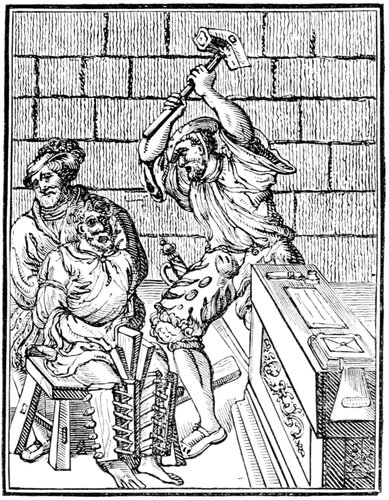
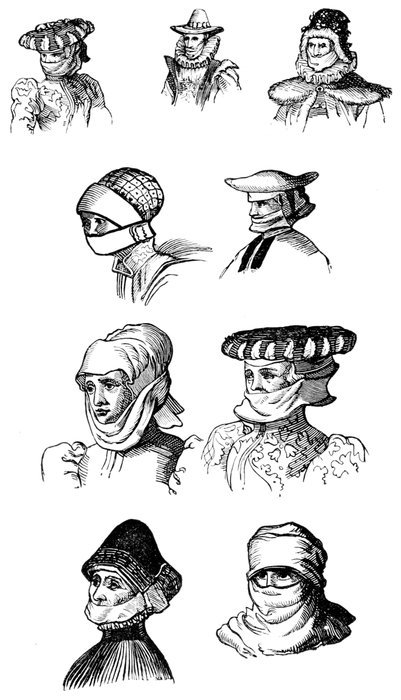
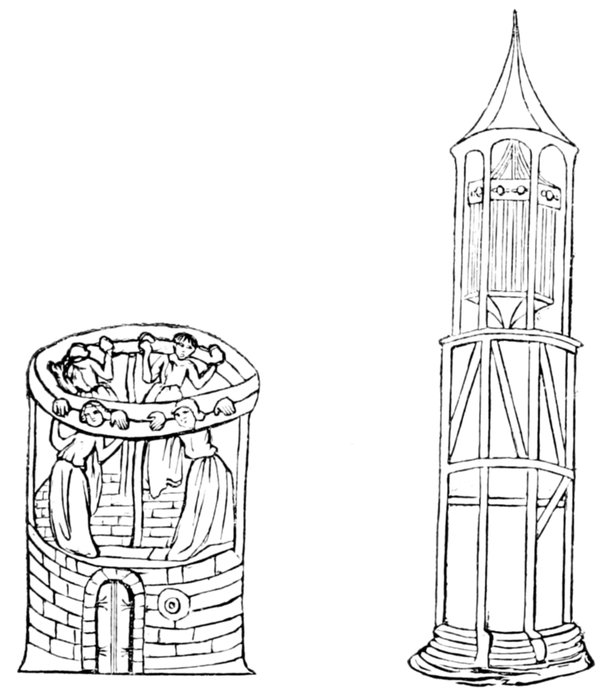
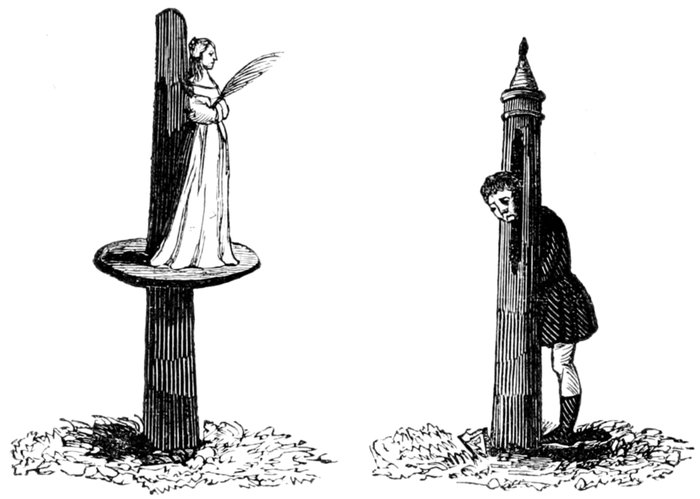
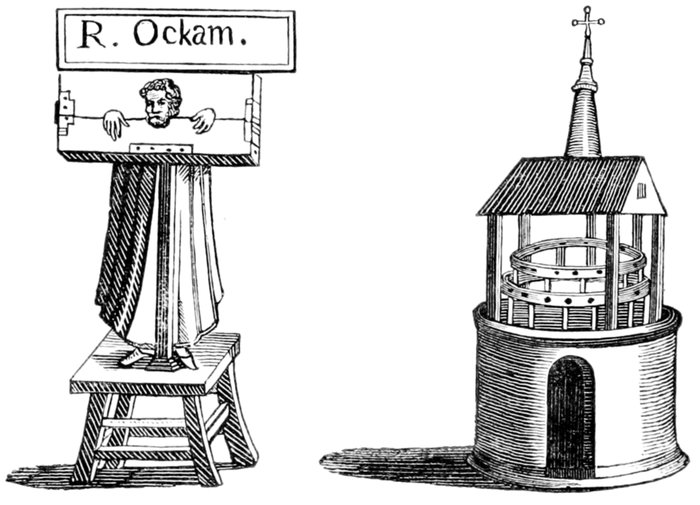
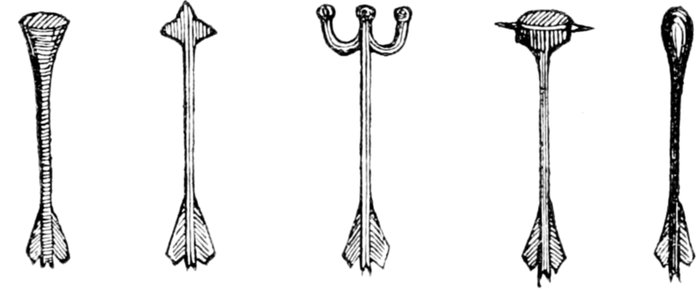
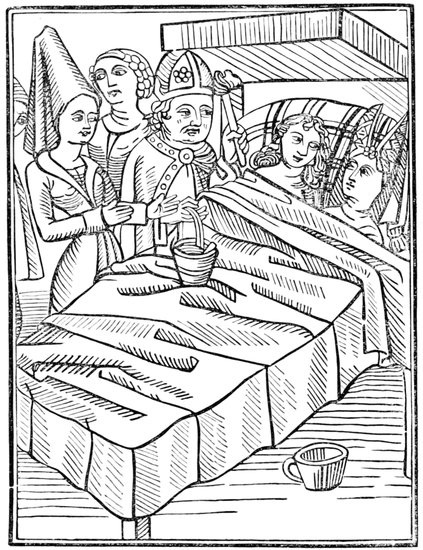
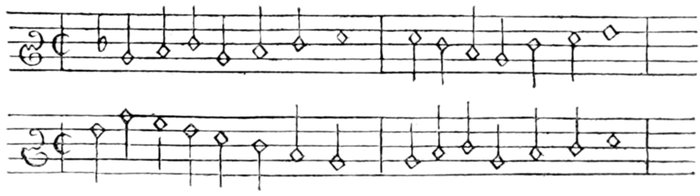
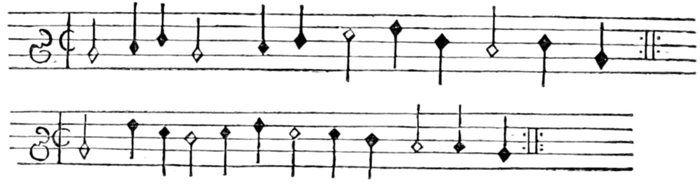
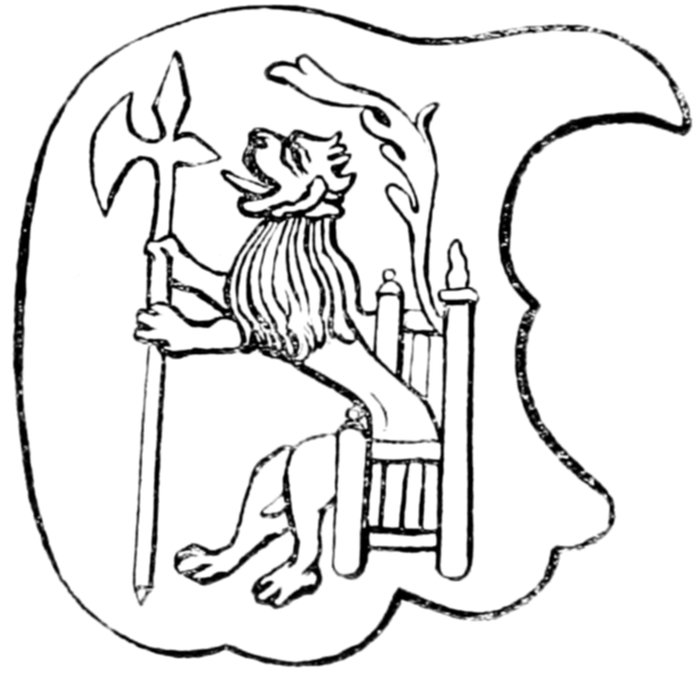
 ; and in some manuscripts of that writer
 and
 .
In other places it has these forms,
 .