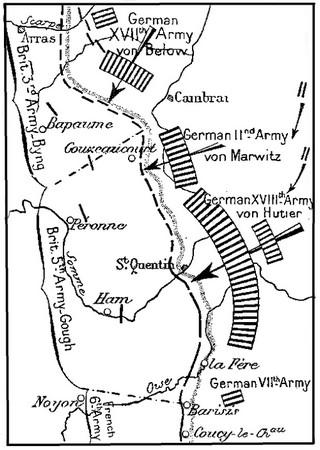
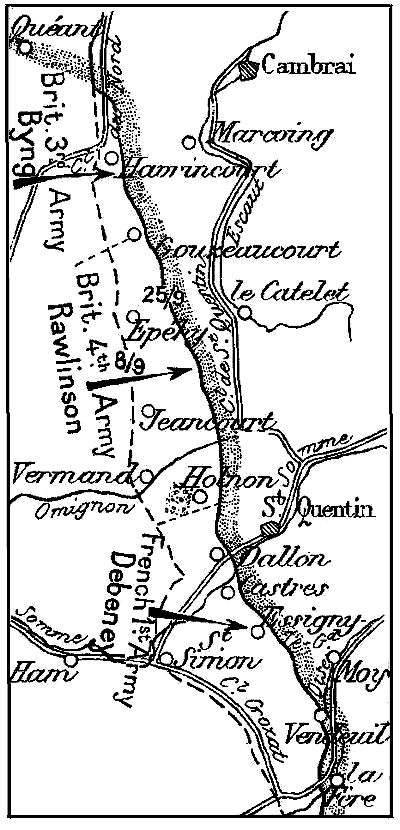
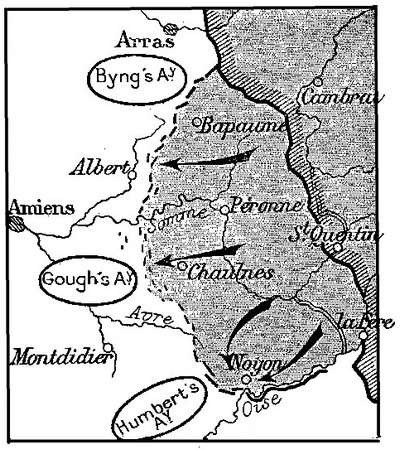
On March 21, during this, the "Einbruch" or piercing stage, the
enormous enemy mass crushed, in less than 48 hours, the three
British positions situated in front of St. Quentin. Carrying the battle
into the open country beyond, the enemy transformed the "piercing"
into a break-through ("Durchbruch").
This sudden, powerful thrust was followed by a "tidal wave" of
German infantry which at first submerged all before it, but which,
dammed by degrees, finally spent itself, a week later, against the Allies'
new front.
On March 21, at daybreak (4.40 a.m.) a violent cannonade broke
out, and for five hours the intensity of this drum-fire steadily increased.
First, a deluge of shells, mostly gas, pounded the British
batteries, some of which were silenced. Then the bombardment ploughed
up the first positions, spreading dense clouds of gas and fumes over a
wide zone.
"Michael" hour.
Under cover of the smoke and fog, the German Infantry speedily
crossed No-Man's Land, and at 9.30 a.m. ("Michael" hour) penetrated
the British defences.
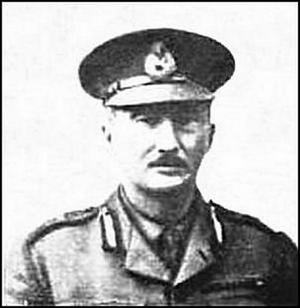
General Gough.
Photo "Daily Mirror
Studios".
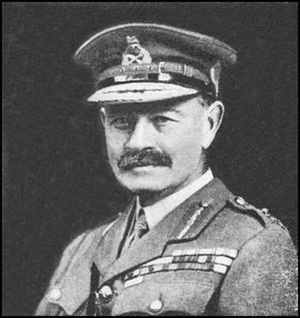
General Byng.
Photo Russell, London.
The front assigned to each attacking division was only two
kilometres wide, the troops being formed into two storm columns of
one regiment each. The third regiment was kept as sector reserves, to
develop initial successes.
The storm-troops, led by large numbers of non-commissioned officers,
advanced in waves, shoulder-to-shoulder, preceded by a rolling barrage
some 300 yards ahead of the first line. This barrage afterwards moved
forward at the rate of about 200 yards every five minutes.
The waves advanced resolutely, protected first by the rolling
barrage, then by the accompanying artillery and Minenwerfer.
Wherever the resistance was too strong, a halt was made, allowing the
neighbouring waves to outflank the obstacle on either side, and crush
it.
The Germans straightway threw the greatest possible mass of
infantry into the Allies' defences.
Amid clouds of gas, smoke and fog, the British in the advanced
positions were surrounded and overwhelmed, often before they had
realized what was happening.
Nearly all their machine-guns, posted to sweep the first zone, were
put out of action.
The First Day (March 21).
The first day of the attack, General Byng's Army from
Fontaine-les-Croisilles to Demicourt, withstood the shock steadily, the
Germans penetrating the first lines only.
In the centre, before St. Quentin, and to the south, in front
of Moy and La Fère, General Gough's Army, overwhelmed by numbers,
and notwithstanding the courage of the men, was broken early in the
attack.
Opposite Le Catelet, the enemy storm divisions advanced 6 to 8
kilometres, penetrating at noon the second-line positions along the
Epéhy-Le Verguier line. Further south, in front of Moy, they reached
Essigny-Fargnières.
General Gough withdrew his right behind the water-line of the Crozat
and Somme Canals.
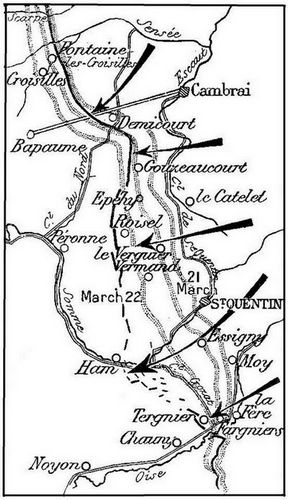
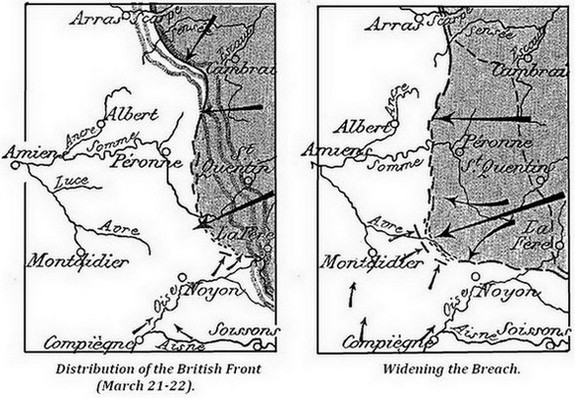
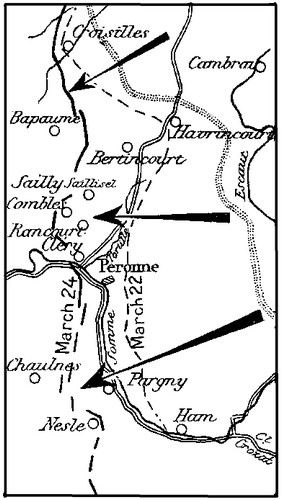
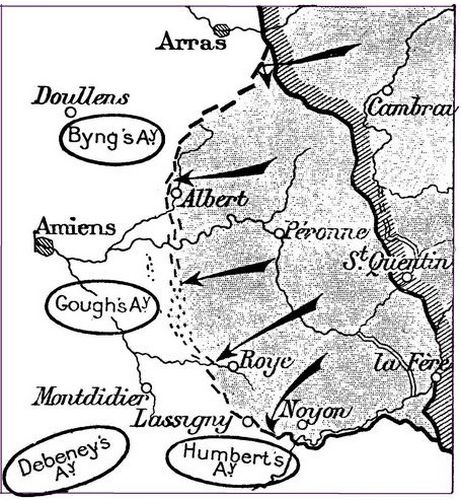
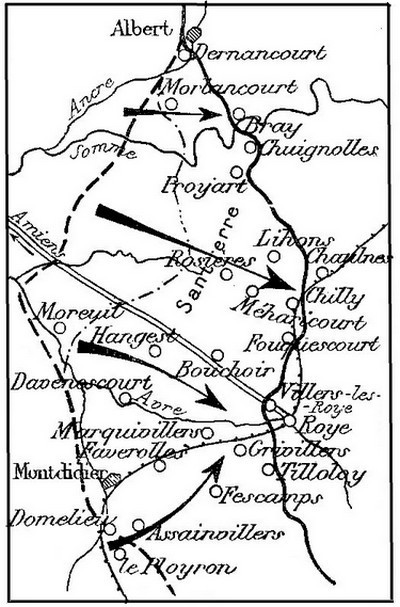
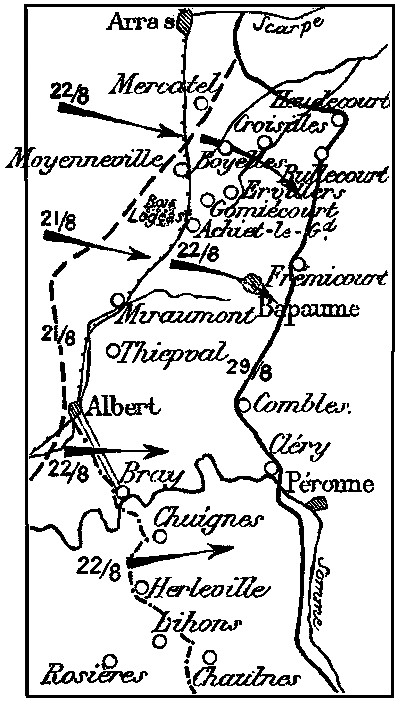
The Disruption of the Front. March 21-22.
The Second Day—March 22.
Tergnier fell, and the water-line was turned from the right. Still
favoured by the fog, the Germans crossed the Crozat Canal. Fresh
divisions harassed the British without respite, the losses, both in men
and material, being very heavy.
Their reserves, greatly outnumbered, were quickly submerged, and
the third positions were lost after a desperate but ineffectual
resistance.
In spite of its stubborn resistance, the 3rd Army (Byng) was forced
to fall back, pivoting on its left, to line up with the retreating 5th
Army (Gough).
The enemy advance developed rapidly. Within forty-eight hours,
over 60 German divisions (750,000 men) had been thrown into the
battle, which now raged in the open.
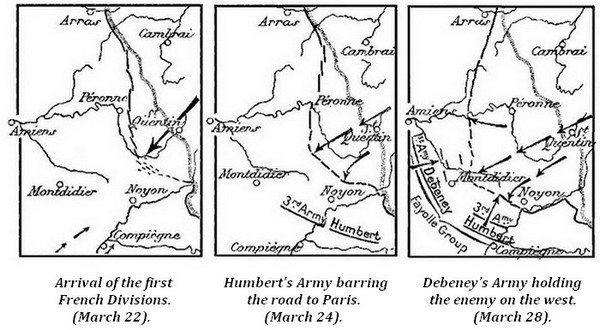
Phases of the French Intervention.
The crushing of the right and centre of the British 5th Army opened
a large breach north of the Oise, through which, as early as March 21,
the Germans streamed south and west. The situation was critical, as the
enemy hordes, having broken through the fortified zone, threatened to
submerge all before them. Prompt intervention was imperative, in order
to retard the enemy at all cost.
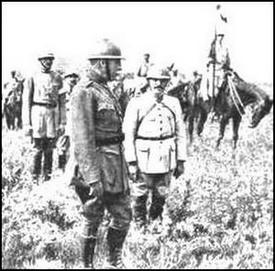
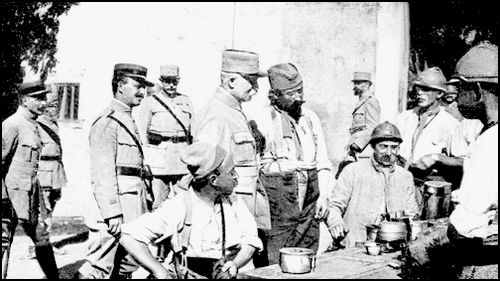
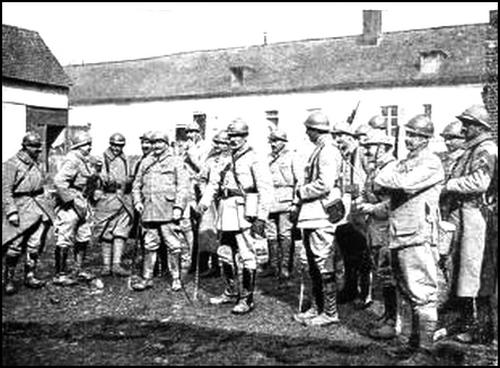
General Pellé reviewing the troops of the
5th Corps in 1917.
As early as the evening of the 21st, General Pétain made
dispositions to support the British right. The 9th and 10th Div. (5th
Corps) and the 1st Div. of unmounted Cuirassiers (Pellé), in reserve
near Compiègne, received orders to hold themselves in readiness.
At the same time, the staff of Gen. Fayolle's Army Group, and that
of Gen. Humbert's Army, prepared to take over the direction of the
operations.
The 125th Inf. Div. was pushed forward to the Oise, whilst the
22nd, 62nd, and 1st. Cavalry. Divn. (Robillot's Group) were rapidly
despatched to the weak points of the battle line.
This newly formed group was placed under the command of Gen.
Robillot of the 2nd Cavalry Corps.
Rushed up in lorries, the first French divisions were thrown into
the thick of the battle without waiting for their artillery. Heroism
often made good the lack of equipment and munitions.
Once the fortified zone crossed, the German armies pushed westward
rapidly.
On March 23, the French Cavalry Divisions were engaged, with their
armoured cars and groups of cyclists. Thanks to their great mobility,
the situation was repeatedly saved. Galloping from breach to breach,
the Cavalry, dismounting, stayed the enemy advance until the arrival
of the infantry.
The armoured cars raided the enemy's lines unceasingly and harassed
their troops with machine-gun fire. They were also used for bringing
up supplies to the first-line troops and for maintaining the different
liaisons. Their splendid work, with that of the Cyclist Corps, greatly
helped to stay the enemy thrust.
The retreat of the British was also covered by detachments of
cavalry, mounted artillery, armoured cars and tanks, which vigorously
attacked the assaillants.
The Air Service likewise rendered invaluable aid.
On the evening of the 22nd, General Pétain gave orders for every
available bombing plane to be used to retard the enemy advance, until
reinforcements could be brought up. The air squadrons met a few
hours later at the assigned point, some of them having flown ninety
miles. On the way, they dropped their loads of bombs on German
troops which were crossing the Somme, north of Ham, thereby retarding
the advance of two enemy divisions which were preparing to outflank
the British.
On the 23rd, at noon, a hundred aeroplanes, skimming just over the
Germans' heads, wrought indescribable havoc and confusion in their
ranks. Priceless hours were thus gained.
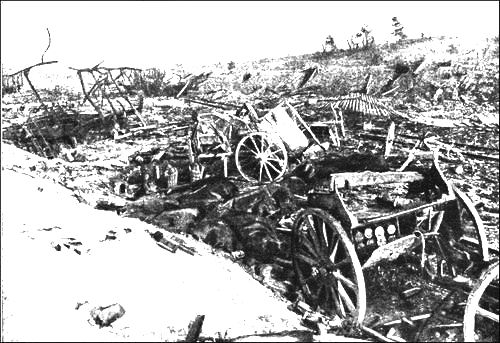
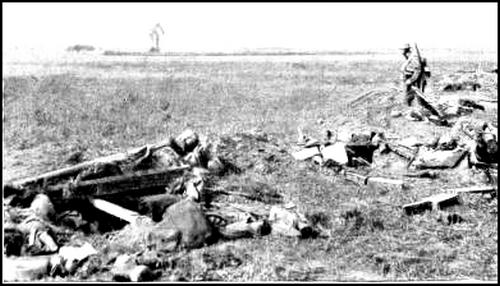
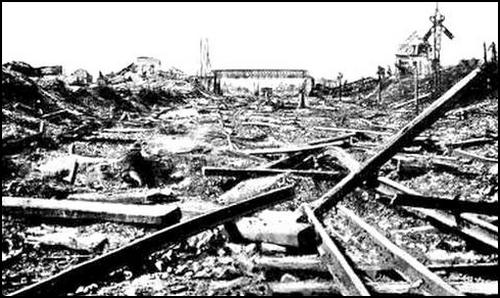
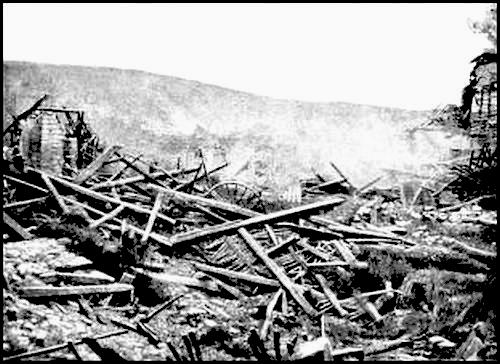
The Effects of aerial bombardment.
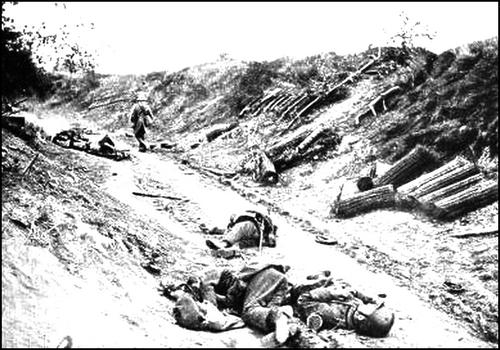
Photographed in the Ardennes, in October 1918. A German munition
train, bombed by aeroplanes, blew up, destroying the line and the
artillery limbers which were being loaded. The dead horses and broken
limbers are plainly visible. One may imagine the ravage caused by the
Allies' aerial bombardments among the enemy concentrations in the
Somme.
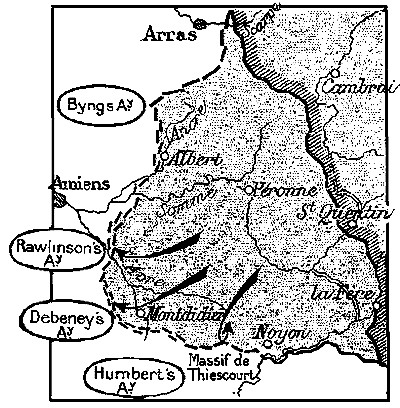
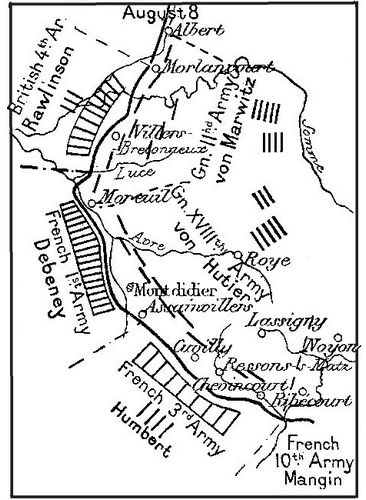
Whilst Byng's Army withstood the enemy's onslaughts, that commanded
by Gough was dislocated by the powerful thrust of von Hutier's Army.
On the morning of the 23rd, the remnants of the British 3rd
and 18th Corps were thrown back across the Crozat Canal, among the
French divisions which were taking part in the battle between the Somme
and Oise, and with which they were assimilated.
Further north, his divisions heavily depleted, and reinforcements
coming up only slowly, General Gough abandoned the strong
Somme-Tortille line, and continued his retreat westward, towards his
reserves in the old battlefield of 1916.
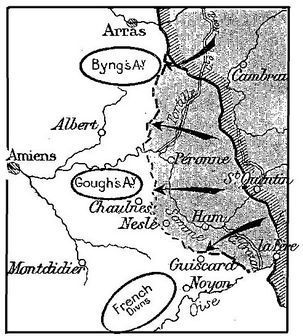
The same day, the first French units to arrive were thrown between
Crozat Canal and the woods of Genlis and Frières, linking up, on their
right, with the 125th Division, detached from the left of the 6th
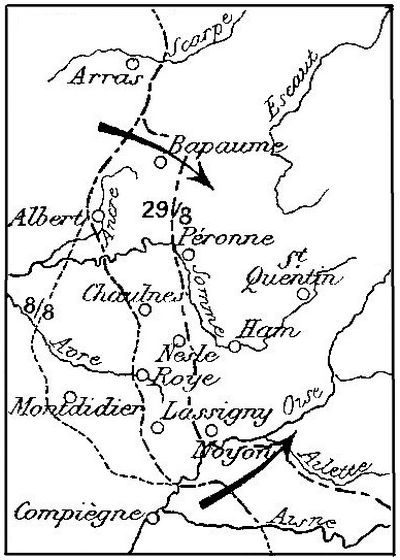
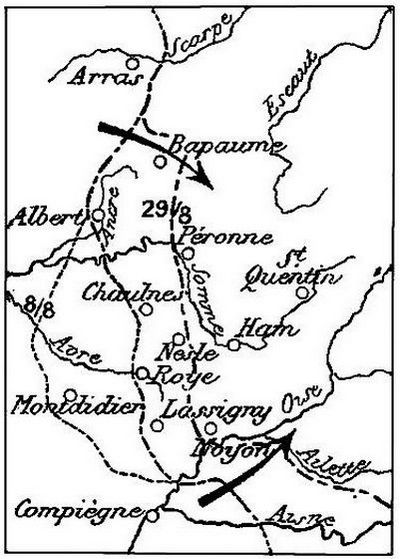
Army, and established astride of the Oise, in front of Viry. (Sketch
below).
The 1st Division of dismounted Cuirassiers (Brécart) vigorously attacked
the enemy, and succeeded in staying their thrust towards the Oise. The
9th Division (Gamelin) barred the Ham-Noyon road, along a ten mile front.
On their left, the 10th Division (Valdant) held the zone north of Guiscard.
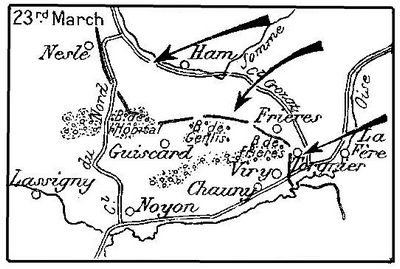
The French Divisions were engaged from the Oise to
Nesle, before Noyon, which the British retreat left unprotected.
On the evening of the 23rd, the situation was critical. General
Pellé's divisions retarded the German advance in front of the Chauny-Noyon
region, which they were covering, but the enemy held Ham.
In their retreat, the British constantly bore to the north-west.
The 1st Cavalry Division (Rascas), and the 22nd (Capdepont) and
62nd (Margot) Divisions arrived, and were thrown into the battle between
Guiscard and Nesle, where they attempted to join hands with the
French 10th Division on their right and with the British on their left.
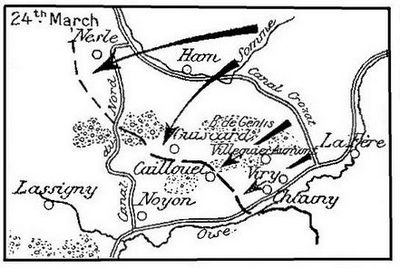
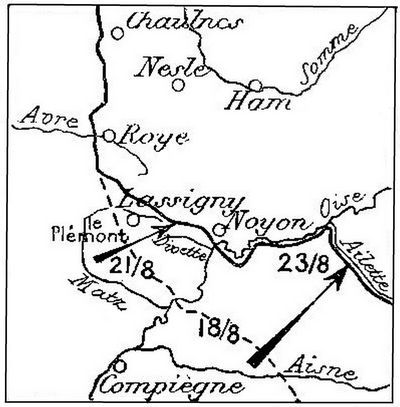
Converging on Noyon, the Germans effected a breach
north of Nesle.
The same day, the German long range "Bertha" guns began to
bombard Paris, in the hope of spreading panic and disorder there.
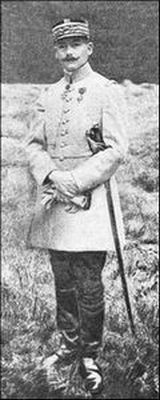
General Humbert.
On March 24, the crushing effect of the German thrust was
further accentuated by the arrival of new enemy divisions.
Favoured by the fog, which entirely hid the valleys of the Oise and
Somme, their advance-guards swept the plain with machine-gun fire, in
their search for gaps and weak places in the thin French line.
All the attacks converged towards Noyon. At 9 a.m., in the valley
of the Oise, the capture of Viry-Noureuil threatened Chauny, whilst in
the centre, Villequier-Aumont and Genlis Wood were taken. Overwhelmed
by numbers, the Cuirassiers, after firing their last cartridges, fell
back on Caillouel Hill. The divisions on the left took up positions
south of Guiscard. In spite of the unequal struggle, the fighting
spirit of the troops remained admirable.
On the left of General Pellé's group, between Nesle and Guiscard,
the situation was still more desperate, as, having crossed the Somme,
the Germans now greatly intensified their thrust. The depleted British
units continued their retreat westward, leaving a gap north of Nesle.
The French 22nd Div. was hurriedly despatched towards Nesle, and
elements of the 1st Cav. Div. to the east of Chaulnes.
On March 24, south of Péronne, the German IInd Army crossed with
difficulty the marshy valley of the Somme, then pushing on towards
Chaulnes, opened a gap at Pargny.
North of Péronne, the enemy reached Sailly-Saillisel, Rancourt and
Cléry in the morning, and pushed west with 3,000 cavalry. In danger of
being turned, Byng's Army, which had abandoned the Havrincourt Salient
during the night of the 22nd, evacuated Bertincourt and retreated
westward.

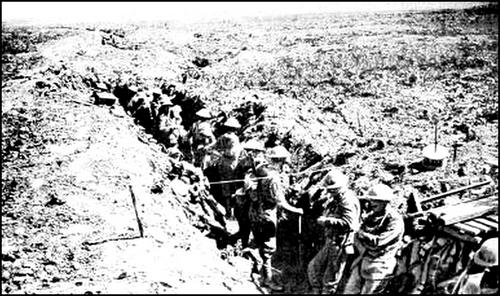
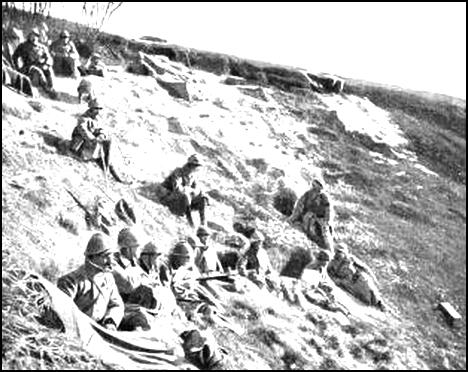
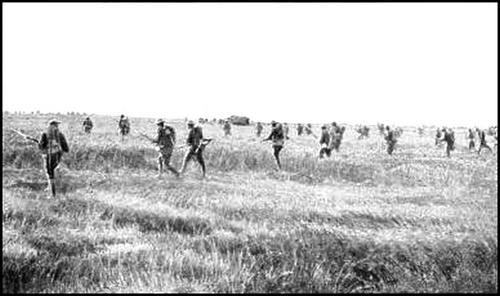
Sharpshooters at the side of the road.
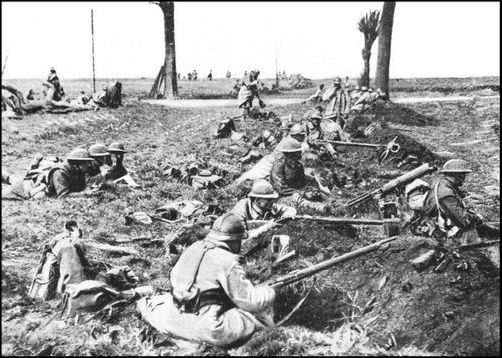
Franco-British line of infantry in which "Tommies"
mingled with "poilus"
(Photo Imperial War Museum).
One of the gravest consequences of the retreat of Gough's Army was
the temporary severance of the French from the British. To restore and
consolidate the liaison was the constant aim of the French General
Staff.
These units coolly withdrew, whenever they found themselves outflanked
and in danger of being cut off, often fighting furious rearguard
actions, and repulsing the enemy with heavy loss, each time a frontal
attack was attempted. (Field-Marshal Haig).
On the contrary, we read in Ludendorff's Memoirs that the German
XVIIth Army was exhausted, having suffered too heavy losses before the
Cambrai Salient on March 21 and 22.
During the night, the enemy continued to press forward in the fog,
in an attempt to rout the precariously installed and ill-supplied
French units, and to harass Gough's Army, in retreat towards the
Santerre Plateau. On this, Palm Sunday evening, Holy Week opened
tragically.
The 25th, at daybreak, fresh German divisions violently attacked
the exhausted French units, seeking to turn their left wing, and at the
same time crush General Pellé's group in the centre.
In face of the increasing danger, General Pellé received orders to
"check the enemy advance, whatever the condition of the men might be".
The 1st Inf. Div. (Grégoire), hastily brought up and reinforced by
the remnants of the British 18th Div. and of various French Divisions
picked up on the way, established itself on the hills which cover Noyon
to the north-east. They had scarcely taken up their positions, when
the Germans attacked, only to be repulsed. Further to the left, the
enemy were unable to debouch from Crisolles, but on the French right,
the 55th and 125th Div., which had been fighting incessantly since the
22nd, were forced back across the Oise, near Brétigny. Pushing on, the
Germans captured Babœuf, but a British counter-attack forced them
to fall back slightly.
The battle continued to rage and the danger of being outflanked
became more and more acute. Catigny and Beaurains fell, leaving
Noyon unprotected on the north-west. In the course of a fierce
counter-attack, the 144th Inf. Reg. succeeded in recapturing these
villages, but the German hordes still pressed on, opening a gap
between Beaurains and Genvry, through which they poured, following the
little valley of the Verse which slopes down towards Noyon. The troops
defending the northern and north-eastern approaches to that town were
now threatened with being surrounded.
General Pellé endeavoured to stop this fresh gap with the few
units left at his disposal, and organized a new line of support on
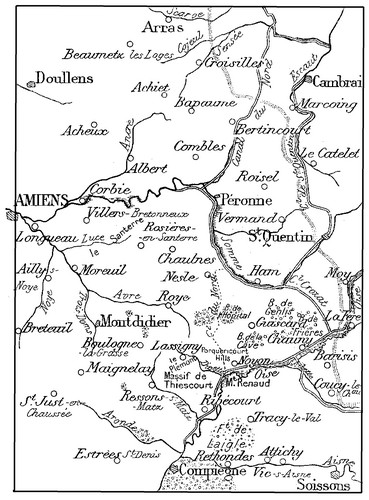
Porquericourt Hill and Mont Renaud (sketch, p. 18), at the same time
urging the troops which were fighting to the north of Noyon to "hold
out a few hours longer, each hour being worth a day".
One French division, and units of a second division, comprising some
British remnants, were now fighting against odds of four to one.
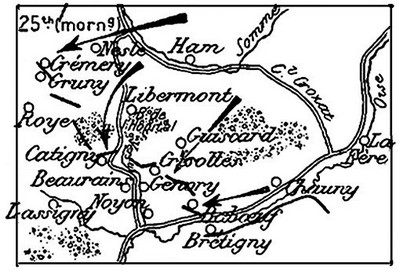
The enemy threatened Noyon, through the valleys of
the Oise and Verse. To the north of Nesle, the
Montdidier road was open.
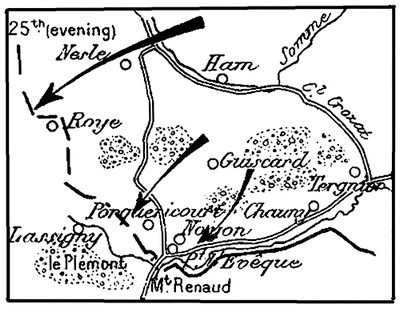
Fall of Noyon. Gen. Pellé's Group organized
positions on Porquericourt Hill and Mont-Renaud.
Gen. Robillot's forces fell back on Roye.
On the evening of the 25th, they fell back in good order, on
Noyon. The 57th Inf. Reg. resisted all night in the town, to enable the
final line of resistance to be organized.
At midnight, the front line passed in front of Porquericourt Hill
and Mont Renaud, at Pont-l'Évêque, thence following the Oise. It was
along this line that Gen. Pellé's Corps had orders to hold the German
advance, and bar the road to Paris.
General Humbert declared on the evening of the 25th: The troops of
the 5th A.C. and of the 2nd C. of unmounted Cavalry are defending the
very heart of France. The consciousness of the grandeur of their task
will point out the path of duty to them.
This day (25th) was still more tragical on General Humbert's left.
At daybreak, a violent battle broke out around Nesle, the town being
abandoned at 11 a.m.
Spread over a too wide front, from Nesle to Guiscard, the troops under
Gen. Robillot had orders to maintain the liaison on their right with
Gen. Pellé's forces (retreating southward) and on the left with the
depleted British units which were falling back to the north-west. The
gap widened, and the enemy pressed through. The situation was highly
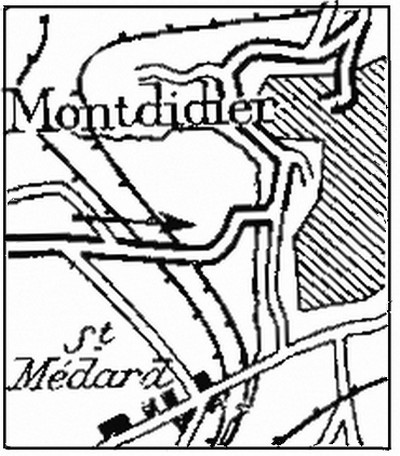
critical, the road to Montdidier being now open.

General Fayolle, in command of the Humbert-Debeney
Army Group
Despite their desperate resistance and the untiring activity of the
1st Cav. Div. and 2nd Corps—units of which galloped from breach to
breach to re-establish the liaison and retard the enemy onrush—General
Robillot's group fell back towards Roye.
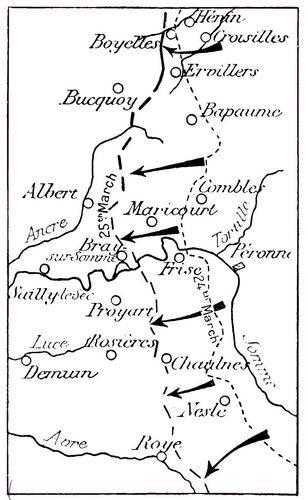
March 25.
The road to Amiens open to the enemy.
South of the Somme, the situation was still more critical. The
remains of the British 18th and 19th Corps withdrew to the line
Chaulnes-Frise, which they were, however, unable to hold.
Their retreat continued to the line Proyart-Rosières. No more
reserves were expected for four days. Should the Germans succeed in
crushing these exhausted units the road to Amiens would be open.
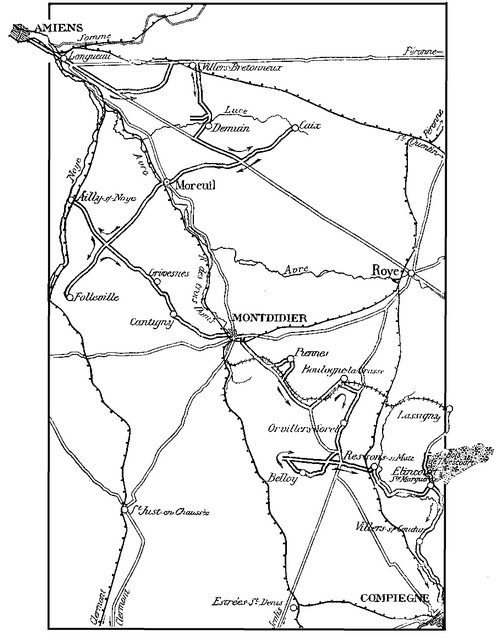
About six miles behind the Proyart-Rosières front, there was an old
French line, partly filled in, on the Santerre Plateau, between the
Somme (at Sailly-le-Sec) and the Luce (at Demuin).
A battalion of Canadian Engineers was ordered to restore it. However,
there were no troops to hold it, and as its abandonment would have
imperilled Amiens, Gen. Gough decided to muster an emergency detachment
of engineers, miners, electricians, mechanics, staff personnel,
pupils and instructors from the schools of the 3rd and 5th Armies,
and American sappers, in all about 2,200 men. This detachment, under
Maj.-Gen. Carey, was ordered to hold an eight-mile front and bar the
road to Amiens.
North of the Somme, the Germans attacked from Ervillers to the river;
the British left stood firm, whilst on the right, the hinge formed by
Byng's Army, likewise resisted. Further south, the Germans captured
Maricourt, and broke through the curtain of British troops, which
lost contact with one another. The Ancre was crossed, and Byng's
right, pivoting on Boyelles, fell back on the line Bucquoy, Albert,
Bray-sur-Somme.
General Pétain issued a stirring appeal to the men:
The enemy is attacking in a supreme effort to separate us from the
British, and open the road to Paris. At all cost, he must be held. Stick
to the ground, stand firm, reinforcements are at hand. United, you will
fling yourselves on the invader. Soldiers of the Marne, Yser and Verdun,
the fate of France is in your hands.
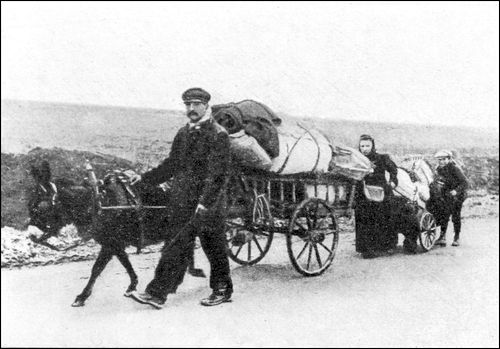
From all parts of the front, French divisions poured in. Long lines of
motor-lorries sped along all the roads converging towards Montdidier.
The high spirits and fine bearing of the men reassured the anxious
population, who, for several days past, had heard the guns drawing
nearer, and seen the endless stream of refugees fleeing before the
invader.
General Debeney arrived with his staff from Toul, to take command
of the 1st Army (in formation), divisions of which arrived each day.
The 77th. Inf. Div. (d'Ambly) was added to the 3rd Army (Humbert).
The operations of these two armies, whose task it was to bar the road
to Paris and cover Amiens, were co-ordinated by Gen. Fayolle.
On the 26th, Gen. Pellé's group
occupied Mont Renaud—a natural
rampart protecting the valley
of the Oise.
Determined to force a passage
at all cost, the enemy attacked
with fresh troops.
The present positions must be held at all cost. The honour of each
commanding officer is at stake, proclaimed Gen. Pellé. Trenches were
dug, and Mont Renaud organised. The road to Compiègne was barred and
the hills to the south and south-west of Noyon became the pivot of the
defences. Repeatedly attacked, Mont Renaud changed hands several times,
finally resting with the French. The exhausted 10th Div. fell back on
the massif of Le Plémont, where the 77th Div. had just taken up its
positions.
However, although Gen. Humbert's right checked all enemy advance, Gen.
Robillot's group and the first units of Gen. Debeney's Army, on the
left, were unable to hold their ground in the Picardy Plain. Forming
but a thin line, the enemy's powerful thrust opened gaps in places.
Units of the 56th and 133rd Inf. Divns. and of the 4th and 5th Cav.
Divns. under Gen. de Mitry, were pushed forward, with orders to
establish the liaison, on their right, with the 22nd Div., and on their
left, with the British who were falling back on the Santerre Plateau.
This liaison was necessarily weak, as the troops had to be deployed.
Fighting day and night for every inch of ground given up, these
splendid troops succeeded in retarding the enemy's advance until the
arrival of reinforcements on the line of the Avre.
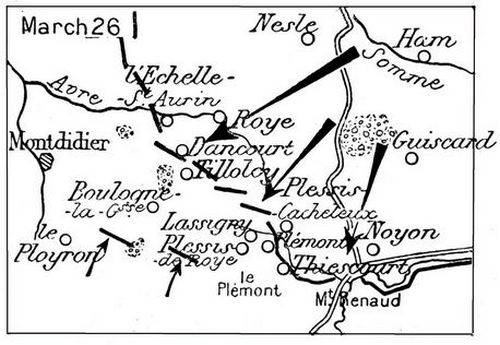
The Germans attempted with their left to turn
General Humbert's Army, strongly established at Le
Plémont. Roye fell.
The exhausted 22nd Div. fell back, carrying with it the 62nd on its
right. Roye, outflanked from the south and attacked on the north, was
lost. A breach, opened between the 22nd and 62nd Div. was filled by
an emergency detachment hastily got together on the spot by General
Robillot.
On the evening of the 26th, the front was established on the line
Echelle-St.-Aurin, Dancourt, Plessis-Cacheleux.
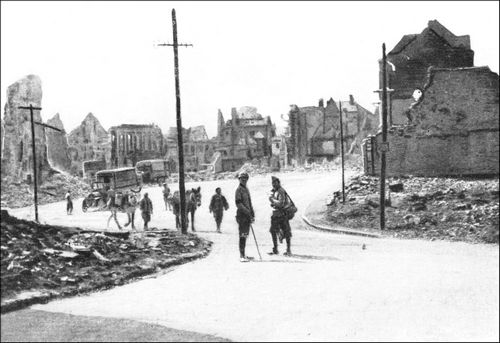
Roye. The Place d'Armes at the end of the War.
General Humbert made a strong appeal to his men: Let all commanding
officers firmly resolve to accomplish their duty to the extreme limit
of sacrifice, and imbue their men with the same spirit.
North of the Somme, the Germans took Albert—an important junction—but
were checked further north, by the left wing of Byng's Army.
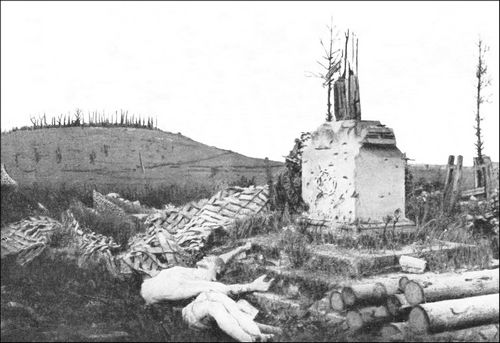
The Mont Renaud.
Events had forcibly demonstrated the urgent necessity for Allied
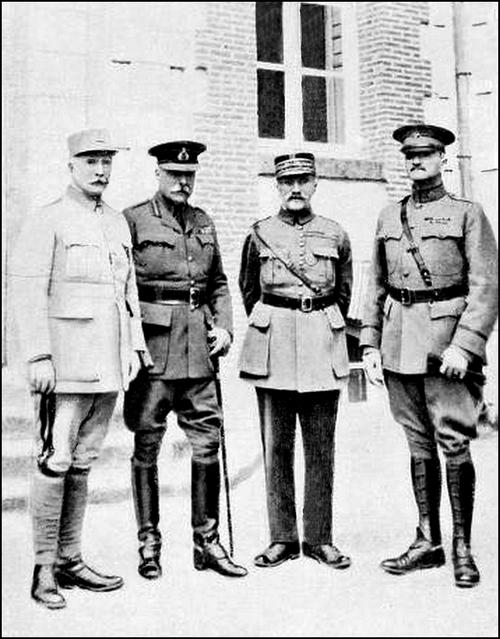
unity of command. On March 26, a War Council, composed of
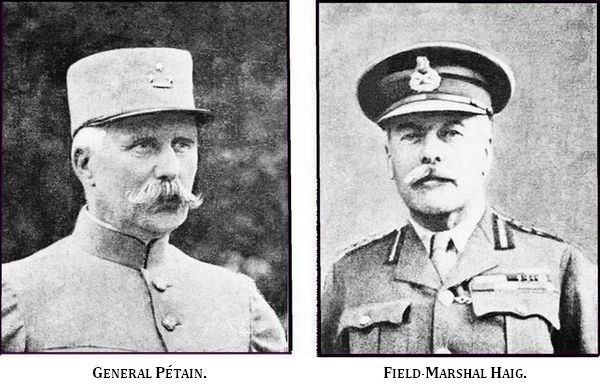
M.M. Poincaré, Clemenceau, Lord Milner, Haig, Pétain and Foch,
empowered the latter to coordinate the action of the Allied Armies on
the Western Front.
"At the moment when Foch was to take precedence of Pétain and
Haig, what was the position of the armies, as regards the directives of
the High Command? In other words, how was the Anglo-French battle
being directed? The position is defined in the General Orders of Pétain
and Haig, the former of whom prescribed:
"To keep the French forces grouped, to protect the Capital; essential
mission;
"To ensure the liaison with the British; secondary mission;
"The latter prescribed that everything possible should be done
to avoid severance from the French;
"Should this be unavoidable, to fall back slowly, covering the Channel
Ports.
"If we place these two orders side by side, their divergence
strikes us painfully. It is patent that the instructions of the two
great chiefs had not the same object in view, and did not tend
towards the same end. One was thinking of Paris, the other of the
Channel Ports. Each would evidently consecrate the bulk of his
forces and resources to what he considered the essential task. To
sum up: on the German side, there was only one battle; on the
Allies' side, there were two: the battle for Paris, and the battle
for the ports. Had this situation continued, our defeat was certain.
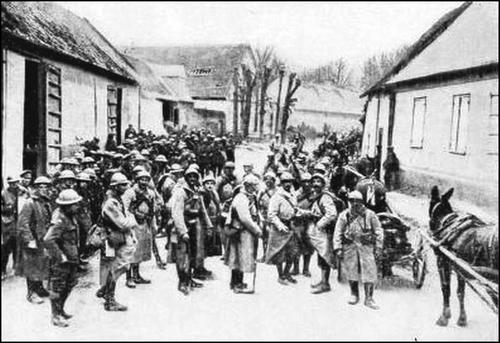
British and French reinforcements in a village.
(Photo imperial War Museum)
"Foch's first thought, from the moment he took over the
direction, was to cause this disastrous divergence to cease. To the
two commanders-in-chief he prescribed the maintenance, at all cost,
of the liaison between their armies. The accessory thus became
the essential. The vital point was to ensure the junction between
the Allied Armies, and to that end, to cover neither Paris, nor
Calais, but Amiens. The battle which, till then, had been double,
became single, i. e. the Battle for Amiens.
"Such was the strategical idea which, during the following days,
Foch strove to materialise. Motoring from G.H.Q. to G.H.Q., he
impressed the same thing upon all; on Haig, Pétain, Gough, the
latter's successor, Rawlinson, Fayolle, Debeney and Humbert. By
dint of repetition, this idea was to be deeply impressed into the
minds of the executants.
"To ensure liaison, to keep the troops where they were, to prevent
voluntary retreat, above all, to avoid effecting relief during
the battle, to throw the divisions into the line of fire, as they
arrived—such were the orders which were constantly on his lips during
the days which followed". (La bataille de Foch, by Raymond Recouly).
On March 28, General Pershing offered Foch the direct and immediate
help of the American Forces: I come to tell you that the American
people would consider it a great honour for our troops to take part in
the present battle. I ask this of you in my name and theirs. At this
time, the only question is to fight. Infantry, artillery, aviation, all
we have is yours.
Henceforth, the battle was directed from Foch's headquarters,
temporarily installed at Beauvais. Twice a day, couriers maintained
communications between Foch and the British and French G.H.Q's.
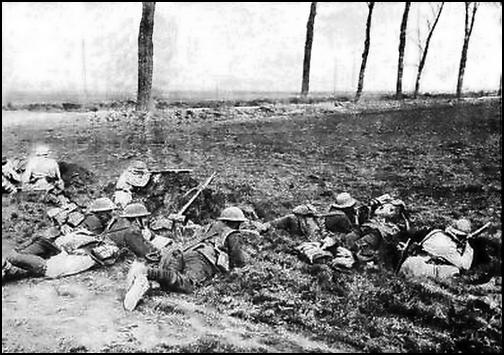
Line of British and French Sharpshooters.
(Photo Imperial War Museum).
By the 27th, the German attacks had lost much of their
earlier sting. The French, whose resistance was stiffening steadily,
harassed the enemy unceasingly.
Their infantry, now thirty-six miles from their base, could only
be revictualled with great difficulty. The Allied airmen bombed their
convoys and the railway stations incessantly.
Their artillery had difficulty in keeping up with the infantry, and
the latter were not always efficiently supported.
Meanwhile, the Allies steadily organized their defences. Gen.
Pellé's group, with strong positions on the bastions of the Île de
France, repulsed the enemy's repeated assaults.
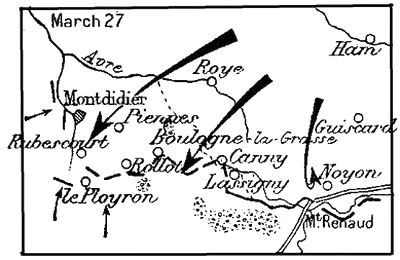
Montdidier fell, but in face of the Allies' increasing
resistance, the enemy could advance no further.
Five attacks on Mont Renaud were broken.
From Canny to the Oise, the Allies stood firm.
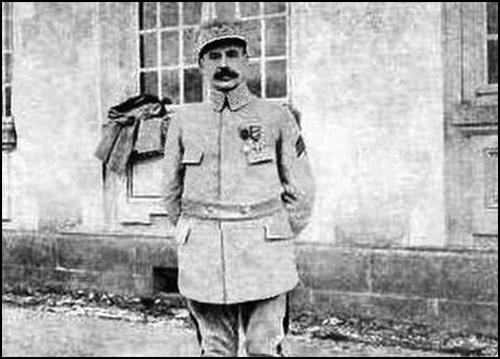
General Debeney.
Held on this front, the enemy deviated towards Montdidier,
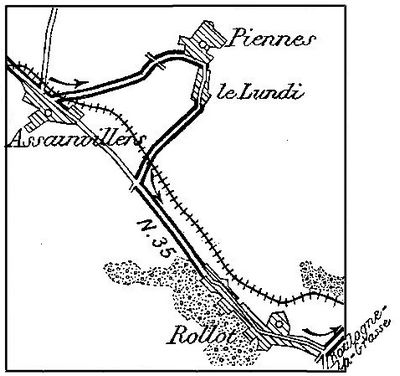
overwhelming Gen. Robillot's forces, which fell back on Rollot. The
Germans reached Montdidier, Piennes, Rubescourt and Rollot.
A wide breach was thus made between Gen. Humbert's left and the right
of Gen. Debeney's Army, then taking up its positions on the tablelands
before the valley of the Avre.
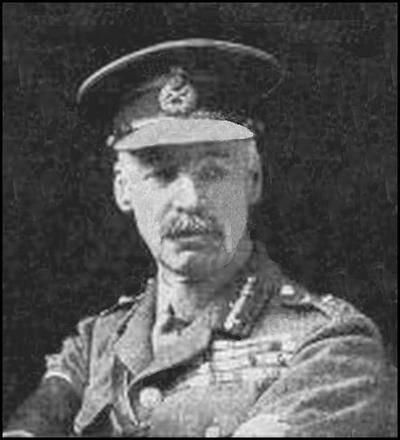
General Rawlinson.
Photo Russell, London.
It was a tragic moment. Gen. Debeney
telegraphed to Gen. Fayolle: There
is a gap of nine miles between the two
armies, with nobody to fill it. I ask
General Fayolle to have troops brought
up in motor-lorries and despatched north
of Ployron, to resist at least the passing
of the Cavalry.
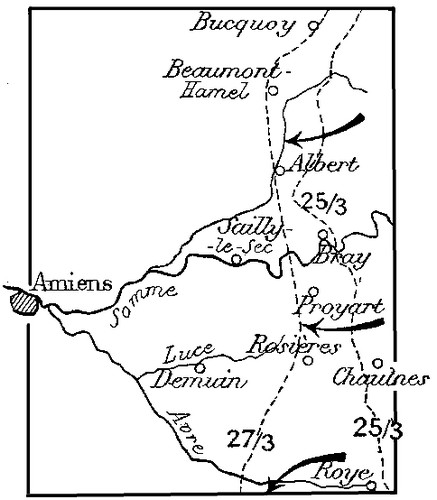
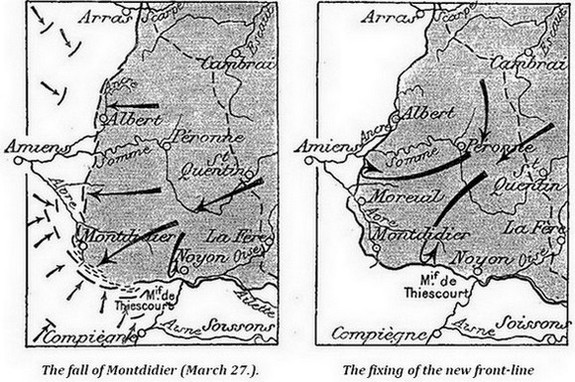
March 26-27.
British reinforcements arrived north of the
Somme. The Germans converged towards Montdidier.
A few hours later, two divisions
of Humbert's Army filled the breach.
Exhausted by their terrible losses,
the enemy were brought to a stand.
East of Rollot, the essential portions
of the massif of Boulogne-la-Grasse
were strongly held.
Behind the Avre, trains and lorries
were bringing up the divisions of
Debeney's Army.
The British received reinforcements,
and stayed their retreat in
the outskirts of Albert.
The thrust against their line was
now less violent, the enemy forces
converging towards Montdidier.
Gen. Rawlinson replaced Gen.
Gough.
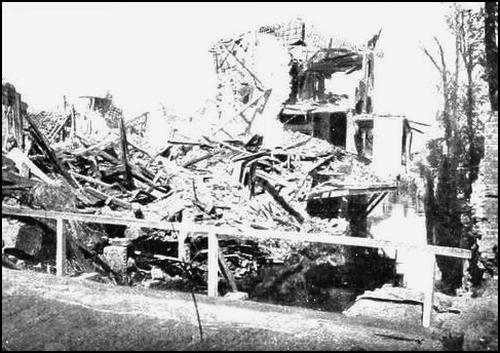
The Ancre at Albert.
After the fall of Montdidier,
the fourteen divisions of von Hutier's
army converged towards
the pocket to the south-west.
Seven other divisions, marching
against the British front between
the Somme and Arras, suddenly
turned south. On the 28th,
80,000 Germans made for the
gap, through which 160,000 men
of von Hutier's army were already
pressing. In all, 240,000 men
were about to attack on a seventeen-mile
front.
General Humbert's left maintained
an aggressive defensive.
On March 28, they counter-attacked. The 4th Zouaves captured
Orvillers and Boulogne-la-Grasse, threatening the enemy on the flank at
Montdidier. Seeing the danger, the Germans retook part of the conquered
positions. The moral effect was, however, considerable, indicative as
it was of the Allies' determination to re-act.
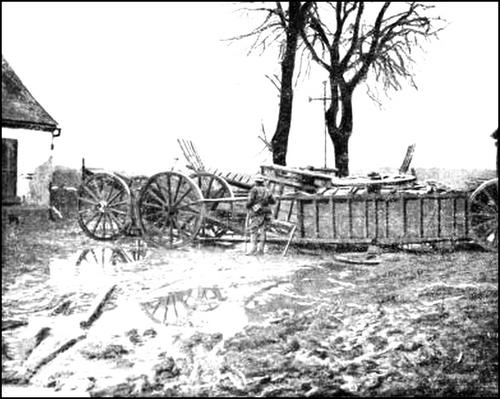
Barricade at the entrance to Merville-au-Bois.
On the 29th, these counter-attacks were continued, thus mobilising many
enemy units on this front, which were preparing to attack on the Avre.
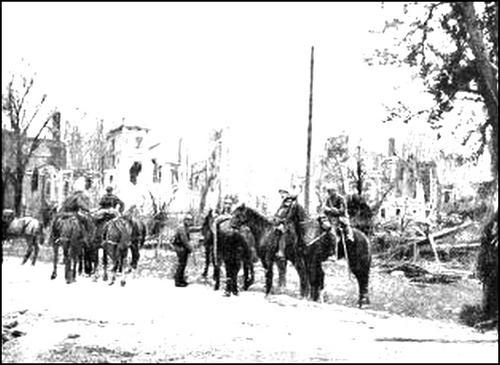
French artillery in Moreuil.
During these two days, General Debeney, further north, was concentrating
his forces along the front of Le Quesnel, Hangest, Pierrepont,
Mesnil-Saint-Georges, Rubescourt. There can be no question, he
declared, of crossing to the left bank of the Avre.
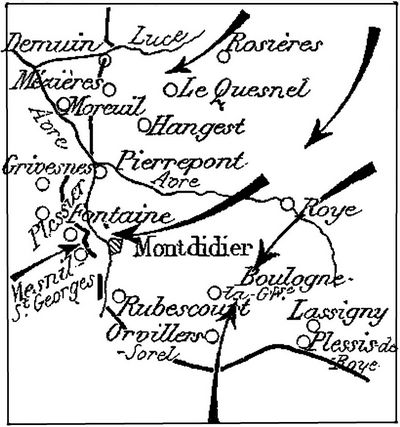
On March 29, the Germans were firmly held
at the bottom of the pocket.
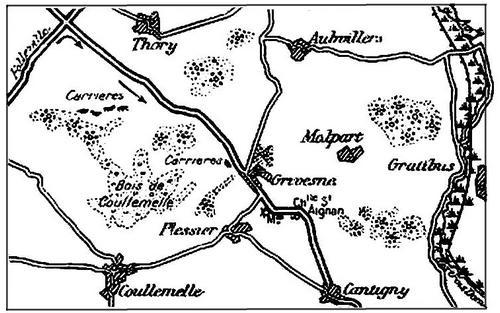
The Germans attacked at dawn on the 28th. To the west of Montdidier,
Mesnil-St.-Georges was captured. The 166th Division, which had just
detrained, stayed the thrust at Grivesnes and Plessier. A battalion
of the 5th Cav. Div. fighting on foot, recaptured Mesnil and
Fontaine-sous-Montdidier.
At the junction with the British, the attack was more violent.
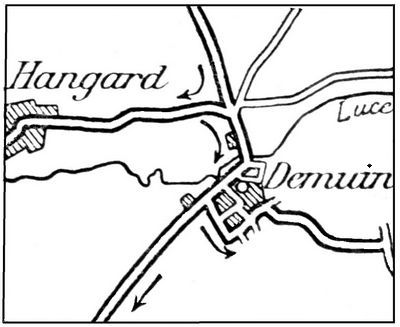
Capturing Hangest, the Germans slipped along the valley of the Luce,
driving back the British. The resistance of the latter stiffened,
however, and they maintained their positions on the right bank of the
Avre.
On the 29th, the enemy renewed the attack with fresh divisions,
especially at Demuin and Mézières, where the defenders were driven back
along the Avre. However, Gen. Debeney's Army was now completed by the
arrival of the 127th, 29th and 163rd Divisions. Its junction with the
British, was strongly reinforced.
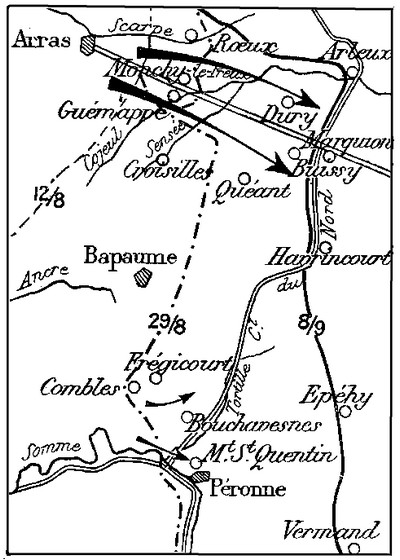
Before Arras, astride the Scarpe, the British fell back into line with
Byng's Army, repulsing several violent attacks. (Sketch, p. 26).
On the evening of March 29, the enemy were firmly held at the
bottom of the pocket, the sides of which stood firm.
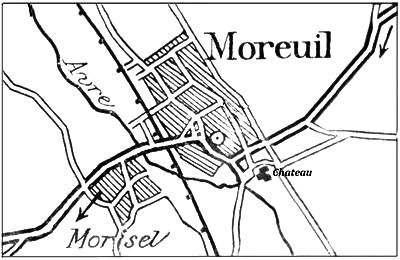
On March 30, the Germans
launched a general attack along a
thirty-mile front, from Moreuil to
Noyon, against the armies of Humbert
and Debeney. This was their
last effort in the southward push.
In many places, the French
heavy artillery had not yet taken
up its new positions. The battle
was therefore mainly one of infantry.
To the Air Service fell the
task of making good the deficiency,
and throughout the
battle, bombs were rained
upon the railway-stations, columns
of German infantry, and
enemy supply convoys, whilst
the fighting section, skimming
over the enemy masses, riddled
them with machine-gun fire.
In front of Humbert's Army,
the French lines were practically intact. Homeric combats were
delivered at Le Plémont, Plessis-de-Roye and before Orvillers.
In the region of Orvillers-Sorel, the 38th Div. repulsed four assaults
delivered by the 4th Div. of the Prussian Guards.
The attack against the front of Debeney's Army was delivered with
equal fury.
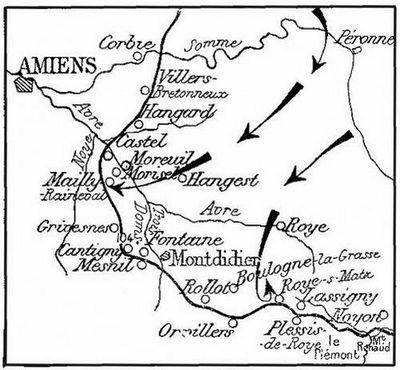
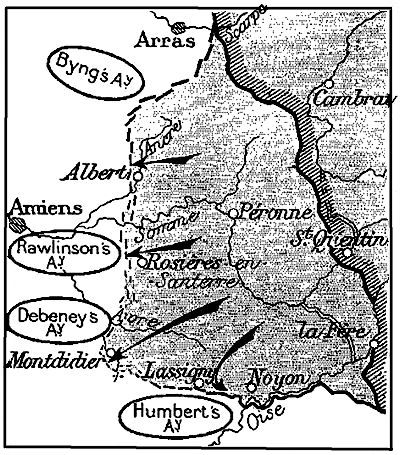
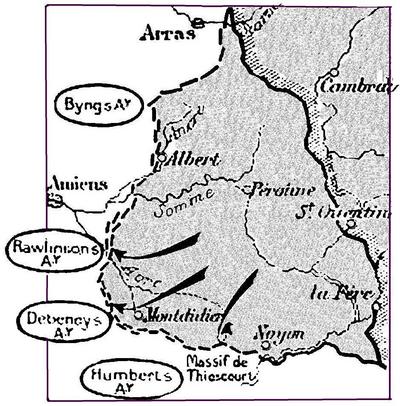
The enemy's final effort southwards.
March 30-April 5.
On its right, not an inch of ground was lost. All assaults
on Mesnil-Saint-Georges were repulsed. The 6th Corps maintained
practically all its positions intact, except before Hill 104, where a
slight withdrawal was necessary.
On the left wing, the 36th Corps (Nollet) was forced to give way,
and fell back on the Avre. Moreuil was lost in the evening of the
30th.
March 31 was marked by extremely violent local actions,
especially at Mesnil-St-Georges and Grivesnes, without appreciable
result for either side.
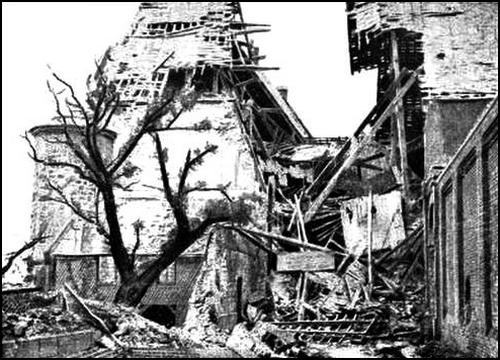
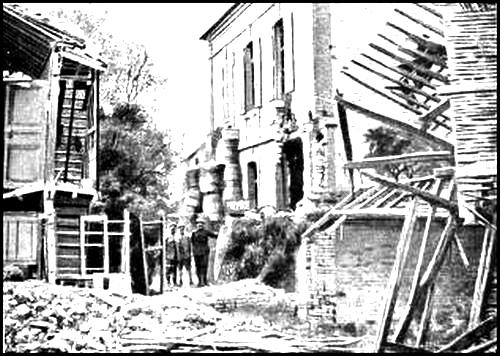
Montdidier in German Hands.
The Palais de Justice (see p. 99). Across the street a German Notice-Board.
On the evening of the 31st, the French front, practically intact,
passed west of Moreuil, skirted the high ground on the left bank of
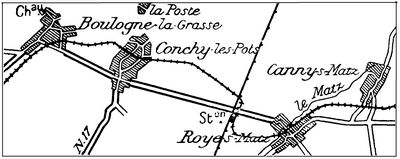
the Avre, running thence west of Cantigny, round Montdidier, along
the suburbs of Orvillers, through Roye-sur-Matz, Le Plémont and
the hills to the south of Noyon, where the Germans had been
unable to gain a footing.
April 1st. The enemy sounded the French lines at Rollot,
south-east of Montdidier, but were smartly checked by a vigorous
counter-attack. Three attacks in front of Grivesnes were likewise
repulsed.
April 2 and 3 were fairly quiet, being the prelude to the final effort
against Debeney's Army.
April 4th. At daybreak, an intense artillery preparation began,
extending from the north of Hangard to the south of Grivesnes.
At 7.30 a.m., the attack was launched with unheard-of violence.
Against this front, only nine miles wide, fifteen divisions—seven
of which were composed of fresh troops—attacked ten times in
the course of the day.
Before Grivesnes, four attacks were repulsed, whilst all the enemy's
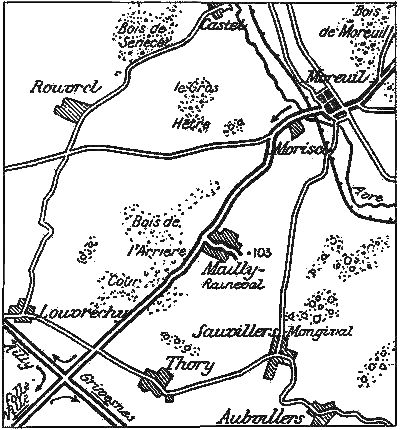
efforts against Cantigny and Hill 104 broke down. Further north
the Germans captured Mailly-Raineval, Morisel and Castel.
The next day (April 5th), counter-attacks checked the Germans,
prevented them exploiting their success north of Montdidier, and
drove them back into Mailly-Raineval and Cantigny.
On the following days, fighting took place at different points, which
changed hands several times, but these actions were of a local nature
only.
The great German attack was over. The roads to the south-west
were barred, as those to the south, at Noyon, had been, and Gen.
Debeney was able to address the following order to his troops:
Soldiers of the 1st Army,
You have carried out your arduous task well.
Your tenacious resistance and vigorous counter-attacks have broken
the onrush of the invader, and ensured the liaison with our brave Allies,
the British. The great battle has begun. At this solemn hour, the whole
country is with us. The soul of the Mother-land uplifts our hearts.
On April 4, the great battle—of which the battles for Amiens, Montdidier
and Compiègne were only episodes—came virtually to an end.
For ten days, after breaking the Allies' front, the Germans were
able to change the war of positions into one of movement, but by a
tremendous effort the French Army threw itself across their path and,
as at Verdun in 1916, checkmated them.
This warfare in the open did not give the results expected by the
enemy, who failed either to separate the Allies, or to rout them. On
the contrary, by bringing about Allied unity of command, they
strengthened the hands of their adversaries, to their own undoing.
Although the Germans captured Montdidier, they failed to reach
either Amiens or Compiègne, and whereas the British, at first severely
shaken, fully recovered, whilst only a portion of the French reserves
were engaged, the enemy used up a considerable part of their finest
troops and shock divisions, mown down in tens of thousands along the
road to Paris, by the Allies' machine-guns and field artillery.
By March 31, ninety enemy divisions had been engaged, twenty-five
of which had to be withdrawn on account of excessive casualties,
some of them (e. g. the 45th Reserve, certain units of the 2nd Guards
and 5th Infantry) having lost 50% of their effective strength. The
casualties of the 6th, 195th, 4th, and 119th divisions attained 75%.
At the very lowest estimation, the Germans lost at least 250,000 men.
The Kronprinz had promised his men that the Easter bells would
ring in the long-expected peace, but Easter Sunday found the Allies
more closely united than ever, awaiting with confidence the end of
the battle, and determined to win through to victory.
The check of April 4 saw the end of von Hutier's reserves. All
the divisions of the XVIIIth Army had been engaged, most of them
with heavy casualties. Unwilling to take any of the divisions from
the army group under the Bavarian Crown Prince—reserved for the
proposed offensive in Flanders—or the inferior and less trained
troops on the Champagne and Lorraine fronts, the German High
Command, realising that the struggle must develop into one of
attrition, like the first battle of the Somme, gave up for the time
being all idea of an offensive on the Somme-Oise front.
A document of the German XVIIIth Army refers to the operations
prior to April 6 under the name of "The Battle of Disruption" and
to those which followed, under the name of "The Fighting on the
Avre and in the region of Montdidier-Noyon."
The divisions forming von Hutier's shock troops were withdrawn
fairly quickly. By the end of May, only two out of the twenty-three
divisions which, on March 21, had formed the XVIIIth Army, were
still in line on the Moreuil-Oise front.
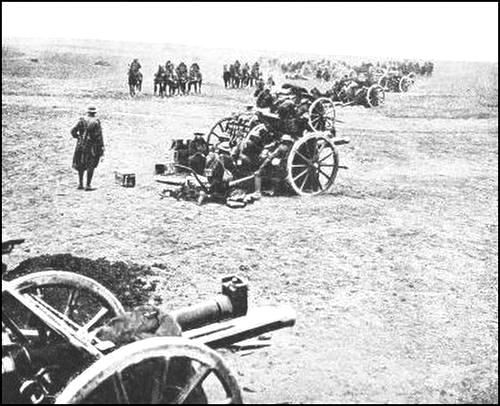
British Batteries in action in the open.
(Photo Imperial War Museum).
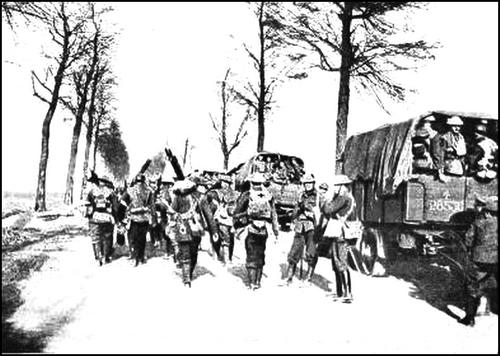
British troops going up the line near Albert.
(Photo Imperial War Museum).
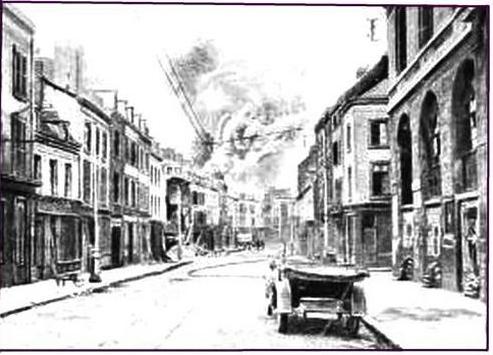
Amiens. Shell bursting in the Rue de Beauvais.
(Photo Imperial War Museum).
From April onwards, trench warfare began again. The Allied front was
reformed, consisting of a continuous line of hastily dug trenches and
rapidly constructed works, held by resolute troops, whose morale was
intact and whose fighting spirit had never been better.
Once more the heavy artillery came into requisition, for the preparatory
pounding of the adversaries' positions.
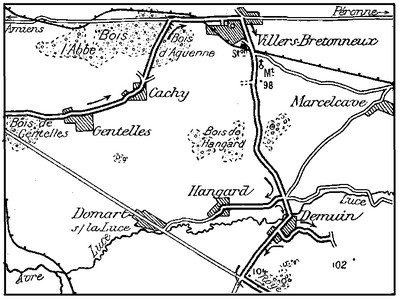
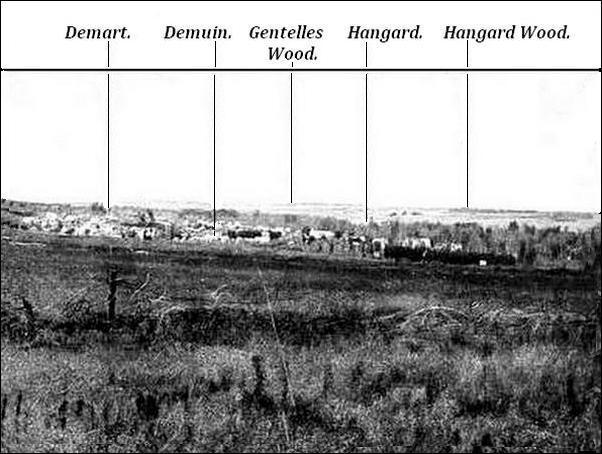
In April-May, sharp engagements frequently took place at certain
points. On the Luce, in the region of Hangard, on the Avre, from
Thennes to Mailly-Raineval, at
Grivesnes, on the west bank of the
Matz, and around Orvillers-Sorel. Of
these, the attack of April 24, by
its violence and scope, constituted a
veritable offensive against Amiens.
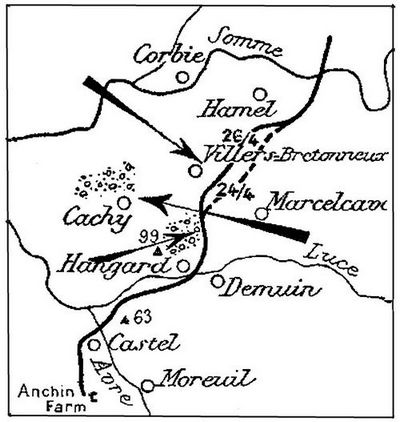
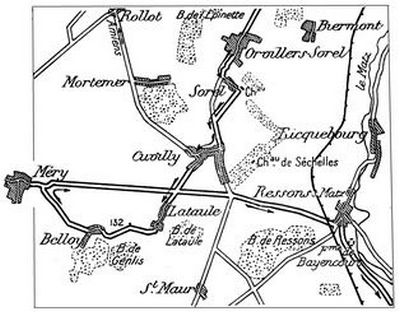
See sketch below.
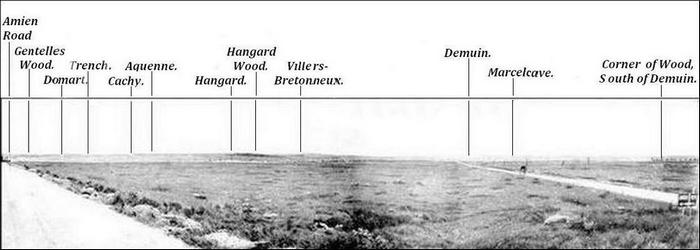
The plateau of Villers-Bretonneux
dominates the ground between the
Avre and the Somme.
It was held by the British. Slightly
to the south, in Hangard Woods,
close to Hill 99, was the point of
junction of the Allied Armies.
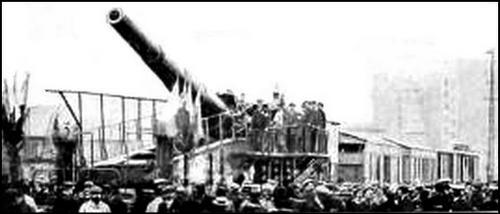
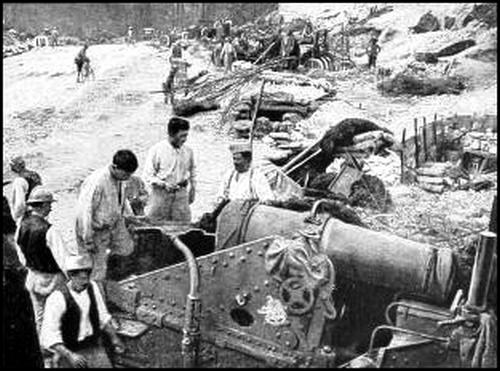
One of the 11in. Guns which Bombarded Amiens.
The enemy's main effort was made at this point, as being the weakest.
The French line started at Anchin Farm, west of Moreuil, followed
the western and northern outskirts of Castel, joined up with Hill 63
on the right bank of the Avre, took in Hangard, and linked up with
the British near Hill 99, to the south of Hangard Wood. From
this point the British line crossed the plateau between the Avre and
the Somme, between Marcelcave and Villers-Bretonneux, and passed
the eastern outskirts of Hamel.
At 5 a.m., after an artillery preparation lasting an hour, the German
infantry attacked.
After a desperate struggle, the enemy captured Villers-Bretonneux.
Hangard fell during the night and Cachy was threatened.
The next day, a Franco-British counter-attack won back the most
important part of the lost ground. Villers-Bretonneux, Hangard and
Hangard Wood were recaptured and held, in spite of all the subsequent
efforts of the enemy, who finally abandoned this sector in favour
of Flanders.
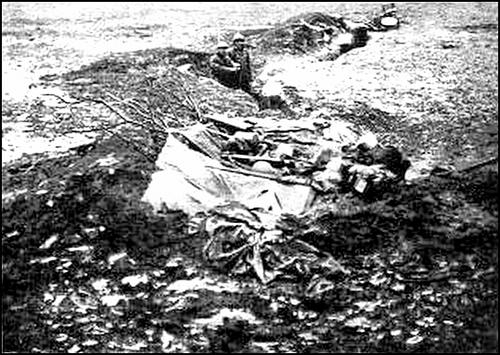
French Trenches in the suburbs of Cachy (see p. 59).
In his "Memoirs", Ludendorff wrote: The battle ended on April 4.
It was a brilliant feat of arms and will always be so considered
in history. What the British and French had been unable to do, we
accomplished in the fourth year of the war.
Strategically, we did not attain what the events of March 23, 24 and
25 justified our hoping for.
That we failed to take Amiens, which would have rendered the
communications of the enemy forces astride the Somme extremely
difficult, was especially disappointing.
Long distance bombardment of the railways could not be considered an
equivalent.
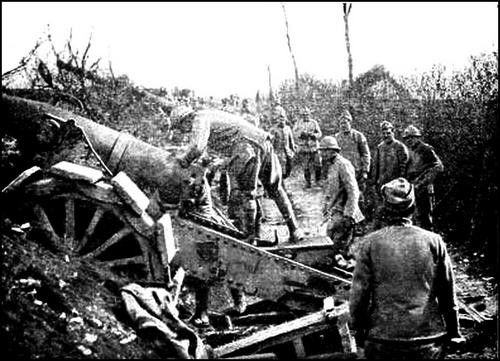
French 6in. Battery in action at Rocquencourt.
(7 miles to the west of Montdidier).
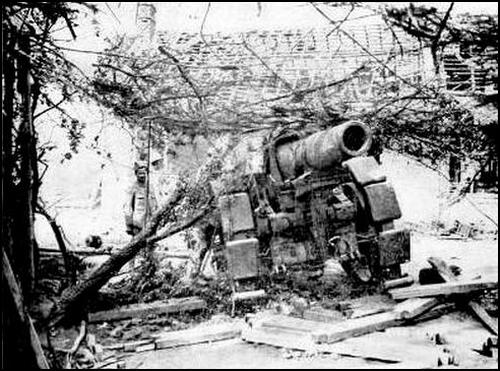
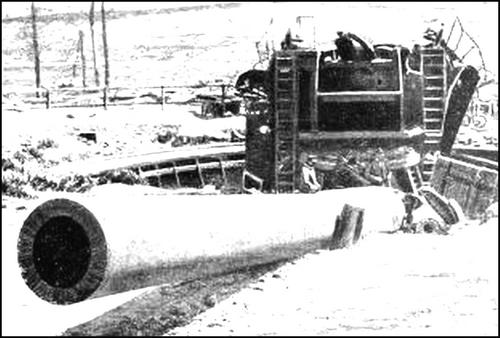
German heavy gun at Faverolles
(2 miles east of Montdidier).
Captured on August 9, 1918, during the offensive of General Debeney's Army. (See p. 42).
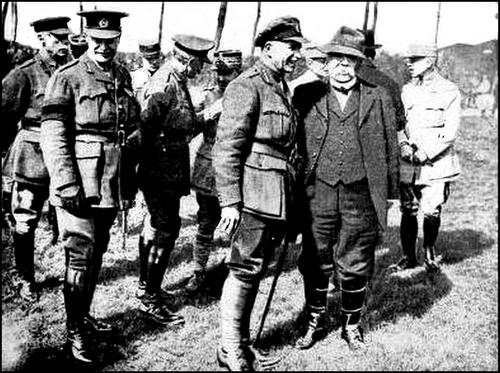
Clemenceau at the G.H.Q. of a British Division in 1918.
(Photo Imperial War Museum).
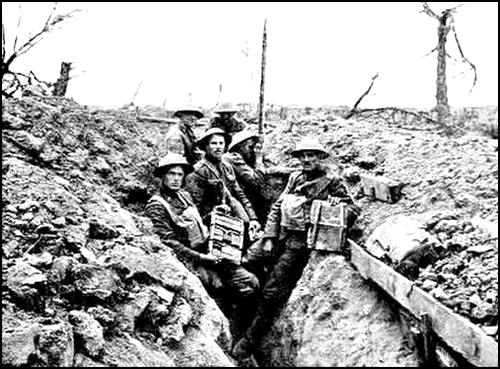
A German Tank Trap. Australian and American
soldiers examine the charges of explosive with
which this trap was fitted. One of them is looking through a German periscope. (July 11, 1918).