INTRODUCTION. MONEY OF THE PAST AND PRESENT. — Ancient Coining. — Portraiture upon Coins. — Incidents of History — Costumes on Coins. — Heraldic Emblems — Humor Pictured on Medals. — Architecture indebted to Coins. — Language upon Coins and Medals.
The need of a circulating medium of exchange has been
acknowledged since the earliest ages of man. In the primeval
days, bartering was the foundation of commercial intercourse
between the various races; but this gave way in time, as exchanges
increased. In the different ages many commodities
have been made to serve as money,—tin was used in ancient
Syracuse and Britain; iron, in Sparta; cattle, in Rome
and Germany; platinum, in Russia; lead, in Burmah; nails,
in Scotland; silk, in China; cubes of pressed tea, in Tartary;
salt, in Abyssinia; slaves, amongst the Anglo Saxons;
tobacco, in the earliest settlements of Virginia; codfish, in
New Foundland; bullets and wampum, in Massachusetts;
logwood, in Campeachy; sugar, in the West Indies; and
soap, in Mexico. Money of leather and wood was in circulation
in the early days of Rome; and the natives of Siam,
Bengal, and some parts of Africa used the brilliantly-colored
cowry shell to represent value, and some travelers allege that it
is still in use in the remote portions of the last-named country.
But the moneys of all civilized nations have been, for the greater
part, made of gold, silver, copper, and bronze. Shekels of silver
are mentioned in the Bible as having existed in the days of
Abraham, but the metals are believed to have been in bars, from
which proportionate weights were chipped to suit convenience.
The necessity for some convenient medium having an intrinsic
value of its own led to coinage, but the exact date of its introduction
is a question history has not yet determined. It is
supposed the Lydians stamped metal to be used as money twelve
hundred years before Christ, but the oldest coins extant were
made 800 B. C., though it is alleged that the Chinese circulated
a square bronze coin as early as 1120 B. C. All of
these coins were rude and shapeless, and generally engraved with
representations of animals, deities, nymphs, and the like; but
the Greeks issued coins, about 300 B. C., which were fine
specimens of workmanship, and which are not even surpassed
in boldness and beauty of design by the products of the coiners
of these modern times. Even while these coins were in circulation
spits and skewers were accepted by the Greeks in exchange
for products, just as wooden and metal coins were circulated
simultaneously in Rome, 700 B. C., and leather and
metal coins in France, as late as 1360 A. D. The earliest coins
bearing portraits are believed to have been issued about 480
B. C., and these were profiles. In the third century, coins
stamped with Gothic front faces were issued, and after that date
a profusion of coins were brought into the world, as every self-governing
city issued money of its own. The earliest money
of America was coined of brass, in 1612, and the earliest colonial
coins were stamped in Massachusetts, forty years later.
Ancient and extensive as the use of money has been in all its
numerous forms and varied materials, it merely represented a
property value which had been created by manual labor and preserved
by the organic action of society. In a primitive state,
herds of cattle and crops of grain were almost the only forms of
wealth; the natural tendency and disposition of men to accumulate
riches led them to fix a special value upon the metals, as a
durable and always available kind of property. When their value
in this way was generally recognized, the taxes and other revenues,
created by kings and other potentates, was collected in part or
wholly in that form of money. The government, to facilitate
public business, stamped the various pieces of metal with their
weight and quality, as they were received at the Treasury; and
according to these stamps and marks, the same pieces were paid
out of the Treasury, and circulated among the people at an authorized
and fixed value. The next step was to reduce current
prices of metal to a uniform size, shape, and quality, value and
denomination, and make them, by special enactment, a legal
tender for the payment of all taxes or public dues.
Thus, a legalized currency of coined money was created, and
the exchangeable value of the various metals used for that purpose
fully established, to the great convenience of the world at
large.
The die for the obverse of the piece to be struck having been
engraved, so as to properly present the religious or national
symbol used for a device and whatever else was to be impressed
upon the coin, was fixed immovably in an anvil or pedestal, face
upwards. The lumps or balls of metal to be coined, having
been made of a fixed and uniform weight and nearly of an
oblate sphere in form, were grasped in a peculiarly constructed
pair of tongs and laid upon the upturned die. A second operative
then placed a punch squarely upon the ball of metal;
heavy blows from a large hammer forced the punch down until
the metal beneath it had been forced into every part of the die,
and a good impress secured. In the meantime the punch
would be imbedded in the lump of metal, and on being withdrawn
the reverse of the coin would show a rough depression
corresponding to the shape given the end of the punch, thereby
making an uneven surface and disfiguring the piece; punch
marks gradually developed into forms, and these forms combined
with figures wrought into artistic design, until, by degrees, the
punch itself became a die, making the reverse of each piece
upon which it was used equal in every respect to the obverse
of which it was the opposite. This perfection of the reverse
was, however, secured at the expense of the effectiveness of the
punch for its original purpose.
The striking of coin between two dies, which were required to
accurately oppose each other, was an operation requiring great
dexterity, and the results were not at all certain. The artisans
at this stage of the work, hit upon the expedient of using both
the obverse and reverse die in a ring of such a size and depth,
as to be a guide to each of them. The balls or disks of metal
being struck inside the ring, between the dies, were forced to
assume an even thickness, and a circular form corresponding
with the inside of the ring. After the ring had been used in
this way for some time, it was engraved upon the inside, and
the coins produced were not only circular in shape, but stamped
upon their edges. Thus was produced the perfect coin, and
through the introduction of machinery has secured uniformity
in the result and saved an immense amount of labor in striking
vast sums of money; the artistic beauty of some of the antique
specimens has not been surpassed in modern times.
It is said that no human head was ever stamped upon coins
until after the death of Alexander the Great; he being regarded
as somewhat of a divinity, his effigy was impressed upon money,
like that of other gods.
The knowledge of coins and medals, through the inscriptions
and devices thereon, is, to an extent, a history of the world
from that date in which metals were applied to such uses.
Events engraven upon these, remain hidden in tombs or buried
in the bosom of the earth, deposited there in ages long past, by
careful and miserly hands, only awaiting the research of the patient
investigator to tell the story of their origin. Numismatic
treasures are scanned as evidence of facts to substantiate statements
upon papyrus or stone, and dates are often supplied to define
the border line between asserted tradition and positive history.
Gibbon remarks: “If there were no other record of
Hadrian, his career would be found written upon the coins of
his reign.”
The rudeness or perfection of coins and medals furnish testimony
of the character and culture of the periods of their production.
This is equally true of that rarest specimen of antiquity,
the Syracusan silver medal—the oldest known to collectors—and
the latest triumph of the graver’s art in gold, the Metis medal.
It is not generally known that the rarest portraits of famous
heroes are found upon coins and medals. The historian, especially
the historic artist, is indebted to this source alone for
the portraits of Alexander, Ptolemy, Cleopatra, Mark Antony,
Cæsar, and many other celebrities. Perhaps the valuation of
a rare coin or medal may be estimated by reference to one piece
in the Philadelphia Mint. It is an Egyptian coin as large as
a half-eagle, and has on the obverse the head of the wife of
Ptolemy—Arsinoe—the only portrait of her yet discovered.
Are not alone recorded; and as an example of a very different
nature may be cited the medals commemorating the destruction
of Jerusalem, and the whole series marking that episode, especially
those classed “Judæa capta.” They tell sadly of a
people’s humiliation: the tied or chained captive; the mocking
goddess of victory, all made more real by reason of the introduction,
on the reverse of each piece, of a Jewess weeping
bitterly, and though she sits under a palm-tree, the national
lament of another captivity is forcibly recalled.
An interesting specimen of the series above mentioned was
recently found in the south of France called, “Judæa Navillas,”
valuable particularly because it strengthens Josephus’s
assertion which had provoked some comment, viz.: the fact of
the escape of a large number of Jews from the Romans, by
means of ships, at Joppa.
Coins and medals mark the introduction of laws; for
example, an old Porcian coin gives the date of the “law of
appeal,” under which, two centuries and a half later, Paul
appealed to Cæsar. Another relic dates the introduction of
the ballot-box; and a fact interesting to the agriculturist is
established by an old silver coin of Ptolemy, upon which a
man is represented cutting millet (a variety of Indian corn)
with a scythe. Religions have been promulgated by coins.
Islamism says upon a gold coin, “No God but God. Mohammed
is the Prophet and God’s chosen apostle.”
Persian coins, in mystic characters, symbolize the dreadful
sacrifices of the Fire-Worshippers. Henry VIII, with characteristic
egotism, upon a medal announces in Hebrew, Greek,
and Latin: “Henry Eighth, King of England, France, and
Ireland; Defender of the Faith, and in the land of England
and Ireland, under Christ, the Supreme Head of the Church.”
We also find stamped upon coins and medals the costumes
of all ages, from the golden net confining the soft tresses of the
“sorceress of the Nile,” and the gemmed robe of Queen Irene,
to the broidered stomacher of Queen Anne, and the stately ruff
of Elizabeth of England.
In this connection may be mentioned the “bonnet piece” of
Scotland, a coin of the reign of James VI., which is extremely
rare, one of them having been sold for £41. The coin received
its name from a representation of the king upon it, with a
curiously plaited hat or bonnet which this monarch wore, a
fashion that gave occasion for the ballad, “Blue Bonnets over
the Border.”
Are faithfully preserved through this medium; in truth,
medalic honors may be claimed as the very foundation of
heraldic art. We discover medals perpetuating revolutions,
sieges, plots, and murders, etc. We prefer directing attention
to the fact that coins and medals are not only the land-marks
of history, but a favorite medium of the poetry of all nations.
Epics are thus preserved by the graver’s art in exceedingly
small space. Poets turn with confidence to old coins for symbol
as well as fact.
One of the most graceful historical allusions is conveyed in
the great seal of Queen Anne, after the union of Scotland with
England. A rose and a thistle are growing on one stem, while,
from above, the crown of England sheds effulgence upon the
tender young plant.
The medal of George I., on the reverse, boastfully presents
“the horse of Brunswick” flying over the northwest of Europe,
symbolizing the Hanoverian succession. The overthrow of the
“Invincible Armada” was the occasion of a Dutch medal,
showing the Hollanders richer in faith than in art culture, for
the obverse of this medal presents the church upon a rock, in
mid-ocean, while the reverse suggests the thought that the
luckless Spanish mariner was driving against the walls of the
actual building.
Architecture is largely indebted to coins, medals, and seals
for accuracy and data. We learn from the medal of Septimus
Severus the faultless beauty of the triumphal arch erected to
celebrate his victory over Arabs and Parthians. This medal
was produced two centuries before the Christian era, and is a
marvel of art, for its perspective is wrought in bas-relief—an
achievement which was not again attained before the execution
of the celebrated Bronze Gates by Ghiberti, for the Baptistery
at Florence, A. D. 1425. This exhumed arch was excavated
long after its form and structure were familiar to men of letters
through the medals.
The effect of coin on language is direct, and many words
may be found whose origin was a coin, such as Daric, a pure
gold coin; Talent, mental ability; Sterling, genuine, pure;
while Guinea represents the aristocratic element, and, though
out of circulation long ago, “no one who pretends to gentility
in England would think of subscribing to any charity or fashionable
object by contributing the vulgar pound. An extra
shilling added to the pound makes the guinea, and lifts the
subscriber at once into the aristocratic world.”
Copper is much preferred to gold for medals. Its firm, unchanging
surface accepts and retains finer lines than have yet
been produced upon gold and silver, and it offers no temptation
to be thrown into the crucible.[1]
In the preparation of this work, I am much indebted to
several gentlemen connected with the United States Mint;
also, to Messrs. R. Coulton Davis, Ph.G., and E. Locke Mason,
who are acknowledged authority on the subject of numismatics.
If it shall be found useful to the public, and especially to
visitors of the Mint, it will be a source of satisfaction, and more
than repay the labor bestowed in its preparation.
G. G. E.
Philadelphia, March 1, 1888.
THE UNITED STATES MINT. — NOTES ON THE EARLY HISTORY OF THE MINT. From Robert Morris’s Diary.
The subject of a National Mint for the United States was
first introduced by Robert Morris,[2] the patriot and financier
of the revolution; as head of the Finance Department, Mr.
Morris was instructed by Congress to prepare a report on the
foreign coins, then in circulation in the United States. On the
15th of January, 1782, he laid before Congress an exposition of
the whole subject. Accompanying this report was a plan for
American coinage. But it was mainly through his efforts, in
connection with Thomas Jefferson and Alexander Hamilton,
that a mint was established in the early history of the Union
of the States. On the 15th of April, 1790, Congress instructed
the Secretary of the Treasury, Alexander Hamilton,
to prepare and report a proper plan for the establishment of a
National Mint, and Mr. Hamilton presented his report at the
next session. An act was framed establishing the mint, which
finally passed both Houses and received President Washington’s
approval April 2, 1792.[3]
1781. July 16th. Wrote to Mr. Dudley at Boston inviting him hither
in consequence of the Continental Agent Mr. Bradford’s Letter respecting
him referred to me by Congress.
July 17th. Wrote Mr. Bradford respecting Mr. Dudley.
Nov. 10th. Ordered some money on application of Mr. Dudley to pay
his expences.
Nov. 12th. Sent for Mr Dudley to consult him respecting the quantity
of Alloy Silver will bear without being discoloured, he says he can put 6
drops into an ounce. Desired him to assay some Spanish Dollars and
French Crowns, in order to know the quantity of pure Silver in each.
Nov. 16th. Mr. Dudley assayed a number of Crowns and dollars for our
information respecting the Mint.
1782. Jan. 2d. Mr. Benjamin Dudley applied for money to pay his
Board which I directed to be paid by Mr. Swanwick, this gentleman is detained
at the public expence as a person absolutely necessary in the Mint,
which I hope soon to see established. My propositions on that subject are
to be submitted to Congress so soon as I can get the proper assays made on
Silver coins &c.
Jan. 7th. Mr. Dudley applies about getting his wife from England. I
promised him every assistance in my power.[4]
Jan. 18th. I went to Mr. Gouvr. Morris’s Lodging to examine the plan
we had agreed on, and which we had drawn up respecting the Establishment
of a Mint, we made some alterations and amendments to my satisfaction
and from a belief that this is a necessary and salutary measure. I
have ordered it copied to be sent into Congress.
Jan. 26th. Mr. Dudley applied for money to pay his Lodgings &c. I
ordered Mr. Swanwick to supply him with fifty dollars, informed him that
the Plan of a Mint is before Congress, and when passed, that he shall be
directly employed, if not agreed to by Congress, I shall compensate him
for his time &c.
Feb. 26th. Mr. Benjamin Dudley brought me the rough drafts or plan
for the rooms of a Mint &c. I desired him to go to Mr. Whitehead Humphreys
to consult him about Screws, Smithwork &c. that will be wanted for
the Mint, and to bring me a list thereof with an estimate of the Cost.
Feb 28th. Mr. Dudley informs me that a Mr. Wheeler, a Smith in the
Country, can make the Screws, Rollers &c. for the Mint. Mr. Dudley proposes
the Dutch Church, that which is now unoccupied, as a place suitable
for the Mint, I sent him to view it, & he returns satisfied that it will answer,
wherefore I must enquire about it.
March 22d. Mr. Dudley and Mr. Wheeler came and brought with them
some Models of the Screws and Rollers necessary for the Mint. I found
Mr. Wheeler entertained some doubts respecting one of these Machines
which Mr. Dudley insists will answer the purposes and says he will be
responsible for it. I agreed with Mr. Wheeler that he should perform the
work; and, as neither he or I could judge of the value that ought to be
paid for it, he is to perform the same agreeable to Mr. Dudley’s directions,
and when finished, we are to have it valued by some Honest Man, judges
of such work, he mentioned Philip Syng, Edwd. Duffield, William Rush
and —— all of whom I believe are good judges and very honest men,
therefore I readily agreed to this proposition. And I desired Mr. Dudley
to consult Mr. Rittenhouse and Francis Hopkinson Esquire, as to the
Machine or Wheel in dispute, and let me have their opinion.
March 23d. Mr. Dudley called to inform me that Mr. Rittenhouse &
Mr. Hopkinson agree to his plan of the Machine &c.
April 12th. Mr. Dudley wants a horse to go up to Mr. Wheelers &c.
May 20th. Mr. Dudley wrote me a Letter this day and wanted money.
I directed Mr. Swanwick to supply him, and then disired him to view the
Mason’s Lodge to see if it would Answer for a Mint, which he thinks it
will, I desired him to go up to Mr. Wheelers to see how he goes on with
the Rollers &c.
June 17th. Mr. Dudley applied for money to pay his Bill. I directed
Mr. Swanwick to supply him.
June 18th. Issued a warrant in favor of B. Dudley £7.11.6.
July 15th. Mr. B. Dudley applied for money, he is very uneasy for want
of employment, and the Mint in which he is to be employed and for
which I have engaged him, goes on so slowly that I am also uneasy at
having this gentleman on pay and no work for him. He offered to go and
assist Mr. Byers to establish the Brass Cannon Foundry at Springfield. I
advised to make that proposal to Genl. Lincoln and inform me the result
to-morrow.[5]
July 16th. Mr. B. Dudley to whom I gave an order on Mr. Swanwick
for fifty dollars, and desired him to seek after Mr. Wheeler to know whether
the Rollers &c. are ready for him to go to work on rolling the copper for
the Mint.
August 22d. Mr. Saml. Wheeler who made the Rollers for the Mint,
applies for money. I had a good deal of conversation with this ingenious
gentleman.
August 26th. Mr. Dudley called and pressed very much to be set at work.
Sept 3d. Mr. B. Dudley applied for a passage for his Friend Mr.
Sprague, pr. the Washington to France & for Mrs. Dudley back. Mr.
Wheeler applied for money which I promised in a short time.
Sept. 4th. Mr. Wheeler for money. I desired him to leave his claim
with Mr. McCall Secretary in this office, and I will enable the discharge
of his notes in the Bank when due.
Novr. 8th. Mr. Dudley applies for the amount of his Bill for Lodgings
and Diet &c. and I directed Mr. Swanwick to pay him, but am very uneasy
that the Mint is not going on.
Dec. 23d. Mr. Dudley and Mr. Wilcox brought the subsistance paper,
and I desired Mr. Dudley to deliver 4000 sheets to Hall and Sellers.[6]
Decr. 26th. Mr. Hall the printer brought 100 Sheets of the subsistence
notes this day, and desired that more paper might be sent to his Printing
Office, accordingly I sent for Mr. Dudley and desired him to deliver the
same from time to time, until the whole shall amount to 4000 Sheets.
1783. April 2d. I sent for Mr. Dudley who delivered me a piece of
Silver Coin, being the first that has been struck as an American Coin.
April 16th. Sent for Mr. Dudley and urged him to produce the Coins
to lay before Congress to establish a Mint.
April 17th. Sent for Mr. Dudley to urge the preparing of Coins &c. for
Establishing a Mint.
April 22d. Mr. Dudley sent in several Pieces of Money as patterns of
the intended American Coins.
May 6th. Sent for Mr. Dudley and desired him to go down to Mr. Mark
Wilcox’s, to see 15,000 Sheets of paper made fit to print my Notes on.
May 7th. This day delivered Mr. Dudley the paper Mold for making
paper, mark’d United States, and dispatched him to Mr. Wilcok’s, but was
obliged to advance him 20 dollars.
May 27th. I sent for Mr. Dudley to know if he has compleated the paper
at Mr. Wilcock’s paper mill for the Certificates intended for the pay of the
Army. He says it is made, but not yet sufficiently dry for the printers use.
I desired him to repair down to the Mill and bring it up as soon as possible.
May 28th. Mr. Whitehead Humphreys to offer his lot and buildings for
erecting a Mint.
July 5th. Mr. Benjn. Dudley gave notice that he has received back
from Messrs. Hall and Sellers the Printers, three thousand sheets of the
last paper made by Mr. Wilcocks. I desired him to bring it to this office.
He also informs of a Minting Press being in New York for sale, and urges
me to purchase it for the use of the American Mint.
July 7th. Mr. Dudley respecting the Minting Press, but I had not
time to see him.
August 19th. I sent for Mr. Benjamin Dudley, and informed him of
my doubts about the establishment of a Mint, and desired him to think of
some employment in private service, in which I am willing to assist him
all in my power. I told him to make out an account for the services he
had performed for the public, and submit at the Treasury office for inspection
and settlement.
August 30th. Mr. Dudley brought the dies for Coining in the American
Mint.
Sept. 3d. Mr. Dudley applies for money for his expenses which I agree
to supply, but urge his going into private business.
Sept. 4th. Mr. Dudley for money, which is granted. Directed him to
make three models for constructing Dry——
Nov. 21st. Mr. Dudley applies for money. He says he was at half a
guinea a week and his expenses borne when he left Boston to come about the
Mint, and he thinks the public ought to make that good to him. I desired
him to write me and I will state his claims to Congress.
Nov. 26th. Mr. Dudley for money, which was granted.
Dec. 17th. Mr. Dudley with his account for final settlement. I referred
him to Mr. Milligan.
1784. Jan. 5th. Mr. Dudley applies for a Certificate of the Time
which he was detained in the public service. I granted him one accordingly.
Jan. 7th. Mr. Dudley after the settlement of his account, which I compleated
by signing a warrant.
[Fac simile of original, photo-engraved by Levytype Company.]
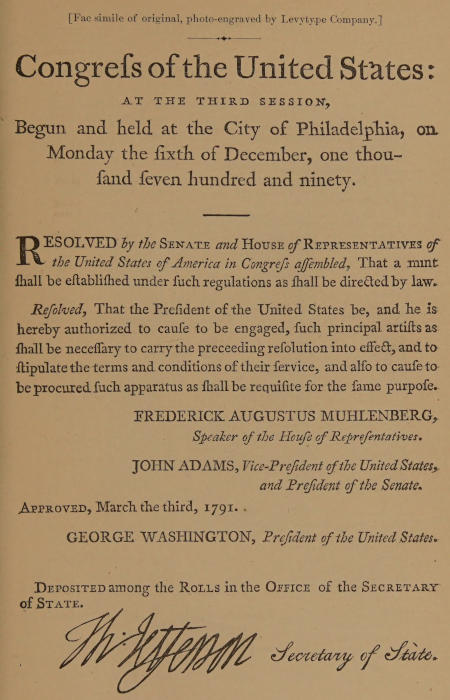
Congress of the United States:
AT THE THIRD SESSION,
Begun and held at the City of Philadelphia, on
Monday the sixth of December, one thousand
seven hundred and ninety.
Resolved by the Senate and House of Representatives of
the United States of America in Congress assembled, That a mint
shall be established under such regulations as shall be directed by law.
Resolved, That the President of the United States be, and he is
hereby authorized to cause to be engaged, such principal artists as
shall be necessary to carry the preceeding resolution into effect, and to
stipulate the terms and conditions of their service, and also to cause to
be procured such apparatus as shall be requisite for the same purpose.
FREDERICK AUGUSTUS MUHLENBERG, Speaker of the House of Representatives.
JOHN ADAMS, Vice-President of the United States, and President of the Senate.
Approved, March the third, 1791.
GEORGE WASHINGTON, President of the United States.
Deposited among the Rolls in the Office of the Secretary
of State.
Th. Jefferson Secretary of State.
The following is a copy of an old pay roll, framed and hanging upon the wall of
the Cabinet.
Names and Salaries of the Officers, Clerks, and Workmen
Employed at the Mint the 10th October, 1795.
| Henry Wm. DeSaussure, Director |
@ 2,000 |
Drs. |
per Ann. |
| Nicholas Way, Treasurer |
1,200 |
” |
” |
| Henry Voigt, Chief Coiner |
1,500 |
” |
” |
| Albion Cox, Assayer |
1,500 |
” |
” |
| Robert Scott, Engraver |
1,200 |
” |
” |
| David Ott, Melter and Refiner pro tem. |
1,200 |
” |
” |
| Nathaniel Thomas, Clerk to the Treasurer |
700 |
” |
” |
| Isaac Hough, ditto to Director and Assayer |
500 |
” |
” |
| Lodewyk Sharp, ditto to Chief Coiner |
500 |
” |
” |
| John S. Gardiner, Assistant Engraver |
936 |
” |
” |
| Adam Eckfeldt, Die Forger and Turner |
500 |
” |
” |
| Workmen Employed in Chief Coiner’s Department. |
| Wages per day. |
Doll. |
Cts. |
| John Schreiner, Chief Pressman |
1 |
80 |
| John Cope, Chief Adjuster |
1 |
60 |
| William Hayley, Roller |
1 |
40 |
| Nicholas Sinderling, Annealer |
1 |
40 |
| John Ward, Miller |
1 |
20 |
| Joseph Germon, Drawer |
1 |
20 |
| Lewis Laurenger, Brusher |
1 |
20 |
| Henry Voigt, Junr, Adjuster |
|
88 |
| Sarah Waldrake, ditto |
|
50 |
| Rachael Summers, ditto |
|
50 |
| Lewis Bitting, ditto |
1 |
20 |
| Lawrence Ford, ditto |
1 |
20 |
| Christopher Baum, Pressman |
1 |
|
| John Keyser, ditto |
1 |
|
| Frederick Bauck, ditto |
1 |
|
| Barney Miers, Cleaner |
1 |
|
| Martin Summers, Doorkeeper |
1 |
|
| Adam Seyfert, Hostler |
1 |
|
| John Bay, Boy. |
|
66 |
| Workmen Employed at the Furnace of the Mint. |
| Peter LaChase, Melter |
1 |
60 |
| George Myers, ditto |
1 |
50 |
| Eberhart Klumback, ditto |
1 |
40 |
| Patrick Ryan, Filer |
1 |
25 |
| Valentine Flegler, Labourer |
1 |
25 |
| Andrew Brunet, ditto |
1 |
|
| William Ryan, ditto |
1 |
|
Endorsed in two places, “Names and Salaries of the Officers, Clerks and
Workmen employed in the Mint the 10th Oct. 1795.”
THE PHILADELPHIA MINT. — EXTRACT FROM THE RULES AND REGULATIONS ADOPTED FOR THE MINT, JANUARY 1, 1825. — The Mint Established. — Copy of the Paper laid in the Corner Stone of the Mint, July 4, 1829. — Visiting the Mint. — The Deposit or Weighing-room. — The Deposit Melting Room. — Office of the Melter and Refiner. — The Process of Assay. — The Assaying Rooms. — Assaying Gold. — Assaying Silver. — The Separating Room. — The Melting Rooms — The Rolling Room. — Annealing Furnaces. — The Drawing Benches. — The Cutting Machines. — Adjusting Room. — Progress in Coining. — Dies. — Transfer Lathe. — The Coining and Milling Rooms.
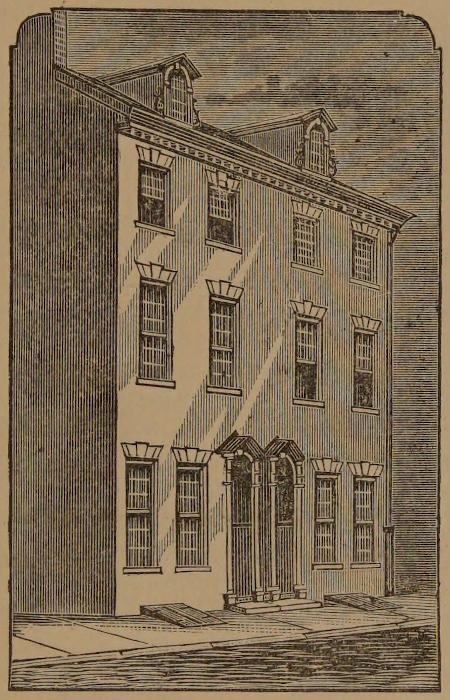
THE FIRST MINT IN THE UNITED STATES, ERECTED IN 1792.
The popular estimation in which the Mint is held in the
United States, is, for obvious reasons, more distinctively
marked than that entertained for other public institutions.
Its position, in a financial point of view, is so important, its use
so apparent, and its integrity of management so generally conceded,
that it enjoys a pre-eminence and dignity beyond that
accorded to general governmental departments. Party mutations
usually effect changes in its directorship, with but slight
interference, however, with the other officials, as those of attainments,
skill, and long experience in the professional
branches, required to intelligently perform the various duties
assigned, are few in all countries. Those occupying positions
are chosen for their proficiency in the various departments,
their characters being always above question. The confidence
reposed in the officials of the United States Mint has never
been violated, as, for nearly a century of its operations, no
shadow of suspicion has marred the fair name of any identified
with its history.
The need of a mint in the Colonies was keenly felt to be a
serious grievance against England for years before the Revolution,
and as soon as practicable after the establishment of Independence,
the United States Mint was authorized by an Act
of Congress—April 2, 1792.
A lot of ground was purchased on Seventh Street near
Arch, and appropriations were made for erecting the requisite
buildings. An old still-house, which stood on the lot, had
first to be removed. In an account book of that time we find
an entry on the 31st of July, 1792, of the sale of some old
materials of the still-house for seven shillings and sixpence,
which “Mr. Rittenhouse directed should be laid out for punch
in laying the foundation stone.”[7]
The first building erected in the United States for public
use, under the authority of the Federal Government, was a
structure for the United States Mint. This was a plain brick
edifice, on the east side of Seventh street, near Arch, the
corner-stone of which was laid by David Rittenhouse, Director
of the Mint, on July 31, 1792. In the following October
operations of coining commenced. It was occupied for about
forty years. On the 19th of May, 1829, an Act was passed by
Congress locating the United States Mint on its present site.
The first coinage of the United States, was silver half-dimes
in October, 1792, of which Washington makes mention in his
address to Congress, on November 6, 1792, as follows; “There
has been a small beginning in the coinage of half-dimes; the
want of small coins in circulation, calling the first attention to
them.” The first metal purchased for coinage was six pounds
of old copper at one shilling and three pence per pound, which
was coined and delivered to the Treasurer, in 1793. The first
deposit of silver bullion was made on July 18, 1794, by the Bank
of Maryland. It consisted of “coins of France,” amounting
to $80,715.73½. The first returns of silver coins to the Treasurer,
was made on October 15, 1794. The first deposit of gold
bullion for coinage, was made by Moses Brown, merchant, of
Boston, on February 12, 1795; it was of gold ingots, worth
$2,276.72, which was paid for in silver coins.
The first return of gold coinage, was on July 31, 1795, and
consisted of 744 half eagles. The first delivery of eagles was
in September 22, same year, and consisted of four hundred
pieces.
Previous to the coinage of silver dollars, at the Philadelphia
Mint, in 1794, the following amusing incidents occurred in
Congress, while the emblems and devices proposed for the
reverse field of that coin were being discussed.
A member of the House from the South bitterly opposed
the choice of the eagle, on the ground of its being the “king
of birds,” and hence neither proper nor suitable to represent
a nation whose institutions and interests were wholly inimical
to monarchical forms of government. Judge Thatcher playfully,
in reply, suggested that perhaps a goose might suit the
gentleman, as it was a rather humble and republican bird, and
would also be serviceable in other respects, as the goslings
would answer to place upon the dimes. This answer created
considerable merriment, and the irate Southerner, conceiving
the humorous rejoinder as an insult, sent a challenge to the
Judge, who promptly declined it. The bearer, rather astonished,
asked, “Will you be branded as a coward?” “Certainly,
if he pleases,” replied Thatcher; “I always was one
and he knew it, or he would never have risked a challenge.”
The affair occasioned much mirth, and, in due time, former existing
cordial relations were restored between the parties; the
irritable Southerner concluding there was nothing to be gained
in fighting with one who fired nothing but jokes.
The operations of the Mint throughout the year, are to commence at 5
o’clock in the morning, under the superintendence of an officer, and continue
until 4 o’clock in the afternoon, except on Saturdays, when the business
of the day will close at 2 o’clock, unless on special occasions it may
be otherwise directed by an officer. Extra work will be paid for in proportion,
on a statement being made of it through the proper officer, at the
end of each month. A strict account is to be kept by one of the officers,
as they may agree of the absentees from duty, if the absence be voluntary,
the full wages for the time will be deducted, if it arise from sickness a
deduction will be made at the discretion of the proper officer. A statement
of these deductions will be rendered at the end of the month, and
the several accounts made out accordingly.
The allowance under the name of drink money is hereafter to be discontinued,
and in place of it three dollars extra wages per month will be allowed
for the three summer months to those workmen who continue in the Mint
through that season. No workman can be permitted to bring spirituous
liquors into the Mint. Any workman who shall be found intoxicated
within the Mint must be reported to the Director, in order that he may be
discharged. No profane or indecent language can be tolerated in the
Mint. Smoking within the Mint is inadmissible. The practice is of dangerous
tendency; experience proves that this indulgence in public institutions,
ends at last in disaster. Visitors may be admitted by permission of
an officer, to see the various operations of the Mint on all working days
except Saturdays and rainy days; they are to be attended by an officer, or
some person designated by him. The new coins must not be given in
exchange for others to accommodate visitors, without the consent of the
Chief Coiner. Christmas day and the Fourth of July, and no other days,
are established holidays at the Mint. The pressmen will carefully lock
the several coining presses when the work for the day is finished, and
leave the keys in such places as the Chief Coiner shall designate. When
light is necessary to be carried from one part of the Mint to the other, the
watchman will use a dark lanthorn but not an open candle. He will keep
in a proper arm chest securely locked, a musket and bayonet, two pistols
and a sword. The arms are to be kept in perfect order and to be inspected
by an officer once a month, when the arms are to be discharged and
charged anew.
The watchman of the Mint must attend from 6 o’clock in the evening to
5 o’clock in the morning, and until relieved by the permission of an officer,
or until the arrival of the door-keeper. He will ring the yard bell precisely
every hour by the Mint clock, from 10 o’clock until relieved by the
door-keeper, or an officer, or the workmen on working days, and will send
the watch dog through the yard immediately after ringing the bell. He
will particularly examine the departments of the engine and all the rooms
where fire has been on the preceding day, conformably to his secret
instructions. For this purpose he will have keys of access to such rooms
as he cannot examine without entering them.
If an attempt be made on the Mint he will act conformably to his secret
instructions on that subject. In case of fire occurring in or near the
Mint, he will ring the Alarm Bell if one has been provided, or sound the
alarm with his rattle, and thus as soon as possible bring some one to him
who can be dispatched to call an officer, and in other particulars will
follow his secret instructions. The secret instructions given him from
time to time he must be careful not to disclose. The delicate trust reposed
in all persons employed in the Mint, presupposes that their character
is free from all suspicion, but the director feels it his duty nevertheless,
in order that none may plead ignorance on the subject, to warn them
of the danger of violating so high a trust. Such a crime as the embezzlement
of any of the coins struck at the Mint, or of any of the metals
brought to the Mint for coinage, would be punished under the laws of
Pennsylvania, by a fine and penitentiary imprisonment at hard labor.
The punishment annexed to this crime by the laws of the United States,
enacted for the special protection of deposits made at the Mint, is DEATH.
The 19th Section of the Act of Congress, establishing the Mint, passed
April 12, 1792, is in the following words: Section 19, and be it further
enacted, That if any of the gold or silver coins, which shall be struck or
coined at the said Mint, shall be debased or made worse as to the proportion
of fine gold or fine silver, therein contained, or shall be of less weight
or value than the same ought to be, pursuant to the directions of this act,
through the default or with the connivance of any of the officers or persons
who shall be employed at said Mint, for the purpose of profit or gain,
or otherwise, with a fraudulent intent, and if any of the said officers or
persons shall embezzle any of the metal which shall at any time be committed
to their charge, for the purpose of being coined, or any of the coins
which shall be struck or coined at the said Mint, every such officer or
person who shall commit any or either of the said offences, shall be
deemed guilty of Felony, and shall suffer death. Printed copies of the
Rules here recited are to be kept in convenient places for the inspection of
the workmen, but as all may not be capable of reading them, it shall be
the duty of the proper officer of the several departments, or such person
as he may appoint, to read them in the hearing of the workmen, at least
once a year, and especially to read them to every person newly employed
in the Mint.
SAMUEL MOORE, Director.
Up to 1836 the work at the Mint was done entirely by hand
or horse power. In that year steam was introduced. At different
periods during the years 1797, 1798, 1799, 1802, and
1803, the operations of the Mint were suspended on account
of the prevalence of yellow fever.
“Bond of Indemnity or Agreement of Operatives to return to the
service of the Mint.” Dated August, 1799.
“We, the subscribers, do hereby promise and engage to return to the service
of the Mint as soon as the same shall be again opened, after the prevailing
fever is over, on the penalty of twenty pounds.”
“As witness our hands this 31st day of August, 1799.
- “GEORGE WATT’N,
- JOHN COPE,
- LEWIS BITTING,
- GEO. BOEMING,
- JAMES ANDERSON,
- JOHN SCHREINER,
- JOHN BIRNBAUM,
- GEORGE MYERS,
- CHARLES BENJ. K——,
- GEORGE BAILY,
- JOHN MANN,
- (In German) JOHANNES ——,
- SAML. THOMPSON,
- MARTIN SUMMERS.”
The above are the signatures of the parties agreeing, written on old hand-made
unruled foolscap paper.
This is part of the Mint records, which has been framed for convenience
and protection. It hangs in the Cabinet.
The Mint was established by Act of Congress the second of
April, 1792, and a few half-dimes were issued towards the close
of that year. The general operations of the institution commenced
in 1793. The coinage effected from the commencement
of the establishment to the end of the year 1800 may be stated
in round numbers at $2,534,000; the coinage of the decade
ending 1810 amounted to $6,971,000, and within the ten years
ending with 1820—$9,328,000. The amount within the ten
years ending with 1830 is stated at $18,000,000, and the
whole coinage from the commencement of the institution at
$37,000,000. On the second of March, 1829, provisions were
made by Congress for extending the Mint establishment, the
supply of bullion for coinage having increased beyond the
capacity of the existing accommodations. The Mint edifice,
erected under this provision, stands on a lot purchased for the
object at the northwest corner of Chestnut and Juniper streets,
fronting 150 feet on Chestnut street and extending 204 feet to
Penn Square, (the central and formerly the largest public
square in the city). The corner-stone of the new edifice was
laid on the fourth of July, 1829; the building is of marble and
of the Grecian style of architecture, the roof being covered with
copper. It presents on Chestnut street and Penn Square a
front of 123 feet, each front being ornamented with a portico
of 60 feet, containing six Ionic columns. In the centre of the
structure there was formerly a court-yard (now built up) extending
85 by 84 feet, surrounded by a piazza to each story, affording
an easy access to all parts of the edifice. Present officers of
the Mint: Hon. Daniel M. Fox, Superintendent; William S.
Steel, Coiner; Jacob B. Eckfeldt, Assayer; Patterson Du Bois,
Assistant Assayer, James C. Booth, Melter and Refiner; N.
B. Boyd, Assistant Melter and Refiner; Charles E. Barber,
Engraver; George T. Morgan and William H. Key, Assistant
Engravers; M. H. Cobb, Cashier; George W. Brown, Doorkeeper.
On July 4, 1829, Samuel Moore, then Director, laid the
corner stone of the present building, located at the northwest
corner of Chestnut and Juniper streets. It is of white marble,
and of the Grecian style of architecture, and was finished, and
commenced operations, in 1833. Subsequent to that date
necessary changes in the interior arrangements, to accommodate
the increase in business, have been introduced at various times,
and it was made more secure as a depository for the great
amount of bullion contained within its vaults, by having been
rendered fire-proof in 1856.
This corner stone of the Mint of the United States of
America, laid on the 4th day of July, 1829, being the fifty-third
anniversary of our independence, in the presence of the
Officers thereof, Members of Congress of the adjacent districts,
architect, and artificers employed in the building, and a
number of citizens of Philadelphia, in the which with this instrument
are deposited specimens of the Coins of our Country
struck in the present year. The Mint of the United States
commenced operations in the year A. D., 1793, increasing
constantly in utility, until its locality and convenience required
extension and enlargement, which was ordered by the passage
of a bill appropriating $120,000 for the erection of new and
convenient buildings, to accommodate its operations, vesting
the disbursement in the judgment and taste of the Director and
President of the United States. In pursuance of the above bill,
passed during the Presidency of John Quincy Adams, arrangements
were made and designs adopted; William Strickland
appointed architect; John Struthers, marble mason; Daniel
Groves, bricklayer; Robert O’Neil, master carpenter, and in
the first year of the Presidency of Andrew Jackson, this corner
stone was placed in southeast corner of the edifice.
The names of the officers of the Mint of the United States
at this time, are as follows:
- Doctor Samuel Moore, Director,
- Adam Eckfeldt, Coiner,
- Joseph Cloud, Melter and Refiner,
- Joseph Richardson, Assayer,
- Doctor James Rush, Treasurer,
- Wm. Kneass, Engraver,
- George Ehrenzelder, Clerk.
Mint of the United States,
Philadelphia, March 20, 1838.
To Hon. Levi Woodbury,
Secretary of the Treasury.
Sir:—I had the honor to receive your letter asking my
attention to a resolution of the House of Representatives of the
United States, passed March 5, 1838, as follows:
Extract from Resolution of Congress relating to Mint.
“Resolved, That the Secretary of the Treasury report to
this House the cost of erecting the principal Mint and its
branches, including buildings, fixtures, and apparatus; the
salaries and expenses of the different officers; the amount expended
in the purchase of bullion; the loss arising from wastage,
and all other expenses; and the average length of time it
requires to coin at the principal Mint all the bullion with which
it can be furnished; and further, what amount of coin has been
struck at the several branch mints, since their organization.”
Mint of the United States, Philadelphia.
| The cost of the edifice, machinery, and fixtures, was |
$173,390 |
| Ground, enclosure, paving, etc. |
35,840 |
| Total cost of buildings, etc. |
$209,230 |
This amount does not include expenditures made under special
appropriations for the years 1836 and 1837, for milling
and coining by steam power; and for extensive improvements
in the assaying, melting, and parting rooms, and machine shops,
amounting to $28,270.
It may be proper to mention that the Mint building is on
the best street in the city, is of large dimensions, with the
whole exterior of marble, and two Ionic porticos; and that the
machinery and apparatus are of the best construction. The
cost must therefore be considered as very moderate. The new
Mint lately erected by the British India Government at Calcutta,
cost 24 lacs of rupees, or about $1,138,000.
| The |
Director receives per annum |
$3,500 |
|
Treasurer |
2,000 |
|
Chief Coiner |
2,000 |
|
Assayer |
2,000 |
|
Melter and Refiner |
2,000 |
|
Engraver |
2,000 |
|
Second Engraver |
1,500 |
|
Assistant Assayer |
1,300 |
|
Treasurer’s Clerk |
1,200 |
|
Bookkeeper |
1,000 |
|
Clerk of the weighing room |
1,200 |
|
Director’s Clerk |
700 |
|
Total for salaries |
$20,400 |
No expenses are allowed, beyond the above sums, to any
officer, assistant, or clerk, for the performance of his duties.
As all the gold and silver brought to the Mint is purchased
at the nett Mint price, there is no expense, properly so called,
incurred on this account.
R. M. PATTERSON, Director of the Mint.
Previous to the passage of the law by the Federal government
for regulating the coins of the United States, much perplexity
arose from the use of no less than four different currencies or
rates, at which one species of coin was recoined, in the different
parts of the Union. Thus, in New Hampshire, Massachusetts,
Maine, Rhode Island, Connecticut, Vermont, Virginia and Kentucky,
the dollar was recoined at six shillings; in New York
and North Carolina at eight shillings; in New Jersey, Pennsylvania
and Maryland at seven shillings and six pence; in
Georgia and South Carolina at four shillings and eight pence.
The subject had engaged the attention of the Congress of the old
confederation, and the present system of the coins is formed
upon the principles laid down in their resolution of 1786, by
which the denominations of money of account were required to
be dollars (the dollar being the unit), dismes or tenths, cents or
hundredths, and mills or thousandths of a dollar. Nothing can
be more simple or convenient than this decimal subdivision.
The terms are proper because they express the proportions
which they are intended to designate. The dollar was wisely
chosen, as it corresponded with the Spanish coin, with which
we had been long familiar.
The Mint, on Chestnut street near Broad, is open to the public
daily, excepting Sundays and holidays, from 9 to 12 A. M.
Visitors are met by the courteous ushers, who attend them through
the various departments. It is estimated that over forty thousand
persons have visited the institution in the course of a single year.
Owing to the immense amount of the precious metals which is
always in course of transition, and the watchful care necessary
to a correct transaction of business, the public are necessarily
excluded from some of the departments. These, however, are
of but little interest to the many and are described under their
proper heads. The system adopted in the Mint is so precise and
the weighing so accurate, that the abstraction of the smallest
particle of metal would lead to almost immediate detection.
On entering the rotunda, the offices of the Treasurer and
Cashier are to the right and left. Farther in, in the hall, to
the rear, on the right, is the room of the Treasurer’s clerks;
a part of this was formerly used by the Adams Express
Company, who transport to and from the Mint millions of
dollars worth of metal, coin, etc.
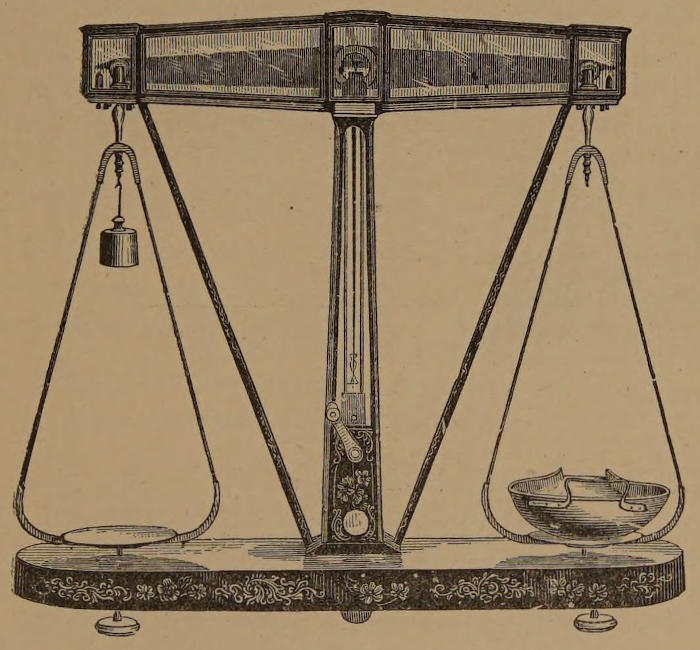
SCALES.
On the left is the Deposit or Weighing-room, where all the
gold and silver for coining is received and first weighed. The
largest weight used in this room is five hundred ounces, the
smallest, is the thousandth part of an ounce. The scales are
wonderfully delicate, and are examined and adjusted on alternate
days. On the right of this room is one of the twelve
vaults in the building. Of solid masonry, several of them are
iron-lined, with double doors of the same metal and most complicated
and burglar-proof locks.
AUTOMATIC WEIGHING SCALES.
It is estimated that about fifteen hundred million dollars
worth of gold has been received and weighed in this room;
probably nine-tenths of this amount was from California, since
its discovery there in the year 1848. Previous to that time
the supplies of gold came principally from Virginia, North
Carolina, and Georgia. During the past ten years considerable
quantities have been received from Nova Scotia, but most of
the gold that reaches the Mint, at the present time, comes
from California, Montana, Colorado, Idaho, Nevada, Arizona,
Oregon, Dakota, Virginia, South Carolina, and New Mexico.
Formerly the silver used by the Mint came principally from
Mexico and South America, but since the discovery of the
immense veins of that metal in the territories of the United
States the supply is furnished from the great West.
The copper used comes principally from the mines of Lake
Superior, the finest from Minnesota. The nickel is chiefly from
Lancaster County, Pa.
After the metal has been carefully weighed in the presence
of the depositor and the proper officials, it is locked in iron
boxes and taken to the melting room, where it is opened by
two men, each provided with a key to one of the separate
locks. There are four furnaces in this room, and the first
process of melting takes place here. The gold and silver,
being mixed with borax and other fluxing material, is placed in
pots, melted and placed in iron moulds, and when cooled is
again taken to the deposit room in bars, where it is reweighed,
and a small piece cut from each lot by the Assayer. From
this the fineness of the whole is ascertained, the value calculated,
and the depositor paid. The metal in its rough state is
then transferred to the Melter and Refiner.
Adjoining the Deposit Melting Room are the Melter and
Refiner and assistants. This is the general business office of
the head of this department, and is also used for weighing the
necessary quantities of the metals used in alloying coin.
The two essential things regarding every piece of metal
offered in payment of any dues were, first, the weight or quantity,
next, the fineness or purity of the same. The process of
weighing even the baser metals used in coining must be conducted
by the careful use of accurate scales, with precise notes
of the results. In precious metals, gold, silver, and their high
grade alloys, a very small variation in the fineness makes a
great difference in the value. Nothing is more essential than
the accurate determination of the weight of the sample and of
the metal obtained from it. It requires keen sight and most
delicate adjustment in the hand which manipulates the Lilliputian
scales of an Assayer’s table. The smallest weight used
in the Mint is found in the Assay Room; it is the thirteen-hundredth
part of a grain, and can scarcely be seen with the
naked eye, unless on a white ground. The Assay Department
is strictly a technical and scientific branch of the service. It
has been practically under one regime, for the last fifty years.
There have been but three Chief Assayers in that time, the
only removals being by death, the only appointments by promotion.
Its workmen are all picked men, selected from other
parts of the Mint for special fitness and good character.
These are on the second floor, in the southwest corner of
the building. In one of these are fires, stills, and other appliances
used in the delicate and complicated process of assay,
by which the specific standard of the fineness and purity of
the various metals are established and declared.
The gold is melted down and stirred, by which a complete
mixture is effected, so that an assay piece may be
taken from any part of the bar after it is cast. The piece
taken for this purpose is rolled out for the convenience of
cutting. It is then taken to an assay balance (sensible to the
ten-thousandth of a half gramme or less), and from it is
weighed a half gramme, which is the normal assay weight for
gold, being about 7.7 grains troy. This weight is stamped
1000; and all the lesser weights (afterwards brought into
requisition) are decimal divisions of this weight, down to one
ten-thousandth part.
Silver is next weighed out for the quartation (alloying), and
as the assay piece, if standard, should contain 900-thousandths
of gold, there must be three times this weight, or 2700-thousandths
of silver; and this is the quantity used. The lead
used for the cupellation is kept prepared in thin sheets, cut in
square pieces, which should each weigh about ten times as
much as the gold under assay. The lead is now rolled into
the form of a hollow cone; and into this are introduced the
assay gold and the quartation silver, when the lead is closed
around them and pressed into a ball. The furnace having been
properly heated, and the cupels placed in it and brought to
the same temperature, the leaden ball, with its contents, is put
into a cupel (a small cup made of burned bones, capable of
absorbing base metals), the furnace closed, and the operation
allowed to proceed, until all agitation is ceased to be observed
in the melted metal, and its surface has become bright. This
is an indication that the whole of the base metals have been
converted into oxides, and absorbed by the cupel.
The cupellation being thus finished, the metal is allowed to
cool slowly, and the disc or button which it forms is taken
from the cupel. The button is then flattened by a hammer;
is annealed by bringing it to a red heat; is laminated by
passing it between the rollers; is again annealed; and is rolled
loosely into a spiral or coil called a cornet. It is now ready
for the process of quartation. This was formerly effected in
a glass matrass, and that mode is still used occasionally, when
there are few assays. But a great improvement, first introduced
into this country by the Assayer in 1867, was the—“platinum
apparatus,” invented in England. It consists of a platinum
vessel in which to boil the nitric acid, which is to dissolve
out the silver, and a small tray containing a set of platinum
thimbles with fine slits in the bottom. In these the silver is
taken out, by successive supplies of nitric acid, without any decanting
as in the case of glass vessels. The cornets are also
annealed in the thimbles; in fact there is no shifting from the
coiling to the final weighing, which determines the fineness of
the original sample by proportionate weights in thousandths.
In this process extra care has to be taken in adding the proportions
of silver, as the “shaking” of any one cornet, might
damage the others.
The process of assaying silver differs from that of gold. To
obtain the assay sample, a little of the metals is dipped from
the pot and poured quickly into water, producing a granulation,
from portions of which that needed for assay is taken.
In the case of silver alloyed with copper there is separation, to
a greater or less degree, between the two metals in the act of
solidification. Thus an ingot or bar, cooled in a mould, or any
single piece cut from either, though really 900-thousandths
fine on the average, will show such variations, according to the
place of cutting, as might exceed the limits allowed by law.
But the sudden chill produced by throwing the liquid metal
into water, yields a granulation of entirely homogeneous
mixture that the same fineness results, whether by assaying a
single granule, or part of one, or a number.
From this sample the weight of 1115 thousandths is taken;
this is dissolved in a glass bottle with nitric acid. The standard
solution of salt is introduced and chloride of silver is the result,
which contains of the metallic silver 1000 parts; this is repeated
until the addition of the salt water shows but a faint trace of
chloride below the upper surface of the liquid. For instance:
if three measures of the decimal solution have been used with
effect, the result will show that the 1115 parts of the piece contained
1003 of pure silver; and thus the proportion of pure
silver in the whole alloyed metal is ascertained. Extensive
knowledge and experience are required in such matters as
making the bone-ash cupels, fine proof gold and silver, testing
acids, and other special examinations and operations. The
Assayer must, himself, be familiar with all the operations of
minting, as critical questions are naturally carried to him.
The rendering of decisions upon counterfeit or suspicious coins
has long been a specialty in this department. Once a year the
President appoints a scientific commission to examine the coins
of the preceding year. There has never yet been a Philadelphia
coin found outside of the tolerance of fineness.
This department occupies the largest part of the west side of
the building, on the second floor. Here the gold and silver
used by the Mint in the manufacture of coin and fine bars are
separated from each other, or whatever other metals may be
mixed with them, and purified. It goes to this room after
having been once melted and assayed. In separating and purifying
gold, it is always necessary to add to it a certain quantity
of pure silver. The whole is then immersed in nitric acid,
which dissolves the silver into a liquid which looks like pure
water. The acid does not dissolve the gold, but leaves it pure.
The silver solution is then drawn off, leaving the gold at the
bottom of the tub. It is then gathered up into pans and
washed.
The silver in the condition in which it is received from the hands
of the depositor, and generally filled with foreign impurities, is
melted and then granulated, after which the whole mass is dissolved
with nitric acid. The acid dissolves the base metals as
well as the silver. The liquid metals are then run into tubs prepared
for it, and precipitated, or rendered into a partially hard
state, by being mixed with common salt water. After being
precipitated it is called “chloride,” and resembles very closely
new slacked lime. By putting spelter or zinc on the precipitated
chloride, it becomes metallic silver, and only needs washing
and melting to make the purest virgin metal. The base
metals remain in a liquid state, and being of little value are
generally thrown away. The process of refining silver is of
two kinds; that of melting it with saltpetre, etc., which was
known some thousands of years since, and the modern process
of dissolving it in nitric acid, like the method of extracting it
from gold in the above described operation.
After the separating process has been completed, the gold
or silver is conveyed to the Drying Cellar, where it is put
under pressure of some eighty tons, and all the water pressed
out. It is then dried with heat, and afterwards conveyed in
large cakes to the furnaces.
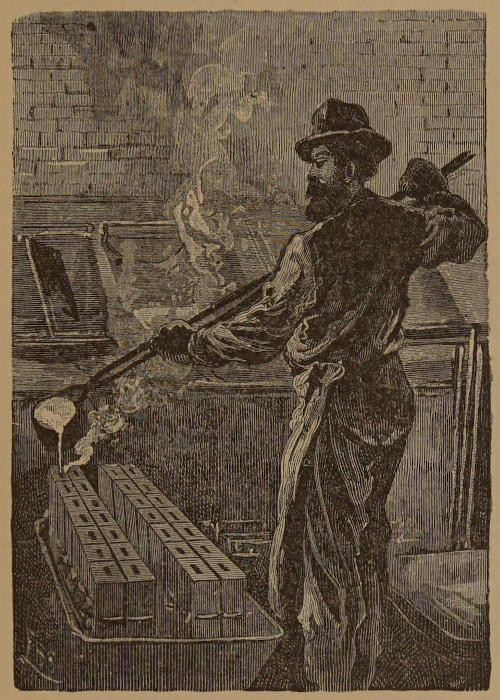
are on the first floor, in the west side of the building. Here
all the metal used in coining is alloyed, melted and poured into
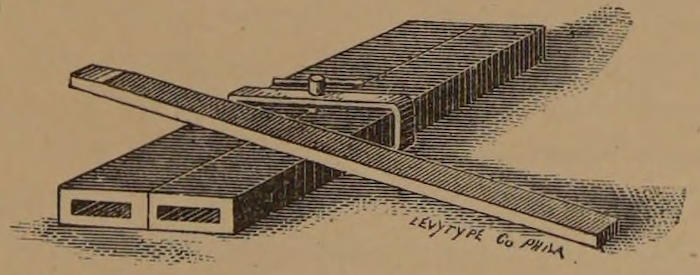
narrow moulds. These castings are called ingots; they are
about twelve inches long, a half-inch thick, and vary from one
to two a half-inches in breadth, according to the coin for which
they are used, one end being wedge-shaped to allow its being
passed through the rollers. The value of gold ingots is from
$600 to $1,400; those of silver, about $60. The fine gold
and silver bars used in the arts and for commercial purposes,
are also cast in this department.
CASTING INGOTS.
INGOTS.
These are stamped with their weight and value in the deposit
room. The floors that cover the melting rooms are made of
iron in honey-comb pattern, divided into small sections, so
that they can be readily taken up to save the dust; their
roughness acting as a scraper, preventing any metallic particles
from clinging to the soles of the shoes of those who pass through
the department, the sweepings of which, and including the
entire building, averages $23,000 per annum, for the last five
years.
The copper and nickel melting rooms, wherein all the base
metals used are melted and mixed, is on the same side and
adjoining to the gold and silver department. Up to the year
1856, the base coin of the United States was exclusively
copper. In this year the coinage of what was called the
nickel cents was commenced. These pieces, although called
nickel, were composed of one-eighth nickel; the balance was
copper.
The composition of the five and three cent pieces is one-fourth
nickel; the balance copper. The bronze pieces were
changed in 1859, and are a mixture of copper, zinc and tin,
about equal parts of each of the two last; the former contributing
about 95 per cent. There are seven furnaces in this room,
each capable of melting five hundred pounds of metal per day.
When the metal is heated and sufficiently mixed, it is poured
into iron moulds, and when cool, and the rough ends clipped
off, is ready to be conveyed to the rolling room.
From the melting rooms through the corridor we reach the
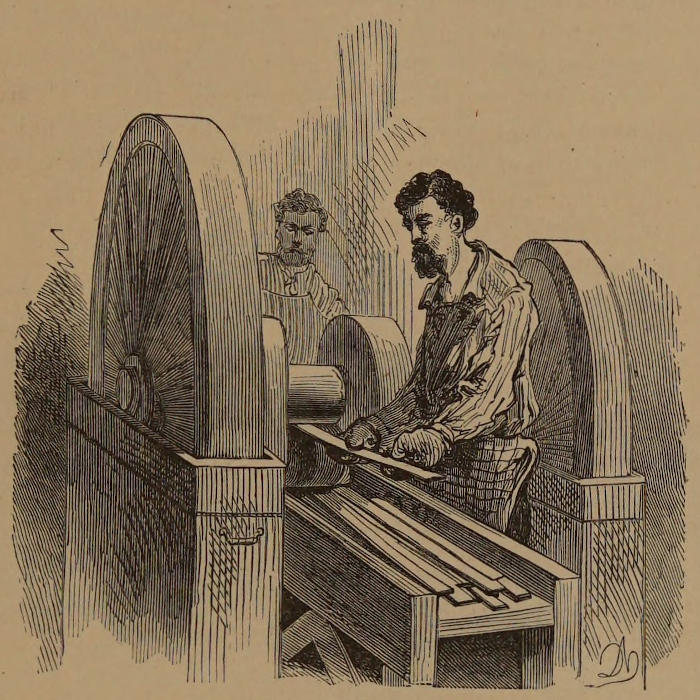
rolling room. The upright engine, on the right, of one hundred
and sixty horse power, supplies the motive force to the rolling
machines, four in number. Those on the left, are massive
and substantial in their frame-work, with rollers of steel,
polished by service in reducing the ingots to planchets for
coining. The first process or rolling is termed breaking down;
after that it requires to be passed through the machine until it
is reduced to the required thinness—ten times if gold, eight if
silver, being annealed in the intervals to prevent breaking.
The rollers are adjustable and the space between them can be
increased or diminished at pleasure, by the operator. About
two hundred ingots are run through per hour on each pair of
rollers.
The pressure applied is so intense that half a day’s rolling
heats, not only the strips and rollers, but even the huge iron
stanchions, weighing several tons, so hot that you can hardly
hold your hand on them.
When the rolling is completed the strip is about six feet long,
or six times as long as the ingot.
It is impossible to roll perfectly true. At times there will be
a lump of hard gold, which will not be quite so much compressed
as the rest. If the planchets were cut from this place, it
would be heavier and more valuable than one cut from a thinner
portion of the strip. It is, therefore, necessary to “draw” the
strips, after being softened by annealing.
Rolling Machine.
These are in the same room, to the right facing the rollers. The
gold and strips are placed in copper canisters, and then
placed in the furnaces and heated to a red heat; silver strips
being laid loosely in the furnace. When they become soft and
pliable, they are taken out and allowed to cool slowly.
These machines resemble long tables, with a bench on either
side, at one end of which is an iron box secured to the table.
In this are fastened two perpendicular steel cylinders, firmly
supported in a bed, to prevent their bending or turning around,
and presenting but a small portion of their circumference to
the strip. These are exactly at the same distance apart that
the thickness of the strip is required to be. One end of the
strip is somewhat thinner than the rest, to allow it to pass
easily between the cylinders. When through, this end is put
between the jaws of a powerful pair of tongs, or pincers,
fastened to a little carriage running on the table. The carriage
to the further bench is up close to the cylinders, ready to receive
a strip, which is inserted edgewise. When the end is between
the pincers, the operator touches a foot pedal which closes the
pincers firmly on the strip, and pressing another pedal, forces
down a strong hook at the left end of the carriage, which
catches in a link of the moving chain. This draws the
carriage away from the cylinders, and the strip being connected
with it has to follow. It is drawn between the cylinders,
which operating on the thick part of the strip with greater power
than upon the thin, reduces the whole to an equal thickness.
When the strip is through, the strain on the tongs instantly
ceases, which allows a spring to open them and drop the strip.
At the same time another spring raises the hook and disengages
the carriage from the chain. A cord fastened to the carriage
runs back over the wheel near the head of the table, and then
up to a couple of combination weights on the wall beyond,
which draw the carriage back to the starting place, ready for
another strip.
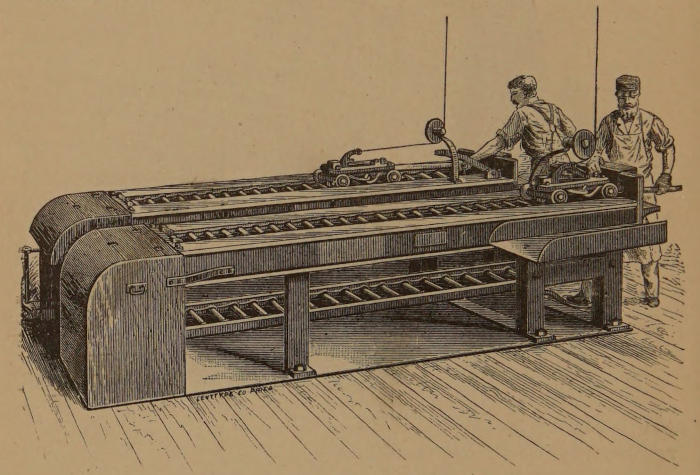
DRAWING BENCH.
After being thoroughly washed, the strips are consigned to
the cutting machines. These are in the rear of the rolling mills,
and are several in number, each when in active operation
cutting two hundred and twenty-five planchets per minute.
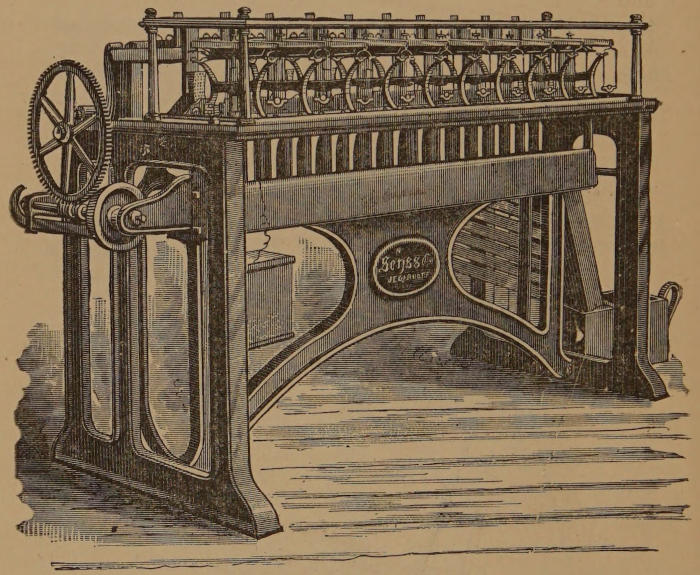
The press now used, consists of a vertical steel punch, which
works in a round hole or matrix, cut in a solid steel plate.
The action of the punch is obtained by an eccentric wheel.
For instance, in an ordinary carriage wheel, the axis is in the
centre, and the wheel revolves evenly around it. But if the
axis is placed, say four inches from the centre, then it would
revolve with a kind of hobble. From this peculiar motion
its name is derived. Suppose the tire of the wheel is arranged,
not to revolve with, but to slip easily around the wheel, and a
rod is fastened to one side of the tire which prevents its turning.
Now as the wheel revolves and brings the long side nearest
the rod, it will push forward the rod, and when the long
side of the wheel is away from the rod, it draws the rod with it.
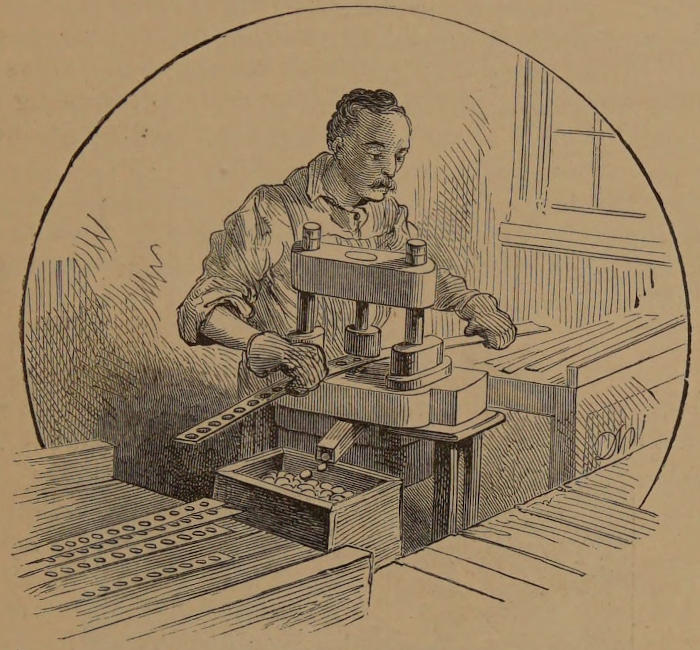
CUTTING MACHINE.
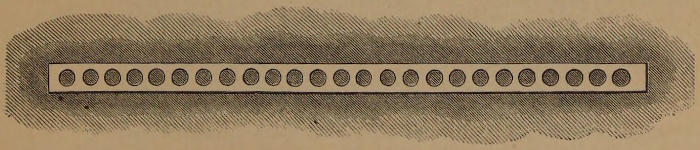
STRIP FROM WHICH PLANCHETS ARE CUT.
The upper shaft, on which are seen the three large wheels,
has also fastened to it, over each press, an eccentric wheel. In
the first illustration will be seen three upright rods running
from near the table to the top. The middle one is connected
with a tire around the eccentric wheel, and rises and falls with
each revolution. The eccentric power gives great rapidity of
motion with but little jerking.
The operator places one end of a strip of metal in the immense
jaws of the press, and cuts out a couple of planchets,
which are a fraction larger than the coin to be struck. As the
strips are of uniform thickness, if these two are of the right
weight, all cut from that strip will be the same. They are
therefore weighed accurately. If right, or a little heavy, they
are allowed to pass, as the extra weight can be filed off. If too
light, the whole strip has to be re-melted. As fast as cut the
planchets fall into a box below, and the perforated strips are folded
into convenient lengths to be re-melted. From a strip
worth say eleven hundred dollars, eight hundred dollars of
planchets will be cut.
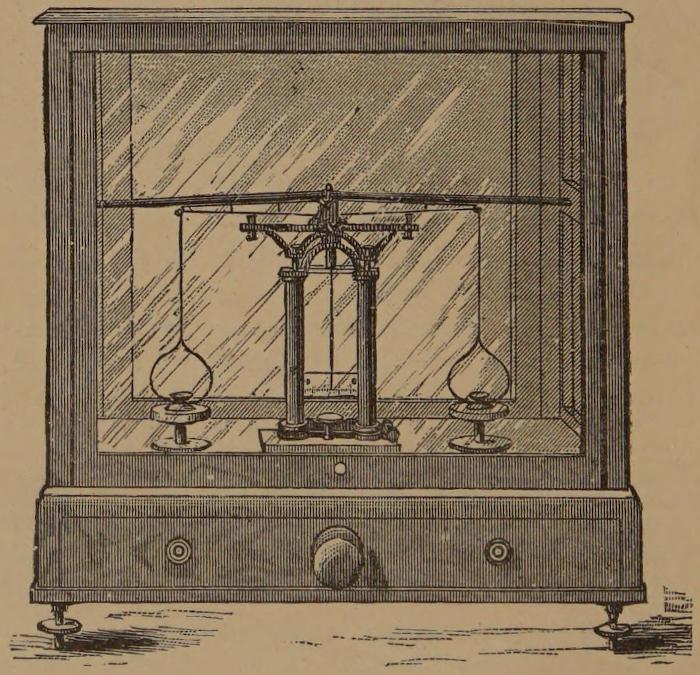
DELICATE SCALES.
The planchets are then removed to the adjusting room, where
they are adjusted. This work is performed by ladies. After
inspection they are weighed on very accurate scales. If a
planchet is too heavy, but near the weight, it is filed off at the
edges; if too heavy for filing, it is thrown aside with the light
ones, to be re-melted. To adjust coin so accurately requires
great delicacy and skill, as a too free use of the file would
make it too light. Yet by long practice, so accustomed do
the operators become, that they work with apparent unconcern,
scarce glancing at either planchets or scales, and guided as it
were by unerring touch.
The exceedingly delicate scales were made under the direction
of Mr. Peale, who greatly improved on the old ones in
use. So precise and sensitive are they that the slightest breath
of air affects their accuracy, rendering it necessary to exclude
every draft from the room.
The methods of coining money have varied with the progress
in mechanic arts, and are but indefinitely traced from the
beginning; the primitive mode, being by the casting of
the piece in sand, the impression being made with a hammer
and punch. In the middle ages the metal was hammered into
sheets of the required thickness, cut with shears into shape,
and then stamped by hand with the design. The mill and
screw, by which greater increase in power, with finer finish was
gained, dates back to the Sixteenth Century. This process,
with various modifications and improvements, continued in use
in the Philadelphia Mint until 1836.
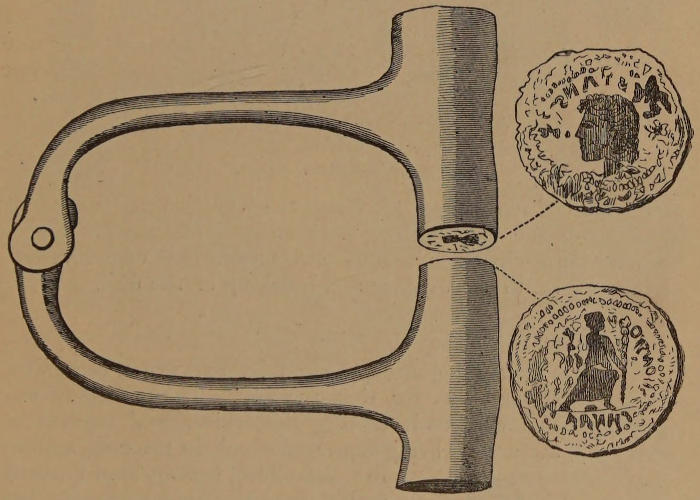
ANCIENT COINING PRESS.
The first steam coining press was invented by M. Thonnelier,
of France, in 1833, and was first used in the United States
Mint in 1836. It was remodeled and rebuilt in 1858, but in
1874 was superseded by the one now in operation, the very
perfection of mechanism, in which the vibration and unsteady
bearing of the former press were entirely obviated, and precision
attained by the solid stroke with a saving of over seventy-five
per cent. in the wearing and breaking of the dies.
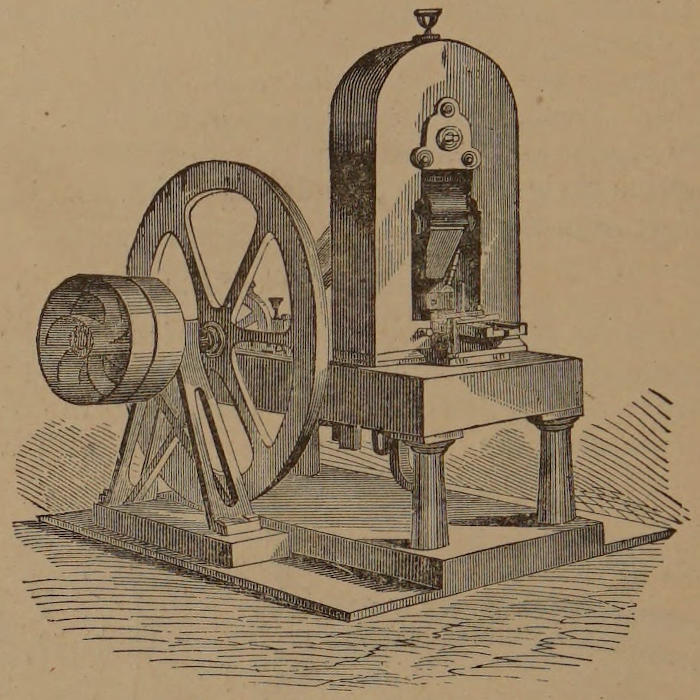
STEAM COINING PRESS.
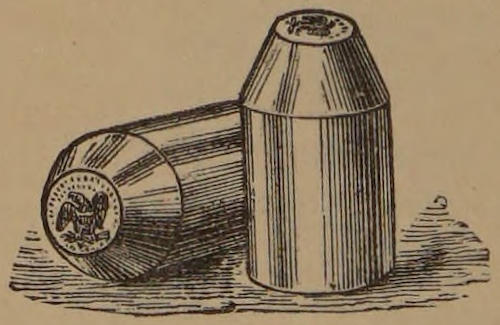
DIES.
The dies for coining are prepared by engravers, especially
employed at the Mint for that purpose. The process of engraving
them consists in cutting the devices and legends in
soft steel, those parts being depressed which, in the coin, appear
in relief. This, having been finished
and hardened, constitutes an “original
die,” which, being the result of
a tedious and difficult task, is deemed
too precious to be directly employed
in striking coins; but it is used for
multiplying dies. It is first used to
impress another piece of soft steel,
which then presents the appearance of a coin, and is called a
hub. This hub, being hardened, is used to impress other
pieces of steel in like manner which, being like the original
die, are hardened and used for striking the coins. A pair of
these will, on an average, perform two weeks’ work.
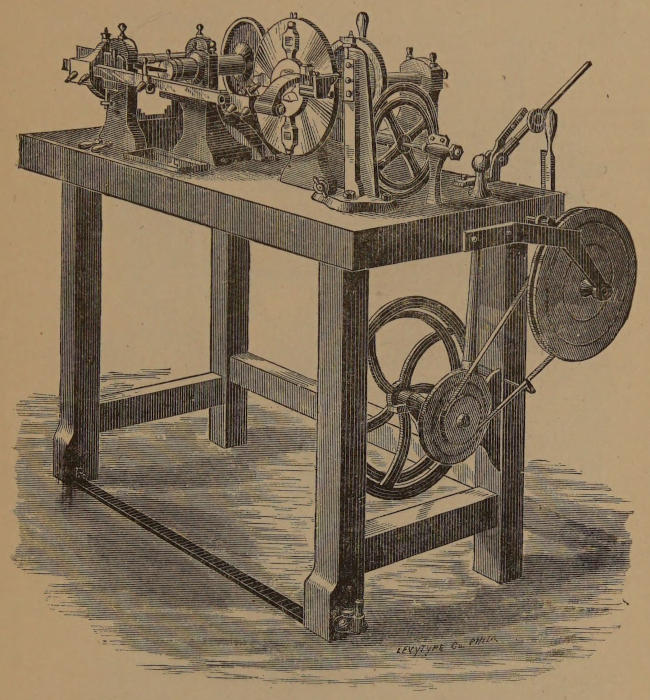
The transfer lathe, a very complicated piece of machinery, is
used in making dies, for coins and medals. By it, from a large
cast, the design can be transferred and engraved in smaller
size, in perfect proportion to the original.
This department, the most interesting to the general visitor,
occupies the larger portion of the first floor on the east side of
the building. The rooms are divided by an iron railing, which
separates the visitors, on either side, from the machinery, etc.,
but allows everything to be seen.
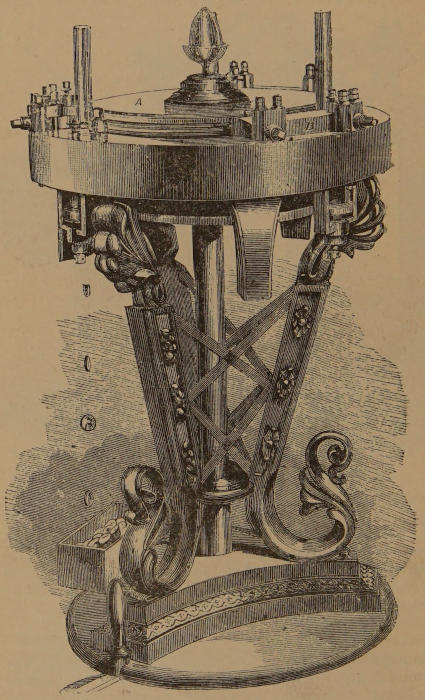
MILLING MACHINE.
The planchets, after being adjusted, are received here, and,
in order to protect the surface of the coin, are passed through
the milling-machine. The planchets are fed to this machine
through an upright tube, and, as they descend from the lower
aperture, they are caught upon the edge of a revolving wheel
and carried about a quarter of a revolution, during which the
edge is compressed and forced up—the space between the wheel
and the rim being a little less than the diameter of the planchet.
This apparatus moves so nimbly that five hundred and
sixty half-dimes can be milled in a minute; but, for large
pieces, the average is about one hundred and twenty. In this
room are the milling machines, and the massive, but delicate,
coining presses, ten in number. Each of these is capable of
coining from eighty to one hundred pieces a minute. Only
the largest are used in making coins of large denominations.
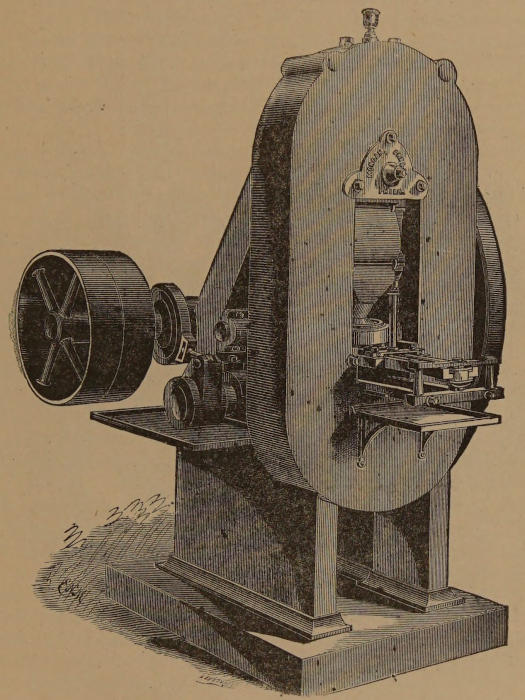
PERFECTED COINING PRESS.
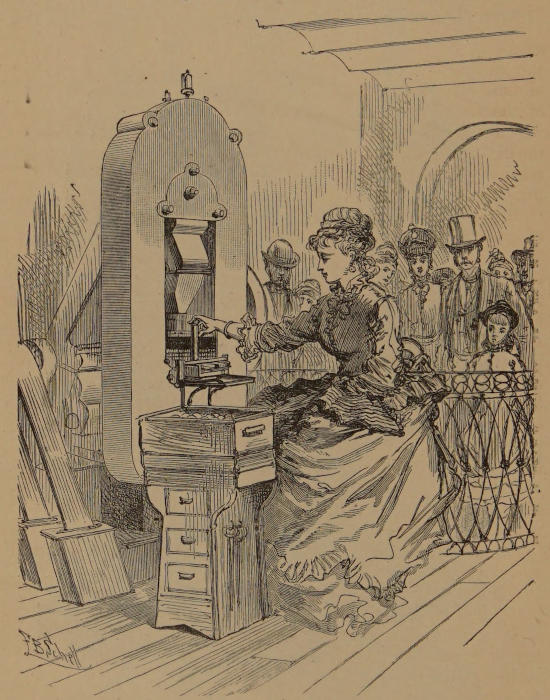
COINING PRESS.
The arch is a solid piece of cast iron, weighing several tons,
and unites with its beauty great strength. The table is also
of iron, brightly polished and very heavy. In the interior of
the arch is a nearly round plate of brass, called a triangle. It
is fastened to a lever above by two steel bands, termed stirrups,
one of which can be seen to the right of the arch. The stout
arm above it, looking so dark in the picture, is also connected
with the triangle by a ball-and-socket joint, and it is this arm
which forces down the triangle. The arm is connected with
the end of the lever above by a joint somewhat like that of the
knee. One end of the lever can be seen reaching behind the
arch to a crank near the large fly-wheel. When the triangle
is raised, the arm and near end of the lever extends outward.
When the crank lifts the further end of the lever it draws in
the knee and forces down the arm until it is perfectly straight.
By that time the crank has revolved and is lowering the lever,
which forces out the knee again and raises the arm. As the triangle
is fastened to the arm it has to follow all its movements.
Under the triangle, buried in the lower part of the arch, is a
steel cup, or, technically, a “die stake.” Into this is fastened
the reverse die. The die stake is arranged to rise one-eighth
of an inch; when down it rests firmly on the solid foundation
of the arch. Over the die stake is a steel collar or plate, in
which is a hole large enough to allow a planchet to drop upon
the die. In the triangle above, the obverse die is fastened, which
moves with the triangle; when the knee is straightened the die
fits into the collar and presses down upon the reverse die.
Just in front of the triangle will be seen an upright tube made
of brass, and of the size to hold the planchets to be coined.
These are placed in this tube. As they reach the bottom they
are seized singly by a pair of steel feeders, in motion as similar
to that of the finger and thumb as is possible in machinery,
and carried over the collar and deposited between the dies,
and, while the fingers are expanding and returning for another
planchet, the dies close on the one within the collar, and by a
rotary motion are made to impress it silently but powerfully.
The fingers, as they again close upon a planchet at the mouth
of the tube, also seize the coin, and, while conveying a second
planchet on to the die, carry the coin off, dropping it into a
box provided for that purpose, and the operation is continued
ad infinitum. These presses are attended by ladies, and do
their work in a perfect manner. The engine that drives the
machinery is of one hundred and sixty horse-power.
After being stamped the coins are taken to the Coiner’s room,
and placed on a long table—the double eagles in piles of ten each.
It will be remembered that, in the Adjusting Room, a difference
of one-half a grain was made in the weight of some of the double
eagles. The light and heavy ones are kept separate in coining,
and when delivered to the treasurer, they are mixed together in
such proportions as to give him full weight in every delivery.
By law the deviation from the standard weight, in delivering to
him, must not exceed three pennyweights in one thousand double
eagles. The gold coins—as small as quarter eagles being counted
and weighed to verify the count—are put up in bags of $5,000
each. The three-dollar pieces are put up in bags of $3,000,
and one-dollar pieces in $1,000 bags. The silver pieces, and
sometimes small gold, are counted on a very ingenious contrivance
called a “counting-board.”
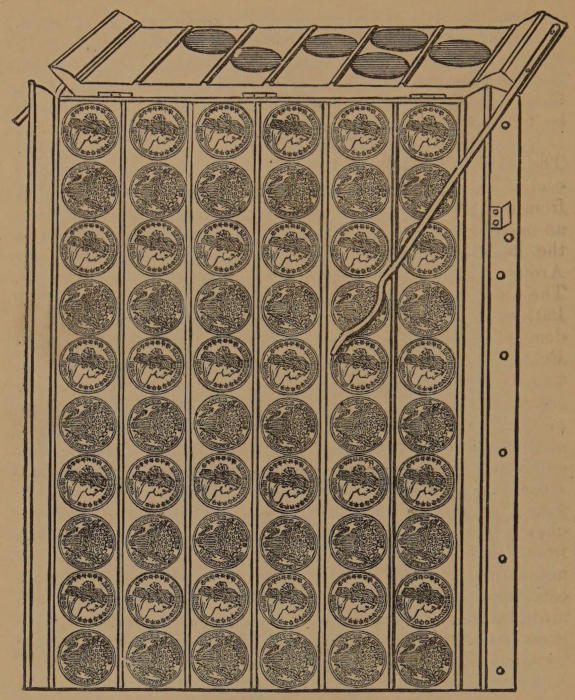
COUNTING BOARD.
By this process twenty-five dollars in five-cent pieces can be
counted in less than a minute. The “boards” are a simple flat
surface of wood, with copper partitions, the height and size of the
coin to be counted, rising from the surface at regular intervals,
and running parallel with each other from top to bottom. They
somewhat resemble a common household “washing board,” with
the grooves running parallel with the sides but much larger.
The boards are worked by hand, over a box, and as the pieces
are counted they slide into a drawer prepared to receive them.
They are then put into bags and are ready for shipment.[8]
THE CABINET. — Relics. — Curiosities and Minerals. — “ Peter ,” — Eastern Corridor. — Coins. — Greek Coins. — Persian. — Egypt — The Syrian Coins — Roman Coins. — Greek Republic — Family Coins. — Imperial Coins — Division II. — Division III. — Division IV. — Division V. — Division VI. — “ The Temple Sweepers. ” — ORIENTAL. — Coins of Siam. — Chinese Coins. — Japan. — Turkey. — Egypt. — French Coinage. — Germany. — Coins of Switzerland. — Russian Coins. — England. — English Silver Tokens , — Portugal and Spain. — Mexico. — Coins of Brazil. — Colonial Coins. — United States Coins. — The Trade Dollar. — History of the Trade Dollar. — Brief History of the Standard Silver Dollar. — Pacific Coast. — Coins of the Southern Confederacy. — Sketch of the 1804 Dollar. [16] — Double Eagle.
The room in the Mint used for the Cabinet is on the second
floor. It was formerly a suite of three apartments connected
by folding-doors, but the doors have been removed, and it is
now a pleasant saloon fifty-four feet long by sixteen wide.
The eastern and western sections are of the same proportions,
each with a broad window. The central section is lighted
from the dome, which is supported by four columns. There is
an open space immediately under the dome, to give light to
the hall below, which is the main entrance to the Mint.
Around this space is a railing and a circular case for coins.
The Cabinet of Coins was established in 1838, by Dr. R. M.
Patterson, then Director of the Mint. Anticipating such a
demand, reserves had been made for many years by Adam
Eckfeldt,[9] the Coiner, of the “master coins” of the Mint; a
term used to signify first pieces from new dies, bearing a high
polish and struck with extra care. These are now more commonly
called “proof pieces.” With this nucleus, and a few
other valuable pieces from Mr. Eckfeldt, the business was
committed to the Assay Department, and especially to Mr.
Du Bois, Assistant Assayer. The collection grew, year by
year, by making exchanges to supply deficiencies, by purchases,
by adding our own coin, and by saving foreign coins
from the melting-pot—a large part in this way, at a cost of
not more than their bullion value, though demanding great
care, appreciation, and study. Valuable donations were also
made by travelers, consuls, and missionaries. In 1839, Congress
appropriated the sum of $1,000 for the purchase of
“specimens of ores and coins to be preserved at the Mint.”
Annually, since, the sum of $300 has been appropriated by the
Government for this object. More has not been asked or desired,
for the officers of the Mint have not sought to vie with
the long established collections of the national cabinets of the
old world, or even to equal the extravagance of some private
numismatists; but they have admirably succeeded in their
purpose to secure such coins as would interest all, from the
schoolboy to the most enthusiastic archæologist. The economic
principle upon which the collection has been gathered is a
lesson to all governmental departments in frugality, as well as
a restraint upon the natural tendency to extravagance which
has heretofore distinguished those who have a passion for old
coins. There are thousands of coin collectors in the United
States, and fortunes have been accumulated in this strange
way. More than one authenticated instance has been known
in this country where a man has lived in penury, and died
from want, yet possessed of affluence in time-defaced coins.
Having referred to the portraits of the Directors of the
Mint, we will cite other interesting subjects of observation,
before describing the coins.
The first object in the Cabinet attracting attention is a
framed copy of the law of Congress establishing the Mint,
with its quaint phraseology with the signature of Thomas
Jefferson. (See fac simile on page 11.)
In the first section, near the western window, is the assorting
machine, the invention of a Frenchman, Baron Seguier,
and which is now in use in the Mint at Paris.
The planchets for coinage are liable to be a little too heavy
or too light; it is therefore necessary, at least in the case of
gold, to assort them by weighing. This machine is designed
to enable one person to do the work of many. “The planchets
are thrown into the hopper at the rear, and, being arranged
by the action of the wheel, slide down balances. By machinery
beneath they are carried one by one to the nearest
platforms to be weighed. If too heavy, the tall needle of the
beam leans to the right and lifts a pallet-wire, which connects
with an apparatus under the table by which the planchet is
pushed off and slides into one of the brass pans in front. If
the piece be light, the needle is drawn over to the left, and
touches the other pallet, which makes a passage to another
brass pan. If the piece be of true weight, or near enough,
the needle stands perpendicular between the pallets, and the
piece finds its way into the third brass pan.”
On the opposite wall is a fine cast of Cromwell, a duplicate
of one taken shortly after his death. It was placed here by
Mr. W. E. Du Bois, who received it from H. W. Field, Esq.,
late Assayer of the Royal Mint, London, who is a descendant
of the great Protector. Below the cast of Cromwell is a case
showing progressive “alloys of gold.” The plates comprise
gold alloyed with copper, gold alloyed with silver, and gold
fine.
In the eastern section are the Standard Test Scales, used to
test the weights sent to all the mints and assay offices in the
United States, and are so delicate as to weigh the twenty-thousandth
part of an ounce. These scales were manufactured
by employees of the Mint, and have been in use more than a
quarter of a century. The beam is hollow, and filled with
Spanish cedar to guard against the effect of dampness; the
bearings are edges of knife-blades, which impinge on a surface
of agate plate. These scales are tested by the Annual Assay
Committee, which meets on the second Tuesday in February of
every year.
The most interesting objects of this curious display are
three golden images from graves in the Island of Chiriqui, off
Central America. They were dug up in 1858, and sent to
the Mint as bullion, to be melted. They are of pure gold,
but the workmanship is very crude. The images are in the
forms of a reptile, a bird, and a man with symbols of power in
his hands, not unlike those designating Jupiter. There are
also, in the first section, two large cases with choice selections
of mineral specimens, carefully classified and labeled. These
are from well selected results of years of patient collecting, and
are deserving of more study than can be devoted to them by
casual visitors. They are chiefly from different parts of the
United States, and are an “index book” to the vast mineral
wealth of the nation.
Near the exit door of the Cabinet, in a large glass case, is a
magnificent American eagle, which is worthy of the visitor’s
attention. It is superbly mounted, with grand breadth of
wing and wondrous piercing eyes. The portrait of this “pet”
can be recognized on Reverse of the “Pattern” Silver Dollars
of 1836, 1838, and 1839, and on the Obverse of the first
nickel cent pieces coined in 1856.
the name which the noble bird recognized, was an inhabitant of
the Mint six years. He would fly about the city, but no one
interfered with the going or coming of the “Mint bird,” and
he never failed to return from his daily exercise before the
time for closing the building. In an evil hour he unfortunately
perched upon a large fly wheel, and getting caught in the
machinery, received a fatal injury to his wing, and this ended
rather an unusual career for an eagle.
Opening into the eastern corridor are the rooms of the
Superintendent, the Chief Clerk, and the library of Historical
and Scientific Works, including many valuable books upon
the art of coinage. Passing out upon the gallery, we enter
the Machinists’ and Engravers’ rooms. Here are engraved
and finished the dies used in this Mint and in all the branch
mints. Visitors are not ordinarily allowed access to these
rooms, or to the assay office, or to the cellar. (In the latter are
a number of immense vaults, and in the main cellar are engines,
which supply the power and light used throughout the
building.) Here are also blacksmith, carpenter, and paint
shops; and in the rear, west side, is the medal-striking room,
where medals are struck by a screw press, worked by hand.
The cellar also contains the “sweep” grinding rooms. Near
this room are the wells, which are receptacles for the water
used in washing the precious metals. These wells are cleaned
out every few years and the deposit is then treated in the
same way as the sweepings.
The little wooden building in the court was formerly the
cent-room, where copper cents were exchanged for nickels;[10]
it is now the office of the agent of the Adams Express Company,
who brings to the Philadelphia Mint millions of dollars worth
of precious metals in the shape of bullion from the far west,
to be converted into American Coin, when it is again transported
by the same company to various points to be put into
circulation.
The ancient coins are chiefly arranged in upright cases
against the walls in the doorways and the middle section of
the saloon. The modern coins are placed in nearly level
cases at either end of the room and in the circular or central
cases. Of antique coins the portion labeled Cabinet Nos.
97, 98, 99, “Massilia,” are interesting as belonging to a
Greek colony which settled about six hundred years before
Christ upon the coast of Gaul, on the spot now known as
Marseilles. This little colony fled their native country and
the rule of a governor placed over it by a Persian monarch.
They were distinguished for their civilization, and the work
upon these small coins is the most palpable witness of that
fact in existence to-day.
Their surfaces, of gold, silver, and bronze, bristle with lance
and spear, helmet and shield. On one of these coins Jove is
seated and bearing an eagle, defying Alexander of Macedon,
while on the obverse the same mighty conqueror impersonates
Hercules. The oldest coin here is supposed to date back
to 550 B.C. It is well to mention the fact that coins were
never dated until the fifteenth century; and previous to that
time the ages of coins can only be determined by the legends
upon them, as answering to the page of corroborative history
and the art era to which they belonged. No. 9 bears on
the obverse the Macedonian horse, a favorite animal, which
the then war-loving Greeks are said to have deified. At this
period the haughty royal families began to chronicle in coin
their line of descent. The kings of Macedon claimed Hercules
for an ancestor, and in proof thereof the lion’s skin was
a royal insignia. An old historian says, “The kings of Macedon,
instead of the crown, the diadem, the purple, bear upon
their effigy the skin of a lion.” Several pieces of money in
this case, upon which are heads of Alexander, have rings in
them, and were worn by gracious dames as ornaments. The
value of this series of coins is priceless, as furnishing portraits of
the heroes of that period which can be received without
question as accurate, for the art patronage of the kingdom was
regulated by the strictest laws. Alexander was especially
jealous of how the future nations should regard his physique,
allowing only three artists, during his reign, the privilege of
drawing, painting, or modeling his head.[11] To such royal
guardianship may be attributed the perfection to which Greek
art attained; and it may well be a matter of regret that the
same firmness in this regard was not universal. The last coin
of this series is a small bronze coin, and was issued by Perseus,
the last king of Macedon.
In this case is a collection of Persian coins, very choice,
and of no mean workmanship, and, of course, portraying the
faith and rites of the fire-worshippers. One era is distinctly
Greek in style, and marks the period of Greek supremacy.
The oldest gold coin known to the collector is the gold Daric
of King Darius, with the head of the king in bold relief; and
all Persian coins are so called in remembrance of this monarch.
Their money was very fine, so the word Daric has become
incorporated into numismatic terminology to designate
any pure gold coin. Nos. 58 to 67, inclusive, of this series,
are silver coins of the Sassanian kings.
is also represented in this case, as is proper, for that nation had
no coinage until it was taught the art when conquered by
Alexander. Here are some very attractive data of Egyptian
history, and from these coins are obtained the only portraits
of Arsinoe, Cleopatra, and others.
are embraced in the division called “Greek monarchies,” and
in them are found many coins not only important in history,
but of the very finest Greek art, from the third to the first
century B.C. In this period the Syriac and Hebrew coins
become intermingled, a fact abundantly sustained by the Jewish
shekel of Simon Maccabees. The legend of this interesting
relic is in the language of Samaria; on one side the
budding rod of Aaron, legend, “Jerusalem the Holy;” on
the other, a cup of incense or pot of manna, and the inscription,
“Shekel of Israel.” This shekel is well preserved, and
is one of the most prized coins known. (See Plate and Case
XV., marked “Selections.”) In this collection are some coins
from Bactria, considered priceless by savans. These are trophies
of recent British explorations, and are judged to be of
sufficient importance to call forth from an English professor
an extended treatise on the “Antiquities and Coins of Afghanistan.”
They are exceedingly rude in workmanship, and
nearly all of baser metal, the most important being a small,
square, brass coin, in the case marked “Selections.”
The collection of Roman coins in this Cabinet numbers
nearly one thousand, and an acquaintance with it is invaluable
for object teaching, as in it is the condensed history, not only
of the glory of Rome, “Mistress of the World,” but of her customs,
faith, conquests, wealth, culture, divisions, and downfall.
Through this entire section of time—one-third of the known
history of the world—Roman art, though high, never reached
the exalted purity of Greek lines. In their finest coins we see
no Phidias, no Myron, no Praxiteles, but they deteriorate and
fluctuate visibly when in or out of contact with the influence
of the Grecian mind.
will be first in interest, both historic and artistic. It is conceded
that to the Greeks the world owes the introduction of
the art of coinage, and though centuries numbered by tens
have passed, some of the old Greek coins equal many modern
productions in purity of lines, and surpass nearly all in poetic
sentiment. On the first coins no earthly potentate was
allowed to be pictured, no deed of heroism portrayed. The
glory of the gods was considered the only appropriate theme
for impressions on the surface of bronze, silver, and gold.
The coins of the republic embrace a large variety, as nearly a
thousand towns were allowed the privilege of coinage. Upon
this varied issue are preserved nearly all the legends of Greek
mythology. Upon the coins are the heads of Jupiter, Juno,
Minerva, Bacchus, Apollo, and Diana, with many sacred
animals, and the work is to-day the standard of artistic perfection.
Of course, the collection of this ancient period cannot
be extensive. In this case there are, however, more than
one hundred and fifty specimens, and these present a study
so attractive and so intense that it is almost impossible to
imagine what classic poetry would be without it.
Nos. 4, 5, and 6, are silver coins of Ægina, which have on
the obverse, for a device, the tortoise, emblematic of the security
of the island amid the waves, and the protection of the
gods of the sea. On the reverse are the marks of the punches
only, probably denoting the value of the coins. These are
claimed to belong to an era seven hundred years before Christ.
No. 28 is a silver coin of Athens, with a head of Minerva
splendidly drawn upon the obverse, while the reverse presents
a large owl, the bird sacred to the goddess of Wisdom. The
devices upon this coin indicate its age to be from twenty-one
to twenty-three centuries. The Greek proverb of “taking
owls to Athens” referred to this coin, which was necessarily
of great importance to the tradespeople of that city.
These comprise about one hundred and seventy-five, of
which one hundred and twenty-six are in the collection.
They were struck to record the heroic deeds which first introduced
any notable ancestor to fame, and hence are to-day
family charts of respectability for many of the patricians of
Rome, albeit some of them have plebeian roots. Be that as
it may, they are as much the trusted patents of aristocracy as
is the “Book of the Peerage” of England. Here are found
the same distinctions between patrician and plebeian which
mark all countries, the patricians being always designated by
a symbol of warfare, while the plebeians were indicated by
the tools and instruments of common trade. The more noticeable
of the coins are as follows: No. 16, Acilia; the reverse
a female leaning against a pillar, with a serpent
clutched in her right hand, indicating the wisdom or courage
of some ancestor. No. 20, Æmilia; on the obverse of this
curious coin is a figure kneeling by the side of a camel, presenting
an olive branch, from which depends a fillet or ancient
diadem; on the reverse, a figure guiding a triumphal chariot,
a scorpion in the field. Josephus tells us of an invasion of
Arabia, and that Aretus, the king of the country, purchased
peace of the Romans for five hundred talents. The diadem
hanging from the olive branch chronicles the entire humiliation
of Aretus, and the scorpion doubtless indicates the month
of the Roman triumph. No. 30, Aquillia, a small silver
coin; the reverse shows a woman kneeling before a soldier.
The motto below the figures (or in the exergue of the coin, as
is the art term) is “Sicil.” This commemorates the suppression
of a revolt of slaves in Sicily, which was achieved by
Manlius Aquillia. No. 41, Calpurnia, the family of Cæsar’s
noble wife; reverse, a horseman riding at full speed, a head
of wheat above him; legend, L. Piso-Trugi. The coin recalls
the fact that in the year 507 B.C. there was a famine in
Rome, and Calpurnius Piso was dispatched to Africa to buy
corn. This seemingly small service is magnified upon a large number
of coins. Nos. 95 and 96, Hostilia, a coin with a
sacrifice to Pallor and Pavor (fear and trembling), offered by
Tullus Hostilius in some great emergency. No. 97, Julia;
obverse, a helmeted head; legend, Cæsar; reverse, a warrior
in a chariot drawn by two horses.
No. 98, Junia; obverse, head of Liberty; reverse, Junius
Brutus guarded by lictors, and preceded by a herald, showing
that an ancestor of Junius Brutus was the first consul of
Rome. Nos. 181, 182, Tituria. The reverse shows two soldiers
throwing their shields upon a prostrate female, illustrating
the famous story of the “Tarpeian Rock.” Reverse represents
the Romans carrying off Sabine women—a witness in
coin of the fact that the family of Tituria trace their ancestry
from the Sabines. To do justice to this case is impossible, for
here are coins relating to the ancestors of Antonia, Aurelia,
Cornelia, Fulvia, Horatio, Lucretia, Lucilla, Sempronia, Titia
Valeria, and many others familiar to the readers of history.
This era of coins terminated about the time of the birth of
Christ, when the
were introduced. In noticing these, little save the labels on
the case can be given.
Julius Cæsar to Trajan, inclusive. Beginning 49 B.C., and
ending 117 A.D. A simple catalogue of the illustrious names
on these coins would convey an idea of their importance. All
the victories of Cæsar are marked by coinage; but out of the
two hundred belonging to this case reference need only be
made to No. 24, a beautiful gold coin, with the undraped head
of Augustus, exquisitely severe, the interest attaching chiefly
to the legend, “The Son of God,” referring to the deification
of Cæsar.
embraces from Hadrian to Elagabalus, 117-222. In the reign
of Hadrian much coin was issued, though it did not bear marks
of the disasters and revolts that signalized the foregoing. That
he was a merciful ruler is indicated by the coins, especially
one—Hispania; the reverse showing the emperor raising
Spain—a female figure—from the ground. His travels are
also illustrated in coin.
From Severus Alexander to Claudius Gothicus, 222-270.
These coins indicate the vicious effect of the rulers immediately
preceding.
From Aurelian to the end of the Western Empire; includes
270-475. A brilliant succession; Aurelian’s busy reign,
ending in assassination; the war-like Probus, the slave-emperor;
Diocletian’s despotism and vindictive persecution of
Christians; the usurpation of Carausius; the happy reign of
Constantine the Great, Julian, Theodosius, down to Julius
Nepos. These are a few of the historic names and events
presented in this division.
covers the period of the Byzantine or Eastern Empire, and a
lapse of eight centuries; but the coinage is not comparable
with that of other eras, nor were events of so stirring and
heroic a character. A general decay, painful to contemplate,
marked this long lapse of time, which began near the acceptance
of Christianity, and extended through the dark ages.
A small case attracts no little attention, because it contains
a single coin; and the interest does not decrease when the inscription
is read: “Struck in the Philadelphia Mint, at least
two thousand years ago.” The late Assayer of the Philadelphia
Mint, Mr. W. E. Du Bois, under title of “The Temple Sweepers,”
wrote, not long since, a valuable sketch of this coin, made
in the City of Attalus Philadelphus, Asia Minor, and for which
William Penn called his city, because the ancient one was a
monument of “brotherly love.” Diana was the patroness of
Philadelphia.
“On one side, then, we have a head; not a king’s nor an
emperor’s; as yet the free city had a pride and a privilege
above that. It is a female head, an ideal, representing the
city itself; or rather the dwellers in it, the Demos. Here in
this head and title, we have the radix of Democracy.
“This is all we can gather from the obverse. On the other
side we have a larger variety: a running female figure; a dog
also on the trot; a legend of some length and of more significance.
“The half-clad figure is that of the goddess known to the
Greeks as Artemis, to the Latins as Diana; and otherwise
called Selene, Phœbe, Delia, or Cynthia.
“She was the favorite divinity of the cities of Asia Minor.
Once the patroness of chastity and purity. Goddess of the
chase.”
The legend on the obverse of this coin explains its name:
“Friends of Philadelphia’s [her] Temple Sweepers.”
Oriental coins are not as attractive as other varieties, though
there are special coins among them which have no rival in historic
importance. Antique coins from the East were usually
without device, and, their legends being rudely inscribed in a
dead language, proved frequently to be sealed fountains to the
thirsting antiquarian. Therefore in cases marked “Oriental”
the visitor is undetermined where to begin to study, and often
decides to give it but little time.
Those having for device the sacred peacock are from Burmah;
there is, however, in the division marked “Selections”
a very curious coin belonging to that country, which certainly
formed a part of its earliest currency. It is a common gravel-stone,
encased in a circling band of brass.
The coins of Siam are much sought for. Some of them, known
to European travelers as “bullet money,” are lumps of gold or
silver, hammered by rude implements into a doubtful roundness,
and a few Siamese characters stamped irregularly upon
them. The sacred elephant is found on a large proportion of
their money. A Siamese coin in the Cabinet, of modern date,
is quite handsome in both workmanship and design. On the
obverse is the sacred elephant in ponderous proportion, which
delights the eyes of the devout, and the reverse presents a
group of three pagodas, finely drawn. In the case marked
“Selections” is a Siamese coin of gold, comparatively modern,
called “Tecal,” corresponding in some respects to the “Shekel,”
or “Oxen,” of biblical fame.
On the south side of the first section is a case of seven hundred
coins of the Celestial Empire. With but few exceptions
these coins are bronzed. Dynasty succeeds dynasty; usurpation,
insurrection, are all writ in bronze. The Chinese assert
an uninterrupted coinage for forty-one centuries. The manuscript
attesting this is in the case, and was prepared under authority.
Large numbers of their coins were considered charms,
sufficient to protect the owner against fever, or even the more
dreaded horrors of spiritual menace. In this connection it
may be said that the Chinese had an exalted reverence for the
coin-charm, and a small coin was often placed in the mouth of
the dead (now, if a Chinaman dies in California, a small silver
United States coin is placed on his tongue). These coins
were covered with cabalistic characters, symbolic animals,
birds, etc. Two worthy of notice in this regard, and said to
be of the oldest issue, are Nos. 1 and 2. The first might be
mistaken for an iron safe-key; the second is known as the
“razor coin,” its form and almost its size being that of a
razor.
In another case, appropriately labeled, is the Chinese porcelain
money. They are the only people who have made
porcelain a “legal tender,” though it would appear that almost
every part of the three kingdoms of nature has been laid under
contribution. The specimen here may be mistaken for the
popular Chinese sleeve-button, bought in any bazaar for a few
cents. The Chinese, as did also the Africans, utilized the
small sea-shells for trade. In the same case are some of the
variety legalized. Ten small shells made one “cash.” This
is a small, round, copper-bronzed coin, with a square hole in
the centre. The Chinese dames of high degree wore such
strung around their throats. One thousand of them are equal
to our dollar. The Japanese, however, outcount their neighbors,
as they have a bronze coin called the “One-hundredth,”
of which just seven thousand make one Spanish dollar.
Shell money of pure gold, “or gold beaten into small solid
shells, was made by those natives who supplied the Portuguese
slave-traders with slaves,” and was called by the traders
“Spondylus Macutus,” from which, some contend, came the
slang term “spondulics.” Forty of those small coins, each
worth about a dollar of Spanish money, was a high price for
a slave.
There is also in the Cabinet a valuable collection of African
ring money. These ornaments are very massive and pure,
comprised of elaborately carved “signet-rings, armlets, anklets,”
etc. One article, more novel and valuable than the
others, is a pipe of fine gold, bowl and handle of curious bas-relief
figures, and a heavy, square-linked chain attaching a large
medallion, on which is the head of a monarch poorly drawn.
The Chinese government, like all despotisms, is very jealous
of its coining prerogatives; yet it does not fail to appreciate
an advantage when offered, as is evident to us by the following:
Proclamation for general information:
“Whereas, The foreign silver (coin) in daily use among
the people of the Kwang Tung Provinces has long been in
circulation, and is moreover admitted to be advantageous and
convenient. In the 5th and 11th years of Tung Chih (1866
and 1872) the Hong Kong Mint coined a new Dollar which,
upon comparison with pure silver, bore a proportion of fully
ninety per cent., and as the Records will prove. Proclamations
were issued notifying the people that it might come into
general circulation. There has lately come to Hong Kong a
newly coined American Eagle Dollar, called the “Trade
Dollar,” and Sir Brooke Robinson, the British Consul, having
requested that officers might be appointed to assay it, the
Viceroy and Haikwan thereupon appointed officers to melt it
down and assay it, in concert with (an officer from the British
Consulate), when, taking the Haikwan Tael of pure silver as
the standard, an outturn was obtained of fully 89.61—or
Taels 111.6 of this new Eagle Dollar are equal to 100
Haikwan Taels of pure silver. Minutes of the assay were
drawn up in proof thereof.
“For the convenience of Traders and people, therefore, this
coin should be allowed to be tendered in payment of duties at
the rate of touch obtained at the assay, and to come into daily
circulation. It becomes the duty then of the Viceroy and his
colleagues to issue a Proclamation on the subject for general
information.
“This Proclamation, therefore, is for the information of
you merchants, traders, soldiers, and people of every district.
You must know that the ‘Eagle Trade Dollar’ that has lately
come to Hong Kong has been jointly assayed by officers
specially appointed for the purpose, and it can be taken in
payment of duties, and come into general circulation. You
must not look upon it with suspicion. At the same time
rogues, sharpers, and the like, are hereby strictly forbidden to
fabricate spurious imitations of this new Eagle Dollar, with a
view to their own profit.
“And should they dare to set this prohibition at defiance,
and fabricate false coin, they shall, upon discovery, most
assuredly be arrested and punished. Let every one obey with
trembling! Let there be no disobedience!
“A Special Proclamation. Tung Chih 12th year, 9th
moon—day (October, 1873.)
“Translated by
“(Signed) WALTER C. HILLIER.”
Perhaps the peculiar adaptability of the Japanese character
cannot be better illustrated than by their late monetary revolution,
especially as their coinage is hedged around with laws,
with penal attachments of no doubtful character. In the
small morocco case marked “Japan” are a few specimens of
their original coin. Of this series the large gold plate, four
inches by three and a half, is known as the “Gold Oban,”
their most valuable coin, worth about seventy-five dollars.
This coin is of perfectly smooth surface, with an elaborate
black inscription of Japanese text, burnt in by a chemical
process. To take the “Gold Oban” out of the kingdom is
punishable with death; to remove it by mistake, subjects the
offender to imprisonment for life. The other coins in this case
are, in their composition and shape, as distinctive as the Japanese
are peculiar as a people. The progressive character of the
Japanese is exemplified by their recent acceptance of the
United States system of coinage.
The mind of the Japanese proletaire has been much troubled
in recent years with regard to the coinage of his country; not
that he ever has much of the currency in question, but the
Japanese proletaire has no pockets, and he finds it awkward to
carry in his hands such coins as he contrives to possess. In
ancient times his rulers were more considerate. They punched
square holes in the centre of the coins, through which he
passed a string, and was thus able to carry about his available
capital tied around his neck or to his waistband, which in those
days was his sole garment. The coins were not large in amount;
it took a thousand of them to make a few shillings, while a
cart was required to convey five dollars worth. But with
civilization came an improved coinage, larger in value, and
with no holes, and the pocketless proletaire naturally grumbled
that civilization treated him hardly in this respect. Paper
currency for small amounts partially satisfied him for a time;
but at last his cries have been heard, and the Japanese Government
has promised to issue a new coin specially for his behoof.
Its value is rather less than one cent, and is to possess the indispensable
hole, by which he can string it as a child strings
beads, and he is probably content.
Turkish coins often bear texts from the Koran on either
side, so it may be said the tenets of their religion are their
circulating medium. The piastres in this collection are generally
those now in circulation.
Egypt’s antique coins were of Greek or Roman workmanship,
of which the very finest is in the case marked “Selections,”
and has not its superior for interest or beauty in the
world. It was the work of some Greek artist, and presents
the head of Arsinoe, wife of Ptolemy. It was found in 1868,
and bought by the United States Government at a high price;
but as only three had been found, its market value may be
named by thousands, though its metal value is not more than
twenty dollars.
This notice of Oriental coins may conclude with suggestive
reference to the “Cufic coins,” of which there are some valuable
specimens. The first is the silver dirhem of Walid, the
eccentric caliph of Damascus, A.D. 713. There is also in case
XV. a coin of the reign of Haroun Alraschid.
The French have the credit of making the greatest improvements
in modern coinage. The French coins are a history of
that nation, from the small coin issued in the reign of Louis
“the Meek” to the last currency of the republic of France,
spanning a period of one thousand years.
In design and execution the French coins bear the impress
of the national character, and also give assurance of the art
patronage in which her rulers, failing in much, have never
wavered, but brought all their power and cunning to bear on
securing the best artists, as in the instance of Francis I. beguiling
from the holy father that exquisite artist Benvenuto
Cellini, or the later enterprise of Napoleon Bonaparte. No.
83,—a medalet of the unhappy Mario Antoinette,—which is
in itself very beautiful, and from its tragic association attracts
general interest.
The collection of Germany is very large and divided and
sub-divided by its kingdoms and principalities.
One of the most interesting coins of any age, and excelling
in beauty as well, is the gold medallic ducat on which are the
heads of Martin Luther and Philip Melanchthon. This coin
is very generally admired by visitors to the Cabinet.
Switzerland is modestly represented in all her cantons, each,
like the classic Greek town, enjoying the coining privilege.
There are several pieces of commemorative and artistic worth,
especially the two issues of the republic of 1796.
The double rouble, with a magnificent draped head of Peter
the Great, is unexcelled for strength of outline, and valuable
as a correct portrait of one of the very greatest and most self-reliant
of modern rulers. Turning to another rouble, the
features of Elizabeth II. are recognized. It may be assumed,
with all due deference to royalty, that this portrayal is the
most laughter-provoking figure ever stamped on metal. She
is so fat as to have the effect of “spreading herself” all over
the coin. Another rouble presents the majestic Catherine II.
Of the coins marked Denmark, Norway, Sweden, there
can be only the copper half-daler of Sweden mentioned. This
coin is four inches square, weighs about twelve ounces, and is
equivalent to a United States silver half-dollar. The daler of
Sweden, thaler of Germany, dollar of Spain and America, are
all synonymous terms.
The first coins of Great Britain were of tin, according to
Cæsar’s authority, who mentions the “tin money of Britain,”
which has lately been sustained by the discovery, in some work
of excavation, of coins of that metal in antique design. These
coins are, however, of little use, by reason of the obscure inscription,
or rather the frequent absence of all device.
The English collection in the Cabinet begins with a coin
made after the stater of Greece, presenting the head of Minerva,
with Greek helmet on obverse, while the reverse gives the
figure of a woman most crudely drawn. It is supposed this
rude attempt at art was coined about the time of the Roman
invasion. Note the contrast presented in placing this relic by
the side of the Victorian sovereign, where, on the obverse, is
the queen’s head superbly cut; on the reverse, Wyon’s inimitable
figure of Una and the Lion. These two coins are the
Alpha and the Omega of British coinage, while the thousands
issued between them are progressive links to civilization.
Two small coins are placed here, thought to be contemporary
with the Christian era, having no device, but an attempt
to portray the sun on one side. No. 2 is the skeattae of
Ethelbert I, king of Saxony, and is the first Saxon coin which
has yet been appropriated. It bears upon the obverse the
head of the king; on the reverse is the figure of a bird.
Next in interest is No. 6, the penny of William the Conqueror.
The bust of that famous monarch is attempted;
1068 is about the year it is supposed to have been made.
During the three centuries following, the condition of England,
whether she was at peace or war, is plainly indicated by her coinage.
Every added province is memorialized in coin. The
rose, thistle, and fleur-de-lis, all tell in strange language for
flowers of bloody battles, long sieges, perils by the sea and
land; at last all resistance bowing before the ever-increasing
power of Great Britain.
The first coin of English issue was dated in 1553, being
either the close of Edward VI.’s or the beginning of Queen
Mary’s reign. This is claimed by many to be the first coin
dated, though old medals of the preceding century have been
found with date.
In 1558, the ryal or royal of Queen Elizabeth was issued.
On the obverse the queen is grandly enthroned, while the
reverse is a large rose, in the centre of which are the Danish
arms of Britain, and the arms of Anjou quartered. This
coin and the pound sterling of Charles I. are in Case XV.,
“Selections.”
This pound sterling is one of the famous “siege pieces”
of that unhappy king,—which were often made on the field
with hammer and anvil out of the family plate brought to the
closely-pressed Stuart by his faithful followers. It is to be
regretted that so much valuable family plate of no mean workmanship
was thus sacrificed. This “siege piece” is the
largest silver coin known. The legend upon it, rudely inscribed,
is, “Let God arise; let his enemies be scattered;”
above are three fleurs-de-lis, with date, “1642.”
In 1684-88, during the short reign of James II., several
varieties of new coins were introduced, notably, “Maundy
Money,” a small coin made to be distributed by the king
on “Maundy Thursday.” Beggars, on that day, received
from his majesty bags containing as many maundy pieces as
the king had lived years.
King James II. also had issued “gun money.” This
variety was made out of old cannon, after the suppression of
an Irish rebellion. Though not even giving a glance towards
the interesting series of Queen Anne, it is impossible to pass
unnoticed the beautiful bust of George IV., by Chantrey,
upon a pattern five-sovereign piece. This well-executed bust
of “the handsomest man in Europe,” was said to be the
means of Sir Francis Chantrey being knighted. That vain
monarch was as careful about how his face would appear to
future generations as was Alexander of Macedon; and Chantrey
well knew if he placed upon the shoulders of sixty years
the head of forty years, he had given the cabalistic words
which would be the “open sesame” to royal favor.
The gold sovereign of Victoria, Nos. 183-184, has, on the
reverse, an evidence of coins as a deposit of law archives.
The shield surrounded by a crown, and bearing the arms of
Great Britain quartered; but the arms of Hanover are omitted.
Although Victoria was next heir to William IV., she was prevented
by the Salic law from assuming the sceptre of Hanover.
On this coin, it may be remembered, are very beautifully presented
the rose, the thistle, and the shamrock.
A recent addition has been made to the Mint Cabinet of a
very fine sovereign of the times of Oliver Cromwell, purchased
at the coin sale of May 14 and 15, 1885.
Scotch moneys of any variety, are very much prized by
collectors (see, in Case XV., “Selections,” “Groat of Robert
Bruce, 1602.”) A very rare coin is the penny of Robert II.
of Scotland, said to be the only specimen in existence of that
monarch’s reign. In the seventeenth century the coinage of
Scotland merged into that of England.
issued in England, Scotland, and Ireland. During the long
suspension of specie payments, occasioned by the wars with
Napoleon, the minor currency of England was supplied, not
with small paper notes, but with silver tokens, issued by banks
and traders, and made redeemable in bank notes. They
were of reduced weight, to keep within the premium, and to
prevent hoarding. They continued to circulate until the return
of better times and of regular silver coinage. There
were many varieties, most of which are here.
The coinage of Portugal and Spain in the fifteenth century,
held greater sway than that of other countries. Of their coins,
there are many fine specimens in the Mint Cabinet. The “joe
and half-joe[12]” of Portugal are known of all nations, while the
Spanish dollar, with its pretentious two globes under a crown,
did not claim too much, and only tells the almost limitless rule
of the great Philip. The coins of these nations became, through
their possessions in the New World, the circulating medium of
that portion of the earth. Spanish and Mexican dollars were
almost synonymous, while the real and joe of South America
was patterned after that of Portugal, which fact can be learned
in this Cabinet. As nations decay it will be seen their coins
become inevitably less trustworthy; even a glance at the cases
marked “Portugal,” “Spain,” will give this lesson. In the
Mexican collection there are issues which seem to contradict
this assertion, for the “Mexican dollar” has, for generations,
had a position in the monetary world of almost unchallenged
credit, yet not by reason of the recognition given Mexico, but
because of the United States using it so extensively; for, until
the introduction of the “trade dollar,” this country had no
currency that would meet the demand of the Oriental market.
The Mexicans use only gold and silver, and their national
series is full of tragic interest, embracing, as it does, three and
a half centuries of Mexican history, from Cortez to Maximilian.
The “pillar dollar,” “windmill dollar,” “cast dollar” (the
Mexicans are the only nation that cast money), and the “cob
money” (a series so called by reason of its clumsiness), are all
to be seen in this collection.
One coin, a gold “half-joe,” issued in 1832, with the infant
head of Dom Pedro, is very beautiful. By the side of this, in
every way a contrast to it, is a series of copper coins of a late
issue with the head of the “child” now seated on the throne.
The coins of Bolivia proudly present the bust of Simon
Bolivar. Among the West Indies are many samples of “cut
money.” The law permitting money to be quartered had to
be repealed, because the traders of the West Indies made the
wonderful mathematical discovery that five quarters make a
whole!
Leaving both the eastern and the western world and their
coins, there is a single piece, of small commercial value, which
is yet a light-house in mid-ocean. This is the one cent of the
Sandwich Islands, the only venture of that kind made by the
enterprising little kingdom. The inscription is “Kamehameha
III., one hundredth, Hawaii.” The name of the king being
interpreted signifies “the solitary one,” which is singularly
well adapted to the coin.
In 1684, the charter of the Massachusetts Bay Company
was revoked, and the governor recalled; one of the alleged
grievances by the crown was a colonial law concerning the
Mint. The currency used by the colonies was chiefly from
England, Spain, and Portugal, but the supply was limited from
these sources, and the mother-country was jealous of any infringement
of her prerogative of coinage. There are various
specimens of the “pine-tree” money of Massachusetts in the
Cabinet. Some doubt has arisen as to the species of tree
intended, but it is generally accepted as the emblematic pine.
This is claimed to be about the second colonial issue, a kind of
semi-official coin. The first was from the Bermudas.[13] It is
a shilling piece, stamped by one John Hall, silversmith, of
the city of Boston, 1652, who made a very good speculation of
the privilege. There has lately been added to the Cabinet a sixpence
of this rare money. The work on this species of coins is so
exceedingly simple as to present little save a planchet. On the
obverse, a double ring around a pine-tree; legend, “Massachusetts
in;” and on the reverse, a double ring also, containing
the legend, “New England An Dom.[14]”
Charles II., it appears, was easily deceived in regard to the
significance of the “pine-tree shilling.” Sir Thomas Temple,
a friend of the colonies, adroitly presented one of these obnoxious
coins to the irate monarch, explaining that the tree
was the “royal oak” which had saved his majesty’s life.
Whereupon the king, laughing, denominated his trans-Atlantic
subjects “honest dogs,” and allowed the coinage to proceed.
During the reign of George I. a new species of coin was
issued from the English Mint, denomination half penny,
and it is asserted upon good authority that this was the only
issue ever authorized by the home government for general circulation
in the colonies. It was a coin of mixed metal, resembling
brass. The head of the king was on the obverse;
inscription, “Georgius Rex.” The reverse, a large double
rose under a crown; legend, “Rosa Americana.” Upon a
scroll, “Utile Dulci.[15]”
“Peltry,” we learn, was one of the principal articles of
currency, and was known as “pelt,” or Massachusetts currency,
and was extensively used in trading between Indians
and whites, sometimes called “Beaver Money,” “Corne,
Wheate, Barley, and Rye;” and a still more quaint currency
was established, as will be found in an old Massachusetts court
order, as follows: “It is likewise ordered that muskett balletts
of a full boare shall passe current for a farthing a peece, provided
that noe man be compelled to take above 12d. att a
tyme of them.”
In Maryland, not only cattle, tobacco, and other produce
was accepted as currency, but powder and shot were also included.
Lord Baltimore, in 1660, sent over to Maryland the
“Baltimore” shilling. In the colonial case there is a series
of these exceedingly rare coins. They were a shilling, sixpence,
groats, and are all of the same design, differing only
in denomination. They were coined in London, and compare
favorably with any minting of that age. The bust of Lord
Baltimore on the obverse is very well cut; his name “Cecil,”
is the legend. On the reverse, the coat of arms of Cecil,
Lord Baltimore, is given; this device has been re-adopted by
the State of Maryland. The substitution of any legal tender
seems to be fraught with danger, and at best is jealously
scanned by the people; and there was trouble to put this coin
into circulation. The people, though demanding coin, did
not yield their old currency of “wheat, corn, tobacco, powder,
and shot,” without a demonstration. The Carolinas, Virginia,
and New Hampshire all followed Maryland in the introduction
of a colonial coinage.
In the interval of the Revolution, known as the Confederacy,
the growth of the spirit of independence in the people
is plainly written on their coins, especially upon their tokens
or individual coins. We notice one inscription attributed to
Franklin, “Mind your business;” and others, such as “Good
copper,” “Cut your way through,” and like characteristic expressions.
The “New York Doubloon” was coined in 1787,
value sixteen dollars. This coin is highly esteemed by reason
of its rarity, and its market value to-day is about five hundred
dollars, as only three or four are known to be in existence.
The Washington cent of 1791 (so-called) was not a coin of
the United States, but was struck at a private mint in Birmingham,
England, (Boulton’s), partly, no doubt, to bespeak
the “job,” and partly to please Americans generally.
It has been said that Washington objected to putting his
head on the coins, and it may be true; but it was also objected
that no man’s head should appear on the coin of a republic,
which, whether good doctrine or not, is still the prevailing
idea. The “cent of 1791” is of two types, one very rare
and costly, with a small eagle. The other, with a large eagle,
is more common, and perhaps sells for about five dollars at
a public coin sale.
The first copper coins made by the United States Mint were
one cent and one-half cent issues, of which there were four
designs: 1st, the “chain cent;” 2d, the “wreath cent;” 3d,
the “flowing hair;” and 4th, the “liberty cap,” which was
used for a number of years. The “chain” device was not
acceptable to the sensitive American mind, and of consequence
the accidental breaking of the die was not a subject of
regret, but “quite the contrary.” The pattern sections of
United States coins are very beautiful and varied, especially
those in gold.
This coin bears on the obverse a female figure seated on
bales of merchandise, holding in her left hand a scroll on
which is the word “liberty.” At her back is a sheaf of
wheat; this and the bales of goods indicate the commercial
character of the coin. Her right hand, extended, offers the
olive branch. On a scroll beneath the figure are the words
“In God we trust,” and the date below, “1873.” The reverse
has a circling inscription, “United States of America,
Trade Dollar.” In the centre is an eagle, in his claws three
arrows and a sprig of olive. On a label above are the words
“E Pluribus Unum.” Below, “420 grains fine,” very beautiful
in design.
The coinage of the Trade Dollar was authorized by act of
February 12, 1873, and was not intended for circulation in
the United States, but for export to China.
It was designed to compete with the Spanish and Mexican
dollar. That empire, having no mint for the coinage of gold
or silver, depended upon foreign coin for its domestic circulation,
and until the institution of the Trade Dollar the principal
shipments of coin to China were in the form of Mexican
dollars.
The Trade Dollar was made a trifle more valuable than the
American and Mexican dollar, thus not only affording a
market for the surplus silver of the mines of the Pacific Coast,
but furnishing merchants and importers from China with silver
in a convenient form for payment for commodities, instead of
their being obliged to purchase Mexican dollars for that
purpose.
When its coinage was authorized it was inadvertently made
a legal tender to amount of five dollars, but this was repealed
by section 2, Act of July 22, 1876.
Authorized to be coined, Act of April 2, 1792. Weight,
416 grains, standard silver; fineness, 892.4; equivalent to
371¼ grains of fine silver, with 44¾ grains alloy of pure
copper.
Weight changed, Act of January 18, 1837, to 412½ grains,
and fineness changed to 900, preserving the same amount of
pure silver = 371¼ grains, with ⅒ alloy.
Coinage discontinued, Act of February 12, 1873.
Total amount coined, from 1792 to 1873, $8,045,838.
Coinage revived, two million dollars per month required to
be coined, and issue made legal tender for all debts, public and
private, Act of February 28, 1878.
Total amount coined, February 28, 1878, to November 1,
1884, $184,730,829.
The semi-official coins of the Pacific coast present quite a
glittering array of monetary enterprise, and signify the great
wealth and daring spirit of that part of the world. The fifty-dollar
octagon gold piece, issued in 1851, is a very beautiful
coin. “Gold slugs” are novelties; are oblong gold pieces,
and are valued at sixteen dollars. The Utah coins also attract
attention. They are of gold, fine. The device is an “all-seeing
eye” and two clasped hands; reverse, “a bee-hive,”
with inscription, “Holiness to the Lord.” Some have for
legend, “G. S. L. C. P. G.,” which the initiated receive as
“Great Salt Lake City, Pure Gold.”
The series of the United States coins is complete, and can
be readily examined. The changes have been very gradual.
The motto, “In God we trust,” was introduced in 1866.
There is one specimen which illustrates how a coin may become
famous without the least premonition, and also is a witness
of the positive law which protects and governs coinage. A law
passed Congress in 1849 ordering twenty-dollar gold pieces to
be issued. One piece was struck. Something intervened to
delay the work, and the year closed; then, of course, the dies
had to be destroyed, as no more could be lawfully issued of
1849. The coin just beside this, marked 1850, of same value,
is not worth the collector’s consideration, while “1849” cannot
to be purchased. It is marked “unique,” and is really
the only one in gold. One specimen exists in brass.
It has been said and repeated as a historical fact that the
Southern Confederacy had no metallic currency. After a
lapse of eighteen years the following official document from
the Confederate archives explains itself, and substantiates the
fact that silver to a limited extent was coined at the New Orleans
Mint by order of the Confederate Government, in the
early days of the rebellion, and only suspended operations on
account of the difficulty in obtaining bullion for coinage.
War Department, Adjutant General’s Office, Washington, March 27, 1879.
Dr. B. F. Taylor, New Orleans, La.
Dear Sir:—The enclosed circular will explain to you the nature of the
duties upon which I am now engaged; I would like to have from you,
from file with confederate archives, a letter stating when you were appointed
Chief Coiner of the Confederate States Mint, instructions received
copies of the originals of any official papers, sketches, descriptions, etc.,
of all the coins made, etc. This will make a valuable addition to Confederate
history, and I know no one but you can give it.
Very truly yours,
MARCUS J. WRIGHT.
New Orleans, La., April 7, 1879.
To Hon. Marcus J. Wright.
Dear Sir:—Your favor requesting a statement of the history of the
New Orleans Mint, in reference to the coinage under the Confederate
Government, is received. That institution was turned over by the State
of Louisiana, the last of February, 1861, to the Confederate States of
America, the old officers being retained and confirmed by the government,
viz.: Wm. A. Elmore, Superintendent; A. J. Guyrot, Treasurer; M. F.
Bonzano, M. D., Melter and Refiner; and Howard Millspaugh, Assayer.
In the month of April, orders were issued by Mr. Memminger, Secretary of
the Treasury, to the effect that designs for half-dollars should be submitted
to him for approval. Among several sent, the one approved bore on the
obverse of the coin a representation of the Goddess of Liberty, surrounded
by thirteen stars, denoting the thirteen States from whence the Confederacy
sprung, and on the lower rim the figures, 1861. On the reverse
there is a shield with seven stars, representing the seceding States; above
the shield is a liberty-cap, and entwined around it stalks of sugar cane and
cotton, “Confederate States of America.” The dies were engraved by A.
H. M. Peterson, Engraver and Die Sinker, who is now living in Commercial
Place. They were prepared for the coining press by Conrad Schmidt,
foreman of the coining room (who is still living), from which four pieces
only were struck. About this period an order came from the secretary
suspending operations on account of the difficulty of obtaining bullion,
and the Mint was closed April 30, 1861.
Of the four pieces mentioned, one was sent to the Government, one presented
to Prof. Biddle, of the University of Louisiana, one sent to Dr. E.
Ames of New Orleans, the remaining one being retained by myself.
Upon diligent inquiry I am unable to find but one piece besides my own,
that being in the possession of a Confederate officer of this city, who transmitted
it to his son as a souvenir of his father’s in the Confederate cause.
So soon as copies are made I will take pleasure in sending you a specimen
for the archives you represent.
Very respectfully, your obedient servant,
B. F. TAYLOR, M. D.
Formerly Chief Coiner C. S. A.
The most notable and valuable silver coin is the dollar of
1804. It is said that the scarcity of this dollar was owing to
the sinking of a China-bound vessel having on board almost the
entire mintage of the 1804 dollars in lieu of the Spanish milled
dollars. It is believed that there are not more than seven, possibly
eight, genuine 1804 dollars extant. The rarity of the
piece and the almost fabulous prices offered for it are patent
facts.
This coin among collectors is known as the “king of American
rarities.” But seven or eight pieces are known to exist.
The 1804 dollars are of two classes, to wit: first, originals,
which are from but one obverse and one reverse die,—draped
bust of Liberty facing right; the head bound with a fillet; hair
flowing; 6 stars before and 7 behind the bust above LIBERTY,
upper right hand star almost touching letter y; reverse heraldic
eagle bearing on his breast a broad shield, in his beak a
scroll, inscribed E Pluribus Unum; 12 arrows in right talon,
a branch of olive in left; above, an arc of clouds from wing to
wing of eagle; in field beneath 13 stars; UNITED STATES
OF AMERICA; edge lettered ONE HUNDRED CENTS,
ONE DOLLAR OR UNIT, which are lightly struck in some
parts. The first specimen in the Mint Cabinet weighs 415.2
grs.; second, Mr. M. A. Stickney procured from the Mint in
1843 in exchange for other coins; third, W. S. Appleton
bought, at an advance of $750, in 1868, from E. Cogan, who
purchased it from W. A. Lilliendahl, who bought it at a sale
of collection of J. J. Mickley, 1867, for $750; fourth, L. G.
Parmelee bought, at sale of E. H. Sandford’s collection, 1874,
for $700, who obtained it in 1868 from an aged lady, who got
it at the Mint many years before; fifth, W. B. Wetmore
bought of Mr. Parmelee, 1868, for $600, from sale of H. S.
Adams’ collection, 1876, at $500, from sale of M. J. Cohen’s
collection, 1875, at $325 (in fair condition); sixth, present
owner unknown to us, formerly in possession of collection of
Mr. Robert C. Davis, of Philadelphia, and recently sold for
$1200; seventh, S. H. and H. Chapman purchased October,
1884, at a sale in Berlin, and resold to a Mr. Scott, a dealer in
coins, for $1000 at their Philadelphia sale, in May, 1885.
Restrikes. There were struck at the Mint in 1858 restrikes
with plain edges, of which three were recovered after diligent
search; two of these were destroyed in the Mint, and the other
placed in the Cabinet, where it remains. The difference between
these and the originals are as follows: obverse, the
original die was re-cut in the word Liberty, the stars and date,
which made them larger and deeper, especially noticeable in
the stars, which are broadened; also in the date, it making
the outline sharp and square, whereas in the originals they are
somewhat rounded; reverse, not having the original die, they
used another, which differs in many respects, most easily noticeable
in that the A touches the eagle’s claw, the OF much
nearer of the end of eagle’s wing than S in States (in the
original it is equally spaced); edge, plain; weight, 381.5
grains. One specimen is in the Mint and another in England,—struck
between 1860 and 1869, as in the latter year all dies
remaining were destroyed, same as the above, but endeavors
were made to letter the edges in the absence of a complete
collar by using pieces of collars which did not contain all the
letters, but repeated some of them several times. There was
one of these pieces sold in the Berg collection in 1883 for
$740, and showed all the peculiarities mentioned, and its
weight was said to be inaccurate. The dies were destroyed in
the winter of 1868-69. No counterfeit dies of the 1804 dollar
were ever made. After the close of each year all dies are
now destroyed.
Among the rare coins in the Cabinet at the Mint is a Double
Eagle. The dies for this piece were made in 1849, and only
one was struck. “Unique” and beyond price. There is also
a Quarter Eagle of 1842, and the only one known extant at
the Mint.
SELECTIONS. — Greece. — Rome. — English. — France. — Germany. — Spain. — Italy. — Oriental. — THE WIDOW’S MITE. — DONATIONS OF OLD COINS.
Having referred many times to this case, it may be as well
to append the entire list of its contents, as they, almost without
exception, are rare, spanning the world from remotest
antiquity to the present day, beginning with the gold Daric of
Darius, and ending with the twenty-mark piece of Kaiser
William.
1. Four drachma, Athens, B. C. 500; 2. Oboloi of Athens;
3. One-half obolos, 1⅓ of a cent; 4. Daric, Darius, of Persia,
B. C. 520, value, five dollars and fifty cents; 5. Silver Daric;
6. Brass Ob. Berenice, B. C. 284; 7. Ptolemy and Berenice,
copy; 8. Maneh of Ptolemy Philadelphus, B. C. 284, value,
$17.70; 9. Drachma, Cyrene, B. C. 322; 10. Coin of Syracuse,
copy, about B. C. 300; 11. Silver coin, Bactria, B. C.
126; 12. Brass of Bactria, B. C. 180; 13. Cleopatra, B. C.
30; 13a. Denarius of Cleopatra and Mark Antony; 14. Alexander
the Great, B. C. 36; 15. Philip, B. C. 323; 16. Stater
of Seleucus; 17. Alexander Balas, B. C. 150; 18. Antiochus
VI; 19. Philip, King of Syria, B. C. 93.
20. Roman aes, B. C. 500; 21. Denarius of Augustus, B. C.
31; 22. Tiberius, A. D. 14; 23. Simon, Bar Cochab, false
Christ, A. D. 133; 24. Vespasian, A. D. 49; 25. Gold bezants,
A. D. 610; 26. Justinian, A. D. 527; 26a. Kingdom of Cyprus
and Jerusalem, Peter 1, 1361 to 1372, testoon, Kingdom of
Jerusalem; 26b. Amaury II., 1194 to 1205.
27. Gold of Britain; 28. Carausius, Roman Emperor of
Britain, A. D. 287; 29. Penny of Ethelbert, King of Kent, 858
A. D.; 30. Harold the Dane, A. D. 1036; 31. William the
Conqueror, 1066, A. D.; 32. Edward the Confessor, A. D.
1041; 33. Robert the Bruce, A. D. 1306; 34. Elizabeth,
Double Ryal, A. D. 1558; 35. James I, 1603, Ryal (30 shillings)
and sovereign; 36. Charles I, sovereign; 37. Siege
pound of Charles I, 1642; 37a. Gold sovereign of Oliver
Cromwell; 38. Crown, and half crown and shilling, Oliver
Cromwell, 1658; 38a. Farthing, Queen Anne; 39. George
IV; 40. Coins of Australia.
41. Deniers of Charlemagne, 806; 42. Medalet, Marie Antoinette;
43. Five francs, Napoleon I; 44. Gold, Napoleon I,
1851; 45. Five francs, Paris Commune.
46. Bracteats; 47. German Crown, Ob. St. Stephen; 48.
Ducat, Ob. Luther and Melanchthon, 1730; 49. Crown, Maximilian,
A. D. 1615; 50. Ducat, Nuremburg; 51. Ducat Hamburg;
52. Monument, Bavaria; 53. King’s family, Bavaria;
54. Coins of Prussia; 55. Silver piece, Frederick William
and Augusta.
56. Ferdinand and Isabella; 57. Charles II., Spain; 58.
Alphonso, Spain.
59. Silver of Venice under the Doges, twelfth century;
60. Ducat of Venice; 61. Copper of San Marino; 62. Silver
piece of Lombardy; 63. Gold twenty lira piece; 64. Swiss
crown, ob. St. Vincent; 65. African shell money; 66. African
ring money.
67. Siamese coins; 68. Chinese tael; 69. Widow’s mite;
70. Jewish shekel; 70a. Herod the Great, 37 B C.; 70b.
Herod Archelaus, 4 B. C.; 71. Glass coin, Egypt; 72. Gold
of Alnaser, A. D. 1222; 73. Dirhem of Mahomet V., A. D.
854; 74. Dirhem of Walid, Caliph of Damascus, A. D. 713;
75. Haroun Alraschid, Koran text, 806; 76. Fire Worshippers,
A. D. 300; 77. Gold of Japan, 1634; 78. Gravel stone
of Burmah; 79. Late coin of Turkey; 80. Mexican dollar
used in China; 81. Coin of Cochin China.
The most notable coin in this case, and perhaps the most
celebrated coin in the world, is the “Widow’s Mite.” Its
name bespeaks its commercial insignificance. Yet visitors every
day, upon entering the Cabinet of the Mint, ask first to see the
“Widow’s Mite.”
The following letter from Wm. E. Du Bois, will be found of
interest to the reader.
Sir: The curators of the mint cabinet do not consent to the intimation
in a statement recently made that their widow’s mite is not the real coin.
The expression of a doubt as to any received fact is thought to be a sign
of superior insight. Hence we have so much “destructive criticism,” a
good deal of it being fatal to the critic himself.
The widow’s mite in our showcase of specialties, always attracting much
attention, is precisely what the Scriptures speak of—a lepton, the smallest
of Greek and Syriac coins. The name comes from leptos, very small. The
word “mite” is English, and was formerly a weight representing the
twentieth part of a grain, but has long fallen into disuse. It was employed
in the translation of the New Testament to represent the word lepton, simply
because it was so very small.
It is pretty certain that there was no Jewish or Hebrew coin so small as
the lepton; that people depended very much upon outside coins for their
circulation. Even their money terms had changed to those of the Syrian-Greek
Empire and of Rome, as we see from all the instances in the New
Testament. What few copper or bronze pieces they had, struck by local
princes for a limited time, and now very rare, were large enough to bear a
show of devices and inscriptions, for which the lepton was too minute. The
one in our cabinet has a diameter of only three-tenths of an inch, and
weighs but ten grains. On one side nothing is discernible, on the other a
mint monogram, such as were common in that era, occupies the space. It
is much like the letter x, with a line crossing it near the top. Whether it
is Samaritan, or Syriac, or Greek, we cannot be sure; nor is it of any consequence.
It is enough to show that it is a coin, and belongs to the age
shortly before and after the advent of Christ, and its size proves it to be a
lepton.
It is an interesting and confirmatory fact, that this piece was found
among the rubbish of the Temple grounds, by Dr. Barclay, long resident
in Jerusalem, and author of “The City of the Great King.” By him it was
presented to the mint cabinet. The objector may soberly doubt whether
this was one of the identical mites offered by the widow; for the rest of his
doubts they are of no value.
We are often asked how much this famous offering amounted to? There
is some obscurity and confusion about their coin-tables, and, therefore, some
variety in the estimation. We may say, however, that the current value
of the lepton, or mite, was about one-fifth of a cent in our money; being
eighty to the drachma or denarius, which was 16 or 15 cents.
But as the purchasing or paying power of a drachma was probably as
great in that day and country as a dollar is in ours, we may say that the
value of a lepton, judged by our ideas, was about one cent. As the treasurer
would not take a less gift than two lepta, it follows that the poor but very
liberal woman contributed fully two cents, which is more than some
persons—neither poor nor in widowhood—throw into the church basket.
It is worth while to add that a visitor at the mint saw a similar piece in
Jerusalem, and tried to obtain one, but on account of its rarity did not
succeed.
W. E. D.
Extract from the American Journal of Numismatics, April, 1884.
Under the head of donations, we have from Quartermaster General Meigs,
a half-dollar and pistareen of Carolus and Johana of Spain. These pieces
were presented to General Meigs at Corpus Christi, Texas, in 1870. The
special interest attached to them, is their having been found on the beach
of Padre Island, off the southerly coast of Texas. The supposition is that
they were washed up from a sunken treasure ship wrecked on the coast,
while carrying funds to the Army of Cortez, who entered the City of Mexico
in 1519. Their good condition may warrant our accepting this briny
romance Cum grano salis. Antiquarian stories must expect to stand the
test of the chemist, as well as of the historian. This reminds me, however,
of some specimens of the Mint Cabinet, from the wreck of the San Pedro,
some account of which may not be uninteresting here.[17] “Early in 1815, a
naval armament was fitted out in Spain, by Ferdinand VII., for the purpose
of reducing the Rebellious Colonies in South America. The military force
of this expedition amounted to ten thousand men, of whom two thousand
were on board the flag ship “San Pedro.” The vessel was also freighted to
a large amount with gunpowder, cannon balls and specie.”
The account then goes on to state that the fleet touched at the Island of
Marguerita near the coast of Venezuela. After leaving the island, the vessel
took fire, burnt four hours until the magazine caught and exploded, and
the wreck went down with four hundred men. The right of working the
wreck, was granted about thirty years after, to a Baltimore Company, known
as the “San Pedro Company.” Divers were set to work, and the wreck
found in sixty feet of water on a hard bed of coral. Over this there was a
deposit of mud, and again over this a layer of coral, which had to be pierced
to arrive at the treasure.
The Spanish dollars recovered were sent to Philadelphia, and (up to
September, 1848) about seventy-five thousand dollars had been recovered
and re-coined. The dollars were much corroded and encrusted, the coating
having first to be removed, to bring the pieces into fit condition for minting;
the loss from corrosion was considerable; one dollar with the impression
still visible, being reduced to thirty-four cents in value. In the light
of these and other facts, it is difficult to conceive how the pieces found in
Texas, could have come so clean from their reputed berth, of over three
hundred years, but they are worth keeping for all that, and General Meigs
has the thanks of the Republic for them.
COLONIAL COINAGES. — Nova Constellatio. — The Immune Columbia. — Bermuda Shilling—(“Hogge-Penny”). — New Jersey Immunis. — Confederatio and Inimica Tyrannis. — Connecticut Cent, 1788. — New England Token. — Good Samaritan Shillings. — Massachusetts Half Cent, 1787. — Massachusetts Cent, 1788. — Fugios or Franklin Cents. — The Bar Cent, or U S A Copper. — Maryland Penny. — Rosa Americana Half-Penny, 1722. — Liber Natus Libertatem Defendo — First . — Liber Natus Libertatem Defendo. — Second. — Granby or Higley Token, 1737. — Washington Cent, 1783. — Washington Liverpool Half-Penny. — Washington Naked Bust Cent, 1792. — Non Dependens Status. — Pattern Cent, 1792. — George Clinton Copper, 1787. — Kentucky Token or Cent — Shekel (Simon Maccabees). — Immunis Columbia, 1787. — Massachusetts Pine Tree Shilling. — Chain Cents. — The Myddelton Tokens. — The Small Pattern Cent. — The Double Head Washington. — New York Washington Cent. — Carolina Elephant (Token.) — Copper Half-Cent of 1794. — Cent, 1799. — Liberty Cent, 1809. — Half-Cent of 1793. — Wreath Cent. — Liberty and Security Washington Coin. — Virginia Half-Penny.
PLATE I.
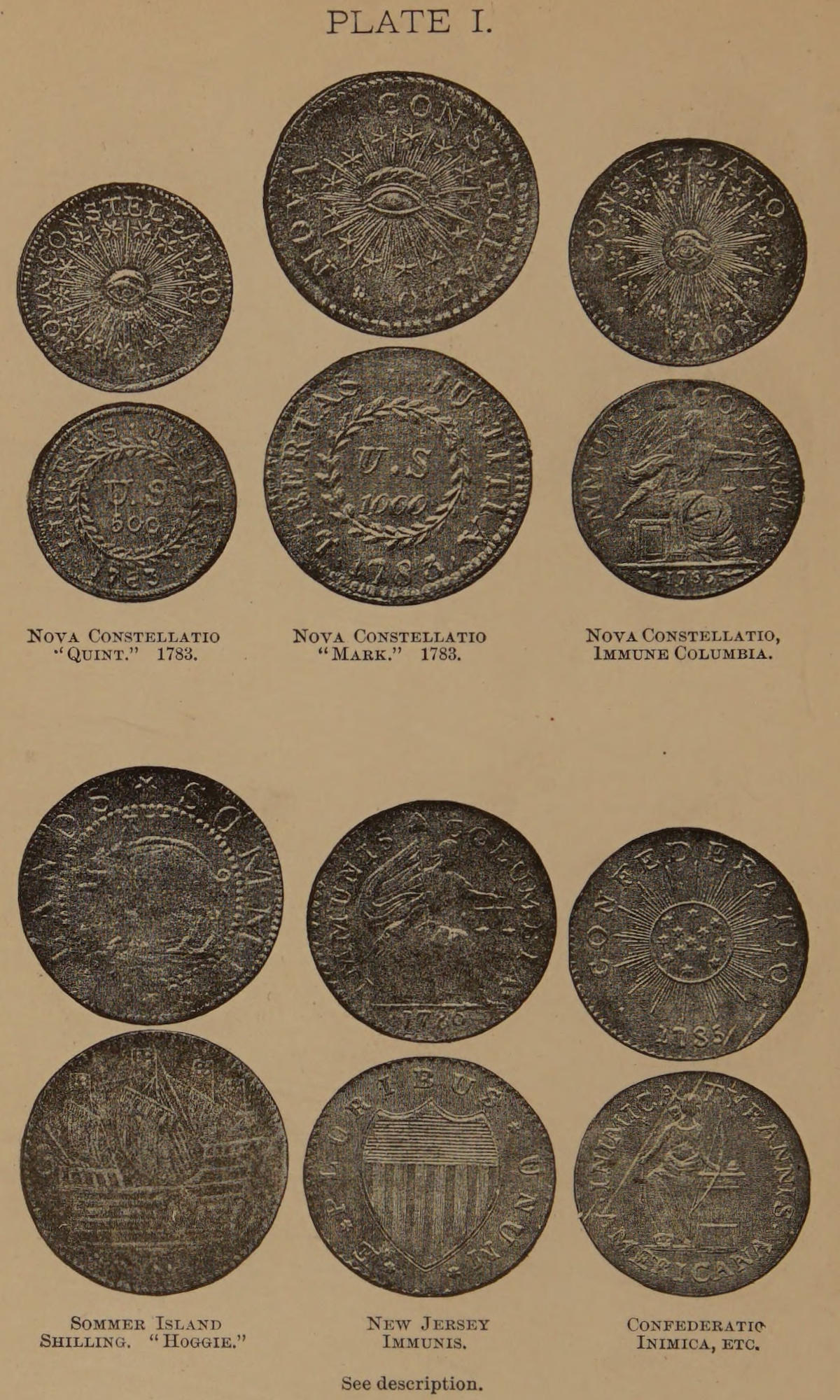
Nova Constellatio “Quint.”
1783. Nova Constellatio “Mark.” 1783. Nova Constellatio, Immune Columbia.
Sommer Island Shilling.
“Hoggie.” New Jersey Immunis.
Confederatio Inimica, etc.
See description.
PLATE II.
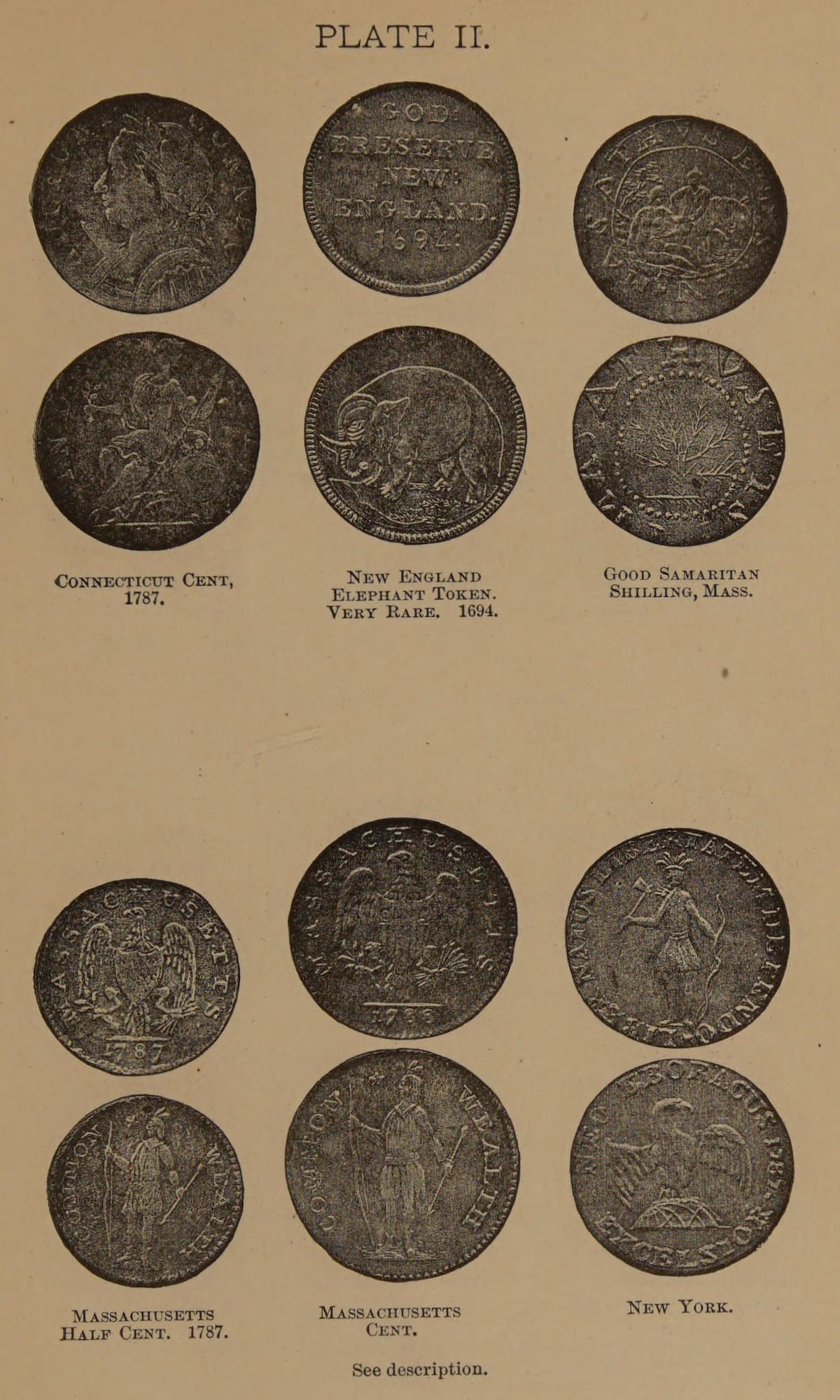
Connecticut Cent, 1787.
New England Elephant Token. Very Rare. 1694.
Good Samaritan Shilling, Mass.
Massachusetts Half Cent.
1787. Massachusetts Cent. New
York.
See description.
Obverse: An eye, the center of a glory, thirteen points
cross, equidistant; a circle of as many stars. Legend:
“NOVA CONSTELLATIO.”
Reverse: “U. S. 500” inscribed in two lines, a wreath
surrounding. Legend: “LIBERTAS JUSTITIA 1783.” Border,
beaded; edge, leaf work. Known as the “Quint.”
No. 2.—Obverse: An eye, around which a narrow, plain,
circular field; outside a glory, thirteen points cross, equidistant;
a circle of as many stars. Legend: “NOVA CONSTELLATIO.”
Reverse: “U. S. 1000” inscribed in two lines, a wreath
surrounding. Legend: “LIBERTAS JUSTITIA 1783.” Border,
a wreath of leaves; edge, leaf work; silver; size, 21; weight,
270 grains. Known as the “Mark.”
Obverse: An eye, on a small, plain, circular field; from the
outside of the field radiates a glory of thirteen blunt points,
crossing, equidistant, the spaces between as many stars in a
circular constellation. Legend: “NOVA CONSTELLATIO.”
Border, serrated.
Reverse: The Goddess of Liberty, seated upon a paneled
cubic pedestal, facing right; her left hand is well extended and
balances the scales of justice. A short liberty staff, crowned
with a cap and bearing a flag, rests against her right shoulder,
and is supported by the right hand. Legend: “IMMUNE
COLUMBIA.” Exergue: the date 1785. Border, serrated;
edge, plain or milled; size, 17; weight, gold, 128.8 grains;
silver, 92 grains; copper 148 grains.
Obverse: Device—A hog, standing, facing left, above
which are displayed the Roman numerals “XII.,” the whole
surrounded by a beaded circle. Legend: “SOMMER ISLANDS”
around which is a beaded circle like that enclosing the device.
Reverse: Device—A full-rigged ship under sail to the left,
a flag flying from each of her four masts—enclosed in a beaded
circle, the beads larger than on the obverse. Copper; size,
19; weight, 177 grains.
Obverse: Goddess of Liberty, seated upon a globe, facing
right; in her extended left hand the scales of justice; right
hand staff of liberty bearing a flag and crowned with a cap.
Legend: “IMMUNIS COLUMBIA.” Exergue: “1786.” Border,
serrated; edge, plain; size, 18; weight, 160 grains.
Reverse: A shield argent, six pales gules, a chief azure.
Legend: “E PLURIBUS UNUM.” Border, serrated; edge,
plain; size, 18; weight, 160 grains.
Obverse: A circular central field, size 6, covered with a
cluster of thirteen small stars; around this device a glory of
fine rays, presenting a corrugated outline of sixteen points.
Legend: “CONFEDERATIO 1785.” Border, serrated.
Reverse: An Indian, standing beside an altar or pedestal,
his right foot upon a crown, an arrow in his right hand, a bow
in his left; at his back a quiver full of arrows. Legend:
“INIMICA TYRANNIS AMERICA.” Border, serrated; edge,
plain; size, 18; weight, 112 grains.
Obverse: Identical with one of 1787.
Reverse: The same as one of the coins of Vermont. Another
Connecticut coin of this year, has the same reverse as the
“GEORGIVS III REX” issue of Machin & Co., from the mint
established by them in the State of New York.
Note.—The obverse and reverse dies of the Connecticut cents are too
numerous to mention, there being no less than one hundred and sixty-four
of the first, and eighty-four of the latter.
Obverse: Same as that of the common type of the Carolina
Token of 1694, and from the same die as that and the “London
Halfpenny.”
Reverse: An inscription, in five lines, occupying the whole
field, “GOD PRESERVE NEW ENGLAND 1694.” Borders,
milled; edge, plain; copper; size, 18½; weight, 133 and 236
grains.
The same general type and variety as the Pine Tree Shilling,
but bearing upon the obverse a well-executed device,
illustrating the parable of the Good Samaritan; but two or
three specimens of this coin have been known, two of which
are in existence and of unique varieties; they are supposed to
have been pattern pieces, struck at the origin of the Mint of
Massachusetts Colony.
PLATE III.
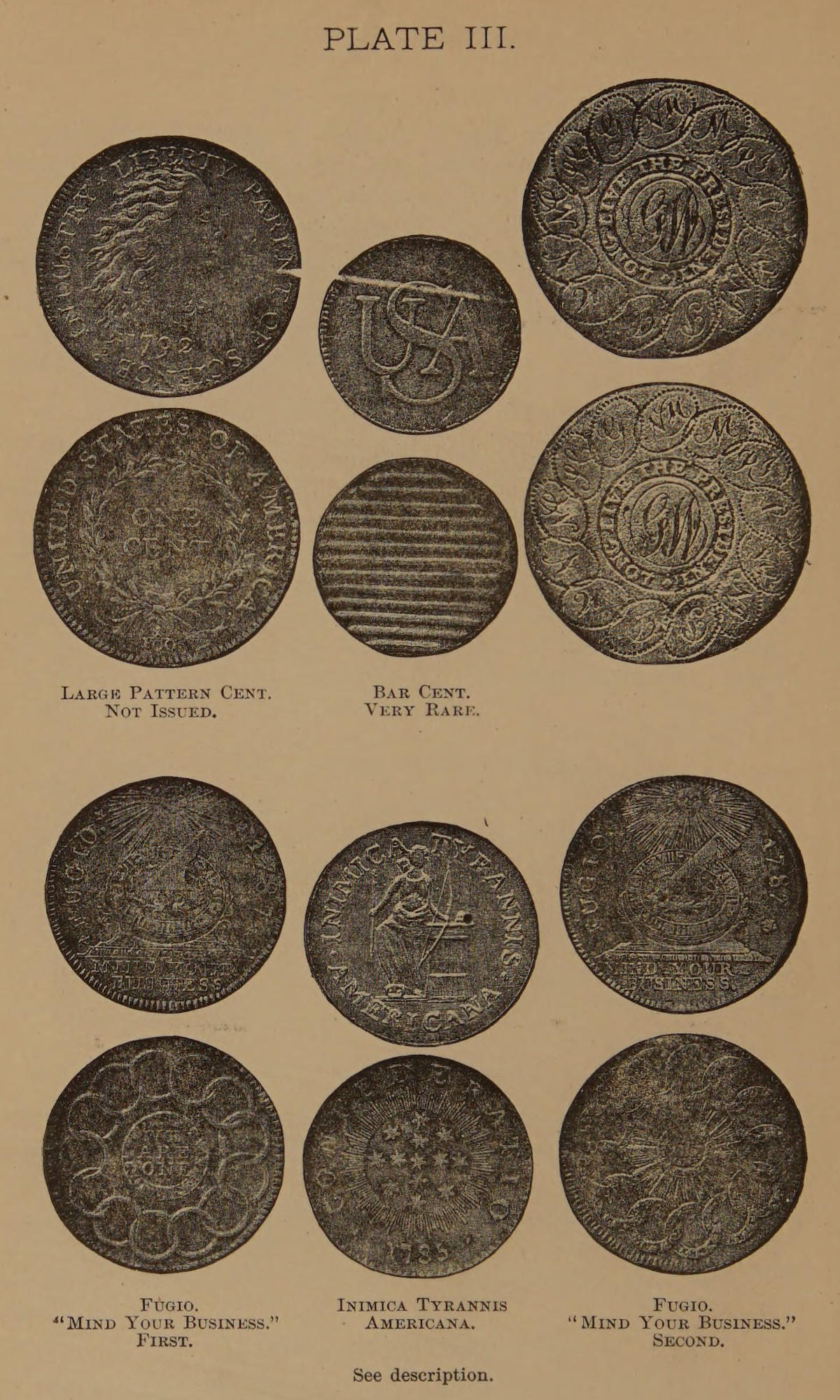
Large Pattern Cent. Not Issued.
Bar Cent. Very Rare.
Fugio. “Mind Your Business.”
First. Inimica Tyrannis Americana.
Fugio. “Mind Your Business.” Second.
See description.
PLATE IV.
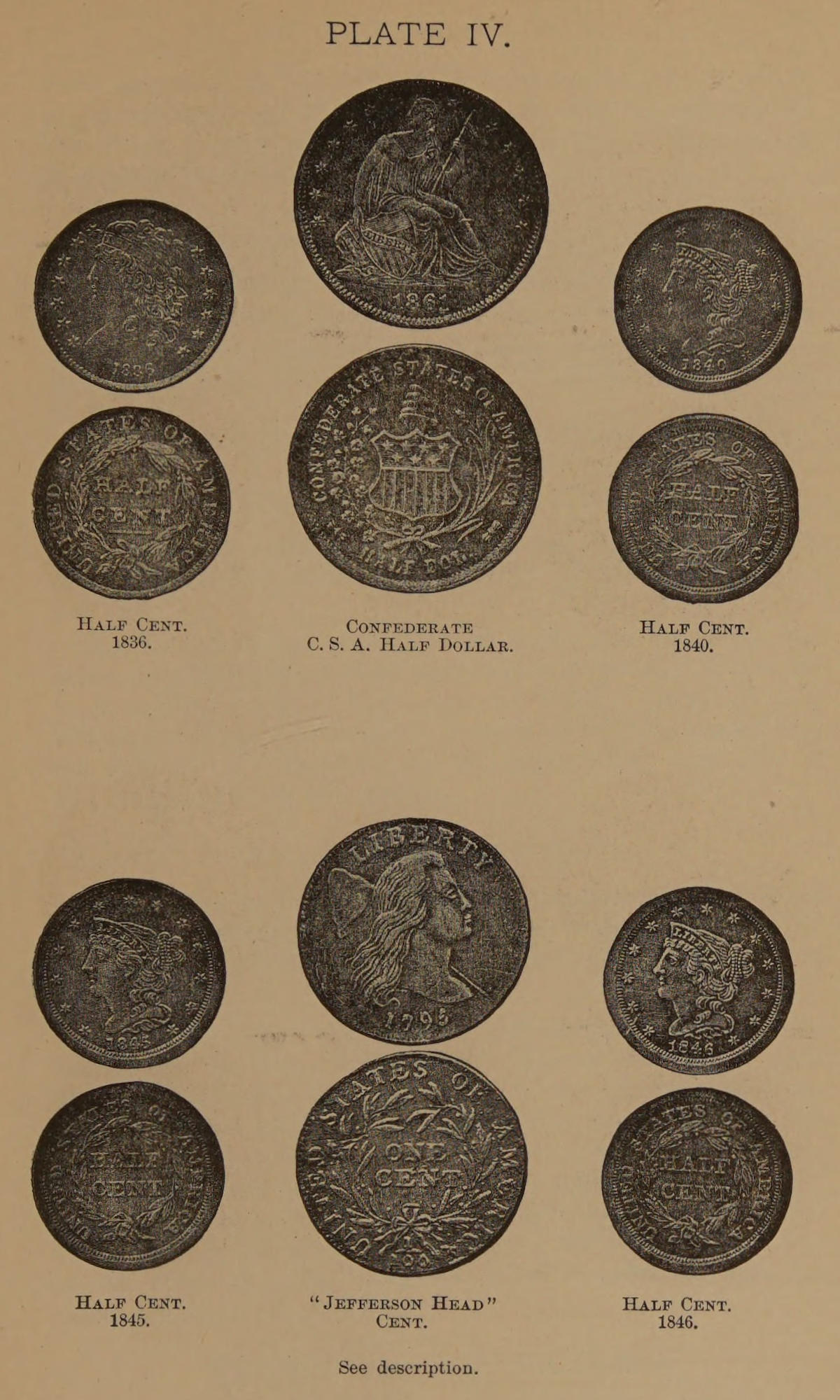
Half Cent. 1836. Confederate C. S. A. Half Dollar.
Half Cent. 1840.
Half Cent. 1845.
“Jefferson Head” Cent. Half
Cent. 1846.
See description.
Obverse: Same general description as the Cent of 1787.
Reverse: Same in general as the Cent of 1787, except that
the shield upon some specimens, bears only “HALF CENT.”
Borders, milled; edge plain; size, 15 to 15½; weight, 75 to
83 grains.
The “Cent,” 1788. Twelve Types. Thirteen Varieties.
Obverse: A clothed Indian, standing, facing left, in his
right hand a bow, in his left an arrow. Legend: “COMMONWEALTH.”
Reverse: A spread eagle, a broad shield upon his breast, six
pales gules (upright), a chief azure (open or plain). Upon the
chief, or upper part of the shield, the word “CENT,” in bold
Roman lettering. In exergue, beneath a heavy horizontal bar,
the date 1787. Borders, milled; edge, plain; size, 16½ to
19; weight, 146 to 165 grains.
The Fugios or Franklin Cents are the earliest coins issued
by authority of the United States. They being all dated 1787,
and made in conformity with resolution of Congress, dated
July 6, 1787:
“Resolved, That the Board of Treasury direct the contractor
for the copper coinage to stamp on one side of each
piece the following devices, viz.: Thirteen circles linked together,
a small circle in the middle, with the words ‘UNITED
STATES’ round it, and in the centre the words, ‘WE ARE ONE’;
on the other side of the same piece the following device, viz.:
a dial with the hours expressed on the face of it; a meridian
sun above, on one side of which is to be the word ‘FUGIO,’ and
on the other the year in figures ‘1787’; below the dial the
words ‘MIND YOUR BUSINESS.’”
This coin, presumed to have belonged to the same issue as
the Nova Constellatio Coppers, was probably made in Birmingham,
England, by Thomas Wyon, for circulation in
America. The “U S A” Copper was first passed as money
in the City of New York, in November, 1785. The device
was taken from an old Continental button, to which fact and
the light weight of the piece, has been attributed the disfavor
shown the coinage and the limited circulation given the same.
Obverse: Large Roman “U S A” in a monogram, on a
plain field.
Reverse: Thirteen horizontal bars. Border, serrated; Edge,
plain; size, 15½; weight, 85 grains. Two pairs of dies.
The Maryland Penny. One Type. One Variety. Unique.
Obverse: Similar to that of the sixpence.
Reverse: A Ducal Coronet, upon which are erected two
masts, each bearing a flying pennant. Legend: “DENARIVM
TERRE-MARIÆ.” Copper; size, 13.
The only specimen of this piece extant was imported into
America from England, at a cost of £75, and was sold for
$370 with the collection of J. J. Mickley, Esq., of Philadelphia.
Obverse: Laureated head of King George I, facing right.
Legend: “GEORGIUS DEI GRATIA REX.”
Reverse: A full double rose; from this project five barbed
points. Legend: “ROSA AMERICANA UTILE DULCI 1722”
which encircles the piece. Border, beaded; edge, plain;
“Bath Metal;” size, 16 to 18; weight, 139 grains.
Devices: Same as those of the Penny of this coinage. Legends:
Same import as those upon the Penny, but varied by
abbreviations and in punctuation. Border, beaded; edge,
plain; “Bath Metal;” size, 13 to 14; weight, 75 grains.
Reverse: Arms of the State of New York. Upon an oval
shield at the center is shown the sun rising from behind a
range of hills, the sea in the foreground; left of the shield,
Justice, with sword and scales; right, Liberty, with staff and
cap. Upon a hemisphere, above the shield, stands an eagle,
wings outspread, facing right. Exergue: 1787; beneath this,
next the border, “EXCELSIOR.” Border, serrated; edge,
plain; size, 17; weight, 157 grains.
PLATE V.
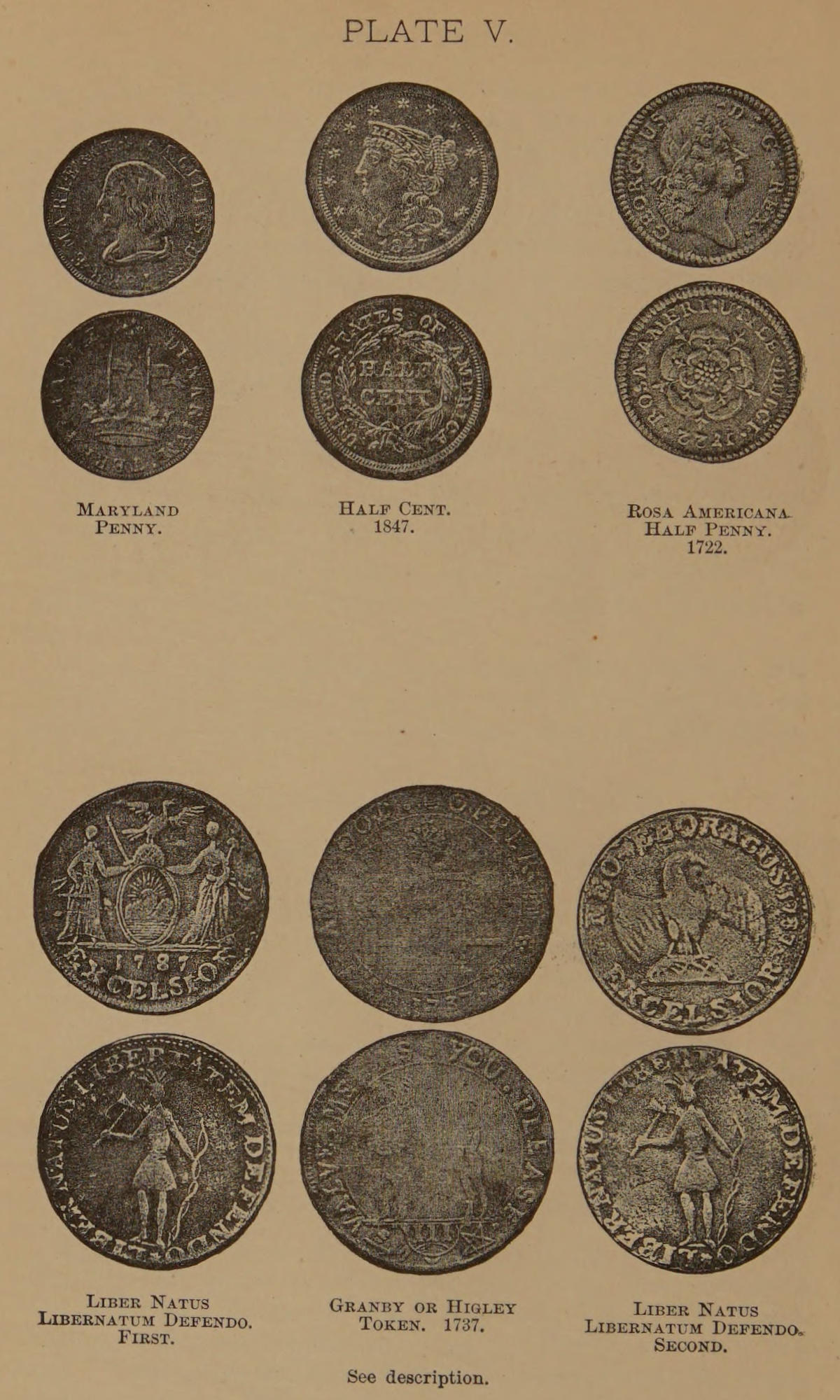
Maryland Penny.
Half Cent. 1847. Rosa
Americana Half Penny. 1722.
Liber Natus Libernatum Defendo.
First. Granby or Higley Token. 1737.
Liber Natus Libernatum Defendo. Second.
See description.
PLATE VI.
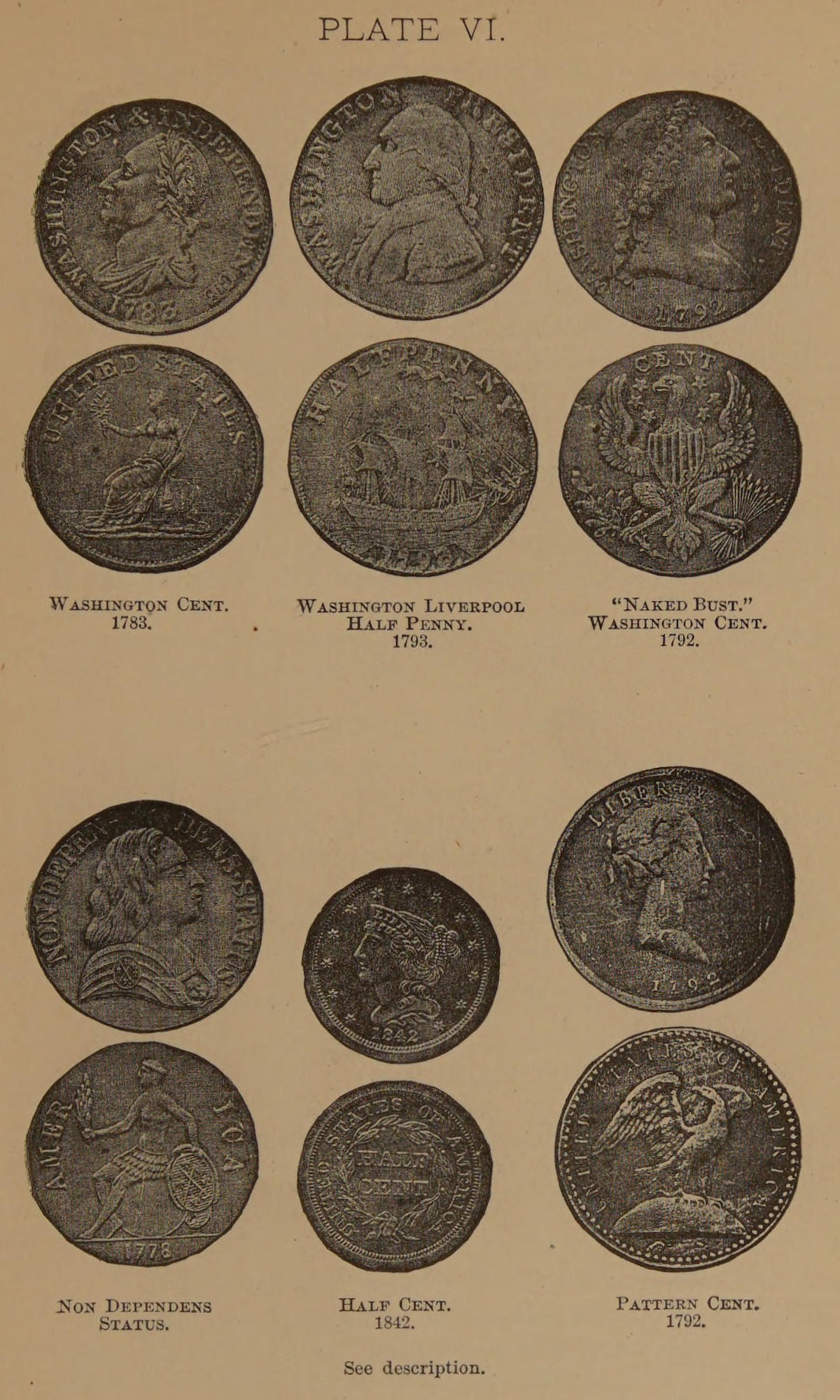
Washington Cent. 1783.
Washington Liverpool Half Penny. 1793.
“Naked Bust.” Washington Cent. 1792.
Non Dependens Status.
Half Cent. 1842. Pattern
Cent. 1792.
See description.
Obverse: An Indian, standing, crowned with feathers, and
facing left; in his right hand he wields a tomahawk, his left
supports a bow, the end of which rests on the ground near
his feet; over his right shoulder appears the top of a quiver
of arrows, which is borne upon his back. Legend: “LIBER
NATUS LIBERATEM DEFENDO.”
Reverse: A hemisphere of the globe, marked by longitudinal
and meridianal lines; upon this stands a large heavy-bodied
eagle, wings spread, somewhat drooping, beak toward
the right. Legend: “NEO-EBORACUS 1787 EXCELSIOR.”
Border, serrated; edge, plain; size, 17; weight, 153 grains.
Obverse: A deer, standing, facing left, occupying the whole
field. Legend: “VALVE ME AS YOU PLEASE.” Exergue: The
Roman numerals III upon a small scroll; a little crescent is
shown below.
Reverse: Three hammers, each bearing a crown upon the
head. Legend: “I AM GOOD COPPER 1737.”
Obverse: Large laureated bust of Washington, draped,
facing left. Legend: “WASHINGTON & INDEPENDENCE 1783.”
Reverse: A figure of a female, facing left, seated upon a
rock; right hand holds an olive branch; left, staff of liberty,
with cap. Legend: “UNITED STATES.” Exergue: T. W. I.
E. S. Border, beaded; edge, plain; size, 17½; weight, 120
grains. Two obverse and three reverse dies.
Obverse: Bust of Washington, in uniform, facing left, hair
in a queue. Legend: “WASHINGTON PRESIDENT.”
Reverse: A ship, under sail, to the right: Legend:
“HALFPENNY” under the ship, waves, and in the foreground,
on a panel, the date 1793. Border, milled; edge, lettered:
“PAYABLE IN ANGLESEY LONDON OR LIVERPOOL.” Size, 19;
weight, 163 grains.
Obverse: A classical bust of Washington, undraped, facing
right; the head is encircled by a fillet, confining the hair,
which is cut short and is curly; the fillet is tied at the back
of the head by a bow knot with long pendent ends. Legend:
“WASHINGTON PRESIDENT 1792.”
Reverse: A small eagle, displayed, wings upraised; on his
breast a shield argent, six pales gules; right talon, an olive
branch, fourteen leaves, six berries; left talon, thirteen arrows;
about the head of the eagle are six mullets, and above is the
word “CENT.” Border, milled; edge, plain, or inscribed:
“UNITED STATES OF AMERICA.” Size, 19; weight, 198
grains. Some six or eight specimens only are known.
Obverse: A full bust, facing right; flowing hair to the
shoulders. Upon the drapery of the bust a small oval shield
as an epaulet, emblazoned with a staff bearing a flag; across
the staff, saltierwise, rests a naked sword. In each angle of
this device is displayed a fleur de lis. Upon the breast of the
bust is a head with spreading wings. Legend: “NON-DEPENDENS
STATUS.”
Reverse: An Indian, seated upon a globe, facing left; nude,
except a cap or bandeau upon his head, and a feather tunic
around the lower part of the body. In his extended right
hand he holds a bunch of tobacco; the left reaches behind
him and rests upon a shield, bearing the same emblems displayed
upon the epaulets upon the bust on the obverse. Legend:
“AMER ICA,” divided by the figure of the Indian.
Exergue: 1778. Border, plain; edge plain; size, 19.
Some coin dealers advertise the Non Dependens Status as
“a rare copper, worth $100.”
Obverse: A bust of Liberty, facing to right, the hair confined
by a fillet. Above is inscribed the word “LIBERTY,”
and beneath the date “1792.”
Reverse: A portion of a globe, on which stands an eagle,
with raised wings. Legend: “UNITED STATES OF AMERICA.”
This cent has a grained edge, like the cents of 1793. Some
numismatists give it the preference as the first cent.
The George Clinton Copper has the bust of Governor Clinton
facing right, with legend “GEORGE CLINTON.”
Reverse: The State arms of New York, and in the exergue,
“1787 EXCELSIOR.” This last reverse is found also combined
with the Liber Natus, which has an Indian standing, facing
left, with tomahawk in the right hand and bow in the left, a
bundle of arrows also at his back. Legend: “LIBER NATUS
LIBERTATEM DEFENDO.” This latter obverse is also found
combined with another reverse, as follows: An eagle stands
upon a section of the globe. Legend: “NEO EBORACUS
1787 EXCELSIOR.”
PLATE VII.
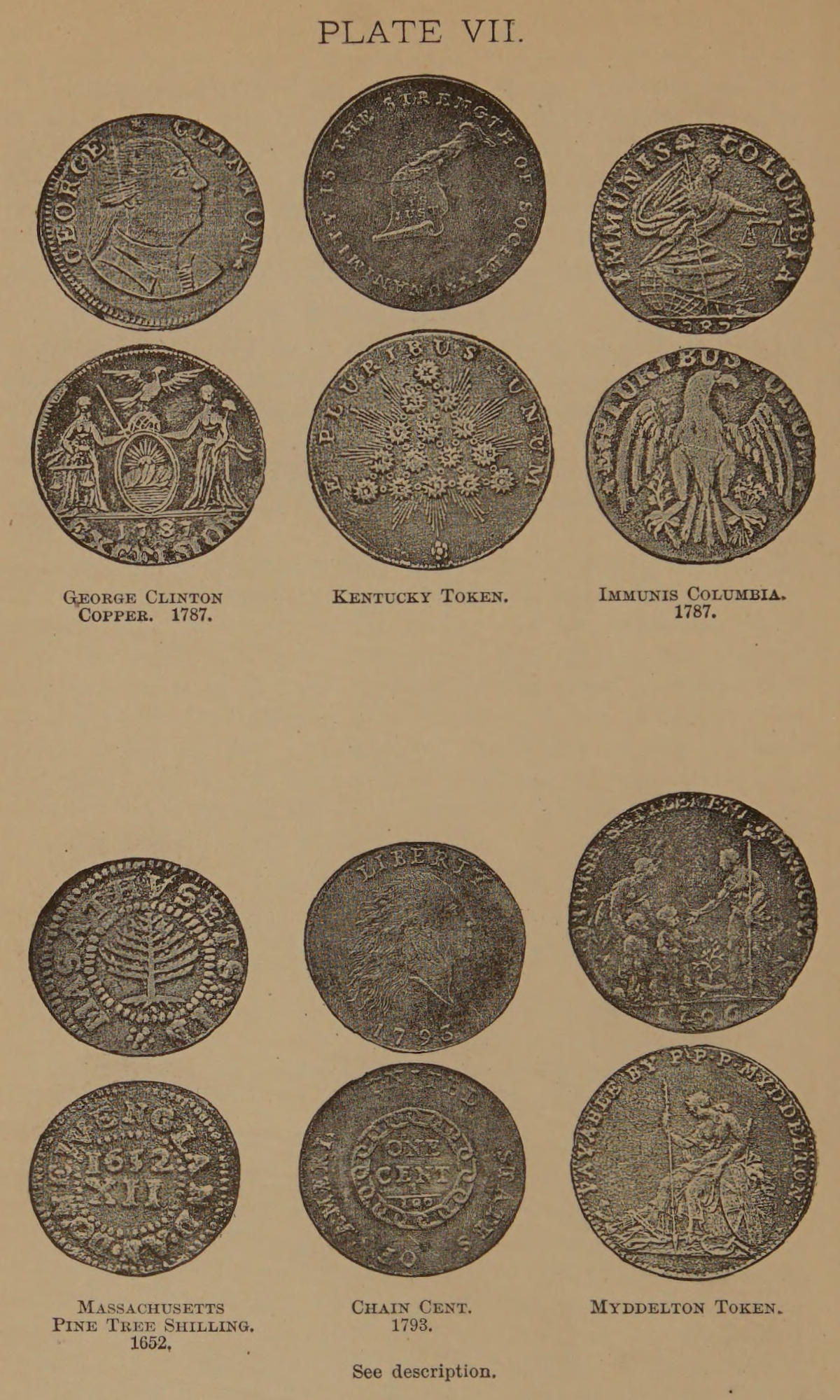
George Clinton Copper. 1787.
Kentucky Token. Immunis
Columbia. 1787.
Massachusetts Pine Tree
Shilling. 1652. Chain Cent. 1793.
Myddelton Token.
See description.
PLATE VIII.
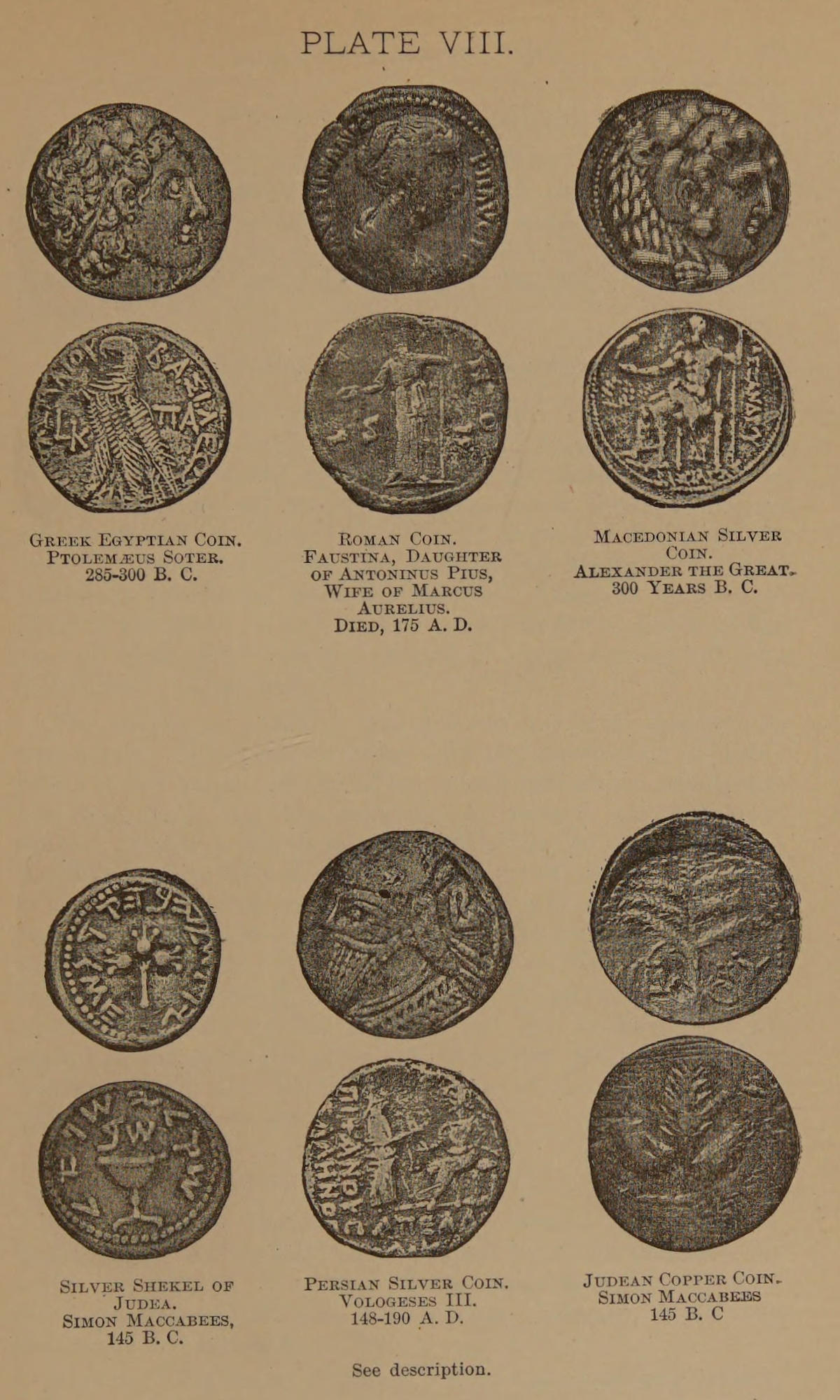
Greek Egyptian Coin. Ptolemæus
Soter. 285-300 B. C. Roman Coin. Faustina,
Daughter of Antoninus Pius, Wife of Marcus Aurelius. Died, 175 A. D.
Macedonian Silver Coin. Alexander the Great. 300 Years
B. C.
Silver Shekel of Judea. Simon Maccabees.
145 B. C. Persian Silver Coin. Vologeses III.
148-190 A. D. Judean Copper Coin. Simon Maccabees.
145 B. C.
See description.
Has a hand holding a scroll inscribed “Our Cause is Just.”
Legend: “UNANIMITY IS THE STRENGTH OF SOCIETY.” Reverse:
A radiant pyramid, triangular in shape, of fifteen stars
united by rings, each star having placed in it the initial of a
State, Kentucky being at the top. Legend: “E PLURIBUS
UNUM.”
The Shekel was originally a weight. The first form in
which money was used by the Jews, and by all other nations
of which we have any knowledge, was the pieces without any
regular shape or any marks or devices upon them. Precious
metals passed by weight. Thus it is said of the purchase
made by Abraham of the cave and field of Machpelah, “And
Abraham hearkened unto Ephron; and Abraham weighed to
Ephron the silver, which he had named in the audience of the
sons of Heth, four hundred shekels of silver, current with the
merchant.” Gen. xxiii. 16.
The weight of a shekel was a little less than one-half an
ounce troy. The term “current with the merchant,” probably
refers to the purity of the silver, which was about ninety-five
per cent. fine, and the value in our money was fifty-eight
cents. It first appeared as a coin in the time of the Maccabees,
who lived about 140 B. C. The amount of silver in the coin
is the same as was contained in the piece of silver denominated
a shekel. It will be seen that on one side is the golden
cup that had manna (see Exod. xvi. 33, and Heb. ix. 4), with
the inscription in old Hebrew character, “SHEKEL OF ISRAEL;”
on the other side appears Aaron’s rod that budded with the
legend in the same character, “JERUSALEM THE HOLY.” This
specimen is in the Mint cabinet; one of the most rare and
interesting coins in the collection.
Obverse: The Goddess of Liberty, seated upon a globe,
facing right; in her fully extended left hand she balances the
scales of justice; the right hand supports a liberty staff,
bearing a flag and crowned with a cap. Legend: “IMMUNIS
COLUMBIA.” Exergue: 1787.
Reverse: An eagle, displayed; right talon, an olive branch,
thirteen leaves; left talon, thirteen arrows. Legend: “E
PLURIBUS UNUM.” Borders, serrated; edge, plain; size, 16½;
weight, 135 grains.
“John Hull and Robert Saunderson were equal officers in
the ‘gainful business’ of the Mint. How much they coined in
all for the colony, or the exact amount of their profits under
the contract they carried out, cannot be determined.” The
coinage was certainly large in amount, and they, as was well
understood, became men of wealth and substance. When the
daughter of John Hull was married to Judge Samuel Sewall,
the founder of the town of Newbury, Mass., the prosperous
mint-master gave the bride a dowery of her weight in silver.
At the conclusion of the wedding ceremony, a large steel-yard
was brought into the room, and the blushing bride placed upon
one of the platforms of the same, while into a tub upon the
other side were poured the Pine Tree Shillings, until the
steel-yard balanced.
These have a bust with flowing hair, looking right, with the
date below and word “LIBERTY” above it; on the reverse side,
in the centre, is “ONE CENT,” with “⅟₁₀₀” below it, enclosed in
an endless chain of fifteen links, typifying the number of
States then in the Union. The legend is “UNITED STATES OF
AMERICA” in all excepting one die, which reads “UNITED
STATES OF AMERI,” the engraver evidently not having room
to complete the word.
Obverse: A figure, representing Hope, beside an anchor;
she presents two children to a female, the last extending her
right hand in reception of the charge; the left hand supports
a liberty staff, which is crowned with a cap; in front of the
figure with the staff is an olive branch and a wreath, to the
rear a cornucopia. Legend: “BRITISH SETTLEMENT KENTUCKY.”
Reverse: Britannia, seated disconsolate amid the down-cast
emblems of her power, and facing left; her head is bowed; she
holds in her right hand an inverted spear, the head of which
penetrates the ground; at her right side a bundle of fasces or
lictors’ rods have fallen near the cap of Liberty; upon the
ground, before the figure, are the scales of justice, upon which
Britannia has set her left foot and the sword of justice, with
broken blade; the left arm of the figure rests upon a large
shield, bearing the cross of the British ensigns. Legend:
“PAYABLE BY P. P. P. MYDDELTON.”
PLATE IX.
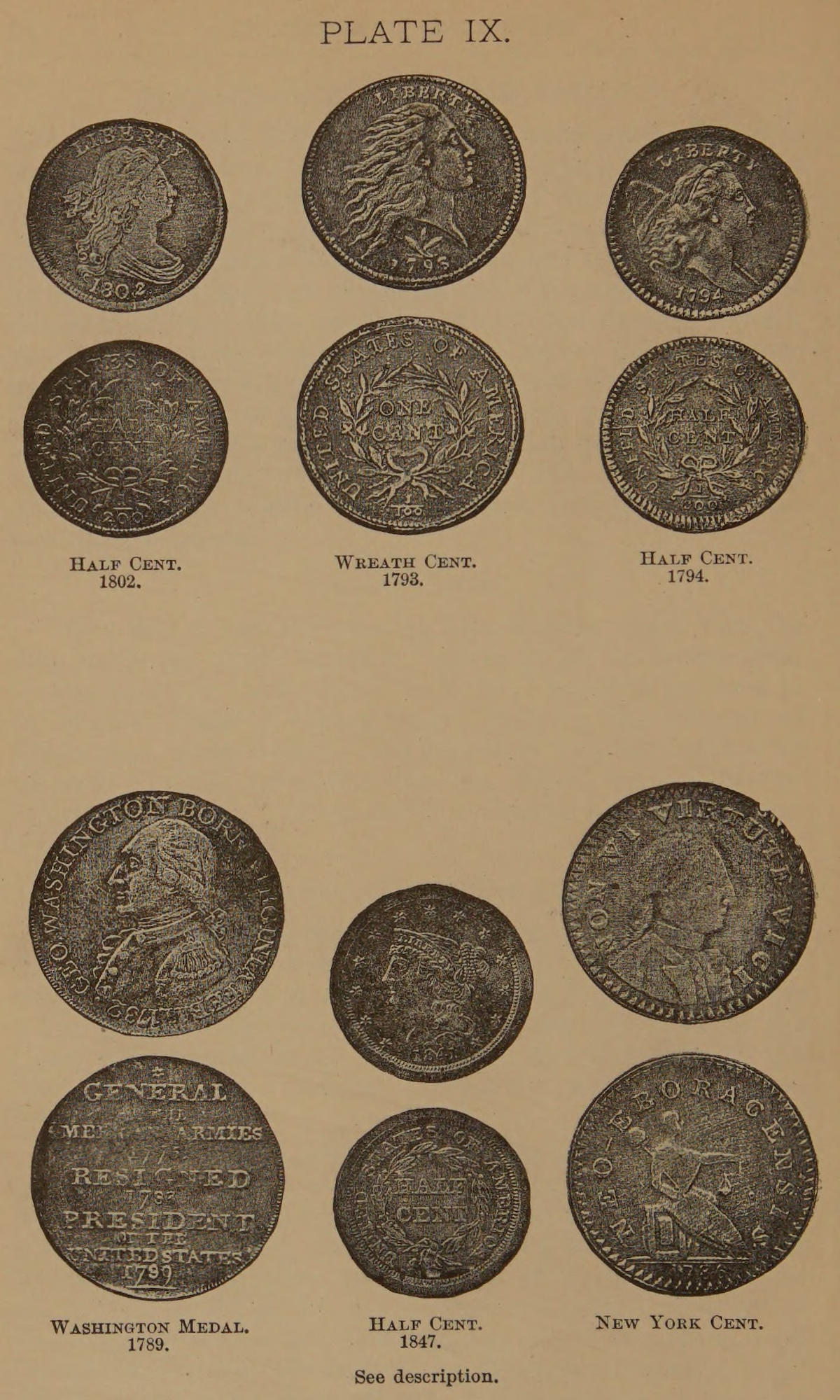
Half Cent. 1802.
Wreath Cent. 1793. Half
Cent. 1794.
Washington Medal. 1789.
Half Cent. 1847. New
York Cent.
See description.
PLATE X.
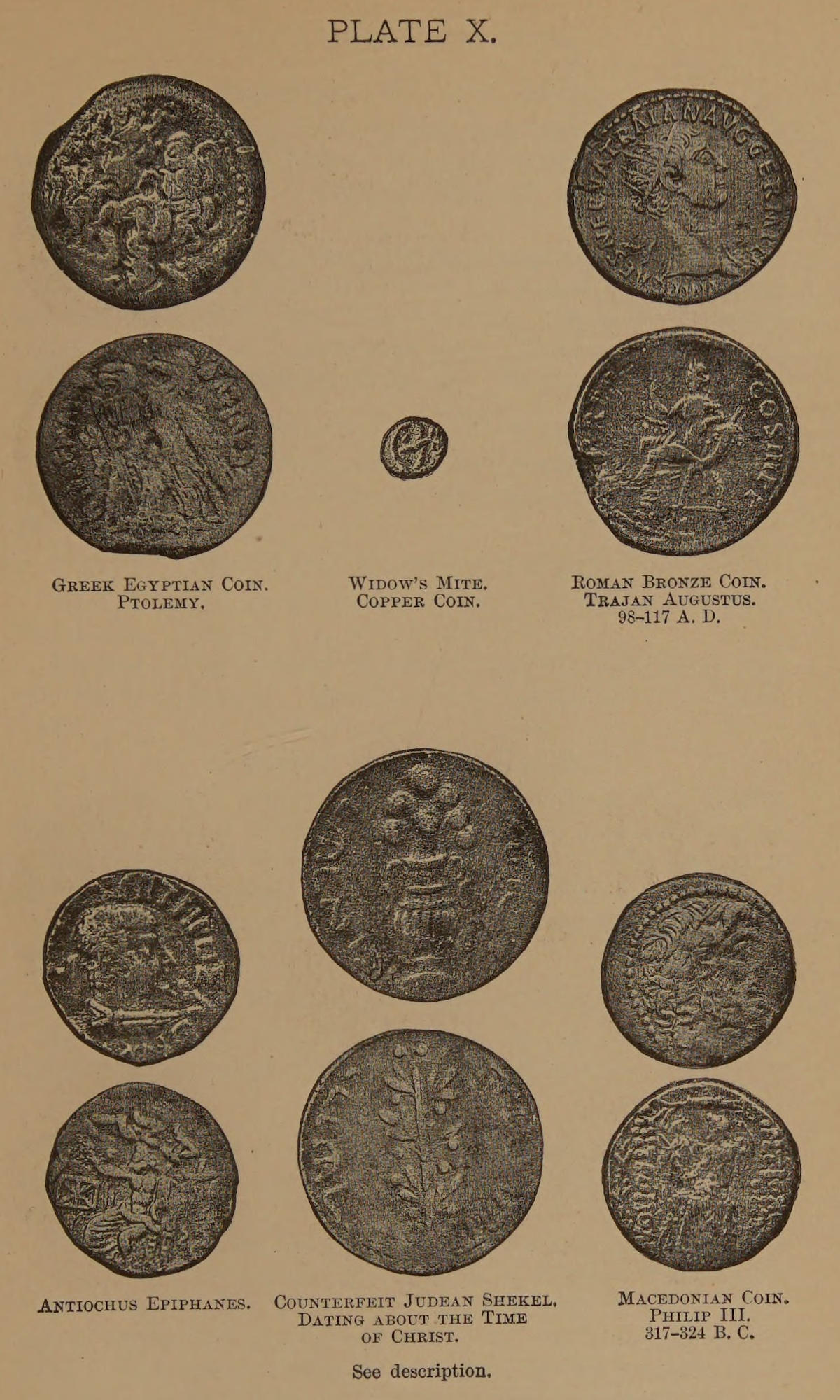
Greek Egyptian Coin. Ptolemy.
Widow’s Mite. Copper Coin. Roman
Bronze Coin. Trajan Augustus. 98-117 A. D.
Antiochus Epiphanes. Counterfeit Judean Shekel. Dating about the Time of
Christ. Macedonian Coin. Philip III.
317-324 B. C.
See description.
Obverse: A head, facing right, hair unconfined, floating
backward in flowing locks. Legend: “LIBERTY PARENT OF
SCIENCE & INDUST.” Exergue: Beneath the head the date
1792.
Reverse: A wreath, two olive branches crossed at the lower
ends and tied with a ribbon; within the wreath a field bearing
an inscription “ONE CENT” in two lines. Legend: “UNITED
STATES OF AMERICA.” Exergue: “⅟₁₀₀.” Border, milled; edge,
reeded; size, 14; weight, 65 grains. Extremely rare.
A small head on both obverse and reverse. The former
has the legend, “WASHINGTON;” the latter the legend “ONE
CENT.” No date.
Bust of Washington with a wig, and with military draping,
face right. Legend: “NON VI VIRTUTE VICI.”
Reverse: The Goddess of Liberty, seated, with liberty pole
and scales of justice. Legend: “NEO EBORACENSIS.” Date,
1786.
A token much prized by collectors is known as the Carolina
Elephant. The obverse is from a rather common English
token known now as the London Elephant. The animal is
standing with his head down. There is no legend.
Reverse: “GOD PRESERVE CAROLINA AND THE LORDS PROPRIETERS
1694.”
In 1794 and 1795 similar device to that of 1793; but face
Liberty facing to the right. Weight, 104 grains.
The liberty cap is omitted, as is the lettering on the edge,
not to reappear on the American cent. Liberty Cap Cents
are very rare.
In the year 1798 a slight change was made in the obverse
of the cent, giving some of the curls a different termination
from those of 1796, 1797, and the early part of 1798. The
latter device was continued each year, until and including
1807. The reverse remained unchanged during the same time,
excepting some slight variations, probably unintentional, if
not positive mistakes. For instance, in 1797 and 1802 we
find some without stems to the wreaths, and in one case only
one stem. In 1801 and 1802 some have ⅟₀₀₀ instead of the
fraction ⅟₁₀₀. In addition to this error, a variety of the cent of
1802 has “Iinited,” instead of “United.” In 1796 we have
in one instance “Liherty,” instead of “Liberty.”
In 1809 an obverse head of Liberty; forehead encircled by
a band, “LIBERTY” inscribed upon it, surrounded by thirteen
stars. Exergue: “1809.”
Reverse: Wreath in a circular garland inclosing the words
“ONE CENT.” No change took place during the issues of 1808
to 1814, inclusive.
The first half-cent was issued in 1793, having on obverse:
Bust of Liberty, facing to the left; staff surmounted by
liberty-cap over right shoulder. Legend: “LIBERTY.” Exergue:
“1793.”
Reverse; Inscription, “HALF CENT,” surrounded by a
wreath, tied with a ribbon. Weight, 132 grains.
Obverse: Bust of Liberty, hair flowing. Legend: “LIBERTY.”
Exergue: “1793.”
Reverse: A wreath with berries, the stems of wreath tied in
a bow with a ribbon. Inscription: “ONE CENT.” Legend:
“UNITED STATES OF AMERICA.” Exergue: “⅟₁₀₀.”
Third. Known as the “Liberty Cap Cent.”
Obverse: A bust of Washington, in uniform, facing right,
hair in a queue. Legend: “GEORGE WASHINGTON.”
Reverse: A shield with sixteen argent and gules impaling
argent, fifteen mullets; above the shield an eagle, left talon,
an olive branch, right talon, six arrows. Legend: “LIBERTY
AND SECURITY.” Exergue: “17 95,” divided by the point
of the shield. Border: A plain circle, and outside of the
same, milled edge, lettered “AN ASYLUM FOR ALL NATIONS.”
Size, 20½; weight, 310 grains. This piece is extremely rare.
The well-known Virginia half-pennies seem to have been
very plentiful. A number of different dies were used. A laureated
bust of George the Third is surrounded, as on the English
half-penny, with his title, “GEORGIVS III. REX.” The
reverse has an ornamental and crowned shield, emblazoned
quarterly: 1, England empaling Scotland; 2, France; 3, Ireland;
4, the electoral dominions. Legend: “VIRGINIA.”
PLATE XI.
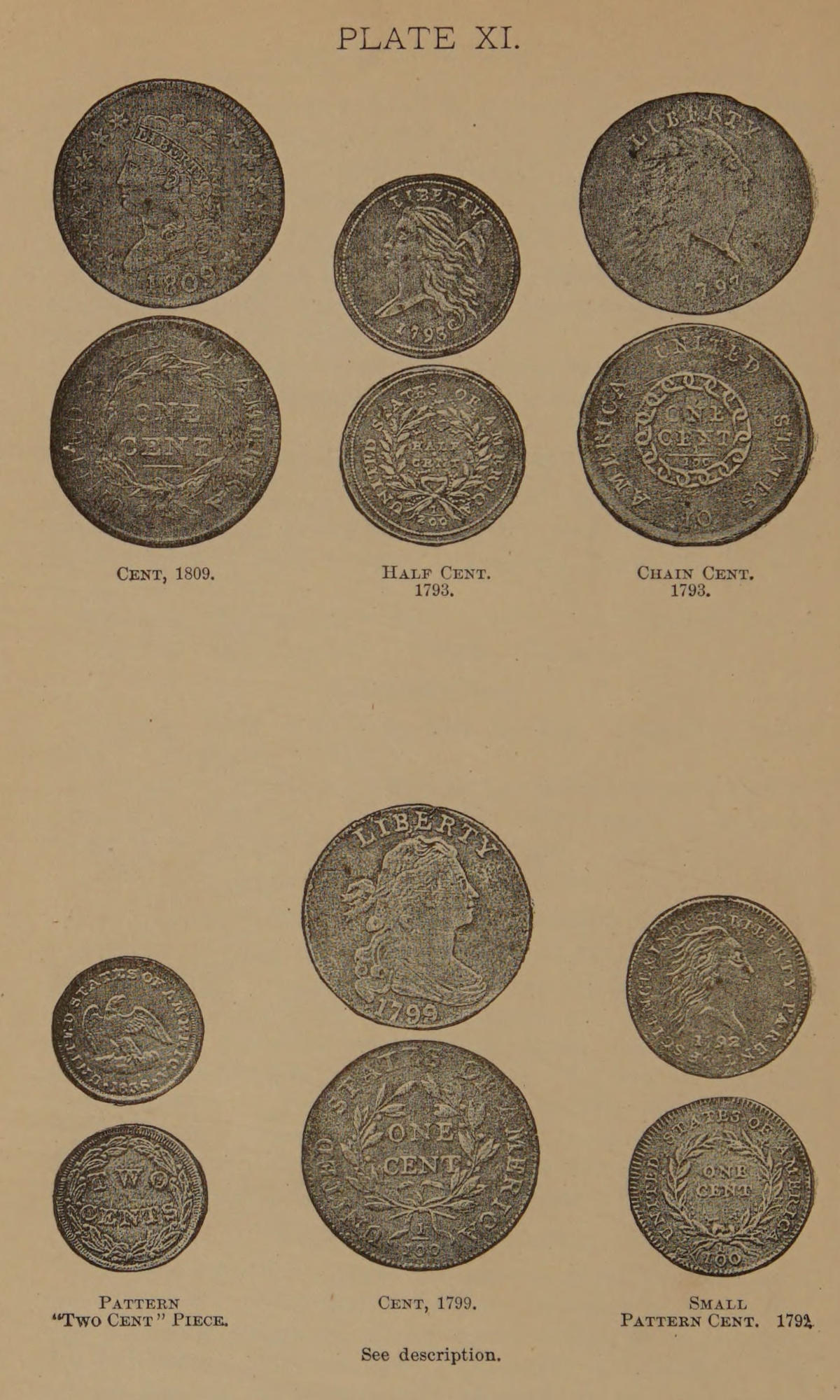
Cent. 1809.
Half Cent. 1793. Chain
Cent. 1793.
Pattern “Two Cent” Piece.
Cent. 1799. Small
Pattern Cent. 1792.
See description.
PLATE XII.
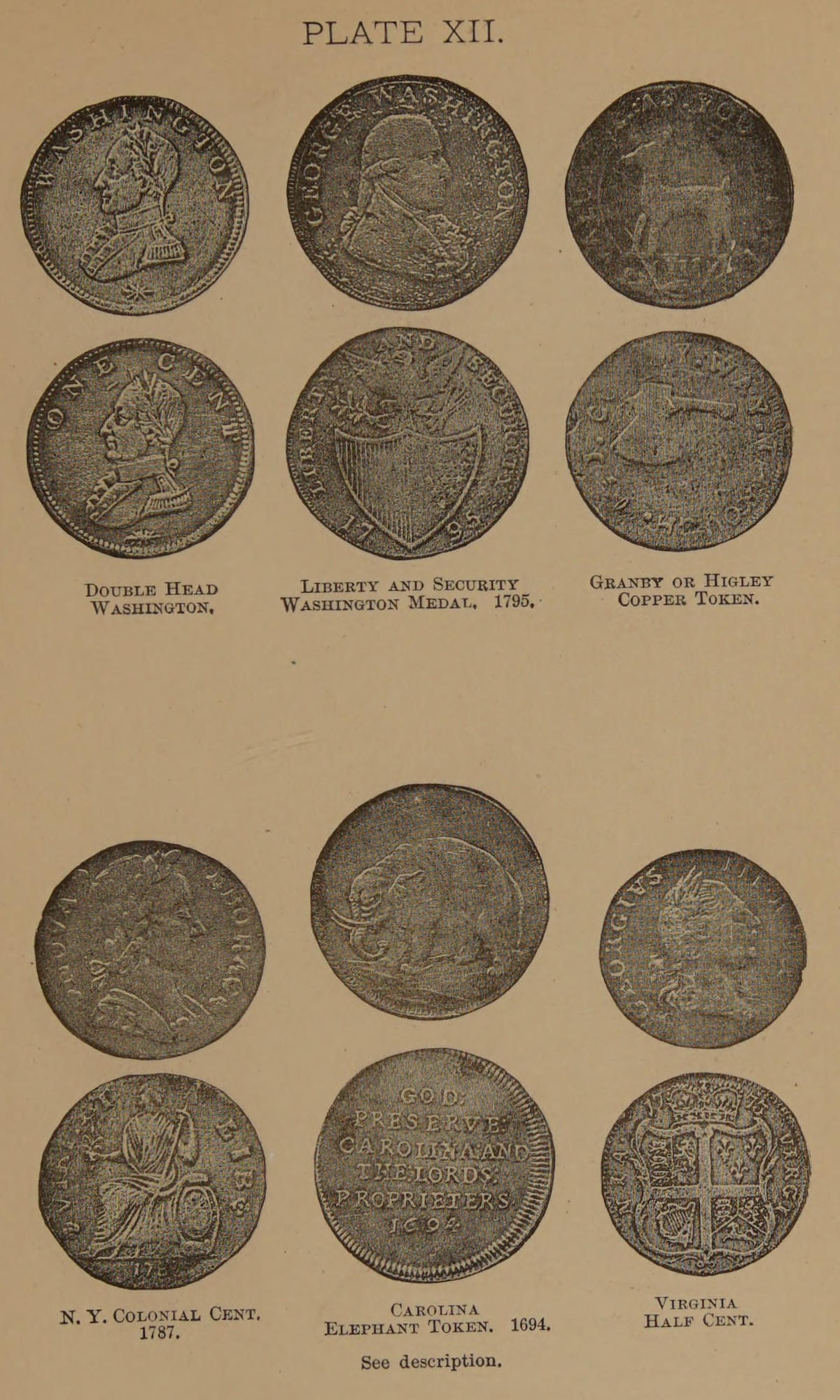
Double Head Washington.
Liberty and Security Washington Medal. 1795.
Granby or Higley Copper Token.
N. Y. Colonial Cent. 1787.
Carolina Elephant Token. 1694.
Virginia Half Cent.
See description.
PLATE XIII.
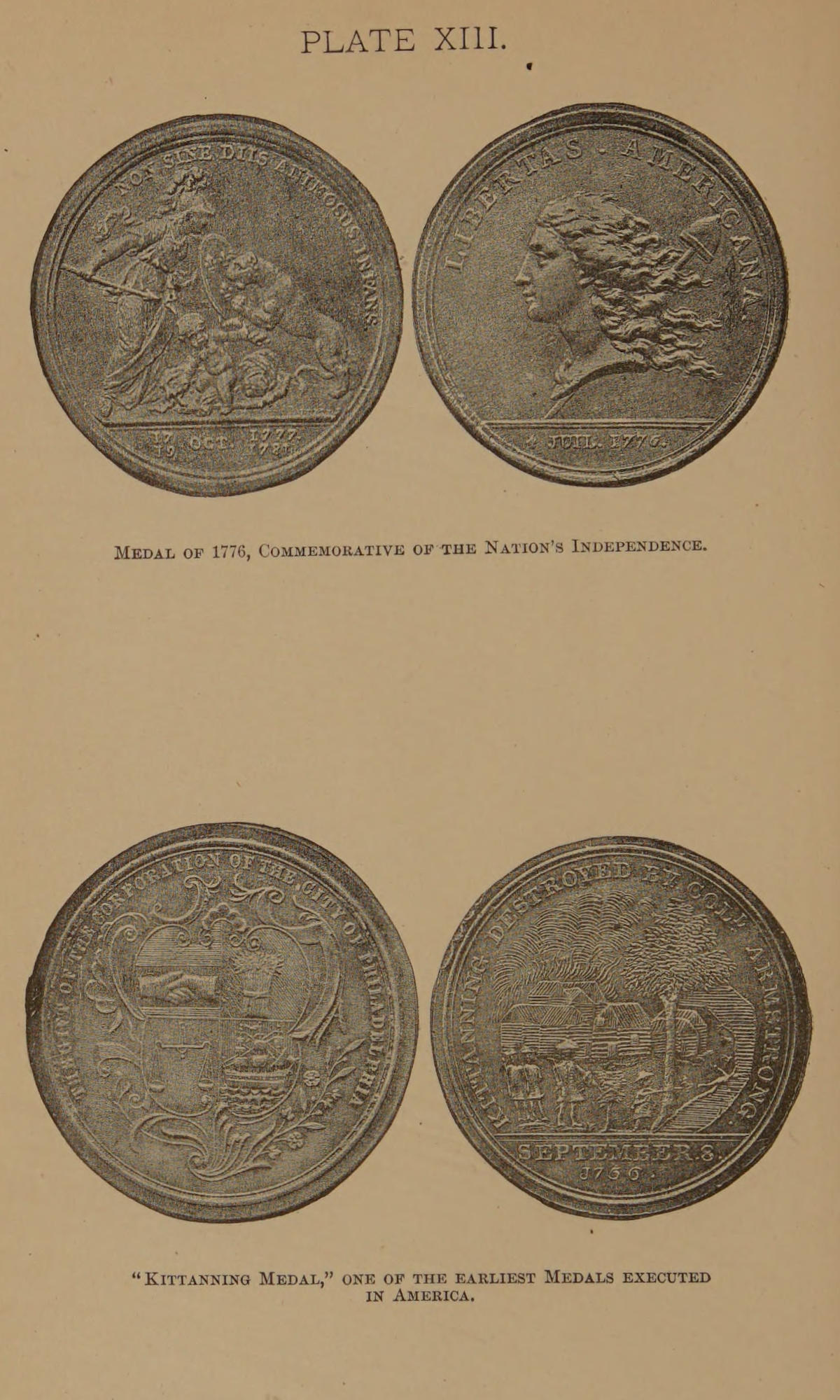
Medal of 1776, Commemorative of the
Nation’s Independence.
“Kittanning Medal,” one of the
earliest Medals executed in America.
PLATE XIV.
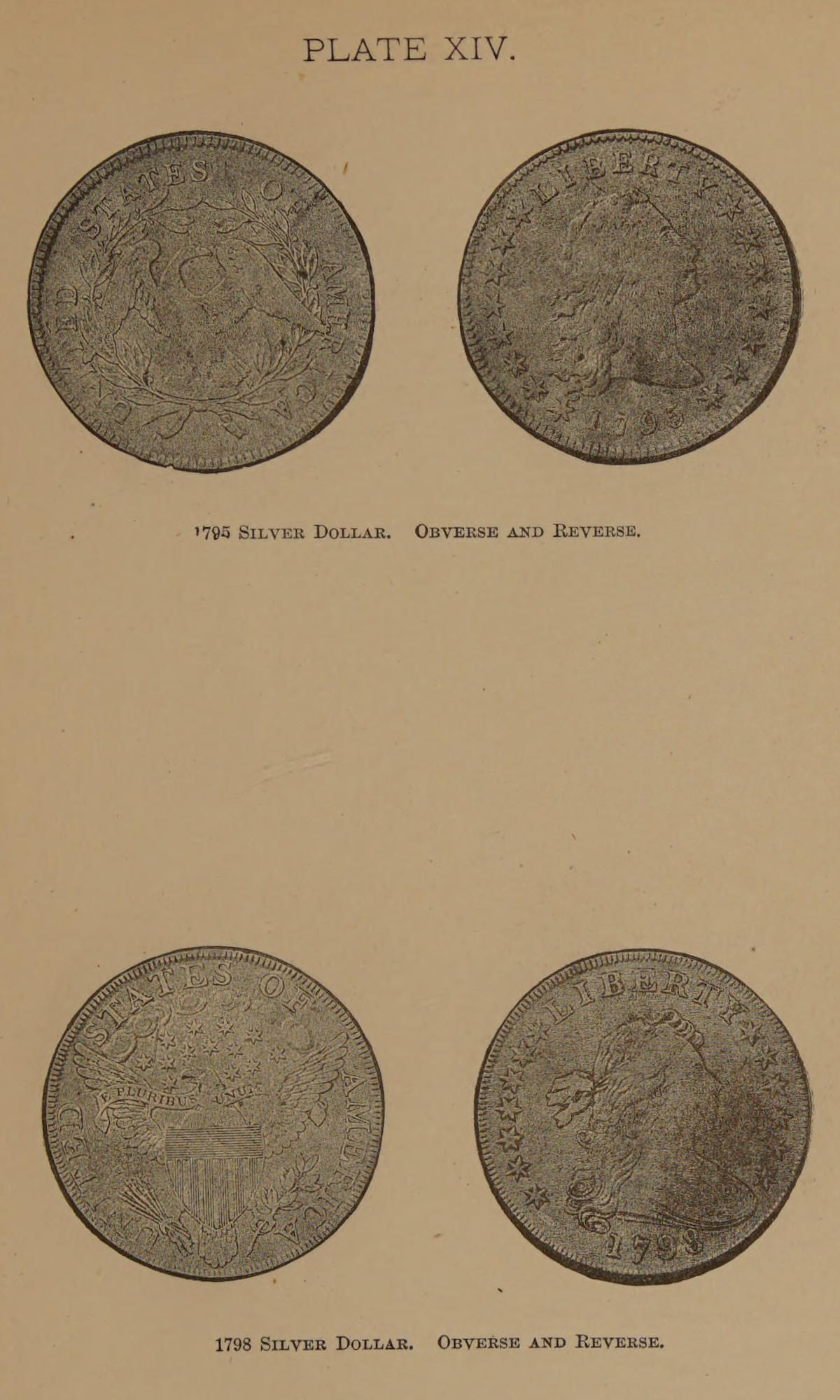
1795 Silver Dollar. Obverse
and Reverse.
1798 Silver Dollar. Obverse
and Reverse.
PLATE XV.
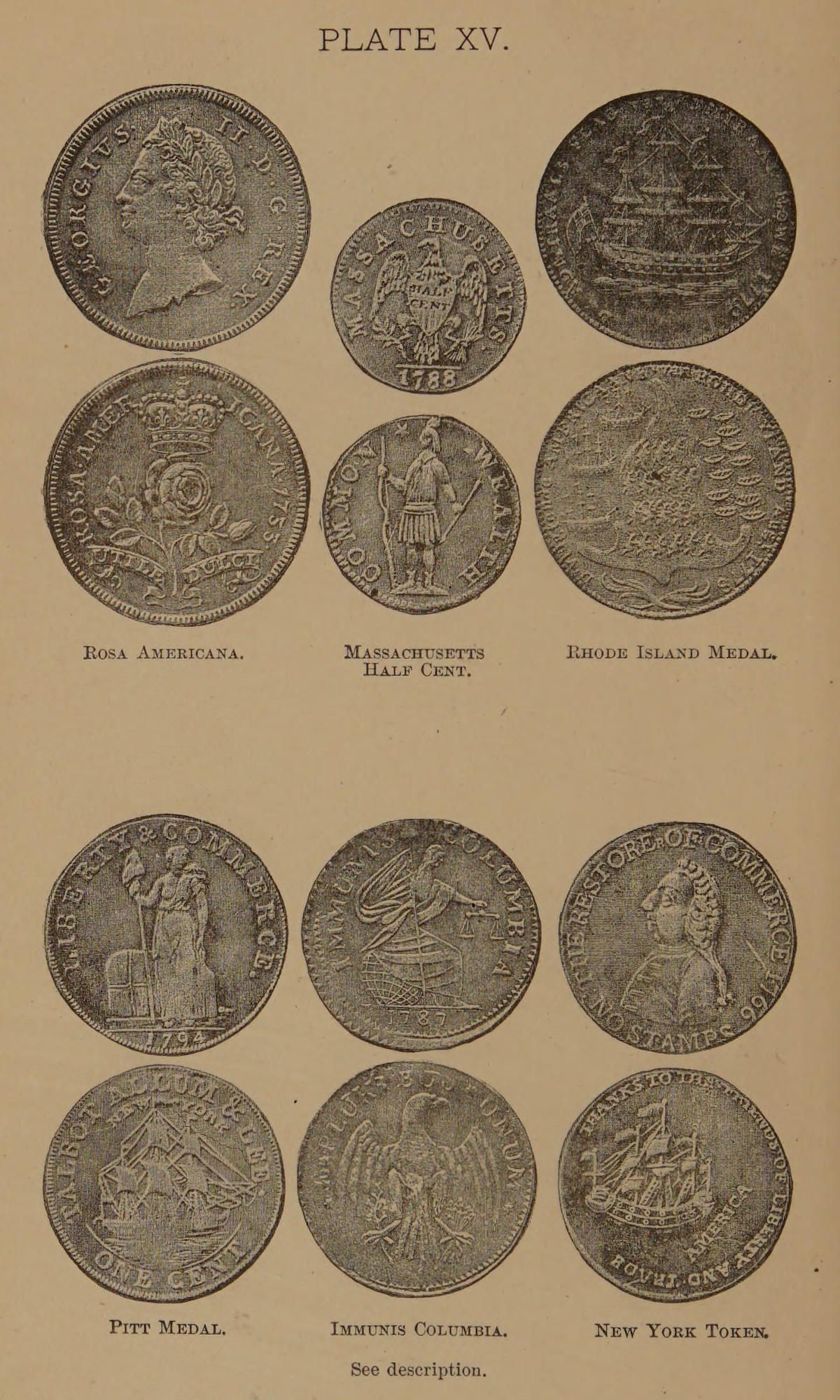
Rosa Americana.
Massachusetts Half Cent.
Rhode Island Medal.
Pitt Medal.
Immunis Columbia.
New York Token.
See description.
PLATE XVI.
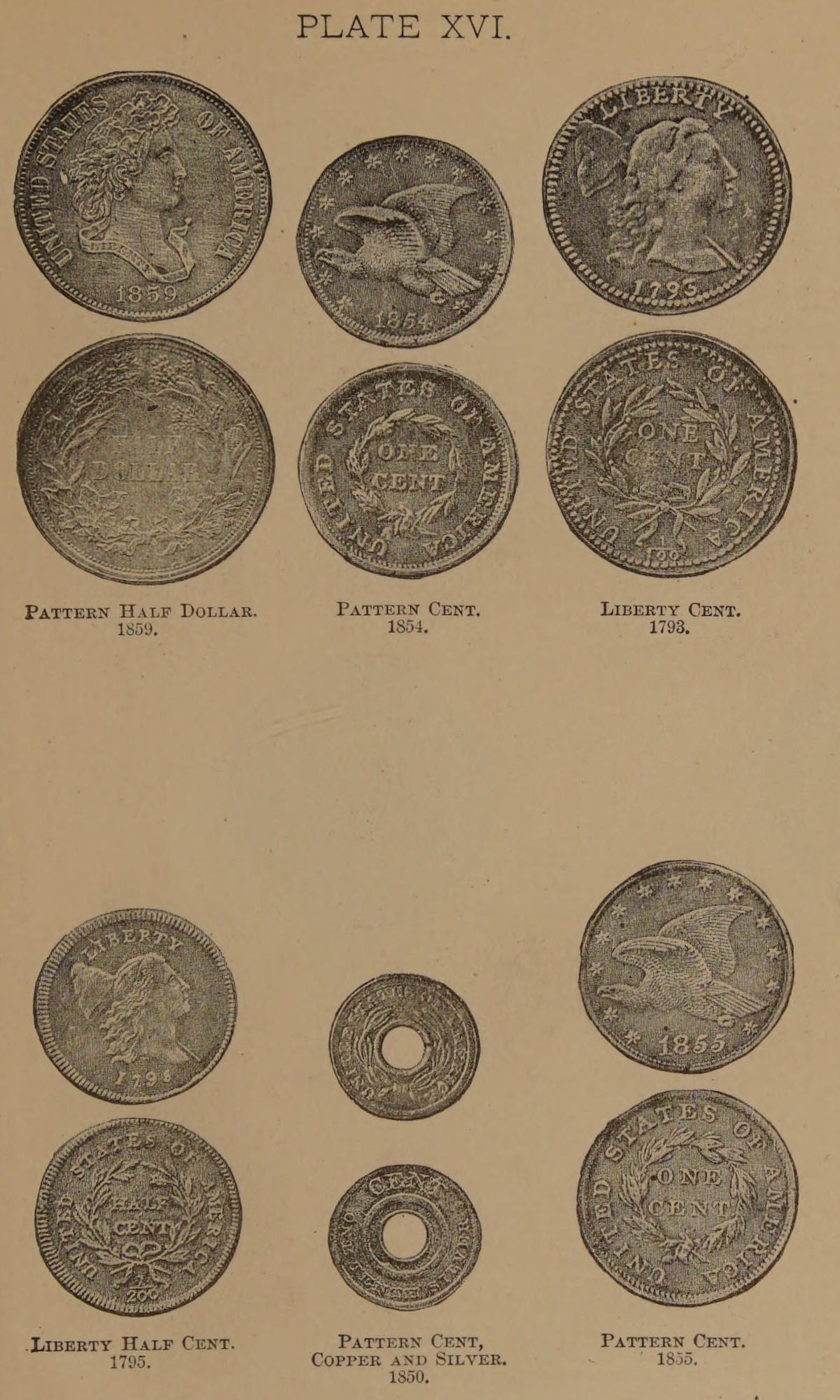
Pattern Half Dollar. 1859.
Pattern Cent. 1854. Liberty
Cent. 1793.
Liberty Half Cent. 1795.
Pattern Cent, Copper and Silver. 1850.
Pattern Cent. 1855.
PLATE XVII.
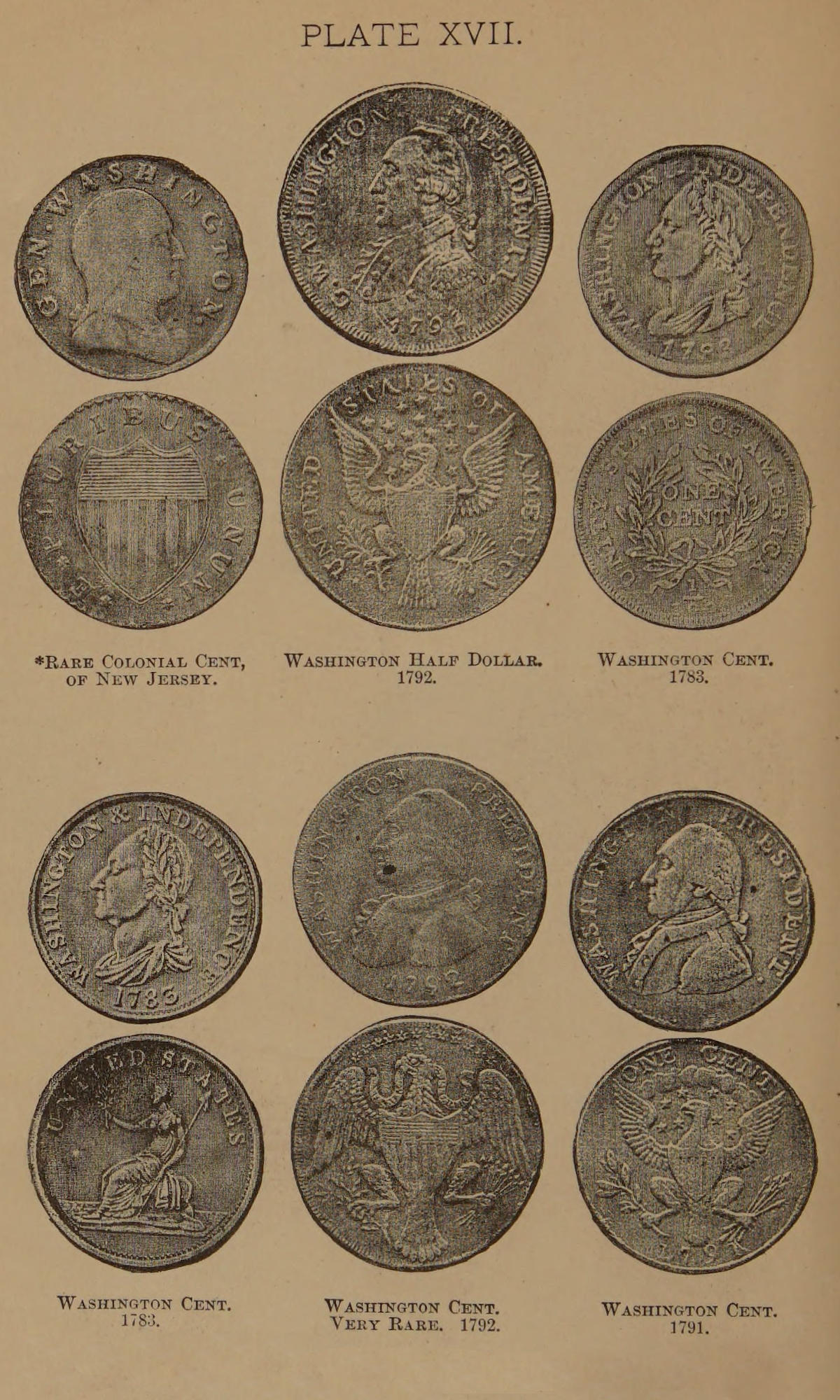
Rare Colonial Cent, of New
Jersey.[18]
Washington Half Dollar. 1792.
Washington Cent. 1783.
Washington Cent. 1783.
Washington Cent. Very Rare. 1792.
Washington Cent. 1791.
PLATE XVIII.
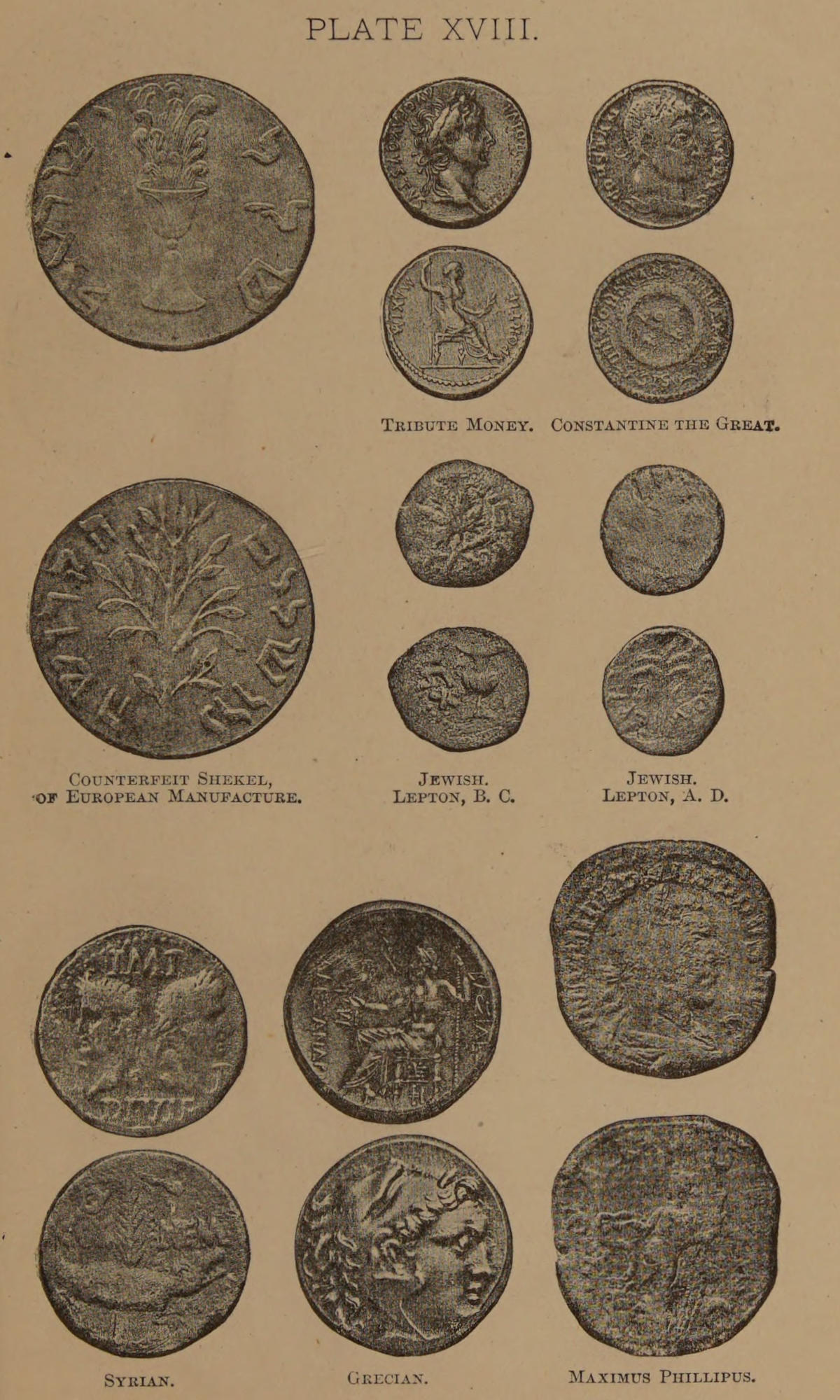
Tribute Money.
Constantine the Great.
Counterfeit Shekel, of European
Manufacture. Jewish. Lepton, B. C.
Jewish. Lepton, A. D.
Syrian.
Grecian. Maximus
Phillipus.
PLATE XIX.
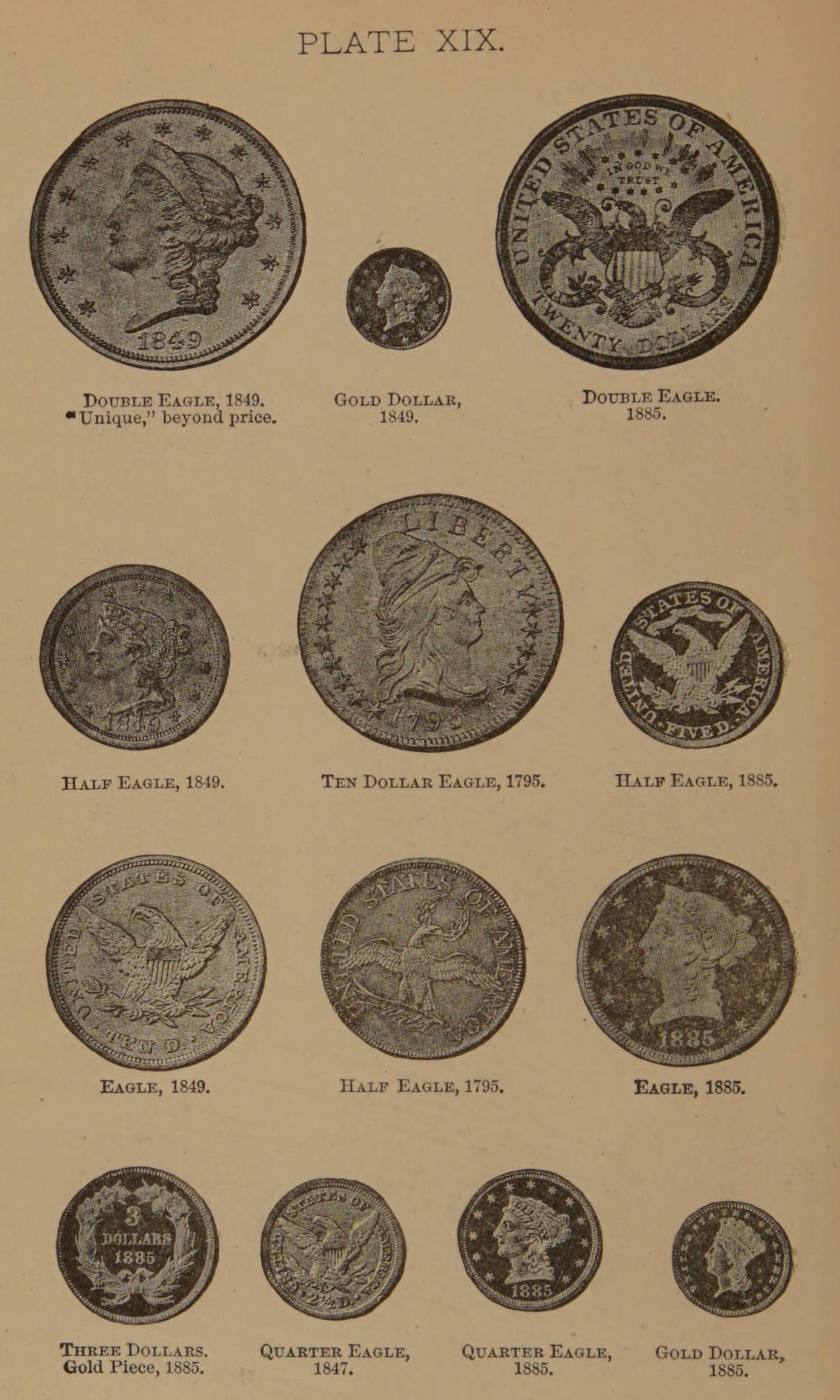
Double Eagle, 1849.
“Unique,” beyond price. Gold Dollar, 1849.
Double Eagle. 1885.
Half Eagle, 1849.
Ten Dollar Eagle, 1795.
Half Eagle, 1885.
Eagle, 1849.
Half Eagle, 1795.
Eagle, 1885.
Three Dollars.
Gold Piece, 1885. Quarter Eagle, 1847.
Quarter Eagle, 1885. Gold
Dollar, 1885.
PLATE XX.
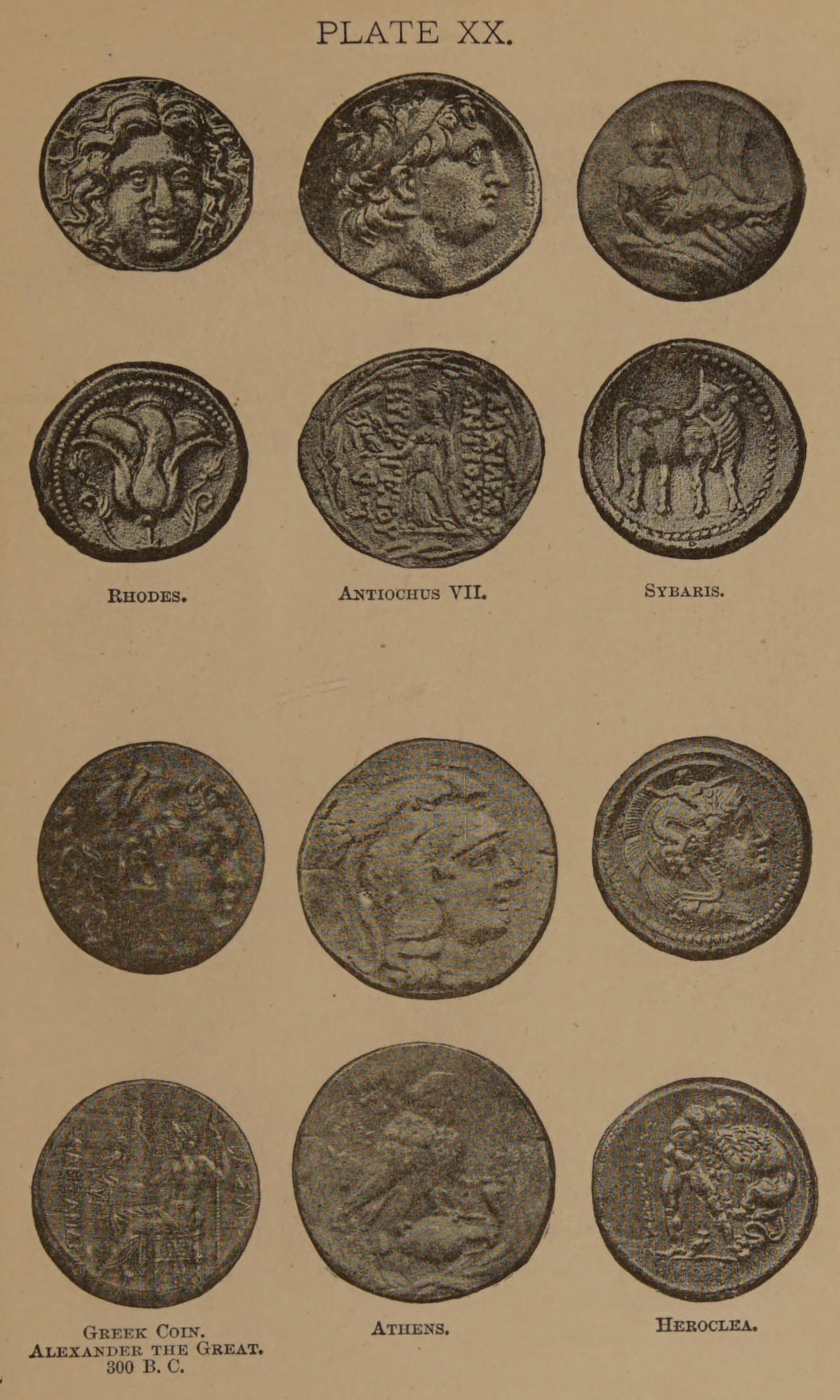
Rhodes.
Antiochus VII.
Sybaris.
Greek Coin. Alexander the
Great. 300 B.C. Athens.
Heroclea.
PLATE XXI.
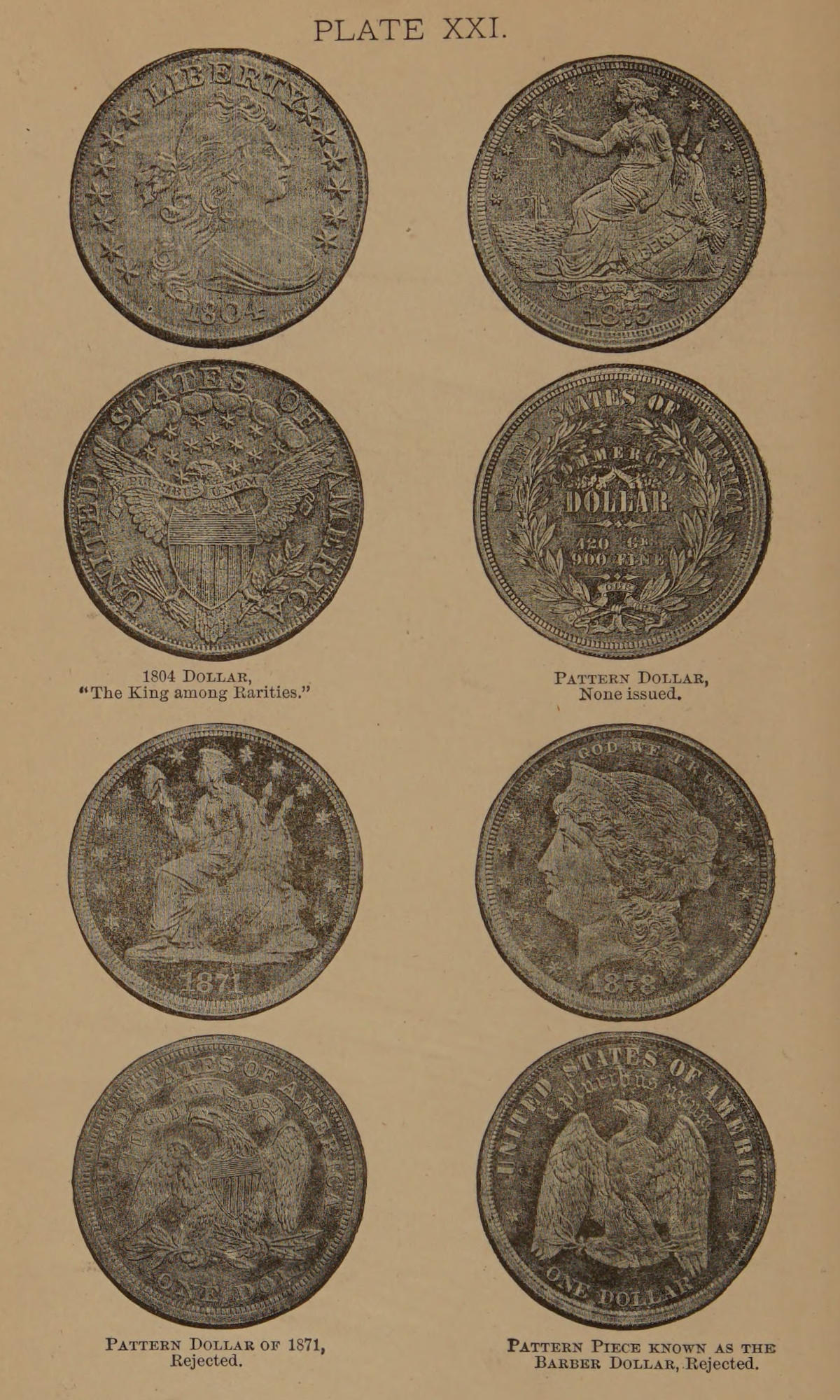
1804 Dollar, “The King
among Rarities.” Pattern Dollar, None issued.
Pattern Dollar of 1871,
Rejected. Pattern Piece known as the Barber
Dollar, Rejected.
PLATE XXII.
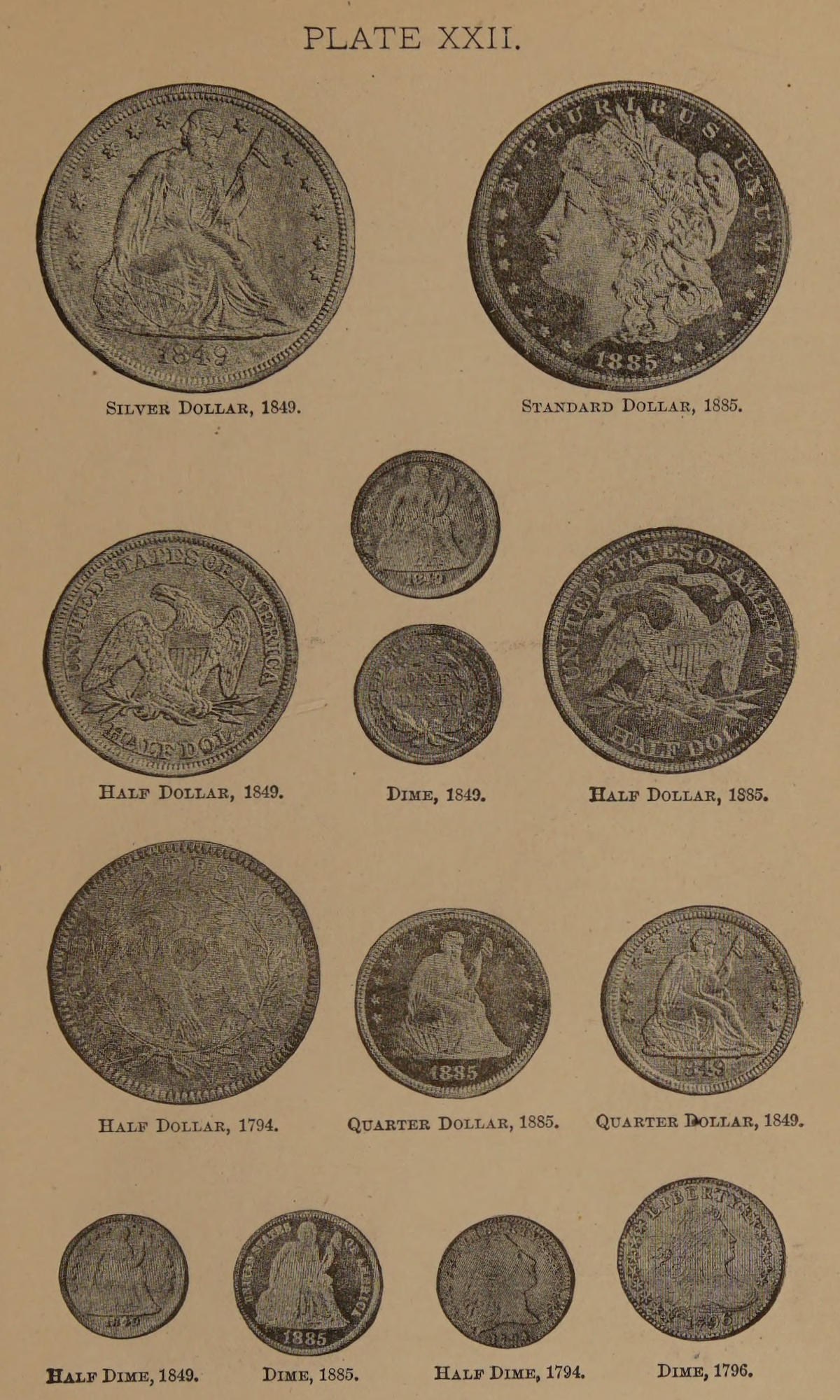
Silver Dollar, 1849.
Standard Dollar, 1885.
Half Dollar, 1849.
Dime, 1849. Half
Dollar, 1885.
Half Dollar, 1794.
Quarter Dollar, 1885.
Quarter Dollar, 1849.
Half Dime, 1849.
Dime, 1885. Half
Dime, 1794. Dime, 1796.
PLATE XXIII.
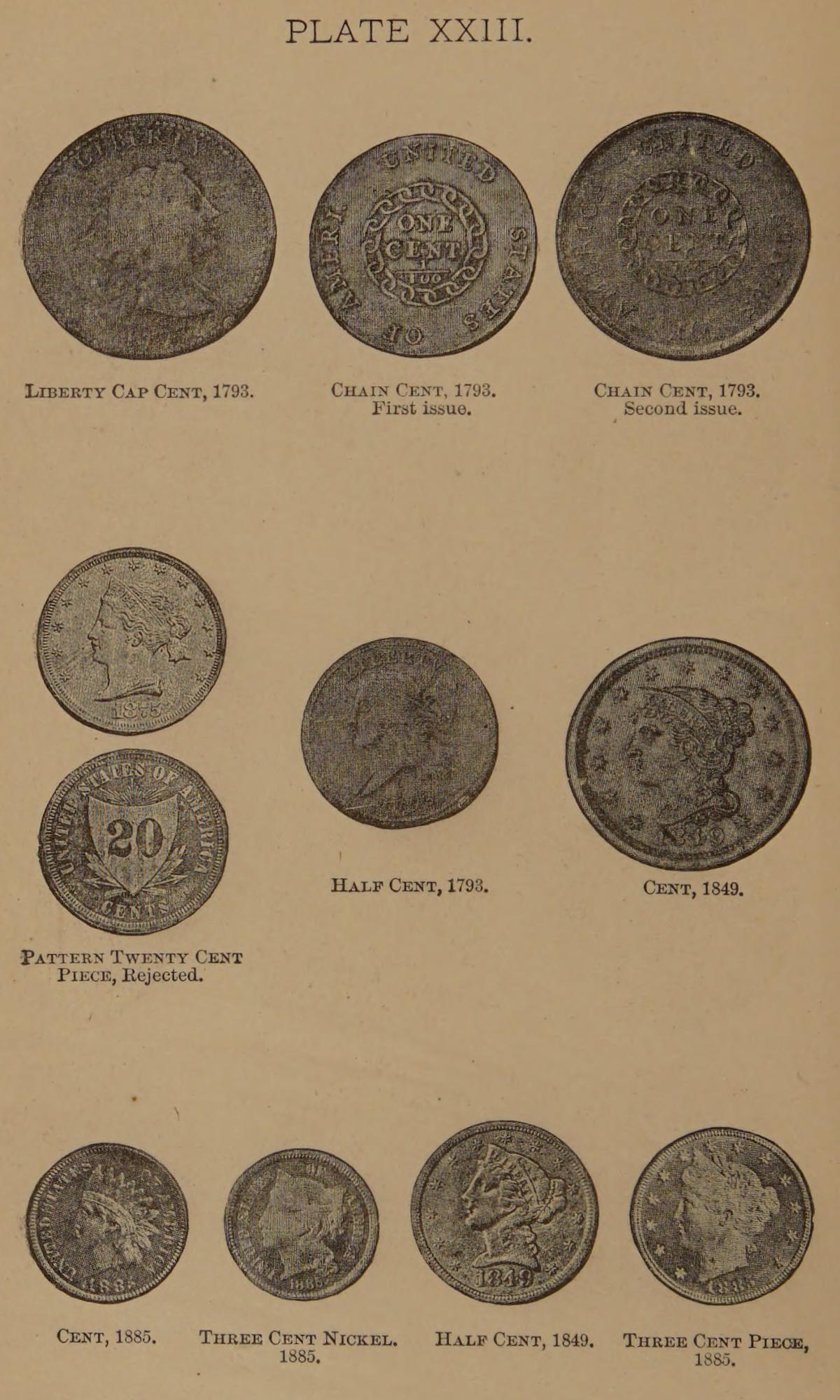
Liberty Cap Cent, 1793.
Chain Cent, 1793. First issue.
Chain Cent, 1793. Second issue.
Pattern Twenty Cent Piece,
Rejected. Half Cent, 1793.
Cent, 1849.
Cent, 1885.
Three Cent Nickel, 1885.
Half Cent, 1849. Three
Cent Piece, 1885.
PLATE XXIV.
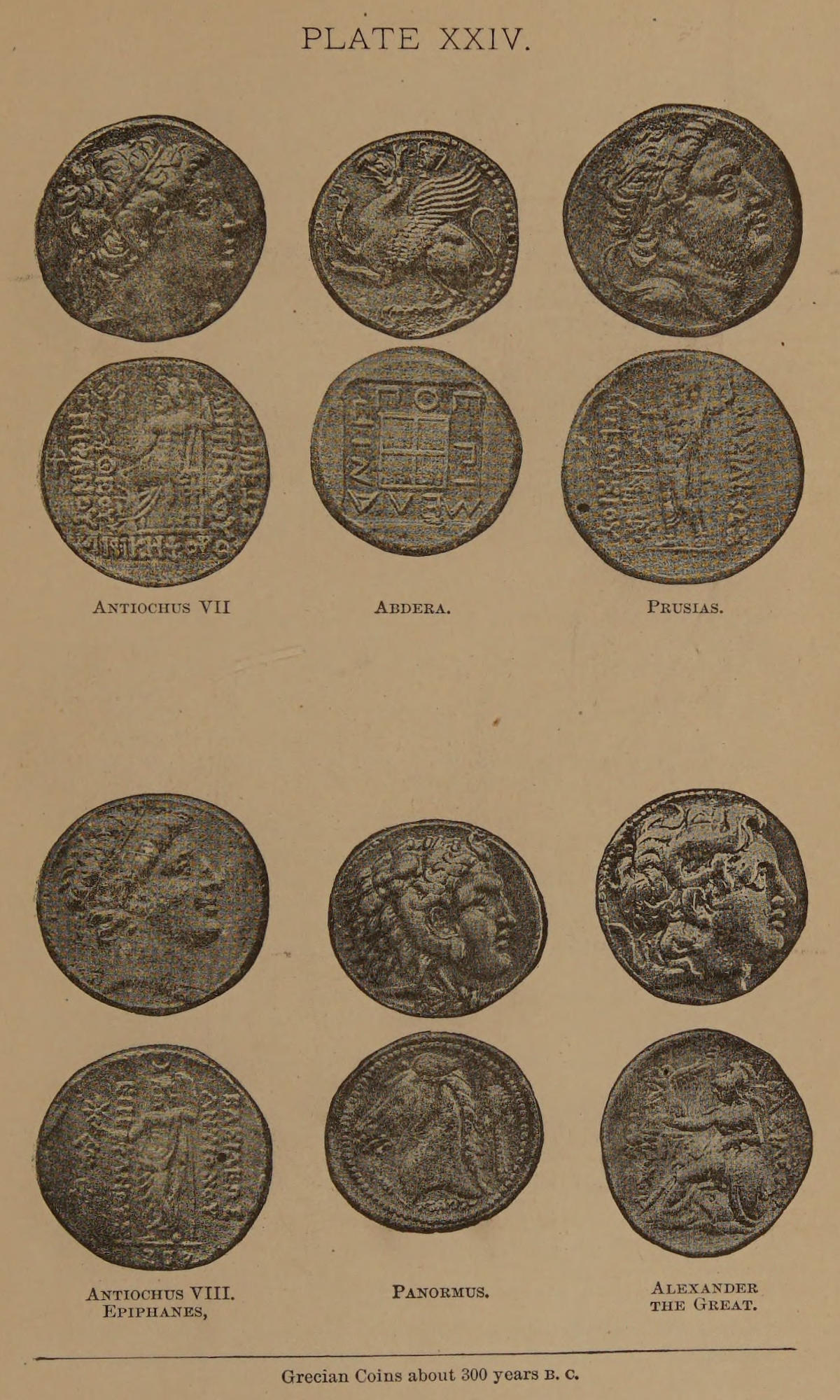
Antiochus VII.
Addera. Prusias.
Antiochus VIII. Epiphanes.
Panormus. Alexander
the Great.
Grecian Coins about 300 years B.C.
Coins issued at the United States Mint at Philadelphia, from its establishment in 1792 to 1888. — Gold. — Double Eagle. — Eagle. — Half Eagle. — Three-Dollar Piece. — Quarter-Eagle. — Dollar. — Silver. — Dollar. — Trade Dollar. — Half Dollar. — Quarter Dollar. — Twenty-Cent Piece. — Dime. — Half Dime. — Three Cent Piece. — Minor Coins. — Five cent piece. (Nickle.) — Three cent piece. (Nickle.) — Two Cent Piece (bronze). — Cent (copper). — Cent (Nickle). — Cent (Bronze). — Half Cent (Copper).
Authorized to be coined, Act of March 3, 1849. Weight, 516 grains;
fineness, 900; size, 21.
1850 to 1865, inclusive. No. 1. Obverse: Liberty head, facing left, hair
tied behind, a coronet on the forehead inscribed “LIBERTY,” thirteen stars
and date.
Reverse: An eagle with shield upon its breast, and an olive branch and
three arrows in its talons; in its beak, an elaborate scroll, inscribed “E
PLURIBUS UNUM.” Above, a circle of thirteen stars and a curved line of
rays extending from wing to wing. “UNITED STATES OF AMERICA.”
“TWENTY D.”
1866 to 1876, inclusive. No. 2, same, with the motto “IN GOD WE TRUST”
inscribed within the circle of stars on the reverse.
1877. No. 3. Same, with “TWENTY DOLLARS” for “TWENTY D.”
Authorized to be coined, Act of April 2, 1792. Weight, 270 grains;
fineness, 916⅔. Weight changed, Act of June 28, 1834, to 258 grains.
Fineness changed, Act of June 28, 1834, to 899.225. Fineness changed,
Act of January 18, 1837, to 900.
1795. Obverse: Liberty head, wearing a cap, facing right. Fifteen
stars. Above, “LIBERTY;” beneath, “1795;” size, 21.
Reverse: An eagle with displayed wings, standing on a palm branch;
in beak, a laurel wreath. “UNITED STATES OF AMERICA.”
1796. Same, with sixteen stars.
1797. No. 1. Same, with sixteen stars.
1797. No. 2. Obverse: Same, with sixteen stars.
Reverse: An eagle with the United States shield upon its breast, a
bundle of arrows in the right talon, and an olive branch in the left; in its
beak, a scroll inscribed “E PLURIBUS UNUM.” Around the head are sixteen
stars; above, is a curved line of clouds extending from wing to wing.
“UNITED STATES OF AMERICA.”
1798 to 1801, inclusive. Same, with thirteen stars on the obverse. Of
1798, two varieties with four stars facing.
1802. None issued.
1803 and 1804. Same as No. 2 of 1797. Thirteen stars.
1805 to 1837, inclusive. None issued.
1838 to 1865, inclusive. Obverse: Liberty head facing left, hair tied
behind, a coronet on the forehead inscribed “LIBERTY,” thirteen stars, and
date.
Reverse: An eagle with the United States shield upon its breast, and
an olive branch and three arrows in the talons. “UNITED STATES OF
AMERICA.” Size, 17.
1866. Same, with a scroll above the eagle inscribed “IN GOD WE
TRUST.”
Authorized to be coined, Act of April 2, 1792. Weight, 135 grains;
fineness, 916⅔. Weight changed, Act of June 28, 1834, to 129 grains.
Fineness changed, Act of June 28, 1834, to 899.225. Fineness changed,
Act of January 18, 1837, to 900.
1795. No. 1. Same type as the Eagle; size, 16.
1795. No. 2. Obverse: Same.
Reverse: An eagle, wings extended upwards, with the United States shield
upon its breast, a bundle of thirteen arrows in the right talon, and an olive
branch in the left. In its beak, a scroll inscribed “E PLURIBUS UNUM.”
Around the head are sixteen stars, and above is a curved line of clouds
extending from wing to wing. “UNITED STATES OF AMERICA.”
1796. Same as No. 1 of 1795; fifteen stars on obverse.
1797. No. 1. Same as No. 1 of 1795.
1797. No. 2. Same, with sixteen stars on obverse.
1797. No. 3. Obverse: Same, with fifteen stars.
Reverse: Same as No. 2 of 1795, sixteen stars around the eagle.
1798. No. 1. Same as No. 1 of 1795, with thirteen stars.
1798. No. 2. Obverse: Same.
Reverse: Same as No. 2 of 1795, thirteen stars.
1799 and 1800. Same as No. 2 of 1795, with thirteen stars on the obverse.
1801. None issued.
1802 to 1806, inclusive. Same as No. 2 of 1795, with thirteen stars on
the obverse.
1807. No. 1. Obverse: Same as No. 1, 1795, with thirteen stars.
Reverse: Same as No. 2, 1795.
1807. No. 2. Obverse: Liberty head, facing left; bust, draped, wearing
a kind of turban with a band in front inscribed “LIBERTY,” thirteen stars,
and date.
Reverse: An eagle, with the United States shield upon its breast, an
olive branch and three arrows in the talons. Above, a scroll, inscribed
“E PLURIBUS UNUM.” United States of America “5. D.”
1808 to 1812 inclusive. Same as No. 2 of 1807.
1813 to 1815, inclusive. Obverse: Liberty head, facing left, wearing a
kind of turban, a band in front inscribed “LIBERTY.” Thirteen stars and
date. No shoulders.
Reverse: Same as No. 2 of 1807.
1816 and 1817, inclusive. None issued.
1818 to 1828, inclusive. Same as 1813.
1829. No. 1. Same as 1813; size, 16.
1829. No. 2. Same, but smaller; size, 15.
1830 to 1833, inclusive. Same as No. 2 of 1829.
1834. No. 1. Same as No. 2 of 1829.
1834. No. 2. Obverse: Liberty head, facing left, hair confined by a band
inscribed “LIBERTY.”
Reverse: Same as No. 2 of 1807, without the motto “E PLURIBUS UNUM”
omitted; size, 14.
1835 to 1838, inclusive. Same as No. 2 of 1834.
1839 to 1865, inclusive. Same type as the Eagle of 1838.
1866. Same type as Eagle of same date.
Authorized to be coined, Act of February 21, 1853. Weight, 77.4
grains; fineness, 900.
1854. Obverse: An Indian head, wearing a crown of eagle feathers, on
band of which is inscribed “LIBERTY”—“UNITED STATES OF AMERICA.”
Reverse: “3 dollars 1854” within a wreath of corn, wheat, cotton, and
tobacco. Size, 13.
Authorized to be coined, Act of April 2, 1792. Weight, 67.5 grains;
fineness, 916⅔. Weight changed, Act of June 28, 1834, to 64.5 grains.
Fineness changed, Act of June 28, 1834, to 899.225. Fineness changed,
Act of January 18, 1837, to 900.
1796. No. 1. Obverse: Liberty head, facing right, above “LIBERTY”—sixteen
stars.
Reverse: Same type as No. 2 half-eagle of 1795, size 13.
No. 2. Same, with no stars on obverse.
1797-1798. Same as No. 1 of 1796, with thirteen stars.
1799-1801, inclusive. None issued.
1802. Same as 1798.
1803. None issued.
1804 to 1807, inclusive. Same as 1798.
1808. Same type as No. 2 half-eagle of 1807, with “2½ D.”
1809 to 1820, inclusive. None issued.
1821. Obverse: Same type as the half-eagle of 1813, size 12.
Reverse: Same type as No. 2 half-eagle of 1807.
1822 and 1823. None issued.
1824-1827, inclusive. Same as 1821.
1828. None issued.
1829 to 1833, inclusive. Same as 1821.
1834. No. 1. Same as 1821. No. 2. Same type as No. 2 half-eagle of
1834, size 11.
1835 to 1839, inclusive. Same as No. 2 of 1834.
1840 to 1865. Same type as the eagle of 1834.
1866. Same type as eagle of 1866.
Authorized to be coined, Act of March 3, 1849. Weight, 25.8 grains;
fineness, 900.
1849 to 1853, inclusive. Obverse: Same type as the eagle, without date.
Reverse: “1 DOLLAR 1849” within a laurel wreath, “UNITED STATES
OF AMERICA.” Size 8.
1854. No. 1, Same. No. 2. Same type as the three-dollar piece,
size 9.
Authorized to be coined, Act of April 2, 1792. Weight, 416 grains;
fineness, 892.4. Weight changed, Act of January 18, 1837, to 412½ grains.
Fineness changed, Act of January 18, 1837, to 900. Coinage discontinued,
Act of February 12, 1873. Coinage reauthorized, Act of February 28, 1878.
1794. Obverse: Liberty head, facing right, flowing hair, fifteen stars;
above, “LIBERTY;” beneath, “1794.”
Reverse: An eagle with raised wings, encircled by branches of laurel
crossed; “UNITED STATES OF AMERICA.” On the edge, “HUNDRED CENTS,
ONE DOLLAR OR UNIT.” Size, 24.
1795. No. 1. Same.
1795. No. 2. Bust of Liberty, facing right, hair bound by a ribbon,
shoulders draped, fifteen stars.
Reverse: An eagle with expanded wings, standing upon clouds, within a
wreath of palm and laurel, which is crossed and tied. “UNITED STATES
OF AMERICA.”
1796. Same as No. 2, of 1795.
1797. No. 1. Same as No. 2 of 1795, with sixteen stars, six of which
are facing.
1797. No. 2. Same, with seven stars facing.
1798. No. 1. Same as No. 2 of 1795, with fifteen stars.
1798. No. 2. Same, with thirteen stars.
1798. No. 3. Obverse: Same, with thirteen stars.
Reverse: An eagle with raised wings, bearing the United States shield
upon its breast, in beak, a scroll inscribed “E PLURIBUS UNUM.” A
bundle of thirteen arrows in the right talon, and an olive branch in the
left. Above, are clouds, and thirteen stars. “UNITED STATES OF AMERICA.”
Size, 25.
1799 to 1804, inclusive. Same as No. 3, of 1798.
1805 to 1839, inclusive. None issued.
1840 to 1865, inclusive. Obverse: Liberty seated upon a rock, supporting
with her right hand the United States shield, across which floats a scroll
inscribed “LIBERTY,” and with her left the staff and liberty cap; beneath,
the date.
Reverse: An eagle with expanded wings, bearing the United States shield
upon its breast, and an olive branch and three arrows in its talons. “UNITED
STATES OF AMERICA.” “ONE DOLL.” Reeded edge; size, 24.
1866 to 1873, inclusive. Same, with a scroll above the eagle, inscribed,
“IN GOD WE TRUST.”
1874 to 1877, inclusive. None issued.
1878. Obverse: Liberty head facing left, upon which is a cap, a wheat
and cotton wreath, and a band inscribed “LIBERTY;” above, “E PLURIBUS
UNUM;” beneath, the date. Thirteen stars.
Reverse: An eagle with expanded wings pointing upwards; in right talon
an olive branch with nine leaves; in the left, three arrows. In the field
above, “IN GOD WE TRUST;” beneath, a semi-wreath, tied and crossed,
reaching upwards to the wings; “UNITED STATES OF AMERICA.” Some
pieces of the above date (1878) were coined with eight feathers in the tail
during the year, but seven have been adopted.
Authorized to be coined, Act of February 12, 1873. Weight, 420 grains;
fineness, 900.
1873. Obverse: Liberty seated upon a cotton bale, facing left; in her extended
right hand an olive branch; in her left a scroll inscribed “LIBERTY;”
behind her a sheaf of wheat; beneath, a scroll inscribed “IN GOD WE
TRUST;” thirteen stars; “1873.”
Reverse: An eagle with expanded wings; in talons three arrows and an
olive branch; above, a scroll inscribed “E PLURIBUS UNUM;” beneath, on
field, “420 grains;” “900 fine.” “UNITED STATES OF AMERICA.” Size, 24.
Authorized to be coined, Act of April 2, 1792. Weight, 208 grains;
fineness, 892.4. Weight changed, Act of January 18, 1837, to 206¼ grains.
Fineness changed, Act of January 18, 1837, to 900. Weight changed, Act
of February 21, 1853, to 192 grains. Weight changed, Act of February 12,
1873, to 12½ grammes, or 192.9 grains.
1794 and 1795. Same type as the dollar of 1794. On the edge, “Fifty
cents or half a dollar.” Size, 21.
1796. No. 1. Same type as No. 2, dollar of 1795, with the denomination,
“½,” inscribed on the base of the reverse. No. 2. Same, with sixteen stars
on the obverse.
1797. Same as No. 2, of 1796.
1798 to 1800, inclusive. None issued.
1801 to 1803, inclusive. Same type as No. 3, dollar of 1798.
1804. None issued.
1805 and 1806. Same as No. 3, dollar of 1798.
1807. No. 1. Same.
No. 2. Obverse: Liberty head facing left, wearing a kind of turban, with
“LIBERTY” inscribed upon the band. Thirteen stars and date.
Reverse: An eagle with expanded wings pointing downwards, bearing
upon its breast, the U. S. Shield, an olive branch and three arrows in its
talons; above, in the field, a scroll inscribed “E PLURIBUS UNUM;” beneath
50 C. “UNITED STATES OF AMERICA.”
1808 to 1835 inclusive, same as No. 2 of 1807.
1836. No. 1. Same as No. 2 of 1807.
No. 2. Obverse: Same.
Reverse: An eagle with expanded wings pointing downwards, the U. S.
shield upon its breast, an olive branch and three arrows in its talons,
“UNITED STATES OF AMERICA,” reeded edge.
1837. Same as No. 2 of 1836.
1838. Obverse: Same as No. 2 of 1836.
Reverse: Same; “HALF DOL.” for “50 C.”
1839. No. 1. Same as 1838.
No. 2. Same type as dollar of 1840.
1840 to 1852 inclusive, same.
1853. Obverse: Same with an arrow head on each side of the date.
Reverse: Same, with a halo of rays around the edge.
1854. Same, without the rays.
1855. Same.
1856 to 1865 inclusive, same, without the arrow heads.
1866 to 1872 inclusive, same, with scroll above the eagle inscribed “IN
GOD WE TRUST.” (Some have been occasionally met with, which have been
issued by the San Francisco Mint, without this legend in 1866.)
1873. No. 1. Same.
No. 2. Same, with arrow heads on each side of the date.
1874. Same.
1875. Same, without the arrow heads.
Authorized to be coined, Act of April 2, 1792. Weight, 104 grains;
fineness, 892.4. Weight changed, Act of January 18, 1837, to 103½ grains.
Fineness changed, Act of January 18, 1837, to 900. Weight changed,
Act of February 21, 1853, to 96 grains. Weight changed, Act of February
12, 1873, to 6¼ grammes, or 96.45 grains.
1796. Same type as No. 2 dollar of 1795, with reeded edge; size, 18;
fifteen stars.
1797 to 1803. None issued.
1804 to 1807, inclusive. Same type as No. 3 dollar of 1798, beneath,
“25c.”
1808 to 1814, inclusive. None issued.
1815. Same type as No. 2 half dollar of 1807.
1816 and 1817. None issued.
1818 to 1825, inclusive. Same type as No. 2 half dollar of 1807, size 17.
1826. None issued.
1827 and 1828. Same type as No. 2 half dollar of 1807.
1829 and 1830. None issued.
1831 to 1837, inclusive. Same type as half dollar of 1807, with the
diameter reduced from size 17 to size 15, and a corresponding increase in
thickness and decrease of the size of devices, and the omission of the
scroll, inscribed “E PLURIBUS UNUM.”
1838. No. 1. Same as 1837. No. 2. Same type as the dollar of 1840,
with “QUAR. DOL.” for “ONE DOLL.”
1839 to 1852, inclusive. Same as No. 2 of 1838.
1853. No. 1. Same. No. 2. Same, with arrow heads on each side of
date, and a halo of rays around the edge.
1854 and 1855. Same, without the rays.
1856 to 1865. Same, without the arrow heads.
1866 to 1872, inclusive. Same, with the scroll above the eagle, inscribed
“IN GOD WE TRUST.”
1873. No. 1. Same. No. 2. Same, with an arrow head on each side
of the date.
1874. Same.
1875. Same, without the arrow head.
Authorized to be coined, Act of March 3, 1875. Weight, 5 grammes,
or 77.16 grains; fineness, 900. Coinage discontinued, Act of May 2, 1878.
1875 to 1878, inclusive. Obverse: Same type as the dollar of 1840.
Reverse: An eagle with displayed wings, three arrows, and an olive
branch, two of the leaves of which nearest the stem, together with those
drooping from the centre, overlap; the terminating leaves on the end of
the branch, however, do not. On each side a star. Plain edge. “UNITED
STATES OF AMERICA.” “TWENTY CENTS.” Size, 14.
Authorized to be coined, Act of April 2, 1792. Weight, 41.6 grains;
fineness, 892.4. Weight changed, Act of January 18, 1837, to 41¼ grains.
Fineness changed, Act of January 18, 1837, to 900. Weight changed,
Act of February 21, 1853, to 38.4 grains. Weight changed, Act of February
12, 1873, to 2½ grammes, or 38.58 grains.
1796. Same type as the No. 2 dollar of 1795; size 13; fifteen stars.
1797. No. 1. Same, with sixteen stars on the obverse. No. 2. Same,
with thirteen stars on the obverse.
1798. No. 1. Same type as No. 3 dollar of 1798, with sixteen stars. No.
2. With thirteen stars on the obverse.
1799. None issued.
1800 to 1805, inclusive. Same as No. 3 of 1798.
1806. None issued.
1807. Same as No. 2 of 1798.
1808. None issued.
1809. Same type as No. 2 half-dollar of 1807; size, 12.
1810. None issued.
1811. Same as 1809.
1812 to 1813, inclusive. None issued.
1814. Same as 1809.
1815 to 1819, inclusive. None issued.
1820 to 1825, inclusive. Same as 1809.
1826. None issued.
1827 to 1836, inclusive. Same as 1809.
1837. No. 1. Same as 1809. No. 2. Obverse: Liberty seated. No stars.
Reverse: “ONE DIME” within a wreath of laurel. “UNITED STATES OF
AMERICA.” Size, 11.
1838. No. 1. Same as No. 2 of 1837. No. 2. Same, with thirteen stars.
1839 to 1852, inclusive. Same as No. 2 of 1838.
1853. No. 1. Same. No. 2. Same, with an arrow head on each side of
the date.
1854 and 1855. Same as No. 2 of 1853.
1856 to 1859, inclusive. Same, without arrow heads.
1860 to 1872, inclusive. Obverse: Same, with “UNITED STATES OF
AMERICA” instead of stars.
Reverse: “ONE DIME” within a wreath of corn, wheat, cotton, and
tobacco.
1873. No. 1. Same. No. 2. Same, with an arrow head on each side of
the date.
1874. Same as No. 2 of 1873.
1875. Same, without arrow heads.
Authorized to be coined, Act of April 2, 1792. Weight, 20.8 grains;
fineness, 892.4. Weight changed, Act of January 18, 1837, to 20⅝ grains.
Fineness changed, Act of January 18, 1837, to 900. Weight changed, Act
of February 21, 1853, to 19.2 grains. Coinage discontinued, Act of February
12, 1873.
1794 and 1795. Same type as the half dollar; size, 10.
1796. Same type as No. 2 dollar of 1795; fifteen stars.
1797. No. 1. Same, with fifteen stars. No. 2. Same, with sixteen stars.
No. 3. Same, with thirteen stars.
1798 and 1799. None issued.
1800 to 1803, inclusive. Same type as No. 3 dollar of 1798.
1804. None issued.
1805. Same as 1800.
1806 to 1828, inclusive. None issued.
1829 to 1873. See dime.
Authorized to be coined, Act of March 3, 1851. Weight, 12⅜ grains;
fineness, 750. Weight changed, Act of March 3, 1853, to 11.52 grains.
Fineness changed, Act of March 3, 1853, to 900. Coinage discontinued,
Act of February 12, 1873.
1851 to 1853, inclusive. Obverse: A star bearing the United States
shield. “UNITED STATES OF AMERICA.”
Reverse: An ornamented “C,” within which is the denomination “III,”
around the border, thirteen stars; size, 9.
1854 to 1858. Obverse: Same, with two lines around the star.
Reverse: An olive branch above the “III,” and three arrows below, all
within the “C.”
1858 to 1873, inclusive. Same, with one line around the star.
Authorized to be coined, Act of May 16, 1866. Weight, 77.16 grains;
composed of 75 per cent. copper, and 25 per cent. nickle.
1866. Obverse: A United States shield surmounted by a cross, an olive
branch pendent at each side, back of the base of the shield are two arrows,
the heads and feathers are only visible; beneath, “1866;” above, in the
field, “IN GOD WE TRUST.”
Reverse: “5” within a circle of thirteen stars, and rays, “UNITED STATES
OF AMERICA.” Size, 13.
1867. Same. No. 2. Same, without the rays.
1868. Same as No. 2 of 1867.
1869 to 1882. Same as No. 2 of 1867.
1883. No. 1. Same. No. 2. Obverse: Liberty head wearing a coronet
which is inscribed “LIBERTY,” thirteen stars, and date, “1883.”
Reverse: A “V” within a wreath of corn and cotton. Legend, “UNITED
STATES OF AMERICA.” Exergue, “E PLURIBUS UNUM.” No. 3, Obverse:
Same as No. 2.
Reverse: Same, with “CENTS” as the exergue, and “E PLURIBUS UNUM”
above the wreath.
1884. Same as No. 3 of the preceding.
Authorized to be coined, Act of April 3, 1865. Weight, 30 grains;
composed of 75 per cent. copper, and 25 per cent. nickle.
1865. Obverse: Liberty head, facing left, hair bound by a ribbon, on the
forehead a coronet inscribed “LIBERTY;” beneath, the date, “UNITED
STATES OF AMERICA.”
Reverse: “III” within a laurel wreath.
Authorized to be coined, Act of April 22, 1864. Weight, 96 grains,
composed of ninety-five per cent. copper and five per cent. of tin and zinc.
Coinage discontinued, Act of February 12, 1873.
1864 to 1873, inclusive. Obverse: The United States shield, behind
which are two arrows, crossed, on each side a branch of laurel; above, a
scroll inscribed “IN GOD WE TRUST”; beneath, the date.
Reverse: “2 CENTS” within a wreath of wheat. “UNITED STATES OF
AMERICA.” Size, 14.
Authorized to be coined, Act of April 22, 1792. Weight, 264 grains.
Weight changed, Act of January 14, 1793, to 208 grains. Weight changed
by proclamation of the President, January 26, 1796, in conformity with an
Act of March 3, 1795, to 168 grains. Coinage discontinued, Act of February
21, 1857.
1793. No. 1. Obverse: Liberty head, facing right, flowing hair. Above,
“LIBERTY”: beneath, “1793.”
Reverse: A chain of fifteen links, within which is inscribed “ONE CENT”
and the fraction “⅟₁₀₀.” United States of America; reeded edge; size, 17.
No. 2. Same, with the abbreviation “AMERI.” in the Legend.
No. 3. Obverse: Same as No. 1, with a sprig beneath.
Reverse: “ONE CENT” within a wreath of laurel. “UNITED STATES OF
AMERICA.” Reeded edge.
No. 4. Obverse: A bust of Liberty, facing right, with pole and liberty
cap. Above, “LIBERTY”; beneath, “1793.”
Reverse: Same as No. 3; on the edge, “ONE HUNDRED FOR A DOLLAR.”
Size, 18.
1794 and 1795. Same as No. 4 of 1793.
1796. No. 1. Same. No. 2. Same, with hair bound by a ribbon, and
without pole and liberty cap on the obverse. Plain edge.
1797 to 1807 inclusive. Same as No. 2 of 1796.
1808 to 1814, inclusive. Obverse: Liberty head, facing left, hair confined
by a band, inscribed “LIBERTY.” Thirteen stars and date.
Reverse: “ONE CENT,” within a laurel wreath. “UNITED STATES OF
AMERICA.” The fraction “⅟₁₀₀” is omitted.
1815. None issued.
1816. Obverse: Liberty head, facing left, the hair is confined by a roll,
and tied by a cord, while the forehead is bedecked with a tiara, inscribed
“LIBERTY.”
Reverse: Same as 1808.
1817. No. 1. Same. No. 2. Same, with fifteen stars.
1818 to 1836. Same as No. 1 of 1817.
1837. No. 1. Same. No. 2. Same, with the hair tied by a string of beads
instead of a cord.
1838 to 1857, inclusive. Same as No. 2 of 1837.
Authorized to be coined, Act of February 21, 1857. Weight 72 grains;
composed of 88 per cent. copper and 12 per cent. nickle. Coinage discontinued,
Act of April 22, 1864.
1857 and 1858, Obverse: An eagle flying to the left. “UNITED STATES
OF AMERICA.”
Reverse: “ONE CENT,” within a wreath of corn, wheat, cotton, and tobacco.
Size, 11.
1859. Obverse: An Indian-head, facing left, bedecked with eagle plumes,
confined. “UNITED STATES OF AMERICA.” Beneath, the date.
Reverse: “ONE CENT.” within a wreath of laurel.
1860 to 1864, inclusive. Obverse: Same.
Reverse: “ONE CENT,” within an oak wreath and shield.
Coinage authorized, Act of April 22, 1857. Weight, 48 grains; composed
of 95 per cent. copper and 5 per cent. of tin and zinc.
1864. Same type as nickle cent of 1860. Size, 12.
Authorized to be coined, Act of April 2, 1792. Weight, 132 grains.
Weight changed, Act of January 14, 1793, to 104 grains. Weight changed
by proclamation of the President, January 26, 1796, in conformity with
Act of March 3, 1795, to 84 grains. Coinage discontinued, Act of February
21, 1857.
1793. Same type as cent No. 4, 1793, with head facing left. On the
edge, “TWO HUNDRED FOR A DOLLAR.” Size, 14.
1794. Same type as the cent of 1794.
1795 to 1797, inclusive. Same, with plain edge.
1798 and 1799. None issued.
1800. Same type as No. 2 cent of 1796, with the fraction “⅟₂₀₀” on the
base of the reverse.
1801. None issued.
1802 to 1808, inclusive. Same as 1800. From 1808, the fraction “⅟₂₀₀”
omitted.
1809 to 1811, inclusive. Same type as cent of 1808.
1812 to 1824, inclusive. None issued.
1825 and 1826. Same type as cent of 1808.
1827. None issued.
1828. No. 1. Same type as cent 1808, with thirteen stars. No. 2.
Same, with twelve stars.
1829. Same, with thirteen stars.
1830. None issued.
1831 to 1836, inclusive. Same type as cent of 1808.
1837 to 1839, inclusive. None issued.
1840 to 1857, inclusive. Same type as No. 2 cent of 1837; size, 14.
THOMAS JEFFERSON,
an eminent American Statesman, and third President of the
United States, was born April 2, 1743, at Shadwell, Virginia,
near the spot which afterwards became his residence,
with the name of Monticello. He was the oldest son in a
family of eight children. His father, Peter Jefferson, was a
man of great force of character and of extraordinary physical
strength. His mother, Jane Randolph, of Goochland, was
descended from an English family of great note and respectability.
Young Jefferson began his classical studies at the age
of nine, and at seventeen he entered an advance class at William
and Mary College; on his way thither, he formed the acquaintance
of Patrick Henry, who was then a bankrupt merchant,
but who afterwards became the great orator of the Revolution.
At college, Jefferson was distinguished by his close application,
and devoted, it is said, from twelve to fifteen hours per day to
study, and we are told became well versed in Latin, Greek,
Italian, French, and Spanish, at the same time proficient in his
mathematical studies. After a few years course of law under
Judge Wythe, he was admitted to the bar in 1767. His success
in the legal profession was remarkable; his fees during the
first year amounted to nearly three thousand dollars. In 1769,
Jefferson commenced his public career as a member of the
Virginia House of Burgesses, in which he had while a student
of law, listened to Patrick Henry’s great speech on the Stamp
Act. In 1773 he united with Patrick Henry and other revolutionary
patriots in devising the celebrated committee of correspondence
for disseminating intelligence between the Colonies,
of which Jefferson was one of the most active and influential
members. He was elected in 1774 to a convention to choose
delegates to the first Continental Congress at Philadelphia,
and introduced at that convention his famous “Summary view
of the rights of British America.” On the 21st of June, 1775,
Jefferson took his seat in the Continental Congress. His
reputation as a Statesman and accomplished writer at once
placed him among the leaders of that renowned body. He
served on the most important committees, and among other
papers drew up the reply of Congress to the proposal of Lord
North, and assisted in preparing in behalf of the Colonies, a
declaration of the cause of taking up arms against the Mother
Country. The rejection of a final petition to King George,
destroyed all hope of an honorable reconciliation with England.
Congress, early in 1776, appointed a committee to draw up a
Declaration of Independence, of which Jefferson was made
Chairman; in this capacity he drafted, at the request of the
other members of the committee, (Franklin, Adams, Sherman,
and Livingston), and reported to Congress, June 28, the great
Charter of Freedom, known as the “Declaration of American
Independence,” which, on July 4, was unanimously adopted,
and signed by every member present, with a single exception.
“The Declaration of Independence,” says Edward Everett,
“is equal to anything ever borne on parchment, or expressed
in the visible signs of thought.” “The heart of Jefferson in
writing it,” adds Bancroft, “and of Congress in adopting it,
beat for all humanity.” After resigning his seat in Congress,
Jefferson revised the laws of Virginia; among other reforms,
he procured the repeal of the laws of entail, the abolition of
primogeniture, and the restoration of the rights of conscience,
a reform which he believed would abolish “every fibre of
ancient or future aristocracy;” he also originated a complete
system of elementary and collegiate education for Virginia.
In 1779, Jefferson succeeded Patrick Henry as Governor of
Virginia, and held the office during the most gloomy period of
the Revolution, and declined a re-election in 1781. In 1783,
he returned to Congress, and reported the treaty of peace,
concluded at Paris, September 3, 1783, acknowledging the
independence of the United States. He also proposed and
carried through Congress a bill establishing the present Federal
system of coinage, which took the place of the English pounds,
shillings, pence, etc., and also introduced measures for establishing
a Mint in Philadelphia, (the first public building built
by the general Government, still standing on Seventh street,
east side, near Filbert). In 1785, he succeeded Dr. Franklin
as resident Minister at Paris. In organizing the Government
after the adoption of the Constitution, he accepted the position
of Secretary of State, tendered him by President Washington
during his first term. Jefferson was Vice-President of the
United States from 1797 to 1801, and President for the two
consecutive terms following. After participating in the inauguration
of his friend and successor, James Madison, Jefferson
returned to Monticello, where he passed the remainder of his
life in directing the educational and industrial institutions of
his native State and entertaining his many visitors and friends.
His death occurred on the same day with that of John Adams,
July 4, 1826.
ALEXANDER HAMILTON,
Statesman, orator, and financier, born in the West Indian
island of Nevis, 11th of January, 1757. His father was a Scotch
merchant, and his mother was the daughter of a French Huguenot.
He was educated at King’s College, N. Y. When he was 18
years of age he surprised the people by his public speeches and
pamphlets in favor of American independence. He was commissioned
Captain of a Company of Artillery in March, 1776,
and served with distinction at the battles of Long Island, White
Plains, Trenton, and Princeton, and was appointed Aid-de-camp
and Private Secretary to General Washington in March,
1777, and gained his special favor and confidence in planning
campaigns and devising means to support the army. In 1782
he was elected a member of the Continental Congress, and
Washington expressed the opinion that no one excelled him in
probity and sterling virtue. He was an active member of an
anti-slavery party in New York, and offered a resolution in
1784, that every member of that society should liberate his own
slaves. He was a delegate to the convention which met in
Philadelphia in May, 1787, to form a Federal Constitution and
to promote the Union of the States, and it appears was the
principal author of the movement. Hamilton was appointed
Secretary of the Treasury in 1789, at the time the nation was
burdened with a heavy debt, almost destitute of credit, and
on the verge of bankruptcy. The results of his financial policy
were the restoration of public credit, protection to American
industry, and a rapid revival of trade and commerce. He resigned
his office to resume his practice of law, January 31,
1795. He declined the position of Chief Justice of the Supreme
Court of the United States previously tendered him. Washington
testified his great esteem for Hamilton by consulting
him in the preparation of his Farewell Address, as well as
in many other acts of his noble career.
In 1804, Aaron Burr, presenting himself as a candidate for
Governor of New York, but Hamilton opposed his election
expressing the opinion that “Burr was a dangerous man and
unfit to be trusted with power.” The election of Gen. Lewis
blasted the ambitious projects of Burr, who insolently demanded
an explanation of Hamilton, and finally challenged
him, Hamilton accepted the challenge, was mortally wounded
at Weehawken, and died July 12, 1804. His death was profoundly
lamented throughout the country.
Note.—His eldest son had been killed in a duel by a political adversary about 1802.
Mr. Hamilton was the principal author of the Federalist, and the real father of our
financial system. Immediately after adopting the constitution, he strongly advocated
the establishment of a Mint, so that the New World would not be dependant on the Old
for a circulating medium.
HON. JAMES PUTNAM KIMBALL, President Director of all the Mints ,
was born in Salem, Mass., April 26, 1836. After graduating
at the High School of his native town in 1854, he entered
the Lawrence Scientific School of Harvard University. In
the summer of the following year he went to Germany, and
matriculated at the University of Frederick Wilhelm, Berlin,
in the Fall of the same year, and was graduated at the University
of George Augusta, at Gottingen, in the Autumn of
1857, with the degrees of Master of Arts and Doctor of
Philosophy. Upon his graduation he entered upon a practical
course in Mining and Metallurgy, at the Mining School
of Freiburg, in Saxony.
After making a tour of the Continent and England, he returned
home and engaged as the Assistant of Prof. J. D.
Whitney, now of Harvard University, in the State Geological
Surveys of the States of Wisconsin and Illinois, embracing
the Upper Mississippi lead region. He continued with Prof.
Whitney during the survey, comprising the southeastern part
of Iowa.
On the establishment of the New York State Agricultural
College at Ovid, the foundation of which was subsequently
merged with that of Cornell University, Dr. Kimball was
appointed to the Chair of Professor of Chemistry and Economic
Geology. Upon the appointment of the President of
the college, Gen. Patrick, as Brigadier-General of Volunteers,
Dr. Kimball became that officer’s Chief of Staff, with a commission
from the President of the United States, as Assistant
Adjutant-General of Volunteers, with the rank of Captain.
This was in 1862. His first service in the field was with the
Army of the Rappahannock, under Gen. McDowell. He took
part in numerous engagements, notably, those of Groveton,
Manassas, Chantilly, South Mountain, Antietam, Fredericksburg,
Chancellorsville, and Gettysburg. General Patrick having
been assigned to duty as Provost-Marshal of the Army
of the Potomac, Capt. Kimball accompanied him, and served
on the General Staff of that army under Generals McClellan,
Burnside, Hooker, and Meade, successively.
When the army went into winter quarters, Capt. Kimball,
whose health had become impaired, resigned from the army,
and settled in New York. He resumed the practice of his
profession as Mining Engineer and Metallurgist. Upon his
marriage, in 1874, he accepted an honorary Professorship in
Lehigh University, Bethlehem, Pa., removing from New York
to one of the houses in the beautiful park and grounds of that
institution, though retaining his office and business in New
York City.
Dr. Kimball has been largely identified with the mineral
development of Bedford County, Pa., and at the time of his
appointment as Director of the Mints, was President of the
Everett Iron Company, whose blast furnace, built in 1883-84,
is one of the largest and finest in this country. As a scientist
he is a contributor to various scientific journals at home and
abroad, and among others the American Journal of Science,
published at New Haven. Several of his papers have appeared
in the proceedings of the American Institute of Mining Engineers,
of which he has been Vice President. Dr. Kimball has
traveled extensively in the United States, Mexico, and the
West Indies, in prosecuting his professional practice, and as a
man of scientific accomplishments and of affairs, bears a deservedly
high reputation.
Dr. Kimball comes of Revolutionary stock. His paternal
great-grandfather, William Russell, of Boston, was associated
with the Sons of Liberty, and the leaders in public affairs in
the times that tried men’s souls. He was present, disguised as
an Indian, and assisted in the famous Tea Party in Boston
harbor on the memorable 16th of December, 1773. Later,
Mr. Russell was adjutant of the Massachusetts Artillery, raised
for the defense of Boston, and which served in the Rhode
Island campaign of 1777-78. Still later, while serving as
Secretary to Commander John Manley, of the U. S. war vessel
Jason, Russell was captured by the British frigate Surprise,
and confined in Mill prison till June 24, 1782, when he was
exchanged. But so sturdy a patriot could not rest unemployed,
and twenty days after his liberation, found him again in the
naval service. He was again made prisoner by the British, in
November following, and consigned to the notorious British
prison ship, Jersey, lying off New York.
An anecdote is related by Mr. James Kimball, father of the
subject of this sketch, in a memoir on the Tea Party in Boston
harbor furnished the Essex Institute Historical collections
(1874), which illustrates the temper of Mr. Russell as a patriot.
Returning to his home after the destruction of the tea, he took
off his shoes, and carefully dusted them over the fire; he then
took the tea canister and emptied its contents. Next morning
he had printed on one side of the canister, “Coffee,” and on
the other, “No Tea.” This was the brief decree of banishment
promulgated by the Tea Destroyers, and the prohibited
luxury disappeared from their tables.
HON. JOHN JAY KNOX.
Late Comptroller of the Currency, now President of the National
Bank of the Republic, New York City, we are
indebted to The Financier, August, 1885, for the following
biographical sketch:
Hon. John Jay Knox was Comptroller or Deputy Comptroller
of the National currency for seventeen years. He was
born in Oneida county, New York, March 19, 1828. His ancestors
were Scotch Irish, and came originally from Strabane,
County Tyrone, Ireland, in 1759. He received his early education
at the Augusta Academy and the Watertown Classical
Institute, and was graduated from Hamilton College in the Class
of 1849. Among those in college with him were Senator Hawley
of Connecticut, and Chas. Dudley Warner. After leaving college
he became teller in a bank at Vernon, of which his father
was President, at a salary of $300 a year, where he remained
from 1850 to 1852. He spent some time in the Burnet Bank
at Syracuse, and was afterwards cashier of the Susquehanna
Valley Bank at Binghampton. He and his brother, Henry
M. Knox, established a banking house at St. Paul, Minnesota,
in 1857, shortly before that State was admitted into the Union.
The first steamboat launched on the Red River of the North,
establishing a most important communication for the business
interests of Minnesota, was transported in the dead of winter
across country on runners, from Sauk Rapids to Breckenridge,
and Mr. Knox was one of the few who paid the expenses of
the enterprise.
In the financial discussions which preceded the establishment
of the National banks, Mr. Knox took a prominent part,
and made many valuable suggestions on the currency question.
He advocated a safe and convertible currency, the issue of a
uniform series of circulating notes to all the banks, and the
guarantee by the Government of circulation secured by its
own bonds.
In 1862 he was introduced to Secretary Chase and the Hon.
Hugh McCulloch, then Comptroller of the currency. The attention
of the Secretary had previously been attracted to the
financial articles of Mr. Knox, published in Hunt’s Merchants’
Magazine.
He was shortly afterward appointed to a clerkship under
Treasurer Spinner, and was subsequently transferred to the
office of Mr. Chase, as disbursing clerk, at a salary of $2,000
a year. After three years in this position he became cashier
of the Exchange National Bank at Norfolk, Va., but finding
the southern climate uncongenial, after a year he returned to
Washington. He was commissioned by Secretary McCulloch
to examine the mint at San Francisco, and to select a site there
for a new one. His report upon the Mint service of the
Pacific Coast was printed in the Finance Report of 1866, with
a complimentary notice by the Secretary. The site selected
was purchased from Eugene Kelly of New York for $100,000.
He subsequently visited New Orleans and discovered a deficiency
of $1,100,000 in the office of the Assistant Treasurer.
He took possession of that office, and for some weeks acted as
Assistant Treasurer of the United States.
The promotion of Mr. Knox to the office in which he was
able to do himself the most credit, and perform those services
to the country which are part and parcel of its financial progress,
occurred in 1867. At this time a vacancy was brought
about in the Deputy-Comptrollership of the Currency, and
Secretary McCulloch appointed him to fill it. Until May 1,
1884, he remained as Deputy or head of the Bureau, his terms
of office being as follows: Five years as Deputy-Comptroller,
from 1867 to 1872; five years as Comptroller, from 1872 to
1877, appointed by General Grant; five years, second term
as Comptroller, from 1877 to 1882, by President Hayes, on
the recommendation of Secretary Sherman—the reappointment
being made without his knowledge, before the expiration
of the preceding term, and confirmed by the Senate without
reference to any committee. He was again reappointed, by
President Arthur, April 12, 1882.
In 1870 he made an elaborate report to Congress (Senate
Mis. Doc., No. 132, XLI. Cong., 2d Sess.), including a codification
of the Mint and Coinage laws, with important amendments,
which was highly commended. The bill which accompanied
the report comprised, within the compass of twelve
pages of the Revised Statutes, every important provision contained
in more than sixty different enactments upon the Mint
and Coinage of the United States—the result of eighty years
of legislation. This bill, with slight amendments, was subsequently
passed, and is known as “The Coinage Act of 1873;”
and the Senate Finance Committee, in recognition of his services,
by an amendment, made the Comptroller of the Currency
an ex-officio member of the Assay Commission, which
meets annually at the Mint in Philadelphia for the purpose of
testing the weight and fineness of the coinage of the year.
Through his official reports, twelve in number, and his
addresses on the currency question, Mr. Knox has indirectly
exercised great influence in financial legislation, and he took
an active, though quiet and unassuming part, in the great
financial coup d’etat of the resumption of specie payment.
In April, 1878, he accompanied Secretary Sherman and
Attorney-General Devens to New York, and arranged a meeting
between these two members of the Cabinet and the officers
of ten of the principal banks of the city at the National Bank of
Commerce, with the view of negotiating the sale of $50,000,000
of 4½ per cent. bonds, the avails of which were to be used for
resumption purposes. The Presidents of the banks, who were
present, gave Secretary Sherman no encouragement as to the
purchase of the bonds at the rates proposed by him. Upon
the return of the Secretary and Comptroller to the Fifth
Avenue Hotel, in the evening, they were met by August Belmont,
who had a cable dispatch from the Rothschilds, authorizing
a purchase of the whole amount at a premium of one and
one-half per cent. for the account of the syndicate. Upon the
following day the Secretary and the Comptroller returned to
Washington, after an absence of three days, and the success
of the negotiation was announced, much to the chagrin of some
members of the Finance Committee of the House of Representatives,
who were then bitterly opposing the scheme proposed
by the Secretary for the resumption of specie payments.
This negotiation was the first of a series of brilliant financial
transactions preceding and following resumption on January
1, 1879.
Subsequently he arranged a conference, which was held in
the Treasury at Washington, in the evening, between leading
bank officials of New York and Secretaries Sherman and
Evarts, which resulted in the admission of the Assistant
Treasurer as a member of the clearing house, and the receipt
by the banks of legal tender notes on a par with gold; and in
1881, by request of President Garfield, he attended a conference
in New York between the leading financial men of the
city and Secretary Windom and Attorney-General McVeagh,
which resulted in the issue and successful negotiation of three
and one-half per cent. bonds.
At the time of his resignation, Mr. Knox was the oldest
officer in term of service in the department. One of the leading
financial writers in the country, in noticing his retirement,
in the Nation said:
“The retirement of Mr. John Jay Knox from the office of
Comptroller of the Currency is a loss to the public service of
no common kind. The intelligence which he has brought to
the complicated duties of his office has never been surpassed
in any similar station, and has not been equalled in the particular
station which he has so long filled. The National
banking system owes much of its present carefulness in detail
management to his mastery of all the facts and principles of
sound finance. His annual reports embrace perhaps the most
complete and satisfactory arrangement of information needful
to the business-man, the student, and the legislator that has
ever been furnished in this country on any economical subject.
Mr. Knox resigns the Comptrollership to take the Presidency
of the National Bank of the Republic of New York City.”
In a speech before the Merchants’ Club of Boston, in February,
1885, Mr. Knox alluded to the subjects of civil service
reform and the coinage of silver in the following trenchant
language:
“The platforms of both parties in the late campaign contained
nothing but platitudes upon the silver question, which
should have been the burning issue. The candidate of the
Republicans seemed to avoid the issue in his letter of acceptance,
rather than to express the sentiments of the best men in
his party. The candidate of the Democrats said nothing.
Yet I am told by good authority that Governor Cleveland is
earnest in his desire to stop the coinage, and that nothing
would please him more than to have a clause inserted in an
appropriation bill which would repeal the law which was passed
in the interest of silver miners when the whole production is
not equal, according to Edward Atkinson, who is an authority
upon such subjects, to the production of eggs by the hens of
this country! If Governor Cleveland has the bottom and
pluck to carry out these two reforms, his administration will
be one of the most memorable in the annals of the country.
It will elevate not only every branch of the civil service, but
will greatly improve the character of the representatives sent
to Congress from every State of the Union, and will serve to
lift the depression which now burdens every industrial interest.
It will require some intellect to work out these reforms. But
it will require more bottom than brains, and if he has the grit
to stand by his pledges, he will have the united support of all
intelligent, upright, and honest men everywhere without distinction
of party.”
Mr. Knox has written a valuable book, which is justly popular,
entitled “United States Notes.” It is published by the
Scribners, and republished in London, and is a history of the
various issues of paper money by the Government, and is said
by George Bancroft to be “a clear, thorough, able, accurate
and impartial work on United States Notes.”
The Coinage Act of 1873.
The enactment of the Mint Law of 1873 marks an era in
the Mint Service of the United States. Prior to this, the
Director of the Mint at Philadelphia was the Director of all
the Mints—the institution at Philadelphia being regarded as
the “Mother Mint,” and the others, at San Francisco, New
Orleans, etc., were called Branch Mints. Each branch had
its Superintendent, reporting direct to Philadelphia. But the
authors of the Act of 1873 regarded the Mint Service as so
large and important a part of the Government, that it should
be constituted a separate Bureau of the Treasury, with the
Director located at Washington. One of the promoters of this
Act was the Hon. John Jay Knox, late Comptroller of the
Currency, and now President of the National Bank of the
Republic, New York. The following sketch of the origin and
history of the new law may prove of interest. It was originally
published in Rhodes’ Journal of Banking, July, 1884.
Referring to Mr. Knox, the author says:
“In 1870 he made an elaborate report to Congress (Senate
Mis. Doc. No. 132, XLI. Cong., 2d Sess.), including a codification
of the Mint and Coinage laws, with important amendments,
which was highly commended. The method adopted
in this codification was, first, to arrange in as concise a form
as possible the coinage laws then in existence, with such additional
sections and suggestions as seemed valuable. The
proposed bill was then printed upon paper having a wide
margin, and transmitted to the officers of the different Mints
and Assay offices, and to such other gentlemen as were known
to be conversant and intelligent upon the subject of the coinage,
with the request that the printed bill should be returned
with such notes as experience and education should dictate.
In this way the views of many gentlemen who were conversant
with these subjects were obtained, with but little inconvenience
to such correspondents. This correspondence was subsequently
published by order of Congress, in H. R. Ex. Doc. No. 307,
XLI. Cong., 2d Sess. Having received these suggestions, the
bill, which comprised within the compass of eight or ten pages
of the Revised Statutes every important provision contained in
more than sixty different enactments upon the Mint and Coinage
of the United States—the result of eighty years of legislation—was
prepared and submitted to Congress. This bill,
with but slight amendments, was subsequently passed, and was
known as ‘The Coinage Act of 1873;’ and the Senate Finance
Committee, in recognition of the services of the Comptroller of
the Currency, by an amendment, made that officer an ex-officio
member of the Assay Commission, which meets annually at
the Mint in Philadelphia for the purpose of testing the weight
and fineness of the coinage of the year. Upon his suggestion
the coinage of the silver dollar was discontinued, and the paragraph
in the report upon this subject was as follows:
“The coinage of the silver dollar-piece, the history of which
is here given, is discontinued in the proposed bill. It is by
law the dollar unit; and, assuming the value of gold to be
fifteen and one-half times that of silver, being about the mean
ratio for the past six years, is worth in gold a premium of
about three per cent., its value being $1.03.12, and intrinsically
more than seven per cent. premium in our other silver coins,
its value thus being $1.07.42. The present laws consequently
authorize both a gold dollar unit and a silver dollar unit, differing
from each other in intrinsic value. The present gold
dollar-piece is made the dollar unit in the proposed bill, and
the silver piece is discontinued.”
The first Director of the Mint under this new law, was the
Hon. Henry R. Linderman. The title of the chief officer at
Philadelphia being changed to Superintendent—the first incumbent
with that title was the Hon. James Pollock.
Biographical notices of these officers will be found in their
appropriate place in this volume.
DIRECTORS OF THE MINT. — DAVID RITTENHOUSE, First Director of the Mint . — HENRY WILLIAM DESAUSSURE, Second Director of the Mint . — ELIAS BOUDINOT, Third Director of the Mint , — ROBERT PATTERSON, LL.D., Fourth Director of the Mint , — SAMUEL MOORE, M. D., Fifth Director of the Mint , — ROBERT MASKELL PATTERSON, M. D., Sixth Director of the Mint , — GEORGE N. ECKERT, M. D., Seventh Director of the Mint , — THOMAS M. PETTIT, Eighth Director of the Mint , — HON. JAMES ROSS SNOWDEN, LL.D., Ninth Director of the Mint. — JAMES POLLOCK, A.M., LL.D., Tenth Director and First Superintendent , — HON. HENRY RICHARD LINDERMAN, M. D., DIRECTOR OF THE MINTS AND ASSAY OFFICES OF THE UNITED STATES, — COL. A. LOUDON SNOWDEN, Second Superintendent , — DANIEL M. FOX. — His Public Career. — COINERS. — ASSAYERS. — JACOB R. ECKFELDT. — United States Mint Officers. — WILLIAM E. DU BOIS. — MELTERS AND REFINERS. — THE MINT ENGRAVERS. — BENJAMIN RUSH, — CASHIER. — CURATOR.
Entering the Cabinet, the portraits of the different Directors
attract attention. That of David Rittenhouse is the
copy of a painting by Charles Willson Peale. Mr. Rittenhouse
was appointed by Washington, April 14, 1792, and remained
in charge of the Mint until June, 1795, when his
declining health compelled him to resign.
At an early age he indicated mechanical talent of a high
order in the construction of a clock, and his studies from that
time were principally mathematical. His genius soon attracted
attention, and he was appointed by the colonial governor
a surveyor, and in that capacity determined the famous
Mason and Dixon line. He succeeded Benjamin Franklin as
President of the American Philosophical Society. Mr.
Barber, late Engraver of the Mint, executed a bronze medal
of Dr. Rittenhouse. Possibly, excepting Duvivier’s head of
Washington after Houdon, it cannot be surpassed in the Cabinet.
The engraver had a very fine subject, and treated it in
the highest style of art. On the obverse is “David Rittenhouse,”
with date of birth and death. On the reverse, inscription,
“He belonged to the whole human race.”—“Wm. Barber.”
This beautiful memento is highly prized.
The portrait of Henry William Desaussure, now in the cabinet,
was painted by Samuel Du Bois, from a daguerreotype
taken from a family picture. This Director was distinguished
for his legal ability, as well as his strict integrity. He entered
upon his duties with a protest, as he claimed no knowledge of
the requirements of the position, having long been a practicing
lawyer; but he was reassured by Alex. Hamilton, then Secretary
of the Treasury, and proved himself a fine officer for the
short term of his service. He was appointed by Washington,
July 8, 1795, but resigned in the following October. Washington
not only expressed regret at losing so valuable an officer,
but consulted him as to the selection of a successor.
was appointed October 28, 1795, and remained in office eleven
years. In the summer and autumn of 1797 and the two following
years, and also of 1802 and 1803, the Mint was closed
on account of the ravages of the yellow fever. Mr. Boudinot
resigned in 1805, and devoted the remainder of his life to
benevolent and literary pursuits. He died on the 24th of
October, 1821, at the advanced age of eighty-two. The fine
portrait of this venerable Director seen in the Cabinet was
presented by a relative, and is a good copy of a painting by
Waldo and Jewett.
was appointed by President Jefferson, January 17, 1806. He
was a native of Ireland, distinguished for his acquirements
and ability. He held the office of Director for an exceptionally
long term of service. His portrait, which hangs in the
Cabinet, is a copy of a fine original by Rembrandt Peale.
was appointed by President James Monroe, July 15, 1824.
He was a native of New Jersey, and the son of a distinguished
Revolutionary officer. He was one of the first graduates of
the Penn University, in 1791, and was afterwards a tutor in
that institution. During his directorship the Mint was removed
to the present building. His portrait was painted from
life by B. Samuel Du Bois, now in the Cabinet.
son of a former Director, was appointed by President Andrew
Jackson, May 26, 1835. His term of office was marked by
an entire revolution in the coinage, and the ready acceptance
of those improvements which followed so rapidly upon the introduction
of steam. Dr. Patterson possessed the advantage
of foreign travel; and having become familiar with the discoveries
which had been adopted in the French Mint, he inaugurated
and perfected them, also introducing improvements,
which are still in use, in the machinery of the Mint. His
portrait is in the Cabinet.
was appointed by President Fillmore, July 1, 1851. He
served nearly two years, and, resigning, was followed by
who was appointed by President Pierce, April 4, 1853. He
died a few weeks after his appointment. No portrait of him
in the Cabinet. He was succeeded by
Mr. Snowden, who was appointed by President Pierce, June
3, 1853, was formerly a member of the State Legislature, and
served two terms as Speaker; was afterwards elected for two
terms as State Treasurer. During his official term the building
was made fire-proof, the large collection of minerals was
added, and nickel was first coined.
Mr. Snowden has placed the numismatic world under many
obligations, by directing the publication of two valuable quarto
volumes,—one of them a description of the coins in the Cabinet,
under the title of “The Mint Manual of Coins of all
Nations,” the other “The Medallic Memorials of Washington,”
being mainly a description of a special collection made by
himself. In the preface to the former work he gives due
credit to the literary labors of Mr. George Bull, then Curator,
and also to a reprint of the account of the ancient collection,
by Mr. Du Bois, who also furnished other valuable material.
These books are valuable as authority, and by reason of the
national character of the last mentioned.
was appointed by Abraham Lincoln in 1861, and was re-appointed
by President Grant to succeed Dr. Linderman in 1869
to 1873. Born in Pennsylvania in 1810; graduated at Princeton
College, New Jersey, in 1831, and commenced the practice
of the law in 1833; he served in Congress three terms; was
elected Governor of Pennsylvania in 1854, and in 1860 was a
peace delegate to Washington from his State to counsel with
representatives from different parts of the Union as to the possibility
of amicably adjusting our unhappy national troubles.
His portrait, by Winner, hangs in the eastern section of the
Cabinet.[19]
was the eldest son of John Jordan Linderman, M. D., and
Rachel Brodhead. He was born in Pike county, Pennsylvania,
the 25th of December, 1825. The elder Dr. Linderman
was one of the most noted physicians in northeastern Pennsylvania,
and practiced medicine for nearly half a century in
the valley of the Delaware, in this State, and New Jersey.
He was a graduate of the College of Physicians and Surgeons,
of New York, where he had studied under the famous Dr.
Valentine Mott. Dr. Linderman’s grandfather, Jacob von
Linderman, came to this country during the disturbed period
of the Austrian War of Succession, during the first half of
the last century, and settled in Orange county, where he purchased
a tract of land. The property is still in the possession
of the family. Jacob von Linderman was the cadet of an
ancient and honorable family of Saxony, which had been distinguished
for two centuries in the law and medicine, several
of his ancestors having been counsellors and physicians to the
Elector. He was a descendant of the same family as Margaretta
Linderman, the mother of the great Reformer, Martin
Luther. Of this paternal stock, Dr. Henry R. Linderman
was, by his mother, a nephew of the late Hon. Richard Brodhead,
Senator of the United States from Pennsylvania; grandson
of Richard Brodhead, one of the Judges of Pike county,
and great-grandson of Garrett Brodhead, an officer of the
Revolution, and a great-nephew of Luke Brodhead, a Captain
in Col. Miles’ Regiment, and of Daniel Brodhead, Colonel of
the 8th Pennsylvania Regiment of the Continental Line; the
latter was afterwards a Brigadier-General, was one of the
original members of the Cincinnati of this State, and Surveyor-General
of the Commonwealth when the war closed.
His only son Daniel was a First Lieutenant in Colonel Shee’s
Battalion, was taken prisoner by the British, and died after
two years’ captivity. General Brodhead married Governor
Mifflin’s widow, and died in Milford, Pike county, in 1803.
The nephew of these three brothers, Charles Wessel Brodhead,
of New York, was also in the Revolutionary army, a Captain
of Grenadiers. They all descended from Daniel Brodhead, a
Captain of King Charles II.’s Grenadiers, who had a command
in Nichol’s expedition, which captured New York from
the Dutch in 1664. Captain Brodhead was of the family of
that name in Yorkshire, which terminated in England so recently
as 1840 in the person of Sir Henry T. L. Brodhead,
baronet.
Dr. Henry R. Linderman, after receiving an academic
education, entered the New York College of Physicians and
Surgeons. When barely of age he graduated, returned to
Pike county and began practice with his father, and earned a
reputation as a skillful and rising physician.
In 1855 his uncle, Richard Brodhead (United States
Senator), procured his appointment as chief clerk of the
Philadelphia Mint. He held this position until 1864, when
he resigned and engaged in business as a banker and broker
in Philadelphia. In 1867 he was appointed Director of the
Mint by President Johnson. In 1869 he resigned. In 1870
he was a commissioner of the Government to the Pacific coast
to investigate the San Francisco and Carson Mints, and to
adjust some intricate bullion questions. In 1871 he was
a commissioner to Europe, to examine the coinage systems
of the Great Powers. In 1872 he was a commissioner, with
the late Dr. Robert E. Rogers, of the University of Pennsylvania,
for fitting up the Government refinery at the San Francisco
Mint. In the same year he wrote an elaborate report
on the condition of the gold and silver market of the world.
“In this report he called attention to the disadvantages arising
from the computation and quotation of exchange with Great
Britain on the old and complicated Colonial basis, and from the
undervaluation of foreign coins in computing the value of foreign
invoices and levying and collecting duties at the United
States Custom Houses.” He was the author of the Act of
March 9th, 1873, which corrected the defects above referred
to. His predictions in this report on the decline in the value
of silver as compared to gold were fulfilled to the letter.
He was thoroughly familiar with the practice, science, and
finance of the Coinage Department of the Government, and
about this time he wrote the Coinage Act of 1873, and
secured its passage through Congress. General Grant, then
President, considered him as the fittest man to organize the
new Bureau, and, though a Democrat, appointed him first
Director under the new Act; the Director being at the head
of all the Mints and Assay Offices in the United States.
For the remainder of his life until his last illness, which
began in the fall of 1878, he worked incessantly. Under his
hands the Bureau of the Mints and the entire Coinage and
Assay service were shaped in their present form. Much is due
to his official subordinates, but his was the master mind, his the
skillful and methodical direction, the studious and laborious
devotion to the duties and obligations of his high position at
the head of the Coinage Department of this great nation,
which have given the United States the best coinage system in
the world. It was Dr. Linderman who projected the “trade
dollar,” solely for commerce, and not intended to enter into
circulation here. It was a successful means of finding a
market for our great surplus of silver, which Dr. Linderman
sought to send to Oriental countries rather than flood our own
and depreciate its fickle value. The old silver dollar by the
Coinage Act of 1873 was abolished. The codification of all
the legislation of Congress since the foundation of the Mint in
1792 was thus accomplished. Other needed legislative enactments
were passed by Congress on his recommendations.
In 1877 Dr. Linderman wrote, and Putnam published,
“Money and Legal Tender in the United States,” a valuable
and interesting contribution to the science of finance, which
was favorably received abroad as well as here. The same year
his official report presented one of the most exhaustive, profound,
and able efforts which has ever emanated from the
Government press. The fact that several of his reports were
in use as text books of technical information in some of the
technical schools (notably that at Harvard University), will
serve to show the estimation in which the late Dr. Linderman
was held as an authority upon coinage, mining, and finance.
When the Japanese established their mint, that government
made him the liberal offer of $50,000 to stay in their country
one year and organize their mint service.
When M. Henri Cernuschi, the eminent financier and the
Director of the French Mint, was in this country in 1878, he
said, “Dr. Linderman’s name is as celebrated on the continent
of Europe in connection with his opinions on the double standard
of metallic currency, as that of Garibaldi in connection
with the Italian revolution.”
In 1877 Dr. Linderman was appointed a commissioner, with
power to name two others, to investigate abuses in the San
Francisco Mint and Custom House. He appointed ex-Governor
Low, of California, and Mr. Henry Dodge, and this
commission sat as a court of inquiry in San Francisco in 1877.
He returned to Washington in the autumn of that year. His
report of the commission was duly approved, and all the changes
it advised were made by the Government authorities.
In 1853 Dr. Linderman married Miss Emily Davis, a highly
accomplished and talented lady, daughter of George H. Davis,
one of the pioneer coal operators of the Wyoming and Carbon
districts. Dr. Linderman died at his residence in Washington
in January, 1879, after a long illness superinduced by his
self-sacrificing care and solicitude for public interests. His
conscientious and valuable aid and advice in counsel, his conception
of public duty, which so entirely guided his conduct
in all his official relations connected with our present monetary
system, established through his efforts, justly entitle him to
be held in grateful remembrance for the benefits he conferred
upon his fellow countrymen.[20]
was born in Cumberland County, Pennsylvania, and descends
from one of the old families of Pennsylvania.
He was educated at the Jefferson College in Washington,
Pennsylvania. On the completion of his collegiate course he
studied law, but on May 7, 1857, just before being admitted
to the bar, accepted the position of Register, tendered him by
his uncle, the late Hon. James Ross Snowden, then Director
of the United States Mint.
In 1866, a vacancy having occurred in the office of Coiner
of the Mint, he was appointed by the President, and entered
upon the duties of this office October 1, 1866.
At the request of President Grant, in 1876, he was induced
to accept the Postmastership of Philadelphia.
He assumed the duties of that office January 1, 1877, with
much reluctance, but soon manifested as Postmaster the same
capacity for thorough discipline and organization which had distinguished
him in the Mint. President Hayes, in December,
1878, tendered him the position of Director of all the Mints
of the United States, made vacant by the expiration of the
commission of Dr. Linderman. After the death of Dr. Linderman
the President again sent for him and urged his acceptance
of the place, which he was believed to have declined previous
to Dr. Linderman’s death from motives of delicacy,
having long been the friend of the late Director.
This offer he again declined, as the acceptance of it would
necessitate his removal from Philadelphia to Washington.
In the following February the President again made a tender
of office. This time it was the superintendency of the
Philadelphia Mint, and, as its acceptance of it restored him
to a service agreeable to him in every particular, and permitted
him to remain among his friends in Philadelphia, he promptly
accepted, and assumed control of the Mint on the 1st of March,
1879, and continued in charge of the “Parent Mint” of the
United States until June, 1885, when he resigned his commission.
In January, 1873, he was elected vice-president of the Fire
Association, one of the oldest and largest fire insurance companies
of the United States. In 1868 he was elected its president.
In October, 1880, he was elected president of the
“United Fire Underwriters of America,” an organization
embracing the officers of more than one hundred and fifty of
the leading American and foreign companies doing business in
the United States, representing a capital of over $118,000,000.
Hon. Daniel M. Fox, the new Superintendent of the United
States Mint, was born in this city on the 16th of June, 1819.
His ancestors, both on his father’s and mother’s side, are not
without fame, many of them having figured more or less conspicuously
in the early history of the country. Daniel Miller,
his maternal grandfather, took quite a prominent part in the
Revolutionary war, being present with Washington at Germantown,
Pa., New Brunswick, N. J., the Highlands, N. Y., Valley
Forge, Pa., the siege of Yorktown, and witnessed the surrender
of Lord Cornwallis at Yorktown. During the campaign
in New Jersey he was taken by the British as a spy and
brought to Philadelphia, but effected his escape and rejoined
the army. At the termination of the war he finally settled
with his family in the old Northern Liberties, where Mr. Fox’s
grandfather, by the father’s side, John Fox, resided. Here
Daniel’s father and mother were born, and here he himself
first saw the light, and was reared and educated.
His parents were possessed of very little of this world’s
goods, but that did not prevent them from giving their son a
liberal education, which he was not backward in taking advantage
of. After leaving school the first two years were employed
as clerk in a store, after which he turned his attention
to conveyancing, as he intended to make that his permanent
profession. He devoted the next five years to the close study
of all its intricate details in the office of the late Jacob F.
Hoeckley, who at that period stood at the head of the profession
in this city, and graduating with eminent credit he commenced
practice for himself.
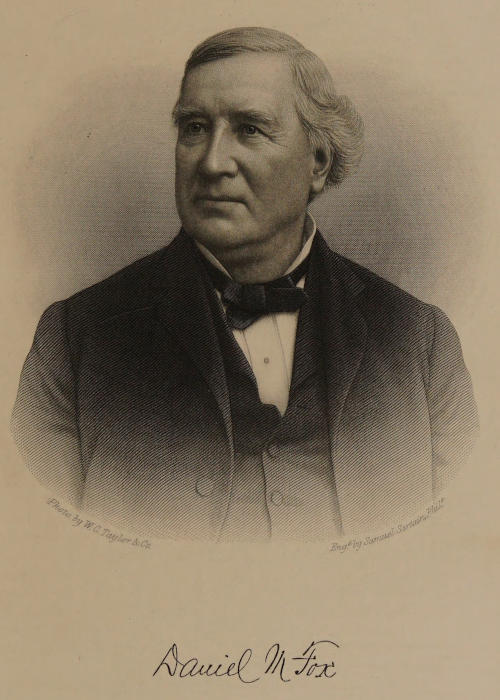
Daniel M. Fox
The profession is one affording many temptations to men
who are not well grounded in strict integrity, and sustained in
the paths of rectitude and virtue by a conscientious regard for
the meum and tuum of a well-ordered business life; but Mr.
Fox, looking upon his profession as one of dignity and trust,
soon commanded and permanently secured the confidence of
the public, by avoiding those speculative ventures which have
brought so much disrepute upon it, and by a scrupulous regard
for the interests of those who placed their property in his
keeping. In consequence, the business entrusted to him has
increased to such an extent from year to year that it is said he
has more estates in his charge for settlement, as administrator,
executor, or trustee, than any other single individual in Philadelphia.
His practice constantly increasing as time rolled on,
the laws touching real estate operations becoming more complicated
year by year, and appreciating the necessity in many
cases for court proceedings to secure perfection of title, he
submitted himself to a legal examination, and was admitted to
the Philadelphia bar in November, 1878.
His first step in public life was at the age of twenty-one,
when he was elected a member of the Board of School Directors
of the district in which he then lived, and for many years
prior to 1854, when the city was consolidated, and the law in
that regard changed, he was President of the Board. For
many years he had taken an active interest in the public
schools, and was a pioneer in the night-school system for
adults. He was chosen two consecutive terms by the City
Councils as a Director of Girard College, and also represented
the Northern Liberties in the Board of Health, having charge
of the sanitary matters and the quarantine regulations of the
city, and was quite active and efficient in the abatement of the
cholera, which was epidemic here twice during the nine years
he served in that Board.
For three years he represented his ward in the Select
Council of Philadelphia with credit and ability. In 1861 he
retired from Councils, and in the year following was unanimously
nominated for the Mayoralty by the Democratic party.
The city at that time was strongly Republican, and he was
defeated by Hon. Alexander Henry, although he ran largely
ahead of his ticket. In 1865 he again received a unanimous
nomination for the same office, and ran against Hon. Morton
McMichael and with the same result. His personal popularity,
however, was in the ascendant, and when he was placed in
nomination in 1868 against General Hector Tyndale, he was
duly elected.
On January 1, 1869, he was inaugurated, and his first
official duty as Mayor was to formally receive on behalf of the
city authorities General Grant as President-elect. The reception
took place in Independence Hall, in the presence of
Councils and a large number of prominent citizens, and was
conducted on the part of the new Mayor with ease, grace, and
elegance. His municipal administration was marked by many
reformatory and sanitary measures, especially in those portions
of the city where the impurity of the denizens hazarded the
health of more respectable neighborhoods. It was during his
official term that the Volunteer Fire Department ceased to
exist. It had been his practice during its closing days to attend
all conflagrations for the double purpose of holding a
moral check on the lawless and to stimulate the police in their
duties of keeping the streets clear for the free exercise of those
whose business it was to extinguish the flames. The passage
by Councils of the ordinance establishing a Paid Fire Department
created a profound sensation in the city, arousing the
bitter feelings of many of the volunteer firemen, and kindling
an intense anxiety on the part of the people generally as to
the fate of the bill when it reached the hands of the Mayor.
He retained it for a fortnight, unsigned, evidently desiring to
soften the feeling engendered by its passage, and also to perfect
such arrangements as would be necessary to meet any
emergency in carrying the act into effect. The latter being
accomplished, he formally approved the ordinance and it became
a law. This course was very unpalatable to the riotous
element of the volunteers, who manifested their feelings in
various ways, such as suspending the effigy of the Mayor in
several engine houses, but no other violent demonstrations of
any moment occurred, as the steps taken by his officers proved
effective and rigorous; these, coupled with the co-operation of
many of the discreet firemen, enabled the new “Paid Department”
to go into operation without any disturbance whatever,
and the city has ever since rejoiced in an efficient system without
any of the former accompaniments of noise, riot, and
public disturbance.
A startling attempt at assassination occurred during Mayor
Fox’s incumbency, in the shooting of United States Revenue
Detective James Brooks, in open day, in a Front street store,
by some miscreants. The case was at once taken in hand by
the Mayor, who by stimulating the police and offering heavy
rewards caused the arrest of the parties. Their conviction
soon followed. Whenever any question of grave public importance
presented itself, it was his practice to invite conferences
with the most prominent citizens at his office, as to
the best course to be pursued; thus, while showing a true devotion
to the public interests, he was enabled to act with great
sagacity; he also brought to his support the power of eloquence,
which he possesses in an eminent degree; this added much to his
popularity. He did not hesitate to use the veto whenever he
differed with Councils, and during his term he transmitted to
these bodies thirty-two messages of this character, the majority
of which were sustained. His official term ended in a most
gratifying manner, both chambers of Councils unanimously
passing resolutions of thanks for his able and energetic administration
of the city’s affairs. This was followed by a grand
banquet at the Academy of Music, tendered to him by our
most distinguished citizens, irrespective of party. In two successive
State conventions he received complimentary votes for
the Gubernatorial nominations.
The great International Exposition in commemoration of the
centennial anniversary of the birth of our nation was held in
this city in 1876. In the preparation for this grand demonstration,
in its opening and down to its close, in the autumn of
that year, Mr. Fox took a leading part, the incipient step having
been taken in the Mayor’s Office during his administration,
in a consultation with a committee from the Franklin
Institute, who waited upon him for that purpose. As an active
and earnest member of the Centennial Board of Finance,
which had charge of all the funds for the Exposition, Mr. Fox
contributed his time, his means, and his voice greatly to its
promotion and final success.
Once more Mr. Fox was called to the discharge of an important
public duty. For a number of years a controversy
had existed between the general Government and the railroad
corporations with reference to the transportation of the United
States mails, the former complaining that the service was not
satisfactorily rendered, and the latter that they were not adequately
compensated.
On the 12th of July, 1876, Congress passed a bill authorizing
the President to appoint a Commission of three civilians to investigate
the subject and make report upon it. Mr. Fox was
one of the appointees, his colleagues being selected from other
States. The Commission, in the exercise of its functions,
visited every section of the country, embracing a distance of
travel of over twenty-eight thousand miles. Sessions were
held in all the principal cities, much testimony taken, and
when its labors were completed a report of great value was
prepared and presented, which went far towards a satisfactory
settlement of the controversy.
[From The History of the Philadelphia Police.]
One of the most important occurrences during Mr. Fox’s
term as Mayor was the abolition of the old Volunteer Fire
Department. The ordinance for the erection of a Paid Fire
department was passed December 29, 1870, after a series of
hot debates. The old volunteers were a power in politics, but
their acts of violence and incendiarism made it imperative in
the opinion of a majority of citizens that they should be
superseded. The passage of the ordinance caused a sensation
because it was not believed that Councils would dare to abolish
the volunteers. Feeling ran high. The firemen held
meeting after meeting in their engine-houses. All attention
was directed towards the Mayor. Would he sign the ordinance
and make it a law? He had ten days in which to consider
the bill. He was known to favor it; but day after day
passed and he took no action. Meanwhile he was not asleep.
He had perfected police arrangements whereby the whole force
could be called out at once on the outbreak of any violence,
and the excitement was so great that the rowdy element and
the firemen were expected to sally forth at any moment.
There were two or three isolated outrages, but no general
riot. The ten days drew towards a close and the excitement
became less intense every day. It was with this object in
view that the Mayor delayed signing the ordinance. He
waited until the last day before putting his signature to the
bill. The volunteers had become in a degree reconciled to the
measure, and some of them hoped to resume work with engine
and hook-and-ladder under the new system.
The old volunteer firemen now hold Mr. Fox in high esteem.
At the great fire in Newhall, Borie & Co.’s sugar refinery,
which stood at the corner of Race and Crown streets, the
lives of a number of the volunteers were endangered through
their own stubbornness, and only saved through determined
action on the part of the Mayor. The engine-house of the
refinery was a single story building facing on Crown street;
over it was a projection five or six stories in height containing
the hoisting apparatus and other machinery of great weight.
His Watchful Care Saves Many Lives.
About a score of the firemen took up a position on the roof
of the engine-house and directed a stream of water against
the main building. Unknown to them the flames were rapidly
eating their way to the machinery in the projection over
them. The Mayor made it a point to attend all important
fires, and frequently his vigilance at great conflagrations resulted
in the detection of gangs of thieves who operated in
the uniform of firemen. On this occasion he observed the
danger which threatened the men. It was evident to him
that the machinery would soon be reached, and the projection
fall. A serious disaster would be the consequence unless the
men removed. The Mayor sent the Chief of Police to inform
them of their danger, and endeavored to induce them to retire
from their perilous position. They angrily declared they
would occupy whatever place they pleased, and said the Mayor
should mind his own business as he had no authority over
them. The Mayor saw that prompt and decisive action was
necessary if the lives of the men were not to be sacrificed.
He ordered Chief Mulholland to drive the headstrong fellows
from the roof by force. All the policemen in the neighborhood
of the fire were collected and they charged the volunteers,
who were routed with some difficulty and came clamoring
around the Mayor, demanding to know by what authority
he had interfered with them, execrating and threatening him
with personal violence.
“Wait five minutes and I will give you an answer,” said
Mr. Fox, quietly.
A moment later the projection with all the heavy machinery
fell, crushing the engine-house. The men who a moment
before had reviled the Mayor were silent for a moment, then
they gathered around him and gave three prolonged and hearty
cheers for Daniel M. Fox.
Mr. Fox was the first Mayor who directed the roping off
the streets during large conflagrations, thereby keeping away
not only the crowds who drawn by idle curiosity went simply
to look on but also those persons who may have been attracted
for purposes of theft. It aided considerably, too, in giving
the Fire Department a clean working space, thus adding to
their efficiency, and also avoiding the chance of accidents from
falling embers or walls. This plan so wisely begun has been
followed with advantage by every successive Mayor.
Mr. Fox’s participation in the philanthropic and benevolent
movements of the city has always been unlimited. As President
of the Pennsylvania Society for the Protection of Children
from Cruelty, Trustee of the Pennsylvania Institution for
the Deaf and Dumb, and in his connection with many other
charitable works, his constant aim has been the alleviation of
the sufferings and the general welfare of his fellow men.
Personally, Mr. Fox is of dignified and distinguished presence,
yet in manner affable, courteous, and kind. Always
interested in his fellow men, he draws men towards him and
impresses them with the sincerity of his nature and the unselfishness
of his purpose. Love of justice is one of the strong
characteristics of the man, and his life has been singularly free
from the petty strifes which disfigure the lives of so many who
have had to fight their battle against odds. His selection for
the Superintendency of the Mint, being unsought, was a just
tribute to his unquestioned integrity and his eminent abilities
as a public man. The country is fortunate in his preferment,
and his administration of the affairs of the Mint will fitly
crown an honored career.
Superintendent Fox has greatly improved the immediate
surroundings of the Mint since his entrance upon duty. The
areas have been cleared of rubbish, temporary wooden structures
demolished, where it is possible to dispense with them,
and a systematic policing of the premises has been adopted.
But perhaps the most notable of the improvements which
Superintendent Fox has made is the removal of the old steam
plant from the body of the basement and the creation of a new
and much more efficient plant in vaults prepared outside of the
walls. This has had the effect to render the atmosphere of the
building cool and pure, and at the same time has actually increased
the working space nearly forty per cent. Another
story has also been added to the adjusting room, with appliances
for cooking and toilet, thus increasing the comfort of
the ladies employed in that department. The plots on either
hand of the entrance on Chestnut street show some happy
efforts to please the eye, in a renewal of the sward and landscape
gardening in colors. The fine specimens of American
cypress in the centre of these plots seem to have borrowed fresh
attractions from their new and beautiful setting, and their
foliage contrasts pleasingly with the clumps of foliage plants
and exotics beneath. Throughout the premises the supervision
of a thorough business man is apparent; nothing seems
to escape the eyes of the vigilant Superintendent.
Henry Voigt, the first Chief Coiner, was appointed by
President Washington, January 29, 1793. He was selected
on account of his mechanical knowledge and skill, being a
clockmaker by trade. Many of our old families bear witness
to the skill of Mr. Voigt in the affection they have for many
an “old clock on the stairs,” for the manufacture of which
timekeepers he was quite famous. Mr. Voigt held office until
removed by death in February, 1814.
Adam Eckfeldt was born in Philadelphia, June 15, 1769.
He was trained to mechanical pursuits by his father, who was
a large manufacturer of edge-tools and implements. On the
establishment of the Mint he was engaged to construct some
of the machinery for it. He built the first screw-coining
presses. The contrivance for ejecting the piece from the
collar, together with some other mechanical appliances, were
his invention.
In an old pay-roll of 1795 (see page 12), we find the name
of “Adam Eckfeldt, Die Forger and Turner.” His official
connection dates from January 1, 1796, when he was appointed
Assistant Coiner by Director Boudinot, with the
consent of President Washington. Upon the death of Henry
Voigt, Mr. Eckfeldt was appointed to succeed him as Chief
Coiner, and remained in that position until he resigned, in
1839. He continued to visit the Mint for some years after;
and he is yet remembered as a hard worker in the Mint,
without compensation. For half a century he was one of the
central figures of the Mint service. His mechanical skill, his
zeal, energy, and uprightness, brought him many distinctions,
both as an officer and a citizen.
In his letter of resignation he warmly recommends the
appointment of Franklin Peale, in the following terms:
“I feel it my duty, in leaving office, to recommend that my
place be filled by Mr. Franklin Peale, the present Melter and
Refiner. Our close association as fellow-officers has made me
acquainted with his peculiar qualifications, and I therefore
know him to be fitted for the situation; and I do not know any
other person that is.” He had a high ideal of what a chief
coiner should be.
Mr. Eckfeldt died February 6, 1852, in his 83d year.
Franklin Peale was the son of Charles Willson Peale, the
eminent artist and founder of Peale’s Museum. Born in the
Hall of the American Philosophical Society, October 15, 1795,
he was presented to the society by his father, when four months
old, as “the first child born in the Philosophical Hall,” and
with a request that the society should name him. He was accordingly
named after the chief founder and first President of
the Society—Franklin.
Young Peale early showed a taste for mechanics, and his
father gave him every facility to improve himself in any direction
in which nature seemed to lead him. Part of his general
education was received at the University of Pennsylvania and
part at the Germantown Academy. At the age of seventeen
he entered the machine shop of Hodgson & Bro., Delaware.
He soon grew to be a skilled mechanic and draughtsman.
Some time after he became manager of his father’s Museum.
He assisted Baldwin in the construction of the first locomotive
built in this country. In 1833 Mr. Peale entered the Mint
service, and was sent to Europe by Director Moore to examine
into foreign Mint methods. He brought with him valuable
apparatus for the Assay Department, together with other important
improvements and suggestions. He was appointed
Melter and Refiner in 1836 and Chief Coiner in 1839. He
introduced the first steam coining press, the milling machine
and some other of our more modern forms of Mint machinery.
Mr. Peale’s administration as Chief Coiner may be said to
mark an era in the mechanic arts of Minting. Being specially
fitted, by natural genius as well as education, for the position
which he adorned, his mildness, integrity, gentlemanly bearing
and high moral and mental culture constituted him a model
officer. His connection with the service lasted until 1854.
He died on the 5th of May, 1870.
George K. Childs, appointed December 12, 1854.
Lewis R. Broomall, appointed June 30, 1861.
John G. Butler, appointed November 30, 1863.
A. Loudon Snowden, appointed October 1, 1866.
(For sketch of A. Loudon Snowden, see list of Directors
and Superintendents, page 92.)
Colonel O. C. Bosbyshell. On the 4th of May, 1869,
Ex-Governor Pollock, then Director of the Mint, appointed
Col. Bosbyshell Register of Deposits. His course in the Mint
was so satisfactory that, without solicitation, he was made
assistant coiner by Col. A. L. Snowden, the then coiner, on
the 1st of October, 1872. Upon Col. Snowden’s appointment
as Postmaster of Philadelphia, Col. Bosbyshell was appointed
Coiner of the Mint by President Grant, on the 15th of December,
1876, and remained in that capacity until January,
1885, when, to the regret of all parties having business relations
with him, he tendered his resignation to accept a responsible
position in the Controller’s Office, tendered him by his
friend, Col. Robert P. Dechert.
William S. Steel was born in the City of Philadelphia,
on the 1st of March, 1841. He received a good common
school education, and in 1856 entered the office of David
Cooper & Co., at Girard’s wharves, remaining engaged in mercantile
pursuits till 1861. At 19 years of age he was appointed
by Colonel James Ross Snowden, then Director of the United
States Mint, First Assistant Weigh Clerk. In this position
he served continuously through Colonel J. Ross Snowden, ex-Governor
Pollock, and Colonel A. Loudon Snowden’s administrations.
In September, 1862, just before the battle of
Antietam, Mr. Steele entered the State service, and served
with the Thirty-second Regiment, Pennsylvania Volunteers,
until discharged by expiration of term. When Colonel A.
Loudon Snowden was transferred to the Post Office, January,
1877, Mr. Steele, upon the recommendation of the then
Coiner, Colonel O. C. Bosbyshell, became Assistant Coiner, a
position he filled in a most acceptable manner, until Colonel
Bosbyshell’s retirement in February, 1885, when he was made
Coiner.
Harry A. Chester, Assistant Coiner, was born in Philadelphia
(Northern Liberties), September 10, 1852, and educated
in the North East School, Sixth Section. He was an
attachee of the National House of Representatives from 1876
to 1882, clerk in Register of Wills’ Office from January 1,
1883, until May, 1885, when he was appointed by Colonel A.
Loudon Snowden as Assistant Weigh Clerk, and promoted by
Hon. Daniel M. Fox in October, 1886.
Dr. Henry Leffmann was appointed Chief Coiner at the
Philadelphia Mint January 10, 1888, by President Cleveland.
Dr. Leffmann was born in Philadelphia September 9, 1847,
and was educated in the public schools of Philadelphia, including
four years at the Central High School. He devoted
three years in practical study in the laboratory of Dr. Charles
M. Cresson, and graduated at Jefferson Medical College in
1869, having been for some years assistant to the Professor of
Chemistry at the College, and in 1875 was elected Lecturer
on Toxicology, which position he held for a number of years.
In 1876 he was elected to take charge of the laboratory of the
Central High School, and remained in that position for four
years. In 1883 he was elected Professor of Chemistry and
Metallurgy in the Pennsylvania College of Dental Surgery, a
position which he still holds; and he has been for a number
of years Professor of Chemistry and Mineralogy in the Wagner
Free Institute of Science. Dr. Leffmann has been engaged
as chemical expert in patent and criminal cases, notably in
the Goerson poisoning case and the chrome-yellow poisoning
cases. He is a member of several American and foreign
scientific societies, has contributed papers to current scientific
literature, and has for the past five years been editor of The
Polyclinic, a monthly medical journal. In 1880 he was a
candidate for Coroner on the Democratic ticket, but was defeated,
and in 1884 was appointed Port Physician for Philadelphia
by Governor Pattison, and held that position until
October, 1887.
Jacob R. Eckfeldt, Sixth Assayer, was born in Philadelphia,
1846. He entered the Assay Department as Second
Weigher, in 1865. By regular promotions he reached the
position of Assistant Assayer, in 1872, and upon the death of
his superior he was appointed and confirmed as Assayer, December
21, 1881. The position of Assayer is one of great
responsibility, and demands not only scientific training but
wide and special knowledge and experience upon subjects relating
to the history and arts of Coinage. Since the foundation
of the Mint there have been but six official heads of this
department.
William McIntire was born in Delaware in 1831. He
entered the Assay Department of the Mint as an assistant in
September, 1853, which position he held, with the exception
of a short interim while he was engaged in mercantile business,
until October, 1887, when by regular promotion he was
appointed Assistant Assayer.
Extract from an Obituary Notice by Mr. Du Bois.
(Read before the American Philosophical Society, Oct. 4th, 1872.)
Jacob R. Eckfeldt, late Assayer of the Mint, was the son of Adam and
Margaretta Eckfeldt, and was born in Philadelphia, March —, 1803. He
was, therefore, in his seventieth year, at the time of decease, August 9th,
1872.
In the Spring of 1832, Mr. John Richardson, who had been Assayer
about one year, and did not find the employment congenial to his tastes,
informed Mr. Eckfeldt that he intended to resign, and wished him to prepare
to take the place. Mr. E. shrank from this responsibility, and declined.
But some of his friends who had influence with President Jackson, presented
his name with a strong recommendation and he was appointed without
being asked as to his party preferences. This occurred on the 30th of
April, 1832. He therefore held the office over forty years.
When he entered upon the work, he had to encounter some embarrassments.
The apparatus was old-fashioned, and not calculated for nice
results. The silver assay had been well performed, without going to a
close figure, for many years; but gold was little known in the country or
at the Mint, and it is not surprising that its assay was incorrectly performed.
Add to this, there was the coarse and cumbrous nomenclature,
brought from the old country, of carats and grains for gold fineness, and
so many grains to the pound for silver fineness.
Close upon all this, that is to say, in June, 1834, came the celebrated
reduction in the standards of our gold coin, one of the chief measures of
the Jackson administration. This changed gold from a curiosity to a
currency; bullion and foreign coin flowed to the mint, and accuracy of
assay was more than ever needful. Mr. Eckfeldt was equal to the emergency,
and resolutely introduced reforms, which, at first, made the older
officers stand in doubt.
In those days, about the time the new mint edifice on Chestnut street
was finishing, Mr. Peale was sent to London and Paris to observe the
methods of assaying and refining, and to procure a new apparatus. We
were thus supplied with French beams, weights, and cupel furnaces, and
with the appliances of Gay-Lussac’s humid assay, and the printed details
of the process. Soon after, Mr. Saxton, famous for his skill in constructing
balances and other delicate instruments, returned from a long schooling
in that line in London, and was employed in the Mint. Thus furnished,
Mr. Eckfeldt felt himself “set up,” and able to compete with the foreign
assayers, and if he was ever more precise, it was because he disregarded
certain allowances which had become a time-honored custom.
A large importation of fine gold bars from France, known as the French
Indemnity, and which came because President Jackson declared he “would
submit to nothing that was wrong,” gave a fine opportunity for testing and
comparing foreign assays; and it was generally found that these bars were
somewhat below the alleged fineness. A still more important discovery,
was the fact that British Sovereigns ran below their standard of fineness.
This happened when he had been in office less than three years, and the
Director was unwilling to set the finding of young Eckfeldt against the
experience of Old England. The Assayer being assured and re-assured of
the accuracy of his results, Director Moore consented to notify the British
Government of their error. The result was a closer scrutiny in the London
Mint, and a final acknowledgement that they were wrong. This was no
less a triumph for Mr. Eckfeldt, than it was a contribution to exact science,
and an honor to the American Government.
It is not surprising, that he felt at first the inconvenience of passing from
one form of nomenclature to another, though to a better one. A friend
remarks, “I recall conversations with Mr. Eckfeldt, showing how seriously
he felt the revolution. He would think in carats, and report in decimals.
And I often recur to this as illustrating the kind of difficulties which would
arise in case of a decimalising of weights and measures.”
For some years prior to 1842, Mr. Eckfeldt and his Assistant, in addition
to their ordinary duties, engaged in the preparation of an original and
comprehensive work on the Coins of all Nations; on the Varieties of Gold
and Silver Bullion; on Counterfeit Coins, and on other subjects related
thereto. This was published in 1842, and has long been regarded as a
standard authority. In 1850, they issued a supplementary smaller work,
and again in 1852.
As the United States increased in commerce, wealth and population, the
Mint of course increased in work. In particular, Mexican dollars came in
great quantities for recoinage. Not only were our vaults full, but our entries
and corridors were at times crowded with rows of kegs. Every day, for
years, we had the constant task of sixteen melts of silver ingots to melt and
assay; and it was a great advantage and satisfaction to be supplied with
the humid apparatus.
The success of gold mining in our Southern States, and the increasing commerce
of New Orleans, gave rise to the establishment of three branch mints
at the South, in 1837; and it devolved upon Mr. Eckfeldt to become schoolmaster,
and educate the three assayers appointed for those places. The same
had to be done again at a later date for other mints and assay offices.
In December, 1848, came the first lot of gold grains from California;
and with the opening of the next year the tide set in most powerfully. I
shall not here speak of this great turning-point in metallic currency any
further than as it affected the mint, or rather the labor which it laid upon
Mr. Eckfeldt and his department. As is well known, the lots were
numerous, and the aggregate amount was enormous. Instead of making
gold assays by dozens, we had to go through with hundreds every day,
following the arrival of each steamer. We procured young men as operators
in the weigh-room and additional workmen in the laboratory; and
in spite all the help we were overworked. Here let me say that the
persons who have been educated by Mr. Eckfeldt to this profession have
done credit to the selection that was made, not only by skill, diligence, and
good character while here, but wherever they are now scattered to other
mints and assay offices, or to different pursuits.
The gold pressure continued for about five years, when it was relieved
by the creation of a Government assay office in New York, and a branch
mint at San Francisco. But directly sequent to this came the change of
standard in silver coin, causing an immense recoinage in small pieces.
Thus our daily assays continued to count by hundreds. This lasted for
some years. When it began to slacken off, a law was passed for calling in
the large copper coins and issuing in their stead pieces of copper-nickel
alloy of much smaller size.
The analysis of Nickel alloys was not well laid down in the books, and
the European or other assays which came with purchased lots showed an
incorrect determination. Mr. Eckfeldt was therefore obliged to study out
and perfect this assay, which is more tedious and laborious, though of less
consequence, than the assay of the precious metals.
But it was his habit to be as scrupulous in minor matters as in major;
and after the routine was well settled it went on with the same clockwork
regularity as the other branches of assaying. I need not say that
this nickel coinage imposed another heavy pressure upon the mint for
years.
After this came the substitution of the Bronze alloy; and this called for
another process of assay, and brought us a great deal of work.
I thus hastily review this sequence of gold, silver, nickel, and bronze,
not only as an interesting part of Mint History, but to show the varied and
abundant services of the untiring, energetic Principal Assayer, and the
masterly skill with which he met every obligation.
His skill and success as an Assayer and Analyst largely consisted in his
power of finding out what was defective or erroneous, and in applying the
proper remedy. It often seemed that what was a puzzle to others was to
him a matter of quick insight.
In the assays of certain complex alloys, and of low grades of gold and
silver, he contrived various methods which are not in print, but which are
of great use in the daily manipulations.
And here I may state that he not only introduced great accuracy and
precision in the assays, but carried special investigations to a delicacy
almost incredible. Thus, much interest was excited by a publication some
years ago, both in this country and across the Atlantic, of his experiment
upon the brick-clay which underlies our city. Taking two samples from
the center of the town and the suburbs he found they contained gold at the
rate of nearly 12 grains (say fifty cents) to the ton of clay in its ordinary
moisture. Other experiments went to prove the very general diffusion of
gold, in infinitesimal proportions.
Some analysts, through want of exactitude, or for the pleasure of making
a sensation, may produce very curious results; but Mr. Eckfeldt was conscientious,
I may say, nervously scrupulous, about stating anything he was
not sure of. Partly for that reason, partly for the very love of work, he
was laborious to a fault, all his life long.
| Washington, D. C., James P. Kimball, Director of the Mint |
$4,500 |
| Philadelphia, Pa., Daniel M. Fox, Superintendent |
4,500 |
| Boise City, Idaho, Norman H. Camp |
2,000 |
| Carson City, Nevada, James Crawford, Superintendent |
3,000 |
| Charlotte, N. C., Calvin J. Cowles, Assayer |
1,500 |
| Denver, Colorado, Herman Silver, Assayer |
2,500 |
| Helena, Montana, Russell B. Harrison, Assayer |
2,500 |
| New Orleans, La., Andrew W. Smyth, Superintendent |
3,500 |
| New York, N. Y., Andrew Mason, Superintendent |
4,500 |
| San Francisco, Cal., Edw. F. Burton, Superintendent |
4,500 |
| St. Louis, Mo., Eliot C. Jewett, Assayer |
2,500 |
Extract from an obituary notice by Robert Patterson.
(Read before the American Philosophical Society, November 18, 1881.)
William Ewing Du Bois was born at Doylestown, Pennsylvania, December
15, 1810. Through his father, Rev. Uriah Du Bois, he was descended
from Louis Du Bois, a French Huguenot of honorable extraction, who emigrated
to America in 1660, seeking freedom of religious worship, and, in
connection with others of his countrymen, formed the settlement of New
Paltz, Ulster County, New York. Through his mother, Martha Patterson,
daughter of Professor Robert Patterson, of the University of Pennsylvania,
he inherited the Scotch-Irish element which has exerted so marked an
influence in the development of our country.
The father of Mr. Du Bois was a Presbyterian clergyman, in charge of
churches in and near Doylestown, and was principal of the Union Academy
at that place, a classical school then and afterwards of high reputation. He
was greatly respected, both as preacher and teacher.
The bright and studious mind of Mr. Du Bois gathered every advantage
from his opportunities, and he was well furnished in the classics and mathematics,
and in English literature. While yet a boy he developed a freedom
and capacity as a writer quite remarkable.
His oldest brother was an eminent member of the bar, and it seemed
fitting that Mr. Du Bois should, under his guidance, adopt the law as his
profession. He accordingly pursued the usual course, in the meantime
aiding to support himself by literary work and conveyancing, and was
admitted to practice in September, 1832. But his health failing him on
account of a bronchial affection, he accepted an appointment in the Mint
at Philadelphia, and thus began the life-work by which his reputation was
established.
Mr. Du Bois entered the Mint in September, 1833, and was first employed
in the office of the Director, Dr. Moore. In 1835, at the request of the
Assayer, Mr. Jacob R. Eckfeldt, he was transferred to a more congenial
position in the assay department. Here he continued for the remainder of
his life. In 1836 he was appointed Assistant Assayer. In September, 1872,
he succeeded Mr. Eckfeldt as Assayer, and remained at the head of the department
until his death, July 14, 1881, thus completing nearly forty-eight
years of Mint service.
Mr. Du Bois early took rank as an accomplished assayer, and long before
his death had reached the head of his profession.
The close intimacy between Mr. Du Bois and Mr. Eckfeldt developed
into warm friendship. The tie was made closer by the marriage of Mr.
Du Bois, in 1840, to Susanna Eckfeldt, the sister of his chief. I shall have
to speak of published works and scientific communications appearing under
the names of Eckfeldt and Du Bois. Although it was understood that Mr.
Du Bois was the sole literary author, yet no separate claim of authorship
was made by either. Whatever of reputation was earned, each was contented
that it might be shared by the other, and jealousy never for a
moment weakened a union that bound them for life.
In the year 1834 a change took place in the ratio of gold to silver in the
standard of U. S. coins, the effect of which was to bring large deposits of
gold to the Mint. The coinage previously had been chiefly of silver. The
more equal supply of the precious metals gave active employment in the
assay of each of them, and was, of course, most valuable as an experience
to Mr. Du Bois, who about this time became connected with the assay department.
In 1837, on revision of the Mint laws and standards brought about by
Dr. Robert M. Patterson, then Director, a reform was effected in the
method of reporting assays, the millesimal system taking the place of the
time-honored but cumbrous method of carats and grains. About this time,
also, the older plan of assaying silver was abandoned, the humid assay
being substituted, and largely worked under the direct supervision of Mr.
Du Bois.
About 1838 branch mints were organized in the States of Louisiana,
Georgia, and North Carolina. The labors and responsibilities of the Philadelphia
assay department were increased by this development, partly from
the necessity of instructing assayers for the new branches, and partly in
testing the correctness of the assays made there.
In 1848 the great discovery of gold in California was made known. This
brought a tremendous pressure on every department of the Mint, and not
the least on the assayers. The gold coinage was, in three years, raised from
a little over three million dollars to more than sixty-two millions. The
assays were often counted by hundreds in a day. But whatever the pressure
in the office, accuracy ruled, and the correctness of the assays was never
impeached.
In 1853 a change was effected in the law for providing subordinate silver
coins. This brought about, for some years succeeding, an unprecedented
coinage of that metal, and still further increased the labors of the assay
department.
He instituted the Cabinet of coins which now adorns the Mint. This
was commenced in 1838. A small annual appropriation was procured from
Congress for this purpose, and the work of collection committed entirely
to Mr. Du Bois. He brought to it all the enthusiasm which animates most
numismatists, sobered, however, by good judgment. His expenditures were
always judicious. Some of the best of the specimens were culled from the
Mint deposits for the bullion value, merely, of the pieces. After the collection
had taken good shape, and been well classified, he wrote and published,
in 1846, a description of it, under the title “Pledges of History,”
etc. The title thus selected intimated his opinion as to the real value of
such collections. He thought that a coin should be prized for its historical
teaching, or artistic merit, and discouraged the rage to possess a piece simply
because of its rarity. Mr. Du Bois acted as curator of the Cabinet
until his death.
Another important labor undertaken by Mr. Du Bois (in connection
with Mr. Eckfeldt) was the preparation and publication, in 1842, of a
“Manual of the Gold and Silver Coins of all nations, struck within the
past century.” This was a work of very great labor, and, from its expense,
of some risk also to the authors. It is admirably arranged, the information
clear, and it embraced every subject of interest at that date as to coins,
bullion, counterfeits, etc. Subsequently, in 1850 and 1851, supplements
were published covering later topics, made prominent in consequence of
the California gold discoveries.
The writings of Mr. Du Bois were numerous, and continued up to the
year of his death. His papers on numismatics were frequent and always
attractive, his last appearance in print being in April of this year, in an
article on the “Coinage of the Popes.” To the “American Philosophical
Society,” of which he was elected a member in 1844, he made various communications
on behalf of Mr. Eckfeldt and himself, mostly on topics suggested
by experiences in the assay department. Among the most curious
was one on “The Natural Dissemination of Gold,” by which we were astonished
to learn that this precious metal is found in appreciable quantity in
the clays underlying our city.
In 1869 he wrote for the “Bankers’ Magazine,” “Propositions for a Revised
System of Weights, and a Restoration of Silver Currency.” The
development of his views on these subjects is a model of clear exposition,
and the conclusions reached were such as might be expected from a mind
aiming to attain practical results rather than to impose visionary theories.
From the beginning he was highly esteemed at the Mint. It was his
ambition to acquire a knowledge of every branch of the service, and with
his capacity and opportunities this end was attained. He early became the
trusted friend and counsellor of his colleagues, and was able to serve them
in many ways, perhaps most of all with his ready pen. As time passed,
and forty-eight years of experience was given to him, he was recognized by
all as the Nestor of the Mint service. And here I pause to draw a lesson,
from the example of Mr. Du Bois’s life, as to the value of a properly organized
civil service. In the department with which he was connected,
political tests were never obtruded, and permanence of tenure followed on
merit. On no other basis could his services have been claimed or retained.
They would have been transferred to a private sphere, probably to his
pecuniary gain, certainly to the public loss. He was very accessible, and
ever ready to lend aid from the stores of his knowledge, but in particular
did he delight to instruct and bring forward his younger friends.
Mr. Du Bois was able to fulfill his official duties until within a few months
of his death. He was fully conscious of his approaching end, preserving
his intelligence to the last, and the faith which had comforted him in this
life supported him at its close.
The following minute was adopted at a meeting of the officers and employees
after his decease:
“The remarkably close conformity of the United States coins to the
standard assigned them by law, has been recognized by the highest Mint
authorities of the world to be unsurpassed, if quite equalled, in its uniform
exactness. The founding of such a reputation and its continuance during
the last half-century, are largely due to the joint labors of the late Jacob
R. Eckfeldt and William E. Du Bois.”
Joseph Cloud, appointed January, 1797; served until January,
1836 (39 years).
Franklin Peale, appointed January 5, 1836.
Jonas R. McClintock, appointed February 19, 1840.
Richard S. McCulloch, appointed in April, 1846; served
until April 1, 1849.
James Curtis Booth, Melter and Refiner, was born in
Philadelphia in 1810, educated in the same place, and graduated
in the University of Pennsylvania 1829. After study
and field practice in the Rensselaer School, at Troy, N. Y., in
1831-32, under the late Professor A. Eaton, Mr. Booth
studied Practical Chemistry in Germany, in 1833-34-35, in
the laboratories of Professors F. Wohler and G. Magnus, and
in visiting accessible manufacturing establishments in Germany
and England having relation to chemistry. The late
Prof. J. F. Frazer and Mr. Booth were the two Assistants on
the Geological Survey of Pennsylvania in its first year, 1836.
Mr. Booth next had charge of the Geological Survey of Delaware
in 1837-38 (being often assisted by Prof. Frazer), and
published his report on the survey in 1839-40.
Mr. Booth, observing the great deficiency in the knowledge
of Applied Chemistry in his native place, opened a laboratory
for teaching the same, by chemical analysis and by operating,
in 1836, and the same laboratory has been continued successfully
to the present time by Dr. T. H. Garrett and Mr. A.
Blair.
With the same object in view, Mr. Booth lectured at the
Franklin Institute for nine successive winters, giving three
full courses of lectures, each of three winters’ duration (1836-1845).
Prior to 1850 Mr. Booth published the Encyclopædia of
Chemistry, being the author of the majority of the articles
contained in it, with valuable contributions by Prof. R. S.
McCulloch and others. It was a valuable adjunct to the study
of chemistry for many years.
The Director and officers of the Mint unsuccessfully solicited
the appointment of Mr. Booth as Melter and Refiner of the
Mint in 1838-40, but in 1849 Mr. Booth obtained, through
his friend, Mr. Meredith, the appointment, over the signature
of President Z. Taylor, and has continued in the same position
from that date to 1887, a period of more than thirty-six years.
He resigned his office at the close of the year 1887.
Dr. David K. Tuttle, of the Carson City Mint, appointed
Melter and Refiner January 10, 1888.
Nathaniel B. Boyd, Assistant Melter and Refiner, was
born in Philadelphia, January, 1832. Twenty years later, he
was graduated with honors at Burlington College. After
leaving College he studied law, and was admitted to the Philadelphia
Bar in 1854. In 1869 he accepted an appointment
in the National Mint, tendered him by Director Pollock. In
1873 he was appointed Assistant Melter and Refiner, a position
which he still occupies (1885).
(Extract from Patterson Du Bois’ Biographical Sketch of “Our Mint Engravers.”)
Whatever may be said concerning the peculiar responsibilities
of the officers of the Mint, who are occupied with the
various operations of turning bullion into coin, it must be
conceded that none of them occupies a position so dubious
and, in some ways, so unenviable as the Engraver. In the
general transactions of the Mint, he is the most retired—the
most obscure—of its officers; yet his card is in every one’s
pocket.
As to the types of coinage, the standards are as numerous
as the eyes that water for them, and there is no piece but may
be said to be outside of somebody’s tolerance. No other artist
undergoes such an ordeal, for those who do not admire this
painting or that statue are not compelled to hug and hoard
it, much less to toil for its possession. The engraver who can,
from his retired window, see the critical millions clutching for
his little relievos, is in some sort a hero ex-officio, and it has
been well suggested that we look briefly upon the uneventful
lives of this worthy line of officers.
I. Robert Scot received his appointment as the first Engraver
of the Mint, November 23, 1793. Information is
wanting as to his nativity, but at the time of his appointment
he seems to have been turning the down-hill of life. He is
remembered as rather under size, and as an honorable and
agreeable gentleman.
According to Loubat, Joseph Wright was “appointed first a
draughtsman and die-sinker to the United States Mint, and
made the dies of a medal, the bust on the obverse of which
was considered to be the best medallic profile likeness of Washington.[21]
He also made the medal voted by Congress to Major
Lee.” Wright died in 1793.
II. William Kneass, second of the line, was born in Lancaster,
Pa., September, 1781, and was appointed Engraver
January 29, 1824. Mr. Kneass had been chiefly a plate
engraver for book-work. There were some changes in the
coinage during his term, notably in 1834 and 1838, for gold,
and 1836, 1837, 1838, and 1840, for silver. But some of
this work was done by Gobrecht as assistant. Kneass appears
upon a pattern half dollar of 1838; but the silver dollar of
1836, as well as a pattern half of 1838, were the work of his
assistant. Prior to his appointment he had an engraving
office on Fourth above Chestnut street, Philadelphia, which
was a well-known rendezvous for the leading wits and men of
culture, for which Philadelphia was then eminent.
Mr. Kneass died in office, August 27, 1840. A good engraving
of him hangs in the Assayer’s Office, inscribed “to
his friend Adam Eckfeldt, Chief Coiner,”—who had been
chiefly instrumental in securing his appointment.
III. Christian Gobrecht was appointed December 21, 1840,
to fill the vacancy made by the death of Kneass. He was
born in Hanover, York Co., Pa., December 23, 1785. In
1811 he went to Philadelphia, and became an engraver of
bank notes, seals, calico printers’ rolls, bookbinders’ dies, etc.
In 1836 he received an appointment as assistant to Mr.
Kneass at the Mint, in which capacity he executed some important
work. Among other similar performances he was
highly commended for his Franklin Institute Medal.
Christian Gobrecht continued in office until his death, July
23, 1844.
IV. James B. Longacre was born August 11, 1794, in
Delaware Co., Pa. He served an apprenticeship as a line
engraver with George Murray, Philadelphia, and did some
high class plate-work before he was free, in 1819. He was
one of the originators of the National Portrait Gallery of
Distinguished Americans, the first volume of which appeared
in 1834. Longacre drew from life and engraved many of the
portraits entire.
Like his predecessors, he died in office—January 1, 1869.
During his term Mr. Longacre was variously assisted by P. F.
Cross, William Barber, Anthony C. Paquet, and William H.
Key. Cross was born in Sheffield, England, served several
years in the Mint here, and died in 1856. He engraved the
obverse of the Ingraham medal. Paquet was born in Hamburg,
1814, emigrated 1848, served as assistant 1857 to 1864,
died, 1882. He engraved the medals of Grant, Johnson,
Buchanan, Everett, and the Life Saving Medals, with some
others. Key is a native of Brooklyn, was appointed an
assistant, 1864, and is still in the service. He executed the
Kane Expedition and Archbishop Wood Medals. The changes
and additions during the Longacre term were numerous and
important, both as to alloys and denominations. The pattern
pieces also record various experiments in the art of coining.
V. William Barber, fifth Engraver of the Mint, was born
in London, May 2, 1807. He learned his profession from his
father, John Barber, and was employed on silver-plate work,
after his emigration to this country.
He resided in Boston ten years, and was variously employed
in his line of work. His skill in this way came to the knowledge
of Mr. Longacre, then Engraver of the Mint, and he
secured his services as an assistant in 1865.
In January, 1869, upon the death of Mr. Longacre, he was
appointed as his successor, and continued in that position for
the remainder of his life. His death, which resulted from
severe chills, brought on by bathing at the seashore, occurred
in Philadelphia, August 31, 1879.
Besides much original work on pattern coins, he also produced
over forty medals, public and private. The work on all
of them was creditable, but we may specify those of Agassiz,
Rittenhouse, and Henry, as very superior specimens of art.
Mr. Barber was assisted by Mr. William H. Key, Mr. Charles
E. Barber, and Mr. George T. Morgan.
VI. Charles E. Barber, sixth Engraver, is a son of the
preceding, and was born in London in 1840. He was appointed
an assistant in 1869, and became the official head by
promotion in 1880, to fill the vacancy caused by his father’s
death. The appointment was not unmerited. One of Mr.
Barber’s latest cards to the public is the new five-cent piece—a
successful venture in very low relief. But his handiwork is
more or less visible in all the principal medals executed since
1869. Since his appointment as Chief Engraver, the work
of his department has been enormously increased by the
number of medal dies demanded for the War Department and
from other Government sources. Mr. Barber’s best work is
seen in the medals of Presidents Garfield, Arthur, Indian
Peace, Army Marksmanship, and Great Seal. He is particularly
happy in “catching a likeness.” The head of
Superintendent Snowden is a rare specimen of medallic portraiture.[22]
Messrs. Key and Morgan are the Engraver’s assistants.
The former has already received notice; the latter, Mr. George
T. Morgan, was born in Birmingham, England, in 1845; he
studied at the Art School there, and won a National Scholarship
at the South Kensington, where he was a student two
years. He is best known to the country by the so-called
“Bland dollar,” which is his design and execution.
We have reason to congratulate both the Government and
the people that the engraving service is well and judiciously
furnished.
An eminent physician and philanthropist, was born near Philadelphia,
December 24, 1745; he graduated from Princeton
College in 1760; he afterwards studied medicine in Edinburgh,
London, and Paris; returning to this country, he was elected
Professor of Chemistry in the Medical College of Philadelphia
in 1769. In 1776 he was elected to the Continental Congress,
and was one of the signers of the Declaration of Independence
in the same year; he was afterwards appointed Surgeon-General
of Revolutionary Army, and voted for the adoption
of the Constitution of the United States in 1787. Dr. Rush
was a popular lecturer, and eminently qualified as a teacher
of medicine. When the yellow fever scourged the City, and
the public buildings were closed in 1799 and 1800, he was
very successful in his treatment of the victims of that epidemic.
It is said that he visited and prescribed for one
hundred patients in a single day. He was treasurer of the
first United States Mint during the last fourteen years of his
life. Dr. Rush died in Philadelphia in April, 1813. Among
his nine children was Richard Rush, the statesman.
Note.—Dr. Rush was the author of the first pamphlet on temperance published in
this country, showing the injurious effects of alcoholic drinks on the human system,
and is justly regarded as the father of the temperance movement, the Centennial of
which has lately been celebrated throughout the United States, September, 1885.
Mark H. Cobb, the Cashier of the Mint from 1871 until the
present time (1885), was born in Colebrook, Connecticut, in
1828. In 1861, Hon. Simon Cameron, then Secretary of War,
appointed him Chief Clerk in the War Department, he having
previously been his private secretary. After Mr. Cameron’s
resignation as Secretary, Mr. Cobb, at the solicitation of the
late Col. John W. Forney, accepted the position of Enrolling
Clerk of the United States Senate in 1862. In 1871 he was
appointed to the responsible position of Cashier in the United
States Mint.
Albion Cox, first assayer of the Mint was appointed April
4, 1794. His commission, signed by Washington, until
recently, hung upon the walls of the assay office. But little is
known of Mr. Cox, save that he was an Englishman by birth,
and a good officer, as appears from the following report to the
Secretary of the Treasury made by Director Boudinot, under
date, December 3, 1795. He says: “The sudden and unexpected
death of the assayer, Mr. Albion Cox, on Fryday
last by an apoplectic fit, deprived the Mint of an intelligent
officer, essentially necessary to the future progress in the coinage
of the precious metals. Until this officer is replaced, the
business at the Mint must be confined to striking cents only.”
He therefore held office about a year and eight months.
Joseph Richardson, second assayer, was appointed December
12, 1795. He belonged to an old Quaker family distinguished
for ability and character. Mr. Richardson fulfilled the duties
of his office with credit and honor. He died in March, 1831.
A water color portrait of him, dressed in plain Quaker garb,
hangs in the assayers’ room. He held office over thirty-five
years.
John Richardson, son of the preceding, was appointed
assayer March 31, 1831. Finding the office not congenial with
his tastes, and so subjecting him to undue responsibilities, he
resigned April, 1832, holding office only a little over a year.
R. A. McClure, a gentleman skilled in the science of
numismatics, was appointed Assistant Curator of the Coin
Cabinet in 1868, and, upon the death of the Assayer and
Chief Curator in 1881, the responsibilities of the Curatorship
fell upon Mr. McClure.
EXTRACT FROM CONSTITUTION OF THE UNITED STATES.
Article I., Sect. 8. The Congress shall have power ... to coin money,
regulate the value thereof and of foreign coins, and fix the standard of
weights and measures, ... to provide for the punishment of counterfeiting
the securities and current coin of the United States.
Article I. Sect. 2. No State shall ... coin money, emit bills of credit,
make anything but gold and silver coin a tender in payment of debts, ...
Coinage, fiscal year 1887.
| Description. |
Pieces. |
Value. |
| Gold |
3,724,720 |
$22,393,279.00 |
| Silver |
44,231,288 |
34,366,483.75 |
| Minor Coins |
50,166,509 |
943,650.65 |
| Total |
98,122,517 |
$57,703,413.40 |
Total number of Coinage Dies made during the year 1887.
| Gold coinage |
120 |
| Silver coinage |
359 |
| Minor coinage |
684 |
| Proof coinage |
27 |
Bullion for the Silver Dollar Coinage, 1887.
| Mode of acquisition. |
Standard ounces. |
Cost. |
| Purchases, Treasury Department, Bureau of the Mint |
29,018,932.12 |
$25,624,487.37 |
| Purchases by mint officers |
282,626.95 |
249,150.73 |
| Partings, bar charges and fractions |
131,783.20 |
114,982.36 |
| Total delivered on purchases |
29,433,342.27 |
$25,988,620.46 |
| Balance on hand July 1, 1886 |
3,258,495.66 |
2,960,969.02 |
| Available for coinage of silver dollars during the fiscal year 1887 |
32,691,837.93 |
$28,949,589.48 |
Value of the Gold and Silver (not including re-deposits) received at the
Mints and Assay Offices during the fiscal years 1880-1887.
| Fiscal years. |
Gold. |
Silver. |
Total. |
| 1880 |
$ 98,835,096 |
$34,640,522 |
$133,475,618 |
| 1881 |
130,833,102 |
30,791,146 |
161,624,248 |
| 1882 |
66,756,652 |
33,720,491 |
100,477,143 |
| 1883 |
46,347,106 |
36,869,834 |
83,216,940 |
| 1884 |
46,326,678 |
36,520,290 |
82,846,968 |
| 1885 |
52,894,075 |
36,789,774 |
89,683,849 |
| 1886 |
44,909,749 |
35,494,183 |
80,403,932 |
| 1887 |
68,223,072 |
47,756,918 |
115,979,990 |
Silver Coins of the United States.
| Denominations. |
Coinage commenced. |
Coinage ceased. |
Amount coined to June 30, 1884. |
Standard weight, grains. |
Amount for which a legal tender. |
| Standard dollars |
1878 |
|
$175,355,829.00 |
412.5 |
Unlimited. |
| Trade dollars |
1873 |
1878 |
35,959,360.00 |
420. |
Not a legal tender. |
| Dollars |
1793 |
1873 |
8,045,838.00 |
412.5 |
Unlimited. |
| Half dollars |
1793 |
|
122,765,735.00 |
192.9 |
Ten dollars. |
| Quarter dollars |
1796 |
|
38,495,918.75 |
96.45 |
Ten dollars. |
| Twenty cents |
1875 |
1878 |
271,000.00 |
77.16 |
Five dollars. |
| Dimes |
1796 |
|
18,293,172.50 |
38.58 |
Ten dollars. |
| Half dimes |
1793 |
1873 |
4,906,946.90 |
19.29 |
Five dollars. |
| Three cents |
1851 |
1873 |
1,281,850.20 |
11.52 |
Five dollars. |
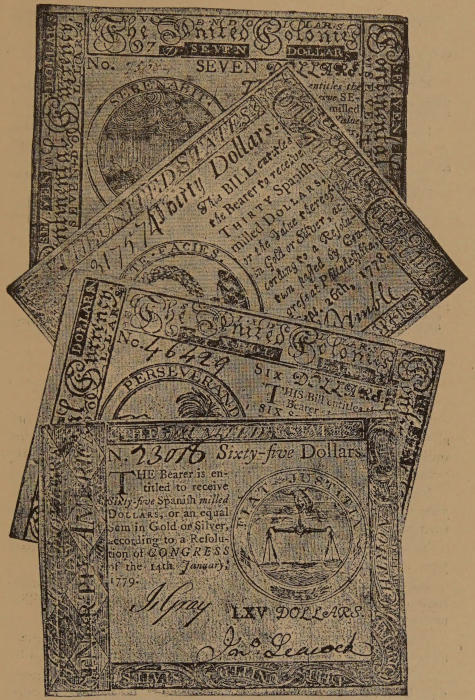
FAC-SIMILE REPRODUCTIONS OF CONTINENTAL CURRENCY.
Trade-Dollars Coined, Exported, Imported, Melted, and Redeemed
(Act of March 3, 1887).
| Coined: |
|
|
|
| Mint at Philadelphia |
|
$5,107,024 |
|
| Mint at San Francisco |
|
26,647,000 |
|
| Mint at Carson |
|
4,211,400 |
|
|
|
|
$35,965,924 |
| Exported |
|
28,778,862 |
|
| Imported |
|
1,706,020 |
|
| Net export |
|
|
27,072,842 |
|
|
|
8,893,082 |
| Melted: |
|
|
|
| As bullion. |
{ Previous to Redemption Act |
$915,346 |
|
|
| { Excluded from redemption (mutilated pieces, etc.) |
4,113 |
|
|
|
|
919,459 |
|
| Redeemed. |
{ Mint at Philadelphia |
3,427,369 |
|
|
| { Mint at San Francisco |
764,263 |
|
|
| { Mint at New Orleans |
1,871 |
|
|
| { Assay office at New York |
3,495,533 |
|
|
|
Total redeemed |
|
7,689,036 |
|
|
Total melted |
|
|
8,608,495 |
| Not accounted for and not presented for redemption;
employed in the arts; specimen pieces in the hands of coin
collectors, carried out by emigrants, and in miscellaneous
deposits of coin remelted at mints, etc. |
$284,587 |
Gross Profits on Silver Coinage in 1887.
The seignorage or immediate gross profit on the coinage of
silver dollars—that is, the difference between the cost of the
bullion and the nominal value of the coins—during the fiscal
year 1887, was $7,923,558.61.
The seignorage on subsidiary coin manufactured during the
year was $31,704.94, of which $1,130.65 was gained from the
recoinage of old subsidiary coins in the Treasury.
The total seignorage on the silver coinage during the fiscal
year was $7,955,263.55.
As stated in last fiscal report, the balance of silver profits
remaining in the coinage mints on the 1st July, 1886,
amounted to $553,201.44.
Adding to this the seignorage of the year, the total gross
silver profits to be accounted for by the mints is $8,508,464.99.
Of this there was paid for expenses of distributing silver
coin $35,059.03, and reimbursed for wastage and loss on sale
of sweeps $20,294.88.
The seignorage on the coinage of silver at the mints of the
United States from July 1, 1878, to the close of the fiscal year
ended June 30, 1887, has amounted to $39,057,566.90.
Tabulated Statement of Expenditures of the Mint at Philadelphia, for the
Fiscal Year ended June 30, 1887.
| Items. |
Amount. |
| Acids |
$7,149.28 |
| Belting |
315.07 |
| Charcoal |
1,873.42 |
| Chemicals |
832.58 |
| Coal |
16,332.20 |
| Copper |
13,585.00 |
| Crucibles, covers, stirrers, and dippers |
3,712.72 |
| Dry goods |
1,198.97 |
| Fluxes |
3,560.91 |
| Freight and drayage |
252.12 |
| Gas |
4,098.78 |
| Gloves and gauntlets |
5,930.40 |
| Hardware |
957.01 |
| Ice |
613.45 |
| Iron and steel |
205.91 |
| Labor and repairs |
3,417.82 |
| Loss on sale of sweeps |
1,301.15 |
| Lumber |
2,109.74 |
| Machinery and appliances |
2,617.49 |
| Metal work and castings |
1,697.61 |
| Oil |
1,047.12 |
| Salt |
117.56 |
| Stationery, printing and binding |
773.42 |
| Sundries |
6,230.61 |
| Telegraphing |
28.87 |
| Washing |
42.67 |
| Wood |
5,432.62 |
| Zinc |
935.57 |
| Steam-power plant |
11,464.27 |
| Manufacture of 5-cent nickel blank |
19,498.50 |
| Total |
117,332.84 |
| Salaries |
40,665.69 |
| Wages of workmen |
426,593.93 |
| Aggregate |
581,597.46 |
Value of the Foreign Gold Coins Deposited at the United States Assay
Office at New York during the Year ended June 30, 1887.
| Countries of Coinage. |
Denominations of coin. |
Total of each denomination of coin. |
Total by countries of coinage. |
| Costa Rica |
Mixed |
257.56 |
$257.56 |
| France |
20 francs |
1,219,351.02 |
1,219,351.02 |
| Germany |
20 marks |
179,121.67 |
179,121.67 |
| Great Britain |
Sovereigns |
1,018,036.21 |
1,018,036.21 |
| Japan |
Yens |
18,608.37 |
18,608.37 |
| Mexico |
20 pesos |
388,668.88 |
|
| ” |
10 pesos |
1,341.64 |
|
| ” |
Doubloons |
1,178.60 |
391,189.12 |
| Russia |
5 roubles |
155,237.39 |
|
| ” |
Roubles |
2,596.80 |
|
| ” |
½ imperials |
577,223.34 |
735,057.53 |
| Peru |
20 soles |
999.82 |
999.82 |
| Spain |
Doubloons |
3,101,388.08 |
|
| ” |
Isabellines |
98,151.58 |
|
| ” |
25 pesetas |
957,276.17 |
|
| ” |
Mixed |
179,863.62 |
4,336,679.45 |
| U. S. Colombia |
Cinco pesos |
709.76 |
709.76 |
| Total |
|
$7,900,010.51 |
$7,900,010.51 |
The total value of both gold and silver deposited and purchased
at the mints of the United States during the fiscal year
1887, not including redeposits, was $115,979,991.62, and
including redeposits, $131,635,811.34.
The value of the gold and silver received at the mints and
assay offices during the fiscal year 1887, was greater than any
previous year since 1881.
Improvements made at the Philadelphia Mint in 1887, under the Supervision of Hon. Daniel M. Fox.
Impairment of the foundation of the old engine, together
with the requirement of increased power, at the mint at Philadelphia
led to a special appropriation by Act of Congress of
$54,639.20, in accordance with specifications for the renewal
of the steam motive plant and for its transfer from the centre
of the building to space newly provided near the northern
outer wall. The work, undertaken in July, was, by extraordinary
exertions on the part of all engaged, completed early
in September, with an interruption of less than two months
to the regular course of complete operations. Two new 150-horse-power
duplex steam-engines and one of 50-horse-power
have been erected in the north basement, along with three
tubular boilers, coal bunkers, etc.
By this important improvement in plant valuable space has
been secured in the centre basement and ground floor for
vaults and other necessities.
The number of assays made during the year was some
66,000, of which 48,000 were silver and 18,000 gold.
The melter and refiner of the mint operated upon a larger
quantity of bullion than in any previous year in the history of
the institution. The operations by this officer may be stated
as follows:
|
Ounces. |
| Gold deposits |
409,326 |
| Silver deposits |
44,239,881 |
| Parted and refined |
721,765 |
As this bullion is handled more than sixteen times in the
processes of melting and preparation for coinage or for manufacture
of fine bars, the combined operations represent a
single handling of nearly 25,000 tons.
The operations of the coiner’s department may be stated as
follows:
|
Ounces. |
| Gold |
13,574 |
| Silver |
42,924,485 |
| Minor coinage metal |
5,588,897 |
| Total |
48,526,956 |
The total coinage was $23,277,600.80, the total number of
pieces being 81,532,391.
In addition to the coinage executed during the year, gold
and silver bars were manufactured as follows:
| Gold |
$58,188,953.66 |
| Silver |
6,481,611.25 |
| Total |
$64,670,564.91 |
Gold and Silver Bullion in the Mints and Assay Offices July 1, 1887.
| Metal. |
Cost. |
| Gold |
$85,512,270 |
| Silver |
10,455,650 |
| Total |
$95,967,920 |
Total Metallic Stock in the United States July 1, 1887, Coin and Bullion
included.
|
Value. |
| Gold |
$654,520,335 |
| Silver |
352,993,566 |
| Total |
$1,007,513,901 |
At the beginning of the fiscal year 1887 there was on hand
at the mints at Philadelphia, New Orleans and San Francisco,
silver bullion purchased for the silver dollar coinage amounting
to $2,960,969.02. There was delivered at the mints on
purchases of all kinds during the year, as above, 29,433,342.27
standard ounces, at a cost of $25,988,620.46, making the
total amount of silver available during the fiscal year for the
silver dollar coinage 32,691,837.93 standard ounces, costing
$28,949,589.48.
The price paid by this Bureau on November 1, 1887, for
silver purchases for the silver dollar coinage was $0.9580.80
per ounce fine.
The production of silver, notwithstanding the large depreciation
in the market value of that metal, has steadily increased
from $115,000,000 in 1883 to $130,000,000 in 1886.
The production of the world for the calendar years 1883,
1884, 1885 and 1886 is exhibited in the following table:
World’s Production of Gold and Silver.
| Calendar Years. |
Gold. |
Silver. |
| Kilograms. |
Value.[23] |
Kilograms. |
Value.[24] |
| 1883 |
143,533 |
$95,392,000 |
2,769,197 |
$115,088,000 |
| 1884 |
153,017 |
101,694,000 |
2,804,725 |
116,564,000 |
| 1885 |
154,942 |
102,975,000 |
3,062,009 |
127,257,000 |
| 1886 |
147,097 |
97,761,000 |
3,137,175 |
130,383,000 |
The United States still maintains first rank among the
nations of the world as the largest producer of the precious
metals, having produced during the calendar year 1886 gold
and silver of the coining value of $86,000,000. Mexico
retains second rank, with a production of $33,614,000, of
which $33,000,000 was silver. Australia has a production of
$27,647,000, of which $26,425,000 was gold. Russia is
credited with a production of $21,046,000, of which $20,518,000
was gold.
Circulation of Standard Silver Dollars at the end of each six months, from
July 1, 1885, to July 1, 1887, and on October 1, 1887.
| Period. |
Total coinage. |
In the Treasury. |
In circulation. |
| Held for payments of certificates outstanding. |
Held in excess of certificates outstanding. |
| July 1, 1885 |
$203,884,381 |
$101,530,946 |
$63,882,166 |
$38,471,269 |
| January 1, 1886 |
218,259,761 |
93,179,465 |
72,538,725 |
52,541,571 |
| July 1, 1886 |
233,723,286 |
88,116,225 |
93,137,341 |
52,469,720 |
| January 1, 1887 |
249,683,647 |
117,246,670 |
71,259,568 |
61,177,409 |
| July 1, 1887 |
266,990,117 |
142,118,017 |
69,365,953 |
55,506,147 |
| October 1, 1887 |
273,660,157 |
154,354,826 |
58,688,970 |
60,616,361 |
Appropriations for the support of Mints and Assay Offices for the fiscal
year 1888.
| Institutions. |
Salaries. |
Wages of workmen. |
Contingent expenses. |
Repairs of buildings. |
Total. |
| Coinage mints. |
|
|
|
|
|
| Philadelphia |
$41,550 |
$293,000 |
$100,000 |
|
$434,550 |
| San Francisco |
41,900 |
170,000 |
40,000 |
|
251,900 |
| Carson |
29,550 |
60,000 |
25,000 |
|
114,550 |
| New Orleans |
31,950 |
74,000 |
35,000 |
|
140,950 |
| Assay offices. |
|
|
|
|
|
| New York |
39,250 |
25,000 |
10,000 |
|
74,250 |
| Denver |
10,950 |
14,000 |
6,000 |
$2,000 |
32,950 |
| Helena |
7,700 |
12,000 |
6,000 |
|
25,700 |
| Boise City |
3,000 |
|
5,000 |
1,000 |
9,000 |
| Charlotte |
2,750 |
|
2,000 |
|
4,750 |
| Saint Louis |
3,500 |
|
2,400 |
|
5,900 |
| Total |
$212,100 |
$648,000 |
$231,400 |
$3,000 |
$1,094,500 |
Comparison of expenditures, years 1886 and 1887.
| Appropriations. |
1886. |
1887. |
| Salaries |
$ 189,331.48 |
$192,907.13 |
| Wages of workmen |
593,865.07 |
601,787.25 |
| Contingent expenses |
164,183.47 |
[25]193,704.93 |
| Standard silver dollar |
119,976.00 |
200,189.02 |
| Total |
$1,067,356.02 |
$1,188,588.33 |
Production in round numbers of precious metals in United States for 1886.
| State or Territory. |
Gold. |
Silver. |
Total. |
| Alaska |
$446,000 |
$2,000 |
$448,000 |
| Arizona |
1,110,000 |
3,400,000 |
4,510,000 |
| California |
14,725,000 |
1,400,000 |
16,125,000 |
| Colorado |
4,450,000 |
16,000,000 |
20,450,000 |
| Dakota |
2,700,000 |
425,000 |
3,125,000 |
| Georgia |
152,500 |
1,000 |
153,500 |
| Idaho |
1,800,000 |
3,600,000 |
5,400,000 |
| Montana |
4,425,000 |
12,400,000 |
16,825,000 |
| Nevada |
3,090,000 |
5,000,000 |
8,090,000 |
| New Mexico |
400,000 |
2,300,000 |
2,700,000 |
| North Carolina |
175,000 |
3,000 |
178,000 |
| Oregon |
990,000 |
5,000 |
995,000 |
| South Carolina |
37,500 |
500 |
38,000 |
| Utah |
216,000 |
6,500,000 |
6,716,000 |
| Washington |
147,000 |
80,000 |
227,000 |
| Texas |
|
200,000 |
200,000 |
| Alabama, Tennessee, Virginia, Vermont, Michigan, and Wyoming |
5,000 |
5,000 |
10,000 |
| Total |
$34,869,000 |
$51,321,500 |
$86,190,500 |
Production of the United States from 1880 to 1886.
| Calendar Years. |
Gold. |
Silver. |
Total. |
| 1880 |
$36,000,000 |
$39,200,000 |
$75,200,000 |
| 1881 |
34,700,000 |
43,000,000 |
77,700,000 |
| 1882 |
32,500,000 |
46,800,000 |
79,300,000 |
| 1883 |
30,000,000 |
46,200,000 |
76,200,000 |
| 1884 |
30,800,000 |
48,800,000 |
79,600,000 |
| 1885 |
31,800,000 |
51,600,000 |
83,400,000 |
| 1886 |
35,000,000 |
51,000,000 |
86,000,000 |
Gold and silver product in the United States and amount coined in 1886.
| GOLD. |
| Value of the product of the mines, 1886 |
|
$98,000,000 |
| Coinage executed in 1886 |
$92,650,000 |
|
| Recoinage |
9,600,000 |
|
| Net coinage 1886 |
|
83,050,000 |
| Leaving new gold for employment in the arts |
|
$14,950,000 |
| SILVER. |
| Value of the product of the mines, 1886 |
|
$130,000,000 |
| Coinage executed in 1886 |
$124,670,000 |
|
| Recoinage |
13,950,000 |
|
| Net coinage 1886 |
|
110,720,000 |
| Leaving new silver for employment in the arts |
|
$19,280,000 |
Minor Coins Shipped to the Different States and Territories from the Mint
at Philadelphia during the Fiscal Year 1887.
| State or Territory. |
1-cent bronze. |
5-cent nickel. |
| Alabama |
$25.00 |
$5,375.00 |
| Arkansas |
20.00 |
890.00 |
| Arizona |
20.00 |
|
| California |
1,215.00 |
11,585.00 |
| Colorado |
105.00 |
6,090.00 |
| Connecticut |
6,230.00 |
6,010.00 |
| Delaware |
385.00 |
950.00 |
| District of Columbia |
200.00 |
300.00 |
| Dakota |
1,590.00 |
3,640.00 |
| Florida |
190.00 |
840.00 |
| Georgia |
490.00 |
3,020.00 |
| Indiana |
10,669.37 |
18,710.00 |
| Iowa |
8,330.00 |
11,970.00 |
| Illinois |
51,831.00 |
68,355.00 |
| Idaho |
|
80.00 |
| Kentucky |
1,775.00 |
12,950.00 |
| Kansas |
4,440.00 |
8,720.00 |
| Louisiana |
400.00 |
6,510.00 |
| Michigan |
17,840.00 |
11,786.00 |
| Massachusetts |
38,815.00 |
39,210.00 |
| Minnesota |
10,405.00 |
13,615.00 |
| Maine |
1,325.00 |
1,215.00 |
| Mississippi |
25.00 |
250.00 |
| Montana |
|
2,020.00 |
| Maryland |
14,270.00 |
22,070.00 |
| Missouri |
7,650.00 |
$49,490.00 |
| New York |
128,125.00 |
73,870.00 |
| North Carolina |
1,035.00 |
1,290.00 |
| New Jersey |
12,965.00 |
11,835.00 |
| New Hampshire |
800.00 |
2,600.00 |
| New Mexico |
|
400.00 |
| Nebraska |
2,710.00 |
14,865.00 |
| Ohio |
29,015.00 |
34,990.00 |
| Oregon |
20.00 |
3,510.00 |
| Pennsylvania |
25,509.00 |
45,045.00 |
| Rhode Island |
6,951.00 |
3,100.00 |
| South Carolina |
800.00 |
2,865.00 |
| Texas |
150.00 |
7,320.00 |
| Tennessee |
1,280.00 |
15,890.00 |
| Utah |
|
1,320.00 |
| Virginia |
3,080.00 |
5,540.00 |
| Vermont |
1,370.00 |
900.00 |
| West Virginia |
1,235.00 |
2,380.00 |
| Wisconsin |
7,230.00 |
10,755.00 |
| Washington Territory |
|
500.00 |
| Wyoming |
|
260.00 |
| Total |
$400,510.37 |
$544,686.00 |
Minor Coins Struck and Remelted from the Organization of the Mint, and
the Amount Outstanding June 30, 1887.
| Denomination. |
Coined. |
Remelted. |
Outstanding,
June 30, 1887. |
| Copper cents |
$1,562,887.44 |
$372,741.70 |
$1,190,145.74 |
| Copper half cents |
399,926.11 |
|
|
| Copper nickel cents |
2,007,720.00 |
735,616.30 |
1,272,103.70 |
| Bronze cents |
4,319,275.48 |
24,517.11 |
4,294,758.37 |
| Bronze 2-cent pieces |
912,020.00 |
292,128.08 |
619,891.92 |
| Nickel 3-cent pieces |
903,705.00 |
175,541.44 |
728,163.56 |
| Nickel 5-cent pieces |
8,691,671.75 |
61,934.00 |
8,629,737.75 |
| Total |
$18,437,205.78 |
$1,662,478.63 |
$16,734,801.04 |
On the 30th June, 1886, the amount of minor coin in the
Treasury was $377,814. Of this amount over $160,000
proved to be in 3-cent nickel pieces, for which there was no
demand, and over $60,000 in uncurrent minor coins of former
issues was transferred for recoinage, confined to 1-cent bronze
and 5-cent nickel pieces. The demand for 1-cent bronze and
5-cent nickel pieces, at first sudden, has since been urgent and
continuous; at times largely beyond the ability of the mint to
promptly meet.
Operations Fiscal Year, 1887.
| Bars manufactured: |
|
| Gold |
$58,188,953.66 |
| Silver |
6,481,611.25 |
| Total |
64,670,564.91 |
| Coinage executed: |
|
| Gold |
$22,393,279.00 |
| Silver |
34,366,483.75 |
| Minor |
943,650.65 |
| Total |
57,703,413.40 |
| Refinery earnings |
$143,258.52 |
Summary of the Operations of the Mints and Assay Offices. — TREASURY DEPARTMENT.
The value of the gold and silver deposited at the mints and
assay offices of the United States during the fiscal year 1887
was $131,635,811.34. This aggregate, however, but partially
measures the successive operations upon the bullion
represented by this value. For example, it may be interesting
to show the operations by the melters and refiners of the
four mints and of the assay office at New York, as measured
by the value of the bullion successively operated upon.
These may be stated as follows:
Bullion Operated upon by the Melters and Refiners, 1887.
| Metal. |
Standard ounces. |
Value. |
| Gold |
5,919,878 |
$110,137,265 |
| Silver |
70,764,794 |
82,344,487 |
| Total value |
|
$192,481,752 |
The operations of the coinage departments of the mints
were as follows:
Operations of Coinage Departments, 1887.
| Metal. |
Standard ounces. |
Value. |
| Gold |
2,632,005 |
$48,967,440 |
| Silver |
61,896,692 |
72,025,241 |
| Total value |
|
$120,992,681 |
The 1-cent and 2-cent bronze pieces were recoined into
1-cent bronze pieces, and the copper nickel 1-cent, and the
3-cent and 5-cent nickel pieces were used in the coinage of
new 5-cent nickel pieces.
Form and Location of the Moneys of the United States and the Bullion
awaiting Coinage in the Mints July 1, 1887.
[Exclusive of Minor Coin and Minor-Coinage Metal.]
|
In Treasury. |
In National Banks.[26] |
In other Banks and General Circulation. |
Total. |
| METALLIC. |
|
|
|
|
| Gold bullion |
$85,512,270 |
|
|
$85,512,270 |
| Silver bullion |
4,091,414 |
|
|
4,091,414 |
| Silver bullion (melted trade dollars) |
6,364,236 |
|
|
6,364,236 |
| Gold coin |
192,368,915 |
[27]$98,137,439 |
$278,501,711 |
569,008,065 |
| Silver dollar |
211,483,970 |
6,343,213 |
49,162,934 |
266,990,117 |
| Subsidiary silver coin |
26,977,493 |
2,813,138 |
45,757,168 |
75,547,799 |
| Total |
$526,798,298 |
$107,293,790 |
$373,421,813 |
$1,007,513,901 |
| REPRESENTATIVE. |
|
|
|
|
| Legal-tender notes |
[28]$28,783,796 |
$74,477,342 |
$243,419,878 |
$346,681,016 |
| Old demand notes |
|
|
57,130 |
57,130 |
| Certificates of deposit |
310,000 |
7,810,000 |
960,000 |
9,080,000 |
| Gold certificates |
30,261,380 |
54,274,940 |
36,950,497 |
121,486,817 |
| Silver certificates |
3,425,133 |
3,535,479 |
138,582,538 |
145,543,150 |
| National bank notes |
197,046 |
22,962,737 |
256,058,005 |
279,217,788 |
| Fractional paper currency |
2,366 |
564,266 |
6,380,332 |
6,946,964 |
| Total |
$62,979,721 |
$163,624,764 |
$682,408,380 |
$909,012,865 |
Gold and Silver Coin in the United States November 1, 1887.
| Date. |
Gold Coin. |
Silver Coin. |
Total Gold and Silver Coin. |
| Full Legal Tender. |
Subsidiary. |
Total Silver. |
| Last official statement July 1, 1887 |
$569,008,065 |
$266,990,117 |
$75,547,799 |
$342,537,916 |
$911,545,981 |
| Gain subsequent to above statement (estimate) |
5,919,808 |
10,120,040 |
210,387 |
10,330,427 |
16,250,235 |
| Estimate for November 1, 1887 |
$574,927,873 |
$277,110,157 |
$75,758,186 |
$352,868,343 |
$927,796,216 |
Estimate of Coin Circulation July 1, 1887.
| Items. |
Gold. |
Silver. |
Total. |
| Estimated circulation July 1, 1886 |
$548,320,031 |
$308,784,223 |
$857,104,254 |
| Coinage for fiscal year 1887 |
22,393,279 |
34,366,483 |
56,759,762 |
| Net imports |
2,311,739 |
409,151 |
2,720,890 |
| Total |
$573,025,049 |
$343,559,857 |
$916,584,906 |
| Less deposits of United States coin |
516,984 |
821,941 |
1,338,925 |
| Used in the arts |
3,500,000 |
200,000 |
3,700,000 |
| Total |
4,016,984 |
1,021,941 |
5,038,925 |
| Estimated circulation July 1, 1887 |
$569,008,065 |
$342,537,916 |
$911,545,981 |
Table showing the Total Paper and Specie Circulation in each of the
Principal Countries of the World, and the Amount of Specie in Bank
and National Treasuries, and the Amount of Active Circulation.
(Officially Reported in 1884.)
| Countries. |
Population. |
Total metallic and paper circulation. |
Amount of specie in national treasuries and banks. |
Active circulation. |
Per capita of active circulation. |
| United States |
50,155,783 |
$1,745,926,755 |
$534,033,074 |
$1,211,893,681 |
$24.16 |
| Great Britain and Ireland |
35,246,562 |
876,318,139 |
154,182,691 |
722,135,448 |
20.49 |
| Dominion of Canada, including Manitoba and Newfoundland |
4,506,563 |
59,596,084 |
9,111,148 |
50,484,936 |
11.22 |
| British India |
252,541,210 |
1,099,383,126 |
78,358,000 |
1,021,025,126 |
4.05 |
| Ceylon |
2,758,166 |
2,335,300 |
1,273,800 |
1,061,500 |
.38 |
| Australia, Tasmania, and New Zealand |
2,798,898 |
96,010,722 |
48,737,837 |
47,272,885 |
16.90 |
| Cape of Good Hope |
780,757 |
38,078,000 |
8,092,000 |
29,986,000 |
38.40 |
| France |
37,321,186 |
1,990,961,912 |
402,939,754 |
1,588,022,158 |
42.55 |
| Algiers |
2,867,626 |
27,567,000 |
5,564,476 |
22,002,524 |
7.67 |
| Guadeloupe |
185,460 |
1,627,750 |
564,935 |
1,062,815 |
5.73 |
| Belgium |
5,536,654 |
186,326,515 |
17,991,450 |
168,335,065 |
30.40 |
| Switzerland |
2,846,102 |
53,180,731 |
11,609,618 |
41,571,113 |
14.60 |
| Italy |
28,452,639 |
533,548,521 |
69,357,358 |
464,191,163 |
16.31 |
| Greece |
1,979,423 |
29,143,000 |
1,800,000 |
27,343,000 |
13.81 |
| Spain |
16,625,860 |
270,812,440 |
27,223,959 |
243,588,481 |
14.65 |
| Cuba |
1,394,516 |
73,043,543 |
14,181,243 |
58,862,300 |
42.21 |
| Luzon |
4,450,191 |
4,198,000 |
3,765,677 |
432,323 |
.10 |
| Portugal, including Azores and Madeira |
4,550,699 |
46,367,680 |
11,718,874 |
34,648,806 |
7.61 |
| Germany |
45,234,061 |
825,473,023 |
181,706,674 |
643,766,349 |
14.23 |
| Austria-Hungary |
35,839,428 |
431,646,314 |
98,131,401 |
333,514,913 |
9.31 |
| Sweden and Norway |
6,479,168 |
43,058,443 |
12,740,975 |
30,317,468 |
4.68 |
| Danish Kingdom |
2,096,400 |
39,228,000 |
14,070,000 |
25,158,000 |
12.00 |
| Netherlands |
4,061,580 |
163,847,949 |
55,114,112 |
108,733,837 |
26.77 |
| Russia |
98,323,000 |
646,431,794 |
124,008,153 |
522,423,641 |
5.31 |
| Turkey |
24,987,000 |
83,315,976 |
14,520,000 |
68,795,976 |
2.75 |
| Roumania |
5,376,000 |
27,372,383 |
3,995,298 |
23,377,085 |
4.35 |
| Mexico |
9,557,279 |
52,048,529 |
1,763,008 |
50,285,521 |
5.26 |
| Central America |
2,891,600 |
4,701,861 |
|
4,701,861 |
1.62 |
| Argentine Republic |
2,540,000 |
71,371,850 |
14,196,461 |
57,175,389 |
22.51 |
| Colombia |
3,000,000 |
5,097,830 |
200,000 |
4,897,830 |
1.63 |
| Brazil |
11,108,291 |
139,871,255 |
|
139,871,255 |
12.59 |
| Peru |
3,050,000 |
14,980,820 |
1,882,018 |
13,098,802 |
4.29 |
| Venezuela |
2,675,245 |
2,682,700 |
|
2,682,700 |
1.00 |
| Chili |
2,420,500 |
32,555,341 |
2,398,000 |
30,157,341 |
12.45 |
| Bolivia |
2,325,000 |
6,908,533 |
443,597 |
6,464,936 |
2.78 |
| Uruguay |
438,245 |
11,587,000 |
4,601,000 |
6,986,000 |
15.94 |
| Hayti |
572,000 |
4,780,000 |
|
4,780,000 |
8.35 |
| Japan |
36,700,110 |
248,744,805 |
28,486,973 |
220,257,832 |
6.00 |
| Hawaiian Islands |
66,895 |
1,834,900 |
808,200 |
1,026,700 |
15.35 |
|
|
9,991,964,524 |
1,959,571,764 |
8,032,392,760 |
|
World’s Coinage.
| Calendar years. |
Gold. |
Silver. |
| 1884 |
$99,432,795 |
$95,832,084 |
| 1885 |
94,728,008 |
105,105,299 |
| 1886 |
92,653,400 |
124,678,678 |
The value of the United States gold coin deposited for recoinage,
principally by the Treasurer of the United States,
was $516,984.63, against $393,545.28 in the preceding year.
In addition to the gold bullion both of domestic and foreign
production, and the foreign and domestic gold coin deposited,
old material in the form of jewelry, bars, old plate, etc., was
received containing gold of the value of $2,265,219.85.
The marked increase in the deposits of gold was at the
assay office at New York, the value of the foreign gold bullion
and coin deposited at that institution during the year being
$30,621,006.95, exclusive of fine bars of its own manufacture,
of the value of $7,933,743.98, imported and re-deposited.
The value of the foreign gold bullion deposited was
$22,571,328.70, against $4,317,068.27 in 1886.
The value of the foreign gold coin received and melted was
$9,896,512.28, against $5,673,565.04 in the year preceding.
The value of the total deposits of gold during the fiscal
year 1887, including all re-deposits as above cited, was
$83,416,779.40, against $49,606,534.65 in 1886, an excess
in the year 1887 of $33,810,244.75.
The value of silver bullion of foreign extraction deposited
at the mints during the year 1887 was $1,457,406.01.
The value of foreign silver coin deposited during the year
was $350,598.86, against $812,664.50 in the preceding year.
The value of the United States silver coin deposited (calculated
at the coining rate in silver dollars), not including trade-dollars,
was $768,739.32, most of which consisted of worn
and uncurrent silver coins transferred from the Treasury of
the United States for recoinage.
Trade-dollars were received mostly by transfer from the
Treasury of the United States and melted. The bullion contained
5,837,791.87 standard ounces, of the coinage value in
standard silver dollars of $6,793,066.89.
Earnings and Expenditures of the Mints and Assay
Offices.
The total earnings amounted to $8,842,819.70, and the
total expenditures and losses of all kinds to $1,437,442.95.
The profits from operations on bullion during the past year
amounted to the large sum of $7,405,386.75.
A large portion of these earnings consisted of seignorage or
profits on the manufacture of silver and minor coins.
Highest and lowest prices of Gold in New York.
Each month in 1862-1878.
| Month. |
1862. |
1863. |
1864. |
1865. |
1866. |
1867. |
|
H. |
L. |
H. |
L. |
H. |
L. |
H. |
L. |
H. |
L. |
H. |
L. |
| January |
103¾ |
101¾ |
160¾ |
133⅝ |
159⅜ |
151½ |
234⅜ |
197¼ |
144¼ |
136¾ |
137⅞ |
132⅛ |
| February |
104¾ |
102⅛ |
172½ |
152½ |
161 |
157⅛ |
216¾ |
196⅜ |
140⅝ |
135¾ |
140⅜ |
135⅛ |
| March |
102½ |
101⅛ |
171¾ |
139 |
169¾ |
159 |
201 |
148⅛ |
136½ |
124⅞ |
140⅜ |
133⅝ |
| April |
102¼ |
101½ |
157⅞ |
145½ |
184¾ |
166¼ |
154½ |
143½ |
129½ |
125¼ |
141⅝ |
132⅝ |
| May |
104⅛ |
102⅛ |
154¾ |
143½ |
190 |
168 |
145⅛ |
128½ |
141½ |
125⅛ |
138⅞ |
135 |
| June |
109½ |
103½ |
148⅜ |
140½ |
250 |
193 |
147⅝ |
135¼ |
167¾ |
137½ |
138¾ |
136⅜ |
| July |
120⅛ |
108¾ |
145 |
123¼ |
285 |
222 |
146⅛ |
138⅝ |
155¾ |
147 |
140⅝ |
138 |
| August |
116¼ |
112½ |
129¾ |
122⅛ |
261¾ |
231½ |
145⅛ |
140¼ |
152⅛ |
146½ |
142½ |
139⅞ |
| September |
124 |
116½ |
143⅛ |
126⅞ |
254½ |
191 |
145 |
142⅝ |
147⅛ |
143½ |
146⅜ |
141 |
| October |
133½ |
122 |
153¾ |
140⅜ |
227¾ |
189 |
149 |
144⅛ |
154⅜ |
145½ |
145⅝ |
140¼ |
| November |
133¼ |
129 |
154 |
143 |
260 |
210 |
148¾ |
145½ |
148⅝ |
137½ |
141½ |
138½ |
| December |
134 |
128½ |
152¾ |
148½ |
243 |
212¾ |
148½ |
144½ |
141¾ |
131¼ |
137⅞ |
133 |
| Year |
134 |
101⅛ |
172½ |
122⅛ |
285 |
151½ |
234⅜ |
128½ |
167¾ |
125⅛ |
146⅜ |
132⅛ |
| Month. |
1868. |
1869. |
1870. |
1871. |
1872. |
1873. |
|
H. |
L. |
H. |
L. |
H. |
L. |
H. |
L. |
H. |
L. |
H. |
L. |
| January |
142¼ |
133¼ |
136⅝ |
134⅝ |
123¼ |
119⅜ |
111¼ |
110½ |
110⅛ |
108½ |
114¼ |
111⅝ |
| February |
144 |
139¾ |
136¼ |
130⅞ |
121½ |
115⅛ |
112¼ |
110¾ |
111 |
109½ |
115⅛ |
112⅞ |
| March |
141¼ |
137⅞ |
132½ |
130⅜ |
116⅜ |
110¼ |
111⅝ |
110⅛ |
110⅝ |
109¾ |
118½ |
114⅝ |
| April |
140⅜ |
137¾ |
134⅝ |
131⅜ |
115⅜ |
111½ |
111¾ |
110⅛ |
113¼ |
109⅞ |
119⅛ |
116¾ |
| May |
140½ |
139⅛ |
144¾ |
134½ |
115½ |
113¾ |
112¼ |
111 |
114⅜ |
112⅛ |
118⅝ |
116⅝ |
| June |
141¼ |
139⅜ |
139⅝ |
136½ |
114¾ |
110⅞ |
113⅛ |
111¾ |
114¾ |
113 |
118¼ |
115 |
| July |
145¼ |
143⅛ |
137¾ |
134¼ |
122¾ |
111⅛ |
113¾ |
111¾ |
115¼ |
113½ |
116⅜ |
115 |
| August |
150 |
143½ |
136½ |
131⅜ |
122 |
114¾ |
113⅛ |
111⅝ |
115⅝ |
112⅛ |
116¼ |
114⅜ |
| September |
145⅛ |
141⅛ |
162½ |
129¾ |
116¾ |
112¼ |
115⅜ |
112¾ |
115⅛ |
112⅝ |
116⅛ |
110⅞ |
| October |
140½ |
133¾ |
132 |
128¼ |
113¾ |
111⅛ |
115 |
111½ |
115¼ |
112¼ |
111¼ |
107¾ |
| November |
137 |
132 |
128⅜ |
121⅛ |
113¾ |
110 |
112⅜ |
110⅜ |
114¼ |
111⅜ |
110½ |
106⅛ |
| December |
136¾ |
134⅜ |
124 |
119½ |
111⅜ |
110⅜ |
110¼ |
108⅜ |
113½ |
111⅜ |
112⅝ |
108⅜ |
| Year |
150 |
132 |
162½ |
119½ |
123¼ |
110 |
115⅜ |
108⅜ |
115⅝ |
108½ |
119 |
106⅛ |
| Month. |
1874. |
1875. |
1876. |
1877. |
1878. |
|
|
H. |
L. |
H. |
L. |
H. |
L. |
H. |
L. |
H. |
L. |
|
|
| January |
112⅛ |
110⅛ |
113⅜ |
111¾ |
113¼ |
112⅜ |
107⅛ |
105¼ |
102⅞ |
101¼ |
|
|
| February |
113 |
111⅜ |
115⅜ |
113¼ |
114⅛ |
112¾ |
106⅛ |
104⅝ |
102⅜ |
101⅝ |
|
|
| March |
113⅞ |
111¼ |
117 |
114⅜ |
115 |
113¾ |
105⅜ |
104¼ |
102 |
100¾ |
|
|
| April |
114⅜ |
111¾ |
115½ |
114 |
113⅞ |
112½ |
107⅞ |
104¾ |
101¼ |
100⅛ |
|
|
| May |
113⅛ |
111⅞ |
116⅜ |
115 |
113¼ |
112¼ |
107⅜ |
106¼ |
101¼ |
100⅜ |
|
|
| June |
112¼ |
110½ |
117½ |
116¼ |
113 |
111⅞ |
106⅜ |
104¾ |
101 |
100⅝ |
|
|
| July |
110⅞ |
109 |
117¼ |
111¾ |
112⅜ |
111⅜ |
106⅛ |
105⅛ |
100¾ |
100⅜ |
|
|
| August |
110¼ |
109¼ |
114¾ |
112⅝ |
112⅛ |
109¾ |
105½ |
103⅞ |
100¾ |
100½ |
|
|
| September |
110¼ |
109⅜ |
117⅜ |
113¾ |
110⅜ |
109¼ |
104 |
102⅞ |
100½ |
100⅛ |
|
|
| October |
110⅜ |
109¾ |
117⅝ |
114½ |
113¼ |
108⅞ |
103⅜ |
102½ |
100⅜ |
100¼ |
|
|
| November |
112⅜ |
110 |
116⅜ |
114⅛ |
110⅛ |
108⅛ |
103⅜ |
102½ |
100½ |
100⅛ |
|
|
| December |
112⅜ |
110½ |
115¼ |
112⅝ |
109 |
107 |
103⅜ |
102½ |
100½ |
100 |
|
|
| Year |
114⅜ |
109 |
117⅝ |
111¾ |
115 |
107 |
107⅞ |
102½ |
102⅞ |
100 |
|
|
Note.—Specie payment resumed January 1, 1879, after a suspension of nearly 18 years.
Latest official estimate of the values of foreign coins in the United States, January, 1887.
| Country. |
Standard. |
Monetary Unit. |
Standard. |
Value in U. S. Money. |
Standard Coin. |
| Argentine Republic |
Double |
Peso |
Gold and silver |
96.5 |
⅟₂₀, ⅒, ⅕, ½ and 1 peso, ½ argentine. |
| Austria |
S. silver |
Florin |
Silver |
35.9 |
|
| Belgium |
Double |
Franc |
Gold and silver |
19.3 |
5, 10 and 20 francs. |
| Bolivia |
S. silver |
Boliviano |
Silver |
72.7 |
Boliviano. |
| Brazil |
S. gold |
Milreis of 1000 reis |
Gold |
54.6 |
|
| British Possessions in N. A. |
|
Dollar |
Gold |
$1.00 |
|
| Chili |
Double |
Peso |
Gold and silver |
91.2 |
Condor, doubloon and escudo. |
| Cuba |
Double |
Peso |
Gold and silver |
93.2 |
⅟₁₆, ⅛, ¼, ½ and 1 doubloon. |
| Denmark |
S. gold |
Crown |
Gold |
26.8 |
10 and 20 crowns. |
| Ecuador |
S. silver |
Peso |
Silver |
72.7 |
Peso. |
| Egypt |
S. gold |
Piaster |
Gold |
04.943 |
5, 10, 25, 50 and 100 piasters. |
| France |
Double |
Franc |
Gold and silver |
19.3 |
5,10 and 20 francs. |
| German Empire |
S. gold |
Marc |
Gold |
23.8 |
5, 10 and 20 marks. |
| Great Britain |
S. gold |
Pound sterling |
Gold |
4.86.6½ |
½ sovereign and sovereign. |
| Greece |
Double |
Drachma |
Gold and silver |
19.3 |
5, 10, 20, 50 and 100 drachmas. |
| Hayti |
Double |
Gourde |
Gold and silver |
96.5 |
1, 2, 5 and 10 gourdes. |
| India |
S. silver |
Rupee of 16 annas |
Silver |
34.6 |
|
| Italy |
Double |
Lira |
Gold and silver |
19.3 |
5, 10, 20, 50 and 100 lire. |
| Japan |
Double |
Yen |
Silver |
78.4 |
1, 2, 5, 10 and 20 yen, gold and silver yen. |
| Liberia |
S. gold |
Dollar |
Gold |
1.00 |
|
| Mexico |
S. silver |
Dollar |
Silver |
07.9 |
Peso or dollar, 5, 10, 25 and 50 centavo. |
| Netherlands |
Double |
Florin |
Gold and silver |
40.2 |
|
| Norway |
S. gold |
Crown |
Gold |
26.8 |
10 and 20 crowns. |
| Peru |
S. silver |
Sol |
Silver |
72.7 |
Sol. |
| Portugal |
S. gold |
Milreis of 1000 reis |
Gold |
1.08 |
2, 5 and 10 milreis. |
| Russia |
S. silver |
Rouble of 100 copecks |
Silver |
58.2 |
¼, ½ and 1 rouble. |
| Spain |
Double |
Peseta of 100 centimes |
Gold and silver |
19.3 |
5, 10, 20, 50 and 100 pesetas. |
| Sweden |
S. gold |
Crown. |
Gold |
26.8 |
10 and 20 crowns. |
| Switzerland |
Double |
Franc. |
Gold and silver |
19.3 |
5, 10 and 20 francs. |
| Tripoli |
S. silver |
Mahbub of 20 piasters |
Silver |
65.6 |
|
| Turkey |
S. gold |
Piaster. |
Gold |
04.4 |
25, 50, 100, 250, 500 piasters. |
| United States of Colombia |
S. silver |
Peso. |
Silver |
72.7 |
Peso. |
| Venezuela |
Double |
Bolivar. |
Gold and silver |
19.3 |
5, 10, 20, 50 and 100 bolivar. |
Note.—The “standard” of a given country is indicated as follows,
namely: Double, where its standard silver coins are unlimited
legal tender, the same as its gold coins; S. gold or S.
silver, as its standard coins of one or the other metal are unlimited
legal tender. The par of exchange of the monetary unit of a country with
a single gold, or a double, standard is fixed at the value of the gold
unit as compared with the United States gold unit. In the case of a
country with a single silver standard, the par of exchange is computed
at the mean price of silver in the London market for a period commencing
October 1 and ending December 26, 1886, as per daily cable dispatches to
the Bureau of the Mint.
Washington, D. C., January 1, 1887.
Values of Foreign Coins.
In accordance with the provisions of section 3564 of the
Revised Statutes of the United States, the value of the standard
coins of the various nations of the world were estimated
by the Mint Bureau and proclaimed by the Department on
January 1, 1887.
These estimates, to be followed at the custom-houses of the
United States on and after January 1, 1887, in determining
the values of invoices expressed in terms of foreign units of
account, are shown in the following table (see opposite page):
The average price of silver in London for the period embraced
between October 1 and December 26, 1886, was
45.862 pence per ounce, British standard, equivalent at the
par of exchange to $1.00535 per ounce fine.
The corresponding value of silver for the three months ending
December 24, 1885, was $1.038141 per ounce fine, a decline
of $0.03279, a little over three cents a fine ounce.
The depression in the price of silver occasioned a change in
the estimated values given the following coins:
Changes in Values of Foreign Coins from 1886 to 1887.
| Coins. |
Value, Jan. 1, 1886. |
Value, Jan. 1, 1887. |
| Florin of Austria |
$0.371 |
$0.359 |
| Boliviano of Bolivia |
.751 |
.727 |
| Sucre of Ecuador |
.751 |
.727 |
| Rupee of India |
.357 |
.346 |
| Yen of Japan |
.810 |
.784 |
| Dollar of Mexico |
.816 |
.790 |
| Sol of Peru |
.751 |
.727 |
| Rouble of Russia |
.601 |
.582 |
| Mahbub of Tripoli |
.677 |
.656 |
| Peso of United States of Colombia |
.751 |
.727 |
The monetary unit of Egypt has been nominally changed
from the piaster to the pound containing one hundred
piasters.
The monetary unit of Ecuador also has been nominally
changed from the peso to the sucre, but with no change as to
weight or fineness.
In regard to Japan, in the table for 1887 the values of the
gold and silver yen were estimated separately, for the reason
that while by law the standard of Japan is gold, silver is practically
the standard of value, and invoices of merchandise
from Japan are generally in terms of the silver yen.
Aggregate Issues of Paper Money in War times.
The following table exhibits the amount per capita issued of the Continental money,
the French assignats, the Confederate currency, and the legal-tender greenbacks and
National bank notes of the United States.
|
Population. |
|
|
| Continental money. |
3,000,000 in 1780 |
|
$119.84 |
| French assignats. |
26,500,000 (France in 1790) |
|
343.98 |
| Confederate curr’cy. |
9,103,332 (11 Confederate States, 1860) |
|
71.89 |
| Greenbacks and national bank notes. |
31,443,321 (United States in 1860). |
$750,820,228 |
23.87 |
Refining (by acids), fiscal year 1887.
| Mint or Assay Office. |
Gross ounces. |
Gold. |
Silver. |
Total value. |
| Standard ounces. |
Value. |
Standard ounces. |
Value. |
| Philadelphia. |
721,765 |
190,539 |
$3,554,912 |
553,437 |
$643,999 |
$4,188,911 |
| San Francisco. |
1,506,217 |
365,970 |
6,808,744 |
1,248,071 |
1,452,300 |
8,261,044 |
| Carson. |
45,447 |
3,606 |
67,088 |
45,665 |
53,137 |
120,225 |
| New Orleans. |
15,544 |
4,840 |
90,046 |
11,167 |
12,994 |
103,040 |
| New York. |
3,822,148 |
764,676 |
14,226,530 |
3,005,812 |
3,497,672 |
17,724,202 |
| Total. |
6,111,121 |
1,329,631 |
$24,737,320 |
4,864,152 |
$5,660,102 |
$30,397,422 |
Value in United States Money, of One Ounce Troy of Gold, at different
Degrees of Fineness.
| 500 |
Fine |
$10.33.6 |
| 510 |
” |
10.54.3 |
| 520 |
” |
10.74.9 |
| 530 |
” |
10.95.6 |
| 540 |
” |
11.16.3 |
| 550 |
” |
11.36.9 |
| 560 |
” |
11.57.6 |
| 570 |
” |
11.78.3 |
| 580 |
” |
11.99. |
| 590 |
” |
12.19.6 |
| 600 |
” |
12.40.3 |
| 610 |
” |
12.61. |
| 620 |
” |
12.81.7 |
| 630 |
” |
13.02.3 |
| 640 |
” |
13.23. |
| 650 |
” |
13.43.7 |
| 660 |
” |
13.64.3 |
| 670 |
” |
13.85. |
| 680 |
” |
14.05.7 |
| 690 |
” |
14.26.3 |
| 700 |
” |
14.47. |
| 710 |
” |
14.67.7 |
| 720 |
” |
14.88.4 |
| 730 |
” |
15.09.4 |
| 740 |
” |
15.28.7 |
| 750 |
” |
15.50.4 |
| 760 |
” |
15.71.1 |
| 770 |
” |
15.91.7 |
| 780 |
” |
16.12.4 |
| 790 |
” |
16.33.1 |
| 800 |
” |
16.53.8 |
| 810 |
” |
16.74.4 |
| 820 |
” |
16.95.1 |
| 830 |
” |
17.15.8 |
| 840 |
” |
17.36.4 |
| 850 |
” |
17.57.1 |
| 860 |
” |
17.77.8 |
| 870 |
” |
17.98.4 |
| 880 |
” |
18.19.1 |
| 890 |
” |
18.39.8 |
| 900 |
” |
18.60.5 |
| 910 |
” |
18.81.1 |
| 920 |
” |
19.01.8 |
| 930 |
” |
19.22.5 |
| 940 |
” |
19.43.1 |
| 950 |
” |
19.63.8 |
| 960 |
” |
19.84.5 |
| 970 |
” |
20.05.2 |
| 980 |
” |
20.25.8 |
| 990 |
” |
20.46.5 |
| 1000 |
” |
20.67.2 |
N. B.—When there is an intermediate degree of fineness, a short calculation is necessary.
For every one-thousandth, add 2.07 cents per ounce for gold. Thus, one ounce of
gold at 992 fine—$20.50.6
Comparison of Expressing the Fineness of Gold in Thousandths, and in
Carats.[29]
| 500 |
Fine |
12.00 |
Carats |
| 510 |
” |
12.08 |
” |
| 520 |
” |
12.15 |
” |
| 530 |
” |
12.23 |
” |
| 540 |
” |
12.31 |
” |
| 550 |
” |
13.07 |
” |
| 560 |
” |
13.14 |
” |
| 570 |
” |
13.22 |
” |
| 580 |
” |
13.29 |
” |
| 590 |
” |
14.05 |
” |
| 600 |
” |
14.13 |
” |
| 610 |
” |
14.20 |
” |
| 620 |
” |
14.28 |
” |
| 630 |
” |
15.04 |
” |
| 640 |
” |
15.11 |
” |
| 650 |
” |
15.19 |
” |
| 660 |
” |
15.27 |
” |
| 670 |
” |
16.03 |
” |
| 680 |
” |
16.10 |
” |
| 690 |
” |
16.18 |
” |
| 700 |
” |
16.25 |
” |
| 710 |
” |
17.01 |
” |
| 720 |
” |
17.09 |
” |
| 730 |
” |
17.17 |
” |
| 740 |
” |
17.24 |
” |
| 750 |
” |
18.00 |
” |
| 760 |
” |
18.08 |
” |
| 770 |
” |
18.15 |
” |
| 780 |
” |
18.23 |
” |
| 790 |
” |
18.31 |
” |
| 800 |
” |
19.07 |
” |
| 810 |
” |
19.14 |
” |
| 820 |
” |
19.22 |
” |
| 830 |
” |
19.29 |
” |
| 840 |
” |
20.05 |
” |
| 850 |
” |
20.13 |
” |
| 860 |
” |
20.20 |
” |
| 870 |
” |
20.28 |
” |
| 880 |
” |
21.04 |
” |
| 890 |
” |
21.11 |
” |
| 900 |
” |
21.19 |
” |
| 910 |
” |
21.27 |
” |
| 920 |
” |
22.02 |
” |
| 930 |
” |
22.10 |
” |
| 940 |
” |
22.18 |
” |
| 950 |
” |
22.25 |
” |
| 960 |
” |
23.01 |
” |
| 970 |
” |
23.09 |
” |
| 980 |
” |
23.17 |
” |
| 990 |
” |
23.24 |
” |
| 1000 |
” |
24.00 |
” |
GLOSSARY. Terms used in treating of Bullion, Mints, Coinage, and Money.
Assaying.—Chemical analysis of metals or ores. This term is employed
in reference to mints and coinage, refers particularly to the process
for determining the component parts and relative proportions of a mixed
alloy of gold and silver, or the various alloys used for the manufacture of
minor coins.
Refining.—Extract of base from precious metals; usually performed
by the aid of heat and oxidizing fluxes.
Parting.—The separation of gold and silver when the two metals compose
an alloy, either native or artificial, for the purpose of obtaining the
metals, respectively, in the form of fine bars. This is accomplished, first, by
dissolving the silver with acids and subsequently precipitating; or, second,
by converting silver into chloride by heat and chlorine gas, and then
reducing the chloride to a metallic state.
Alloying.—Compounding two or more metals together in suitable or
legal proportions for coinage. Gold and silver are alloyed with copper for
standard coins, and alloys are variously made of nickel and copper, or of
copper, tin, and zinc for minor coins.
Fine Bars.—Gold and silver bars resulting from the operations of parting
and refining. Bars containing 99 per cent. of pure metal are generally
considered as fine bars.
Unparted Bullion.—Gold containing silver or silver containing gold
which has not been subjected to the parting operation.
Amalgam.—Gold and silver extracted from ores or other substances by
the use of mercury and left in a porous or spongy condition, when the
mercury is removed by distillation.
Fineness.—A term indicating the proportion of pure metal contained
in a piece of gold or silver. Fineness is expressed in thousandths; that
is, pure metal is 1000. United States coin is ⁹⁰⁰⁄₁₀₀₀ fine, or decimally .900
fine. Fineness is estimated by jewelers and workers in the precious metals
by “carats,” pure metal being 24 carats. Thus 22 carats, the British
standard for gold coins, is ²²⁄₂₄, or decimally, 916⅔ fine.
Deposit—Melting.—The operation of melting a deposit of gold or
silver at the Mint to secure a homogeneity of metals, preliminary to taking
a sample for assaying.
Remedy of the Mint.—The legal variation allowed from the fineness
and weight prescribed by law for the coins.
Trial of the Pyx.—The annual test made by special commissioners
of the fineness and weight of coins reserved from each delivery of coin by
the coiner to the superintendent. These coins are known as Pyx coins,
because kept in a pyx or chest.
Refractory Bullion.—Gold or silver bullion which contains a small
percentage of lead, tin, or antimony, and which is therefore too hard or
brittle to roll, cut, or stamp with facility.
Wastage.—The amount of gold and silver lost in the processes which
these metals undergo preparatory to striking the coins. This “wastage”
by law must not exceed a certain percentage of the gross amount of metals
worked.
Sweepings.—The ashes, fluxes, crucibles, sweepings, and all other refuse
materials from rooms in which the metals are worked, containing a small
amount of gold and silver.
Standard.—The weight and fineness fixed by law for the coins; hence
the term “standard weight” or “standard fineness.”
Base Bullion.—Gold or silver bullion not fit for coinage purposes, by
reason of the presence of base metals, until refined.
Mint Mark.—The letter or mark on the coin, designating the mint at
which it was struck; as “S” for San Francisco, “C C” for Carson City,
“O” for New Orleans.[30]
Money of Account.—The ideal unit, or money term, in which accounts
are stated or transactions made, as the pound sterling of Great Britain, the
dollar of the United States, the franc of France, and the reichsmark of the
German Empire.
Coins of Standard Value.—In modern times a government first
establishes a money of account or ideal unit, and then fixes by law the
quantity of gold or silver which shall, in the form of a coin with unlimited
legal-tender power, represent that ideal unit. Such coins, with their multiples
and divisions, are termed “coins of standard value” or “standard
coins.”
Subsidiary Coins.—In the United States silver coins of less denomination
than the dollar, which have a nominal value exceeding their intrinsic
or bullion value, and limited as legal tender to sums not exceeding five
dollars.
Minor Coins.—Coins of small denominations used for change, and
struck from other metals than gold or silver.
Mint Prices of Gold and Silver (Coining Value).—The rate per
standard ounce at which the mint converts bullion into legal-tender coins.
The coining rate of an ounce of standard gold bullion, i. e., bullion ⁹⁰⁰⁄₁₀₀₀
fine in the United States is $18,604+. The coining rate of the silver
dollar of 412½ grains, discontinued by law April 1, 1873, was $1.16⁴⁄₁₁ per
standard ounce.
The Basis of the Money System of all civilized nations is gold or
silver, or both, in a ratio fixed by law. The relative valuation of the two
metals in the coins of nations using the double standard, is about one of
gold to fifteen and a half of silver.
Partial List of Medals in Copper-Bronzed, also, in Gold and
Silver, which may be obtained at the Mint.
|
Size. |
Price. |
| ARMY. |
| Washington before Boston |
42 |
$2.50 |
| Colonel William Washington, for Cowpens |
28 |
1.50 |
| Major-General Harrison, for the Thames |
40 |
1.50 |
| Major-General Scott, for Chippewa and Niagara |
40 |
1.50 |
| Major-General Gaines, for Fort Erie |
40 |
1.50 |
| Major-General Porter, for Chippewa, Niagara, and Erie |
40 |
1.50 |
| Major-General Macomb, Battle of Plattsburgh |
40 |
1.50 |
| Major-General Jackson, Battle of New Orleans |
40 |
1.50 |
| Major-General Taylor, Palo Alto |
40 |
1.50 |
| Major-General Taylor, for Monterey |
40 |
1.50 |
| Major-General Taylor, for Buena Vista |
56 |
3.00 |
| Major-General Scott, for Battles in Mexico |
56 |
3.00 |
| Major-General Grant |
64 |
8.00 |
| Colonel Lee, “Light-Horse Harry” |
29 |
1.50 |
| Count DeFleury, for Stony Point |
15 |
2.25 |
| NAVY. |
| John Paul Jones, for Serapis |
36 |
2.00 |
| Captain Hull, for Capture of Guerriere |
40 |
1.50 |
| Captain Jacob Jones, for Capture of the Frolic |
40 |
1.50 |
| Captain Decatur, for Capture of the Macedonian |
40 |
1.50 |
| Captain Bainbridge, for Capture of the Java |
40 |
1.50 |
| Captain Lawrence, for Capture of the Peacock |
40 |
1.50 |
| Captain Burrows, for Capture of the Boxer |
40 |
1.50 |
| Captain Perry, for Capture of British Fleet on Lake Erie |
40 |
1.50 |
| Captain Elliott, for Capture of British Fleet on Lake Erie |
40 |
1.50 |
| Captain Warrington, for Capture of the Epervier |
40 |
1.50 |
| Captain Blakely, for Capture of the Reindeer |
40 |
1.50 |
| Captain MacDonough, for Capture of the British Fleet on Lake Champlain |
40 |
1.50 |
| Captain Henley, Capture of British Fleet on Lake Champlain |
40 |
1.50 |
| Lieut. Cassin, Capture of British Fleet on Lake Champlain |
40 |
1.50 |
| Captain Biddle, for Capture of the Penguin |
40 |
1.50 |
| Captain Stewart, for Capture of the Cyane and Levant |
40 |
1.50 |
| Captain Edw. Preble before Tripoli |
40 |
1.50 |
| PRESIDENTIAL. |
| John Adams |
32 |
1.50 |
| Thomas Jefferson |
47 |
2.50 |
| James Madison |
40 |
1.50 |
| James Monroe |
40 |
1.50 |
| John Q. Adams |
40 |
1.50 |
| Andrew Jackson |
40 |
1.50 |
| Martin Van Buren |
40 |
1.50 |
| John Tyler |
40 |
1.50 |
| James K. Polk |
40 |
1.50 |
| Zachary Taylor |
40 |
1.50 |
| Millard Fillmore |
40 |
1.50 |
| Franklin Pierce |
40 |
1.50 |
| James Buchanan |
48 |
2.00 |
| Abraham Lincoln |
48 |
2.00 |
| Andrew Johnson |
48 |
2.00 |
| Ulysses S. Grant |
48 |
2.00 |
| Rutherford B. Hayes |
48 |
2.00 |
| James A. Garfield |
48 |
2.00 |
| Chester A. Arthur |
48 |
2.00 |
| SUB-NATIONAL MEDALS. |
| Captain Perry (State of Pennsylvania), for Capture of the British Fleet on Lake Erie |
40 |
1.50 |
| Pennsylvania Volunteers, Action on Lake Erie |
40 |
1.50 |
| Major-General Scott (Commonwealth of Virginia) |
56 |
3.00 |
| MISCELLANEOUS AMERICAN. |
| Professor Agassiz Medal |
30 |
1.50 |
| Colonel Armstrong, for Destruction of the Indian Village of Kittanning |
27 |
1.00 |
| Captains Creighton, Low, and Stouffer, Wreck of Steamer San Francisco |
47 |
2.00 |
| Captains Creighton, Low, and Stouffer, Wreck of Steamer San Francisco, by Congress |
50 |
3.00 |
| Cornelius Vanderbilt, by Congress |
48 |
2.50 |
| First Steam Coinage |
16 |
.25 |
| Commodore M. C. Perry, from Merchants of Boston |
40 |
2.00 |
| Pacific Railroad Medal |
29 |
1.25 |
| Emancipation Proclamation Medal |
29 |
1.00 |
| Cyrus W. Field, Atlantic Cable Medal |
64 |
8.00 |
| Dr. Joseph Pancoast |
48 |
3.00 |
| Grant Indian Peace Medal |
40 |
3.00 |
| Garfield Indian Peace Medal |
(oblong) |
2.00 |
| Arthur Indian Peace Medal |
” |
2.00 |
| “Let Us Have Peace” |
29 |
1.25 |
| Metis (Shipwreck) Medal |
42 |
1.50 |
| John Horn (Life Saving) Medal |
30 |
1.00 |
| U. S. Diplomatic Medal, July 4, 1776 |
45 |
2.00 |
| Valley Forge Centennial |
25 |
.50 |
| Great Seal Medal |
39 |
1.50 |
| DIRECTORS OF THE MINT. |
| David Rittenhouse |
28 |
1.25 |
| Robert M. Patterson |
42 |
1.50 |
| James Ross Snowden |
50 |
2.50 |
| James Pollock |
29 |
1.25 |
| H. R. Linderman |
50 |
2.00 |
| James P. Kimball |
|
|
| SUPERINTENDENTS. |
| A. Loudon Snowden |
50 |
2.00 |
| Daniel M. Fox |
|
|
| FINE GOLD MEDALS. (See Rule 3.) |
| Time Increases His Fame |
16 |
12.00 |
| James A. Garfield |
16 |
9.00 |
| Commencement of Cabinet |
12 |
6.25 |
| Washington and Jackson |
10 |
4.50 |
| Lincoln and Garfield |
10 |
4.50 |
| FINE SILVER MEDALS. (See Rule 3.) |
| Cabinet Medal |
37 |
6.00 |
| Presidency Relinquished |
25 |
3.00 |
| Allegiance Medal |
18 |
1.00 |
| Time Increases His Fame |
16 |
.75 |
| James A. Garfield |
16 |
.60 |
| Pennsylvania Bi-Centennial |
16 |
.50 |
| Commencement of Cabinet |
12 |
.35 |
| Washington and Jackson |
10 |
.25 |
| Washington and Lincoln |
10 |
.25 |
| Washington and Grant |
10 |
.25 |
| Washington Wreath |
10 |
.25 |
| Lincoln and Grant |
10 |
.25 |
| Lincoln Broken Column |
10 |
.25 |
| Lincoln and Garfield |
10 |
.25 |
| Valley Forge Centennial |
25 |
1.50 |
The diameter of the medals is expressed by numbers, each of which
indicates the sixteenth of an inch.
Medals struck to order in gold, silver, or bronze, from dies of public
institutions.
MEDALS AND CABINET COINS.
Mint of the United States.
Philadelphia, January, 1888.
Regulations.
1. The price of Medals, Proof Coins, Pattern Pieces, &c., shall be fixed
by the Superintendent of the Mint, with the approval of the Director.
2. No Coin or Pattern Piece shall be struck after the year of its date,
nor in any other metal or alloy than that in which the Coin was issued or
intended to be issued, except experimental pieces in Copper or other soft
metal to prove the dies, under the direction of the Superintendent. The
dies shall be defaced at the end of each year, and such impressions as the
Engraver may find necessary to take while preparing the dies shall be
destroyed in the presence of the Superintendent when the dies are finished.
3. When a Pattern Piece is adopted and used in the regular coinage in
the same year it shall then be issued as a proof, at a price near its current
value; or if it comes out early in the year, it will be placed in the regular
Proof Set. The Superintendent will furnish, without charge, on application
therefor, a Pattern Piece to any incorporated Numismatic Society in
the United States. In such cases, if the pattern is in Gold or Silver, the
value of the metal will be required.
4. The price of the regular Proof Set of Gold Coins will be Forty-three
Dollars; the Proof Set of Silver and Minor Coins, Three Dollars. Single
Gold Pieces, in proof, are sold at Twenty-five Cents each above their intrinsic
value. Silver Sets are not separated. Proof sets are furnished of the
current year only. The Mint has no Coins or Sets of back dates for sale.
5. The Coins of the United States are:—
| Gold. |
Silver. |
Copper-Nickel. |
| Double-Eagle, |
Dollar, |
Five Cents. |
| Eagle, |
Half-Dollar, |
Three Cents. |
| Half-Eagle, |
Quarter-Dollar, |
|
| Three-Dollar, |
Dime. |
Bronze. |
| Quarter-Eagle, |
|
One Cent. |
| Dollar. |
|
|
The coinage of the Silver Dollar of 412½ grains, the Five and Three-Cent
Silver Pieces and Bronze Two-Cent Pieces was discontinued in 1873,
but the Silver Dollar was restored by the Act of February 28, 1878.
All orders must be sent to Superintendent of the Mint at Philadelphia.
DANIEL M. FOX,
Superintendent.
NOTE TO THE VISITORS OF THE PHILADELPHIA MINT.
As there are many places of interest in “Penn’s Favorite City,” the publisher
of this work would respectfully suggest that visitors, who have the leisure, should see
some of the well-known institutions of “The City of Brotherly Love.” Among the rare
places of interest, after the United States Mint, is 1st.—THE NEW PUBLIC BUILDINGS
(in same square), known as the NEW CITY HALL, the Largest and Finest in the World,
surpassing even the Capitol at Washington. 2d.—FAIRMOUNT PARK, the largest and
most beautiful public pleasure ground in the United States, embracing nearly three
thousand acres, on both sides of the Schuylkill River, from Fairmount Water Works to
Indian Rock, on the romantic Wissahickon. 3d.—GIRARD COLLEGE, where eleven
hundred and fifty Orphan Boys are maintained, clothed and educated through the
bountiful munificence of Philadelphia’s great benefactor, Stephen Girard. 4th.—WANAMAKER’S
GREAT STORE, East of and almost adjoining the Mint. This
immense establishment (the largest of the kind in the World) has grown to such vast
proportions during the past decade that we feel compelled to give it a brief notice, as
it has become one of the features of our city, and an object of interest to our visitors.
The building itself is unique; it occupies an entire square, viz:—from Thirteenth to
Juniper and from Market to Chestnut Streets—entrance on each of the four streets.
The flooring space occupied in the interior, including first floor, basement and galleries,
embraces more than twelve acres, and all this immense space is occupied with such
goods as everybody, at some time in life, feels the necessity of purchasing. The general
arrangement and classification of goods from all nations (there being over fifty separate
and distinct departments), suggests a reproduction of the Main Building of our late
great Centennial Exposition, with the Department of Public Comfort added. One of
the great features of this Mammoth Bazaar is that visitors are made to feel at home,
every provision being made for their convenience. There are commodious Retiring
and Reading Rooms on either floor. One’s Satchel and Parcels are checked without cost,
and no one is importuned to purchase. Visitors will find it hard to resist the Tempting
Offers and Low Prices marked on the goods. 5th.—INDEPENDENCE HALL,
(The Nation’s Birth-place) Chestnut Street between Fifth and Sixth Streets; National
Museum, in same building, containing many interesting relics of the Revolution and
of Washington’s Camp Life; The Old Liberty Bell hanging in the hallway leading
to Independence Square, where the Declaration of Independence was read to the
people, July 4th, 1776. 6th.—ACADEMY OF FINE ARTS, Broad Street (west side)
between Arch and Race Streets, should be visited by all lovers of the Fine Arts.
7th.—The NEW MASONIC TEMPLE, Northeast corner Broad and Filbert Streets.
Visiting days every Thursday. 8th.—The NEW POST OFFICE and U. S. COURT
BUILDING. This is one of the finest buildings of the kind in the country, and well
worthy of a visit; also, the NEW “RECORD” BUILDING, adjoining. 9th.—The
BURIAL PLACES OF BENJAMIN and DEBORA FRANKLIN can be seen at South-east
corner Fifth and Arch Streets. 10th.—There are other notable places of interest
in the City Of “Brotherly Love,” among which may be mentioned CARPENTERS’
HALL, UNION LEAGUE, DEAF AND DUMB AND BLIND ASYLUMS, LAUREL
HILL CEMETERY, PENNSYLVANIA AND WILL’S HOSPITALS, and the hundred
and one other benevolent institutions for which Philadelphia is justly celebrated.
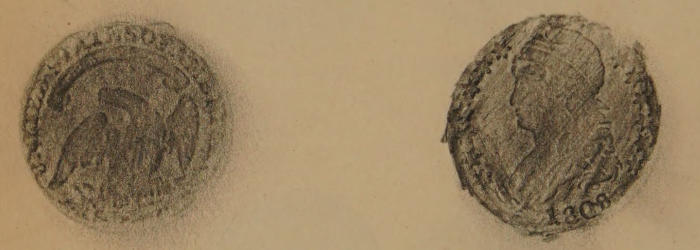
FOOTNOTES
THE REAL ESTATE TRUST COMPANY
OF PHILADELPHIA
1340 Chestnut Street.
Capital,—$500,000.
OFFICERS:
- FRANK K. HIPPLE, President.
- WILLIAM R. PHILLER, Secretary.
- WILLIAM F. NORTH, Treasurer.
- THOMAS B. PROSSER, Real Estate Officer.
DIRECTORS:
- FRANK K. HIPPLE,
- HENRY C. GIBSON,
- LEMUEL COFFIN,
- BEAUVEAU BORIE,
- WILLIAM M. SINGERLY,
- JOHN WANAMAKER,
- GEORGE PHILLER,
- EDWARD T. STEEL,
- CHARLES W. HENRY,
- JOHN F. BETZ,
- THOMAS DOLAN,
- R. DALE BENSON.
- GEORGE JUNKIN, Solicitor.
This Company transacts a general Real Estate business, acting as agent or attorney
for buying, holding, leasing and selling property in the City of Philadelphia and
its vicinity. Negotiates Mortgages and places Ground Rents.
Gives especial attention to the Renting of Properties and the Collection of Rents, to
the payment of Taxes and Water Rents, and to the making of needful repairs on
such properties; in all respects taking the same charge and management of, and giving
the same attention to, Real Estate as the owner could do.
Collects Ground Rents, Interest on Mortgages, Dividends and Income of all kinds
whatsoever.
Receives Deposits of Money, payable by Check on demand, and allows Interest
thereon. Issues Negotiable Certificates of Special Deposits bearing Interest.
Acts as Trustee, Guardian, Executor, Administrator, Assignee, Receiver, Committee,
Attorney, etc.
Receives and executes Trusts of every description, under the appointment of
Courts, Corporations and Individuals.
Becomes surety for the faithful performance of any Trust or Office; acts as Transfer
Agent or Registrar of Stocks and Bonds of Corporations or Municipalities.
All Trust Funds and Investments are kept separate and apart from those of the
Company.
Issues Policies of Title Insurance to Real Estate and Real Estate Securities, in Philadelphia
and adjoining counties, thereby affording absolute security to Purchasers
and their Heirs, at a nominal cost.
Also issues Policies of Special Insurance against Decedents’ Debts, Mechanics’ Liens,
Judgments, Old Ground Rents, etc.
Receives for safe-keeping Securities, Plate, Jewelry, Deeds, Mortgages, and other
Valuables, at reasonable rates.
Rents Safe Deposit Boxes in the Company’s Burglar-proof Vaults, affording security
against loss by Robbery, Fire or Accident. These Boxes are rented according to size
and location, at from Five to Fifty Dollars per annum.
Agents for the sale of the reliable Six Per Cent. Mortgages and Debentures of “The
New England Loan and Trust Co. of Des Moines, Iowa;” and of “The New England
Trust Co. of Kansas City, Missouri;” both Principal and Interest guaranteed, and
Interest payable semi-annually, by coupon, in either New York or Philadelphia.
WILLIAM GROVES. ALEXANDER WILSON. WILLIAM GROVES, Jr.
GROVES, WILSON & GROVES,
Importers, Manufacturers and Retailers of
CABINET FURNITURE,
UPHOLSTERY AND BEDDING,
Furniture and Decorations,
LACE CURTAINS AND DRAPERIES.
☞ VERANDA AND WINDOW AWNINGS A SPECIALTY.
Nos. 1022-24 Market Street,
PHILADELPHIA, PA.
THE
Penn Mutual Life Insurance Company
OF PHILADELPHIA.
| Assets, |
$12,750,000.00 |
| Surplus to Members, |
2,500,000.00 |
A PURELY MUTUAL COMPANY conducted solely in the interest of members, and
with the object of furnishing the Best Life Insurance at the Least cost.
40 YEARS’ SUCCESSFUL BUSINESS.
All approved forms of Life and Endowment Policies issued, which become
INCONTESTABLE after two years, and are absolutely
NON-FORFEITABLE for “reserve” value.
Members who discontinue their payments, have the option of an Extension
of the original sum insured or a Paid-up policy.
HOME OFFICE—No. 921 CHESTNUT ST., PHILADELPHIA.
- EDWARD M. NEEDLES, President.
- HORATIO S. STEPHENS, Vice-Pres’t.
- HENRY C. BROWN, Sec’y and Treas.
- JESSE J. BARKER, Actuary.
SPRINGFIELD
GAS MACHINE
Improved under twenty years’ manufacture and
experience—maintains the lead.
FOR COUNTRY RESIDENCES it has proved to be a necessity and a
luxury.
FOR HOTELS and other buildings, in connection with our Mixing Regulator,
it produces gas of uniform quality, free from smoke, used through plain open burners.
FOR MECHANICAL ARTS it furnishes gas for heating purposes, at 40
to 50 cents per thousand feet.
Best quality GASOLINE, for Gas Machines, constantly on hand. Send for quotations.
Among the Hotels lighted by the Springfield Gas Machine, with Mixing Regulator
attached, would mention the following: Glen Summit Hotel, Glen Summit, Pa;
Devon Inn, Devon, Pa.; Engleside, Beach Haven, N. J.; Avon Inn,
Key East, N. J.; Luray Inn, Luray, Va.
For further particulars, address,
George W. Hulme,
12 North Seventh Street, Philadelphia, Pa.
Cooking Stoves for use with Gas Machines.
SEND FOR CATALOGUE.
FURNITURE AND DECORATIONS
- Curtains and Upholstery,
- Fine Cabinet Work,
- Interior Wood Work.
ORIGINAL DRAWINGS AND ESTIMATES SUBMITTED.
TRYMBY, HUNT & CO.
IMPORTERS AND MANUFACTURERS,
Nos. 1217 to 1221 MARKET STREET,
PHILADELPHIA.
HISTORY OF THE U. S. MINT
EXTRACTS FROM PRESS NOTICES.
DAILY HERALD.
A very interesting History of the United States Mint is published by
the author, George G. Evans, of this city. The introduction gives an
account of the money of the past and the present, showing what formed
the circulatory medium in ancient times and in all countries. This is followed
by a history of coinage in this country, with biographical sketches of
the past and present officers of our Mint. The whole process of melting,
assaying, refining and coining gold and silver is very lucidly explained; it
is also fully illustrated with engravings as a further explanation of the text.
There are a large number of phototypes of ancient and modern coins, Continental
money, etc., etc., the whole forming a very readable book, and one
which fills a gap in our country’s history.
PHILADELPHIA TIMES.
It is the only complete and authentic History of the Mint and Coinage
Manual that is to be had, and is a valuable contribution to our national as
well as our local history. It embraces everything that one could expect
to find in such a volume, and a good deal which agreeably surprises the
reader.
EVENING TELEGRAPH.
Mr. Evans’ book gives a complete history of American coinage, describing
the obverse and reverse of each piece struck at the Mint since its
establishment in 1792. The work is finely gotten up in every respect.
Copies of the above sent post-paid on receipt of price. A Handsome
Gift will accompany each book.
| Paper Covered Edition, price |
$ .50 |
| Cloth, Gold Side Stamp |
1.00 |
| Half Morocco, Marbled Edge |
2.00 |
N. B.—Any book published, the retail price of which is 50 cents or
more, will be promptly sent post-paid, with a gift, on receipt of the advertised
price.
Address, GEO. G. EVANS, Publisher,
1227 Chestnut Street, Philadelphia, Pa.
Established 1860.
MASON & CO., COIN DEALERS,
175 Washington St., Boston, Mass.
Just out, “Coin Price Book,” showing our buying and selling prices for all
Coins. Mailed for 25 cents. Send Stamp for information.
DAVID F. CONOVER. B. FRANK WILLIAMS.
WHOLESALE AGENTS FOR
ROGERS & BROS.’ FLAT and HOLLOW WARE
WHOLESALE AGENTS FOR
T. A. WILLSON & CO.’S OPTICAL GOODS
DAVID F. CONOVER & CO.
(Successors to WM. B. WARNE & CO.)
Manufacturers and Wholesale Dealers in
American Watch Wholesale Salesroom:
Corner Chestnut and Seventh Streets,
(FIRST FLOOR,)
PHILADELPHIA.
MRS. M. C. CASSIDY,
AND EVERY ARTICLE BELONGING TO THE TRADE,
No. 9 South Eighth Street,
PHILADELPHIA.
E. O. THOMPSON,
AND IMPORTER OF
ENGLISH CLOTHING,
1338 Chestnut Street
(Opposite the U. S. MINT,)
PHILADELPHIA.
Thirty-three years experience in
“Finest Merchant Tailoring,”
has won for us a “national reputation,” and our customers extend from
Maine to California.
In addition to the finest Merchant Tailoring, we are now introducing
an entirely new idea, viz.:
“London Ready-Made Clothing,”
which every visitor to the Mint is invited to call at our store and examine.
Our Claim is: They are equal in style, fit, make and appearance to
the finest “made to order” garments, and at half the cost of the same.
Should you not be ready to purchase now, we shall be pleased to take your
measure for reference, and will send you samples and prices on request FREE
OF CHARGE.
Our “MAIL ORDER DEPARTMENT” offers special advantages
for obtaining our clothing without calling at our store, and our Self-Measuring
System secures a fit.
Write for particulars and samples.
Address all Mail Orders,
E. O. THOMPSON,
P. O. Box 418,
PHILADELPHIA.
OUR STORES:
No. 1338 Chestnut Street,
(Opposite the Mint,)
No. 908 Walnut Street,
PHILADELPHIA.
No. 245 Broadway,
NEW YORK.