(480-330 B.C.)
The Attic Period.—In their wars with the Persians (492-479
B.C.), the Hellenic people fully demonstrated their military
superiority, vindicating their manhood on the fields of Marathon
and Platæa, and in the sea-fight with Xerxes at Salamis.
Under the stimulus of these national triumphs, conducing to
national unity, as well as of the free institutions now generally
established, the Greek mind was awakened to renewed action;
literature made unprecedented growth, and in the fifth century
B.C. matured its choicest products.
Athens, the laurel-crowned saviour of Greece, hitherto but
an indifferent contributor to art and poetry, now became the
centre of letters, aspiring through her statesman Pericles (469-429
B.C.) to both literary and political supremacy. Her Attic
dialect, nervous but not rough, harmonious without a too
effeminate softness—the perfection of the Greek language—materially
helped to make her the “mother of eloquence,” the
home of poets and philosophers, the school of the nations;
while Pericles extended her imperial dominion over many
cities and islands, and filled her coffers with their tribute. Her
sculptor Phidias devoted his genius to the erection and decoration
of public edifices; his grand creations in marble
adorned her fanes; and the Parthenon, whose classic beauty
has passed into a proverb, owed to him its graceful embellishments
as well as its renowned statue of Minerva. Another
colossal image of the goddess surmounted the Athenian
Acropolis, which was crowned with noble temples; and votaries
of the sister art added to the attractions of the city with
their brush and colors.
It was at this noonday of Attic glory that Grecian literature
reached its meridian. Then lyric verse climbed to heights
before unattained; and dramatic poetry, tragic and comic,
held its listeners spell-bound. History found distinguished
representatives in Herodotus the Ionian, and later in Thucydides
and Xenophon, the Athenians. Philosophy, in no other
age or clime, has had worthier teachers than Socrates, Plato,
and Aristotle; while the art of persuasion seemed to be impersonated
in Pericles, Isoc’rates, Æschines (es’ke-neez), Demosthenes—all
true sons of Attica.
Pindar.—Lyric poetry culminated in the sublime odes of
Pindar, who ushered in the golden age. Pindar was born of
noble parents about 520 B.C., near Thebes, a city of Bœotia.
The celestials are fabled to have danced at his birth, and the
dropping of honey on his infant lips by a swarm of bees was
interpreted as an omen of a brilliant literary career.
An early display of poetical talent led his father to yield to
the boy’s desire and send him to Athens for instruction;
thence he returned to Thebes, to study under the direction of
the Bœotian poetesses, Myrtis and Corinna, who gave the finishing
touches to his education. At the age of twenty, he
composed an ode which established his reputation throughout
Greece, and brought him into great request with princes and
heroes who craved immortality for victories at the national
games. Corinna was the rival of his youth; though she reproached
Myrtis for entering the lists against Pindar, she was
herself tempted to contend with her former pupil, and five
times bore away from him the fillet of victory.
Pindar made choral poetry his profession, and was handsomely
paid out of the treasuries of the Greek princes and free
cities for laudatory odes written to their order. But he never
descended to flattery or falsehood; on the contrary, he leavened
his panegyrics with salutary advice, and fearlessly denounced
pride, cupidity, and tyranny, even in monarchs. To
the king of Cyrene, for example, whose tyranny afterward cost
him his throne, he said: “It is easy for a fool to shake the
stability of a city, but it is hard to place it again on its foundations.”
Pindar’s home was at Thebes, near Dirce’s fountain;[28] but
he travelled much in Greece. For a time he was the honored
guest of the Athenians; and no wonder, for when his native
city sided with Persia in the deadly struggle with that empire,
the poet condemned so pusillanimous a course and upheld
Athens in her resistance, styling her “the Pillar of Greece.”
It is told that he received from the Athenians a gift of 10,000
drachmas ($1,800), and that when the Thebans mulcted him
for the bold expression of his views, the former generously
paid the fine. At Delphi, which Pindar often visited, the people
contributed their finest fruits for his entertainment by
order of the priestess; and an iron chair was set apart for
his use in the temple, where he was wont to sit and sing the
praises of Apollo, god of poetry. He lived four years with
Hiero, and doubtless sojourned with others of his patrons.
But Pindar was no boon companion of kings like Simonides,
and while he accepted their costly presents he never forfeited
the respect of his countrymen.
Pindar died at the age of eighty, in the theatre, it is related,
amid the acclamations of the audience. He had been taking
part as usual, and overcome with weariness, rested his head
on the knees of a favorite pupil, and fell into a slumber from
which his friends vainly strove to wake him. A tradition,
more in accordance with the Greek love of the marvellous, informs
us that a few days before he died Proserpine (goddess
of the lower world) appeared to him, and having reproached
him for slighting her in his odes, announced that he should
soon compose a song in her honor within the confines of her
own kingdom. Shortly after, Pindar’s death occurred; and
on the following day, Thebes resounded with a hymn to Proserpine
sung by an old woman, who declared the poet’s ghost
had dictated it to her in a dream.
Statues were erected to Pindar at Athens and in the hippodrome
of Thebes; a hundred years after, when Alexander the
Great destroyed the latter city in consequence of its rebellion,
he bade his soldiers spare the house hallowed by having once
been the residence of the Theban bard. Statues and dwelling
have since passed away, and the only surviving monument of
Pindar is that reared by himself in the deathless odes he has
left us.
The Pindaric Ode.—Pindar’s fertile pen enriched every
department of lyric poetry; but all his compositions are lost
except a few fragments of pæans and dirges, with forty-five
Triumphal Odes (which we have entire) written to commemorate
victories at the Great Games of Greece.
These games were celebrated at Olympia, Delphi, Neme’a,
and on the Corinthian Isthmus: they consisted of athletic
sports, races, literary and musical contests. All Greece was
represented at them. Peasant and prince, trader and priest,
poet and historian, painter and sculptor, hurried to the exciting
scene as contestants or spectators; and the simple crown of
olive or laurel, pine or parsley, that was placed on the conqueror’s
brow, was valued beyond price. All that was needed
to complete the triumph was an ode in its honor from the
Great Lyrist. This, when obtained, was sung at an honorary
banquet or solemn procession, amid great rejoicings; and was
annually rehearsed in the victor’s native town to the accompaniment
of soul-stirring music—for his family, town, and state,
participated in the victor’s glory.
Pindar’s Style is original, chaste, full of splendor and
majestic energy. The Theban eagle, as he has often been
called, soaring to the sun, seems to disdain the commonplace
in his solitary flight. His style, however, is not faultless. The
over-boldness of his metaphors confuses; his massing of magnificent
images and high-sounding epithets wearies; his Doric
condensation obscures his meaning; his metre is too complicated
for the uneducated ear, and his transitions are so abrupt
that the reader has difficulty in finding the connection. His
subjects were hard to treat; but Pindar found material and
lent variety to his odes by skilfully interweaving legendary
lore, history, and fragments of mythology. This was by Corinna’s
advice; but her young pupil carried it to such excess
in his first attempt that his fair teacher warned him, “One
should sow with the hand, not with the whole sack.”
Pindar’s tone is everywhere moral. He merits indeed the
title of “Sacerdotal Poet;” for he upheld the religion of
Greece in its purity, rejecting all sensual notions of “the
blessed ones,” and asserting his faith in their holiness and
justice. He taught the immortality of the soul; “things of
a day” are men, but after death there is in store “a gladsome
life.” His belief in an existence beyond the grave is indicated
in the following lines from one of his dirges. And here be it
observed that no translation can do justice to Pindar; the
Doric diamonds cease to flash when removed from their Doric
setting.
“Shines for them the sun’s warm glow,
When ’tis darkness here below;
And the ground before their towers,
Meadow-land with purple flowers,
Teems with incense-bearing treen,
Teems with fruit of golden sheen.
Some in steed and wrestling feat,
Some in dice take pleasure sweet,
Some in harping: at their side
Blooms the spring in all her pride.
Fragrance all about is blown
O’er that country of desire,
Ever as rich gifts are thrown
Freely on the far-seen fire,
Blazing from the altar-stone.
But the souls of the profane
Far from heaven removed below,
Flit on earth in murderous pain,
’Neath the unyielding yoke of woe;
While pious spirits tenanting the sky
Chant praises to the mighty one on high.”
Conington.
The more characteristic extract given below consists of
portions of the Seventh Olympic Ode, in which the poet sings
the praises of Diag’oras of Rhodes for having gained a victory
with the cestus (made of leather thongs and worn round the
hands in boxing). This ode was so much admired by the
Rhodians that they wrote it in golden letters on the wall of
Minerva’s temple at Lindus. It relates the birth of their
patron goddess and the story of their own origin, closing with
an invocation to Jupiter, who was worshipped on Ataby’ris, a
mountain of the island. Here stood a temple, dedicated to
him, containing the fabulous brazen bulls that bellowed when
any calamity threatened.
ODE TO DIAGORAS.
“As when a sire the golden bowl,
All foaming with the dew of wine,
Takes with a liberal hand and soul,
Chief gem where all his treasures shine—
Then tends the beverage (hallowed first
By prayers to all the powers above)
To slake the youthful bridegroom’s thirst,
In honor of connubial love;
The social pledge he bears on high,
And, homeward as his course he bends,
Blesses the fond connubial tie,
Admired by all his circling friends;
E’en thus I bring the nectared strain,
The Muses’ gift, to those who gain
The Pythian and Olympic crown;
Thrice blest, to whom ’tis given to share
The arduous fruit of mental care,
Cheered by the voice of high renown!
Full many a victor in the fray
My life-inspiring strains survey—
Which bid the sweet-toned lyre its music raise,
And wake the sounding flutes through all their notes of praise.
And now, Diagoras, to thee
They breathe united melody.
When Rhodes, the warlike isle, is sung,
Apollo’s bride from Venus sprung;
He too, the hero brave and bold,
With hardy frame of giant mould,
Who, by Alphe´us’ sacred tide,
And where Castalia’s waters glide,
First in the cestus’ manly fray,
Bore the triumphant prize away.
Let Damage’tus next, his sire,
To justice dear, the strain inspire.
Fixed on that isle which three fair cities grace,
Where Embolus protects wide Asia’s coast,
They dwell united with the Argive host.
In that blest isle secure at last,
’Twas thine, Tlepolemus, to meet
For each afflictive trial past
A recompense and respite sweet.
Chief of Tirynthian hosts, to thee,
As to a present deity,
The fumes of slaughtered sheep arise
In all the pomp of sacrifice:
Awarded by thy just decree,
The victor gains his verdant prize—
That crown whose double honors glow,
Diagoras, around thy brow;
On which four times the Isthmian pine,
And twice the Nemean olive shine:
While Athens on her rocky throne
Made her illustrious wreath his own.
Trophies of many a well-fought field
He won in glory’s sacred cause,
The Theban tripod, brazen shield
At Argos, and Arcadia’s vase.
Her palms Bœotia’s genuine contests yield;
Six times Ægina’s prize he gained,
As oft Pellene’s robe obtained,
And graved in characters of fame,
Thy column, Megara, records his name.
Great sire of all, immortal Jove!
On Atabyris’ mount enshrined,
Oh! still may thy propitious mind
The encomiastic hymn approve,
Which celebrates in lawful strain
The victor on Olympia’s plain,
Whose valorous arm the cestus knows to wield.
Protected by thy constant care,
In citizens’ and strangers’ eyes
Still more exalted shall he rise
Whose virtuous deeds thy favor share:
Since he, to violence and fraud unknown,
Treads the straight paths of equity alone;
His fathers’ counsels mindful to pursue,
And keep their bright example still in view.
Then let not inactivity disgrace
The well-earned fame of thine illustrious race,
Who sprang from great Calli’anax, and crown
The Erat’idæ with splendor all their own.
With joy and festal hymns the streets resound—
But soon, as shifts the ever-varying gale,
The storms of adverse fortune may assail—
Then, Rhodians, be your mirth with sober temperance crowned.”—Wheelwright.
Antimachus.—An elegiac poet of the golden age was Amtim’achus
of Col’ophon, whose “Ly’de,” an elegy on his lost
love, enjoyed considerable celebrity. When, however, Antim’achus
undertook to read his long “Theba’is” to an audience,
their patience became exhausted and one after another departed,
until finally he had but a single listener left,—the
young Plato.
Rise of the Attic Drama.—The Greek drama, like the Hindoo,
had a religious origin. In the festivals of Bacchus, the
wine-god, which consisted of licentious dances and songs round
his altar by persons disguised in goat-skins as fauns and satyrs
(beings half-man and half-goat), we must look for its earliest
phase. From the dress of those who composed the chorus,
or because a goat was sacrificed, or a goat-skin of wine awarded
to the poet who wrote the best ode for the occasion, such
ode was called a tragedy (goat-song); and the name was afterward
extended to the entire department of dramatic poetry to
which these rude hymns gave rise.
Comedy, on the contrary, was elaborated from the village-songs
rife during the gala-days of the vintage, when companies
of noisy revellers (in Greek, kōmoi), their cheeks stained with
wine-lees, went about from town to town, plunging into all
kinds of excesses, and garnishing their songs with jokes at
the expense of the spectators.
The Father of Greek tragedy was Thespis, the Icarian,[29]
who refined the coarse Bacchanalian orgies, and introduced a
single actor (generally sustaining the part himself), to alternate
with the chorus or enter into a dialogue with its leaders
(536 B.C.). Between the hymns, the poet, having smeared his
face with paint, would mount a table and recite with copious
gestures some mythological legend, perhaps relating to Bacchus.
With a trained chorus, Thespis strolled about Greece, stopping
at the towns to give his exhibitions on the wagon which
carried his machinery and skin-clad troupe. Dancing was a
prominent feature of his entertainments. His pupil Phryn’icus
improved the performance by exchanging myths for real
events and introducing female characters; but the recitations
were still disconnected and the plays lacked method; albeit
Phryn’icus was fined by the Athenians for moving their feelings
too deeply by one of his pieces.
Birth of Tragedy.—Out of these rude materials, Æschylus,
who was born about ten years after the first Thespian exhibition,
constructed genuine tragedy. He added a second actor
and remodelled the chorus, making it secondary to the dialogue,
and instituting a connection between its songs and the
events represented on the stage. Appropriate theatrical costumes,
stationary scenery, painted masks, and thick-soled buskins
to increase the height of the performers, complete the
list of his innovations. Thus the goat-song of early days developed
into the true drama (action), the crowning effort of
Greek genius. Athens had the honor of creating and perfecting
it; while in other departments of verse she fell behind
her neighbors, in dramatic poetry she eclipsed them all.
The love of the theatre grew into a passion at Athens.
When the first rude structure of boards gave way under the
weight of the audience, her citizens erected a permanent edifice
of semicircular form, whose seats, rising in tiers, were
hewn in the rocky side of the Acropolis. This new theatre
accommodated thirty thousand persons, who sat under the
shadow of Athens’ patron-goddess, and with reverent gaze
watched actors and chorus go through their parts round the
altar of Bacchus.
The performances took place by day, and in the open air,
the theatre not being roofed. They began immediately after
the morning meal, and on great occasions seats were secured
and occupied during the preceding night. It was the custom
of those who desired a comfortable sitting to bring their own
cushions. Tickets of admission at first cost one drachma
(18 cents); but Pericles reduced the price to six cents, and
thus placed dramatic entertainments within the reach of the
poorest citizens. The audience sometimes remained in the
theatre twelve hours, gossiping during the intervals, and refreshing
themselves with cake, wine, and sweetmeats.—In ancient
Greece, the actor’s profession was lucrative and honorable;
dramatic authors not unfrequently performed parts in
their own plays. (Read Donaldson’s “Theatre of the Greeks.”)
Under the favoring skies of Athens the drama advanced to
perfection with marvellous rapidity. In the hands of Æschylus
it was all grandeur; Sophocles invested it with beauty,
and Euripides with pathos. These three tragic poets, almost
contemporaries, were the brightest ornaments of the Attic capital,
where there were many bright. Their triumphs cover a
period of seventy-eight years (484-406 B.C.), including the
proud age of Pericles, but extending beyond it till the Peloponnesian
War had deprived Athens of her supremacy. Simultaneously
with Sophocles and Euripides flourished Aristophanes,
under whom comedy reached its climax.
It has been computed that during the golden age 250 dramatic
poets flourished, who produced more than 3,400 plays.
Out of this vast number, only 44 have survived to our time.
Æschylus (525-456 B.C.).—Eleusis, a hamlet of Attica, was
the birthplace of Æschylus. It is related that in his youth he
was charged with watching grapes, and overcome by slumber,
saw Bacchus in his dreams, who bade him devote himself to
tragedy. The boy forgot not the injunction; he applied himself
diligently to study, and in his twenty-fifth year contended,
though unsuccessfully, for the chaplet of ivy.
Ten years afterward, he acquitted himself so bravely in the
battle of Marathon as to receive a special prize, and have his
deeds immortalized in a painting which was hung in the theatre
at Athens. He also won distinction at Salamis and Platæa;
and the name of one of his brothers was long remembered
in connection with the sinking of the Persian admiral’s
galley. During the flourishing period of Athenian history
that followed, the literary reputation of Æschylus became as
great as his military renown. He was the hero of thirteen
poetical victories.
In 468 B.C. Æschylus left Athens for the court of Hiero,
the Syracusan prince, round which so many great men clustered.
According to some, the unjust award of the tragic
prize to Sophocles, for political reasons, was the cause of his
going. The more probable account is that his exile followed
a public accusation of impiety, for disclosing certain religious
mysteries in one of his plays. The popular excitement ran
high; the poet was attacked with stones, when his brother
happily averted the fury of the mob by uncovering before them
the stump of his own arm, which had been mutilated at Salamis
in defence of his country.
Hiero received our author hospitably; and the poet made
return by writing for him a drama called “the Women of
Etna.” Æschylus may have visited Athens after this; but
if so, he returned to Sicily to die, in the sixty-ninth year of
his age. While he sat in a field near Gela absorbed in
thought, so the fable goes, an eagle, hovering over the spot
with a tortoise in its talons, let the tortoise fall on his bald
crown, which it mistook for a shining cobble-stone, for the
purpose of breaking the shell. The bird’s aim was true;
and the blow fractured the poet’s skull. Thus, in fulfilment
of an oracular prediction, Æschylus received his death-stroke
from heaven.
In sublimity and power of dealing with the terrible, Æschylus
is unequalled. Even the resources of the versatile Greek
tongue were hardly adequate to the expression of his conceptions.
He found congenial subjects only among the
gods and demigods of mythology or the tragical events of
the heroic period. His genius enabled him to give life
and shape to the vast and the supernatural, as few others
have done—and most effectively, though his plot is always
simple.
Sir Walter Scott thus speaks of Æschylus in his Essay
on the Drama:—“At his summons, the mysterious and
tremendous volume of destiny, in which are inscribed the
dooms of gods and men, seemed to display its leaves of iron
before the appalled spectators; the more than mortal voices
of deities, Titans, and departed heroes, were heard in awful
conference; Olympus bowed, and its divinities descended;
earth yawned, and gave up the pale spectres of the dead;
and the yet more undefined and grisly forms of those infernal
deities who struck horror into the gods themselves.
All this could only be dared and done by a poet of the
highest order.”
But seven of the seventy-five tragedies of Æschylus are
extant. Of these, “Prometheus Chained” is considered the
greatest, and from it we have selected our extracts. The
opening scene is laid on the grim ocean’s shore near frowning
Caucasus, to which, in obedience to Jove’s command,
the giant Prometheus is to be chained. For thirty thousand
years a vulture is to tear his vitals, constantly growing out
afresh, as a punishment for his having given fire to mortals,
and taught them useful arts in opposition to the will of
heaven. Strength and Force, grandly personified, drag the
victim to the place of torture; and Vulcan, the god of fire,
rivets his fetters to the rock. The chorus is composed of
sea-nymphs, who come to offer their sympathy to the sufferer
and advise him to submit; but Prometheus, who is the embodiment
of stern independence, fortitude, and decision, endures
unyieldingly to the last. Even amid “the thunder’s
deepening roar, blazing wreaths of lightning, and eddying
sands whirled on high,” while the earth rocks to its centre,
and “boisterous billows rise, confounding sea and sky,” he
hurls a proud defiance at his oppressors.
SCENE FROM PROMETHEUS CHAINED.
“Thy dire disasters, unexampled wrongs,
I weep, Prometheus.
From its soft founts distilled, the flowing tear
My cheek bedashes.
’Tis hard, most hard! By self-made laws Jove rules,
And ’gainst the host of primal gods he points
The lordly spear.
With echoing groans the ambient waste bewails
Thy fate, Prometheus;
The neighboring tribes of holy Asia weep
For thee, Prometheus.
For thee and thine! names mighty and revered
Of yore, now shamed, dishonored, and cast down,
And chained with thee.
And Colchis, with her belted daughters, weeps
For thee, Prometheus;
And Scythian tribes, on earth’s remotest verge,
Where lone Mæotis
[30] spreads her wintry waters,
Do weep for thee.
The flower of Araby’s wandering warriors weep
For thee, Prometheus;
And they who high their airy holds have perched
On Caucasus’ ridge, with pointed lances bristling,
Do weep for thee.
One only vexed like thee, and even as thou
In adamant bound,
A Titan, and a god scorned by the gods,
Atlas I knew.
He on his shoulders the surpassing weight
Of the celestial pole stoutly upbore,
And groaned beneath.
Roars billowy Ocean, and the Deep sucks back
Its waters when he sobs; from earth’s dark caves
Deep hell resounds;
The fountains of the holy-streaming rivers
Do moan with him.
Prometheus.—Deem me not self-willed nor with pride high-strung,
That I am dumb; my heart is gnawed to see
Myself thus mocked and jeered. These gods, to whom
Owe they their green advancement but to me?
But this ye know; and, not to teach the taught,
I’ll speak of it no more. Of human kind,
My great offence in aiding them, in teaching
The babe to speak, and rousing torpid mind
To take the grasp of itself—of this I’ll talk;
Meaning to mortal men no blame, but only
The true recital of mine own deserts.
For, soothly, having eyes to see they saw not,
And hearing heard not; but, like dreamy phantoms,
A random life they led from year to year,
All blindly floundering on. No craft they knew
With woven brick or jointed beam to pile
The sunward porch; but in the dark earth burrowed
And housed, like tiny ants in sunless caves.
No signs they knew to mark the wintry year:
The flower-strewn Spring, and the fruit-laden Summer,
Uncalendared, unregistered, returned—
Till I the difficult art of the stars revealed,
Their risings and their settings. Numbers, too,
I taught them (a most choice device), and how
By marshalled signs to fix their shifting thoughts,
That Memory, mother of Muses, might achieve
Her wondrous works. I first slaved to the yoke
Both ox and ass. I, the rein-loving steeds
(Of wealth’s gay-flaunting pomp the chiefest pride)
Joined to the car; and bade them ease the toils
Of laboring men vicarious. I the first
Upon the lint-winged car of mariner
Was launched, sea-wandering. Such wise arts I found,
To soothe the ills of man’s ephemeral life;
But for myself, plunged in this depth of woe,
No prop I find.
Chorus.—Sad chance! Thy wit hath slipt
From its firm footing then when needed most,
Like some unlearned leech who many healed,
But being sick himself, from all his store,
Cannot cull out one medicinal drug.
Prometheus.—Hear me yet further; and in hearing marvel
What arts and curious shifts my wit devised.
Chiefest of all, the cure of dire disease
Men owe to me. Nor healing food, nor drink,
Nor unguent knew they, but did slowly wither
And waste away for lack of pharmacy,
Till taught by me to mix the soothing drug
And check corruption’s march. I fixed the art
Of divination with its various phase
Of dim revealings, making dreams speak truth,
Stray voices, and encounters by the way
Significant; the flight of taloned birds
On right and left I marked—these fraught with ban,
With blissful augury those. I first did wrap
In the smooth fat the thighs; first burnt the loins,
And from the flickering flame taught men to spell
No easy lore, and cleared the fire-faced signs
[31]Obscure before. Yet more: I probed the earth,
To yield its hidden wealth to help man’s weakness—
Iron, copper, silver, gold. None but a fool,
A prating fool, will stint me of this praise.
And thus, with one short word to sum the tale,
Prometheus taught all arts to mortal men.”
John Stuart Blackie.
Prometheus may be regarded as typifying the spirit of
progress, bound by the shackles of inevitable destiny, chafing
under its enslavement, but enduring contumely and suffering
rather than yield to tyranny. The weird wail of Io on
leaving Prometheus, wrung from her by the persecution of
Juno, is thus rendered by Mrs. Browning, with all the wildness
and fire of the original:—
“Io.—Eleleu! Eleleu!
How the spasm and the pain,
And the fire on the brain,
Strike me burning through!
How the sting of the curse, all aflame as it flew,
Pricks me onward again!
How my heart, in its terror, is spurning my breast!
And my eyes, like the wheels of a chariot, roll round;
I am whirled from my course, to the east and the west,
In the whirlwind of frenzy all madly inwound—
And my mouth is unbridled for anguish and hate,
And my words beat in vain, in wild storms of unrest,
On the sea of desolate fate.”
EXTANT PLAYS OF ÆSCHYLUS.
- Prometheus Chained.
- Seven against Thebes. Founded on
the siege of Thebes by seven Argive
chiefs, who espouse the cause of
Polyni’ces against his brother Ete’ocles,
the latter having seized the
crown contrary to agreement. A
great favorite, and the poet’s special
pride.
- The Persians. Subject, the overthrow
of Xerxes: thought to be the
oldest Greek drama extant.
- The Suppliants. Danaus and his
fifty daughters solicit of the king of
Argos protection from their enemies.
The weakest of the seven.
- Agamemnon. The murder of Agamemnon,
on his return from Troy,
by his wife Clytemnestra and her
paramour Ægisthus, is the material
part of the plot.
- Choëphoræ (libation-bearers). Based
on the avenging of the crime by Orestes,
Agamemnon’s son, who slays his
mother and her guilty partner.
- The Furies. Here we have the pursuit
of the parricide by the Furies.—Clytemnestra,
the Lady Macbeth of
the Greek stage; her deep-laid plan,
her cunning welcome of her husband,
the fatal strokes dealt by her own
hand, her fiendish glorying in the deed
of blood,—touched with masterly skill.
The three tragedies last named constitute what is called a trilogy, or group of
three dramas founded upon one story. “Prometheus Chained” was one of a
trilogy, of which the other two members are lost.
Sophocles (495-405 B.C.), the rival of Æschylus, was born
at Colo’nus, an Attic borough a short mile from the capital.
He was fortunate in having a father able to give him a liberal
education, and entered the service of the Muses at an early
age. His skill in music and the exercises of the gymnasium
won him many a garland; and when hardly sixteen, unrobed
and crowned, he led the choir of boys with his ivory lyre in
the chant of triumph which the Athenians poured forth round
the trophy raised at Salamis.
Sophocles made his début as a tragic writer in that successful
contest with Æschylus which, some think, cost Athens her
grand old dramatist. Fame spread the news, and Greece
looked to Sophocles as the coming man. A succession of
plays extended his popularity. He added nineteen prizes to
the one wrested from Æschylus in 468 B.C. In the year 440
he completed the drama of “Antig’one,” the oldest of his
seven surviving tragedies, which secured for him an important
official position. The “Antigone” ushered in the most
active portion of its author’s literary life, during which eighty-one
of his pieces were written. Although history throws little
light on this period of his career, we know that, unlike his
great contemporaries, he never left his native city to enjoy
the munificence of foreign patrons. The Greek theatre was
indebted to him for a third actor, improvements in scenery,
and a further modification of the chorus, which no longer
took an active part in the play.
In his eightieth year, Sophocles was charged with imbecility
by an ungrateful son, who regarded with jealous eyes his
partiality for a favorite grandchild, and hoped in this way to
obtain control of his property. The defence of the alleged
dotard was to read before his judges a choral song from a play
which he had just finished—“Œdipus at Colonus” (p. 206).
The vindication was complete; the judges at once rendered a
decision in the old poet’s favor, and in a burst of enthusiasm
bore him home in triumph. He died at the age of ninety.
Some tell us that while he was repeating the pathetic plaints
of his “Antigone,” his breath suddenly ceased; others, that
after gaining a tragic victory, he died of excessive joy as the
crown was placed on his brow. He left the Athenians 113
dramas.
Style of Sophocles.—As Æschylus is the impersonation
of grandeur, so is Sophocles of beauty and harmony. He descends
from the sublime heights Æschylus loved to tread, and,
appealing to our sympathy with humanity, finds his way into
the secret chambers of the heart. His language is pure; his
style, elegant, dignified, vivacious—faultless; in allusion to his
sweet diction, he was called by the ancients the Bee of Attica.
The type of manly beauty and intellectual power, æsthetic
culture and lofty morality, it seems as if Sophocles had been
“specially created to represent Greek art in its most refined
and exquisitely balanced perfection.”
The Masterpiece of Sophocles is “King Œdipus.” Laïus,
a Theban monarch, told by an oracle (such was the legend)
that his children would be the cause of his death, had his infant
son Œdipus exposed on Mount Cithæron, hoping thus to
escape his destiny. But the boy was discovered by some
herdsmen and carried to Corinth, where he grew to man’s
estate as the adopted son and heir of the king.
Warned at the Delphic shrine to beware of his native land
lest he should imbrue his hands in his father’s blood, and believing
Corinth to be his birthplace, he withdrew to Thebes;
but on the way he met Laïus, and, not knowing who he was,
killed him in a quarrel. Arrived at Thebes, he won the hand
of the widow Jocasta, his own mother, who bore him four children.
All went well for a time. At length, however, an epidemic
broke out; and the oracle assigned as its cause the
presence of the late king’s murderer. Œdipus strained every
nerve to discover the offender, and at last, to his horror, fastened
the crime, and the more terrible guilt of parricide, upon
himself. Unhappy Jocasta hanged herself in the palace, and
Œdipus in his frenzy beat out his eyes with her gold-embossed
buckles.
The play opens at Thebes, during the plague. Œdipus, in
conversation with a priest and Creon, Jocasta’s brother, is informed
of Apollo’s will,—that, to avert the evil, the land must
be purified by the punishment of the assassin. After the
catastrophe above related, blinded Œdipus bemoans his lot in
heart-rending utterances, but finally accepts his fate with resignation.
We give the
CLOSING SCENE OF KING ŒDIPUS.
[Enter Creon.]
“Creon.—I have not come, O Œdipus, to scorn,
Nor to reproach thee for thy former crimes;
But ye, if ye have lost your sense of shame
For mortal men, yet reverence the light
Of him, our King, the Sun-god, source of life,
Nor sight so foul expose unveiled to view,
Which neither earth, nor shower from heaven, nor light,
Can see and welcome. But with utmost speed
Convey him in; for nearest kin alone
Can meetly see and hear their kindred’s ills.
Œdipus.—Oh! by the gods! since thou, beyond my hopes,
Dost come all noble unto me all base,
In one thing hearken. For thy good I ask.
Creon.—And what request seek’st thou so wistfully?
Œdipus.—Cast me with all thy speed from out this land,
Where never more a man may look on me!
Creon.—Be sure I would have done so, but I wished
To learn what now the God will bid us do.
Œdipus.—The oracle was surely clear enough
That I, the parricide, the pest, should die.
Creon.—So ran the words. But in our present need
’Tis better to learn surely what to do.
Œdipus.—And will ye ask for one so vile as I?
Creon.—Yea, now thou too would’st trust the voice of God.
Œdipus.—And this I charge thee, yea, and supplicate:
For her within, provide what tomb thou wilt,
For for thine own most meetly thou wilt care.
But never let this city of my fathers
Be sentenced to receive me as its guest;
But suffer me on yon lone hills to dwell,
Where stands Cithæron, chosen as my tomb
While still I lived, by mother and by sire,
That I may die by those who sought to kill.
And for my boys, O Creon, lay no charge
Of them upon me. They are grown, nor need,
Where’er they be, feel lack of means to live.
But for my two poor girls, all desolate,
To whom their table never brought a meal
Without my presence, but whate’er I touched
They still partook of with me—these I care for.
Yea, let me touch them with my hands, and weep
To them my sorrows. Grant it, O my prince!
O born of noble nature!
Could I but touch them with my hands, I feel
Still I should have them mine, as when I saw.
[Enter Antigone and Ismene.]
What say I? What is this?
Do I not hear, ye gods! their dear, loved tones,
Broken with sobs, and Creon, pitying me,
Hath sent the dearest of my children to me?
Is it not so?
Creon.—It is so. I am he who gives thee this,
Knowing the joy thou hadst in them of old.
Œdipus.—Good luck have thou! And may the Powers on high
Guard thy path better than they guarded mine!
Where are ye, O my children? Come, oh! come
To these your brother’s hands, which but now tore
Your father’s eyes, that once were bright to see,
Who, O my children, blind and knowing naught,
Became your father—how, I may not tell.
I weep for you, though sight is mine no more,
Picturing in mind the sad and dreary life
Which waits you in the world in years to come;
For to what friendly gatherings will ye go,
Or festive joys, from whence, for stately show,
Once yours, ye shall not home return in tears?
Who is there, O my children, rash enough
To make his own the shame that then will fall
On those who bore me, and on you as well?
What evil fails us here? Such shame as this
Will men lay on you, and who then will dare
To make you his in marriage? None, not one,
My children! but ye needs must waste away,
Unwedded, childless. Thou, Menœceus’ son,
Since thou alone art left a father to them,
Suffer them not to wander husbandless,
Nor let thy kindred beg their daily bread;
But look on them with pity, seeing them
At their age, but for thee, deprived of all.
O noble soul, I pray thee, touch my hand
In token of consent. And ye, my girls,
Had ye the minds to hearken, I would fain
Give ye much counsel. As it is, pray for me
To live where’er is meet; and for yourselves
A brighter life than his ye call your sire.
Creon.—Enough of tears and words. Go thou within.
Œdipus.—I needs must yield, however hard it be.
Creon.—In their right season, all things prosper best.
Œdipus.—Know’st thou my wish?
Creon.—Speak, and I then shall hear.
Œdipus.—That thou should’st send me far away from home?
Creon.—Thou askest what the gods alone can give.
Œdipus.—And yet I go most hated of the gods.
Creon.—And therefore it may chance thou gain’st thy wish.
Œdipus.—And dost thou promise, then, to grant it me?
Creon.—I am not wont to utter idle words.
Œdipus.—Lead me then hence.
Creon.—Go thou, but leave the girls.
Œdipus.—Ah! take them not from me.
Creon.—Thou must not think
To have thy way in all things all thy life.
Thou hadst it once, yet went it ill with thee.
Chorus.—Ye men of Thebes, behold this Œdipus,
Who knew the famous riddle
[32] and was noblest,
Who envied no one’s fortune and success:
And lo! in what a sea of direst woe
He now is plunged. From hence the lesson draw,
To reckon no man happy till ye see
The closing day; until lie pass the bourn
Which severs life from death, unscathed by woe.”—Plumptre.
Œdipus ended his days in exile at Colonus, where he was
received by Theseus, the hero of Attica, and attended to the
last by his faithful daughter Antigone. His death is the
subject of the play “Œdipus at Colonus,” written at the
close of the poet’s life and reflecting the gentleness and serenity
of his last days. It contains one of the gems of Sophocles—that
chorus which has immortalized the lovely scenery
about Colonus—which the old poet recited before the
Athenian judges to prove his sanity. Bulwer furnishes us
a spirited version of this famous passage:—The chorus informs
the outcast Œdipus that he has come to Colonus,
“Where ever and aye, through the greenest vale,
Gush the wailing notes of the nightingale,
From her home where the dark-hued ivy weaves
With the grove of the god a night of leaves;
And the vines blossom out from the lonely glade,
And the suns of the summer are dim in the shade,
And the storms of the winter have never a breeze,
That can shiver a leaf from the charmèd trees;
For there, oh! ever there
With that fair mountain throng,
Who his sweet nurses were,
Wild Bacchus holds his court, the conscious woods among!
Daintily, ever there,
Crown of the mighty goddesses of old,
Clustering Narcissus with his glorious hues
Springs from his bath of heaven’s delicious dews,
And the gay crocus sheds his rays of gold.
And wandering there forever
The fountains are at play,
And Cephissus feeds his river
From their sweet urns, day by day;
The river knows no dearth;
Adown the vale the lapsing waters glide,
And the pure rain of that pellucid tide
Calls the rife beauty from the heart of earth;
While by the banks the Muses’ choral train
Are duly heard—and there Love checks her golden rein.”
EXTANT PLAYS OF SOPHOCLES.
- King Œdipus: this and the next two
tragedies form a trilogy.
- Œdipus at Colonus: well adapted
to flatter the local pride of the Athenians.
- Antigone: based on the story of “the
Seven against Thebes.” Antigone
was the daughter of Œdipus. Her
uncle, King Creon, forbids the burial
of her brother Polyni’ces, the instigator
of the war and one of its
victims. Sisterly affection proves
stronger than fear of the royal decree;
Antigone performs the last sad
offices for her brother, and is entombed
alive for her disobedience.
- The Trachinian Women: subject, the
poisoning of Hercules by his wife
Deïanira.
- Electra: called from the heroine,
Electra, daughter of Agamemnon,
who is overpowered by hatred for
her unnatural mother and Ægisthus.
The plot culminates with the slaughter
of the guilty pair by Orestes the
avenger. Finest passage, the meeting
between Orestes and his sister.
- Ajax: founded upon the madness of
Ajax in consequence of the bestowal
of Achilles’ arms on Ulysses in preference
to himself; his suicide and
funeral.
- Philocte’tes: the hero was a Thessalian
prince, whom the Greeks
treacherously abandoned on the island
of Lemnos. Afterward, when
informed by the oracle that Troy
would not fall until the arrows of
Hercules, which Philoctetes had,
were brought to bear on its defenders,
they induced him to take part in
the war.
Euripides.—In 480 B.C., on the island of Salamis, while
the battle that was to decide the future of Greece raged
in the neighboring waters, Euripides first saw the light.
Æschylus, in his prime, was at the time bravely fighting on
an Athenian galley; while Sophocles, but fifteen years of
age, stood ready, should the gods grant his countrymen success,
to celebrate the victory with the arts in which he excelled.
The third of the illustrious tragic trio was carefully trained;
painting, rhetoric, and philosophy, besides the customary
gymnastic exercises, engaged his attention; and he had not
attained his eighteenth year when he finished his first drama.
Not, however, until 441 B.C. did he, by winning the tragic
prize, verify a prediction made before his birth that he would
be crowned with sacred chaplets.
His reputation was now secure; and though he was exposed
to bitter partisan attacks, his plays became widely
popular. The philosopher Socrates always went to see them
performed, and is even suspected of having had a hand in
their composition. So great was the estimation in which
they were held at Syracuse, that, after the surrender of the
Athenian armies which had attempted the reduction of that
city (413 B.C.), such of the soldiers as could teach their
captors verses of Euripides were exempted from the cruelties
inflicted on their fellows, and sent home to thank the
author for their liberty. Athens itself is said to have been
saved nine years later, when the Spartan general Lysander
was minded to lay it in ashes, by the singing of a chorus
of Euripides at the triumphal banquet; who could raise his
hand against the city of one that had discoursed poetry so
sweet?
Like his brother tragedians, Euripides drew his subjects
from the mythical history of his country. His plays numbered
seventy-five, some say ninety-two; and the best of
them rank with the best pieces on the roll of dramatic
literature. He composed slowly and with care. On one
occasion, it is related, when he had completed only four
verses in three days, Euripides was told by a poetaster that
in the same time he had produced a hundred. “And yours,”
replied the great man, “will live for three days; mine, forever.”
Euripides spent the last two years of his life at the Macedonian
court, then the abode of many illustrious men. He
went there in search of rest, but found that he had only exchanged
persecution at home for jealousy abroad. The
honors heaped upon him by the Macedonian prince, together
with his own superior genius, raised him up enemies. In
the king’s savage hounds, if we may credit the legend, they
saw the means of removing an obnoxious rival; and while
Euripides was walking in his patron’s garden, he was attacked
and fatally mangled by the fierce brutes (406 B.C.).
Athens felt the loss, and went into mourning at news of
his death; vainly she supplicated the Macedonian king for
his ashes. They were magnificently interred at Pella; while
his country was forced to remain content with a statue, and
a cenotaph on which was inscribed, “All Greece is the
monument of Euripides.” His verses, as he predicted, were
immortal; admiration of them led an epigrammatist to write:
“If it be true that in the grave the dead
Have sense and knowledge, as some men have said,
I’d hang myself to see Euripides.”
With Euripides, the glory of the Athenian stage descended
into the tomb; and Tragedy found no one worthy to fill his
place till Shakespeare’s day.
Style of Euripides.—Sophocles once remarked that he
represented men as they ought to be, Euripides as they are.
This holding of the mirror up to nature was what Athenian
taste began to demand; Euripides had the tact to see what
was wanted, and the genius to make the innovation successfully.
His heroes and heroines talked and acted like men
and women of the day; hence he has been accused of degrading
his art by introducing the commonplace into his
dramas, of lowering Greek tragedy to the level of every-day
life.
A more serious charge also was laid at his door—that of
impiety. Euripides rejected the faith of his fathers; we
need not, therefore, look in his plays for the religious fervor
of Æschylus, or even for the high moral tone of Sophocles.
In one of his lines the doctrine of mental reservation appears,
“My tongue took an oath, but my mind is unsworn”—
a sentiment which led to his prosecution for justifying perjury.
While Euripides was inferior to Æschylus in majesty, to
Sophocles in symmetry and finish, he surpassed both in delineating
character, and particularly in representing the human
passions. He was the most pathetic of the three, and
in the portraiture of woman stands second to no poet, ancient
or modern. His heroines are his master-figures.
Traces of art are sometimes apparent in his writings, and
occasionally he verges on the sensational.
The Mede’a is the chef d’œuvre of this author. Its plot
is derived from the story of Medea, a Colchian princess proficient
in sorcery. She won the love of the Greek prince
Jason, who came to Colchis in the ship Argo to obtain possession
of the Golden Fleece, helped him to secure the object
of his search, and eloped with him to Greece. But when
Jason beheld the fair Glaucè, daughter of the King of Corinth,
he resolved to thrust aside Medea in favor of his new
love, forgetful of the dark power of the enchantress.
The opening scene is laid at Corinth, after the nuptials of
Jason and Glaucè. The infidelity of her husband has transformed
Medea into a tigress, whose conflicting passions the
poet touches with consummate skill—the anger of the dishonored
wife, the love of the tender mother, the steeling of
the woman’s heart against its deep affection, the all-absorbing
thirst for vengeance.
The play ends with Medea’s terrible revenge. Banished
by the king from Corinth, she begs for one day of preparation,
in which she sends to the bride a costly robe and golden
wreath poisoned by her fell arts. The unsuspecting Glaucè
smilingly arrays herself in these presents; but her smiles
give place to shrieks of agony as the enchanted garments
burn into her flesh and the chaplet blazes in her hair. Her
father tries to save her, and perishes in her flaming embrace.
Medea completes her work by the murder of her two children—Jason’s
sons—and after jeering at her husband’s grief
disappears with the corpses in a chariot whirled through the
air by dragons.
One of the most affecting passages in Euripides is found in
MEDEA’S LAST WORDS TO HER SONS.
“O children, children! you have still a city,
A home, where, lost to me and all my woe,
You will live out your lives without a mother!
But I—lo! I am for another land,
Leaving the joy of you: to see you happy,
To deck your marriage-bed, to greet your bride,
To light your wedding-torch, shall not be mine!
O me! thrice wretched in my own self-will!
In vain then, dear my children! did I rear you;
In vain I travailed, and with wearing sorrow
Bore bitter anguish in the hour of childbirth!
Yea, of a sooth, I had great hope of you,
That you should cherish my old age, and deck
My corpse with loving hands, and make me blessed
’Mid women in my death. But now, ah me!
Hath perished that sweet dream. For long without you
I shall drag out a dreary doleful age.
And you shall never see your mother more
With your dear eyes: for all your life is changed.
Woe! woe!
Why gaze you at me with your eyes, my children?
Why smile your last sweet smile? Ah me! ah me!
What shall I do? My heart dissolves within me,
Friends, when I see the glad eyes of my sons!
I cannot. No: my will that was so steady,
Farewell to it. They too shall go with me:
Why should I wound their sire with what wounds them,
Heaping tenfold his woes on my own head?
No, no, I shall not. Perish my proud will.
Yet whence this weakness? Do I wish to reap
The scorn that springs from enemies unpunished?
Dare it I must. What craven fool am I,
To let soft thoughts flow trickling from my soul!
Go, boys, into the house: and he who may not
Be present at my solemn sacrifice—
Let him see to it. My hand shall not falter.
Ah! ah!
Nay, do not, O my heart! do not this thing!
Suffer them, O poor fool; yea, spare thy children!
There in thy exile they will gladden thee.
Not so: by all the plagues of nethermost hell
It shall not be that I, that I should suffer
My foes to triumph and insult my sons!
Die must they: this must be, and since it must,
I, I myself will slay them, I who bore them.
So is it fixed, and there is no escape.
Even as I speak, the crown is on her head,
The bride is dying in her robes, I know it.
But since this path most piteous I tread,
Sending them forth on paths more piteous far,
I will embrace my children. O my sons!
Give, give your mother your dear hands to kiss.
O dearest hands, and mouths most dear to me,
And forms and noble faces of my sons!
Be happy even there: what here was yours,
Your father robs you of. O delicate scent!
O tender touch and sweet breath of my boys!
Go, go, go—leave me! Lo, I cannot bear
To look on you: my woes have overwhelmed me.”
Symonds.
EXTANT PLAYS OF EURIPIDES.
-
Alcestis, first represented 438 B.C.
Medea, ” 431 ”
Hippol’ytus, ” 428 ”
Hecuba, ” 423 ”
Heracli’dæ, ” 421 ”
- The Suppliants.
- Ion.
- The Raging Hercules.
- Andromache.
- The Trojan Women, 415 B.C.: pathetic
by reason of the plaints of the
captive women.
-
Electra, first represented 413 B.C.
- Helen, first represented 412 ”
- Iphigeni’a at Tauris.
- Orestes, 408 B.C.: demoralizing in its
portraiture of crime.
- The Phœnician Women.
- The Female Bacchanalians: produced
at the Macedonian court.
- Iphigenia at Aulis: not acted till
after the author’s death.
- Cyclops: a satyric drama (chorus of
satyrs).
Lost Tragedies.—Dramatic literature has sustained an irreparable
loss, not only in the missing plays of the three
great masters, but also in those numberless works of their
contemporaries and occasionally successful competitors now
buried in oblivion. From the allusions of two or three Greek
authors, a few meagre particulars may be gleaned, now of
one, now of another—but they only serve to make us more
painfully conscious of our loss.
Greek Comedy.—Comedy was older than tragedy in Greece.
Thirty years before the time of Thespis, Susa’rion of Meg’ara,
in his burlesque exhibitions, improved somewhat on the extempore
jests and village-songs of the Bacchic revellers, and
hence has been called the inventor of comedy. Susarion
was no great lover of the fair sex, if we may judge by an ungallant
sentiment of his which has been preserved: “Woman
is a curse, but we cannot conduct our household affairs without
this curse; therefore to marry is an evil, and not to marry
is an evil.” Perhaps he had taken to wife a Xantippe.
The poet Epicharmus, also of Megara, but the Sicilian city
of that name, first committed his effusions to writing; he was
the author of thirty-five comedies, some of them on subjects
not mythological.
The development of comedy, however, was interrupted.
The Tragic Muse enforced her claims at the expense of her
elder sister, and the latter was for a season neglected. But
the flourishing era of republican Athens, when the poet was
free to lash whom he chose, saw comedy restored to the favor
of the satire-loving people. It may be said to have been
perfected by Aristophanes. He not only ridiculed the follies
and vices of the day, laid bare family secrets on the stage,
and edified his audiences by caricaturing the rich and great
with masks and costumes which reproduced their peculiarities,
but fearlessly assailed the government. When all others
shrunk from playing so dangerous a rôle, he himself performed
the part of the insolent demagogue Cleon (originally
a leather-dresser), whom he mercilessly “cut into sandal-strips”
in his “Knights.”
Even the gods were not slighted by the comic poets. The
gourmand Hercules devours as fast as the cook can prepare
victuals; Prometheus is protected from the elements by an
umbrella; Bacchus swaggers as a fop and coward. Comedy
in the hands of Aristophanes and his contemporaries was to
the Athenians what our press is to us, but went still further.
Always personal and sometimes scurrilous in its attacks, too
often coarse and licentious in its tone, it yet doubtless accomplished
much good in restraining political ambition,
checking public corruption, and modifying the prevailing
faults of society.
Aristophanes.—The oldest comedies extant are those of
Aristophanes, a citizen of Athens by birth or adoption, born
about the middle of the fifth century B.C. If he was an
adopted son, Athens had good reason to be proud of her protégé.
His society was sought by the learned and great. He
became the idol of the people, who fined such as brought libelsuits
against him, and voted him an olive crown for exposing
the misconduct of their rulers.
Nor was his fame confined to Athens. All Greece, and
Sicily too, laughed at his humorous sallies. The Persian king
enjoyed his pungent satires, and regarded him as such a power
in Greece that when Spartan ambassadors sought an alliance
with Persia against their Athenian rivals, the king asked
on which side the comic poet was arrayed; for, said he, “the
party whose cause Aristophanes espouses will certainly win.”
Aristophanes was loyal to the true interests of his country,
and declined the flattering invitations of Dionysius to dwell
in ease at Syracuse with the luminaries of his age. He longed
for the glorious Athens of the past, and attacked whatever
conflicted with his conservative ideas. None escaped his
well-aimed shafts. He was specially severe on the Sophists,
a new class of teachers at Athens, whose forte lay in chopping
logic and splitting hairs, and who taught the tricks of rhetoric
rather than practical morality. In his “Clouds” he derides
their sharp practices and unsound system of education, striking
them over the head of Socrates, the exponent of true philosophy,
whose life was devoted to combating the false teachings
of these very pretenders.
That Socrates was merely the scape-goat is plain, for he and
Aristophanes were intimate friends. When the play was first
exhibited, the philosopher, who was in the audience, took it
all in good part, and even rose that the people might compare
him with the caricature presented, which exaggerated his eccentricities
of dress and figure—his pug-nose, thick lips, shabby
garments, and absent-minded stare. The chorus of changing
clouds symbolized the meretricious charms of sophistry.
“The Clouds” opens in the sleeping-apartment of Strepsi’ades,
an Athenian citizen, his son Pheidippides occupying
a pallet near him. The slaves of the household are abed in
an adjoining room. Strepsiades, oppressed by debt incurred
through the extravagance of his “precious son,” a fast young
man addicted to fast horses, is disturbed by the recollection
of numerous outstanding bills and notes about to mature.
He wakes before daylight and calls a slave:—
“Boy! light a lamp;
Bring me my pocket-book, that I may see
How my accounts stand, and just cast them up. [Slave obeys.]
Let’s see now. First, here’s Prasias, fifty pounds.
Now, what’s that for? When did I borrow that?
Ah! when I bought that gray. O dear! O dear!
I shall grow gray enough, if this goes on.
Pheidippides [talking in his sleep].—That’s not fair,
Philo! Keep your own side of the course!
Strepsiades.—Ay, there he goes! that’s what is ruining me;
He’s always racing, even in his dreams.
Pheidippides [awaking].—Good heavens! my dear father,
What makes you groan and toss so all night long?
Strepsiades.—There’s a sheriff’s officer at me—in the bedclothes.
Pheidippides.—Lie quiet, sir, do pray, and let me sleep.
Strepsiades.—Sleep, if you like; but these debts, I can tell you,
Will fall on your own head some day, young man.
Heugh! may those match-makers come to an evil end
Who drew me into marrying your good mother!
There I was, living a quiet life in the country,—
Shaved once a week, maybe, wore my old clothes—
Full of my sheep, and goats, and bees, and vineyards,
And I must marry the fine niece of Megacles.
Marry a fine town-belle, all airs and graces!
A pretty pair we were to come together—
I smelling of the vineyard and sheep-shearing,
She with her scents, and essences, and cosmetics,
And all the deviltries of modern fashion.
Not a bad housekeeper though, I will say that—
Slave [examining the lamp, which is going out].—This lamp has got no oil in it.
Strepsiades.—Deuce take you,
Why did you light that thirsty beast of a lamp?
Come here, and you shall catch it.
Strepsiades [boxes his ears].—For putting such a thick wick in, to be sure.
Well, in due time, this boy of ours was born
To me and my grand lady. First of all,
We got to loggerheads about his name;
She would have something that had got a horse in it—
Xanthippus—or Charippus—or Philippides;
I was for his grandfather’s name—Pheidonides.
[33]Well, for some time we squabbled; then at last
We came to a compromise upon Pheidippides.
This boy—she’d take him in her lap and fondle him,
And say, ‘Ah! when it grows up to be a man,
It shall drive horses, like its uncle Megacles,
And wear a red cloak, it shall.’ Then I would say,
‘He shall wear a good sheep-skin coat, like his own father,
And drive his goats to market from the farm.’”
Strepsiades finally bethinks him of a plan for paying his
debts. He will have his son trained by the Sophists; and
when the creditors bring the case into court, Pheidippides
shall plead his cause, and defeat them with fallacious arguments
even in the face of a thousand witnesses. Father and
son at once arise, dress, and walk out in the direction of
the Sophists’ school. Arrived in front of it, Strepsiades remarks:—
“That’s the great Thinking-school of our new philosophers;
There live the men who teach that heaven around us
Is a vast oven, and we the charcoal in it.
And they teach too—for a consideration, mind—
To plead a cause and win it, right or wrong.
Pheidippides [carelessly].—Who are these fellows?
Strepsiades.—I don’t quite remember
The name they call themselves, it’s such a long one;
Very hard thinkers—but they’re first-rate men.
Pheidippides.—Faugh! vulgar fellows—I know ’em.
Dirty vagabonds,
Like Socrates there and Chærephon; a low set.
Strepsiades.—Pray hold your tongue—don’t show your ignorance,
But, if you care at all for your old father,
Be one of them; now do, and cut the turf.
Pheidippides.—Not I, by Bacchus! not if you would give me
That team of Arabs which Leogoras drives.
Strepsiades.—Do, my dear boy, I beg you—go and be taught.
Pheidippides.—What shall I learn there?
Strepsiades.—Learn? Why, they do say
That these men have the secret of both Arguments,
The honest Argument (if there be such a thing) and the other;
Now this last—this false Argument, you understand—
Will make the veriest rascal win his cause.
So if you’ll go and learn for us this glorious art,
The debts I owe for you will all be cleared;
For I shan’t pay a single man a farthing.
Pheidippides.—No—I can’t do it. Studying hard, you see,
Spoils the complexion. How could I show my face
Among the knights, looking a beast, like those fellows?
Strepsiades.—Then, sir, henceforth I swear, so help me Ceres,
I won’t maintain you—you, nor your bays, nor your chestnuts.
Go to the dogs—or anywhere—out of my house!”
Failing to induce his son to enter the Thinking-school,
Strepsiades resolves himself to master the fashionable Argument
that “pays no bills;” he has an interview with Socrates,
and is introduced to the Clouds, the new goddesses of this
misty philosophy.
One of the most beautiful passages of the play—having the
ring of the true metal—is the chorus of Clouds responding to
the call of Socrates—first, behind the scenes, in the distance;
then nearer; then rising from the lips of twenty-four gauze-clad
nymphs, who descend upon the stage as personifications
of the ethereal deities.
Chorus of Clouds (in the distance).
“Eternal clouds!
Rise we to mortal view,
Embodied in bright shapes of dewy sheen,
Leaving the depths serene
Where our loud-sounding Father Ocean dwells,
For the wood-crownèd summits of the hills:
Thence shall our glance command
The beetling crags which sentinel the land,
The teeming earth,
The crops we bring to birth;
Thence shall we hear
The music of the ever-flowing streams,
The low deep thunders of the booming sea.
Lo, the bright Eye of Day unwearied beams!
Shedding our veil of storms
From our immortal forms,
We scan with keen-eyed gaze this nether sphere.”
Chorus of Clouds (nearer).
“Sisters who bring the showers,
Let us arise and greet
This glorious land, for Pallas’ dwelling meet,
Rich in brave men, beloved of Cecrops old;
Where Faith and Reverence reign,
Where comes no foot profane,
When for the mystic rites the Holy Doors unfold.
There gifts are duly paid
To the great gods, and pious prayers are said;
Tall temples rise, and statues heavenly fair.
There at each holy tide,
With coronals and song,
The glad processions to the altars throng;
There in the jocund spring,
Great Bacchus, festive king,
With dance and tuneful flute his Chorus leads along.”
W. L. Collins.
But though the Clouds assist Socrates in teaching Strepsiades,
the pupil proves an utter dunce. Finally, in a moment
of impatience, Socrates kicks him out of the school.
At last Pheidippides is prevailed upon to study with the
Sophists. He proves an apt scholar, rapidly developing into
an unprincipled scamp. When his education as a sharper is
completed, he brings to bear his specious arguments against
the creditors, and cheats them out of their dues. So far, so
good; but his notions of filial duty have also been greatly
modified by the instructions of Socrates. A quarrel arising
in the family, he hesitates not to fall upon his father with a
cudgel, and threatens to do the same by his mother if she
provokes him.
With a curse upon Socrates, the outraged old gentleman
calls his slaves, hurries to the Thinking-school, and sets fire
to the building. Thus the play ends.
Beneath the pleasantry of Aristophanes is a substratum of
solid sense; as is apparent in “the Birds,” an ingenious play
in which the woodland songsters take characters. It was produced
at a time when the Athenians, puffed up with vanity,
confidently looked for the reduction of Sicily and the dominion
of Greece. Aristophanes alone, at this critical period,
ventured to raise the note of warning, and satirize their foolish
ambition. The choruses in this drama ring with the sweet
music of the wild woods; they were rendered by twenty-four
performers plumed so as to represent as many different kinds
of birds. The Hoopoe thus calls his fellows to a mass-meeting:—
“Hoop! hoop!
Come in a troop,
Come at a call
One and all,
Birds of a feather,
All together.
Birds of an humble gentle bill
Smooth and shrill,
Dieted on seeds and grain,
Rioting on the furrowed plain,
Pecking, hopping,
Picking, popping,
Among the barley newly sown.
Birds of bolder, louder tone,
Lodging in the shrubs and bushes,
Mavises and Thrushes.
On the summer berries browsing,
On the garden fruits carousing,
All the grubs and vermin smouzing.
You that in an humbler station,
With an active occupation,
Haunt the lowly watery mead,
Warring against the native breed,
The gnats and flies, your enemies;
In the level marshy plain
Of Marathon pursued and slain.
You that in a squadron driving
From the seas are seen arriving,
With the Cormorants and Mews,
Haste to land and hear the news!
All the feathered airy nation,
Birds of every size and station,
Are convened in convocation.
For an envoy, queer and shrewd,
Means to address the multitude,
And submit to their decision
A surprising proposition,
For the welfare of the state.
Come in a flurry,
With a hurry, scurry,
Hurry to the meeting and attend to the debate.”
Frere.
Style of Aristophanes.—In weighing the merits of Aristophanes,
it must be remembered that many of his peculiar
beauties cannot be translated, and that we lose his local hits
from our inability to see things from an Athenian standpoint.
He is often indelicate in his allusions; he is as ready with
town slang and the cant of the shop as with the most elegant
phrase. But Attic salt seasons the whole, and none ever handled
the versatile Greek tongue more deftly. In his command
of language, he is equalled only by Plato, who felt the comic
poet’s power when he said that in the soul of Aristophanes
the Graces sought an imperishable shrine. Amid all his
humor and buffoonery sparkles genius of the highest order.
His aim seems to have been to elevate his art. Some of the
improvements he claimed to have introduced, are thus set
forth in an address which he puts into the mouth of the
leader of the chorus in his “Peace:”—
“It was he that indignantly swept from the stage the paltry ignoble device
Of a Hercules needy and seedy and greedy, a vagabond sturdy and stout,
Now baking his bread, now swindling instead, now beaten and battered about.
And freedom he gave to the lacrimose slave who was wont with a howl to rush in,
And all for the sake of a joke which they make on the wounds which disfigure his skin.
Such vulgar contemptible lumber at once he bade from the drama depart,
And then, like an edifice stately and grand, he raised and ennobled the art.”
Thorold Rogers.
Aristophanes outlived the license of the old comedy, which
died with liberty. When in 404 B.C. the popular government
was overthrown, and Thirty Tyrants, supported by Sparta,
lorded it over Athens, a statute was passed making personal
attacks on the stage capital offences; an actor who defied the
law was actually starved to death. Thenceforth the comic
poet dared not individualize the object of his satire; he tilted
against vice and folly in general, or thrust at his intended
victims indirectly under assumed names.
Aristophanes died about 380 B.C. No other comic poet
could vie with him during his lifetime; none worthy to be his
successor arose after his death, for “Nature broke the mould
in which he was cast.” Of fifty-four comedies from his pen,
eleven remain entire.
| The Acharnians |
425 B.C. |
| The Knights |
424 ” |
| The Clouds |
423 ” |
| The Wasps |
422 ” |
| The persons constituting the
chorus were girt in tightly
about the waist, to make
them as wasp-like as possible
in appearance; skewers did service as stings. |
| Peace |
421 ” |
| The Birds |
414 ” |
| Lysistrata |
411 ” |
| The Women celebrating the Feast of Ceres |
411 ” |
| Ridicule of Euripides is the
staple of this play. |
| The Frogs |
405 ” |
| Here again Euripides is the
butt. The chorus was made
up to represent frogs, whose
croakings were imitated. |
| The Women met in Assembly |
392 ” |
| Certain strong-minded female
communists, advocates |
| of women’s rights, seize on
the government and undertake
the reformation of public
abuses. This play contains
the longest word known,
made up of 77 syllables and
169 letters. |
| Plutus |
388 ” |
During this halcyon age of Greek poetry, prose also was
cultivated, and in the century following the Persian Wars it
was brought to maturity. After the victories that secured her
freedom, Greece felt the need of a national historian to record
the story of her struggles and triumphs. The earliest narrators,
as has been shown, confined themselves to mythology
and tradition: the times now demanded an artist who could
paint with faithful pencil on living canvas those scenes that
were the glory of Hellas—and in Herodotus of Halicarnassus
that artist appeared.
Herodotus (born 484 B.C.).—Halicarnassus was the capital
of a Dorian confederacy of states in southern Asia Minor.
Its queen Artemisia supported Xerxes in his quarrel with
Greece; and although the Athenians, provoked that a woman
should take the field against them, offered an immense reward
for her capture, she escaped the perils of war, and carried
her kingdom safely through the political troubles of the time.
The parents of Herodotus were persons of rank and property.
His writings prove him to have been well read in the
literature of his country. Though not an Ionian born, he
adopted the Ionic dialect—the dress in which Greek prose
first appeared.
Herodotus spent the best twenty years of his life in travelling
over the greater part of the known world, studying the
history, geography, and customs of the countries he visited.
Thebes and Memphis, Tyre and Jerusalem, Babylon and Ecbat’ana—with
all he made personal acquaintance, extending
his tour as far west as the Greek settlements in Italy, and as
far south as the first cataract of the Nile.
The marvellousness of the stories he collected brought down
upon Herodotus the ridicule of his fellow-citizens; so quitting
Halicarnassus when about thirty-seven years of age, he settled
at Athens. Here, it is related, he read his history, still in the
rough, to the admiring people, who voted him a handsome
reward. Here also he seems to have become intimate with
Sophocles and his great contemporaries; and here, perhaps,
his ambition was kindled to add another star to the galaxy
that made Athens the glory of the world.
Not long, however, did Herodotus remain at the capital.
As one of a band of colonists sent out by Pericles in 443 B.C.,
he crossed to Italy, and aided in founding the town of Thurii,
near the ruins of Syb’aris (see Map, p. 304). At Thurii he
spent his last years in revising, enlarging, and polishing his
history; yet we are not to believe that he ceased to indulge
his passion for travelling when Sicily and southern Italy lay
so invitingly before him. He died at the age of sixty, leaving
the great work of his life unfinished.
The main subject of our author’s work is the Græco-Persian
War and the triumph of his country. His narrative is from
time to time relieved by delightful episodes. Indeed, we owe
to him not a few of those romantic tales that invest ancient
history with its peculiar charm; while modern research has
verified many of the wonder-stories that provoked the derision
of his countrymen. Nor do his digressions mar the unity of
his history, which is planned and developed as skilfully as a
drama of Sophocles.
The style of Herodotus is poetical, clear, familiar, fascinating,
and marked by a pleasing variety. “His animation,” says
Macaulay, “his simple-hearted tenderness, his wonderful talent
for description and dialogue, and the pure sweet flow of his
language, place him at the head of narrators.” His history is
the first work of its kind that has descended to us entire.
It is divided into nine books, said to have been read by the
author at the Olympic Games, and there to have received the
names of the Nine Muses, which they still bear.[34] Certainly
no names could have been more appropriately connected
with a work that has entitled its author to be called through
all time “the Father of History.”—Extracts follow:—
XERXES AND THE PILOT.
“It is said that Xerxes, leaving Athens, came to a city called Eïon,
on the banks of the Stry’mon. Hence he proceeded no farther by
land, but, intrusting the conduct of his forces to Hydarnes, with orders
to march them to the Hellespont, he went on board a Phœnician
vessel to cross over into Asia. After he had embarked, a heavy and
tempestuous wind set in from the lake; which, on account of the great
number of Persians on board, attendant upon Xerxes, made the situation
of the vessel extremely dangerous. The king, in a transport of
terror, inquired aloud of the pilot if he thought they were safe.
‘By no means,’ was the answer, ‘unless we could be rid of some of
this multitude.’
Upon this Xerxes exclaimed, ‘Persians, let me now see which of
you loves his prince; my safety, it seems, depends on you.’
As soon as he had spoken, they first bowed themselves before him,
and then leaped into the sea. The vessel being thus lightened,
Xerxes was safely landed in Asia. As soon as he got on shore, he rewarded
the pilot with a golden crown for preserving the life of the
king; but, as he had caused so many Persians to perish, he cut off
his head.”—Beloe.
ANECDOTE OF QUEEN NITOCRIS.
“Nitocris had her tomb constructed in the upper part of one of the
principal gateways of the city, high above the heads of the passers-by,
with this inscription cut upon it:—’If there be one among my
successors on the throne of Babylon who is in want of treasure, let
him open my tomb, and take as much as he chooses; not, however,
unless he be truly in want, for it will not be for his good.’
This tomb continued untouched until Darius came to the kingdom.
To him it seemed a monstrous thing that he should be unable to use
one of the gates of the town, and that a sum of money should be lying
idle, and moreover inviting his grasp, and he not seize upon it. Now
he could not use the gate, because, as he drove through, the dead
body would have been over his head.
Accordingly, he opened the tomb; but, instead of money, found
only the dead body, and a writing which said:—’Hadst thou not
been insatiate of pelf, and careless how thou gottest it, thou wouldst
not have broken open the sepulchres of the dead.’”
CUSTOMS OF THE BABYLONIANS.
“Of their customs, whereof I shall now proceed to give an account,
the following is in my judgment the wisest. Once a year, in each
village, the maidens of age to marry were collected all together into
one place; while the men stood round them in a circle. Then a herald
called up the damsels one by one, and offered them for sale. He
began with the most beautiful. When she was sold for no small sum
of money, he offered for sale the one who came next to her in beauty.
All of them were sold to be wives.
The richest of the Babylonians who wished to wed, bid against
each other for the loveliest maidens; while the humbler wife-seekers,
who were indifferent about beauty, took the more homely damsels
with marriage-portions. For the custom was that when the
herald had gone through the whole number of the beautiful damsels,
he should then call up the ugliest—a cripple, if there chanced to be
one—and offer her to the men, asking who would agree to take her
with the smallest marriage-portion. And the man who offered to
take the smallest sum, had her assigned to him. The marriage-portions
were furnished by the money paid for the beautiful damsels,
and thus the fairer maidens portioned out the uglier.
No one was allowed to give his daughter in marriage to the man
of his choice, nor might any one carry away the damsel whom he
had purchased without finding bail really and truly to make her his
wife. All who liked might come, even from distant villages, and
bid for the women.
The Babylonians have no physicians; but when a man is ill, they
lay him in the public square, and the passers-by come up to him, and
if they have ever had his disease themselves or have known any one
who has suffered from it, they give him advice, recommending him
to do whatever they found good in their own case, or in the case
known to them. And no one is allowed to pass the sick man in
silence without asking him what his ailment is.”—Rawlinson.
Thucydides, on whom the mantle of Herodotus descended,
was born in a village of Attica about 471 B.C. We may
believe that he received a polite education, and became proficient
in military science at an early age. It was in the
prime of manhood, if the oft-repeated story is to be credited,
that the history of Herodotus, read before an assembled
throng, brought tears to his eyes and fired him with a desire
to emulate its distinguished author. Greece was then on the
eve of the Peloponnesian War, in which the rival states Athens
and Sparta figured as chief actors. Thucydides anticipated
the impending storm, and discerned his opportunity;
this war should be his subject, and even before it began he
was busy collecting preliminary information.
Nor did he serve his country merely in the capacity of historian.
He engaged actively in the contest, and received as
his reward the command of an Athenian squadron. But he
committed an unpardonable sin by failing to save a town,
which surrendered to the Spartans before he could arrive
with assistance. Instigated by Cleon, his countrymen deprived
him of his position and cast him forth an exile.
Thucydides retired to Thrace, where he had a valuable interest
in certain gold-mines, and there devoted himself to the
preparation of his history, narrowly watching the progress of
events and gathering intelligence with the utmost care. His
exile of twenty years was indeed “the Muses’ blessing;” it
enabled him to pursue his studies without interruption. Long
after his death, the plane-tree in whose shadow he was accustomed
to compose, was pointed out to travellers.
Thucydides traced the Peloponnesian War to the middle
of its twenty-first year (411 B.C.), leaving it to be finished by
another. Why he did not complete it himself, being in possession
of the necessary materials, does not appear. After
the Athenian power was broken by Sparta (404 B.C.), the
decree of banishment was revoked; but whether Thucydides
ever returned to Athens is a matter of doubt. According to
one account, he went back to fall the victim of a conspiracy;
from another we are led to infer that he died a natural death
in Thrace about 391 B.C.
The “History of the Peloponnesian War” is remarkable
for its accuracy and impartiality. Truth was the great object
of its author, who, dispassionate and unprejudiced, ignores
the ingratitude of his country, betrays no resentment even
when he speaks of Cleon, and does full justice to his Spartan
foes. He intended his work to be an authority, “a possession
for everlasting.” In it we find the first attempts to treat
the philosophy of history, to trace events to their ultimate
causes, and deduce from the past lessons for the future. His
style is nervous, concise, stately, and even rises to the sublime;
but lacks harmony, and is sometimes obscure. About
one fourth of his work is composed of speeches, which indeed
make an agreeable variety, but are often involved, and
in parts all but unintelligible. Antithesis is a frequent figure.
Despite its faults, the history of Thucydides has always
been a favorite. Charles V. was never without a copy when
on a campaign, and the philosopher Hobbes declared that
he valued its eight books above all the rest of Greek historical
literature. The extract selected is a description of the
plague which broke out at Athens in the year 430, while the
Lacedæmonians were ravaging Attica, and which the historian
contracted himself, but fortunately survived.
THE PLAGUE AT ATHENS.
“While the nature of this distemper was such as to baffle all description,
and its attacks were almost too grievous for human nature
to endure, it was still in the following circumstance that its difference
from all ordinary disorders was most clearly shown. All the
birds and beasts that prey upon human bodies either abstained from
touching them (though there were many lying unburied), or died
after tasting them. In proof of this, it was noticed that birds of
this kind actually disappeared; they were not about the bodies, or
indeed to be seen at all. But of course the effects which I have
mentioned could best be studied in a domestic animal like the dog.
Meanwhile the town enjoyed an immunity from all the ordinary
disorders; or, if any case occurred, it ended in this. Some died of
neglect, others in the midst of every attention. No remedy was
found that could be used as a specific; for what did good in one
case, did harm in another. Strong and weak constitutions proved
equally incapable of resistance, all alike being swept away, although
dieted with the utmost precaution.
By far the most terrible feature in the malady was the dejection
which ensued when they felt themselves sickening; for the despair
into which they instantly fell took away their power of resistance,
and left them a much easier prey to the disorder. Besides which,
there was the awful spectacle of men dying like sheep, through
having caught the infection in nursing each other. This caused the
greatest mortality. On the one hand, if they were afraid to visit
each other, they perished from neglect: indeed, many houses were
emptied of their inmates for want of a nurse: on the other hand, if
they ventured to do so, death was the consequence.
This was especially the case with such as made any pretensions
to goodness: a sense of honor prevented them from sparing themselves
in their attendance at their friends’ houses, where even the
members of the family were at last worn out by the moans of the
dying, and succumbed to the force of the disaster. Yet it was with
those who had recovered from the disease that the sick found most
compassion. These knew what it was from experience, and had
now no fear for themselves; for the same man was never attacked
a second time—never at least fatally. And such persons not only
received the congratulations of others, but themselves also in the
elation of the moment half entertained the vain hope that they
were for the future safe from any disease whatever.
An aggravation of the existing calamity was the influx from the
country into the city, and this was especially felt by the new arrivals.
As there were no houses to receive them, they had to be
lodged at the hot season of the year in stifling cabins, where the
mortality raged without restraint; bodies lay one upon another in
the agonies of thirst, and half-dead creatures reeled about the
streets and round all the fountains in their longing for water.
The sacred places, also, in which they had quartered themselves,
were full of corpses of persons that had died there.
All the burial rites before in use were entirely upset, and they
buried the bodies as best they could. Many from want of the
proper appliances, through so many of their friends having died
already, had recourse to the most shameless sepultures: sometimes
getting the start of those who had raised a pile, they threw their
own dead body upon the stranger’s pile and ignited it; sometimes
they tossed the corpse, which they were carrying, on the top of another
which was burning, and so went off.
Nor was this the only form of lawless extravagance which owed
its origin to the plague. Men now coolly ventured on what they had
formerly done in a corner, and not just as they pleased, seeing the
rapid transitions produced by persons in prosperity suddenly dying
and those who before had nothing succeeding to their property.
So they resolved to spend quickly and enjoy themselves, regarding
their lives and riches as alike things of a day. Perseverance in
what men called honor was popular with none, it was so uncertain
whether they would be spared to attain the object; but present enjoyment,
and all that contributed to it, was laid down as both honorable
and useful. Fear of gods or law of man there was none to
restrain them. As for the first, they judged it to be just the same
whether they worshipped the gods or not, as they saw all alike perishing;
and for the last, no one expected to live to be brought to
trial for his offences, but felt that a far severer sentence had been
already passed upon them and hung even over their heads, and before
this fell it was only reasonable to enjoy life a little.
Such was the nature of the calamity, and heavily did it weigh on
the Athenians; death raging within the city and devastation without.
Among other things which they remembered in their distress
was, very naturally, the following verse, which the old men said had
long ago been uttered:
‘A Dorian war shall come, and with it death.’”
Richard Crawley.
Xenophon, who in his “Hellenica” continued the story of
the Peloponnesian War left unfinished by Thucydides, and
carried the history of Greece as far as the battle of Mantine’a,
362 B.C., was born at Athens shortly after the middle of the
fifth century. Of his early life we know nothing, save that he
was the friend and pupil of Socrates; who, it is related, prepossessed
with his intelligent countenance, once stopped him
in a narrow way and demanded where men were made good
and honest. Confused by the unexpected inquiry from so
great a teacher, the boy hesitated; whereupon, the philosopher
exclaimed, “Follow me and learn.” Xenophon obeyed,
and became a faithful student of his master’s moral and philosophical
doctrines. Together they braved the perils of the
Peloponnesian War; and in the battle of De’lium (424 B.C.),
where the flower of Athens’ chivalry fell, Xenophon’s life is
said to have been saved by Socrates.
At the solicitation of his friend, Proxenus the Bœotian,
Xenophon joined as a volunteer the famous Expedition of
the Ten Thousand, made in the interest of Cyrus the Younger
against his elder brother Artaxerxes, who occupied the Persian
throne. Feeling the necessity of securing soldiers superior
in bravery and discipline to the barbarian hordes
through which he must cut his way to the capital, Cyrus
supported the Spartans in the Peloponnesian War, in order
to secure their aid in dethroning Artaxerxes. Accordingly, at
his summons, about 10,000 Spartans and other Greeks, deceived
at first as to the real object of the campaign, flocked
to his standard, and in the spring of 401 B.C., with 100,000
Eastern troops, entered the confines of the Persian Empire.
On the plain of Cunaxa, ninety miles from Babylon, the
decisive battle took place between the brothers, Artaxerxes
having at his back an army of nearly a million men. Superior
numbers, however, availed little against the superior discipline
of the Greeks, who quickly routed the wing opposed
to them; but Cyrus, already hailed as king, imprudently
spurred into the disordered ranks of the foe, and was struck
down while engaged in a furious hand-to-hand conflict with
Artaxerxes.
The fall of Cyrus was the signal for his Asiatic troops to
disperse, and the victors found themselves deserted in the
heart of the enemy’s country, more than 1,200 miles from
home. Their generals were soon after seized at a conference
and put to death. In this crisis, by the advice of Xenophon,
inspired as he tells us by a dream, new leaders were
chosen, he himself in the place of his friend Proxenus, one
of the murdered chiefs. A retreat was determined upon;
and during fifteen months of indescribable hardships, he was
the patient guide, the sympathetic but vigilant and prudent
commander. At last, from a mountain height, the glittering
Euxine broke upon the view of the van, a glad shout rent the
air—“the Sea! the Sea!”—proclaiming that their sufferings
were over, while officers and soldiers wept in each other’s
arms. Here, in the neighborhood of Greek settlements, they
were safe, and the march home was easy. The 8,600 survivors
owed their lives to Xenophon.
This “Retreat” of the Greeks is the subject of Xenophon’s
graphic and interesting history in seven books, the “Anabasis”
(march up, though most of the work is occupied with
what happened on the march down). The chaste, simple
style of the author, who throughout modestly speaks of himself
in the third person, recommends his pages to readers
of every class. He writes to the point; there is no straining
for effect. We extract the passage relating to
XENOPHON’S DREAM.
“After the generals were made prisoners, and such of the captains
and soldiers as had accompanied them were put to death, the Greeks
were in great perplexity, reflecting that they were not far from the
king’s residence; that there were around them, on all sides, many
hostile nations and cities; that no one would any longer afford them
opportunities of purchasing provisions; that they were distant from
Greece not less than ten thousand stadia; that there was no one to
guide them on the way; that impassable rivers would intercept them
in the midst of their course; that the Babylonians who had gone up
with Cyrus had deserted them; and that they were left alone, having
no cavalry to support them.
Reflecting, I say, on these circumstances, and being disheartened
at them, few tasted food that evening, few kindled fires; and many
did not come to the place of arms during the night, but lay down to
sleep where they severally happened to be, unable to sleep for sorrow
and longing for their country, their parents, their wives and children,
whom they never expected to see again. In this state of mind they
all went to their resting-places.
When this perplexity occurred, Xenophon was distressed as well
as the other Greeks, and unable to rest; but having at length got a
little sleep, he had a dream, in which, in the midst of a thunder-storm,
a bolt seemed to him to fall upon his father’s house, and the house in
consequence became all in a blaze. Greatly frightened, he immediately
awoke, and considered his dream as in one respect favorable,
inasmuch as, being in troubles and dangers, he seemed to behold a
great light from Jupiter; but in another respect he was alarmed, because
the dream appeared to him to be from Jupiter, who was a king,
and the fire to blaze all around him, lest he should be unable to escape
from the king’s territories, but should be hemmed in on all sides
by inextricable difficulties.
What it betokens, however, to see such a dream, we may conjecture
from the occurrences that happened after the dream. What immediately
followed was this. As soon as he awoke, the thought that
first occurred to him was, ‘Why do I lie here? The night is passing
away. With daylight it is probable that the enemy will come upon
us; and, if we once fall into the hands of the king, what is there to
prevent us from being put to death with ignominy, after witnessing
the most grievous sufferings among our comrades, and enduring every
severity of torture ourselves? Yet no one concerts measures or takes
thought for our defence, but we lie still, as if we were at liberty to
enjoy repose. From what city, then, do I expect a leader to undertake
our defence? What age am I waiting for, to come to myself?
Assuredly I shall never be older, if I give myself up to the enemy
to-day.’ After these reflections he arose, and called together, in the
first place, the captains that were under Proxenus.
When they were assembled, he said, ‘For my part, captains, I cannot
sleep, nor, I should think, can you; nor can I lie still any longer,
when I consider in what circumstances we are placed. For it is plain
that the enemy did not openly manifest hostility toward us, until they
thought that they had judiciously arranged their plans; but on our
side no one takes any thought how we may best maintain a contest
with them. Yet if we prove remiss, and fall into the power of the
king, what may we not expect to suffer from a man who cut off the
head and hand of his own brother by the same mother and father,
even after he was dead, and fixed them upon a stake? What may
not we, I say, expect to suffer, who have no relative to take our part,
and who have marched against him to make him a subject instead
of a monarch, and to put him to death if it should lie in our power?
Will he not proceed to every extremity, that by reducing us to the
last degree of ignominious suffering, he may inspire all men with a
dread of ever taking the field against him? We must, therefore, try
every expedient not to fall into his hands.
For myself, I never ceased, while the truce lasted, to consider
ourselves as objects of pity, and to regard the king and his people as
objects of envy; as I contemplated how extensive and valuable a
country they possessed, how great an abundance of provisions, how
many slaves and cattle, and how vast a quantity of gold and raiment.
But since they have put an end to peace, their own haughtiness and
our mistrust seem likewise to be brought to an end; for the advantages
which I have mentioned lie now as prizes between us, for whichsoever
of us shall prove the better men. And the gods are the judges
of the contest, who, as is just, will be on our side; since the enemy
have offended them by perjury, while we, though seeing many good
things to tempt us, have resolutely abstained from all of them through
regard to our oaths; so that, as it seems to me, we may advance to
the combat with much greater confidence than they can feel.
We have bodies, moreover, better able than theirs to endure cold
and toil; and we have, with the help of the gods, more resolute
minds; while the enemy, if the gods, as before, grant us success, will
be found more obnoxious to wounds and death than we are. But
possibly others of you entertain the same thoughts; let us not then,
in the name of Heaven, wait for others to come and exhort us to noble
deeds, but let us be ourselves the first to excite others to exert their
valor. Prove yourselves the bravest of the captains, and more worthy
to lead than those who are now leaders. As for me, if you wish to
take the start, in the course, I am willing to follow you; or, if you
appoint me to be a leader, I shall not make my youth an excuse,
but shall think myself sufficiently mature to defend myself against
harm.’”—Watson.
For his sympathy with Sparta, and possibly for sharing the
opinions of his beloved teacher Socrates, Xenophon was banished
from Athens; but he was recompensed by the Lacedæmonians
with a house and piece of land in E’lis. Here, amid
lovely meadows and woodlands, he built a temple to the goddess
Diana in fulfilment of a vow he had made when encircled
by dangers in Asia. Here, free from the cares of public life,
he passed many years, happy in the society of his wife, children,
and friends, dividing his time among his farm, his hunting-parks,
and his study. He died at the age of ninety.—Of
his two sons, one fell on the field of Mantinea, after dealing
the great Epaminondas his death-blow.
Besides the “Anabasis” and “Hellenica,” Xenophon wrote
the “Cy’ropædi’a”(education of Cyrus—the elder Cyrus, king
of Persia), a semi-didactic, semi-historical fiction, illustrating
a model system of education and setting forth his ideal of
government—a perfect monarchy. He is also the author of
several works written in defence of Socrates or as expositions
of his philosophy, of which the “Memorabilia” (memoirs) is
particularly interesting, teeming as it does with sayings and
anecdotes of the sage.
In addition to his merits as an historian, Xenophon may
justly claim the distinction of having been the first essayist:
we have from his pen essays on the Policy of Lacedæmon, on
the Chase, Horsemanship, and Cavalry Tactics, not to mention
several political treatises ascribed to him. A creditable representative
of elegant Attic prose, Xenophon has been called
the Attic Muse.
Ctesias, a Greek physician attached to the Persian court,
who dressed the wounds of Artaxerxes after the battle of Cunaxa,
compiled a history of Persia in twenty-three books, a
description of India, and a variety of other works. Of his
writings, which were in the Ionic dialect, little has survived.
Theopompus (probably 378-304 B.C.) is also worthy of
mention as an historian. He wrote a History of Greece from
411 to 394 B.C., and “Philippica,” in fifty-eight books, in which
he sketched the character of Philip of Macedon. Of the latter
work numerous fragments remain. Ancient critics give him
credit for general accuracy, though he took rather too rose-colored
views of his hero Philip as the promoter of Grecian
civilization.
The earliest philosophical investigations were made by
Ionians, and Thales of Miletus is recognized as the founder
of Greek philosophy. To him and to Pythagoras the various
systems may all be traced.
The Ionic School of Thales, devoted to physical science,
rapidly developed, theory after theory being brought forward
to explain the universe and the nature of Deity. One philosopher
made the Supreme Being an all-pervading, divine air;
another, Heracli’tus “the Obscure,” represented God as a
subtile flame, and reduced the universe to an eternal fire.
A notable step in advance was taken by Anaxagoras (500-428
B.C.), who succeeded to the leadership of this school.
The first to make the study of philosophy fashionable at
Athens, he became the instructor of some of her great men,
Socrates among the number. He represented God as a divine
mind, acting on the material world with intelligence and design.
Well did Aristotle say that Anaxagoras was like a sober
man among stammering drunkards, when compared with earlier
philosophers. As an astronomer, he anticipated some of
the discoveries of more recent times; he correctly explained
eclipses, taught that the sun was a molten ball, that from it
the moon borrowed her light, that the lunar surface was diversified
with mountains and valleys, and that the earth itself
had been the scene of terrible convulsions.
The Italic School had meanwhile been founded by Pythag’oras,
of Samos, born about 540 B.C. He settled in Croto’na,
a Greek town of southern Italy, and there imparted to his disciples
the philosophical principles which he had gathered in
other lands, particularly Egypt.
Pythagoras modestly styled himself a lover of wisdom (philosopher),
not a wise man (sophist). Among his doctrines were
the mysterious theory that number is the first principle of all
things, the transmigration of souls, and a system of future rewards
and punishments. He forestalled Copernicus in his
discovery of the true theory of the solar system—that the
sun, and not the earth, as was then believed, is its centre; he
taught that the moon was inhabited and described the heavenly
bodies as producing harmonious tones in their passage
through ether, from which his followers were accustomed to
say that to him the gods had revealed “the music of the
spheres.”
With such perfect confidence did his disciples regard their
master, who usually gave his instructions from behind a thick
curtain, that when any one called their doctrines in question
they deemed it sufficient to reply, “He said so” (ipse
dixit). Indeed, they invested him with supernatural powers,
nor, according to his early biographers, did he deny the
soft impeachment. On one occasion, we are told, to convince
his pupils that he was a god, he showed them his
thigh, which was of gold, and declared that he had assumed
the form of humanity only the more readily to impart his
lessons to mankind.
Pythagoras was the inventor of the monochord, a one-stringed
instrument designed to measure musical intervals,—and
also of the more useful, if humbler, Multiplication Table.
He is the first who practised mesmerism; at least so we may
account for his subduing a fierce Daunian bear, and taming
beasts and birds by gently passing his hands over their
bodies.
There are no genuine remnants of this author. The celebrated
“Golden Verses,” long attributed to him, there is
reason for supposing to have been inspired by his teachings,
but written by one of his pupils:—
FROM THE GOLDEN VERSES.
“Ne’er suffer sleep thine eyes to close
Before thy mind hath run
O’er every act, and thought, and word,
From dawn to set of sun;
For wrong take shame, but grateful feel,
If just thy course hath been;
Such effort, day by day renewed,
Will ward thy soul from sin.”
As the Ionics made physics everything, so the Pythagoreans
regarded mathematical science as the summum bonum.
In their master’s eyes the world was “a living arithmetic,”
and virtue a proportion of all the faculties of the soul. A
mystical relation between mathematical and moral truths was
a principle of his philosophy.
Prominent among the followers of Pythagoras was Empedocles,
of Agrigentum in Sicily (450 B.C.), who combined
the previous theories of nature in his own, viz., that four elements—earth,
air, fire, and water—enter into the constitution
of the universe, and that these are constantly animated by
the two opposing forces of Love and Strife. A peculiar doctrine
of his was that like is perceived only by like; thus our
knowledge of other bodies is due to minute emanations from
their substance which enter the pores and impress corresponding
elements in our own frames.
Empedocles is said to have arrogated to himself the importance
of a god, going about in a purple robe confined with a
belt of gold, performing wonderful cures. According to an
old legend, he sought to create the belief that he had been
translated to heaven, by secretly throwing himself into the
crater of Mt. Etna; but the volcano, in a subsequent eruption,
cast forth one of his brazen sandals and so exposed
the fraud. He probably lost his life by accident while examining
the crater.
From the Italic School sprung the sects known as Eleatic,
Epicurean, and Skeptic. The Eleatic School was founded
by Xenoph’anes (600-500 B.C.), a contemporary of Pythagoras,
and derived its name from the town of E’lea in southern
Italy.
Xenophanes asserted the unity of the Deity. “There is
one god,” he said, “among gods and men the greatest:
unlike to mortals in outward shape, unlike in mind and
thoughts.” This was truly a sublime stand to take in an age
of polytheism; he who feared not to face a superstitious people
with such a doctrine, and ridicule even their divine Homer
for his degrading pictures of the deities, deserves to be
ranked among the greatest philosophers of Greece.
FRAGMENTS FROM XENOPHANES.
“If sheep, and swine, and lions strong, and all the bovine crew,
Could paint with cunning hands, and do what clever mortals do,
Depend upon it, every pig with snout so broad and blunt,
Would make a Jove that like himself would thunder with a grunt;
And every lion’s god would roar, and every bull’s would bellow,
And every sheep’s would baa, and every beast his worshipped fellow
Would find in some immortal form, and naught exist divine
But had the gait of lion, sheep, or ox, or grunting swine.”
“Homer and Hesiod, whom we own great doctors of theology,
Said many things of blissful gods that cry for large apology—
That they may cheat, and rail, and lie, and give the rein to passion,
Which were a crime in men who tread the dust in mortal fashion.”
“All eyes, all ears, all thought, is God, the omnipresent soul;
And free from toil, by force of mind, he moves the mighty whole.”
Blackie.
The noble conception of Deity entertained by Xenophanes
was soon perverted. We find his pupil Parmen’ides “the
Great” in the next century doing away with the personality
of God, and confounding the divine nature with pure being,
which he made equivalent to thought.
Democ’ritus, of Abde’ra in Thrace (460-357 B.C.), known
as the laughing philosopher from his constantly deriding the
weaknesses of men, put forth the atomic theory,—that the universe
is made up of countless minute, intangible atoms, and
that in the motion of such atoms, round and fiery, consisted
the movements of the mind and soul. God had no place in
this philosophy; matter, time, space, and motion, were eternal.
Bodies were formed by the fortuitous concurrence of
atoms; and by the affinities and motions of atoms in the
vacuum that made up the universe, all natural phenomena
were produced.
Such was the wisdom of one who laughed at the follies of
his fellows, and is stated to have put out his own eyes that
nothing might distract the current of his thoughts.
School of Epicurus.—The materialism of Democritus was
at a later day elaborated by Epicurus (born on Samos about
340 B.C.) into a system of philosophy which gained so many
converts that we are told whole cities could not contain the
friends and followers of its author. According to the Epicurean
philosophy, chance governed the world of atoms; there
was no life beyond the grave. The gods were immortal, but
were mere figure-heads, enjoying an emotionless inactivity,
indifferent alike to the vices and fortunes of men: most likely
Epicurus did not believe in any gods at all, but allowed their
existence, as nonentities, that he might not shock the prejudices
of the Athenians. Pleasure he made the chief end of
life; but with him pleasure was not sensual indulgence; it
lay in freedom from pain, the sober exercise of reason, and
the nobler enjoyments of man’s higher nature. Such a doctrine,
it is plain, was but too easy of perversion. The pure,
high-toned “pleasure” of the moral Epicurus degenerated
with the voluptuaries and profligates that adopted his tenets
into the vilest excesses, and the very name epicure is applied
to one unduly addicted to the gratifying of the appetite.
The Skeptical Philosophy.—Pyrrho, who flourished about
300 B.C., was the father of the Skeptics. They held that
there was no standard of truth appreciable by the human
mind; nothing can therefore be asserted as true. Pyrrho
doubted everything; his disciples used to follow him, lest, in
practically applying his theory, he should be run over in the
streets or walk off a precipice.
The Socratic School.—When Socrates (470-399 B.C.) came
upon the stage in the golden period of Athens, it was to denounce
the atheistical philosophy of his predecessors, and
take the field against the Sophists, who made endless disputation,
fallacious but specious, the head and front of their
system. “These word-snapping quibblers,” says Felton,
“were prodigious favorites with the Athenians,—men who
proved that right was wrong, and wrong right, and that there
was neither wrong nor right; that knowing one thing is
knowing everything, and that there is no such thing as knowing
anything at all; that as the beautiful exists by the presence
of beauty, so a man becomes an ass by the presence
of an ass; and so on, ringing myriads of changes, like the
fools in Shakespeare, upon these quirks of jugglery.”
Socrates had an effective way of dealing with these gentry.
By cunningly contrived questions, which at first seemed to
have no bearing on the point at issue, he led them on from
admission to admission, until he involved them in absurdities
and convicted them out of their own mouths.
For one like Socrates, the mythology of Greece was too
gross, the speculations of the philosophy then current were
too unreal and hollow. He aspired to something better. At
length the unity of God, the soul’s immortality, and the moral
responsibility of man, dawned upon his mind—sublime truths
which he might well have drawn from revelation itself. The
practice of virtue he inculcated as indispensable to happiness
and true religion. A demon, or secret influence, he said,
constantly attended him, and was his director in the work of
social reform no less than in the every-day affairs of life.
Whether he deceived himself in this belief or strove to deceive
others into it that he might gain credence for his doctrines,
certain it is that his teachings exercised a most wholesome
influence. All subsequent Greek philosophy is stamped
with their impress. (See Blackie’s “Horæ Hellenicæ.”)
In his domestic relations, Socrates was not happy. Believing
it incumbent on him to devote every moment to philosophical
inquiry or exhortations of the people to practical
morality, he was wont to neglect his legitimate business of
stone-cutting, and leave his family to provide for its own support.
This was too much for his good wife Xantippe. Something
of a shrew even under the best of circumstances, we
may imagine that she made his household rather hot, particularly
when he brought guests home to dinner and there
was nothing in the larder. On one occasion she went so
far as to give emphasis to her reproaches with a shower of
dish-water. The dripping philosopher, not in the least disturbed,
calmly remarked, “I thought after so much thunder,
we should have some rain.”
Socrates declined the invitation of a Macedonian prince to
live in luxury at his court, with the characteristic reply, “At
Athens meal is two-pence the measure, and water may be
had for nothing.” He clung to Athens to the last, and so
doing won a martyr’s crown. Accused of impiety in corrupting
the religious belief of the young committed to his charge,
he was condemned to drink the fatal hemlock. Surrounded
by sorrowing disciples, who had bribed the jailer and vainly
urged him to fly while there was yet time, he calmly placed
the cup to his lips, and soon after passed away with not a
doubt as to “the undiscovered country.” “I derive confidence,”
said he, “from the hope that something of man remains
after death, and that the condition of good men will
then be much better than that of the bad.”
Socrates failed to commit his philosophy to writing; it is
from the pages of Xenophon and Plato, his most devoted admirers,
that we have learned his doctrines.
The principal schools that originated in the Socratic were
the Academic, Peripatetic, Cynic, and Stoic.
Academic School.—Plato.—The Academic School was
founded by Socrates’ pupil, Plato, and derived its name from
the grove of Acade’mus, a public garden at Athens in which
this philosopher was accustomed to deliver his lectures.
Beneath its planes and olives flowed the stream Cephissus;
statues and temples were
scattered through its
shade, and solitary paths
invited to rest and meditation.
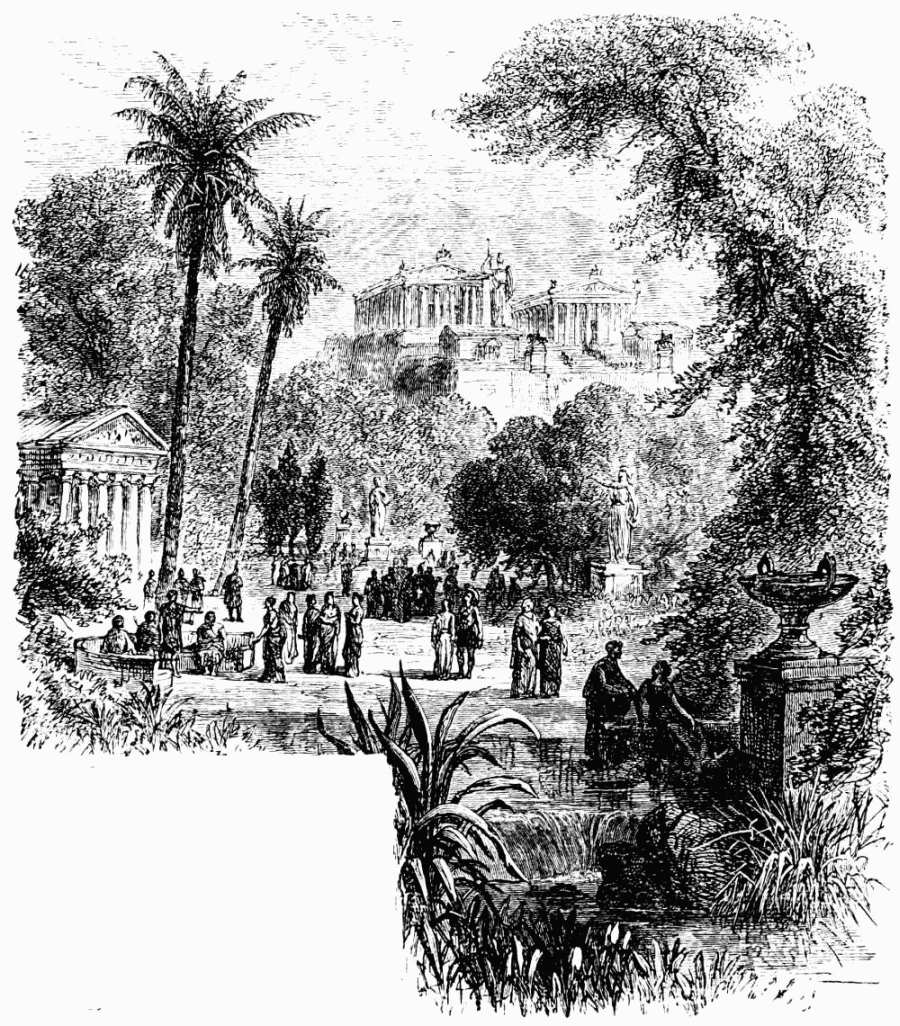
Grove of Academus.
Plato was noble-born, tracing his descent from King Codrus
through one parent and from Solon through the other.
His great genius was early seen. After mastering the elementary
branches, he turned his attention to painting and
poetry; but when he compared an epic on which he had tried
his hand with Homer’s, he threw it into the fire in disgust.
Chancing to hear Socrates discourse, he forthwith resolved to
forsake the ornamental arts and study philosophy. So, when
only twenty, Plato attached himself to Socrates; his admiration
quickly ripened into an abiding affection; and for eight
years he sat at the philosopher’s feet as a pupil, though now
and then obtruding new theories of his own. In the dark
days of his master’s trial and condemnation, he was still faithful;
and when the judges silenced his speech in defence of
Socrates, he would have resorted to the money-argument,
which then, as now, seldom failed, had not the high-minded
sage refused to secure life by such ignoble means.
After the execution of Socrates, Plato pursued his studies
in foreign lands. He visited Italy, Sicily, and Egypt, carefully
examining their different systems of philosophy, and possibly
even making the acquaintance of the Hebrew Scriptures.
During this tour he is related to have been sold into slavery
at the instigation of Dionysius, tyrant of Syracuse, whom he
had offended by his bold expressions.
On his return to Athens, in accordance with a long-cherished
plan, Plato opened an humble dwelling in the grove of
Academus for the reception of pupils, and founded the famous
Academic School. He soon became the most popular man
in Athens. Crowds thronged to his lectures and dialogues,
which were free to all; and even ladies assumed male attire,
that they might mingle unnoticed with the listeners and drink
in the eloquence which flowed from his lips. His fame went
abroad also. Foreign potentates sought his aid in adjusting
political difficulties; and twice, by request, he returned to the
Syracusan court to effect a reform in the government—but
in this case, without success.
On his eighty-second birthday, while he was pursuing his
accustomed occupation, the stylus suddenly fell from Plato’s
hand, and he expired. Under the trees so long associated
with his kindly instruction, he found a final resting-place; an
admiring country preserved his memory by altars and statues;
and the verdict of succeeding generations has been that Plato
was the greatest philosopher of antiquity.
Plato’s Philosophical System.—Plato was an enthusiast
in the pursuit of truth. He believed in a personal God, rational,
immutable, eternal. He realized that man could never
attain absolute wisdom, possible to God alone; and looked
upon philosophy as “a longing after heavenly wisdom.” He
sought to correct abuses, to elevate humanity; and made
man’s highest duty consist in searching out God and imitating
the perfection of the Almighty as his rule of conduct.
The four cardinal virtues were wisdom, temperance, courage,
and justice; but none could be virtuous without aid from on
high. (Read Bulkley’s “Plato’s Best Thoughts.”)
The soul, an emanation from the Supreme Mind, was immortal.
It existed before its union with the body, and all
earthly knowledge is but the recollection of what it possessed
in some former state. When, disembodied, it stood face to
face with kindred immaterial essences, it acquired those ideas,
or forms, which figure so prominently in the Platonic system—interpreted
by some to mean veritable objective existences
too subtile to be discerned by the eye of flesh, and by others
explained as mere intuitions or generalizations having no objective
reality.
Plato regarded men as free agents, to be rewarded or punished
in a future life for their deeds in this. His poetical
fancy fixed on some distant star as the abode of the blessed.
The earth he supposed to occupy the centre of the universe.
It was not eternal, but was made by an intelligent God, who
breathed into it a soul; so it was a living creature, self-active,
and gifted with the beautiful form of the sphere.
Nor did the philosopher forget to train the reasoning powers,
by the study of mathematics. The importance he attached
to this science may be inferred from the sign on his school:
“Let no one enter here who is a stranger to geometry.” Plato
has the honor of having been the inventor of geometrical
analysis.
Plato’s Works, which have descended to us unimpaired,
are in the form of dialogues—a delightful method of conveying
philosophical instruction, when, as in Plato’s case, the
personages introduced as speakers are salient characters, and
their idiosyncrasies are maintained throughout with discrimination.
The dull lessons of dialectics are thus enlivened by
graphic portraitures and happy strokes of humor. Plato’s
language is the perfection of Attic prose, beautified by a poetical
tinge. “If Jupiter should speak Greek,” said ancient
critics, “it would be Plato’s.” What Socrates dreamed on
the night before the young Plato entered his school—that a
cygnet came from the grove of Academus, and, after nestling
on his breast for a time, took its flight heavenward, singing
sweetly as it rose—is recorded as presaging his pupil’s sweet
mastery of words.
The Platonic Dialogues, thirty-five in number, discuss various
subjects. One of the finest is “Phædo,” written to prove
the immortal nature of the soul. It derives its name from the
beloved disciple of Socrates, who is here made by Plato, prevented
from being present himself, to describe their master’s
death-scene and repeat his last discourse. Full of sublime
and poetical conceptions, the “Phædo” aims at lifting the
mind above the sensual to the spiritual and eternal; at foreshadowing
the joys of the heavenly state, and painting death
as a thing to be desired rather than feared, since it is the portal
of bliss. The philosopher Cleom’brotus, on reading this
Dialogue, is said to have thrown himself into the sea to exchange
this life for the better one pictured by Plato.
EXTRACT FROM PHÆDO.
(Socrates, having proved the immortality of the soul to the satisfaction of
all present in the prison, addresses them as follows.)
“Then, Cebes, beyond question, the soul is immortal and imperishable,
and our souls will truly exist in another world!”
“I am convinced, Socrates,” said Cebes, “and have nothing more
to object; but if my friend Simmias, or any one else, has any further
objection, he had better speak out, and not keep silence, since I do
not know to what other season he can defer the discussion, if there
is anything which he wants to say or have said.”
“I have nothing more to say,” replied Simmias; “nor can I see
any reason for doubt after what has been said. But I still feel and
cannot help feeling uncertain in my own mind, when I think of the
greatness of the subject and the feebleness of man.”
“Yes, Simmias,” replied Socrates, “that is well said; but O my
friends! if the soul is really immortal, what care should be taken of
her, not only in respect of the portion of time which is called life, but
of eternity! And the danger of neglecting her from this point of
view does indeed appear to be awful. If death had only been the
end of all, the wicked would have had a good bargain in dying, for
they would have been happily quit not only of their body, but of
their own evil together with their souls. But now, inasmuch as the
soul is manifestly immortal, there is no release or salvation from evil
except the attainment of the highest virtue and wisdom. For the
soul, when on her progress to the world below, takes nothing with
her but nurture and education; and these are said greatly to benefit
or greatly to injure the departed, at the very beginning of his
pilgrimage in the other world.
“Wherefore, Simmias, seeing all these things, what ought not we
to do that we may obtain virtue and wisdom in this life? Fair is
the prize, and the hope great!
“A man of sense ought not to say that the description which I have
given of the soul and her mansions is exactly true. But I do say that,
inasmuch as the soul is shown to be immortal, he may venture to
think that something of the kind is true. The venture is a glorious
one, and he ought to comfort himself with words like these, which is
the reason why I lengthen out the tale.
“Wherefore, I say, let a man be of good cheer about his soul, who
has cast away the pleasures and ornaments of the body as alien
to him, and has followed after the pleasures of knowledge in this
life; who has arrayed the soul in her own proper jewels, which are
temperance, and justice, and courage, and nobility, and truth—thus
adorned, she is ready to go on her journey to the world below when
her hour comes.
“You, Simmias and Cebes, and all other men, will depart at some
time or other. Me already, as the tragic poet would say, the voice of
fate calls. Soon I must drink the poison; and I think that I had
better repair to the bath first, in order that the women may not have
the trouble of washing my body after I am dead.”
When he had done speaking, Crito said: “And have you any commands
for us, Socrates? anything to say about your children, or any
other matter in which we can serve you?”
“Nothing particular,” he said: “only, as I have always told you,
I would have you look to yourselves; that is a service which you
may always be doing to me and mine as well as to yourselves.”
“We will do our best,” said Crito; “but in what way would you
have us bury you?”
“In any way that you like; only you must get hold of me, and
take care that I do not walk away from you.”
Then he turned to us, and added with a smile:—“I cannot make
Crito believe that I am the same Socrates who have been talking and
conducting the argument; he fancies that I am the other Socrates
whom he will soon see, a dead body—and he asks, How shall he bury
me? And though I have spoken many words in the endeavor to
show that when I have drunk the poison I shall leave you and go to
the joys of the blessed, these words of mine, with which I comforted
you and myself, have had, as I perceive, no effect upon Crito.
“You must be my surety to him that I shall not remain, but go
away and depart; and then he will suffer less at my death, and not
be grieved when he sees my body being burned or buried. I would
not have him sorrow at my hard lot, or say at the burial, ‘Thus we
lay out Socrates,’ or ‘Thus we follow him to the grave or bury him;’
for false words are not only evil in themselves, but they infect the
soul with evil. Be of good cheer then, my dear Crito, and say that
you are burying my body only, and do with that as is usual, and as
you think best.—Jowett.—(In this connection read Grote’s “Plato
and the Other Companions of Socrates.”)
In his “Republic,” Plato indulges in a political dream,
sketching an ideal government and embodying his conception
of absolute justice. In his “Atlantis,” he describes a large
island lying west of Europe, which some have tried to connect
with America.
The Academic School long survived its founder; but little
if any advance was made by his successors. Its fundamental
tenets outlived Greece and Rome, to reappear in the schools
of modern times. Many of them are in wonderful harmony
with Christian doctrines; and such a resemblance to the Jewish
Scriptures has been detected in the writings of their author
that he has been called “the Attic Moses.”
Peripatetic School.—Aristotle.—The Peripatetic was an offshoot
from the Academic School, its founder Aristotle having
for twenty years studied under Plato. Its influence cannot
be estimated; for 1,800 years, up to the revival of letters in
modern times, its author was recognized as the supreme authority
on every subject, whether by Moslem or Christian.
Aristotle (384-322 B.C.) was born at the Thracian town
of Stagi’ra. Inheriting from his father literary tastes as well
as the means to gratify them, he selected Athens as the scene
of his labors, and there, at the age of seventeen, he entered
the Academy of Plato. So energetically did he apply himself,
not as a servile follower but often as a pioneer in new
paths of his own, that his master said he required the bit
rather than the spur, and styled him the Intellect of the
school. On one occasion, when none but this ardent pupil
was present to hear his lecture, Plato proceeded as usual,
saying that “so long as he had Aristotle for an audience, he
had the better half of Athens.” His industry was proverbial;
he grudged the time needed for repose, and used to sleep
with a ball in his hand, that when it fell from his grasp by
the relaxing of the muscles the noise would awaken him.
When Plato died, Aristotle retired from the Academy; and
in 342 B.C. he received the following letter from Philip of
Macedon, whose court he had visited as an ambassador:—
“Philip to Aristotle, wisheth health:
Be informed that I have a son, and that I am thankful to the gods,
not so much for his birth, as that he was born in the same age with
you; for if you will undertake the charge of his education, I assure
myself that he will become worthy of his father, and of the kingdom
which he will inherit.”
There was no declining such an invitation. At Stagira, his
native town, Philip provided a school and the accustomed
grove for instruction, in which the philosopher moulded the
mind of Alexander the future Conqueror. The king of Macedon
was more than satisfied with the results; and the royal
pupil owned his indebtedness to his teacher, exclaiming,
“Philip only gave me life, but Aristotle has taught me the
art of living well!”
When, on the assassination of Philip, Alexander mounted
the throne and embarked on that expedition which extended
the sway of Macedon over half the known world, he showed
his gratitude by making his instructor a munificent present
equivalent to nearly $1,000,000, and employed two or three
thousand men to fill his cabinets with specimens. Thus
supplied with material and funds, Aristotle, established in
Athens since 335 B.C. as a distinguished teacher despite
his traditional lisp and insignificant appearance, vigorously
prosecuted his scientific labors. At the Lyce’um, Apollo’s
temple, he gave instruction to his disciples, walking up and
down in the covered paths (peripatoi) about the building—whence
the name of his school, Peripatetic. He mastered all
existing knowledge, regarding learning as “an ornament to
men in prosperity, a refuge in adversity;” and for thirteen
years divided his time between his pupils and his literary
work.
The news of Alexander’s sudden death was the signal for
Aristotle’s enemies, no longer restrained by fear of his royal
friend, to show their hand. Impiety was alleged against
him; but mindful of the fate of Socrates, and, as he said, to
prevent the Athenians from sinning a second time against
philosophy, he retired to Chalcis on the island of Eubœa,
where he died within a year.
Philosophy and Writing of Aristotle.—While to
some extent following his master, from several of Plato’s
doctrines Aristotle felt compelled to dissent; truth, he said,
was dearer to him than any friend.[35] He did not accept the
Ideal theory, but inclined to materialism or to pantheism,
making reason divine and omnipresent. He doubted his own
immortality, holding that the soul could not exist apart from
the body, and that there is “nothing good or bad beyond to
the dead.” His style was dry, elliptical, and full of technicalities;
if we compare it with Plato’s, we have the opposite
poles of the magnet.
Plato was all imagination, Aristotle was thoroughly practical.
The inspiration of the one was a passionate love of
wisdom; the forte of the other was power of analysis, a wonderful
faculty of systemizing knowledge. The master captivated
the heart; the pupil convinced the reason. “The
philosophy of Plato,” says Dr. Draper, “is a gorgeous castle
in the air; that of Aristotle is a solid structure laboriously
founded on rock.”
Aristotle’s style is devoid of ornament, and his subjects
are too abstruse for the general run of readers; but he was
a keen observer and a close reasoner. A few paragraphs
from his Rhetoric, in which he analyzes the peculiarities
of old age, will show how well he understood human nature.
THE DISPOSITION OF THE OLD.
“Those who are advanced in life, having been deceived in a
greater number of instances, err in everything more on the side of
defect than they ought. And they always suppose, but never know
certainly; and, questioning everything, they always subjoin a perhaps,
or a possibly. And they are apt to view things in an unfavorable
light; for a disposition thus to view things, is the judging of
everything on the worse side.
Moreover, they are apt to be suspicious from distrust, and they are
distrustful from their experience. And on this account they neither
love nor hate with great earnestness; but, conformably to the remark
of Bias, they both love as though about to hate, and hate as
though about to love. And they are pusillanimous, from their having
been humbled by the course of life; for they raise their desires
to nothing great or vast, but to things only which conduce to the
support of life.
And they are illiberal; for property is one of the necessaries; and
they are at the same time aware, from their experience, of the difficulty
of its acquisition, and of the ease with which it is lost. They
are timid and apprehensive of everything; for their disposition is
the reverse of that of the young; for they have been chilled by
years, but the young are warm in their temperament; so that their
age has paved the way to timidity; for fear is a certain kind of
chill.
And they are attached to life, and particularly at its last closing
day, from the circumstance that desire is of some object which is
absent, and that men more especially desire that of which they
stand in need.
They have self-love more than is fitting; for this too is a kind of
littleness of spirit. And they live in a greater degree than they
ought by the standard of expediency, and not of what is honorable,
by reason of their self-love: for what is expedient is good relatively
to one’s self, but what is honorable is good absolutely.
Again, they are not easily inspired with hope, on account of their
experience; for the majority of things are but paltry; wherefore the
generality turn out inferior to the expectation; and once more, on
account of their timidity they are apt to despond. And they live
more in memory than in hope; for the remnant of life is brief, but
what has passed is considerable; and hope indeed is of what is to
come; whereas memory is of things gone by. The very reason, this,
of their garrulity; for they never cease talking of that which has
taken place, since they are delighted in awakening the recollections
of things.
And their anger is keen, but faint. And some of their desires
have abandoned them. Others are faint; so that neither are they
liable to the influence of desire, nor apt to act in conformity to it,
but with a view to gain; on which account men of this age appear
to be naturally temperate, for both their desires have relaxed, and
they are enslaved to gain.
The old have moreover a tendency to pity, but not on the same
principle with the young; for the latter are thus disposed from their
love of human nature; the former from their imbecility. Whence
they are querulous, and neither facetious nor fond of mirth; for
querulousness is the very reverse of fondness for mirth. Such is
the disposition of those in advanced life.”—Theodore Buckley.
The writings of Aristotle exhausted the fields of art and
science; 400 treatises, most of which have perished, at one
time bore his name. Rhetoric, psychology or mental science,
and natural history, owed to him their origin. In his
“Organon” was first presented the method of deduction,—the
process by which the mind reasons down from general propositions
to particular cases, by means of the syllogism, the organ
or instrument of reasoning. Men had thus arrived at conclusions
for ages, without any knowledge of Aristotle’s formulæ,
just as they had talked correctly though ignorant of
analytical grammar. It was reserved for the Stagirite to discover
the laws by which they drew conclusions, and thus at
once to found and perfect Logic. This was the science of
reasoning, as contrasted with Plato’s dialectics or method of
discussing. (See Benn’s “The Greek Philosophers.”)
Nor was Aristotle unacquainted with Induction, the great
lever of modern philosophy. This process, which reverses
the steps of deduction,[36] and reasons from particular cases up
to general laws, was employed in his researches, but was not
fully developed till twenty centuries later in the “Novum
Organon” of Lord Bacon, opening the way to a new era in
scientific investigation.
Aristotle willed his writings to his disciple Theophrastus,
whom we shall next consider; and for many years they were
kept from the world, while numerous imitations and forgeries
gained the popular ear through the prestige of Aristotle’s name.
It was not till 50 B.C. that a complete edition of the genuine
works was published, and then at Rome. Meanwhile the Lyceum
had waned; its later heads were men of mediocre ability,
and the Peripatetic School was superseded in popular estimation
by the Epicurean and the Stoic.
Theophrastus, of Lesbos (374-287 B.C.), a pupil of Plato
and afterward of Aristotle, succeeded the latter, by his appointment,
as head of the Lyceum. During his time, he
maintained the high reputation of the school, attracting many
to it from all parts of Greece by his eloquence. That he
might address a still larger audience, he wrote numerous
treatises on philosophy and natural history.
His “Moral Characters,” which have descended to us,
show up in lively colors such representative personages as
the Gabbler, the Niggard, the Noodle, the Grumbler, the
Swell, the Poltroon, the Slanderer, the Newsmonger, the
Clown, etc., from whom, it seems, that Greek society was not
exempt any more than our own. These were the first character-sketches
ever made; they served as models to La
Bruyère in French, to Sir Thomas Overbury and others in
English literature. As specimens, we cull the most pointed
portions of the sections on the Flatterer and the Unseasonable
Man.
THE FLATTERER.
“Flattery may be considered as a mode of companionship, degrading
but profitable to him who flatters.
The Flatterer is a person who will say as he walks with another,
‘Do you observe how people are looking at you? This happens to
no man in Athens but you. A compliment was paid to you yesterday
in the Porch. More than thirty persons were sitting there;
the question was started, Who is our foremost man? Every one
mentioned you first, and ended by coming back to your name.’
Then he will request the company to be silent while the great
man is speaking, and will praise him, too, in his hearing, and mark
his approbation at a pause with ‘True;’ or he will laugh at a frigid
joke, and stuff his cloak into his mouth as if he could not repress
his amusement.
He will request those whom he meets to stand still until ‘his
Honor’ has passed. He will buy apples and pears, and bring them
in, and give to the children in the father’s presence; adding, with
kisses, ‘Chicks of a good father.’ Also, when he assists at the purchase
of slippers, he will declare that the foot is more shapely than
the shoe. If his patron is approaching a friend, he will run forward
and say, ‘He is coming to you;’ and then, turning back, ‘I have announced
you.’
He is the first of the guests to praise the wine; and to say, as he
reclines next the host, ‘How delicate is your fare! and (taking up
something from the table) ‘Now this—how excellent it is!’ He will
say that his patron’s house is well built, that his land is well planted,
and that his portrait is a good likeness.”—Jebb.
MR. MALAPROP.
“Unseasonable behavior is such a manner of conversation as is
very troublesome to those with whom you converse.
A man that acts unseasonably will intrude himself upon his friend,
when he is engaged in earnest business, and consult him about his
own private concerns. When his mistress lies dangerously ill of a
fever, he’ll make her a visit and carry himself gayly. If he stands in
need of a surety, he begs that favor of one who has just smarted for
being bound to another. If he is summoned for a witness in any
cause, he appears in court immediately after judgment has been given.
When he is invited to a wedding, he takes the opportunity to rail
at the fair sex. If he meets a friend who has just come home from a
long journey, he’ll press him to take a walk. He is ever ready and
punctual, as soon as a shop-keeper has sold his goods, to help him to
a customer that would have given more.
If he happens to be in a place where a servant is chastised, all the
comfort he gives him is to tell him that he also had formerly a boy
whom he chastised in the same manner, and that the poor lad so resented
this usage that he immediately made way with himself. If
he is accidentally present at an arbitration, where the contending
parties desire to have the matter in dispute between them amicably
settled, instead of promoting a reconciliation, he sets them together
by the ears, and makes the difference ten times greater than it was
before.”—Gally.
The Stoic School was so called from the Painted Portico
(stoa) at Athens, where its founder Zeno, the Cyprian, taught
for fifty-eight years (318-260 B.C.). It was based on high
moral principles, but was not free from errors. Duty was all
in this philosophy; virtue alone, happiness. Mastery of self,
contempt alike for pleasure and pain, were leading doctrines.
Fate governed the world, even God himself. Yet Zeno did
not allow this doctrine to excuse shortcomings or interfere
with individual responsibility. When his slave, detected in
theft, besought exemption from chastisement on the plea that
it was fated for him to steal, he replied, “Yes, and it was also
fated for you to be flogged.”
Suicide, in Zeno’s creed, was justifiable when a man had
outlived his usefulness, and the great philosopher practised as
he preached; for, having received a severe fall at the age of
ninety-eight, he quietly remarked, “I obey the summons,” and
went and hanged himself.
Zeno enjoyed public confidence at home as well as the respect
of foreign princes; among his disciples were enrolled
some of the greatest men of Greece and Rome. Nothing remains
of his writings.
The Cynics derived their name from the gymnasium of Cynosarges,
near the Lyceum, where they gathered to listen to Antisthenes,
a pupil of Socrates. This extremist perverted his
master’s theory of virtue, which he made to consist in a comfortless
life, a renunciation of pleasure, and a contemptuous
and even shameless independence of manners. Yet Socrates
saw pride even through the holes of Antisthenes’ shabby robe.
Antisthenes was not much in metaphysics. He was puzzled
by abstract generalizations, and to Plato’s Idealism opposed
an uncompromising Realism. “Plato,” he said, “I can see a
horse, and I can see a man, but horsehood and manhood I
cannot see.”—“True,” replied Plato, “you have the eye that
can see a horse and a man; but the eye which can see horsehood
and manhood you lack.”
Of the many works of this first Cynic philosopher, scarcely
anything is left. They were probably steeped in gall, for his
powers of sarcasm were unsurpassed; he dealt trenchant
blows at what he considered folly, wherever he found it. He
ridiculed the want of judgment displayed at Athens in the
selection of generals, by counselling the Athenians to vote
their asses horses. “That is absurd,” was the reply. “No
more so,” he retorted, “than to think you have made ignoramuses
generals, by simply lifting up the hand. “Once when
annoyed at a speaker’s dilating on the joys of the future state,
he abruptly demanded, “Why don’t you die, then?”
His successor, Diogenes, carried out the rôle. Soured by
the disgraceful failure of his father, he turned to the ascetic
philosophy of the Cynics, and took a morbid pleasure in outraging
society by his infringements on decency. His satirical
remarks, which cut to the quick, earned him the title of “the
Dog” by way of eminence. He slept wherever he happened
to be, on stoops or in a tub; and eschewing artificial wants,
he felt so rebuked when he saw a boy drinking through his
hands and receiving his pottage in a hollowed loaf, that he
threw away his cup and platter.
Into such snarling, insolent, and offensive misanthropes did
the Cynics degenerate, that the name of their sect was popularly
traced to the dogs (in Greek cynes) they so much resembled.—To
this complexion did the noble philosophy of Socrates come at last.
Political Eloquence, like the drama, history, and philosophy,
attained perfection in the golden age. Public speaking was
a natural accomplishment of the Greeks; and from the days
of Homer down, soldiers, legislators, and statesmen, had been
distinguished as orators. In Pericles, who made eloquence a
study, we are introduced to one of the world’s most polished
speakers. (Consult Jebb’s “Attic Orators.”)
But the cultivation of rhetoric and oratory as an art was first
popularized by Gorgias of Leonti´ni (see Map, p. 304), who
about 427 B.C. transplanted it from Sicily and saw it flourish
in Athenian soil as it had never flourished before. Gorgias
founded a school of eloquence at Athens, which was thronged
by the great men of the time, eager to acquire the persuasive
arts of the Sicilian teacher. Thus rhetoric became a fashionable
accomplishment; and to such account was it turned by
the taste and genius of the Attic Greeks that they soon produced
the greatest orators of history.
Among these was the graceful and elegant Lysias (lish’e-ăs—458-378
B.C.), compared by Quintilian to a pure fountain
rather than a great river; and Isæus, the leading barrister of
Athens and preceptor of Demosthenes. Greater than either
as a teacher and writer of orations for others, though through
timidity he rarely appeared in public himself, was Isocrates,
founder of a school from which Cicero said, “as from the
Trojan horse, princes only proceeded;” to use his own figure,
he was a whetstone which imparted the power of cutting to
other things, but cut not itself. Finally, to this category belonged
the great rivals Æschines and Demosthenes, foremost
of the Attic orators.
Demosthenes (384-322 B.C.—it is worth remembering that
his dates are identical with Aristotle’s) stands alone in the
power of his eloquence. Born in Attica, he was left fatherless
at the age of seven, but inherited a large fortune. The bulk
of this his guardians made away with; although they engaged
the best talent in the land to superintend the education of their
ward. When Demosthenes arrived at his majority, he brought
suit against them, and wrote his maiden speeches with such
skill as to obtain a judgment in his favor.
The study of oratory now became the passion of his life.
By indomitable perseverance he overcame what to many would
have proved insuperable difficulties—shortness of breath, a
sickly constitution, a weak and stammering utterance, and
awkwardness in gesticulating. He practised on the sea-shore
till his voice rose clear and full above the breakers; he placed
pebbles in his mouth while declaiming to correct his articulation,
and improved his breathing by running up steep hills.
A friendly mirror helped him to make his gestures effective;
and he spent months at a time in a room underground, occupied
in study, or in copying the history of Thucydides to
strengthen his style. Thus, in spite of every natural disadvantage,
he placed himself by his own efforts “at the head of
all mighty masters of speech.” He lived to receive the homage,
not only of those Athenians who had hissed the early
performances of “the stammerer,” but of crowds gathered
from all quarters of Greece.
Conciseness, precision, clearness, compact reasoning, power
of invective, and vehemence compared to that of a torrent
carrying everything before it, were characteristic of the orations
of Demosthenes. Sixty-one of these (probably not all
genuine) are still extant, the most famous being the twelve
“Philippics,” delivered against Philip of Macedon, who was
insidiously plotting the subversion of Grecian liberty. Demosthenes
penetrated his designs, disdained his bribes, and
for fourteen years struggled nobly against him. His impassioned
utterances at last roused the slumbering patriotism of
his countrymen, and, joined by the Thebans, they met Philip
at Chæronea—but only to be hopelessly defeated. The fate
of Greece was sealed. Demosthenes fled from the field and
escaped to Athens, where he delivered the funeral eulogy on
the slain.
The success of Philip strengthened the Macedonian sympathizers
in Athens, at the head of whom was the orator Æschines,
accused by Demosthenes of being in the pay of Macedon.
When, therefore, Ctesiphon proposed that the services of Demosthenes
be rewarded with a golden crown, Æschines opposed the measure.
After a delay of six years, during which
we may be sure both orators strained every nerve to prepare
for the decisive struggle, the final contest took place before a
vast and excited concourse. The fiery vigor of Demosthenes,
in the most splendid effort of ancient eloquence, swept away
like feathers the arguments, the wit, the sarcasm, of his opponent;
Æschines was utterly discomfited.
The elaborate speech “On the Crown” is the masterpiece
of Demosthenes; we give parts of the peroration.
FROM DEMOSTHENES’ ORATION ON THE CROWN.
“Do you then, Æschines, ask me for what merit I claim public
honors? I will tell you. It is because, when all the statesmen in
Greece had been corrupted, beginning with yourself, first by Philip
and then by Alexander, I was never induced nor tempted by opportunity,
nor by fair speeches, nor by the magnitude of proffered bribes,
nor by hope, nor by fear, nor by favor, nor by any other consideration,
to swerve a hair’s-breadth from the course which I believed to
be right and for the public good. Never, in weighing my public
counsels, have I, like you, inclined to the scale in which hung my
private advantage; but all that I have done has been done straightforwardly,
incorruptly, and with singleness of purpose. While I have
been charged with affairs of greater magnitude than any of my contemporaries,
the whole of my administration has been pure, honest,
disinterested. These are the grounds on which I claim to be honored.
As for the fortifications and intrenchments which you have sneered
at, I deem myself entitled to thanks and gratitude on that behalf.
Wherefore should I not? But I am far, indeed, from placing such
services in the same category with my general policy. It is not with
stones nor with bricks that I have fortified Athens; it is not upon
such works that I chiefly value myself; but if you would truly appreciate
my fortifications, you will find them in arms, cities, territories,
harbors, ships, and men to avail themselves of these advantages.
These are the outworks which I have thrown up before Attica, according
to the best of human foresight; by these have I fortified the
whole country, not merely the circuit of the Piræus and the city.
Nor was I defeated by the calculations or preparations of Philip; far
from it: but the generals and the forces of our allies were defeated
by Fortune. * * *
If my measures had been successful—O heaven and earth! we
must, beyond all question, have become a first-rate power, as we well
deserved to be. If they have failed, we have left to us our honor.
No reproach can attach to the state or to its policy, but Fortune must
bear the blame, who has so ordered our affairs. Never, never, will
the patriotic citizen desert his country’s cause, and, hiring himself
to her foes, watch his opportunities of injuring her; never will he
malign the statesman who in his utterances and his measures has
consistently maintained his country’s honor; nor will he nurse and
treasure up resentment for private wrongs; nor, lastly, will he
maintain a dishonest and a treacherous silence, as you have often
done. * * *
No part, Æschines, have you taken in any measure for strengthening
the country’s resources. What alliance has been ever obtained
for the state through your instrumentality? What succor? What
acquisition of good-will from others, or credit for ourselves? What
embassy? What public service that has added to our national renown?
What public affairs, whether domestic, Hellenic, or foreign,
have been brought by you to a successful issue? What ships have
you furnished? What arms? What dockyards? What fortifications?
What cavalry? In what one respect have you been useful?
What pecuniary contribution have you ever made upon public
grounds for the benefit of either the rich or the poor? None.
You were not deterred by your poverty, but by your anxiety to do
nothing opposed to the interests of those for whose benefit all your
policy has been designed. But what are the occasions of your brilliant
displays, the exhibition of your youthful vigor? When aught
is to be spoken against your countrymen, then is your voice best
tuned, then is your memory most accurate; then you act your part
to perfection. * * *
Every well-affected citizen, Athenians, (in such terms I am able to
speak of myself least invidiously) is bound to possess two qualities:
when in authority, the fixed resolve to maintain the honor and pre-eminence
of his country; under all circumstances and at all times,
loyalty. This Nature can command—to another power belong
strength and success. By this spirit you find me to have been uniformly
actuated.
Observe—never when I was demanded for extradition, nor when
Amphictyonic suits were prosecuted against me, nor when threats,
nor when promises were brought to bear upon me, nor when these
miscreants were let loose like wild beasts upon me—never was I induced
to abandon one jot or tittle of my loyalty to you. From first
to last I took the straight and true path of statesmanship—that of
complete devotion to the maintenance and furtherance of the honor,
the power, and the glory of my country. Never was I beheld strutting
about the Forum, radiant with joy and exultation at foreign
success, gesticulating congratulations to those who might be expected
to report them elsewhere. Nor have I heard the tidings of our
good fortune with dismay and lamentations, and prostration to the
earth, like these impious men who inveigh against their country
without perceiving that their invective is directed against themselves,
whose eyes are cast abroad, who felicitate themselves on
foreign success purchased by the calamities of Greece, and avow
their anxiety to secure its permanence.
Never, O ye Heavenly Powers! never may such designs obtain
favor at your hands! Rather, if it be possible, inspire even these
men with better thoughts, and turn their hearts; but if their moral
plague be incurable, cut them off from among us, and drive them
forth to destruction, sure and swift, over land and over sea: while
to us who are spared ye vouchsafe the speediest deliverance from our
impending alarms, and abiding security!”—Sir Robert Collier.
Twice after the reverse of Chæronea Demosthenes succeeded
in arraying his country against Macedon—at the
assassination of Philip and on the death of Alexander.
When news of Alexander’s decease reached Greece, the orator
was in exile, having been unjustly convicted of taking
Macedonian treasure; yet he did his utmost to arm the
Grecian cities, and was in consequence recalled to Athens
by the fickle people. But it was all in vain.
At last, marked for destruction by the Macedonian regent
Antip’ater, and doomed to death by his cowardly fellow-citizens
whose necks were now under the tyrant’s heel, he
fled to the temple of Neptune on Calaure’a and there found
relief from his troubles in a quill of poison which he kept
ready for an emergency. In Demosthenes, Athens lost an
incorruptible patriot—antiquity, one of her noblest characters.
The Athenians erected to his memory a brazen statue
on which was inscribed:—
“Had you for Greece been strong, as wise you were,
The Macedonians had not conquered her.”
Æschines (389-314 B.C.), of whose early life little is known,
after his defeat at the hands of Demosthenes, went into exile.
We are told that his victorious rival magnanimously forgave
him, and even offered him money for the journey; which led
Æschines to exclaim: “How I regret leaving a country
where I have found an enemy so generous that I must despair
of ever meeting with a friend who shall be like him!”
Æschines afterward established himself as a teacher of
oratory in Rhodes. Here he once repeated to his pupils his
famous oration against Ctesiphon in the contest for the crown,
which filled them with wonder that so able an orator should
have been defeated. But when at their request he read the
reply of Demosthenes, his audience rose to their feet with
eager acclamations; and the orator, forgetting all jealousy in
his admiration, cried: “What would you have said, had you
heard the wild beast himself roaring it out?”
The oration against Ctesiphon is one of three familiarly
known in antiquity as “the Three Graces”—a title indicative
of the refinement and easy flow of the author’s style, deficient
as it was in the energy and vehemence of his great rival.
Ion (flourished 450 B.C.): a history and
lyrics, as well as tragedies; called
“the Eastern Star,” from the first
words of an ode he was composing
when death overtook him.
Achæus (born 484 B.C.): tragic and
satirical pieces.
Ag’athon the Athenian: received his
first tragic prize, 416 B.C.; his masterpiece
was “the Flower.”
Callis’tratus (flourished 420 B.C.):
author of the convivial ode celebrating
the memory of Harmodius and
Aristogiton (p. 158).
Crati’nus (519-423 B.C.): called the
Cup-lover from his excesses; 21 comedies;
9 prizes; with his last comedy,
“the Wine-flask,” he gained
the first prize, triumphing over “the
Clouds” of Aristophanes.
Eu’polis: 15 plays; his first comedy
was represented 429 B.C.
Crates (450 B.C.): 14 comedies; the
first poet to represent drunkenness
on the Athenian stage.
Meton, the Athenian astronomer (flourished 430 B.C.): founder of the Lunar
Cycle of 19 solar years, which he discovered to be nearly equal to 235 revolutions
of the moon round the earth. From the “Metonic Cycle” the Greeks
computed their festivals; it is still used by the Western churches in fixing
Easter.
Hippoc’rates (460-357 B.C.), born on the island of Cos, “the Father of Medicine:”
knew little of anatomy; discovered the critical days in fevers.
Education recognized as all-important in ancient Greece, and even made compulsory
by the great lawgivers. In Homer’s time, children taught obedience,
respect for the aged, and modesty of deportment; sons instructed in the use of
weapons and gymnastic exercises; daughters, in domestic economy and virtue.
Homer’s epics long the chief text-books on all subjects.
Reading and writing, accomplishments of the earliest periods. An ignorant
Greek an anomaly. Even among the Spartans, who affected contempt for literature,
reading and writing were practised. The magistrates and their officers
were provided with wooden cylinders of the same size; when one desired to
communicate, he wound a strip of parchment round his cylinder and wrote his
message thereon; then, removing the strip, he sent it to the other party, who
was enabled to read it by rolling it upon his own cylinder in the same folds.
In the golden age, common schools were the glory of Greece; the rudiments
of education everywhere taught. The importance of grammar urged by Plato,
who was the first to explain the difference between nouns and verbs; articles and
conjunctions distinguished by Aristotle, and also differences of number and case.
The foundation of scientific grammar laid by the Stoics, who recognized eight
parts of speech. Those who could afford it completed their education at the
Lyceum, Academy, or some other celebrated school, often paying most extravagantly
for instruction in rhetoric and philosophy. Some teachers charged their
pupils as much as $2,000 apiece for a course of lectures. Foreign languages
were never studied by the Greeks.
Many private libraries were established during the golden age, but no circulating
or public libraries. As early as 400 B.C. Athens carried on quite a trade
in manuscripts, one quarter of the market-place being called “the book-mart.”
Books were generally abundant and cheap, being copied by slaves, but rare
works were very costly. Plato paid $1,600 for three books. (The reader is referred
to Becker’s “Charicles; or, Illustrations of the Private Life of the Ancient
Greeks.”)
Wooden tablets for accounts sold for 18 cts. each about 400 B.C. A small blank
book of two wax tablets was worth less than a penny. Pencils are said to have
been invented 408 B.C. by Apollodorus, the self-styled “Prince of Painters.”