One can hardly study the illuminated work of the
Middle Ages without being interested in the methods
employed by the artists of this period. The MSS.
still in existence, with colours still fresh and bright,
make one curious to know what colours were used to
produce this result.
Our knowledge of the colours used in classical times
is derived chiefly from Pliny’s “Natural History” and
the writings of Vitruvius. Theophrastus, in his work
on stones, also adds some description of pigments.
It appears from these writers that the earth colours,
such as the ochres and siennas, were well known, as
also was the green earth terra verte. Blues and greens
were obtained from the ores of copper, one of the most
notable being azurite, a blue carbonate of copper.
Verdigris was prepared by the action of vinegar on
copper. Cinnabar, a native variety of red sulphide
of mercury similar to our vermilion, which is the same
thing artificially prepared, and orpiment, the native
sulphide of arsenic, were also colours used at this period.
A number of white earths were also employed,
chalk being the most important. White lead was used,
being prepared in practically the same way as the best
is to-day. Lakes were made by dyeing chalk or
gypsum. Several vegetal dyes were used for this
purpose, such as madder, weld, and woad. In addition
to these dyes, lakes were prepared from kermes and
the celebrated murex. Kermes is a red dye caused by a
small insect similar to that of the cochineal insect;
it was used for dyeing and for making pigments, both
in classical and mediæval times. The murex was a
species of shellfish from which was extracted the famous
purple dye. This was the dye used for the purple
vellum that was used so much in the early period.
The blacks used were carbon-blacks, such as lamp-black,
bone-black, or the black prepared from grape
husks and vine leaves.
Indigo was undoubtedly in use, and it is highly
probable that the red resin known as dragon’s blood
was also in use. Pliny, in his “Natural History,”
describes the fighting between the elephant and the
dragon, and he states that the name cinnabar should
be given to the thick matter which issues from the
dragon when crushed beneath the weight of the dying
elephant, mixed with their blood. It is thought that
he may be referring to this pigment, for, in another
chapter, he refers to India sending the corrupt blood of
her dragons and elephants. There is one colour, which
was one of the principal pigments of the Middle Ages,
of which no mention is made in the classical period,
and that is ultramarine.
It is difficult to be certain as to how the different
colours were mixed, but the ink used was prepared from
lamp-black mixed with gum and water, and it is
probable that the colours were mixed with either gum,
glue, or egg.
The Lucca MS. of the eighth century, in the cathedral
library at Lucca, contains, amongst other things, a
short list of pigments. There is very little difference
between the information given here and that given
by Pliny. This MS., however, gives the first distinct
directions for making artificial vermilion. It is also
interesting as giving definite information as to how
colours were mixed for working on parchment or vellum,
as the following quotation plainly shows: “On wood
the colours being mixed with wax, on skins fish-glue
being mixed.”
In the twelfth-century MS., the Mappæ Clavicula,
the greater part of the Lucca MS. is repeated.
The Schedula Diversarum Artium of Theophilus
is also of about the same date, and is a very important
MS. It is divided into three books, the first dealing
with painting, the second with the manufacture of
glass, and the third with metal-work. It is evident
that Theophilus, who was a monk in some German
monastery, was a worker in metal. However, he
collected quite a lot of information on various forms
of art work. It is, of course, in the book on painting
that the information with regard to colours is found.
In Chapter XXVII. he gives instructions for preparing
the gum for mixing with colours. This is
described as follows: “Take gum which exudes from
the cherry or plum tree, and, cutting it up very small,
place it in an earthenware pot, and pour water upon it
abundantly and place it in the sun, or in winter upon
the coals, until the gum has liquefied; and mix it
together with a smooth piece of wood. Then strain
it through a cloth, and grind the colours with it and
lay them on.”
In Chapter XXXIV., which is entitled “How
Colours are Tempered for Books,” he says: “Make a
mixture of the clearest gum and water as above, and
temper all colours except green and ceruse and minium
and carmine. Salt green is worth nothing for books.
You will temper Spanish green with pure wine, and if
you wish to make shadows, add a little sap of iris or
cabbage or leek. You will temper minium and ceruse
and carmine with clear of egg. Compose all preparations
of colours for a book as above, if you want them
for painting figures. All colours are laid on twice in
books, at first very thinly, then more thickly; but
once for letters.”
Salt green, that is mentioned here, was a mixture
of verdigris and subchloride of copper. Spanish green
was verdigris, and minium was red lead, while ceruse
was white lead. Verdigris is, of course, a notoriously
fugitive colour, but while in ordinary water-colour
painting it would probably not be safe to use, it would
last fairly well in books. Certainly it seems to have
done so in the past, if one may judge from the greens
in many of the old MSS., which are still brilliant.
Other colours described are those known as “folium”
colours. These seem to have been different vegetal
dyes.
In Chapter XL. he gives a description of how to
prepare ink. This is quite different from the ink of
the classical period, which, as mentioned before, was
made from lampblack and gum-water. The ink
described by Theophilus is more of the nature of our
modern writing-ink, being prepared from the bark
of thorn-trees, amounting really to an infusion of
tannin, with the addition of iron sulphate, popularly
known as green vitriol.
There is no mention in this MS. of the preparation
of ultramarine.
Following this there are the MSS. that have been
translated by Mrs. Merrifield, viz., Eraclius, Alcherius,
the book of Peter St. Andemar, all included in the MSS.
of La Bègue, the Sloane MS., and the Strassburg MS.
The MS. of Eraclius is regarded as not being later
than the thirteenth century, the first two books being
very early and quoted by Theophilus.
In these MSS. it is plainly stated that the colours
were generally mixed with either gum-water or egg.
White of egg was often used, but occasionally the yolk.
For example, it seems to have been used as a medium
for vermilion and orpiment. These MSS. contain a
lot of information very similar to that in the MS. of
Theophilus.
Lakes were, in the earliest MSS., prepared in a
similar way to that used in the classical period, and
are described in this manner in the MS. of Eraclius.
In the MS. of Jehan le Bègue, however, there are
several recipes that have been compiled by him from
the MSS. of Alcherius, of the fourteenth century, which
are practically the same as the modern method.
The MS. of Le Bègue is also of interest, as it contains
a recipe for the preparation of real ultramarine.
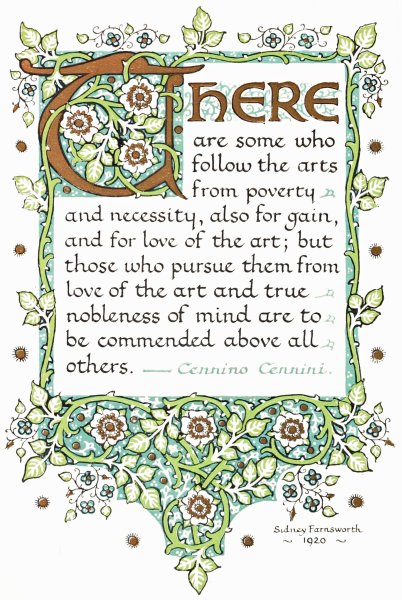
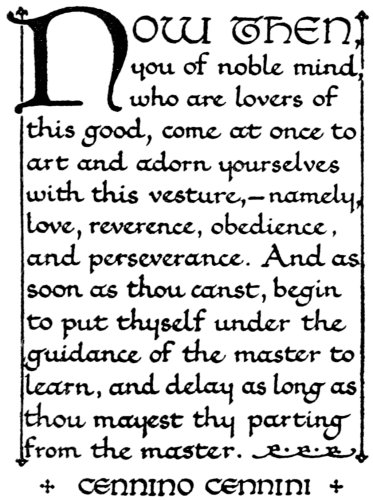
Perhaps the most interesting MS. of all is that
known as the Book of the Art of Cennino Cennini.
This is a most delightful treatise on the methods then
in use. Cennino Cennini was an Italian painter and
was living in Padua in 1398. The MS. in the Vatican
is dated 1437, but this is in all probability merely the
date attached by the copyist. It is evident that the
colours and methods that he mentions were in use
during the fourteenth century.
As this was a period when some of the finest
examples of illumination were produced, it is interesting
to note the various colours used, so they are given
in detail.
The reds mentioned by him are sinopia, cinabrese,
cinnabar, minium, amatisto, dragon’s blood, and
lake. Sinopia is a similar colour to light red, either
native or prepared by roasting yellow ochre. Cinabrese
is a mixture of sinopia with chalk. Cinnabar,
as mentioned before, is mercuric sulphide, which, when
artificially prepared, is termed vermilion. There is
hardly any doubt that the variety Cennino was familiar
with was the artificial kind, for he remarks that it
“is produced by alchemy, performed in an alembic.”
Minium is red lead, while amatisto is probably hæmatite.
Dragon’s blood, as already referred to, is a
resinous colour, and lakes were prepared from various
dyes.
The yellow pigments were ochre, giallorino, orpiment,
risalgallo, zafferano, and arzica. Giallorino
is supposed to have been a native mineral yellow pigment.
It is described by Cennino as a volcanic
product. Some, however, think this to be similar to
the pigment that used to be known as Naples yellow,
which was a compound of the oxides of lead and antimony.
Risalgallo realgar, or red orpiment, was prepared
by gently heating orpiment. Zafferano was saffron,
while arzica was a lake prepared from weld, which is
wild mignonette.
The greens that he refers to are verde terra, verde
azzurro, and verderame. Verde terra is the natural
earth known also as terra verte. In all probability
verde azzurro was a native copper carbonate,
similar to green bice. Verderame was verdigris.
The blues used were azzurro della magna, azzurro
oltre marino, and indaco baccadeo. Azzurro della
magna was a copper-blue similar to the azurite of the
classical period. Azzurro oltre marino was the genuine
ultramarine. Cennino’s description of the preparation
of this pigment from the lapis lazuli is very similar to
the recipes that are given in other MSS. Indaco
baccadeo was indigo from Bagdad.
The white pigments were bianco sangiovanni and
biacca. Bianco sangiovanni was whiting or chalk,
while biacca was white lead.
The blacks were “a soft black stone,” black “made
of the young shoots of the vine, which are to be burnt,
and when burnt, thrown into water, and quenched, and
then ground like other black pigments.” Another
black pigment “is made of the shells of almonds, or of
peach-stones.” Lampblack was also used.
The colours were mixed with gum arabic or egg.
Cennino also makes mention of the use of the
pezzuole colours, or clothlet tints, which were used a
great deal in the Middle Ages. These were pieces of
linen stained with transparent pigments. When required
for use, a small piece was cut off and soaked in
water to make a tint of the colour, a little gum being
added.
Cennino also treats of tinting parchment with
various colours. This was not done, as was the custom
in the earlier period, by staining the vellum with a dye,
but by washing a colour over it with a large brush.
It may be noted that practically all the permanent
colours mentioned in these MSS. are in use to-day.
Some of the colours used in the Middle Ages can hardly
be recommended to-day. The copper blues, for instance,
are not reliable, as impure air is very liable to
change them into copper sulphide. Orpiment is an
unsafe colour to use, while kermes will fade in a strong
light, besides being no longer an article of commerce.
Both dragon’s blood and saffron are notoriously fugitive
colours.
It is hoped that these few brief notes with regard
to the colours used by the mediæval artist may be of
interest to the student. If he wishes to study this
subject further he is referred to the various works
mentioned.