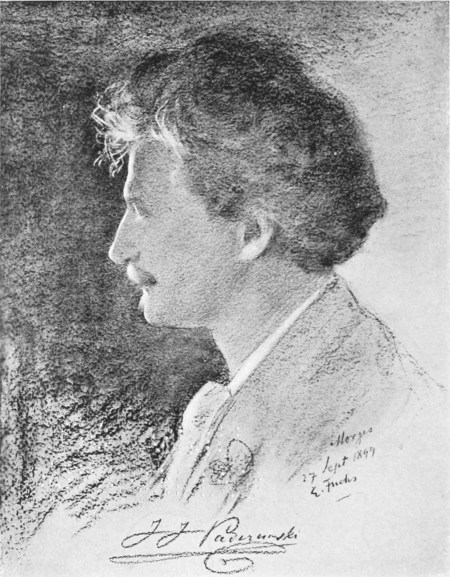
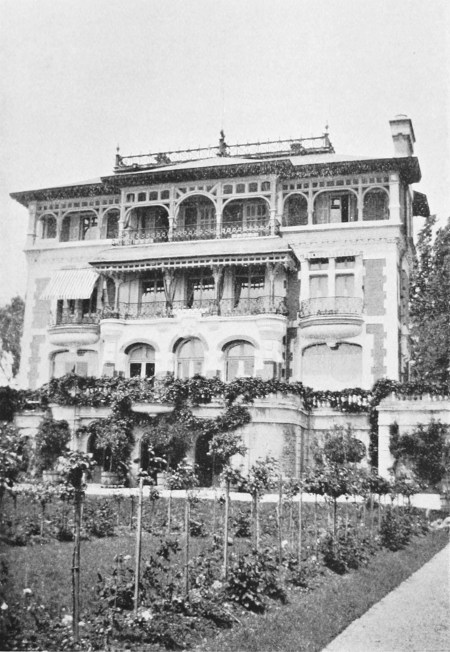
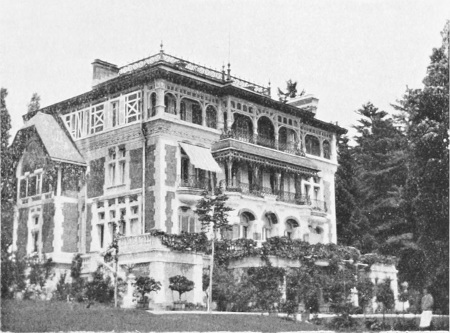
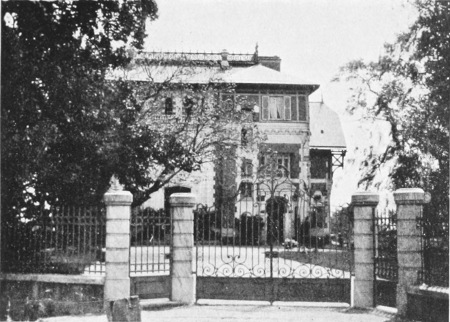
PADEREWSKY AT HOME
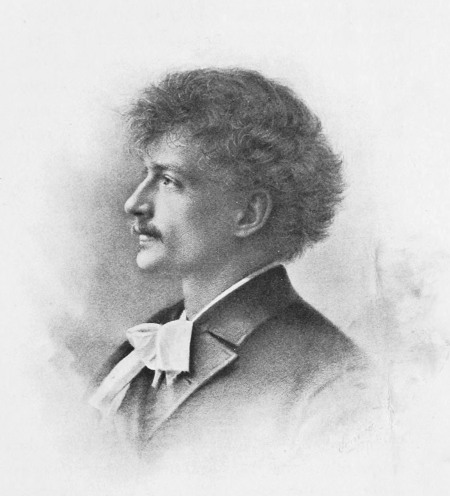
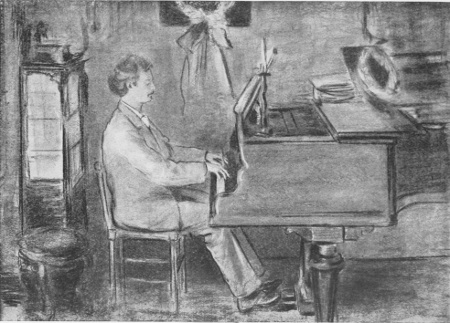
Reproduced from the original sketch by Emil Fuchs by permission of the artist.
The critic who would give a true appreciation of Paderewski as artist
must at once admit that he has the power of moving an audience as no
pianist since Rubinstein has been able to move it. In the opening
chapter I touched on some generalities with regard to Paderewski's
position in the world of piano-playing, and I referred to the
modifications in the verdict of the general which the critic must make.
In the difference between his outlook and the public's will be found his
divergence from the critical and popular estimation in which the great
pianist is held. I will at once confess that a professional critic is
apt to be too theoretical in his judgments: it is, if viewed aright, the
defect of his merits. We are compelled to give reasons for our likes and
dislikes, and these in turn are apt to proceed too much from the
intellect and not sufficiently from the emotions. The public, on the
other hand, has no hard-and-fast theories concerning piano playing,
singing or conducting. Provided an instrumentalist or a conductor
creates a "sensation" no close inquiry is made into a sacrifice of
artistic virtue. In the following appreciation of Paderewski as pianist
I have been at pains to collate my own opinions with those of men who
have, it seems to me, some authority to write on the subject. I may say
in passing that it is extraordinary how little of the criticisms penned
on the different recitals give the reader any clear and general idea of
Paderewski. His interpretations and playing are praised or blamed, but a
writer in a daily paper has to take it for granted that the pianist's
gifts and limitations are known and understood. Indeed, a journalist who
should sit down to pen a general criticism of a celebrated artist would
be considered a kind of critical Rip van Winkle. That is a pity, because
criticism demands reconsideration every few years. How could we tell of
what a pianist's fingers might be capable until we had heard Leopold
Godowsky? How judge of the future of opera until we had heard Puccini's
"Madame Butterfly"? For this reason contemporary Press criticisms of
Paderewski do not tell us very much. But here and there, scattered up
and down the pages of weekly periodicals and magazines, I have come
across passages which give a good idea of his powers and his
limitations. I propose to quote a couple of these as preliminary to my
own estimate of the pianist.
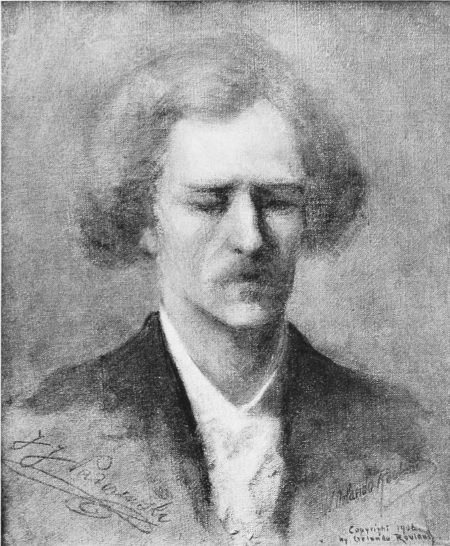
A MEMORY SKETCH OF PADEREWSKI, BY ORLANDO ROULAND
Reproduced by the kind permission of the artist.
In all criticism comparison must play an important part. However great
may be the natural gifts of a critic his verdict on a particular artist
is of not much value unless he has some clear standard of technical and
interpretative excellence. Those who remembered Rubinstein at his best
were on firmer ground in judging the new star, Paderewski, than those
who knew him not. For this reason the enthusiastic estimate of Dr.
William Mason, the well-known American writer on music and professor of
the piano, has peculiar value. Dr. Mason, it should be stated, studied
in Germany under Moscheles, Dreyschock and Liszt. In an interesting
critical study of Paderewski, written in 1893, he compared the playing
of that artist with the playing of many others, including Pachmann,
Rosenthal, D'Albert, and Scharwenka, and, while recognising their worth,
came to the conclusion that Paderewski was "an exceedingly rare
occurrence, indeed phenomenal."
"As Moscheles played Bach half a century ago, and as Rubinstein played
him later on, so does Paderewski play him now—with an added grace and
colour which put these great contrapuntal creations in the most charming
frames. It is the great, deep, musical playing combined with the calm,
quiet repose and great breadth of style. Paderewski has an advantage
over Rubinstein, however, in the fact that he is always master of his
resources and possesses power of complete self control.... In Rubinstein
there is an excess of the emotional, and while at times he reaches the
highest possible standard, his impulsive Nature and lack of
self-restraint are continually in his way, frequently causing him to
rush ahead with such impetuosity as to anticipate his climax, and,
having no reserve force to call into action, disaster is sure to follow.
"Of five prominent pianists, in Liszt we find the intellectual emotional
temperament, while Rubinstein has the emotional in such excess that he
is rarely able to bridle his impetuosity, Paderewski may be classified
as emotional-intellectual—a very rare and happy blending of the two
temperaments—and Tausig was very much upon the same plane, while Von
Bülow has but little of the emotional, and overbalances decidedly on the
intellectual side.
"It seems to me that in this matter of touch Paderewski is as near
perfection as any pianist I ever heard, while in other respects he
stands more nearly on a plane with Liszt than any other virtuoso since
Tausig. His conception of Beethoven combines the emotional with the
intellectual in admirable poise and proportion. Thus he plays with a big
warm heart as well as with a clear, calm, discriminative head; hence a
thoroughly satisfactory result.... In musical conception he is so
objective a player as to be faithful, true, and loving to his author,
but withal he has a spice of the subjective, which imparts to his
performance just the right amount of his own individuality.
"The heartfelt sincerity of the man is noticeable in all that he does
and his intensity of utterance easily accounts for the strong hold he
has over his audiences. Paderewski's playing presents the beautiful
contour of a living, vital organism.... It possesses that subtle quality
expressed in some measure by the German word Sehnsucht, and in English
as intensity of aspiration. This quality Chopin had, and Liszt
frequently spoke of it. It is the undefinable poetic haze with which
Paderewski invests and surrounds all that he plays which renders him so
unique and impressive among modern pianists."
The foregoing estimate represents the discrimination of an enthusiastic
admirer. Its value consists of its recognition of the power of
Paderewski's personality. No criticism of his technical mannerisms
alone—however much he may lay himself open to it—will give a true idea
of the great pianist. Among the many estimates of Paderewski written in
this country one of the most balanced and illuminative was penned by the
late Arthur Johnstone, for many years the musical critic of the
Manchester Guardian:—"Mr. Paderewski's distinguishing quality is a
certain extraordinary energy—not merely a one-sided physical, or even
a two-sided physical and intellectual, energy; it is of the fingers and
wrists, of the mind, the imagination, the heart and the soul, and it
makes Mr. Paderewski the most interesting of players, even though to the
extreme kind of specialist, absorbed in problems of tone production, he
is not the most absolute master of his instrument at the present day.
His art has a certain princely quality. It is indescribably galant and
chevaleresque. He knows all the secrets of all the most subtle dancing
rhythms. He is a reincarnation of Chopin, with almost the added virility
of a Rubinstein. No wonder such a man fascinates, bewilders and enchants
the public! Greatly surpassed by Busoni in the interpretation of
Beethoven, by Pachmann in the touch that persistently draws forth
roundness, sweetness and fulness of tone, and by Godowsky in the mastery
of intricate line and the power of sucking out the very last drop of
melody from every part of a composition, Paderewski still remains the
most brilliant, fascinating and successfully audacious of present-day
performers, and in preferring him the general public is probably right,
though the keen student of the pianoforte in particular may learn more
from Godowsky, and the earnest lover of the musical classics in general,
more from Busoni."
In much the same vein I wrote of a recital held at St. James's Hall in
1901. "The fascination of Paderewski held criticism in check. I know
that his Beethoven in C was smallish Beethoven; that there were many
spots of virtuoso exaggeration of contrast; but I also know that the
adagio molto had a poetry of expression which many better-balanced
pianists miss, and that the last movement had a growing power which
carried one away. I know, too, that Schumann's sonata in F sharp minor
was too exaggerated, that its force was often too febrile. I will even
admit that Paderewski's technique is not always as clear as it might be;
that for perfection of finger dexterity Rosenthal, Godowsky, Busoni and
Pachmann surpass him. If you press it, I will confess that Paderewski's
force is hysterical, an explosion of exacerbated nerves; that,
metaphorically, he has his back to the wall and with tight-drawn lips is
fighting for his life. His strength, you may say, is almost a weakness.
It has no reserve and occasionally it is perilously akin to ranting. He
is also too fond of unnecessary dynamic contrasts—the sign of the
virtuoso all the world over, whether he be a pianist or a chorus-master.
I would not even combat the assertion that he often allows a fastidious
brain to prompt new readings when novelty is unnecessary, and I must
admit that he has the abominable trick of opening his chords—the kind
of thing one expects in a third-rate pianist bidding for a cheap
popularity. Is the catalogue of defects full? If not, insert some more,
and then—
"Why, then, I will still assert that Paderewski is the greatest of
living pianists. He has what so many of them do not possess—a strong
individuality and real insight as a musical poet. D'Albert might play
that Beethoven sonata with a nicer balance and a more intellectual
grasp; but he would not create that glowing atmosphere. Paderewski's
reading cannot be held up as a model to young men and maidens. It was
very subjective. I do not ask Paderewski to be anything but himself, for
his self interests me. But, at any rate, the performances of Haydn's
Variations in F minor and Mozart's Rondo in A minor were perfect enough
in restraint and classical grace to rank as models. They seemed to me to
represent the normal Paderewski.
"And his Chopin playing particularly appeals to me. Pachmann, in the
lesser Chopin, and Godowsky as well, play with more polish of phrase,
and they have a more extended gamut of dynamic nuances; but neither
plays as a poet would play, and Chopin, with all his absolute musical
fastidiousness, was a poet. Pachmann is too pre-occupied with mere
beauty of tone and with the rhetoric of antithesis; Godowsky with the
perfection of finger technique. Busoni's Chopin playing can alone be
compared to Paderewski's, for Busoni has a poet's imagination. But
Paderewski has more emotional fibre." As a marginal note to this
criticism, it should be said that the pianist was not at his best in
that year. The tendency to nervous explosions was not so marked when he
visited us the following summer.
It must be confessed that Paderewski's repertoire is rather limited. He
never makes experiments with the compositions of new men, and I do not
remember if he has ever played anything of Alkans or of César Franck.
The plan of his programmes is apt to be stereotyped—a group of pieces
by Bach, Handel, Scarlatti—or other of the harpsichord composers; then
a sonata of Mozart or Beethoven, followed by the German romantic school,
and ending with Chopin, Liszt, and Rubinstein, or his own compositions.
Still, it is very difficult for a pianist to import novelty into the
programme of a recital, and until quite recently modern composers have
ignored the piano. But if Paderewski's repertoire is not very extended,
his sympathies are catholic enough. There is only one other pianist who
can be compared with him in this respect—Busoni. The rest have such
limitations of sympathy that one could wish they would follow Pachmann's
example and confine themselves to the composers they understand.
Paderewski is, perhaps, at his best in the playing of Chopin and Liszt,
and, at the other extreme, in his reproduction of the old harpsichord
music. The racial spirit in him, which I have already shown is a real
part of his composition, enables him to realise the bigger Chopin as no
other pianist realises him. In the Chopin which mainly demands agility
of finger and a refined sense of harmony, Busoni and Pachmann excel
Paderewski; but neither can play the great Scherzo in C sharp minor as
Paderewski plays it. His Beethoven is unequal. Sometimes, if in the
mood, he will give you a performance of one of the later sonatas which
cannot be surpassed for grandeur and glow of emotion (he could never be
a mere "classical" Beethoven player); at other times his readings are
rather small and not sufficiently architectural. He has done wonderful
things with the "Moonlight" and "Waldstein" sonatas, however. His
Beethoven is never uninteresting, and it is something that he spares us
the hard austerity of some of the Beethoven playing which is so highly
praised in these days.
It has been well said that Paderewski treats Bach as a modern
romanticist, following the example of Liszt in this. The Bach worshipper
of a certain type is not likely to admire Paderewski's readings, but the
pianist certainly does bring out all the beauty of the composer's music.
If Mme. Schumann's idea of her husband's music was right, then
Paderewski is apt to treat him too much as a virtuoso composer. His
playing is a trifle wanting in the true German reflectiveness, but the
romance is realised. The concerto is one of Paderewski's finest
achievements, however. When an appeal is not made to his Slav
temperament, Paderewski's mind seems to find most pleasure in the
refinement of Weber, Mendelssohn, and Mozart. He has done a great deal
to rehabilitate Mendelssohn. He made serious musicians ashamed of their
estimate of the "Variations Sérieuses," and he reset the exquisite gems
of melody enshrined in the "Songs without Words," made so dim by the
clumsy handling of generations of schoolgirls.
In all Paderewski does there is evidence of much musical thought. That
is to say, even when he treats a composition to a new, and, as it seems,
a sensational performance, the conception is consistent throughout. And
that is one of the reasons why the pianist carries you away even when he
runs counter to theories or prejudices. Your mind may be critically at
work throughout the whole performance, but you feel at the same time
that the player is not making a bid for the popularity of empty
sensationalism. Those who accuse him of that are wrong. They forget that
with all his intense quietude of manner, Paderewski is at heart a Pole,
and that the very nervous force which enables him to play with glowing
power is also apt to make him exaggerated and exuberant; but the musical
intellect has artistically planned out these outbursts, which are seldom
merely physical.
The weakness of his playing on its technical side lies in a tendency to
smudginess of execution. Paderewski cannot lay claim to the absolute
clearness of Busoni; nor has he the magical fingers of a Godowsky. But I
am not at all sure that the defects of his technique are not an
expression of his merits as a tone poet. It is inconceivable that a
player of Paderewski's fiery and nervous temperament should be a perfect
mechanician. Moreover, his lapses from technical rectitude are never
lapses from the higher technique of the piano. No pianist so well
understands how to produce beautiful tone; no pianist has such a variety
of touch; and none such a grasp of the art of pedalling and phrasing.
The Paderewski tone is a thing by itself. Above all, he is a master of
rhythm. The wonderful, subtle nuances of tempo rubato which
distinguish his playing are the expression of a genuine, musical nature.
Sometimes this extraordinary grasp of rhythm may lead him to attempt
effects which were not, perhaps, within his composer's intentions, but
they are musical effects and not merely capricious. In brief, Paderewski
appeals to lovers of music, not because he is the most wonderful player
of his instrument that has ever existed, but because he is a genuine
tone-poet, a man of exceptional nature and rare temperament.
Perhaps he has summed himself and his aims as well as any one else could
sum them up. "If I were asked," said the great pianist to an
interviewer, "to name the chief qualification of a great pianist, apart
from technical excellence, I should answer in a word, genius. That is
the spark which fires every heart, that is the voice which all men stop
to hear! Lacking genius, your pianist is simply a player—an artist,
perhaps—whose work is politely listened to or admired in moderation as
a musical tour de force. He leaves his hearers cold, nor is the appeal
which he makes through the medium of his art, a universal one. And here
let me say, referring to the celebrated 'paradox' of Diderot, that I am
firmly of the belief that the pianist, in order to produce the finest
and most delicate effects must feel what he is playing, identify himself
absolutely with his work, be in sympathy with the composition in its
entirety, as well as with its every shade of expression. Only so shall
he speak to that immense audience which ever depends on perfect art.
Yet—and here is a paradox indeed—he must put his own personality
resolutely, triumphantly into his interpretation of the composer's ideas."