House-decoration, it would seem,
is almost synonymous with civilization,
and certainly has been co-extensive with its
development in the world. The domestic interior,
so far as we are able to realize it, and all
that it implies, affords the best visible evidence
of the standard of living and refinement, and
sense of beauty existing among a race or people
of any age or country.
In proportion as the conditions of human life
become more and more artificial, and removed
from nature, man seems to require the aid of
art.
Decoration, indeed, might be regarded as a
sort of aesthetic compensation for the increased
artificiality, complexity, and restraint of civilized
life.
Sheltered from the storm in a rain-proof,
well-drained house, by a comfortable fireside,
the comfort of a citizen who sits at home at ease
is perhaps increased by the contemplation of
pictures of wild landscape, perilous coasts, and
even shipwrecks, upon his drawing-room wall;
but when the sun smiles and the long days
come, something of the instinct of primitive
man moves him, and he wants to be off to the
woods and moors, seeking nature rather than
art.
Thoreau, in his delightful book, “Walden,”
describes his endeavours to return to nature and
reduce his life to the simplest conditions; he
found the woods of Walden and its denizens, and
the pond with its wild fowl, and the contemplation
of the changeful drama of nature quite
sufficient, beyond a little rough wooden shanty,
with a bed, a chair, and a writing-desk in it.
The only attempt at decoration he seems to
have made was when he introduced some
curious stones, by way of ornament, but quickly
got rid of them again, as they needed dusting
and arranging. Here he seems to have reached
the zero of house-decoration.
Decoration with primitive and pre-historic
man may be considered chiefly personal and
possible. The taste for decorative pattern was
gratified upon his own skin in the form of
tattoo or war-paint, or in strings of beads,
feather head-dresses, and the carved handles
of his weapons. Not that modern man—still
less modern woman—has given up personal
decoration, in fact, I suppose feathers and
beads were never so much in demand, but it
seems that modern painters and decorators
having provided so much more elaborate and
becoming backgrounds they have to be “lived
up to.” One has heard of the man (in “Punch”)
who was looking for a wife “to suit his furniture.”
Well, the background is an important
element of a picture, after all.
Cave-walls, though not neglected in primitive
times, no doubt had rather severe limitations,
regarded as fields for decoration, and until the
art of constructing dwellings had been developed
to a certain extent, it is obvious that mural
decoration could hardly exist in any ordered
form.
Tent-dwellers, like the Tartars and the Arabs,
developed the mat and rug, the carpet and
cover, and thus, on the textile side, made their
historic contribution to an important element in
modern house-decoration, as well as to certain
typical forms of pattern well known to decorators;
but the ancient Egyptian, with his plastered
surface over the sun-baked bricks which
formed the wall of his dwelling was, so far as
we know, the initiator of painted mural decoration.
The definite but abstract forms, the primary
colours cleared by black outlines, and the
resulting flat decorative effect of early Egyptian
art, have set the abstract type for mural painting
for all ages.
With the Egyptians, however, as with the
ancients generally, the buildings most regarded
for decorative purposes, owing, of course to their
social and religious customs, were the temple, the
palace, and the tomb. The Greeks and Romans,
and the nations of mediaeval Europe, broadly
speaking, followed the same order, inspired by
very different ideas, and under the influence of
very different habits of life and climatic differences.
The classic temple and the mediaeval
cathedral became alike the depositories of the
most beautiful decorative art. They are the
great representative monuments of the art of the
age and of the races that produced them, truly
collective and typical.
The individual citizen under Greek, Roman,
and especially Christian ideas, and the development
of commerce becoming of more and more
importance, we find the private house considered
more and more as a field for the decorator’s art,
and for the expression of individual feeling and
taste.
As regards walls, fresco and tempera painting
appear to have been the chief and most
general methods of decoration from classical
times to the middle ages, and it is still to those
methods we look for the higher forms of mural
work.
The remains of Pompeii, disclosed from beneath
their pall of volcanic ashes, have furnished
a mine of examples to the mural painter, and, indeed,
the influence of the Roman and Pompeian
taste and methods of treatment seems to have
remained almost traditional with the Italian decorator,
who has never lost his skill as a workman
in tempera painting, though one may not
always be able to admire his taste.
Yet, in regard to such a marked and distinct
type of decoration as the Pompeian, one cannot
but feel that in the endeavour (which has often
been made) to adapt such types of decoration
to modern domestic interiors there is an uncomfortable
feeling of anachronism and incongruity.
The style, the fancy, the colour, the treatment,
the motives, all belong so essentially to another
race, and to a different climate. To live surrounded
by such imported decorations would
be like masquerading in classical costume, and,
indeed, to be consistent, the dwellers in a
Pompeian room ought to pose in classical
draperies, and endeavour to emulate an Alma-Tadema
picture in the aspects of their everyday
life.
Every race and every age, however, acted
upon by all sorts of influences, climatic, social,
economic, commercial, political, historic, evolves
its own ideas of home and comfort—and appropriate
decorative surroundings as a necessary
part of home and comfort. These, in the long
run, are the fittest to the circumstances and
conditions, but by no means always ideally the
best, in fact, but rarely so, being the result, as
a rule, of certain compromises; but the forces
which fashion our lives and characters, which
determine our habits and pursuits, also determine
the character of our surroundings.
The very ideas of home and comfort which
one might consider more fixed and permanent—more
traditional—than most human notions,
seem, with the increased complexity of modern
life, especially on the lines of the present development
of large cities, or commercial centres,
liable to change. The practice of living in flats
and residential hotels must surely tend to displace
or modify in the mind of the ordinary
citizen the older ideas of what constitutes the
completeness and organic relation proper to an
independently constructed dwelling. The contraction
of space, and sometimes of light, commonly
associated with flats, cannot have a
favourable physical effect, and the impossibility
of any garden setting—beyond a window box—must
again, one would think, affect both the
general health as well as a healthy sense of
decoration.
The decorative designer certainly depends
largely for freshness of inspiration and suggestion
in design and colour upon growing plants
and flowers, upon the sight of birds and animals,
of the ever-changing sea and sky, and the colours
of the landscape. If the sense from which is
produced the very elements of decoration thus
requires to be kept alive and in health, surely
the sense which appreciates the product, which
selects and uses, needs also similar access to
nature to preserve a healthy tone. But having
provided small brick boxes with slate lids as
homes for our people, and packed them together
in straight rows all alike on the eligible building
land of our towns, we next proceed to economize
space (and secure more unearned increment to
the square foot) by packing such boxes one on
the top of the other and calling them “mansions”
or “residential flats.”
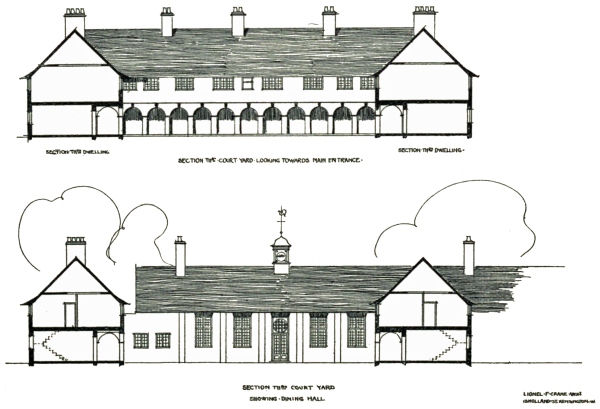
Sketch for
Collective
Dwelling
containing
Sixteen Cottages
with
Common
Dining-hall,
Kitchen, etc.
1/32″ Scale
By Lionel F.
Crane
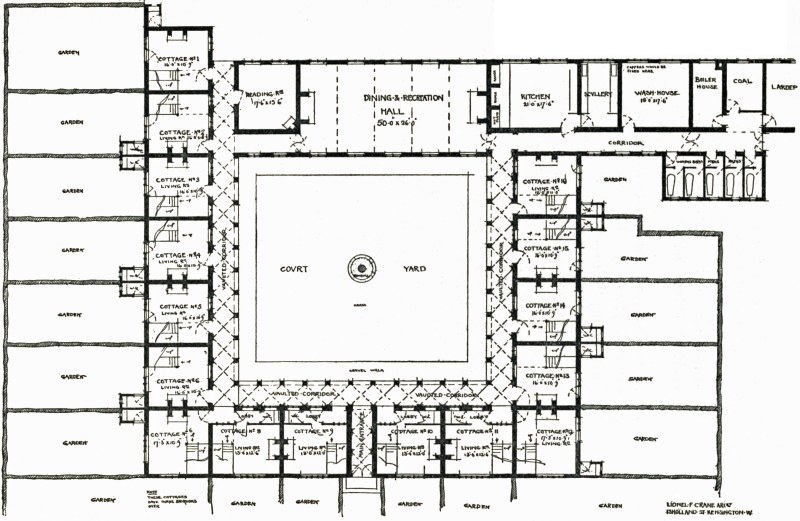
Sketch for Collective Dwelling containing
Sixteen Cottages with Common
Dining-hall, Kitchen, etc. 1/32″ Scale
On the other hand the collective dwelling, of
which perhaps we see the germ in the better
type of modern flats, with a common kitchen
and dining-hall, may have an important future,
and there is no reason why, given favourable
conditions, good sites, and ample ground and
careful planning with due regard to light, air, and
aspect, dwellings on the plan of collective living,
or collective homes, should not have dignity and
beauty, as well as the comforts of a home combining
provision for the necessity of privacy,
with the social advantages of a common room,
and the economic and continuous advantages of
a common kitchen.
It should mean that the administration, the
housework, and the cooking would be done by
trained hands, and one would suppose that the
load of care to devise the recurring scheme of
the daily dinner, etc., now so generally pressing
on the poor housewife, might thus be lifted, and
a great waste of individual effort saved.
The old plan of the quadrangle would be an
excellent one for a co-operative dwelling: one
side of the square or wing opposite the entrance
gate might be occupied by the dining-hall and
public rooms, the other sides might contain the
private rooms or be divided into separate dwellings
with separate private entrances on the
outer sides: on the inner side connected by a
cloister which would enable the occupants of the
private rooms or separate dwellings to pass to
the public rooms at the head of the quad. A
formal garden might occupy the centre of the
quadrangle with a fountain in the centre. Such
a scheme has, I believe, already been proposed
to be tried in one of the London suburbs.
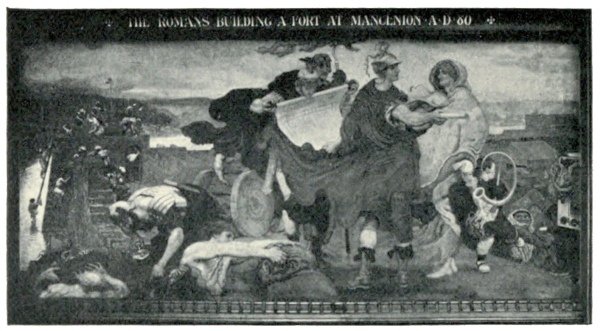
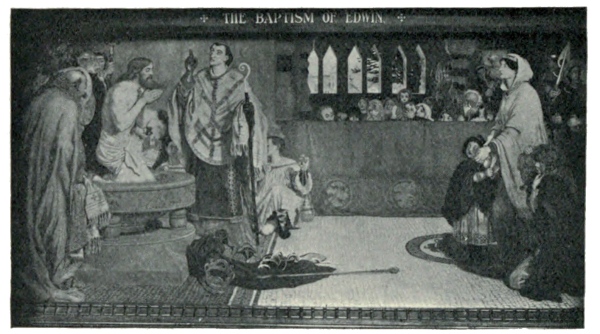
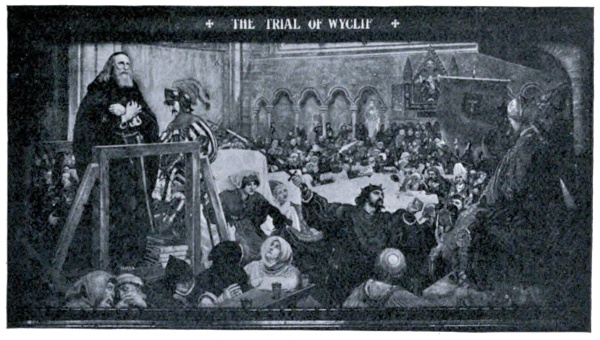
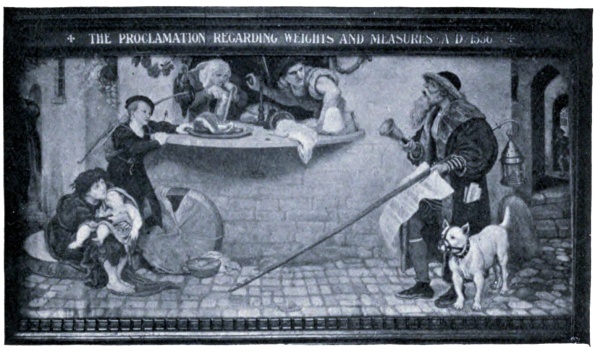
Frescoes by
Ford Madox Brown
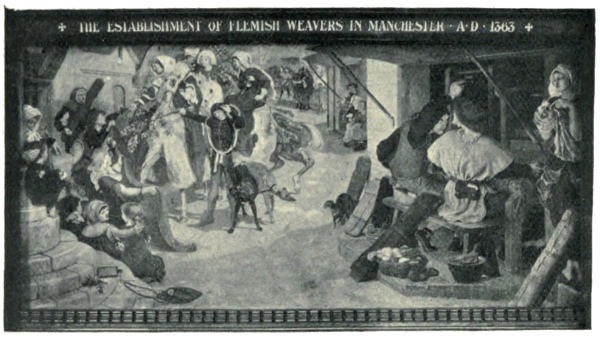
Town Hall, Manchester
Frescoes by
Ford Madox Brown
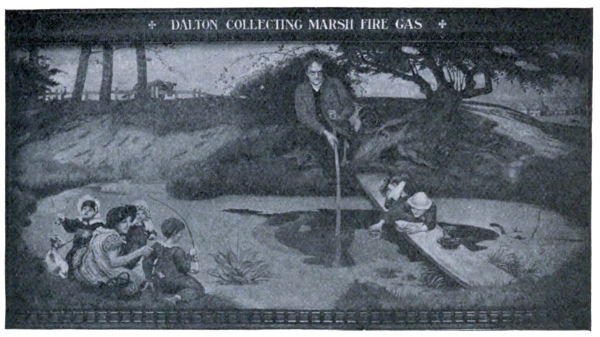
Town Hall, Manchester
From the decorator’s point of view the plan
and scale of such collective dwellings might
afford fine scope for art: the large public rooms
such as the hall and the common dining-room,
might be simple and dignified with panelled
walls, leaving space above for a continuous
frieze of figures, or divided into separate subjects
illustrating local history or legend, poetry,
romance, or symbolism of life and nature.
The true place, however, for the decorative
perpetuation of local history and legend is the
Town Hall, and it is satisfactory to know that
this principle has been thoroughly recognized in
at least one important city of England and in a
modern Town Hall. I allude to the frescoes of
Ford Madox Brown which vividly and dramatically
illustrate the history of Manchester and
her worthies, and appropriately decorate the
walls of the City Hall.
In Birmingham, also, I believe a scheme of
painted panels has been devised to illustrate
local history, and students of the Municipal
School of Art have competed for the design of
these. This seems an excellent idea which might
be generally adopted. Every town which has
municipal buildings and a municipal school of
art might do much not only to stimulate public
spirit and local feeling, but also materially to help
young students and designers by giving them
an opportunity of doing public work and thus
getting practice in the highest kind of decorative
art—mural painting.
Surely if we have any pride of place, if we
regard our towns and cities as something more
than mere mills for money-making we must feel
how greatly their interest and beauty might be
added to in such ways as these, as well as public
parks and gardens, fountains, trees along the
streets, and seats and shelters. Indeed, having
regard to the future of our race, and the importance
of space and open air and surroundings of
some beauty to the healthy growth and upraising
of children, it becomes a public question of
pressing importance, this of the conditions of
life in our cities, housing, and house and school
building and decoration.
One remarkable demonstration or object
lesson has been given, owing to the initiative
energy and philanthropy of Mr. George Cadbury
at Bournville near Birmingham, which I was
afforded the opportunity of seeing the other day.
He has proved, at least (even as William Morris
did), that factory work may be carried on amid
pleasant surroundings and means of recreation
for body and mind, and that a working population
can be housed in close proximity to their
work in picturesque and cheap healthy dwellings,
surrounded with ample gardens and pleasant
trees.
The Garden City Association is also in the
field with Mr. Ebenezer Howard’s scheme for
uniting agriculture, horticulture and manufactures,
with beautiful and healthy dwellings in
garden cities which will, it is hoped, relieve the
overcrowding of our great towns, and bring
back the people to the country with all the conveniences
and advantages of well-organized city
life, and moreover enable the inhabitants to
become the collective owners thereof.
The rapid means of escape from towns which
modern invention and commercial interest and
enterprise have placed within reach of the town
dweller—while they suggest that modern cities
are not meant to dwell in—by those who can
get out of them—may to some extent counteract
the ill effects of an artificial existence, at
least among some classes of the population, but
I think a certain restlessness is induced which
has its effects—even upon decorative art. The
modern mind seems more easily fatigued, and
to require more constant and rapid change.
This restlessness, no doubt accelerated by the
effects of grime and smoke, leads to the desire
for more frequent change of colour and pattern
in the living rooms, than formerly. This, it may
be said, is healthy, because it is “good for
trade”—for the painters’ and decorators’ trade,
that is. One of the drawbacks of modern life,
however, is the existence of trade organizations
that are prepared to supply (on the shortest
notice) any atrocity which may be in demand—indeed,
I am not sure that supply does not
in some cases create demand, and I suppose he
is but a poor salesman who cannot persuade
people to buy what they do not want—it may
be some passing whim or phase of public taste,
or want of taste; but the circumstances which
are good for such trade cannot be expected to
evoke much artistic enthusiasm. What is “good
for trade” is not always good for human beings,
either in the making or the using, of which we
have often had evidence, but trade, or profit, is
the modern fetish to which, apparently, all other
considerations are expected to bow.
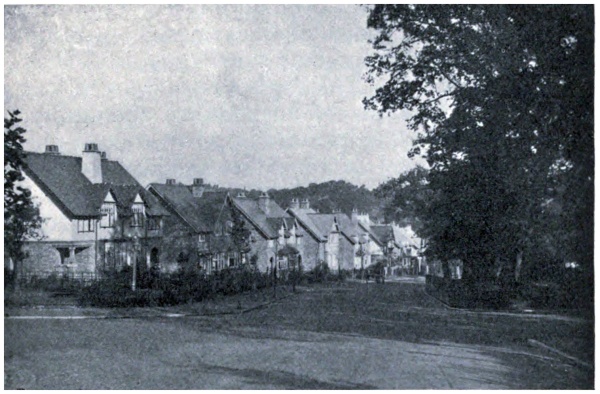
View in
Bournville
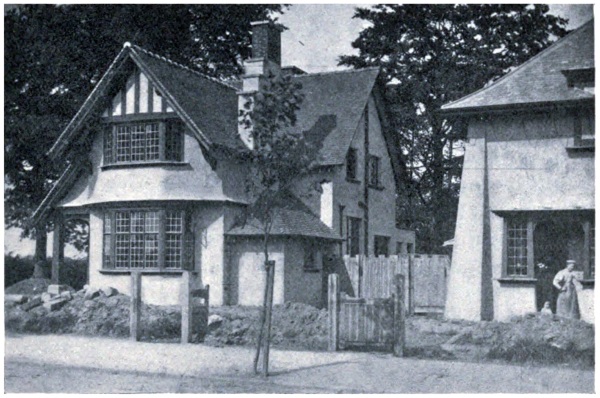
Cottages at
Bournville
Designed by
Alex. W.
Harvey
Now, I take it, a painter or a decorator must
be primarily concerned with producing something
of beauty, even if, owing to circumstances
over which he has no control, it cannot be “a
joy for ever.” Let his problem be of the
simplest—the choice of a flat tint for a wall, for
instance—the important element of individual
taste comes in. This, again, must be checked
by considerations of adaptability and utility,
such as aspect and conditions of lighting in the
room, the kind of room, its proportions and
purpose.
We all know what a different effect the same
tint has in full or in half-light, in sunlight or in
shadow, and what transformations are effected
in rooms by simply changing the tint or the
wall-paper.
The effect, too, of the same tint upon different
surfaces should be noted. Any texture or granulation
of surface improves the quality of a flat
tint, and for this reason wall coverings with a
texture in them; such as are known under the
name of Burlaps, are excellent, providing a
variety of plain tints of pleasant texture for
wall coverings, or admirable grounds for the
decorator to work upon.
A good sense of colour, therefore, is of the
first importance. A knowledge of how to produce
certain tints; the effect of one tint upon,
or in juxtaposition to, another; the effect of one
tint and of different tints in the same light;
the best grounds for different tints; all these
things, in addition to the workman’s skill of
hand in laying on paint evenly, are essential
parts of a painter’s and decorator’s training and
equipment.
The complex elements out of which have
been evolved our ideas of harmonious decoration
are not more complex than those out of
which the varieties of the modern house have
been produced. True taste, as well as common
sense, would say, “cut your coat according to
your cloth”—build your house and decorate it
according to what you can spend upon it: let it
represent your own ideas of taste and comfort,
after due thought, and not be an imitation of
another’s, or of something in the mode which
you think you ought to like, neither something
costly because of the cost, or a cheap imitation
of something costly.
How few houses seem to be built or decorated
upon these principles. How few, indeed, build
their houses at all, or have much choice in the
matter—except perhaps that of Hobson, who
must also have been a jerry builder.
There is an old saying that fools build houses
and wise men live in them. However that may
be, certainly town-dwellers are often like hermit-crabs,
glad to creep into more or less inconvenient
empty shells erected by former generations,
happy if they succeed in adapting them
to their own requirements more or less. In a
book on architecture of about the date 1836,
elevations and plans are given of “a First-rate
House,” “a Second-rate House,” “a Third-rate
House,” and even “a Fourth-rate”—quite
on the principle of railway carriages, but going
one better, or one worse. They all present
modest street frontages of about twenty feet,
duly cemented and painted. They differ chiefly
in the number of their stories, and consequently
windows, but the plans and elevations are all
of the same type, slightly varied in the details.
The “first-rate” house, though a little more
ornate and classic in some ways is by no means
a palace, and the fourth-rate house is not exactly
a cottage; the second-rate is only a cheaper
edition of the first-rate, and the third-rate tries
to look like the second-rate, but is conscious of
having only one window to the dining-room.
All sport balconies to the first-floor front windows
and iron railings, guarding the ground-floor
and basement, only the fourth-rate has no
basement. It is as if the architect started with
one elevation and literally cut it down to meet
the exigencies of second, third, and fourth-rate
tenants—I had almost said passengers—and in
strict accordance with the then building acts.
Those building acts, perhaps, are responsible
for the monotony of our modern streets. Although
they have in some respects been modified
of late, houses in a street or road are obliged
to dress up to a straight building line, toeing
the mark like a file of soldiers. Or, perhaps, more
suggestive of a train of railway carriages, which
only needs a locomotive attached to the end of
the row to pull them along, and one might hope,
out of sight, also. There are miles of houses of
this type still existing in our towns, notably
London, for which in fact the designs I speak
of were intended, but I have seen their like in
Liverpool, Dublin, and elsewhere.
Though carefully graded in classes and adjusted
to certain rentals, the aim of the builder
has been to make each present, on the outside,
an equally neat and respectable appearance.
This is thoroughly characteristic of mid-nineteenth
century ideas, and the love of neatness
has always been characteristic of the English.
The compromise, also, between modest requirements,
or shall we say, between 5 per cent. and
a respect for the Five Orders, which the street
frontages of this period exhibit, is equally characteristic.
We see the last results of the wave
of Greco-Roman taste which ruled from the end
of the eighteenth century to the early Victorian
time. Of course we have got beyond all that
now, though the type remains, and in some cases
even, with its remnants of style, affords a slight
relief and sense of repose after certain flamboyant
erections in terra-cotta and plate glass which
have appeared in our streets, with the up-to-date
builders.
The type, as I have said, of these middle-class
dwellings remains, their chief charm as
well as decorative point being in the design of
the street doorway, with classical columns or
pilasters and a fanlight often with a graceful
design in leaded glazing, too often ruthlessly
scooped out to make way for blank plate glass.
We know those iron railings (protecting the area
and kitchen quarters from the attacks of the
soldier and policeman), the windows of the basement
timidly peeping above the ground as with
half-closed eyes; the steps to the front door
whitened by successive generations of devoted
housemaids; the more or less Doric front door;
the entrance hall, or long squeezy passage with
the umbrella stand as a principal decoration;
the staircase at the end leading to the upper
rooms; the dining-room opening out of the aforesaid
passage, with perhaps a dismal window in
the rear, commanding a fine prospect of back
yards, unless considerately veiled by ferns, or
stopped out by some would-be stained glass.
The bedrooms over, back and front, follow
naturally from such an obvious plan.
Such types of houses, however out of date,
ought not to be without interest to the house-painter
and decorator, since they depend for
keeping up appearances almost entirely upon
fresh paint—and nothing is, as we know, “as
fresh as paint.” Indeed, I have often noticed in
London—from that commanding eminence the
top of a ’bus—how the white-painted old-fashioned
fronts with green doors of some of the houses
in Piccadilly, facing the Green Park, donning
new “coats” for the season, quite put to shame
some of their neighbours—the gorgeous stone-built
and marble-columned club façades with
all the grime of a London winter thick upon
them.
There is nothing like leather—I mean paint—after
all! In fact, whether inside or outside, the
town house requires constantly cheering up by
the painter and decorator, but it must be the
decoration that cheers but not inebriates—and
there is a good deal of what I should call inebriated
decoration about. Much of what is
generally known as “l’Art nouveau,” for instance,
belongs to this category—the wild
and whirling squirms which form the chief ornamental
unit, whether in surface decoration,
furniture construction, wood carving, inlays, or
textiles—which was so much in evidence at the
late Paris Exhibition, and in the pages of “The
Studio,” which is, moreover, generally on the
continent considered to be English in its origin.
In some of its forms it certainly does suggest
a free translation into French or German of a
kind of decorative art associated with the designers
of the Glasgow school, but, no doubt, like
all modern and mixed styles (like the melancholy
of Jacques in “As you like it”), it is extracted
from many simples and compounded of
many elements. It is said that the Emperor
Augustus found Rome of brick and he left it a
city of marble. I should, contrariwise, suggest
that our decorator, supposing he found the
woodwork of “a desirable residence” grained,
should leave it plain-painting—beginning at
the front door. Iron railings, it may be noted,
in passing, are generally painted (perhaps from
economic reasons) too dark a colour, which
darkens still more in the smoke of towns. A
favourite hue is a kind of beefy red, sometimes
picked out with gilding, though this artistic
touch is generally reserved for public buildings—or
the public house. Graceful wrought ironwork
of a light kind often looks well painted
white or a light cool green, but ordinary Brunswick-green
(of a middle tint) has a good appearance
with the white window frames, reveals
and door jambs of a red-brick house, the green
being repeated for the front door and any outside
shutters. Apropos of the heavy red paint
so frequently used for ironwork, I think that
the cylinders of gas-works (which form such
important items in the scenery of our suburbs)
would be far less trying objects if they were
painted a discreet and retiring cool tint of green,
and the light ironwork supporting standards or
columns painted white. I do not think such a
treatment ought to raise the price of gas, but it
would certainly elevate (or shall we say mitigate)
the gasometer, and it would certainly dispel the
irresistible impression on the mind of the unprejudiced
that these rotundas were really huge
rounds of pressed beef waiting for some giant
Cormoran’s luncheon.
But we stopped at a green door, with white
jambs. Dear to some decorator-painters’ hearts
(and hands) is “graining.” Wonderful, and sometimes
fearful are its results. I quite recognize
the skill sometimes spent upon graining—the
extraordinary imitation of costly natural woods
which a skilled grainer can produce over ordinary
painted deal. There are also motives of
economy, I believe, to account for the persistence
of graining—in an age of such transparent
honesty and simple habits as ours (?). The practice,
I have heard, commends itself in some
quarters for the same reason that influenced
Dame Primrose in the choice of her wedding
gown, namely, “for qualities that wear well.”
Nothing can be a more delightful, or a more
durable lining for the walls of hall or living-room
than oak panelling, but nothing, to my
mind, can be more sordid and unpleasant than
the woodwork of a room grained to imitate oak.
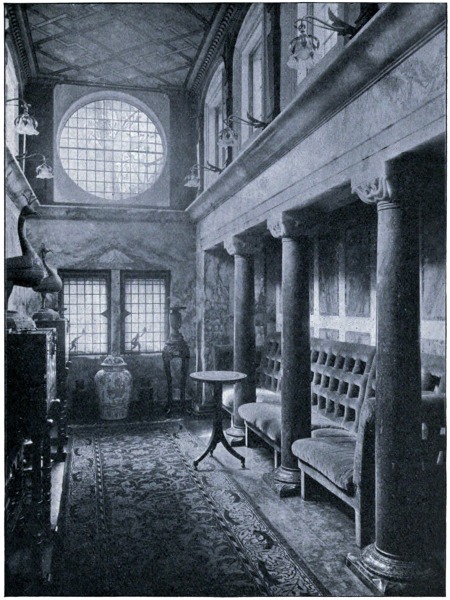
Interior,
1a, Holland
Park.
Designed by
Philip Webb
From a
Photograph
by W. E.
Gray
The one field where skill in graining and
marbling would be appropriate is that of stage
scenery and decoration, where the object is to
imitate, and where the scene has to be quickly
changed in obedience to the demands of the
drama.
Few interiors are more pleasant than the
white-painted panelled rooms in eighteenth-century
houses, a mode which some modern
architects have revived with much success.
There is nothing like white paint for the wood-work
of modern rooms. It is the best set-off to
wall-papers, and though many attempts have
been made by house painters and decorators to
get variety of effect by repeating in the styles
and panels of the doors some leading tint of
the wall-paper, the eye soon tires of the rather
restless result, and welcomes plain white flatted
paint, leaving it to the mouldings to give the
necessary relief.
Door panels are often considered suitable
fields for painted or other decoration; if, however,
door panels are emphasized in this way,
the walls would have to be quiet in pattern and
colour, so as to let the doors tell as the chief
decorative points; in such a scheme they would
naturally be balanced by a painted treatment of
a wood mantelpiece and connected by a chair
rail and panelled dado, or wainscot; on the other
hand, with a richly patterned and coloured wall
the wood-work, if painted, should be kept plain
colour.
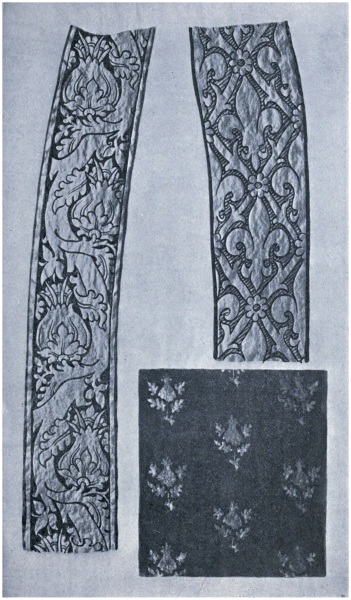
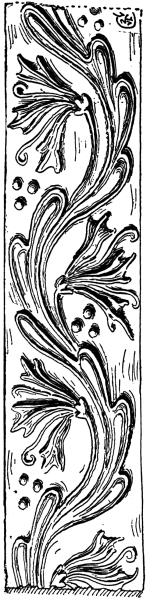
Painted
Decoration,
Ranworth
Rood
Screen,
Norfolk
Drawn by
W. T.
Cleobury
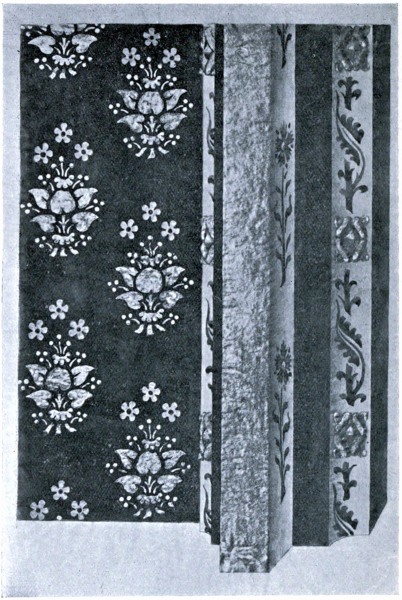
Painted
Decoration,
Ranworth
Rood
Screen,
Norfolk
Drawn by
W. T.
Cleobury
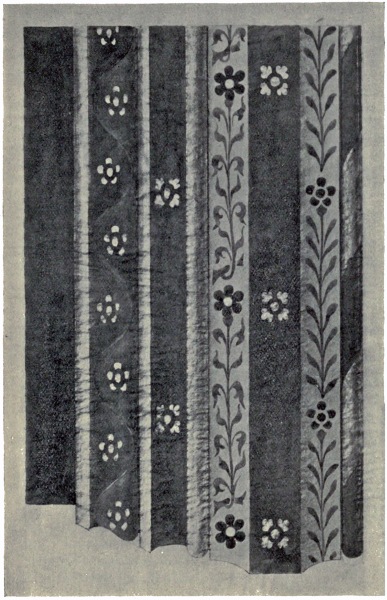
Painted
Decoration,
Ranworth
Rood
Screen,
Norfolk
Drawn by
W. T.
Cleobury
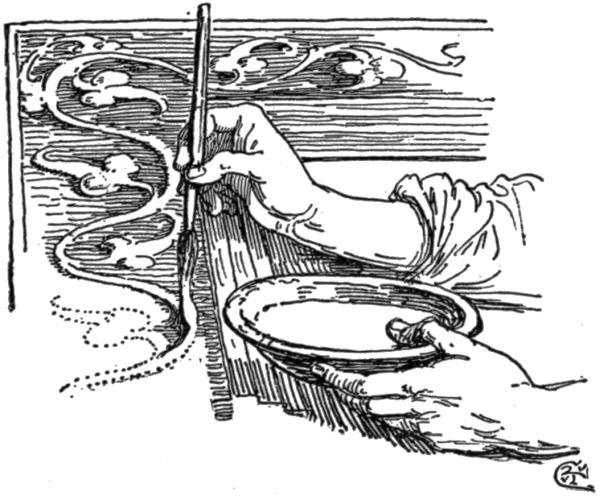
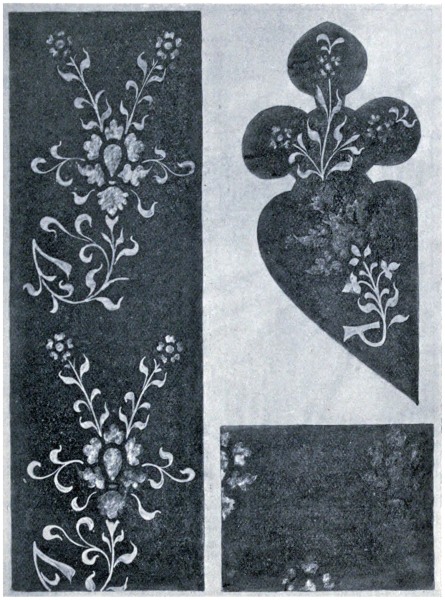
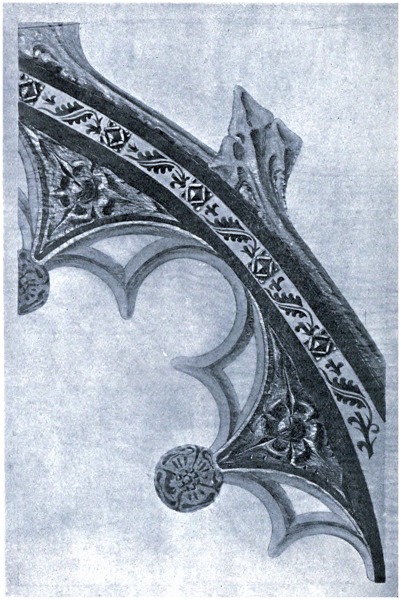
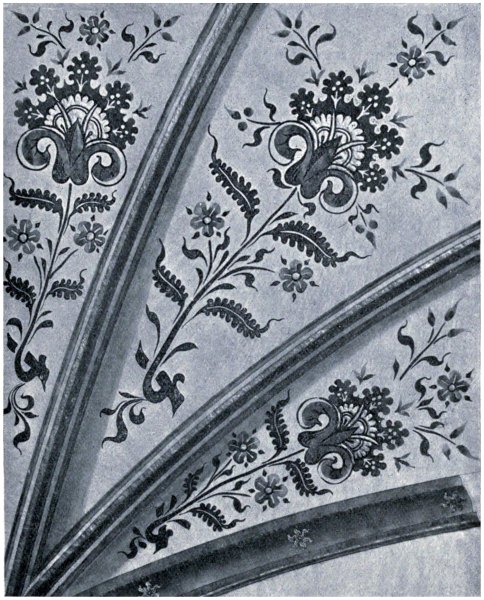
If our technical schools where house-painting
is taught, instead of devoting time and skill to
teaching methods of imitative graining, were
to endeavour to train the pupils to use the
brush as decorators and encourage them to
design and paint simple ornamental borders,
fillings, and friezes, such as might be useful in
interior decoration, and train them to be able
to space out walls with simple but tasteful
sprays of leaves and flowers, decoratively treated,
and painted by direct clean brush touches, we
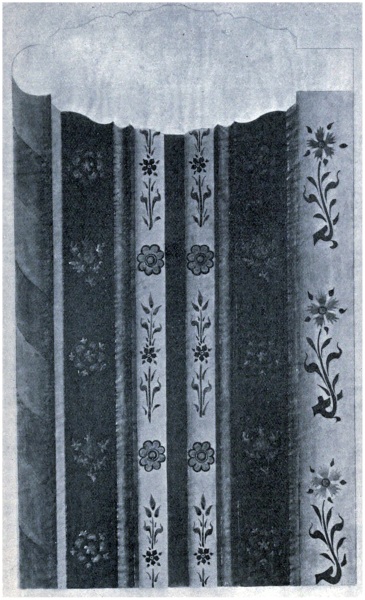
should surely see better results. Following the
spirit of such types as these from the Ranworth
screen in Norfolk, for instance (a beautiful piece
of mediaeval English work of the fifteenth century,
drawn for me by Mr. Cleobury, who has
also furnished the South Kensington Museum
with a complete set of drawings from the screen),
they would be doing much more excellent as
well as interesting work, work which in its
practical results ought to prove much more
pleasant and useful, both to house-painters and
to house-holders. This might be supported by
prizes being offered for such work in public
exhibitions.
The attention now being given in primary
schools to brush-work, if wisely directed in its
effects, by giving facility to young hands in the
use of the brush, with its power of expressing
form by direct strokes, ought to be an excellent
aid and preparation for such an after training in
practical painting and decorating as is here
suggested.
Painted
Decoration,
Ranworth
Rood
Screen,
Norfolk
Drawn by
W. T.
Cleobury
Painted
Decoration,
Ranworth
Rood
Screen,
Norfolk
Drawn by
W. T.
Cleobury
Painted
Decoration,
Ranworth
Rood
Screen,
Norfolk
Drawn by
W. T.
Cleobury
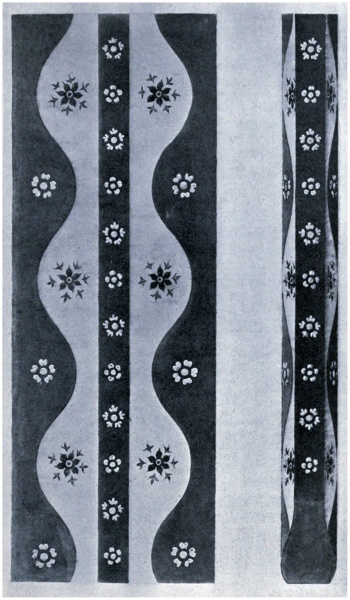
Stencilling and the design of stencils (which
affords excellent practice in pattern construction
of all kinds to the designer and decorator), has
been developed of late years to rather a remarkable
degree by our art schools, as the National
competitions bear witness. There has been a
tendency to over-elaborate this kind of decoration,
however, by complex patterns and the use
of blended tints, which its conditions hardly
bear. Though a useful and cheap and effective
method of decorating large wall spaces, friezes,
and even temporary hangings, and for temporary
decoration generally, it seems to have its natural
limits, and is hardly fitted for positions near the
eye. But I have seen it effectively used in the
large rooms and rough plastered walls of an
Italian villa, associated with bold hanging
brocade patterns of a Gothic type.
In deciding on a scheme for the decoration
of one’s house, one must consider what are to
be the chief decorative points, and endeavour
to lead up to them. The choice of wall-papers,
for instance, would naturally be influenced by
various considerations. There is first the purpose
and use of the room—dining, drawing-room,
library, living-room or bed-room, or what
not—there is its aspect and amount of lighting.
If the question be the colouring of a whole
house, a reasonable scheme would be to be comparatively
simple and sparing of colour and
ornament in the passages, staircase, and less
important rooms, but with some connecting link
of colour lead on to the important rooms,
which might be much richer, and vary much
from each other. At the same time it is not
pleasant to jump suddenly from warm to cool
tones, and a house or suite of rooms might
be reasonably planned in either a warm or a
cool key according to its character, situation,
and lighting. Much, too, would depend upon
the type of furniture, since house construction,
decoration, and furniture, are properly all closely
related.
Painted
Decoration,
Ranworth
Rood
Screen,
Norfolk
Drawn by
W. T.
Cleobury
There is the question of pictures. It should
never be a struggle for ascendancy between the
wall-paper and the pictures. Pictures may be
considered as central points in the decorative
scheme of a room and the colour and pattern
of the main field of the wall arranged and carefully
harmonized to suit them. The choice of
tint must depend upon the tone and colour of
the pictures to some extent, though usually a
gray-green or subdued red forms a suitable
background, or plain brown paper, which is a
very safe one. A white wall, however, has
more distinction, and pictures in gold or black
frames look remarkably well upon white. One
often sees old pictures hanging on white walls
in old country houses, and they always have a
fine and dignified effect. The little Dutch interior
by Van der Meer in the National Gallery,
besides being a little gem of painting, shows
how beautiful a thing is a white wall, and how
suitable for pictures and becoming to persons.
One gets a more luminous effect in a white
interior, and in our towns, where there is none
too much light, it is a good thing to get rid of
gloomy corners.
Two other charming interiors, each distinct
and characteristic of different races, country,
and climate, may be studied in the background
of Van Dyck’s wonderful portrait picture of
Jan Arnolfini and his wife, a Flemish interior of
the fifteenth century, and again in the delightful
house of the Virgin in Carlo Crivelli’s “Annunciation,”
with all its wealth of decorative detail,
which gives one an excellent idea of a well-appointed
Venetian citizen’s house of the fifteenth
century. Both of these are well-known gems
of our National Gallery.
Painted
Decoration,
Ranworth
Rood
Screen,
Norfolk
Drawn by
W. T.
Cleobury
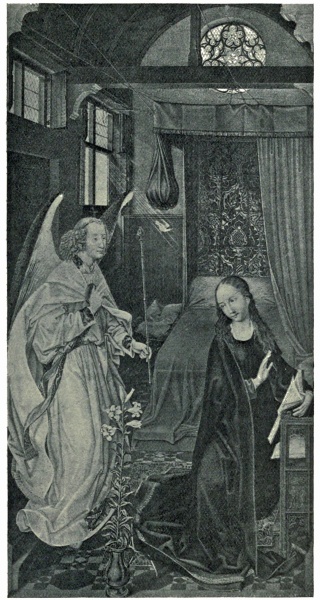
Illustrations of these pictures are given in my
book on “Line and Form,” so that instead of
repeating them here I give one from Lucas van
Leyden’s “Annunciation” at Munich (Pinacothek)
which shows a charming Gothic interior
with a wagon-vaulted roof, wheel window, and
a rich brocade hanging to the bed, with other
interesting details.
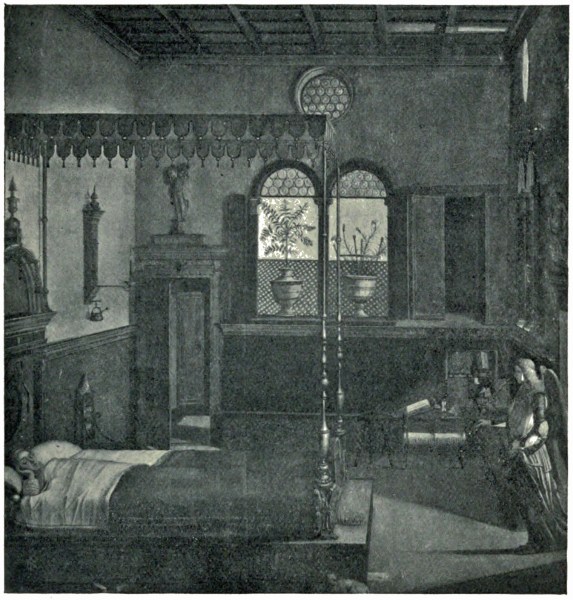
Another delightful example is the early renascence
Venetian interior which forms the
background of Carpaccio’s “Dream of St.
Ursula” (L’Accademia, Venice).
For photographs or prints a pale yellow wall
looks well—a pale lemon or primrose tint—it
lights up softly and agreeably at night. Pale
yellow may also be recommended for a rather
dark room. Even one fleck of sunlight on a
pale yellow wall has a marvellous reflecting
power and will illuminate the whole room. One
can agreeably complete the harmony with brown,
or black and white, with a touch of orange in the
furniture and texture.
As a rule, in modern drawing-rooms and living-rooms,
there are too many colours, as well
as too much furniture. The proportions of the
architect and the scheme of the decorator hardly
have a chance.
“Elizabeth in her German Garden” speaks
of the charm of rooms newly distempered and
papered, with no furniture in them; but though
it might make a paper-hanger happy, I fear
this would be too severe for ordinary English
taste.
Flemish
Fifteenth-Century
Interior
Lucas van
Leyden,
“The Annunciation,”
Munich,
Pinacothek
I remember a gentleman at Los Angeles,
California, showing me with pride a room in his
villa he had papered with a gorgeous wall-paper
with lots of gold in it. He considered it sufficient
in itself, an end and not a means, and
apparently had no intention of disturbing or
obscuring the design by pictures or furniture,
except perhaps a chair or a couch from which
to contemplate the splendours of the pattern.
I think there is a good deal to be said for the
adoption of the Eastern idea of a divan for western
salons—seats all round the room and in
the windows, with small moveable coffee-tables.
Ladies who entertain would find this a very
convenient arrangement for “at home” days,
and with a parquet floor the young people would
only have to roll up the rugs to find dancing
room at short notice. The hall, or house place
of old English houses, no doubt easily lent
itself to hospitable and social gatherings, the
long tables and benches ranged along the walls
leaving plenty of floor space for games or dancing,
while the ingle-nook invited the gossips
and story-tellers.
Carpaccio’s
“The Dream
of St.
Ursula,”
Accademia,
Venice
From a
Photograph
by Anderson
The revival of the hall or living-room with
the ingle-nook is a noteworthy feature in recent
country houses. In fact, in the design and construction
of the small country houses or country
cottages built of late years, mostly as retreats
for workers in towns, artists and others, we find
the most successful, attractive, and characteristic
buildings of our time, probably. The cottages
designed by Mr. C. F. A. Voysey, for
instance, with rough-cast battened and buttressed
walls, green or Whitland Abbey slates,
green outside shutters, and white casements,
have the charm of neatness, quaintness, and
simplicity, an utter absence of pretentiousness
and show, and a regard for the character of their
site. There are some charming cottages of this
type at Bournville, already referred to, designed
by Mr. Harvey, the young architect of the estate.
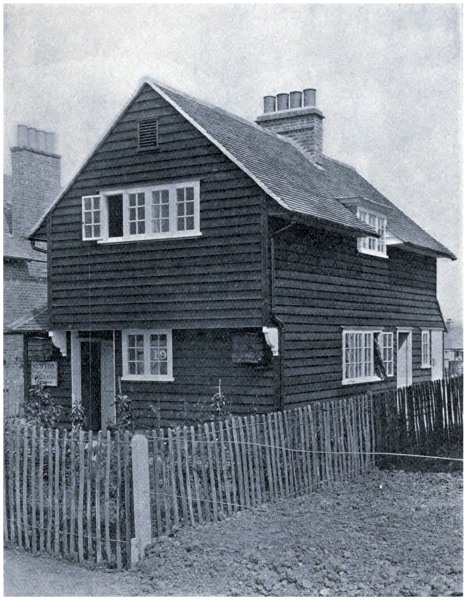
I give one here of my son’s (Mr. Lionel Francis
Crane) design—a timber cottage in the recent
“Cottages Exhibition” at Garden City. In designing
a country house, an architect is of course
much less fettered than with a town or street
site, and he can frame it in a garden, which is
an important decorative adjunct or setting to a
country house or cottage. It is possible also
to make it fit into or even become a part of the
scenery, especially if local materials are employed.
Indeed, it seems to me, that the secret
of harmonious effect in building lies in the use
of local materials as regards country houses.
The beauty of our old castles, abbeys, country
houses and cottages is greatly owing to this.
We feel they are in harmony with the character
and colour of the scenery, and have become
parts of these, independently of the effects of
time.
In the present awakening of the public mind
to the importance of the housing question, and
the want of substantial, comfortable, as well as
comely dwellings for the people, especially in
the country districts, much attention has been
directed to cottage building, and a practical
effort is being made by the Garden City Association
to solve the question in the competitive
exhibition in cottage design and building they
recently organized. The question is, as usual,
complicated by the commercial question of profit
and percentages on invested capital.
Cottage in
the Garden
City, Letchworth,
Herts
Architect,
Lionel F.
Crane.
Builder,
Frank Newton,
Hitchin
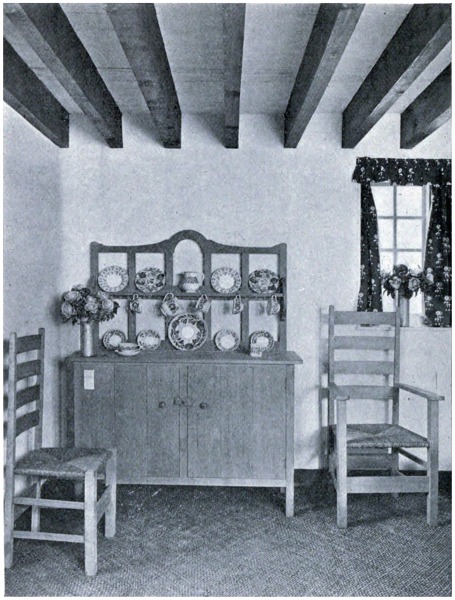
Interior of
Cottage at
Letchworth
Architect,
Lionel F.
Crane. The
Furniture by
A. Heal
(Messrs.
Heal and
Son)
Were the object solely the national welfare,
as it should be, cottages could be designed and
built good to live in and seemly to look at.
Objections have been made to the local bye-laws,
but so far as I am aware these bye-laws are only
intended to secure the minimum conditions
necessary to health and comfort, and would in
no way interfere with the erection of well-built
and sightly cottages. Thatch, it is true, is I
believe, in some counties forbidden on account
of danger from fire (probably really increased
by the use of low-flash oil in cheap lamps), but
for detached cottages with the use of iron laths
and reed thatch (as Mr. Robert Williams has
pointed out) such danger is reduced to a
minimum, and certainly there are thatched
cottages and barns, and even churches, in England
which have lasted hundreds of years, and
thatch, after all, makes an excellent roof, cool in
summer and warm in winter, and pleasant to
look upon.
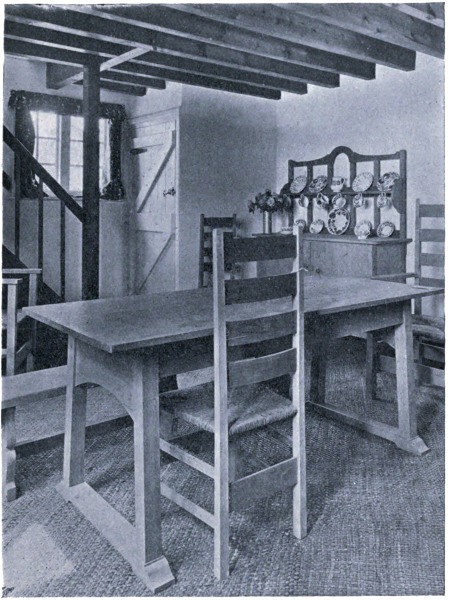
Interior of
Cottage at
Letchworth
Architect,
Lionel F.
Crane.
The
Furniture by
A. Heal
(Messrs.
Heal and
Son)
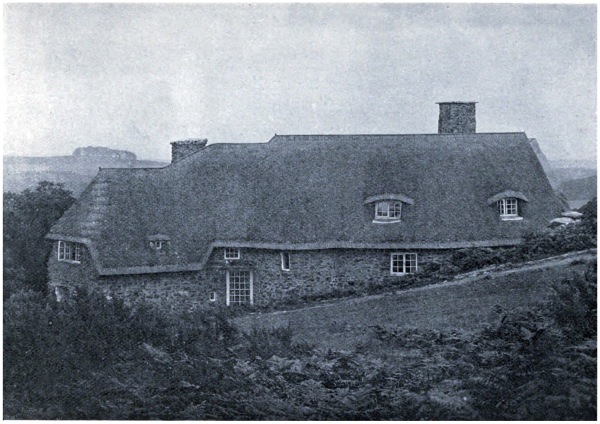
Stoneywell
Cottage,
Exterior
Ernest W.
Gimson,
Architect
How charming a cottage can be made, how
picturesque and pleasing though quite new, how
perfectly in keeping with its surroundings and
fitted to its site, I lately had an opportunity of
seeing in the neighbourhood of Leicester. I
allude to a certain cottage designed by Mr.
Ernest Gimson. The interior also was an illustration
of how decorative rooms could look with
hardly any decoration. This is a hard saying
for decorators, but my impression was that
whitewashed walls, plain oaken furniture, only
relieved by William Morris’s printed cotton in
the shape of window curtains or loose cushions
here and there, were sufficiently decorative considering
the designs and conditions of the structure
of the house. With glimpses of the wild
hill-side and the beautiful woodland landscape
beyond them seen through the deep-set windows,
there seemed no need for landscapes on the
walls—bad news for poor frozen-out picture-painters
again!
The reign of the big plate-glass window, I
believe, is over, and certainly in such a climate
as ours one needs as a rule to be assured one is
really indoors. Certainly, nothing makes so
much difference to the aspect and comfort of
a room or house as the position and size of
the windows. I have a preference for casements
with plain-leading, and if the window
is high, stained glass may find an appropriate
place above the transoms, or in windows
where veiled light is needed, or plain roundels
where a view from within or without is not
desired.
There is no doubt a determined effort in the
direction of a return to simplicity, both in house
designing, furniture, and decorations on the part
of the more refined and cultured, as a reaction
perhaps against the ostentation and luxury of
the appointments of the extremely and newly
rich, and the pretentiousness of the decorations
of monster hotels, where coarse imitations of
decadent periods of French art do duty for
splendour, though even here of late the simpler
taste has asserted itself. There is indeed some
danger that oak or green-stained furniture and
whitewashed walls may come to be considered
as outward and visible signs of an inward and
spiritual grace, when perhaps they are only the
fashion.
“Have nothing in your house but what you
believe to be beautiful or what you know is
useful,” was the straightforward advice of that
great conservative revolutionist in English decorative
art and other things—William Morris—and
he certainly acted up to it in his own
house.
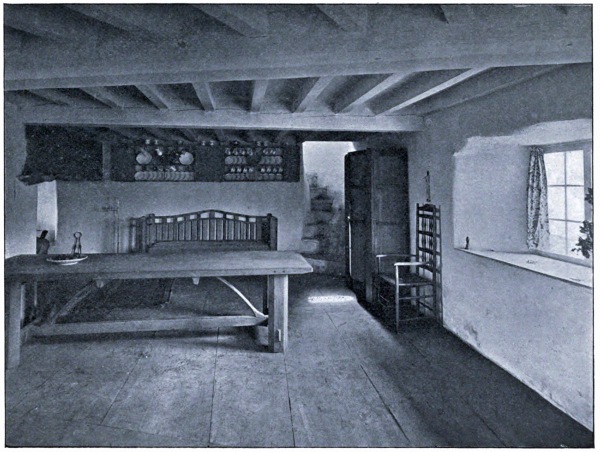
Stoneywell
Cottage,
Interior of
Living-room
Furniture
Designed by
Ernest W.
Gimson,
Sidney H.
Barnsley,
and Ernest
A. Barnsley
As to the useful, there are no complications
about that. A room with a definite purpose has
character, and is always more or less picturesque.
The kitchen is generally the most picturesque
room in the house, yet usually entirely devoid
of what may be called decoration. Its objects
of art are merely the tools of the workshop, the
bright brass and copper vessels, the dish-covers
gleaming like polished armour from the white
walls. The rows of blue and white plates and
dishes upon the dresser, and all the simple but
sufficient hand tools of the cook’s office about,
easily make up an attractive Dutch picture.
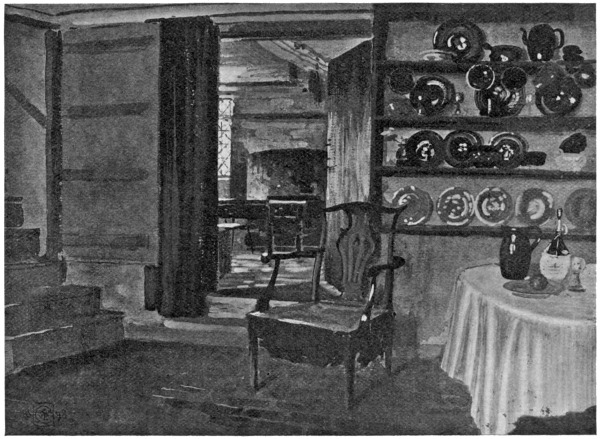
Old English
Farmhouse
Interior
(Kent)
From a
Sketch by
Walter
Crane
The real aesthetic dangers come in to the
rooms which have no visible means of subsistence,
so to speak. The dining-room, perhaps
for this reason, is more successful generally
than the drawing-room, and there exists a
sort of tradition that it should be warm and rich
in colour. Silver plate often gleams pleasantly
from the sideboard, and the furniture is simple
and massive in its lines. An old English dining-room,
with Chippendale or Sheraton furniture,
has a character and distinction of its own. A
library, again, is almost sure to look a habitable
room, and there are few more agreeable linings
to walls than books, and here we must depend
upon the taste of the binders, as well as on the
furniture provided for the mind. There would,
however, be room for the professional decorator
upon the ceiling, and I mind me of the lovely
plaster ceilings to be met with in sixteenth-century
houses, sometimes armorial, sometimes
emblematic—such as those at Knole and Blickling.
In plaster work we have a beautiful and
permanent kind of decoration which we owe to
Italy, but which seems to have become quite
domesticated here, and to have developed its own
forms with us. The plain white, flat ceiling of the
ordinary modern dwelling-house is the last relic,
and even this used to have a big plaster rose
screwed up in the middle, from which sprouted
the gaselier; but one need not regret the departure
of both excrescences in favour of the
clean and pendulous shaded electric light, with
light and simple brass or copper fittings. Our
plasterers, however, might be able to throw
some delicate ribs or pleasant spacing of simple
sprays and devices upon the inviting plain of
white plaster over our heads, or, if not, why not
let the joists show and paint or stencil them with
running leaf patterns, or paint them black, leaving
white plaster between? Mr. George Walton,
one of the most tasteful and original decorators
in the newer mode, and under the Glasgow influence,
showed a new treatment of a ceiling in
glass and metal, together with a completely decorated
and fitted interior at the recent Glasgow
Exhibition. A plaster ceiling demands a frieze,
and both may be effective either plain or
coloured. This would depend upon whether a
light, dark, or rich effect were required in the
room. There is much charm in the coloured
treatment of plaster, especially of figure designs
in low relief as in the work of Mr. Anning Bell,
Mr. Pomeroy, and Mr. Gerald Moira, though
these require large rooms, public halls, or
churches.
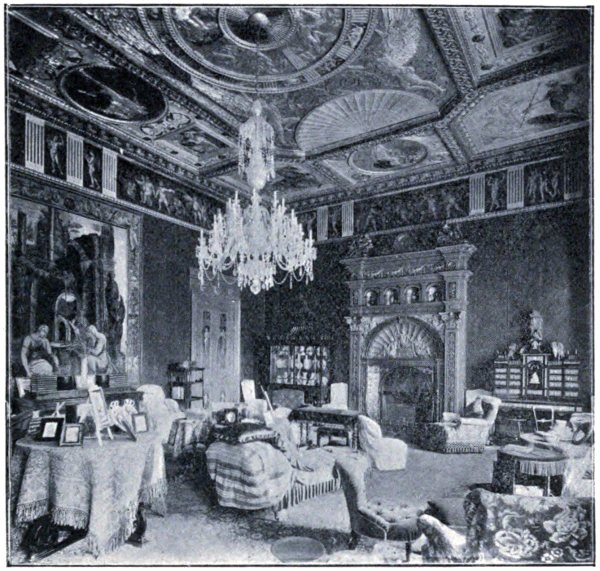
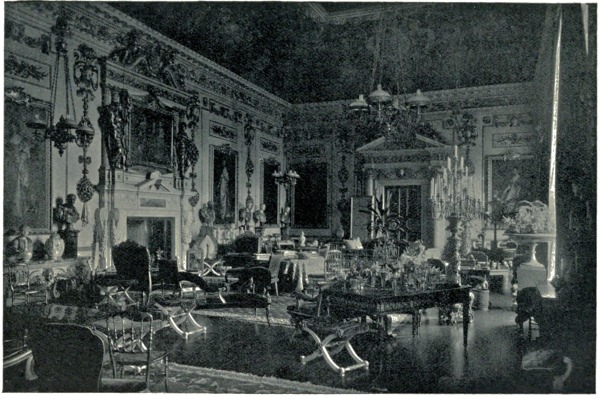
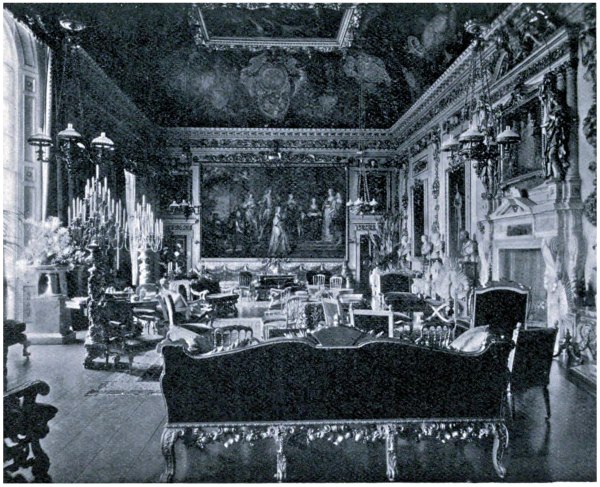
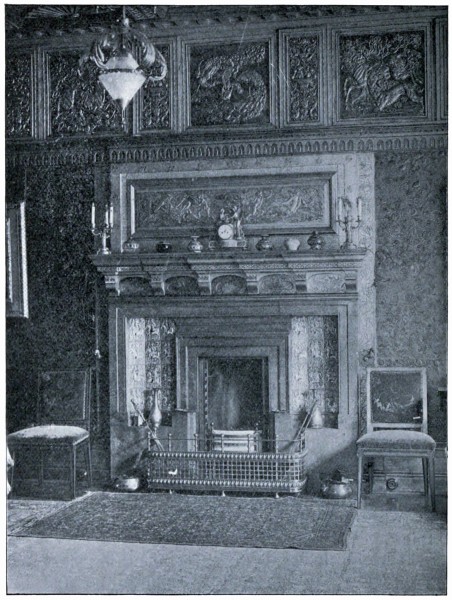
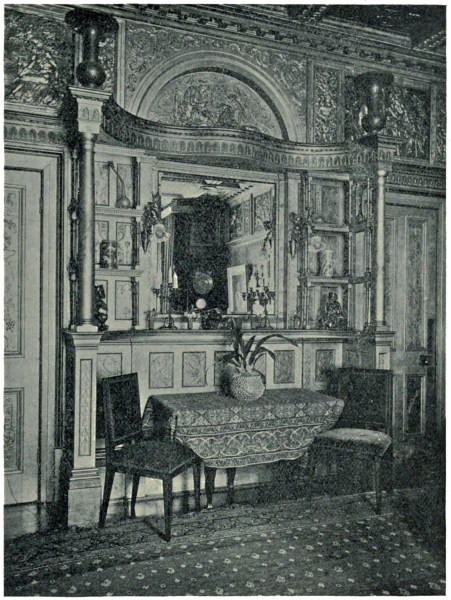
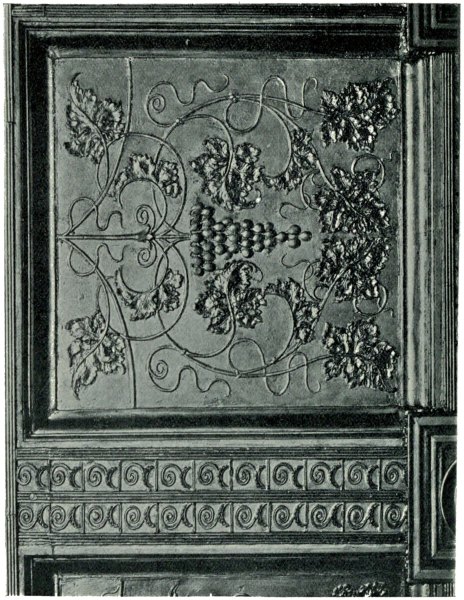
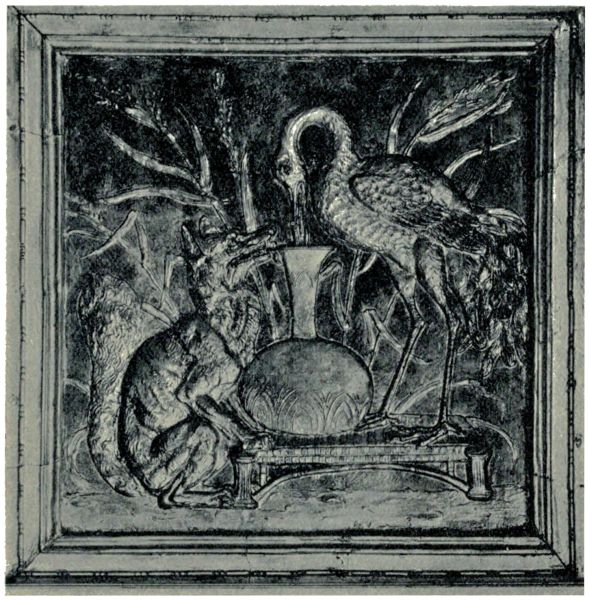
Combe Bank,
Sevenoaks,
the Saloon
The Stamped
Leather,
Plaster Ceiling,
Chimney
Breast,
smaller
Frieze
Panels, and
Door Panels
Designed,
Modelled,
and Painted
by Walter
Crane
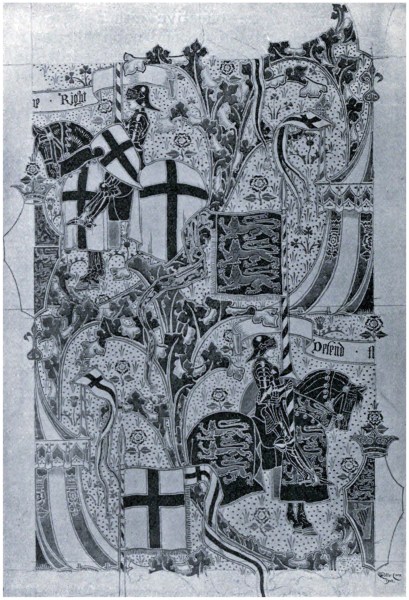
Printed
Cretonne
Hanging,
“Defend the
Right”
Designed by
Walter Crane
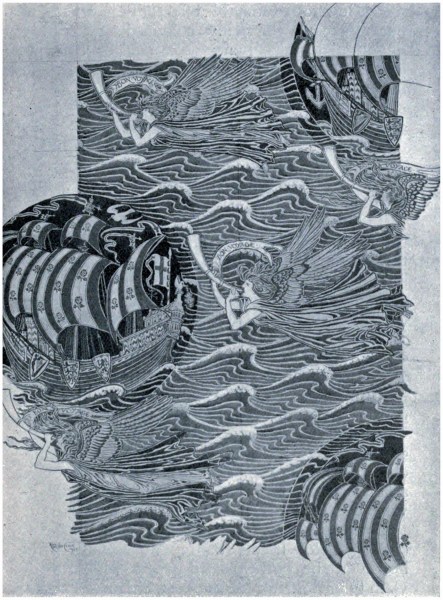
Printed
Cretonne
Hanging,
“Bon
Voyage”
Designed by
Walter Crane
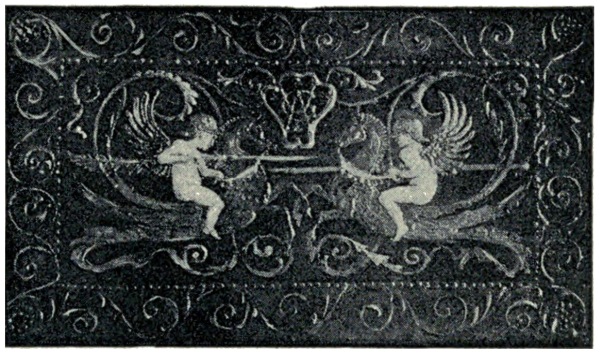
I have designed decorations (ceilings and
friezes) in plaster and in stucco, and gesso
worked in situ. These, in several instances, were
gilded or silvered and lacquered so as to produce
a low-toned metallic effect. This ornament
harmonizes with richly coloured and rather
dark-toned walls hung with silk or Spanish
leather; but these were by no means cottage
interiors.
For a cottage or small country house, printed
cretonne, used as hangings for the lower walls
of a room, has an attractive effect if suitable in
pattern and colour, having a fresh, clean, and
even gay effect with white woodwork and
furniture.
The most comfortable, and at the same time
the most romantic, also, I fear it must be added,
the most expensive, way of decorating walls is by
hanging them with arras tapestry such as that produced
by William Morris. The dining-room of
the English House at the last Paris Universal
Exhibition was panelled in oak up to about six
or eight feet, and the space above to the cornice
was hung with Morris arras tapestry, designed
by Burne-Jones and himself, showing the legend
of King Arthur’s knights and the Holy Grail.
The simplicity, yet richness and dignity of
effect has a striking contrast to the more
clamorous decorations of some of its neighbours,
among which, however, the Spanish Pavilion
was an exception.
Complete schemes for wall decorations (including
field, frieze, dado, and ceiling), can,
however, be had in wall-paper, which, with
plain painting for the modest citizen, remains
the chief method of interior mural decoration.
A frieze usually heightens and lightens the
effect of a room, and its junction with the field
can be utilized for a picture-rail, the wall space
from the picture-rail to the skirting being
covered with rich or quiet pattern, as the particular
scheme may demand. Sometimes a
patterned frieze does well above a plain tinted
wall.
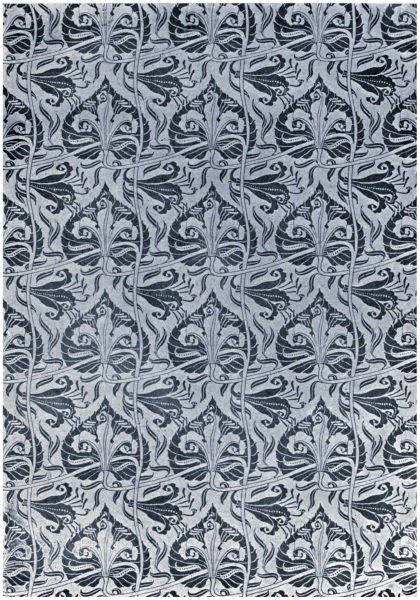
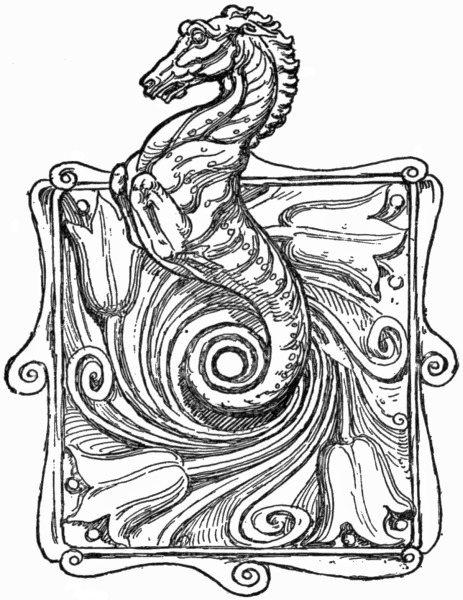
Wall-paper,
“Lily”
Designed by
Walter Crane
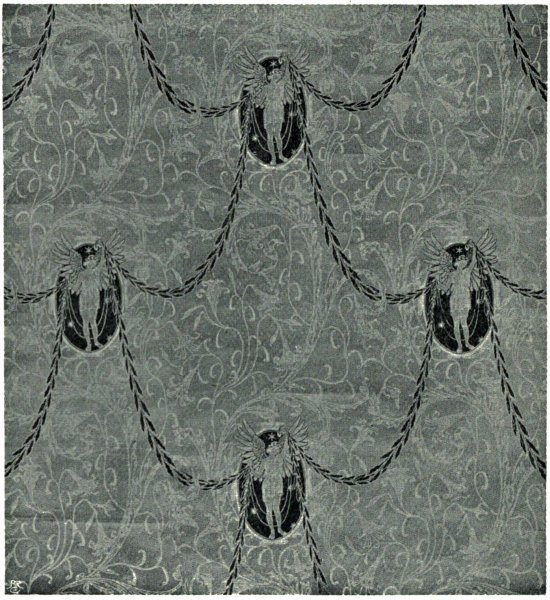
Wall-paper,
“Dawn”
Designed by
Walter Crane
I venture here to give some illustrations
of some of my recent wall-paper designs, by
permission of the makers, Messrs. Jeffery
and Co.
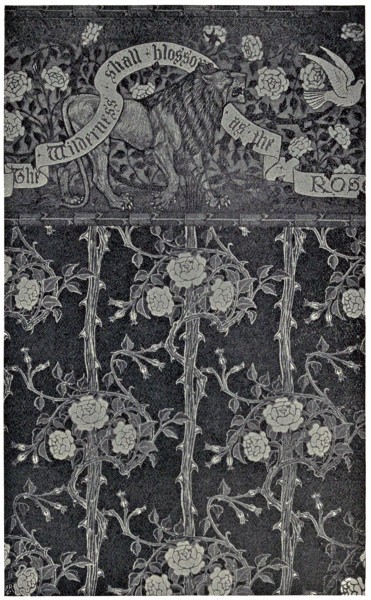
Wall-paper,
Lion Frieze
and Rose
Bush Filling
Designed by
Walter Crane
The blue and white lily pattern (single prints)
would be suitable where a bold effect was desired
for a dado or field of lower wall with
plain white, or a quiet frieze above. It might
be useful in halls and passages.
The rather ornate design called “Dawn,” with
the figure medallion, might be used for a drawing-room
in quiet tones. The blue and the brown
being re-echoed in the hangings and furniture
with white wood-work.
The “Rose Bush” would be appropriate to
a dining or living-room where a rather dark and
rich effect was aimed at. It would harmonize
with oak framing and furniture.
The “Olive Spray” might be generally useful,
and would answer as a background for
pictures.
When wall-paper is used for ceilings the walls
should be comparatively quiet.
I have found the “Vine Trellis” pattern has
a good effect with a plain tint on the walls,
and is especially useful in covering the rather
blank and ugly plastered soffit of the staircase
which so often meets the eye in a town-house
of the older type.
“The Cockatoo” would answer in a large
room where an ornate effect was desired, or it
could be used as a frieze above panelling, or a
plain tint.
The “Oak Tree” is on simpler lines and
rectangular in feeling, combining a bordered
field with a frieze.
In choosing wall papers to suit particular
rooms, regard should be had to the character of
the lines of the pattern as well as the colour,
bearing in mind that a pattern which runs into
marked vertical lines would tend to increase
the apparent height of a room, whereas a pattern
of marked horizontal feeling would tend
to make a room look lower and longer.
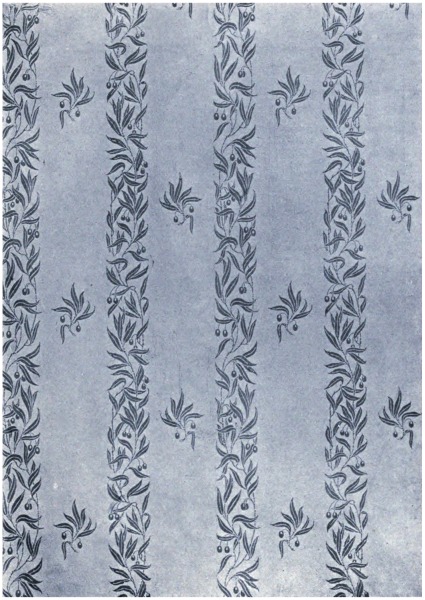
Wall-paper,
“Olive
Spray”
Designed by
Walter Crane
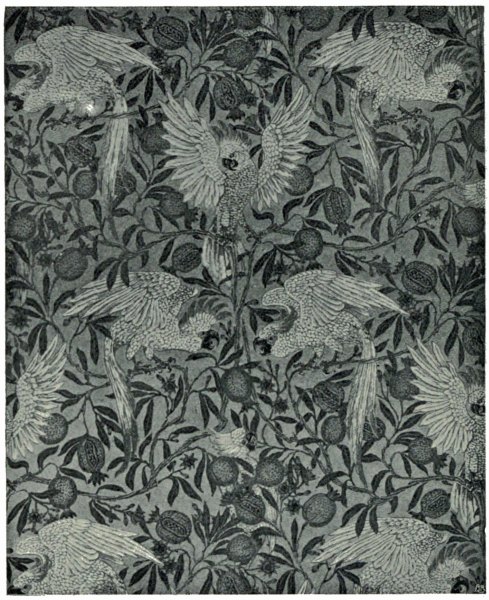
Wall-paper,
“The
Cockatoo and
Pomegranate”
Designed by
Walter Crane
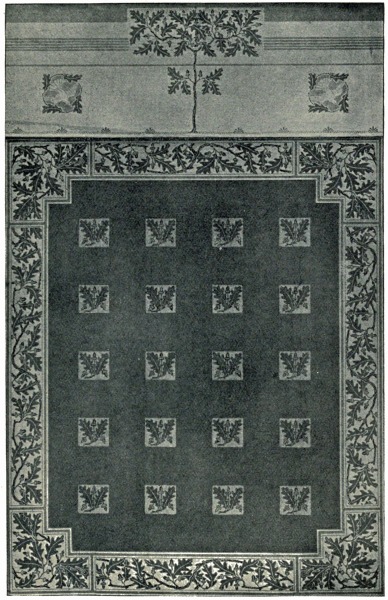
Wall-paper
Decoration
“The Oak
Tree”
Designed by
Walter Crane
In designing complete schemes for wall-paper
one’s aim has been to balance the different
quantities of pattern in the different parts, and
to re-echo the leading lines, masses, and colours
by different expedients, so as to keep an essential
relationship between each part.
Relationship is, of course, the essential in all
decoration, otherwise it becomes a patchwork
of conflicting pattern and colour. It matters not
what our materials may be, or by what means,
costly or simple, we seek to obtain our effect,
whether by painting, carving, gilding and rich
textiles, metal or plaster work, stamped leather
or wall-paper, stencilling, tiles and plain painting
or stained wood and whitewash. All must be in
keeping, and seem fit and in its right place and
proportion, and suitable to its conditions and
surroundings; rich and splendid if the aim is to
be rich and splendid, simple and quiet if the aim
is to be simple and quiet; but without the pretence
of richness or obtrusive display on the one
hand, or the extreme rudeness, baldness, and
ugliness which sometimes accompany what looks
like the affectation of simplicity on the other.