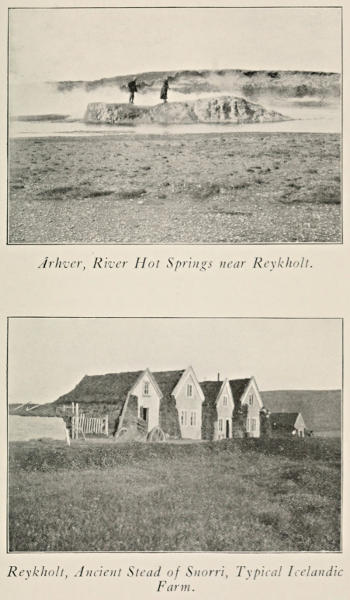
“Day long they fared through the mountains, and that highway’s fashioner
Forsooth was a fearful craftsman, and his hands the waters were,
And the heaped-up ice was his mattock, and the fire-blast was his man.”
During the summer day Akureyri is a busy
place. It is the emporium of the north, the
resort of the fishermen from the northern
waters and the place where the farmers of
the north of Iceland exchange their produce for European
supplies. The city is comfortably situated at the
head of the longest fiord in Iceland. There is one street
that runs between the water and the high hill towards
the west. The population is about 1,500. There are
several shops and good stores, a public library. Two
newspapers are published in the city. There is a high
school and an agricultural college. One baker in the
city is also a photographer and there one may purchase
a photograph or a cruller over the same counter.
At the upper end of the street there is a commodious
and well constructed church. Several of the front
yards boast fine clumps of mountain ash; one of these
tree clumps is the pride of the city, as it has attained
a considerable growth, a remarkable size for this exposure
and high latitude. Behind the street on the
steep hillside, patches of potatoes and turnips checker
the entire bank of the fiord for a mile or more. It is a
pleasing picture when contrasted with the grimness of
the ice-covered ridges beyond.
There is a spacious hotel, long kept by an eccentric
Dane by the name of Jensen. It has recently changed
hands. I have often heard it stated that he had no regular
scale of prices but charged his guests according to
his likes or dislikes. If the guest was winning, the
genial Dane reduced the charge; but if the guest had
been disagreeable, or in any way did not appeal to
the fancy of the proprietor, then the price was raised.
Whatever the truth of the report may be, one thing is
certain, the host was genial, kept a good house, cared
for his guests, and the prices, according to my experience,
were reasonable. It is possible that his philosophy
was correct, that the guest who makes unnecessary demands
or is difficult to please should be the one to pay
the extras, while the guest who takes what is provided,
makes no special demands, considers the local conditions
which obtain and demands no special service for himself
at the expense of other guests, should be favored in
the reckoning. I think Jensen’s method is correct. How
he regarded us I do not know; suffice it to state that we
had a good room with two beds and excellent food in
a private dining room with the best of attention and
that our bill for twenty-four hours was only the equivalent
of two dollars for both of us.
There was one exception to our comfort at this hostelry,
but this can not be charged to the eccentricity of
the landlord. My bed seemed comfortable when I retired,
but long before I went to sleep I found a hard
bunch in the mattress that persisted in getting between
my shoulders no matter how I twisted and turned. It
was a narrow bed and afforded me no retreat from the
offending bunch. I rose, stripped the bed, instituted
a search and finally ripped open the mattress at the corner,
worked that lump to the slit and pulled out a
rooster’s head with the longest bill that was ever presented
to me in Iceland. It had been pecking my
shoulders persistently in spite of the fact that this
rooster had fought his last fight many years since. If
I had damaged the cover a little, I reasoned that I had
avenged the sleeplessness of many a former occupant
of this couch and was rendering a good service to
future guests.
Akureyri is the home of the venerable poet, Matthias
Jöckumsson, born in 1833, a lyric poet of the
highest rank, who has also written excellent drama.
It was our pleasure one day while fording the Heraðsvötn,
District-Waters, to meet him. Riding off the little
ferry he came to us with hat in hand and his white
locks flowing in the wind. Holding out his right hand
to us he said,—
“Welcome, strangers, to Iceland!”
At the far end of the city, in fact a continuation of
the one street, is Oddeyri, Point of Land, under a
different political jurisdiction from Akureyri. It is a
busy place in the whaling and herring season and contains
a large store operated by the Danish-Icelandic
Trading Company. It has two banks and has recently
become the center of the shipping interests by reason
of its new wharf which enables steamers to discharge
cargo without the use of lighters. The curing and
rendering establishments in this town will repay a visit,
unless one has strong olefactory objections. When the
wind blows up the fiord there is no doubt as to the use
to which the buildings on the extreme point of land
north of the pier are put.
Leaving Akureyri we followed the west bank of the
grand Eyjarfjörðr till we arrived at the Hörgá, Howe-River,
whence we looked across the level meadows to
the former location of the Agricultural College at
Möðruvellir, Madder-Valley. The college is now located
at Akureyri. It is sometimes a surprise to learn
that there is such a college close to the Arctic Circle,
but it has a good reason for its existence. There is need
for training the farmers in methods of cattle, horse and
sheep breeding, especially the latter, that they may win
the best possible success in their struggle with adverse
conditions. Jón Hjaltalin at one time was the head
master of this school and he also did service in Edinburgh,
Scotland, as a librarian.
The view across the valley is extensive and charming
because the rugged and ragged features of the
usual Icelandic landscape are softened by the river
winding through the undulating meadows which roll
upwards to the distance-softened ridges, while yet beyond,
the crumbling cinder cones melt into the whiteness
of the lofty Vindheima Jökull, Wind-Home-Glacier,
and flashing in the sun,—
“A thousand rills
Come leaping from the mountain, each a fay,
Sweet singing then;
‘O come with us out seaward, come away!’”
We stopped for lunch beside a singing brook flowing
down from the ridge on our left and springing into
the Hörgá. The grass was in excellent condition and
the ponies grazed as if they had knowledge of the
poor quality of this necessity and its scarcity during
the following days. The cotton grass spread its sheets
of pearly white around us, forget-me-nots and marguerites,
the wild arnica and the violets reveled in the glory
of their bloom. We ate our lunch and reclined upon
the grass in full enjoyment of the scene and recalled
the former importance of this valley. It is as beautiful
to-day as when the Vikings first entered it. Since
their time no blasting volcano with fiery breath has
scorched its foliage nor poured its glinting lava in
destructive streams over the meadows and humble
homes. The days of feudal strife passed with the
Christian education of that sturdy race and the peace of
the Cross now rests upon the valley like the “shadow
of a great rock in a weary land.”
The time of its literary importance passed with the
decline of its Abbey and the passing of Sira Jón Thorlakson,
the Icelandic Milton. Across the river, and
shaded by a noble clump of the mountain ash, stands
the home of this venerable poet and priest, Baegisá. A
century ago he translated Paradise Lost, Pope’s Essay
on Man, portions of Shakespeare, masterpieces of German
and Scandinavian literature into the Icelandic. Besides
being a translator, he composed a large amount of
Icelandic poetry in the Eddic phraseology which competent
judges say equalled and often surpassed the
masterpieces of the ancient scalds. He was sorely fettered
by poverty. When commenting upon the high
morality of his race and the great freedom from the
use of intoxicants by his people at that time he said,—
“Our poverty is the bulwark of our happiness.”
Again, speaking of poverty, the common lot of most
poets of all lands, and in all ages, he says, literally from
one of his poems,—
“Ever since I came into this world, I have been wedded
to poverty, who has hugged me to her bosom
these seventy winters all but two; whether we shall
ever be divorced here below, is only known to Him
who joined us together.”
From our vantage point we looked down upon three
beautiful valleys with as many rivers joining to form
the valley of the Hörgá and its mighty stream. These
are the Hörgárdalr, Öxnadalr and Baegisádalr. The
mountains rise to an elevation 4000 feet above the valley,
capped with snow or perpetual ice, their slopes
slashed into wild ravines and terraced with lava cliffs
down which course numerous cascades from the melting
snows. It is a fair and peaceful scene, this at
our feet: it is a grand and awesome sight, that greets
the lifted eye.
Fastening forget-me-nots into the manes of the ponies
we resumed our ride up the valley and turned into the
Öxnadalr, Ox-Valley. It is a fine illustration of a
glacial valley. The cross section is nearly a semicircle
and the sides are deeply grooved; the glacial
carving is much more pronounced than that of the
lower end of Seyðisfjörðr. We stopped over night at
Thverá, Tributary-River, in a humble home perched
upon the steep hillside above the river and just below
the ice cliffs.
Across the river rise the Hraundrangar, Lava Pillars,
which tower in a long chain of spires above the castellated
ridge, a prominent feature in the landscape for miles
up and down the valley. High up between the ridges
there is a sheet of water which pours out through a
small rift in the nearer ridge and falls into the valley
as if some Moses had smitten the lava wall with his
rod of wrath.
We enjoyed our stay at Thverá and experienced several
things of interest. It is an ancient farm located
on the trail through the defile where Icelanders have
passed between the east and west for a thousand years.
A newly wedded couple had just taken up their abode
under the paternal roof in this historic spot and were
beginning the problems of life where generations of
their ancestors had solved the same enigmas with the
variations which the succeeding centuries have added.
They were attentive to our necessities with the inborn
hospitality of the race but there was something in the
atmosphere that revealed the newness of the work and
the shyness of the wedded couple added much to our
amusement.
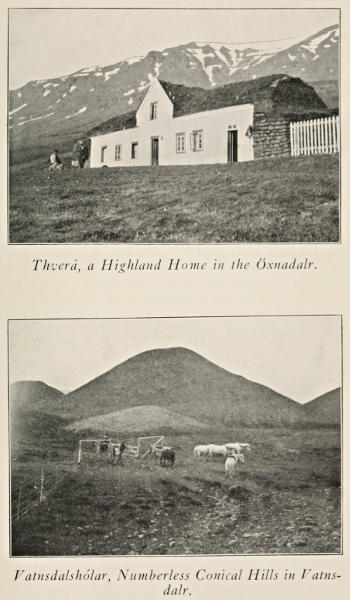
Thverá, a Highland Home in the Öxnadalr.
Vatnsdalshólar, Numberless Conical Hills in Vatnsdalr.
During the week the rapidly melting snows had carried
away the bridge over the Thverá and we found
it necessary to cross the torrent on a stringer. With
a little coaxing all the ponies walked across except our
faithful black pack pony. Vexed at the delay in removing
his packing boxes, and anxious to be with his
companions grazing on the opposite bank, he ran rapidly
up and down the stream, repeatedly trying the river
for a place to ford with his load which was still fastened
to the saddle. Ólafur was on the opposite side resaddling
the other ponies. Old Black became frantic,
shook himself repeatedly, ran sideways into a projecting
rock in the canyon and freed himself from his load;
he then ran to the stringer, crossed and grazed contentedly
with his mates and in positive forgetfulness of the
wreckage he had left strewn upon the opposite shore.
The cases had burst open and their contents were scattered
along the sides of the river and some of the
items were actually rescued with difficulty from the running
water. Fortunately Old Black was not carrying
my photograph outfit that morning as was his usual
custom. Again in 1913 in my crossing of the interior
of Iceland I had this same horse and of all the pack
ponies which I have used during my four different
journeys I have never found one equal in value to this
one. His peculiar trait was to pick a trail for himself
and his intelligence in this work was noteworthy. He
was always given the most valuable portion of my load
and whether in the bogs, on the rough mountains
where there were no trails or in the fording of difficult
rivers he was always worthy of the trust I imposed in
him. The one accident mentioned above is the only one
he has had in his long years of service as a pack
pony.
Clumps of mountain ash, in Europe called rowan tree,
here and there adorn a sheltered spot and their association
with the angular lava recalled to my mind the
Lay of Geirod, a kind of parable concerning the fires
of Iceland. Greatly abridged it runs as follows:—
“Loki, the beguiler, flew away one day in quest of
adventures in Frigga’s falcon dress. He flew to a huge
castle over the sea and alighted on a great castle and
looked into the hall. Geirod saw him and ordered him
to be caught. The slave climbed the wall with difficulty
and Loki laughed to see the labor the man made.
He resolved not to fly till the slave had nearly caught
him. He waited too long, as he spread his wings to
mount to the next height and lead on his pursuer, the
slave caught him by the feet and took him to Geirod,
the giant, who, when he looked at him believed him to
be a human and not a real bird. He bade him answer
but Loki was silent. Loki could only regain his liberty
by promising the giant that he would lure Asa
Thor to this fastness without his hammer. Geirod
was sure he could destroy Thor if he could meet him
without Thor having his wonderful hammer. Loki
beguiled Thor to visit Geirod without his hammer; but
a friendly giantess, Grida, Grace, in whose house Thor
lodged, knowing the plot of Loki and Geirod, loaned
Thor her staff and iron gauntlets.”
“Thor discovered the plot and in trying to escape
waded the sea, whereupon Gjálf, (din or roar of
ocean), Geirod’s daughter, flung the waves at Thor.
Thor cast a rock at Gjálf and he never missed when
he cast a stone, and thus with stone hurling and with
the aid of his staff and gauntlets he reached the land.
He caught hold of a friendly ‘rowan’ and climbed out
of the water.”
Because of this myth the mountain ash has ever since
been sacred to Thor.
Again we read:—
“When Thor had won his way into the fire castle,”
(this doubtless refers to the fiery lava chambers which
occur in many parts of Iceland), “he was invited to
take a seat. No sooner had he done so than the seat
flew to the roof of the hall, where Thor would have
been crushed had he not pushed back with his staff
which the giantess had given him. He pressed back
so effectively that he slew the two water-storm daughters
of Geirod, who had tried to blow him into the
heavens.”
In this parable the reference is undoubtedly to the
Geysir. Thor’s next foe was a volcano.
“Geirod now challenged Thor to fight in the hall
lined with fire. Thor caught the red hot weapons in
his iron gloves and hurled them back to Geirod, who
vainly crouched beside a pillar to defend himself. But
Thor crushed this Demon of Underground Fire back
into the black rock and flung the fire caverns wide open
to the day.”
Such is the ancient legend but it shows how legends
are founded upon facts or conditions, which may be
lost for centuries, though the legends may remain for
us to scoff at when we do not know the foundation. In
this instance we see the forces of water and fire contending
with humans, a never ending contest between the
forces of destruction and the powers of reason and
intelligence.
At the head of the Öxnadalr we stopped at the
post shelter for coffee and cakes and tinned tongue.
The poor little farm is not worthy of the name of a
farm. It is just a bit of mountain herbage at the
borders of the snows and screes and the one family
could not survive were is not for the assistance of the
government in order that a shelter for the post carriers
and chance travellers against the mountain storms
may be provided.
I swapped a pony with the farmer and paid him a
margin of two dollars. The horse I traded was the
same that I had received in a similar trade at Ljósavatn.
The farmer carefully examined the marks in the ears
of the pony and stated that it was raised on this same
farm and had now got home. While I am not a horse
trader and know none of the intricacies of the game
and had no way to learn the Icelandic methods, the
satisfaction I got from this pony convinced me that
the best of the bargain was mine. While the Icelander
is noted for his square dealing and truthfulness I had
often wondered what he would be like in a horse trade.
The pony I traded had a quarter crack and I told
Ólafur to point this out to the farmer. Ólafur shook
his head and said,—
“He can see it as well as you.”
Later I asked Ólafur about this and enquired how
he could reconcile it with the proverbial integrity of
his people. He replied,—
“But this was a horse trade and every man must see
what he is buying when he purchases a horse.”
In connection with this there was another incident of
sharpness that came to my attention in the summer of
1913, though it may have been done more from the
love of a joke than from any intention to defraud.
The Icelander is very fond of a joke, especially when
at the expense of some one else. The steamship company
trading around the coast advertises “to return
empties free of charge.” A farmer in Borg sold a
cow to a man in Reykjavik with the understanding that
the skin was to be returned to him. The man in
Reykjavik tied up the skin and shipped it to the farmer
in Borg. The steamship company charged the farmer
for carrying the bundle. The farmer replied,—
“But there is no charge. You took the cow to Reykjavik
and you offer to return ‘empties free of charge’
and if a cow skin is not an empty, what is it?”
Up and up we climbed to an elevation of about 2,000
feet to the height of land, the watershed between
Skagafjörðr, Cape-Fiord, and Eyjafjörðr. The ride
down the valley towards the west is wild in the extreme.
The trail passes through a long mountain pasture
where we encountered about one hundred young
ponies, thence along the edge of a chasm so deep that
the tumbling of the water in the bed came up to us only
as a murmur. On our right rose impassable cliffs
and rubble screes and it was along this talus of
rolling material, composed of disintegrating lava
and sand, that we made our way. There are
places where a false step or a small avalanche would
sweep horse and rider into the depths of the chasm.
When the canyon widened, the green-white of the water
flashed up to us like masses of liquid emerald. The
trail improved as we descended and the declivity became
less precipitous; having a long distance ahead of
us we gave the ponies a free bit and away we went in a
joyful gallop down the grade. We had been discussing
the prospects of a tumble a few moments before when
on the edge of the cliff but now all fear had vanished.
My pony stumbled on some small stones and I shot over
his head much to the amusement of my companion.
Mrs. Russell was following at this point. Scarcely had
I regained my seat in the saddle and reined in to the
rear when her pony stumbled and threw her in a similar
manner. She was not hurt. This was my second and
her first tumble during the two summers of riding, so
she held up two fingers to me from time to time. She
was laughing at my poor horsemanship and I pushed
on to the head of the train. A great raven perched on
a lava point was croaking excitedly and it seemed to
me that he said, “saw-you, saw-you, saw-you!” Turning
to look at this fine black bird I saw my brave companion
trying to remount from a second tumble without
letting me know of it. She never forgave that
raven, for if he had not notified me of the mishap she
might still have held those two mocking fingers at me.
Rapidly we descended to the lower valley and forded
the rapid river. Ravine after ravine opened into the
valley, each bringing its turbulent stream to swell the
great river far below the trail. We lingered here and
there to examine the rocks and I was surprised at the
outcroppings of copper in the form of copper carbonate.
Zeolites of great beauty are imbedded in the lava and
I have often longed for a day or two to explore some
of those ravines that lead from this pass. There are
indications of considerable copper in two places in Iceland
and since Iceland has unlimited water power for
the electrical treatment of ore some one will soon ascertain
the quantity of copper present.
As the valley became wider it turned towards the
northwest and we caught glimpses of tiny homes on
the opposite side of the river. Desolate homes are
these among the mountains, far away from neighbors.
The farmers eke out a bare living with the produce of
their sheep. Down came the wind in mighty gusts
bringing rain and mists that shut out all distances. The
winds came directly from the ice sheets and as the
clouds shut out the sun the rain soon turned to a
driving sleet. We were tired, cold and hungry and
thoroughly in need of shelter. The top of a tiny spire
showed itself through the mist below and I thought,
“Miklebaer at last.” Ólafur dashed our hopes by saying
that this farm with its excellent buildings and its
hospitable pastor was two hours ride beyond the metal
church below us. He urged us forward but I refused
as it was not possible to ride further, except in a case of
life or death. So we reined into the tún of Silfrastaðir,
Silver-Stead, and while we were dismounting a man,
blind with age, tottered towards us on his cane and extended
his trembling hand and in the Saga phrase, “he
greeted us well.” That little tumbled down home in
the mountain pass, that small bed in a cupboard in
the wall, how good they looked to us! That Icelandic
welcome! We had received it on the prosperous farms
and in the city, yes in the more favored portions of
the land, even in the home of the Governor, but never
before, never since, has any abode seemed so pleasant
and all other welcomes at home and abroad shrink in
value when compared with the welcome and the cordial
hospitality of this poor blind man of Silfrastaðir, who
gave us the best he had and bade us “God speed” on
the morrow.
During the night our ponies ran away and it was a
long time before Ólafur found them. They were going,
according to their habit, before the wind and were
nearly down to Miklebaer when the guide found them.
While he was pony hunting I repaired to the little
kitchen, if such it may be called, and over a fire of dried
sheep manure made some coffee and with the provisions
in our packing boxes we made a good breakfast. We
got away at ten thirty and soon after noon arrived at
Miklebaer and turned into the tún enclosure to visit
the grave of Frederick W. W. Howell, F. R. G. S.
Howell was the author of the Pen Pictures of Iceland.
He had spent many summers in the country and knew
it the best of any Englishman. His illustrations are
works of art and his descriptions of natural scenery
are faithful and full of appreciation. Howell was the
first to make the ascent of the Öraefa Jökull, 6,400
feet in height and the highest peak in Iceland. This
was in August 1891. He lost his life in fording the
Heraðsvötn, District-Waters, a broad, swift and deep
river which flows through the valley of the Skagafjörðr.
The place was opposite the farm of Miklebaer. This
farm belongs to the church and within its cemetery the
unfortunate Englishman is buried. A marble memorial
marks his resting place and bears the following inscription:—
In Loving Memory
of
Frederick W. W. Howell,
F. R. G. S.
Who Was Called to His Rest
From the Heraðsvötn River
3d. July 1901
Aged 44.
“Asleep in Jesus, Oh What Rest!
So them also which sleep in Jesus
Will God bring with Him.”
The pastor invited us into his study and refreshed us
with coffee and cakes and conversed with us in German
and broken English. He had a good library of English,
German and Icelandic works. Our stay was longer
than we intended, for Ólafur, (this time it was a young
lady and not the ponies that caused the delay), found
a fair maiden of pleasing conversation. We finally
started without the guide and later when he had overtaken
us at the fiord and I teased him about his tardiness
he stated that the maiden asked him to wait while she
wrote a letter to a friend of hers in Reykjavik and
requested him to be the messenger. It must have been
a long letter. Had he collected as long a letter from
each of the attractive maidens at the many farms where
we called in the summer of 1910 he would have had a
good sized mail by the time he reached the capital.
On arrival at the ferry we found a good boat into
which we loaded four of the ponies at a time with the
packing cases. It was here that we met the venerable
poet, Matthias Jochumsson. Remounting we crossed
a wonderfully rich grass plain. It is in this valley that
the best ponies of Iceland are bred. Later in the day
we arrived at Viðimýri, Wide-Bog. Here we were
fortunate in witnessing a pony-fair at which hundreds
of ponies changed hands. They are gathered from the
mountains for sale to the exporters and it is here that
the Icelandic gentleman comes for his private saddle
pony.
Steadily we climbed the mountain in a driving wind
with some rain. The wind blew cold from off the
Skagafjörðr, Cape-Fiord. The ocean was clear and
an excellent view was had of Drangey, Lonely-Island.
It was on this island that Grettir, the Strong, the favorite
hero of Iceland, met his death at the hands of
his enemies. He had been an outlaw for many years.
Sometimes he made his home in the lava waste between
Hoffs Jökull and Láng Jökull. I visited the cave in
1913 which is marked by several cairns. At one time
he lived at Arnavatn, Eagle-Lake and at another he
dwelt in the remote fastness of Thórisdalr at the south
end of Láng Jökull. In the summer of 1913 I went
to the entrance to this fastness. It is the finest retreat
for an outlaw that any country could possibly provide
in its natural configurations. The Saga of Grettir
relates that he found his way over the lava wastes of
Skjalbreith, Broad-Shield, by sighting the summit of
Skjalbreith through a hole in a block of lava and noting
the intervening points of prominence. In the old days
the youth of Iceland used to assemble on the level grass
plain at the extreme northern end of Thingvellir during
the annual meeting of the Althing to hold their sports.
At one time Grettir came down from Thórisdalr in
disguise and entered into the wrestling. One by one
he threw all the champions from the different sections
of Iceland and did it with apparent ease. The maidens
sat upon the high conglomerate knob overlooking the
plain and saw with sorrow their respective favorites
beaten in the feats of strength. The seat upon which
they sat is known as Meijarsoeti, Maidens’-Seat. It
was not till Grettir left the arena and climbed the
narrow pass which runs upward beside Meijarsoeti that
it was discovered that the unknown wrestler was in
truth Grettir, though some of the wise ones had hinted
as much.
The story of Grettir’s life on Drangey is of great interest
but too long for a full recital. If the reader desires
to know more of the real hero of Iceland in the
old days and the one most often mentioned at the present
time he should read the Grettir Saga. It will give
an account of his wanderings, his conflict with the ghost
and his harder struggles with the men who desired to
take his life because he had refused to leave his native
land after the Althing had outlawed him with the
greater outlawry. Drangey is an island in the middle
of the great fiord and the sides are so steep that it
is possible to ascend only at one place. With two men
he took up his abode here and lived upon the sheep
which the farmers had put upon the rock for summer
pasture. The Saga relates that on a Christmas night
his fire went out and that he swam to the mainland
to replenish it. He entered the house by the shore and
was recognized by an old woman. Several men, the
foes of Grettir, were making merry in an adjoining
room, but the old woman pitied him and, because it
was Christmas night, gave him the coals and allowed
him to depart in peace. Placing the fire in a small
kettle, he swam back to Drangey and rekindled the
fire in his stone stove.
The temperature was only three degrees above freezing
when we descended the western slope of the mountain
and arrived at the farm, Bolstaðarhlið, Wood-Farm-Slope.
There was a long delay in getting supper but
it came at last in the shape of a hot lamb stew and we
were provided with comfortable beds. We were told
that in the morning we could have oatmeal porridge,
and, since it had been many days that we had had
anything of this nature, we looked forward with pleasure
to the breakfast. Having a long ride before us on
the morrow, we solemnly arranged with Ólafur to
start by eight-thirty. He agreed to have the ponies and
the cases in readiness. We had often held these solemn
councils but a stray pony, a broken pack saddle, a
lost shoe or some other quite common mishap had always
prevented our starting before one to three hours
after the appointed time. This morning it was not the
fault of Ólafur and there were none of the usual causes
of delay. It was that oatmeal porridge and even the
placid guide was disturbed at the delay. Well, at ten
we sat down to enjoy that oatmeal with real thick,
sweet cream in abundance. The combination was delicious
as the oatmeal was thoroughly cooked. Then,
I pulled out a long black hair and carefully concealed
the presence of it from my companion. Soon I found
another and this one was white. I could no longer refrain
from communicating my discoveries and so I
stated:—
“I have discovered exactly how long this oatmeal
was cooked.”
“Well, how long was it cooked and why this smile?”
I replied,—“The woman who started to prepare
this porridge had black hair, but when she had finished
it her hair had turned white.”
After a short ride we came to the Blandá, Mingled-Waters,
which was so swollen that it was necessary for
us to proceed to the mouth of the river at Blönduós
where there is a substantial bridge. The ride from this
trading village south to the farm, Hnausar, Rough-Ground,
was in a hard rain with the thermometer at
one degree above freezing and with occasional gusts
of snow that swept down from the ridge at our right
with the howling wind. With our heads bowed low
over the saddle and the wind at our backs we saw
little of the valley save that at the feet of the ponies.
The wind increased and the storm drove up the valley
from the Arctic Ocean with sufficient violence to drive
from our minds everything save thoughts of a shelter.
At seven-thirty we halted at the gate of the tún while
Ólafur sought the bondé to ask the customary questions
about food, shelter and grass for the ponies. I
have never had the request refused but politeness demands
that the traveller remain without the turf wall
until the request is made of the farmer, or if he is
absent, of his wife or oldest son. The Icelander within
his turf wall is like a baron in his castle and as such
must be recognized. Once the questions are asked the
request is granted and the traveller then is placed at
ease with all the freedom that is necessary.
The good wife built a fire of turf and sheep manure
in the tall Norwegian stove in the guest room, took
all our wet clothing to her kitchen to dry and prepared
for us a satisfying and tasty supper. She kept the fire
replenished till midnight and I remember no fire that
seemed so good as this one. Before the fire was built
and we stood about the cold stove with chattering teeth
I knew something of how Grettir felt when he discovered
that all his coals had turned to ashes out there
on Drangey.
It rained and snowed by turns all night and at eleven
when I looked out upon the farm the haycocks wore
white capes. A small bedroom opened out of the guest
room and the water came through its turf roof in many
places in streams, in fact everywhere except upon the
bed and why that was exempt I do not know.
The morning broke cold and windy with falling snow
and the uncut grass protruded its emerald green
through the white blanket. We looked towards the
south, listened to the gusty wind, glanced at the lowering
heavens and returned to the heated stove. It was
Sunday and we decided to let the ponies have a day
of rest. They, poor beasts, were not grazing but stood
with drooping heads and tails turned towards the wind.
The ponies of Iceland! In no other place in the world
will horses thrive under such treatment as they receive
in this land. They are ridden or driven with their
heavy packs all day, often upon grassless mountain
slopes, fording deep and cold rivers, often swimming,
often laboring in long reaches of sand or plunging in
grassy bogs. When the work of the day is finished
they are simply turned adrift to care for themselves.
They are never groomed, never given any grain, never
covered with a blanket; they have no sheltering stalls.
They are simply turned loose in the storm as well as in
the sunshine, or, into what they dread worse than any
storm, among the swarms of savage midges. When
the grass is good they are happy; they never knew any
other life. What steed of English or American stables
would care to become an Icelandic pony, to work all
day for the chance to graze all night, and then, as I
have so often witnessed, have their master end the days
work in a dreary sand waste where willow leaves and
scanty sedges offer the only forage?
The day passed rapidly and pleasantly. The farmer
came to our sitting room to take coffee with us at noon
and then invited me to go and see his pet saddle horse,
a magnificent stallion. This I did with interest as I
had never seen a stallion among the thousands of ponies
I had found in the country. He saddled him and
showed his different paces for some time about the tún
and then Ólafur was invited to ride him. I photographed
the farmer on his steed and then I was invited
to ride the stallion. It is a mark of special favor for
any farmer to allow another to mount his private pony;
and it is also a breach of etiquette to offer to mount another’s
pony. This is a custom that clings from the
pagan days. We read in the Saga of Hrafnkell, Frey’s
Priest, how one man met his death by mounting the
favorite horse of another. The story is as follows, but
greatly abbreviated:—
Einarr engaged himself to watch the sheep of the
Priest of Frey, Hrafnkell, and his master said to
him:—
“I’ll make a short bargain with thee. Thy business
shall be to watch fifteen ewes at the mountain dairy and
gather and carry home faggots for summer fuel. On
these terms thou shalt take service with me for two
‘half-years.’ But one thing must I give thee, as all my
shepherds to understand,—‘Freymane’ goes grazing in
the valley with his band of mares; thou shalt take care
of him winter and summer, but I warn thee of one
thing, namely, that thou never be on his back on any
condition whatever, for I am bound by a mighty vow
to slay the man that ever should have a ride on him.
There are twelve mares with him; whichever one of
these thou mayest want, night or day, is at your service.
Do now as I tell thee and mind the old saw,—‘No
blame is borne by those who warn.’ Now thou knowest
that I have said.”
Einarr replied:—“I trust I am under no such luckless
spell as to ride on a horse which is forbidden,
least of all when there are other horses at my disposal.”
Briefly, Einarr went to work, the time came when
the sheep wandered; a rain and mist came down; the
ewes had been absent many days; Einarr went down
to the grass where the mares were grazing taking his
saddle cloth and bridle, thinking to catch one and ride
over the hills in search of the lost sheep. He could
not catch one of the mares though he had spent all the
morning; but “Freymane was as quiet as if stuck buried
in the ground.” Einarr though that his master surely
would never know, so he mounted the forbidden pony
and “rode until middle eve,” and “he rode him long
and hard.” “The horse was all dripping even every
hair on him; bespattered he was all over with mire, and
mightily blown. Twelve times he rolled himself, and
then he set up a mighty neighing, and then set off at a
quick pace down along the beaten track.” … “Einarr
ran after him but could not lay hand on him.” …
“He ran all the way along the valley never stopping
till he came to Aðalból. At that time Hrafnkell sat at
table, and when the horse came before the door it
neighed aloud.”
“He went out and saw Freymane and spoke to him;
‘I am sorry to see thee in this kind of a plight, my pet;
however thou hadst all thy wits about thee in coming
thus to let me know what was the matter; due revenge
shall be taken for this.’”
“In the morning Hrafnkell saddled a horse and rode
up to the dairy; he had his axe in his hand but no other
weapons about him. At this time Einarr had just
driven the ewes into the pen, and lay on the top of the
wall counting the sheep; but the women were busy milking.
They all greeted Hrafnkell and he asked how
they got on. Einarr answered; ‘I have no good speed
myself, for no less than thirty ewes were missing for
a week, though now I have found them again.’ Hrafnkell
said he had no fault to find with things of that kind,
‘it has not happened so often as might have been expected
that thou hast lost the ewes. But has not something
worse befallen than that? Didst thou not have
a ride on Freymane yesterday?’
“Einarr replied,—‘I can not gainsay that utterly.’”
“Why didst thou ride on this one horse which was
forbidden thee, while there were plenty of others on
which thou art free to ride? Now this one trespass I
could have forgiven thee, if I had not used words of
such great earnestness already. And yet thou hast manfully
confessed thy guilt.”
“But by reason of the belief that those who fulfill
their vows never come to grief, he leaped off his horse,
sprang upon Einarr, and dealt him his death blow.”
In the afternoon the Doctor from Blönduós arrived
at the farm to pay a social call and the farmer brought
him to our sitting room, while the eldest daughter
served us with the usual social beverage in Iceland.
Two pleasant hours passed during which we gained
much information about Icelandic customs, local history
and legends.
The rain came down still harder in the evening but
we welcomed it as it promised warmer weather and
bare ground on the morrow. So much water had come
into our bed room that it was only by judicious side
stepping and walking on the tops of the packing boxes
that we were able to reach the bed without a cold and
muddy footbath.
There are three things in Iceland that have never
been counted:—The islands in Breiðifjörðr, Broad-Fiord,
the lakes of Arnavatnsheiði, Eagle-Lake-Heath,
and the conical hills of Vatnsdalr, Water-Dale. Our
stopping place, Hnausar, which signifies rough ground,
is in the midst of these peculiar hills and in the center
of the valley. We spent three days among the hills and
found them of marked interest to the geologist. Hundreds
of acres are covered with the cones rising from
the plain to an elevation of from twenty-five to over
one hundred feet. Oftentimes they are so near together
that their bases are confluent and thus seem to
be double peaked in a few instances. Geologists have
given different reasons for this queer formation. One
states that they are of glacial origin and were left when
the ice melted in the form of moraines; another is of
the opinion that they are the results of great avalanches
upon the glacier, which in melting left them here. Another
states that they are merely the weathered fragments
of a local lava flow. I spent a day in their examination
and so will give my reasons for rejecting the
causes assigned by these gentlemen and substitute my
own conclusions in order that future scientists interested
in the geology of Iceland may confirm or refute according
as they weigh the evidence.
They can not be glacial moraine as there is no evidence
of any glacial action in any way upon any of the
fragments and it must be remembered that as compared
with glaciated areas in other lands Icelandic glaciation
is as if it occurred yesterday. In fact glaciers
are still covering many square miles of the table land.
There is no evidence of any water erosion on any of
the stones. They could not have been avalanches upon
the ice sheet for there are no mountains near at hand
from which such masses of material could have come.
And if it is argued that the avalanches were at a distance
it turns the problem once more into that of the
moraine. The character of the valley and its low mountains
will not permit our reason to accept either the
glacial or the avalanche theory.
There is no evidence of any great lava flow either
in plugs, intrusive sheets or surface flow, neither in the
necessary abundance of scoriae and blistered fragments
to warrant such a theory. And if there were, we must
then explain why these are “cones” and not craters with
blistered rims and solid slopes. We must turn to
Mývatn for the explanation. It is my opinion that
deep seated and violent subterranean explosions of
considerable frequency took place here, as in the case
of Hverfjall the giant explosion crater of Mývatn. It
heaved up the crust in crumpled masses, mingling the
different basalt formations of ancient flows which lay in
superimposed sheets. How else can one account for the
many kinds of lava in a single cone, the absence of
blistering and cones in place of craters? I have performed
an interesting experiment in the laboratory upon
this theory and with results that seem to verify the
above conclusions. A two liter copper beaker was
chosen. It was half filled with clay dust of different
colors in layers. This dust was prepared by thoroughly
drying the clays, pulverizing and then dusting it through
a double fold of cheese cloth. This gave me particles
large enough for my miniature experiment. The beaker
was then slowly heated from the bottom. After due
process of time with the increase of heat the subterranean
gases, in this case air in the dust, expanded. At
first with slightly audible bumps and a faint trembling
of the surface. These increased until the action became
violent and small mounds were thrown up which
formed true cones with mingled colors from the different
depths.
Vatnsdalr is a fair and pleasant valley, when the
sun shines. No wonder that it possessed a charm for the
early settlers with its parallel mountain ridges of entrancing
blue, its noble river expanding into fine sheets
of water where trout are abundant and its fertile meadows
of broad expanse. It is historic ground as well as
legendary. It has known stirring days and its heroes
were the bravest of any who wielded the axe and bill
in the troublesome times when blood alone could recompense
a personal affront or a crossed lover. A
whole sheaf of Sagas relate the deeds of the men and
women of Waterdale. The valley is the same as of
old. The inhabitants point out the exact localities
where the guest halls of the nobles stood and where
their temples of sacrifice were reared to propitiate the
gods of Valhalla; they show one where the champions
battled for their rights, where the lovers held their
trysts and the mounds where the heroes were entombed.
These incidents have been handed down from generation
to generation, from father to son and the stories
were oft repeated in the bathstófa during the long winter
evenings when the Arctic shore was frozen and the
wind whirled the drifting snows around their turf huts.
Besides the lengthy Sagas there are numerous shorter
stories that have been preserved in written form such
as that of Gisli, the Outlaw; Grettir, the Strong and
Glum. It is a knowledge of the Sagas and the legends
that spread the charm over this valley, that leads one
from the present to the past by a jump backwards of
many centuries. To visit Iceland, especially the Saga
Dales, in ignorance of their history would be like tramping
through Scotland without any acquaintance with
Sir Walter Scott, or a sojourn in London without a
knowledge of Dickens.
In most countries the progress of modern life, with
its inventions and the eternal scramble for the latest
style in everything, has obliterated much if not all of
the past and one can only obtain the colors of the
former ages in the ruins of a castle or cathedral or
from the written pages of the antiquary. Not so in Iceland,—farms,
mountains, rivers, lakes and meadows remain
the same and under the same names given to them
by the first settlers, though it be ten centuries of time.
No railway or canal, no public improvements, modern
cities or factories have obliterated the ancient landmarks.
Even the manners and dress of the people are
little changed from that early day. On the ruins of the
tumbled-down hut of his grandfather the grandson
erects his house in the same fashion and the descendants
of the first imported sheep furnish skins for shoes
still tanned, cut and fashioned after the ancient model.
To visit the remote dales of Iceland is to be set backward
in history and fashions a thousand years.
The Waterdale Saga tells us how Ingmundr, a grand
old Viking, after years of sea-roving and plundering
along the shores of the southern seas settled in this valley
with his followers. He had made a vow that no
matter where he might roam that Norway should always
remain his home. The witches of Finland prophesied
that Iceland would be his resting place and so it
was. At the farm called Hof, Temple, one may still
trace the position of his great Scali, Banquet Hall, and
there beside it winds the river where the old man lost
his life. He had promised protection to a renegade
who treacherously slew his benefactor. Ingmundr went
to his high seat in the hall after the blow, wrapped his
cloak around him and died alone. His grandson,
Ingólfr, was “the handsomest man in all the northern
lands.” Here is a song written about him over 800
years ago by a little maiden who admired him:—
“All the pretty maidens
Wish to dance with Ingólfr;
All the grown-up damsels.
Woe’s me, I’m too little!
‘I too,’ said the Carline,
‘I will go with Ingólfr
While a tooth is left me,
While I’ve strength to hobble.’”
In the Saga of the farm of Grimstunga, Grim’s
Tongue, (tunga is frequently used with reference to a
narrow strip of grass land in a sand waste or between
masses of lava), at the head of the valley, we find the
following story of Ingólfr:—
“An autumn feast was held at Grimstunga and a
playing at the ball. Ingólfr came to the game, and
many men with him from the Dale,” (Water Dale.)
“The weather was fine and the women sat out and
watched the game. Valgerðr, Ottar’s daughter, sat
on the hill-side and other women with her. Ingólfr
was in the game and his ball flew far up among the
girls. Valgerðr took the ball and hid it under her
cloak and bade him find it who had cast it. Ingólfr
came up and found it and bade the others go on with
the game; but he played no more himself. He sat
down by Valgerðr and talked the rest of the day.”
It was the story of love that did not go smoothly for
he flirted and did not propose to her father for her hand
in marriage. Her father sold his farm and moved to
the south. Man-slayings followed and Valgerðr was
forced by her father to marry another man when Ingólfr
deserted her for another maiden. He had many love
affairs for he was inconstant. In the end he was
wounded by outlaws and when dying he requested that
he might be laid in the mound with his forefathers near
the river path in Water Dale that “the maidens might
remember him when they walked that way.”
Valgerðr had a famous brother, Halfreðr nicknamed
Vandaeðaskald, signifying the “Troublesome Scald.”
He was the favorite scald of the powerful Norwegian
King, Olaf Tryggvason, who reigned from 995 to
1000 A. D. A full account of this King and of his
favorite singer is given in Heimskringla by Snorri
Sturlason, the Norse Historian, from which the following
brief account is condensed.
Halfreðr was a wayward youth, given to wandering
and adventure, a real Viking in spirit. He was born
in 968 and raised at this very farm of Haukagil, Hawk-Gulley,
where the notes for this chapter were roughly
penned in 1910. He was “a tall man, strong and
manly looking, somewhat swarthy, his nose rather ugly,
his hair brown and setting him off well.”
A little brook tumbles down from the heath behind
the house, the rolling meadow reaches away to the river
and beyond it the mountains rise in glorious colors in
this evening light just as they did when Halfreðr played
beside this same brook as a child and Ingólfr flirted
with Halfreðr’s sister. The turf house and the tún, the
noisy dogs bringing up the ewes for the evening milking,
the swish of the scythe in the grass and the call
of the plover on the heights,—all are as in the days of
old and it requires little fancy to place this sturdy youth
in his old surroundings.
He was a poetical genius, a favorite of kings and a
terror to his enemies. He did not so often unsheath
his sword in a quarrel as he employed his stinging
rhymes which cut his enemy deeper than the sharpest
sword. Like his sister, Halfreðr had his love troubles.
Kolfina loved him and he reciprocated but her father
chose otherwise and betrothed her to Griss, a man who
had accumulated great wealth in the service of the Emperor
at Constantinople. Griss was “rather elderly,
short-sighted, blear-eyed;” but he could see well enough
when he went to woo Kolfina that a handsome youth
was kissing her at the door of the lodge. Caught by
Griss in the very act, Halfreðr shouted to him as he
took his reluctant departure:—
“Thou shalt have me for a foe, Griss, if thou wilt
try to make this match.”
The parents gave Halfreðr a good scolding and ordered
him away at once. As he rides away he makes
this rhyme:—
“Rage of the heath-dweller, trough-filler, beer-swiller,
Count I no more
Than the old farm-dog’s yelp
At the farm door
Howling at parting guest,—who cares for his behest?
My song shall praise her best,
Her I adore.”
Longfellow says:—
“Halfred the scald,
Gray-bearded, wrinkled, and bald.”
This passage shows the wide poetic license which
Longfellow took in dealing with the Sagas and the
Heimskringla of Snorri. Scott’s harpers were always
old and gray and Longfellow infers that the Scalds
were the same. The fact is that Halfreðr did not live
beyond forty years of age. He was gay and reckless
as were all of his cult; he was reckless of speech even
in the presence of the king. He was always ready with
a song whether at the court of Olaf, in the camp, on
the sea in storm or in calm or in the brunt of the
fight. He was constant in love and although he married
a beautiful and wealthy woman he never forgot
his early love for the fair Kolfina.
King Olaf had much trouble in converting him to
Christianity and in getting him to take the christening.
He succeeded as we shall see from the following quotation,
but Halfreðr clung in secret to the faith of his fathers,
the hope of a future life in Valhalla as we note
from the many references to the old northern gods in
his songs and the way in which he talks of them. So
frequently did he call upon the pagan deities that Olaf
often talked to him about it and mistrusted that he was
not really converted to the Cross.
Heimskringla, Vol. I. Sturlason.
“On a day went the King a-walking in the street, and
certain men met him, and he of them who went first
greeted the King; and the King asked him of his name,
and he named himself Hallfreðr.”
“Art thou the skald?” said the king.
Said he, “I can make verses.”
Then said the King:—“Wilt thou take christening,
and become my man thereafter?”
Saith he:—“This shall be our bargain: I will let
myself be christened, if thou, King, be thyself my gossip,
but from no other man will I take it.”
The King answerest:—“Well, I will do that.”
So then was Hallfreðr christened, and the King himself
held him at the font.
Then the King asked of Hallfreðr: “Wilt thou now
become my man?”
Hallfreðr said: “Erst was I of the body-guard of
Earl Hakon; nor will I now be the liege man of thee
nor of any other lord, but if thou give me thy word
that for no deed I may happen to do thou wilt drive me
away from thee.”
“From all that is told me,” said the King, “thou
art neither so wise nor so meek but it seemeth like
enough to me that thou mayest do some deed or other
which I may nowise put up with.”
“Slay me then,” said Hallfreðr.
The King said: “Thou art a Troublous-Skald; but
my man shalt thou be now.”
Answereth Hallfreðr: “What wilt thou give me for
a name gift, King, if I am to be called Troublous-Scald?”
The King gave him a sword, but no scabbard therewith;
and the King said: “Make us now a stave about
the sword, and let the sword come into every line.”
Hallfreðr sang:—
“One only sword of all swords
Hath made me now sword-wealthy
Now then shall things be sword-some
For the Niords of the Sweep of sword-edge
Naught to the sword were lacking,
If to that sword were scabbard
All with the earth-bones colored.
Of three swords am I worthy.”
Then the King gave him the scabbard and said:
“But there is not a sword in every line.”
“Yea,” answers Hallfreðr, “but there are three
swords in one line.”
“Yea, forsooth,” saith the King.
Now from Hallfreðr’s songs we take knowledge and
sooth witness from what is there told concerning King
Olaf.
In 1014, after a great sea fight in which a yard arm
fell and inflicted a mortal blow, Hallfreðr lay dying on
board of a crippled vessel which was drifting before
the gale. Still mindful of conditions around him he
makes the following stave, which was translated by
Miss Oswald:—
“Down on my heart and side
Crashes the weatherworn spar;
Scarce ever so heavy a wave
Has swept o’er a boat before.
Wet am I, wave-washed and worn,
And shattered at heart and breast;
And the sea is aboard our craft,
And nowhere the scald can rest.”
With his dying breath he chanted the following
stave, showing that his early love, Kolfina, had not
been forgotten during his long years of warfare and
wanderings:—
“The binder of her wimpled brow
Will shade these lovely eyes, I know,
With white hands soft and tender.
The rain-storm flood will have its way
When she has heard how dead I lay,
Though once I did offend her,
When overboard the warriors cast
Her scald, her love,—of all the past,
The love she will remember.”
Thus died in middle life one of the greatest of the
Norse scalds. His had been a “troublous” life indeed.
The duties of the scald were to improvise poetry on
the instant, in praise of the King and in recounting the
deeds of his favorite warriors in battle. He was the
historian and the periodical at the same time; his utterances
were respected and he was feared by prince and
peasant. The scald had liberties at court and in the
royal camp or on board the royal fighting ship not
accorded to any other retainer.